
NASA Earth Day 2019 Poster - Web

NASA Earth Day 2019 Poster - Print
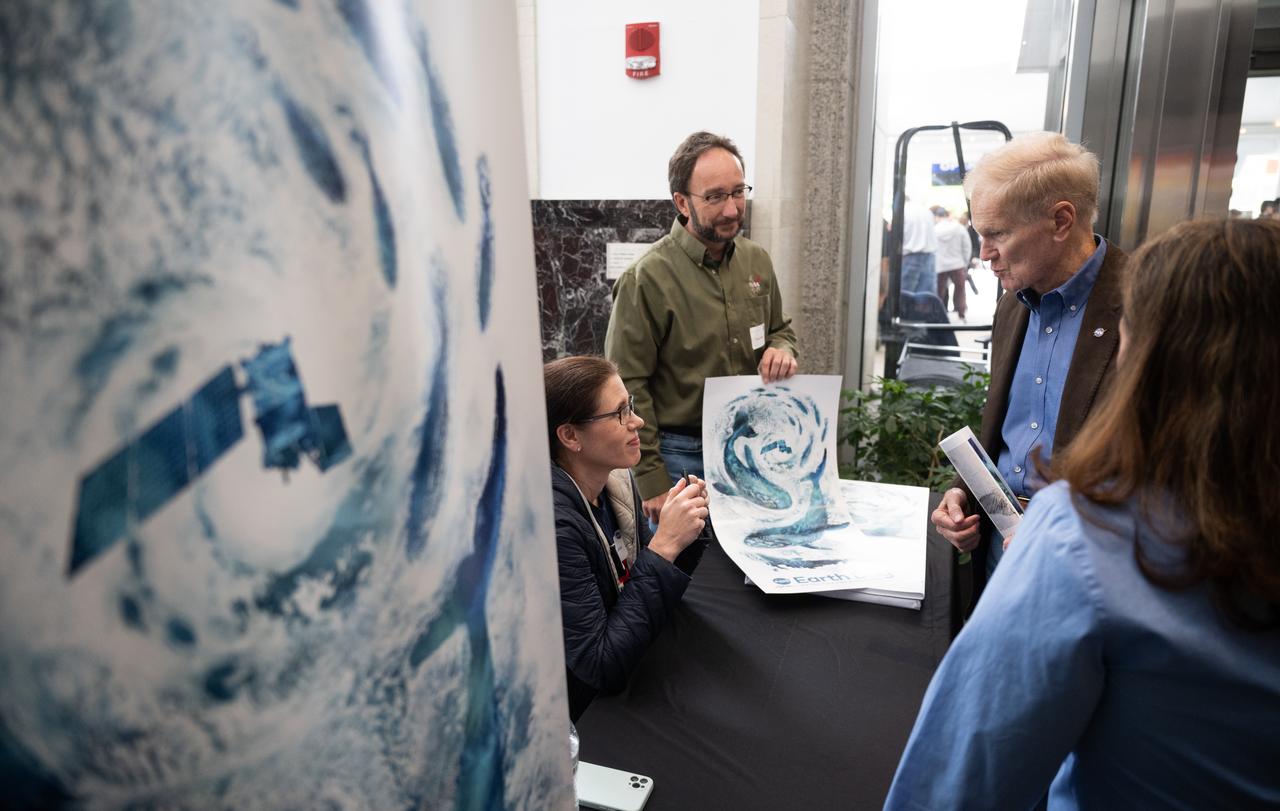
NASA Administrator Bill Nelson, right, speaks with Jenny Mottar, art director for NASA’s Science Mission Directorate, and Kevin Miller, senior graphic designer in the Sciences and Exploration Directorate at NASA’s Goddard Space Flight Center, about the agency’s Earth Day poster as NASA celebrates Earth Day, Friday, April 19, 2024, in the Earth Information Center at the Mary W. Jackson NASA Headquarters building in Washington. Photo Credit: (NASA/Joel Kowsky)
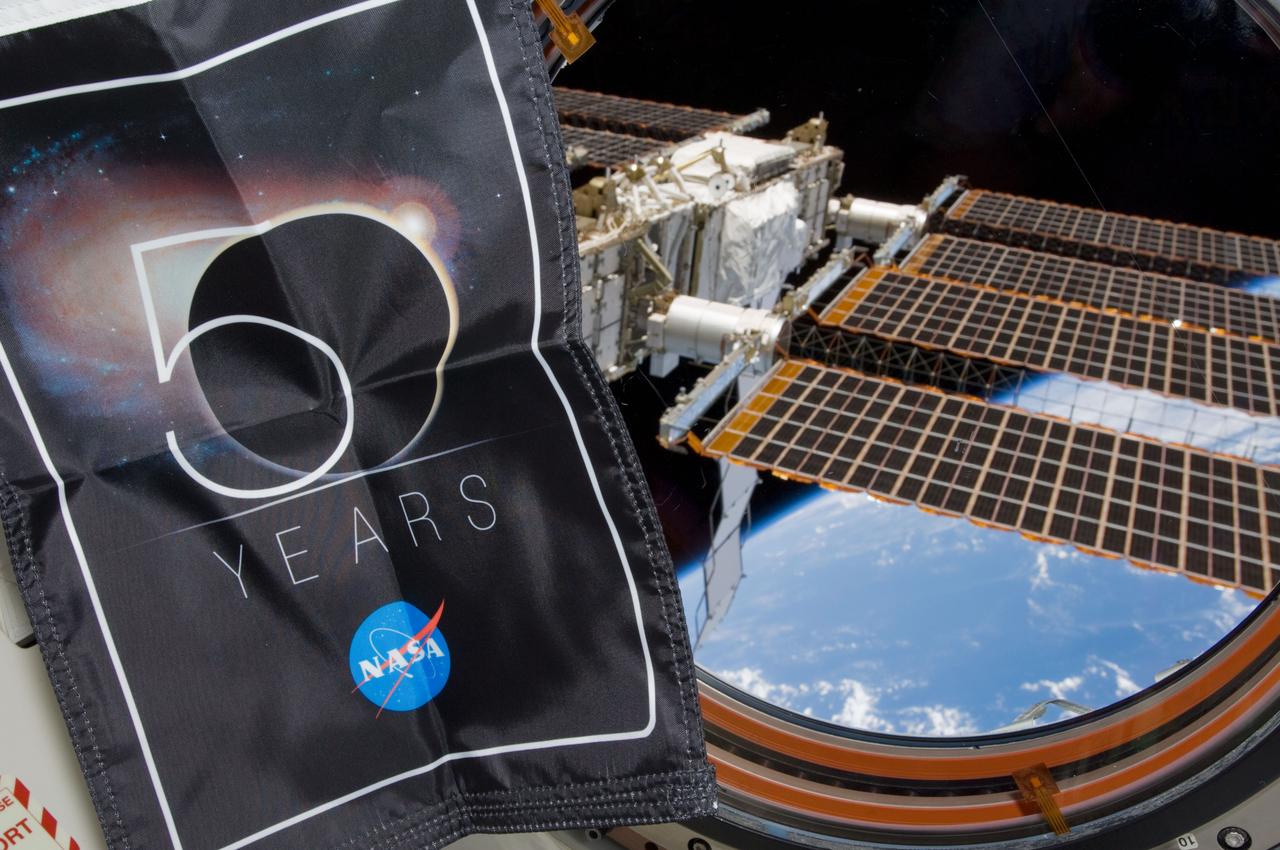
S126-E-013825 (27 Nov. 2008) --- The STS-126 Endeavour astronauts and the Expedition 18 crewmembers during their shared activities aboard the International Space Station honored the 50th Anniversary of NASA in several ways, one of which was to display this special version of the event's poster. The image, showing clouds on Earth and part of the orbital outpost through an ISS window, was taken on Thanksgiving Day.
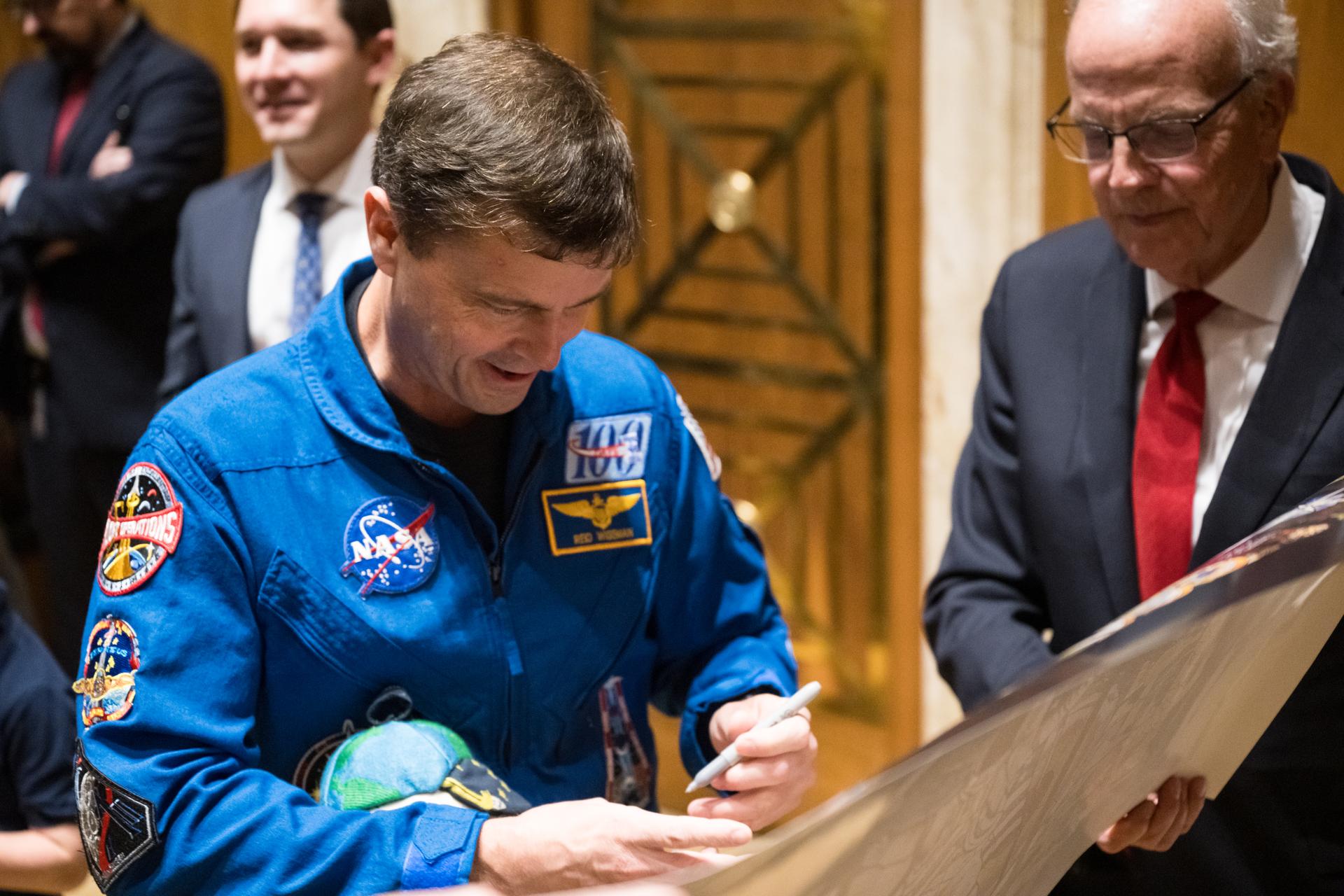
NASA astronaut Reid Wiseman, Artemis II commander signs a poster for U.S. Senator Jerry Moran (R-Kan.) at an event at the Dirksen Senate Office Building, Tuesday, May 12, 2026, in Washington. NASA’s Artemis II mission took Wiseman, and crewmates NASA astronaut Victor Glover, Artemis II pilot, Christina Koch, Artemis II mission specialist; and CSA (Canadian Space Agency) astronaut Jeremy Hansen, Artemis II mission specialist, on a nearly 10-day journey around the Moon and back to Earth in April 2026. Photo Credit: (NASA/Aubrey Gemignani)
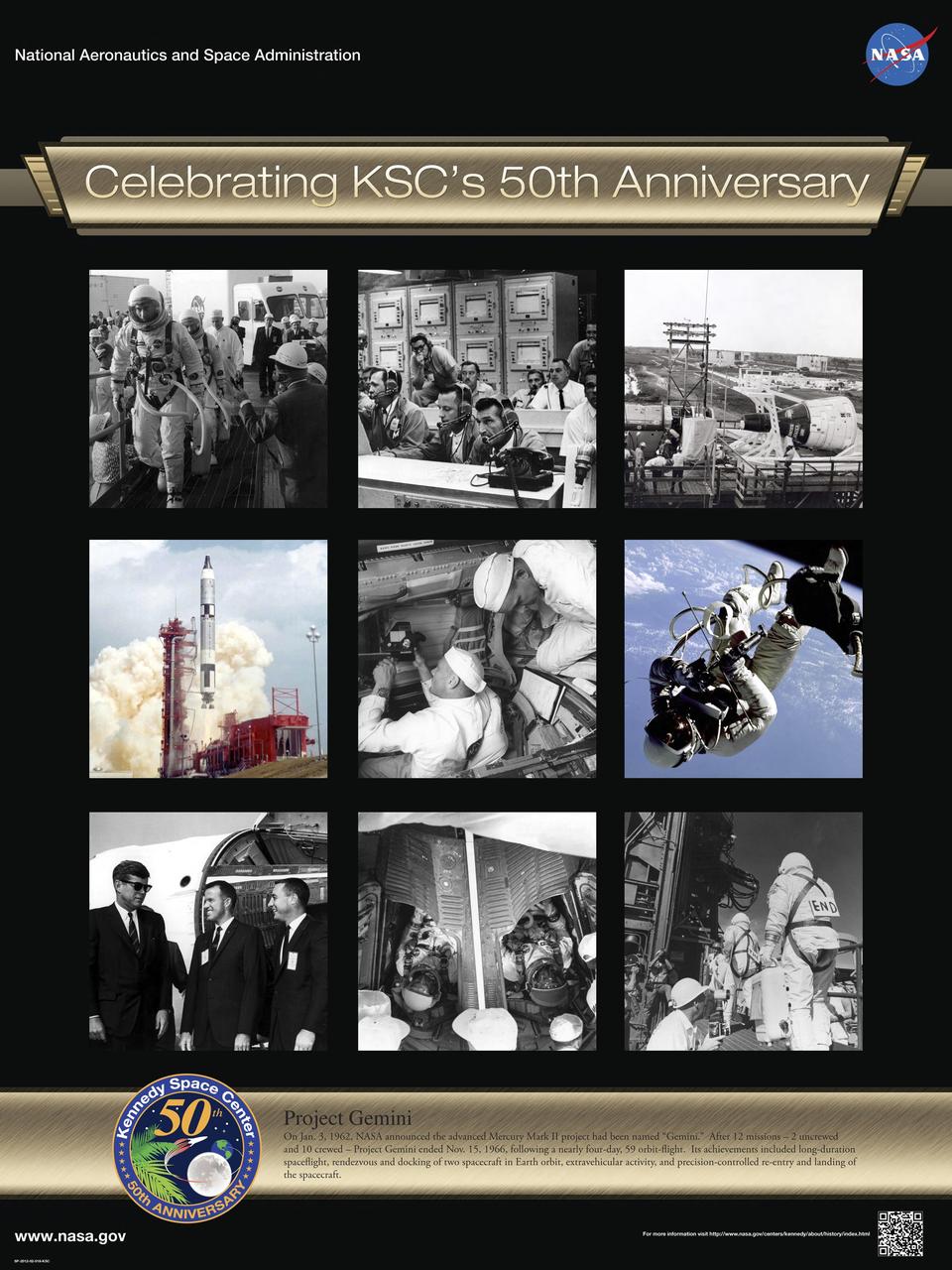
Project Gemini: On Jan. 3, 1962, NASA announced the advanced Mercury Mark II project had been named "Gemini." After 12 missions – 2 uncrewed and 10 crewed – Project Gemini ended Nov. 15, 1966, following a nearly four-day, 59 orbit-flight. Its achievements included long-duration spaceflight, rendezvous and docking of two spacecraft in Earth orbit, extravehicular activity, and precision-controlled re-entry and landing of the spacecraft. Poster designed by Kennedy Space Center Graphics Department/Greg Lee. Credit: NASA

The official patch of the International Space Station's Expedition 70 crew. The Expedition 70 patch is designed around the central yin-yang symbol representing balance; first and foremost, the balance of our beautiful planet Earth that is encircled by the yin-yang symbol and which forms part of the Expedition number. In our exploration of space, we are reminded of the uniqueness of Earth; the further we push the boundaries of human existence, the stronger our longing for our home planet grows. As our understanding of the cosmos expands, so does our understanding of Earth, and although we live in an ever-changing world, we recognize the need for a planet in balance to ensure our future. Space exploration is also about creating the future of our dreams. The tentative first steps we take today will hopefully become a well-trodden path in the future. This is represented stylistically by the “retro-futuristic” design of the patch, which mimics the design of the posters depicting the future from the early days of the space age. It is also emphasized by the yellow, orange, and red colors suggesting a sunrise. Lastly, the dynamism in the depiction of the number 7 suggests not only the physical launch into space, but also humanity’s progress towards the future.
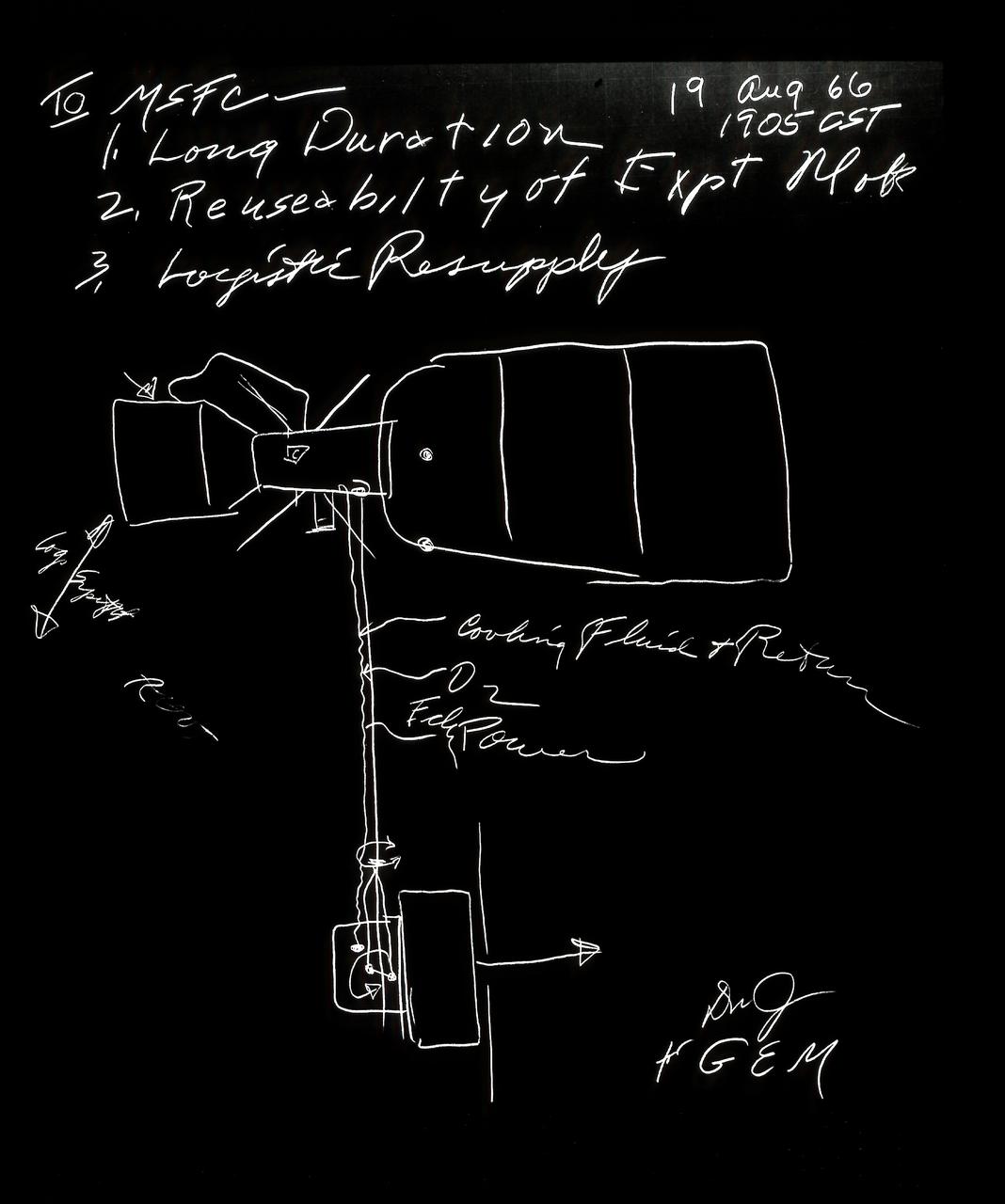
Seldom in aerospace history has a major decision been as promptly and concisely recorded as with the Skylab shown in this sketch. At a meeting at the Marshall Space Flight Center on August 19, 1966, George E. Mueller, NASA Associate Administrator for Marned Space Flight, used a felt pen and poster paper to pin down the final conceptual layout for the budding space station's (established as the Skylab in 1970) major elements. General Davy Jones, first program director, added his initials and those of Dr. Mueller in the lower right corner. The goals of the Skylab were to enrich our scientific knowledge of the Earth, the Sun, the stars, and cosmic space; to study the effects of weightlessness on living organisms, including man; to study the effects of the processing and manufacturing of materials utilizing the absence of gravity; and to conduct Earth resource observations. The Skylab also conducted 19 selected experiments submitted by high school students. Skylab's 3 different 3-man crews spent up to 84 days in Earth orbit. The Marshall Space Flight Center (MSFC) had responsibility for developing and integrating most of the major components of the Skylab: the Orbital Workshop (OWS), Airlock Module (AM), Multiple Docking Adapter (MDA), Apollo Telescope Mount (ATM), Payload Shroud (PS), and most of the experiments. MSFC was also responsible for providing the Saturn IB launch vehicles for three Apollo spacecraft and crews and a Saturn V launch vehicle for the Skylab.