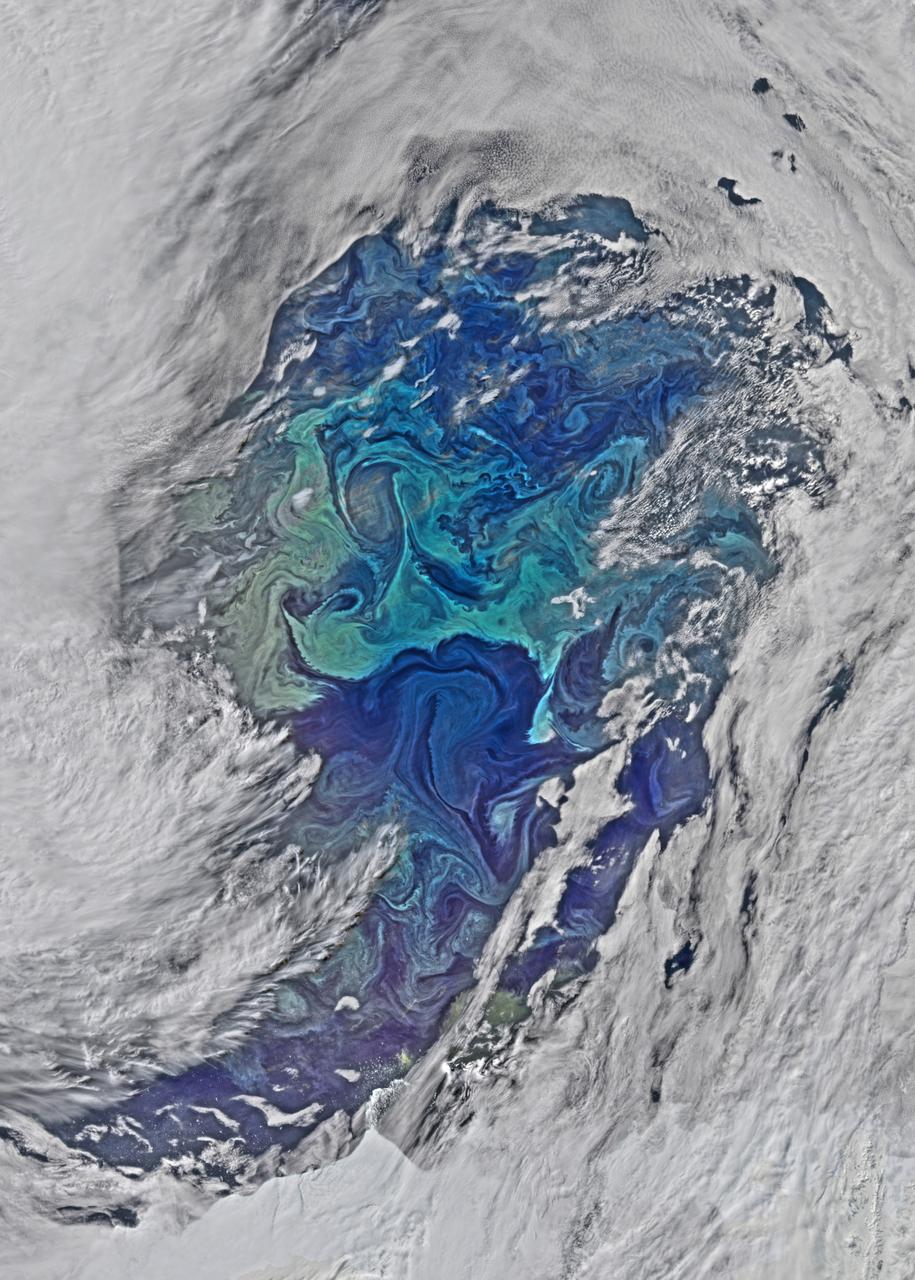
The cloud cover over the Southern Ocean occasionally parts as it did on January 1, 2015 just west of the Drake Passage where the VIIRS instrument on the Suomi NPP satellite glimpsed the above collection of ocean-color delineated eddies which have diameters ranging from a couple of kilometers to a couple of hundred kilometers. Recent studies indicate that eddy activity has been increasing in the Southern Ocean with possible implications for climate change. Credit: NASA's OceanColor/Suomi NPP/VIIRS
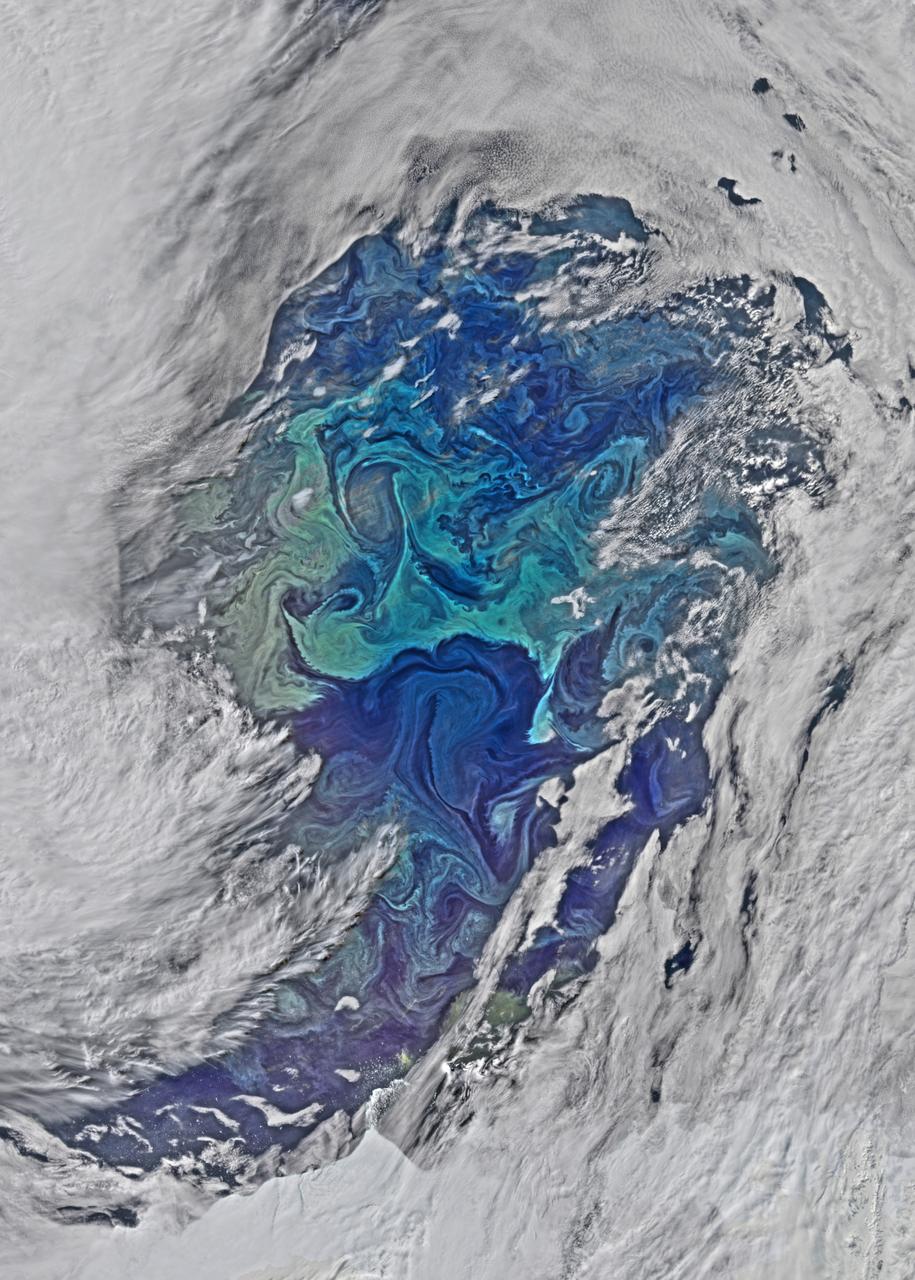
The cloud cover over the Southern Ocean occasionally parts as it did on January 1, 2015 just west of the Drake Passage where the VIIRS instrument on the Suomi NPP satellite glimpsed the above collection of ocean-color delineated eddies which have diameters ranging from a couple of kilometers to a couple of hundred kilometers. Recent studies indicate that eddy activity has been increasing in the Southern Ocean with possible implications for climate change. Credit: NASA's OceanColor/Suomi NPP/VIIRS <b><a href="http://www.nasa.gov/audience/formedia/features/MP_Photo_Guidelines.html" rel="nofollow">NASA image use policy.</a></b> <b><a href="http://www.nasa.gov/centers/goddard/home/index.html" rel="nofollow">NASA Goddard Space Flight Center</a></b> enables NASA’s mission through four scientific endeavors: Earth Science, Heliophysics, Solar System Exploration, and Astrophysics. Goddard plays a leading role in NASA’s accomplishments by contributing compelling scientific knowledge to advance the Agency’s mission. <b>Follow us on <a href="http://twitter.com/NASAGoddardPix" rel="nofollow">Twitter</a></b> <b>Like us on <a href="http://www.facebook.com/pages/Greenbelt-MD/NASA-Goddard/395013845897?ref=tsd" rel="nofollow">Facebook</a></b> <b>Find us on <a href="http://instagrid.me/nasagoddard/?vm=grid" rel="nofollow">Instagram</a></b>
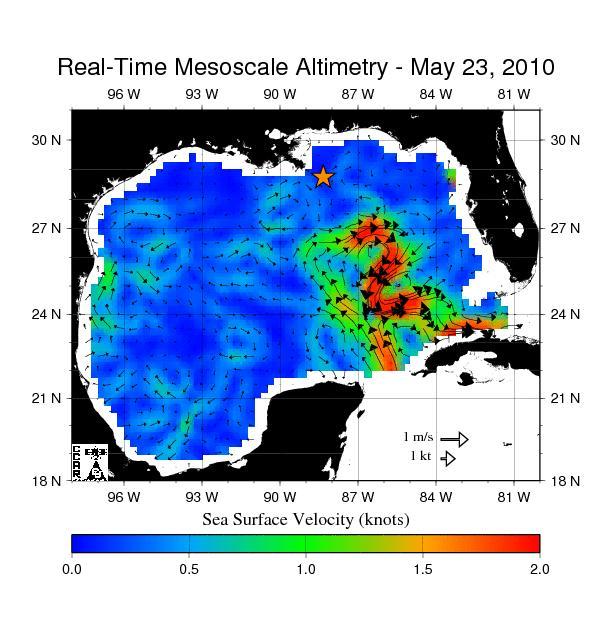
The northern portion of the Gulf of Mexico Loop Current, shown in red, appears about to detach a large ring of current, creating a separate eddy. An eddy is a large, warm, clockwise-spinning vortex of water -- the ocean version of a cyclone.
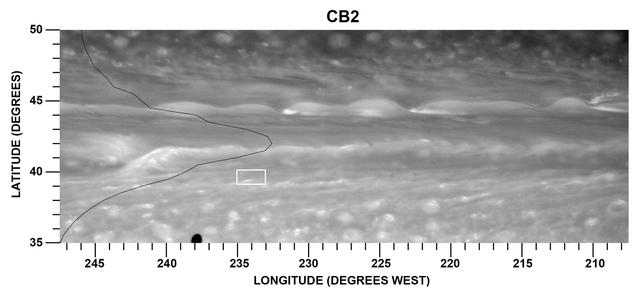
This figure examines a particularly strong jet stream and the eddies that drive it through the atmosphere of Saturn northern hemisphere. Data from NASA Cassini spacecraft were used to create this figure.
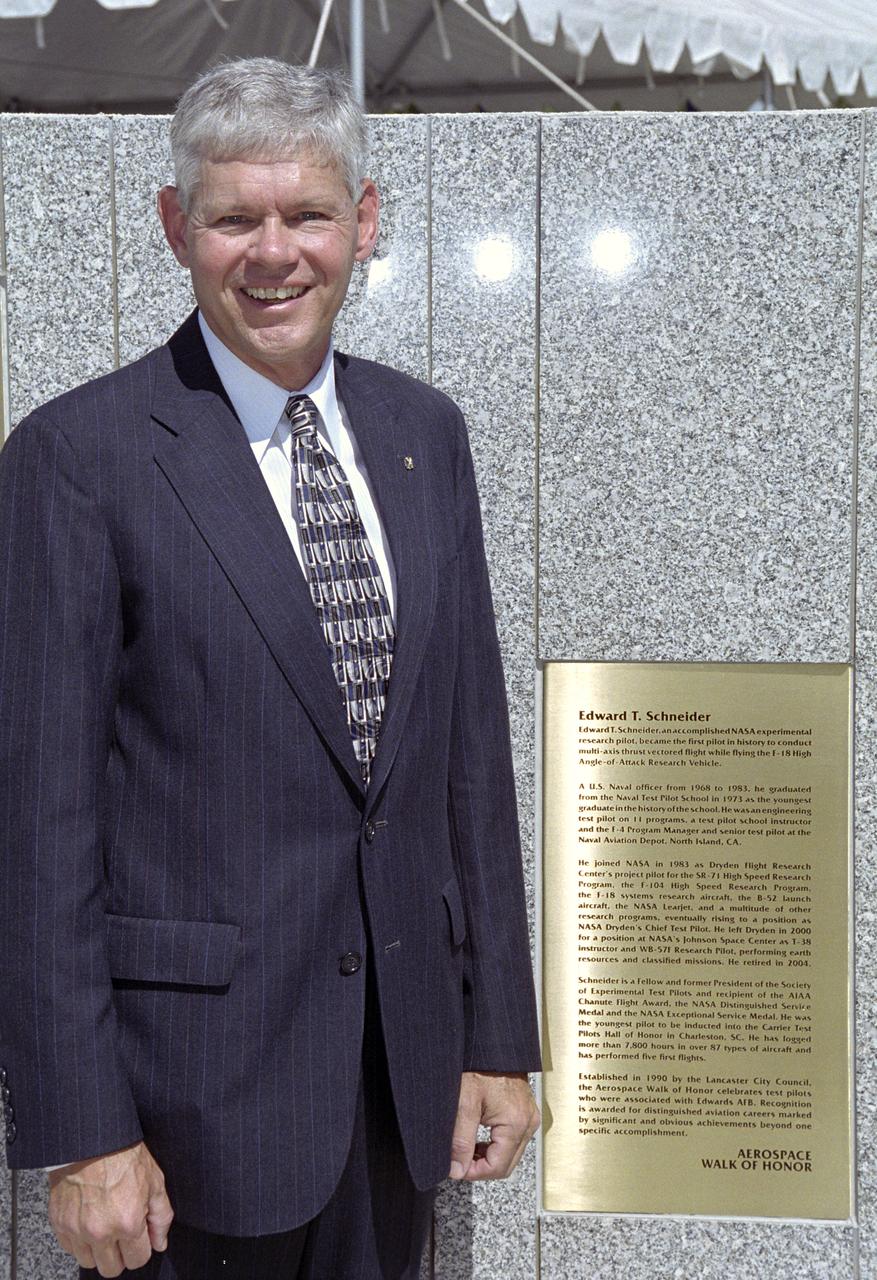
Former NASA research pilot Eddie Schneider was on hand when a brass plaque summarizing his career was unveiled during the 2005 Aerospace Walk of Honor ceremonies in Lancaster, California.
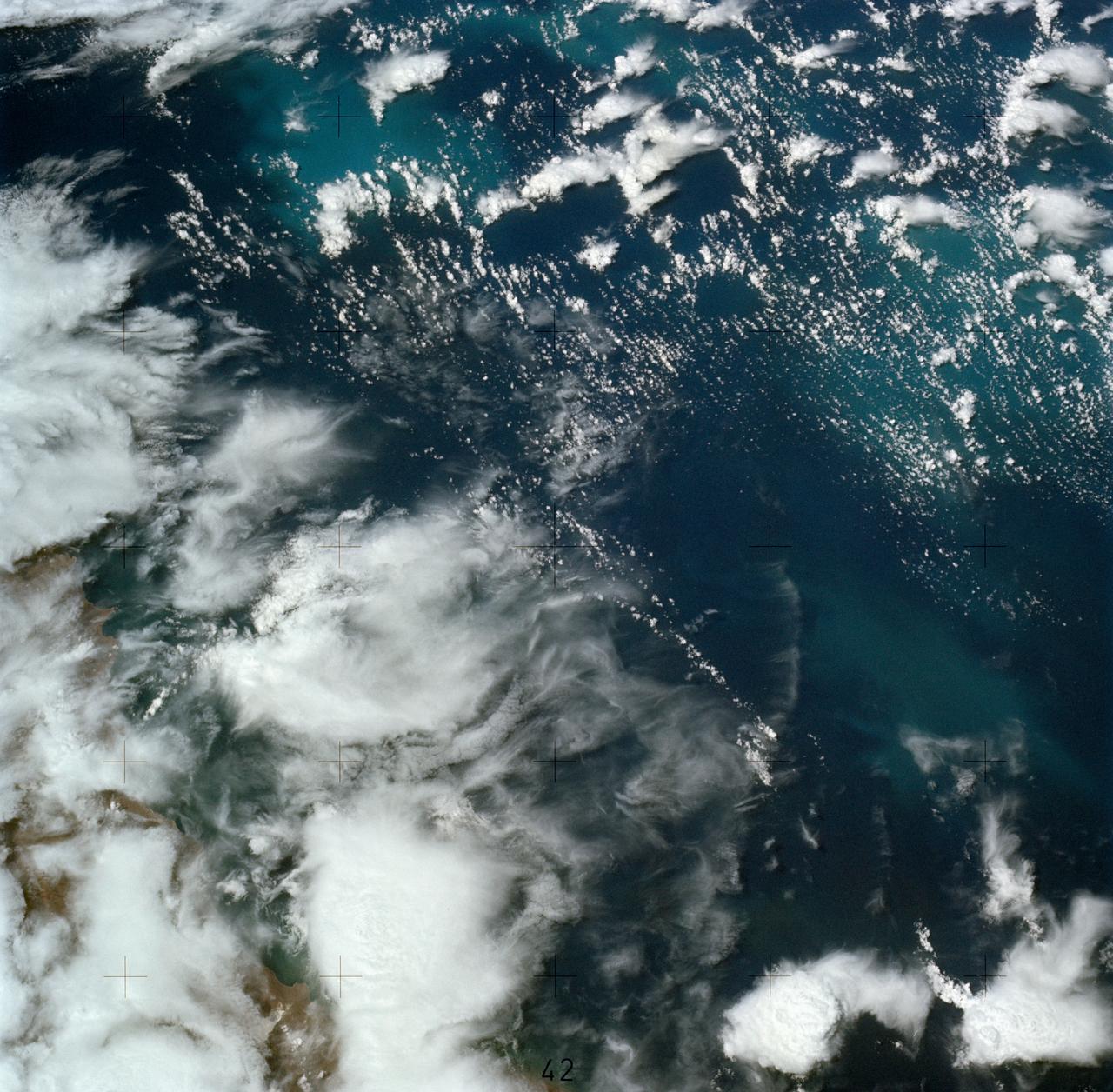
SL4-137-3608 (14 Dec. 1973) --- A view of cold water eddies in the Falkland Current off the South Atlantic coast of southern Argentina as seen from the Skylab space station in Earth orbit. This picture was taken by one of the Skylab 4 crewmen using a hand-held 70mm Hasselblad camera. This land area (left corner) extends south along the coast from Puerto Deseado (center left border) for about 50 miles. Within the ocean, several light blue areas are visible and represent the occurrence of plankton with the Falkland Current. Over the ocean, the cold water eddies are identified by the circular cloud-free areas within the cloud street pattern and bordered by cumulus cloud buildup (white). The cloud streets indicate the wind is from the southwest and do not form over eddies because energy form the atmosphere is absorbed by the cold ocean water. On the downwind side of the eddies, cumulus clouds tend to form as the cold moist air flows over the warmer water. Similar cloud and eddy features have been observed by the Skylab 4 crewmen in the Yucatan Current off Yucatan Peninsula and in some parts of the South Pacific. Studies are underway by Dr. George Maul, NOAA, and Dr. Robert Stevenson, ONR, to determine the significance of the cold water eddies to ocean dynamics. Photo credit: NASA
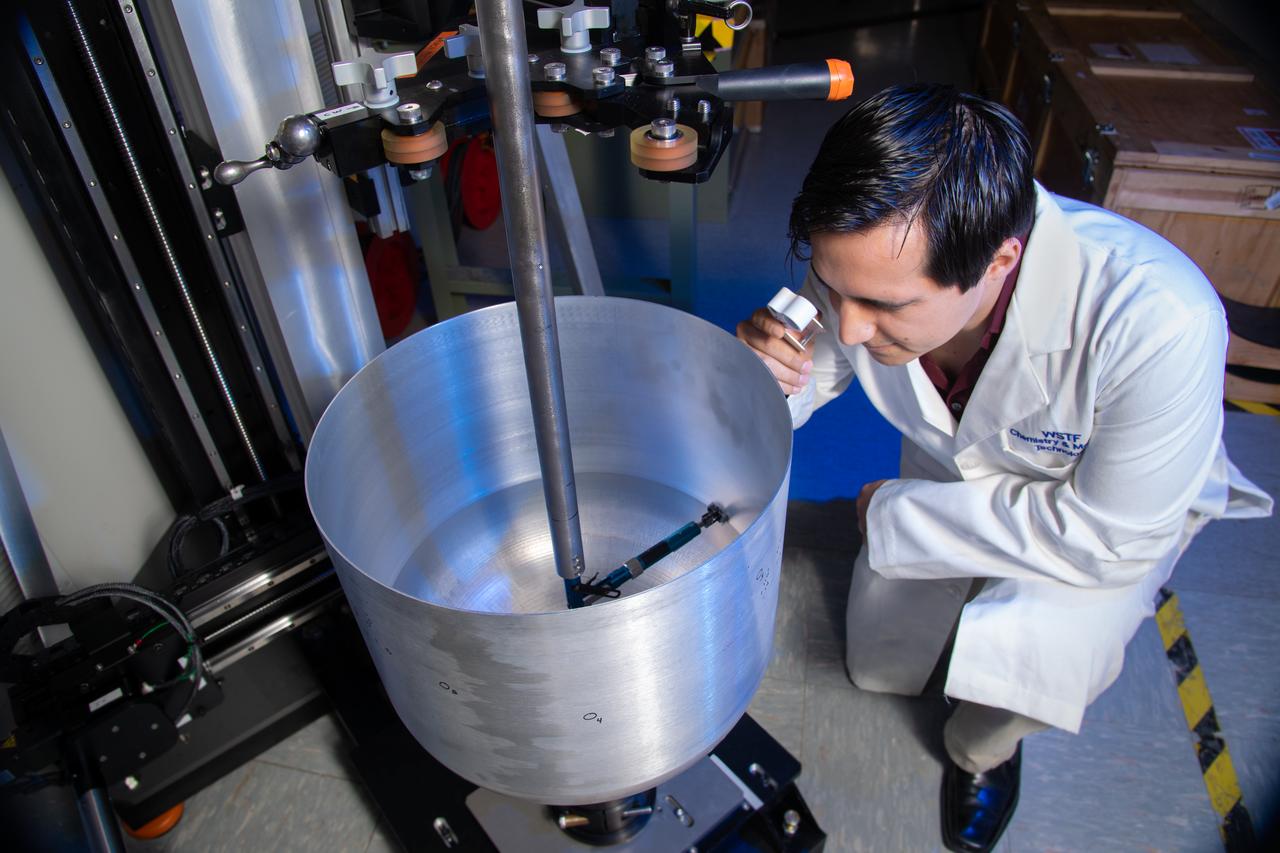
Edgar Reyes, a materials engineer and recent graduate of The University of Texas at El Paso, visually inspects a crack identified on the outer surface of a composite overwrapped pressure vessel (COPV) following an internal eddy-current through-wall nondestructive inspection conducted at the NASA White Sands Test Facility in Las Cruces, N.M. Eddy-current testing is one of many electromagnetic testing methods used in nondestructive testing to identify cracks in COPVS that can potentially threaten spacecraft crew and mission success. Photo Credit: (NASA/Reed P. Elliott)

U.S. Rep. Eddie Bernice Johnson, D-Texas, questions NASA Administrator Charles Bolden during a House Committee on Science, Space, and Technology budget hearing, Wednesday, March 2, 2011 in the Rayburn House Office Building on Capitol Hill in Washington. Photo Credit: (NASA/Bill Ingalls)

U.S. Congresswoman Eddie Bernice Johnson (D-TX) addresses the Symposium on Supporting Underrepresented Minority Males in Science, Technology, Engineering and Mathematics (STEM), Tuesday, February 28, 2012 at NASA Headquarters in Washington. Photo Credit: (NASA/Carla Cioffi)

U.S. Congresswoman Eddie Bernice Johnson (D-TX) addresses the Symposium on Supporting Underrepresented Minority Males in Science, Technology, Engineering and Mathematics (STEM), Tuesday, February 28, 2012 at NASA Headquarters in Washington. Photo Credit: (NASA/Carla Cioffi)

Rep. Eddie Bernice Johnson, D-Texas, ranking member of the House Committee on Science, Space, and Technology delivers her opening statement during a hearing titled "America's Human Presence in Low-Earth Orbit" on Thursday, May 17, 2018 in the Rayburn House Office Building in Washington. Photo Credit: (NASA/Joel Kowsky)

Rep. Eddie Bernice Johnson, D-TX, asks a question of NASA Administrator Charles Bolden during a House Science, Space and Technology Committee hearing on Wednesday, March 7, 2012 in Washington. Photo Credit: (NASA/Bill Ingalls)

U.S. Congresswoman Eddie Bernice Johnson (D-TX) listens to testimony during a hearing before the House Committee on Science, Space, and Technology regarding access to and sustainability of the International Space Station, Wednesday, March 28, 2012 at the Rayburn House Office Building in Washington. Photo Credit: (NASA/Carla Cioffi)
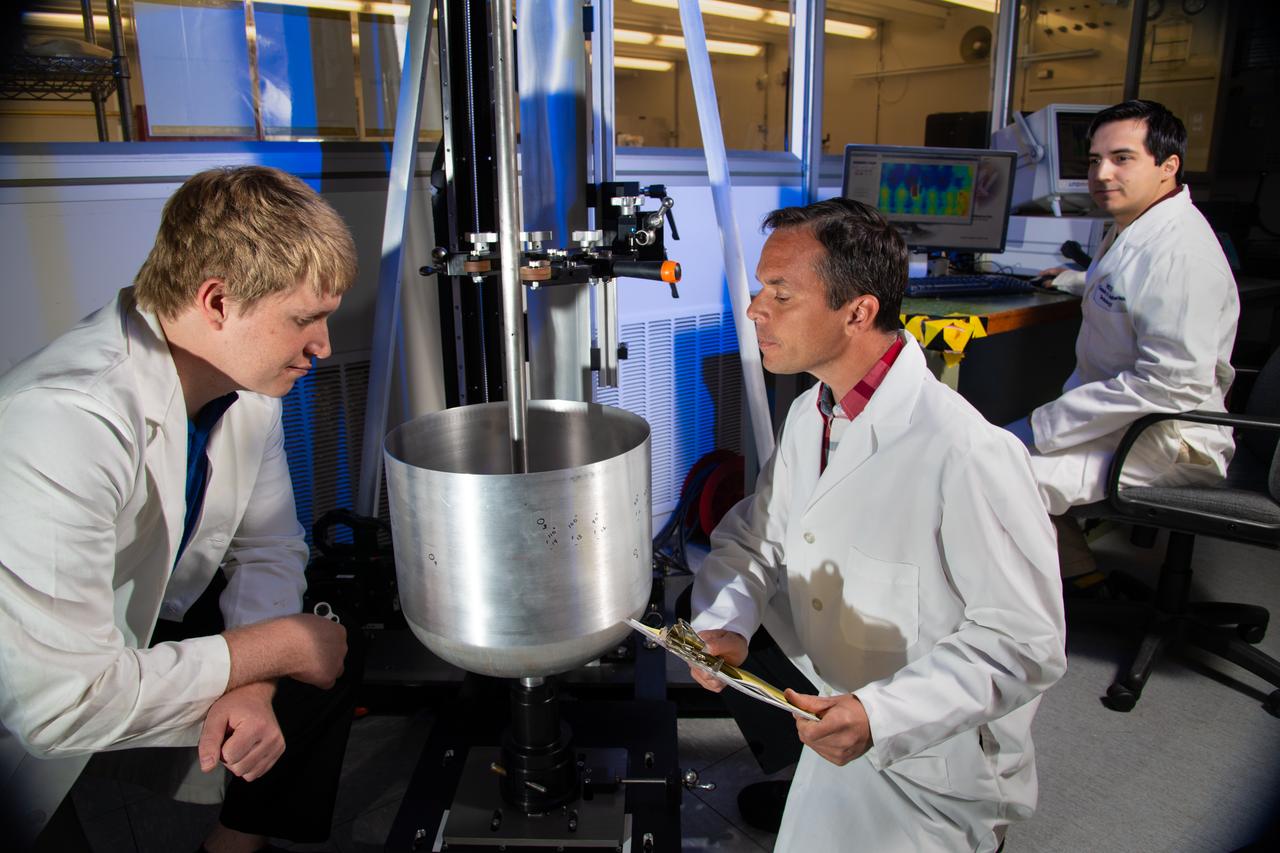
Engineers (from left) Ayrton Jordan, Anthony Milana and Edgar Reyes from the NASA White Sands Test Facility (WSTF) in Las Cruces, N.M. qualify an interior surface pressure vessel crack inspection using the eddy current nondestructive testing technique to find flaws smaller than more common and less capable penetrant testing methods. Detecting cracks smaller than the eye can detect is an important feature as manufacturers push performance limits to achieve lighter, more efficient spacecraft. Photo Credit: (NASA/Reed P. Elliott)
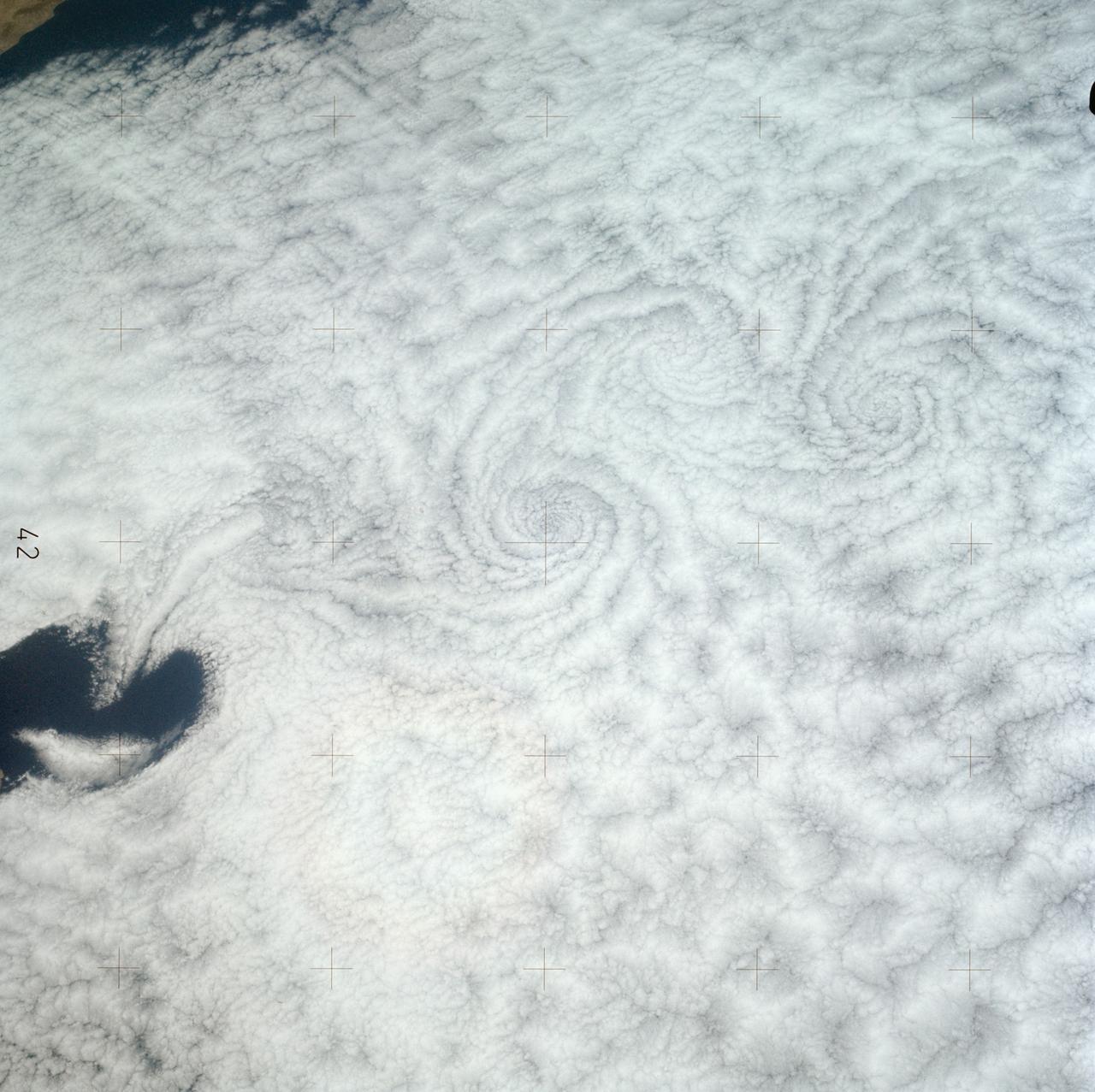
SL3-121-2371 (July-September 1973) --- A pattern of downstream eddies in the stratocumulus clouds over the Pacific Ocean west of Baja California, as photographed by the crewmen of the second Skylab manned mission (Skylab 3) from the space station cluster in Earth orbit. The clouds, produced by the cold California current running to the south and southwest, are prevented from rising by warm air above them. Photo credit: NASA

Rep. Eddie Bernice Johnson, D-Texas, chair of the House Science, Space and Technology Committee asks NASA Administrator Bill Nelson a question during a hearing on the fiscal year 2022 budget proposal, Wednesday, June 23, 2021 at the Rayburn House Office Building in Washington. Photo Credit: (NASA/Bill Ingalls)

Chairwoman Eddie Bernice Johnson, D-Texas, of the House Committee on Science, Space, and Technology, presides over a hearing to review the Fiscal Year 2020 budget request for the National Aeronautics and Space Administration, where NASA Administrator Jim Bridenstine testified, Tuesday, April 2, 2019 at the Rayburn House Office Building in Washington. Photo Credit: (NASA/Aubrey Gemignani)
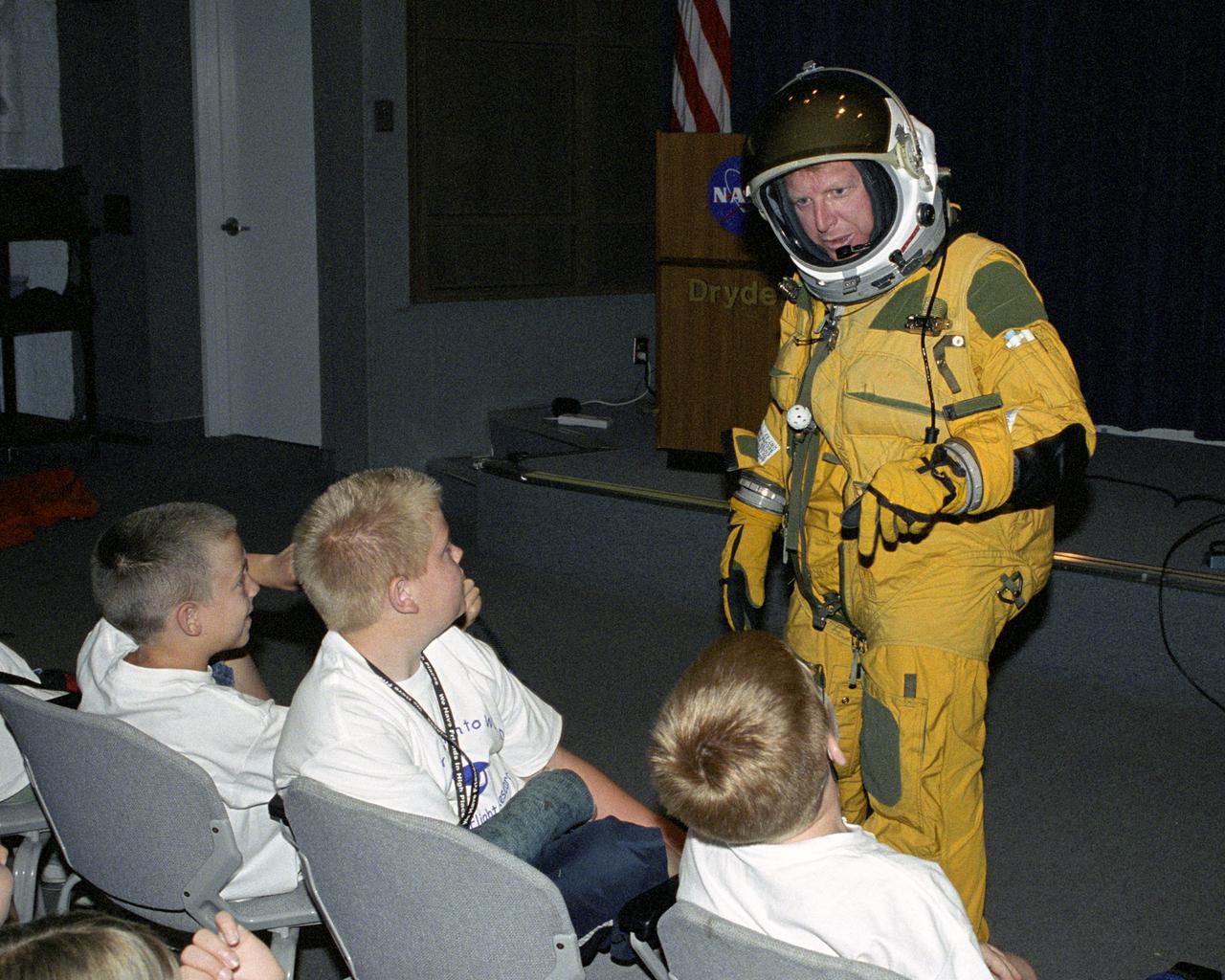
NASA Dryden historian Christian Gelzer explains functions of the high-altitude pressure suit he is wearing to (left to right) Brandon Blankenship and Garrett Clay of Lancaster and Eddie Patterson of Tehachapi during Take Your Children to Work Day activities at NASA Dryden Flight Research Center June 22.

U.S. Representative Eddie Johnson, D-Texas, asks a question during a Space and Aeronautics Subcommittee of the House Science, Space, and Technology Committee hearing titled, “A Review of NASA’s Plans for the International Space Station and Future Activities in Low Earth Orbit," Wednesday, July 10, 2019 at the Rayburn House Office Building in Washington. Photo Credit: (NASA/Aubrey Gemignani)
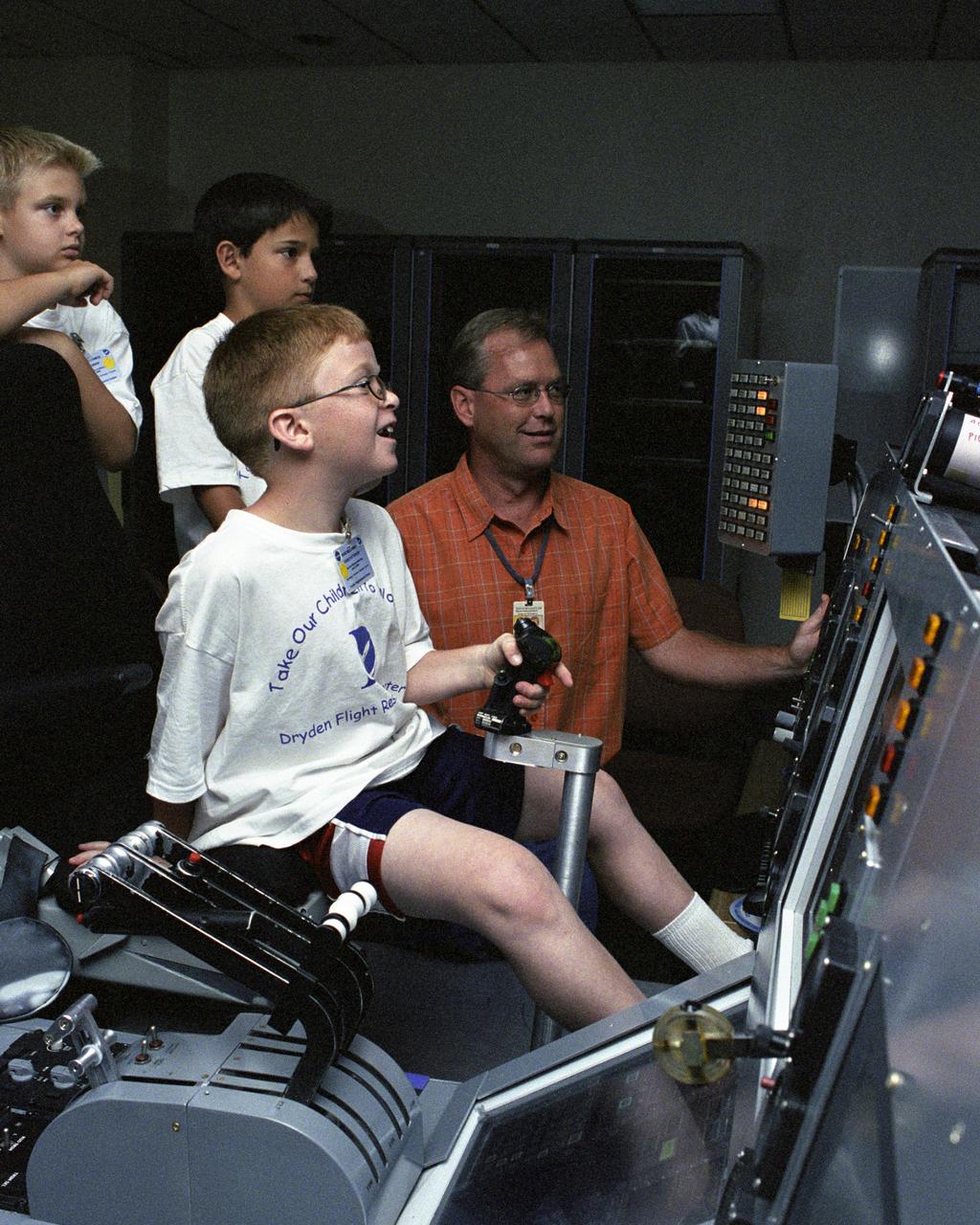
Eddie Patterson, a fourth-grade student at Tehachapi's Tompkins Elementary School, enjoyed "flying" a C-17 multi-engine aircraft simulator during Take Your Children to Work Day June 22 at NASA Dryden Flight Research Center while NASA Dryden engineer Ken Norlin and other students look on.

Rep. Eddie Bernice Johnson, D-Texas is seen on a monitor as she questions witnesses; NASA Administrator Jim Bridenstine, left, and Tom Young, chairman, JWST Independent Review Board, during a House Committee on Science, Space, and Technology hearing on the James Webb Space Telescope, Wednesday, July 25, 2018 at the Rayburn House Office Building in Washington. Photo Credit: (NASA/Bill Ingalls)

STS054-72-056 (13-19 Jan 1993) --- A ship wake in the Bay of Bengal is noticeable in this 70mm frame. The sun glint pattern on the ocean reveals many patterns of sea surface roughness related to currents, waves, wind roughening, and biology that and are not apparent when the ocean is viewed away from the Sun's reflection. In this view of the Bay of Bengal, southeast of Madras, India, sun glint highlights convergence zones between ocean currents (bright, linear features), a eddy, and the wake of a ship. In several locations where the ship has passed areas of current shear, the ship wake is distorted, indicating the relative current direction.
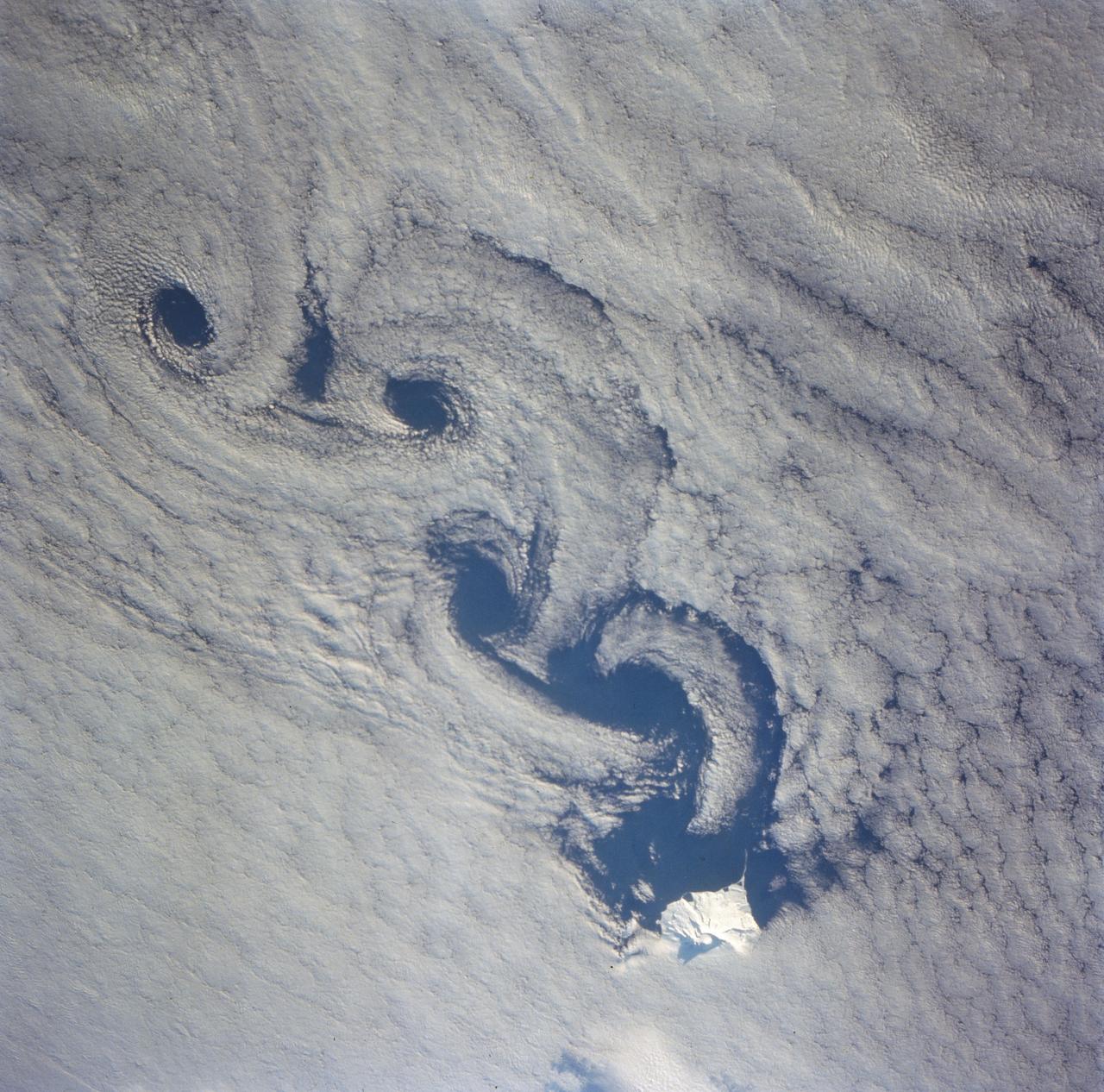
As the air blows over the tops of the mountain peaks, seen here in the clear region, the direction of the air flow is disturbed. These disturbances in the flow pattern are generally small circular eddies with one circulating in a clockwise direction and the next in the reverse direction. The wind here has caused the shallow cloud cover to change accordingly. These eddies are commonly called von Karmen Vortices.
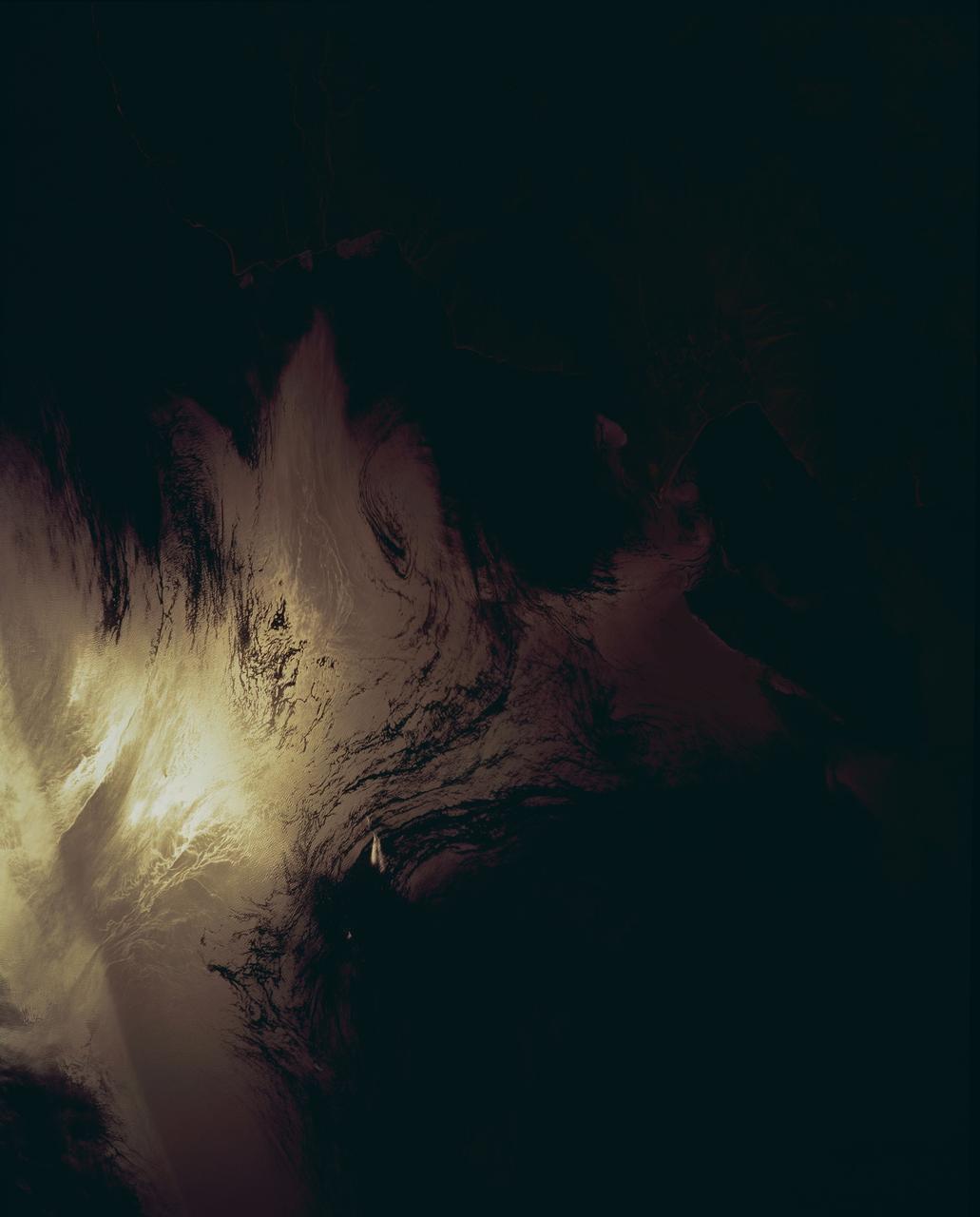
STS062-153-226 (4-18 March 1994) --- Though it did not reproduce well, this photo gives scientific information to aid in studying all types of earth's processes. It documents ocean features in the sunglint in the Gulf of California, off the Isla Cerralvo, souther Baja, California. Biological oils collect on the surface and shows current patterns, eddies and ship wakes. The small bright spot on the edge of the eddy is a ship dumping oily water from its bilges. The line in the brighter area is a light wind gust roughening the surface.
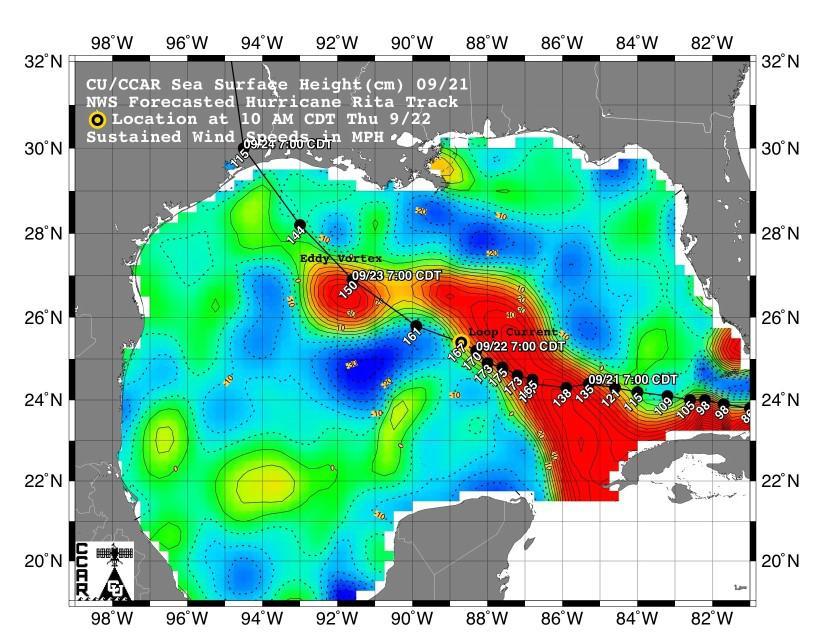
This sea surface height map of the Gulf of Mexico, with the Florida peninsula on the right and the Texas-Mexico Gulf Coast on the left, is based on altimeter data from four satellites including NASA’s Topex/Poseidon and Jason. Red indicates a strong circulation of much warmer waters, which can feed energy to a hurricane. This area stands 35 to 60 centimeters (about 13 to 23 inches) higher than the surrounding waters of the Gulf. The actual track of a hurricane is primarily dependent upon steering winds, which are forecasted through the use of atmospheric models. However, the interaction of the hurricane with the upper ocean is the primary source of energy for the storm. Hurricane intensity is therefore greatly affected by the upper ocean temperature structure and can exhibit explosive growth over warm ocean currents and eddies. Eddies are currents of water that run contrary to the direction of the main current. According to the forecasted track through the Gulf of Mexico, Hurricane Rita will continue crossing the warm waters of a Gulf of Mexico circulation feature called the Loop Current and then pass near a warm-water eddy called the Eddy Vortex, located in the north central Gulf, south of Louisiana. http://photojournal.jpl.nasa.gov/catalog/PIA06427
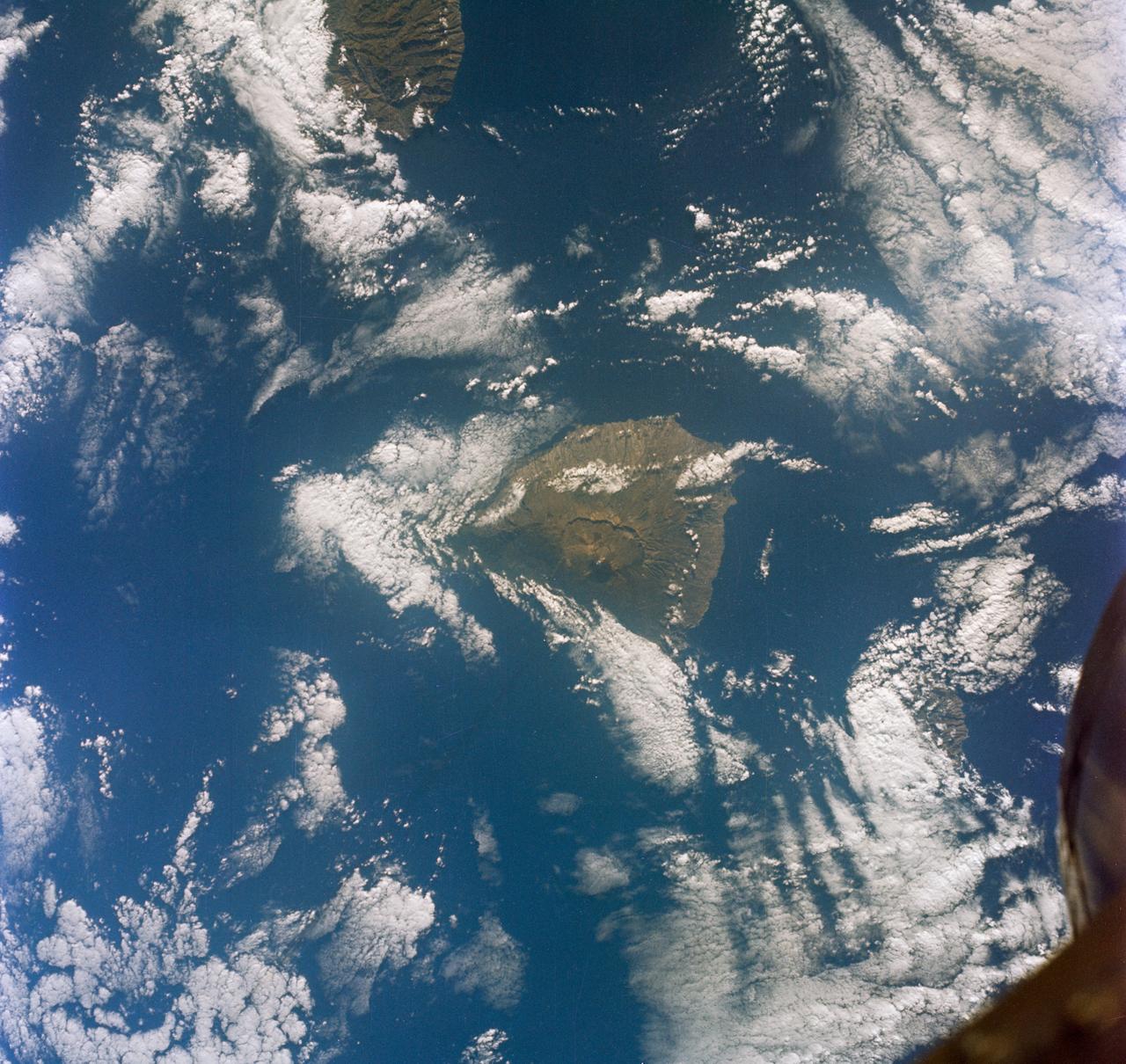
S65-63150 (16 Dec. 1965) --- Eddies in stratocumulus clouds over the Canary Islands as seen from the Gemini-6 spacecraft during its 14th revolution of Earth. Photo credit: NASA or National Aeronautics and Space Administration
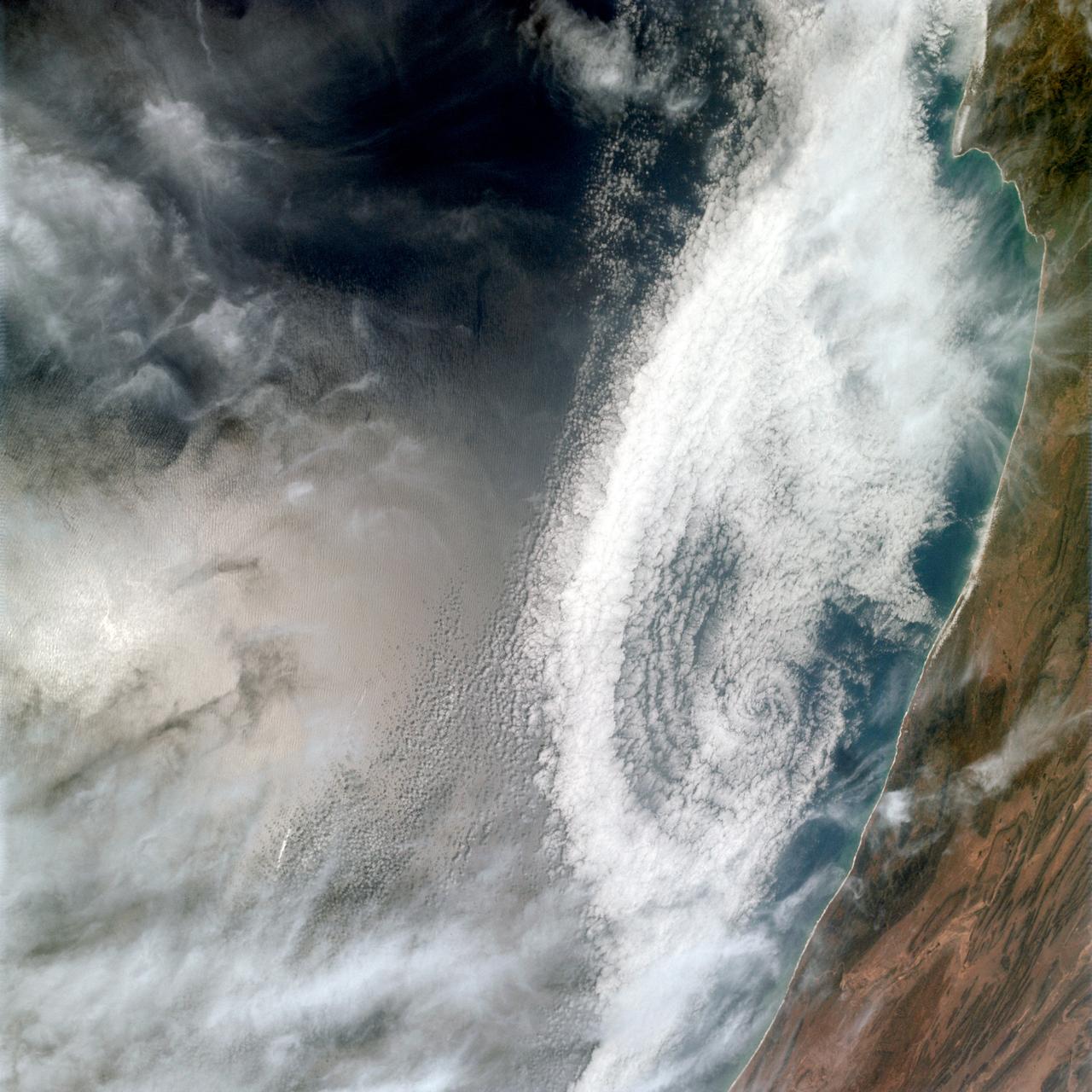
AS09-23-3617 (12 March 1969) --- Morocco, Ifni, cloud eddy over Ras Rhir, as photographed from the Apollo 9 spacecraft during its 134th revolution of Earth.

This morphing animation compares the eddies in Earth's oceans to the turbulent clouds in Jupiter's atmosphere. In the movie, a zoom occurs around a vortex dipole: a typical structure consisting of a cyclone and an anticyclone that is present both in Earth's ocean and Jupiter's atmosphere. The ocean image showing the spring phytoplankton bloom in the southern Gulf of Bothnia was generated from data collected by the MODIS instrument about NASA's Aqua satellite. The Jupiter image is from JunoCam. Scientist Lia Siegelman observed the similarities between the richness of turbulence around Joviancyclones and the filaments around smaller eddies seen in Earth's oceans. These similarities were especially evident in high-resolution satellite images of plankton blooms. Movie available at https://photojournal.jpl.nasa.gov/catalog/PIA25069
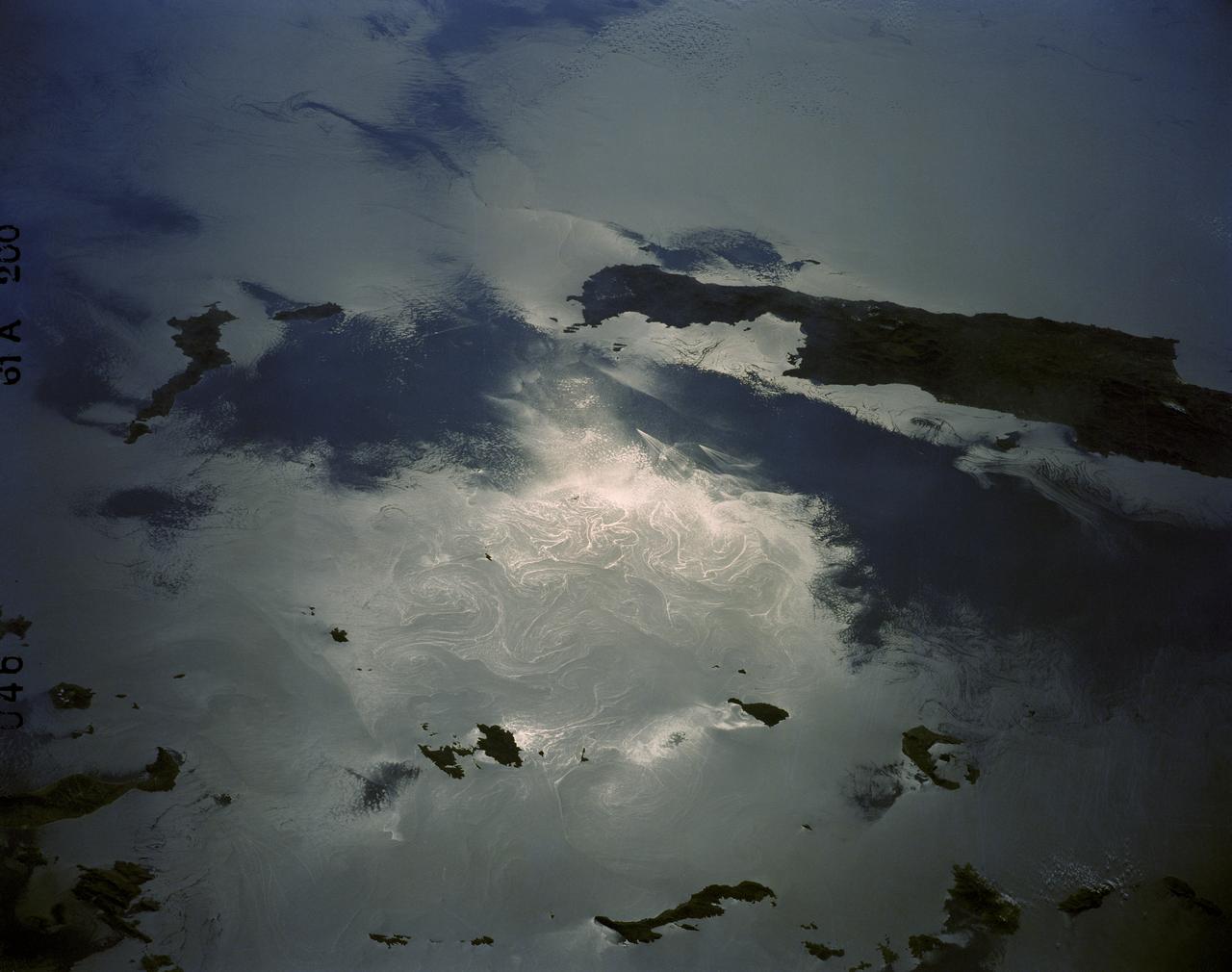
61A-200-046 (30 Oct--6 Nov 1985) --- A low-sun angle view of the eastern Mediterranean Sea showing the east tip of the island of Crete and the Sporades Islands of the Agean Sea. Numberous sprial eddies and island wakes are also highlighted in the sunglint--a delight to oceanographers. pg.26-2
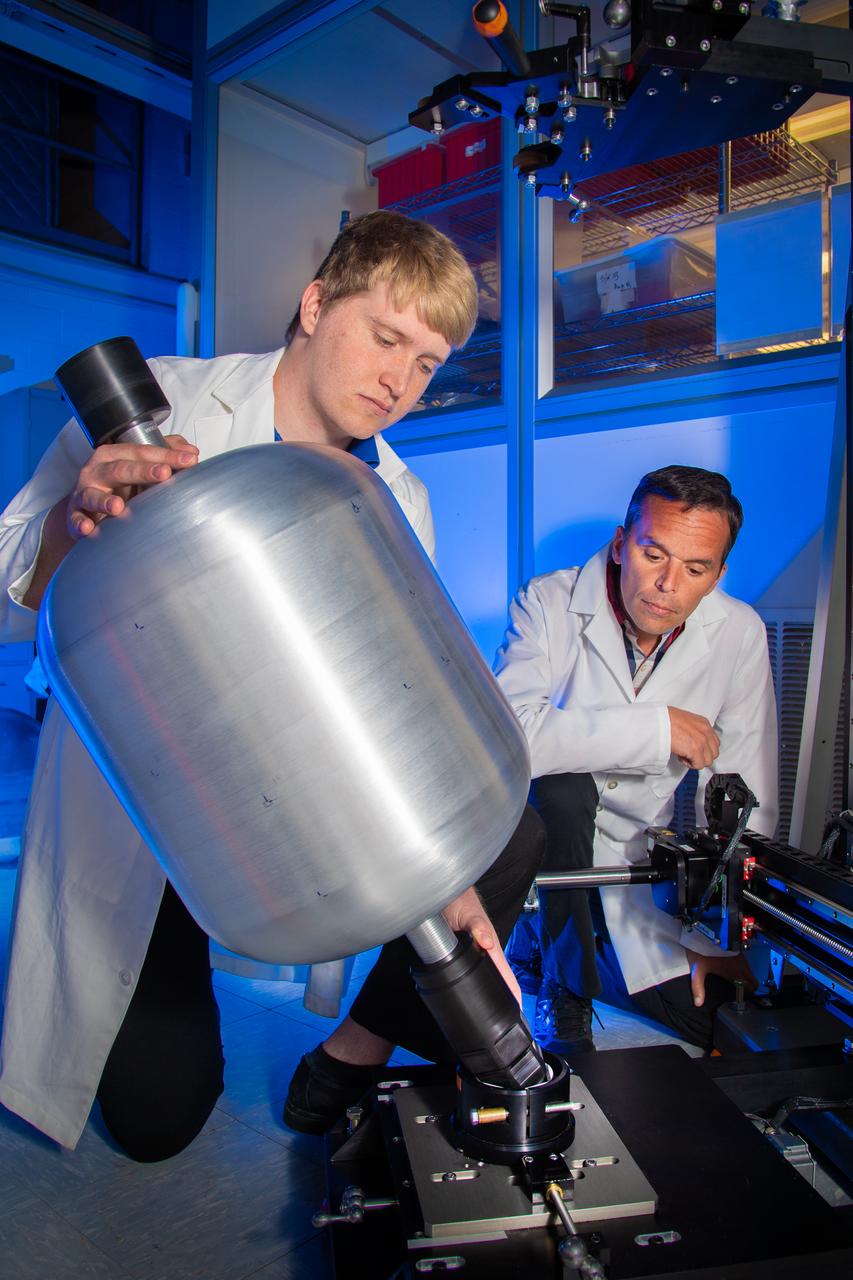
Engineers Ayrton Jordan (left) and Anthony Milana (right) at the NASA White Sands Test Facility (WSTF) in Las Cruces, N.M. install a metallic liner into the multipurpose pressure vessel scanner that could one day become part of a composite overwrapped pressure vessel. A slotted ball joint at the base of the rotary stage allows the tank to pivot resulting in helical scans that are more reliable when measuring interior and exterior 3D surface profiles. Photo Credit: (NASA/Reed P. Elliott)
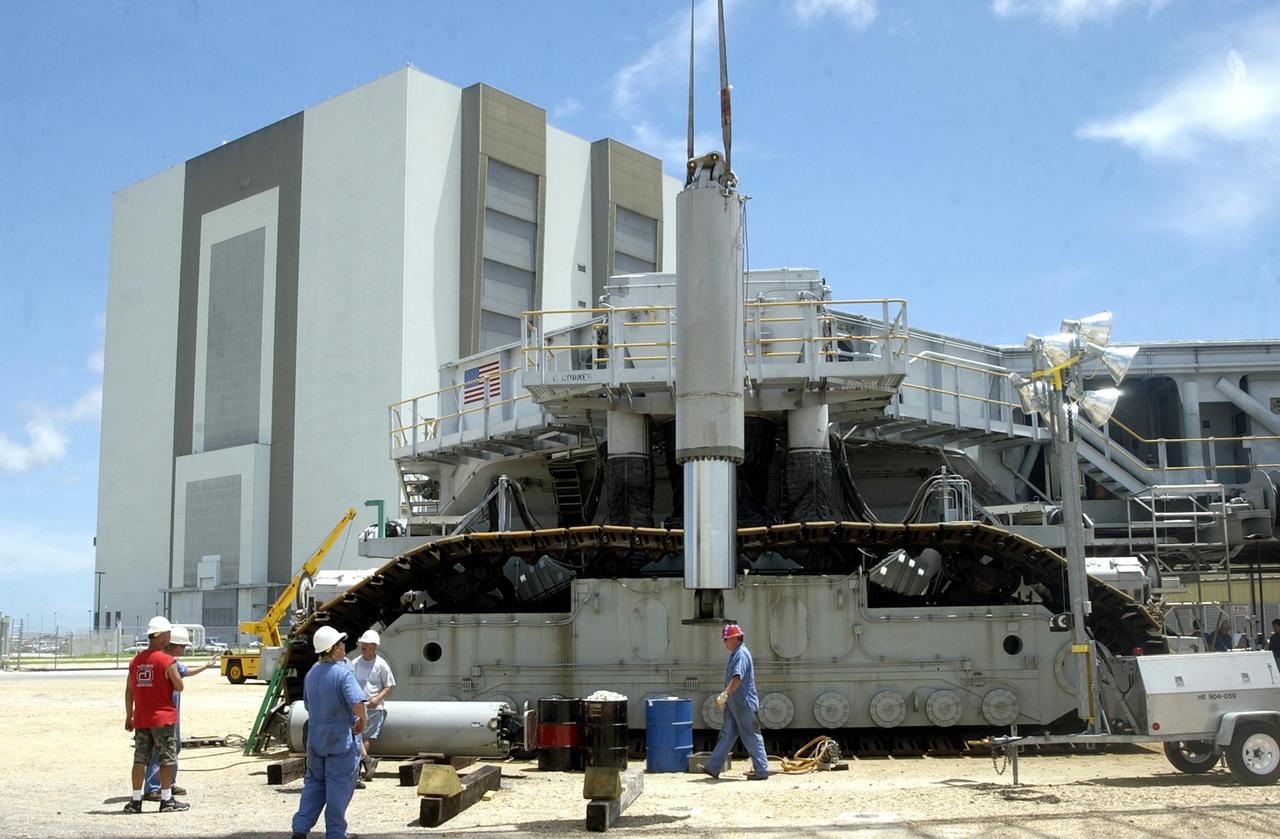
KENNEDY SPACE CENTER, FLA. -- A jacking, equalization and leveling (JEL) cylinder and bearing from Crawler-Transporter No. 2 is lowered by a crane to a position on the ground. During routine maintenance inspections last week, technicians removed two of the 16 JEL cylinders on the crawler to gain access to the bearings and found three of the four bearings cracked. Further eddy current inspections indicated that cracks are present on 15 of the bearings. There are 16 cylinders and 32 bearings per crawler.
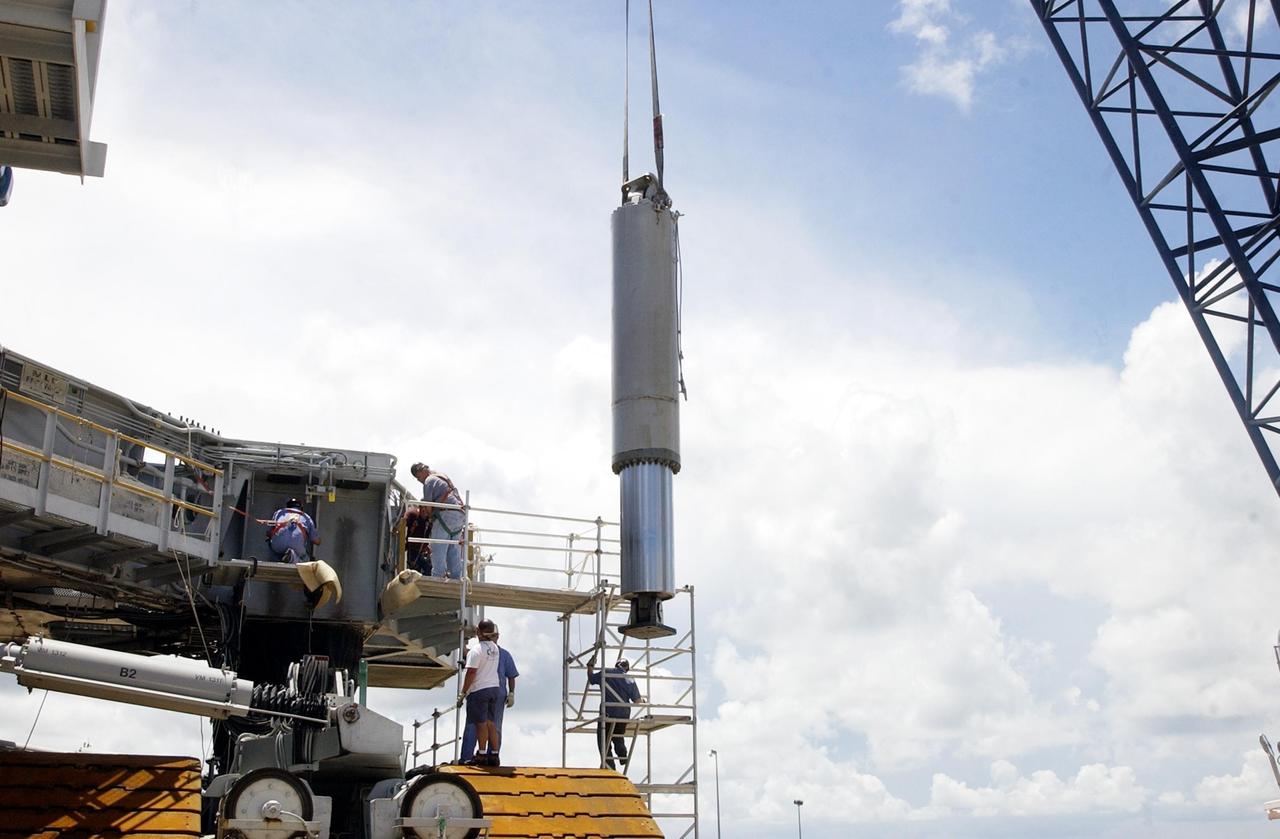
KENNEDY SPACE CENTER, FLA. -- A crane lifts a jacking, equalization and leveling (JEL) cylinder and bearing from Crawler-Transporter No. 2. During routine maintenance inspections last week, technicians removed two of the 16 JEL cylinders on the crawler to gain access to the bearings and found three of the four bearings cracked. Further eddy current inspections indicated that cracks are present on 15 of the bearings. There are 16 cylinders and 32 bearings per crawler. Engineers are evaluating the situation to determine the cause of the cracks and an appropriate solution to the problem.
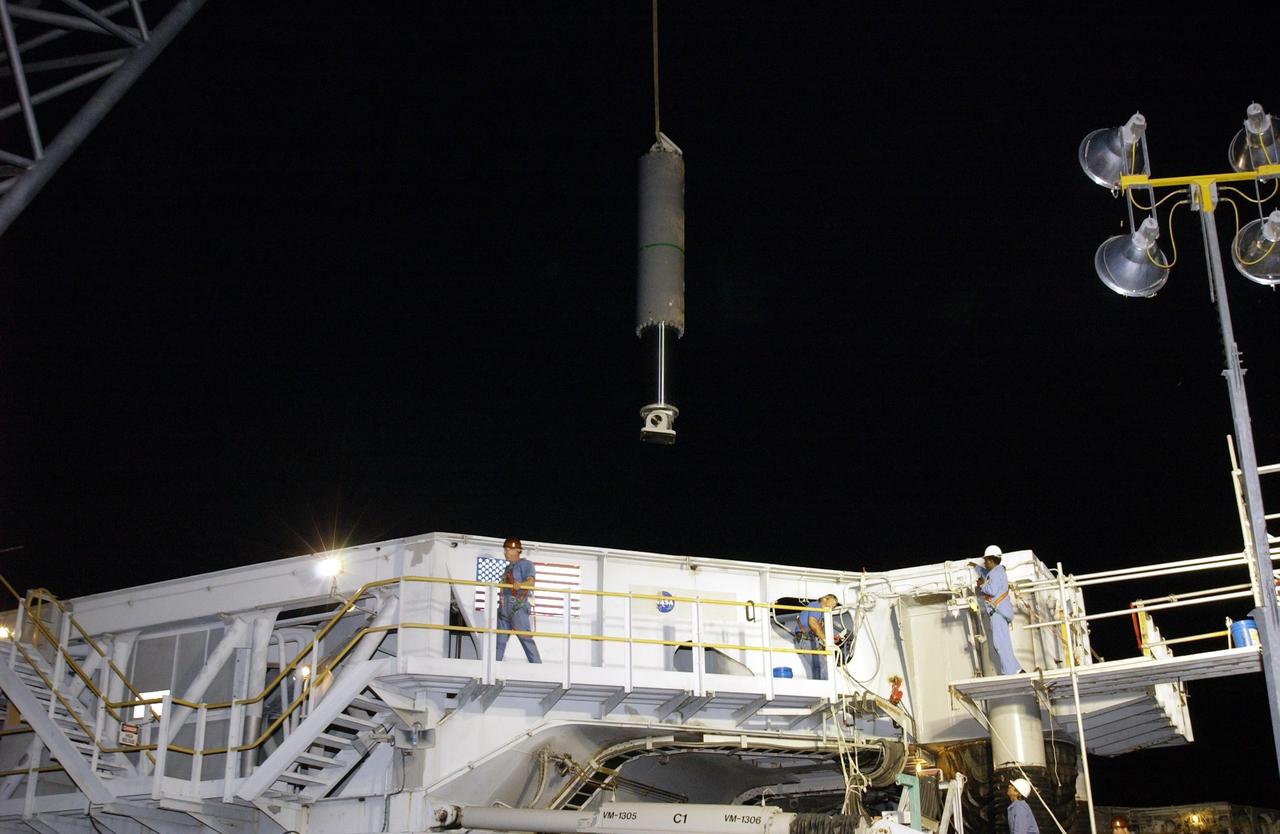
KENNEDY SPACE CENTER, FLA. -- The final Jacking, Equalization and Leveling (JEL) cylinder is moved to Crawler Transporter No. 2 (CT-2) for installation. During recent routine maintenance inspections, cracks were found on four bearings in two JEL cylinders. Further eddy current inspections indicated that cracks were present on 15 bearings. There are 16 cylinders and 32 bearings per crawler. CT-2 was repaired in order to enable Atlantis' rollout for mission STS-112, scheduled for launch no earlier than Oct. 2.
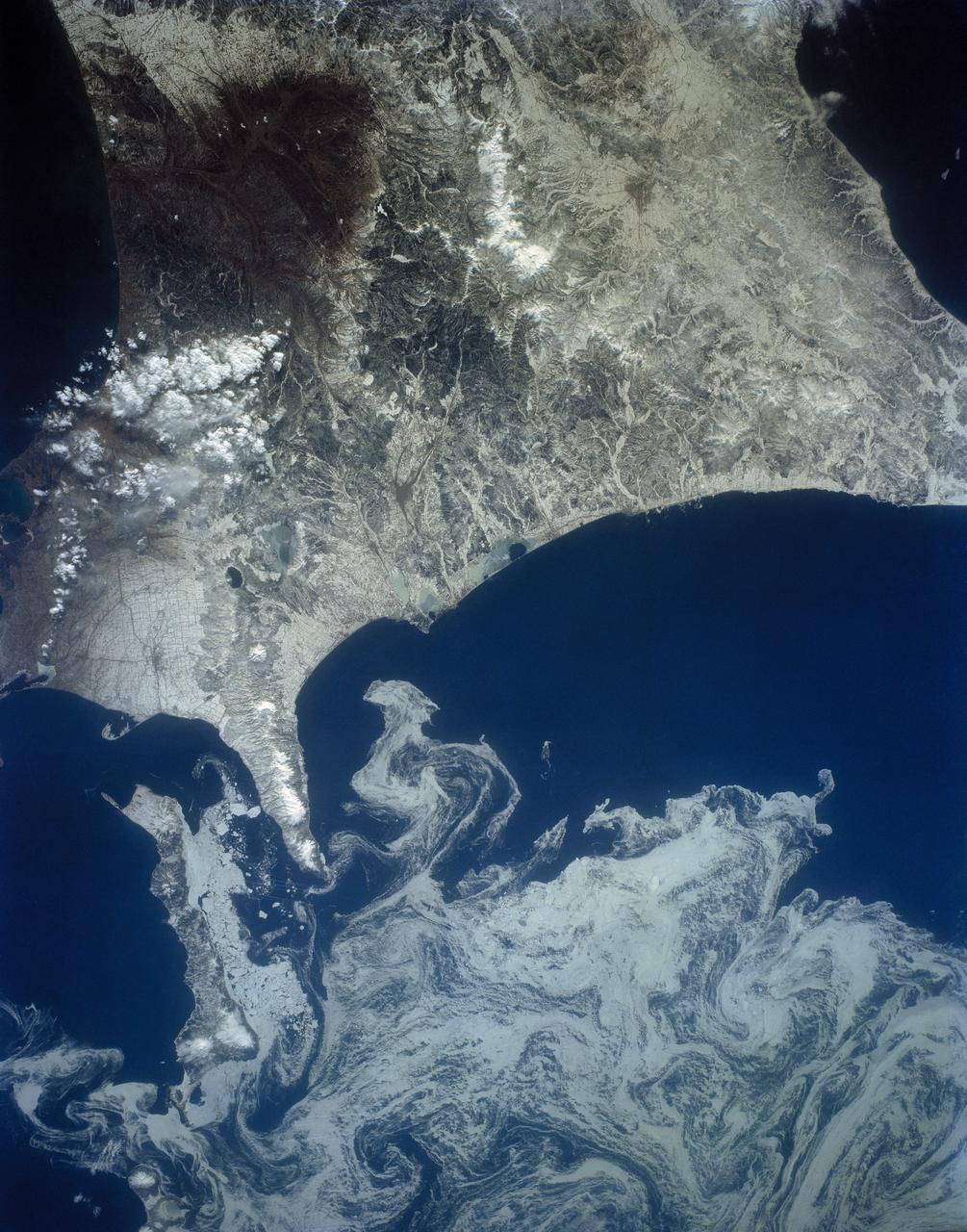
The northeast coast of Hokkaido and Kunashir Island, Japan (44.0N, 143.0E) are seen bordered by drifting sea ice. The sea ice has formed a complex pattern of eddies in response to surface water currents and winds. Photos of this kind aid researchers in describing local ocean current patterns and the effects of wind speed and direction on the drift of surface material, such as ice floes or oil. Kunashir is the southernmost of the Kuril Islands.
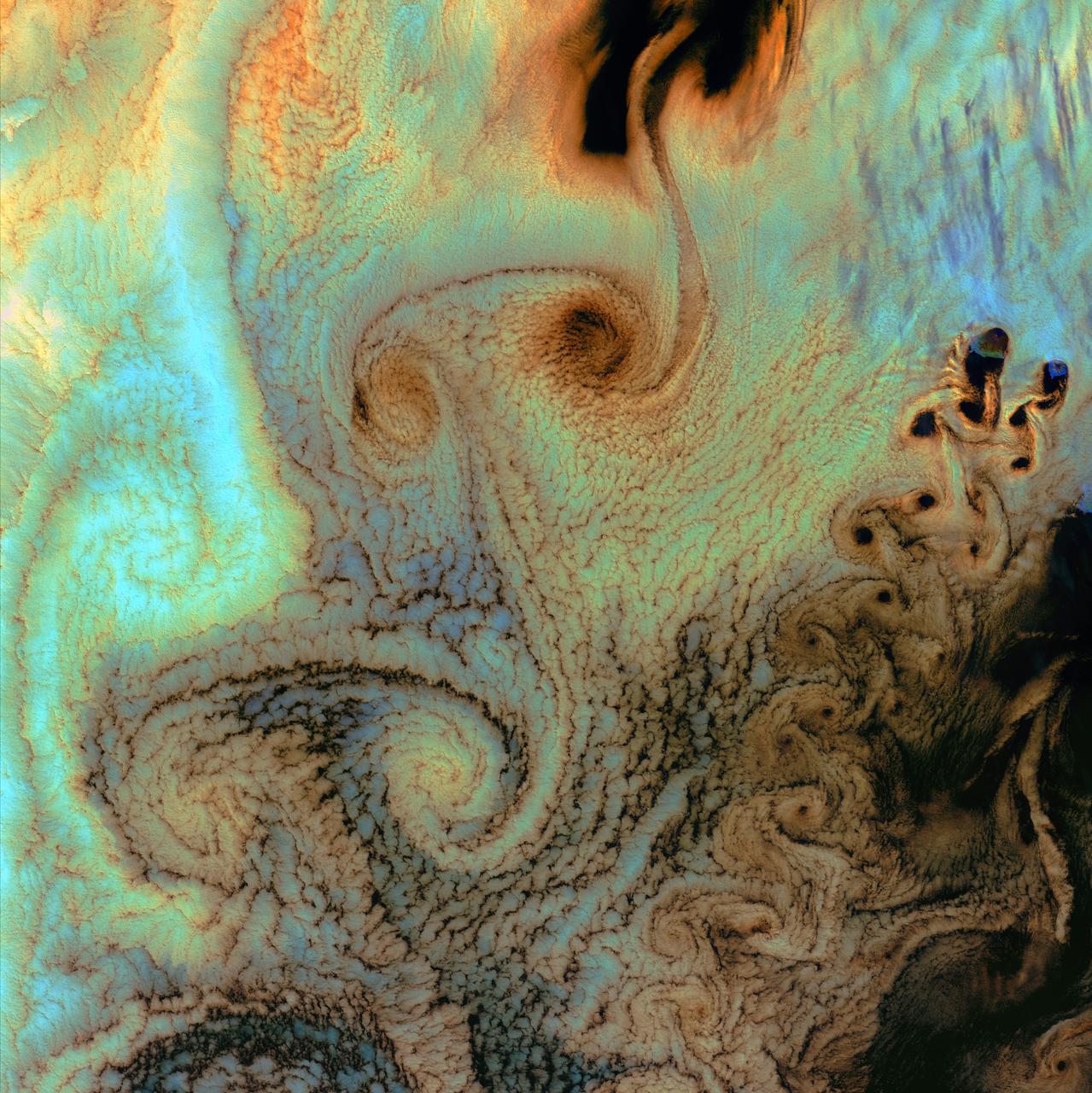
July 4th, 2002: Description: As air flows over and around objects in its path, spiraling eddies, known as Von Karman vortices, may form. The vortices in this image were created when prevailing winds sweeping east across the northern Pacific Ocean encountered Alaska’s Aleutian Islands. Source: Landsat 7 To learn more about the Landsat satellite go to: <a href="http://landsat.gsfc.nasa.gov/" rel="nofollow">landsat.gsfc.nasa.gov/</a>
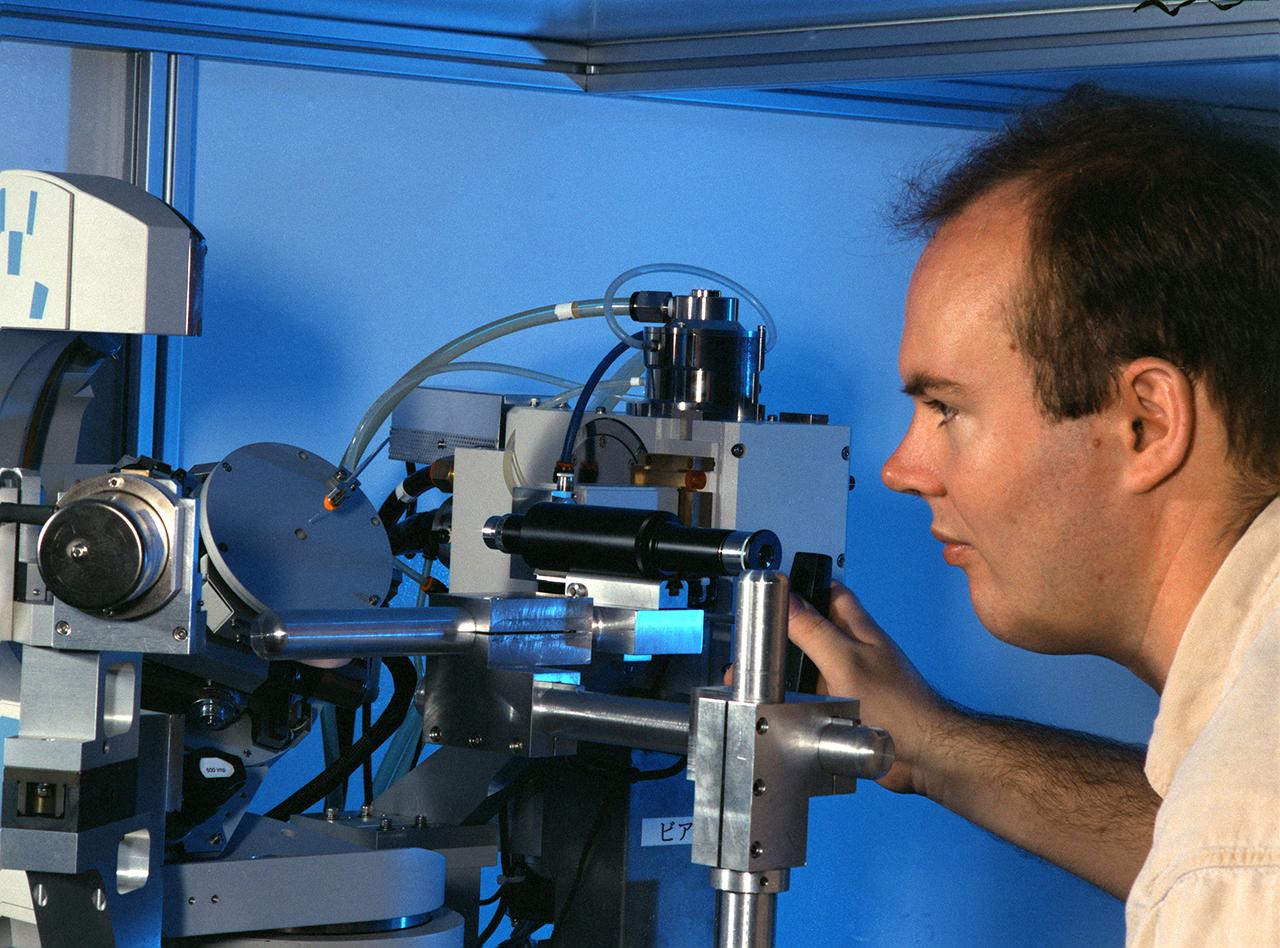
Eddie Snell, Post-Doctoral Fellow the National Research Council (NRC) uses a reciprocal space mapping diffractometer for macromolecular crystal quality studies. The diffractometer is used in mapping the structure of macromolecules such as proteins to determine their structure and thus understand how they function with other proteins in the body. This is one of several analytical tools used on proteins crystallized on Earth and in space experiments. Photo credit: NASA/Marshall Space Flight Center (MSFC)
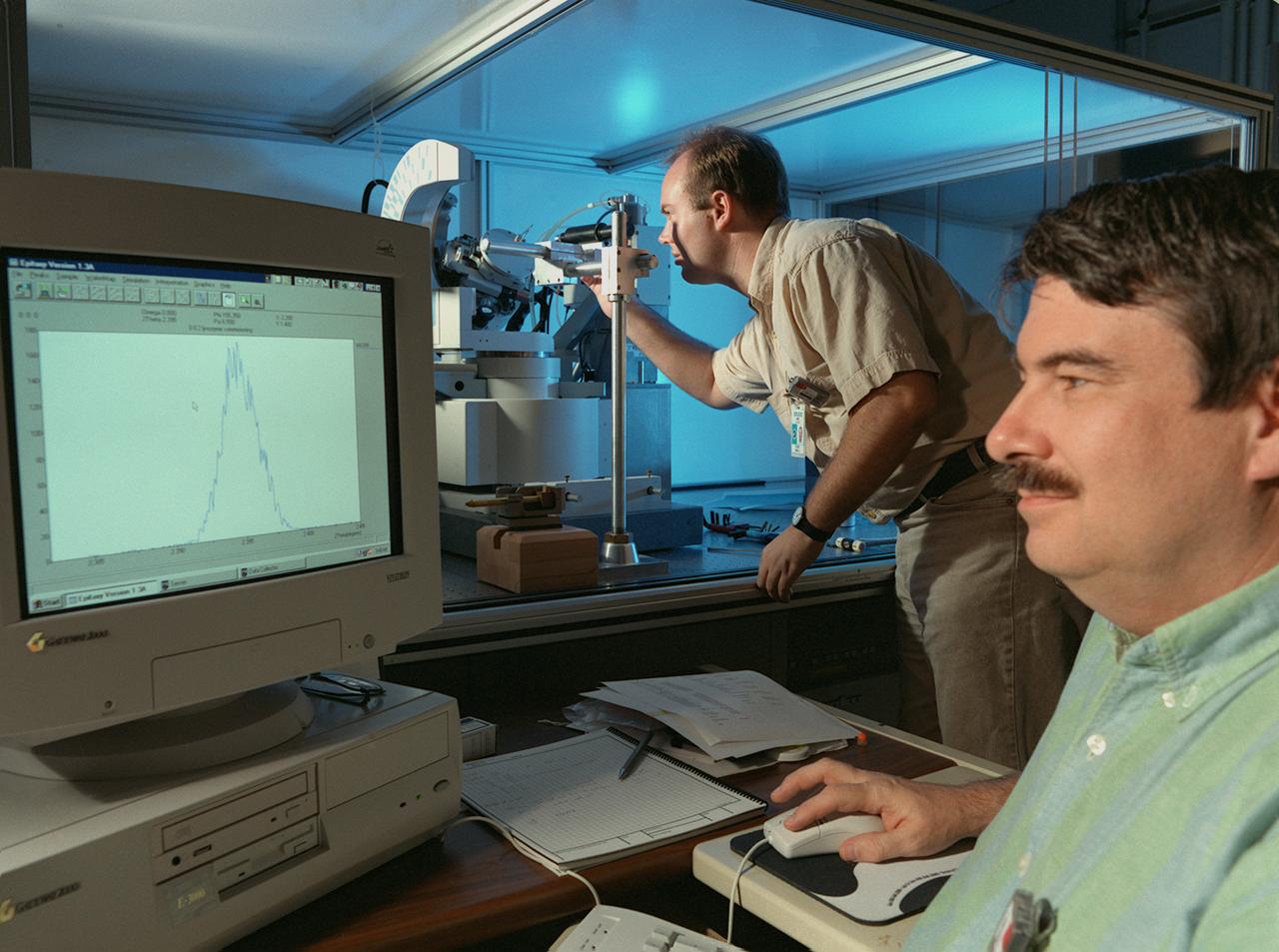
Eddie Snell (standing), Post-Doctoral Fellow the National Research Council (NRC),and Marc Pusey of Marshall Space Flight Center (MSFC) use a reciprocal space mapping diffractometer for marcromolecular crystal quality studies. The diffractometer is used in mapping the structure of marcromolecules such as proteins to determine their structure and thus understand how they function with other proteins in the body. This is one of several analytical tools used on proteins crystalized on Earth and in space experiments. Photo credit: NASA/Marshall Space Flight Center (MSFC)
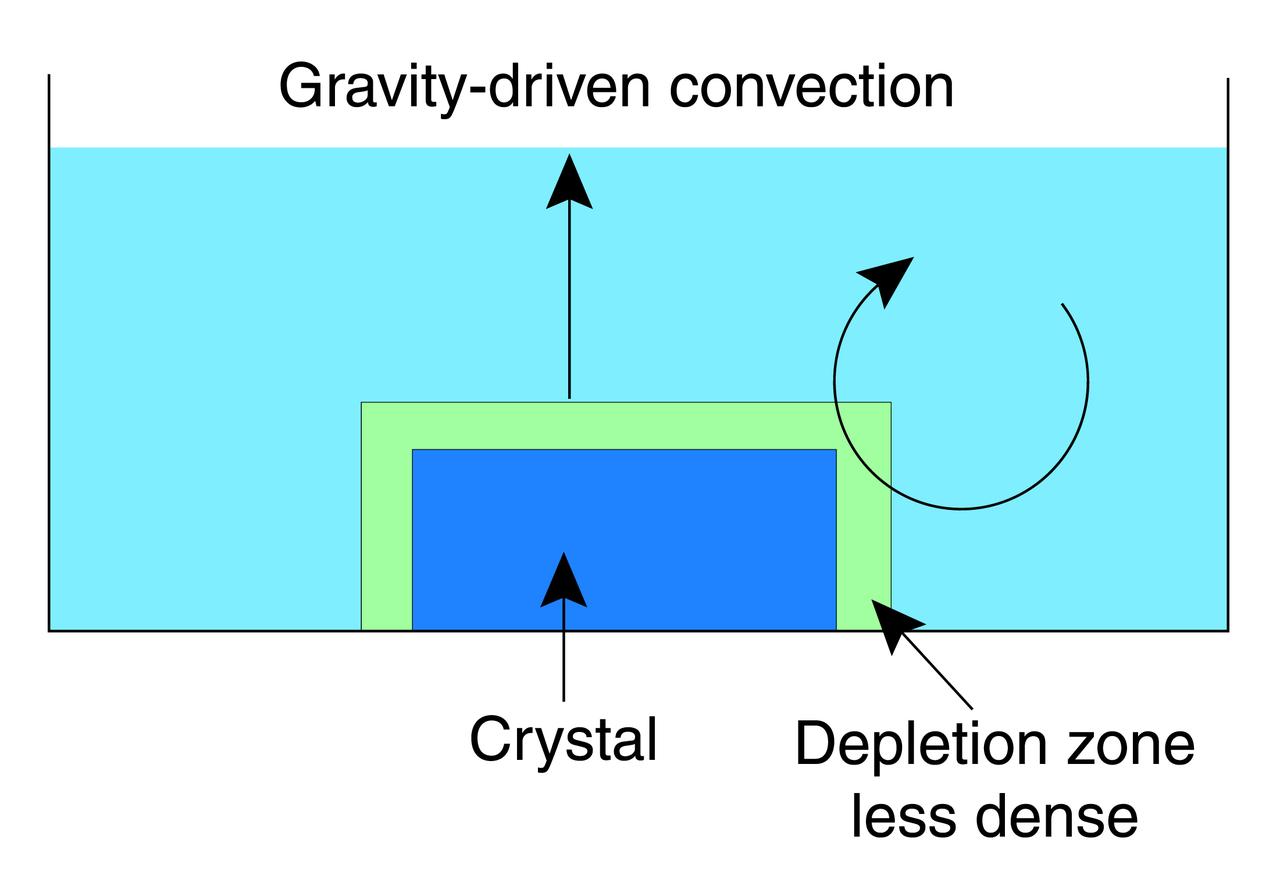
Gravity or density-driven convection occurs as protein molecules incorporate into a crystal lattice from the surrounding solution. The layer bordering the crystal (the depletion zone) then contains a less-dense protein concentration, causing the layer to rise. The remaining, denser solution sinks because of gravity, creating eddies that make it difficult for more protein molecules to attach to the crystal in an ordered way.
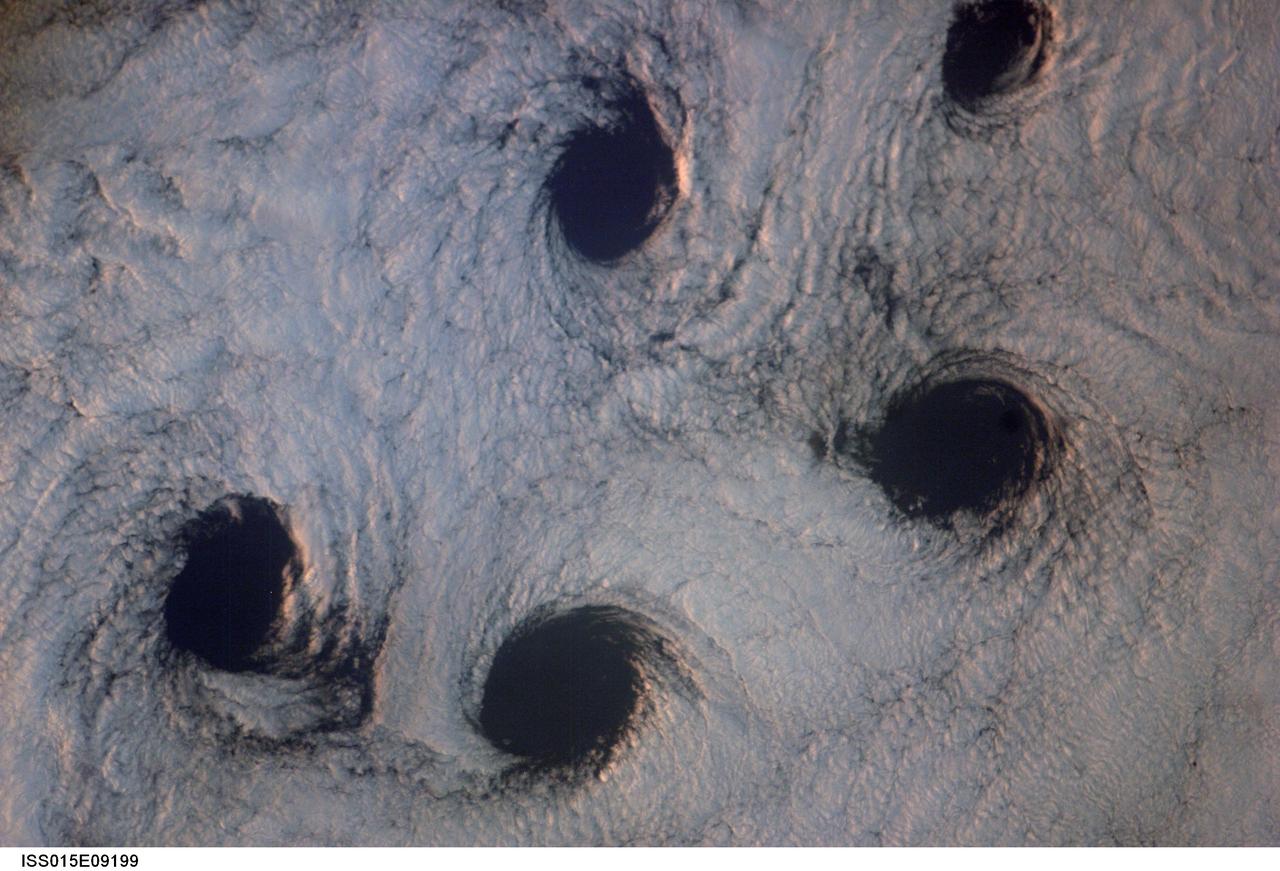
ISS015-E-09199 (23 May 2007) --- Von Karman cloud vortices near the Aleutian Islands are featured in this image photographed by an Expedition 15 crewmember on the International Space Station. The vortices are created by the wind encountering a barrier such as an island, changing direction and velocity and forming eddies in the wind and cloud pattern on the lee side of the island. The nadir point of the space station when the image was taken was 51.1 degrees north latitude and 178.8 degrees west longitude.

jsc2024e067105 (1/29/2024) --- Eddie Finley Junior High School student researchers (Caris Gray and Olivia Jones) adding tardigrade to the experiment tube to begin terrestrial examination of tardigrade growth. Their experiment, Tardigrade Growth in Space, is part of the Nanoracks-National Center for Earth and Space Science Education-Surveyor-Student Spaceflight Experiments Program Mission 18 to ISS (Nanoracks-NCESSE-Surveyor-SSEP).

U.S. Representative Eddie Bernice Johnson, of Texas, left; answers a question from the audience during a panel discussion at an event celebrating the 50th Anniversary of the Civil Rights Act of 1964 on Monday, June 23, 2014 in the James E. Webb Auditorium at NASA Headquarters in Washington, DC. The event highlighted the influence of the Civil Rights Act on NASA. Photo Credit: (NASA/Joel Kowsky)
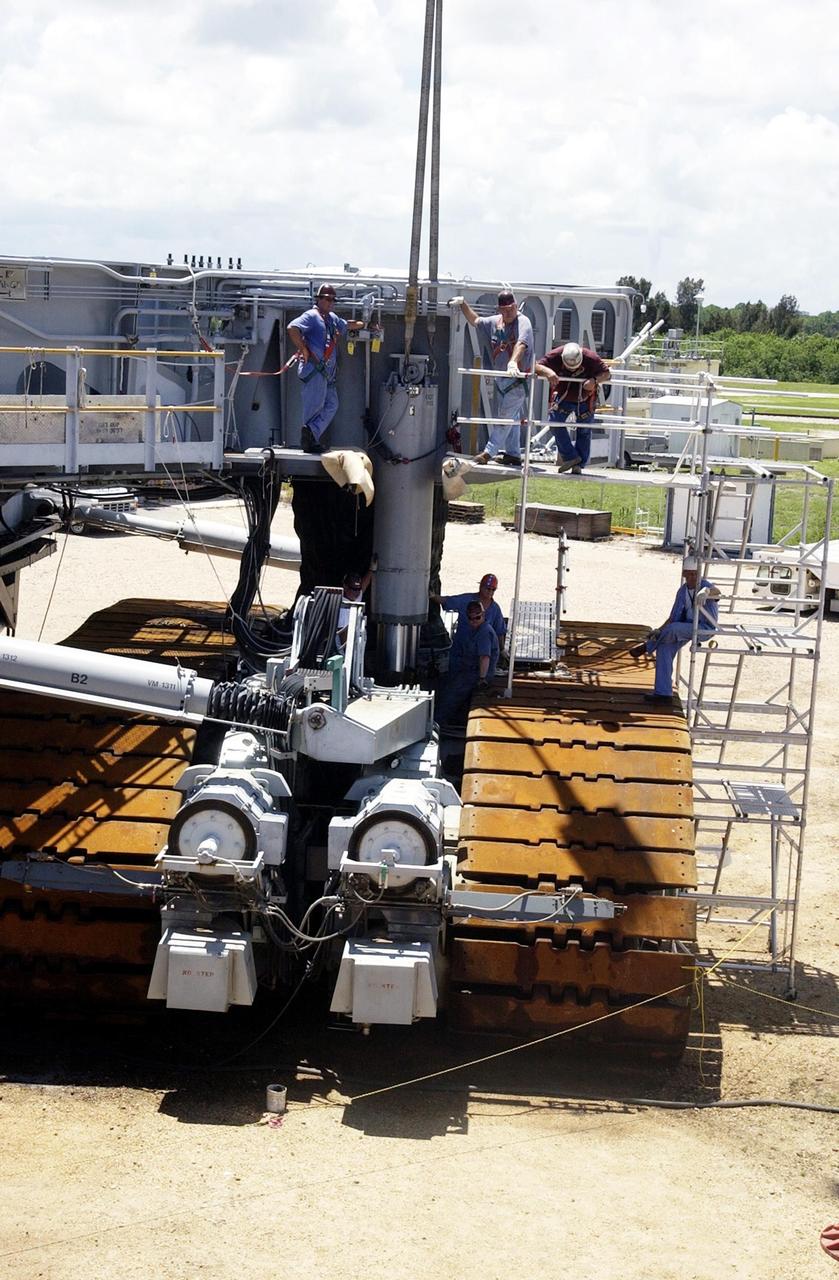
KENNEDY SPACE CENTER, FLA. -- Technicians hook a crane to a jacking, equalization and leveling (JEL) cylinder and bearing on Crawler-Transporter No. 2 in preparation for its removal. During routine maintenance inspections last week, technicians removed two of the 16 JEL cylinders on the crawler to gain access to the bearings and found three of the four bearings cracked. Further eddy current inspections indicated that cracks are present on 15 of the bearings. There are 16 cylinders and 32 bearings per crawler. Engineers are evaluating the situation to determine the cause of the cracks and an appropriate solution to the problem.
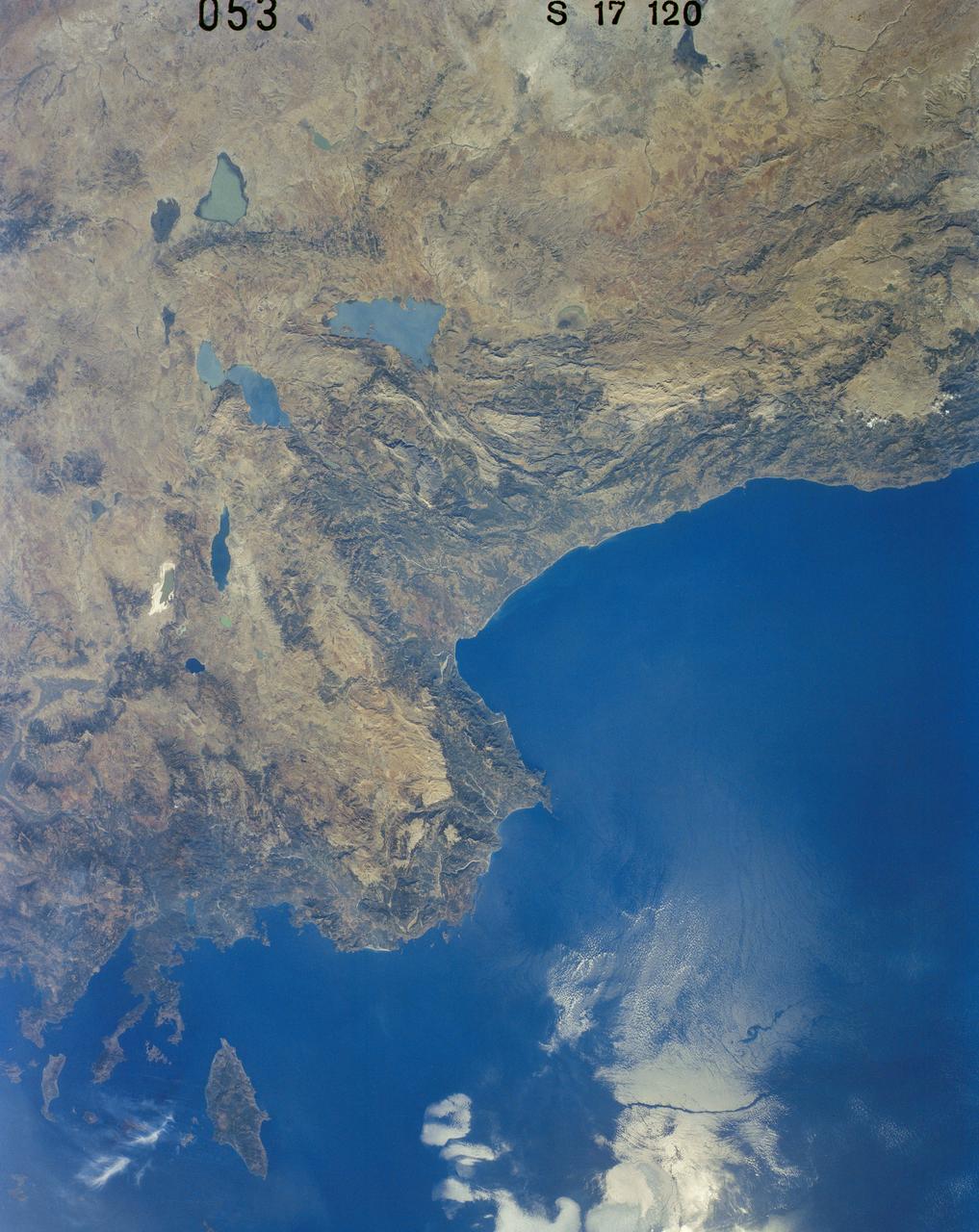
41G-120-053 (5-13 Oct. 1984) --- Turkey and a portion of the Mediterranean Sea, with the city of Antalya visible, were photographed with a medium format camera during the 41-G mission aboard the space shuttle Challenger. Numerous eddies and an ocean front can be observed in the sun's glint off the water's surface. The folded mountains indicate the rugged topography in this region. Photo credit: NASA

U.S. Representative Eddie Bernice Johnson, of Texas, speaks as part of a panel discussion at an event celebrating the 50th Anniversary of the Civil Rights Act of 1964 on Monday, June 23, 2014 in the James E. Webb Auditorium at NASA Headquarters in Washington, DC. The event highlighted the influence of the Civil Rights Act on NASA. Photo Credit: (NASA/Joel Kowsky)
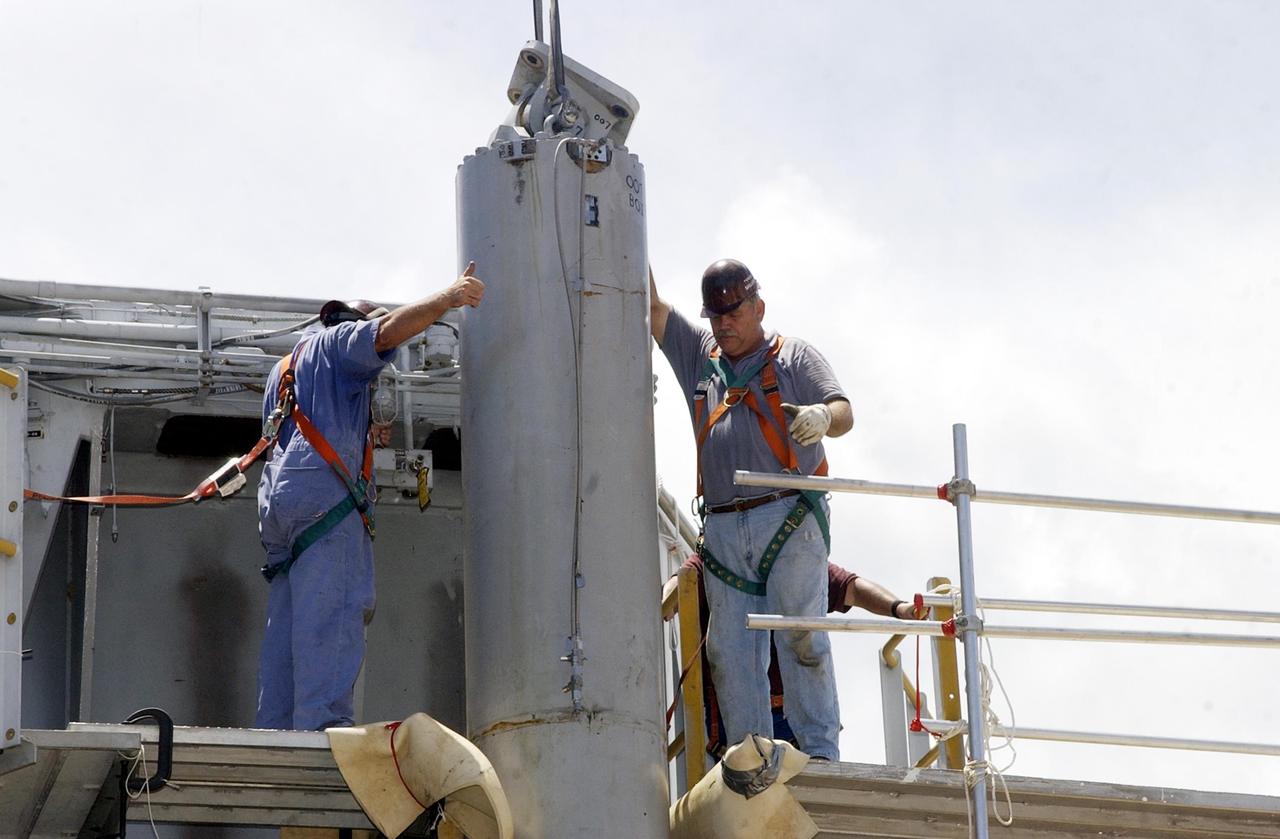
KENNEDY SPACE CENTER, FLA. -- Technicians give the signal for a crane to begin lifting a jacking, equalization and leveling (JEL) cylinder and bearing on Crawler-Transporter No. 2. During routine maintenance inspections last week, technicians removed two of the 16 JEL cylinders on the crawler to gain access to the bearings and found three of the four bearings cracked. Further eddy current inspections indicated that cracks are present on 15 of the bearings. There are 16 cylinders and 32 bearings per crawler. Engineers are evaluating the situation to determine the cause of the cracks and an appropriate solution to the problem.

U.S. Representative Eddie Bernice Johnson, of Texas, speaks as part of a panel discussion at an event celebrating the 50th Anniversary of the Civil Rights Act of 1964 on Monday, June 23, 2014 in the James E. Webb Auditorium at NASA Headquarters in Washington, DC. The event highlighted the influence of the Civil Rights Act on NASA. Photo Credit: (NASA/Joel Kowsky)
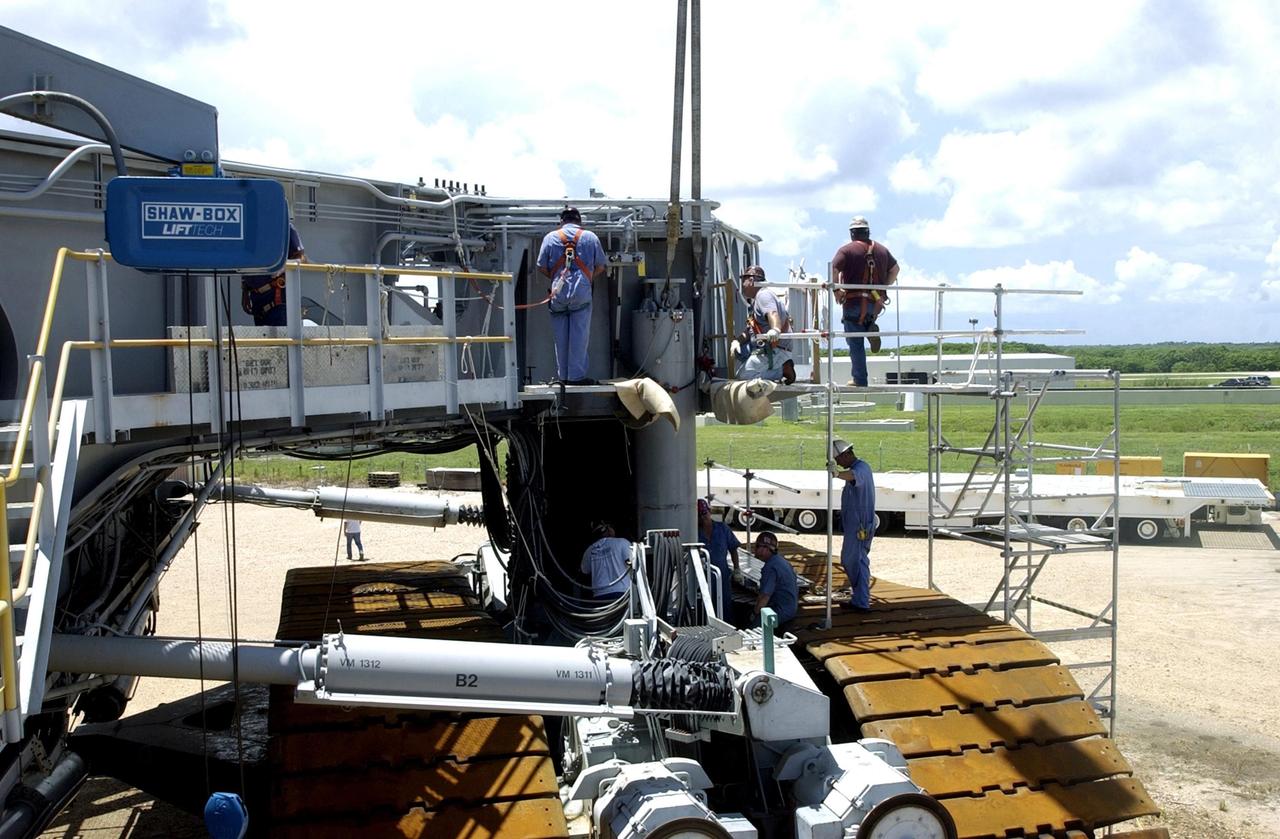
KENNEDY SPACE CENTER, FLA. -- Technicians hook a crane to a jacking, equalization and leveling (JEL) cylinder and bearing on Crawler-Transporter No. 2 in preparation for its removal. During routine maintenance inspections last week, technicians removed two of the 16 JEL cylinders on the crawler to gain access to the bearings and found three of the four bearings cracked. Further eddy current inspections indicated that cracks are present on 15 of the bearings. There are 16 cylinders and 32 bearings per crawler. Engineers are evaluating the situation to determine the cause of the cracks and an appropriate solution to the problem.

Mark Geyer, Director of NASA's Johnson Space Center, left, Jody Singer, Director of NASA's Marshall Space Flight Center, center, and Robert Cabana, Director of NASA's Kennedy Space Center, right, listen to Rep. Eddie Berniece Johnson, D-Texas, during a House Subcommittee on Space hearing titled "60 Years of NASA Leadership in Human Space Exploration: Past, Present, and Future," Wednesday, Sept. 26, 2018 at the Rayburn House Office Building in Washington. Photo Credit: (NASA/Joel Kowsky)
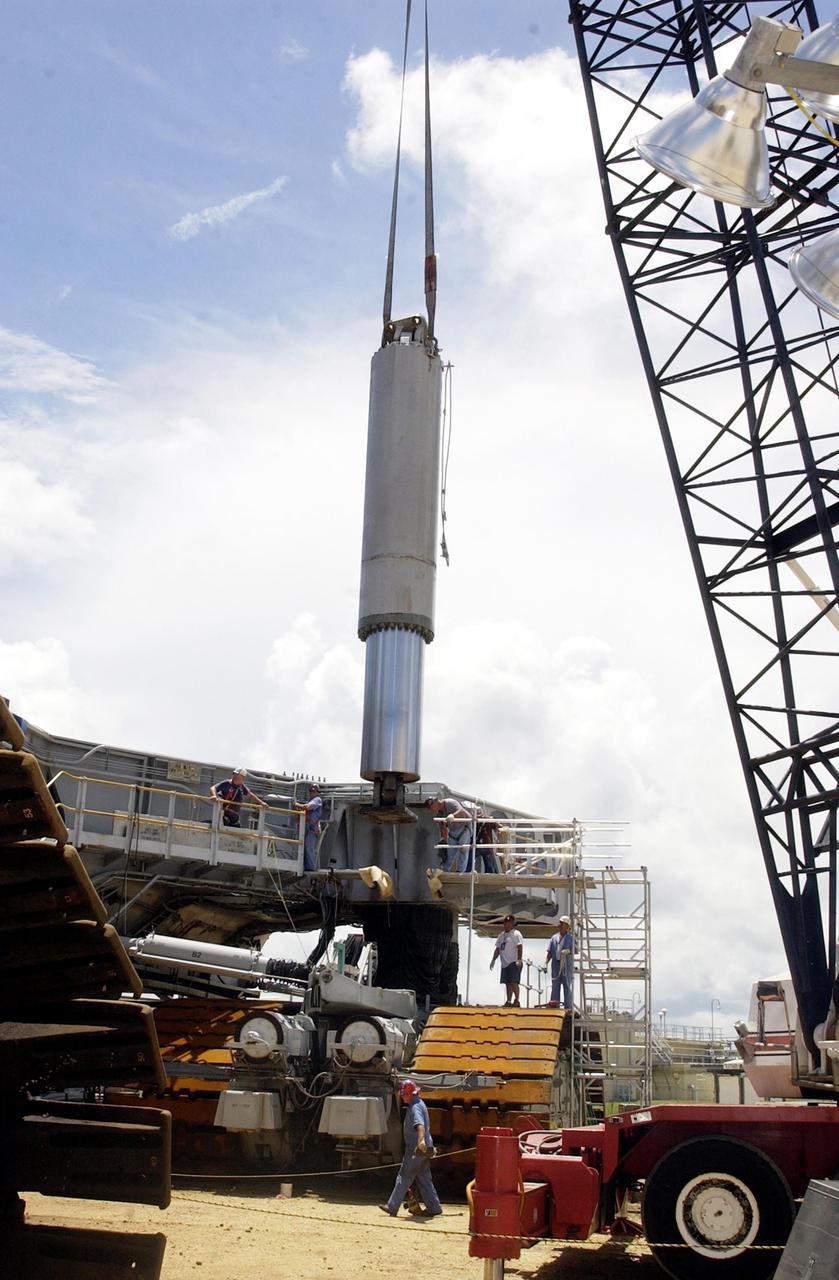
KENNEDY SPACE CENTER, FLA. -- A crane lowers a jacking, equalization and leveling (JEL) cylinder and bearing from Crawler-Transporter No. 2 to a position on the ground. During routine maintenance inspections last week, technicians removed two of the 16 JEL cylinders on the crawler to gain access to the bearings and found three of the four bearings cracked. Further eddy current inspections indicated that cracks are present on 15 of the bearings. There are 16 cylinders and 32 bearings per crawler. Engineers are evaluating the situation to determine the cause of the cracks and an appropriate solution to the problem.
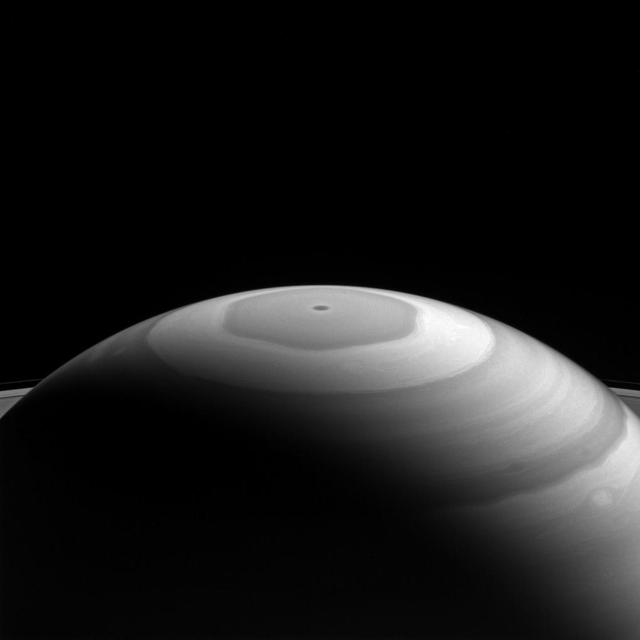
Saturn's north polar region displays its beautiful bands and swirls, which somewhat resemble the brushwork in a watercolor painting. Each latitudinal band represents air flowing at different speeds, and clouds at different heights, compared to neighboring bands. Where they meet and flow past each other, the bands' interactions produce many eddies and swirls. The northern polar region of Saturn is dominated by the famous hexagon shape (see PIA11682) which itself circumscribes the northern polar vortex -- seen as a dark spot at the planet's pole in the above image-- which is understood to the be eye of a hurricane-like storm (PIA14946). This view looks toward the sunlit side of the rings from about 20 degrees above the ring plane. The image was taken with the Cassini spacecraft wide-angle camera on Sept. 5, 2016 using a spectral filter which preferentially admits wavelengths of near-infrared light centered at 728 nanometers. The view was obtained at a distance of approximately 890,000 miles (1.4 million kilometers) from Saturn. Image scale is 53 miles (86 kilometers) per pixel. http://photojournal.jpl.nasa.gov/catalog/PIA20507
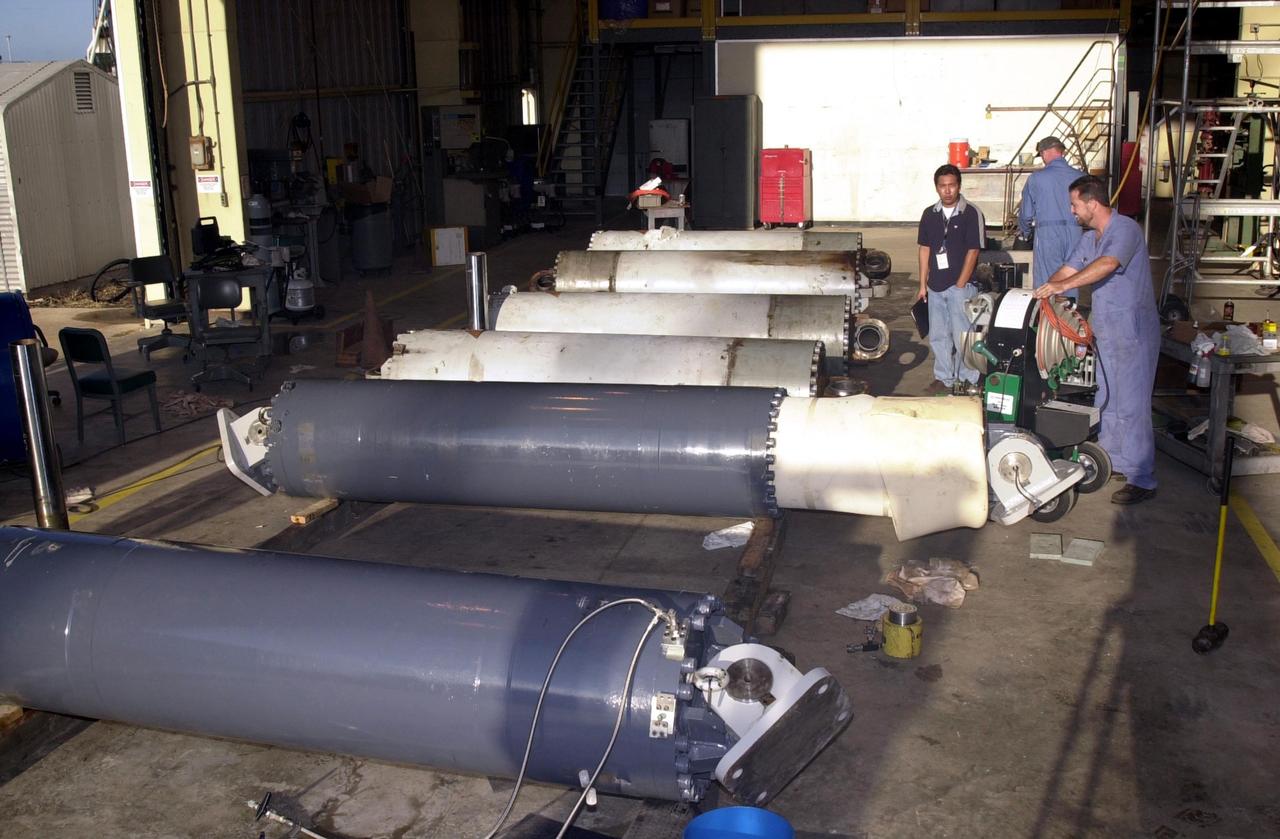
KENNEDY SPACE CENTER, FLA. -- Jacking, Equalization and Leveling (JEL) cylinders with repaired bearings are ready to be moved to Crawler Transporter No. 2. There are 16 cylinders and 32 bearings per crawler. During recent routine maintenance inspections, technicians removed two of the 16 JEL cylinders on the crawler to gain access to the bearings and found three of the four bearings cracked. Further eddy current inspections indicated that cracks were present on 15 of the bearings. Technicians have removed and replaced 14 of the bearings on CT-2, which is being repaired in order to enable Atlantis' rollout for mission STS-112, scheduled for launch no earlier than Oct. 2.
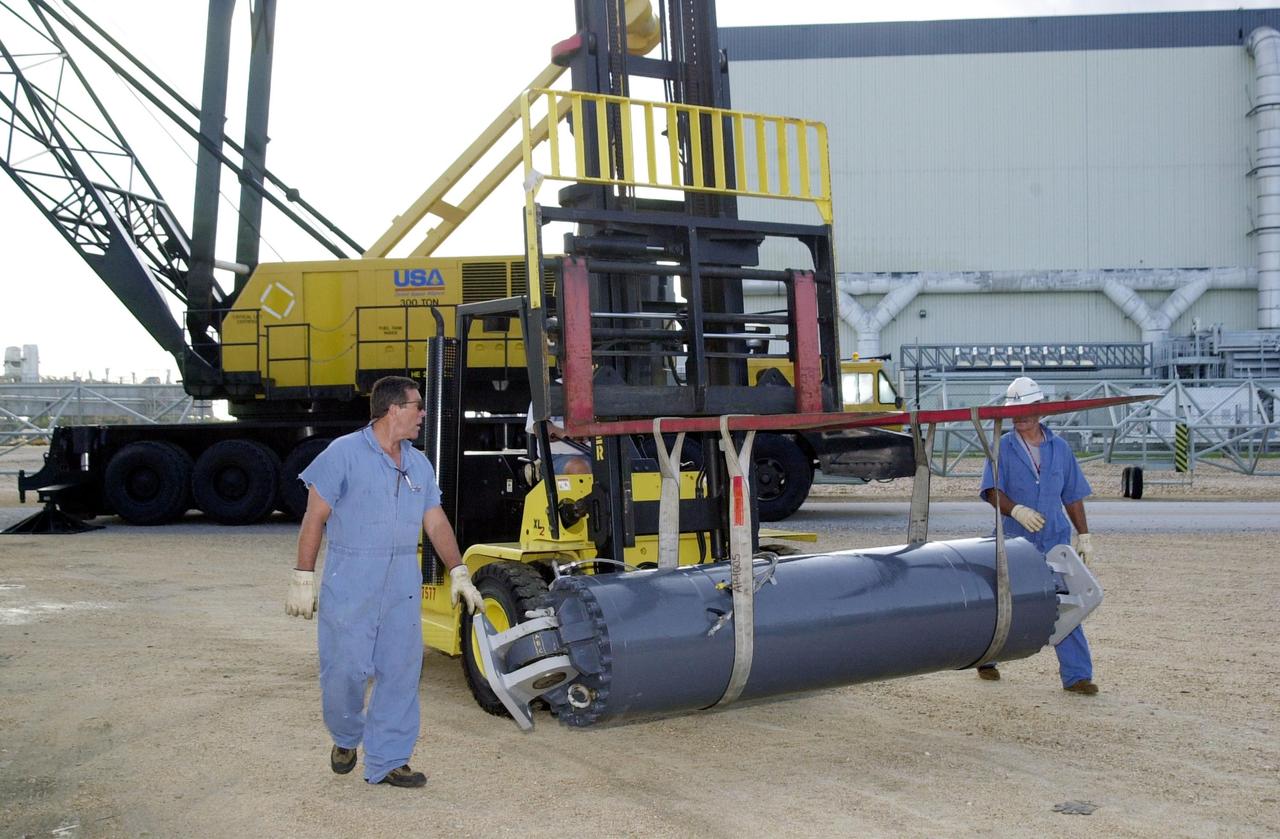
KENNEDY SPACE CENTER, FLA. -- Workers accompany the repaired Jacking, Equalization and Leveling (JEL) cylinder as it is moved from the repair site for installation into Crawler Transporter No. 2. There are 16 cylinders and 32 bearings per crawler. During recent routine maintenance inspections, technicians removed two of the 16 JEL cylinders on the crawler to gain access to the bearings and found three of the four bearings cracked. Further eddy current inspections indicated that cracks were present on 15 of the bearings.. Technicians have removed and replaced 14 of the bearings on CT-2, which is being repaired in order to enable Atlantis' rollout for mission STS-112, scheduled for launch no earlier than Oct. 2.

NASA Administrator Bill Nelson, far right, visits with Congresswoman (TX) Eddie Bernice Johnson, center, during launch countdown activities for NASA’s Artemis I mission on Aug. 29, 2022, at the agency’s Kennedy Space Center in Florida. The launch was waved off for the day. The first in a series of increasingly complex missions, Artemis I will provide a foundation for human deep space exploration and demonstrate our commitment and capability to extend human presence to the Moon and beyond. The primary goal of Artemis I is to thoroughly test the integrated systems before crewed missions by operating the spacecraft in a deep space environment, testing Orion’s heat shield, and recovering the crew module after reentry, descent, and splashdown.
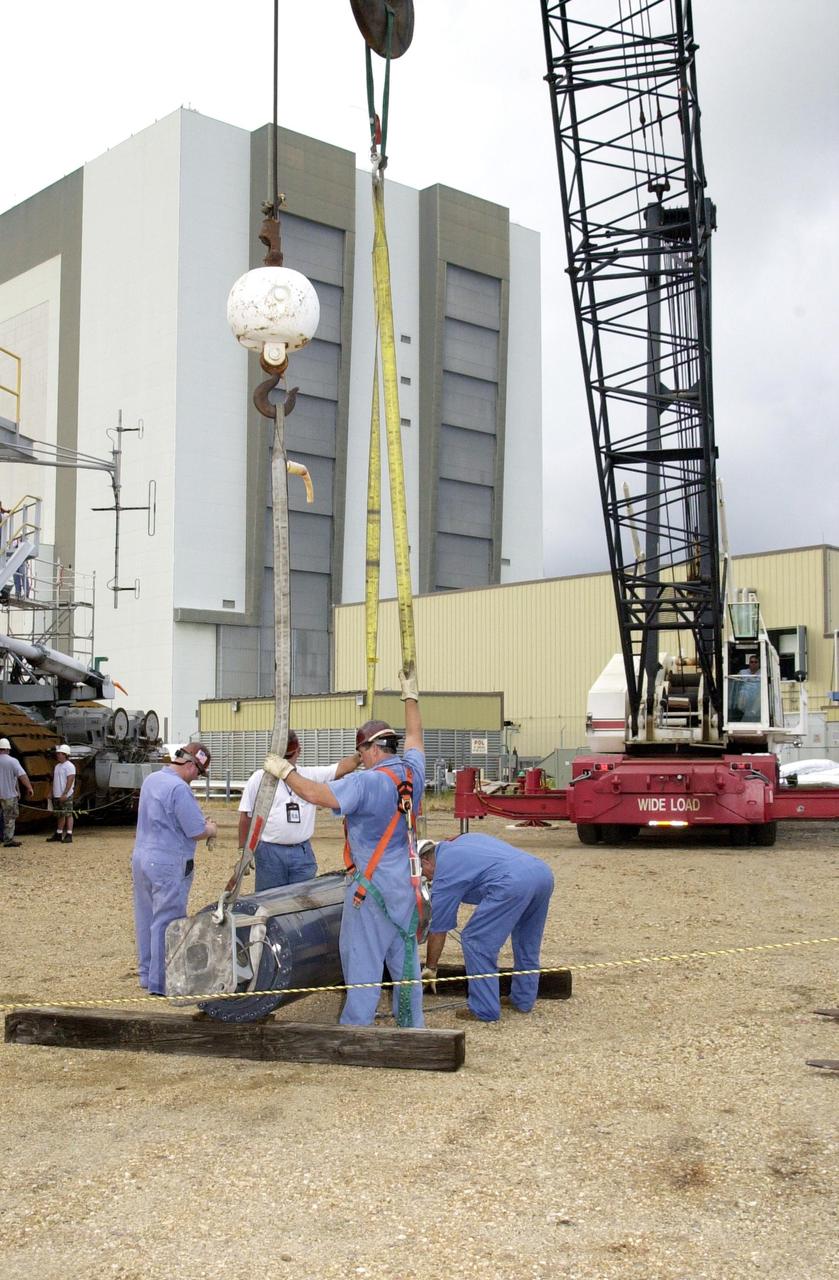
KENNEDY SPACE CENTER, FLA. -- The repaired Jacking, Equalization and Leveling (JEL) cylinder is attached to a crane. The crane will lift the JEL for placement in Crawler Transporter No. 2. There are 16 cylinders and 32 bearings per crawler. During recent routine maintenance inspections, technicians removed two of the 16 JEL cylinders on the crawler to gain access to the bearings and found three of the four bearings cracked. Further eddy current inspections indicated that cracks were present on 15 of the bearings.. Technicians have removed and replaced 14 of the bearings on CT-2, which is being repaired in order to enable Atlantis' rollout for mission STS-112, scheduled for launch no earlier than Oct. 2.
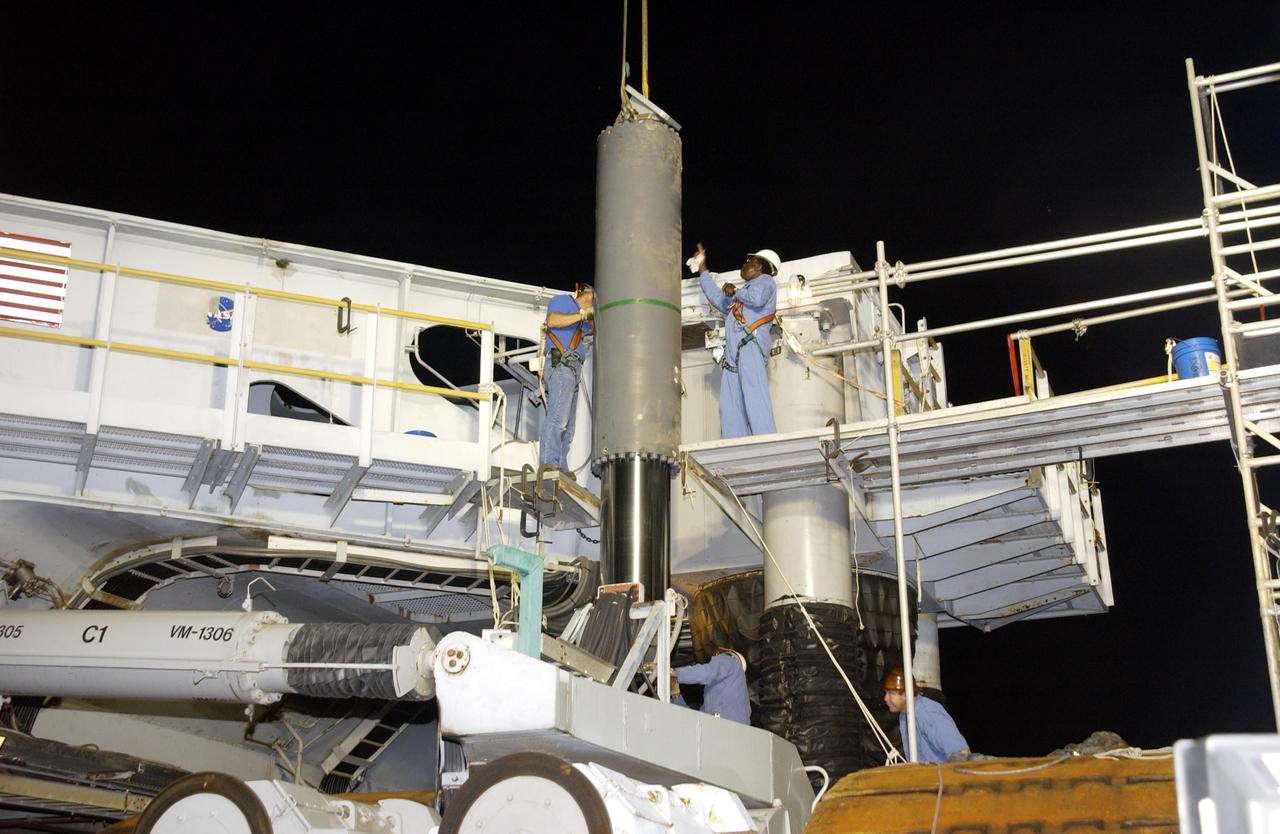
KENNEDY SPACE CENTER, FLA. -- Workers help guide the final Jacking, Equalization and Leveling (JEL) cylinder into place on Crawler Transporter No. 2 (CT-2) for installation. During recent routine maintenance inspections, cracks were found on four bearings in two JEL cylinders. Further eddy current inspections indicated that cracks were present on 15 bearings. There are 16 cylinders and 32 bearings per crawler. CT-2 was repaired in order to enable Atlantis' rollout for mission STS-112, scheduled for launch no earlier than Oct. 2.
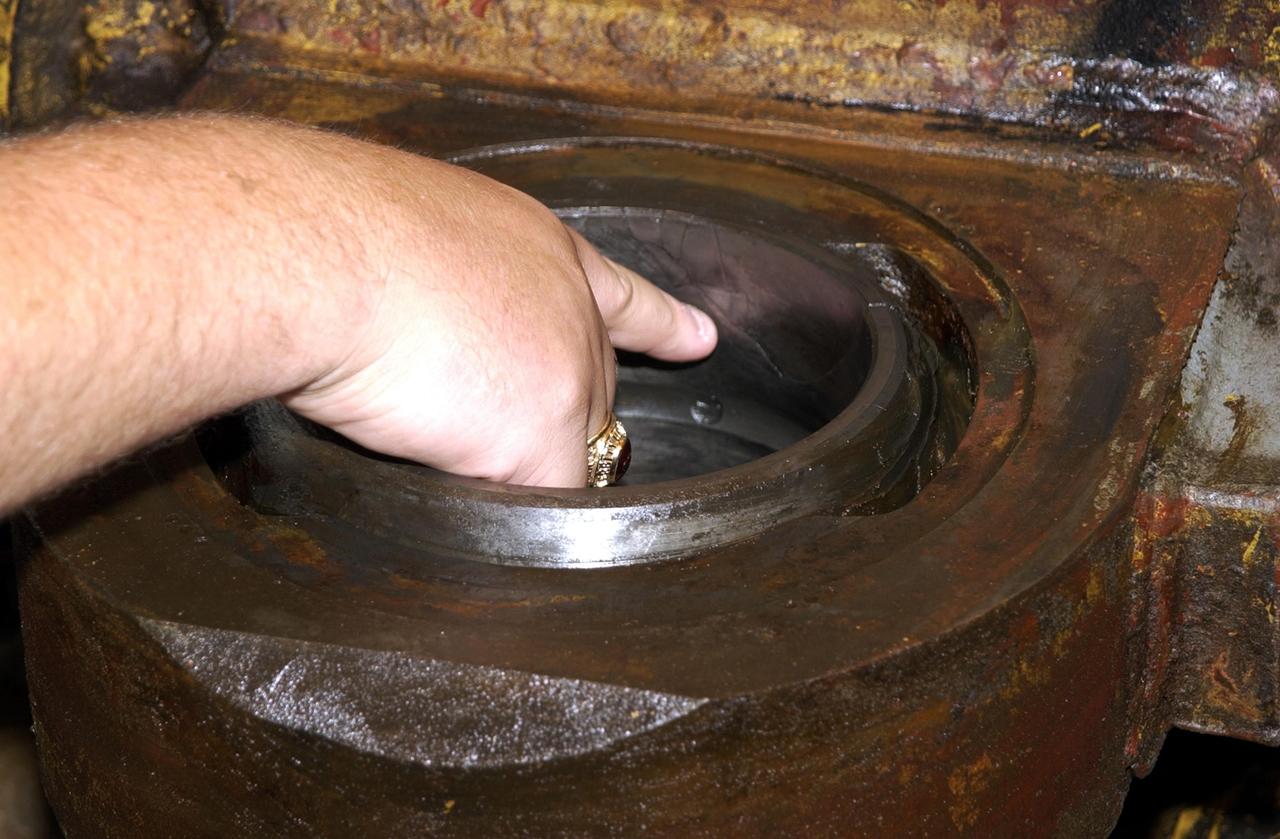
KENNEDY SPACE CENTER, FLA. -- Perry Becker, an engineer with NASA, points to a crack in a bearing from one of the jacking, equalization and leveling (JEL) cylinders on Crawler-Transporter No. 2. During inspections, technicians removed two of the 16 JEL cylinders on the vehicle to gain access to the bearings for routine maintenance and found three of the four bearings had cracks. Of the three bearings, two had extensive damage. Further eddy current inspections indicate that cracks are present on 15 of the bearings. There are 16 cylinders and 32 bearings per crawler. Although no cause for the cracks is known at this time, engineers are currently evaluating the situation to determine the most appropriate solution.
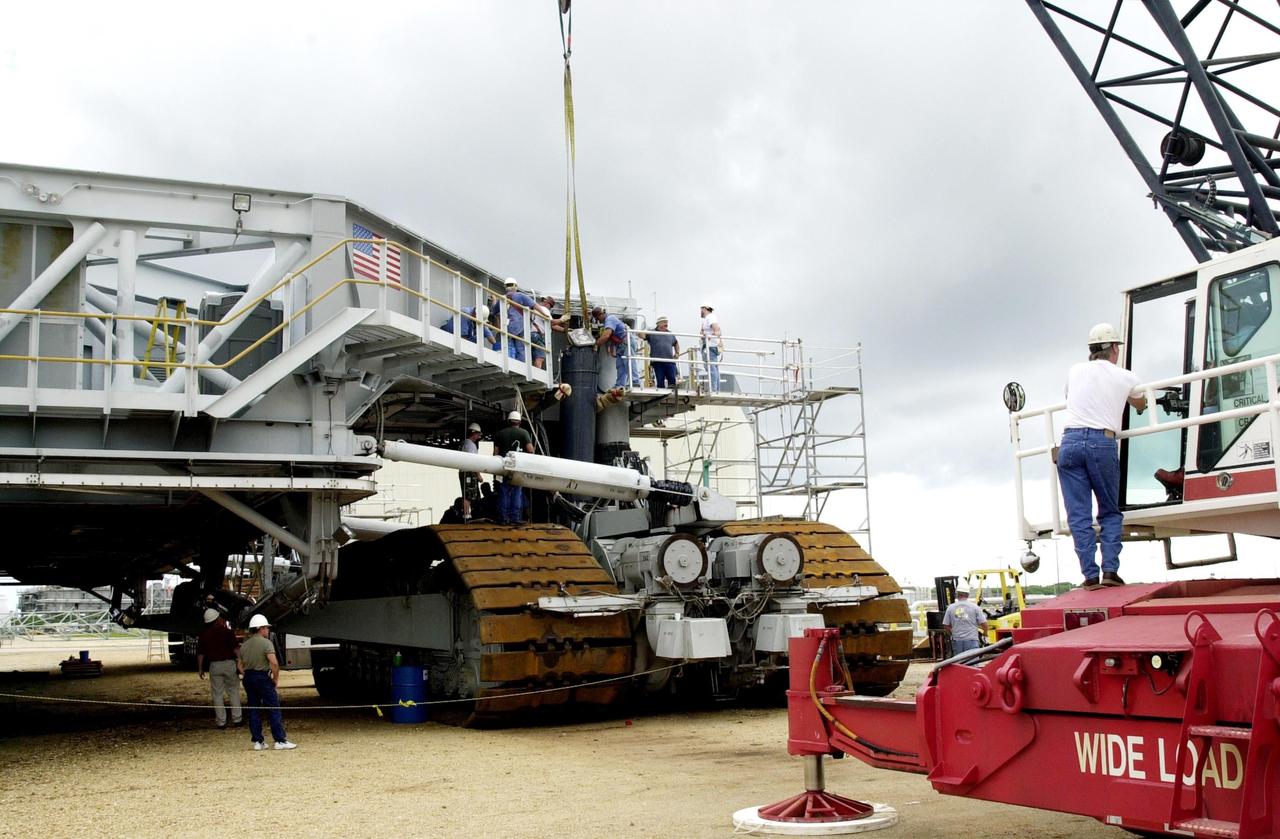
KENNEDY SPACE CENTER, FLA. -- Supported by the overhead crane and maneuvered by several workers, a repaired Jacking, Equalization and Leveling (JEL) cylinder is lifted into position on Crawler Transporter No. 2. There are 16 cylinders and 32 bearings per crawler. During recent routine maintenance inspections, technicians removed two of the 16 JEL cylinders on the crawler to gain access to the bearings and found three of the four bearings cracked. Further eddy current inspections indicated that cracks were present on 15 of the bearings.. Technicians have removed and replaced 14 of the bearings on CT-2, which is being repaired in order to enable Atlantis' rollout for mission STS-112, scheduled for launch no earlier than Oct. 2.
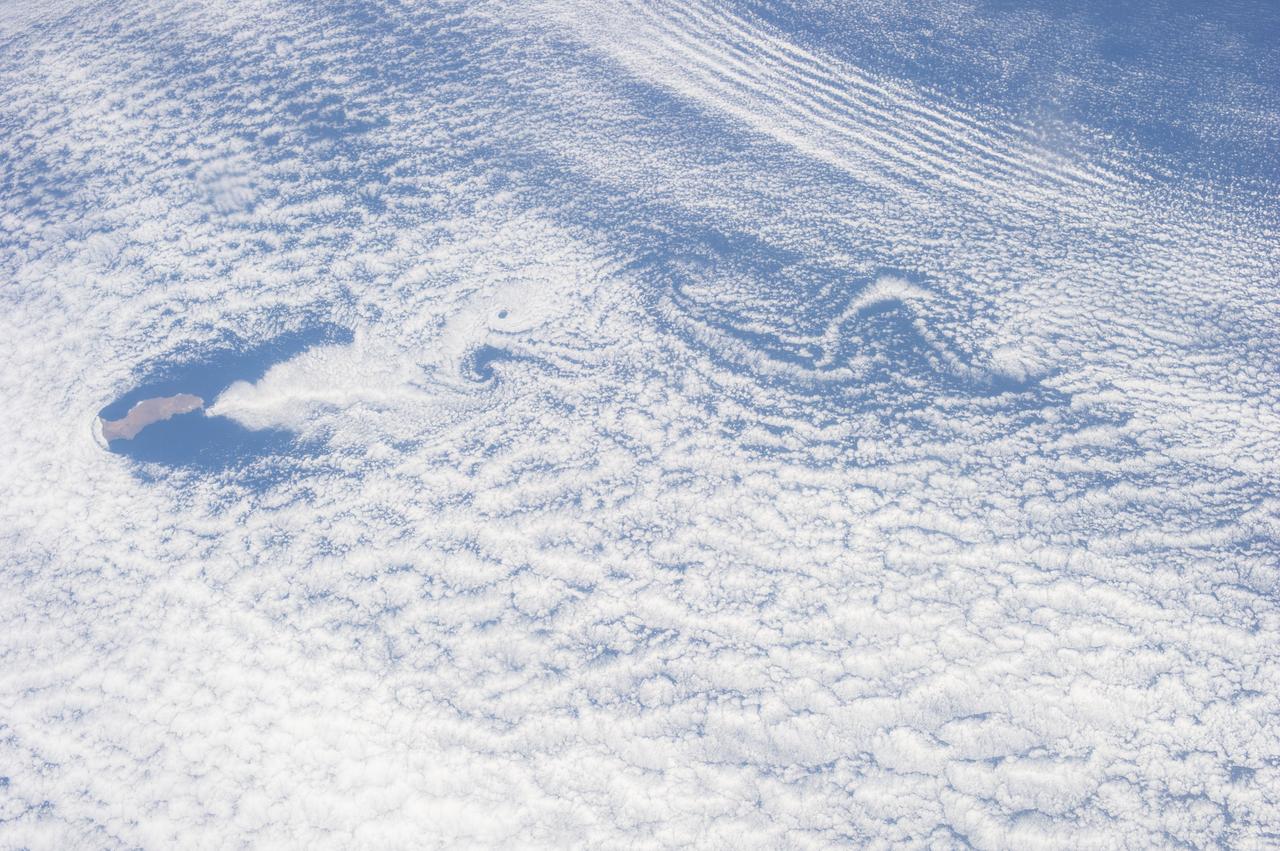
ISS036-E-035663 (24 Aug. 2013) --- One of the Expedition 36 crew members aboard the International Space Station recorded this still image of unusual cloud patterns surrounding Guadalupe Island in the Pacific Ocean (left center). These are the result of a ubiquitous occurrence in the motion of fluids—a vortex street, which is a linear chain of spiral eddies called von Karman vortices. Von Karman vortices are named after Theodore von Karman, a co-founder of NASA's Jet Propulsion Laboratory. who first described the phenomenon in the atmosphere. Guadalupe Island or Isla Guadalupe is a volcanic island located 241 kilometers (150 statute miles) off the west coast of Mexico's Baja California peninsula.
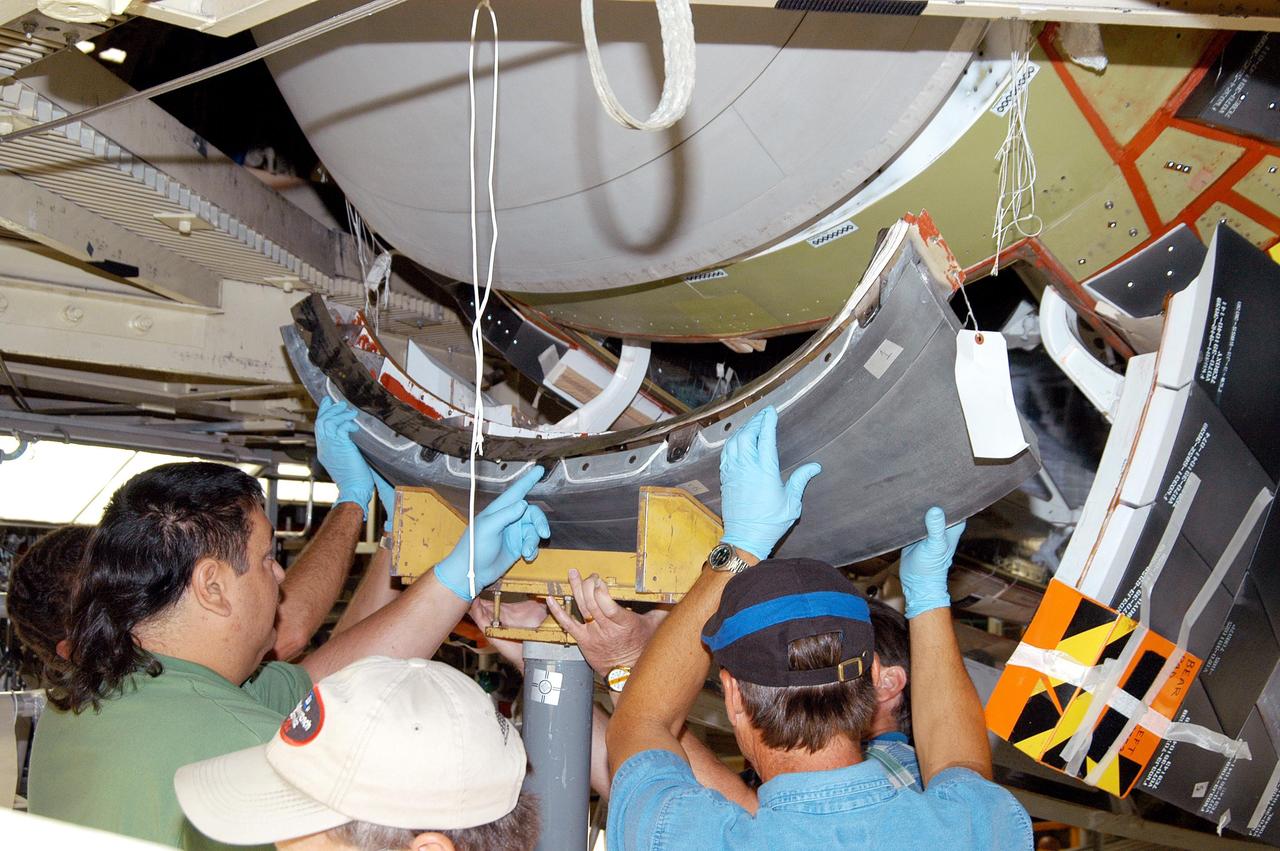
KENNEDY SPACE CENTER, FLA. - Workers in the Orbiter Processing Facility check the placement of the Reinforced Carbon-Carbon (RCC) chin panel on Discovery. . The chin panel is the smile-shaped section of RCC directly below the nose cap that provides a thermal barrier during re-entry. The nose cap, with chin panel, was removed from the vehicle in the summer of 2003 and returned to the vendor, where it underwent numerous forms of Non-Destructive Evaluation. These tests included X-ray, ultrasound and eddy current to ensure its structural integrity prior to reinstallation. Discovery is designated as the Return to Flight vehicle for mission STS-114, no earlier than March 2005.
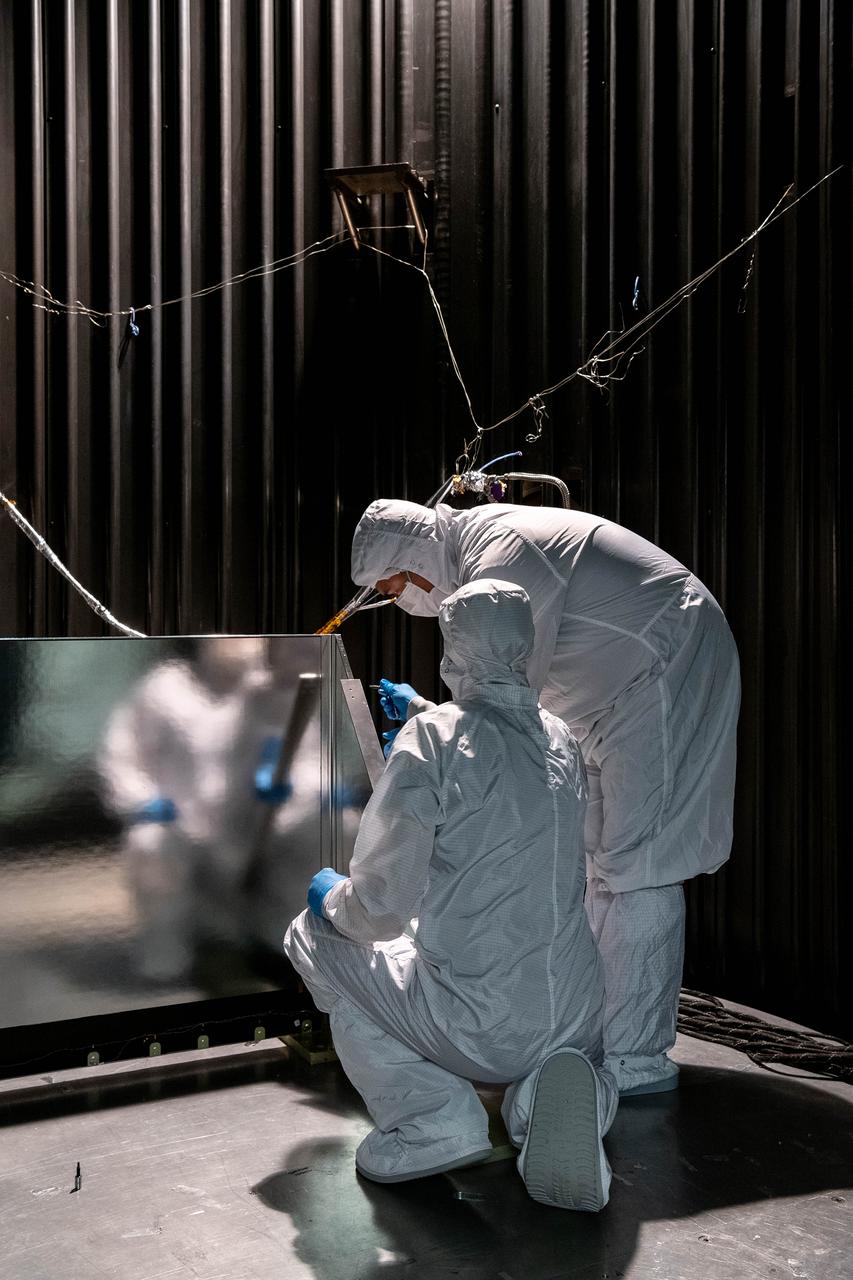
Mechanical Technicians, Daniel Dizon and Joseph Eddy, install the Ocean Color Instrument (OCI) Earth Shade into a thermal vacuum chamber so that team members can test the thermal capabilities of the hardware under a simulated space environment. OCI is a highly advanced optical spectrometer that will be used to measure properties of light over portions of the electromagnetic spectrum. It will enable continuous measurement of light at finer wavelength resolution than previous NASA satellite sensors, extending key system ocean color data records for climate studies. OCI is PACE's (Plankton, Aerosol, Cloud, ocean Ecosystem) primary sensor built at Goddard Space Flight Center in Greenbelt, MD.
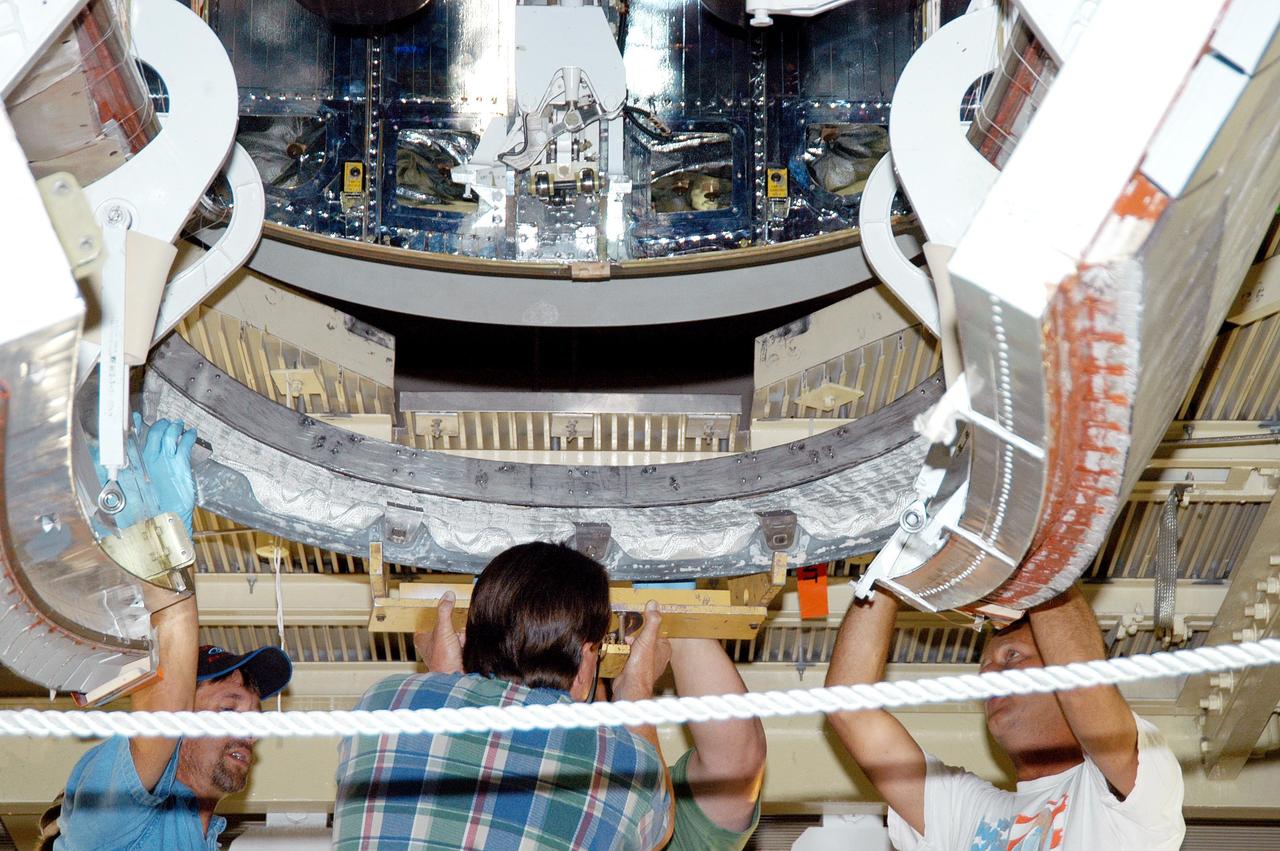
KENNEDY SPACE CENTER, FLA. - Workers in the Orbiter Processing Facility lift the Reinforced Carbon-Carbon (RCC) chin panel into place on Discovery. The chin panel is the smile-shaped section of RCC directly below the nose cap that provides a thermal barrier during re-entry. The nose cap, with chin panel, was removed from the vehicle in the summer of 2003 and returned to the vendor, where it underwent numerous forms of Non-Destructive Evaluation. These tests included X-ray, ultrasound and eddy current to ensure its structural integrity prior to reinstallation. Discovery is designated as the Return to Flight vehicle for mission STS-114, no earlier than March 2005.
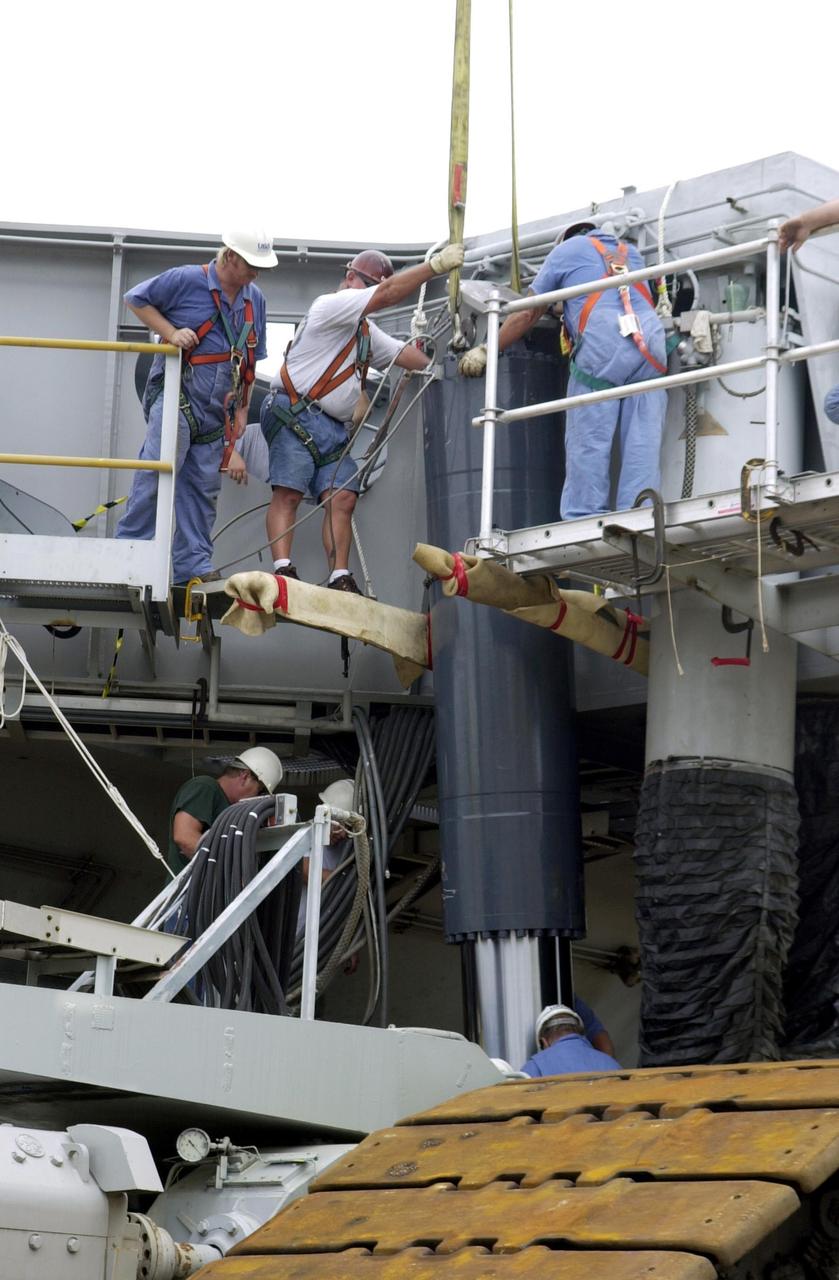
KENNEDY SPACE CENTER, FLA. -- Workers on Crawler Transporter No. 2 help guide a repaired Jacking, Equalization and Leveling (JEL) cylinder as it is lowered into place. There are 16 cylinders and 32 bearings per crawler. During recent routine maintenance inspections, technicians removed two of the 16 JEL cylinders on the crawler to gain access to the bearings and found three of the four bearings cracked. Further eddy current inspections indicated that cracks were present on 15 of the bearings.. Technicians have removed and replaced 14 of the bearings on CT-2, which is being repaired in order to enable Atlantis' rollout for mission STS-112, scheduled for launch no earlier than Oct. 2.
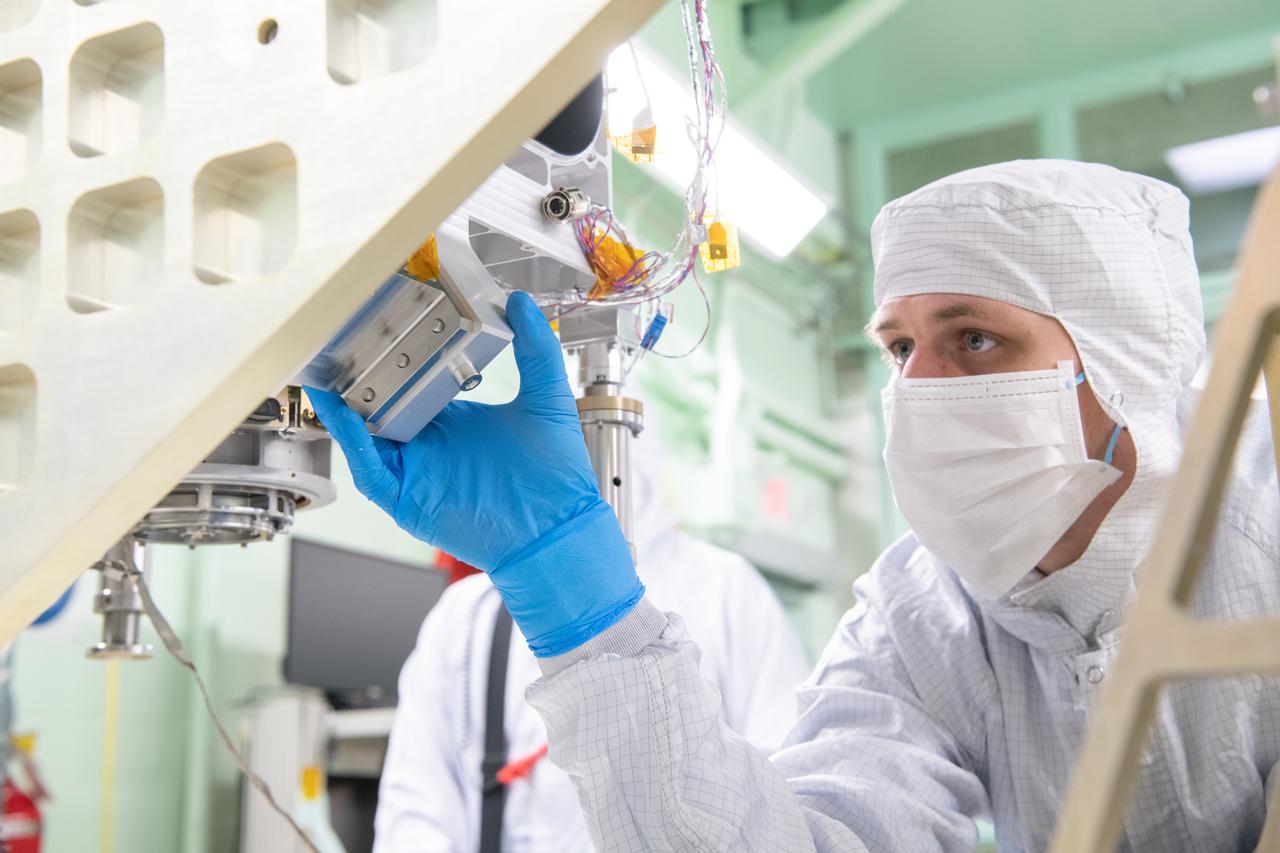
Mechanical technician, Joseph Eddy, carefully guides the Ocean Color Instrument (OCI) Main Optics Bench (MOB) during a crane lift onto its turnover fixture. This fixture allows the team to integrate additional components multiple different orientations. OCI is a highly advanced optical spectrometer that will be used to measure properties of light over portions of the electromagnetic spectrum. It will enable continuous measurement of light at finer wavelength resolution than previous NASA satellite sensors, extending key system ocean color data records for climate studies. OCI is PACE's (Plankton, Aerosol, Cloud, ocean Ecosystem) primary sensor built at Goddard Space Flight Center in Greenbelt, MD.
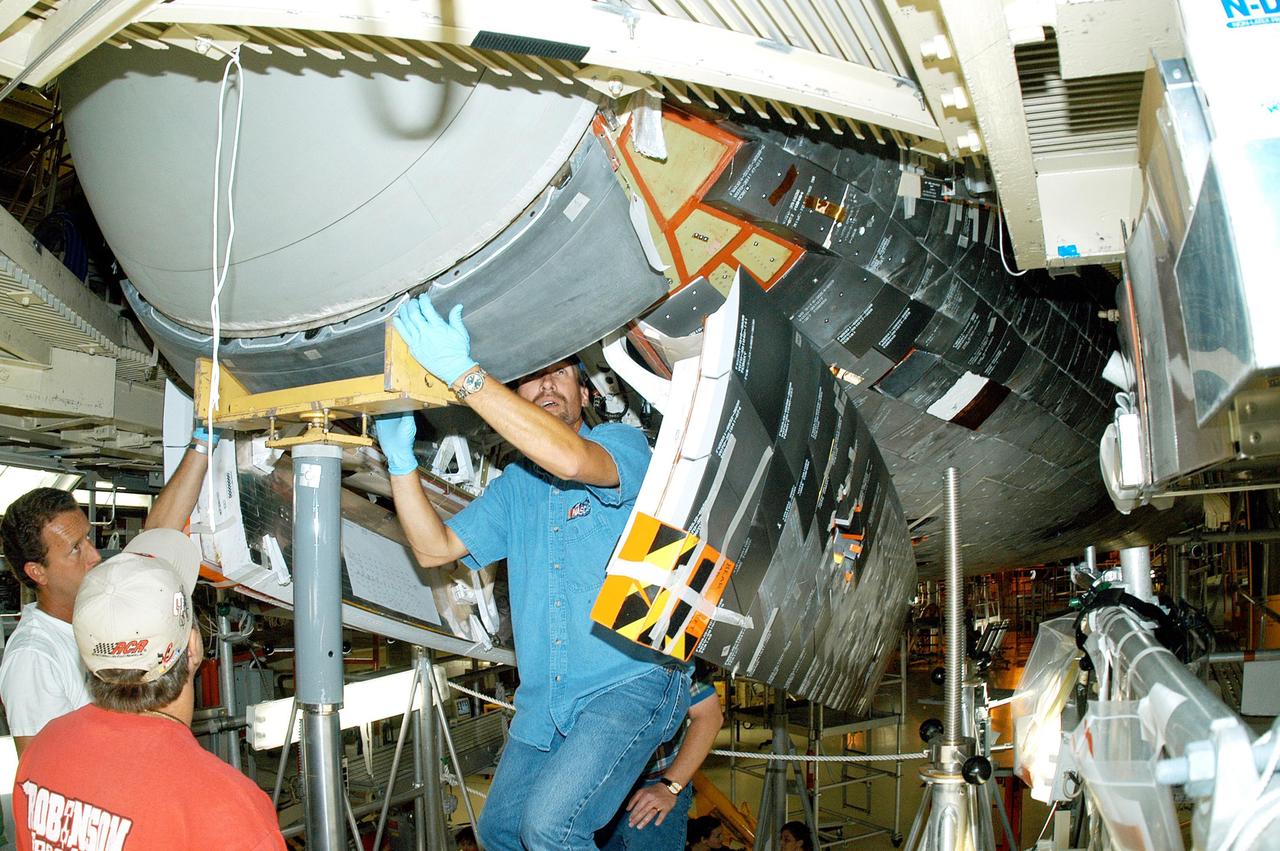
KENNEDY SPACE CENTER, FLA. - - Workers in the Orbiter Processing Facility complete the installation of the Reinforced Carbon-Carbon panel on Discovery. The chin panel is the smile-shaped section of RCC directly below the nose cap that provides a thermal barrier during re-entry. The nose cap, with chin panel, was removed from the vehicle in the summer of 2003 and returned to the vendor, where it underwent numerous forms of Non-Destructive Evaluation. These tests included X-ray, ultrasound and eddy current to ensure its structural integrity prior to reinstallation. Discovery is designated as the Return to Flight vehicle for mission STS-114, no earlier than March 2005.

KENNEDY SPACE CENTER, FLA. -- Technicians supervise a jacking, equalization and leveling (JEL) cylinder and bearing from Crawler-Transporter No. 2 as it is lowered by a crane to a position on the ground. During routine maintenance inspections last week, technicians removed two of the 16 JEL cylinders on the crawler to gain access to the bearings and found three of the four bearings cracked. Further eddy current inspections indicated that cracks are present on 15 of the bearings. There are 16 cylinders and 32 bearings per crawler. Engineers are evaluating the situation to determine the cause of the cracks and an appropriate solution to the problem.
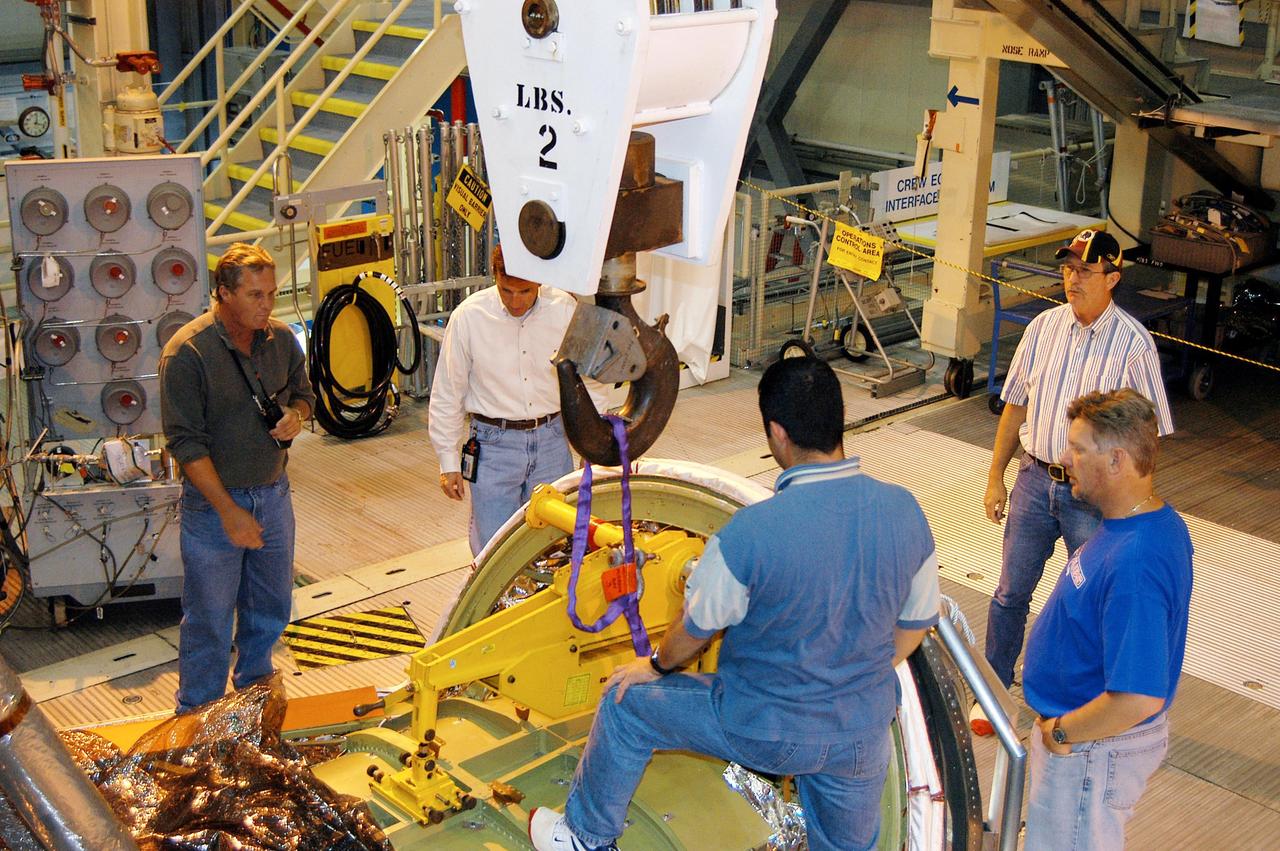
KENNEDY SPACE CENTER, FLA. - Workers in the Orbiter Processing Facility get ready to remove Ground Support Equipment used to install Discovery’s nose cap on Friday. The nose cap had been removed from the vehicle in the summer of 2003 and returned to the vendor, where it underwent numerous forms of Non-Destructive Evaluation. These tests included X-ray, ultrasound and eddy current to ensure its structural integrity prior to installation on the vehicle. The nose cap was also recoated. Once returned to KSC, new Thermal Protection System blankets were assembled inside of the nose cap and thermography was performed prior to installation on the orbiter.
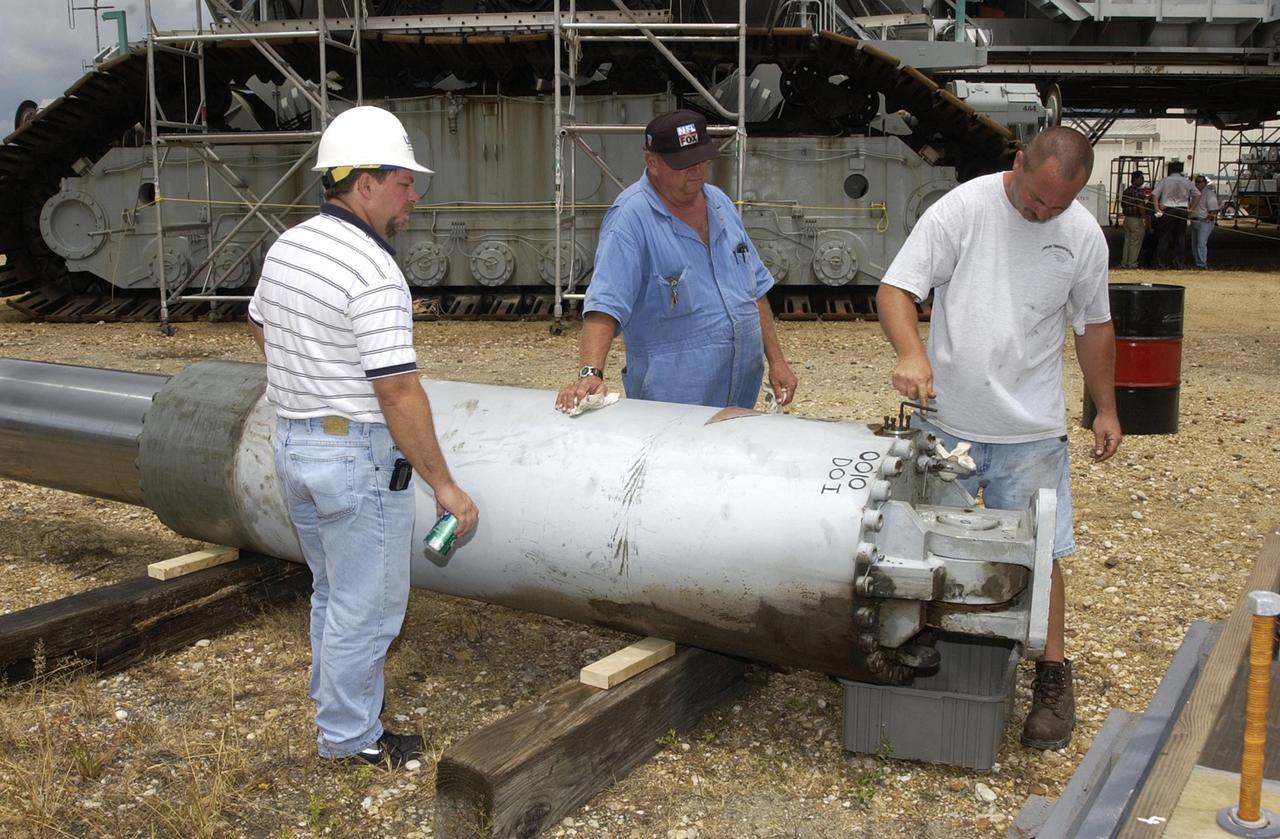
KENNEDY SPACE CENTER, FLA. -- Technicians check out a jacking, equalization and leveling (JEL) cylinders from Crawler-Transporter No. 2. During inspections, technicians removed two of the 16 JEL cylinders on the vehicle to gain access to the bearings for routine maintenance and found three of the four bearings had cracks. Of the three bearings, two had extensive damage. Further eddy current inspections indicate that cracks are present on 15 of the bearings. There are 16 cylinders and 32 bearings per crawler. Although no cause for the cracks is known at this time, engineers are currently evaluating the situation to determine the most appropriate solution. The crawler is in the background.
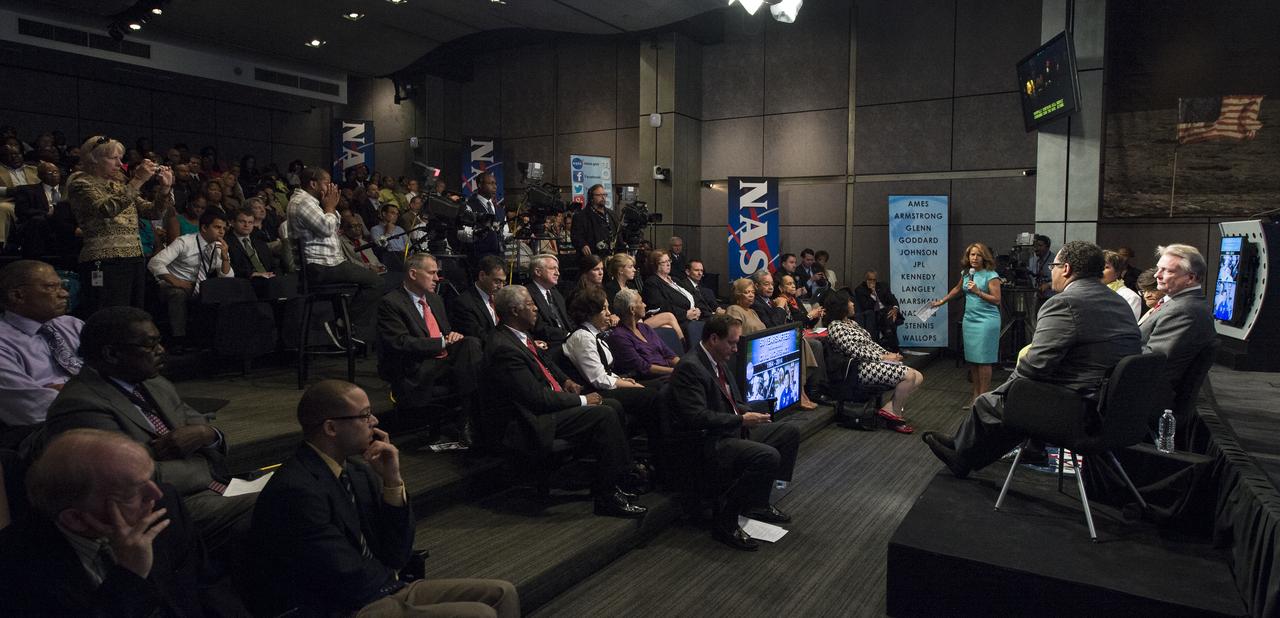
Members of the audience listen as U.S. Representative Eddie Bernice Johnson, of Texas; Dr. Harriet Jenkins, Former Assistant Administrator for Equal Opportunity Programs at NASA; Dr. Roger Launius, Associate Director of Collections and Curatorial Affairs at the Smithsonian National Air and Space Museum; and Dr. Michael Eric Dyson, a professor of sociology at Georgetown University; speak on a panel moderated by Suzanne Malveaux, of CNN, at an event celebrating the 50th Anniversary of the Civil Rights Act of 1964 on Monday, June 23, 2014 in the James E. Webb Auditorium at NASA Headquarters in Washington, DC. The event highlighted the influence of the Civil Rights Act on NASA. Photo Credit: (NASA/Joel Kowsky)
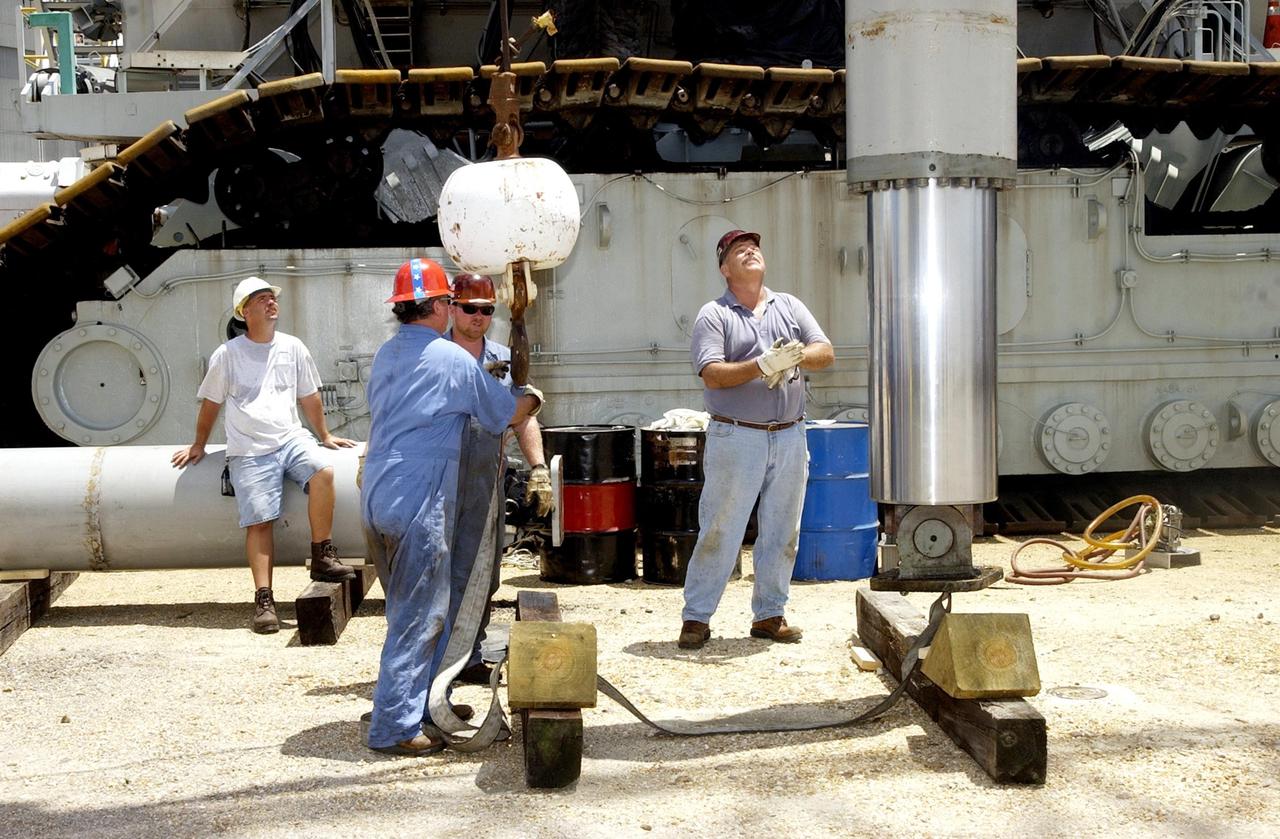
KENNEDY SPACE CENTER, FLA. -- Technicians closely monitor a jacking, equalization and leveling (JEL) cylinder and bearing from Crawler-Transporter No. 2 as it lowered by a crane to a position on the ground. During routine maintenance inspections last week, technicians removed two of the 16 JEL cylinders on the crawler to gain access to the bearings and found three of the four bearings cracked. Further eddy current inspections indicated that cracks are present on 15 of the bearings. There are 16 cylinders and 32 bearings per crawler. Engineers are evaluating the situation to determine the cause of the cracks and an appropriate solution to the problem.
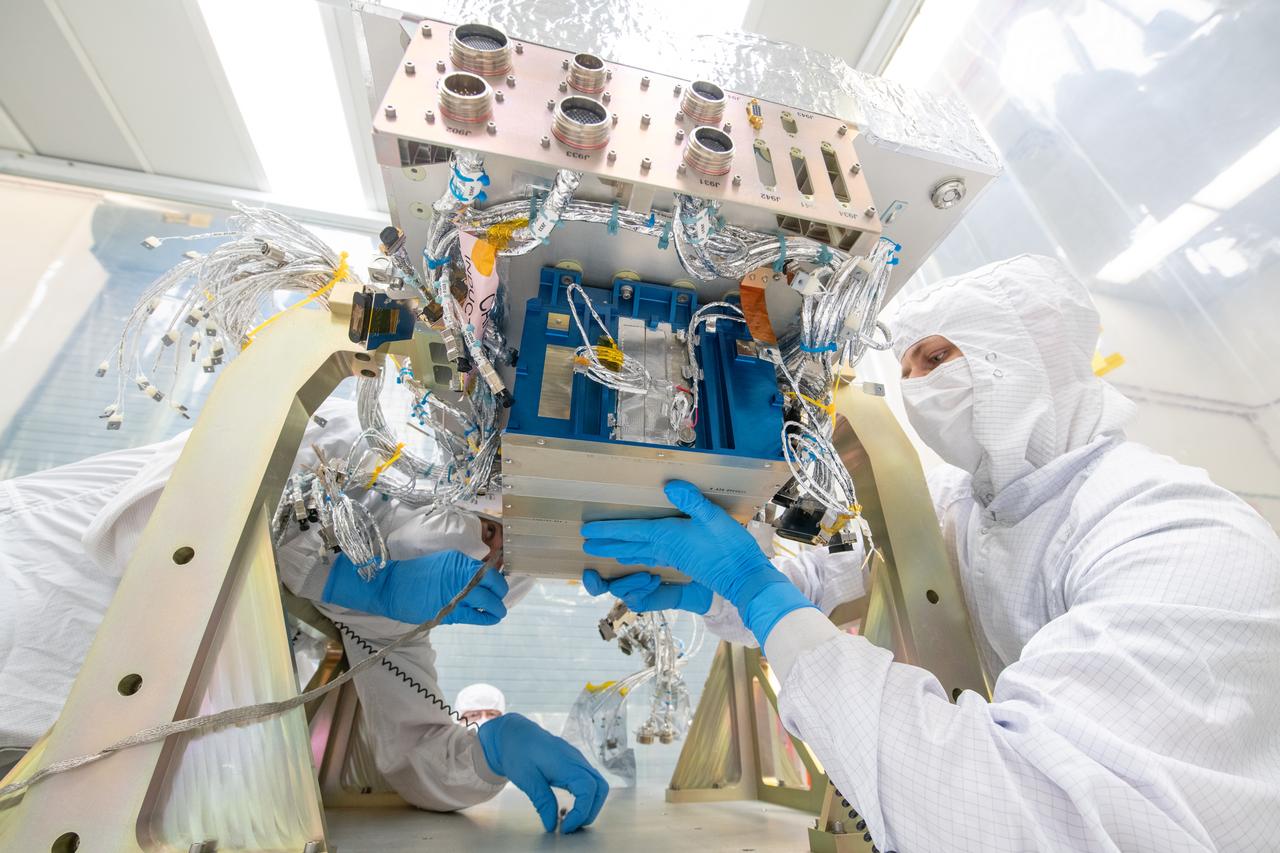
Mechanical technicians, Thomas Huber and Joseph Eddy, integrate an electronics box to the Ocean Color Instrument (OCI) flight deck in preparation for electrical connections and testing. OCI is a highly advanced optical spectrometer that will be used to measure properties of light over portions of the electromagnetic spectrum. It will enable continuous measurement of light at finer wavelength resolution than previous NASA satellite sensors, extending key system ocean color data records for climate studies. OCI is PACE's (Plankton, Aerosol, Cloud, ocean Ecosystem) primary sensor built at Goddard Space Flight Center in Greenbelt, MD.
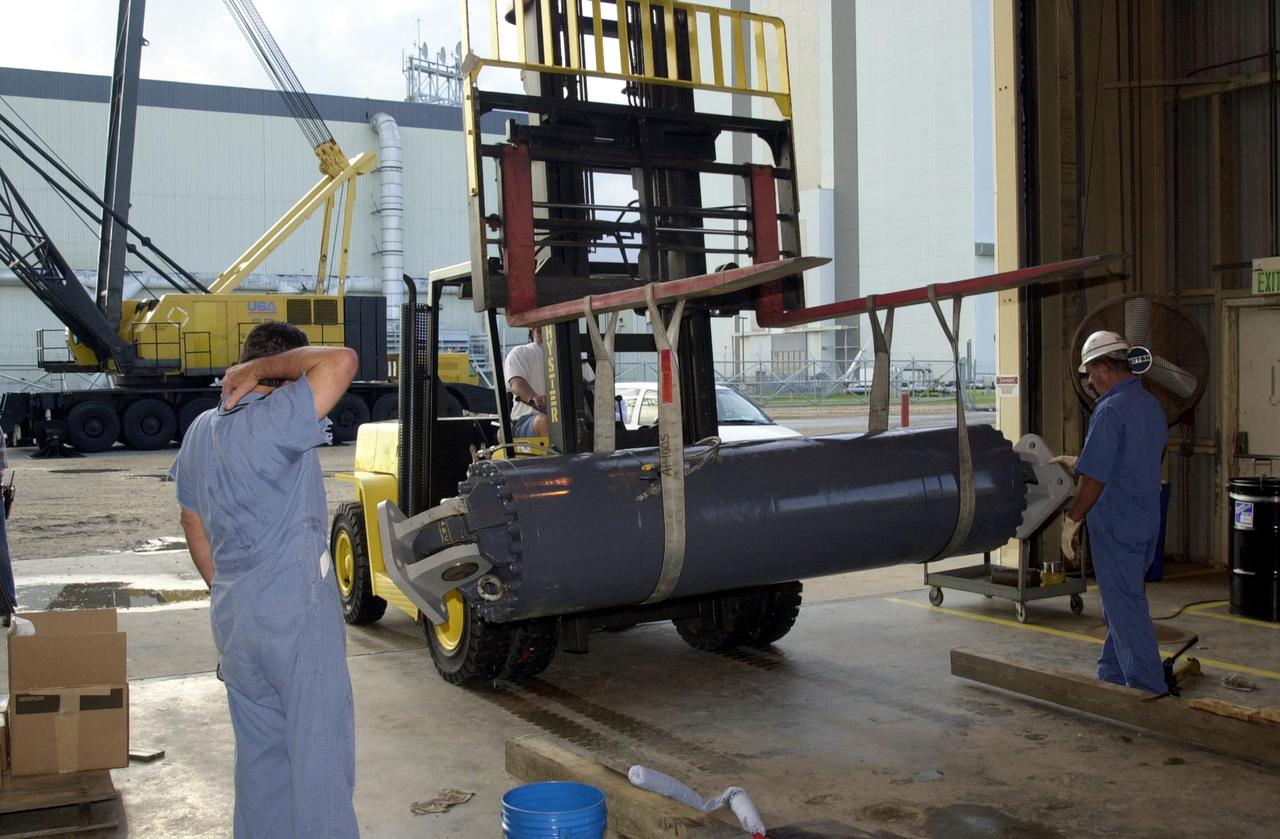
KENNEDY SPACE CENTER, FLA. -- One of the repaired Jacking, Equalization and Leveling (JEL) cylinders is moved from the repair site for installation into Crawler Transporter No. 2. There are 16 cylinders and 32 bearings per crawler. During recent routine maintenance inspections, technicians removed two of the 16 JEL cylinders on the crawler to gain access to the bearings and found three of the four bearings cracked. Further eddy current inspections indicated that cracks were present on 15 of the bearings.. Technicians have removed and replaced 14 of the bearings on CT-2, which is being repaired in order to enable Atlantis' rollout for mission STS-112, scheduled for launch no earlier than Oct. 2.
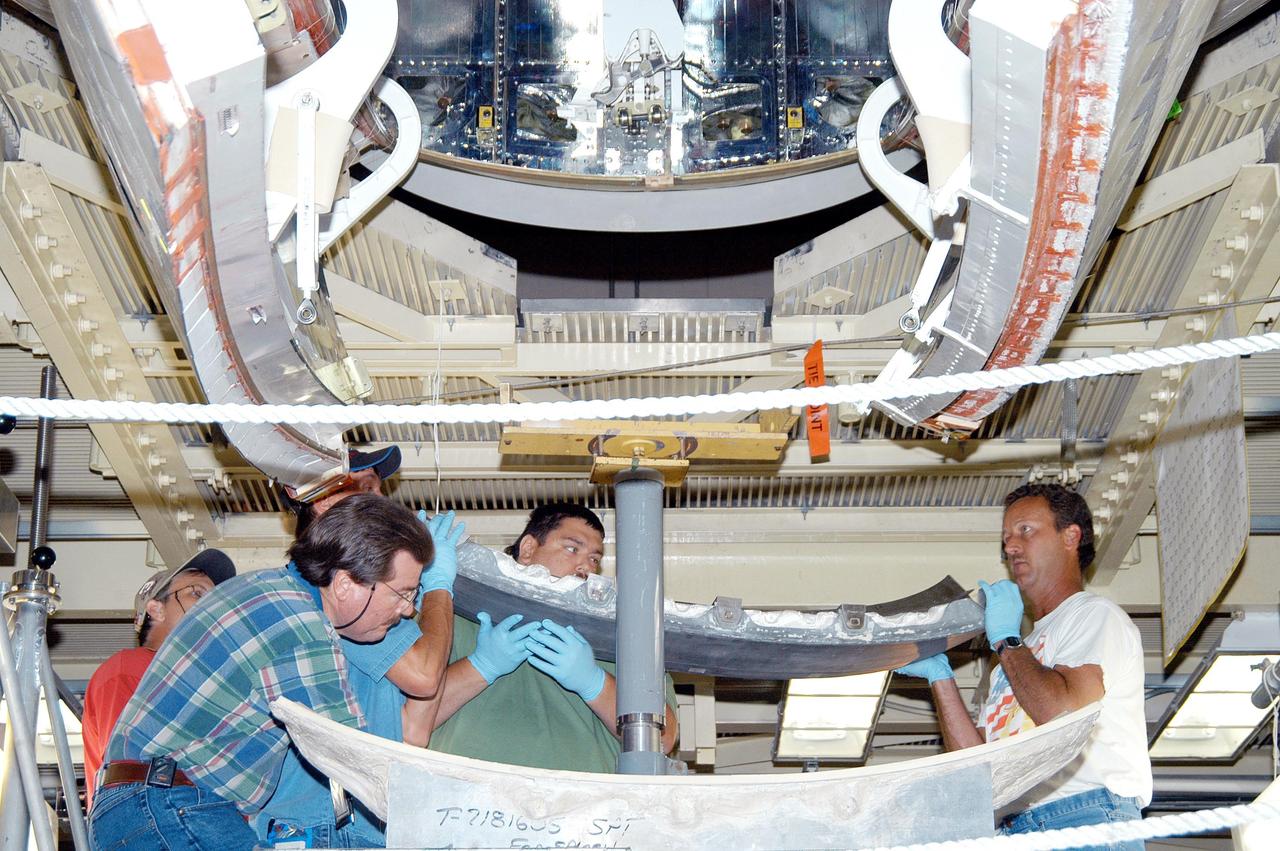
KENNEDY SPACE CENTER, FLA. - Workers in the Orbiter Processing Facility lift the Reinforced Carbon-Carbon (RCC) chin panel to install on Discovery. The chin panel is the smile-shaped section of RCC directly below the nose cap that provides a thermal barrier during re-entry. The nose cap, with chin panel, was removed from the vehicle in the summer of 2003 and returned to the vendor, where it underwent numerous forms of Non-Destructive Evaluation. These tests included X-ray, ultrasound and eddy current to ensure its structural integrity prior to reinstallation. Discovery is designated as the Return to Flight vehicle for mission STS-114, no earlier than March 2005.
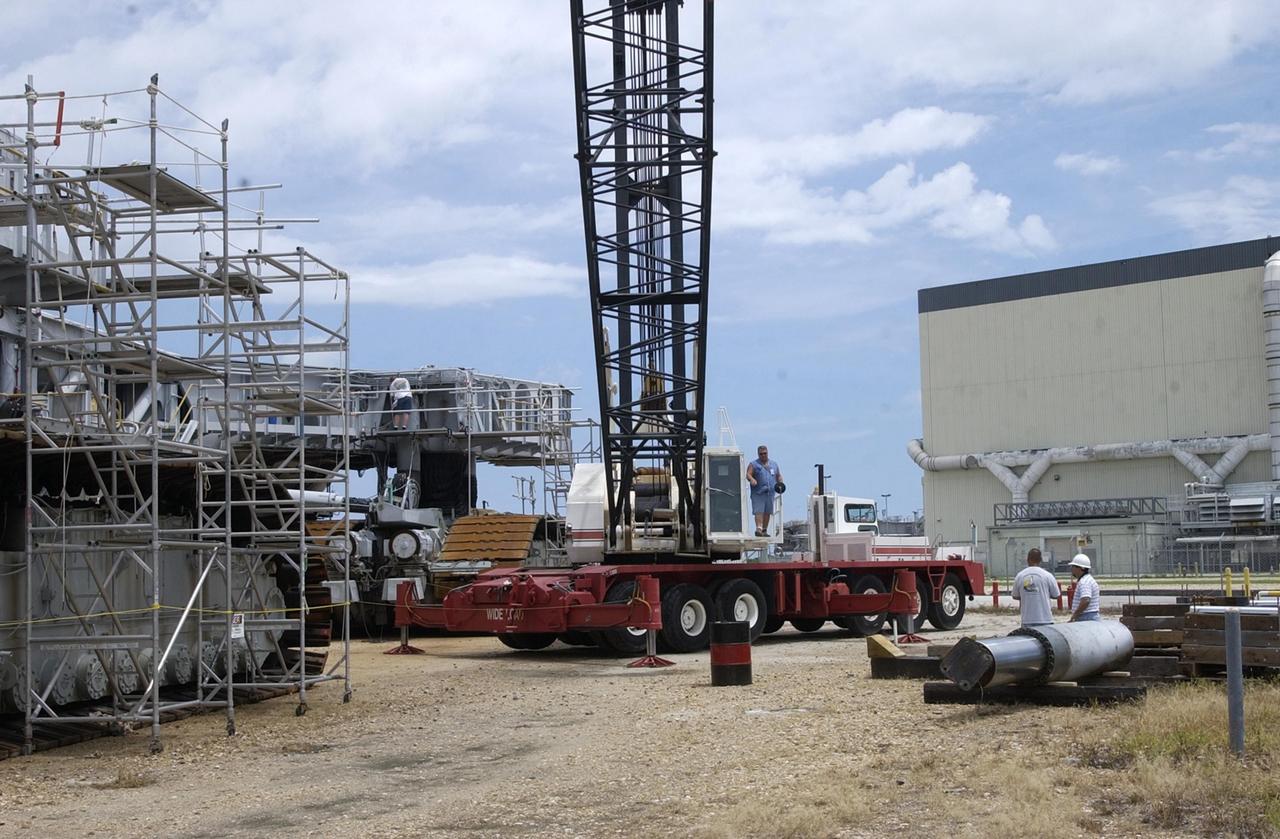
KENNEDY SPACE CENTER, FLA. -- A crane operator (center) talks with technicians (right) standing next to one of the jacking, equalization and leveling (JEL) cylinders from Crawler-Transporter No. 2. During inspections, technicians removed two of the 16 JEL cylinders on the vehicle to gain access to the bearings for routine maintenance and found three of the four bearings had cracks. Of the three bearings, two had extensive damage. Further eddy current inspections indicate that cracks are present on 15 of the bearings. There are 16 cylinders and 32 bearings per crawler. Although no cause for the cracks is known at this time, engineers are currently evaluating the situation to determine the most appropriate solution.
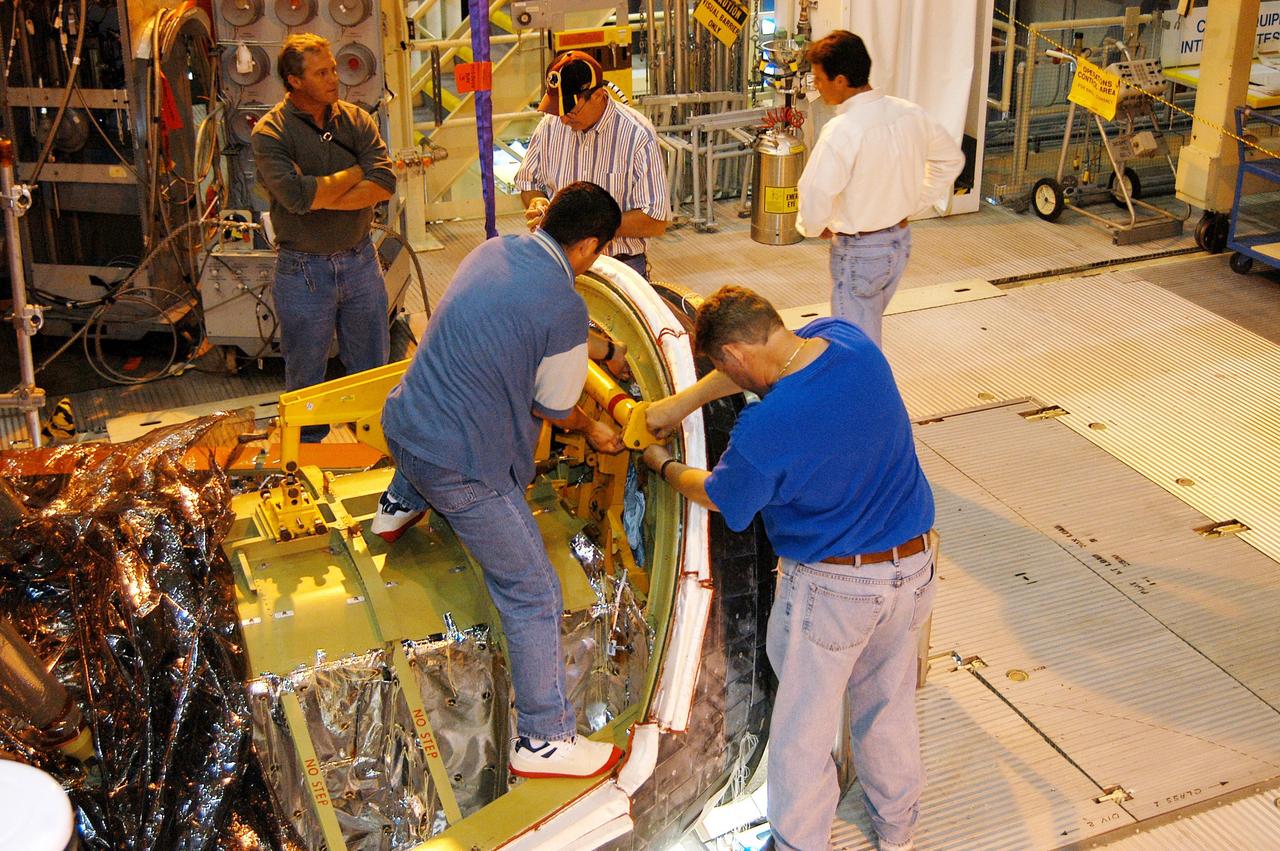
KENNEDY SPACE CENTER, FLA. - Workers in the Orbiter Processing Facility remove Ground Support Equipment used to install Discovery’s nose cap on Friday. The nose cap had been removed from the vehicle in the summer of 2003 and returned to the vendor, where it underwent numerous forms of Non-Destructive Evaluation. These tests included X-ray, ultrasound and eddy current to ensure its structural integrity prior to installation on the vehicle. The nose cap was also recoated. Once returned to KSC, new Thermal Protection System blankets were assembled inside of the nose cap and thermography was performed prior to installation on the orbiter.

KENNEDY SPACE CENTER, FLA. -- Perry Becker, an engineer with NASA, looks at a spacer on the bearing in one of the jacking, equalization and leveling (JEL) cylinders on Crawler-Transporter No. 2. During inspections, technicians removed two of the 16 JEL cylinders on the vehicle to gain access to the bearings for routine maintenance and found three of the four bearings had cracks. Of the three bearings, two had extensive damage. Further eddy current inspections indicate that cracks are present on 15 of the bearings. There are 16 cylinders and 32 bearings per crawler. Although no cause for the cracks is known at this time, engineers are currently evaluating the situation to determine the most appropriate solution.
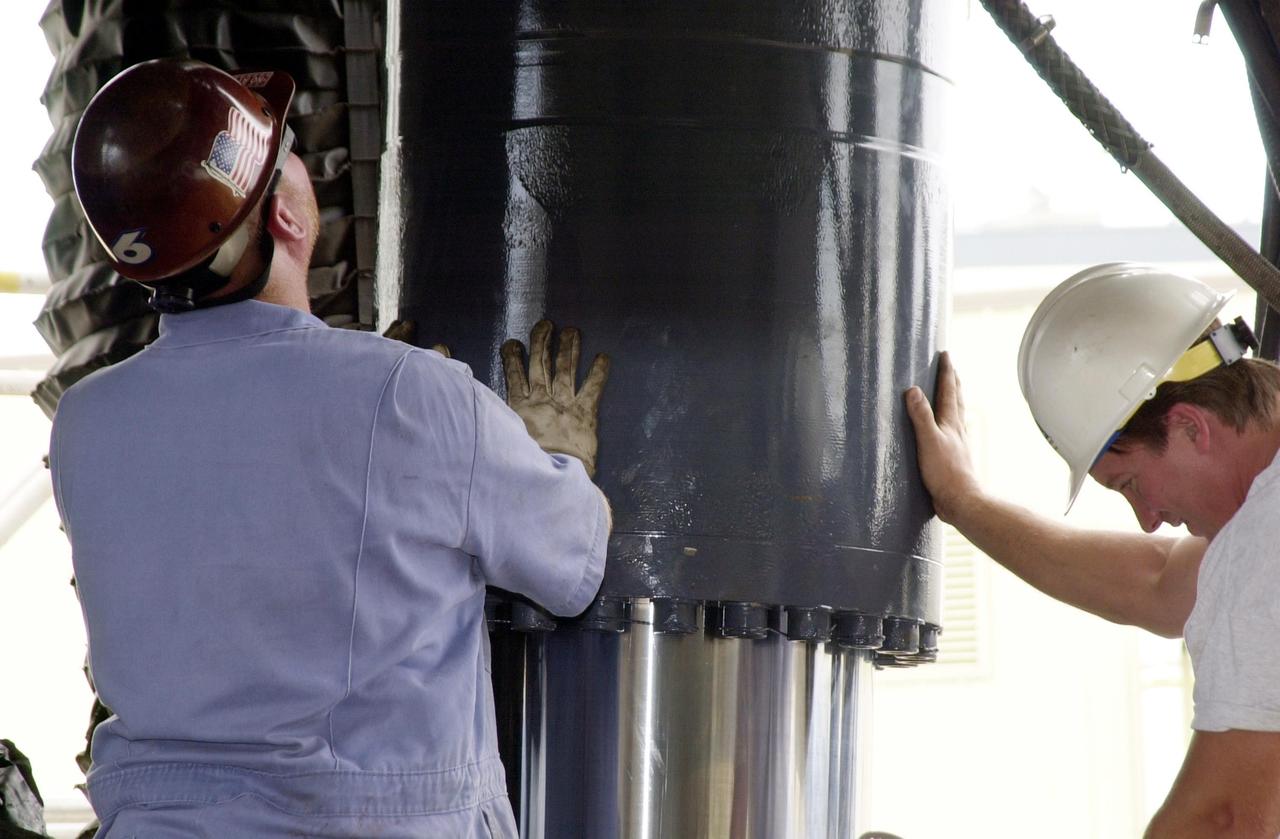
KENNEDY SPACE CENTER, FLA. -- Two workers help maneuver a repaired Jacking, Equalization and Leveling (JEL) cylinder as it is lowered into place on Crawler Transporter No. 2. There are 16 cylinders and 32 bearings per crawler. During recent routine maintenance inspections, technicians removed two of the 16 JEL cylinders on the crawler to gain access to the bearings and found three of the four bearings cracked. Further eddy current inspections indicated that cracks were present on 15 of the bearings.. Technicians have removed and replaced 14 of the bearings on CT-2, which is being repaired in order to enable Atlantis' rollout for mission STS-112, scheduled for launch no earlier than Oct. 2.
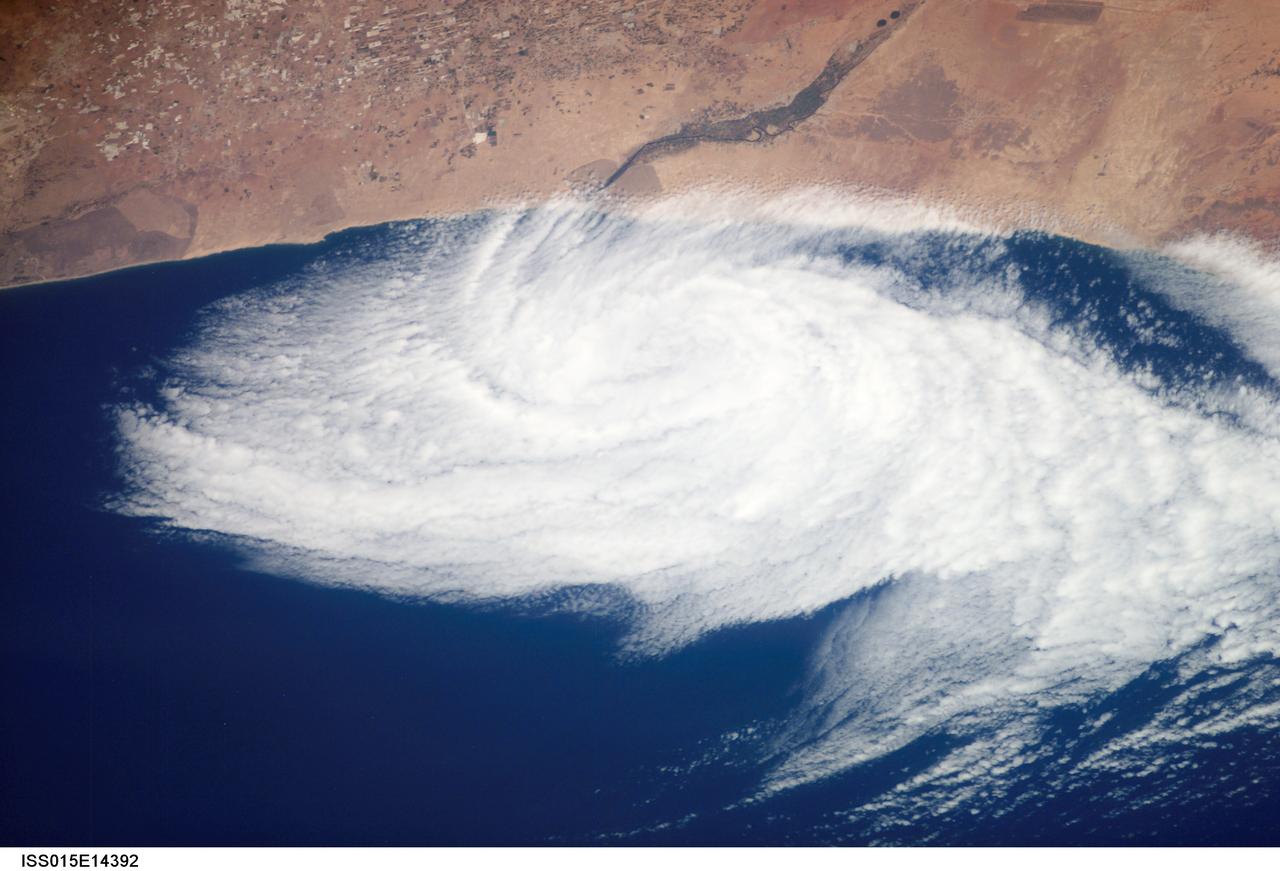
ISS015-E-14392 (26 June 2007) --- This nadir view from the International Space Station, photographed at 11:43 GMT on June 26, 2007, shows a weak low pressure area off the coast of Morocco, just south of Agadir (out of frame), near the Oued Massa River at about 30 degrees north latitude and 9.5 degrees west longitude. A low pressure area like this can be caused either by the winds forming an eddy due to some land feature or a heat low has drifted off the coast.
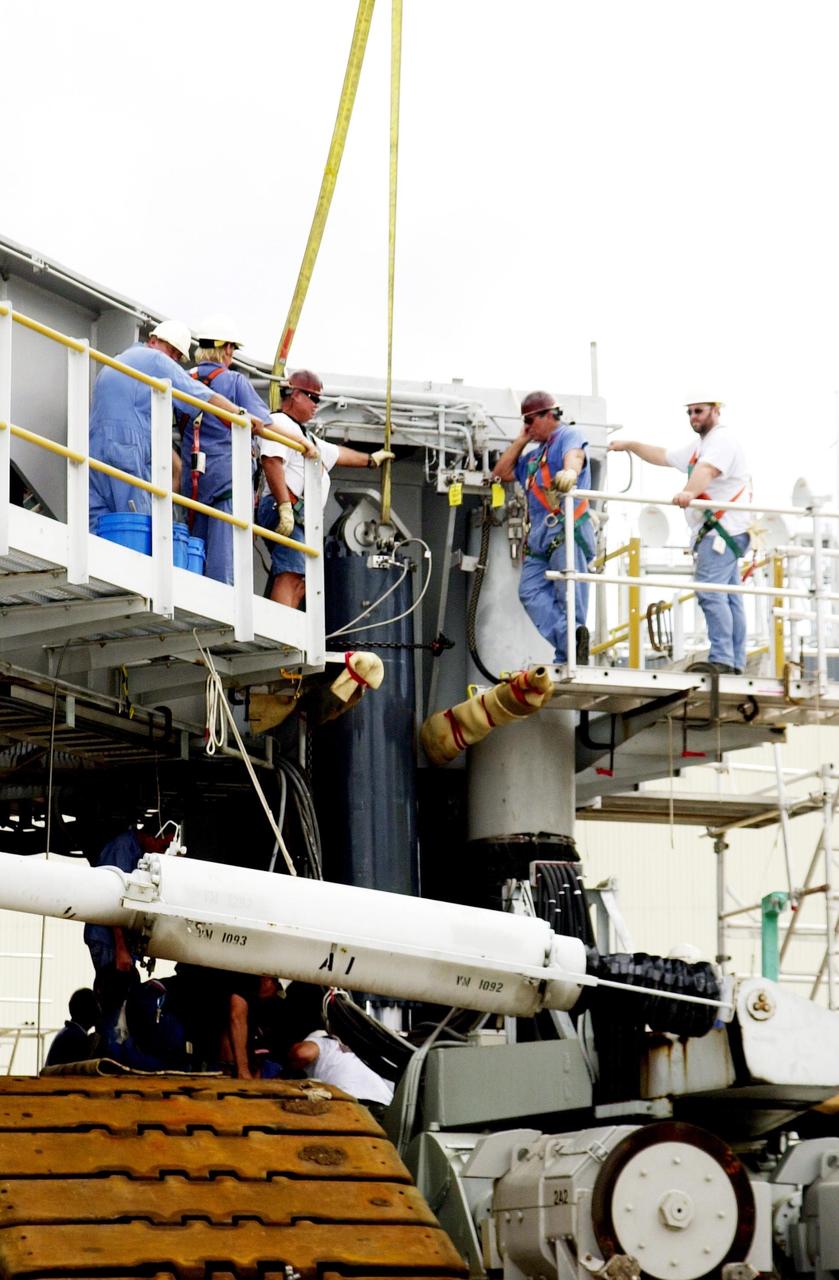
KENNEDY SPACE CENTER, FLA. -- Near the bottom of the repaired Jacking, Equalization and Leveling (JEL) cylinder, workers fasten the JEL to Crawler Transporter No. 2. There are 16 cylinders and 32 bearings per crawler. During recent routine maintenance inspections, technicians removed two of the 16 JEL cylinders on the crawler to gain access to the bearings and found three of the four bearings cracked. Further eddy current inspections indicated that cracks were present on 15 of the bearings.. Technicians have removed and replaced 14 of the bearings on CT-2, which is being repaired in order to enable Atlantis' rollout for mission STS-112, scheduled for launch no earlier than Oct. 2.
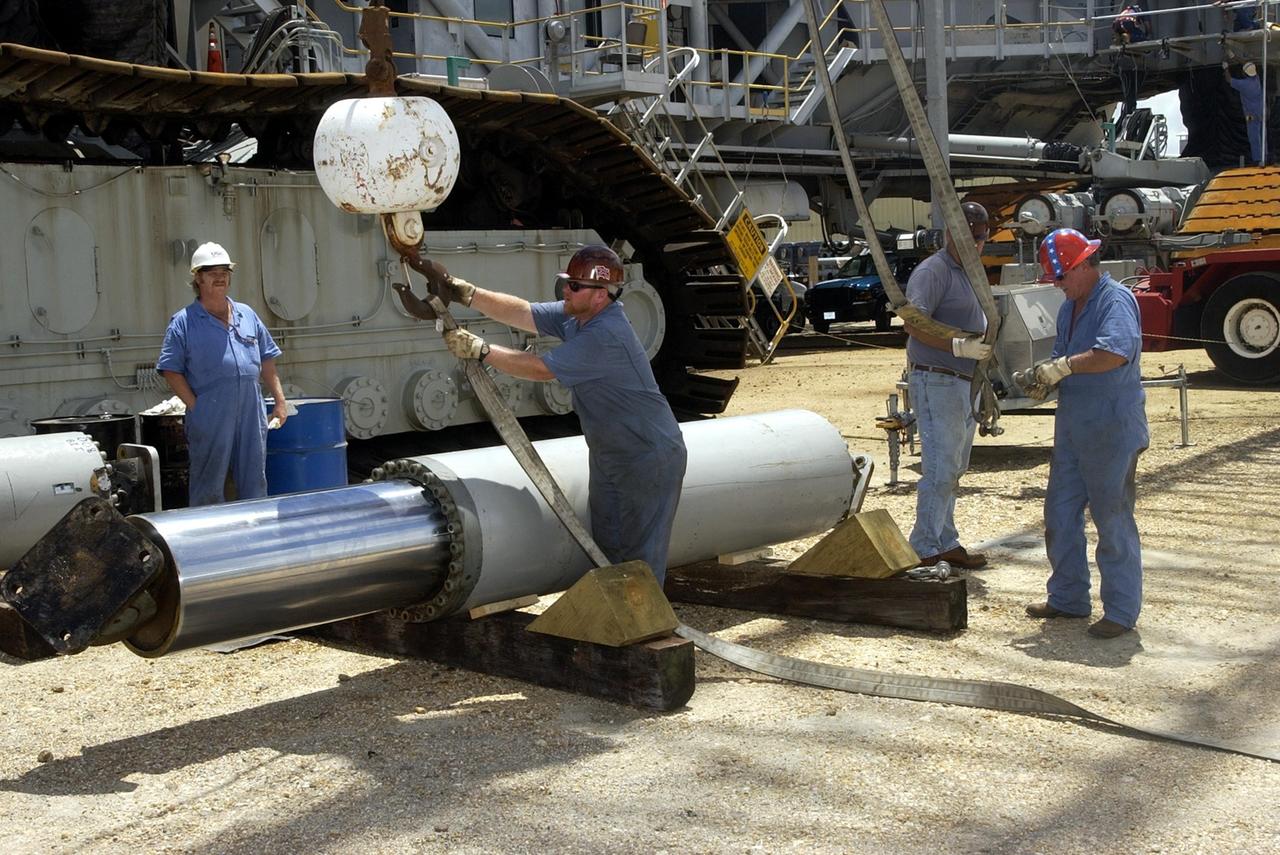
KENNEDY SPACE CENTER, FLA. -- Technicians remove the crane straps from a jacking, equalization and leveling (JEL) cylinder and bearing from Crawler-Transporter No. 2 after it is lowered by a crane to a resting position on the ground. During routine maintenance inspections last week, technicians removed two of the 16 JEL cylinders on the crawler to gain access to the bearings and found three of the four bearings cracked. Further eddy current inspections indicated that cracks are present on 15 of the bearings. There are 16 cylinders and 32 bearings per crawler. Engineers are evaluating the situation to determine the cause of the cracks and an appropriate solution to the problem.
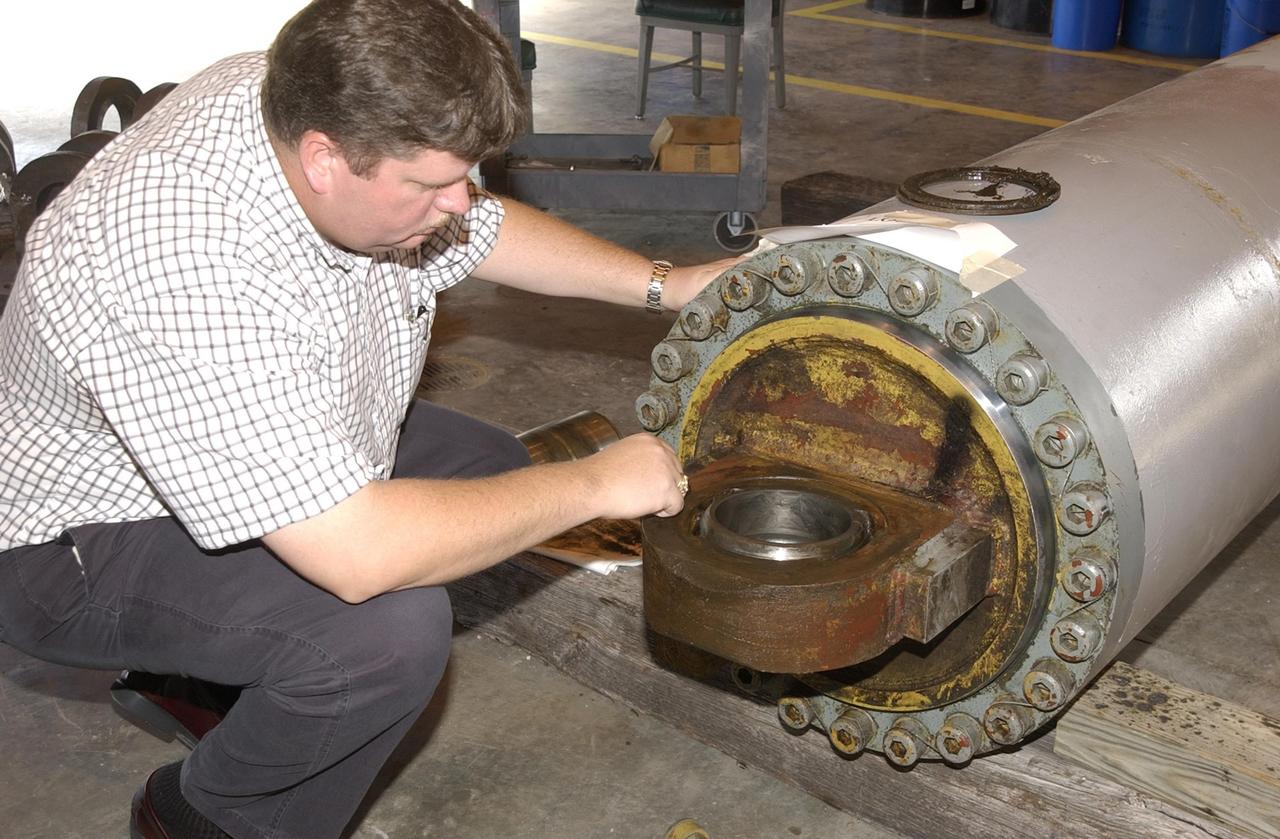
KENNEDY SPACE CENTER, FLA. -- Perry Becker, an engineer with NASA, looks at a bearing from one of the jacking, equalization and leveling (JEL) cylinders on Crawler-Transporter No. 2. During inspections, technicians removed two of the 16 JEL cylinders on the vehicle to gain access to the bearings for routine maintenance and found three of the four bearings had cracks. Of the three bearings, two had extensive damage. Further eddy current inspections indicate that cracks are present on 15 of the bearings. There are 16 cylinders and 32 bearings per crawler. Although no cause for the cracks is known at this time, engineers are currently evaluating the situation to determine the most appropriate solution.

KENNEDY SPACE CENTER, FLA. - Workers in the Orbiter Processing Facility prepare the Reinforced Carbon-Carbon (RCC) chin panel to install on Discovery. The chin panel is the smile-shaped section of RCC directly below the nose cap that provides a thermal barrier during re-entry. The nose cap, with chin panel, was removed from the vehicle in the summer of 2003 and returned to the vendor, where it underwent numerous forms of Non-Destructive Evaluation. These tests included X-ray, ultrasound and eddy current to ensure its structural integrity prior to reinstallation. Discovery is designated as the Return to Flight vehicle for mission STS-114, no earlier than March 2005.
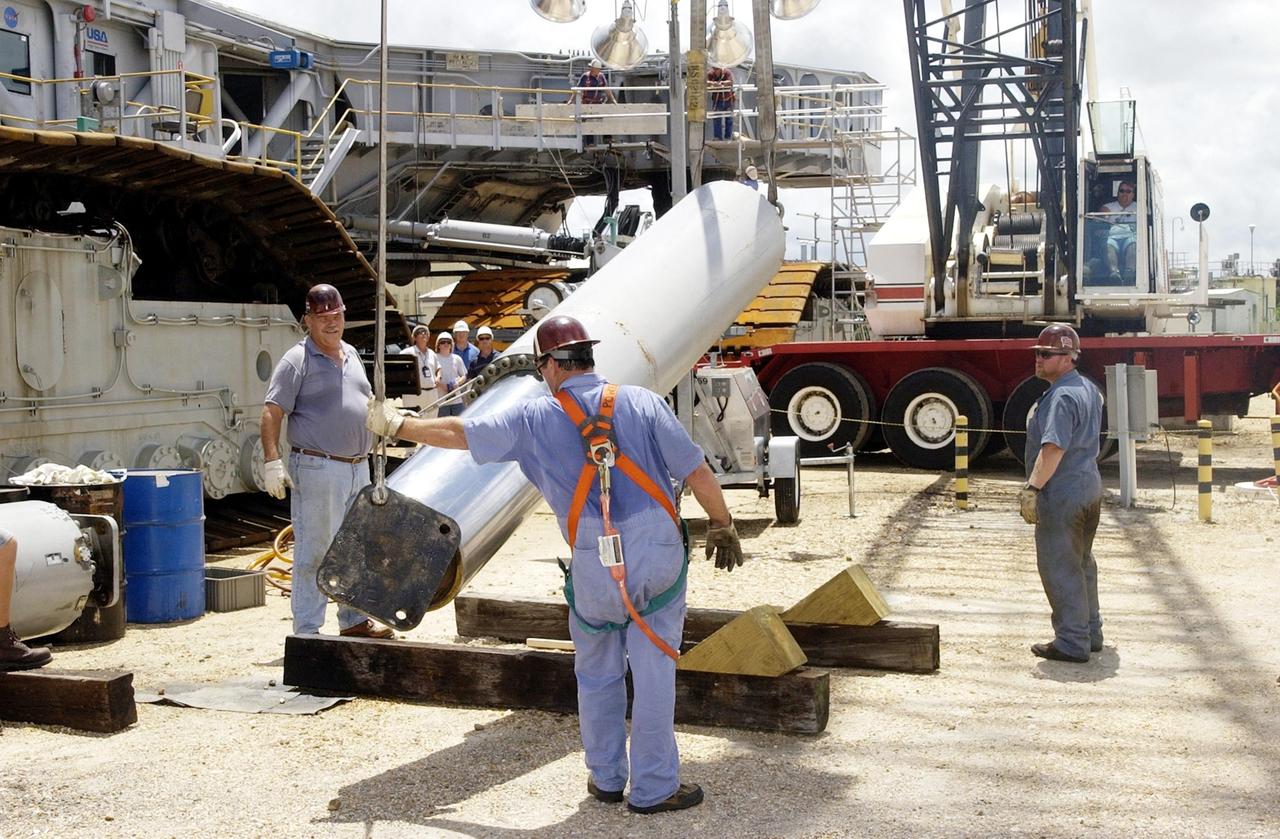
KENNEDY SPACE CENTER, FLA. -- A technician holds a crane strap to steady and guide a jacking, equalization and leveling (JEL) cylinder and bearing from Crawler-Transporter No. 2 as it is lowered by a crane to a resting position on the ground. During routine maintenance inspections last week, technicians removed two of the 16 JEL cylinders on the crawler to gain access to the bearings and found three of the four bearings cracked. Further eddy current inspections indicated that cracks are present on 15 of the bearings. There are 16 cylinders and 32 bearings per crawler. Engineers are evaluating the situation to determine the cause of the cracks and an appropriate solution to the problem.
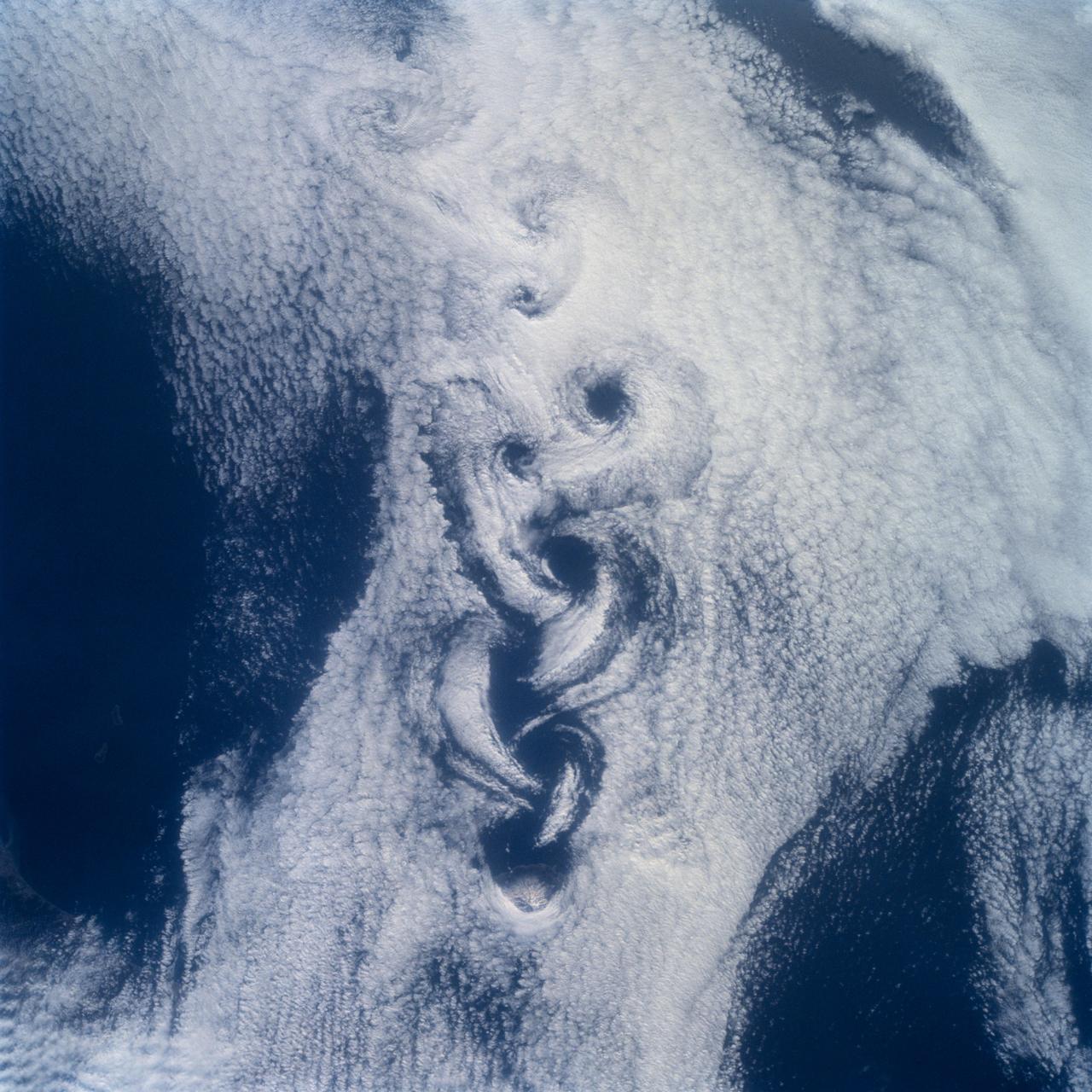
STS100-710-182 (19 April-1 May 2001) --- Easily recognizable in this STS-100 70mm frame are phenomena known as the von Karman vortices, which were forming in the stratocumulus field downwind from the volcanic island of Rishiri-to in the northern Sea of Japan off the northwest coast of Hokkaido, Japan. According to NASA scientists studying the STS-100 photo collection, these features form when a stable atmosphere with low clouds flows past a relatively small obstacle with a height greater than the depth of the cloud layer. Because the atmosphere is stable, a series of eddies form in the moving cloud field.
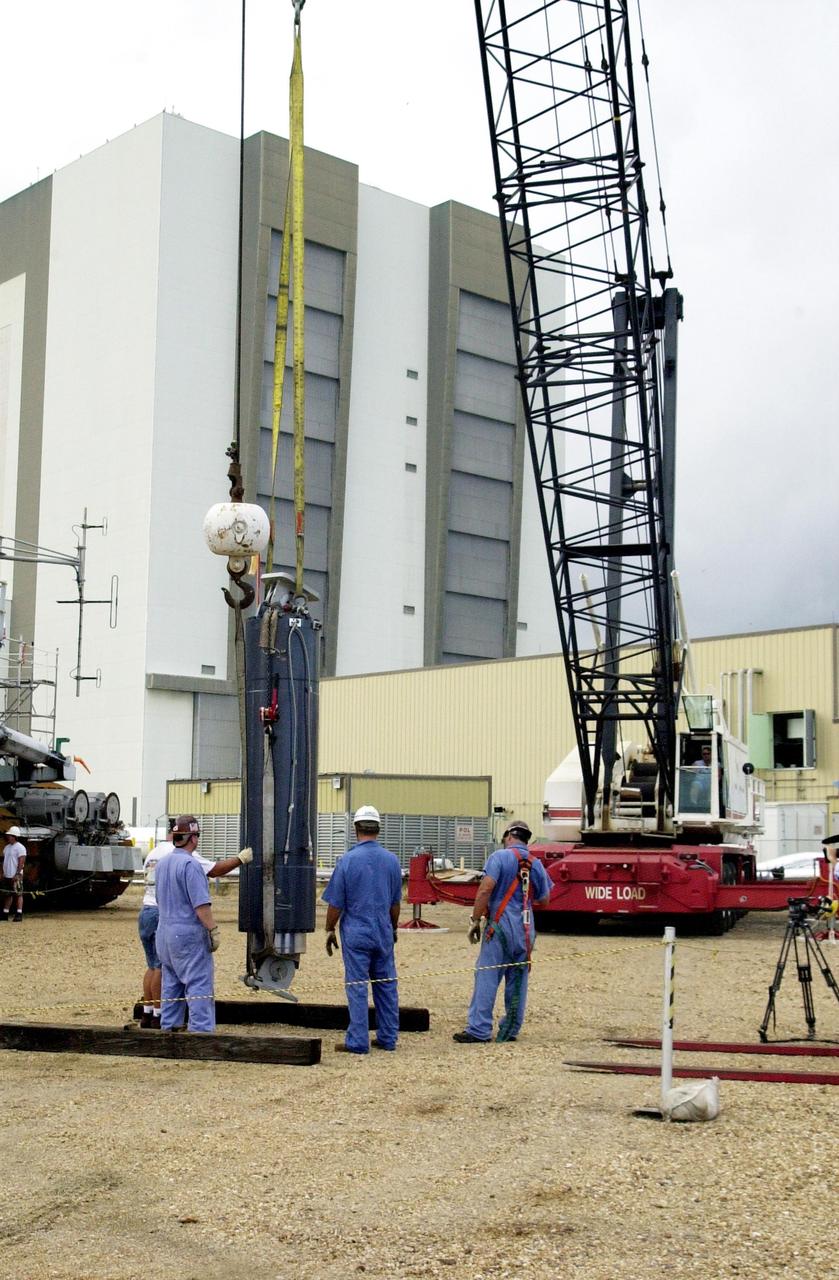
KENNEDY SPACE CENTER, FLA. -- A crane lifts the repaired Jacking, Equalization and Leveling (JEL) cylinder to move into to Crawler Transporter No. 2. There are 16 cylinders and 32 bearings per crawler. During recent routine maintenance inspections, technicians removed two of the 16 JEL cylinders on the crawler to gain access to the bearings and found three of the four bearings cracked. Further eddy current inspections indicated that cracks were present on 15 of the bearings.. Technicians have removed and replaced 14 of the bearings on CT-2, which is being repaired in order to enable Atlantis' rollout for mission STS-112, scheduled for launch no earlier than Oct. 2.
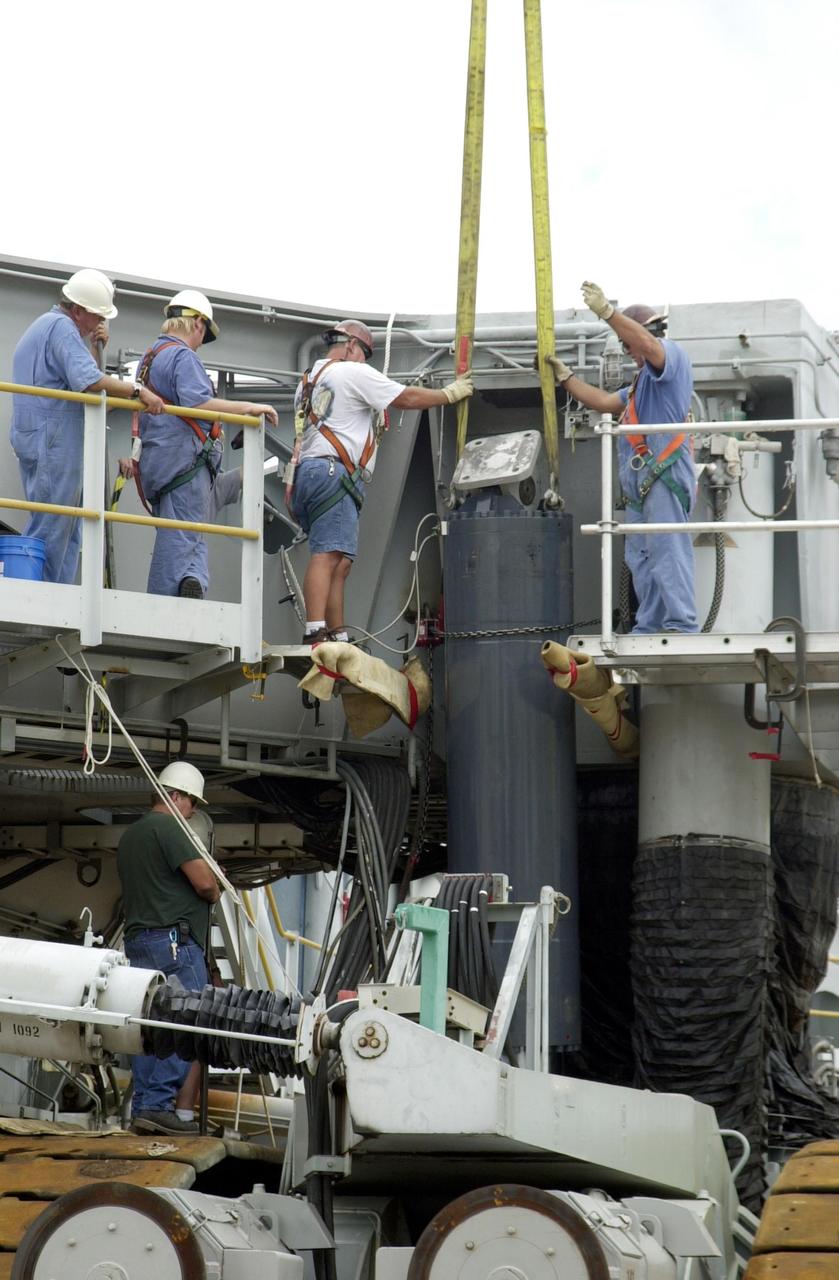
KENNEDY SPACE CENTER, FLA. -- Workers on Crawler Transporter No. 2 help guide a repaired Jacking, Equalization and Leveling (JEL) cylinder into place. There are 16 cylinders and 32 bearings per crawler. During recent routine maintenance inspections, technicians removed two of the 16 JEL cylinders on the crawler to gain access to the bearings and found three of the four bearings cracked. Further eddy current inspections indicated that cracks were present on 15 of the bearings. Technicians have removed and replaced 14 of the bearings on CT-2, which is being repaired in order to enable Atlantis' rollout for mission STS-112, scheduled for launch no earlier than Oct. 2.
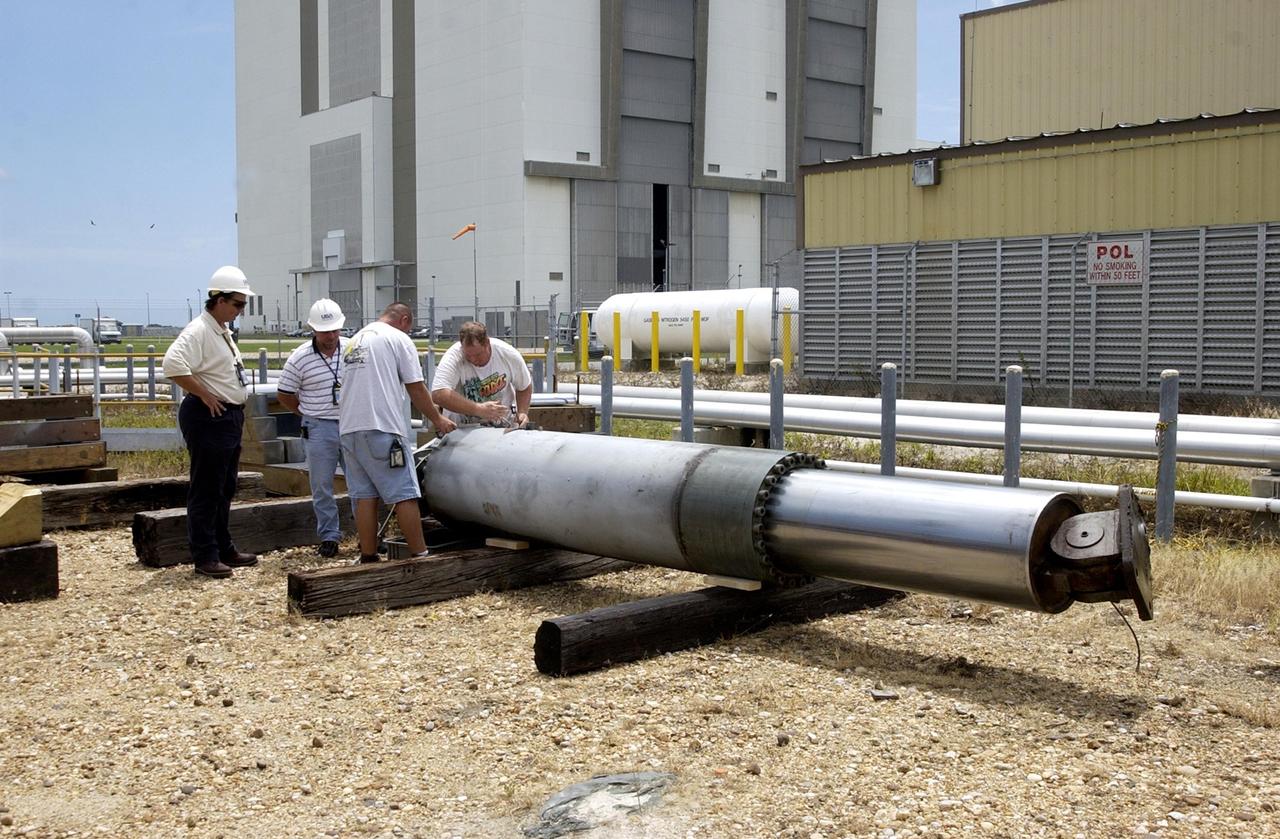
KENNEDY SPACE CENTER, FLA. -- Technicians check out a jacking, equalization and leveling (JEL) cylinders from Crawler-Transporter No. 2. During inspections, technicians removed two of the 16 JEL cylinders on the vehicle to gain access to the bearings for routine maintenance and found three of the four bearings had cracks. Of the three bearings, two had extensive damage. Further eddy current inspections indicate that cracks are present on 15 of the bearings. There are 16 cylinders and 32 bearings per crawler. Although no cause for the cracks is known at this time, engineers are currently evaluating the situation to determine the most appropriate solution.
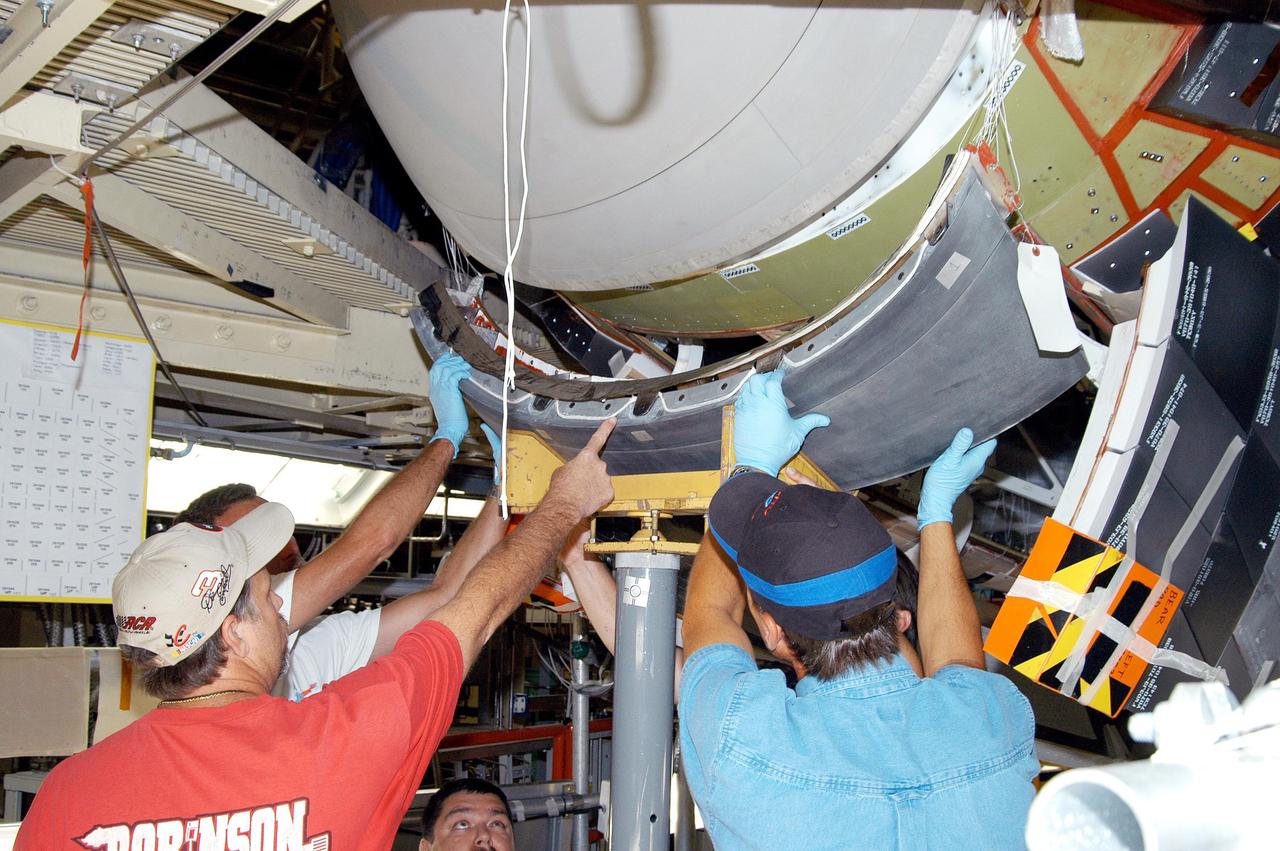
KENNEDY SPACE CENTER, FLA. - - Workers in the Orbiter Processing Facility check the placement of the Reinforced Carbon-Carbon chin panel on Discovery. The chin panel is the smile-shaped section of RCC directly below the nose cap that provides a thermal barrier during re-entry. The nose cap, with chin panel, was removed from the vehicle in the summer of 2003 and returned to the vendor, where it underwent numerous forms of Non-Destructive Evaluation. These tests included X-ray, ultrasound and eddy current to ensure its structural integrity prior to reinstallation. Discovery is designated as the Return to Flight vehicle for mission STS-114, no earlier than March 2005.
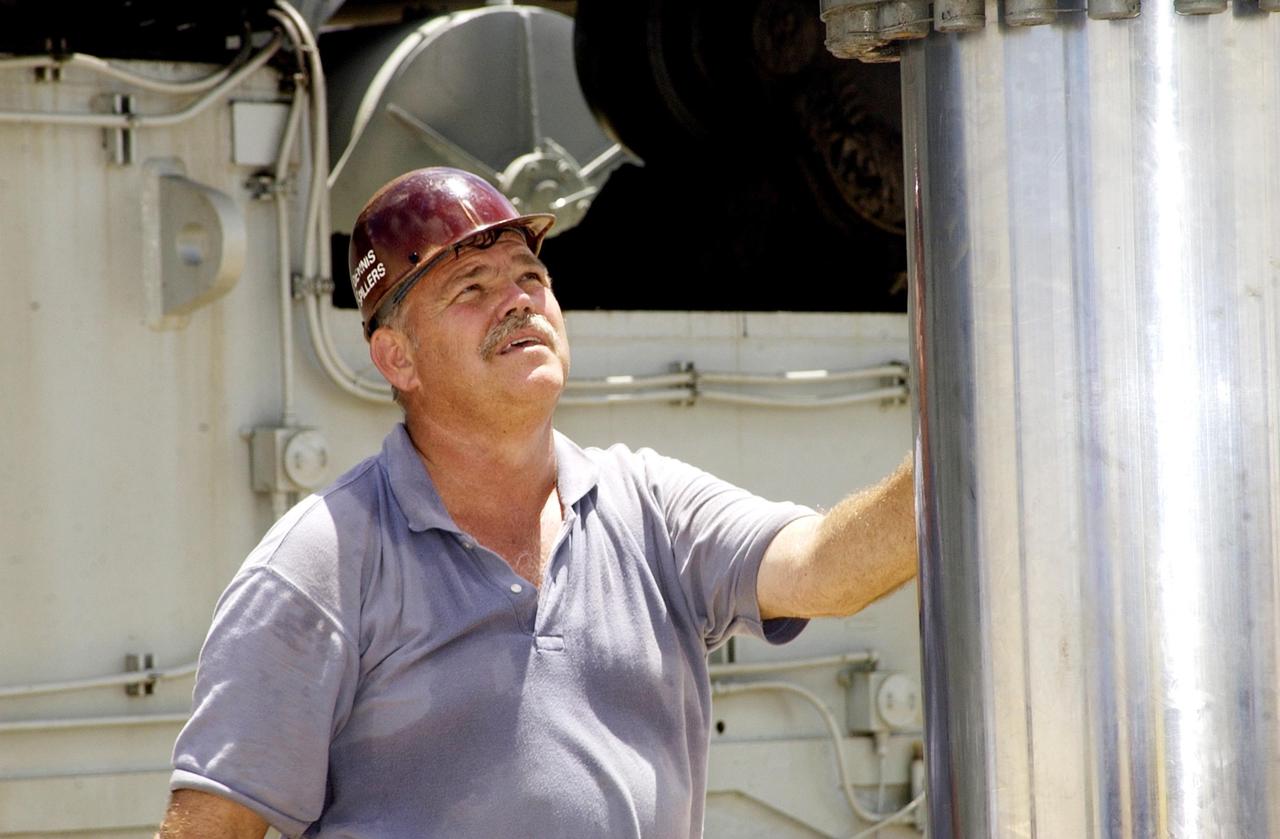
KENNEDY SPACE CENTER, FLA. -- A technician steadies a jacking, equalization and leveling (JEL) cylinder and bearing from Crawler-Transporter No. 2 as it is lowered by a crane to a position on the ground. During routine maintenance inspections last week, technicians removed two of the 16 JEL cylinders on the crawler to gain access to the bearings and found three of the four bearings cracked. Further eddy current inspections indicated that cracks are present on 15 of the bearings. There are 16 cylinders and 32 bearings per crawler. Engineers are evaluating the situation to determine the cause of the cracks and an appropriate solution to the problem.
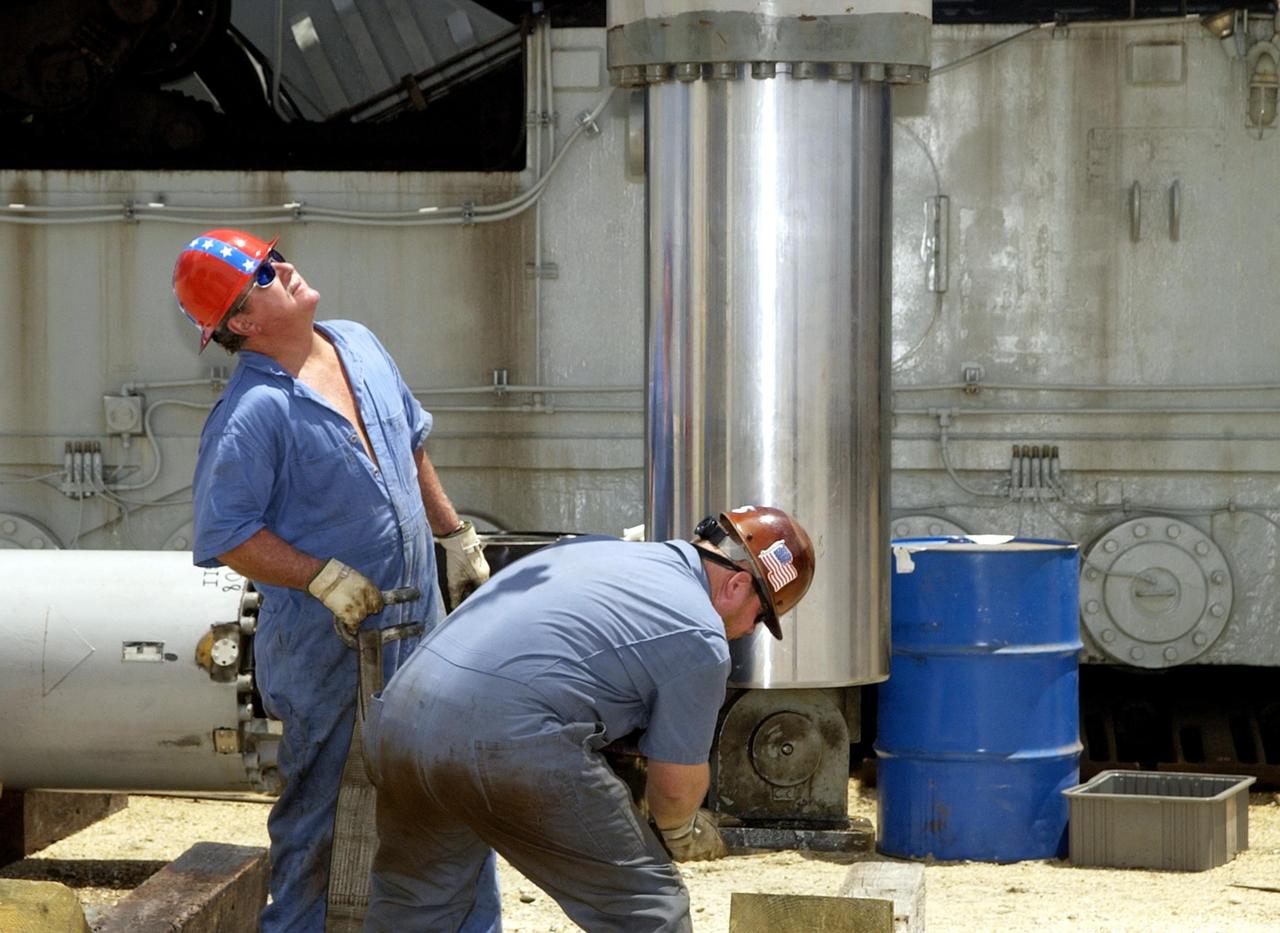
KENNEDY SPACE CENTER, FLA. -- Technicians closely monitor a jacking, equalization and leveling (JEL) cylinder and bearing from Crawler-Transporter No. 2 as it lowered by a crane to a position on the ground. During routine maintenance inspections last week, technicians removed two of the 16 JEL cylinders on the crawler to gain access to the bearings and found three of the four bearings cracked. Further eddy current inspections indicated that cracks are present on 15 of the bearings. There are 16 cylinders and 32 bearings per crawler. Engineers are evaluating the situation to determine the cause of the cracks and an appropriate solution to the problem.
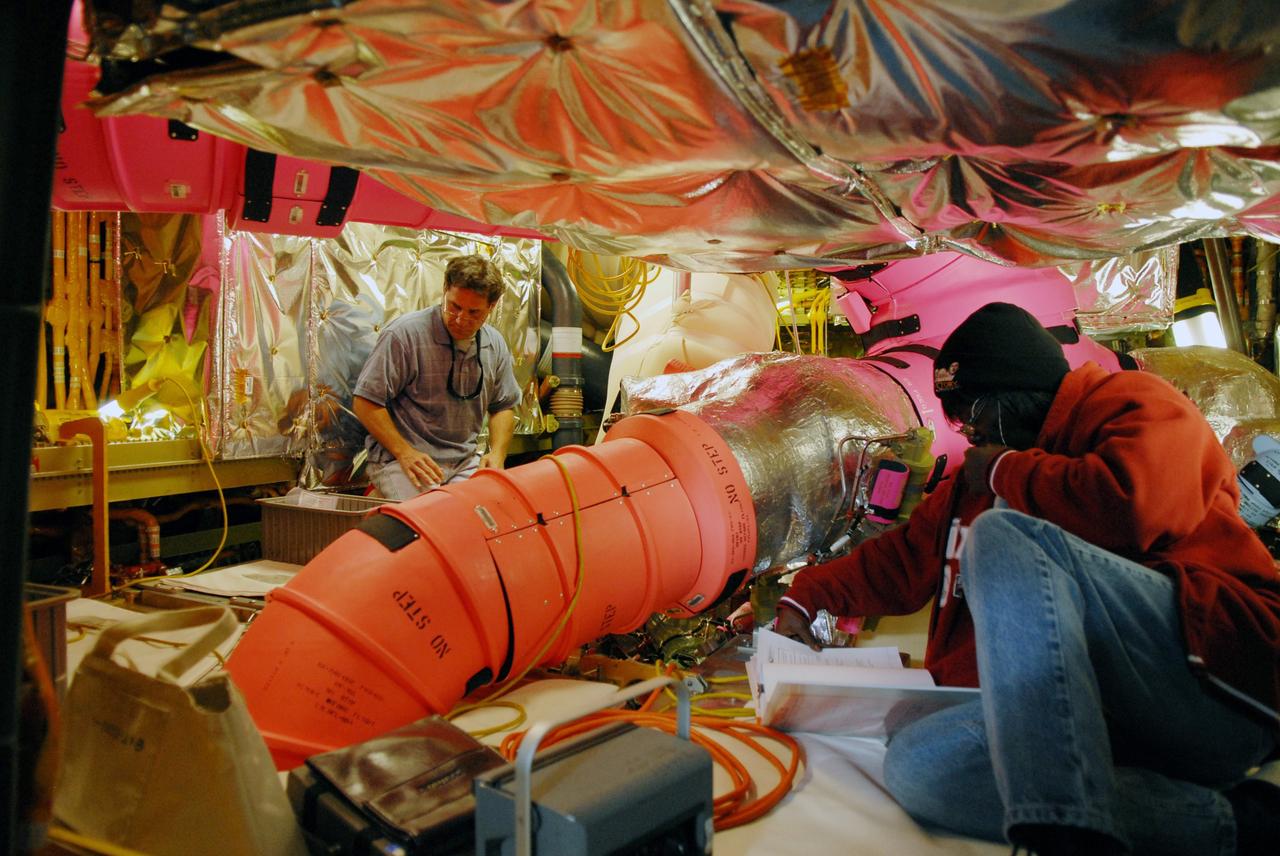
CAPE CANAVERAL, Fla. – On Launch Pad 39A at NASA's Kennedy Space Center in Florida, technicians install three gaseous hydrogen flow control valves on space shuttle Discovery. The valves were retested after installation. Part of the main propulsion system, the valves channel gaseous hydrogen from the main engines to the external tank. NASA and contractor teams have worked to identify what caused damage to a flow control valve on shuttle Endeavour during its November 2008 flight. Space Shuttle Program managers decided to replace Discovery's valves with others that have undergone a detailed eddy current inspection. Program managers will review the testing and determine whether to meet on March 6 for the Flight Readiness Review for the STS-119 mission. Launch of Discovery tentatively is targeted for March 12. Photo credit: NASA/Chris Rhodes
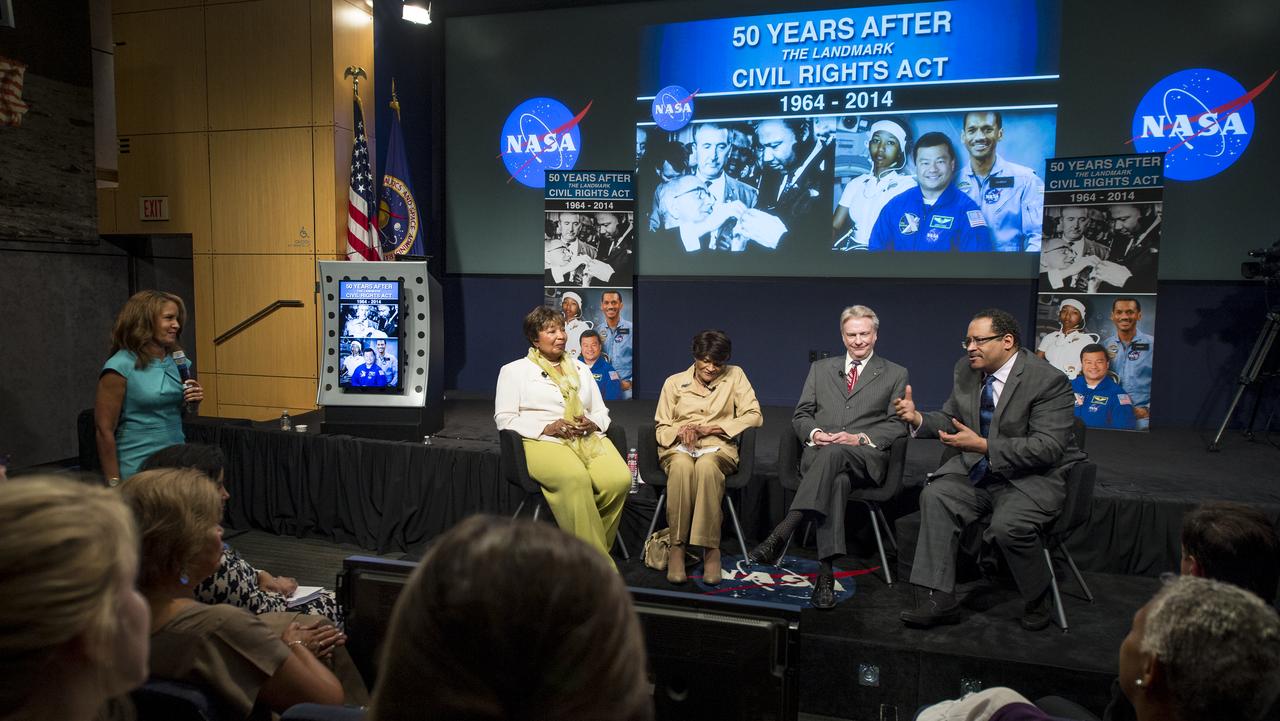
Dr. Michael Eric Dyson, a professor of sociology at Georgetown University, left; speaks as part of a panel discussion at an event celebrating the 50th Anniversary of the Civil Rights Act of 1964 on Monday, June 23, 2014 in the James E. Webb Auditorium at NASA Headquarters in Washington, DC. The panel was moderated by Suzanne Malveaux, a correspondent with CNN, left; and also included U.S. Representative Eddie Bernice Johnson, of Texas, second from left; Dr. Harriet Jenkins, Former Assistant Administrator for Equal Opportunity Programs at NASA, third from left; and Dr. Roger Launius, Associate Director of Collections and Curatorial Affairs at the Smithsonian National Air and Space Museum, second from right. The event highlighted the influence of the Civil Rights Act on NASA. Photo Credit: (NASA/Joel Kowsky)
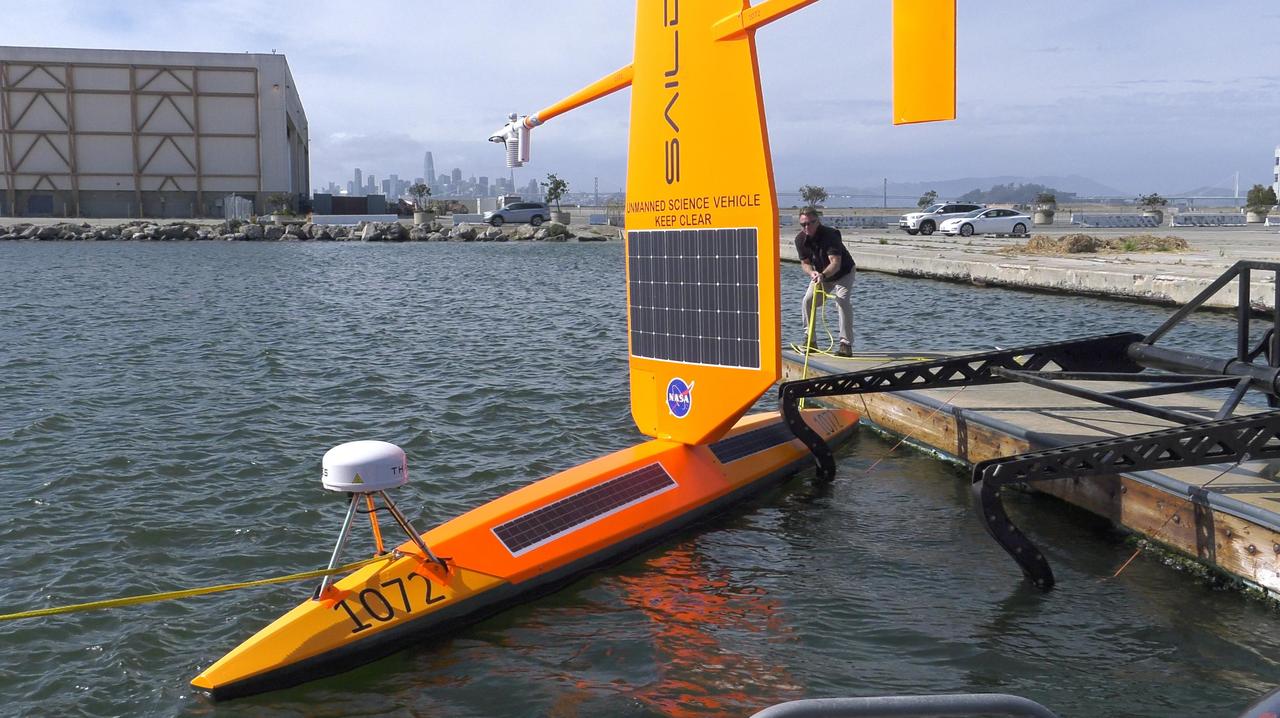
As part of NASA's Sub-Mesoscale Ocean Dynamics Experiment (S-MODE) field campaign, several Saildrones like the one pictured here were launched from San Francisco Bay. The Saildrones were part of a fleet of autonomous marine research vessels designed to measure a vast array of factors such as ocean currents, wind speed and direction, air and water temperature, salinity, dissolved oxygen, and chlorophyll content. S-MODE is a NASA Earth mission to use newly developed in-situ and remote-sensing techniques to look at small-scale ocean whirlpools, eddies, and currents. The observations could help scientists better understand how these dynamics drive the give-and-take of material and energy between the ocean and atmosphere and, ultimately, help shape Earth's climate. More information about S-MODE is at https://espo.nasa.gov/s-mode/content/S-MODE https://photojournal.jpl.nasa.gov/catalog/PIA25523
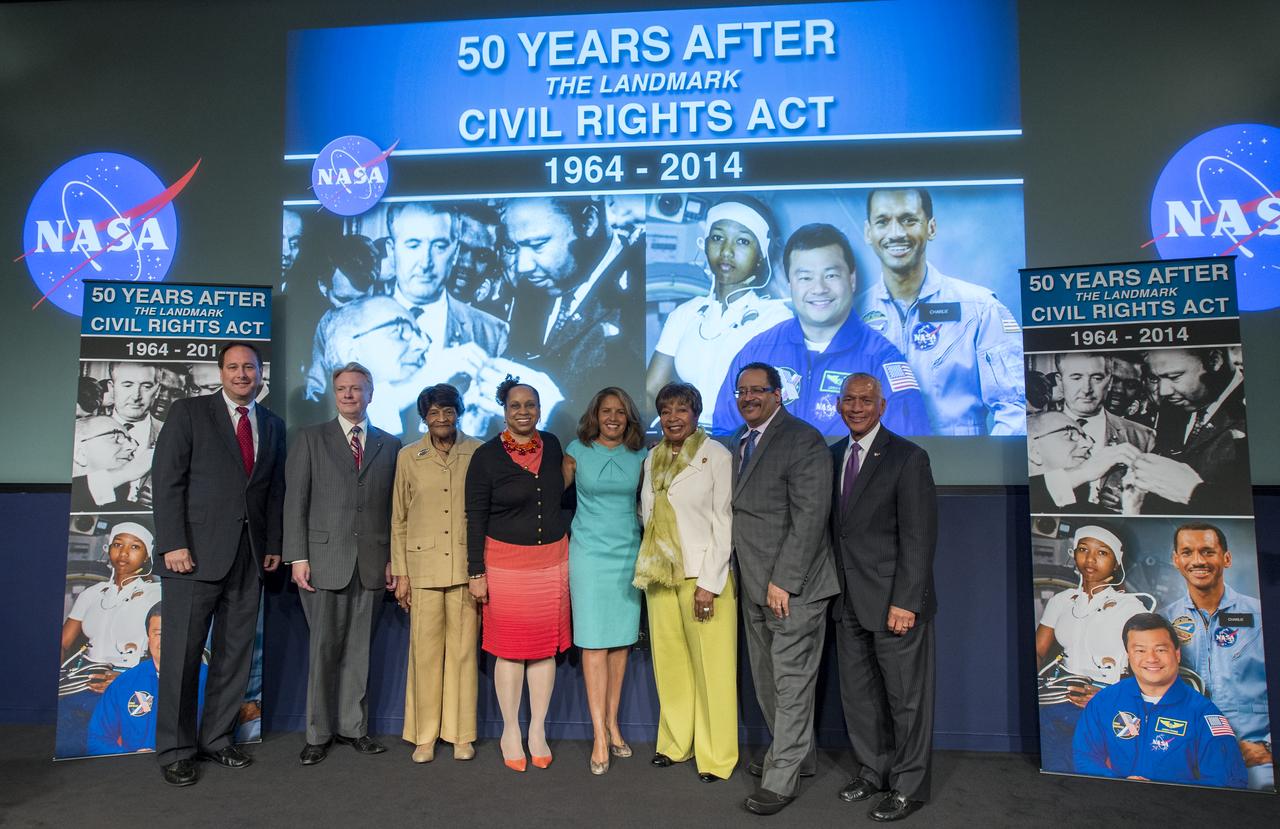
From left: Robert Lightroot. NASA Associate Administrator; Dr. Roger Launius, Associate Director of Collections and Curatorial Affairs at the Smithsonian National Air and Space Museum; Dr. Harriett Jenkins, Former Assistant Administrator for Equal Opportunity Programs at NASA; Brenda Manuel, Associate Administrator for Diversity and Equal Opportunity at NASA; Suzanne Malveaux, CNN Correspondent and panel moderator; U.S. Representative Eddie Bernice Johnson, of Texas; Dr. Michael Eric Dyson, professor of sociology at Georgetown University; and Charles Bolden, NASA Administrator; pose for a picture following an event celebrating the 50th Anniversary of the Civil Rights Act of 1964 on Monday, June 23, 2014 in the James E. Webb Auditorium at NASA Headquarters in Washington, DC. The event highlighted the influence of the Civil Rights Act on NASA. Photo Credit: (NASA/Joel Kowsky)

Jupiter's zonal winds, going in opposite directions, generate eddies of all sizes that manifest in storms swirling in the atmosphere. At the highest level "pop-up clouds," the small, bright clouds that amass at the edge of one of these fronts, are thought to be parcels of air pushed up to the altitude at which ammonia ice condenses. Although they appear to be small, these bright storms may be 16 to 31 miles (25 to 50 kilometers) across. This image captures Jupiter's North Temperate Belt. It was taken Oct. 16, 2021, at 10:11 a.m. PDT (1:11 p.m. EDT) as NASA's Juno spacecraft performed its 37th close flyby of Jupiter. At the time the image was taken, the spacecraft was about 2,454 miles (3,950 kilometers) from the planet's cloud tops at a latitude of 38.57 degrees. The original product is available here: https://www.missionjuno.swri.edu/junocam/processing?id=11484. https://photojournal.jpl.nasa.gov/catalog/PIA24971

KENNEDY SPACE CENTER, FLA. - Florida Today senior aerospace reporter Todd Halvorson (right) is honored with a Harry Kolcum Memorial News and Communications Award for 2004 by the National Space Club Florida Committee at the Radisson Resort at the Port, Cape Canaveral, Fla. He is joined by Committee Chairman Jerry Moyer (left) and Eddie Kolcum, wife of the late journalist for whom the award is named. Each year, the National Space Club Florida Committee recognizes area representatives of the news media and communications professions for excellence in their ability to communicate the space story along Florida’s Space Coast and throughout the world. The award is named in honor of Harry Kolcum, the former managing editor of Aviation Week and Space Technology, who was Cape bureau chief from 1980 to 1993 prior to his death in 1994. Kolcum was a founding member of the National Space Club Florida Committee.
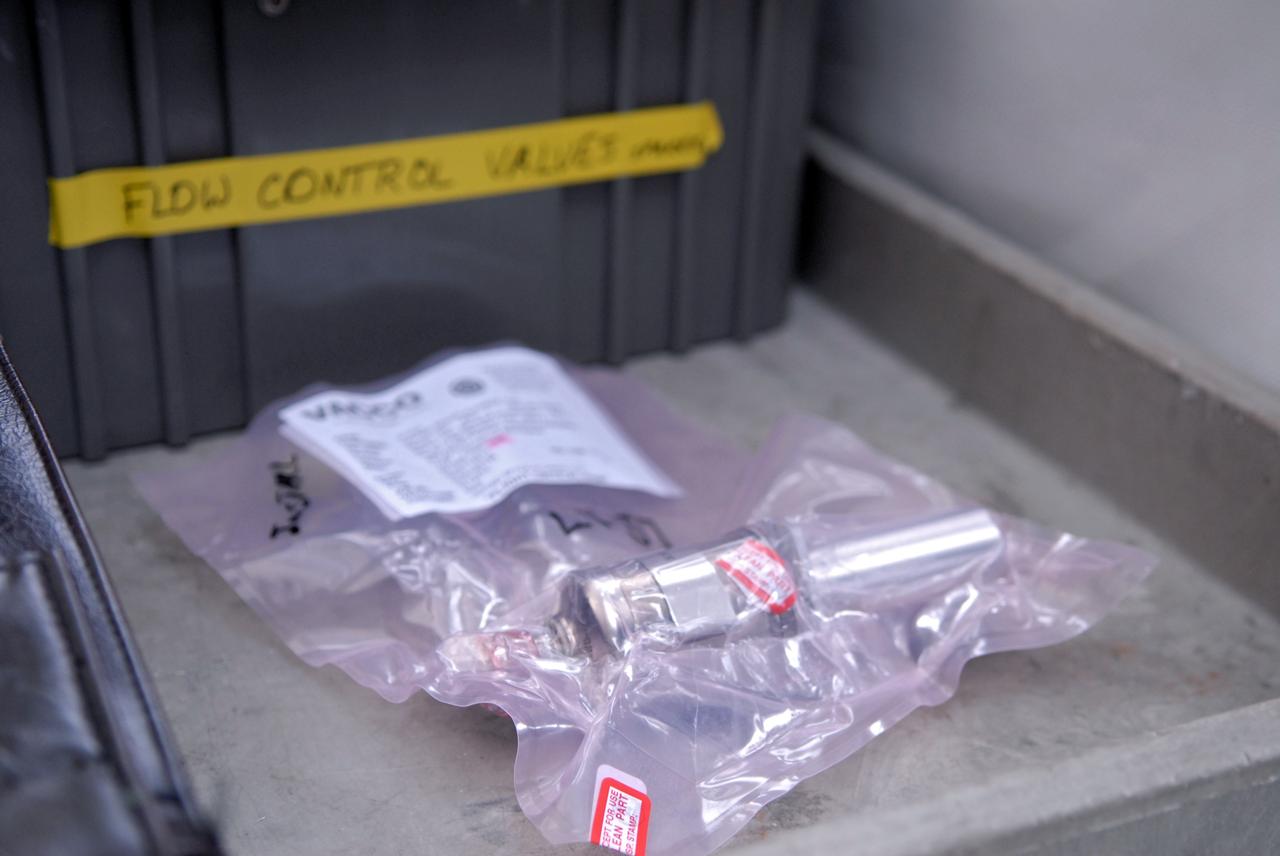
CAPE CANAVERAL, Fla. – One of the three thoroughly inspected gaseous hydrogen flow control valves is shown after its arrival at NASA's Kennedy Space Center in Florida. Technicians installed and retested them in space shuttle Discovery. Part of the main propulsion system, the valves channel gaseous hydrogen from the main engines to the external tank. NASA and contractor teams have worked to identify what caused damage to a flow control valve on shuttle Endeavour during its November 2008 flight. Space Shuttle Program managers decided to replace Discovery's valves with others that have undergone a detailed eddy current inspection. Program managers will review the testing and determine whether to meet on March 6 for the Flight Readiness Review for the STS-119 mission. Launch of Discovery tentatively is targeted for March 12. Photo credit: NASA/Chris Rhodes
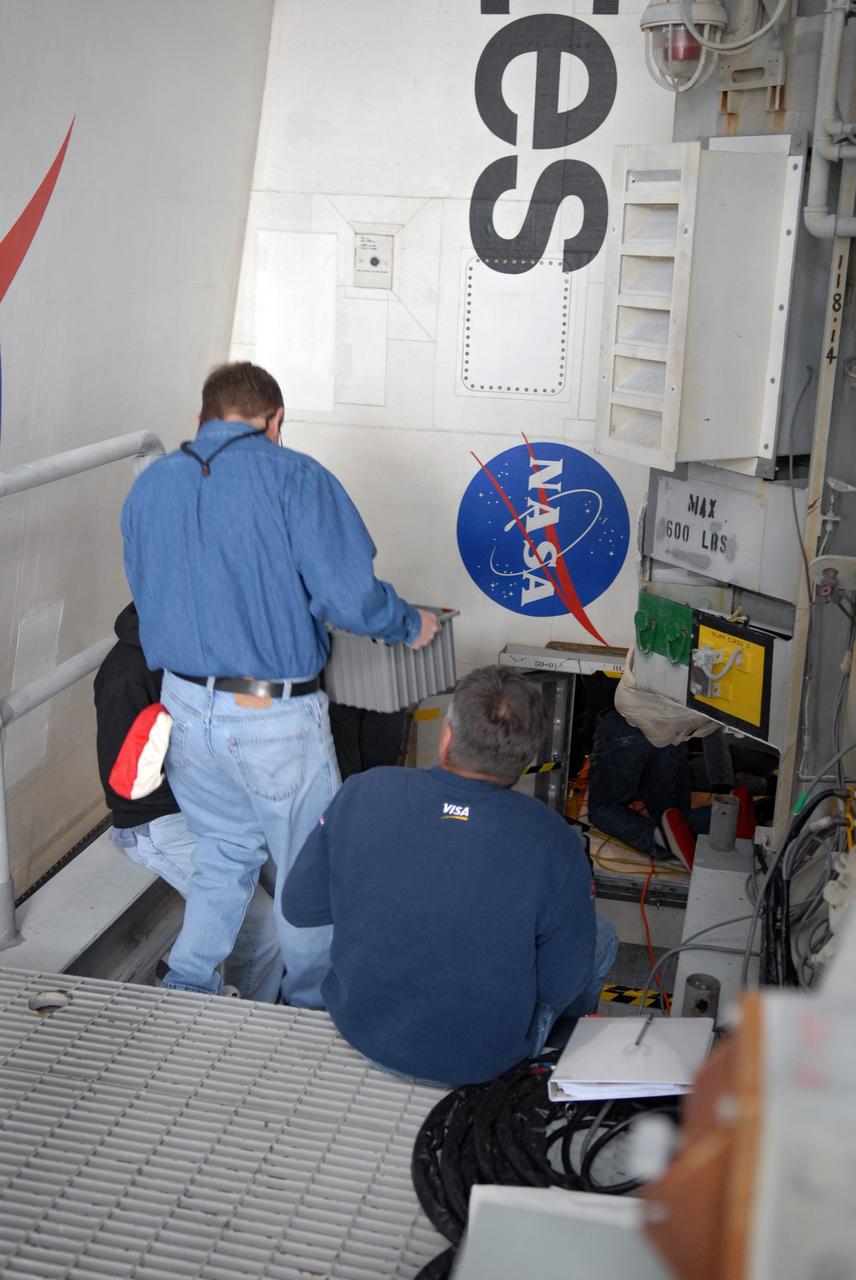
CAPE CANAVERAL, Fla. – On Launch Pad 39A at NASA's Kennedy Space Center in Florida, technicians prepare to install three gaseous hydrogen flow control valves on space shuttle Discovery. The valves were retested after installation. Part of the main propulsion system, the valves channel gaseous hydrogen from the main engines to the external tank. NASA and contractor teams have worked to identify what caused damage to a flow control valve on shuttle Endeavour during its November 2008 flight. Space Shuttle Program managers decided to replace Discovery's valves with others that have undergone a detailed eddy current inspection. Program managers will review the testing and determine whether to meet on March 6 for the Flight Readiness Review for the STS-119 mission. Launch of Discovery tentatively is targeted for March 12. Photo credit: NASA/Chris Rhodes
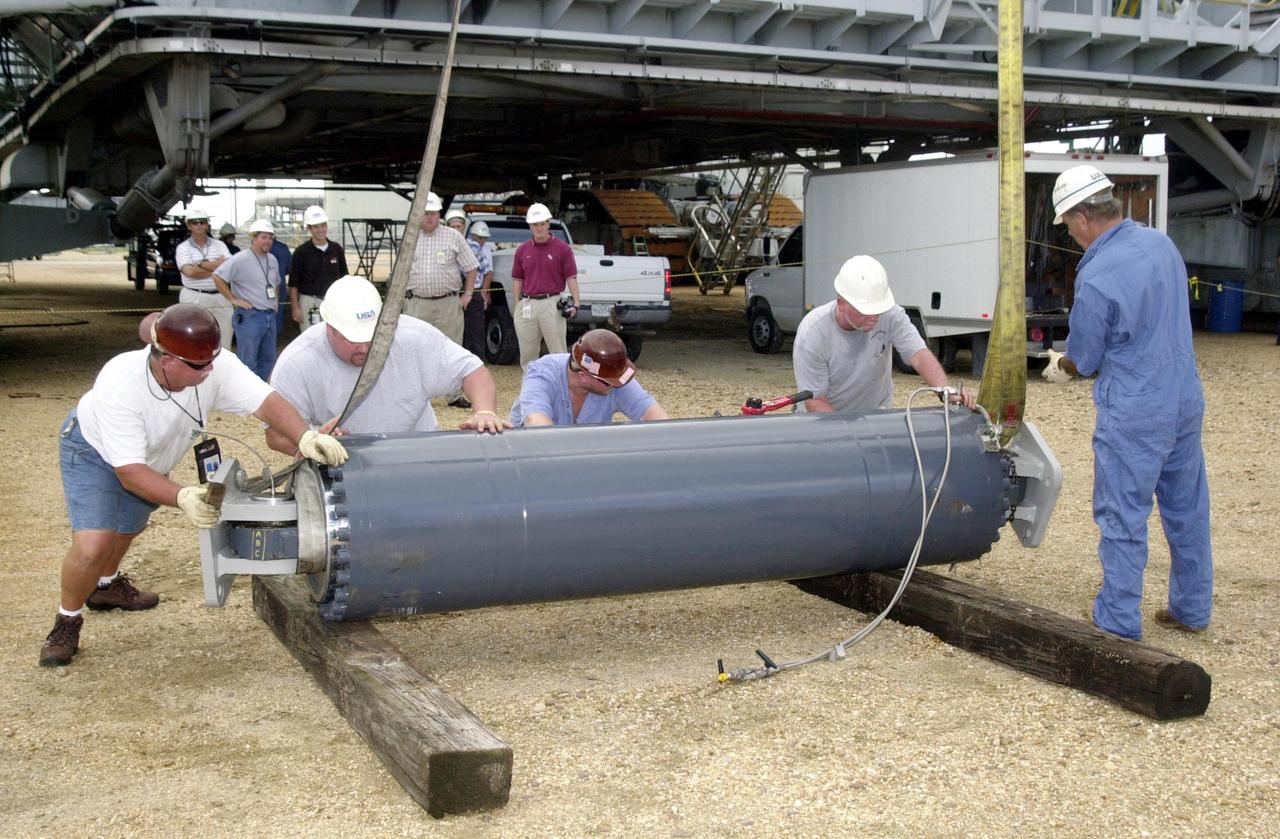
KENNEDY SPACE CENTER, FLA. -- At the crawler parking area, one of the repaired Jacking, Equalization and Leveling (JEL) cylinders is positioned for hookup to a crane. The crane will lift the JEL for placement in Crawler Transporter No. 2. There are 16 cylinders and 32 bearings per crawler. During recent routine maintenance inspections, technicians removed two of the 16 JEL cylinders on the crawler to gain access to the bearings and found three of the four bearings cracked. Further eddy current inspections indicated that cracks were present on 15 of the bearings. Technicians have removed and replaced 14 of the bearings on CT-2, which is being repaired in order to enable Atlantis' rollout for mission STS-112, scheduled for launch no earlier than Oct. 2.

The left image shows a close-up of a phytoplankton blooming in the southern Gulf of Bothnia, in the Baltic Sea, between Sweden and Finland on April 14, 2019. The right image shows turbulent clouds in Jupiter's atmosphere. Jupiter's atmosphere is one of the most turbulent places in the solar system. Orbiting Jupiter and its 79 moons is NASA's Juno spacecraft, which sends images from the largest planet in our solar system back to researchers on Earth. These images from Juno have given oceanographers the raw materials to study the rich turbulence at Jupiter's poles and the physical forces that drive large cyclones on Jupiter. Lia Siegelman, a physical oceanographer and postdoctoral scholar at Scripps Institution of Oceanography at the University of California San Diego, observed similarities between the richness of turbulence around Jovian cyclones and the filaments around smaller eddies with turbulence seen in Earth's oceans. https://photojournal.jpl.nasa.gov/catalog/PIA25034

KENNEDY SPACE CENTER, FLA. - NASA public affairs specialist George Diller (right) is honored with a Harry Kolcum Memorial News and Communications Award for 2004 by the National Space Club Florida Committee at the Radisson Resort at the Port, Cape Canaveral, Fla. He is joined by Committee Chairman Jerry Moyer (left) and Eddie Kolcum, wife of the late journalist for whom the award is named. Each year, the National Space Club Florida Committee recognizes area representatives of the news media and communications professions for excellence in their ability to communicate the space story along Florida’s Space Coast and throughout the world. The award is named in honor of Harry Kolcum, the former managing editor of Aviation Week and Space Technology, who was Cape bureau chief from 1980 to 1993 prior to his death in 1994. Kolcum was a founding member of the National Space Club Florida Committee.