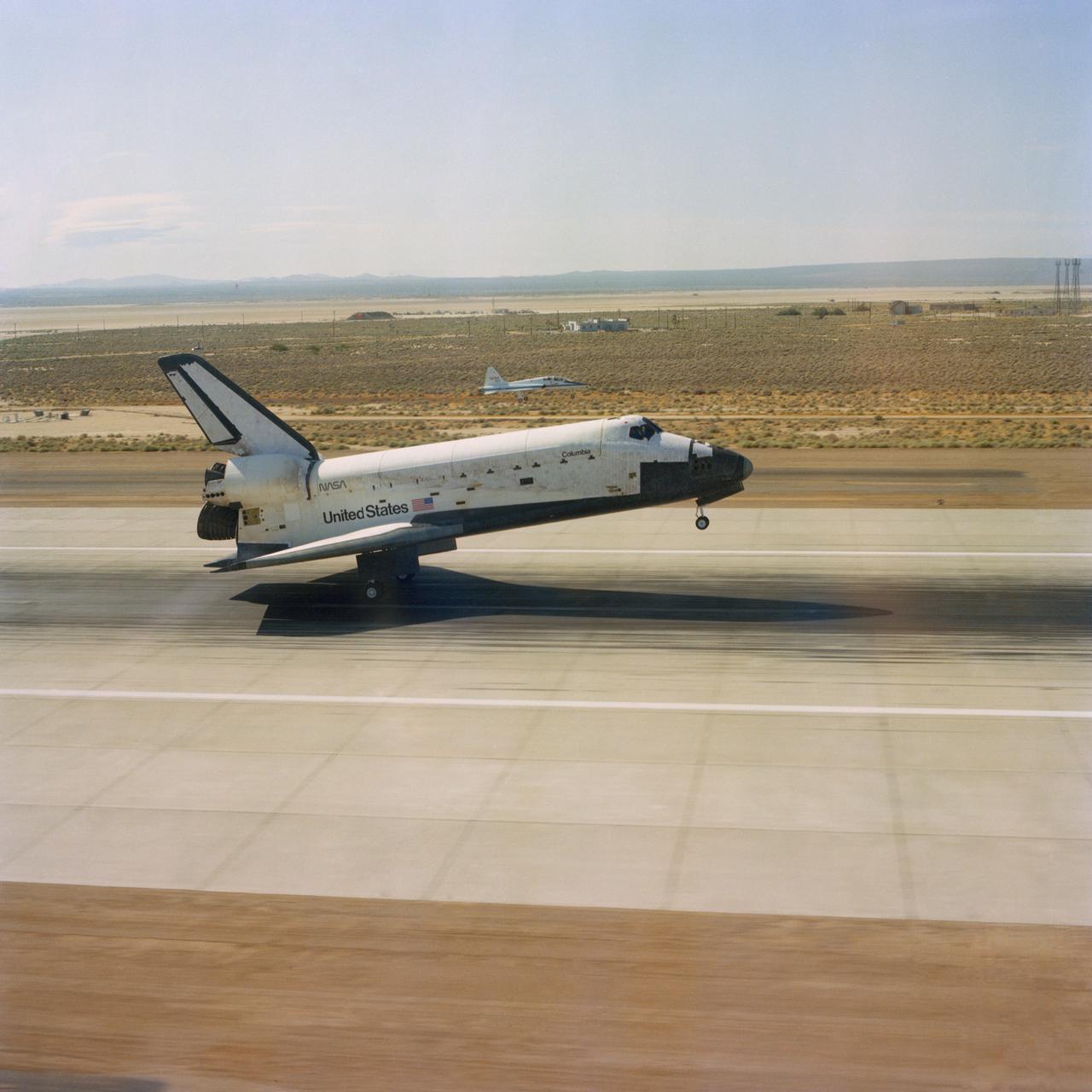
S82-33420 (4 July 1982) --- The aft wheels of the space shuttle Columbia ease down on the runway at Edwards Air Force Base (AFB) today to successfully complete a week-long spaceflight for astronauts Thomas K. Mattingly II, and Henry W. Hartsfield Jr. A T-38 aircraft serves as a chase plane (just above center of photo) in the background. Not long after this photograph was made and the crew had egressed their craft, President Ronald Reagan addressed a giant crowd on hand at Edwards AFB for a special kind of July 4 celebration. Photo credit: NASA
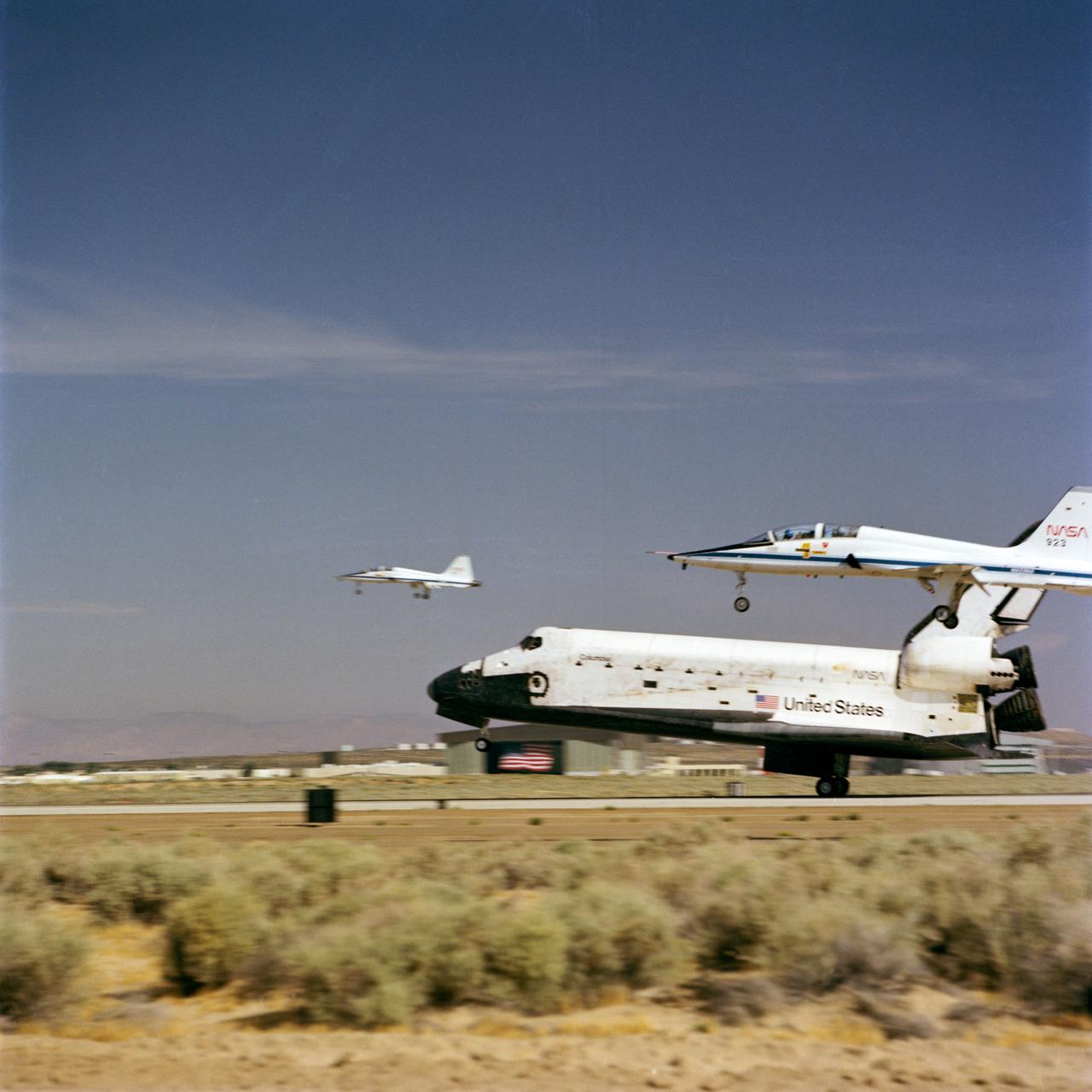
Views of the Columbia landing at EAFB ending the STS-4 Mission on 07/04/1982; of President and Mrs. Reagan greeting the crew out on the Lake bed Runway; and, the view of Roy Rogers with Astronauts Jerry Ross and Guy Gardner. 1. President Ronald Reagan & wife Nancy 2. Roy Rogers 3. Astronaut Jerry L. Ross 4. Astronaut Guy S. Gardner Edwards AFB, CA
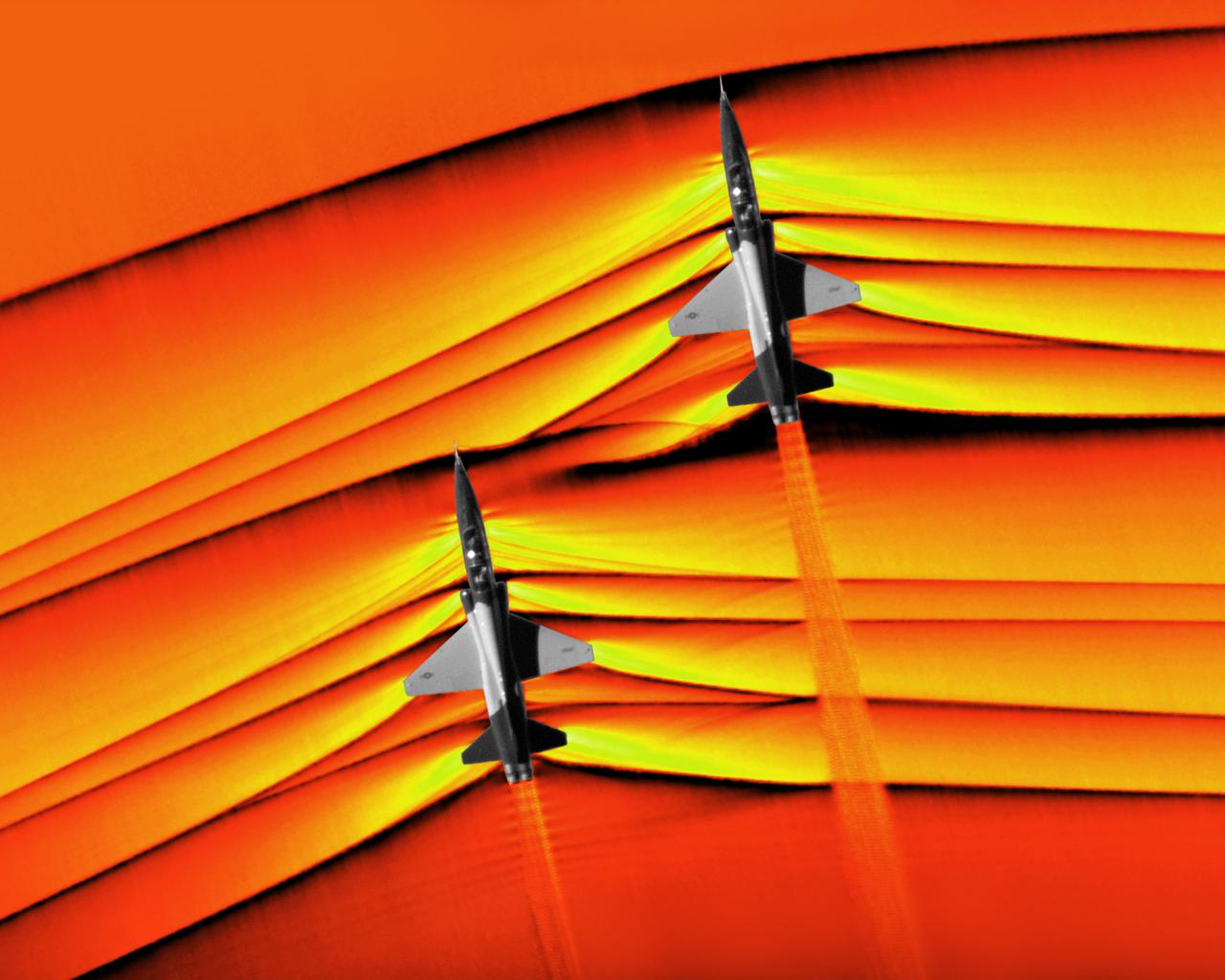
Composite image of Background Oriented Schlieren (BOS) data (contour) with a cut-out images of the T-38’s during a Mach Number 1.02 pass. The interaction of the shockwave of the trailing aircraft with the exhaust plume of the lead aircraft shows a shockwave reflection. Original recording of the pass taken in the Black Mountain Supersonic Corridor at near Edwards AFB in December of 2018. Image acquired by JT Heineck, schlieren data processed by Neal Smith.
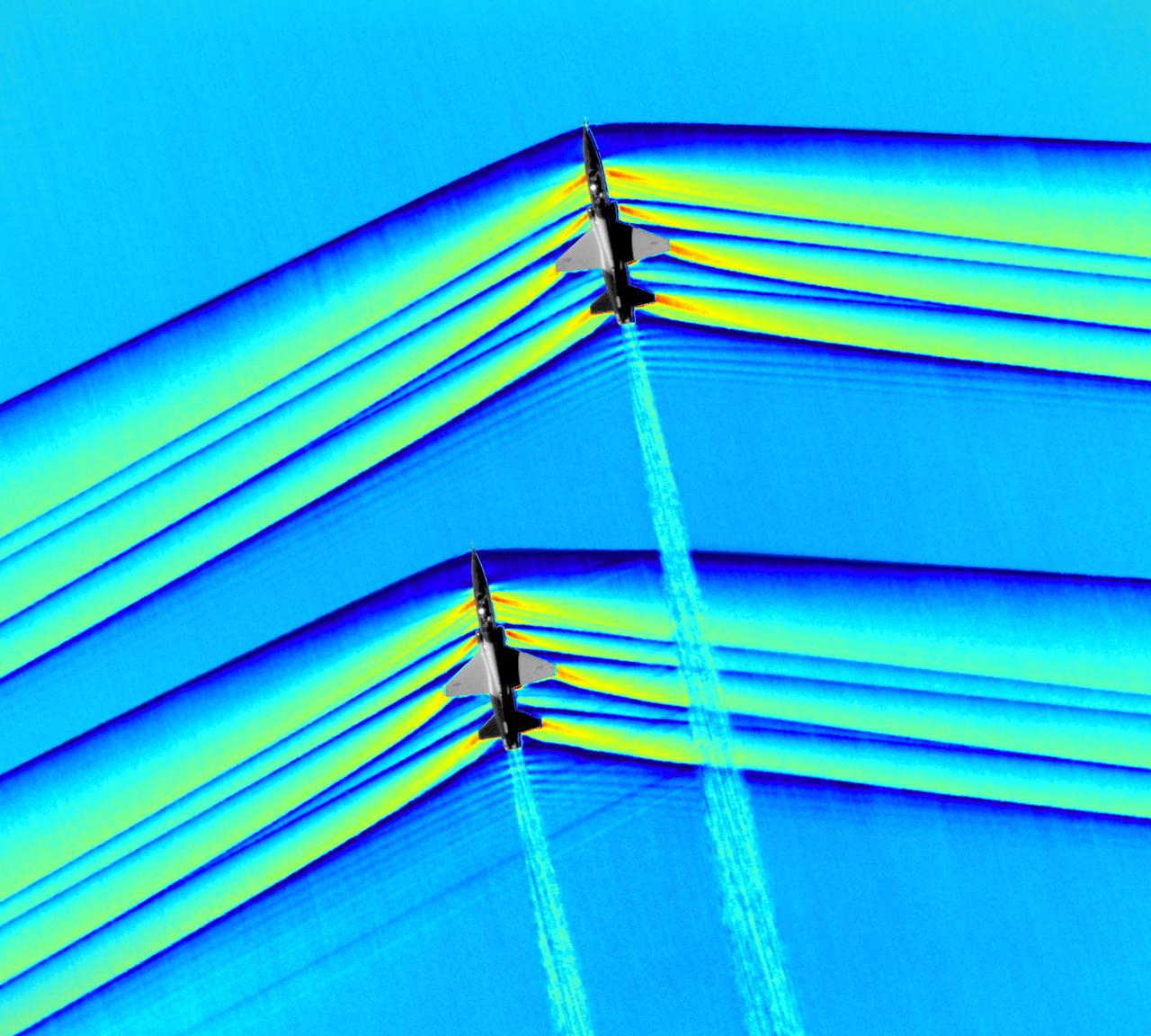
Composite image of Background Oriented Schlieren (BOS) data (contour) with a cut-out images of the T-38’s during a Mach Number 1.01 pass. This data is the first time shockwave interactions between two full scale aircraft traveling faster than the speed of sound have been imaged and shown with schlieren visualization. Original recording of the pass taken in the Black Mountain Supersonic Corridor at near Edwards AFB in December of 2018. Image acquired by JT Heineck, schlieren data processed by Neal Smith
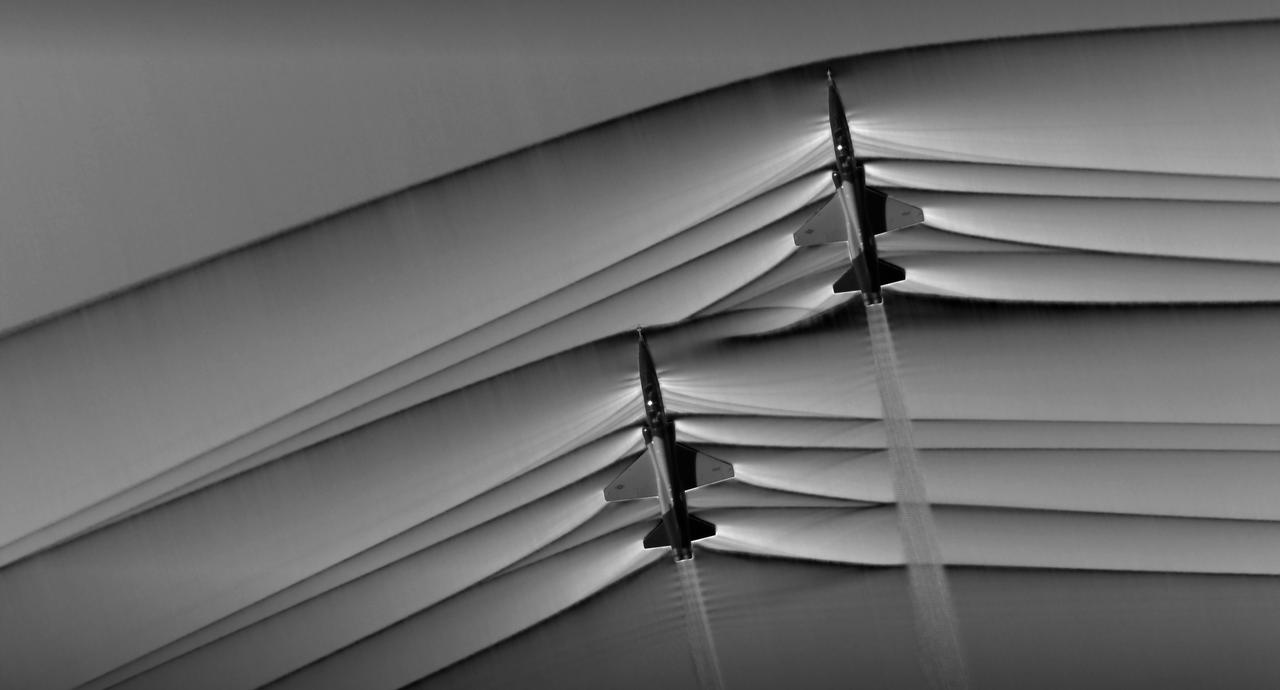
Composite image of Background Oriented Schlieren (BOS) data (contour) with a cut-out images of the T-38’s during a Mach Number 1.01 pass. This data is the first time shockwave interactions between two full scale aircraft traveling faster than the speed of sound have been imaged and shown with schlieren visualization. Original recording of the pass taken in the Black Mountain Supersonic Corridor at near Edwards AFB in December of 2018. Image acquired by JT Heineck, schlieren data processed by Neal Smith.

Composite image of Background Oriented Schlieren (BOS) data (contour) with a cut-out images of the T-38’s during a Mach Number 1.02 pass. The interaction of the shockwave of the trailing aircraft with the exhaust plume of the lead aircraft shows a shockwave reflection. Original recording of the pass taken in the Black Mountain Supersonic Corridor at near Edwards AFB in December of 2018. Image acquired by JT Heineck, schlieren data processed by Neal Smith.

Composite image of Background Oriented Schlieren (BOS) data (contour) with a cut-out images of the T-38’s during a Mach Number 1.02 pass. The interaction of the shockwave of the trailing aircraft with the exhaust plume of the lead aircraft shows a shockwave reflection. Original recording of the pass taken in the Black Mountain Supersonic Corridor at near Edwards AFB in December of 2018. Image acquired by JT Heineck, schlieren data processed by Neal Smith.

Composite image of Background Oriented Schlieren (BOS) data (contour) with a cut-out images of the T-38’s during a Mach Number 1.01 pass. This data is the first time shockwave interactions between two full scale aircraft traveling faster than the speed of sound have been imaged and shown with schlieren visualization. Original recording of the pass taken in the Black Mountain Supersonic Corridor at near Edwards AFB in December of 2018. Image acquired by JT Heineck, schlieren data processed by Neal Smith
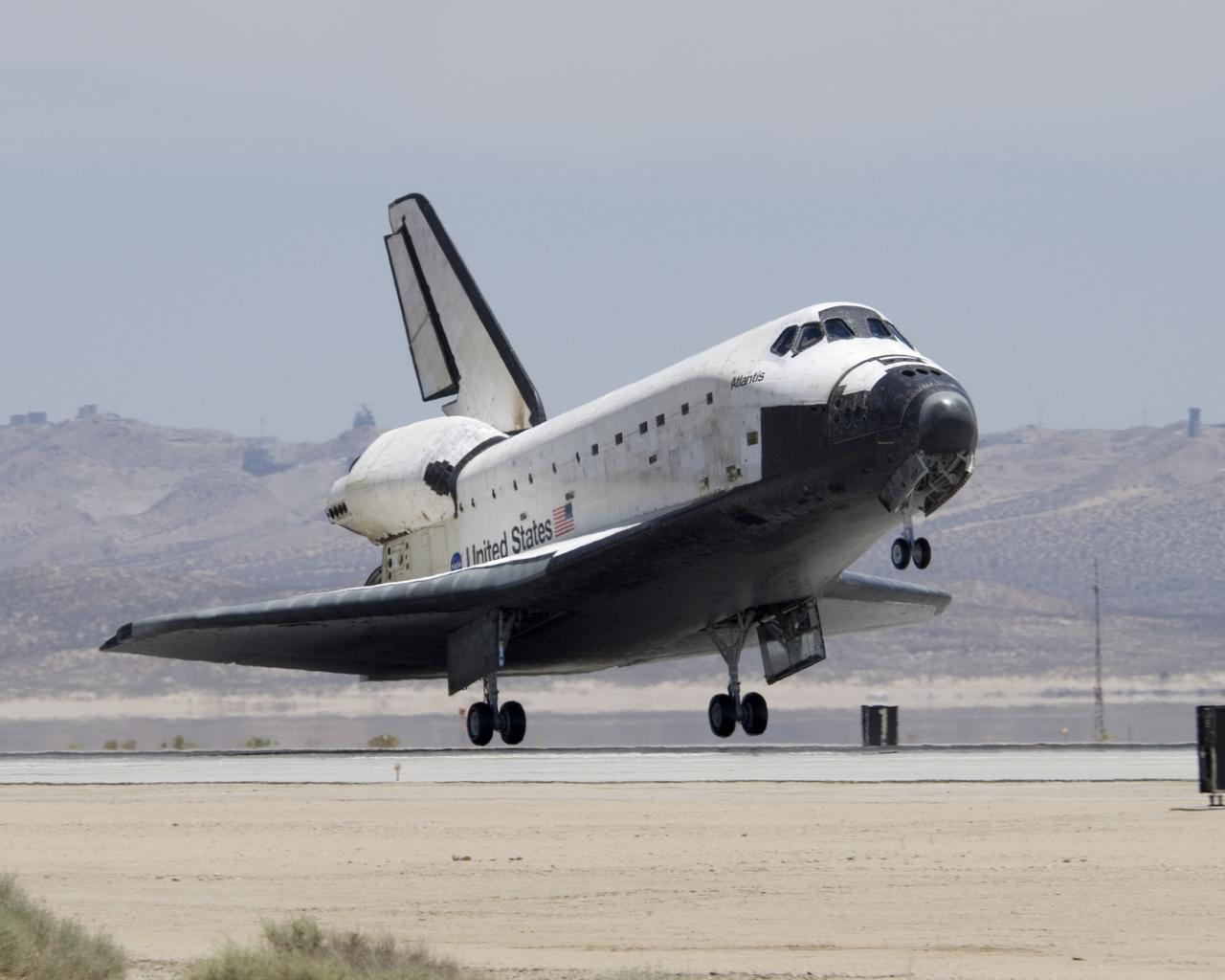
The Space Shuttle Atlantis touches down at Edwards AFB on June 22, 2007, to conclude International Space Station construction and supply mission STS-117.
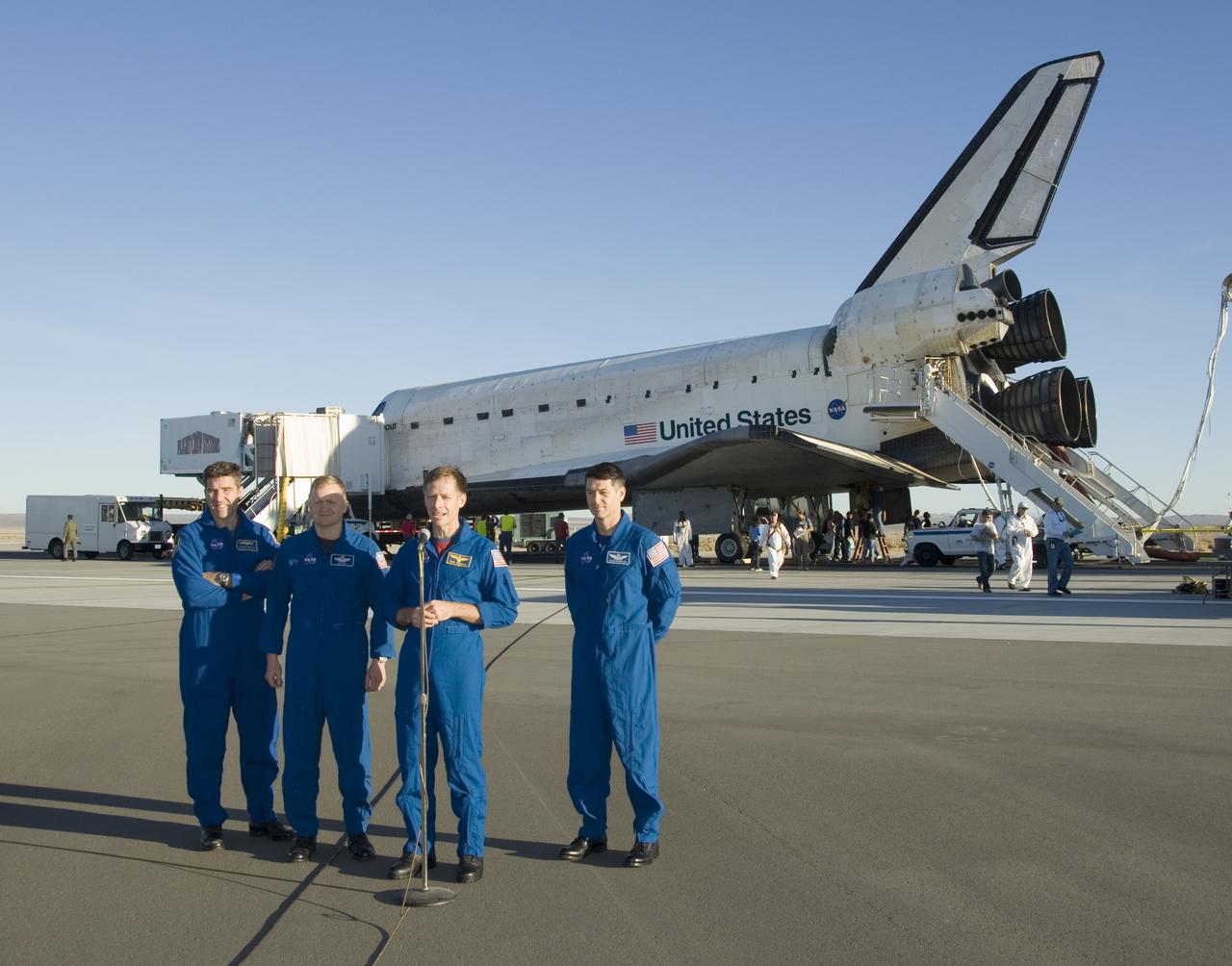
STS-126 commander Chris Ferguson, flanked by crewman Stephen Bowen, Eric Boe and Robert Kimbrough, offers comments on the mission after landing at Edwards AFB.
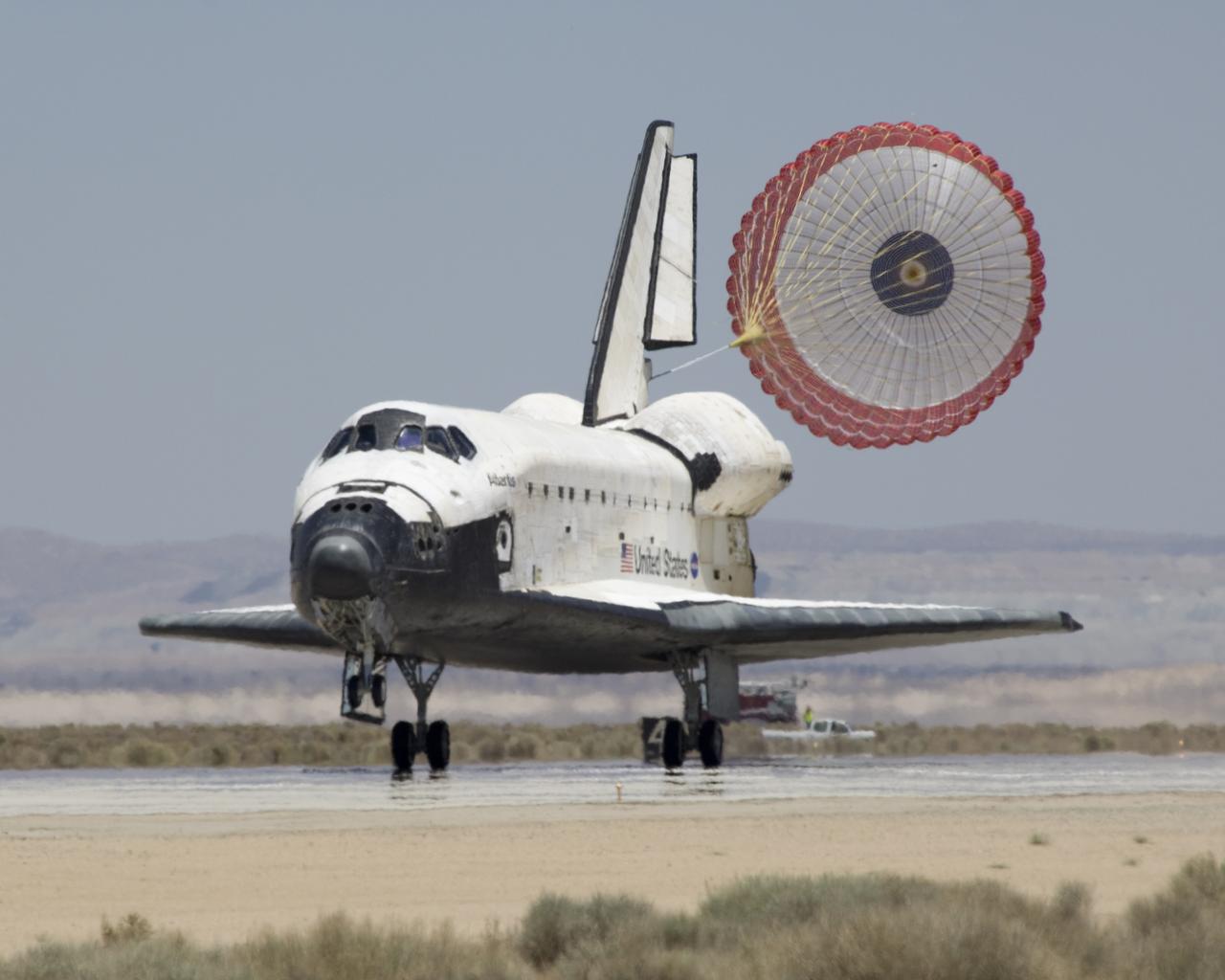
The Space Shuttle Atlantis' drag chute deploys as it rolls out on Runway 22 at Edwards AFB at the conclusion of its 13-day STS-117 mission to the ISS.
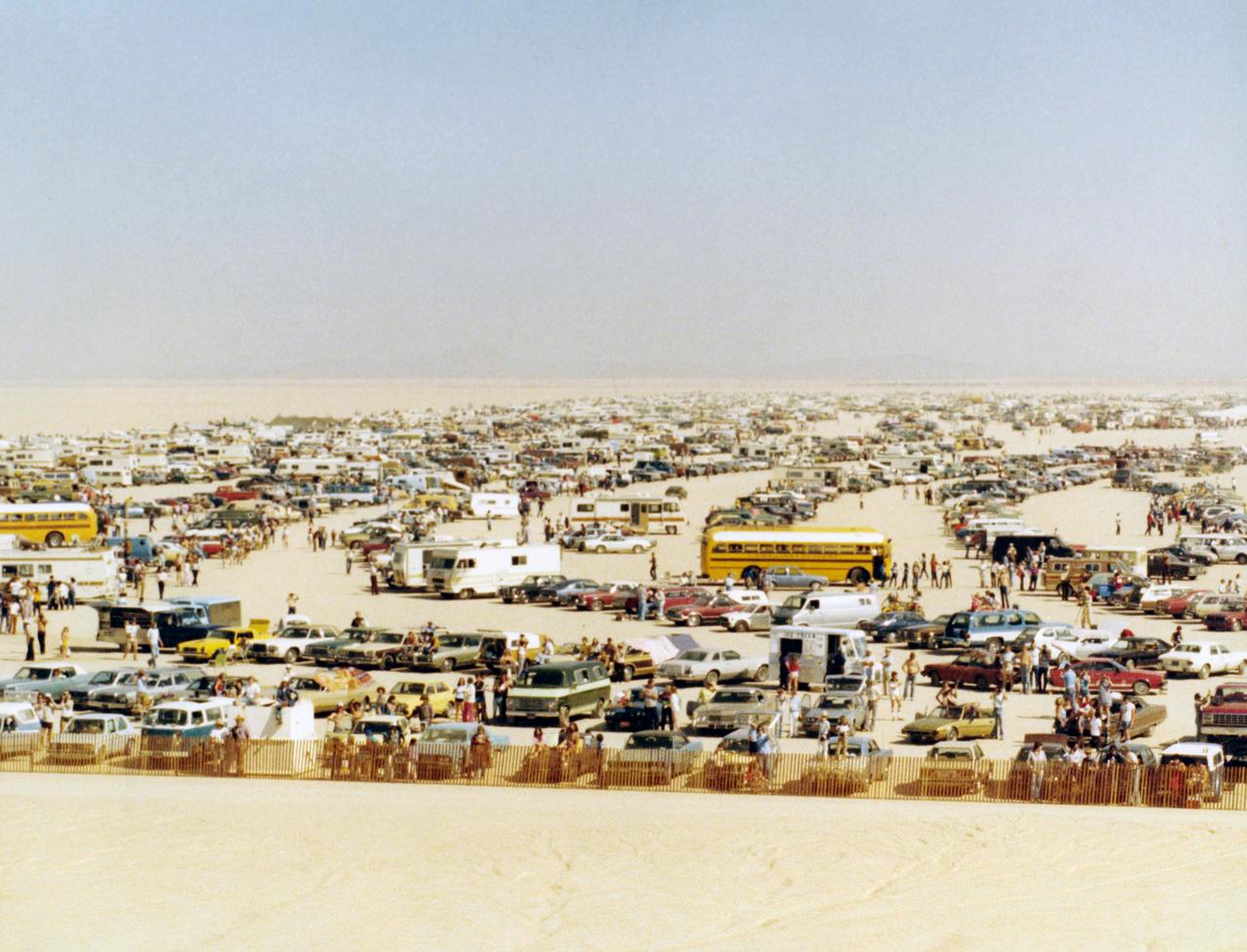
Large crowds gathered on Rogers Dry Lake at Edwards AFB to see the first landing of the Space Shuttle Columbia, completing its first orbital mission.
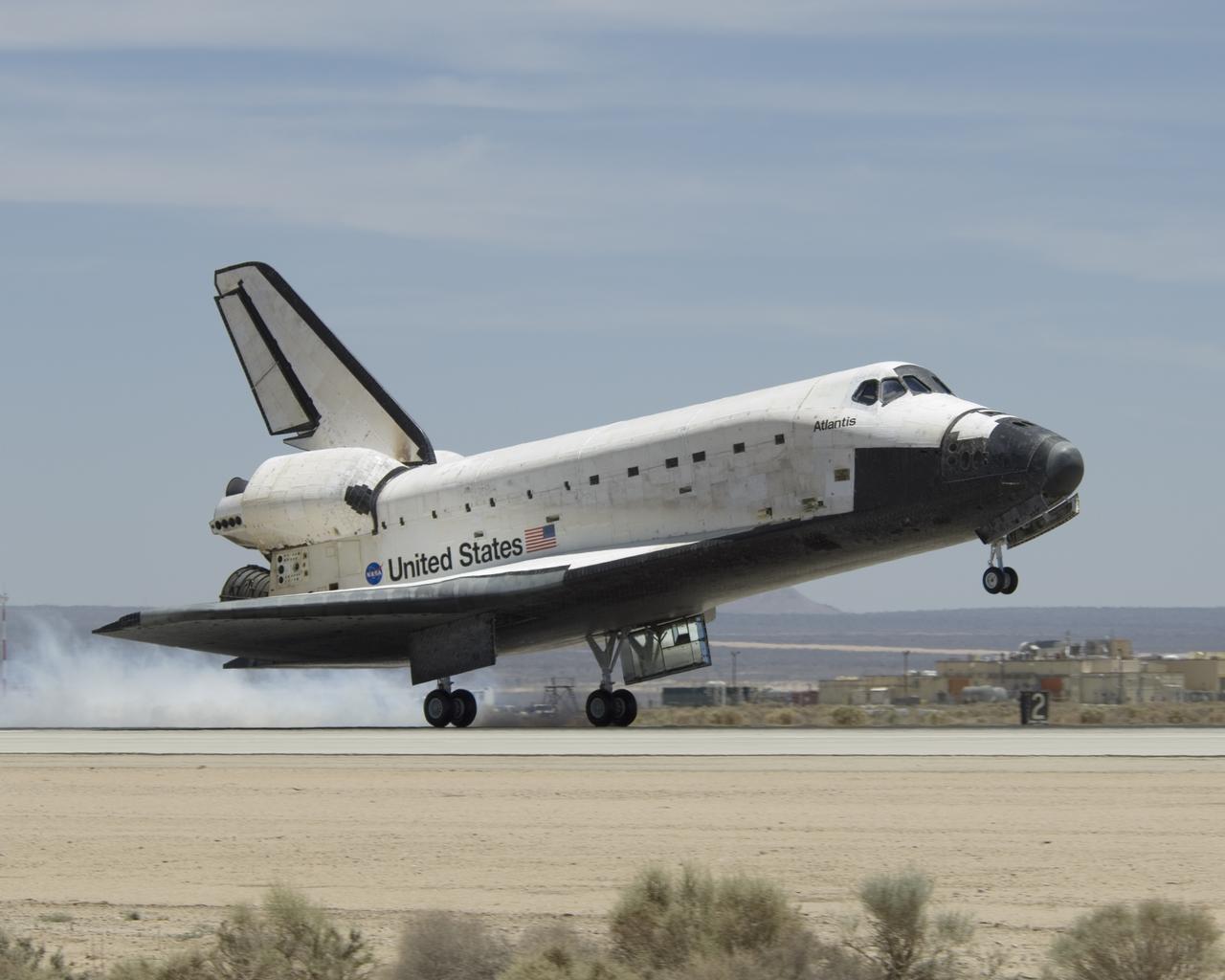
The Space Shuttle Atlantis touches down at Edwards AFB on June 22, 2007, to conclude International Space Station construction and supply mission STS-117.
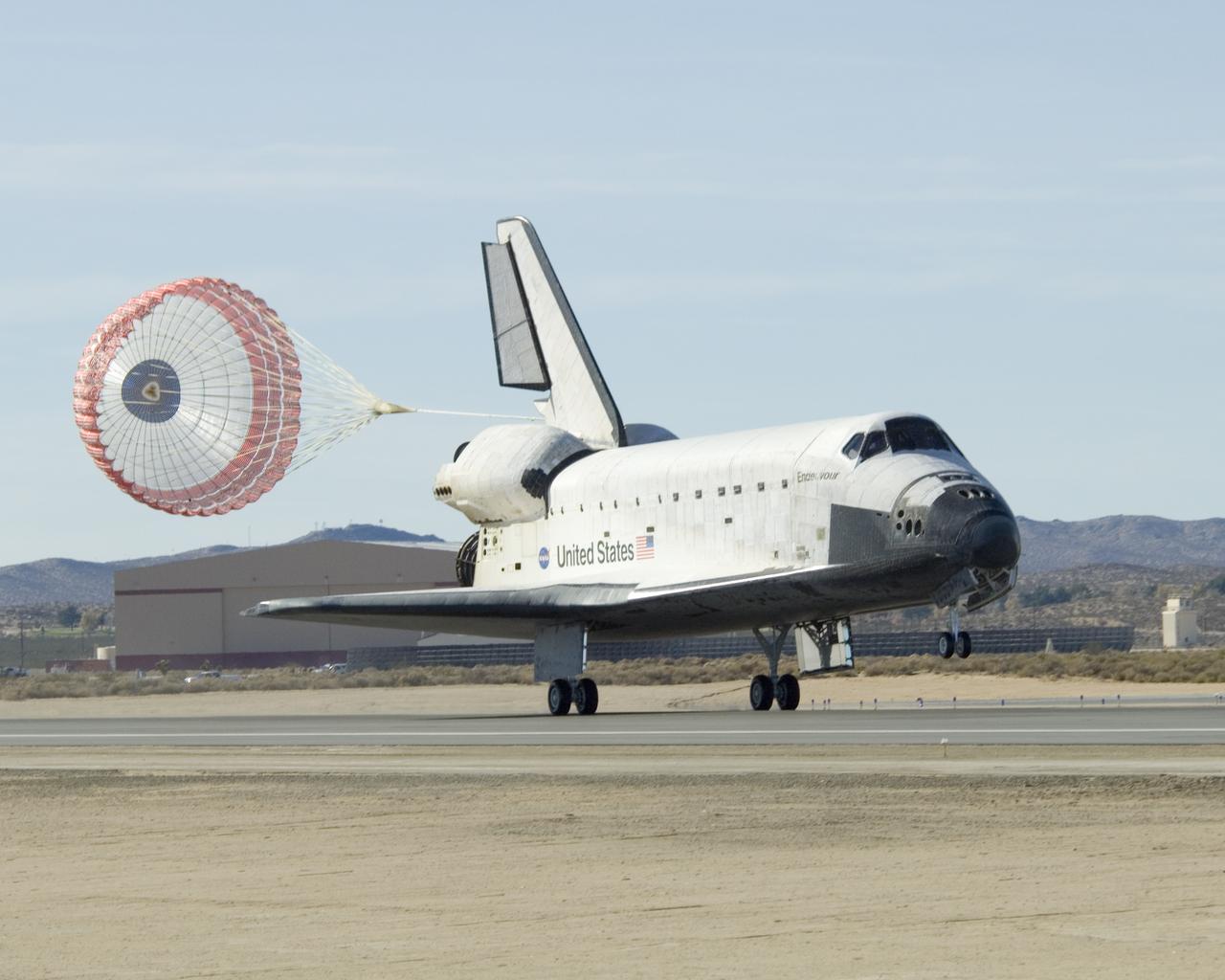
Space Shuttle Endeavour's drag chute deploys as it rolls down Runway 04-L at Edwards AFB moments after landing on Nov. 30, 2008.
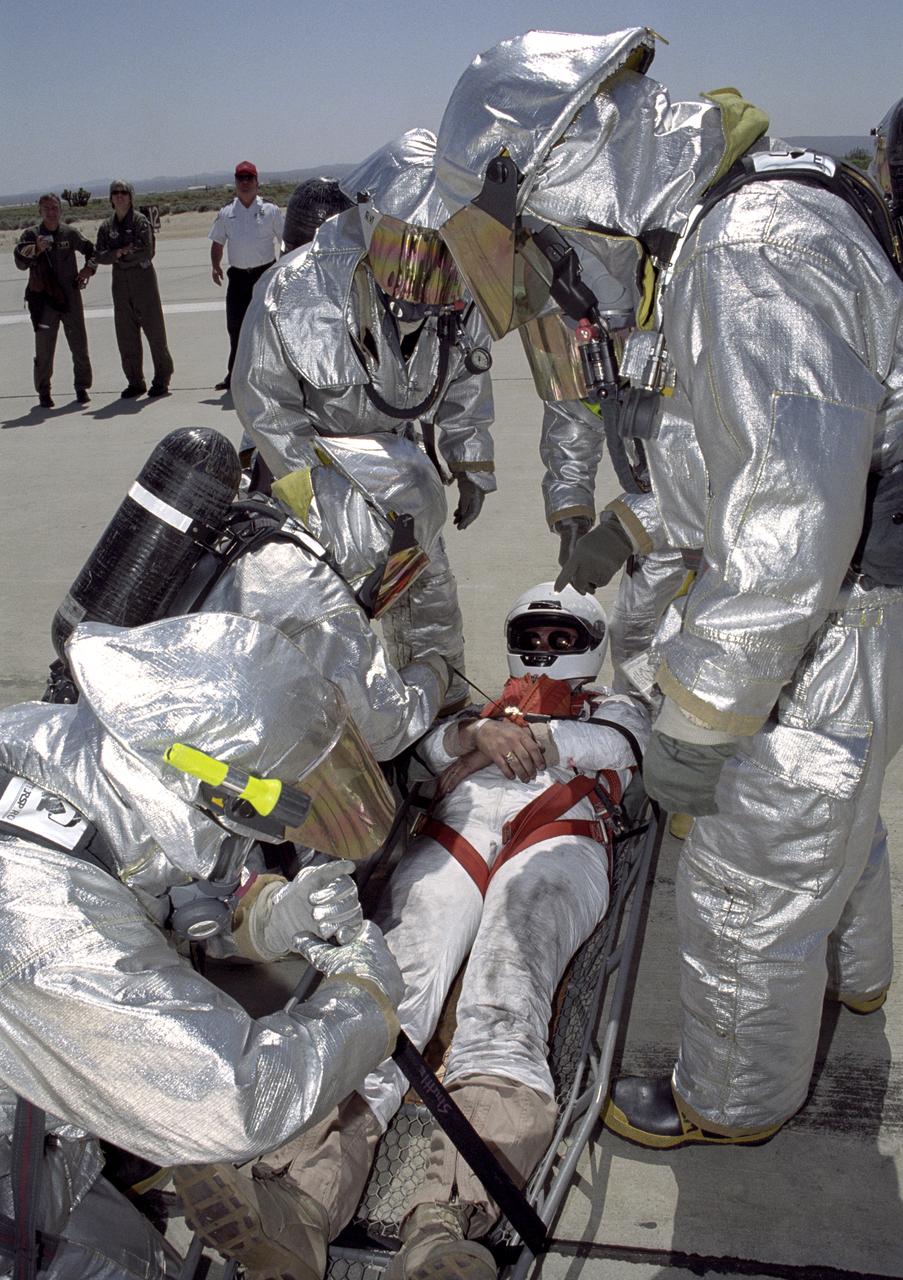
Clad in full thermal protection suits, Air Force fire-rescue crews strap a stand-in "astronaut" into a litter during a Space Shuttle rescue training exercise at Edwards AFB.
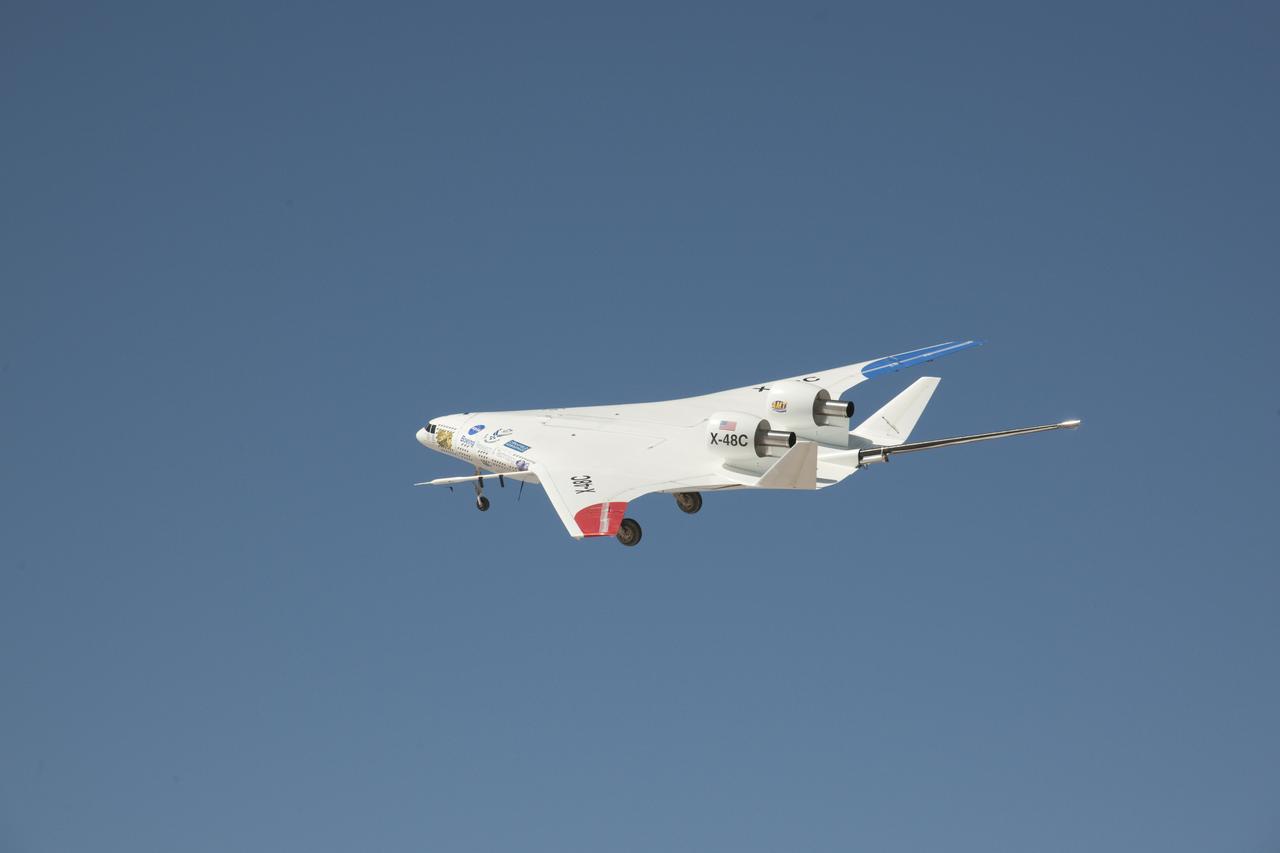
A deep blue sky was a backdrop for the NASA-Boeing X-48C Hybrid Wing Body aircraft as it flew over Edwards AFB on Feb. 28, 2013, during a test flight from NASA's Dryden Flight Research Center, Edwards, CA.
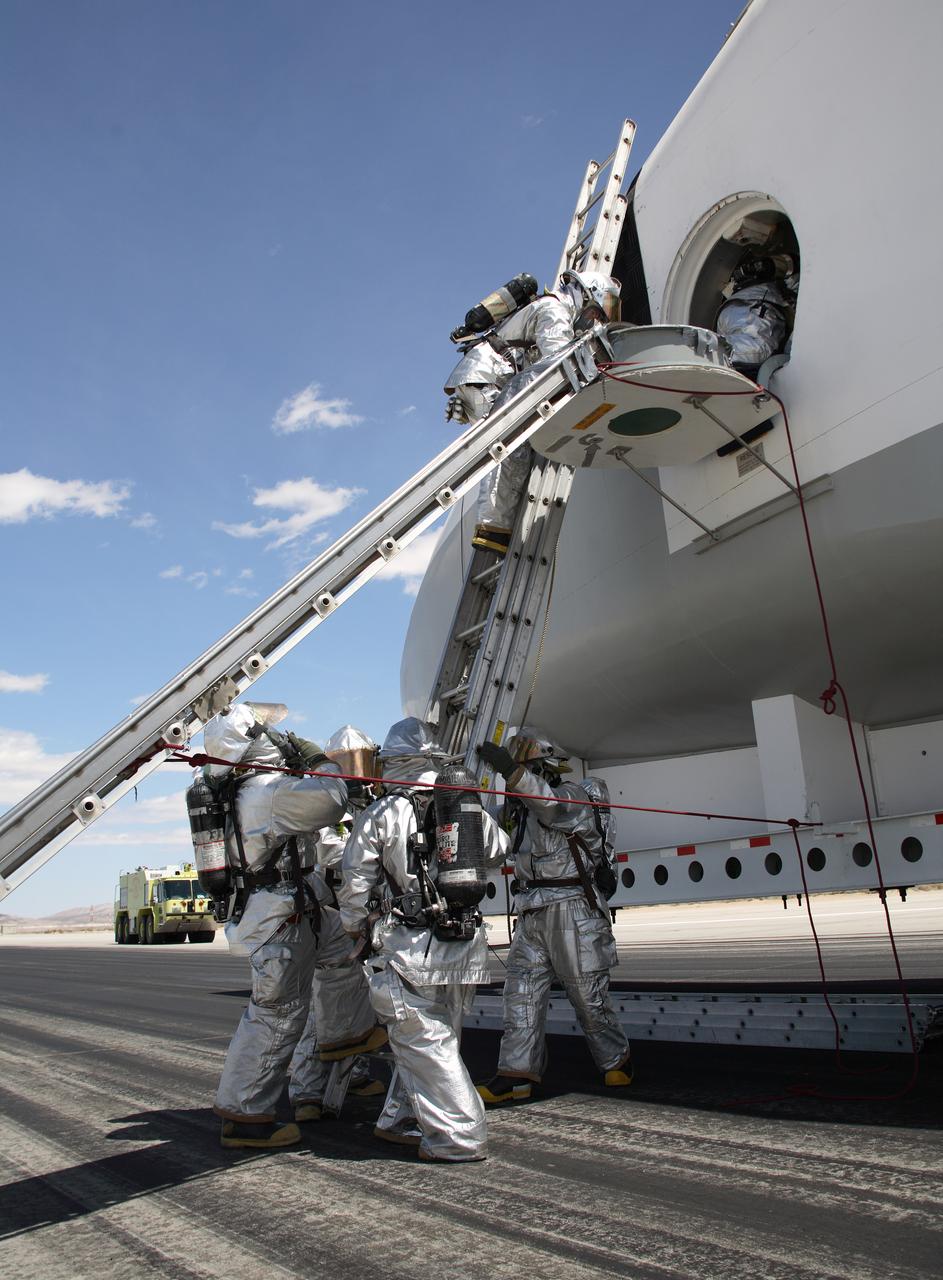
Air Force fire/rescue crew enter the space shuttle cabin mockup hatch to evacuate the shuttle crew during a shuttle rescue training exercise at Edwards AFB. (USAF photo # 070505-F-1287F-118)
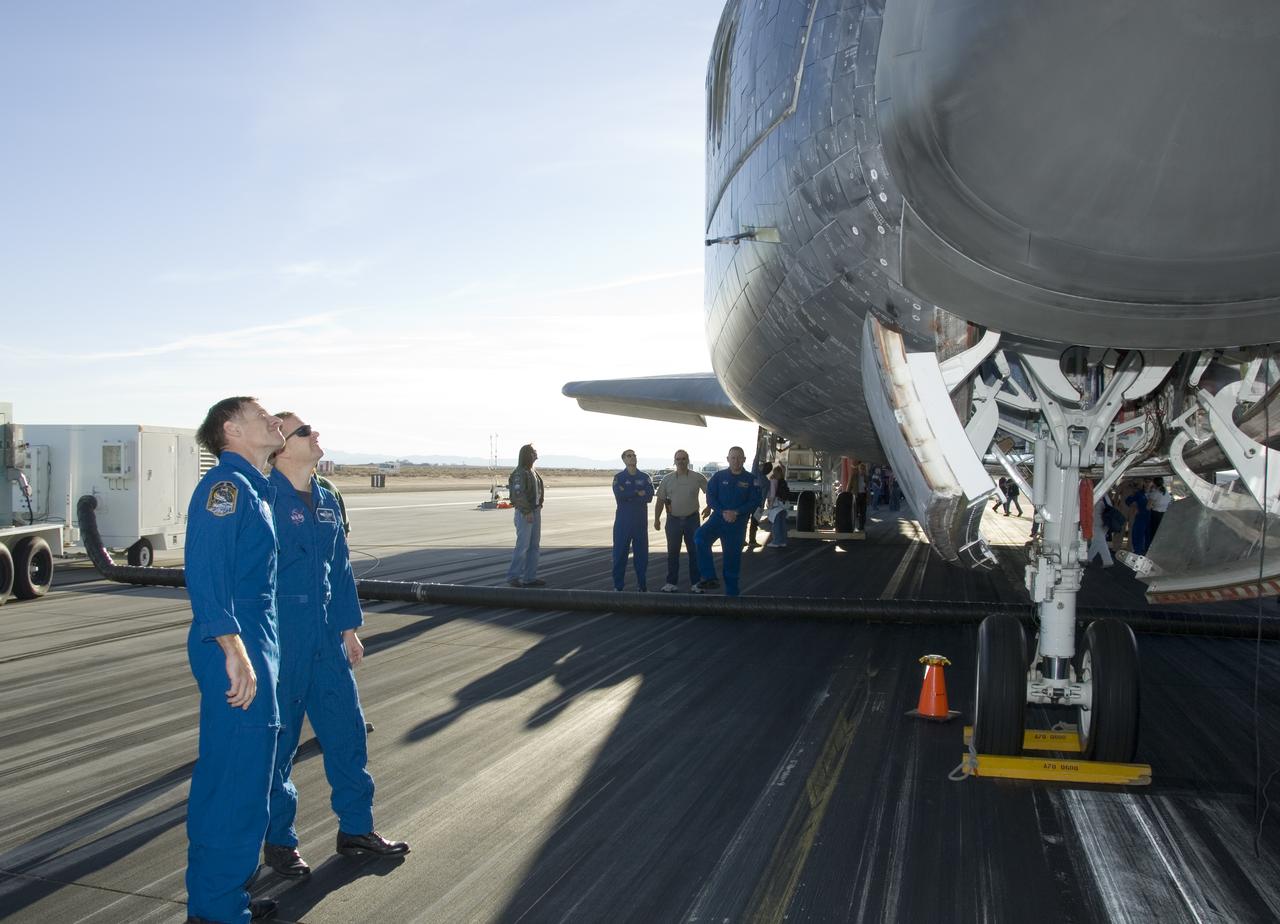
STS-126 commander Chris Ferguson and pilot Eric Boe examine shuttle Endeavour's thermal protection system following the STS-126 landing at Edwards AFB Nov. 30.

The unique manta-ray shaped planform of the Blended Wing Body X-48B is evidenced as the subscale demonstrator soars over Edwards AFB on its first test flight.
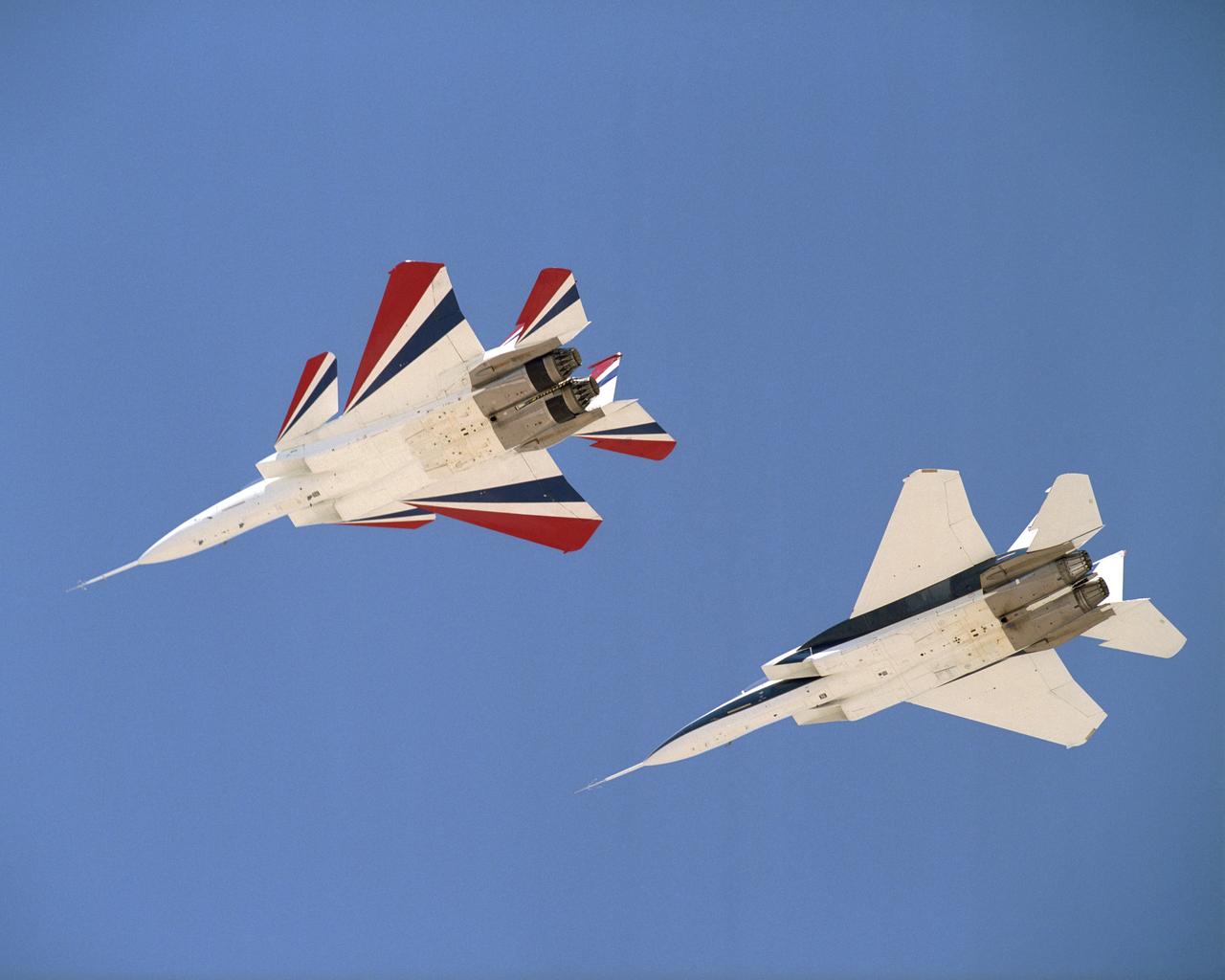
NASA's two modified F-15B research aircraft joined up for a fly-over of NASA's Dryden Flight Research Center on Edwards AFB, Calif., after a research mission.
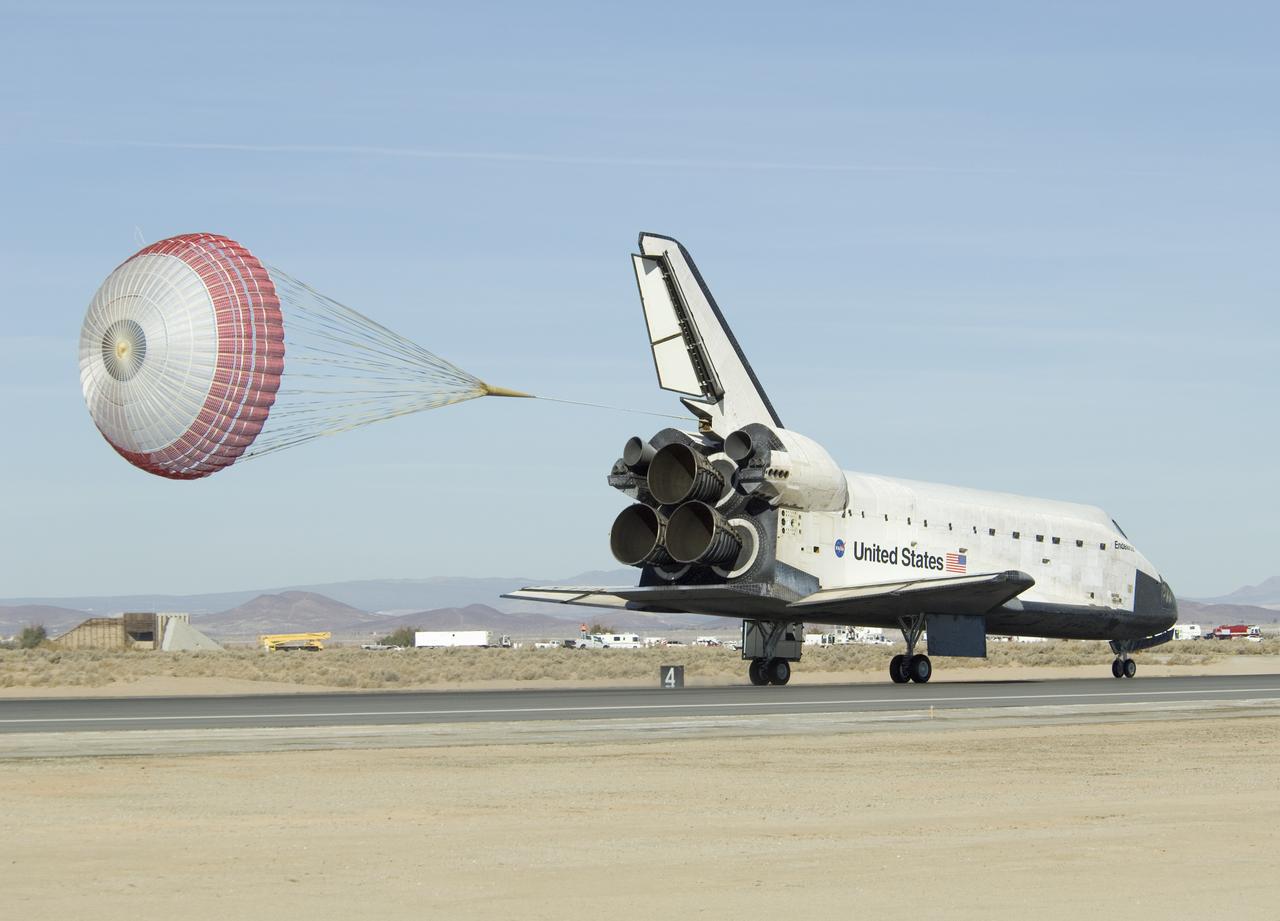
Space Shuttle Endeavour's drag chute streams behind as it rolls down on Runway 04-L at Edwards AFB to conclude mission STS-126 on Nov. 30, 2008.
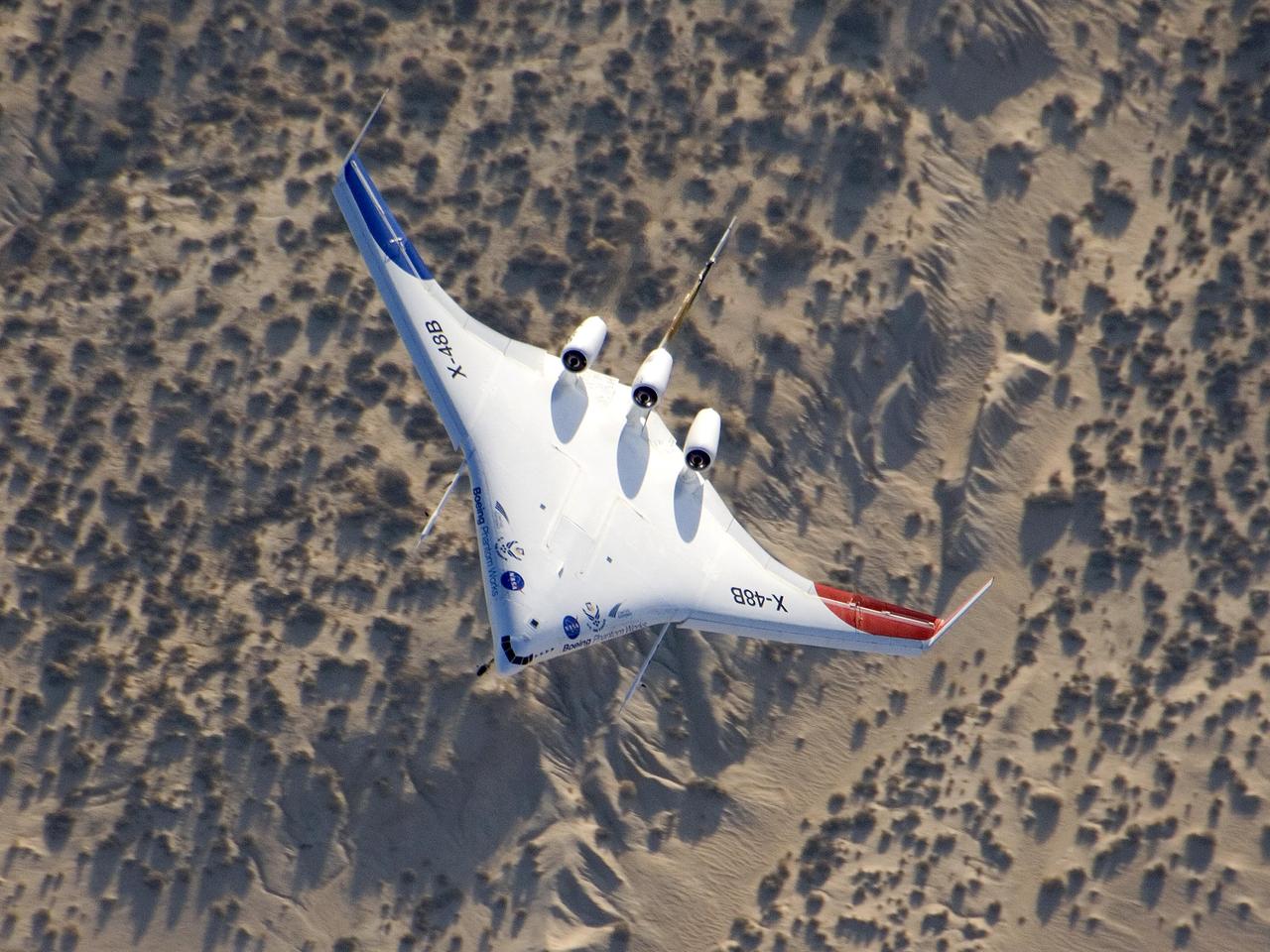
The unique X-48B Blended Wing Body subscale demonstrator banked over desert scrub at Edwards AFB during the aircraft's fifth test flight Aug. 14, 2007.
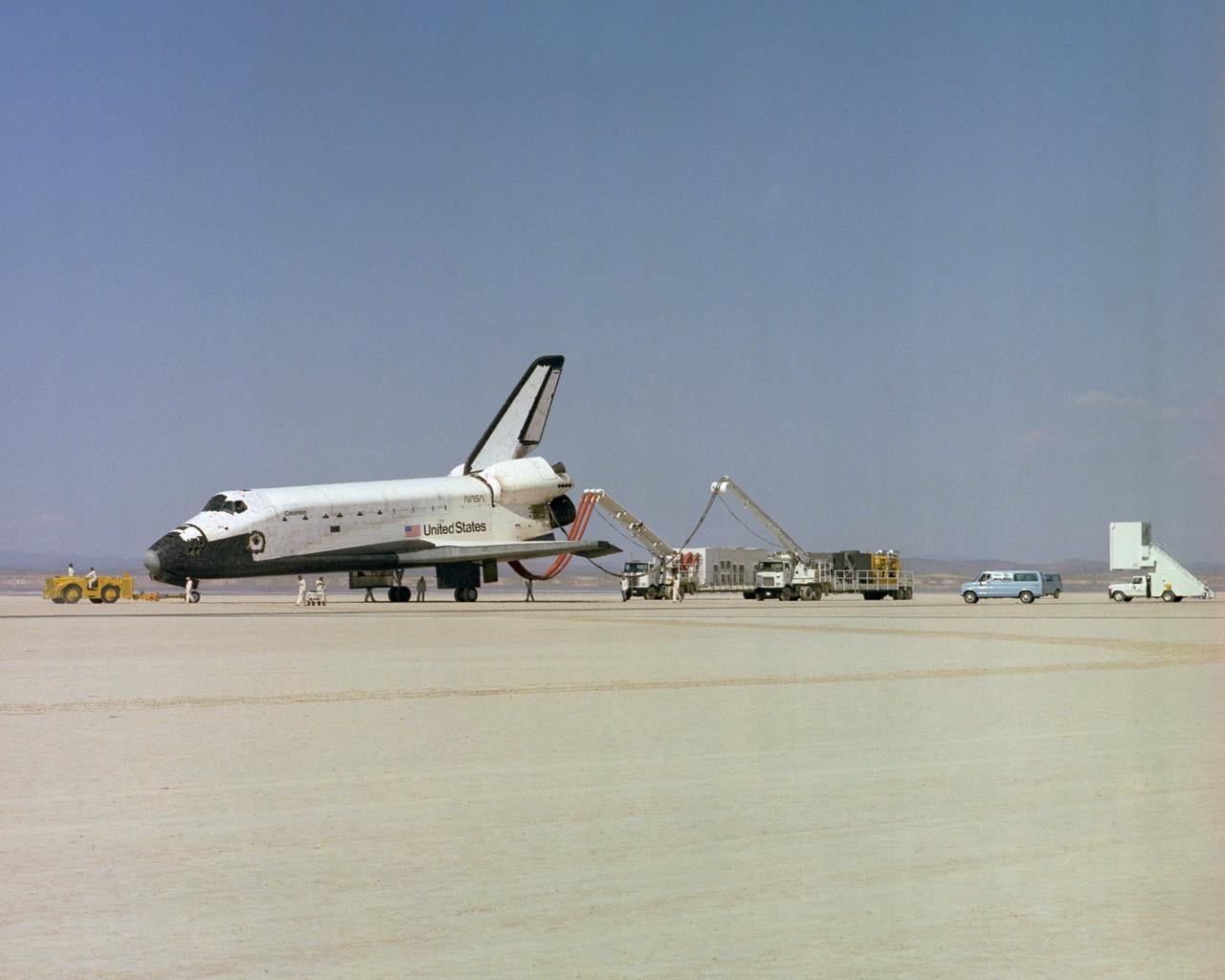
The Space Shuttle Columbia on Rogers Dry lakebed at Edwards AFB after landing to complete its first orbital mission on April 14, 1981. Technicians towed the Shuttle back to the NASA Dryden Flight Research Center for post-flight processing and preparation for a return ferry flight atop a modified 747 to Kennedy Space Center in Florida.
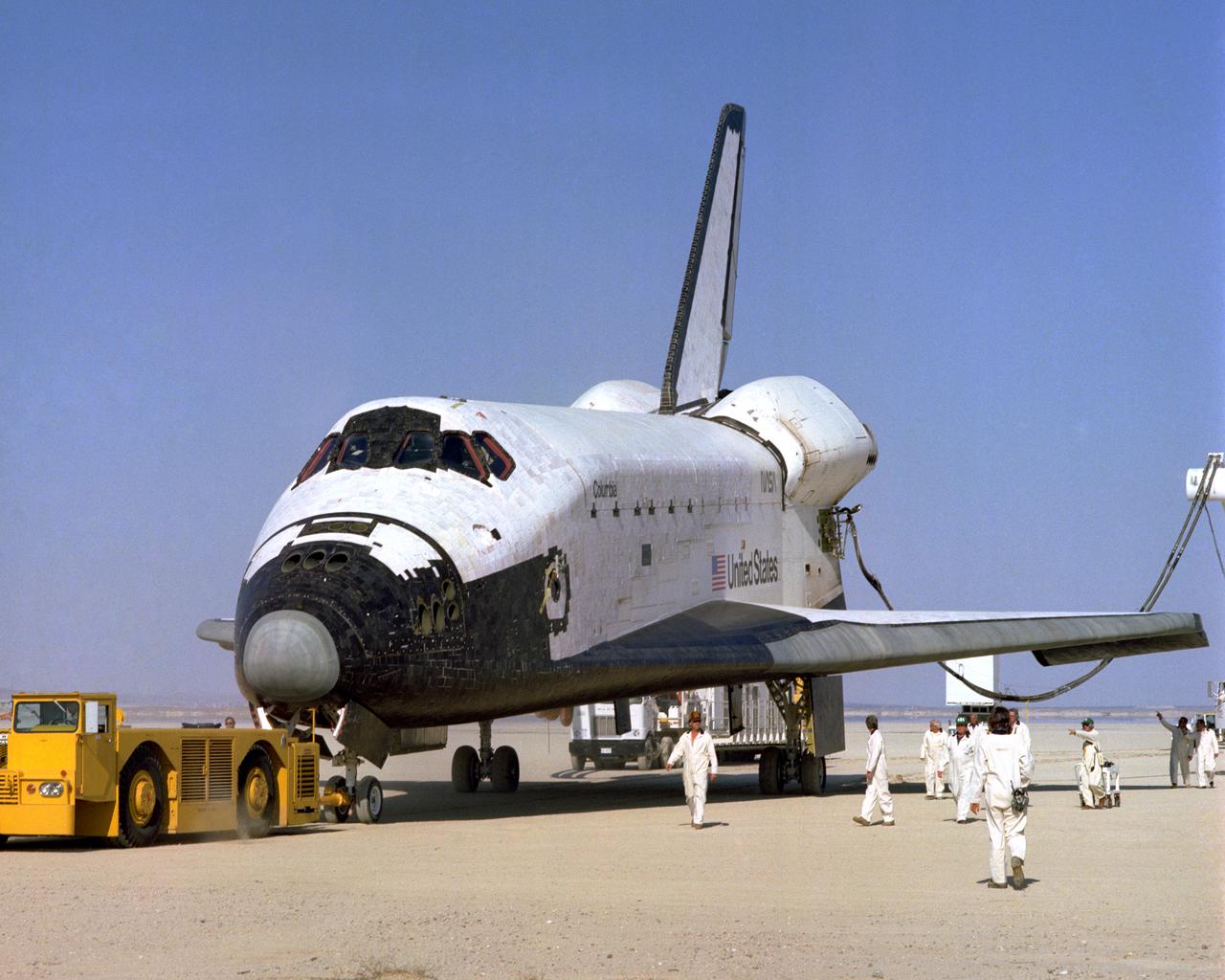
The Space Shuttle Columbia on Rogers Dry lakebed at Edwards AFB after landing to complete its first orbital mission on April 14, 1981. Technicians towed the Shuttle back to the NASA Dryden Flight Research Center for post-flight processing and preparation for a return ferry flight atop a modified 747 to Kennedy Space Center in Florida.
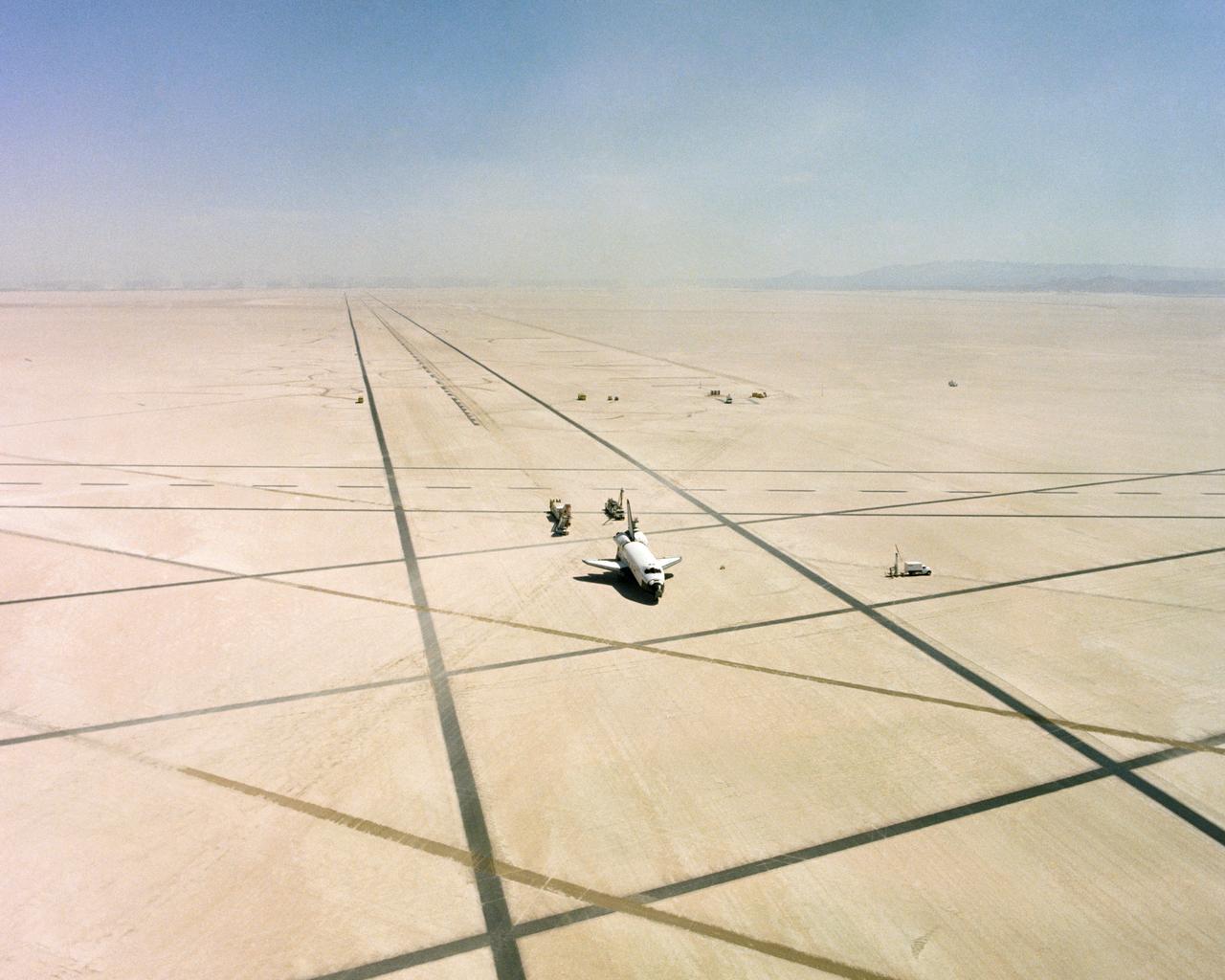
The Space Shuttle Columbia on Rogers Dry lakebed at Edwards AFB after landing to complete its first orbital mission on April 14, 1981. Technicians towed the Shuttle back to the NASA Dryden Flight Research Center for post-flight processing and preparation for a return ferry flight atop a modified 747 to Kennedy Space Center in Florida. (JSC photo # S81-31163)
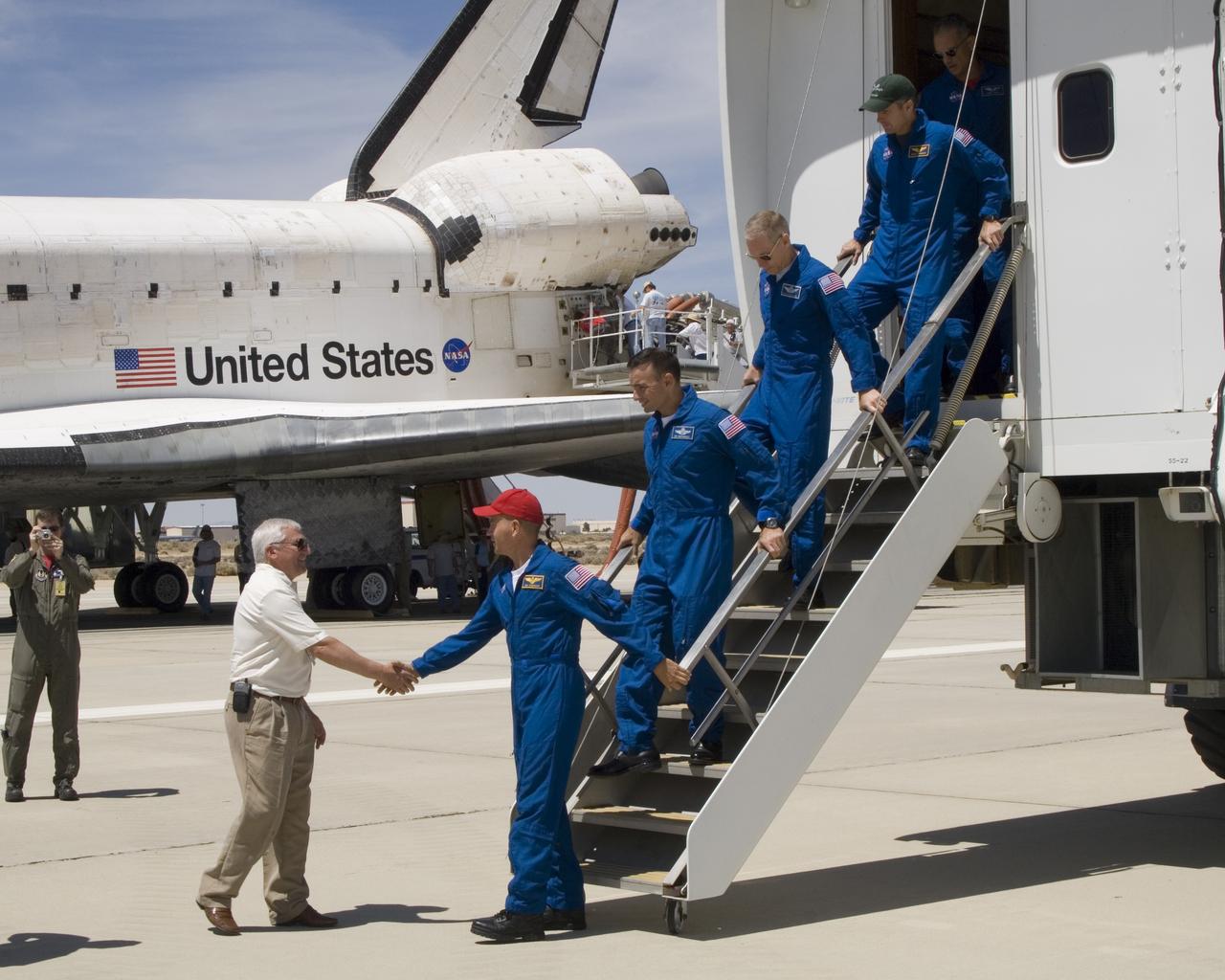
DFRC Center Director Kevin Petersen greets STS-117 Commander Frederick Sturckow and the crew of the Space Shuttle Atlantis at Edwards, AFB, Calif., on June 22, 2007. Left to right: DFRC Center Director Kevin Petersen, Commander Frederick Sturckow, Pilot Lee Archambault, and mission specialists Patrick Forrester, Steven Swanson and John D. Olivas.
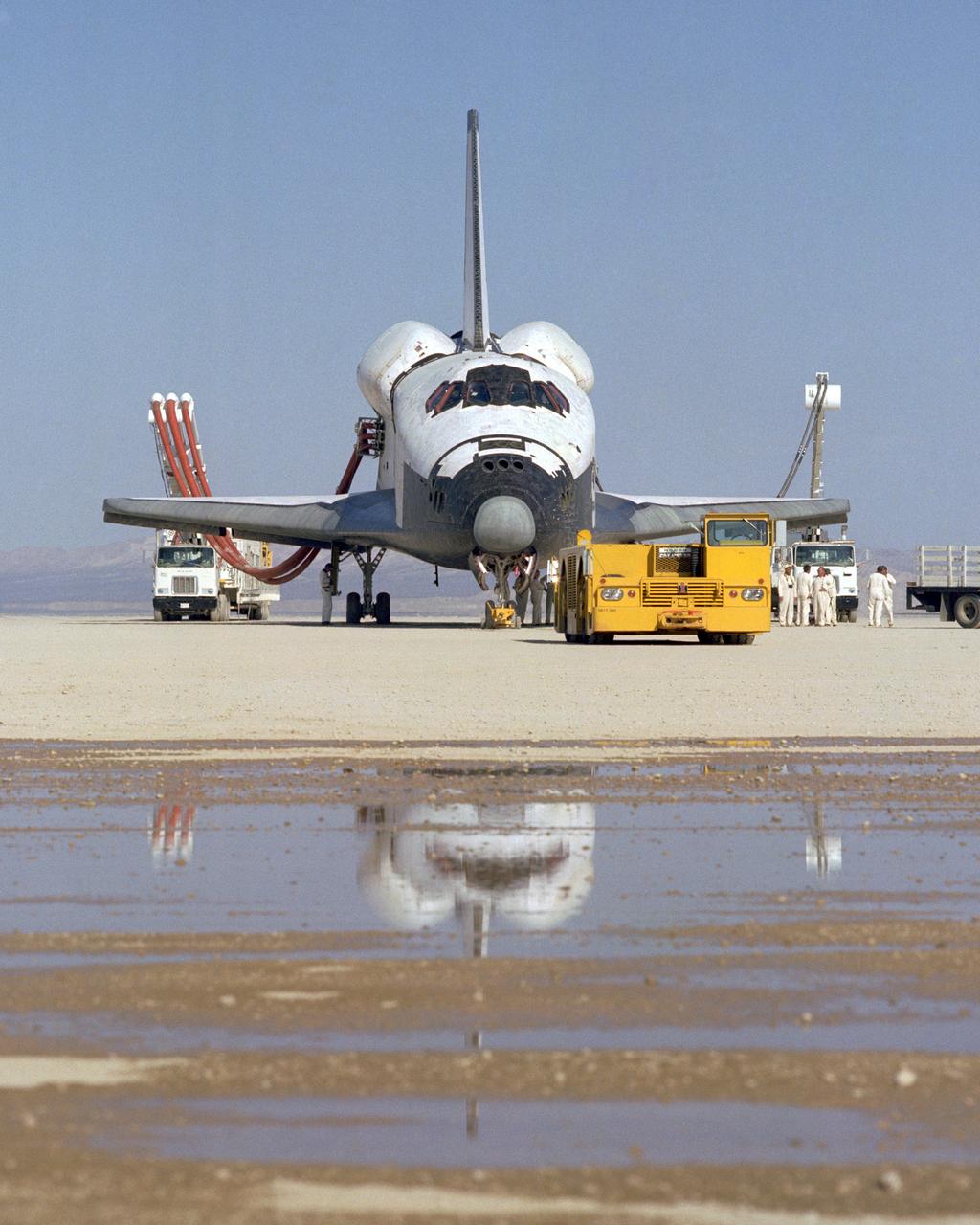
The Space Shuttle Columbia on Rogers Dry lakebed at Edwards AFB after landing to complete its first orbital mission on April 14, 1981. Technicians towed the Shuttle back to the NASA Dryden Flight Research Center for post-flight processing and preparation for a return ferry flight atop a modified 747 to Kennedy Space Center in Florida.
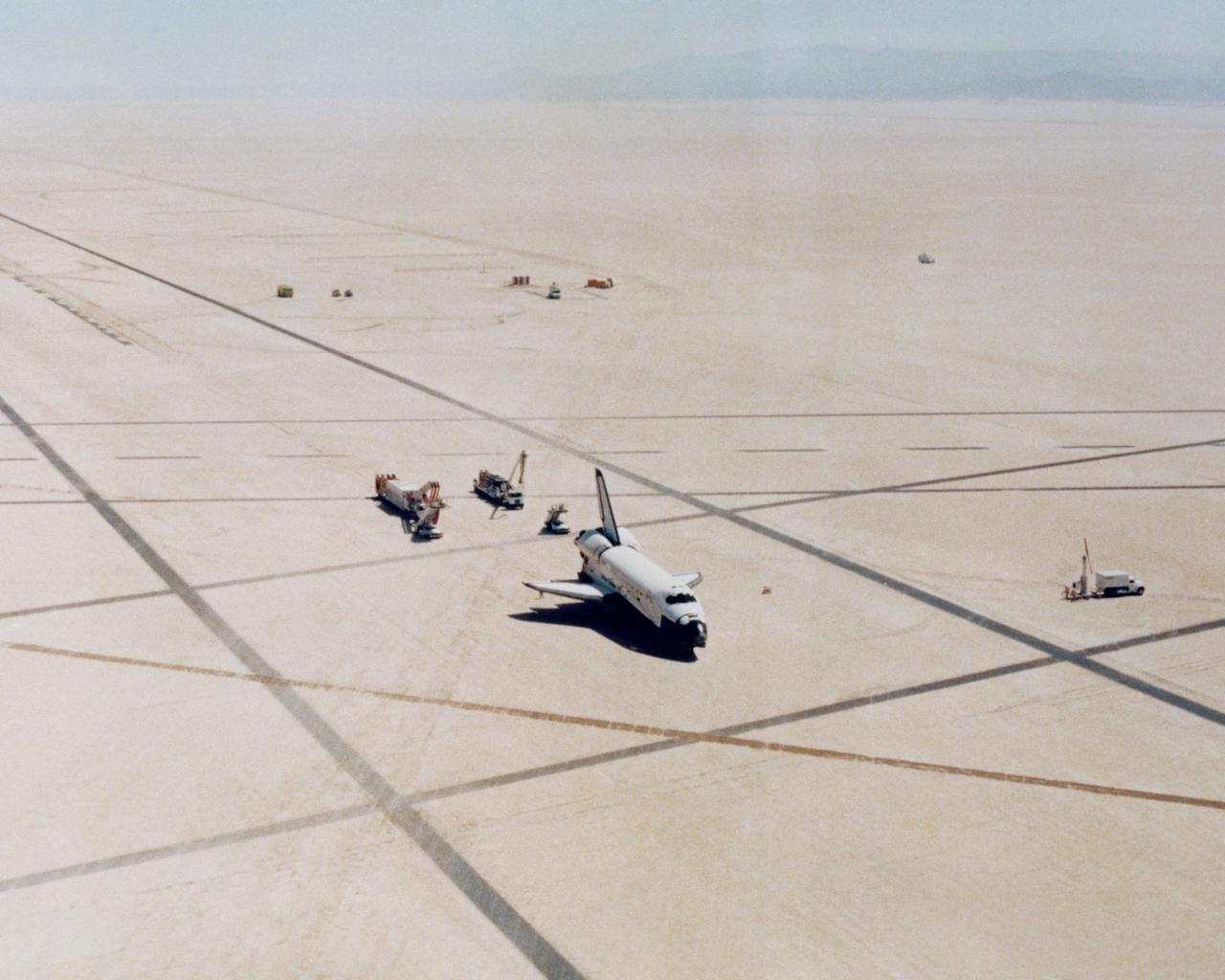
The Space Shuttle Columbia on Rogers Dry lakebed at Edwards AFB after landing to complete its first orbital mission on April 14, 1981. Technicians towed the Shuttle back to the NASA Dryden Flight Research Center for post-flight processing and preparation for a return ferry flight atop a modified 747 to Kennedy Space Center in Florida. (JSC photo # S81-30749)

YF-104A (Serial # 55-2961) on Rogers Dry Lake at Edwards AFB.
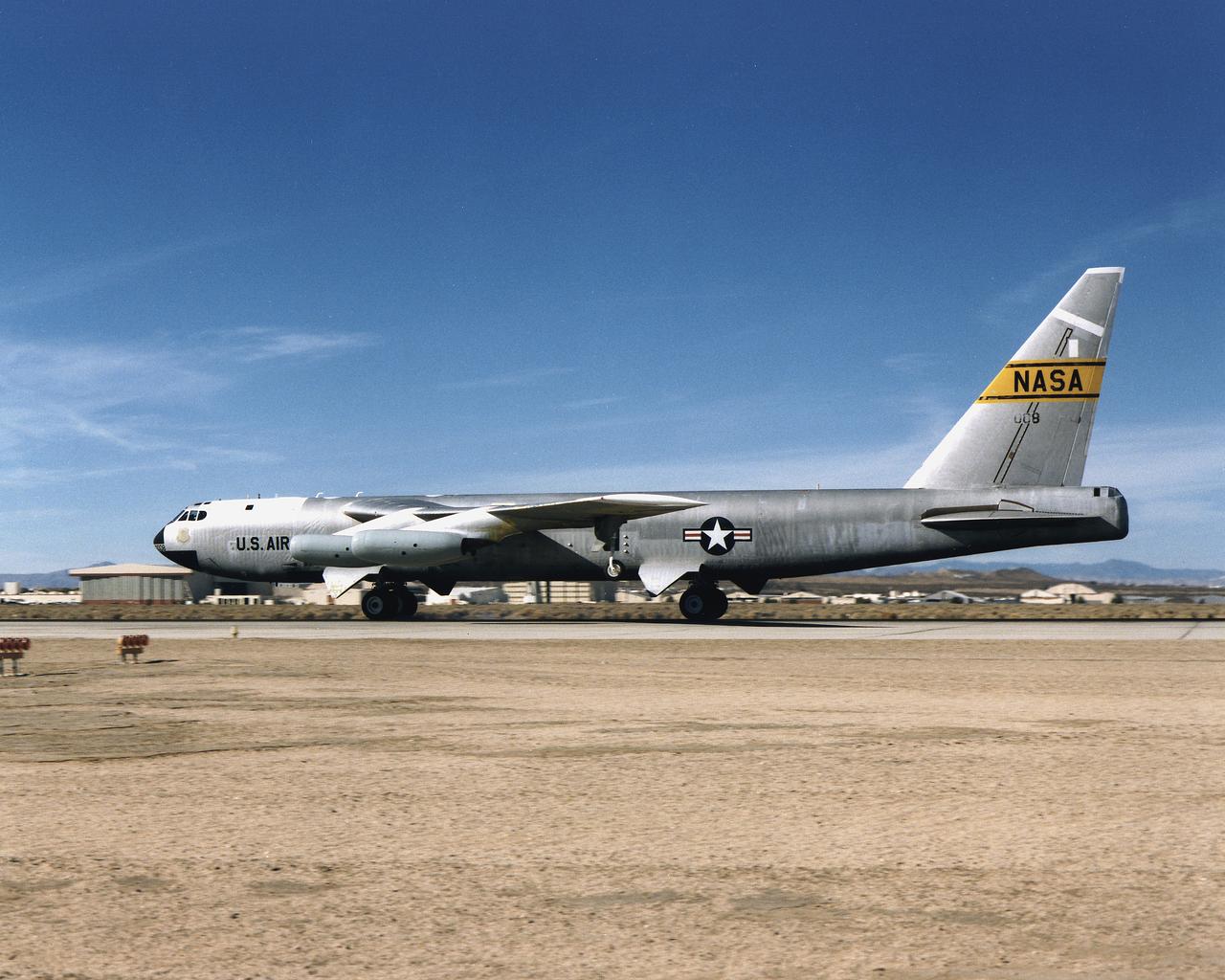
Dryden B-52 Launch Aircraft on Edwards AFB Runway
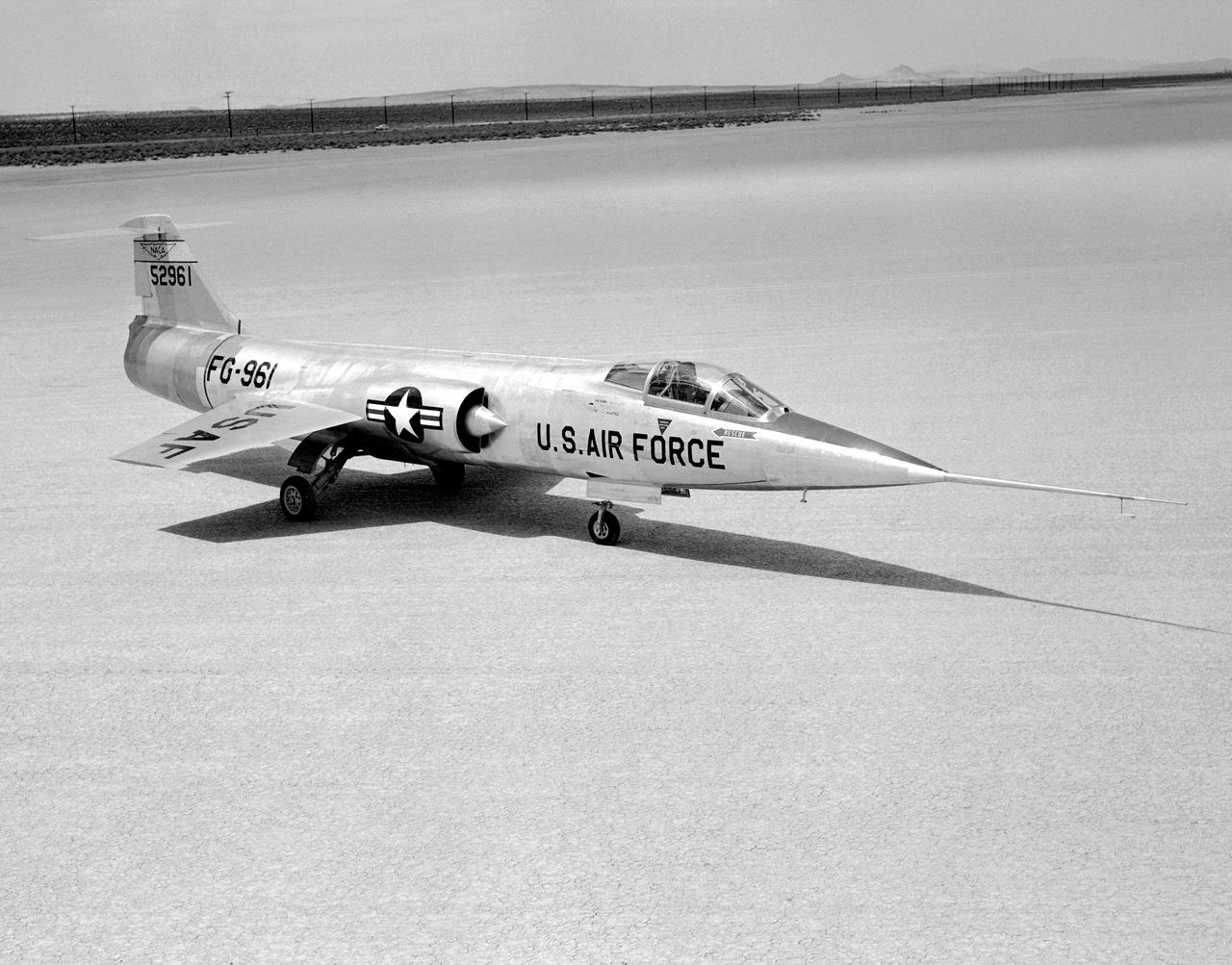
YF-104A (Serial #55-2961) on Rogers Dry Lake at Edwards AFB.
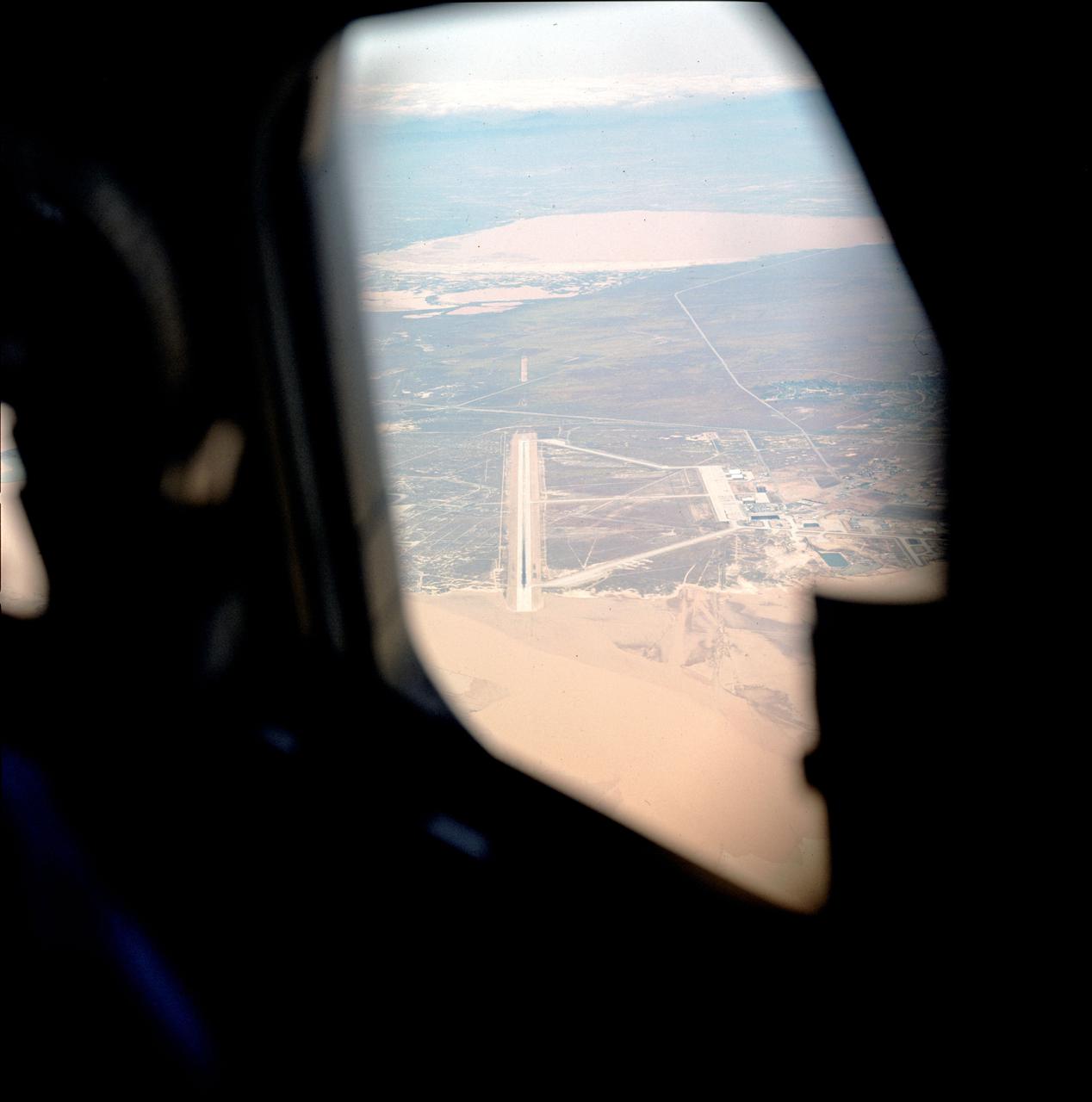
STS006-46-667 (9 April 1983) --- One of the final pictures taken aboard the space shuttle Challenger is this 35mm frame of Landing Strip 22 at Edwards Air Force Base as the reusable spacecraft was lined up for its landing only seconds later. The frame was exposed by astronaut Donald H. Peterson, STS-6 mission specialist, who was stretching behind the commander’s seat occupied by astronaut Paul J. Weitz on the flight deck. Also onboard the spacecraft for the five-day flight were astronauts Karol J. Bobko, pilot, and Dr. F. Story Musgrave, mission specialist. Photo credit: NASA
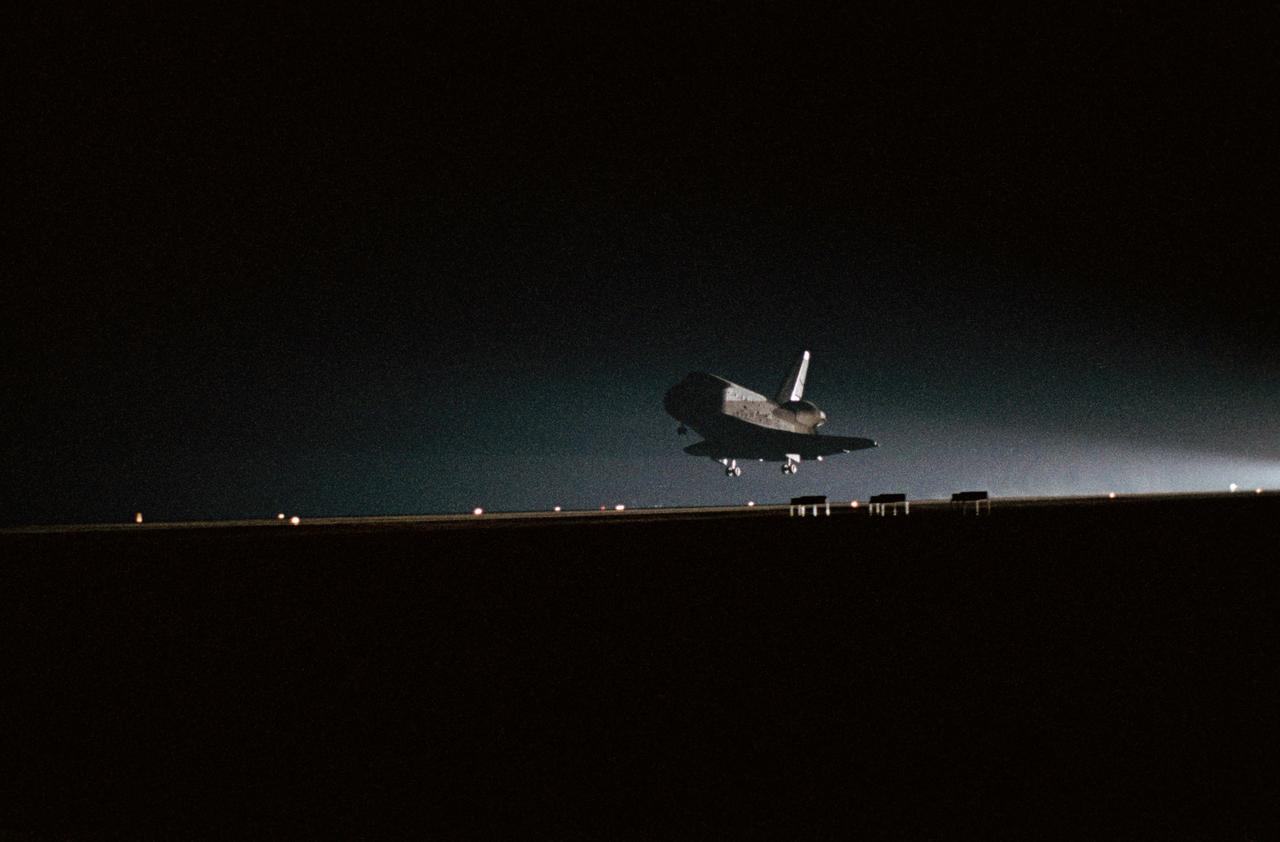
Night view, Challenger STS-8 as it is coming in for a landing. EDWARDS AFB (EAFB), CA
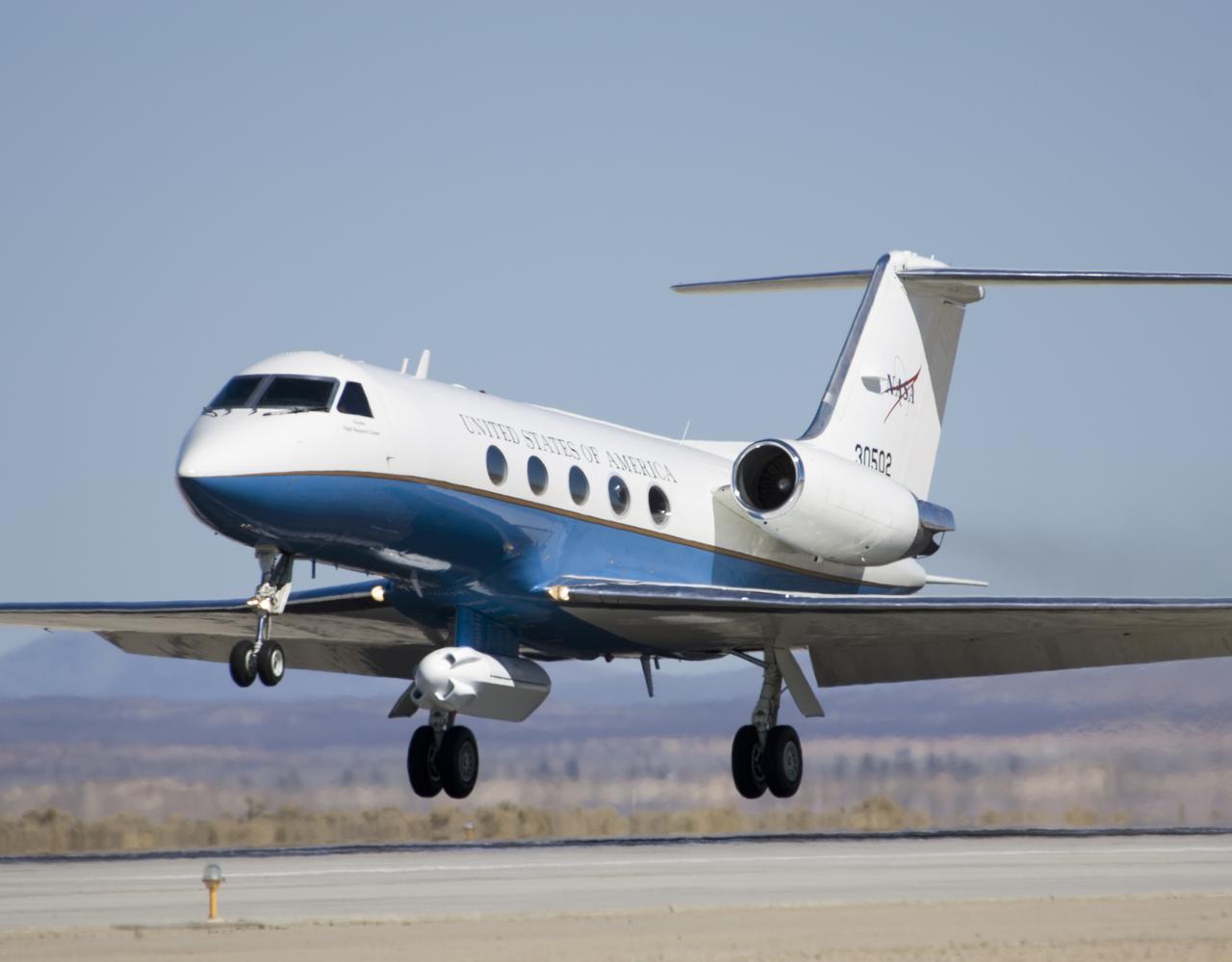
NASA's Gulfstream-III research testbed lifts off the Edwards AFB runway on an envelope-expansion flight test with the UAV synthetic aperture radar pod.
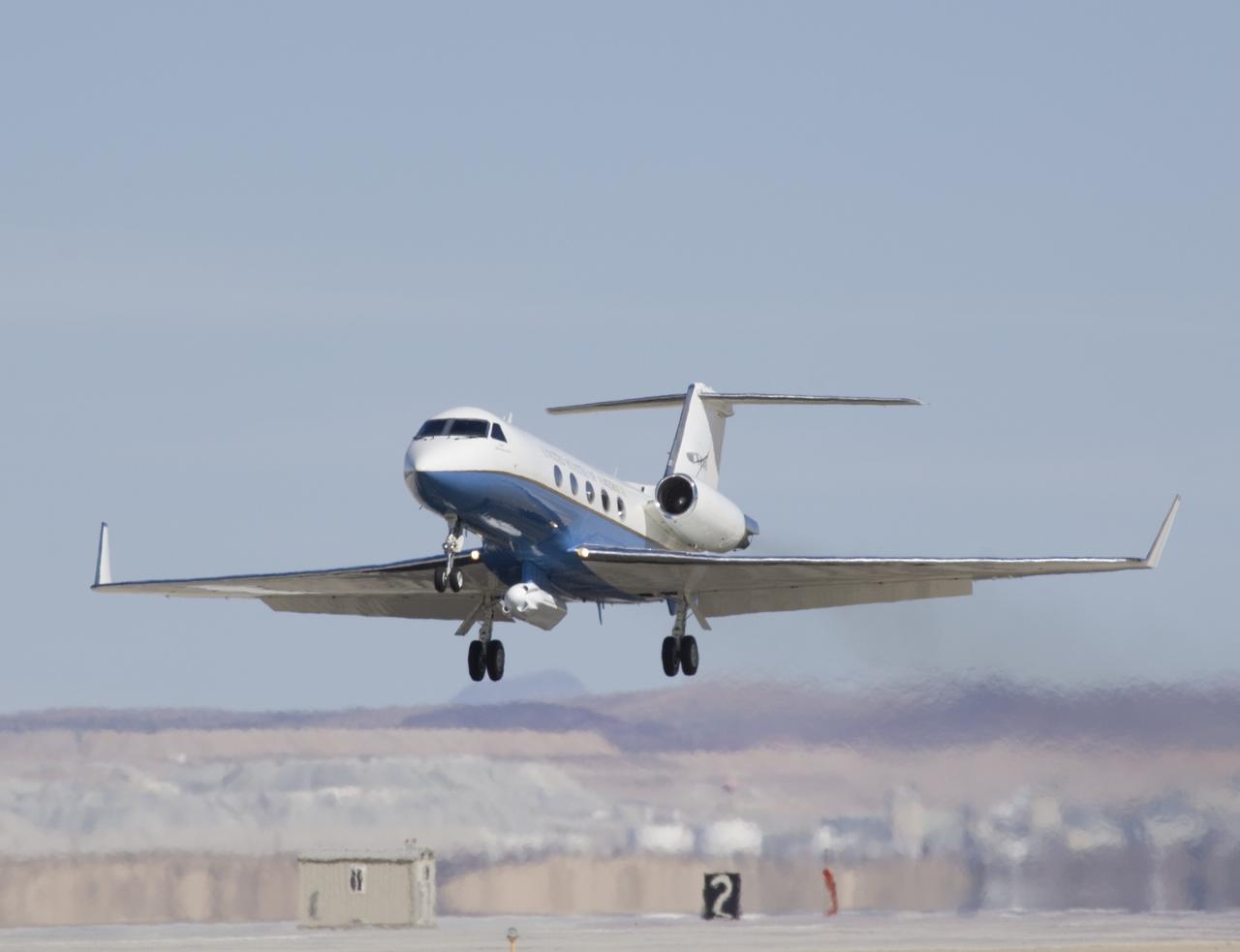
Shimmering heat waves trail behind NASA's Gulfstream-III research aircraft as it departs the Edwards AFB runway on a UAVSAR pod checkout test flight.
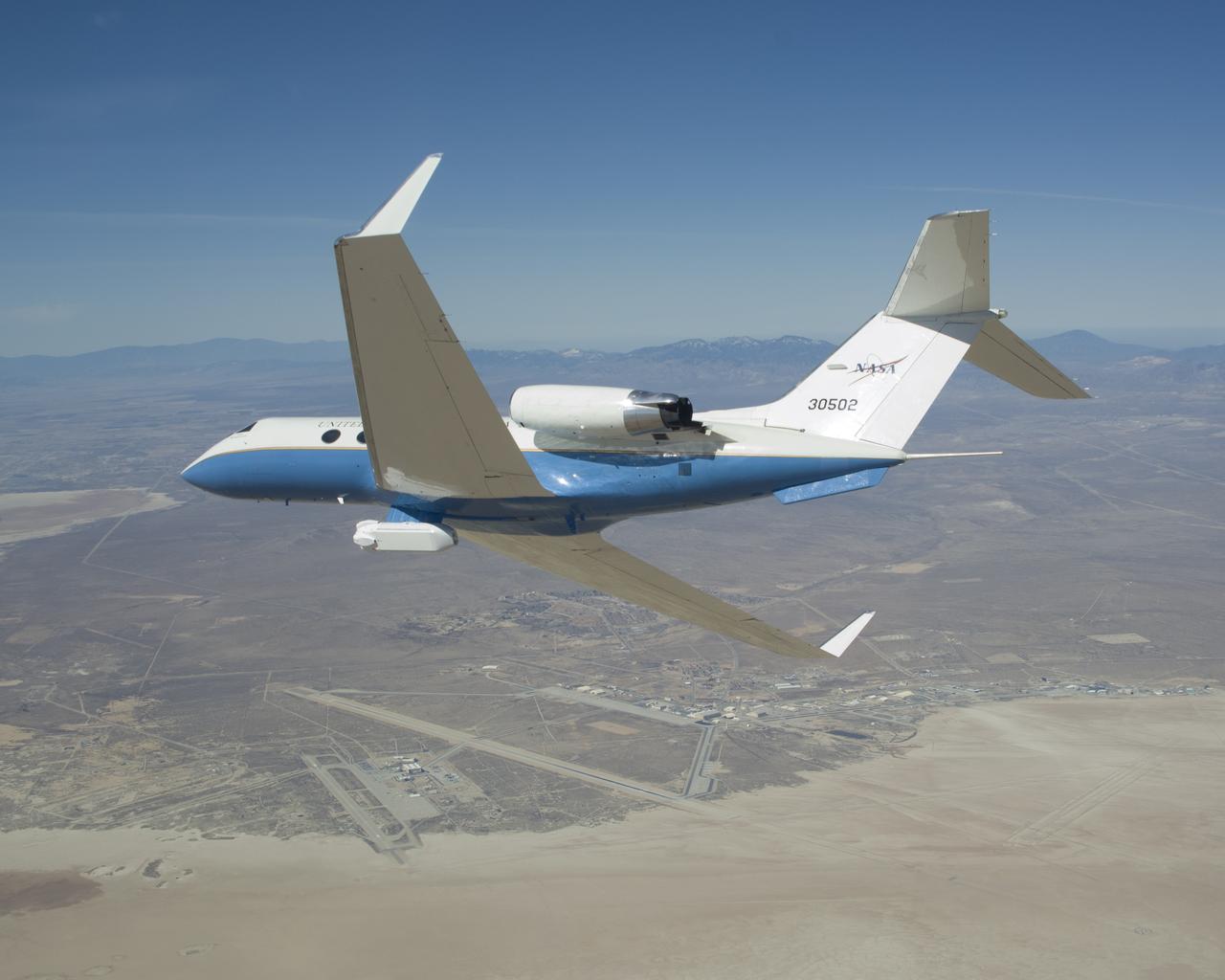
The UAVSAR underbelly pod is in clear view as NASA's Gulfstream-III research aircraft banks away over Edwards AFB during aerodynamic clearance flights.
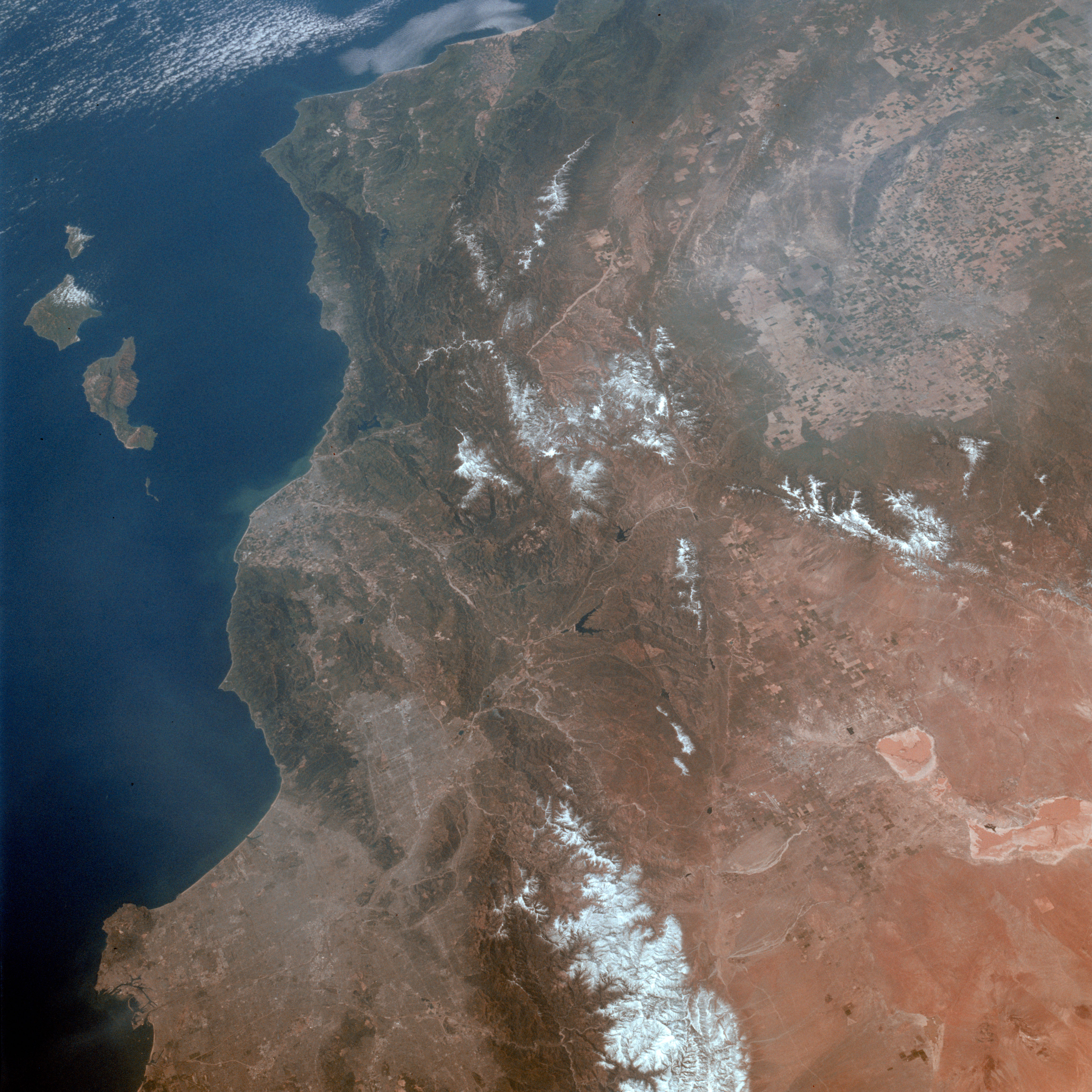
STS003-010-593 (30 March 1982) --- A general view of the greater Los Angeles region of California (34,0N, 118.5W) showing the coastline, Vandenberg AFB, the south end of the Central Valley and the dry lake beds at Edwards AFB. A close look can pinpoint water on the lake beds at Edwards Air Force Base used previously for two shuttle landings. Among other features that can be seen are Oxnard, Santa Barbara, Bakersfield, Vandenberg Air Force Base, and The Ranch. Photo credit: NASA
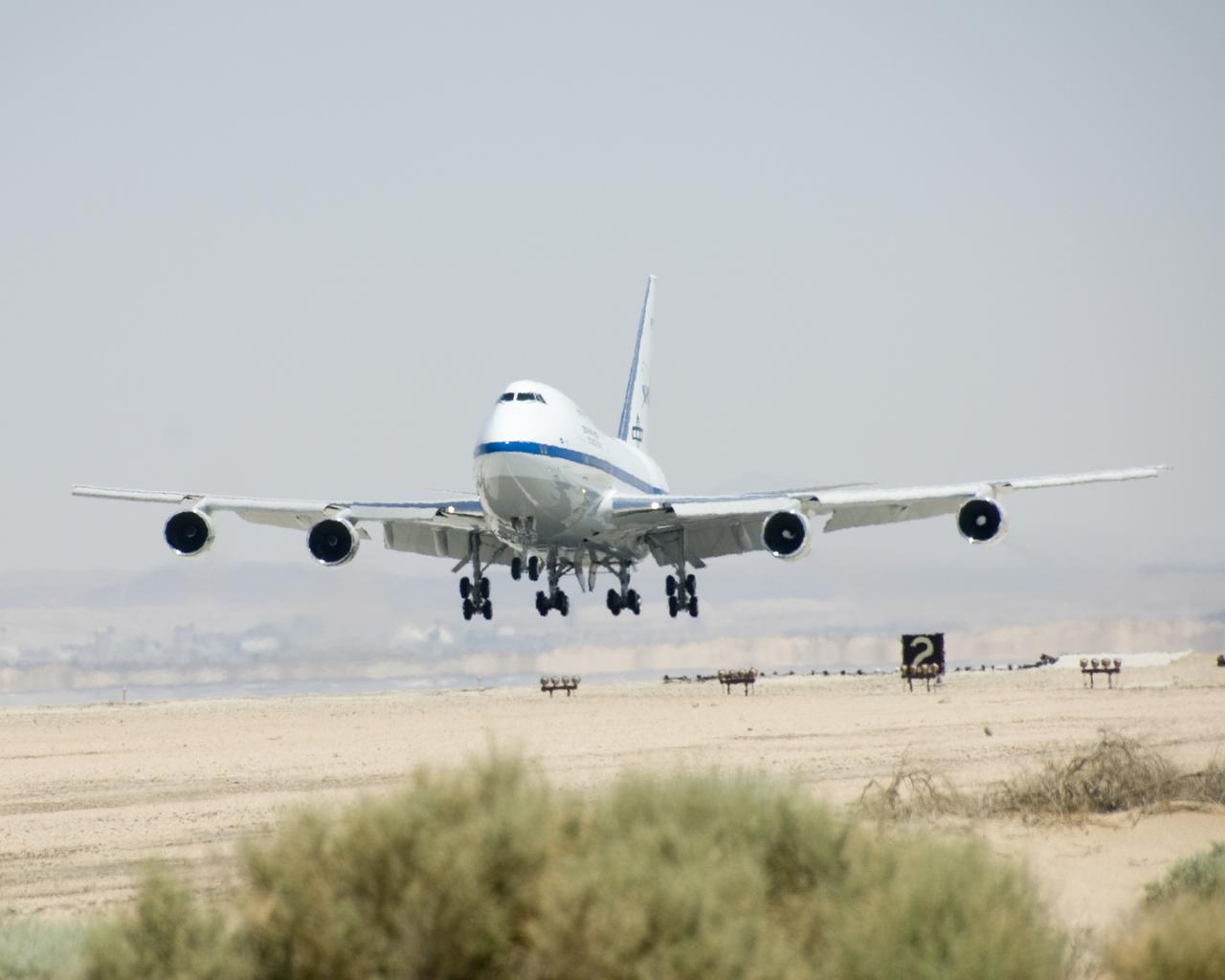
NASA's Stratospheric Observatory for Infrared Astronomy (SOFIA) Boeing 747SP flares for landing at Edwards AFB after a ferry flight from Waco, Texas. NASA's Stratospheric Observatory for Infrared Astronomy, or SOFIA, arrived at NASA's Dryden Flight Research Center at Edwards Air Force Base, Calif. on May 31, 2007. The heavily modified Boeing 747SP was ferried to Dryden from Waco, Texas, where L-3 Communications Integrated Systems installed a German-built 2.5-meter infrared telescope and made other major modifications over the past several years. SOFIA is scheduled to undergo installation and integration of mission systems and a multi-phase flight test program at Dryden over the next three years that is expected to lead to a full operational capability to conduct astronomy missions in about 2010. During its expected 20-year lifetime, SOFIA will be capable of "Great Observatory" class astronomical science, providing astronomers with access to the visible, infrared and sub-millimeter spectrum with optimized performance in the mid-infrared to sub-millimeter range.

NASA's SOFIA airborne observatory lands at Edwards AFB after being flown from Waco, Texas to NASA Dryden for systems installation, integration and flight test. NASA's Stratospheric Observatory for Infrared Astronomy, or SOFIA, arrived at NASA's Dryden Flight Research Center at Edwards Air Force Base, Calif. on May 31, 2007. The heavily modified Boeing 747SP was ferried to Dryden from Waco, Texas, where L-3 Communications Integrated Systems installed a German-built 2.5-meter infrared telescope and made other major modifications over the past several years. SOFIA is scheduled to undergo installation and integration of mission systems and a multi-phase flight test program at Dryden over the next three years that is expected to lead to a full operational capability to conduct astronomy missions in about 2010. During its expected 20-year lifetime, SOFIA will be capable of "Great Observatory" class astronomical science, providing astronomers with access to the visible, infrared and sub-millimeter spectrum with optimized performance in the mid-infrared to sub-millimeter range.
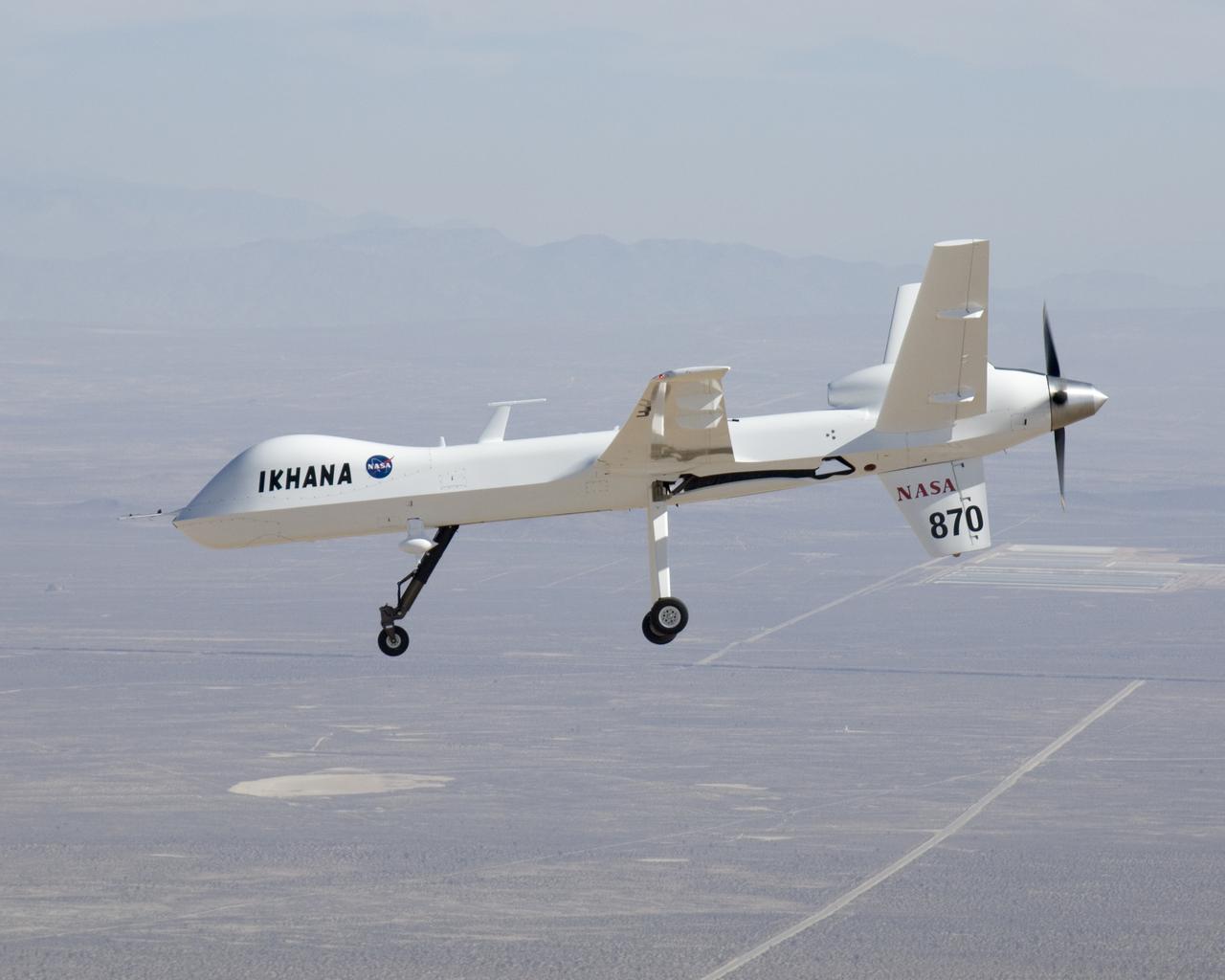
NASA's Ikhana unmanned science demonstration aircraft prepares for landing as it arrives at Edwards Air Force Base, Calif. NASA took possession of the new aircraft in November, 2006, and it arrived at its new home at NASA's Dryden Flight Reseach Center at Edwards AFB, on June 23, 2007.
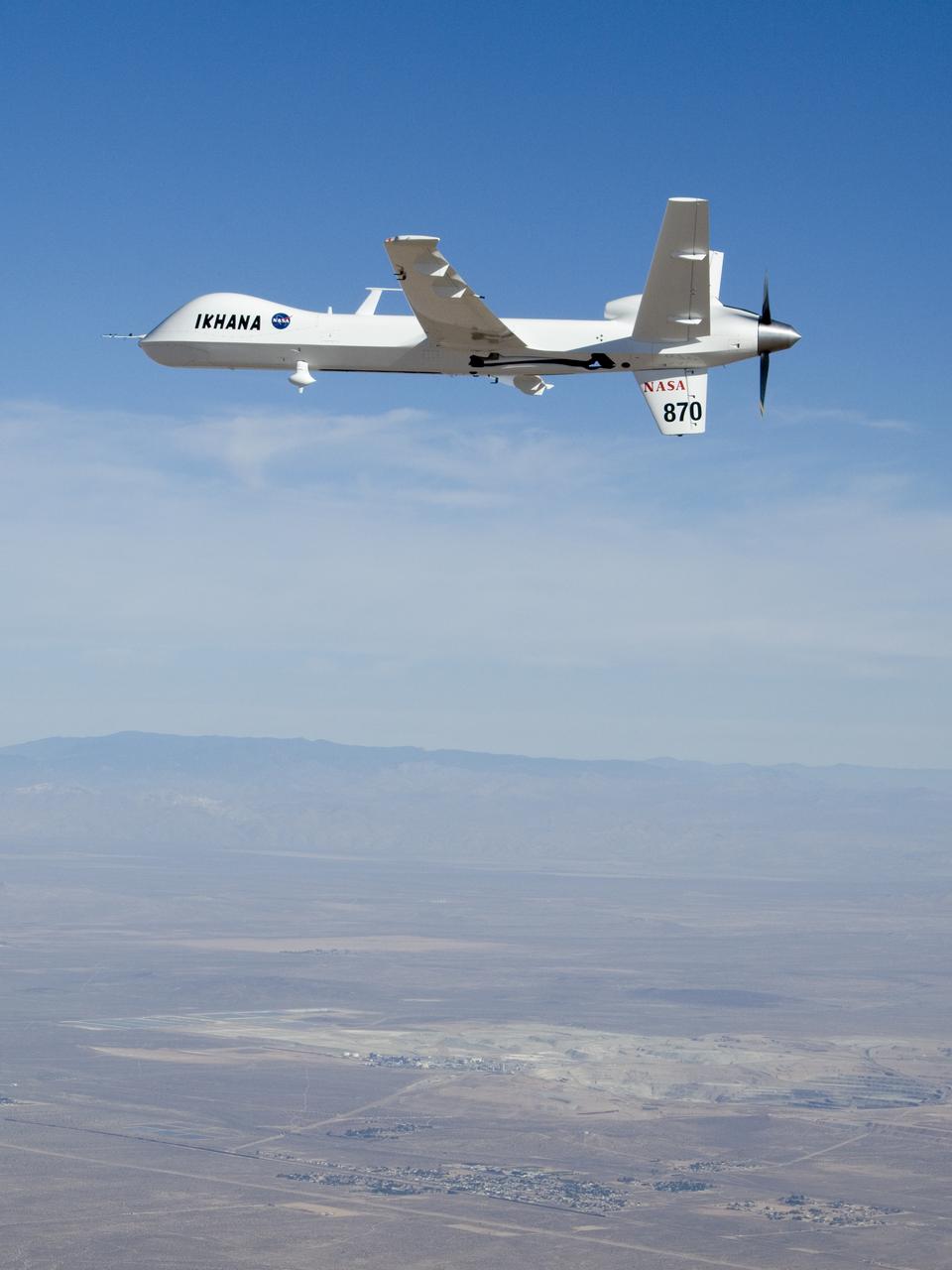
NASA's Ikhana unmanned science demonstration aircraft over the U.S. Borax mine, Boron, California, near the Dryden/Edwards Air Force Base complex. NASA took possession of the new aircraft in November, 2006, and it arrived at the NASA Dryden Flight Research Center at Edwards AFB, Calif., on June 23, 2007.
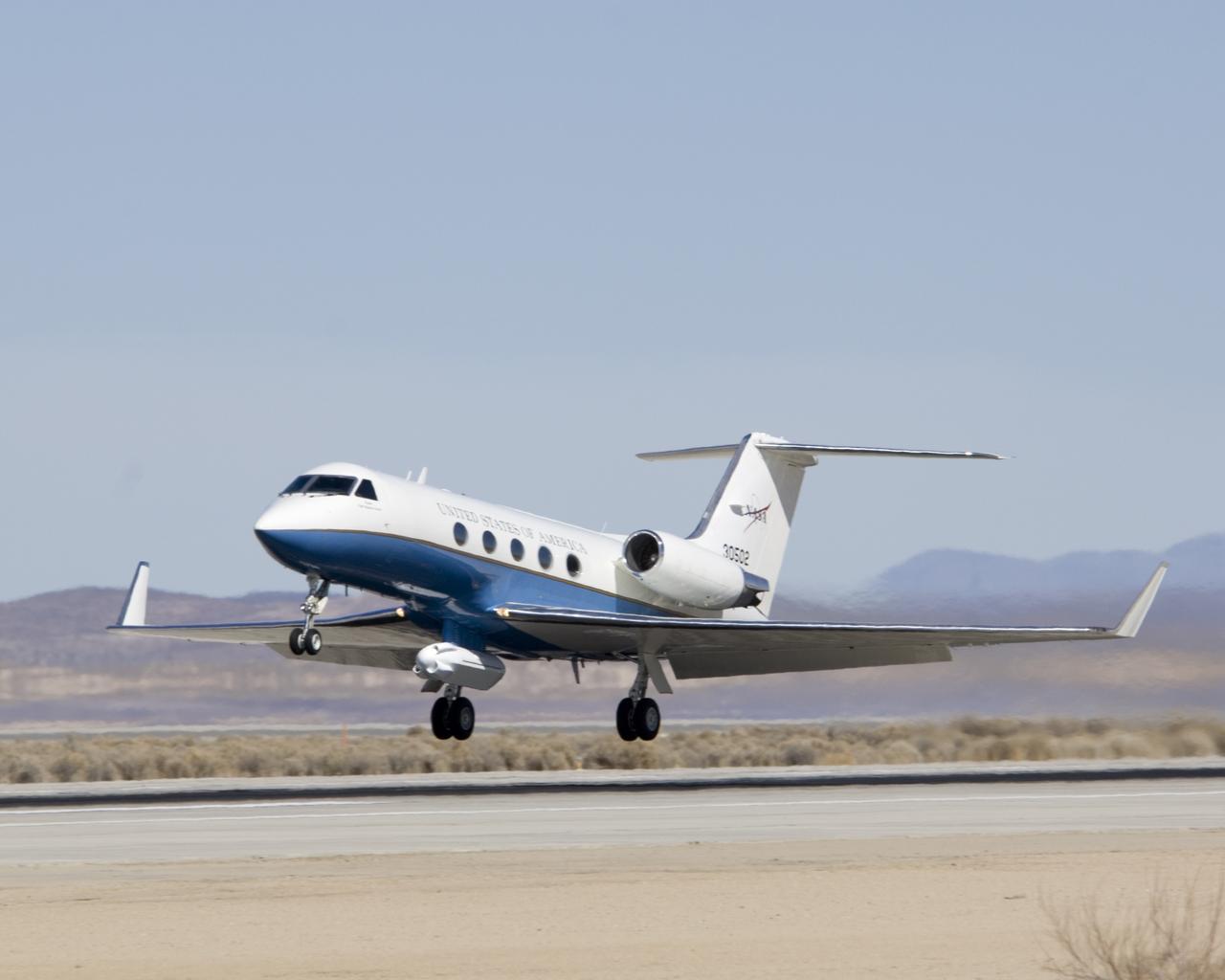
NASA's Gulfstream-III research testbed lifts off from Edwards AFB on a checkout test flight with the UAV synthetic aperture radar pod under its belly.
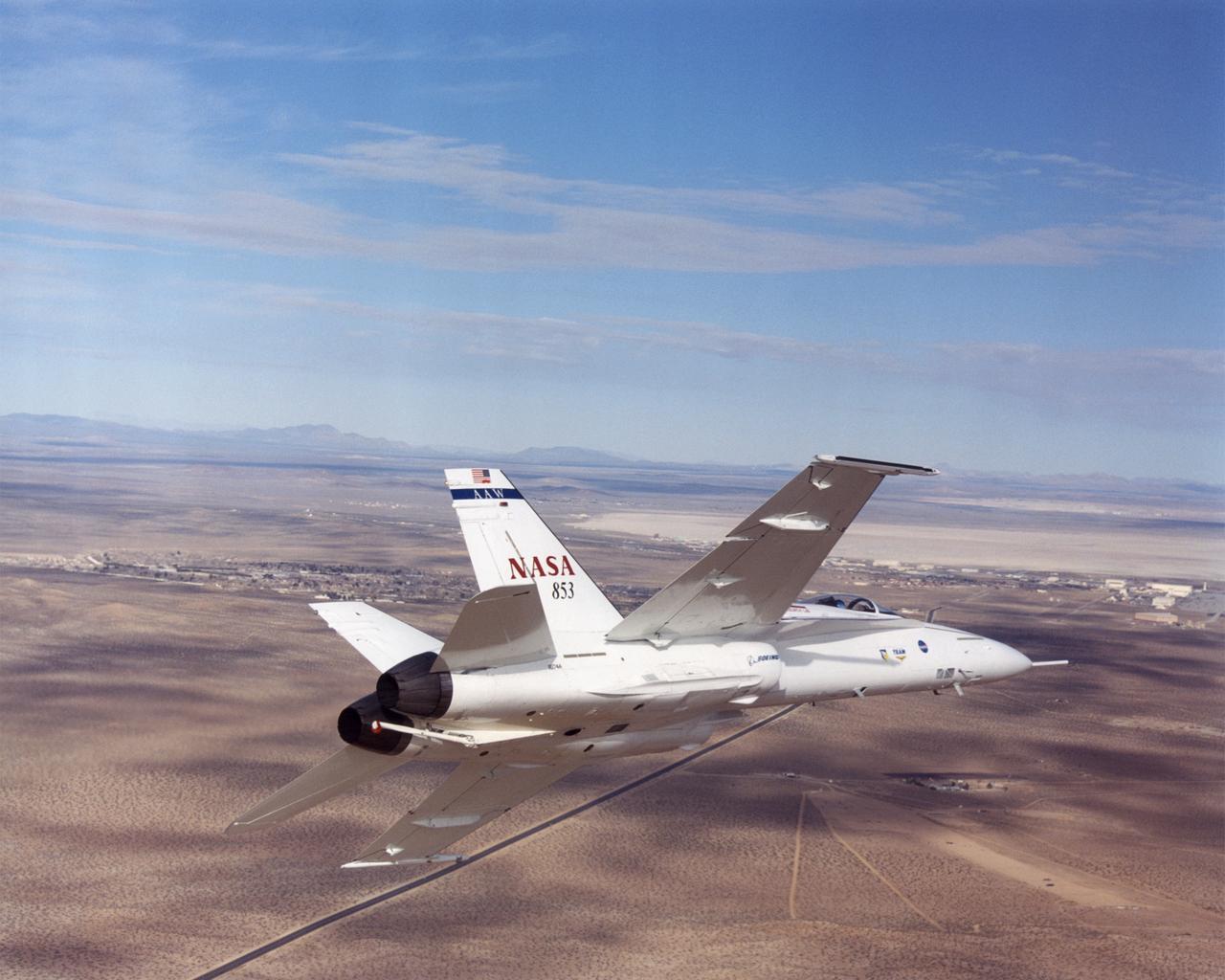
NASA 853, a modified former Navy F/A-18A fighter plane, is now performing research duties in the Active Aeroelastic Wing project at NASA Dryden Flight Research Center, Edwards AFB, California.
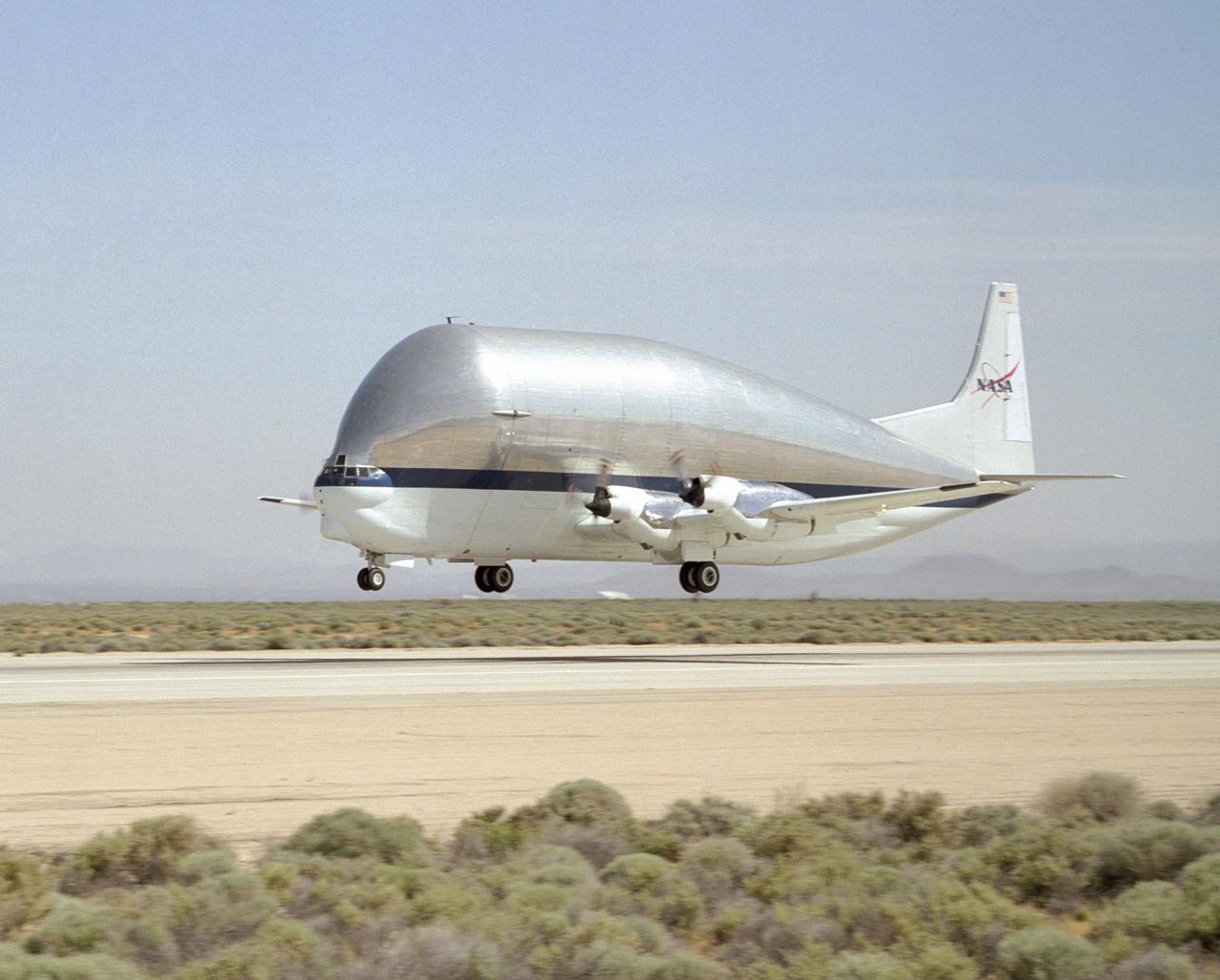
After replacement of its landing gear at NASA Dryden, NASA's Super Guppy Turbine cargo plane takes off from Edwards AFB to return to the Johnson Space Center.
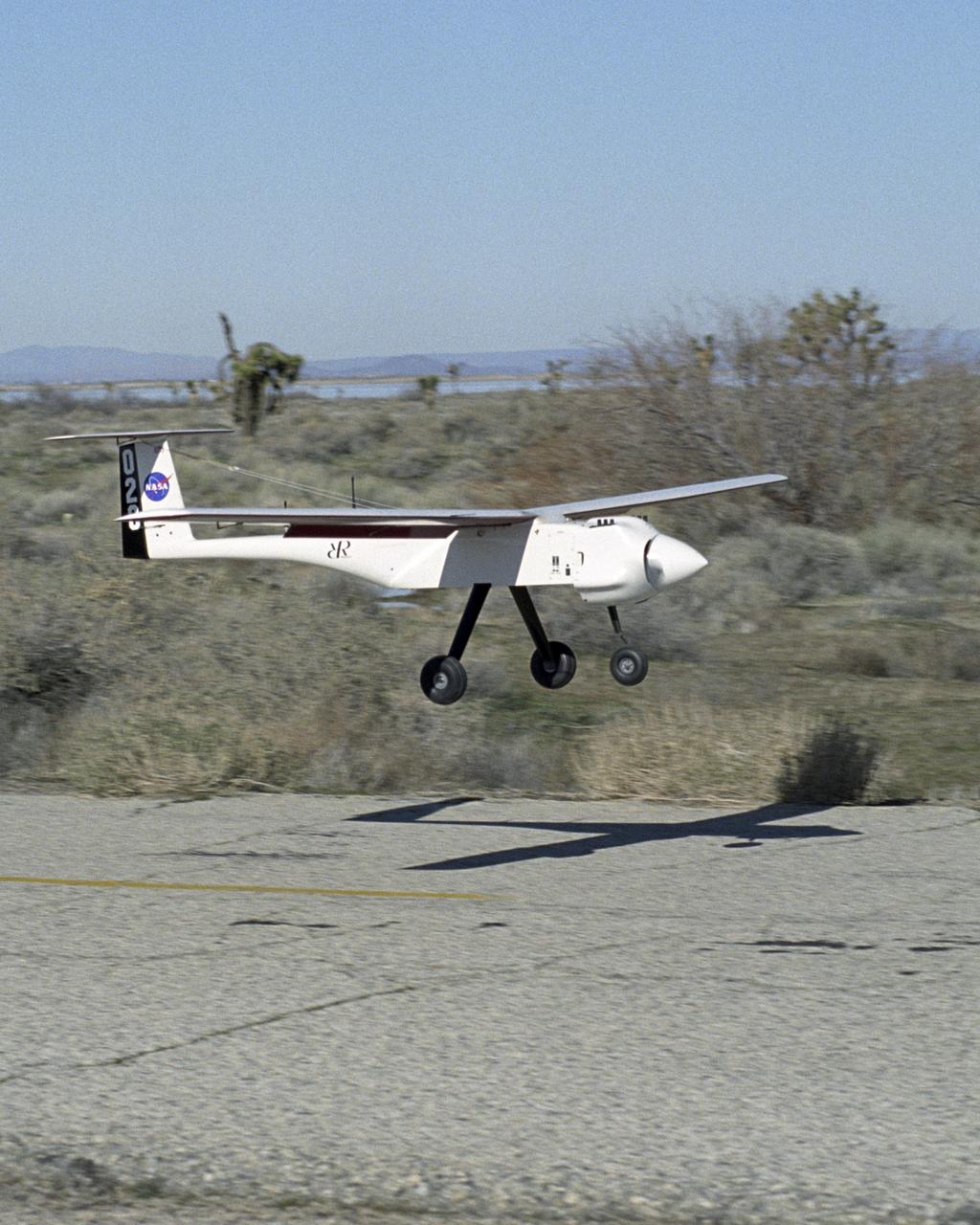
One of two small APV-3 aircraft flown in the joint Ames-Dryden Networked UAV Teaming Experiment flares for landing on a roadway on a remote area of Edwards AFB.
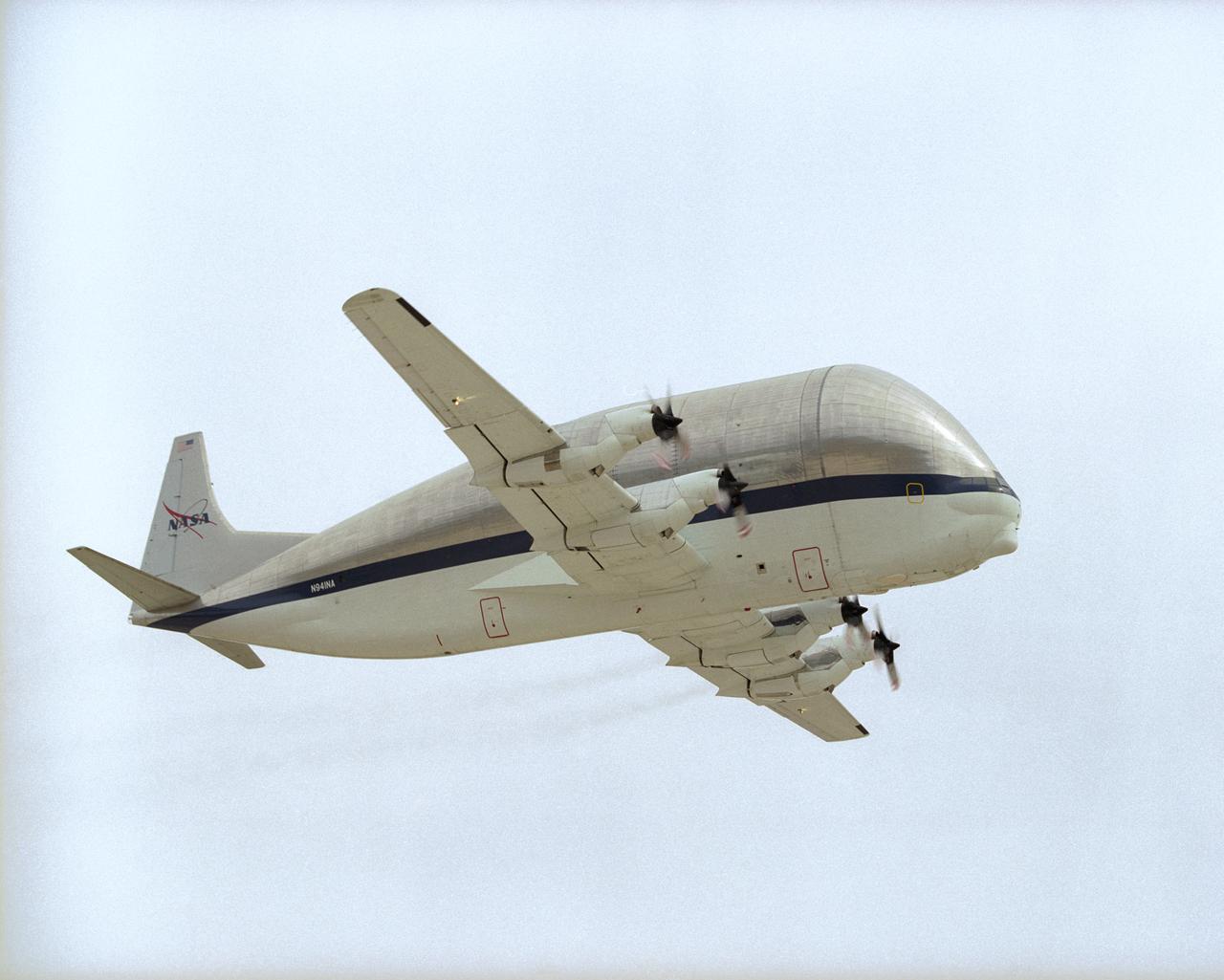
After replacement of its landing gear at NASA Dryden, NASA's Super Guppy Turbine cargo plane takes off from Edwards AFB to return to the Johnson Space Center.
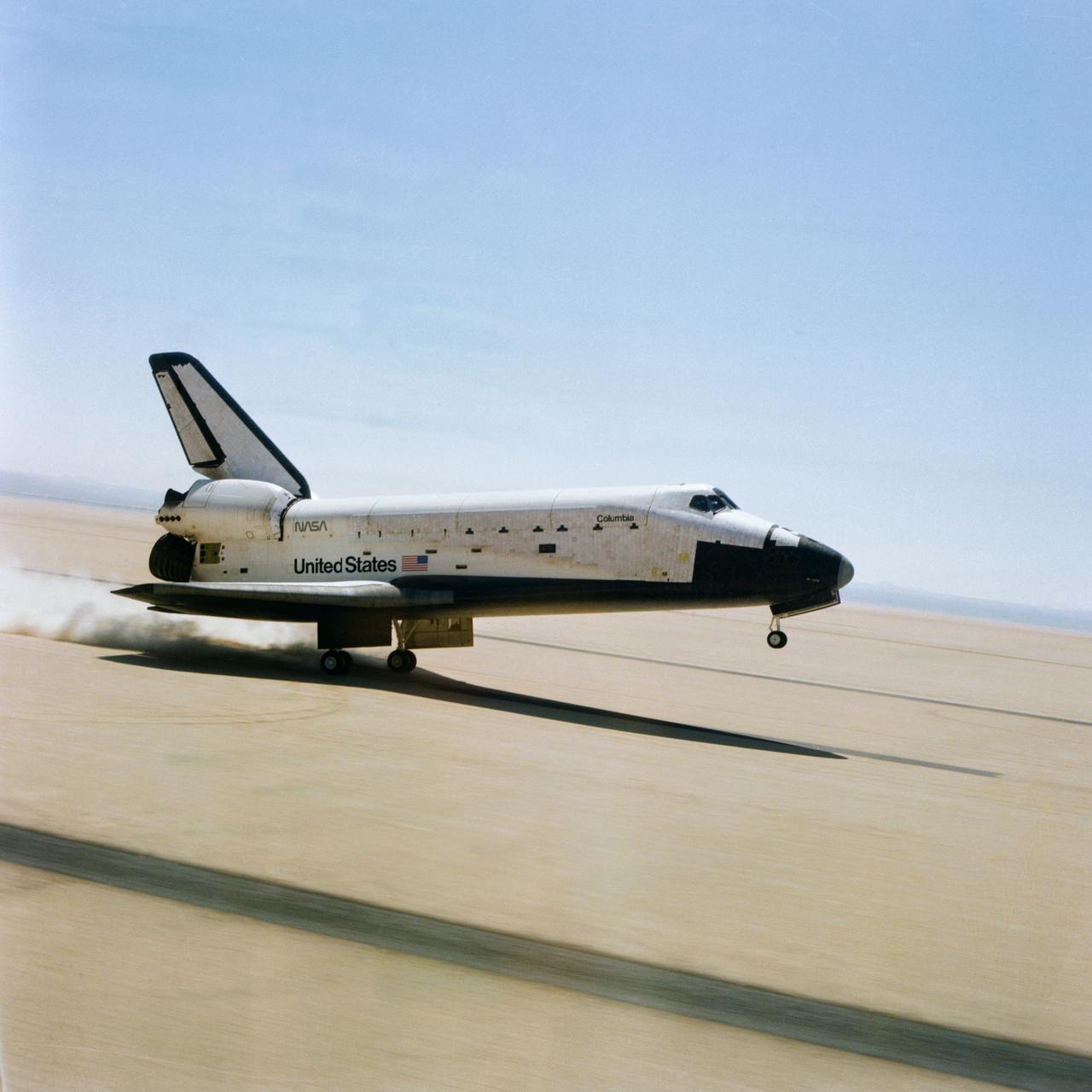
S81-30734 (14 April 1981) --- The rear wheels of the space shuttle orbiter Columbia (STS-1) touch down on Rogers dry lake at Edwards Air Force Base in southern California to successfully complete a stay in space of more than two days. Astronauts John W. Young, commander, and Robert L. Crippen, pilot, are aboard the vehicle. The mission marked the first NASA flight to end with a wheeled landing and represents the beginning of a new age of spaceflight that will employ the same hardware repeatedly. Photo credit: NASA
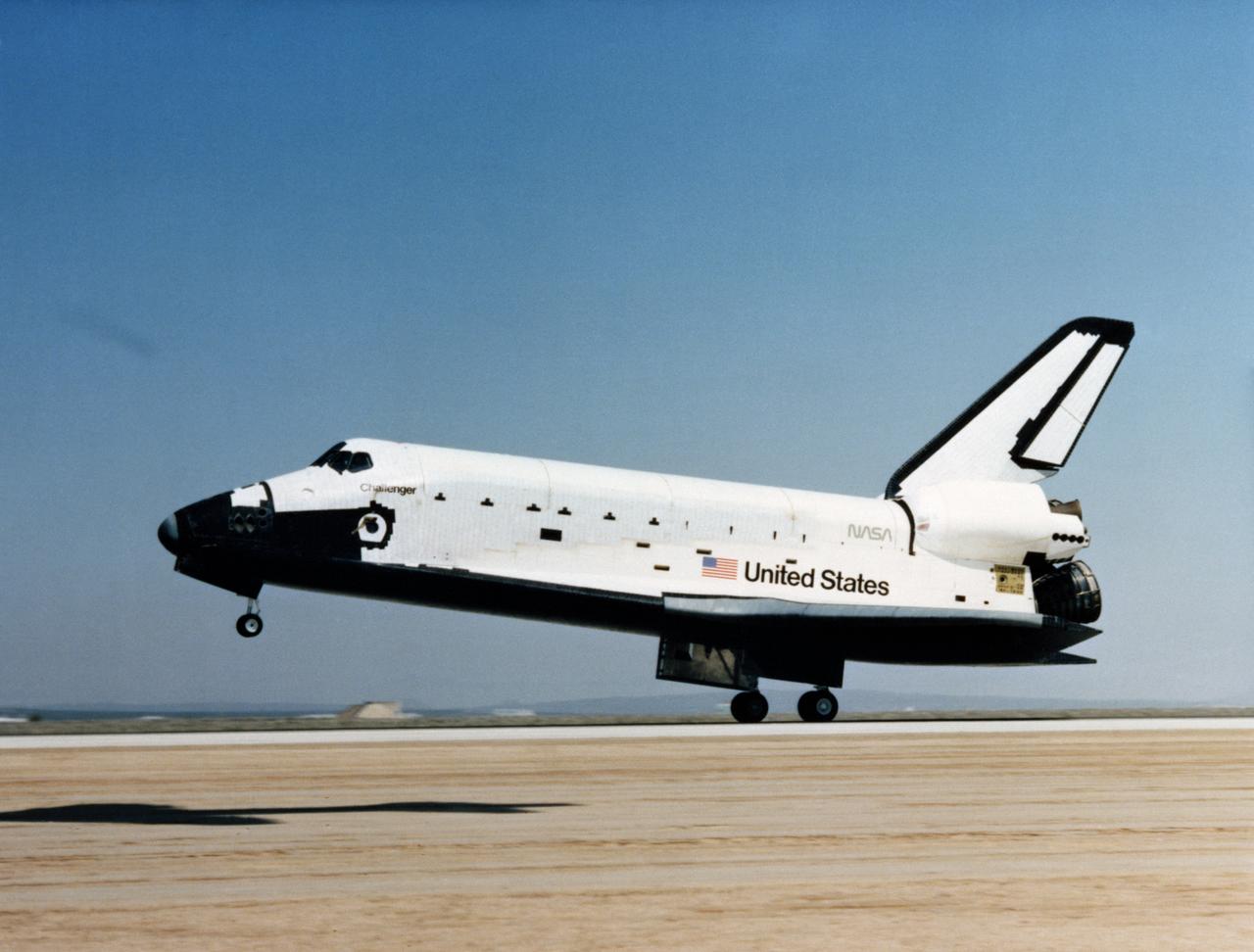
S83-30220 (9 April 1983) --- The space shuttle Challenger makes its first landing shortly before 11 a.m. (PST) on April 9, 1983, on Runway 22 at the Edwards Air Force Base in Southern California. Onboard the reusable spacecraft, having just completed a successful five-day mission, are astronauts Paul J. Weitz, Karol J. Bobko, F. Story Musgrave and Donald H. Peterson. Photo credit: NASA
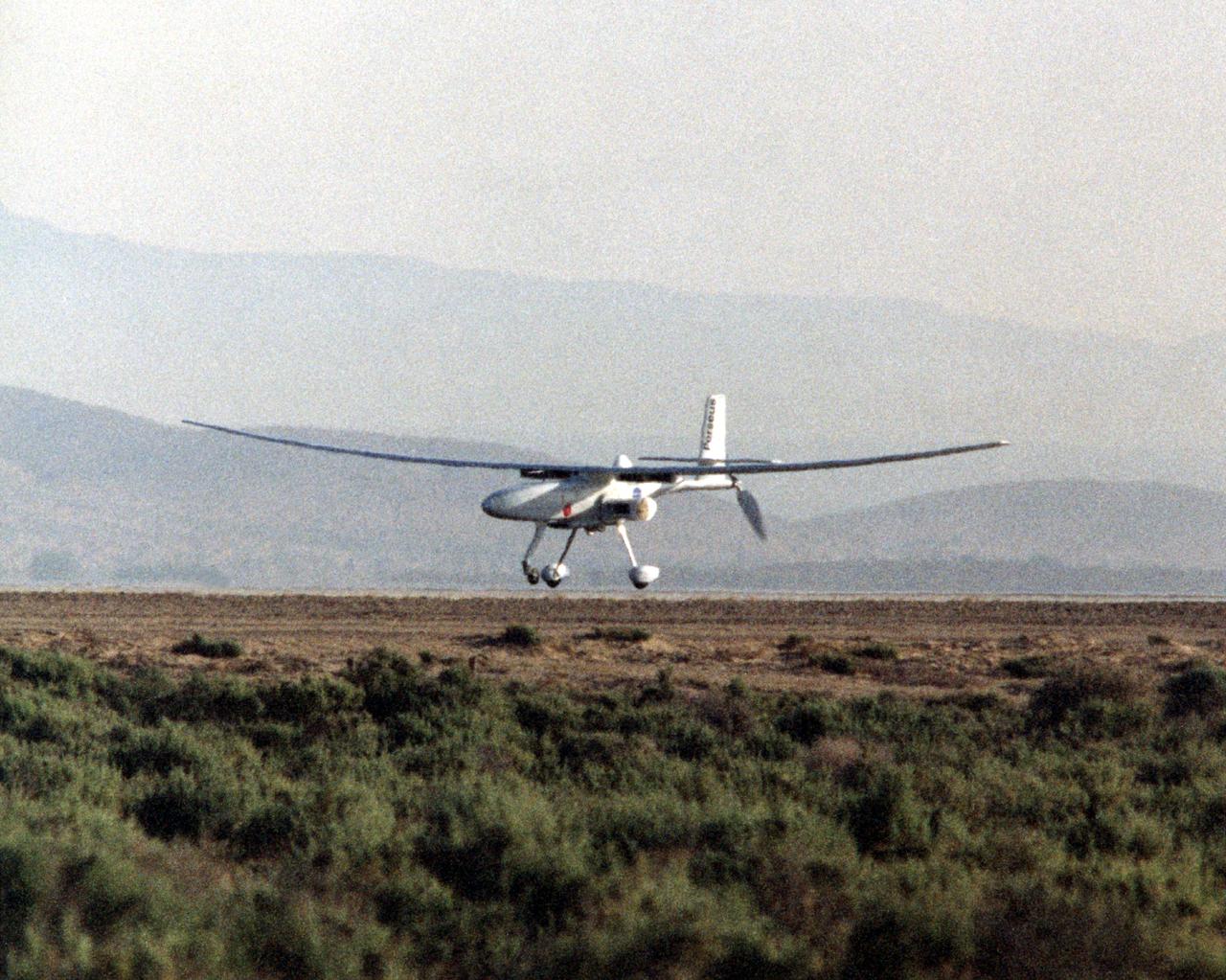
The Perseus B remotely piloted aircraft nears touchdown at Edwards Air Force Base, Calif. at the conclusion of a development flight at NASA's Dryden Flight Research Center. The Perseus B is the latest of three versions of the Perseus design developed by Aurora Flight Sciences under NASA's Environmental Research Aircraft and Sensor Technology (ERAST) program.
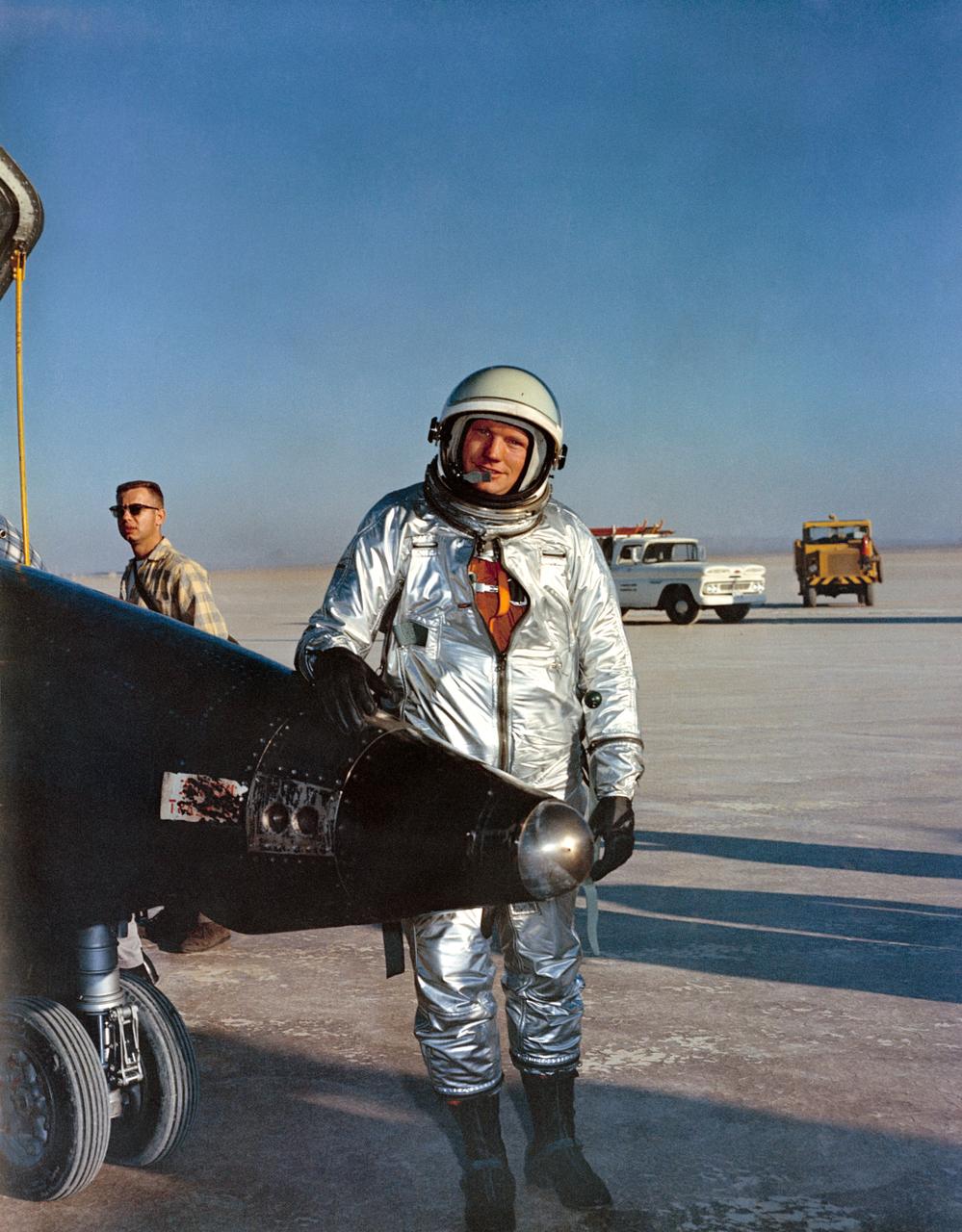
S63-19148 (1963) --- Neil A. Armstrong, a civilian, was a member of the second group of astronauts selected by the National Aeronautics and Space Administration. Armstrong was one of the nine picked in September, 1962. He was an aeronautical research pilot before becoming an astronaut.
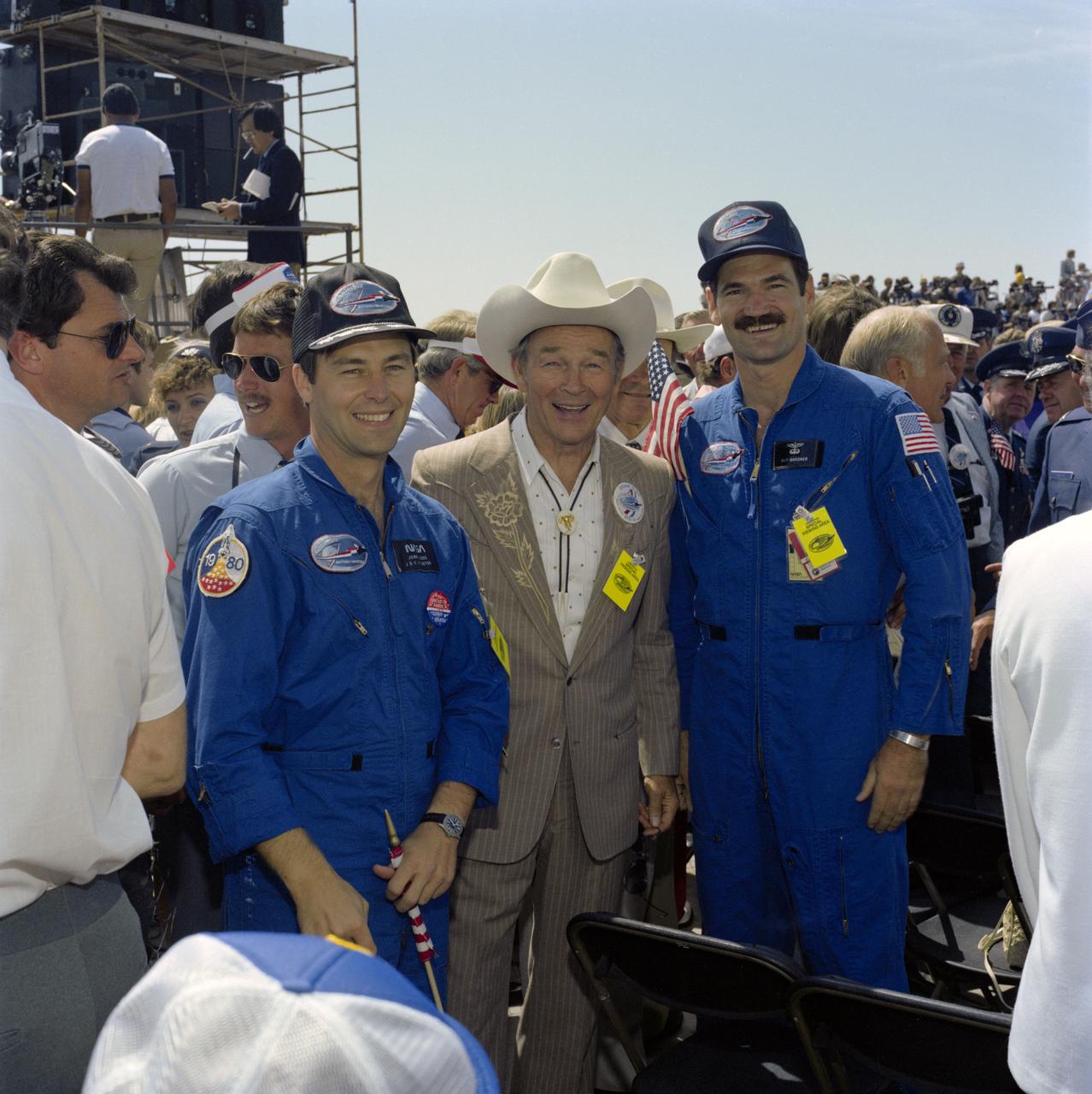
S82-33226 (4 July 1982) --- Inveterate space fan Roy Rogers with astronauts Jerry L. Ross, left, and Guy S. Gardner at Edwards Air Force Base for the landing of the space shuttle Columbia at the conclusion of the STS-4 mission on July 4, 1982. Ross and Gardner piloted chase planes involved in the approach and landing operations for the flight?s conclusion. Also present at the landing was (near far right) former astronaut Edwin E. Aldrin Jr., lunar module pilot for the historic first moon landing of almost 13 years ago. Photo credit: NASA
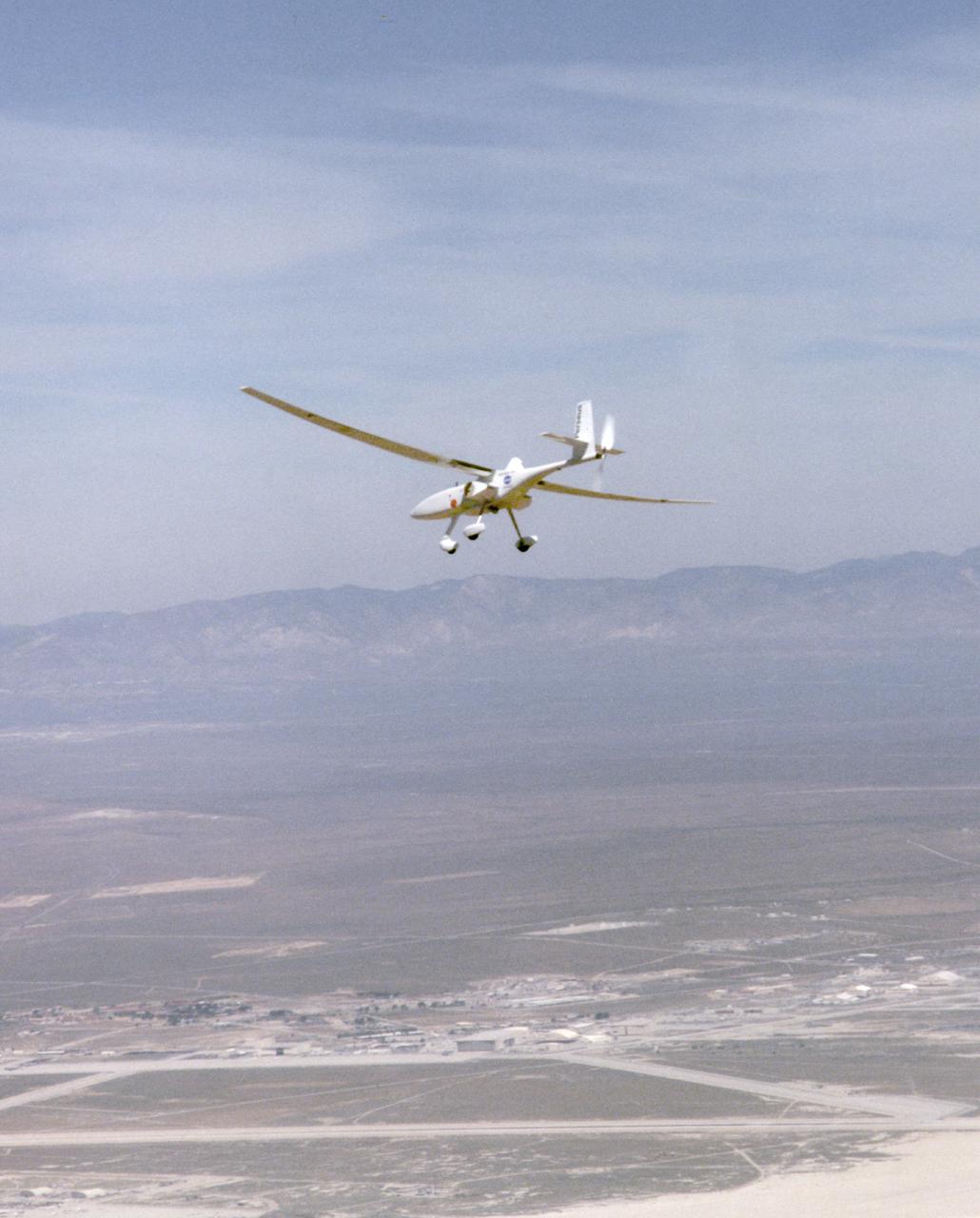
A long, slender wing and a pusher propeller at the rear characterize the Perseus B remotely-piloted research aircraft, seen here during a test flight in April1998.
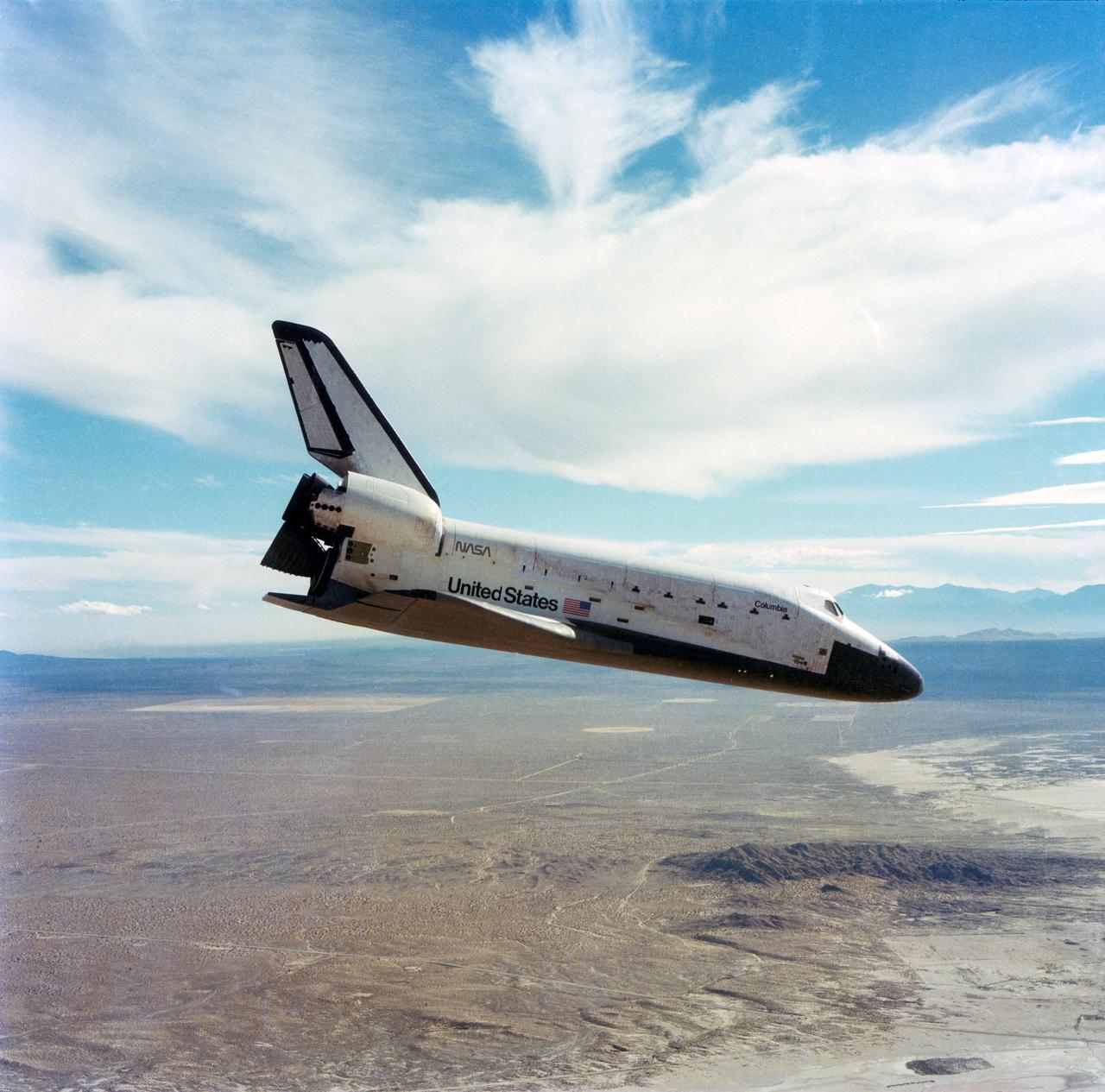
Several views of Columbia in the landing maneuver at the EAFB from T-38 Chase Aircraft and ground views. EAFB, CA
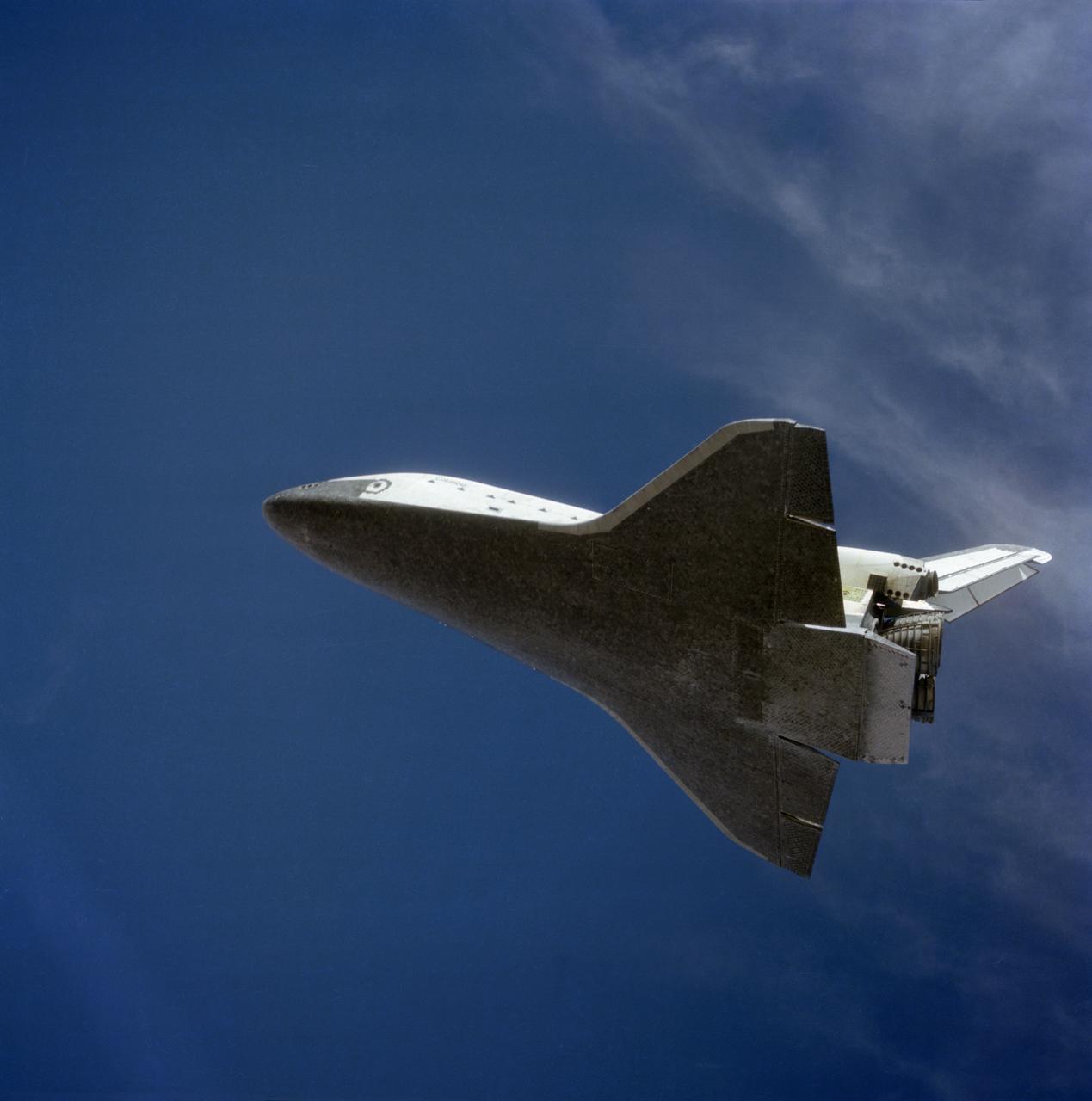
S81-39564 (14 Nov. 1981) --- This view of the space shuttle Columbia (STS-2) was made with a hand-held 70mm camera in the rear station of the T-38 chase plane. Mission specialist/astronaut Kathryn D. Sullivan exposed the frame as astronauts Joe N. Engle and Richard H. Truly aboard the Columbia guided the vehicle to an unpowered but smooth landing on the desert area of Edwards Air Force base in California. The picture provides a good view of the underside of the returning spacecraft. Photo credit: NASA
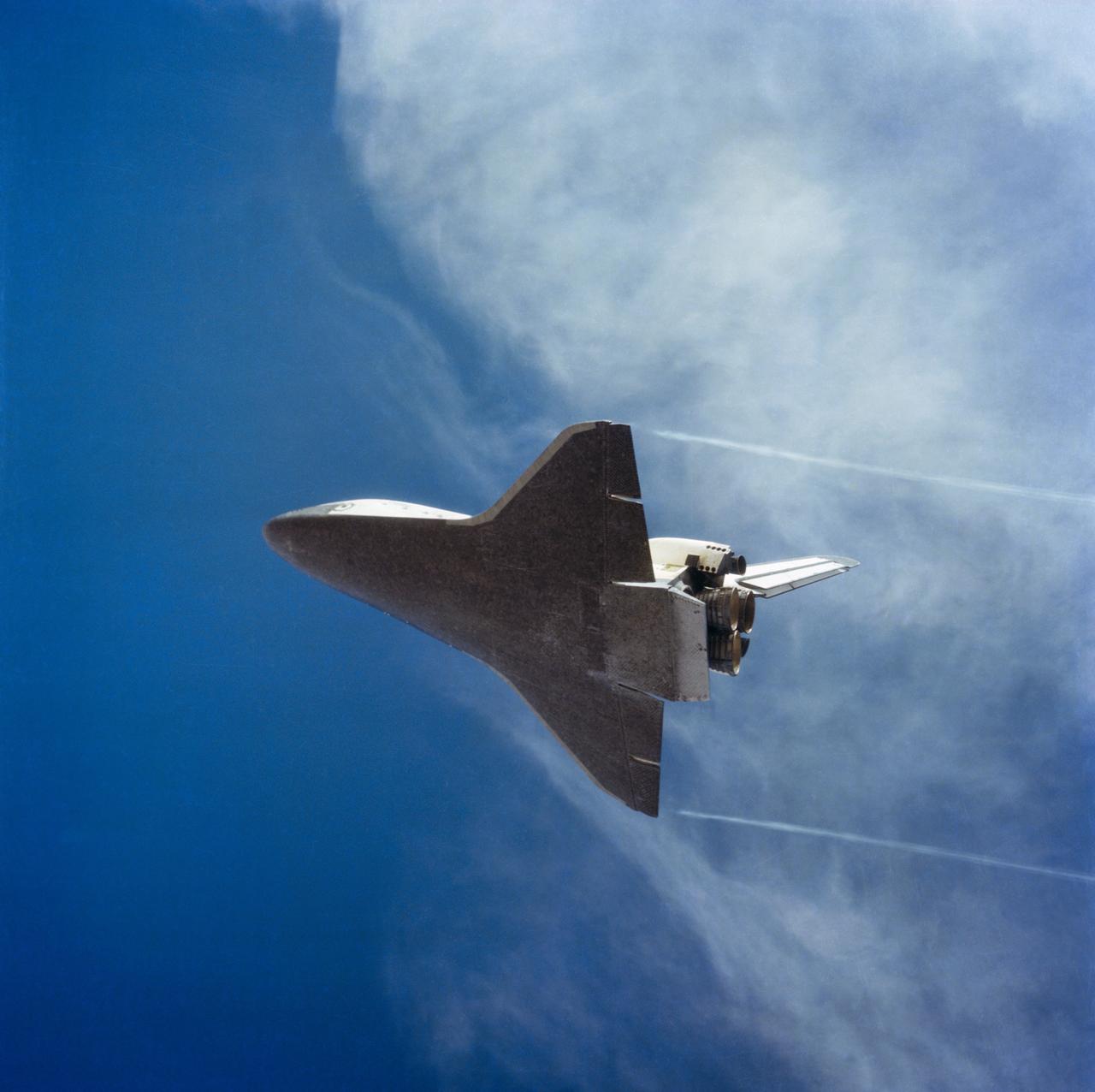
S81-39563 (14 Nov. 1981) --- This view of the space shuttle Columbia (STS-2) was made with a hand-held 70mm camera in the rear station of the T-38 chase plane. Mission specialist/astronaut Kathryn D. Sullivan exposed the frame as astronauts Joe N. Engle and Richard H. Truly aboard the Columbia guided the vehicle to an unpowered but smooth landing on the desert area of Edwards Air Force base in California. The view provides a good study of the high temperature protection material on the underside of the spacecraft which is exposed to the friction on the atmospheric entry on the return to Earth. Also note trails from the wing tips. Photo credit: NASA
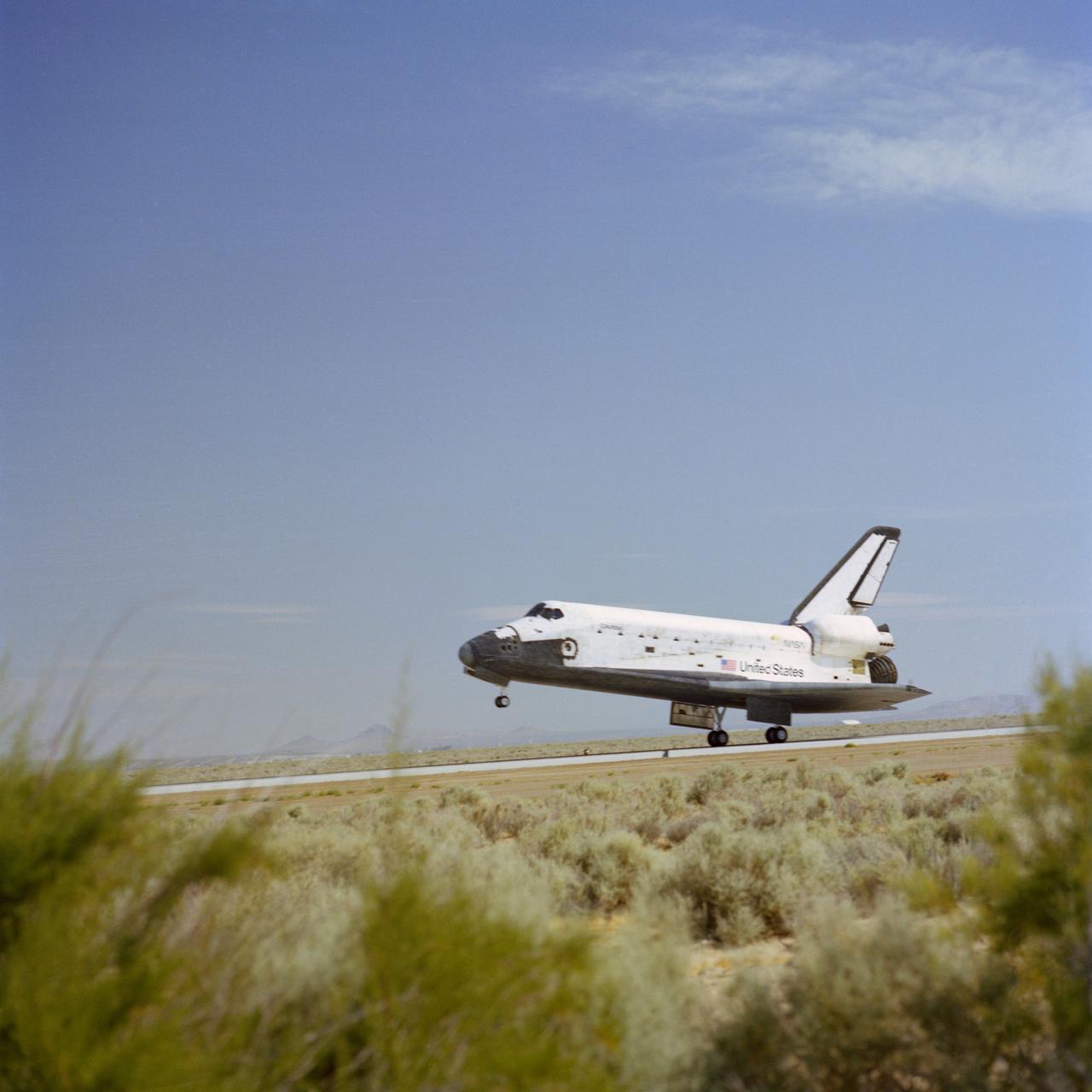
S82-33229 (4 July 1982) --- The space shuttle Columbia touches down on Runway 22 at Edwards Air Force Base in Southern California at the completion of a successful seven-day stay in Earth orbit. Inside are astronauts Thomas K. Mattingly II and Henry W. Hartsfield Jr., STS-4 commander and pilot, respectively. Though this closeup scene is devoid of visible people, hundreds of thousands weren?t far away for the unique July 4 celebration. Photo credit: NASA
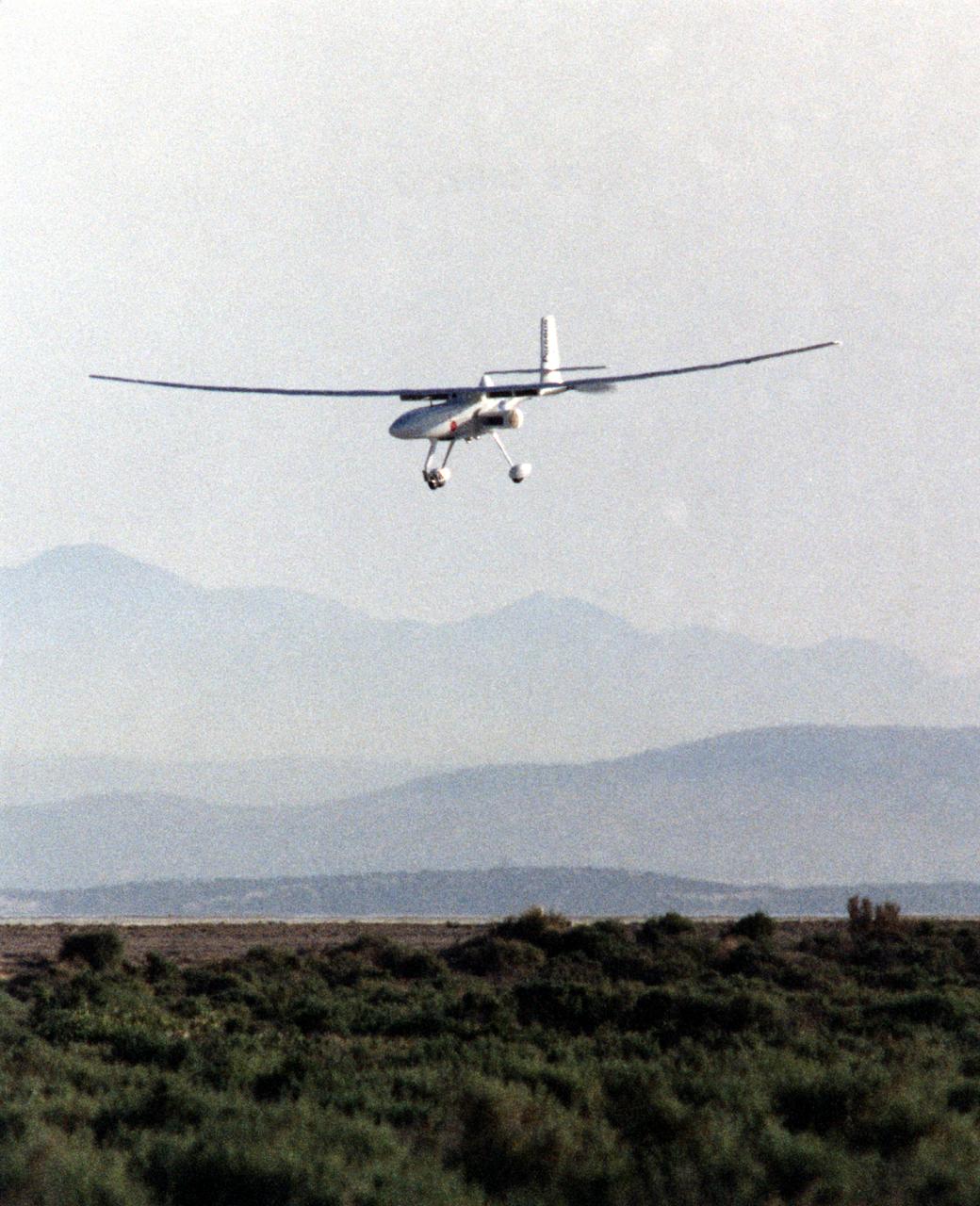
The Perseus B remotely piloted aircraft approaches the runway at Edwards Air Force Base, Calif. at the conclusion of a development flight at NASA's Dryden flight Research Center in April 1998. The Perseus B is the latest of three versions of the Perseus design developed by Aurora Flight Sciences under NASA's Environmental Research Aircraft and Sensor Technology (ERAST) program.
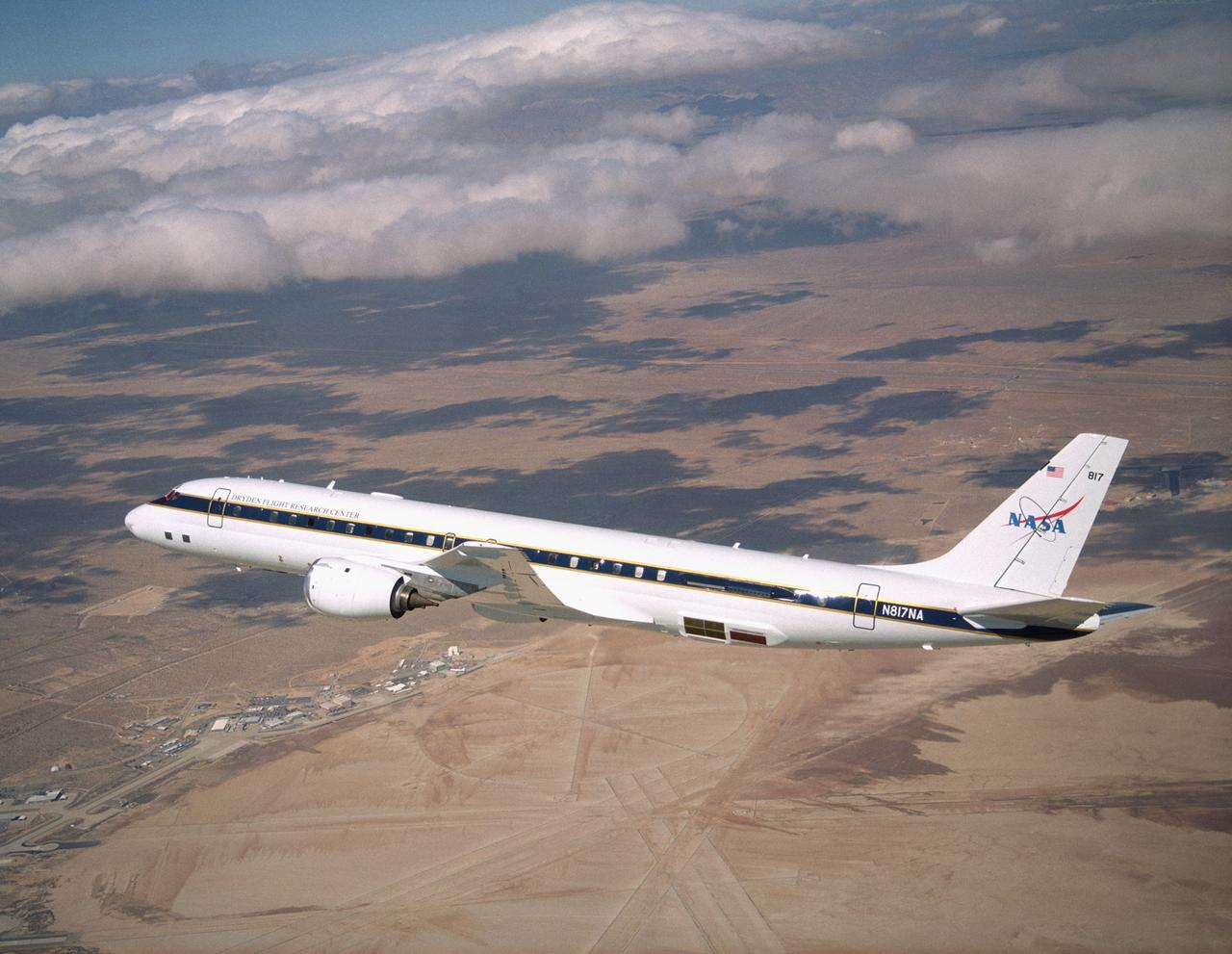
NASA's large Airborne Science research aircraft, a modified DC-8 airliner, displayed new colors in a check flight Feb. 24, 2004, over its home base, the NASA Dryden Flight Research Center at Edwards AFB, California.
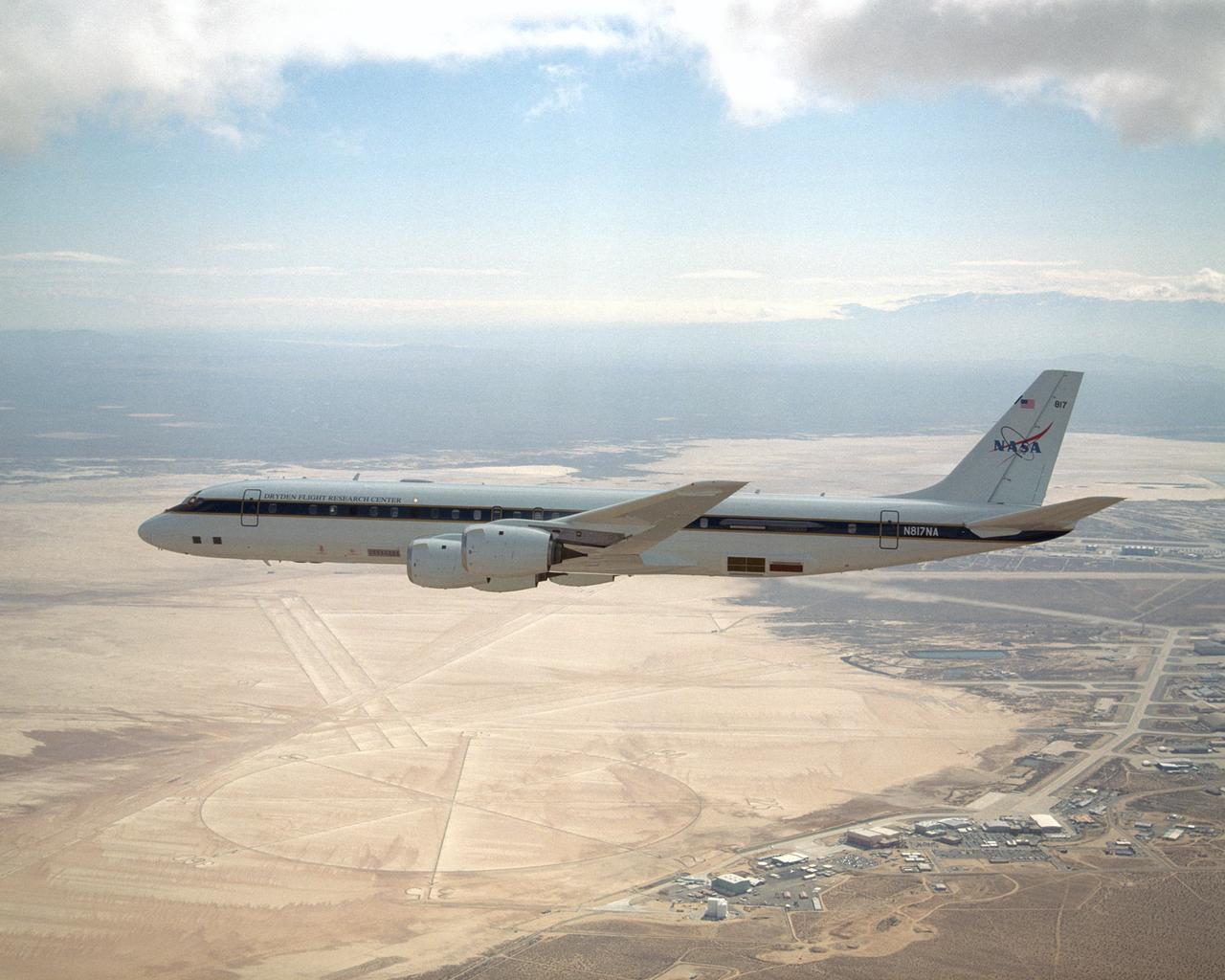
NASA's large Airborne Science research aircraft, a modified DC-8 airliner, displayed new colors in a check flight Feb. 24, 2004, over its home base, the NASA Dryden Flight Research Center at Edwards AFB, California.
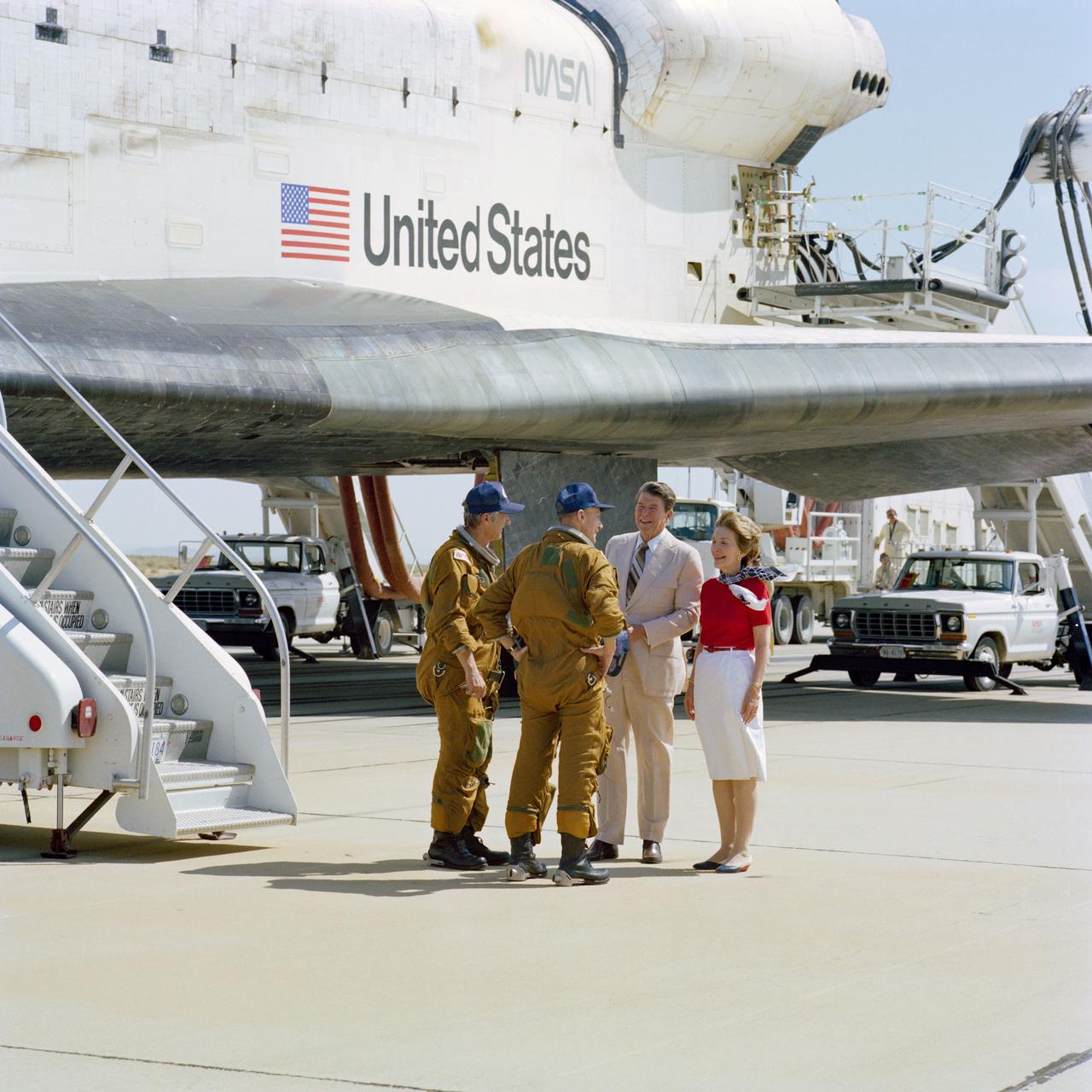
S82-33227 (4 July 1982) --- President and First Lady Reagan share a meeting with Astronauts Thomas K. Mattingly II, right, and Henry W. Hartsfield Jr., after the successful landing of the Space Shuttle Columbia at Edwards Air Force Base today. Besides the Columbia, pictures, the new Space Shuttle Challenger and the Enterprise (vehicle used for test flights in the lower atmosphere in 1977), were also present at Edwards AFB. The latter served as a backdrop for the President?s podium from which he made a brief speech.
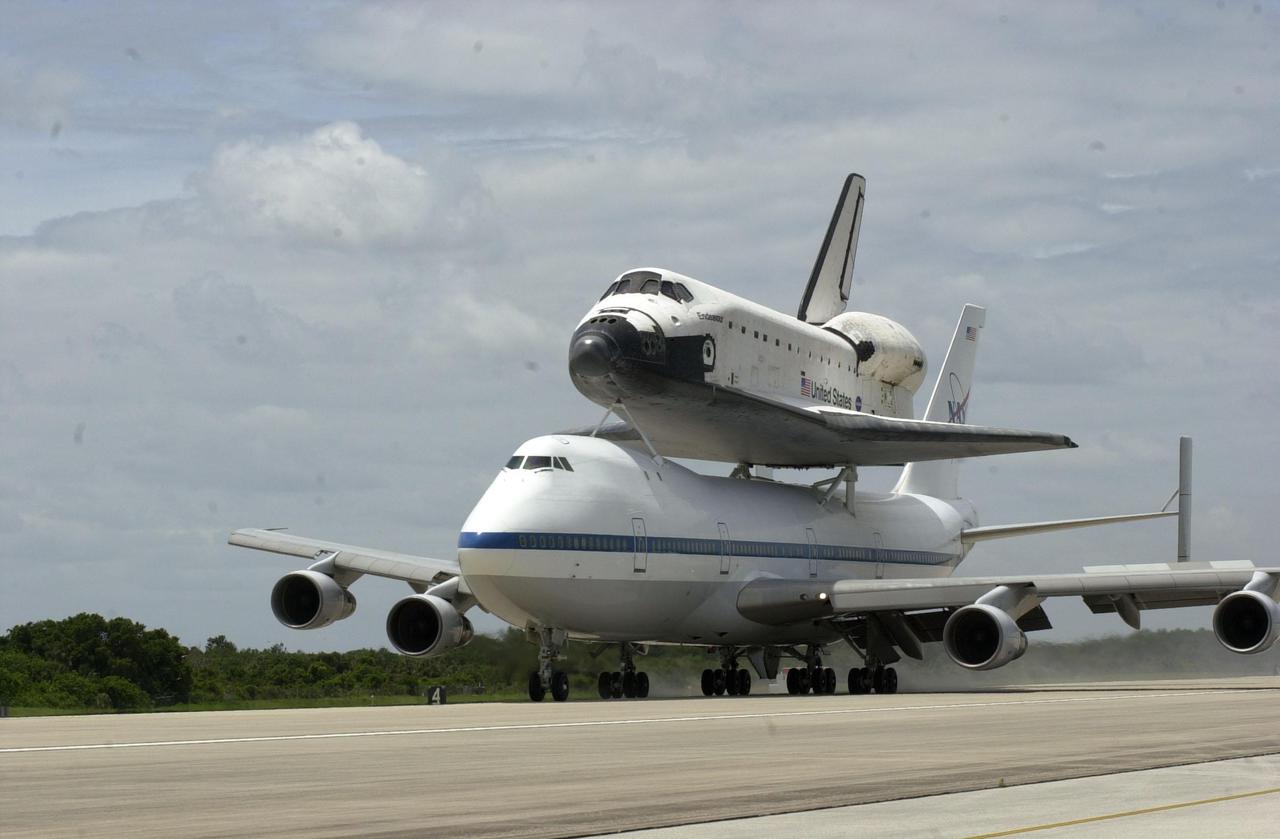
KENNEDY SPACE CENTER, FLA. -- Orbiter Endeavour returns to KSC’s Shuttle Landing Facility mounted atop NASA’s Shuttle Carrier Aircraft. The duo completed a two-day transcontinental ferry flight from Edwards Air Force Base, Calif. Endeavour landed at Edwards AFB after a 12-day mission, STS-100, to the International Space Station. Endeavour will be towed to the Orbiter Processing Facility bay 1 where it will begin processing for mission STS-108

EDWARDS AFB, Calif. - ED13-0300-003 – An Erickson Air-Crane helicopter lifts Sierra Nevada Corporation's Dream Chaser flight vehicle during a captive-carry flight test. The test was a rehearsal for free flights at Edwards later this year. The spacecraft is under development in partnership with NASA's Commercial Crew Program. Although the spacecraft is designed for crew members, the vehicle will not have anyone onboard during the free flights. Photo credit: NASA/Carla Thomas
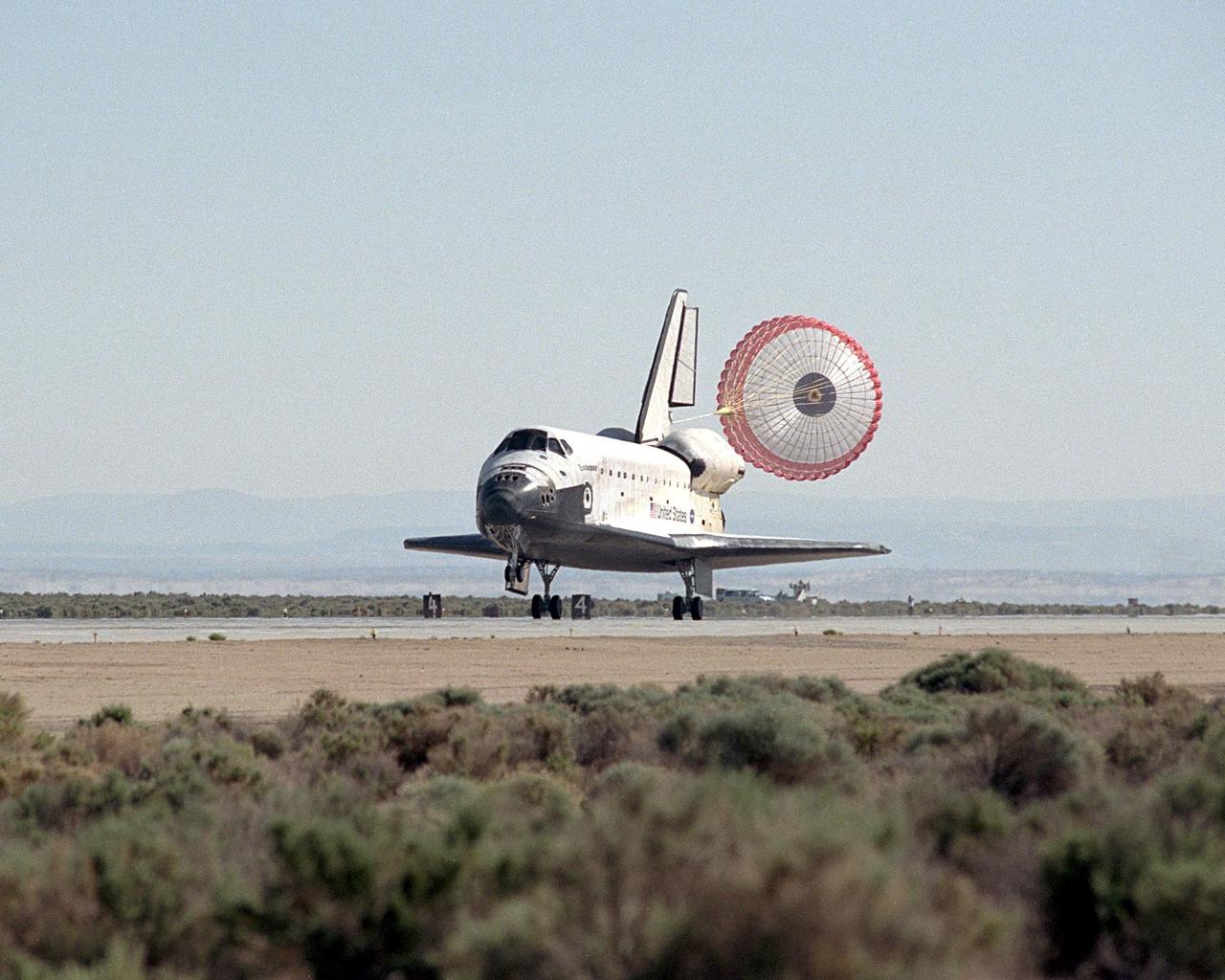
NASA/EDWARDS AFB, CALIF. -- With its drag chute deployed, Endeavour lands on runway 22 at Edwards Air Force Base, Calif., at 12:10:42 p.m. EDT after a mission of 11 days, 12 hours, 54 minutes to the International Space Station on mission STS-100. The orbiter and its crew of seven logged about 4.9 million statute miles in 186 orbits. Due to unfavorable weather conditions, landing at KSC was waved off. The landing marked the third consecutive landing at EAFB.
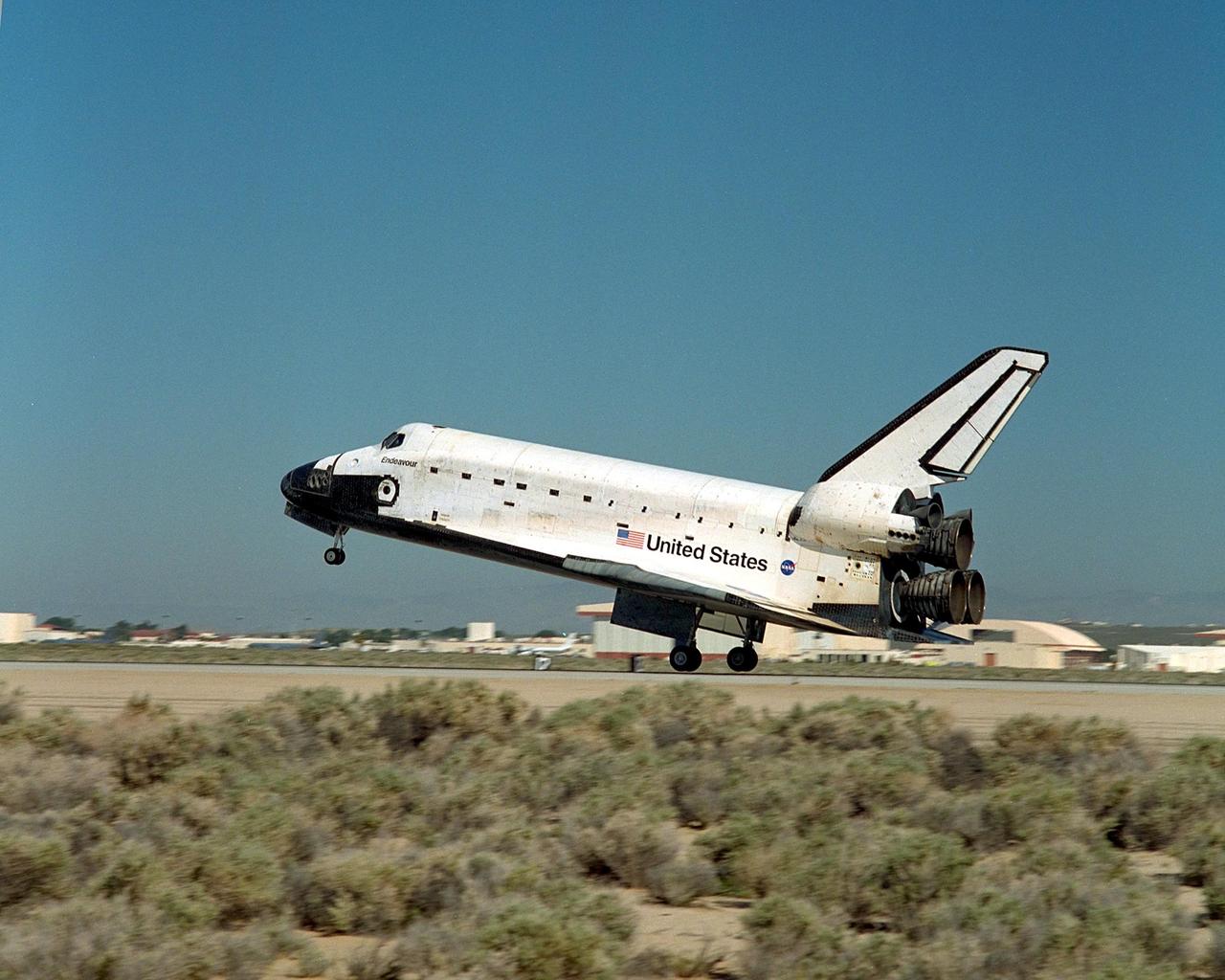
NASA/EDWARDS AFB, CALIF. -- Endeavour’s rear wheels touch down on runway 22 at Edwards Air Force Base, Calif., after the 11-day, 12-hour, 54-minute mission STS-100 to the International Space Station. Landing time was 12:10:42 p.m. EDT. The orbiter and its crew of seven logged about 4.9 million statute miles in 186 orbits. Due to unfavorable weather conditions, landing at KSC was waved off. The landing marked the third consecutive landing at EAFB.
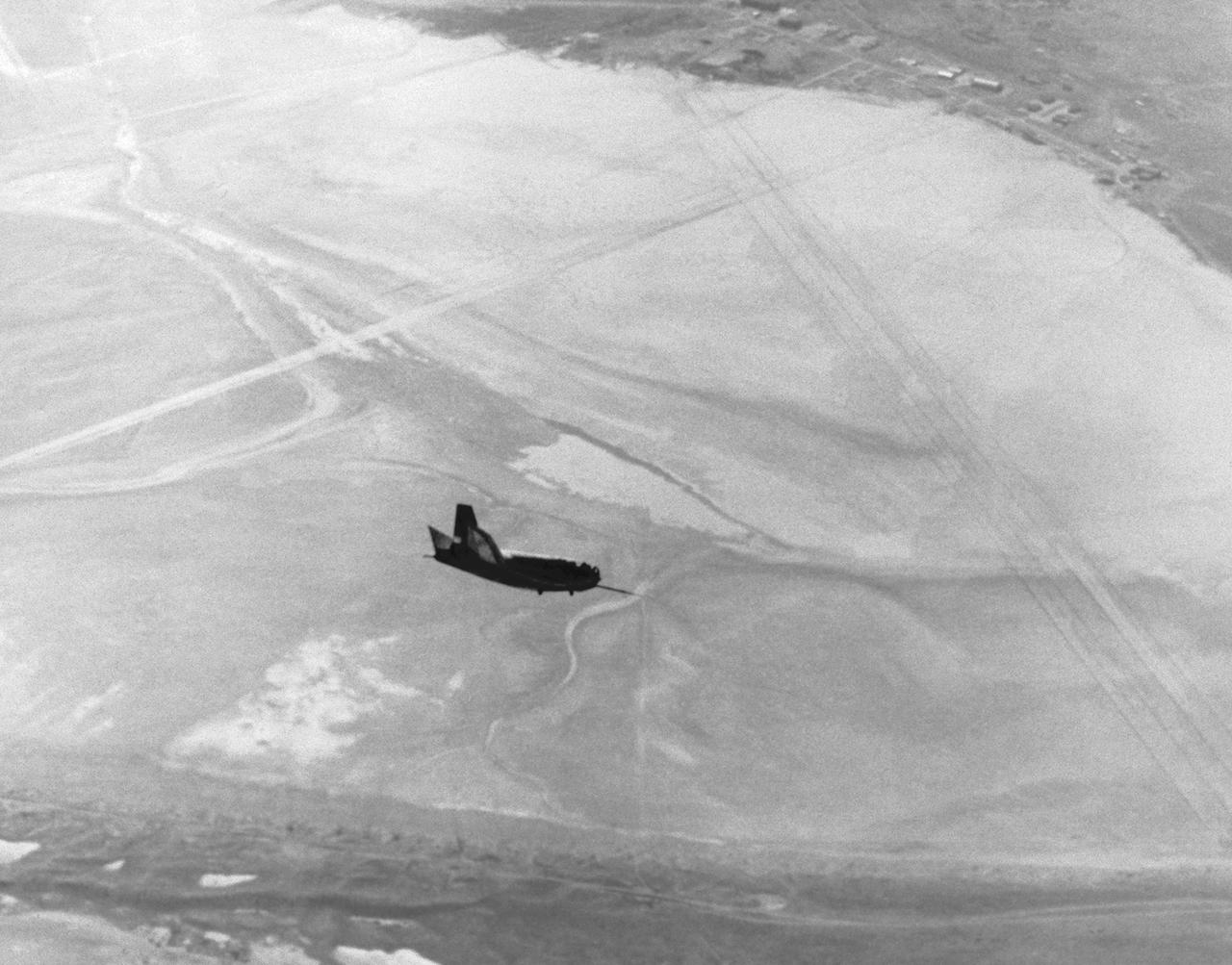
The HL-10 lifting body is seen here in flight over Rogers Dry Lake at Edwards AFB. After the vehicle's fins were modified following its first flight, the HL-10 proved to be the best handling of the heavy-weight lifting bodies flown at Edwards Air Force Base. The HL-10 flew much better than the M2-F2, and pilots were eager to fly it.
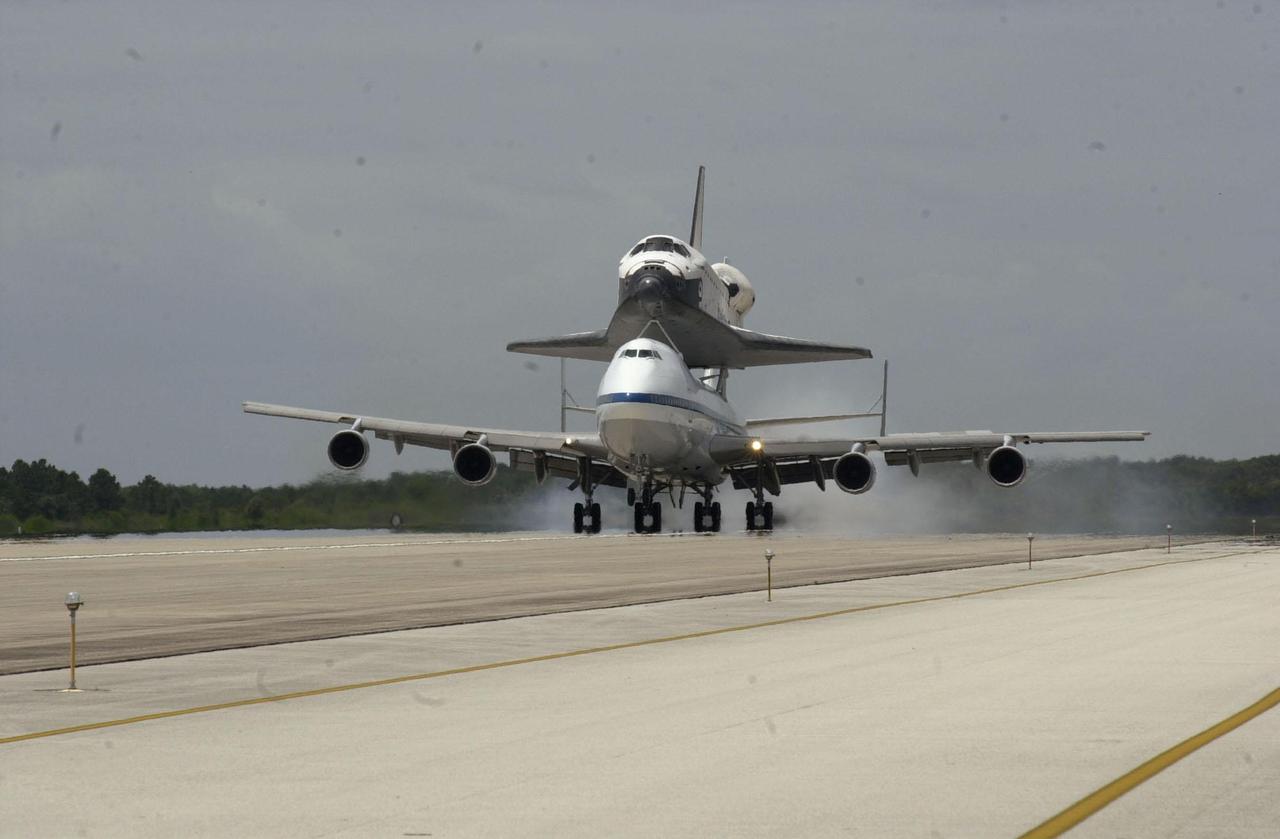
KENNEDY SPACE CENTER, FLA. -- Orbiter Endeavour returns to KSC’s Shuttle Landing Facility mounted atop NASA’s Shuttle Carrier Aircraft. The duo completed a two-day transcontinental ferry flight from Edwards Air Force Base, Calif. Endeavour landed at Edwards AFB after a 12-day mission, STS-100, to the International Space Station. Endeavour will be towed to the Orbiter Processing Facility bay 1 where it will begin processing for mission STS-108
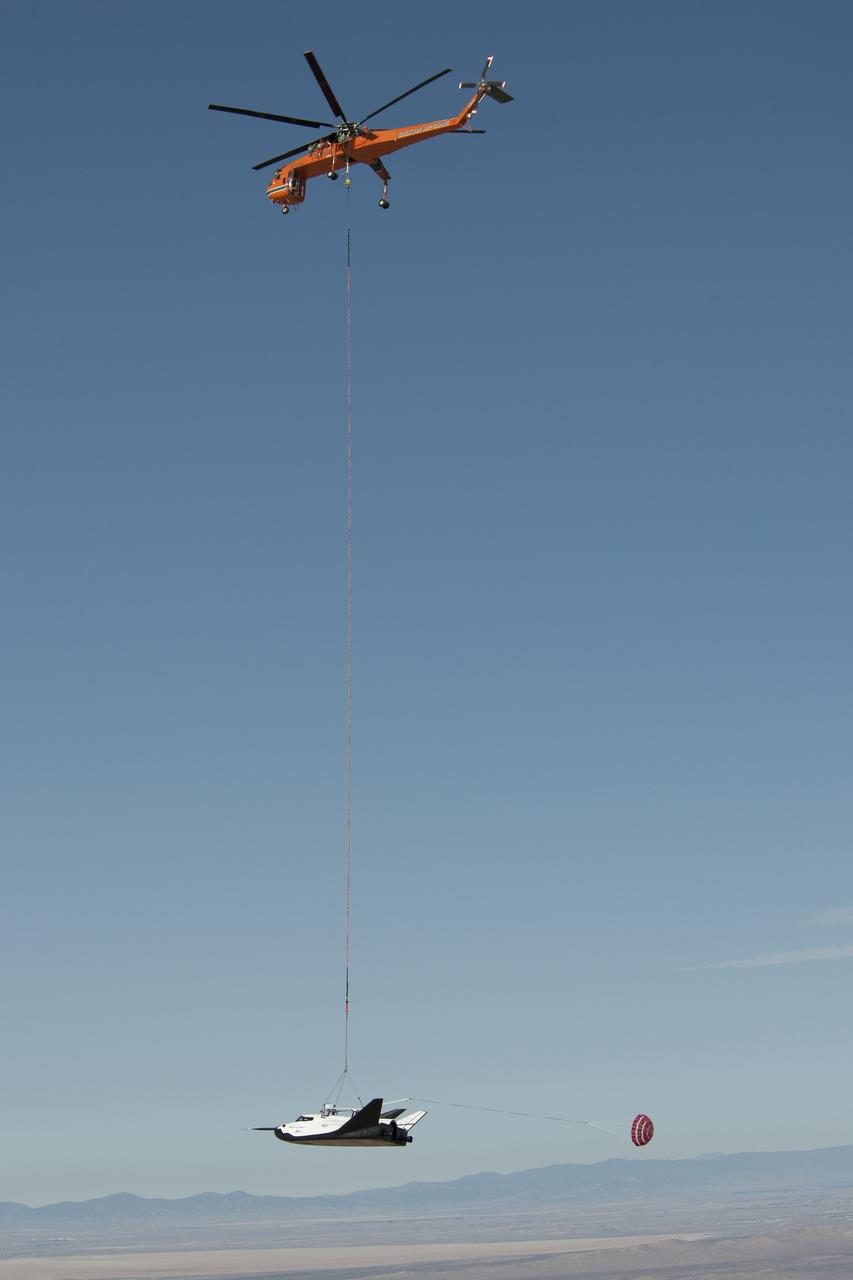
EDWARDS AFB, Calif. - ED13-0300-001 – An Erickson Air-Crane helicopter lifts Sierra Nevada Corporation's Dream Chaser flight vehicle during a captive-carry flight test. The test was a rehearsal for free flights at Edwards later this year. The spacecraft is under development in partnership with NASA's Commercial Crew Program. Although the spacecraft is designed for crew members, the vehicle will not have anyone onboard during the free flights. Photo credit: NASA/Carla Thomas
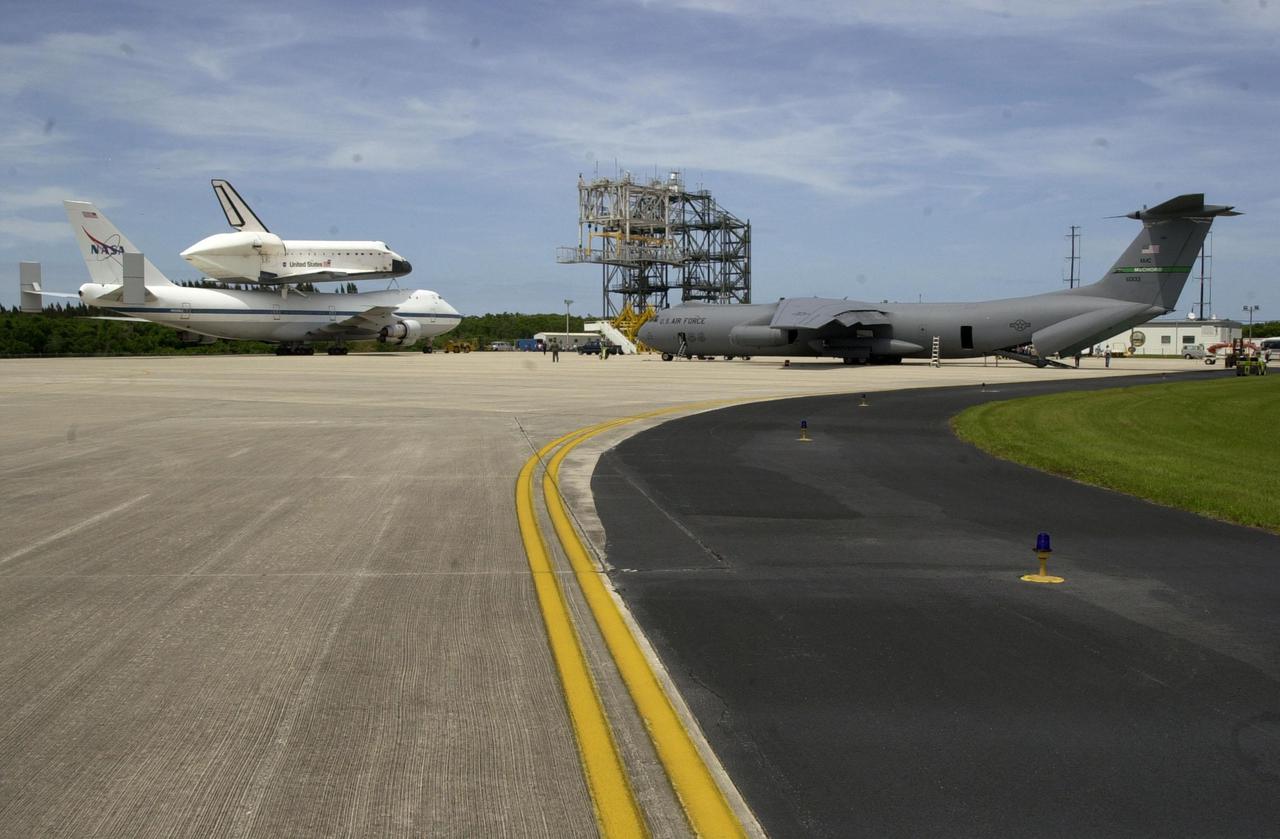
KENNEDY SPACE CENTER, FLA. -- At the Shuttle Landing Facility, orbiter Endeavour and the Shuttle Carrier Aircraft are towed past the Pathfinder, a C-141, that precedes the ferry flight on its journey. The Endeavour_SCA completed a two-day transcontinental ferry flight from Edwards Air Force Base, Calif. . Endeavour landed at Edwards AFB after a 12-day mission, STS-100, to the International Space Station. Endeavour will be demated from the SCA and towed to the Orbiter Processing Facility bay 1 where it will begin processing for mission STS-108
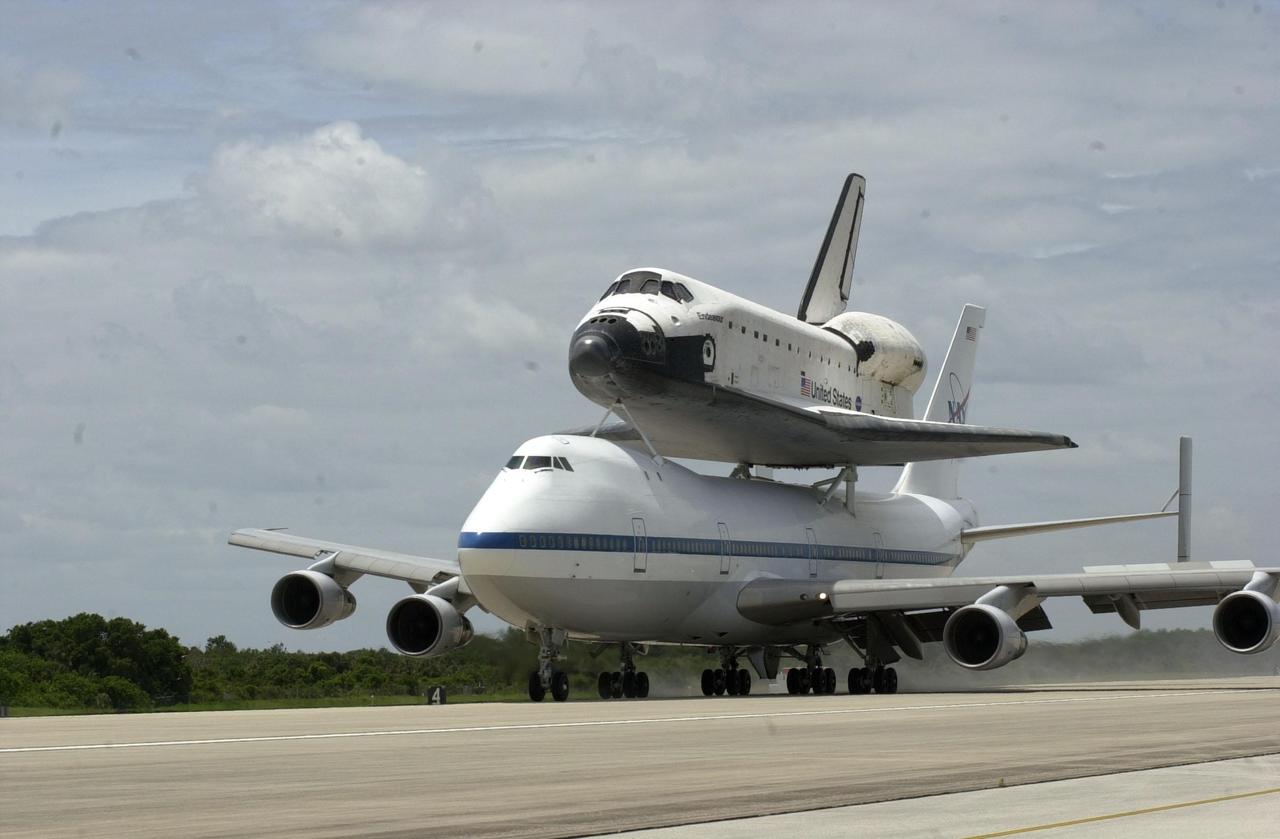
KENNEDY SPACE CENTER, FLA. -- Orbiter Endeavour returns to KSC’s Shuttle Landing Facility mounted atop NASA’s Shuttle Carrier Aircraft. The duo completed a two-day transcontinental ferry flight from Edwards Air Force Base, Calif. Endeavour landed at Edwards AFB after a 12-day mission, STS-100, to the International Space Station. Endeavour will be towed to the Orbiter Processing Facility bay 1 where it will begin processing for mission STS-108
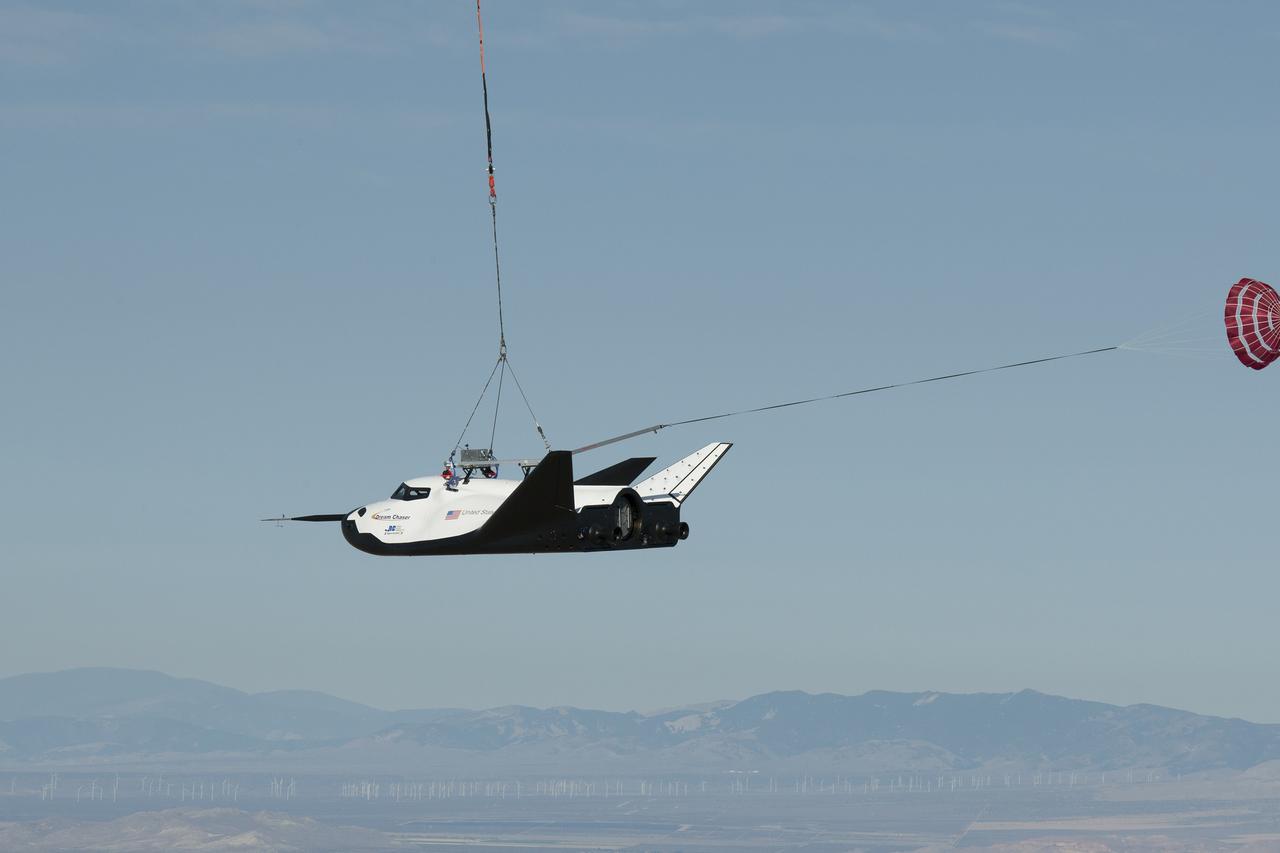
EDWARDS AFB, Calif. - ED13-0300-002 – An Erickson Air-Crane helicopter lifts Sierra Nevada Corporation's Dream Chaser flight vehicle during a captive-carry flight test. The test was a rehearsal for free flights at Edwards later this year. The spacecraft is under development in partnership with NASA's Commercial Crew Program. Although the spacecraft is designed for crew members, the vehicle will not have anyone onboard during the free flights. Photo credit: NASA/Carla Thomas
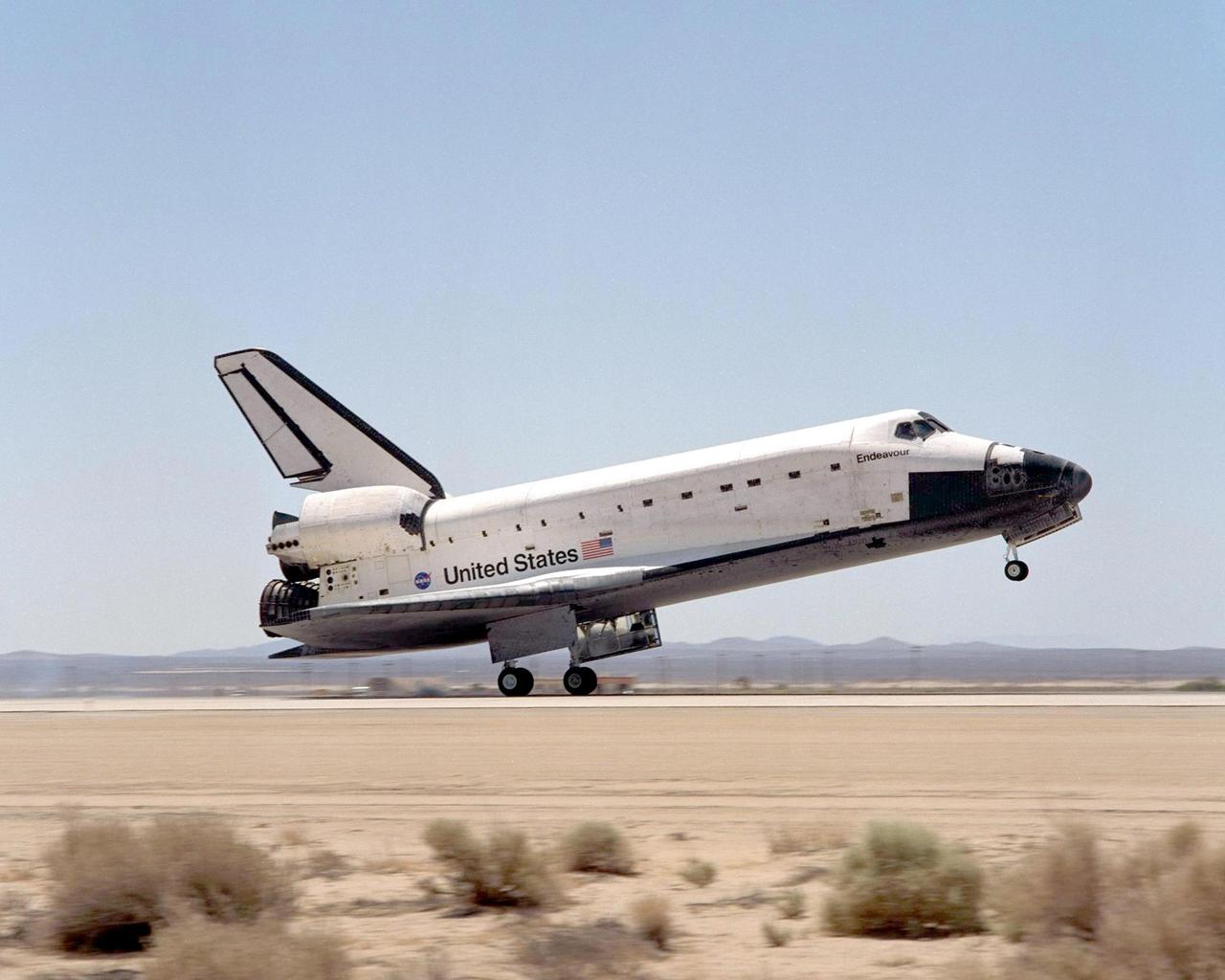
EDWARDS AFB, CALIF. -- After traveling 5.8 million miles in space during 217 orbits, Endeavour touches down on concrete runway 22 at Dryden Flight Research Center, Edwards Air Force Base, Calif., completing mission STS-111. Three days of unfavorable weather conditions at KSC prompted the decision to land at Edwards, which enjoyed pristine, dry conditions.. Main gear touchdown occurred at 1:57:41 p.m. EDT, nose gear touchdown at 1:57:53 p.m. EDT and wheel stop at 1:58:45 p.m. EDT.
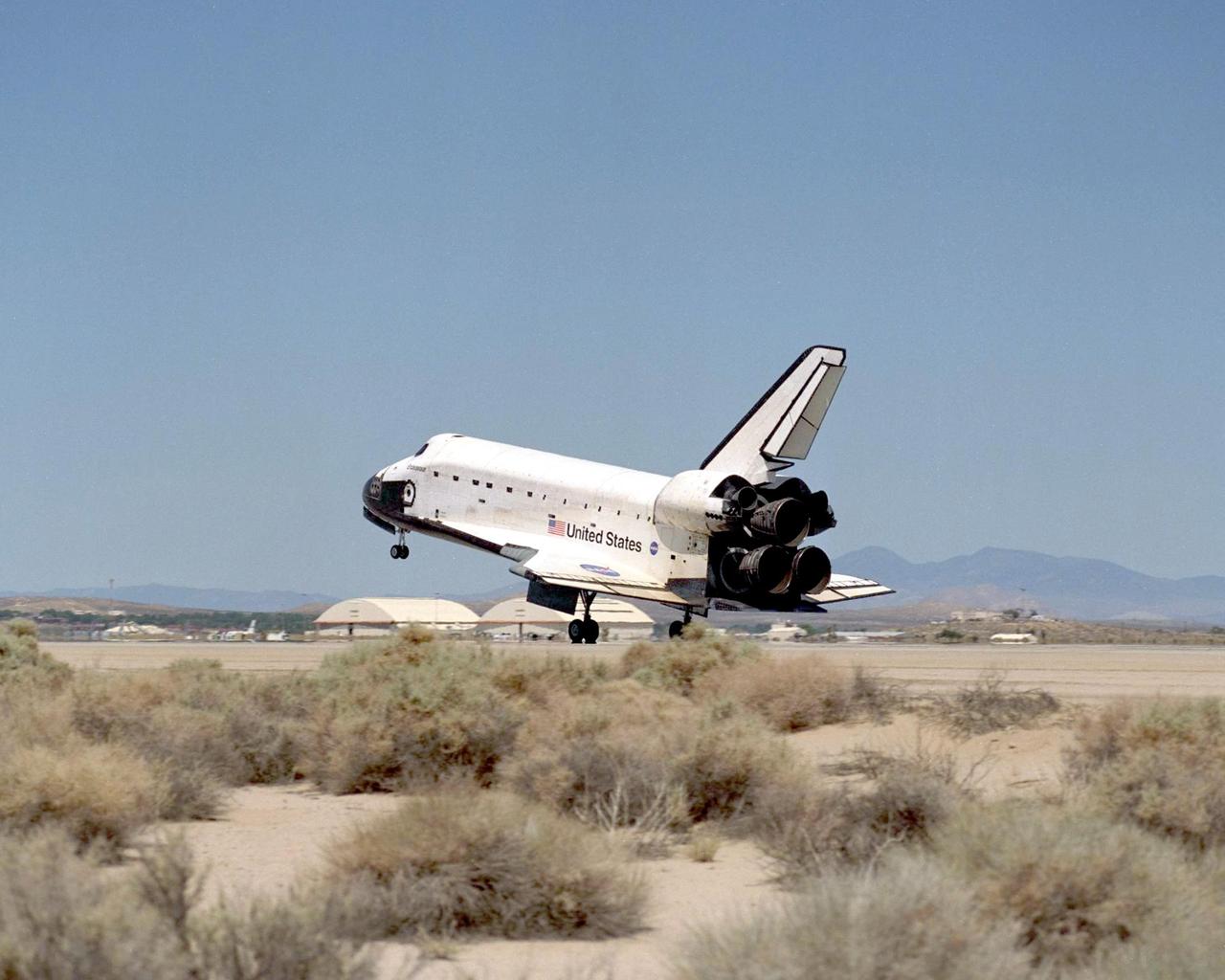
EDWARDS AFB, CALIF. -- After traveling 5.8 million miles in space during 217 orbits, Endeavour touches down on concrete runway 22 at Dryden Flight Research Center, Edwards Air Force Base, Calif., completing mission STS-111. Three days of unfavorable weather conditions at KSC prompted the decision to land at Edwards, which enjoyed pristine, dry conditions.. Main gear touchdown occurred at 1:57:41 p.m. EDT, nose gear touchdown at 1:57:53 p.m. EDT and wheel stop at 1:58:45 p.m. EDT.
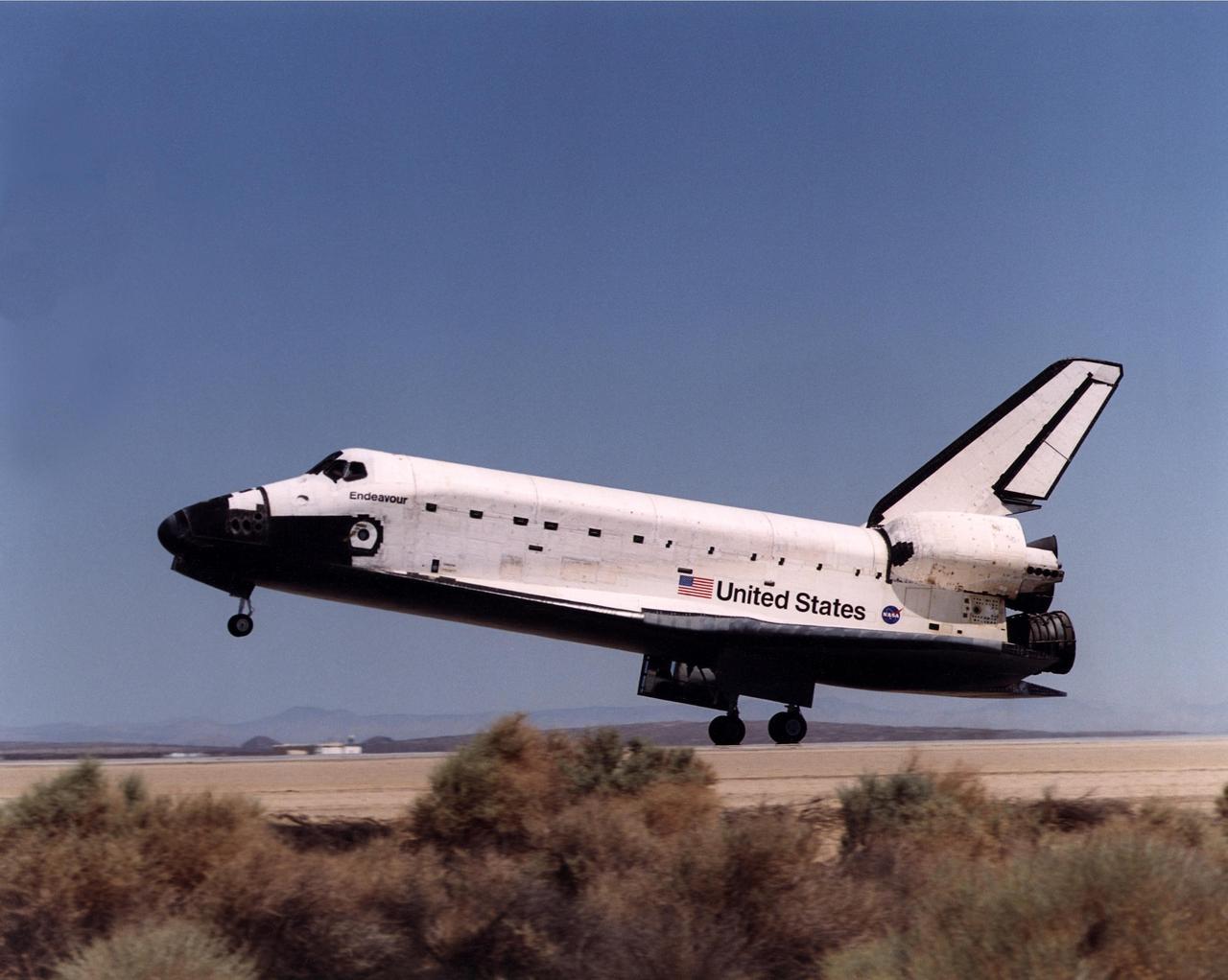
EDWARDS AFB, CALIF. -- After traveling 5.8 million miles in space during 217 orbits, Endeavour completes mission STS-111 with a landing on concrete runway 22 at Dryden Flight Research Center, Edwards Air Force Base, Calif. Three days of unfavorable weather conditions at KSC prompted the decision to land at Edwards, which enjoyed pristine, dry conditions.. Main gear touchdown occurred at 1:57:41 p.m EDT, nose gear touchdown at 1:57:53 p.m. EDT and wheel stop at 1:58:45 p.m. EDT. [Photo by Tom Tschida
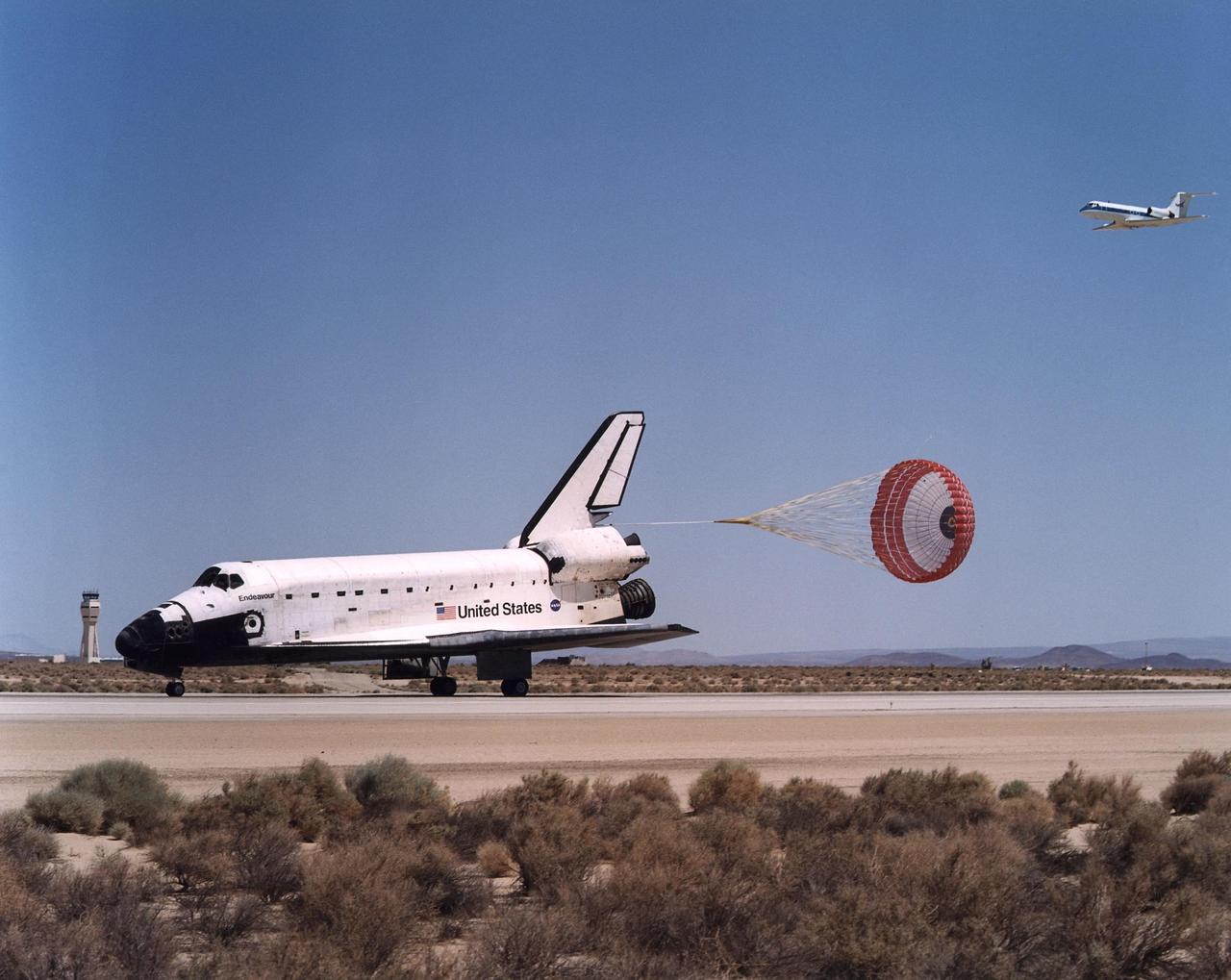
EDWARDS AFB, CALIF. -- A chase plane follows behind Endeavour as it lands on concrete runway 22 at Dryden Flight Research Center, Edwards Air Force Base, Calif., completing mission STS-111. Endeavour traveled 5.8 million miles in space during 217 orbits. Three days of unfavorable weather conditions at KSC prompted the decision to land at Edwards, which enjoyed pristine, dry conditions.. Main gear touchdown occurred at 1:57:41 p.m EDT, nose gear touchdown at 1:57:53 p.m. EDT and wheel stop at 1:58:45 p.m. EDT. [Photo by Jim Ross
![EDWARDS AFB, CALIF. -- After traveling 5.8 million miles in space during 217 orbits, and with drag chute deployed, Endeavour lands on concrete runway 22 at Dryden Flight Research Center, Edwards Air Force Base, Calif., completing mission STS-111. Three days of unfavorable weather conditions at KSC prompted the decision to land at Edwards, which enjoyed pristine, dry conditions.. Main gear touchdown occurred at 1:57:41 p.m. EDT, nose gear touchdown at 1:57:53 p.m. EDT and wheel stop at 1:58:45 p.m. EDT. [Photo by Jim Ross]](https://images-assets.nasa.gov/image/KSC-02pp1114/KSC-02pp1114~medium.jpg)
EDWARDS AFB, CALIF. -- After traveling 5.8 million miles in space during 217 orbits, and with drag chute deployed, Endeavour lands on concrete runway 22 at Dryden Flight Research Center, Edwards Air Force Base, Calif., completing mission STS-111. Three days of unfavorable weather conditions at KSC prompted the decision to land at Edwards, which enjoyed pristine, dry conditions.. Main gear touchdown occurred at 1:57:41 p.m. EDT, nose gear touchdown at 1:57:53 p.m. EDT and wheel stop at 1:58:45 p.m. EDT. [Photo by Jim Ross]
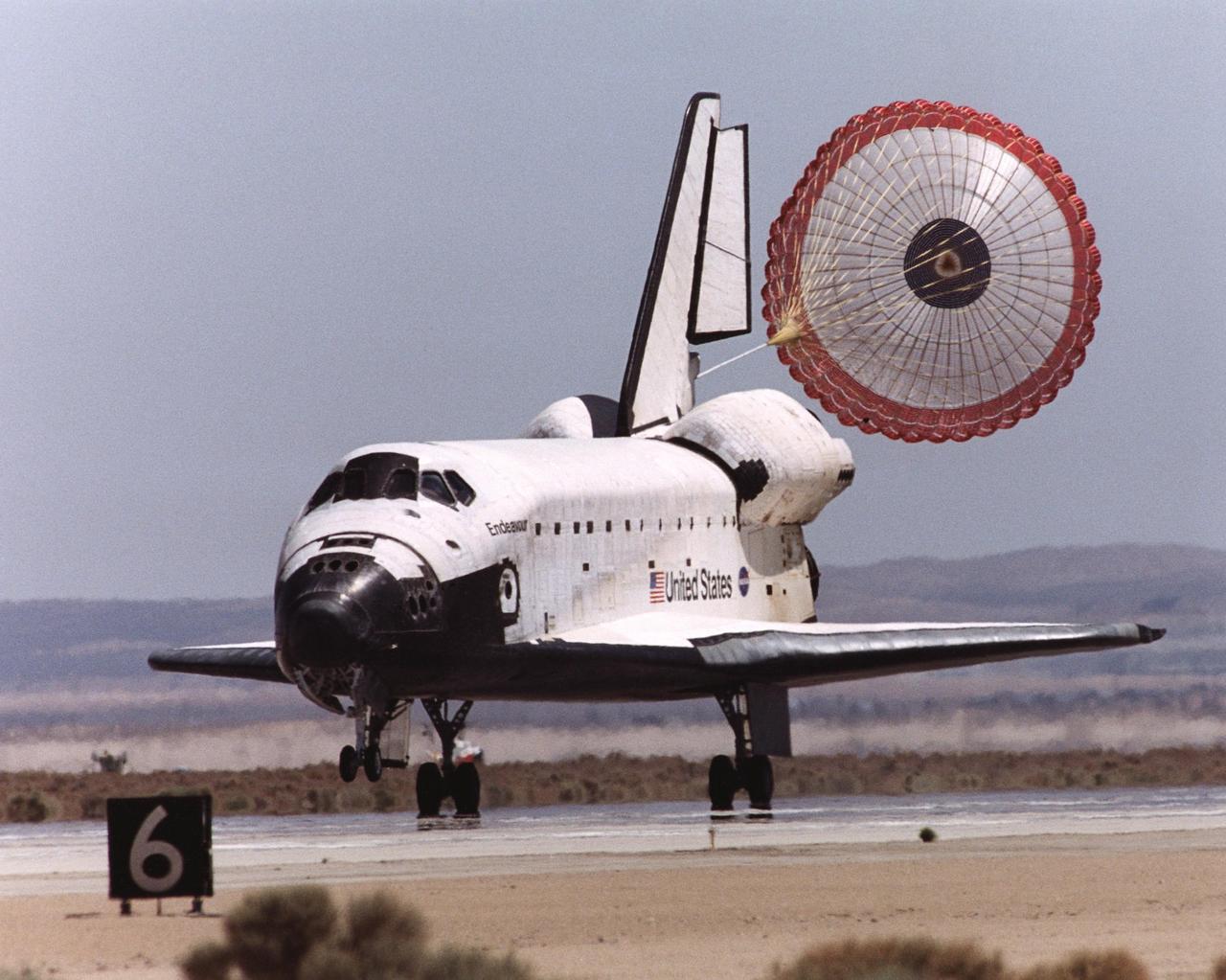
EDWARDS AFB, CALIF. -- After traveling 5.8 million miles in space during 217 orbits, and with drag chute deployed, Endeavour lands on concrete runway 22 at Dryden Flight Research Center, Edwards Air Force Base, Calif., completing mission STS-111. Three days of unfavorable weather conditions at KSC prompted the decision to land at Edwards, which enjoyed pristine, dry conditions.. Main gear touchdown occurred at 1:57:41 p.m EDT, nose gear touchdown at 1:57:53 p.m. EDT and wheel stop at 1:58:45 p.m. EDT. [Photo by Jim Ross
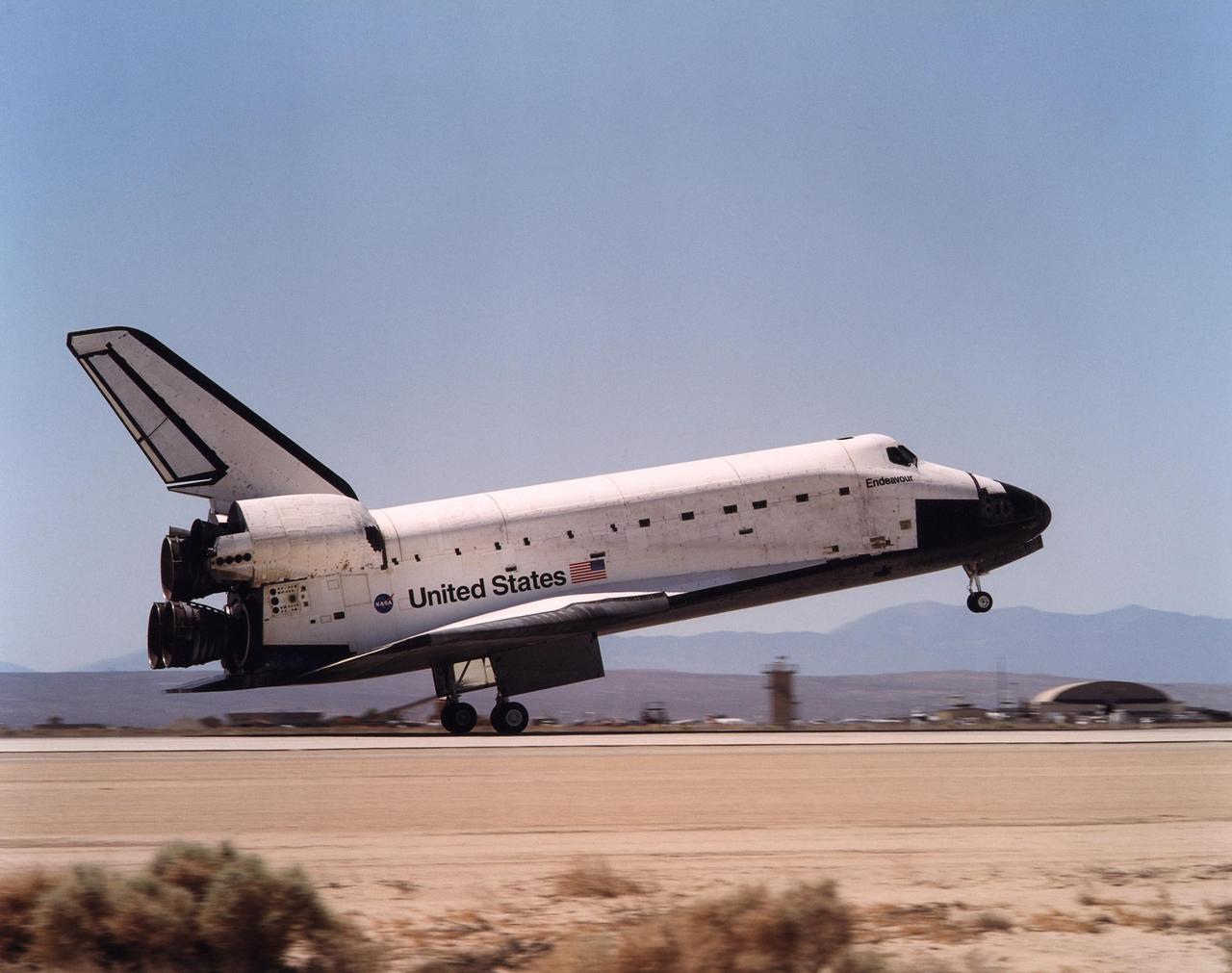
EDWARDS AFB, CALIF. -- After traveling 5.8 million miles in space during 217 orbits, Endeavour touches down on concrete runway 22 at Dryden Flight Research Center, Edwards Air Force Base, Calif., completing mission STS-111. Three days of unfavorable weather conditions at KSC prompted the decision to land at Edwards, which enjoyed pristine, dry conditions.. Main gear touchdown occurred at 1:57:41 p.m EDT, nose gear touchdown at 1:57:53 p.m. EDT and wheel stop at 1:58:45 p.m. EDT. [Photo by Tom Tschida
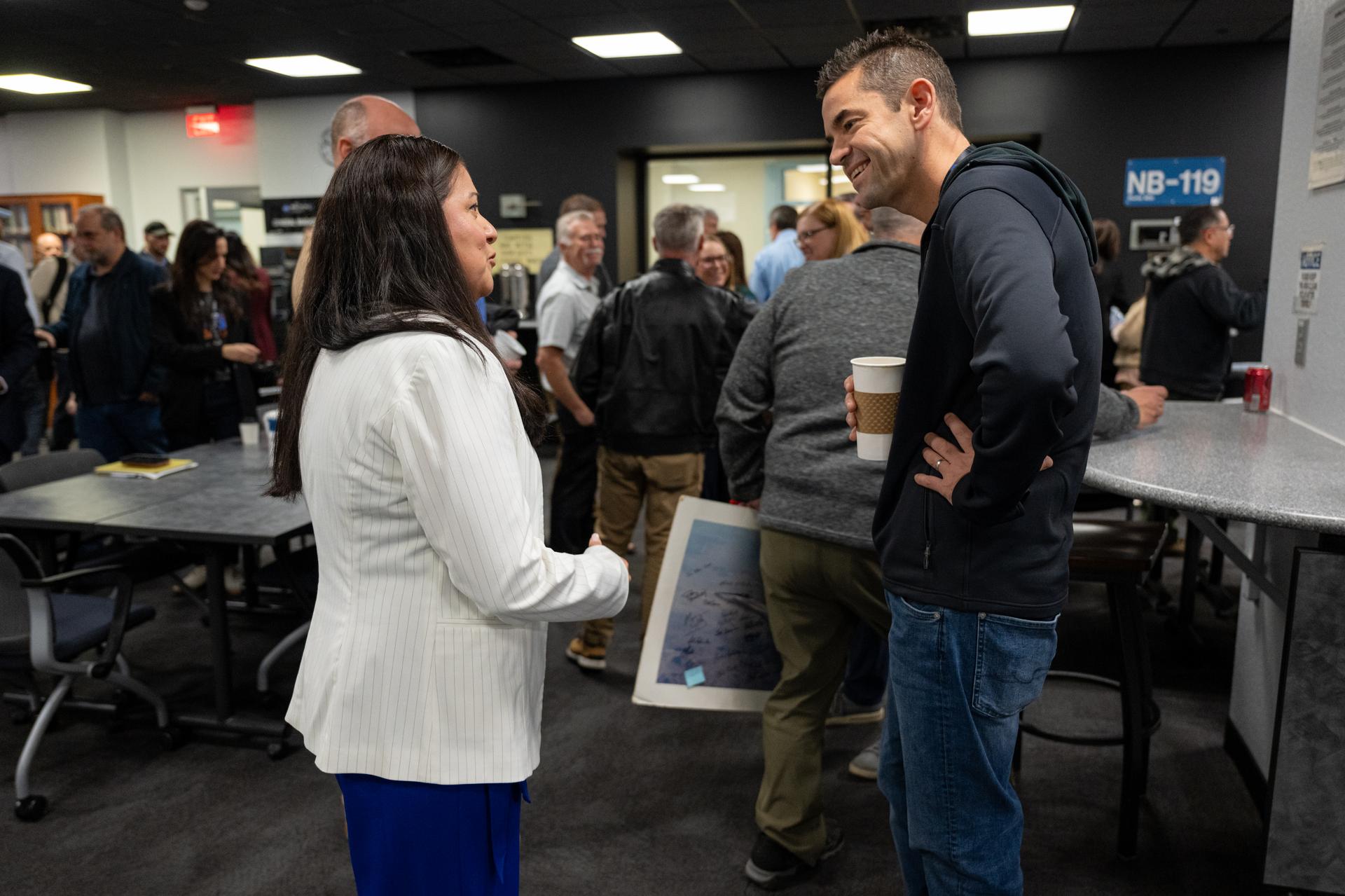
NASA Administrator Jared Isaacman, right, greets members of the workforce, Sunday, Jan. 25, 2026, at NASA’s Armstrong Flight Research Center at Edwards Air Force Base in California. Armstrong marks the ninth stop in Isaacman’s roadshow to visit NASA facilities and engage directly with the agency’s workforce. Photo Credit: (NASA/John Kraus)
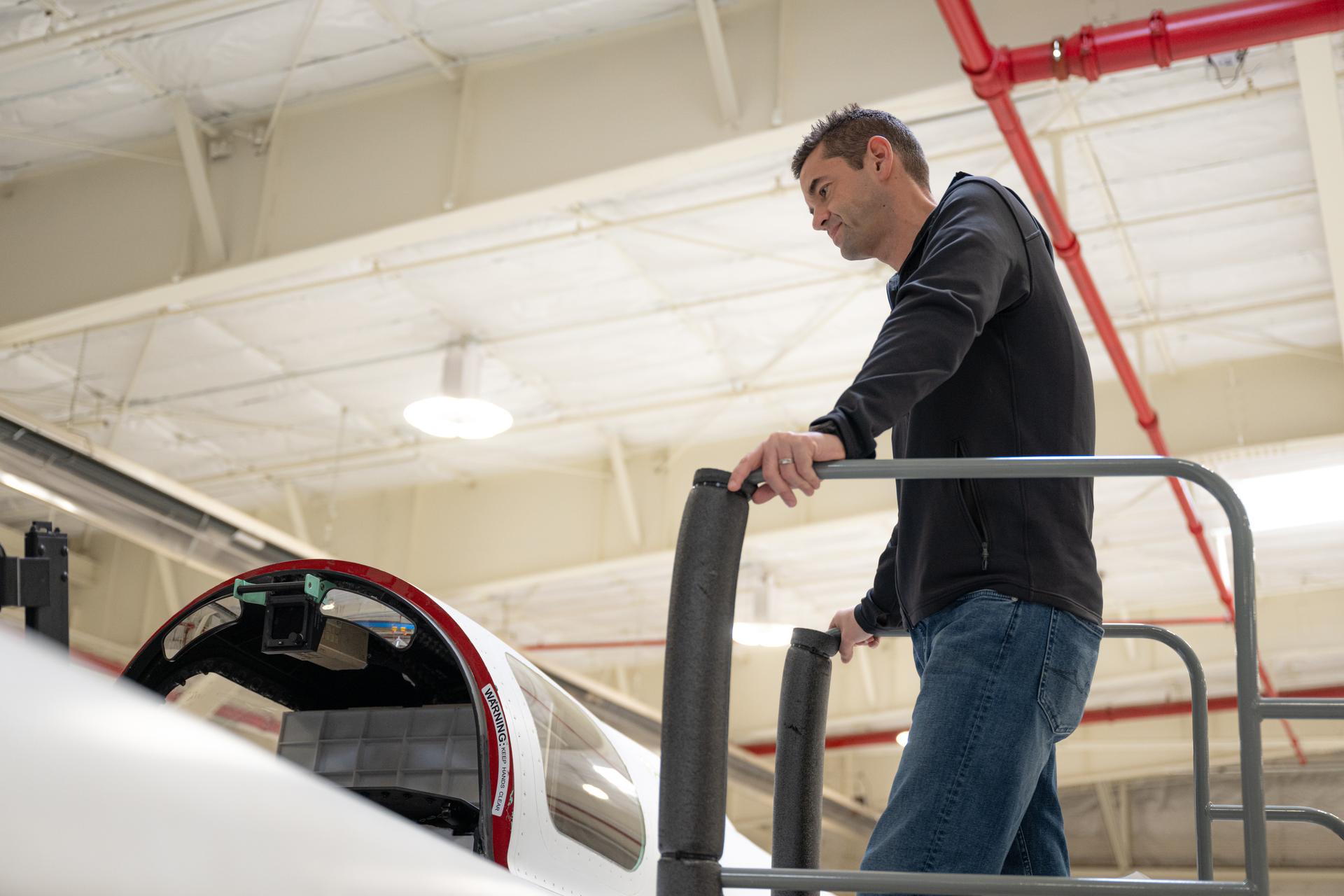
NASA Administrator Jared Isaacman tours the hangar housing the X-59 aircraft, Sunday, Jan. 25, 2026, at NASA’s Armstrong Flight Research Center at Edwards Air Force Base in California. Armstrong marks the ninth stop in Isaacman’s roadshow to visit NASA facilities and engage directly with the agency’s workforce. Photo Credit: (NASA/John Kraus)
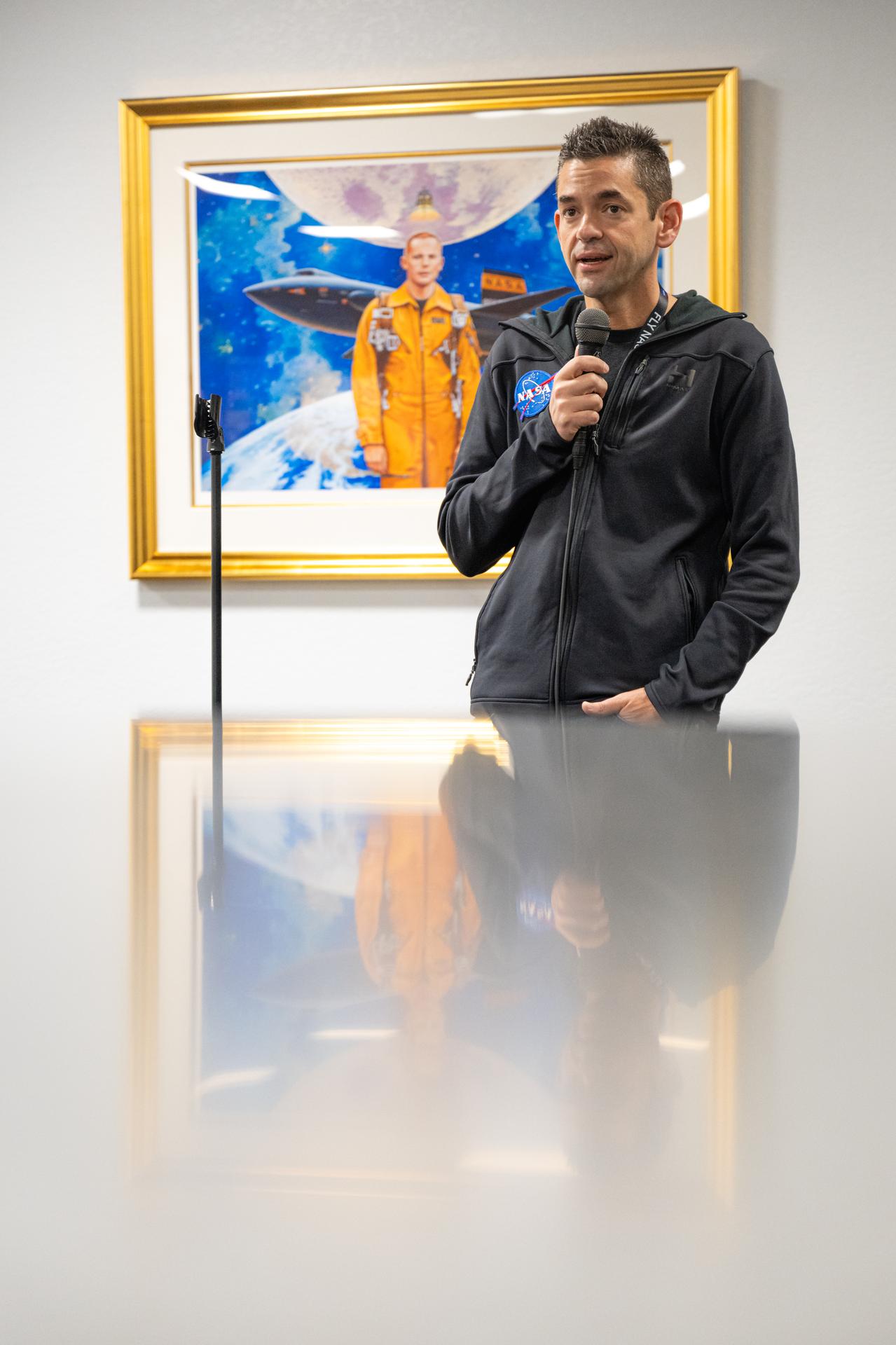
NASA Administrator Jared Isaacman speaks during a workforce Q&A session, Sunday, Jan. 25, 2026, at NASA’s Armstrong Flight Research Center at Edwards Air Force Base in California. Armstrong marks the ninth stop in Isaacman’s roadshow to visit NASA facilities and engage directly with the agency’s workforce. Photo Credit: (NASA/John Kraus)
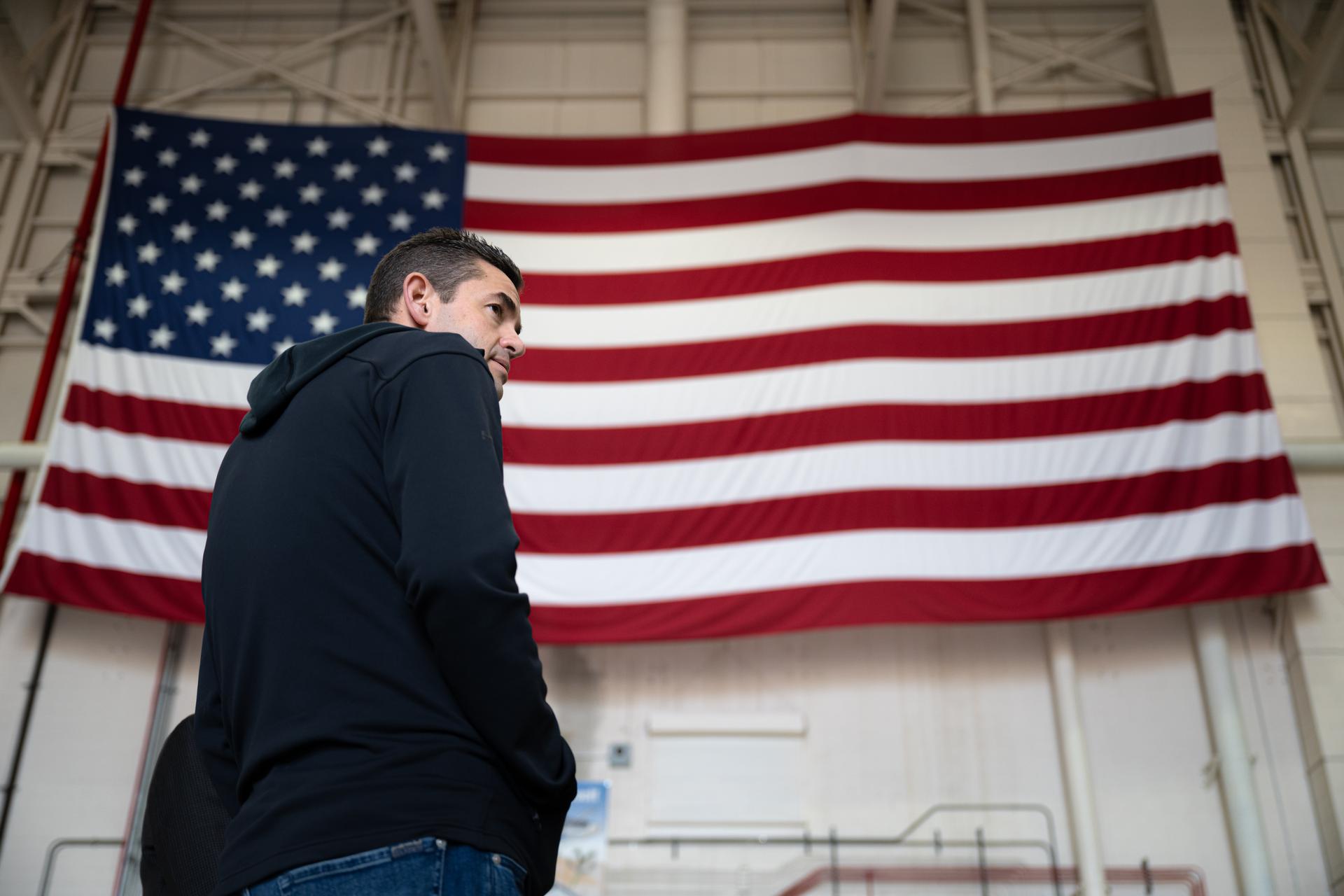
NASA Administrator Jared Isaacman is seen in front of an American flag in a hangar, Sunday, Jan. 25, 2026, at NASA’s Armstrong Flight Research Center at Edwards Air Force Base in California. Armstrong marks the ninth stop in Isaacman’s roadshow to visit NASA facilities and engage directly with the agency’s workforce. Photo Credit: (NASA/John Kraus)
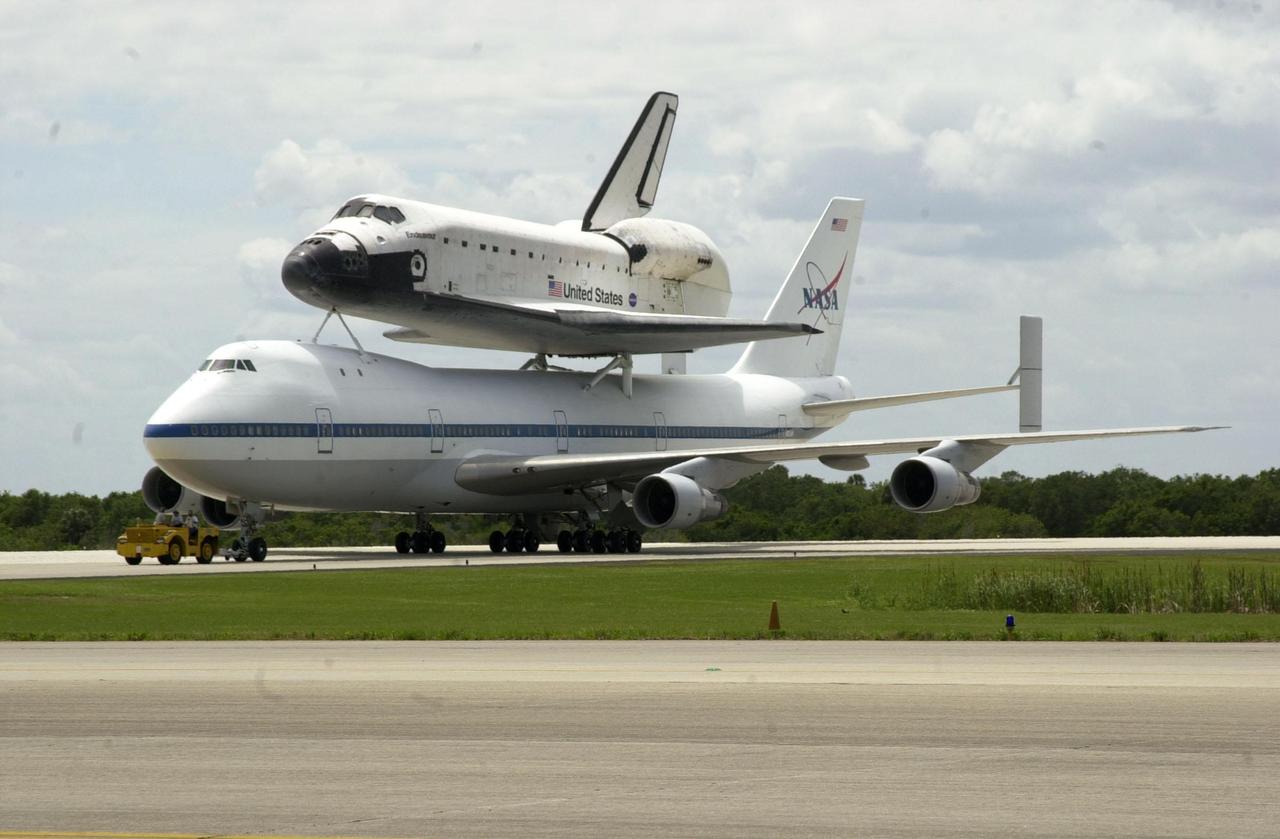
KENNEDY SPACE CENTER, FLA. -- Orbiter Endeavour, mounted atop NASA’s Shuttle Carrier Aircraft, is getting ready to be towed to the mate/demate device after its landing at the Shuttle Landing Facility. The duo completed a two-day transcontinental ferry flight from Edwards Air Force Base, Calif. Endeavour landed at Edwards AFB after a 12-day mission, STS-100, to the International Space Station. Endeavour will be demated from the SCA and towed to the Orbiter Processing Facility bay 1 where it will begin processing for mission STS-108
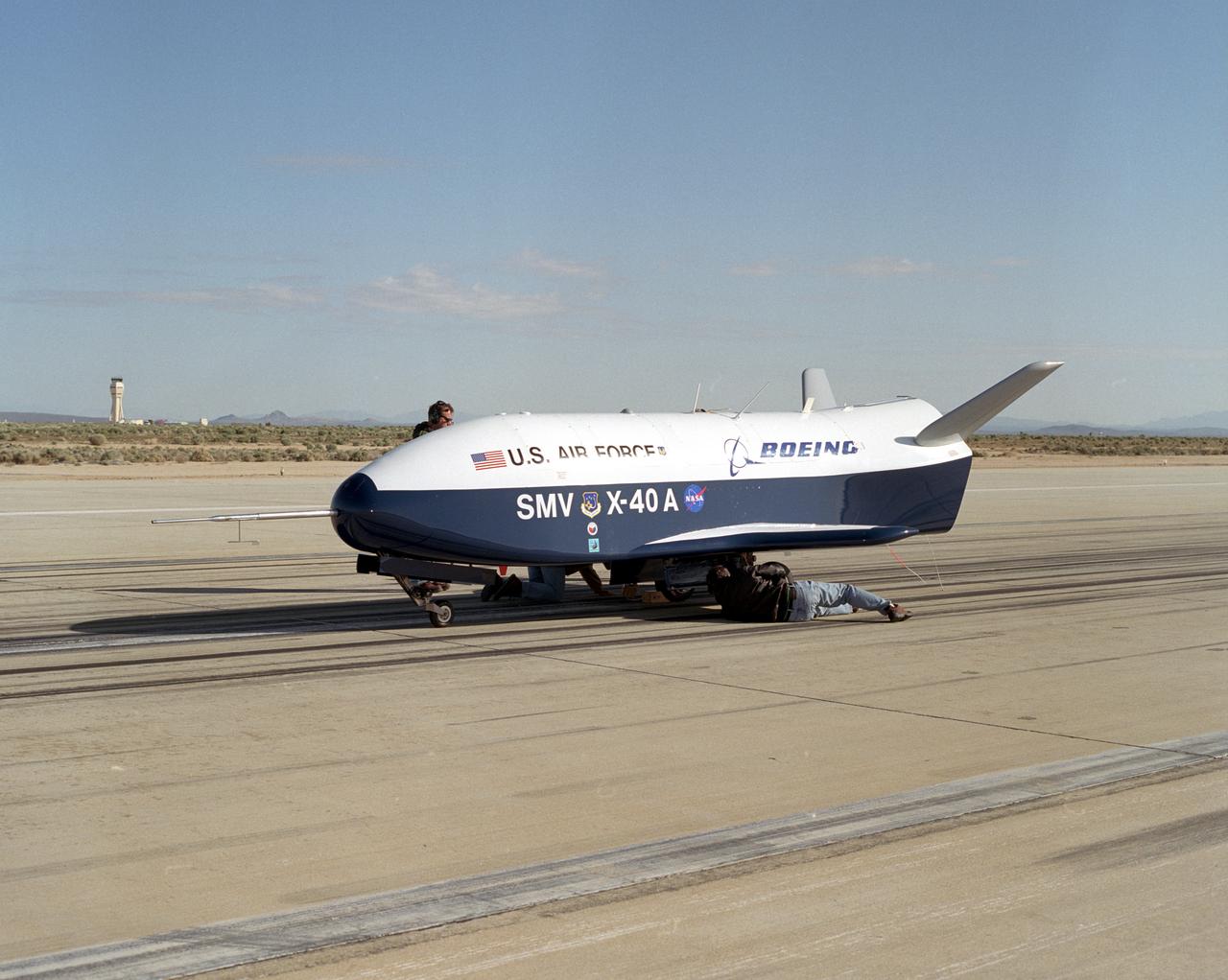
Second free-flight of the X-40A at the NASA Dryden Flight Research Center, on Edwards AFB, Calif., was made on Apr. 12, 2001. The unpowered X-40A, an 85 percent scale risk reduction version of the proposed X-37, is proving the capability of an autonomous flight control and landing system in a series of glide flights at Edwards. The April 12 flight introduced complex vehicle maneuvers during the landing sequence. The X-40A was released from an Army Chinook helicopter flying 15,050 feet overhead. Ultimately, the unpiloted X-37 is intended as an orbital testbed and technology demonstrator, capable of landing like an airplane and being quickly serviced for a follow-up mission.
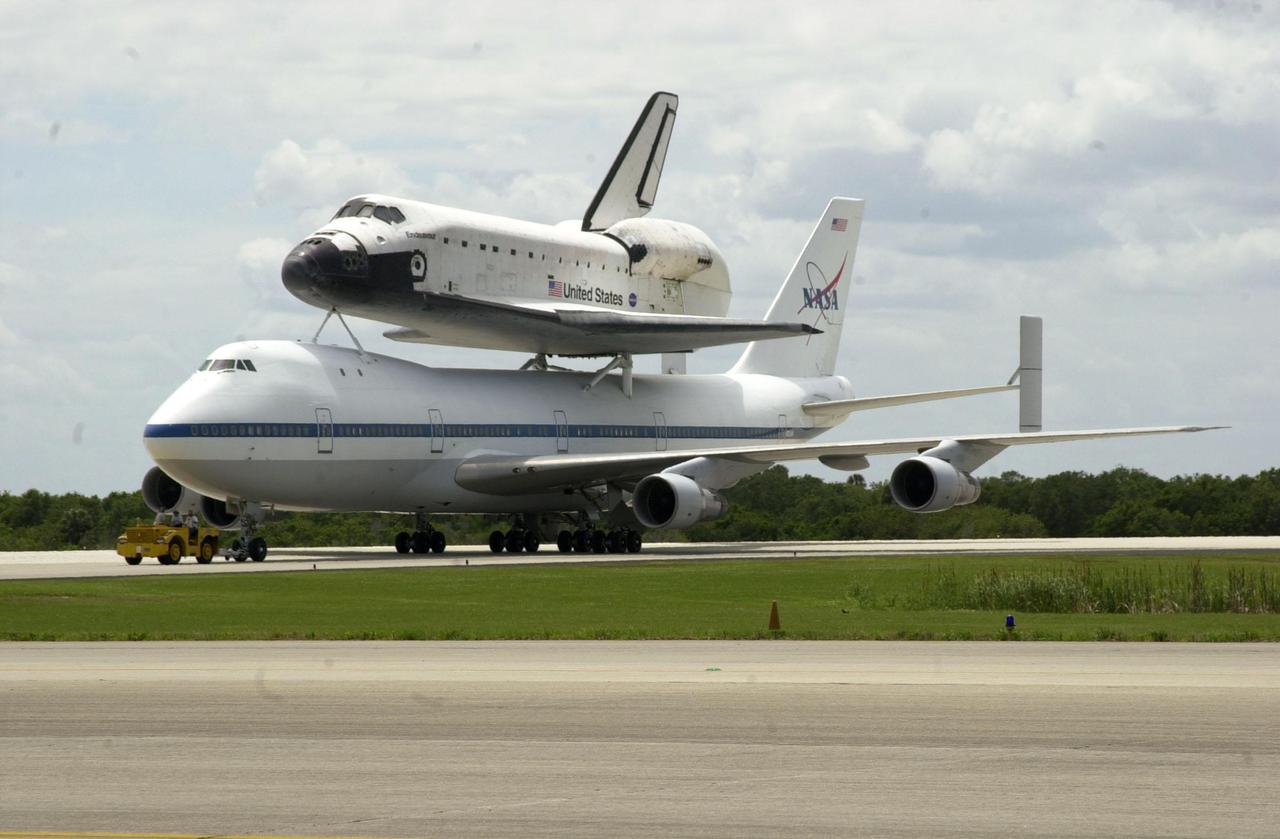
KENNEDY SPACE CENTER, FLA. -- Orbiter Endeavour, mounted atop NASA’s Shuttle Carrier Aircraft, is getting ready to be towed to the mate_demate device after its landing at the Shuttle Landing Facility. The duo completed a two-day transcontinental ferry flight from Edwards Air Force Base, Calif. Endeavour landed at Edwards AFB after a 12-day mission, STS-100, to the International Space Station. Endeavour will be demated from the SCA and towed to the Orbiter Processing Facility bay 1 where it will begin processing for mission STS-108
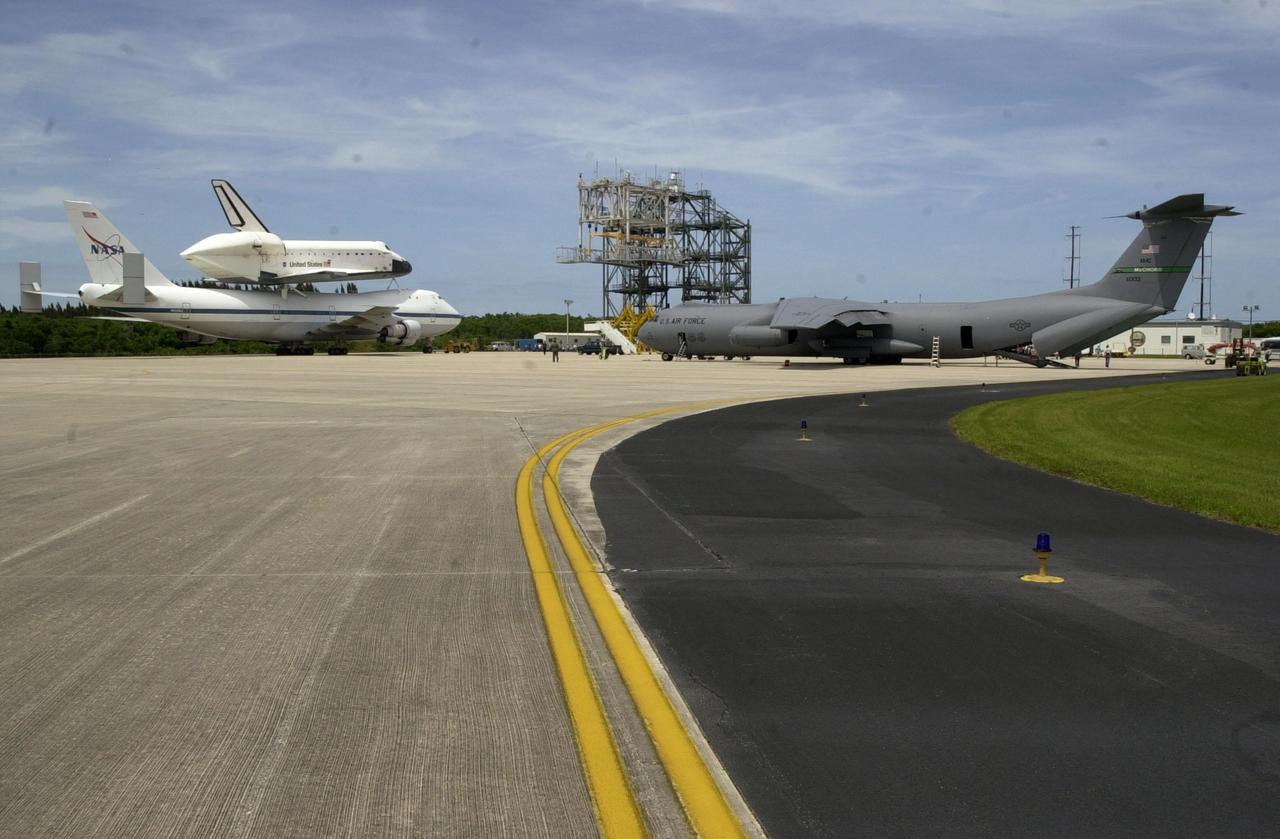
KENNEDY SPACE CENTER, FLA. -- At the Shuttle Landing Facility, orbiter Endeavour and the Shuttle Carrier Aircraft are towed past the Pathfinder, a C-141, that precedes the ferry flight on its journey. The Endeavour/SCA completed a two-day transcontinental ferry flight from Edwards Air Force Base, Calif. . Endeavour landed at Edwards AFB after a 12-day mission, STS-100, to the International Space Station. Endeavour will be demated from the SCA and towed to the Orbiter Processing Facility bay 1 where it will begin processing for mission STS-108
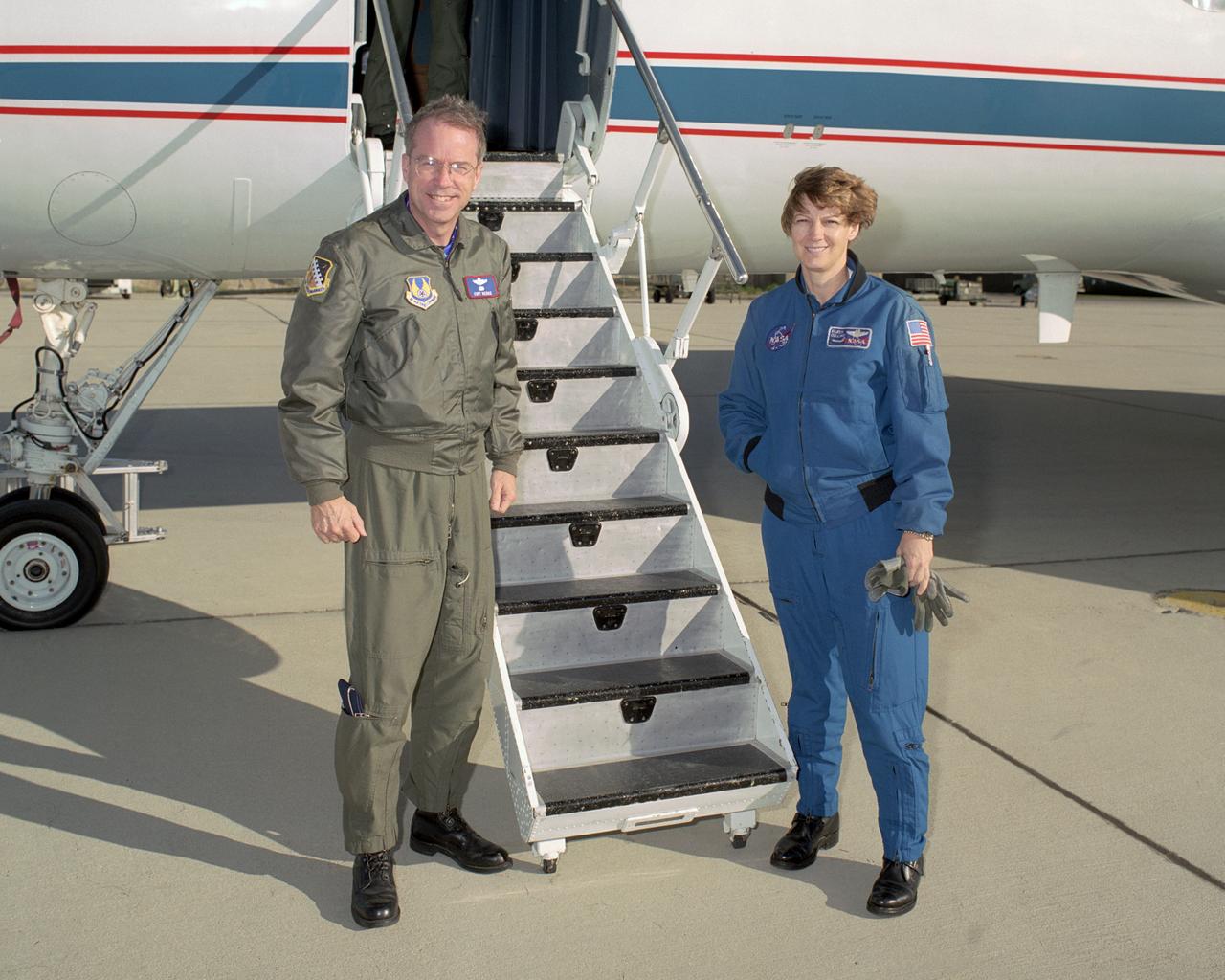
Brig. Gen. Curtis Bedke, commander of the Air Force Flight Test Center at Edwards Air Force Base, received some first-hand insight on how to fly a Space Shuttle approach and landing, courtesy of NASA astronaut and STS-114 mission commander Eileen Collins. The series of proficiency flights in NASA's modified Grumman Gulfstream-II Shuttle Training Aircraft were in preparation for the STS-114 mission with the shuttle Discovery. Although NASA's Kennedy Space Center in Florida is the primary landing site for Space Shuttle missions, flight crews also practice the shuttle's steep approach and landing at Edwards in case weather or other situations preclude a landing at the Florida site and force a diversion to Edwards AFB.
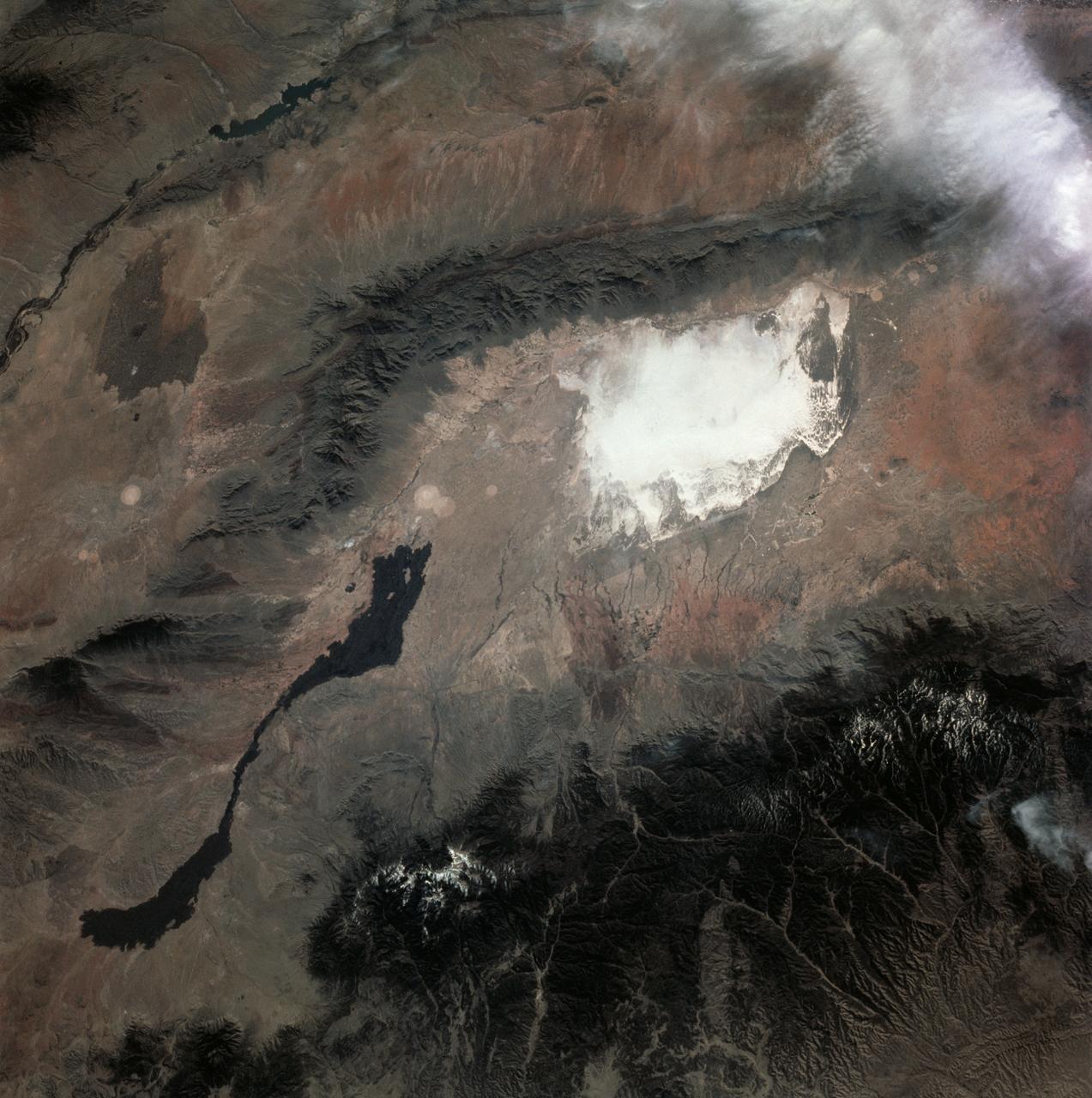
STS003-10-613 (22-30 March 1982) --- A truly remarkable view of White Sands and the nearby Carrizozo Lava Beds in southeast NM (33.5N, 106.5W). White Sands, site of the WW II atomic bomb development and testing facility and later post war nuclear weapons testing that can still be seen in the cleared circular patterns on the ground. Space shuttle Columbia (STS-3), this mission, landed at the White Sands alternate landing site because of bad weather at Edwards AFB, CA. Photo credit: NASA
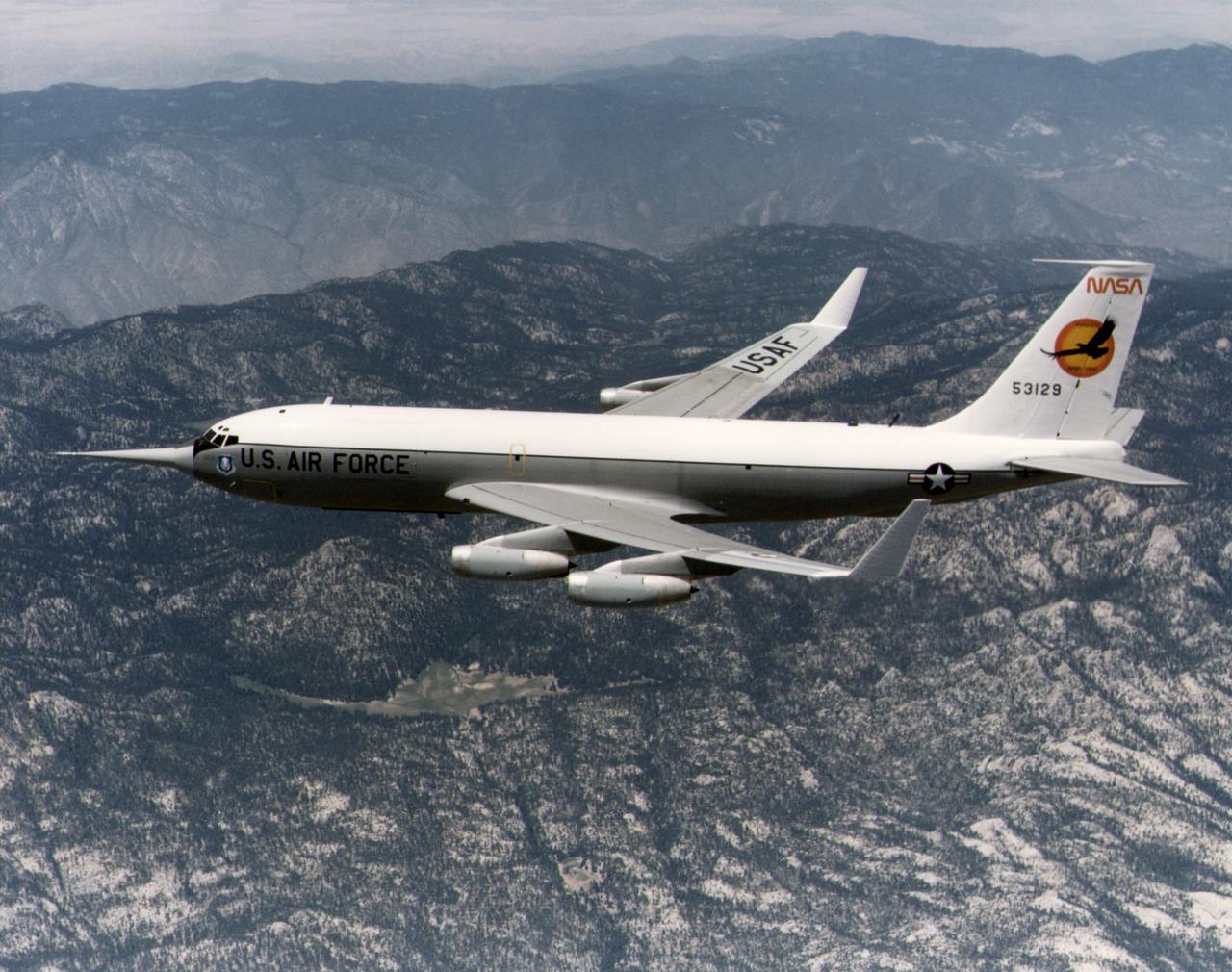
The KC-135 with the winglets in flight over the San Gabriel mountains, south of Edwards AFB. While wind tunnel tests suggested that winglets - developed by NASA Langley's Richard Whitcomb - would significantly reduce drag, flight research proved their usefulness. Winglets were installed on an Air Force KC-135 and research flights were made in 1979 and 1980. These showed drag in flight was reduced by as much as 7 percent. Winglets soon appeared on production aircraft, although these were smaller than those mounted on the KC-135.
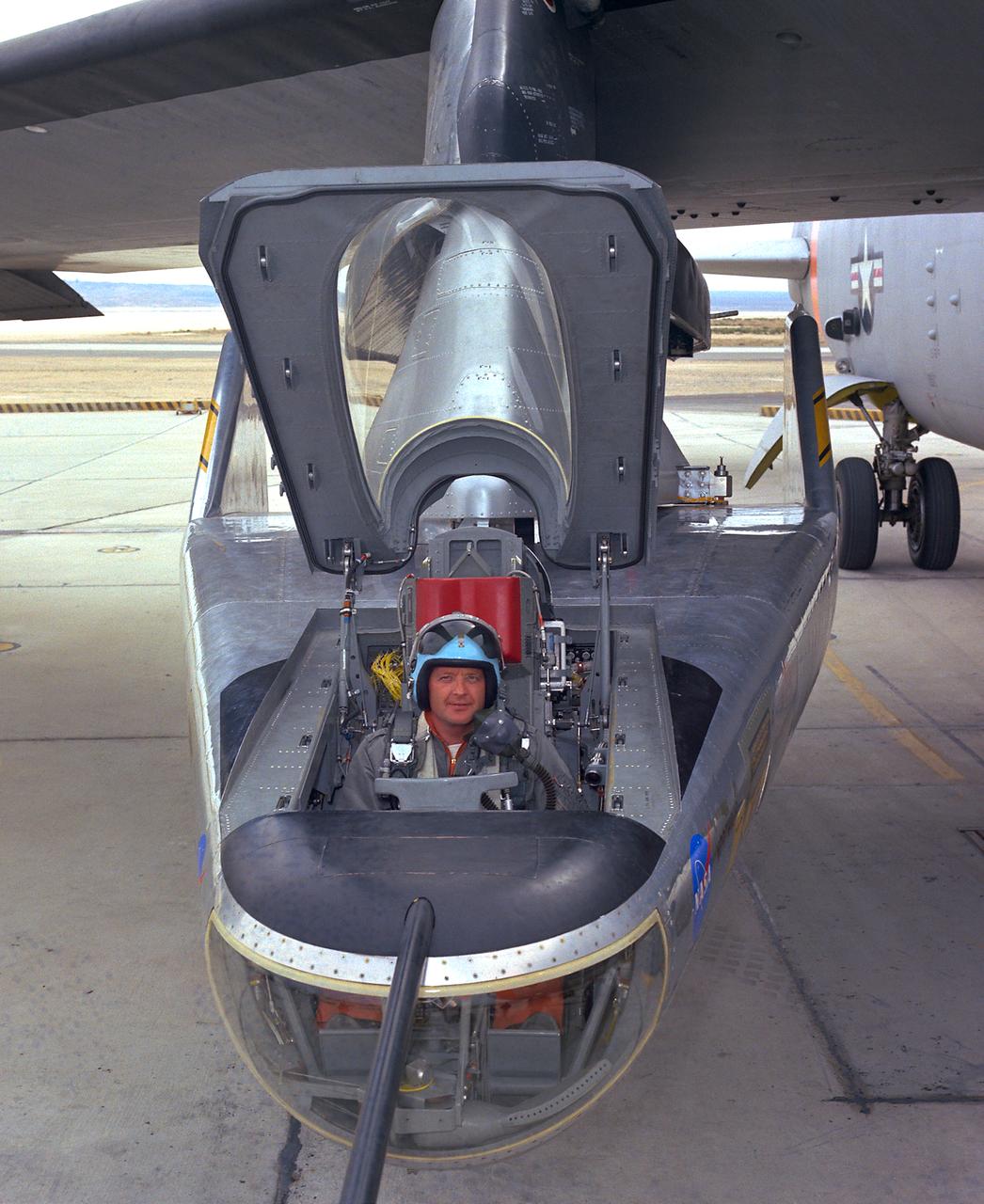
NASA research pilot Milt Thompson sits in the M2-F2 "heavyweight" lifting body research vehicle before a 1966 test flight. The M2-F2 and the other lifting-body designs were all attached to a wing pylon on NASA’s B-52 mothership and carried aloft. The vehicles were then drop-launched and, at the end of their flights, glided back to wheeled landings on the dry lake or runway at Edwards AFB. The lifting body designs influenced the design of the Space Shuttle and were also reincarnated in the design of the X-38 in the 1990s.
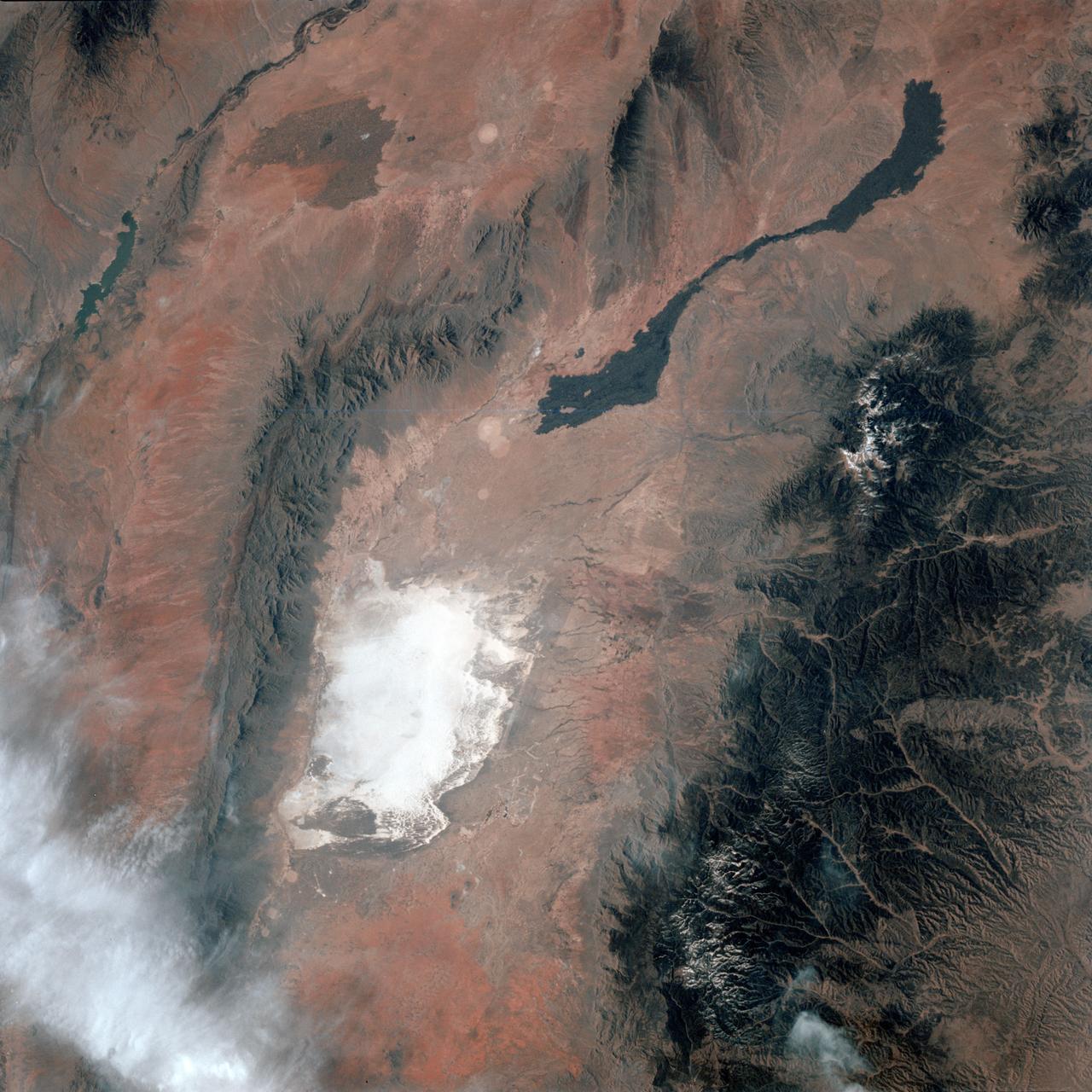
STS003-010-613 (22-30 March 1982) --- A truly remarkable view of White Sands and the nearby Carrizozo Lava Beds in southeast NM (33.5N, 106.5W). White Sands, site of the WW II atomic bomb development and testing facility and later post war nuclear weapons testing that can still be seen in the cleared circular patterns on the ground. Space shuttle Columbia (STS-3), this mission, landed at the White Sands alternate landing site because of bad weather at Edwards AFB, CA. Photo credit: NASA
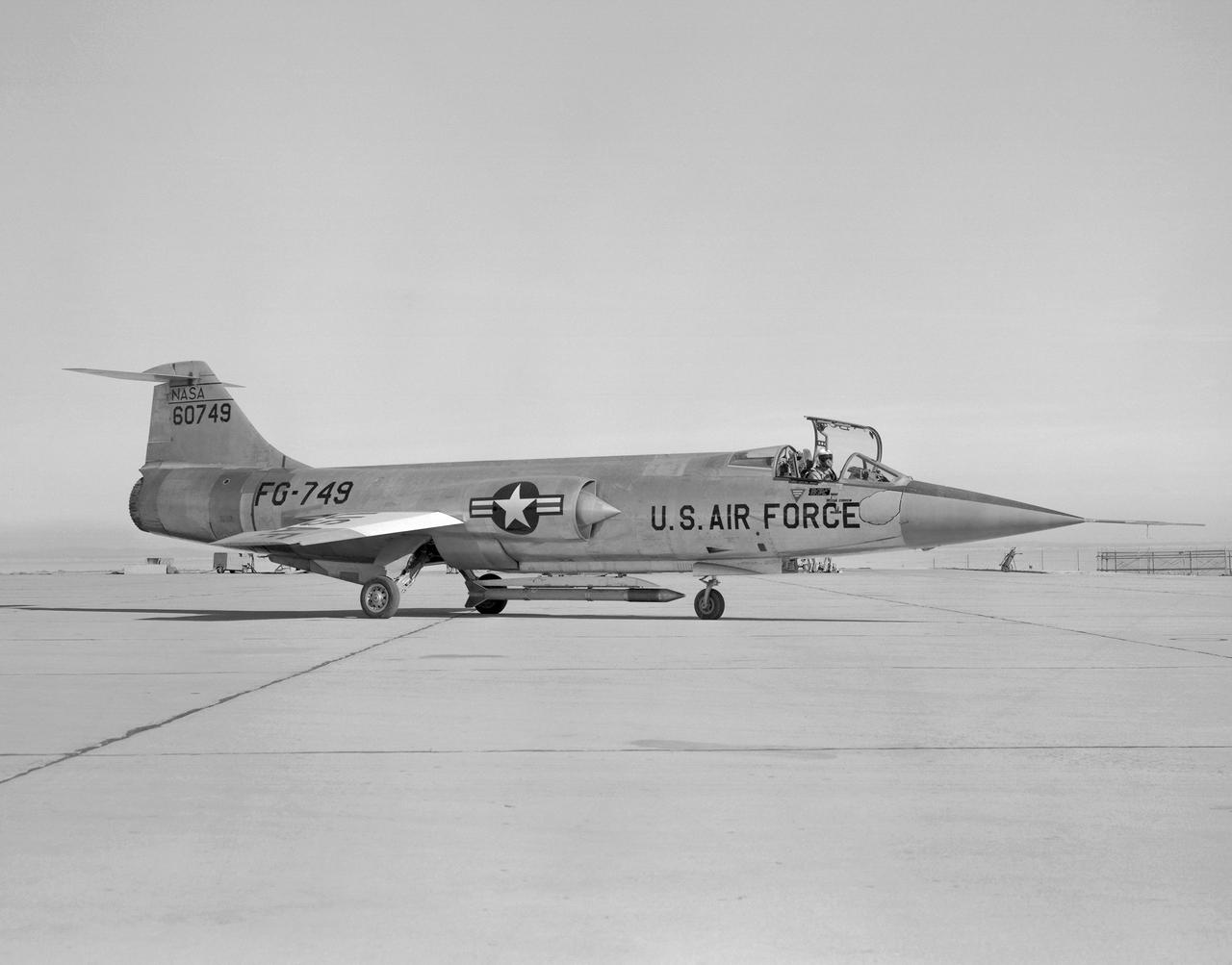
JF-104A (Serial #56-0749) on the ramp at the NASA Flight Research Center (now the Dryden Flight Research Center) at Edwards AFB. The aircraft is shown with the Air Launched Sounding Rocket (ALSOR) attached to the underside. NASA test pilot Milton O. Thompson ejected from this aircraft on 20 December 1962, after an asymmetrical flap condition made the jet uncontrollable.
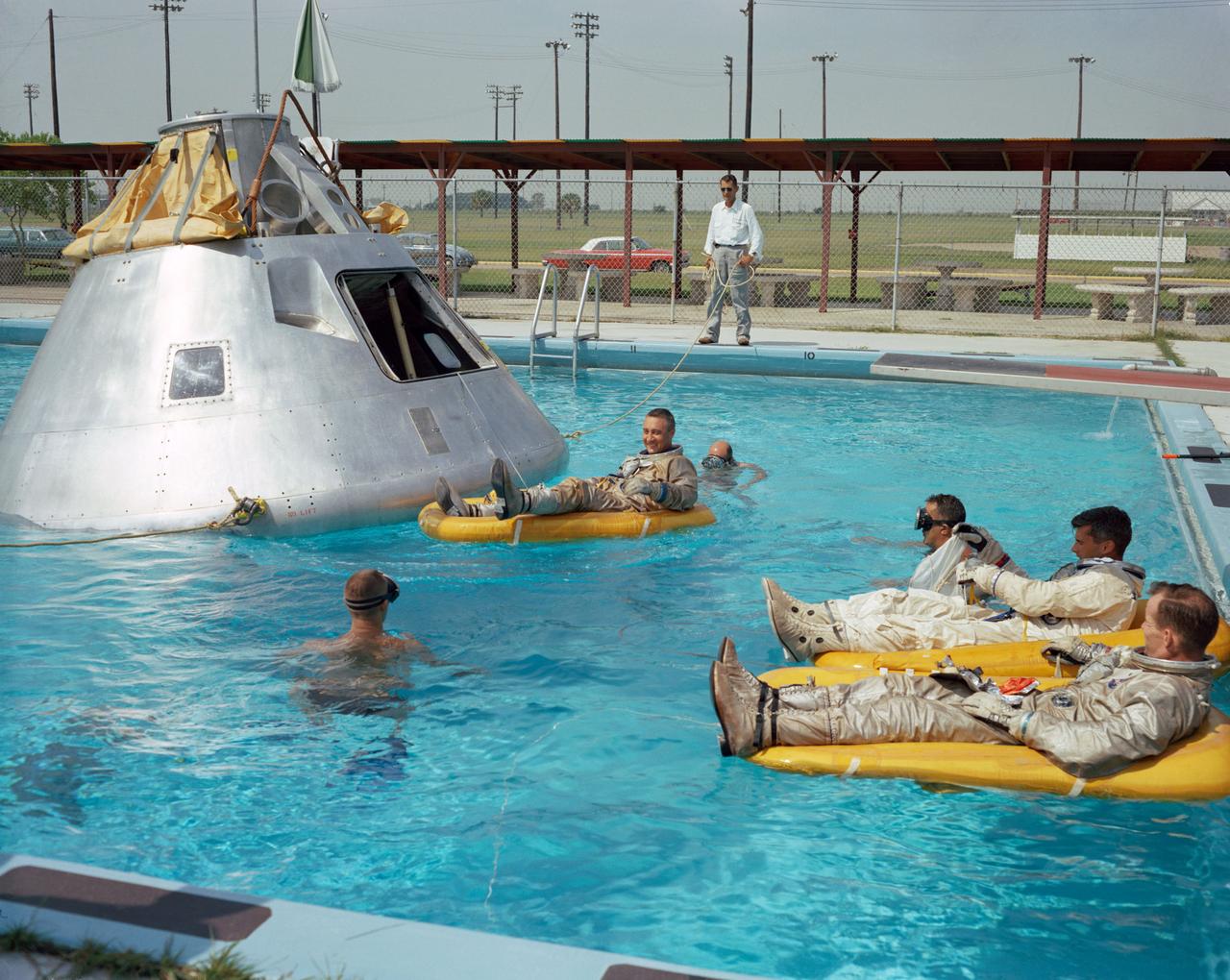
S66-51581 (June 1966) --- Prime crew for the first manned Apollo mission practice water egress procedures with full scale boilerplate model of their spacecraft. In the water at right is astronaut Edward H. White (foreground) and astronaut Roger B. Chaffee. In raft near the spacecraft is astronaut Virgil I. Grissom. NASA swimmers are in the water to assist in the practice session that took place at Ellington AFB, near the Manned Spacecraft Center, Houston.
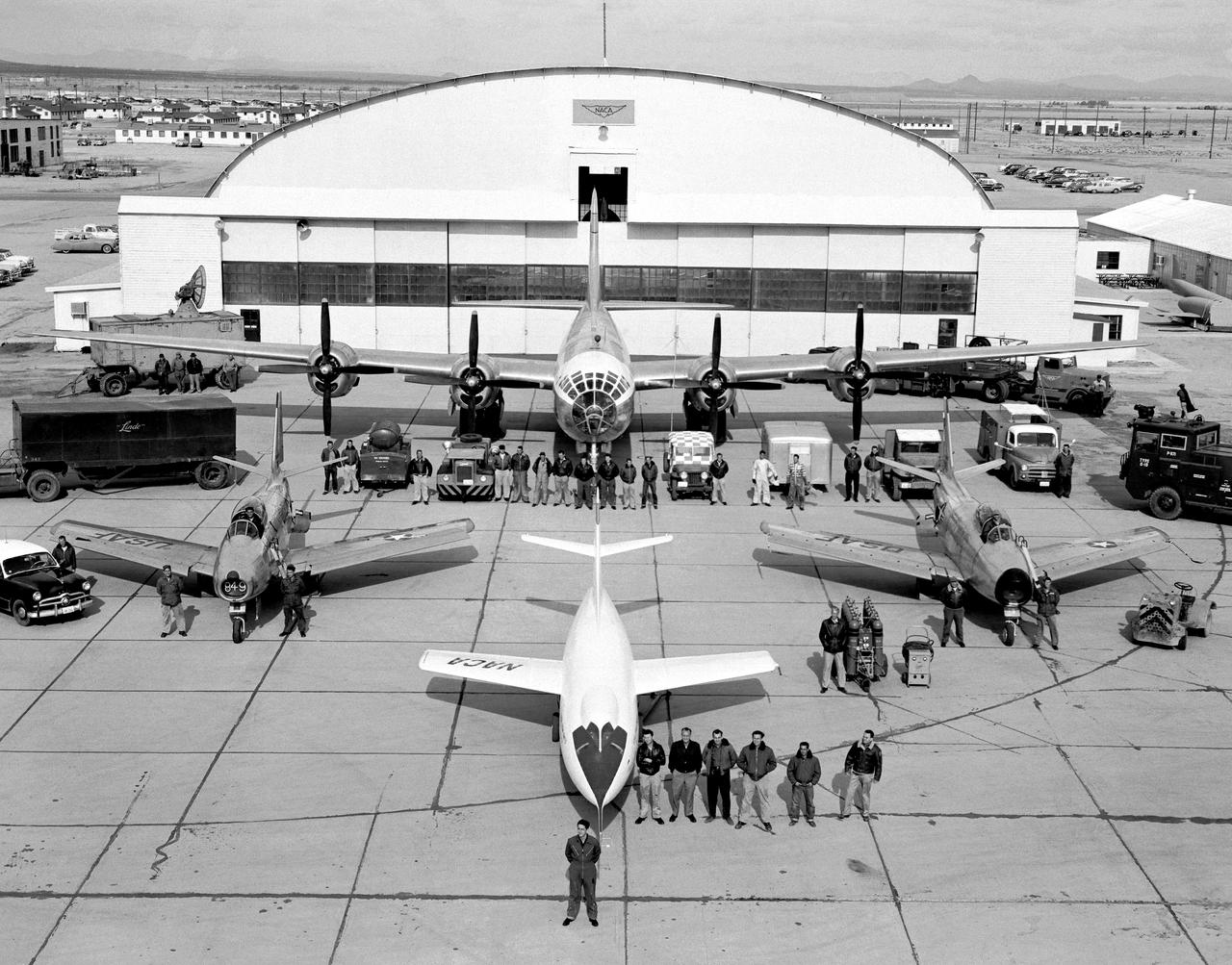
These people and this equipment supported the flight of the NACA D-558-2 Skyrocket at the High-Speed Flight Station at South Base, Edwards AFB. Note the two Sabre chase planes, the P2B-1S launch aircraft, and the profusion of ground support equipment, including communications, tracking, maintenance, and rescue vehicles. Research pilot A. Scott Crossfield stands in front of the Skyrocket.
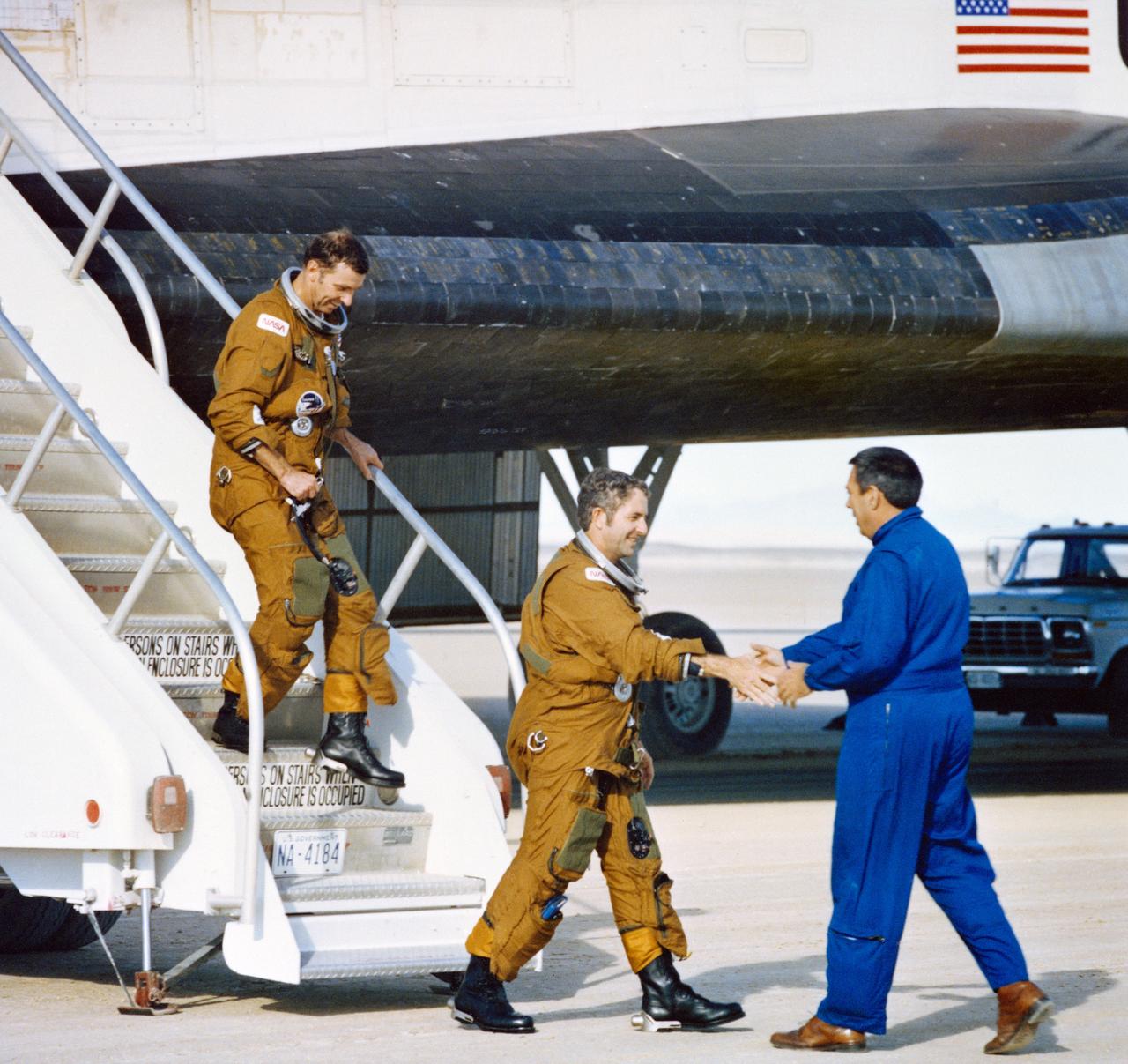
S81-39582 (14 Nov. 1981) --- Astronauts Joe H. Engle, rear, and Richard H. Truly are greeted by George W.S. Abbey, Director of Flight Operations at the Johnson Space Center, as they egress the space shuttle Columbia after spending two days, six hours and 13 minutes on NASA?s STS-2 mission. Photo credit: NASA
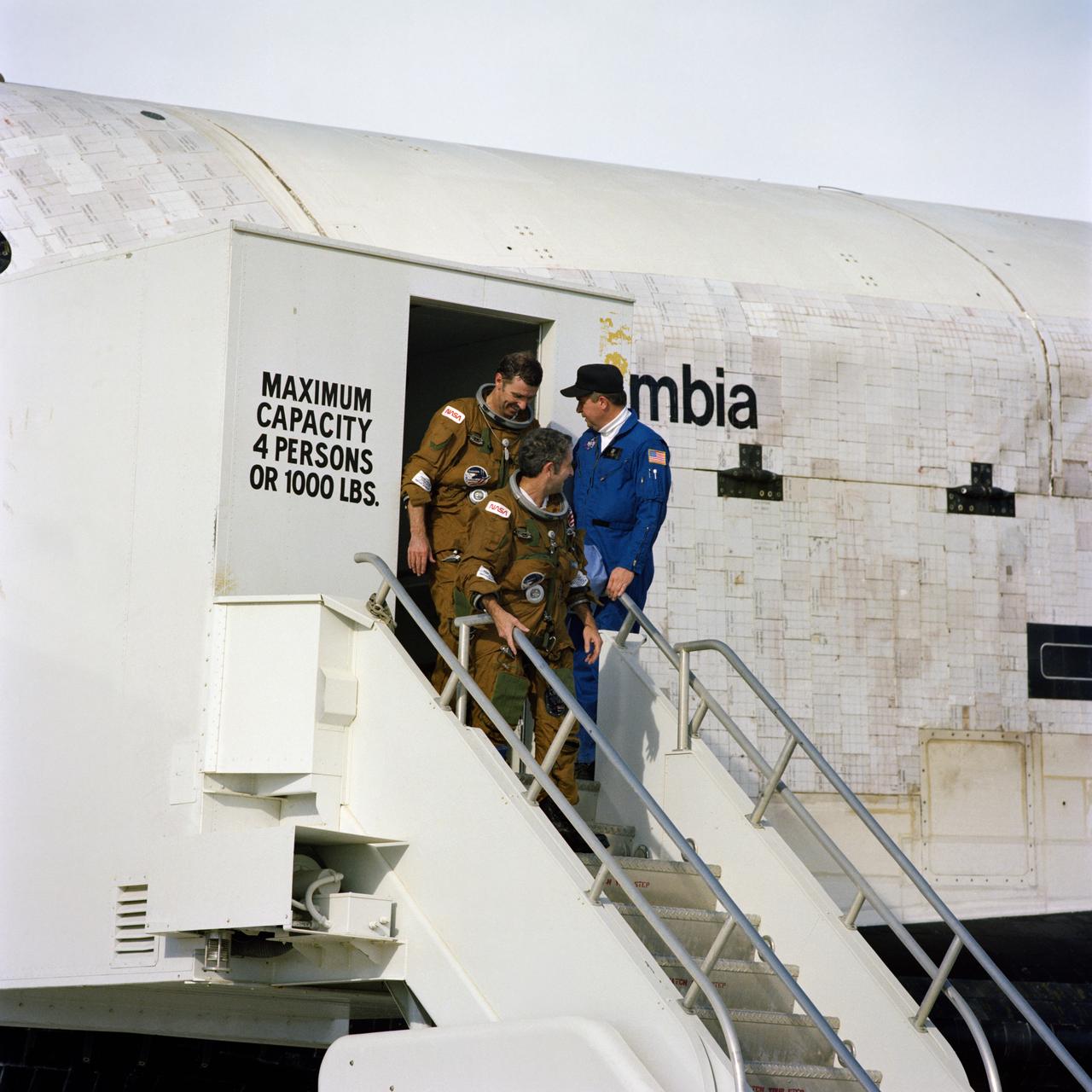
S81-39580 (14 Nov. 1981) --- Astronauts Joe H. Engle, rear, and Richard H. Truly egress the space shuttle Columbia after spending two days, six hours and 13 minutes on NASA?s STS-2 mission. At right is their physician, Dr. Charles La Pinta of the JSC Medical Sciences Division. Photo credit: NASA
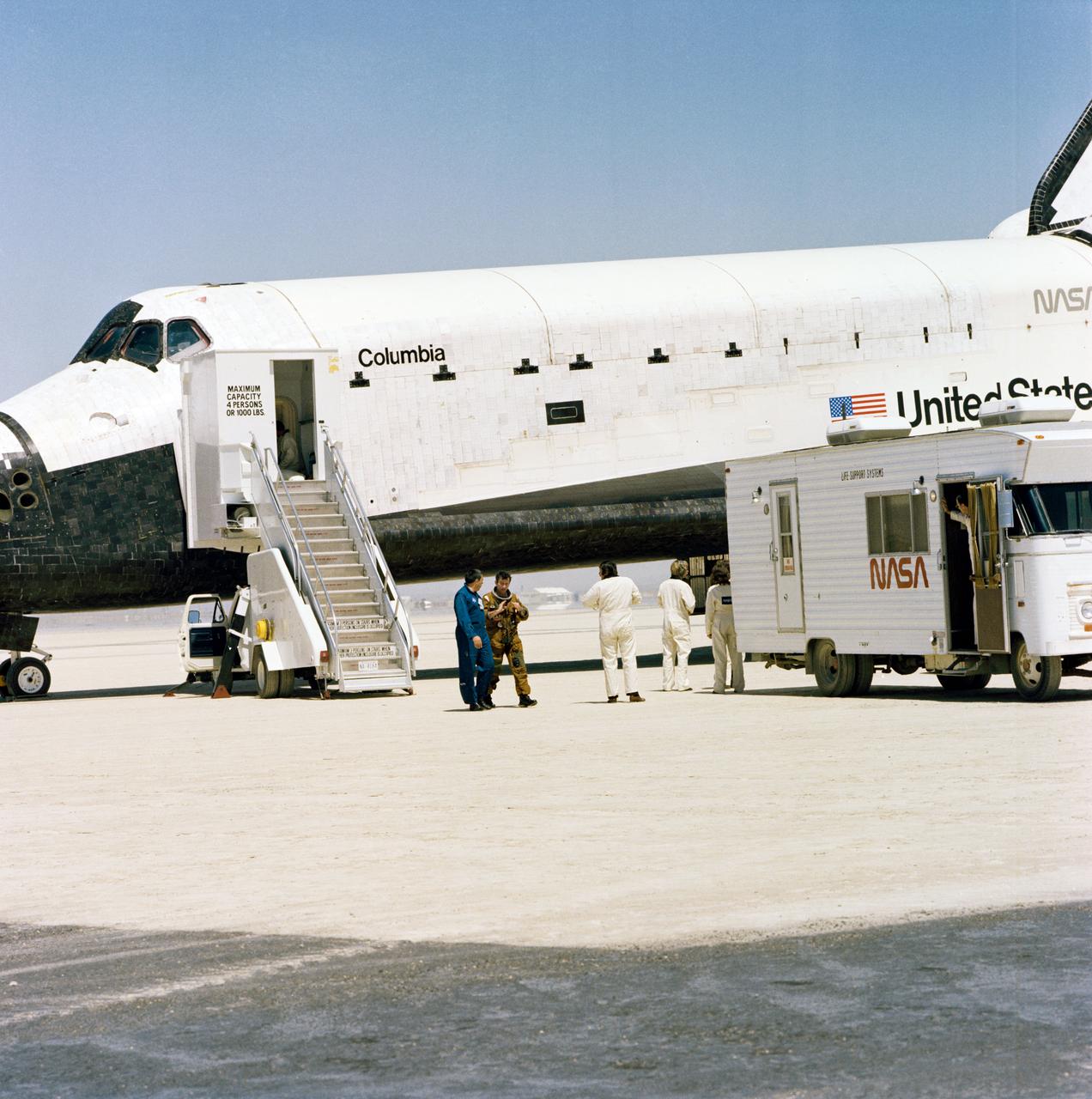
S81-30853 (14 April 1981) --- Astronaut John W. Young, left center talks with George W.S. Abbey, director of flight operations at Johnson Space Center, following egress from the STS-1 Columbia, which forms the backdrop for this postflight scene. Young is en route to the van at right which will take him and fellow crew member Robert L. Crippen (STS-1 pilot still inside Columbia) to facilities at nearby Dryden Flight Research Center. Columbia will be mated to a 747 carrier craft and flown to Florida, where it will be refurbished to accommodate STS-2, scheduled for a Sept. 30 launch date. Photo credit: NASA
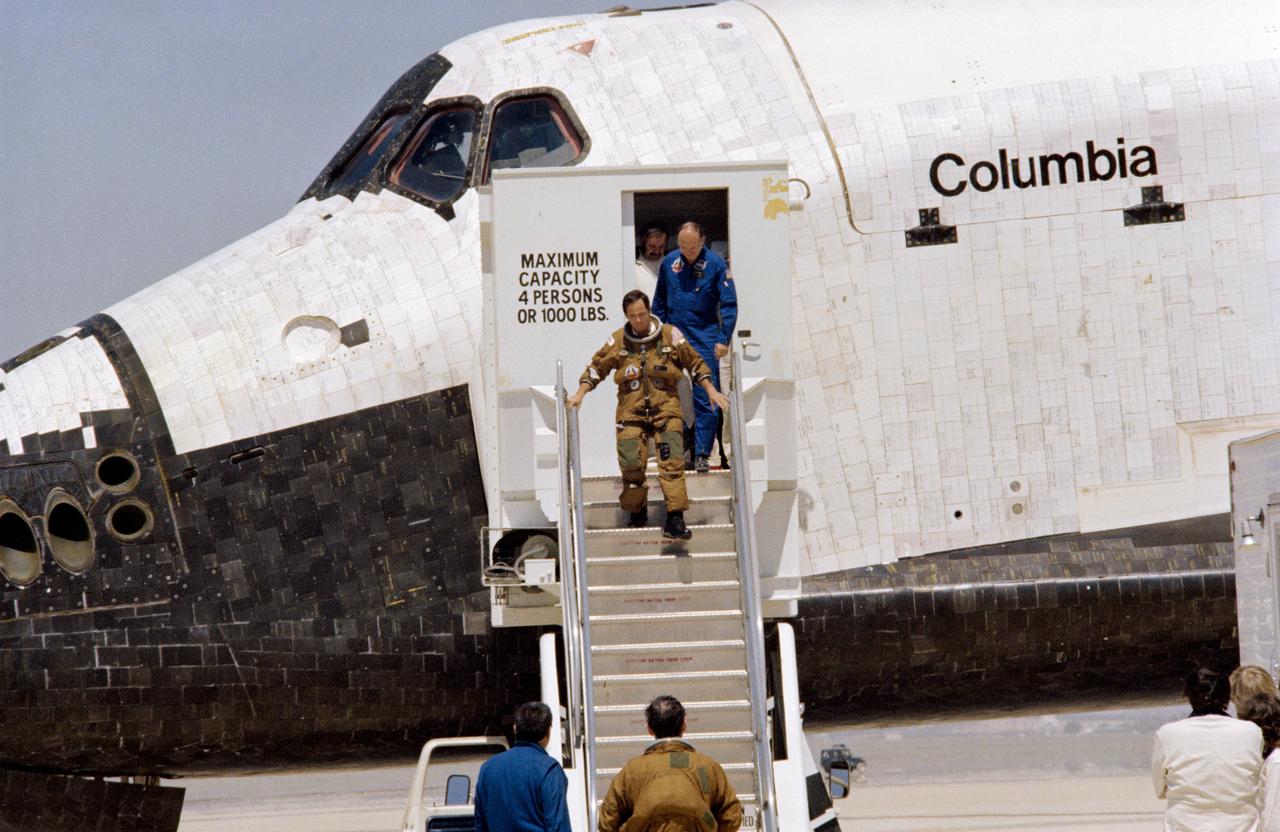
S81-30852 (14 April 1981) --- Astronaut Robert L. Crippen, pilot for the STS-1 flight, egresses the NASA space shuttle following touchdown of the Columbia on Rogers Dry Lake at Edwards Air Force Base, California. Astronaut John W. Young, crew commander, had earlier exited the craft and can be seen standing at the foot of the steps with George W.S. Abbey, director of flight operations at the Johnson Space Center (JSC). Dr. Craig L. Fischer, chief of the medical operations branch in JSC?s medical sciences division, follows Crippen down the steps. Photo credit: NASA
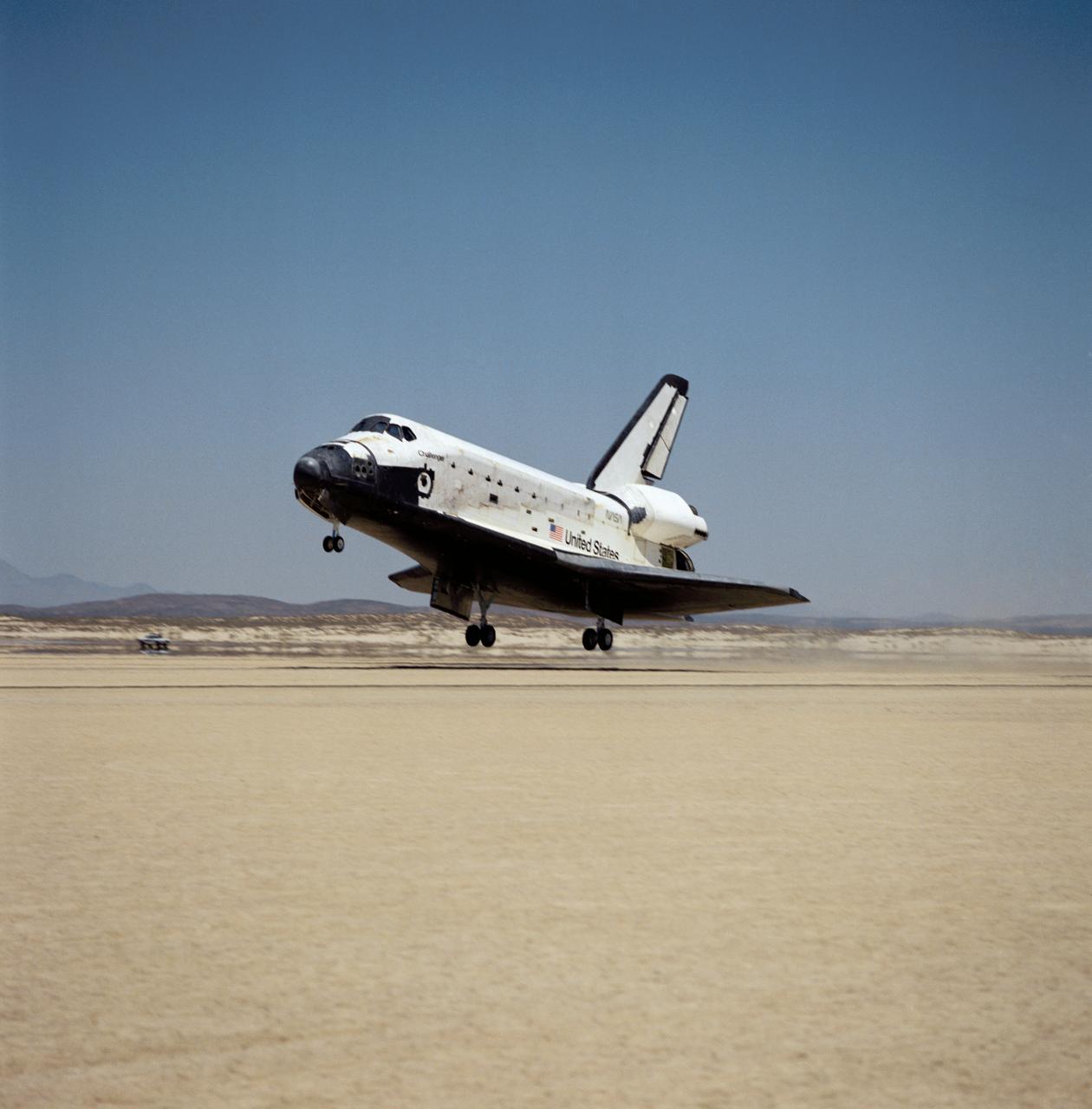
51F-S-160 (6 Aug 1985) --- The Space Shuttle Challenger is moments away from touchdown on the dry lake bed at Edwards Air Force Base in California in this ground-level view. The early afternoon landing brought to a successful close eight days in space for seven crewmembers and a battery of scientific experiments aboard.
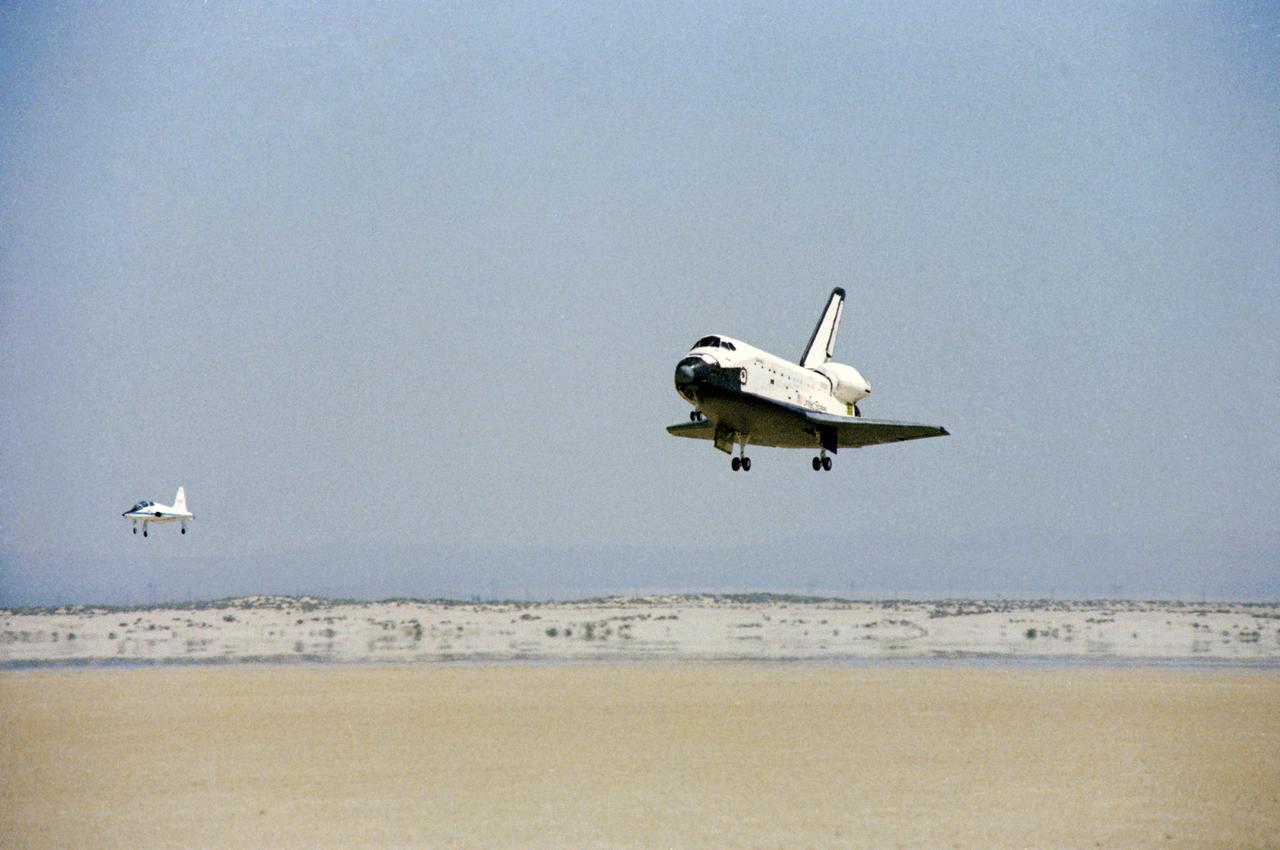
S81-30425 (14 April 1981) --- The space shuttle orbiter Columbia is seen from the front as it heads for a touchdown atop a dry lake bed at Edwards Air Force Base in southern California. A T-38 chase plane follows it in at left. Aboard Columbia were astronauts John W. Young, STS-1 commander, and Robert L. Crippen, pilot. Their landing marked the completion of a successful two-and-a-third day flight in space and the beginning of a new era of space transportation. A series of additional test flights will follow before the Space Shuttle Program becomes fully operational later in this decade. Photo credit: NASA
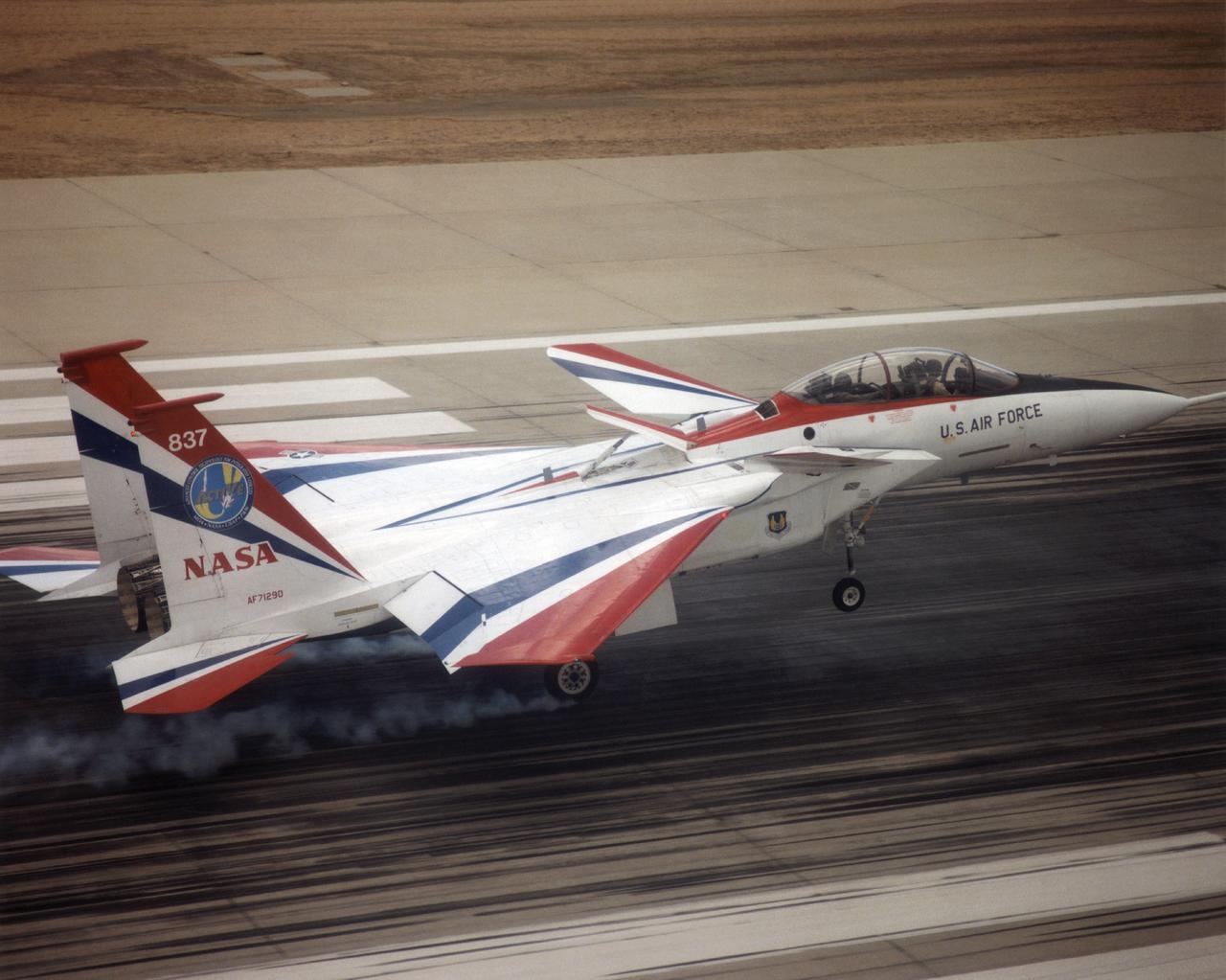
The F-15 ACTIVE touches down on the Edwards runway following its April 14, 1998 flight. The nose is high while the canards have their rear edge raised. the aircraft's speed brake, located on the top of the aircraft behind the canopy, is also raised.