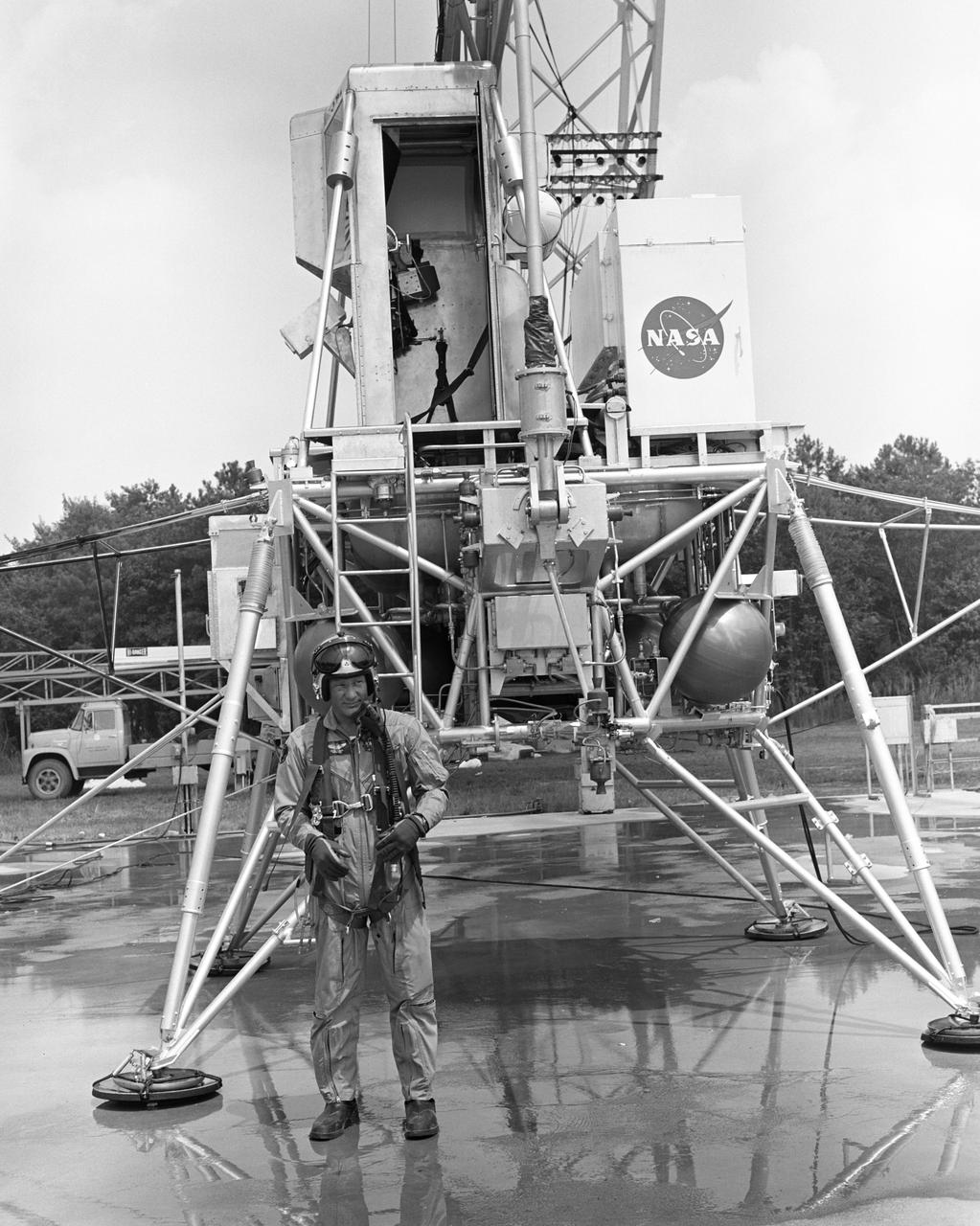
Astronaut Edwin Buzz Aldrin Lunar Module Pilot at the (LLRF) Lunar Landing Research Facility. Aldrin was one of the third group of astronauts named by NASA in October 1963. On November 11, 1966, he and command pilot James Lovell were launched into space in the Gemini 12 spacecraft on a 4-day flight, which brought the Gemini program to a successful close. Aldrin established a new record for extravehicular activity (EVA), spending 5-1/2 hours outside the spacecraft. He served as lunar module pilot for Apollo 11, July 16-24, 1969, the first manned lunar landing mission. Aldrin followed Neil Armstrong onto the lunar surface on July 20, 1969, completing a 2-hour and 15 minute lunar EVA. In July 1971, Aldrin resigned from NASA. Aldrin has logged 289 hours and 53 minutes in space, of which, 7 hours and 52 minutes were spent in EVA. https://www.nasa.gov/astronauts/biographies/former
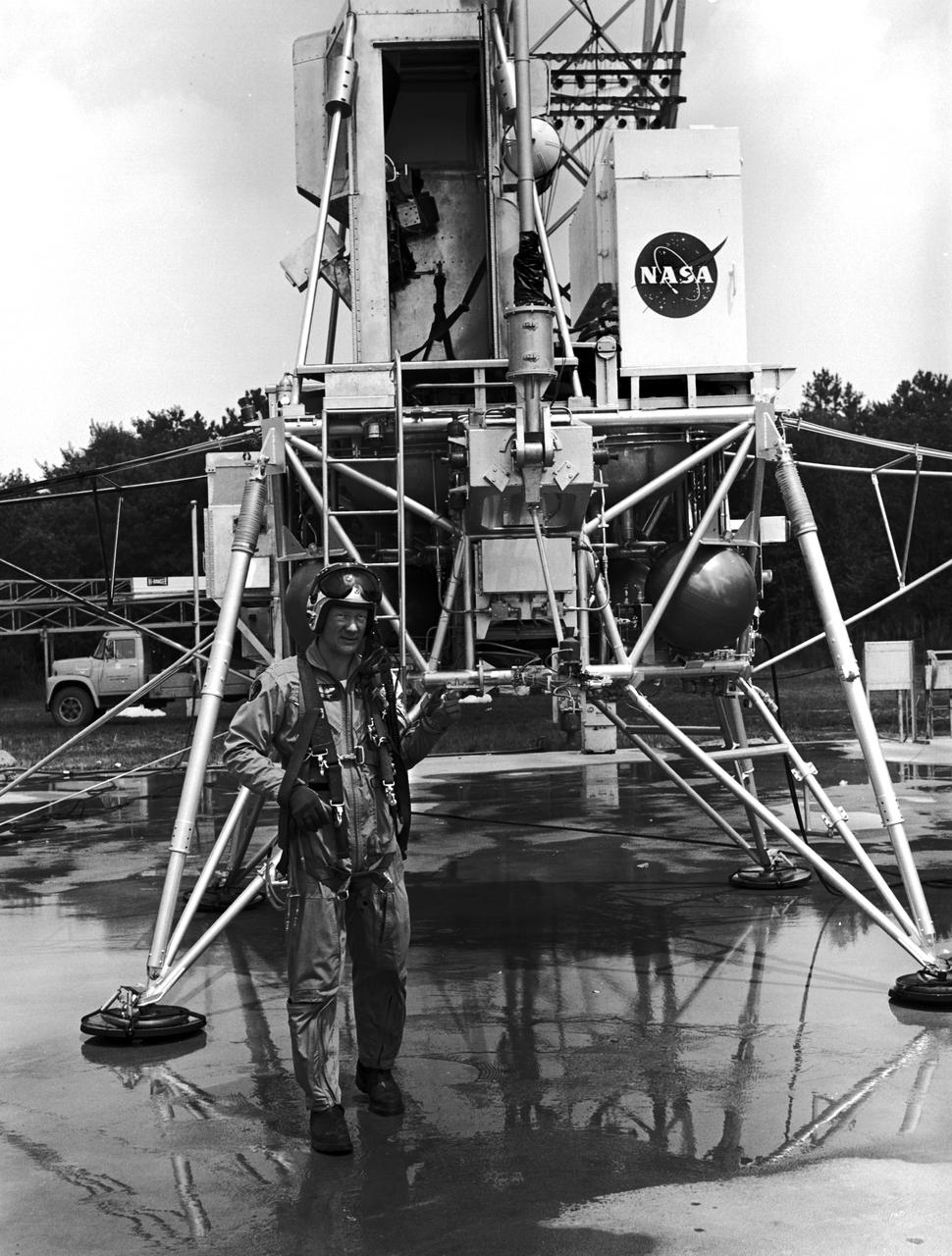
Astronaut Edwin Buzz Aldrin Lunar Module Pilot at the (LLRF) Lunar Landing Research Facility. Aldrin was one of the third group of astronauts named by NASA in October 1963. On November 11, 1966, he and command pilot James Lovell were launched into space in the Gemini 12 spacecraft on a 4-day flight, which brought the Gemini program to a successful close. Aldrin established a new record for extravehicular activity (EVA), spending 5-1/2 hours outside the spacecraft. He served as lunar module pilot for Apollo 11, July 16-24, 1969, the first manned lunar landing mission. Aldrin followed Neil Armstrong onto the lunar surface on July 20, 1969, completing a 2-hour and 15 minute lunar EVA. In July 1971, Aldrin resigned from NASA. Aldrin has logged 289 hours and 53 minutes in space, of which, 7 hours and 52 minutes were spent in EVA. https://www.nasa.gov/astronauts/biographies/former
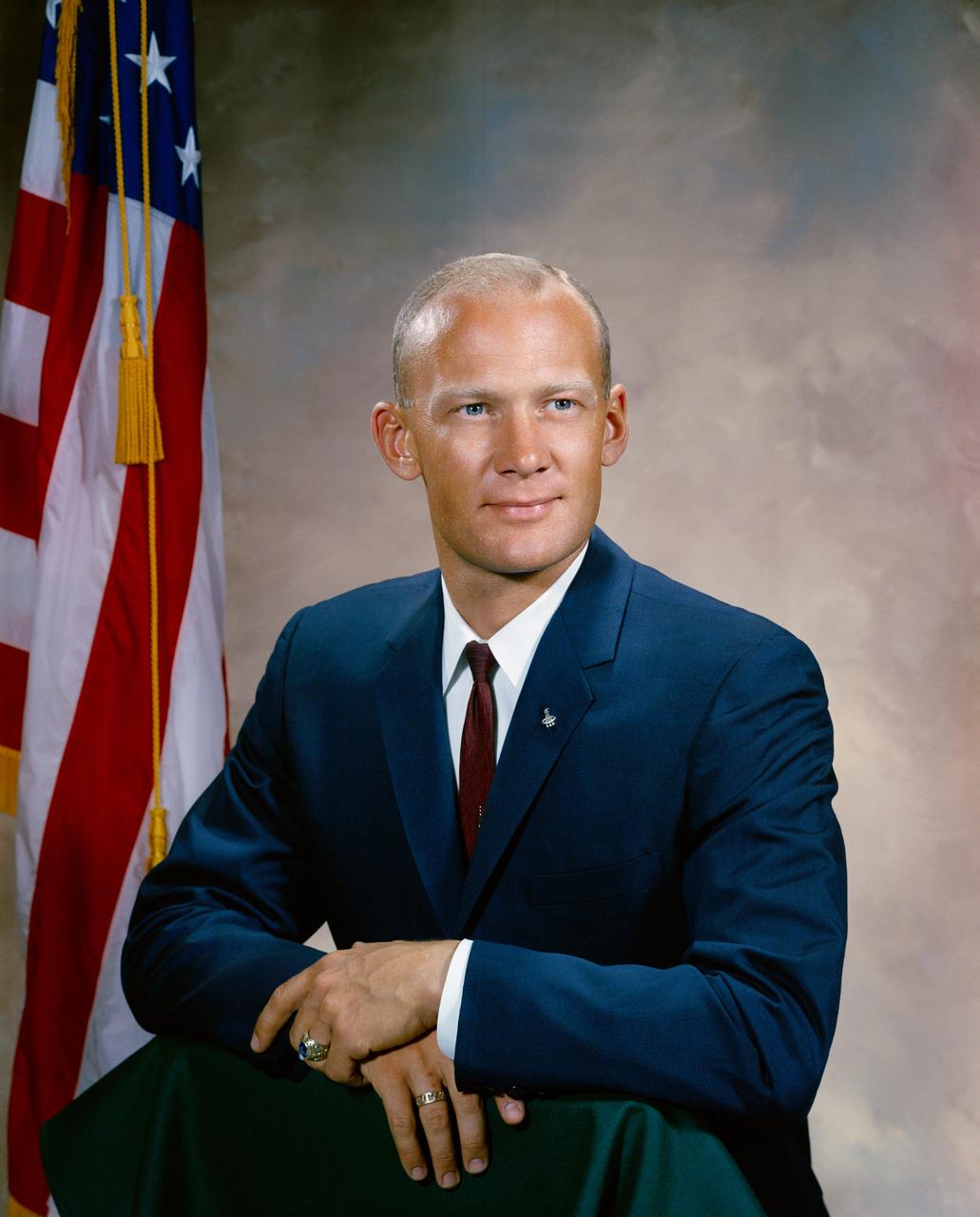
S64-31484 (1964) --- Astronaut Edwin E. "Buzz" Aldrin Jr. Photo credit: NASA
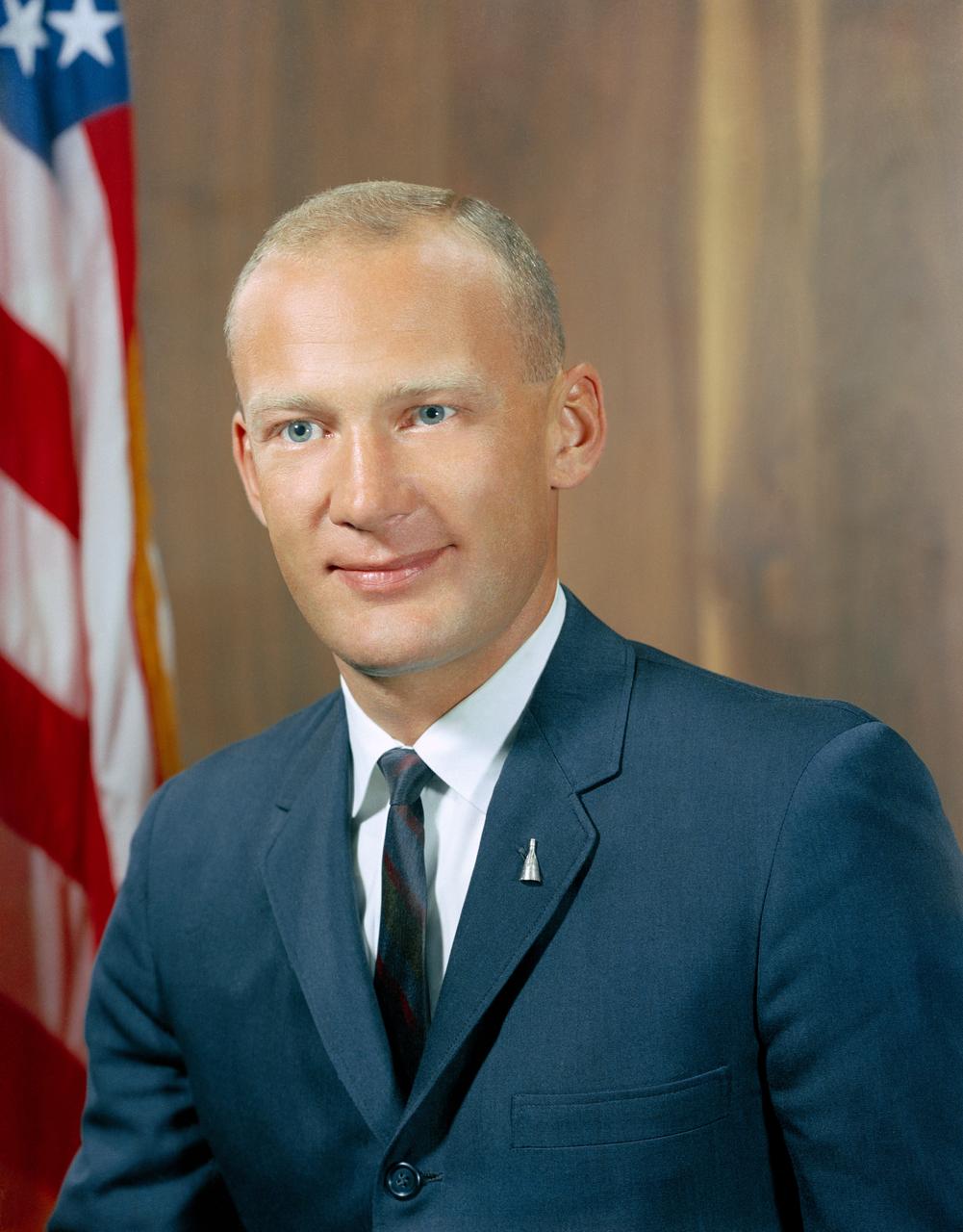
S63-20056 (1963) --- Astronaut Edwin E. "Buzz" Aldrin, Jr. in civilian clothes.
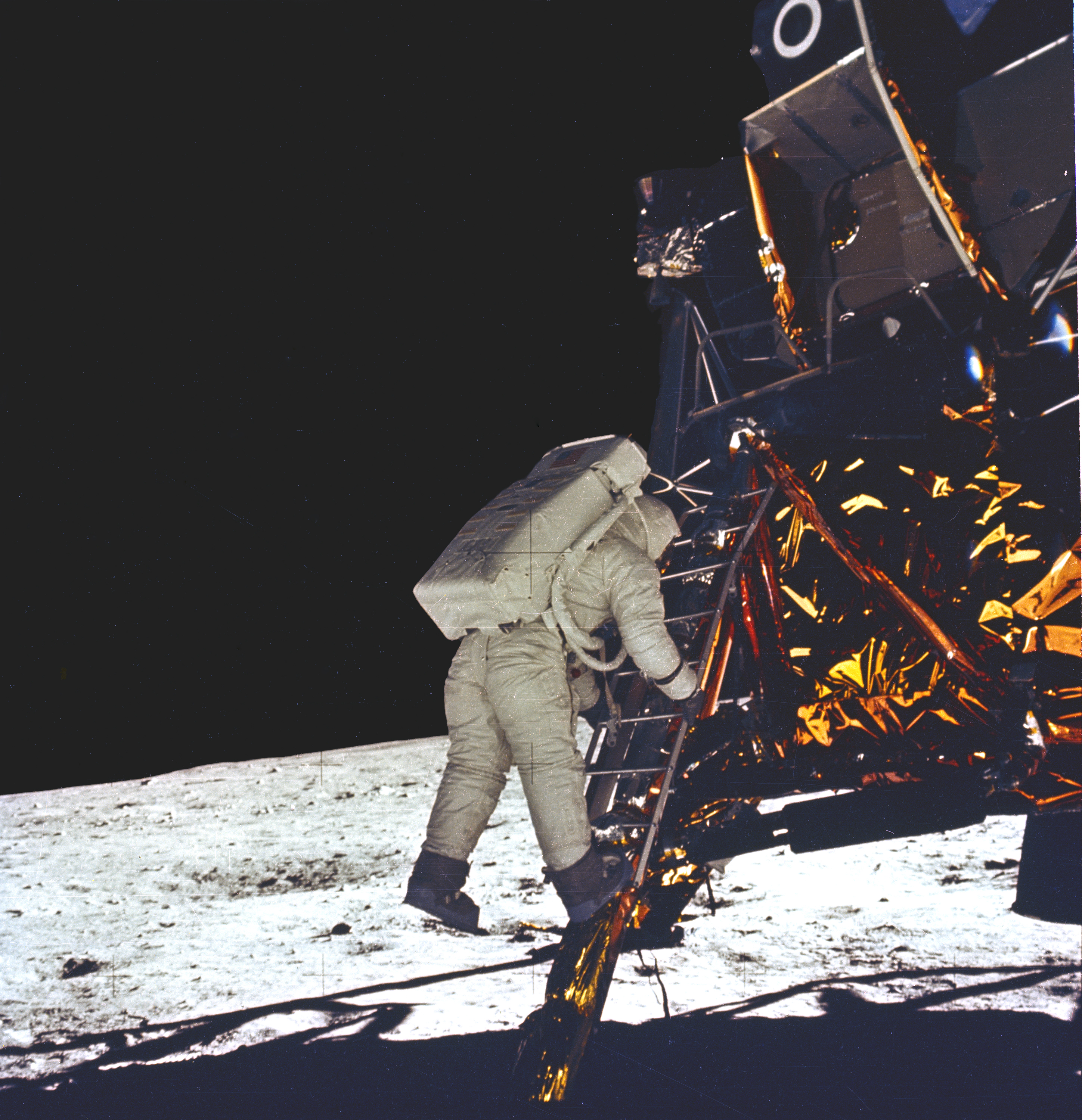
The crowning achievement for the Saturn V rocket came when it launched Apollo 11 astronauts, Neil Armstrong, Edwin (Buzz) Aldrin, and Michael Collins, to the Moon in July 1969. In this photograph, astronaut Aldrin takes his first step onto the surface of the Moon.
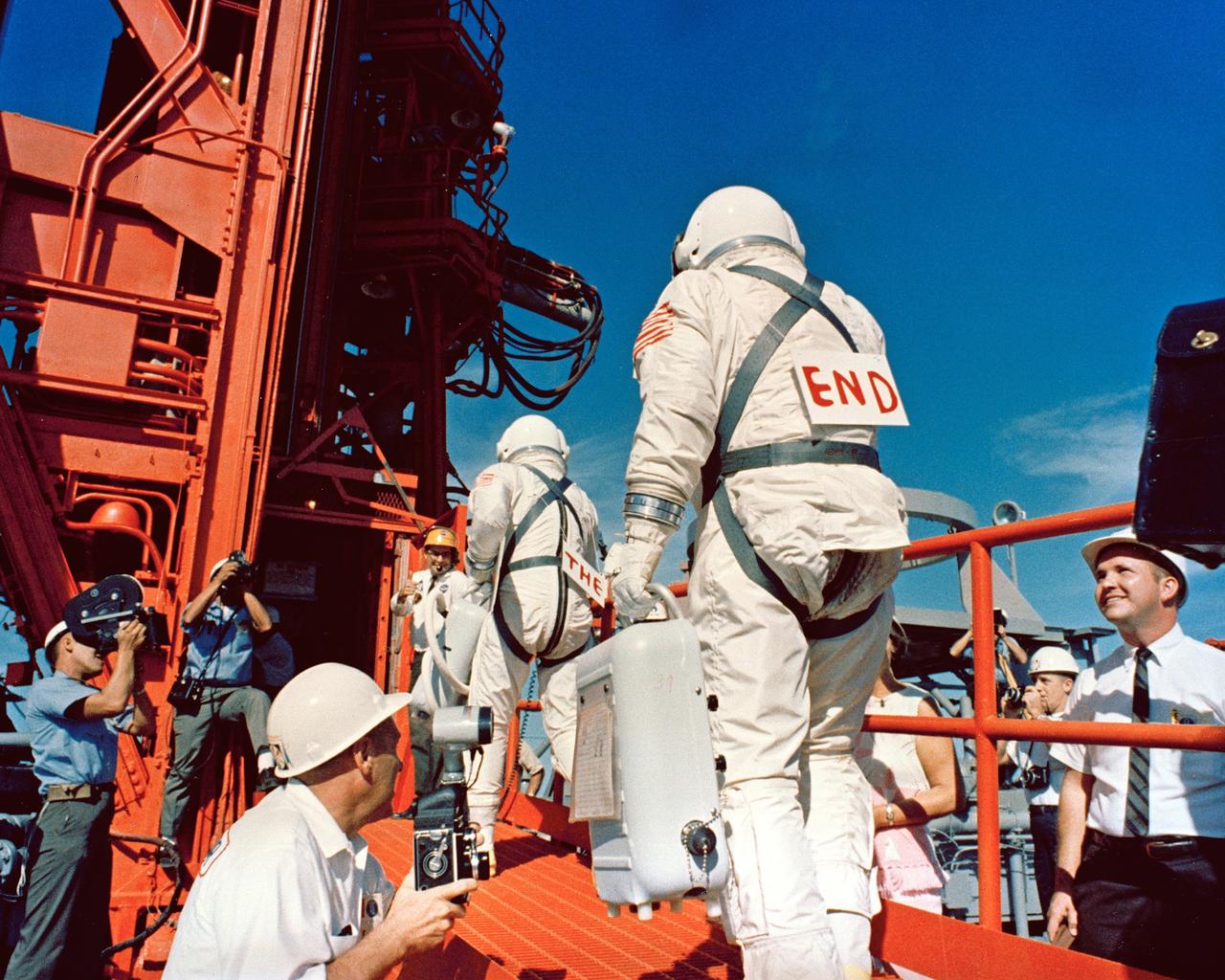
CAPE KENNEDY, Fla. -- At Cape Kennedy Air Force Station in Florida, the crew for Gemini 12 arrives at Launch Complex 19. Command pilot James A. Lovell is followed by pilot Edwin E. Buzz Aldrin Jr. The signs on their backs note that this mission is the final flight of the Gemini Program. Photo Credit: NASA
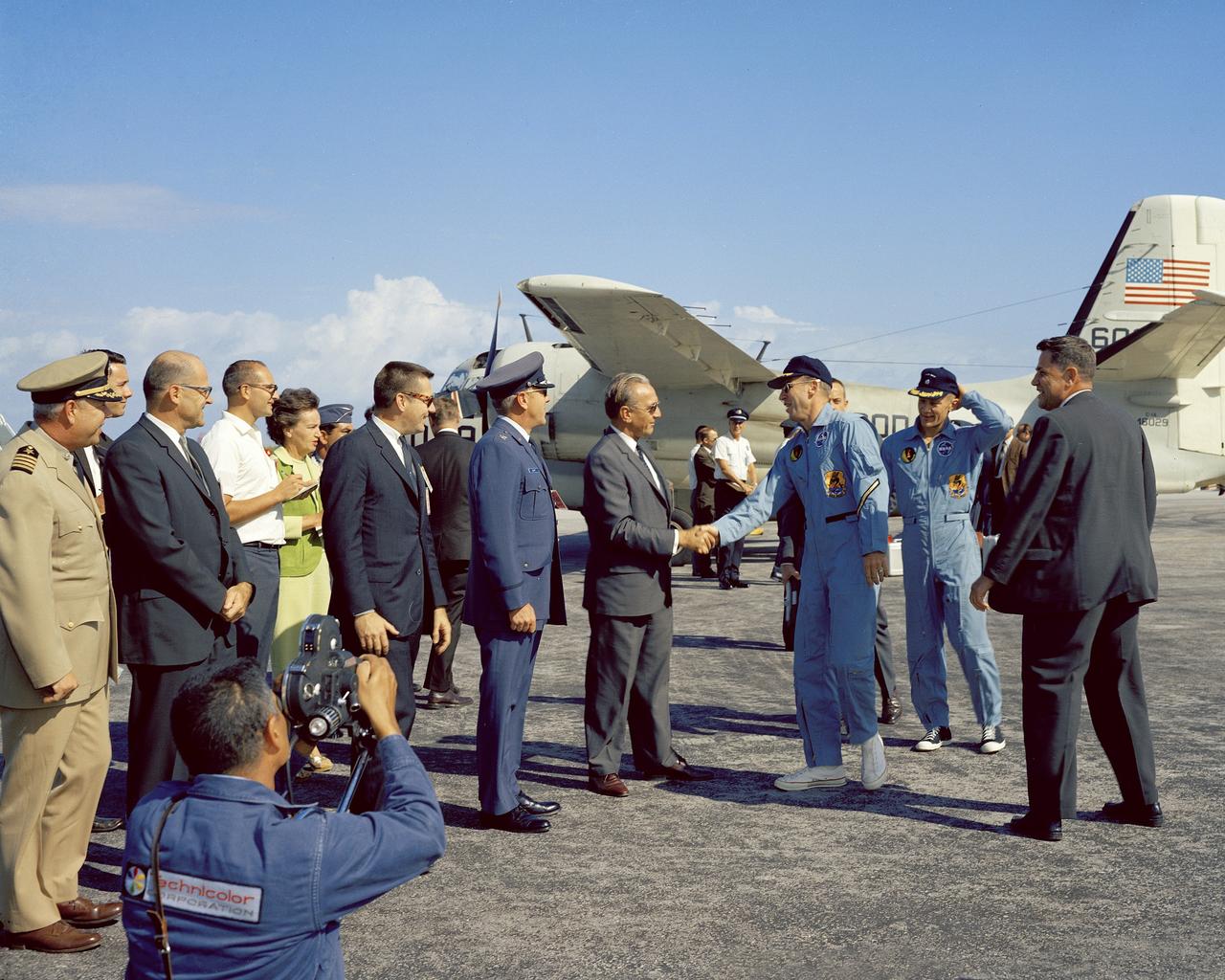
CAPE KENNEDY, Fla. -- At the Cape Kennedy Air Force Station skid strip, Dr. Kurt H. Debus, director of the Kennedy Space Center, greets returning Gemini 12 astronauts James A. Lovell and Edwin E. Buzz Aldrin Jr. following their four-day Earth orbital mission. Photo Credit: NASA
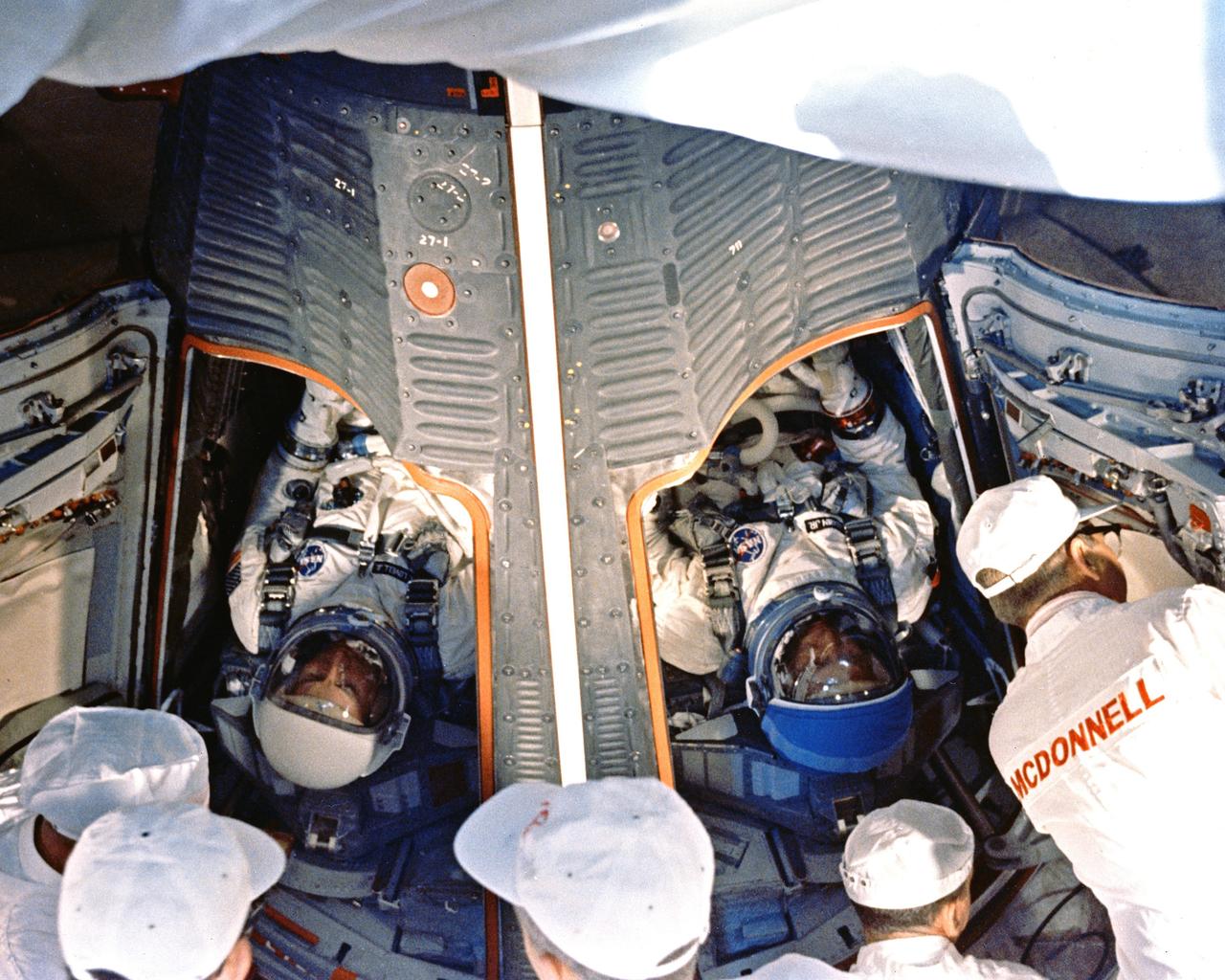
CAPE KENNEDY, Fla. -- At Cape Kennedy Air Force Station in Florida, Gemini 12 command pilot James A. Lovell, left, and Edwin E. Buzz Aldrin Jr. wait for launch as technicians complete preparations of the spacecraft. Photo Credit: NASA
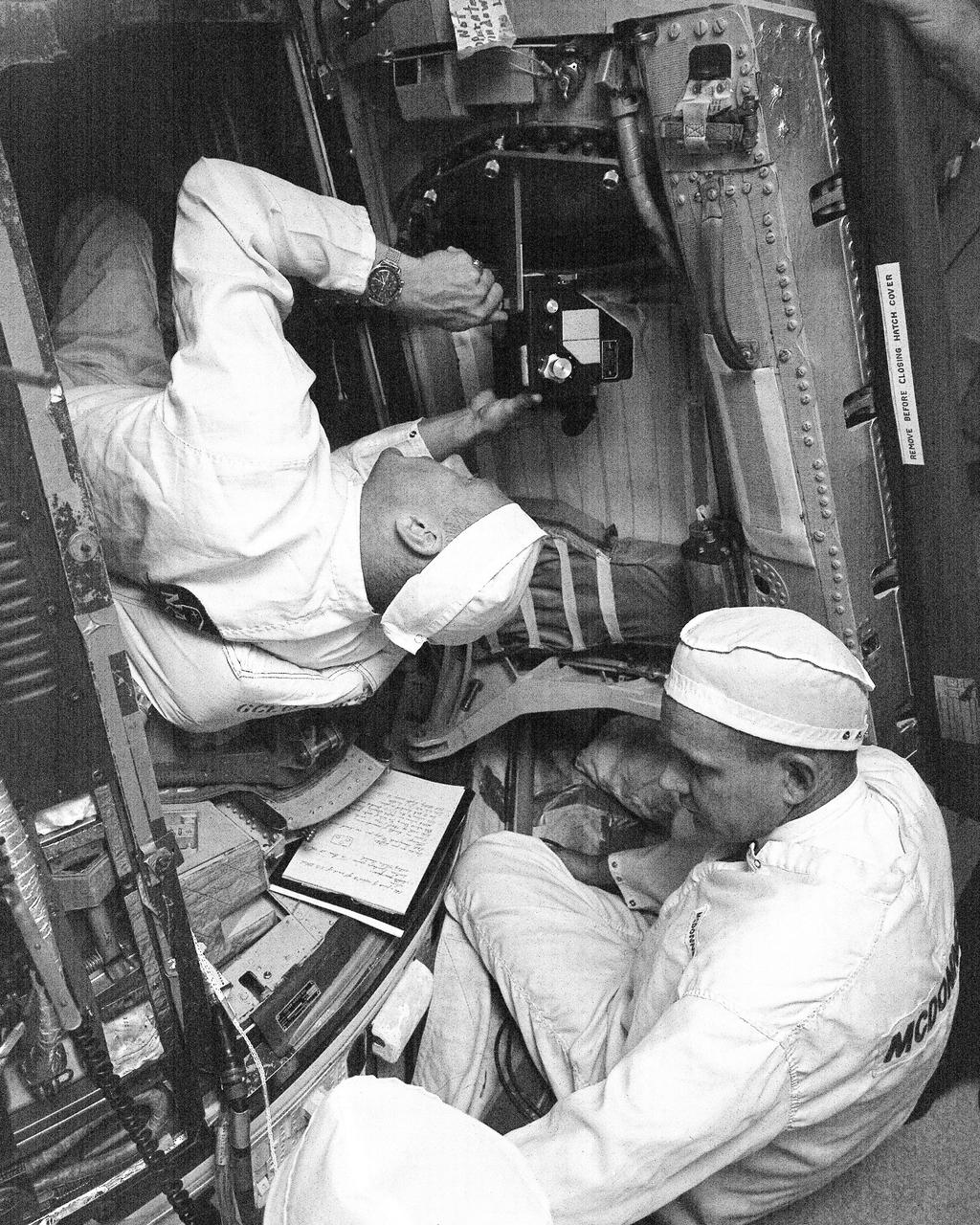
CAPE KENNEDY, Fla. -- At Cape Kennedy Air Force Station in Florida, Gemini 12 pilot Edwin E. Buzz Aldrin Jr., seated in the spacecraft, practice stowing cameras and other equipment he and command pilot James A. Lovell will take along on their upcoming four-day Earth orbital mission. Lovell and Aldrin examined the equipment in the "White Room" atop Launch Complex 19. During Gemini 12, Lovell and Aldrin plan to rendezvous and dock with an Agena target satellite and Aldrin will perform two spacewalks. Photo Credit: NASA
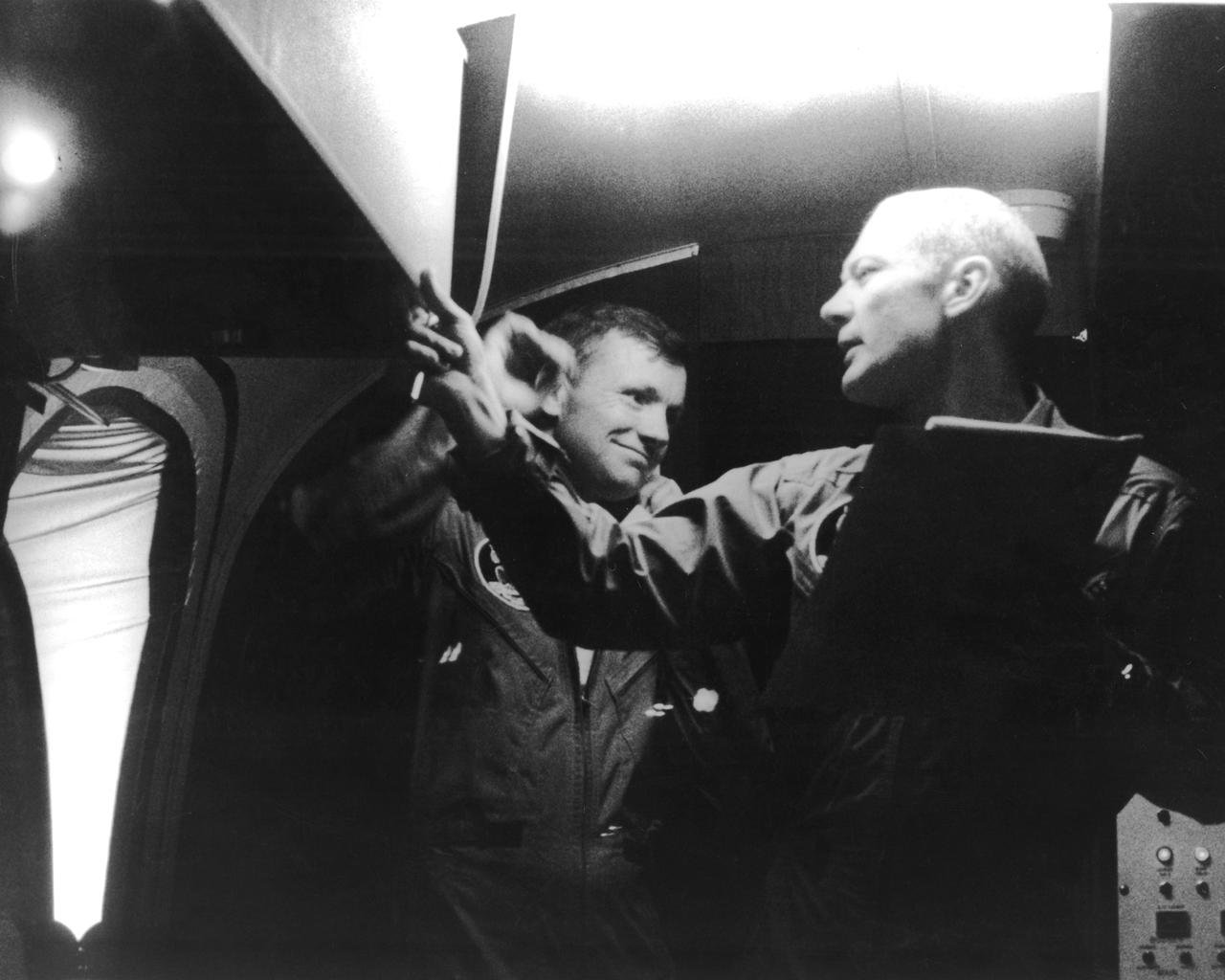
The Apollo 11 mission, the first manned lunar mission, launched aboard the Saturn V launch vehicle from the Kennedy Space Center, Florida on July 16, 1969 and safely returned to Earth on July 24, 1969. Aboard were astronauts Neil A. Armstrong, commander; Michael Collins, Command Module (CM) pilot; and Edwin E. Aldrin Jr., Lunar Module (LM) pilot. The CM, piloted by Michael Collins, remained in a parking orbit around the Moon while the LM, named “Eagle’’, carrying astronauts Neil Armstrong and Edwin Aldrin, landed on the Moon. Armstrong was the first human to ever stand on the lunar surface, followed by Edwin (Buzz) Aldrin. The surface exploration was concluded in 2½ hours. Once the crew collected 47 pounds of lunar surface material for analysis back on Earth, the LM redocked with the CM for the crew’s return to Earth. Following splash down in the Pacific Ocean, Navy para-rescue men recovered the capsule housing the 3-man crew. The crew was airlifted to safety aboard the U.S.S. Hornet, where they were quartered in a Mobile Quarantine Facility (MQF). Astronaut Collins took this snapshot of astronauts Armstrong (center) and Aldrin inside of the MQF.
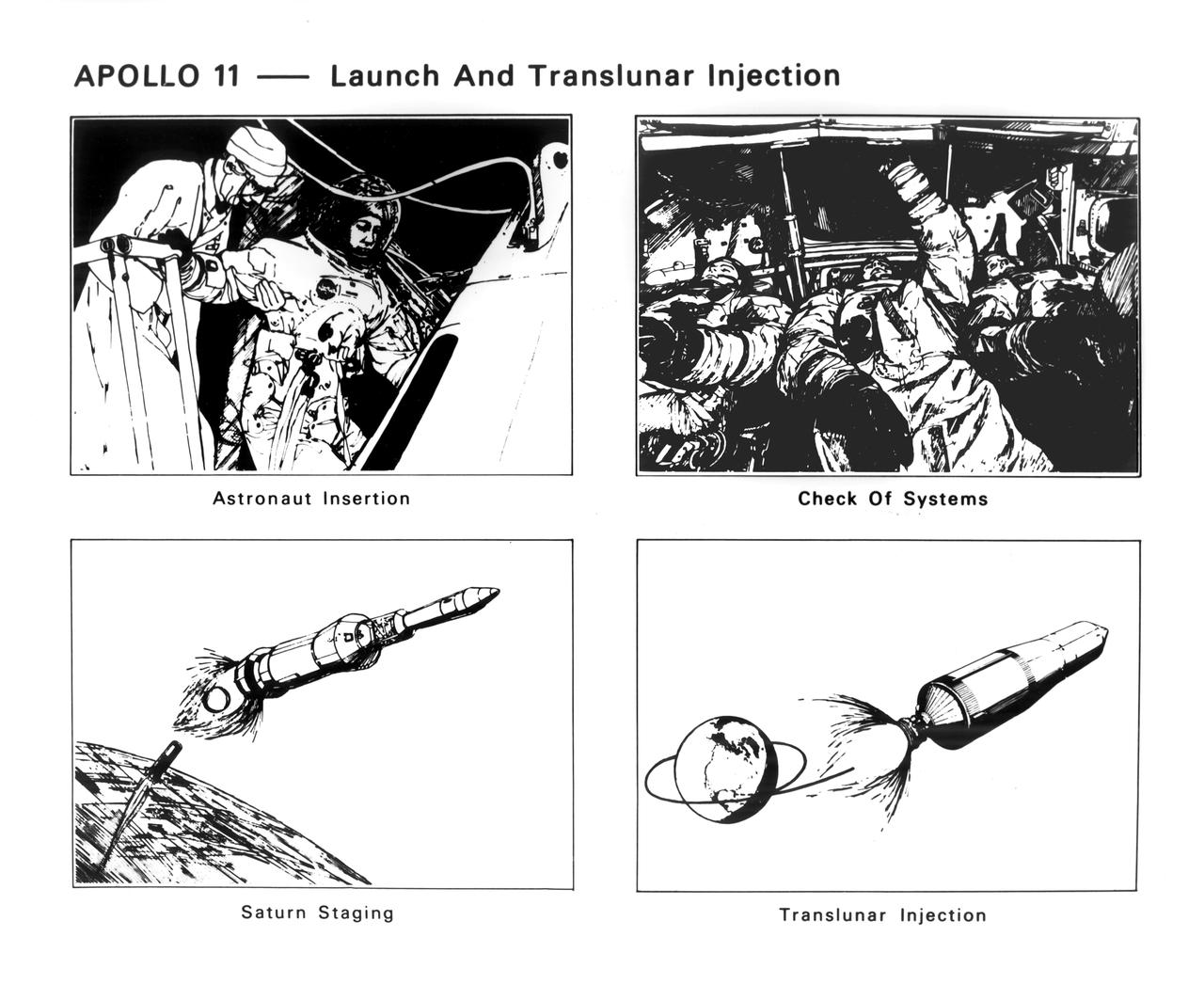
The Apollo 11 mission launched from the Kennedy Space Center (KSC) in Florida via the Marshall Space Flight Center (MSFC) developed Saturn V launch vehicle on July 16, 1969 and safely returned to Earth on July 24, 1969. Aboard the space craft were astronauts Neil A. Armstrong, commander; Michael Collins, Command Module (CM) pilot; and Edwin E. (Buzz) Aldrin Jr., Lunar Module (LM) pilot. With the success of Apollo 11, the national objective to land men on the Moon and return them safely to Earth had been accomplished. These sketches illustrate four of the early steps in the first manned lunar landing mission. The series begins with insertion of astronauts Neil Armstrong, Edwin Aldrin, and Michael Collins in the Apollo Command Module (CM). They checked out spacecraft systems and prepared for the launch. After two revolutions in Earth orbit, the Saturn V third stage reignited to place them into the translunar trajectory.
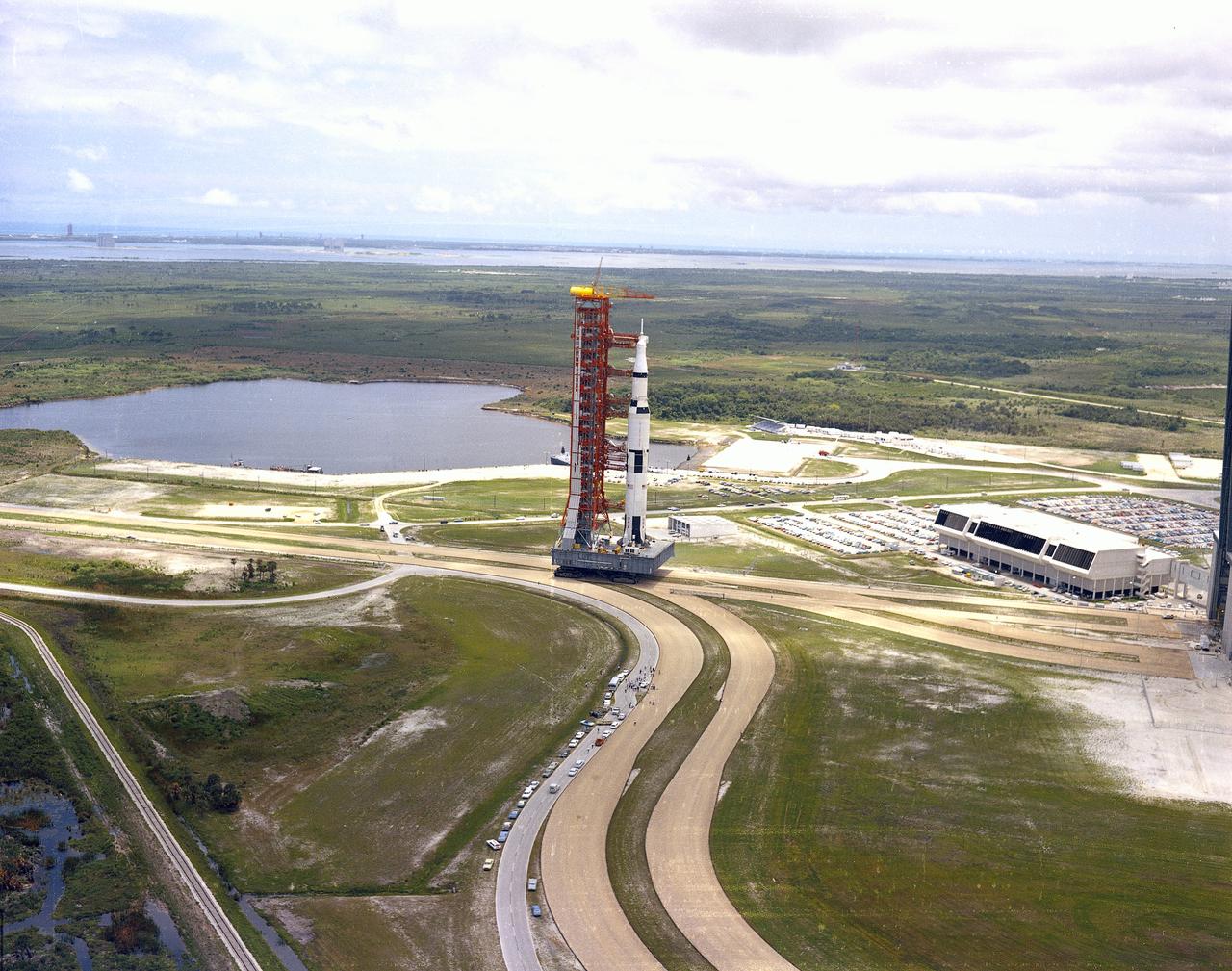
Aboard a Saturn V launch vehicle, the Apollo 11 mission launched from The Kennedy Space Center, Florida on July 16, 1969 and safely returned to Earth on July 24, 1969. The space vehicle is shown here during the rollout for launch preparation. The 3-man crew aboard the flight consisted of Neil A. Armstrong, commander; Michael Collins, Command Module pilot; and Edwin E. Aldrin Jr., Lunar Module pilot. Armstrong was the first human to ever stand on the lunar surface, followed by Edwin (Buzz) Aldrin. The crew collected 47 pounds of lunar surface material which was returned to Earth for analysis. The surface exploration was concluded in 2½ hours. With the success of Apollo 11, the national objective to land men on the Moon and return them safely to Earth had been accomplished. The Saturn V launch vehicle was developed by the Marshall Space Flight Center (MSFC) under the direction of Dr. Wernher von Braun.
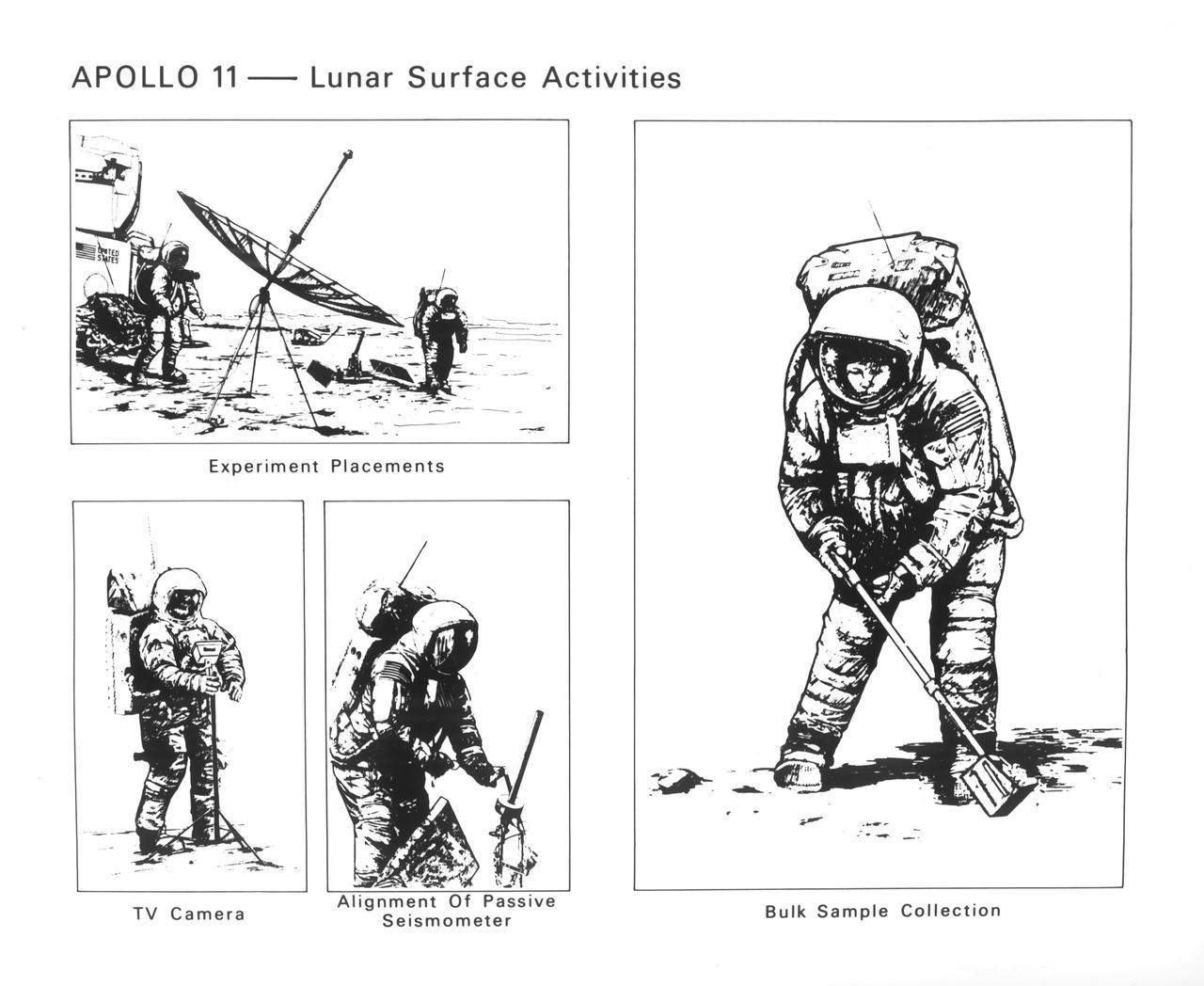
The Apollo 11 mission launched from the Kennedy Space Center (KSC) in Florida via the Marshall Space Flight Center (MSFC) developed Saturn V launch vehicle on July 16, 1969 and safely returned to Earth on July 24, 1969. Aboard the space craft were astronauts Neil A. Armstrong, commander; Michael Collins, Command Module (CM) pilot; and Edwin E. (Buzz) Aldrin Jr., Lunar Module (LM) pilot. With the success of Apollo 11, the national objective to land men on the Moon and return them safely to Earth had been accomplished. These sketches illustrate some of the activities of Neil Armstrong and Edwin Aldrin while on the Moon’s surface. Both men worked in setting up scientific equipment and collecting samples. Armstrong set up the television cameras early so their activities could be watched from Earth.
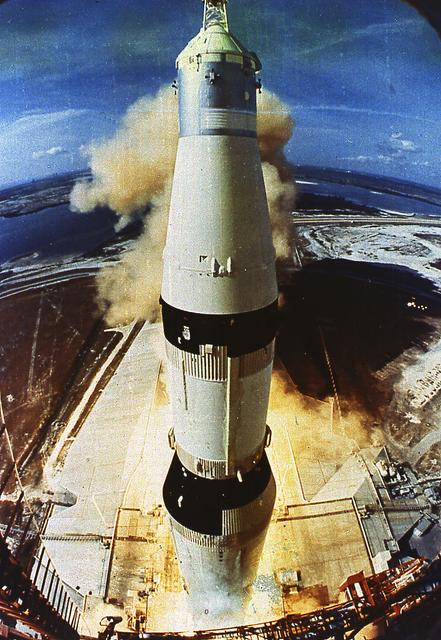
AS-506 lifts off from Launch Pad 39A at the Kennedy Space Center July 16, 1969. This sixth flight of the Saturn V launch vehicle, developed under the direction of the Marshall Space Flight Center, delivered astronauts Neil Armstrong, Edwin Buzz Aldrin, and Michael Collins to lunar orbit. Better known as Apollo 11, the mission marked the first manned lunar landing.
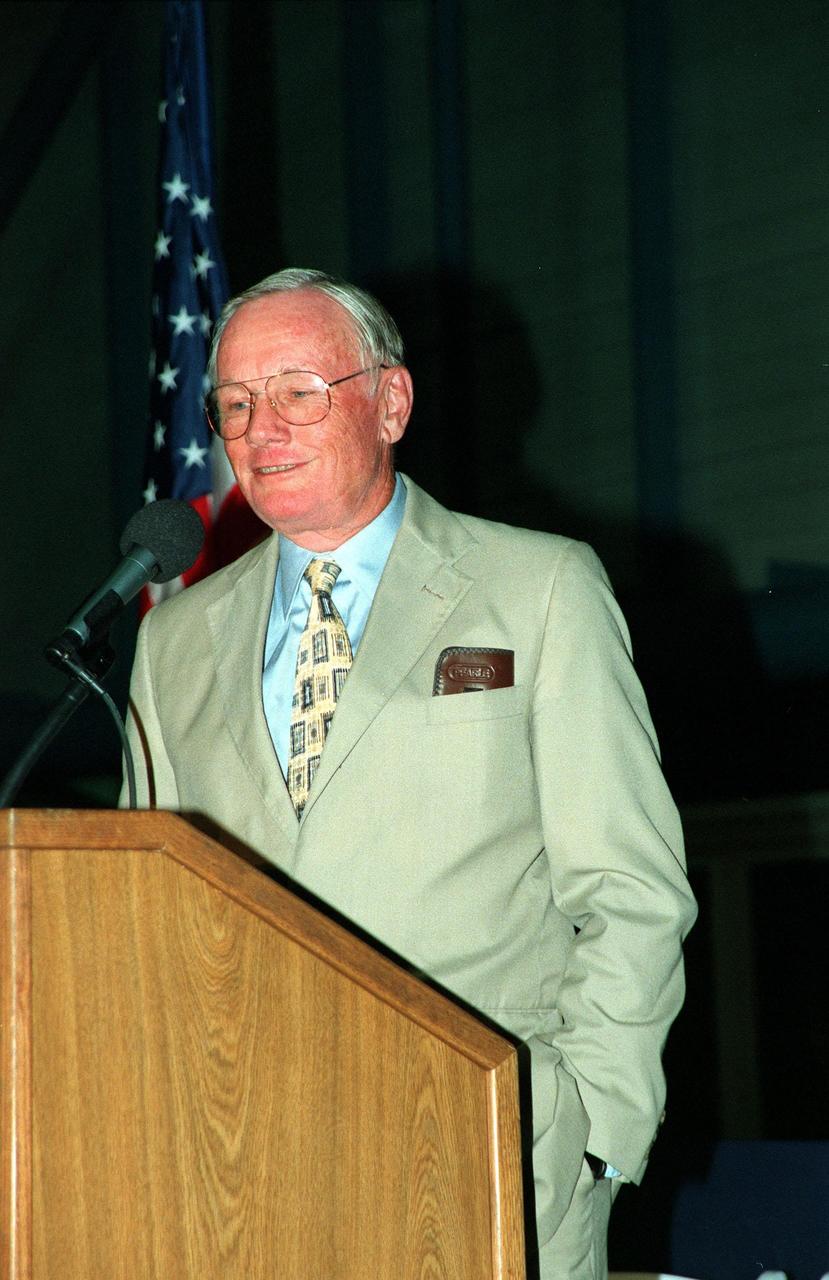
KENNEDY SPACE CENTER, FLA. -- Neil Armstrong, former Apollo 11 astronaut, and first man to walk on the moon, talks about his experiences for an enthusiastic audience at the Apollo/Saturn V Center, part of the KSC Visitor Complex. The occasion was a banquet celebrating the 30th anniversary of the Apollo 11 launch and moon landing, July 16 and July 20, 1969. Among other guests at the banquet were astronauts Wally Schirra, Edwin "Buzz" Aldrin and Walt Cunningham. Gene Cernan was the last man to walk on the moon
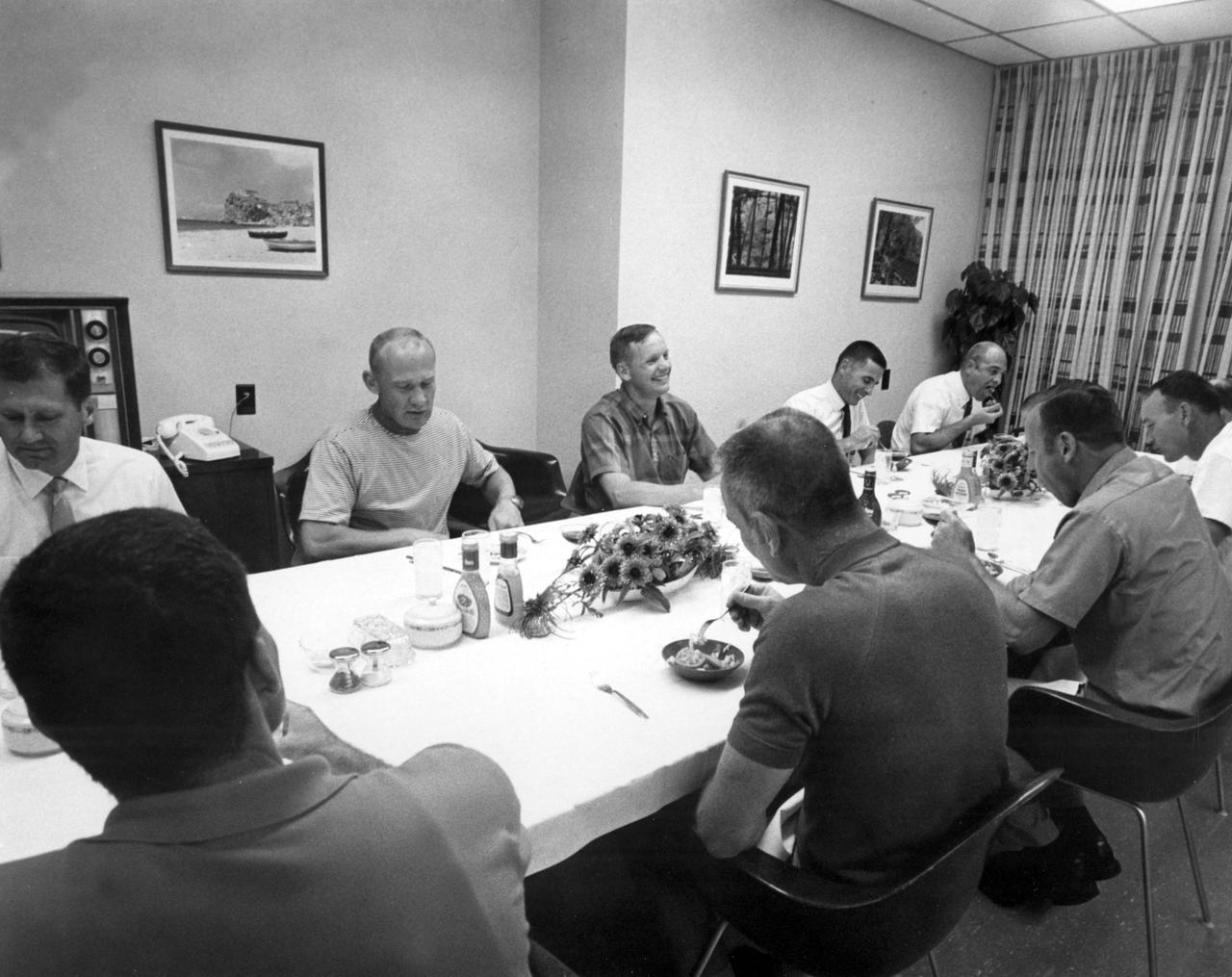
Apollo 11 astronauts Edwin E. Aldrin (striped shirt), Neil A. Armstrong, (left of Aldrin), and Michael Collins (extreme right on opposite side of table) had dinner with other astronauts the night before launching for the first lunar landing mission. The Apollo 11 mission launched from the NASA Kennedy Space Center (KSC) in Florida via the Marshall Space Flight Center (MSFC) developed Saturn V launch vehicle on July 16, 1969 and safely returned to Earth on July 24, 1969. Aboard the space craft were astronauts Neil A. Armstrong, commander; Michael Collins, Command Module (CM) pilot; and Edwin E. (Buzz) Aldrin Jr., Lunar Module (LM) pilot. The CM, “Columbia”, piloted by Collins, remained in a parking orbit around the Moon while the LM, “Eagle’’, carrying astronauts Armstrong and Aldrin, landed on the Moon. On July 20, 1969, Armstrong was the first human to ever stand on the lunar surface, followed by Aldrin. During 2½ hours of surface exploration, the crew collected 47 pounds of lunar surface material for analysis back on Earth. With the success of Apollo 11, the national objective to land men on the Moon and return them safely to Earth had been accomplished.
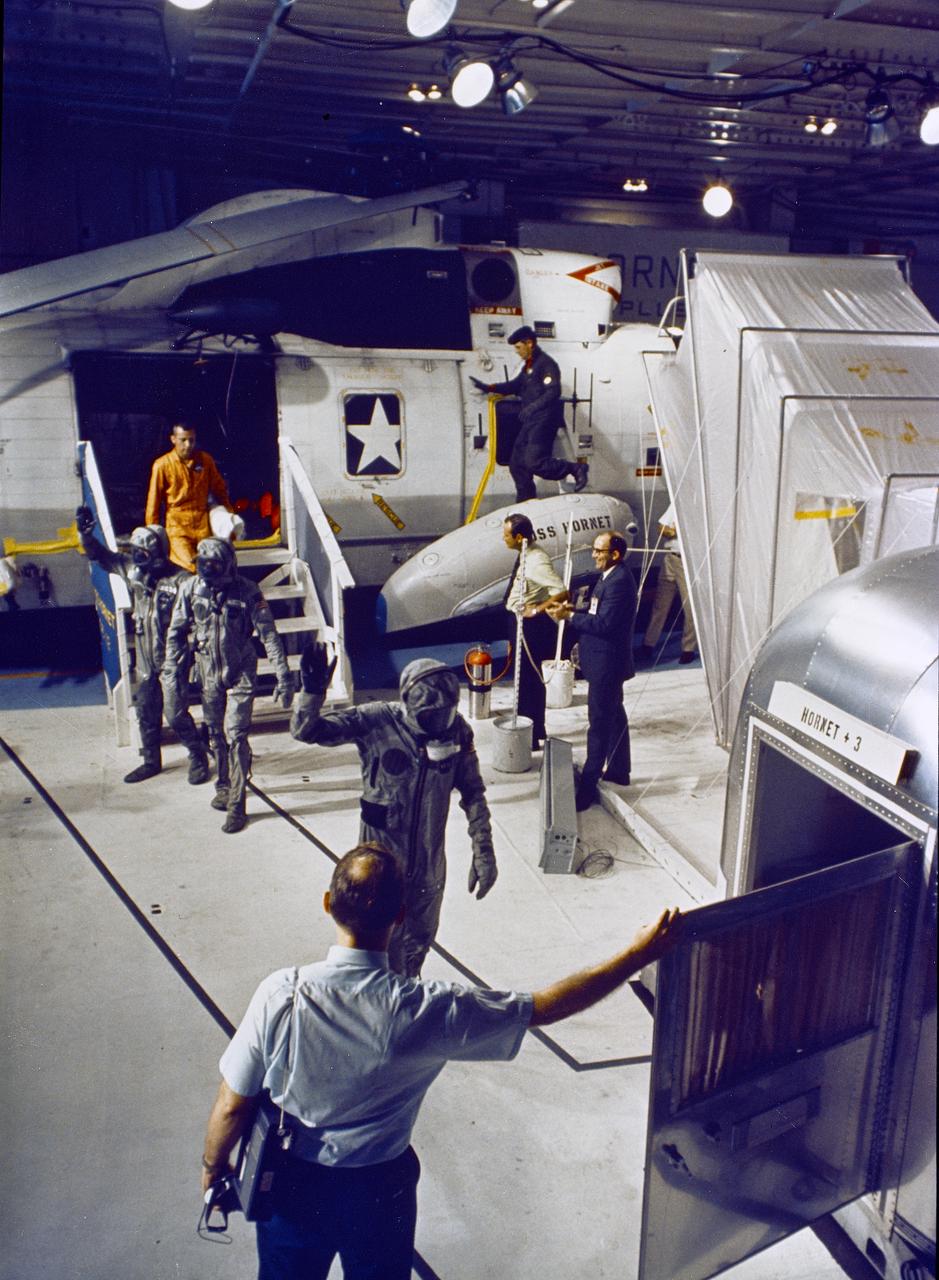
The Apollo 11 mission, the first manned lunar mission, launched from the Kennedy Space Center, Florida via a Saturn V launch vehicle on July 16, 1969 and safely returned to Earth on July 24, 1969. The Saturn V vehicle was developed by the Marshall Space Flight Center (MSFC) under the direction of Dr. Wernher von Braun. Aboard were Neil A. Armstrong, commander; Michael Collins, Command Module (CM) pilot; and Edwin E. Aldrin Jr., Lunar Module (LM) pilot. The CM, piloted by Michael Collins remained in a parking orbit around the Moon while the LM, named “Eagle’’, carrying astronauts Neil Armstrong and Edwin Aldrin, landed on the Moon. Armstrong was the first human to ever stand on the lunar surface, followed by Edwin (Buzz) Aldrin. During 2½ hours of surface exploration, the crew collected 47 pounds of lunar surface material for analysis back on Earth. The recovery operation took place after splash down in the Pacific Ocean. Navy para-rescue men recovered the capsule housing the 3-man Apollo 11 crew. The crew was taken to safety aboard the USS Hornet, where they were quartered in a mobile quarantine facility. Here the astronauts are shown waving as they enter the quarantine facility. With the success of Apollo 11, the national objective to land men on the Moon and return them safely to Earth had been accomplished.
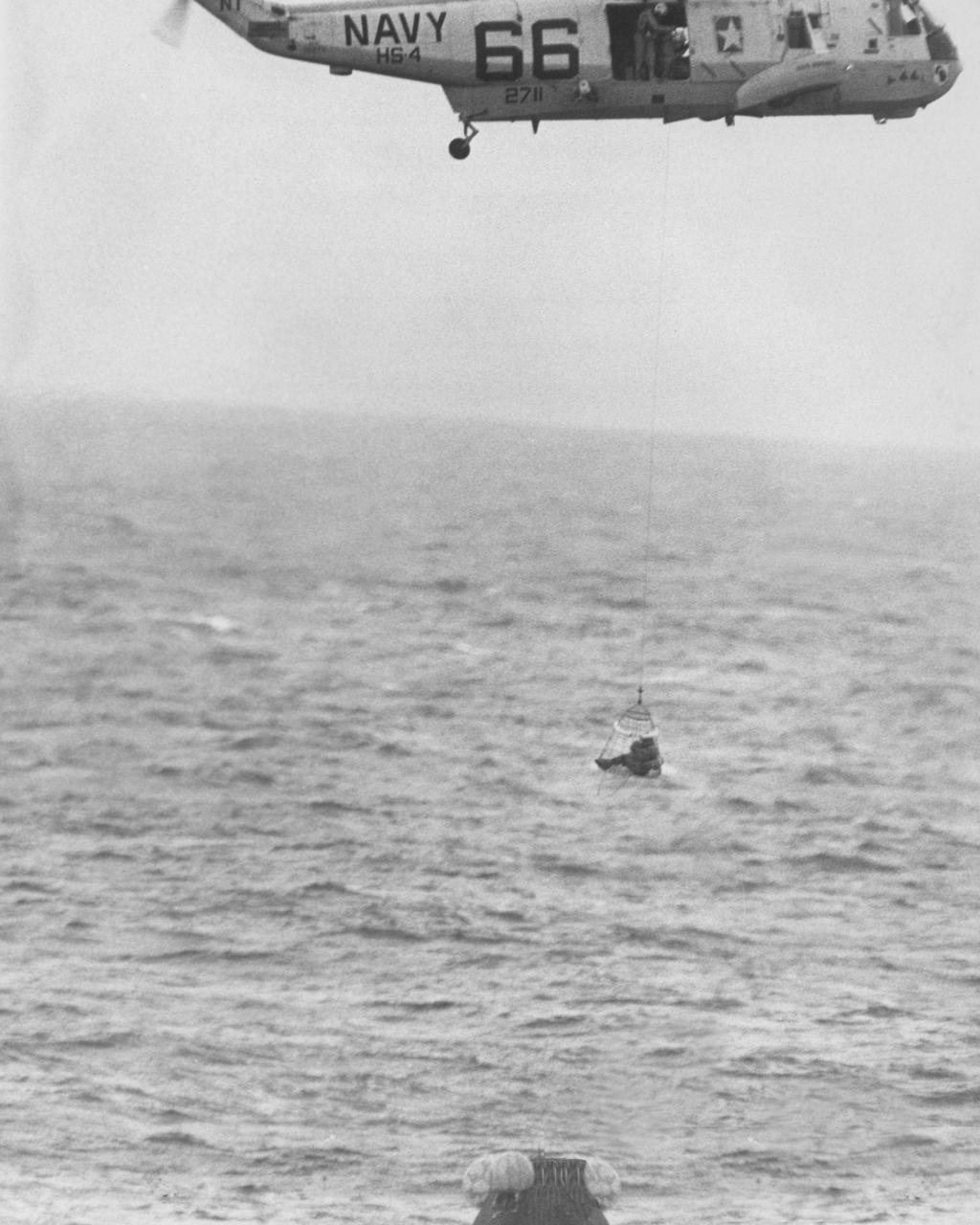
The Apollo 11 mission, the first manned lunar mission, launched from the Kennedy Space Center, Florida via the Saturn V launch vehicle on July 16, 1969 and safely returned to Earth on July 24, 1969. The Saturn V vehicle was developed by the Marshall Space Flight Center (MSFC) under the direction of Dr. Wernher von Braun. Aboard were Neil A. Armstrong, commander; Michael Collins, Command Module (CM) pilot; and Edwin E. Aldrin Jr., Lunar Module (LM) pilot. The CM, piloted by Michael Collins remained in a parking orbit around the Moon while the LM, named “Eagle’’, carrying astronauts Neil Armstrong and Edwin Aldrin, landed on the Moon. Armstrong was the first human to ever stand on the lunar surface, followed by Edwin (Buzz) Aldrin. During 2½ hours of surface exploration, the crew collected 47 pounds of lunar surface material for analysis back on Earth. Shown here is the recovery operation of the capsule in the Pacific Ocean after splashdown. One of the three astronauts is airlifted from the life raft into a helicopter. The helicopter airlifted the crew to safety aboard the prime recovery ship, the U.S.S. Hornet, where they were quartered in a Mobile Quarantine Facility (MQF). With the success of Apollo 11, the national objective to land men on the Moon and return them safely to Earth had been accomplished.
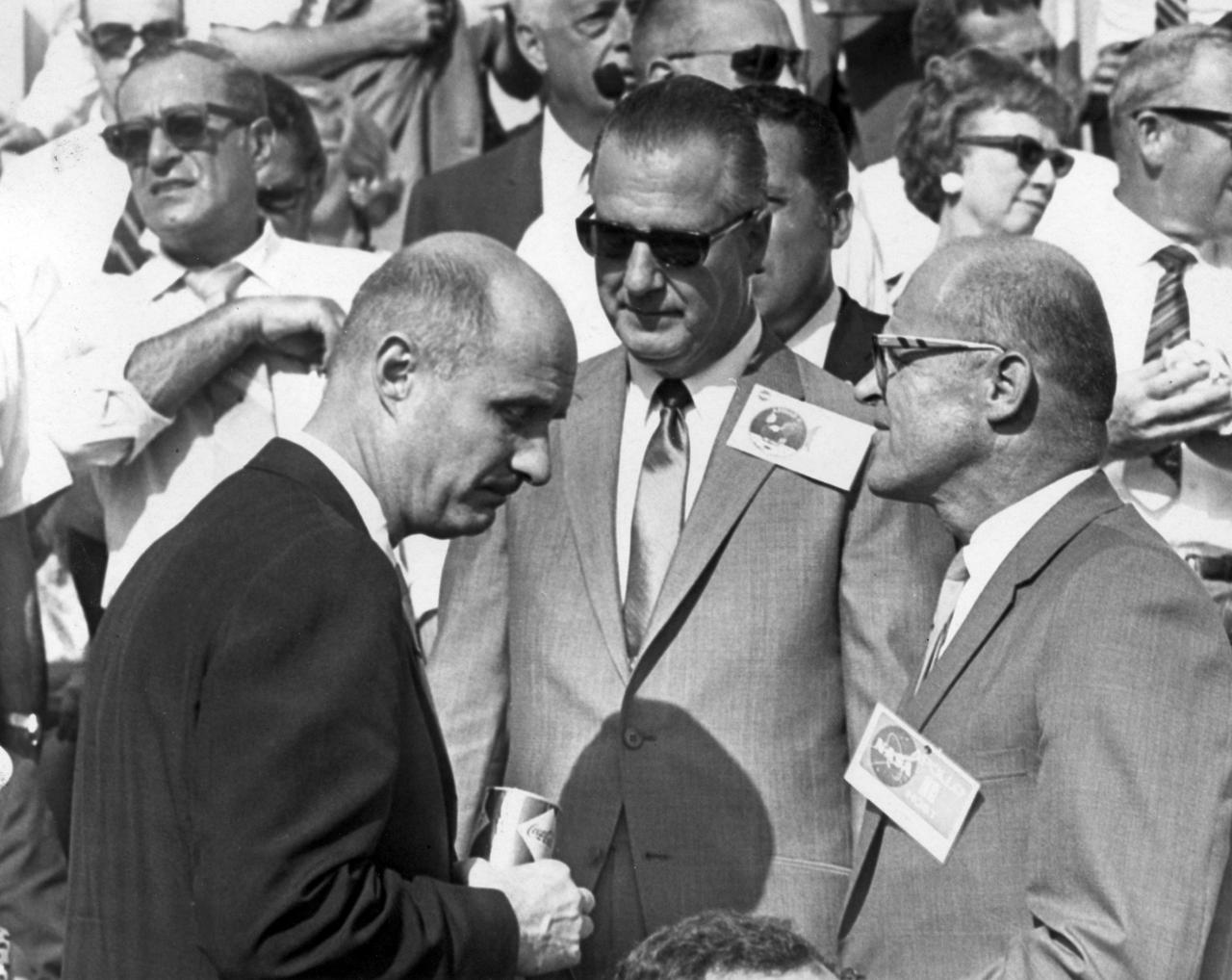
Apollo 10 commander, Thomas P. Stafford (left) and Kennedy Space Center (KSC) Deputy Director Albert Siepert (right) talk with U.S. Vice President Spiro T. Agnew a few minutes before the launch of Apollo 11. The Apollo 11 mission, the first manned lunar mission, launched from KSC, Florida via the Saturn V launch vehicle on July 16, 1969 and safely returned to Earth on July 24, 1969. The Saturn V vehicle was developed by the Marshall Space Flight Center (MSFC) under the direction of Dr. Wernher von Braun. Aboard the space craft were astronauts Neil A. Armstrong, commander; Michael Collins, Command Module (CM) pilot; and Edwin E. Aldrin Jr., Lunar Module (LM) pilot. The CM, piloted by Michael Collins remained in a parking orbit around the Moon while the LM, named “Eagle’’, carrying astronauts Neil Armstrong and Edwin Aldrin, landed on the Moon. Armstrong was the first human to ever stand on the lunar surface, followed by Edwin (Buzz) Aldrin. During 2½ hours of surface exploration, the crew collected 47 pounds of lunar surface material for analysis back on Earth. With the success of Apollo 11, the national objective to land men on the Moon and return them safely to Earth had been accomplished.
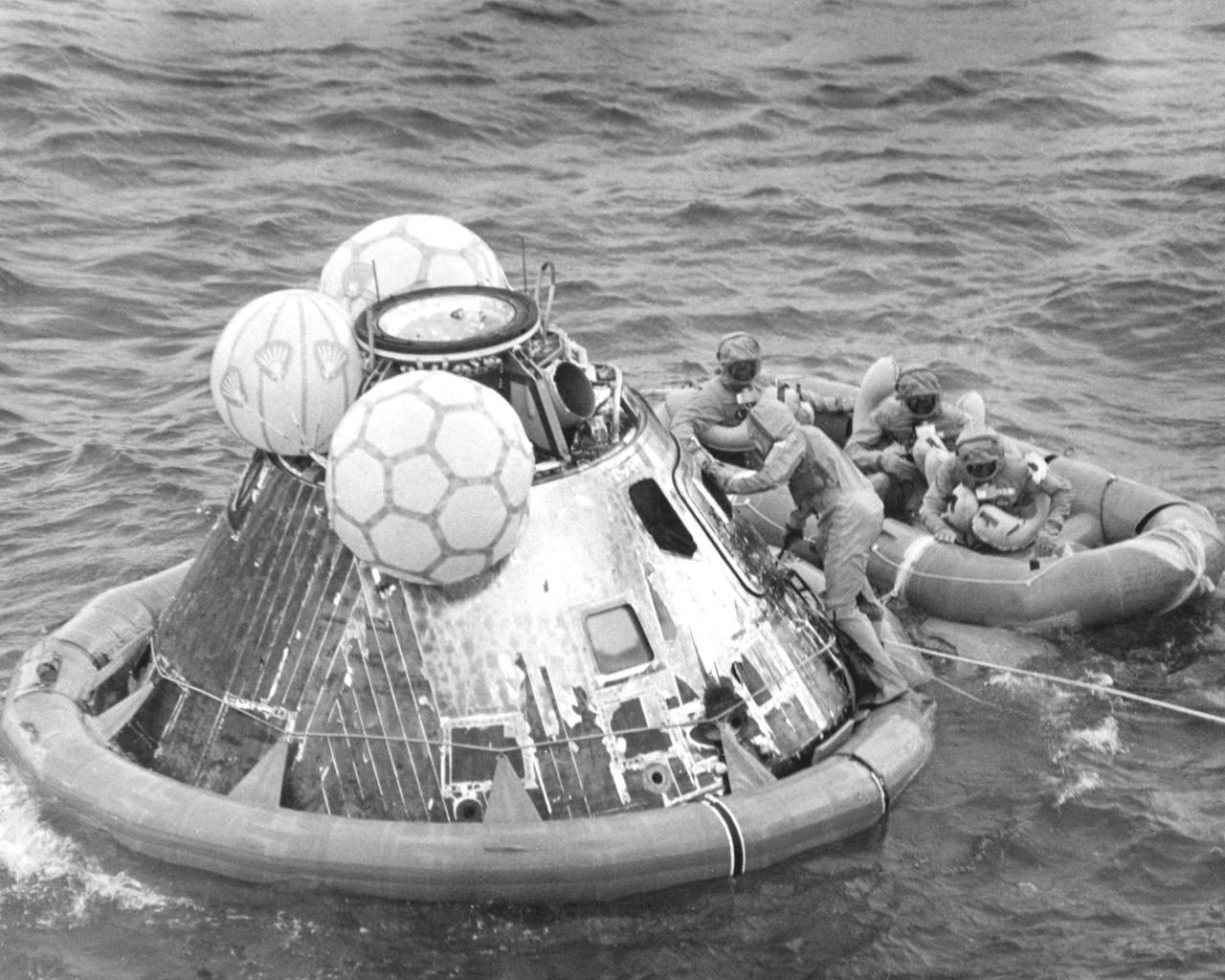
The Apollo 11 mission, the first manned lunar mission, launched from the Kennedy Space Center, Florida via the Saturn V launch vehicle on July 16, 1969 and safely returned to Earth on July 24, 1969. The Saturn V vehicle was developed by the Marshall Space Flight Center (MSFC) under the direction of Dr. Wernher von Braun. Aboard were astronauts Neil A. Armstrong, commander; Michael Collins, Command Module (CM) pilot; and Edwin E. Aldrin Jr., Lunar Module (LM) pilot. The CM, piloted by Michael Collins remained in a parking orbit around the Moon while the LM, named “Eagle’’, carrying astronauts Neil Armstrong and Edwin Aldrin, landed on the Moon. Armstrong was the first human to ever stand on the lunar surface, followed by Edwin (Buzz) Aldrin. During 2½ hours of surface exploration, the crew collected 47 pounds of lunar surface material for analysis back on Earth. Shown here is the recovery operation of the capsule in the Pacific Ocean after splashdown. The three astronauts wait in the life raft as a pararescue man closes and secures the capsule hatch. The crew was then air lifted to the prime recovery ship, the U.S.S. Hornet, where they were housed in a Mobile Quarantine Facility (MQF).
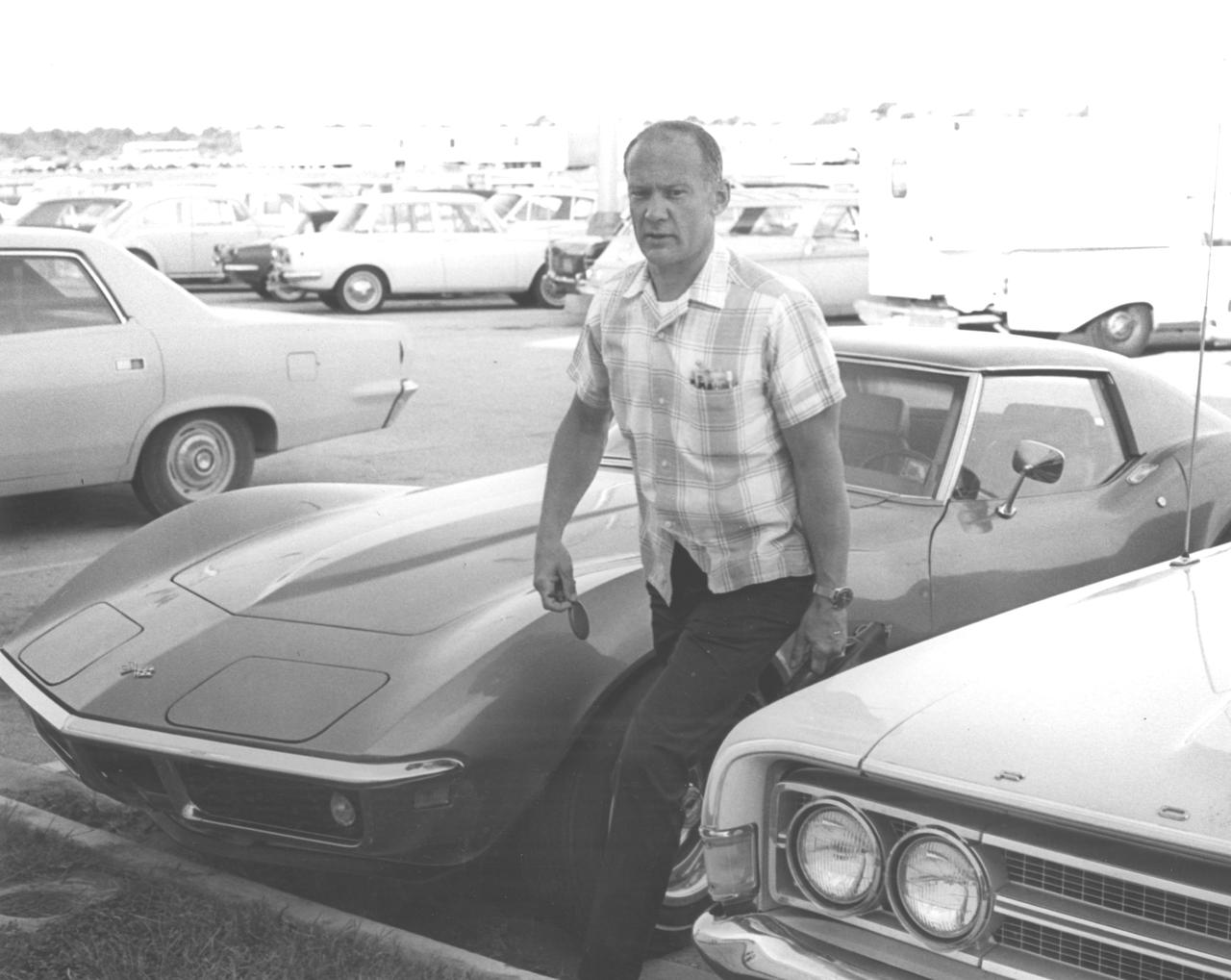
The Apollo 11 mission, the first manned lunar mission, launched from the Kennedy Space Center, Florida via the Marshall Space Flight Center (MSFC) developed Saturn V launch vehicle on July 16, 1969 and safely returned to Earth on July 24, 1969. Aboard the space craft were astronauts Neil A. Armstrong, commander; Michael Collins, Command Module (CM) pilot; and Edwin E. Aldrin Jr., Lunar Module (LM) pilot. The CM, piloted by Michael Collins remained in a parking orbit around the Moon while the LM, named “Eagle’’, carrying astronauts Neil Armstrong and Edwin Aldrin, landed on the Moon. During 2½ hours of surface exploration, the crew collected 47 pounds of lunar surface material for analysis back on Earth. With the success of Apollo 11, the national objective to land men on the Moon and return them safely to Earth had been accomplished. This photograph of Edwin (Buzz) Aldrin was taken upon his arrival at the Flight Crew Training building at the NASA Kennedy Space Center (KSC) a few days prior to launch.
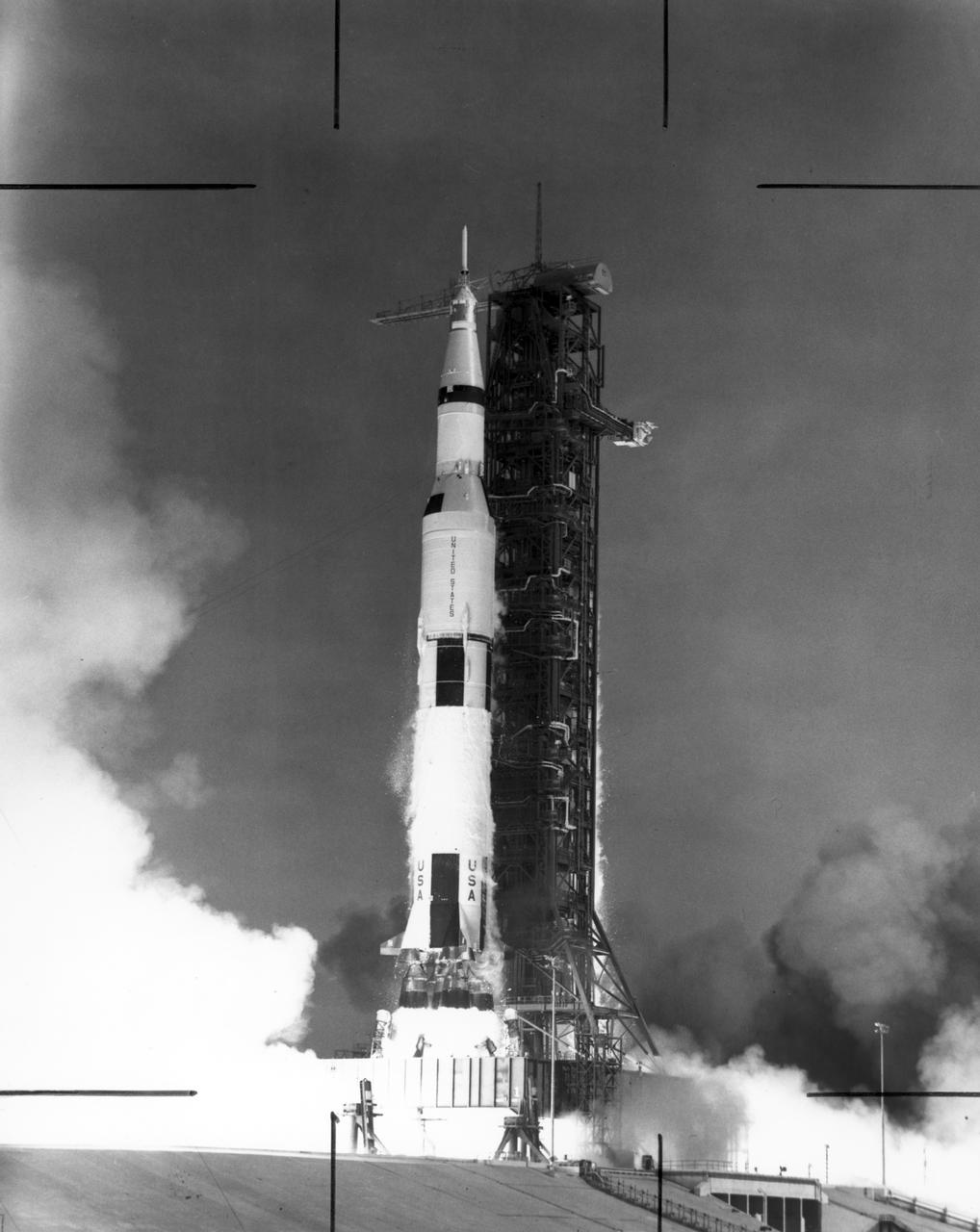
The Saturn V launch vehicle, developed by the Marshall Space Flight Center (MSFC) under the direction of Dr. Wernher von Braun, lifts off from the Kennedy Space Center (KSC), Florida carrying the Apollo 11 spacecraft and crew. The massive rocket hurled the spacecraft into Earth orbit and then onto the trajectory to the Moon. Apollo 11, the first manned lunar mission, launched from KSC on July 16, 1969 and safely returned to Earth on July 24, 1969. Aboard were astronauts Neil A. Armstrong, commander; Michael Collins, Command Module (CM) pilot; and Edwin E. Aldrin Jr., Lunar Module (LM) pilot. The CM, piloted by Michael Collins remained in a parking orbit around the Moon while the LM, named “Eagle’’, carrying astronauts Neil Armstrong and Edwin Aldrin, landed on the Moon. Armstrong was the first human to ever stand on the lunar surface, followed by Edwin (Buzz) Aldrin. During 2½ hours of surface exploration, the crew collected 47 pounds of lunar surface material for analysis back on Earth. With the success of Apollo 11, the national objective to land men on the Moon and return them safely to Earth had been accomplished.
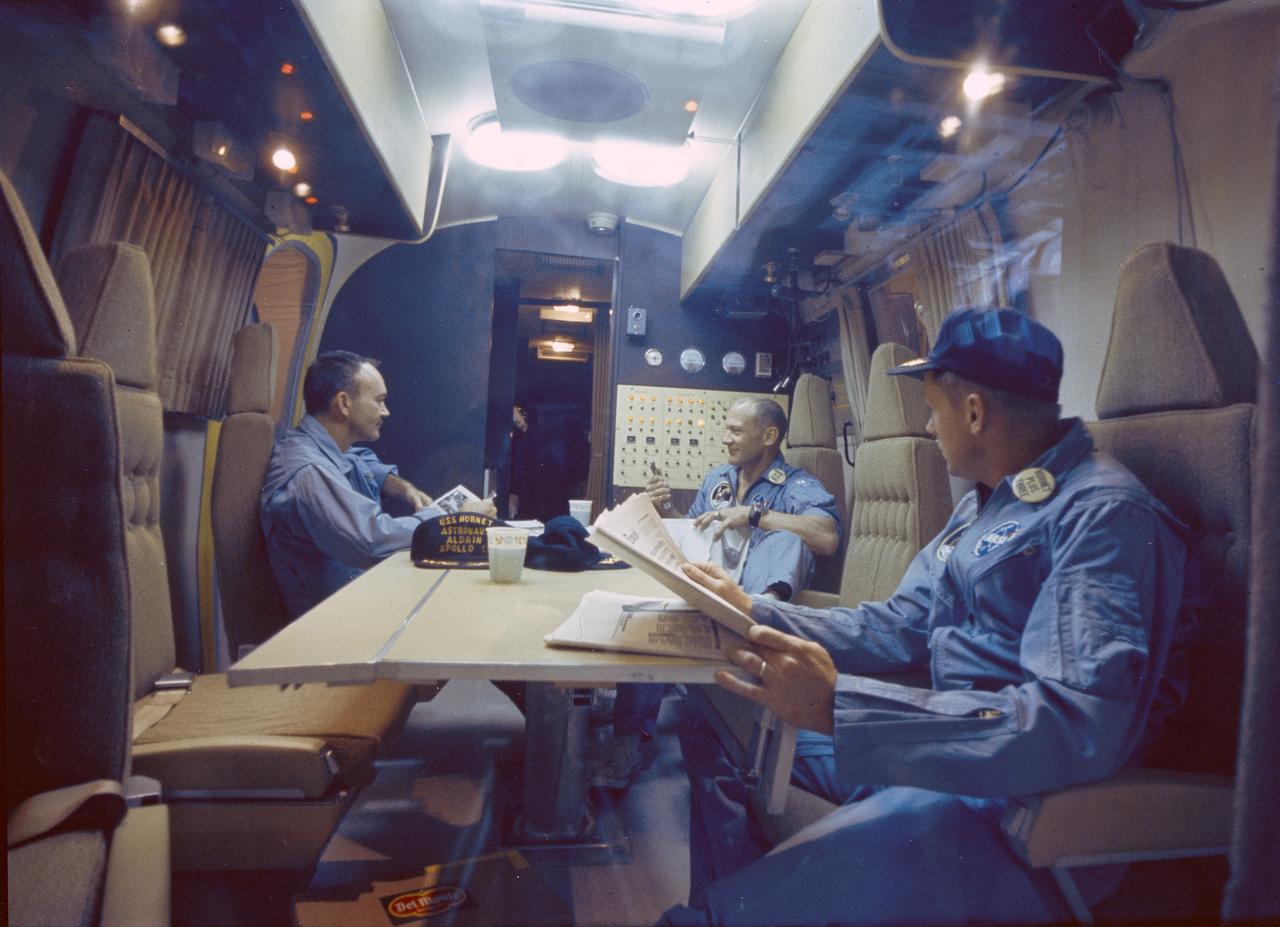
The Apollo 11 mission, the first manned lunar mission, launched from the Kennedy Space Center, Florida via a Saturn V launch vehicle on July 16, 1969 and safely returned to Earth on July 24, 1969. The Saturn V vehicle was developed by the Marshall Space Flight Center (MSFC) under the direction of Dr. Wernher von Braun. Aboard were Neil A. Armstrong, commander; Michael Collins, Command Module pilot; and Edwin E. Aldrin Jr., Lunar Module pilot. The Command Module (CM), piloted by Michael Collins remained in a parking orbit around the Moon while the Lunar Module (LM), named “Eagle’’, carrying astronauts Neil Armstrong and Edwin Aldrin, landed on the Moon. Armstrong was the first human to ever stand on the lunar surface, followed by Edwin (Buzz) Aldrin. The surface exploration was concluded in 2½ hours, in which the crew collected 47 pounds of lunar surface material for analysis back on Earth. Upon splash down in the Pacific Ocean, Navy para-rescue men recovered the capsule housing the 3-man Apollo 11 crew. The crew was taken to safety aboard the USS Hornet, where they were quartered in a mobile quarantine facility. Shown here is the Apollo 11 crew inside the quarantine facility. With the success of Apollo 11, the national objective to land men on the Moon and return them safely to Earth had been accomplished.
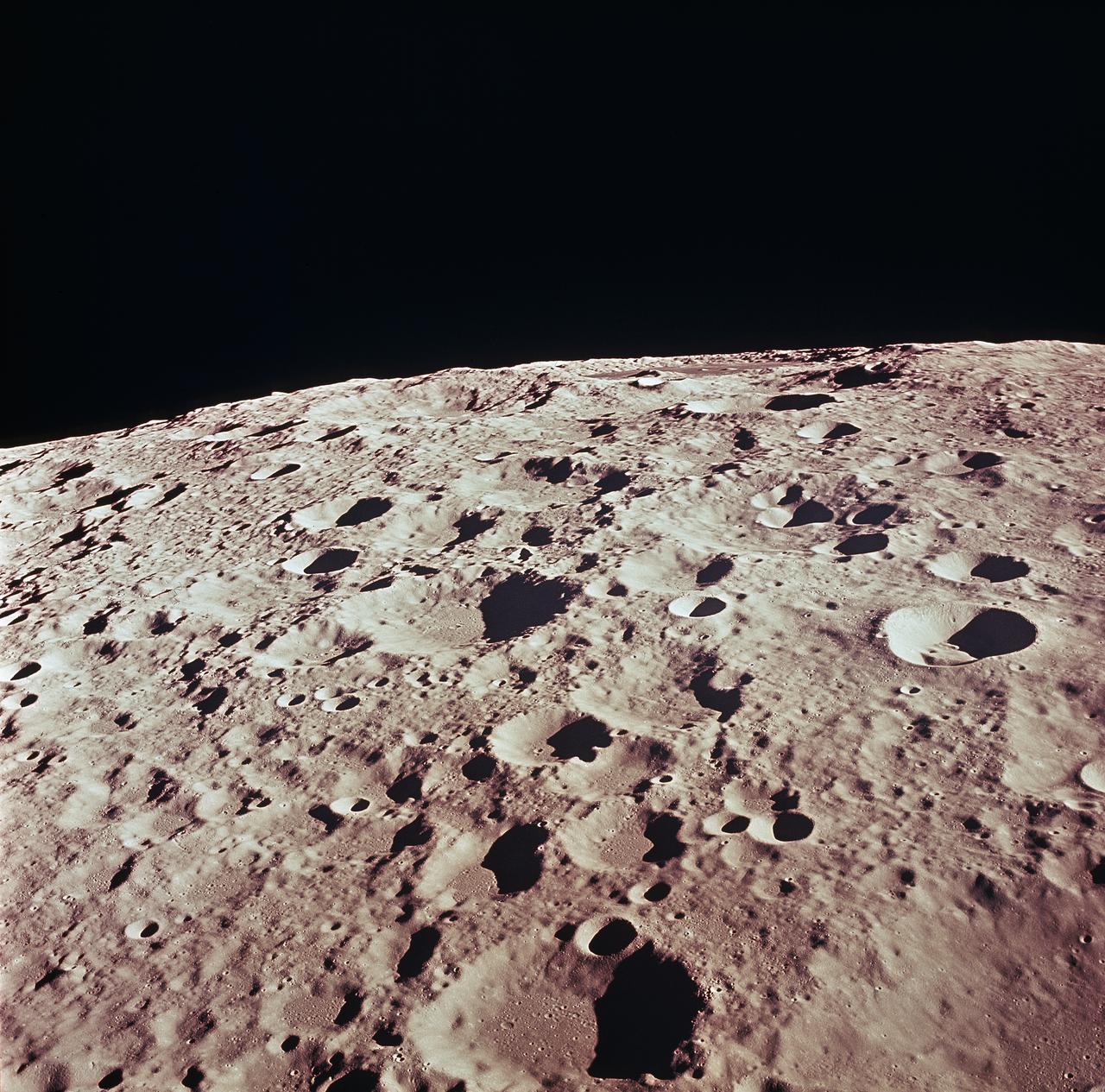
This is a detailed view of the back side of Moon in the vicinity of Crater No. 308 taken during the Apollo 11 mission. Apollo 11, the first manned lunar mission, launched from The Kennedy Space Center, Florida via a Saturn V launch vehicle on July 16, 1969 and safely returned to Earth on July 24, 1969. The Saturn V vehicle was developed by the Marshall Space Flight Center (MSFC) under the direction of Dr. Wernher von Braun. The 3-man crew aboard the flight consisted of Neil A. Armstrong, commander; Michael Collins, Command Module pilot; and Edwin E. Aldrin Jr., Lunar Module pilot. The Lunar Module (LM), named “Eagle, carrying astronauts Neil Armstrong and Edwin Aldrin, was the first crewed vehicle to land on the Moon. Meanwhile, astronaut Collins piloted the Command Module in a parking orbit around the Moon. Armstrong was the first human to ever stand on the lunar surface, followed by Edwin (Buzz) Aldrin. The crew collected 47 pounds of lunar surface material which was returned to Earth for analysis. The surface exploration was concluded in 2½ hours. With the success of Apollo 11, the national objective to land men on the Moon and return them safely to Earth had been accomplished.
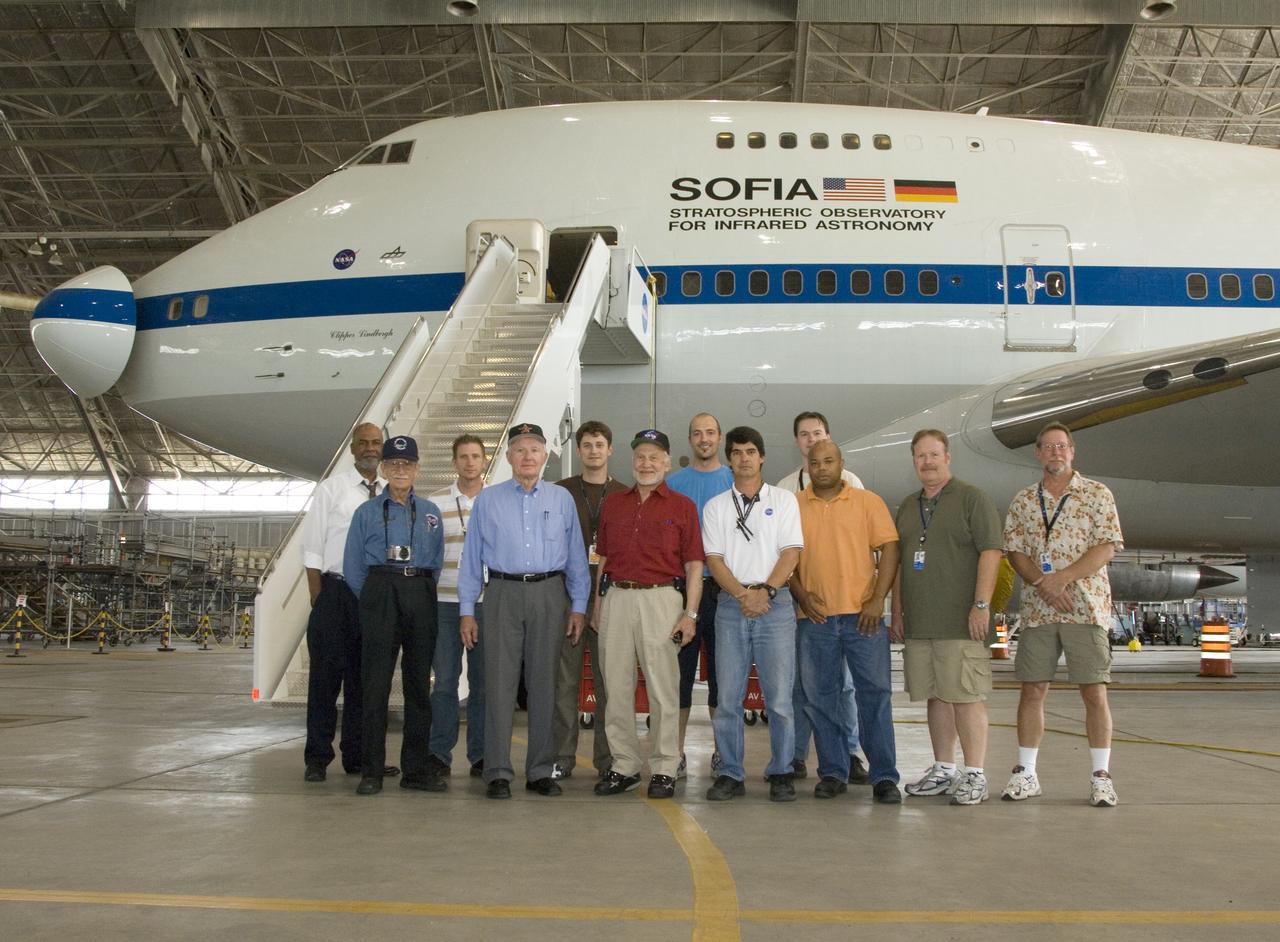
Members of the SOFIA infrared observatory support team gather around Apollo 11 astronaut Buzz Aldrin (in red shirt) during Aldrin's tour of NASA Dryden.
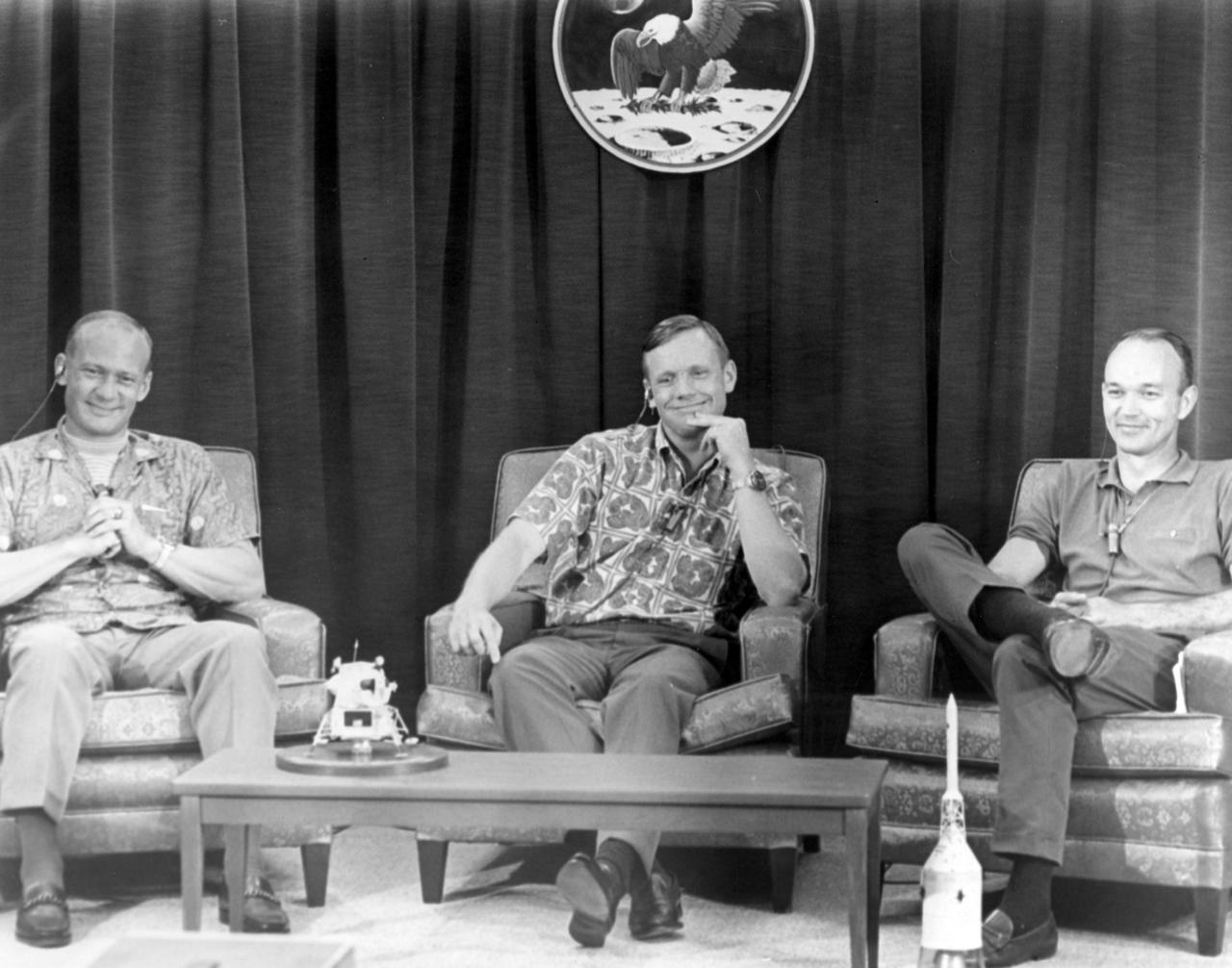
Apollo 11 crew members (L-R) Edwin Aldrin, Neil Armstrong, and Michael Collins were amused by a question posed during a closed circuit press conference the night before they began their historic first lunar landing mission. The press conference with questions via intercom, was held under semi-isolation conditions to avoid exposing the astronauts to possible illness at the last minute. The Apollo 11 mission launched from the Kennedy Space Center (KSC) in Florida via the Marshall Space Flight Center (MSFC) developed Saturn V launch vehicle on July 16, 1969 and safely returned to Earth on July 24, 1969. Aboard the space craft were astronauts Neil A. Armstrong, commander; Michael Collins, Command Module (CM) pilot; and Edwin E. (Buzz) Aldrin Jr., Lunar Module (LM) pilot. The CM, “Columbia”, piloted by Collins, remained in a parking orbit around the Moon while the LM, “Eagle’’, carrying astronauts Armstrong and Aldrin, landed on the Moon. On July 20, 1969, Armstrong was the first human to ever stand on the lunar surface, followed by Aldrin. During 2½ hours of surface exploration, the crew collected 47 pounds of lunar surface material for analysis back on Earth. With the success of Apollo 11, the national objective to land men on the Moon and return them safely to Earth had been accomplished.
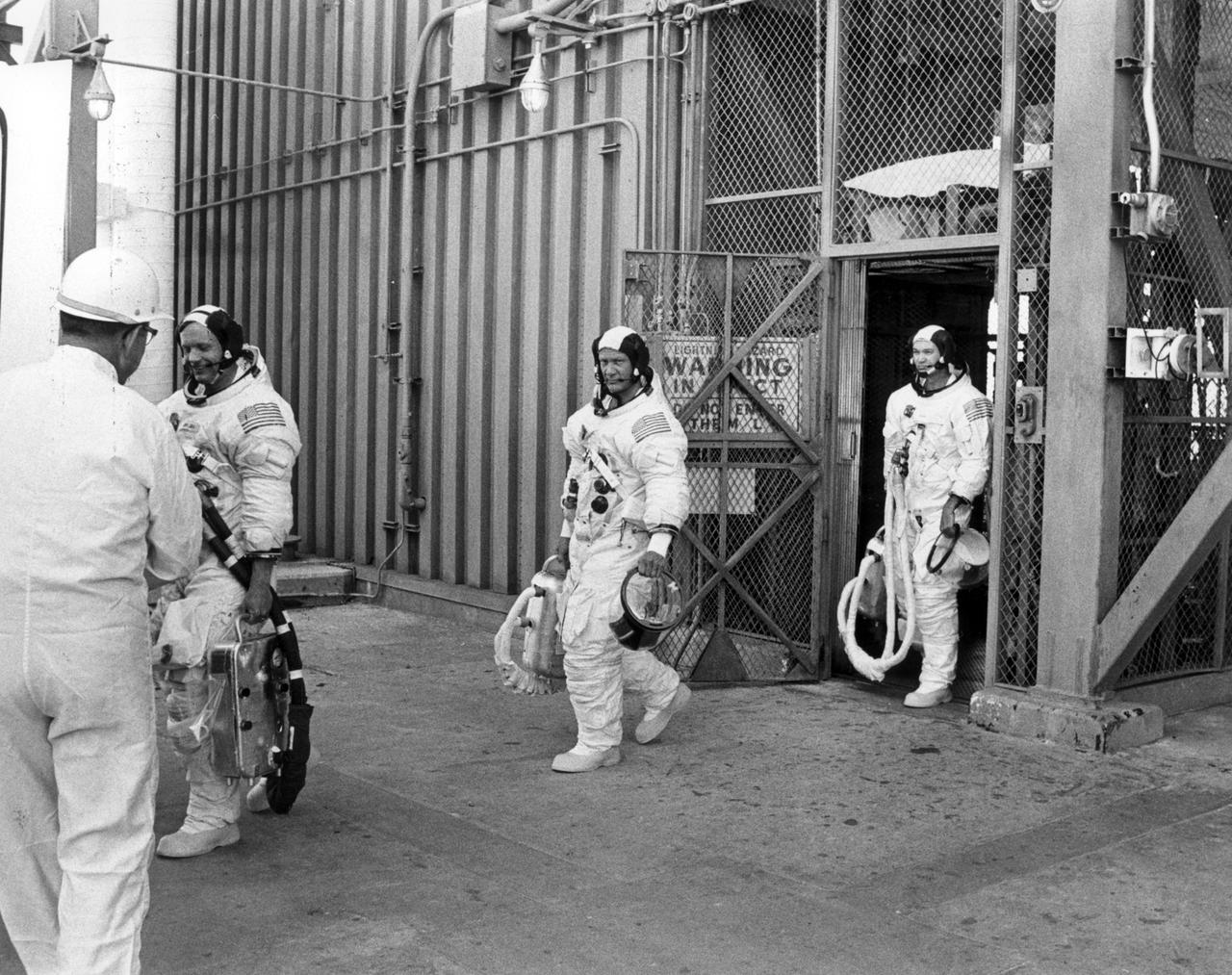
Apollo 11 crew members (left to right) Neil Armstrong, Edwin Aldrin, and Michael Collins, wearing space suits, leave the elevator after descending from the top of the launch tower. The three had just completed participation in the countdown demonstration test for the upcoming Apollo 11 mission. The Apollo 11 mission, the first lunar landing mission, launched from the Kennedy Space Center (KSC) in Florida via the Marshall Space Flight Center (MSFC) developed Saturn V launch vehicle on July 16, 1969 and safely returned to Earth on July 24, 1969. Aboard the space craft were astronauts Neil A. Armstrong, commander; Michael Collins, Command Module (CM) pilot; and Edwin E. (Buzz) Aldrin Jr., Lunar Module (LM) pilot. The CM, “Columbia”, piloted by Collins, remained in a parking orbit around the Moon while the LM, “Eagle’’, carrying astronauts Armstrong and Aldrin, landed on the Moon. On July 20, 1969, Armstrong was the first human to ever stand on the lunar surface, followed by Aldrin. During 2½ hours of surface exploration, the crew collected 47 pounds of lunar surface material for analysis back on Earth. With the success of Apollo 11, the national objective to land men on the Moon and return them safely to Earth had been accomplished.
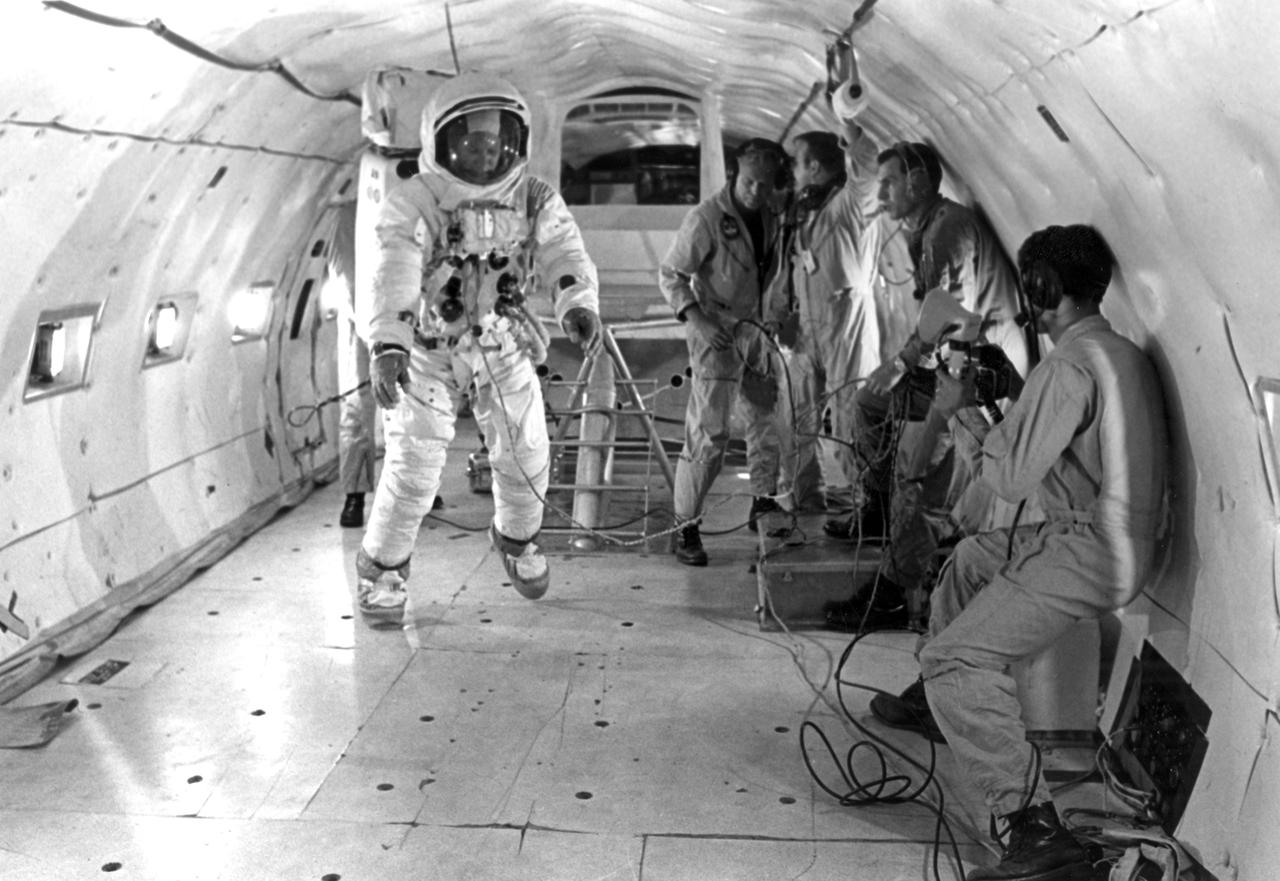
In preparation of the nation’s first lunar landing mission, Apollo 11 crew members underwent training to practice activities they would be performing during the mission. In this photograph, astronaut Edwin E. Aldrin, donned in his space suit, gets in more time under weightless conditions aboard a KC-135 aircraft from the Wright-Patterson Air Force Base. The Apollo 11 mission launched from the Kennedy Space Center (KSC) in Florida via the Marshall Space Flight Center (MSFC) developed Saturn V launch vehicle on July 16, 1969 and safely returned to Earth on July 24, 1969. Aboard the space craft were astronauts Neil A. Armstrong, commander; Michael Collins, Command Module (CM) pilot; and Edwin E. (Buzz) Aldrin Jr., Lunar Module (LM) pilot. The CM, “Columbia”, piloted by Collins, remained in a parking orbit around the Moon while the LM, “Eagle’’, carrying astronauts Armstrong and Aldrin, landed on the Moon. On July 20, 1969, Armstrong was the first human to ever stand on the lunar surface, followed by Aldrin. During 2½ hours of surface exploration, the crew collected 47 pounds of lunar surface material for analysis back on Earth. With the success of Apollo 11, the national objective to land men on the Moon and return them safely to Earth had been accomplished.
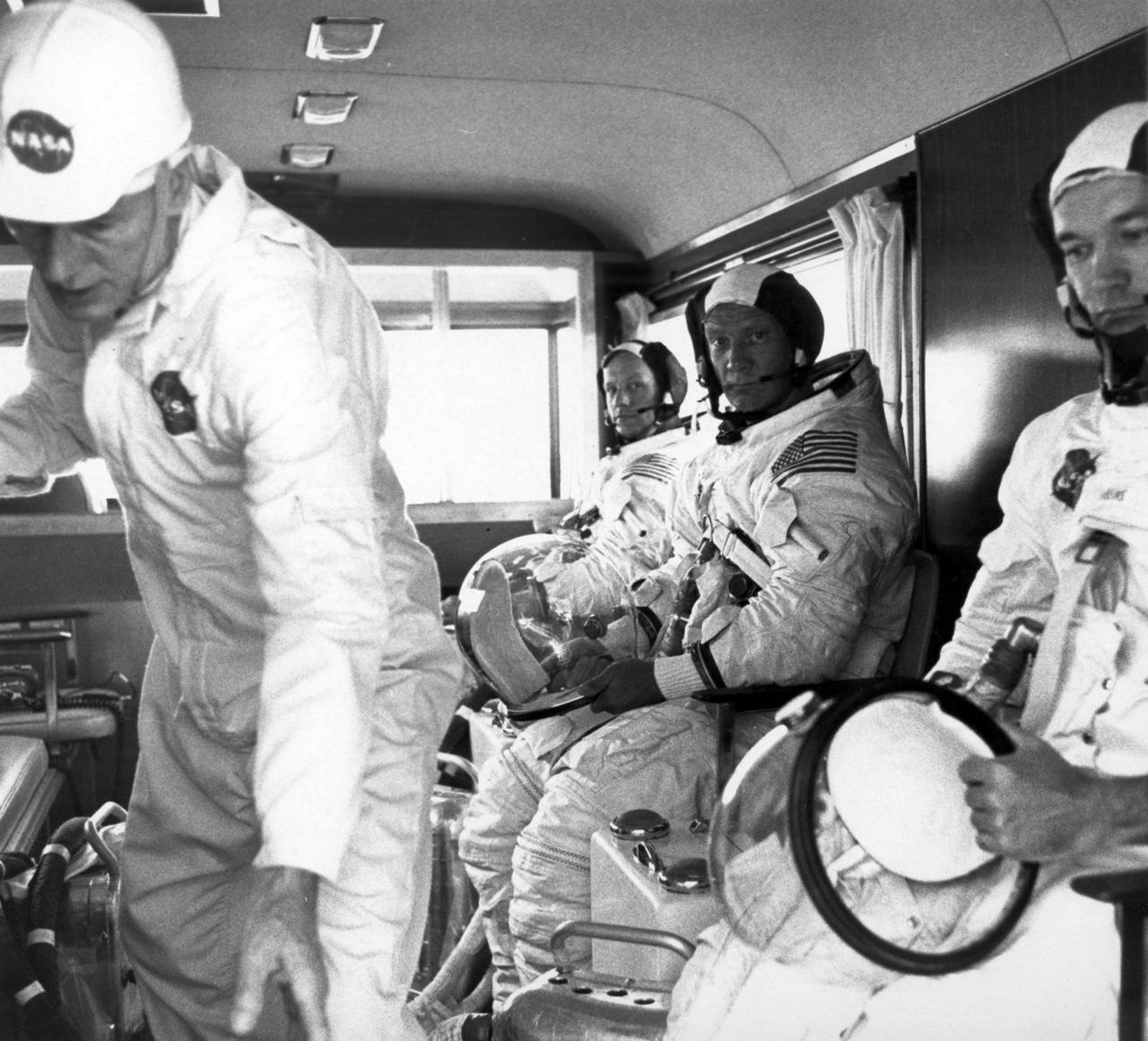
Apollo 11 crew members (rear to front) Neil Armstrong, Edwin Aldrin, and Michael Collins, wearing space suits, ride the van to the launch pad to participate in the countdown demonstration test for the upcoming Apollo 11 mission. The Apollo 11 mission, the first lunar landing mission, launched from the Kennedy Space Center (KSC) in Florida via the Marshall Space Flight Center (MSFC) developed Saturn V launch vehicle on July 16, 1969 and safely returned to Earth on July 24, 1969. Aboard the space craft were astronauts Neil A. Armstrong, commander; Michael Collins, Command Module (CM) pilot; and Edwin E. (Buzz) Aldrin Jr., Lunar Module (LM) pilot. The CM, “Columbia”, piloted by Collins, remained in a parking orbit around the Moon while the LM, “Eagle’’, carrying astronauts Armstrong and Aldrin, landed on the Moon. On July 20, 1969, Armstrong was the first human to ever stand on the lunar surface, followed by Aldrin. During 2½ hours of surface exploration, the crew collected 47 pounds of lunar surface material for analysis back on Earth. With the success of Apollo 11, the national objective to land men on the Moon and return them safely to Earth had been accomplished.
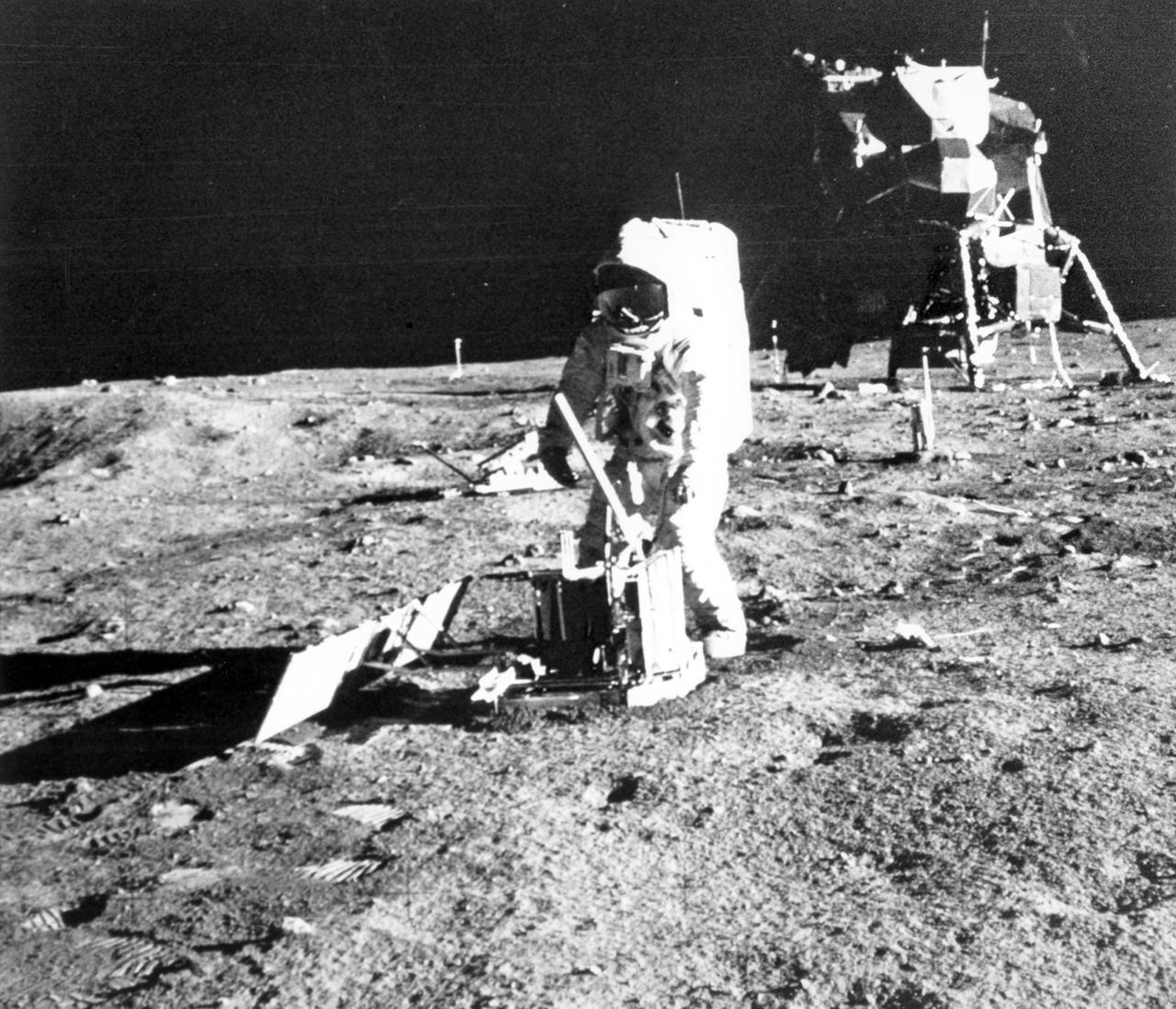
The first manned lunar landing mission, Apollo 11, launched from the Kennedy Space Center (KSC) in Florida via the Marshall Space Flight Center (MSFC) developed Saturn V launch vehicle on July 16, 1969 and safely returned to Earth on July 24, 1969. Aboard the space craft were astronauts Neil A. Armstrong, commander; Michael Collins, Command Module (CM) pilot; and Edwin E. (Buzz) Aldrin Jr., Lunar Module (LM) pilot. The CM, piloted by Michael Collins, remained in a parking orbit around the Moon, while the LM, named “Eagle’’, carrying astronauts Armstrong and Aldrin, landed on the Moon in the Sea of Tranquility. During 2½ hours of surface exploration, the crew set up experiments, collected 47 pounds of lunar surface material for analysis back on Earth, planted the U.S Flag, and left a message for all mankind. In this photograph, Aldrin is deploying the Early Apollo Scientific Experiment Package.
The first manned lunar landing mission, Apollo 11, launched from the Kennedy Space Center (KSC) in Florida via the Marshall Space Flight Center (MSFC) developed Saturn V launch vehicle on July 16, 1969 and safely returned to Earth on July 24, 1969. Aboard the space craft were astronauts Neil A. Armstrong, commander; Michael Collins, Command Module (CM) pilot; and Edwin E. (Buzz) Aldrin Jr., Lunar Module (LM) pilot. The CM, piloted by Michael Collins, remained in a parking orbit around the Moon, while the LM, named “Eagle’’, carrying astronauts Armstrong and Aldrin, landed on the Moon in the Sea of Tranquility. During 2½ hours of surface exploration, the crew set up experiments, collected 47 pounds of lunar surface material for analysis back on Earth, planted the U.S Flag, and left a message for all mankind. In this photograph, Aldrin is deploying the Passive Seismic Experiment Package (PSEP).
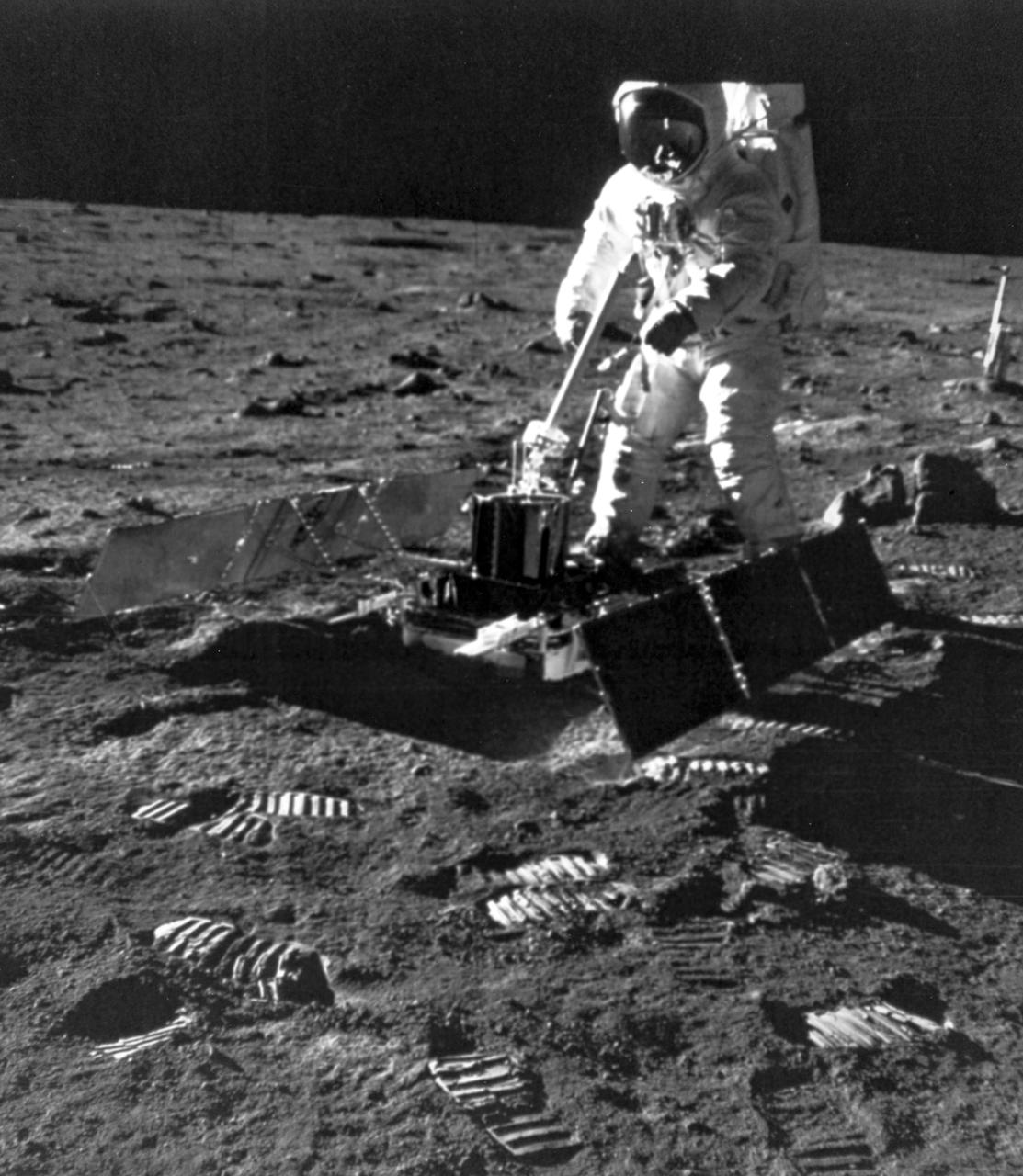
The Apollo 11 mission launched from the Kennedy Space Center (KSC) in Florida via the Marshall Space Flight Center (MSFC) developed Saturn V launch vehicle on July 16, 1969 and safely returned to Earth on July 24, 1969. Aboard the space craft were astronauts Neil A. Armstrong, commander; Michael Collins, Command Module (CM) pilot; and Edwin E. (Buzz) Aldrin Jr., Lunar Module (LM) pilot. The CM, piloted by Michael Collins, remained in a parking orbit around the Moon, while the LM, named “Eagle’’, carrying astronauts Armstrong and Aldrin, landed on the Moon in the Sea of Tranquility. During 2½ hours of surface exploration, the crew set up experiments, collected 47 pounds of lunar surface material for analysis back on Earth, planted the U.S Flag, and left a message for all mankind. In this photograph, Aldrin is deploying the Passive Seismic Experiment Package (PSEP).
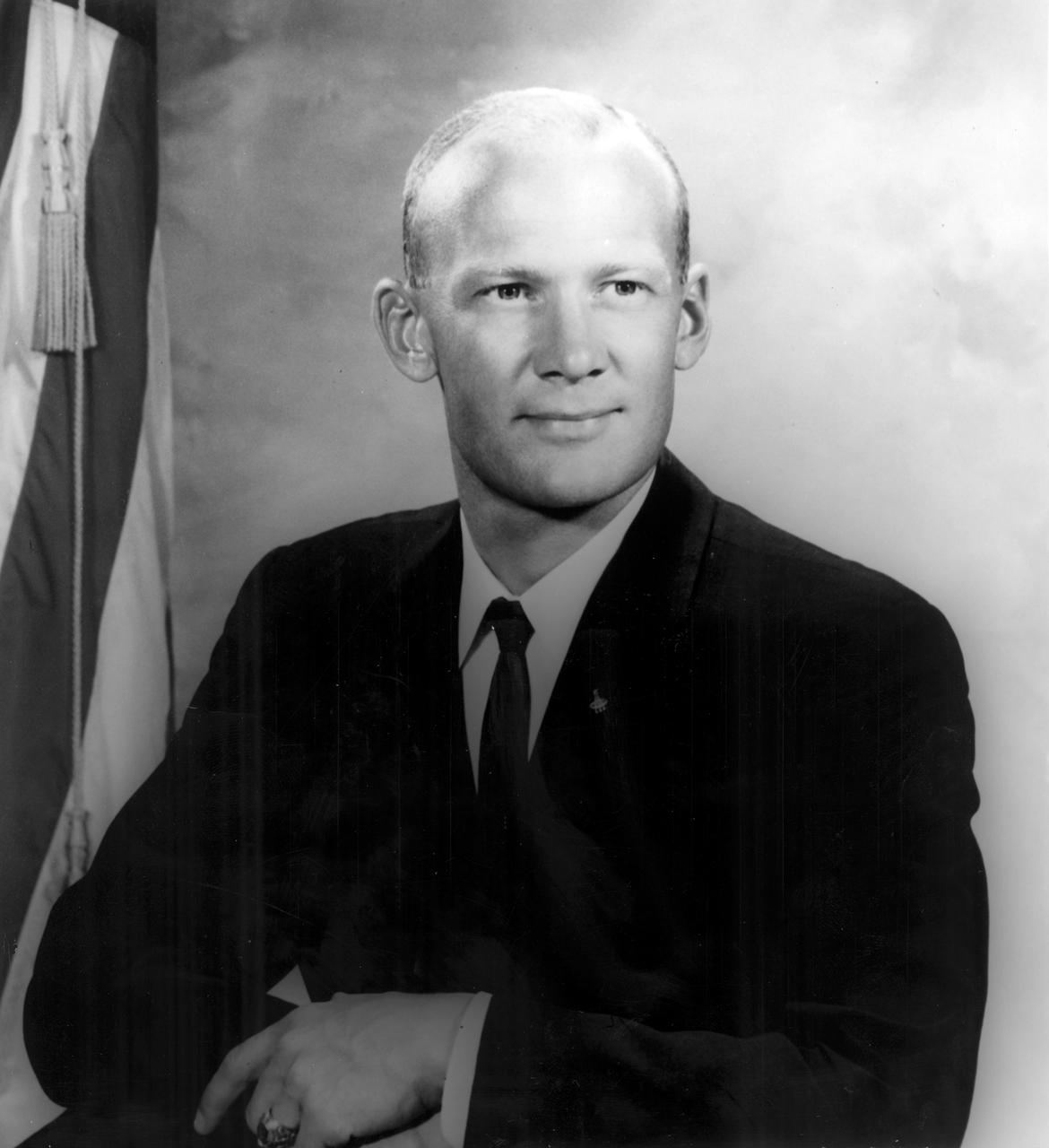
This is the official NASA portrait of astronaut Edwin E. (Buzz) Aldrin. Prior to joining NASA, Aldrin flew 66 combat missions in F-86s while on duty in Korea. At Nellis Air Force Base, Nevada, he served as an aerial gunnery instructor. Following his assignment as aide to the dean of faculty at the Air Force Academy, Aldrin flew F-100s as a flight commander at Bitburg, Germany. Aldrin was one of the third group of astronauts named by NASA in October 1963 and has logged 289 hours and 53 minutes in space, of which, 7 hours and 52 minutes were spent in Extra Vehicular Activity (EVA). On November 11, 1966, he launched into space aboard the Gemini 12 spacecraft on a 4-day flight, which brought the Gemini program to a successful close. During that mission, Aldrin established a new record for EVA, spending 5-1/2 hours outside the spacecraft. July 16-24, 1969, Aldrin served as lunar module pilot for Apollo 11, the first manned lunar landing mission. Aldrin followed Neil Armstrong onto the lunar surface on July 20, 1969, completing a 2-hour and 15 minute lunar EVA. Aldrin resigned from NASA in July 1971.
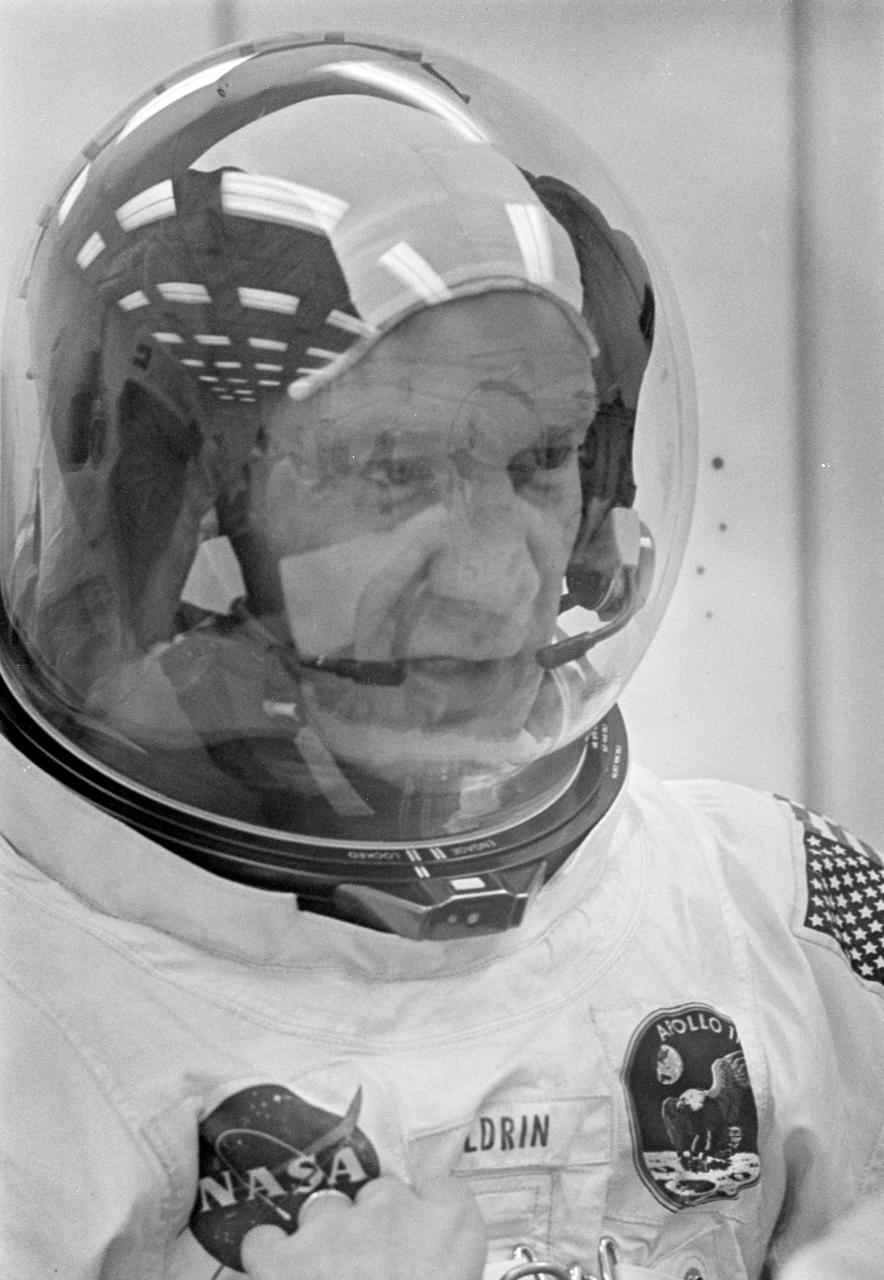
Dunned in his space suit, Lunar Module pilot Edwin E. Aldrin, Jr. does a final check of his communications system before the boarding of the Apollo 11 mission. Launched via a Saturn V launch vehicle, the first manned lunar mission launched from the Kennedy Space Center, Florida on July 16, 1969 and safely returned to Earth on July 24, 1969. The Saturn V vehicle was developed by the Marshall Space Flight Center (MSFC) under the direction of Dr. Wernher von Braun. The 3-man crew aboard the flight consisted of astronauts Aldrin; Michael Collins, Command Module (CM) pilot; and Neil Armstrong, mission commander. Armstrong was the first human to ever stand on the lunar surface, followed by Edwin (Buzz) Aldrin. Meanwhile, astronaut Collins piloted the CM in a parking orbit around the Moon. During a 2½ hour surface exploration, the crew collected 47 pounds of lunar surface material which was returned to Earth for analysis. With the success of Apollo 11, the national objective to land men on the Moon and return them safely to Earth had been accomplished.
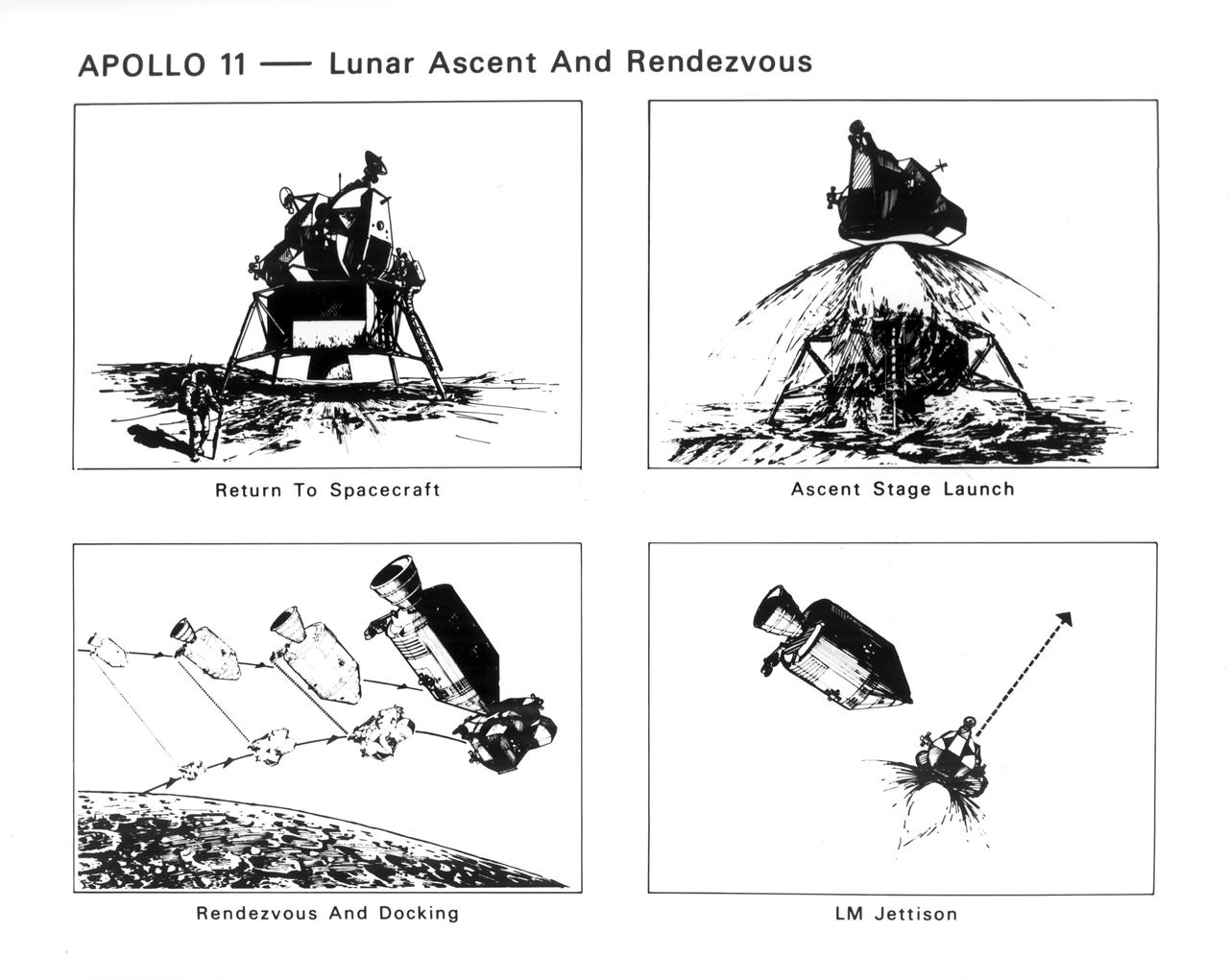
The Apollo 11 mission launched from the Kennedy Space Center (KSC) in Florida via the Marshall Space Flight Center (MSFC) developed Saturn V launch vehicle on July 16, 1969 and safely returned to Earth on July 24, 1969. Aboard the space craft were astronauts Neil A. Armstrong, commander; Michael Collins, Command Module (CM) pilot; and Edwin E. (Buzz) Aldrin Jr., Lunar Module (LM) pilot. With the success of Apollo 11, the national objective to land men on the Moon and return them safely to Earth had been accomplished. These sketches illustrate the steps taken when the astronauts left the Moon. After 2½ hours of surface exploration, astronauts Neil Armstrong and Edwin Aldrin returned to the Lunar Module (LM) “Eagle” for rest, eating, and checkout of the vehicle in preparation for liftoff. The ascent stage lifted off, using the descent stage as a launch pad. The ascent stage went into lunar orbit and moved in to dock with the orbiting CM “Columbia”. After Armstrong and Aldrin joined Collins in the CM, the engine of the LM ascent stage was fired to move it out of the same orbit.
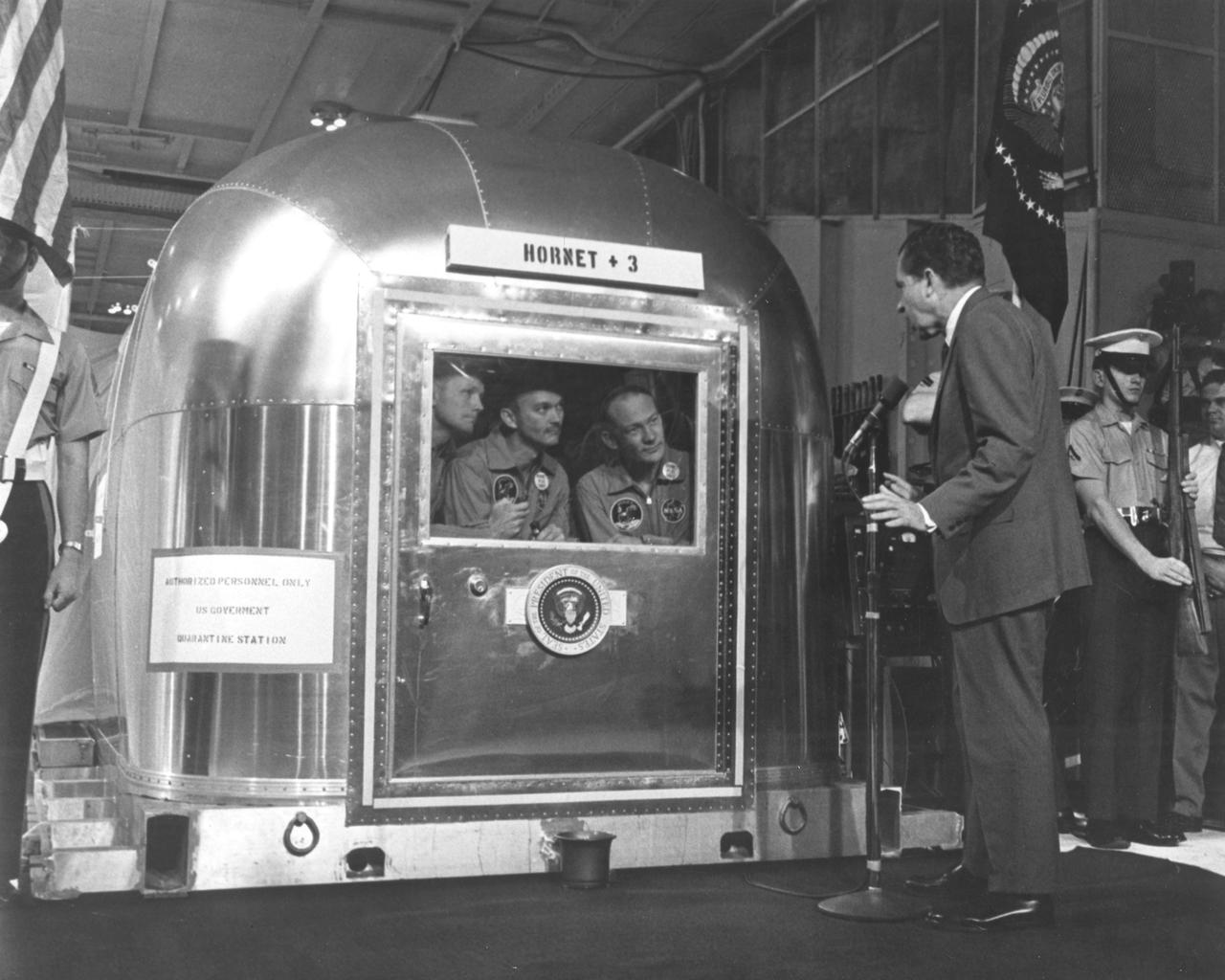
The Apollo 11 mission, the first manned lunar mission, launched from the Kennedy Space Center, Florida via the Saturn V launch vehicle on July 16, 1969 and safely returned to Earth on July 24, 1969. The Saturn V vehicle was developed by the Marshall Space Flight Center (MSFC) under the direction of Dr. Wernher von Braun. Aboard were Neil A. Armstrong, commander; Michael Collins, Command Module (CM) pilot; and Edwin E. Aldrin Jr., Lunar Module (LM) pilot. The CM, piloted by Michael Collins remained in a parking orbit around the Moon while the LM, named “Eagle’’, carrying astronauts Neil Armstrong and Edwin Aldrin, landed on the Moon. Armstrong was the first human to ever stand on the lunar surface, followed by Edwin (Buzz) Aldrin. During 2½ hours of surface exploration, the crew collected 47 pounds of lunar surface material for analysis back on Earth. The recovery operation took place in the Pacific Ocean where Navy para-rescue men recovered the capsule housing the 3-man Apollo 11 crew. The crew was airlifted by helicopter and taken to safety aboard the U.S.S. Hornet, where they were quartered in a Mobile Quarantine Facility (MQF). Shown here are the Apollo 11 crew members (L to R) Neil Armstrong, Michael Collins, and Edwin Aldrin inside the MQF as U.S. President Richard Milhous Nixon speaks to them via intercom. The president was aboard the recovery vessel awaiting return of the astronauts. With the success of Apollo 11, the national objective to land men on the Moon and return them safely to Earth had been accomplished.
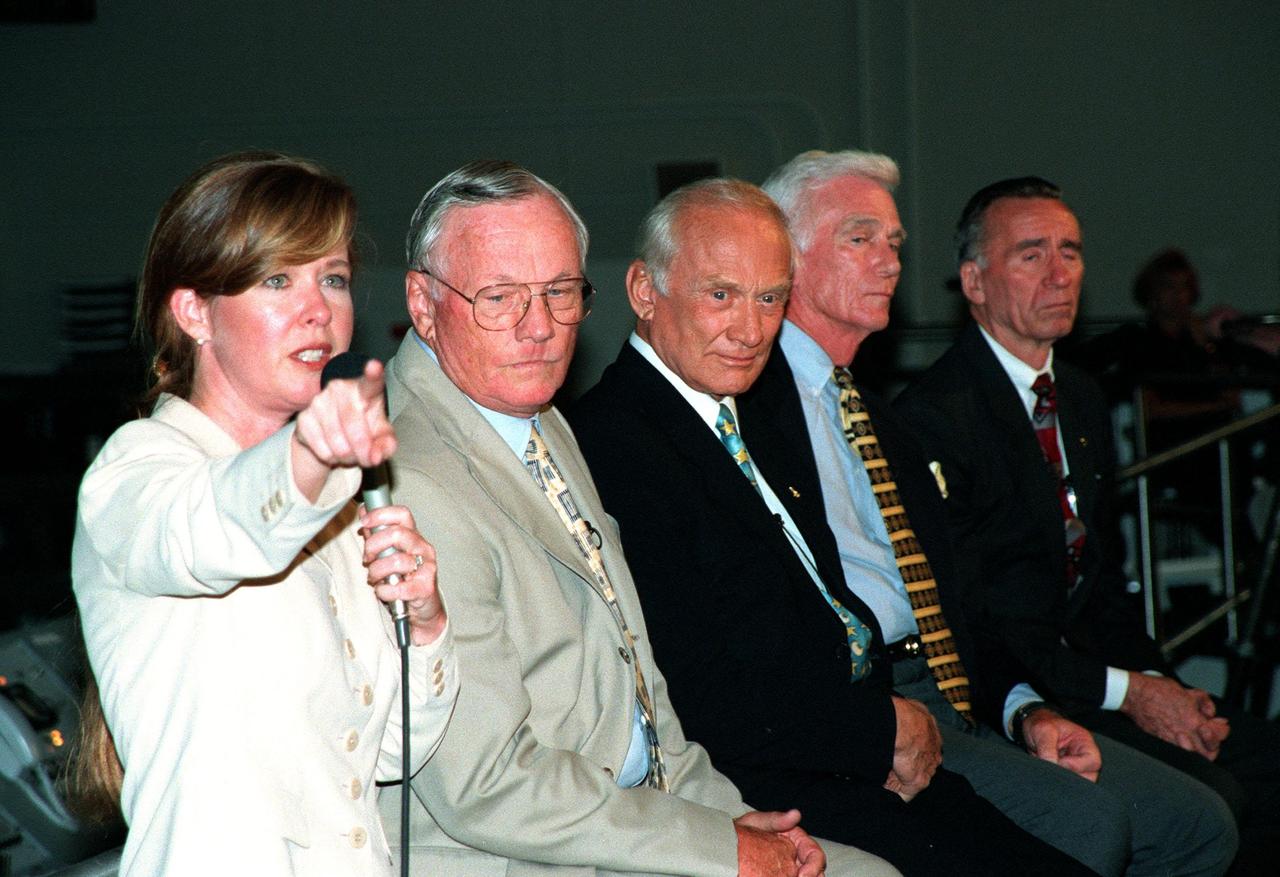
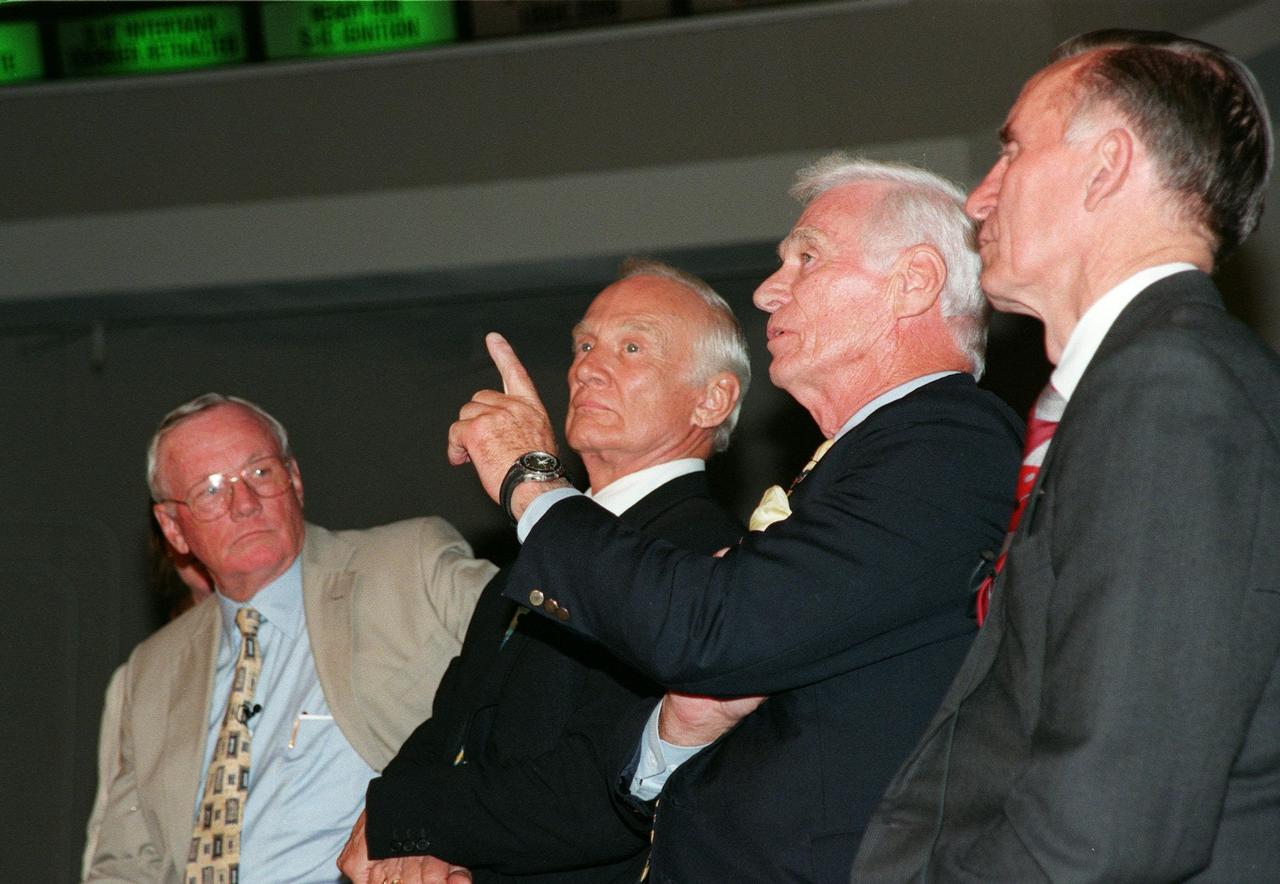
KENNEDY SPACE CENTER, FLA. -- In the Apollo/Saturn V Center, Lisa Malone (left), chief of KSC's Media Services branch, identifies a reporter to pose a question to one of the former Apollo astronauts seated next to her. From left, they are Neil A. Armstrong and Edwin "Buzz" Aldrin who flew on Apollo 11, the launch to the moon; Gene Cernan, who flew on Apollo 10 and 17; and Walt Cunningham, who flew on Apollo 7. This is the 30th anniversary of the launch and moon landing, July 16 and July 20, 1969. Neil Armstrong was the first man to set foot on the moon
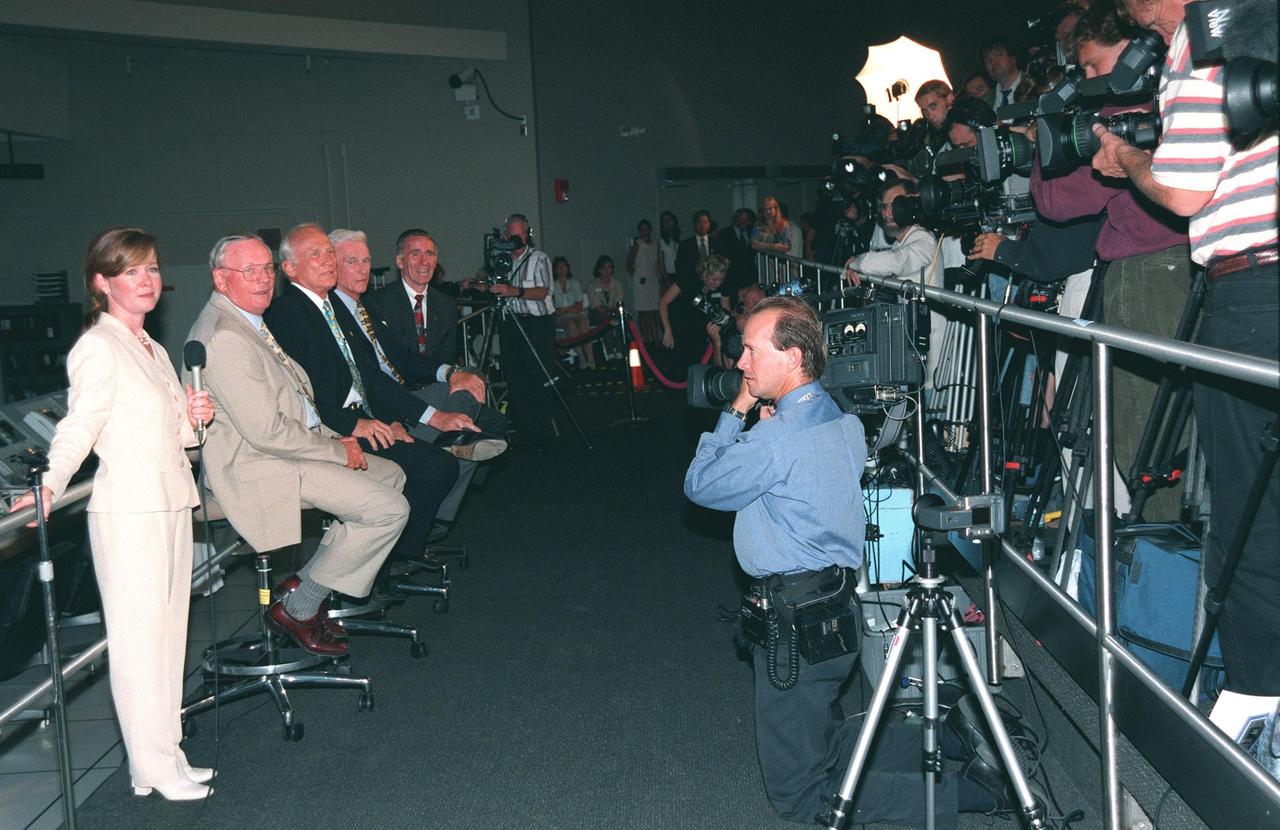
KENNEDY SPACE CENTER, FLA. -- Photographers and cameramen fill the stands of the Apollo/Saturn V Center for a press conference with former Apollo astronauts (seated, left to right) Neil A. Armstrong and Edwin "Buzz" Aldrin who flew on Apollo 11, the launch to the moon; Gene Cernan, who flew on Apollo 10 and 17; and Walt Cunningham, who flew on Apollo 7. At left is Lisa Malone, chief of KSC's Media Services branch, who monitored the session. The four astronauts were at KSC for the 30th anniversary of the Apollo 11 launch and moon landing, July 16 and July 20, 1969. Neil Armstrong was the first man to set foot on the moon
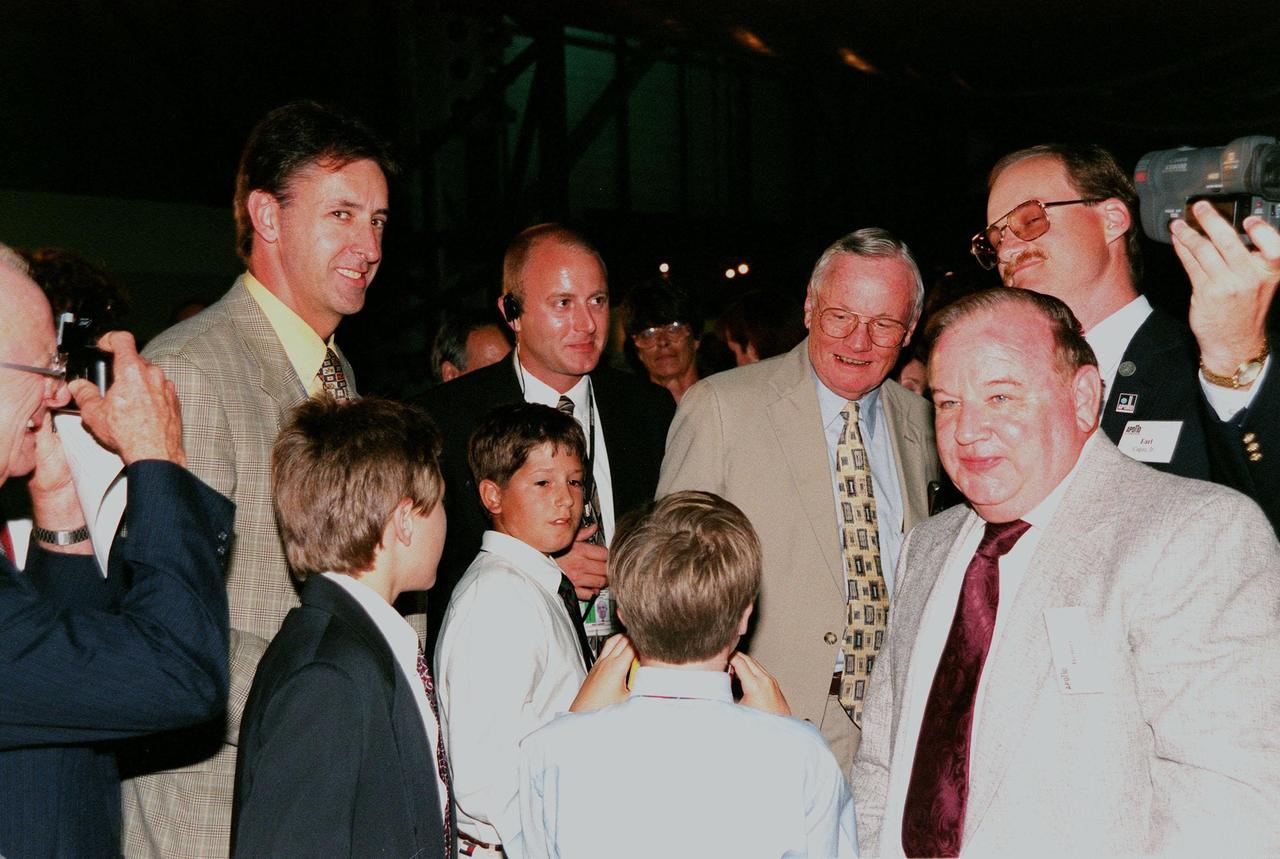
KENNEDY SPACE CENTER, FLA. -- Former Apollo 11 astronaut Neil A. Armstrong is the center of attention at the anniversary banquet honoring the Apollo team, the people who made the entire lunar landing program possible. The banquet was held in the Apollo/Saturn V Center, part of the KSC Visitor Complex. This is the 30th anniversary of the Apollo 11 launch and moon landing, July 16 and July 20, 1969. Neil Armstrong was the first man to set foot on the moon. He appeared at the banquet with other former astronauts Edwin "Buzz" Aldrin, Gene Cernan, Walt Cunningham and others
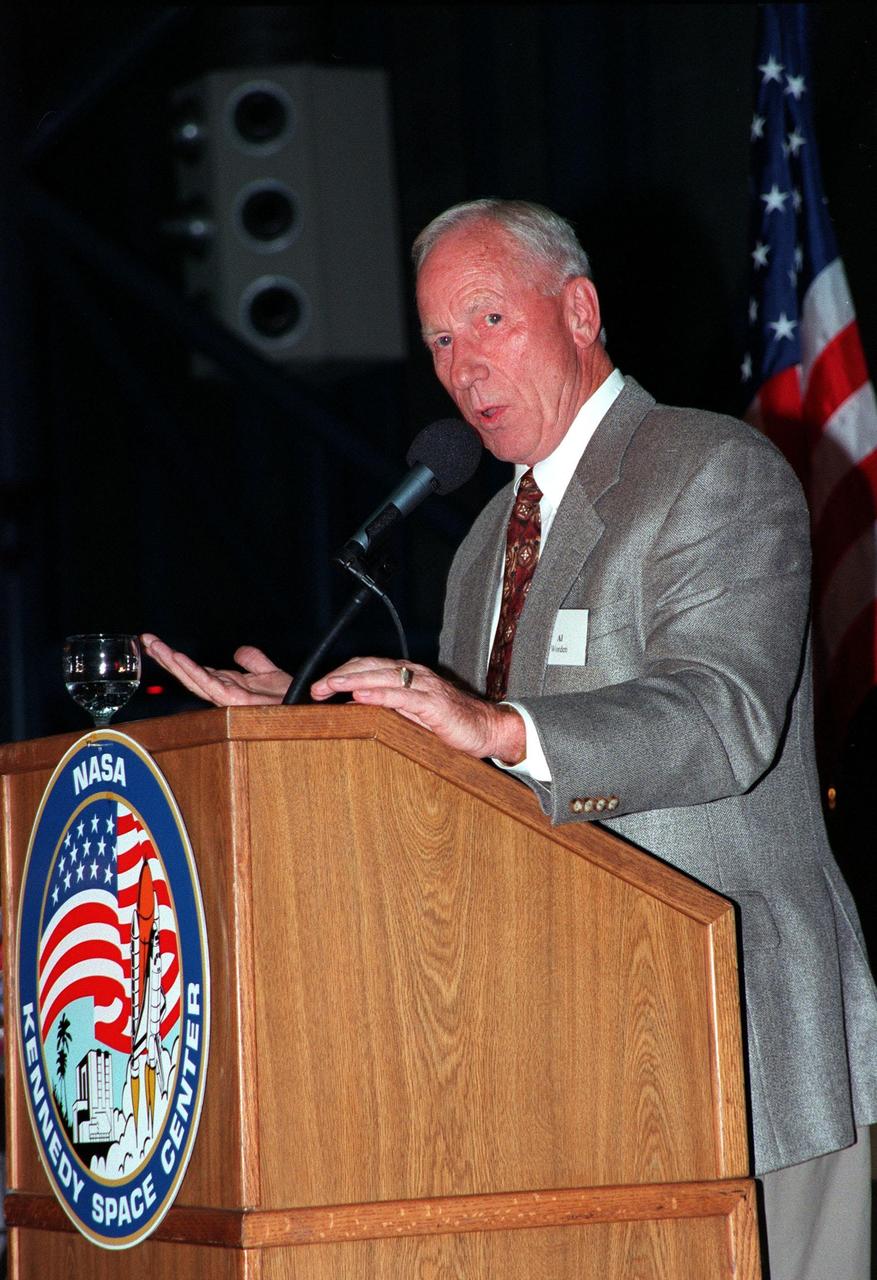
KENNEDY SPACE CENTER, FLA. -- Former Apollo 15 astronaut Alfred M. Worden relates his experiences in the Apollo Program during a banquet honoring the people who made it all possible. Held on the anniversary of the Apollo 11 mission, which was launched July 16, 1969, and landed on the moon July 20, 1969, the banquet was held in the Apollo/Saturn V Center. Worden served as command module pilot on the Apollo 15 mission. Other guests at the banquet were astronauts Neil Armstrong, Wally Schirra, Edwin "Buzz" Aldrin and Walt Cunningham. Armstrong was the first man to walk on the moon; Gene Cernan was the last
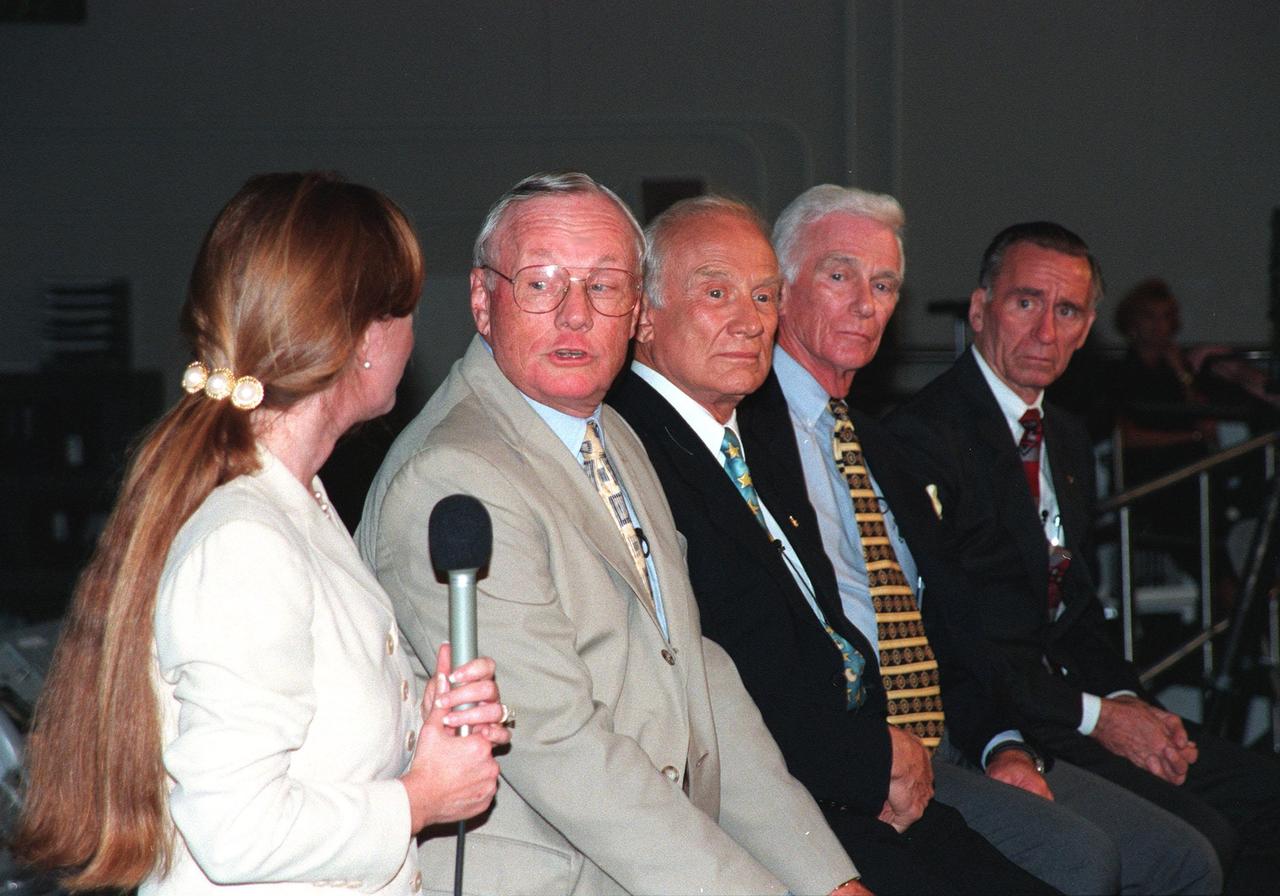
KENNEDY SPACE CENTER, FLA. -- In the Apollo/Saturn V Center, Lisa Malone (left), chief of KSC's Media Services branch, relays a question from the media to former Apollo astronaut Neil A. Armstrong. Beside Armstrong are Edwin "Buzz" Aldrin, Gene Cernan, and Walt Cunningham, all of whom also flew on Apollo missions. The four met with the media prior to an anniversary banquet highlighting the contributions of aerospace employees who made the Apollo program possible. The banquet celebrated the 30th anniversary of the launch and moon landing, July 16 and July 20, 1969. Neil Armstrong was the first man to set foot on the moon
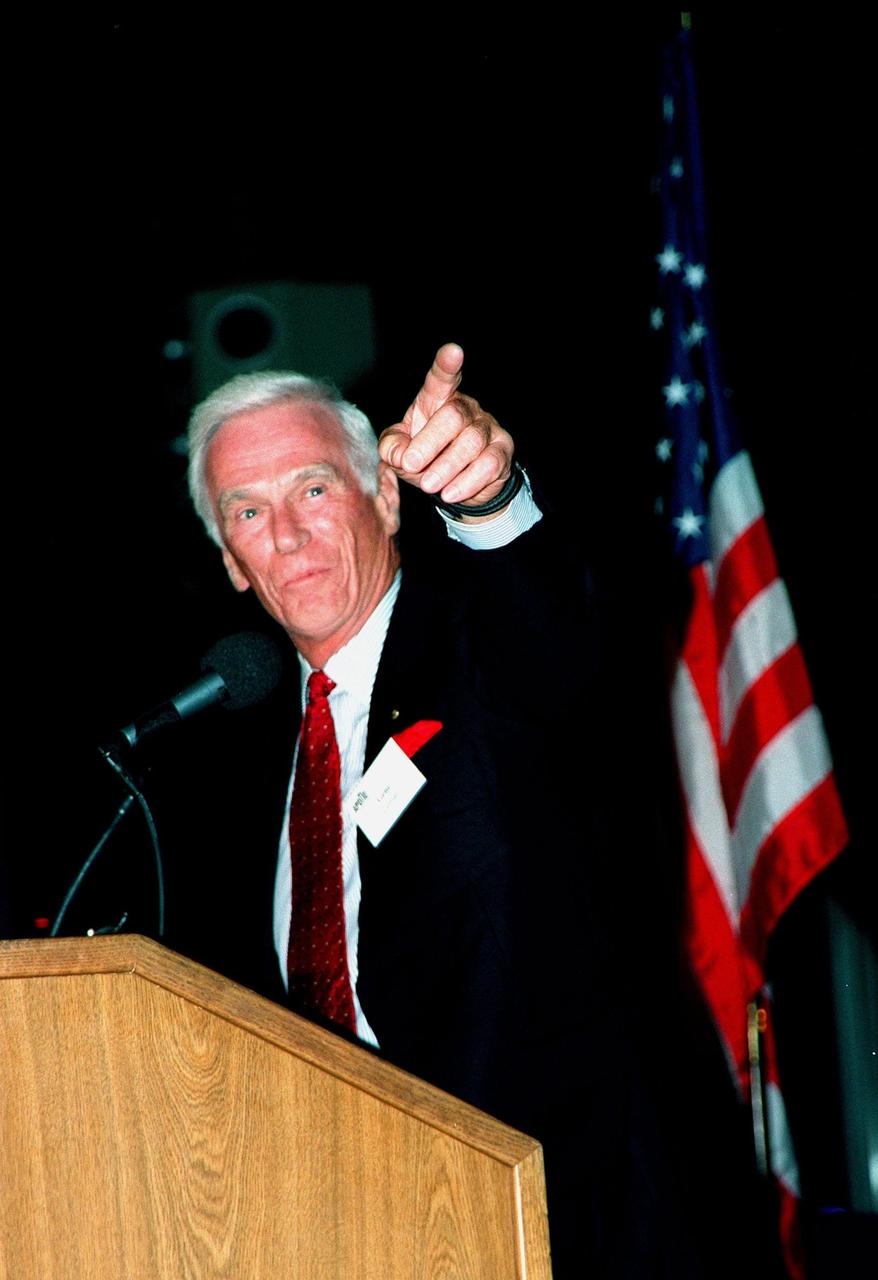
KENNEDY SPACE CENTER, FLA. -- Former Apollo astronaut Gene Cernan makes a point during a presentation at the Apollo 11 anniversary banquet honoring the Apollo team, the people who made the entire lunar landing program possible. The banquet was held in the Apollo/Saturn V Center, part of the KSC Visitor Complex. This is the 30th anniversary of the Apollo 11 launch and moon landing, July 16 and July 20, 1969. Cernan appeared with other former astronauts Neil Armstrong, the first man to walk on the moon; Edwin "Buzz" Aldrin; Walt Cunningham; and others
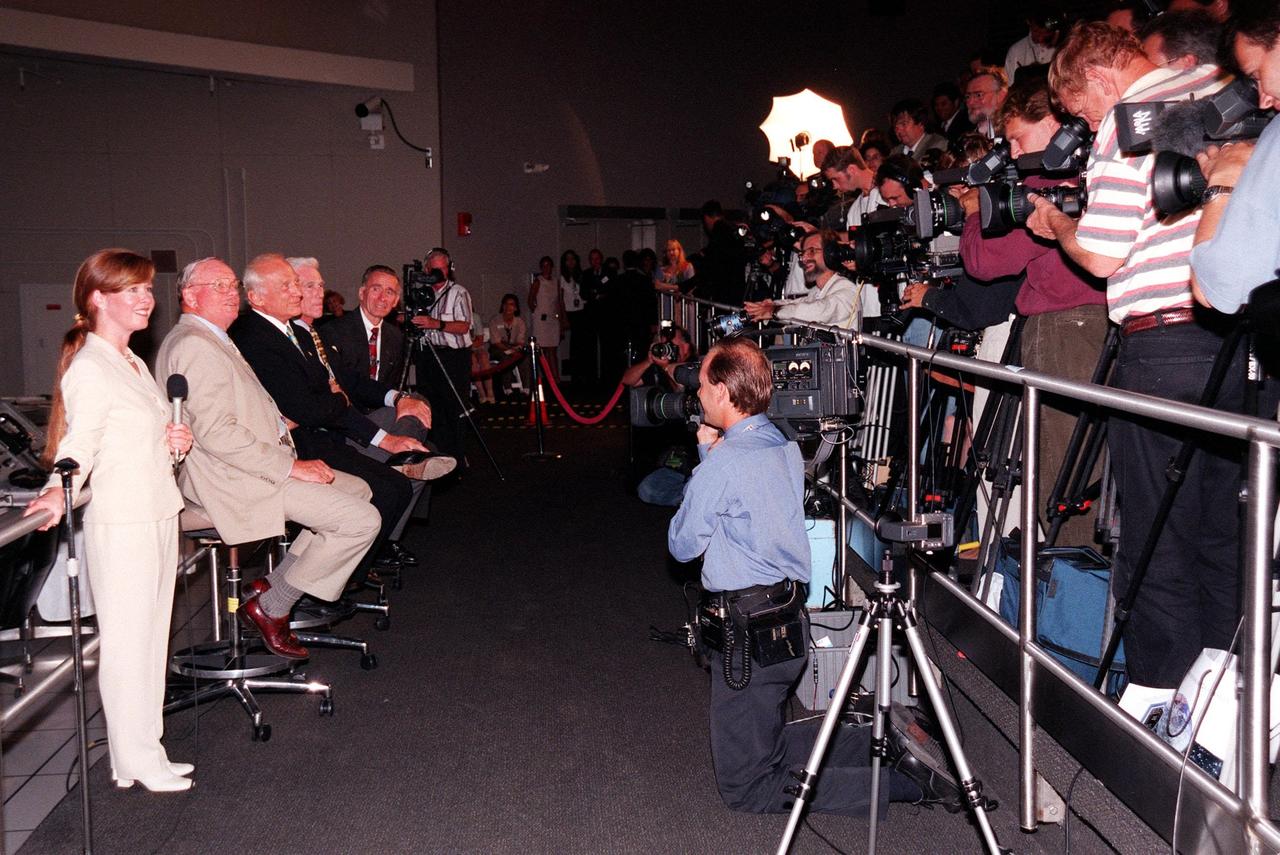
KENNEDY SPACE CENTER, FLA. -- In the Apollo/Saturn V Center, Lisa Malone (left), chief of KSC's Media Services branch, waits for photographers to take photos of former Apollo astronauts (left to right) Neil A. Armstrong and Edwin "Buzz" Aldrin who flew on Apollo 11, the launch to the moon; Gene Cernan, who flew on Apollo 10 and 17; and Walt Cunningham, who flew on Apollo 7. The four met with the media prior to an anniversary banquet highlighting the contributions of aerospace employees who made the Apollo program possible. The banquet celebrated the 30th anniversary of the launch and moon landing, July 16 and July 20, 1969. Neil Armstrong was the first man to set foot on the moon
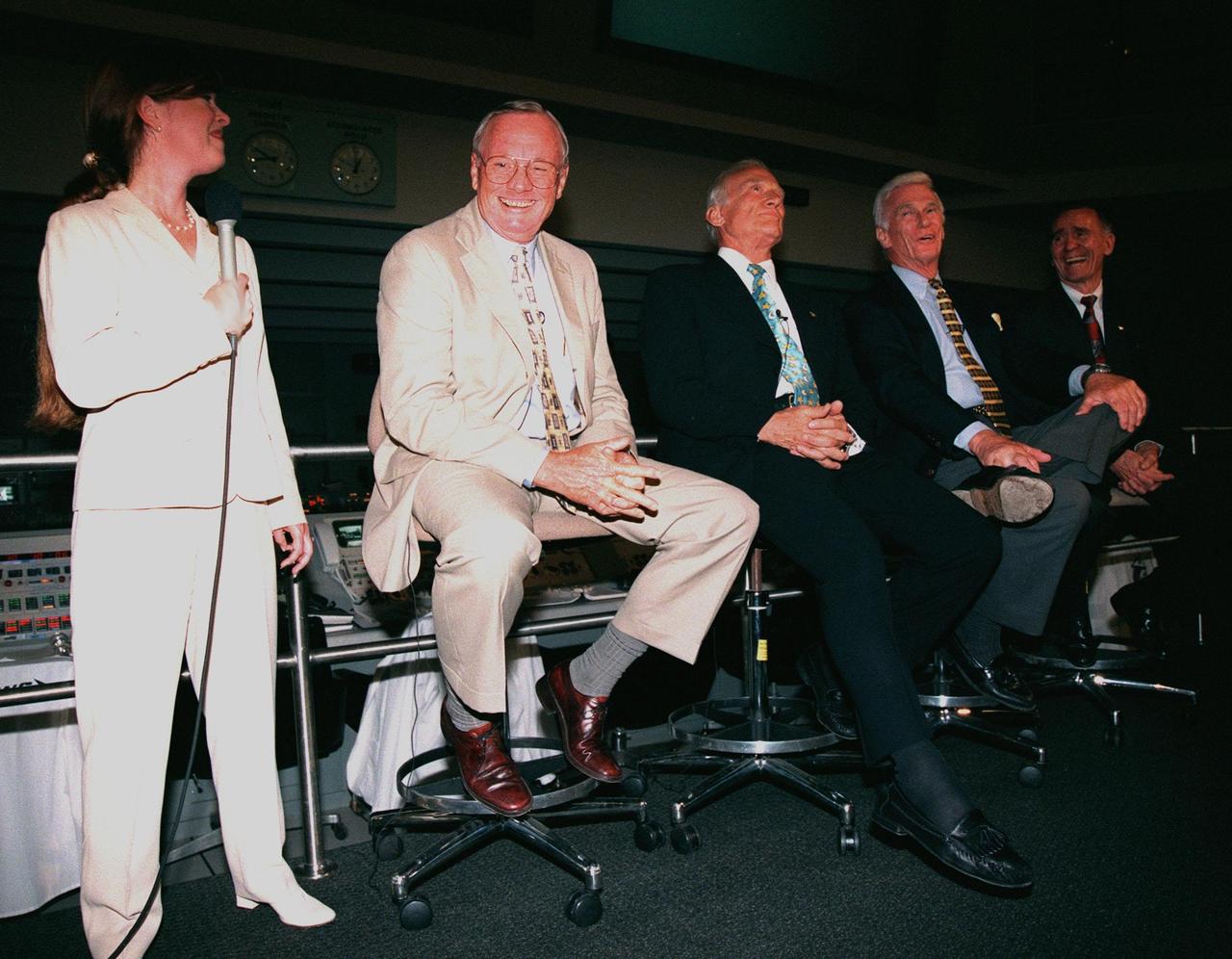
KENNEDY SPACE CENTER, FLA. -- In the Apollo/Saturn V Center, Lisa Malone (left), chief of KSC's Media Services branch, laughs at a humorous comment along with former Apollo astronauts Neil A. Armstrong and Edwin "Buzz" Aldrin who flew on Apollo 11, the launch to the moon; Gene Cernan, who flew on Apollo 10 and 17; and Walt Cunningham, who flew on Apollo 7. The four met with the media before an anniversary banquet celebrating the accomplishments of the Apollo program team. This is the 30th anniversary of the launch and moon landing, July 16 and July 20, 1969. Neil Armstrong was the first man to set foot on the moon
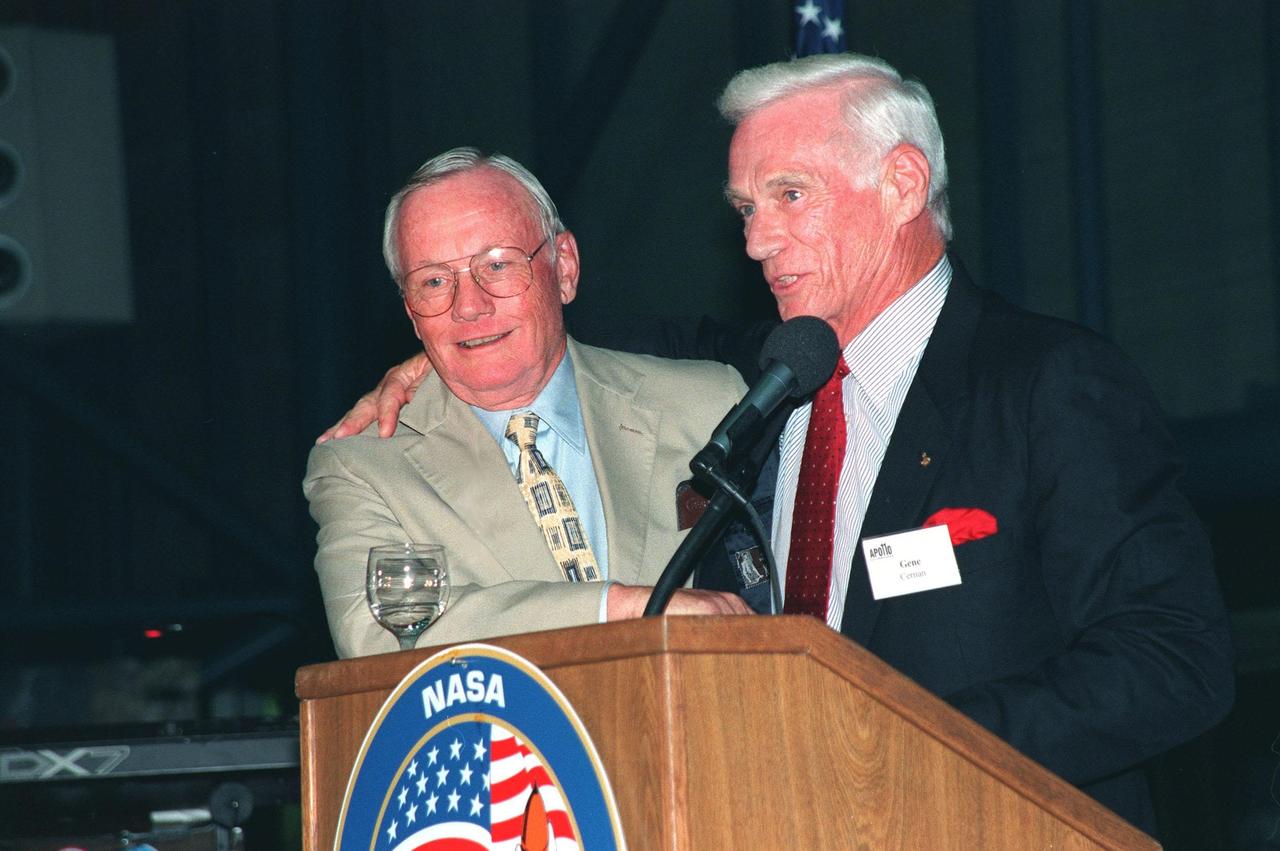
KENNEDY SPACE CENTER, FLA. -- During an anniversary banquet honoring the Apollo program team, the people who made the entire lunar landing program possible, former Apollo astronauts Neil Armstrong (left) and Gene Cernan talk about their experiences. The banquet was held in the Apollo/Saturn V Center, part of the KSC Visitor Complex. This is the 30th anniversary of the Apollo 11 launch and moon landing, July 16 and July 20, 1969. Other guests at the banquet were astronauts Wally Schirra, Edwin "Buzz" Aldrin and Walt Cunningham. Neil Armstrong was the first man to walk on the moon; Gene Cernan was the last
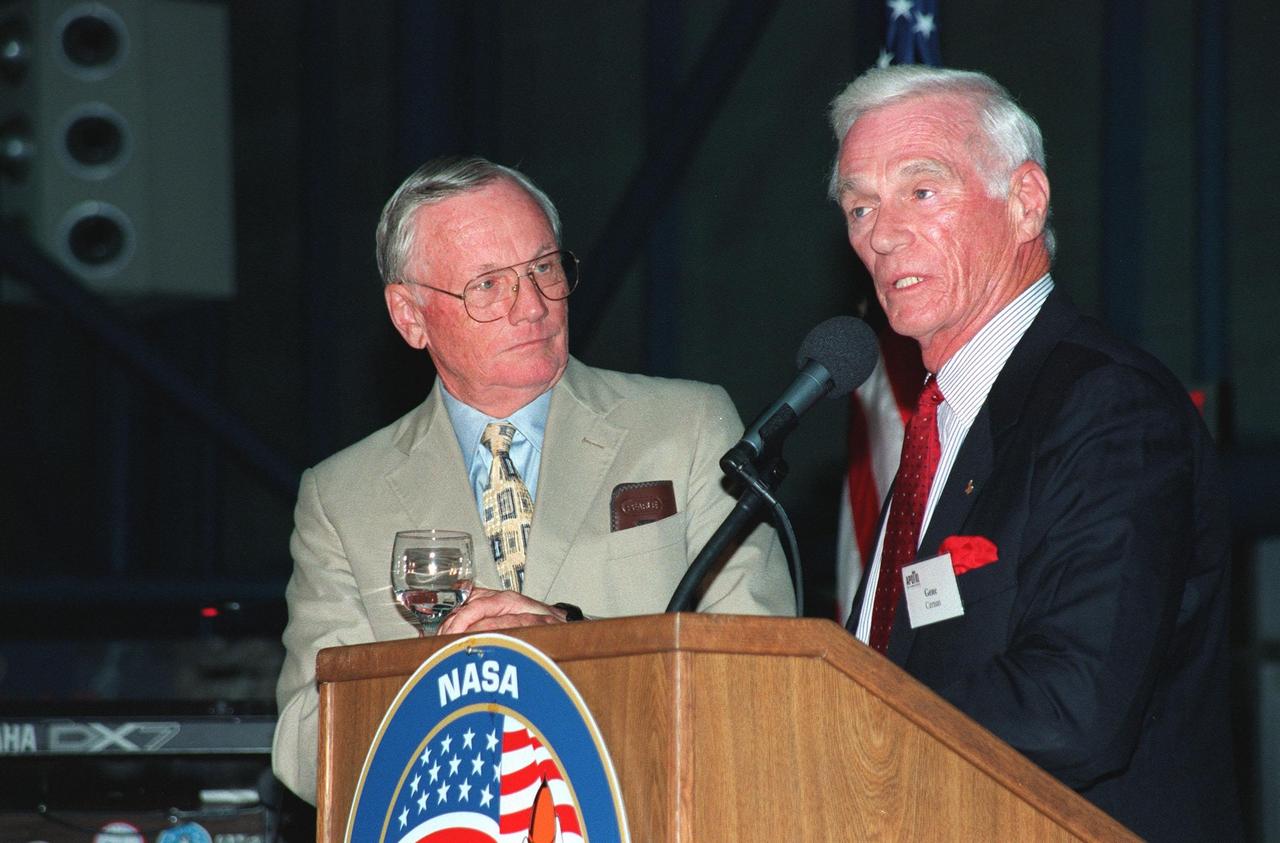
KENNEDY SPACE CENTER, FLA. -- During an anniversary banquet honoring the Apollo program team, the people who made the entire lunar landing program possible, former Apollo astronauts Neil Armstrong (left) and Gene Cernan talk about their experiences. The banquet was held in the Apollo/Saturn V Center, part of the KSC Visitor Complex. This is the 30th anniversary of the Apollo 11 launch and moon landing, July 16 and July 20, 1969. Other guests at the banquet were astronauts Wally Schirra, Edwin "Buzz" Aldrin and Walt Cunningham. Neil Armstrong was the first man to walk on the moon; Gene Cernan was the last
KENNEDY SPACE CENTER, FLA. -- At a media conference in the Apollo/Saturn V Center, former Apollo astronaut Gene Cernan, who flew on Apollo 10 and 17, makes a point in a comment for the press. Joining him in the conference are other Apollo astronauts (left) Neil A. Armstrong and Edwin "Buzz" Aldrin, who both flew on Apollo 11, the launch to the moon; and (right) Walt Cunningham, who flew on Apollo 7. The four astronauts were at KSC for the 30th anniversary of the Apollo 11 launch and moon landing, July 16 and July 20, 1969. Neil Armstrong was the first man to set foot on the moon
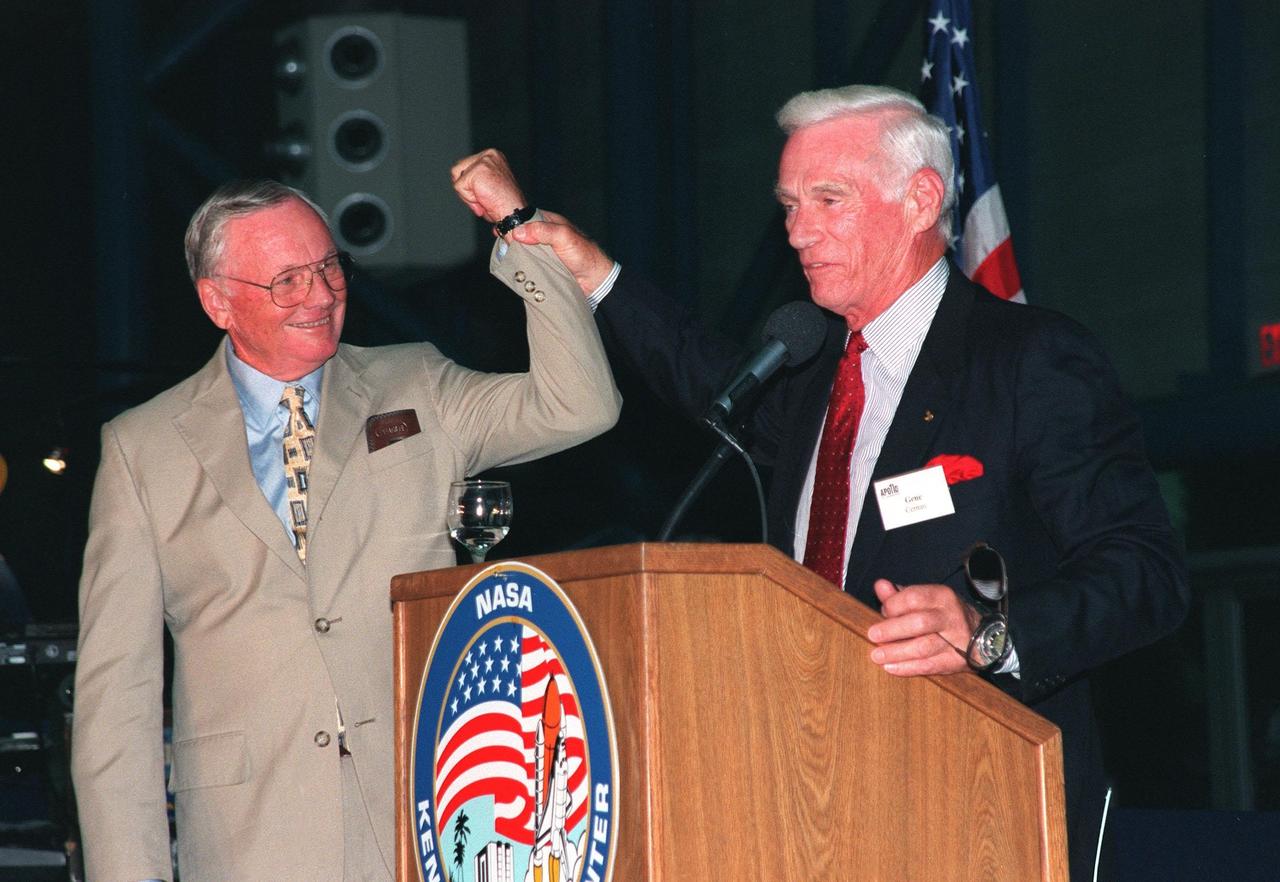
KENNEDY SPACE CENTER, FLA. -- Former Apollo astronauts Neil Armstrong (left) and Gene Cernan entertain the audience during an anniversary banquet honoring the Apollo program team, the people who made the entire lunar landing program possible. The banquet was held in the Apollo/Saturn V Center, part of the KSC Visitor Complex. This is the 30th anniversary of the Apollo 11 launch and moon landing, July 16 and July 20, 1969. Other guests at the banquet were astronauts Wally Schirra, Edwin "Buzz" Aldrin and Walt Cunningham. Neil Armstrong was the first man to walk on the moon; Gene Cernan was the last
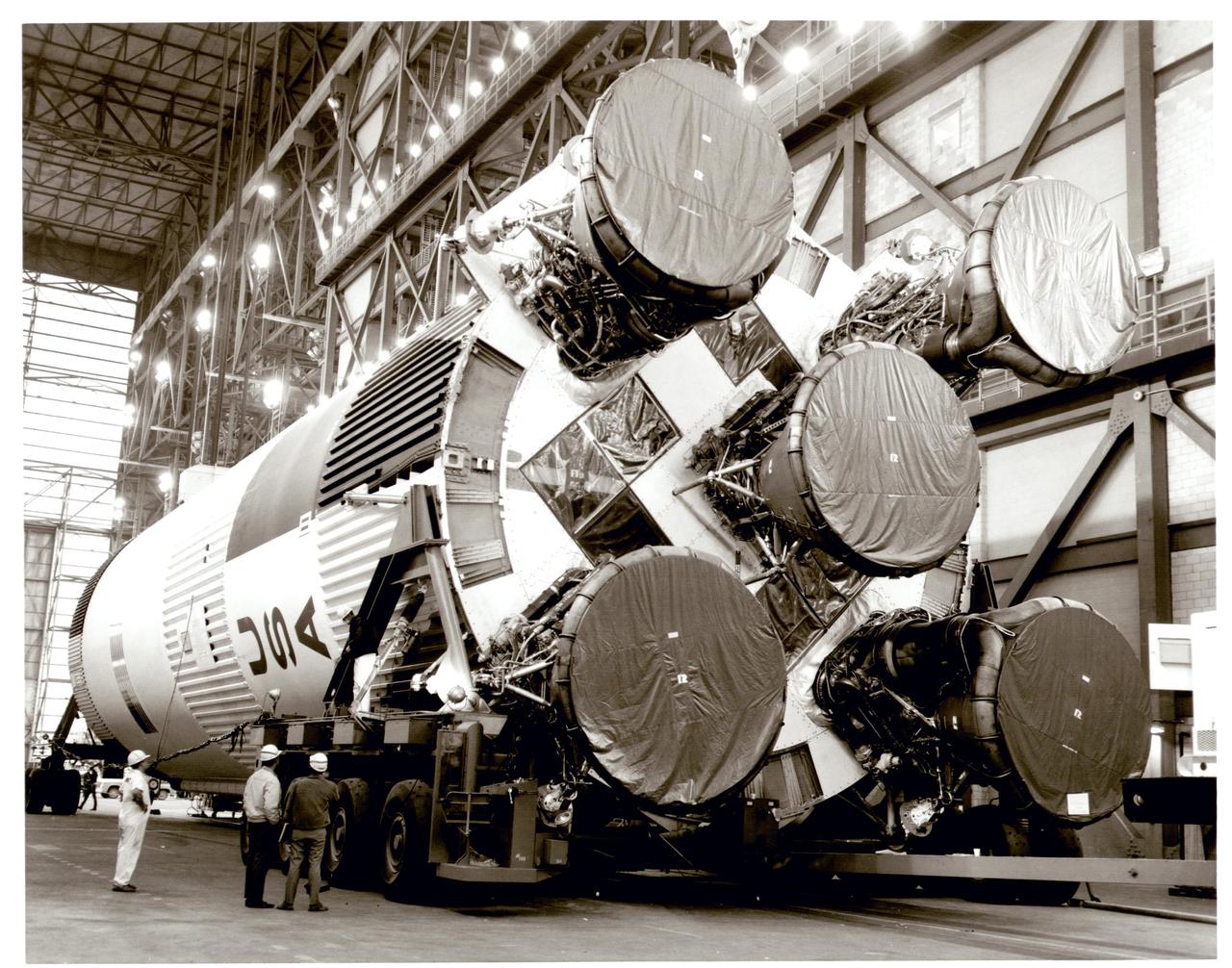
Teams attach the S-1C (first stage) booster for the Apollo 11 Saturn V rocket to cranes in preparation for lifting and stacking on its mobile launcher inside the Vehicle Assembly Building at NASA’s Kennedy Space Center in Florida in February 1969. The booster is 138 feet tall, 33 feet in diameter, and produces 7.5 million pounds of thrust from its five powerful engines. Apollo 11 was the first flight that landed humans on the Moon under the Apollo Program. The mission launched on July 16, 1969, and members of the crew included Commander Neil A. Armstrong, Command Module Pilot Michael Collins, and Lunar Module Pilot Edwin “Buzz” Aldrin.
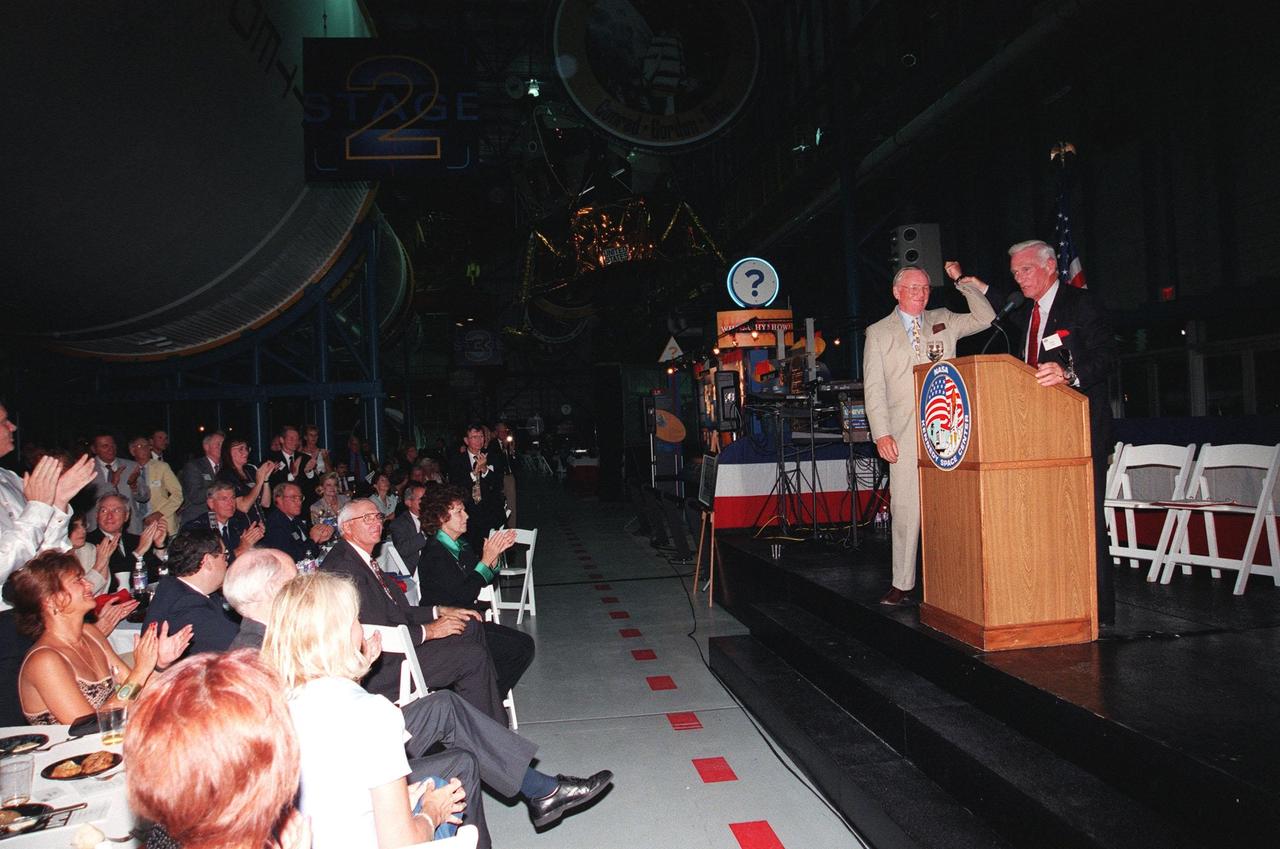
KENNEDY SPACE CENTER, FLA. -- Former Apollo astronauts Neil Armstrong (left) and Gene Cernan entertain the audience during an anniversary banquet honoring the Apollo program team, the people who made the entire lunar landing program possible. The banquet was held in the Apollo/Saturn V Center, part of the KSC Visitor Complex. This is the 30th anniversary of the Apollo 11 launch and moon landing, July 16 and July 20, 1969. Other guests at the banquet were astronauts Wally Schirra, Edwin "Buzz" Aldrin and Walt Cunningham. Armstrong was the first man to walk on the moon; Cernan was the last
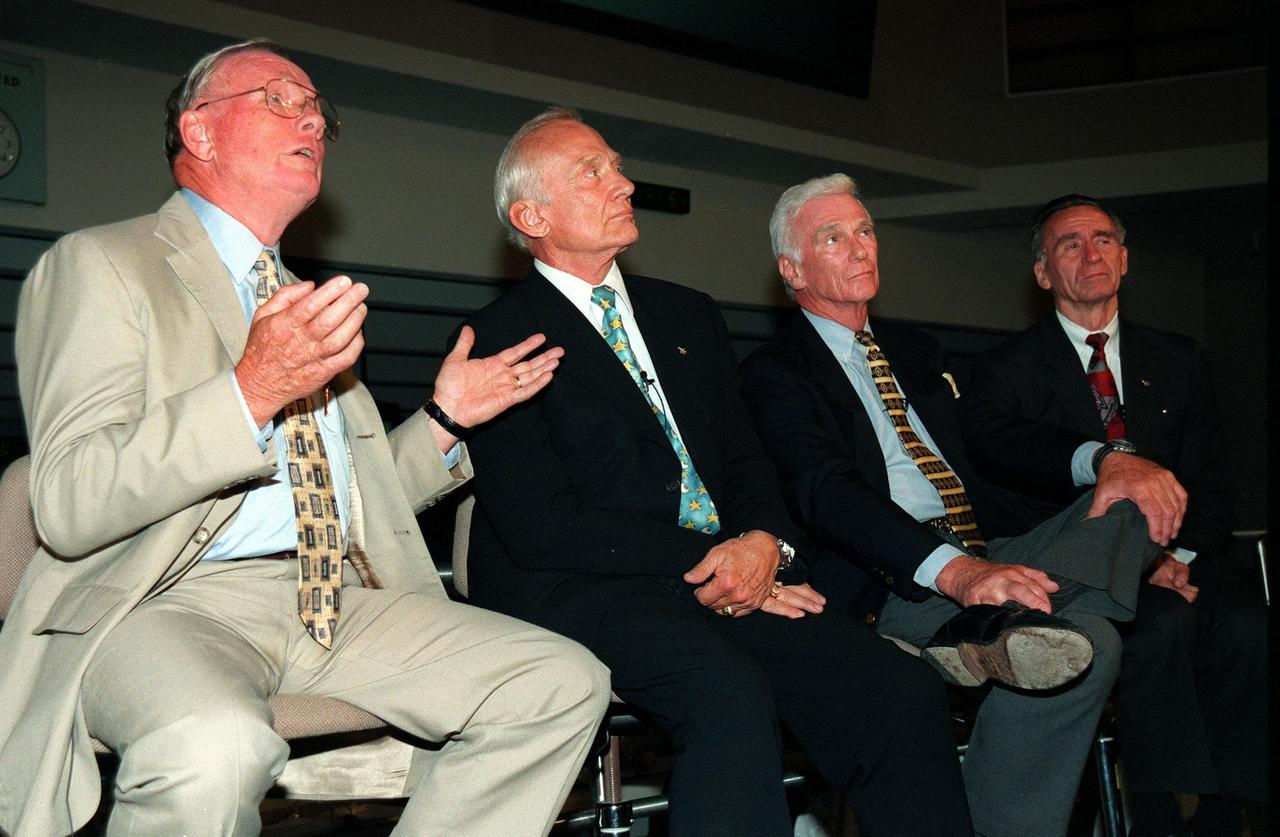
KENNEDY SPACE CENTER, FLA. -- Former Apollo astronauts meet with the media at the Apollo/Saturn V Center prior to an anniversary banquet highlighting the contributions of aerospace employees who made the Apollo program possible. From left are Neil A. Armstrong and Edwin "Buzz" Aldrin who flew on Apollo 11, the launch to the moon; Gene Cernan, who flew on Apollo 10 and 17; and Walt Cunningham, who flew on Apollo 7. This is the 30th anniversary of the launch and moon landing, July 16 and July 20, 1969. Neil Armstrong was the first man to set foot on the moon
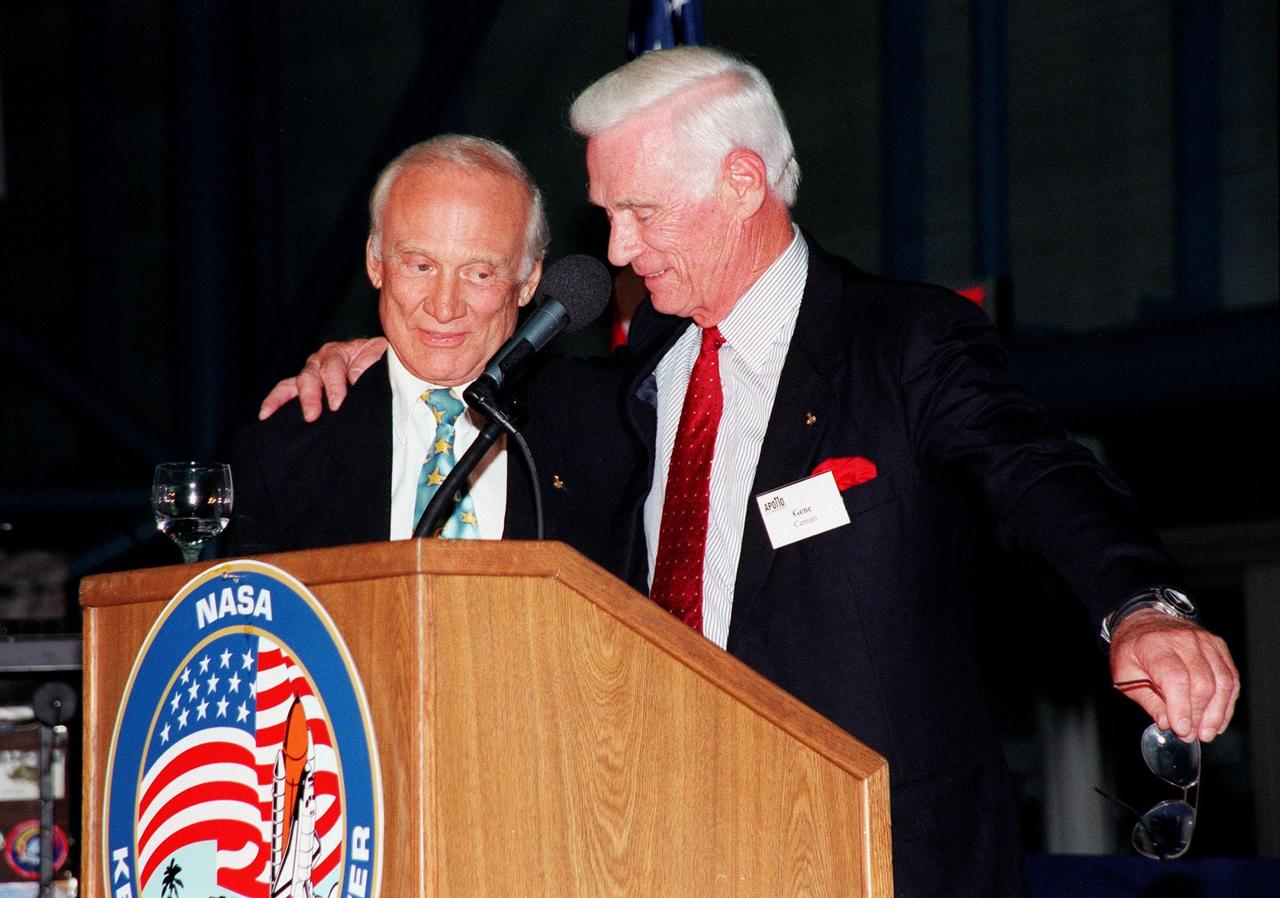
KENNEDY SPACE CENTER, FLA. -- Former Apollo astronauts Edwin "Buzz" Aldrin (left) and Gene Cernan share stories about their missions for an audience attending an anniversary banquet honoring the Apollo program team, the people who made the entire lunar landing program possible. The banquet was held in the Apollo/Saturn V Center, part of the KSC Visitor Complex. This is the 30th anniversary of the Apollo 11 launch and moon landing, July 16 and July 20, 1969. Other guests at the banquet were astronauts Wally Schirra, Gene Cernan and Walt Cunningham. Neil Armstrong was the first man to walk on the moon; Gene Cernan was the last
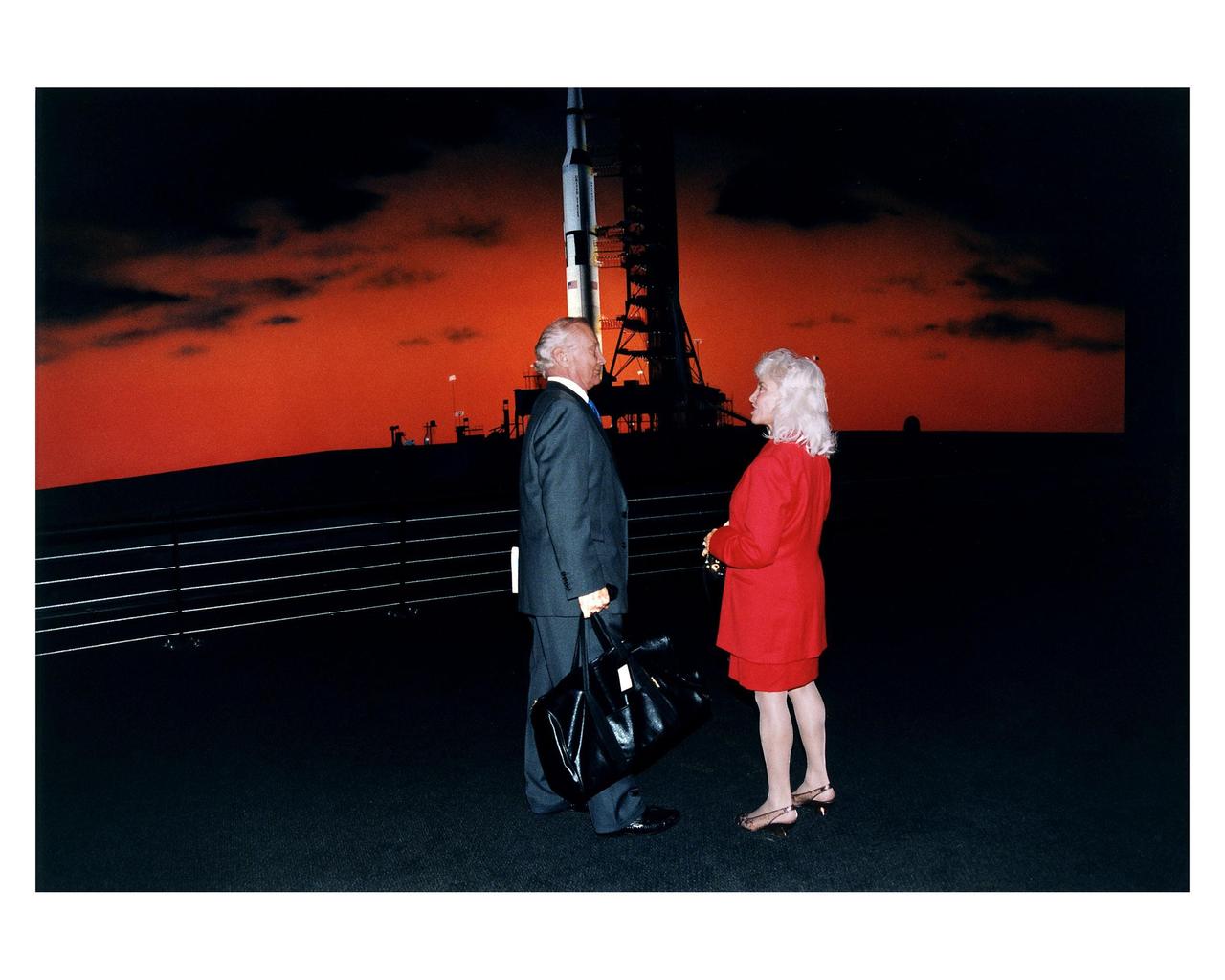
KENNEDY SPACE CENTER, FLA. -- Apollo 11 Lunar Module Pilot Edwin E. "Buzz" Aldrin, Jr. and his wife, Lois, stand before a painting of an Apollo/Saturn V launch vehicle at the pad in the new Apollo/Saturn V Center (ASVC) at KSC prior to the gala grand opening ceremony for the facility that was held Jan. 8, 1997. The astronauts were invited to participate in the event, which also featured NASA Administrator Dan Goldin and KSC Director Jay Honeycutt. The ASVC also features several other Apollo program spacecraft component displays and multimedia presentations. The facility will be a part of the KSC bus tour that embarks from the KSC Visitor Center
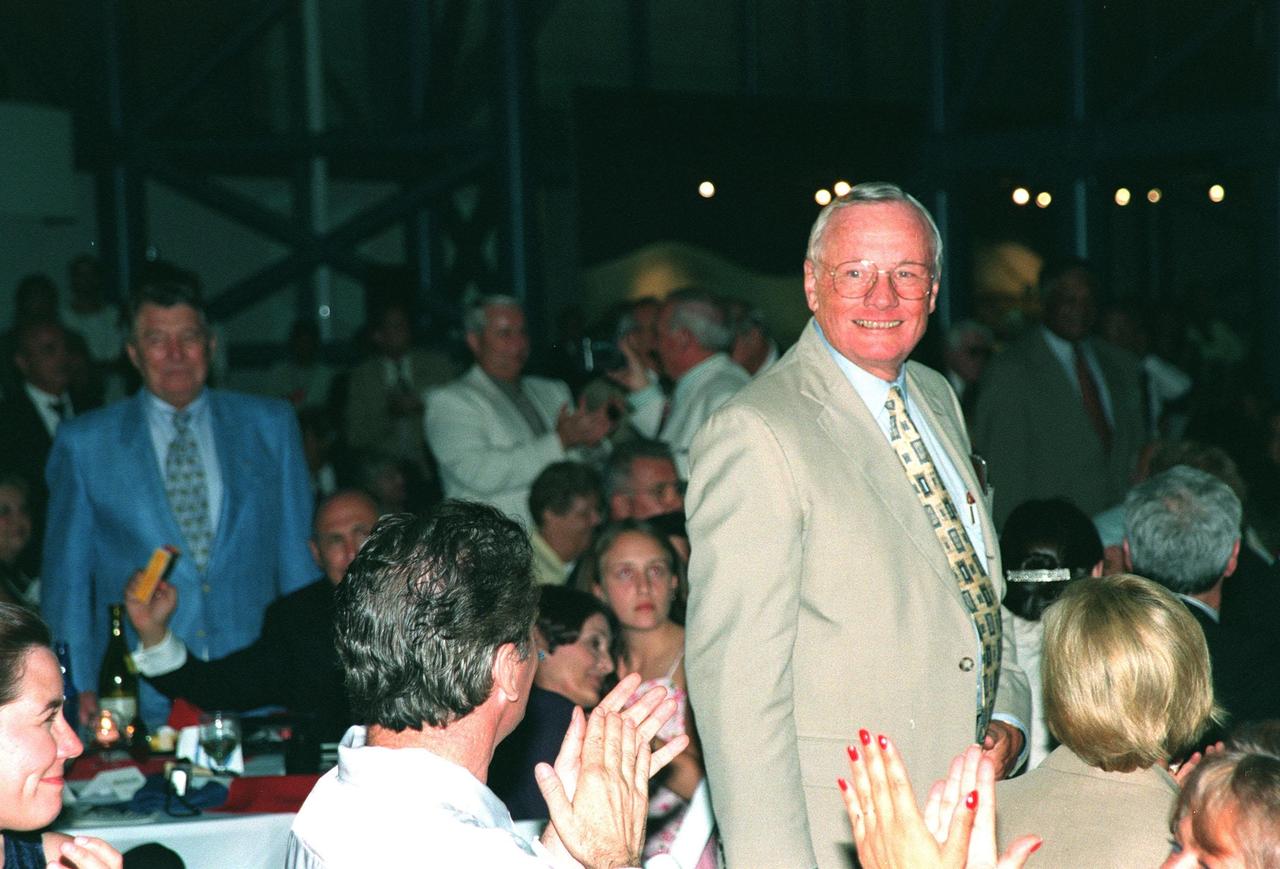
KENNEDY SPACE CENTER, FLA. -- Former Apollo 11 astronaut Neil A. Armstrong stands to a round of applause after being introduced at the anniversary banquet honoring the Apollo team, the people who made the entire lunar landing program possible. The banquet was held in the Apollo/Saturn V Center, part of the KSC Visitor Complex. This is the 30th anniversary of the Apollo 11 launch and moon landing, July 16 and July 20, 1969. Neil Armstrong was the first man to set foot on the moon. He appeared at the banquet with other former astronauts Edwin "Buzz" Aldrin, Gene Cernan, Walt Cunningham and others
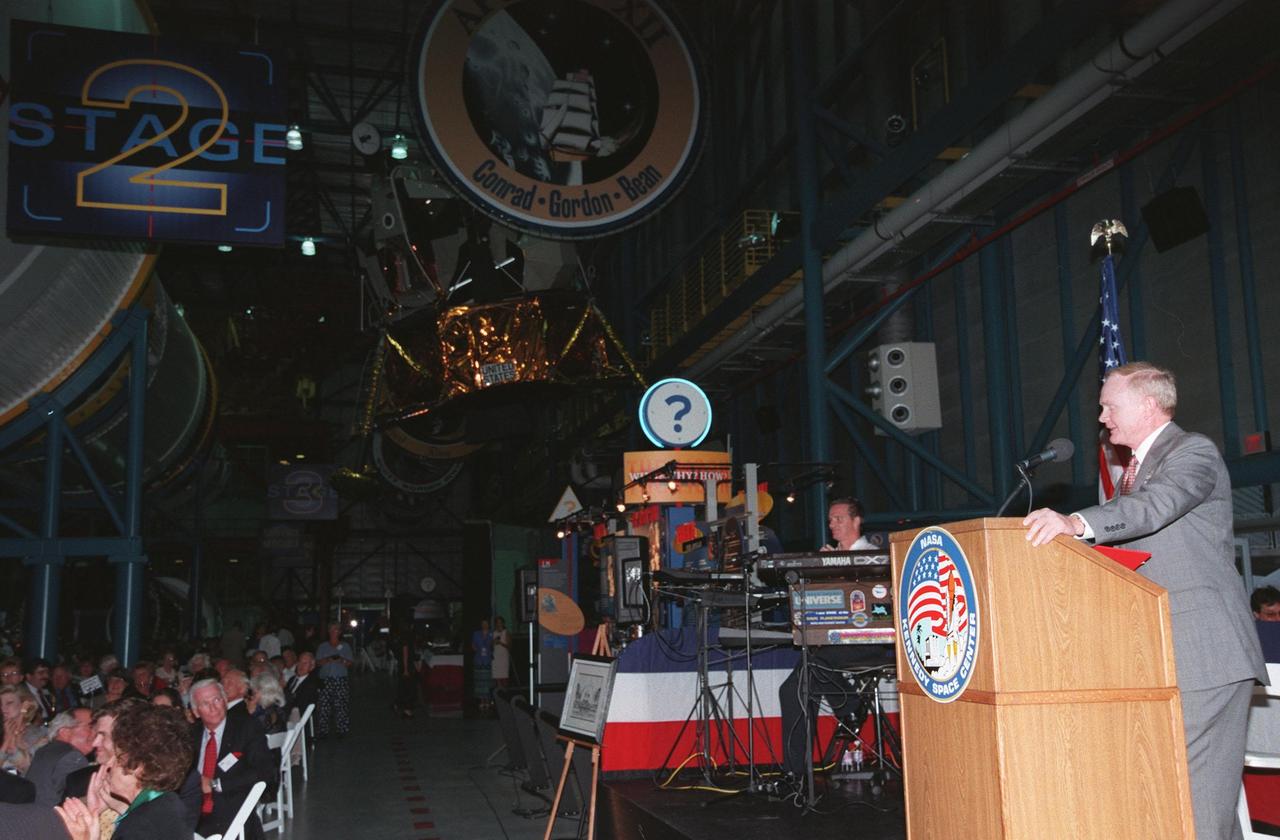
KENNEDY SPACE CENTER, FLA. -- At an anniversary banquet honoring the Apollo program team, the people who made the entire lunar landing program possible, Center Director Roy D. Bridges offers remarks. The banquet was held in the Apollo/Saturn V Center, part of the KSC Visitor Complex. This is the 30th anniversary of the Apollo 11 launch and moon landing, July 16 and July 20, 1969. Among the guests at the banquet were astronauts Neil Armstrong, Edwin "Buzz" Aldrin, Wally Schirra, Gene Cernan and Walt Cunningham. Neil Armstrong was the first man to walk on the moon; Gene Cernan was the last
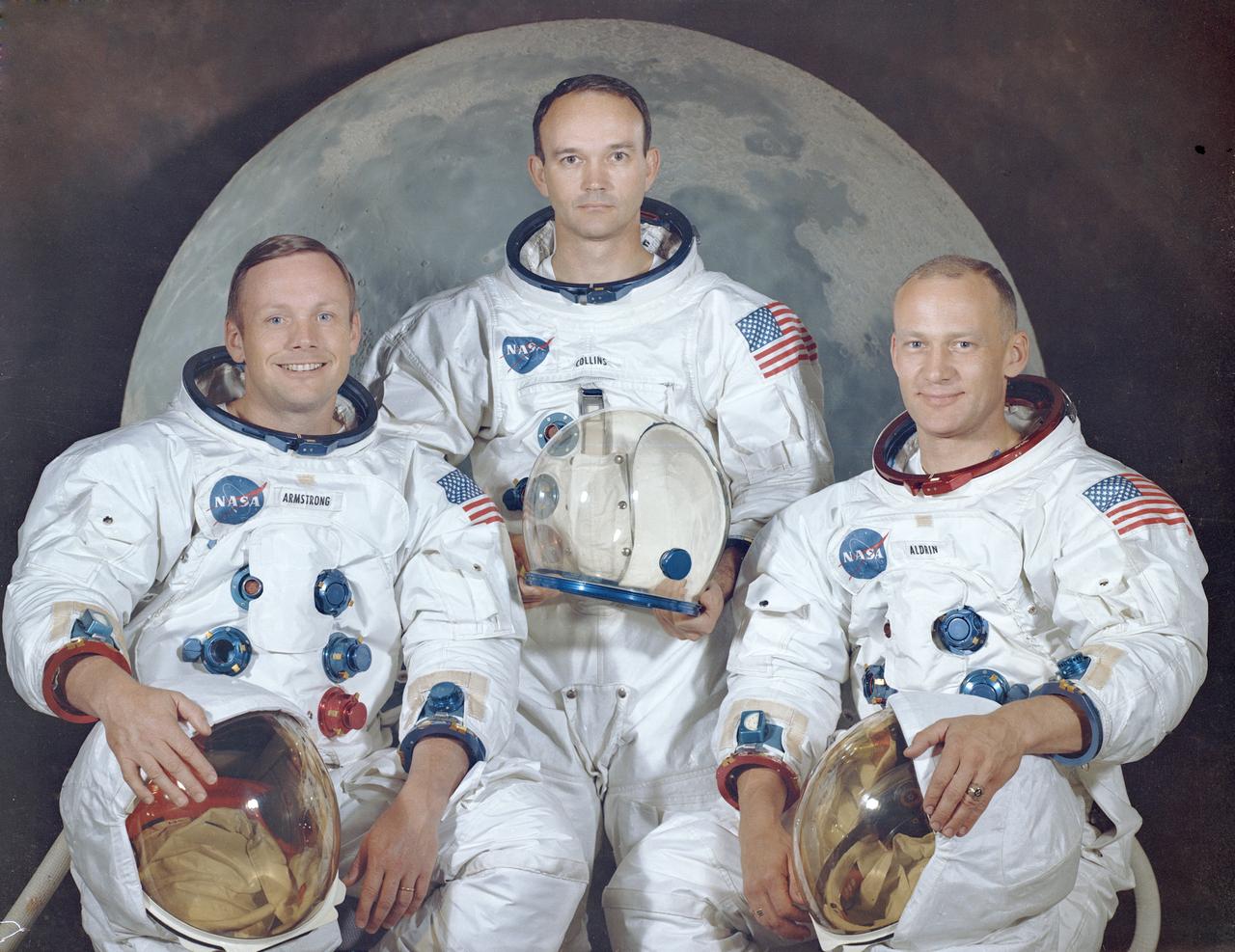
This is the official crew portrait of the Apollo 11 astronauts. Pictured from left to right are: Neil A. Armstrong, Commander; Michael Collins, Module Pilot; Edwin E. "Buzz" Aldrin, Lunar Module Pilot. Apollo 11 was the first marned lunar landing mission that placed the first humans on the surface of the moon and returned them back to Earth. Astronaut Armstrong became the first man on the lunar surface, and astronaut Aldrin became the second. Astronaut Collins piloted the Command Module in a parking orbit around the Moon. Launched aboard the Saturn V launch vehicle (SA-506), the three astronauts began their journey to the moon with liftoff from launch complex 39A at the Kennedy Space Center at 8:32 am CDT, July 16, 1969.
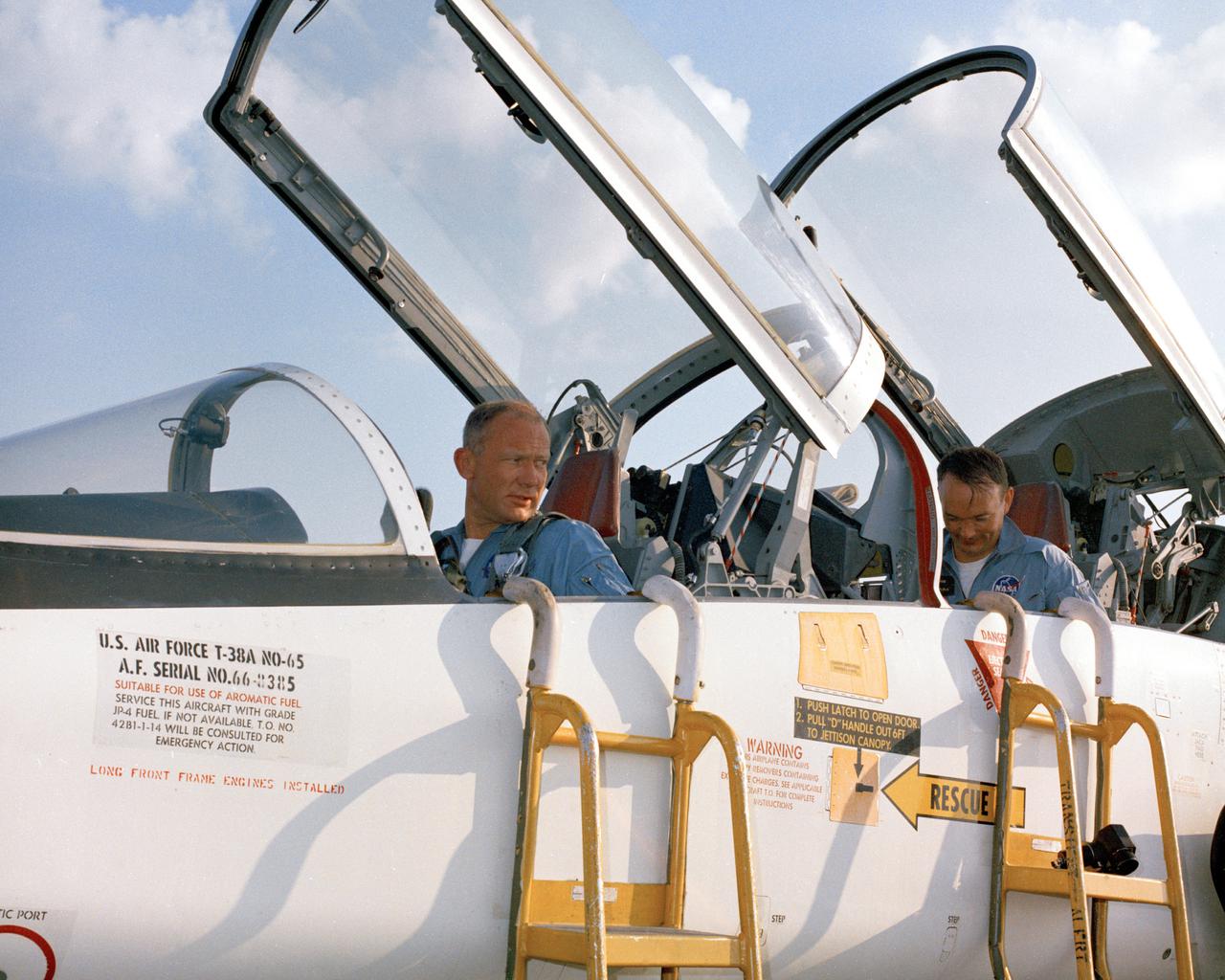
PATRICK AFB, Fla. – In preparation of the nation’s first lunar landing mission, Apollo 11 crew members arrive at Patrick Air Force Base, Florida. Lunar module pilot Edwin E. Buzz Aldrin Jr. is in the front seat of the T-38 jet, with command module pilot Michael Collins, in the back. Lift off atop a Saturn V launch vehicle is scheduled for July 16, 1969. During Apollo 11 the command module, Columbia, will remain in orbit around the moon while the lunar module, Eagle, carrying Armstrong and Aldrin, lands on the lunar surface. During 2½ hours of surface exploration, the crew plans to collect lunar surface material for analysis back on Earth. For more: http:__www-pao.ksc.nasa.gov_history_apollo_apollo-11_apollo-11.htm Photo credit: NASA
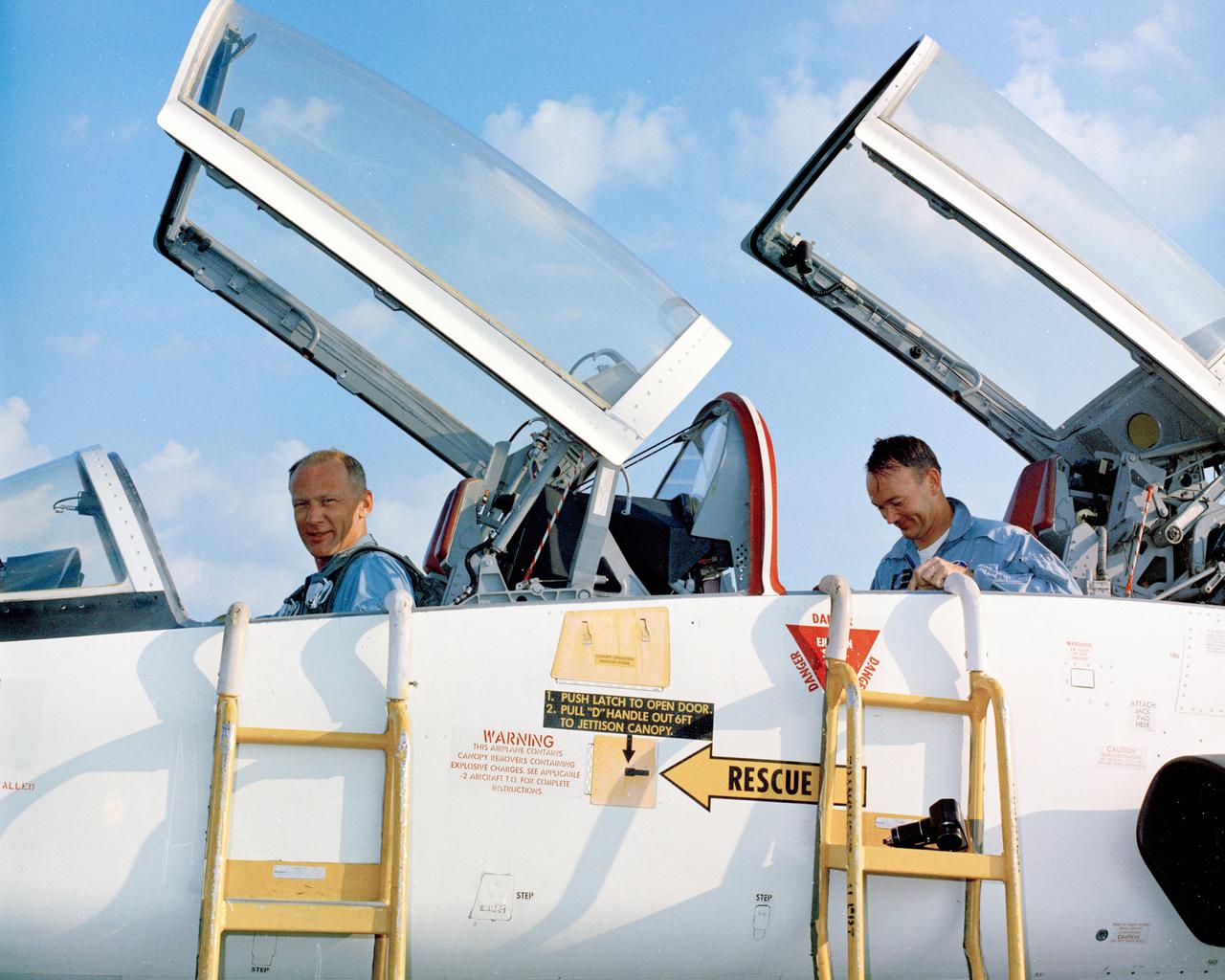
PATRICK AFB, Fla. – In preparation of the nation’s first lunar landing mission, Apollo 11 crew members arrive at Patrick Air Force Base, Florida. Lunar module pilot Edwin E. Buzz Aldrin Jr. is in the front seat of the T-38 jet, with command module pilot Michael Collins, in the back. Lift off atop a Saturn V launch vehicle is scheduled for July 16, 1969. During Apollo 11 the command module, Columbia, will remain in orbit around the moon while the lunar module, Eagle, carrying Armstrong and Aldrin, lands on the lunar surface. During 2½ hours of surface exploration, the crew plans to collect lunar surface material for analysis back on Earth. For more: http:__www-pao.ksc.nasa.gov_history_apollo_apollo-11_apollo-11.htm Photo credit: NASA
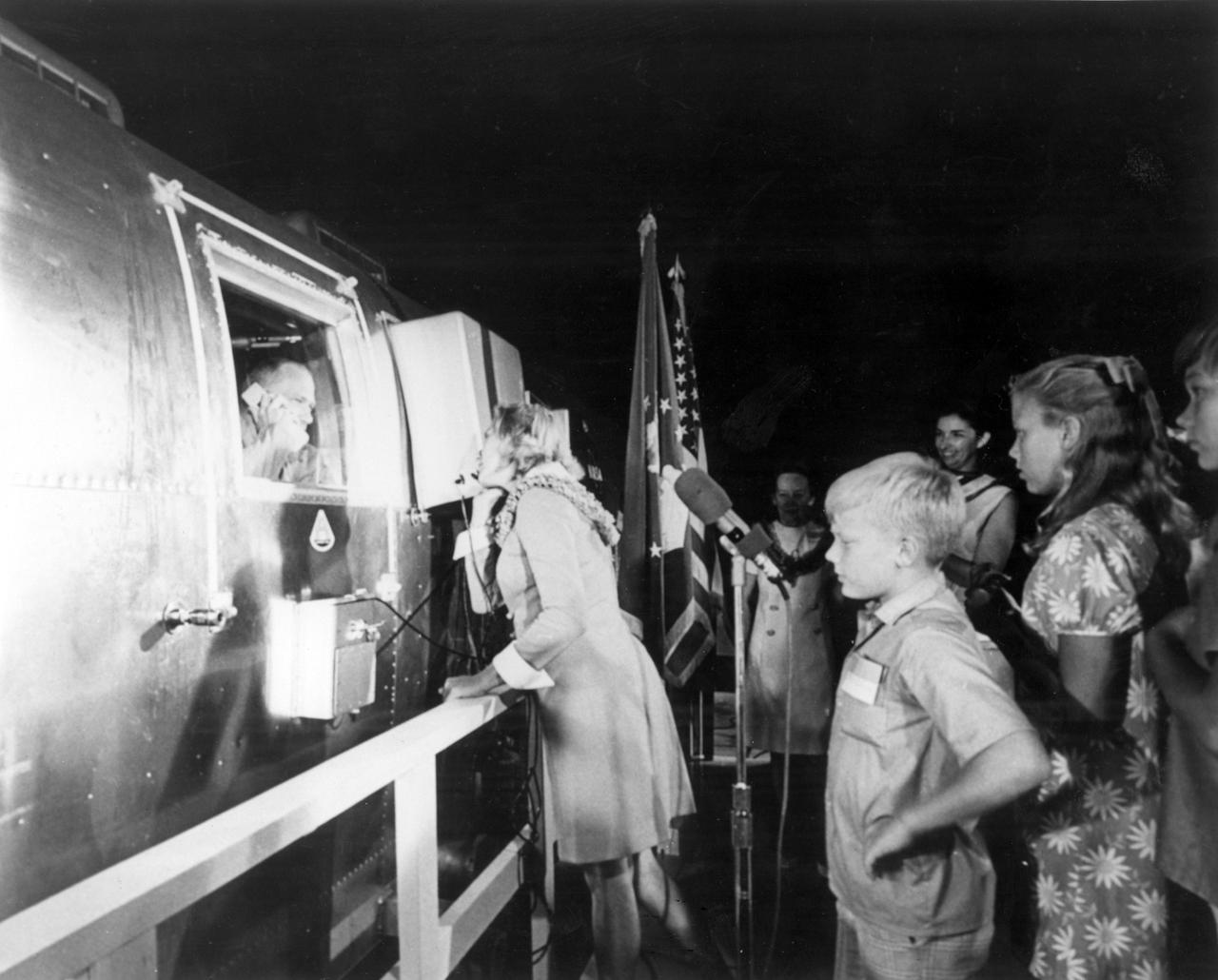
The Apollo 11 mission, the first manned lunar mission, launched from the Kennedy Space Center, Florida via the Marshall Space Flight Center (MSFC) developed Saturn V launch vehicle on July 16, 1969 and safely returned to Earth on July 24, 1969. Aboard the space craft were astronauts Neil A. Armstrong, commander; Michael Collins, Command Module (CM) pilot; and Edwin E. (Buzz) Aldrin Jr., Lunar Module (LM) pilot. The CM, piloted by Michael Collins remained in a parking orbit around the Moon while the LM, named “Eagle’’, carrying astronauts Neil Armstrong and Edwin Aldrin, landed on the Moon. During 2½ hours of surface exploration, the crew collected 47 pounds of lunar surface material for analysis back on Earth. The recovery operation took place in the Pacific Ocean where Navy para-rescue men recovered the capsule housing the 3-man Apollo 11 crew. The crew was airlifted to safety aboard the U.S.S. Hornet, where they were quartered in a Mobile Quarantine Facility (MQF) which served as their home until they reached the NASA Manned Spacecraft Center (MSC) Lunar Receiving Laboratory in Houston, Texas. On arrival at Ellington Air Force base near the MSC, the crew, still under a 21 day quarantine in the MQF, were greeted by their wives. Pictured here is Joan Aldrin, wife of Buzz Aldrin, speaking with her husband via telephone patch.
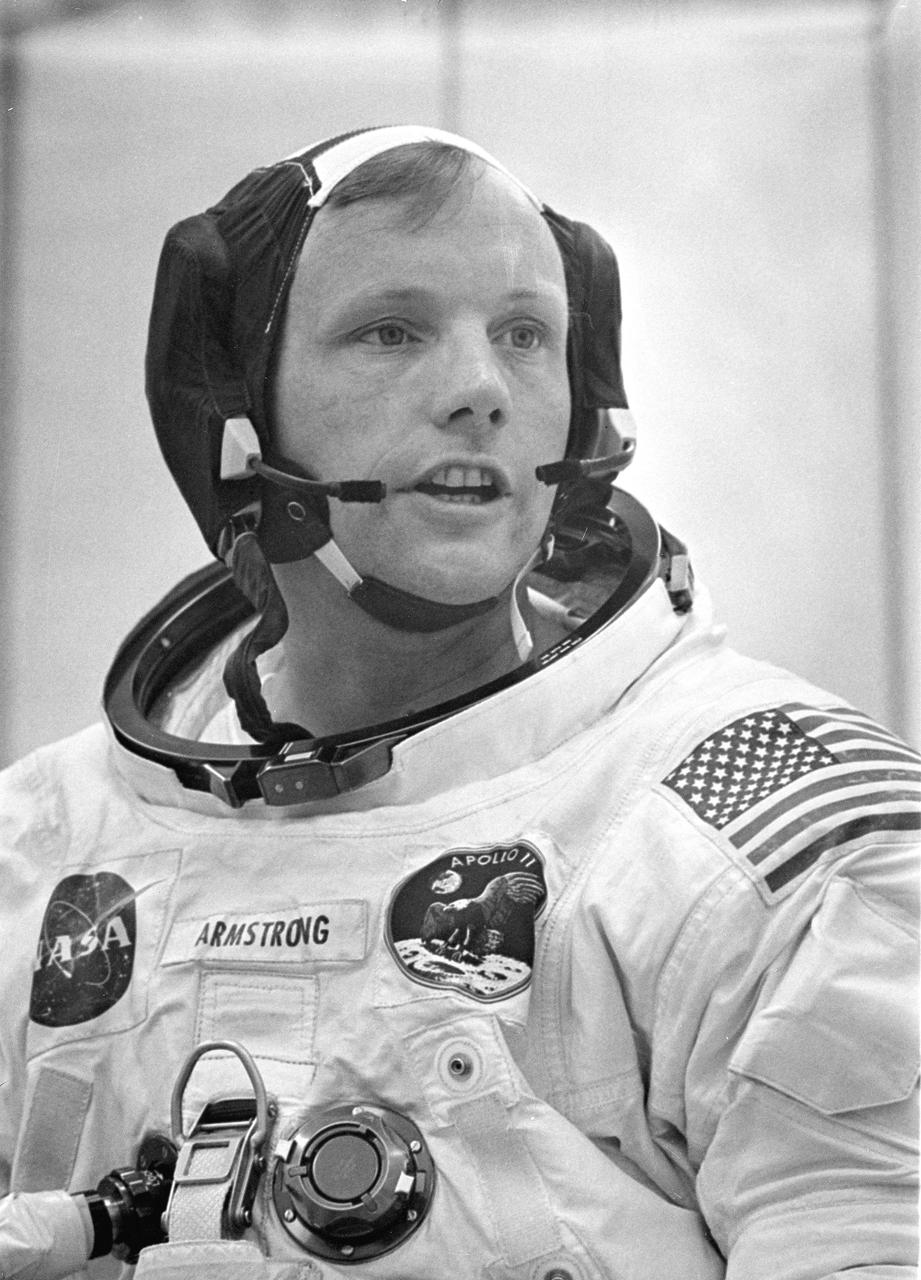
Dunned in his space suit, mission commander Neil A. Armstrong does a final check of his communications system before before the boarding of the Apollo 11 mission. Launched via a Saturn V launch vehicle, the first manned lunar mission launched from the Kennedy Space Center, Florida on July 16, 1969 and safely returned to Earth on July 24, 1969. The Saturn V vehicle was developed by the Marshall Space Flight Center (MSFC) under the direction of Dr. Wernher von Braun. The 3-man crew aboard the flight consisted of astronauts Armstrong; Michael Collins, Command Module (CM) pilot; and Edwin E. Aldrin, Jr., Lunar Module (LM) Pilot. Armstrong was the first human to ever stand on the lunar surface, followed by Edwin (Buzz) Aldrin. Meanwhile, astronaut Collins piloted the CM in a parking orbit around the Moon. During a 2½ hour surface exploration, the crew collected 47 pounds of lunar surface material which was returned to Earth for analysis. With the success of Apollo 11, the national objective to land men on the Moon and return them safely to Earth had been accomplished.
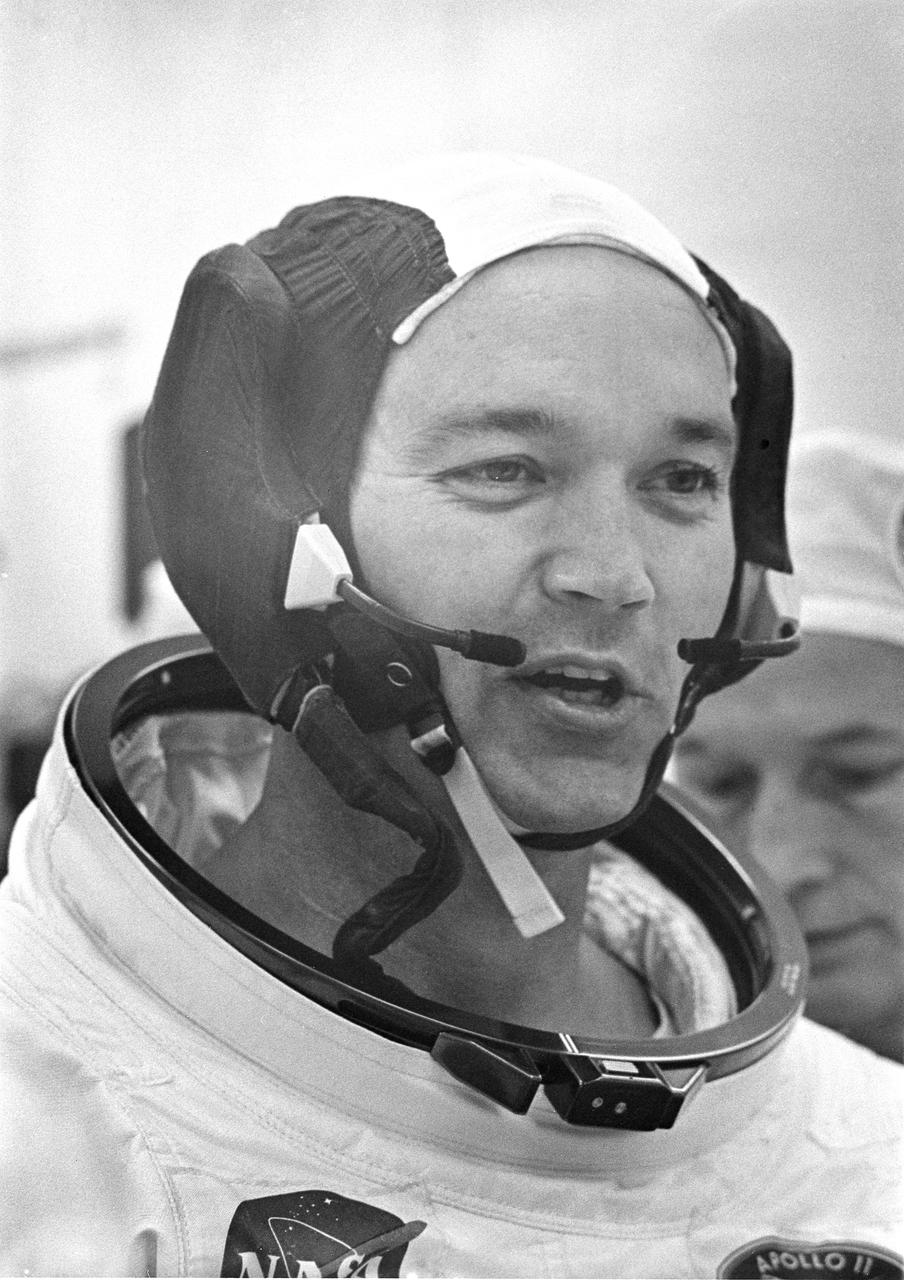
Dunned in his space suit, Command Module (CM) pilot Michael Collins does a final check of his communications system before the boarding of the Apollo 11 mission. Launched via a Saturn V launch vehicle, the first manned lunar mission launched from the Kennedy Space Center, Florida on July 16, 1969 and safely returned to Earth on July 24, 1969. The Saturn V vehicle was developed by the Marshall Space Flight Center (MSFC) under the direction of Dr. Wernher von Braun. The 3-man crew aboard the flight consisted of astronauts Collins; Neil A. Armstrong, Mission Commander; and Edwin E. Aldrin, Jr., Lunar Module (LM) Pilot. Armstrong was the first human to ever stand on the lunar surface, followed by Edwin (Buzz) Aldrin. Meanwhile, astronaut Collins piloted the CM in a parking orbit around the Moon. During a 2½ hour surface exploration, the crew collected 47 pounds of lunar surface material which was returned to Earth for analysis. With the success of Apollo 11, the national objective to land men on the Moon and return them safely to Earth had been accomplished.
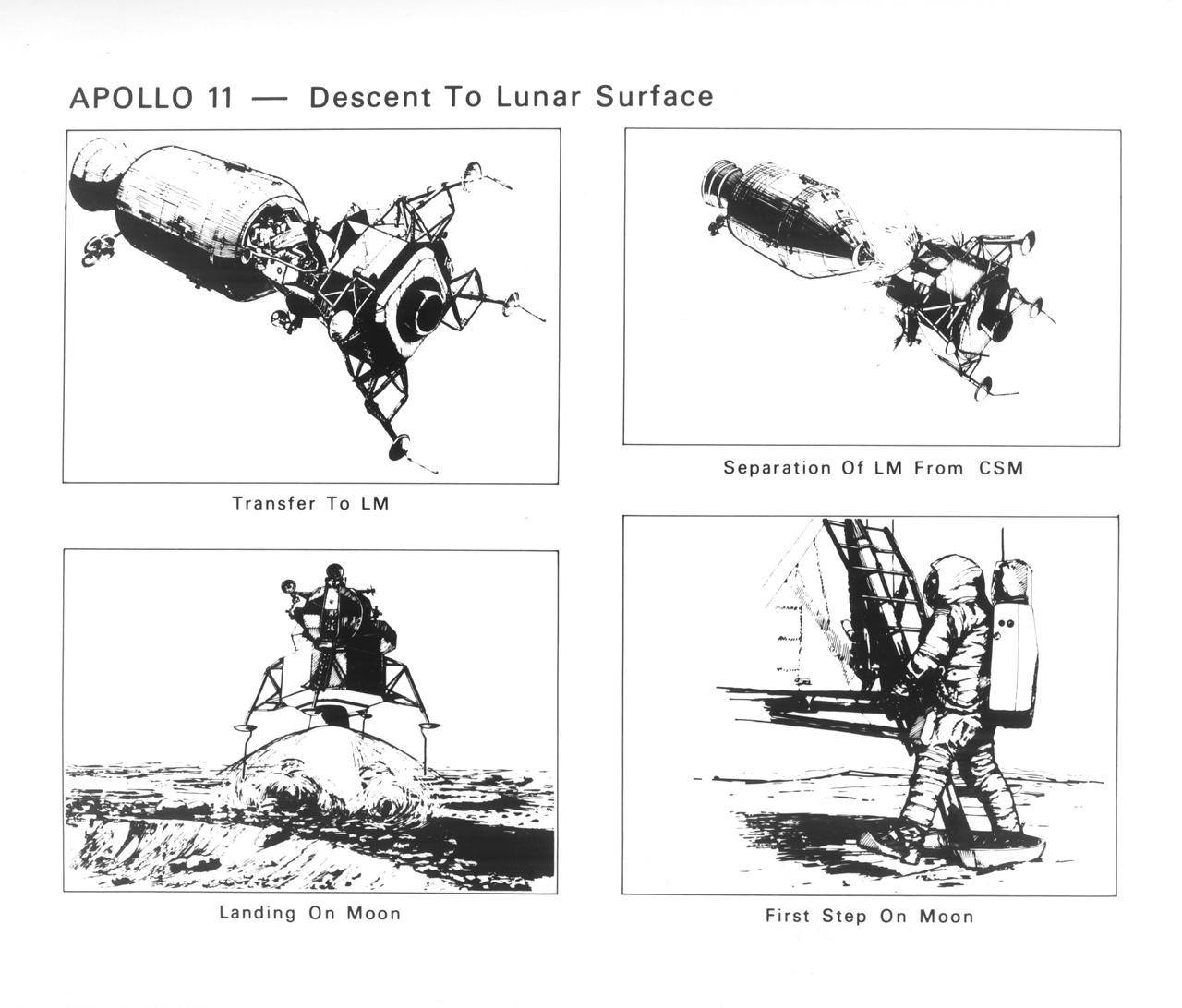
The Apollo 11 mission launched from the Kennedy Space Center (KSC) in Florida via the Marshall Space Flight Center (MSFC) developed Saturn V launch vehicle on July 16, 1969 and safely returned to Earth on July 24, 1969. Aboard the space craft were astronauts Neil A. Armstrong, commander; Michael Collins, Command Module (CM) pilot; and Edwin E. (Buzz) Aldrin Jr., Lunar Module (LM) pilot. With the success of Apollo 11, the national objective to land men on the Moon and return them safely to Earth had been accomplished. These sketches illustrate the steps taken in going from lunar orbit onto the Moon’s surface. Apollo 11 commander, Neil Armstrong and LM pilot Edwin Aldrin transferred from the CM to the LM and the LM separated. Firing the descent stage engine in retrothrust slowed the LM and put it on the let down trajectory. Near the Lunar surface, the engine was used to lower the craft slowly to the surface. After a checkout of systems and depressurization of the LM cabin, the hatch was opened for Armstrong’s climb down the ladder to the Moon’s soil.
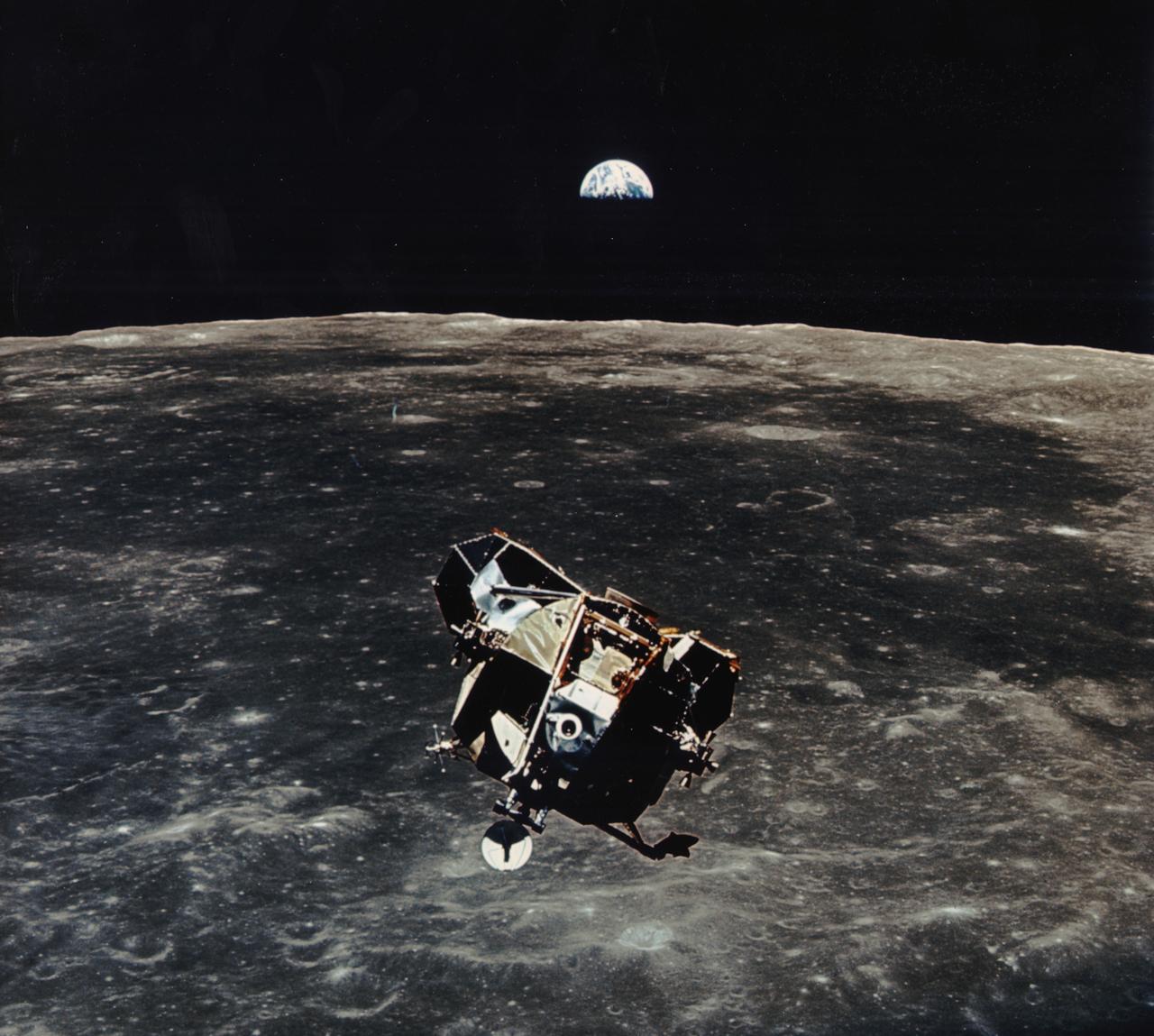
The Apollo 11 mission launched from the Kennedy Space Center (KSC) in Florida via the Marshall Space Flight Center (MSFC) developed Saturn V launch vehicle on July 16, 1969 and safely returned to Earth on July 24, 1969. Aboard the space craft were astronauts Neil A. Armstrong, commander; Michael Collins, Command Module (CM) pilot; and Edwin E. (Buzz) Aldrin Jr., Lunar Module (LM) pilot. With the success of Apollo 11, the national objective to land men on the Moon and return them safely to Earth had been accomplished. After 2½ hours of surface exploration, astronauts Neil Armstrong and Edwin Aldrin returned to the LM “Eagle” for rest, eating, and checkout of the vehicle in preparation for liftoff. The LM was a two part spacecraft. Its lower or descent stage had the landing gear, engines, and fuel needed for the landing. When the LM blasted off the Moon, the descent stage served as the launching pad for its companion ascent stage, which was also home for the two astronauts on the surface of the Moon. The LM was full of gear with which to communicate, navigate, and rendezvous. It also had its own propulsion system, and an engine to lift it off the Moon and send it on a course toward the orbiting CM. In this photograph, the ascent stage is seen back dropped by Earth just prior to its rendezvous with the CM.
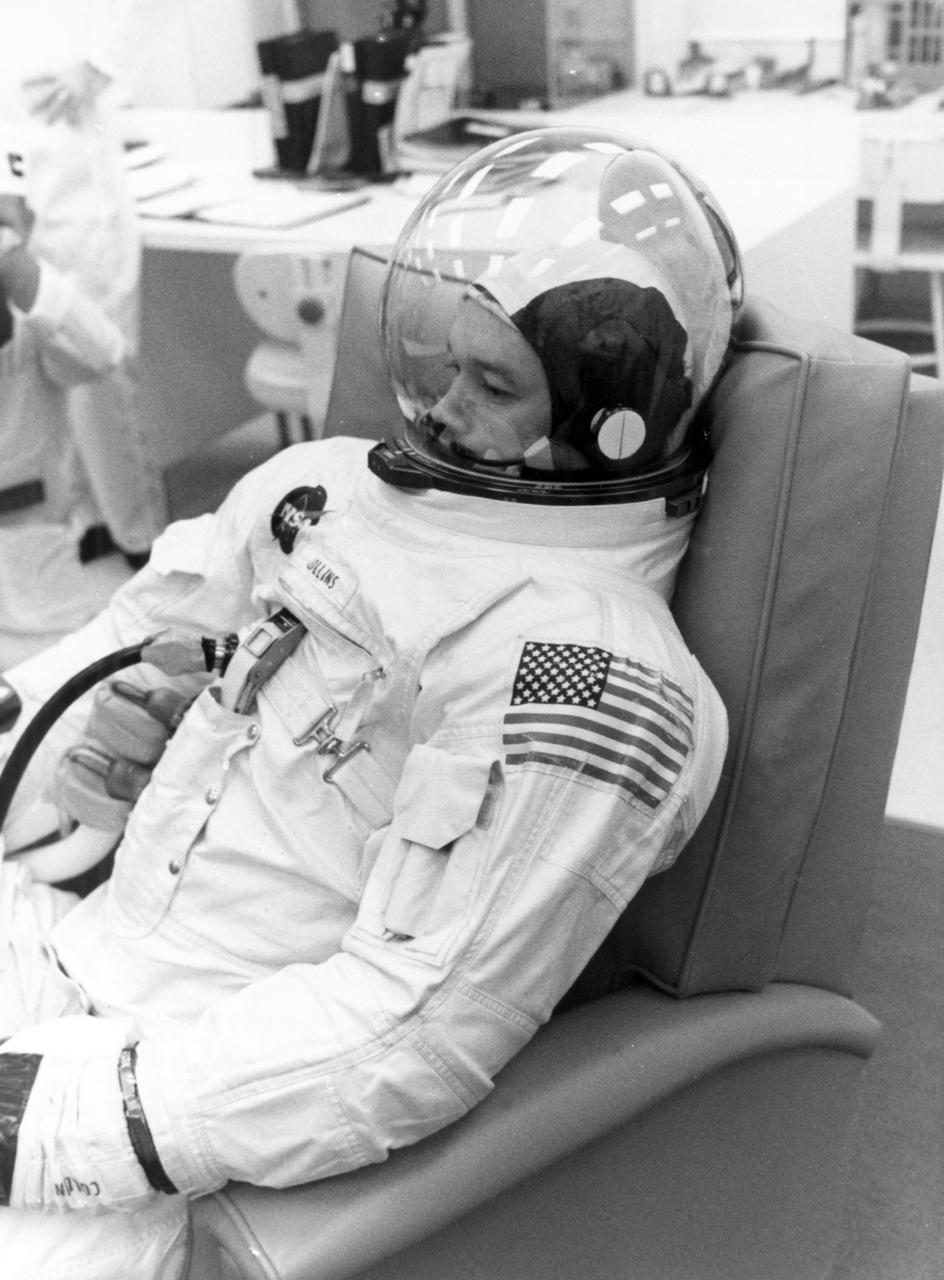
Apollo 11 crew member Michael Collins appears calm after suiting up activities for his participation in the countdown demonstration test aboard the Apollo 11 space craft along with astronauts Aldrin and Armstrong. The Apollo 11 mission, the first lunar landing mission, launched from the Kennedy Space Center (KSC) in Florida via the Marshall Space Flight Center (MSFC) developed Saturn V launch vehicle on July 16, 1969 and safely returned to Earth on July 24, 1969. Aboard the space craft were astronauts Neil A. Armstrong, commander; Michael Collins, Command Module (CM) pilot; and Edwin E. (Buzz) Aldrin Jr., Lunar Module (LM) pilot. The CM, “Columbia”, piloted by Collins, remained in a parking orbit around the Moon while the LM, “Eagle’’, carrying astronauts Armstrong and Aldrin, landed on the Moon. On July 20, 1969, Armstrong was the first human to ever stand on the lunar surface, followed by Aldrin. During 2½ hours of surface exploration, the crew collected 47 pounds of lunar surface material for analysis back on Earth. With the success of Apollo 11, the national objective to land men on the Moon and return them safely to Earth had been accomplished.
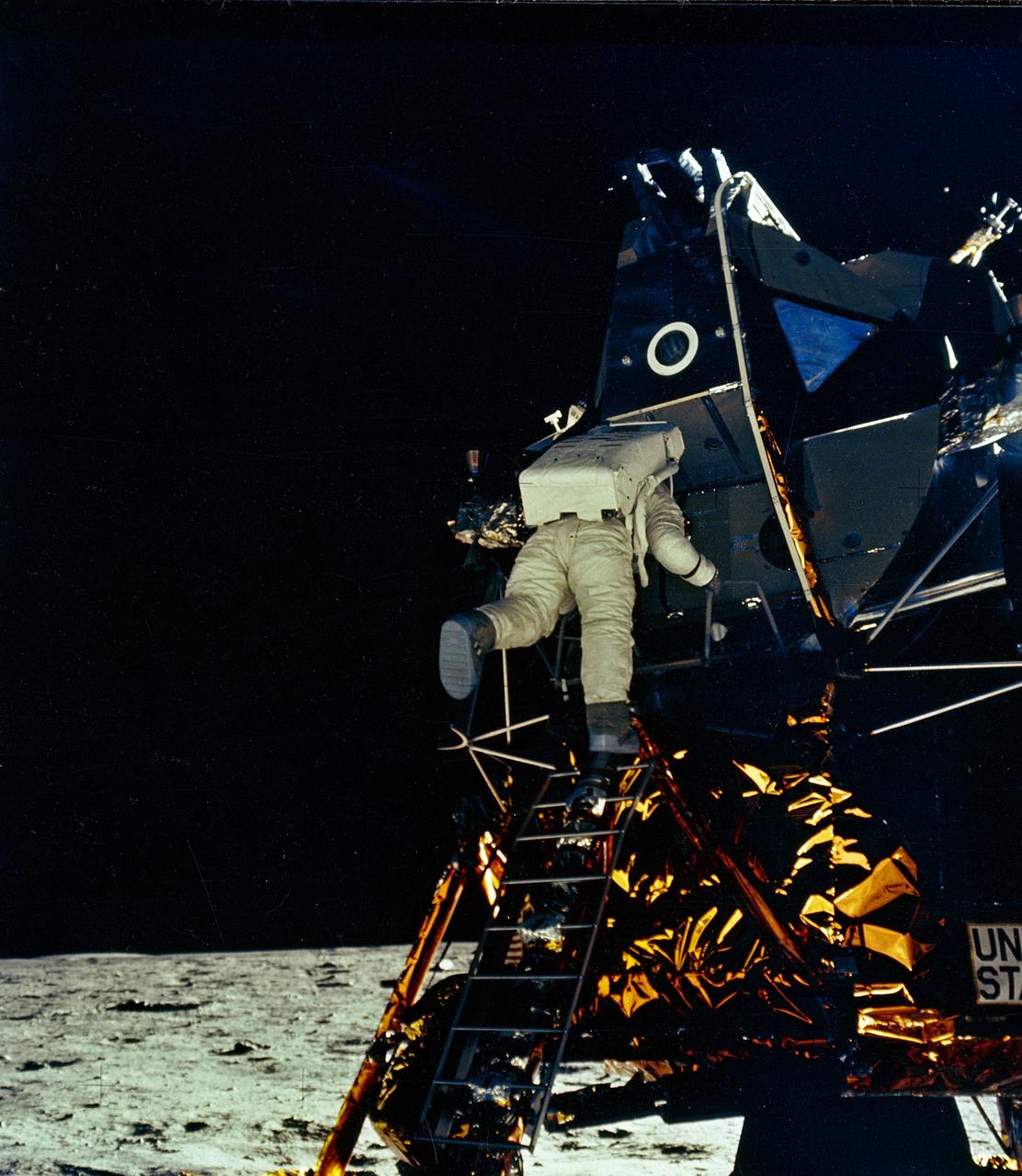
Carrying astronauts Neil A. Armstrong and Edwin E. Aldrin, Jr., the Lunar Module (LM) “Eagle” was the first crewed vehicle to land on the Moon. The LM landed on the moon’s surface on July 20, 1969 in the region known as Mare Tranquilitatis (the Sea of Tranquility). Shown here is Aldrin Jr. making his exit from the LM to the lunar surface. Armstrong, who was already on the surface, took this photograph. The Apollo 11 mission launched from the Kennedy Space Center, Florida via a Saturn V launch vehicle on July 16, 1969 and safely returned to Earth on July 24, 1969. The Saturn V vehicle was developed by the Marshall Space Flight Center (MSFC) under the direction of Dr. Wernher von Braun. The 3-man crew aboard the flight consisted of astronauts Neil A. Armstrong, commander; Michael Collins, Command Module (CM) pilot; and Edwin E. Aldrin Jr., Lunar Module pilot. Armstrong was the first human to ever stand on the lunar surface. As he stepped off the LM, Armstrong proclaimed, “That’s one small step for man, one giant leap for mankind”. He was followed by Edwin (Buzz) Aldrin, describing the lunar surface as magnificent desolation. During a 2½ hour surface exploration the crew collected 47 pounds of lunar surface material which was returned to Earth for analysis. With the success of Apollo 11, the national objective to land men on the Moon and return them safely to Earth had been accomplished.
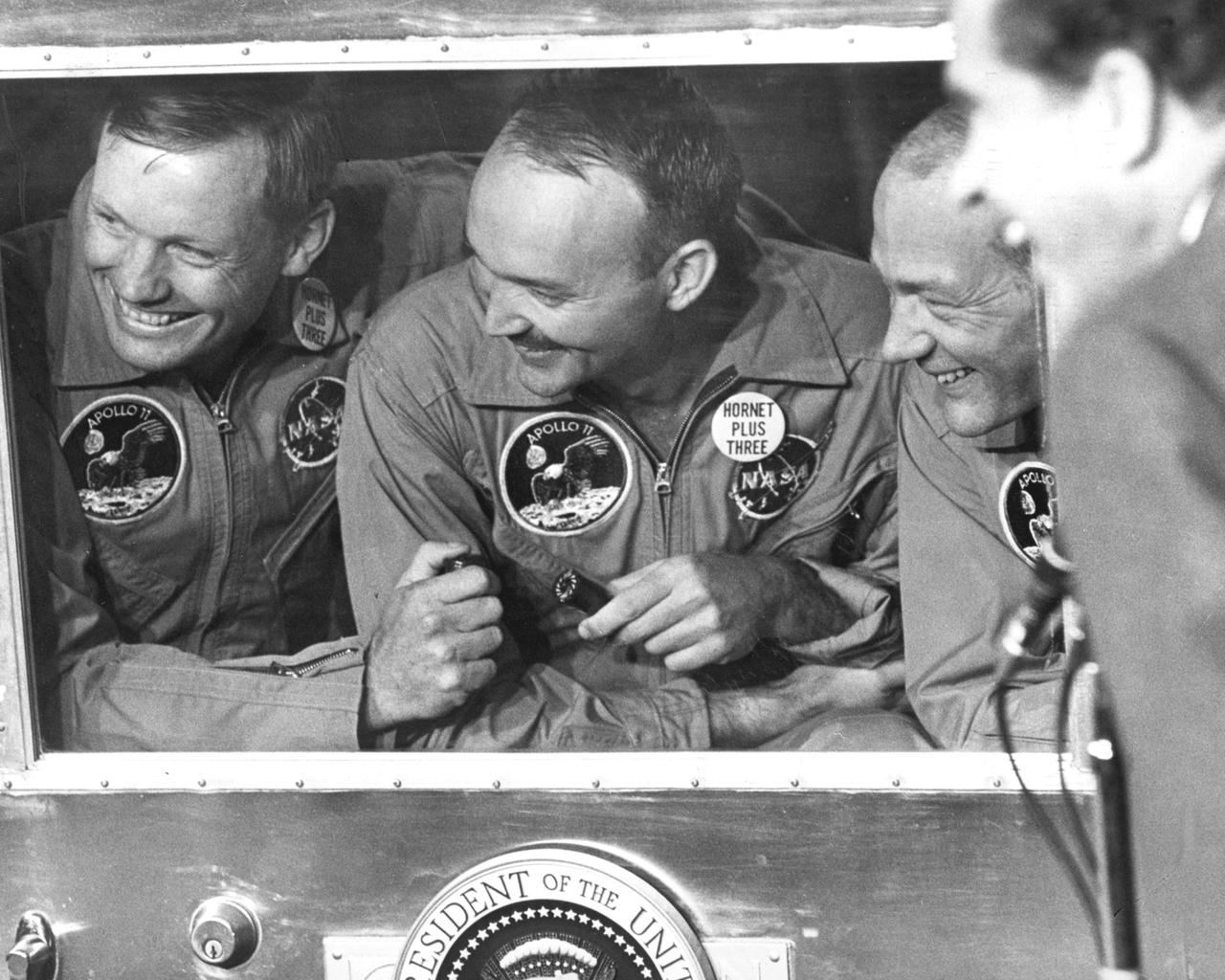
The Apollo 11 mission, the first manned lunar mission, launched from the Kennedy Space Center, Florida via the Saturn V launch vehicle on July 16, 1969 and safely returned to Earth on July 24, 1969. The Saturn V vehicle was developed by the Marshall Space Flight Center (MSFC) under the direction of Dr. Wernher von Braun. Aboard were Neil A. Armstrong, commander; Michael Collins, Command Module (CM) pilot; and Edwin E. Aldrin Jr., Lunar Module (LM) pilot. The CM, piloted by Michael Collins remained in a parking orbit around the Moon while the LM, named “Eagle’’, carrying astronauts Neil Armstrong and Edwin Aldrin, landed on the Moon. Armstrong was the first human to ever stand on the lunar surface, followed by Edwin (Buzz) Aldrin. During 2½ hours of surface exploration, the crew collected 47 pounds of lunar surface material for analysis back on Earth. The recovery operation took place in the Pacific Ocean where Navy para-rescue men recovered the capsule housing the 3-man Apollo 11 crew. The crew was airlifted to safety aboard the U.S.S. Hornet, where they were quartered in a Mobile Quarantine Facility (MQF). Here the quarantined Apollo 11 crew members (l to r) Armstrong, Collins, and Aldrin, and U.S. President Richard Milhous Nixon share laughs over a comment made by fellow astronaut Frank Borman, Apollo 8 commander. The president was aboard the recovery vessel awaiting return of the astronauts. With the success of Apollo 11, the national objective to land men on the Moon and return them safely to Earth had been accomplished.
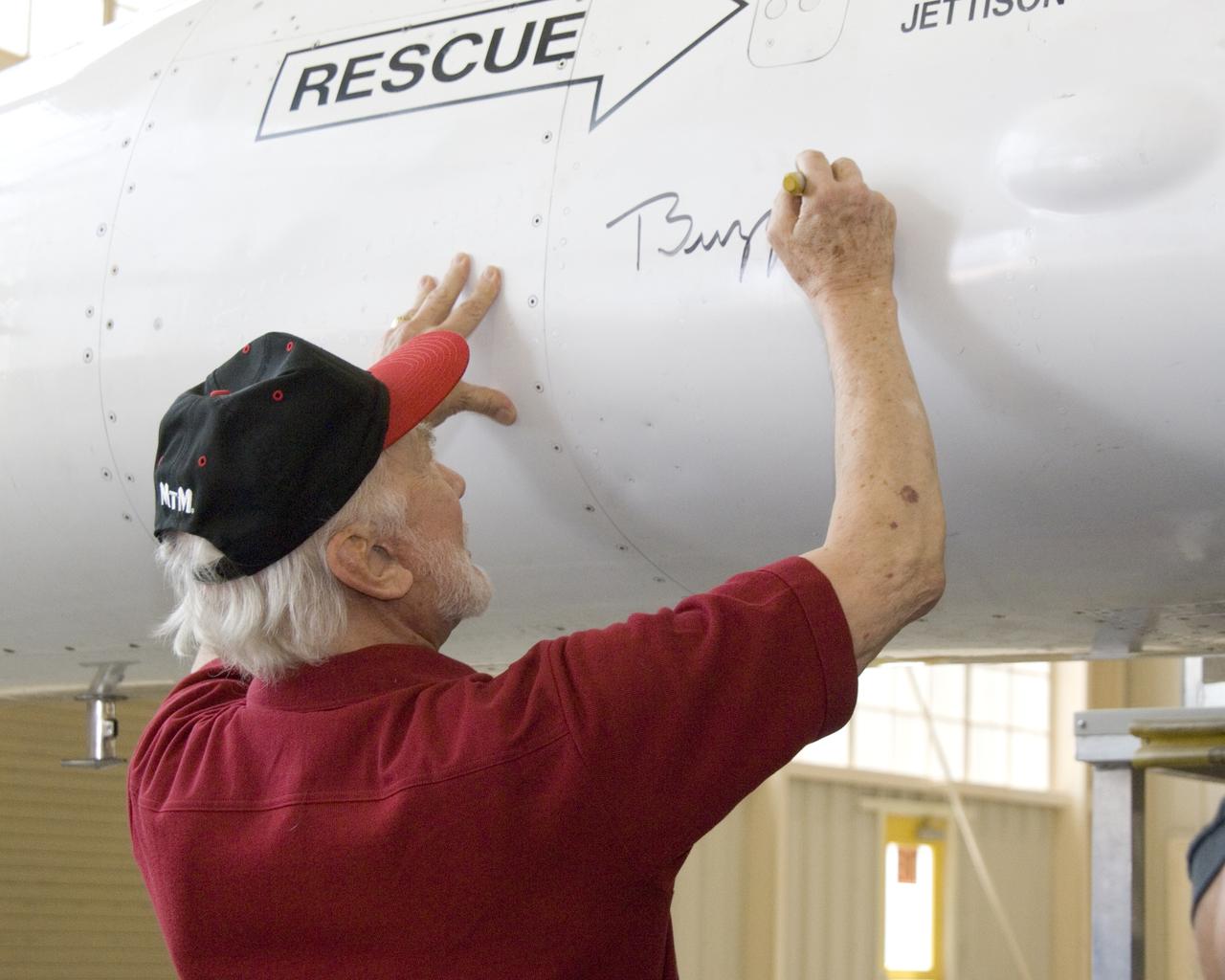
Apollo 11 astronaut Buzz Aldrin autographs NASA Dryden's F-16XL research aircraft, as his crewmate Neil Armstrong had previously done on the other side.
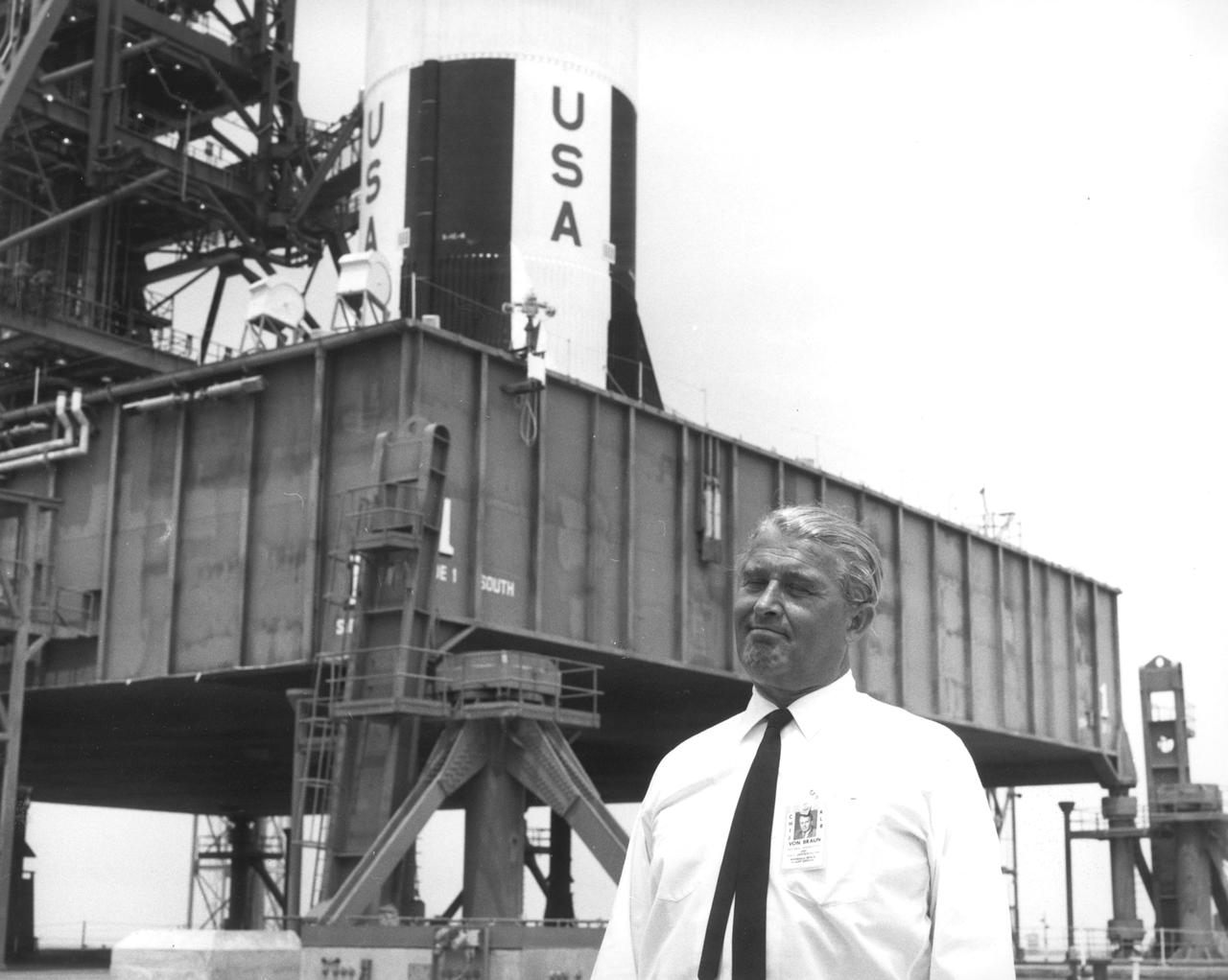
Dr. Wernher von Braun, director of the NASA Marshall Space Flight center (MSFC), appears proud as he pauses in front of the mobile launcher and base of the Saturn V rocket (AS-506) being readied for the historic Apollo 11 lunar landing mission at the Kennedy Space Center (KSC). The Saturn V vehicle was developed by MSFC under the direction of Dr. von Braun. The Apollo 11 mission launched from KSC in Florida via the MSFC developed Saturn V launch vehicle on July 16, 1969 and safely returned to Earth on July 24, 1969. Aboard the space craft were astronauts Neil A. Armstrong, commander; Michael Collins, Command Module (CM) pilot; and Edwin E. (Buzz) Aldrin Jr., Lunar Module (LM) pilot. The CM, “Columbia”, piloted by Collins, remained in a parking orbit around the Moon while the LM, “Eagle’’, carrying astronauts Armstrong and Aldrin, landed on the Moon. On July 20, 1969, Armstrong was the first human to ever stand on the lunar surface, followed by Aldrin. During 2½ hours of surface exploration, the crew collected 47 pounds of lunar surface material for analysis back on Earth. With the success of Apollo 11, the national objective to land men on the Moon and return them safely to Earth had been accomplished.
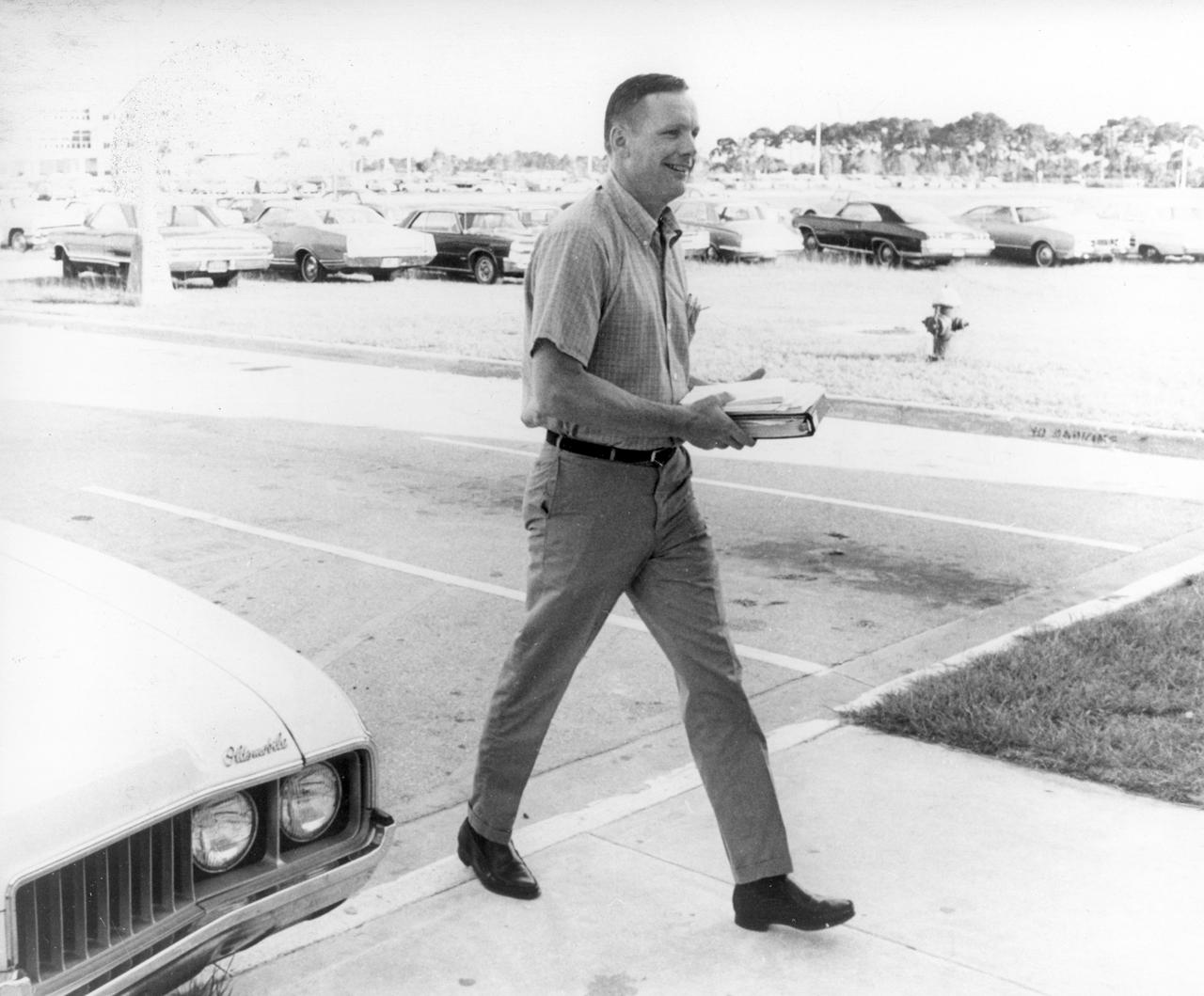
In this photograph, Apollo 11 astronaut Neil Armstrong walks to the flight crew training building at the NASA Kennedy Space Center (KSC) in Florida, one week before the nation’s first lunar landing mission. The Apollo 11 mission launched from KSC via the Marshall Space Flight Center (MSFC) developed Saturn V launch vehicle on July 16, 1969 and safely returned to Earth on July 24, 1969. Aboard the space craft were astronauts Neil A. Armstrong, commander; Michael Collins, Command Module (CM) pilot; and Edwin E. (Buzz) Aldrin Jr., Lunar Module (LM) pilot. The CM, “Columbia”, piloted by Collins, remained in a parking orbit around the Moon while the LM, “Eagle’’, carrying astronauts Armstrong and Aldrin, landed on the Moon. On July 20, 1969, Armstrong was the first human to ever stand on the lunar surface, followed by Aldrin. During 2½ hours of surface exploration, the crew collected 47 pounds of lunar surface material for analysis back on Earth. With the success of Apollo 11, the national objective to land men on the Moon and return them safely to Earth had been accomplished.
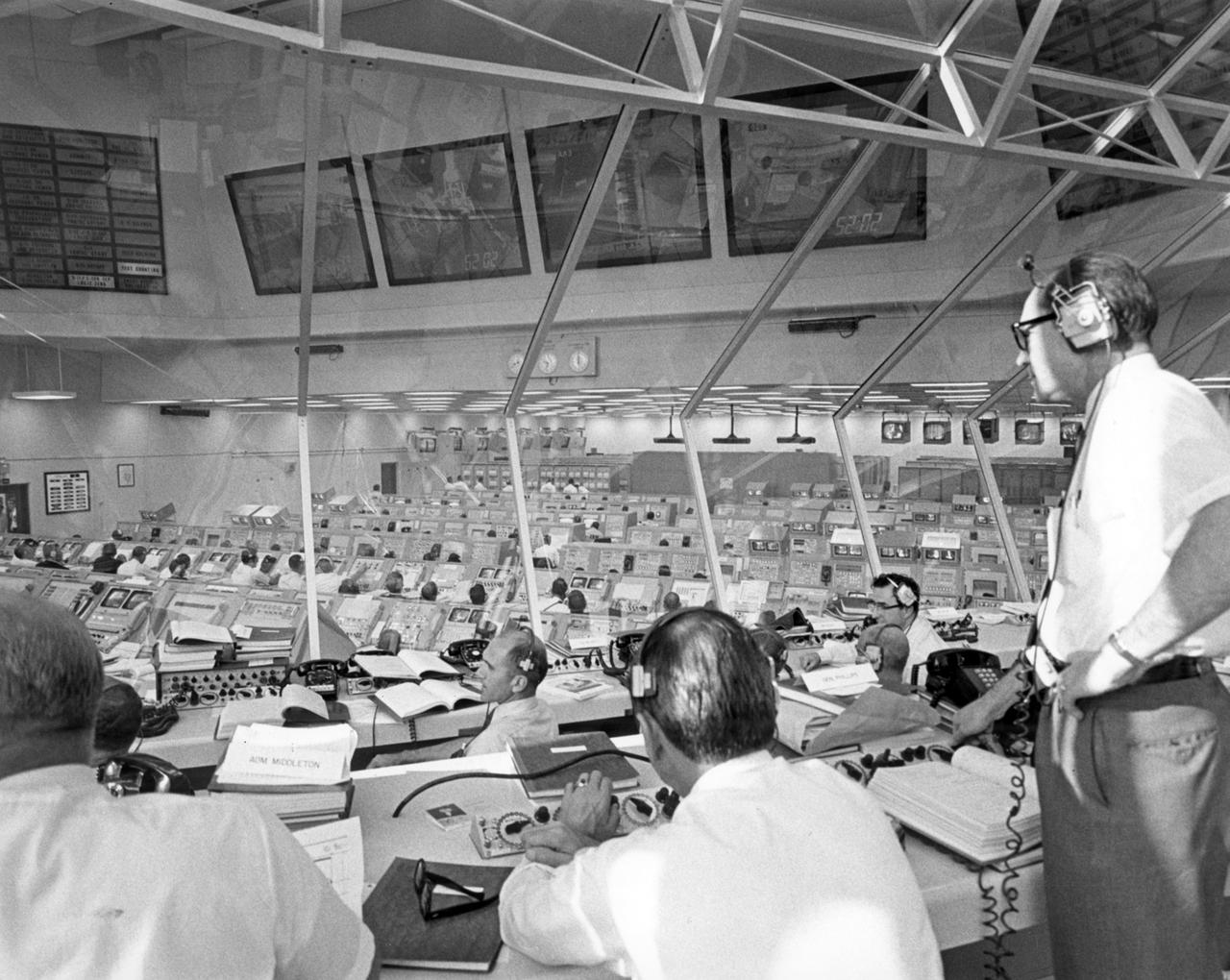
From the Kennedy Space Flight Center (KSC) control room, Apollo Program Director Lieutenant General Samuel C. Phillips monitors pre-launch activities for Apollo 11. The Apollo 11 mission, the first lunar landing mission, launched from the KSC in Florida via the Marshall Space Flight Center (MSFC) developed Saturn V launch vehicle on July 16, 1969 and safely returned to Earth on July 24, 1969. Aboard the space craft were astronauts Neil A. Armstrong, commander; Michael Collins, Command Module (CM) pilot; and Edwin E. (Buzz) Aldrin Jr., Lunar Module (LM) pilot. The CM, “Columbia”, piloted by Collins, remained in a parking orbit around the Moon while the LM, “Eagle’’, carrying astronauts Armstrong and Aldrin, landed on the Moon. On July 20, 1969, Armstrong was the first human to ever stand on the lunar surface, followed by Aldrin. During 2½ hours of surface exploration, the crew collected 47 pounds of lunar surface material for analysis back on Earth. With the success of Apollo 11, the national objective to land men on the Moon and return them safely to Earth had been accomplished.
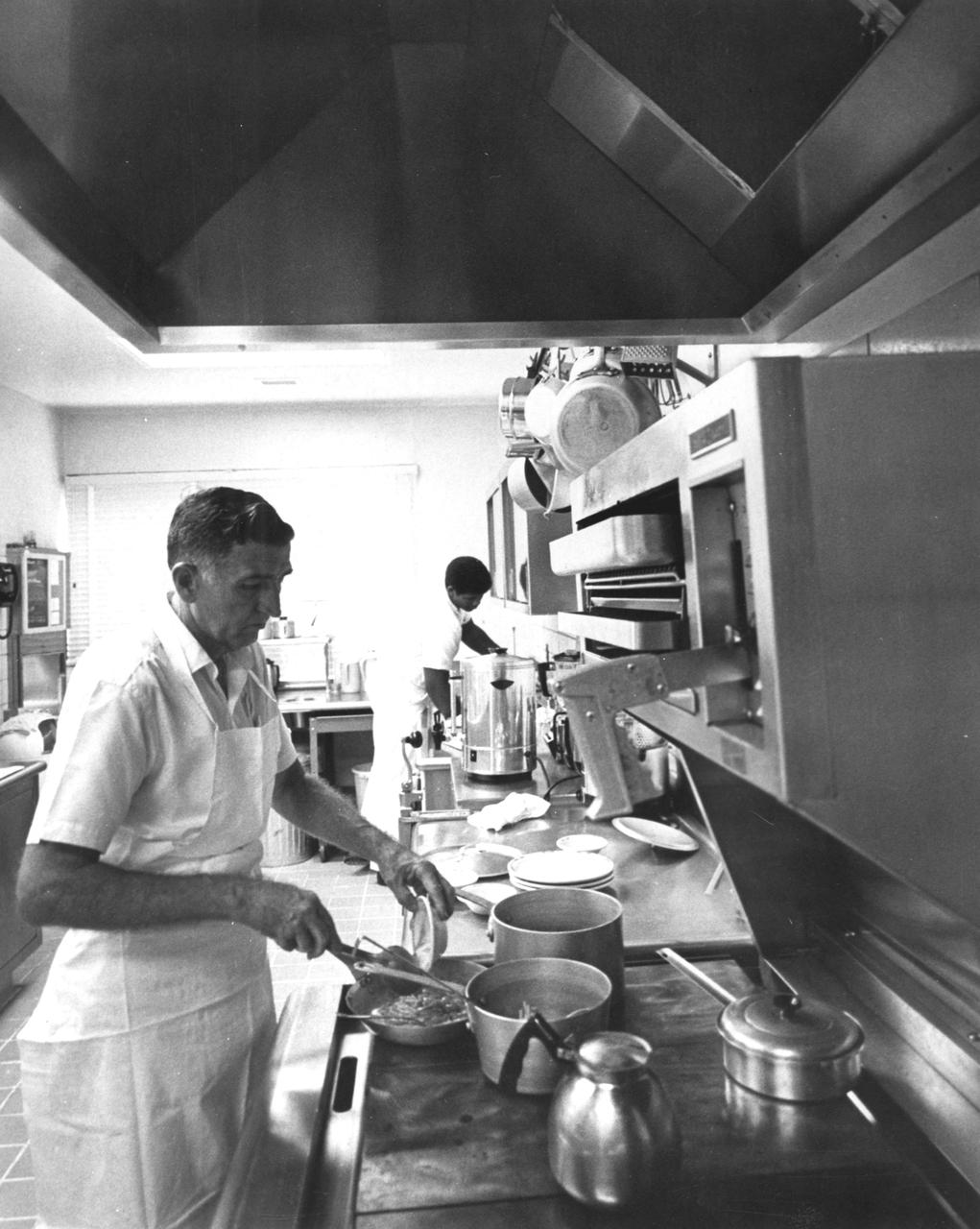
Cooks at the astronaut quarters of the NASA Kennedy Space Center (KSC) prepared meals for the Apollo 11 astronauts a few days before their historic first lunar landing mission. The Apollo 11 mission launched from KSC in Florida via the Marshall Space Flight Center (MSFC) developed Saturn V launch vehicle on July 16, 1969 and safely returned to Earth on July 24, 1969. Aboard the space craft were astronauts Neil A. Armstrong, commander; Michael Collins, Command Module (CM) pilot; and Edwin E. (Buzz) Aldrin Jr., Lunar Module (LM) pilot. The CM, “Columbia”, piloted by Collins, remained in a parking orbit around the Moon while the LM, “Eagle’’, carrying astronauts Armstrong and Aldrin, landed on the Moon. On July 20, 1969, Armstrong was the first human to ever stand on the lunar surface, followed by Aldrin. During 2½ hours of surface exploration, the crew collected 47 pounds of lunar surface material for analysis back on Earth. With the success of Apollo 11, the national objective to land men on the Moon and return them safely to Earth had been accomplished.
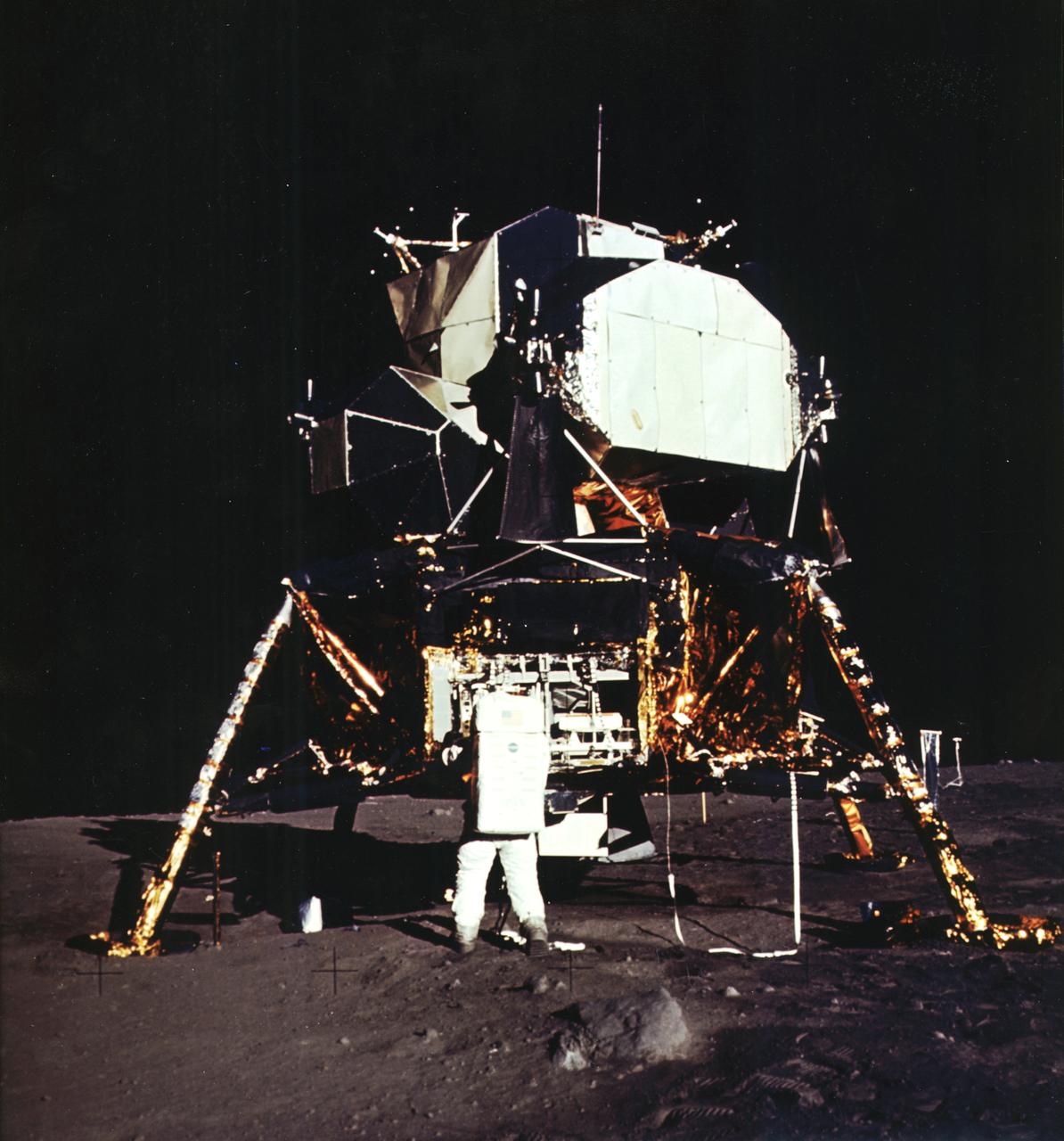
The first manned lunar landing mission, Apollo 11, launched from the Kennedy Space Center (KSC) in Florida via the Marshall Space Flight Center (MSFC) developed Saturn V launch vehicle on July 16, 1969 and safely returned to Earth on July 24, 1969. Aboard the space craft were astronauts Neil A. Armstrong, commander; Michael Collins, Command Module (CM) pilot; and Edwin E. (Buzz) Aldrin Jr., Lunar Module (LM) pilot. The CM, piloted by Michael Collins, remained in a parking orbit around the Moon while the LM, named “Eagle’’, carrying astronauts Armstrong and Aldrin, landed on the Moon in the Sea of Tranquility. The LM was a two part spacecraft. Its lower or descent stage had the landing gear, engines, and fuel needed for the landing. When the LM blasted off the Moon, the descent stage served as the launching pad for its companion ascent stage, which was also home for the two astronauts on the surface of the Moon. The LM was full of gear with which to communicate, navigate, and rendezvous. It also had its own propulsion system, and an engine to lift it off the Moon and send it on a course toward the orbiting CM. Aldrin is pictured here next to the LM on the lunar surface.
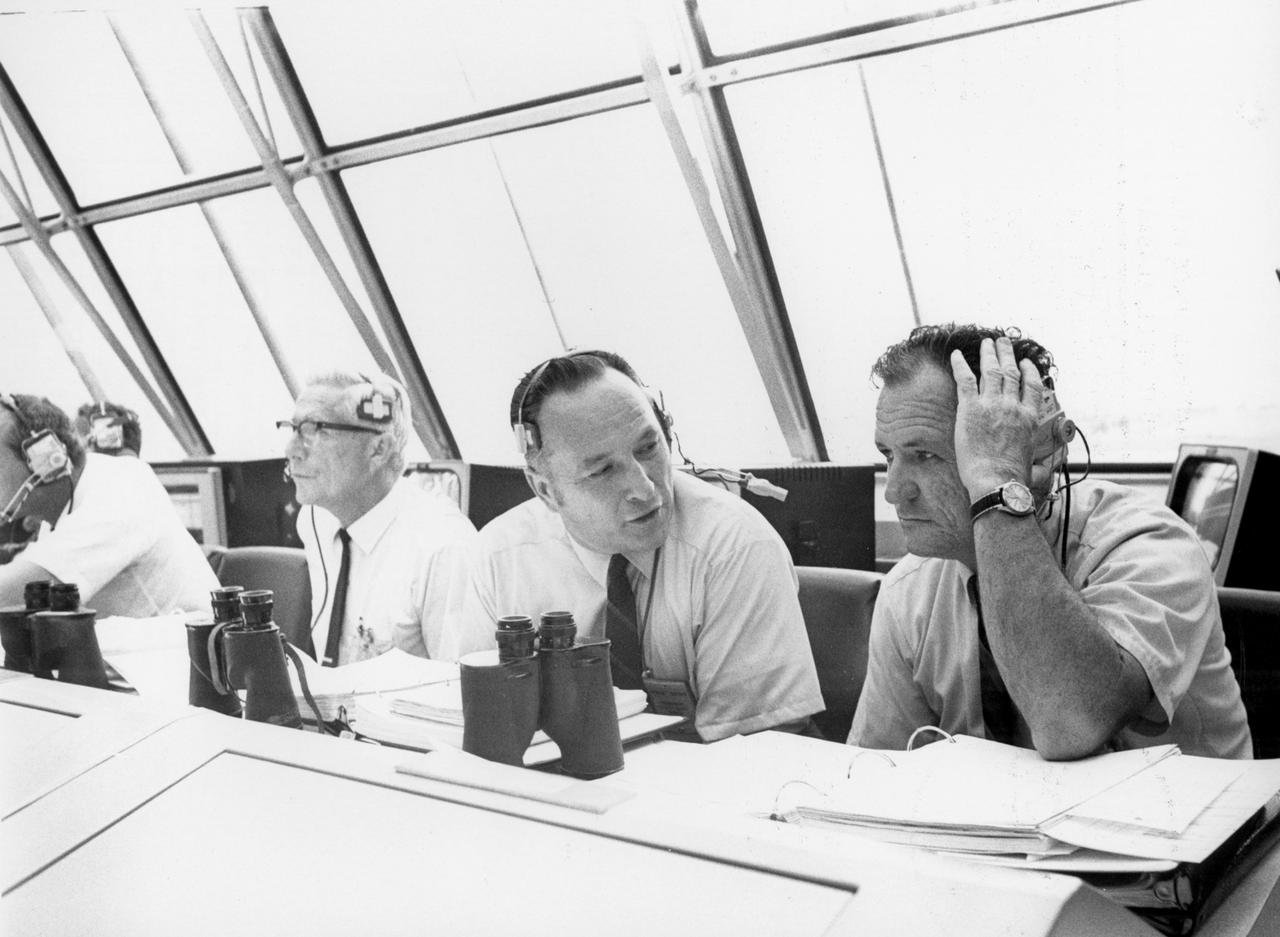
Lee B. James (left), manager of the Saturn Program at the Marshall Space flight Center (MSFC), talks with Isom Pigell in the firing room 1 of the Kennedy Space Center (KSC) control center during the countdown demonstration test for the Apollo 11 mission. At left is Dr. Hans C. Gruen of KSC. The Apollo 11 mission, the first lunar landing mission, launched from the KSC in Florida via the MSFC developed Saturn V launch vehicle on July 16, 1969 and safely returned to Earth on July 24, 1969. Aboard the space craft were astronauts Neil A. Armstrong, commander; Michael Collins, Command Module (CM) pilot; and Edwin E. (Buzz) Aldrin Jr., Lunar Module (LM) pilot. The CM, “Columbia”, piloted by Collins, remained in a parking orbit around the Moon while the LM, “Eagle’’, carrying astronauts Armstrong and Aldrin, landed on the Moon. On July 20, 1969, Armstrong was the first human to ever stand on the lunar surface, followed by Aldrin. During 2½ hours of surface exploration, the crew collected 47 pounds of lunar surface material for analysis back on Earth. With the success of Apollo 11, the national objective to land men on the Moon and return them safely to Earth had been accomplished.
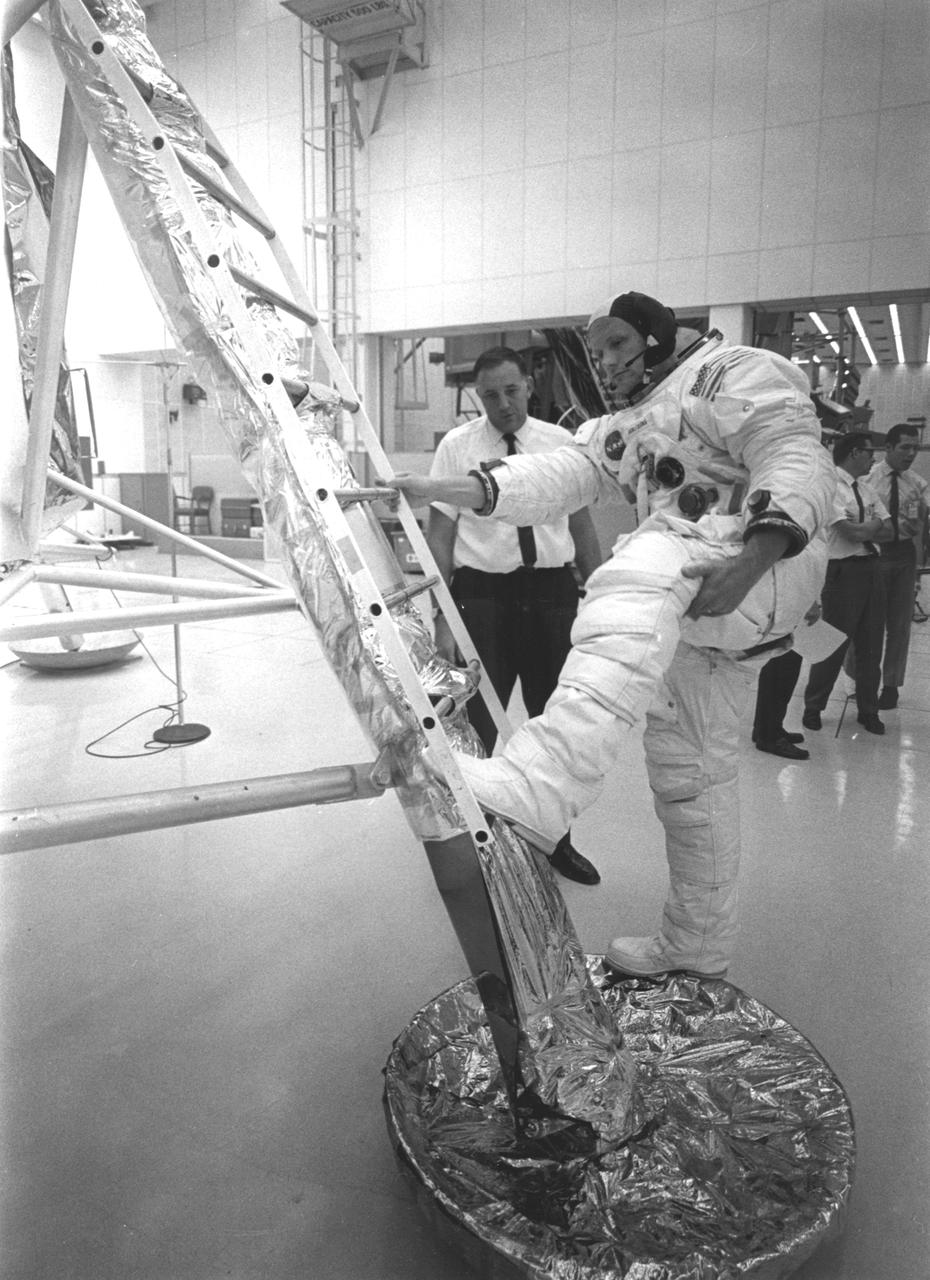
In preparation of the nation’s first Lunar landing mission, Apollo 11 crew members underwent training activities to practice activities they would be performing during the mission. In this photograph, Neil Armstrong, donned in his space suit, practices getting back to the first rung of the ladder on the Lunar Module (LM). The Apollo 11 mission launched from the Kennedy Space Center (KSC) in Florida via the Marshall Space Flight Center (MSFC) developed Saturn V launch vehicle on July 16, 1969 and safely returned to Earth on July 24, 1969. Aboard the space craft were astronauts Neil A. Armstrong, commander; Michael Collins, Command Module (CM) pilot; and Edwin E. (Buzz) Aldrin Jr., Lunar Module (LM) pilot. The CM, “Columbia”, piloted by Collins, remained in a parking orbit around the Moon while the LM, “Eagle’’, carrying astronauts Armstrong and Aldrin, landed on the Moon. On July 20, 1969, Armstrong was the first human to ever stand on the lunar surface, followed by Aldrin. During 2½ hours of surface exploration, the crew collected 47 pounds of lunar surface material for analysis back on Earth. With the success of Apollo 11, the national objective to land men on the Moon and return them safely to Earth had been accomplished.
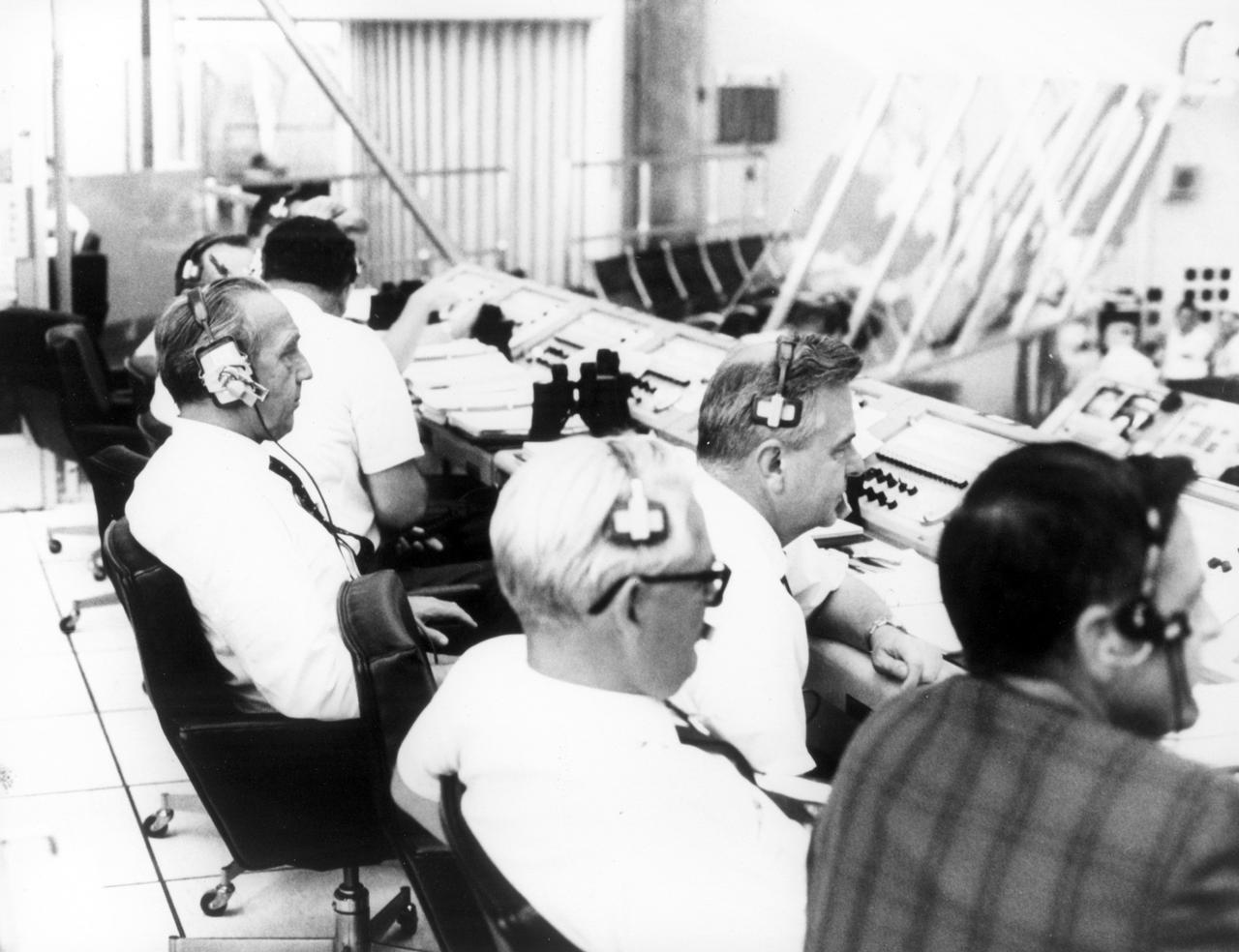
Dr. Kurt Debus, director of the Kennedy Space Flight Center (KSC), participated in the countdown demonstration test for the Apollo 11 mission in firing room 1 of the KSC control center. The Apollo 11 mission, the first lunar landing mission, launched from KSC in Florida via the Marshall Space Flight Center (MSFC) developed Saturn V launch vehicle on July 16, 1969 and safely returned to Earth on July 24, 1969. Aboard the space craft were astronauts Neil A. Armstrong, commander; Michael Collins, Command Module (CM) pilot; and Edwin E. (Buzz) Aldrin Jr., Lunar Module (LM) pilot. The CM, “Columbia”, piloted by Collins, remained in a parking orbit around the Moon while the LM, “Eagle’’, carrying astronauts Armstrong and Aldrin, landed on the Moon. On July 20, 1969, Armstrong was the first human to ever stand on the lunar surface, followed by Aldrin. During 2½ hours of surface exploration, the crew collected 47 pounds of lunar surface material for analysis back on Earth. With the success of Apollo 11, the national objective to land men on the Moon and return them safely to Earth had been accomplished.
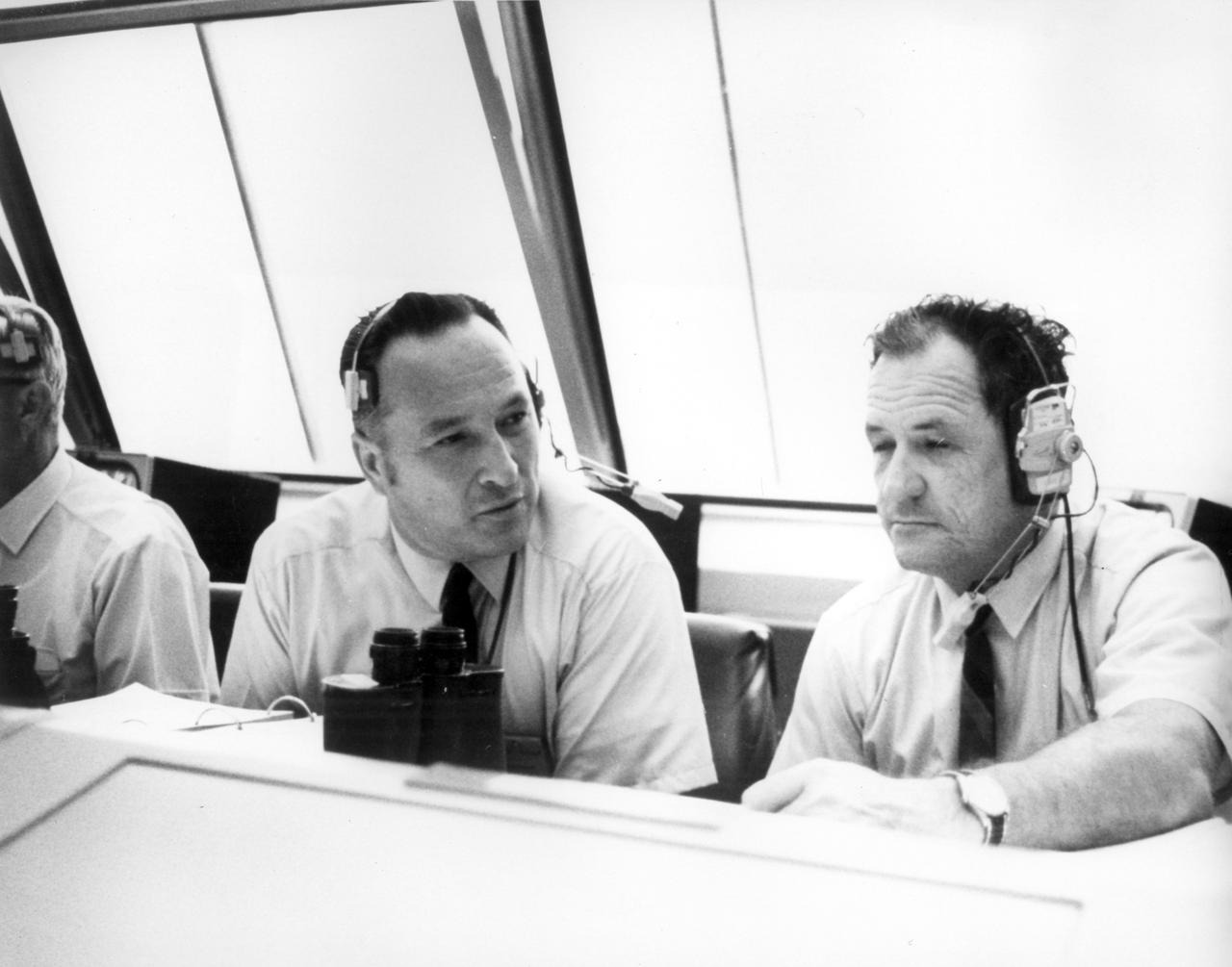
Lee B. James (left), manager of the Saturn Program at the Marshall Space flight Center (MSFC), talks with Isom Pigell in the firing room 1 of the Kennedy Space Center (KSC) control center during the countdown demonstration test for the Apollo 11 mission. The Apollo 11 mission, the first lunar landing mission, launched from the KSC in Florida via the MSFC developed Saturn V launch vehicle on July 16, 1969 and safely returned to Earth on July 24, 1969. Aboard the space craft were astronauts Neil A. Armstrong, commander; Michael Collins, Command Module (CM) pilot; and Edwin E. (Buzz) Aldrin Jr., Lunar Module (LM) pilot. The CM, “Columbia”, piloted by Collins, remained in a parking orbit around the Moon while the LM, “Eagle’’, carrying astronauts Armstrong and Aldrin, landed on the Moon. On July 20, 1969, Armstrong was the first human to ever stand on the lunar surface, followed by Aldrin. During 2½ hours of surface exploration, the crew collected 47 pounds of lunar surface material for analysis back on Earth. With the success of Apollo 11, the national objective to land men on the Moon and return them safely to Earth had been accomplished.
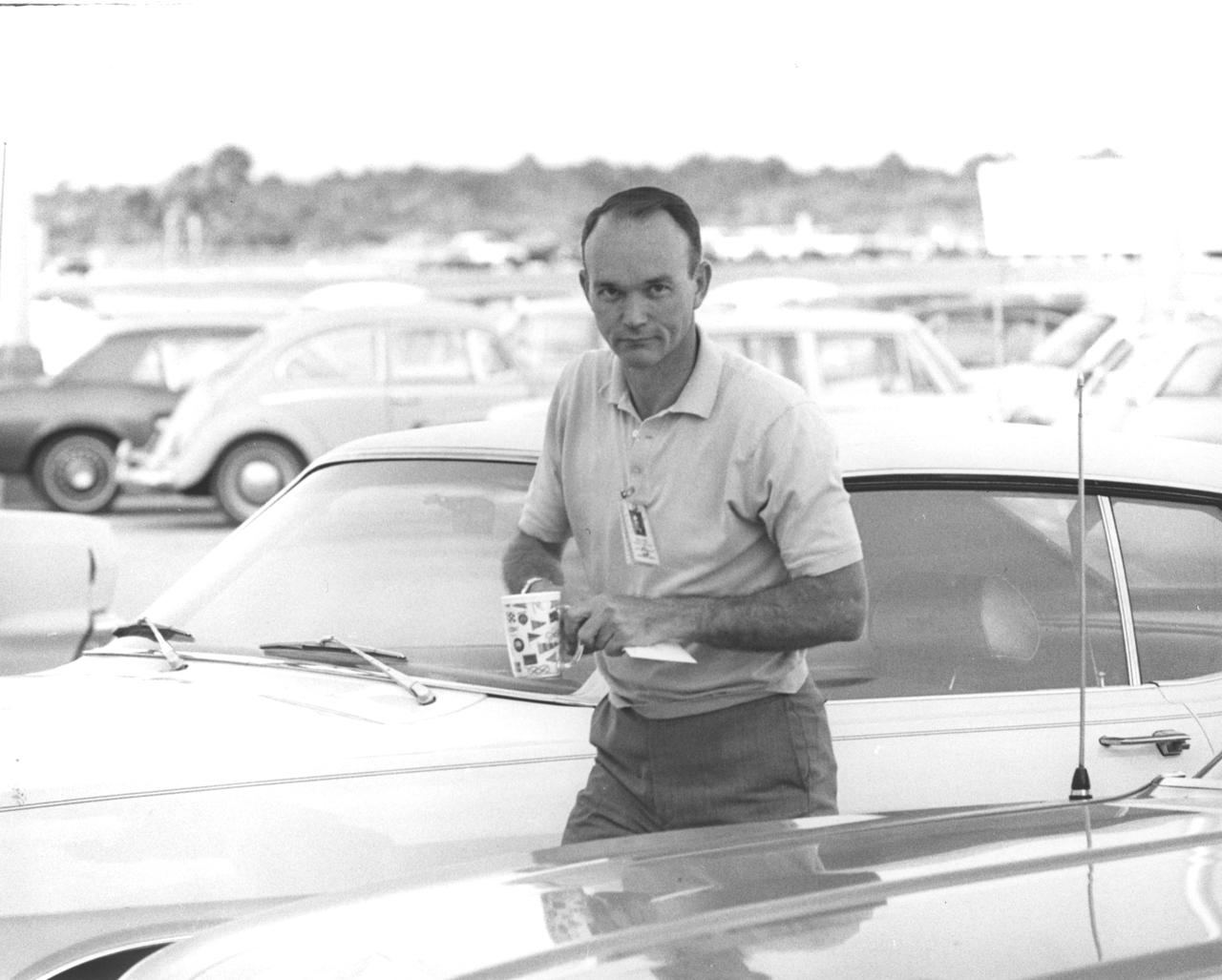
In this photograph, Apollo 11 astronaut Michael Collins carries his coffee with him as he arrives at the flight crew training building of the NASA Kennedy Space Center (KSC) in Florida, one week before the nation’s first lunar landing mission. The Apollo 11 mission launched from KSC via the Marshall Space Flight Center (MSFC) developed Saturn V launch vehicle on July 16, 1969 and safely returned to Earth on July 24, 1969. Aboard the space craft were astronauts Neil A. Armstrong, commander; Michael Collins, Command Module (CM) pilot; and Edwin E. (Buzz) Aldrin Jr., Lunar Module (LM) pilot. The CM, “Columbia”, piloted by Collins, remained in a parking orbit around the Moon while the LM, “Eagle’’, carrying astronauts Armstrong and Aldrin, landed on the Moon. On July 20, 1969, Armstrong was the first human to ever stand on the lunar surface, followed by Aldrin. During 2½ hours of surface exploration, the crew collected 47 pounds of lunar surface material for analysis back on Earth. With the success of Apollo 11, the national objective to land men on the Moon and return them safely to Earth had been accomplished.
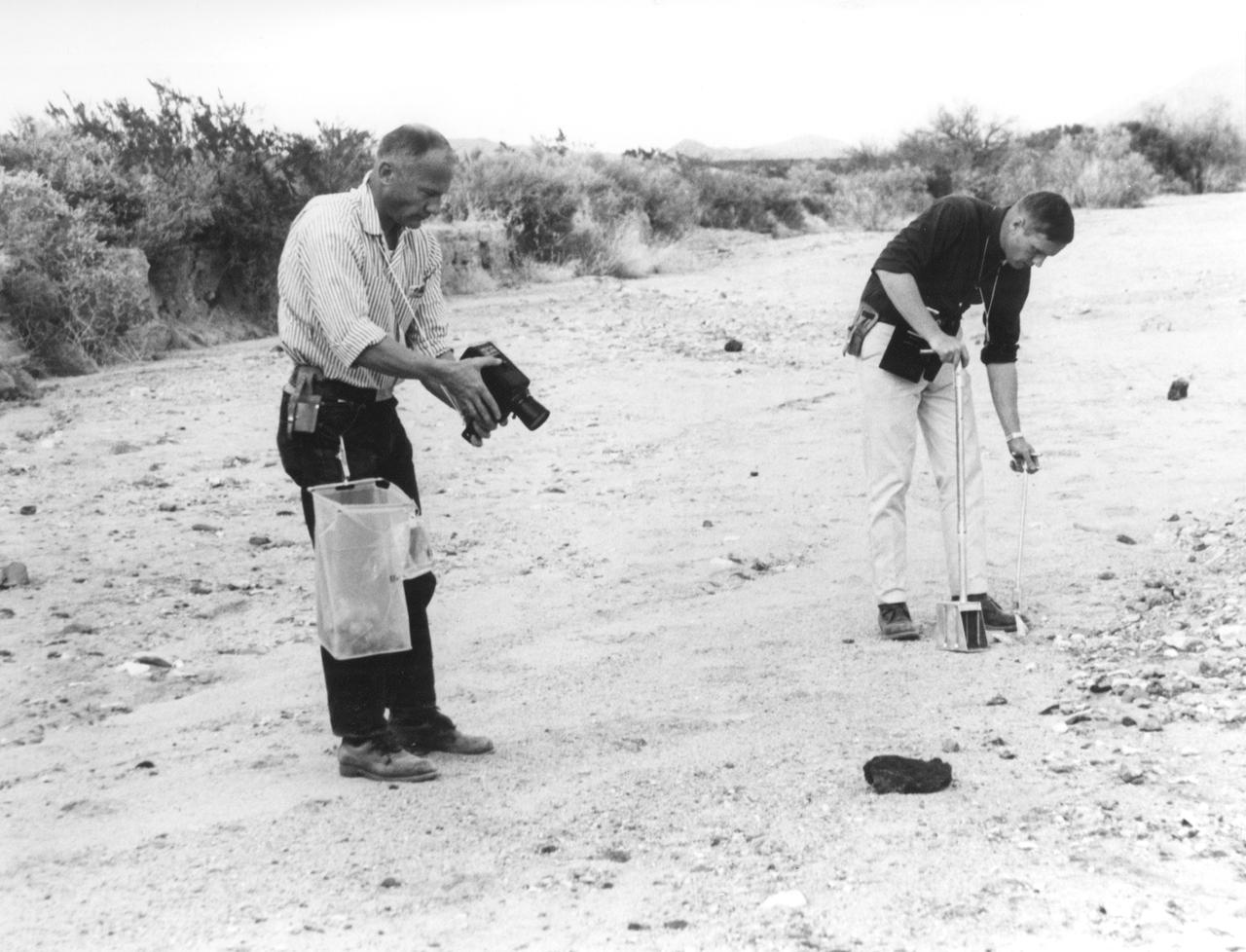
In this photograph, Apollo 11 astronauts Edwin (Buzz) Aldrin (left) and Neil A. Armstrong prepare for the first Lunar landing as they practice gathering rock specimens during a geological field trip to the Quitman Mountains area near the Fort Quitman ruins in far west Texas. They used special lunar geological tools to pick up samples and place them in bags.Their practice paid off in July of the same year. Aboard the Marshall Space Fight center (MSFC) developed Saturn V launch vehicle, the Apollo 11 mission launched from the Kennedy Space Center, Florida on July 16, 1969 and safely returned to Earth on July 24, 1969. The 3-man crew aboard the flight consisted of Armstrong, commander; Aldrin, Lunar Module pilot; and a third astronaut Michael Collins, Command Module pilot. Armstrong was the first human to ever stand on the lunar surface, followed by Aldrin, while Collins remained in lunar orbit. The crew collected 47 pounds of lunar surface material which was returned to Earth for analysis. The lunar surface exploration was concluded in 2½ hours.
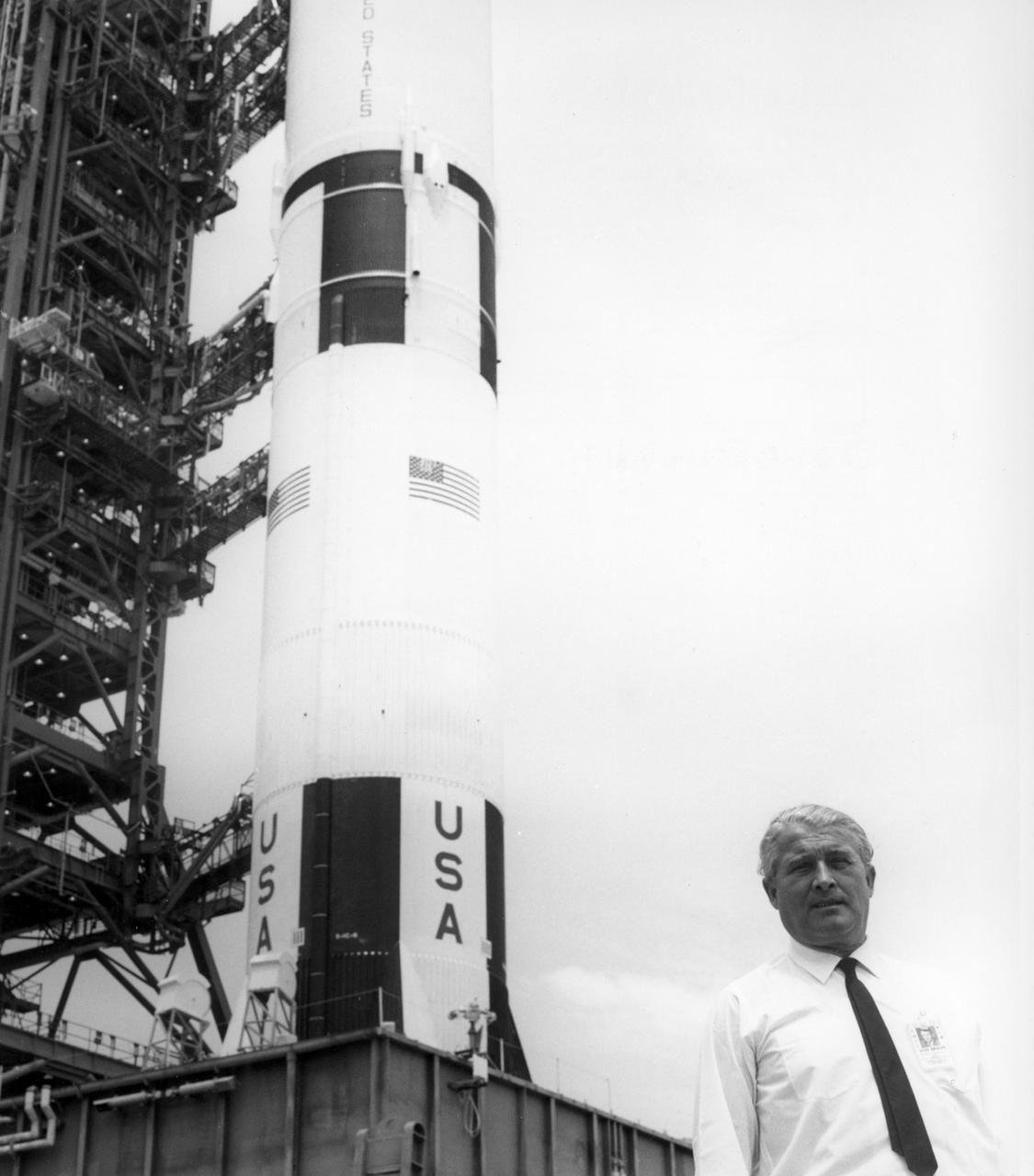
Dr. Wernher von Braun, director of the NASA Marshall Space Flight center (MSFC), talks with news reporters while paused in front of the mobile launcher and base of the Saturn V rocket (AS-506) being readied for the historic Apollo 11 lunar landing mission at the Kennedy Space Center (KSC). The Saturn V vehicle was developed by MSFC under the direction of Dr. von Braun. The Apollo 11 mission launched from the KSC in Florida via the MSFC developed Saturn V launch vehicle on July 16, 1969 and safely returned to Earth on July 24, 1969. Aboard the space craft were astronauts Neil A. Armstrong, commander; Michael Collins, Command Module (CM) pilot; and Edwin E. (Buzz) Aldrin Jr., Lunar Module (LM) pilot. The CM, “Columbia”, piloted by Collins, remained in a parking orbit around the Moon while the LM, “Eagle’’, carrying astronauts Armstrong and Aldrin, landed on the Moon. On July 20, 1969, Armstrong was the first human to ever stand on the lunar surface, followed by Aldrin. During 2½ hours of surface exploration, the crew collected 47 pounds of lunar surface material for analysis back on Earth. With the success of Apollo 11, the national objective to land men on the Moon and return them safely to Earth had been accomplished.
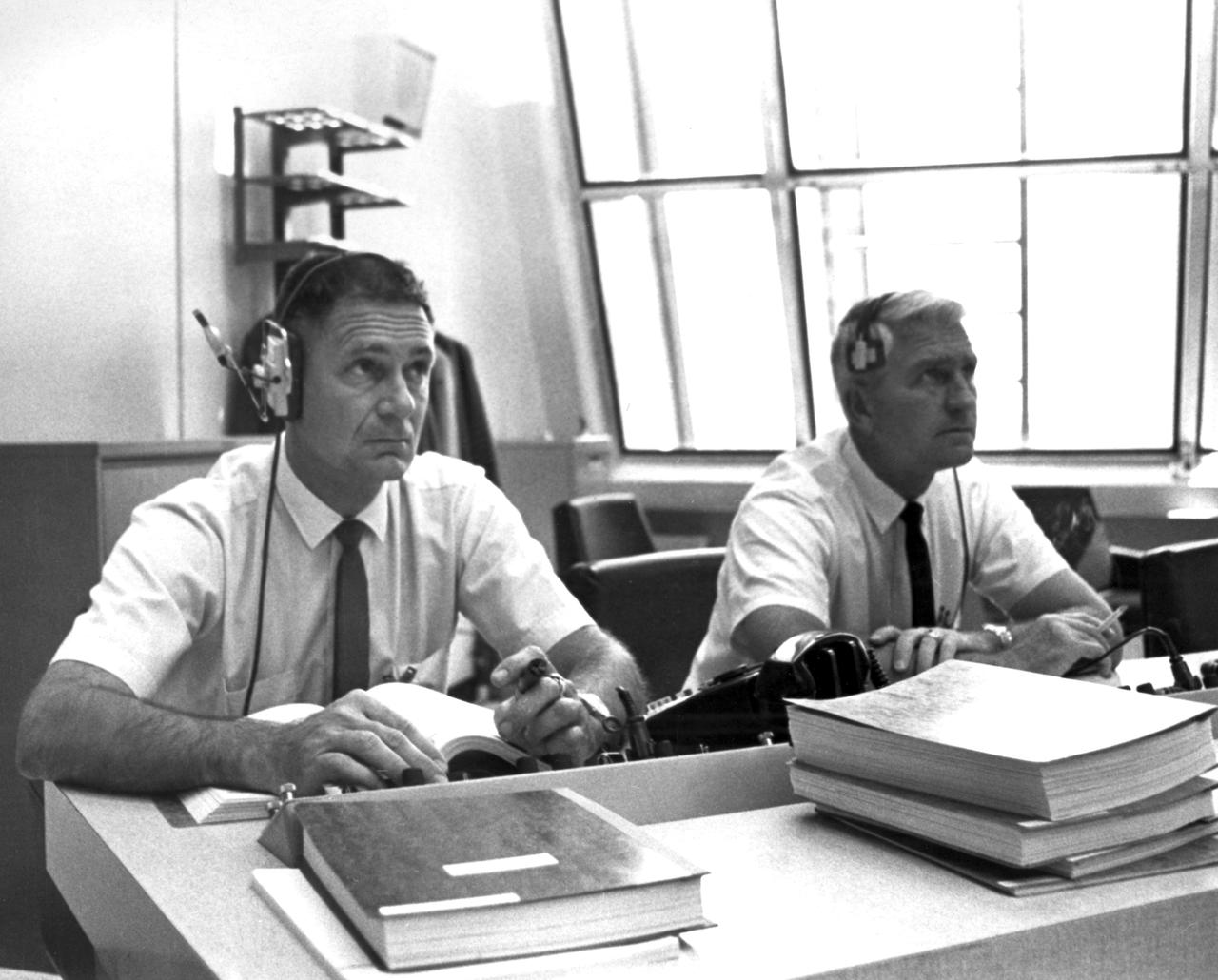
Seriousness exudes from launch official Miles Ross (left) of Kennedy Space Flight Center (KSC) and Major General E.F. O’Conner, director of program management of the Marshall Space Flight Center (MSFC), as they participate in the Apollo 11 countdown demonstration test. The Apollo 11 mission, the first lunar landing mission, launched from the KSC in Florida via the MSFC developed Saturn V launch vehicle on July 16, 1969 and safely returned to Earth on July 24, 1969. Aboard the space craft were astronauts Neil A. Armstrong, commander; Michael Collins, Command Module (CM) pilot; and Edwin E. (Buzz) Aldrin Jr., Lunar Module (LM) pilot. The CM, “Columbia”, piloted by Collins, remained in a parking orbit around the Moon while the LM, “Eagle’’, carrying astronauts Armstrong and Aldrin, landed on the Moon. On July 20, 1969, Armstrong was the first human to ever stand on the lunar surface, followed by Aldrin. During 2½ hours of surface exploration, the crew collected 47 pounds of lunar surface material for analysis back on Earth. With the success of Apollo 11, the national objective to land men on the Moon and return them safely to Earth had been accomplished.
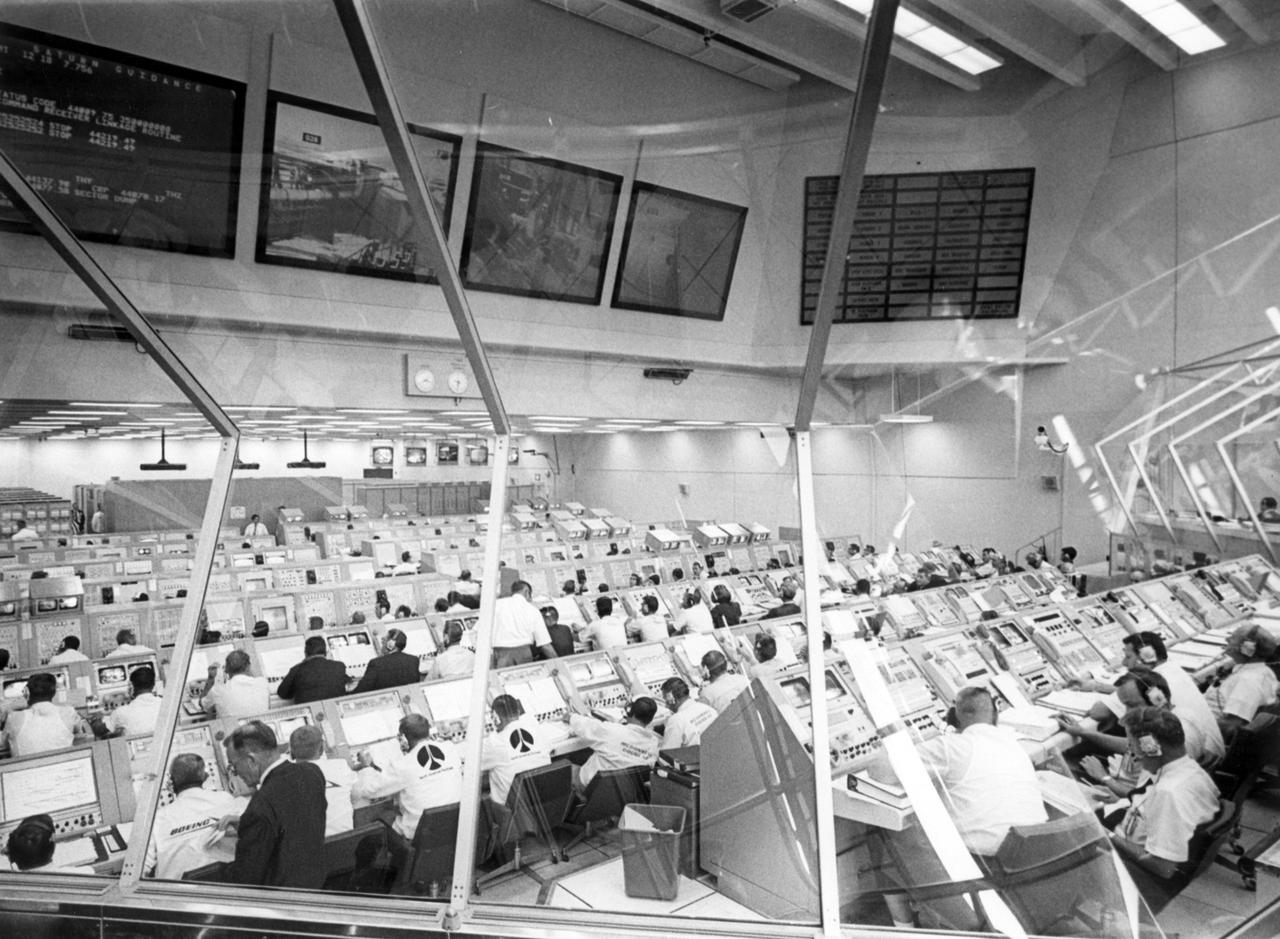
Every console was manned in firing room 1 of the Kennedy Space Flight Center (KSC) control center during the launch countdown for Apollo 11. Apollo 11, the first lunar landing mission, launched from KSC in Florida via the Marshall Space Flight Center (MSFC) developed Saturn V launch vehicle on July 16, 1969 and safely returned to Earth on July 24, 1969. Aboard the space craft were astronauts Neil A. Armstrong, commander; Michael Collins, Command Module (CM) pilot; and Edwin E. (Buzz) Aldrin Jr., Lunar Module (LM) pilot. The CM, “Columbia”, piloted by Collins, remained in a parking orbit around the Moon while the LM, “Eagle’’, carrying astronauts Armstrong and Aldrin, landed on the Moon. On July 20, 1969, Armstrong was the first human to ever stand on the lunar surface, followed by Aldrin. During 2½ hours of surface exploration, the crew collected 47 pounds of lunar surface material for analysis back on Earth. With the success of Apollo 11, the national objective to land men on the Moon and return them safely to Earth had been accomplished.
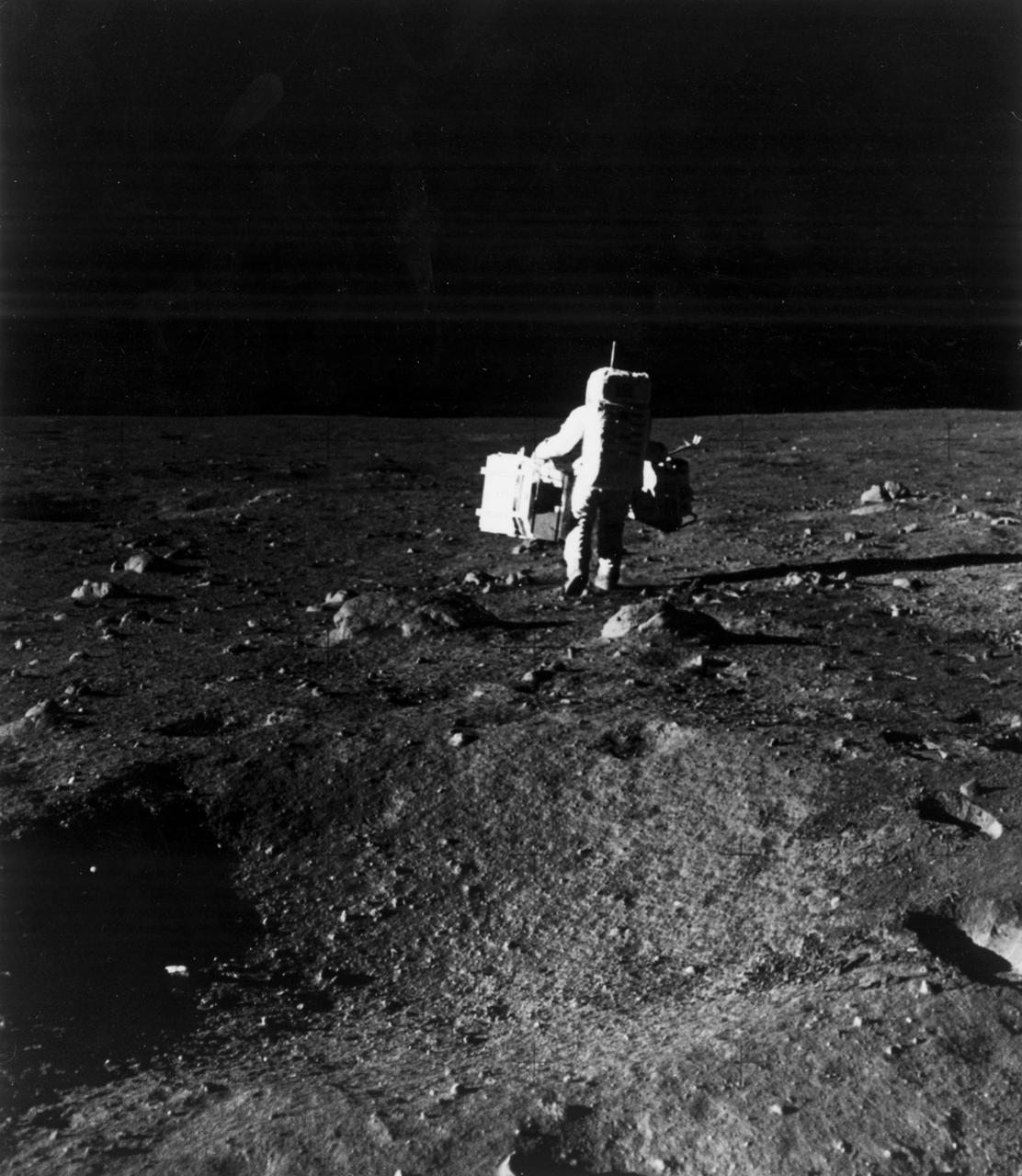
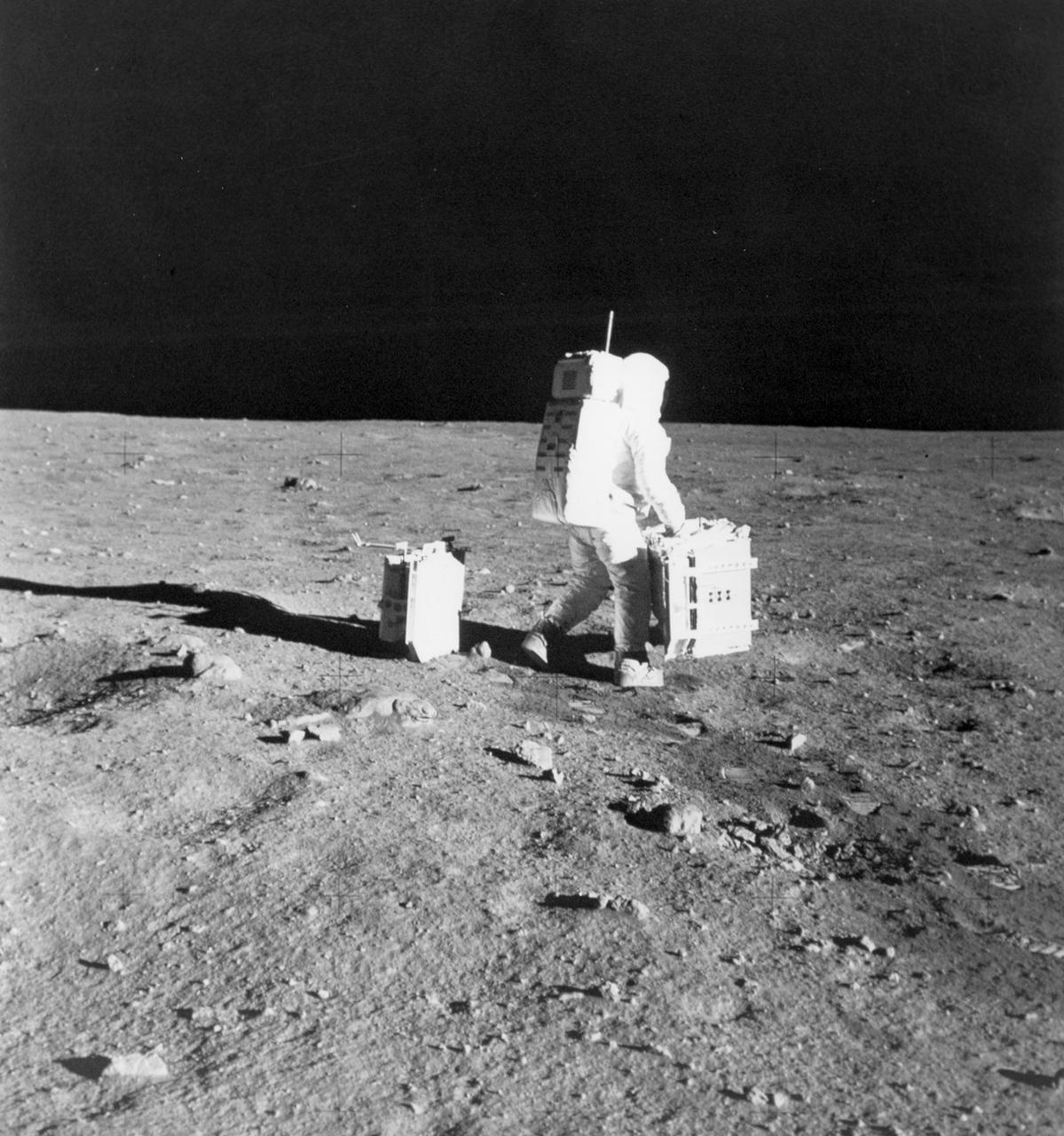
The first manned lunar landing mission, Apollo 11, launched from the Kennedy Space Center (KSC) in Florida via the Marshall Space Flight Center (MSFC) developed Saturn V launch vehicle on July 16, 1969 and safely returned to Earth on July 24, 1969. Aboard the space craft were astronauts Neil A. Armstrong, commander; Michael Collins, Command Module (CM) pilot; and Edwin E. (Buzz) Aldrin Jr., Lunar Module (LM) pilot. The CM, piloted by Michael Collins, remained in a parking orbit around the Moon, while the LM, named “Eagle’’, carrying astronauts Armstrong and Aldrin, landed on the Moon in the Sea of Tranquility. During 2½ hours of surface exploration, the crew set up experiments, collected 47 pounds of lunar surface material for analysis back on Earth, planted the U.S. Flag, and left a message for all mankind. In this photograph, Aldrin walks past some rocks, easily carrying scientific equipment experiements, which would have been to heavy too carry on Earth. The two packages made up the Early Apollo Scientific Experiment Package (EASEP) on Apollo 11. On the left is the Passive Seismic Experiment Package (PSEP) and on the right is the Laser Ranging Retroreflector (LRRR).
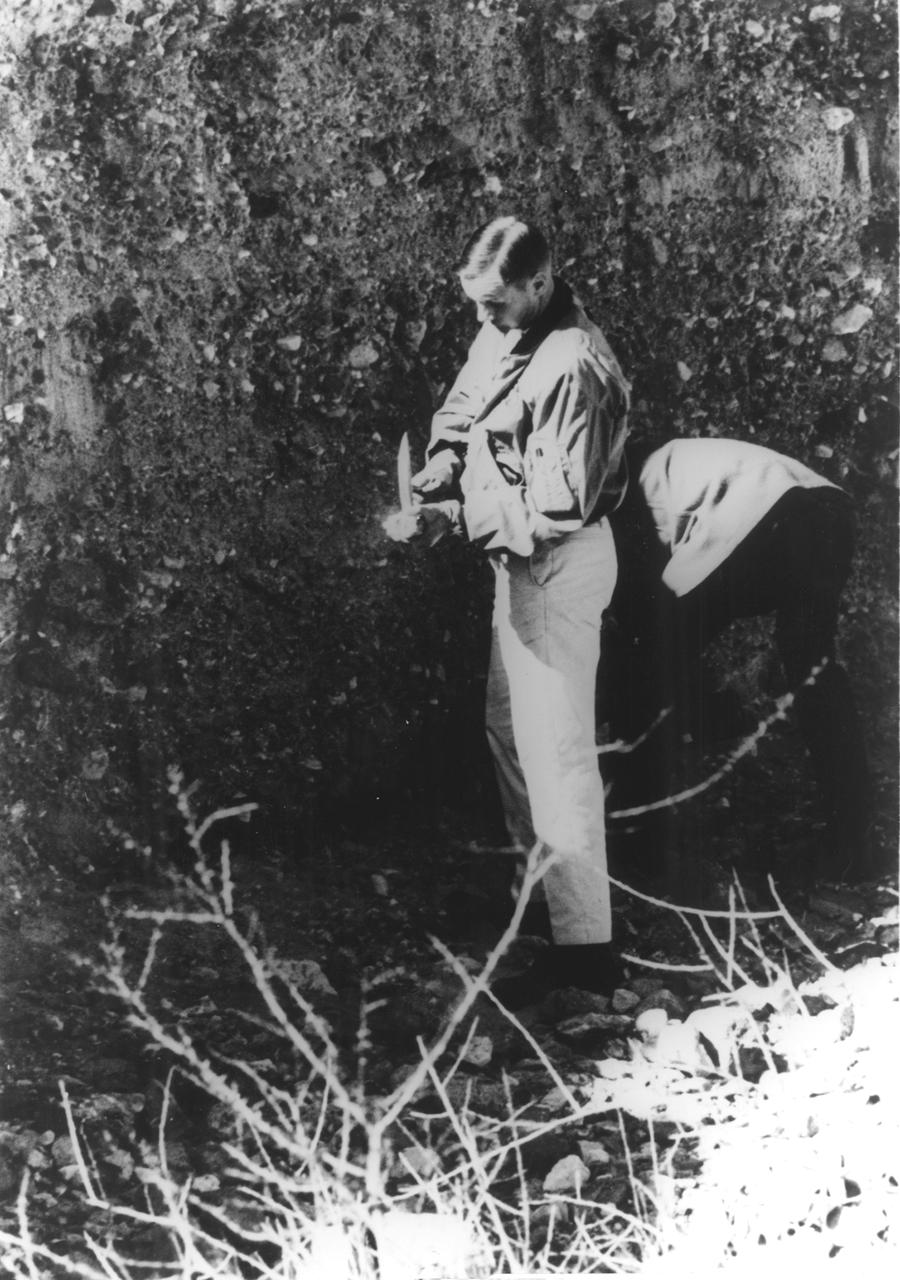
In this photograph, Apollo 11 astronaut Neil A. Armstrong uses a geologist’s hammer in selecting rock specimens during a geological field trip to the Quitman Mountains area near the Fort Quitman ruins in far west Texas. Armstrong, alongside astronaut Edwin (Buzz) Aldrin, practiced gathering rock specimens using special lunar geological tools in preparation for the first Lunar landing. Mission was accomplished in July of the same year. Aboard the Marshall Space Fight center (MSFC) developed Saturn V launch vehicle, the Apollo 11 mission launched from The Kennedy Space Center, Florida on July 16, 1969 and safely returned to Earth on July 24, 1969. The 3-man crew aboard the flight consisted of Armstrong, commander; Aldrin, Lunar Module pilot; and a third astronaut Michael Collins, Command Module pilot. Armstrong was the first human to ever stand on the lunar surface, followed by Aldrin, while Collins remained in lunar orbit. The crew collected 47 pounds of lunar surface material which was returned to Earth for analysis. The lunar surface exploration was concluded in 2½ hours.
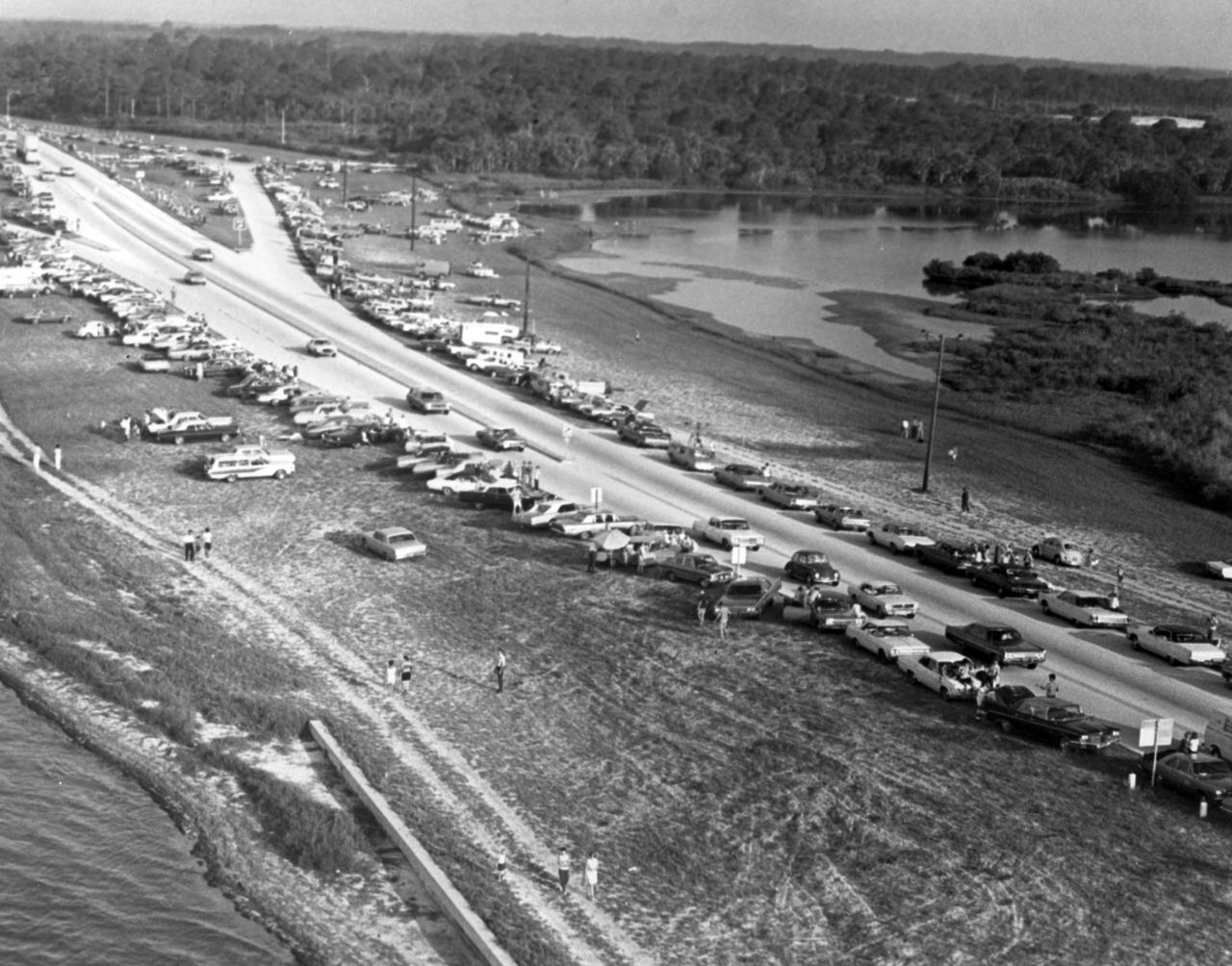
This is a view of a roadway near the NASA Kennedy Space Center (KSC), shortly before dawn, where spectators from all over the world jammed into KSC to watch the liftoff of Apollo 11, the first manned lunar landing mission. Apollo 11 launched from KSC via the Marshall Space Flight Center (MSFC) developed Saturn V launch vehicle on July 16, 1969 and safely returned to Earth on July 24, 1969. Aboard the space craft were astronauts Neil A. Armstrong, commander; Michael Collins, Command Module (CM) pilot; and Edwin E. (Buzz) Aldrin Jr., Lunar Module (LM) pilot. The CM, “Columbia”, piloted by Collins, remained in a parking orbit around the Moon while the LM, “Eagle’’, carrying astronauts Armstrong and Aldrin, landed on the Moon. On July 20, 1969, Armstrong was the first human to ever stand on the lunar surface, followed by Aldrin. During 2½ hours of surface exploration, the crew collected 47 pounds of lunar surface material for analysis back on Earth. With the success of Apollo 11, the national objective to land men on the Moon and return them safely to Earth had been accomplished.
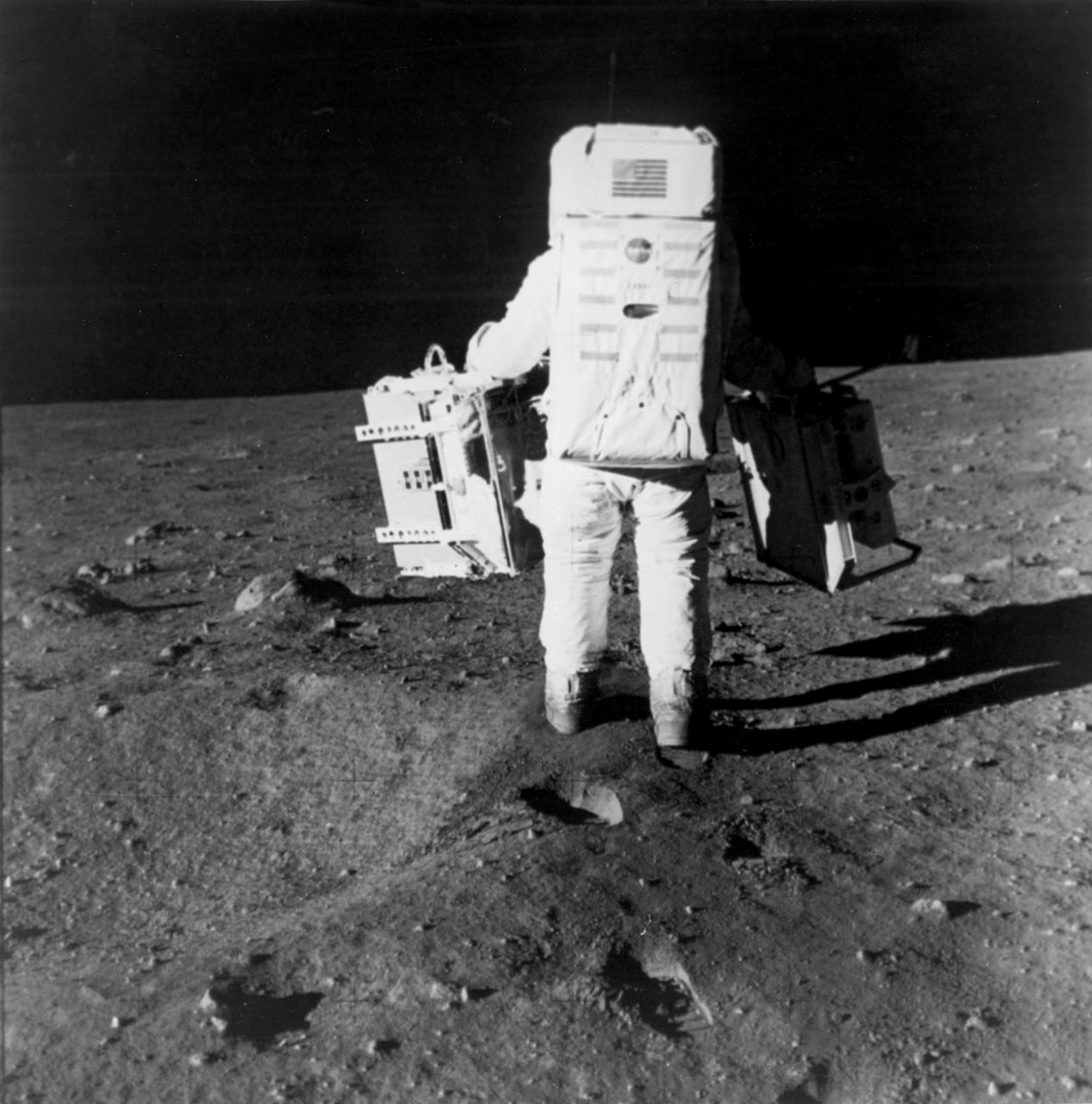
The first manned lunar landing mission, Apollo 11, launched from the Kennedy Space Center (KSC) in Florida via the Marshall Space Flight Center (MSFC) developed Saturn V launch vehicle on July 16, 1969 and safely returned to Earth on July 24, 1969. Aboard the space craft were astronauts Neil A. Armstrong, commander; Michael Collins, Command Module (CM) pilot; and Edwin E. (Buzz) Aldrin Jr., Lunar Module (LM) pilot. The CM, piloted by Michael Collins, remained in a parking orbit around the Moon, while the LM, named “Eagle’’, carrying astronauts Armstrong and Aldrin, landed on the Moon in the Sea of Tranquility. During 2½ hours of surface exploration, the crew set up experiments, collected 47 pounds of lunar surface material for analysis back on Earth, planted the U.S Flag, and left a message for all mankind. In this photograph, Aldrin walks past some rocks, easily carrying scientific equipment which would have been too heavy to carry on Earth. The two packages made up the Early Apollo Scientific Experiment Package (EASEP) on Apollo 11. On the left is the Passive Seismic Experiment Package (PSEP) and on the right is the Laser Ranging Retroreflector (LRR).
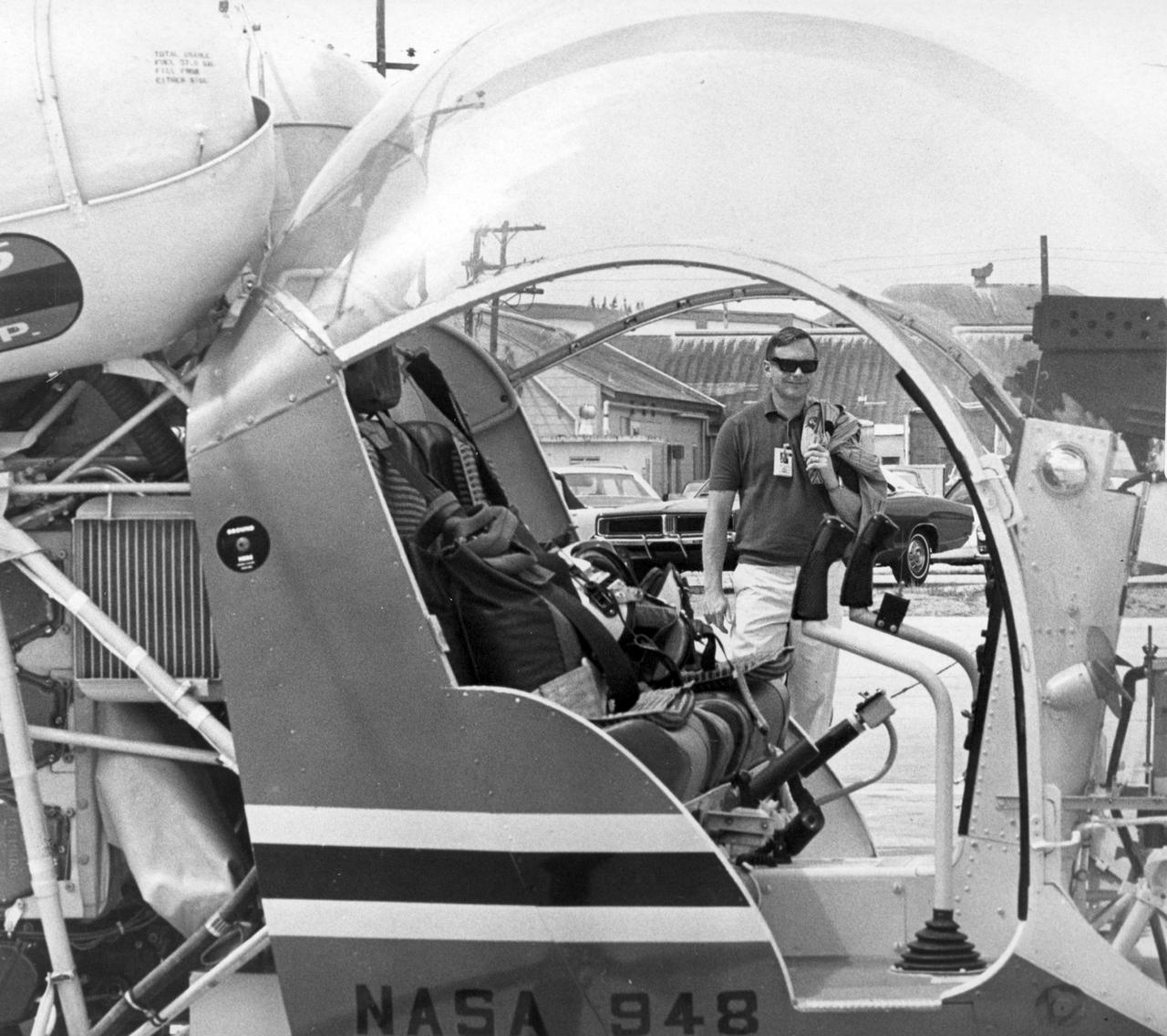
In preparation of the nation’s first lunar landing mission, Apollo 11, crew members underwent training to practice activities they would be performing during the mission. In this photograph Neil Armstrong approaches the helicopter he flew to practice landing the Lunar Module (LM) on the Moon. The Apollo 11 mission launched from the Kennedy Space Center (KSC) in Florida via the Marshall Space Flight Center (MSFC) developed Saturn V launch vehicle on July 16, 1969 and safely returned to Earth on July 24, 1969. Aboard the space craft were astronauts Neil A. Armstrong, commander; Michael Collins, Command Module (CM) pilot; and Edwin E. (Buzz) Aldrin Jr., Lunar Module (LM) pilot. The CM, “Columbia”, piloted by Collins, remained in a parking orbit around the Moon while the LM, “Eagle’’, carrying astronauts Armstrong and Aldrin, landed on the Moon. On July 20, 1969, Armstrong was the first human to ever stand on the lunar surface, followed by Aldrin. During 2½ hours of surface exploration, the crew collected 47 pounds of lunar surface material for analysis back on Earth. With the success of Apollo 11, the national objective to land men on the Moon and return them safely to Earth had been accomplished
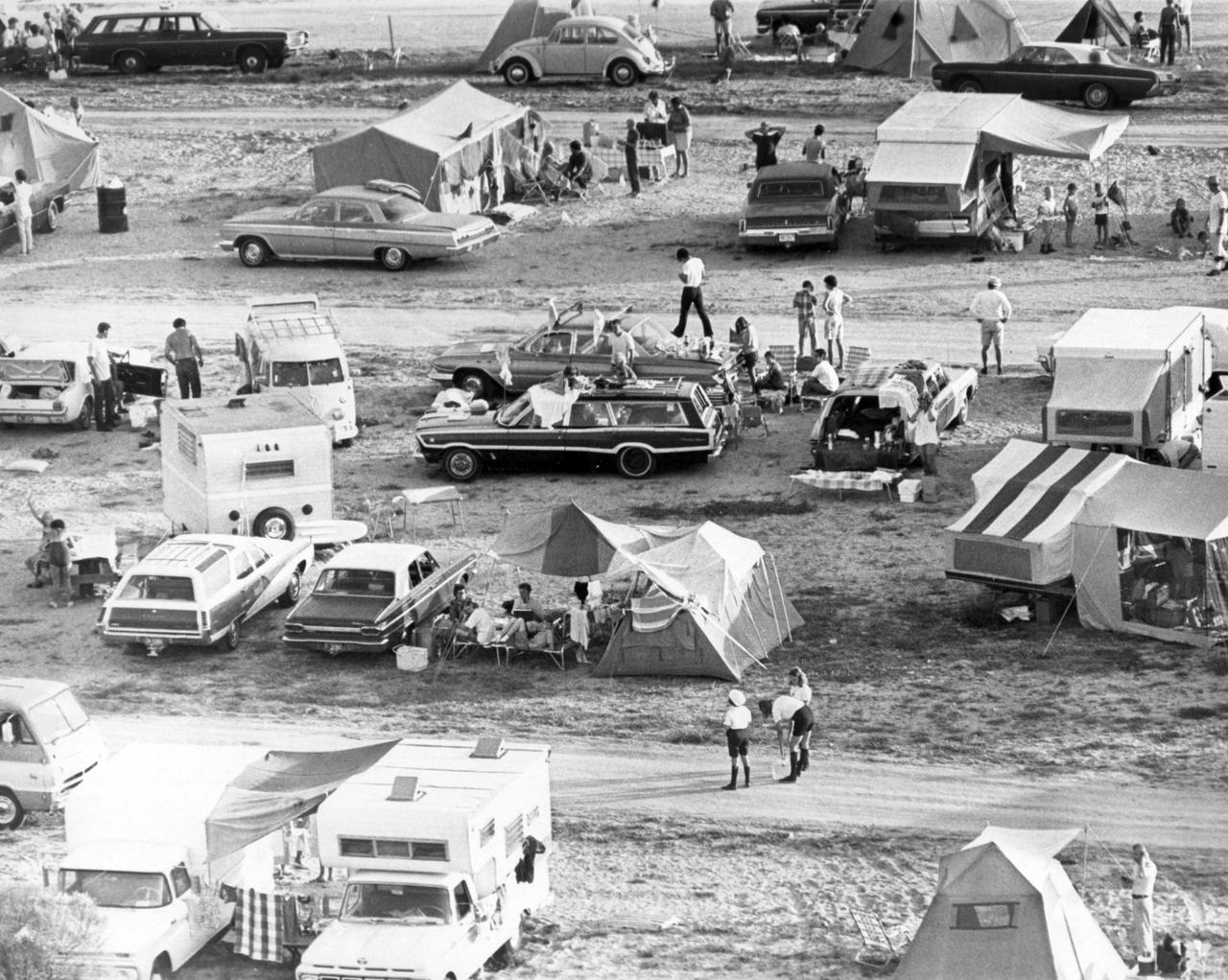
The early morning sun found hundreds of spectators on the beaches and roadways near the NASA Kennedy Space Center (KSC) where they had camped the night before to witness history by watching the epic beginning of the journey of Apollo 11. The first manned lunar landing mission launched from KSC via the Marshall Space Flight Center (MSFC) developed Saturn V launch vehicle on July 16, 1969 and safely returned to Earth on July 24, 1969. Aboard the space craft were astronauts Neil A. Armstrong, commander; Michael Collins, Command Module (CM) pilot; and Edwin E. (Buzz) Aldrin Jr., Lunar Module (LM) pilot. The CM, “Columbia”, piloted by Collins, remained in a parking orbit around the Moon while the LM, “Eagle’’, carrying astronauts Armstrong and Aldrin, landed on the Moon. On July 20, 1969, Armstrong was the first human to ever stand on the lunar surface, followed by Aldrin. During 2½ hours of surface exploration, the crew collected 47 pounds of lunar surface material for analysis back on Earth. With the success of Apollo 11, the national objective to land men on the Moon and return them safely to Earth had been accomplished.
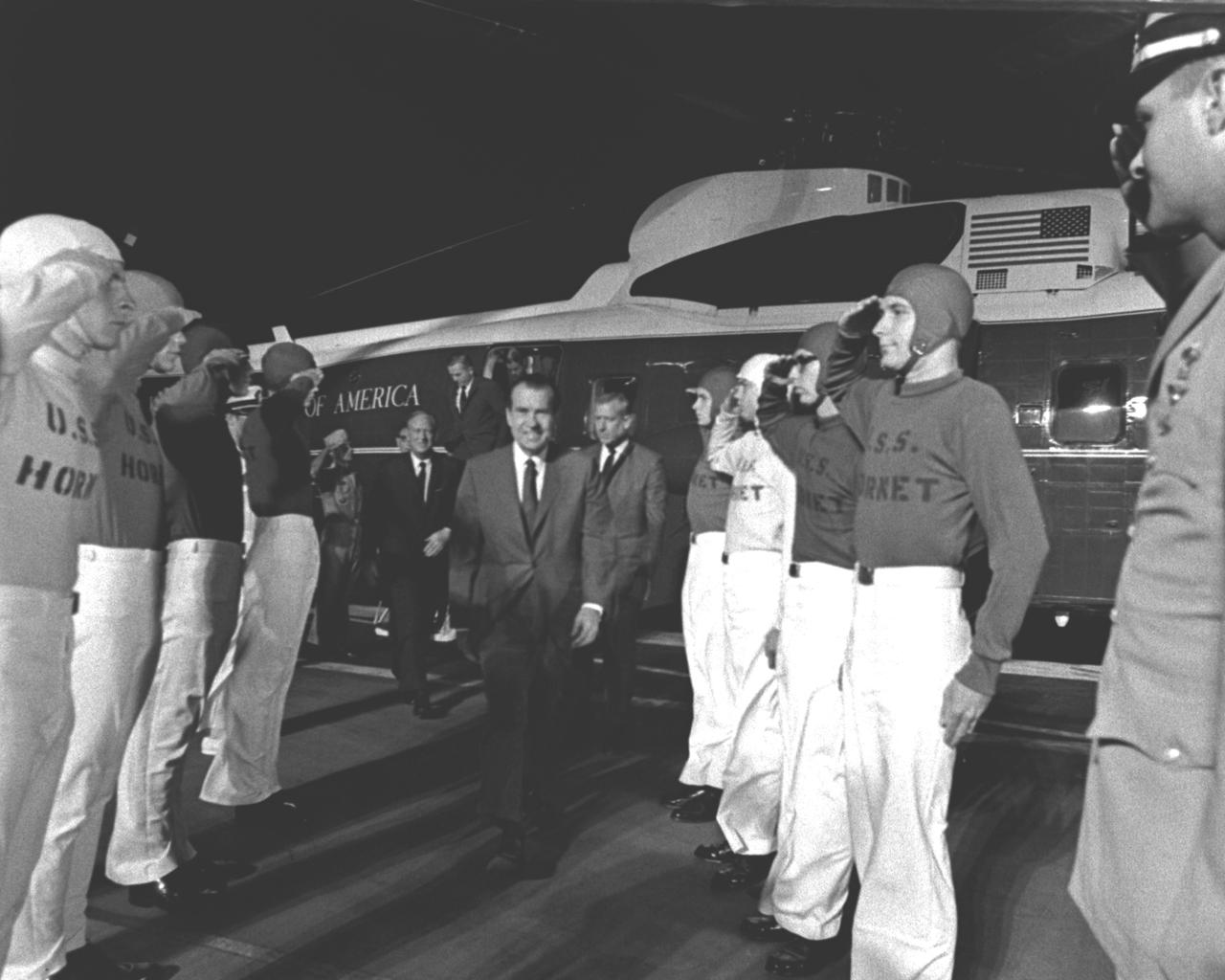
U.S. President Richard Milhous Nixon (center), is saluted by the honor guard of flight deck crewmen when he arrives aboard the U.S.S. Hornet, prime recovery ship for the Apollo 11 mission, to watch recovery operations and welcome the astronauts home. The recovery operation took place in the Pacific Ocean where Navy para-rescue men recovered the capsule housing the 3-man Apollo 11 crew. The crew was airlifted to safety aboard the U.S.S. Hornet, where they were quartered in a Mobile Quarantine Facility (MQF) for 21 days following the mission. The Apollo 11 mission, the first manned lunar mission, launched from the Kennedy Space Center, Florida via the Saturn V launch vehicle on July 16, 1969 and safely returned to Earth on July 24, 1969. Aboard were Neil A. Armstrong, commander; Michael Collins, Command Module (CM) pilot; and Edwin E. Aldrin Jr., Lunar Module (LM) pilot. The CM, piloted by Michael Collins remained in a parking orbit around the Moon while the LM, named “Eagle’’, carrying astronauts Neil Armstrong and Edwin Aldrin, landed on the Moon. Armstrong was the first human to ever stand on the lunar surface, followed by Edwin (Buzz) Aldrin. During 2½ hours of surface exploration, the crew collected 47 pounds of lunar surface material for analysis back on Earth. With the success of Apollo 11, the national objective to land men on the Moon and return them safely to Earth had been accomplished. The Saturn V vehicle was developed by the Marshall Space Flight Center (MSFC) under the direction of Dr. Wernher von Braun.
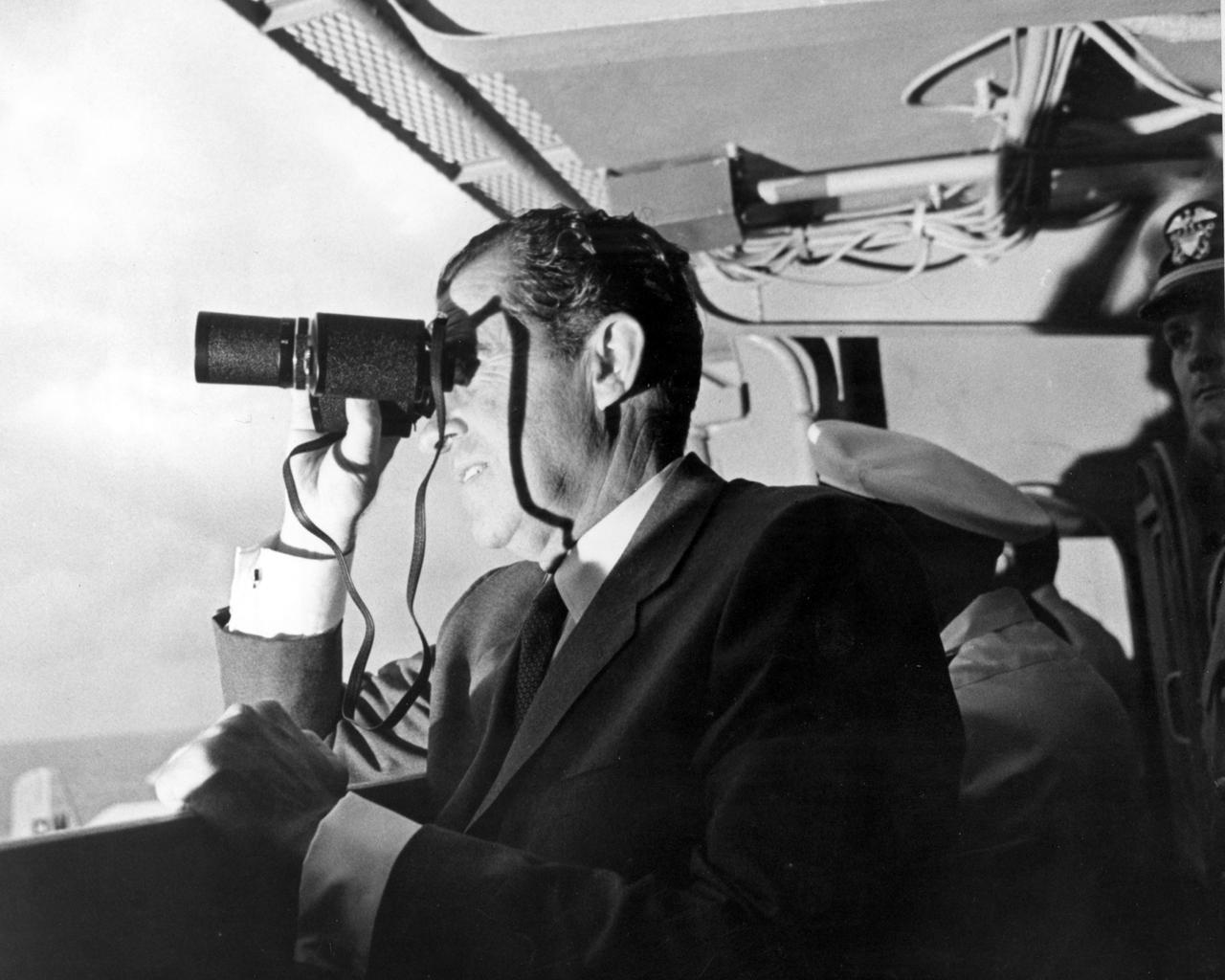
U.S. President Richard Milhous Nixon, aboard the U.S.S. Hornet aircraft carrier, used binoculars to watch the Apollo 11 Lunar Mission recovery. The recovery operation took place in the Pacific Ocean where Navy para-rescue men recovered the capsule housing the 3-man Apollo 11 crew. The crew was airlifted to safety aboard the U.S.S. Hornet, where they were quartered in a Mobile Quarantine Facility (MQF) for 21 days post mission. The Apollo 11 mission, the first manned lunar mission, launched from the Kennedy Space Center, Florida via the Saturn V launch vehicle on July 16, 1969 and safely returned to Earth on July 24, 1969. The Saturn V vehicle was developed by the Marshall Space Flight Center (MSFC) under the direction of Dr. Wernher von Braun. Aboard were Neil A. Armstrong, commander; Michael Collins, Command Module (CM) pilot; and Edwin E. Aldrin Jr., Lunar Module (LM) pilot. The CM, piloted by Michael Collins remained in a parking orbit around the Moon while the LM, named “Eagle’’, carrying astronauts Neil Armstrong and Edwin Aldrin, landed on the Moon. Armstrong was the first human to ever stand on the lunar surface, followed by Edwin (Buzz) Aldrin. During 2½ hours of surface exploration, the crew collected 47 pounds of lunar surface material for analysis back on Earth. With the success of Apollo 11, the national objective to land men on the Moon and return them safely to Earth had been accomplished.
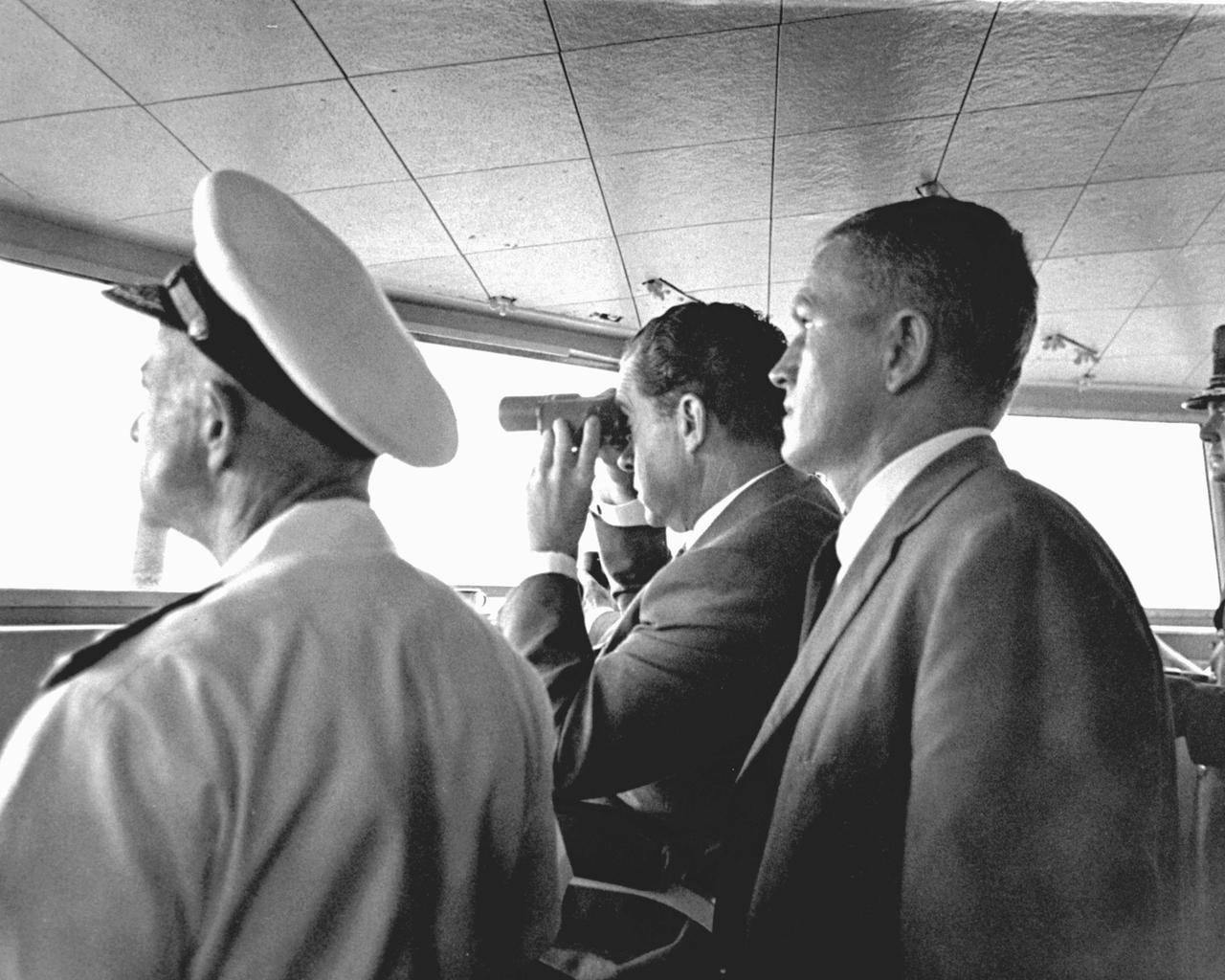
U.S. President Richard Milhous Nixon (center), aboard the U.S.S. Hornet aircraft carrier, used binoculars to watch the Apollo 11 Lunar Mission Recovery. Standing next to the President is astronaut Frank Borman, Apollo 8 Commander. The recovery operation took place in the Pacific Ocean where Navy para-rescue men recovered the capsule housing the 3-man Apollo 11 crew. The crew was airlifted to safety aboard the U.S.S. Hornet where they were quartered in a Mobile Quarantine Facility (MQF) for 21 days post mission. The Apollo 11 mission, the first manned lunar mission, launched from the Kennedy Space Center, Florida via the Saturn V launch vehicle on July 16, 1969 and safely returned to Earth on July 24, 1969. The Saturn V vehicle was developed by the Marshall Space Flight Center (MSFC) under the direction of Dr. Wernher von Braun. Aboard were Neil A. Armstrong, commander; Michael Collins, Command Module (CM) pilot; and Edwin E. Aldrin Jr., Lunar Module (LM) pilot. The CM, piloted by Michael Collins remained in a parking orbit around the Moon while the LM, named “Eagle’’, carrying astronauts Neil Armstrong and Edwin Aldrin, landed on the Moon. Armstrong was the first human to ever stand on the lunar surface, followed by Edwin (Buzz) Aldrin. During 2½ hours of surface exploration, the crew collected 47 pounds of lunar surface material for analysis back on Earth. With the success of Apollo 11, the national objective to land men on the Moon and return them safely to Earth had been accomplished.
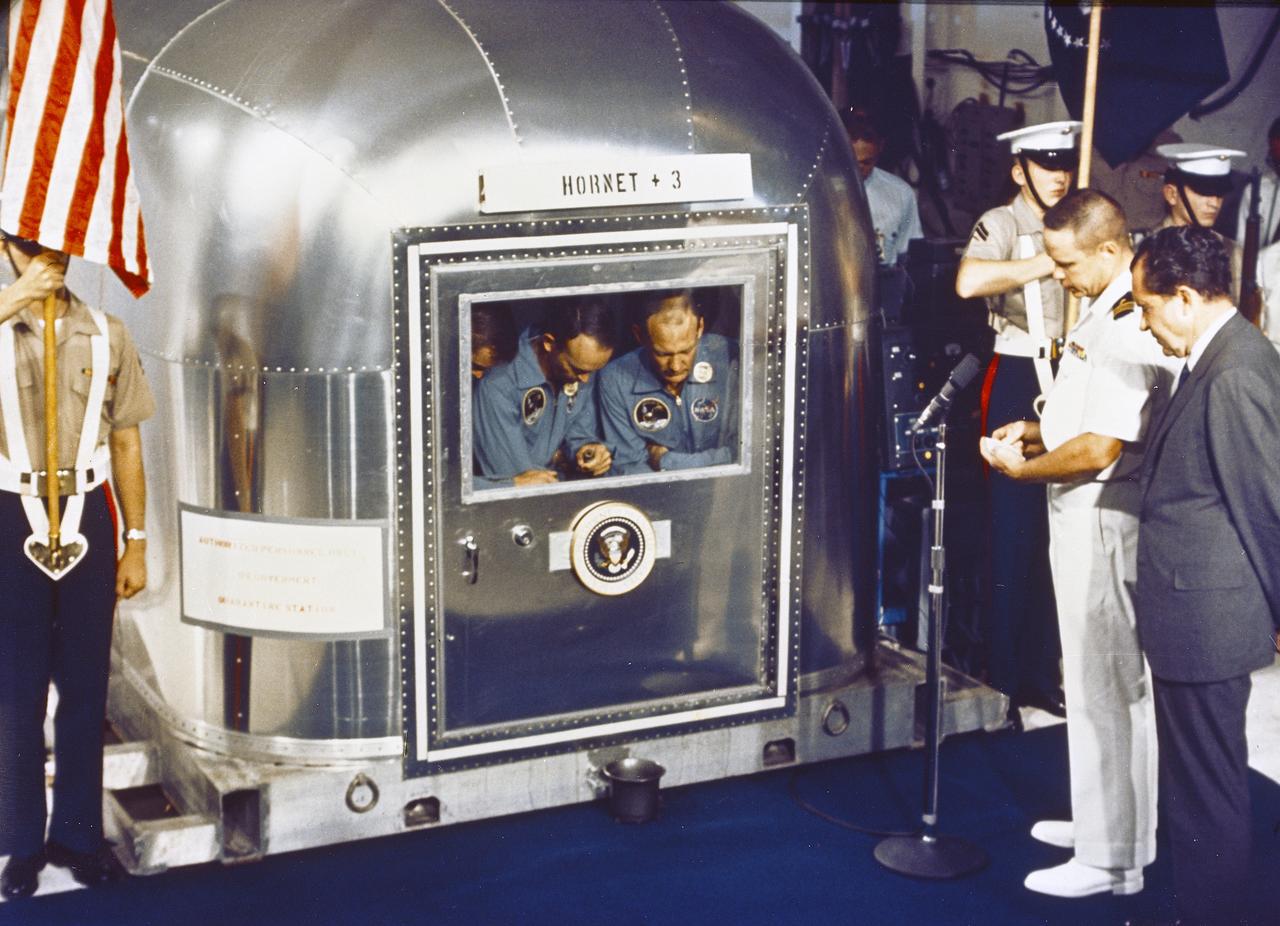
The Apollo 11 mission, the first manned lunar mission, launched from the Kennedy Space Center, Florida via a Saturn V launch vehicle on July 16, 1969 and safely returned to Earth on July 24, 1969. The Saturn V vehicle was developed by the Marshall Space Flight Center (MSFC) under the direction of Dr. Wernher von Braun. Aboard were Neil A. Armstrong, commander; Michael Collins, Command Module (CM) pilot; and Edwin E. Aldrin Jr., Lunar Module (LM) pilot. The CM, piloted by Michael Collins remained in a parking orbit around the Moon while the LM, named “Eagle’’, carrying astronauts Neil Armstrong and Edwin Aldrin, landed on the Moon. Armstrong was the first human to ever stand on the lunar surface, followed by Edwin (Buzz) Aldrin. During 2½ hours of surface exploration, the crew collected 47 pounds of lunar surface material for analysis back on Earth. The recovery operation took place in the Pacific Ocean where Navy para-rescue men recovered the capsule housing the 3-man Apollo 11 crew. The crew was taken to safety aboard the USS Hornet, where they were quartered in a mobile quarantine facility. Shown here is the Apollo 11 crew inside the quarantine facility as prayer is offered by Lt. Commander John Pirrto, USS Hornet Chaplain accompanied by U.S. President Richard Nixon (front right). With the success of Apollo 11, the national objective to land men on the Moon and return them safely to Earth had been accomplished.
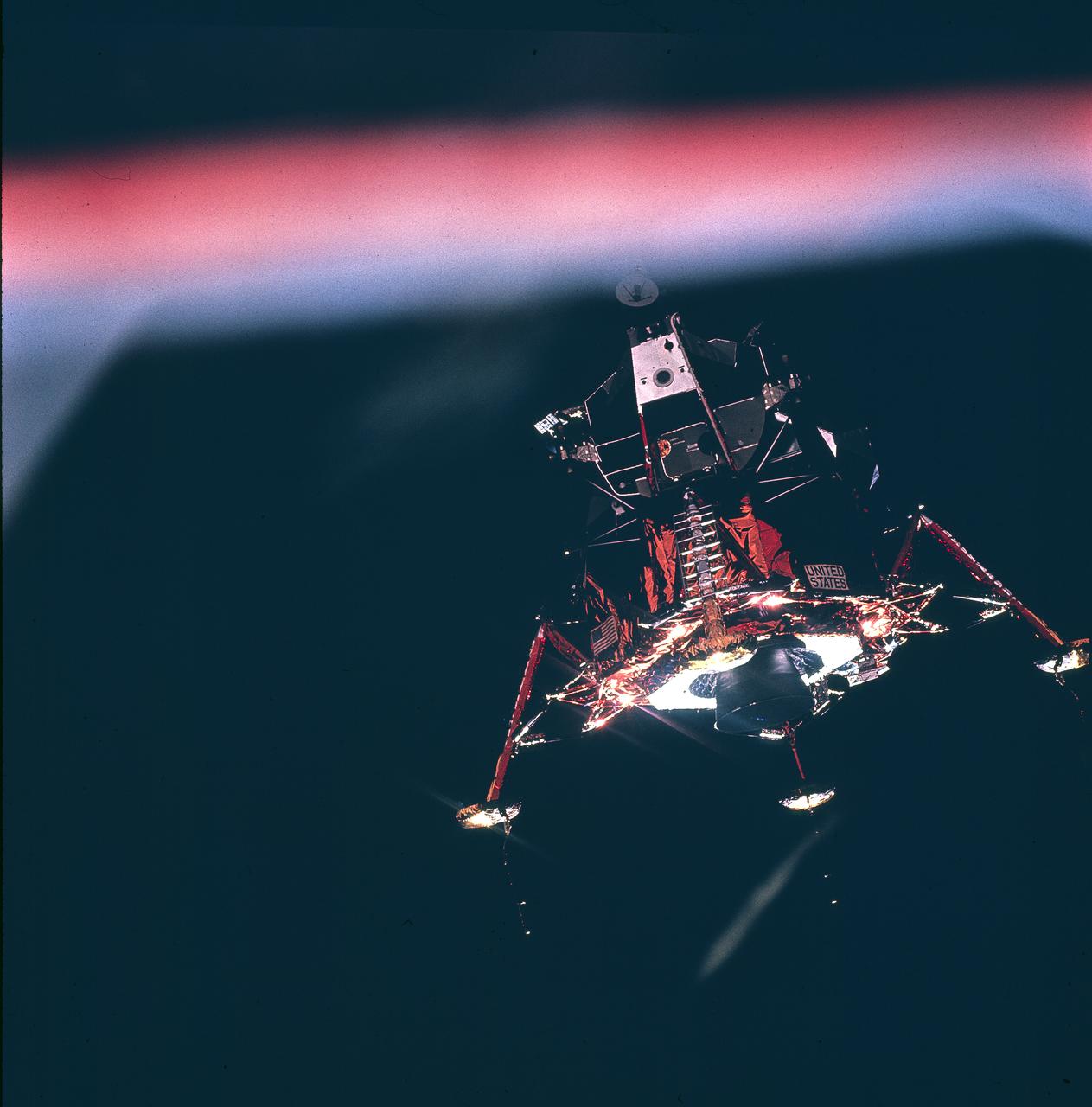
Carrying astronauts Neil A. Armstrong and Edwin E. Aldrin, Jr., the Lunar Module (LM) “Eagle” was the first crewed vehicle to land on the Moon. The LM landed on the moon’s surface on July 20, 1969 in the region known as Mare Tranquilitatis (the Sea of Tranquility). The LM is shown here making its descent to the lunar surface, while Astronaut Collins piloted the Command Module in a parking orbit around the Moon. The Apollo 11 mission launched from The Kennedy Space Center, Florida aboard a Saturn V launch vehicle on July 16, 1969 and safely returned to Earth on July 24, 1969. The 3-man crew aboard the flight consisted of Neil A. Armstrong, commander; Michael Collins, Command Module pilot; and Edwin E. Aldrin Jr., Lunar Module pilot. Armstrong was the first human to ever stand on the lunar surface. As he stepped off the LM, Armstrong proclaimed, “That’s one small step for man, one giant leap for mankind”. He was followed by Edwin (Buzz) Aldrin, describing the lunar surface as Magnificent desolation. The crew collected 47 pounds of lunar surface material which was returned to Earth for analysis. The surface exploration was concluded in 2½ hours. With the success of Apollo 11, the national objective to land men on the Moon and return them safely to Earth had been accomplished. The Saturn V vehicle was developed by the Marshall Space Flight Center (MSFC) under the direction of Dr. von Braun.
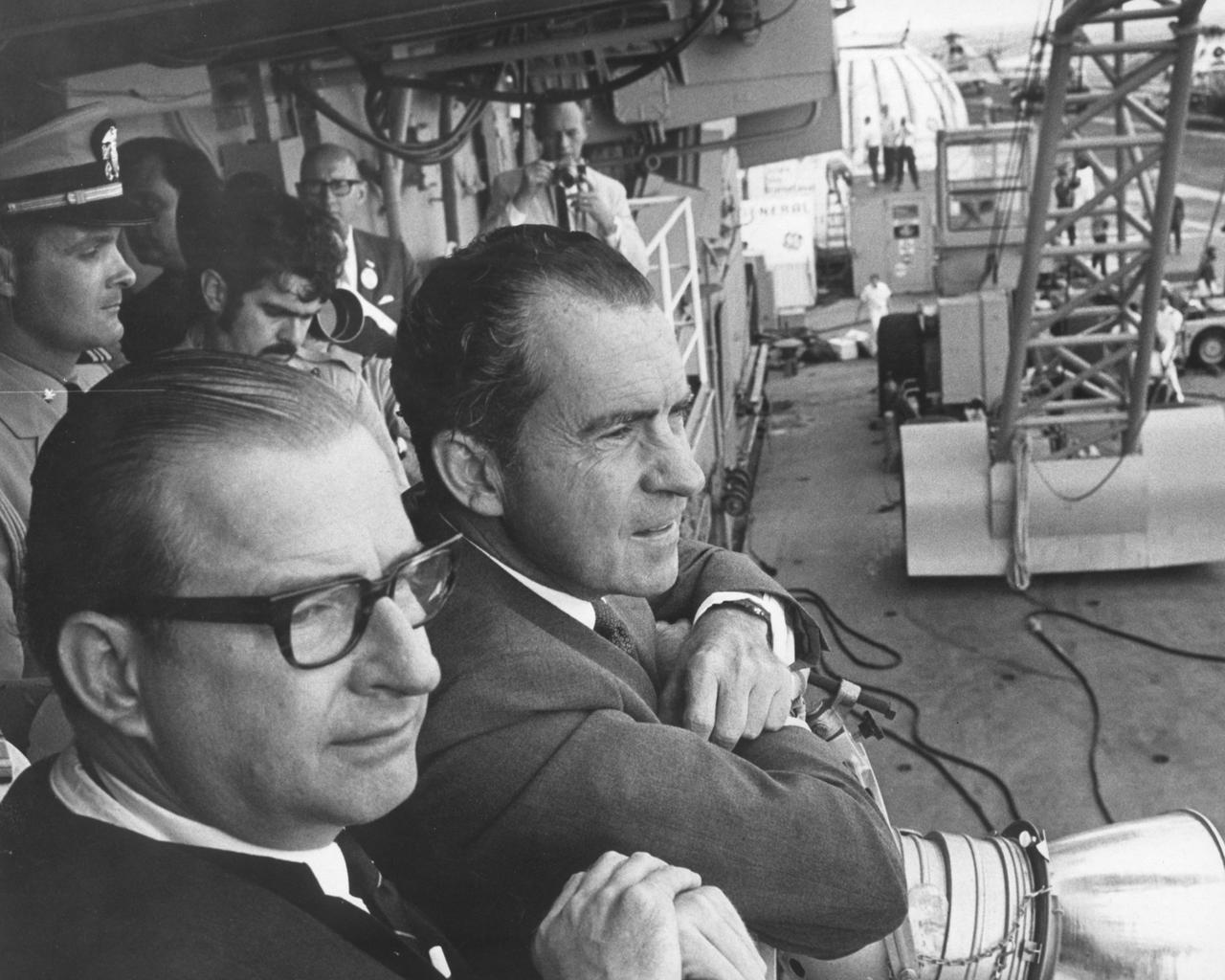
Dr. Thomas Paine, NASA administrator (left) and U.S. President Richard Milhous Nixon wait aboard the recovery ship, the U.S.S. Hornet, for splashdown of the Apollo 11 in the Pacific Ocean. Navy para-rescue men recovered the capsule housing the 3-man crew. The crew was taken to safety aboard the U.S.S. Hornet, where they were quartered in a Mobile Quarantine Facility (MQF). The Apollo 11 mission, the first manned lunar mission, launched from the Kennedy Space Center, Florida via the Saturn V launch vehicle on July 16, 1969 and safely returned to Earth on July 24, 1969. The Saturn V vehicle was developed by the Marshall Space Flight Center (MSFC) under the direction of Dr. Wernher von Braun. Aboard were Neil A. Armstrong, commander; Michael Collins, Command Module (CM) pilot; and Edwin E. Aldrin Jr., Lunar Module (LM) pilot. The CM, piloted by Michael Collins remained in a parking orbit around the Moon while the LM, named “Eagle’’, carrying astronauts Neil Armstrong and Edwin Aldrin, landed on the Moon. Armstrong was the first human to ever stand on the lunar surface, followed by Edwin (Buzz) Aldrin. During 2½ hours of surface exploration, the crew collected 47 pounds of lunar surface material for analysis back on Earth. With the success of Apollo 11, the national objective to land men on the Moon and return them safely to Earth had been accomplished.
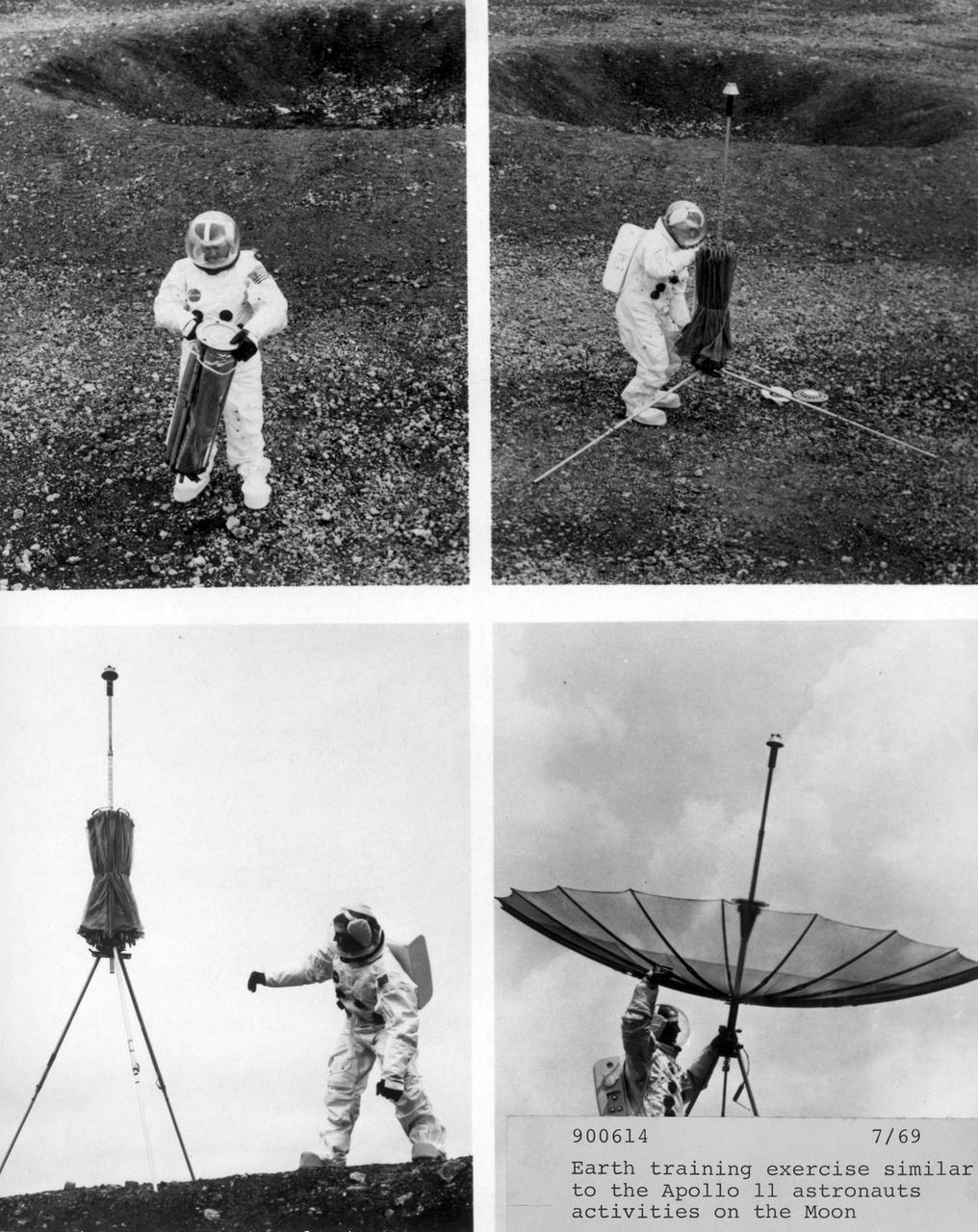
In preparation of the nation’s first lunar landing mission, Apollo 11 crew members underwent training to practice activities they would be performing during the mission. In this photograph, taken at the Manned Spacecraft Center in Houston, Texas, an engineer, Bob Mason, donned in a space suit, goes through some of those training exercises on the mock lunar surface. He performed activites similar to those planned for astronauts Neil Armstrong and Edwin Aldrin during their moon walk. The Apollo 11 mission launched from the Kennedy Space Center (KSC) in Florida via the Marshall Space Flight Center (MSFC) developed Saturn V launch vehicle on July 16, 1969 and safely returned to Earth on July 24, 1969. Aboard the space craft were astronauts Neil A. Armstrong, commander; Michael Collins, Command Module (CM) pilot; and Edwin E. (Buzz) Aldrin Jr., Lunar Module (LM) pilot. The CM, “Columbia”, piloted by Collins, remained in a parking orbit around the Moon while the LM, “Eagle’’, carrying astronauts Armstrong and Aldrin, landed on the Moon. On July 20, 1969, Armstrong was the first human to ever stand on the lunar surface, followed by Aldrin. During 2½ hours of surface exploration, the crew collected 47 pounds of lunar surface material for analysis back on Earth. With the success of Apollo 11, the national objective to land men on the Moon and return them safely to Earth had been accomplished.
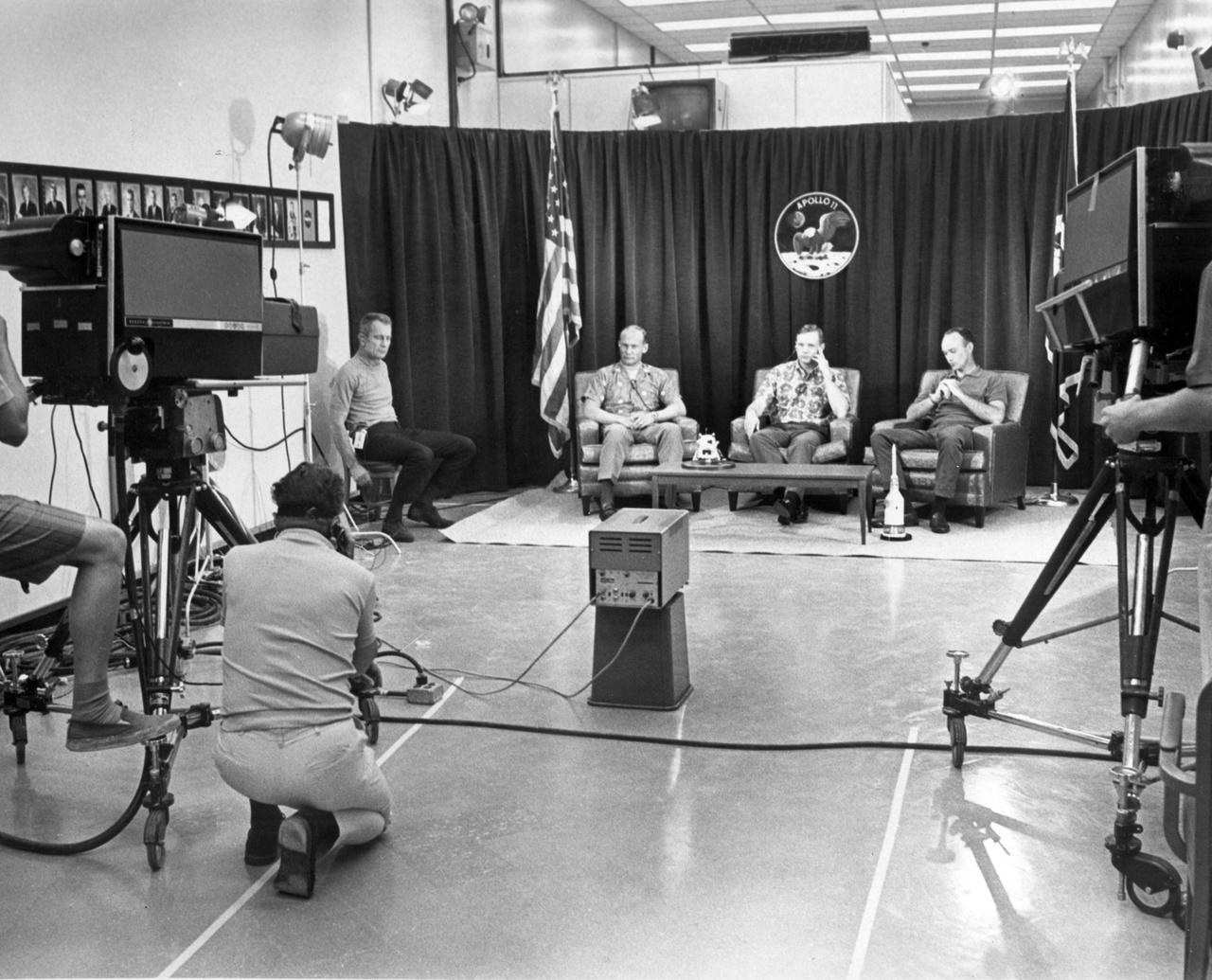
The night before launch day, Apollo 11 crew members (R-L) Michael Collins, Neil Armstrong, and Edwin Aldrin, participated in a closed circuit press conference the night before they began their historic lunar landing mission. At far left is chief astronaut and director of flight crew operations, Donald K. Slayton. The press conference with questions via intercom, was held under semi-isolation conditions to avoid exposing the astronauts to possible illness at the last minute. The Apollo 11 mission, the first lunar landing mission, launched from the Kennedy Space Center (KSC) in Florida via the Marshall Space Flight Center (MSFC) developed Saturn V launch vehicle on July 16, 1969 and safely returned to Earth on July 24, 1969. Aboard the space craft were astronauts Neil A. Armstrong, commander; Michael Collins, Command Module (CM) pilot; and Edwin E. (Buzz) Aldrin Jr., Lunar Module (LM) pilot. The CM, “Columbia”, piloted by Collins, remained in a parking orbit around the Moon while the LM, “Eagle’’, carrying astronauts Armstrong and Aldrin, landed on the Moon. On July 20, 1969, Armstrong was the first human to ever stand on the lunar surface, followed by Aldrin. During 2½ hours of surface exploration, the crew collected 47 pounds of lunar surface material for analysis back on Earth. With the success of Apollo 11, the national objective to land men on the Moon and return them safely to Earth had been accomplished.
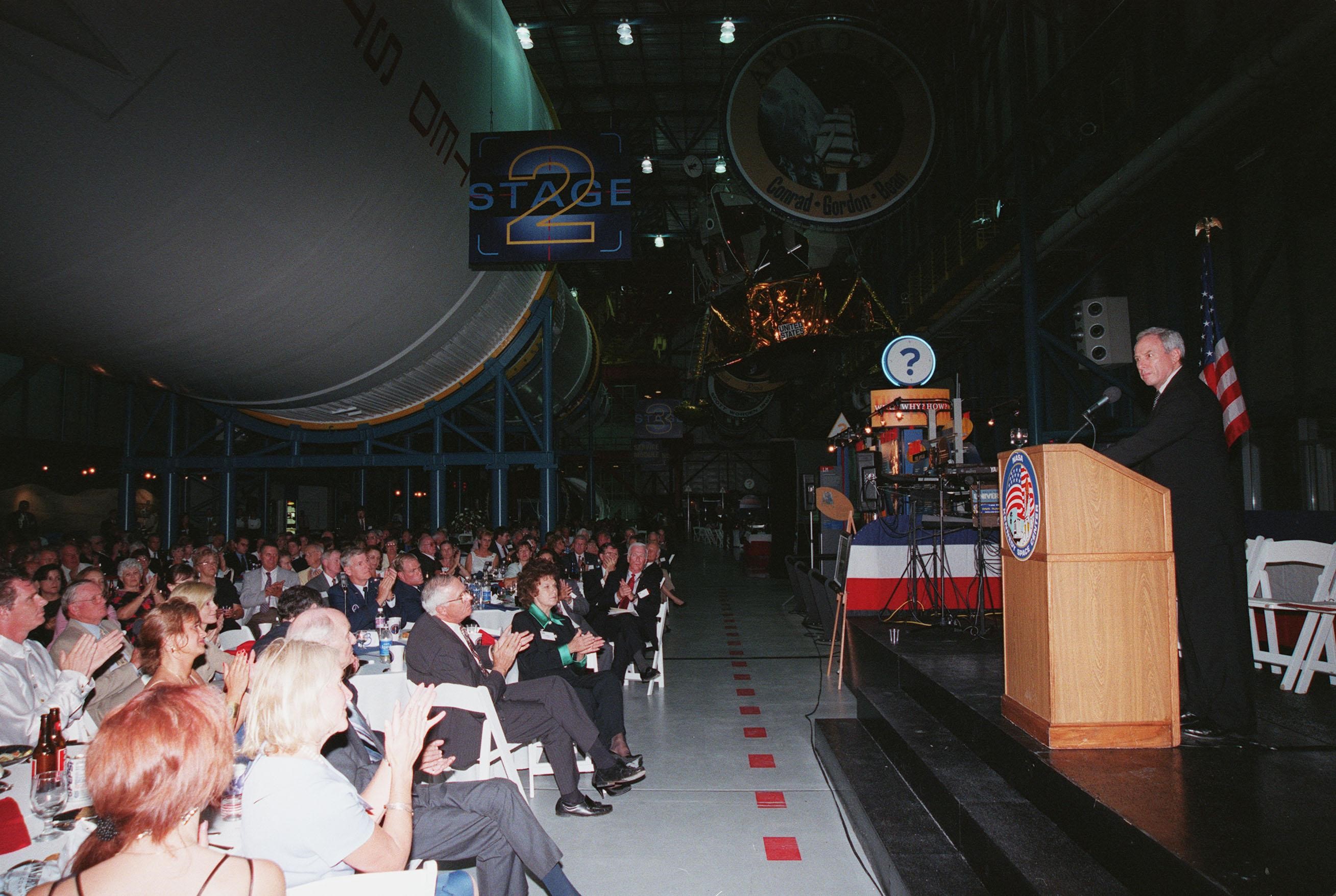
KENNEDY SPACE CENTER, FLA. -- NASA Administrator Daniel S. Goldin (right) addresses the audience at the Apollo 11 anniversary banquet honoring the Apollo team, the people who made the entire lunar landing program possible. The banquet was held in the Apollo/Saturn V Center, part of the KSC Visitor Complex, with seating under an unused Saturn V rocket like those that powered the Apollo launches . This is the 30th anniversary of the Apollo 11 launch and moon landing, July 16 and July 20, 1969. Among the guests at the banquet were former Apollo astronauts are Neil A. Armstrong and Edwin "Buzz" Aldrin who flew on Apollo 11, the launch of the first moon landing; Gene Cernan, who flew on Apollo 10 and 17 and was the last man to walk on the moon; and Walt Cunningham, who flew on Apollo 7
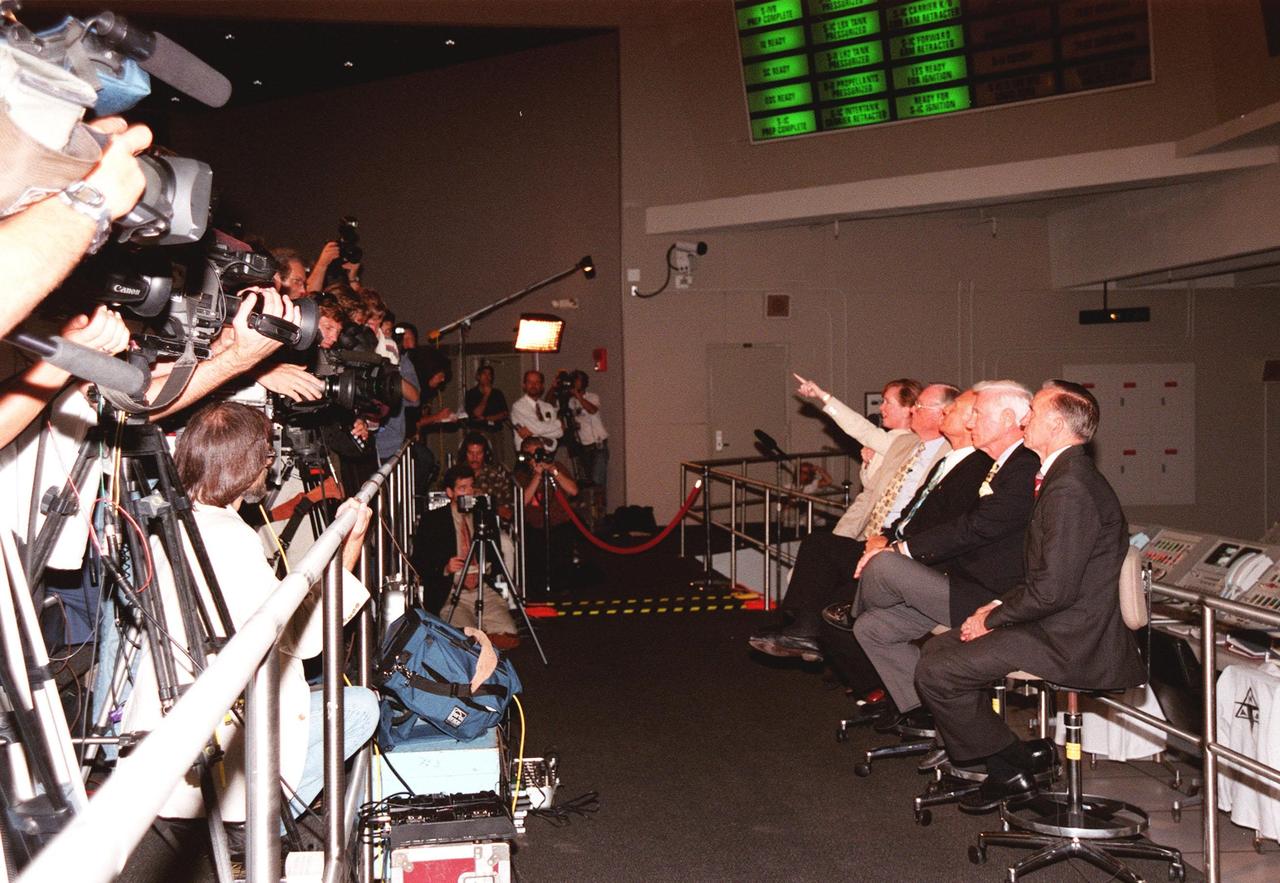
KENNEDY SPACE CENTER, FLA. -- In the Apollo/Saturn V Center, Lisa Malone, chief of KSC's Media Services branch, identifies a reporter in the stands to pose a question to one of the former Apollo astronauts seated next to her. From left to right, they are Neil A. Armstrong and Edwin "Buzz" Aldrin who flew on Apollo 11, the launch to the moon; Gene Cernan, who flew on Apollo 10 and 17; and Walt Cunningham, who flew on Apollo 7. Behind them on the lower floor are the original computer consoles used in the firing room during the Apollo program. They are now part of the reenactment of the Apollo launches in the exhibit at the center. This is the 30th anniversary of the launch and moon landing, July 16 and July 20, 1969. Neil Armstrong was the first man to set foot on the moon
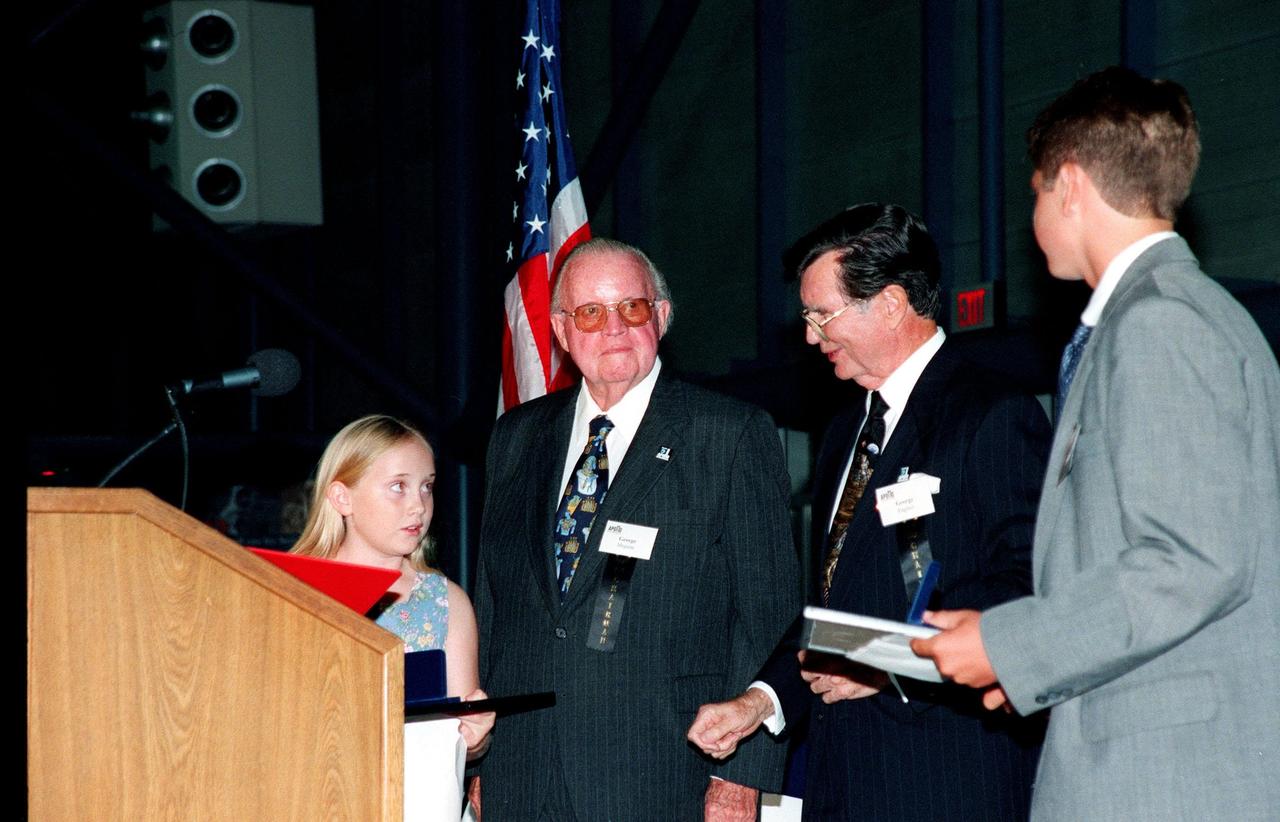
KENNEDY SPACE CENTER, FLA. -- At the Apollo/Saturn V Center, George Meguiar (center left) and George English (center right) present scholarships to two students who entered an essay contest in conjunction with the 30th Anniversary of Apollo 11. The winners shown are Kyla Davis Horn, of Cocoa Beach, and Kyle Rukaczewski, of Satellite Beach. A third winner, Jason Gagnon, of Viera, was unable to attend. Meguiar and English head the Apollo 11 Commemoration Association which sponsored the contest in conjunction with Florida Today newspaper. The presentation was made at the Apollo/Saturn V Center during an anniversary banquet that honored all the people who made the Apollo Program possible. Special guests included former Apollo astronauts Neil Armstrong, Edwin "Buzz" Aldrin, Gene Cernan and Walt Cunningham, who shared their experiences with the audience

KENNEDY SPACE CENTER, FLA. -- In this closeup viewed from above, former Apollo astronauts (seated, left to right) Neil A. Armstrong and Edwin "Buzz" Aldrin who flew on Apollo 11, the launch to the moon; Gene Cernan, who flew on Apollo 10 and 17; and Walt Cunningham, who flew on Apollo 7, answer questions from the media during a press conference in the Apollo/Saturn V Center. At left is Lisa Malone, chief of KSC's Media Services branch, who monitored the session. In the background are the original computer consoles used in the firing room during the Apollo program. They are now part of the reenactment of the Apollo launches in the exhibit at the center. The four astronauts were at KSC for the 30th anniversary of the Apollo 11 launch and moon landing, July 16 and July 20, 1969
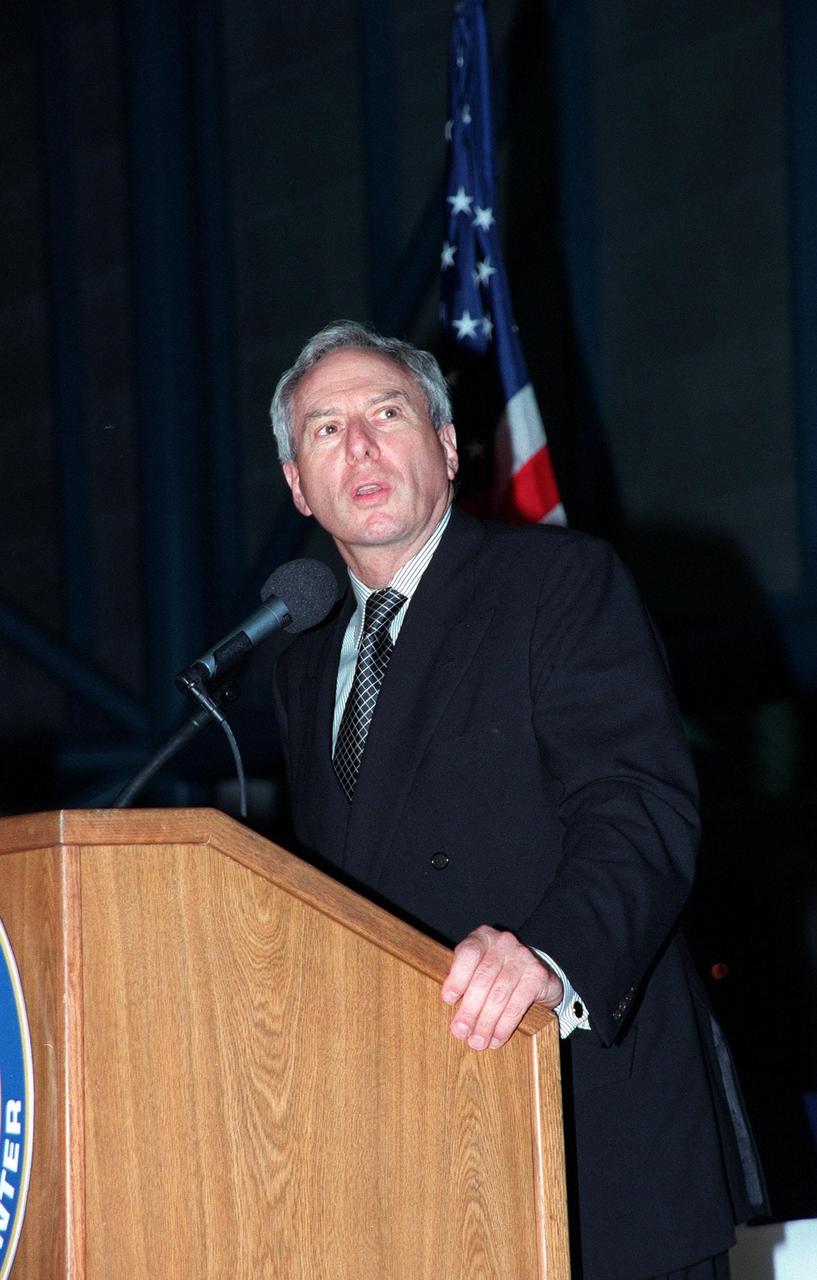
KENNEDY SPACE CENTER, FLA. -- NASA Administrator Daniel S. Goldin addresses the audience at the Apollo 11 anniversary banquet honoring the Apollo team, the people who made the entire lunar landing program possible. The banquet was held in the Apollo/Saturn V Center, part of the KSC Visitor Complex. This is the 30th anniversary of the Apollo 11 launch and moon landing, July 16 and July 20, 1969. Among the guests at the banquet were former Apollo astronauts are Neil A. Armstrong and Edwin "Buzz" Aldrin who flew on Apollo 11, the launch of the first moon landing; Gene Cernan, who flew on Apollo 10 and 17 and was the last man to walk on the moon; and Walt Cunningham, who flew on Apollo 7