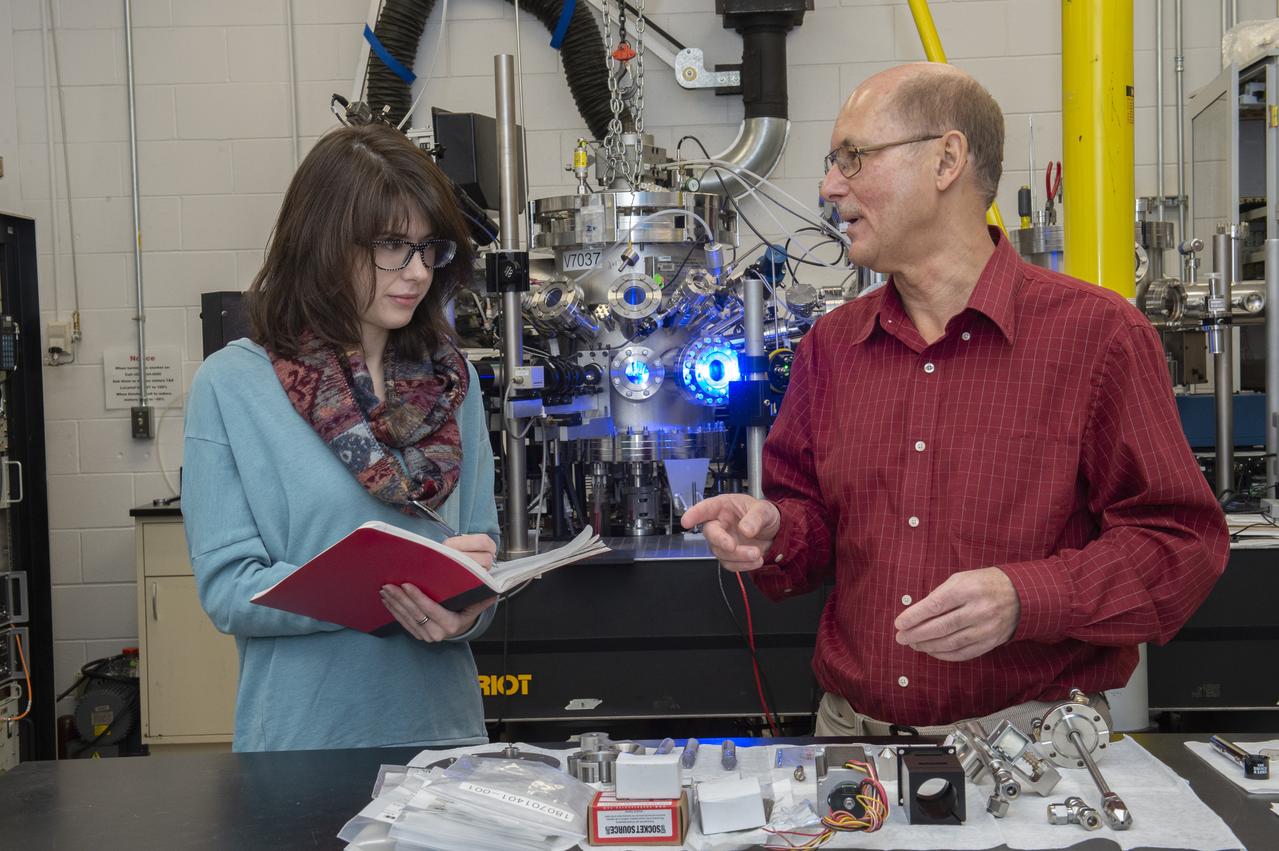
Dr. Richard Weber and Ms. Emma Clark from Materials Development Inc. during a visit to the MSFC electrostatic levitation (ESL) laboratory. Here they are preparing for ESL tests in support of Dr. Weber's NASA grant "Microgravity Investigation of Thermophysical Properties of Supercooled Molten Metal Oxides" (NNX17AH73G).
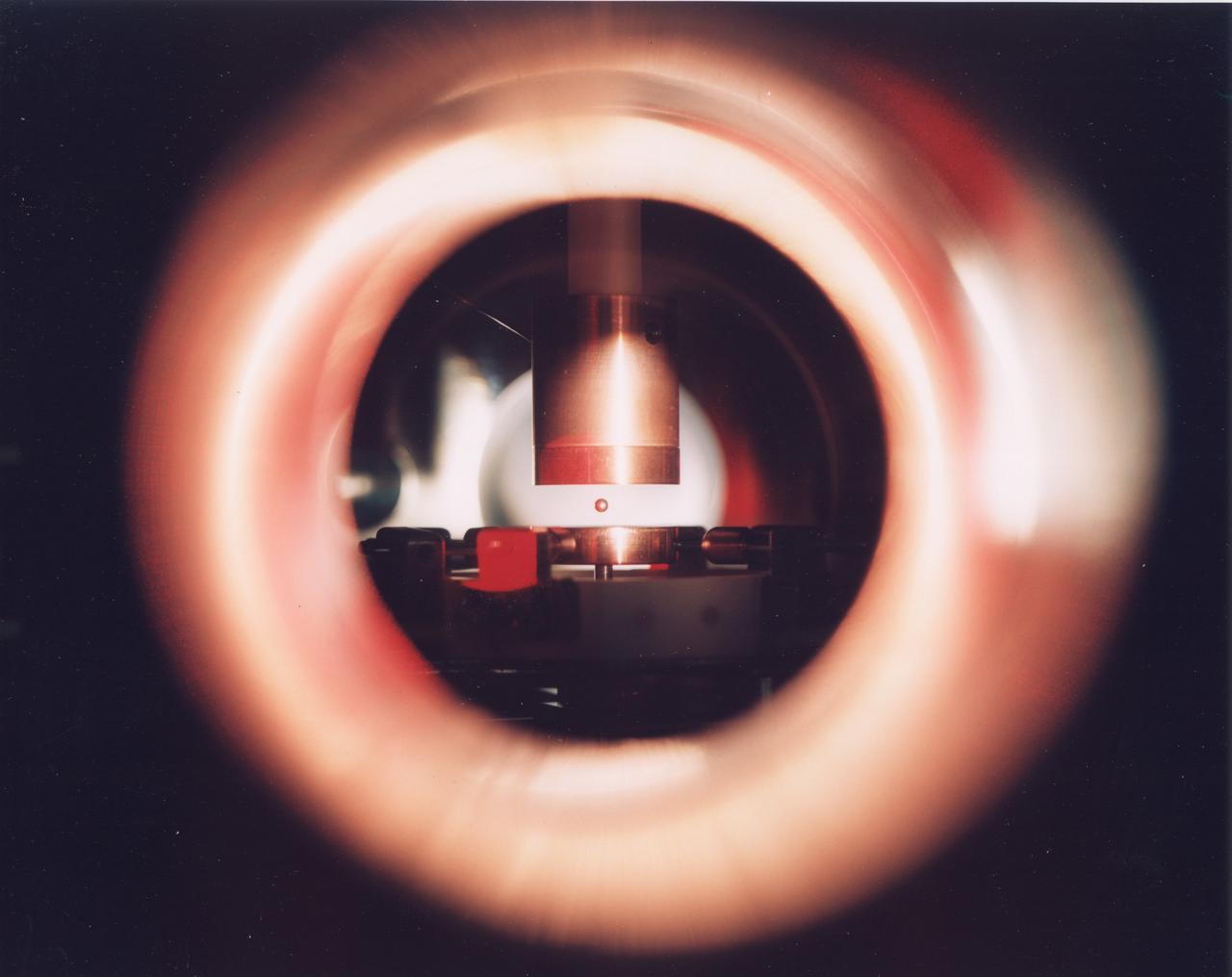
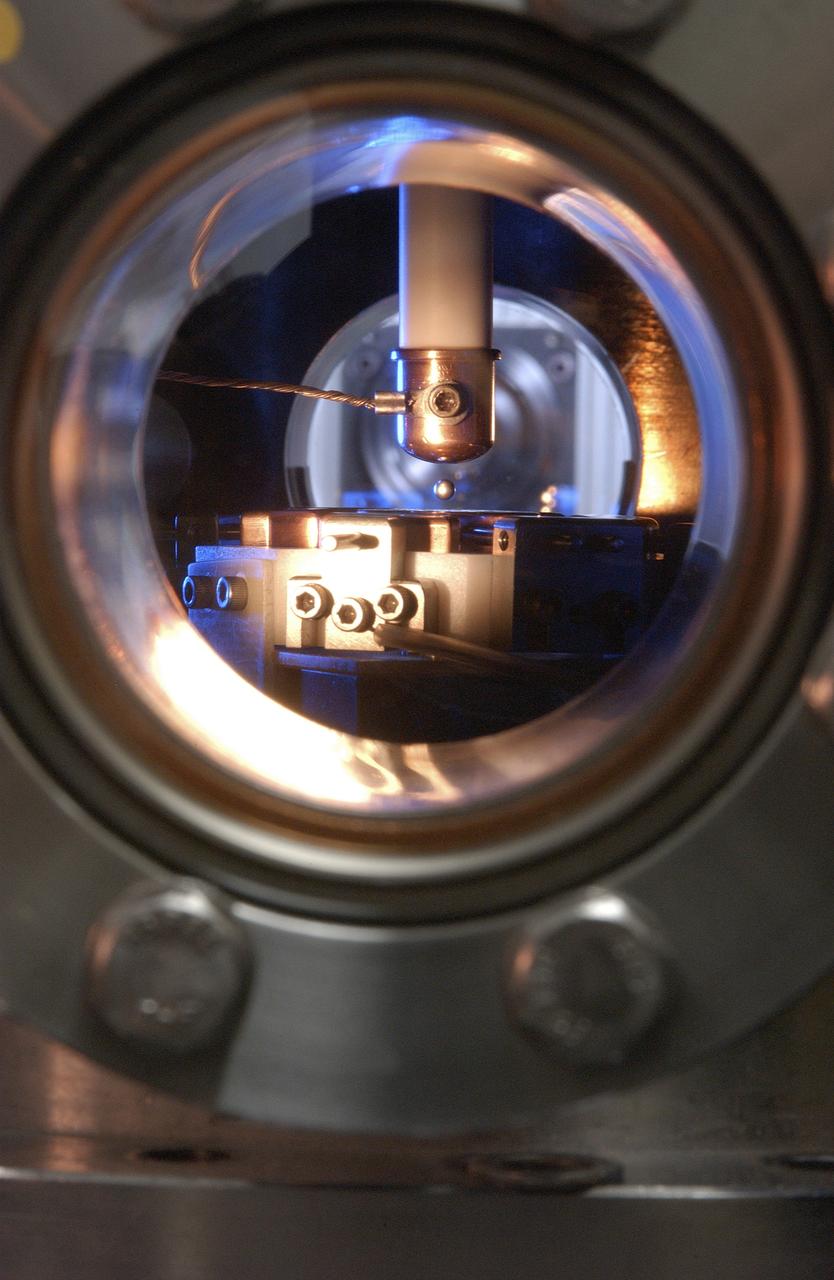
Metal droplet levitated inside the Electrostatic Levitator (ESL). The ESL uses static electricity to suspend an object (about 2-3 mm in diameter) inside a vacuum chamber while a laser heats the sample until it melts. This lets scientists record a wide range of physical properties without the sample contacting the container or any instruments, conditions that would alter the readings. The Electrostatic Levitator is one of several tools used in NASA's microgravity materials science program.
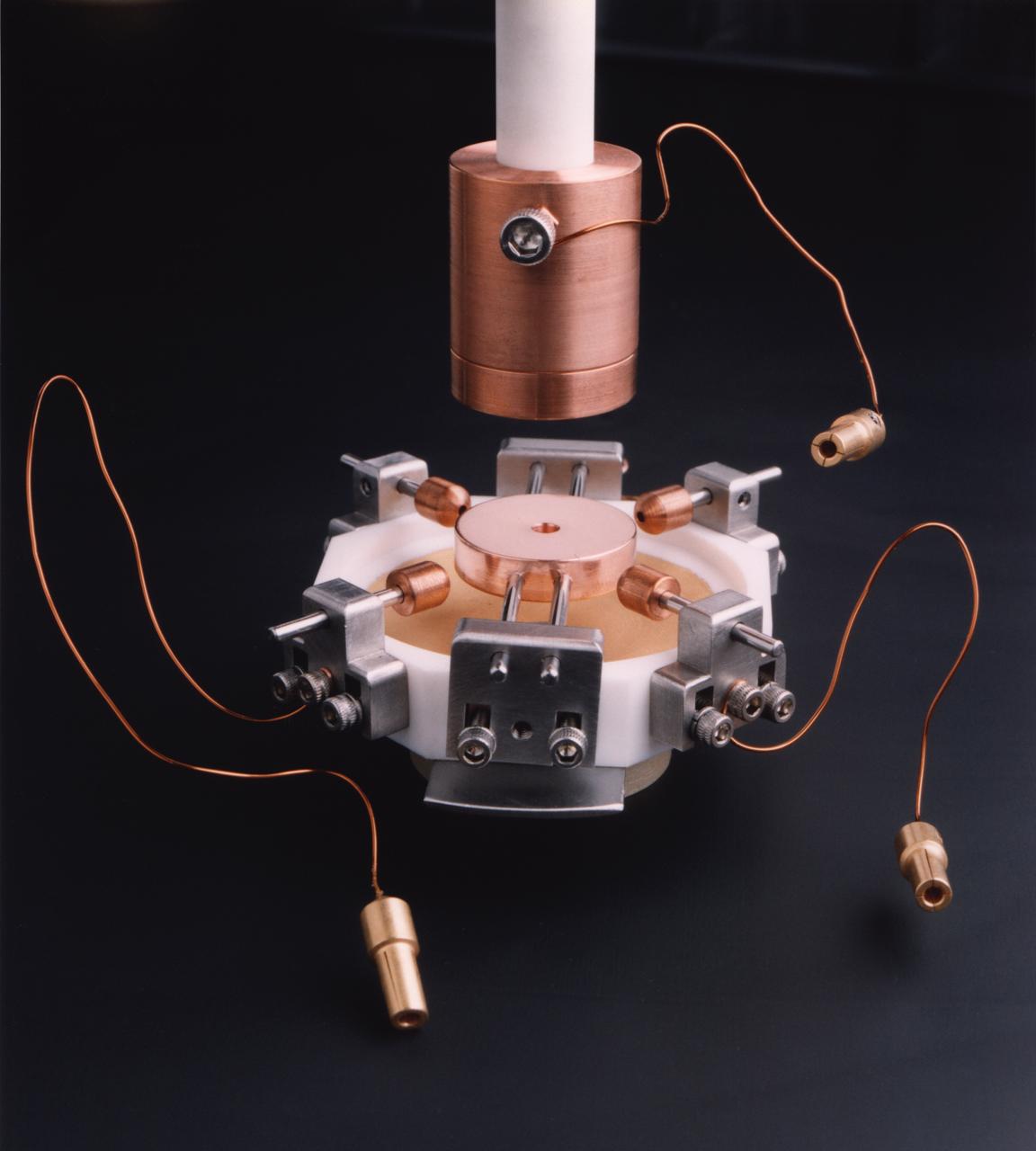
Electrostatic levitation system inside Electrostatic Levitator (ESL) vacuum chamber. The ESL uses static electricity to suspend an object (about 2-3 mm in diameter) inside a vacuum chamber while a laser heats the sample until it melts. This lets scientists record a wide range of physical properties without the sample contacting the container or any instruments, conditions that would alter the readings. The Electrostatic Levitator is one of several tools used in NASA's microgravity materials science program.
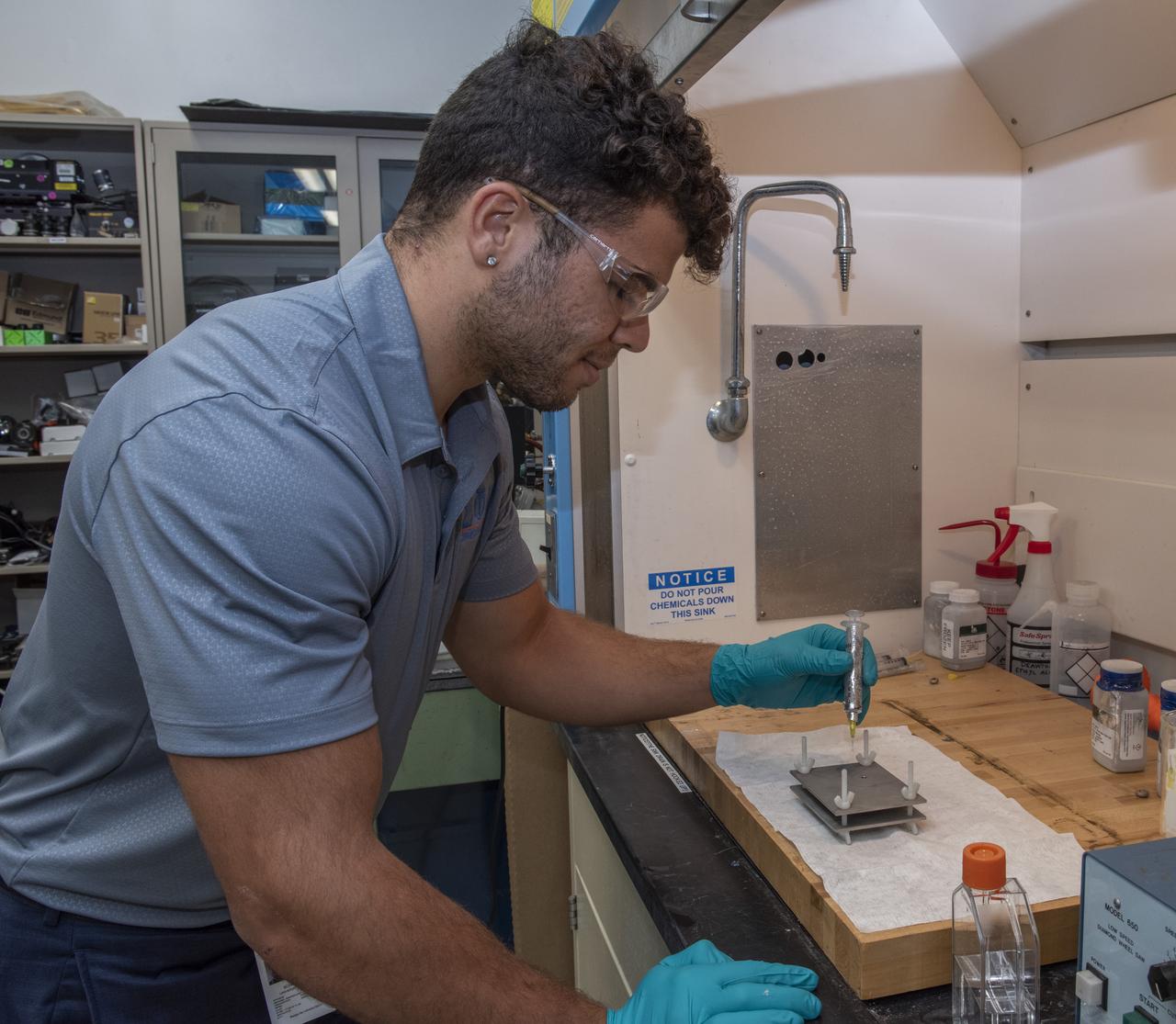
Allan Bonet (undergraduate student, University of Florida) prepares a test cell for ground-based testing in support of Dr. Ranga Narayanan’s (University of Florida) NASA grant “A Novel Way to Measure Interfacial Tension Using the Electrostatic Levitation Furnace (ELF)†(NNX17AL27G).
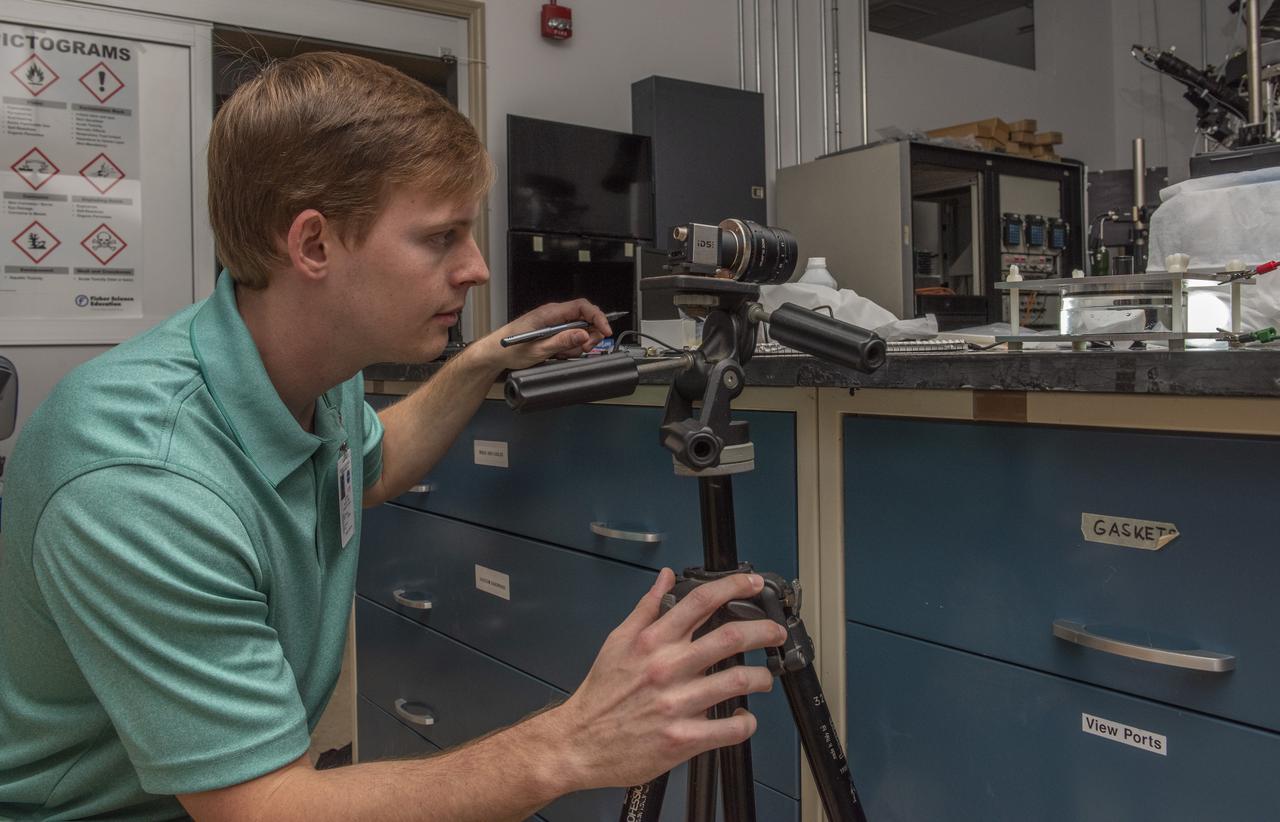
Evan Wilson (undergraduate student, University of Florida) observes a test apparatus to measure interfacial tension in support of Dr. Ranga Narayanan’s (University of Florida) NASA grant “A Novel Way to Measure Interfacial Tension Using the Electrostatic Levitation Furnace (ELF)†(NNX17AL27G).
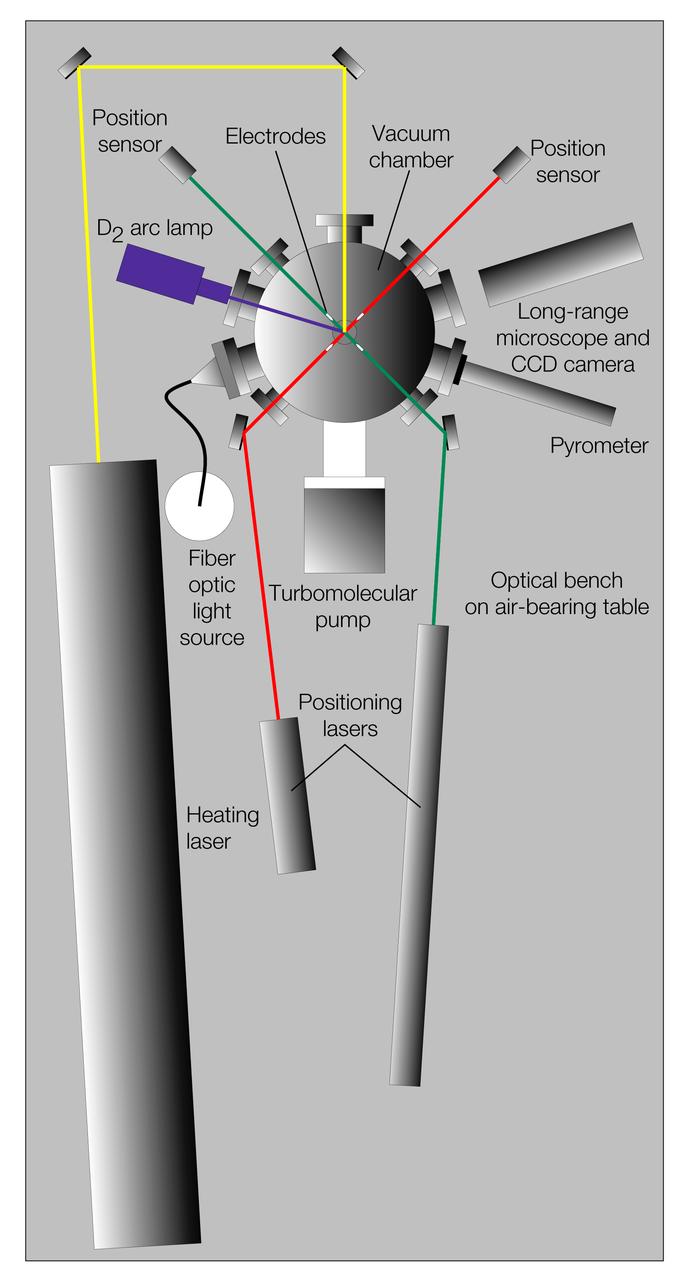
General oayout of Electrostatic Levitator (ESL). The ESL uses static electricity to suspend an object (about 2-3 mm in diameter) inside a vacuum chamber while a laser heats the sample until it melts. This lets scientists record a wide range of physical properties without the sample contacting the container or any instruments, conditions that would alter the readings. The Electrostatic Levitator is one of several tools used in NASA's microgravity materials science program.
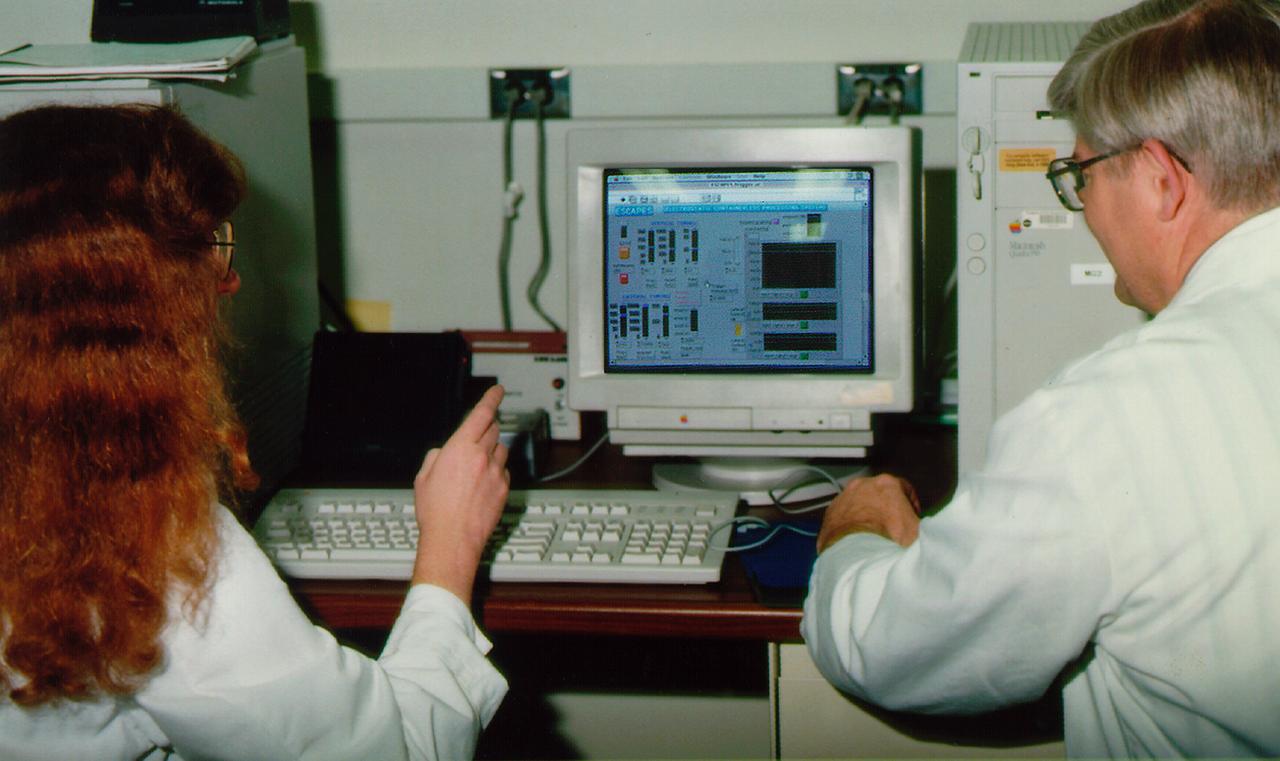
Dr. Jan Rogers and Dr. Michael Robinson operate the Electrostatic Levitator (ESL) at NASA's Marshall Space Flight Center (MSFC). The ESL uses static electricity to suspend an object (about 2-3 mm in diameter) inside a vacuum chamber while a laser heats the sample until it melts. This lets scientists record a wide range of physical properties without the sample contacting the container or any instruments, conditions that would alter the readings. The Electrostatic Levitator is one of several tools used in NASA's microgravity materials science program.
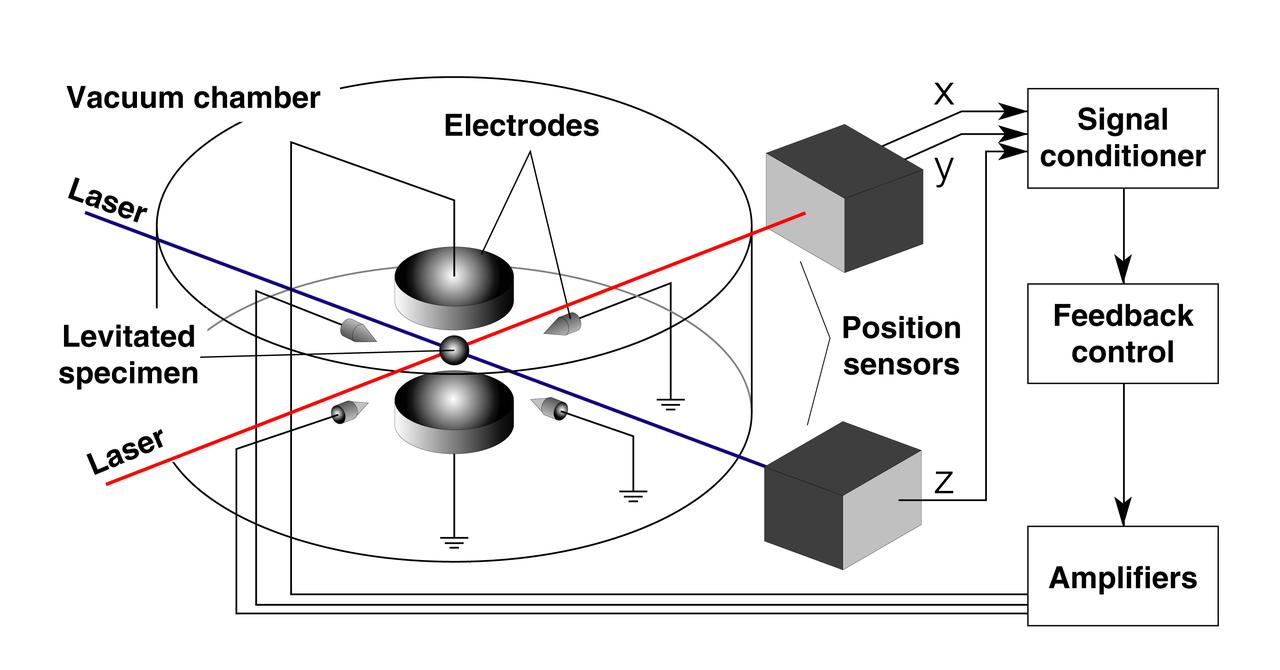
Schematic of Electrostatic Levitator (ESL) electrodes and controls system. The ESL uses static electricity to suspend an object (about 2-3 mm in diameter) inside a vacuum chamber while a laser heats the sample until it melts. This lets scientists record a wide range of physical properties without the sample contacting the container or any instruments, conditions that would alter the readings. The Electrostatic Levitator is one of several tools used in NASA's microgravity materials science program.
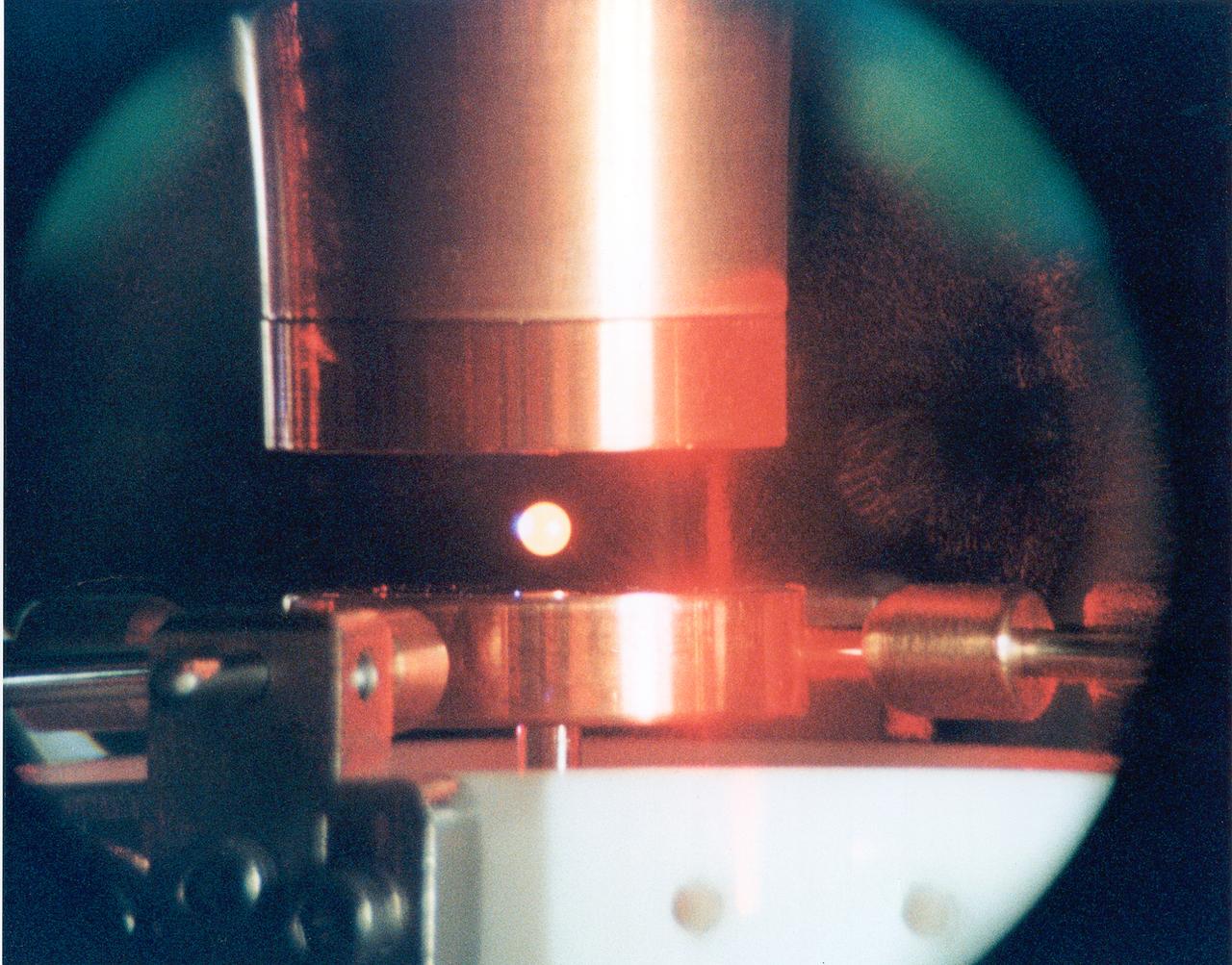
A 3 mm drop of nickel-zirconium, heated to incandescence, hovers between electrically charged plates inside the Electrostatic Levitator (ESL). The ESL uses static electricity to suspend an object (about 2-3 mm in diameter) inside a vacuum chamber while a laser heats the sample until it melts. This lets scientists record a wide range of physical properties without the sample contacting the container or any instruments, conditions that would alter the readings. The Electrostatic Levitator is one of several tools used in NASA's microgravity materials science program.
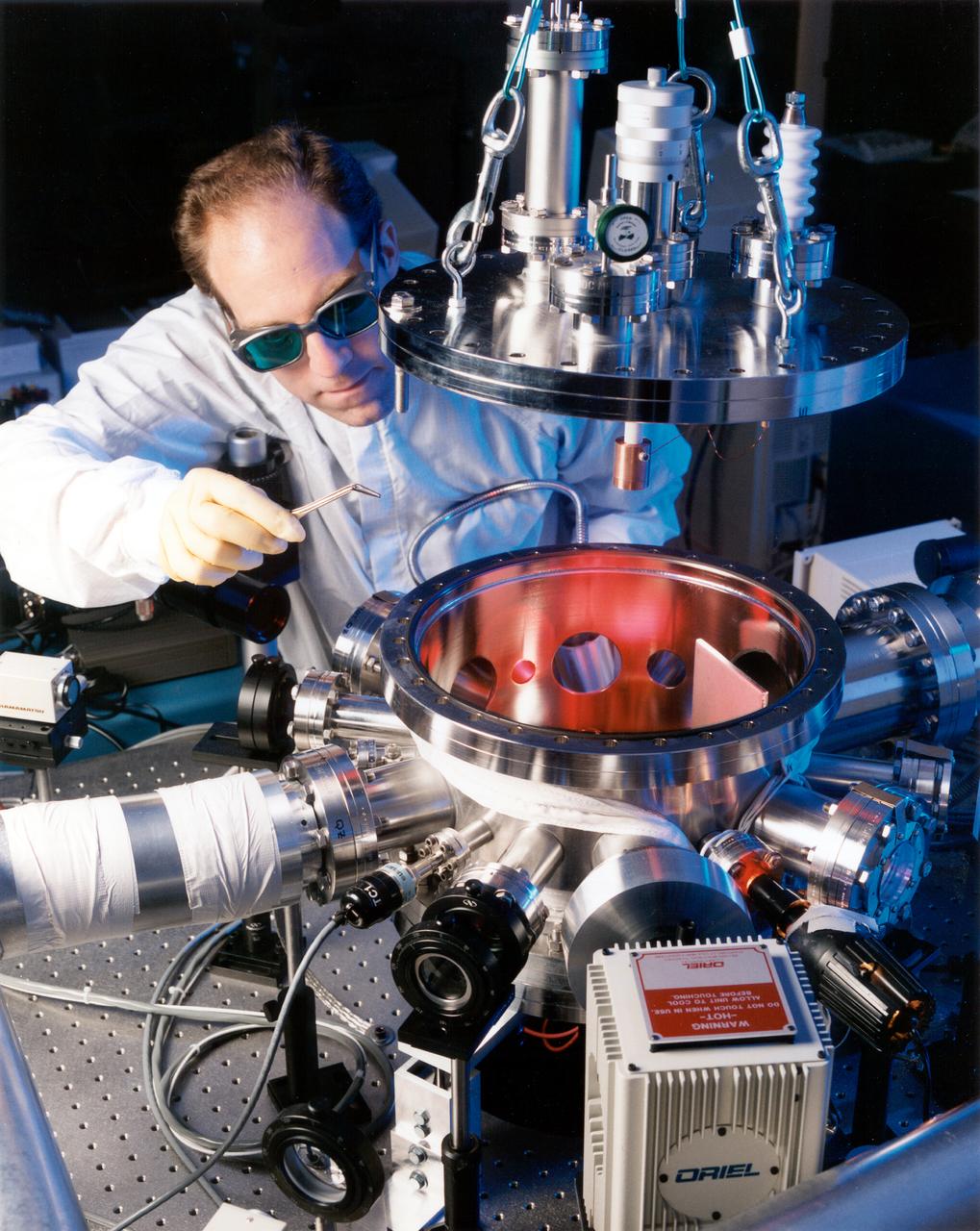
Dr. Rulison of Space System LORAl working with the Electrostatic Levitation (ESL) prior to the donation. Space System/LORAL donated the electrostatic containerless processing system to NASA's Marshall Space Flight Center (MSFC). The official hand over took place in July 1998.
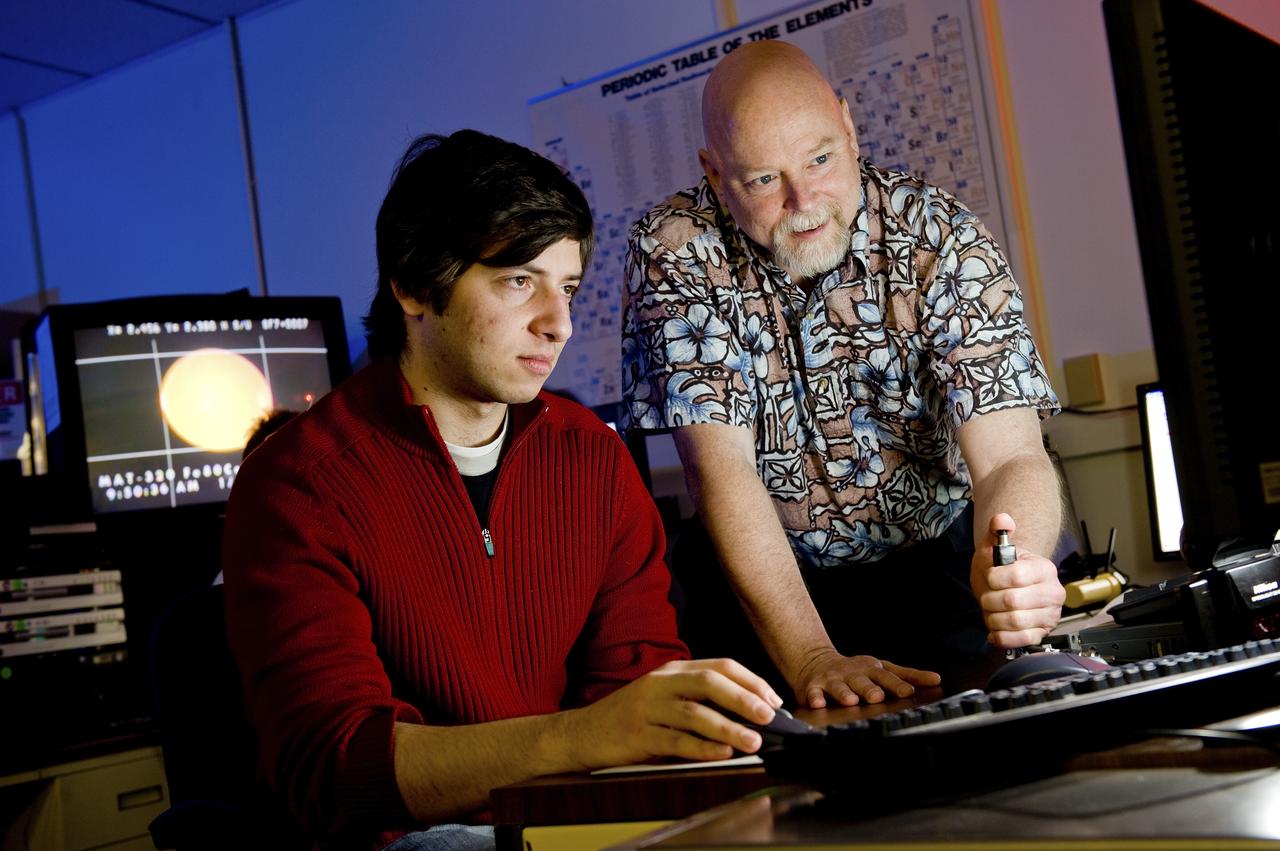
PAUL CHOUFANI AND PROFESSOR DOUGLAS MATSON AT THE CONTROLS OUTSIDE OF THE ELECTROSTATIC LEVITATOR
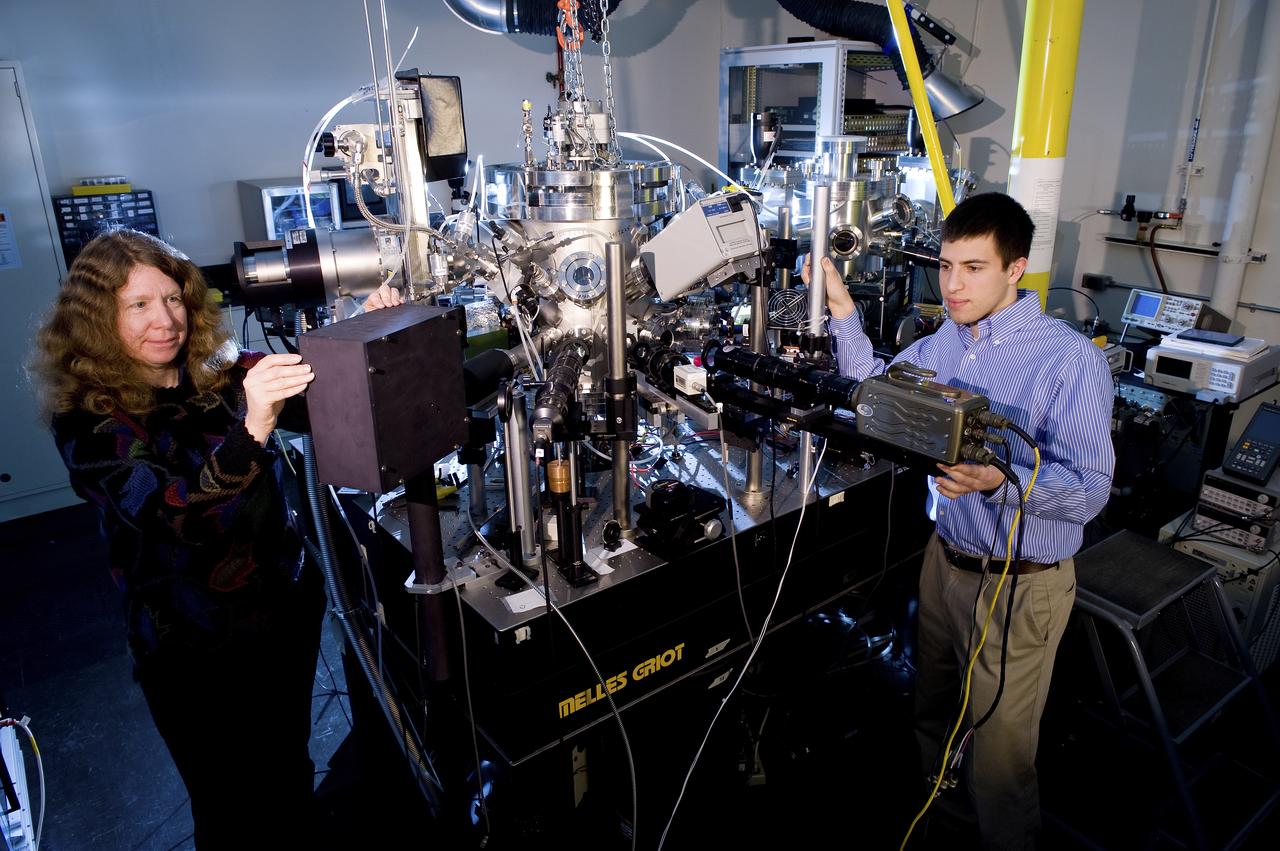
DR. JAN ROGERS, LEFT, AND MATTHEW SHERMAN WITH THE ELECTROSTATIC LEVITATOR

Dr. Jan Rogers, project scientist for the Electrostatic Levitator (ESL) at NASA's Marshall Space Flight Center(MSFC). The ESL uses static electricity to suspend an obejct (about 2-3 mm in diameter) inside a vacuum chamber while a laser heats the sample until it melts. This lets scientists record a wide range of physical properties without the sample contacting the container or any instruments, conditions that would alter the readings. The Electrostatic Levitator is one of several tools used in NASA's microgravity materials sciences program.
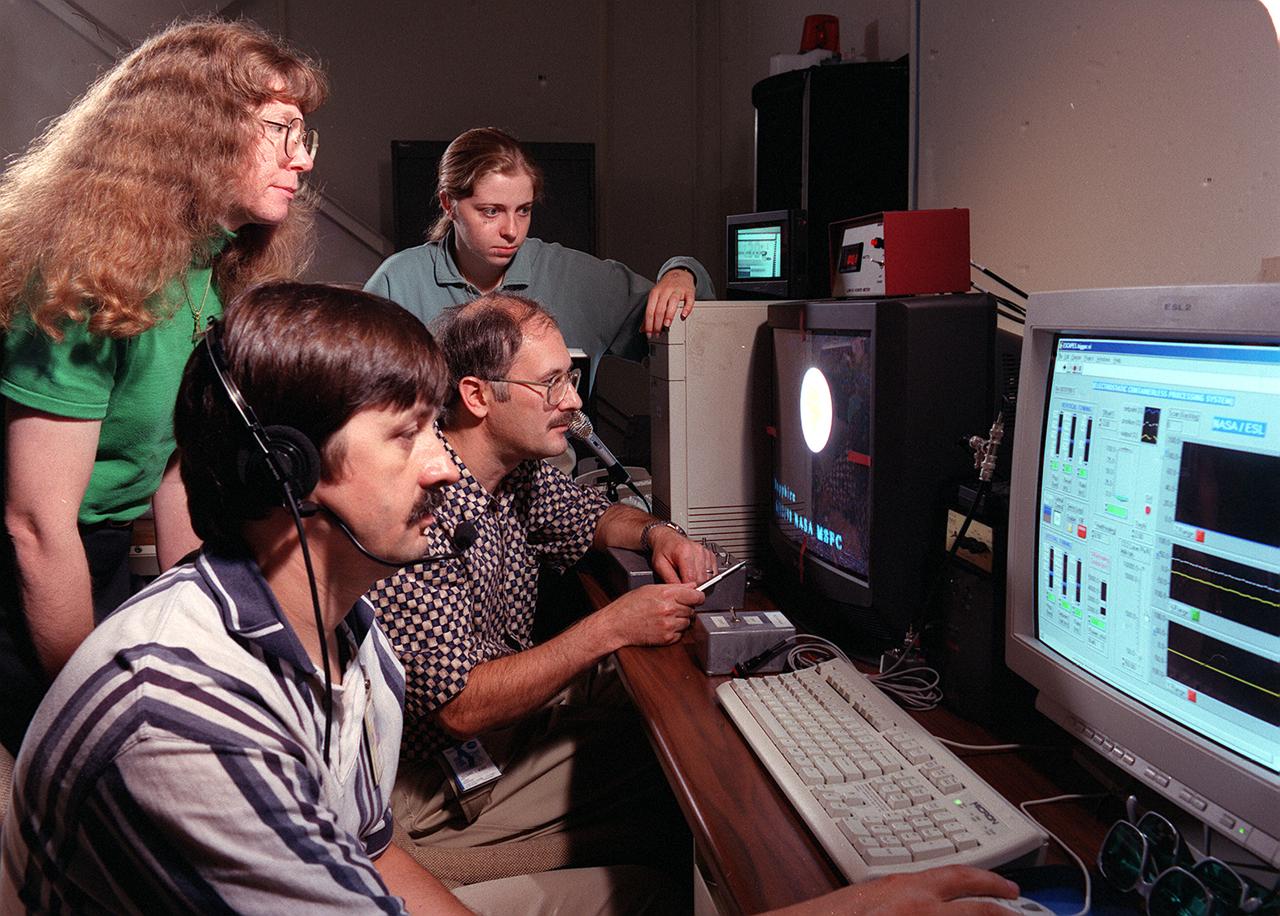
Dr. Jan Rogers (left) and Larry Savage (foreground) of the Science Directorate at NASA's Marshall Space Flight Center (MSFC) are joined by Dr. Richard Weber (center) and April Hixon of Containerless Research Inc. of Evanston, Ill., in conducting an experiment run of the Electrostatic Levitator (ESL) using insulating materials. Materials researchers use unique capabilities of the facility to levitate and study the properties of various materials important in manufacturing processes.
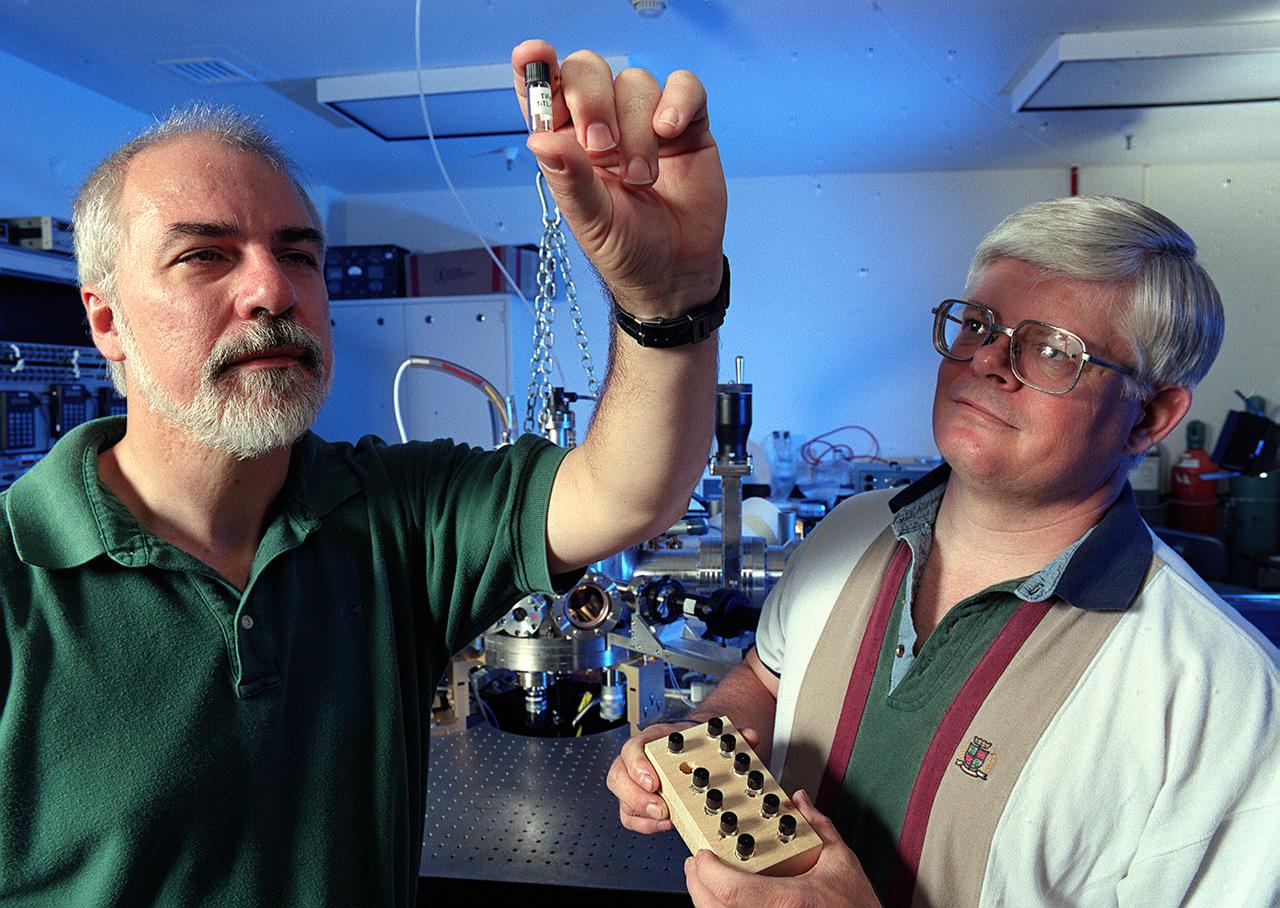
Prof. Kerneth Kelton of Washington University in St. Lous, MO, (L) and Dr. Michael Robinson of NASA's Marshall Space Flight Center (MSFC) examine a titanium-iron silicate (TiFeSiO)sample processed in MSFC's Electrostatic Levitator (ESL) Facility (background). Kelton is investigating undercooling of polytetrahedral phase-forming liquids.
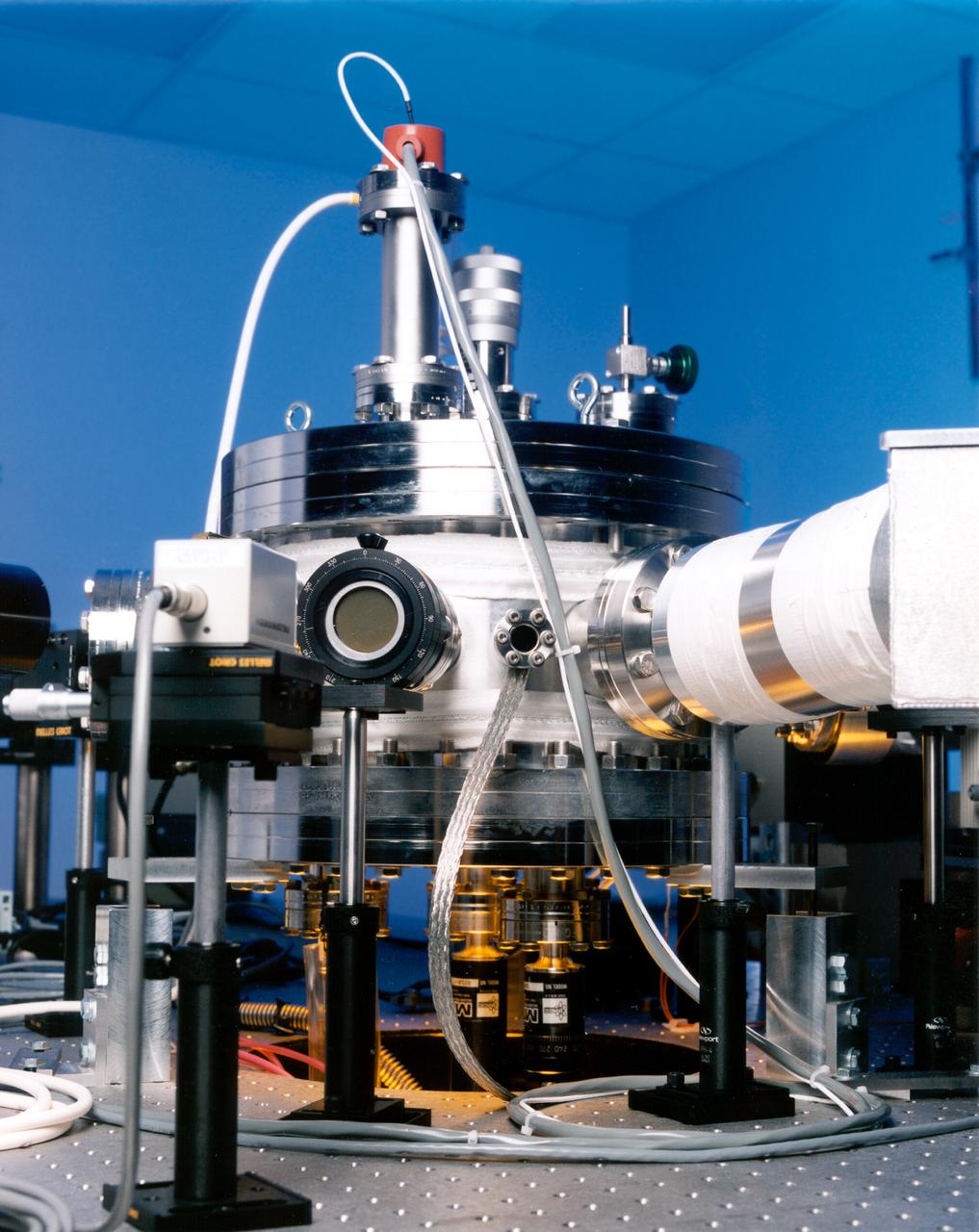
Optical prots ring the Electrostatic Levitator (ESL) vacuum chamber to admit light from the heating laser (the beam passes through the window at left), poisitioning lasers (one port is at center), and lamps (such as the deuterium arc lamp at right), and to allow diagnostic instruments to view the sample. The ESL uses static electricity to suspend an object (about 2-3 mm in diameter) inside a vacuum chamber while a laser heats the sample until it melts. This lets scientists record a wide range of physical properties without the sample contacting the container or any instruments, conditions that would alter the readings. The Electrostatic Levitator is one of several tools used in NASA's microgravity materials science program.
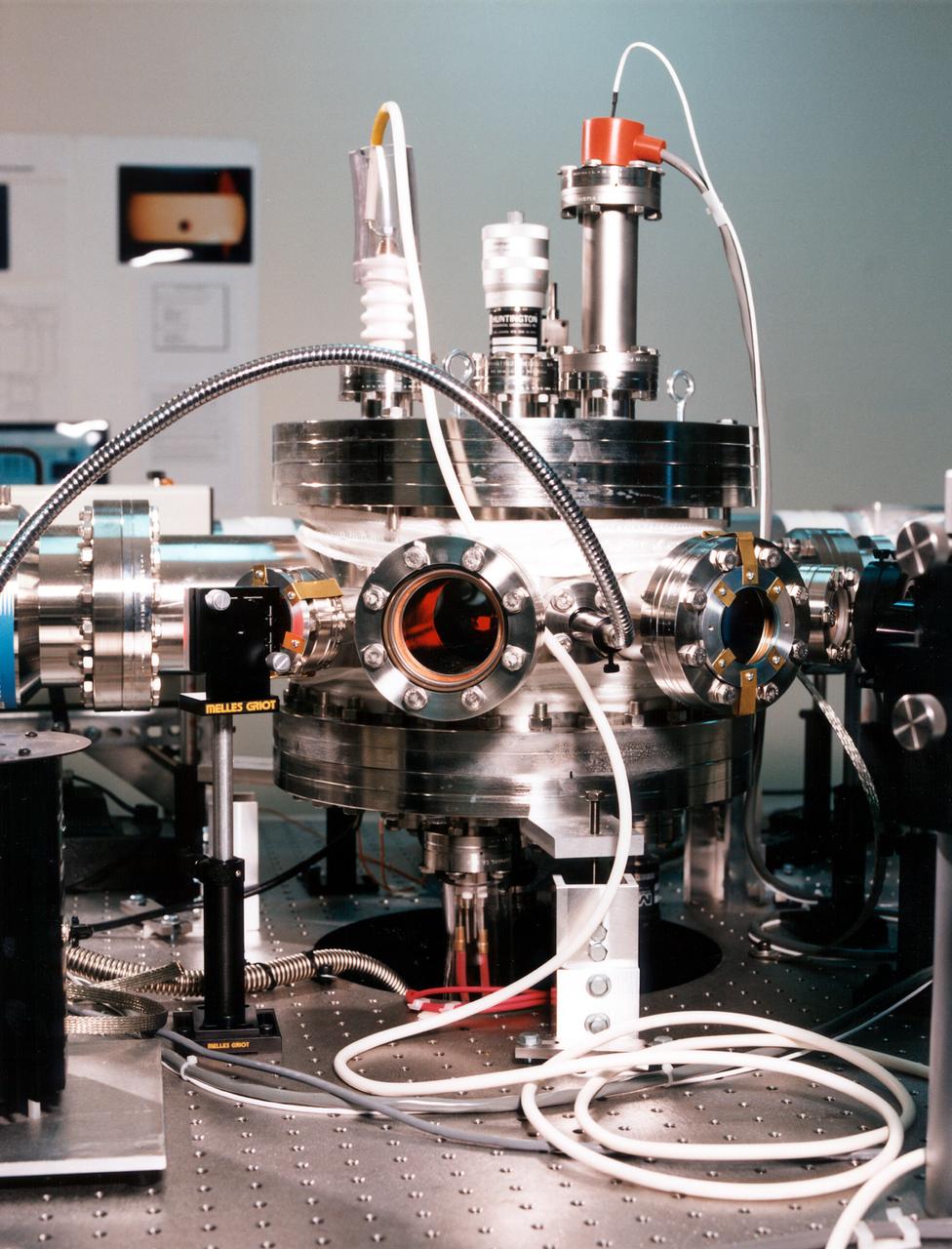
Optical prots ring the Electrostatic Levitator (ESL) vacuum chamber to admit light from the heating laser (the beam passes through the window at left), poisitioning lasers (one port is at center), and lamps (arc lamp at right), and to allow diagnostic instruments to view the sample. The ESL uses static electricity to suspend an object (about 2-3 mm in diameter) inside a vacuum chamber while a laser heats the sample until it melts. This lets scientists record a wide range of physical properties without the sample contacting the container or any instruments, conditions that would alter the readings. The Electrostatic Levitator is one of several tools used in NASA's microgravity materials science program.
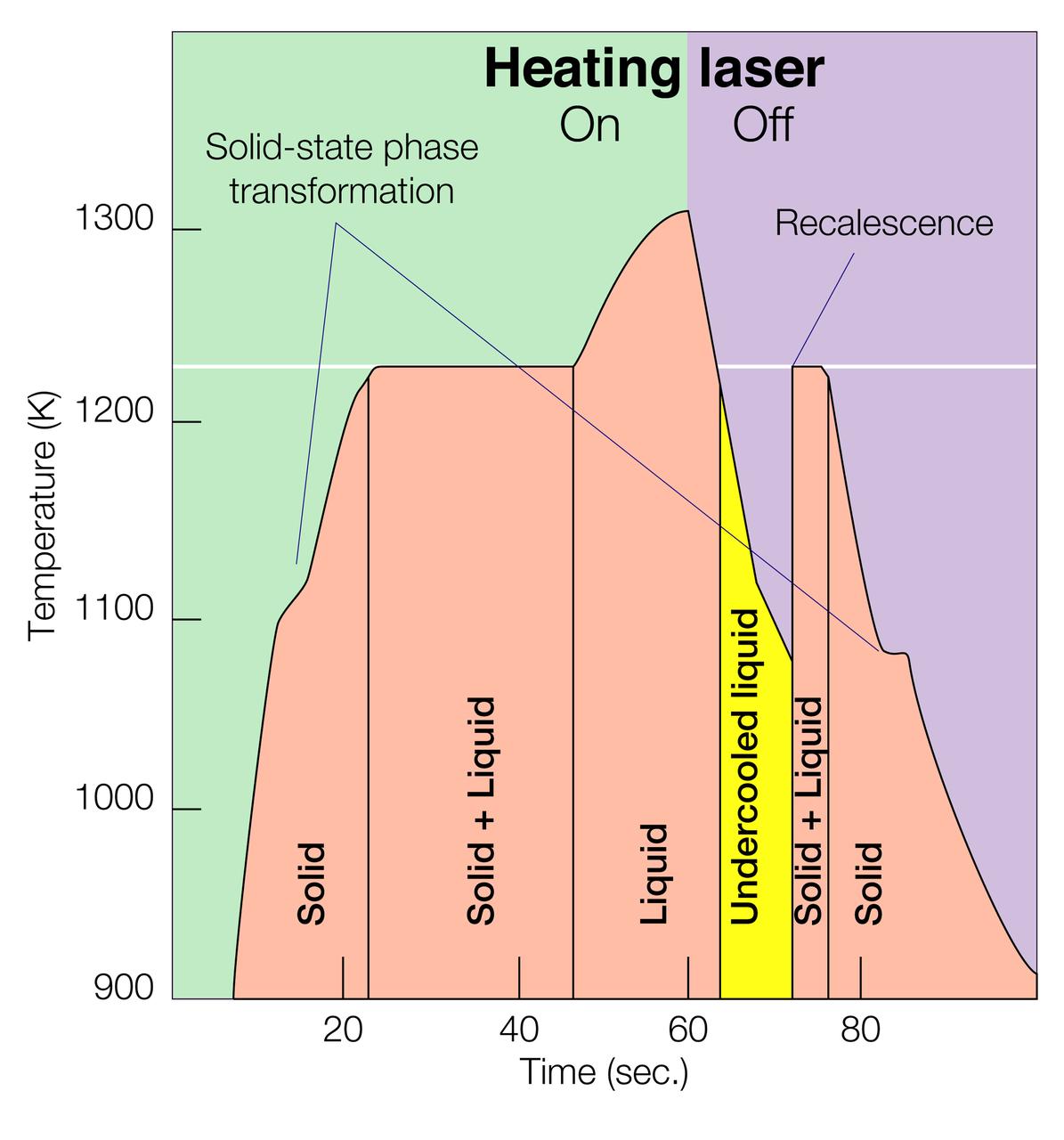
Graph depicting Electrostatic Levitator (ESL) heating and cooling cycle to achieve undercooling of liquid metals. The ESL uses static electricity to suspend an object (about 3-4 mm in diameter) inside a vacuum chamber while a laser heats the sample until it melts. This lets scientists record a wide range of physical properties without the sample contracting the container or any instruments, conditions that would alter the readings. The electrostatic Levitator is one of several tools used in NASA's microgravity matierials sciences program.
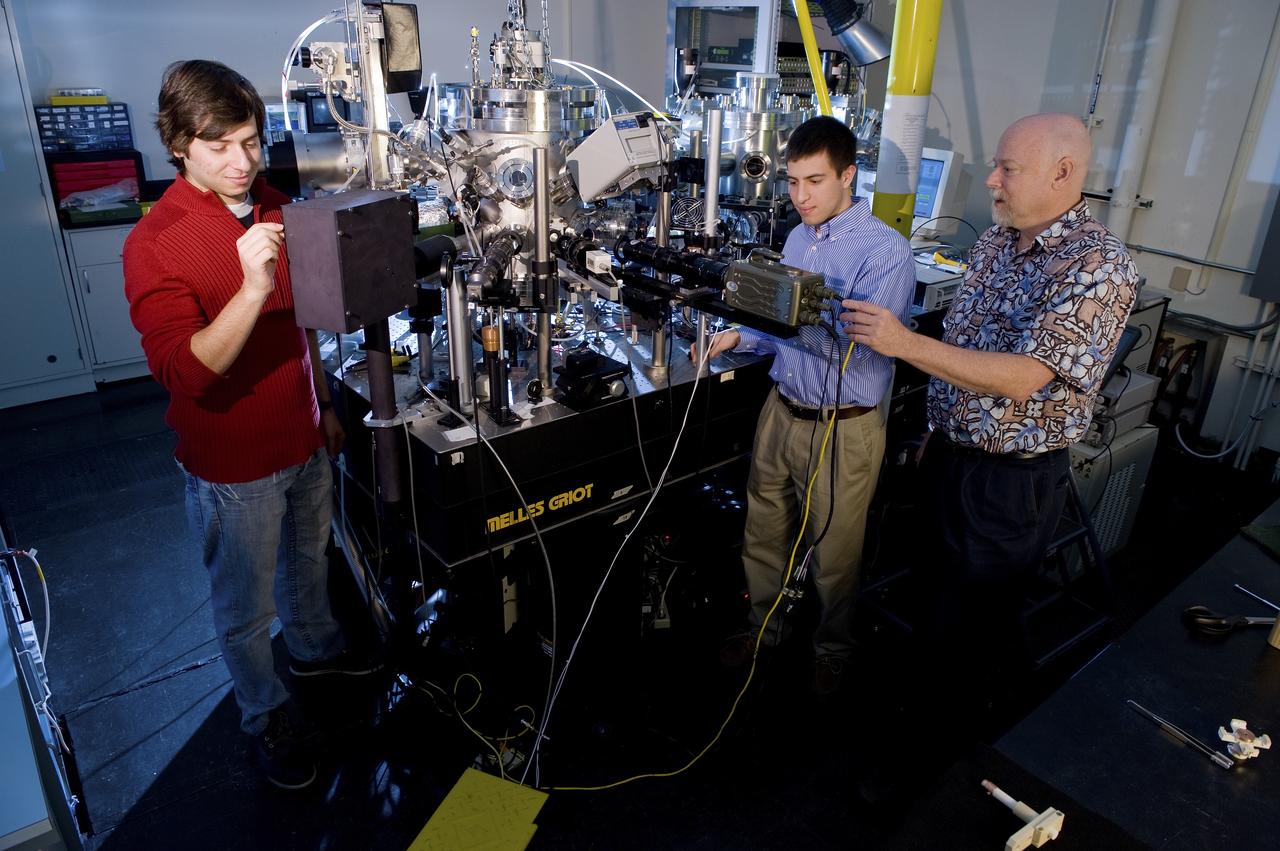
PAUL CHOUFANI, MATTHEW SHERMAN, AND PROFESSOR DOUGLAS MATSON WITH THE ELECTROSTATIC LEVITATOR.
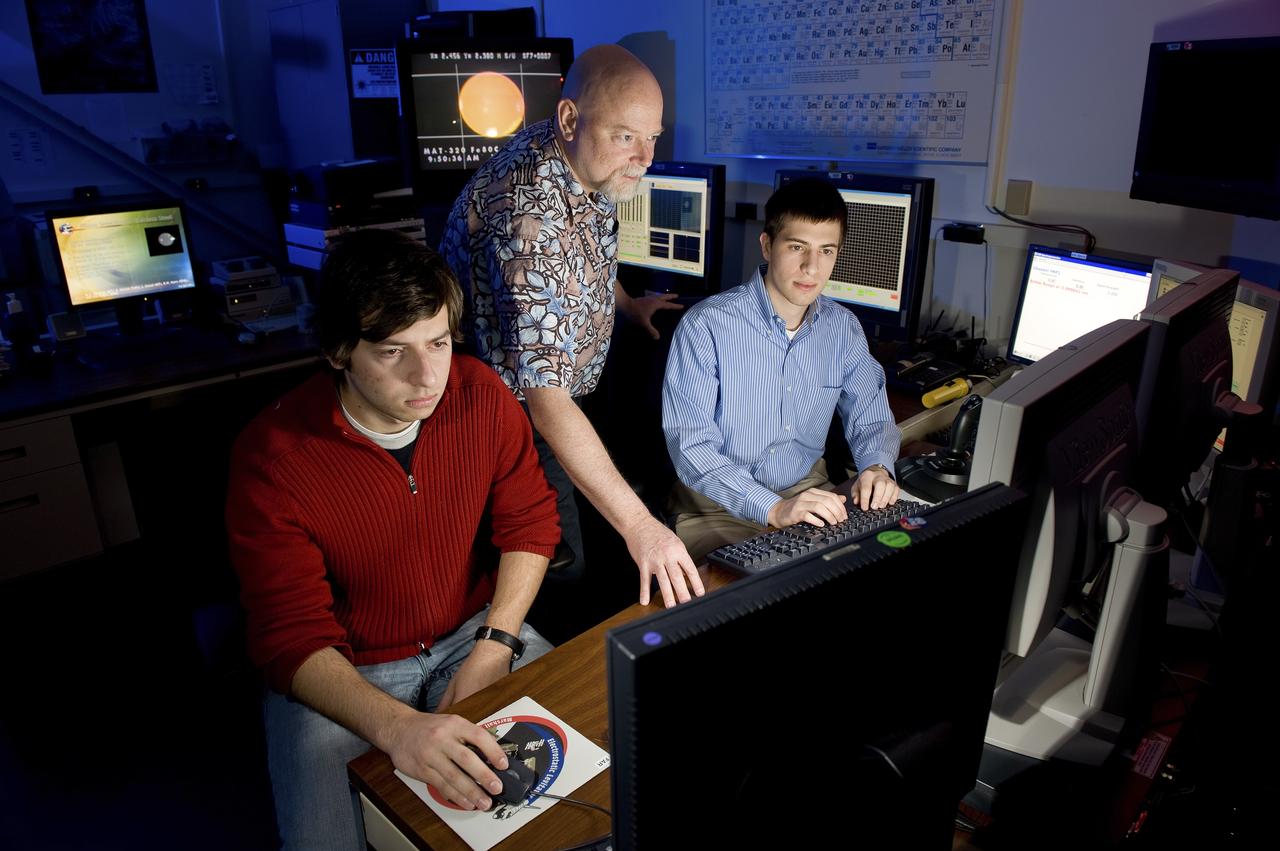
PAUL CHOUFANI, PROFESSOR DOUGLAS MATSON, AND MATTHEW SHERMAN AT THE CONTROLS OUTSIDE OF THE ELECTROSTATIC LEVITATOR.
This Photo, which appeared on the July cover of `Physics Today', is of the Electrostatic Levitator (ESL) at NASA's Marshall Space Flight Center (MSFC). The ESL uses static electricity to suspend an object (about 3-4 mm in diameter) inside a vacuum chamber allowing scientists to record a wide range of physical properties without the sample contracting the container or any instruments, conditions that would alter the readings. Once inside the chamber, a laser heats the sample until it melts. The laser is then turned off and the sample cools, changing from a liquid drop to a solid sphere. In this particular shot, the ESL contains a solid metal sample of titanium-zirconium-nickel alloy. Since 1977, the ESL has been used at MSFC to study the characteristics of new metals, ceramics, and glass compounds. Materials created as a result of these tests include new optical materials, special metallic glasses, and spacecraft components.
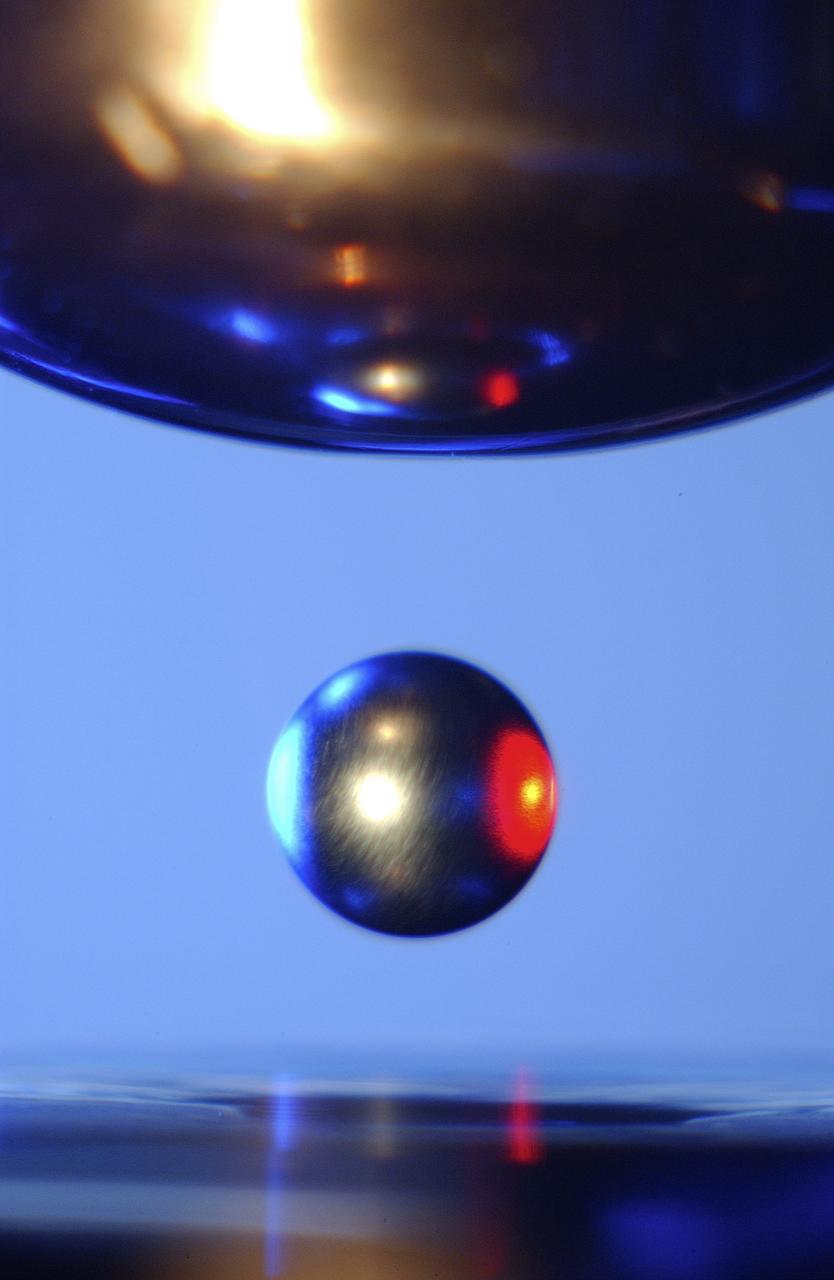
This is a close-up of a sample of titanium-zirconium-nickel alloy inside the Electrostatic Levitator (ESL) vacuum chamber at NASA's Marshall Space Flight Center (MSFC). The ESL uses static electricity to suspend an object (about 3-4 mm in diameter) inside a vacuum chamber allowing scientists to record a wide range of physical properties without the sample contracting the container or any instruments, conditions that would alter the readings. Once inside the chamber, a laser heats the sample until it melts. The laser is then turned off and the sample cools, changing from a liquid drop to a solid sphere. Since 1977, the ESL has been used at MSFC to study the characteristics of new metals, ceramics, and glass compounds. Materials created as a result of these tests include new optical materials, special metallic glasses, and spacecraft components.
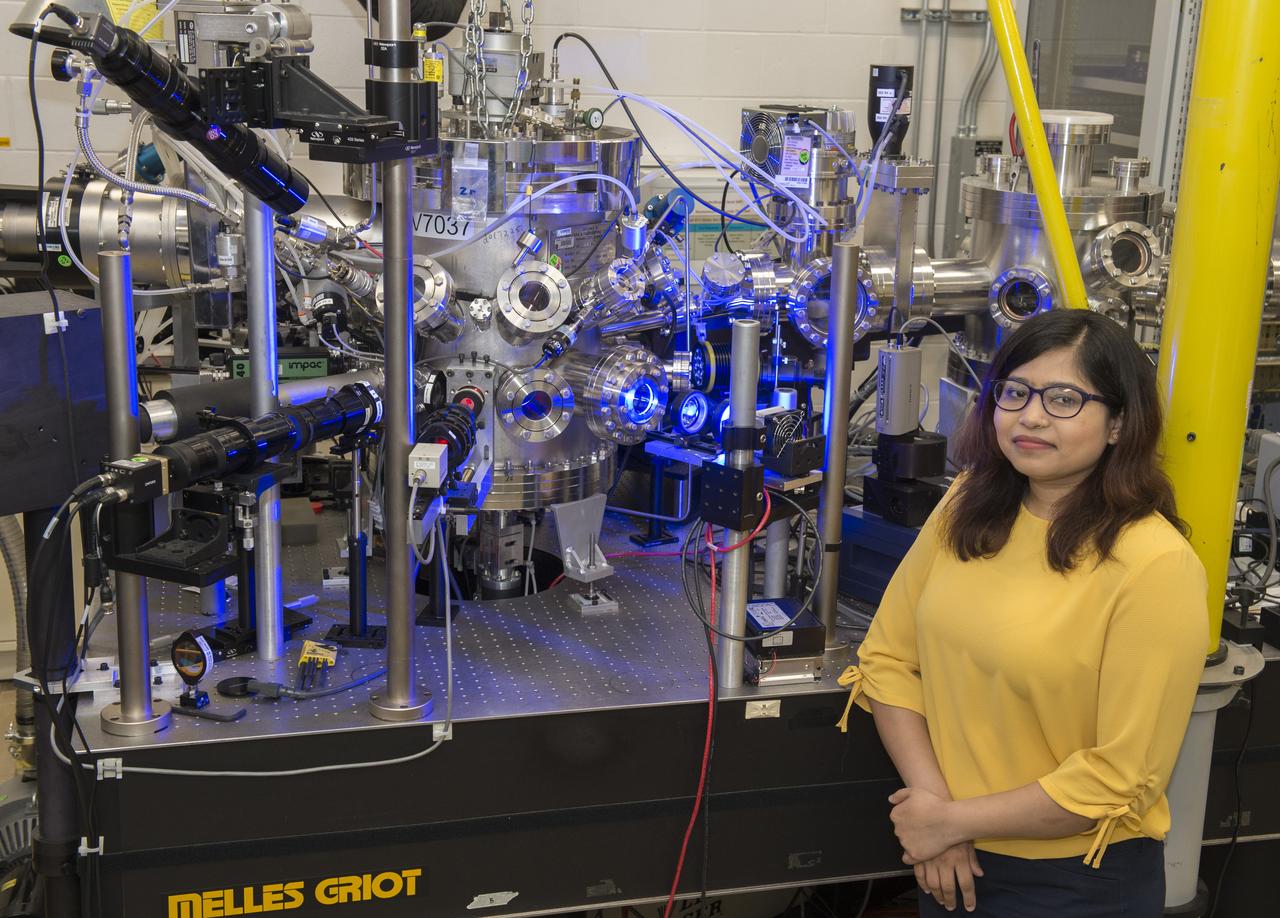
Jannatun Nawer (graduate student from Tufts University) visited the MSFC electrostatic levitation (ESL) laboratory is support of Dr. Douglas Matson’s (Tufts University) grant, “Round Robin - Thermophysical Property Measurement†(NNX17AH41G). Ms. Nawer is researching CMSX-4 Plus, a nickel-based superalloy, in support of future experiments on the International Space Station (ISS).

The Electrostatic Levitator (ESL) Facility established at Marshall Space Flight Center (MSFC) supports NASA's Microgravity Materials Science Research Program. NASA materials science investigations include ground-based, flight definition and flight projects. Flight definition projects, with demanding science concept review schedules, receive highest priority for scheduling experiment time in the Electrostatic Levitator (ESL) Facility.
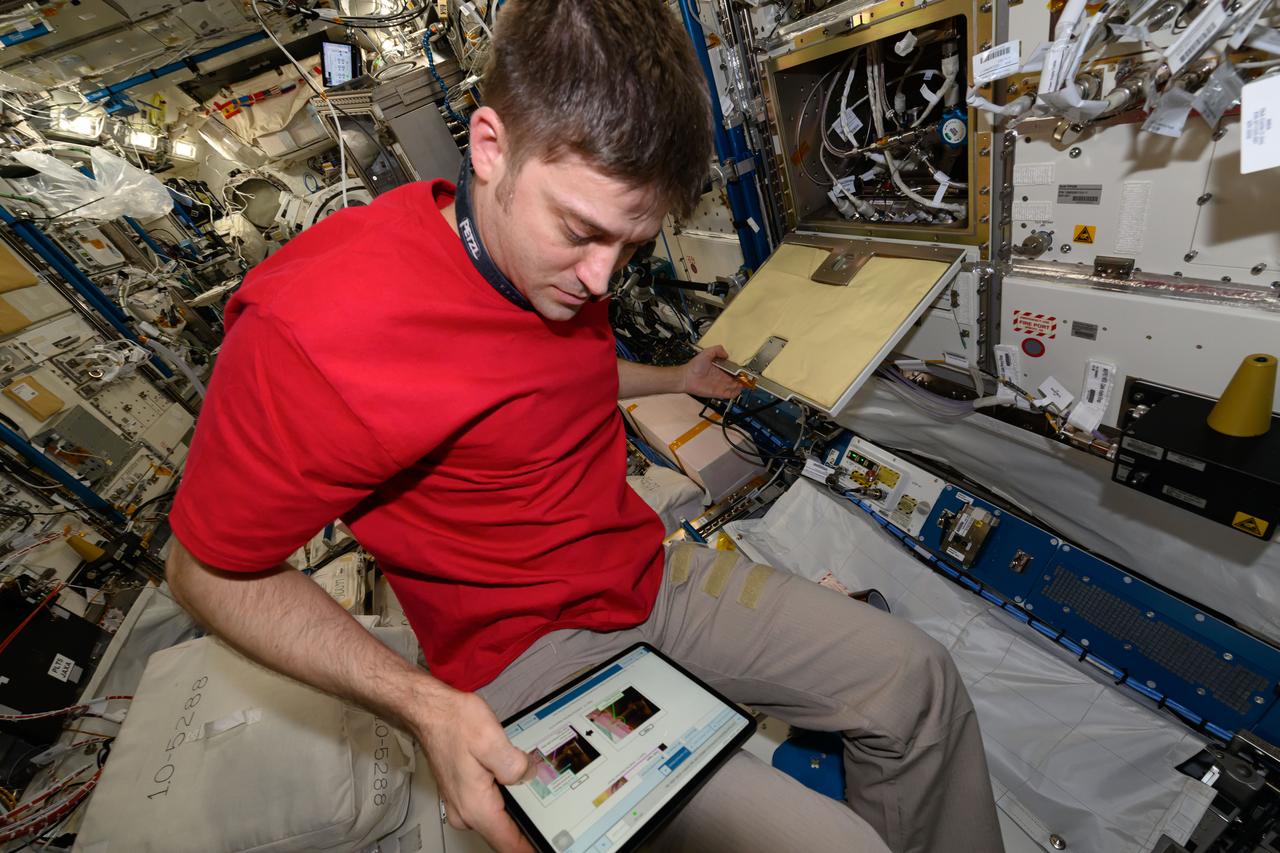
iss071e462464 (Aug. 9, 2024) --- NASA astronaut and Expedition 71 Flight Engineer Matthew Dominick replaces research components inside the Electrostatic Levitation Furnace (ELF) located inside the International Space Station's Kibo laboratory module. The ELF supports safe observations of microgravity’s effect on materials exposed to high temperatures.
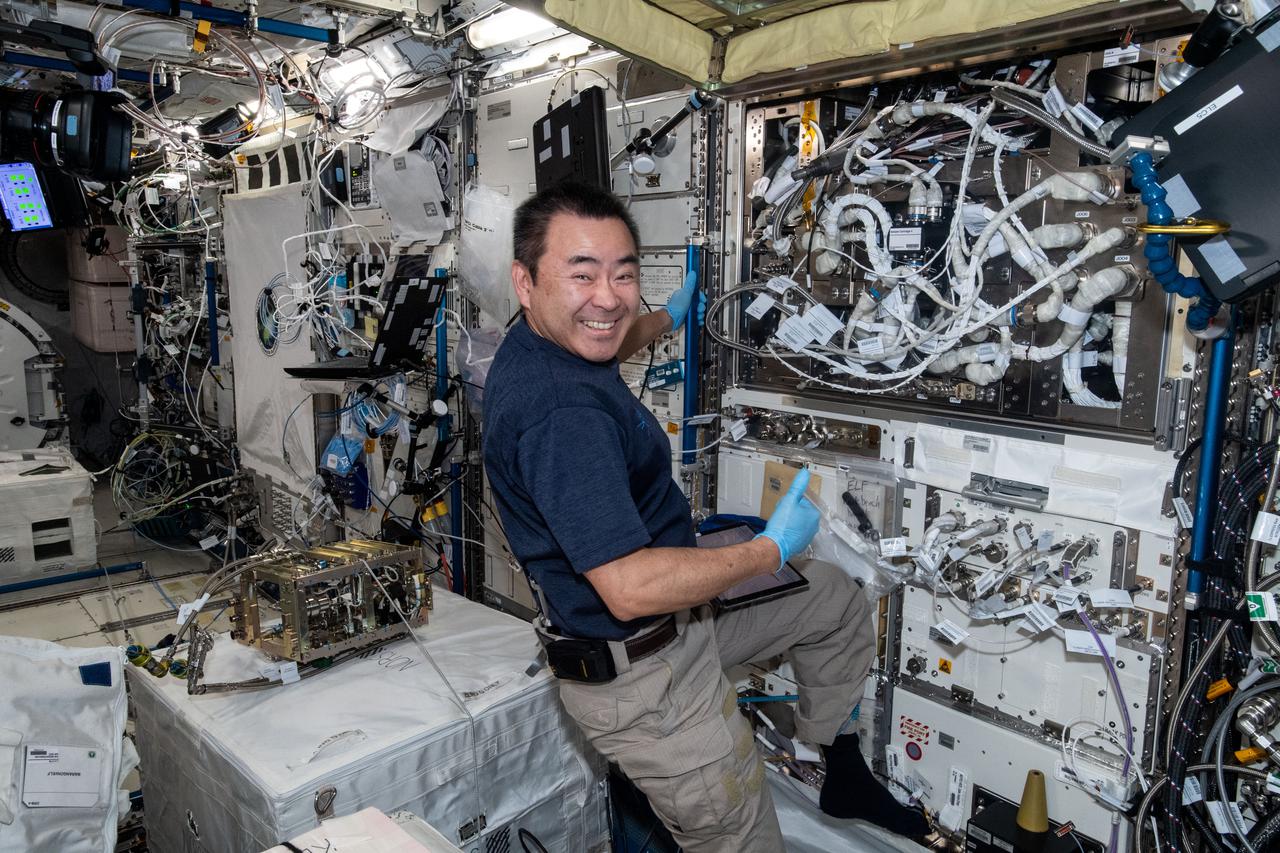
iss065e212128 (July 28, 2021) --- Expedition 65 Commander Akihiko Hoshide of the Japan Aerospace Exploration Agency (JAXA) changes out a sample holder in the Electrostatic Levitation Furnace (ELF) located inside JAXA's Kibo laboratory module. The ELF can heat samples above 2000 degrees Celsius, using a semiconductor laser from four different directions, and can also measure the thermophysical properties (density, surface tension, and viscosity) of high temperature materials, which are very difficult to measure on the Earth.
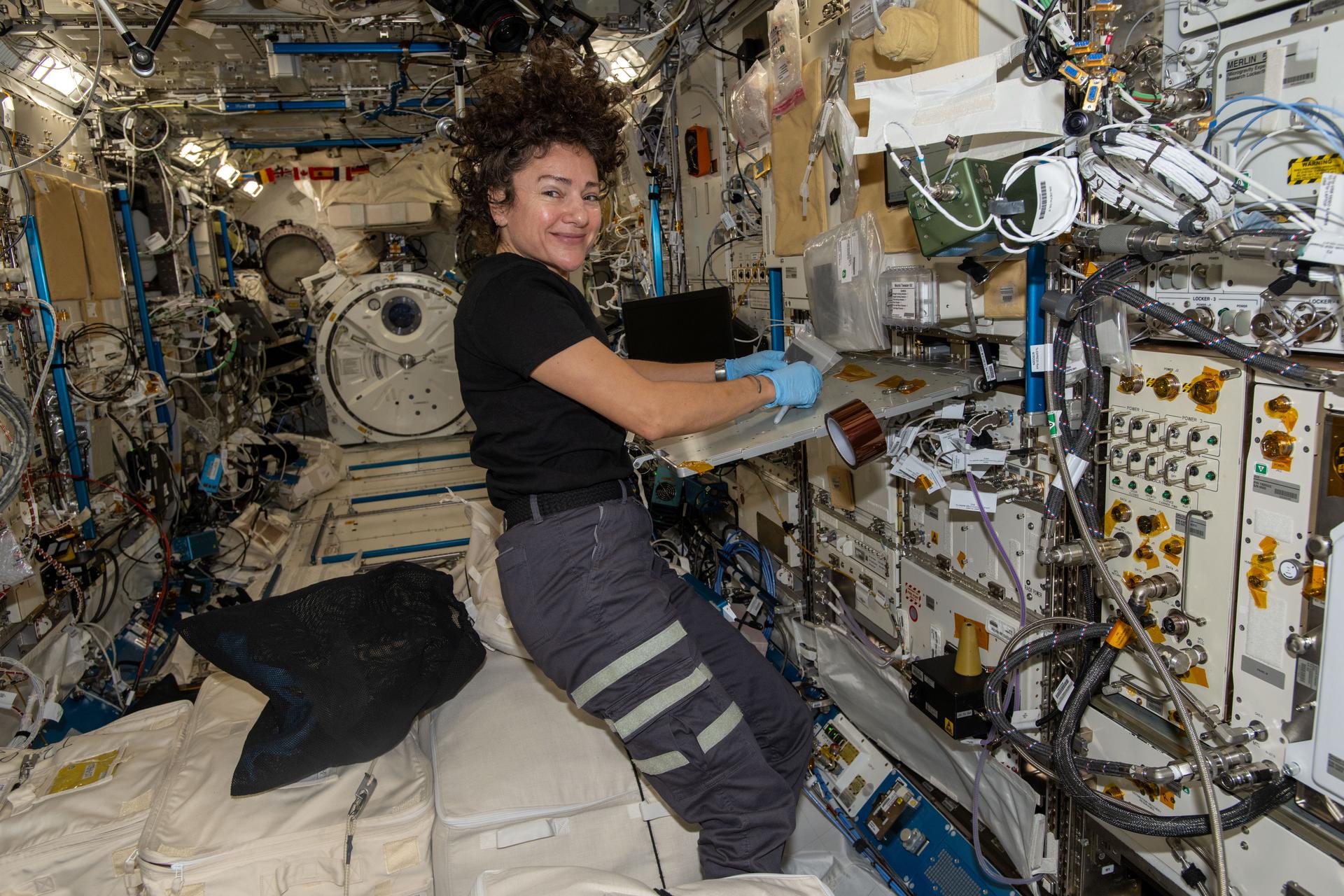
iss074e0364909 (March 6, 2026) --- NASA astronaut and Expedition 74 flight engineer Jessica Meir works inside the International Space Station’s Kibo laboratory, processing samples for the StarSteel materials research experiment. Meir investigated stainless‑steel spheres produced in Kibo’s Electrostatic Levitation Furnace to observe and understand metallic solidification behavior in microgravity, potentially benefiting Earth‑based and space‑based metallurgy and manufacturing techniques. Credit: NASA/Jessica Meir
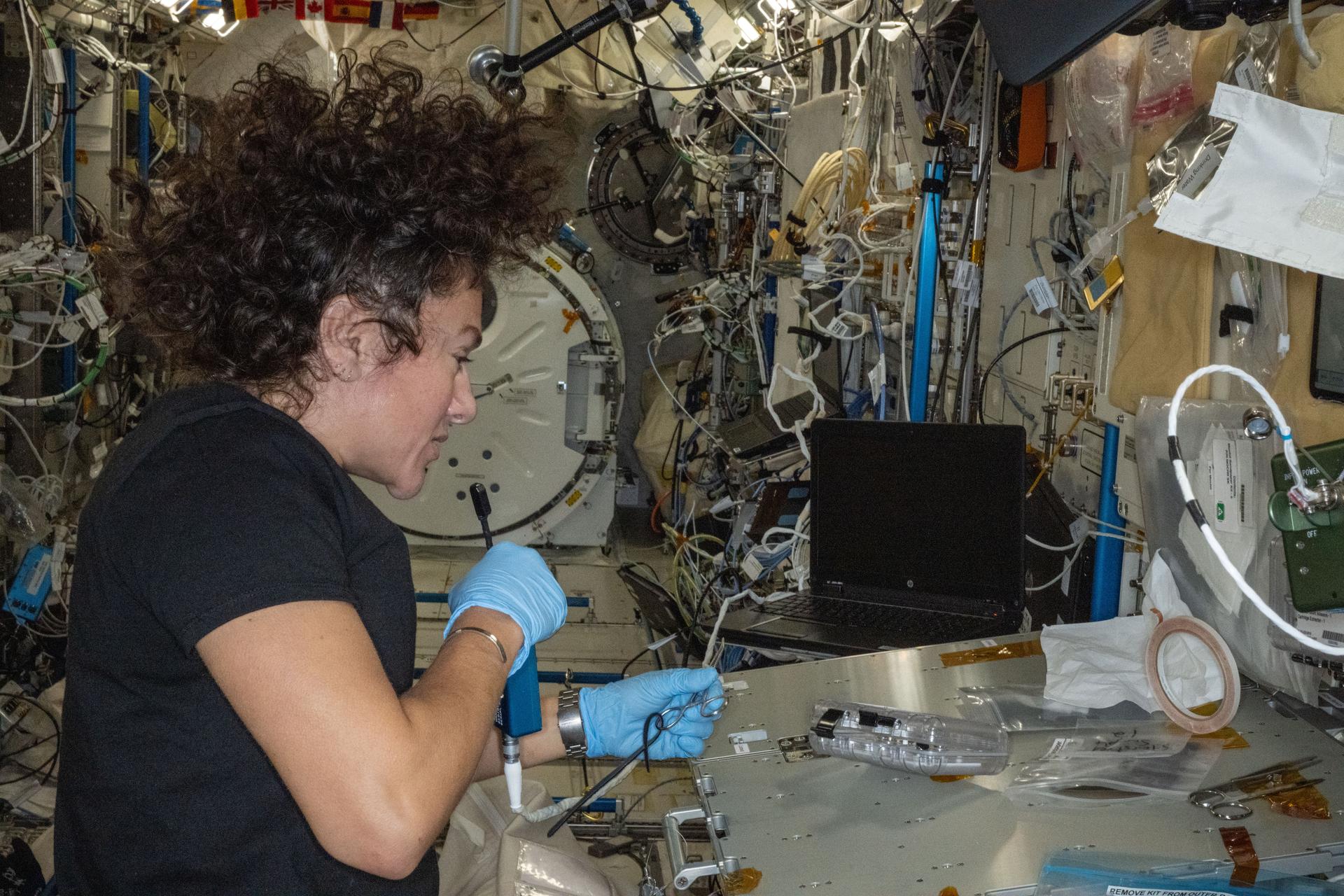
iss074e0364965 (March 6, 2026) --- NASA astronaut and Expedition 74 flight engineer Jessica Meir works inside the International Space Station’s Kibo laboratory, configuring hardware for the StarSteel materials research experiment. Meir was preparing to investigate stainless‑steel spheres produced inside Kibo’s Electrostatic Levitation Furnace to observe and understand metallic solidification behavior in microgravity, potentially benefiting both Earth-based and space-based metallurgy and manufacturing techniques. Credit: NASA/Jessica Meir

3199: Molly Pleskus (undergraduate student from Tufts University) visited the MSFC electrostatic levitation (ESL) laboratory is support of Dr. Douglas Matson’s (Tufts University) grant, “Round Robin - Thermophysical Property Measurement†(NNX17AH41G). Ms. Pleskus is researching Inconel 718 in support of future experiments on the International Space Station (ISS).
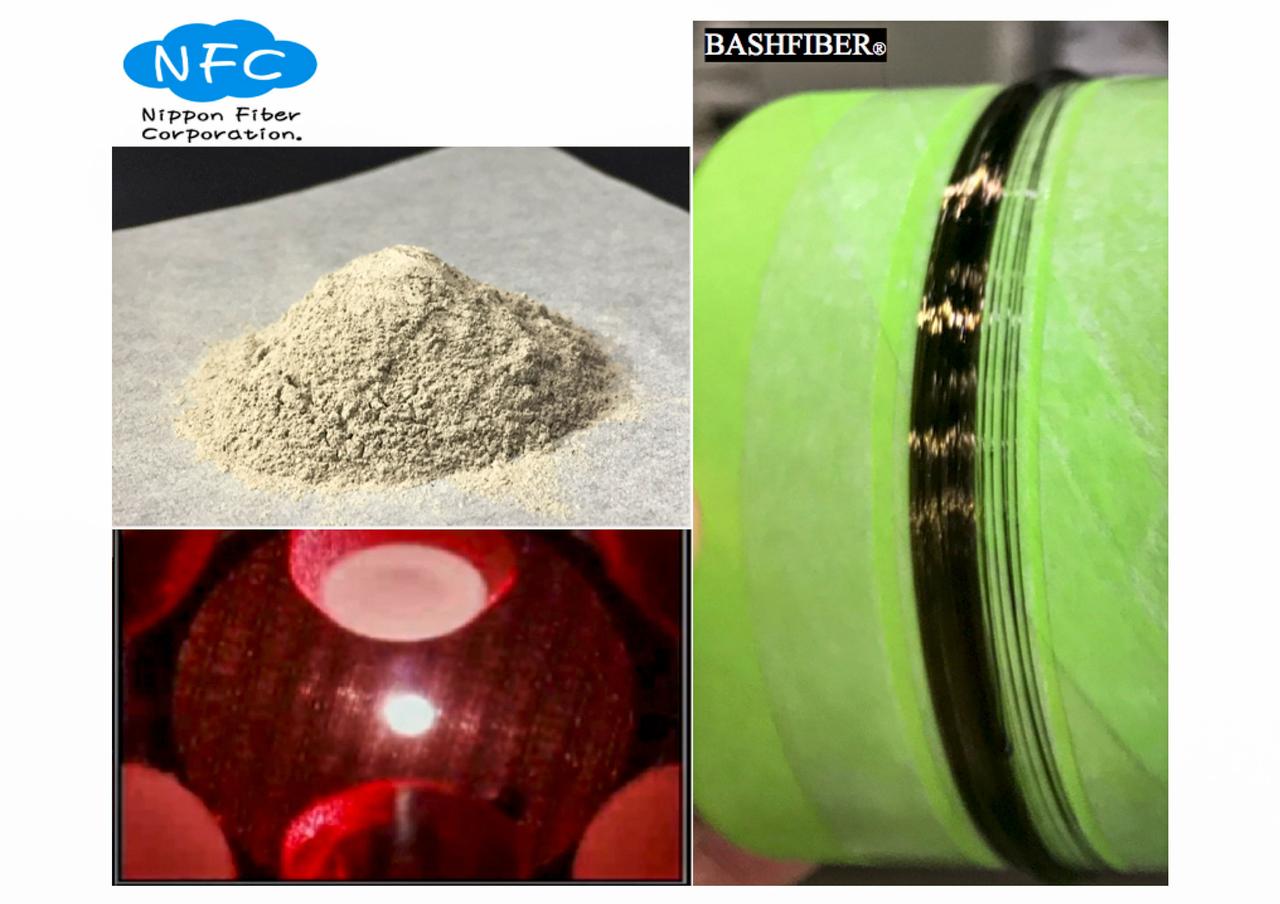
jsc2020e040946 (9/10/2020) --- A picture of roving fiber (right), which is made from fly ash (upper left) in a Japanese thermal power station. A mass production project for this fiber is in progress. Detailed properties are being investigated on the ISS. One of the tests was conducted at the Electrostatic Levitation Furnace (ELF) aboard the ISS from April to May 2020 (lower left). The Exposure test of of BASHFIBER® (ExHAM-Nippon Fiber-2) tests the resistance of a thread-like fiber to cosmic rays on the exterior of the International Space Station (ISS). BASHFIBER is a mixture of basalt rock and fly ash, with high resistance to acid and salt. The fiber has the potential for a variety of applications making use of an abundant byproduct.
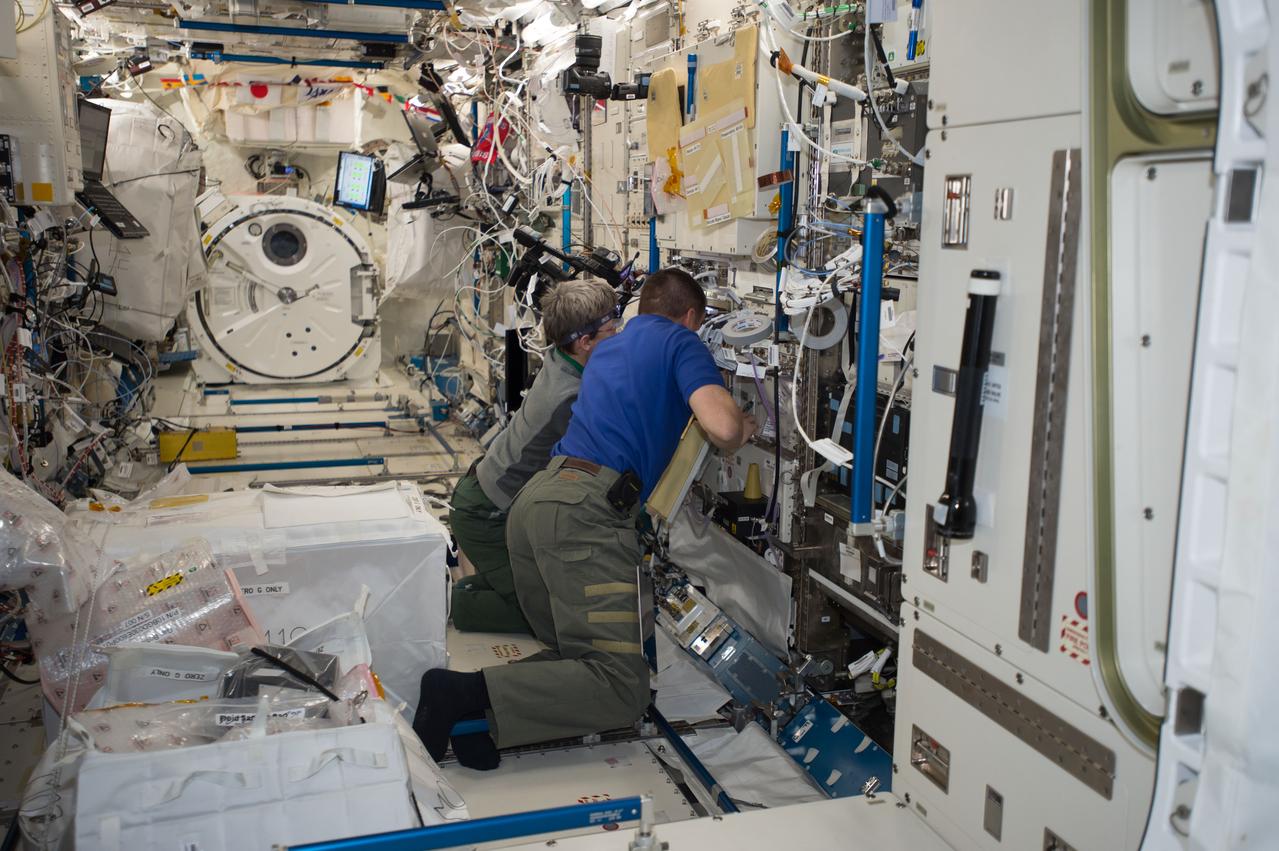
iss051e050849 (5/26/2017) --- NASA astronaut Peggy Whitson and Jack Fischer work to install a Gas Supply Hose Assembly and Gas Bottle Unit Air in the Electrostatic Levitation Furnace (ELF) in the Kibo Japanese Experiment Pressurized Module (JPM) aboard the International Space Station (ISS) in supprt of the Passive Thermal Flight Experiment.The Advanced Passive Thermal eXperiment (APTx) tests three advanced thermal management technologies. It demonstrates the in-space performance of each, an important step toward improving these technologies for use on future space exploration missions.
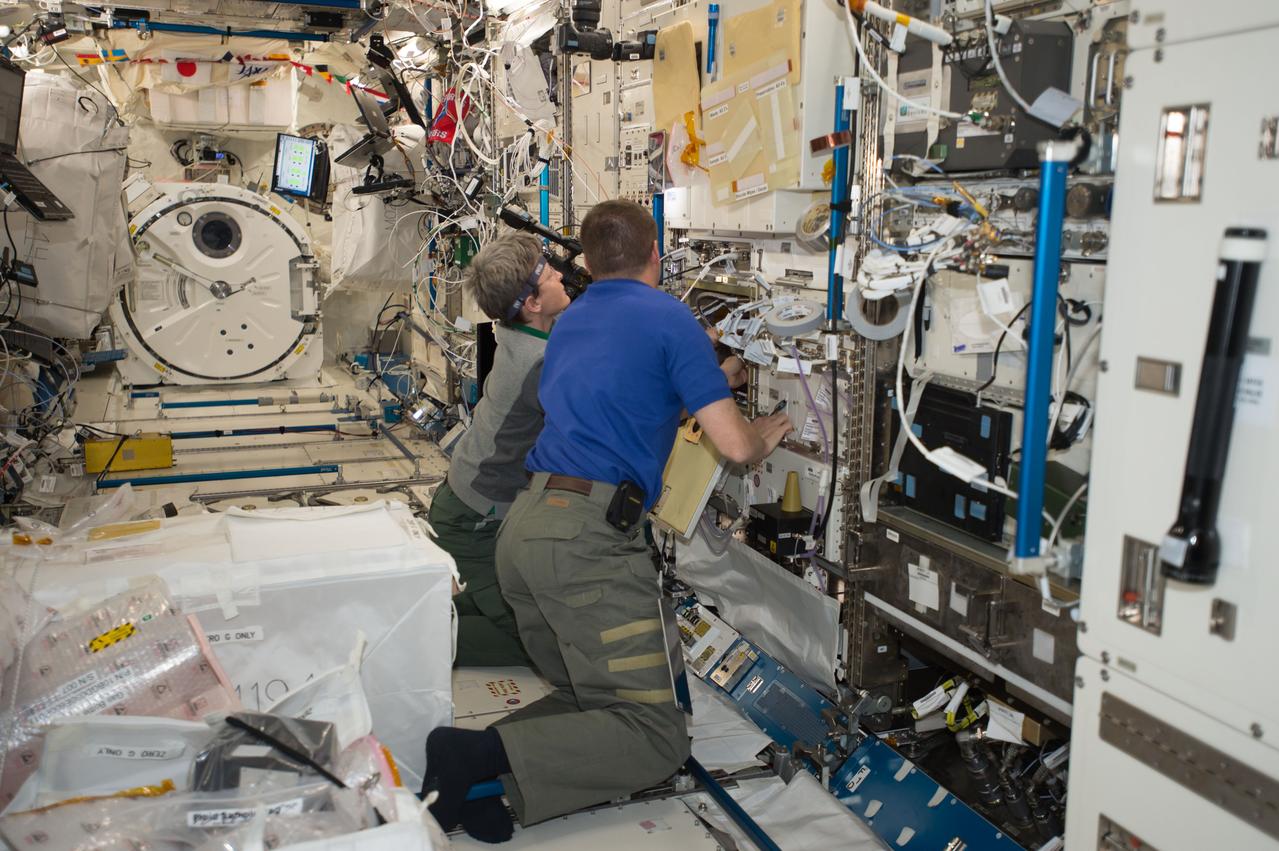
iss051e050850 (5/26/2017) --- NASA astronaut Peggy Whitson and Jack Fischer work to install a Gas Supply Hose Assembly and Gas Bottle Unit Air in the Electrostatic Levitation Furnace (ELF) in the Kibo Japanese Experiment Pressurized Module (JPM) aboard the International Space Station (ISS) in supprt of the Passive Thermal Flight Experiment.The Advanced Passive Thermal eXperiment (APTx) tests three advanced thermal management technologies. It demonstrates the in-space performance of each, an important step toward improving these technologies for use on future space exploration missions.
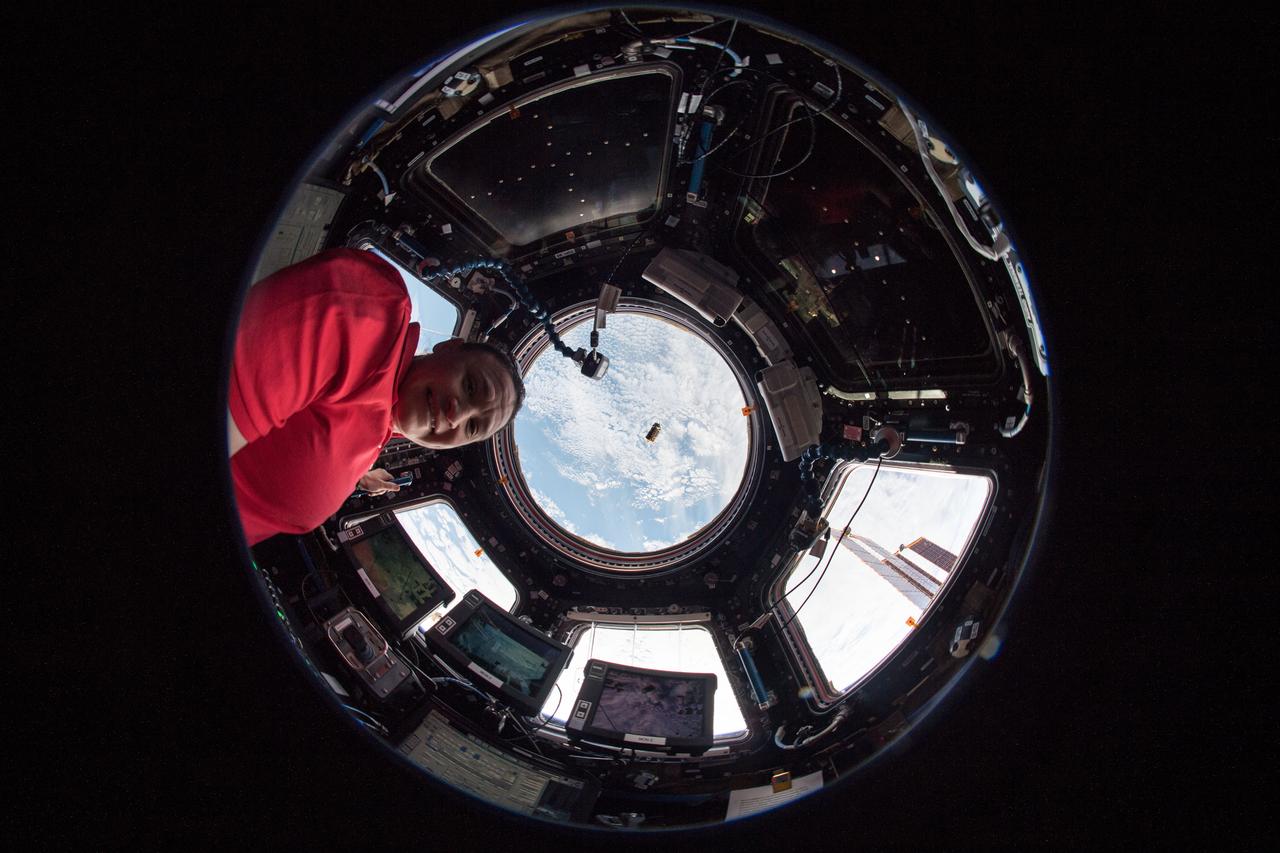
iss056e195892 (Sept. 27, 2018) --- Flight Engineer Serena Auñón-Chancellor of NASA monitors the arrival of the H-II Transfer Vehicle-7 (HTV-7) before it was captured during Expedition 56 by Commander Drew Feustel operating the Canadarm2 robotic arm. The HTV-7 from the Japan Aerospace Exploration Agency (JAXA) delivered six new lithium-ion batteries and adapter plates to upgrade the International Space Station's power systems. The Japanese resupply ship also delivered science experiments and research hardware including a new sample holder for the Electrostatic Levitation Furnace (JAXA-ELF), a protein crystal growth experiment at low temperatures (JAXA LT PCG), an investigation that looks at the effect of microgravity on bone marrow (MARROW), a Life Sciences Glovebox, and additional EXPRESS Racks.