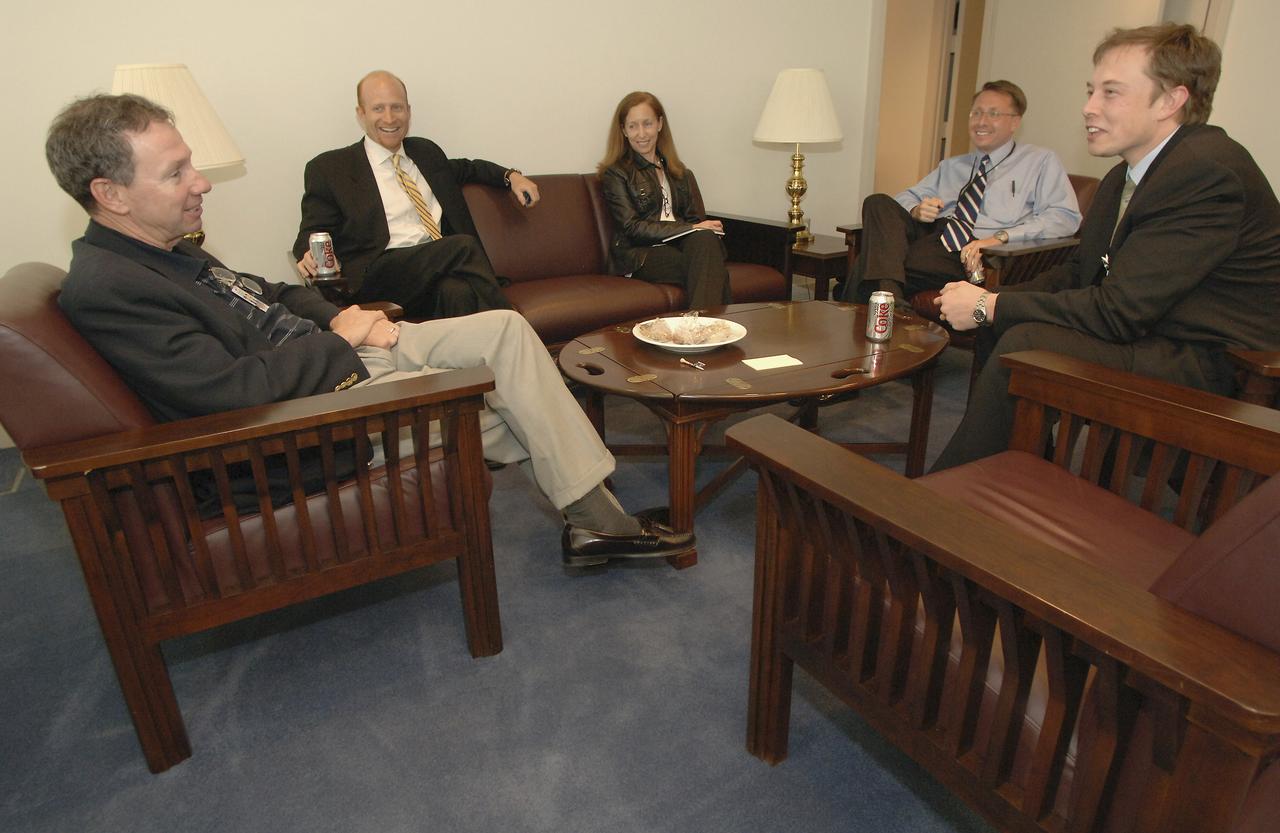
NASA Administrator Michael Griffin, left, meets with CEO of SpaceX Elon Musk, right, Wednesday, April 20, 2005 at NASA Headquarters in Washington. Looking on in the background are Larry Williams, NASA astronaut Marsha Ivins and NASA manager Christopher Shank. Photo Credit: (NASA/Renee Bouchard)
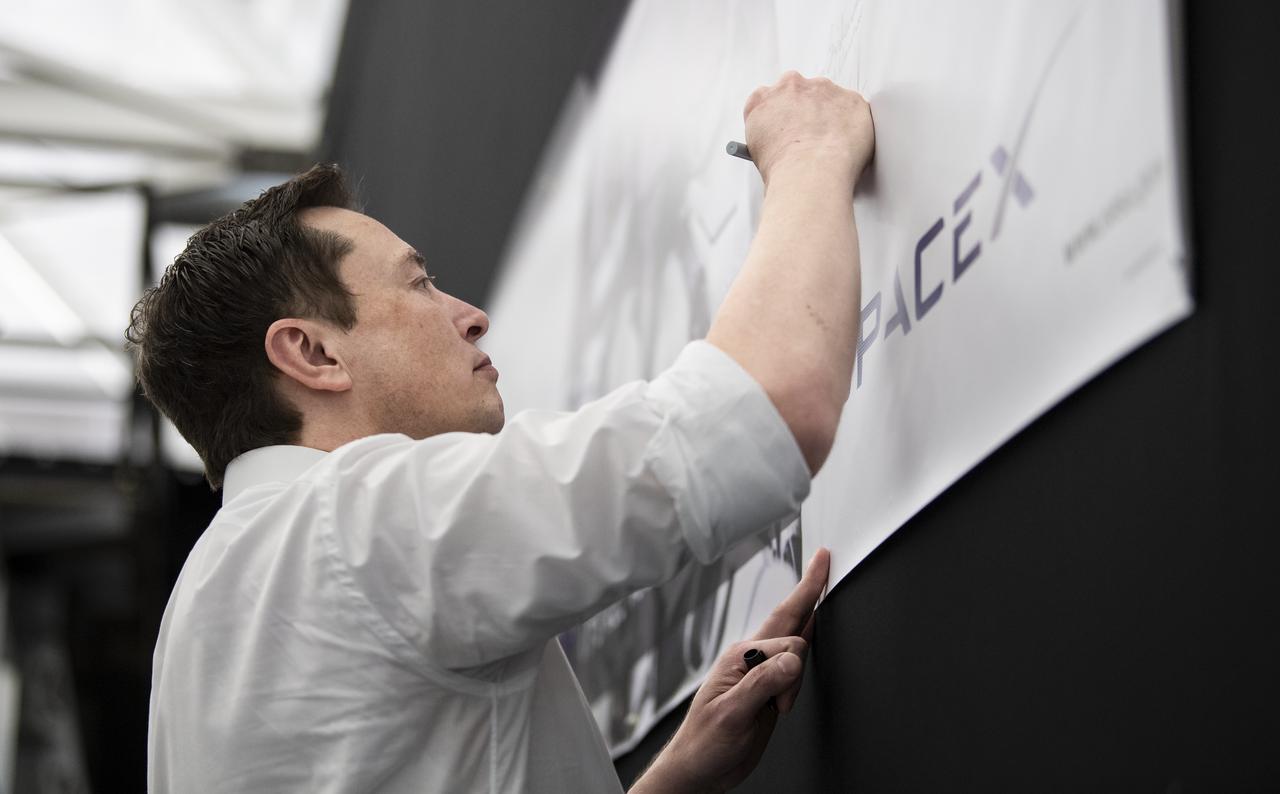
SpaceX Chief Engineer Elon Musk signs a banner after discussing progress on the Commercial Crew Program with NASA Administrator Jim Bridenstine at the SpaceX Headquarters, Thursday, Oct. 10, 2019 in Hawthorne, CA. Photo credit: (NASA/Aubrey Gemignani)
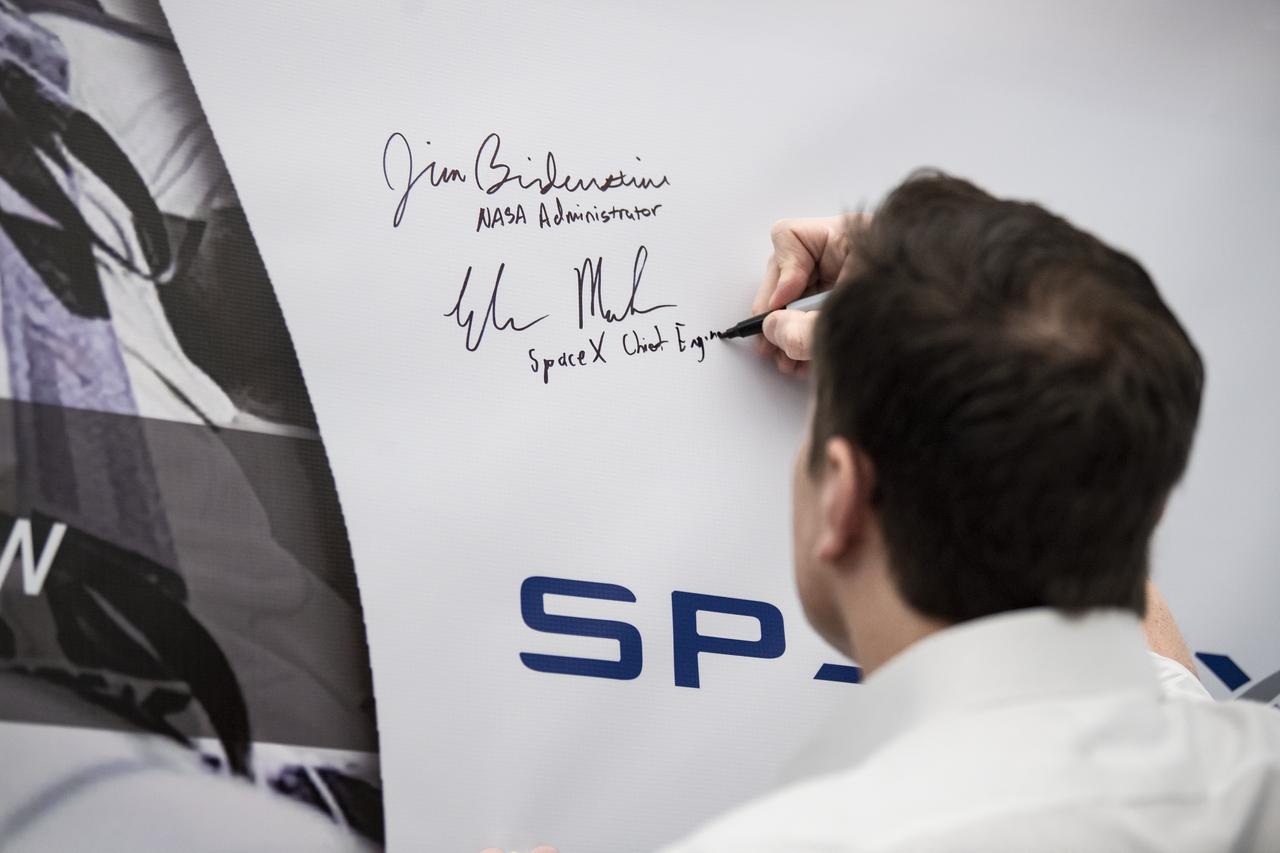
SpaceX Chief Engineer Elon Musk signs a banner after discussing progress on the Commercial Crew Program with NASA Administrator Jim Bridenstine at the SpaceX Headquarters, Thursday, Oct. 10, 2019 in Hawthorne, CA. Photo credit: (NASA/Aubrey Gemignani)
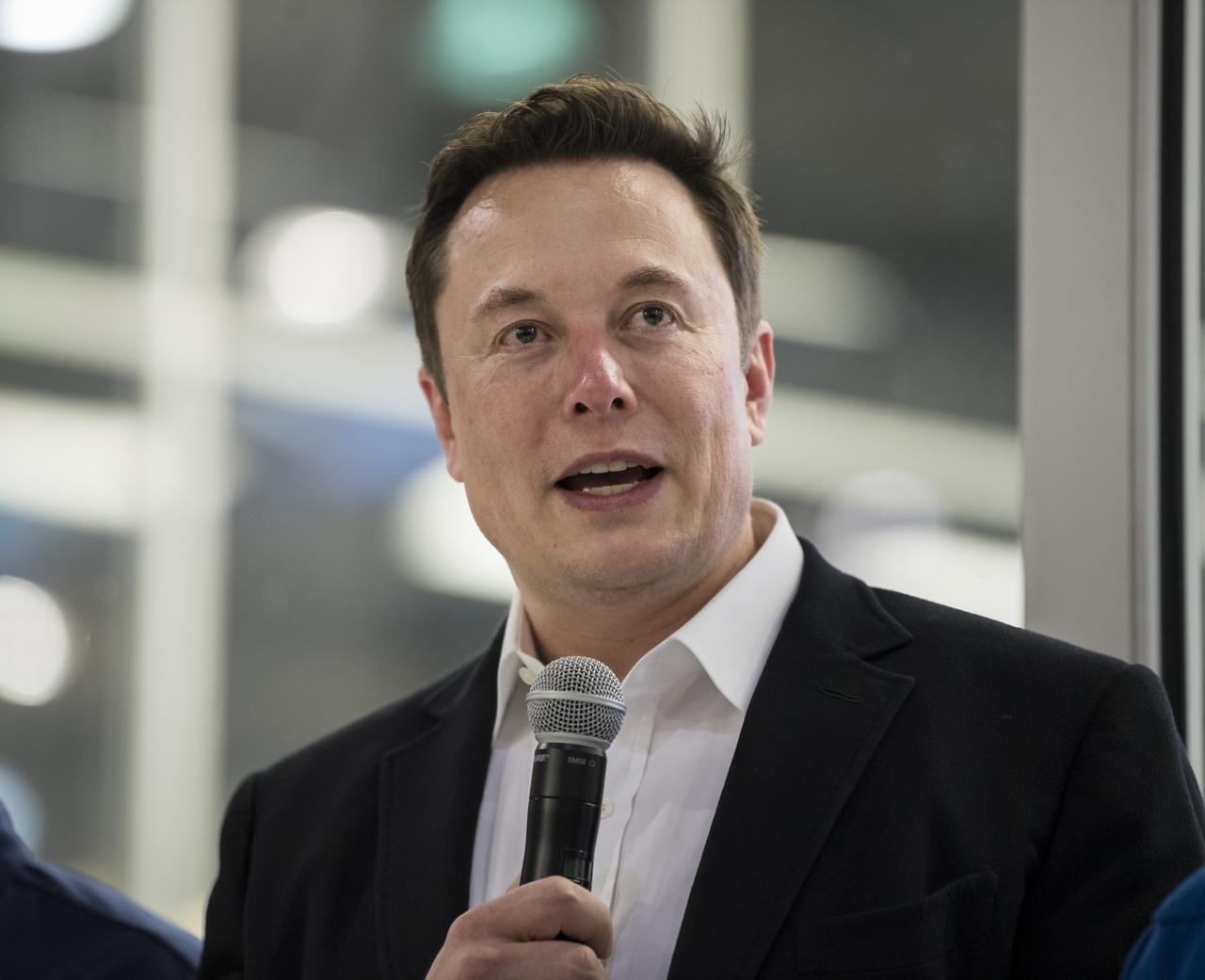
SpaceX Chief Engineer Elon Musk answers a question from the press in front of the Crew Dragon that is being prepared for the Demo-2 mission, at SpaceX Headquarters, Thursday, Oct. 10, 2019 in Hawthorne, CA. Photo credit: (NASA/Aubrey Gemignani)
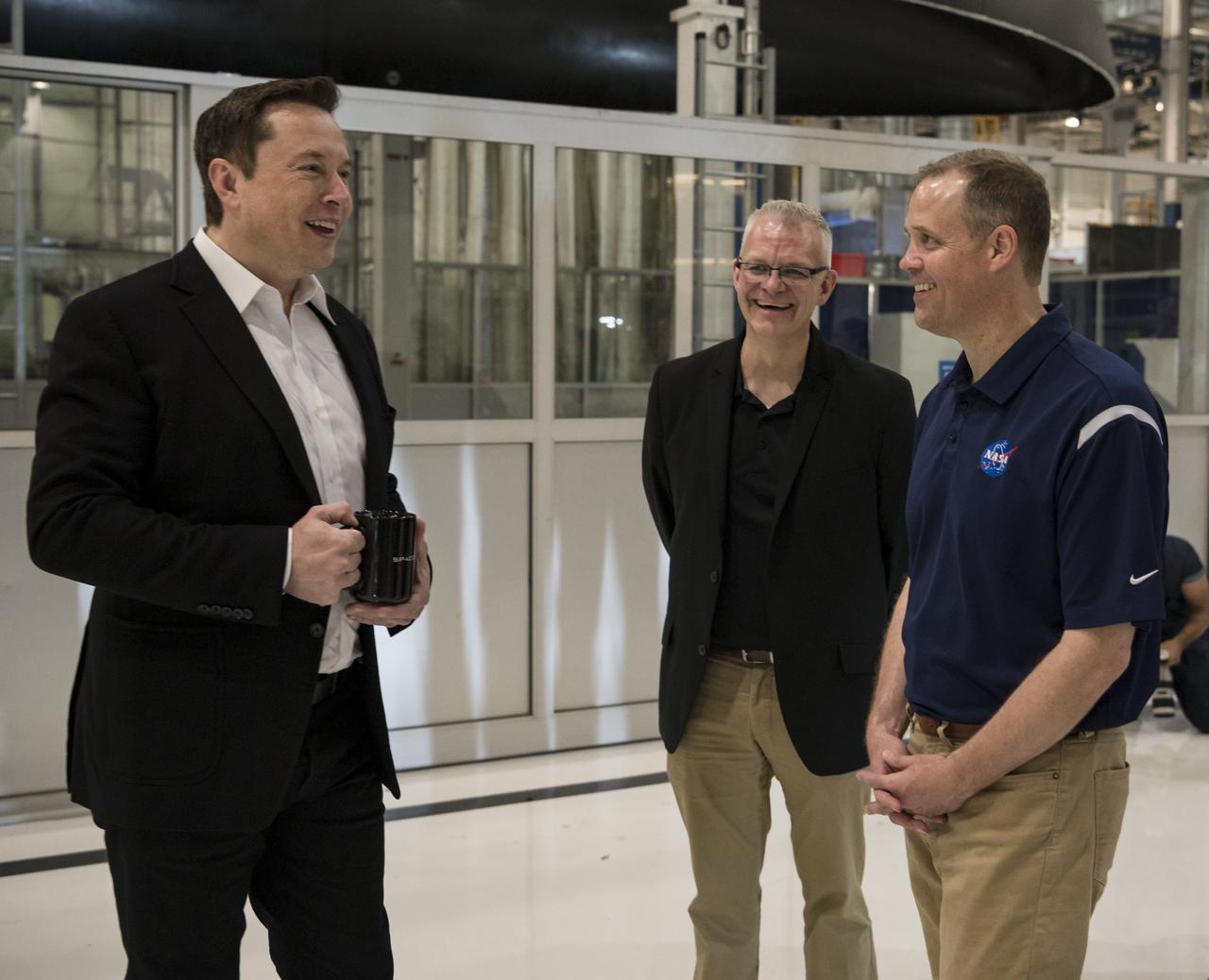
NASA Administrator Jim Bridenstine, right, speaks to SpaceX Chief Engineer Elon Musk, during a tour of the SpaceX Headquarters, Thursday, Oct. 10, 2019 in Hawthorne, CA. Photo credit: (NASA/Aubrey Gemignani)
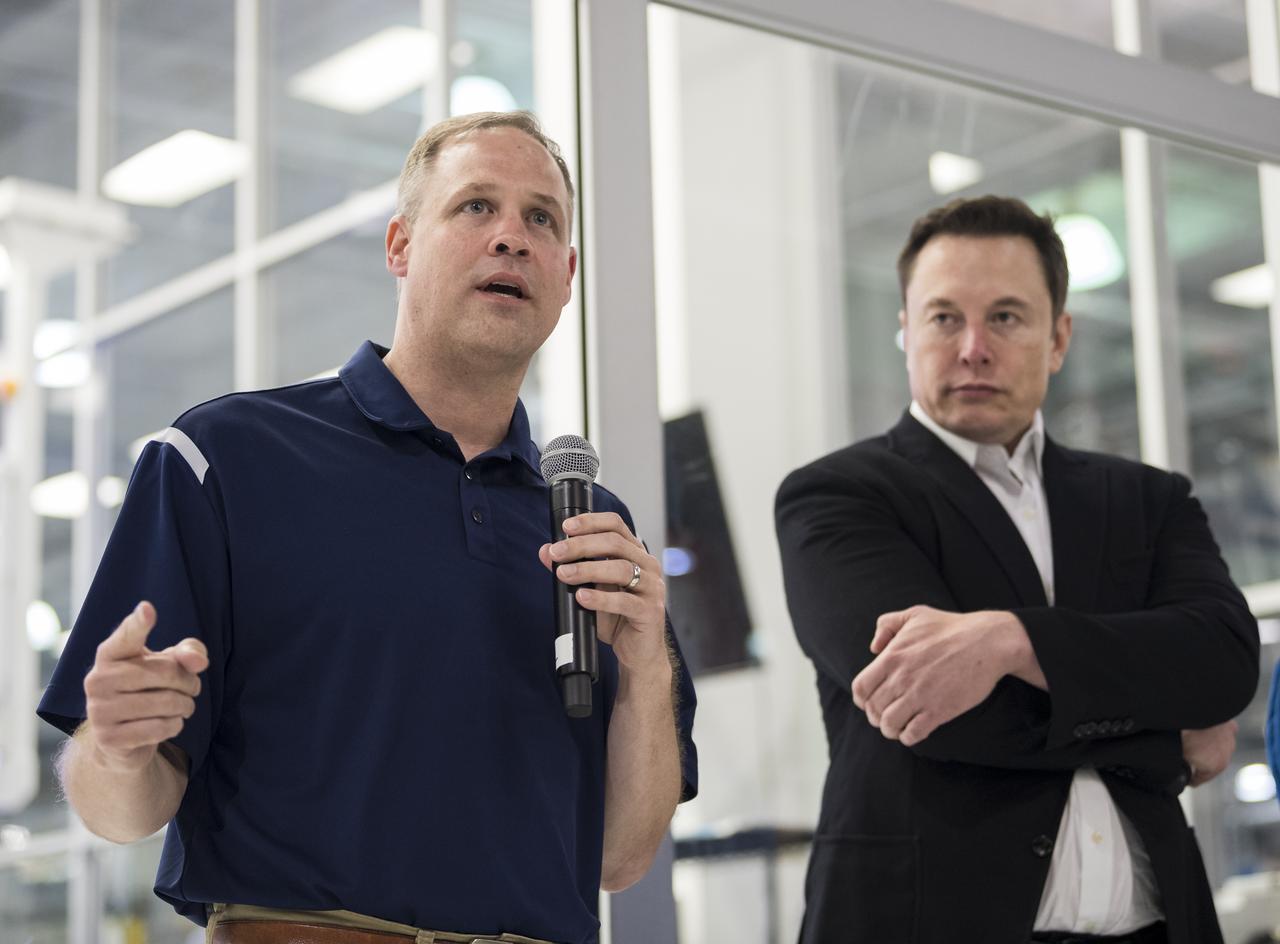
NASA Administrator Jim Bridenstine, left, and SpaceX Chief Engineer Elon Musk, right, speak to press in front of the Crew Dragon that is being prepared for the Demo-2 mission, at SpaceX Headquarters, Thursday, Oct. 10, 2019 in Hawthorne, CA. Photo credit: (NASA/Aubrey Gemignani)
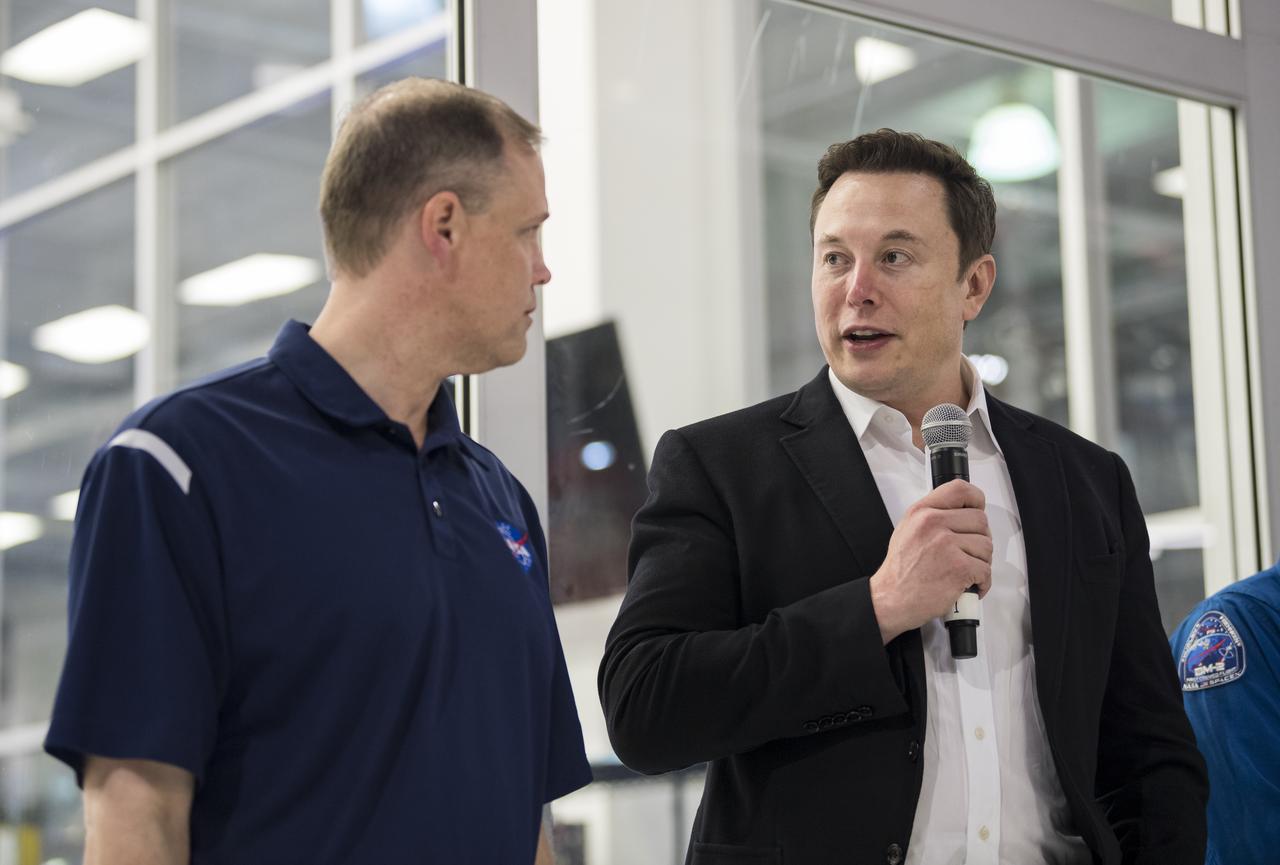
SpaceX Chief Engineer Elon Musk, right, speaks to press with NASA Administrator Jim Bridenstine, in front of the Crew Dragon that is being prepared for the Demo-2 mission, at SpaceX Headquarters, Thursday, Oct. 10, 2019 in Hawthorne, CA. Photo credit: (NASA/Aubrey Gemignani)
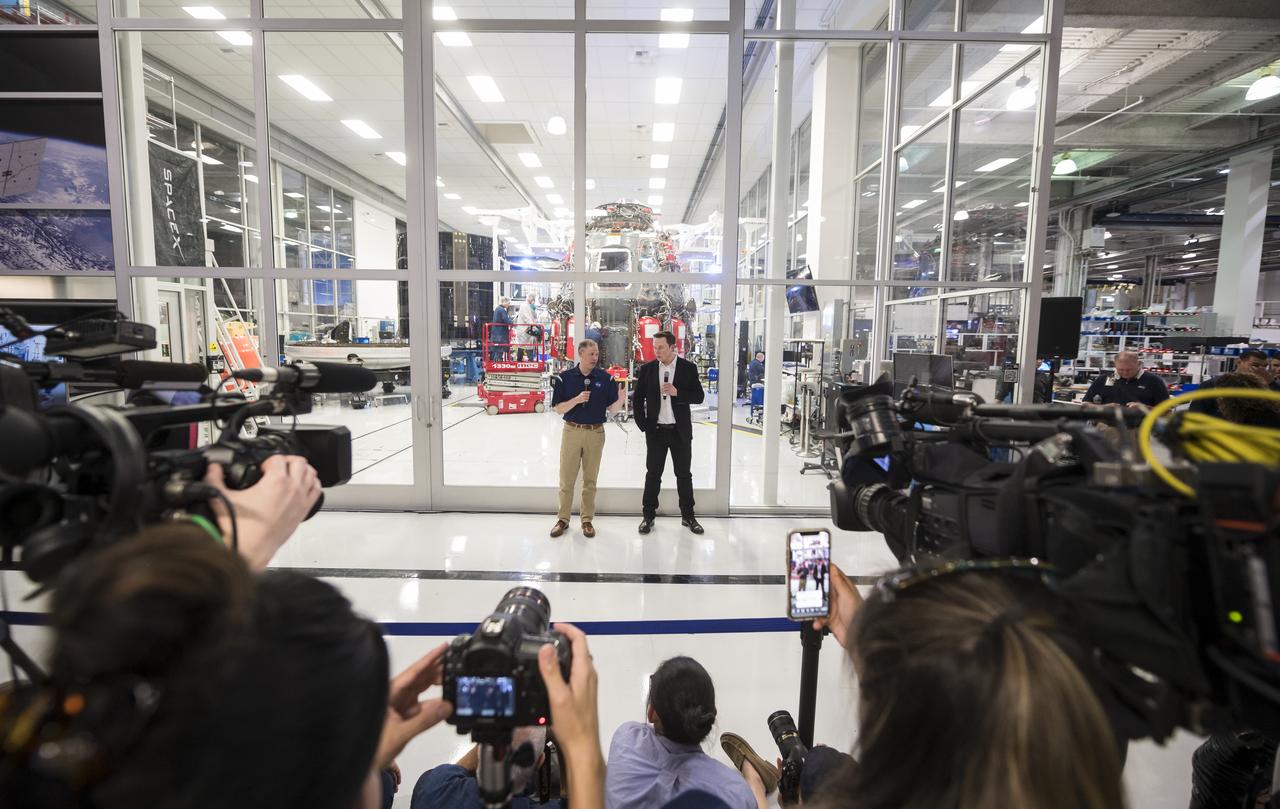
NASA Administrator Jim Bridenstine, left, and SpaceX Chief Engineer Elon Musk, right, speak to press in front of the Crew Dragon that is being prepared for the Demo-2 mission, at SpaceX Headquarters, Thursday, Oct. 10, 2019 in Hawthorne, CA. Photo credit: (NASA/Aubrey Gemignani)
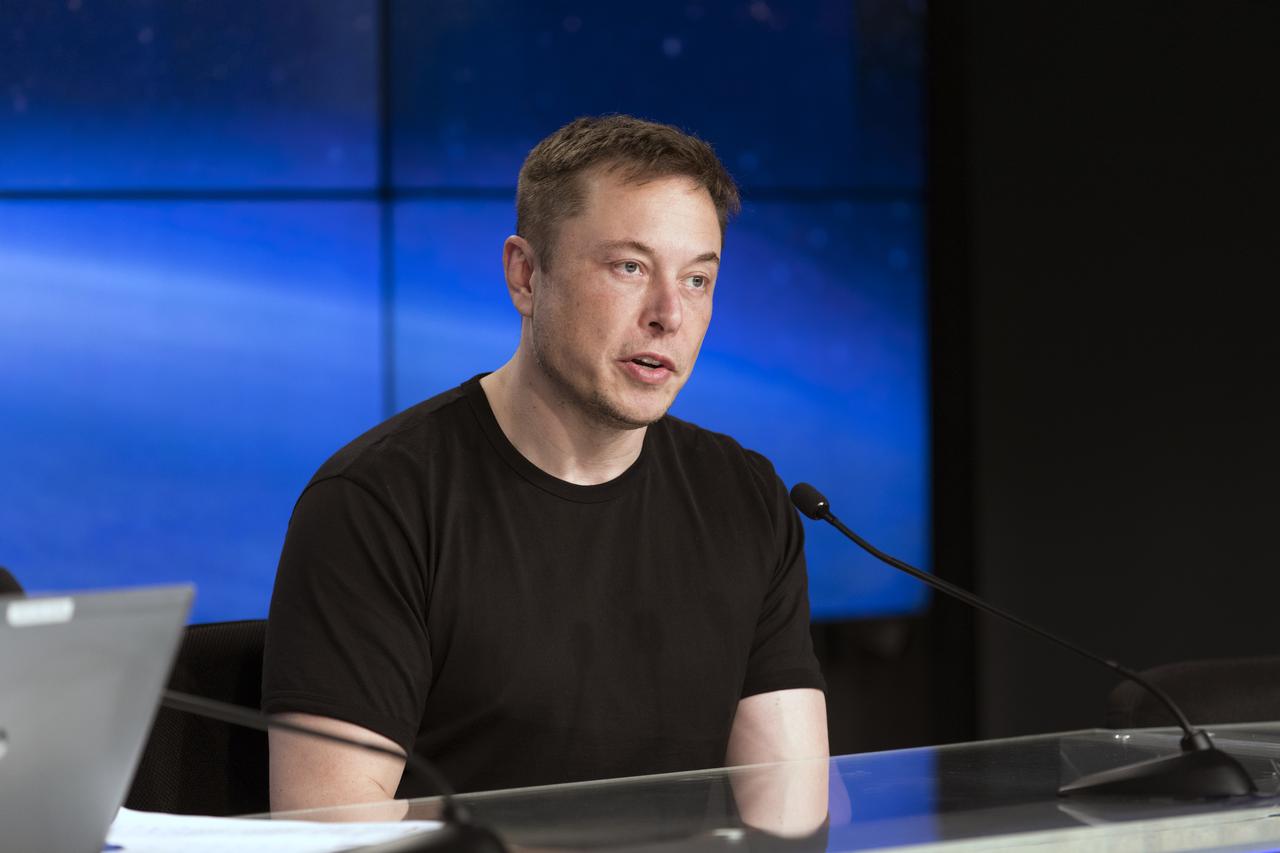
Elon Musk, SpaceX chief executive officer and lead designer, speaks to the news media during a news conference at NASA's Kennedy Space Center in Florida after the successful liftoff of the company’s Falcon Heavy rocket from Launch Complex 39A. The demonstration flight is a significant milestone for the world's premier multi-user spaceport. In 2014, NASA signed a property agreement with SpaceX for the use and operation of the center's pad 39A, where the company has launched Falcon 9 rockets and is preparing for the first Falcon Heavy. NASA also has Space Act Agreements in place with partners, such as SpaceX, to provide services needed to process and launch rockets and spacecraft.
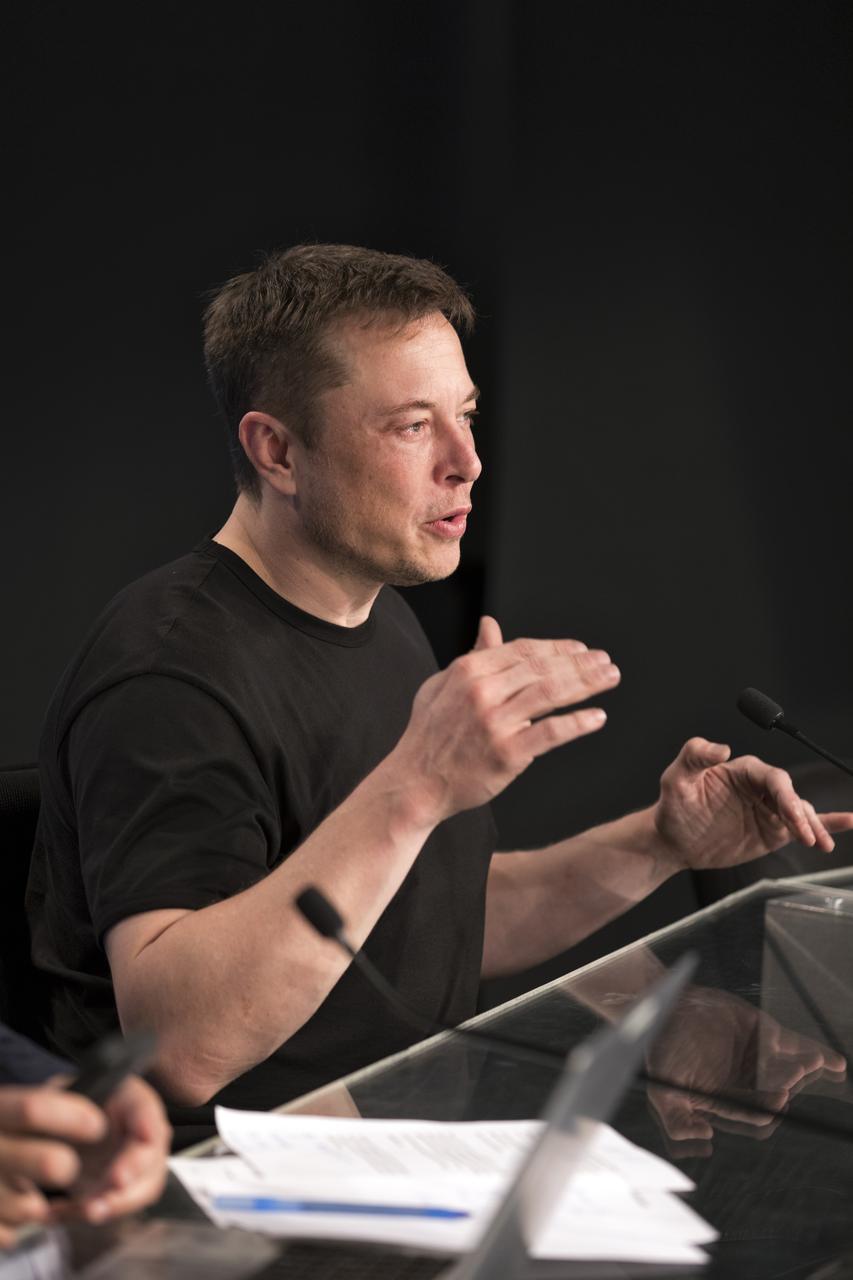
Elon Musk, SpaceX chief executive officer and lead designer, speaks to the news media during a news conference at NASA's Kennedy Space Center in Florida after the successful liftoff of the company’s Falcon Heavy rocket from Launch Complex 39A. The demonstration flight is a significant milestone for the world's premier multi-user spaceport. In 2014, NASA signed a property agreement with SpaceX for the use and operation of the center's pad 39A, where the company has launched Falcon 9 rockets and is preparing for the first Falcon Heavy. NASA also has Space Act Agreements in place with partners, such as SpaceX, to provide services needed to process and launch rockets and spacecraft.
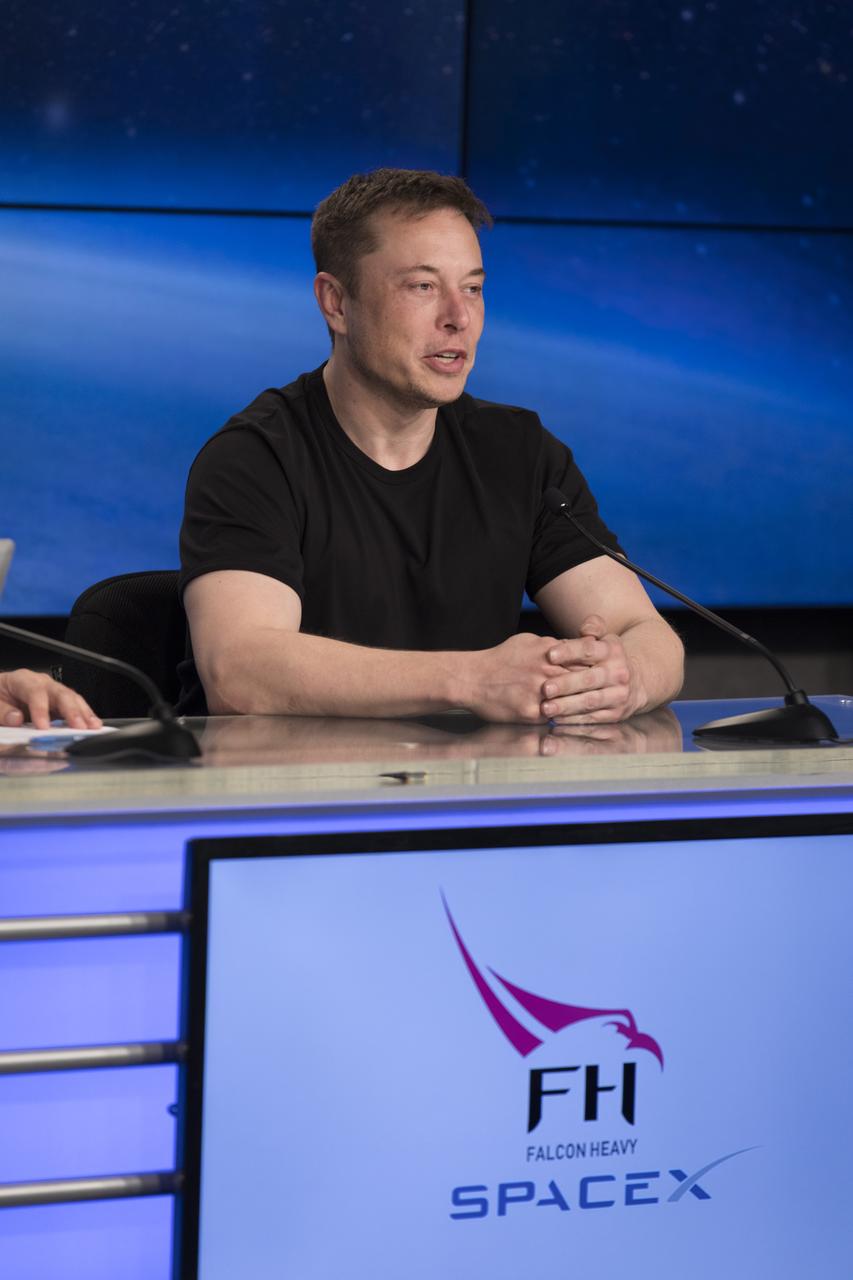
Elon Musk, SpaceX chief executive officer and lead designer, speaks to the news media during a news conference at NASA's Kennedy Space Center in Florida after the successful liftoff of the company’s Falcon Heavy rocket from Launch Complex 39A. The demonstration flight is a significant milestone for the world's premier multi-user spaceport. In 2014, NASA signed a property agreement with SpaceX for the use and operation of the center's pad 39A, where the company has launched Falcon 9 rockets and is preparing for the first Falcon Heavy. NASA also has Space Act Agreements in place with partners, such as SpaceX, to provide services needed to process and launch rockets and spacecraft.
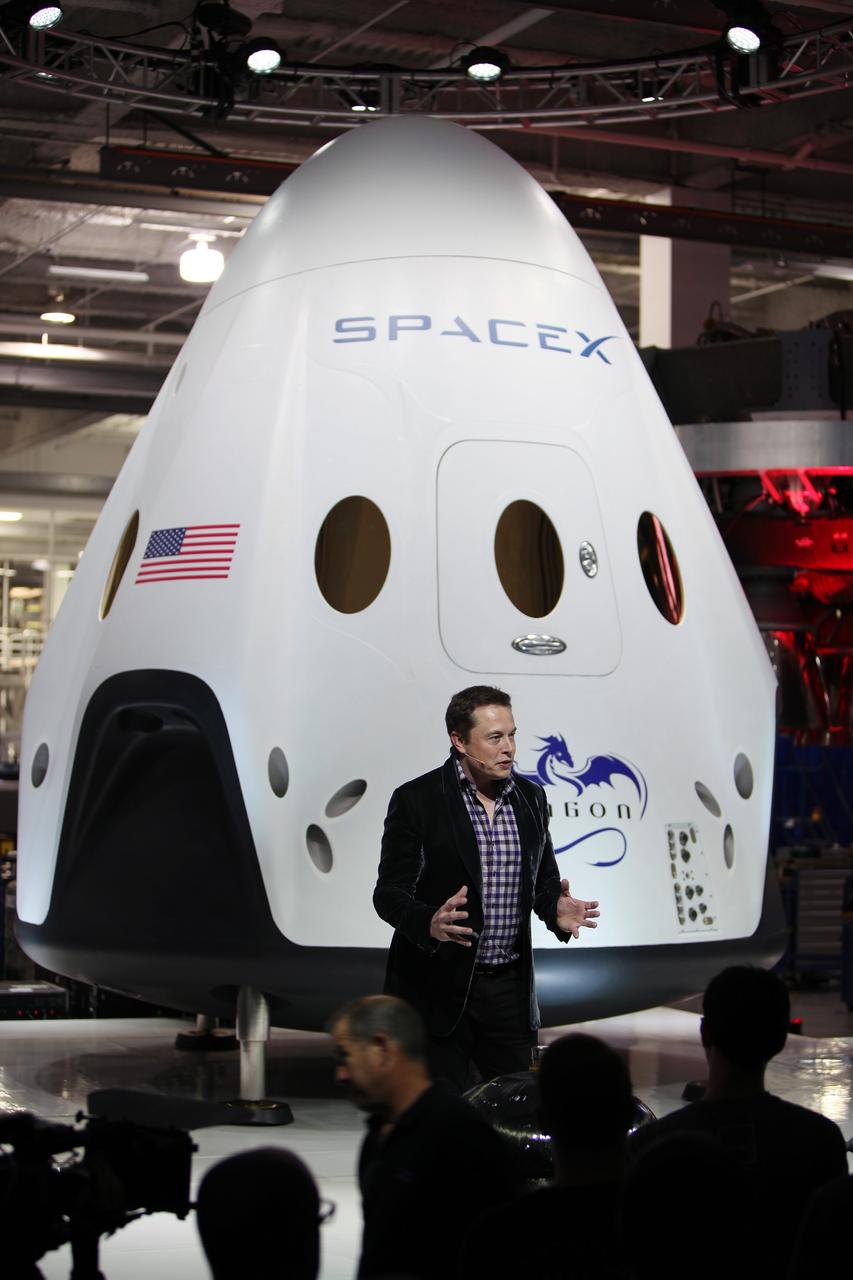
HAWTHORNE, Calif. - HAWTHORNE, Calif. - SpaceX CEO and founder Elon Musk unveils the Dragon V2 during a ceremony for the new spacecraft inside SpaceX headquarters in Hawthorne, Calif. The spacecraft is designed to carry people into Earth's orbit and was developed in partnership with NASA's Commercial Crew Program under the Commercial Crew Integrated Capability agreement. SpaceX is one of NASA's commercial partners working to develop a new generation of U.S. spacecraft and rockets capable of transporting humans to and from Earth's orbit from American soil. Ultimately, NASA intends to use such commercial systems to fly U.S. astronauts to and from the International Space Station. Photo credit: NASA/Dimitri Gerondidakis
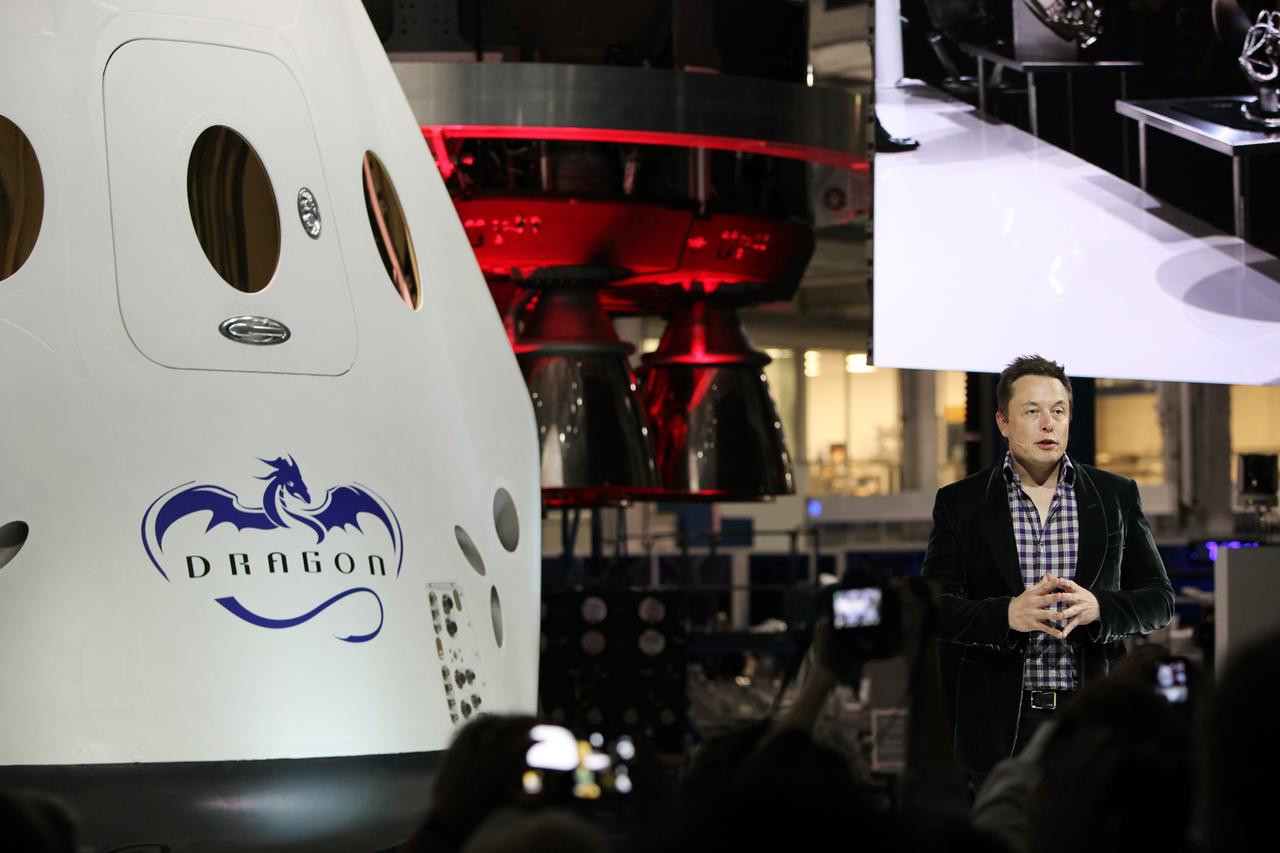
HAWTHORNE, Calif. - SpaceX CEO and founder Elon Musk discusses the Dragon V2 during an unveiling ceremony for the new spacecraft inside SpaceX headquarters in Hawthorne, Calif. The spacecraft is designed to carry people into Earth's orbit and was developed in partnership with NASA's Commercial Crew Program under the Commercial Crew Integrated Capability agreement. SpaceX is one of NASA's commercial partners working to develop a new generation of U.S. spacecraft and rockets capable of transporting humans to and from Earth's orbit from American soil. Ultimately, NASA intends to use such commercial systems to fly U.S. astronauts to and from the International Space Station. Photo credit: NASA/Dimitri Gerondidakis
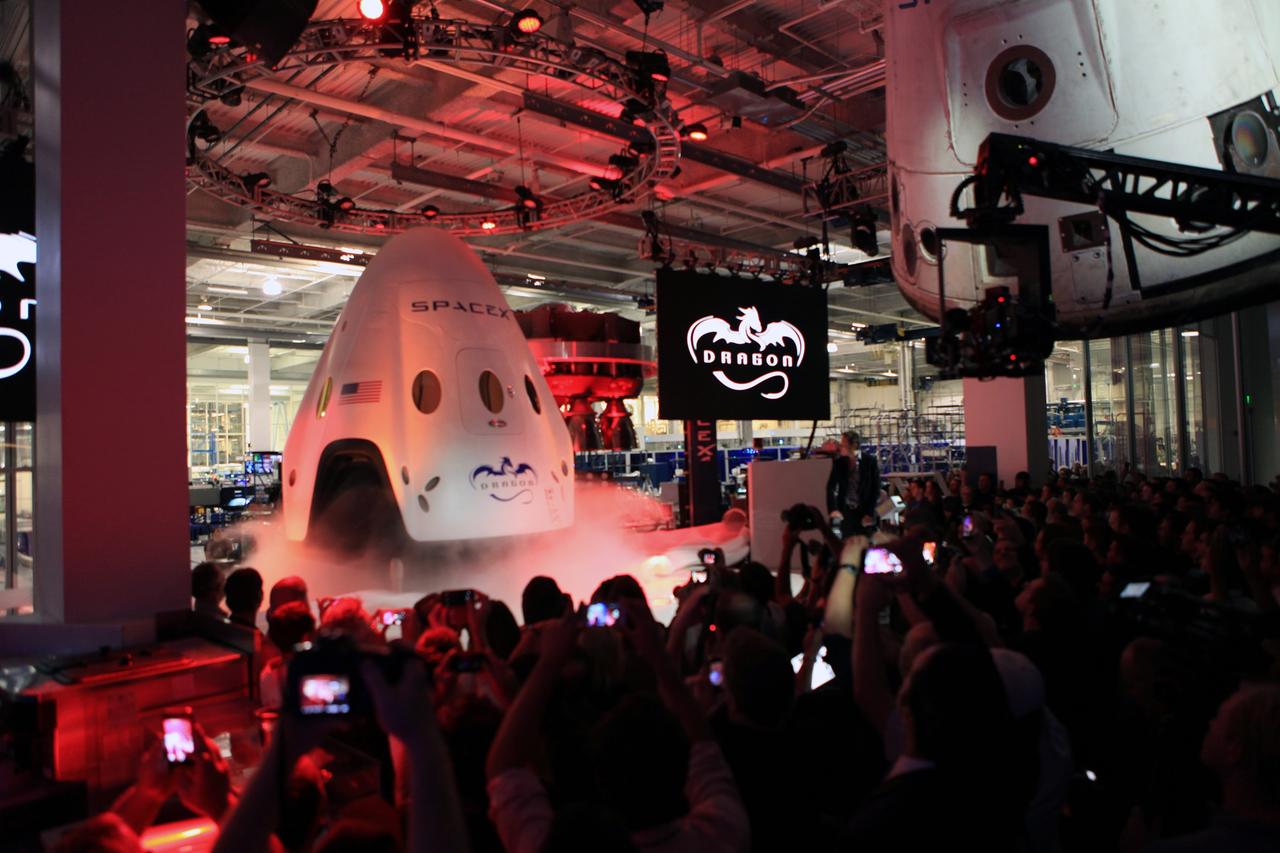
HAWTHORNE, Calif. - SpaceX CEO and founder Elon Musk unveils the Dragon V2 inside SpaceX headquarters in Hawthorne, Calif. The spacecraft is designed to carry people into Earth's orbit and was developed in partnership with NASA's Commercial Crew Program under the Commercial Crew Integrated Capability agreement. SpaceX is one of NASA's commercial partners working to develop a new generation of U.S. spacecraft and rockets capable of transporting humans to and from Earth's orbit from American soil. Ultimately, NASA intends to use such commercial systems to fly U.S. astronauts to and from the International Space Station. Photo credit: NASA/Dimitri Gerondidakis

From left to right - John Taylor, SpaceX communications director, and Elon Musk, SpaceX chief executive officer and lead designer, speak to the news media during a news conference at NASA's Kennedy Space Center in Florida after the successful liftoff of the company’s Falcon Heavy rocket from Launch Complex 39A. The demonstration flight is a significant milestone for the world's premier multi-user spaceport. In 2014, NASA signed a property agreement with SpaceX for the use and operation of the center's pad 39A, where the company has launched Falcon 9 rockets and is preparing for the first Falcon Heavy. NASA also has Space Act Agreements in place with partners, such as SpaceX, to provide services needed to process and launch rockets and spacecraft.
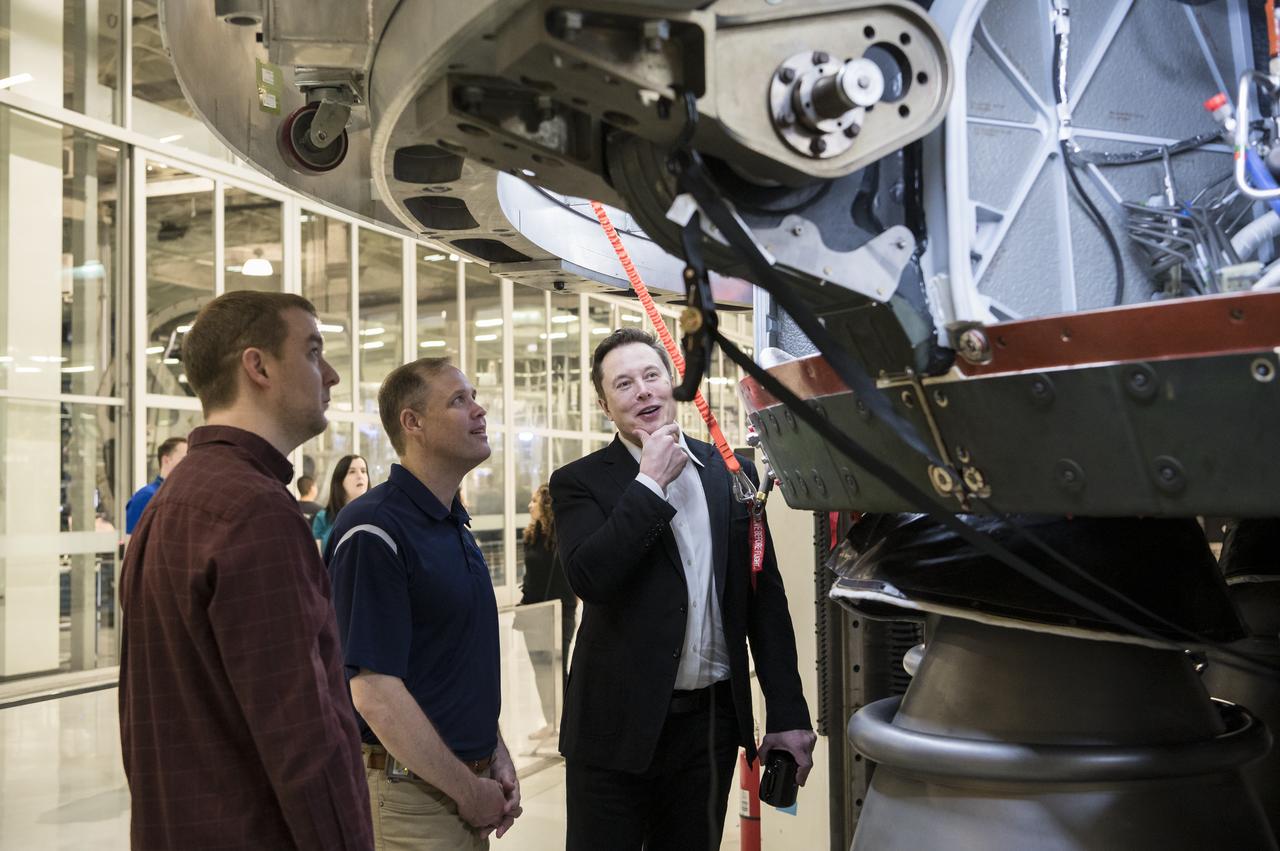
SpaceX Chief Engineer Elon Musk, right, speaks to NASA Administrator Jim Bridenstine, center, and SpaceX Vice President of Propulsion Engineering, Will Heltsley, left, while viewing the OctaWeb, part of the Merlin engine used for the Falcon rockets, at the SpaceX Headquarters, Thursday, Oct. 10, 2019 in Hawthorne, CA. Photo credit: (NASA/Aubrey Gemignani)
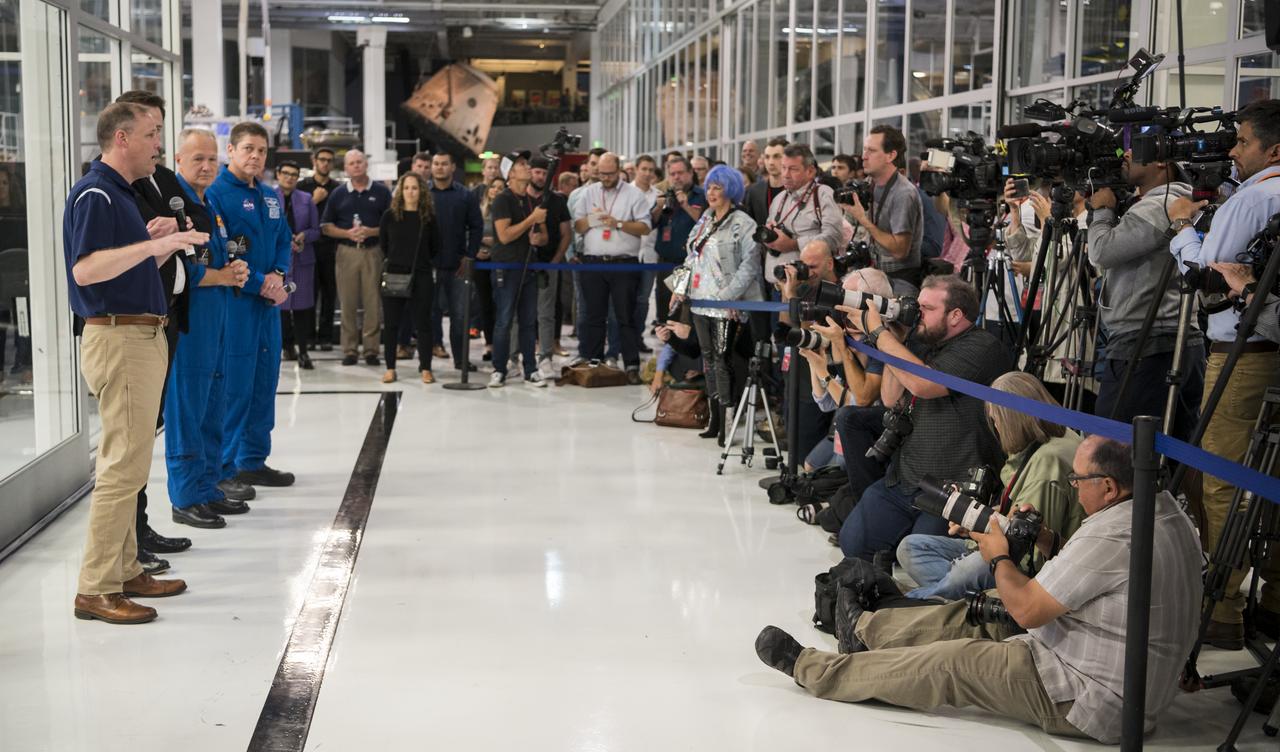
NASA Administrator Jim Bridenstine, left, speaks to press with SpaceX Chief Engineer Elon Musk, second from left, NASA astronaut Doug Hurley, second from right, and NASA astronaut Bob Behnken, at SpaceX Headquarters, Thursday, Oct. 10, 2019 in Hawthorne, CA. Photo credit: (NASA/Aubrey Gemignani)
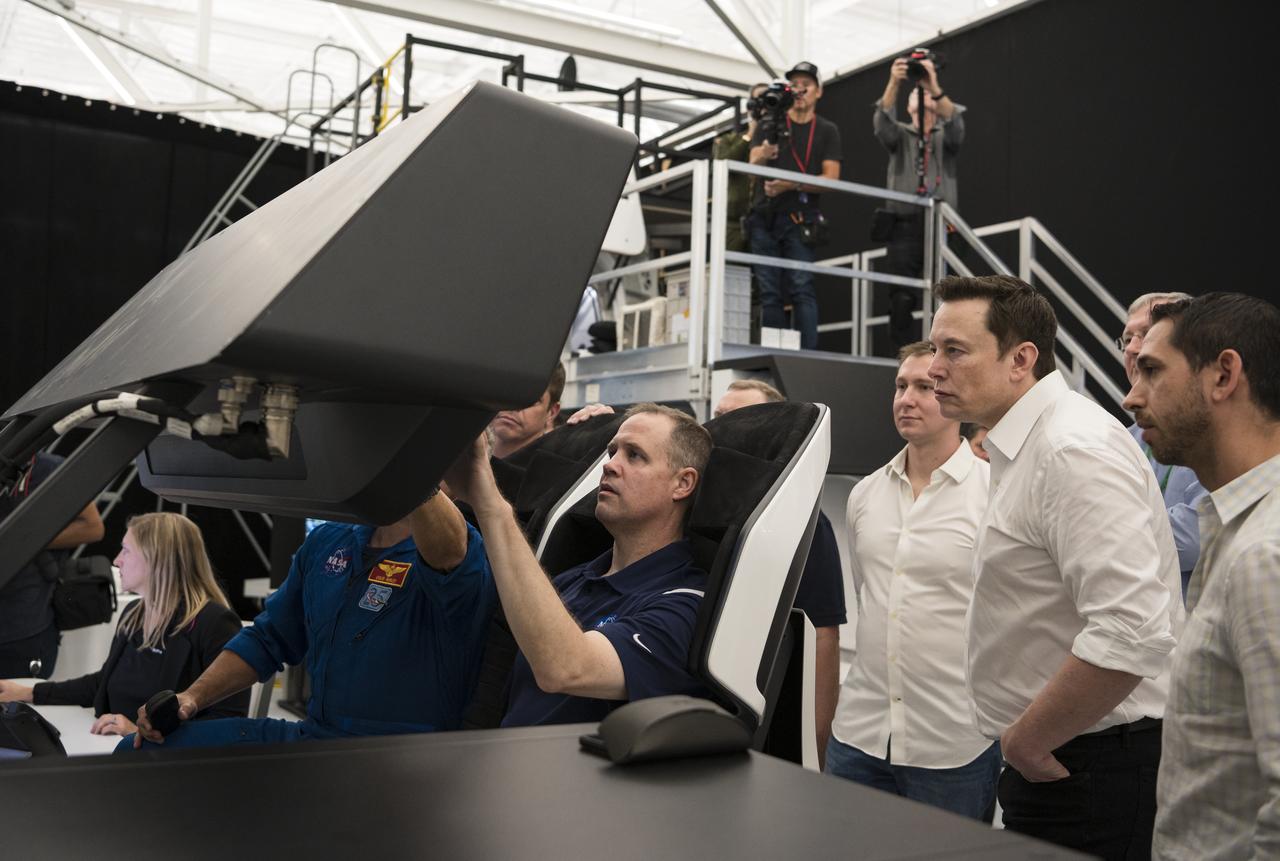
NASA Administrator Jim Bridenstine, center, participates in a crew Dragon flight simulation with NASA astronauts Doug Hurley, and Bob Behnken, while SpaceX Chief Engineer Elon Musk looks on, at the SpaceX Headquarters, Thursday, Oct. 10, 2019 in Hawthorne, CA. Photo credit: (NASA/Aubrey Gemignani)

NASA Administrator Charles Bolden, left, and SpaceX CEO and Chief Designer Elon Musk, view the historic Dragon capsule that returned to Earth on May 31 following the first successful mission by a private company to carry supplies to the International Space Station on Wednesday, June 13, 2012 at the SpaceX facility in McGregor, Texas. Bolden and Musk also thanked the more than 150 SpaceX employees working at the McGregor facility for their role in the historic mission. Photo Credit: (NASA/Bill Ingalls)

NASA Administrator Charles Bolden, left, and SpaceX CEO and Chief Designer Elon Musk, view the historic Dragon capsule that returned to Earth on May 31 following the first successful mission by a private company to carry supplies to the International Space Station on Wednesday, June 13, 2012 at the SpaceX facility in McGregor, Texas. Bolden and Musk also thanked the more than 150 SpaceX employees working at the McGregor facility for their role in the historic mission. Photo Credit: (NASA/Bill Ingalls)

NASA Administrator Charles Bolden, left, and SpaceX CEO and Chief Designer Elon Musk, view the historic Dragon capsule that returned to Earth on May 31 following the first successful mission by a private company to carry supplies to the International Space Station on Wednesday, June 13, 2012 at the SpaceX facility in McGregor, Texas. Bolden and Musk also thanked the more than 150 SpaceX employees working at the McGregor facility for their role in the historic mission. Photo Credit: (NASA/Bill Ingalls)

NASA Administrator Charles Bolden, left, and SpaceX CEO and Chief Designer Elon Musk, view the historic Dragon capsule that returned to Earth on May 31 following the first successful mission by a private company to carry supplies to the International Space Station on Wednesday, June 13, 2012 at the SpaceX facility in McGregor, Texas. Bolden and Musk also thanked the more than 150 SpaceX employees working at the McGregor facility for their role in the historic mission. Photo Credit: (NASA/Bill Ingalls)

NASA Administrator Charles Bolden, left, congratulates SpaceX CEO and Chief Designer Elon Musk in front of the historic Dragon capsule that returned to Earth on May 31 following the first successful mission by a private company to carry supplies to the International Space Station on Wednesday, June 13, 2012 at the SpaceX facility in McGregor, Texas. Bolden and Musk also thanked the more than 150 SpaceX employees working at the McGregor facility for their role in the historic mission. Photo Credit: (NASA/Bill Ingalls)
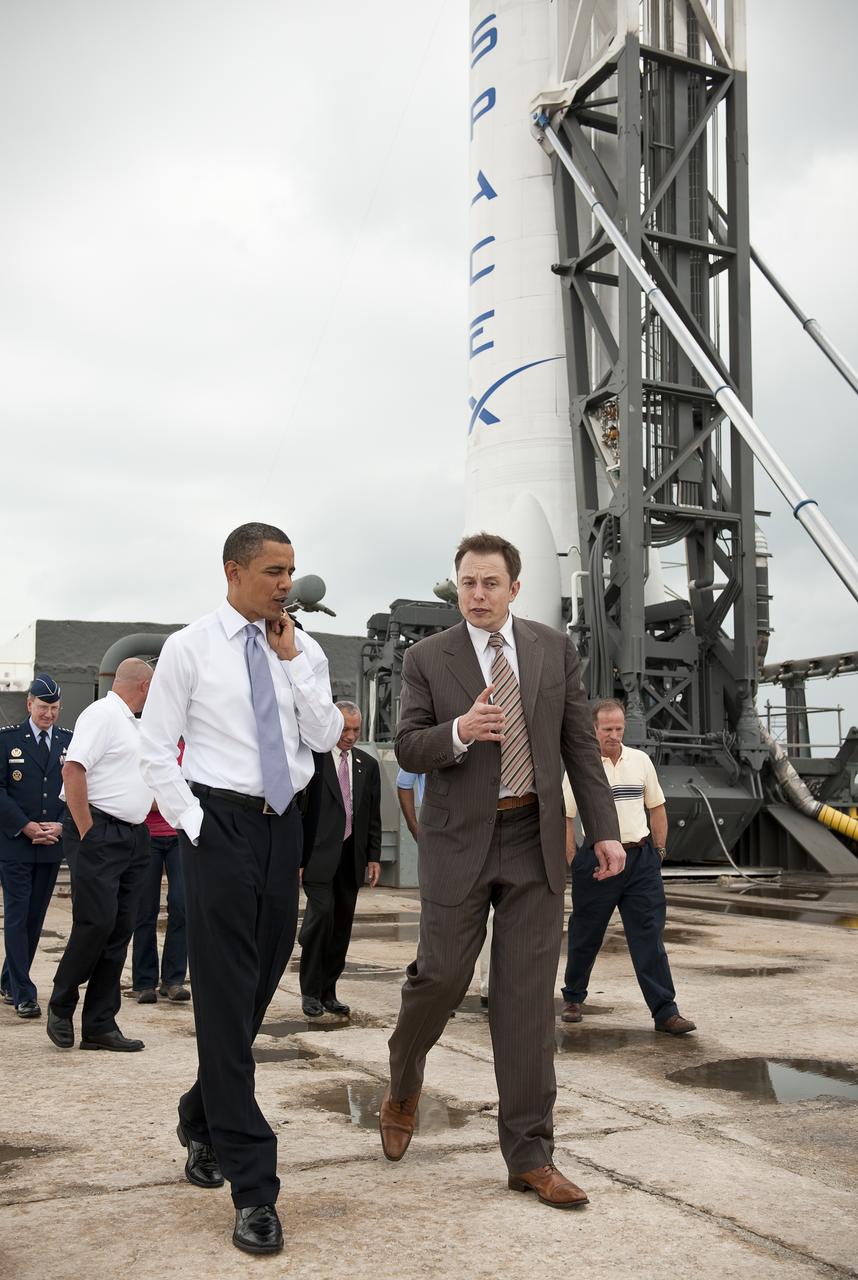
President Barack Obama tours the commercial rocket processing facility of Space Exploration Technologies, known as SpaceX, along with Elon Musk, SpaceX CEO at Cape Canaveral Air Force Station, Cape Canaveral, Fla. on Thursday, April 15, 2010. Obama also visited the NASA Kennedy Space Center to deliver remarks on the bold new course the administration is charting to maintain U.S. leadership in human space flight. Photo Credit: (NASA/Bill Ingalls)
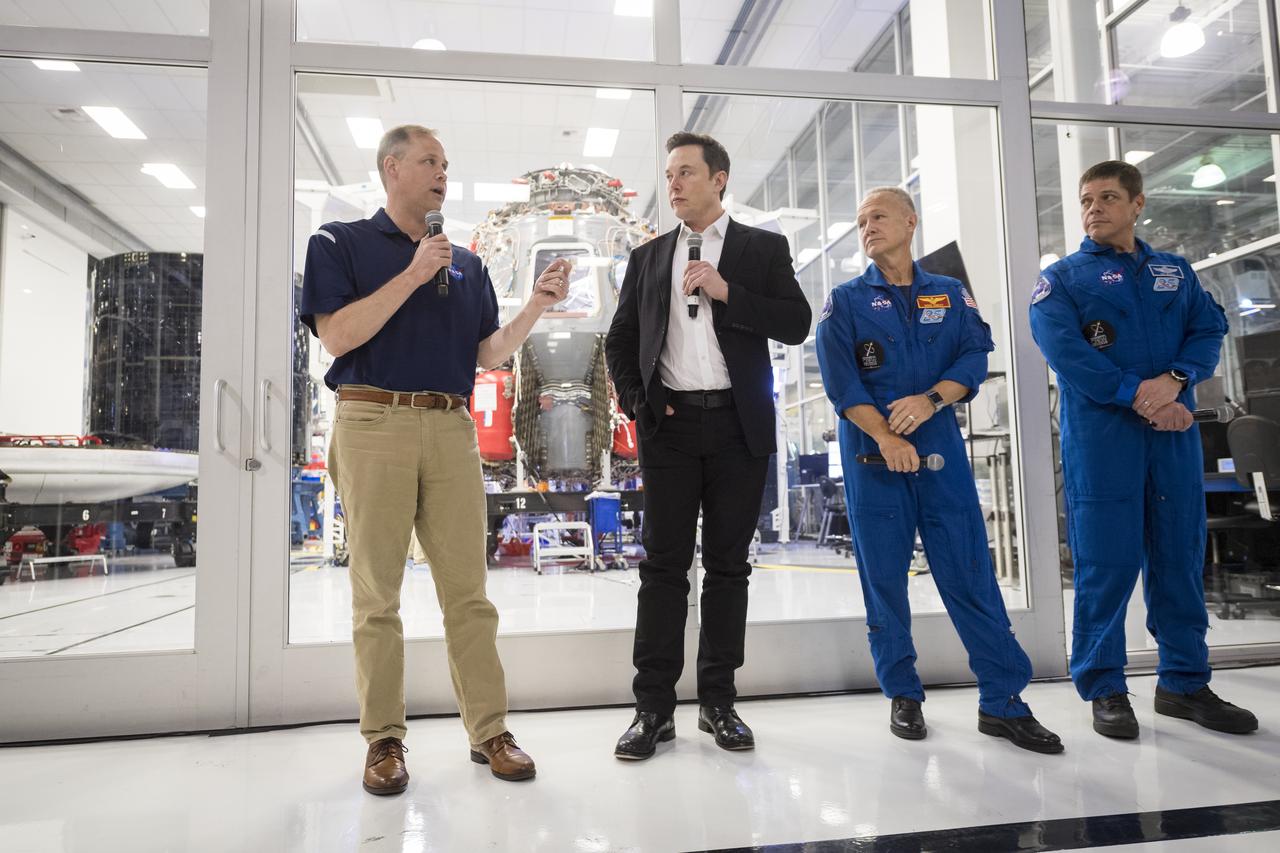
NASA Administrator Jim Bridenstine, left, speaks to press with SpaceX Chief Engineer Elon Musk, second from left, NASA astronaut Doug Hurley, second from right, and NASA astronaut Bob Behnken, in front of the Crew Dragon that is being prepared for the Demo-2 mission, at SpaceX Headquarters, Thursday, Oct. 10, 2019 in Hawthorne, CA. Photo credit: (NASA/Aubrey Gemignani)
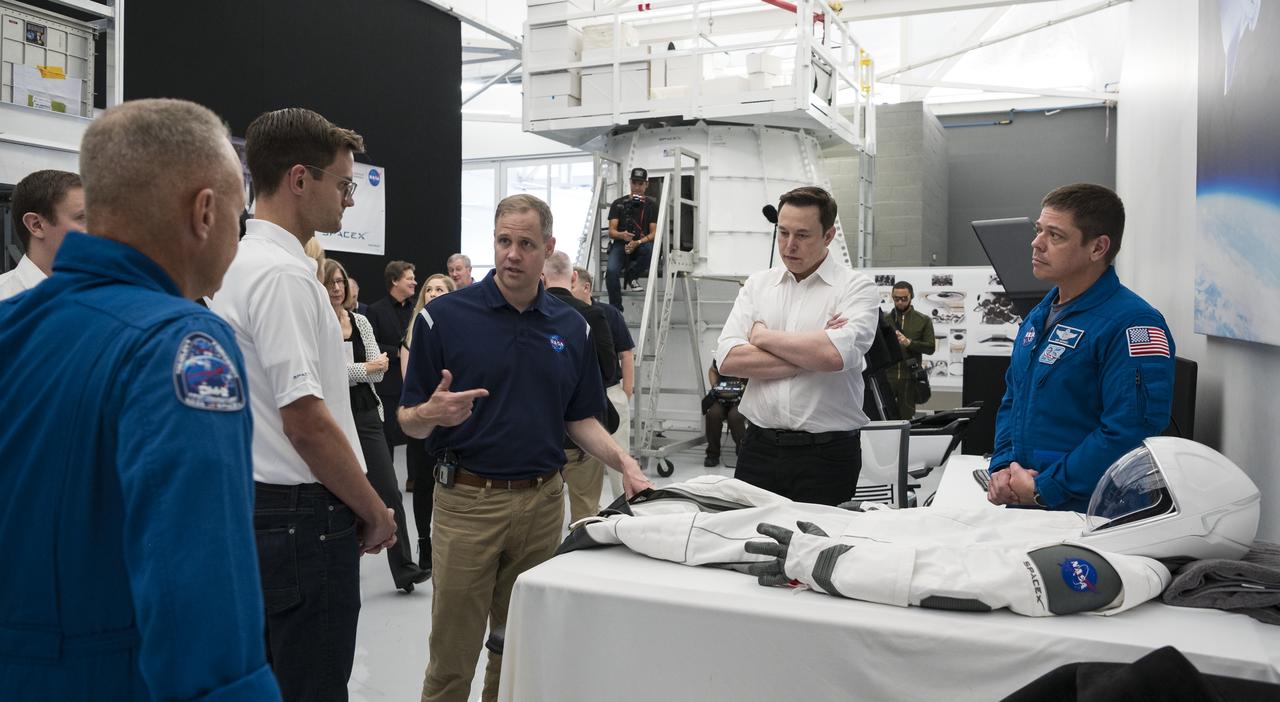
SpaceX Chief Engineer Elon Musk, second from right, and NASA astronaut Bob Behnken, right, look on as NASA Administrator Jim Bridenstine, third from left, speaks to NASA astronaut Doug Hurley, left, as they look at an identical version of the SpaceX spacesuit that he will wear for the Demo-2 mission during a visit to SpaceX Headquarters, Thursday, Oct. 10, 2019 in Hawthorne, CA. Behnken and Hurley are assigned to fly onboard Crew Dragon for the Demo-2 mission. Photo credit: (NASA/Aubrey Gemignani)
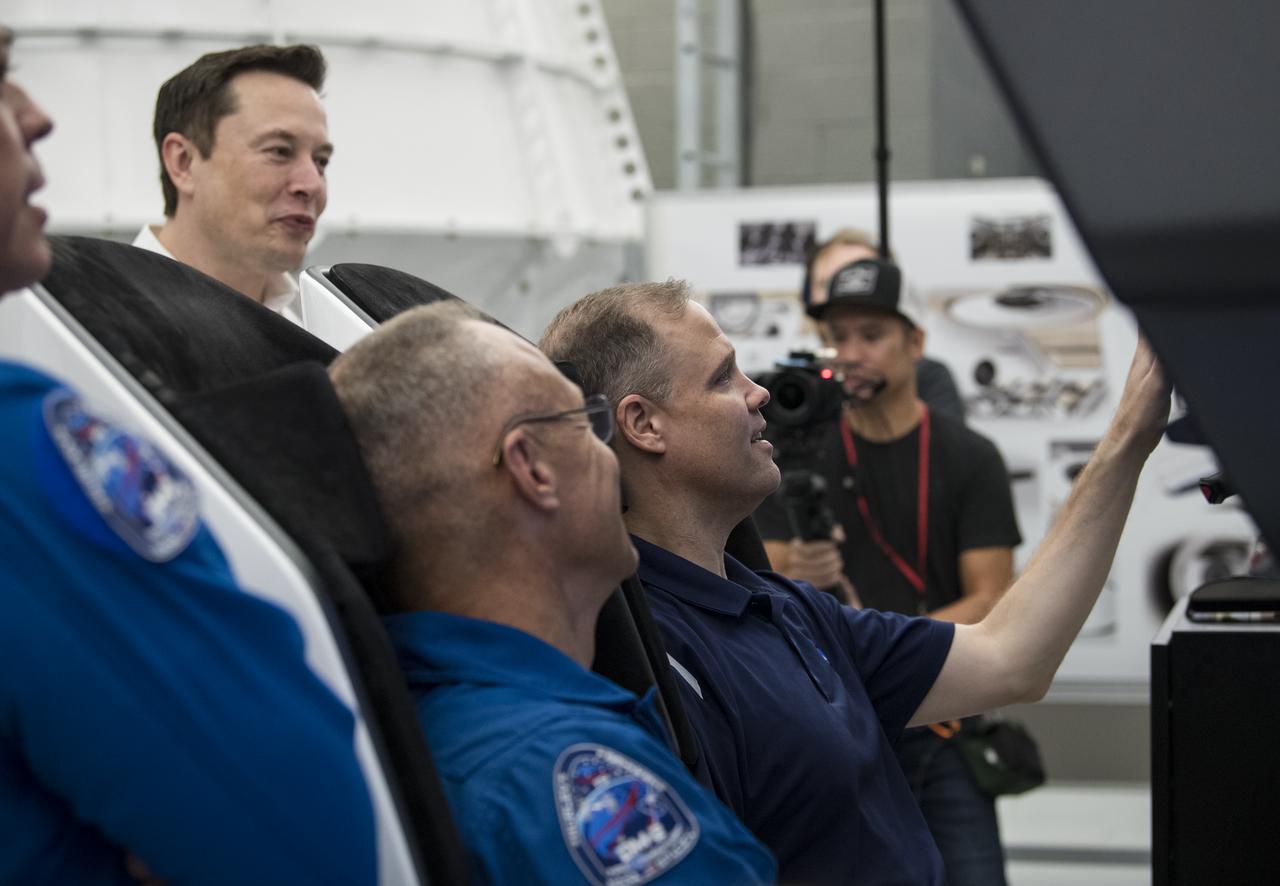
NASA Administrator Jim Bridenstine, right, participates in a crew Dragon flight simulation with NASA astronaut Doug Hurley, who will be flying aboard the Crew Dragon during the Demo-2 mission, while SpaceX Chief Engineer Elon Musk looks on, at the SpaceX Headquarters, Thursday, Oct. 10, 2019 in Hawthorne, CA. Photo credit: (NASA/Aubrey Gemignani)
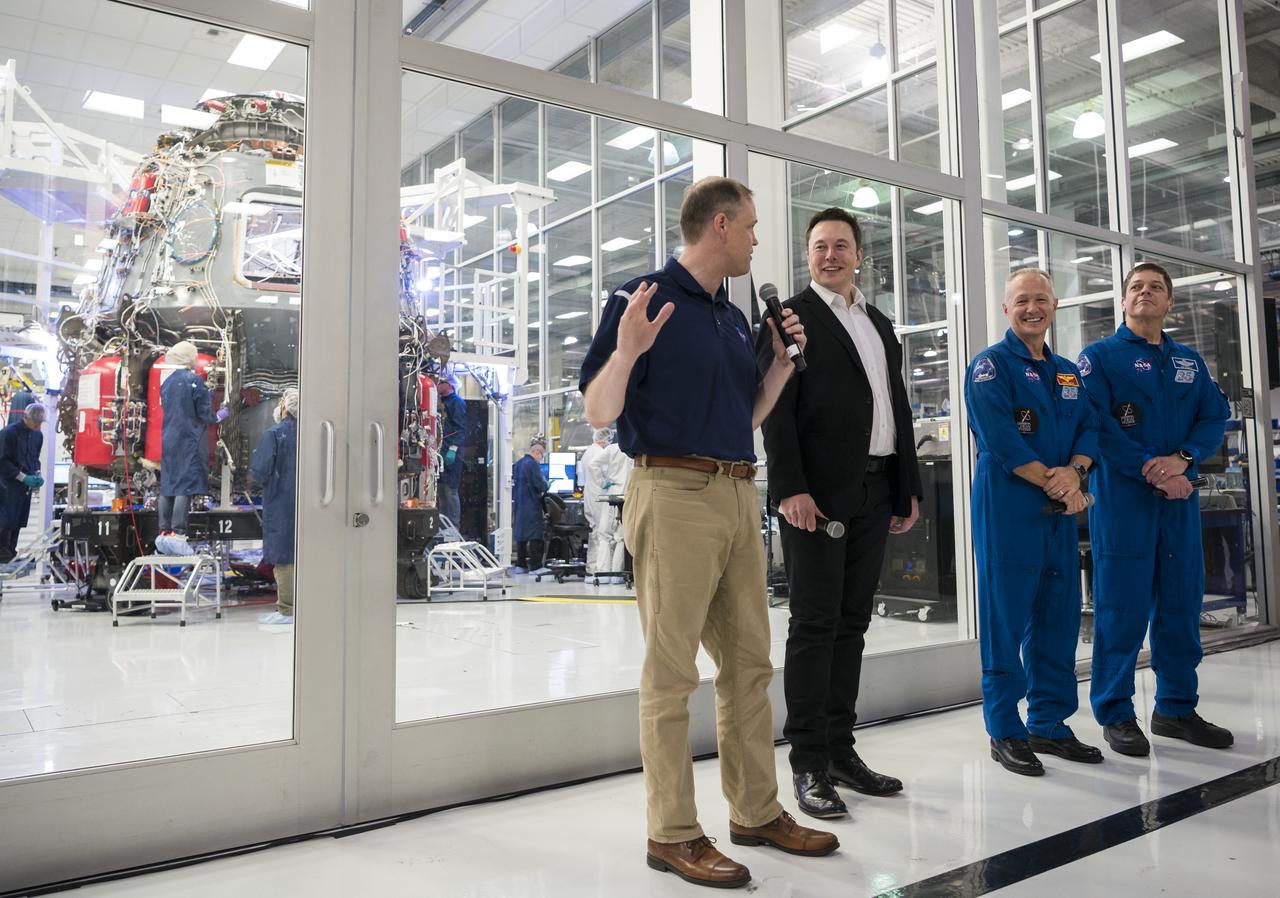
NASA Administrator Jim Bridenstine, left, speaks to press with SpaceX Chief Engineer Elon Musk, second from left, NASA astronaut Doug Hurley, second from right, and NASA astronaut Bob Behnken, in front of the Crew Dragon that is being prepared for the Demo-2 mission, at SpaceX Headquarters, Thursday, Oct. 10, 2019 in Hawthorne, CA. Photo credit: (NASA/Aubrey Gemignani)
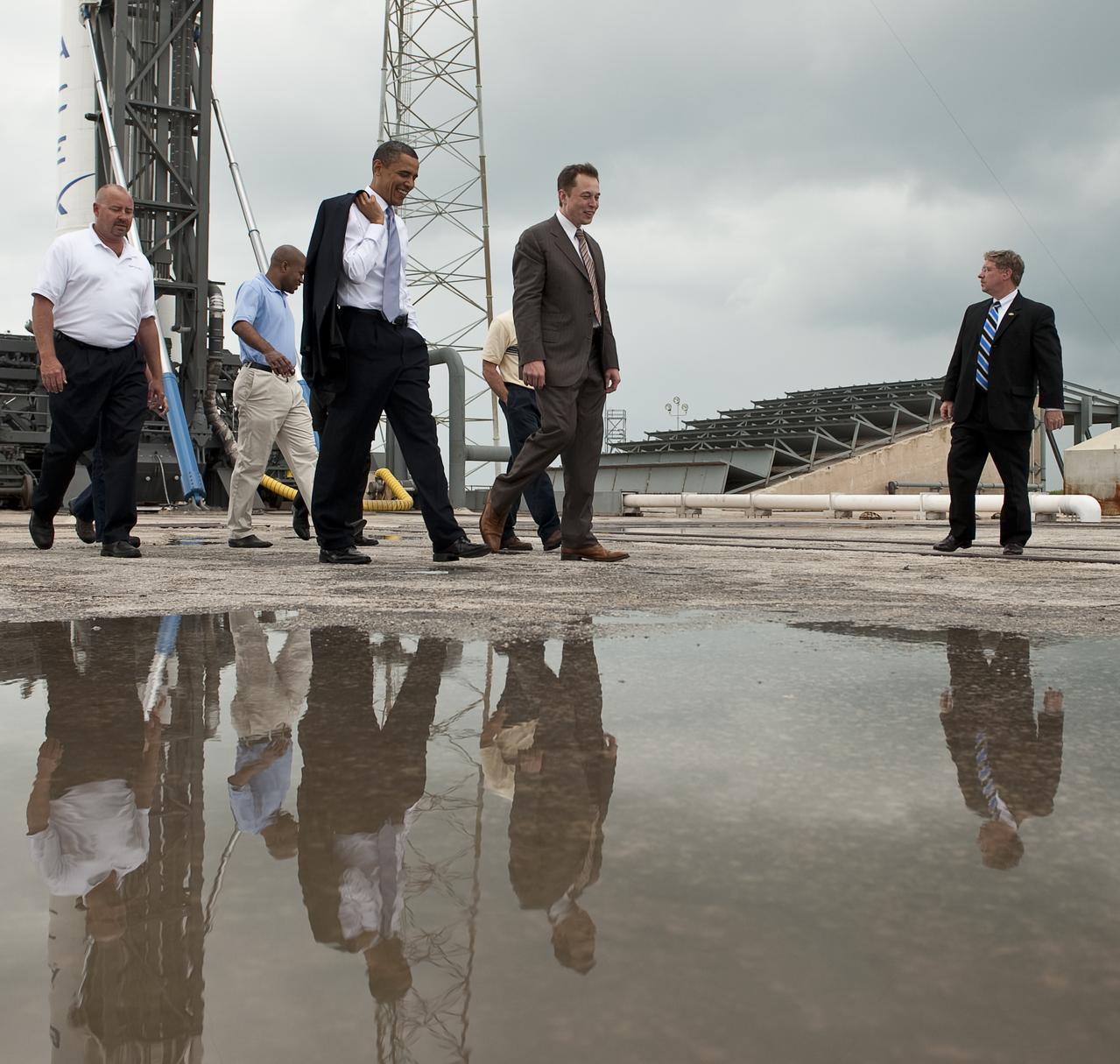
President Barack Obama tours the commercial rocket processing facility of Space Exploration Technologies, known as SpaceX, along with Elon Musk, SpaceX CEO at Cape Canaveral Air Force Station, Cape Canaveral, Fla. on Thursday, April 15, 2010. Obama also visited the NASA Kennedy Space Center to deliver remarks on the bold new course the administration is charting to maintain U.S. leadership in human space flight. Photo Credit: (NASA/Bill Ingalls)

NASA Administrator Charles Bolden, left, and SpaceX CEO and Chief Designer Elon Musk, view the historic Dragon capsule, right, that returned to Earth on May 31 following the first successful mission by a private company to carry supplies to the International Space Station on Wednesday, June 13, 2012 at the SpaceX facility in McGregor, Texas. Bolden and Musk also thanked the more than 150 SpaceX employees working at the McGregor facility for their role in the historic mission. Some of the 1,367 pounds of cargo the SpaceX Dragon spacecraft returned to Earth from the space station are seen in a clean room to the left. Photo Credit: (NASA/Bill Ingalls)
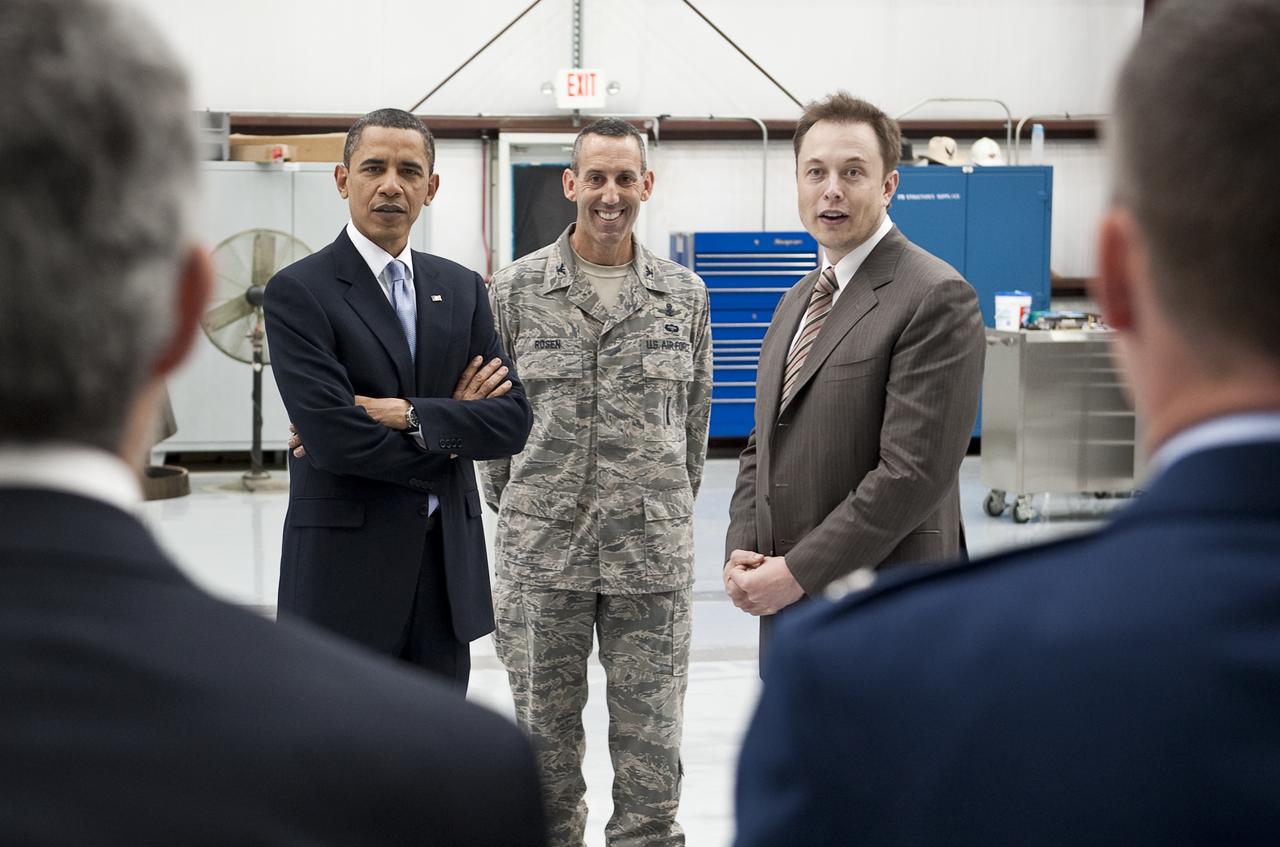
President Barack Obama, left, Air Force Col. Lee Rosen, Commander, 45th Launch Group, center, and SpaceX CEO Elon Musk talk with Dr. John P. Holdren is Assistant to the President for Science and Technology during a tour of the commercial rocket processing facility of Space Exploration Technologies, known as SpaceX, at Cape Canaveral Air Force Station, Cape Canaveral, Fla. on Thursday, April 15, 2010. Obama also visited the NASA Kennedy Space Center to deliver remarks on the bold new course the administration is charting to maintain U.S. leadership in human space flight. Photo Credit: (NASA/Bill Ingalls)
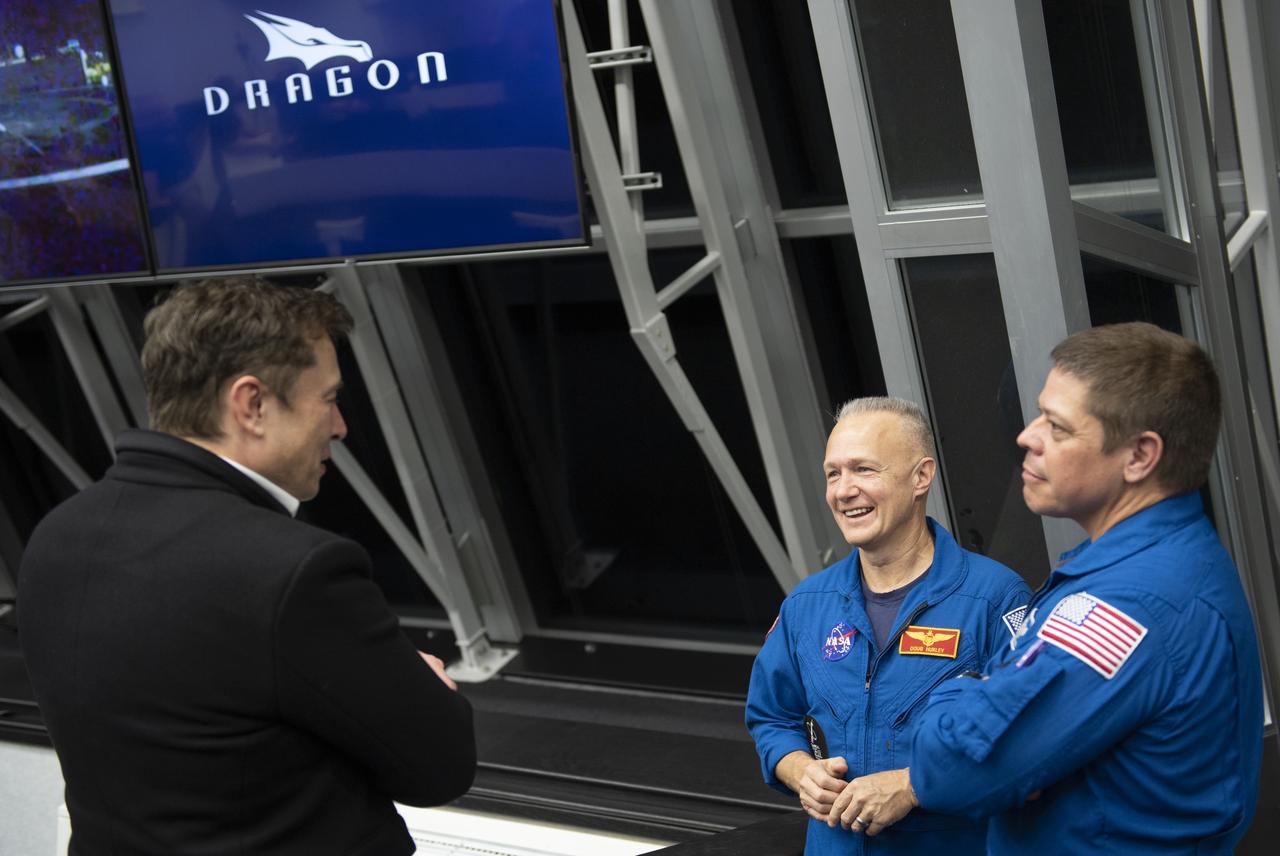
SpaceX CEO and Chief Designer Elon Musk, left, speaks with NASA astronauts Doug Hurley, center, and Bob Behnken, right, who are assigned to fly on the crewed Demo-2 mission after launch of a SpaceX Falcon 9 rocket carrying the company's Crew Dragon spacecraft on the Demo-1 mission from firing room four of the Launch Control Center, Saturday, March 2, 2019 at the Kennedy Space Center in Florida. The Demo-1 mission is the first launch of a commercially built and operated American spacecraft and space system designed for humans as part of NASA's Commercial Crew Program. The mission will serve as an end-to-end test of the system's capabilities. Photo Credit: (NASA/Joel Kowsky)
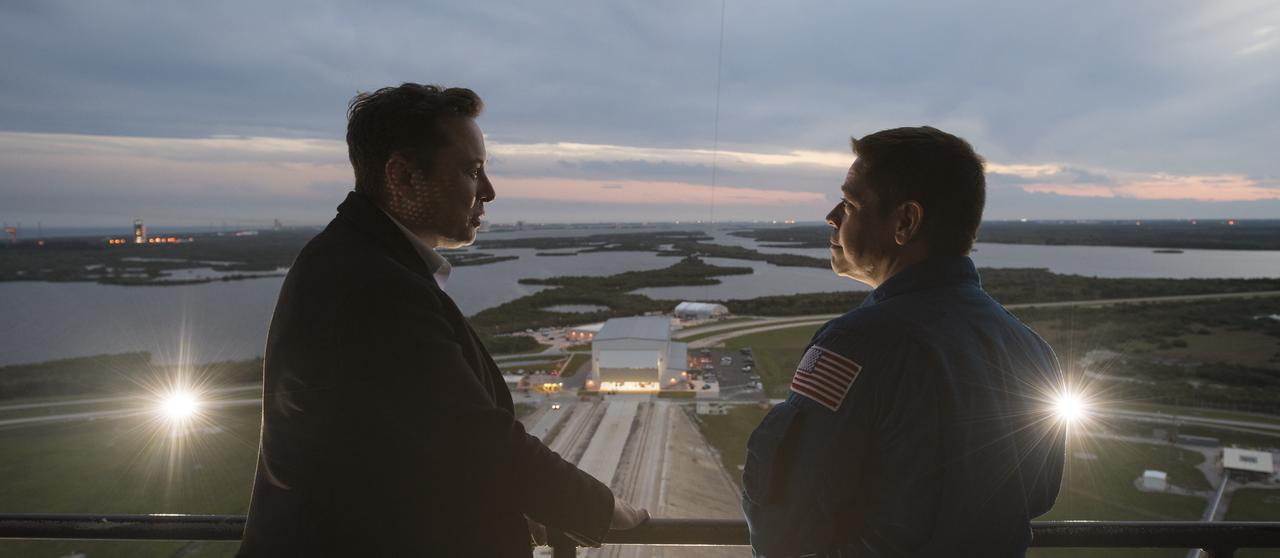
SpaceX CEO and Chief Designer Elon Musk, left, speaks with NASA astronaut Bob Behnken on the fixed service structure of Launch Complex 39A during a tour before the early Saturday morning launch of the Demo-1 mission, Friday, March 1, 2019 at the Kennedy Space Center in Florida. The Demo-1 mission launched at 2:49am ET on Saturday, March 2 and was the first launch of a commercially built and operated American spacecraft and space system designed for humans as part of NASA's Commercial Crew Program. The mission will serve as an end-to-end test of the system's capabilities. Behnken and fellow NASA astronaut Doug Hurley are assigned to fly onboard Crew Dragon for the Demo-2 mission. Photo Credit: (NASA/Joel Kowsky)
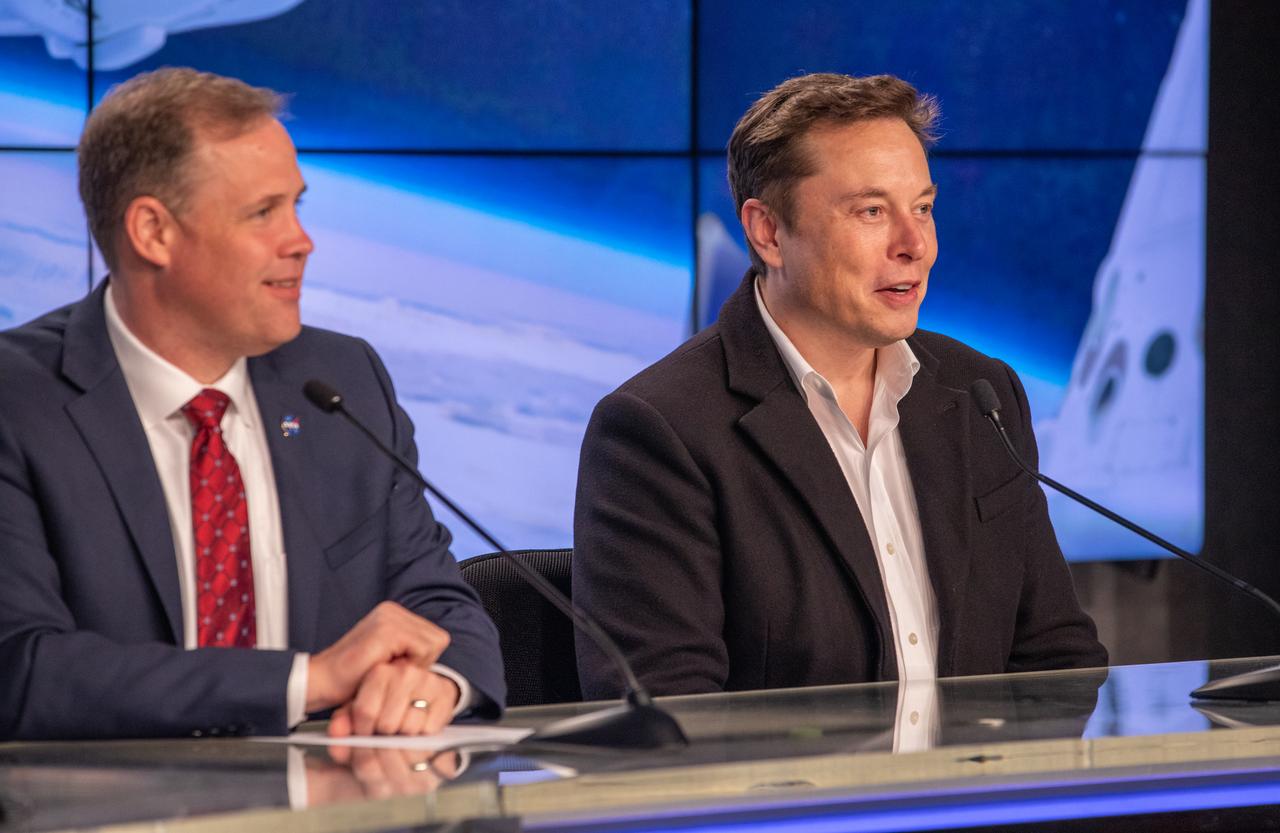
NASA administrator Jim Bridenstine, left, and SpaceX CEO and lead designer Elon Musk address members of the media during a post launch news conference in Kennedy Space Center’s Press Site auditorium following the March 2, 2:49 a.m. EST launch of the SpaceX Demo-1 Commercial Crew Program (CCP) mission to the International Space Station. The Crew Dragon’s trip to the space station is designed to validate end-to-end systems and capabilities, leading to certification to fly crew. NASA has worked with SpaceX and Boeing in developing the CCP spacecraft to facilitate new human spaceflight systems launching from U.S. soil with the goal of safe, reliable and cost-effective access to low-Earth orbit destinations, such as the space station.
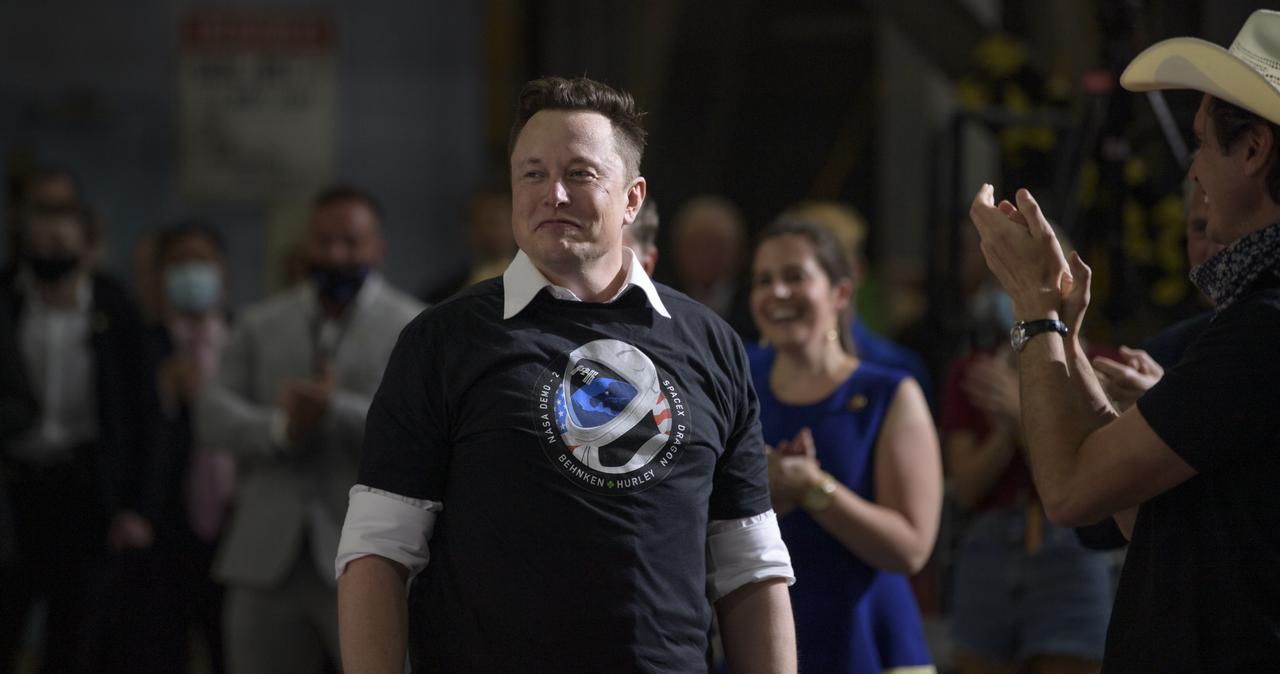
Elon Musk, SpaceX Chief Engineer, and the SpaceX team are recognized by Vice President Mike Pence inside the Vehicle Assembly Building following the launch of a SpaceX Falcon 9 rocket carrying the company's Crew Dragon spacecraft on NASA’s SpaceX Demo-2 mission with NASA astronauts Robert Behnken and Douglas Hurley onboard, Saturday, May 30, 2020, at NASA’s Kennedy Space Center in Florida. NASA’s SpaceX Demo-2 mission is the first launch with astronauts of the SpaceX Crew Dragon spacecraft and Falcon 9 rocket to the International Space Station as part of the agency’s Commercial Crew Program. The test flight serves as an end-to-end demonstration of SpaceX’s crew transportation system. Behnken and Hurley launched at 3:22 p.m. EDT on Saturday, May 30, from Launch Complex 39A at the Kennedy Space Center. A new era of human spaceflight is set to begin as American astronauts once again launch on an American rocket from American soil to low-Earth orbit for the first time since the conclusion of the Space Shuttle Program in 2011. Photo Credit: (NASA/Bill Ingalls)
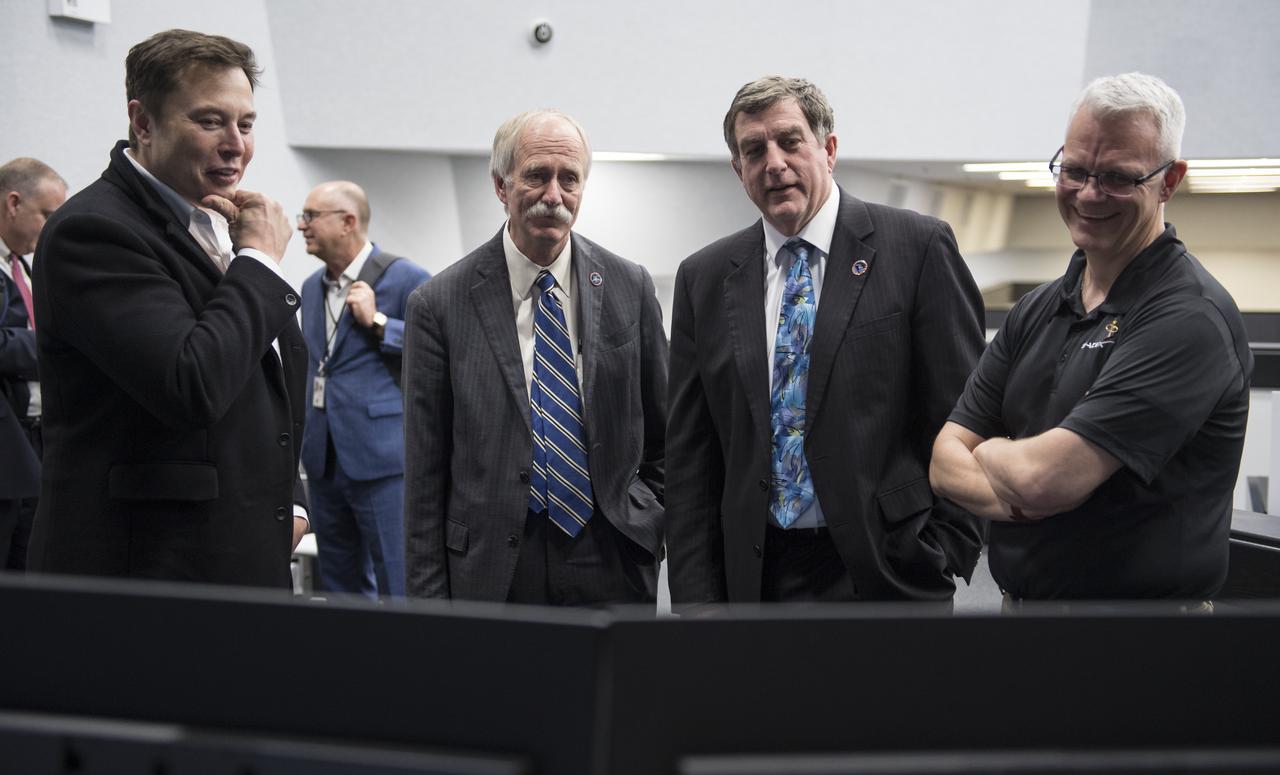
SpaceX CEO and Chief Designer Elon Musk, left, NASA Associate Administrator for the Human Exploration and Operations Mission Directorate William Gerstenmaier, second from left, NASA International Space Station Program Manager Kirk Shireman, second from right, and SpaceX Director of Crew Mission Management Benji Reed, right, watch the progress of the Crew Dragon spacecraft after launch from firing room four of the Launch Control Center, Saturday, March 2, 2019 at the Kennedy Space Center in Florida. The Demo-1 mission is the first launch of a commercially built and operated American spacecraft and space system designed for humans as part of NASA's Commercial Crew Program. The mission will serve as an end-to-end test of the system's capabilities. Photo Credit: (NASA/Joel Kowsky)
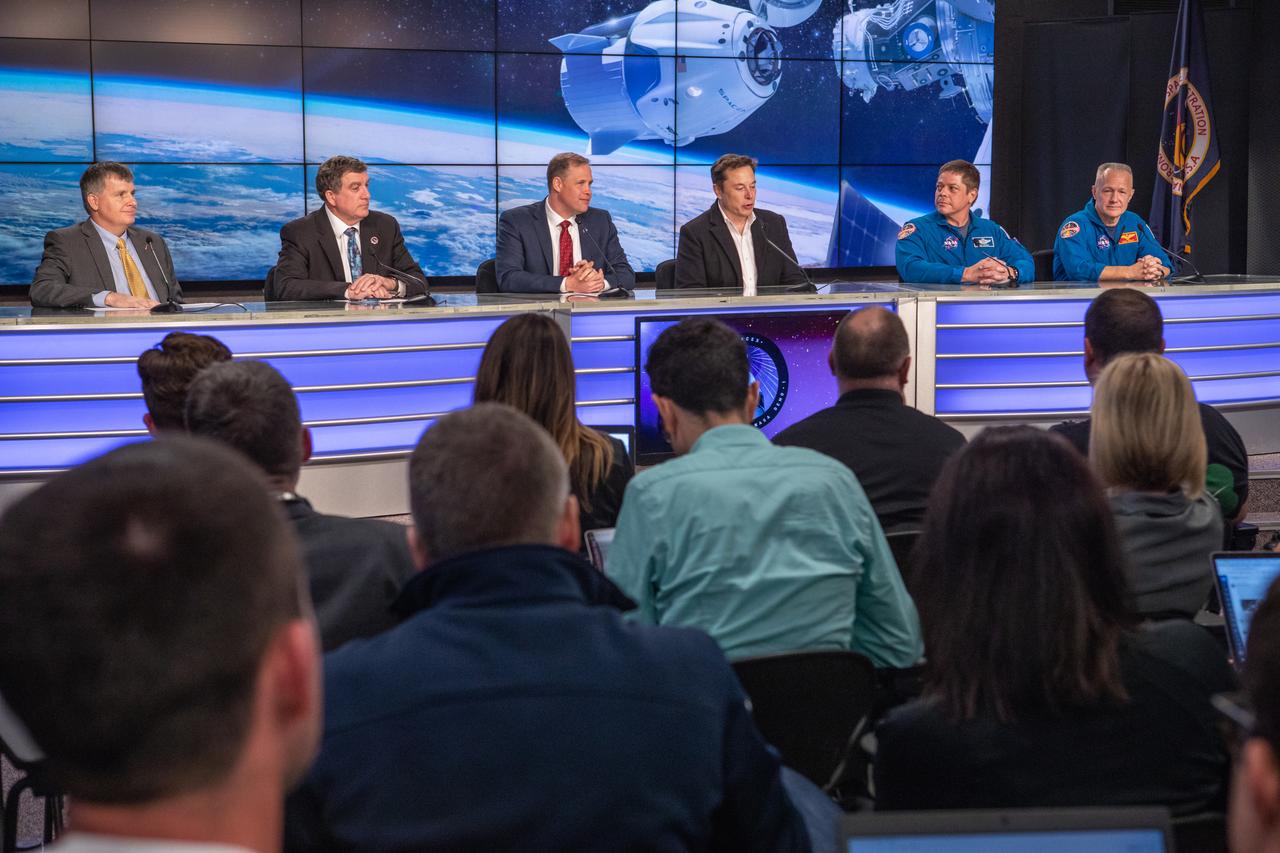
In Kennedy Space Center’s Press Site auditorium, agency and industry leaders speak to members of the media during a post launch news conference following the March 2, 2:49 a.m. EST launch of the SpaceX Demo-1 Commercial Crew Program (CCP) mission to the International Space Station. From left are: Steve Stich, NASA launch manager, Commercial Crew Program; Kirk Shireman, manager, International Space Station Program; Jim Bridenstine, NASA administrator; Elon Musk, CEO and lead designer, SpaceX; Bob Behnken, NASA astronaut and Doug Hurley, NASA astronaut. The Crew Dragon’s trip to the space station is designed to validate end-to-end systems and capabilities, leading to certification to fly crew. NASA has worked with SpaceX and Boeing in developing the CCP spacecraft to facilitate new human spaceflight systems launching from U.S. soil with the goal of safe, reliable and cost-effective access to low-Earth orbit destinations, such as the space station.
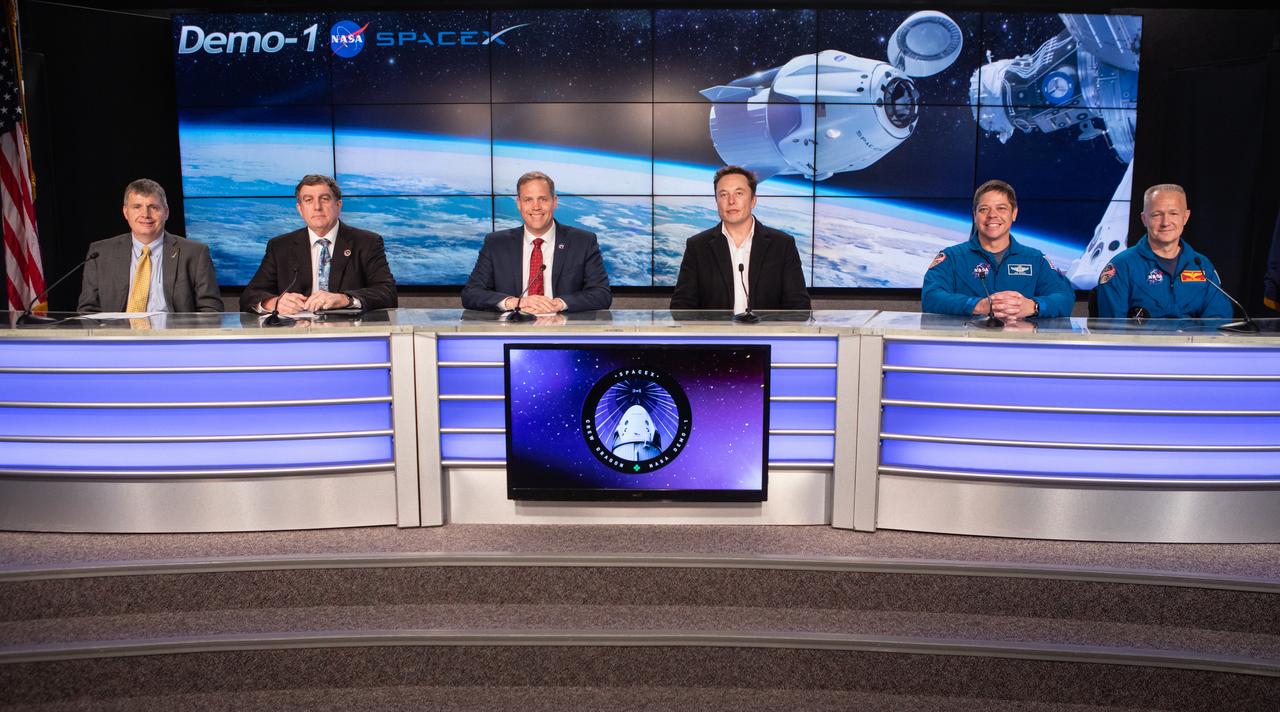
In Kennedy Space Center’s Press Site auditorium, agency and industry leaders speak to members of the media during a post launch news conference following the March 2, 2:49 a.m. EST launch of the SpaceX Demo-1 Commercial Crew Program (CCP) mission to the International Space Station. From left are: Steve Stich, NASA launch manager, Commercial Crew Program; Kirk Shireman, manager, International Space Station Program; Jim Bridenstine, NASA administrator; Elon Musk, CEO and lead designer, SpaceX; Bob Behnken, NASA astronaut and Doug Hurley, NASA astronaut. The Crew Dragon’s trip to the space station is designed to validate end-to-end systems and capabilities, leading to certification to fly crew. NASA has worked with SpaceX and Boeing in developing the CCP spacecraft to facilitate new human spaceflight systems launching from U.S. soil with the goal of safe, reliable and cost-effective access to low-Earth orbit destinations, such as the space station.
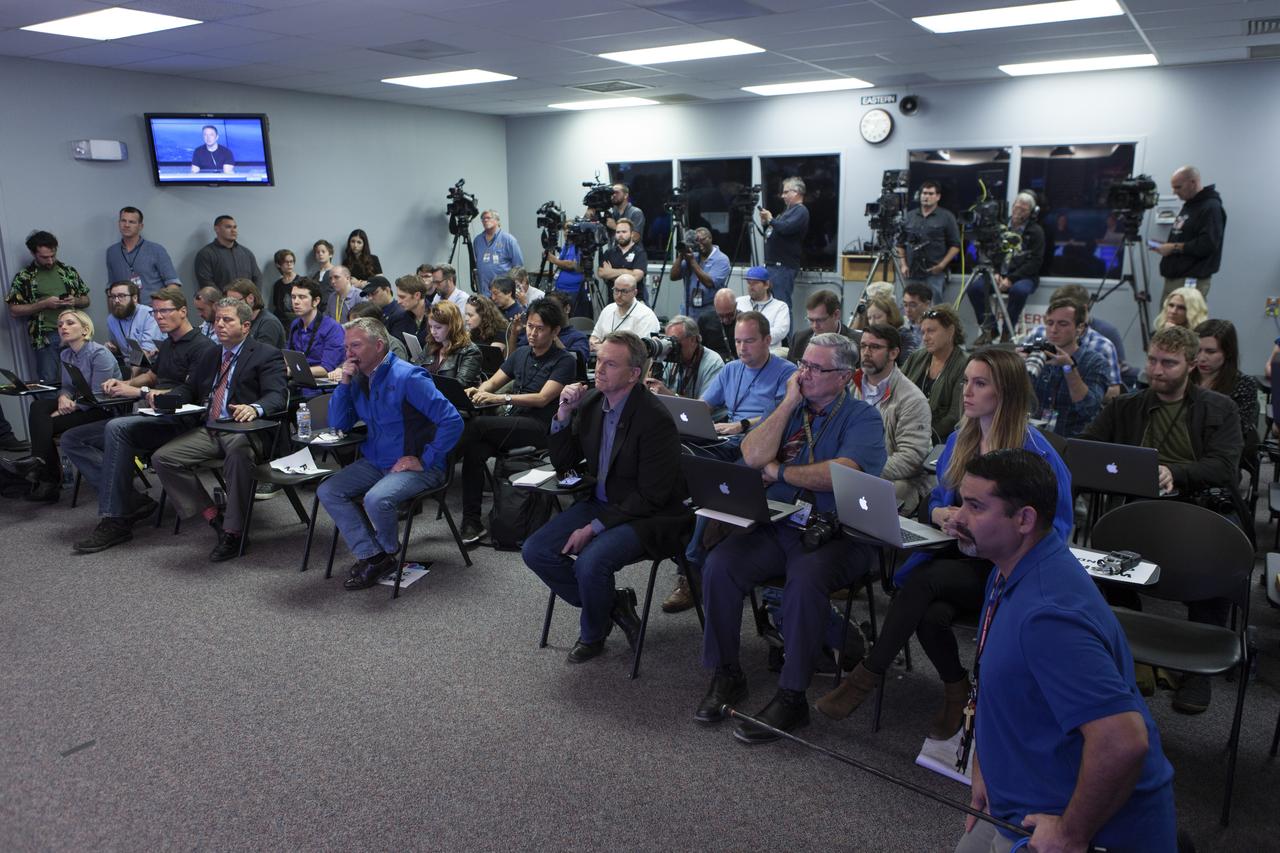
Media gather for a news conference at NASA's Kennedy Space Center in Florida after the successful liftoff of the company’s Falcon Heavy rocket from Launch Complex 39A. The demonstration flight is a significant milestone for the world's premier multi-user spaceport. In 2014, NASA signed a property agreement with SpaceX for the use and operation of the center's pad 39A, where the company has launched Falcon 9 rockets and is preparing for the first Falcon Heavy. NASA also has Space Act Agreements in place with partners, such as SpaceX, to provide services needed to process and launch rockets and spacecraft.

Elon Musk, SpaceX Chief Engineer, speaks with NASA International Space Station Program Manger Kirk Shireman, after the launch of a SpaceX Falcon 9 rocket carrying the company's Crew Dragon spacecraft on the Demo-2 mission with NASA astronauts Douglas Hurley and Robert Behnken onboard, Saturday, May 30, 2020, in firing room four of the Launch Control Center at NASA’s Kennedy Space Center in Florida. NASA’s SpaceX Demo-2 mission is the first launch with astronauts of the SpaceX Crew Dragon spacecraft and Falcon 9 rocket to the International Space Station as part of the agency’s Commercial Crew Program. The test flight serves as an end-to-end demonstration of SpaceX’s crew transportation system. Behnken and Hurley launched at 3:22 p.m. EDT on Saturday, May 30, from Launch Complex 39A at the Kennedy Space Center. A new era of human spaceflight is set to begin as American astronauts once again launch on an American rocket from American soil to low-Earth orbit for the first time since the conclusion of the Space Shuttle Program in 2011. Photo Credit: (NASA/Joel Kowsky)
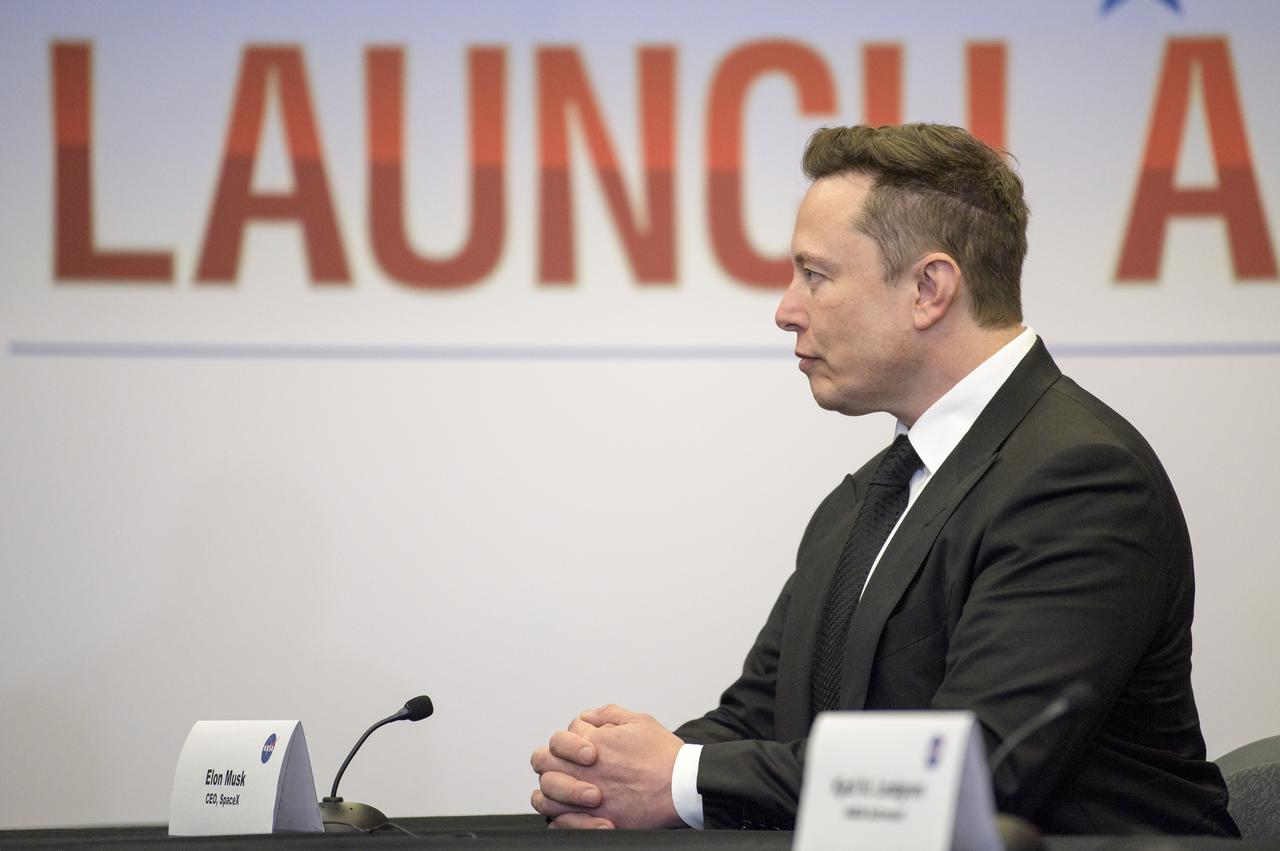
Elon Musk, SpaceX Chief Engineer participates in a SpaceX Demonstration Mission 2 Launch Briefing at the Neil A. Armstrong Operations and Checkout Building following the departure of NASA astronauts Robert Behnken and Douglas Hurley for Launch Complex 39A to board a SpaceX Crew Dragon spacecraft for launch, Wednesday, May 27, 2020, at NASA’s Kennedy Space Center in Florida. NASA’s SpaceX Demo-2 mission is the first launch with astronauts of the SpaceX Crew Dragon spacecraft and Falcon 9 rocket to the International Space Station as part of the agency’s Commercial Crew Program. The test flight serves as an end-to-end demonstration of SpaceX’s crew transportation system. Today’s launch of Behnken and Hurley was scrubbed due to weather and is now scheduled for 3:22 p.m. EDT on Saturday, May 30, from Launch Complex 39A at the Kennedy Space Center. A new era of human spaceflight is set to begin as American astronauts once again launch on an American rocket from American soil to low-Earth orbit for the first time since the conclusion of the Space Shuttle Program in 2011. Photo Credit: (NASA/Bill Ingalls)
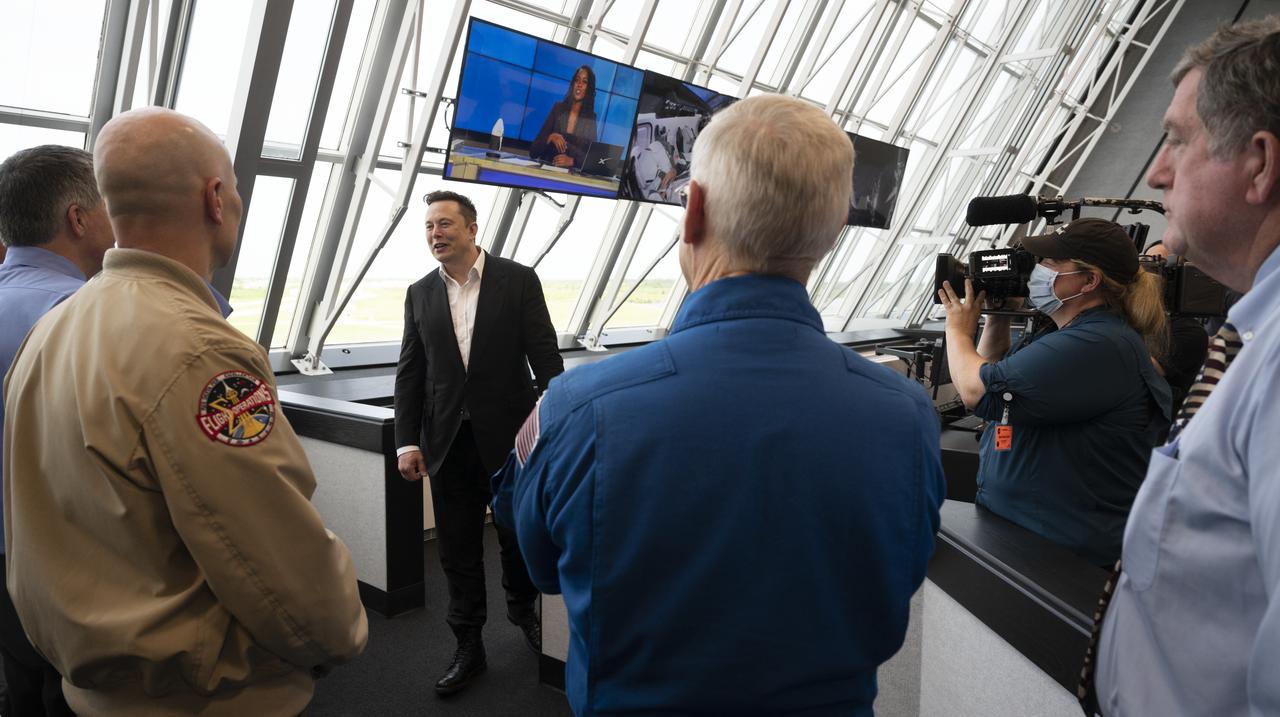
Elon Musk, SpaceX Chief Engineer, speaks with NASA managers following the launch of a SpaceX Falcon 9 rocket carrying the company's Crew Dragon spacecraft on the Demo-2 mission with NASA astronauts Douglas Hurley and Robert Behnken onboard, Saturday, May 30, 2020, in firing room four of the Launch Control Center at NASA’s Kennedy Space Center in Florida. NASA’s SpaceX Demo-2 mission is the first launch with astronauts of the SpaceX Crew Dragon spacecraft and Falcon 9 rocket to the International Space Station as part of the agency’s Commercial Crew Program. The test flight serves as an end-to-end demonstration of SpaceX’s crew transportation system. Behnken and Hurley launched at 3:22 p.m. EDT on Saturday, May 30, from Launch Complex 39A at the Kennedy Space Center. A new era of human spaceflight is set to begin as American astronauts once again launch on an American rocket from American soil to low-Earth orbit for the first time since the conclusion of the Space Shuttle Program in 2011. Photo Credit: (NASA/Joel Kowsky)
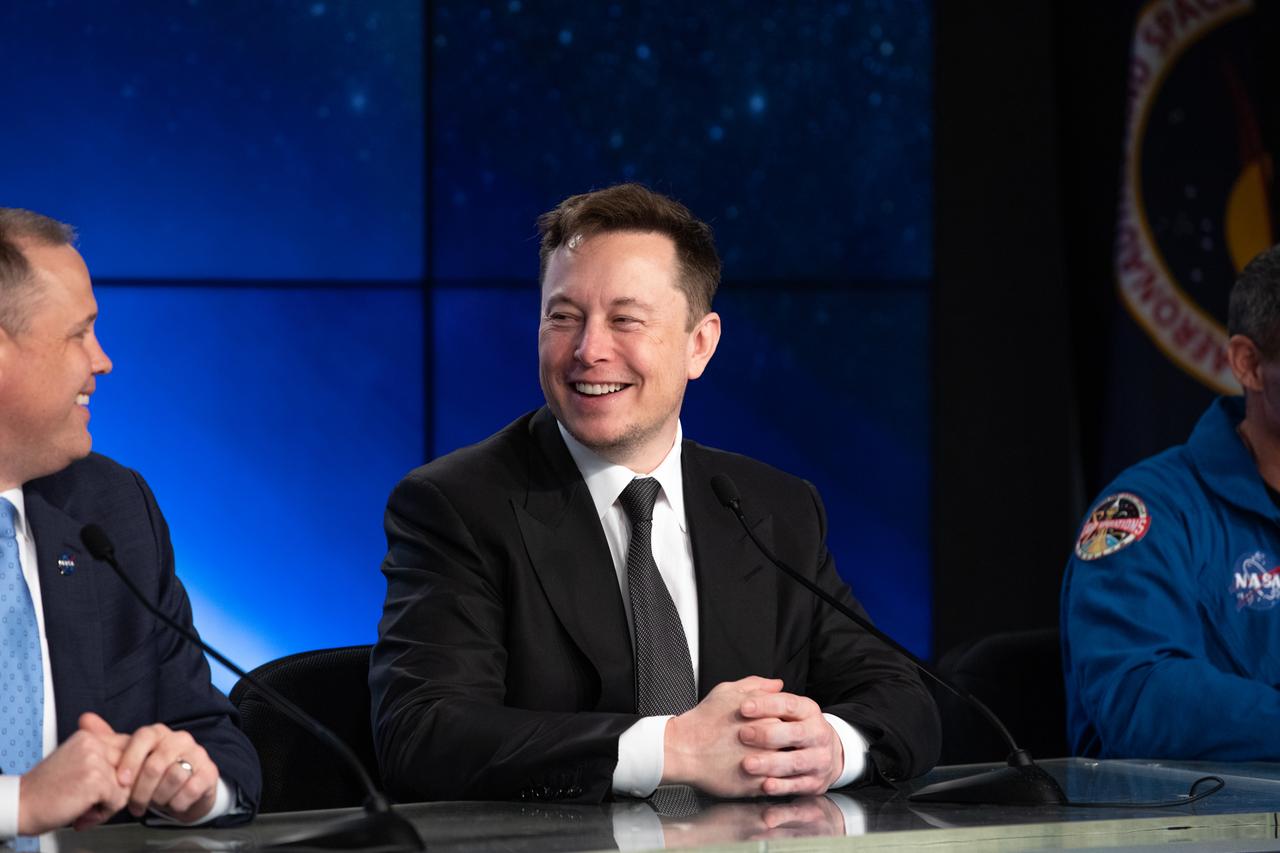
SpaceX Chief Engineer Elon Musk, right, speaks during a briefing at the agency’s Kennedy Space Center in Florida following the company’s uncrewed In-Flight Abort Test on Jan. 19, 2020. Beside Musk is NASA Administrator Jim Bridenstine. During the flight test, a SpaceX Falcon 9 rocket and Crew Dragon spacecraft lifted off from Kennedy’s Launch Complex 39A and began a planned launch-abort sequence demonstrating the spacecraft’s escape capabilities. The Crew Dragon splashed down in the Atlantic Ocean as expected. The In-Flight Abort Test is a critical milestone in preparation for crewed flights to the International Space Station as part of the agency’s Commercial Crew Program.
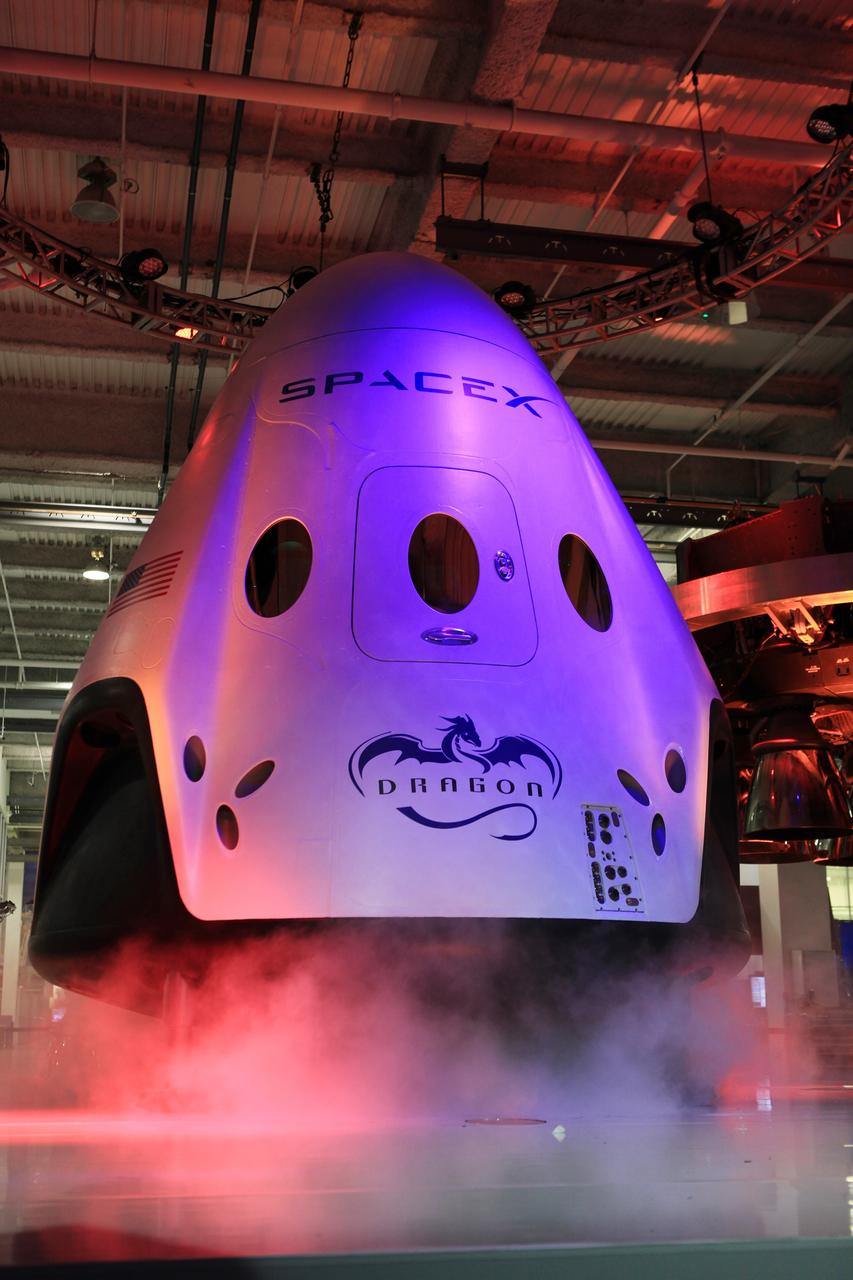
HAWTHORNE, Calif. - The Dragon V2 stands on a stage inside SpaceX headquarters in Hawthorne, Calif., during its unveiling. The spacecraft is designed to carry people into Earth's orbit and was developed in partnership with NASA's Commercial Crew Program under the Commercial Crew Integrated Capability agreement. SpaceX is one of NASA's commercial partners working to develop a new generation of U.S. spacecraft and rockets capable of transporting humans to and from Earth's orbit from American soil. Ultimately, NASA intends to use such commercial systems to fly U.S. astronauts to and from the International Space Station. Photo credit: NASA/Dimitri Gerondidakis
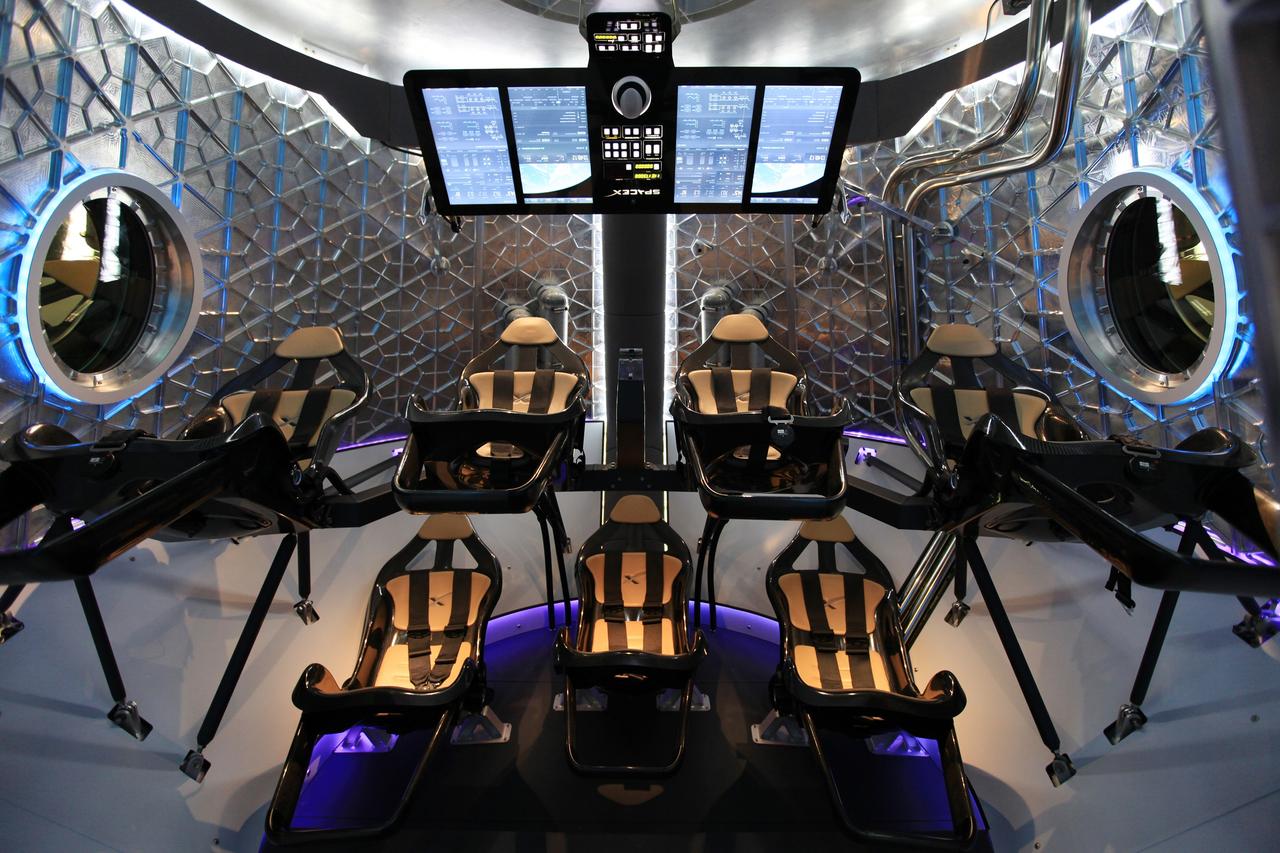
HAWTHORNE, Calif. - A look through the open hatch of the Dragon V2 reveals the layout and interior of the seven-crew capacity spacecraft. SpaceX unveiled the new spacecraft during a ceremony at its headquarters in Hawthorne, Calif. The Dragon V2 is designed to carry people into Earth's orbit and was developed in partnership with NASA's Commercial Crew Program under the Commercial Crew Integrated Capability agreement. SpaceX is one of NASA's commercial partners working to develop a new generation of U.S. spacecraft and rockets capable of transporting humans to and from Earth's orbit from American soil. Ultimately, NASA intends to use such commercial systems to fly U.S. astronauts to and from the International Space Station. Photo credit: NASA/Dimitri Gerondidakis
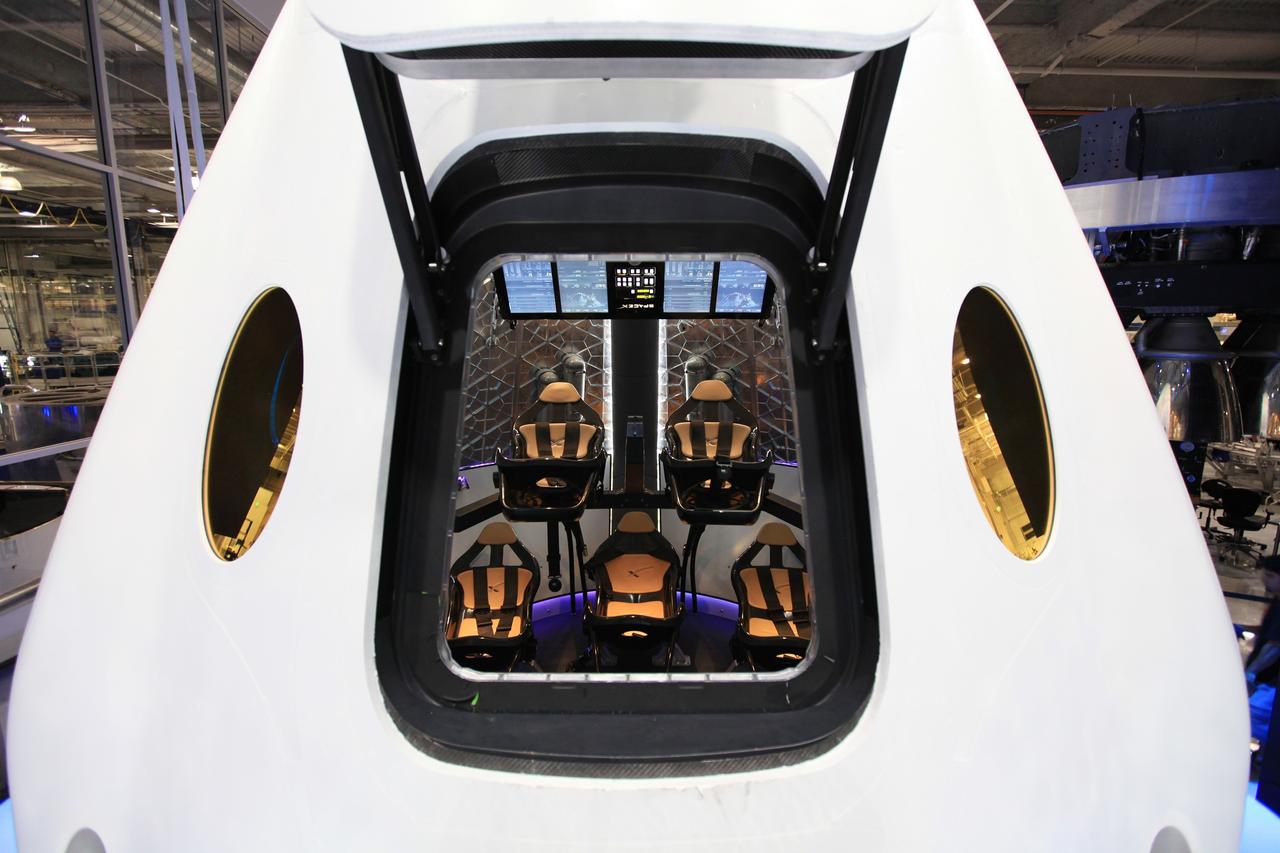
HAWTHORNE, Calif. - A look through the open hatch of the Dragon V2 reveals the layout and interior of the seven-crew capacity spacecraft. SpaceX unveiled the new spacecraft during a ceremony at its headquarters in Hawthorne, Calif. The Dragon V2 is designed to carry people into Earth's orbit and was developed in partnership with NASA's Commercial Crew Program under the Commercial Crew Integrated Capability agreement. SpaceX is one of NASA's commercial partners working to develop a new generation of U.S. spacecraft and rockets capable of transporting humans to and from Earth's orbit from American soil. Ultimately, NASA intends to use such commercial systems to fly U.S. astronauts to and from the International Space Station. Photo credit: NASA/Dimitri Gerondidakis
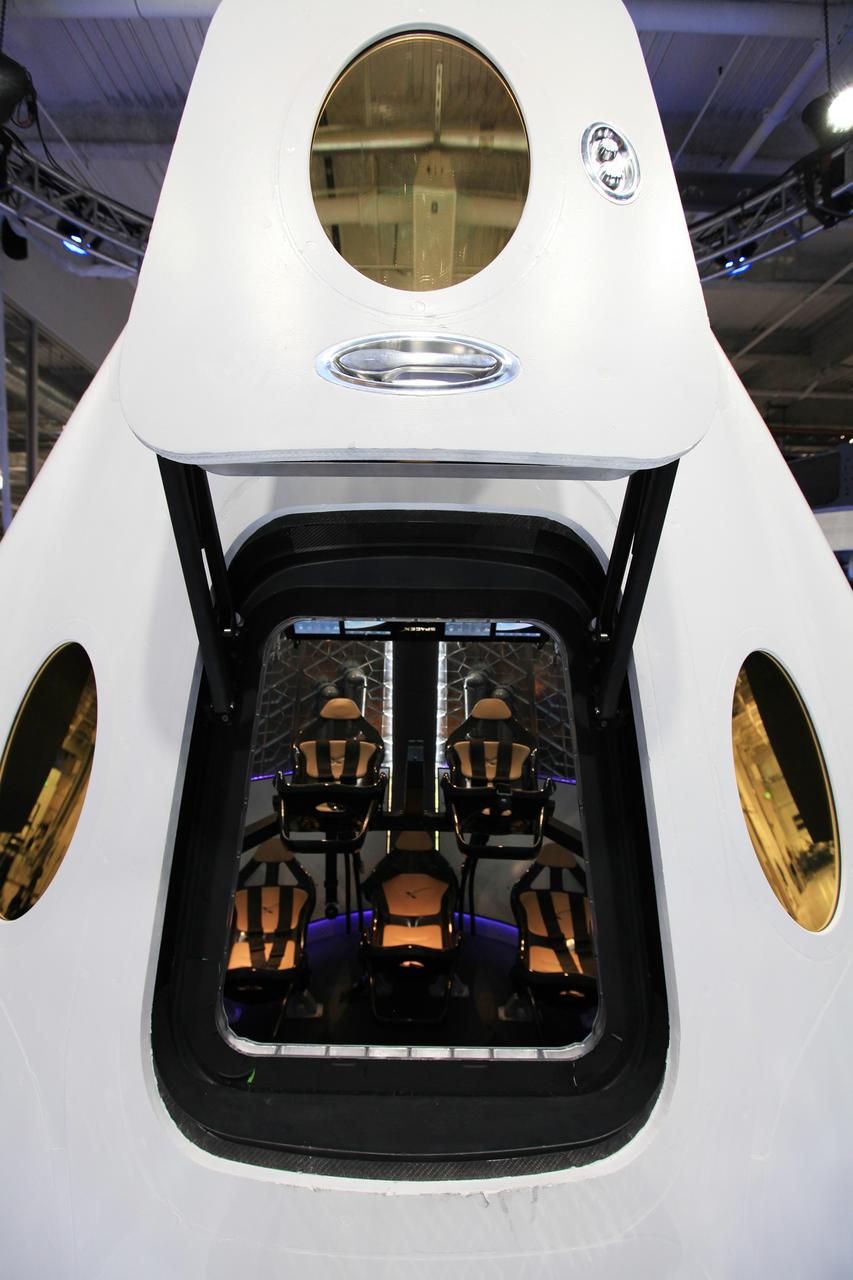
HAWTHORNE, Calif. - A look through the open hatch of the Dragon V2 reveals the layout and interior of the seven-crew capacity spacecraft. SpaceX unveiled the new spacecraft during a ceremony at its headquarters in Hawthorne, Calif. The Dragon V2 is designed to carry people into Earth's orbit and was developed in partnership with NASA's Commercial Crew Program under the Commercial Crew Integrated Capability agreement. SpaceX is one of NASA's commercial partners working to develop a new generation of U.S. spacecraft and rockets capable of transporting humans to and from Earth's orbit from American soil. Ultimately, NASA intends to use such commercial systems to fly U.S. astronauts to and from the International Space Station. Photo credit: NASA/Dimitri Gerondidakis

HAWTHORNE, Calif. - The Dragon V2 stands on a stage inside SpaceX headquarters in Hawthorne, Calif., during its unveiling. The spacecraft is designed to carry people into Earth's orbit and was developed in partnership with NASA's Commercial Crew Program under the Commercial Crew Integrated Capability agreement. SpaceX is one of NASA's commercial partners working to develop a new generation of U.S. spacecraft and rockets capable of transporting humans to and from Earth's orbit from American soil. Ultimately, NASA intends to use such commercial systems to fly U.S. astronauts to and from the International Space Station. Photo credit: NASA/Dimitri Gerondidakis
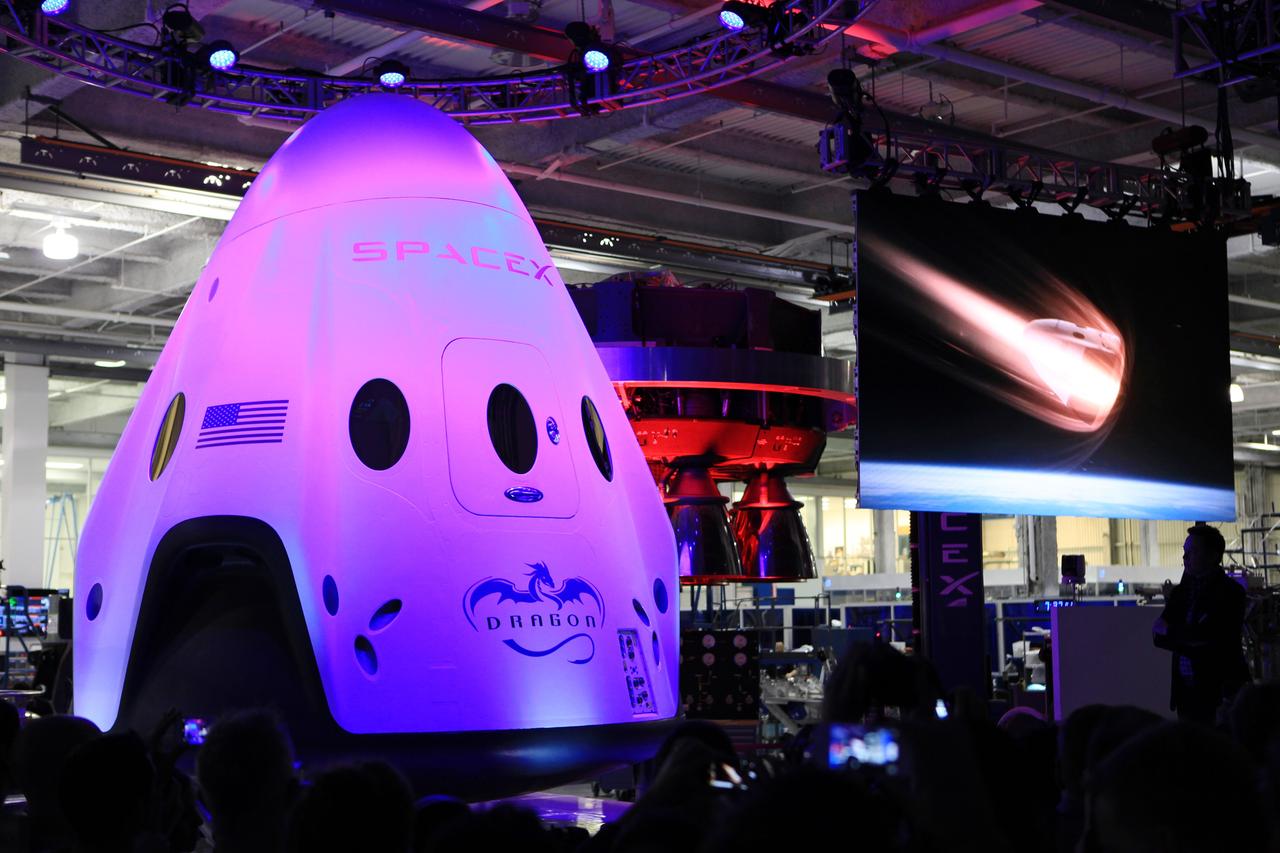
HAWTHORNE, Calif. - Animation showing the Dragon V2 spacecraft re-entering Earth's atmosphere plays beside the space during an unveiling ceremony inside SpaceX headquarters in Hawthorne, Calif. The spacecraft is designed to carry people into Earth's orbit and was developed in partnership with NASA's Commercial Crew Program under the Commercial Crew Integrated Capability agreement. SpaceX is one of NASA's commercial partners working to develop a new generation of U.S. spacecraft and rockets capable of transporting humans to and from Earth's orbit from American soil. Ultimately, NASA intends to use such commercial systems to fly U.S. astronauts to and from the International Space Station. Photo credit: NASA/Dimitri Gerondidakis
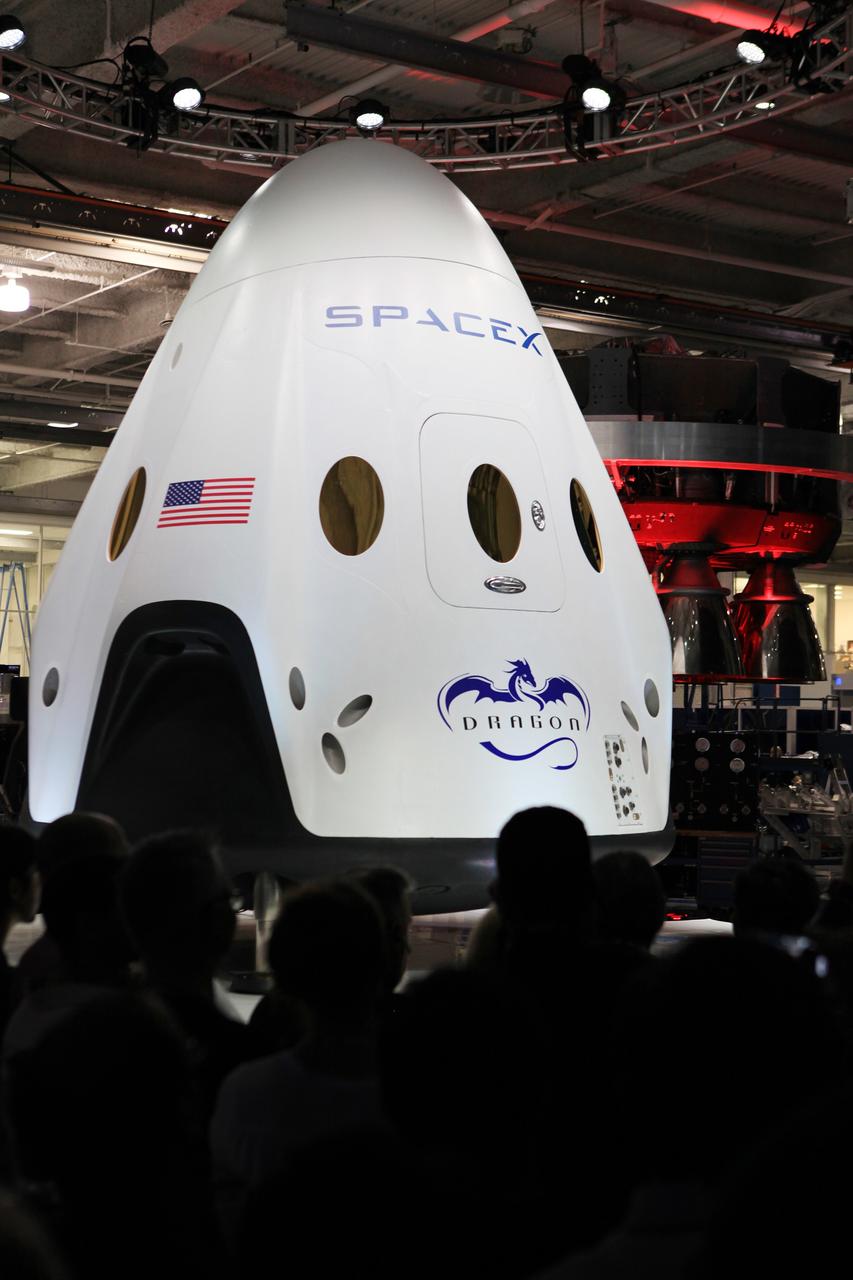
HAWTHORNE, Calif. - HAWTHORNE, Calif. - The Dragon V2 stands on a stage inside SpaceX headquarters in Hawthorne, Calif., during its unveiling ceremony. The spacecraft is designed to carry people into Earth's orbit and was developed in partnership with NASA's Commercial Crew Program under the Commercial Crew Integrated Capability agreement. SpaceX is one of NASA's commercial partners working to develop a new generation of U.S. spacecraft and rockets capable of transporting humans to and from Earth's orbit from American soil. Ultimately, NASA intends to use such commercial systems to fly U.S. astronauts to and from the International Space Station. Photo credit: NASA/Dimitri Gerondidakis
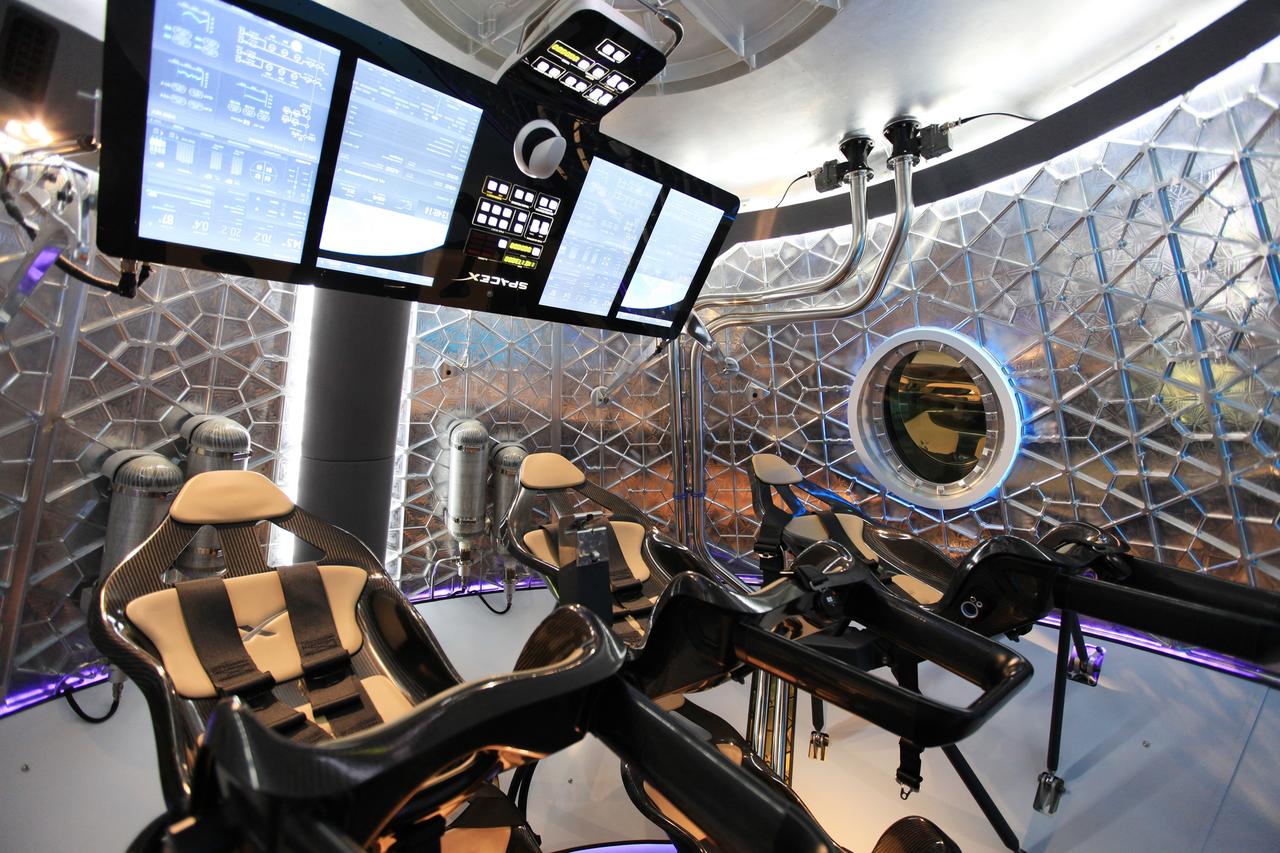
HAWTHORNE, Calif. - The Dragon V2 spacecraft's seating arrangement with the control panel swung up to allow crewmembers to get into their seats. Once the crew is in place, the control panel swings down and locks in launch position. SpaceX unveiled the new spacecraft during a ceremony at its headquarters in Hawthorne, Calif. The Dragon V2 is designed to carry people into Earth's orbit and was developed in partnership with NASA's Commercial Crew Program under the Commercial Crew Integrated Capability agreement. SpaceX is one of NASA's commercial partners working to develop a new generation of U.S. spacecraft and rockets capable of transporting humans to and from Earth's orbit from American soil. Ultimately, NASA intends to use such commercial systems to fly U.S. astronauts to and from the International Space Station. Photo credit: NASA/Dimitri Gerondidakis
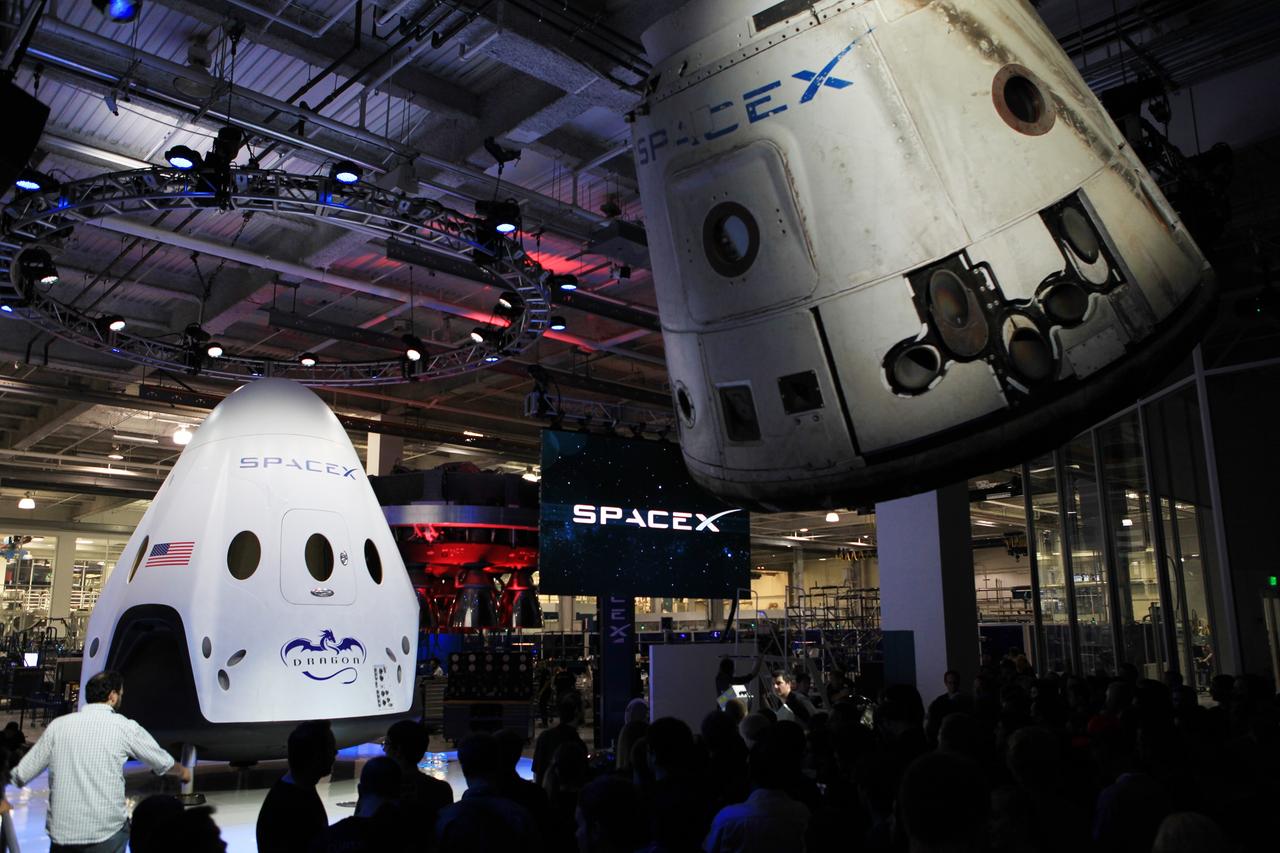
HAWTHORNE, Calif. - The Dragon V2 stands on a stage inside SpaceX headquarters in Hawthorne, Calif., near a suspended cargo-carrying Dragon spacecraft that flew a previous mission. The new spacecraft, the Dragon V2, is designed to carry people into Earth's orbit and was developed in partnership with NASA's Commercial Crew Program under the Commercial Crew Integrated Capability agreement. SpaceX is one of NASA's commercial partners working to develop a new generation of U.S. spacecraft and rockets capable of transporting humans to and from Earth's orbit from American soil. Ultimately, NASA intends to use such commercial systems to fly U.S. astronauts to and from the International Space Station. Photo credit: NASA/Dimitri Gerondidakis

HAWTHORNE, Calif. - The Dragon V2 stands on a stage inside SpaceX headquarters in Hawthorne, Calif., prior to its unveiling. The spacecraft is designed to carry people into Earth's orbit and was developed in partnership with NASA's Commercial Crew Program under the Commercial Crew Integrated Capability agreement. SpaceX is one of NASA's commercial partners working to develop a new generation of U.S. spacecraft and rockets capable of transporting humans to and from Earth's orbit from American soil. Ultimately, NASA intends to use such commercial systems to fly U.S. astronauts to and from the International Space Station. Photo credit: NASA/Dimitri Gerondidakis
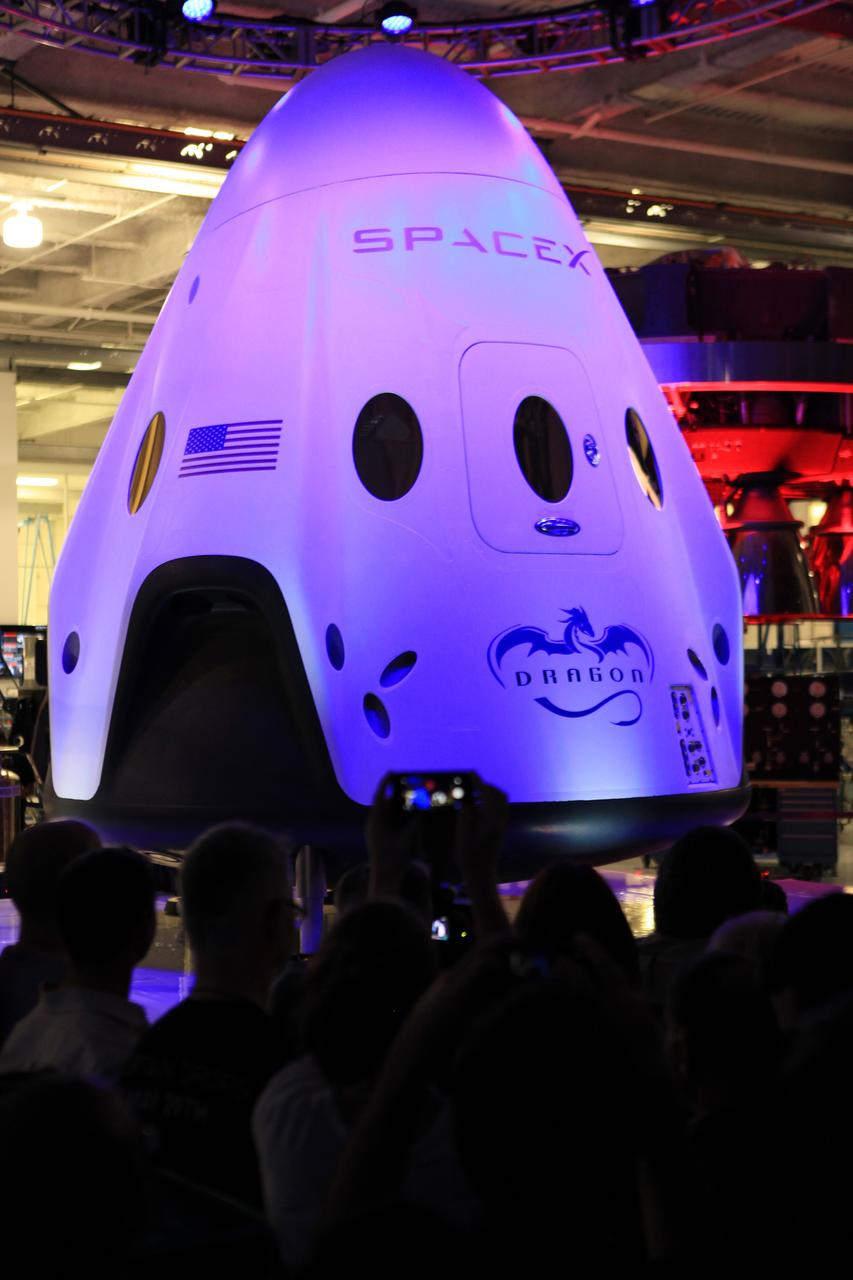
HAWTHORNE, Calif. - The Dragon V2 stands on a stage inside SpaceX headquarters in Hawthorne, Calif., during its unveiling ceremony. The spacecraft is designed to carry people into Earth's orbit and was developed in partnership with NASA's Commercial Crew Program under the Commercial Crew Integrated Capability agreement. SpaceX is one of NASA's commercial partners working to develop a new generation of U.S. spacecraft and rockets capable of transporting humans to and from Earth's orbit from American soil. Ultimately, NASA intends to use such commercial systems to fly U.S. astronauts to and from the International Space Station. Photo credit: NASA/Dimitri Gerondidakis
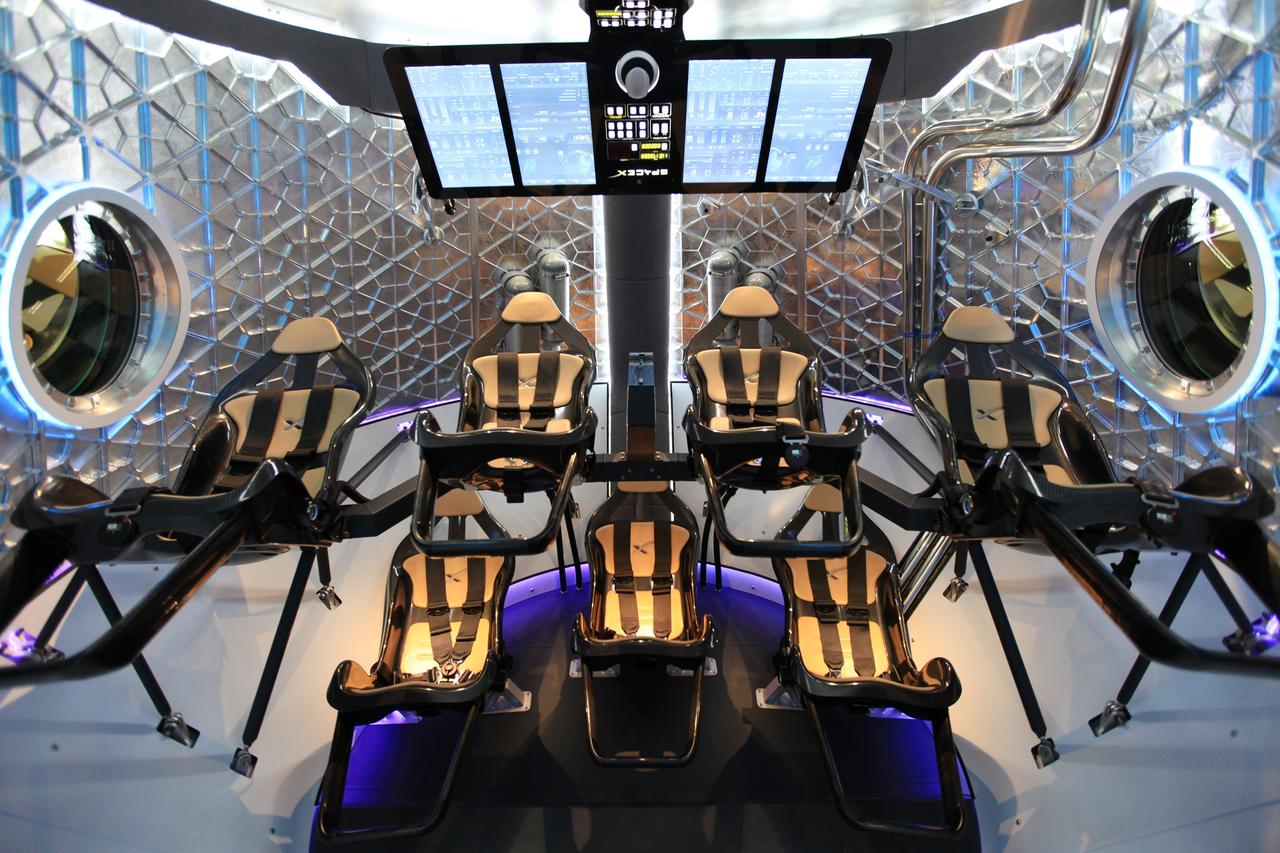
HAWTHORNE, Calif. - A look through the open hatch of the Dragon V2 reveals the layout and interior of the seven-crew capacity spacecraft. SpaceX unveiled the new spacecraft during a ceremony at its headquarters in Hawthorne, Calif. The Dragon V2 is designed to carry people into Earth's orbit and was developed in partnership with NASA's Commercial Crew Program under the Commercial Crew Integrated Capability agreement. SpaceX is one of NASA's commercial partners working to develop a new generation of U.S. spacecraft and rockets capable of transporting humans to and from Earth's orbit from American soil. Ultimately, NASA intends to use such commercial systems to fly U.S. astronauts to and from the International Space Station. Photo credit: NASA/Dimitri Gerondidakis
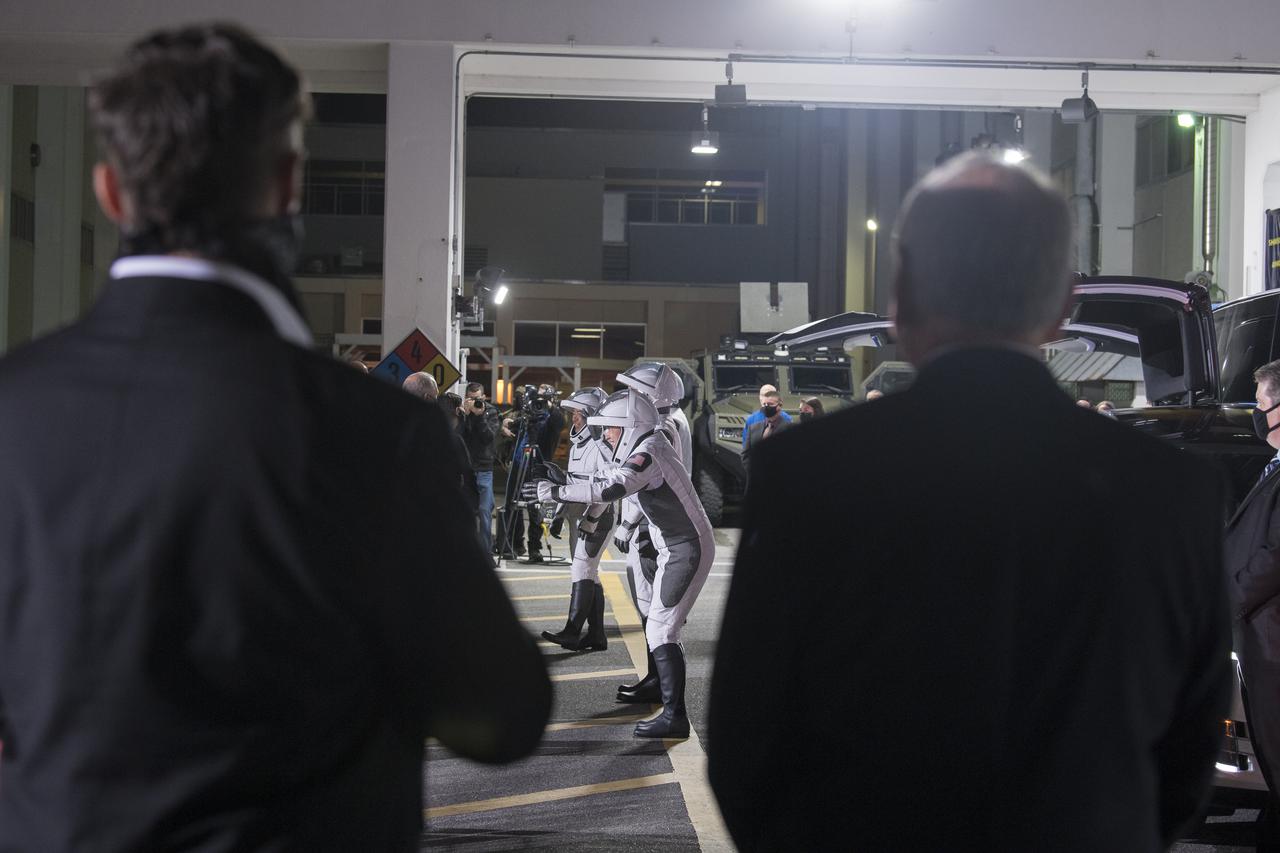
SpaceX Chief Engineer Elon Musk, left, and Acting NASA Administrator Steve Jurczyk, right, watch as ESA (European Space Agency) astronaut Thomas Pesquet, Japan Aerospace Exploration Agency (JAXA) astronaut Akihiko Hoshide, and NASA astronauts Shane Kimbrough and Megan McArthur, prepare to depart the Neil A. Armstrong Operations and Checkout Building for Launch Complex 39A to board the SpaceX Crew Dragon spacecraft for the Crew-2 mission launch, Friday, April 23, 2021, at NASA’s Kennedy Space Center in Florida. NASA’s SpaceX Crew-2 mission is the second crew rotation mission of the SpaceX Crew Dragon spacecraft and Falcon 9 rocket to the International Space Station as part of the agency’s Commercial Crew Program. Kimbrough, McArthur, Pesquet, and Hoshide are scheduled to launch at 5:49 a.m. EDT. Photo Credit: (NASA/Aubrey Gemignani)
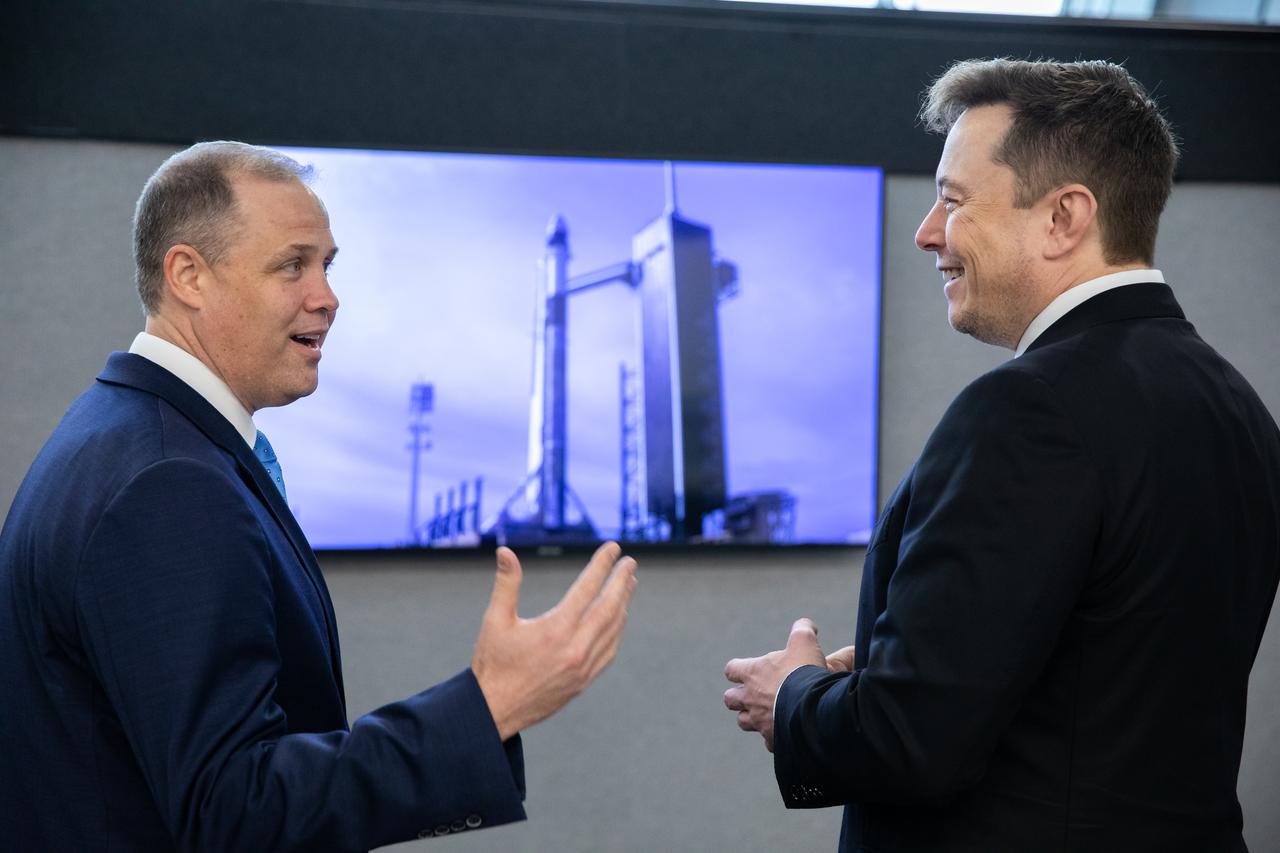
NASA Administrator Jim Bridenstine, left, and SpaceX Chief Engineer Elon Musk converse inside Firing Room 4 in Kennedy Space Center’s Launch Control Center while awaiting the liftoff of a SpaceX Falcon 9 rocket and Crew Dragon spacecraft on the uncrewed In-Flight Abort Test, Jan. 19, 2020. The test demonstrated the spacecraft’s escape capabilities in preparation for crewed flights to the International Space Station as part of the agency’s Commercial Crew Program.
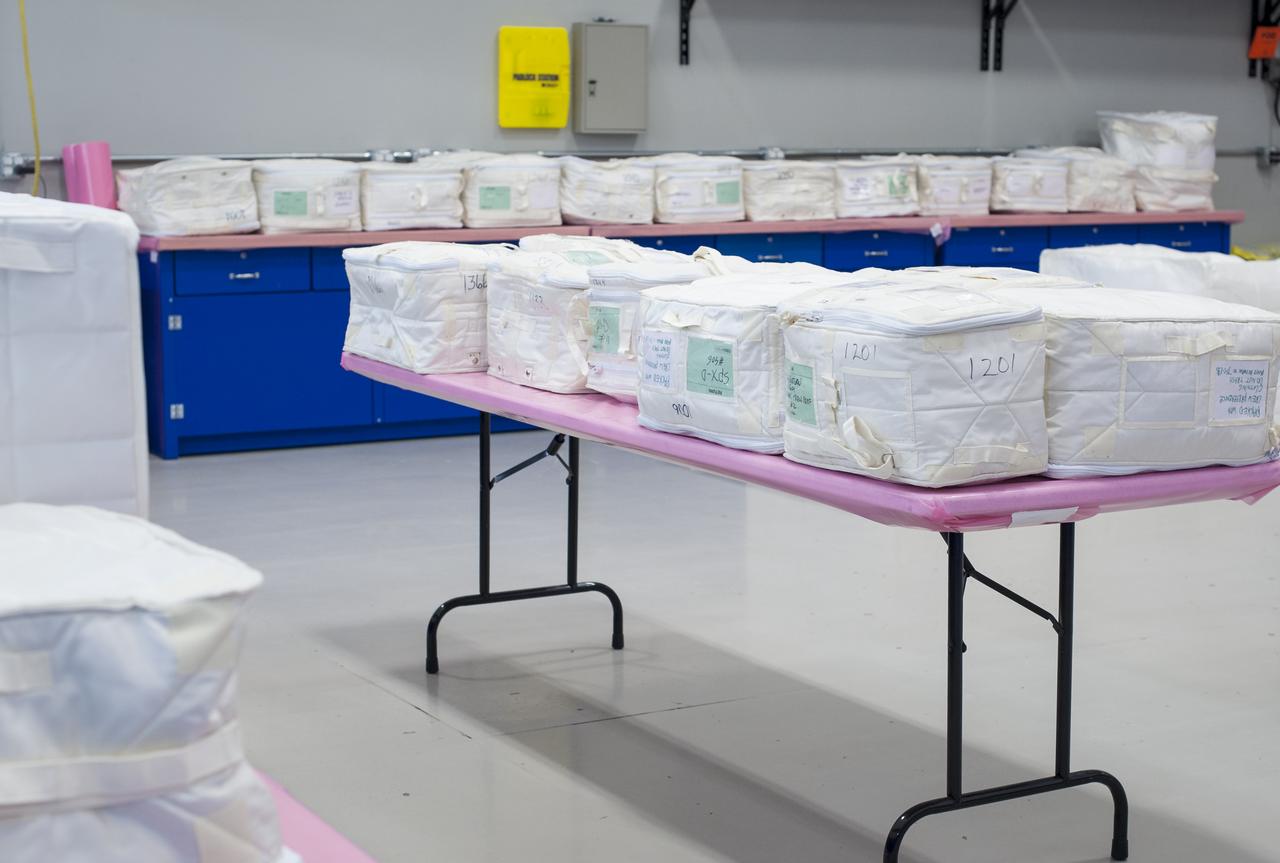
Some of the 1,367 pounds of cargo the SpaceX Dragon spacecraft returned to Earth from the space station are seen in a clean room at the SpaceX rocket development facility, Wednesday, June 13, 2012 in McGregor, Texas. NASA Administrator Charles Bolden and SpaceX CEO and Chief Designer Elon Musk were at the facility to view the historic Dragon capsule and to thank the more than 150 SpaceX employees working at the McGregor facility for their role in the historic mission. Photo Credit: (NASA/Bill Ingalls)
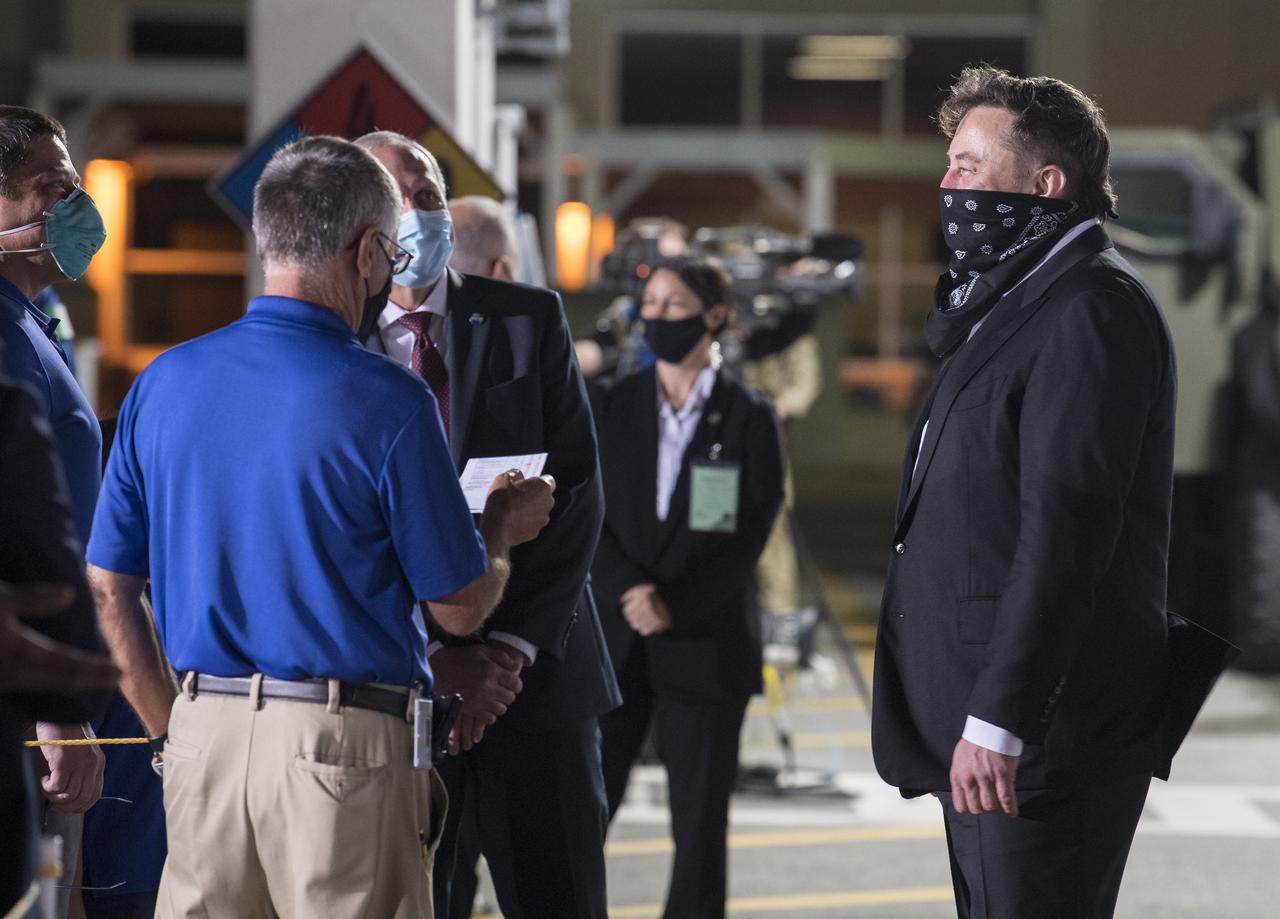
Acting NASA Adminstrator Steve Jurczyk, back center, and SpaceX Chief Engineer Elon Musk, right, speak with NASA astronaut Bob Benkhen before Crew-2 NASA astronauts Shane Kimbrough and Megan McArthur, ESA (European Space Agency) astronaut Thomas Pesquet, and Japan Aerospace Exploration Agency (JAXA) astronaut Akihiko Hoshide, depart the Neil A. Armstrong Operations and Checkout Building for Launch Complex 39A to board the SpaceX Crew Dragon spacecraft for the Crew-2 mission launch, Friday, April 23, 2021, at NASA’s Kennedy Space Center in Florida. NASA’s SpaceX Crew-2 mission is the second crew rotation mission of the SpaceX Crew Dragon spacecraft and Falcon 9 rocket to the International Space Station as part of the agency’s Commercial Crew Program. Kimbrough, McArthur, Pesquet, and Hoshide are scheduled to launch at 5:49 a.m. EDT on Friday, April 23, from Launch Complex 39A at the Kennedy Space Center. Photo Credit: (NASA/Aubrey Gemignani)
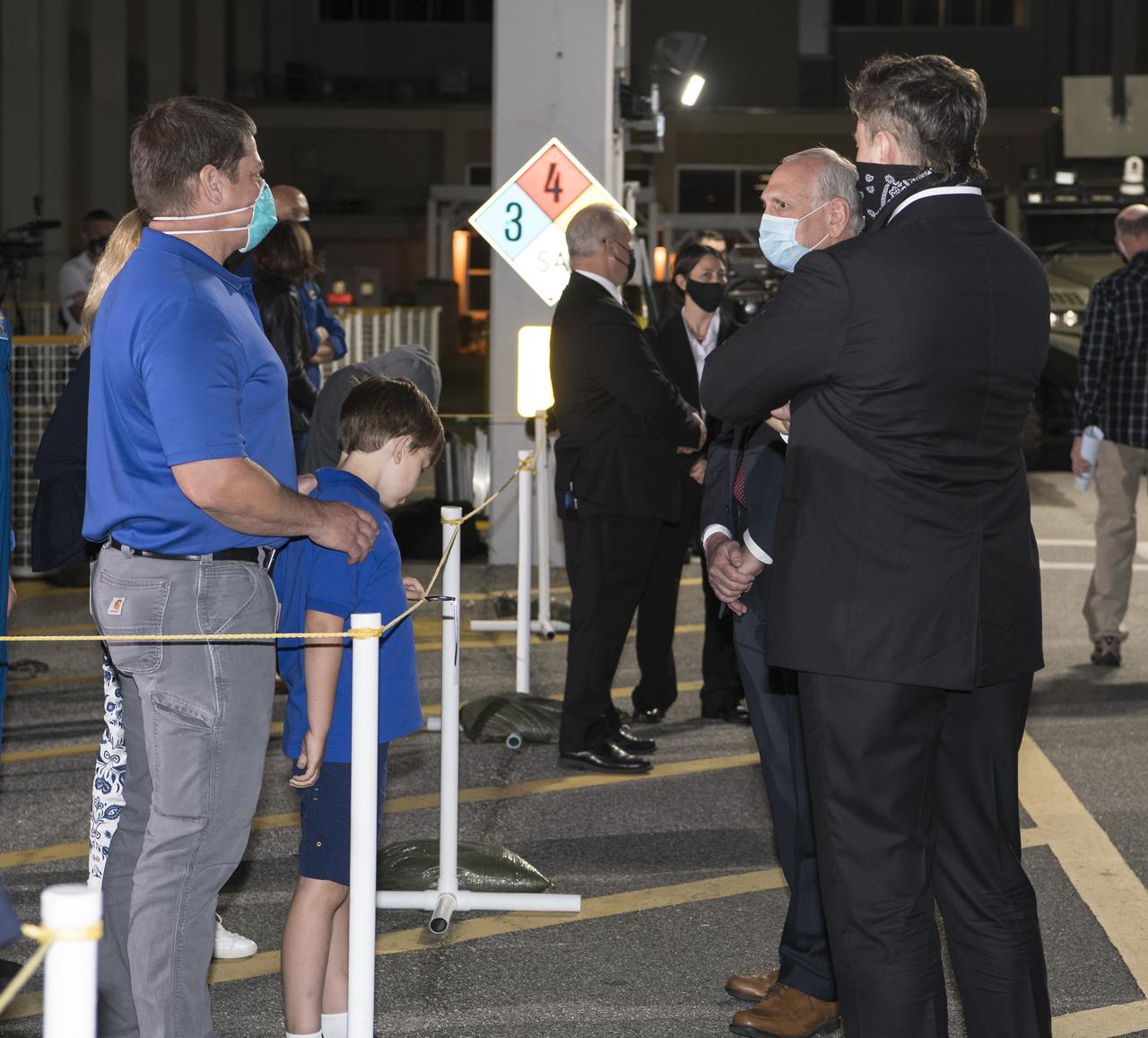
Acting NASA Adminstrator Steve Jurczyk, back right, and SpaceX Chief Engineer Elon Musk speak with NASA astronaut Bob Benkhen before Crew-2 NASA astronauts Shane Kimbrough and Megan McArthur, ESA (European Space Agency) astronaut Thomas Pesquet, and Japan Aerospace Exploration Agency (JAXA) astronaut Akihiko Hoshide, depart the Neil A. Armstrong Operations and Checkout Building for Launch Complex 39A to board the SpaceX Crew Dragon spacecraft for the Crew-2 mission launch, Friday, April 23, 2021, at NASA’s Kennedy Space Center in Florida. NASA’s SpaceX Crew-2 mission is the second crew rotation mission of the SpaceX Crew Dragon spacecraft and Falcon 9 rocket to the International Space Station as part of the agency’s Commercial Crew Program. Kimbrough, McArthur, Pesquet, and Hoshide are scheduled to launch at 5:49 a.m. EDT on Friday, April 23, from Launch Complex 39A at the Kennedy Space Center. Photo Credit: (NASA/Aubrey Gemignani)
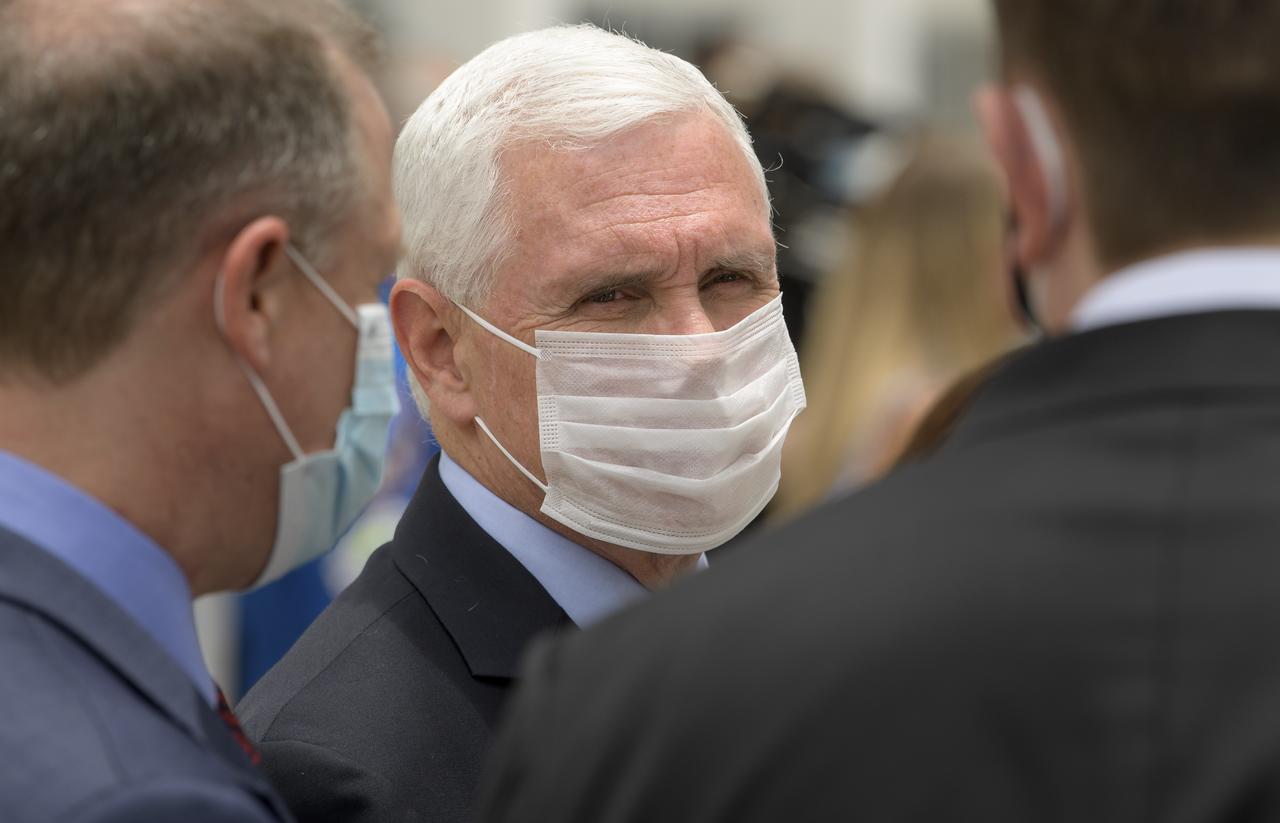
Vice President Mike Pence talks with NASA Administrator Jim Bridenstine, left, and Elon Musk, SpaceX Chief Engineer as they wait to see NASA astronauts Douglas Hurley and Robert Behnken depart the Neil A. Armstrong Operations and Checkout Building for Launch Complex 39A to board the SpaceX Crew Dragon spacecraft for the Demo-2 mission launch, Wednesday, May 27, 2020, at NASA’s Kennedy Space Center in Florida. NASA’s SpaceX Demo-2 mission is the first launch with astronauts of the SpaceX Crew Dragon spacecraft and Falcon 9 rocket to the International Space Station as part of the agency’s Commercial Crew Program. The test flight serves as an end-to-end demonstration of SpaceX’s crew transportation system. Today’s launch of Behnken and Hurley was scrubbed due to weather and is now scheduled for 3:22 p.m. EDT on Saturday, May 30, from Launch Complex 39A at the Kennedy Space Center. A new era of human spaceflight is set to begin as American astronauts once again launch on an American rocket from American soil to low-Earth orbit for the first time since the conclusion of the Space Shuttle Program in 2011. Photo Credit: (NASA/Bill Ingalls)
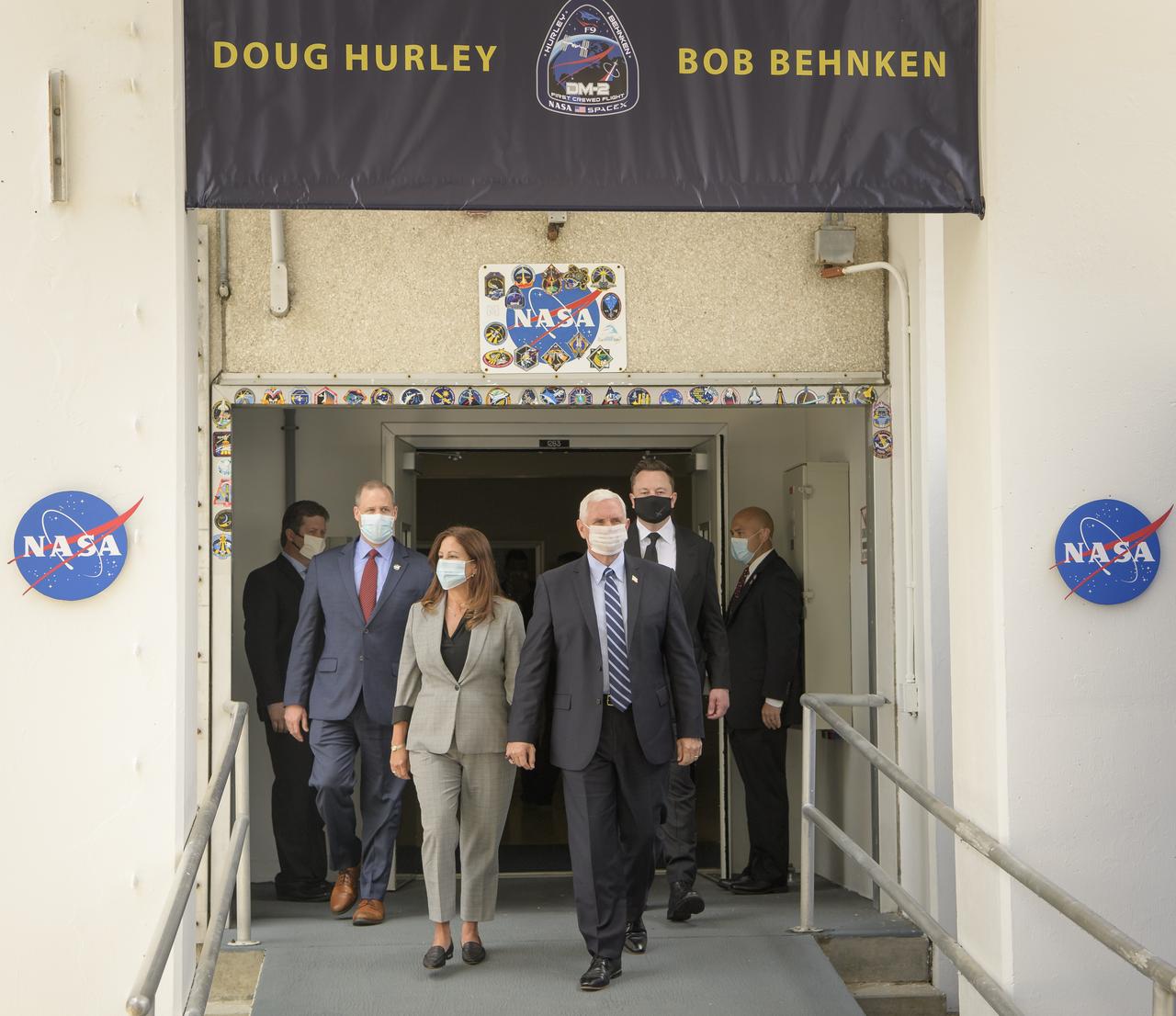
Vice President Mike Pence, and Second Lady Karen Pence, joined by NASA Administrator Jim Bridenstine, left, and Elon Musk, SpaceX Chief Engineer, right, exit the Neil A. Armstrong Operations and Checkout Building ahead of NASA astronauts Douglas Hurley and Robert Behnken departing for Launch Complex 39A to board the SpaceX Crew Dragon spacecraft for the Demo-2 mission launch, Wednesday, May 27, 2020, at NASA’s Kennedy Space Center in Florida. NASA’s SpaceX Demo-2 mission is the first launch with astronauts of the SpaceX Crew Dragon spacecraft and Falcon 9 rocket to the International Space Station as part of the agency’s Commercial Crew Program. The test flight serves as an end-to-end demonstration of SpaceX’s crew transportation system. Behnken and Hurley are scheduled to launch at 4:33 p.m. EDT on Wednesday, May 27, from Launch Complex 39A at the Kennedy Space Center. A new era of human spaceflight is set to begin as American astronauts once again launch on an American rocket from American soil to low-Earth orbit for the first time since the conclusion of the Space Shuttle Program in 2011. Photo Credit: (NASA/Bill Ingalls)
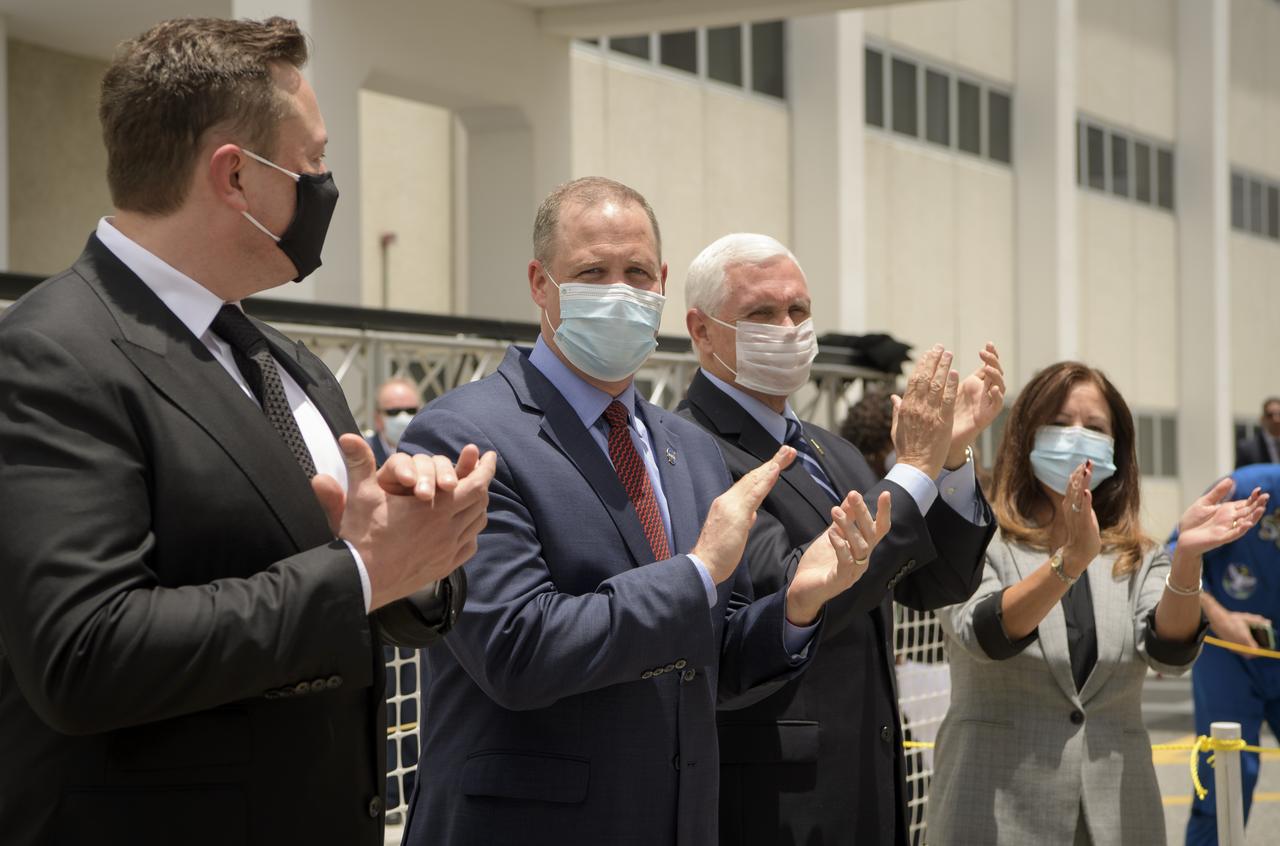
Elon Musk, SpaceX Chief Engineer, left, NASA Administrator Jim Bridenstine, Vice President Mike Pence, and Second Lady Karen Pence, are seen as NASA astronauts Douglas Hurley and Robert Behnken depart the Neil A. Armstrong Operations and Checkout Building for Launch Complex 39A to board the SpaceX Crew Dragon spacecraft for the Demo-2 mission launch, Wednesday, May 27, 2020, at NASA’s Kennedy Space Center in Florida. NASA’s SpaceX Demo-2 mission is the first launch with astronauts of the SpaceX Crew Dragon spacecraft and Falcon 9 rocket to the International Space Station as part of the agency’s Commercial Crew Program. The test flight serves as an end-to-end demonstration of SpaceX’s crew transportation system. Behnken and Hurley are scheduled to launch at 4:33 p.m. EDT on Wednesday, May 27, from Launch Complex 39A at the Kennedy Space Center. A new era of human spaceflight is set to begin as American astronauts once again launch on an American rocket from American soil to low-Earth orbit for the first time since the conclusion of the Space Shuttle Program in 2011. Photo Credit: (NASA/Bill Ingalls)
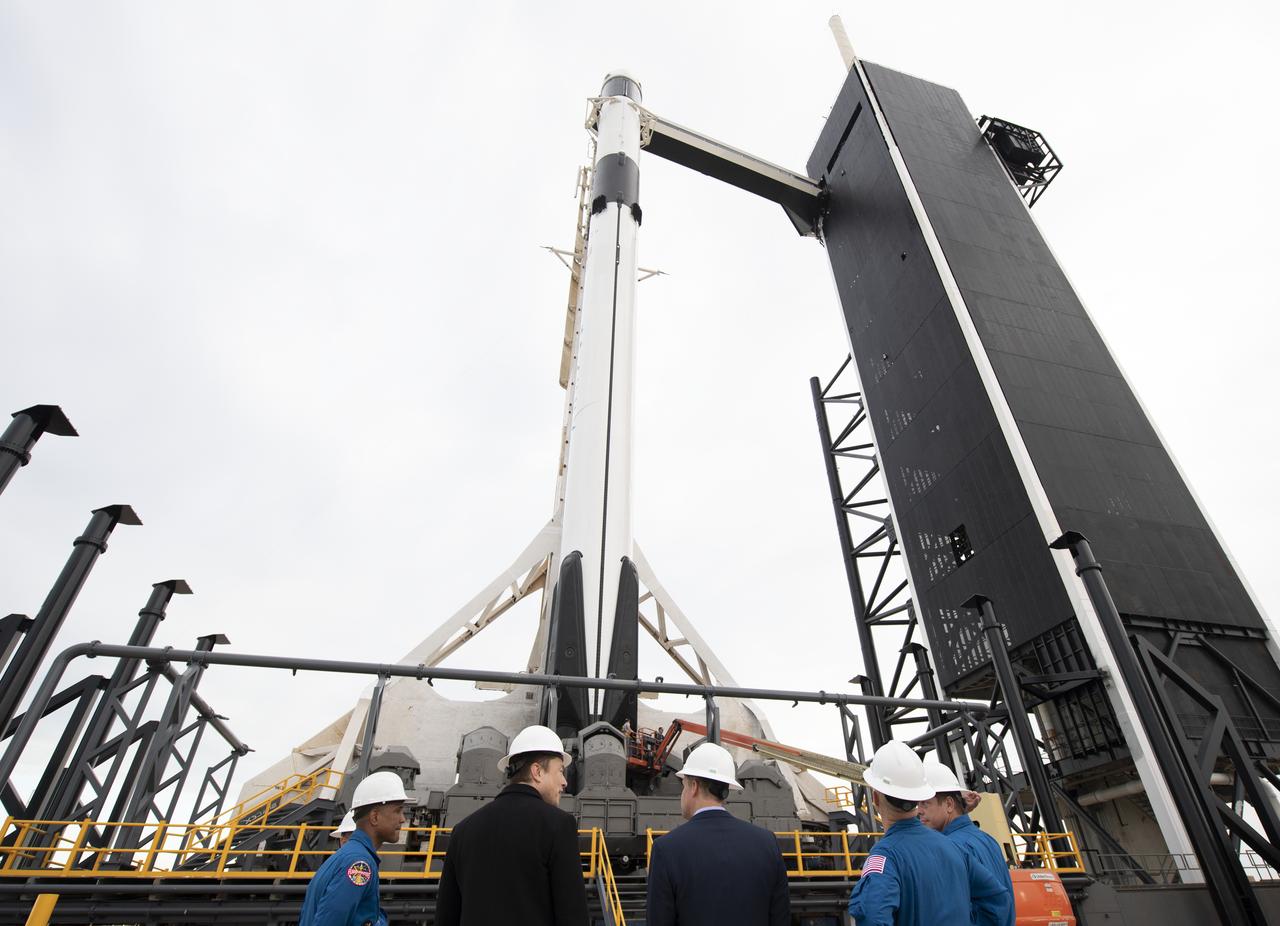
SpaceX CEO and Chief Designer Elon Musk, second from left, NASA Administrator Jim Bridenstine, third form right, and NASA astronauts Mike Hopkins, Victor Glover, Doug Hurley and Bob Behnken are seen with the SpaceX Falcon 9 rocket with the company's Crew Dragon spacecraft onboard during a tour of Launch Complex 39A before the early Saturday morning launch of the Demo-1 mission, Friday, March 1, 2019 at the Kennedy Space Center in Florida. The Demo-1 mission launched at 2:49am ET on Saturday, March 2 and was the first launch of a commercially built and operated American spacecraft and space system designed for humans as part of NASA's Commercial Crew Program. The mission will serve as an end-to-end test of the system's capabilities. Hurley and Behnken are assigned to fly onboard Crew Dragon for the Demo-2 mission and Glover and Hopkins have been assigned to fly to the International Space Station on Crew Dragon's first operational mission. Photo Credit: (NASA/Joel Kowsky)
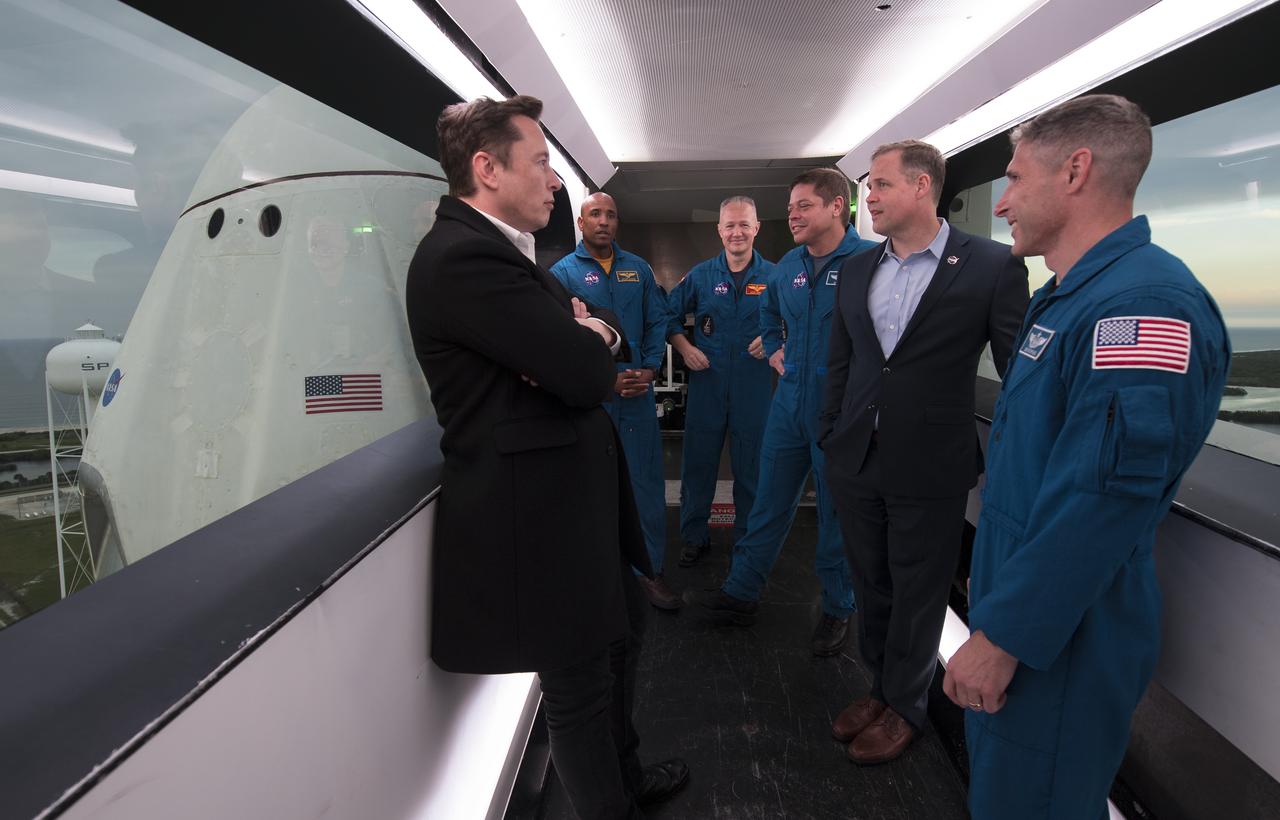
SpaceX CEO and Chief Designer Elon Musk, left, NASA astronauts Victor Glover, Doug Hurley, Bob Behnken, NASA Administrator Jim Bridenstine, and NASA astronaut Mike Hopkins are seen inside the crew access arm with the SpaceX Crew Dragon spacecraft visible behind them during a tour of Launch Complex 39A before the early Saturday morning launch of the Demo-1 mission, Friday, March 1, 2019 at the Kennedy Space Center in Florida. The Demo-1 mission launched at 2:49am ET on Saturday, March 2 and was the first launch of a commercially built and operated American spacecraft and space system designed for humans as part of NASA's Commercial Crew Program. The mission will serve as an end-to-end test of the system's capabilities. Hurley and Behnken are assigned to fly onboard Crew Dragon for the Demo-2 mission and Glover and Hopkins have been assigned to fly to the International Space Station on Crew Dragon's first operational mission. Photo Credit: (NASA/Joel Kowsky)
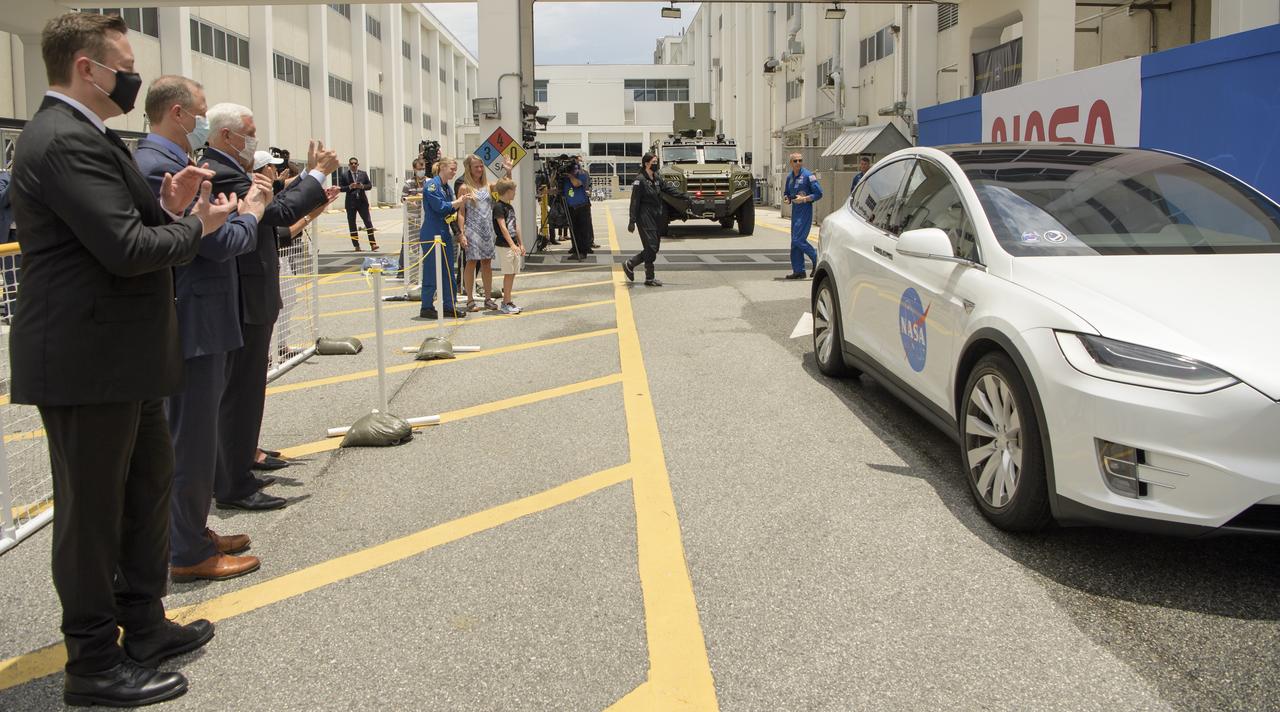
Elon Musk, SpaceX Chief Engineer, left, NASA Administrator Jim Bridenstine, Vice President Mike Pence, and Second Lady Karen Pence, wave farewell as NASA astronauts Douglas Hurley and Robert Behnken depart the Neil A. Armstrong Operations and Checkout Building for Launch Complex 39A to board the SpaceX Crew Dragon spacecraft for the Demo-2 mission launch, Wednesday, May 27, 2020, at NASA’s Kennedy Space Center in Florida. NASA’s SpaceX Demo-2 mission is the first launch with astronauts of the SpaceX Crew Dragon spacecraft and Falcon 9 rocket to the International Space Station as part of the agency’s Commercial Crew Program. The test flight serves as an end-to-end demonstration of SpaceX’s crew transportation system. Today’s launch of Behnken and Hurley was scrubbed due to weather and is now scheduled for 3:22 p.m. EDT on Saturday, May 30, from Launch Complex 39A at the Kennedy Space Center. A new era of human spaceflight is set to begin as American astronauts once again launch on an American rocket from American soil to low-Earth orbit for the first time since the conclusion of the Space Shuttle Program in 2011. Photo Credit: (NASA/Bill Ingalls)
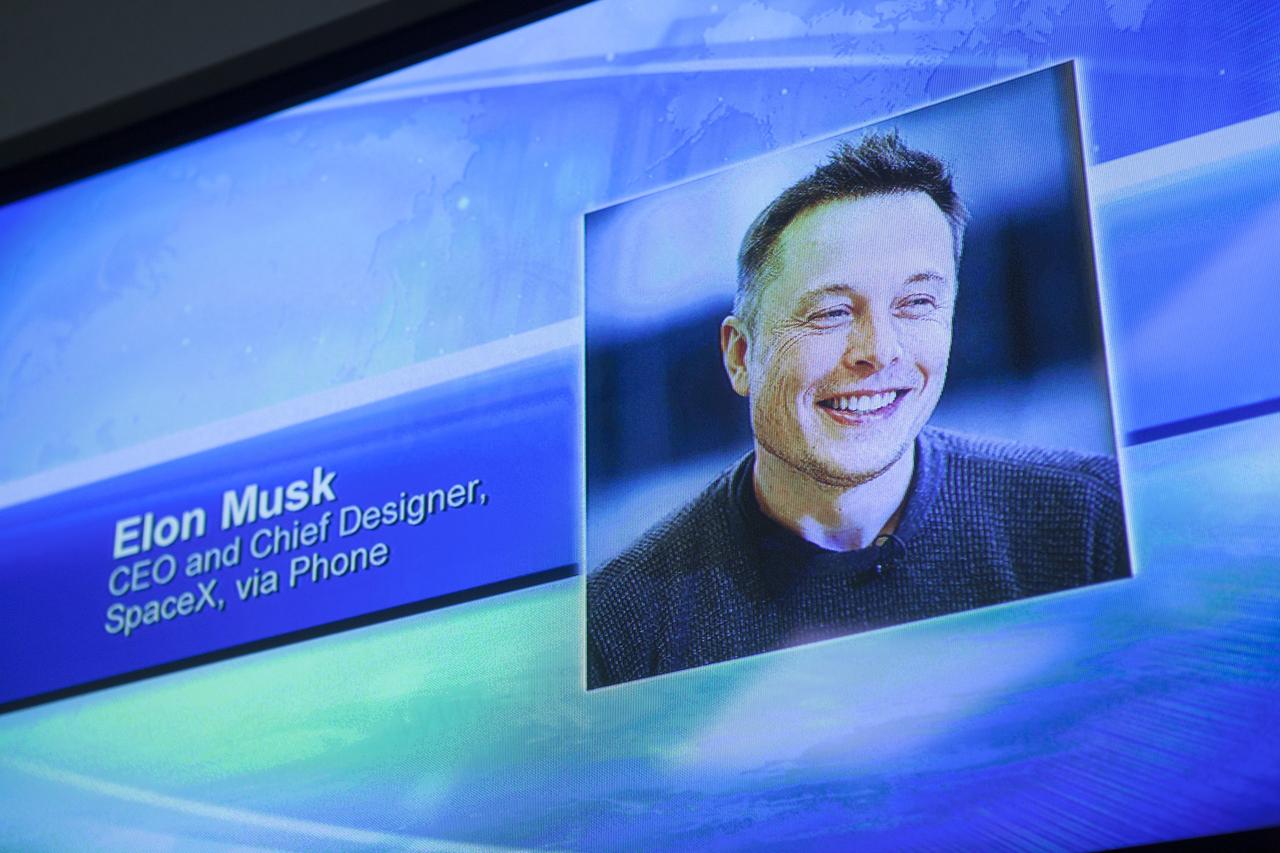
CAPE CANAVERAL, Fla. - An image of SpaceX CEO and chief designer Elon Musk is displayed in the NASA Press Site news auditorium at Kennedy Space Center in Florida during a SpaceX-3 post-launch news conference. Musk participated in the conference by telephone. SpaceX-3 launched at 3:25 p.m. EDT aboard a Falcon 9 rocket carrying a Dragon capsule from Space Launch Complex 40 on Cape Canaveral Air Force Station. Dragon is making its fourth trip to the space station. The SpaceX-3 mission, carrying almost 2.5 tons of supplies, technology and science experiments, is the third of 12 flights through a $1.6 billion NASA Commercial Resupply Services contract. Dragon's cargo will support more than 150 experiments that will be conducted during the station's Expeditions 39 and 40. For more information, visit http://www.nasa.gov/mission_pages/station/structure/launch/index.html. Photo credit: NASA/Kim Shiflett
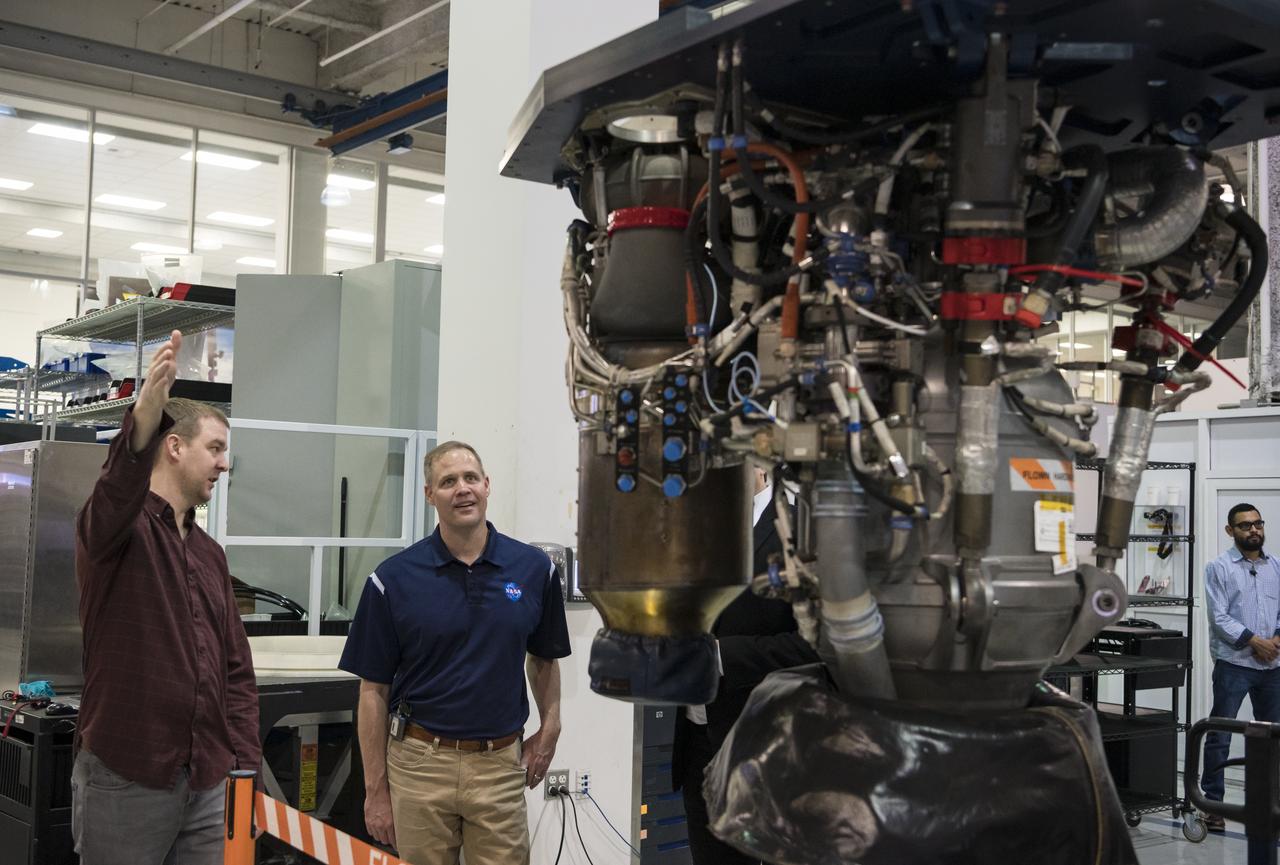
NASA Administrator Jim Bridenstine, right, speaks to SpaceX Vice President of Propulsion Engineering, Will Heltsley, about engine hardware during a tour of the SpaceX Headquarters, Thursday, Oct. 10, 2019 in Hawthorne, CA. Photo credit: (NASA/Aubrey Gemignani)
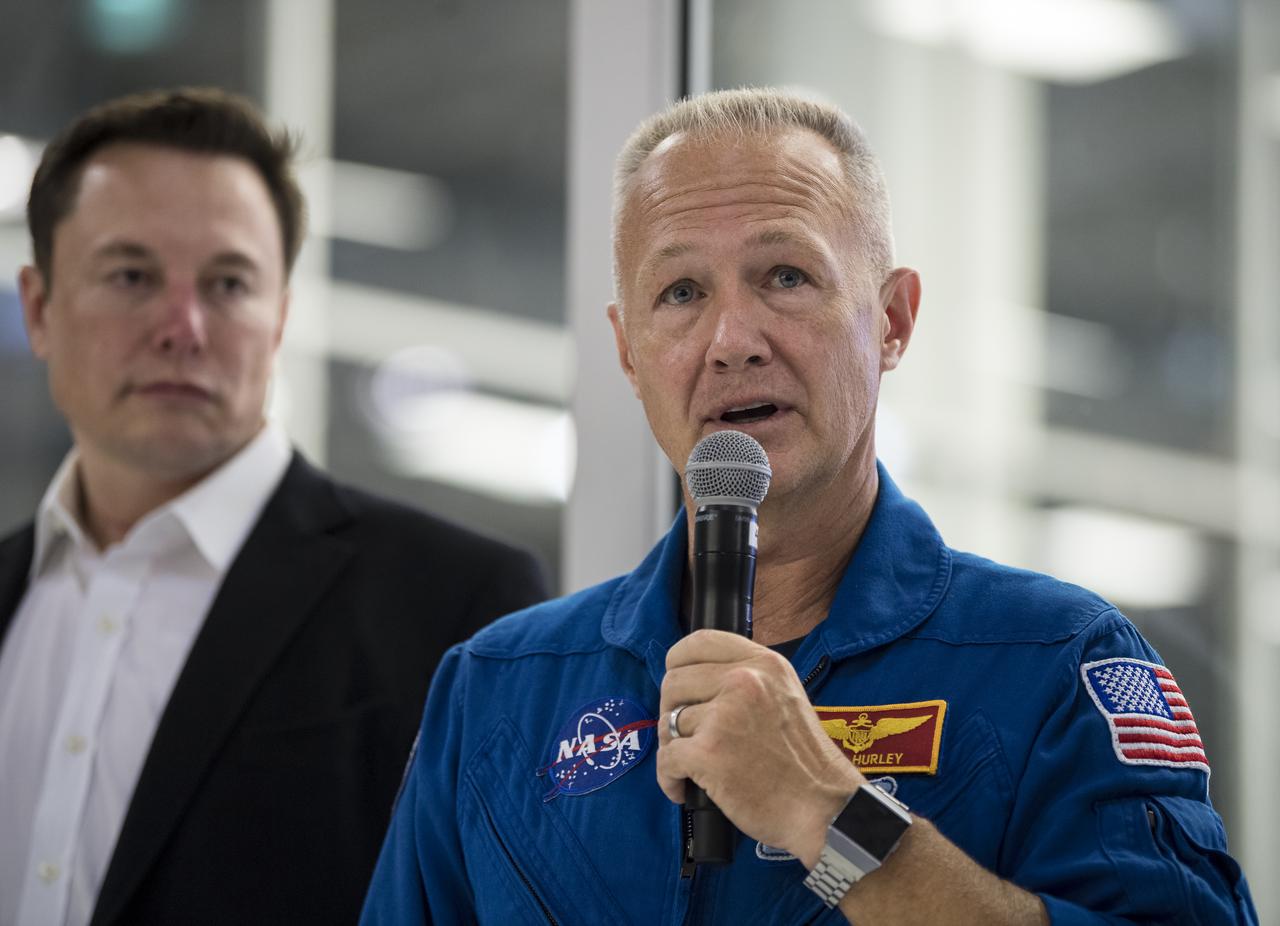
NASA astronaut Doug Hurley answers a question from the media in front of the Crew Dragon that is being prepared for the Demo-2 mission, at SpaceX Headquarters, Thursday, Oct. 10, 2019 in Hawthorne, CA. Hurley and NASA astronaut Bob Behnken are assigned to fly onboard Crew Dragon for the Demo-2 mission. Photo credit: (NASA/Aubrey Gemignani)
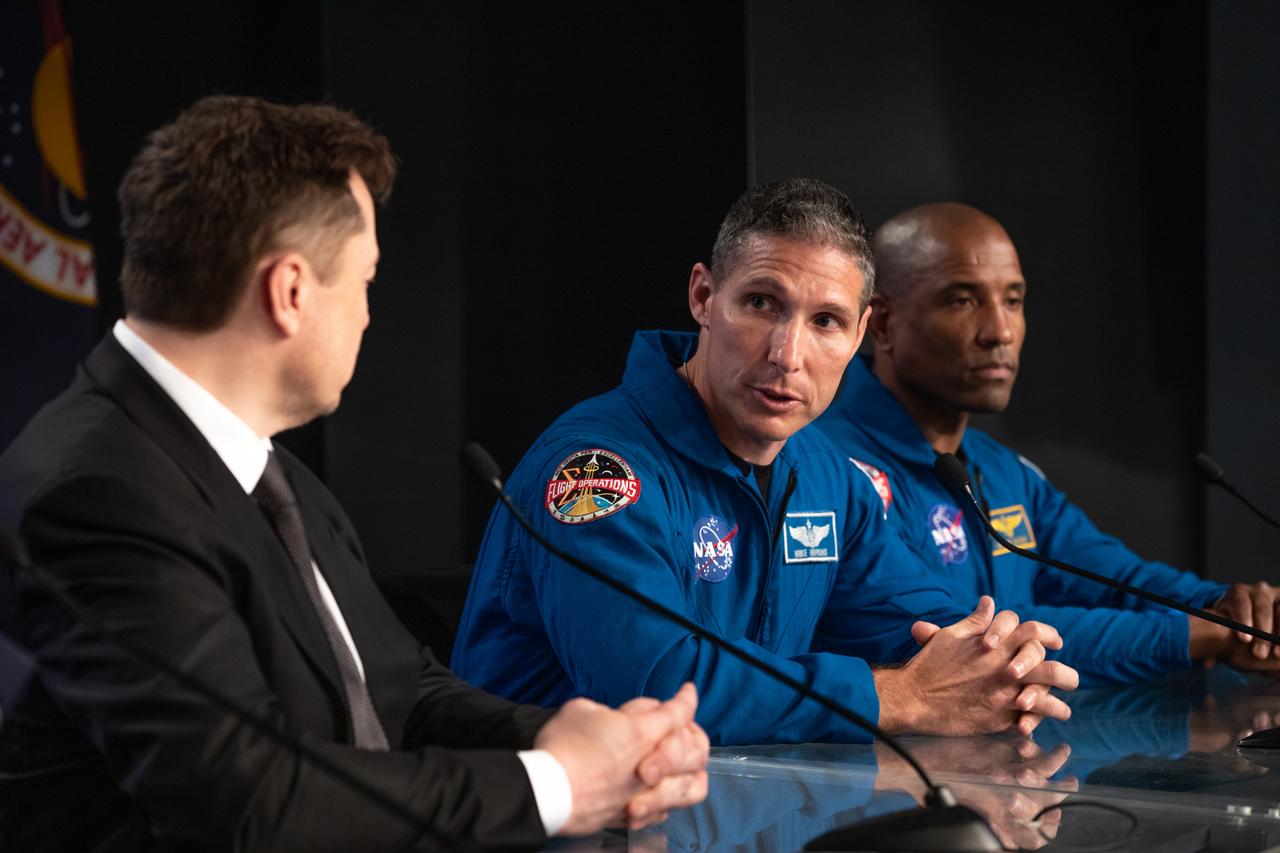
NASA astronaut Mike Hopkins, center, speaks during a briefing at the agency’s Kennedy Space Center in Florida following the uncrewed In-Flight Abort Test on Jan. 19, 2020. From left to right are SpaceX Chief Engineer Elon Musk, Hopkins, and NASA astronaut Victor Glover. During the flight test, a SpaceX Falcon 9 rocket and Crew Dragon spacecraft lifted off from Kennedy’s Launch Complex 39A and began a planned launch-abort sequence demonstrating the spacecraft’s escape capabilities. The Crew Dragon splashed down in the Atlantic Ocean as expected. The In-Flight Abort Test is a critical milestone in preparation for crewed flights to the International Space Station as part of the agency’s Commercial Crew Program.
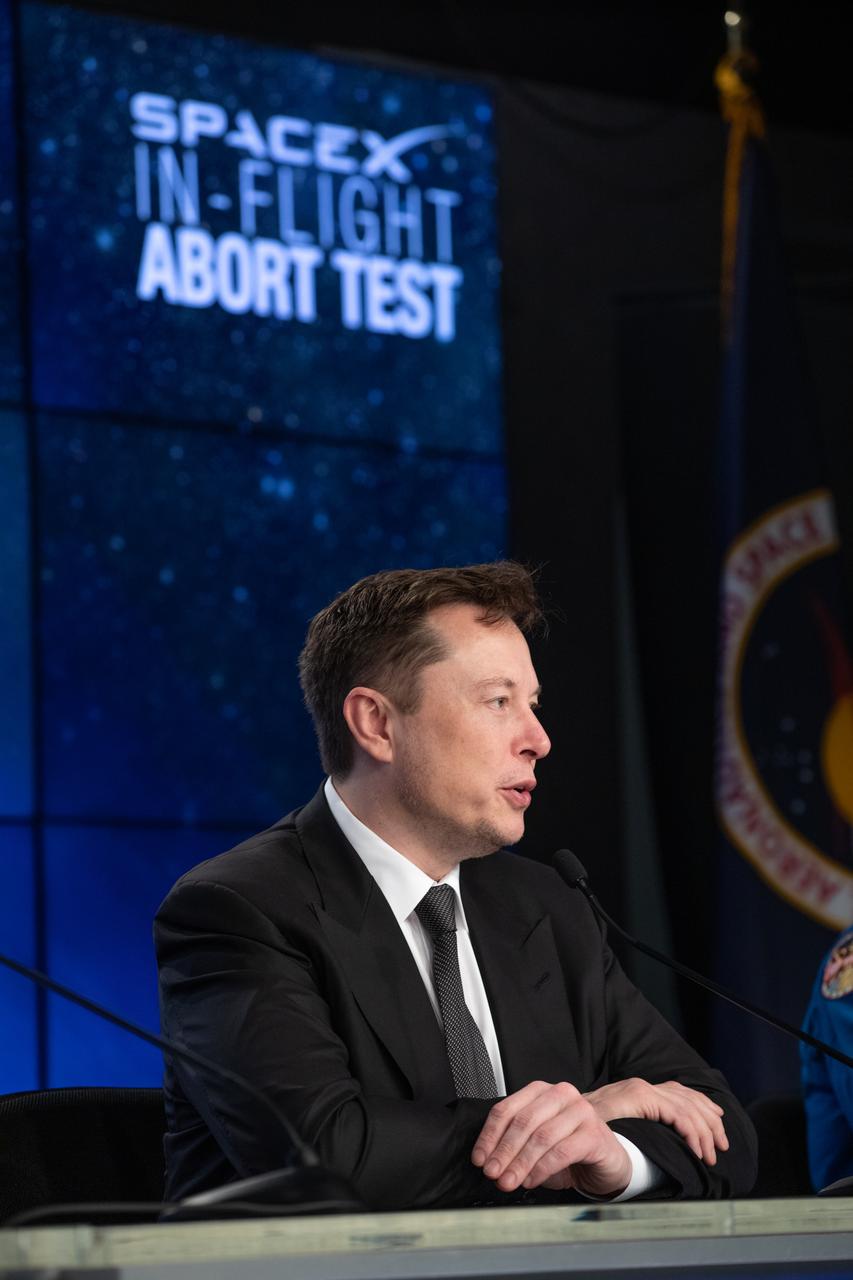
SpaceX Chief Engineer Elon Musk participates in a briefing at the agency’s Kennedy Space Center in Florida following the company’s uncrewed In-Flight Abort Test on Jan. 19, 2020. During the flight test, a SpaceX Falcon 9 rocket and Crew Dragon spacecraft lifted off from Kennedy’s Launch Complex 39A and began a planned launch-abort sequence demonstrating the spacecraft’s escape capabilities. The Crew Dragon splashed down in the Atlantic Ocean as expected. The In-Flight Abort Test is a critical milestone in preparation for crewed flights to the International Space Station as part of the agency’s Commercial Crew Program.
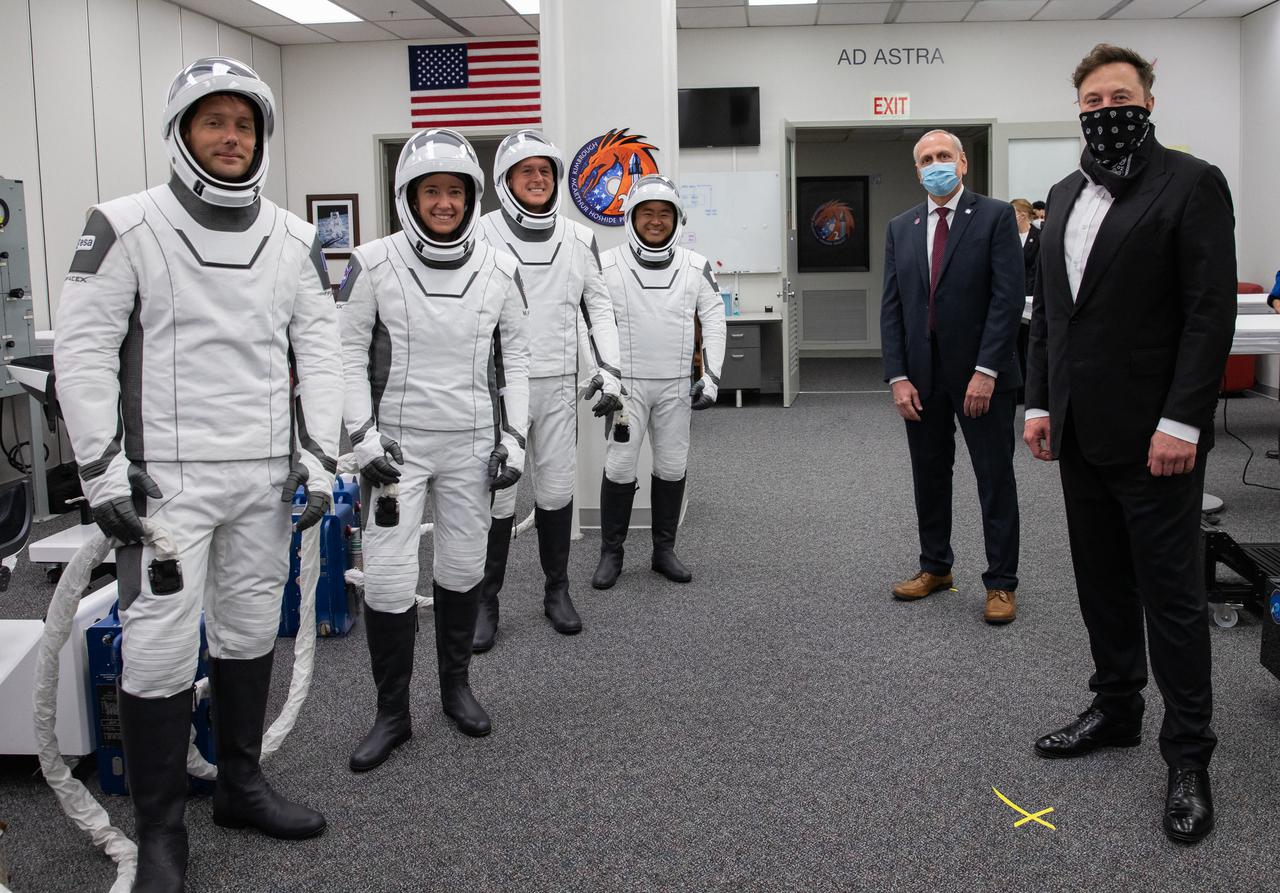
SpaceX CEO and founder Elon Musk and NASA acting administrator Steve Jurczyk visit with from left, ESA astronaut Thomas Pesquet, NASA astronaut Megan McArthur, NASA astronaut Shane Kimbrough and JAXA astronaut Akihiko Hoshide inside the crew suit-up room in the Neil Armstrong Operations and Checkout Building at NASA’s Kennedy Space Center in Florida, on April 23, 2021. The four astronauts will head to the International Space Station on NASA’s SpaceX Crew-2 mission. SpaceX’s Crew Dragon Endeavour will launch on the company’s Falcon 9 rocket from Kennedy’s Launch Complex 39A today at 5:49 a.m. EDT.
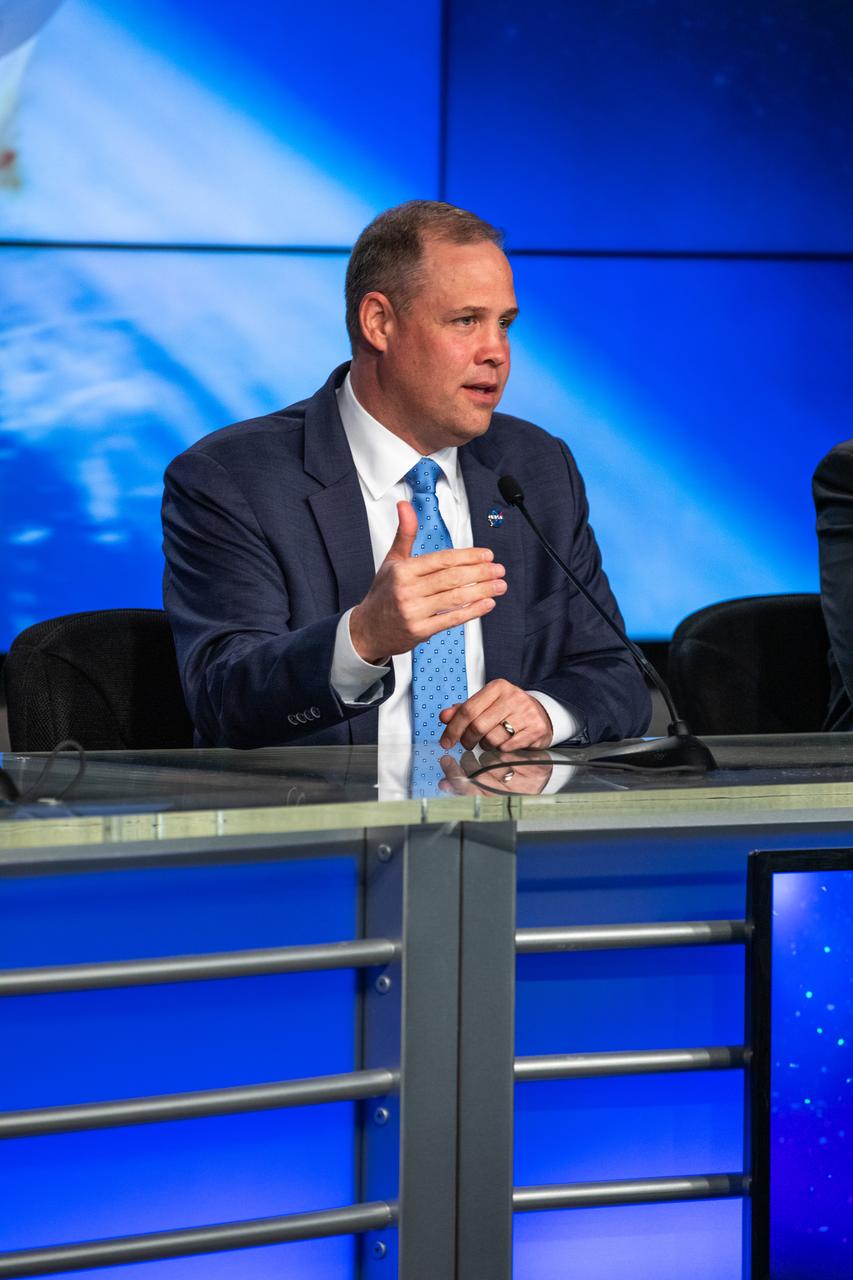
NASA Administrator Jim Bridenstine speaks during a briefing at the agency’s Kennedy Space Center in Florida following the uncrewed In-Flight Abort Test on Jan. 19, 2020. From left to right are Kathy Lueders, program manager, NASA’s Commercial Crew Program; Bridenstine; and Elon Musk, chief engineer, SpaceX. During the flight test, a SpaceX Falcon 9 rocket and Crew Dragon spacecraft lifted off from Kennedy’s Launch Complex 39A and began a planned launch-abort sequence demonstrating the spacecraft’s escape capabilities. The Crew Dragon splashed down in the Atlantic Ocean as expected. The In-Flight Abort Test is a critical milestone in preparation for crewed flights to the International Space Station as part of the agency’s Commercial Crew Program.
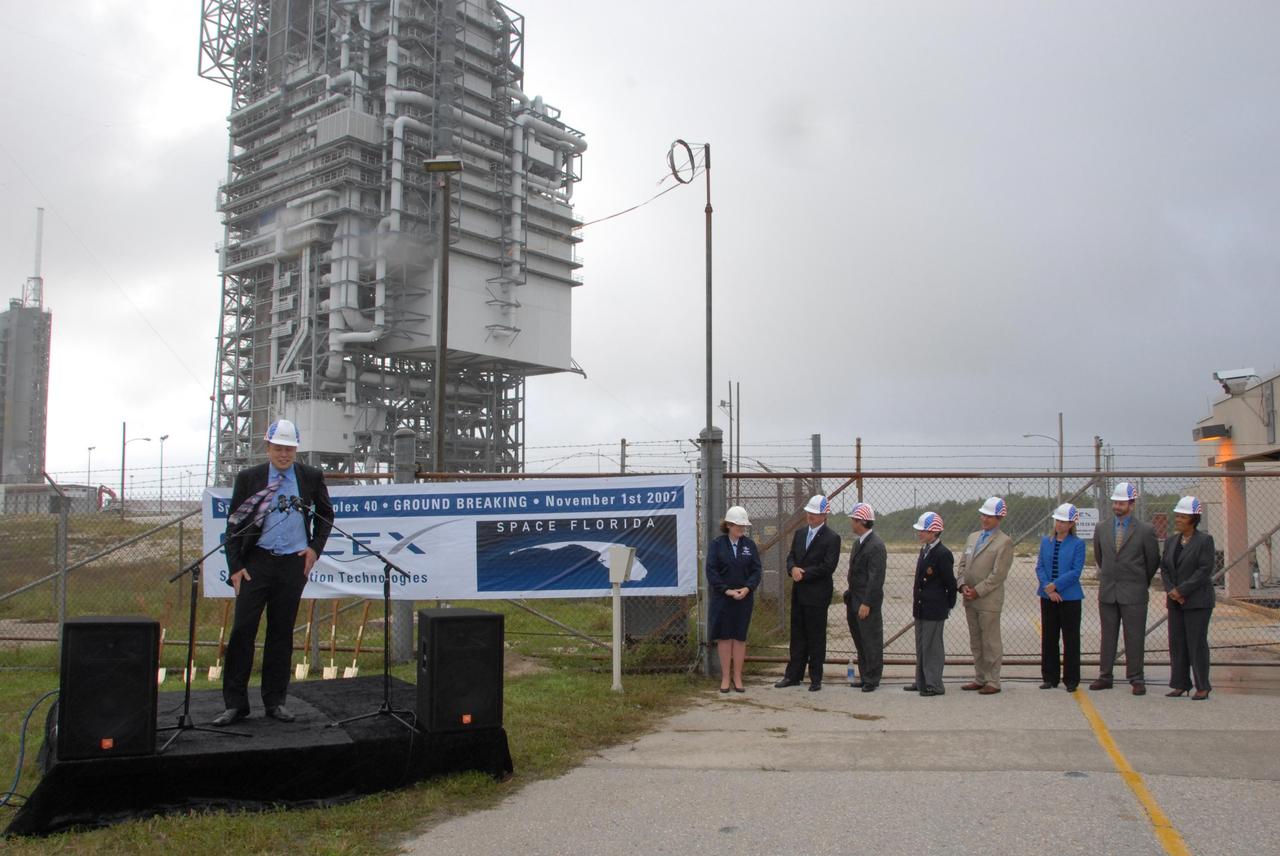
KENNEDY SPACE CENTER, FLA. -- At ground-breaking ceremonies for SpaceX's new Falcon 9 rocket launch facilities at Space Launch Complex 40 at Cape Canaveral, Elon Musk, founder and CEO of Space Exploration Technologies, talks about opportunity for both SpaceX and the 45th Space Wing that the new facility will provide. As part of NASA’s Commercial Orbital Transportation Services, or COTS, competition, SpaceX will launch a Falcon 9 with a cargo-carrying payload on a series of three demonstration missions from Cape Canaveral to the International Space Station, culminating with the delivery of supplies to the $100 billion dollar orbiting laboratory. SpaceX intends to demonstrate its launch, maneuvering, berthing and return abilities by 2009 – a year before NASA has scheduled the conclusion of Space Shuttle operations. Photo credit: NASA/George Shelton
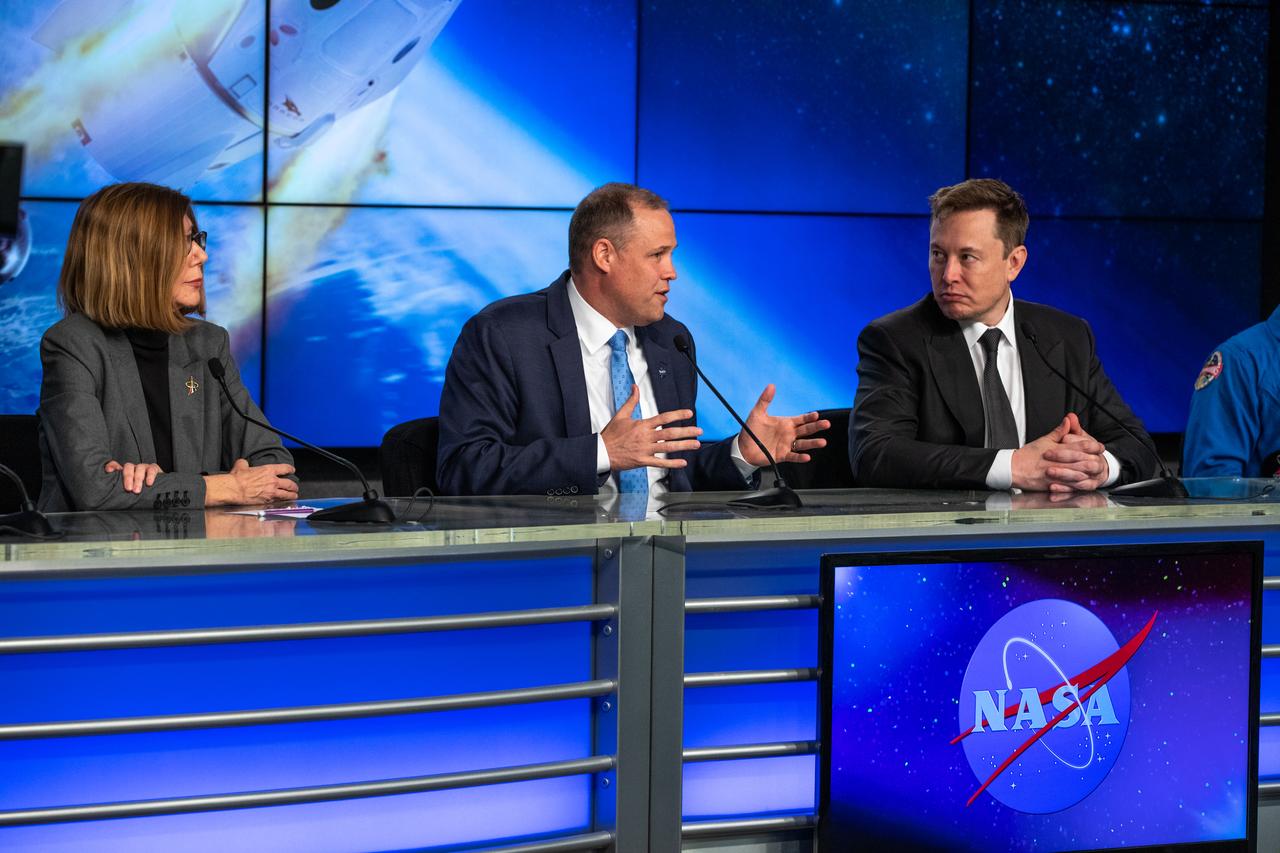
NASA Administrator Jim Bridenstine, center, speaks during a briefing at the agency’s Kennedy Space Center in Florida following the uncrewed In-Flight Abort Test on Jan. 19, 2020. From left to right are Kathy Lueders, program manager, NASA’s Commercial Crew Program; Bridenstine; and Elon Musk, chief engineer, SpaceX. During the flight test, a SpaceX Falcon 9 rocket and Crew Dragon spacecraft lifted off from Kennedy’s Launch Complex 39A and began a planned launch-abort sequence demonstrating the spacecraft’s escape capabilities. The Crew Dragon splashed down in the Atlantic Ocean as expected. The In-Flight Abort Test is a critical milestone in preparation for crewed flights to the International Space Station as part of the agency’s Commercial Crew Program.
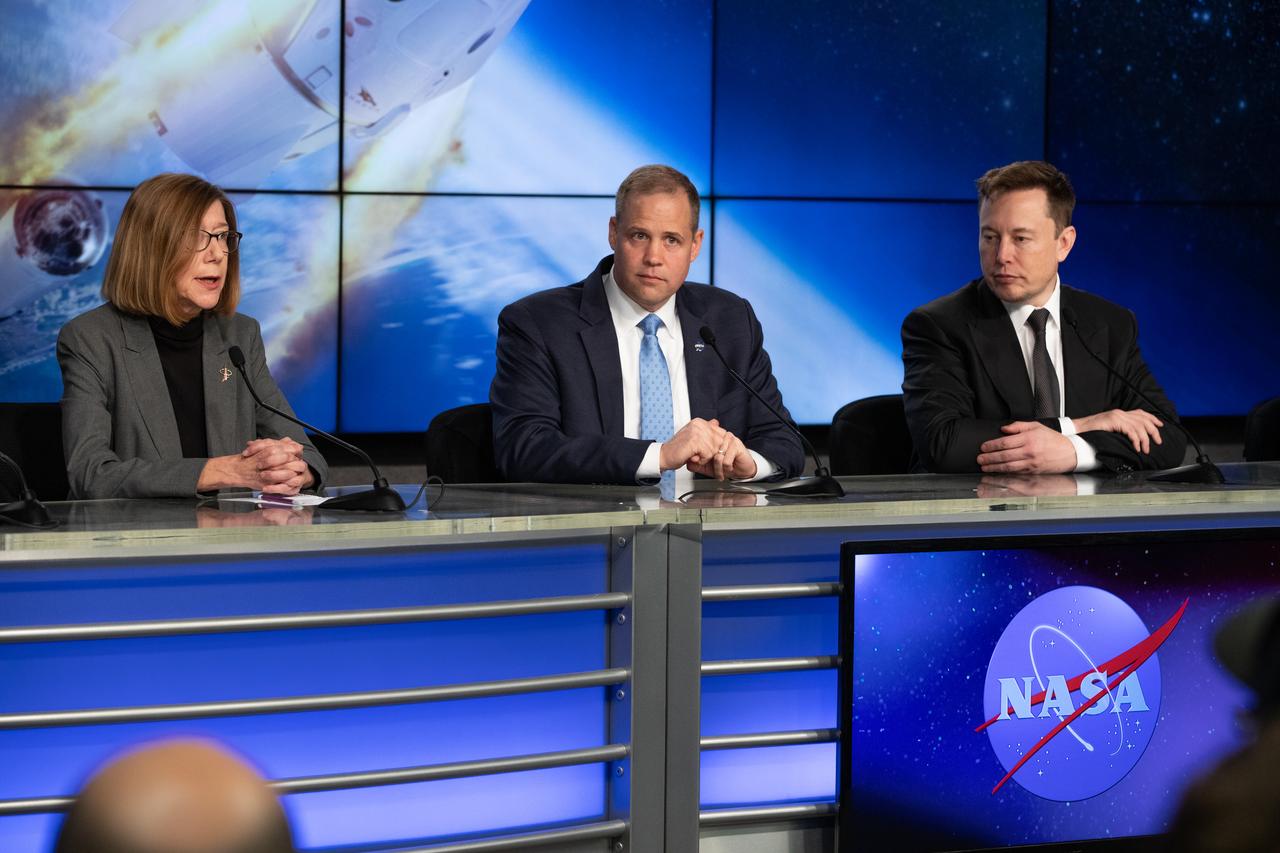
Officials from NASA and SpaceX participate in a briefing at the agency’s Kennedy Space Center in Florida following the company’s uncrewed In-Flight Abort Test on Jan. 19, 2020. From left to right are Kathy Lueders, program manager, NASA’s Commercial Crew Program; NASA Administrator Jim Bridenstine; and Elon Musk, chief engineer, SpaceX. During the flight test, a SpaceX Falcon 9 rocket and Crew Dragon spacecraft lifted off from Kennedy’s Launch Complex 39A and began a planned launch-abort sequence demonstrating the spacecraft’s escape capabilities. The Crew Dragon splashed down in the Atlantic Ocean as expected. The In-Flight Abort Test is a critical milestone in preparation for crewed flights to the International Space Station as part of the agency’s Commercial Crew Program.
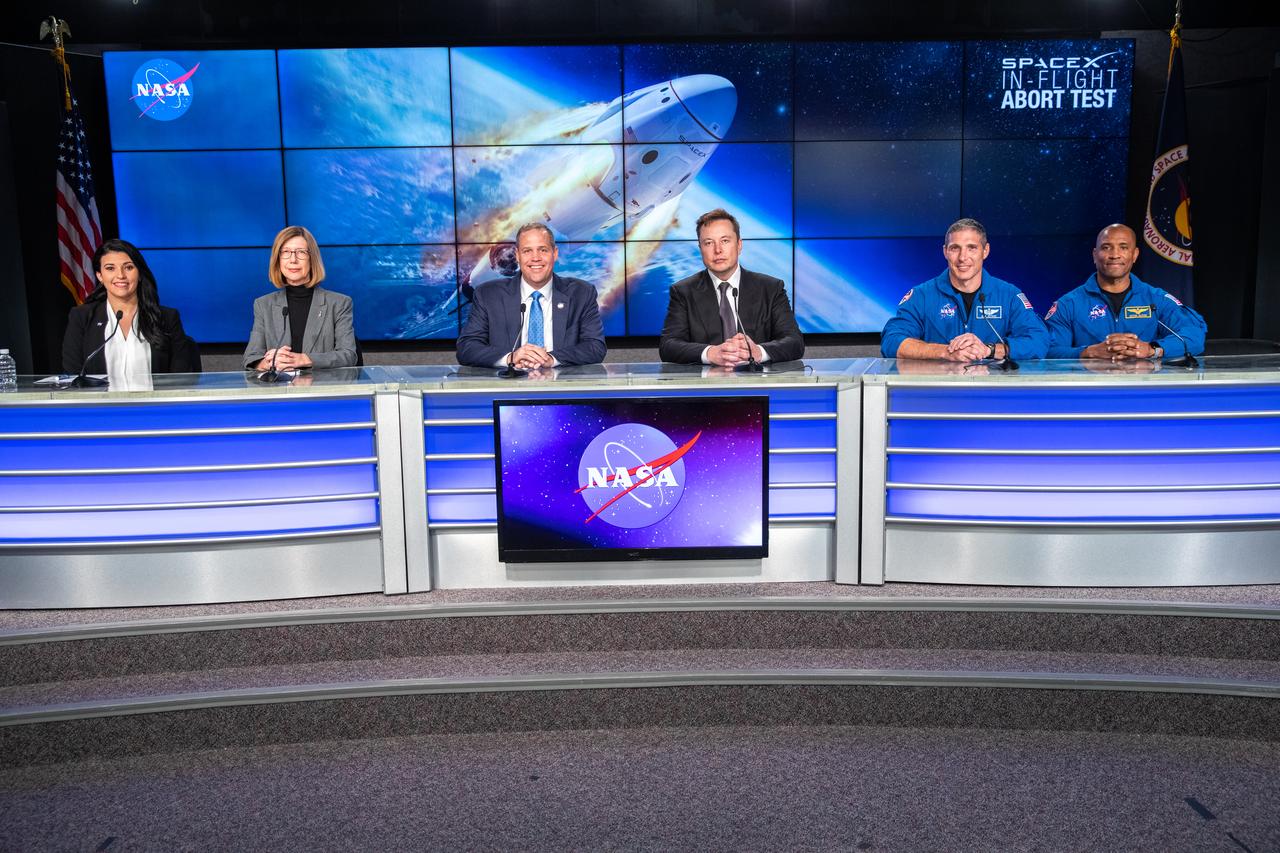
Officials from NASA and SpaceX participate in a briefing at the agency’s Kennedy Space Center in Florida following the company’s uncrewed In-Flight Abort Test on Jan. 19, 2020. From left to right are Bettina Inclan, NASA Communications; Kathy Lueders, program manager, NASA’s Commercial Crew Program; NASA Administrator Jim Bridenstine; Elon Musk, chief engineer, SpaceX; and NASA astronauts Mike Hopkins and Victor Glover. During the flight test, a SpaceX Falcon 9 rocket and Crew Dragon spacecraft lifted off from Kennedy’s Launch Complex 39A and began a planned launch-abort sequence demonstrating the spacecraft’s escape capabilities. The Crew Dragon splashed down in the Atlantic Ocean as expected. The In-Flight Abort Test is a critical milestone in preparation for crewed flights to the International Space Station as part of the agency’s Commercial Crew Program.
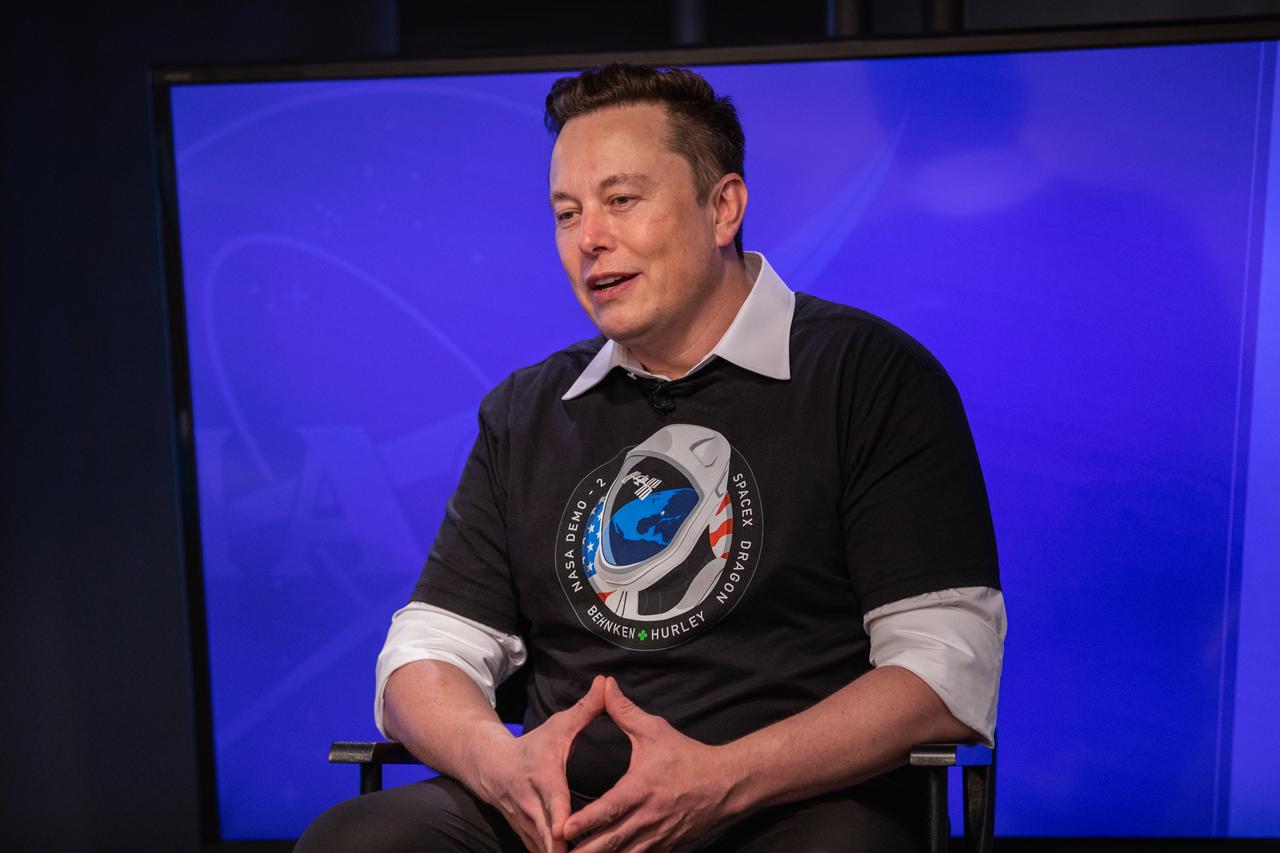
Chief Engineer of SpaceX Elon Musk participates in a postlaunch news conference inside the Press Site auditorium at NASA’s Kennedy Space Center in Florida on May 30, 2020, following the launch of the agency’s SpaceX Demo-2 mission to the International Space Station. Liftoff of the SpaceX Falcon 9 rocket and Crew Dragon spacecraft, carrying NASA astronauts Robert Behnken and Douglas Hurley, occurred at 3:22 p.m. EDT from historic Launch Complex 39A. Behnken and Hurley are the first astronauts to launch to the space station from U.S. soil since the end of the Space Shuttle Program in 2011. Part of NASA’s Commercial Crew Program, this will be SpaceX’s final flight test, paving the way for the agency to certify the crew transportation system for regular, crewed flights to the orbiting laboratory.
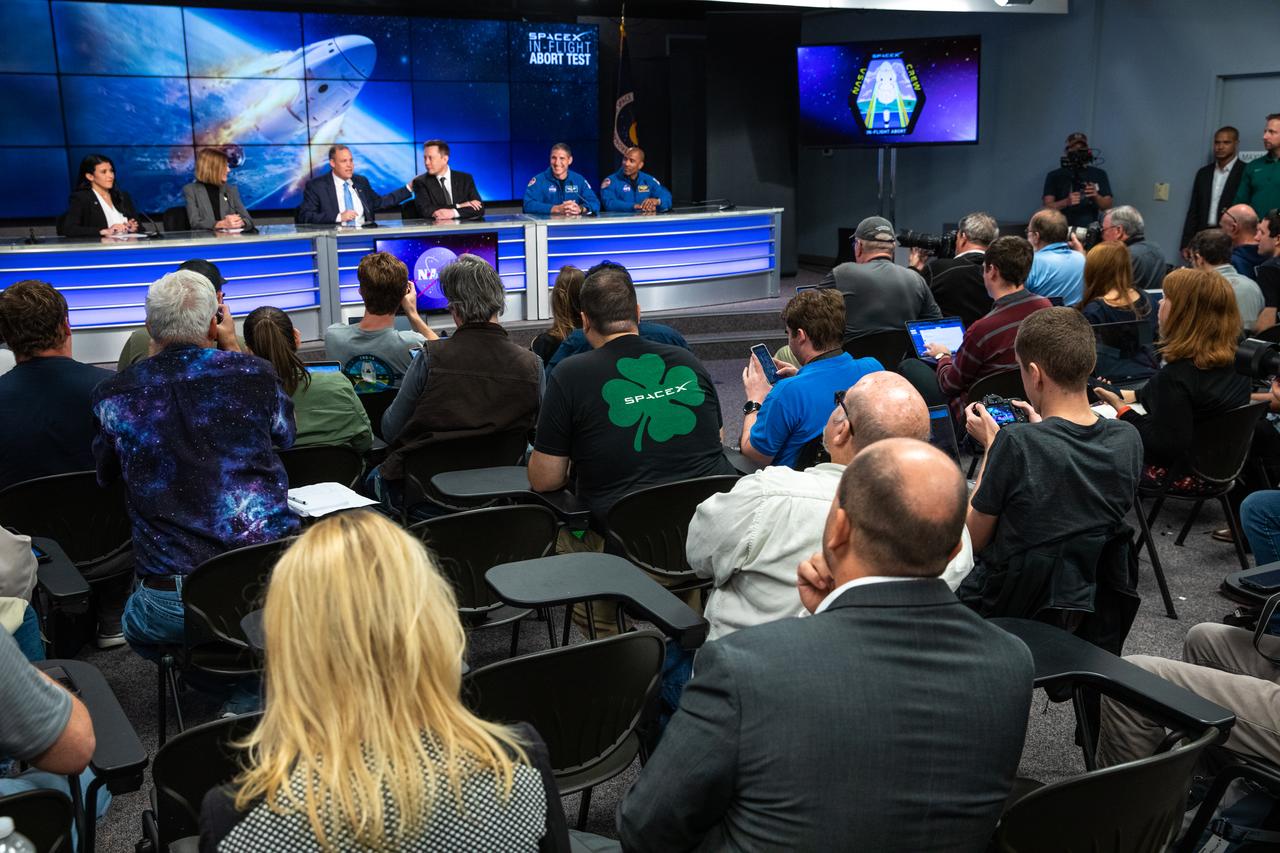
Officials from NASA and SpaceX participate in a briefing at the agency’s Kennedy Space Center in Florida following the company’s uncrewed In-Flight Abort Test on Jan. 19, 2020. From left to right are Bettina Inclan, NASA Communications; Kathy Lueders, program manager, NASA’s Commercial Crew Program; NASA Administrator Jim Bridenstine; Elon Musk, chief engineer, SpaceX; and NASA astronauts Mike Hopkins and Victor Glover. During the flight test, a SpaceX Falcon 9 rocket and Crew Dragon spacecraft lifted off from Kennedy’s Launch Complex 39A and began a planned launch-abort sequence demonstrating the spacecraft’s escape capabilities. The Crew Dragon splashed down in the Atlantic Ocean as expected. The In-Flight Abort Test is a critical milestone in preparation for crewed flights to the International Space Station as part of the agency’s Commercial Crew Program.
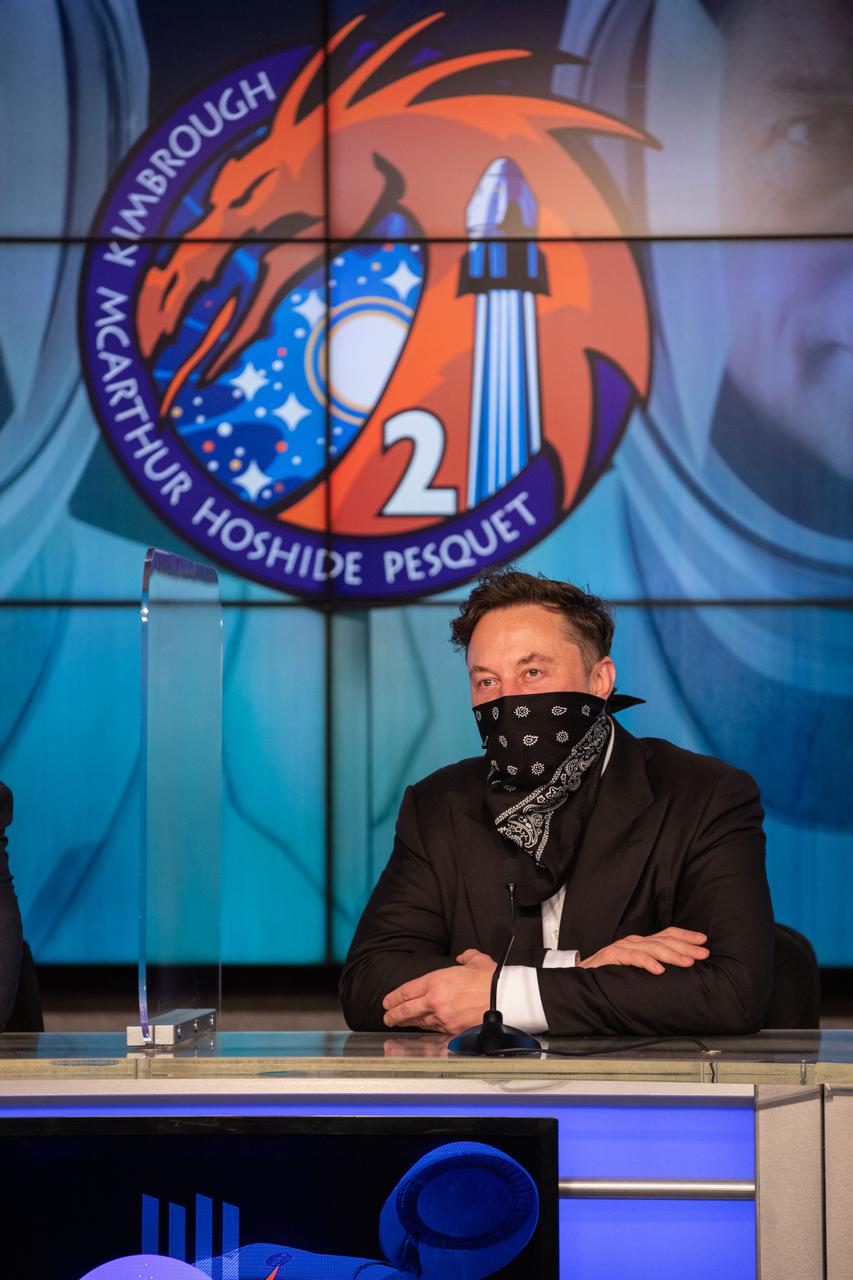
Elon Musk, CEO and lead designer, SpaceX, participates in a postlaunch news conference for NASA’s SpaceX Crew-2 mission on April 23, 2021, at Kennedy Space Center in Florida. Liftoff time on a Falcon 9 rocket was at 5:49 p.m. EDT. Crew Dragon Endeavour is carrying NASA astronaut Shane Kimbrough, spacecraft commander; NASA astronaut Megan McArthur, pilot; ESA astronaut Thomas Pesquet, mission specialist; and JAXA astronaut Akihiko Hoshide, mission specialist, to the International Space Station. Crew-2 is the second regular crew mission of a U.S. commercial spacecraft with astronauts to the space station as part of NASA’s Commercial Crew Program. Endeavour will dock with the station and the crew will remain on the orbiting laboratory for a six-month science mission.
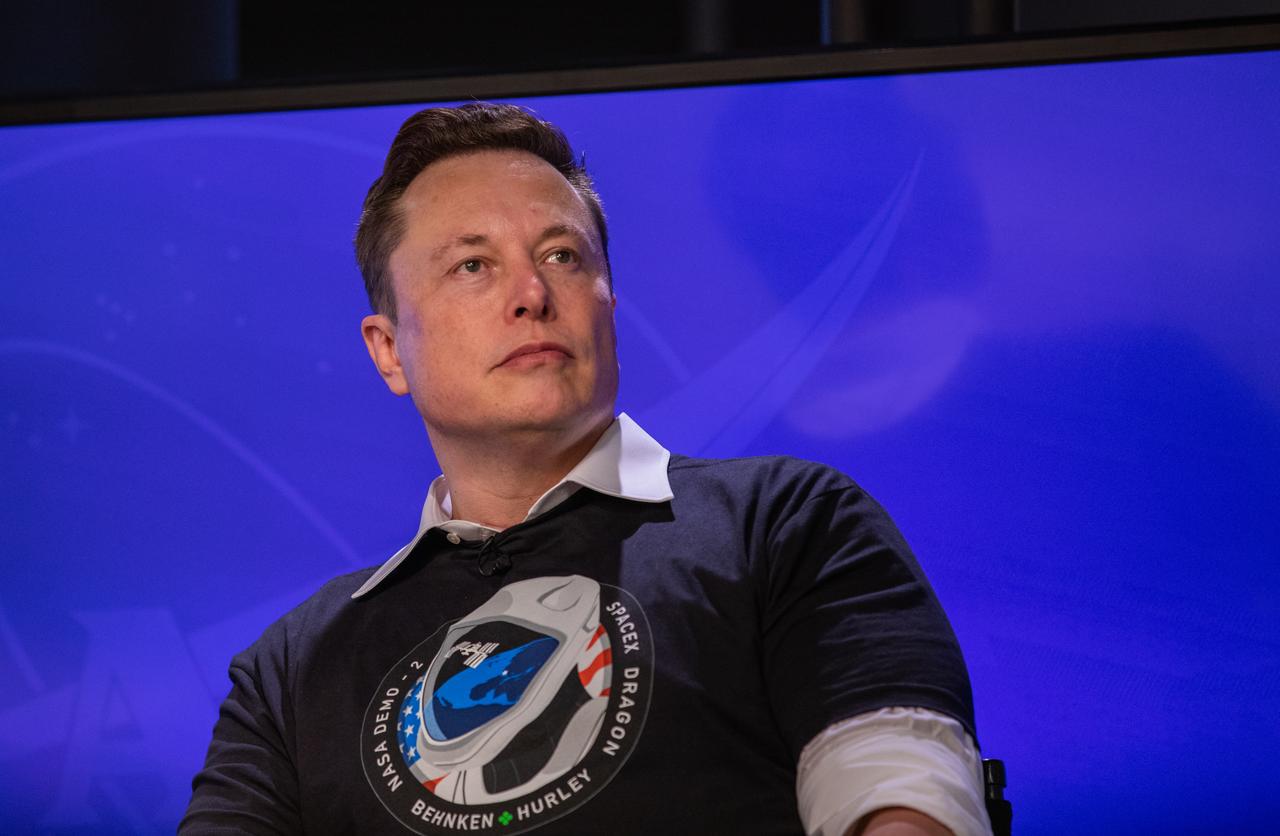
Chief Engineer of SpaceX Elon Musk participates in a postlaunch news conference inside the Press Site auditorium at NASA’s Kennedy Space Center in Florida on May 30, 2020, following the launch of the agency’s SpaceX Demo-2 mission to the International Space Station. Liftoff of the SpaceX Falcon 9 rocket and Crew Dragon spacecraft, carrying NASA astronauts Robert Behnken and Douglas Hurley, occurred at 3:22 p.m. EDT from historic Launch Complex 39A. Behnken and Hurley are the first astronauts to launch to the space station from U.S. soil since the end of the Space Shuttle Program in 2011. Part of NASA’s Commercial Crew Program, this will be SpaceX’s final flight test, paving the way for the agency to certify the crew transportation system for regular, crewed flights to the orbiting laboratory.
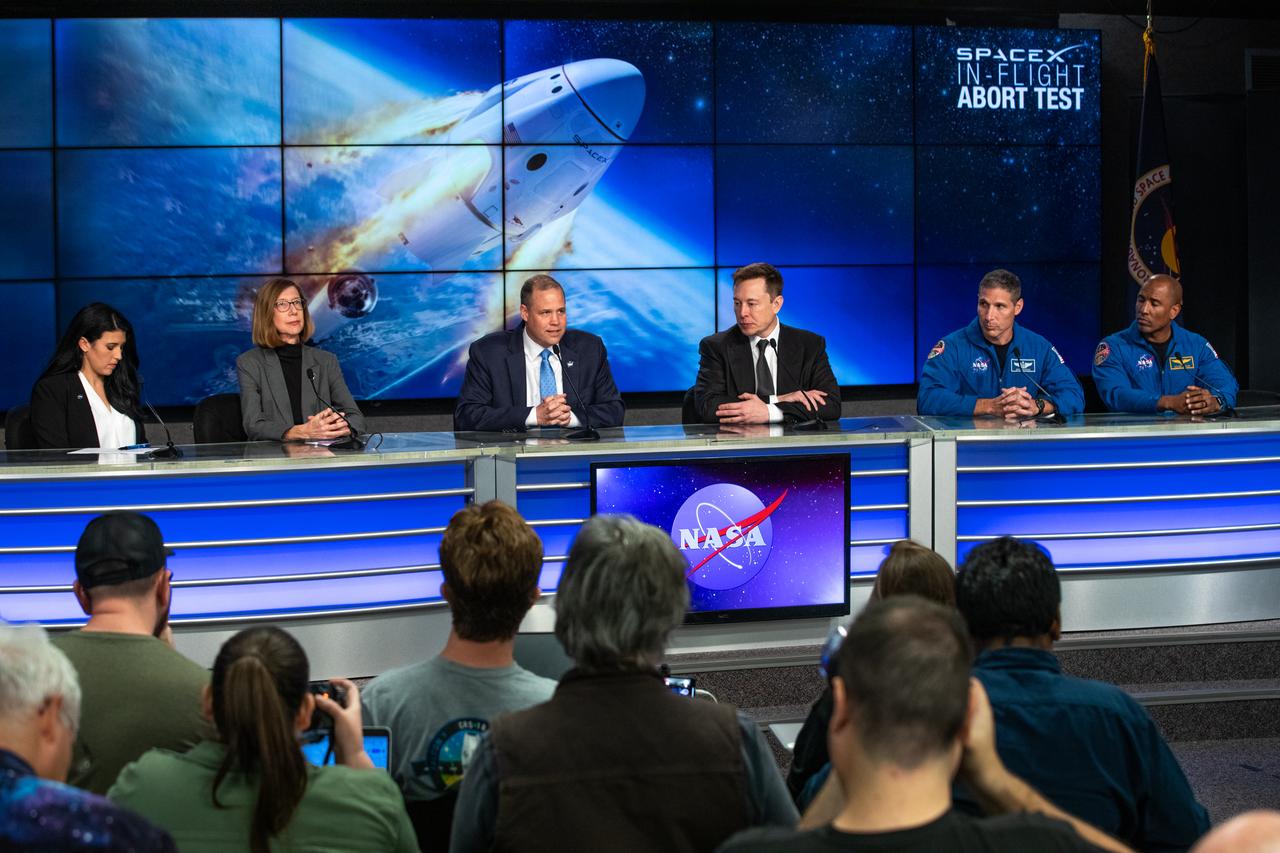
Officials from NASA and SpaceX participate in a briefing at the agency’s Kennedy Space Center in Florida following the company’s uncrewed In-Flight Abort Test on Jan. 19, 2020. From left to right are Bettina Inclan, NASA Communications; Kathy Lueders, program manager, NASA’s Commercial Crew Program; NASA Administrator Jim Bridenstine; Elon Musk, chief engineer, SpaceX; and NASA astronauts Mike Hopkins and Victor Glover. During the flight test, a SpaceX Falcon 9 rocket and Crew Dragon spacecraft lifted off from Kennedy’s Launch Complex 39A and began a planned launch-abort sequence demonstrating the spacecraft’s escape capabilities. The Crew Dragon splashed down in the Atlantic Ocean as expected. The In-Flight Abort Test is a critical milestone in preparation for crewed flights to the International Space Station as part of the agency’s Commercial Crew Program.

Elon Musk, CEO and lead designer, SpaceX, participates in a postlaunch news conference for NASA’s SpaceX Crew-2 mission on April 23, 2021, at Kennedy Space Center in Florida. Liftoff time on a Falcon 9 rocket was at 5:49 p.m. EDT. Crew Dragon Endeavour is carrying NASA astronaut Shane Kimbrough, spacecraft commander; NASA astronaut Megan McArthur, pilot; ESA astronaut Thomas Pesquet, mission specialist; and JAXA astronaut Akihiko Hoshide, mission specialist, to the International Space Station. Crew-2 is the second regular crew mission of a U.S. commercial spacecraft with astronauts to the space station as part of NASA’s Commercial Crew Program. Endeavour will dock with the station and the crew will remain on the orbiting laboratory for a six-month science mission.
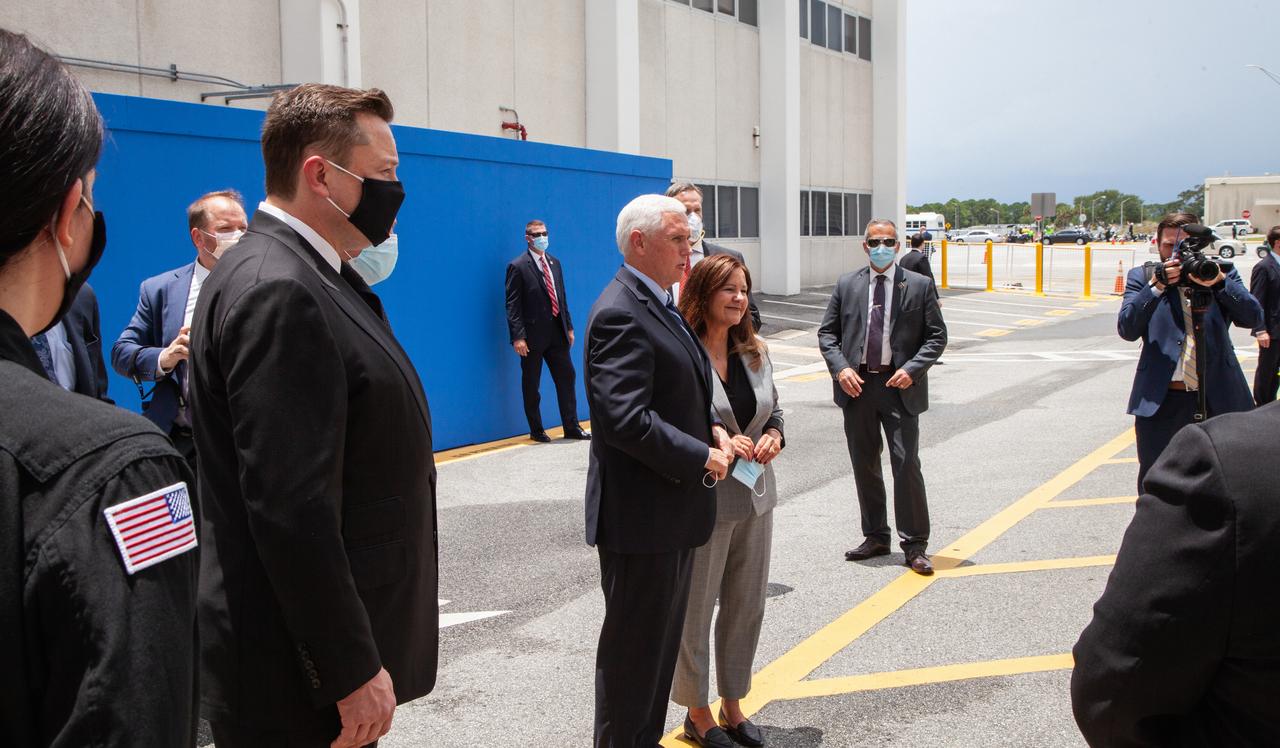
From left, SpaceX CEO and Chief Designer Elon Musk, Vice President Mike Pence and second lady Karen Pence pose for a photo outside of the Neil A. Armstrong Operations and Checkout Building at NASA’s Kennedy Space Center in Florida ahead of the agency’s SpaceX Demo-2 launch. The launch, initially scheduled for May 27, 2020, was scrubbed due to unfavorable weather conditions around Launch Complex 39A. The next launch attempt will be Saturday, May 30. Liftoff of the SpaceX Falcon 9 rocket and Crew Dragon spacecraft is scheduled for 3:22 p.m. EDT from historic Launch Complex 39A. Behnken and Hurley will be the first astronauts to launch to the International Space Station from U.S. soil since the end of the Space Shuttle Program in 2011. Part of NASA’s Commercial Crew Program, this will be SpaceX’s final flight test, paving the way for the agency to certify the crew transportation system for regular, crewed flights to the orbiting laboratory.
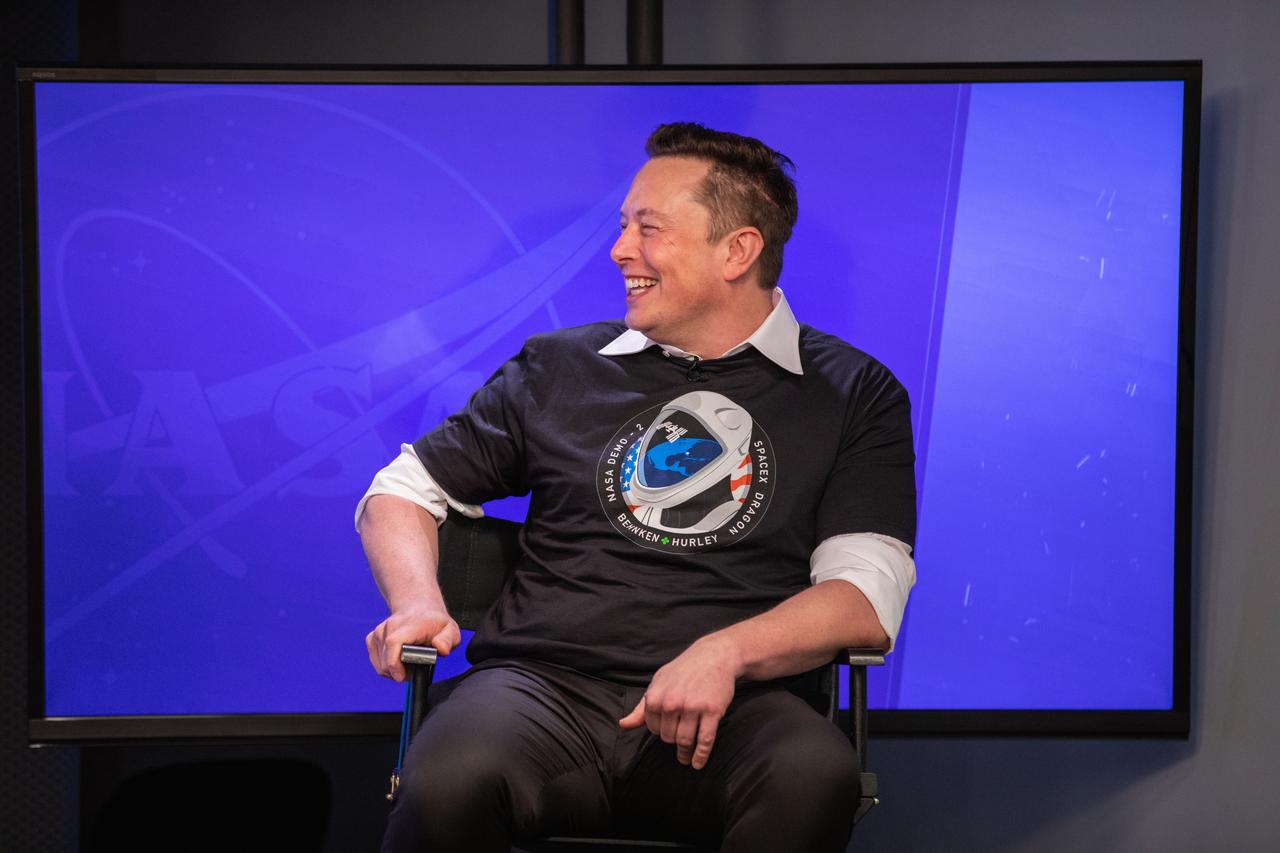
Chief Engineer of SpaceX Elon Musk participates in a postlaunch news conference inside the Press Site auditorium at NASA’s Kennedy Space Center in Florida on May 30, 2020, following the launch of the agency’s SpaceX Demo-2 mission to the International Space Station. Liftoff of the SpaceX Falcon 9 rocket and Crew Dragon spacecraft, carrying NASA astronauts Robert Behnken and Douglas Hurley, occurred at 3:22 p.m. EDT from historic Launch Complex 39A. Behnken and Hurley are the first astronauts to launch to the space station from U.S. soil since the end of the Space Shuttle Program in 2011. Part of NASA’s Commercial Crew Program, this will be SpaceX’s final flight test, paving the way for the agency to certify the crew transportation system for regular, crewed flights to the orbiting laboratory.
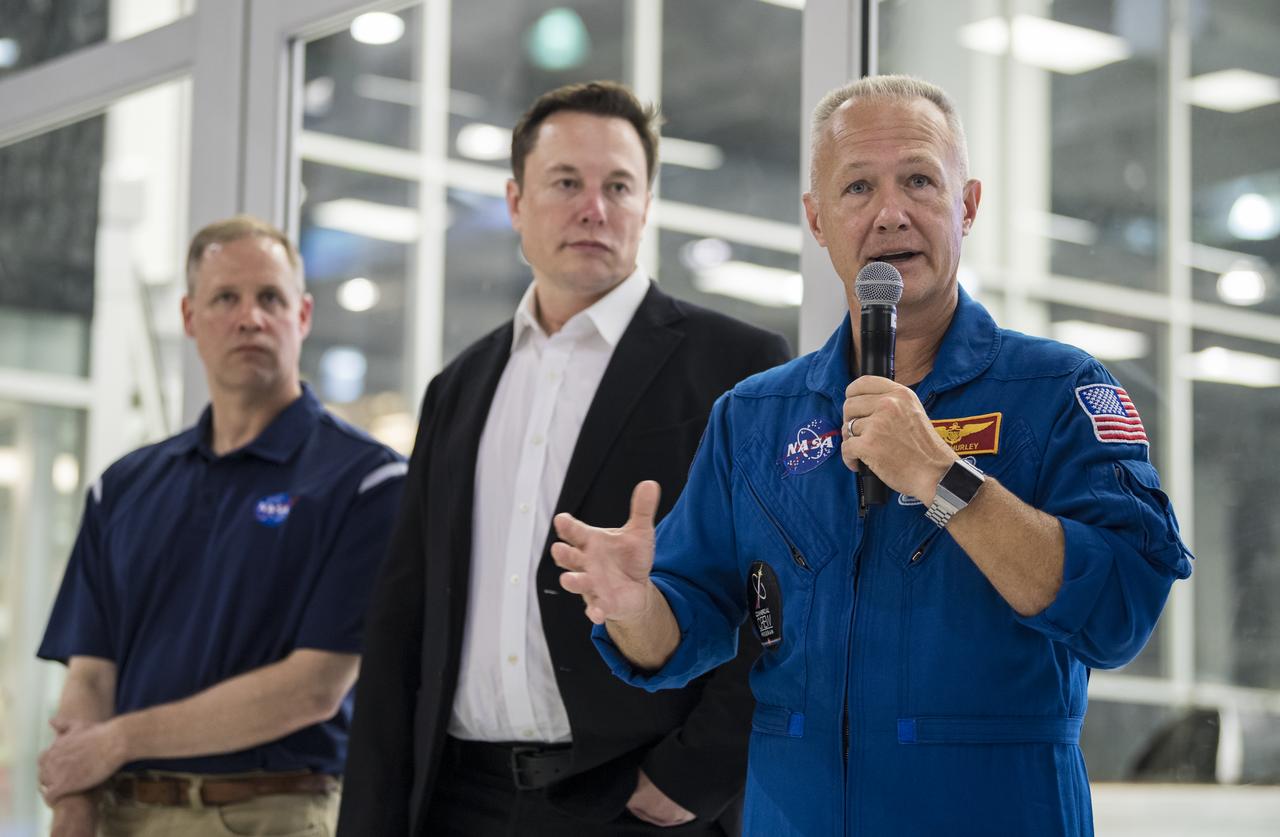
NASA astronaut Doug Hurley answers a question from the media in front of the Crew Dragon that is being prepared for the Demo-2 mission, at SpaceX Headquarters, Thursday, Oct. 10, 2019 in Hawthorne, CA. Hurley and NASA astronaut Bob Behnken are assigned to fly onboard Crew Dragon for the Demo-2 mission. Photo credit: (NASA/Aubrey Gemignani)
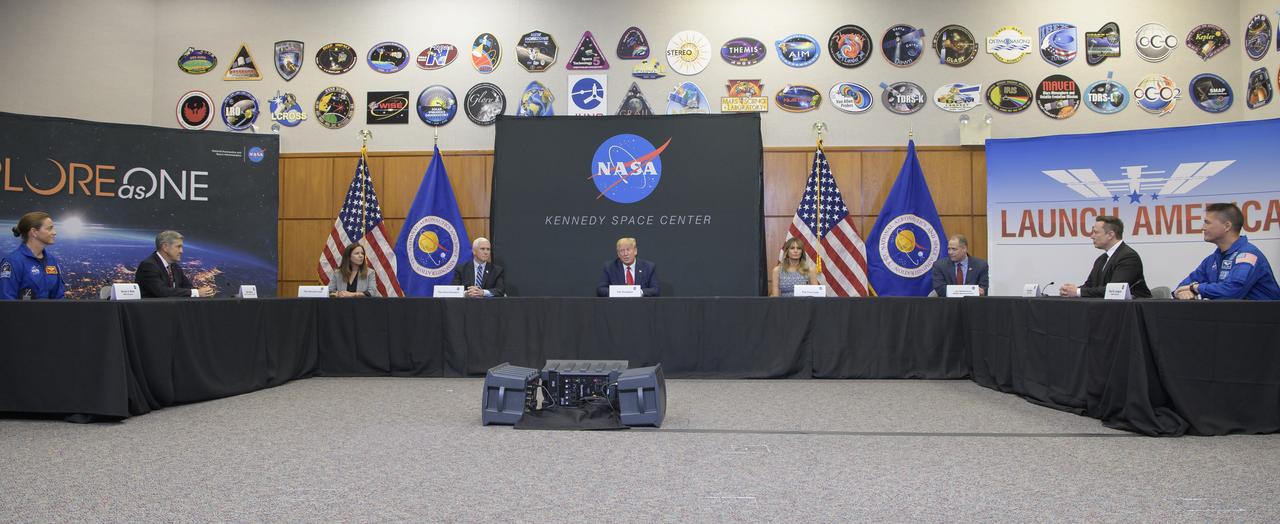
President Donald Trump participates in a SpaceX Demonstration Mission 2 Launch Briefing with NASA astronaut Nicole Mann, left, Kennedy Space Center Director Bob Cabana, Second Lady Karen Pence, Vice President Mike Pence, First Lady Melania Trump, NASA Administrator Jim Bridenstine, Elon Musk, SpaceX Chief Engineer, and NASA astronaut Kjell Lindgren, right at the Neil A. Armstrong Operations and Checkout Building following the departure of NASA astronauts Robert Behnken and Douglas Hurley for Launch Complex 39A to board a SpaceX Crew Dragon spacecraft for launch, Wednesday, May 27, 2020, at NASA’s Kennedy Space Center in Florida. NASA’s SpaceX Demo-2 mission is the first launch with astronauts of the SpaceX Crew Dragon spacecraft and Falcon 9 rocket to the International Space Station as part of the agency’s Commercial Crew Program. The test flight serves as an end-to-end demonstration of SpaceX’s crew transportation system. Today’s launch of Behnken and Hurley was scrubbed due to weather and is now scheduled for 3:22 p.m. EDT on Saturday, May 30, from Launch Complex 39A at the Kennedy Space Center. A new era of human spaceflight is set to begin as American astronauts once again launch on an American rocket from American soil to low-Earth orbit for the first time since the conclusion of the Space Shuttle Program in 2011. Photo Credit: (NASA/Bill Ingalls)
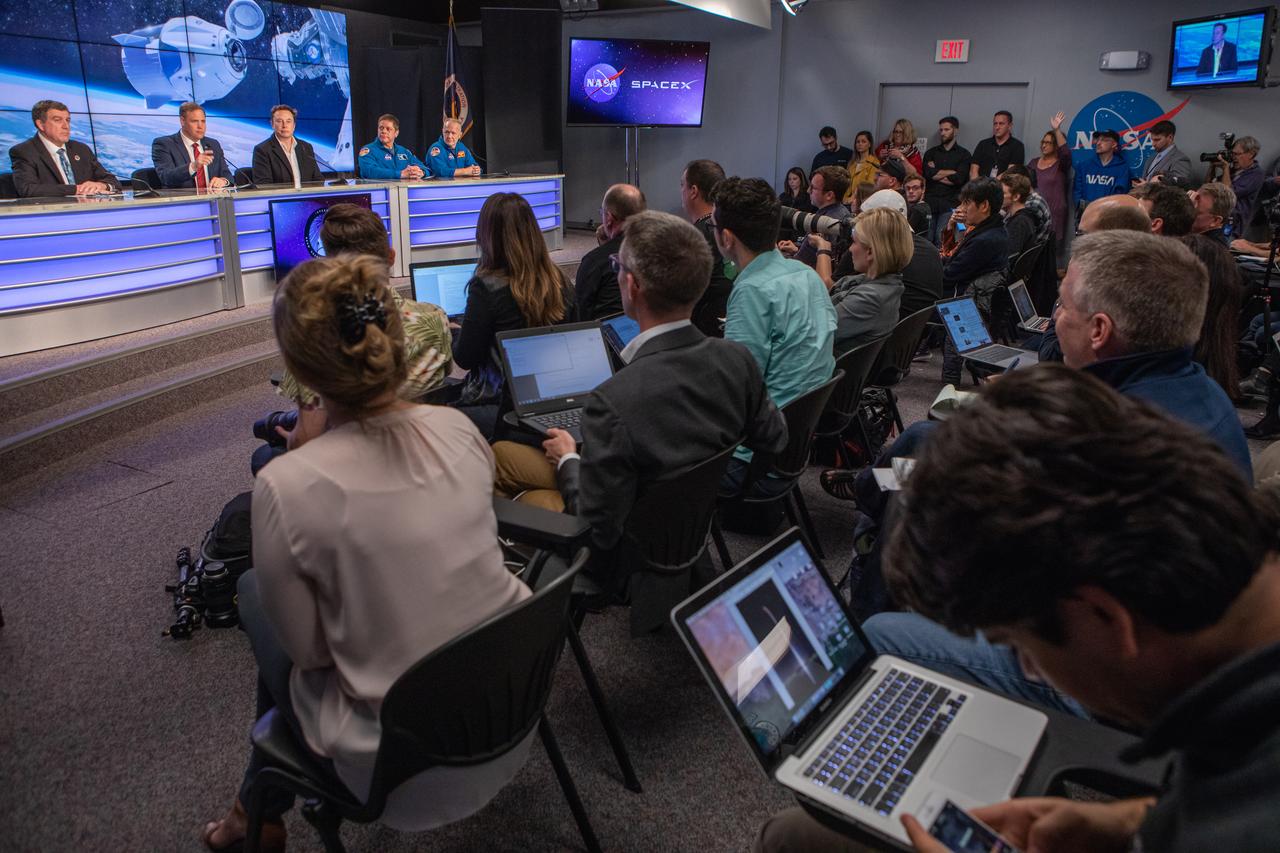
Members of the media gather in Kennedy Space Center’s Press Site auditorium during a post launch news conference with agency and industry leaders following the March 2, 2:49 a.m. EST launch of the SpaceX Demo-1 Commercial Crew Program (CCP) mission to the International Space Station. The Crew Dragon’s trip to the space station is designed to validate end-to-end systems and capabilities, leading to certification to fly crew. NASA has worked with SpaceX and Boeing in developing the CCP spacecraft to facilitate new human spaceflight systems launching from U.S. soil with the goal of safe, reliable and cost-effective access to low-Earth orbit destinations, such as the space station.
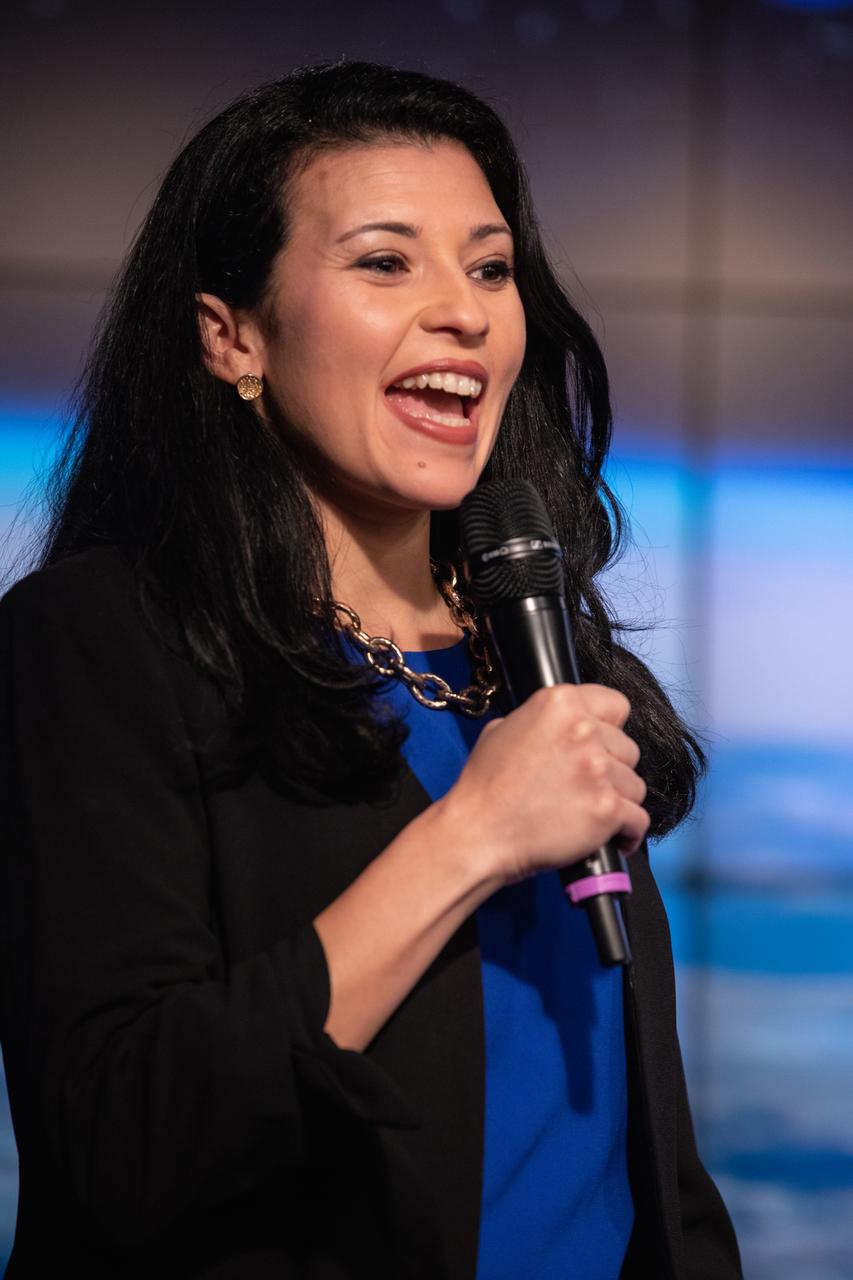
Bettina Inclán, NASA associate administrator for Communications, addresses members of the media during a post launch news conference in Kennedy Space Center’s Press Site auditorium following the March 2, 2:49 a.m. EST launch of the SpaceX Demo-1 Commercial Crew Program (CCP) mission to the International Space Station. The Crew Dragon’s trip to the space station is designed to validate end-to-end systems and capabilities, leading to certification to fly crew. NASA has worked with SpaceX and Boeing in developing the CCP spacecraft to facilitate new human spaceflight systems launching from U.S. soil with the goal of safe, reliable and cost-effective access to low-Earth orbit destinations, such as the space station.
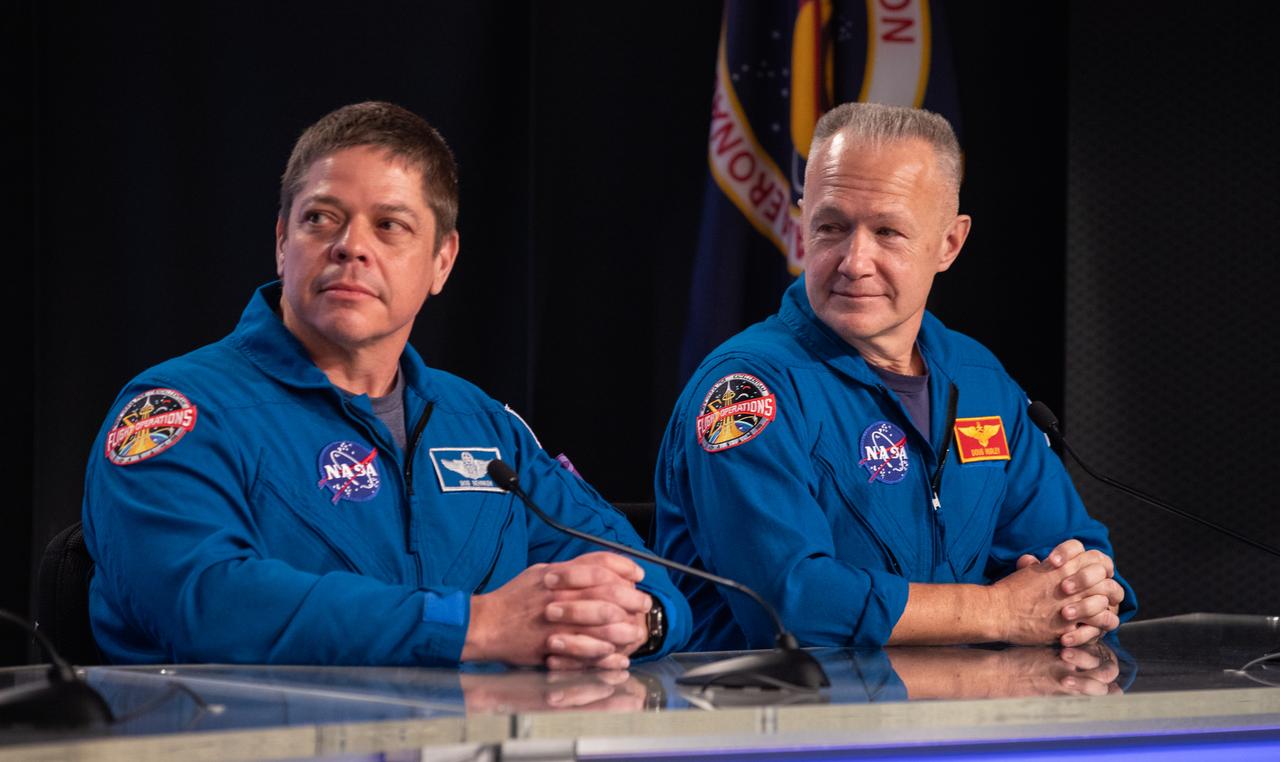
NASA astronauts Bob Behnken, left, and Doug Hurley are introduced to members of the media during a post launch news conference in Kennedy Space Center’s Press Site auditorium following the March 2, 2:49 a.m. EST launch of the SpaceX Demo-1 Commercial Crew Program (CCP) mission to the International Space Station. The Crew Dragon’s trip to the space station is designed to validate end-to-end systems and capabilities, leading to certification to fly crew. NASA has worked with SpaceX and Boeing in developing the CCP spacecraft to facilitate new human spaceflight systems launching from U.S. soil with the goal of safe, reliable and cost-effective access to low-Earth orbit destinations, such as the space station.
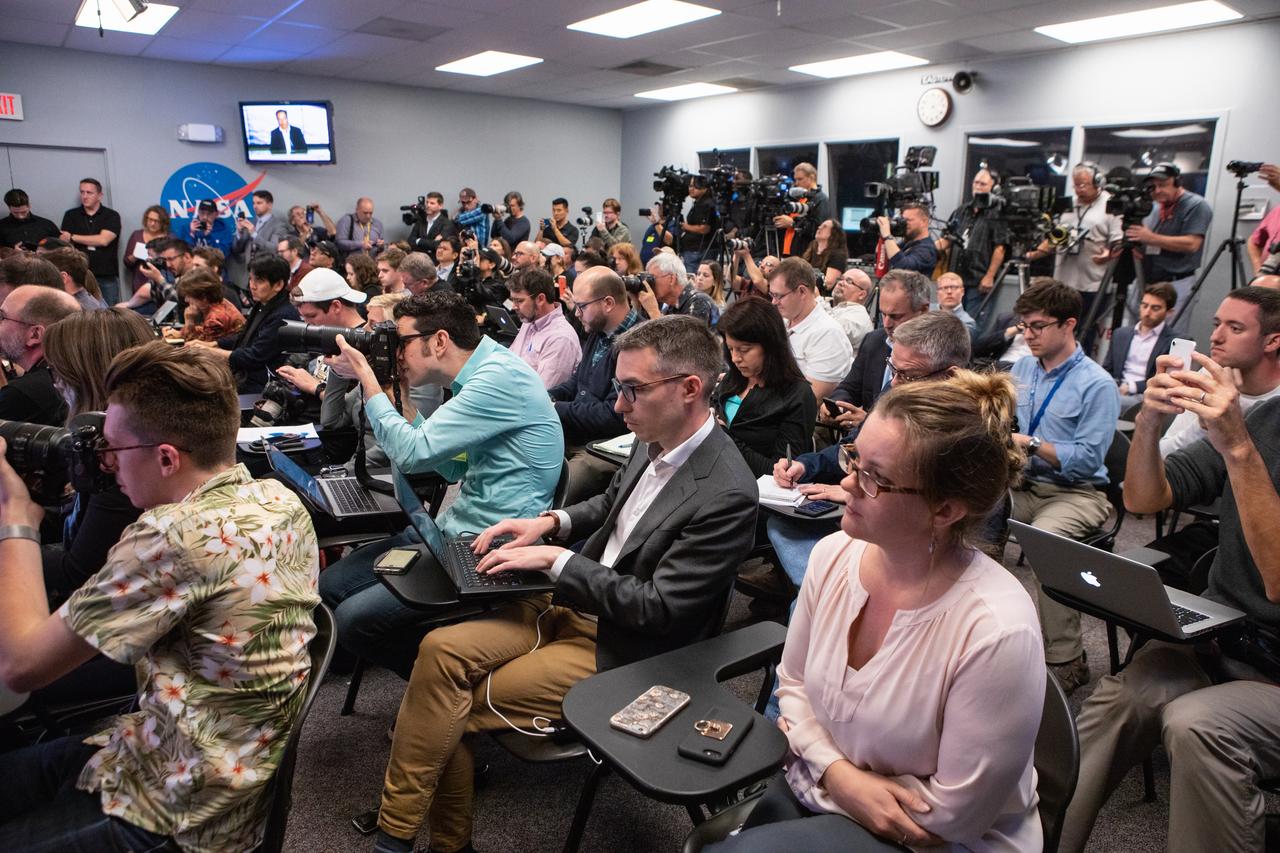
Members of the media gather in Kennedy Space Center’s Press Site auditorium during a post launch news conference with agency and industry leaders following the March 2, 2:49 a.m. EST launch of the SpaceX Demo-1 Commercial Crew Program (CCP) mission to the International Space Station. The Crew Dragon’s trip to the space station is designed to validate end-to-end systems and capabilities, leading to certification to fly crew. NASA has worked with SpaceX and Boeing in developing the CCP spacecraft to facilitate new human spaceflight systems launching from U.S. soil with the goal of safe, reliable and cost-effective access to low-Earth orbit destinations, such as the space station.

CAPE CANAVERAL, Fla. – Elon Musk, chief executive officer and chief designer for SpaceX, participates in a post-launch news conference being held in the Press Site auditorium at NASA’s Kennedy Space Center in Florida by video teleconference. The SpaceX Falcon 9 rocket launched into space at 3:44 a.m. EDT from Space Launch Complex-40 on Cape Canaveral Air Force Station in Florida. The launch is the company's second demonstration test flight for NASA's Commercial Orbital Transportation Services Program, or COTS. During the flight, the capsule will conduct a series of check-out procedures to test and prove its systems, including rendezvous and berthing with the International Space Station. If the capsule performs as planned, the cargo and experiments it is carrying will be transferred to the station. The cargo includes food, water and provisions for the station’s Expedition crews, such as clothing, batteries and computer equipment. Under COTS, NASA has partnered with two aerospace companies to deliver cargo to the station. For more information, visit http://www.nasa.gov/spacex. Photo credit: NASA/Kim Shiflett
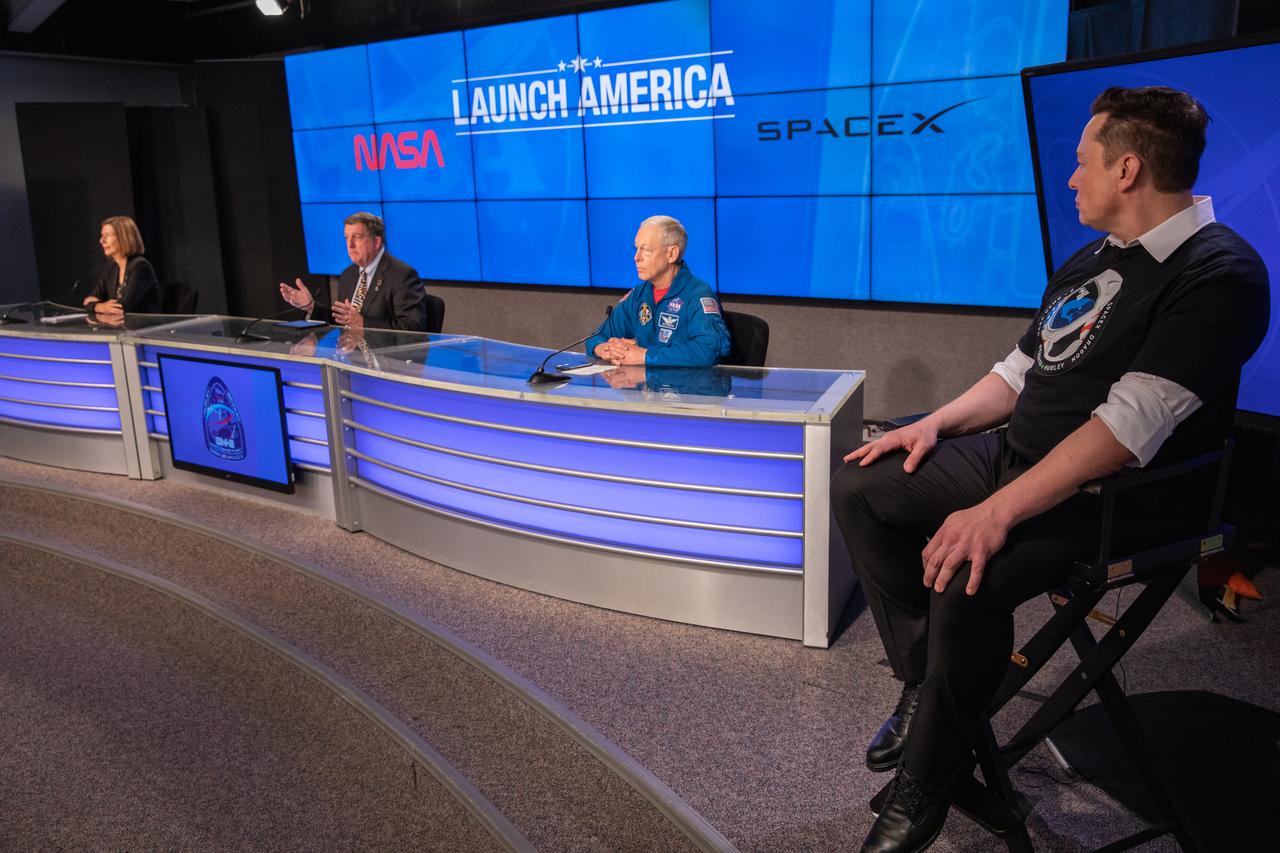
Inside the Press Site auditorium at NASA’s Kennedy Space Center in Florida, NASA and SpaceX officials conduct a postlaunch news conference on May 30, 2020, following the launch of the agency’s SpaceX Demo-2 mission to the International Space Station. From left are: Commercial Crew Program Manager Kathy Lueders; International Space Station Program Manager Kirk Shireman; NASA Chief Astronaut Pat Forrester; and Chief Engineer Elon Musk. Liftoff of the SpaceX Falcon 9 rocket and Crew Dragon spacecraft, carrying NASA astronauts Robert Behnken and Douglas Hurley, occurred at 3:22 p.m. EDT from historic Launch Complex 39A. Behnken and Hurley are the first astronauts to launch to the space station from U.S. soil since the end of the Space Shuttle Program in 2011. Part of NASA’s Commercial Crew Program, this will be SpaceX’s final flight test, paving the way for the agency to certify the crew transportation system for regular, crewed flights to the orbiting laboratory.
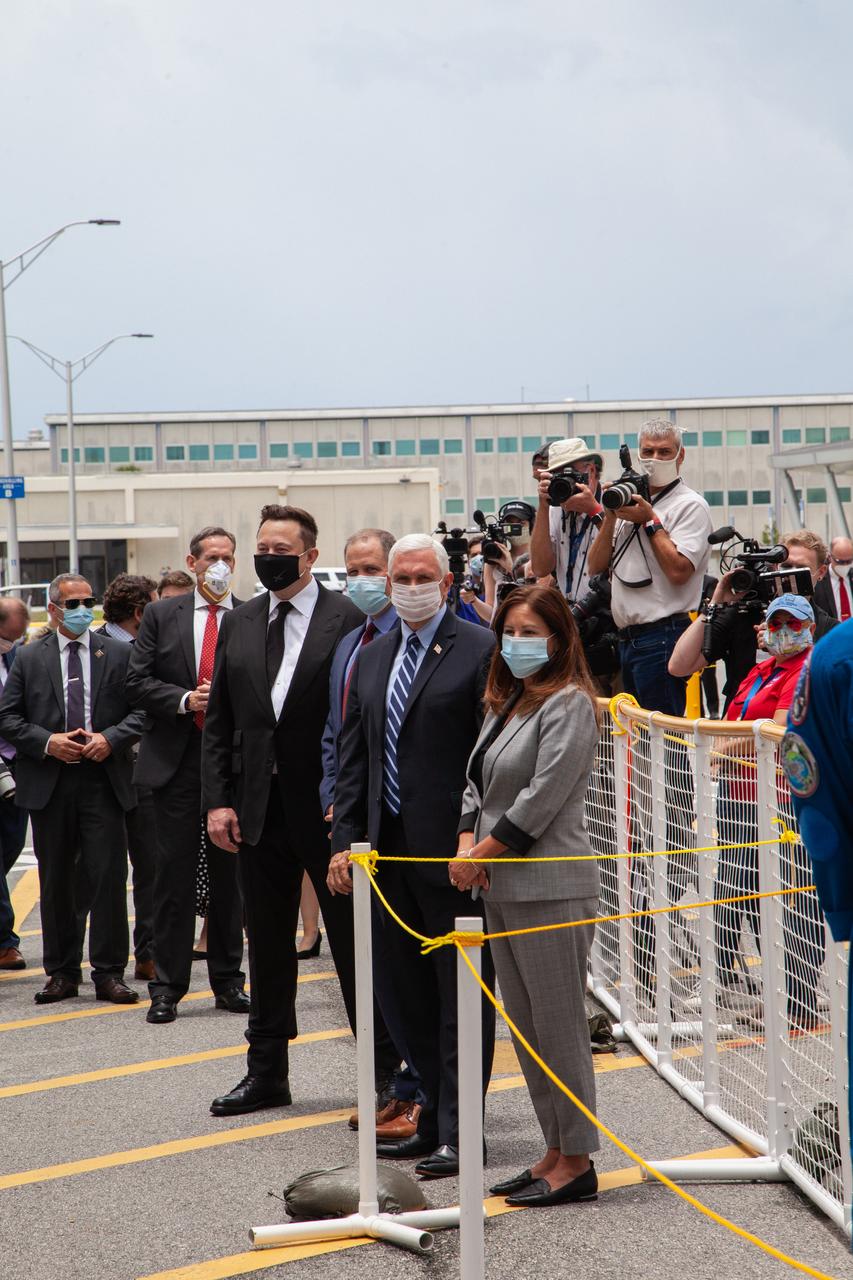
From left, SpaceX CEO and Chief Designer Elon Musk, NASA Administrator Jim Bridenstine, Vice President Mike Pence and second lady Karen Pence wait to greet NASA astronauts Robert Behnken and Douglas Hurley outside of the Neil A. Armstrong Operations and Checkout Building at the agency’s Kennedy Space Center in Florida ahead of NASA’s SpaceX Demo-2 launch. The launch, initially scheduled for May 27, 2020, was scrubbed due to unfavorable weather conditions around Launch Complex 39A. The next launch attempt will be Saturday, May 30. Liftoff of the SpaceX Falcon 9 rocket and Crew Dragon spacecraft is scheduled for 3:22 p.m. EDT from historic Launch Complex 39A. Behnken and Hurley will be the first astronauts to launch to the International Space Station from U.S. soil since the end of the Space Shuttle Program in 2011. Part of NASA’s Commercial Crew Program, this will be SpaceX’s final flight test, paving the way for the agency to certify the crew transportation system for regular, crewed flights to the orbiting laboratory.
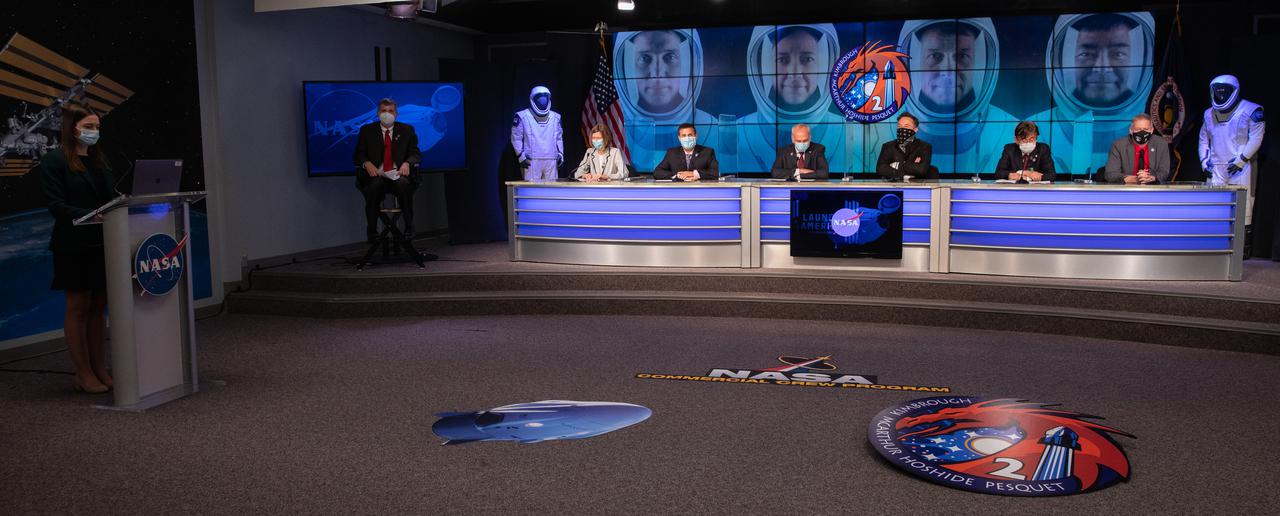
A postlaunch news conference for NASA’s SpaceX Crew-2 mission is held at Kennedy Space Center in Florida on April 23, 2021. From left, participants are: moderator Jackie McGuinness, NASA press secretary; Steve Stich, manager, Commercial Crew Program, NASA’s Kennedy Space Center; Kathy Lueders, associate administrator, Human Exploration and Operations Mission Directorate, NASA Headquarters; Joel Montalbano, manager, International Space Station Program; Steve Jurczyk, acting administrator, NASA; Elon Musk, CEO and lead designer, SpaceX; Hiroshi Sasaki, vice president and director general, JAXA’s Human Spaceflight Technology Directorate; and Frank de Winne, manager, International Space Station Program, ESA. Liftoff time on a SpaceX Falcon 9 rocket was at 5:49 a.m. EDT. Crew Dragon Endeavour is carrying NASA astronaut Shane Kimbrough, spacecraft commander; NASA astronaut Megan McArthur, pilot; ESA astronaut Thomas Pesquet, mission specialist; and JAXA astronaut Akihiko Hoshide, mission specialist, to the international Space Station.
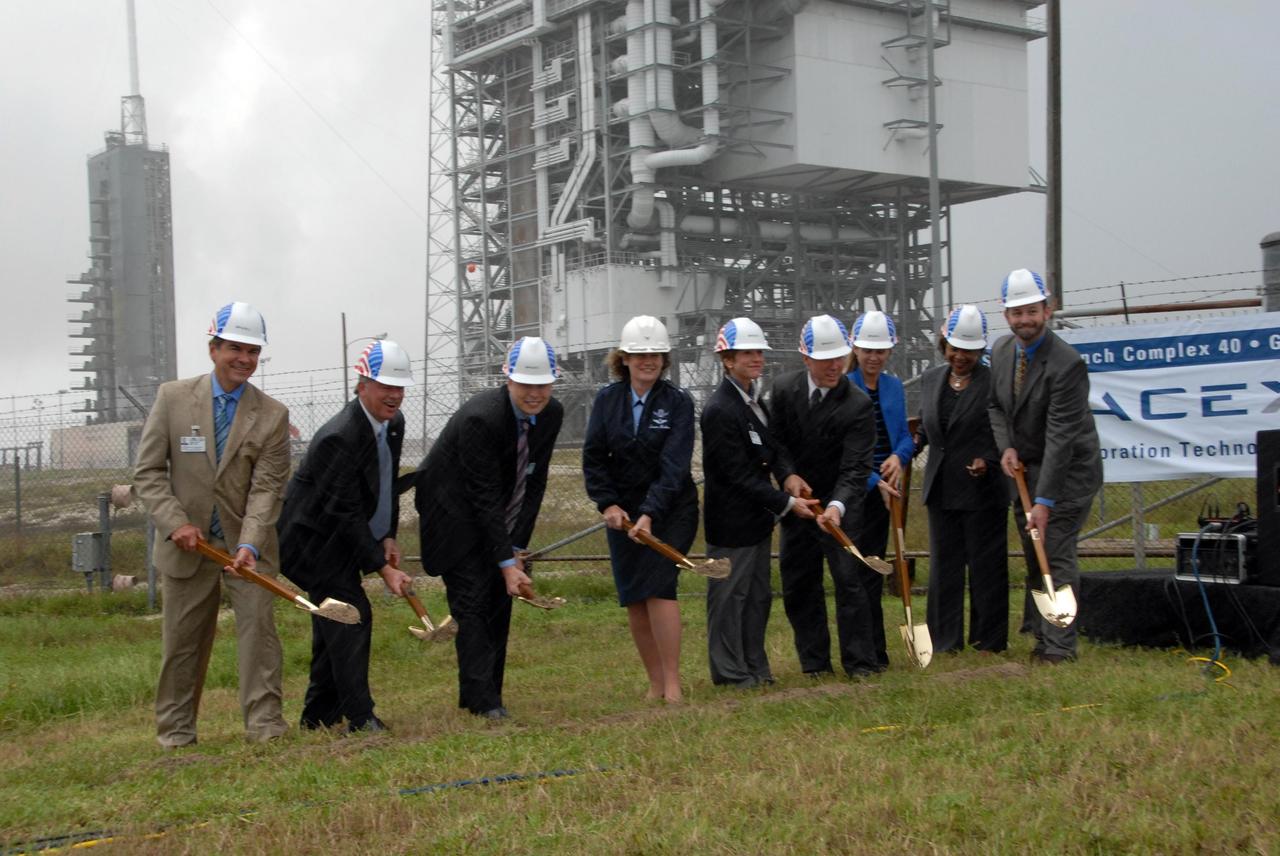
KENNEDY SPACE CENTER, FLA. -- Ready to put spades to work at ground-breaking ceremonies for SpaceX's new Falcon 9 rocket launch facilities at Space Launch Complex 40 at Cape Canaveral are (from left) Thad Altman, Florida State representative; Jeff Kottkamp, Florida State Lt. Governor; Elon Musk, founder and CEO of Space Exploration Technologies; Brig. Gen. Susan J. Helms, commander of the U.S. Air Force 45th Space Wing; Lynda Weatherman, Brevard County Economic Development Commission CEO and president; Steve Koehler, president of Space Florida; Janet Petro, deputy director of NASA Kennedy Space Center; Patricia Grace Smith, FAA associate administrator for Commercial Space Transportation; and Steve Cain, NASA Kennedy Space Center COTS project manager. As part of NASA’s Commercial Orbital Transportation Services, or COTS, competition, SpaceX will launch a Falcon 9 with a cargo-carrying payload on a series of three demonstration missions from Cape Canaveral to the International Space Station, culminating with the delivery of supplies to the $100 billion dollar orbiting laboratory. SpaceX intends to demonstrate its launch, maneuvering, berthing and return abilities by 2009 – a year before NASA has scheduled the conclusion of Space Shuttle operations. Photo credit: NASA/George Shelton
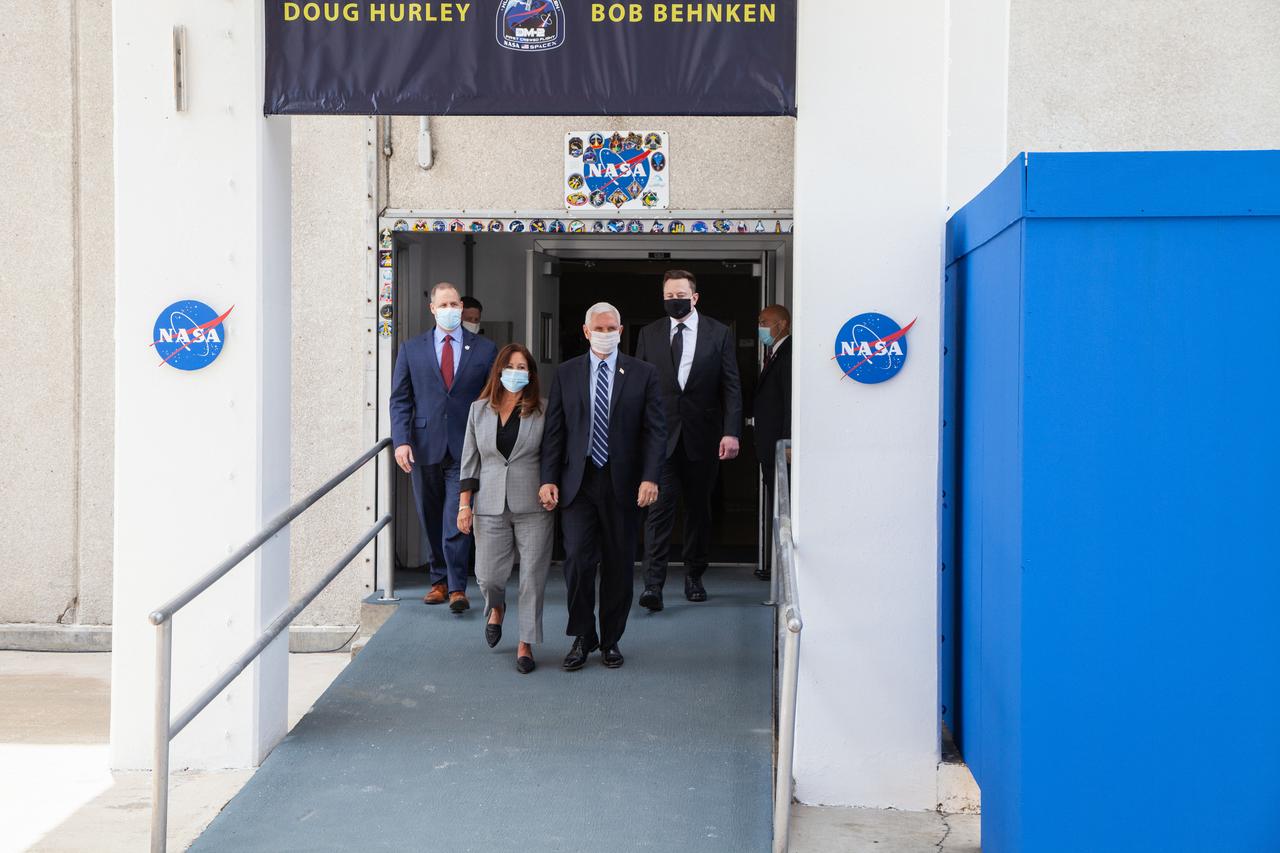
Second lady Karen Pence (left) and Vice President Mike Pence exit the Neil A. Armstrong Operations and Checkout Building at the agency’s Kennedy Space Center in Florida ahead of NASA’s SpaceX Demo-2 launch. Behind them are NASA Administrator Jim Bridenstine (left) and SpaceX CEO and Chief Designer Elon Musk. The launch, initially scheduled for May 27, 2020, was scrubbed due to unfavorable weather conditions around Launch Complex 39A. The next launch attempt will be Saturday, May 30. Liftoff of the SpaceX Falcon 9 rocket and Crew Dragon spacecraft is scheduled for 3:22 p.m. EDT from historic Launch Complex 39A. Behnken and Hurley will be the first astronauts to launch to the International Space Station from U.S. soil since the end of the Space Shuttle Program in 2011. Part of NASA’s Commercial Crew Program, this will be SpaceX’s final flight test, paving the way for the agency to certify the crew transportation system for regular, crewed flights to the orbiting laboratory.
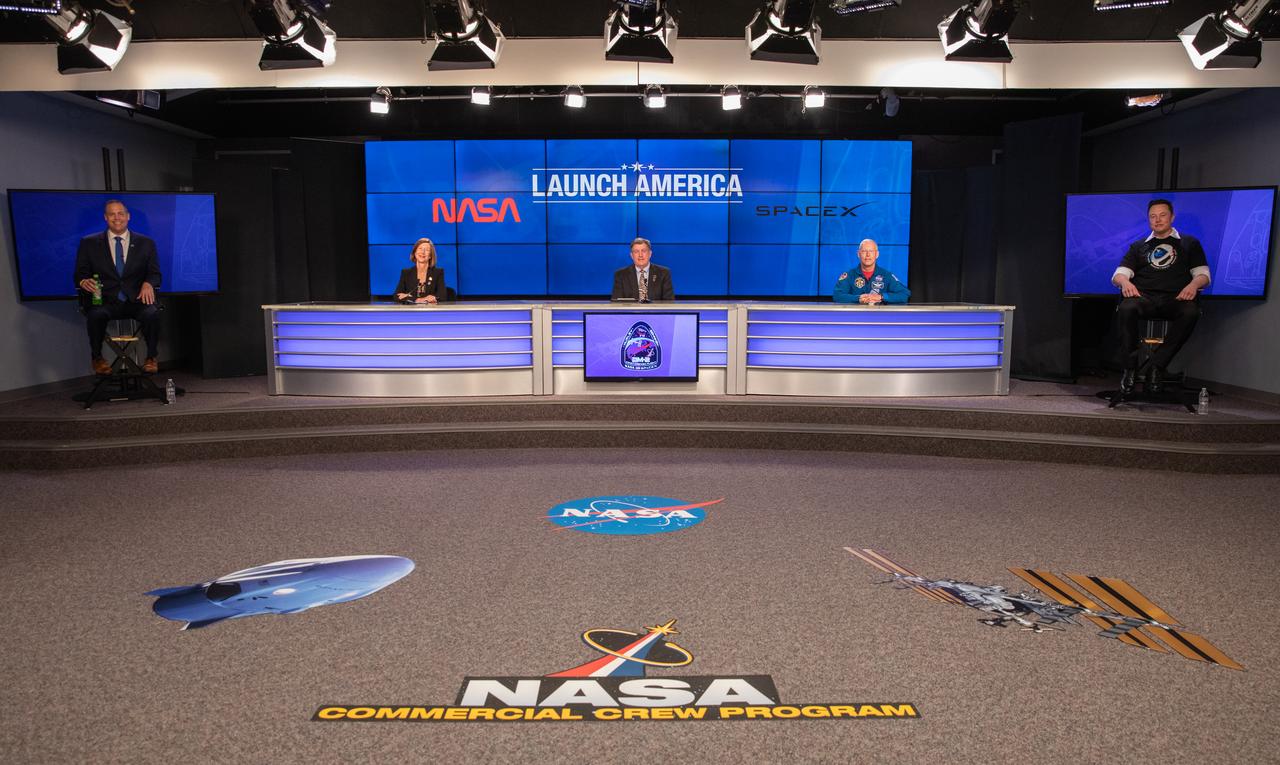
Inside the Press Site auditorium at NASA’s Kennedy Space Center in Florida, NASA and SpaceX officials conduct a postlaunch news conference on May 30, 2020, following the launch of the agency’s SpaceX Demo-2 mission to the International Space Station. From left are: NASA Administrator Jim Bridenstine; NASA Commercial Crew Program Manager Kathy Lueders; NASA International Space Station Program Manager Kirk Shireman; NASA Chief Astronaut Pat Forrester; and Chief Engineer Elon Musk. Liftoff of the SpaceX Falcon 9 rocket and Crew Dragon spacecraft, carrying NASA astronauts Robert Behnken and Douglas Hurley, occurred at 3:22 p.m. EDT from historic Launch Complex 39A. Behnken and Hurley are the first astronauts to launch to the space station from U.S. soil since the end of the Space Shuttle Program in 2011. Part of NASA’s Commercial Crew Program, this will be SpaceX’s final flight test, paving the way for the agency to certify the crew transportation system for regular, crewed flights to the orbiting laboratory.
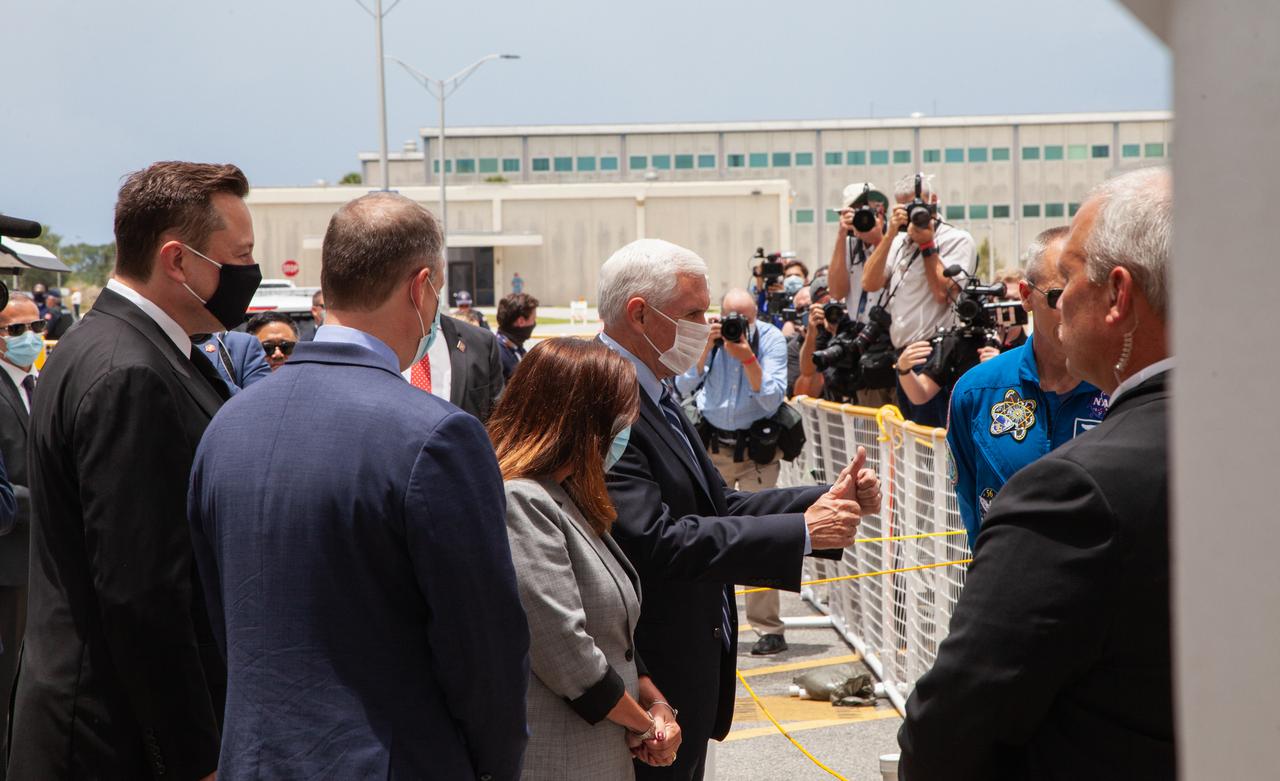
From left, SpaceX CEO and Chief Designer Elon Musk, NASA Administrator Jim Bridenstine, second lady Karen Pence and Vice President Mike Pence wait to greet NASA astronauts Robert Behnken and Douglas Hurley outside of the Neil A. Armstrong Operations and Checkout Building at the agency’s Kennedy Space Center in Florida ahead of NASA’s SpaceX Demo-2 launch. The launch, initially scheduled for May 27, 2020, was scrubbed due to unfavorable weather conditions around Launch Complex 39A. The next launch attempt will be Saturday, May 30. Liftoff of the SpaceX Falcon 9 rocket and Crew Dragon spacecraft is scheduled for 3:22 p.m. EDT from historic Launch Complex 39A. Behnken and Hurley will be the first astronauts to launch to the International Space Station from U.S. soil since the end of the Space Shuttle Program in 2011. Part of NASA’s Commercial Crew Program, this will be SpaceX’s final flight test, paving the way for the agency to certify the crew transportation system for regular, crewed flights to the orbiting laboratory.
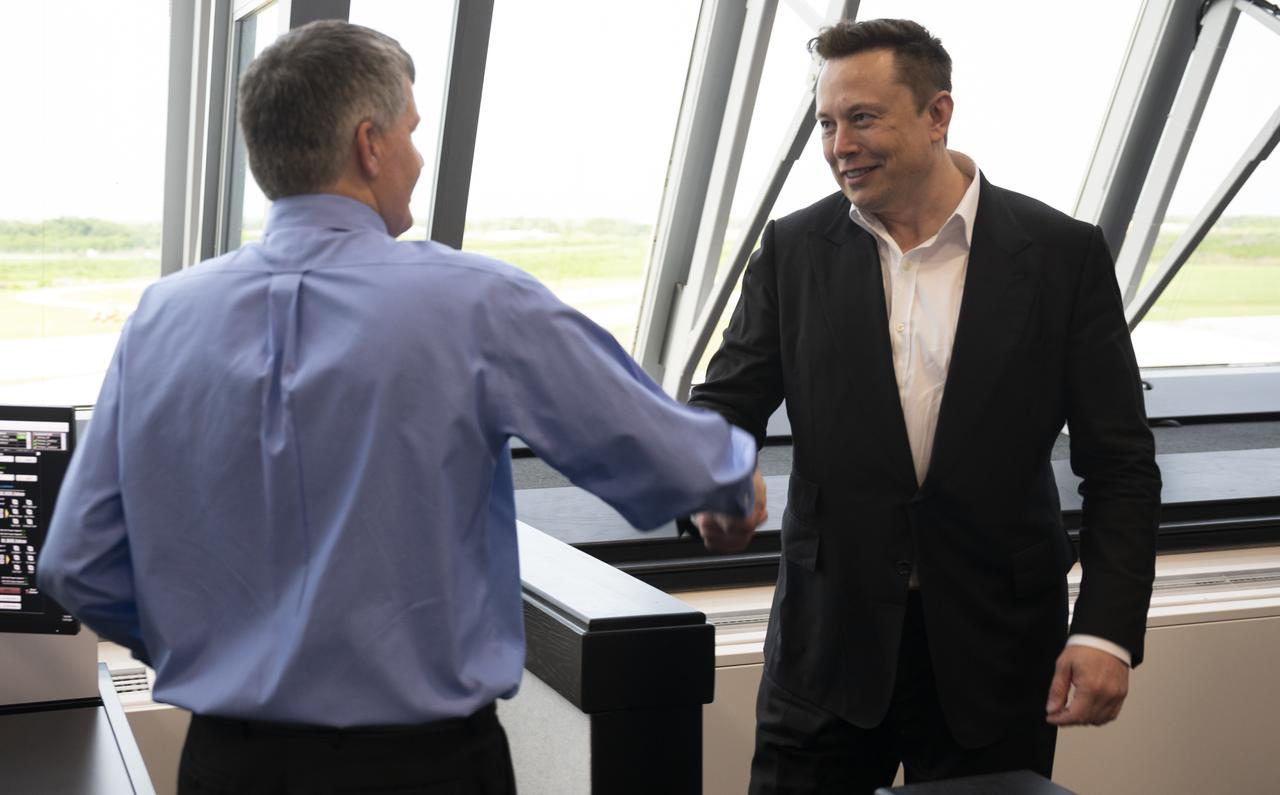
Elon Musk, SpaceX Chief Engineer, shakes hands with Steve Stich, deputy manager of NASA’s Commercial Crew Program, following the launch of a SpaceX Falcon 9 rocket carrying the company's Crew Dragon spacecraft on the Demo-2 mission with NASA astronauts Douglas Hurley and Robert Behnken onboard, Saturday, May 30, 2020, in firing room four of the Launch Control Center at NASA’s Kennedy Space Center in Florida. NASA’s SpaceX Demo-2 mission is the first launch with astronauts of the SpaceX Crew Dragon spacecraft and Falcon 9 rocket to the International Space Station as part of the agency’s Commercial Crew Program. The test flight serves as an end-to-end demonstration of SpaceX’s crew transportation system. Behnken and Hurley launched at 3:22 p.m. EDT on Saturday, May 30, from Launch Complex 39A at the Kennedy Space Center. A new era of human spaceflight is set to begin as American astronauts once again launch on an American rocket from American soil to low-Earth orbit for the first time since the conclusion of the Space Shuttle Program in 2011. Photo Credit: (NASA/Joel Kowsky)