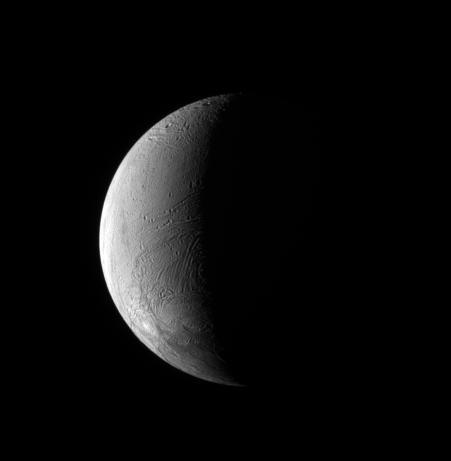
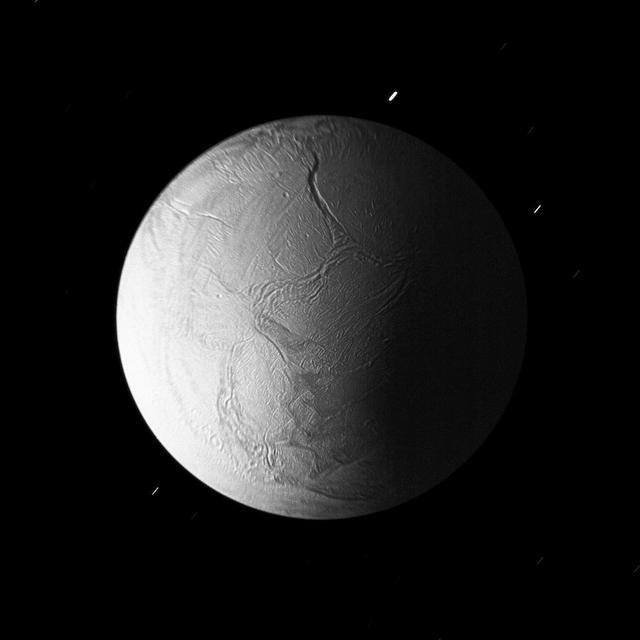
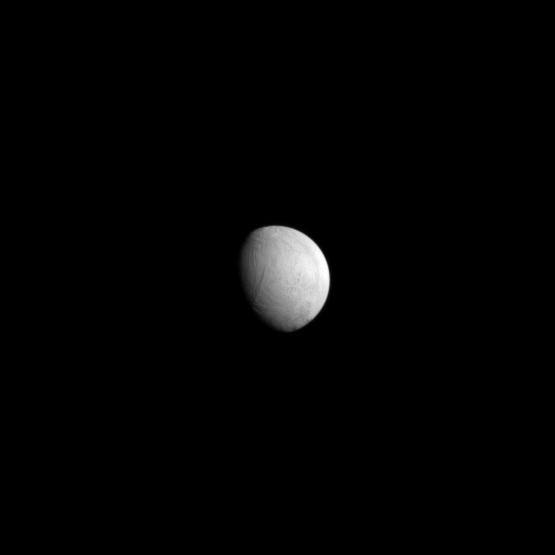
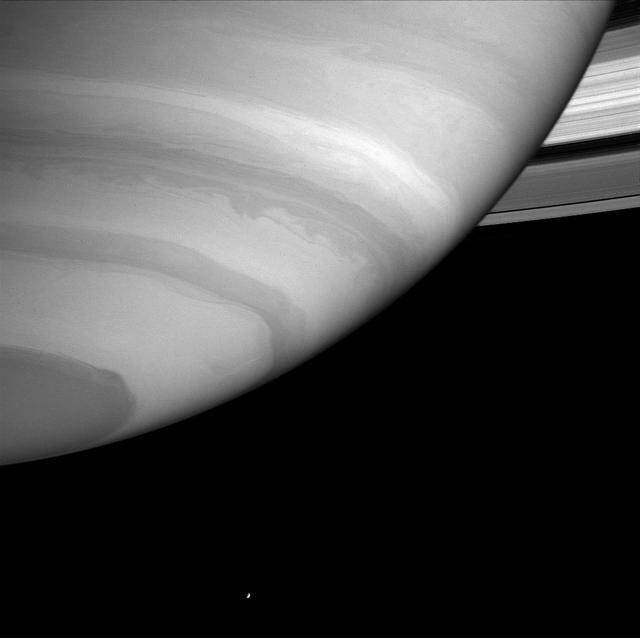
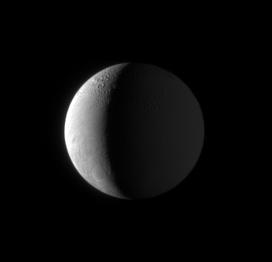
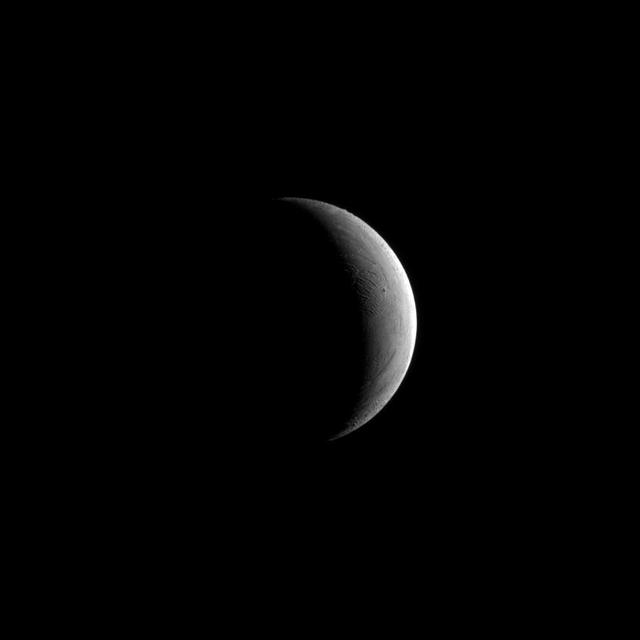
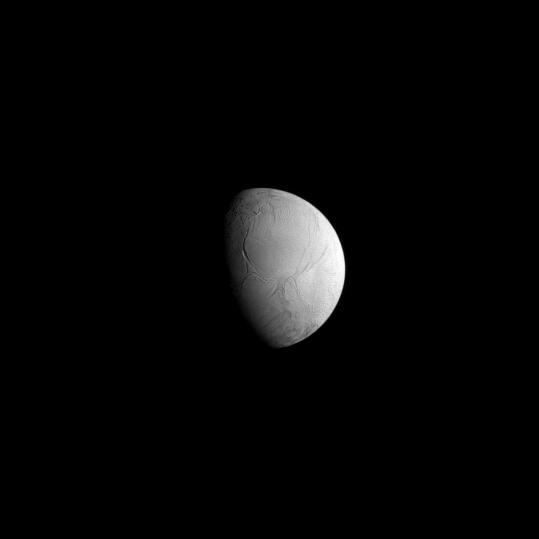
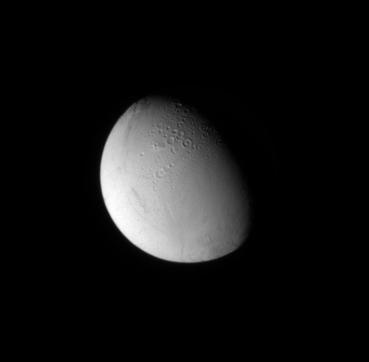
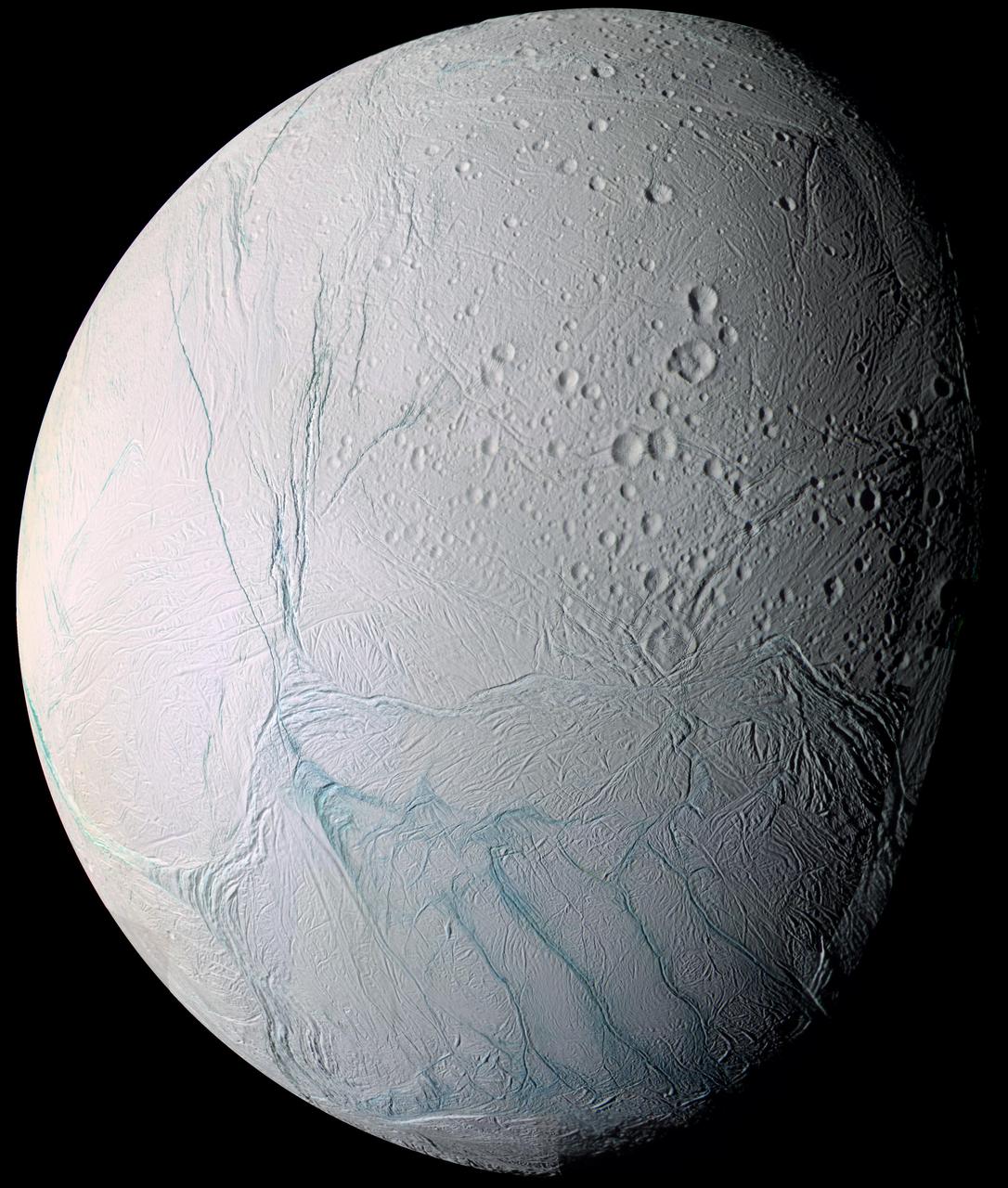
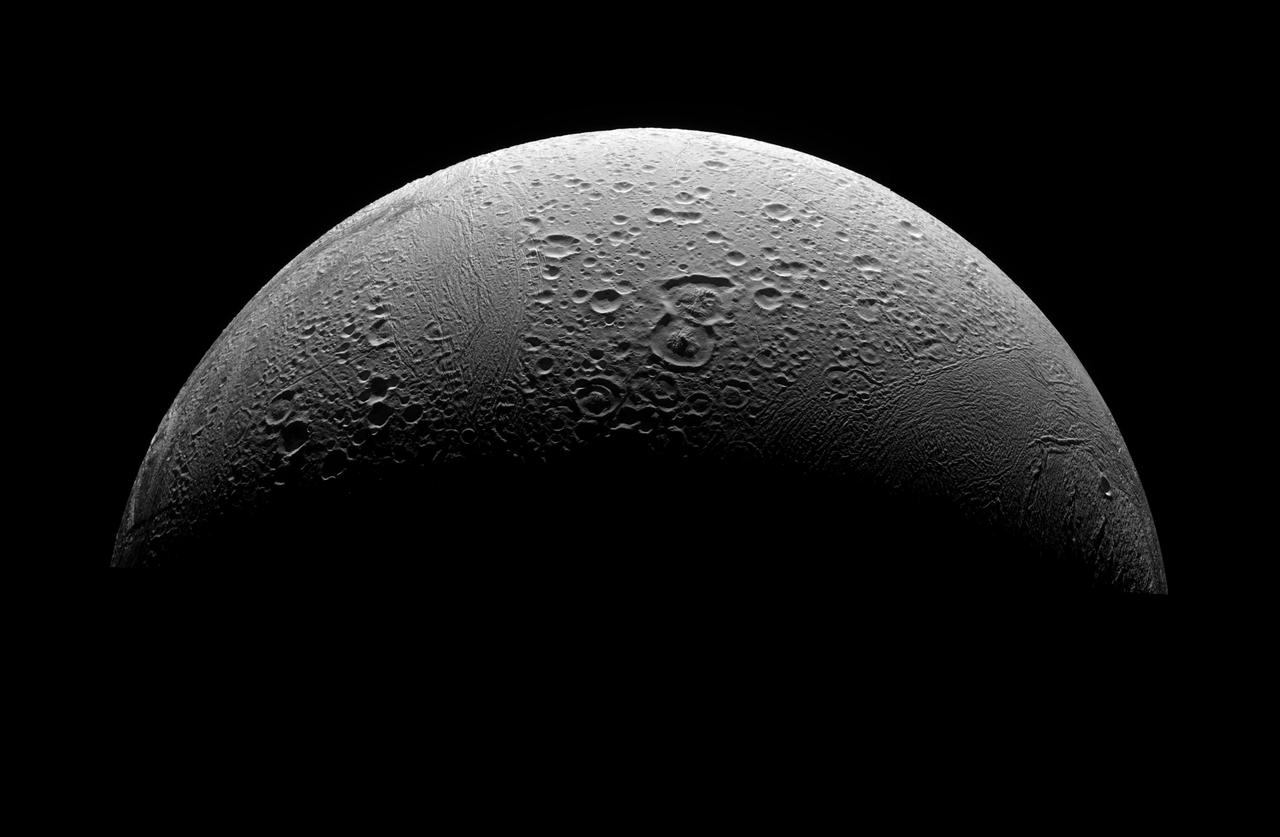
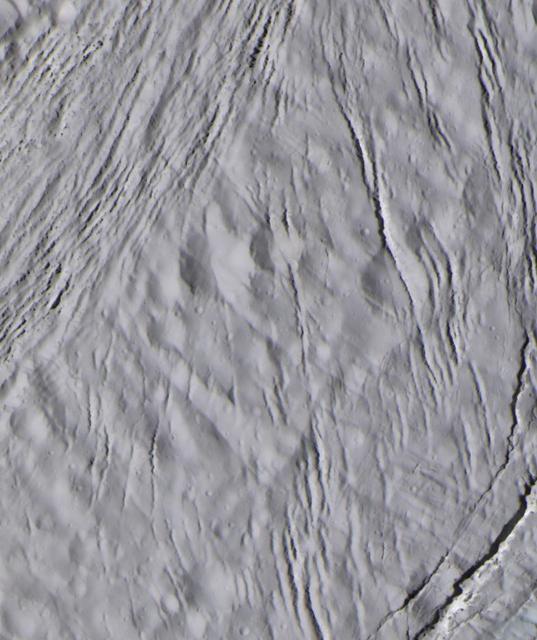
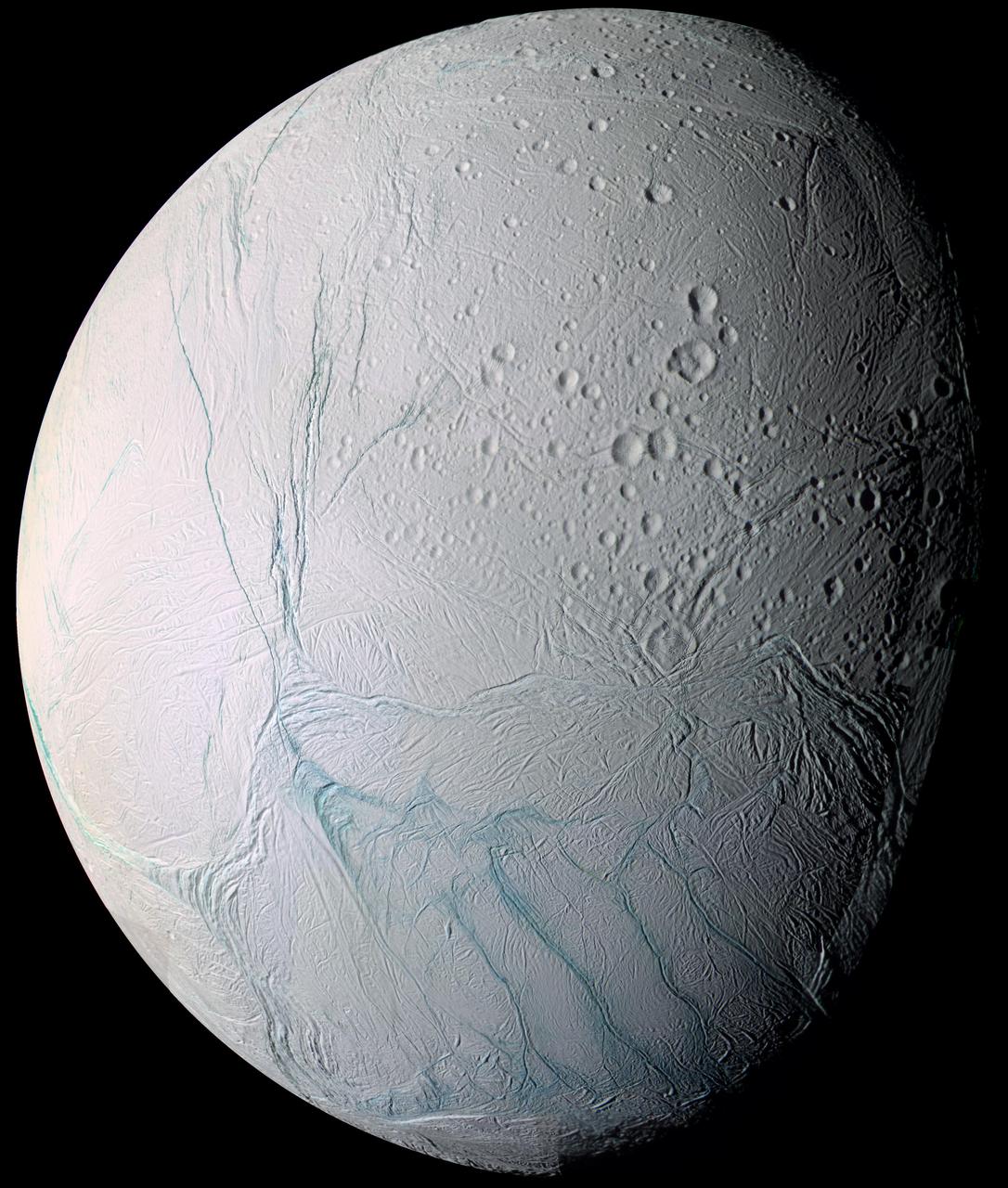
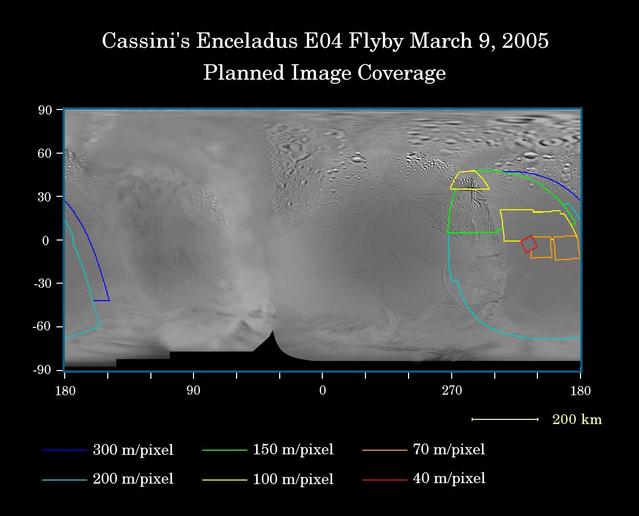
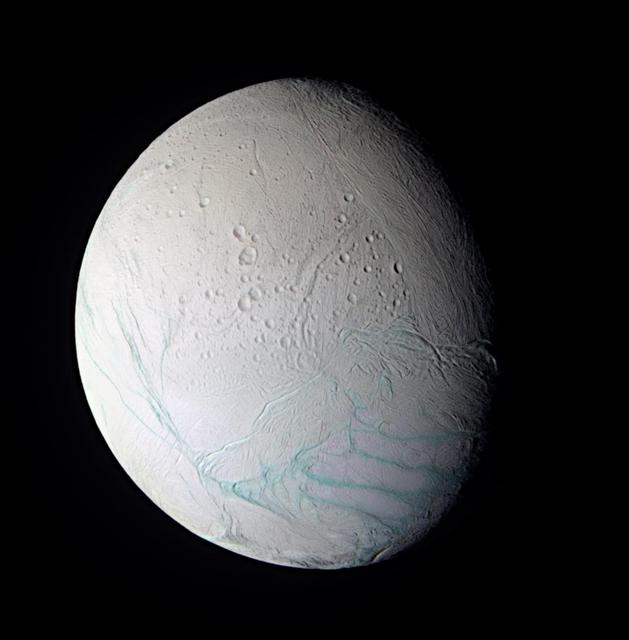
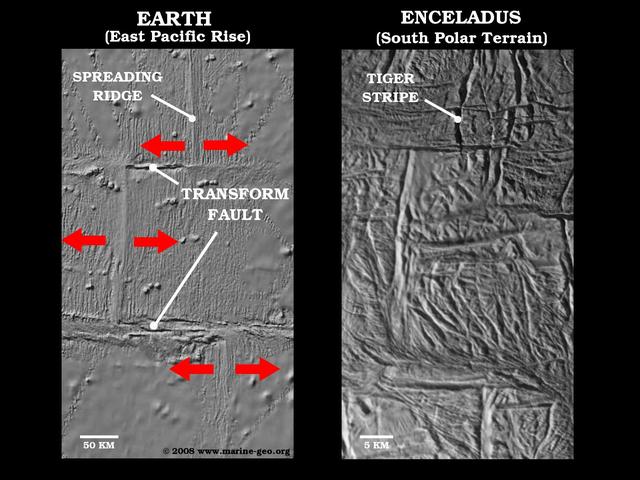
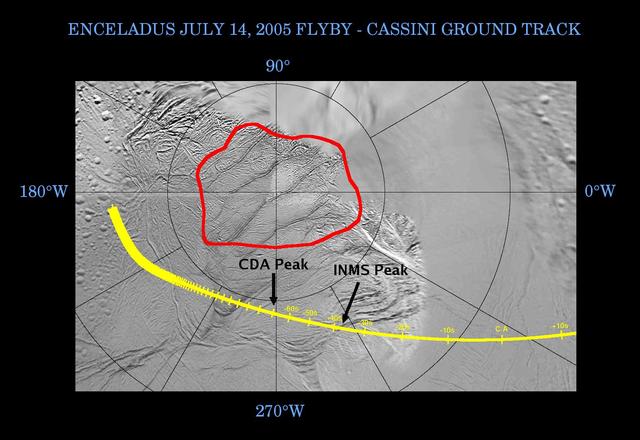
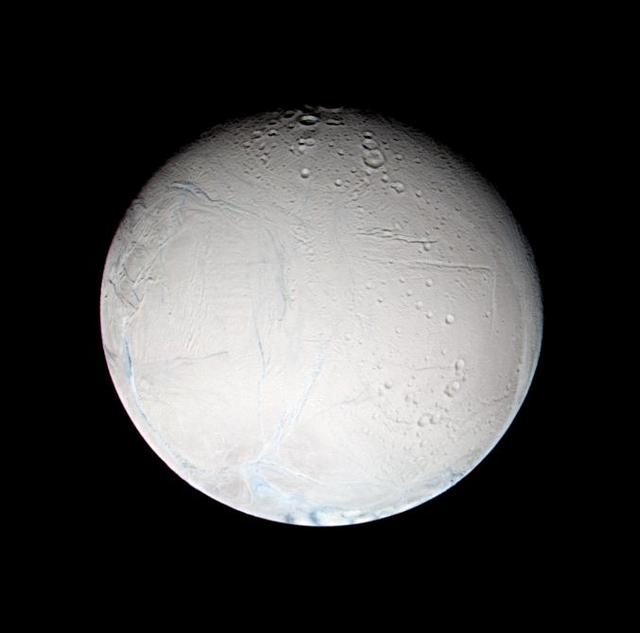
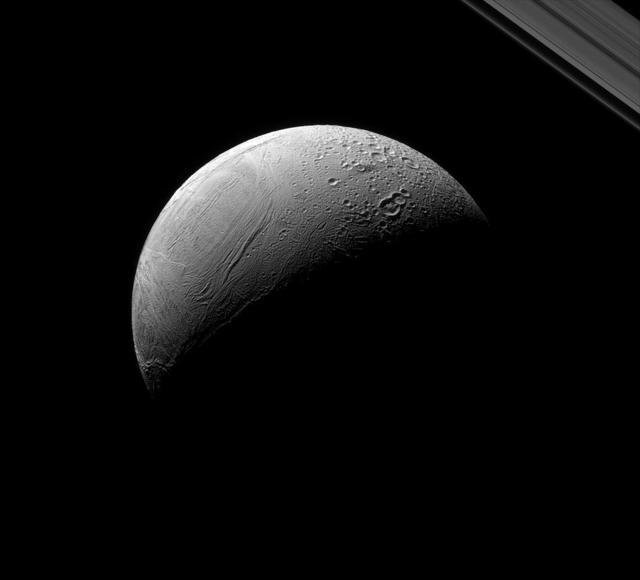
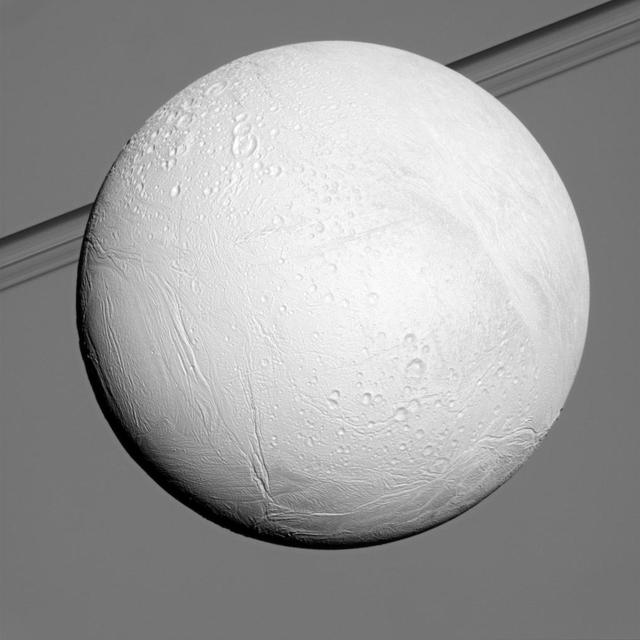
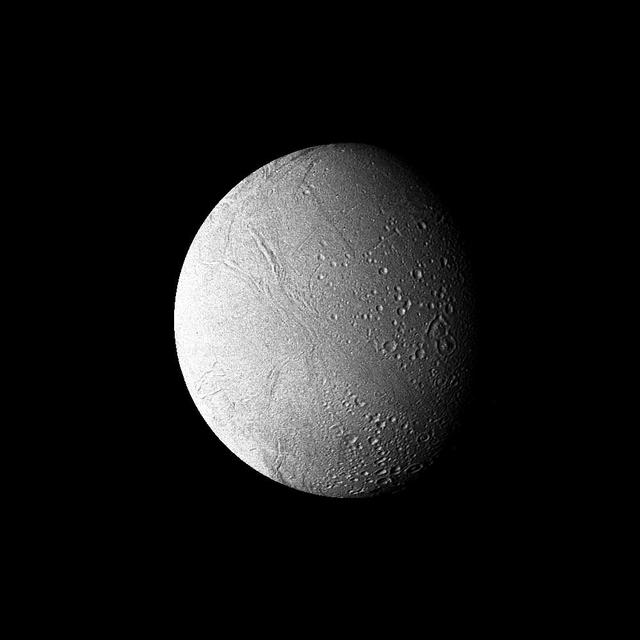
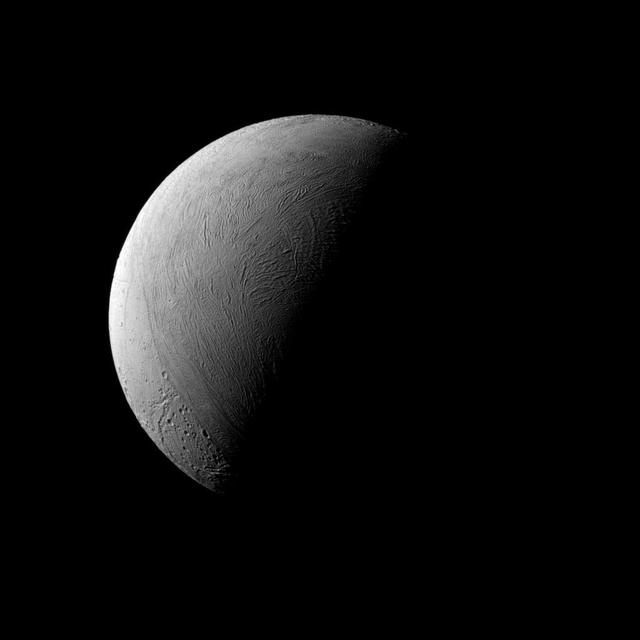
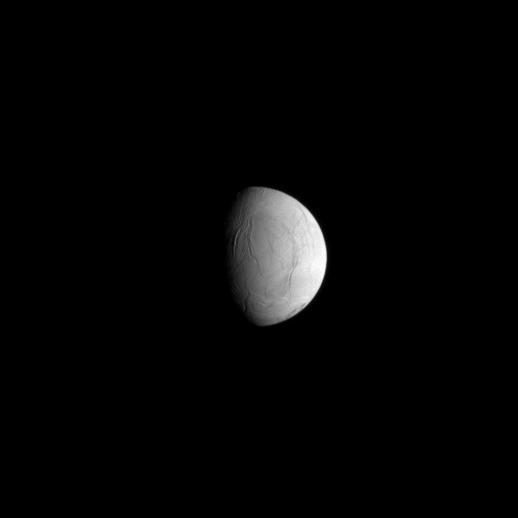
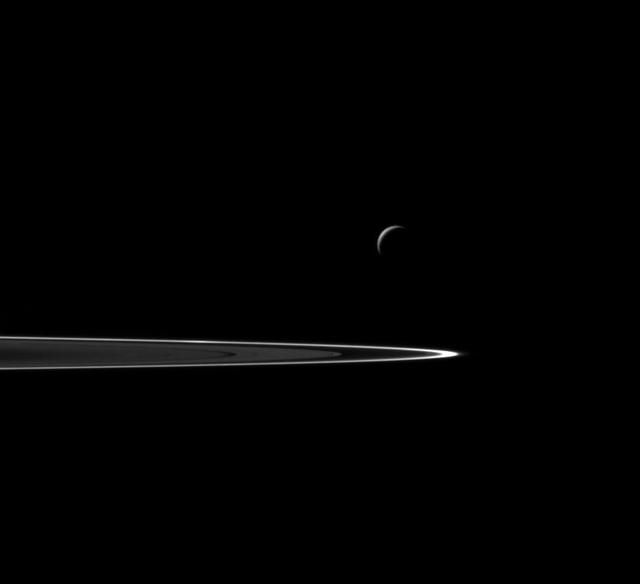
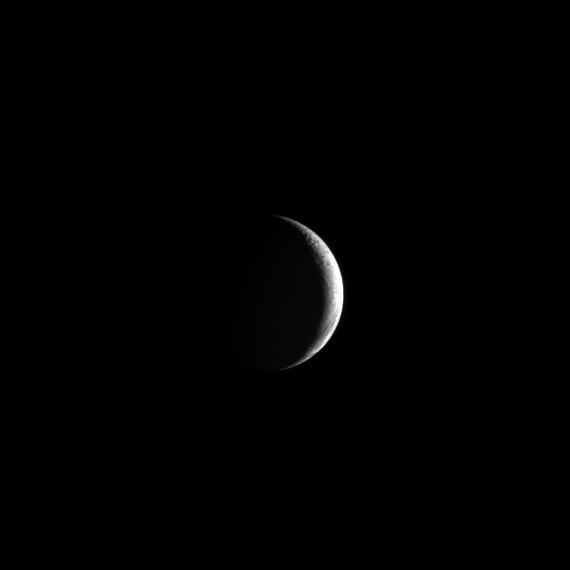
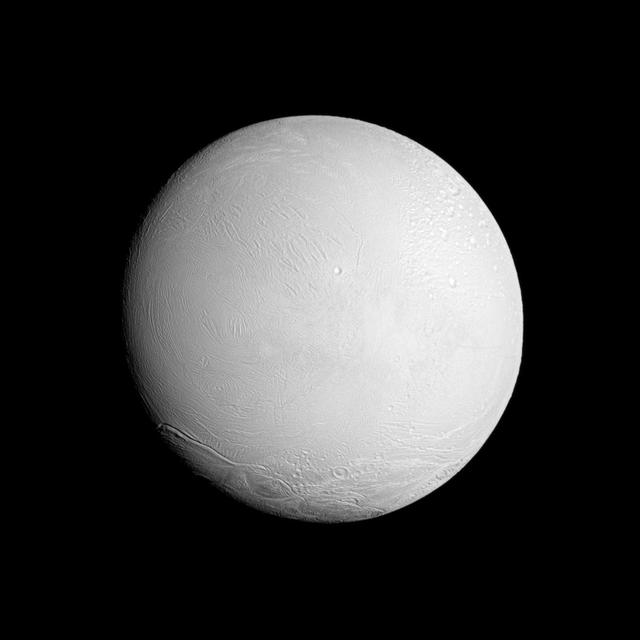
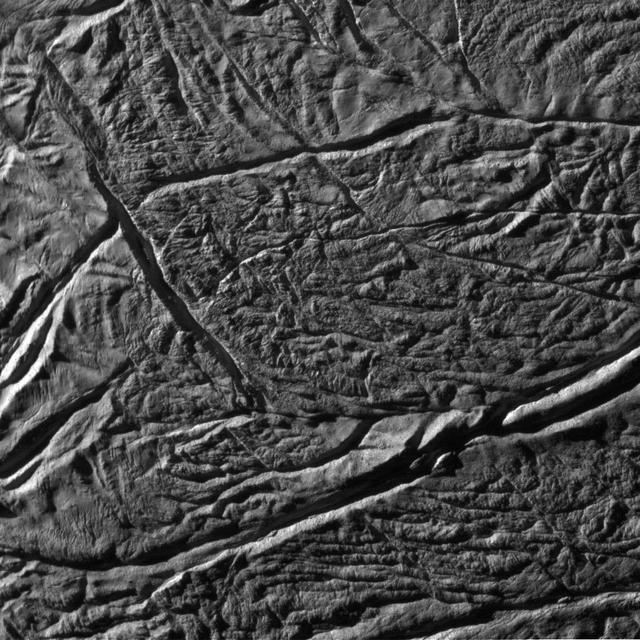
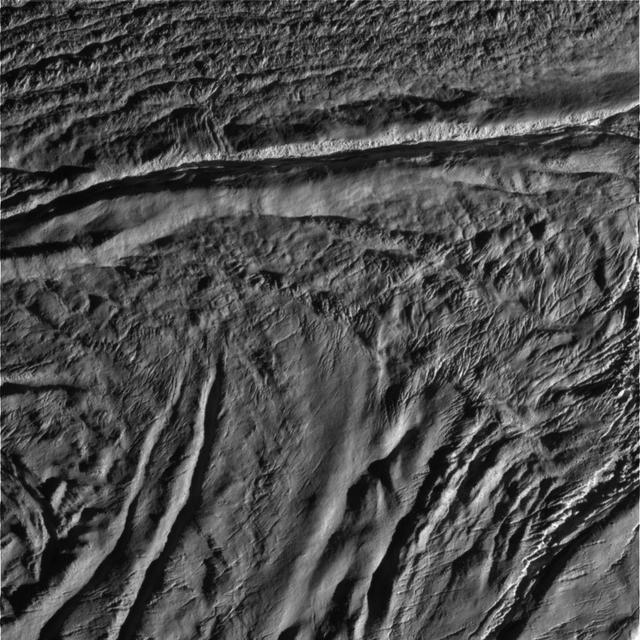
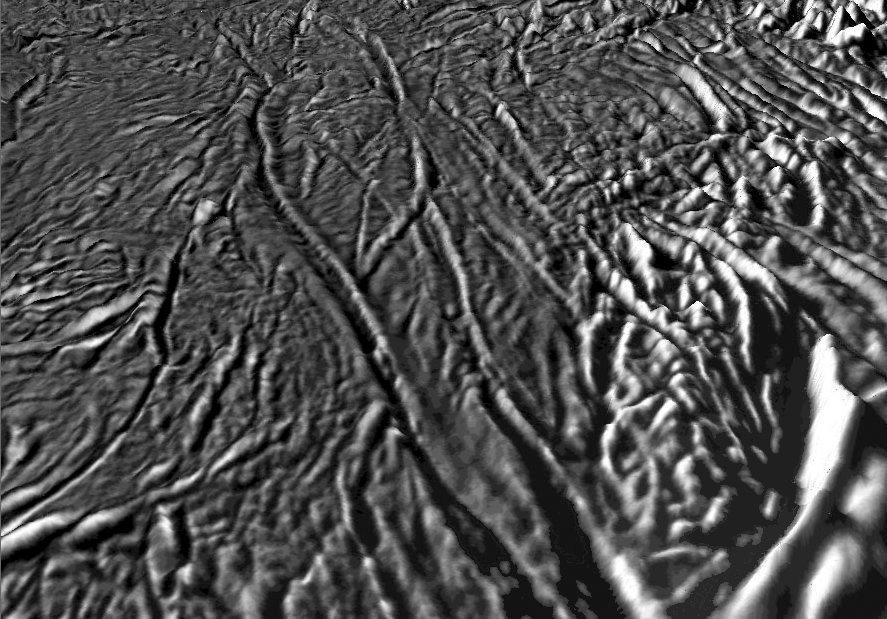
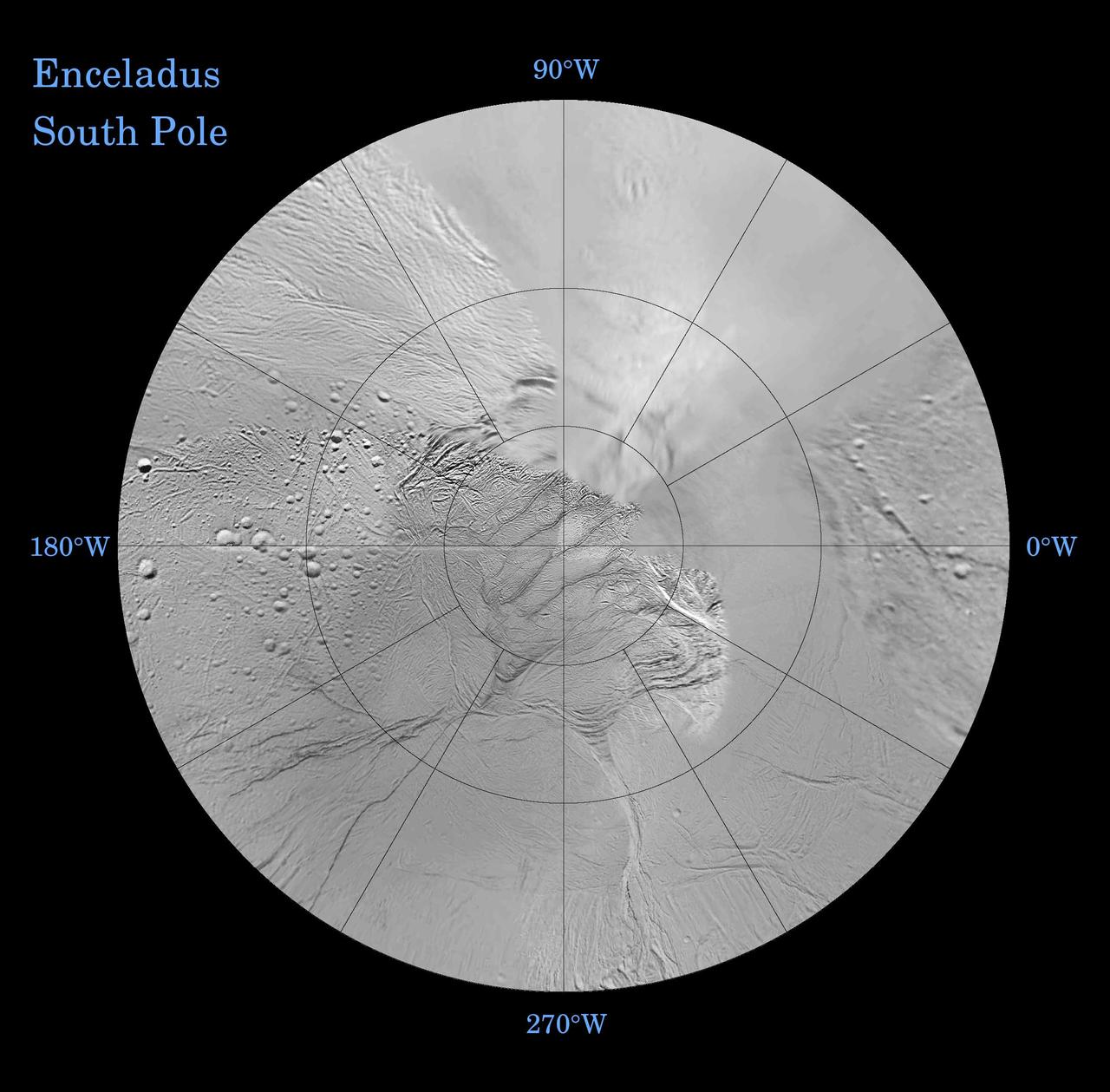
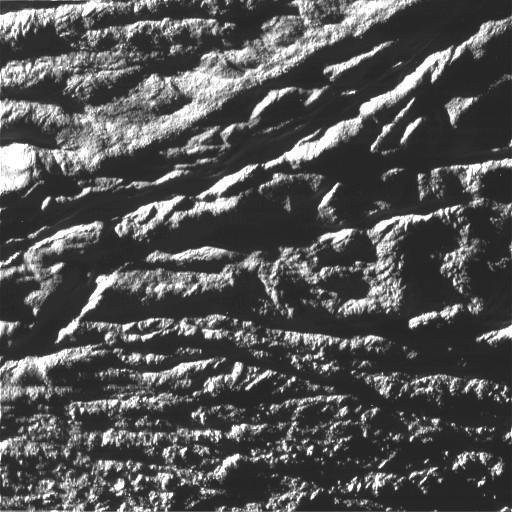
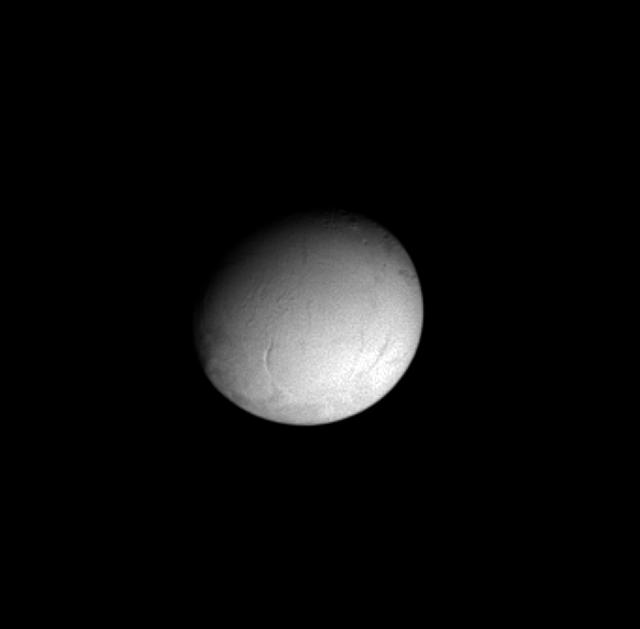
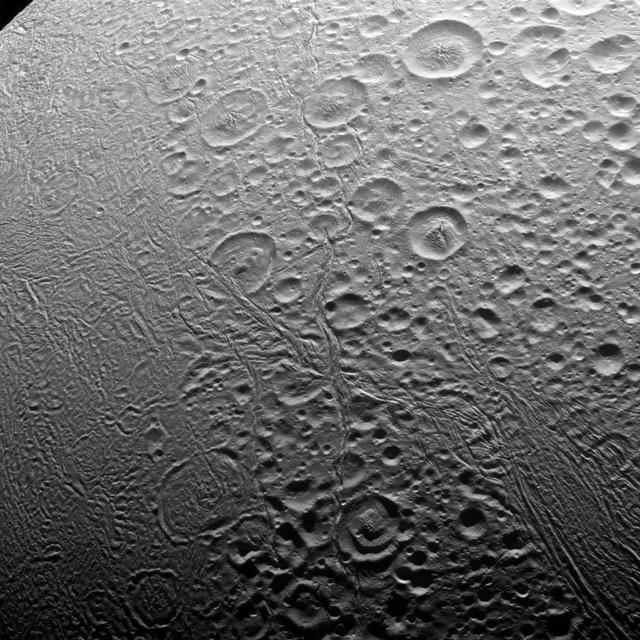
NASA's Cassini spacecraft captured this view as it neared icy Enceladus for its closest-ever dive past the moon's active south polar region. The view shows heavily cratered northern latitudes at top, transitioning to fractured, wrinkled terrain in the middle and southern latitudes. The wavy boundary of the moon's active south polar region -- Cassini's destination for this flyby -- is visible at bottom, where it disappears into wintry darkness. This view looks towards the Saturn-facing side of Enceladus. North on Enceladus is up and rotated 23 degrees to the right. The image was taken in visible light with the Cassini spacecraft narrow-angle camera on Oct. 28, 2015. The view was acquired at a distance of approximately 60,000 miles (96,000 kilometers) from Enceladus and at a Sun-Enceladus-spacecraft, or phase, angle of 45 degrees. Image scale is 1,896 feet (578 meters) per pixel. The Cassini mission is a cooperative project of NASA, ESA (the European Space Agency) and the Italian Space Agency. The Jet Propulsion Laboratory, a division of the California Institute of Technology in Pasadena, manages the mission for NASA's Science Mission Directorate, Washington. The Cassini orbiter and its two onboard cameras were designed, developed and assembled at JPL. The imaging operations center is based at the Space Science Institute in Boulder, Colorado. For more information about the Cassini-Huygens mission visit http://saturn.jpl.nasa.gov and http://www.nasa.gov/cassini. The Cassini imaging team homepage is at http://ciclops.org.
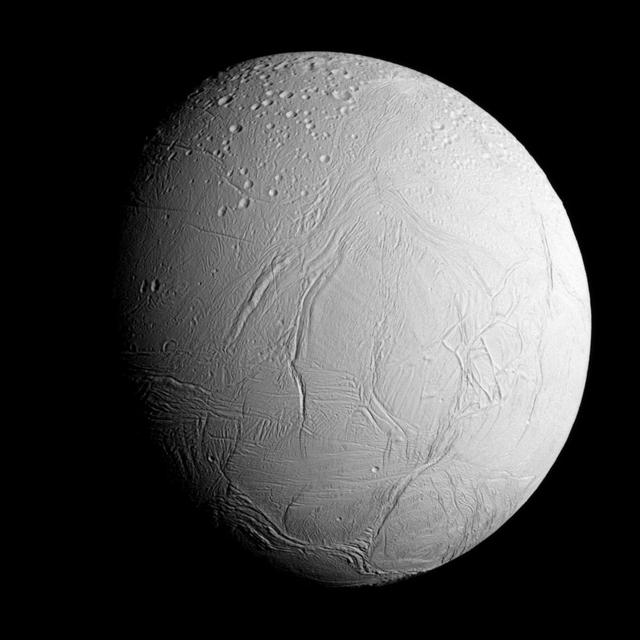
Approaching Enceladus
Surface of Enceladus
Enceladus Plume
Enceladus Plume
Intriguing Enceladus
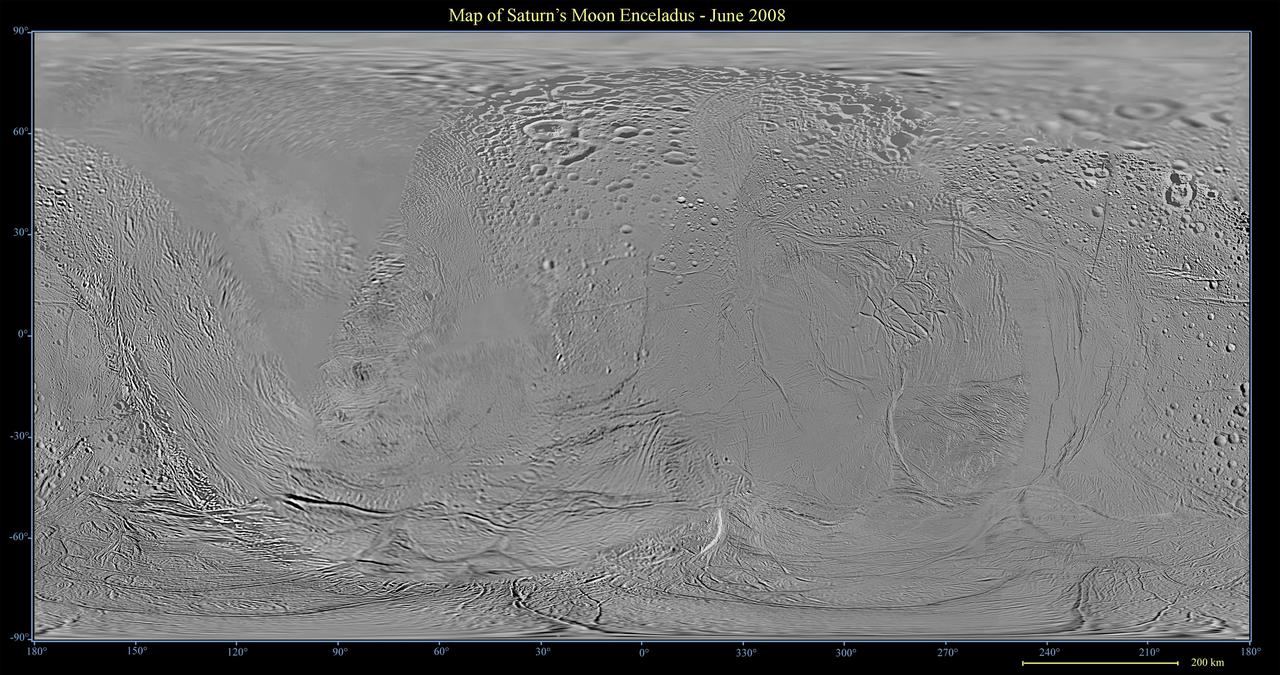
The Enceladus Atlas
The Enceladus Atlas
Transition on Enceladus
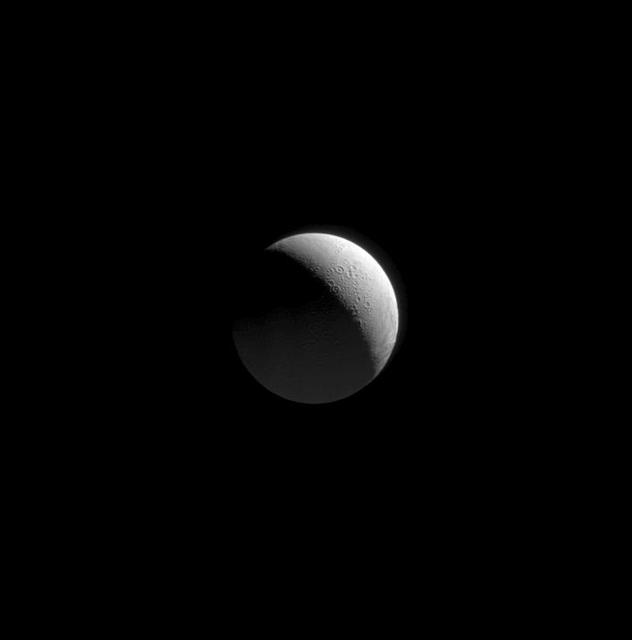
Crescent Enceladus
Crescent Enceladus
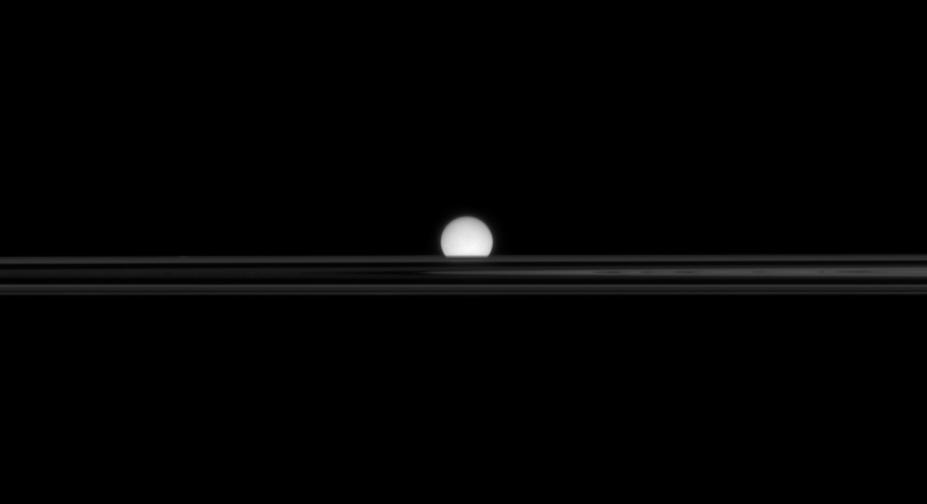
Occulting Enceladus
Occulting Enceladus
Focus on Enceladus
Focus on Enceladus
Map of Enceladus
Map of Enceladus
Youthful Enceladus
Youthful Enceladus
The Enceladus Ring
The Enceladus Ring
Enceladus in the Distance
Enceladus Afar
Enceladus Afar
Icy Enceladus
Icy Enceladus
Enceladus Mosaic
Enceladus Mosaic
Enceladus in Eclipse
Icy Enceladus
Icy Enceladus
Serene Enceladus
Serene Enceladus
Atmosphere and Enceladus
On Approach to Enceladus
Sounds of Enceladus
Sounds of Enceladus
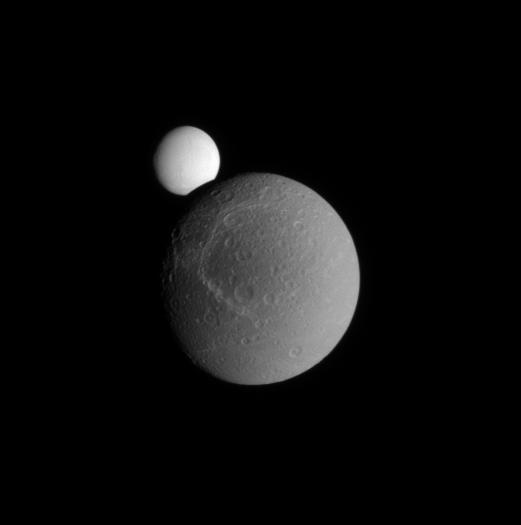
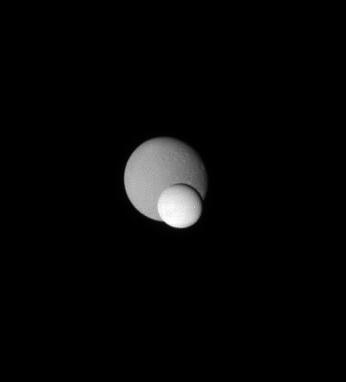
Enceladus and Dione
Enceladus and Dione
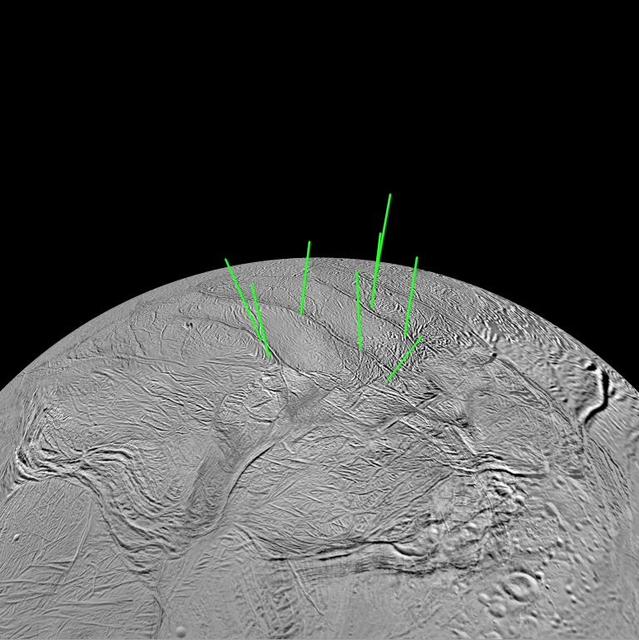
Enceladus Jets
Enceladus Jets
Approaching Enceladus
Enceladus in Hiding
Enceladus in Hiding
Closer to Enceladus
Closer to Enceladus
The Saturnian Moon Enceladus
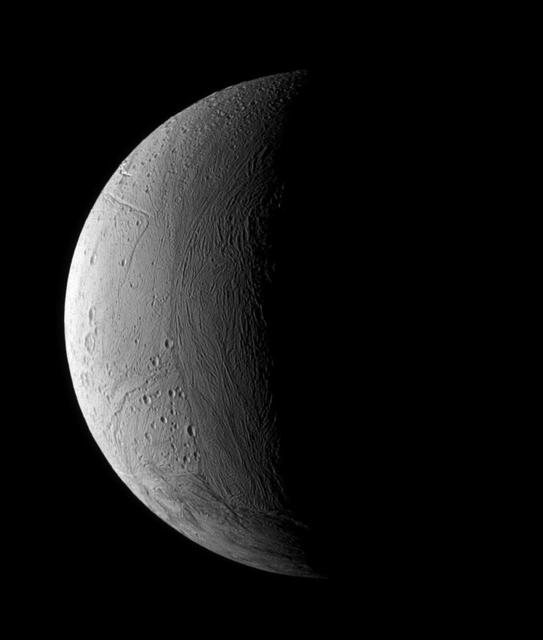
NASA Cassini spacecraft captures a crescent of Saturn moon Enceladus. Lit terrain seen here is in the area between the leading hemisphere and Saturn-facing side of Enceladus 504 kilometers, or 313 miles across. North on Enceladus is up.
Sliver of Enceladus
Distant Details on Enceladus
Smooth and Rough Enceladus
Zooming In On Enceladus Movie
The North Polar Region of Enceladus
Reconstructing the Past on Enceladus
Ancient Terrain on Enceladus
The Southern Hemisphere of Enceladus
Map of Enceladus - February 2010
Baghdad and Cairo Sulci on Enceladus
Enceladus Atmosphere -- Star Struck
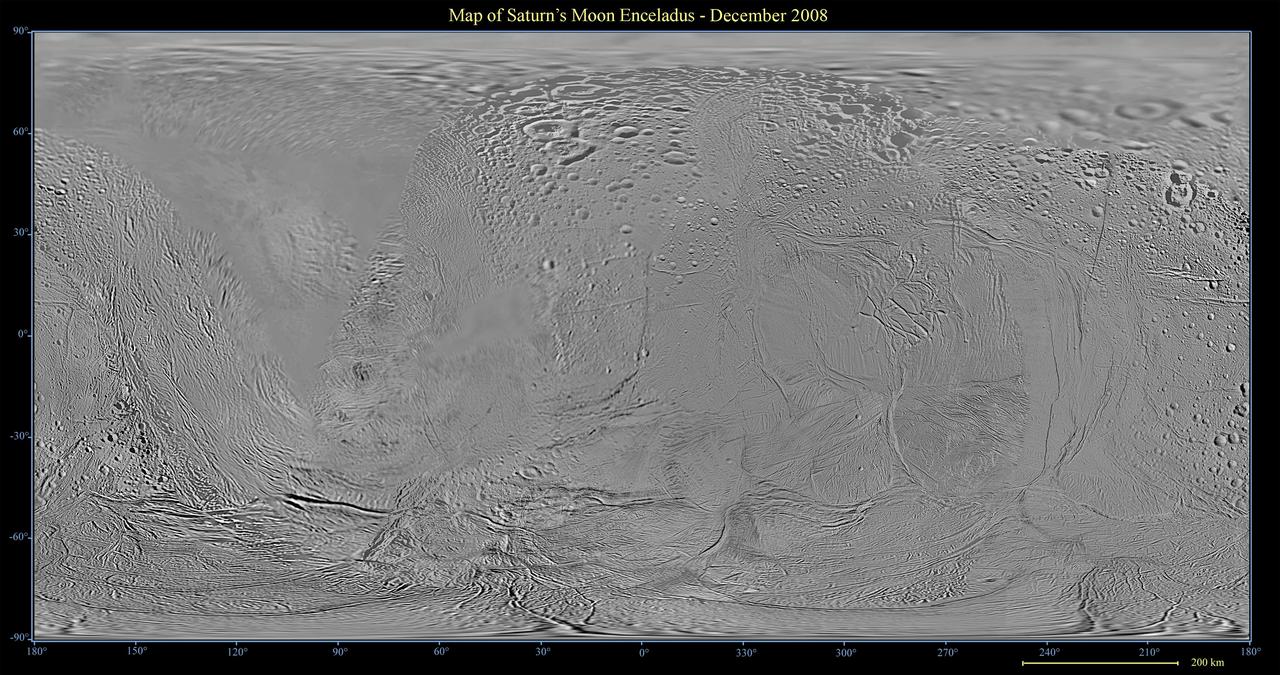
Map of Enceladus - December 2008
Spray Above Enceladus III
Shear Heating on Enceladus
Close Brush with Enceladus
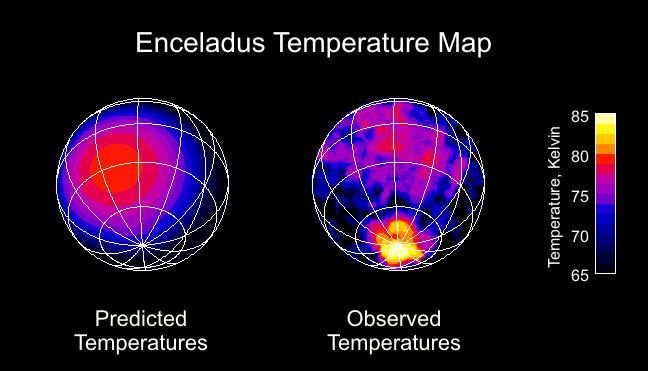
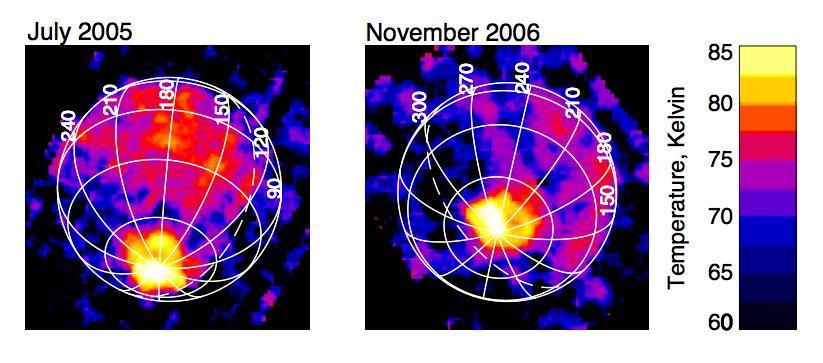
Enceladus Temperature Map
Cracked Face of Enceladus
Damascus Sulcus on Enceladus
Stressed-out Enceladus
Zooming In On Enceladus Mosaic
Enceladus First Flyby
Ghostly Fingers of Enceladus
Comets and Enceladus - Similar Chemistry
Enceladus Atmosphere Not Global
Atmosphere on Enceladus Artist Concept
Spray Above Enceladus II
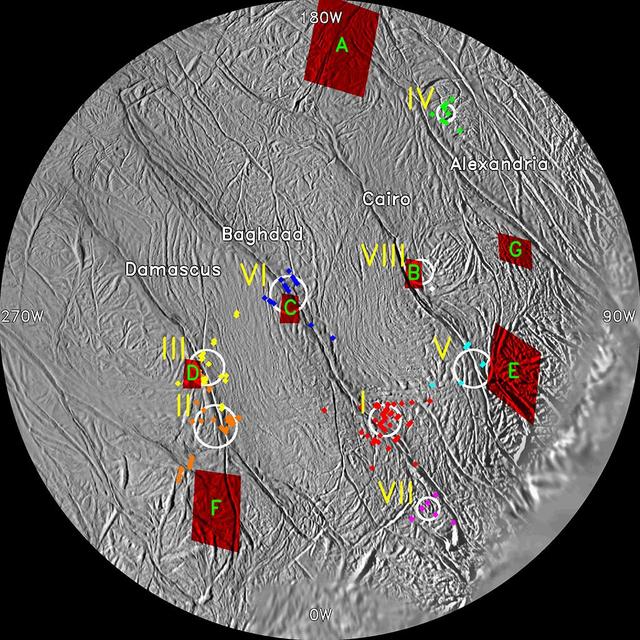
Enceladus Jet Sources
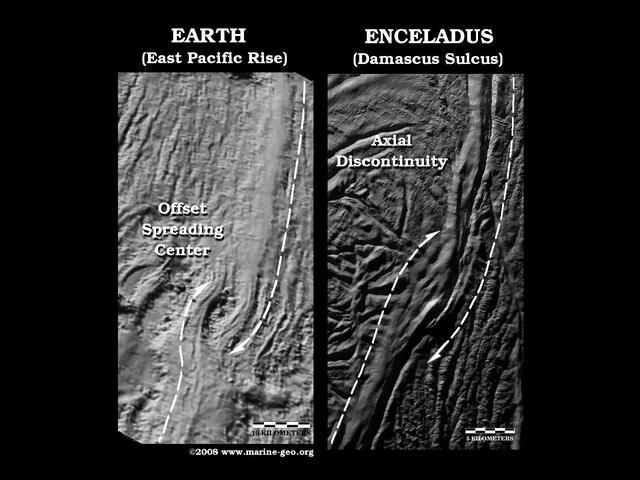
Enceladus Offset Spreading Center
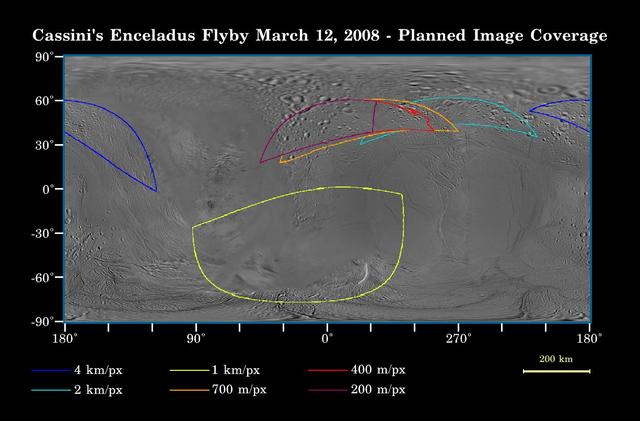
Cassini Closest Enceladus Flyby
Enceladus In False Color
Spreading Ridge Transforms On Enceladus
Enceladus: The Plot Thickens
False Color Look at Enceladus
Enceladus dramatically displays the contrast between its older and newer terrain as seen by NASA Cassini spacecraft. This view looks toward the anti-Saturn side of Enceladus. North on Enceladus is up and rotated 36 degrees to the right.
Enceladus, Old and New
Enceladus Keeps the Home Fires Burning
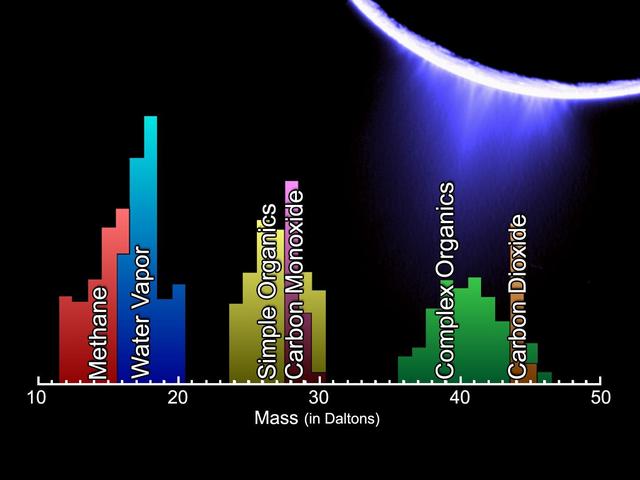
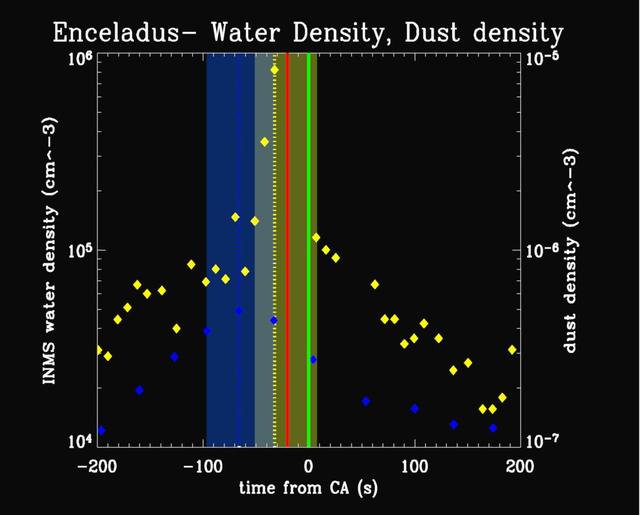
Enceladus Plume Neutral Mass Spectrum
Enceladus Polar Maps - February 2010
Cassini Views Enceladus Up-Close
Water Vapor & Particles Over Enceladus
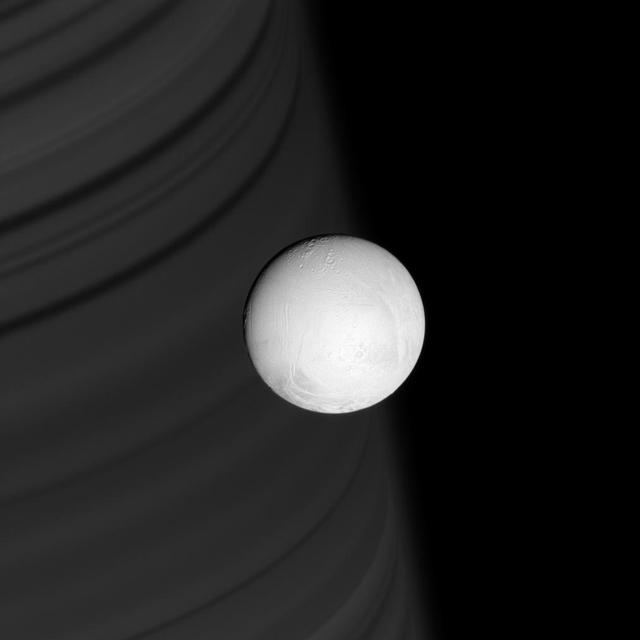
Saturn moon Enceladus reflects sunlight brightly while the planet and its rings fill the background in this view from NASA Cassini spacecraft. Enceladus is one of the most reflective bodies in the solar system.
Bright Enceladus
Saturn - High-resolution Filtered Image of Enceladus
This half-lit view of Enceladus bears a passing resemblance to similar views of Earth's own natural satellite, but the similarities end there. Earth's rocky moon is covered in dark, volcanic basins and brighter, mountainous highlands -- both exceedingly ancient. The surface of icy Enceladus is uniformly bright, far brighter than Earth's moon. Large areas of Enceladus' surface are characterized by youthful (on geologic timescales), wrinkled terrains.  Although the north pole of Enceladus (313 miles or 504 kilometers across) was dark when Cassini arrived at Saturn, the march of the seasons at Saturn have brought sunlight to the north and taken it from the south.  This view looks toward the leading hemisphere of Enceladus. North on Encealdus is up. The image was taken in visible light with the Cassini spacecraft narrow-angle camera on Sept. 8, 2015.  The view was acquired at a distance of approximately 80,000 miles (129,000 kilometers) from Enceladus. Image scale is 2,530 feet (772 meters) per pixel.  http://photojournal.jpl.nasa.gov/catalog/PIA18351
A Half-Enceladus
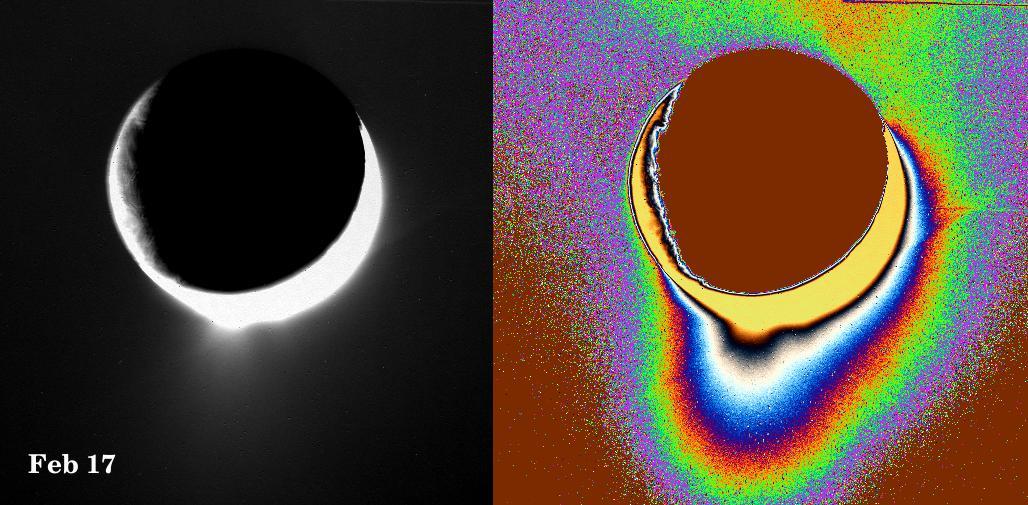
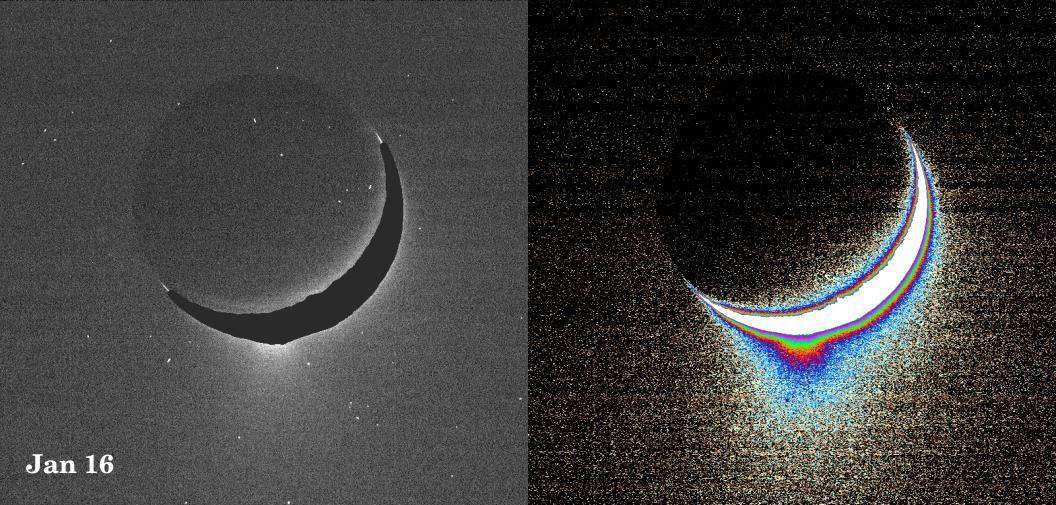
This set of images from NASA Cassini mission shows the difference in the amount of spray emanating from Saturn moon Enceladus.
Enceladus On and Off
The Cassini spacecraft looks toward the varied surface of the trailing hemisphere of Saturn moon Enceladus.
Trailing Enceladus
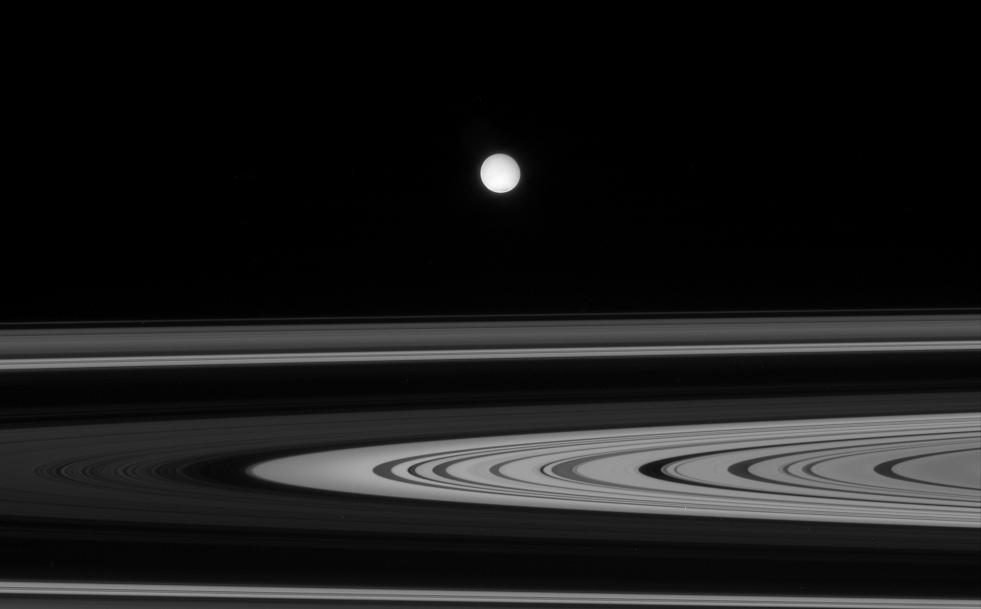
Following a successful close flyby of Enceladus, NASA Cassini spacecraft captured this artful composition of the icy moon with Saturn rings beyond.
Departing Enceladus
Evoking the haunting beauty of Earth Moon, a crescent Enceladus appears in the skies around Saturn in this image captured by NASA Cassini spacecraft.
Crescent Enceladus
NASA Cassini spacecraft looks at a brightly illuminated Enceladus and examines the surface of the leading hemisphere of this Saturnian moon.
Brilliant Enceladus
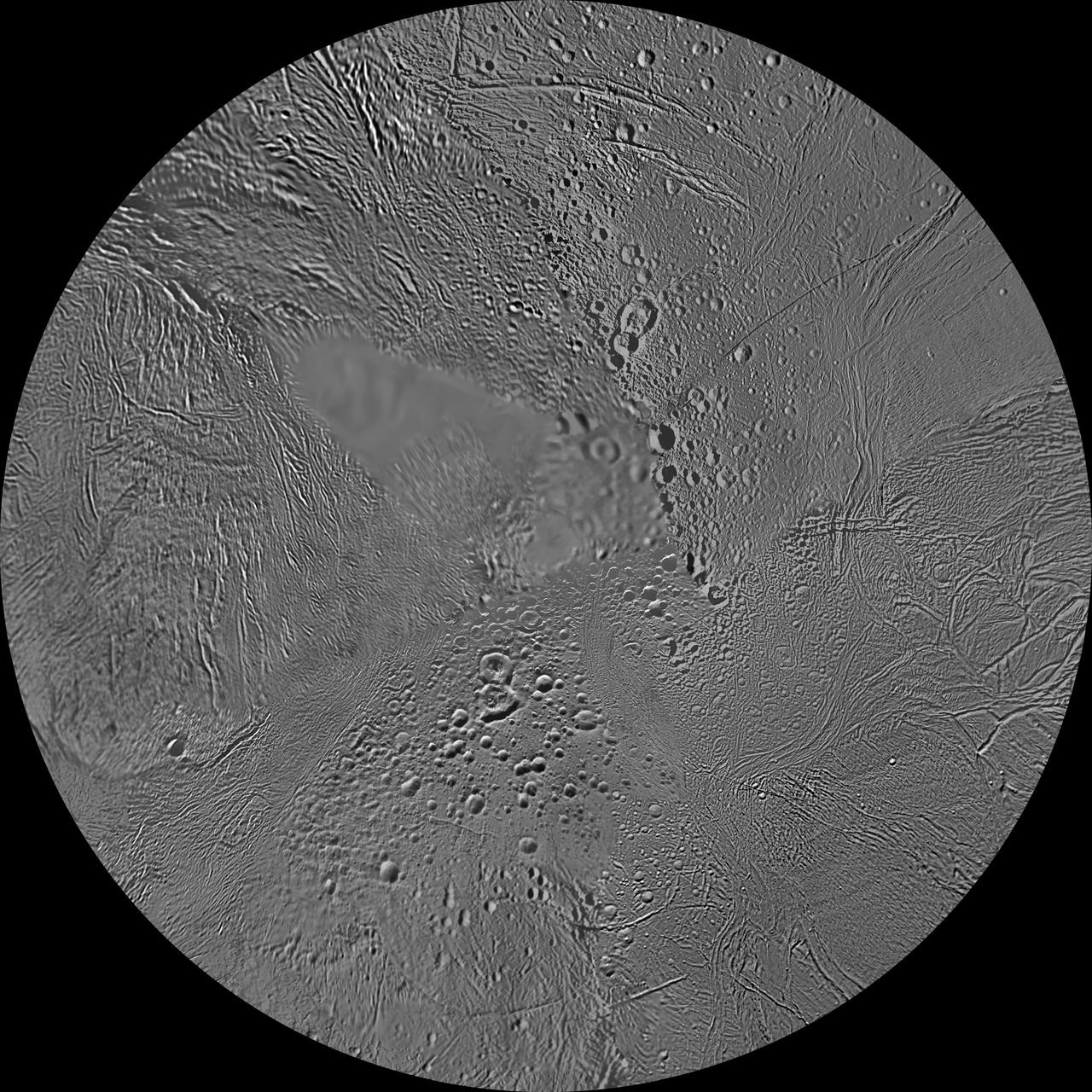
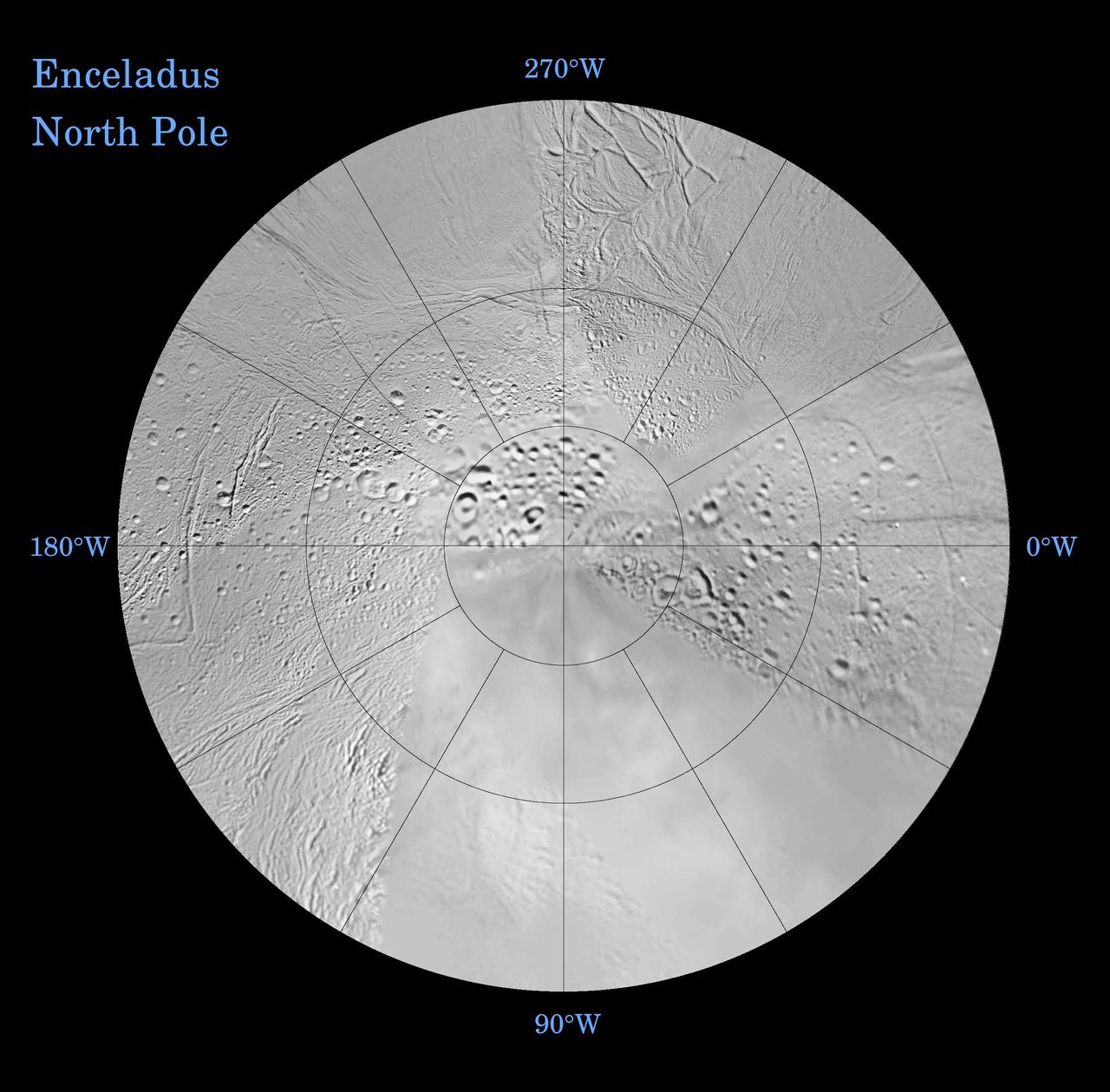
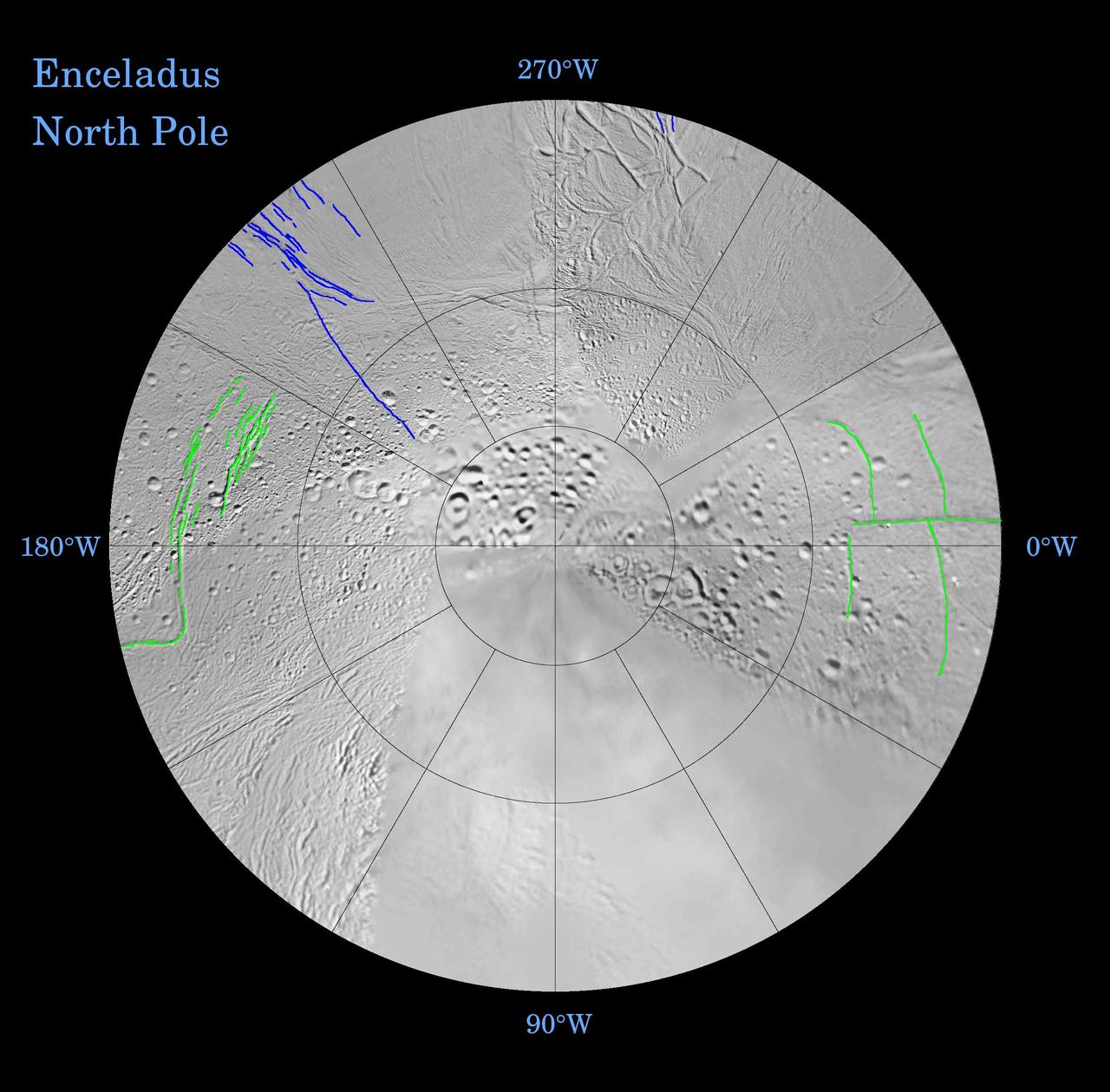
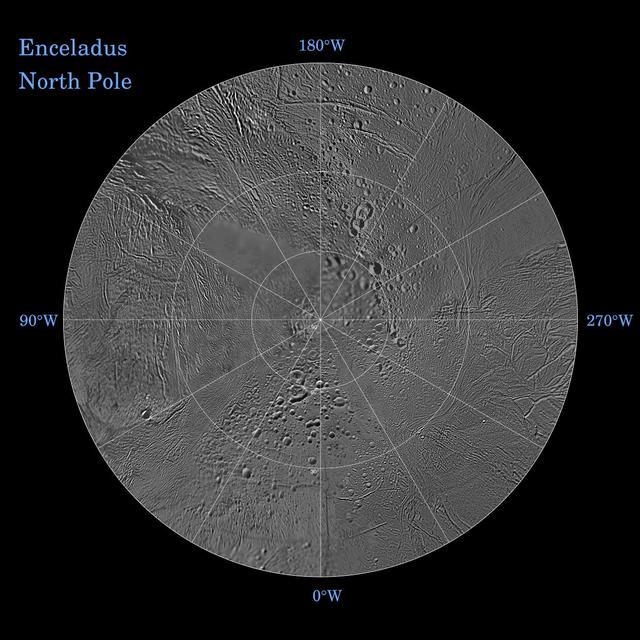
Enceladus: North and South Northern Polar Projection
Enceladus: Global Patterns of Fracture Northern Polar Projection
Enceladus Rev 91 Flyby - Skeet Shoot #8
Enceladus Rev 91 Flyby - Skeet Shoot #1
Enceladus Rev 91 Flyby - Skeet Shoot #9
Enceladus Rev 80 Flyby Skeet Shoot #7
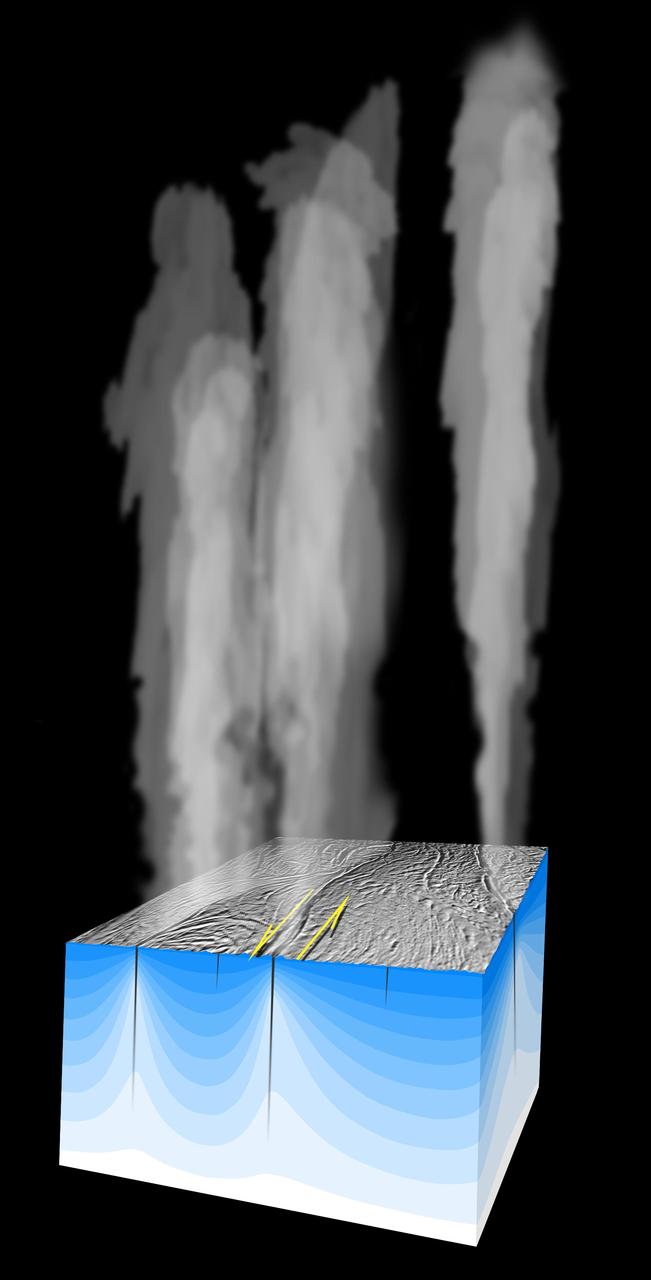
Tiger Stripes on Enceladus - Fracture Zones and Plumes Sources
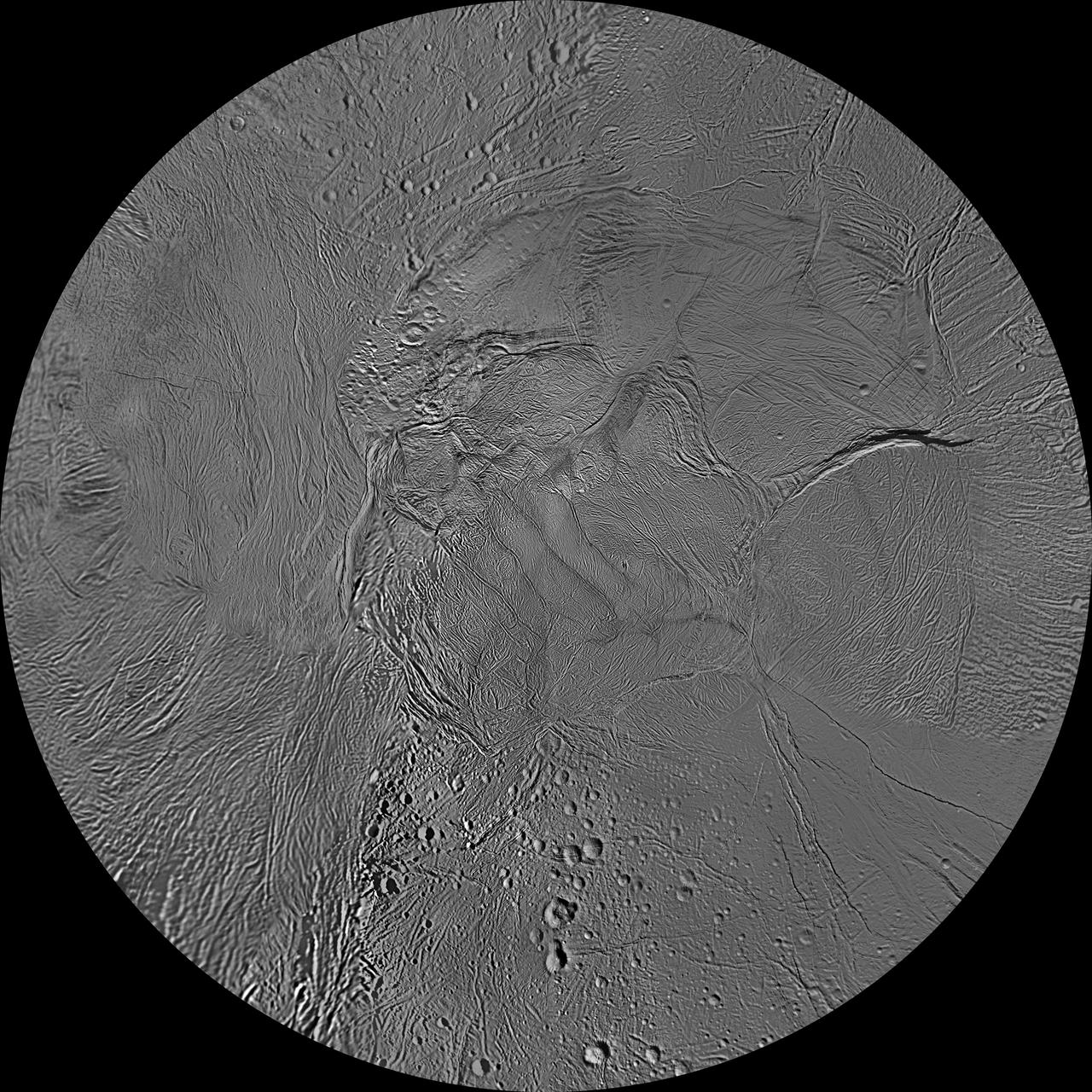
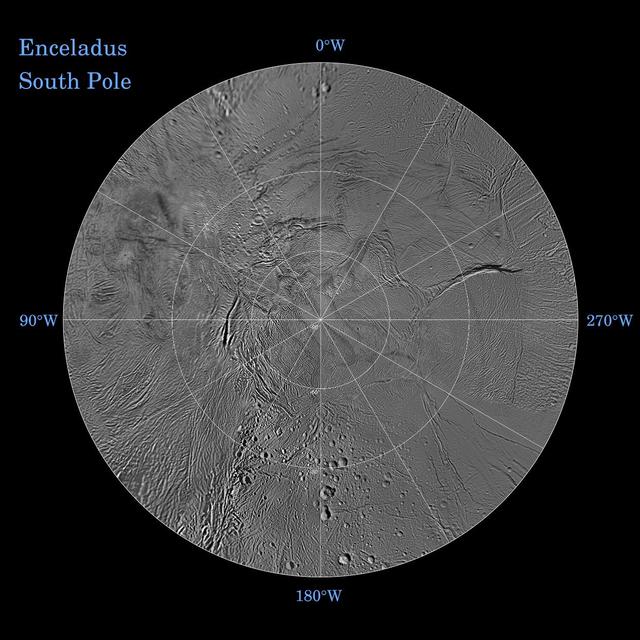
Enceladus: North and South Southern Polar Projection
Enceladus Rev 91 Flyby - Skeet Shoot #4
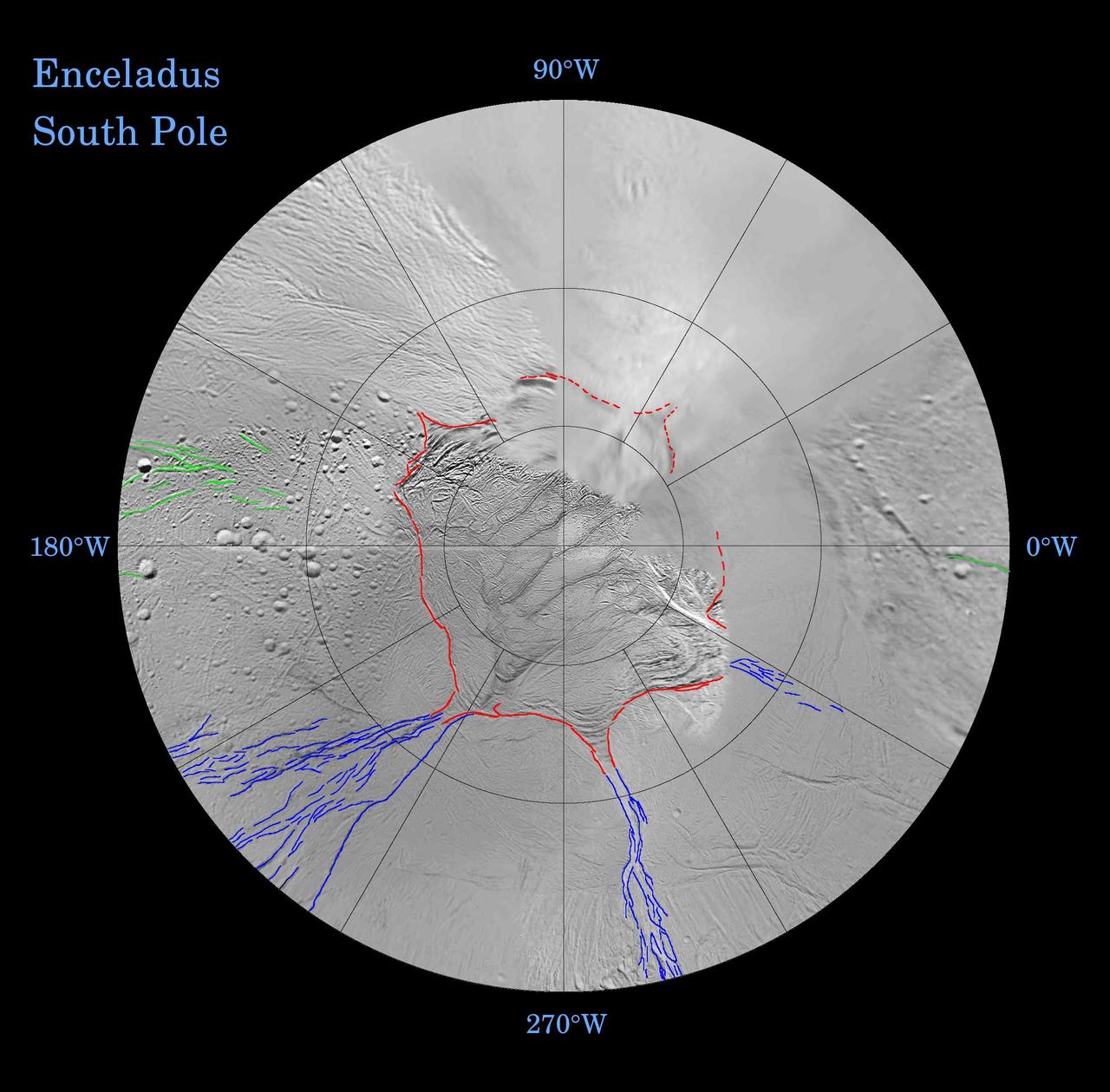
Enceladus: Global Patterns of Fracture Southern Polar Projection
Enceladus North Polar Map - October 2009
Enceladus South Polar Map - October 2009
South Polar Terrains of Enceladus - Highest Resolution View
Enceladus Rev 80 Flyby Skeet Shoot #1
Ancient Cratered Terrains on Enceladus - A Complex Deformation History
Enceladus Rev 80 Flyby Skeet Shoot #3
Cassini's closest look yet at bright, icy Enceladus was captured in this view, centered on the moon's trailing hemisphere. It shows some of the linear features in the terrain of the Diyar Planitia region. Enceladus is 499 kilometers (310 miles) across.  The image was taken in visible light with the Cassini spacecraft narrow angle camera on Dec. 14, 2004, at a distance of 672,000 kilometers (417,600 miles) from Enceladus and at a Sun- Enceladus-spacecraft, or phase, angle of 32 degrees. The image scale is about 4 kilometers (2.5 miles) per pixel. The image has been magnified by a factor of two and contrast enhanced to aid visibility.  http://photojournal.jpl.nasa.gov/catalog/PIA06566
Zooming In on Enceladus
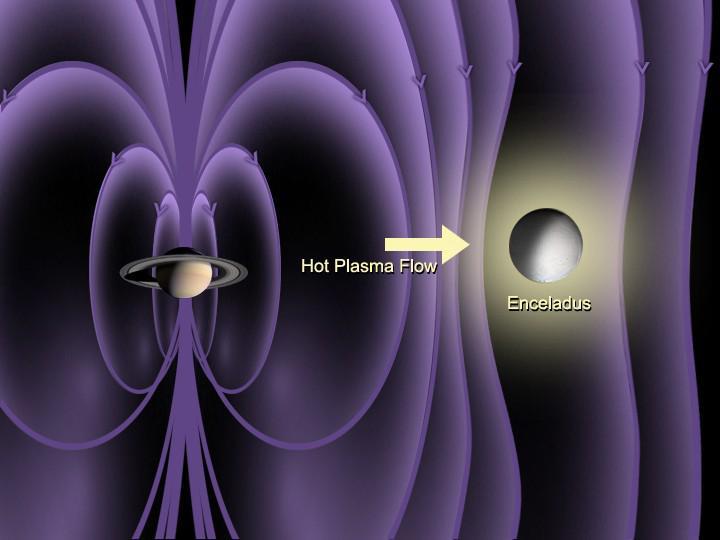
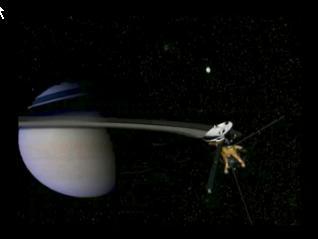
This frame from an animation shows the Cassini spacecraft approaching Saturn's icy moon Enceladus. It shows the highest resolution images obtained of the moon's surface. This is followed by a depiction of Saturn's magnetic field, which interacts with Enceladus' atmosphere and presumed plume coming from the south pole.  An animation is available at http://photojournal.jpl.nasa.gov/catalog/PIA03554
Enceladus Animation
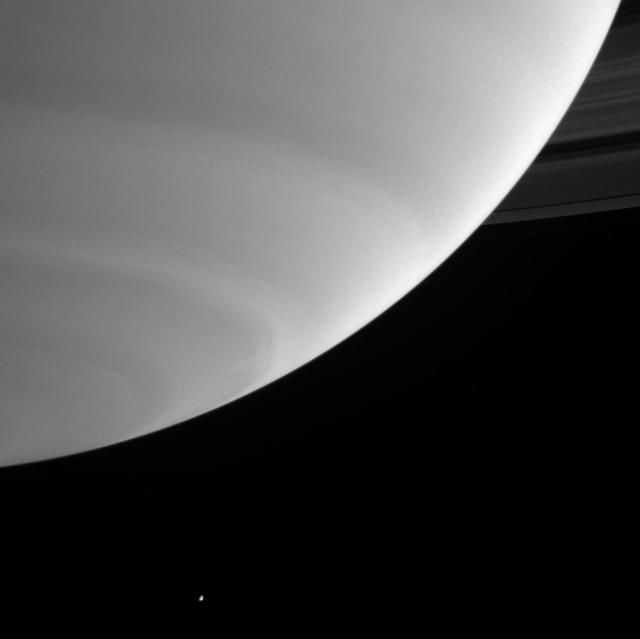
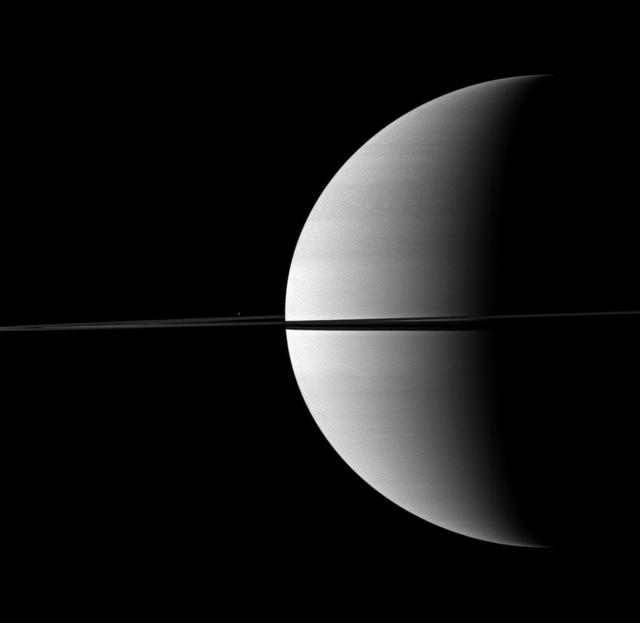
Nearly invisible upon first glance, Saturn moon Enceladus is a small bright dot beyond the planet rings in this image taken by NASA Cassini spacecraft.
Speck of Enceladus
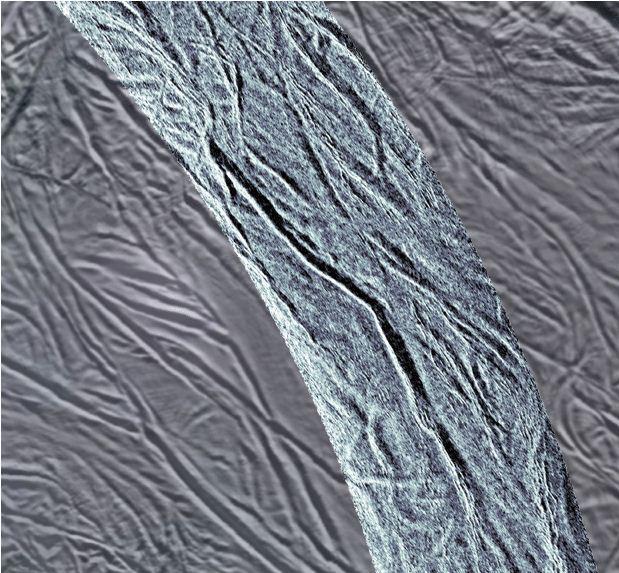
This image using synthetic-aperture radar SAR data acquired by NASA Cassini spacecraft shows grooves in the southern part of Saturn moon Enceladus.
Groovy Enceladus
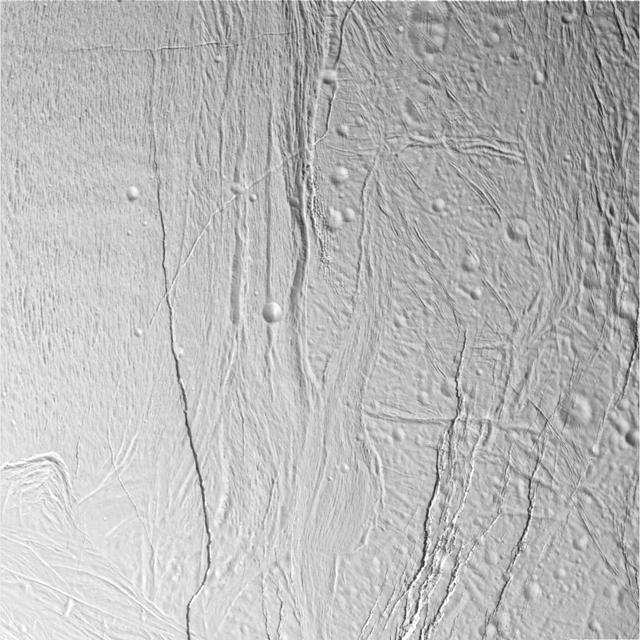
In the north, Enceladus' surface appears to be about as old as any in the solar system. The south, however, is an entirely different story.  The north polar area of Enceladus (313 miles or 504 kilometers across) seen here is heavily cratered, an indication that the surface has not been renewed since quite long ago. But the south polar region shows signs of intense geologic activity, most prominently focused around the long fractures known as "tiger stripes" that spray gas and tiny particles from the moon.  This view looks toward the leading side of Enceladus. North on Enceladus is up and rotated 38 degrees to the left. The image was taken in visible light with the Cassini spacecraft narrow-angle camera on Nov. 27, 2016.  The view was acquired at a distance of approximately 20,000 miles (32,000 kilometers) from Enceladus and at a Sun-Enceladus-spacecraft, or phase, angle of 85 degrees. Image scale is 620 feet (190 meters) per pixel.   https://photojournal.jpl.nasa.gov/catalog/PIA21326
North Pole of Enceladus
Enceladus Cold
Enceladus Cold
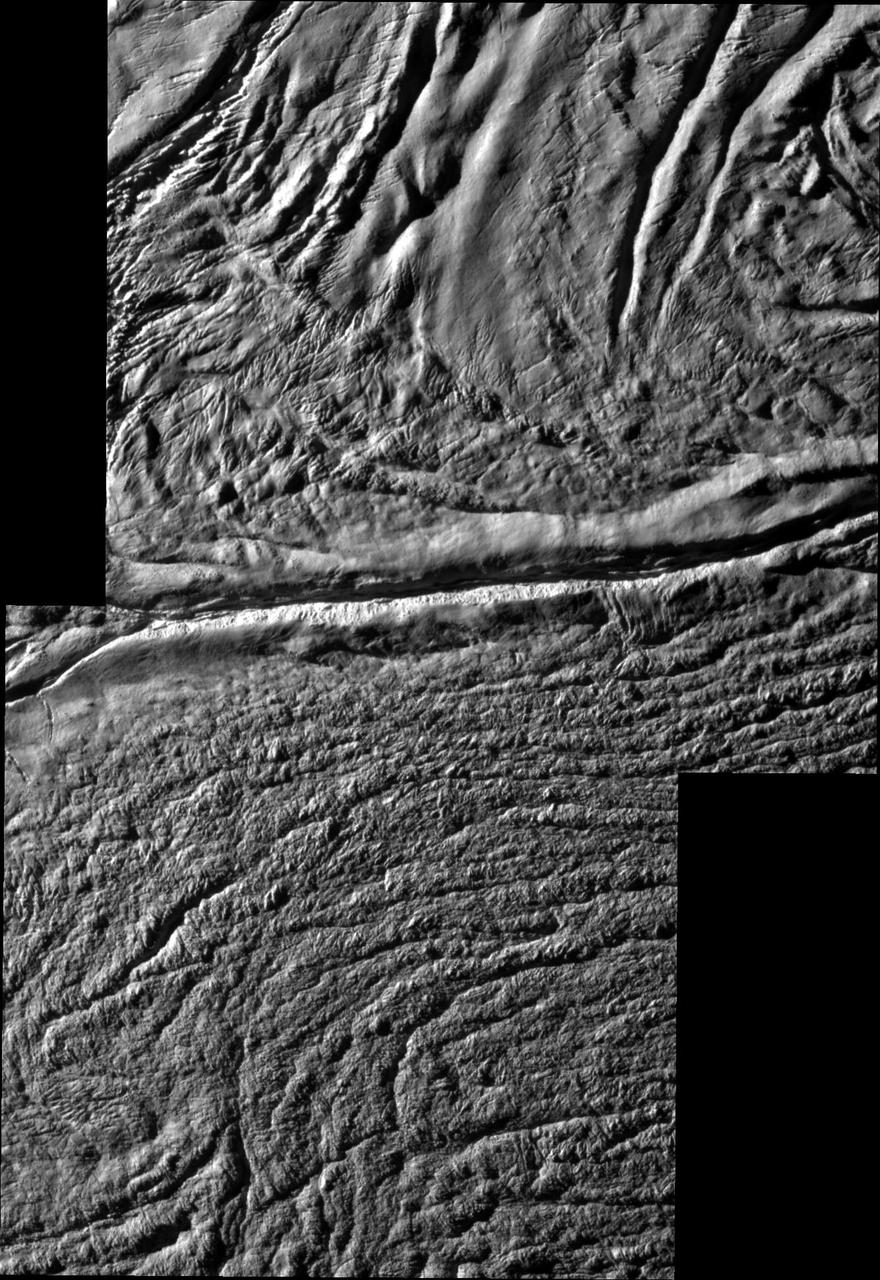
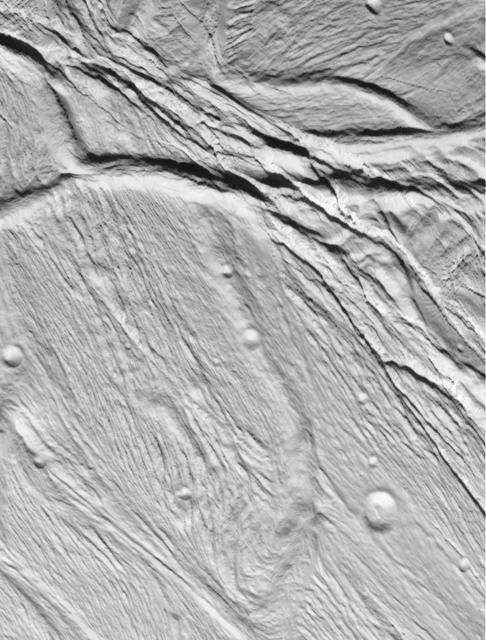
Wrinkles and cracks have reworked the surface of Enceladus, perhaps due to  the influence of tidal stresses
Fresh Features on Enceladus Monochrome
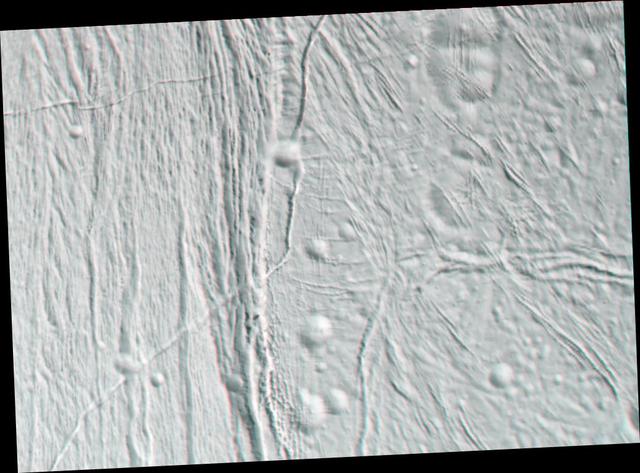
This stereo anaglyph from NASA Cassini spacecraft is of Saturn moon Enceladus. 3D glasses are necessary to view this image.
Transition on Enceladus 3-D