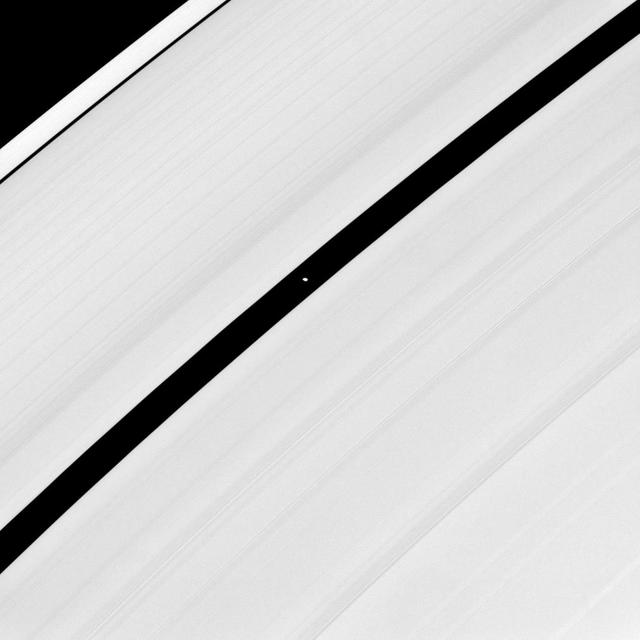
Encke Moon
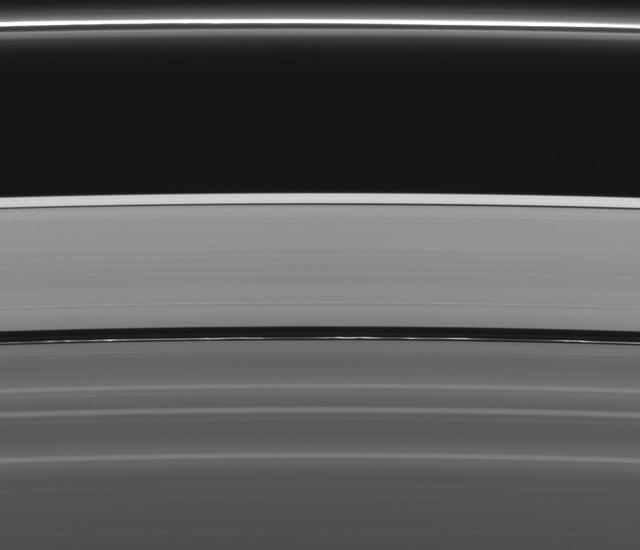
Clumps for Encke
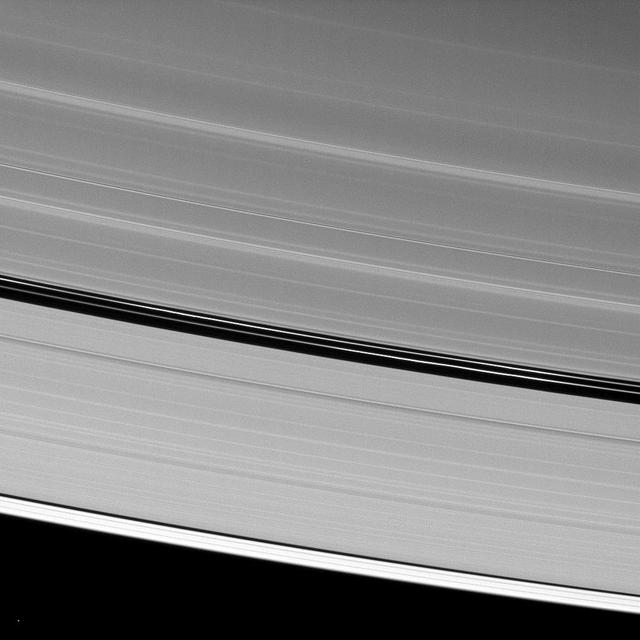
Encke Ringlets
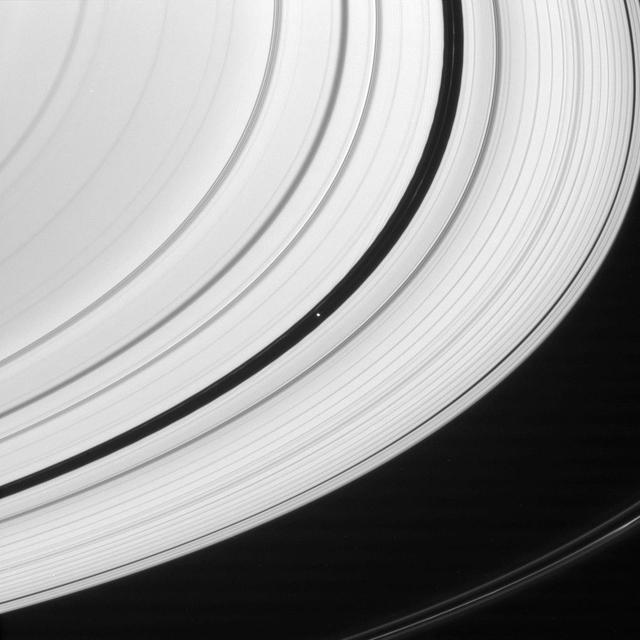
Encke Inhabitants
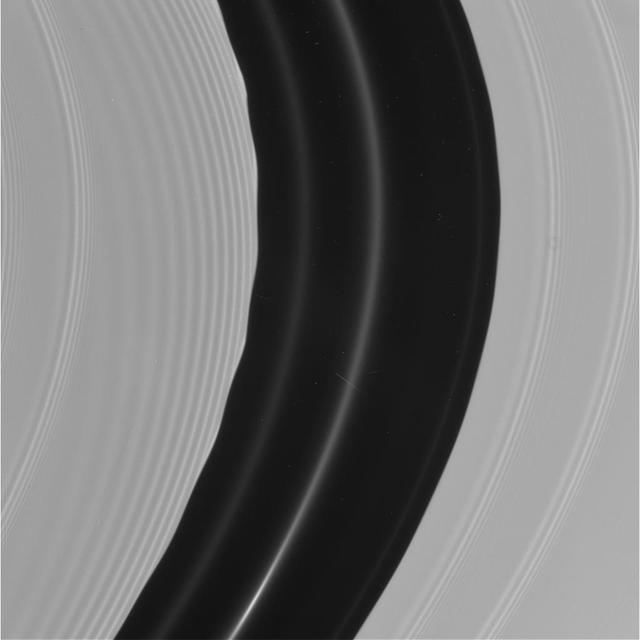
The Encke Gap as Never Seen Before
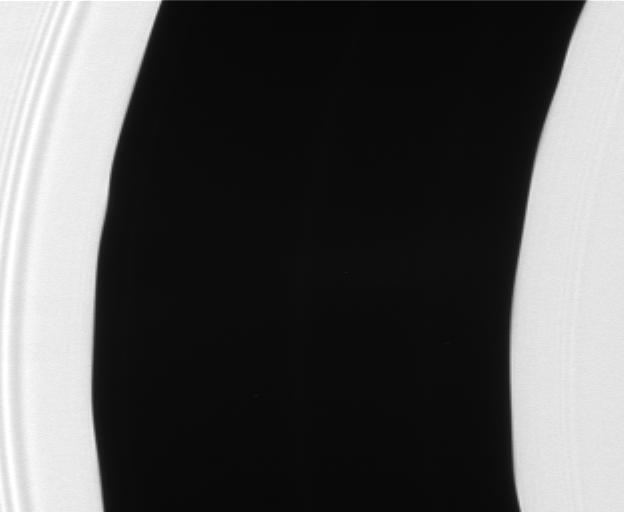
The Encke gap displays gentle waves in its inner and outer edges that are caused by gravitational tugs from the small moon Pan
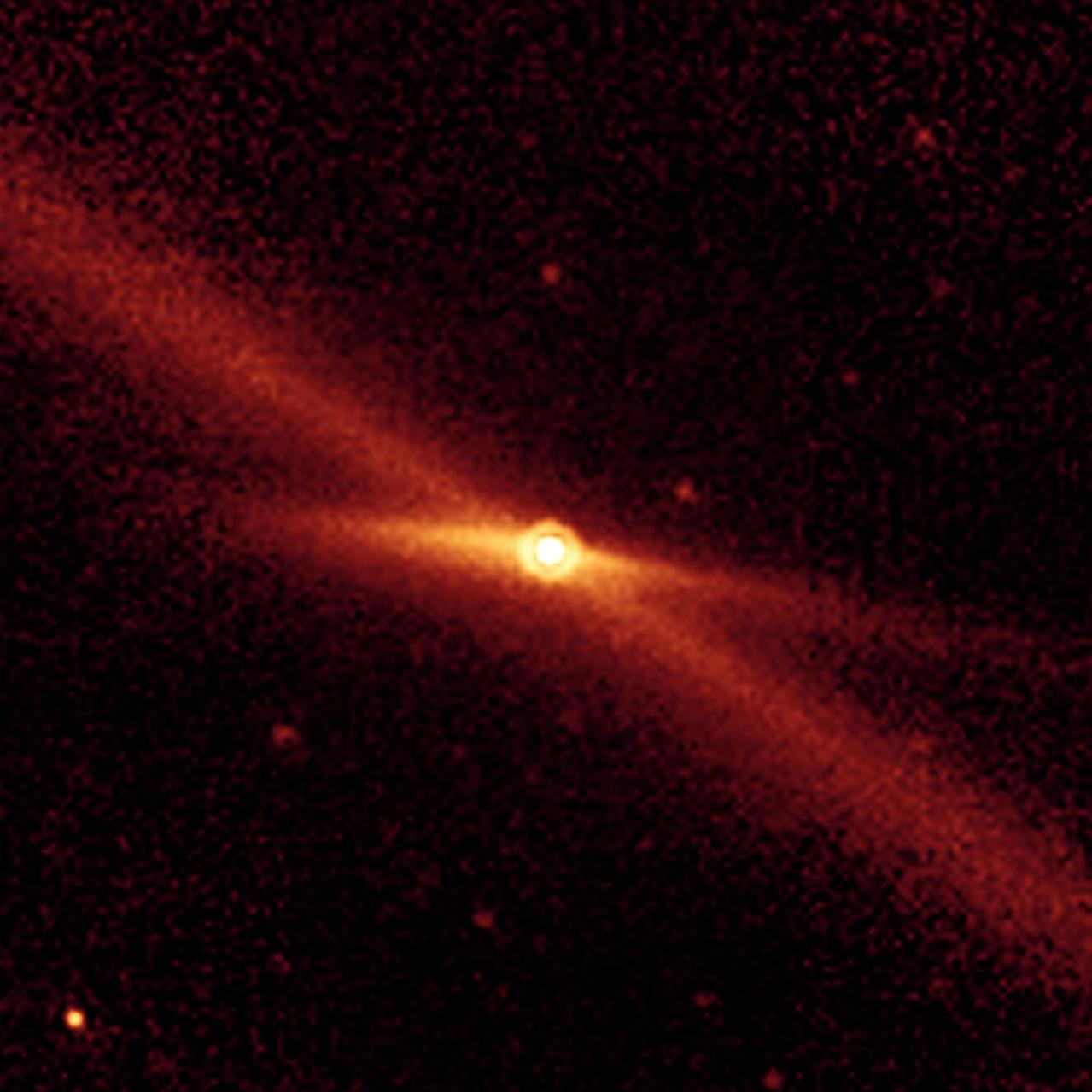
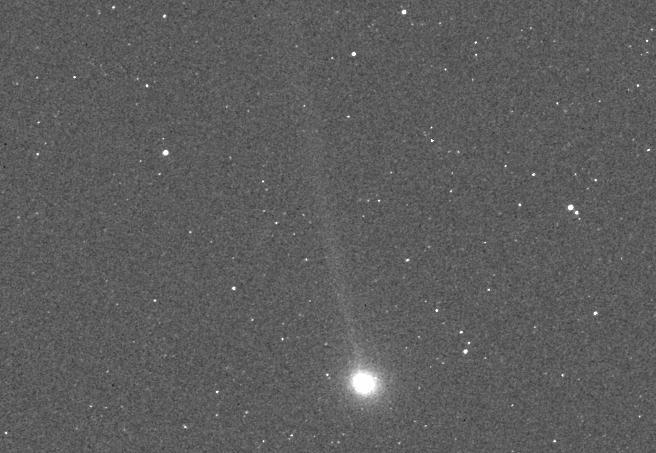
This image taken by NASA Spitzer Space Telescope shows the comet Encke riding along its pebbly trail of debris long diagonal line between the orbits of Mars and Jupiter.
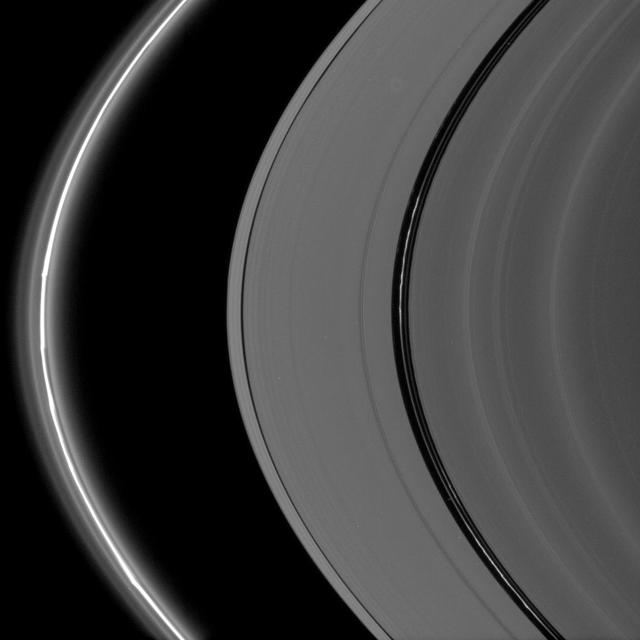
Bright, kinked ringlets fill the Encke Gap, while the F ring glows brilliantly and displays its signature knots and flanking, diffuse ringlets
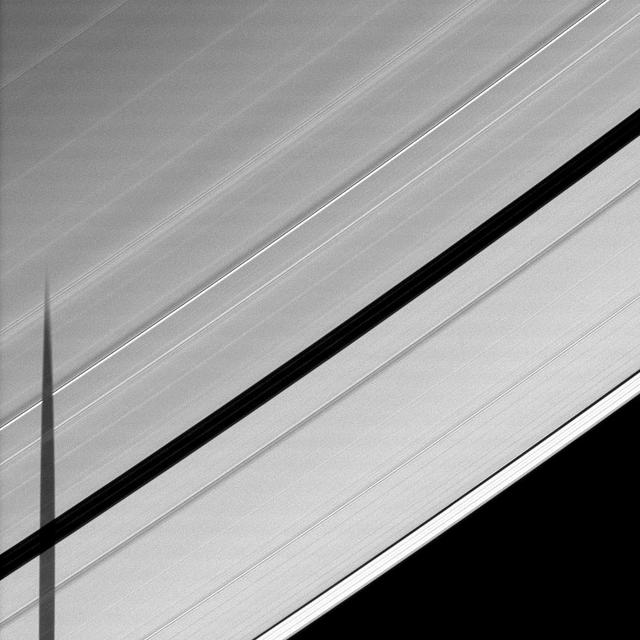
Seen from the unlit side of Saturn A ring, the shadow of the moon Janus is cast across the Encke Gap.
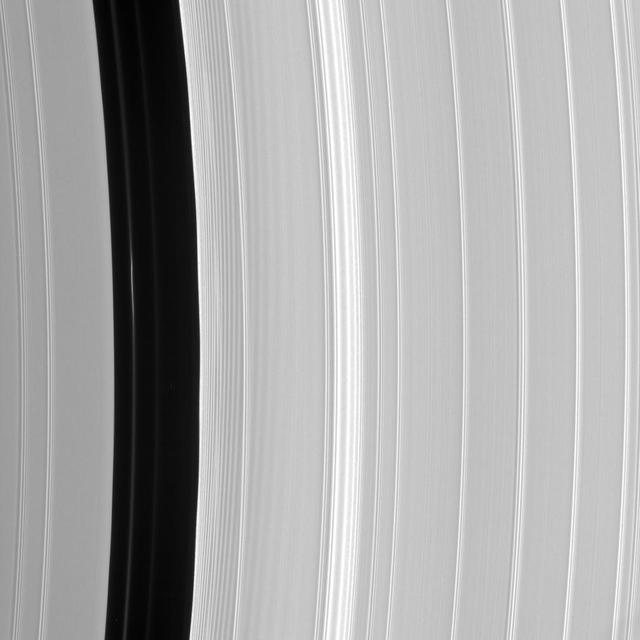
Although the embedded moon Pan is nowhere to be seen, there is a bright clump-like feature visible here, within the Encke Division. Also discernable are periodic brightness variations along the outer right side gap edge
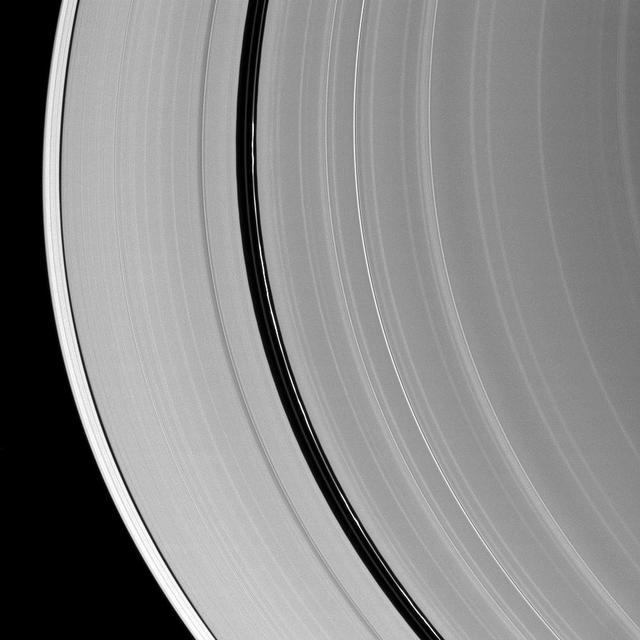
Kinky, discontinuous ringlets occupy the Encke Gap in Saturn A ring in the middle of this NASA Cassini spacecraft image; parts of these thin ringlets cast shadows onto the A ring.
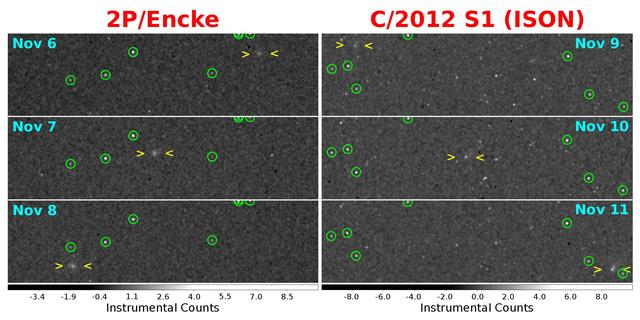
As comets C/2012 S1 ISON and the well-known short-period comet 2P/Encke both approached their closest distances to the Sun in November, 2013, they also passed close to the MESSENGER spacecraft orbiting the innermost planet Mercury.
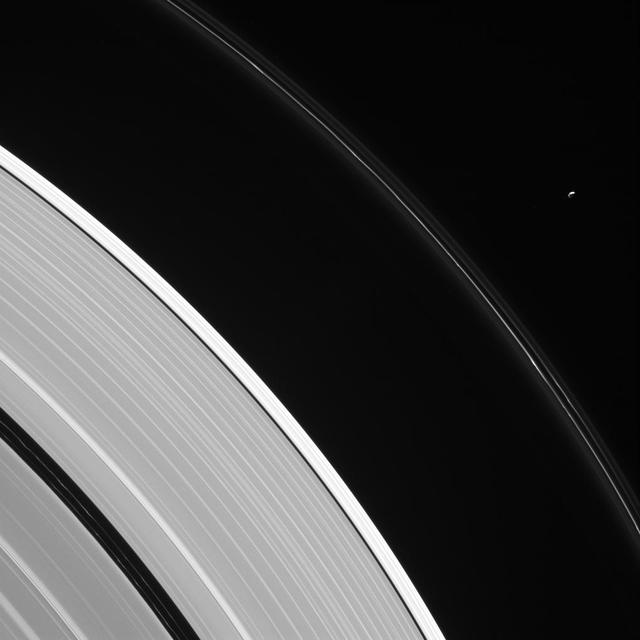
Pandora is seen here, in isolation beside Saturn's kinked and constantly changing F ring. Pandora (near upper right) is 50 miles (81 kilometers) wide. The moon has an elongated, potato-like shape (see PIA07632). Two faint ringlets are visible within the Encke Gap, near lower left. The gap is about 202 miles (325 kilometers) wide. The much narrower Keeler Gap, which lies outside the Encke Gap, is maintained by the diminutive moon Daphnis (not seen here). This view looks toward the sunlit side of the rings from about 23 degrees above the ring plane. The image was taken in visible light with the Cassini spacecraft narrow-angle camera on Aug. 12, 2016. The view was acquired at a distance of approximately 907,000 miles (1.46 million kilometers) from Saturn and at a Sun-Saturn-spacecraft, or phase, angle of 113 degrees. Image scale is 6 miles (9 kilometers) per pixel. http://photojournal.jpl.nasa.gov/catalog/PIA20504
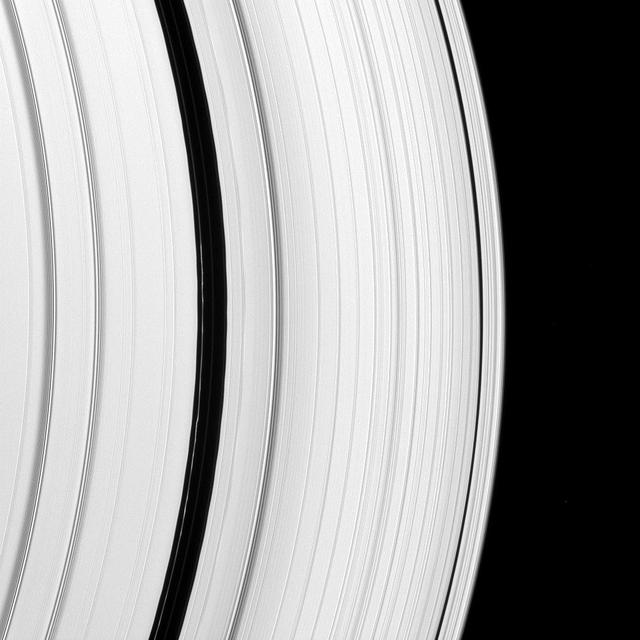
The Encke Gap moon, Pan, has left its mark on a scalloped ringlet of the Encke Gap. The moon creates these perturbations as it sweeps through the 325-kilometer 200-mile gap in the A ring
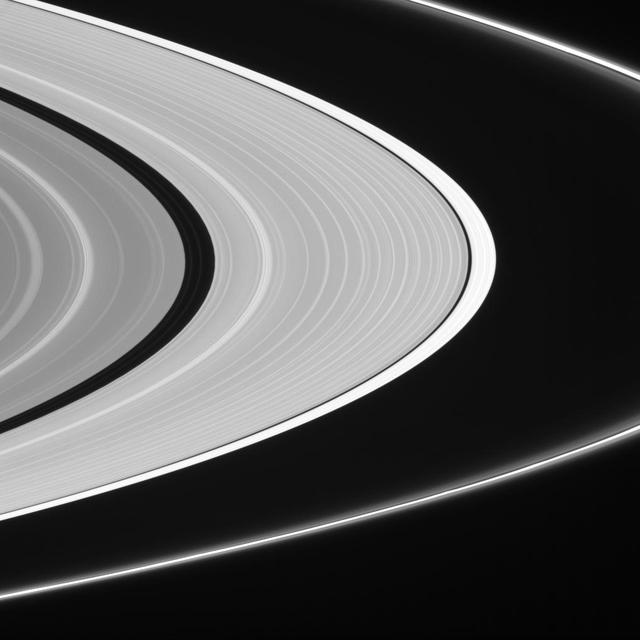
Ringlets in the Encke Gap and flanking the bright F ring core are clearly visible here
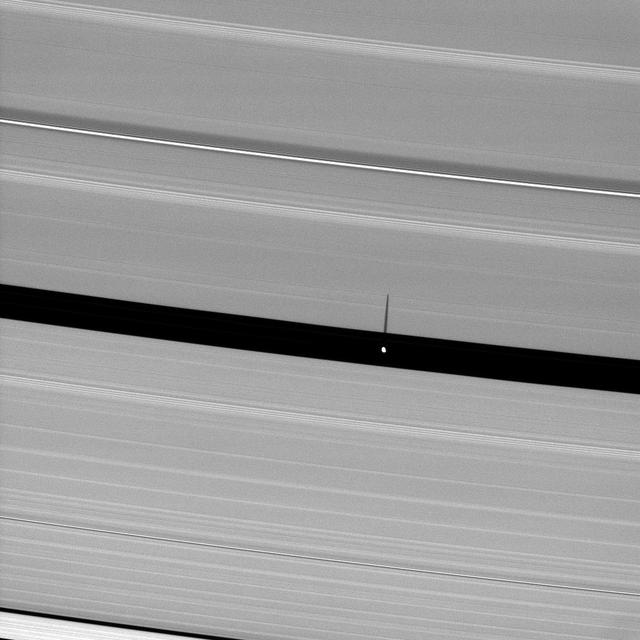
Saturn moon Pan, orbiting in the Encke Gap, casts a slender shadow onto the A ring.
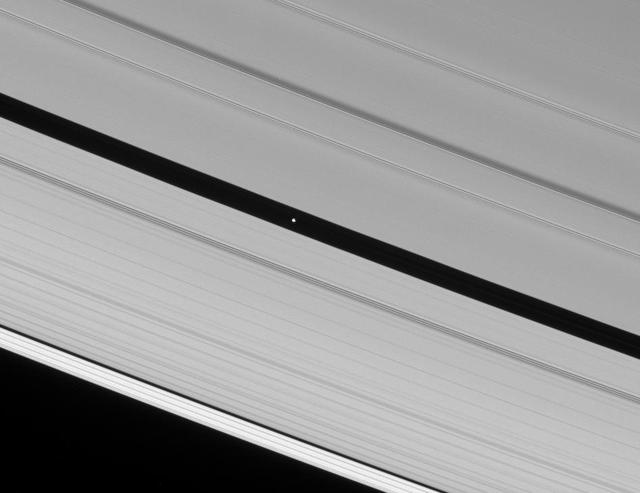
The Cassini spacecraft spies Pan speeding through the Encke Gap, its own private path around Saturn
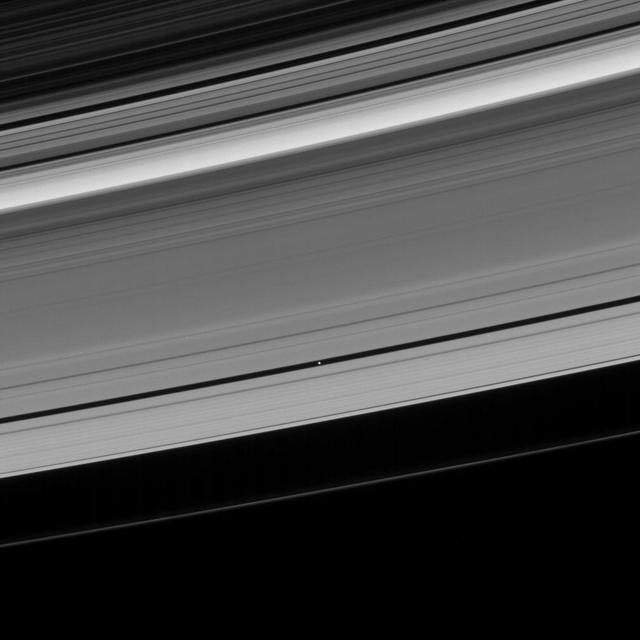
The Cassini spacecraft looks toward the unilluminated side of Saturn rings to spy on the moon Pan as it cruises through the Encke Gap

An intriguing knotted ringlet within the Encke Gap is the main attraction in this image captured by NASA Cassini spacecraft.
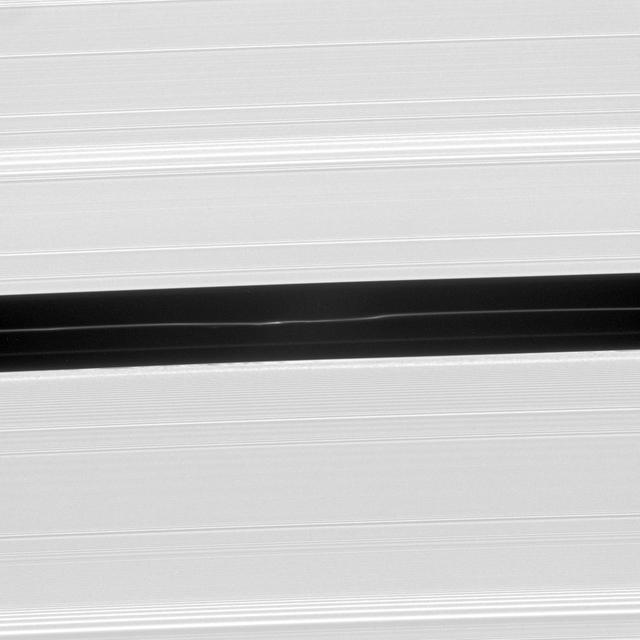
Bright undulations disturb a faint ringlet drifting through the center of the Encke Gap. This ring structure shares the orbit of the moon Pan
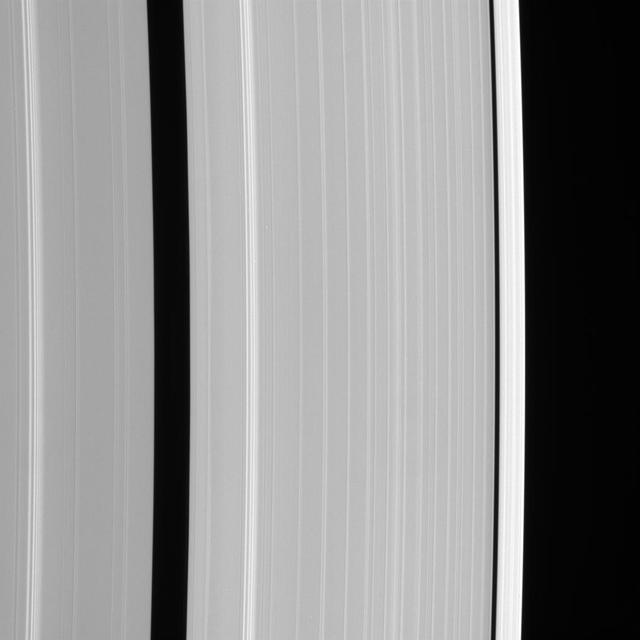
This Cassini spacecraft view shows details of Saturn outer A ring, including the Encke and Keeler gaps. The A ring brightens substantially outside the Keeler Gap
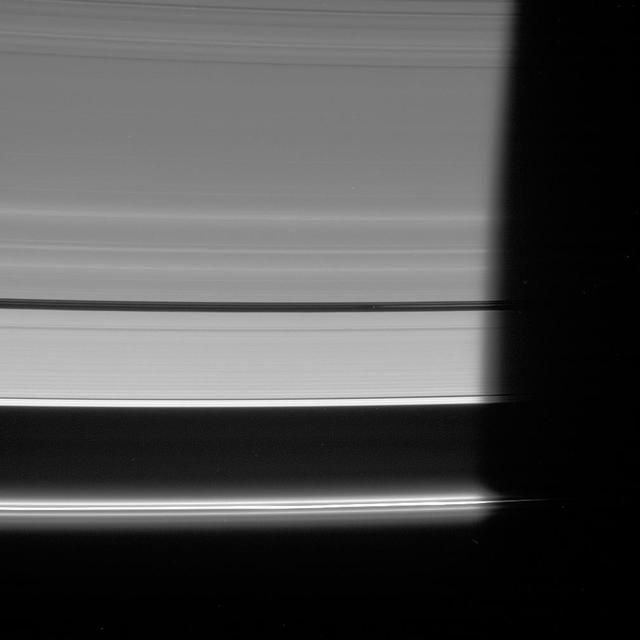
NASA Cassini spacecraft looks down at the unlit side of the rings as Pan heads into Saturn shadow. The moon is accompanied by faint ringlets in the Encke Gap.
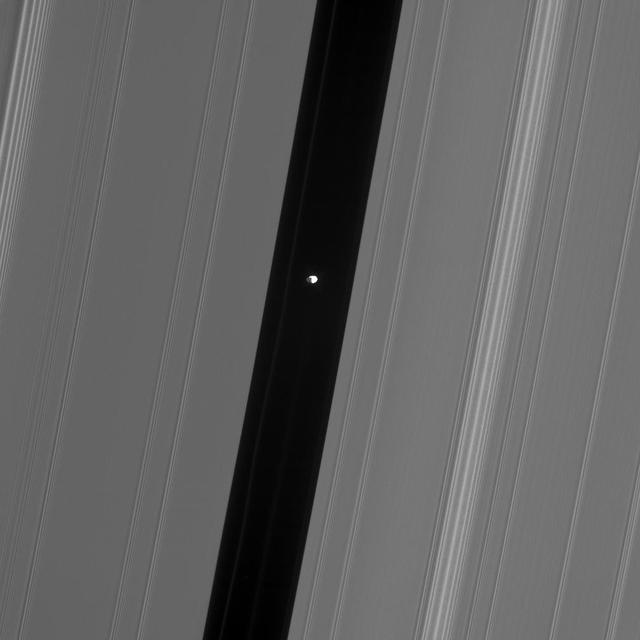
This Cassini spacecraft view of Pan in the Encke gap shows hints of detail on the moon dark side, which is lit by saturnshine -- sunlight reflected off Saturn.

The shadow of the moon Janus crosses the Encke Gap as it strikes the plane of Saturn rings in this image taken as the planet approached its August 2009 equinox.
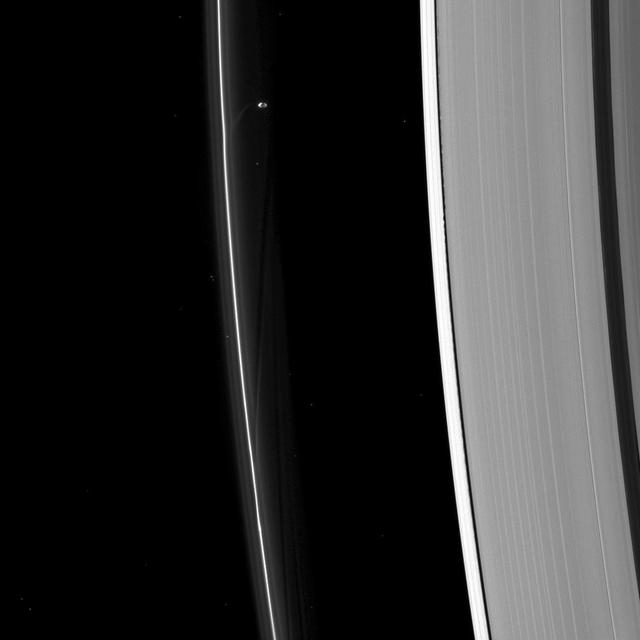
Prometheus, seen here by NASA Cassini spacecraft, sculpting the F ring while Daphnis too small to discern in this image raises waves on the edges of the Encke gap.
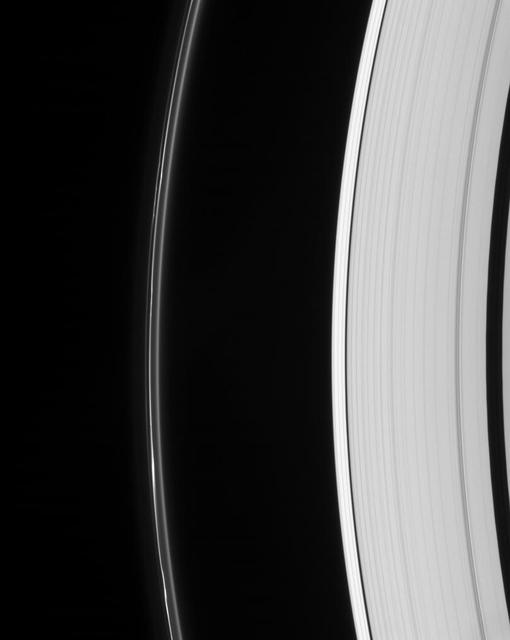
Saturn odd but ever-intriguing F ring displays multiple lanes and several bright clumps. The Keeler and Encke gaps are visible in the outer A ring, at right
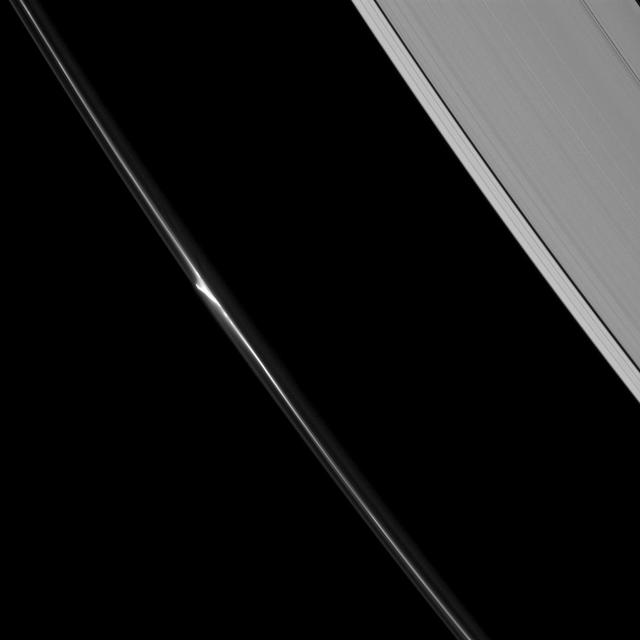
This image, taken by NASA Cassini spacecraft, shows A beautiful mini-jet appearing in the dynamic F ring of Saturn. Saturn A ring including the Keeler gap and just a hint of the Encke gap at the upper-right also appears.
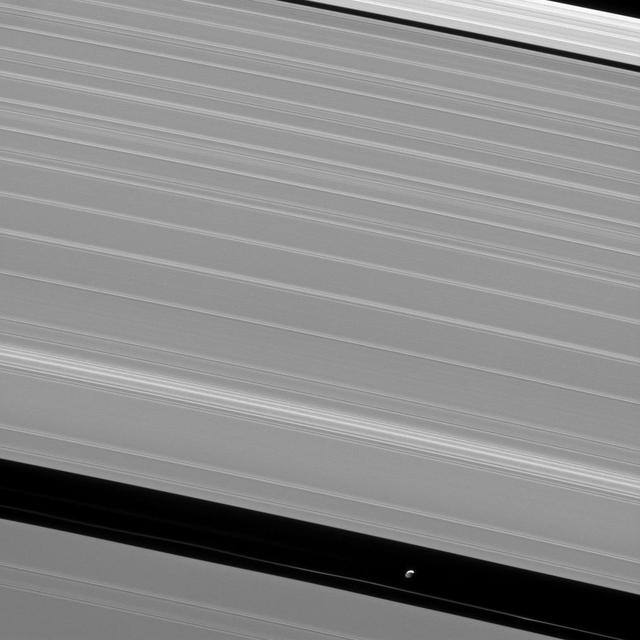
The shepherd moon Pan orbits Saturn in the Encke gap while the A ring surrounding the gap displays wave features created by interactions between the ring particles and Saturnian moons in this image from NASA Cassini spacecraft.
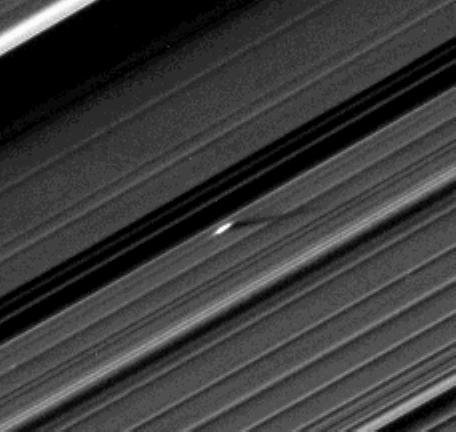
An unusually large propeller feature is detected just beyond the Encke Gap in this Cassini image of Saturn’s outer A ring taken a couple days after the planet’s August 2009 equinox.
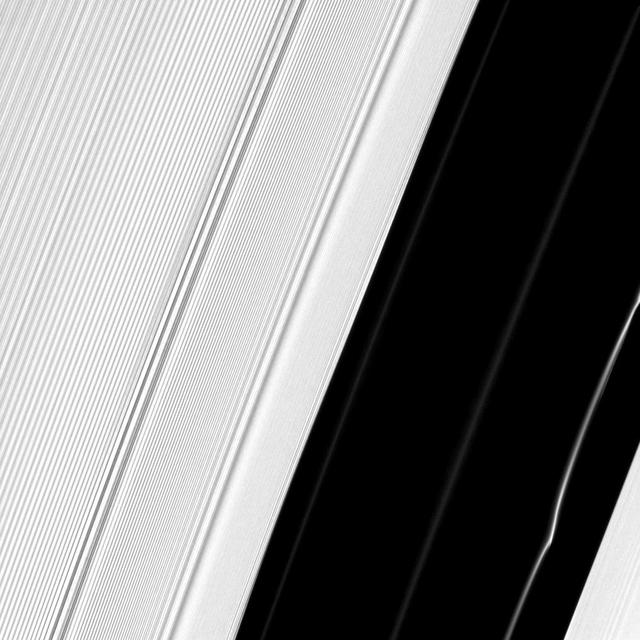
Several structures in Saturn A ring are exposed near the Encke Gap in this image captured by NASA Cassini spacecraft. A peculiar kink can be seen in one particularly bright ringlet at the bottom right.

Saturn small, ring-embedded moon Pan, on the extreme right of this NASA Cassini spacecraft image, can be seen interacting with the ringlets that share the Encke Gap of the A ring with this moon.
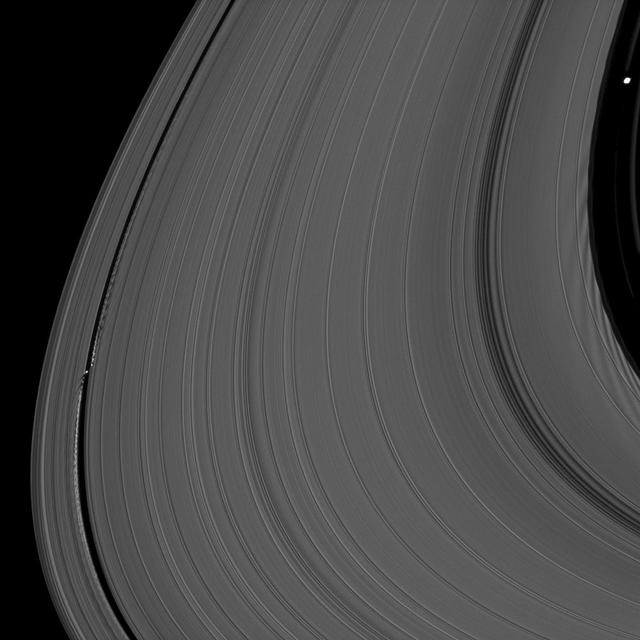
Saturn moons Daphnis and Pan demonstrate their effects on the planet rings in this view from NASA Cassini spacecraft. Daphnis, at left, orbits in the Keeler Gap of the A ring; Pan at right, orbits in the Encke Gap of the A ring.
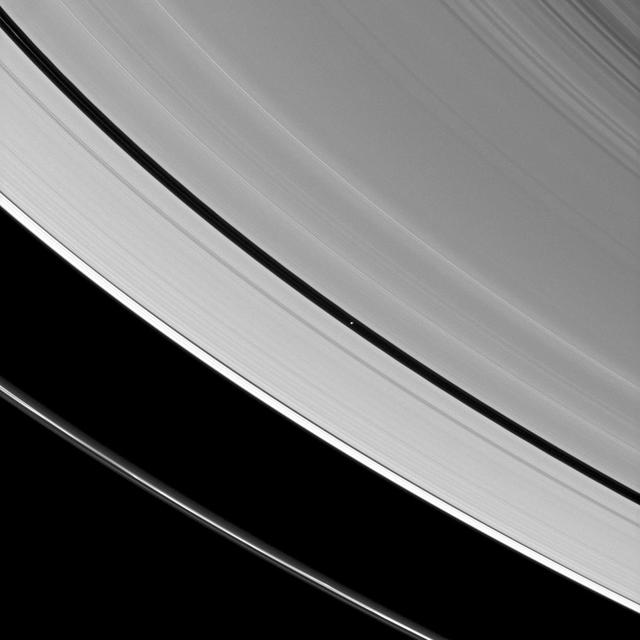
Saturn tiny moon Pan orbits in the middle of the Encke Gap of the planet A ring in this image from the Cassini spacecraft. Pan is visible as a bright dot in the gap near the center of this view.
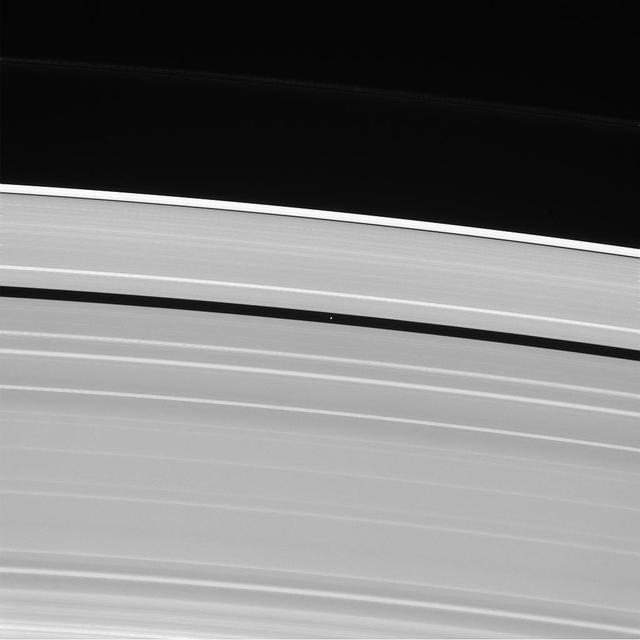
Saturn moon Pan, named for the Greek god of shepherds, rules over quite a different domain: the Encke gap in Saturn rings. This image is from NASA Cassini spacecraft.
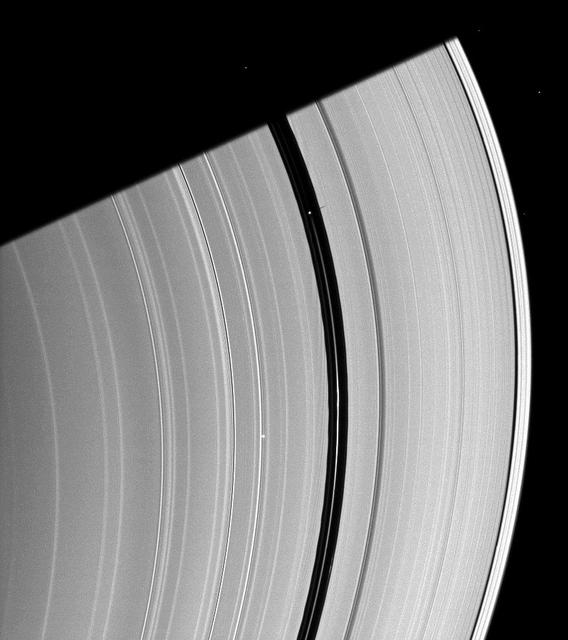
Saturn moon Pan, orbiting in the Encke Gap near the top of the image, casts a short shadow on the A ring in this image taken by NASA Cassini spacecraft about six months after the planet August 2009 equinox.
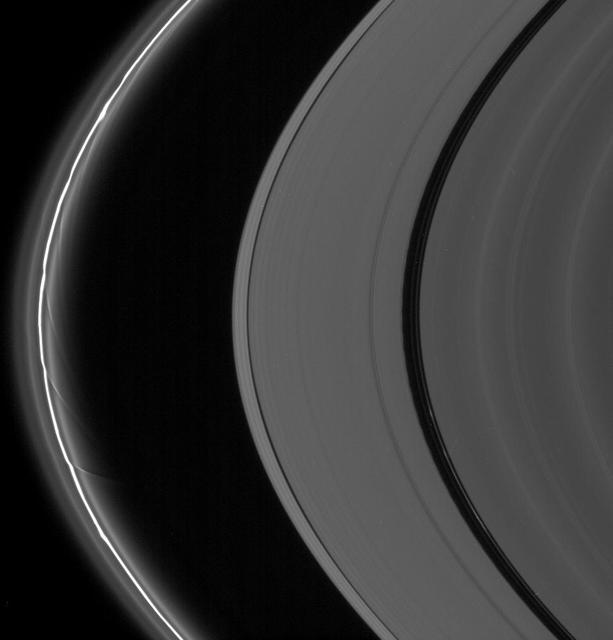
The A and F rings are alive with moving structures in this Cassini spacecraft view. Graceful drapes of ring material created by Prometheus are seen sliding by at left, while clumpy ringlets slip through the Encke Gap
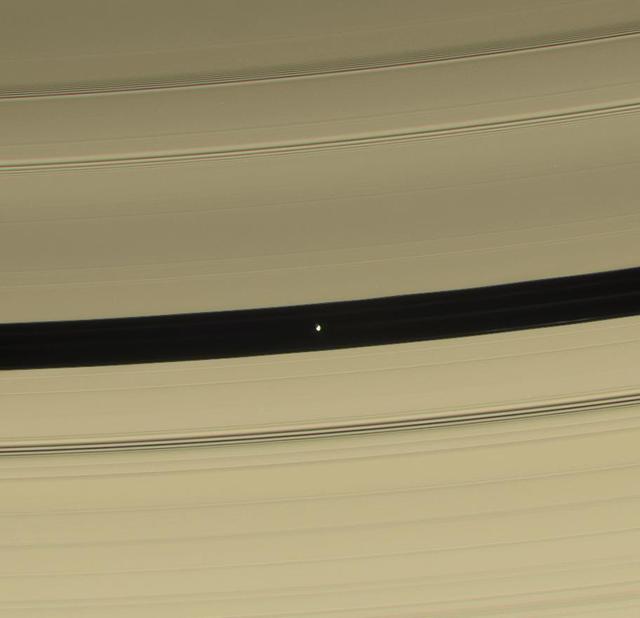
Pan is seen in this color view as it sweeps through the Encke Gap with its attendant ringlets. As the lemon-shaped little moon orbits Saturn, it always keeps its long axis pointed along a line toward the planet
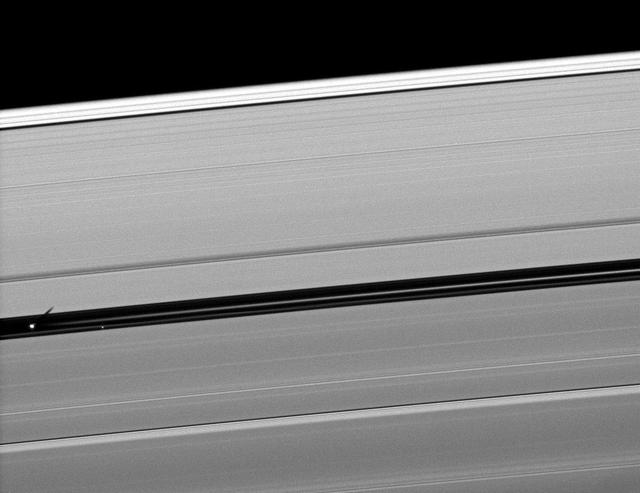
Orbiting in the Encke Gap of Saturn A ring, the moon Pan casts a shadow on the ring in this image taken about six months after the planet August 2009 equinox by NASA Cassini spacecraft.
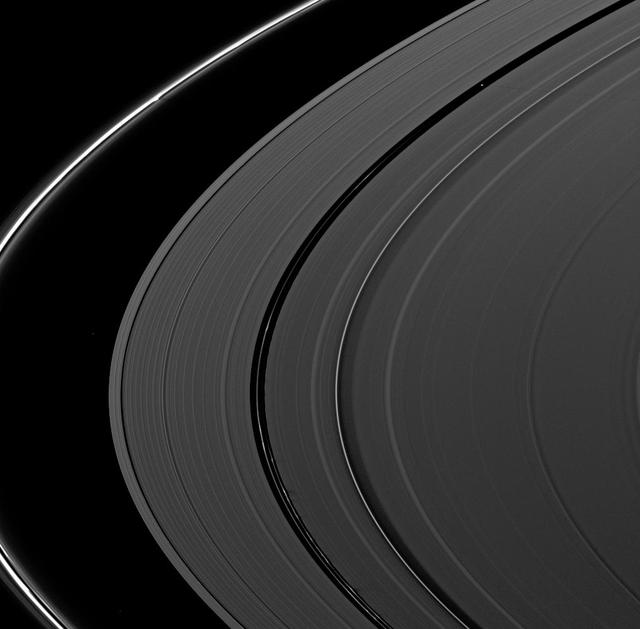
Shadows seem ubiquitous in this view from NASA Cassini spacecraft of Saturn rings. The moon Pan casts a long shadow towards the right from where it orbits in the Encke Gap of the A ring in the upper right of the image.
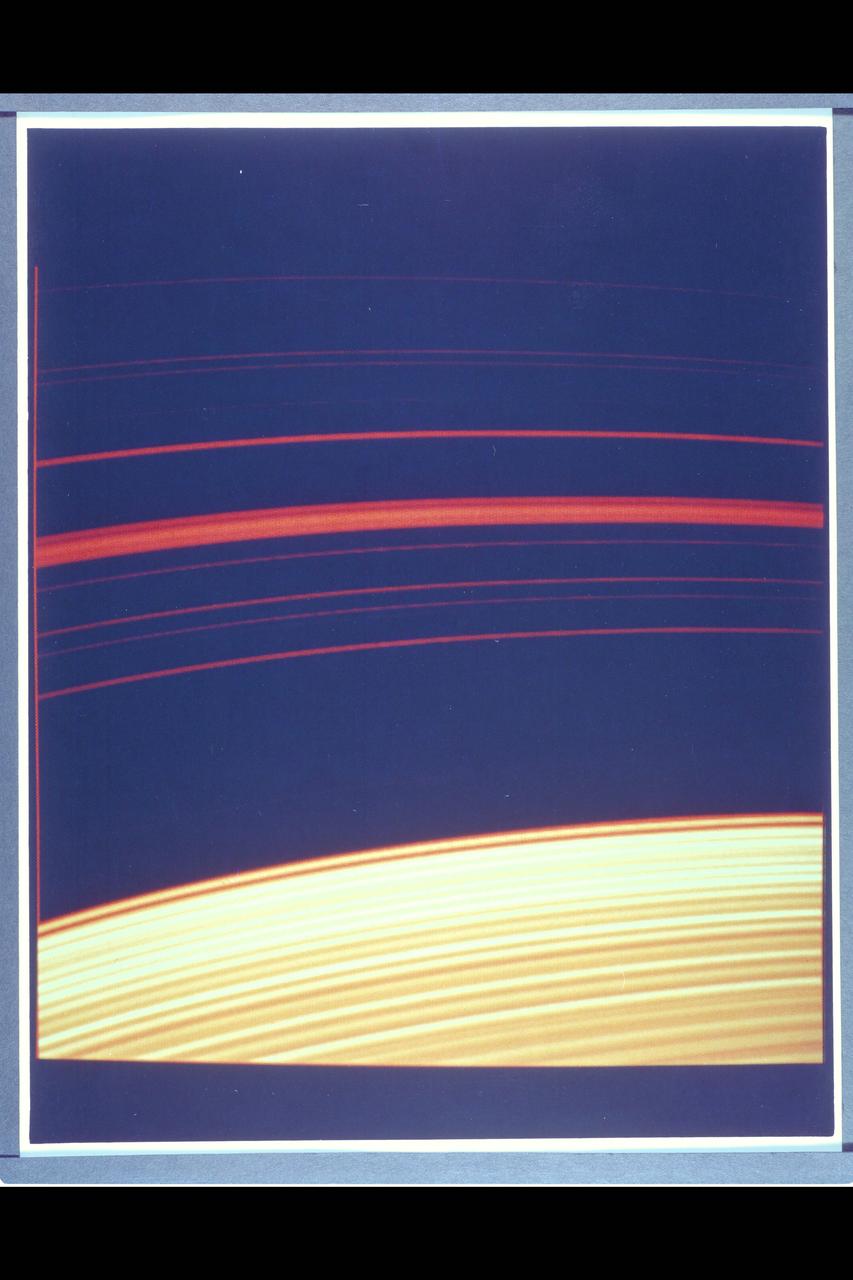
Resolution : 1 km. ( .6 miles ) Region Shown : 100 km. ( 60 miles ) P-24068C This computer generated photograph was created from a cross-section of Saturn's rings as measured by Voyager 2 photopolarimeter's occulation of the star Delta Scorpii. The region shown is near the inner edge of the Encke Division in the outer part of A-ring. The waves seen at left become successively closer together nearer to the Encke Division. At right are four strands of the ringlet that lies within the Encke Division. Voyager 2's imaging system saw this structure as a single ringlet.
How did scientists know that NASA Voyager spacecraft entered interstellar space? Increase in the density of charged particles was the key piece of evidence. Our sun sits in a bubble, called the heliosphere, carved out by wind emitted from the hot sun.
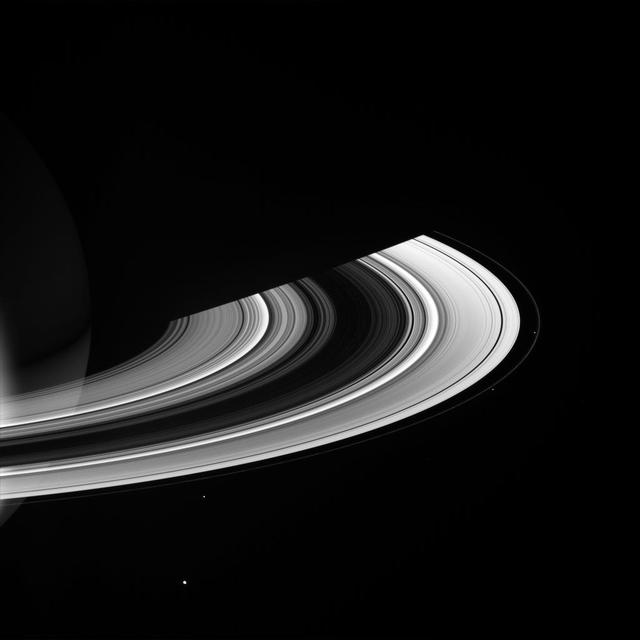
<p> The Cassini spacecraft looks toward the unilluminated side of Saturn rings to spy on the moon Pan as it cruises through the Encke Gap. </p> <p> This view looks toward the rings from about 13 degrees above the ringplane. At the top of the image
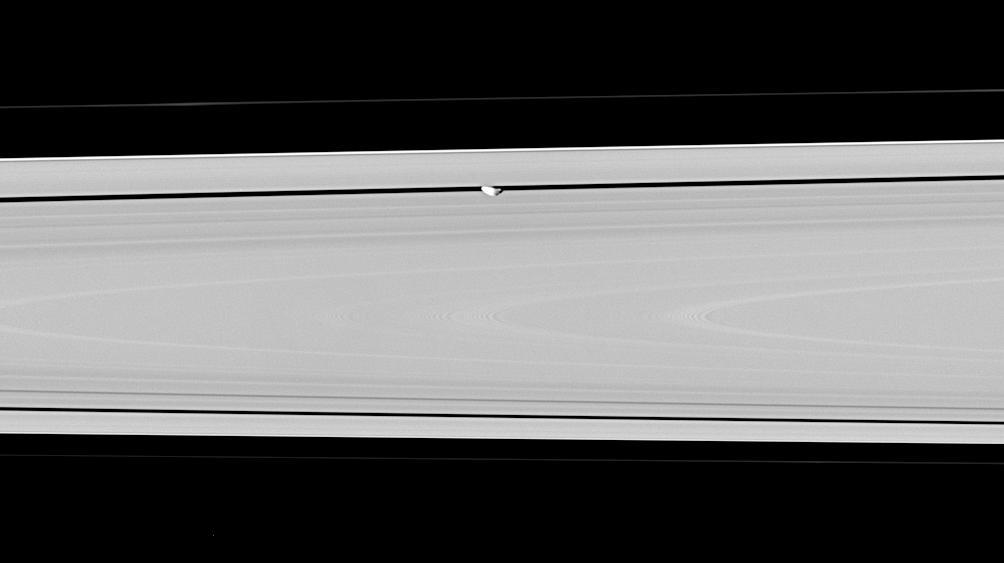
Hiding within the Encke gap is the small moon Pan, partly in shadow and party cut off by the outer A ring in this view. Similar to Atlas, Pan appears to have a slight ridge around its middle; and like Atlas, Pan orbit also coincides with a faint ringlet
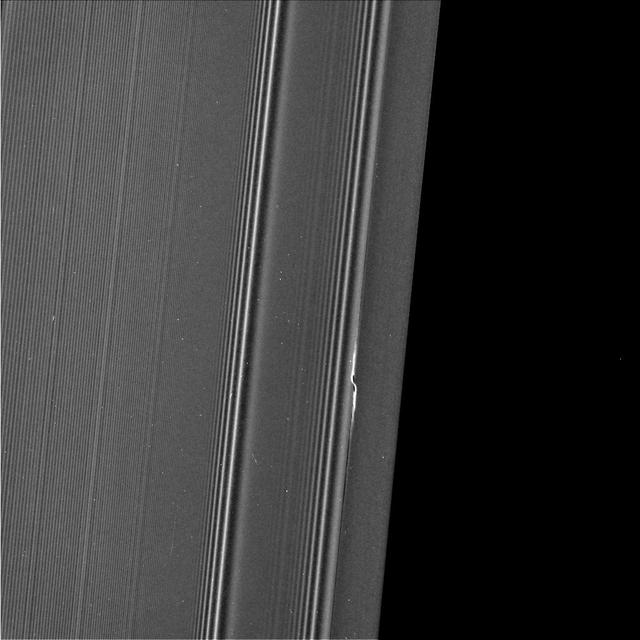
The propeller informally named "Earhart" is seen in this view from NASA's Cassini spacecraft at much higher resolution than ever before. This view, obtained on March 22, 2017, is the second time Cassini has deliberately targeted an individual propeller for close-up viewing during its ring-grazing orbits, after its images of Santos-Dumont (PIA21433) a month earlier. The biggest known propeller, informally named "Bleriot," is slated for the third and final propeller close-up in April 2017. Propellers are disturbances in the ring caused by a central moonlet. The moonlet itself would be a few pixels wide in this view, but it is difficult to distinguish from (and may be obscured by) the disturbed ring material that surrounds it. (See PIA20525 for more info on propellers.) The detailed structure of the Earhart propeller, as seen here, differs from that of Santos-Dumont. It is not clear whether these differences have to do with intrinsic differences between Earhart and Santos-Dumont, or whether they have to do with different viewing angles or differences in where the propellers were imaged in their orbits around Saturn. Earhart is situated very close to the 200-mile-wide (320-kilometer-wide) Encke Gap, which is held open by the much larger moon Pan. In this view, half of the Encke Gap is visible as the dark region at right. The gap and the propeller are a study in contrasts. The propeller is nothing more than Earhart's attempt to open a gap like Encke using its gravity. However, Earhart's attempt is thwarted by the mass of the ring, which fills in the nascent gap before it can extend very far. Pan is a few thousand times more massive than Earhart, which enables it to maintain a gap that extends all the way around the ring. To the left of the propeller are wave features in the rings caused by the moons Pandora, Prometheus and Pan. The visible-light image was acquired by the Cassini narrow-angle camera at a distance of 69,183 miles (111,340 kilometers) from the propeller feature. Image scale is 0.4 mile (670 meters) per pixel in the radial, or outward-from-Saturn, direction. The view looks toward the sunlit side of the rings. https://photojournal.jpl.nasa.gov/catalog/PIA21437
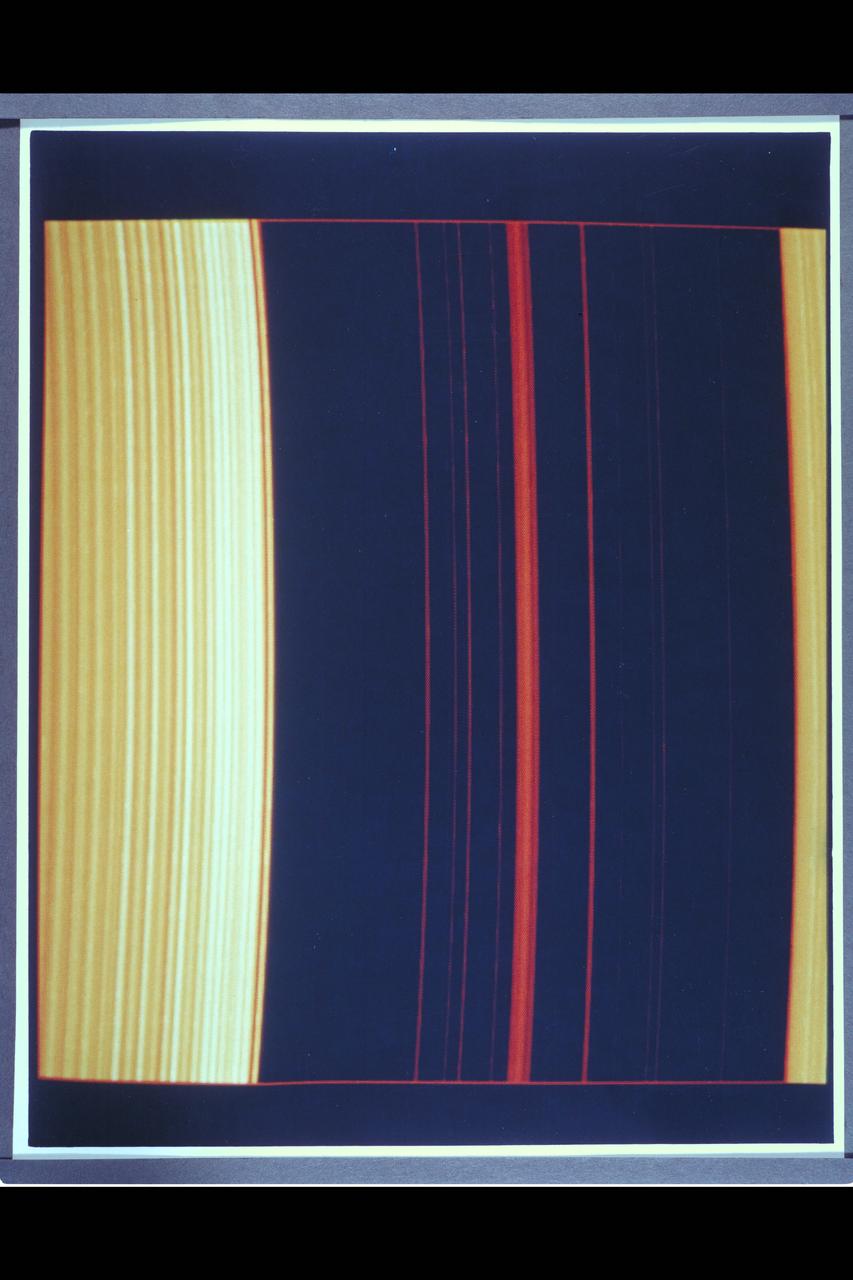
Resolution : 2 km. ( 1.2 miles ) P-24069C In this computer generated photograph, created from a cross section of Saturn's rings by Voyager 2 photopolarimeter's star occulation, the Encke Division in the outer A-ring. Clearly shown is the central ringlet, also observed by the imaging cameras.
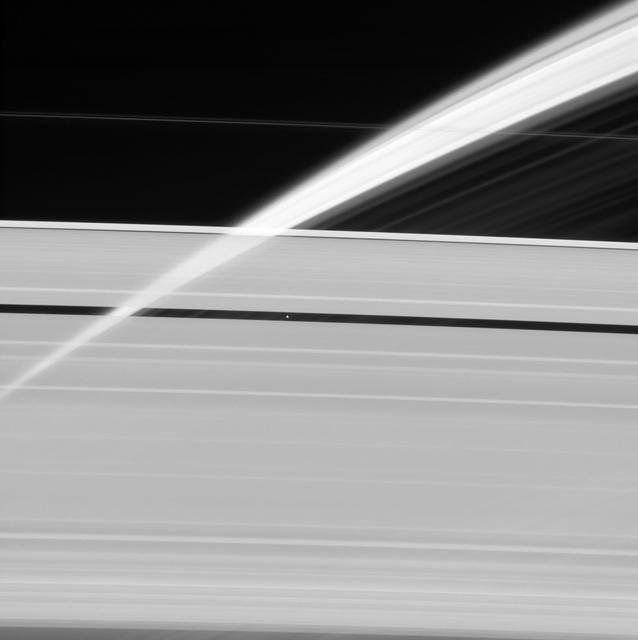
Saturn's rings, made of countless icy particles, form a translucent veil in this view from NASA's Cassini spacecraft. Saturn's tiny moon Pan, about 17 miles (28 kilometers) across, orbits within the Encke Gap in the A ring. Beyond, we can see the arc of Saturn itself, its cloud tops streaked with dark shadows cast by the rings. This image was taken in visible light with the Cassini spacecraft narrow-angle camera on Feb. 12, 2016, at a distance of approximately 746,000 miles (1.2 million kilometers) from Pan. The Cassini spacecraft ended its mission on Sept. 15, 2017. https://photojournal.jpl.nasa.gov/catalog/PIA21901
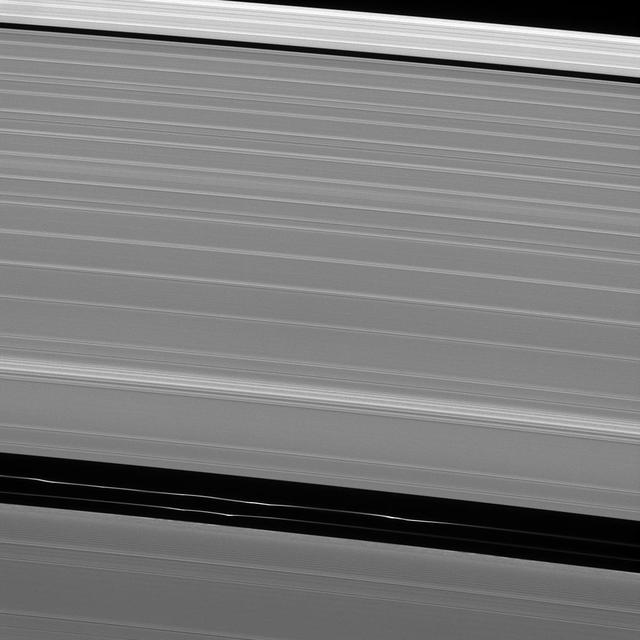
Although it appears empty from a distance, the Encke gap in Saturn A ring has three ringlets threaded through it, two of which are visible here from NASA Cassini spacecraft. Each ringlet has dynamical structure such as the clumps seen in this image. The clumps move about and even appear and disappear, in part due to the gravitational effects of Pan. This view looks toward the sunlit side of the rings from about 27 degrees above the ringplane. The image was taken in visible light with the Cassini spacecraft narrow-angle camera on May 11, 2013. The view was obtained at a distance of approximately 199,000 miles (321,000 kilometers) from Saturn and at a Sun-Saturn-spacecraft, or phase, angle of 121 degrees. Image scale is 1 mile (2 kilometers) per pixel. http://photojournal.jpl.nasa.gov/catalog/PIA18277
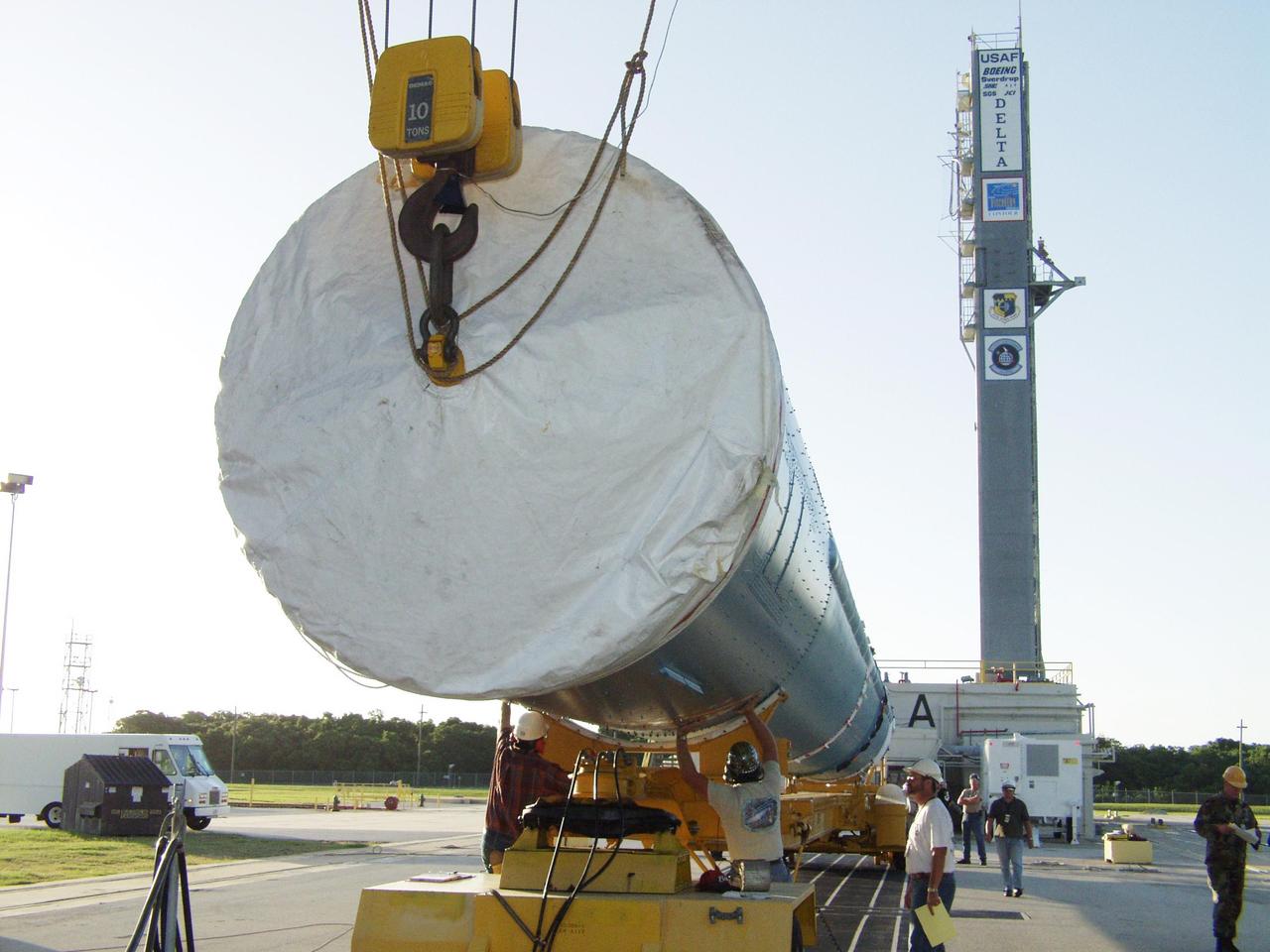
KENNEDY SPACE CENTER, FLA. - On Cape Canaveral Air Force Station Pad 17-A, the first stage of a Delta II rocket is lifted to vertical. The rocket is the launch vehicle for the CONTOUR spacecraft, scheduled to launch July 1. CONTOUR will provide the first detailed look into the heart of a comet -- the nucleus. The spacecraft will fly close to at least two comets, Encke and Schwassmann-Wachmann 3, taking pictures of the nucleus while analyzing the gas and dust that surround these rocky, icy building blocks of the solar system.
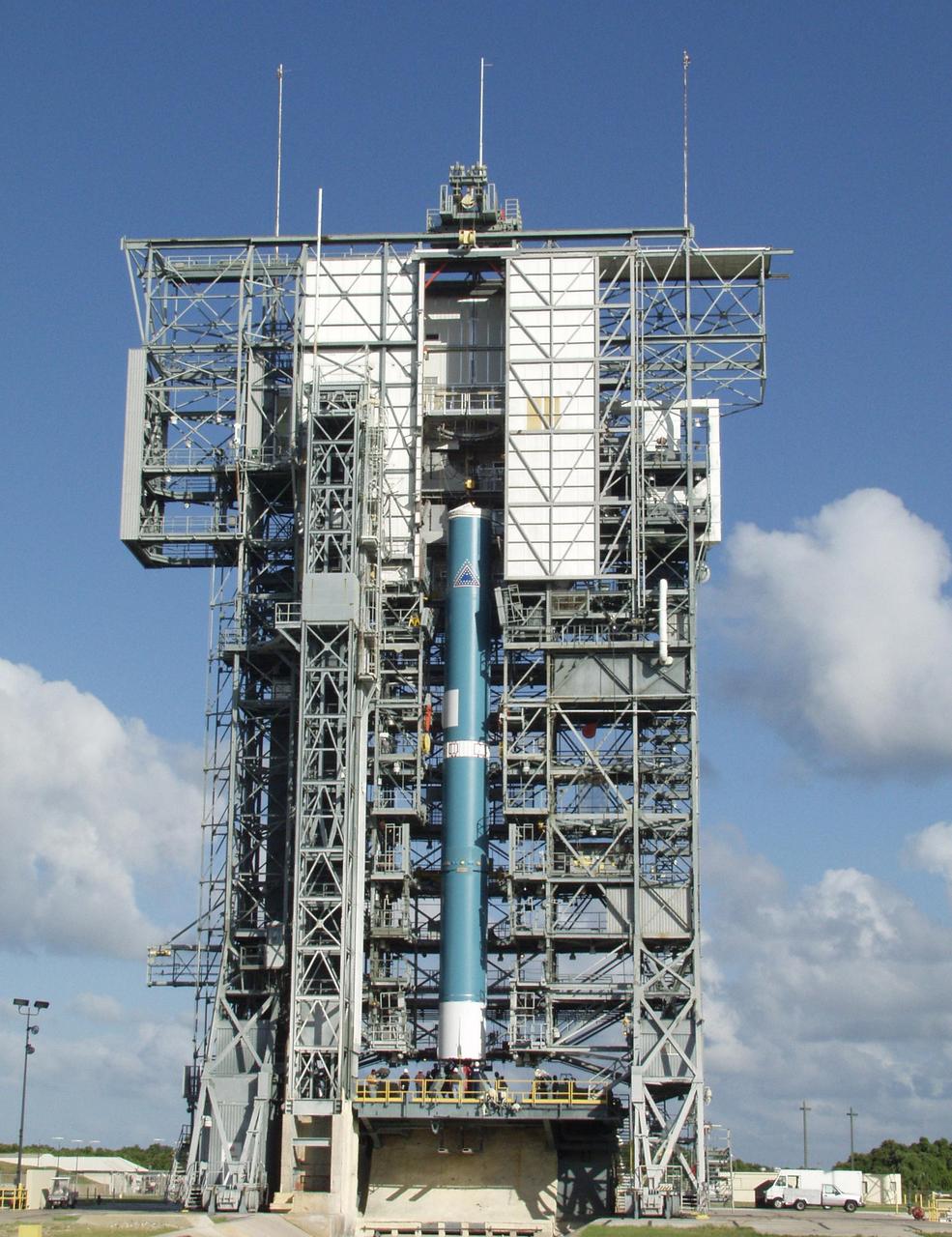
KENNEDY SPACE CENTER, FLA. -- On Launch Pad 17-A, Cape Canaveral Air Force Station, the Boeing Delta II rocket is lifted up the gantry. The rocket is the launch vehicle for the CONTOUR spacecraft, scheduled to launch July 1. CONTOUR will provide the first detailed look into the heart of a comet -- the nucleus. The spacecraft will fly close to at least two comets, Encke and Schwassmann-Wachmann 3, taking pictures of the nucleus while analyzing the gas and dust that surround these rocky, icy building blocks of the solar system.
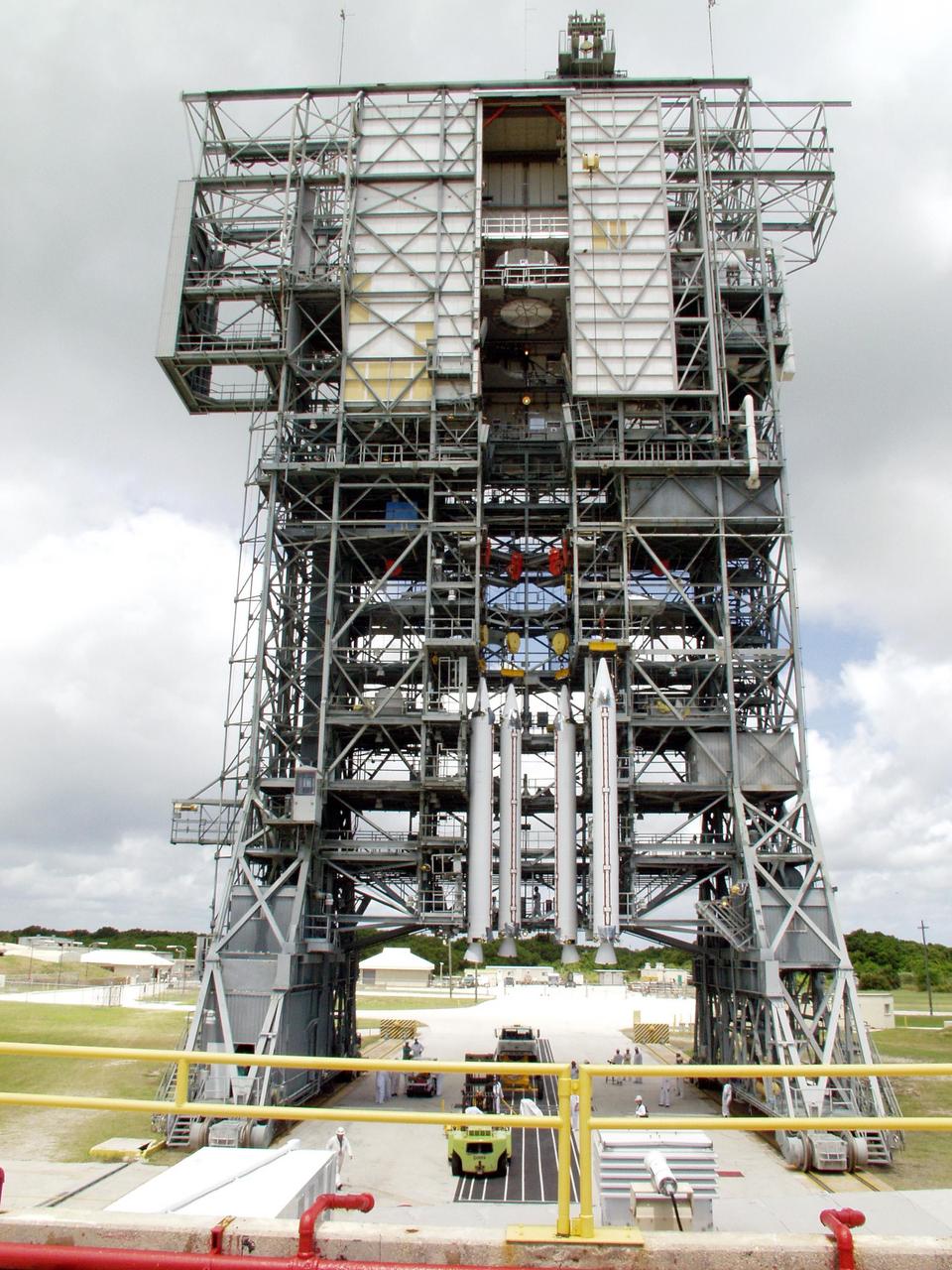
KENNEDY SPACE CENTER, FLA. -- On Launch Pad 17-A, Cape Canaveral Air Force Station, four solid rocket boosters are lifted for mating to a Boeing Delta II rocket. The rocket will be the launch vehicle for the CONTOUR spacecraft, scheduled to launch July 1. CONTOUR will provide the first detailed look into the heart of a comet -- the nucleus. The spacecraft will fly close to at least two comets, Encke and Schwassmann-Wachmann 3, taking pictures of the nucleus while analyzing the gas and dust that surround these rocky, icy building blocks of the solar system.
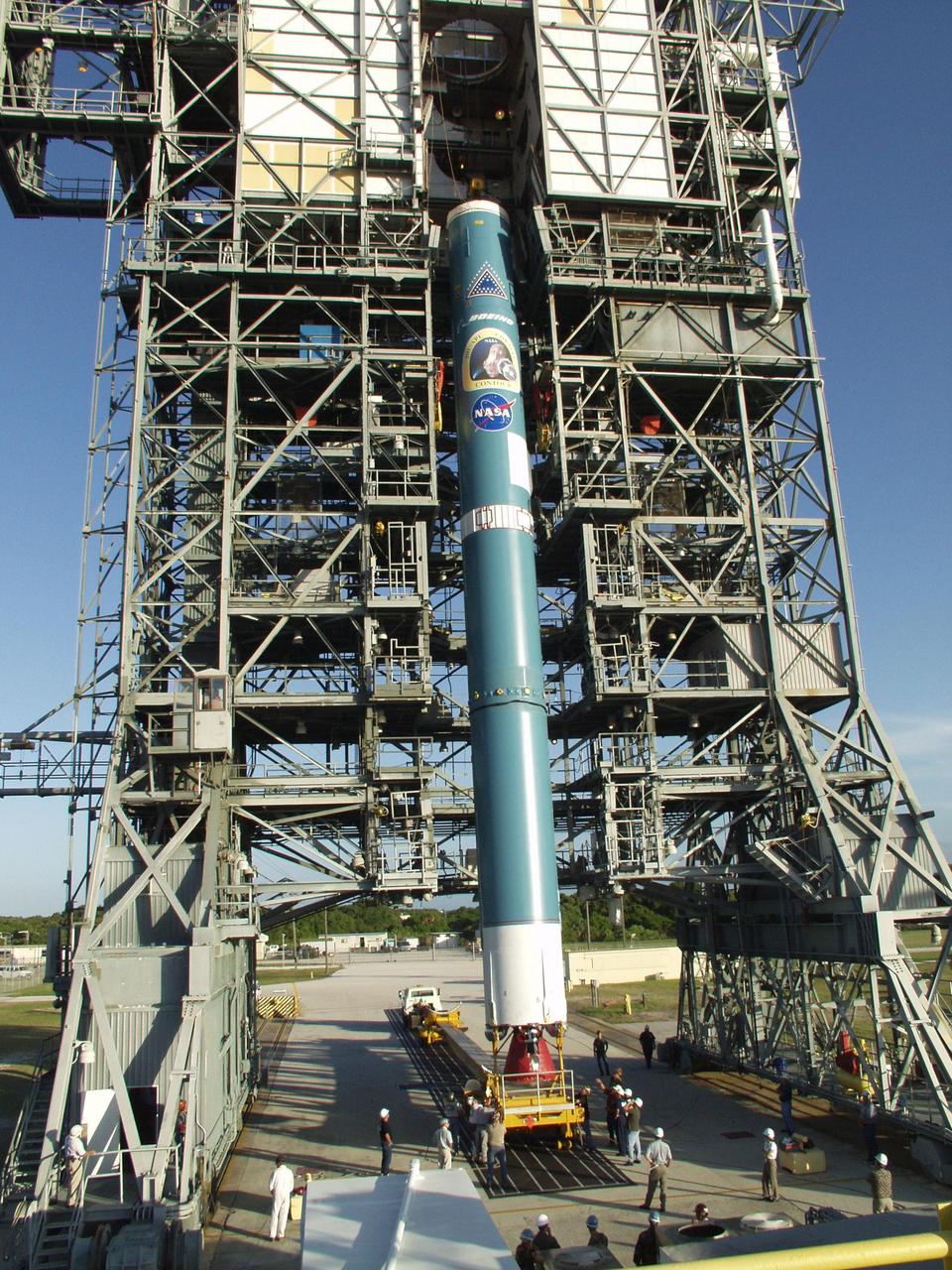
KENNEDY SPACE CENTER, FLA. -- The Boeing Delta II rocket nears a vertical position as it is lifted from the gantry. The rocket is the launch vehicle for the CONTOUR spacecraft, scheduled to launch July 1. CONTOUR will provide the first detailed look into the heart of a comet -- the nucleus. The spacecraft will fly close to at least two comets, Encke and Schwassmann-Wachmann 3, taking pictures of the nucleus while analyzing the gas and dust that surround these rocky, icy building blocks of the solar system.
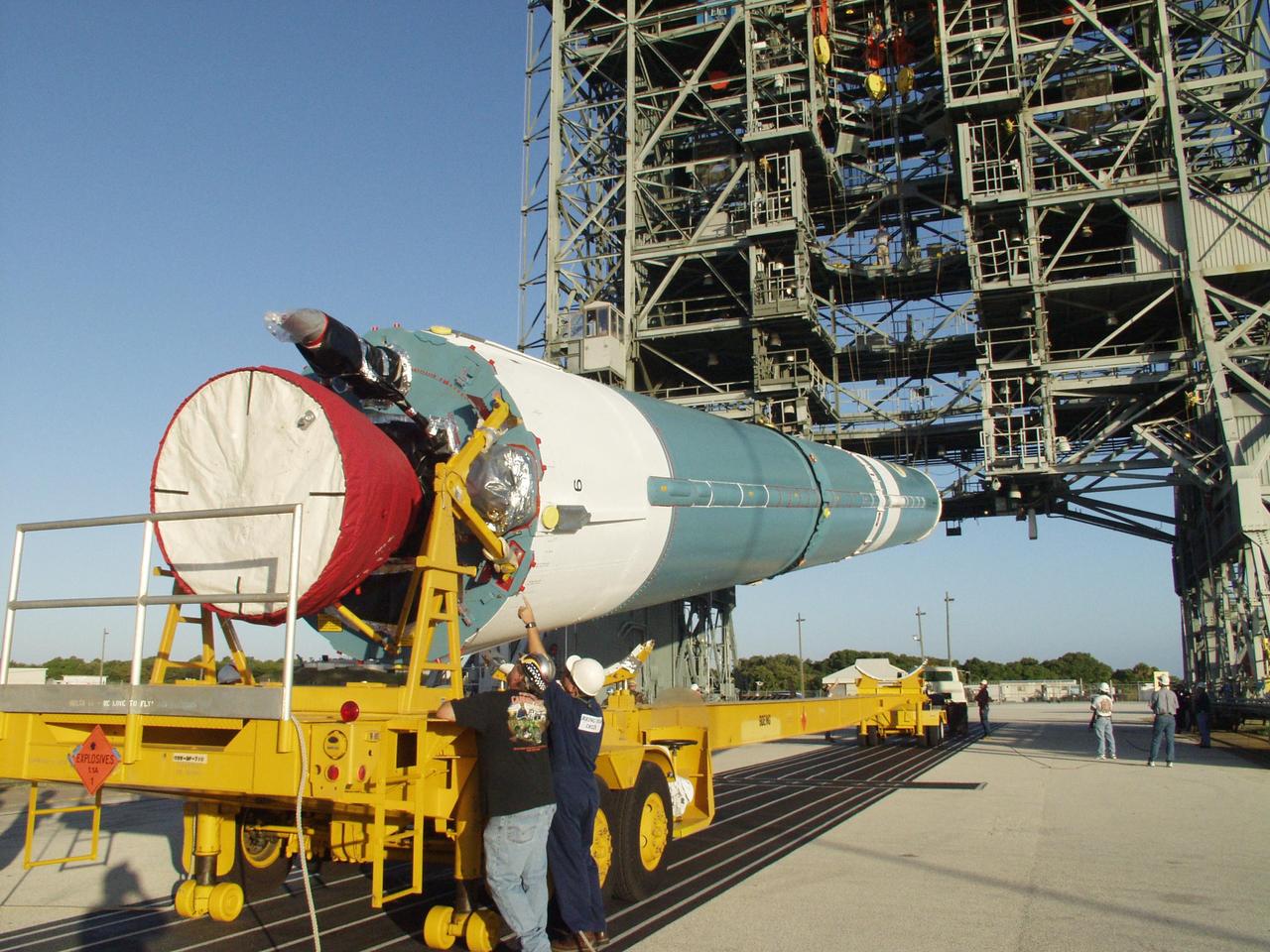
KENNEDY SPACE CENTER, FLA. - On Cape Canaveral Air Force Station Pad 17-A, workers check the lower portion of the Boeing Delta II rocket as it is lifted off the transporter. The rocket is the launch vehicle for the CONTOUR spacecraft, scheduled to launch July 1. CONTOUR will provide the first detailed look into the heart of a comet -- the nucleus. The spacecraft will fly close to at least two comets, Encke and Schwassmann-Wachmann 3, taking pictures of the nucleus while analyzing the gas and dust that surround these rocky, icy building blocks of the solar system.
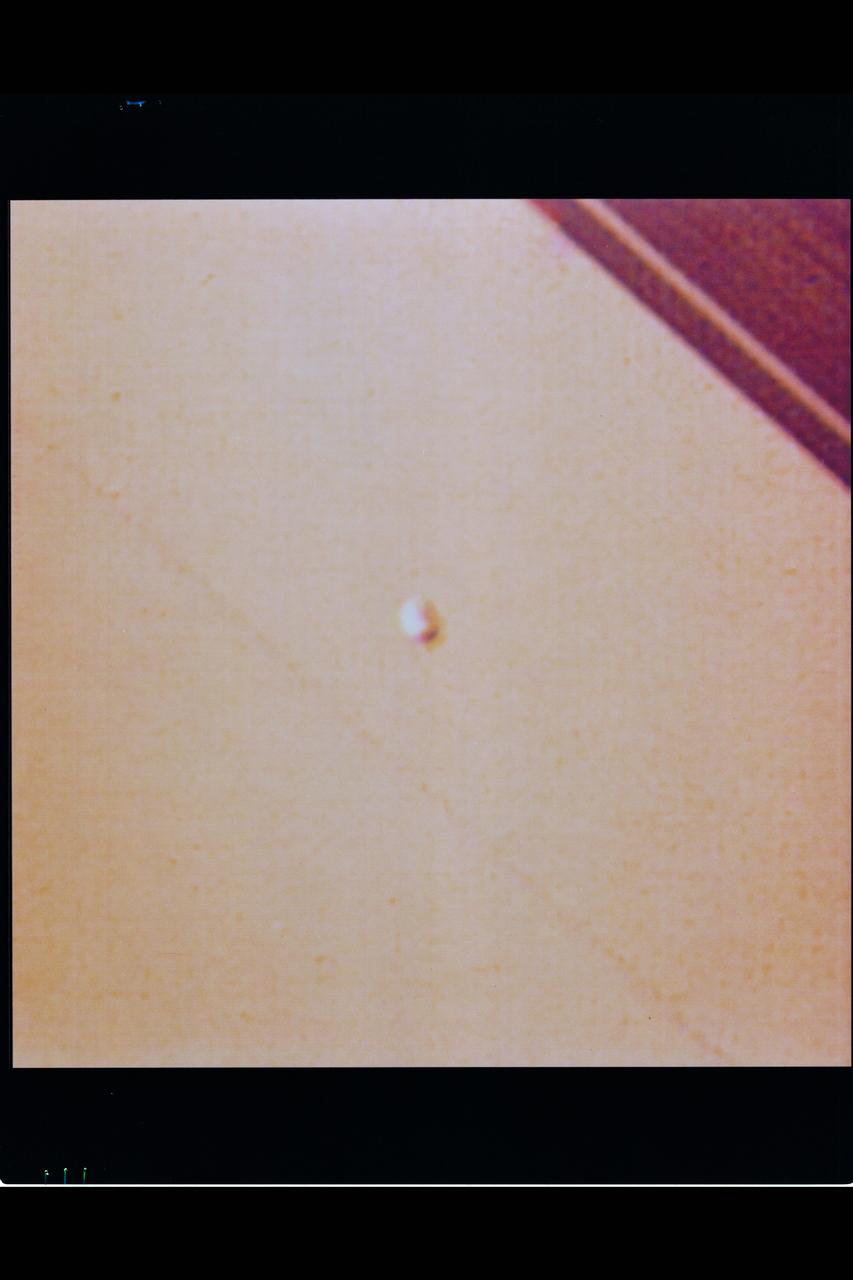
Range : 1.2 million km. ( 740,000 miles ) P-23954C Voyager 2 obtained this color image of Saturn's F-ring and its small inner sheparding satellite (1990S27) against the full disk of the planet. TheA-ring and the Encke Gap appear in the lower left corner. This view shows that the shepard is more refective than Sturn's clouds, suggesting that it is an icy, bright surfaced object like the larger satellites and the ring particles themselves.
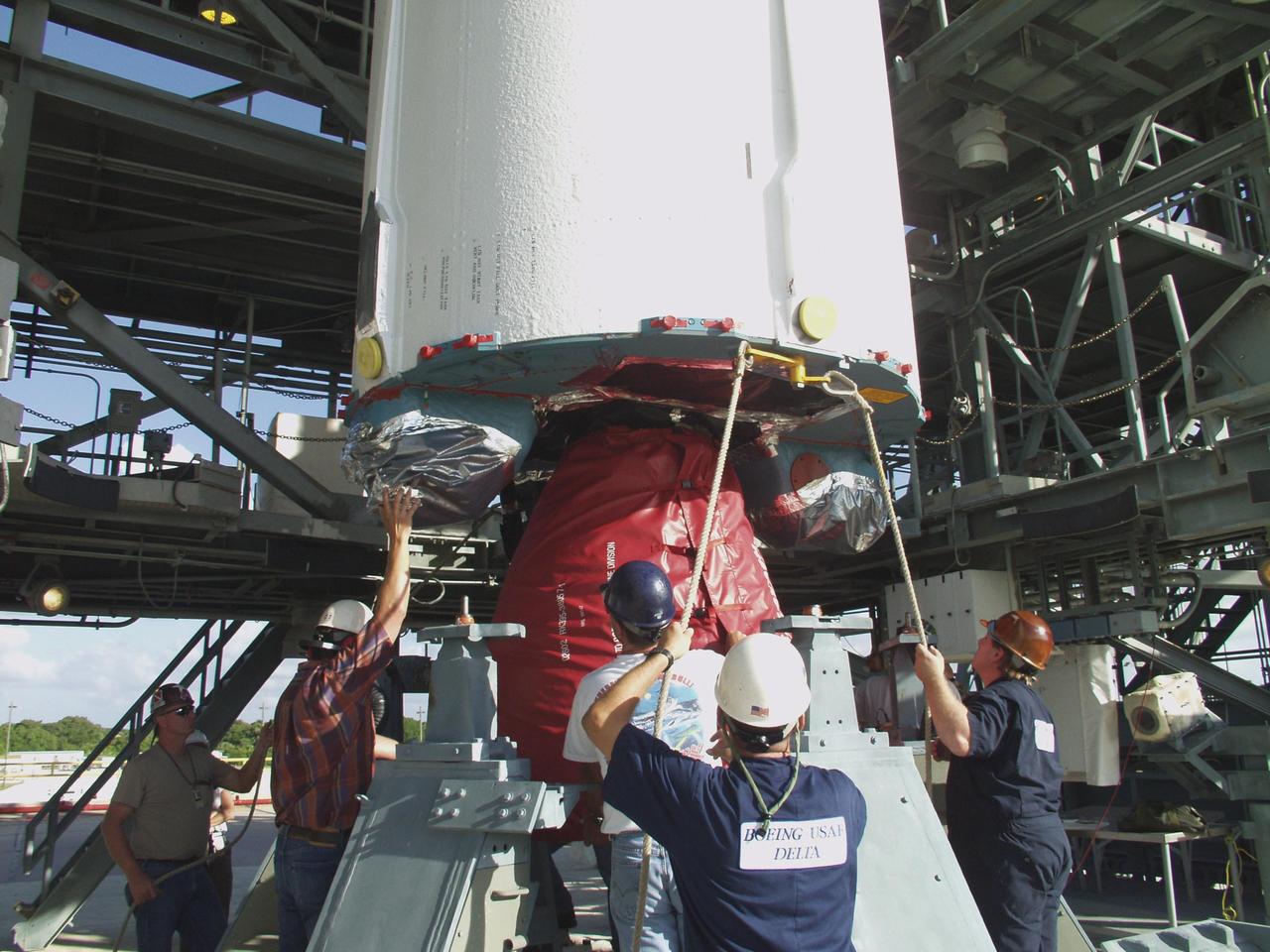
KENNEDY SPACE CENTER, FLA. -- On Launch Pad 17-A, Cape Canaveral Air Force Station, workers oversee the lifting of the Boeing Delta II rocket into the gantry above. The rocket is the launch vehicle for the CONTOUR spacecraft, scheduled to launch July 1. CONTOUR will provide the first detailed look into the heart of a comet -- the nucleus. The spacecraft will fly close to at least two comets, Encke and Schwassmann-Wachmann 3, taking pictures of the nucleus while analyzing the gas and dust that surround these rocky, icy building blocks of the solar system.
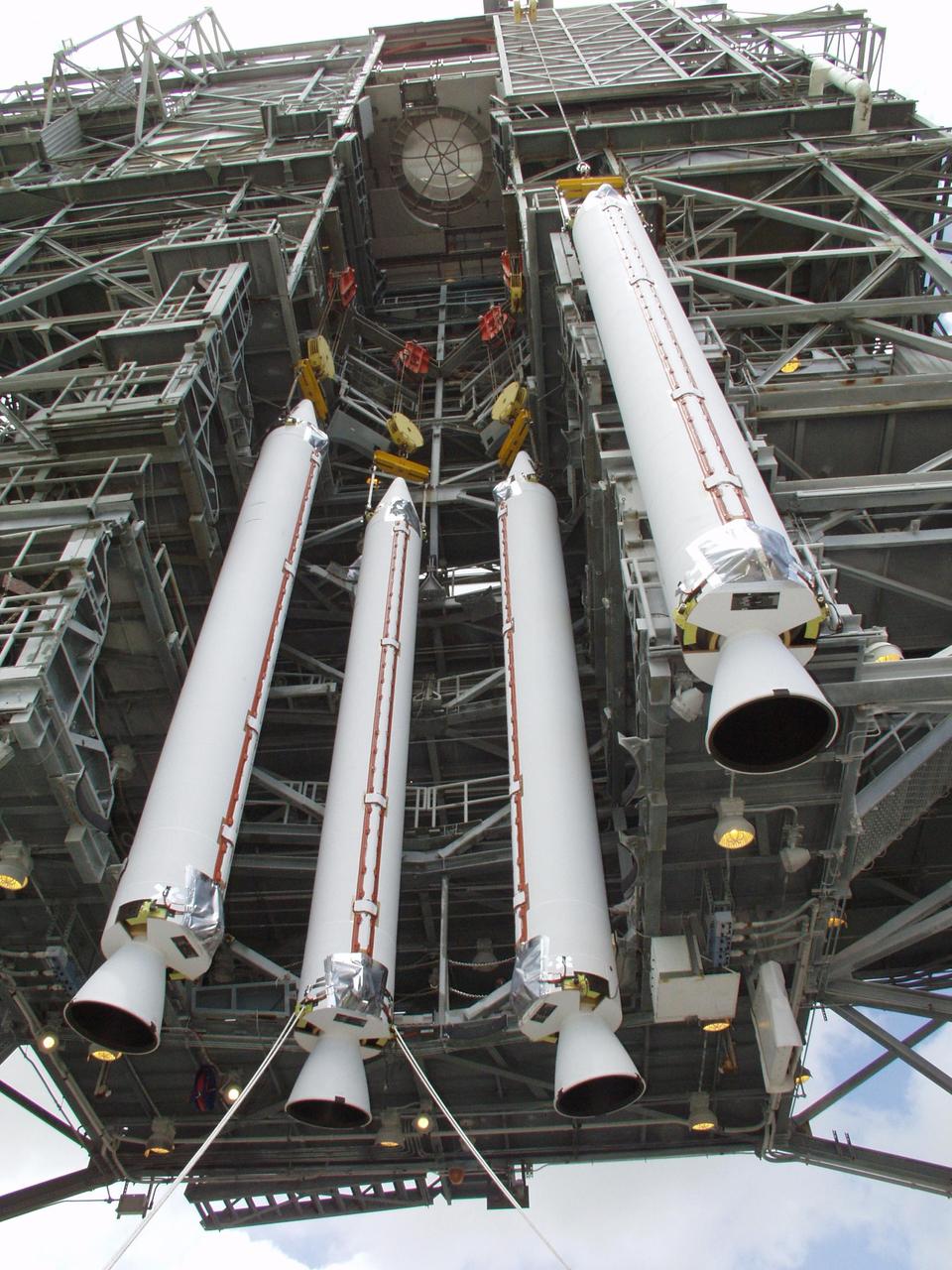
KENNEDY SPACE CENTER, FLA. -- On Launch Pad 17-A, Cape Canaveral Air Force Station, four solid rocket boosters are lifted for mating to a Boeing Delta II rocket. The rocket will be the launch vehicle for the CONTOUR spacecraft, scheduled to launch July 1. CONTOUR will provide the first detailed look into the heart of a comet -- the nucleus. The spacecraft will fly close to at least two comets, Encke and Schwassmann-Wachmann 3, taking pictures of the nucleus while analyzing the gas and dust that surround these rocky, icy building blocks of the solar system.

KENNEDY SPACE CENTER, FLA. -- On Launch Pad 17-A, Cape Canaveral Air Force Station, a technician works beneath the Boeing Delta II rocket that will be the launch vehicle for the CONTOUR spacecraft, scheduled to launch July 1. CONTOUR will provide the first detailed look into the heart of a comet -- the nucleus. The spacecraft will fly close to at least two comets, Encke and Schwassmann-Wachmann 3, taking pictures of the nucleus while analyzing the gas and dust that surround these rocky, icy building blocks of the solar system.

KENNEDY SPACE CENTER, FLA. -- On Cape Canaveral Air Force Station Pad 17-A, the Boeing Delta II rocket is lifted up the gantry. The rocket is the launch vehicle for the CONTOUR spacecraft, scheduled to launch July 1. CONTOUR will provide the first detailed look into the heart of a comet -- the nucleus. The spacecraft will fly close to at least two comets, Encke and Schwassmann-Wachmann 3, taking pictures of the nucleus while analyzing the gas and dust that surround these rocky, icy building blocks of the solar system.
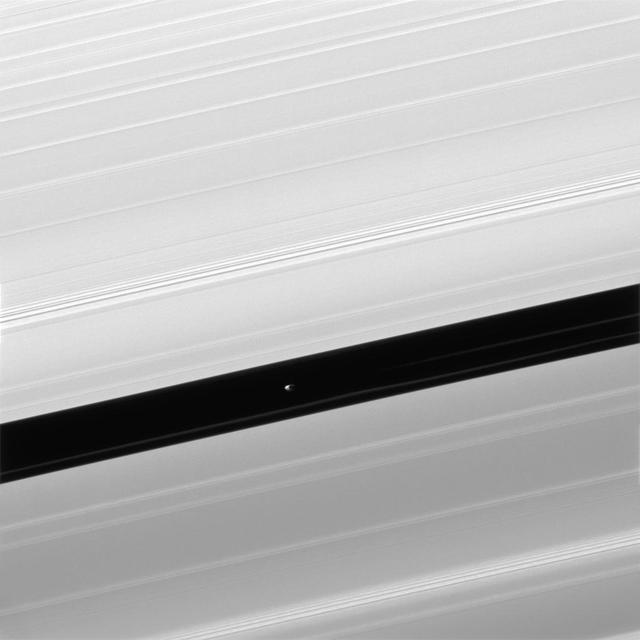
Pan and moons like it have profound effects on Saturn's rings. The effects can range from clearing gaps, to creating new ringlets, to raising vertical waves that rise above and below the ring plane. All of these effects, produced by gravity, are seen in this image. Pan (17 miles or 28 kilometers across), seen in image center, maintains the Encke Gap in which it orbits, but it also helps create and shape the narrow ringlets that appear in the Encke gap. Two faint ringlets are visible in this image, below and to the right of Pan. Many moons, Pan included, create waves at distant points in Saturn's rings where ring particles and the moons have orbital resonances. Many such waves are visible here as narrow groupings of brighter and darker bands. Studying these waves can provide information on local ring conditions. The view looks toward the unilluminated side of the rings from about 22 degrees below the ring plane. The image was taken in visible light with the Cassini spacecraft narrow-angle camera on April 3, 2016. The view was obtained at a distance of approximately 232,000 miles (373,000 kilometers) from Saturn and at a Sun-Saturn-spacecraft, or phase, angle of 140 degrees. Image scale is 1.2 miles (2 kilometers) per pixel. http://photojournal.jpl.nasa.gov/catalog/PIA20490
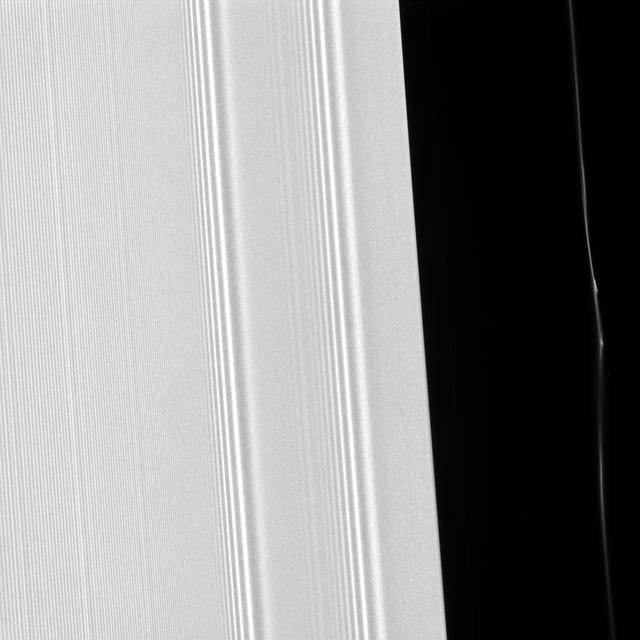
Many of the features seen in Saturn's rings are shaped by the planet's moons. This view from NASA's Cassini spacecraft shows two different effects of moons that cause waves in the A ring and kinks in a faint ringlet. The view captures the outer edge of the 200-mile-wide (320-kilometer-wide) Encke Gap, in the outer portion of Saturn's A ring. This is the same region features the large propeller called Earhart. Also visible here is one of several kinked and clumpy ringlets found within the gap. Kinks and clumps in the Encke ringlet move about, and even appear and disappear, in part due to the gravitational effects of Pan -- which orbits in the gap and whose gravitational influence holds it open. The A ring, which takes up most of the image on the left side, displays wave features caused by Pan, as well as the moons Pandora and Prometheus, which orbit a bit farther from Saturn on both sides of the planet's F ring. This view was taken in visible light with the Cassini spacecraft narrow-angle camera on March 22, 2017, and looks toward the sunlit side of the rings from about 22 degrees above the ring plane. The view was acquired at a distance of approximately 63,000 miles (101,000 kilometers) from Saturn and at a phase angle (the angle between the sun, the rings and the spacecraft) of 59 degrees. Image scale is 1,979 feet (603 meters) per pixel. https://photojournal.jpl.nasa.gov/catalog/PIA21333
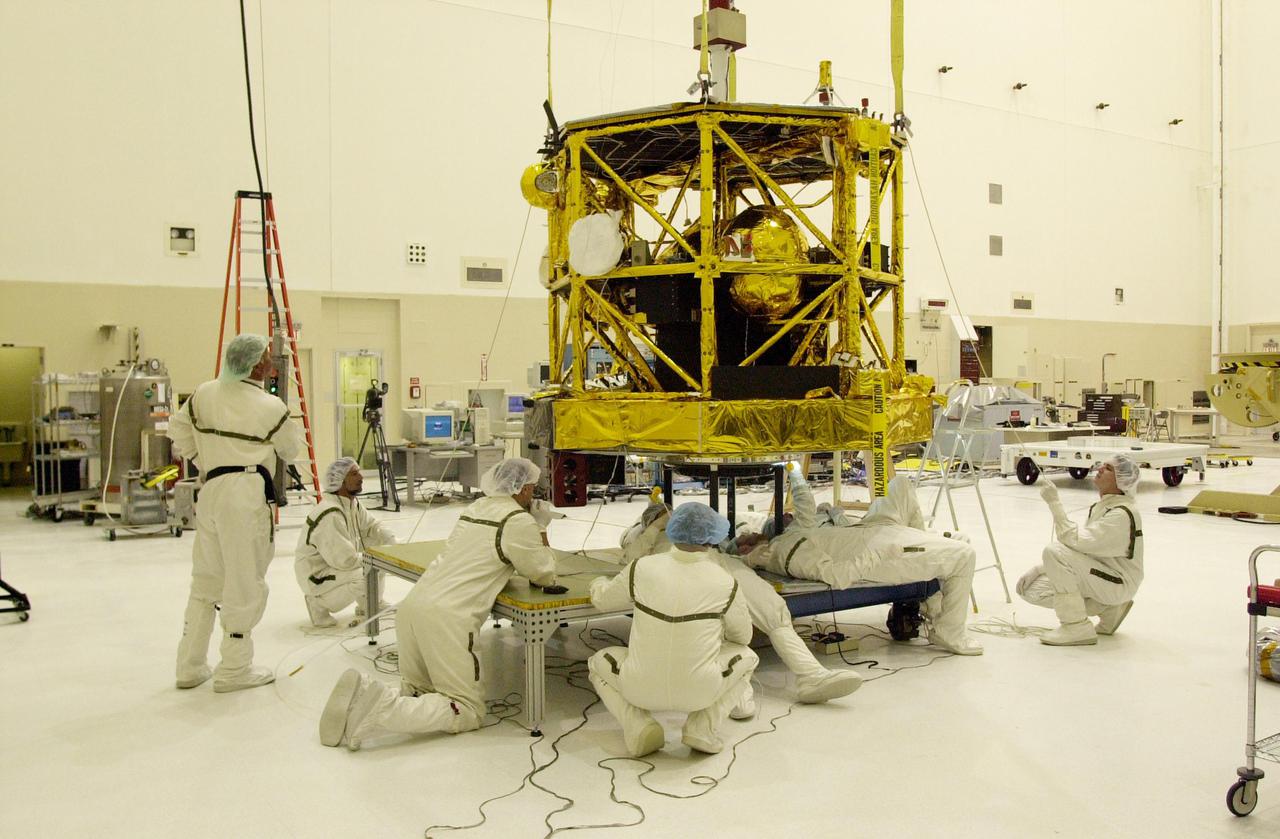
KENNEDY SPACE CENTER, FLA. -- In the Spacecraft Assembly and Encapsulation Facility 2, workers watch closely as the CONTOUR spacecraft is lowered into place over the apogee kick motor to which it will be attached. CONTOUR will provide the first detailed look into the heart of a comet -- the nucleus. The spacecraft will fly close to at least two comets, Encke and Schwassmann-Wachmann 3, taking pictures of the nucleus while analyzing the gas and dust that surround these rocky, icy building blocks of the solar system. The Applied Physics Laboratory of Johns Hopkins University, Baltimore, Md., built CONTOUR and will also be in control of the spacecraft after launch, scheduled for July 1, 2002, from LC 17A at Cape Canaveral Air Force Station
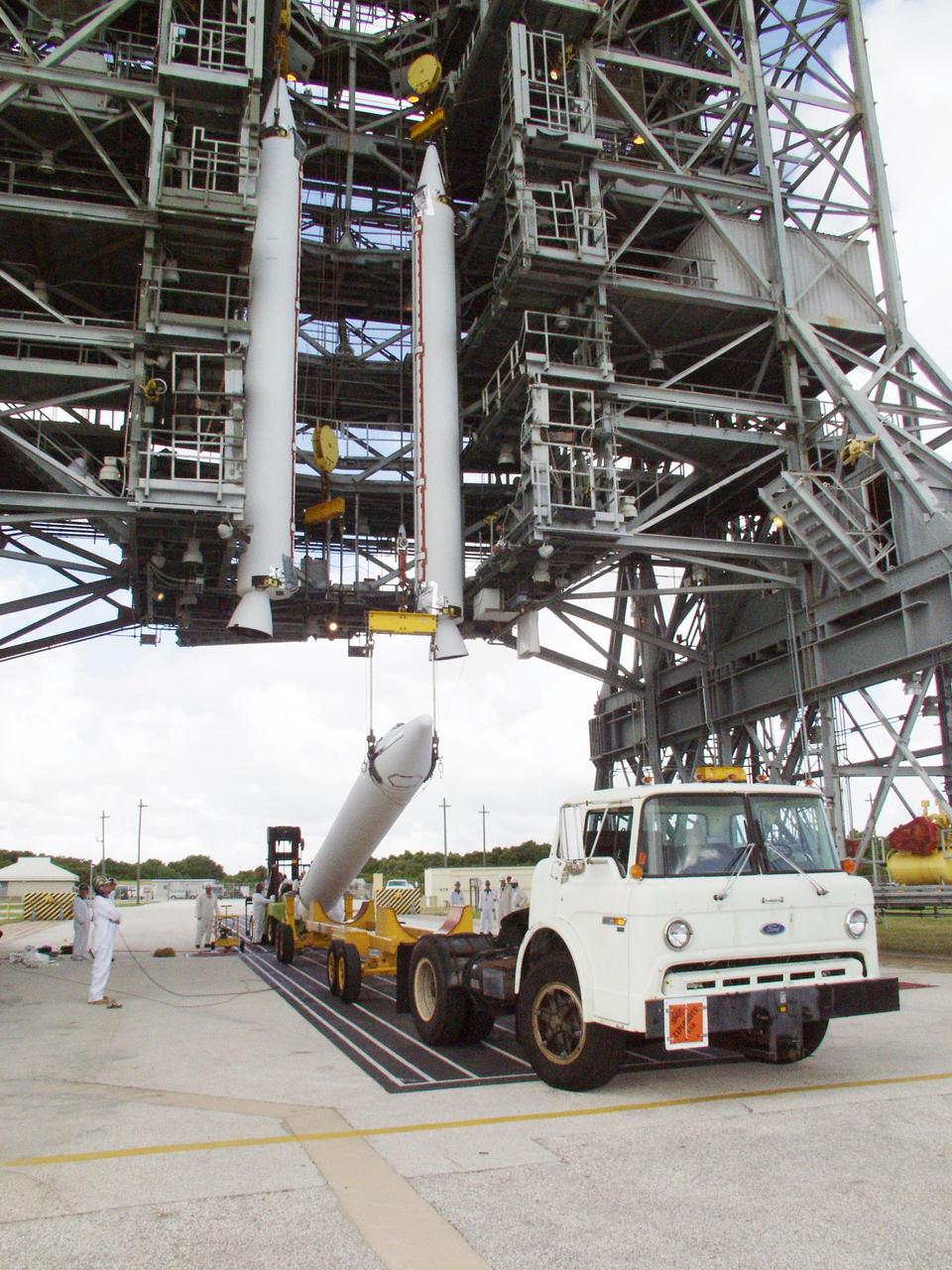
KENNEDY SPACE CENTER, FLA. -- On Launch Pad 17-A, Cape Canaveral Air Force Station, two solid rocket boosters are lifted for mating to a Boeing Delta II rocket, as another waits its turn on the transporter below. The rocket will be the launch vehicle for the CONTOUR spacecraft, scheduled to launch July 1. CONTOUR will provide the first detailed look into the heart of a comet -- the nucleus. The spacecraft will fly close to at least two comets, Encke and Schwassmann-Wachmann 3, taking pictures of the nucleus while analyzing the gas and dust that surround these rocky, icy building blocks of the solar system.
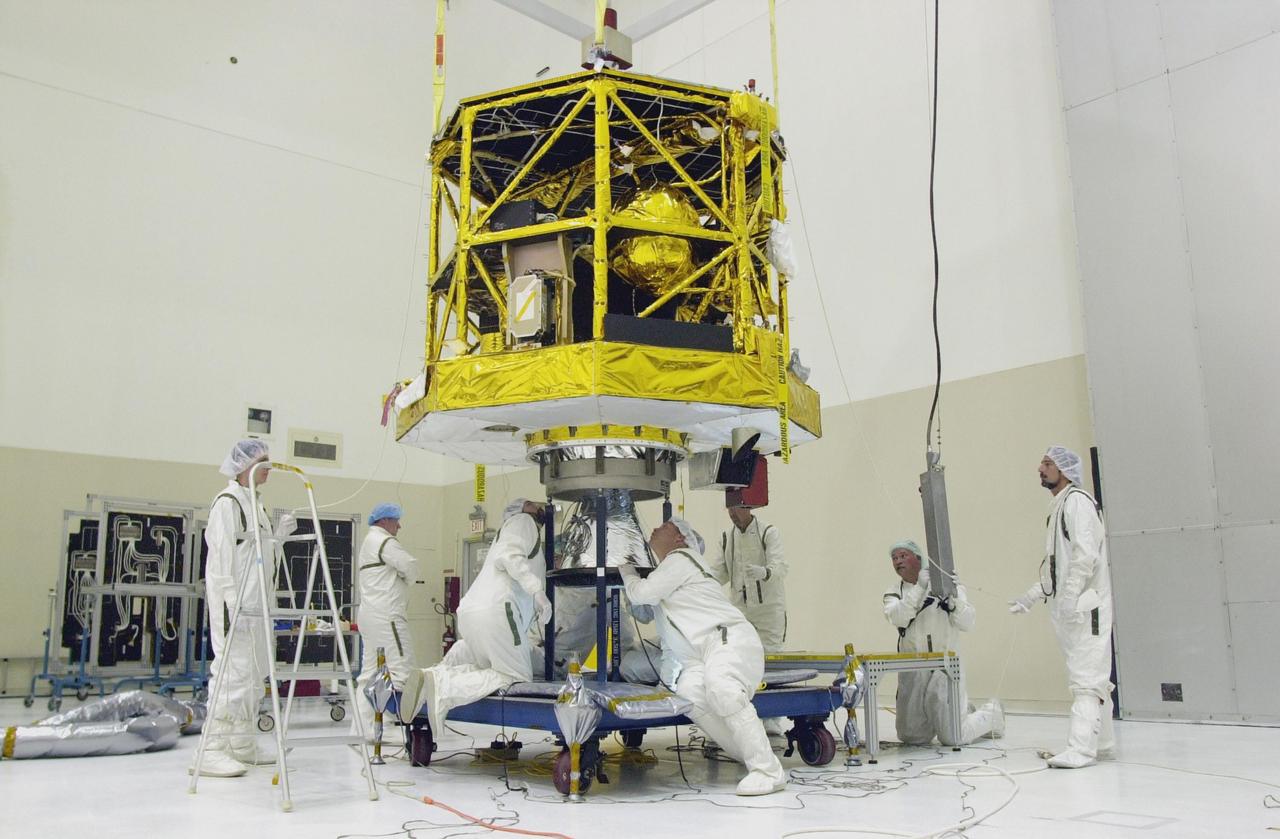
KENNEDY SPACE CENTER, FLA. - Workers in the Spacecraft Assembly and Encapsulation Facility 2 check the position of the CONTOUR spacecraft as it is lowered over the apogee kick motor to which it will be attached. CONTOUR will provide the first detailed look into the heart of a comet -- the nucleus. The spacecraft will fly close to at least two comets, Encke and Schwassmann-Wachmann 3, taking pictures of the nucleus while analyzing the gas and dust that surround these rocky, icy building blocks of the solar system. The Applied Physics Laboratory of Johns Hopkins University, Baltimore, Md., built CONTOUR and will also be in control of the spacecraft after launch, scheduled for July 1, 2002, from LC 17A at Cape Canaveral Air Force Station
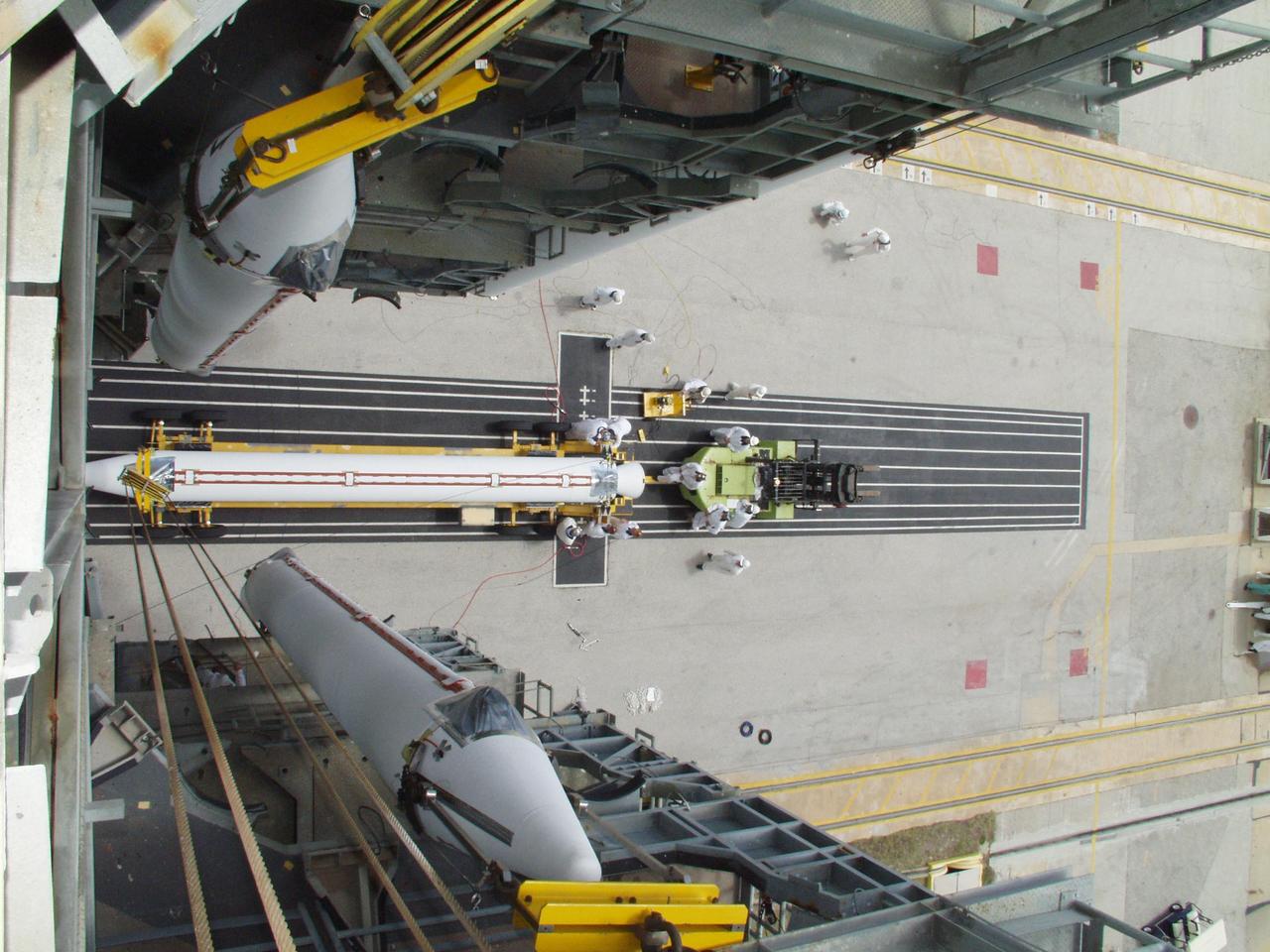
KENNEDY SPACE CENTER, FLA. -- Viewed from the top of Launch Pad 17-A, Cape Canaveral Air Force Station, two solid rocket boosters are lifted for mating to a Boeing Delta II rocket, as another waits its turn on the transporter below. The rocket will be the launch vehicle for the CONTOUR spacecraft, scheduled to launch July 1. CONTOUR will provide the first detailed look into the heart of a comet -- the nucleus. The spacecraft will fly close to at least two comets, Encke and Schwassmann-Wachmann 3, taking pictures of the nucleus while analyzing the gas and dust that surround these rocky, icy building blocks of the solar system.
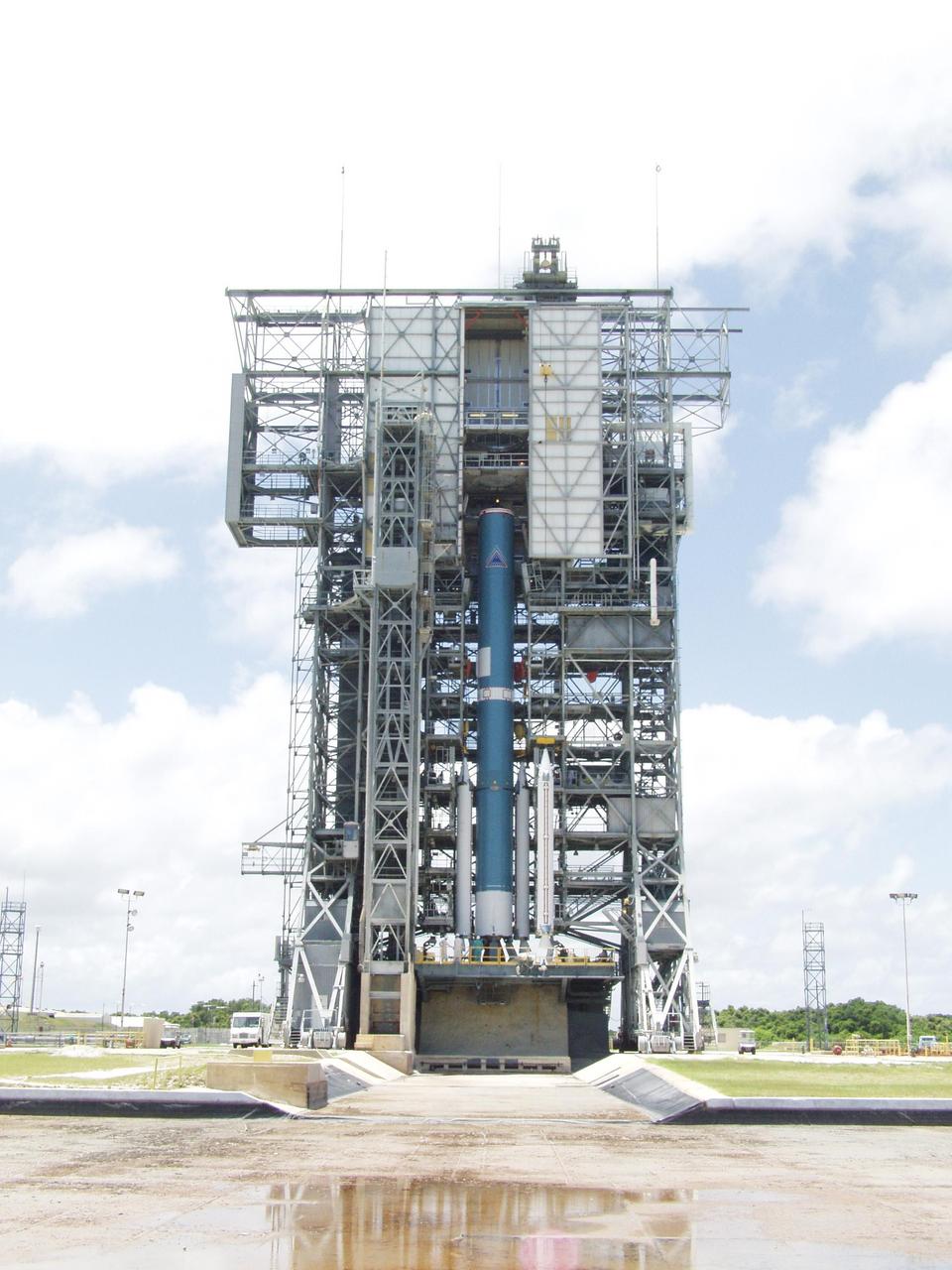
KENNEDY SPACE CENTER, FLA. -- On Launch Pad 17-A, Cape Canaveral Air Force Station, the solid rocket boosters have been installed on the first stage of a Boeing Delta II rocket. The rocket will be the launch vehicle for the CONTOUR spacecraft, scheduled to launch July 1. CONTOUR will provide the first detailed look into the heart of a comet -- the nucleus. The spacecraft will fly close to at least two comets, Encke and Schwassmann-Wachmann 3, taking pictures of the nucleus while analyzing the gas and dust that surround these rocky, icy building blocks of the solar system.
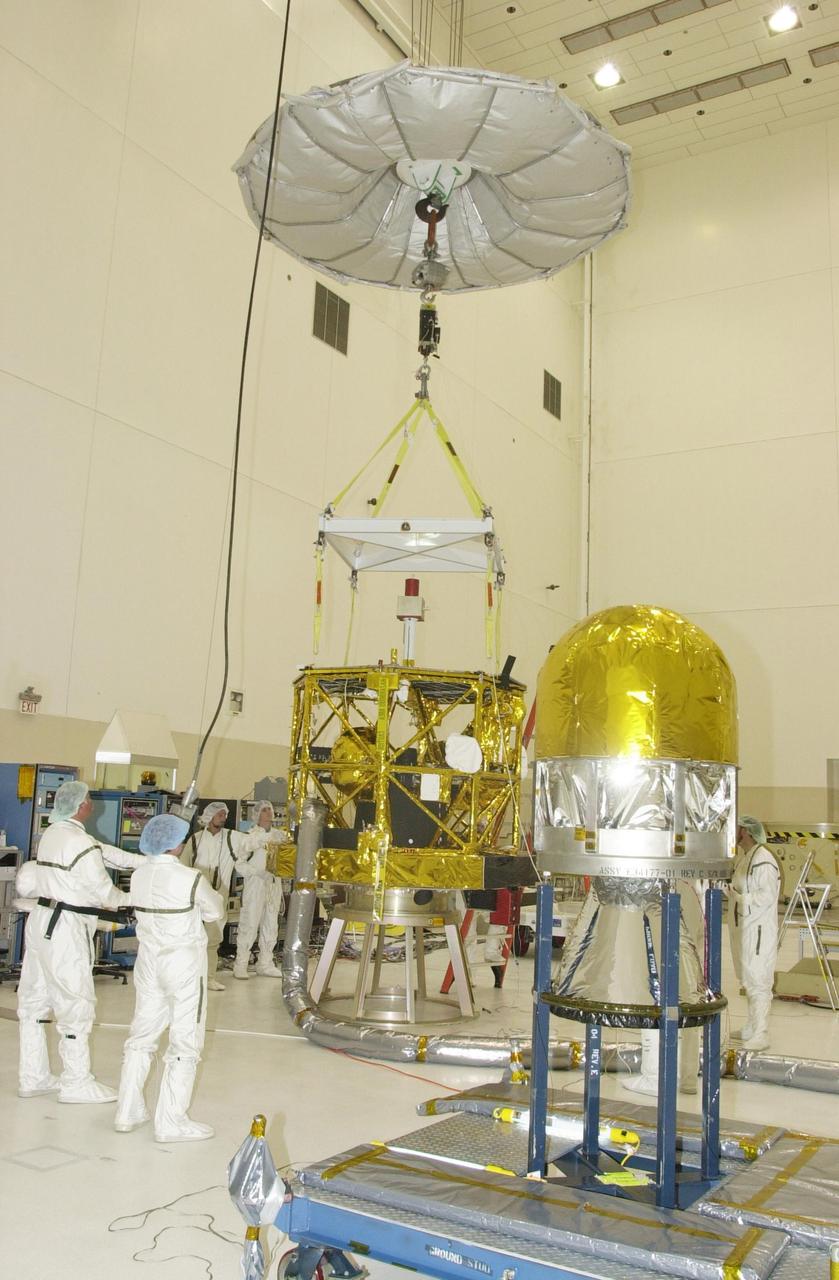
KENNEDY SPACE CENTER, FLA. - An overhead crane is lowered onto the CONTOUR spacecraft in the Spacecraft Assembly and Encapsulation Facility 2. The crane will move it over to the apogee kick motor nearby where it will be attached. CONTOUR will provide the first detailed look into the heart of a comet -- the nucleus. The spacecraft will fly close to at least two comets, Encke and Schwassmann-Wachmann 3, taking pictures of the nucleus while analyzing the gas and dust that surround these rocky, icy building blocks of the solar system. The Applied Physics Laboratory of Johns Hopkins University, Baltimore, Md., built CONTOUR and will also be in control of the spacecraft after launch, scheduled for July 1, 2002, from LC 17A at Cape Canaveral Air Force Station
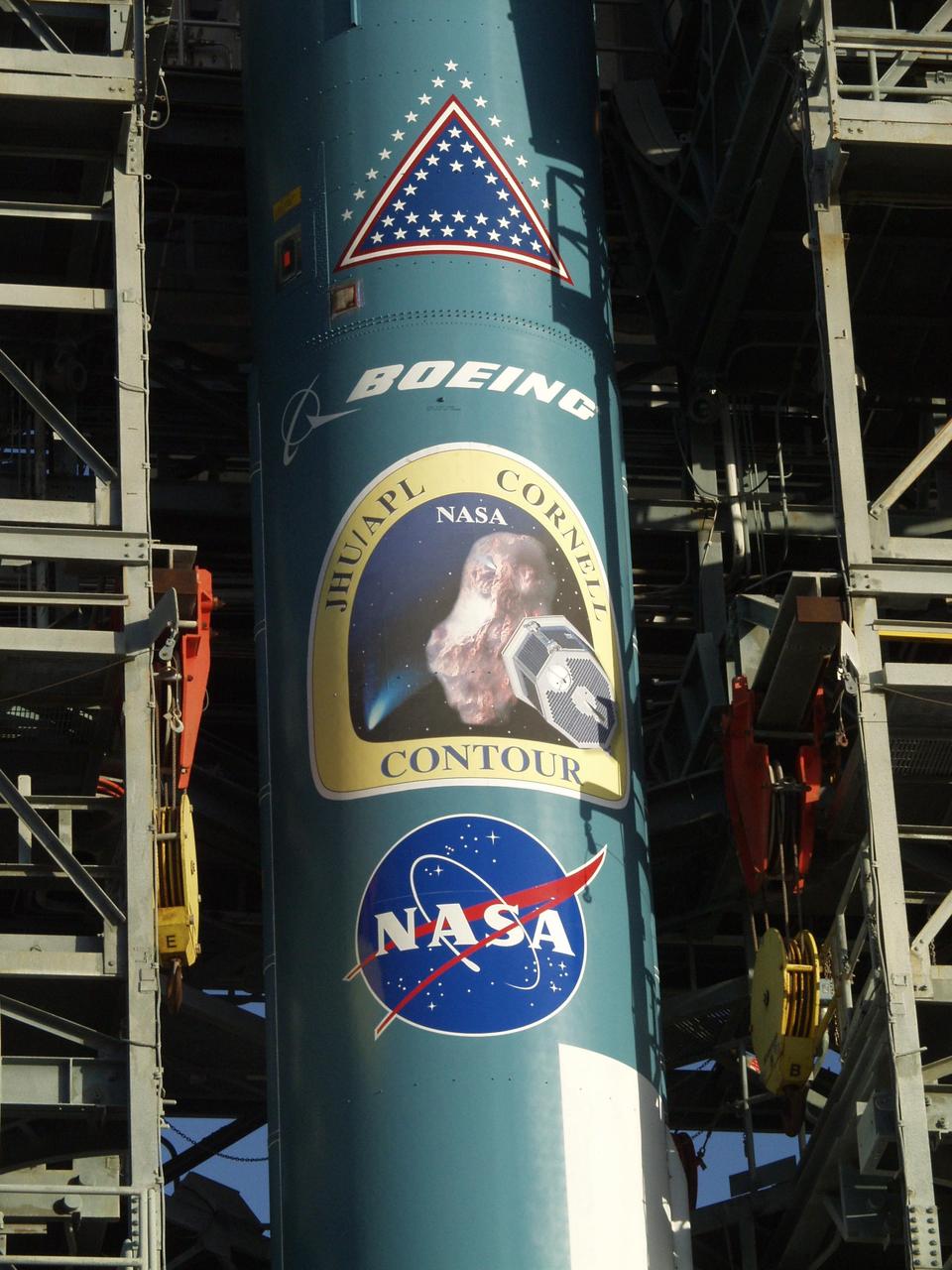
KENNEDY SPACE CENTER, FLA. - This closeup of the Boeing Delta II rocket on Launch Pad 17-A, Cape Canaveral Air Force Station, shows the CONTOUR project logo and the NASA emblem below it. The rocket is the launch vehicle for the CONTOUR spacecraft, scheduled to launch July 1. CONTOUR will provide the first detailed look into the heart of a comet -- the nucleus. The spacecraft will fly close to at least two comets, Encke and Schwassmann-Wachmann 3, taking pictures of the nucleus while analyzing the gas and dust that surround these rocky, icy building blocks of the solar system.
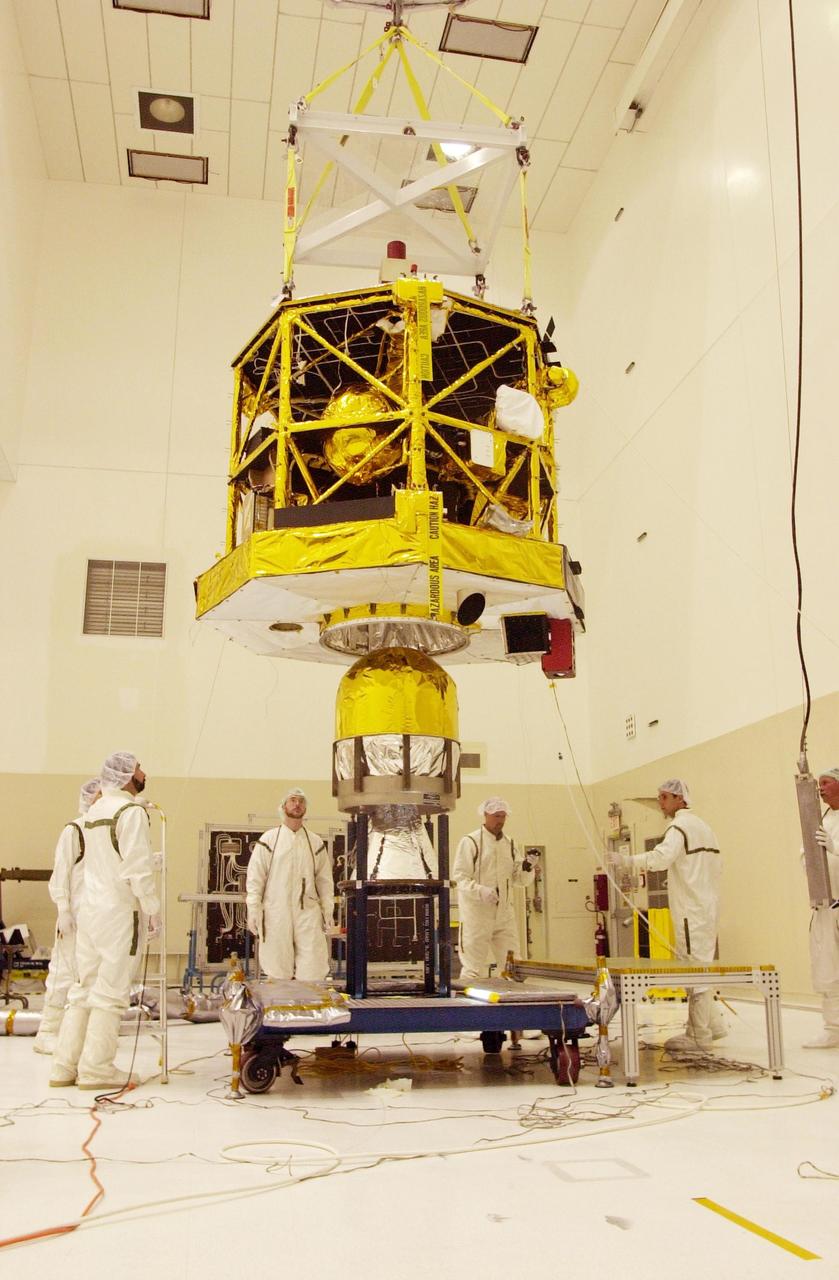
KENNEDY SPACE CENTER, FLA. -- In the Spacecraft Assembly and Encapsulation Facility 2, workers watch closely as the CONTOUR spacecraft is lowered toward the apogee kick motor to which it will be attached. CONTOUR will provide the first detailed look into the heart of a comet -- the nucleus. The spacecraft will fly close to at least two comets, Encke and Schwassmann-Wachmann 3, taking pictures of the nucleus while analyzing the gas and dust that surround these rocky, icy building blocks of the solar system. The Applied Physics Laboratory of Johns Hopkins University, Baltimore, Md., built CONTOUR and will also be in control of the spacecraft after launch, scheduled for July 1, 2002, from LC 17A at Cape Canaveral Air Force Station
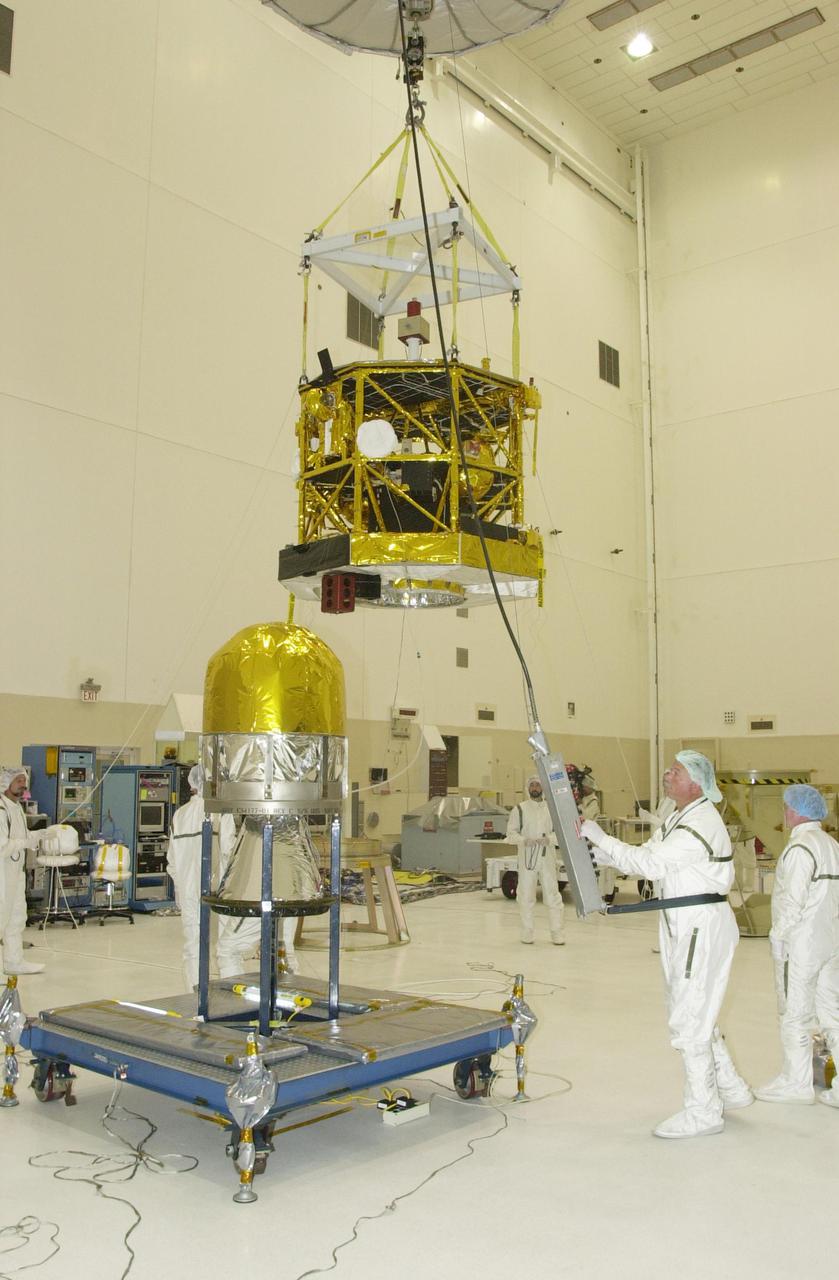
KENNEDY SPACE CENTER, FLA. - In the Spacecraft Assembly and Encapsulation Facility 2, the CONTOUR spacecraft is carried by an overhead crane to the apogee kick motor sitting on a stand below. The spacecraft will be attached to the motor for launch. CONTOUR will provide the first detailed look into the heart of a comet -- the nucleus. The spacecraft will fly close to at least two comets, Encke and Schwassmann-Wachmann 3, taking pictures of the nucleus while analyzing the gas and dust that surround these rocky, icy building blocks of the solar system. The Applied Physics Laboratory of Johns Hopkins University, Baltimore, Md., built CONTOUR and will also be in control of the spacecraft after launch, scheduled for July 1, 2002, from LC 17A at Cape Canaveral Air Force Station
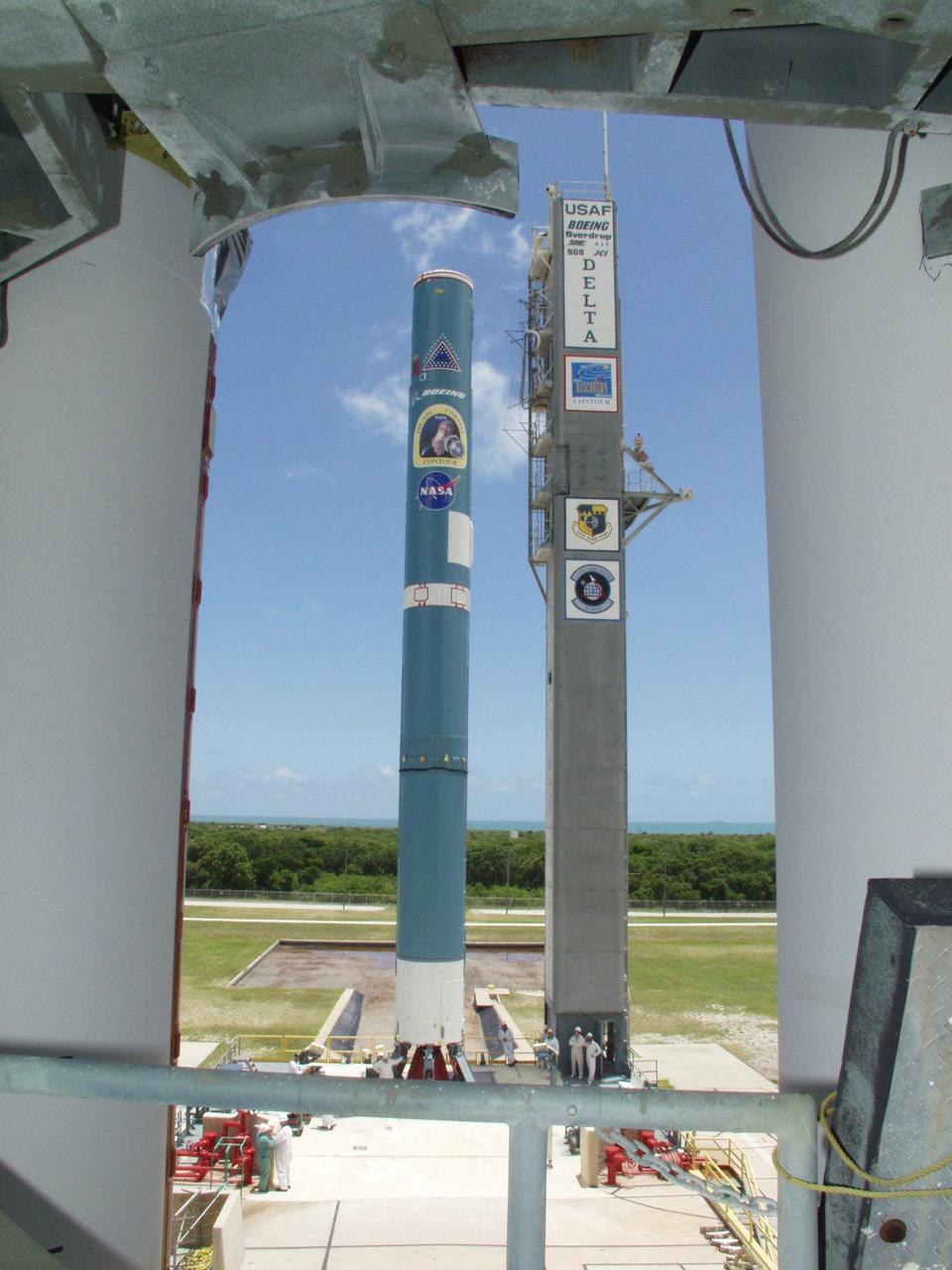
KENNEDY SPACE CENTER, FLA. -- On Launch Pad 17-A, Cape Canaveral Air Force Station, a view of the first stage of a Boeing Delta II rocket is captured between two of the solid rocket boosters that will be mated to it. The rocket will be the launch vehicle for the CONTOUR spacecraft, scheduled to launch July 1. CONTOUR will provide the first detailed look into the heart of a comet -- the nucleus. The spacecraft will fly close to at least two comets, Encke and Schwassmann-Wachmann 3, taking pictures of the nucleus while analyzing the gas and dust that surround these rocky, icy building blocks of the solar system.
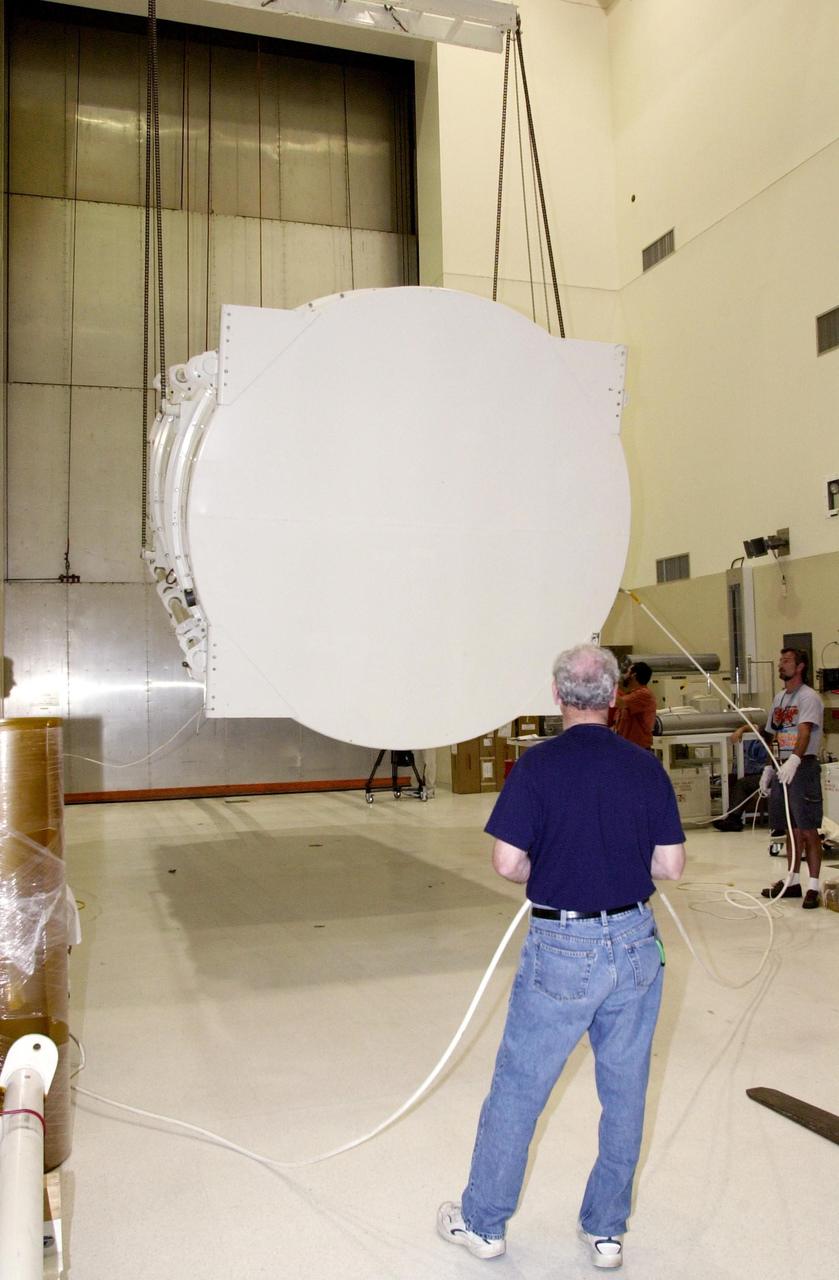
KENNEDY SPACE CENTER, FLA. -- The NASA Comet Nucleus Tour (CONTOUR) spacecraft arrived at KSC on April 24 and was transported to the Spacecraft Assembly and Encapsulation Facility-2 (SAEF-2) to begin final preparations for launch. CONTOUR will provide the first detailed look into the heart of a comet - the nucleus. The spacecraft will fly as close as 60 miles (100 kilometers) to at least two comets, Encke and Schwassmann-Wachmann 3, taking the sharpest pictures yet of the nucleus while analyzing the gas and dust that surround these rocky, icy building blocks of the solar system. The Applied Physics Laboratory of Johns Hopkins University, Baltimore, Md., built CONTOUR and will also be in control of the spacecraft after launch, scheduled for July 1, 2002, from LC 17A at Cape Canaveral Air Force Station
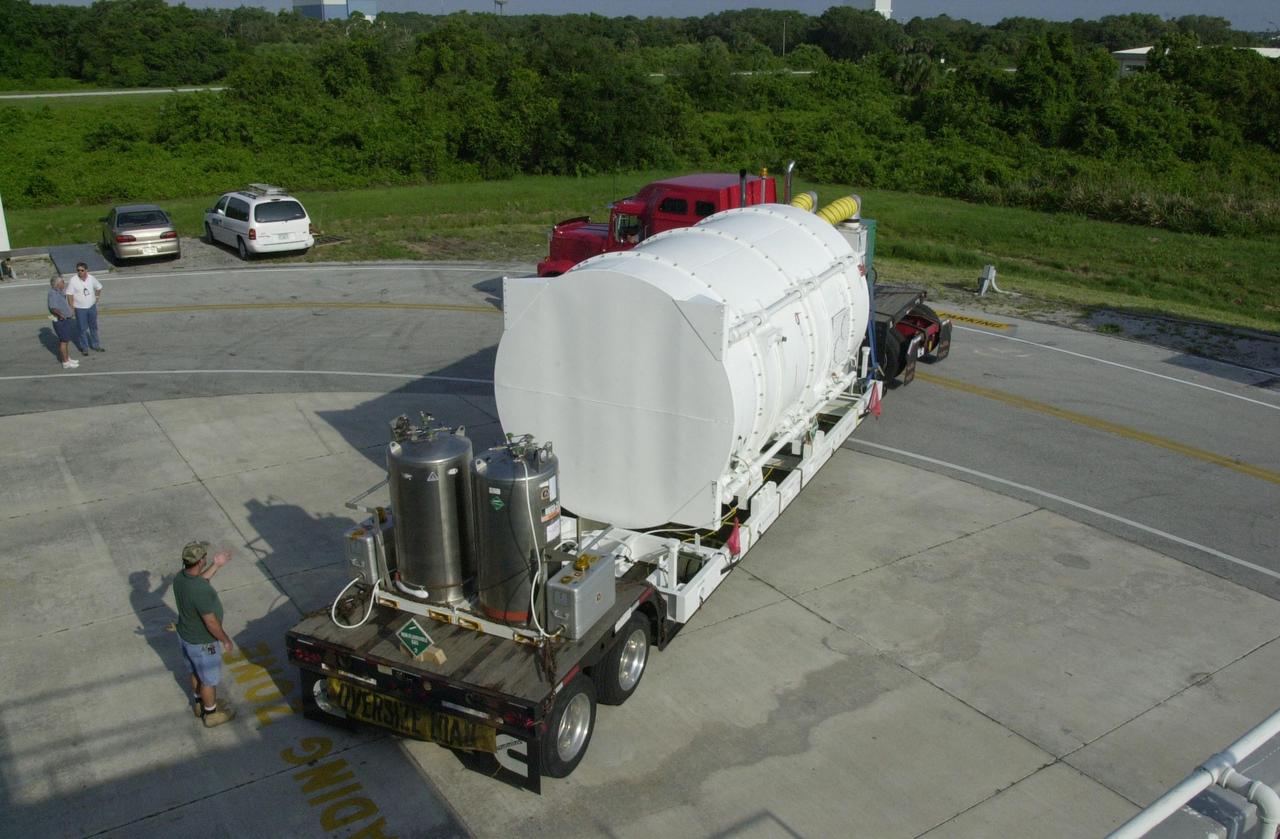
KENNEDY SPACE CENTER, FLA. -- The NASA Comet Nucleus Tour (CONTOUR) spacecraft arrived at KSC on April 24 and was transported to the Spacecraft Assembly and Encapsulation Facility-2 (SAEF-2) to begin final preparations for launch. CONTOUR will provide the first detailed look into the heart of a comet - the nucleus. The spacecraft will fly as close as 60 miles (100 kilometers) to at least two comets, Encke and Schwassmann-Wachmann 3, taking the sharpest pictures yet of the nucleus while analyzing the gas and dust that surround these rocky, icy building blocks of the solar system. The Applied Physics Laboratory of Johns Hopkins University, Baltimore, Md., built CONTOUR and will also be in control of the spacecraft after launch, scheduled for July 1, 2002, from LC 17A at Cape Canaveral Air Force Station
KENNEDY SPACE CENTER, FLA. -- The NASA Comet Nucleus Tour (CONTOUR) spacecraft arrived at KSC on April 24 and was transported to the Spacecraft Assembly and Encapsulation Facility-2 (SAEF-2) to begin final preparations for launch. CONTOUR will provide the first detailed look into the heart of a comet - the nucleus. The spacecraft will fly as close as 60 miles (100 kilometers) to at least two comets, Encke and Schwassmann-Wachmann 3, taking the sharpest pictures yet of the nucleus while analyzing the gas and dust that surround these rocky, icy building blocks of the solar system. The Applied Physics Laboratory of Johns Hopkins University, Baltimore, Md., built CONTOUR and will also be in control of the spacecraft after launch, scheduled for July 1, 2002, from LC 17A at Cape Canaveral Air Force Station
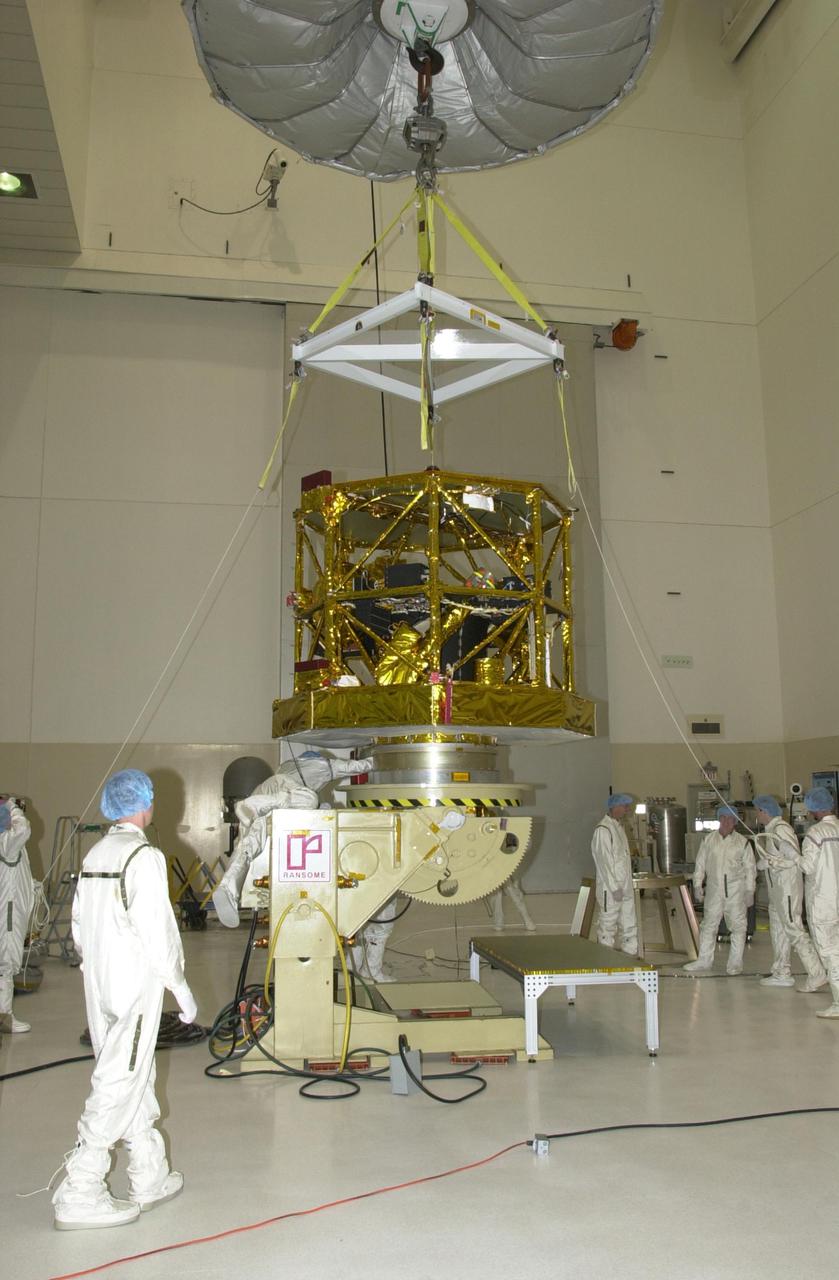
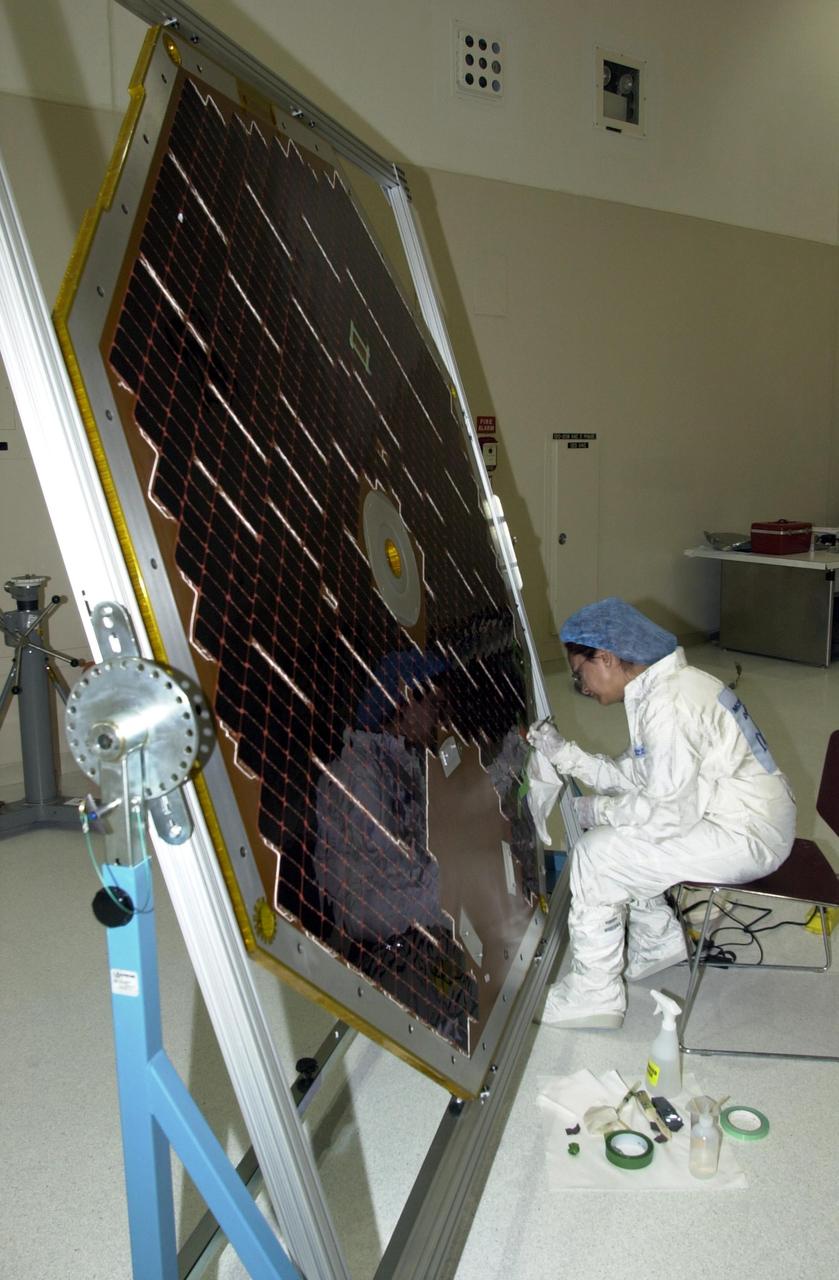
KENNEDY SPACE CENTER, FLA. - Workers in the Spacecraft Assembly and Encapsulation Facility 2 (SAEF-2) prepare the Comet Nucleus Tour (CONTOUR) spacecraft for antenna and solar panel installation. CONTOUR will provide the first detailed look into the heart of a comet -- the nucleus. The spacecraft will fly as close as 60 miles (100 kilometers) to at least two comets, Encke and Schwassmann-Wachmann 3. It will take the sharpest pictures yet of the nucleus while analyzing the gas and dust that surround these rocky, icy building blocks of the solar system. The Applied Physics Laboratory of Johns Hopkins University, Baltimore, Md., built CONTOUR and will also be in control of the spacecraft after launch, which is scheduled for July 1, 2002, from LC 17A at Cape Canaveral Air Force Station
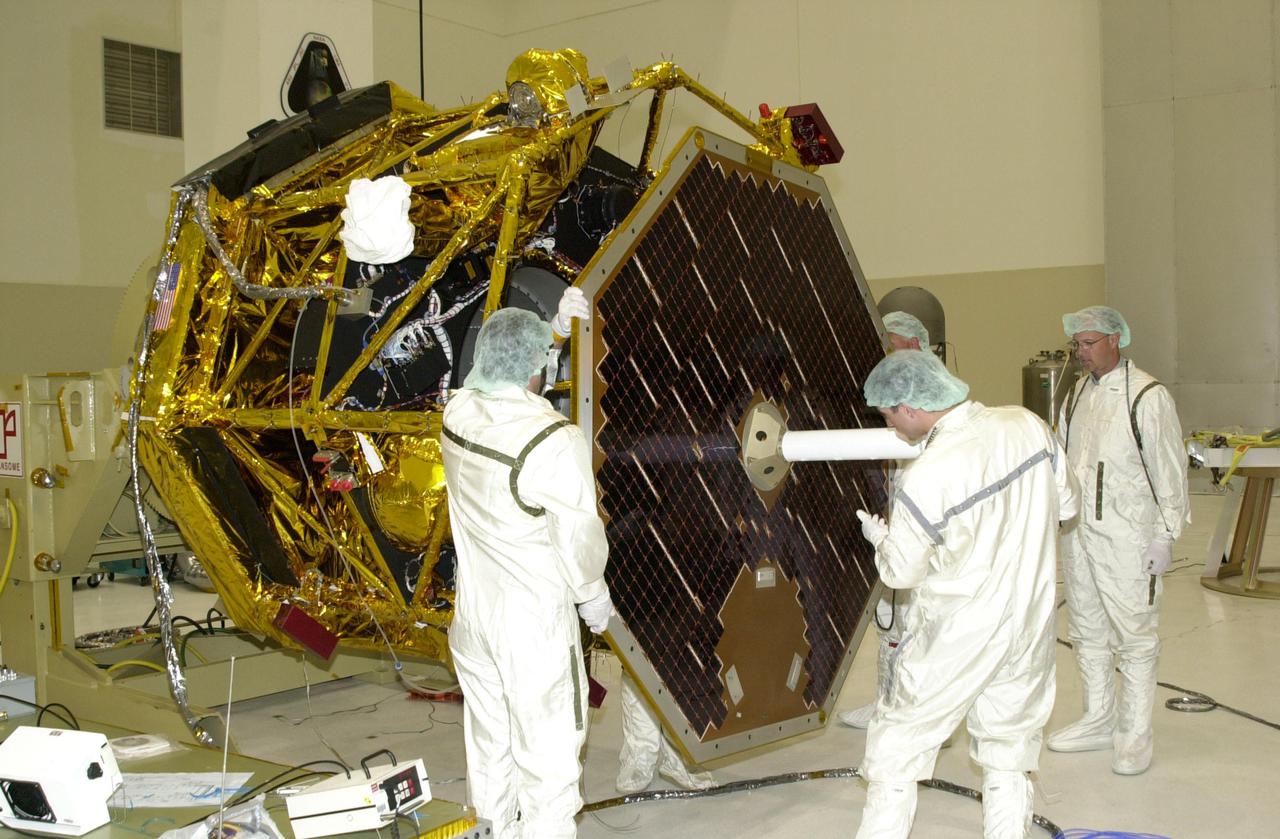
KENNEDY SPACE CENTER, FLA. -- In the Spacecraft Assembly and Encapsulation Facility 2 (SAEF-2), workers check placement of the solar panel and attached antenna before attaching it to the Comet Nucleus Tour (CONTOUR) spacecraft. Scheduled for launch July 1, 2002, from LC 17A at Cape Canaveral Air Force Station, CONTOUR will provide the first detailed look into the heart of a comet -- the nucleus. The spacecraft will fly as close as 60 miles (100 kilometers) to at least two comets, Encke and Schwassmann-Wachmann 3. It will take the sharpest pictures yet of the nucleus while analyzing the gas and dust that surround these rocky, icy building blocks of the solar system. The Applied Physics Laboratory of Johns Hopkins University, Baltimore, Md., built CONTOUR and will also be in control of the spacecraft after launch
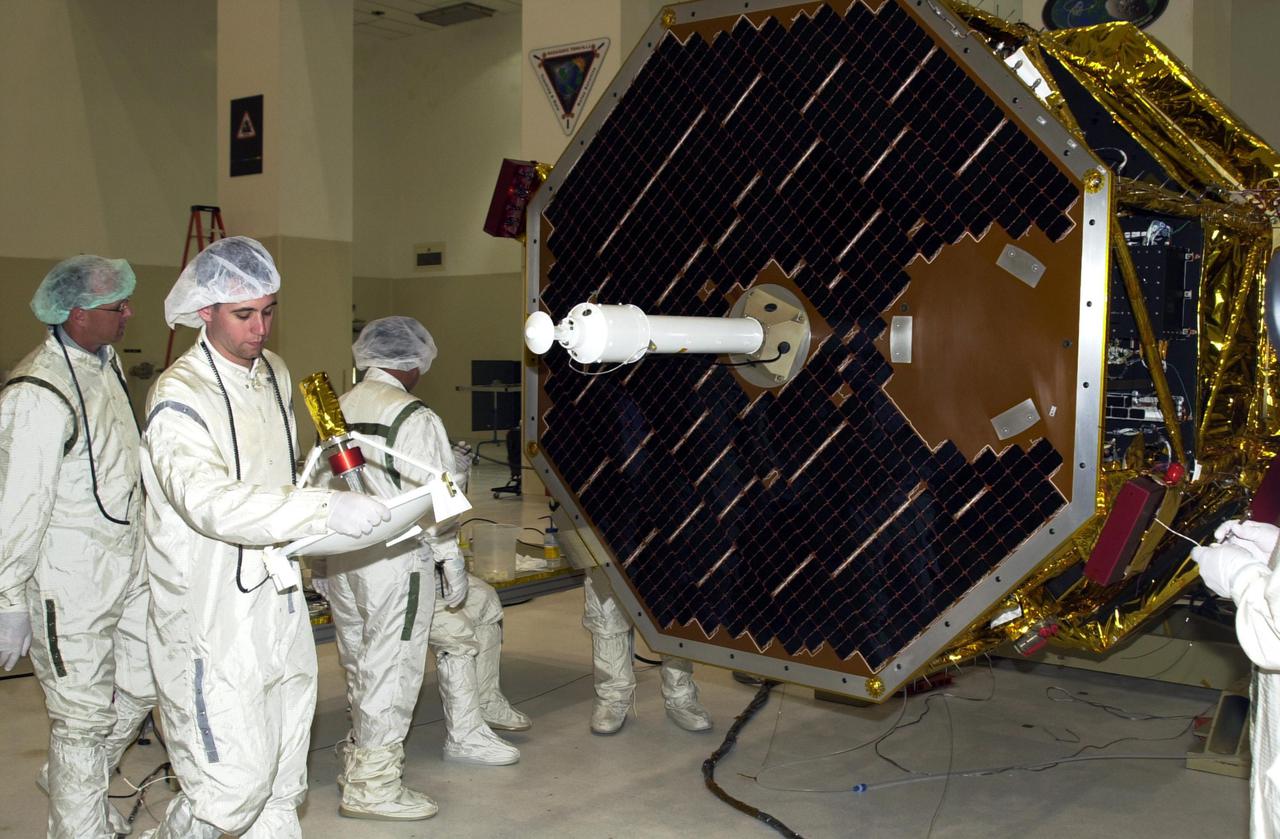
KENNEDY SPACE CENTER, FLA. -- A worker carries the high gain antenna toward the Comet Nucleus Tour (CONTOUR) spacecraft where it will be attached on the solar panel next to the larger antenna (seen in the center of the panel). CONTOUR, scheduled for launch July 1, 2002, from LC 17A at Cape Canaveral Air Force Station, will provide the first detailed look into the heart of a comet -- the nucleus. The spacecraft will fly as close as 60 miles (100 kilometers) to at least two comets, Encke and Schwassmann-Wachmann 3. It will take the sharpest pictures yet of the nucleus while analyzing the gas and dust that surround these rocky, icy building blocks of the solar system. The Applied Physics Laboratory of Johns Hopkins University, Baltimore, Md., built CONTOUR and will also be in control of the spacecraft after launch
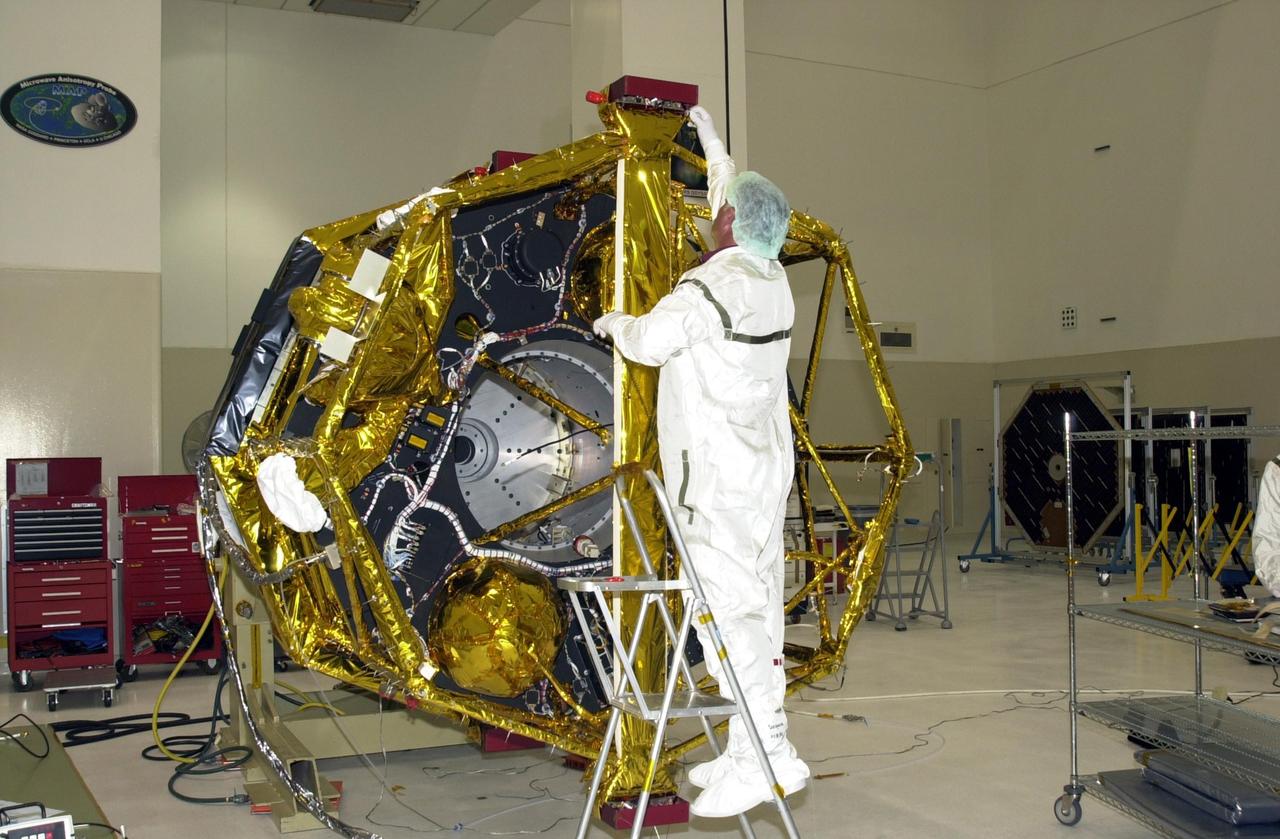
KENNEDY SPACE CENTER, FLA. -- In the Spacecraft Assembly and Encapsulation Facility 2 (SAEF-2), a worker prepares the Comet Nucleus Tour (CONTOUR) spacecraft for antenna and solar panel installation. CONTOUR will provide the first detailed look into the heart of a comet -- the nucleus. The spacecraft will fly as close as 60 miles (100 kilometers) to at least two comets, Encke and Schwassmann-Wachmann 3. It will take the sharpest pictures yet of the nucleus while analyzing the gas and dust that surround these rocky, icy building blocks of the solar system. The Applied Physics Laboratory of Johns Hopkins University, Baltimore, Md., built CONTOUR and will also be in control of the spacecraft after launch, which is scheduled for July 1, 2002, from LC 17A at Cape Canaveral Air Force Station
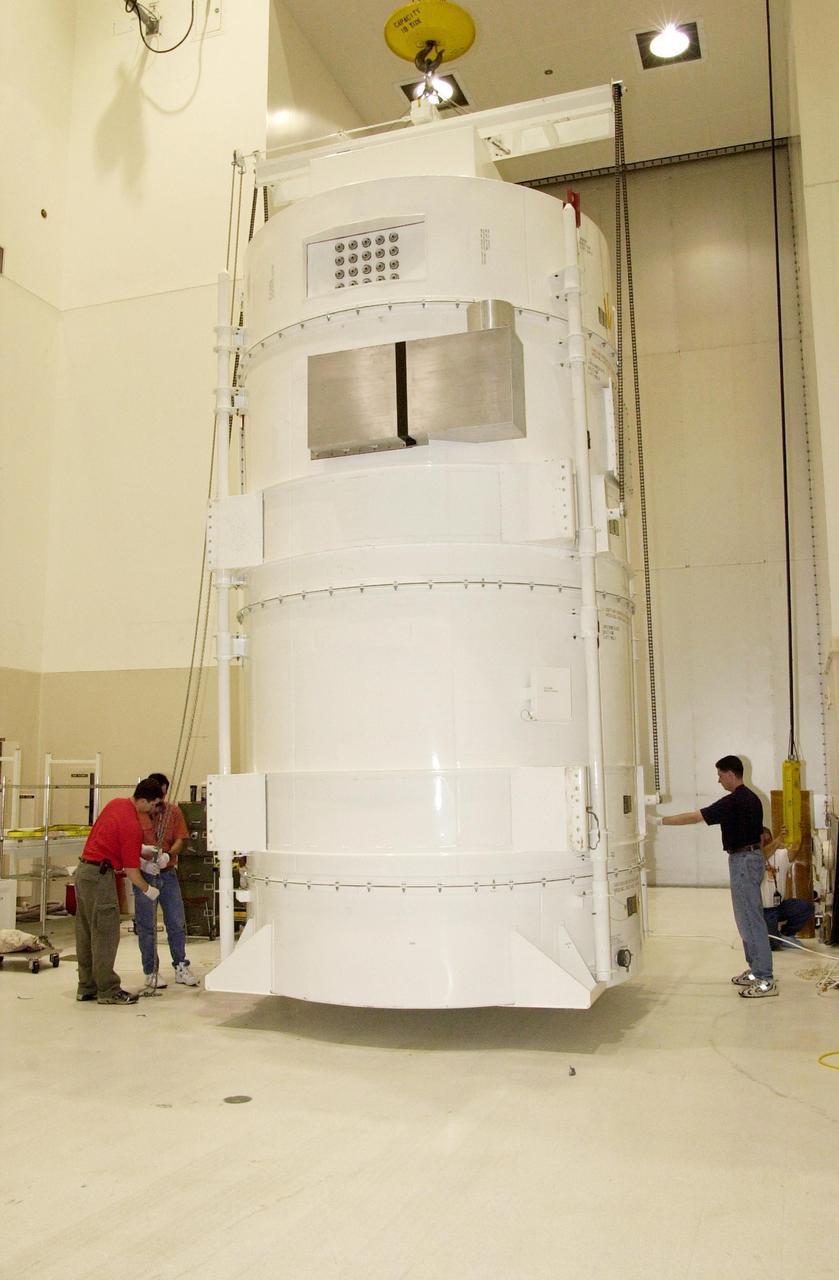
KENNEDY SPACE CENTER, FLA. -- The NASA Comet Nucleus Tour (CONTOUR) spacecraft arrived at KSC on April 24 and was transported to the Spacecraft Assembly and Encapsulation Facility-2 (SAEF-2) to begin final preparations for launch. CONTOUR will provide the first detailed look into the heart of a comet - the nucleus. The spacecraft will fly as close as 60 miles (100 kilometers) to at least two comets, Encke and Schwassmann-Wachmann 3, taking the sharpest pictures yet of the nucleus while analyzing the gas and dust that surround these rocky, icy building blocks of the solar system. The Applied Physics Laboratory of Johns Hopkins University, Baltimore, Md., built CONTOUR and will also be in control of the spacecraft after launch, scheduled for July 1, 2002, from LC 17A at Cape Canaveral Air Force Station
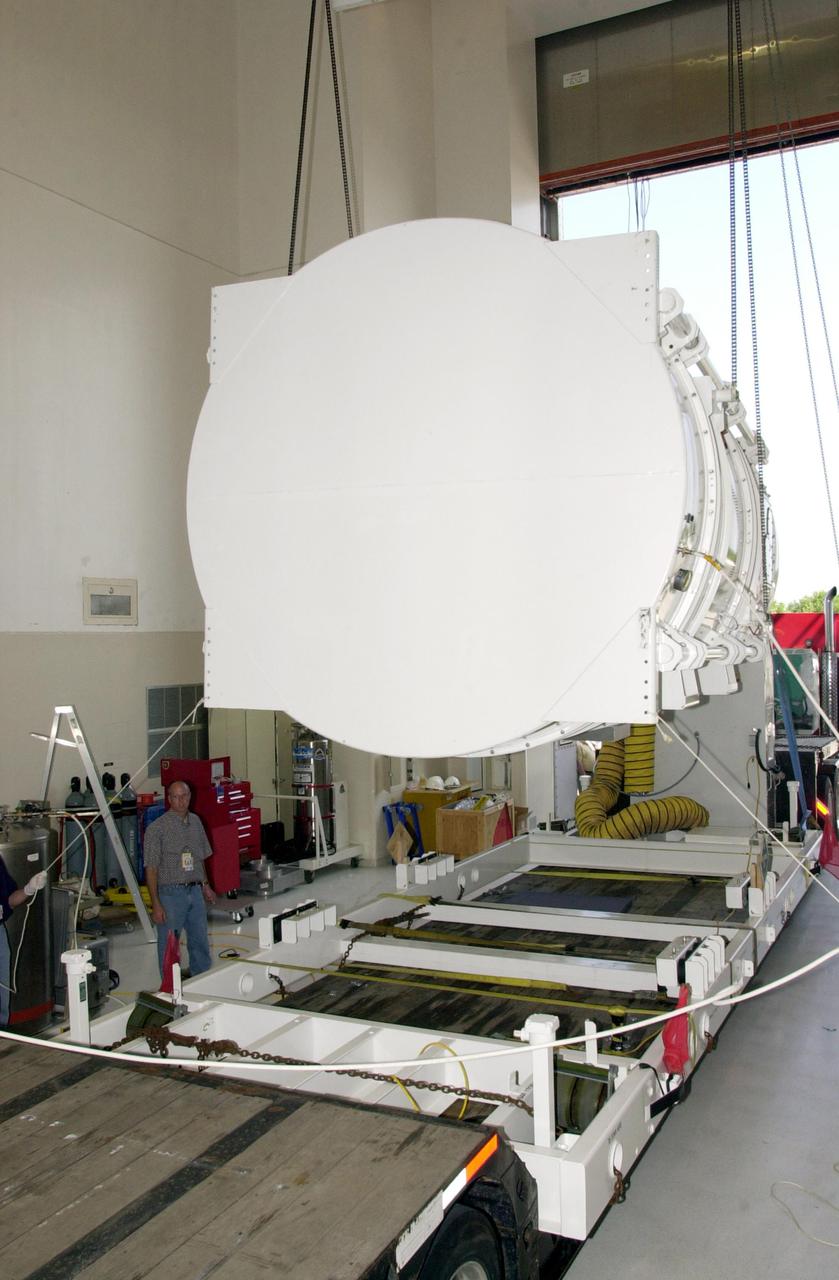
KENNEDY SPACE CENTER, FLA. -- The NASA Comet Nucleus Tour (CONTOUR) spacecraft arrived at KSC on April 24 and was transported to the Spacecraft Assembly and Encapsulation Facility-2 (SAEF-2) to begin final preparations for launch. CONTOUR will provide the first detailed look into the heart of a comet - the nucleus. The spacecraft will fly as close as 60 miles (100 kilometers) to at least two comets, Encke and Schwassmann-Wachmann 3, taking the sharpest pictures yet of the nucleus while analyzing the gas and dust that surround these rocky, icy building blocks of the solar system. The Applied Physics Laboratory of Johns Hopkins University, Baltimore, Md., built CONTOUR and will also be in control of the spacecraft after launch, scheduled for July 1, 2002, from LC 17A at Cape Canaveral Air Force Station
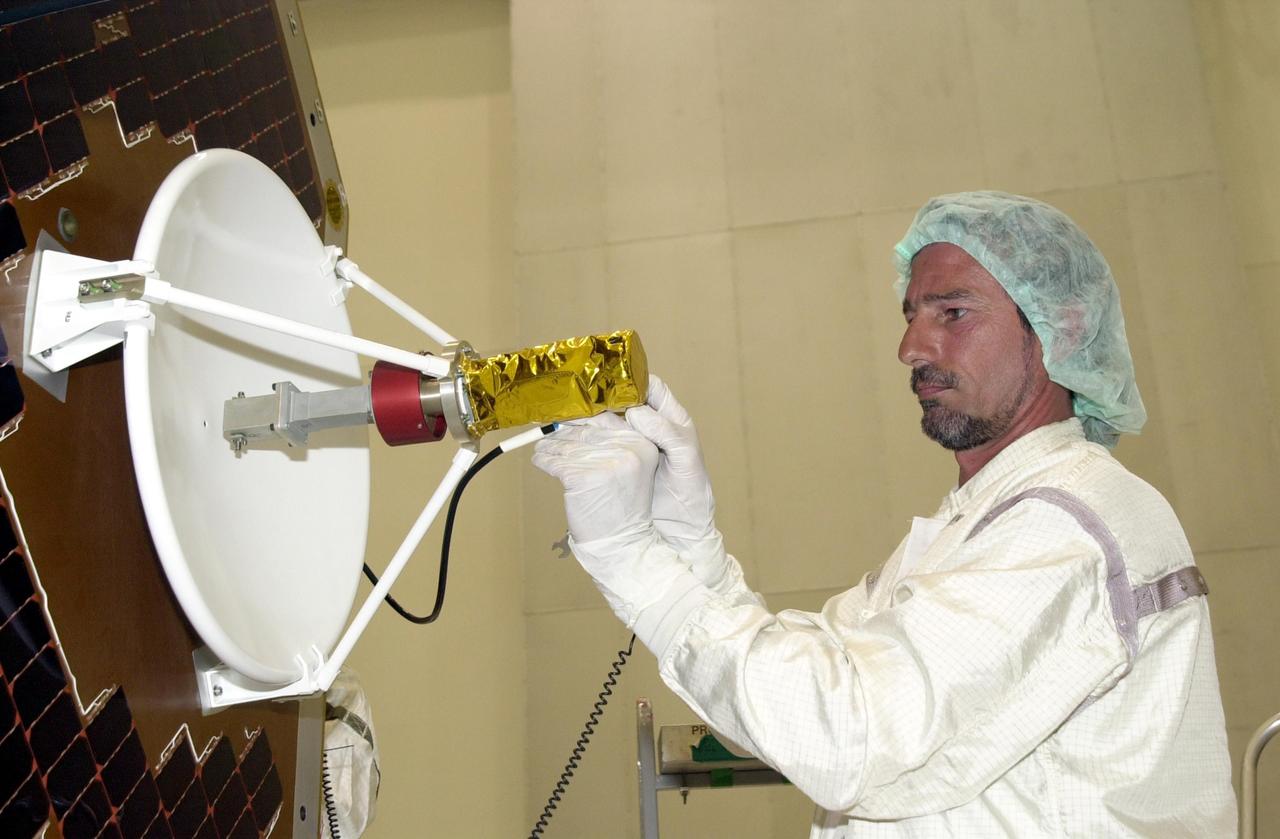
KENNEDY SPACE CENTER, FLA. -- In the Spacecraft Assembly and Encapsulation Facility 2 (SAEF-2), a worker makes a final adjustment to the high gain antenna just installed on the solar panel of the Comet Nucleus Tour (CONTOUR) spacecraft. Scheduled for launch July 1, 2002, from LC 17A at Cape Canaveral Air Force Station, CONTOUR will provide the first detailed look into the heart of a comet -- the nucleus. The spacecraft will fly as close as 60 miles (100 kilometers) to at least two comets, Encke and Schwassmann-Wachmann 3. It will take the sharpest pictures yet of the nucleus while analyzing the gas and dust that surround these rocky, icy building blocks of the solar system. The Applied Physics Laboratory of Johns Hopkins University, Baltimore, Md., built CONTOUR and will also be in control of the spacecraft after launch
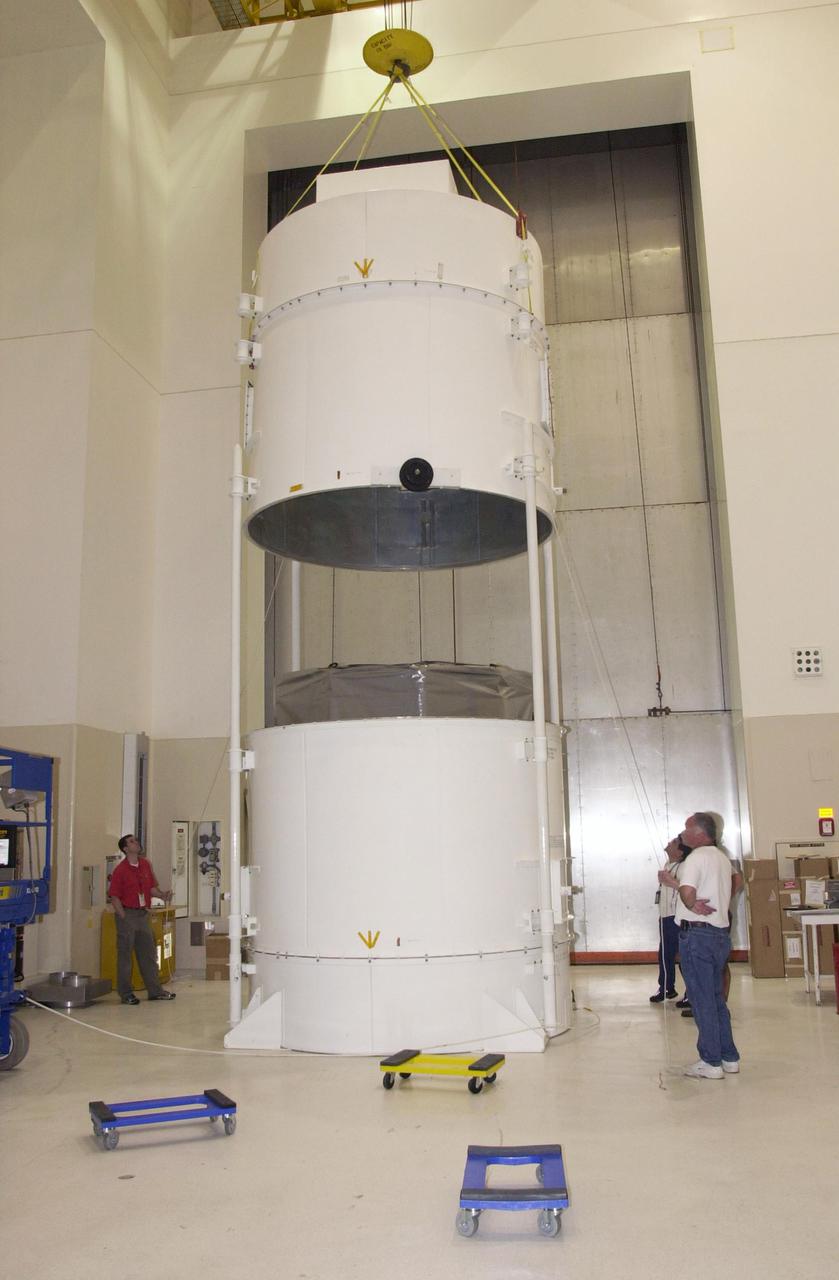
KENNEDY SPACE CENTER, FLA. -- The NASA Comet Nucleus Tour (CONTOUR) spacecraft arrived at KSC on April 24 and was transported to the Spacecraft Assembly and Encapsulation Facility-2 (SAEF-2) to begin final preparations for launch. CONTOUR will provide the first detailed look into the heart of a comet - the nucleus. The spacecraft will fly as close as 60 miles (100 kilometers) to at least two comets, Encke and Schwassmann-Wachmann 3, taking the sharpest pictures yet of the nucleus while analyzing the gas and dust that surround these rocky, icy building blocks of the solar system. The Applied Physics Laboratory of Johns Hopkins University, Baltimore, Md., built CONTOUR and will also be in control of the spacecraft after launch, scheduled for July 1, 2002, from LC 17A at Cape Canaveral Air Force Station
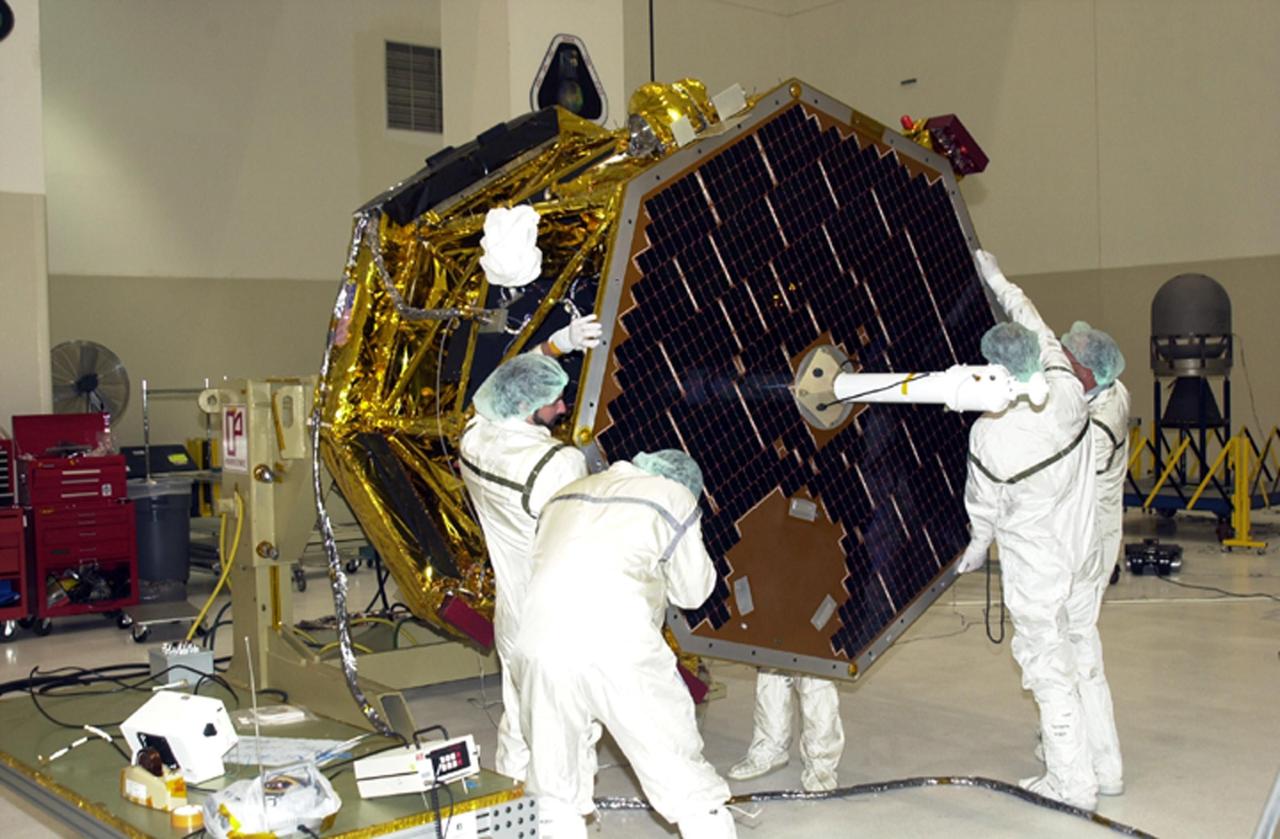
KENNEDY SPACE CENTER, FLA. -- Workers attach the solar panel and attached antenna to the Comet Nucleus Tour (CONTOUR) spacecraft in the Spacecraft Assembly and Encapsulation Facility 2 (SAEF-2). Scheduled for launch July 1, 2002, from LC 17A at Cape Canaveral Air Force Station, CONTOUR will provide the first detailed look into the heart of a comet -- the nucleus. The spacecraft will fly as close as 60 miles (100 kilometers) to at least two comets, Encke and Schwassmann-Wachmann 3. It will take the sharpest pictures yet of the nucleus while analyzing the gas and dust that surround these rocky, icy building blocks of the solar system. The Applied Physics Laboratory of Johns Hopkins University, Baltimore, Md., built CONTOUR and will also be in control of the spacecraft after launch
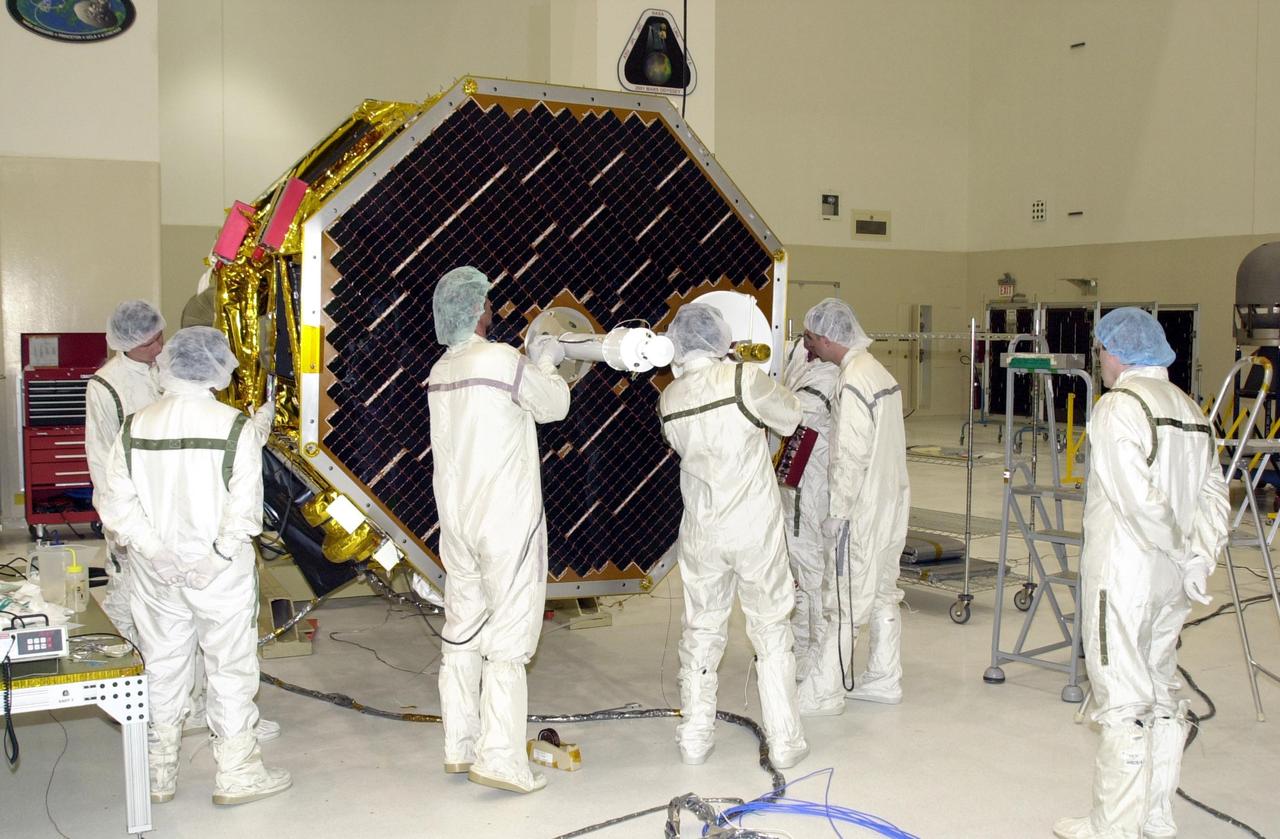
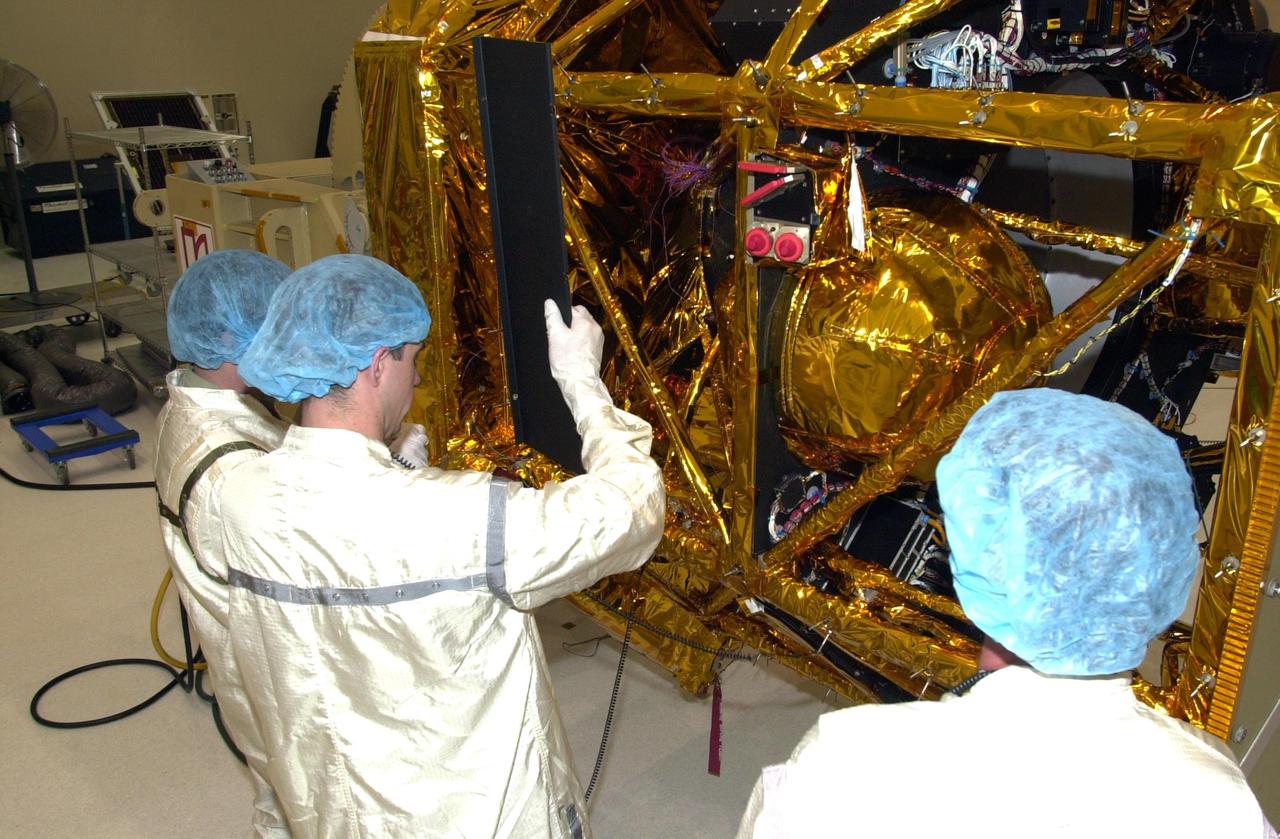
KENNEDY SPACE CENTER, FLA. -- Workers in the Spacecraft Assembly and Encapsulation Facility 2 (SAEF-2) make adjustments to the two antennas installed on the solar panel of the Comet Nucleus Tour (CONTOUR) spacecraft. Scheduled for launch July 1, 2002, from LC 17A at Cape Canaveral Air Force Station, CONTOUR will provide the first detailed look into the heart of a comet -- the nucleus. The spacecraft will fly as close as 60 miles (100 kilometers) to at least two comets, Encke and Schwassmann-Wachmann 3. It will take the sharpest pictures yet of the nucleus while analyzing the gas and dust that surround these rocky, icy building blocks of the solar system. The Applied Physics Laboratory of Johns Hopkins University, Baltimore, Md., built CONTOUR and will also be in control of the spacecraft after launch
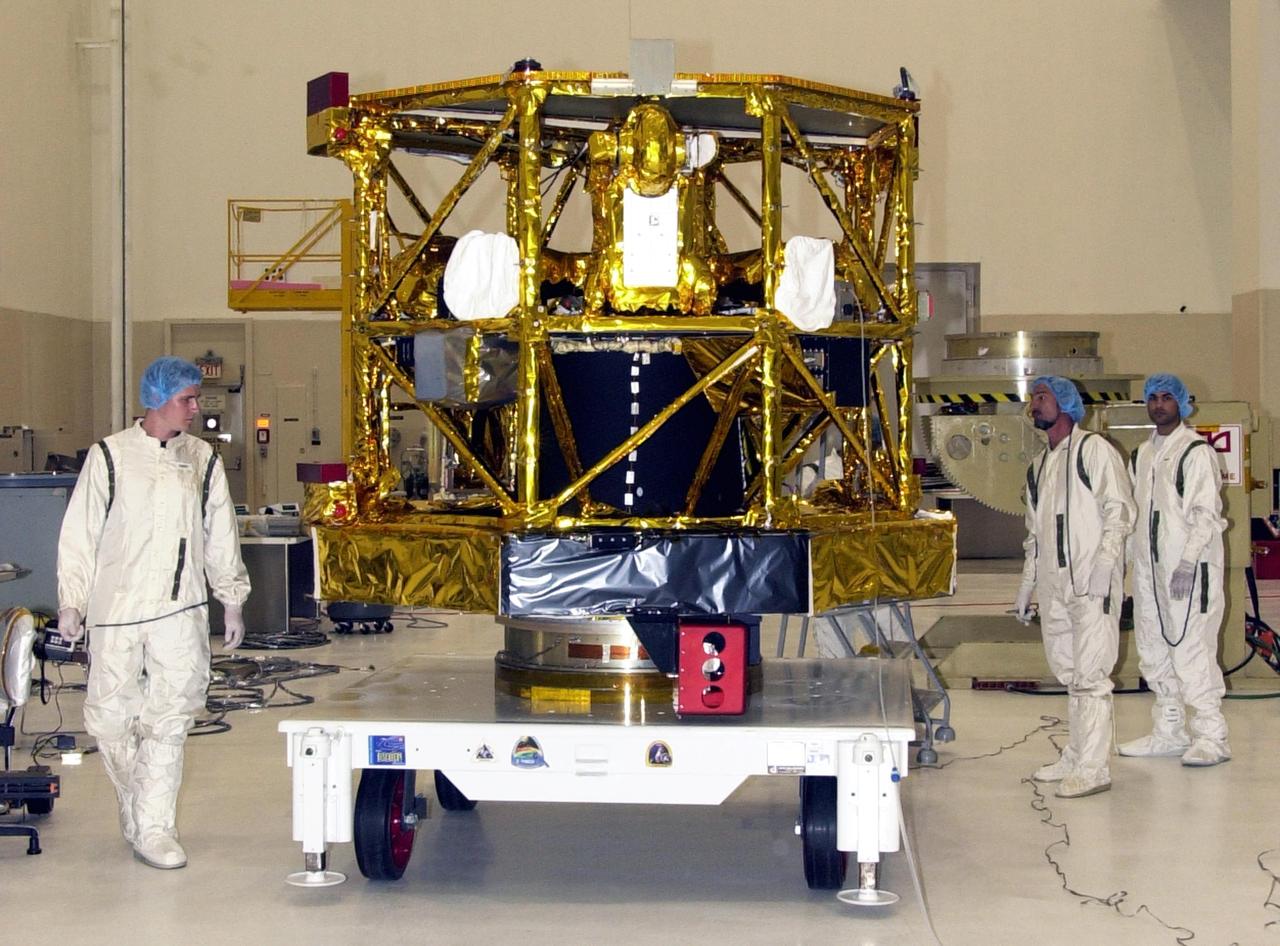
KENNEDY SPACE CENTER, FLA. -- The NASA Comet Nucleus Tour (CONTOUR) spacecraft arrived at KSC on April 24 and was transported to the Spacecraft Assembly and Encapsulation Facility-2 (SAEF-2) to begin final preparations for launch. CONTOUR will provide the first detailed look into the heart of a comet - the nucleus. The spacecraft will fly as close as 60 miles (100 kilometers) to at least two comets, Encke and Schwassmann-Wachmann 3, taking the sharpest pictures yet of the nucleus while analyzing the gas and dust that surround these rocky, icy building blocks of the solar system. The Applied Physics Laboratory of Johns Hopkins University, Baltimore, Md., built CONTOUR and will also be in control of the spacecraft after launch, scheduled for July 1, 2002, from LC 17A at Cape Canaveral Air Force Station
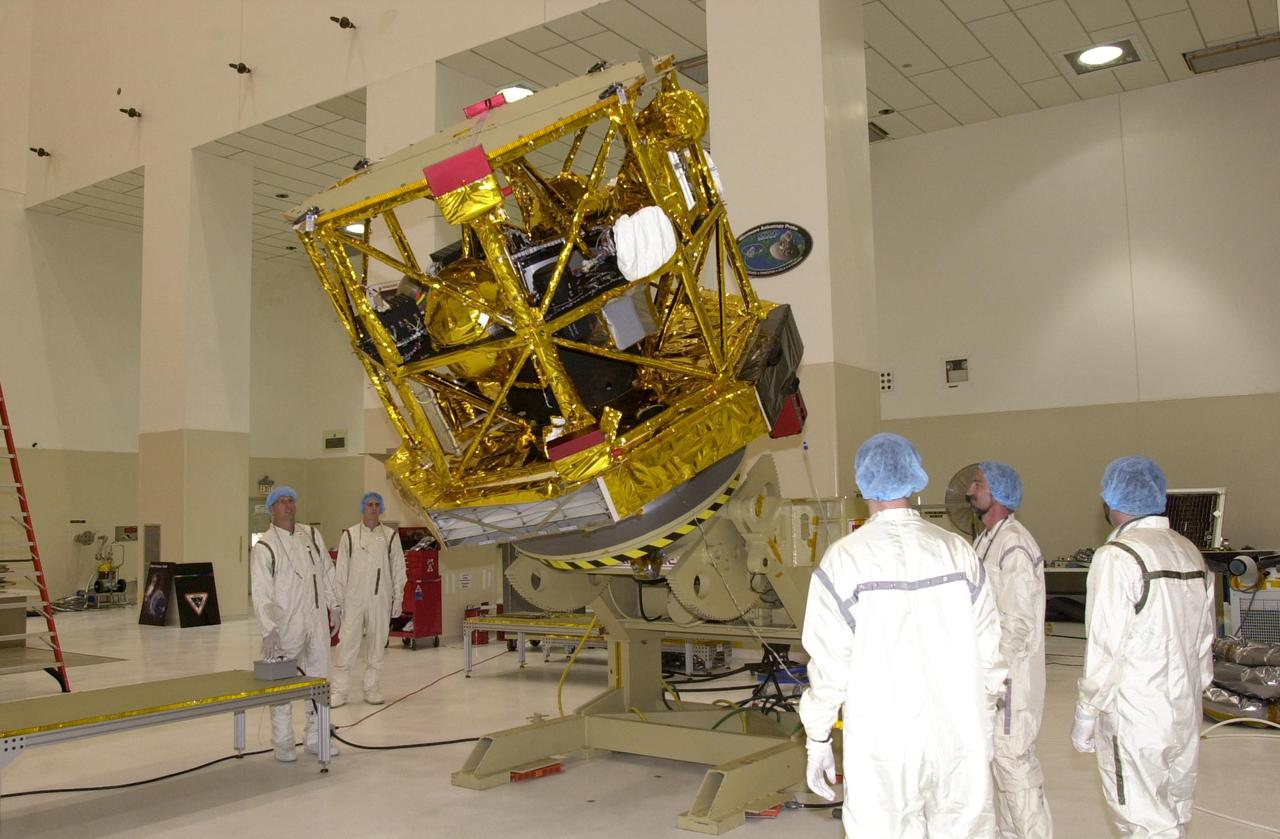
KENNEDY SPACE CENTER, FLA. -- The NASA Comet Nucleus Tour (CONTOUR) spacecraft arrived at KSC on April 24 and was transported to the Spacecraft Assembly and Encapsulation Facility-2 (SAEF-2) to begin final preparations for launch. CONTOUR will provide the first detailed look into the heart of a comet - the nucleus. The spacecraft will fly as close as 60 miles (100 kilometers) to at least two comets, Encke and Schwassmann-Wachmann 3, taking the sharpest pictures yet of the nucleus while analyzing the gas and dust that surround these rocky, icy building blocks of the solar system. The Applied Physics Laboratory of Johns Hopkins University, Baltimore, Md., built CONTOUR and will also be in control of the spacecraft after launch, scheduled for July 1, 2002, from LC 17A at Cape Canaveral Air Force Station
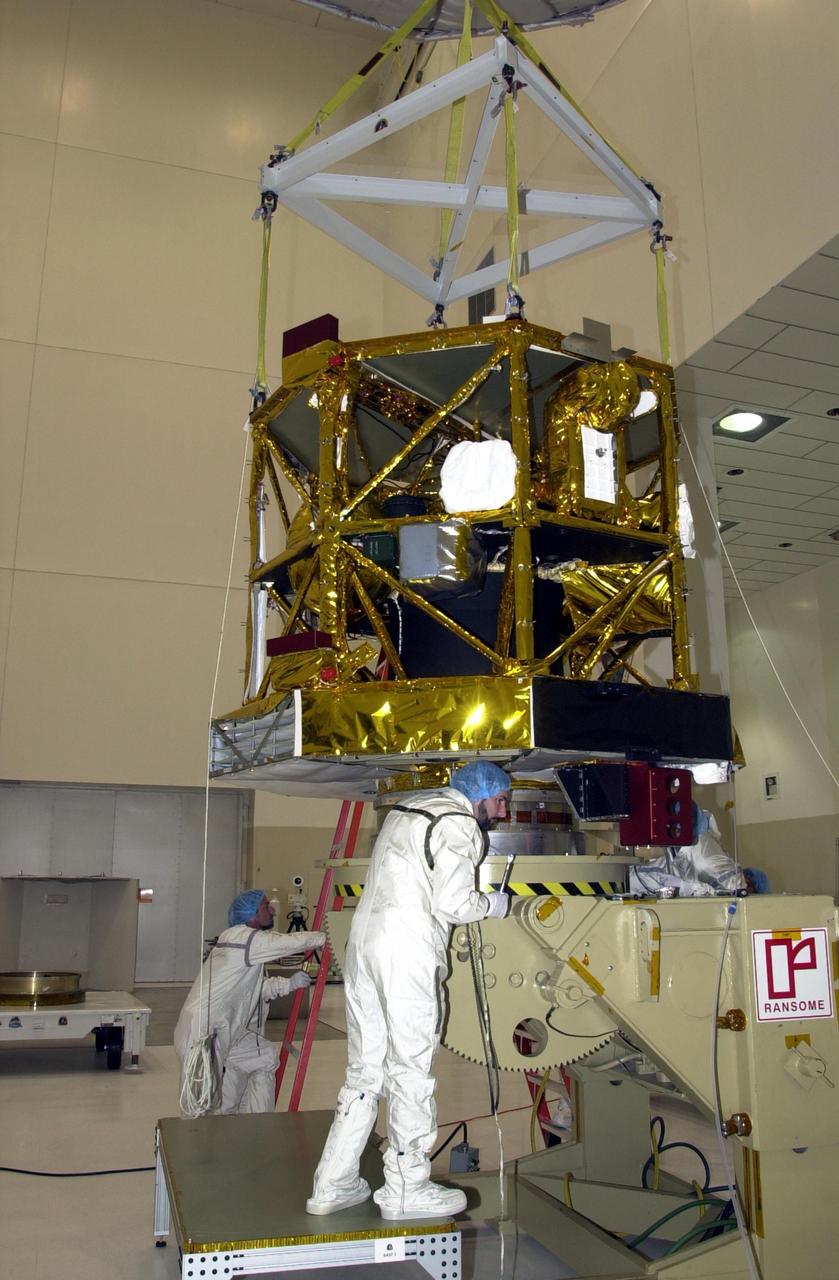
KENNEDY SPACE CENTER, FLA. -- The NASA Comet Nucleus Tour (CONTOUR) spacecraft arrived at KSC on April 24 and was transported to the Spacecraft Assembly and Encapsulation Facility-2 (SAEF-2) to begin final preparations for launch. CONTOUR will provide the first detailed look into the heart of a comet - the nucleus. The spacecraft will fly as close as 60 miles (100 kilometers) to at least two comets, Encke and Schwassmann-Wachmann 3, taking the sharpest pictures yet of the nucleus while analyzing the gas and dust that surround these rocky, icy building blocks of the solar system. The Applied Physics Laboratory of Johns Hopkins University, Baltimore, Md., built CONTOUR and will also be in control of the spacecraft after launch, scheduled for July 1, 2002, from LC 17A at Cape Canaveral Air Force Station
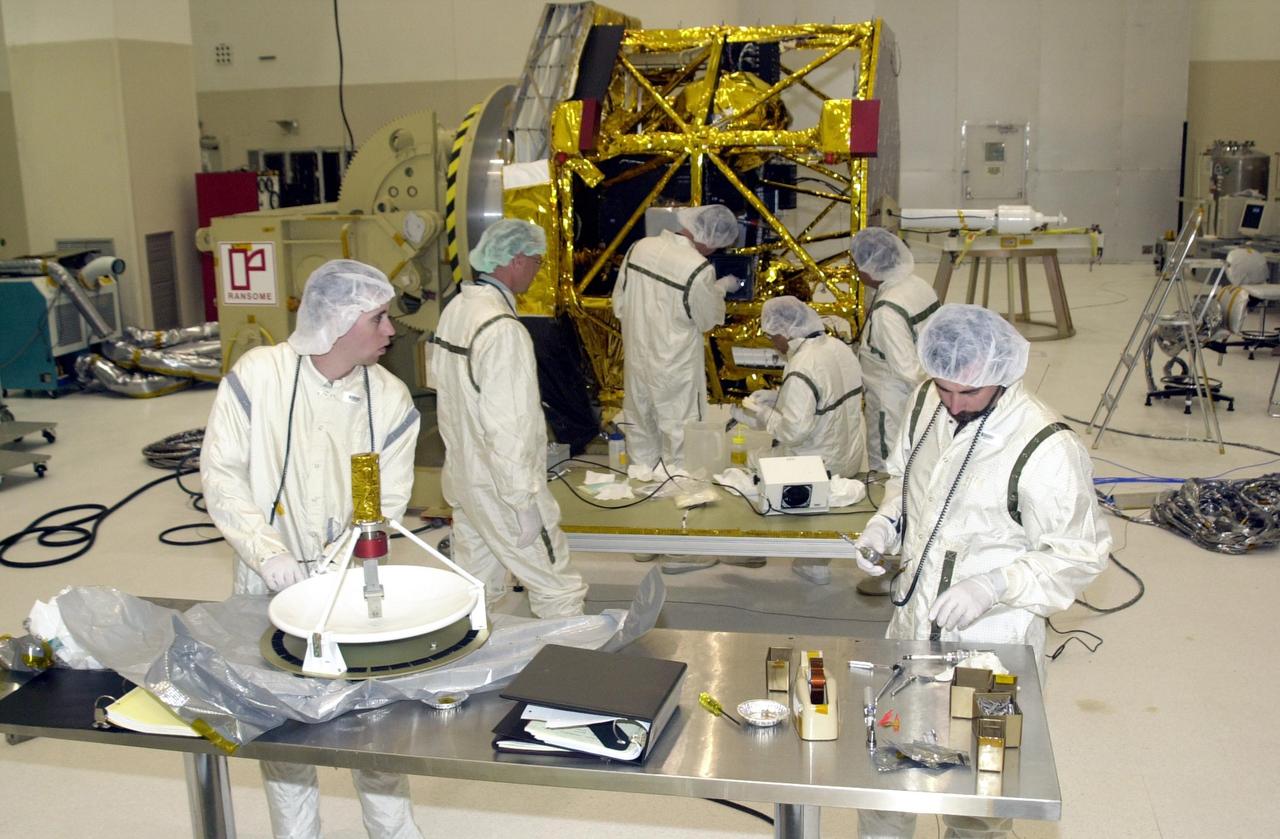
KENNEDY SPACE CENTER, FLA. -- Workers prepare the high gain antenna (foreground, on table) for installation on the Comet Nucleus Tour (CONTOUR) spacecraft in the Spacecraft Assembly and Encapsulation Facility 2 (SAEF-2). This second antenna will be installed near the larger antenna already attached. CONTOUR, scheduled for launch July 1, 2002, from LC 17A at Cape Canaveral Air Force Station, will provide the first detailed look into the heart of a comet -- the nucleus. The spacecraft will fly as close as 60 miles (100 kilometers) to at least two comets, Encke and Schwassmann-Wachmann 3. It will take the sharpest pictures yet of the nucleus while analyzing the gas and dust that surround these rocky, icy building blocks of the solar system. The Applied Physics Laboratory of Johns Hopkins University, Baltimore, Md., built CONTOUR and will also be in control of the spacecraft after launch
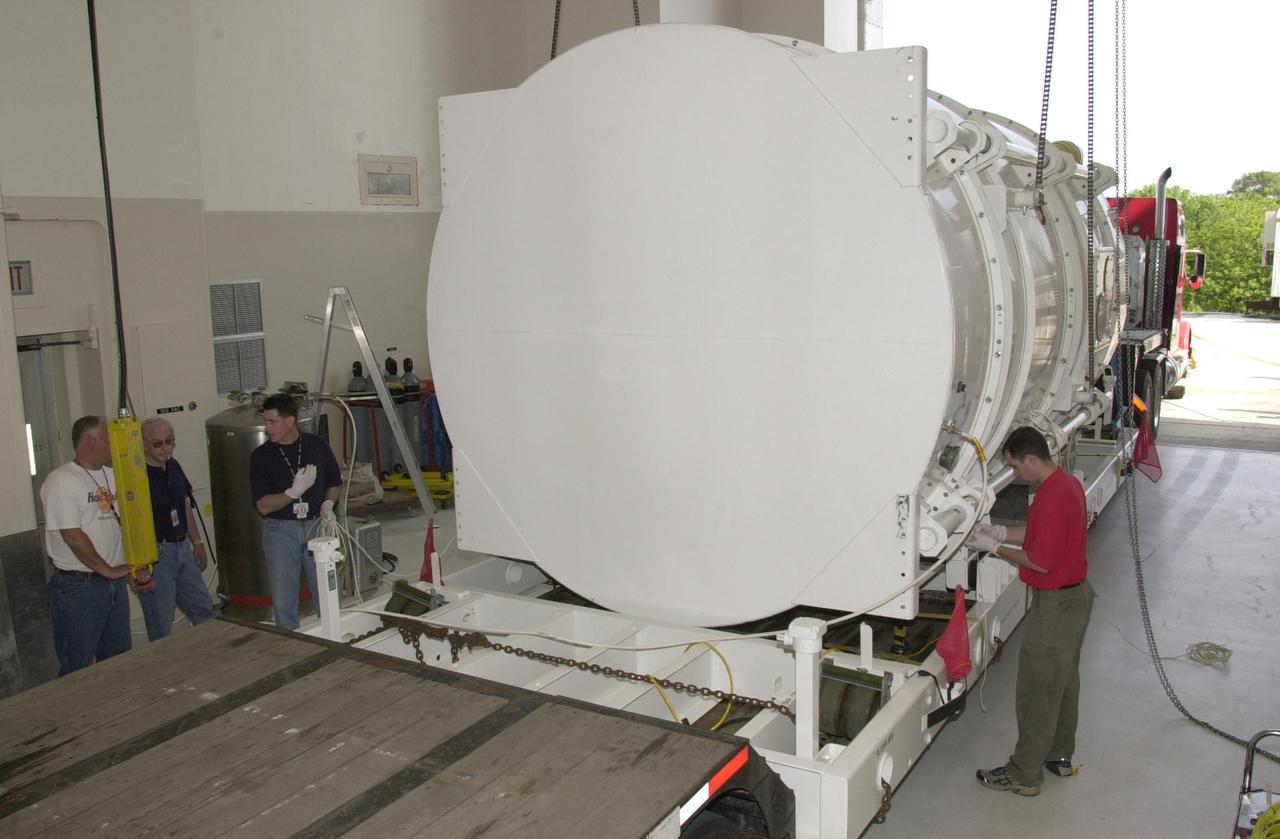
KENNEDY SPACE CENTER, FLA. -- The NASA Comet Nucleus Tour (CONTOUR) spacecraft arrived at KSC on April 24 and was transported to the Spacecraft Assembly and Encapsulation Facility-2 (SAEF-2) to begin final preparations for launch. CONTOUR will provide the first detailed look into the heart of a comet - the nucleus. The spacecraft will fly as close as 60 miles (100 kilometers) to at least two comets, Encke and Schwassmann-Wachmann 3, taking the sharpest pictures yet of the nucleus while analyzing the gas and dust that surround these rocky, icy building blocks of the solar system. The Applied Physics Laboratory of Johns Hopkins University, Baltimore, Md., built CONTOUR and will also be in control of the spacecraft after launch, scheduled for July 1, 2002, from LC 17A at Cape Canaveral Air Force Station
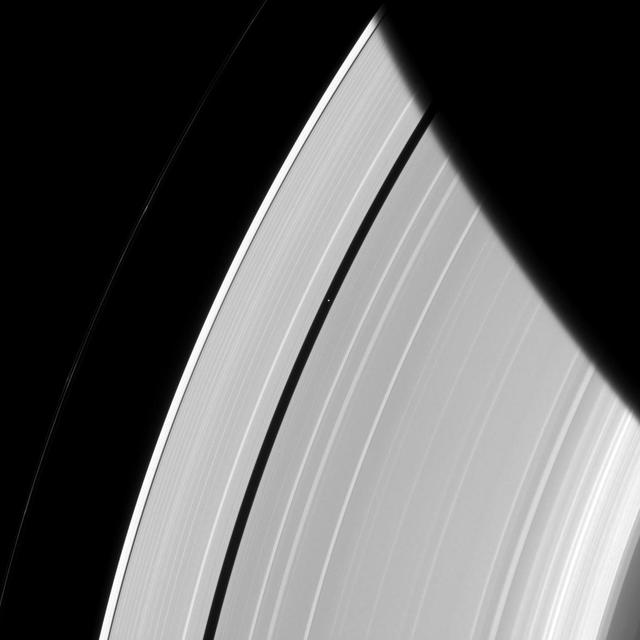
Saturn's innermost moon Pan orbits the giant planet seemingly alone in a ring gap its own gravity creates. Pan (17 miles, or 28 kilometers across) maintains the Encke Gap in Saturn's A ring by gravitationally nudging the ring particles back into the rings when they stray in the gap. Scientists think similar processes might be at work as forming planets clear gaps in the circumstellar disks from which they form. This view looks toward the sunlit side of the rings from about 38 degrees above the ringplane. The image was taken in visible light with the Cassini spacecraft narrow-angle camera on May 3, 2014. The view was acquired at a distance of approximately 2 million miles (3.2 million kilometers) from Pan and at a Sun-Pan-spacecraft, or phase, angle of 56 degrees. Image scale is 12 miles (19 kilometers) per pixel. http://photojournal.jpl.nasa.gov/catalog/PIA18281
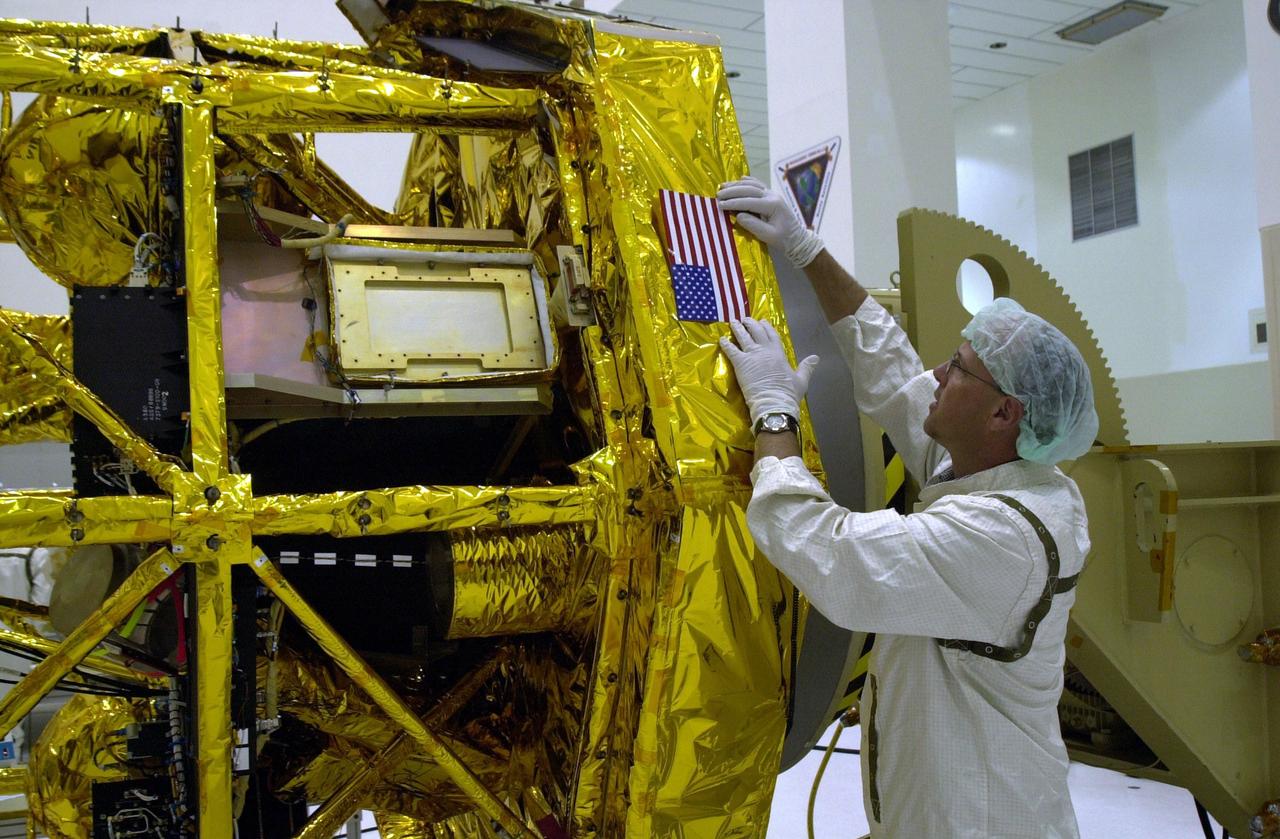
KENNEDY SPACE CENTER, FLA. -- In the Spacecraft Assembly and Encapsulation Facility 2 (SAEF-2), a worker places a replica of the United States flag onto the Comet Nucleus Tour (CONTOUR) spacecraft. CONTOUR is being prepared for antenna and solar panel installation. CONTOUR will provide the first detailed look into the heart of a comet -- the nucleus. The spacecraft will fly as close as 60 miles (100 kilometers) to at least two comets, Encke and Schwassmann-Wachmann 3. It will take the sharpest pictures yet of the nucleus while analyzing the gas and dust that surround these rocky, icy building blocks of the solar system. The Applied Physics Laboratory of Johns Hopkins University, Baltimore, Md., built CONTOUR and will also be in control of the spacecraft after launch, which is scheduled for July 1, 2002, from LC 17A at Cape Canaveral Air Force Station
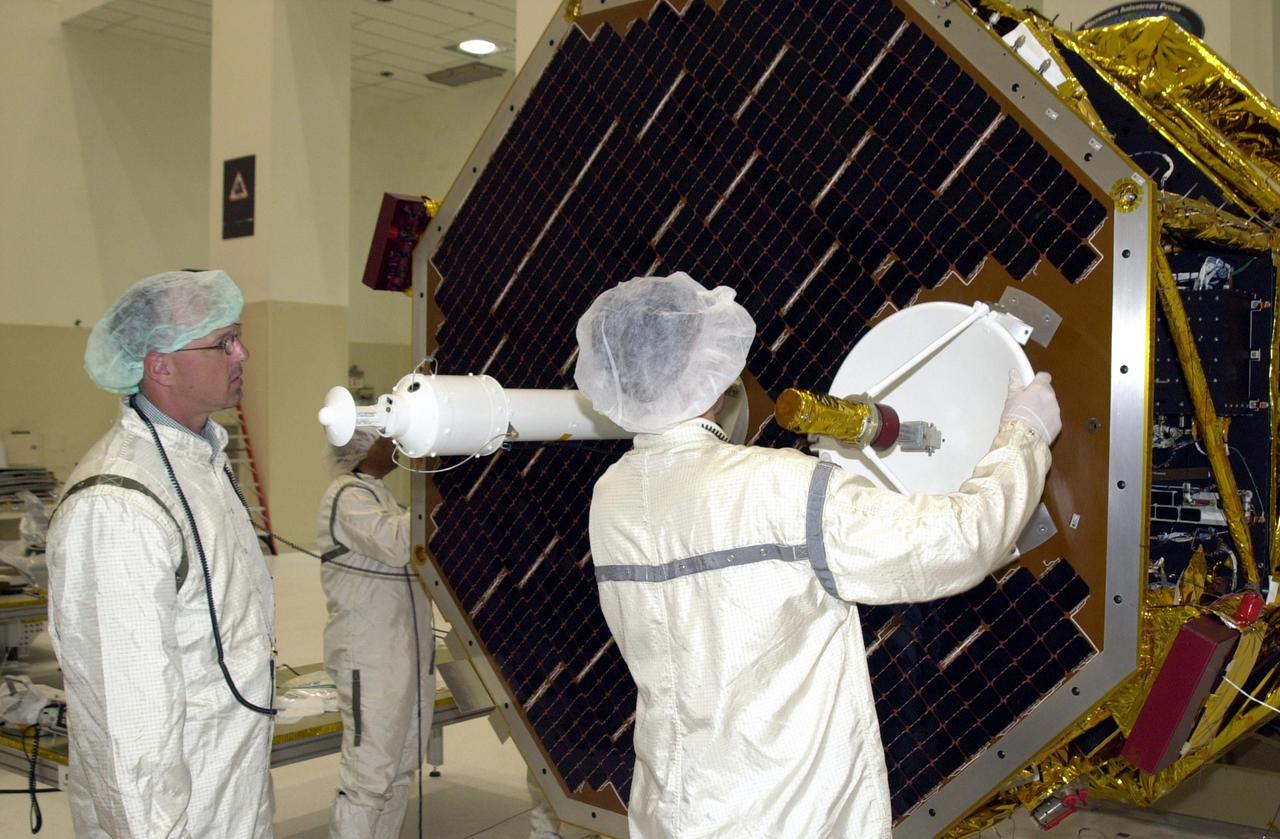
KENNEDY SPACE CENTER, FLA. -- While a co-worker (left) looks on, a worker (right) places the high gain antenna onto the solar panel of the Comet Nucleus Tour (CONTOUR) spacecraft. Scheduled for launch July 1, 2002, from LC 17A at Cape Canaveral Air Force Station, CONTOUR will provide the first detailed look into the heart of a comet -- the nucleus. The spacecraft will fly as close as 60 miles (100 kilometers) to at least two comets, Encke and Schwassmann-Wachmann 3. It will take the sharpest pictures yet of the nucleus while analyzing the gas and dust that surround these rocky, icy building blocks of the solar system. The Applied Physics Laboratory of Johns Hopkins University, Baltimore, Md., built CONTOUR and will also be in control of the spacecraft after launch
KENNEDY SPACE CENTER, FLA. -- The NASA Comet Nucleus Tour (CONTOUR) spacecraft arrived at KSC on April 24 and was transported to the Spacecraft Assembly and Encapsulation Facility-2 (SAEF-2) to begin final preparations for launch. CONTOUR will provide the first detailed look into the heart of a comet - the nucleus. The spacecraft will fly as close as 60 miles (100 kilometers) to at least two comets, Encke and Schwassmann-Wachmann 3, taking the sharpest pictures yet of the nucleus while analyzing the gas and dust that surround these rocky, icy building blocks of the solar system. The Applied Physics Laboratory of Johns Hopkins University, Baltimore, Md., built CONTOUR and will also be in control of the spacecraft after launch, scheduled for July 1, 2002, from LC 17A at Cape Canaveral Air Force Station
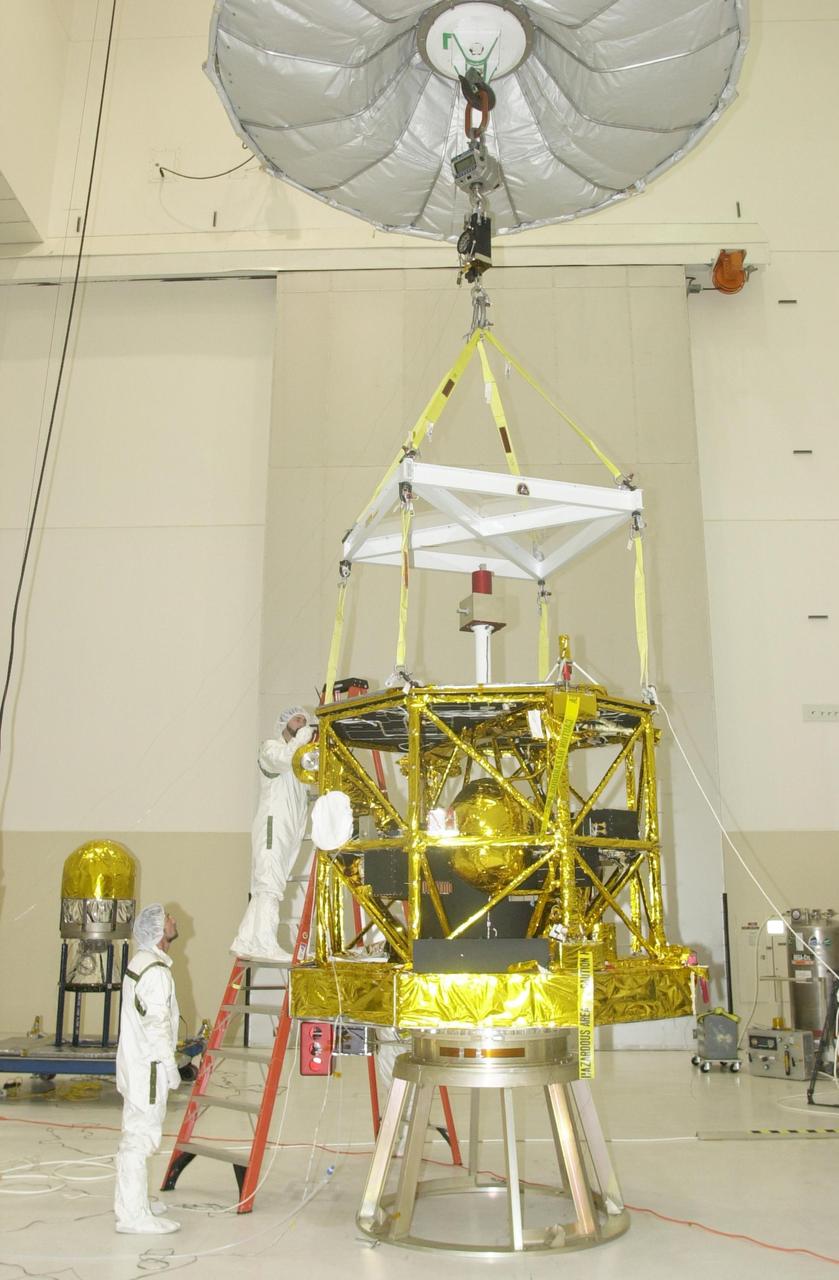
KENNEDY SPACE CENTER, FLA. - Workers in the Spacecraft Assembly and Encapsulation Facility 2 check the attachment of an overhead crane to the CONTOUR spacecraft. The crane will move it over to the apogee kick motor nearby where it will be attached. CONTOUR will provide the first detailed look into the heart of a comet -- the nucleus. The spacecraft will fly close to at least two comets, Encke and Schwassmann-Wachmann 3, taking pictures of the nucleus while analyzing the gas and dust that surround these rocky, icy building blocks of the solar system. The Applied Physics Laboratory of Johns Hopkins University, Baltimore, Md., built CONTOUR and will also be in control of the spacecraft after launch, scheduled for July 1, 2002, from LC 17A at Cape Canaveral Air Force Station
KENNEDY SPACE CENTER, FLA. -- The NASA Comet Nucleus Tour (CONTOUR) spacecraft arrived at KSC on April 24 and was transported to the Spacecraft Assembly and Encapsulation Facility-2 (SAEF-2) to begin final preparations for launch. CONTOUR will provide the first detailed look into the heart of a comet - the nucleus. The spacecraft will fly as close as 60 miles (100 kilometers) to at least two comets, Encke and Schwassmann-Wachmann 3, taking the sharpest pictures yet of the nucleus while analyzing the gas and dust that surround these rocky, icy building blocks of the solar system. The Applied Physics Laboratory of Johns Hopkins University, Baltimore, Md., built CONTOUR and will also be in control of the spacecraft after launch, scheduled for July 1, 2002, from LC 17A at Cape Canaveral Air Force Station
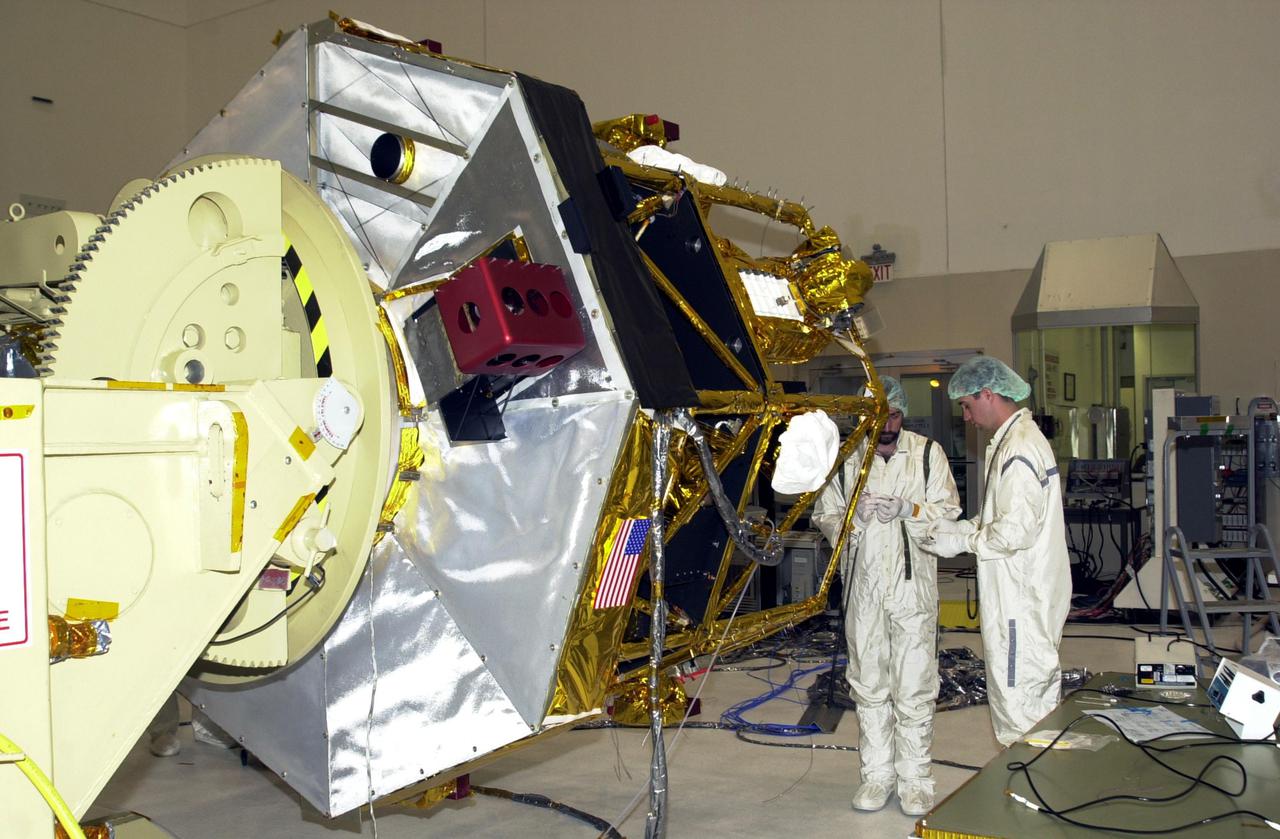
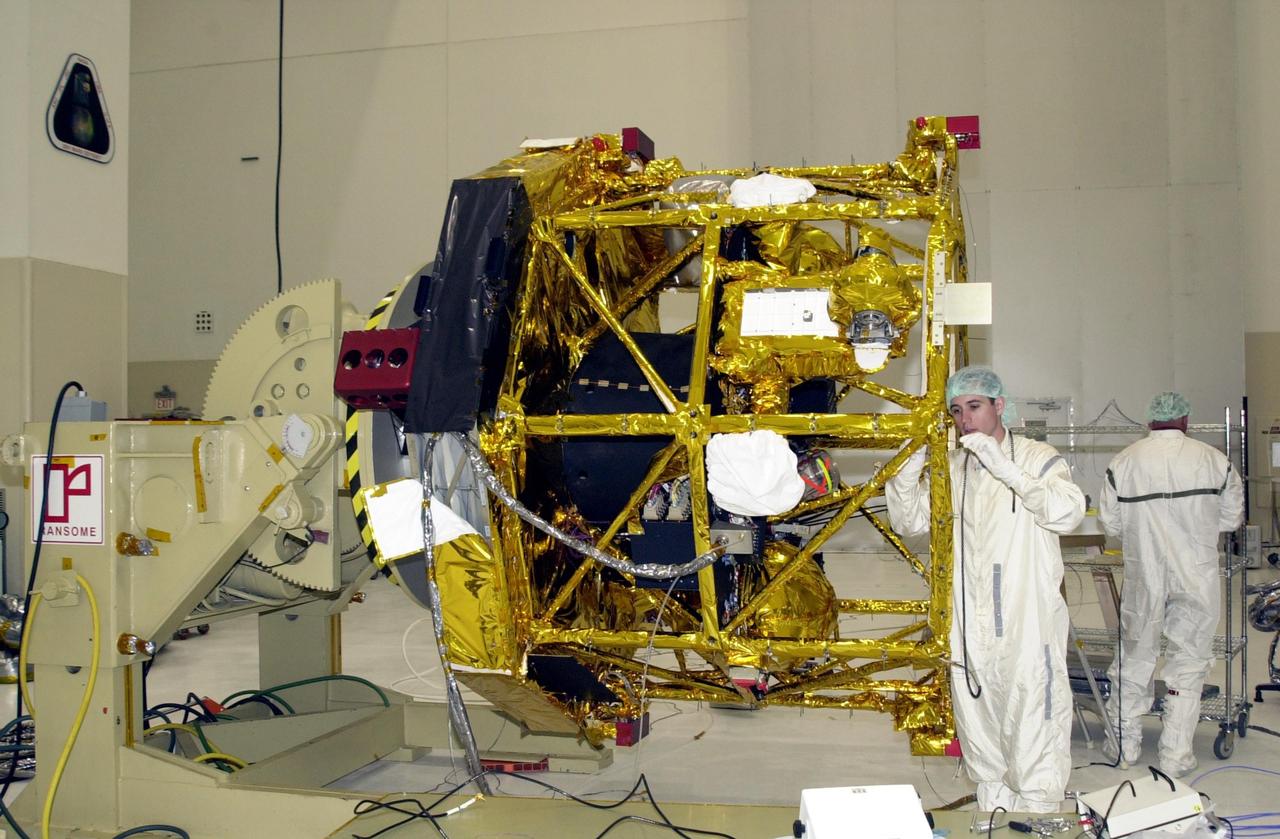
KENNEDY SPACE CENTER, FLA. -- In the Spacecraft Assembly and Encapsulation Facility 2 (SAEF-2), the Comet Nucleus Tour (CONTOUR) spacecraft is ready for installation of the antenna and solar panel. At left is seen the mechanism that enables rotation of the spacecraft for whatever procedures are needed. CONTOUR will provide the first detailed look into the heart of a comet -- the nucleus. The spacecraft will fly as close as 60 miles (100 kilometers) to at least two comets, Encke and Schwassmann-Wachmann 3. It will take the sharpest pictures yet of the nucleus while analyzing the gas and dust that surround these rocky, icy building blocks of the solar system. The Applied Physics Laboratory of Johns Hopkins University, Baltimore, Md., built CONTOUR and will also be in control of the spacecraft after launch, which is scheduled for July 1, 2002, from LC 17A at Cape Canaveral Air Force Station
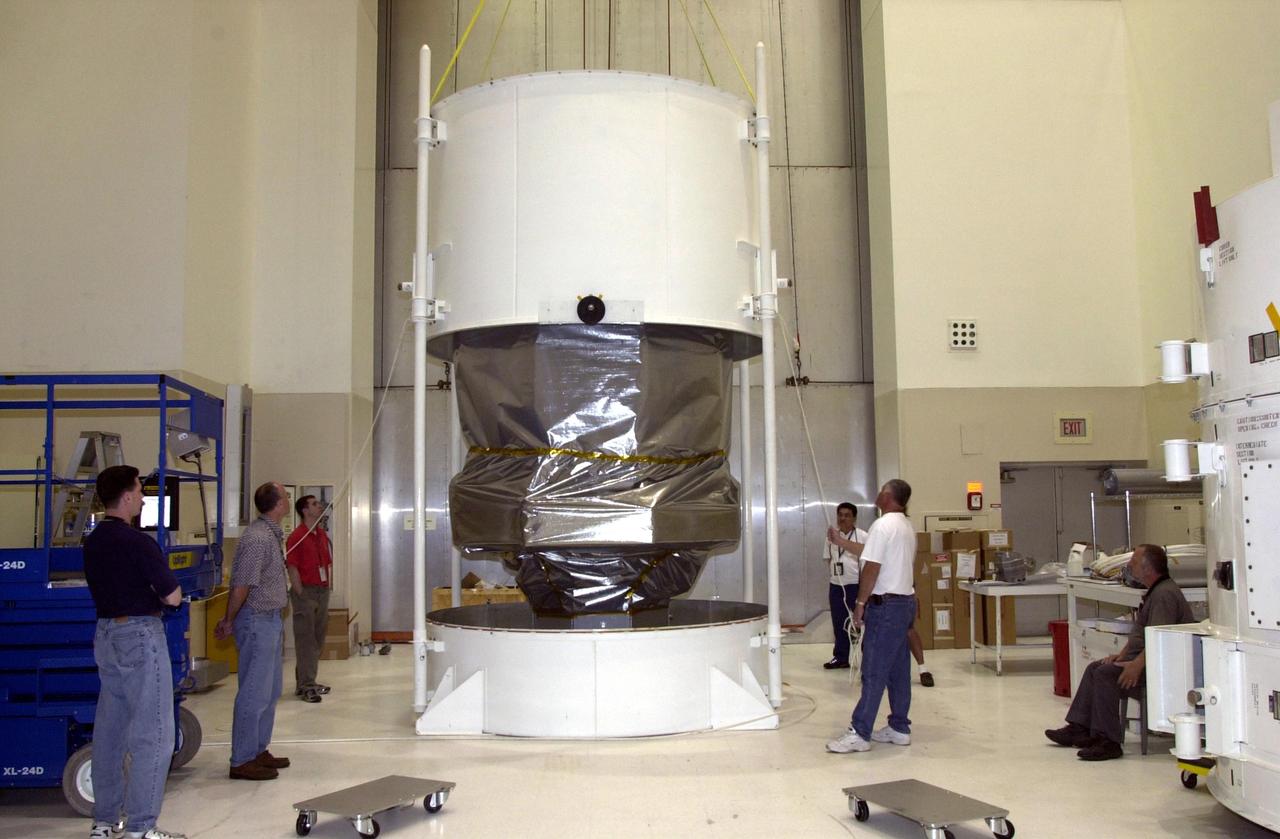
KENNEDY SPACE CENTER, FLA. -- The NASA Comet Nucleus Tour (CONTOUR) spacecraft arrived at KSC on April 24 and was transported to the Spacecraft Assembly and Encapsulation Facility-2 (SAEF-2) to begin final preparations for launch. CONTOUR will provide the first detailed look into the heart of a comet - the nucleus. The spacecraft will fly as close as 60 miles (100 kilometers) to at least two comets, Encke and Schwassmann-Wachmann 3, taking the sharpest pictures yet of the nucleus while analyzing the gas and dust that surround these rocky, icy building blocks of the solar system. The Applied Physics Laboratory of Johns Hopkins University, Baltimore, Md., built CONTOUR and will also be in control of the spacecraft after launch, scheduled for July 1, 2002, from LC 17A at Cape Canaveral Air Force Station
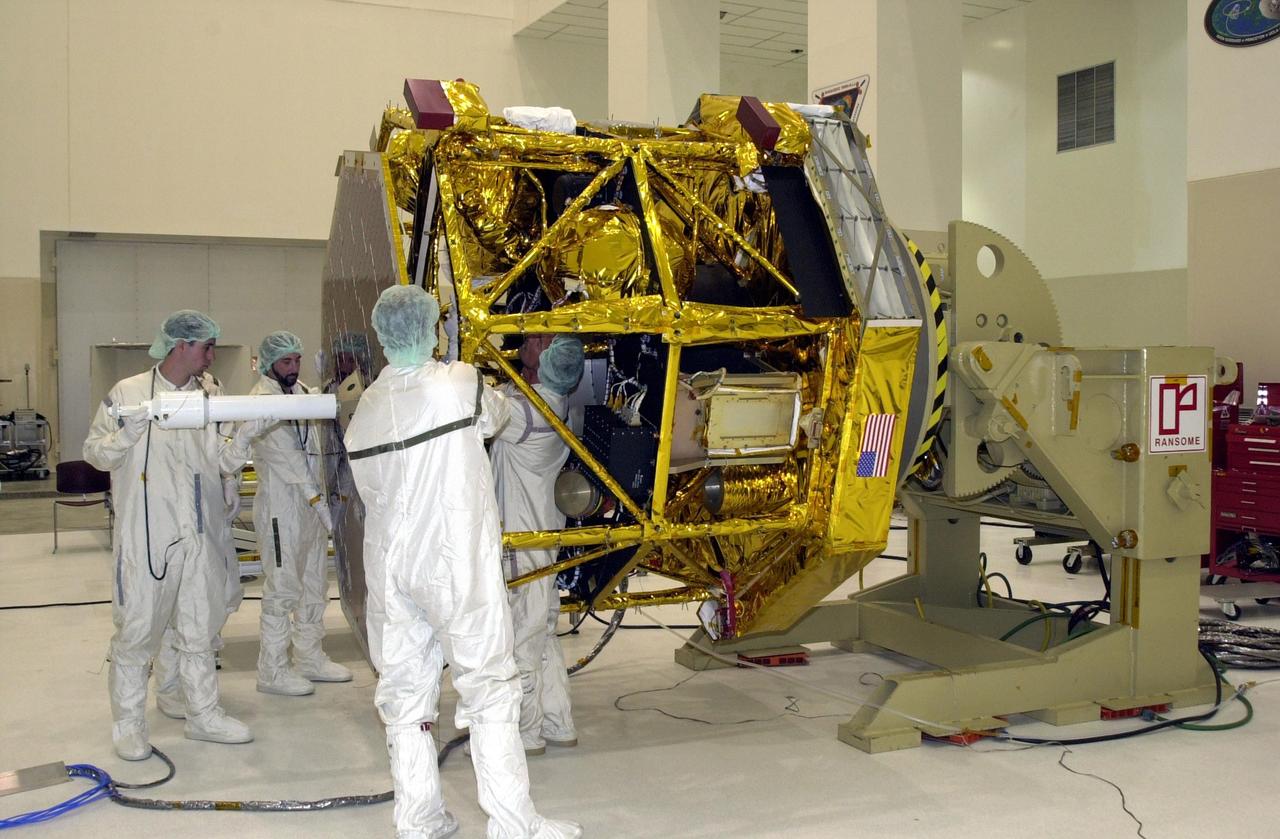
KENNEDY SPACE CENTER, FLA. -- In the Spacecraft Assembly and Encapsulation Facility 2 (SAEF-2), workers at left hold the antenna and solar panel steady while make adjustments before attaching it to the Comet Nucleus Tour (CONTOUR) spacecraft. Scheduled for launch July 1, 2002, from LC 17A at Cape Canaveral Air Force Station, CONTOUR will provide the first detailed look into the heart of a comet -- the nucleus. The spacecraft will fly as close as 60 miles (100 kilometers) to at least two comets, Encke and Schwassmann-Wachmann 3. It will take the sharpest pictures yet of the nucleus while analyzing the gas and dust that surround these rocky, icy building blocks of the solar system. The Applied Physics Laboratory of Johns Hopkins University, Baltimore, Md., built CONTOUR and will also be in control of the spacecraft after launch
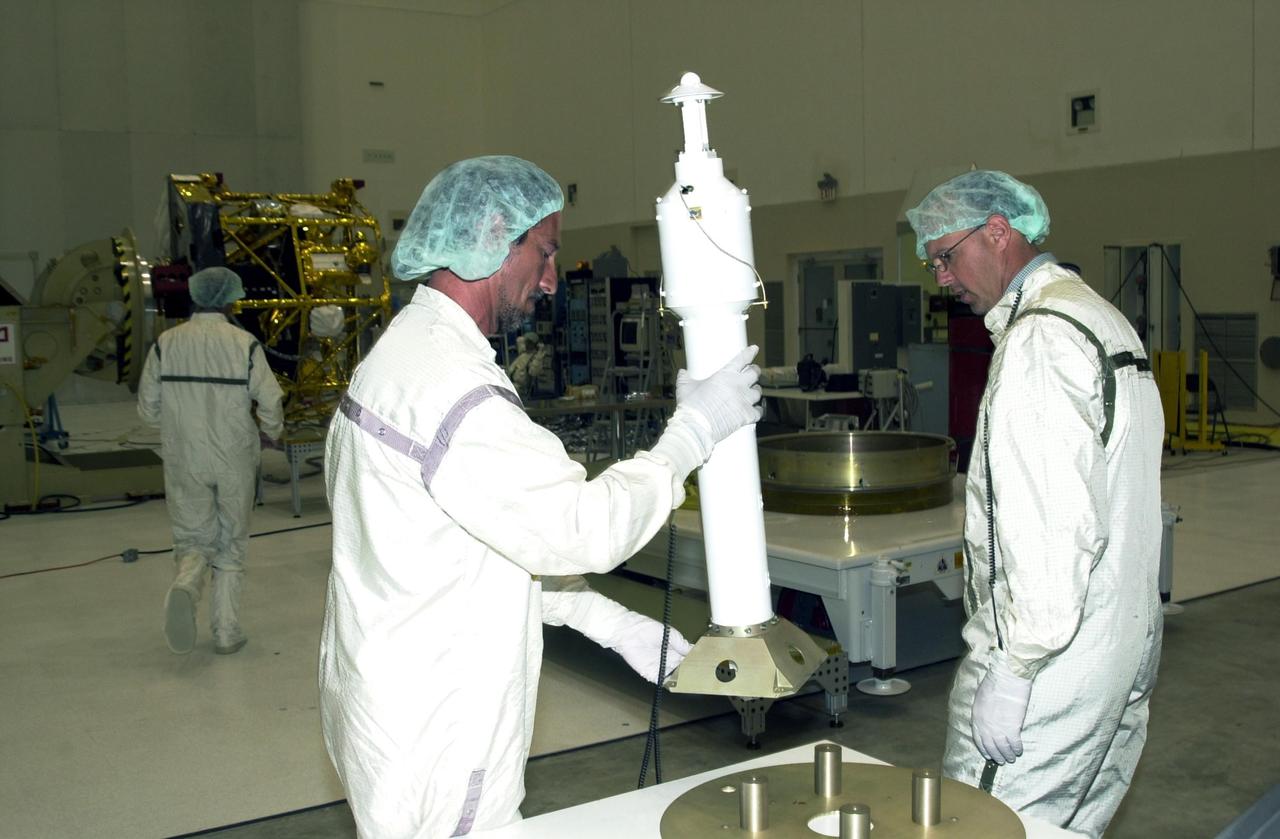
KENNEDY SPACE CENTER, FLA. -- Workers in the Spacecraft Assembly and Encapsulation Facility 2 (SAEF-2) move the antenna that is to be installed on the solar panel for the Comet Nucleus Tour (CONTOUR) spacecraft (seen in the background). CONTOUR will provide the first detailed look into the heart of a comet -- the nucleus. The spacecraft will fly as close as 60 miles (100 kilometers) to at least two comets, Encke and Schwassmann-Wachmann 3. It will take the sharpest pictures yet of the nucleus while analyzing the gas and dust that surround these rocky, icy building blocks of the solar system. The Applied Physics Laboratory of Johns Hopkins University, Baltimore, Md., built CONTOUR and will also be in control of the spacecraft after launch, which is scheduled for July 1, 2002, from LC 17A at Cape Canaveral Air Force Station
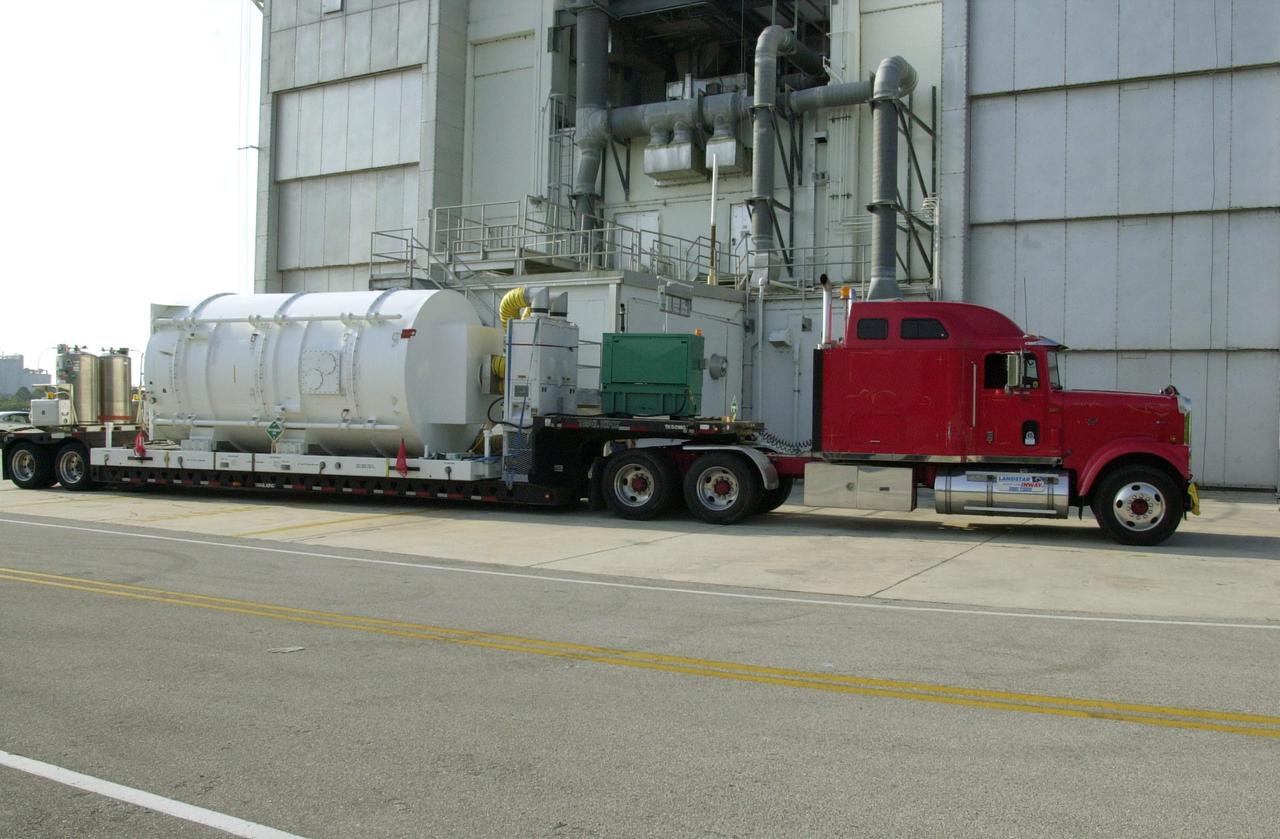
KENNEDY SPACE CENTER, FLA. -- The NASA Comet Nucleus Tour (CONTOUR) spacecraft arrived at KSC on April 24 and was transported to the Spacecraft Assembly and Encapsulation Facility-2 (SAEF-2) to begin final preparations for launch. CONTOUR will provide the first detailed look into the heart of a comet - the nucleus. The spacecraft will fly as close as 60 miles (100 kilometers) to at least two comets, Encke and Schwassmann-Wachmann 3, taking the sharpest pictures yet of the nucleus while analyzing the gas and dust that surround these rocky, icy building blocks of the solar system. The Applied Physics Laboratory of Johns Hopkins University, Baltimore, Md., built CONTOUR and will also be in control of the spacecraft after launch, scheduled for July 1, 2002, from LC 17A at Cape Canaveral Air Force Station
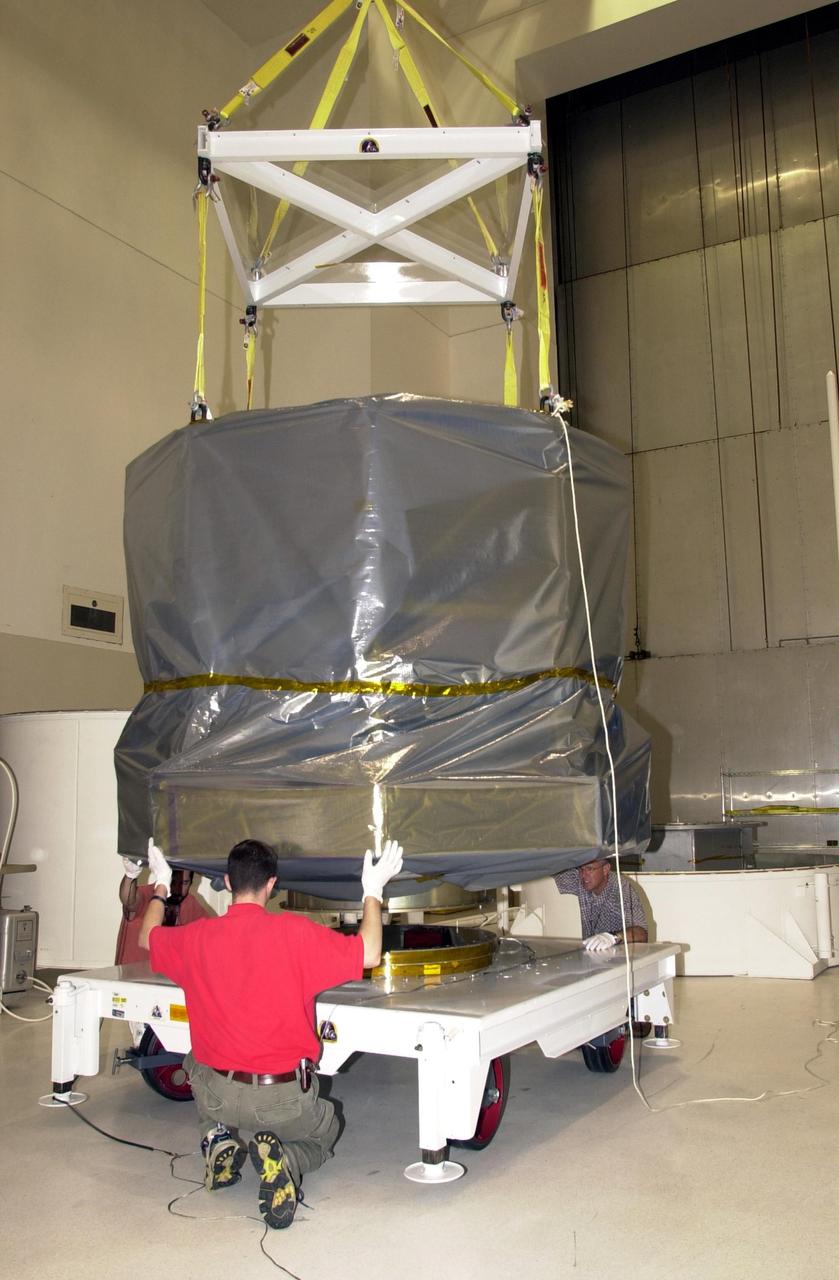
KENNEDY SPACE CENTER, FLA. -- The NASA Comet Nucleus Tour (CONTOUR) spacecraft arrived at KSC on April 24 and was transported to the Spacecraft Assembly and Encapsulation Facility-2 (SAEF-2) to begin final preparations for launch. CONTOUR will provide the first detailed look into the heart of a comet - the nucleus. The spacecraft will fly as close as 60 miles (100 kilometers) to at least two comets, Encke and Schwassmann-Wachmann 3, taking the sharpest pictures yet of the nucleus while analyzing the gas and dust that surround these rocky, icy building blocks of the solar system. The Applied Physics Laboratory of Johns Hopkins University, Baltimore, Md., built CONTOUR and will also be in control of the spacecraft after launch, scheduled for July 1, 2002, from LC 17A at Cape Canaveral Air Force Station
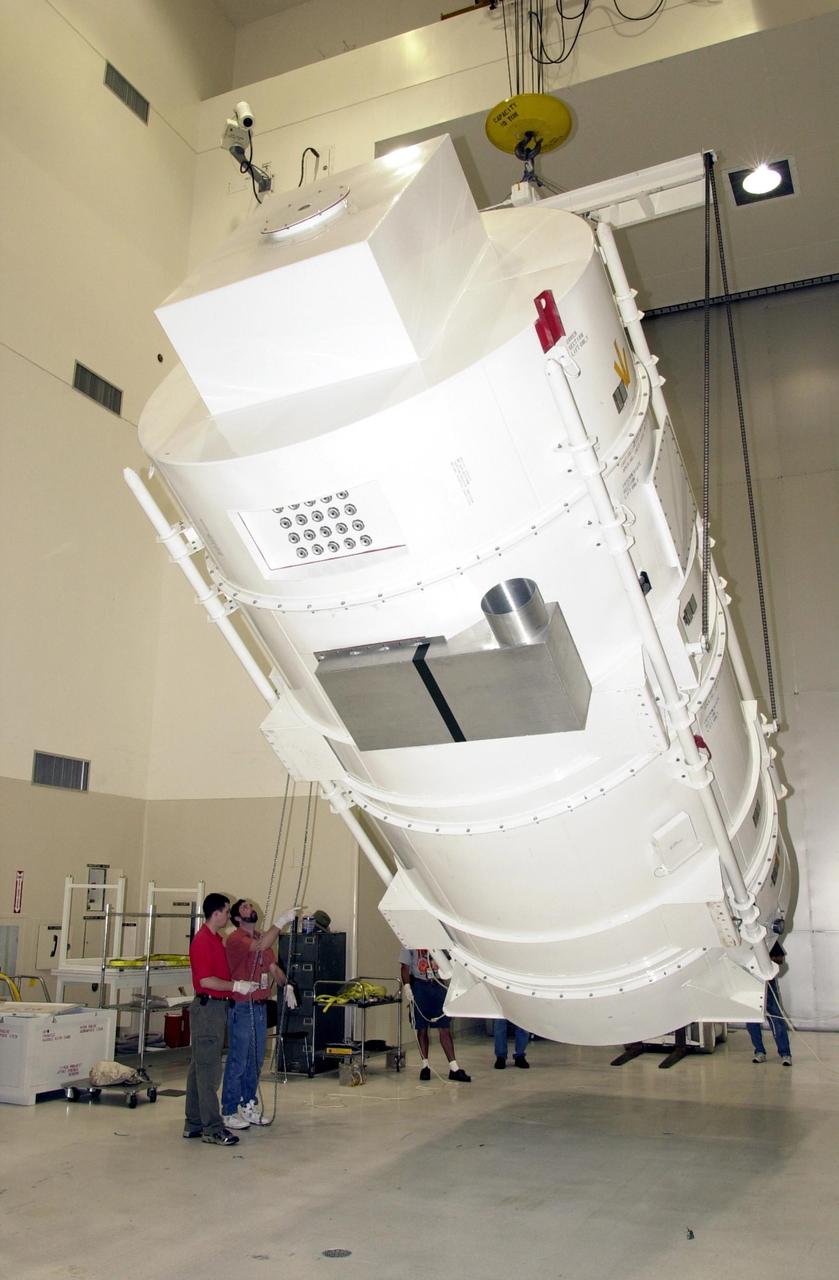
KENNEDY SPACE CENTER, FLA. -- The NASA Comet Nucleus Tour (CONTOUR) spacecraft arrived at KSC on April 24 and was transported to the Spacecraft Assembly and Encapsulation Facility-2 (SAEF-2) to begin final preparations for launch. CONTOUR will provide the first detailed look into the heart of a comet - the nucleus. The spacecraft will fly as close as 60 miles (100 kilometers) to at least two comets, Encke and Schwassmann-Wachmann 3, taking the sharpest pictures yet of the nucleus while analyzing the gas and dust that surround these rocky, icy building blocks of the solar system. The Applied Physics Laboratory of Johns Hopkins University, Baltimore, Md., built CONTOUR and will also be in control of the spacecraft after launch, scheduled for July 1, 2002, from LC 17A at Cape Canaveral Air Force Station