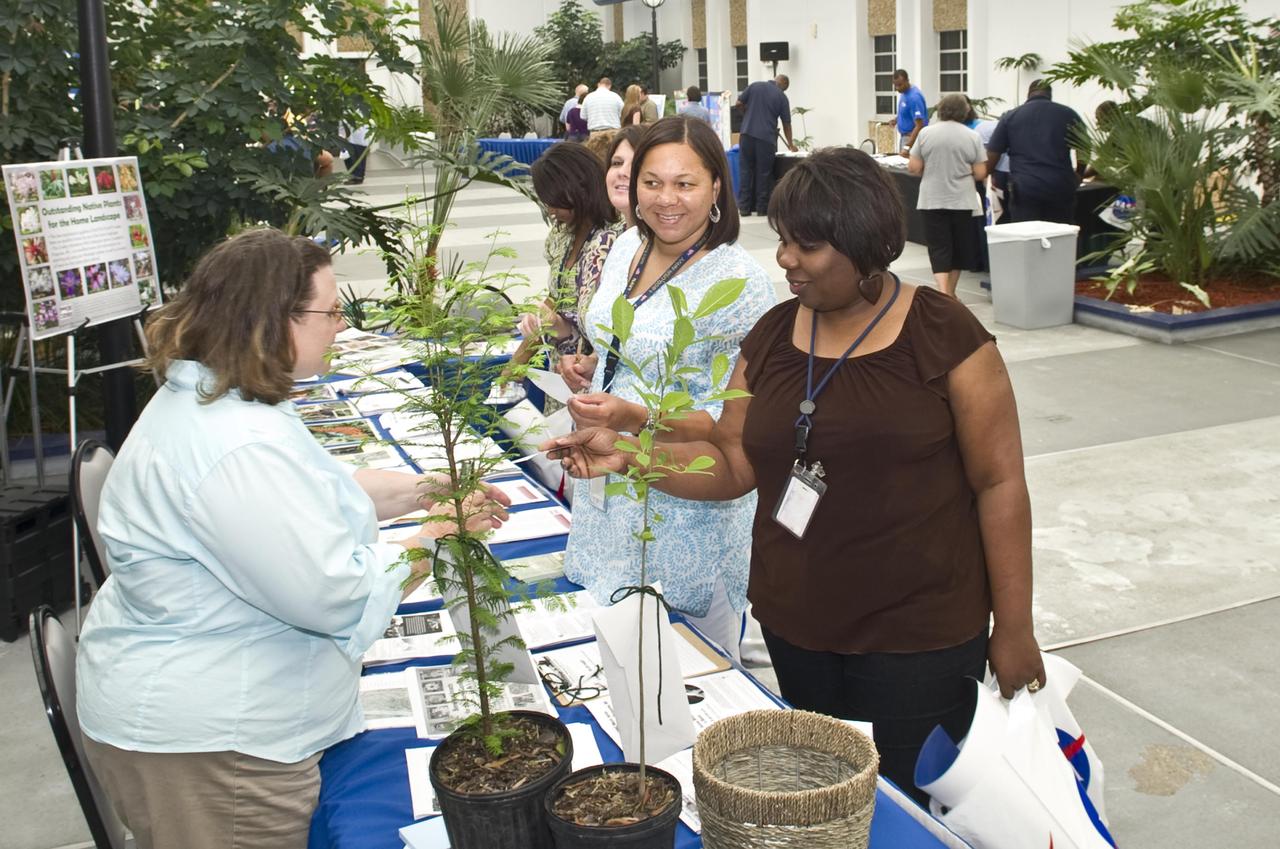
Pat Drackett of the Crosby Arboretum in Picayune (l) speaks with Helen Robinson and Arlene Brown, both employees of the Naval Oceanographic Office at Stennis Space Center, during Earth Day 2011 activities April 21. During the day, Stennis employees were able to visit various exhibits featuring environmentally friendly and energy-conscious items and information. The activities were coordinated by the Stennis Environmental Office.
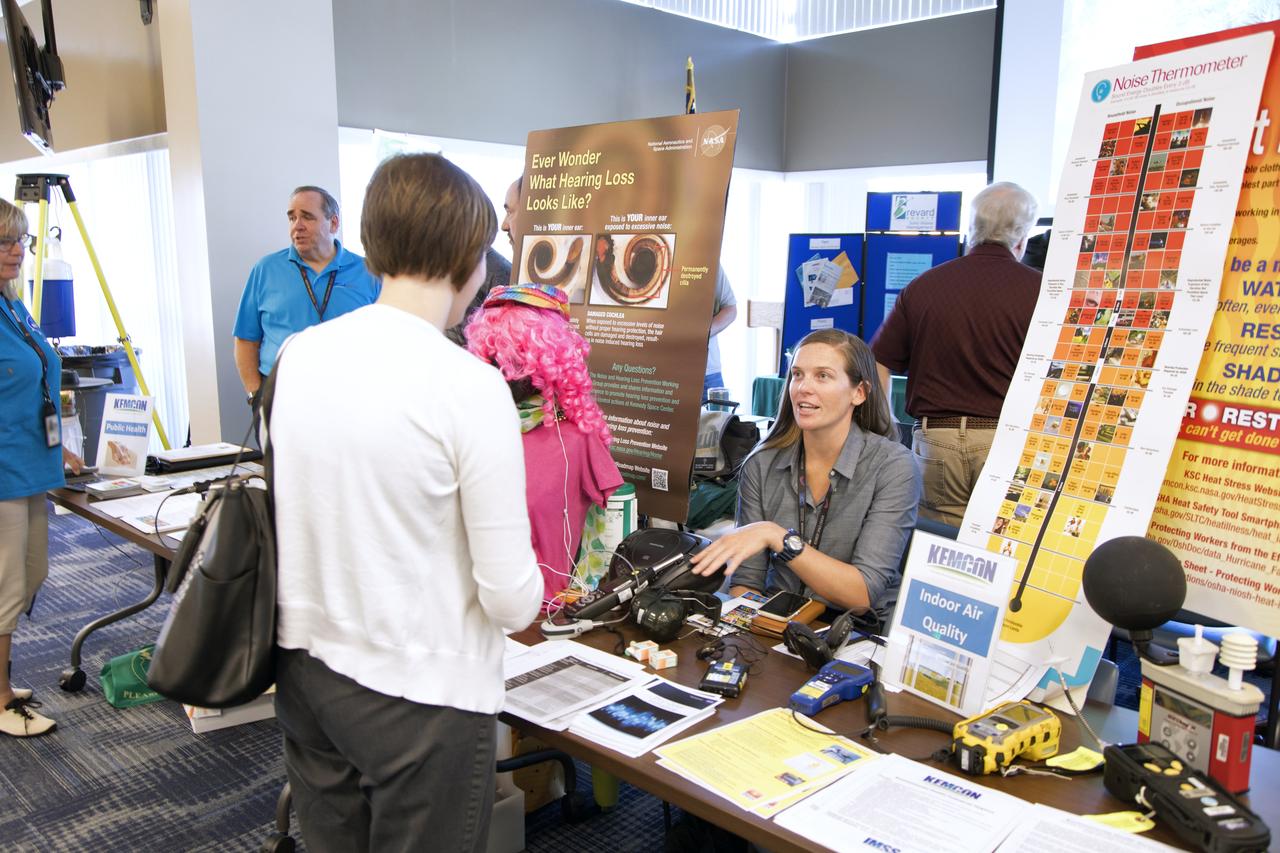
An employee learns about indoor air quality at the Kennedy Space Center (KSC) Environmental and Medical Contract (KEMCON) booth at the center’s annual Earth Day celebration. The two-day event featured approximately 50 exhibitors offering information on a variety of topics, including electric vehicles, sustainable lighting, renewable energy, Florida-friendly landscaping tips, Florida’s biking trails and more.
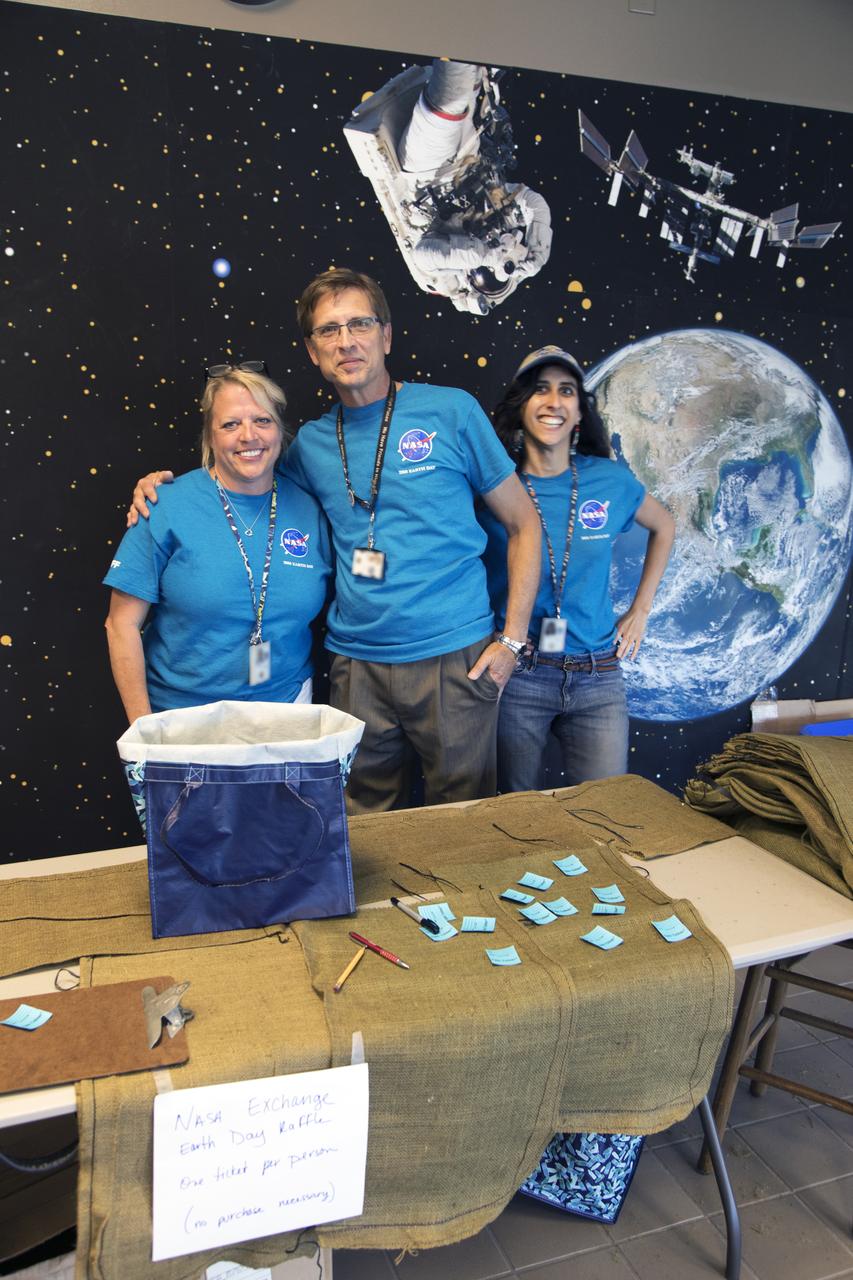
Organizers and volunteers for Kennedy Space Center’s Earth Day celebration gather for a photo at the NASA Exchange raffle booth. From left to right are Jeanne Ryba, Environmental Sustainability program specialist; Robert Smith, Earth Day volunteer; and Natasha Darre, Cultural Resources Specialist. The two-day event featured approximately 50 exhibitors offering information on a variety of topics, including electric vehicles, sustainable lighting, renewable energy, Florida-friendly landscaping tips, Florida’s biking trails and more.
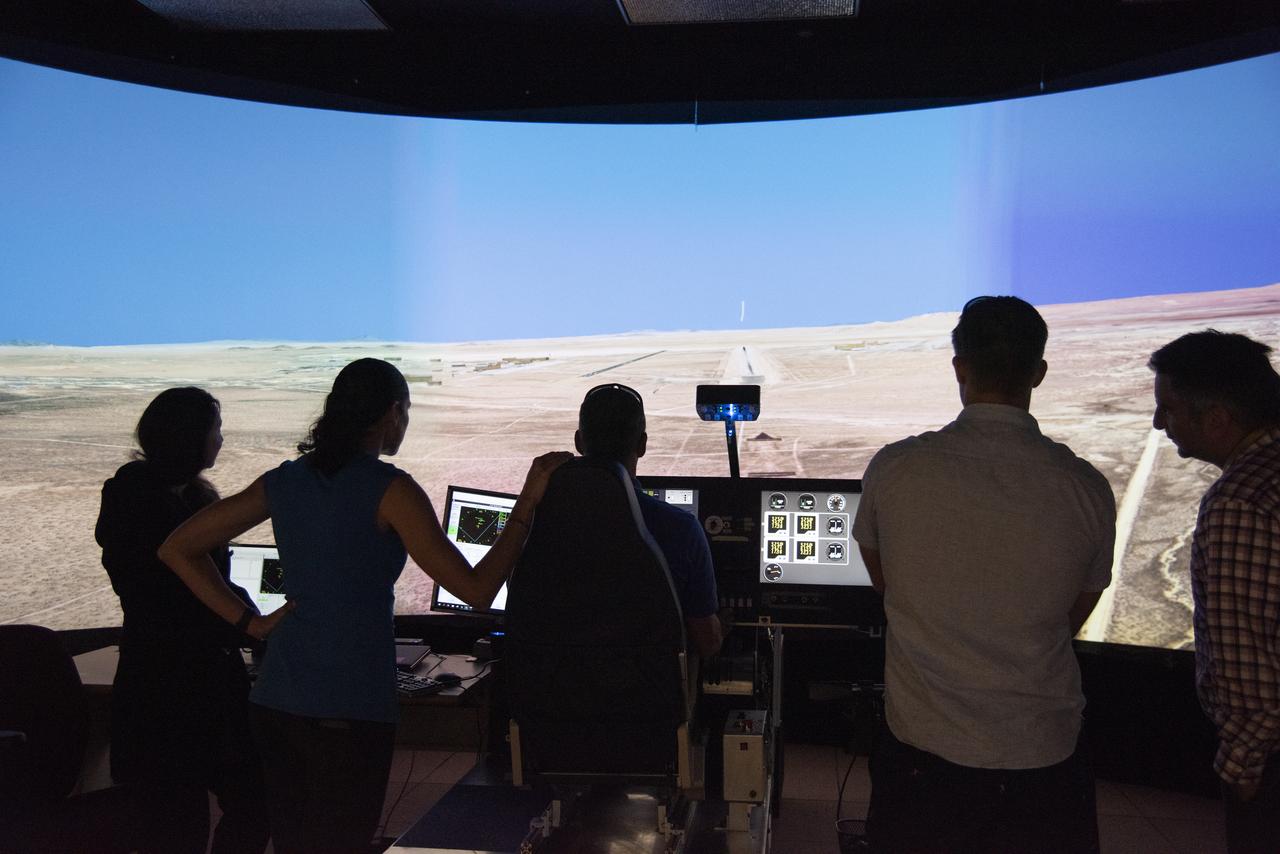
NASA's 2017 astronaut candidates toured aircraft hangar at Armstrong Flight Research Center, in Southern California. After tour of aircraft hangar and briefing on the use of aircraft for flight research, the astronauts practiced flying the X-57 simulator. Starting with the fuselage of a Tecnam P20067T, the X-57 Maxwell electric propulsion airplane is being built and could lead to the development of electric propulsion-powered aircraft, which would be quieter, more efficient and environmentally friendly than today's commuter aircraft.
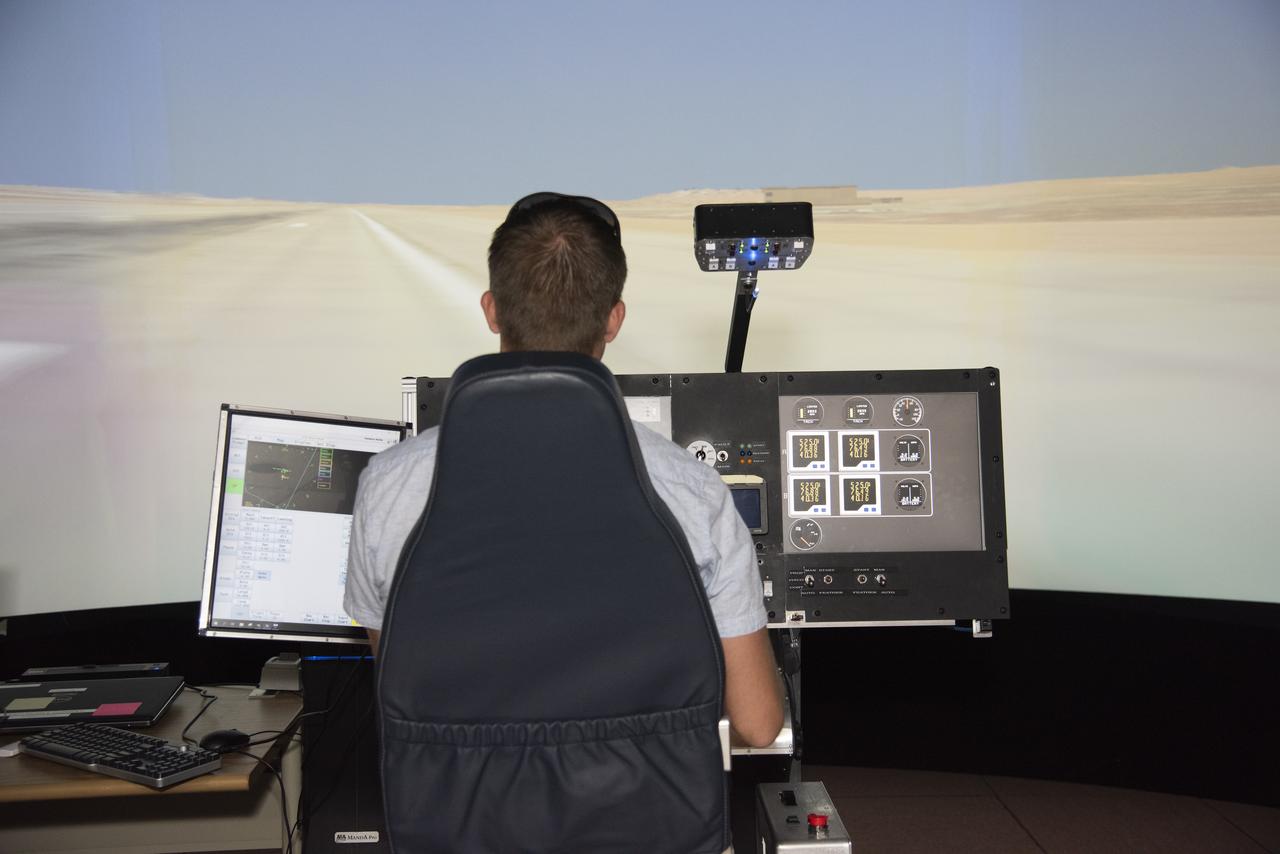
NASA's 2017 astronaut candidate Matthew Dominick practices flying in the X-57 aircraft simulator at Armstrong Flight Research Center in Southern California. Starting with the fuselage of a Tecnam P20067T, the X-57 Maxwell electric propulsion airplane is being built from ideas being researched that could lead to the development of electric propulsion-powered aircraft, which would be quieter, more efficient and environmentally friendly than today's commuter aircraft.
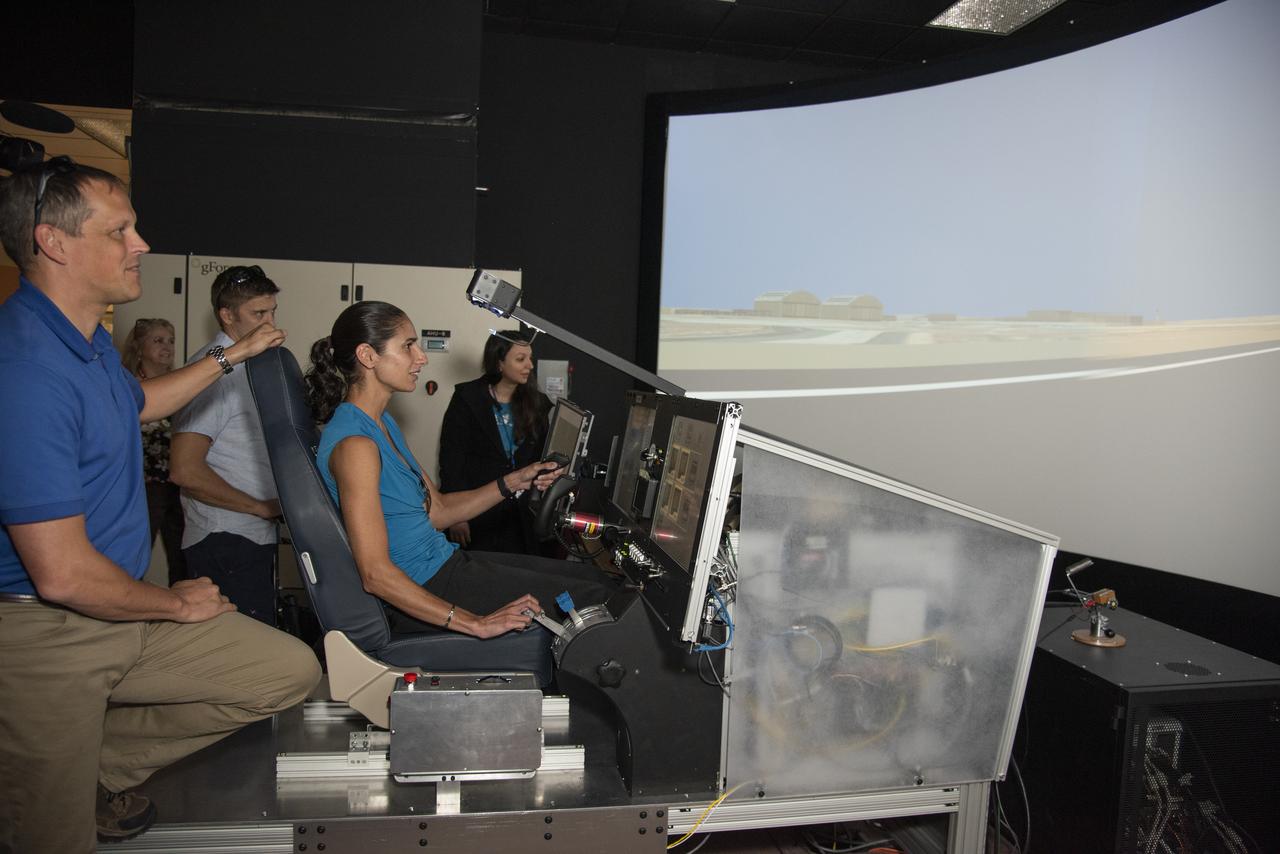
NASA's 2017 astronaut candidates (L to R) Bob Hines, Matthew Dominick and Jasmin Moghbeli practice flying in X-57 aircraft simulator at Armstrong Flight Research Center in Southern California. Starting with the fuselage of a Tecnam P20067T, the X-57 Maxwell electric propulsion airplane is being built from ideas being researched that could lead to the development of electric propulsion-powered aircraft, which would be quieter, more efficient and environmentally friendly than today's commuter aircraft.

Dr. Luz M. Calle, a principal investigator for corrosion research at NASA’s Kennedy Space Center, examines microcapsules under a microscope Dec. 12, 2018. Microencapsulation is a way to create smart coatings or paint capable of indicating, resisting, and repairing corrosion. Smart coatings are being developed as alternatives to corrosion protection technologies that are not environmentally friendly.
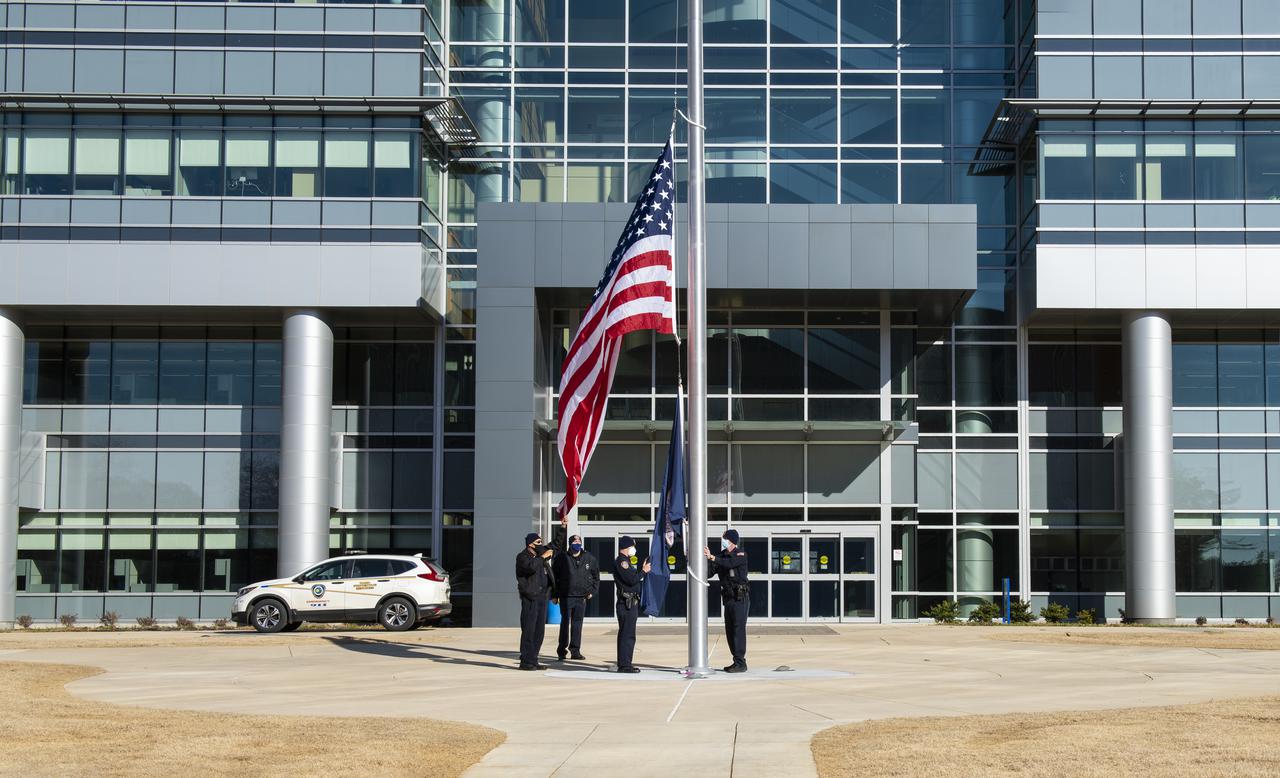
On Jan. 26, 2022, the U.S. and NASA flags were raised at Building 4221 to mark the transfer of headquarters to that building at Marshall Space Flight Center in Huntsville, Alabama. The doors to Building 4221, a new, environmentally friendly building, opened on Earth Day, April 22, 2019. Building 4200 served as Marshall’s original headquarters since 1963. Marshall center operations lowered flags at that building on Jan. 21, 2022.
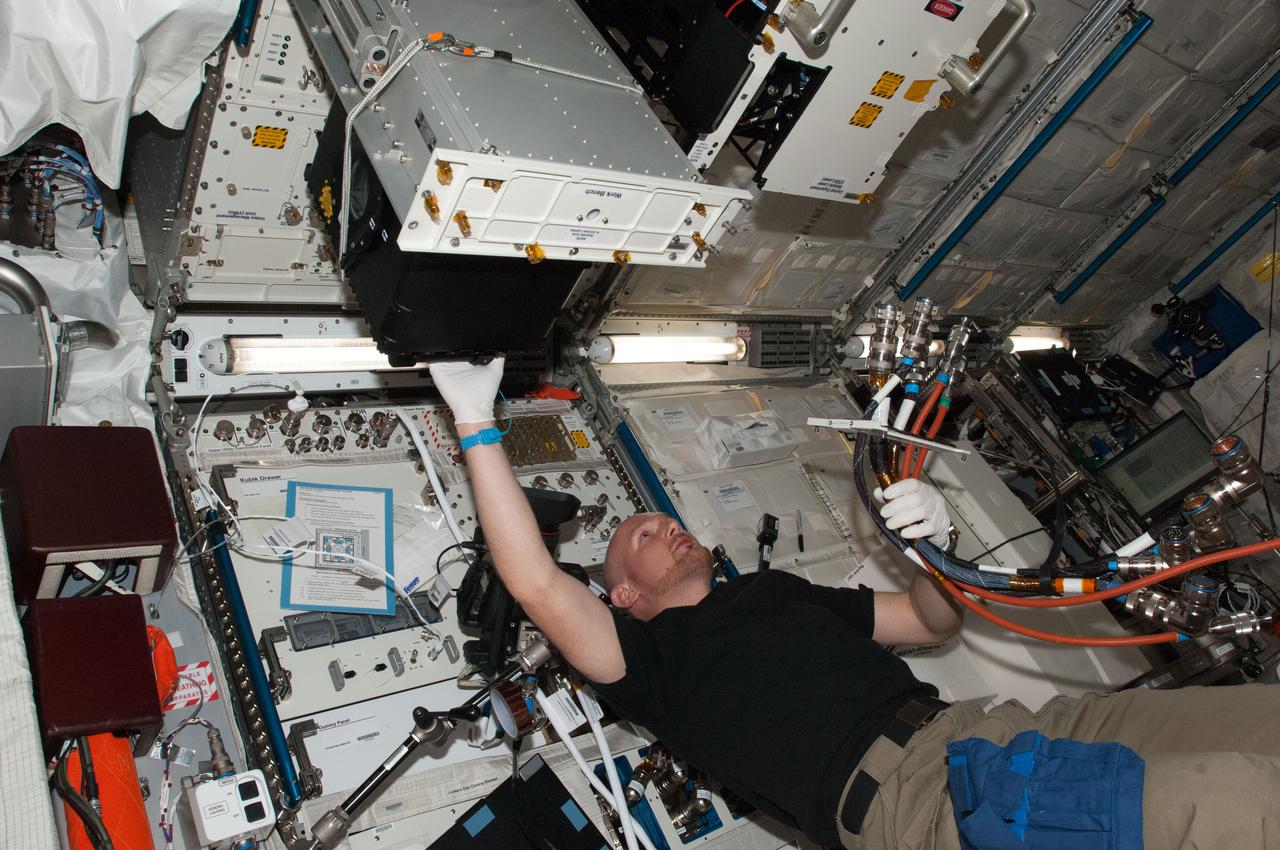
ISS040-E-014865 (18 June 2014) --- European Space Agency astronaut Alexander Gerst, Expedition 40 flight engineer, works with Fundamental and Applied Studies of Emulsion Stability (FASES) experiment hardware in the Columbus laboratory of the International Space Station. The emulsion study sponsored by ESA and located inside the Columbus laboratory Fluids Science Laboratory could lead to environmentally friendly products with industrial and space applications.
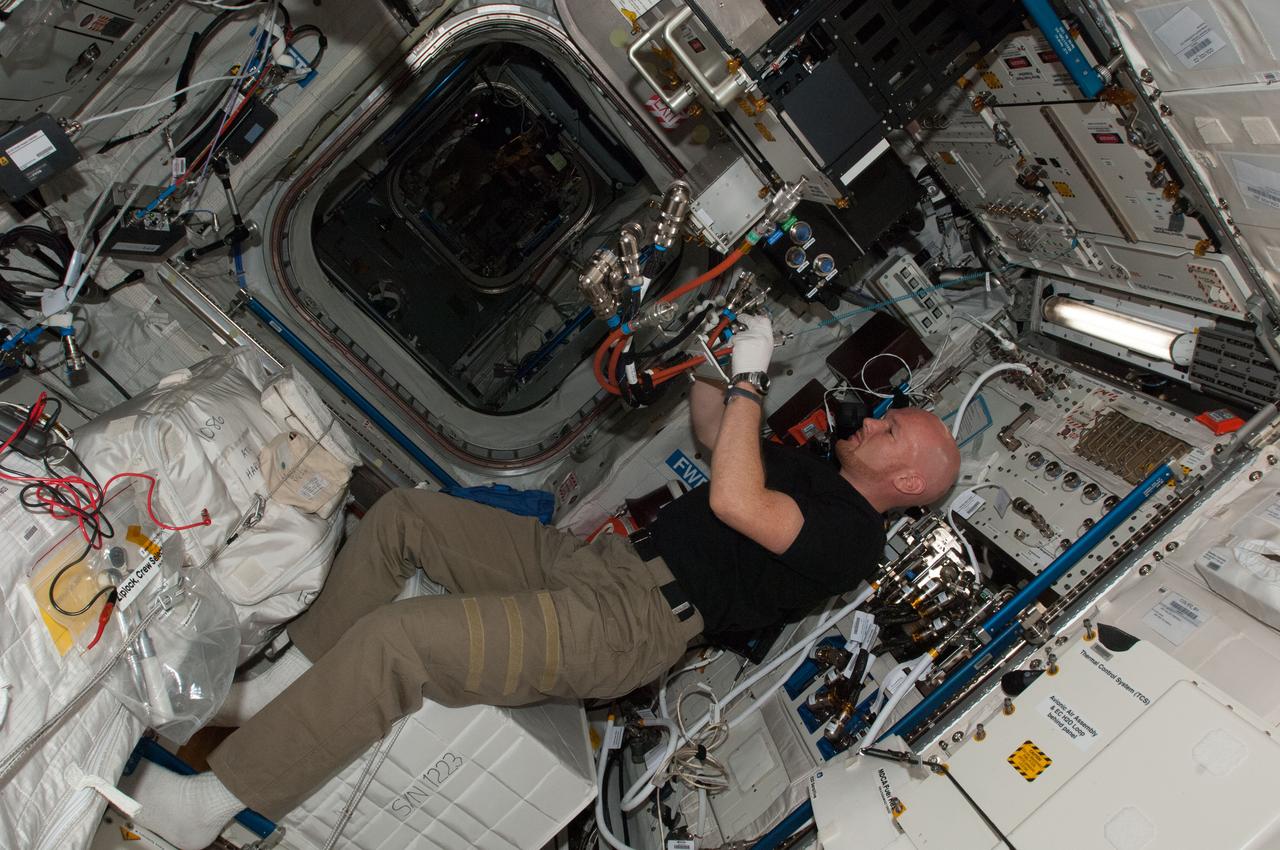
ISS040-E-014868 (18 June 2014) --- European Space Agency astronaut Alexander Gerst, Expedition 40 flight engineer, works with Fundamental and Applied Studies of Emulsion Stability (FASES) experiment hardware in the Columbus laboratory of the International Space Station. The emulsion study sponsored by ESA and located inside the Columbus laboratory Fluids Science Laboratory could lead to environmentally friendly products with industrial and space applications.
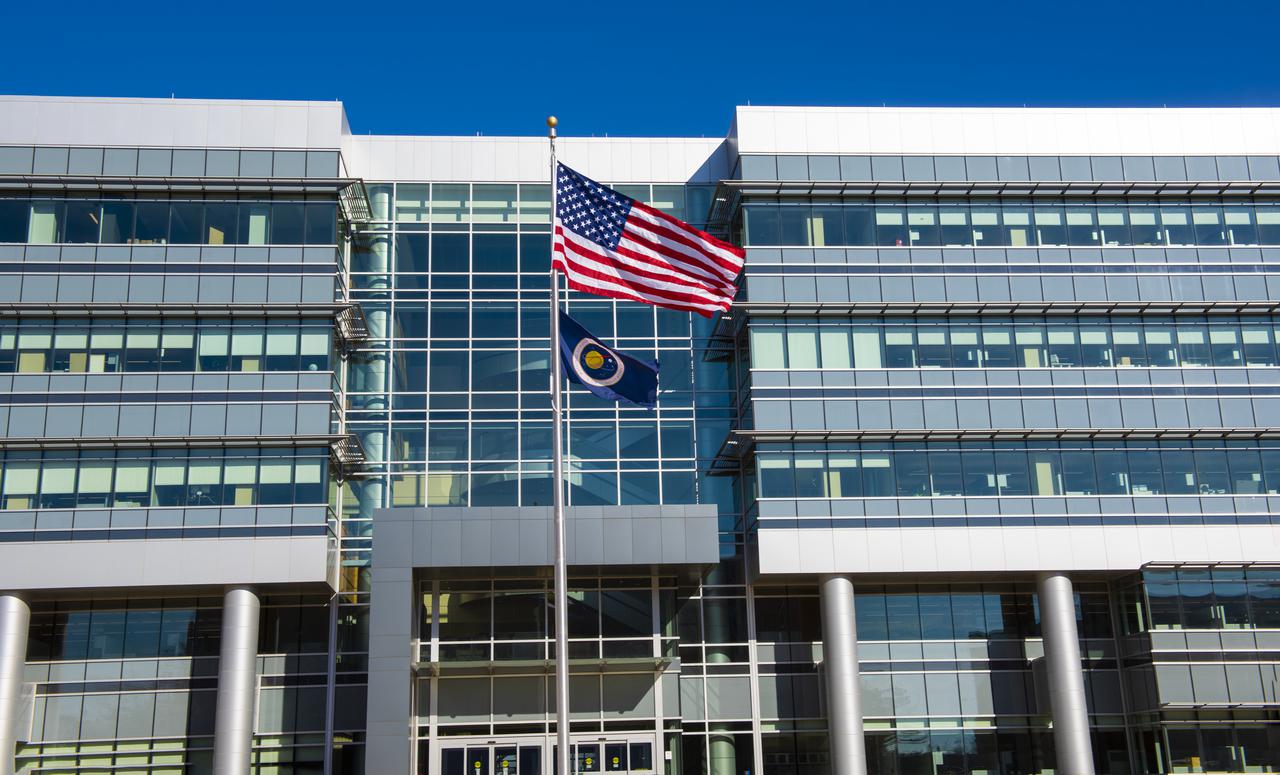
On Jan. 26, 2022, the U.S. and NASA flags were raised at Building 4221 to mark the transfer of headquarters to that building at Marshall Space Flight Center in Huntsville, Alabama. The doors to Building 4221, a new, environmentally friendly building, opened on Earth Day, April 22, 2019. Building 4200 served as Marshall’s original headquarters since 1963. Marshall center operations lowered flags at that building on Jan. 21, 2022.

On Jan. 26, 2022, the U.S. and NASA flags were raised at Building 4221 to mark the transfer of headquarters to that building at Marshall Space Flight Center in Huntsville, Alabama. The doors to Building 4221, a new, environmentally friendly building, opened on Earth Day, April 22, 2019. Building 4200 served as Marshall’s original headquarters since 1963. Marshall center operations lowered flags at that building on Jan. 21, 2022.
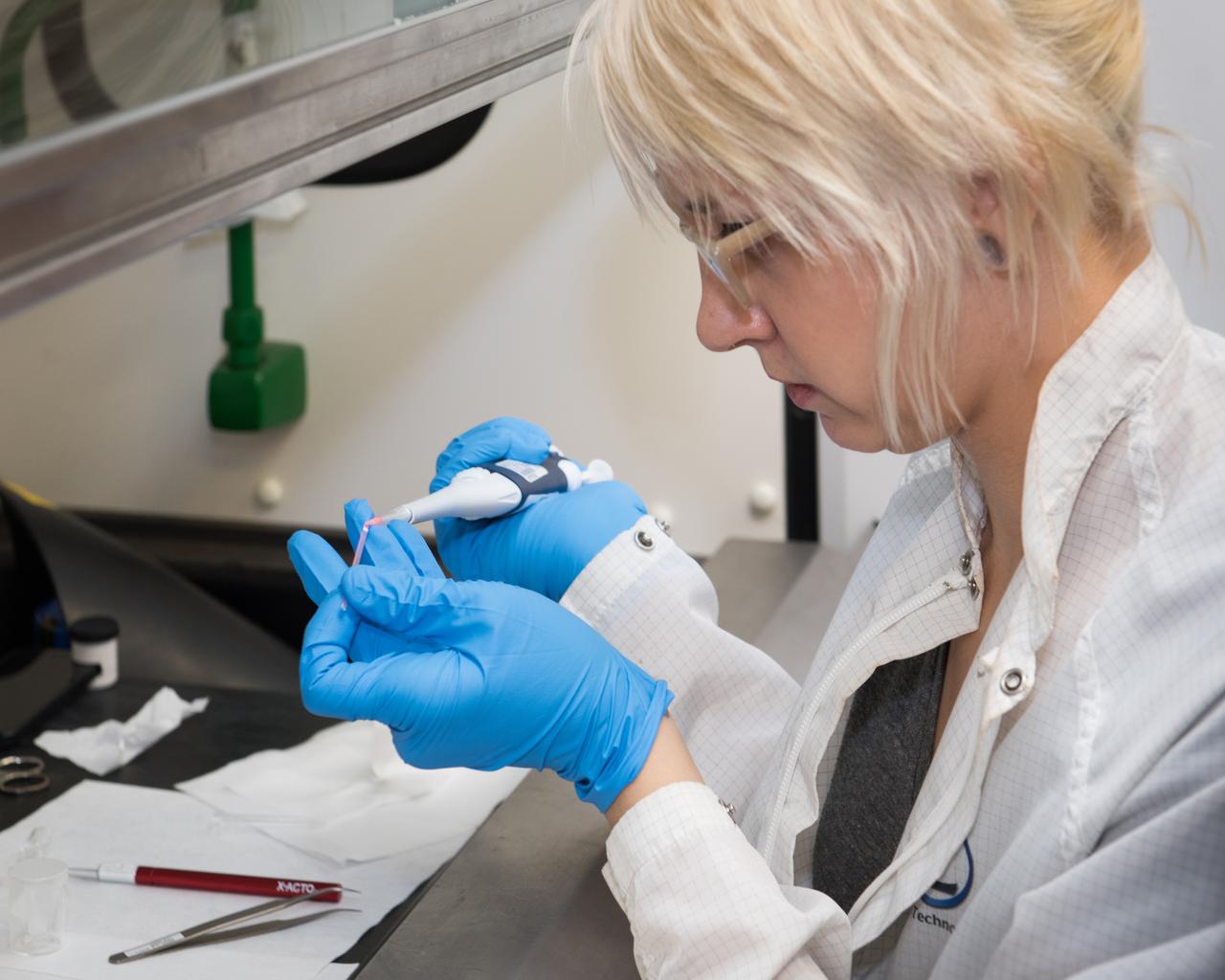
Deena Dombrosky (Zin Technologies Engineer) is shown here filling a Procter & Gamble (P & G) sample that will be used in ground-testing as NASA prepares for their experiment on the International Space Station (ISS). The sample particles are the size of the wavelength of light and they are dyed orange/pink to glow when illuminated with the laser light enabling a confocal microscope to produce 3D images. The P & G experiment will improve product stabilizers that extend product shelf life. This has the added advantage of leading to more compact environmentally friendly containers.
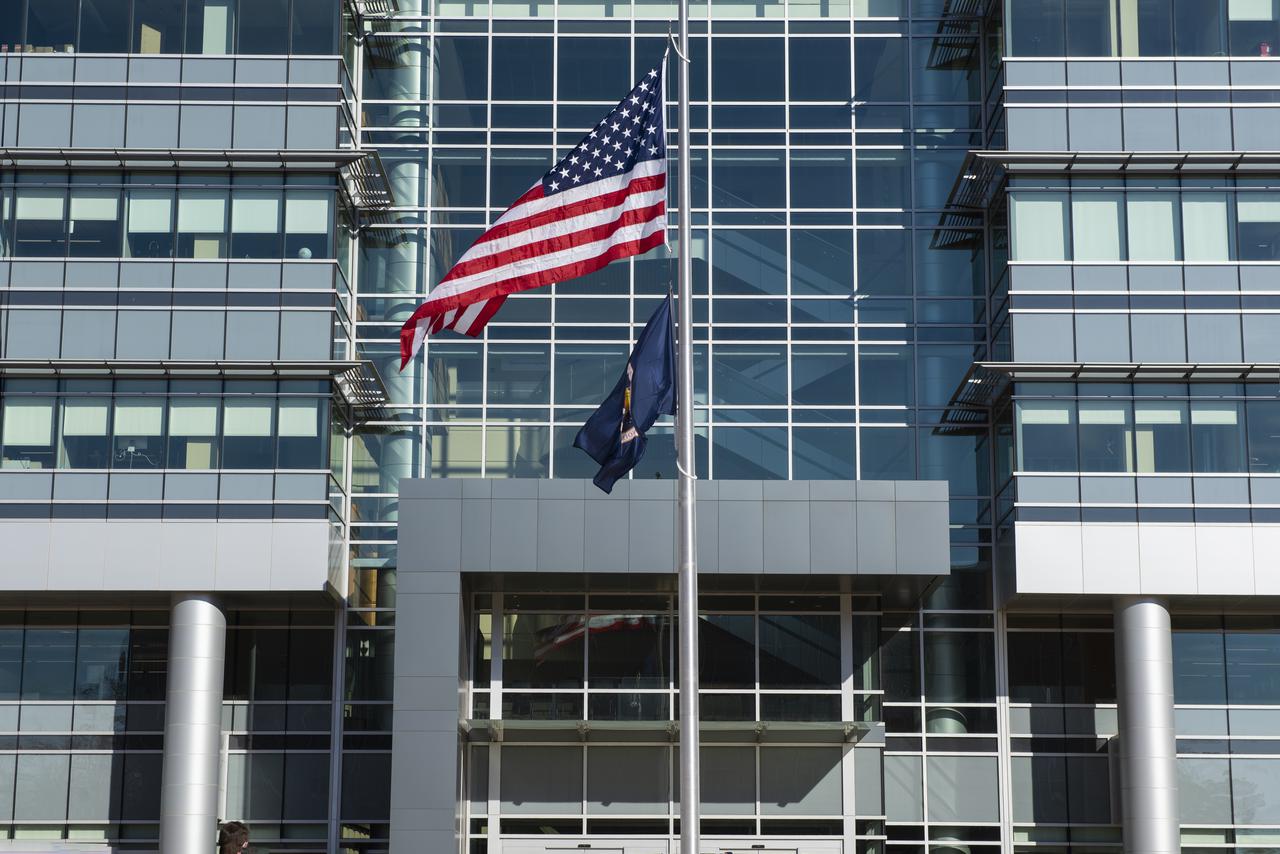
On Jan. 26, 2022, the U.S. and NASA flags were raised at Building 4221 to mark the transfer of headquarters to that building at Marshall Space Flight Center in Huntsville, Alabama. The doors to Building 4221, a new, environmentally friendly building, opened on Earth Day, April 22, 2019. Building 4200 served as Marshall’s original headquarters since 1963. Marshall center operations lowered flags at that building on Jan. 21, 2022.
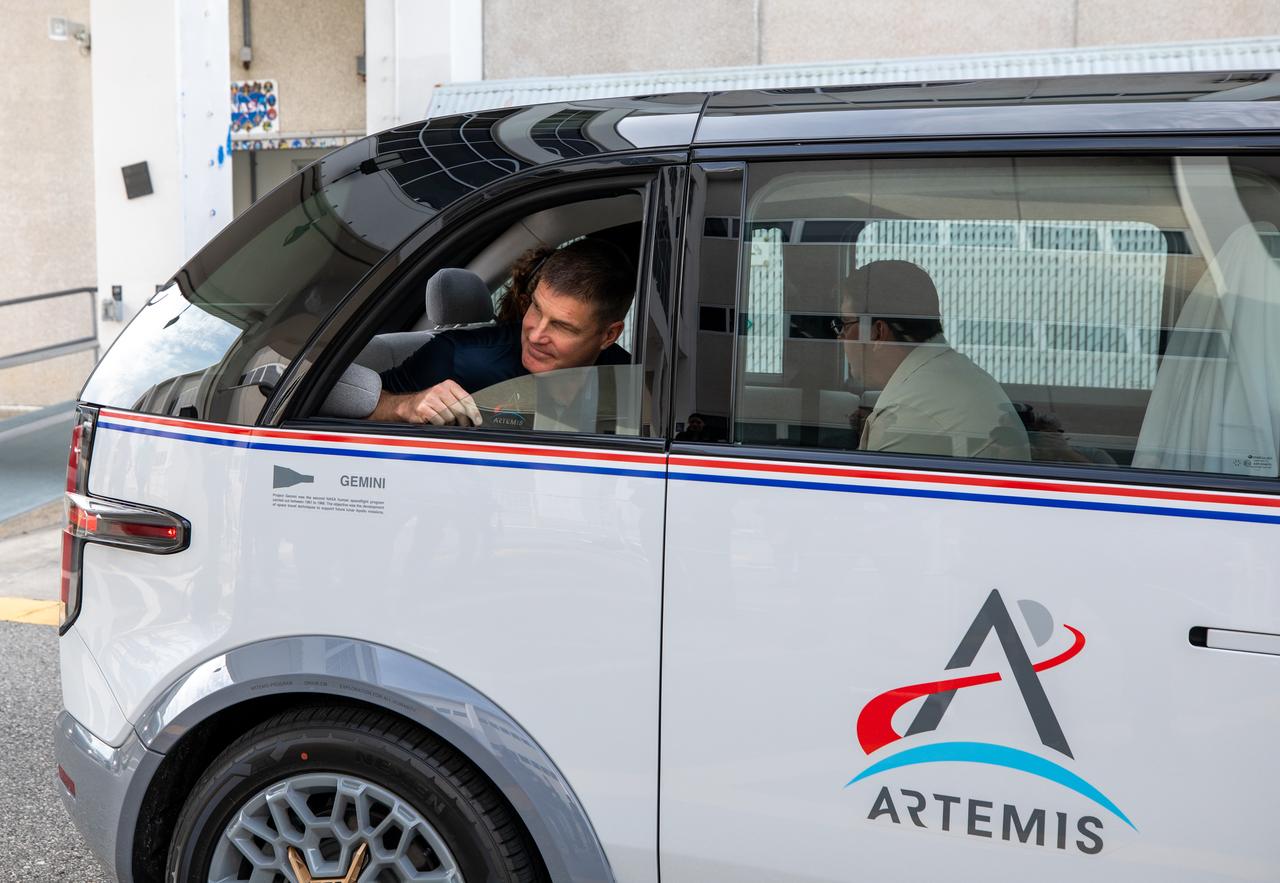
NASA astronaut Jeremy Hansen, left, sits inside one of the crew transport vehicles (CTVs) outside of the Neil A. Armstrong Operations and Checkout Building at Kennedy Space Center in Florida on Tuesday, Sept. 19, 2023. The CTVs will carry Hansen, along with fellow NASA astronauts Christina Koch, Reid Wiseman, and Victor Glover, to Kennedy’s Launch Complex 39B for liftoff of the Artemis II mission. The specially designed, fully electric, environmentally friendly vehicles were manufactured by Canoo Technologies, Inc. of Torrance California.
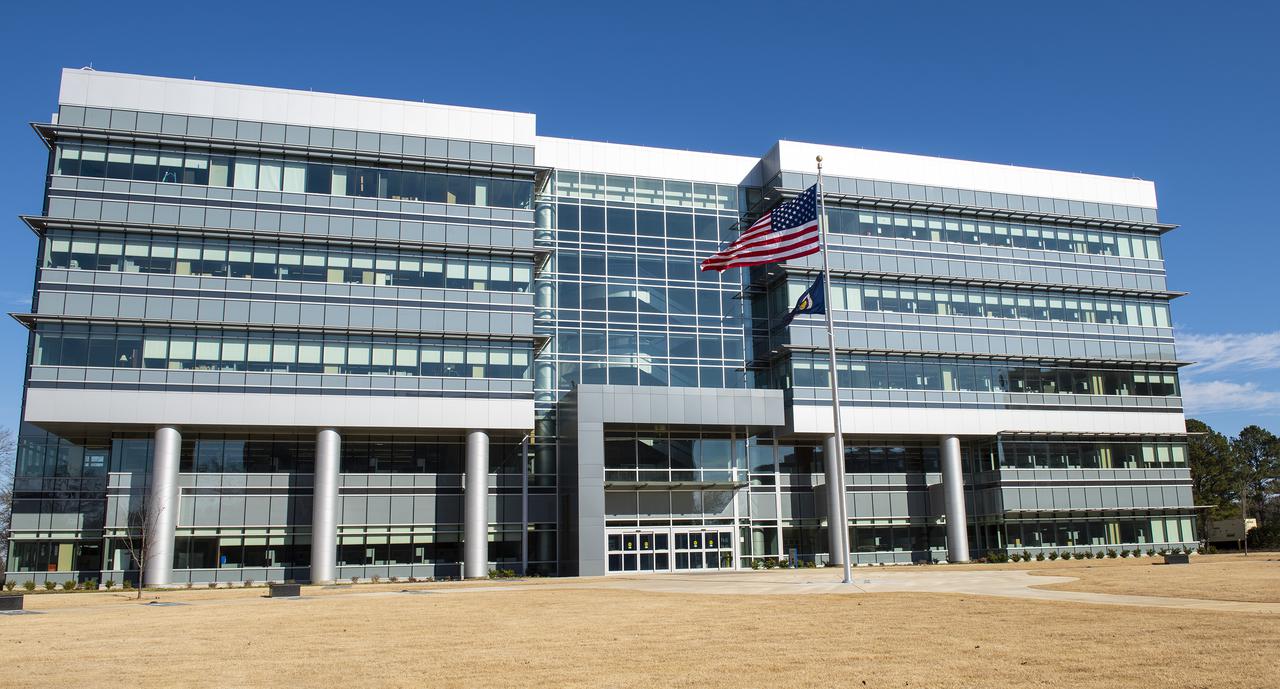
On Jan. 26, 2022, the U.S. and NASA flags were raised at Building 4221 to mark the transfer of headquarters to that building at Marshall Space Flight Center in Huntsville, Alabama. The doors to Building 4221, a new, environmentally friendly building, opened on Earth Day, April 22, 2019. Building 4200 served as Marshall’s original headquarters since 1963. Marshall center operations lowered flags at that building on Jan. 21, 2022.

With the Vehicle Assembly Building in the background, the three specially designed, fully electric, environmentally friendly crew transportation vehicles for Artemis missions arrived at NASA’s Kennedy Space Center in Florida on July 11, 2023. The zero-emission vehicles, which will carry astronauts to Launch Complex 39B for Artemis missions, were delivered by the manufacturer, Canoo Technologies Inc. of Torrance, California.
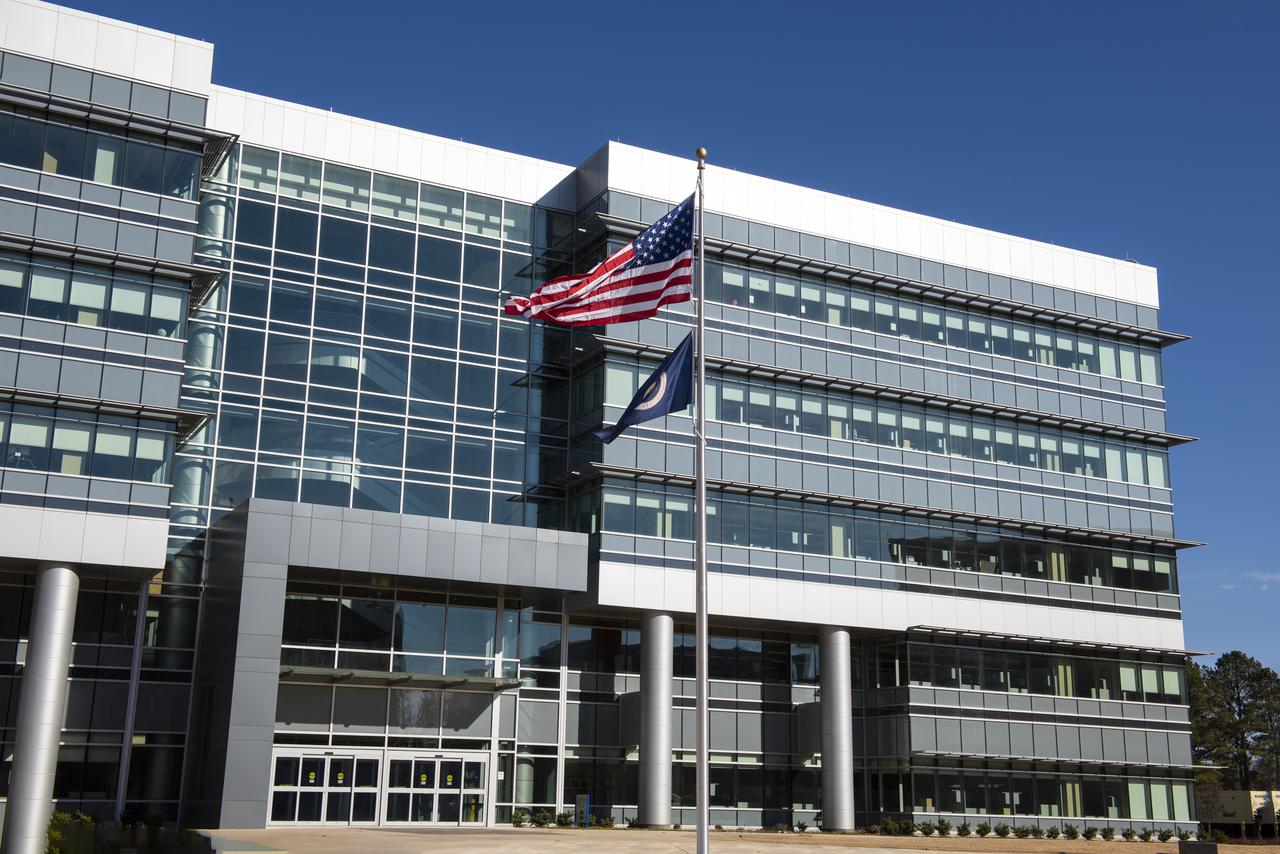
On Jan. 26, 2022, the U.S. and NASA flags were raised at Building 4221 to mark the transfer of headquarters to that building at Marshall Space Flight Center in Huntsville, Alabama. The doors to Building 4221, a new, environmentally friendly building, opened on Earth Day, April 22, 2019. Building 4200 served as Marshall’s original headquarters since 1963. Marshall center operations lowered flags at that building on Jan. 21, 2022.
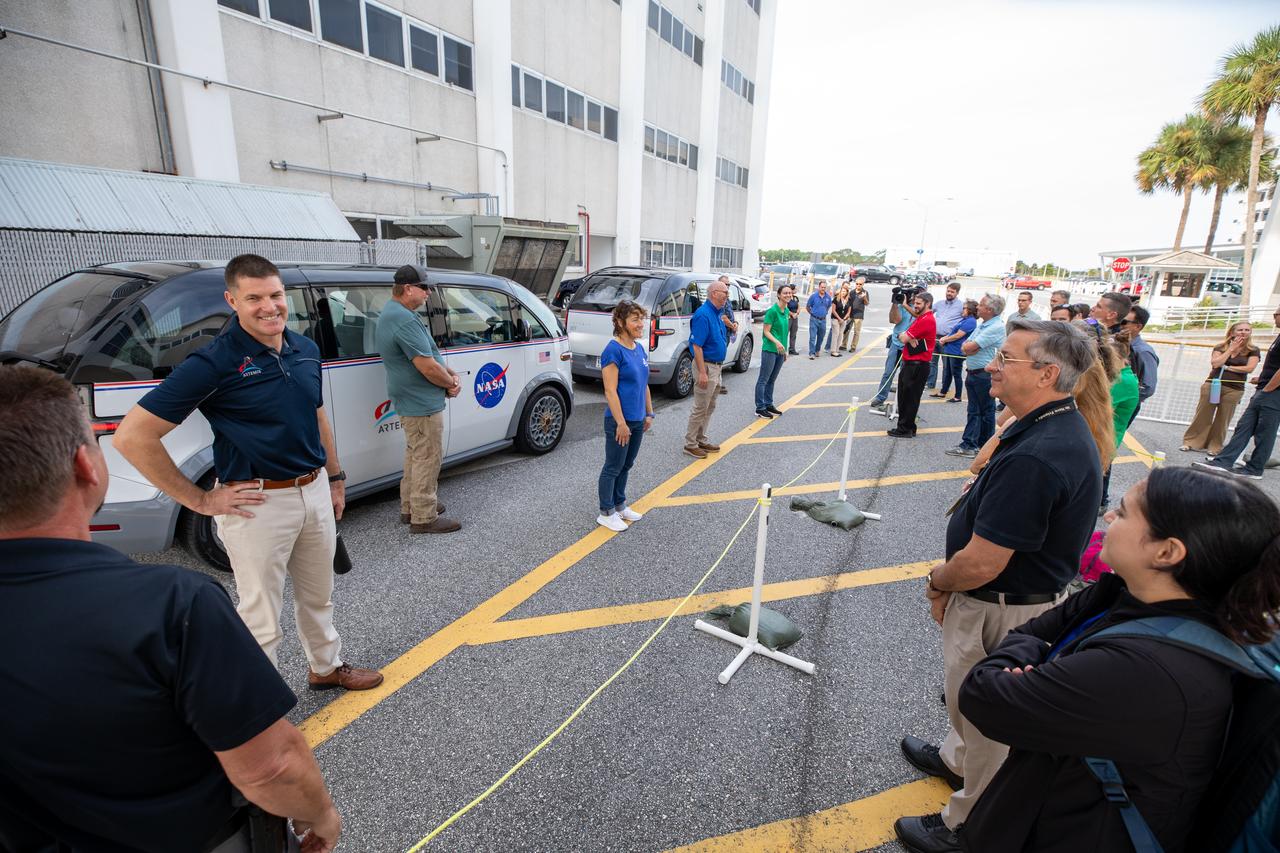
NASA astronauts Jeremy Hansen and Christina Koch view the crew transport vehicles (CTVs) outside of the Neil A. Armstrong Operations and Checkout Building at Kennedy Space Center in Florida on Tuesday, Sept. 19, 2023. The CTVs will carry them, along with fellow NASA astronauts Reid Wiseman and Victor Glover, to Kennedy’s Launch Complex 39B for liftoff of the Artemis II mission. The specially designed, fully electric, environmentally friendly vehicles were manufactured by Canoo Technologies, Inc. of Torrance California.

On Jan. 26, 2022, the U.S. and NASA flags were raised at Building 4221 to mark the transfer of headquarters to that building at Marshall Space Flight Center in Huntsville, Alabama. The doors to Building 4221, a new, environmentally friendly building, opened on Earth Day, April 22, 2019. Building 4200 served as Marshall’s original headquarters since 1963. Marshall center operations lowered flags at that building on Jan. 21, 2022.
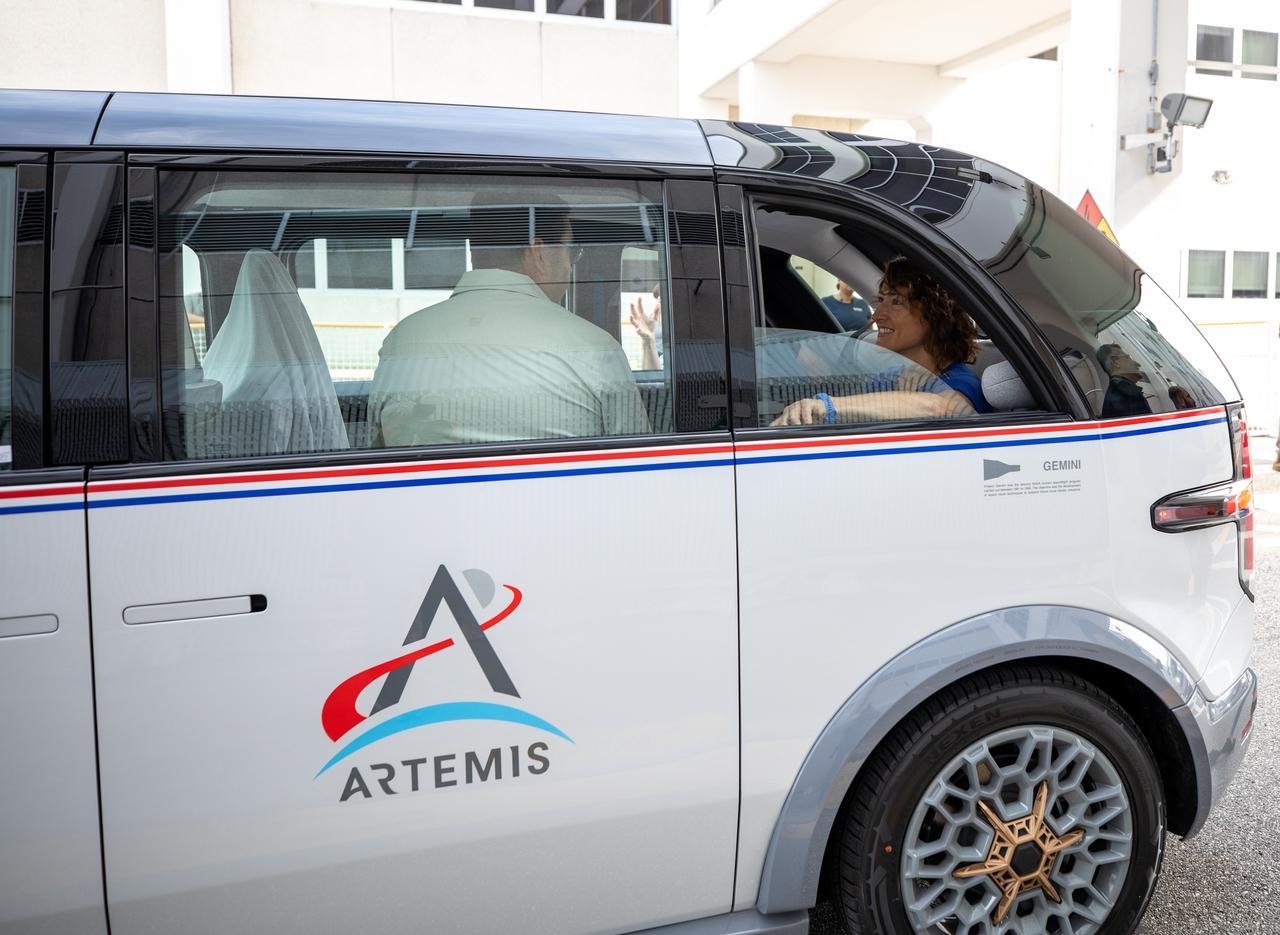
NASA astronaut Christina Koch, right, sits inside one of the crew transport vehicles (CTVs) outside of the Neil A. Armstrong Operations and Checkout Building at Kennedy Space Center in Florida on Tuesday, Sept. 19, 2023. The CTVs will carry Koch, along with fellow NASA astronauts Jeremy Hansen, Reid Wiseman and Victor Glover, to Kennedy’s Launch Complex 39B for liftoff of the Artemis II mission. The specially designed, fully electric, environmentally friendly vehicles were manufactured by Canoo Technologies, Inc. of Torrance California.
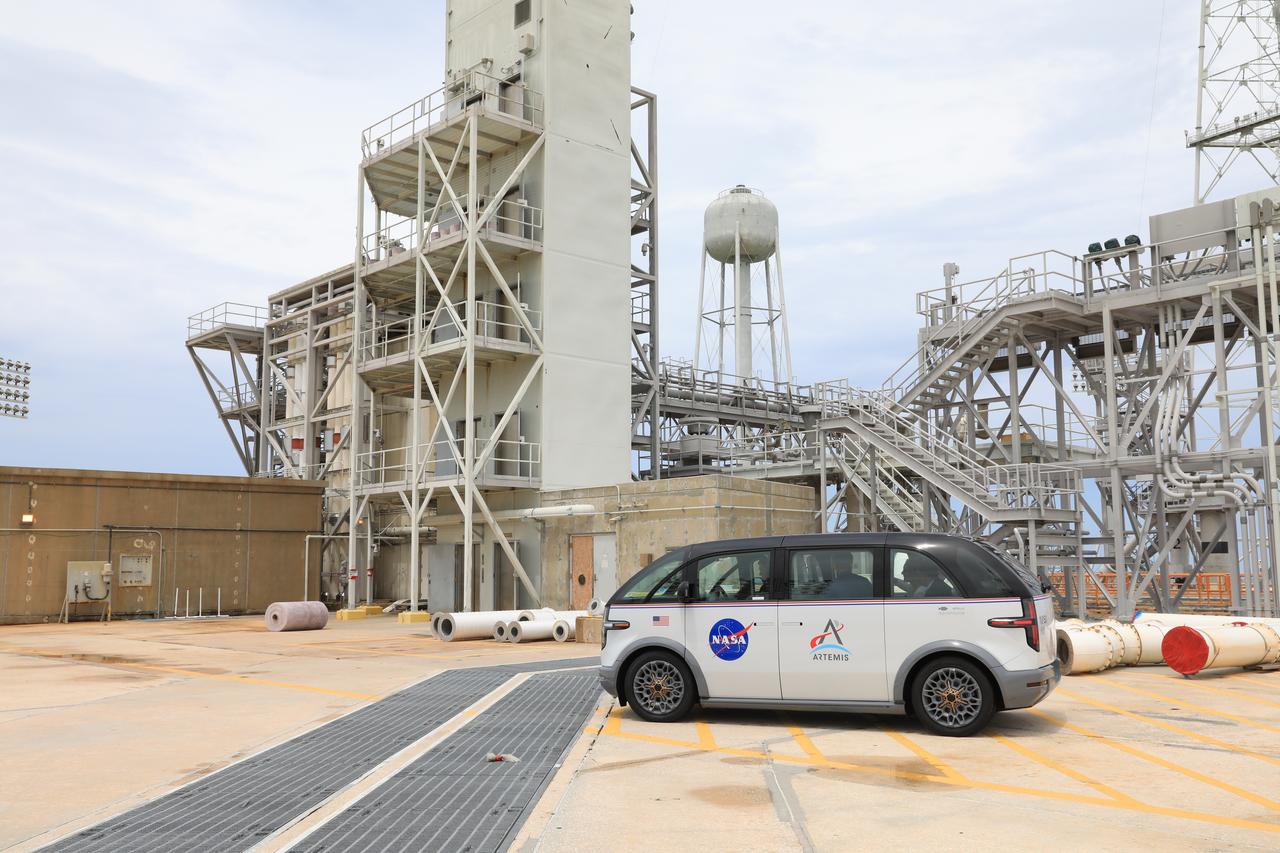
Three specially designed, fully electric, environmentally friendly crew transportation vehicles for Artemis missions arrived at NASA’s Kennedy Space Center in Florida on July 11, 2023. One of the zero-emission vehicles is shown here at Launch Pad 39B. The fleet, which will carry astronauts to Launch Complex 39B for Artemis missions, was delivered by the manufacturer, Canoo Technologies Inc. of Torrance, California.
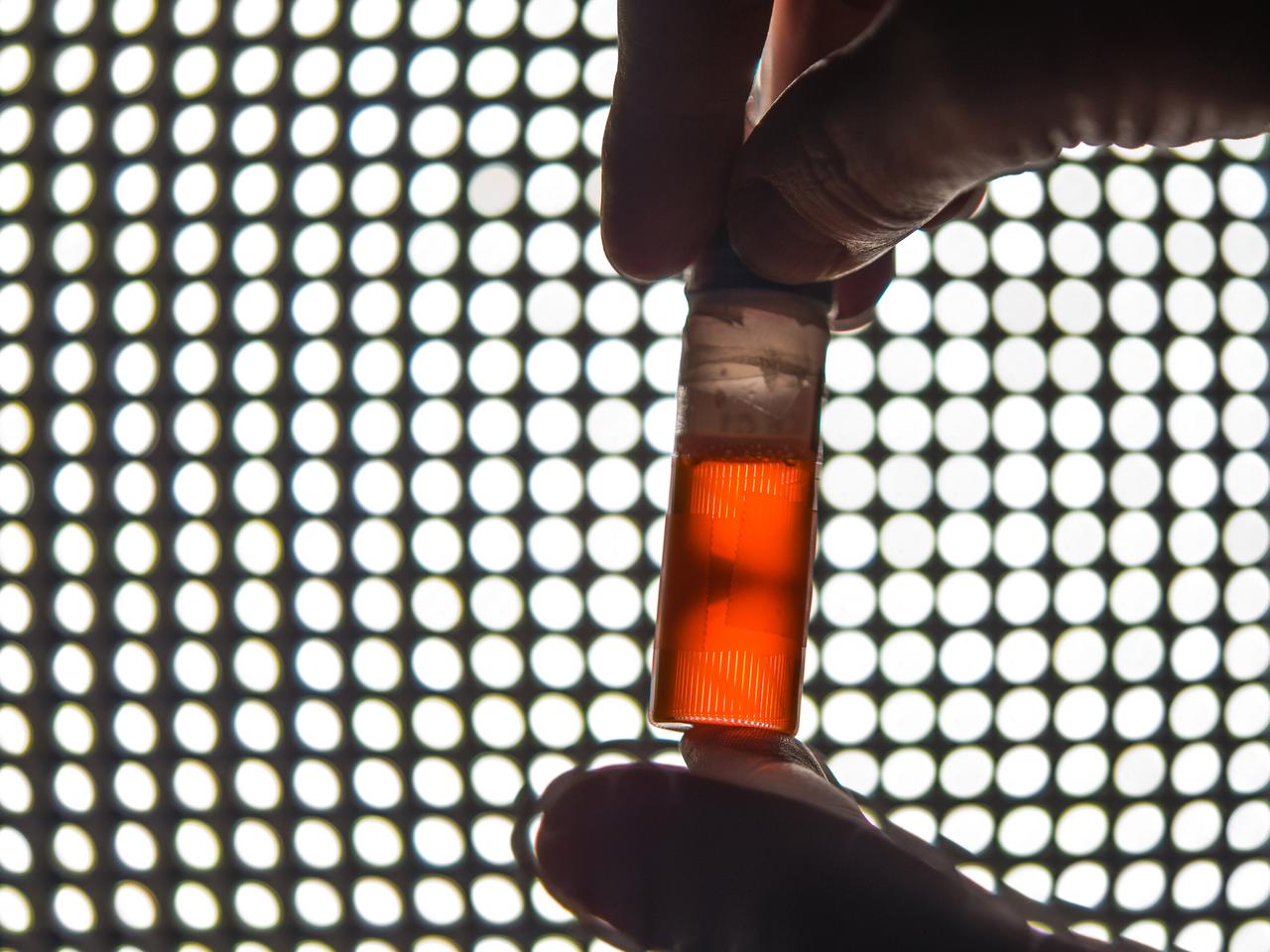
Ground testing for the first confocal Light Microscopy Microscope (LMM) Experiment. Procter and Gamble is working with NASA Glenn scientists to prepare for a study that examines product stabilizers in a microgravity environment. The particles in the tube glow orange because they have been fluorescently tagged with a dye that reacts to green laser lights to allow construction of a 3D image point by point. The experiment, which will be sent to the ISS later this year, will help P&G develop improved product stabilizers to extend shelf life and develop more environmentally friendly packaging.
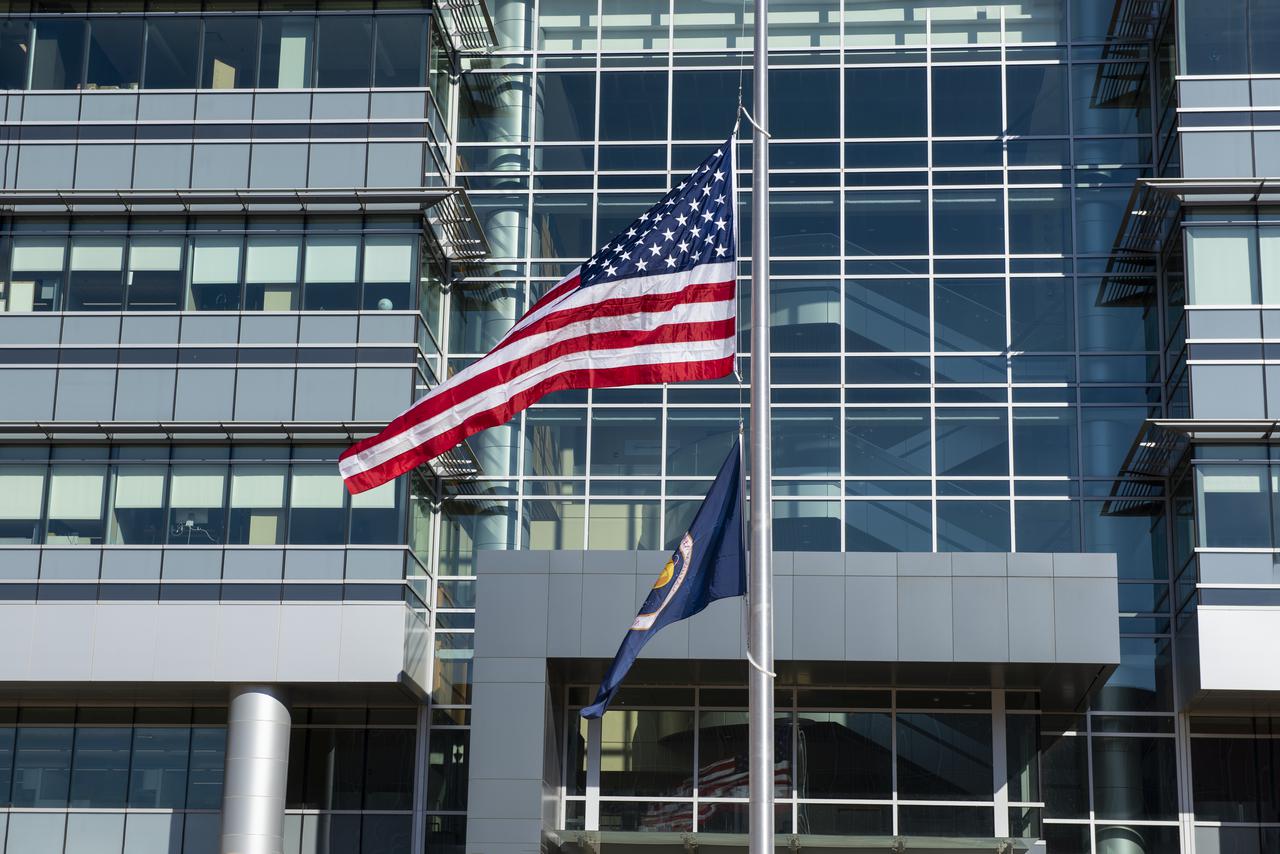
On Jan. 26, 2022, the U.S. and NASA flags were raised at Building 4221 to mark the transfer of headquarters to that building at Marshall Space Flight Center in Huntsville, Alabama. The doors to Building 4221, a new, environmentally friendly building, opened on Earth Day, April 22, 2019. Building 4200 served as Marshall’s original headquarters since 1963. Marshall center operations lowered flags at that building on Jan. 21, 2022.
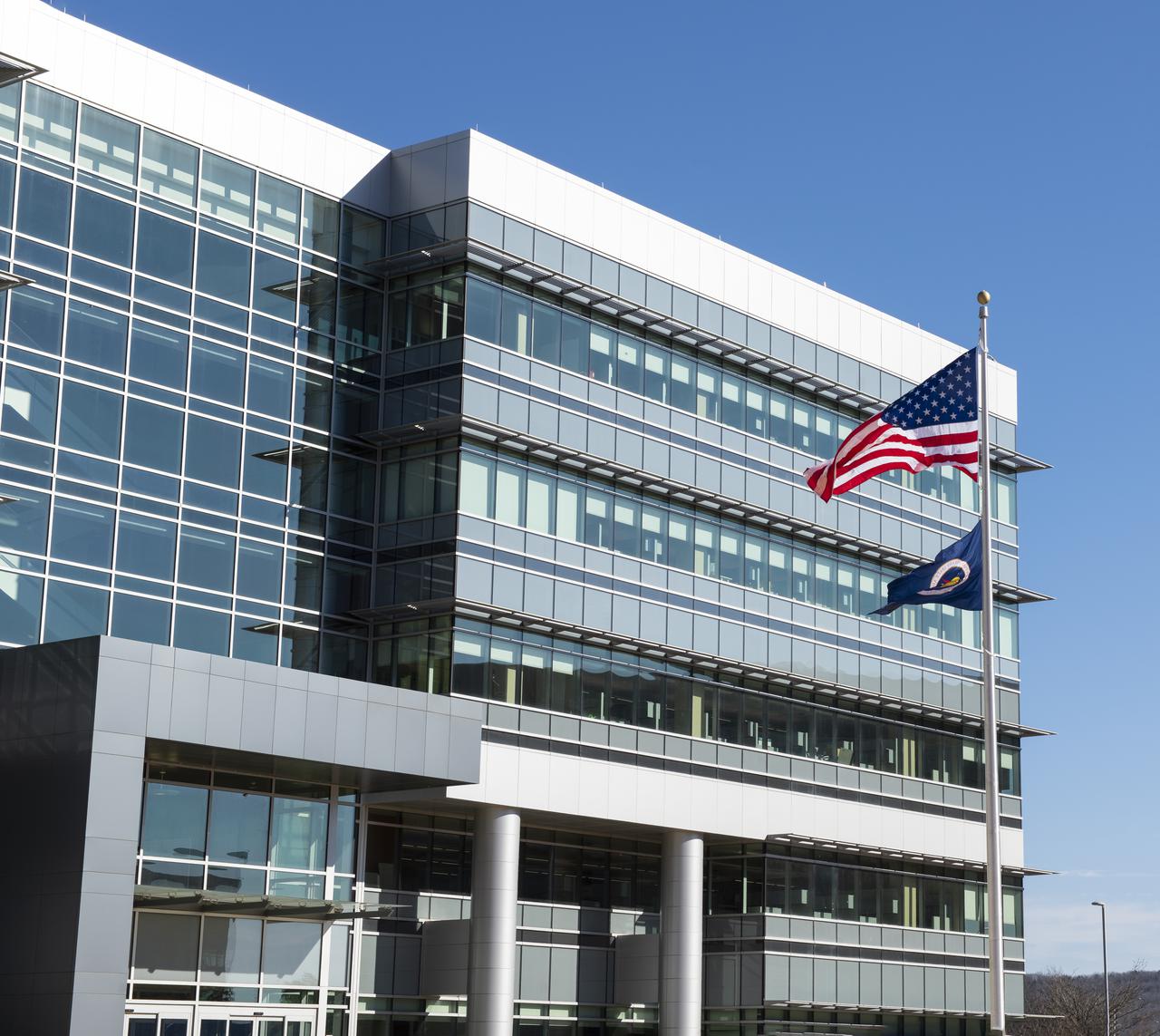
On Jan. 26, 2022, the U.S. and NASA flags were raised at Building 4221 to mark the transfer of headquarters to that building at Marshall Space Flight Center in Huntsville, Alabama. The doors to Building 4221, a new, environmentally friendly building, opened on Earth Day, April 22, 2019. Building 4200 served as Marshall’s original headquarters since 1963. Marshall center operations lowered flags at that building on Jan. 21, 2022.
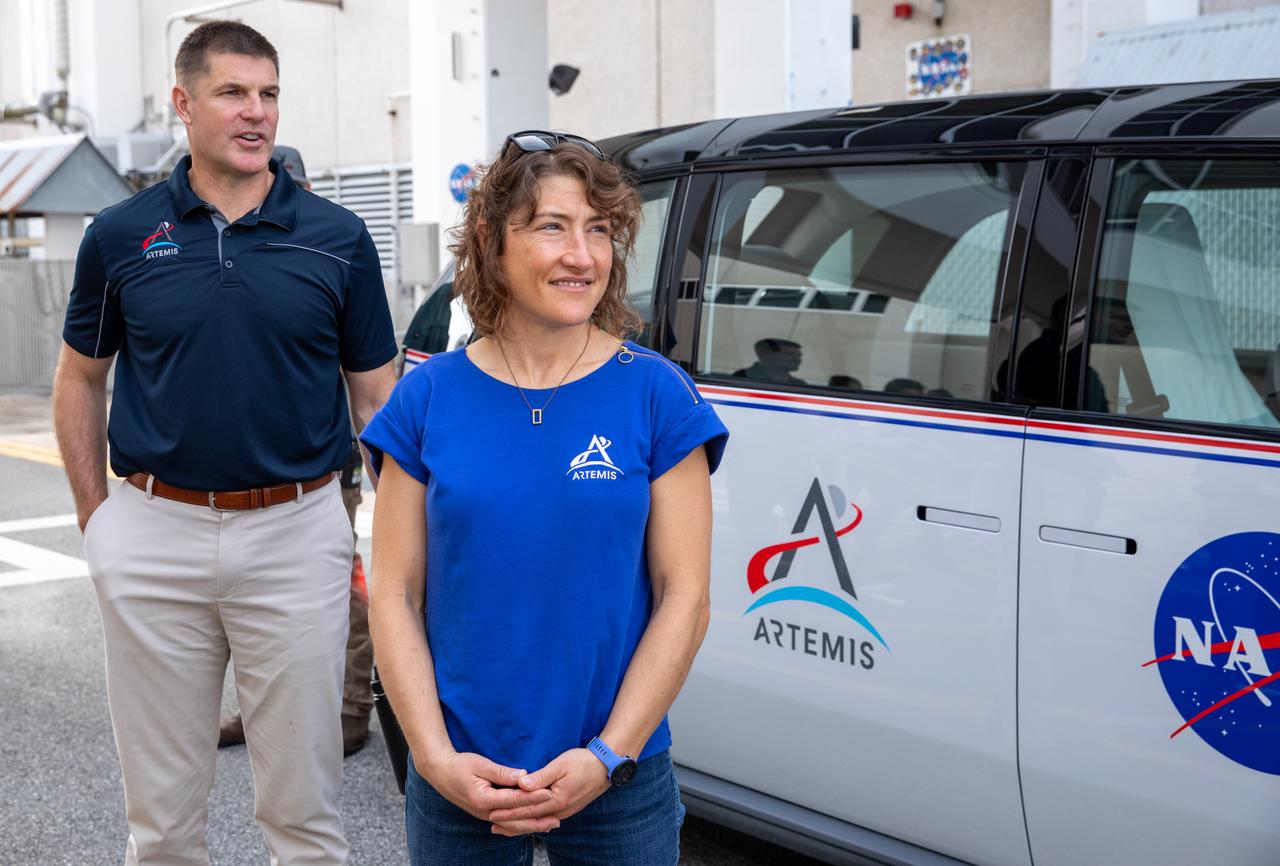
NASA astronauts Jeremy Hansen, left, and Christina Koch view the crew transport vehicles (CTVs) outside of the Neil A. Armstrong Operations and Checkout Building at Kennedy Space Center in Florida on Tuesday, Sept. 19, 2023. The CTVs will carry them, along with fellow NASA astronauts Reid Wiseman and Victor Glover, to Kennedy’s Launch Complex 39B for liftoff of the Artemis II mission. The specially designed, fully electric, environmentally friendly vehicles were manufactured by Canoo Technologies, Inc. of Torrance California.

On Jan. 26, 2022, the U.S. and NASA flags were raised at Building 4221 to mark the transfer of headquarters to that building at Marshall Space Flight Center in Huntsville, Alabama. The doors to Building 4221, a new, environmentally friendly building, opened on Earth Day, April 22, 2019. Building 4200 served as Marshall’s original headquarters since 1963. Marshall center operations lowered flags at that building on Jan. 21, 2022.
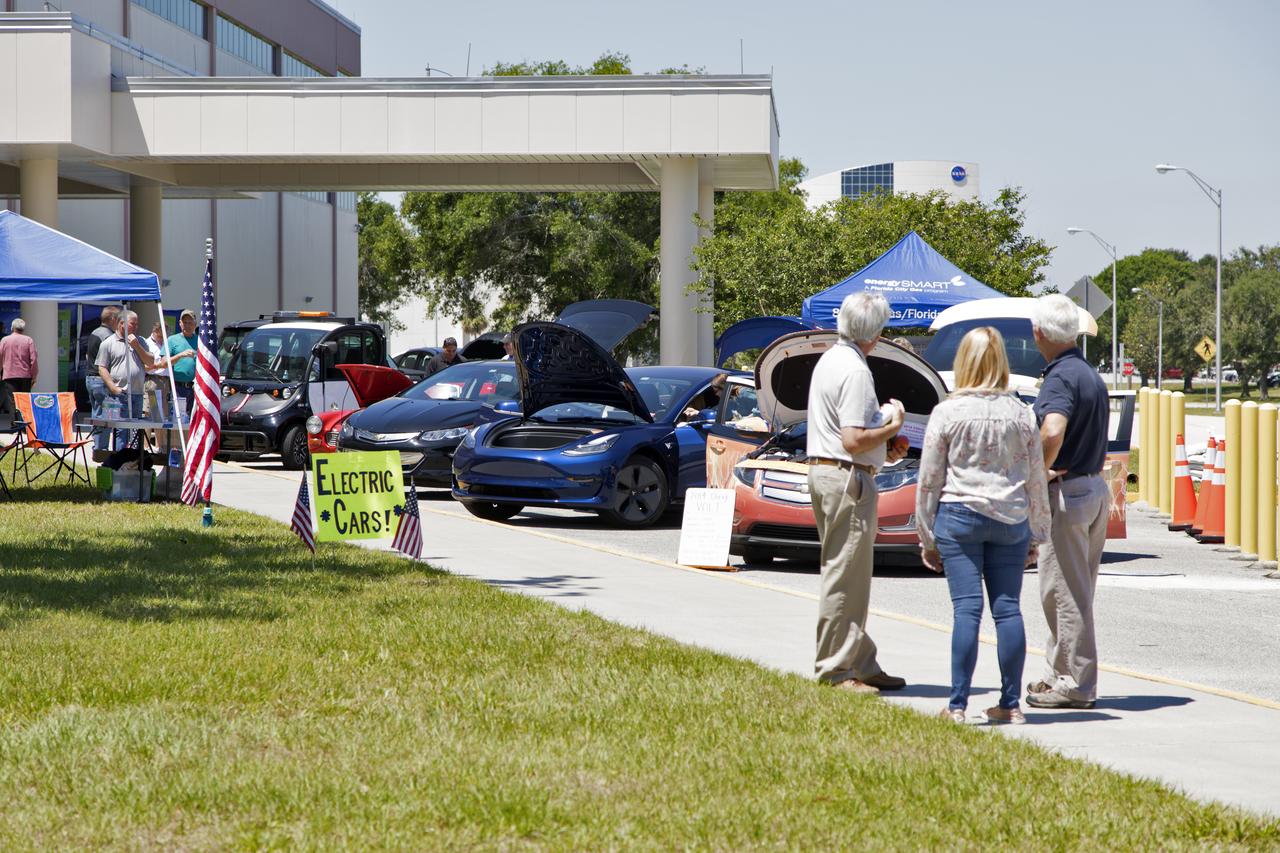
An array of electric vehicles are on display for Kennedy Space Center employees during the center’s annual Earth Day celebration. The two-day event featured approximately 50 exhibitors offering information on a variety of topics, including electric vehicles, sustainable lighting, renewable energy, Florida-friendly landscaping tips, Florida’s biking trails and more.
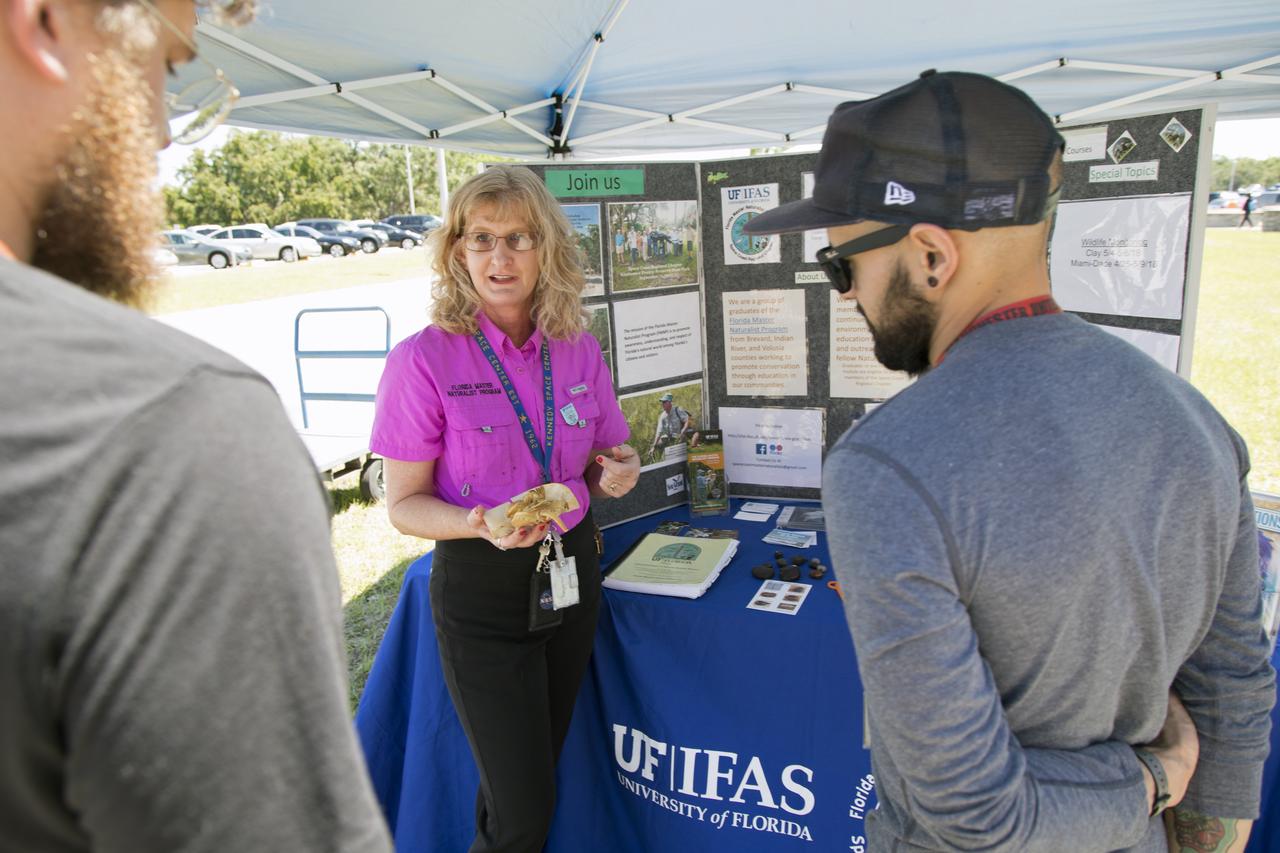
Employees get an up-close look at some Florida marine life during a visit to the University of Florida's Institute of Food and Agricultural Sciences booth at Kennedy Space Center’s annual Earth Day celebration. The two-day event featured approximately 50 exhibitors offering information on a variety of topics, including electric vehicles, sustainable lighting, renewable energy, Florida-friendly landscaping tips, Florida’s biking trails and more.

Students from Rockledge High School in Rockledge, Fla., make “plarn” – plastic yarn -- out of used plastic bags during Kennedy Space Center’s annual Earth Day celebration. The plarn was donated to be woven into mats for homeless veterans. The two-day Earth Day event featured approximately 50 exhibitors offering information on a variety of topics, including electric vehicles, sustainable lighting, renewable energy, Florida-friendly landscaping tips, Florida’s biking trails and more.
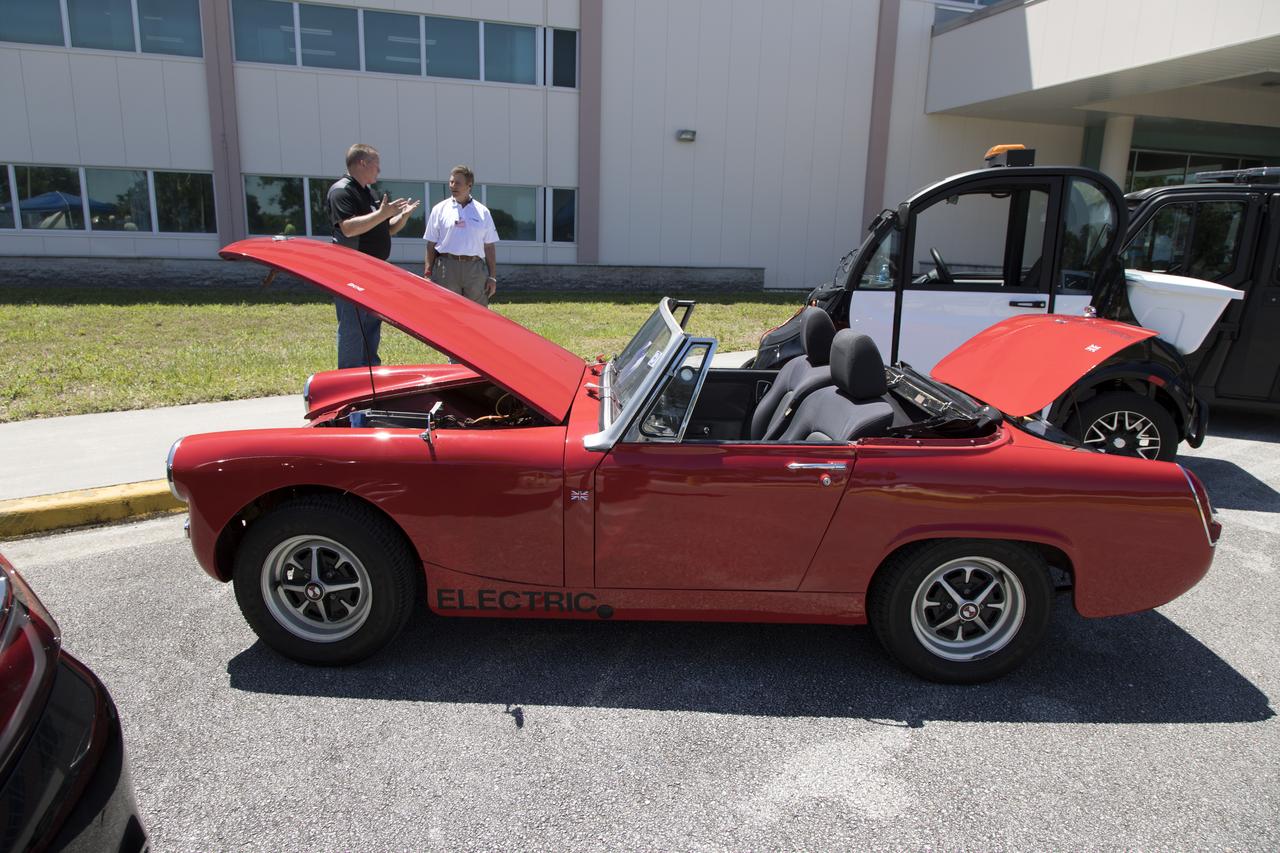
Employees discuss one of the electric vehicles on display during Kennedy Space Center’s annual Earth Day celebration. The two-day event featured approximately 50 exhibitors offering information on a variety of topics, including electric vehicles, sustainable lighting, renewable energy, Florida-friendly landscaping tips, Florida’s biking trails and more.
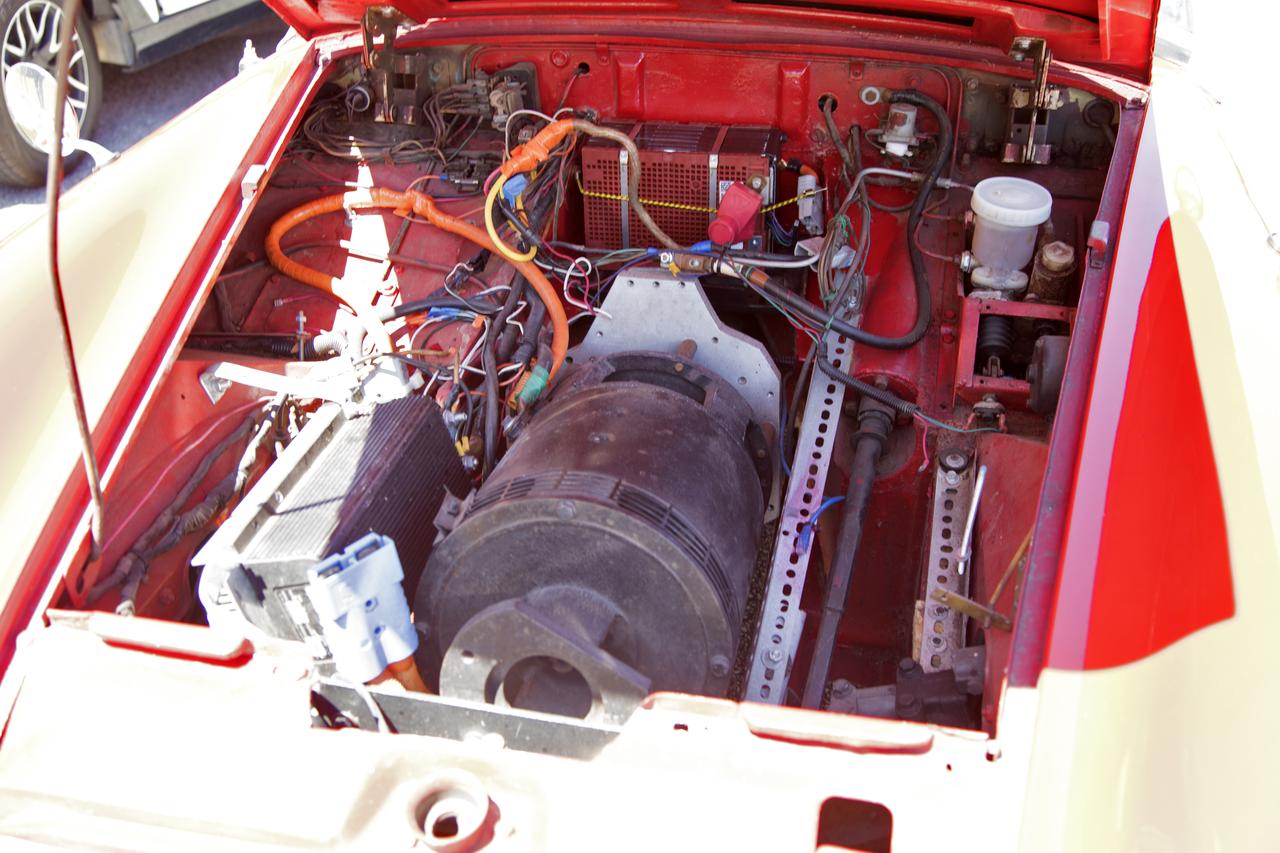
Employees had the opportunity to take a look under the hood of an electric vehicle on display during Kennedy Space Center’s annual Earth Day celebration. The two-day event featured approximately 50 exhibitors offering information on a variety of topics, including electric vehicles, sustainable lighting, renewable energy, Florida-friendly landscaping tips, Florida’s biking trails and more.
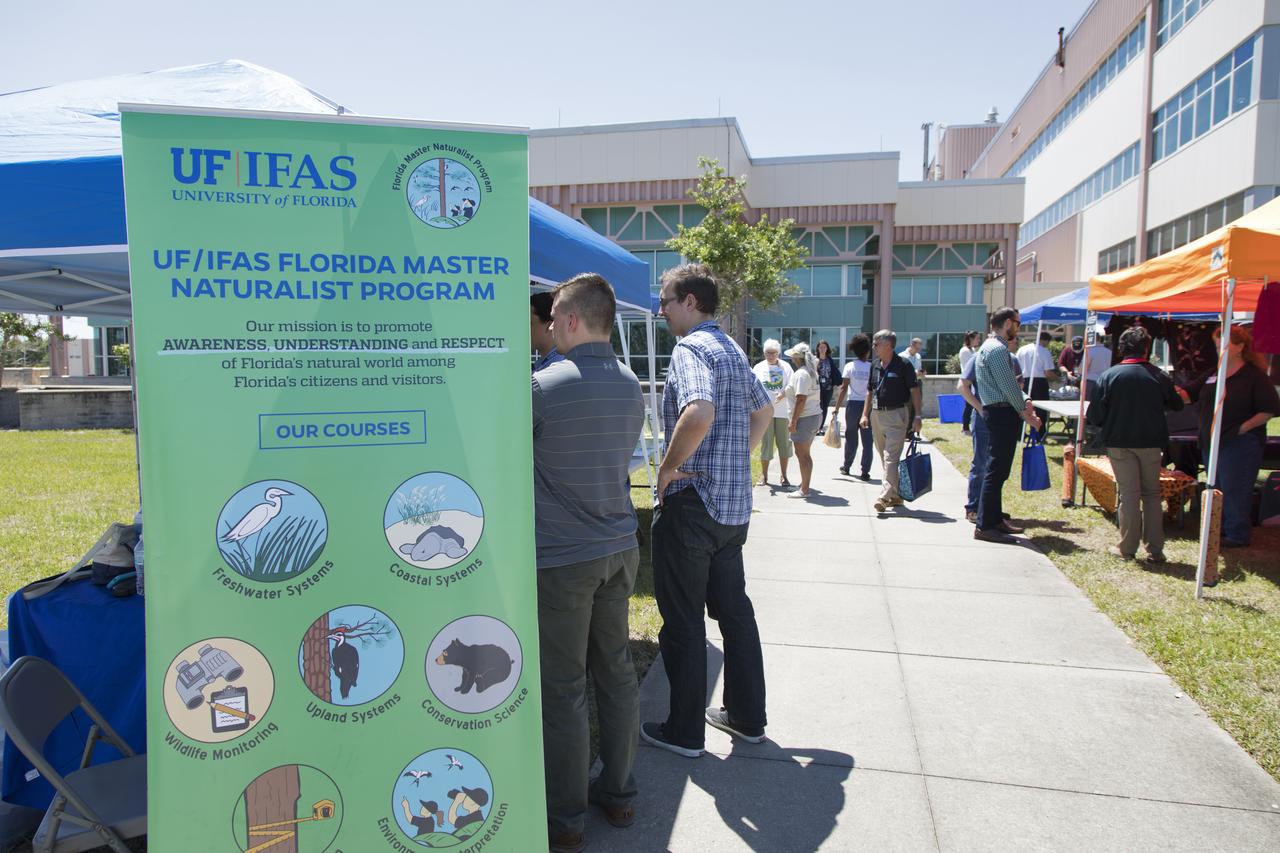
Employees stop by the University of Florida's Institute of Food and Agricultural Sciences booth at Kennedy Space Center’s annual Earth Day celebration. The two-day event featured approximately 50 exhibitors offering information on a variety of topics, including electric vehicles, sustainable lighting, renewable energy, Florida-friendly landscaping tips, Florida’s biking trails and more.
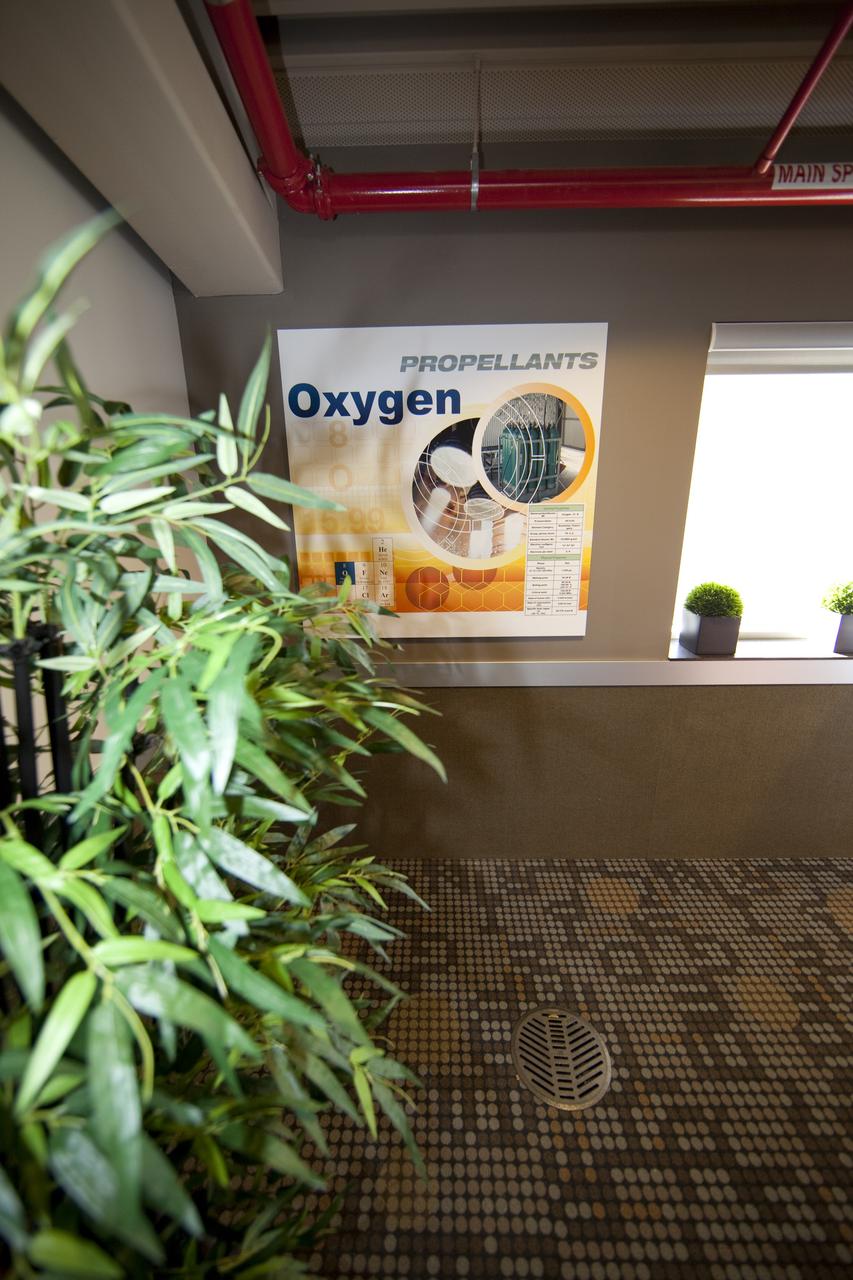
CAPE CANAVERAL, Fla. -- Finishing touches adorn the second-floor conference room of the Propellants North Administrative and Maintenance Facility at NASA's Kennedy Space Center in Florida. Artwork for the conference room was produced by Greg Lee, a graphics specialist with Abacus Technology Corp., with input from the facility's future occupants. The environmentally friendly facility is slated to be NASA's second Platinum-rated by the U.S. Green Building Council's (USGBC) Leadership in Environmental and Energy Design (LEED) certification system. It will be the space agency's first net-zero facility, which means it will produce enough energy onsite from renewable sources to offset what it requires to operate. The facility consists of a two-story administrative building to house managers, mechanics and technicians who fuel spacecraft at Kennedy, and a single-story shop to store cryogenic fuel transfer equipment. Photo credit: NASA/Frankie Martin
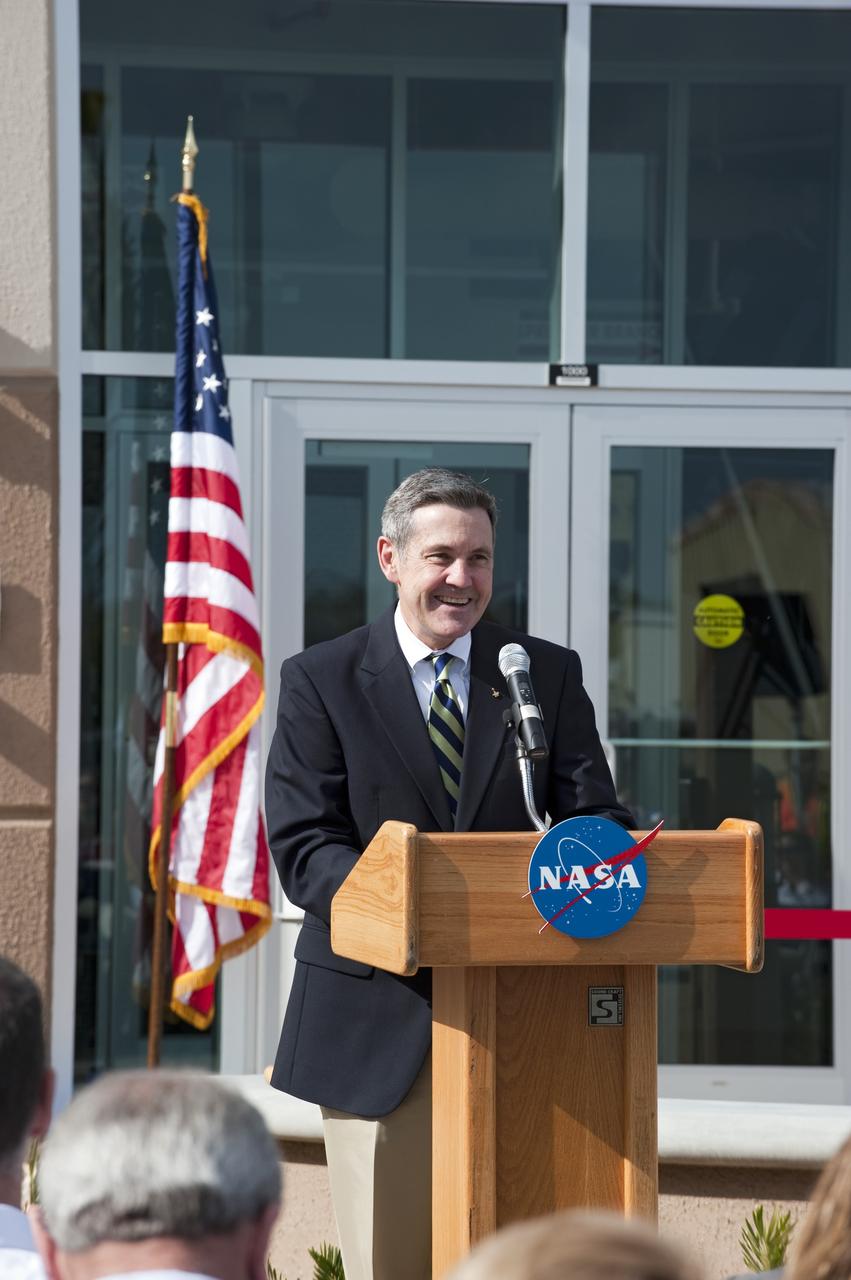
CAPE CANAVERAL, Fla. -- The director of NASA's Kennedy Space Center in Florida, Bob Cabana, addresses an audience at the ribbon-cutting ceremony for the new environmentally friendly Propellants North Administration and Maintenance Facility. Propellants North consists of two buildings, one to store cryogenic fuel transfer equipment and one to house personnel who support fueling spacecraft. The recently rebuilt buildings will be NASA's first carbon neutral facility, which means it will produce enough energy on site from renewable sources to offset what it requires to operate. The facility also will reach for the U.S. Green Building Council's Leadership in Environmental and Energy Design (LEED) Platinum status, which is the highest LEED rating. Photo credit: NASA/Kim Shiflett
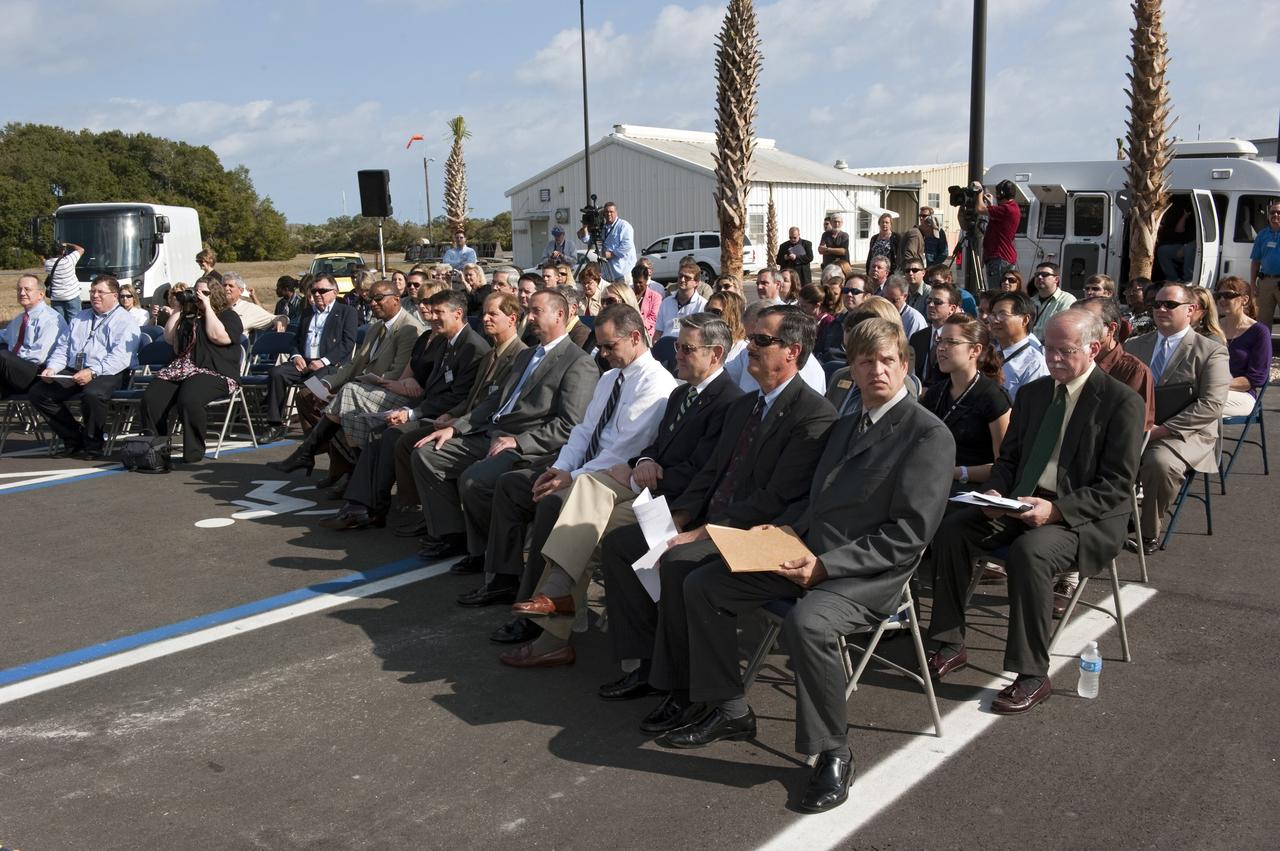
CAPE CANAVERAL, Fla. -- At NASA's Kennedy Space Center in Florida, an audience at the ribbon-cutting ceremony for the new environmentally friendly Propellants North Administration and Maintenance Facility listens to opening remarks made by Frank Kline, a NASA Construction of Facilities project manager. Propellants North consists of two buildings, one to store cryogenic fuel transfer equipment and one to house personnel who support fueling spacecraft. The recently rebuilt buildings will be NASA's first carbon neutral facility, which means it will produce enough energy on site from renewable sources to offset what it requires to operate. The facility also will reach for the U.S. Green Building Council's Leadership in Environmental and Energy Design (LEED) Platinum status, which is the highest LEED rating. Photo credit: NASA/Kim Shiflett
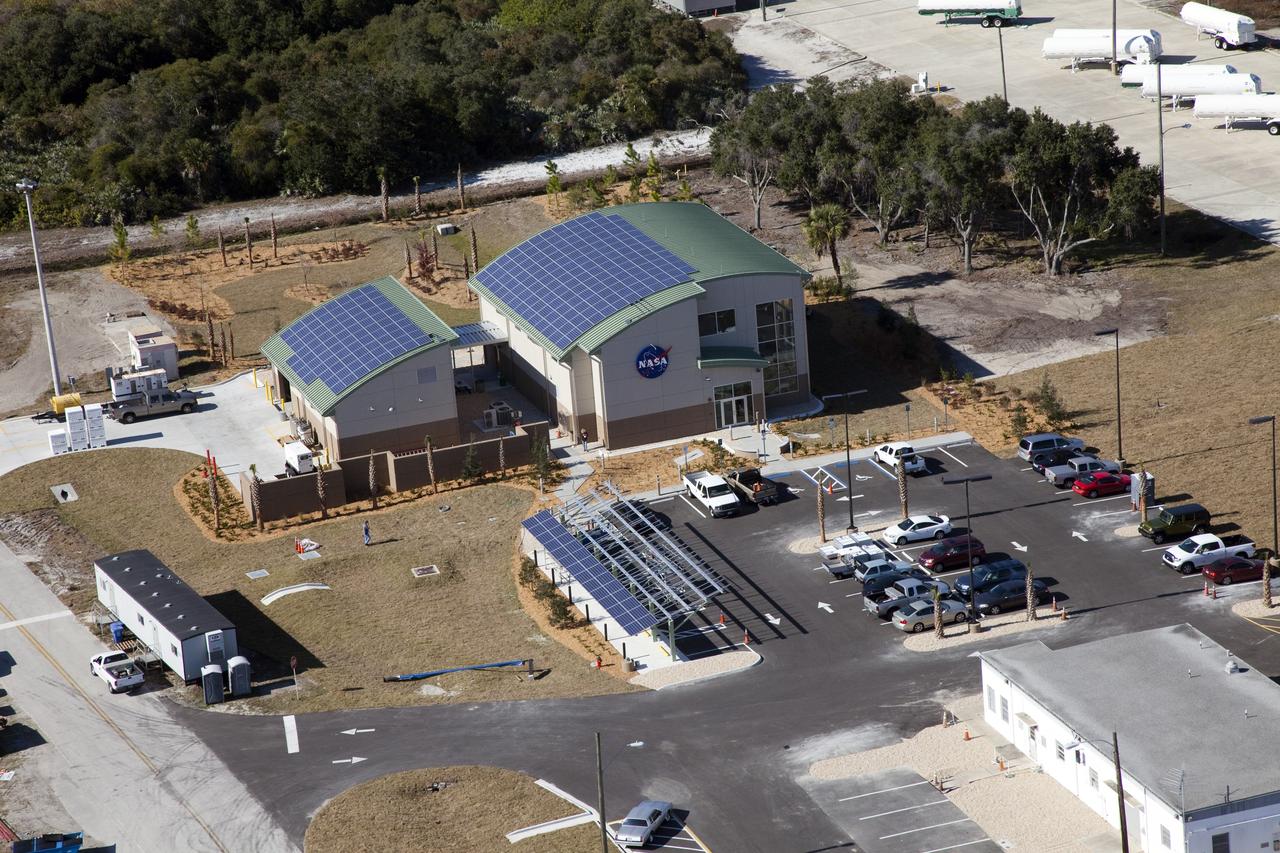
CAPE CANAVERAL, Fla. -- The Propellants North Administrative and Maintenance Facility in the Launch Complex 39 area of NASA's Kennedy Space Center in Florida is ready for business. The environmentally friendly facility is slated to be NASA's second Platinum-rated by the U.S. Green Building Council's (USGBC) Leadership in Environmental and Energy Design (LEED) certification system. It will be the space agency's first carbon-neutral facility, which means it will produce enough energy onsite from renewable sources to offset what it requires to operate. On the right is the facility's two-story administrative building, which will house managers, mechanics and technicians who fuel spacecraft at Kennedy. On the left is a single-story shop that will be used to store cryogenic fuel transfer equipment. In the parking lot is a solar-powered parking station for alternative fuel vehicles. Photo credit: NASA/Frank Michaux
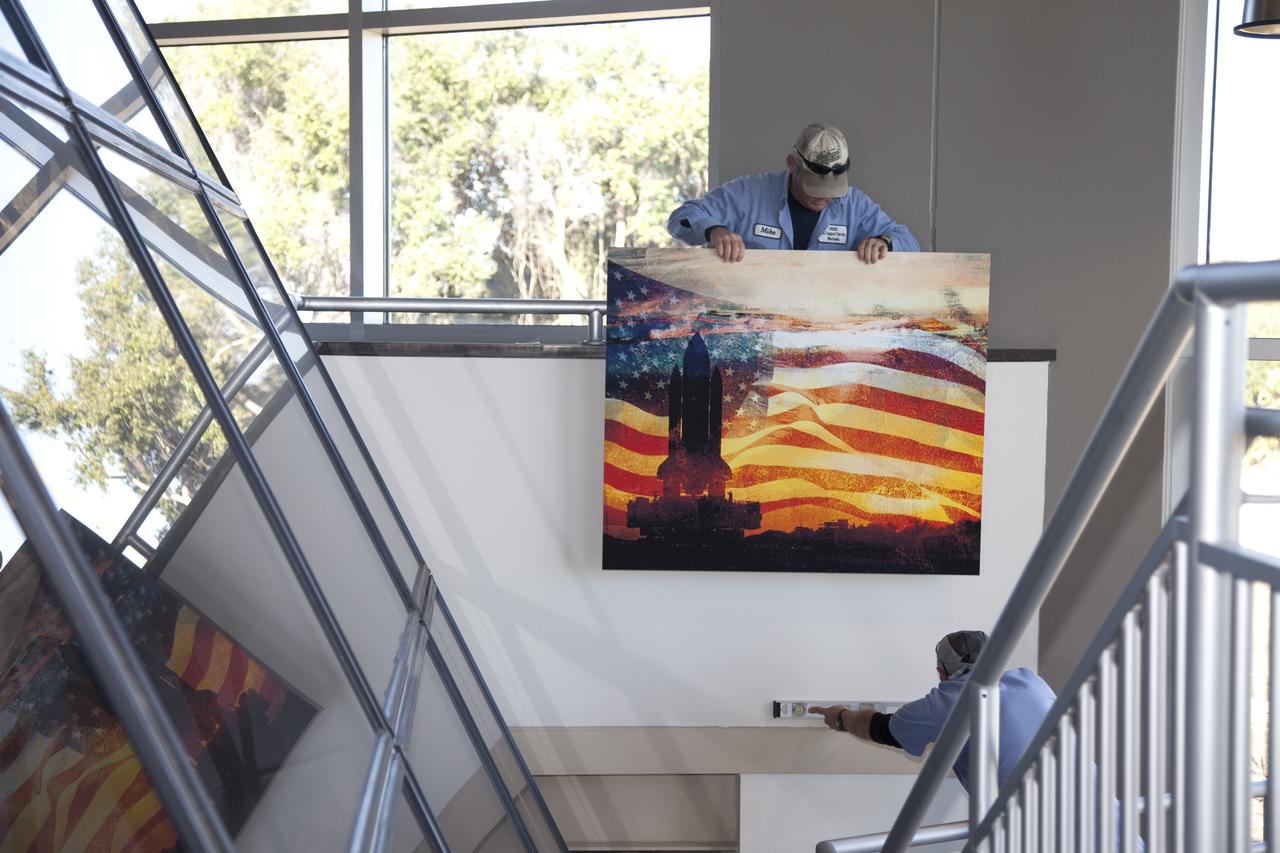
CAPE CANAVERAL, Fla. -- Workers hang artwork in the second-floor lobby of the Propellants North Administrative and Maintenance Facility at NASA's Kennedy Space Center in Florida. The artwork was produced by Greg Lee, a graphics specialist with Abacus Technology Corp., and features a silhouette of a shuttle, one of the most recognizable American icons, rolling out to Launch Complex 39. The environmentally friendly facility is slated to be NASA's second Platinum-rated by the U.S. Green Building Council's (USGBC) Leadership in Environmental and Energy Design (LEED) certification system. It will be the space agency's first net-zero facility, which means it will produce enough energy onsite from renewable sources to offset what it requires to operate. The facility consists of a two-story administrative building to house managers, mechanics and technicians who fuel spacecraft at Kennedy, and a single-story shop to store cryogenic fuel transfer equipment. Photo credit: NASA/Frankie Martin
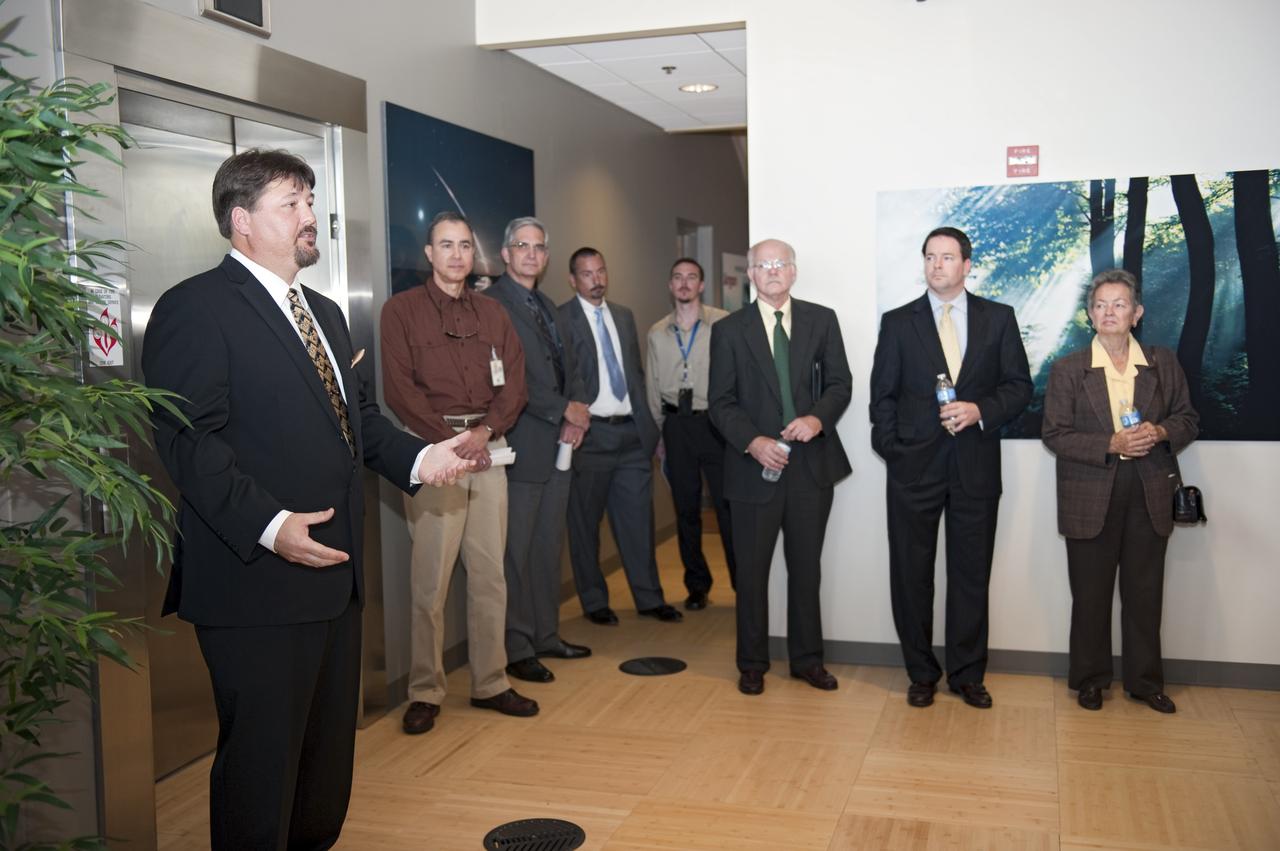
CAPE CANAVERAL, Fla. -- Frank Kline, Construction of Facilities project manager at NASA's Kennedy Space Center in Florida, far left, shows off the environmentally friendly features of the new Propellants North Administration and Maintenance Facility. Propellants North consists of two buildings, one to store cryogenic fuel transfer equipment and one to house personnel who support fueling spacecraft. The recently rebuilt buildings will be NASA's first carbon neutral facility, which means it will produce enough energy on site from renewable sources to offset what it requires to operate. The facility also will reach for the U.S. Green Building Council's Leadership in Environmental and Energy Design (LEED) Platinum status, which is the highest LEED rating. Photo credit: NASA/Kim Shiflett

CAPE CANAVERAL, Fla. -- The Vehicle Assembly Building towers over the new Propellants North Administrative and Maintenance Facility in the Launch Complex 39 area of NASA's Kennedy Space Center in Florida. The environmentally friendly facility is slated to be NASA's second Platinum-rated by the U.S. Green Building Council's (USGBC) Leadership in Environmental and Energy Design (LEED) certification system. It will be the space agency's first carbon-neutral facility, which means it will produce enough energy onsite from renewable sources to offset what it requires to operate. On the right is the facility's two-story administrative building, which will house managers, mechanics and technicians who fuel spacecraft at Kennedy. On the left is a single-story shop that will be used to store cryogenic fuel transfer equipment. In the parking lot is a solar-powered parking station for alternative fuel vehicles. Photo credit: NASA/Frank Michaux
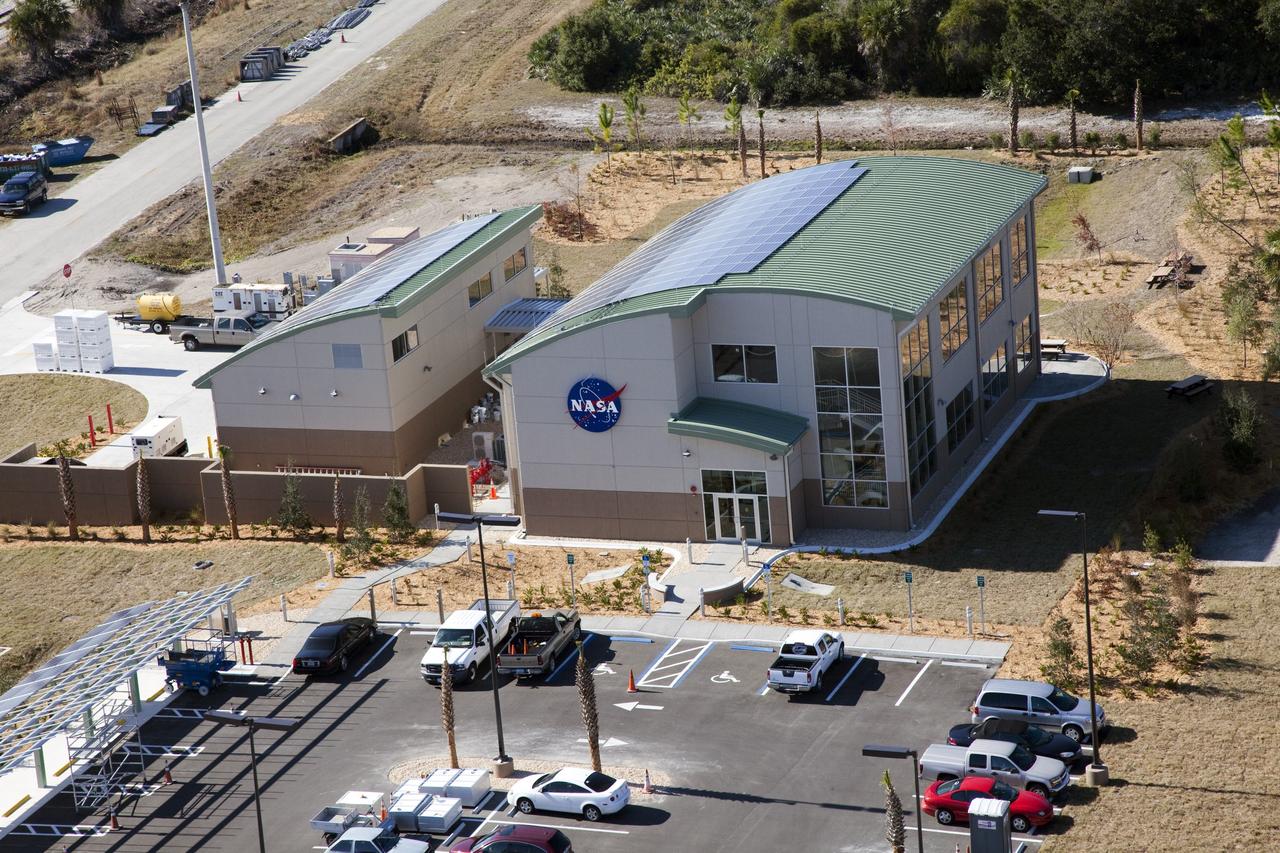
CAPE CANAVERAL, Fla. -- The Propellants North Administrative and Maintenance Facility in the Launch Complex 39 area of NASA's Kennedy Space Center in Florida is ready for business. The environmentally friendly facility is slated to be NASA's second Platinum-rated by the U.S. Green Building Council's (USGBC) Leadership in Environmental and Energy Design (LEED) certification system. It will be the space agency's first carbon-neutral facility, which means it will produce enough energy onsite from renewable sources to offset what it requires to operate. On the right is the facility's two-story administrative building, which will house managers, mechanics and technicians who fuel spacecraft at Kennedy. On the left is a single-story shop that will be used to store cryogenic fuel transfer equipment. In the parking lot is a solar-powered parking station for alternative fuel vehicles. Photo credit: NASA/Frank Michaux
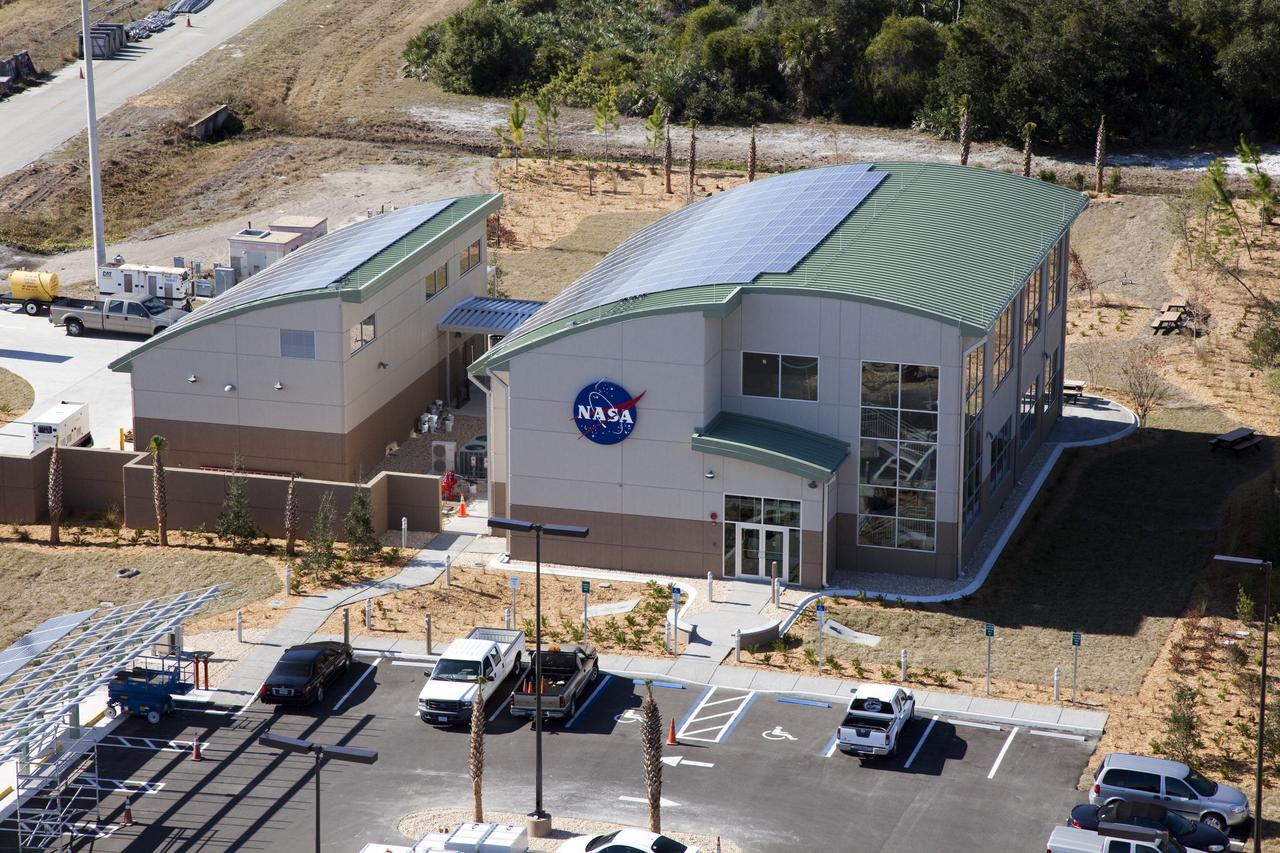
CAPE CANAVERAL, Fla. -- The Propellants North Administrative and Maintenance Facility in the Launch Complex 39 area of NASA's Kennedy Space Center in Florida is ready for business. The environmentally friendly facility is slated to be NASA's second Platinum-rated by the U.S. Green Building Council's (USGBC) Leadership in Environmental and Energy Design (LEED) certification system. It will be the space agency's first carbon-neutral facility, which means it will produce enough energy onsite from renewable sources to offset what it requires to operate. On the right is the facility's two-story administrative building, which will house managers, mechanics and technicians who fuel spacecraft at Kennedy. On the left is a single-story shop that will be used to store cryogenic fuel transfer equipment. In the parking lot is a solar-powered parking station for alternative fuel vehicles. Photo credit: NASA/Frank Michaux
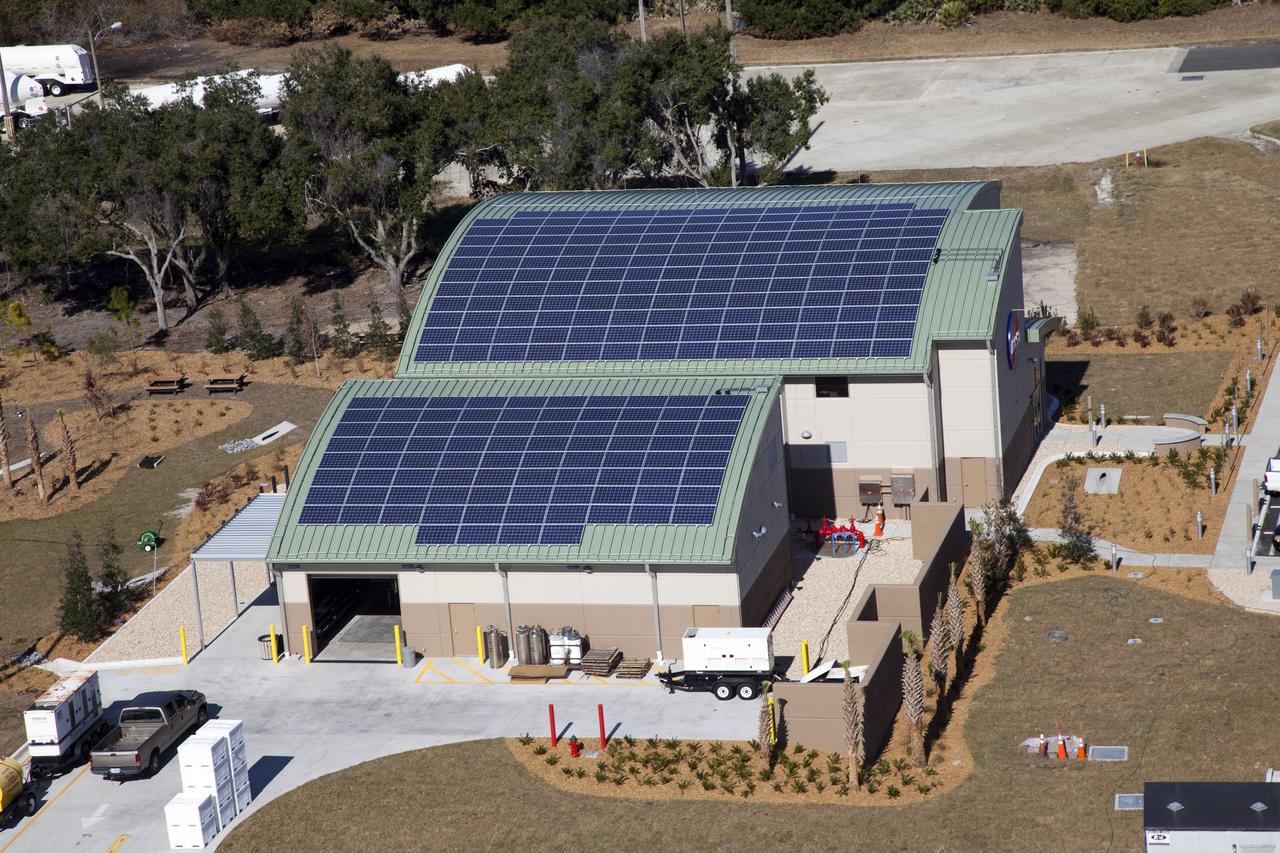
CAPE CANAVERAL, Fla. -- The Propellants North Administrative and Maintenance Facility in the Launch Complex 39 area of NASA's Kennedy Space Center in Florida is ready for business. The environmentally friendly facility is slated to be NASA's second Platinum-rated by the U.S. Green Building Council's (USGBC) Leadership in Environmental and Energy Design (LEED) certification system. It will be the space agency's first carbon-neutral facility, which means it will produce enough energy onsite from renewable sources to offset what it requires to operate. The facility consists of a two-story administrative building, which will house managers, mechanics and technicians who fuel spacecraft at Kennedy, and a single-story shop that will be used to store cryogenic fuel transfer equipment. Photo credit: NASA/Frank Michaux
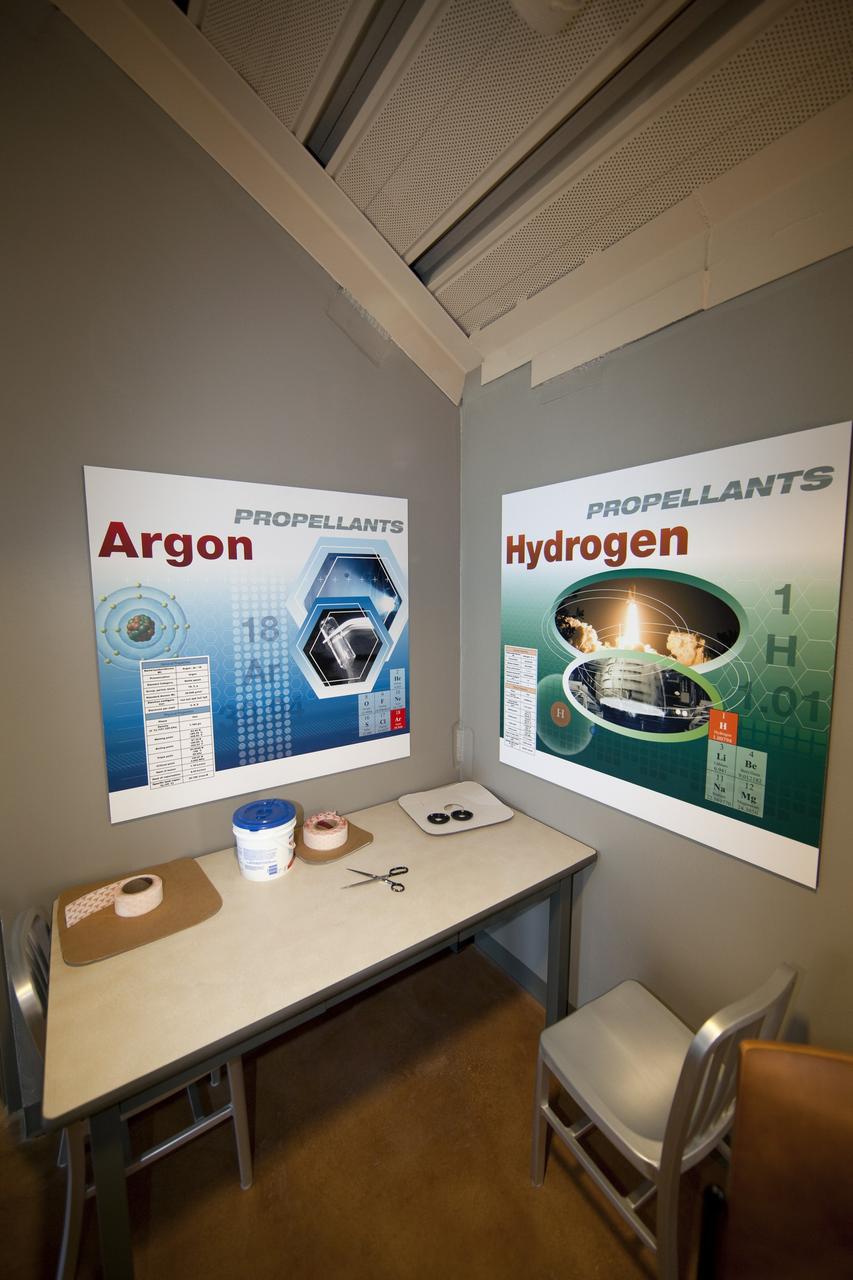
CAPE CANAVERAL, Fla. -- Finishing touches adorn the Propellants North Administrative and Maintenance Facility at NASA's Kennedy Space Center in Florida. Artwork for the facility was produced by Greg Lee, a graphics specialist with Abacus Technology Corp., with input from the facility's future occupants. The environmentally friendly facility is slated to be NASA's second Platinum-rated by the U.S. Green Building Council's (USGBC) Leadership in Environmental and Energy Design (LEED) certification system. It will be the space agency's first net-zero facility, which means it will produce enough energy onsite from renewable sources to offset what it requires to operate. The facility consists of a two-story administrative building to house managers, mechanics and technicians who fuel spacecraft at Kennedy, and a single-story shop to store cryogenic fuel transfer equipment. Photo credit: NASA/Frankie Martin
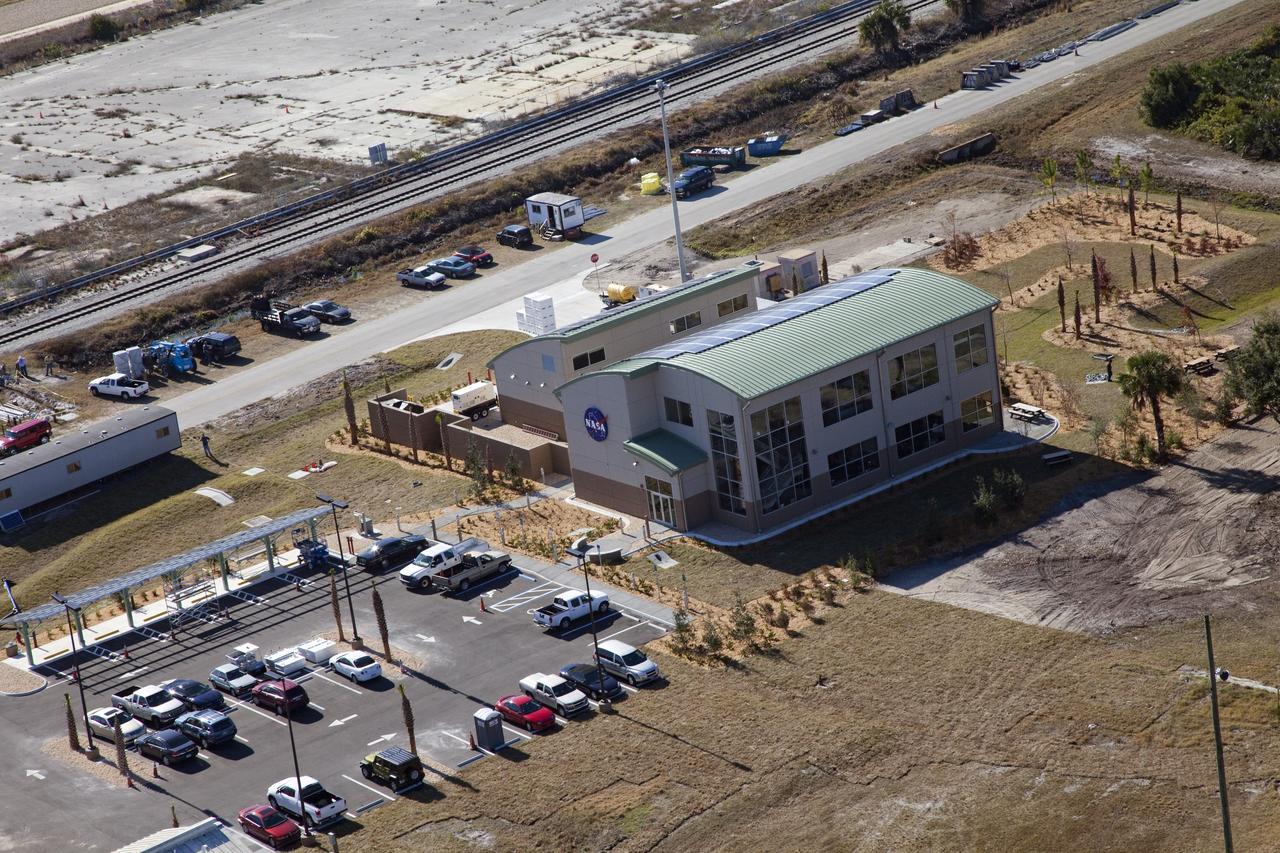
CAPE CANAVERAL, Fla. -- The Propellants North Administrative and Maintenance Facility in the Launch Complex 39 area of NASA's Kennedy Space Center in Florida is ready for business. The environmentally friendly facility is slated to be NASA's second Platinum-rated by the U.S. Green Building Council's (USGBC) Leadership in Environmental and Energy Design (LEED) certification system. It will be the space agency's first carbon-neutral facility, which means it will produce enough energy onsite from renewable sources to offset what it requires to operate. On the right is the facility's two-story administrative building, which will house managers, mechanics and technicians who fuel spacecraft at Kennedy. On the left is a single-story shop that will be used to store cryogenic fuel transfer equipment. In the parking lot is a solar-powered parking station for alternative fuel vehicles. Photo credit: NASA/Frank Michaux
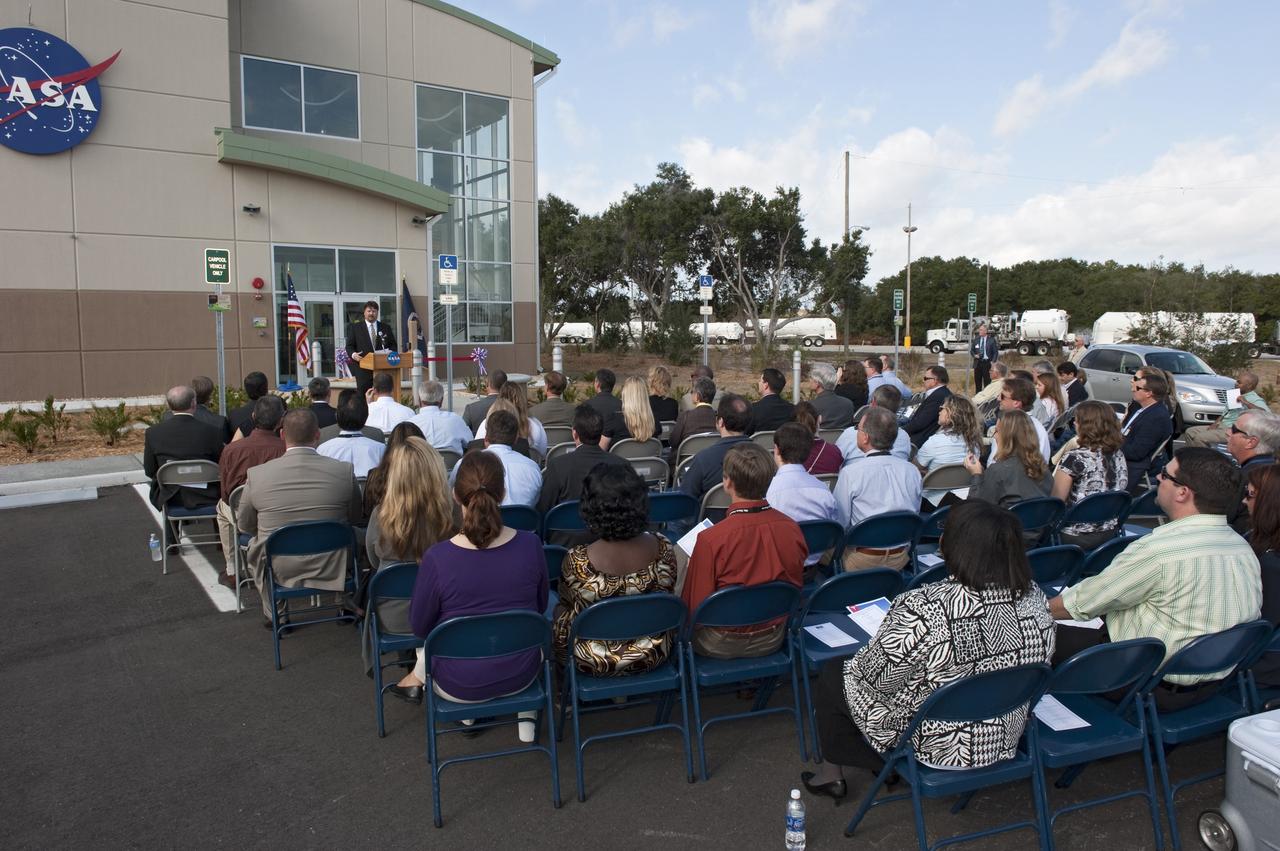
CAPE CANAVERAL, Fla. -- Frank Kline, Construction of Facilities project manager at NASA's Kennedy Space Center in Florida, addresses an audience at the ribbon-cutting ceremony for the new environmentally friendly Propellants North Administration and Maintenance Facility. Propellants North consists of two buildings, one to store cryogenic fuel transfer equipment and one to house personnel who support fueling spacecraft. The recently rebuilt buildings will be NASA's first carbon neutral facility, which means it will produce enough energy on site from renewable sources to offset what it requires to operate. The facility also will reach for the U.S. Green Building Council's Leadership in Environmental and Energy Design (LEED) Platinum status, which is the highest LEED rating. Photo credit: NASA/Kim Shiflett
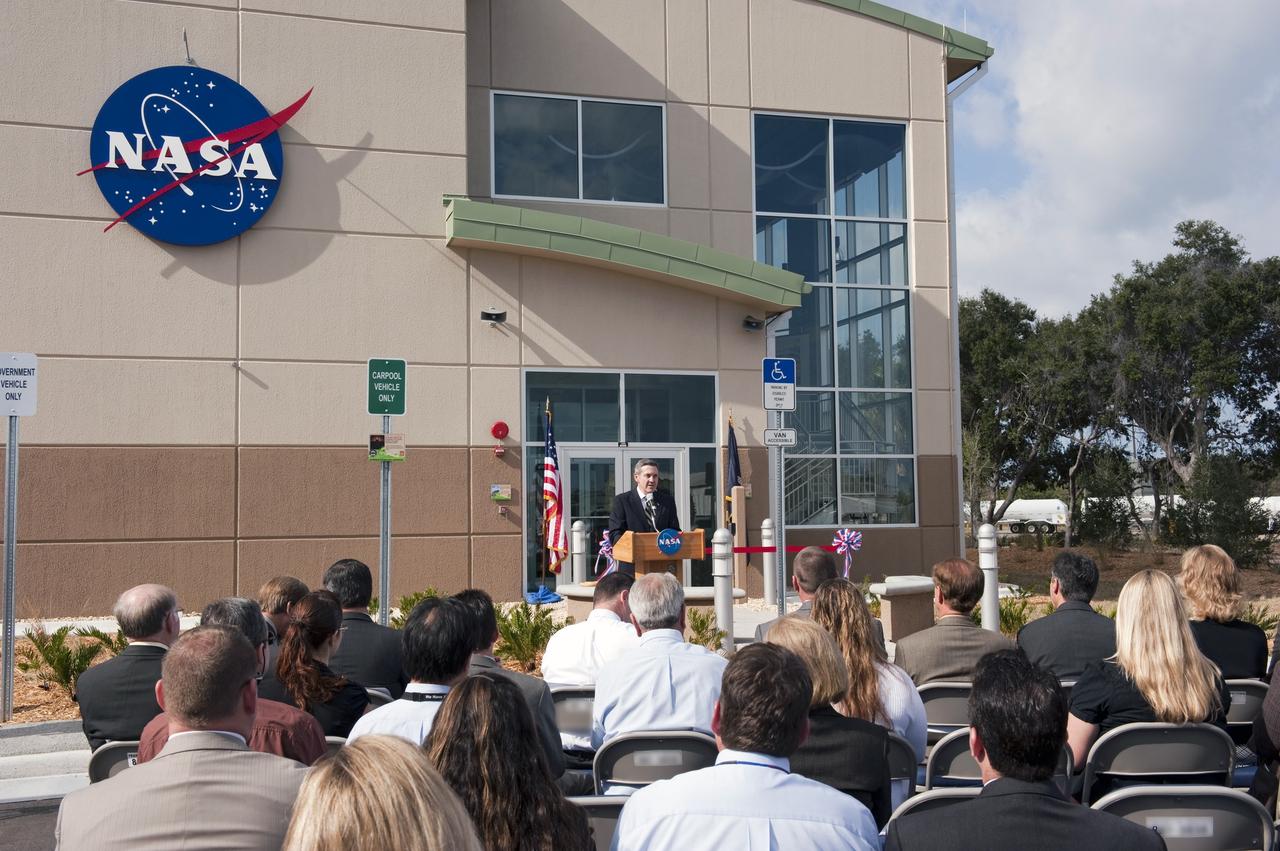
CAPE CANAVERAL, Fla. -- The director of NASA's Kennedy Space Center in Florida, Bob Cabana, addresses an audience at the ribbon-cutting ceremony for the new environmentally friendly Propellants North Administration and Maintenance Facility. Propellants North consists of two buildings, one to store cryogenic fuel transfer equipment and one to house personnel who support fueling spacecraft. The recently rebuilt buildings will be NASA's first carbon neutral facility, which means it will produce enough energy on site from renewable sources to offset what it requires to operate. The facility also will reach for the U.S. Green Building Council's Leadership in Environmental and Energy Design (LEED) Platinum status, which is the highest LEED rating. Photo credit: NASA/Kim Shiflett
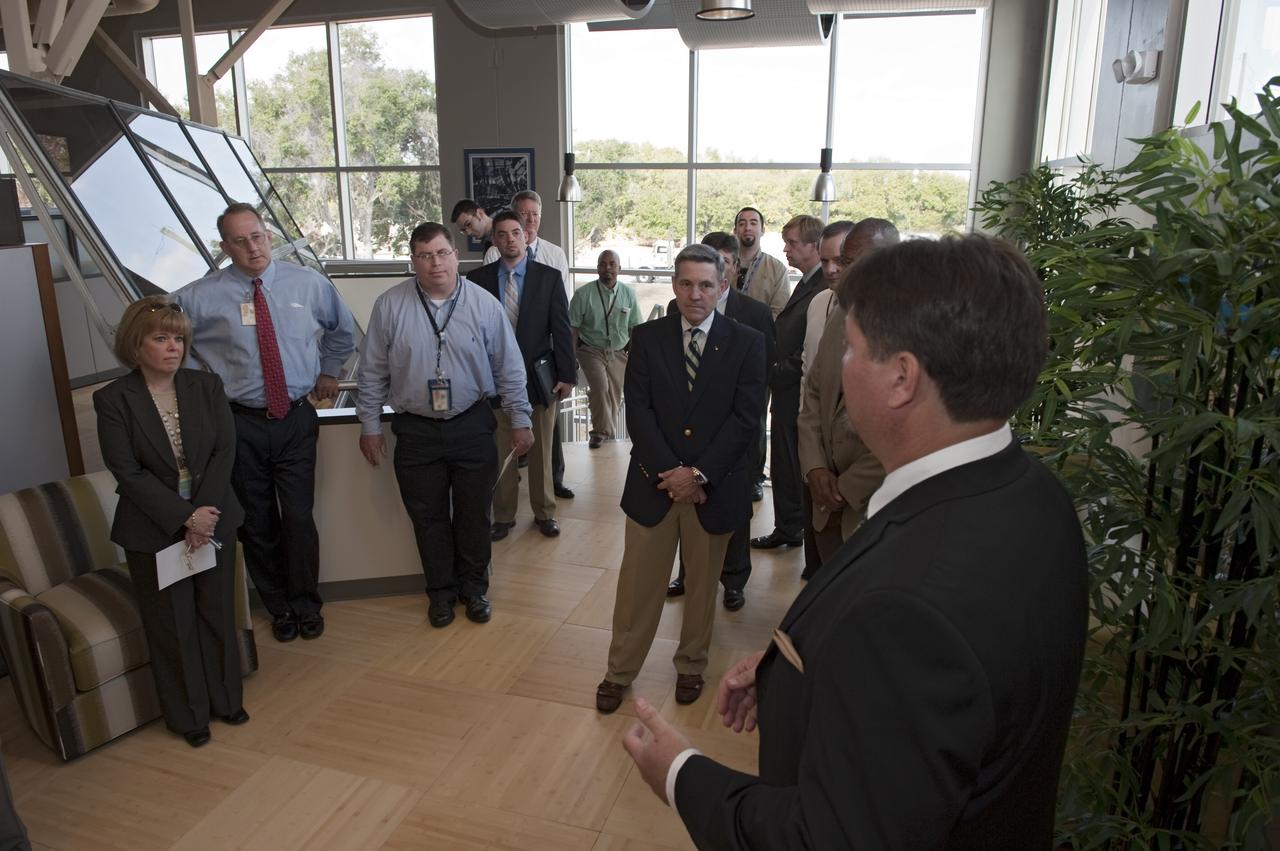
CAPE CANAVERAL, Fla. -- Frank Kline, Construction of Facilities project manager at NASA's Kennedy Space Center in Florida, far right, shows off the environmentally friendly features of the new Propellants North Administration and Maintenance Facility. Propellants North consists of two buildings, one to store cryogenic fuel transfer equipment and one to house personnel who support fueling spacecraft. The recently rebuilt buildings will be NASA's first carbon neutral facility, which means it will produce enough energy on site from renewable sources to offset what it requires to operate. The facility also will reach for the U.S. Green Building Council's Leadership in Environmental and Energy Design (LEED) Platinum status, which is the highest LEED rating. Photo credit: NASA/Kim Shiflett

CAPE CANAVERAL, Fla. -- This is the back view of the new Propellants North Administrative and Maintenance Facility in the Launch Complex 39 area of NASA's Kennedy Space Center in Florida. The environmentally friendly facility is slated to be NASA's second Platinum-rated by the U.S. Green Building Council's (USGBC) Leadership in Environmental and Energy Design (LEED) certification system. It will be the space agency's first carbon-neutral facility, which means it will produce enough energy onsite from renewable sources to offset what it requires to operate. On the right is the facility's single-story shop that will be used to store cryogenic fuel transfer equipment. On the left is a two-story administrative building, which will house managers, mechanics and technicians who fuel spacecraft at Kennedy. In the parking lot is a solar-powered parking station for alternative fuel vehicles. Photo credit: NASA/Frank Michaux
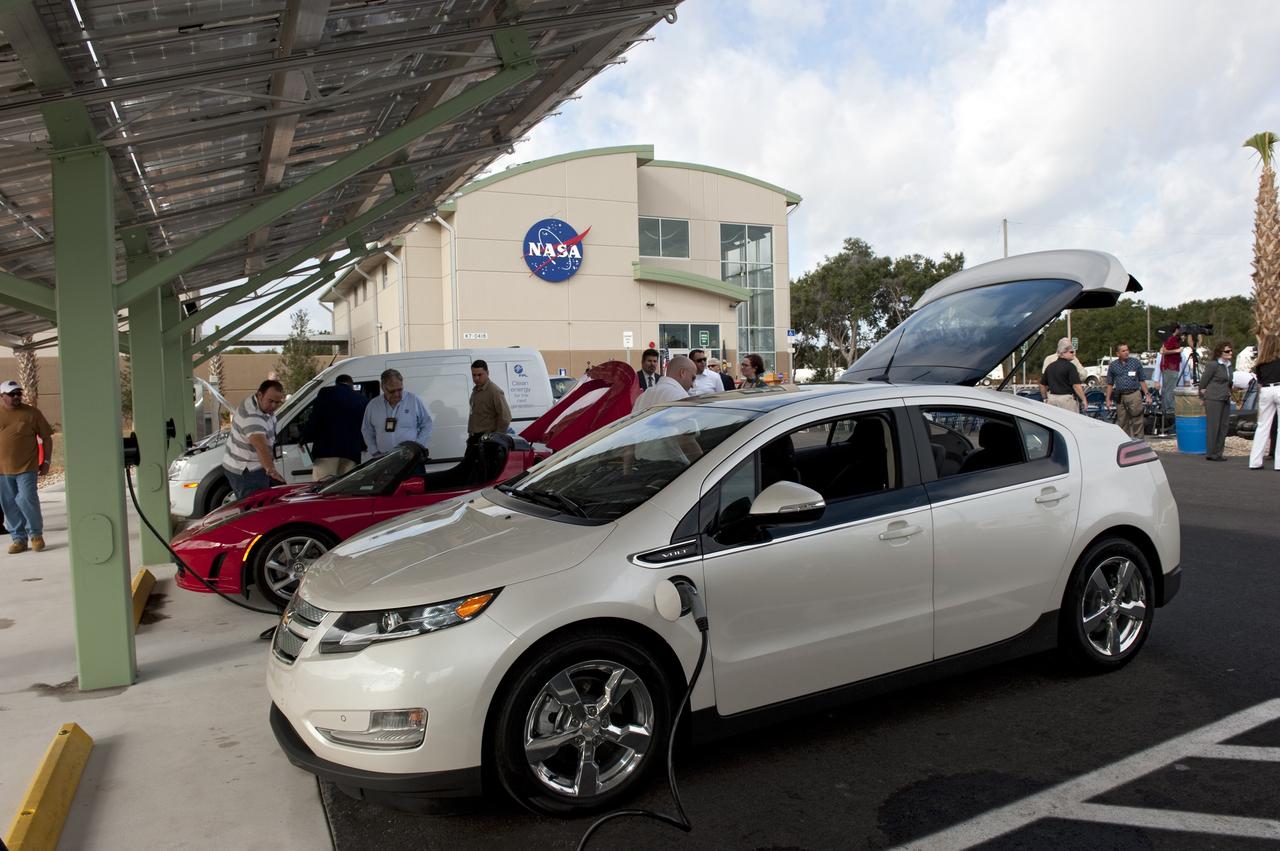
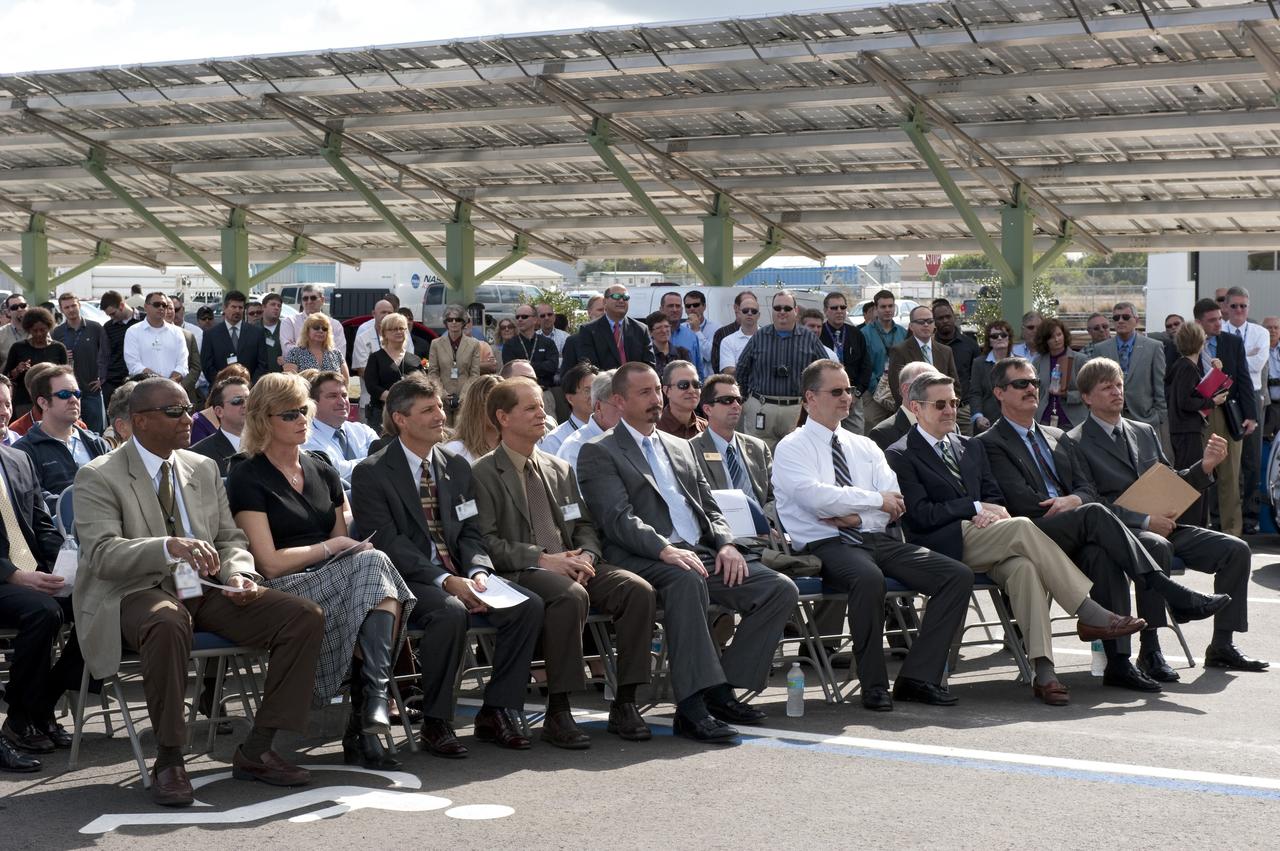
CAPE CANAVERAL, Fla. -- NASA's Kennedy Space Center in Florida hosts a ribbon-cutting ceremony for its new environmentally friendly Propellants North Administrative and Maintenance Facility. This is a view of the parking lot where a solar-powered charging canopy is available for powering government or privately owned electric vehicles. Propellants North consists of two buildings, one to store cryogenic fuel transfer equipment and one to house personnel who support fueling spacecraft. The recently rebuilt buildings will be NASA's first carbon neutral facility, which means it will produce enough energy on site from renewable sources to offset what it requires to operate. The facility also will reach for the U.S. Green Building Council's Leadership in Environmental and Energy Design (LEED) Platinum status, which is the highest LEED rating. Photo credit: NASA/Kim Shiflett
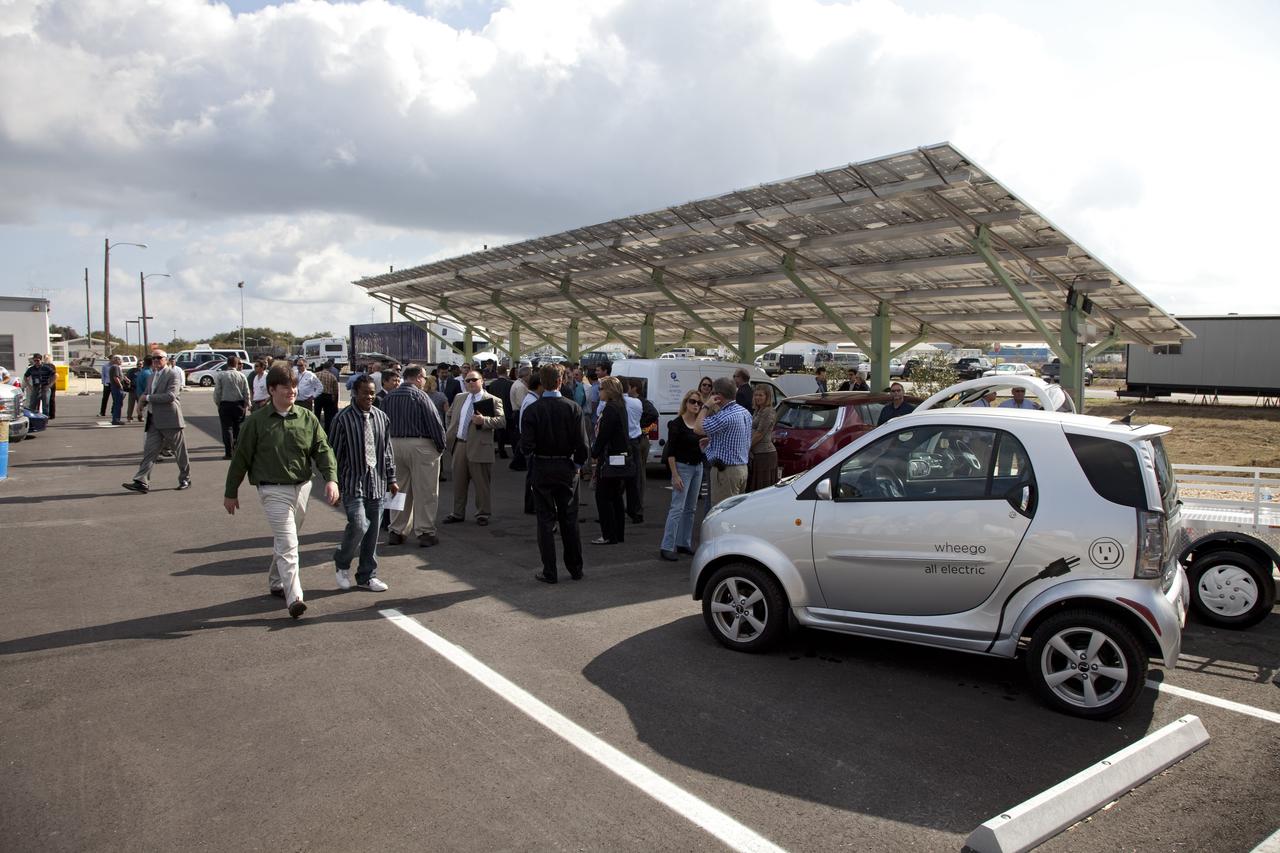
CAPE CANAVERAL, Fla. -- NASA's Kennedy Space Center in Florida hosts a ribbon-cutting ceremony for its new environmentally friendly Propellants North Administrative and Maintenance Facility. This is a view of the parking lot where a solar-powered charging canopy is available for powering government or privately owned electric vehicles. Propellants North consists of two buildings, one to store cryogenic fuel transfer equipment and one to house personnel who support fueling spacecraft. The recently rebuilt buildings will be NASA's first carbon neutral facility, which means it will produce enough energy on site from renewable sources to offset what it requires to operate. The facility also will reach for the U.S. Green Building Council's Leadership in Environmental and Energy Design (LEED) Platinum status, which is the highest LEED rating. Photo credit: NASA/Frankie Martin
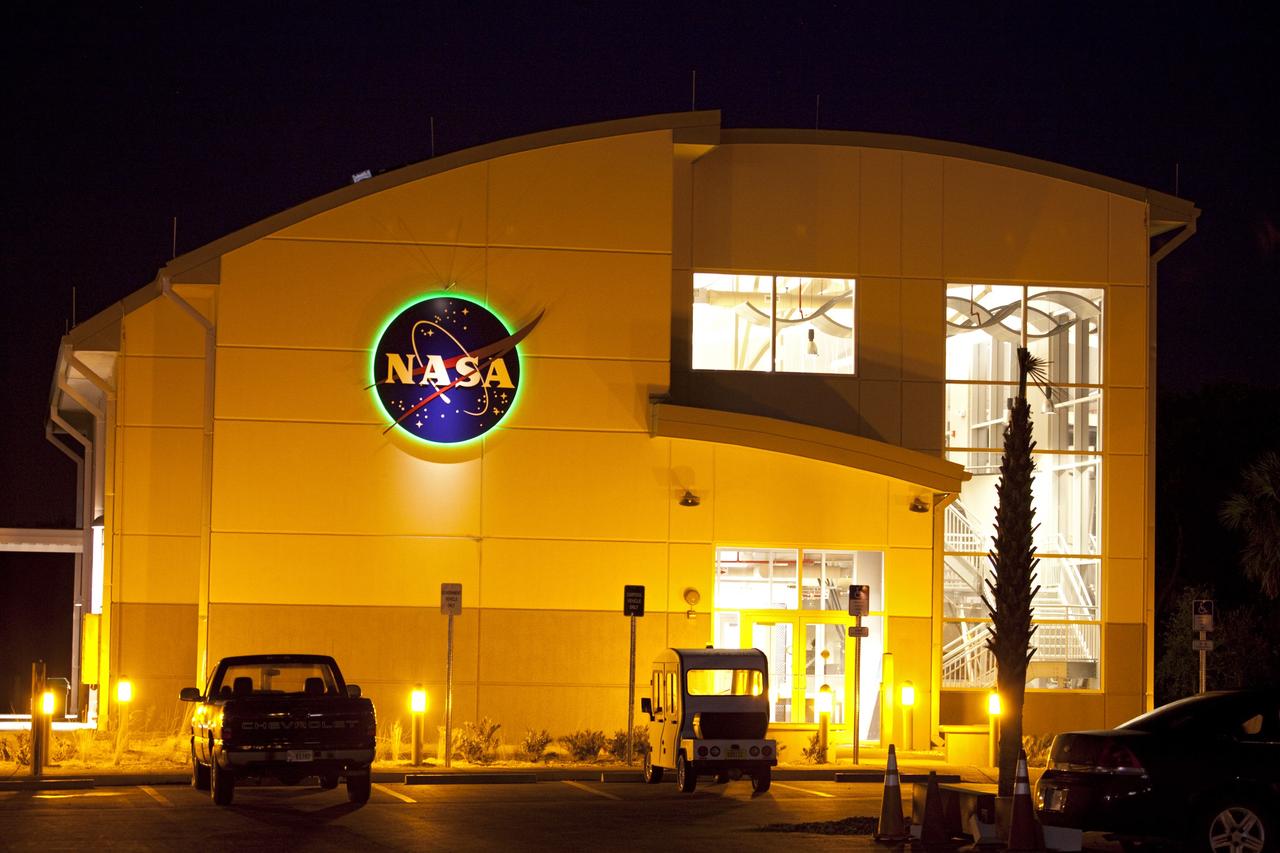
CAPE CANAVERAL, Fla. -- Kennedy Space Center's Propellants North Administrative and Maintenance Facility with the NASA insignia glistens a shade of green in the Launch Complex 39 area. The environmentally friendly facility is slated to be NASA's second Platinum-rated by the U.S. Green Building Council's (USGBC) Leadership in Environmental and Energy Design (LEED) certification system. It will be the space agency's first carbon-neutral facility, which means it will produce enough energy onsite from renewable sources to offset what it requires to operate. Shown here is the facility's two-story administrative building, which will house managers, mechanics and technicians who fuel spacecraft at Kennedy. Next door is a single-story shop that will be used to store cryogenic fuel transfer equipment. Photo credit: NASA/Frank Michaux
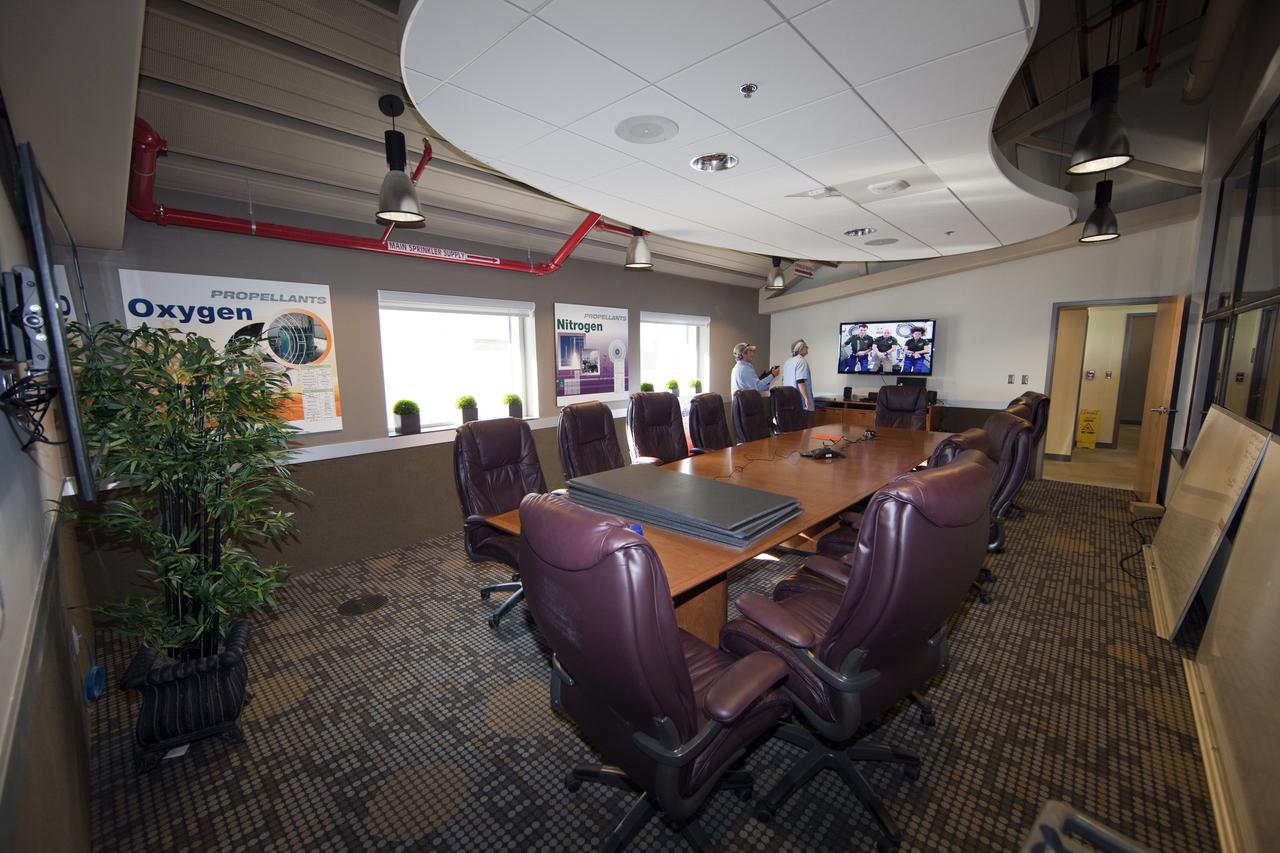
CAPE CANAVERAL, Fla. -- Finishing touches adorn the second-floor conference room of the Propellants North Administrative and Maintenance Facility at NASA's Kennedy Space Center in Florida. The environmentally friendly facility is slated to be NASA's second Platinum-rated by the U.S. Green Building Council's (USGBC) Leadership in Environmental and Energy Design (LEED) certification system. It will be the space agency's first net-zero facility, which means it will produce enough energy onsite from renewable sources to offset what it requires to operate. The facility consists of a two-story administrative building to house managers, mechanics and technicians who fuel spacecraft at Kennedy, and a single-story shop to store cryogenic fuel transfer equipment. Photo credit: NASA/Frankie Martin
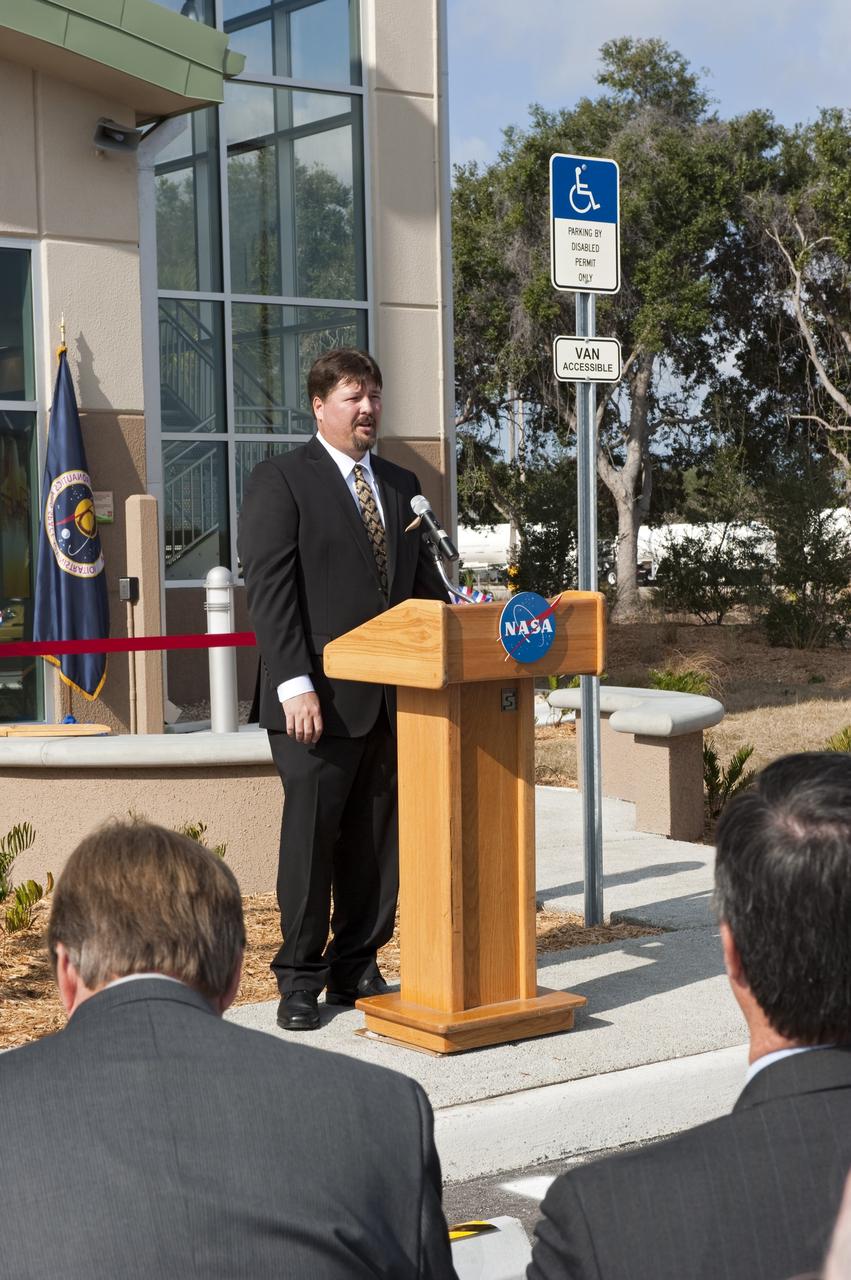
CAPE CANAVERAL, Fla. -- Frank Kline, Construction of Facilities project manager at NASA's Kennedy Space Center in Florida, addresses an audience at the ribbon-cutting ceremony for the new environmentally friendly Propellants North Administration and Maintenance Facility. Propellants North consists of two buildings, one to store cryogenic fuel transfer equipment and one to house personnel who support fueling spacecraft. The recently rebuilt buildings will be NASA's first carbon neutral facility, which means it will produce enough energy on site from renewable sources to offset what it requires to operate. The facility also will reach for the U.S. Green Building Council's Leadership in Environmental and Energy Design (LEED) Platinum status, which is the highest LEED rating. Photo credit: NASA/Kim Shiflett
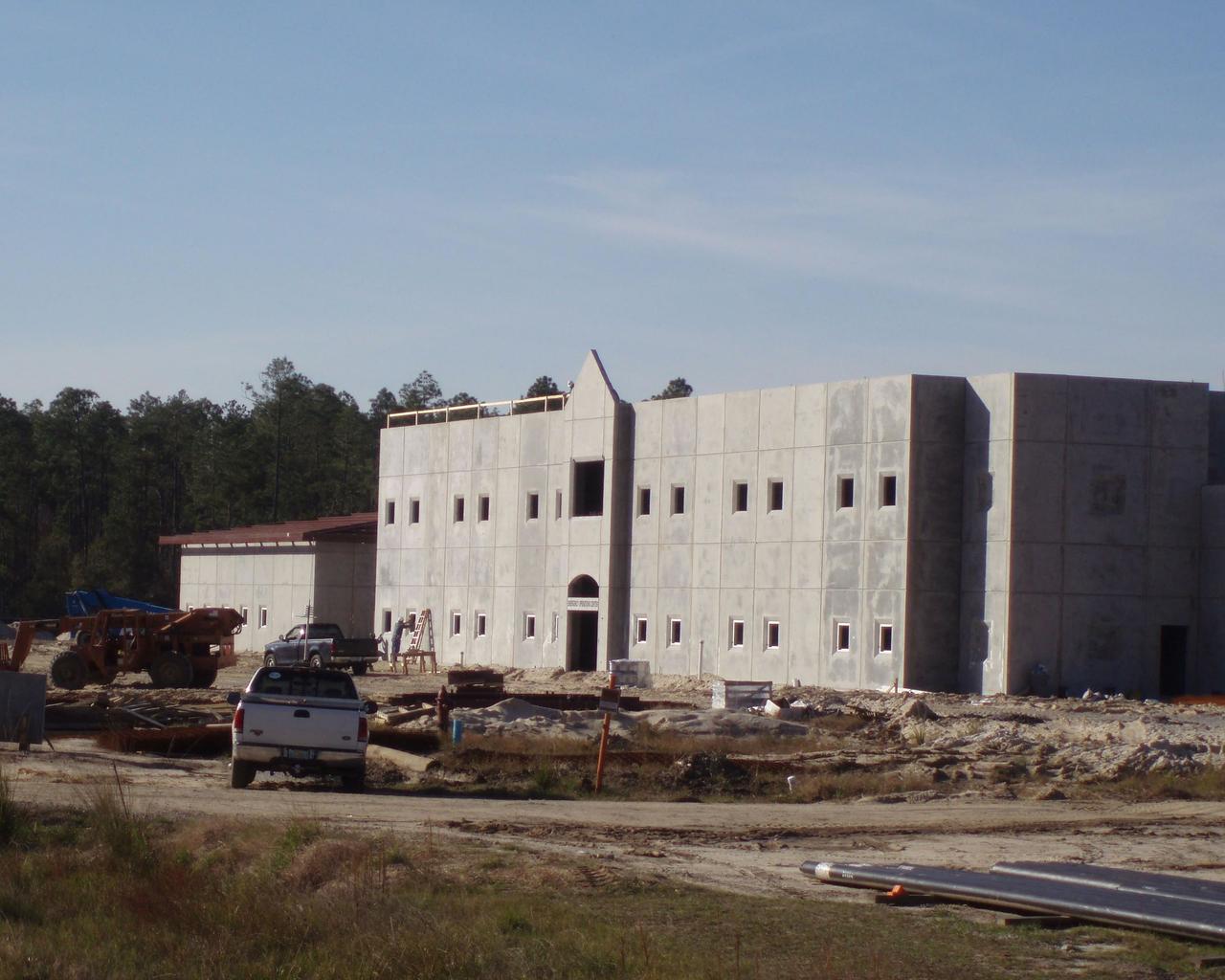
Work on Stennis Space Center's new Emergency Operations Center is progressing on schedule, according to Robert Perkins, construction manager with Jacobs Technology. At the turn of the New Year, construction contractors had completed the pervious paving for the north and west parking lots. Part of the facility's `green' design, pervious paving allows water to pass through and be absorbed directly into the ground below, preventing erosion from runoff. Through January, workers concentrated on installing the roof, sprinkler piping and overhead cable trays for electrical and communication lines. The next step will be interior work, erecting wallboard and installing electrical equipment. Perkins said NASA seeks to earn a Silver LEED (Leadership in Energy and Environmental Design) Rating for the project's environmentally-friendly and sustainable design, construction and operation. The facility has a projected completion date of February 2009.
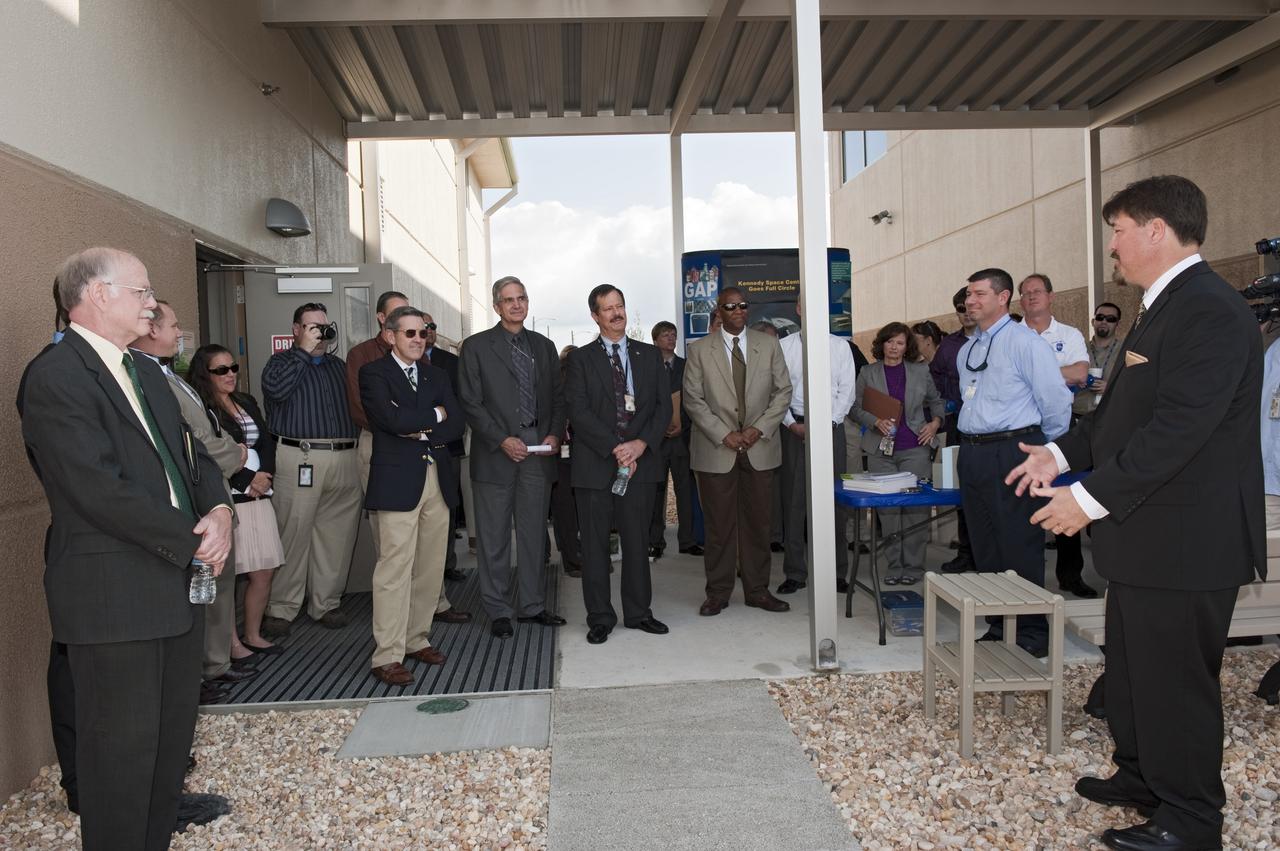
CAPE CANAVERAL, Fla. -- Frank Kline, Construction of Facilities project manager at NASA's Kennedy Space Center in Florida, far right, shows off the environmentally friendly features of the new Propellants North Administration and Maintenance Facility. Propellants North consists of two buildings, one to store cryogenic fuel transfer equipment and one to house personnel who support fueling spacecraft. The recently rebuilt buildings will be NASA's first carbon neutral facility, which means it will produce enough energy on site from renewable sources to offset what it requires to operate. The facility also will reach for the U.S. Green Building Council's Leadership in Environmental and Energy Design (LEED) Platinum status, which is the highest LEED rating. Photo credit: NASA/Kim Shiflett
CAPE CANAVERAL, Fla. -- At NASA's Kennedy Space Center in Florida, James Wright, the deputy assistant administrator for the Office of Strategic Infrastructure at NASA Headquarters, addresses an audience at the ribbon-cutting ceremony for the new environmentally friendly Propellants North Administration and Maintenance Facility. Propellants North consists of two buildings, one to store cryogenic fuel transfer equipment and one to house personnel who support fueling spacecraft. The recently rebuilt buildings will be NASA's first carbon neutral facility, which means it will produce enough energy on site from renewable sources to offset what it requires to operate. The facility also will reach for the U.S. Green Building Council's Leadership in Environmental and Energy Design (LEED) Platinum status, which is the highest LEED rating. Photo credit: NASA/Kim Shiflett
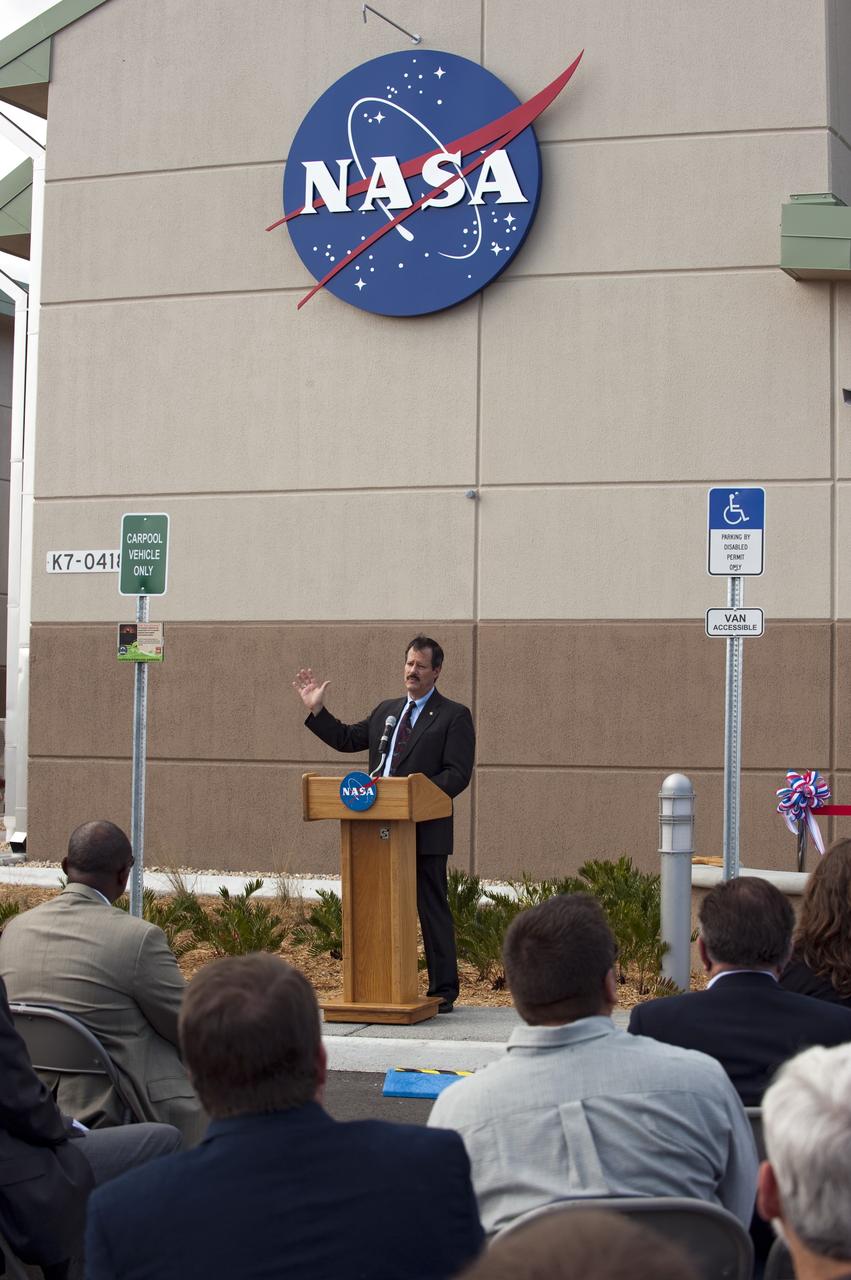
CAPE CANAVERAL, Fla. -- Mike Benik, the director of Center Operations at NASA's Kennedy Space Center in Florida, addresses an audience at the ribbon-cutting ceremony for the new environmentally friendly Propellants North Administration and Maintenance Facility. Propellants North consists of two buildings, one to store cryogenic fuel transfer equipment and one to house personnel who support fueling spacecraft. The recently rebuilt buildings will be NASA's first carbon neutral facility, which means it will produce enough energy on site from renewable sources to offset what it requires to operate. The facility also will reach for the U.S. Green Building Council's Leadership in Environmental and Energy Design (LEED) Platinum status, which is the highest LEED rating. Photo credit: NASA/Kim Shiflett
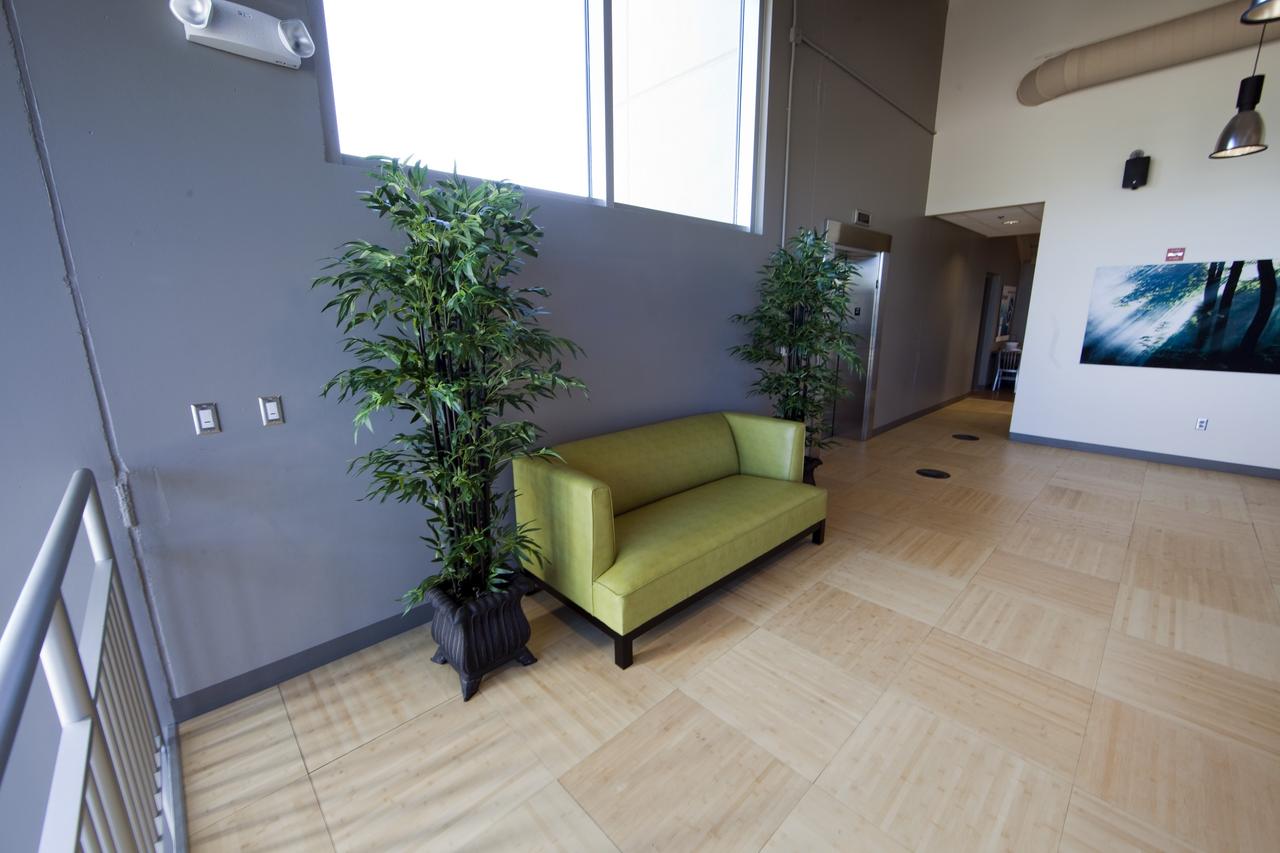
CAPE CANAVERAL, Fla. -- Finishing touches adorn the second-floor lobby of the new Propellants North Administrative and Maintenance Facility at NASA's Kennedy Space Center in Florida. The artwork on the wall was produced by Greg Lee, a graphics specialist with Abacus Technology Corp., and depicts the mystery of nature with a photo of the Merritt Island National Wildlife Refuge. The environmentally friendly facility is slated to be NASA's second Platinum-rated by the U.S. Green Building Council's (USGBC) Leadership in Environmental and Energy Design (LEED) certification system. It will be the space agency's first net-zero facility, which means it will produce enough energy onsite from renewable sources to offset what it requires to operate. The facility consists of a two-story administrative building to house managers, mechanics and technicians who fuel spacecraft at Kennedy, and a single-story shop to store cryogenic fuel transfer equipment. Photo credit: NASA/Frankie Martin
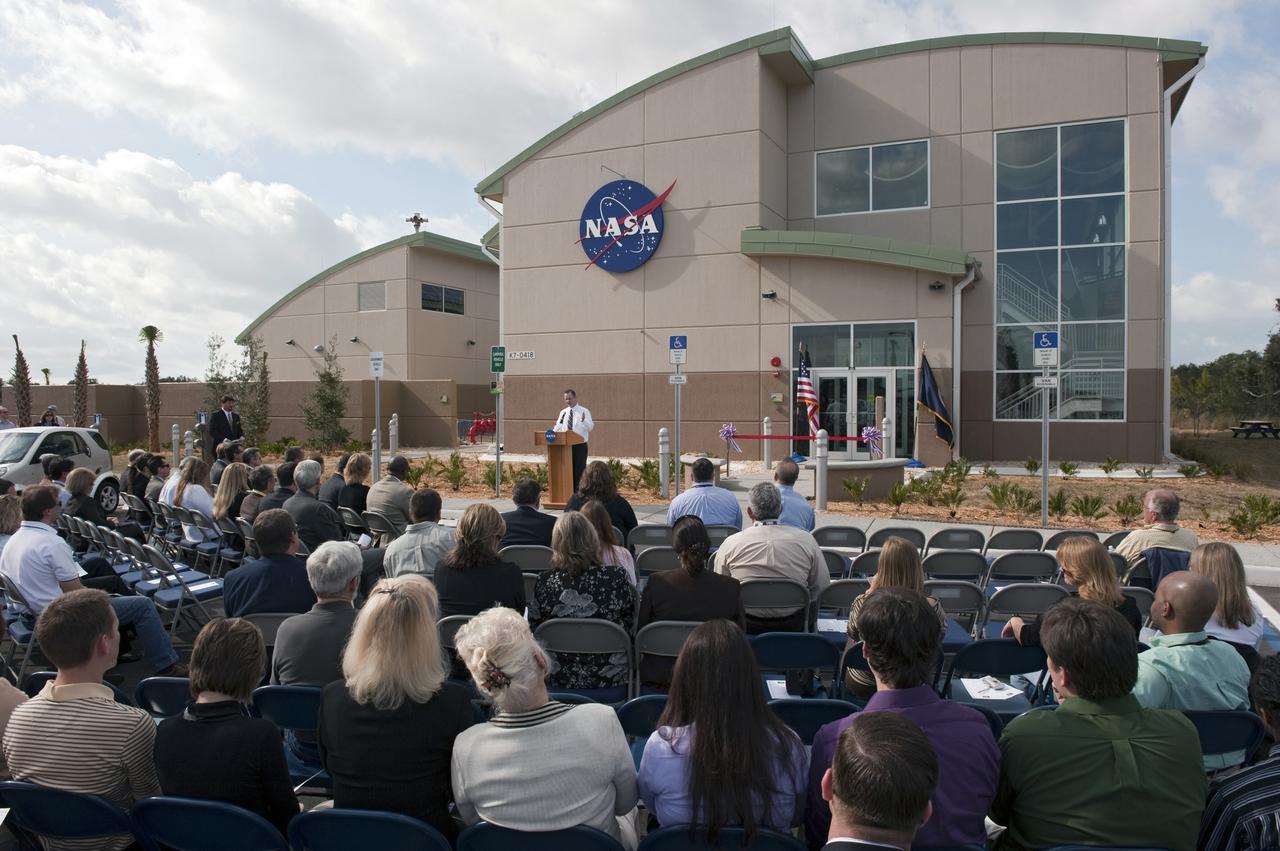
CAPE CANAVERAL, Fla. -- NASA's Kennedy Space Center in Florida hosts a ribbon-cutting ceremony for the space agency's most environmentally friendly facility, the Propellants North Administrative and Maintenance Facility in Kennedy's Launch Complex 39 area. Propellants North consists of two buildings, one to store cryogenic fuel transfer equipment and one to house personnel who support fueling spacecraft. The recently rebuilt buildings will be NASA's first carbon neutral facility, which means it will produce enough energy on site from renewable sources to offset what it requires to operate. The facility also will reach for the U.S. Green Building Council's Leadership in Environmental and Energy Design (LEED) Platinum status, which is the highest LEED rating. Photo credit: NASA/Kim Shiflett
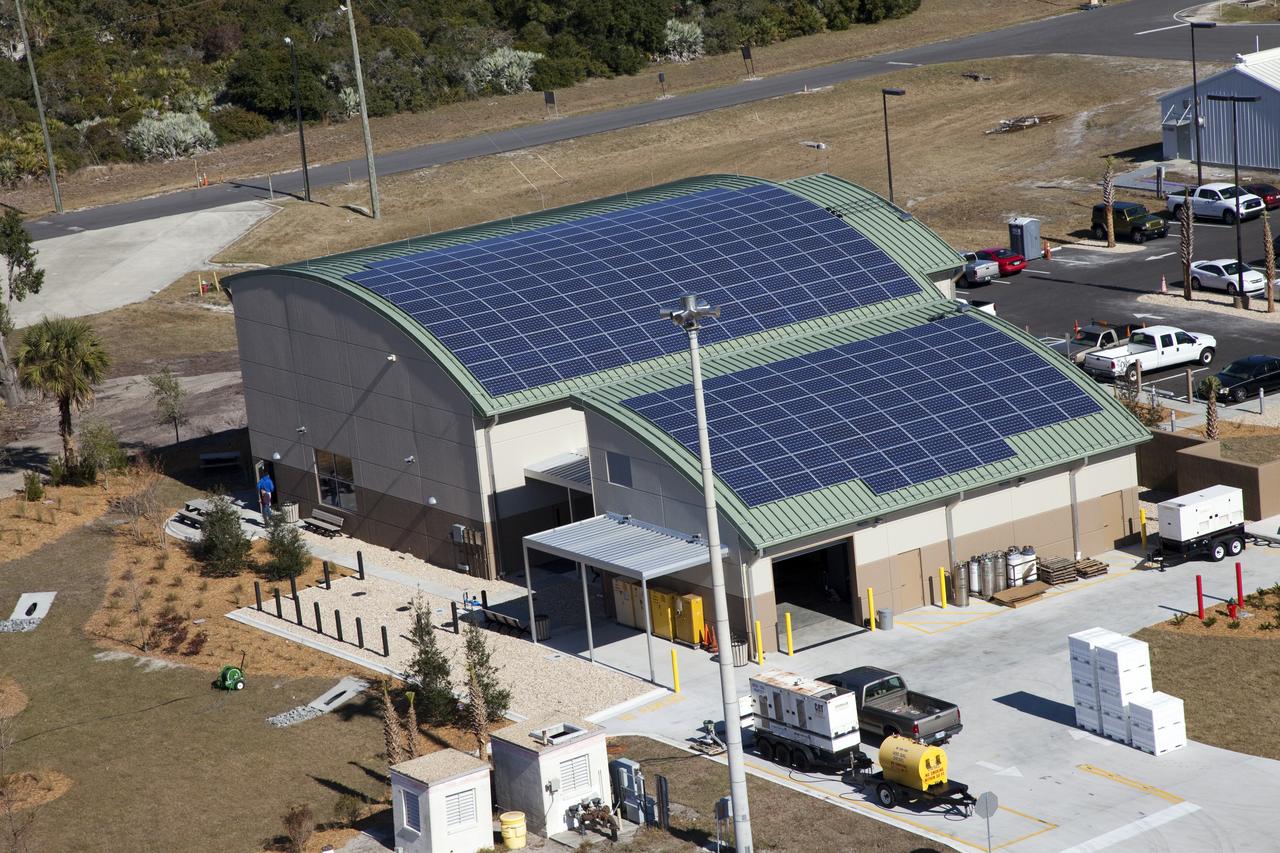
CAPE CANAVERAL, Fla. -- The Propellants North Administrative and Maintenance Facility in the Launch Complex 39 area of NASA's Kennedy Space Center in Florida is ready for business. The environmentally friendly facility is slated to be NASA's second Platinum-rated by the U.S. Green Building Council's (USGBC) Leadership in Environmental and Energy Design (LEED) certification system. It will be the space agency's first carbon-neutral facility, which means it will produce enough energy onsite from renewable sources to offset what it requires to operate. The facility consists of a two-story administrative building, which will house managers, mechanics and technicians who fuel spacecraft at Kennedy, and a single-story shop that will be used to store cryogenic fuel transfer equipment. Photo credit: NASA/Frank Michaux
CAPE CANAVERAL, Fla. -- The NASA insignia glistens a shade of green on Kennedy Space Center's Propellants North Administrative and Maintenance Facility in the Launch Complex 39 area. The environmentally friendly facility is slated to be NASA's second Platinum-rated by the U.S. Green Building Council's (USGBC) Leadership in Environmental and Energy Design (LEED) certification system. It will be the space agency's first carbon-neutral facility, which means it will produce enough energy onsite from renewable sources to offset what it requires to operate. The facility consists of a two-story administrative building, which will house managers, mechanics and technicians who fuel spacecraft at Kennedy, and a single-story shop that will be used to store cryogenic fuel transfer equipment. Photo credit: NASA/Frank Michaux
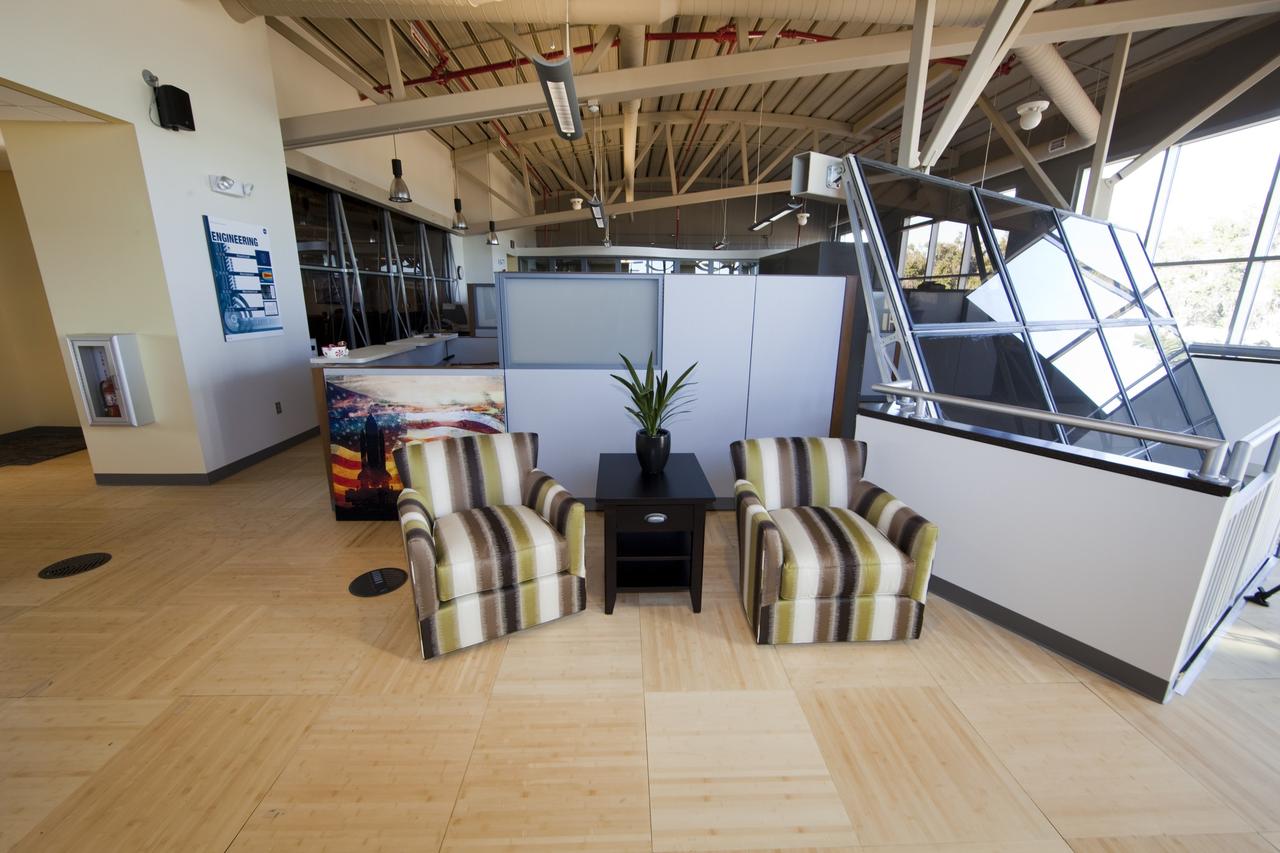
CAPE CANAVERAL, Fla. -- Finishing touches adorn the second-floor lobby of the Propellants North Administrative and Maintenance Facility at NASA's Kennedy Space Center in Florida. At right, are recycled firing room windows that are set at the same angle and orientation as they were in Kennedy's Launch Control Center, looking out toward Launch Pads 39A and B. The environmentally friendly facility is slated to be NASA's second Platinum-rated by the U.S. Green Building Council's (USGBC) Leadership in Environmental and Energy Design (LEED) certification system. It will be the space agency's first net-zero facility, which means it will produce enough energy onsite from renewable sources to offset what it requires to operate. The facility consists of a two-story administrative building to house managers, mechanics and technicians who fuel spacecraft at Kennedy, and a single-story shop to store cryogenic fuel transfer equipment. Photo credit: NASA/Frankie Martin
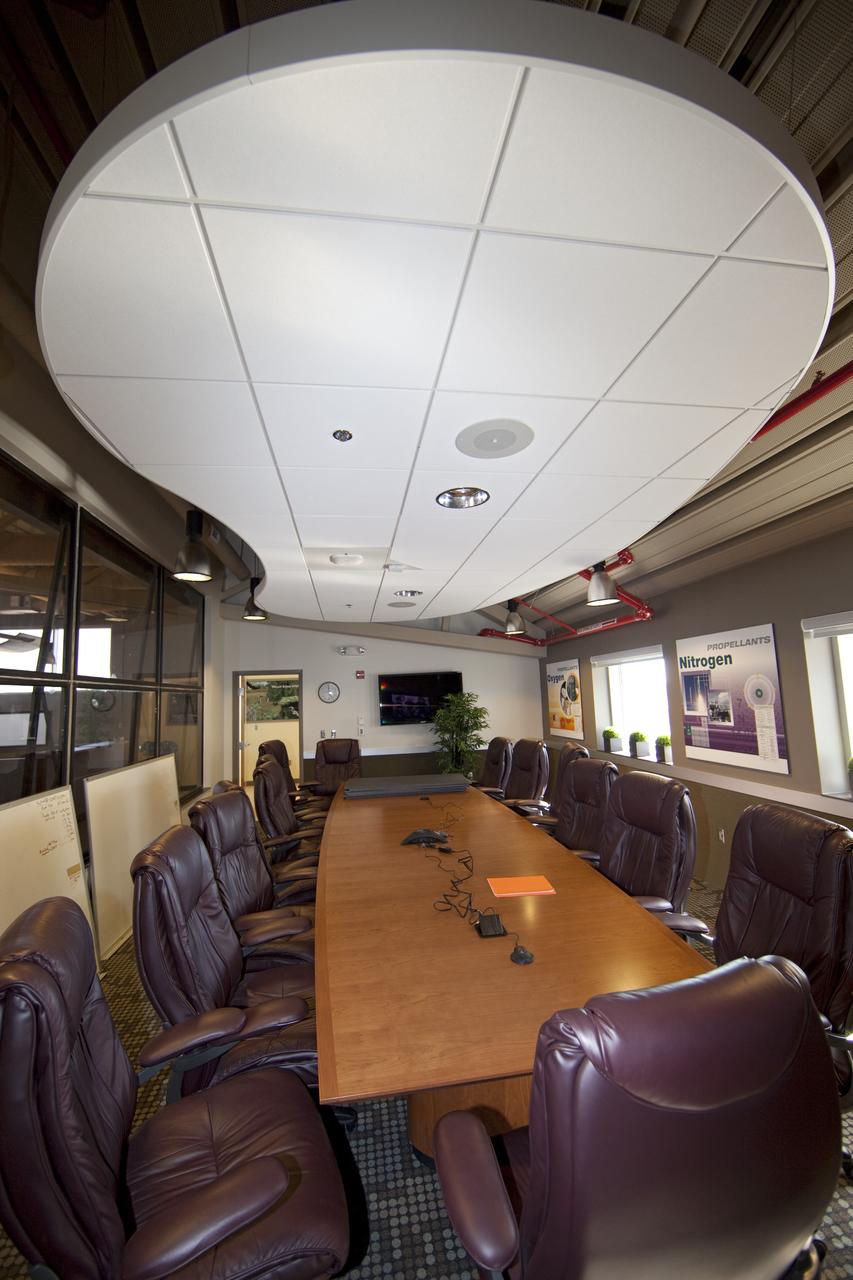
CAPE CANAVERAL, Fla. -- Finishing touches adorn the second-floor conference room of the Propellants North Administrative and Maintenance Facility at NASA's Kennedy Space Center in Florida. Artwork for the conference room was produced by Greg Lee, a graphics specialist with Abacus Technology Corp., with input from the facility's future occupants. The environmentally friendly facility is slated to be NASA's second Platinum-rated by the U.S. Green Building Council's (USGBC) Leadership in Environmental and Energy Design (LEED) certification system. It will be the space agency's first net-zero facility, which means it will produce enough energy onsite from renewable sources to offset what it requires to operate. The facility consists of a two-story administrative building to house managers, mechanics and technicians who fuel spacecraft at Kennedy, and a single-story shop to store cryogenic fuel transfer equipment. Photo credit: NASA/Frankie Martin
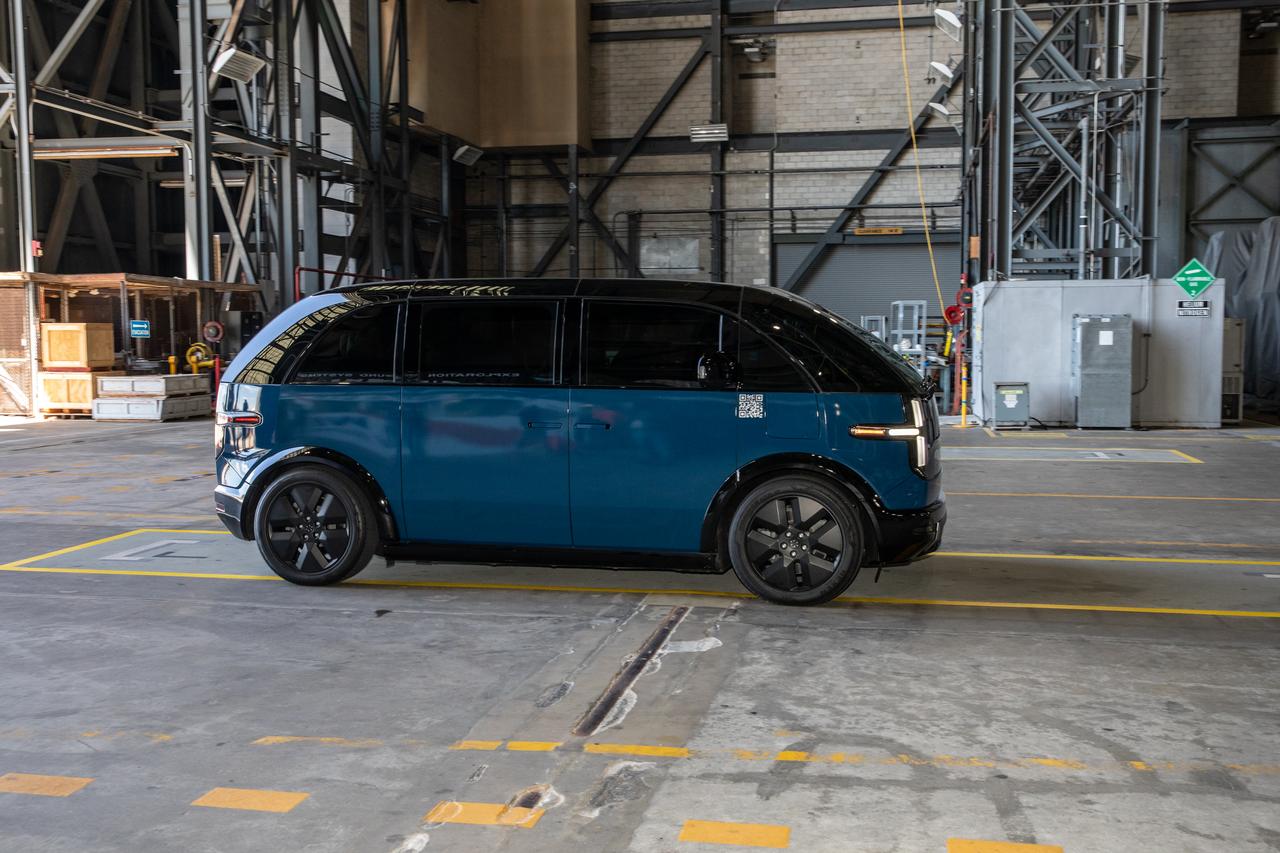
A concept design of a crew transportation vehicle (CTV) for Artemis crewed missions is driven inside the transfer aisle of the Vehicle Assembly Building at NASA’s Kennedy Space Center in Florida on May 11, 2022. Canoo Technologies Inc., was awarded a contract to design and provide the next generation of CTVs for the Artemis crewed missions. Representatives with Canoo were at the spaceport demonstrating the environmentally friendly fleet of vehicles. Artemis II will be the first Artemis mission flying crew aboard Orion. In later missions, NASA will land the first woman and the first person of color on the surface of the Moon, paving the way for a long-term lunar presence and serving as a steppingstone on the way to Mars.

Several concept designs for Artemis crew transportation vehicles (CTV) are lined up at Launch Complex 39B at NASA’s Kennedy Space Center in Florida on May 11, 2022. Canoo Technologies Inc., was awarded a contract to design and provide the next generation of CTVs for the Artemis crewed missions. Representatives with Canoo were at the spaceport demonstrating the environmentally friendly fleet of vehicles. Artemis II will be the first Artemis mission flying crew aboard Orion. In later missions, NASA will land the first woman and the first person of color on the surface of the Moon, paving the way for a long-term lunar presence and serving as a steppingstone on the way to Mars.
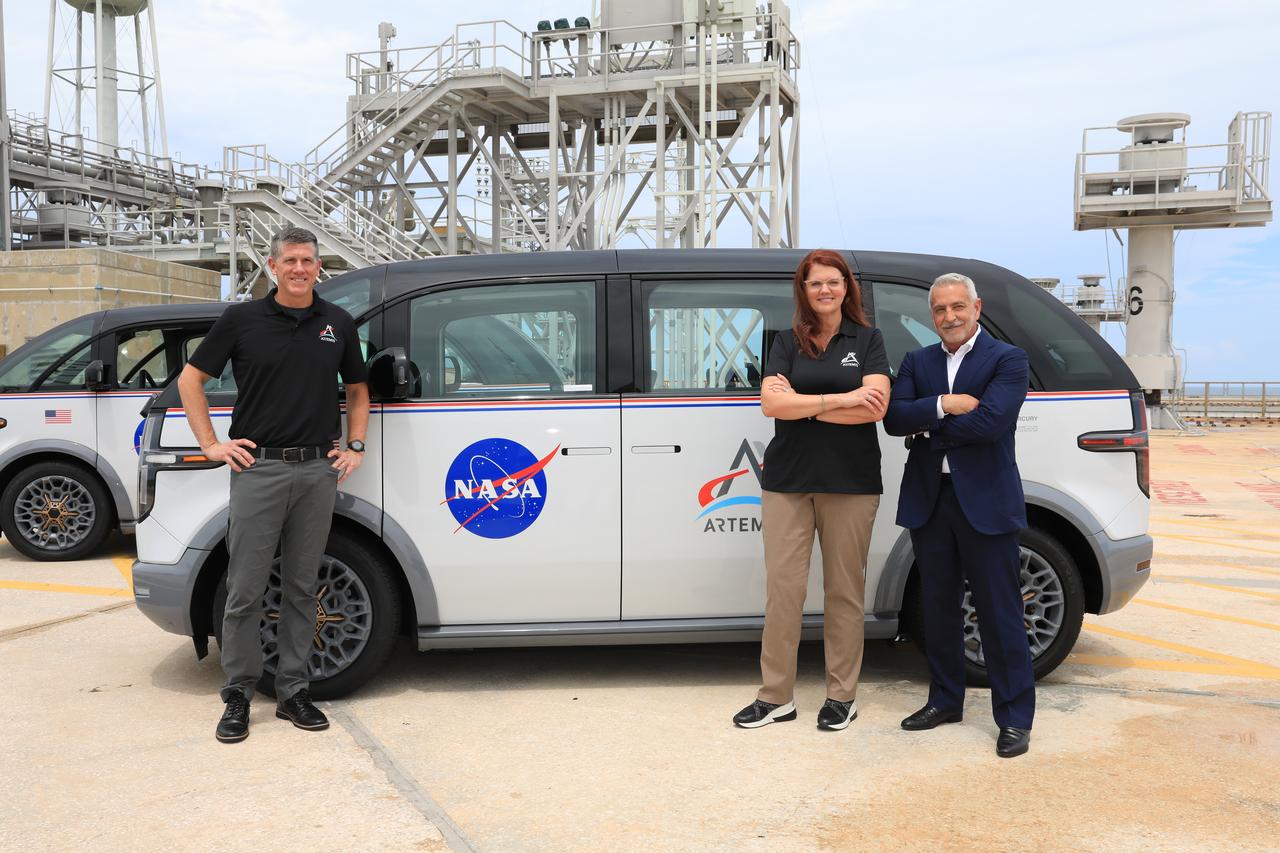
Three specially designed, fully electric, environmentally friendly crew transportation vehicles for Artemis missions arrived at NASA’s Kennedy Space Center in Florida on July 11, 2023. One of the zero-emission vehicles is shown here at Launch Pad 39B. From left are Jeremy Graeber, Artemis assistant launch director; Charlie Blackwell-Thompson, Artemis launch director; and Tony Aquila, chairman and CEO, Canoo Technologies Inc.. The fleet, which will carry astronauts to Launch Complex 39B for Artemis missions, was delivered by the manufacturer, Canoo Technologies Inc. of Torrance, California.

Several concept designs for Artemis crew transportation vehicles (CTV) are lined up in the transfer aisle of the Vehicle Assembly Building at NASA’s Kennedy Space Center in Florida on May 11, 2022. Canoo Technologies Inc., was awarded a contract to design and provide the next generation of CTVs for the Artemis crewed missions. Representatives with Canoo were at the spaceport demonstrating the environmentally friendly fleet of vehicles. Artemis II will be the first Artemis mission flying crew aboard Orion. In later missions, NASA will land the first woman and the first person of color on the surface of the Moon, paving the way for a long-term lunar presence and serving as a steppingstone on the way to Mars.
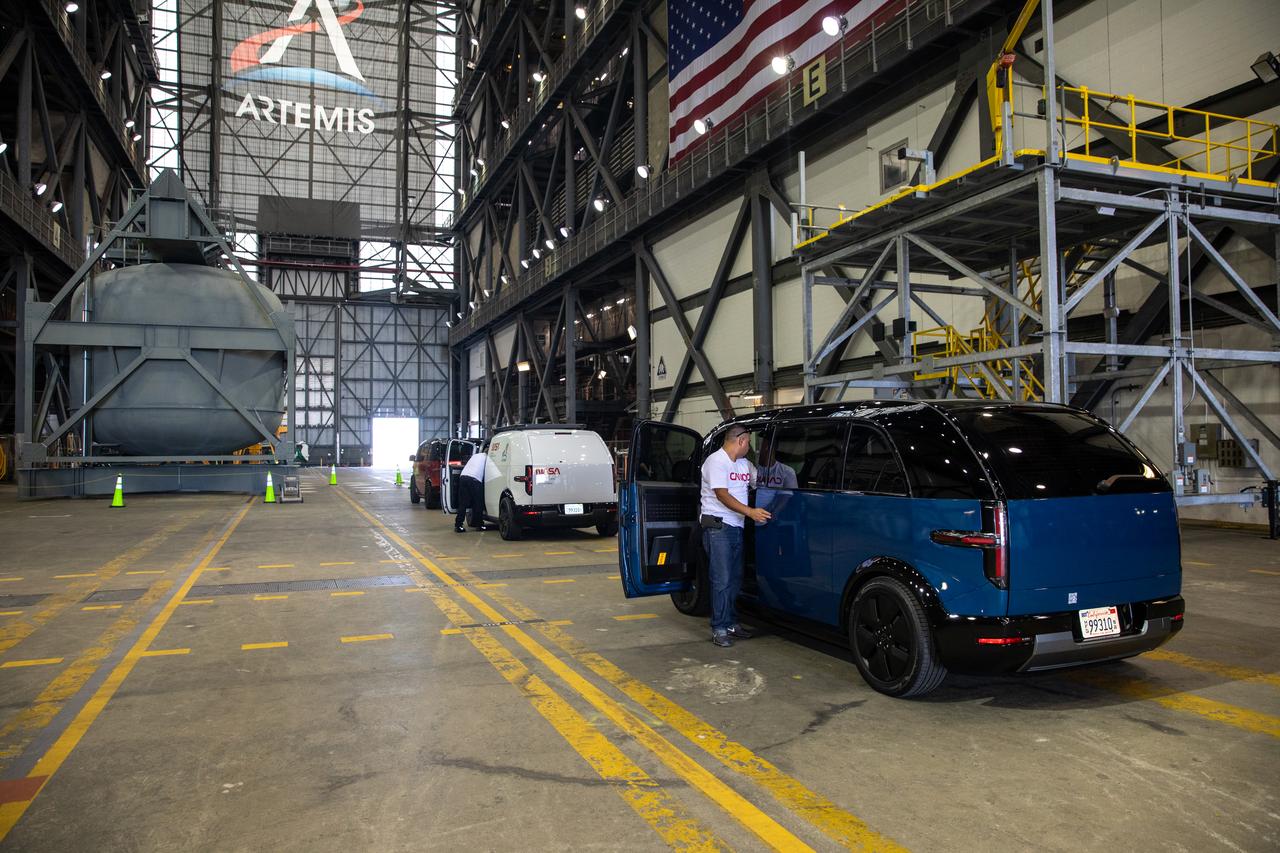
Several concept designs for Artemis crew transportation vehicles (CTV) are lined up in the transfer aisle of the Vehicle Assembly Building at NASA’s Kennedy Space Center in Florida on May 11, 2022. Canoo Technologies Inc., was awarded a contract to design and provide the next generation of CTVs for the Artemis crewed missions. Representatives with Canoo were at the spaceport demonstrating the environmentally friendly fleet of vehicles. Artemis II will be the first Artemis mission flying crew aboard Orion. In later missions, NASA will land the first woman and the first person of color on the surface of the Moon, paving the way for a long-term lunar presence and serving as a steppingstone on the way to Mars.
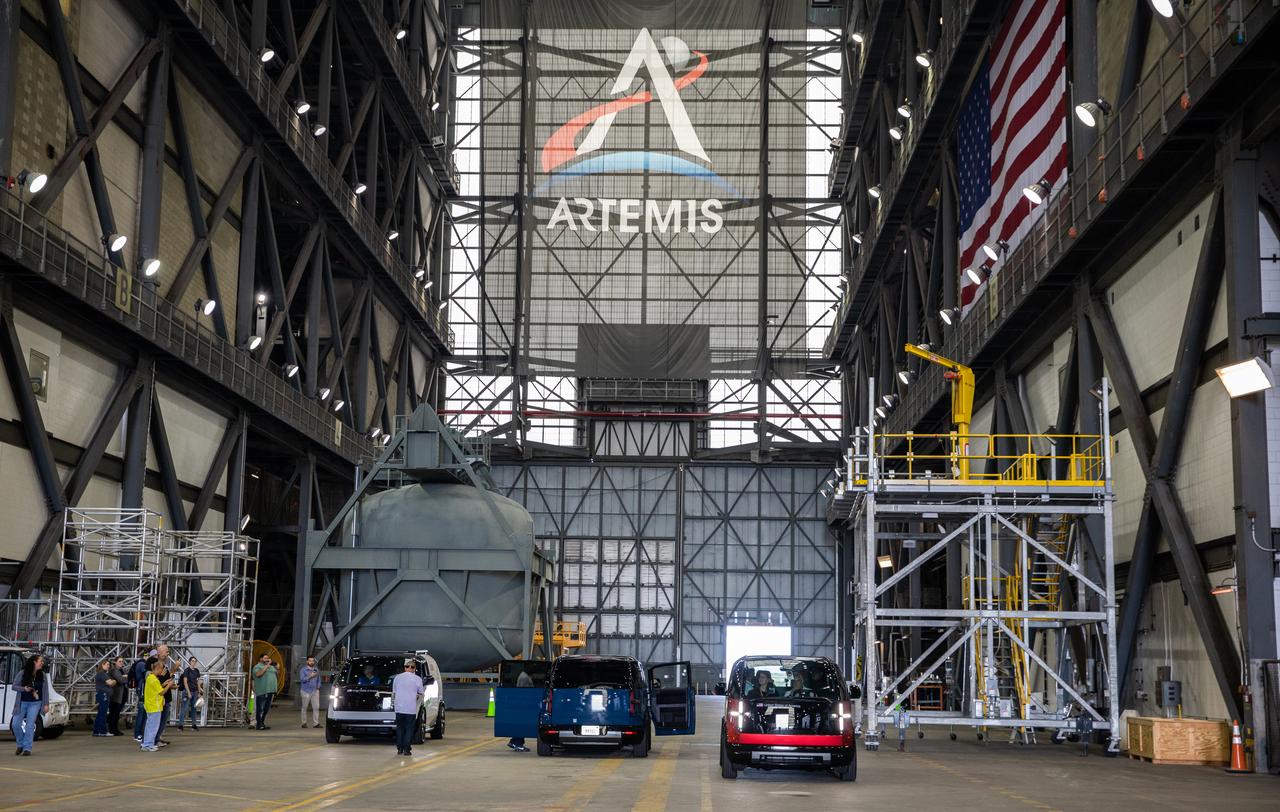
Several concept designs for Artemis crew transportation vehicles (CTV) are lined up in the transfer aisle of the Vehicle Assembly Building at NASA’s Kennedy Space Center in Florida on May 11, 2022. Canoo Technologies Inc., was awarded a contract to design and provide the next generation of CTVs for the Artemis crewed missions. Representatives with Canoo were at the spaceport demonstrating the environmentally friendly fleet of vehicles. Artemis II will be the first Artemis mission flying crew aboard Orion. In later missions, NASA will land the first woman and the first person of color on the surface of the Moon, paving the way for a long-term lunar presence and serving as a steppingstone on the way to Mars.

A concept design of a crew transportation vehicle (CTV) for Artemis crewed missions is driven inside the transfer aisle of the Vehicle Assembly Building at NASA’s Kennedy Space Center in Florida on May 11, 2022. Canoo Technologies Inc., was awarded a contract to design and provide the next generation of CTVs for the Artemis crewed missions. Representatives with Canoo were at the spaceport demonstrating the environmentally friendly fleet of vehicles. Artemis II will be the first Artemis mission flying crew aboard Orion. In later missions, NASA will land the first woman and the first person of color on the surface of the Moon, paving the way for a long-term lunar presence and serving as a steppingstone on the way to Mars.
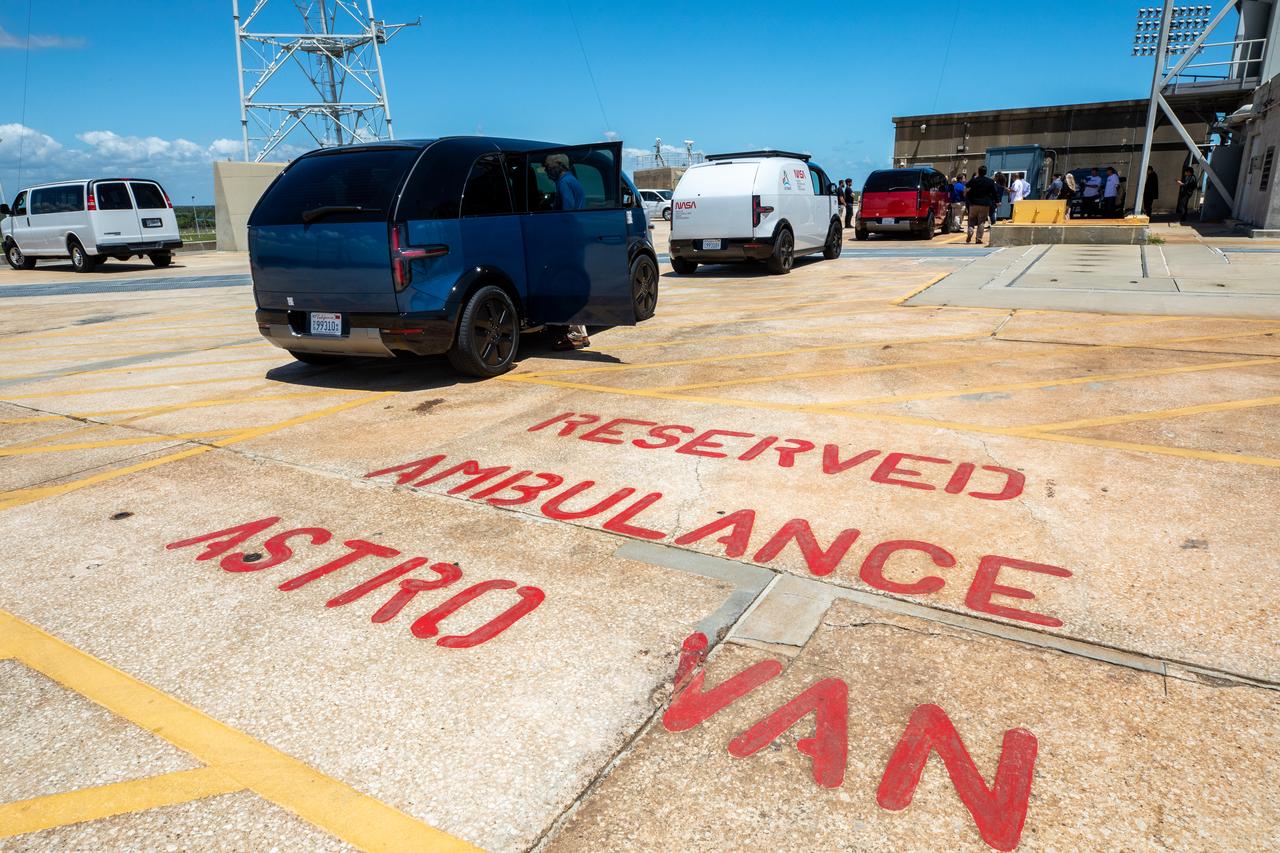
Several concept designs for Artemis crew transportation vehicles (CTV) are lined up at Launch Complex 39B at NASA’s Kennedy Space Center in Florida on May 11, 2022. Canoo Technologies Inc., was awarded a contract to design and provide the next generation of CTVs for the Artemis crewed missions. Representatives with Canoo were at the spaceport demonstrating the environmentally friendly fleet of vehicles. Artemis II will be the first Artemis mission flying crew aboard Orion. In later missions, NASA will land the first woman and the first person of color on the surface of the Moon, paving the way for a long-term lunar presence and serving as a steppingstone on the way to Mars.
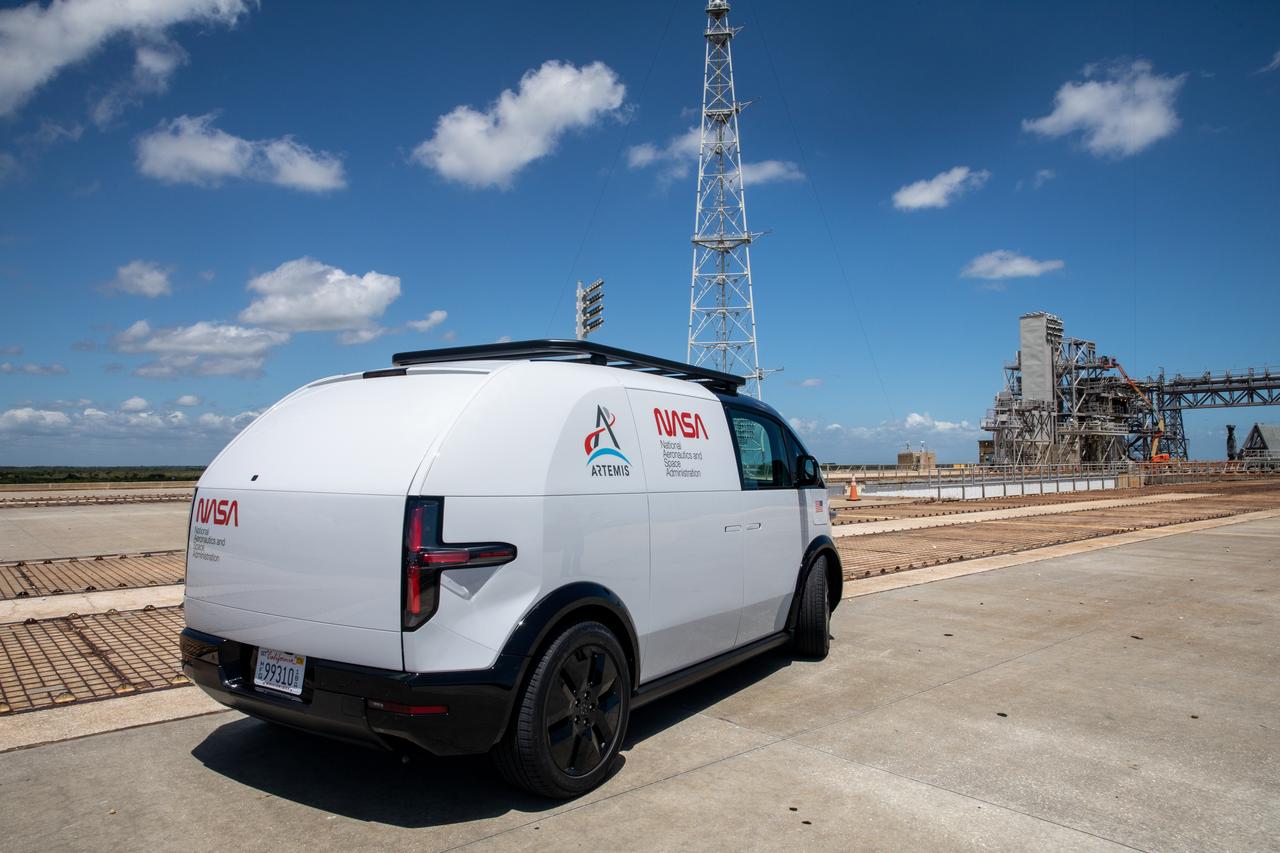
Prototypes of the crew transportation vehicle (CTV) for Artemis crewed missions are driven out to Launch Complex 39B at NASA’s Kennedy Space Center in Florida on May 11, 2022. Canoo Technologies Inc., was awarded a contract to design and provide the next generation of CTVs for the Artemis crewed missions. Representatives with Canoo were at the spaceport demonstrating the environmentally friendly fleet of vehicles. Artemis II will be the first Artemis mission flying crew aboard Orion. In later missions, NASA will land the first woman and the first person of color on the surface of the Moon, paving the way for a long-term lunar presence and serving as a steppingstone on the way to Mars.
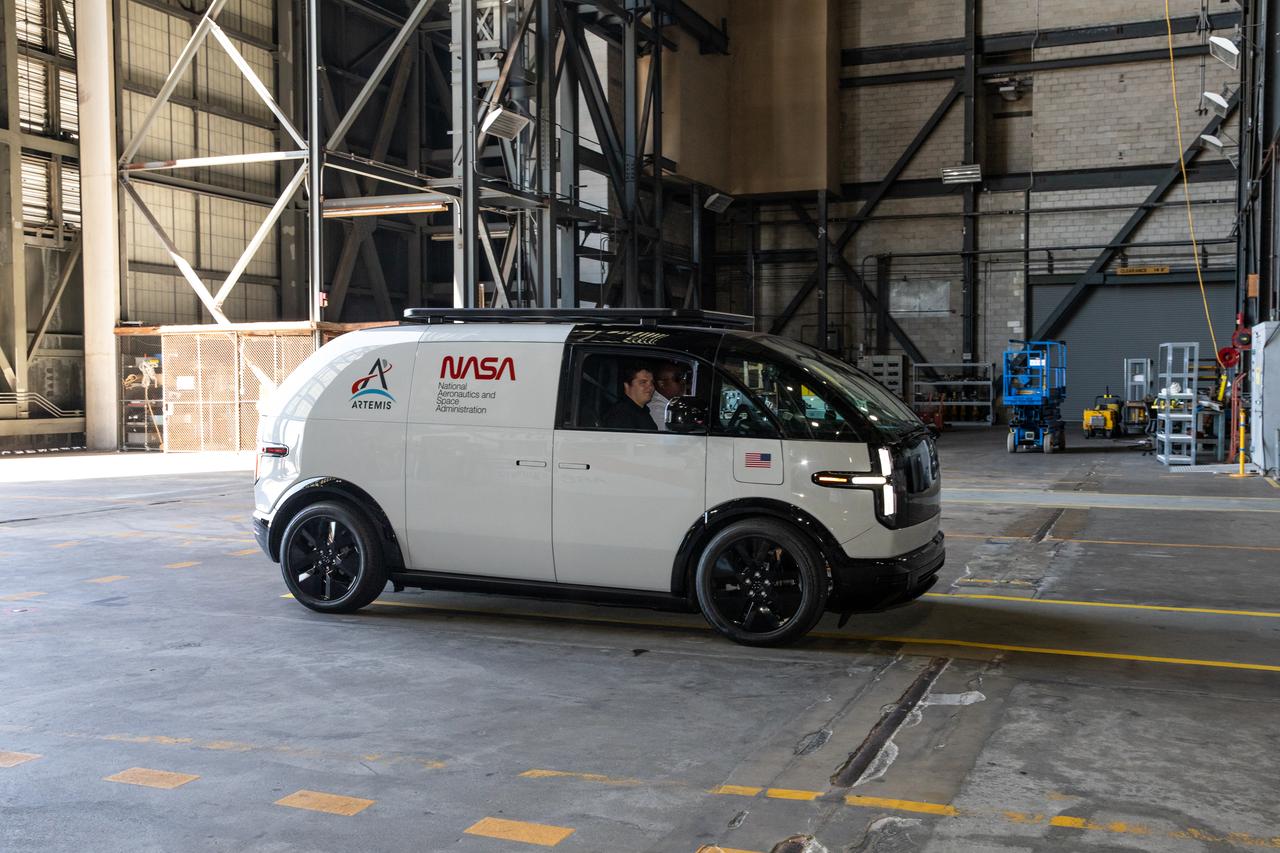
A concept design of a crew transportation vehicle (CTV) for Artemis crewed missions is driven inside the transfer aisle of the Vehicle Assembly Building at NASA’s Kennedy Space Center in Florida on May 11, 2022. Canoo Technologies Inc., was awarded a contract to design and provide the next generation of CTVs for the Artemis crewed missions. Representatives with Canoo were at the spaceport demonstrating the environmentally friendly fleet of vehicles. Artemis II will be the first Artemis mission flying crew aboard Orion. In later missions, NASA will land the first woman and the first person of color on the surface of the Moon, paving the way for a long-term lunar presence and serving as a steppingstone on the way to Mars.

Kennedy Space Center Director Janet Petro test drives a concept design crew transportation vehicle (CTV) for Artemis crewed missions on May 11, 2022. Canoo Technologies Inc., was awarded a contract to design and provide the next generation of CTVs for the Artemis crewed missions. Representatives with Canoo were at the spaceport demonstrating the environmentally friendly fleet of vehicles. Artemis II will be the first Artemis mission flying crew aboard Orion. In later missions, NASA will land the first woman and the first person of color on the surface of the Moon, paving the way for a long-term lunar presence and serving as a steppingstone on the way to Mars.
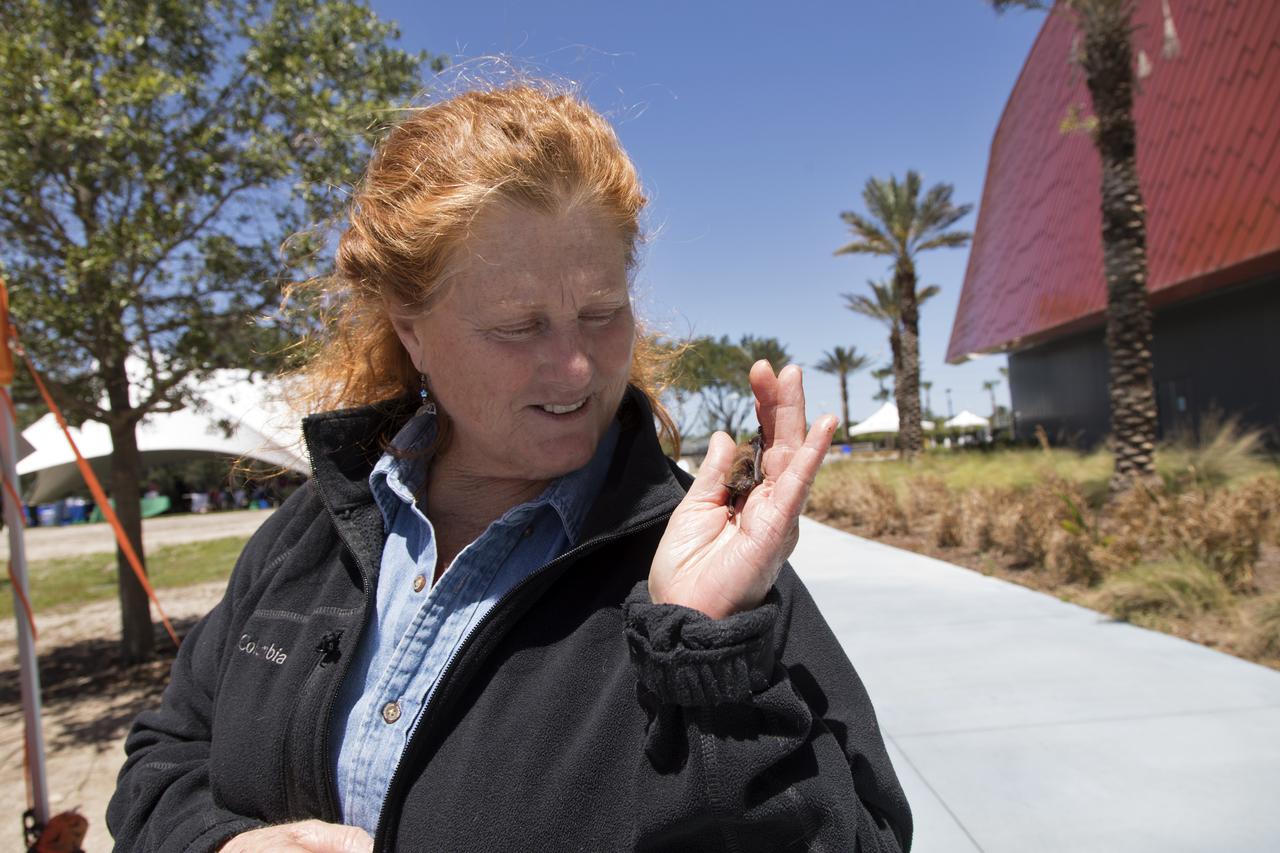
During the annual Earth Day celebration at the Kennedy Space Center Visitor Complex, Shari Blissett-Clark of the Florida Bat Conservancy displays one of the mammals. The event took place during the annual Earth Day celebration at the Kennedy Space Center Visitor Complex, guests have an opportunity to learn more about energy awareness, the environment and sustainability.
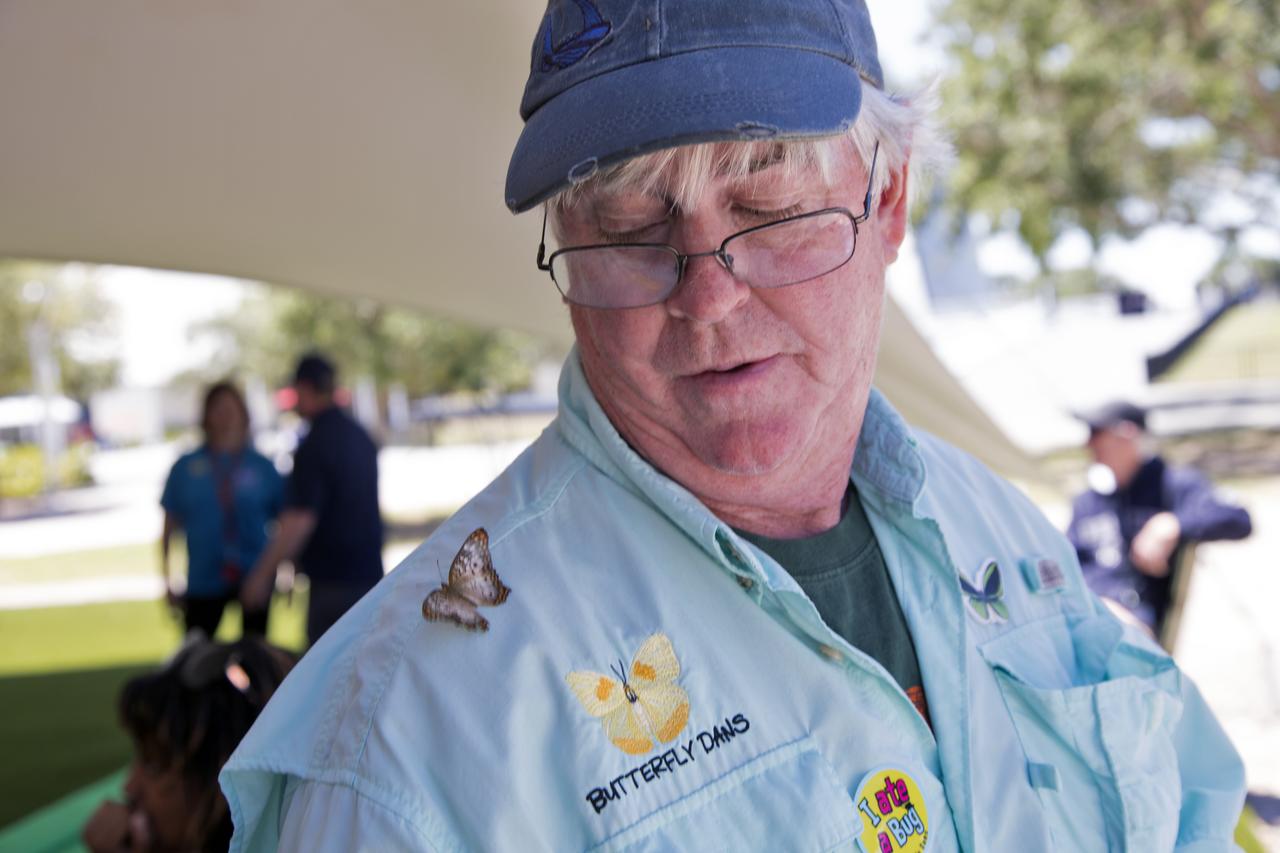
During the annual Earth Day celebration at the Kennedy Space Center Visitor Complex, guests have an opportunity to learn about the environment and meet Butterfly Dan” Dunwoody. The two-day event featured approximately 50 exhibitors offering information on a variety of topics, including electric vehicles, sustainable lighting, renewable energy, Florida-friendly landscaping tips, Florida’s biking trails and more.
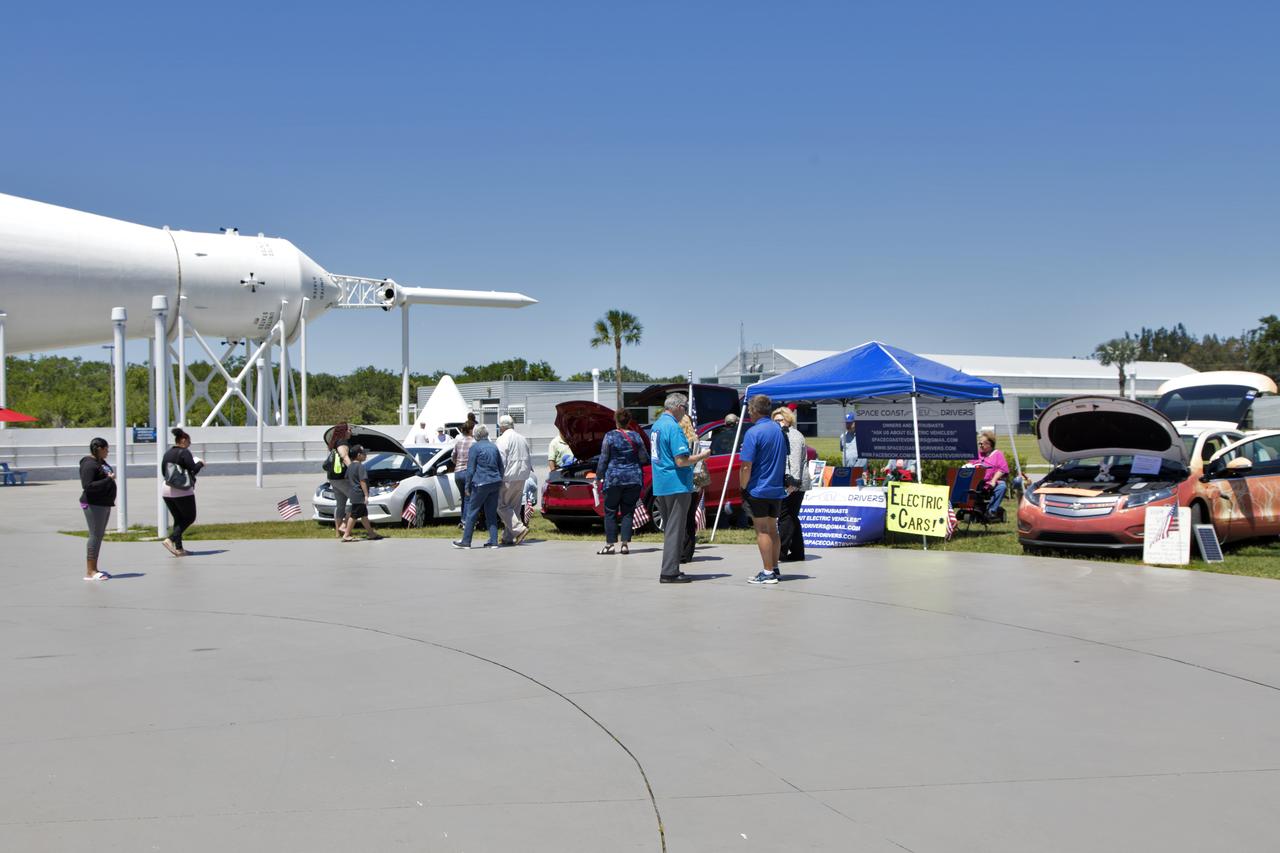
During the annual Earth Day celebration at the Kennedy Space Center Visitor Complex, guests have an opportunity to get an up-close look at experimental electric vehicles. The two-day event featured approximately 50 exhibitors offering information on a variety of topics, including electric vehicles, sustainable lighting, renewable energy, Florida-friendly landscaping tips, Florida’s biking trails and more.
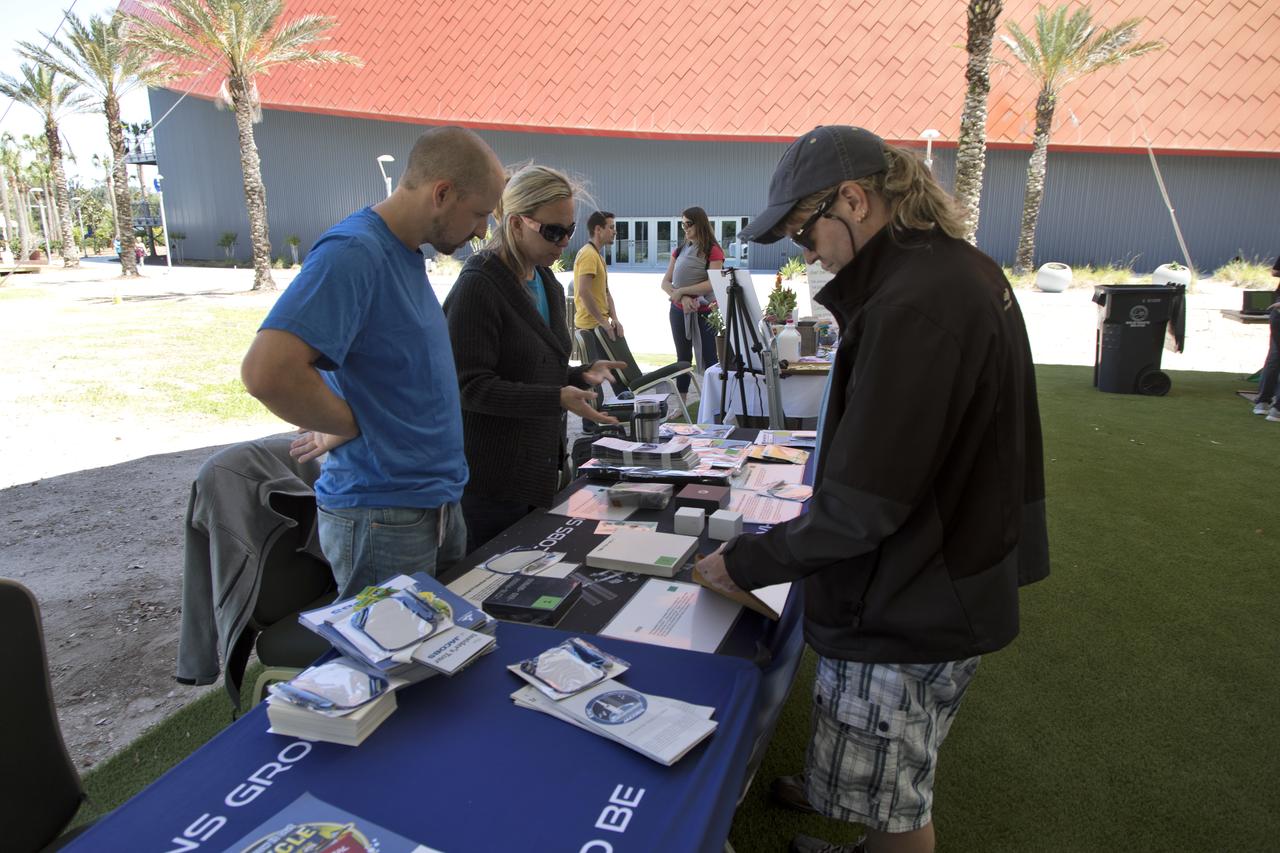
During the annual Earth Day celebration at the Kennedy Space Center Visitor Complex, guests have an opportunity to learn more about energy awareness, the environment and sustainability. The two-day event featured approximately 50 exhibitors offering information on a variety of topics, including electric vehicles, sustainable lighting, renewable energy, Florida-friendly landscaping tips, Florida’s biking trails and more.
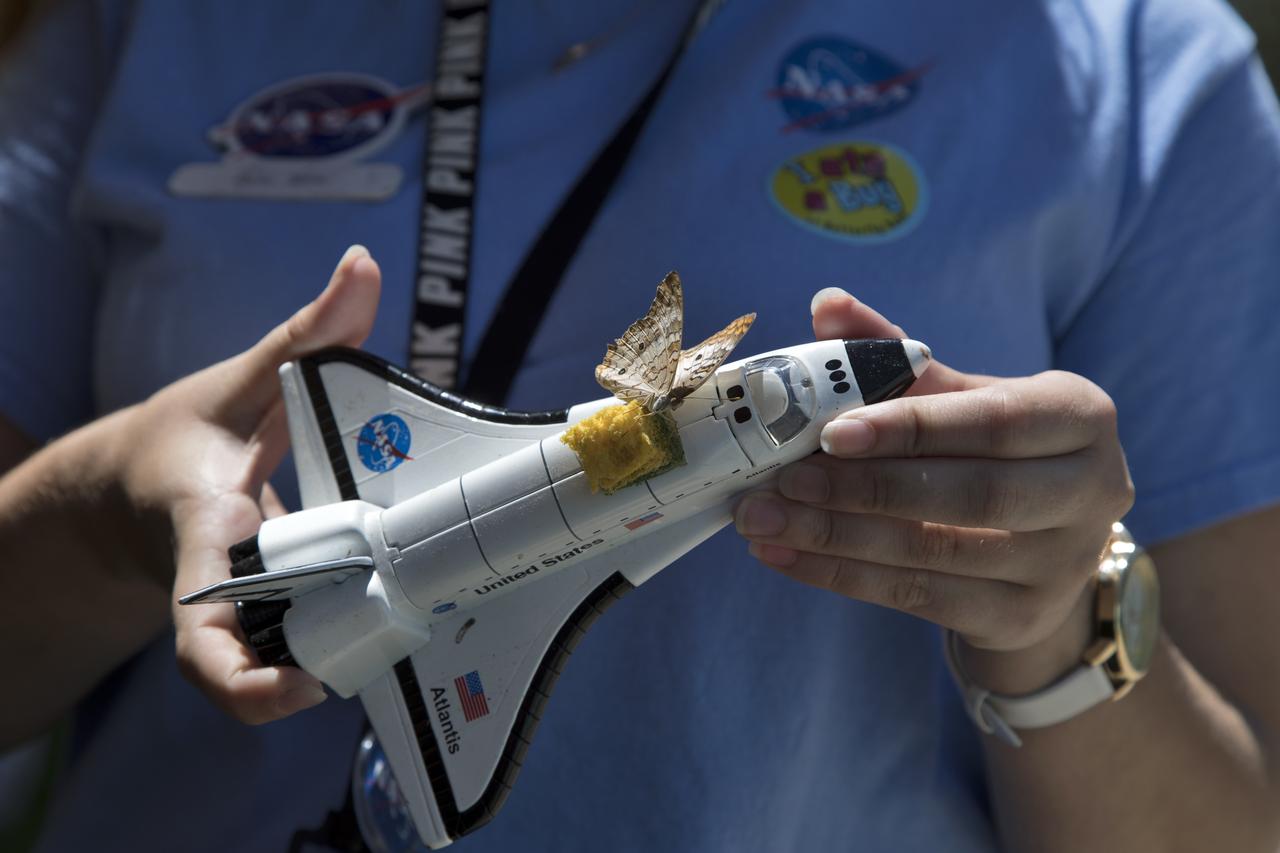
During the annual Earth Day celebration at the Kennedy Space Center Visitor Complex, guests have an opportunity to learn about the environment. The two-day event featured approximately 50 exhibitors offering information on a variety of topics, including electric vehicles, sustainable lighting, renewable energy, Florida-friendly landscaping tips, Florida’s biking trails and more.
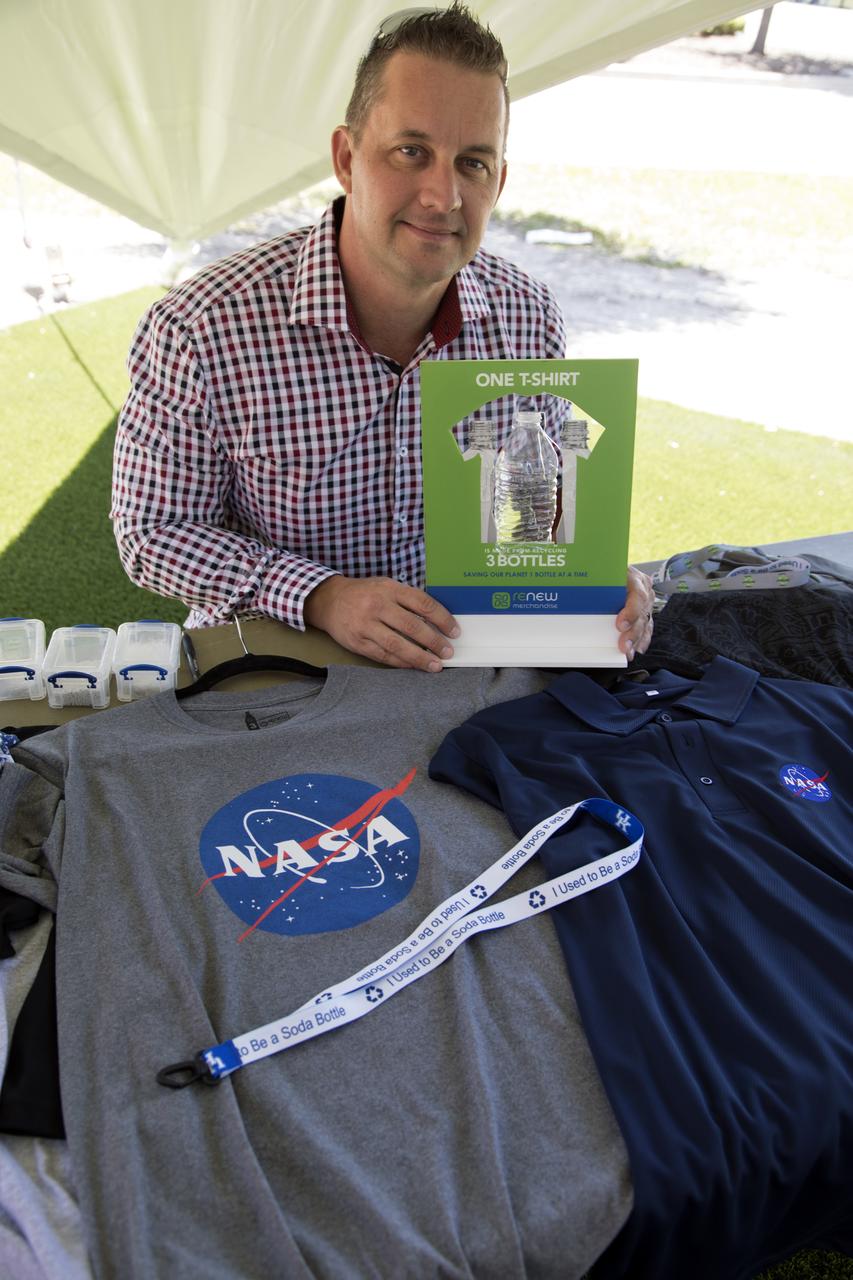
David Bell of Renew Merchandise was one of 50 exhibitors offering information on a variety of topics, including electric vehicles, sustainable lighting, renewable energy, Florida-friendly landscaping tips, Florida’s biking trails and more. The event took place during the annual Earth Day celebration at the Kennedy Space Center Visitor Complex, guests have an opportunity to learn more about energy awareness, the environment and sustainability.
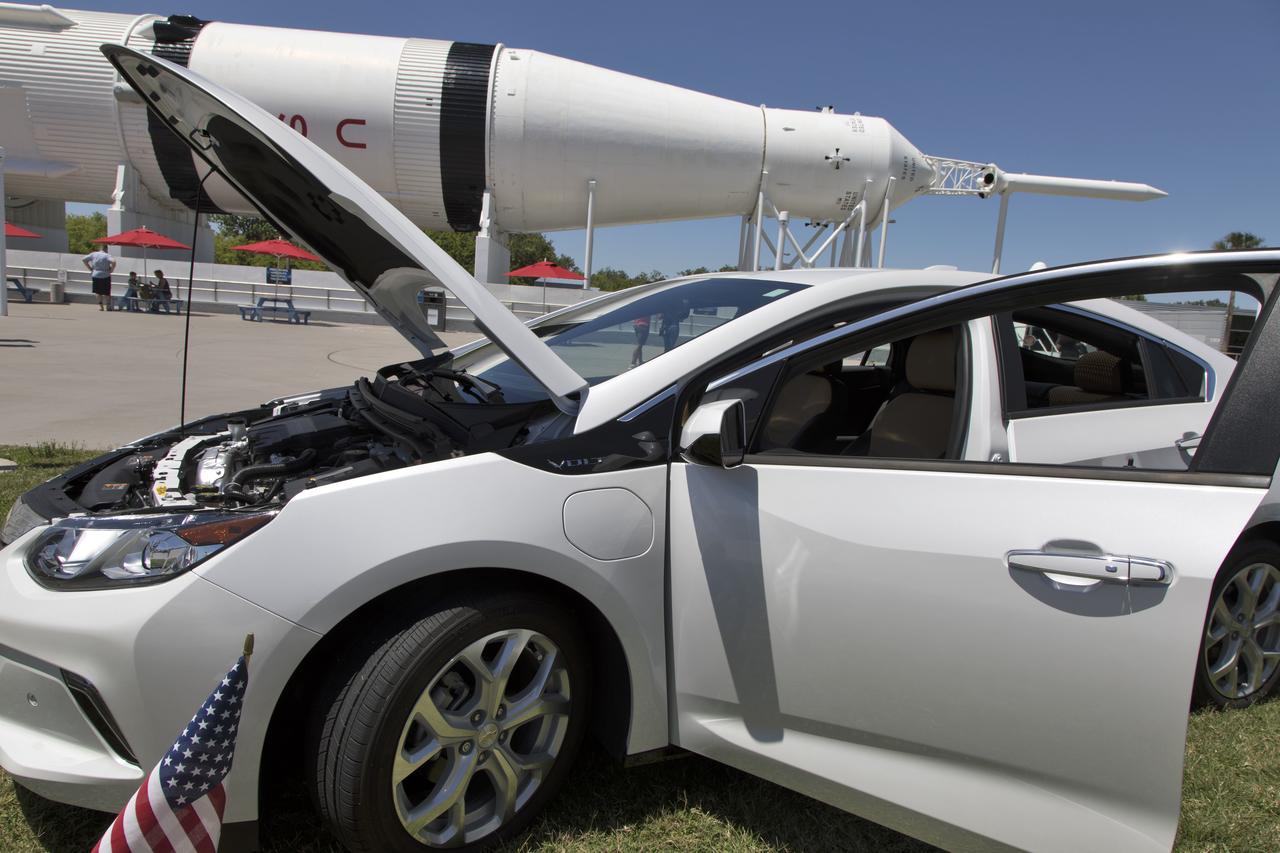
During the annual Earth Day celebration at the Kennedy Space Center Visitor Complex, guests have an opportunity to get an up-close look at experimental electric vehicles. The two-day event featured approximately 50 exhibitors offering information on a variety of topics, including electric vehicles, sustainable lighting, renewable energy, Florida-friendly landscaping tips, Florida’s biking trails and more.
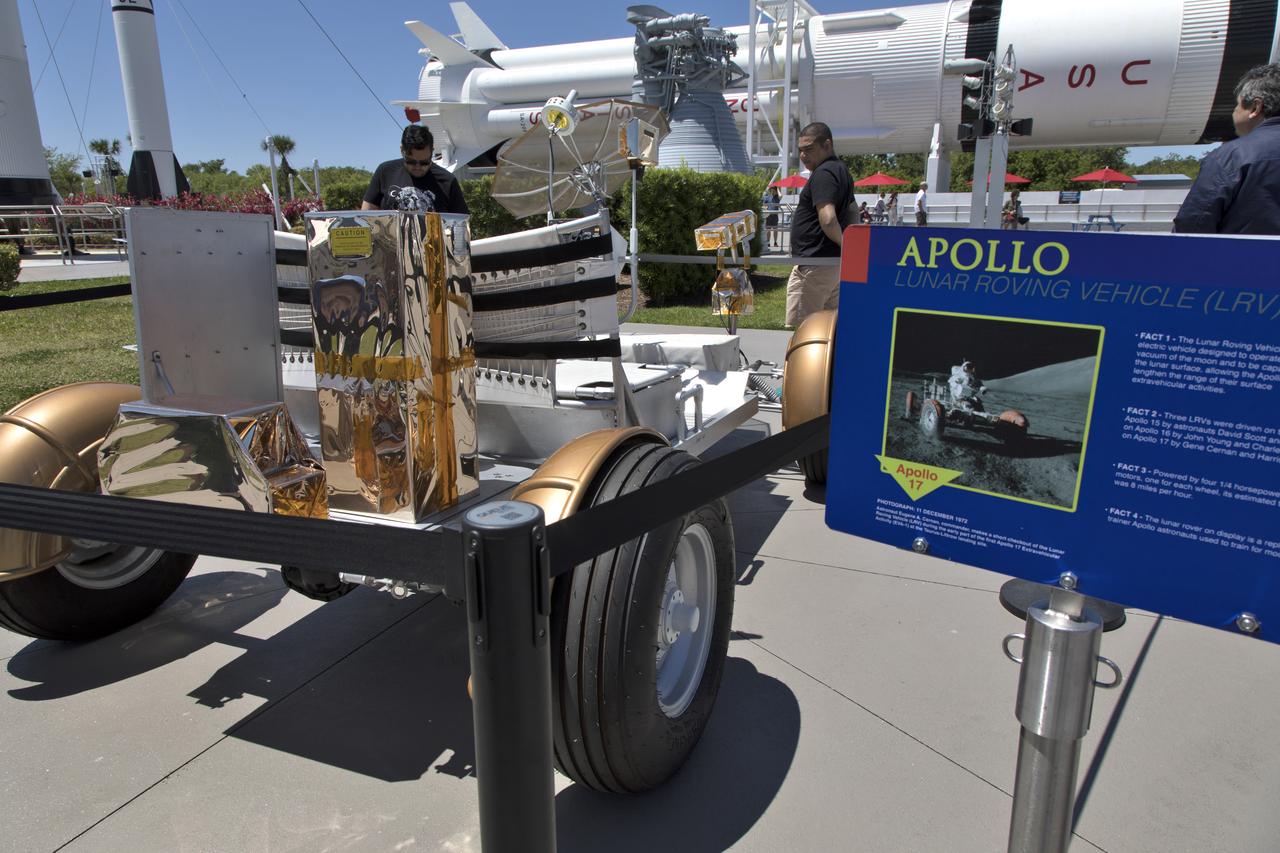
During the annual Earth Day celebration at the Kennedy Space Center Visitor Complex, guests have an opportunity to get an up-close look at experimental electric vehicles and see and Apollo era Lunar Roving Vehicle used in astronaut training. The battery-operated car was used on Apollos 15, 16 and 17 in 1971 and 1972. The two-day event featured approximately 50 exhibitors offering information on a variety of topics, including electric vehicles, sustainable lighting, renewable energy, Florida-friendly landscaping tips, Florida’s biking trails and more.
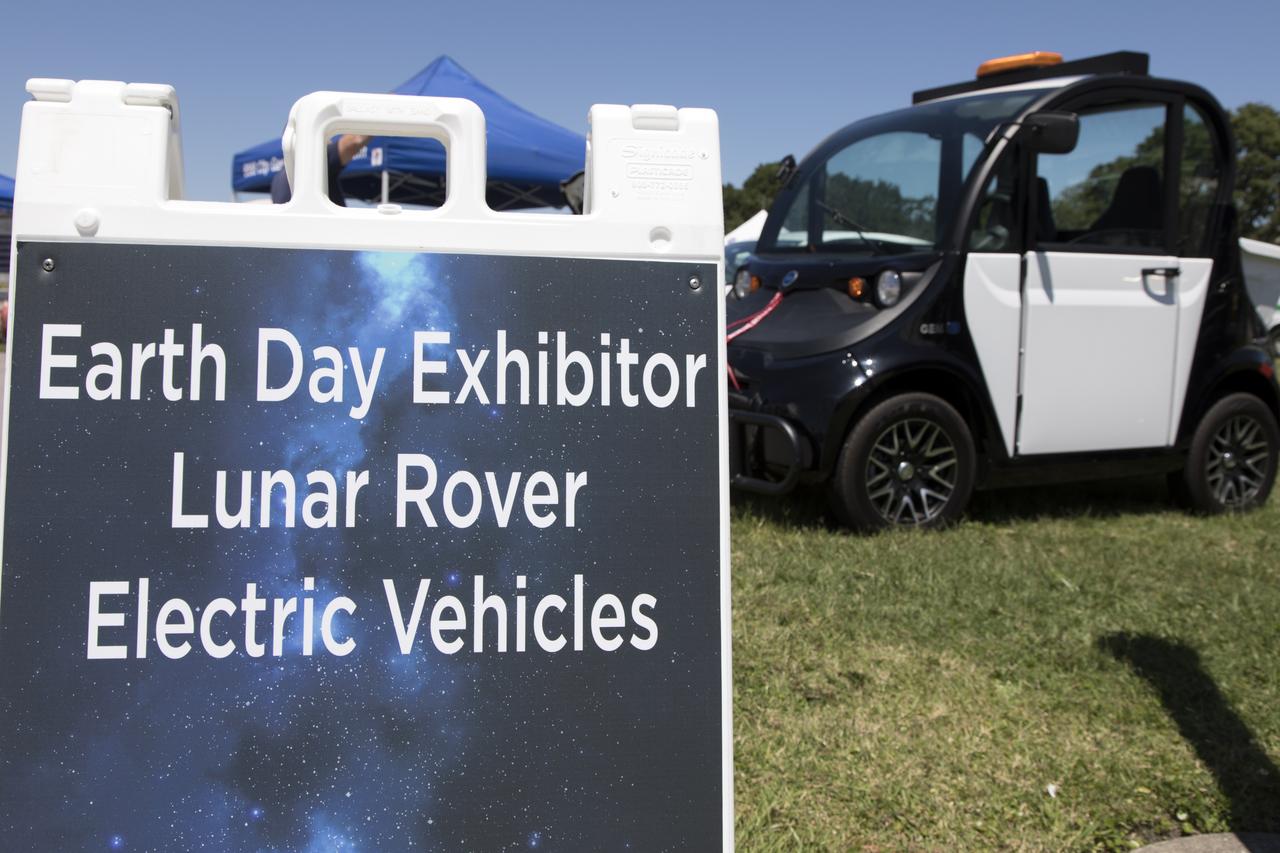
During the annual Earth Day celebration at the Kennedy Space Center Visitor Complex, guests have an opportunity to get an up-close look at experimental electric vehicles. The two-day event featured approximately 50 exhibitors offering information on a variety of topics, including electric vehicles, sustainable lighting, renewable energy, Florida-friendly landscaping tips, Florida’s biking trails and more.
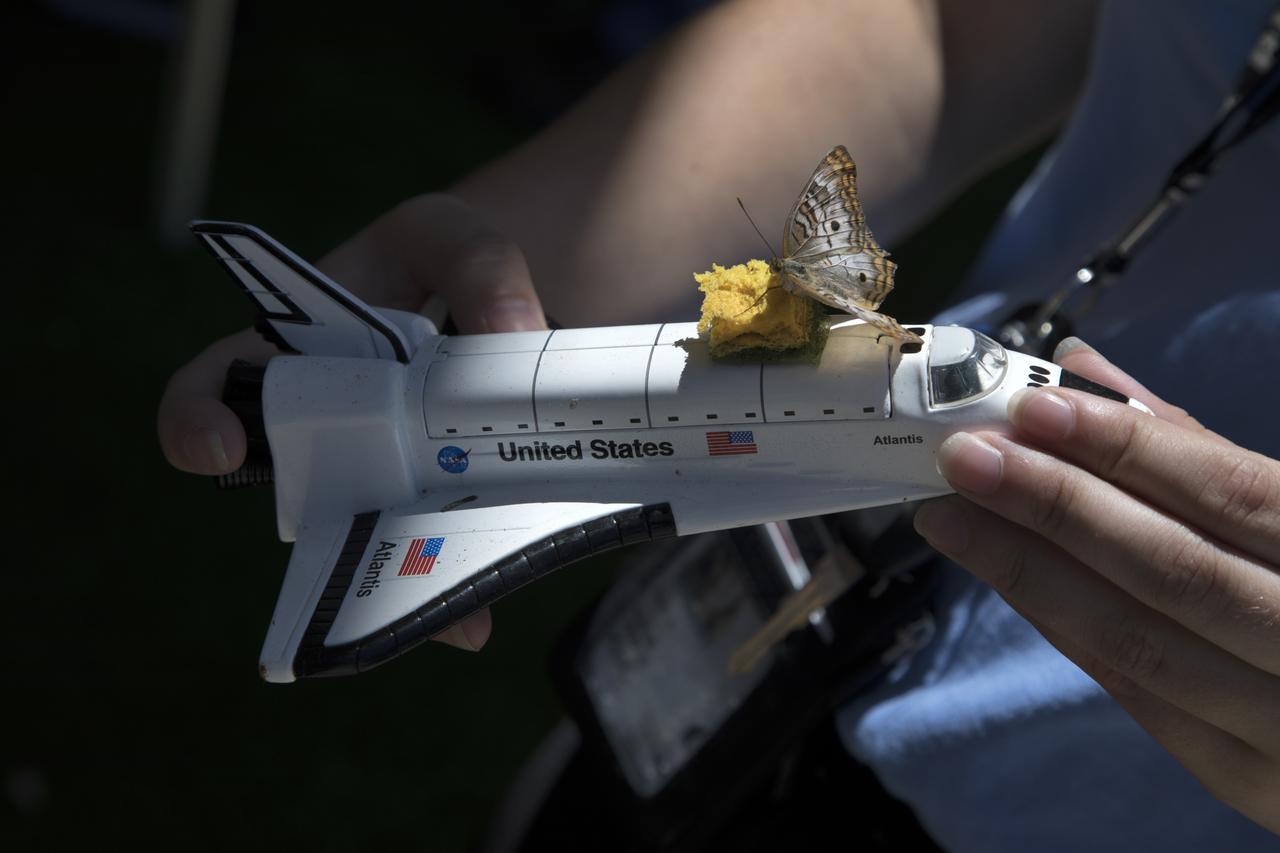
During the annual Earth Day celebration at the Kennedy Space Center Visitor Complex, guests have an opportunity to learn about the environment. The two-day event featured approximately 50 exhibitors offering information on a variety of topics, including electric vehicles, sustainable lighting, renewable energy, Florida-friendly landscaping tips, Florida’s biking trails and more.

During the annual Earth Day celebration at the Kennedy Space Center Visitor Complex, Shari Blissett-Clark of the Florida Bat Conservancy displays one of the mammals. The event took place during the annual Earth Day celebration at the Kennedy Space Center Visitor Complex, guests have an opportunity to learn more about energy awareness, the environment and sustainability.
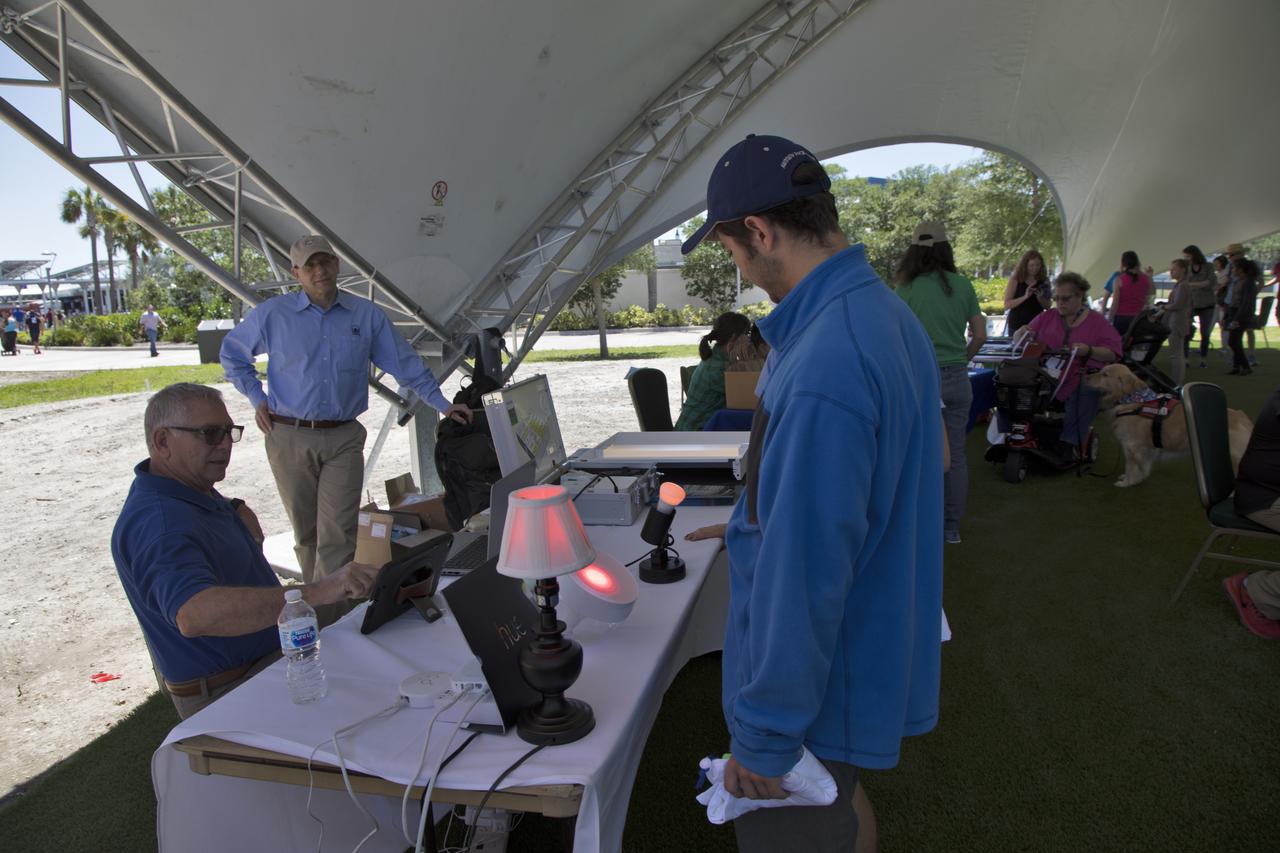
During the annual Earth Day celebration at the Kennedy Space Center Visitor Complex, guests have an opportunity to learn more about energy awareness, the environment and sustainability. The two-day event featured approximately 50 exhibitors offering information on a variety of topics, including electric vehicles, sustainable lighting, renewable energy, Florida-friendly landscaping tips, Florida’s biking trails and more.
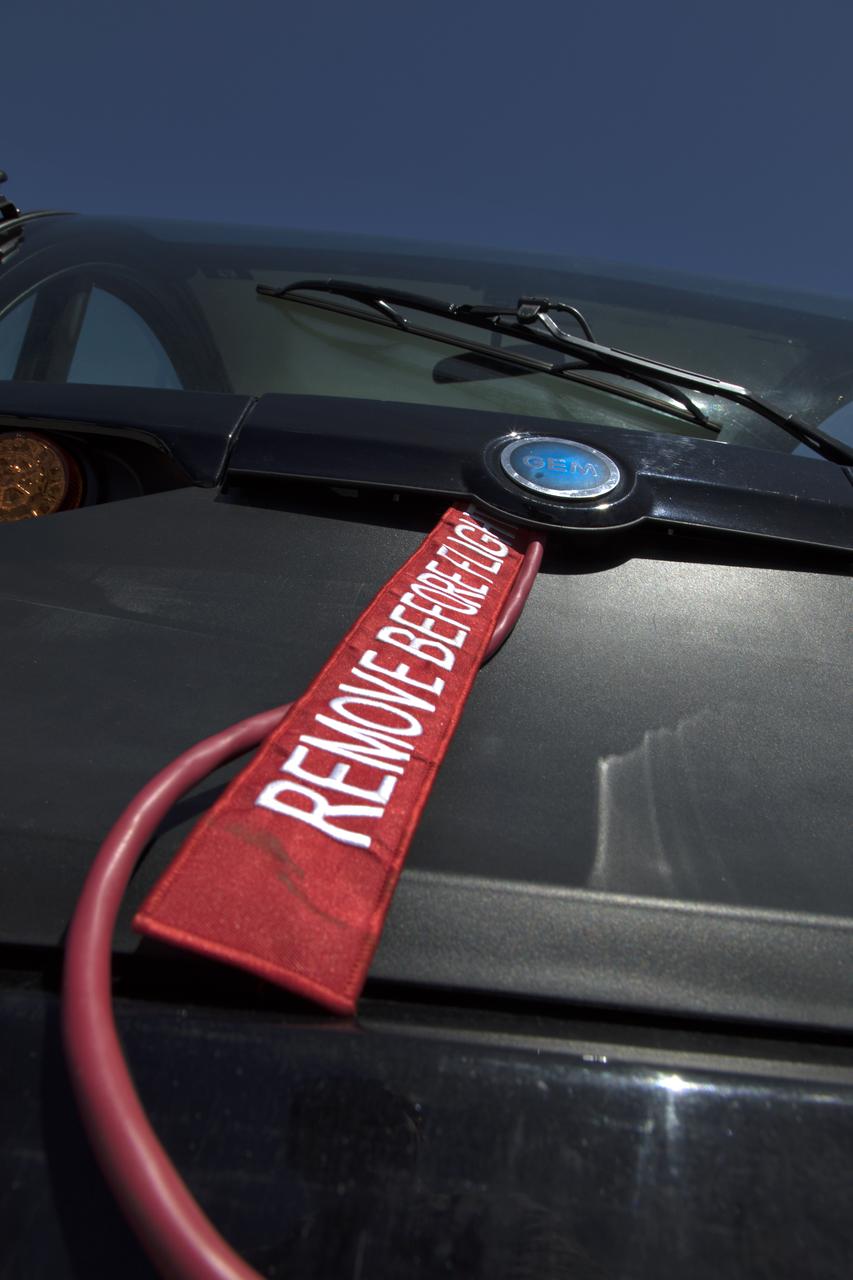
During the annual Earth Day celebration at the Kennedy Space Center Visitor Complex, guests have an opportunity to get an up-close look at experimental electric vehicles. The "Remove Before Flight" tag is on a Polaris GEM electric car. The two-day event featured approximately 50 exhibitors offering information on a variety of topics, including electric vehicles, sustainable lighting, renewable energy, Florida-friendly landscaping tips, Florida’s biking trails and more.
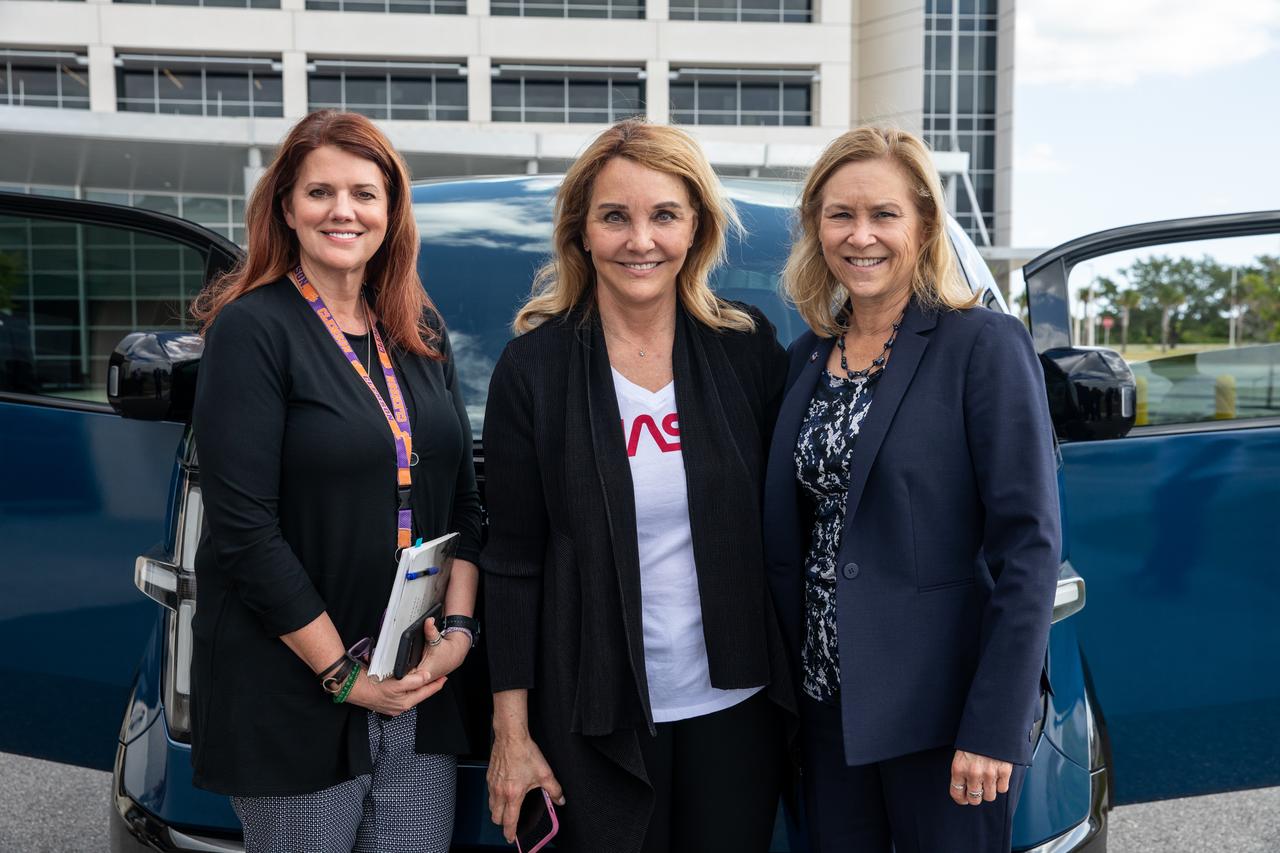
Kennedy Space Center Director Janet Petro, at right test drives a concept design crew transportation vehicle (CTV) for Artemis crewed missions on May 11, 2022. With her, from left, are Charlie Blackwell-Thompson, Artemis I launch director, and Josette Sheeran, president of Canoo Technologies, Inc.. Canoo Technologies Inc., was awarded a contract to design and provide the next generation of CTVs for the Artemis crewed missions. Representatives with Canoo were at the spaceport demonstrating the environmentally friendly fleet of vehicles. Artemis II will be the first Artemis mission flying crew aboard Orion. In later missions, NASA will land the first woman and the first person of color on the surface of the Moon, paving the way for a long-term lunar presence and serving as a steppingstone on the way to Mars.
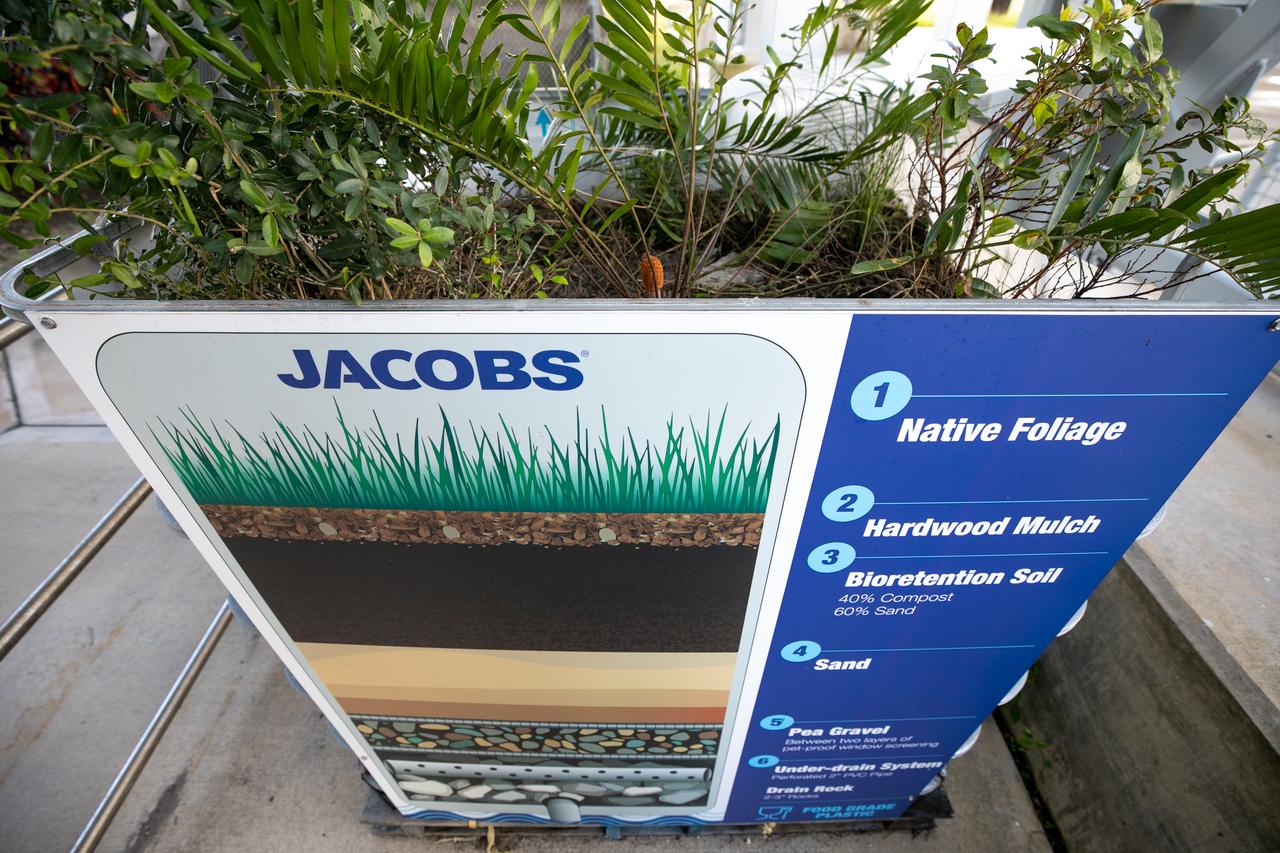
NASA Kennedy Space Center’s unrivaled dedication to the environment is highlighted through a variety of environmental programs and projects. Through a partnership with Jacobs Technology, Inc., teams have constructed a bio-filter – made of layered rock, soil, and native plants – as an eco-friendly way to filter zinc out of rainwater runoff. Photographed on Sept. 29, 2020, at the Florida spaceport’s Launch Complex 39 observation tower, the bio-filter catches water that runs off of this location’s galvanized roof, which contains a coating of zinc to help protect the metal from rust or corrosion. The plants in the bio-filter bind to the zinc so that when the water comes out of the bottom, it’s clean and safe to go into the Indian River Lagoon – its waterline located about 20 to 30 feet away.
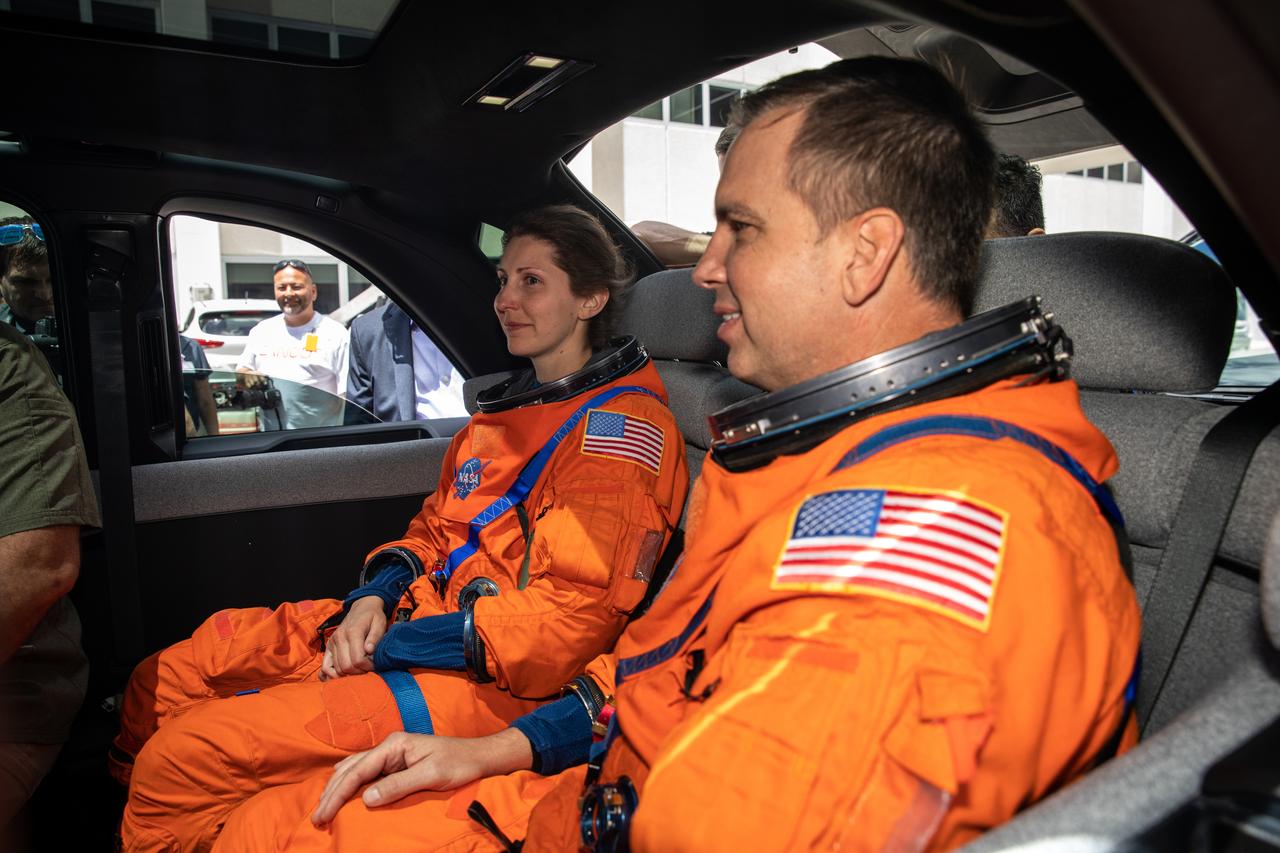
Technicians from Johnson Space Center, dressed in flight suits, secure themselves inside a prototype of a crew transportation vehicle (CTV) for Artemis crewed missions outside the Neil Armstrong Operations and Checkout Building at NASA’s Kennedy Space Center in Florida on May 11, 2022. Canoo Technologies Inc., was awarded a contract to design and provide the next generation of CTVs for the Artemis crewed missions. Representatives with Canoo were at the spaceport demonstrating the environmentally friendly fleet of vehicles. Artemis II will be the first Artemis mission flying crew aboard Orion. In later missions, NASA will land the first woman and the first person of color on the surface of the Moon, paving the way for a long-term lunar presence and serving as a steppingstone on the way to Mars.
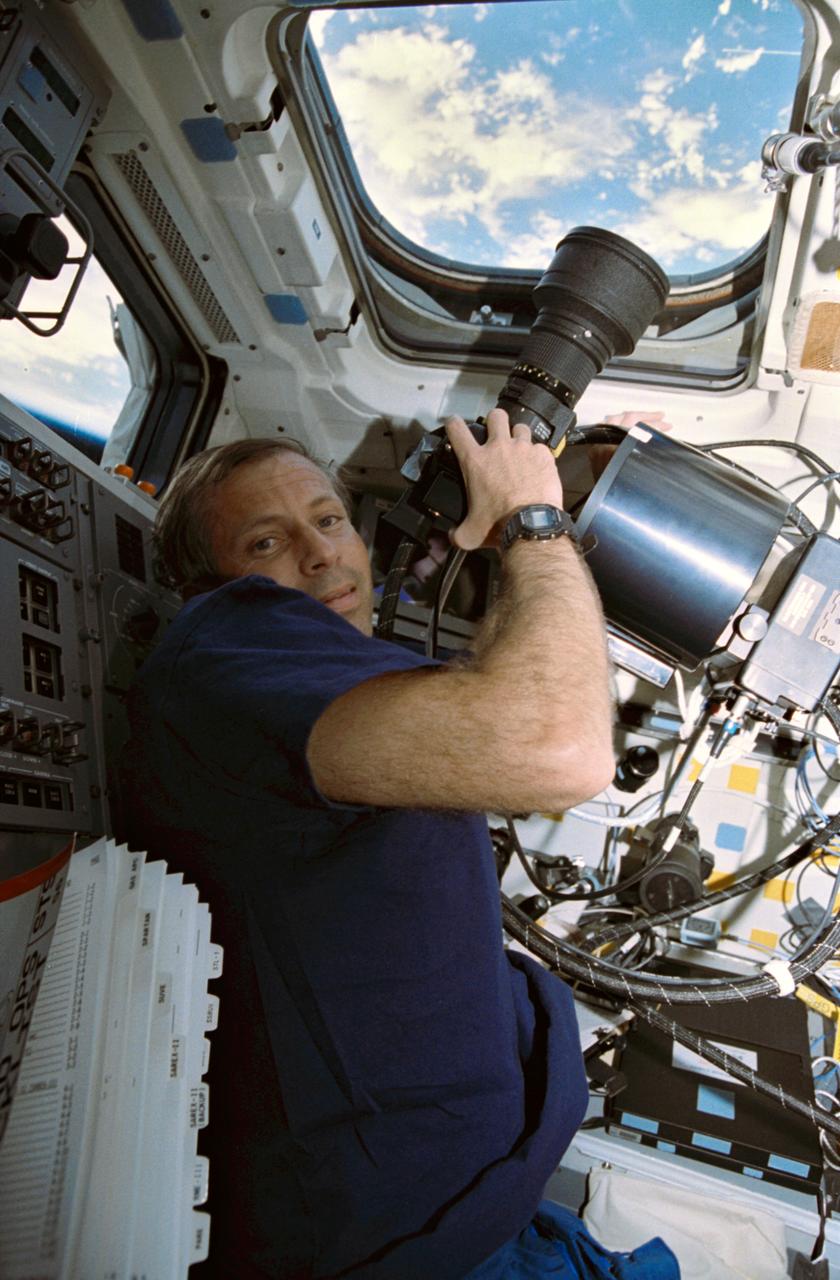
STS056-08-018 (8-17 April 1993) --- Aboard Discovery, astronaut Kenneth D. Cockrell, mission specialist, records Earth imagery with the Hand-Held, Earth-Oriented, Real-Time, Cooperative, User-Friendly, Location-Targeting and Environmental System (HERCULES). HERCULES is a device that makes it simple for Shuttle crew members to take pictures of Earth, as they merely point a modified 35mm camera and shoot any interesting feature, whose latitude and longitude are automatically determined in real-time. The powder-box shaped attachment is the Inertial Measurement Unit (IMU) for the system. The STS-56 crew downlinked a number of the still images during the flight, while others are likely to be stored on disc and returned to Earth with the crew.
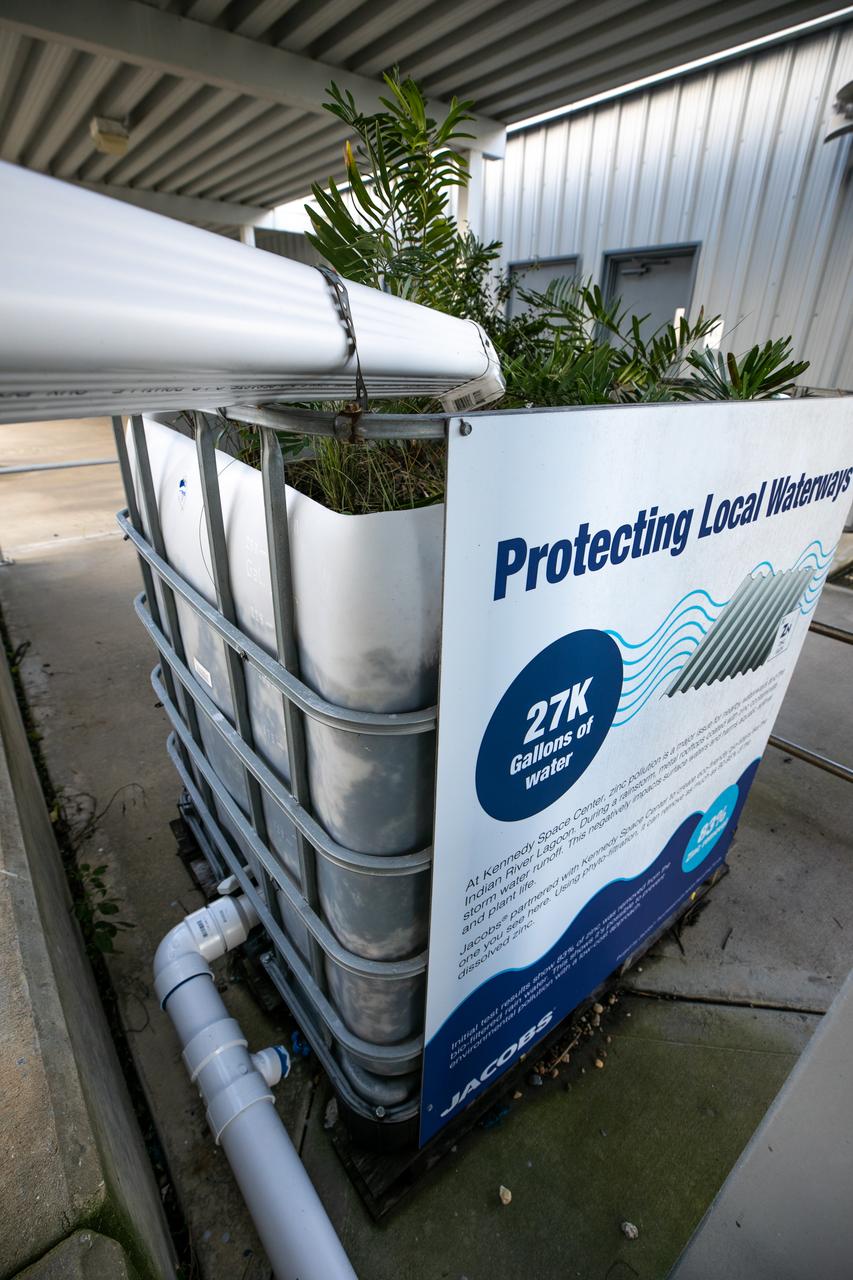
NASA Kennedy Space Center’s unrivaled dedication to the environment is highlighted through a variety of environmental programs and projects. Through a partnership with Jacobs Technology, Inc., teams have constructed a bio-filter – made of layered rock, soil, and native plants – as an eco-friendly way to filter zinc out of rainwater runoff. Photographed on Sept. 29, 2020, at the Florida spaceport’s Launch Complex 39 observation tower, the bio-filter catches water that runs off of this location’s galvanized roof, which contains a coating of zinc to help protect the metal from rust or corrosion. The plants in the bio-filter bind to the zinc so that when the water comes out of the bottom, it’s clean and safe to go into the Indian River Lagoon – its waterline located about 20 to 30 feet away.
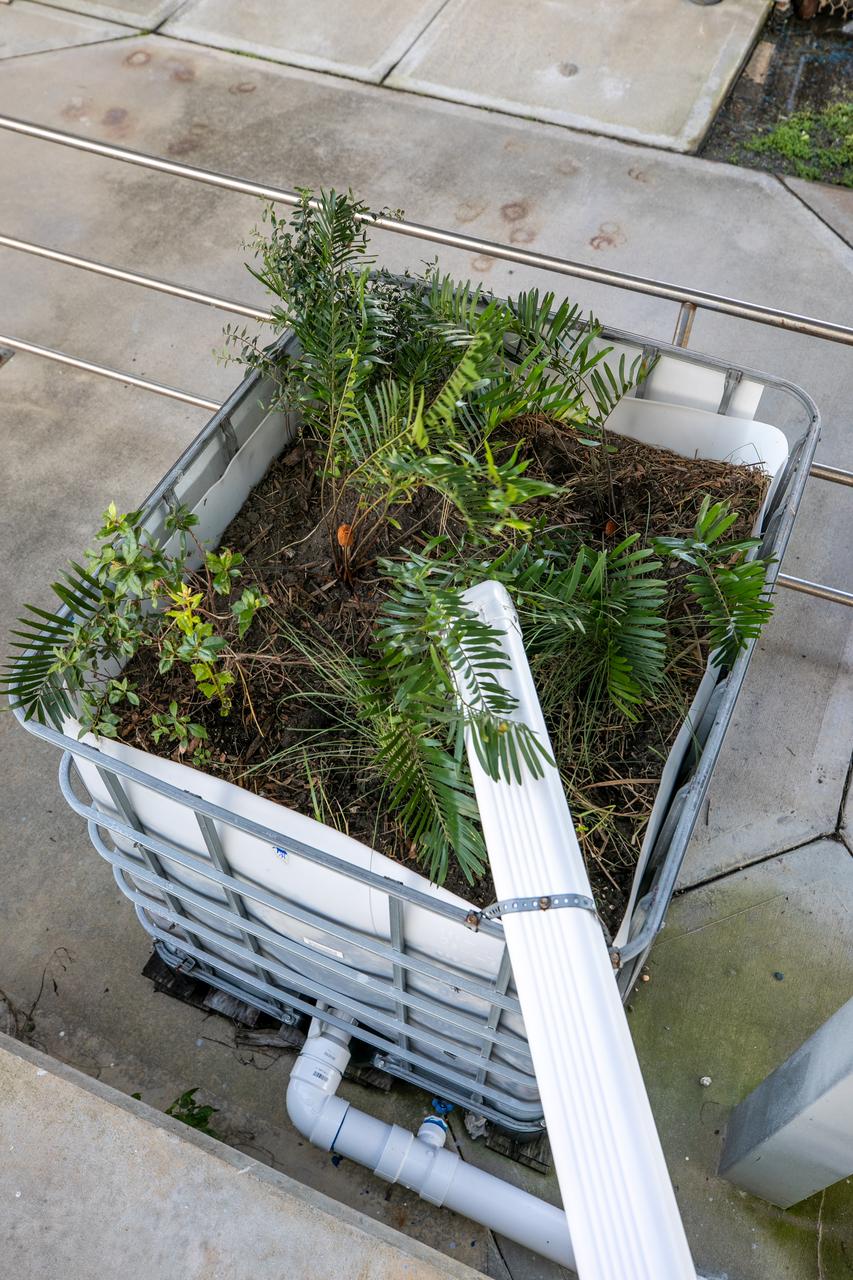
NASA Kennedy Space Center’s unrivaled dedication to the environment is highlighted through a variety of environmental programs and projects. Through a partnership with Jacobs Technology, Inc., teams have constructed a bio-filter – made of layered rock, soil, and native plants – as an eco-friendly way to filter zinc out of rainwater runoff. Photographed on Sept. 29, 2020, at the Florida spaceport’s Launch Complex 39 observation tower, the bio-filter catches water that runs off of this location’s galvanized roof, which contains a coating of zinc to help protect the metal from rust or corrosion. The plants in the bio-filter bind to the zinc so that when the water comes out of the bottom, it’s clean and safe to go into the Indian River Lagoon – its waterline located about 20 to 30 feet away.
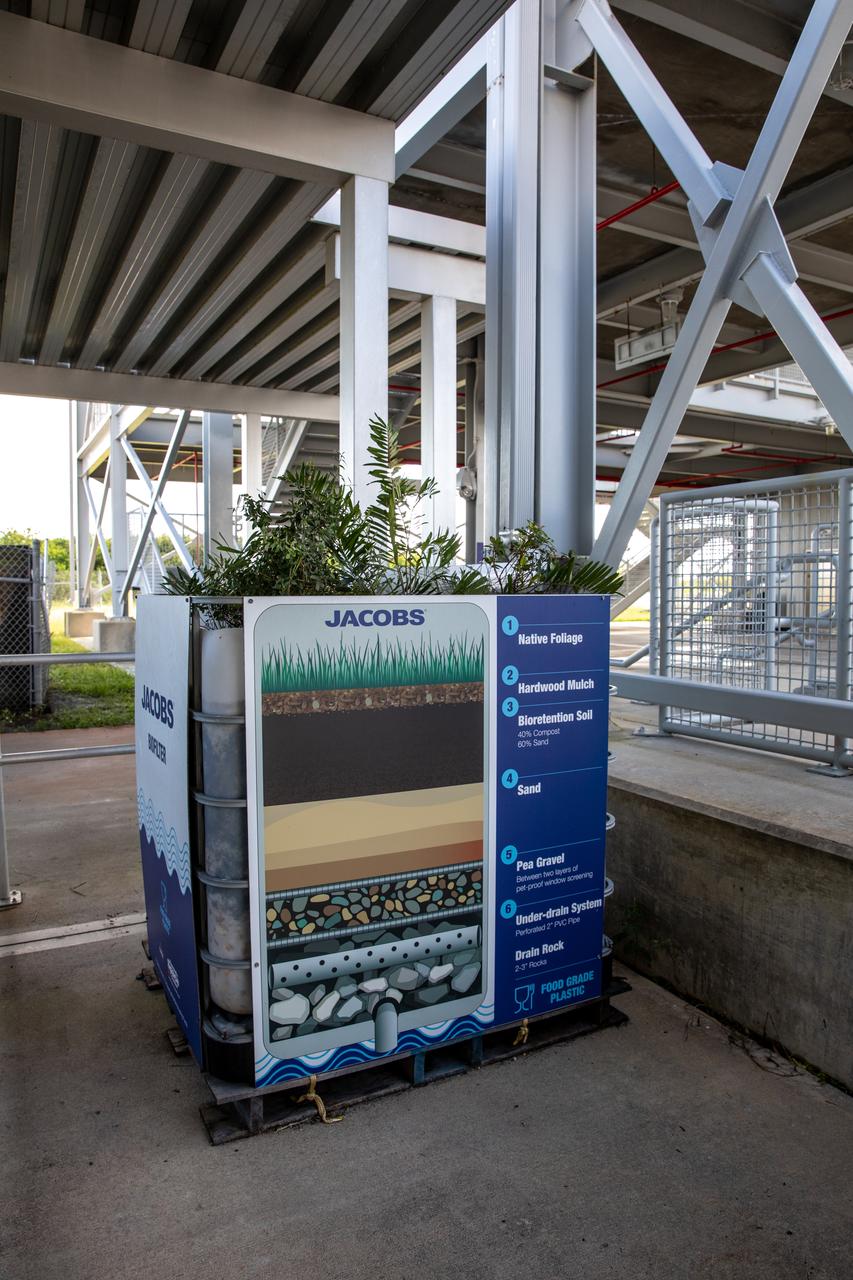
NASA Kennedy Space Center’s unrivaled dedication to the environment is highlighted through a variety of environmental programs and projects. Through a partnership with Jacobs Technology, Inc., teams have constructed a bio-filter – made of layered rock, soil, and native plants – as an eco-friendly way to filter zinc out of rainwater runoff. Photographed on Sept. 29, 2020, at the Florida spaceport’s Launch Complex 39 observation tower, the bio-filter catches water that runs off of this location’s galvanized roof, which contains a coating of zinc to help protect the metal from rust or corrosion. The plants in the bio-filter bind to the zinc so that when the water comes out of the bottom, it’s clean and safe to go into the Indian River Lagoon – its waterline located about 20 to 30 feet away.
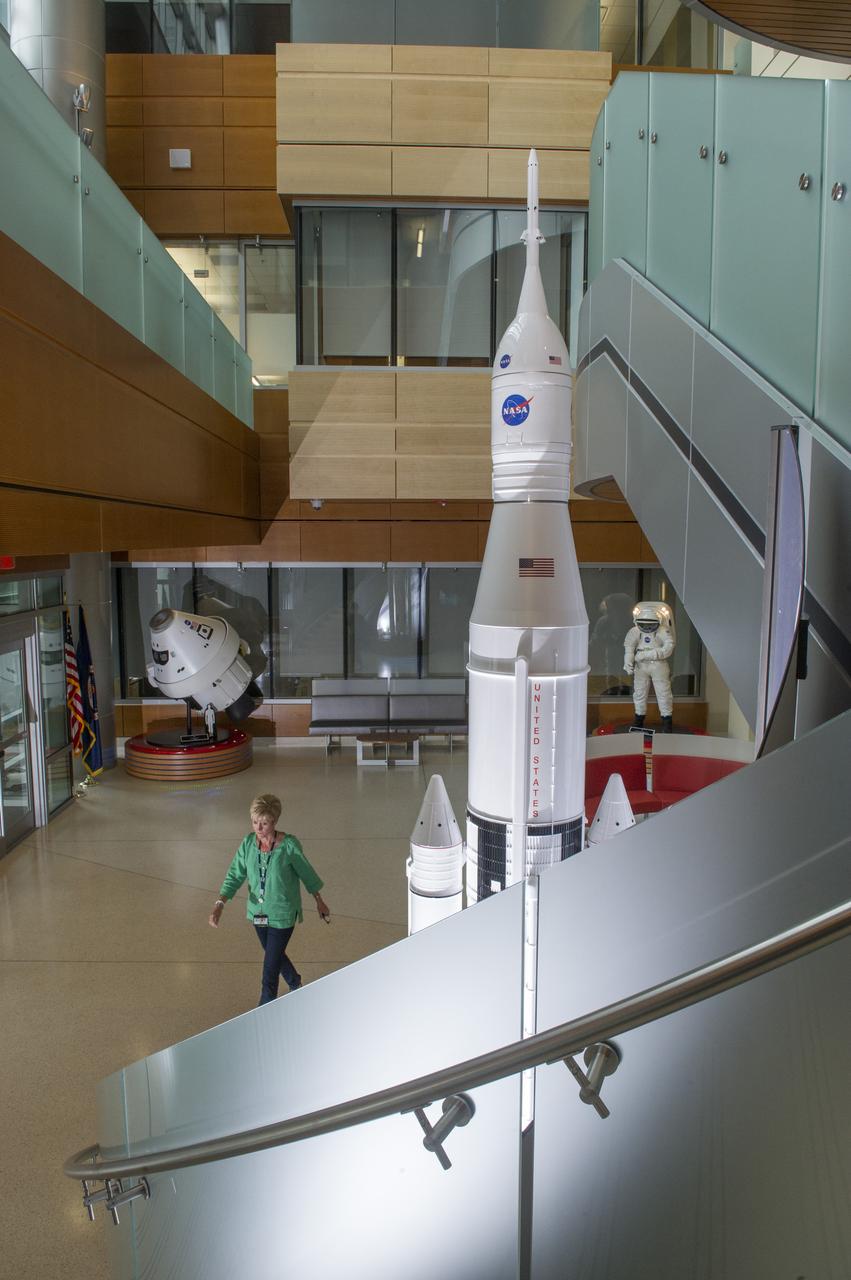
THE INTERIOR OF THE MARSHALL SPACE FLIGHT CENTER’S NEWLY OPENED BUILDING 4220, PRIMARILY HOME TO THE SPACE LAUNCH SYSTEM PROGRAM, REFLECTS A BLEND OF AESTHETICS, PRACTICALITY AND HIGH EFFICIENCY. THE COST-CONSCIOUS NEW FACILITY IS ENVIRONMENTALLY FRIENDLY ON ALL FRONTS, FEATURING STATE-OF-THE-ART GREEN TECHNOLOGIES AND ENERGY-CONSERVATION SYSTEMS THROUGHOUT THE BUILDING. THE ENTIRE STRUCTURE IS SPECIALLY INSULATED, WITH MUCH OF THE EXTERIOR COVERED IN LOW-EMISSIVITY GLASS THAT DEFLECTS HEAT TO REDUCE COOLING COSTS WITHIN. ROOFTOP SOLAR-POWER UNITS ABSORB ENERGY TO AUGMENT ELECTRICAL POWER, AND A 10,000-GALLON CISTERN COLLECTS STORMWATER TO IRRIGATE THE SURROUNDING GREENERY. EVEN THE FACILITY'S NEW PARKING LOT HAS A GREEN ELEMENT: RATHER THAN GUTTERS, IT INCLUDES A "BIOSWALE," A NATURAL, SOIL-AND-VEGETATION-BASED MEANS OF CAPTURING AND FILTERING STORMWATER RUNOFF, WHICH IS DIRECTED INTO A NEARBY COLLECTING POND. ONCE CERTIFICATION IS COMPLETE, BUILDING 4220 WILL BECOME THE SEVENTH LEED CERTIFIED MARSHALL STRUCTURE ON CAMPUS

NASA Kennedy Space Center’s unrivaled dedication to the environment is highlighted through a variety of environmental programs and projects. Through a partnership with Jacobs Technology, Inc., teams have constructed a bio-filter – made of layered rock, soil, and native plants – as an eco-friendly way to filter zinc out of rainwater runoff. Photographed on Sept. 29, 2020, at the Florida spaceport’s Launch Complex 39 observation tower, the bio-filter catches water that runs off of this location’s galvanized roof, which contains a coating of zinc to help protect the metal from rust or corrosion. The plants in the bio-filter bind to the zinc so that when the water comes out of the bottom, it’s clean and safe to go into the Indian River Lagoon – its waterline located about 20 to 30 feet away.
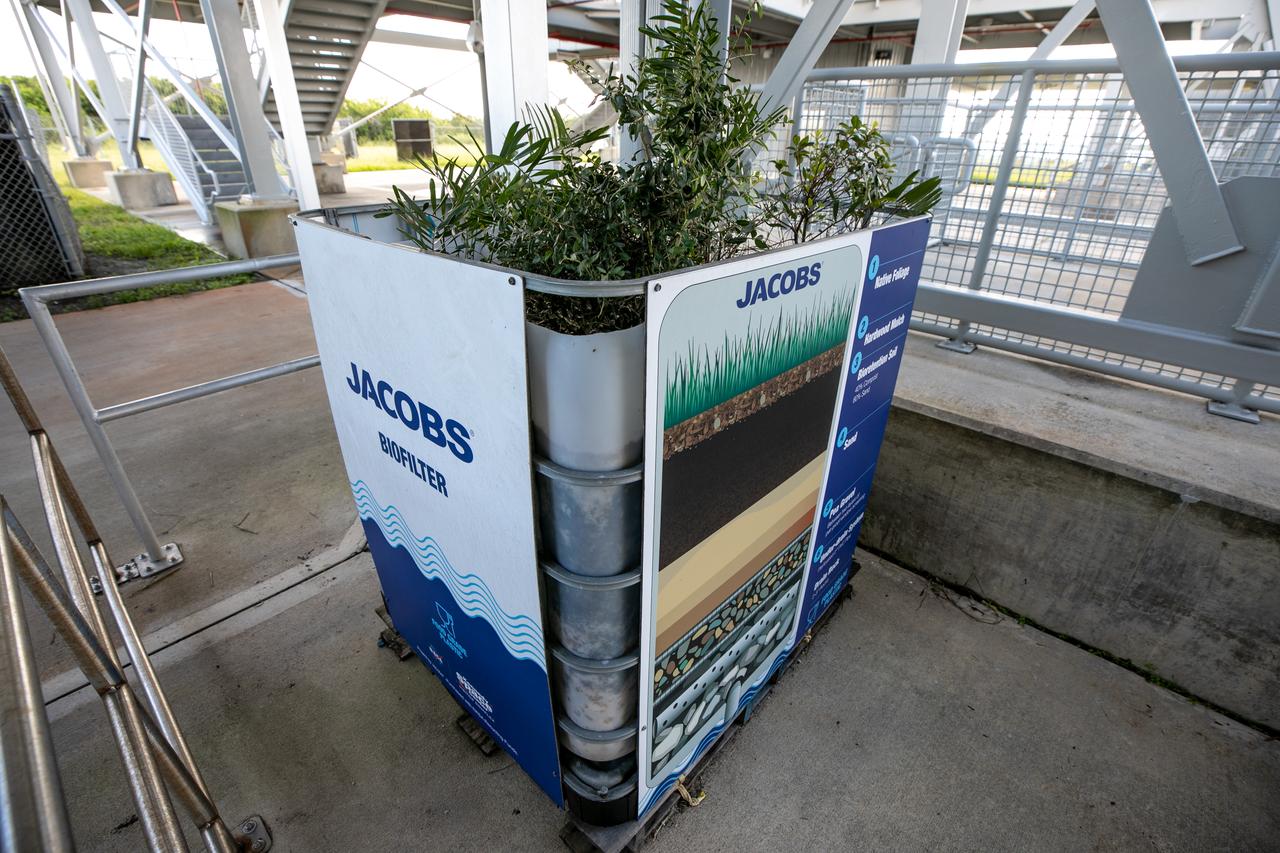
NASA Kennedy Space Center’s unrivaled dedication to the environment is highlighted through a variety of environmental programs and projects. Through a partnership with Jacobs Technology, Inc., teams have constructed a bio-filter – made of layered rock, soil, and native plants – as an eco-friendly way to filter zinc out of rainwater runoff. Photographed on Sept. 29, 2020, at the Florida spaceport’s Launch Complex 39 observation tower, the bio-filter catches water that runs off of this location’s galvanized roof, which contains a coating of zinc to help protect the metal from rust or corrosion. The plants in the bio-filter bind to the zinc so that when the water comes out of the bottom, it’s clean and safe to go into the Indian River Lagoon – its waterline located about 20 to 30 feet away.
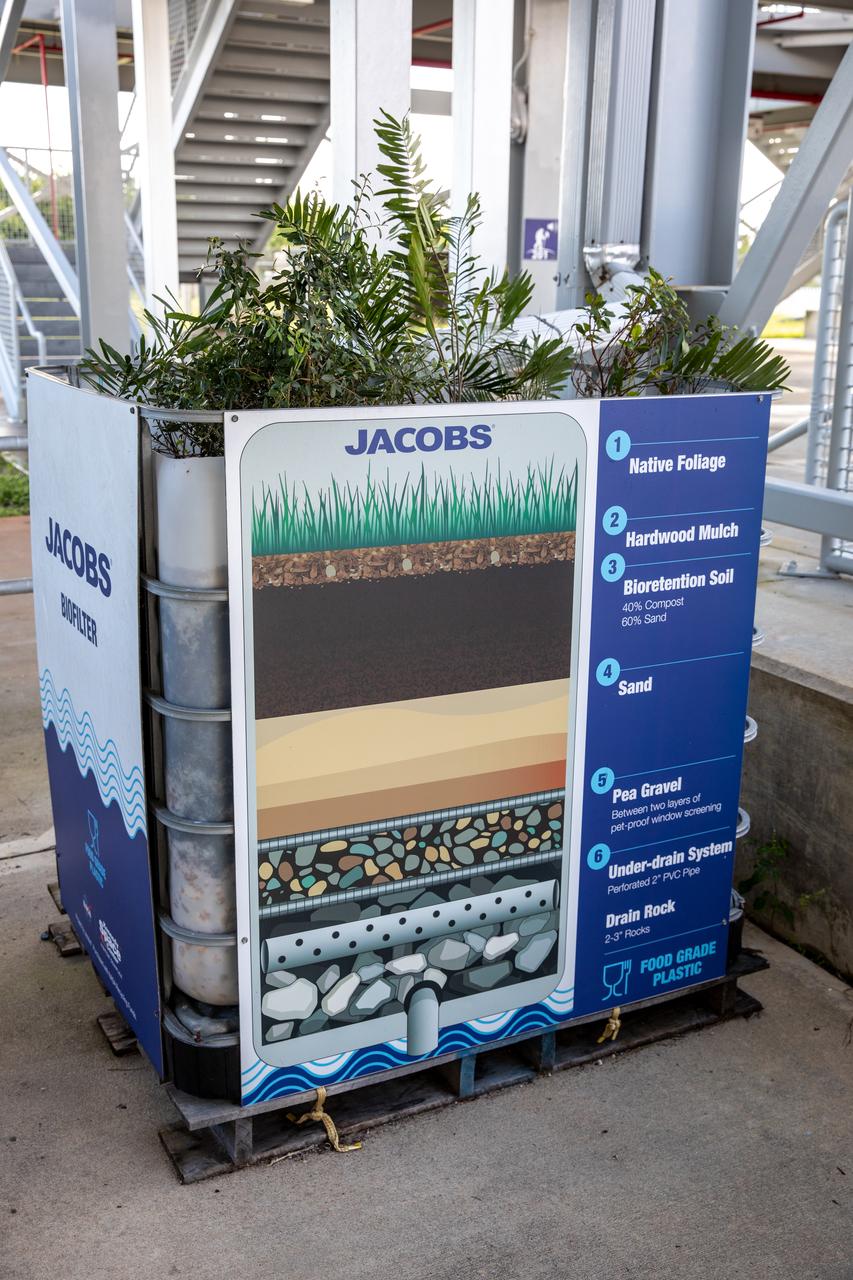
NASA Kennedy Space Center’s unrivaled dedication to the environment is highlighted through a variety of environmental programs and projects. Through a partnership with Jacobs Technology, Inc., teams have constructed a bio-filter – made of layered rock, soil, and native plants – as an eco-friendly way to filter zinc out of rainwater runoff. Photographed on Sept. 29, 2020, at the Florida spaceport’s Launch Complex 39 observation tower, the bio-filter catches water that runs off of this location’s galvanized roof, which contains a coating of zinc to help protect the metal from rust or corrosion. The plants in the bio-filter bind to the zinc so that when the water comes out of the bottom, it’s clean and safe to go into the Indian River Lagoon – its waterline located about 20 to 30 feet away.
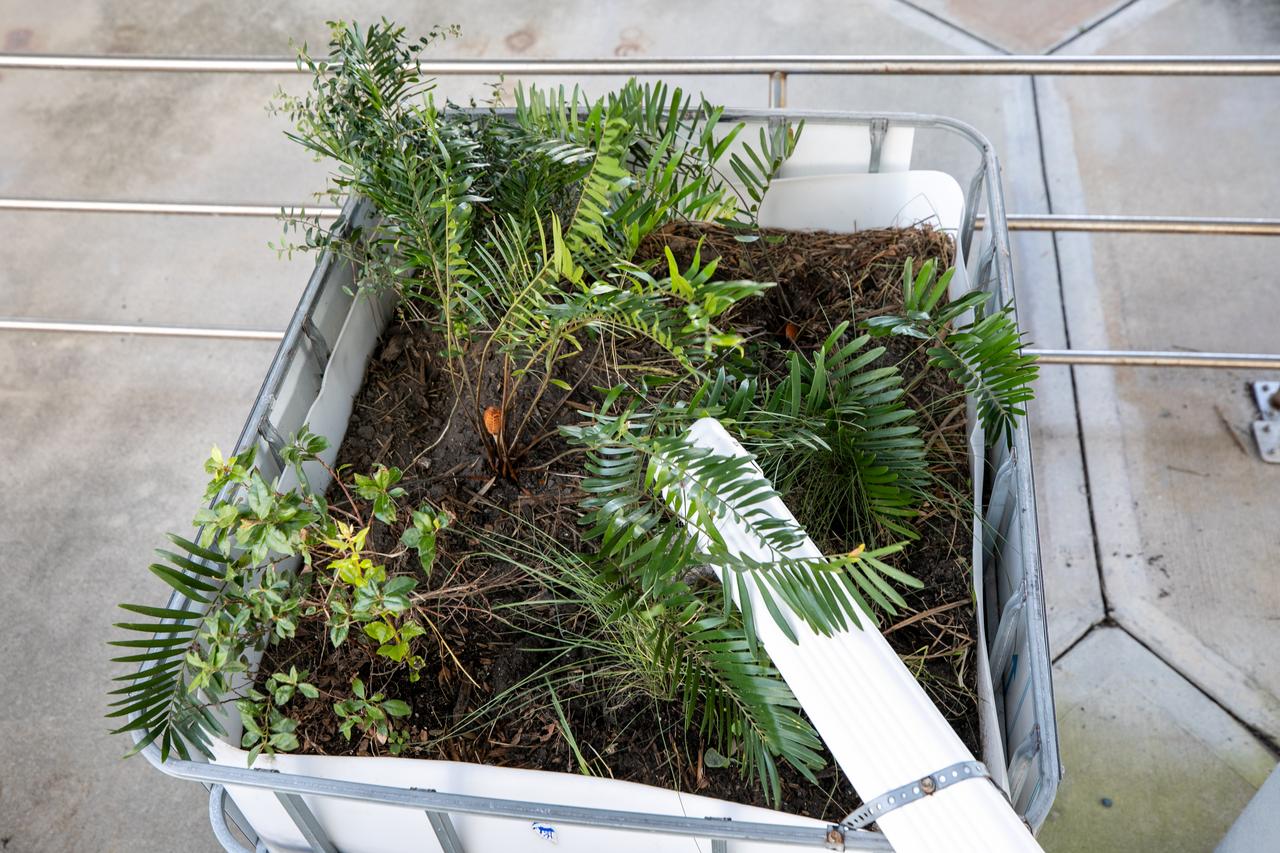
NASA Kennedy Space Center’s unrivaled dedication to the environment is highlighted through a variety of environmental programs and projects. Through a partnership with Jacobs Technology, Inc., teams have constructed a bio-filter – made of layered rock, soil, and native plants – as an eco-friendly way to filter zinc out of rainwater runoff. Photographed on Sept. 29, 2020, at the Florida spaceport’s Launch Complex 39 observation tower, the bio-filter catches water that runs off of this location’s galvanized roof, which contains a coating of zinc to help protect the metal from rust or corrosion. The plants in the bio-filter bind to the zinc so that when the water comes out of the bottom, it’s clean and safe to go into the Indian River Lagoon – its waterline located about 20 to 30 feet away.