
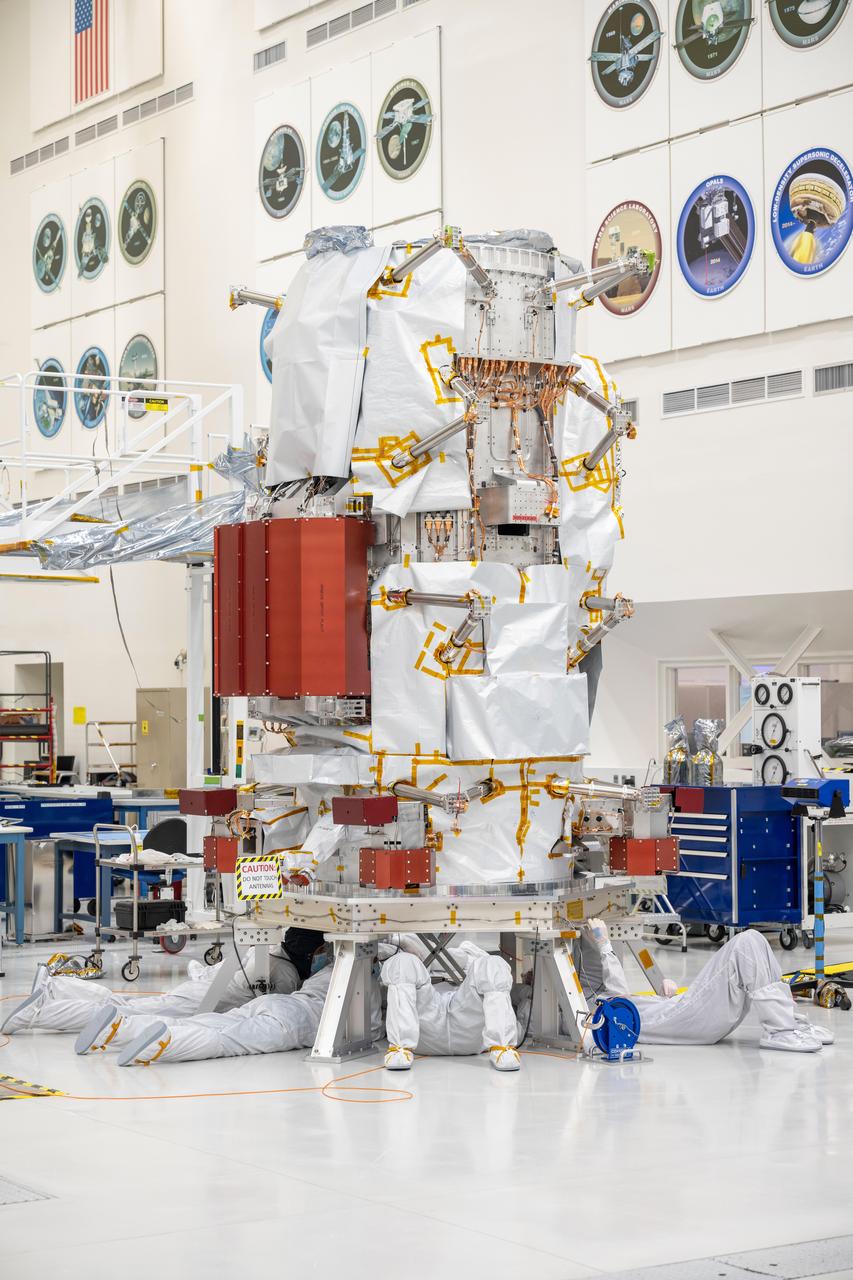
The main body of NASA's Europa Clipper spacecraft has been delivered to the agency's Jet Propulsion Laboratory in Southern California, where, over the next two years, engineers and technicians will finish assembling the craft by hand before testing it to make sure it can withstand the journey to Jupiter's icy moon Europa. Here it is visible in a main clean room at JPL, as engineers and technicians inspect it just after delivery in early June 2022. The Johns Hopkins Applied Physics Laboratory (APL) in Laurel, Maryland, designed and built the spacecraft body in collaboration with JPL and NASA's Goddard Space Flight Center in Greenbelt, Maryland. Set to launch in October 2024, Europa Clipper will conduct nearly 50 flybys of Europa, which scientists are confident harbors an internal ocean containing twice as much water as Earth's oceans combined. And the moon may currently have conditions suitable for supporting life. The spacecraft's nine science instruments will gather data on the moon's atmosphere, surface, and interior – information that scientists will use to gauge the depth and salinity of the ocean, the thickness of the ice crust, and potential plumes that may be venting subsurface water into space. https://photojournal.jpl.nasa.gov/catalog/PIA25236

NASA's Europa Clipper is tasked with up-close study of Jupiter's enigmatic moon Europa, which orbits the gas giant within a band of powerful radiation generated by the planet's strong magnetic field. The relative intensity of Jupiter's radiation bands is illustrated in this diagram, along with the orbits of Jupiter's three other largest moons: Io, Ganymede, and Callisto. To limit the damaging effects of radiation on the spacecraft, Europa Clipper will orbit Jupiter elliptically, dipping in for dozens of close flybys of Europa. Between each pass, the spacecraft will retreat to a safer distance from which it can safely transmit the science data it collects back to Earth. Europa Clipper's three main science objectives are to determine the thickness of the moon's icy shell and its interactions with the ocean below, to investigate its composition, and to characterize its geology. The mission's detailed exploration of Europa will help scientists better understand the astrobiological potential for habitable worlds beyond our planet. https://photojournal.jpl.nasa.gov/catalog/PIA26436

This artist's concept depicts NASA's Europa Clipper spacecraft in orbit around Jupiter. Scientists believe Jupiter's icy moon Europa harbors a vast internal ocean that may have conditions suitable for supporting life. While orbiting Jupiter, the spacecraft will fly by the moon about 50 times, allowing its science instruments to gather data on Europa's atmosphere, surface, and interior – information that will help scientists learn more about the ocean, the ice crust, and potential plumes that may be venting subsurface water into space. Europa Clipper's three main science objectives are to determine the thickness of the moon's icy shell and its interactions with the ocean below, to investigate its composition, and to characterize its geology. The mission's detailed exploration of Europa will help scientists better understand the astrobiological potential for habitable worlds beyond our planet. https://photojournal.jpl.nasa.gov/catalog/PIA26068
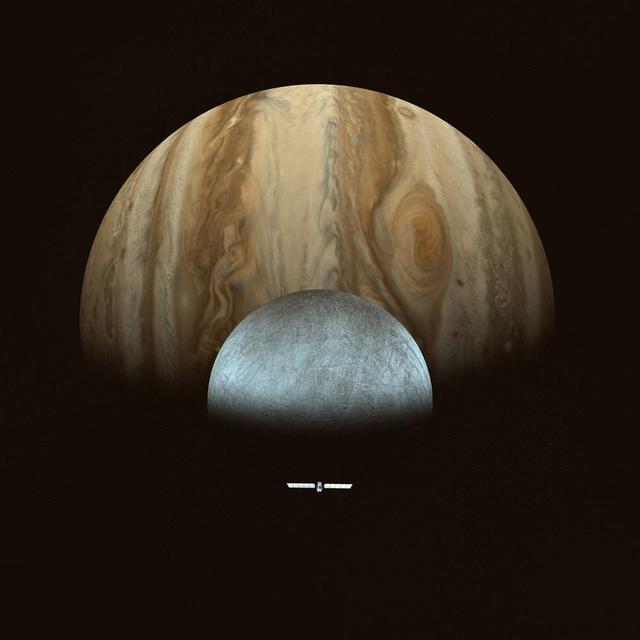
This artist's concept depicts NASA's Europa Clipper spacecraft approaching Jupiter and its icy moon Europa. Scheduled to arrive at Jupiter in April 2030, Europa Clipper will orbit the gas giant, and will be the first mission to specifically target Europa for detailed science investigation. Europa Clipper's three main science objectives are to determine the thickness of the moon's icy shell and its interactions with the ocean below, to investigate its composition, and to characterize its geology. The mission's detailed exploration of Europa will help scientists better understand the astrobiological potential for habitable worlds beyond our planet. https://photojournal.jpl.nasa.gov/catalog/PIA26445

Engineers in a clean room at NASA's Jet Propulsion Laboratory in Southern California build the nadir deck for NASA's Europa Clipper spacecraft. The deck will stabilize the spacecraft's sensors and help the mission team ensure its instruments are oriented correctly. With an internal global ocean under a thick layer of ice, Jupiter's moon Europa may have the potential to harbor existing life. Europa Clipper will swoop around Jupiter on an elliptical path, dipping close to the moon on each flyby. Understanding Europa's habitability will help scientists better understand how life developed on Earth and the potential for finding life beyond our planet. Europa Clipper is set to launch in 2024. https://photojournal.jpl.nasa.gov/catalog/PIA24480

This artist's concept depicts NASA's Europa Clipper spacecraft silhouetted against Jupiter as it passes over the gas giant's icy moon Europa (bottom center). Scheduled to orbit Jupiter beginning in April 2030, the mission will be the first to specifically target Europa for detailed science investigation. Europa Clipper's three main science objectives are to determine the thickness of the moon's icy shell and its interactions with the ocean below, to investigate its composition, and to characterize its geology. The mission's detailed exploration of Europa will help scientists better understand the astrobiological potential for habitable worlds beyond our planet. https://photojournal.jpl.nasa.gov/catalog/PIA26442

A full-scale prototype of the high-gain antenna on NASA's Europa Clipper spacecraft is undergoing testing in the Experimental Test Range at NASA's Langley Research Center in Hampton, Virginia. The Europa Clipper is expected to launch on a mission to conduct detailed reconnaissance of Jupiter's moon Europa in the 2020s. https://photojournal.jpl.nasa.gov/catalog/PIA22773
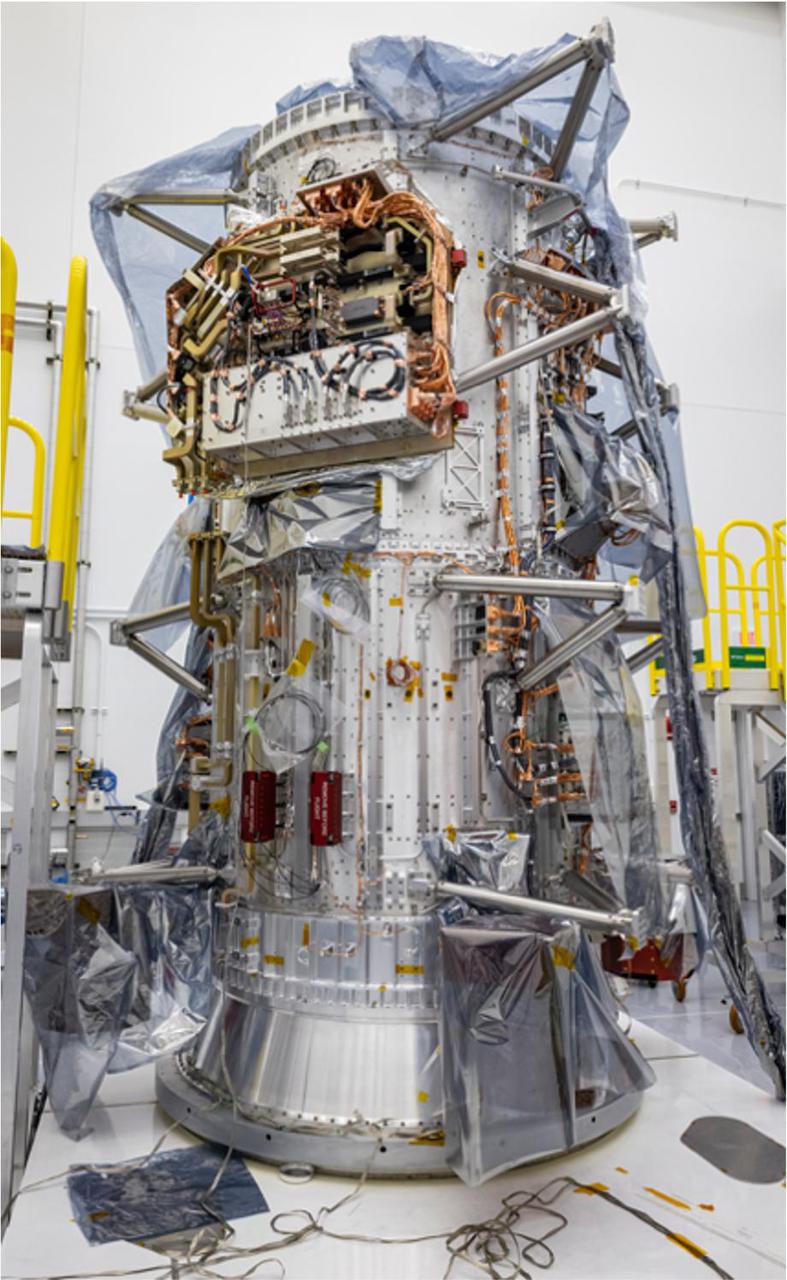
The propulsion module for NASA's Europa Clipper, the main body of the spacecraft, is nearing completion at Johns Hopkins Applied Physics Laboratory (APL) in Laurel, Maryland. The module consists of two stacked cylinders that stand almost 10 feet (3 meters) high and hold the propulsion tanks and rocket engines that will adjust and change Europa Clipper's trajectory once it leaves Earth's atmosphere on its path toward Jupiter's icy moon Europa. The propulsion module will be shipped to NASA's Jet Propulsion Laboratory in Southern California this spring. With an internal global ocean under a thick layer of ice, Jupiter's moon Europa may have the potential to harbor existing life. Europa Clipper will swoop around Jupiter in an elliptical orbit, dipping close to the moon on each flyby to collect data. Understanding Europa's habitability will help scientists better understand how life developed on Earth and the potential for finding life beyond our planet. Europa Clipper is set to launch in 2024. https://photojournal.jpl.nasa.gov/catalog/PIA24900

This artist's concept depicts NASA's Europa Clipper spacecraft in orbit at Jupiter as it passes over the gas giant's icy moon Europa (lower right). Scheduled to arrive at Jupiter in April 2030, the mission will be the first to specifically target Europa for detailed science investigation. Europa Clipper's three main science objectives are to determine the thickness of the moon's icy shell and its interactions with the ocean below, to investigate its composition, and to characterize its geology. The mission's detailed exploration of Europa will help scientists better understand the astrobiological potential for habitable worlds beyond our planet. https://photojournal.jpl.nasa.gov/catalog/PIA26431
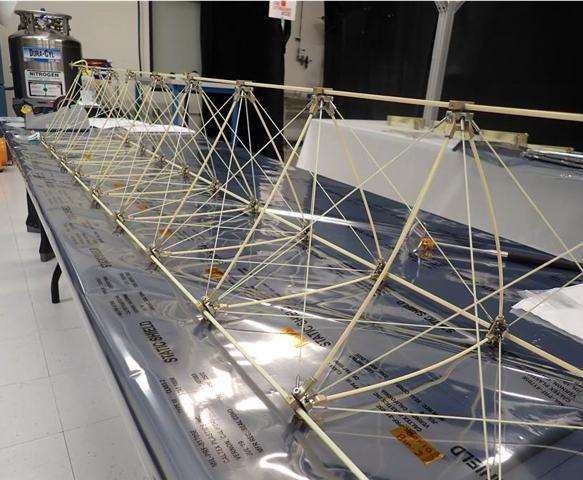
A test model of the boom that will be used for the magnetometer aboard NASA's Europa Clipper spacecraft is readied in NASA's Jet Propulsion Laboratory in Southern California. Called a dynamic test model, it is an exact duplicate of the Europa Clipper Magnetometer (ECM) boom that will fly on Europa Clipper. To fit aboard the rocket, the boom will be stowed in a canister and will deploy to its full length of 25 feet (8.5 meters) in the days after launch. The ECM will allow scientists to measure Europa's magnetic field and to measure the salinity and depth of Europa's internal global ocean. NASA scientists believe Jupiter's moon Europa may have the potential to harbor existing life, because of the internal ocean. Europa Clipper will swoop around Jupiter on an elliptical path, dipping close to the moon on each flyby. Understanding Europa's habitability will help scientists better understand how life developed on Earth and the potential for finding life beyond our planet. Europa Clipper is set to launch in 2024. https://photojournal.jpl.nasa.gov/catalog/PIA24786

A mechanical engineer in a clean room at the Johns Hopkins Applied Physics Laboratory (APL) in Laurel, Maryland, installs the detector electronics for the engineering model of the Wide Angle Camera (WAC), one of two cameras that make up the Europa Imaging System (EIS). EIS is one of the science instruments that will fly aboard NASA's Europa Clipper. EIS data will offer fresh insights into Europa's geological structure and processes and will be used to search for evidence of recent or current geologic activity, including potential erupting plumes. With an internal global ocean twice the size of Earth's oceans combined, Europa may have the potential to harbor life. NASA's Europa Clipper spacecraft will swoop around Jupiter on an elliptical path, dipping close to the moon on each flyby to collect data. Understanding Europa's habitability will help scientists better understand how life developed on Earth and the potential for finding life beyond our planet. Europa Clipper is aiming for a launch readiness date of 2024. https://photojournal.jpl.nasa.gov/catalog/PIA24325

This artist's concept depicts NASA's Europa Clipper spacecraft performing a close flyby of Jupiter's icy moon Europa. Scheduled to arrive at Jupiter in April 2030, Europa Clipper will orbit the gas giant and be the first mission to specifically target Europa for detailed science investigation. Europa Clipper's three main science objectives are to determine the thickness of the moon's icy shell and its interactions with the ocean below, to investigate its composition, and to characterize its geology. The mission's detailed exploration of Europa will help scientists better understand the astrobiological potential for habitable worlds beyond our planet. https://photojournal.jpl.nasa.gov/catalog/PIA26443

Engineers at the Johns Hopkins Applied Physics Laboratory (APL) in Laurel, Maryland, inspect the propulsion module of NASA's Europa Clipper spacecraft. In 2022, this major piece of hardware, designed and built at APL, will ship to NASA's Jet Propulsion Laboratory in Southern California for assembly, test, and launch operations (ATLO). With an internal global ocean under a thick layer of ice, Jupiter's moon Europa may have the potential to harbor existing life. The Europa Clipper spacecraft will swoop around Jupiter on an elliptical path, dipping close to the moon on each flyby to collect data. Understanding Europa's habitability will help scientists better understand how life developed on Earth and the potential for finding life beyond our planet. Europa Clipper is set to launch in 2024. https://photojournal.jpl.nasa.gov/catalog/PIA24783

Seen here in a clean room at NASA's Jet Propulsion Laboratory in Southern California is the nadir deck for NASA's Europa Clipper spacecraft. The deck stabilizes the spacecraft's sensors and helps the mission team ensure its instruments are oriented correctly. With an internal global ocean under a thick layer of ice, Jupiter's moon Europa may have the potential to harbor existing life. Europa Clipper will swoop around Jupiter on an elliptical path, dipping close to the moon on each flyby. Understanding Europa's habitability will help scientists better understand how life developed on Earth and the potential for finding life beyond our planet. Europa Clipper is set to launch in 2024. https://photojournal.jpl.nasa.gov/catalog/PIA24784

This illustration, updated in December 2020, depicts NASA's Europa Clipper spacecraft. With an internal global ocean twice the size of Earth's oceans combined, Jupiter's moon Europa may have the potential to harbor life. The Europa Clipper orbiter will swoop around Jupiter on an elliptical path, dipping close to the moon on each flyby to collect data. The mission will gather measurements of the internal ocean, map the surface geology and composition, and hunt for plumes of water vapor that may be venting from the icy crust. Understanding Europa's habitability will help scientists better understand how life developed on Earth and the potential for finding life beyond our planet. Europa Clipper is aiming for a launch readiness date of 2024. https://photojournal.jpl.nasa.gov/catalog/PIA24321
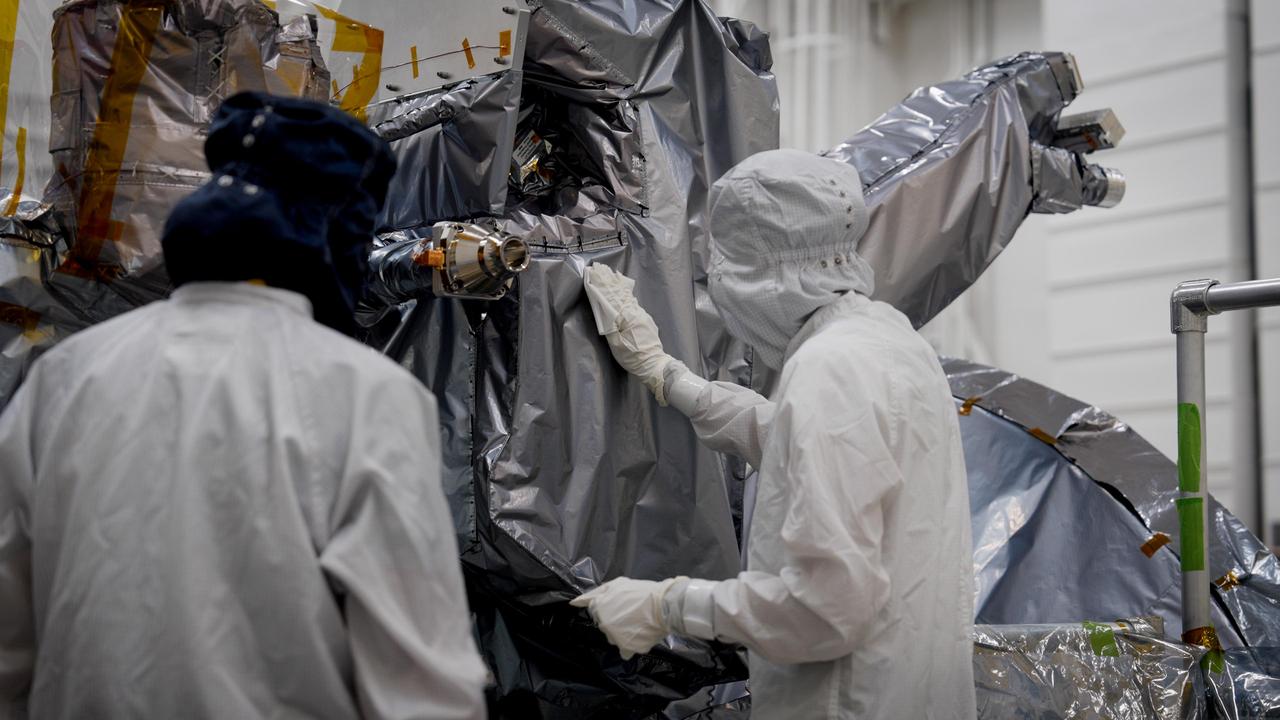
A planetary protection engineer in full-body protective gear carefully collects samples from NASA's Europa Clipper spacecraft to verify its biological cleanliness in a clean room at NASA's Jet Propulsion Laboratory on March 20, 2024. Maintaining and verifying the cleanliness of the spacecraft helps minimize the chance that microbes brought from Earth could compromise future scientific investigations at its destination, Jupiter's moon Europa. This work, referred to as planetary protection, is conducted in keeping with the international 1967 Outer Space Treaty to explore space in a responsible manner that avoids the harmful contamination of celestial bodies. This photo was taken while Europa Clipper was being built in JPL's Spacecraft Assembly Facility. Europa Clipper's three main science objectives are to determine the thickness of the moon's icy shell and its interactions with the ocean below, to investigate its composition, and to characterize its geology. The mission's detailed exploration of Europa will help scientists better understand the astrobiological potential for habitable worlds beyond our planet. https://photojournal.jpl.nasa.gov/catalog/PIA26440
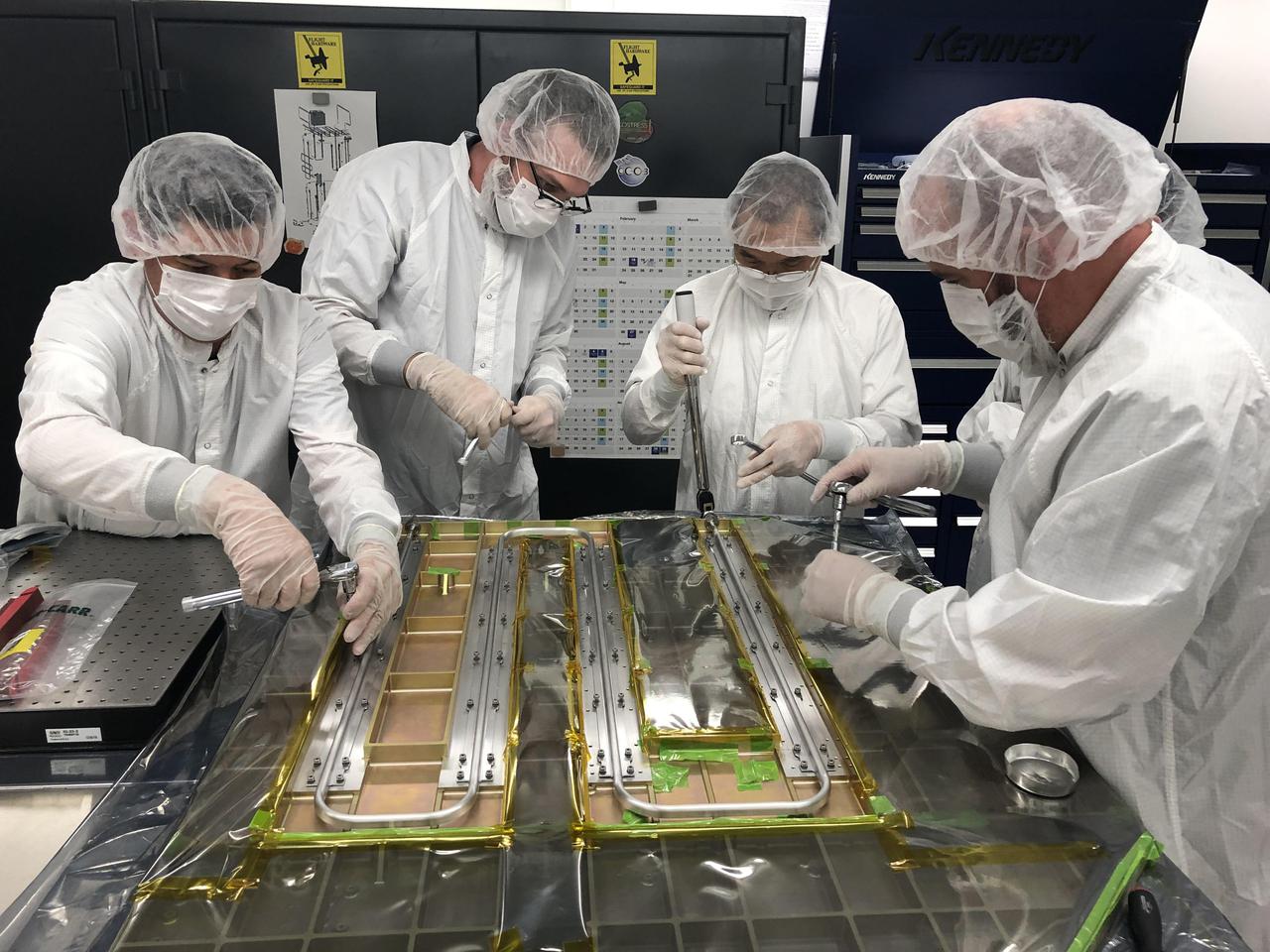
Europa Clipper technicians and engineers at NASA's Jet Propulsion Laboratory in Southern California work together in a cleanroom on Sept. 12, 2019. They bond thermal tubing to the spacecraft's Radio Frequency (RF) panel, which was built by Johns Hopkins University Applied Physics Laboratory (APL) in Laurel, Maryland. The tubing is part of a Heat Redistribution System (HRS) that pumps coolant all around the spacecraft and helps control its temperature as it travels through space. With an internal global ocean twice the size of Earth's oceans combined, Europa may have the potential to harbor life. NASA's Europa Clipper spacecraft will swoop around Jupiter on an elliptical path, dipping close to the moon on each flyby to collect data. Understanding Europa's habitability will help scientists better understand how life developed on Earth and the potential for finding life beyond our planet. Europa Clipper is aiming for a launch readiness date of 2024. https://photojournal.jpl.nasa.gov/catalog/PIA24324
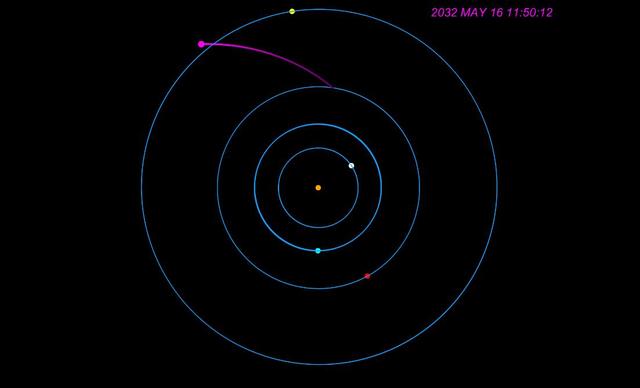
This animation shows how NASA's Europa Clipper spacecraft will orbit Jupiter and perform 49 flybys of Europa during its prime mission. The center orange dot represents Jupiter, with the simplified circular orbits of four of the planet's moons shown: Io (gray), Europa (blue), Ganymede (red), and Callisto (yellow). The Europa Clipper spacecraft is represented by the magenta dot looping in and out. At top right is a timestamp indicating when the flybys shown would occur; those depicted take place from April to July 2032. Europa Clipper's three main science objectives are to determine the thickness of the moon's icy shell and its interactions with the ocean below, to investigate its composition, and to characterize its geology. The mission's detailed exploration of Europa will help scientists better understand the astrobiological potential for habitable worlds beyond our planet. Animation available at https://photojournal.jpl.nasa.gov/catalog/PIA26463
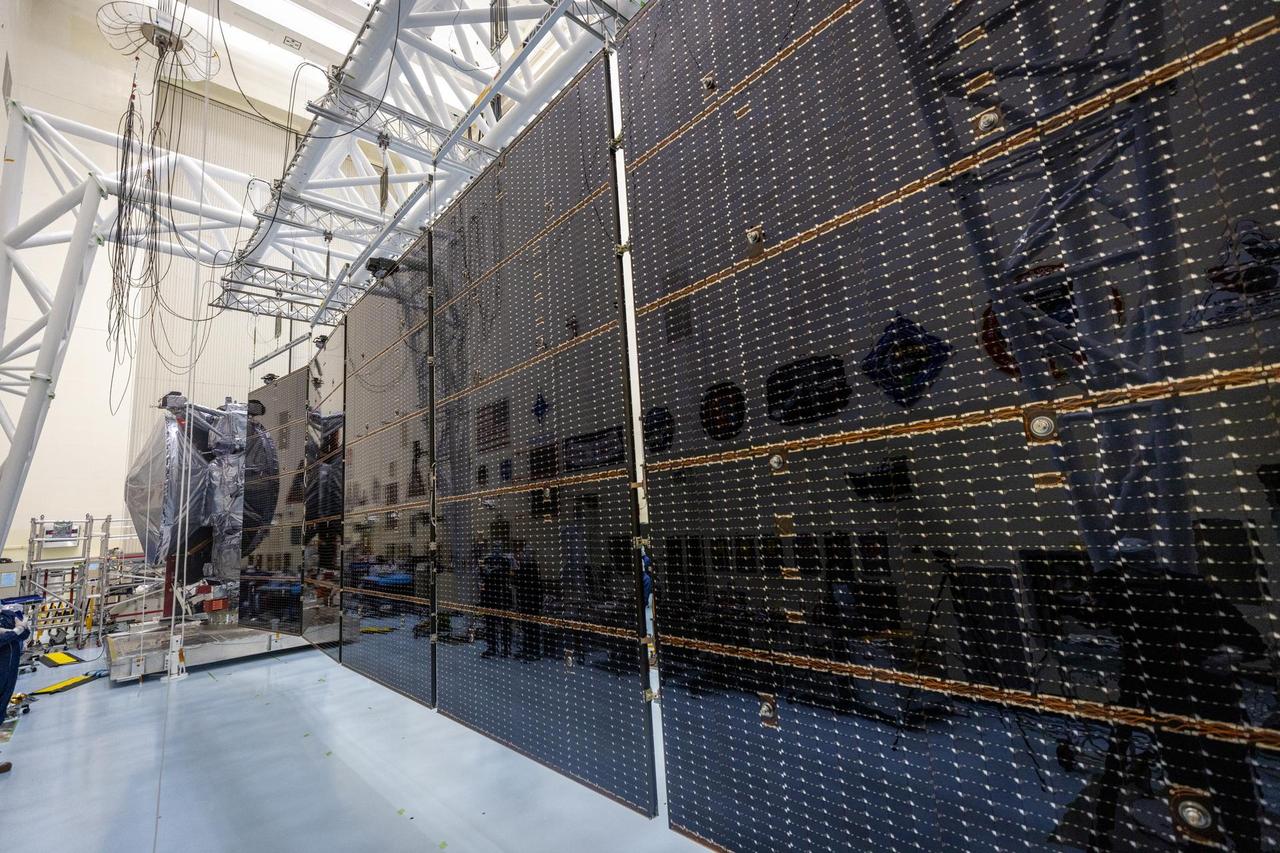
NASA's Europa Clipper is seen here on Aug. 21, 2024, in a clean room at the agency's Kennedy Space Center in Florida. The photo was taken as engineers and technicians deployed and tested the spacecraft's giant solar arrays, each of which measures about 46.5 feet (14.2 meters) long and about 13.5 feet (4.1 meters) high. Europa Clipper's three main science objectives are to determine the thickness of the moon's icy shell and its interactions with the ocean below, to investigate its composition, and to characterize its geology. The mission's detailed exploration of Europa will help scientists better understand the astrobiological potential for habitable worlds beyond our planet. https://photojournal.jpl.nasa.gov/catalog/PIA26066
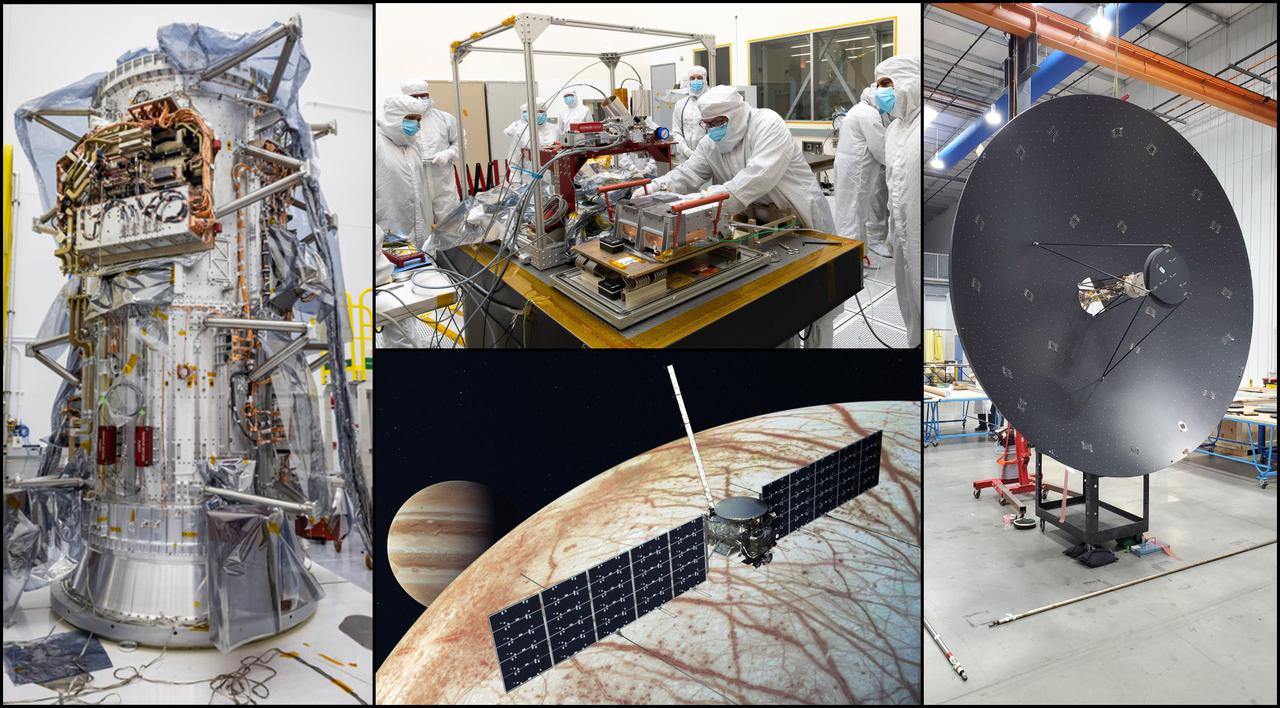
Science instruments and other hardware for NASA's Europa Clipper spacecraft will come together in the mission's final phase before launching to Jupiter's icy moon Europa in 2024. https://photojournal.jpl.nasa.gov/catalog/PIA25125

This graphic illustrates the main science objectives of NASA's Europa Clipper mission to Jupiter's moon Europa: to understand the nature of Europa's icy shell and confirm the existence of a subsurface ocean, investigate Europa's composition, characterize its geology, and determine the level of activity, such as possible water plumes. Clockwise from top left: an artist's concept of Europa's interior, which likely contains a global ocean beneath the icy surface, with possible hydrothermal activity on the ocean floor; water signatures at Europa's Manannán Crater made visible by mapping colors onto infrared data from NASA's Galileo mission to Jupiter; ultraviolet observations by the Hubble Space Telescope showing evidence of a possible plume at Europa and indicating possible activity at the moon; and a color view of Europa's Conamara Chaos region based on an image from NASA's Galileo mission. Europa Clipper's three main science objectives are to determine the thickness of the moon's icy shell and its interactions with the ocean below, to investigate its composition, and to characterize its geology. The mission's detailed exploration of Europa will help scientists better understand the astrobiological potential for habitable worlds beyond our planet. https://photojournal.jpl.nasa.gov/catalog/PIA26461
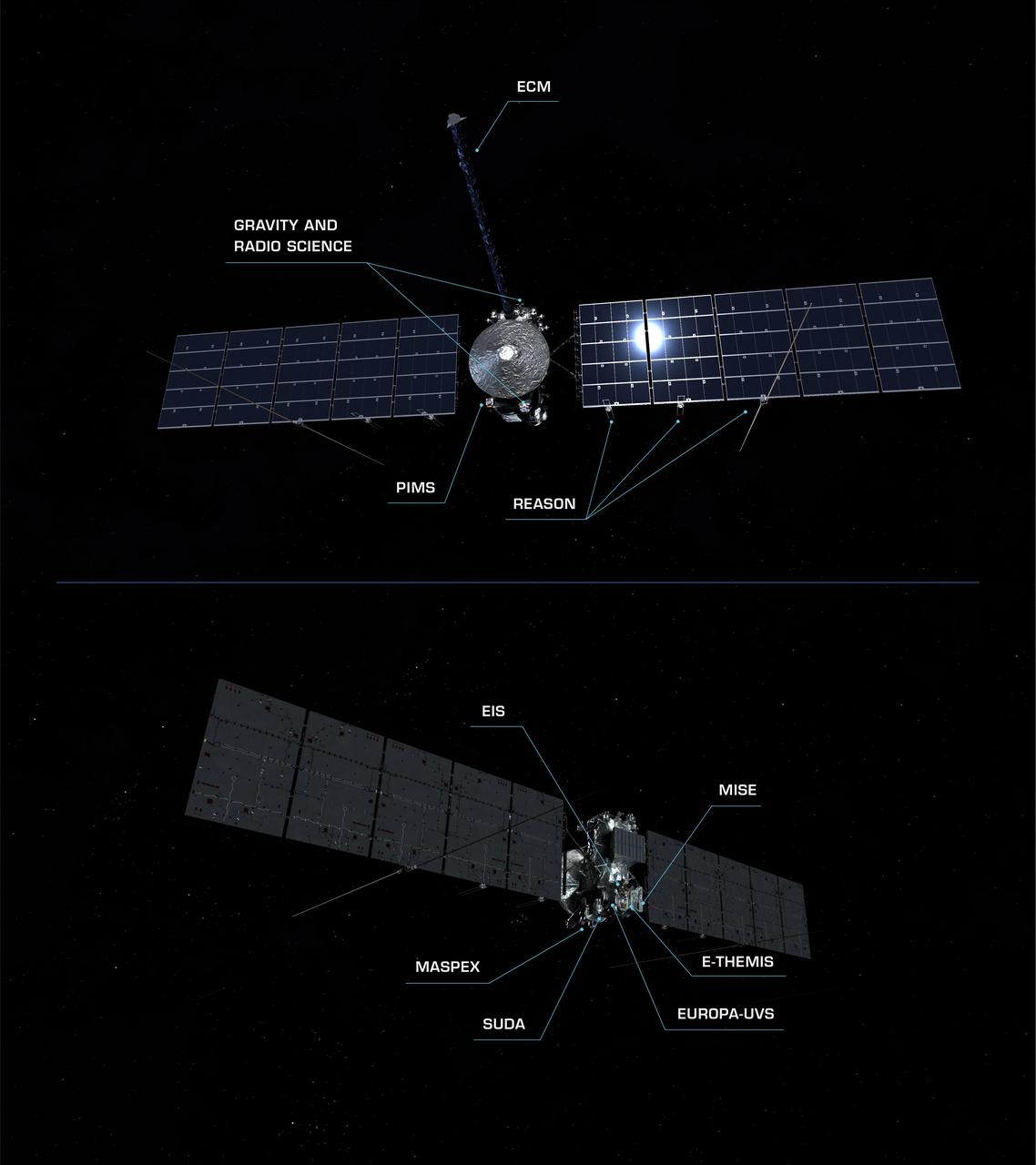
To conduct its detailed investigations of Jupiter's icy moon Europa, NASA's Europa Clipper spacecraft carries a suite of nine science instruments and a gravity experiment that uses its telecommunications system. These components are depicted in this pair of artist's concepts showing each side of the spacecraft, and include: Europa Imaging System (EIS) Europa Thermal Emission Imaging System (E-THEMIS) Europa Ultraviolet Spectrograph (Europa-UVS) Mapping Imaging Spectrometer for Europa (MISE) Europa Clipper Magnetometer (ECM) Plasma Instrument for Magnetic Sounding (PIMS) Radar for Europa Assessment and Sounding: Ocean to Near-surface (REASON) MAss Spectrometer for Planetary EXploration/Europa (MASPEX) Surface Dust Analyzer (SUDA) Gravity and Radio Science Experiment (G/RS) Europa Clipper's three main science objectives are to determine the thickness of the moon's icy shell and its interactions with the ocean below, to investigate its composition, and to characterize its geology. The mission's detailed exploration of Europa will help scientists better understand the astrobiological potential for habitable worlds beyond our planet. https://photojournal.jpl.nasa.gov/catalog/PIA26439
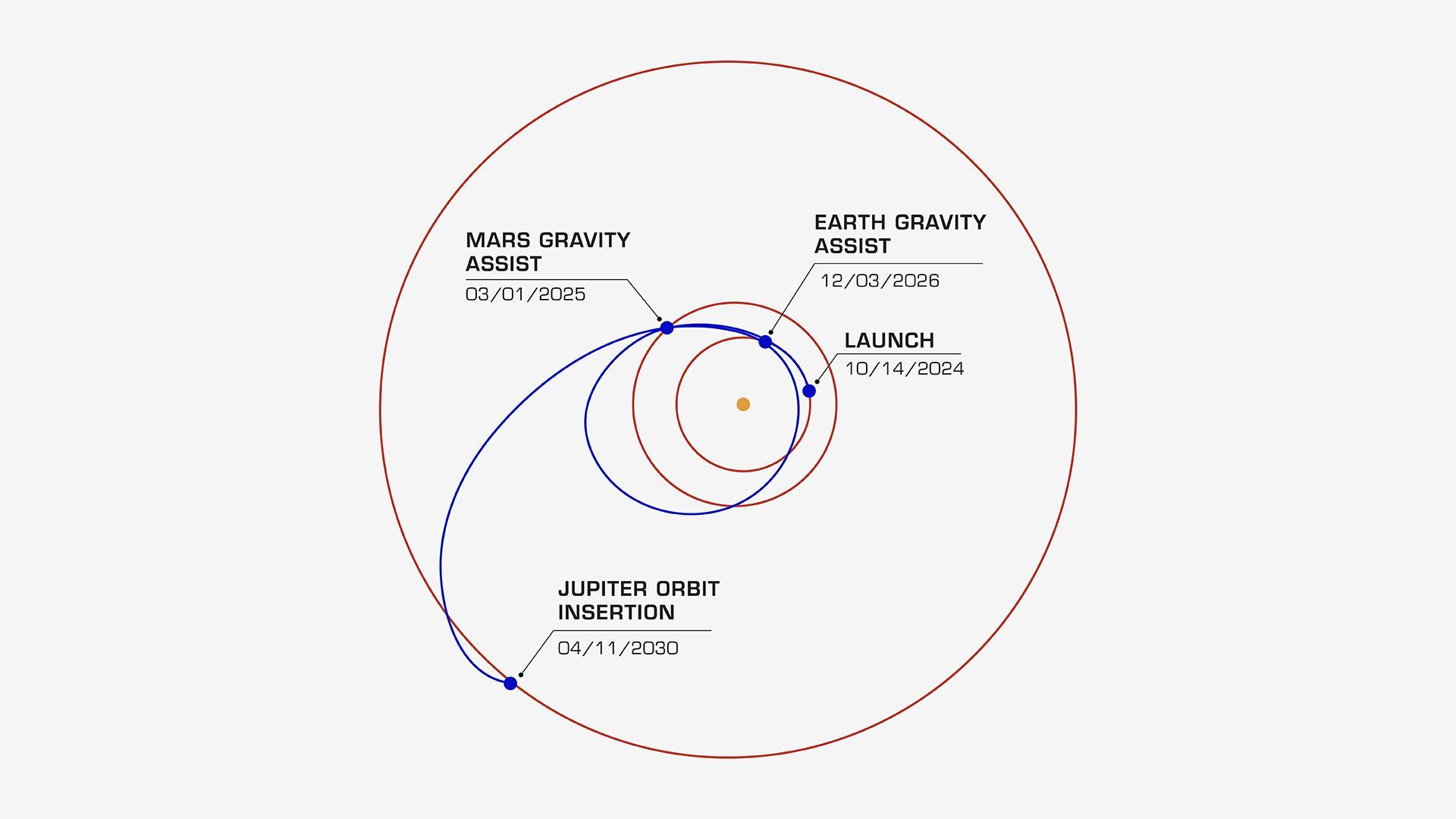
On its journey to the Jupiter system, NASA's Europa Clipper will take a path that swings past Mars, then Earth, using the gravity of each planet as a slingshot to boost the spacecraft's speed. All told, the journey will take about 5½ years, covering a distance of about 1.8 billion miles (2.9 billion kilometers). In this diagram, the orbits of Jupiter, Mars, and Earth are shown as concentric rings. Europa Clipper's launch period begins on Oct. 10, 2024. If the spacecraft launches on a later date, the timing of its Mars and Earth gravity assist maneuvers will shift. For all liftoff dates within the launch period, however, the spacecraft is scheduled to begin orbiting Jupiter on April 11, 2030. Then it will begin its investigation of the gas giant's icy moon Europa. Europa Clipper's three main science objectives are to determine the thickness of the moon's icy shell and its interactions with the ocean below, to investigate its composition, and to characterize its geology. The mission's detailed exploration of Europa will help scientists better understand the astrobiological potential for habitable worlds beyond our planet. Managed by Caltech in Pasadena, California, NASA's Jet Propulsion Laboratory leads the development of the Europa Clipper mission in partnership with APL for NASA's Science Mission Directorate in Washington. APL designed the main spacecraft body in collaboration with JPL and NASA's Goddard Space Flight Center in Greenbelt, Maryland, NASA's Marshall Space Flight Center in Huntsville, Alabama, and Langley Research Center in Hampton, Virginia. The Planetary Missions Program Office at Marshall executes program management of the Europa Clipper mission. NASA's Launch Services Program, based at Kennedy, manages the launch service for the Europa Clipper spacecraft, which will launch on a SpaceX Falcon Heavy rocket from Launch Complex 39A at Kennedy. https://photojournal.jpl.nasa.gov/catalog/PIA26435
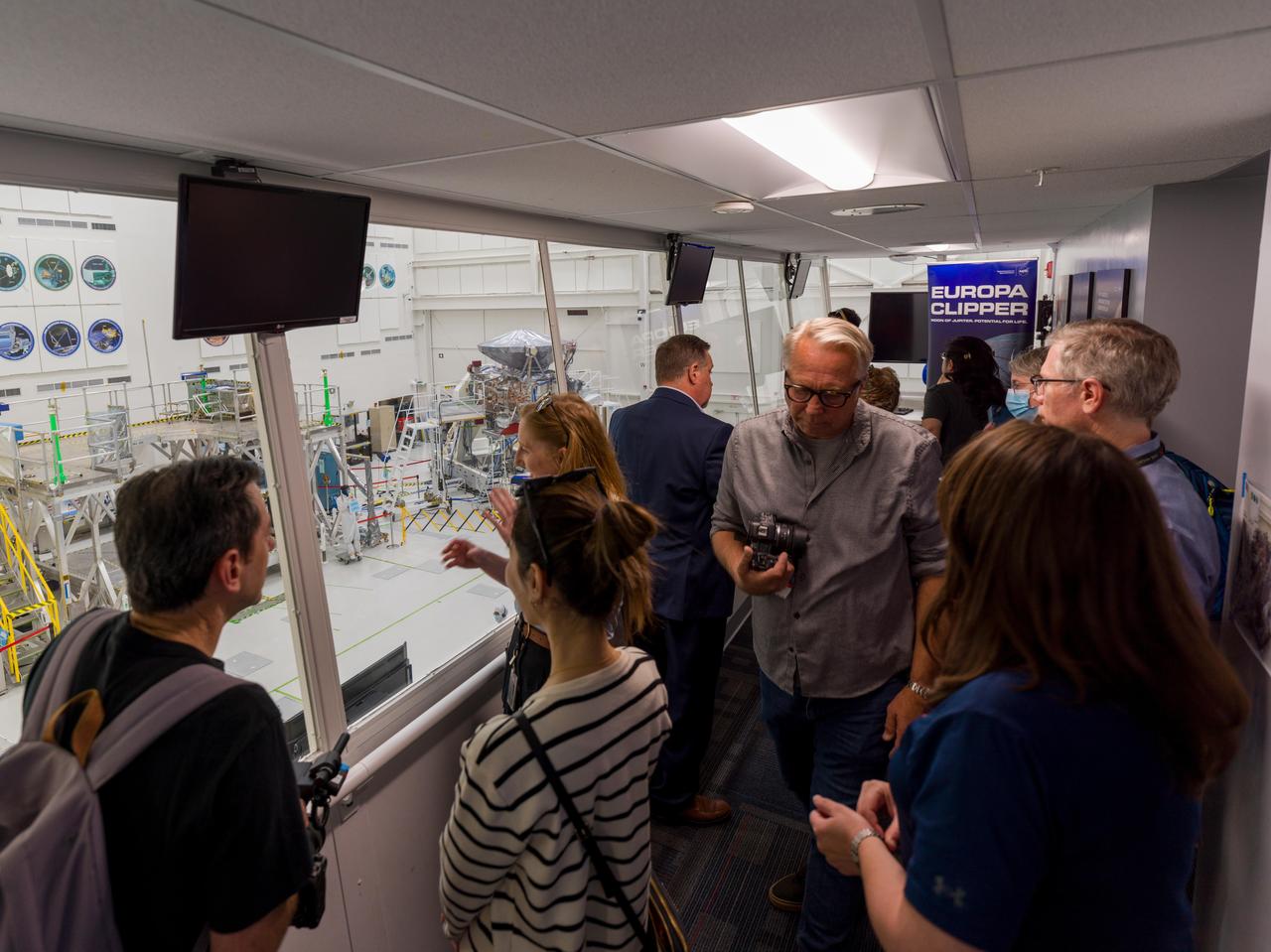
Members of the media observed NASA's Europa Clipper spacecraft from a viewing gallery about High Bay 1 in the historic Spacecraft Assembly Facility at the agency's Jet Propulsion Laboratory on April 11, 2024. The largest spacecraft NASA has ever built for a planetary mission, Europa Clipper is expected to launch in October 2024 on a six-year journey to the Jupiter system, where it will orbit the gas giant and study the ice-encased moon Europa. Europa Clipper's main science goal is to determine whether there are places below the surface of Jupiter's icy moon, Europa, that could support life. The mission's three main science objectives are to determine the thickness of the moon's icy shell and its surface interactions with the ocean below, to investigate its composition, and to characterize its geology. The mission's detailed exploration of Europa will help scientists better understand the astrobiological potential for habitable worlds beyond our planet. https://photojournal.jpl.nasa.gov/catalog/PIA26292
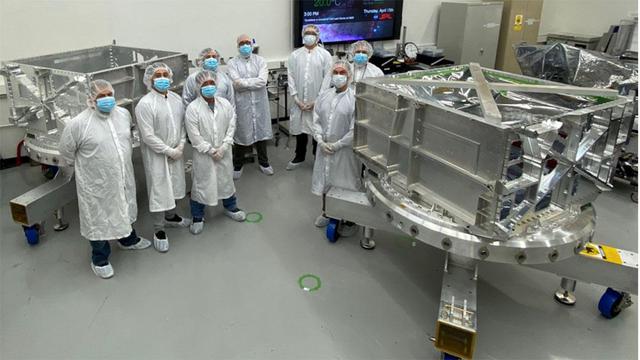
Engineers and technicians in a clean room at NASA's Jet Propulsion Laboratory in Southern California stand between the thick-walled aluminum vault and its duplicate (at rear) that they helped build for the agency's Europa Clipper spacecraft. As Europa Clipper orbits Jupiter, conducting flybys of its moon Europa to gather science data, the vault will protect the spacecraft's electronics from Jupiter's intense radiation. In 2022, the vault will be bolted to the top of Europa Clipper's propulsion module and affixed with cabling, to provide communications and control across the entire spacecraft. The duplicate test model of the vault gives engineers a way to test procedures before assembly of flight hardware. The test model also will be subjected to stress testing to confirm that the design will work when Europa Clipper operates in deep space. With an internal global ocean under a thick layer of ice, Europa may have the potential to harbor existing life. Europa Clipper will swoop around Jupiter on an elliptical path, dipping close to the moon on each flyby. Understanding Europa's habitability will help scientists better understand how life developed on Earth and the potential for finding life beyond our planet. Europa Clipper is set to launch in 2024. https://photojournal.jpl.nasa.gov/catalog/PIA24479
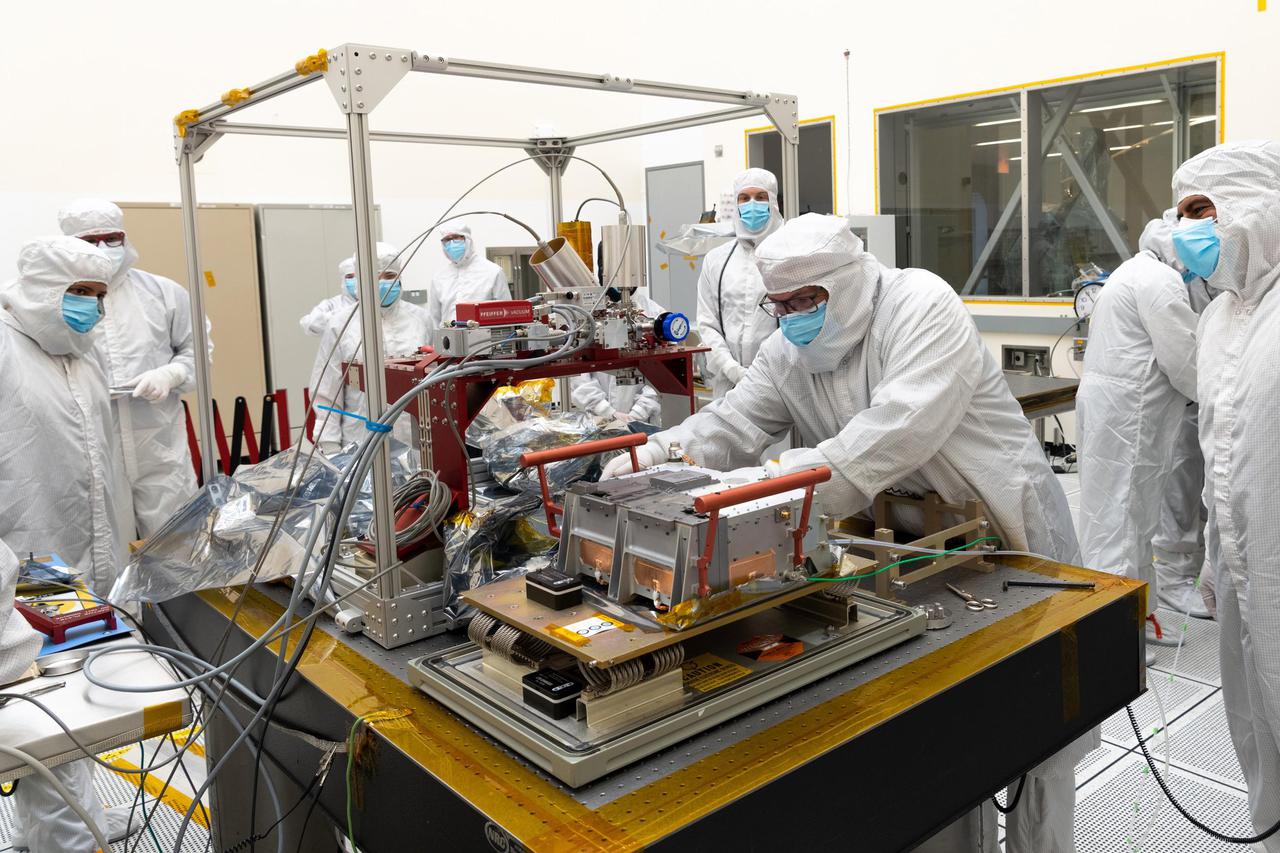
Engineers and technicians examine and test the first of NASA's Europa Clipper's science instruments to be delivered to the agency's Jet Propulsion Laboratory in Southern California. The ultraviolet spectrograph, called Europa-UVS and led by the Southwest Research Institute in San Antonio, Texas, will be integrated into the spacecraft during the phase of the mission called assembly, test, and launch operations. Europa-UVS is part of a payload of nine science instruments aboard Europa Clipper. In this photo, captured in February 2022, the instrument's custom testing equipment is seen at left, with a boxy, red frame. The instrument itself is seen at right. During testing, technicians shined ultraviolet light into the instrument's front aperture. With an internal global ocean under a thick layer of ice, Jupiter's moon Europa may have the potential to harbor existing life. Europa Clipper will swoop around Jupiter in an elliptical orbit, dipping close to the moon on each flyby to collect data. Understanding Europa's habitability will help scientists better understand how life developed on Earth and the potential for finding life beyond our planet. Europa Clipper is set to launch in 2024. Europa-UVS will search above the surface of Europa for signs of potential plumes that may be venting subsurface water into space. The instrument collects ultraviolet light, then separates the wavelengths of that light to help determine the composition of the moon's surface and gases in the atmosphere. https://photojournal.jpl.nasa.gov/catalog/PIA24897
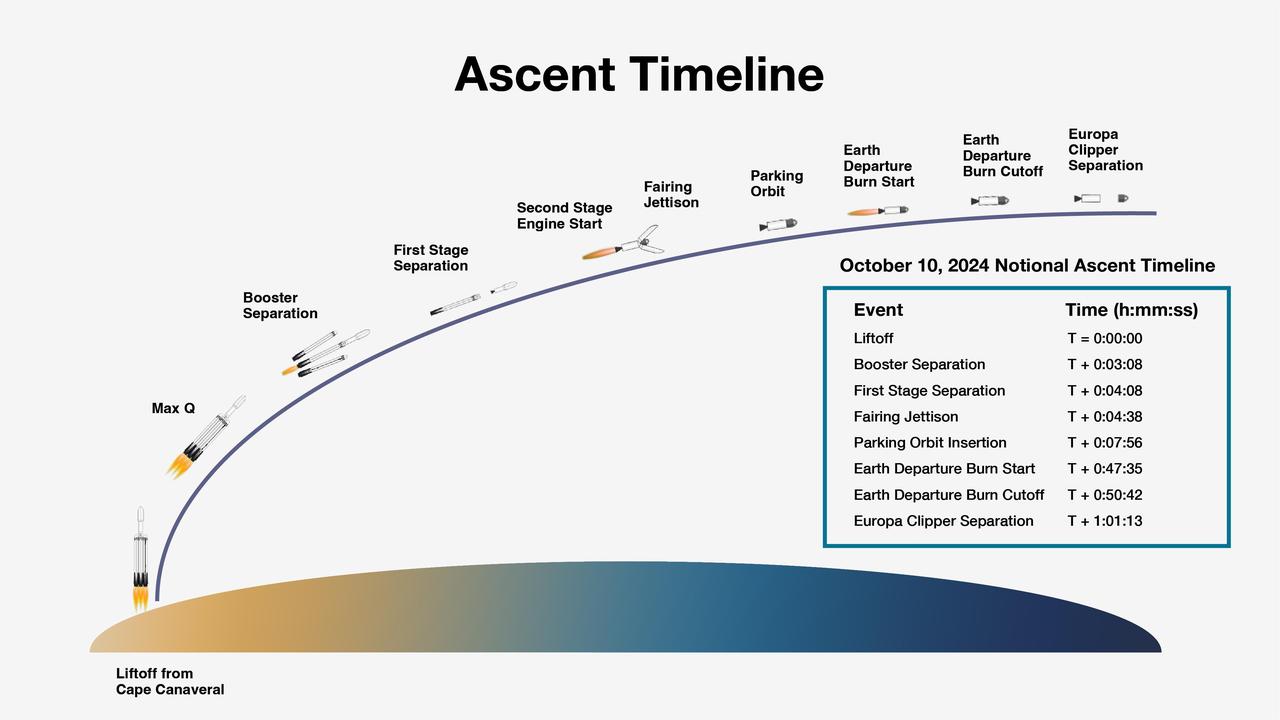
NASA's Europa Clipper spacecraft will be launched on a SpaceX Falcon Heavy rocket from the agency's Kennedy Space Center in Florida. This graphic shows the expected timeline of milestones immediately following liftoff if the mission launches at the beginning of its launch period on Oct. 10, 2024. The actual times of milestones will differ slightly depending on the launch day. Regardless of launch date within the launch period, the spacecraft's separation from the rocket is expected to occur a little over an hour after liftoff. Europa Clipper is bound for the Jupiter system, where it will study the gas giant's icy moon Europa. The mission's three main science objectives are to determine the thickness of the moon's icy shell and its interactions with the ocean below, to investigate its composition, and to characterize its geology. The mission's detailed exploration of Europa will help scientists better understand the astrobiological potential for habitable worlds beyond our planet. https://photojournal.jpl.nasa.gov/catalog/PIA26437
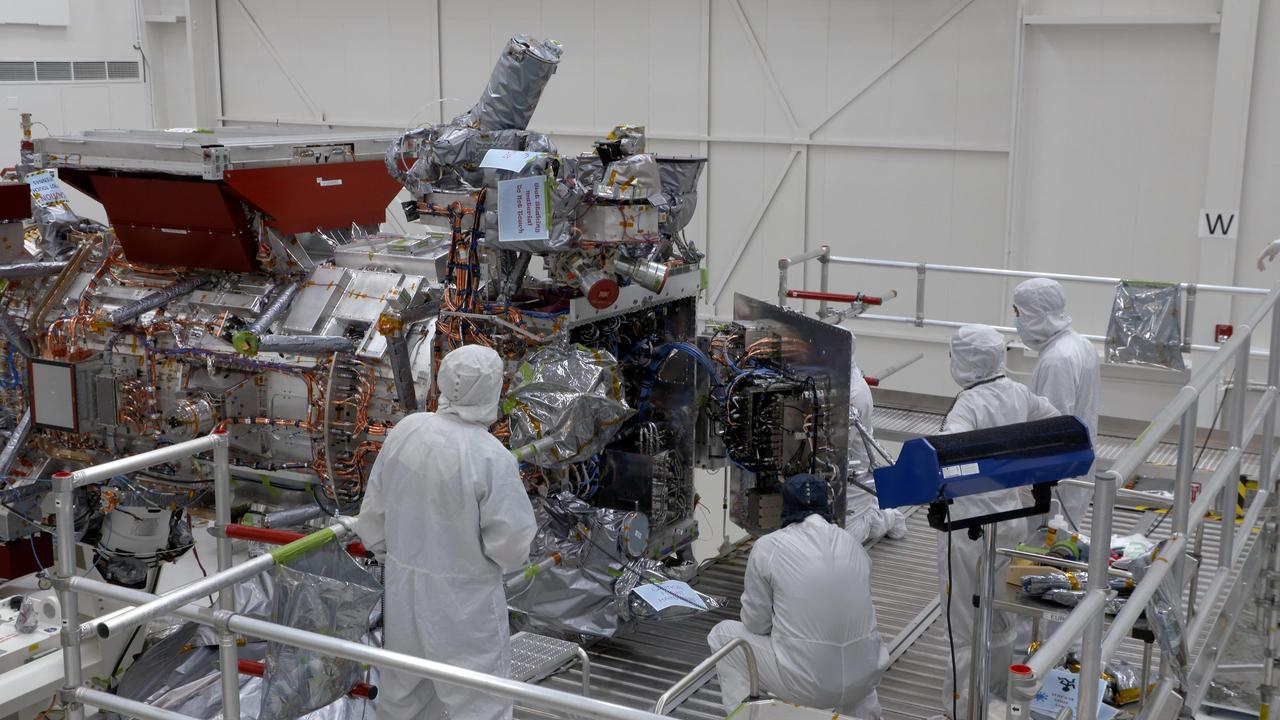
Engineers and technicians are seen closing the vault of NASA's Europa Clipper in the main clean room of the Spacecraft Assembly Facility at the agency's Jet Propulsion Laboratory in Southern California on Oct. 7, 2023. The vault will protect the sophisticated electronics of the spacecraft as it orbits Jupiter and endures one of the most punishing radiation environments in our solar system. The mission is targeting October 2024 for the launch of its spacecraft, which will fly by Europa about 50 times. Europa Clipper's main science goal is to determine whether there are places below Jupiter's icy moon, Europa, that could support life. The mission's three main science objectives are to determine the thickness of the moon's icy shell and its surface interactions with the ocean below, to investigate its composition, and to characterize its geology. The mission's detailed exploration of Europa will help scientists better understand the astrobiological potential for habitable worlds beyond our planet. https://photojournal.jpl.nasa.gov/catalog/PIA25959
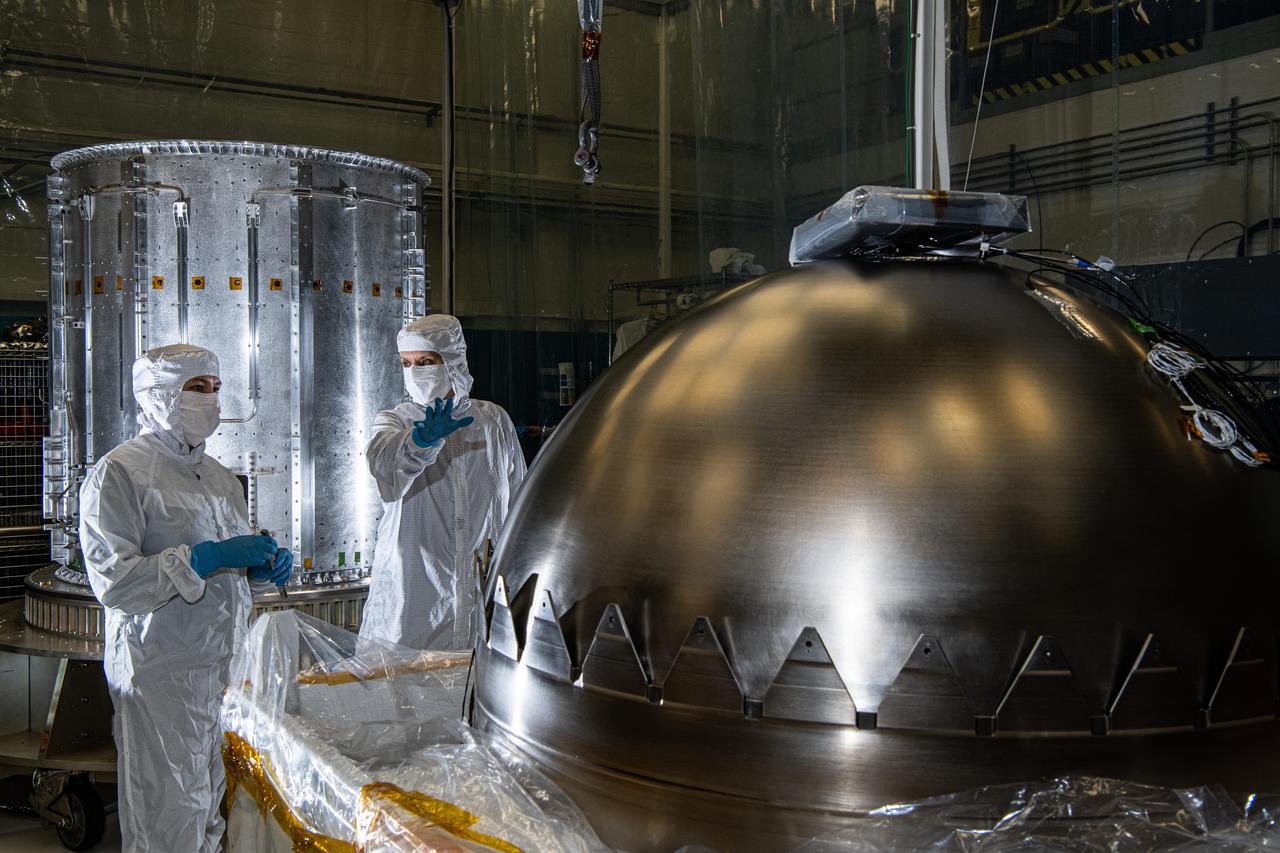
Contamination control engineers in a clean room at NASA's Goddard Space Flight Center in Greenbelt, Maryland, evaluate a propellant tank before it is installed in NASA's Europa Clipper spacecraft. The tank is one of two that will be used to hold the spacecraft's propellant. It will be inserted into the cylinder seen at left in the background, one of two cylinders that make up the propulsion module. With an internal global ocean under a thick layer of ice, Jupiter's moon Europa may have the potential to harbor existing life. Europa Clipper will swoop around Jupiter on an elliptical path, dipping close to the moon on each flyby to collect data. Understanding Europa's habitability will help scientists better understand how life developed on Earth and the potential for finding life beyond our planet. Europa Clipper is set to launch in 2024. https://photojournal.jpl.nasa.gov/catalog/PIA24478
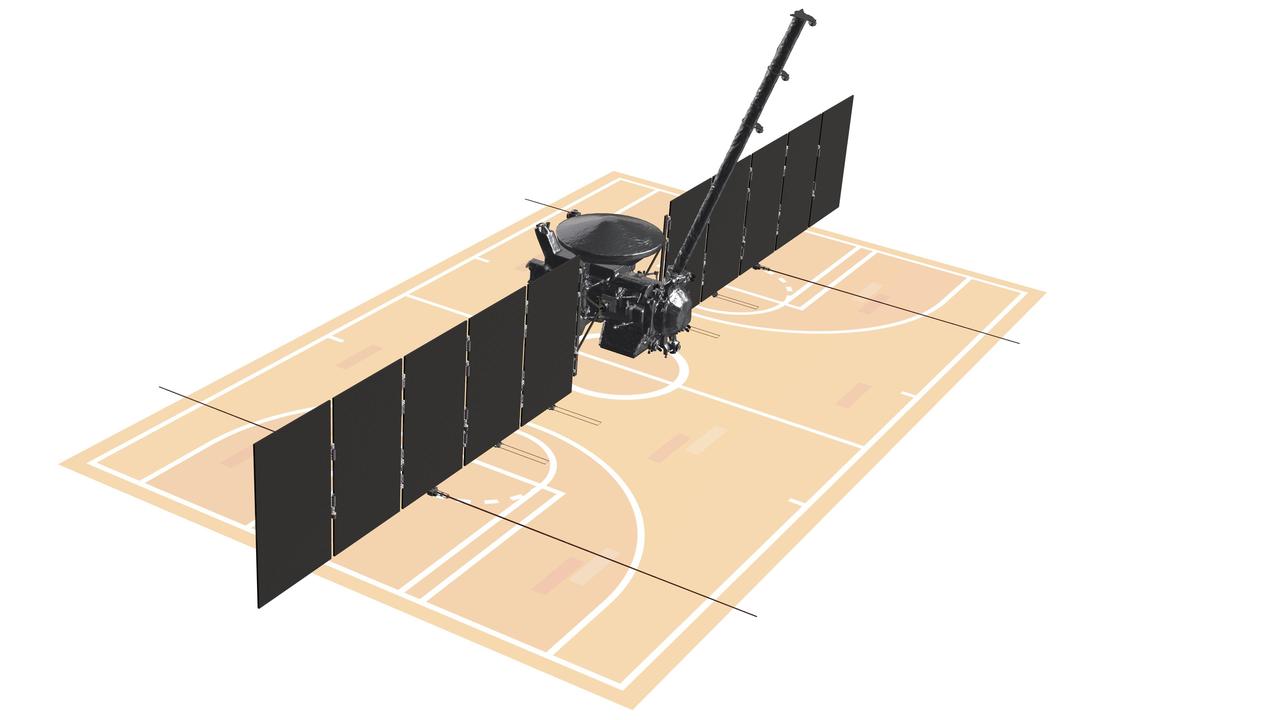
With its solar arrays and antennas fully extended, the Europa Clipper spacecraft stretches out larger than a basketball court: approximately 100 feet (30.5 meters) long and 58 feet (17.6 meters) wide. Depicted in this artist's concept against an illustration of a basketball court, Europa Clipper is the largest spacecraft NASA has ever built for a planetary mission. Europa Clipper is bound for the Jupiter system, where it will study the gas giant's icy moon Europa. Europa Clipper's three main science objectives are to determine the thickness of the moon's icy shell and its interactions with the ocean below, to investigate its composition, and to characterize its geology. The mission's detailed exploration of Europa will help scientists better understand the astrobiological potential for habitable worlds beyond our planet. https://photojournal.jpl.nasa.gov/catalog/PIA26433
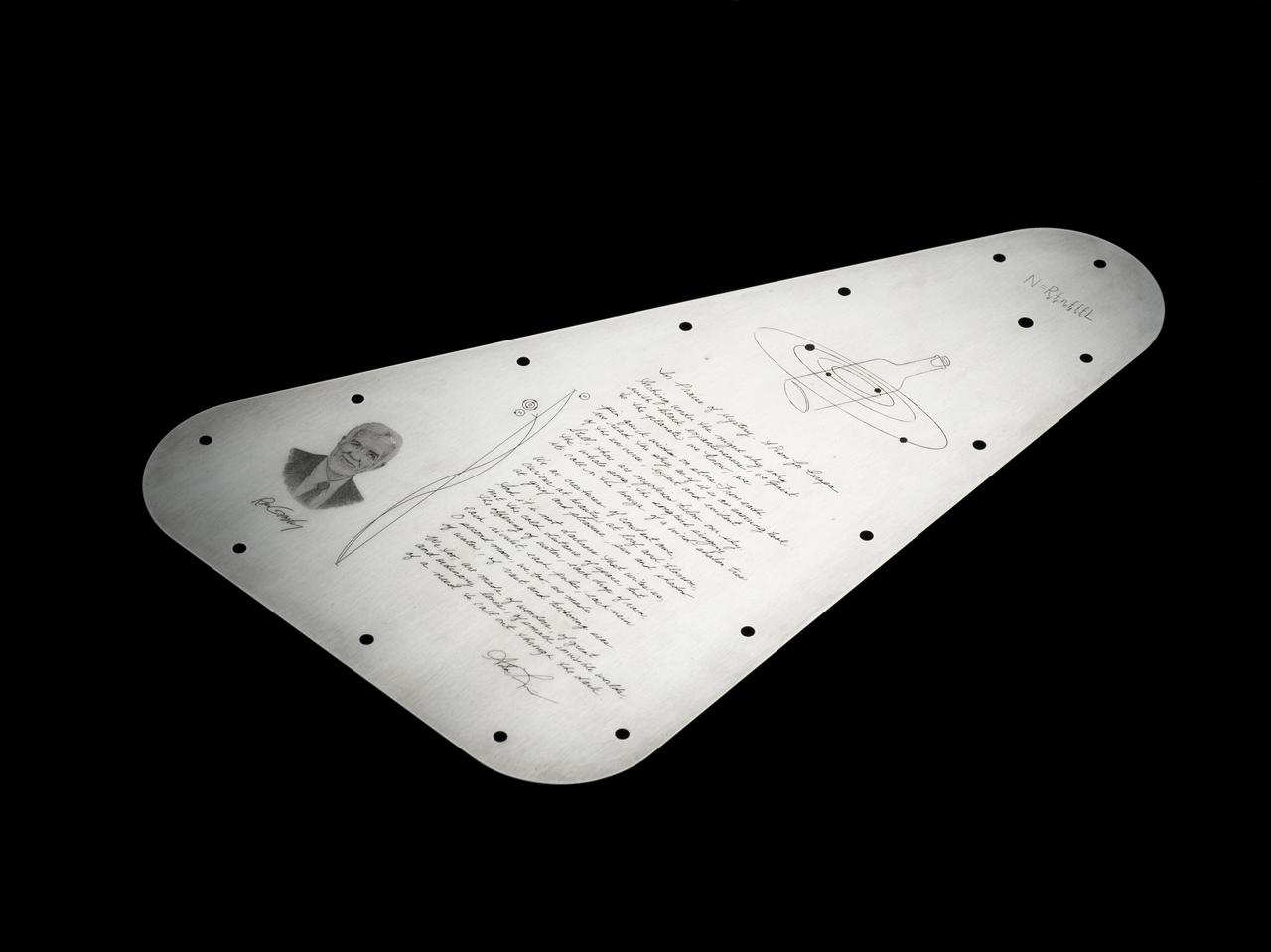
NASA's Europa Clipper spacecraft will carry a special message when it launches in October 2024 and heads toward Jupiter's moon Europa. The moon shows strong evidence of an ocean under its icy crust, with more than twice the amount of water of all of Earth's oceans combined. A triangular metal plate, seen here, will honor that connection to Earth. The plate is made of tantalum metal and is about 7 by 11 inches (18 by 28 centimeters). Engraved on both sides, it seals an opening in the electronics vault, which houses the spacecraft's sensitive electronics. The side shown here features U.S. Poet Laureate Ada Limón's handwritten "In Praise of Mystery: A Poem for Europa," and will be affixed with a silicon microchip stenciled with more than 2.6 million names submitted by the public. The microchip will be placed at the center of the illustration of a bottle amid the Jovian system – a reference to NASA's "Message in a Bottle" campaign, which invited the public to send their names with the spacecraft. The artwork includes the Drake Equation, which was formulated by astronomer Frank Drake in 1961 to estimate the possibility of finding advanced civilizations beyond Earth. Also featured is a reference to the radio frequencies considered plausible for interstellar communication, symbolizing how humanity uses this radio band to listen for messages from the cosmos. These particular frequencies match the radio waves emitted in space by the components of water and are known by astronomers as the "water hole." On the plate, they are depicted as radio emission lines. The plate includes a portrait of one of the founders of planetary science, Ron Greeley, whose early efforts to develop a Europa mission two decades ago laid the foundation for Europa Clipper. In the spirit of the Voyager spacecraft's Golden Record, which carries sounds and images to convey the richness and diversity of life on Earth, the layered message on Europa Clipper aims to spark the imagination and offer a unifying vision. Europa Clipper, set to launch from Kennedy Space Center in Florida, will arrive at the Jupiter system in 2030 and conduct about 50 flybys of the moon Europa. The mission's main science goal is to determine whether there are places below Europa, that could support life. The mission's three main science objectives are to determine the thickness of the moon's icy shell and its surface interactions with the ocean below, to investigate its composition, and to characterize its geology. The mission's detailed exploration of Europa will help scientists better understand the astrobiological potential for habitable worlds beyond our planet. https://photojournal.jpl.nasa.gov/catalog/PIA26062
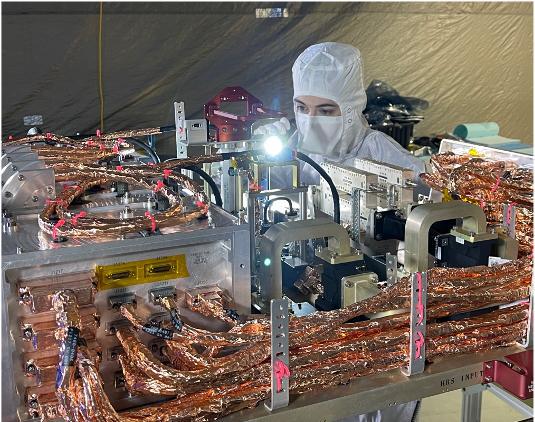
An engineer inspects the radio frequency (RF) panel of NASA's Europa Clipper in a cleanroom at the Johns Hopkins Applied Physics Laboratory in Laurel, Maryland. The RF panel hosts all the RF subsystem electronics and an intricate routing network of switches, filters, and waveguides, which carry the RF signal to and from eight antennas distributed around the spacecraft. With an internal global ocean under a thick layer of ice, Jupiter's moon Europa may have the potential to harbor existing life. Europa Clipper will swoop around Jupiter in an elliptical orbit, dipping close to the moon on each flyby to collect data. Understanding Europa's habitability will help scientists better understand how life developed on Earth and the potential for finding life beyond our planet. Europa Clipper is set to launch in 2024. https://photojournal.jpl.nasa.gov/catalog/PIA24898
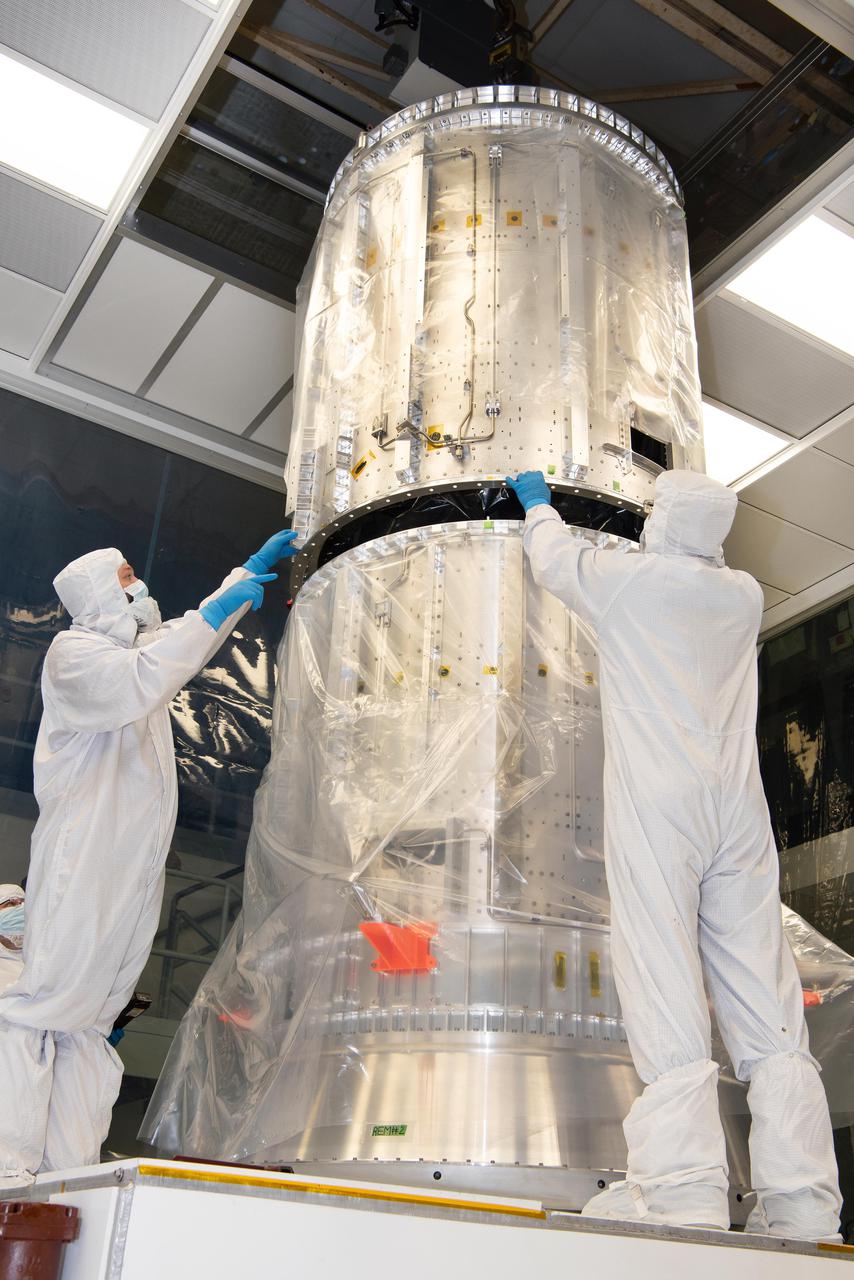
Technicians in a clean room at NASA's Goddard Space Flight Center in Greenbelt, Maryland, check the fit of the upper and lower cylinders of the propulsion module core of NASA's Europa Clipper spacecraft on Oct. 15, 2020. The stacked cylinders stand almost 10 feet (3 meters) high and hold the propulsion tanks and rocket engines that will propel Europa Clipper once it leaves Earth's atmosphere on its path toward Jupiter's moon Europa. In this photo, the cylinders are stacked atop an adapter ring that's about 1 foot (0.3 meters) high. The cylinders were built by the Johns Hopkins Applied Physics Laboratory (APL) in Laurel, Maryland. They were shipped to NASA's Jet Propulsion Laboratory in Southern California for installation of the Heat Redistribution System (HRS) tubing, which helps control the spacecraft's temperature. The cylinders were then shipped to Goddard for the propulsion subsystem installation. With an internal global ocean twice the size of Earth's oceans combined, Europa may have the potential to harbor life. The Europa Clipper orbiter will swoop around Jupiter on an elliptical path, dipping close to the moon on each flyby to collect data. Understanding Europa's habitability will help scientists better understand how life developed on Earth and the potential for finding life beyond our planet. Europa Clipper is aiming for a launch readiness date of 2024. https://photojournal.jpl.nasa.gov/catalog/PIA24322
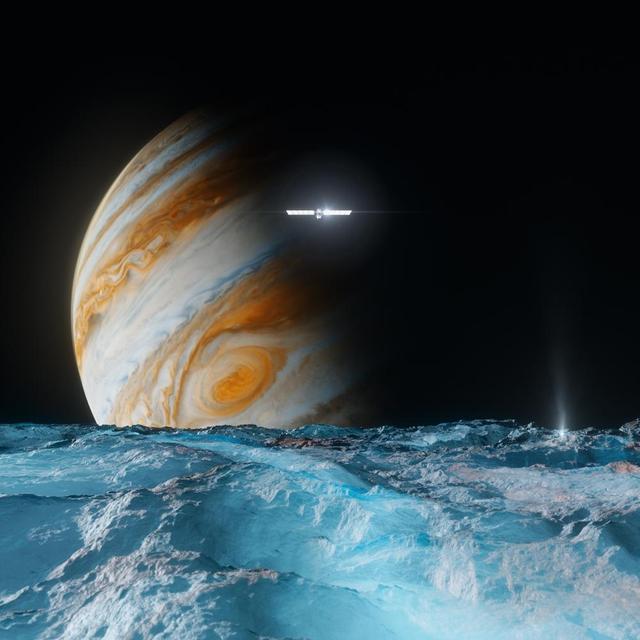
This artist's concept depicts NASA's Europa Clipper spacecraft as it orbits Jupiter and passes over the gas giant's ice-covered moon Europa. Scheduled to arrive at Jupiter in April 2030, the mission will be the first to specifically target Europa for detailed science investigation. Europa Clipper's three main science objectives are to determine the thickness of the moon's icy shell and its interactions with the ocean below, to investigate its composition, and to characterize its geology. The mission's detailed exploration of Europa will help scientists better understand the astrobiological potential for habitable worlds beyond our planet. https://photojournal.jpl.nasa.gov/catalog/PIA26444
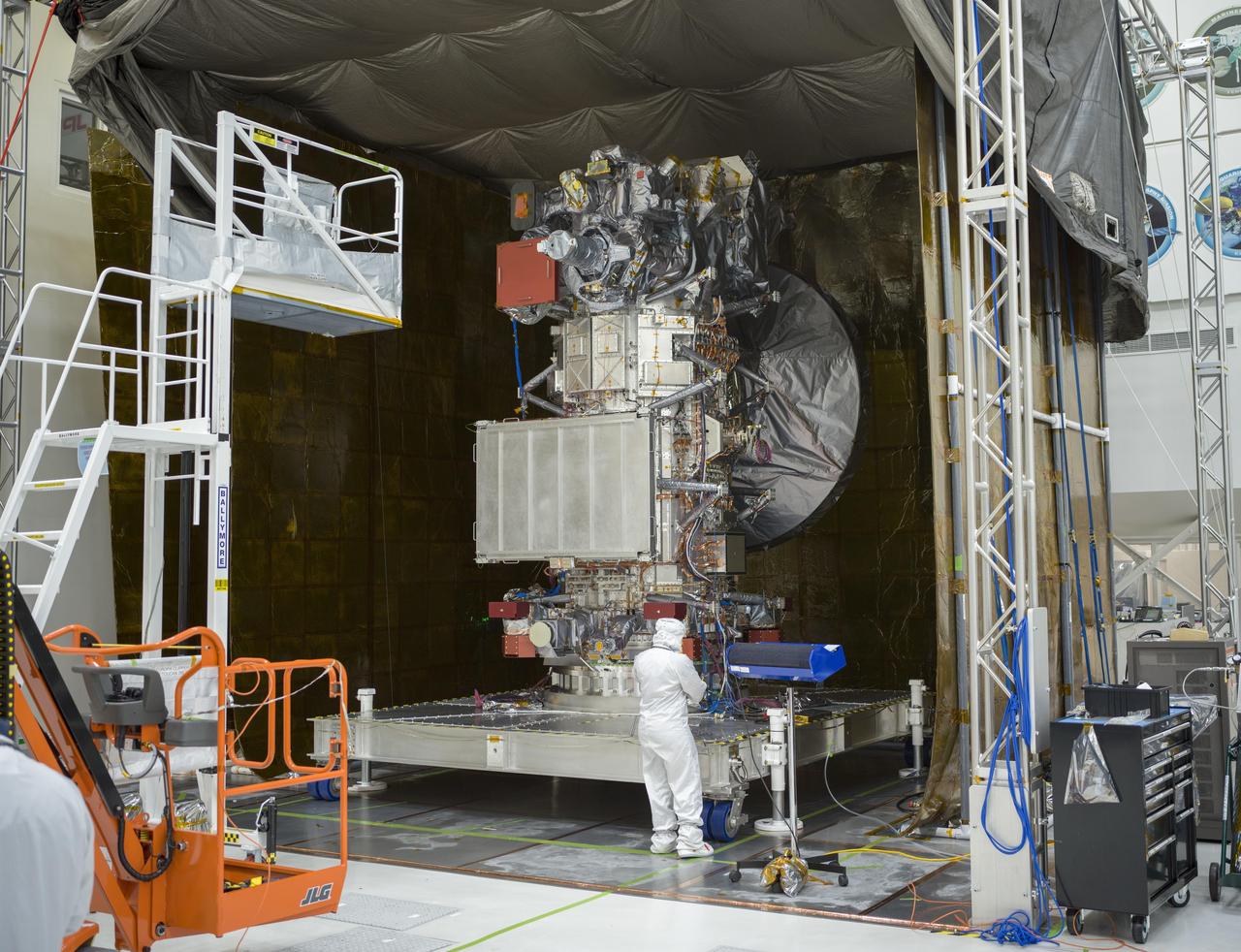
NASA's Europa Clipper spacecraft is seen in the main clean room of the Spacecraft Assembly Facility at the agency's Jet Propulsion Laboratory in Southern California on Jan. 19, 2024. The tent around the spacecraft was erected to support electromagnetic testing, which is designed to ensure the hardware will operate correctly in the electrical and magnetic conditions of space – and that the electrical and magnetic components that make up the spacecraft are compatible and don't interfere with one another. Set to launch from Kennedy Space Center in Florida in October, Europa Clipper will arrive at the Jupiter system in 2030 and conduct about 50 flybys of the moon Europa. The mission's main science goal is to determine whether there are places below the icy surface of Europa that could support life. The mission's three main science objectives are to determine the thickness of the moon's ice shell and its surface interactions with the ocean below, to investigate its composition, and to characterize its geology. The mission's detailed exploration of Europa will help scientists better understand the astrobiological potential for habitable worlds beyond our planet. https://photojournal.jpl.nasa.gov/catalog/PIA26061
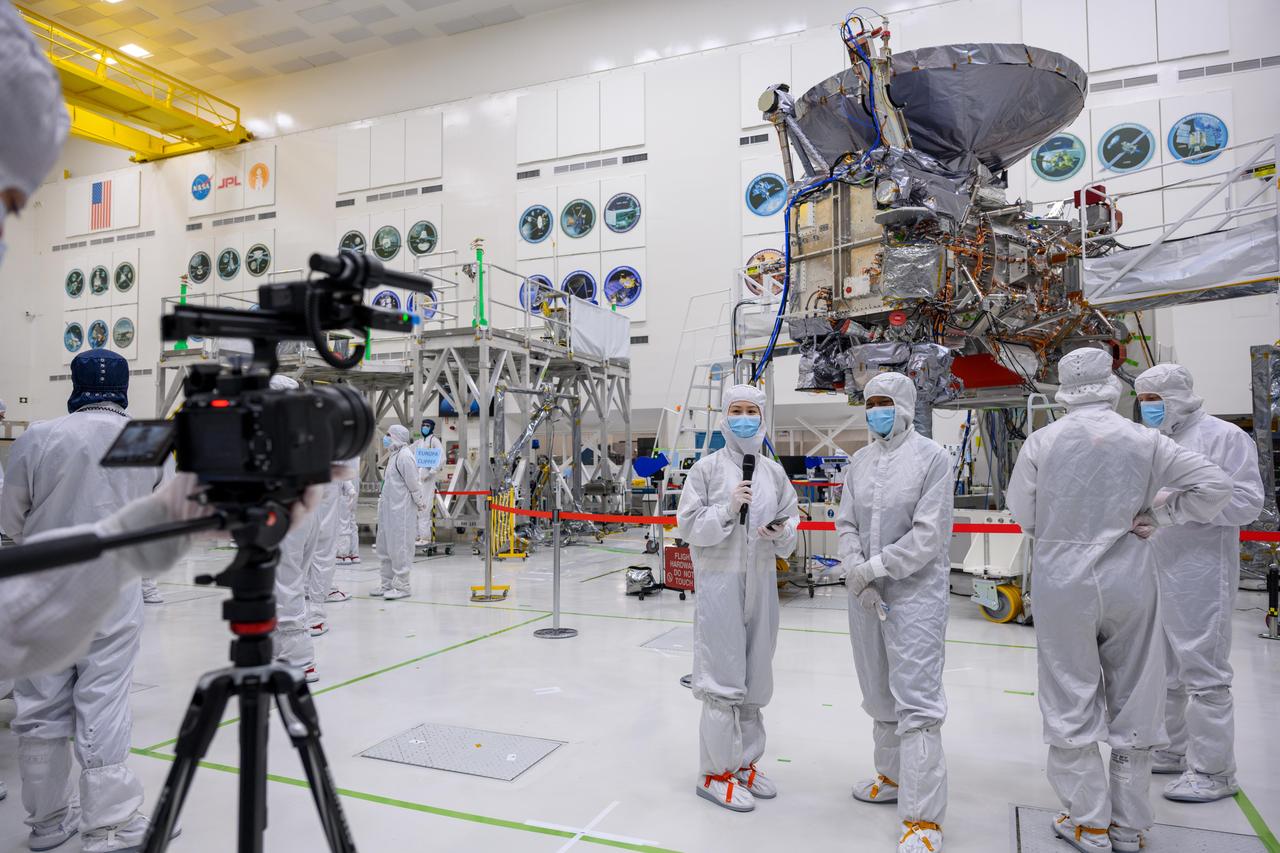
Members of the media viewed NASA's Europa Clipper spacecraft in High Bay 1 in the historic Spacecraft Assembly Facility at the agency's Jet Propulsion Laboratory on April 11, 2024. The largest spacecraft NASA has ever built for a planetary mission, Europa Clipper is expected to launch in October 2024 on a six-year journey to the Jupiter system, where it will orbit the gas giant and study the ice-encased moon Europa. Europa Clipper's main science goal is to determine whether there are places below the surface of Jupiter's icy moon, Europa, that could support life. The mission's three main science objectives are to determine the thickness of the moon's icy shell and its surface interactions with the ocean below, to investigate its composition, and to characterize its geology. The mission's detailed exploration of Europa will help scientists better understand the astrobiological potential for habitable worlds beyond our planet. https://photojournal.jpl.nasa.gov/catalog/PIA26291
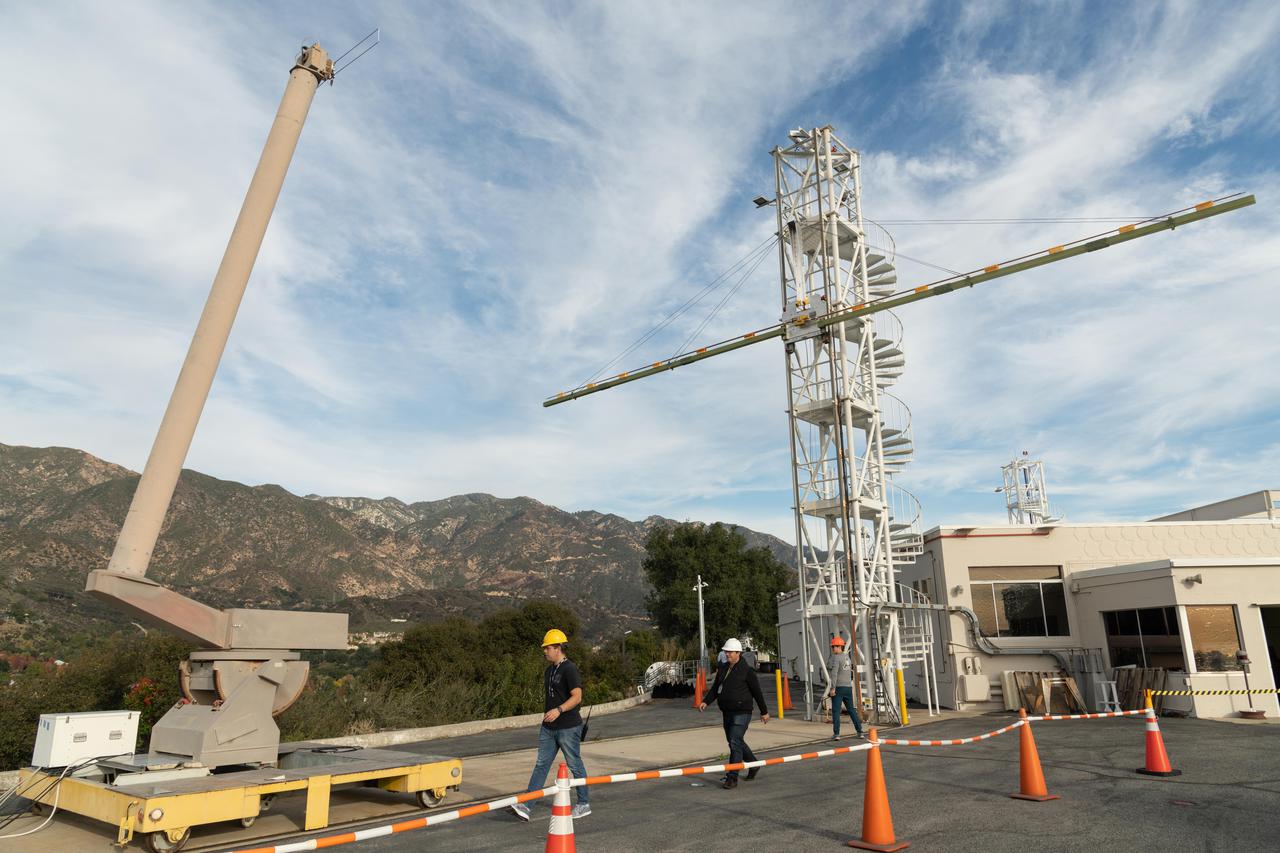
Engineers at NASA's Jet Propulsion Laboratory in Southern California test an engineering model of a high-frequency (HF) radar antenna that makes up part of NASA's Europa Clipper radar instrument on Dec. 17, 2019. The antenna is a 59-foot-long (18-meter-long) narrow copper tube held straight by several cables and a cross bar on the tower at right. In space, the copper tube will stick out straight on its own, but in Earth's gravity, the antenna requires supports to keep it straight for testing. The mobile tower at left holds a model of the VHF (very high-frequency) antenna so that engineers could measure the amount of energy coupled from one antenna to the other. Europa Clipper's radar instrument is called Radar for Europa Assessment and Sounding: Ocean to Near-surface, or REASON. As the spacecraft orbits Jupiter and surveys its icy moon Europa, REASON will use HF and VHF radio signals to penetrate up to 18 miles (30 kilometers) into the icy shell that covers Europa. The radio waves will bounce off subsurface features and return to the spacecraft to create images of the ice layers' internal structure. REASON will help scientists look for the moon's suspected ocean, measure ice thickness, and better understand the icy shell's interior. The instrument will also study the elevation, properties, and roughness of Europa's surface, and will prowl Europa's upper atmosphere for signs of plume activity. The antennae were built for NASA by Heliospace Corporation in Berkeley, California, and the University of Texas at Austin is the lead institution for REASON. The testing was conducted at JPL's Mesa Antenna Measurement Facility, which sits on a high plateau. With an internal global ocean twice the size of Earth's oceans combined, Europa may have the potential to harbor life. The Europa Clipper orbiter will swoop around Jupiter on an elliptical path, dipping close to the moon on each flyby to collect data. Understanding Europa's habitability will help scientists better understand how life developed on Earth and the potential for finding life beyond our planet. Europa Clipper is aiming for a launch readiness date of 2024. https://photojournal.jpl.nasa.gov/catalog/PIA24323
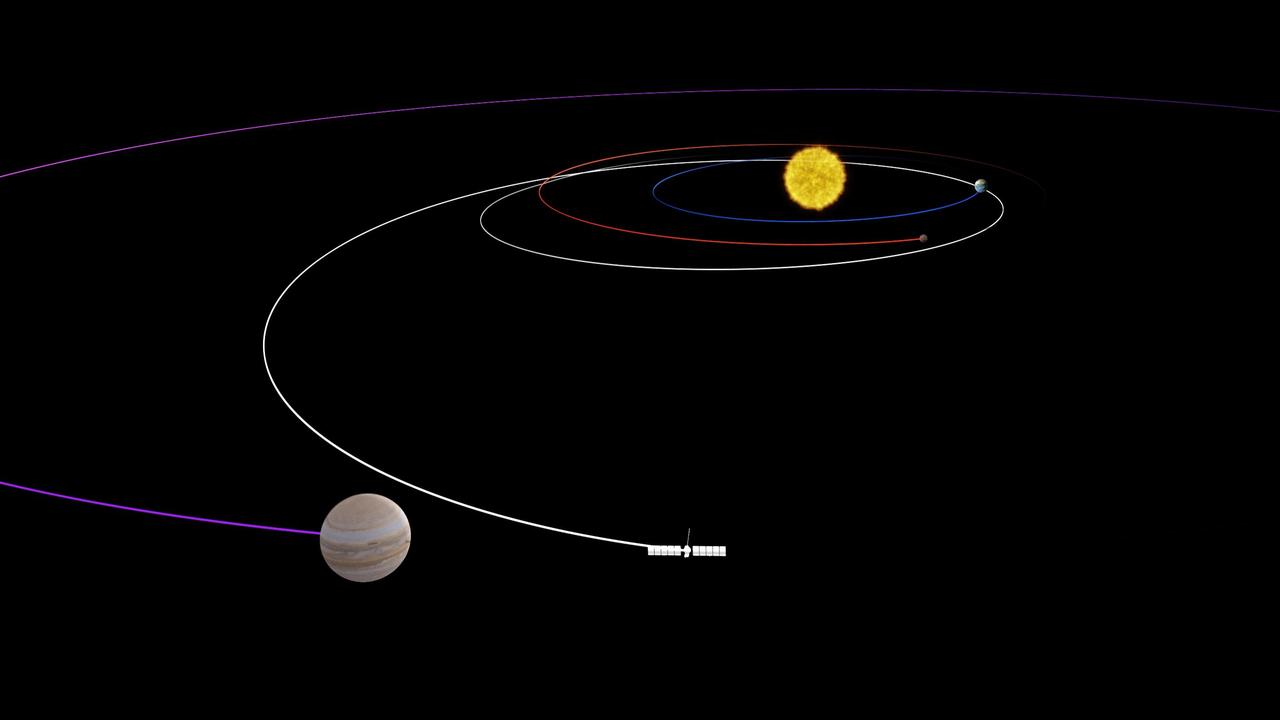
This artist's concept depicts the long, looping path NASA's Europa Clipper spacecraft will take to reach the Jupiter system. Covering a distance of about 1.8 billion miles (2.9 billion kilometers), the path swings past Mars, then Earth, using the two planets' gravity as a slingshot to add speed to the spacecraft's journey to Jupiter. Once in orbit at Jupiter, the spacecraft will conduct dozens of close flybys of the gas giant's icy moon Europa. Europa Clipper's three main science objectives are to determine the thickness of the moon's icy shell and its interactions with the ocean below, to investigate its composition, and to characterize its geology. The mission's detailed exploration of Europa will help scientists better understand the astrobiological potential for habitable worlds beyond our planet. https://photojournal.jpl.nasa.gov/catalog/PIA26432
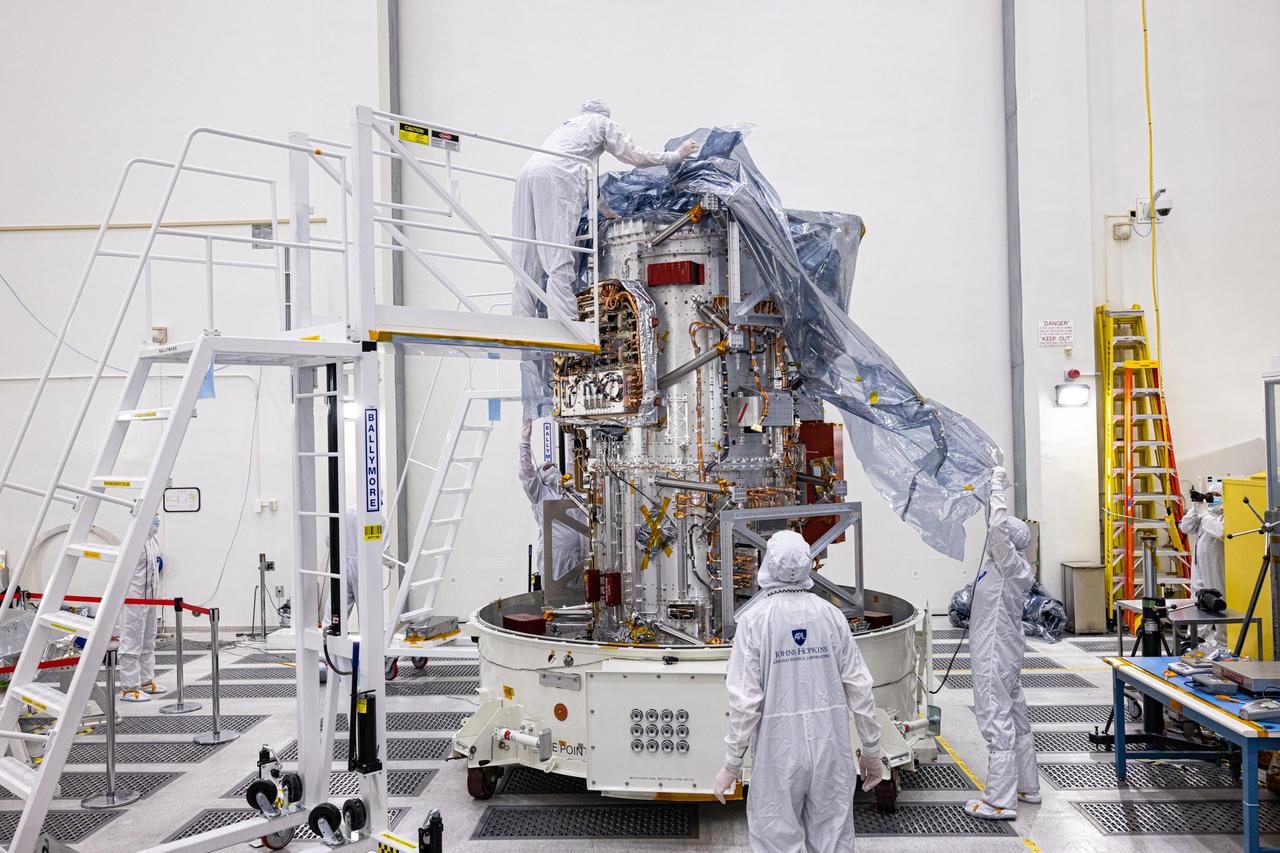
The main body of NASA's Europa Clipper spacecraft has been delivered to the agency's Jet Propulsion Laboratory in Southern California, where, over the next two years, engineers and technicians will finish assembling the craft by hand before testing it to make sure it can withstand the journey to Jupiter's icy moon Europa. Here it is being unwrapped in a main clean room at JPL, as engineers and technicians inspect it just after delivery in early June 2022. The Johns Hopkins Applied Physics Laboratory (APL) in Laurel, Maryland, designed and built the spacecraft body in collaboration with JPL and NASA's Goddard Space Flight Center in Greenbelt, Maryland. Set to launch in October 2024, Europa Clipper will conduct nearly 50 flybys of Europa, which scientists are confident harbors an internal ocean containing twice as much water as Earth's oceans combined. And the moon may currently have conditions suitable for supporting life. The spacecraft's nine science instruments will gather data on the moon's atmosphere, surface, and interior – information that scientists will use to gauge the depth and salinity of the ocean, the thickness of the ice crust, and potential plumes that may be venting subsurface water into space. https://photojournal.jpl.nasa.gov/catalog/PIA25237
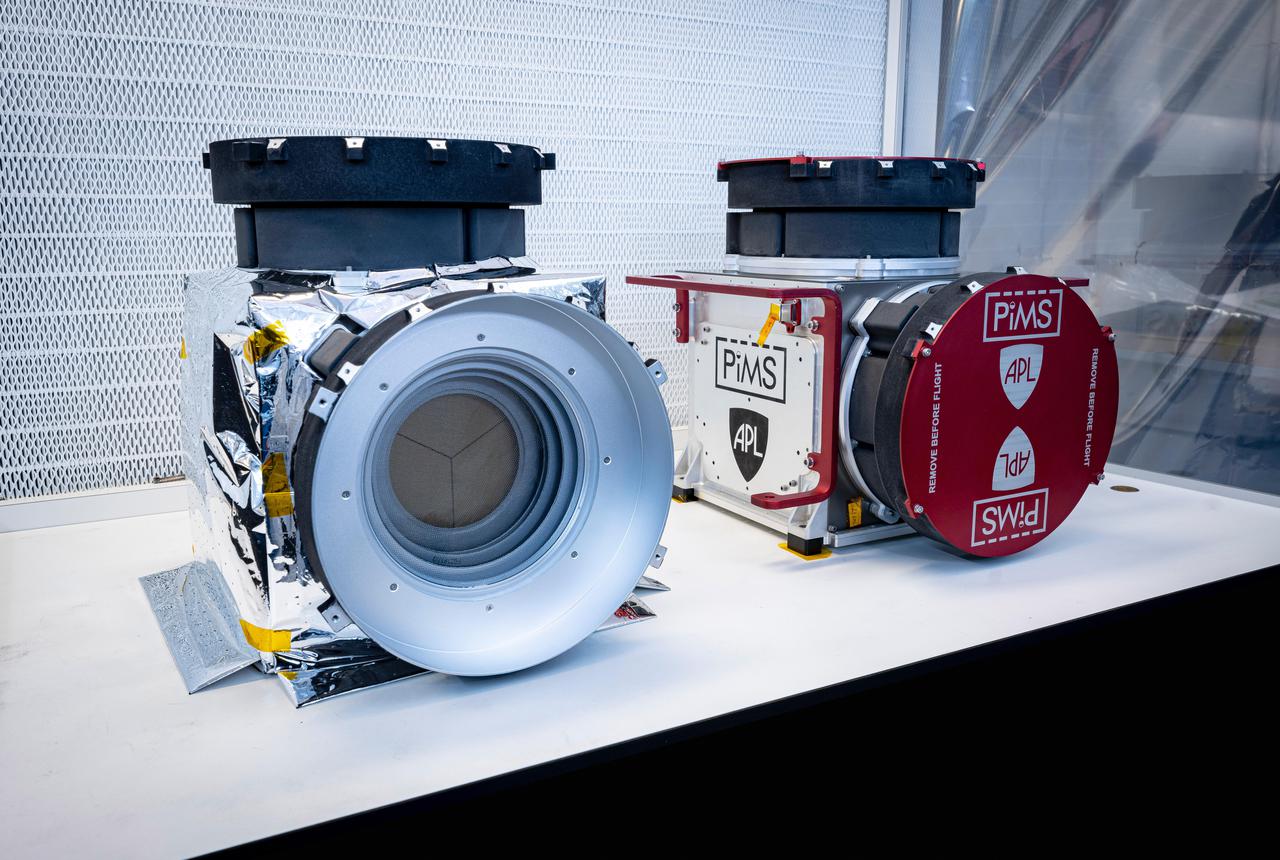
Included in the payload of science instruments for NASA's Europa Clipper is the Plasma Instrument for Magnetic Sounding (PIMS). Scientists will use PIMS to study the characteristics of plasma around Europa to better understand the moon's ice shell thickness, ocean depth, and ocean salinity. Built by the Johns Hopkins Applied Physics Laboratory (APL) in Laurel, Maryland, PIMS is made up of two instruments, each with two identical sensors called Faraday cups that will measure the plasmas, or electrically charged gases, in Europa's ionosphere and Jupiter's magnetosphere. Pictured in a clean room at APL are the recently assembled Faraday cup sensors and instrument housings in two configurations. On the left is the final flight hardware, with insulating thermal blankets installed; on the right is a test configuration that protects sensitive hardware for transportation. With an internal global ocean twice the size of Earth's oceans combined, Europa may have the potential to harbor life. NASA's Europa Clipper spacecraft will swoop around Jupiter on an elliptical path, dipping close to the moon on each flyby to collect data. Understanding Europa's habitability will help scientists better understand how life developed on Earth and the potential for finding life beyond our planet. https://photojournal.jpl.nasa.gov/catalog/PIA24327
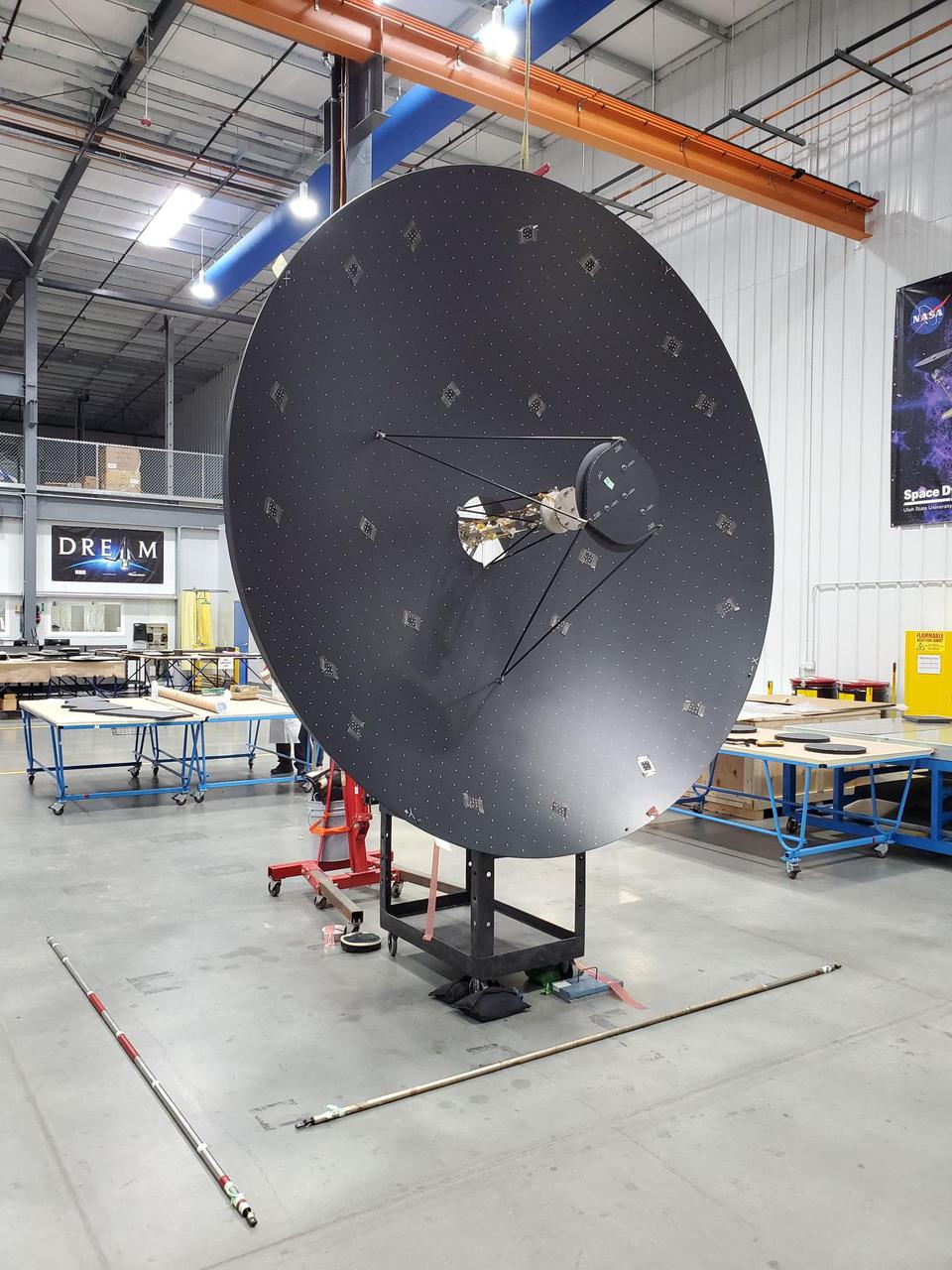
The massive high-gain antenna for NASA's Europa Clipper mission is complete. The antenna is nearly 10 feet (3 meters) wide and will be integrated along with other telecommunications hardware into the spacecraft's propulsion module. The antenna will download science data and allow ground controllers to send and receive commands and data between Earth and the spacecraft in Jupiter orbit – more than a million times farther from Earth than the International Space Station's orbits. It was designed by the Johns Hopkins Applied Physics Laboratory (APL) in Laurel, Maryland, and aerospace vendor Applied Aerospace Structures Corporation (AASC) in Stockton, California. With an internal global ocean under a thick layer of ice, Jupiter's moon Europa may have the potential to harbor existing life. Europa Clipper will swoop around Jupiter in an elliptical orbit, dipping close to the moon on each flyby to collect data. Understanding Europa's habitability will help scientists better understand how life developed on Earth and the potential for finding life beyond our planet. Europa Clipper is set to launch in 2024. https://photojournal.jpl.nasa.gov/catalog/PIA24899
Engineers and technicians work together to install reaction wheels on the underside of the main body of NASA's Europa Clipper spacecraft. The integration of the wheels was one of the latest steps of the spacecraft's assembly, test, and launch operations phase, now underway way in the Spacecraft Assembly Facility at the agency's Jet Propulsion Laboratory in Southern California. Europa Clipper is set to launch to Jupiter's moon Europa in October 2024. When the spacecraft heads through deep space, slips into orbit around Jupiter, and collects science observations while flying dozens of times by Europa, the wheels rotate the orbiter so that its antennas can communicate with Earth and so its science instruments, including cameras, can stay oriented toward Europa. Two feet wide and made of steel, aluminum, and titanium, the wheels spin rapidly to create a force that causes the orbiter to rotate in the opposite direction. The wheels will run on electricity provided by the spacecraft's vast solar arrays. Scientists believe the icy moon Europa harbors a vast internal ocean that may have conditions suitable for supporting life. Europa Clipper will fly by the moon about 50 times while its suite of science instruments gathers data on the moon's atmosphere, surface, and interior – information that will help scientists learn more about the ocean, the ice crust, and potential plumes that may be venting subsurface water into space. https://photojournal.jpl.nasa.gov/catalog/PIA25496
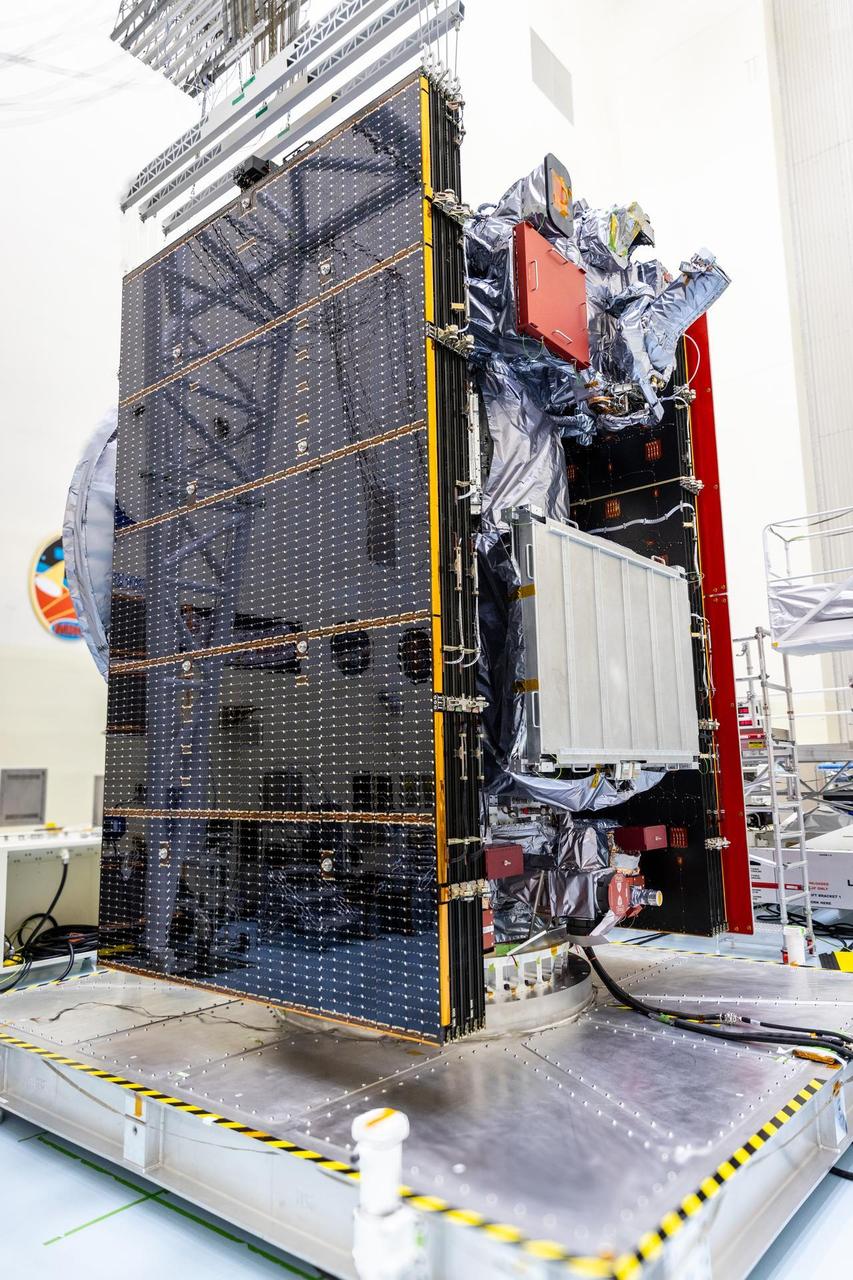
NASA's Europa Clipper is seen here on Aug. 21, 2024, in a clean room at the agency's Kennedy Space Center in Florida after engineers and technicians tested and stowed the spacecraft's giant solar arrays. Each array measures about 46.5 feet (14.2 meters) long and about 13.5 feet (4.1 meters) high. Europa Clipper's three main science objectives are to determine the thickness of the moon's icy shell and its interactions with the ocean below, to investigate its composition, and to characterize its geology. The mission's detailed exploration of Europa will help scientists better understand the astrobiological potential for habitable worlds beyond our planet. https://photojournal.jpl.nasa.gov/catalog/PIA26067
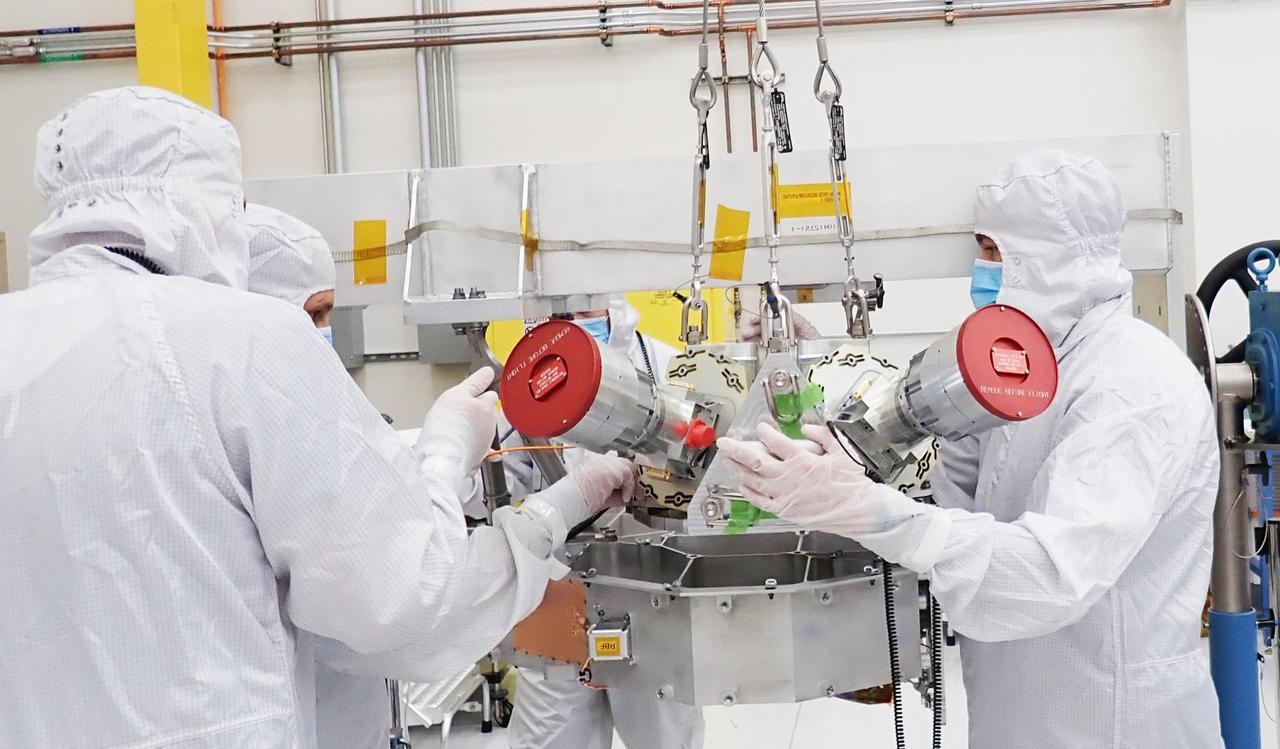
Engineers on NASA's Europa Clipper mission work with a piece of hardware called star trackers before they are integrated onto the spacecraft in a clean room at the agency's Jet Propulsion Laboratory in Southern California in 2022. The star trackers are seen here with red covers to protect their lenses. The star trackers, formally called stellar reference units, look for stars and use them like a compass to help mission controllers know the exact orientation of the spacecraft – information critical for pointing telecommunications antennas toward Earth and sending data back and forth smoothly. The spacecraft launched from the agency's Kennedy Space Center in Florida on Oct. 14, 2024. Europa Clipper's three main science objectives are to determine the thickness of the moon's icy shell and its interactions with the ocean below, to investigate its composition, and to characterize its geology. The mission's detailed exploration of Europa will help scientists better understand the astrobiological potential for habitable worlds beyond our planet. https://photojournal.jpl.nasa.gov/catalog/PIA26562
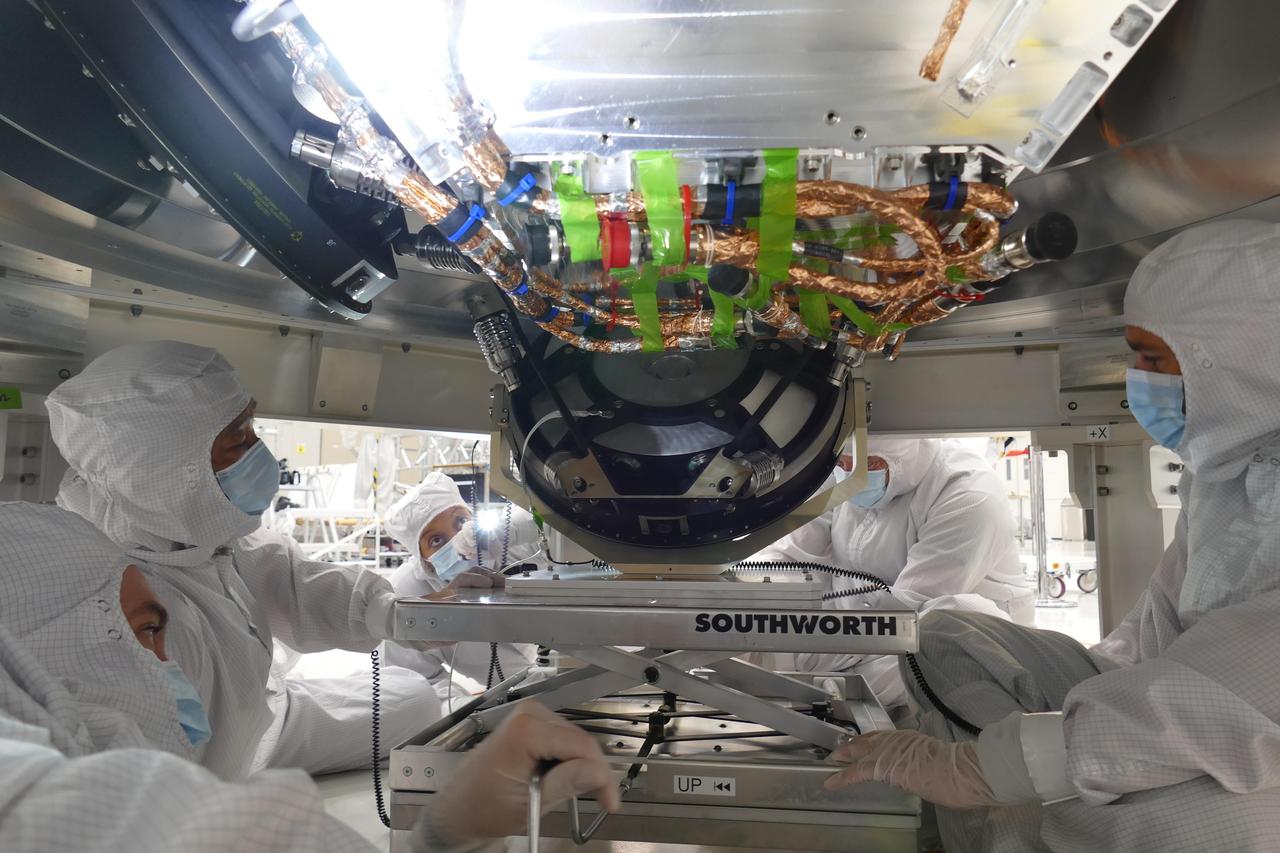
Engineers install a 2-foot-wide reaction wheel onto the main body of NASA's Europa Clipper spacecraft at the agency's Jet Propulsion Laboratory in Southern California. In all, four wheels were integrated onto the spacecraft, which is being assembled for its launch to Jupiter's moon Europa in October 2024. When the spacecraft heads through deep space, slips into orbit around Jupiter, and collects science observations while flying dozens of times by Europa, the wheels rotate the orbiter so that its antennas can communicate with Earth and so its science instruments, including cameras, can stay oriented toward Europa. Two feet wide and made of steel, aluminum, and titanium, the wheels spin rapidly to create a force that causes the orbiter to rotate in the opposite direction. The wheels will run on electricity provided by the spacecraft's vast solar arrays. Scientists believe the icy moon Europa harbors a vast internal ocean that may have conditions suitable for supporting life. Europa Clipper will fly by the moon about 50 times while its suite of science instruments gathers data on the moon's atmosphere, surface, and interior – information that will help scientists learn more about the ocean, the ice crust, and potential plumes that may be venting subsurface water into space. https://photojournal.jpl.nasa.gov/catalog/PIA25497
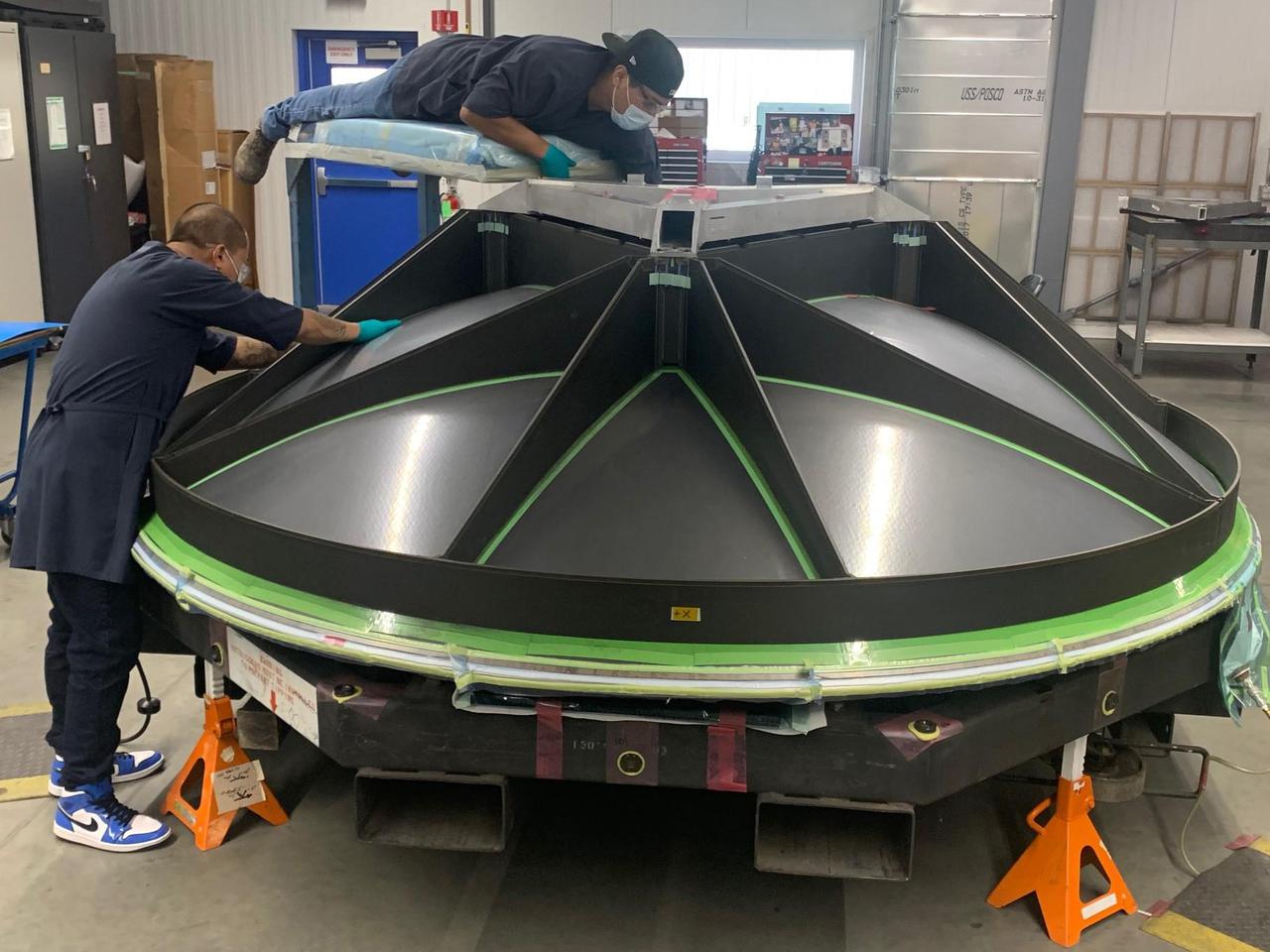
The build of a high-gain antenna, a nearly 10-foot-wide (3-meter-wide) dish, is underway for NASA's Europa Clipper spacecraft. The dish antenna, seen here face down, is being fabricated at aerospace vendor Applied Aerospace Structures Corporation (AASC) in Stockton, California. The antenna was designed by the Johns Hopkins Applied Physics Laboratory (APL) in Laurel, Maryland, and AASC, where it will be integrated along with other telecommunications hardware, into the propulsion module. The antenna downloads science data and allows ground controllers to send and receive commands and data between Earth and the spacecraft in Jupiter orbit – more than a million times farther from Earth than the International Space Station orbits. With an internal global ocean under a thick layer of ice, Jupiter's moon Europa may have the potential to harbor existing life. Europa Clipper will swoop around Jupiter on an elliptical path, dipping close to the moon on each flyby. Understanding Europa's habitability will help scientists better understand how life developed on Earth and the potential for finding life beyond our planet. Europa Clipper is set to launch in 2024. https://photojournal.jpl.nasa.gov/catalog/PIA24785
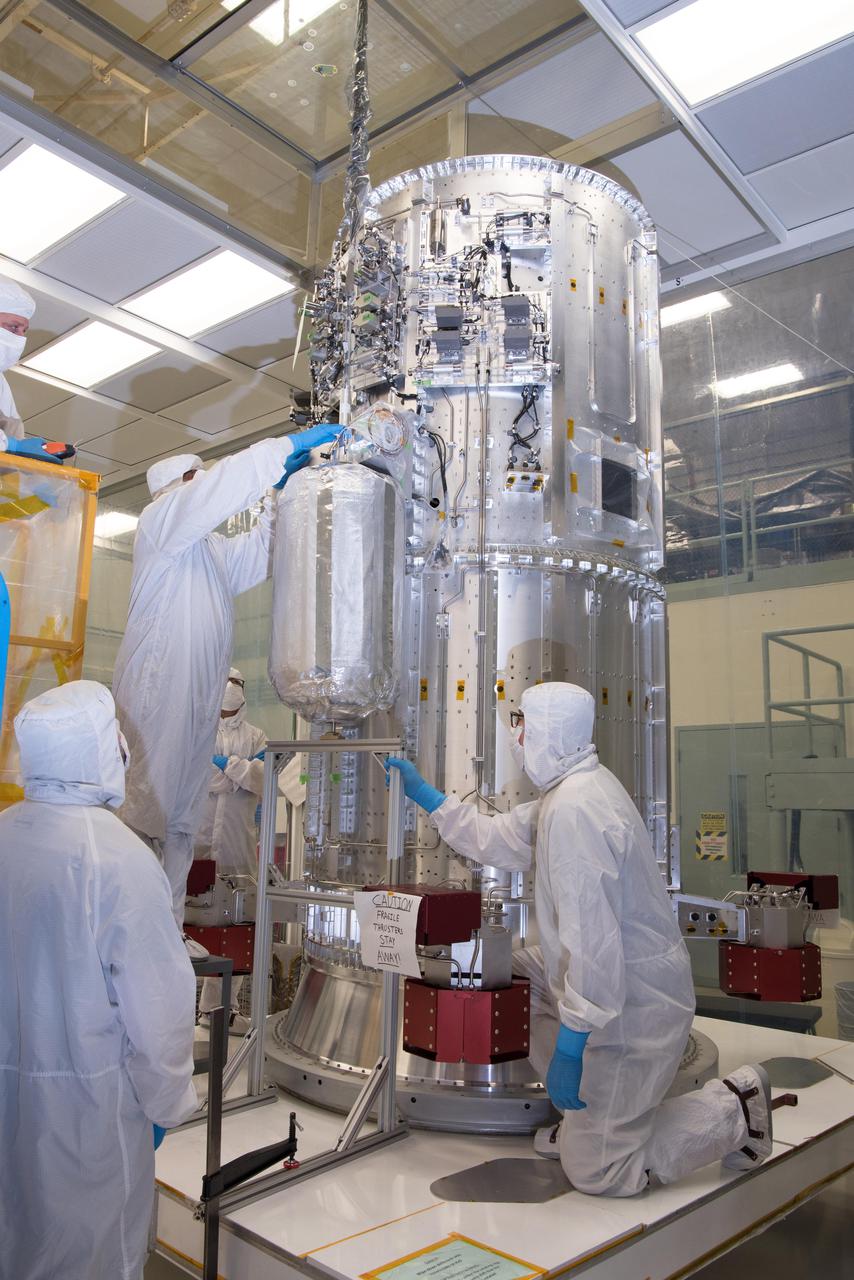
Engineers and technicians in a clean room at NASA's Goddard Space Flight Center in Greenbelt, Maryland, integrate the tanks that will contain helium onto the propulsion module of NASA's Europa Clipper spacecraft. The 10-foot-tall (3-meter-tall) propulsion module was also integrated with 16 rocket engines at Goddard. The module then was shipped to the Johns Hopkins Applied Physics Laboratory (APL) in Laurel, Maryland, where engineers will install electronics, radios, antennas, and cabling. In 2022, this major piece of hardware will ship to NASA's Jet Propulsion Laboratory in Southern California for assembly, test, and launch operations. With an internal global ocean under a thick layer of ice, Jupiter's moon Europa may have the potential to harbor existing life. The Europa Clipper spacecraft will swoop around Jupiter on an elliptical path, dipping close to the moon on each flyby to collect data. Understanding Europa's habitability will help scientists better understand how life developed on Earth and the potential for finding life beyond our planet. Europa Clipper is set to launch in 2024. https://photojournal.jpl.nasa.gov/catalog/PIA24782
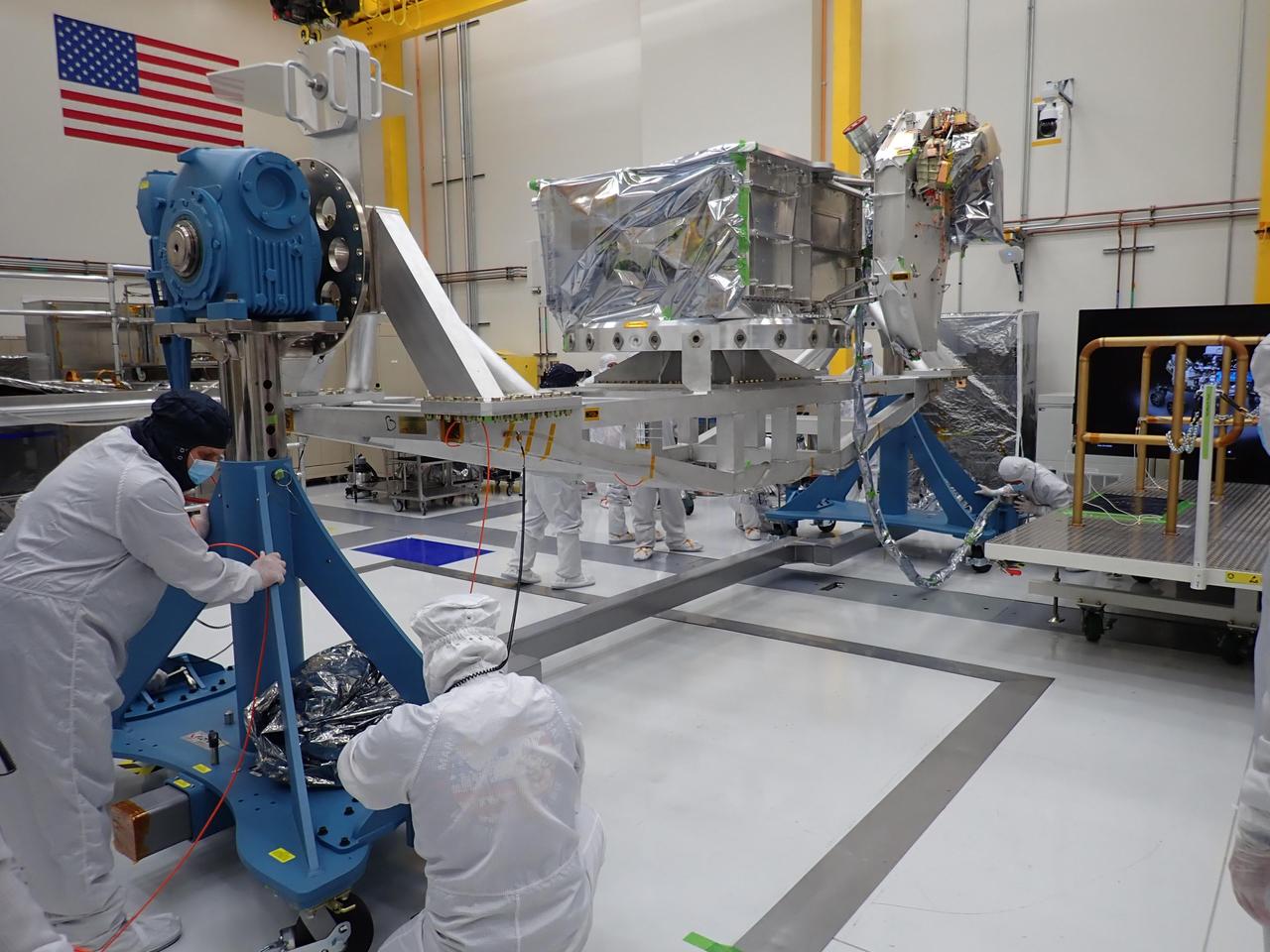
The vault, with nadir deck attached, of NASA's Europa Clipper is prepared to be moved to the High Bay 1 clean room of the Spacecraft Assembly Facility at NASA's Jet Propulsion Laboratory in Southern California. Made of aluminum, the vault will house and protect the spacecraft's electronics from Jupiter's intense radiation and high-energy particles. The nadir deck will support many of the spacecraft's science-instrument sensors by stabilizing them and ensuring they are oriented correctly. The vault and nadir deck soon will join other Europa Clipper hardware in High Bay 1, including the spacecraft's main body. Engineers and technicians will be working through the phase known as assembly, test, and launch operations to prepare the spacecraft for its launch to Jupiter's moon Europa in October 2024. Europa Clipper will conduct nearly 50 flybys of the icy Jovian moon Europa, which scientists are confident harbors an internal ocean containing twice as much water as Earth's oceans combined. The moon may currently have conditions suitable for supporting life. The spacecraft's nine science instruments, plus a gravity science investigation, will gather data on the moon's atmosphere, surface, and interior – information that scientists will use to gauge the depth and salinity of the ocean, the thickness of the ice crust, and potential plumes that may be venting subsurface water into space. https://photojournal.jpl.nasa.gov/catalog/PIA25493
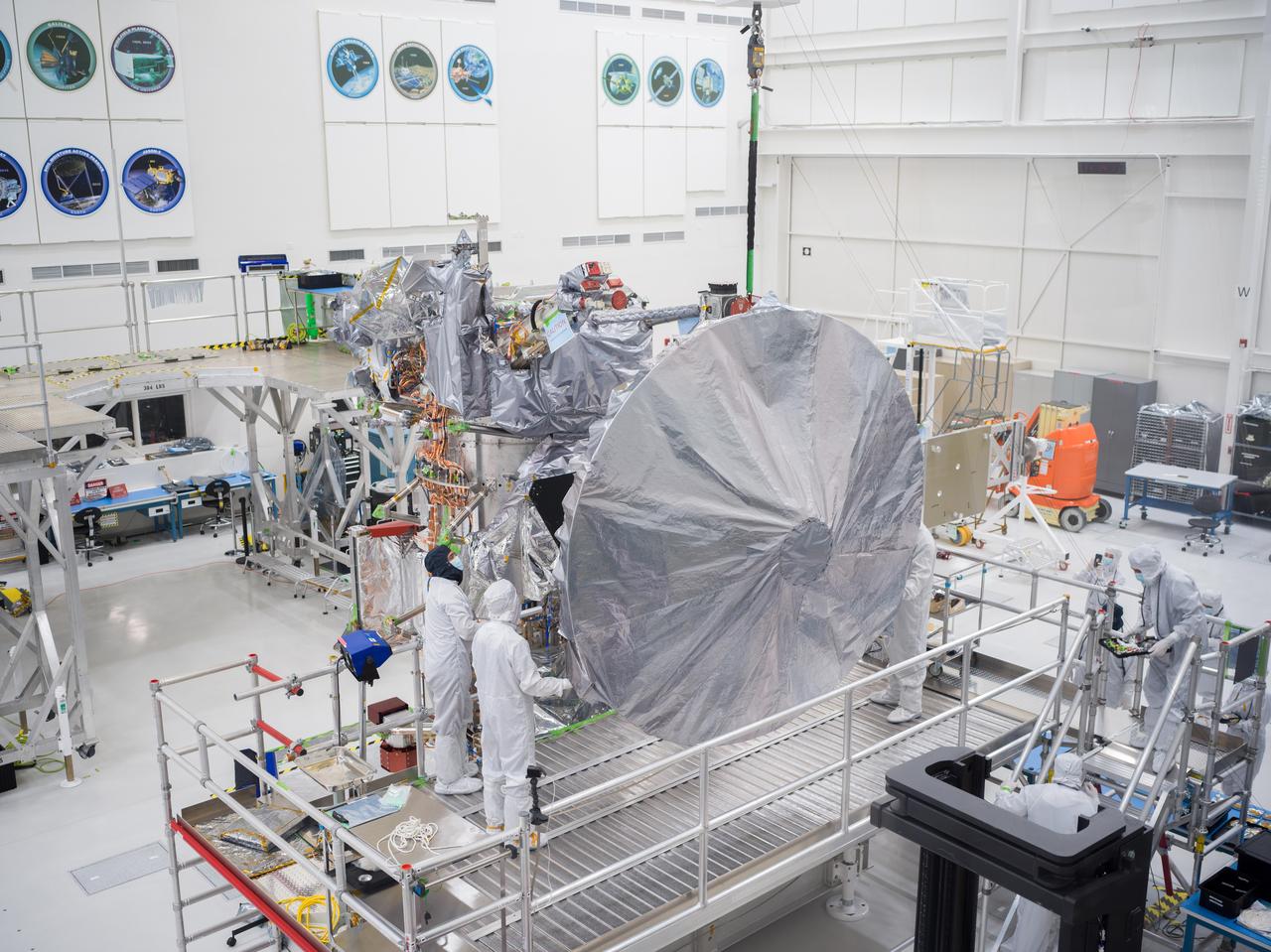
Engineers and technicians install a 10-foot (3-meter) high-gain antenna on NASA's Europa Clipper spacecraft on Aug. 14, 2023. The orbiter is being assembled in the clean room of the High Bay 1 clean room of the Spacecraft Assembly Facility at the agency's Jet Propulsion Laboratory, in preparation for launch to Jupiter's moon Europa in October 2024. The precision-engineered dish was attached to the spacecraft in carefully choreographed stages over the course of several hours. Europa Clipper will need the huge antenna to transmit data hundreds of millions of miles back to Earth. Scientists believe the icy moon Europa harbors a vast internal ocean that may have conditions suitable for supporting life. The spacecraft will fly by the moon about 50 times while its science instruments gather data on the moon's atmosphere, surface, and interior – information that will help scientists learn more about the ocean, the ice crust, and potential plumes that may be venting subsurface water into space. https://photojournal.jpl.nasa.gov/catalog/PIA25957

Mission members celebrate during the successful launch of NASA's Europa Clipper spacecraft on Oct. 14, 2024, in the Mission Support Area at NASA's Jet Propulsion Laboratory in Southern California. The spacecraft is bound on a 5½-year, 1.8 billion-mile (2.9 billion-kilometer) journey to Jupiter's icy moon Europa, which scientists believe harbors a vast internal ocean that may have conditions suitable for supporting life. Europa Clipper's three main science objectives are to determine the thickness of the moon's icy shell and its interactions with the ocean below, to investigate its composition, and to characterize its geology. The mission's detailed exploration of Europa will help scientists better understand the astrobiological potential for habitable worlds beyond our planet. https://photojournal.jpl.nasa.gov/catalog/PIA26422

This mosaic of a star field was made from three images captured Dec. 4, 2024, by star tracker cameras aboard NASA's Europa Clipper spacecraft. The pair of star trackers (formally known as the stellar reference units) captured and transmitted Europa Clipper's first imagery of space. The picture, composed of three shots, shows tiny pinpricks of light from stars 150 to 300 light-years away. The starfield represents only about 0.1% of the full sky around the spacecraft, but by mapping the stars in just that small slice of sky, the orbiter is able to determine where it is pointed and orient itself correctly. The starfield includes the four brightest stars – Gienah, Algorab, Kraz, and Alchiba – of the constellation Corvus, which is Latin for "crow," a bird in Greek mythology that was associated with Apollo. Besides being interesting to stargazers, the photos signal the successful checkout of the star trackers. The spacecraft checkout phase has been going on since Europa Clipper launched on a SpaceX Falcon Heavy rocket on Oct. 14, 2024. Europa Clipper's three main science objectives are to determine the thickness of the moon's icy shell and its interactions with the ocean below, to investigate its composition, and to characterize its geology. The mission's detailed exploration of Europa will help scientists better understand the astrobiological potential for habitable worlds beyond our planet. https://photojournal.jpl.nasa.gov/catalog/PIA26561
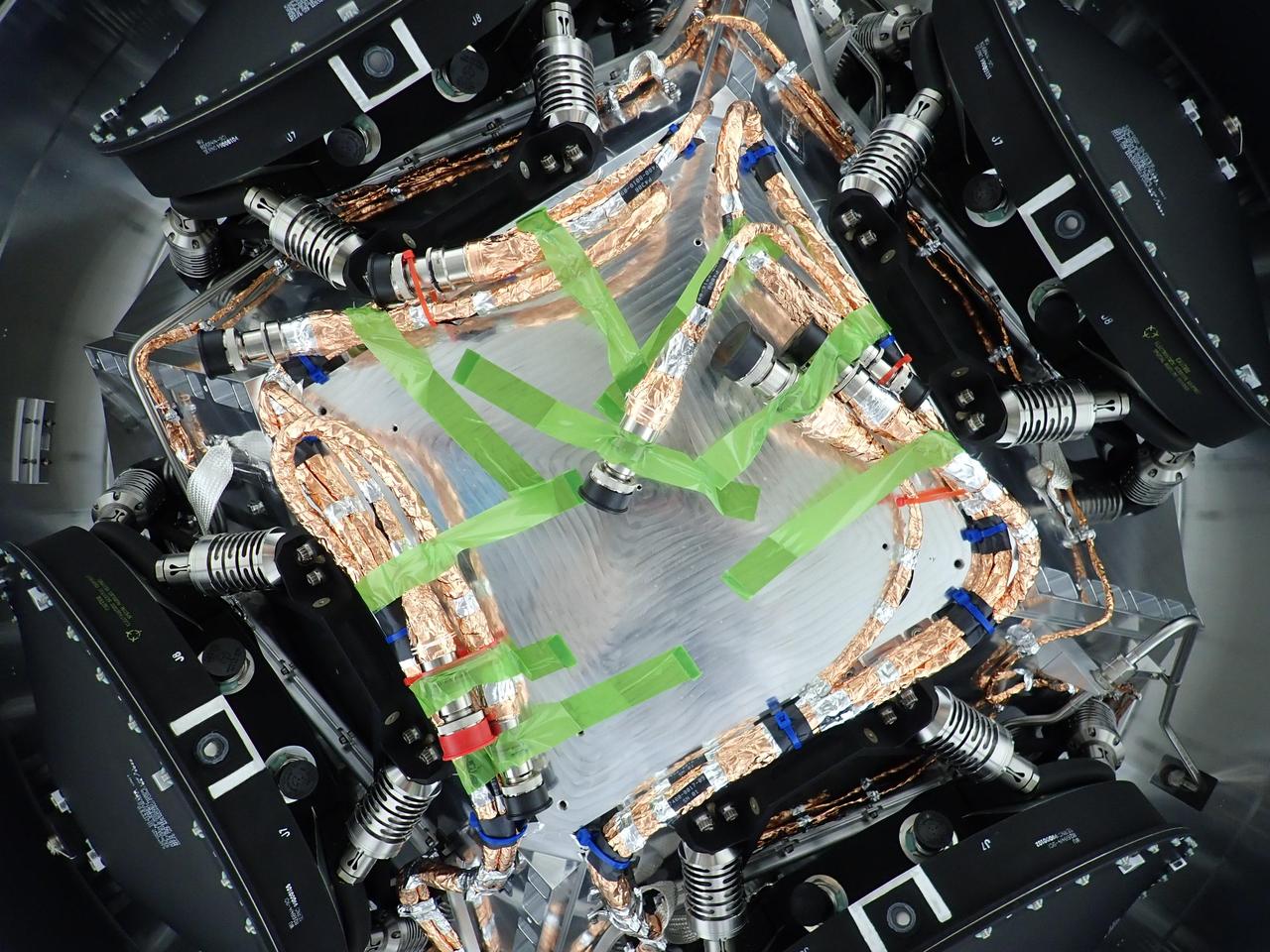
All four of the reaction wheels installed onto NASA's Europa Clipper are visible in this photo, which was shot from underneath the main body of the spacecraft while it is being assembled at the agency's Jet Propulsion Laboratory in Southern California. The spacecraft is set to launch in October 2024 and will head toward Jupiter's moon Europa, where it will collect science observations while flying by the icy moon dozens of times. During its journey through deep space and its flybys of Europa, the spacecraft's reaction wheels rotate the orbiter so its antennas can communicate with Earth and so its science instruments, including cameras, can stay oriented toward Europa. Two feet wide and made of steel, aluminum, and titanium, the wheels spin rapidly to create a force that causes the orbiter to rotate in the opposite direction. The wheels will run on electricity provided by the spacecraft's vast solar arrays. The green tape that is visible here keeps cables temporarily secured during the wheel installation. Scientists believe Europa harbors a vast internal ocean that may have conditions suitable for supporting life. Europa Clipper's suite of science instruments gathers data on the moon's atmosphere, surface, and interior – information that will help scientists learn more about the ocean, the ice crust, and potential plumes that may be venting subsurface water into space. https://photojournal.jpl.nasa.gov/catalog/PIA25495
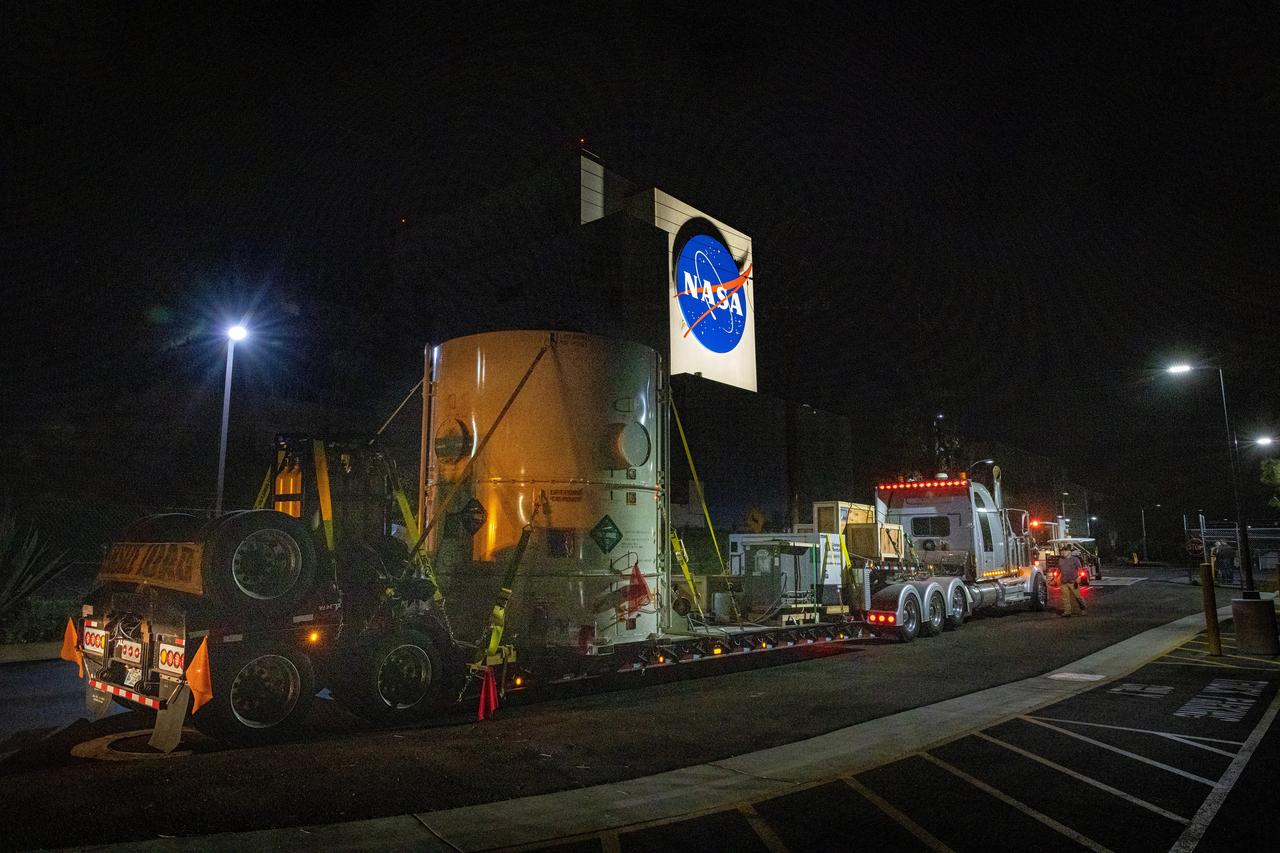
The main body of NASA's Europa Clipper spacecraft is seen in its shipping container as it rolls into the agency's Jet Propulsion Laboratory in Southern California. Over the next two years, engineers and technicians will finish assembling the craft by hand. Then it will be tested to make sure it can withstand the journey to Jupiter's icy moon Europa. The Johns Hopkins Applied Physics Laboratory (APL) in Laurel, Maryland, designed and built the spacecraft body in collaboration with JPL and NASA's Goddard Space Flight Center in Greenbelt, Maryland. Set to launch in October 2024, Europa Clipper will conduct nearly 50 flybys of Europa, which scientists are confident harbors an internal ocean containing twice as much water as Earth's oceans combined. And the moon may currently have conditions suitable for supporting life. The spacecraft's nine science instruments will gather data on the moon's atmosphere, surface, and interior – information that scientists will use to gauge the depth and salinity of the ocean, the thickness of the ice crust, and potential plumes that may be venting subsurface water into space. https://photojournal.jpl.nasa.gov/catalog/PIA25239
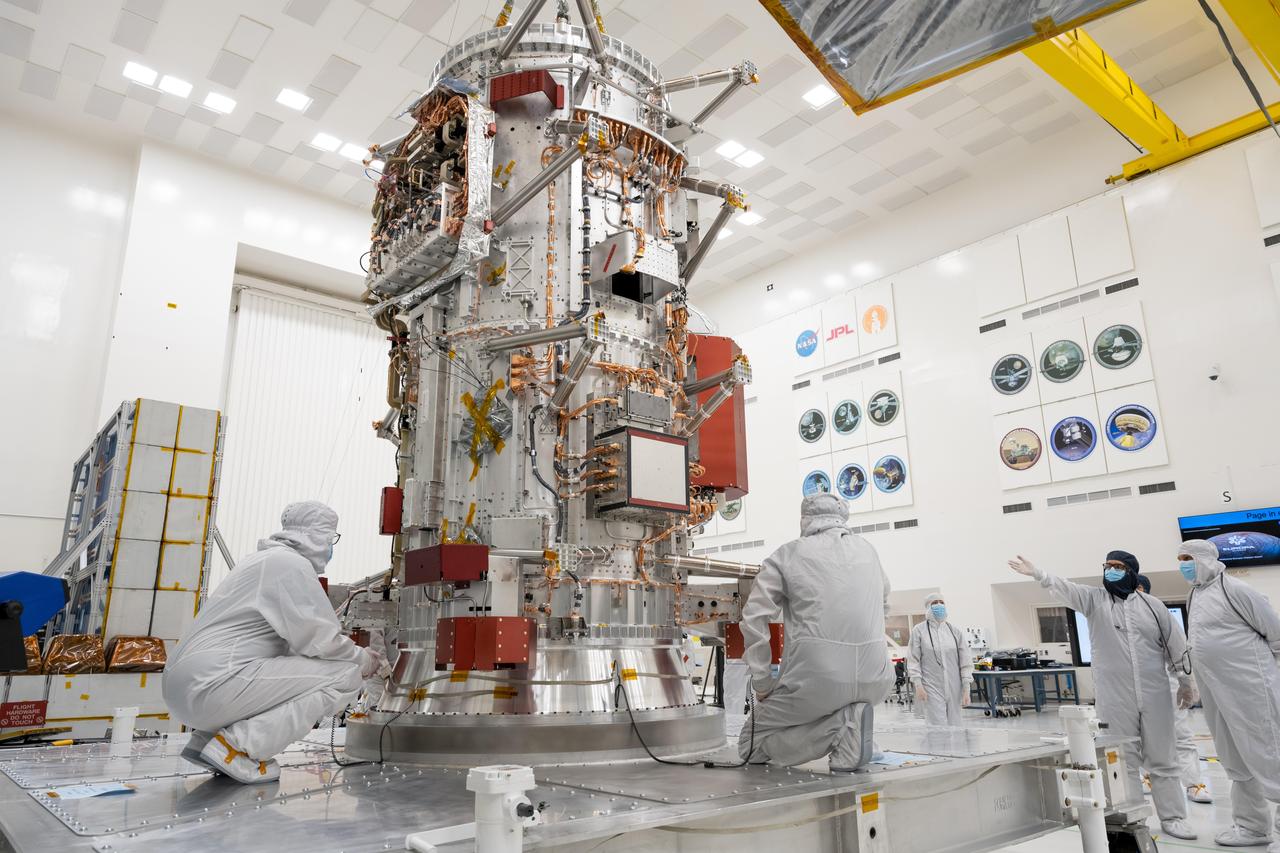
Engineers and technicians work on the towering main body of NASA's Europa Clipper spacecraft in the storied Spacecraft Assembly Facility at the agency's Jet Propulsion Laboratory in Southern California. Standing 10 feet (3 meters) high and 5 feet (1.5 meters) wide, the craft's core will be the focus of attention in the facility's ultra-hygienic High Bay 1 as the spacecraft is assembled for its launch to Jupiter's moon Europa in October 2024. Europa Clipper will conduct nearly 50 flybys of the icy Jovian moon Europa, which scientists are confident harbors an internal ocean containing twice as much water as Earth's oceans combined. The moon may currently have conditions suitable for supporting life. The spacecraft's nine science instruments, plus a gravity science investigation, will gather data on the moon's atmosphere, surface, and interior – information that scientists will use to gauge the depth and salinity of the ocean, the thickness of the ice crust, and potential plumes that may be venting subsurface water into space. https://photojournal.jpl.nasa.gov/catalog/PIA25240
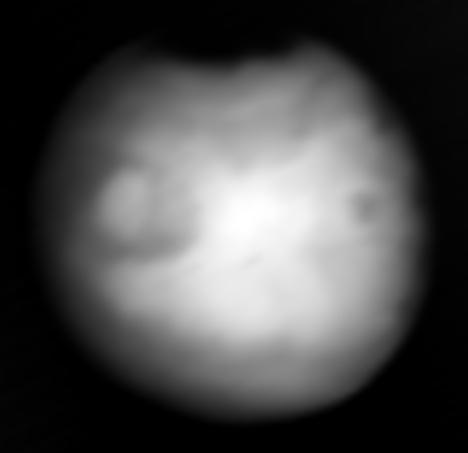
Europa Clipper, en route to the Jupiter system to investigate the icy moon Europa, swung by Mars on March 1, 2025, to use the planet's gravity to help shape the spacecraft's trajectory. The mission took the opportunity to capture to capture infrared images of the Red Planet using the orbiter's Europa Thermal Imaging System (E-THEMIS) to calibrate the instrument. This picture is a composite of several images captured by E-THEMIS, showing Mars' surface temperatures from about a million miles (1.6 million kilometers) away. Bright regions are relatively warm, with temperatures of about 32 degrees Fahrenheit (0 degrees Celsius). Darker areas are colder. The darkest region at the top is the northern polar cap and is about minus 190 F (minus 125 C). The temperature variations reflect the time of day on Mars, which was noon, with the center of the globe warmest because the Sun was shining directly onto the planet, near the equator, from behind Europa Clipper. Other variations reflect different surface features, with the fine-grained dust at the region near the equator being warm and coarser, rockier materials staying cooler. The instrument captured the images data in long-wave infrared wavelengths of about 7 to 14 micrometers. Europa Clipper launched from NASA's Kennedy Space Center in Florida on Oct. 14, 2024, and will arrive at the Jupiter system in 2030 to conduct about 50 flybys of Europa. The mission's main science goal is to determine whether there are places below Europa's surface that could support life. The mission's three main science objectives are to determine the thickness of the moon's icy shell and its surface interactions with the ocean below, to investigate its composition, and to characterize its geology. The mission's detailed exploration of Europa will help scientists better understand the astrobiological potential for habitable worlds beyond our planet. https://photojournal.jpl.nasa.gov/catalog/PIA26565
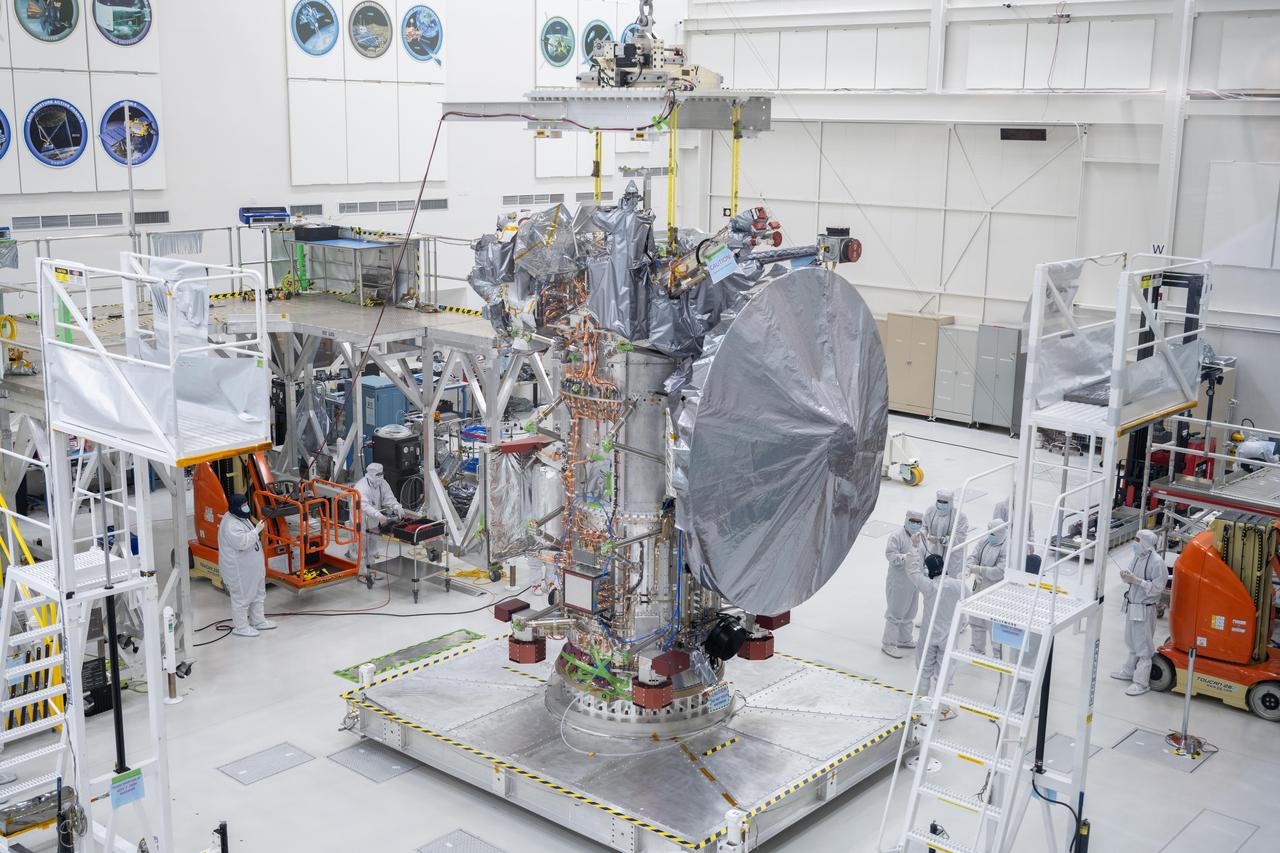
NASA's Europa Clipper spacecraft boasts its new 10-foot (3-meter) high-gain antenna, after its Aug. 14, 2023, installation in High Bay 1 of the Spacecraft Assembly Facility at the agency's Jet Propulsion Laboratory in Southern California. The orbiter is being assembled in preparation for launch to Jupiter's moon Europa in October 2024. The precision-engineered dish was attached to the spacecraft in carefully choreographed stages over the course of several hours. Europa Clipper will need the huge antenna to transmit data hundreds of millions of miles back to Earth. Scientists believe the icy moon Europa harbors a vast internal ocean that may have conditions suitable for supporting life. The spacecraft will fly by the moon about 50 times while its science instruments gather data on the moon's atmosphere, surface, and interior – information that will help scientists learn more about the ocean, the ice crust, and potential plumes that may be venting subsurface water into space. https://photojournal.jpl.nasa.gov/catalog/PIA25958
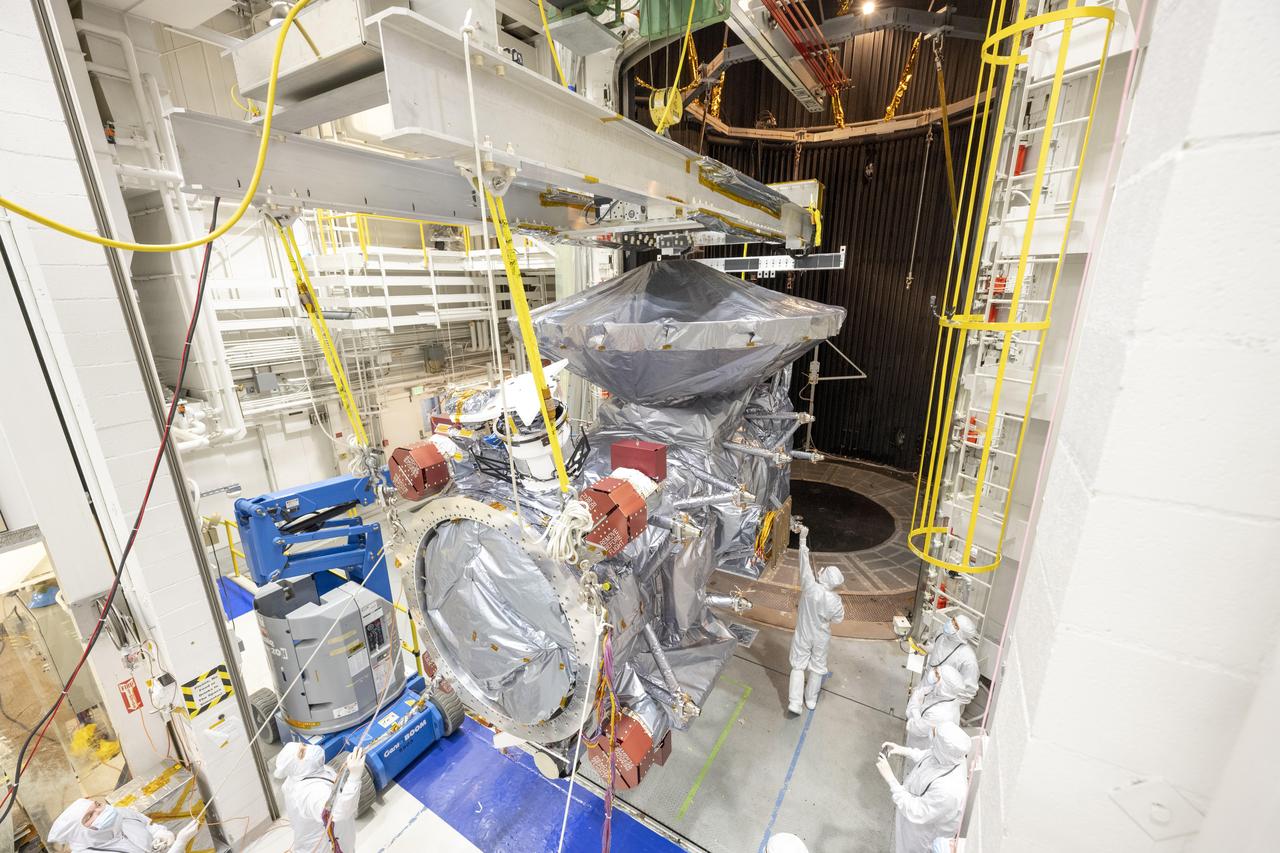
NASA's Europa Clipper spacecraft is seen in the 85-foot-tall, 25-foot-wide (26-meter-by-8-meter) vacuum chamber, known as the Space Simulator, at the agency's Jet Propulsion Laboratory in Southern California in February 2024. Shortly after this photo was taken, the spacecraft underwent 16 days of thermal vacuum chamber (TVAC) testing so that engineers can be sure the hardware will survive the extreme temperatures and airless environment of space. TVAC is part of a regimen called environmental testing that takes place before spacecraft are approved for flight. Europa Clipper, set to launch in October 2024 from Kennedy Space Center in Florida, will arrive at the Jupiter system in 2030 and conduct about 50 flybys of the moon Europa. The mission's main science goal is to determine whether there are places below the surface of Europa that could support life. The mission's three main science objectives are to determine the thickness of the moon's icy shell and its surface interactions with the ocean below, to investigate its composition, and to characterize its geology. The mission's detailed exploration of Europa will help scientists better understand the astrobiological potential for habitable worlds beyond our planet. https://photojournal.jpl.nasa.gov/catalog/PIA26065
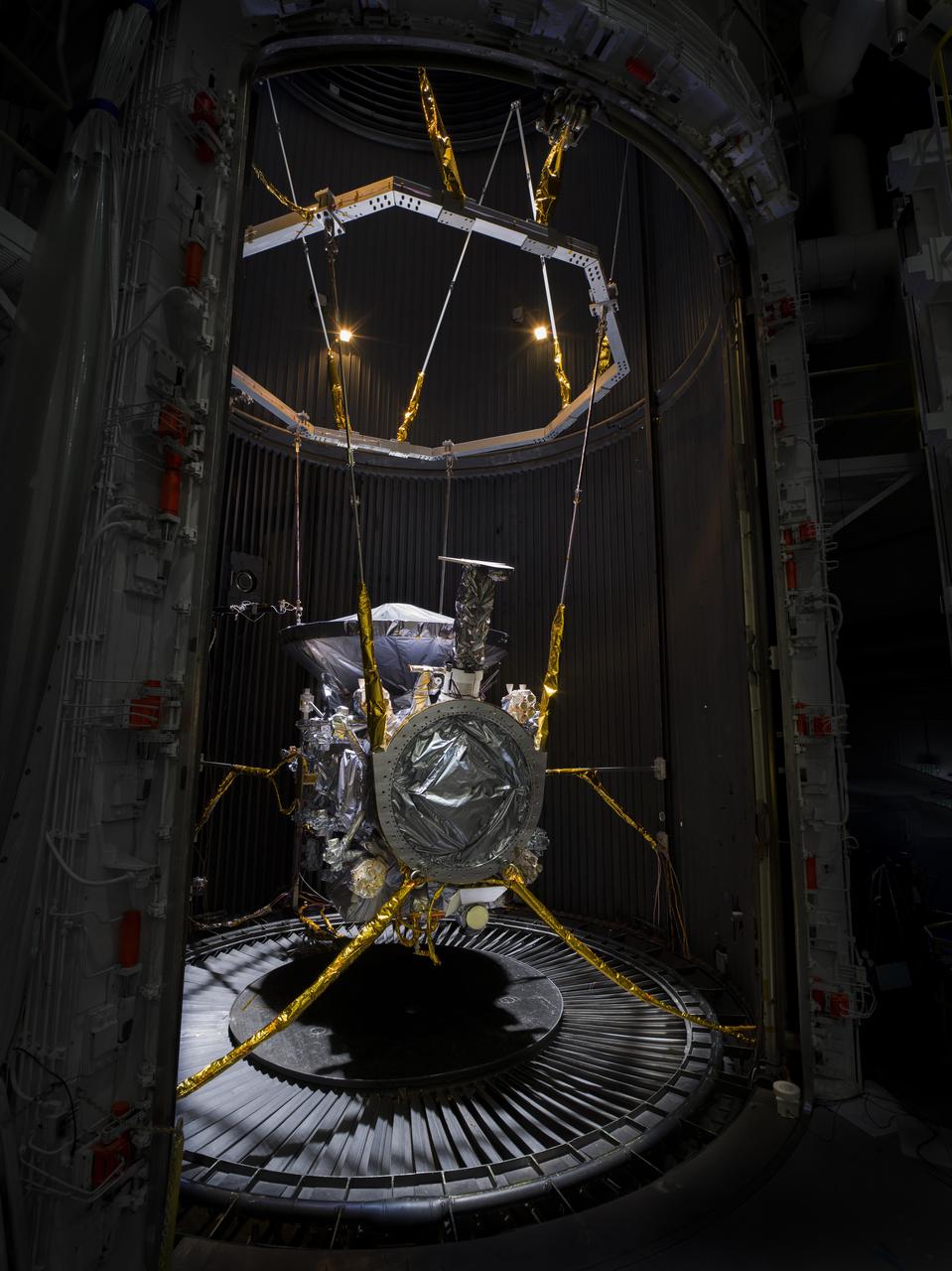
NASA's Europa Clipper spacecraft is seen in the 85-foot-tall, 25-foot-wide (26-meter-by-8-meter) vacuum chamber, known as the Space Simulator, at the agency's Jet Propulsion Laboratory in Southern California in February 2024. Shortly after this photo was taken, the spacecraft underwent 16 days of thermal vacuum chamber (TVAC) testing so that engineers can be sure the hardware will survive the extreme temperatures and airless environment of space. TVAC is part of a regimen called environmental testing that takes place before spacecraft are approved for flight. Europa Clipper, set to launch in October 2024 from Kennedy Space Center in Florida, will arrive at the Jupiter system in 2030 and conduct about 50 flybys of the moon Europa. The mission's main science goal is to determine whether there are places below the surface of Europa that could support life. The mission's three main science objectives are to determine the thickness of the moon's icy shell and its surface interactions with the ocean below, to investigate its composition, and to characterize its geology. The mission's detailed exploration of Europa will help scientists better understand the astrobiological potential for habitable worlds beyond our planet. https://photojournal.jpl.nasa.gov/catalog/PIA26064
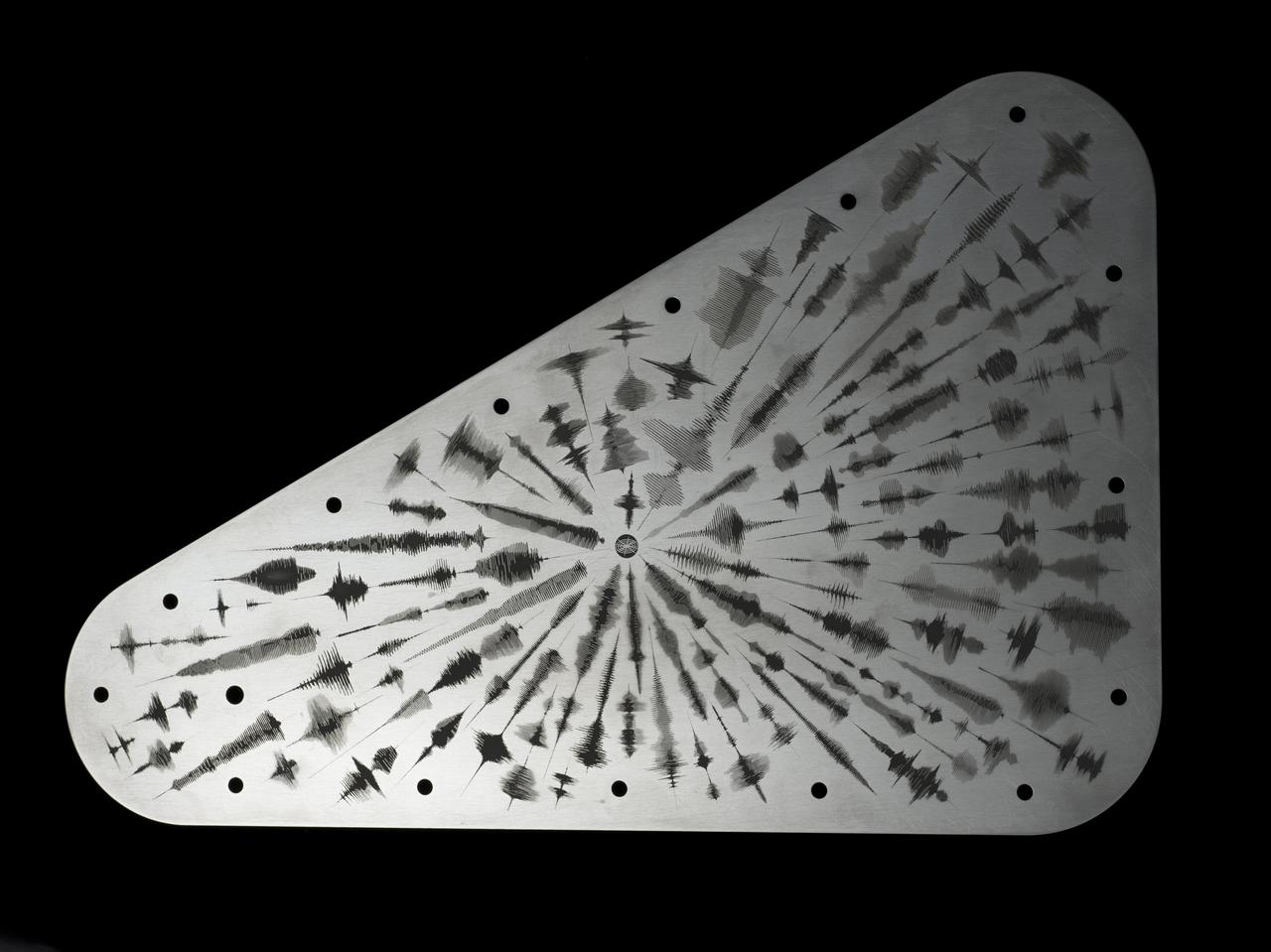
NASA's Europa Clipper spacecraft will carry a special message when it launches in October 2024 and heads toward Jupiter's moon Europa. The moon shows strong evidence of an ocean under its icy crust, with more than twice the amount of water of all of Earth's oceans combined. A triangular metal plate, seen here, will honor that connection to Earth. The plate is made of tantalum metal and is about 7 by 11 inches (18 by 28 centimeters). It is engraved on both sides and seals an opening in the electronics vault, which houses the spacecraft's sensitive electronics. The art on this side of the plate features waveforms that are visual representations of the sound waves formed by the word "water" in 103 languages. The waveforms radiate out from a symbol representing the American Sign Language sign for "water." In the spirit of the Voyager spacecraft's Golden Record, which carries sounds and images to convey the richness and diversity of life on Earth, the layered message on Europa Clipper aims to spark the imagination and offer a unifying vision. Europa Clipper, set to launch from Kennedy Space Center in Florida, will arrive at the Jupiter system in 2030 and conduct about 50 flybys of the moon Europa. The mission's main science goal is to determine whether there are places below Europa, that could support life. The mission's three main science objectives are to determine the thickness of the moon's icy shell and its surface interactions with the ocean below, to investigate its composition, and to characterize its geology. The mission's detailed exploration of Europa will help scientists better understand the astrobiological potential for habitable worlds beyond our planet. https://photojournal.jpl.nasa.gov/catalog/PIA26063
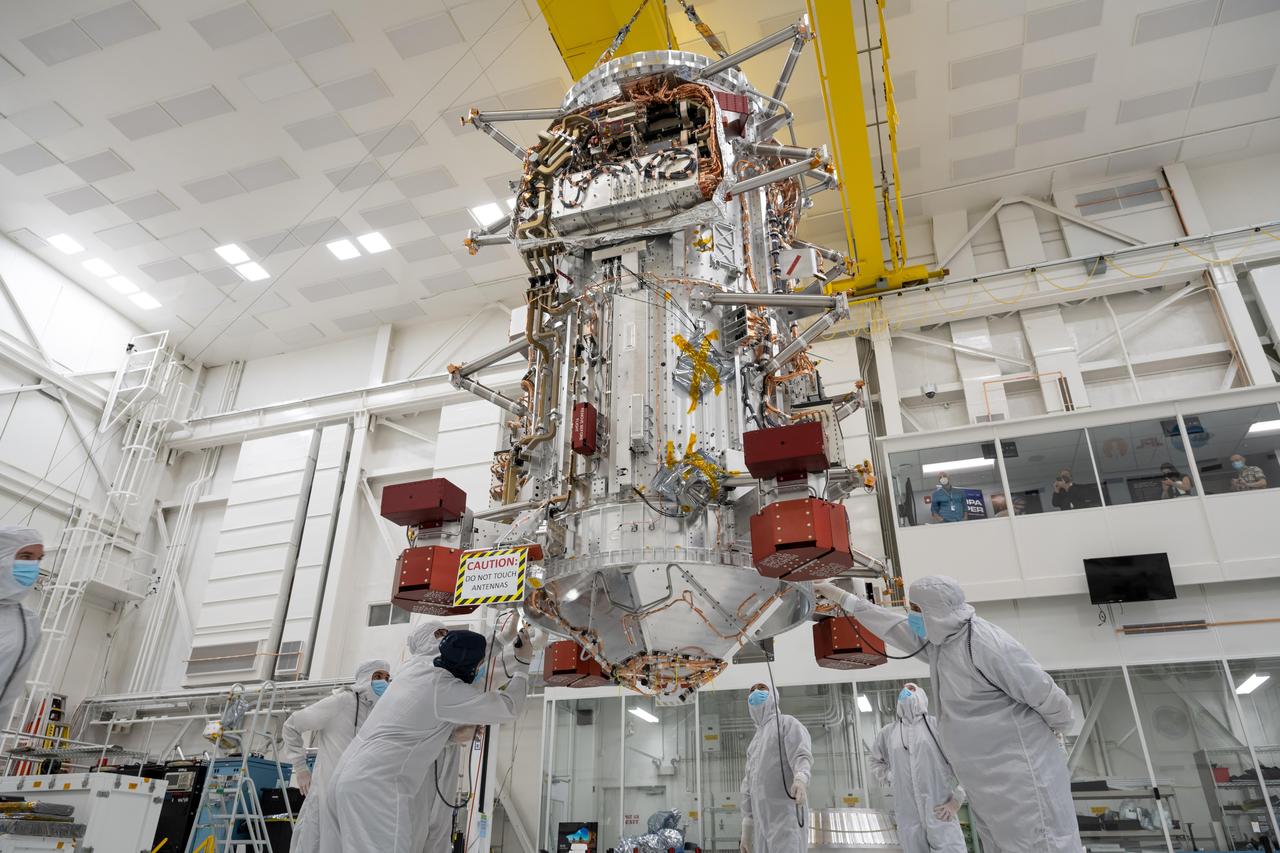
Engineers and technicians use a crane to lift the main body of NASA's Europa Clipper spacecraft and position it in the High Bay 1 clean room of the Spacecraft Assembly Facility at the agency's Jet Propulsion Laboratory in Southern California. Standing 10 feet (3 meters) high and 5 feet (1.5 meters) wide, the core will be the focus of attention as the spacecraft is assembled for its launch to Jupiter's moon Europa in October 2024. Europa Clipper will conduct nearly 50 flybys of the icy Jovian moon Europa, which scientists are confident harbors an internal ocean containing twice as much water as Earth's oceans combined. The moon may currently have conditions suitable for supporting life. The spacecraft's nine science instruments, plus a gravity science investigation, will gather data on the moon's atmosphere, surface, and interior – information that scientists will use to gauge the depth and salinity of the ocean, the thickness of the ice crust, and potential plumes that may be venting subsurface water into space. https://photojournal.jpl.nasa.gov/catalog/PIA25491
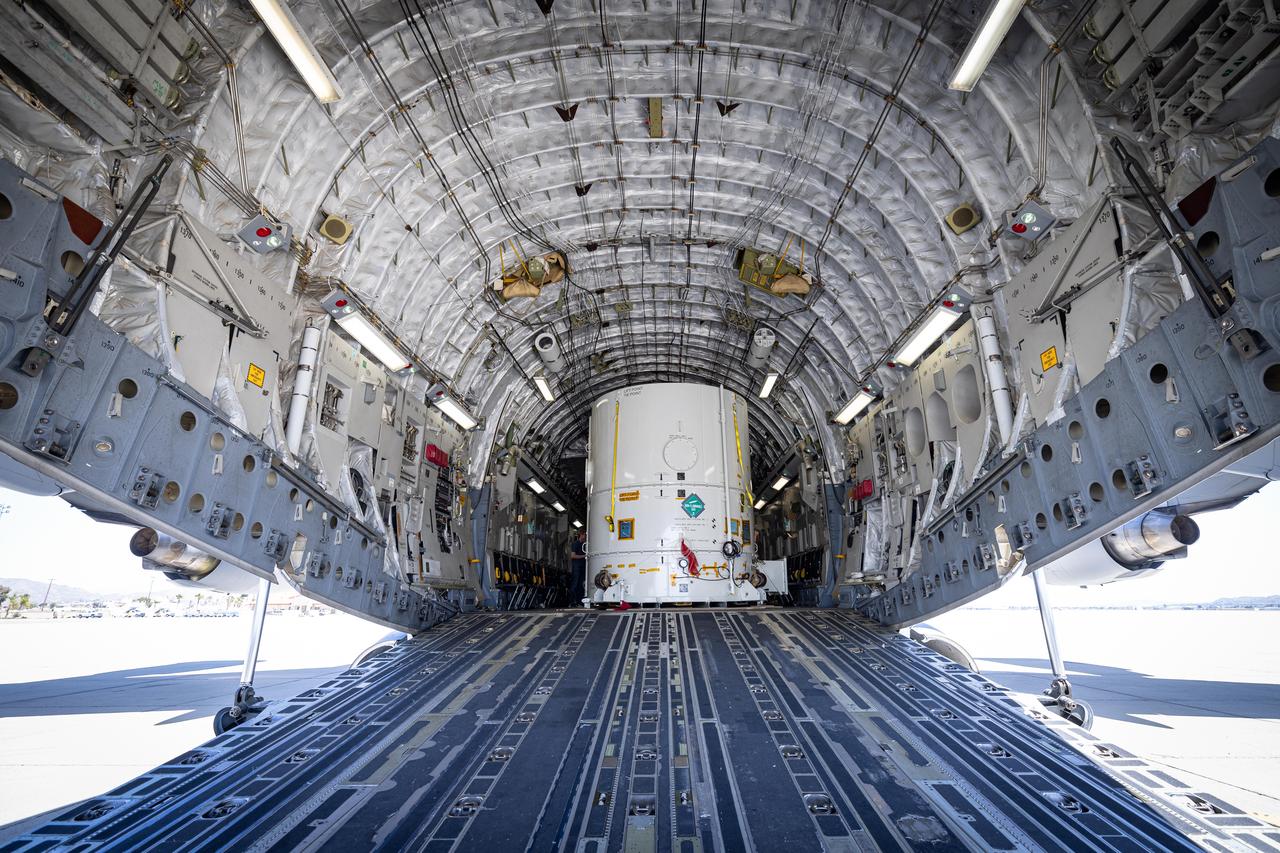
The main body of NASA's Europa Clipper spacecraft is seen in its shipping container, just after arriving aboard a C-17 cargo plane at March Air Reserve Base in Riverside County, California. From there it was delivered by truck to the agency's Jet Propulsion Laboratory in Southern California, where, over the next two years, engineers and technicians will finish assembling the craft by hand. Then it will be tested to make sure it can withstand the journey to Jupiter's icy moon Europa. The Johns Hopkins Applied Physics Laboratory (APL) in Laurel, Maryland, designed and built the spacecraft body in collaboration with JPL and NASA's Goddard Space Flight Center in Greenbelt, Maryland. Set to launch in October 2024, Europa Clipper will conduct nearly 50 flybys of Europa, which scientists are confident harbors an internal ocean containing twice as much water as Earth's oceans combined. And the moon may currently have conditions suitable for supporting life. The spacecraft's nine science instruments will gather data on the moon's atmosphere, surface, and interior – information that scientists will use to gauge the depth and salinity of the ocean, the thickness of the ice crust, and potential plumes that may be venting subsurface water into space. https://photojournal.jpl.nasa.gov/catalog/PIA25238
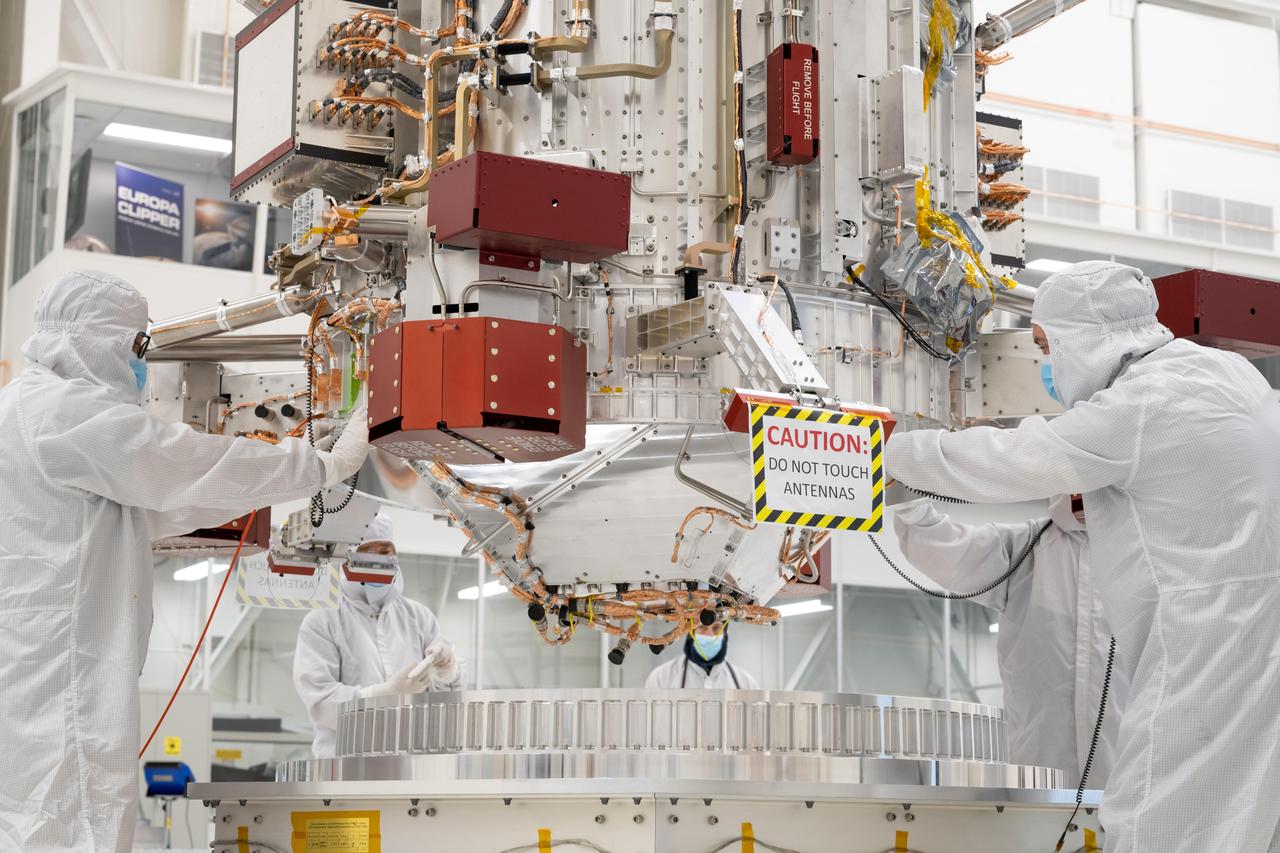
Engineers and technicians use a crane to lower the main body of NASA's Europa Clipper spacecraft into position in the High Bay 1 clean room of the Spacecraft Assembly Facility at the agency's Jet Propulsion Laboratory in Southern California. Standing 10 feet (3 meters) high and 5 feet (1.5 meters) wide, the core will be the focus of attention as the spacecraft is assembled for its launch to Jupiter's moon Europa in October 2024.This image was taken on Aug. 9, 2022. Europa Clipper will conduct nearly 50 flybys of the icy Jovian moon Europa, which scientists are confident harbors an internal ocean containing twice as much water as Earth's oceans combined. The moon may currently have conditions suitable for supporting life. The spacecraft's nine science instruments, plus a gravity science investigation, will gather data on the moon's atmosphere, surface, and interior – information that scientists will use to gauge the depth and salinity of the ocean, the thickness of the ice crust, and potential plumes that may be venting subsurface water into space. https://photojournal.jpl.nasa.gov/catalog/PIA25492
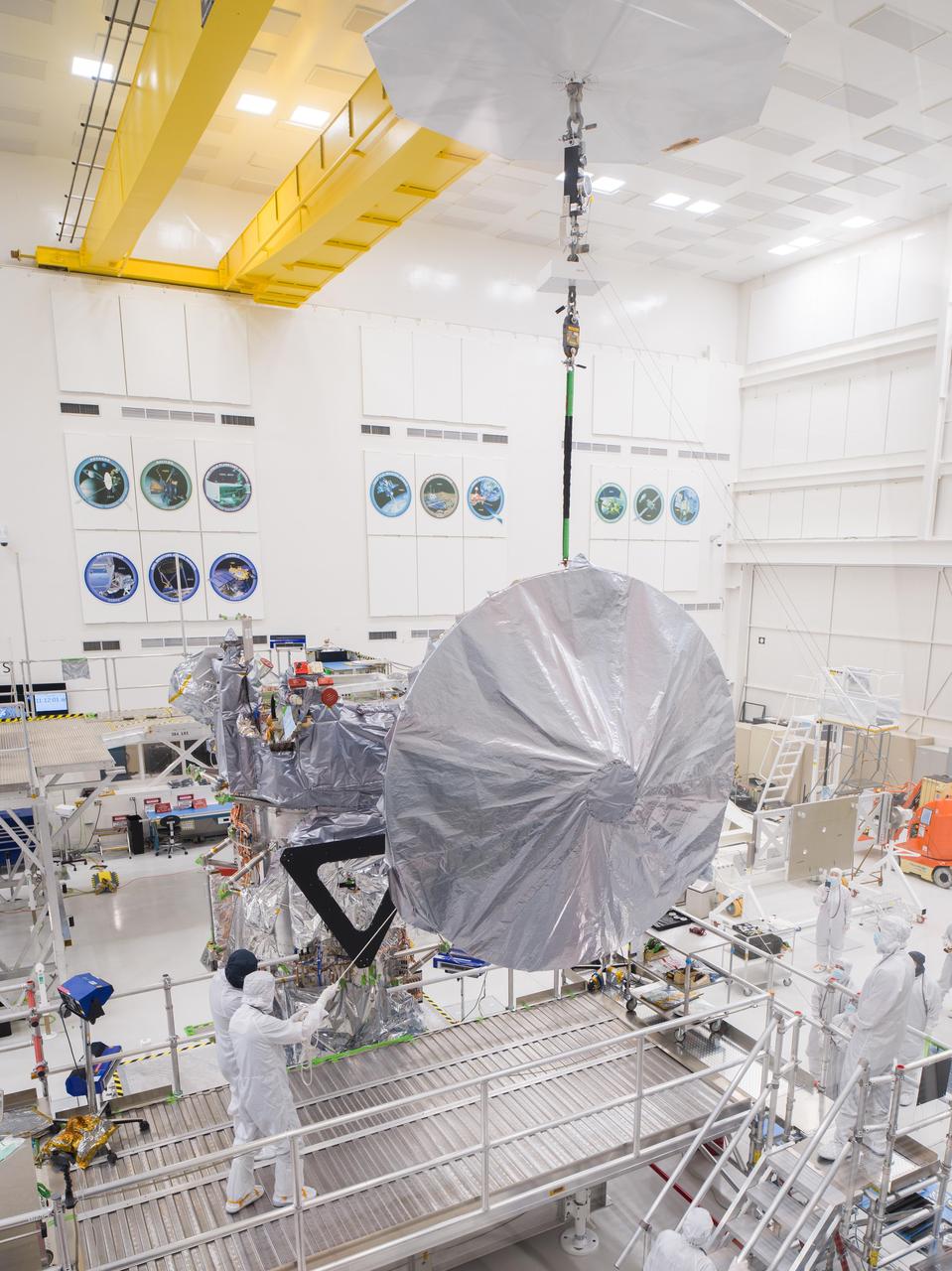
Engineers and technicians use a crane to lift a 10-foot (3-meter) high-gain antenna as they prepare to install it on NASA's Europa Clipper spacecraft on Aug. 14, 2023. The orbiter is being assembled in the clean room of High Bay 1 at the agency's Jet Propulsion Laboratory in Southern California in preparation for its launch to Jupiter's moon Europa in October 2024. The precision-engineered dish was attached to the spacecraft in carefully choreographed stages over the course of several hours. Europa Clipper will need the huge antenna to transmit data hundreds of millions of miles back to Earth. Scientists believe the icy moon Europa harbors a vast internal ocean that may have conditions suitable for supporting life. The spacecraft will fly by the moon about 50 times while its science instruments gather data on the moon's atmosphere, surface, and interior – information that will help scientists learn more about the ocean, the ice crust, and potential plumes that may be venting subsurface water into space. https://photojournal.jpl.nasa.gov/catalog/PIA25956

NASA's Europa Clipper, en route to the Jupiter system to investigate the icy moon Europa, conducted a critical test of its radar instrument during a flyby of Mars on March 1, 2025. During the testing, the instrument received echoes of its very-high-frequency radar signals that engineers processed to develop this image, called a radargram. The image was made using radar signals that bounced off Mars. What looks like a skyline is the outline of the topography. Features seen in the radargram include contributions from the topographic features both along and near the ground track (the path below the spacecraft as it passed overhead), such as impact craters, hills, and steep slopes. The 560-mile-long (900-kilometer-long) section of terrain profiled in this radargram is near Mars' equator. The Europa Clipper radar instrument, REASON (Radar for Europa Assessment and Sounding: Ocean to Near-surface), is designed to see into the icy crust of Europa. Though the rocky Martian surface does not allow much penetration by the radar signals, the clarity of the radargram image indicates REASON was performing as expected during the Mars flyby, boding well for future observations at Europa. As Europa Clipper zipped by the Red Planet – starting at 3,100 miles (5,000 kilometers) down to 550 miles (884 kilometers) above the surface – REASON sent and received radio waves for about 40 minutes. In comparison, at Europa the instrument will operate as close as 16 miles (25 kilometers) from the moon's surface. Europa Clipper launched from NASA's Kennedy Space Center in Florida on Oct. 14, 2024, and will arrive at the Jupiter system in 2030 to conduct about 50 flybys of Europa. The mission's main science goal is to determine whether there are places below Europa's surface that could support life. The mission's three main science objectives are to determine the thickness of the moon's icy shell and its surface interactions with the ocean below, to investigate its composition, and to characterize its geology. The mission's detailed exploration of Europa will help scientists better understand the astrobiological potential for habitable worlds beyond our planet. https://photojournal.jpl.nasa.gov/catalog/PIA26568

Soon after NASA's Europa Clipper spacecraft launched toward Jupiter's icy moon on Oct. 14, 2024, the mission team powered on each of the science instruments for a series of test or "checkout" activities. The Europa Imaging System – with its narrow-angle and wide-angle cameras – underwent its first checkouts in December 2024. Each camera has a cover to protect its sensitive detectors from the Sun while the spacecraft moves through the inner solar system, so the test images only show low-level variations in the sensitivity of the detector system. This image, taken by the narrow-angle camera (or NAC), has been enhanced to show more subtle variations in brightness. The pattern shown here matched similar test images taken before launch, confirming the camera is working as expected. The large, 8-megapixel detectors are divided into 16 sections to capture data quickly during the very fast, low-altitude flybys of Europa. Each section has a slightly different background brightness level, which gives it the image a striped appearance. Images like this are used to correct the background pattern in science observations. Instrument scientists and engineers at the Johns Hopkins Applied Physics Laboratory (APL), where the camera was designed and built, will use images like this to calibrate the science imagery it eventually gathers above Europa. The team also, for the first time in flight, moved the gimbal that will allow the NAC to target specific locations on Europa. In 2027, the spacecraft will be far enough from the Sun to safely open the lens covers and capture the first images, which will of starfields until arrival at the Jupiter system in 2030. Europa Clipper's three main science objectives are to determine the thickness of the moon's icy shell and its interactions with the ocean below, to investigate its composition, and to characterize its geology. The mission's detailed exploration of Europa will help scientists better understand the astrobiological potential for habitable worlds beyond our planet. https://photojournal.jpl.nasa.gov/catalog/PIA26564

Europa Clipper, en route to the Jupiter system to investigate the icy moon Europa, swung by Mars on March 1, 2025, to use the planet's gravity to help shape the spacecraft's trajectory. The mission took the opportunity to capture infrared images of the Red Planet using the orbiter's Europa Thermal Imaging System (E-THEMIS) to calibrate the instrument. This picture is a colorized composite of several images captured by E-THEMIS from about a million miles (1.6 million kilometers) away. Warm colors represent relatively warm temperatures; red areas are about 32 degrees Fahrenheit (0 degrees Celsius), and purple regions are about minus 190 degrees F (minus 125 degrees C). The temperature variations reflect the time of day on Mars, which was noon, with the center of the globe warmest because the Sun was shining directly onto the planet, near the equator, from behind the Europa Clipper spacecraft. The instrument captured the image data in long-wave infrared wavelengths of about 7 to 14 micrometers. Europa Clipper launched from NASA's Kennedy Space Center in Florida on Oct. 14, 2024, and will arrive at the Jupiter system in 2030 to conduct about 50 flybys of Europa. The mission's main science goal is to determine whether there are places below Europa's surface that could support life. The mission's three main science objectives are to determine the thickness of the moon's icy shell and its surface interactions with the ocean below, to investigate its composition, and to characterize its geology. The mission's detailed exploration of Europa will help scientists better understand the astrobiological potential for habitable worlds beyond our planet. https://photojournal.jpl.nasa.gov/catalog/PIA26566
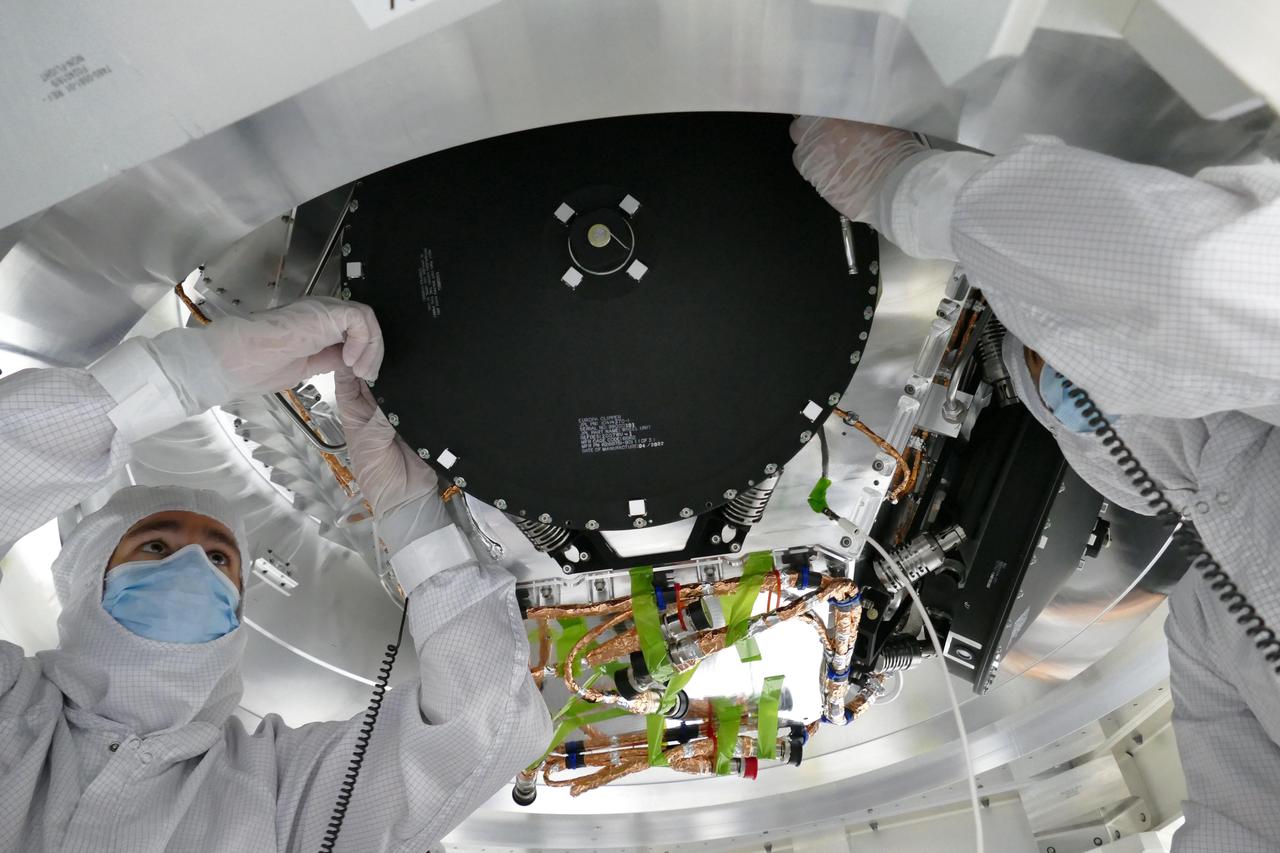
Engineers install 2-foot-wide reaction wheels onto the main body of NASA's Europa Clipper spacecraft at the agency's Jet Propulsion Laboratory in Southern California. In all, four wheels were integrated onto the spacecraft, which is being assembled for its launch to Jupiter's moon Europa in October 2024. When the spacecraft heads through deep space, slips into orbit around Jupiter, and collects science observations while flying dozens of times by Europa, the wheels rotate the orbiter so that its antennas can communicate with Earth and so its science instruments, including cameras, can stay oriented toward Europa. Two feet wide and made of steel, aluminum, and titanium, the wheels spin rapidly to create a force that causes the orbiter to rotate in the opposite direction. The wheels will run on electricity provided by the spacecraft's vast solar arrays. The green tape that is visible here keeps cables temporarily secured during the wheel installation. Scientists believe the icy moon Europa harbors a vast internal ocean that may have conditions suitable for supporting life. Europa Clipper will fly by the moon about 50 times while its suite of science instruments gathers data on the moon's atmosphere, surface, and interior – information that will help scientists learn more about the ocean, the ice crust, and potential plumes that may be venting subsurface water into space. https://photojournal.jpl.nasa.gov/catalog/PIA25494
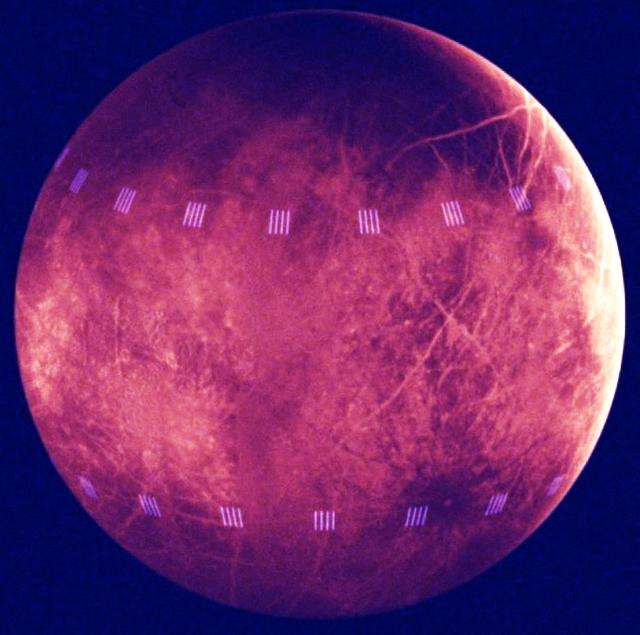
This image is a simulation of how NASA's Europa Clipper will understand which areas of the Jovian moon Europa are warm and active by studying the moon's thermal emissions. Scientists based this image on a model of data from NASA's Galileo mission and data from an instrument on NASA's Cassini mission that studied warm regions of Saturn's moon Enceladus where jets of water ice and organic chemicals spray out from vents in the icy surface. Europa Clipper's Europa Thermal Emission Imaging System, or E-THEMIS, will take both daytime and nighttime observations of Europa. The light pink vertical stripes simulate the warm vents seen on the surface of Enceladus, if they were viewed on Europa in the night. If Europa has warm spots like Enceladus, E-THEMIS is expected to detect such areas on Europa, even from a distance. Europa Clipper will get as close as 16 miles (25 kilometers) from the moon's surface, resulting in observations at much higher resolution. Europa Clipper's three main science objectives are to determine the thickness of the moon's icy shell and its interactions with the ocean below, to investigate its composition, and to characterize its geology. The mission's detailed exploration of Europa will help scientists better understand the astrobiological potential for habitable worlds beyond our planet. https://photojournal.jpl.nasa.gov/catalog/PIA26105
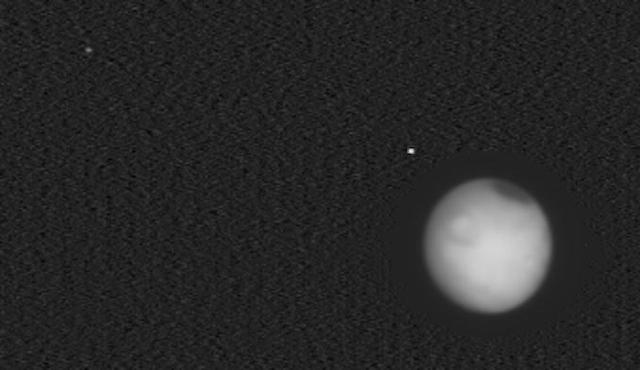
NASA's Europa Clipper captured this infrared image of the heat radiation from Mars and its moons Phobos (closest to Mars) and Deimos (seen in upper left corner) on Feb. 28, 2025, as the spacecraft approached the Red Planet while en route to the Jupiter system to investigate the icy moon Europa. The mission flew by Mars the next day, using the planet's gravity to help shape the spacecraft's trajectory. When the image was taken by the mission's Europa Thermal Emission Imaging System (E-THEMIS), the spacecraft was about 560,000 miles (900,000 kilometers) from the Red Planet. The image is composed of 200 individual frames, part of a continuous scan of 1,100 frames taken roughly a second apart over a period of 20 minutes. Scientists are using the tiny, point-like images of the moons to check the camera's focus. The image was captured using the middle of E-THEMIS's three long-wave infrared wavelength bands, which extend from about 14 to 28 micrometers. (A previously released E-THEMIS image of Mars used the shortest of the instrument's wavelength bands, extending from 7 to 14 micrometers and showing Mars in higher contrast.) The dark oval near the top of Mars is the planet's cold northern polar cap and is about minus 190 degrees Fahrenheit (minus 125 degrees Celsius). The circular feature seen on Mars is the region around Elysium Mons. The faint halo seen around the planet is due to the processing of the image. The two moons are about 250 times fainter than Mars, so scientists brightened the image (except for a region circling the planet) to make the moons more visible. The brightening also makes image noise more visible; the area surrounding Mars within the halo appears comparatively dark because it wasn't brightened. Europa Clipper launched from NASA's Kennedy Space Center in Florida on Oct. 14, 2024, and will arrive at the Jupiter system in 2030 to conduct about 50 flybys of Europa. The mission's main science goal is to determine whether there are places below Europa's surface that could support life. The mission's three main science objectives are to determine the thickness of the moon's icy shell and its surface interactions with the ocean below, to investigate its composition, and to characterize its geology. The mission's detailed exploration of Europa will help scientists better understand the astrobiological potential for habitable worlds beyond our planet. https://photojournal.jpl.nasa.gov/catalog/PIA26567
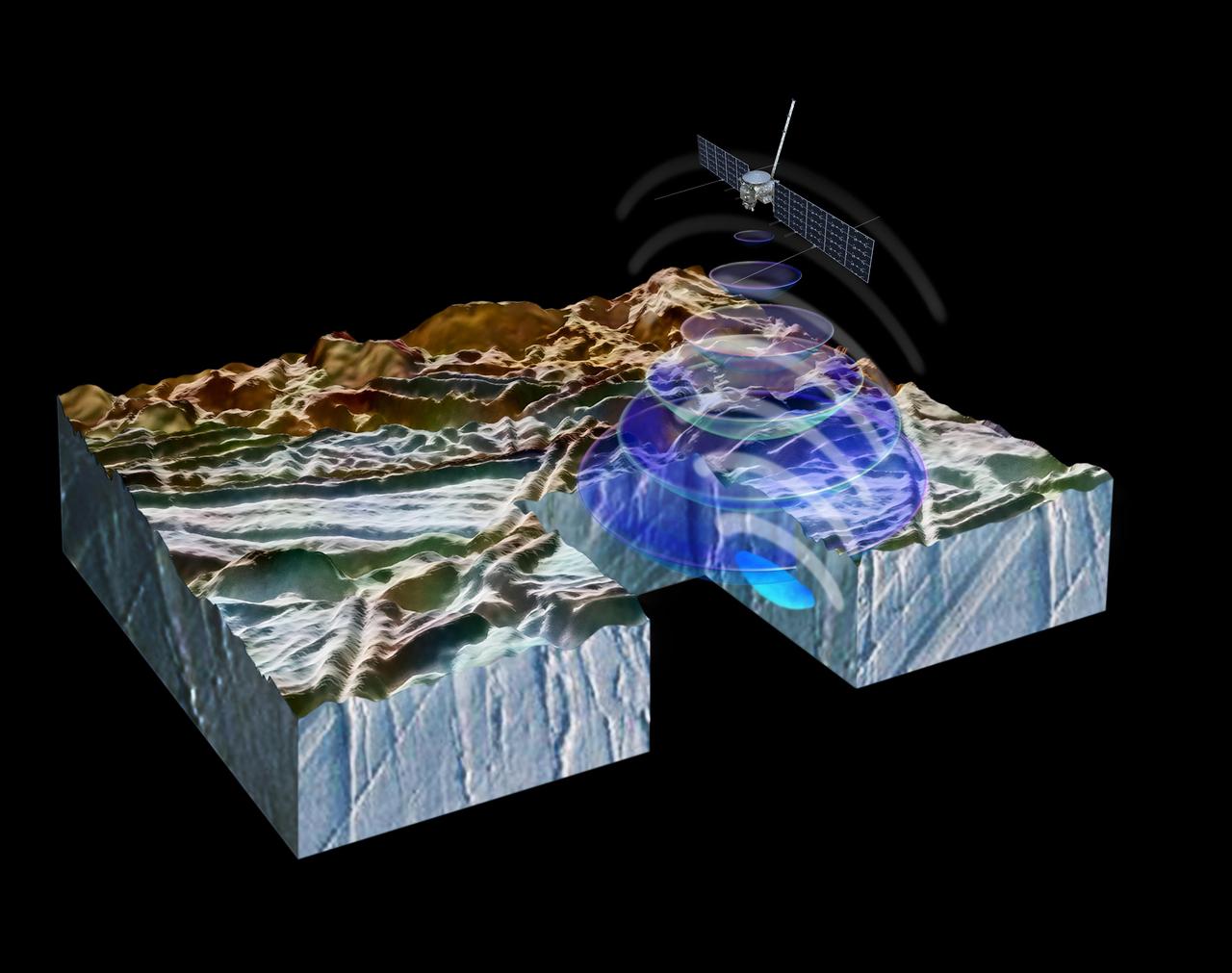
This artist's concept illustrates how NASA's Europa Clipper spacecraft will use radar to peer beneath Europa's ice crust to reveal the structure underneath. Europa Clipper will carry an instrument called the Radar for Europa Assessment and Sounding: Ocean to Near-surface (REASON) that can penetrate beneath the Jovian moon's surface layer, revealing potential pockets of water, cracks, or other features not visible from the outside. Europa Clipper's three main science objectives are to determine the thickness of the moon's icy shell and its interactions with the ocean below, to investigate its composition, and to characterize its geology. The mission's detailed exploration of Europa will help scientists better understand the astrobiological potential for habitable worlds beyond our planet. https://photojournal.jpl.nasa.gov/catalog/PIA26106
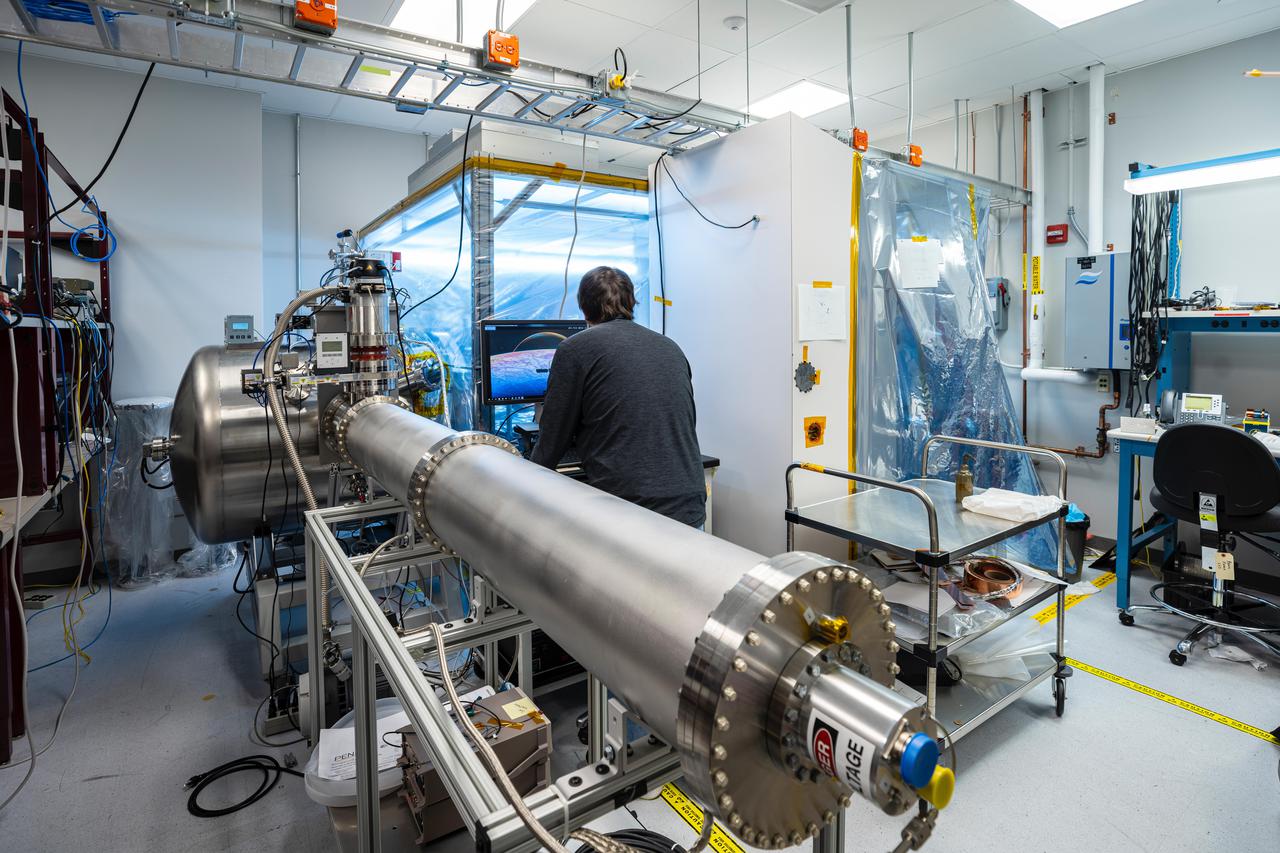
Included in the payload of science instruments for NASA's Europa Clipper is the Plasma Instrument for Magnetic Sounding (PIMS). Scientists will use PIMS to study the characteristics of plasma around Europa to better understand the moon's ice-shell thickness, ocean depth, and ocean salinity. PIMS will have four sensors, called Faraday cups, to measure the electrical current produced by charged particles (or plasma) as they strike a detector plate inside each sensor. In this photo, the Plasma Instrument Calibration Chamber at the Johns Hopkins Applied Physics Laboratory (APL) in Laurel, Maryland, recreates the plasma environments that PIMS and other instruments will encounter in space. The equipment in this lab simulates these environments with ion beams that reproduce plasma energy ranges found at Jupiter and Europa. Once PIMS is fully assembled in the clean room attached to the chamber, the team will direct these ion and electron beams into the Faraday cup sensors for calibration. This will be used specifically to simulate the plasma in Europa's ionosphere and Jupiter's magnetosphere, which PIMS will later measure directly. With an internal global ocean twice the size of Earth's oceans combined, Europa may have the potential to harbor life. NASA's Europa Clipper spacecraft will swoop around Jupiter on an elliptical path, dipping close to the moon on each flyby to collect data. Understanding Europa's habitability will help scientists better understand how life developed on Earth and the potential for finding life beyond our planet. https://photojournal.jpl.nasa.gov/catalog/PIA24330
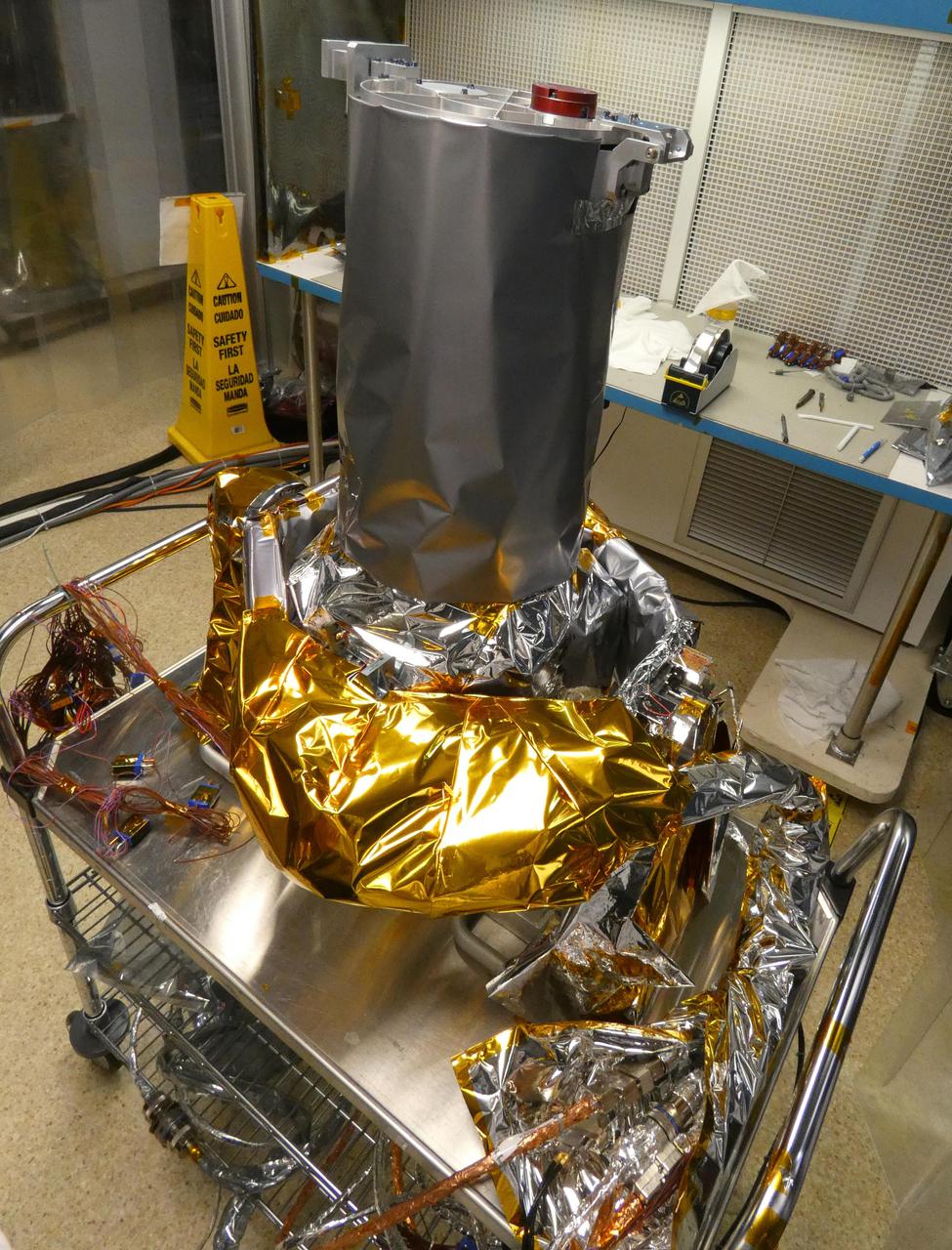
Included in the payload of science instruments for NASA's Europa Clipper is the Europa Imaging System (EIS) Narrow Angle Camera (NAC). Shown here at the Johns Hopkins Applied Physics Laboratory (APL) in Laurel, Maryland, the engineering model, which is used to test the instrument, is mounted on the two-axis gimbal mechanism that allows the NAC telescope to be pointed independently. The model consists of the NAC telescope, electronics, gimbal, and cables, covered in thermal blankets. EIS will allow groundbreaking measurements and map most of Europa, an icy moon of Jupiter with an ocean under its crust, at resolutions previous missions could only achieve in small areas. EIS data will offer fresh insights into Europa's geological structure and processes and will be used to search for evidence of recent or current geologic activity, including potential erupting plumes. With an internal global ocean twice the size of Earth's oceans combined, Europa may have the potential to harbor life. NASA's Europa Clipper spacecraft will swoop around Jupiter on an elliptical path, dipping close to the moon on each flyby to collect data. Understanding Europa's habitability will help scientists better understand how life developed on Earth and the potential for finding life beyond our planet. https://photojournal.jpl.nasa.gov/catalog/PIA24328
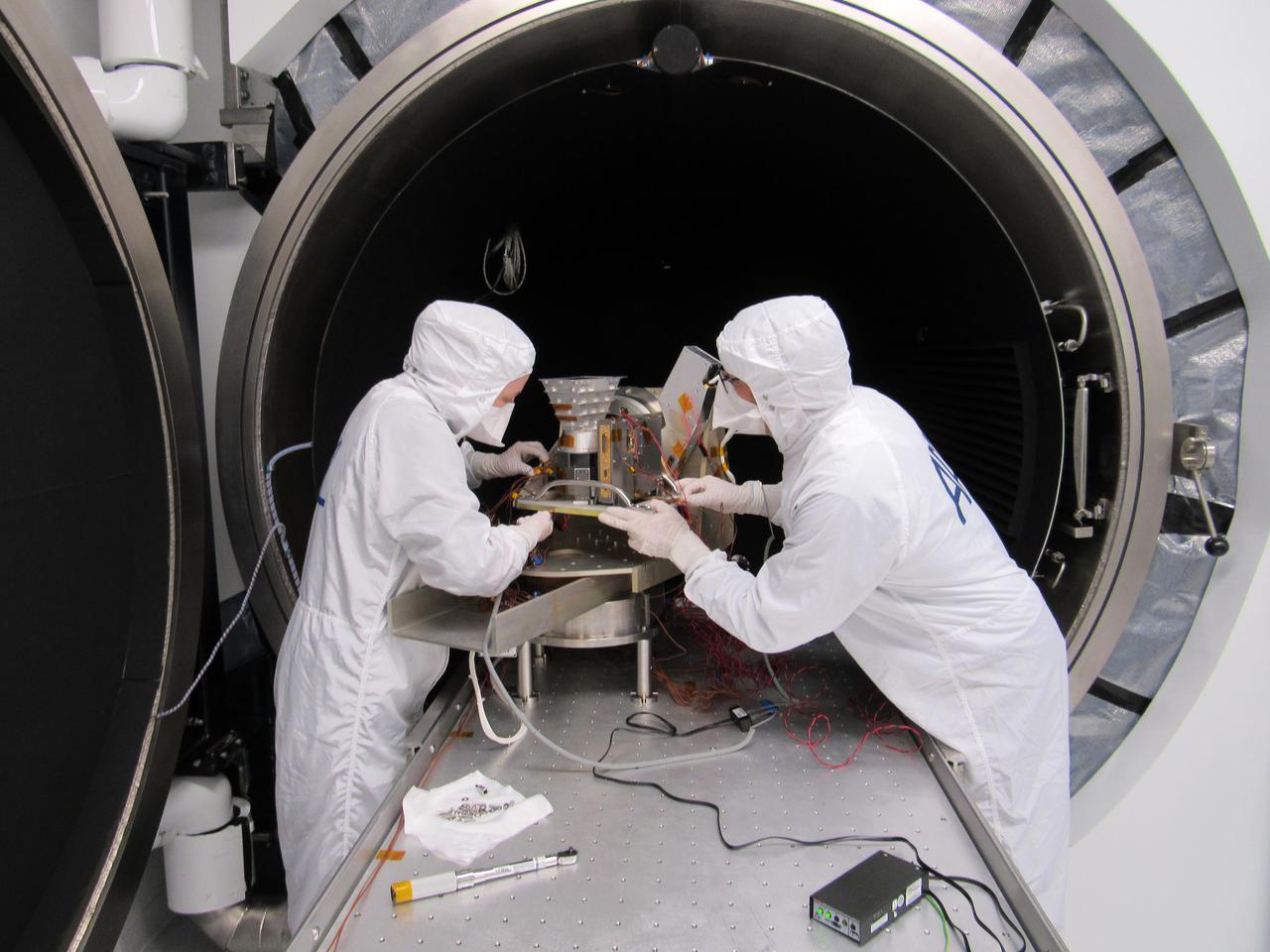
Included in the payload of science instruments for NASA's Europa Clipper is the Europa Imaging System (EIS) Wide Angle Camera (WAC). Here, mechanical engineers at the Johns Hopkins Applied Physics Laboratory (APL) in Laurel, Maryland, set up the engineering model of the WAC telescope and electronics in a thermal-vacuum chamber for environmental testing. EIS will allow groundbreaking measurements and map most of Europa, an icy moon of Jupiter with an ocean under its crust, at resolutions previous missions could only achieve in small areas. EIS data will offer fresh insights into Europa's geological structure and processes and will be used to search for evidence of recent or current geologic activity, including potential erupting plumes. With an internal global ocean twice the size of Earth's oceans combined, Europa may have the potential to harbor life. NASA's Europa Clipper spacecraft will swoop around Jupiter on an elliptical path, dipping close to the moon on each flyby to collect data. Understanding Europa's habitability will help scientists better understand how life developed on Earth and the potential for finding life beyond our planet. https://photojournal.jpl.nasa.gov/catalog/PIA24329
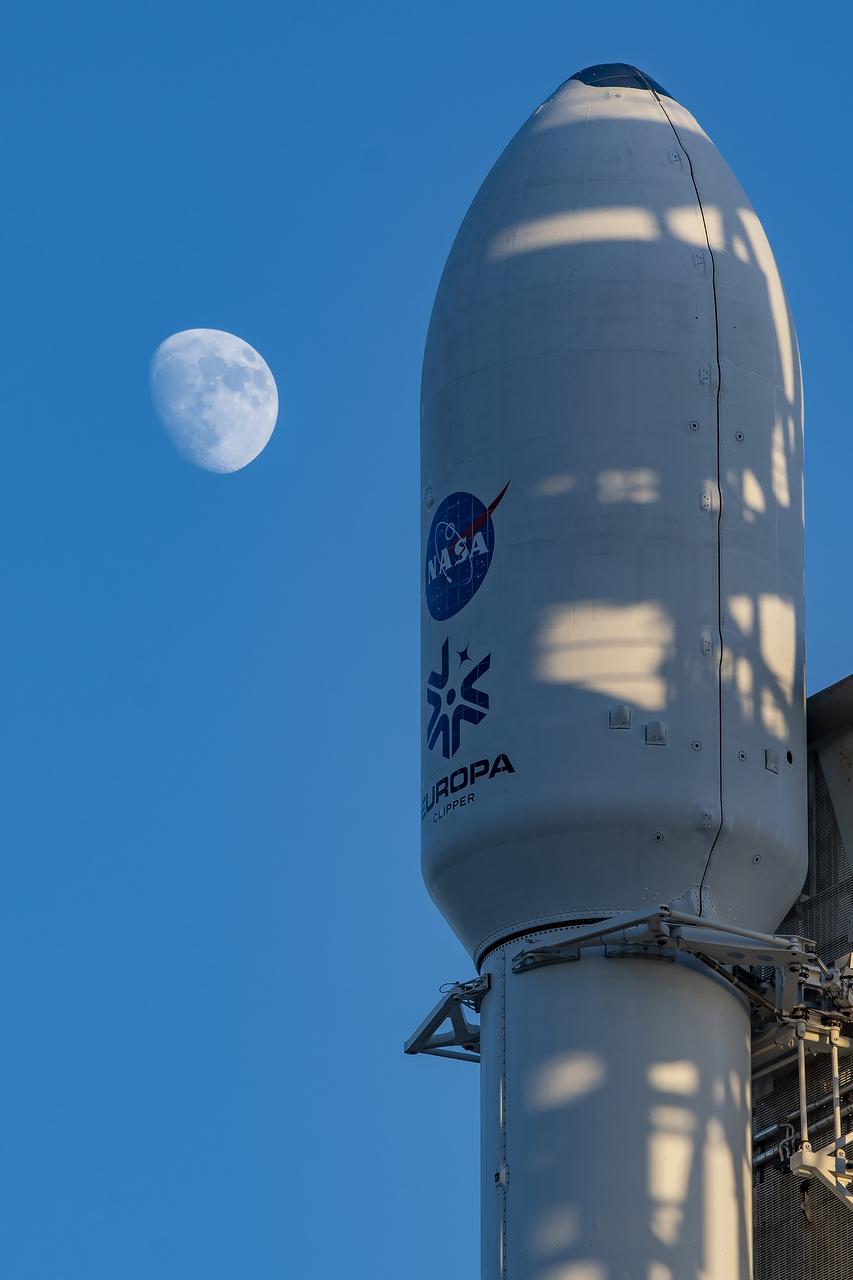
The Earth’s Moon appears with NASA’s Europa Clipper spacecraft encapsulated in a payload fairing atop SpaceX’s Heavy rocket at Launch Complex 39A on Sunday, Oct. 13, 2024, at the agency’s Kennedy Space Center in Florida. The Europa Clipper spacecraft will travel to Jupiter’s icy moon Europa to determine if there are conditions suitable for life beyond Earth.
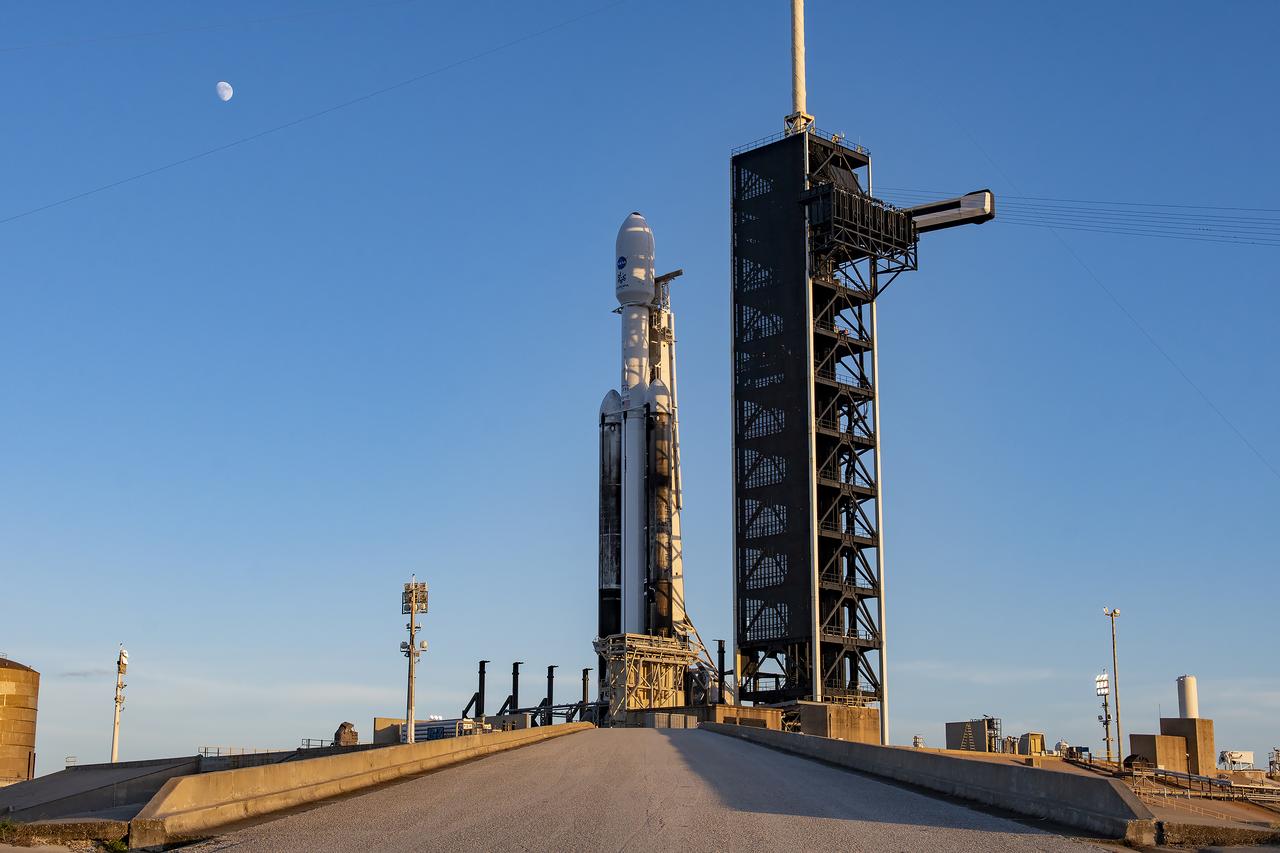
The Earth’s Moon appears with NASA’s Europa Clipper spacecraft encapsulated in a payload fairing atop SpaceX’s Heavy rocket at Launch Complex 39A on Sunday, Oct. 13, 2024, at the agency’s Kennedy Space Center in Florida. The Europa Clipper spacecraft will travel to Jupiter’s icy moon Europa to determine if there are conditions suitable for life beyond Earth.
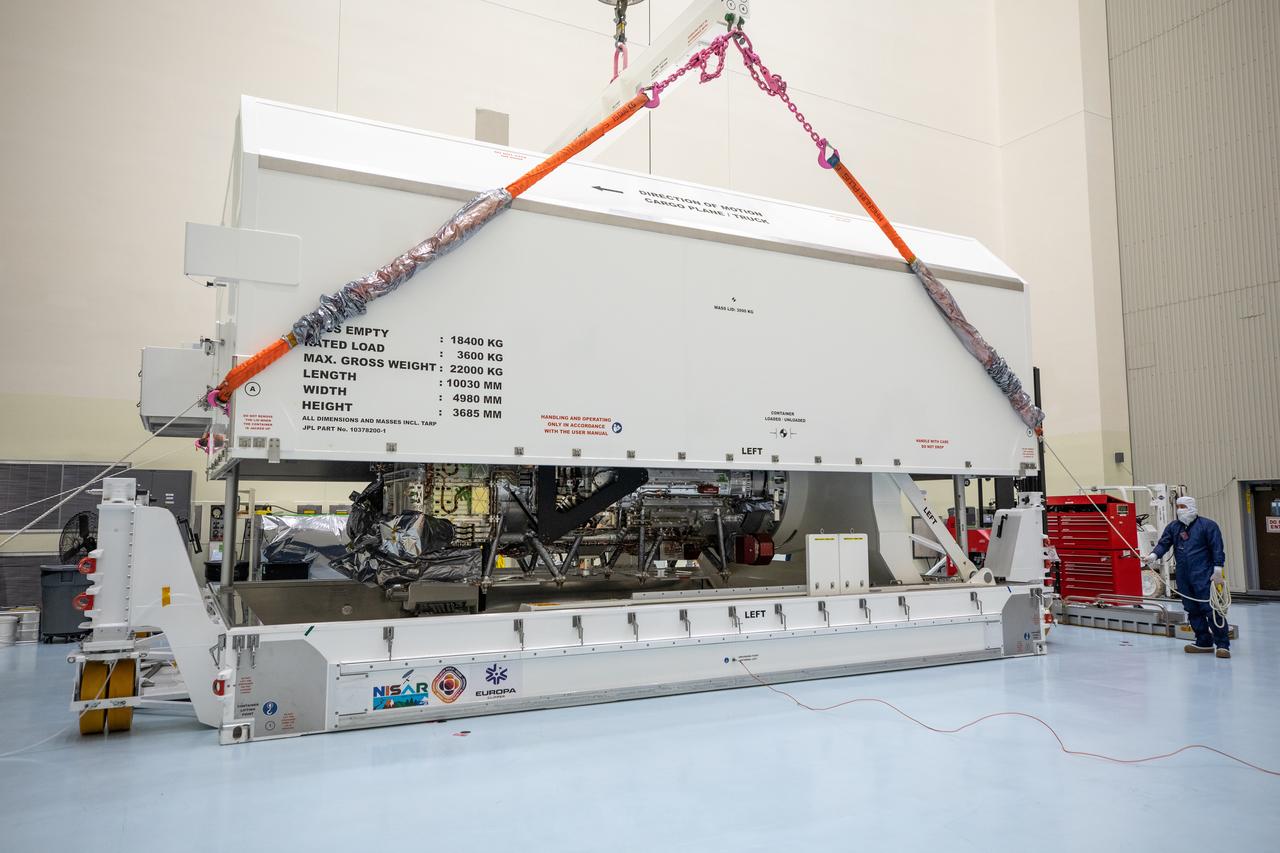
Technicians remove NASA’s largest planetary mission spacecraft, Europa Clipper, from its protective shipping container inside the Payload Hazardous Servicing Facility at the agency’s Kennedy Space Center in Florida on Tuesday, May 28, 2024. Slated to launch aboard a SpaceX Falcon Heavy rocket later this year from Launch Complex 39A at Kennedy, Europa Clipper will help determine if conditions exist below the surface Jupiter’s fourth largest moon, Europa that could support life.
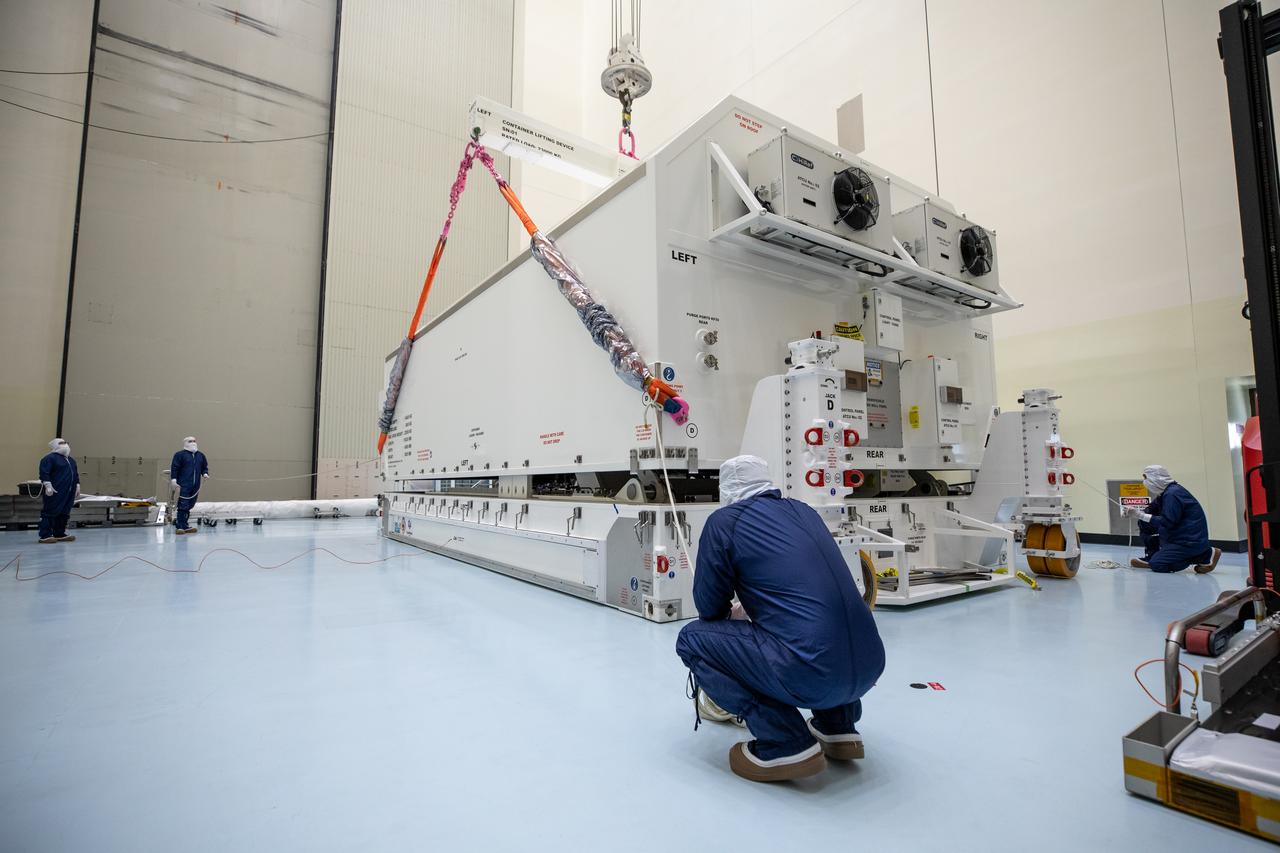
Technicians remove NASA’s largest planetary mission spacecraft, Europa Clipper, from its protective shipping container inside the Payload Hazardous Servicing Facility at the agency’s Kennedy Space Center in Florida on Tuesday, May 28, 2024. Slated to launch aboard a SpaceX Falcon Heavy rocket later this year from Launch Complex 39A at Kennedy, Europa Clipper will help determine if conditions exist below the surface Jupiter’s fourth largest moon, Europa that could support life.
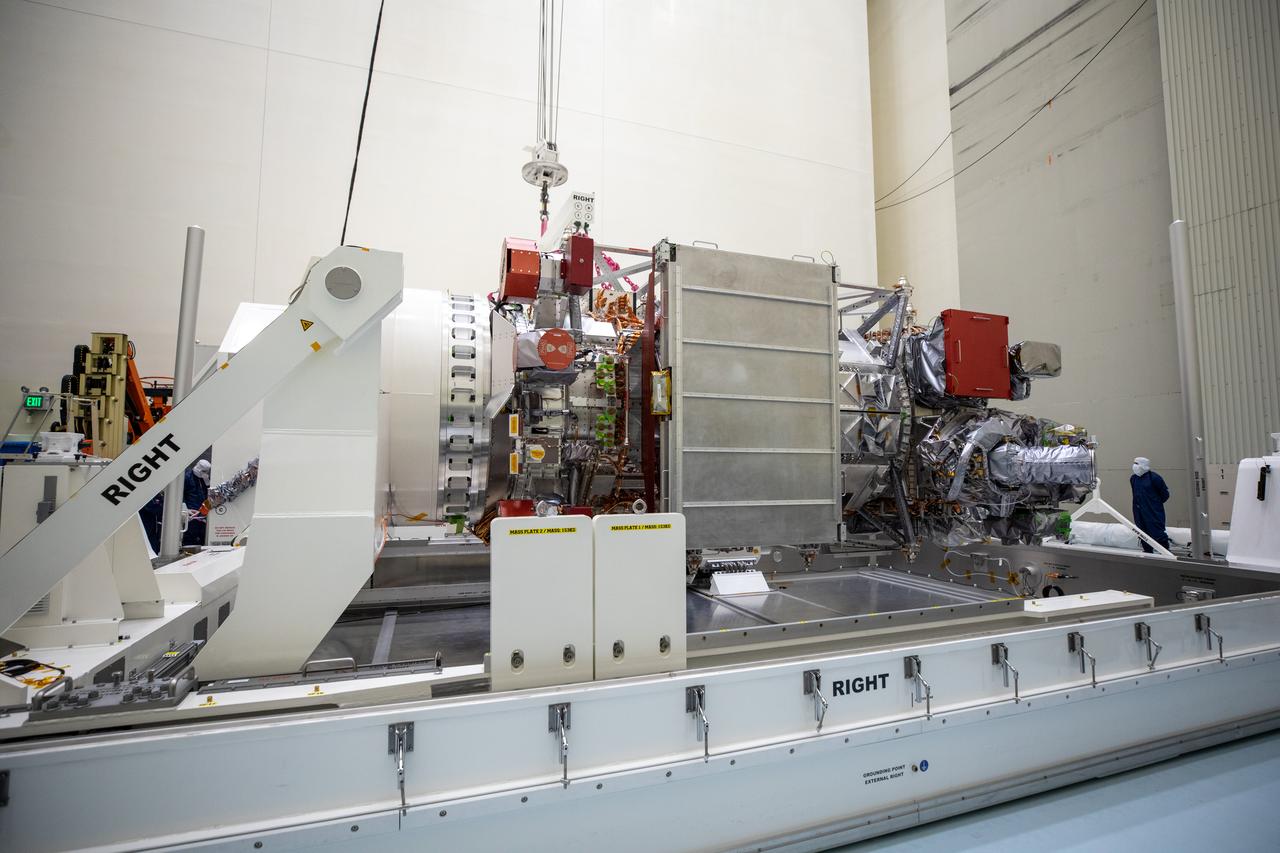
As part of prelaunch processing, crews inside the Payload Hazardous Servicing Facility at NASA’s Kennedy Space Center in Florida uncrate the agency’s largest planetary mission spacecraft, Europa Clipper, on Tuesday, May 28, 2024. Slated to launch aboard a SpaceX Falcon Heavy rocket later this year from Launch Complex 39A at Kennedy, Europa Clipper will help determine if conditions exist below the surface Jupiter’s fourth largest moon, Europa, that could support life.
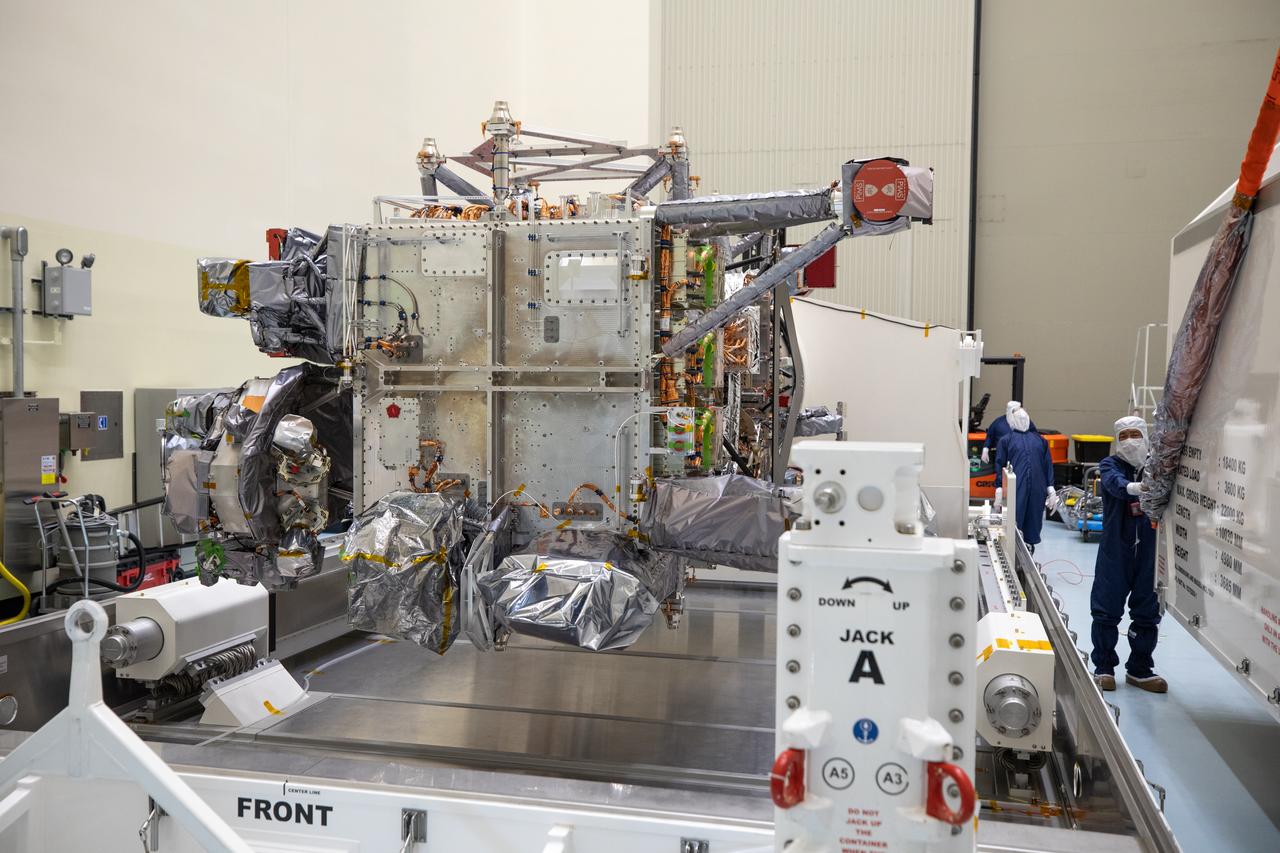
As part of prelaunch processing, crews inside the Payload Hazardous Servicing Facility at NASA’s Kennedy Space Center in Florida uncrate the agency’s largest planetary mission spacecraft, Europa Clipper, on Tuesday, May 28, 2024. Slated to launch aboard a SpaceX Falcon Heavy rocket later this year from Launch Complex 39A at Kennedy, Europa Clipper will help determine if conditions exist below the surface Jupiter’s fourth largest moon, Europa, that could support life.
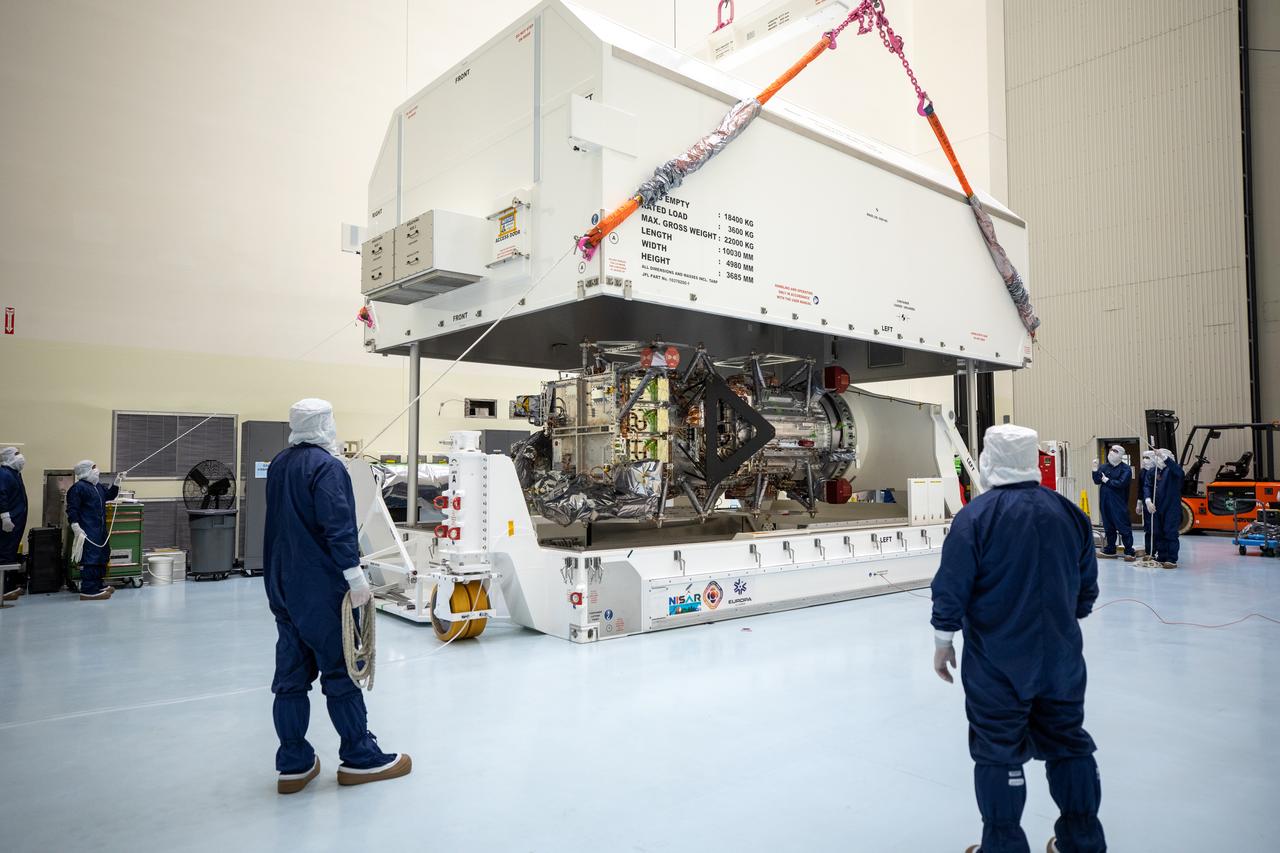
Technicians remove NASA’s largest planetary mission spacecraft, Europa Clipper, from its protective shipping container inside the Payload Hazardous Servicing Facility at the agency’s Kennedy Space Center in Florida on Tuesday, May 28, 2024. Slated to launch aboard a SpaceX Falcon Heavy rocket later this year from Launch Complex 39A at Kennedy, Europa Clipper will help determine if conditions exist below the surface Jupiter’s fourth largest moon, Europa that could support life.
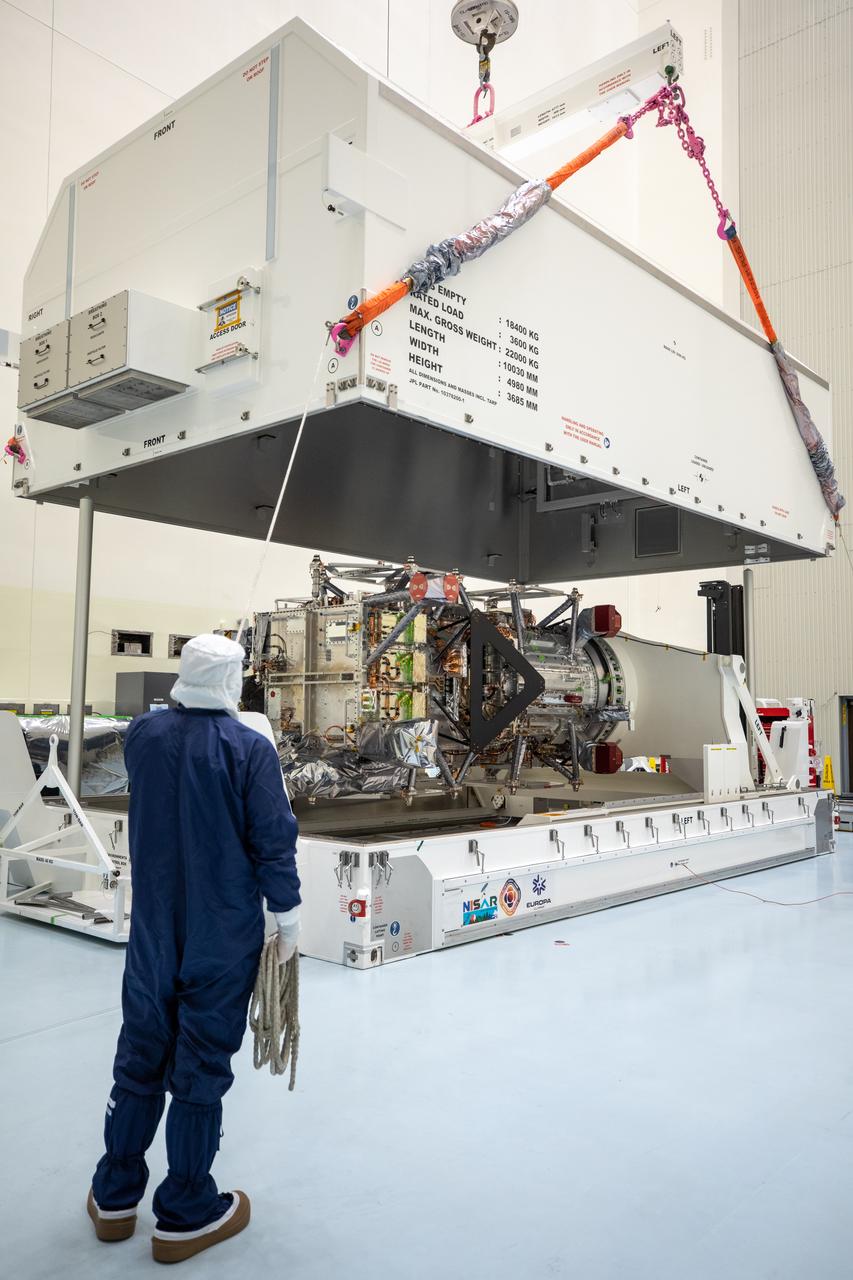
Technicians remove NASA’s largest planetary mission spacecraft, Europa Clipper, from its protective shipping container inside the Payload Hazardous Servicing Facility at the agency’s Kennedy Space Center in Florida on Tuesday, May 28, 2024. Slated to launch aboard a SpaceX Falcon Heavy rocket later this year from Launch Complex 39A at Kennedy, Europa Clipper will help determine if conditions exist below the surface Jupiter’s fourth largest moon, Europa that could support life.
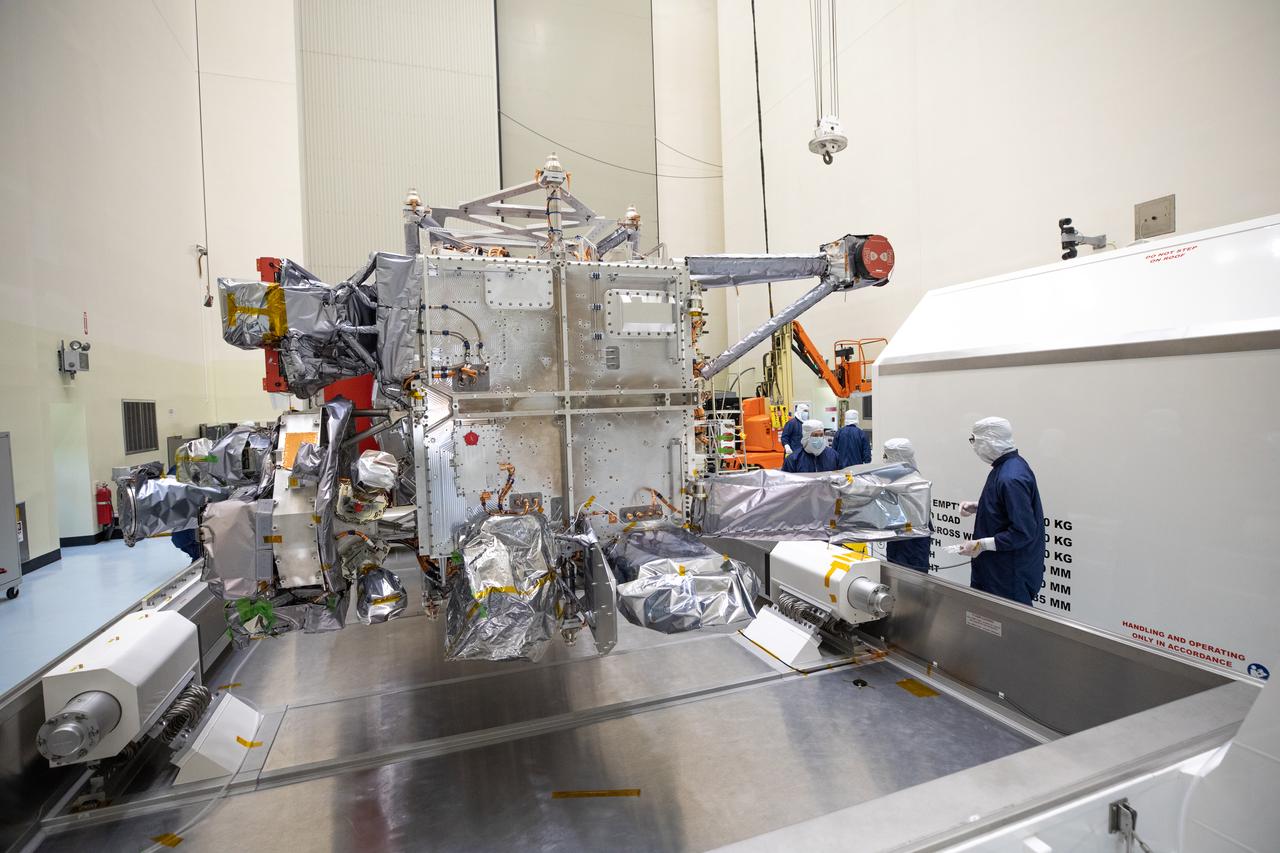
As part of prelaunch processing, crews inside the Payload Hazardous Servicing Facility at NASA’s Kennedy Space Center in Florida uncrate the agency’s largest planetary mission spacecraft, Europa Clipper, on Tuesday, May 28, 2024. Slated to launch aboard a SpaceX Falcon Heavy rocket later this year from Launch Complex 39A at Kennedy, Europa Clipper will help determine if conditions exist below the surface Jupiter’s fourth largest moon, Europa, that could support life.
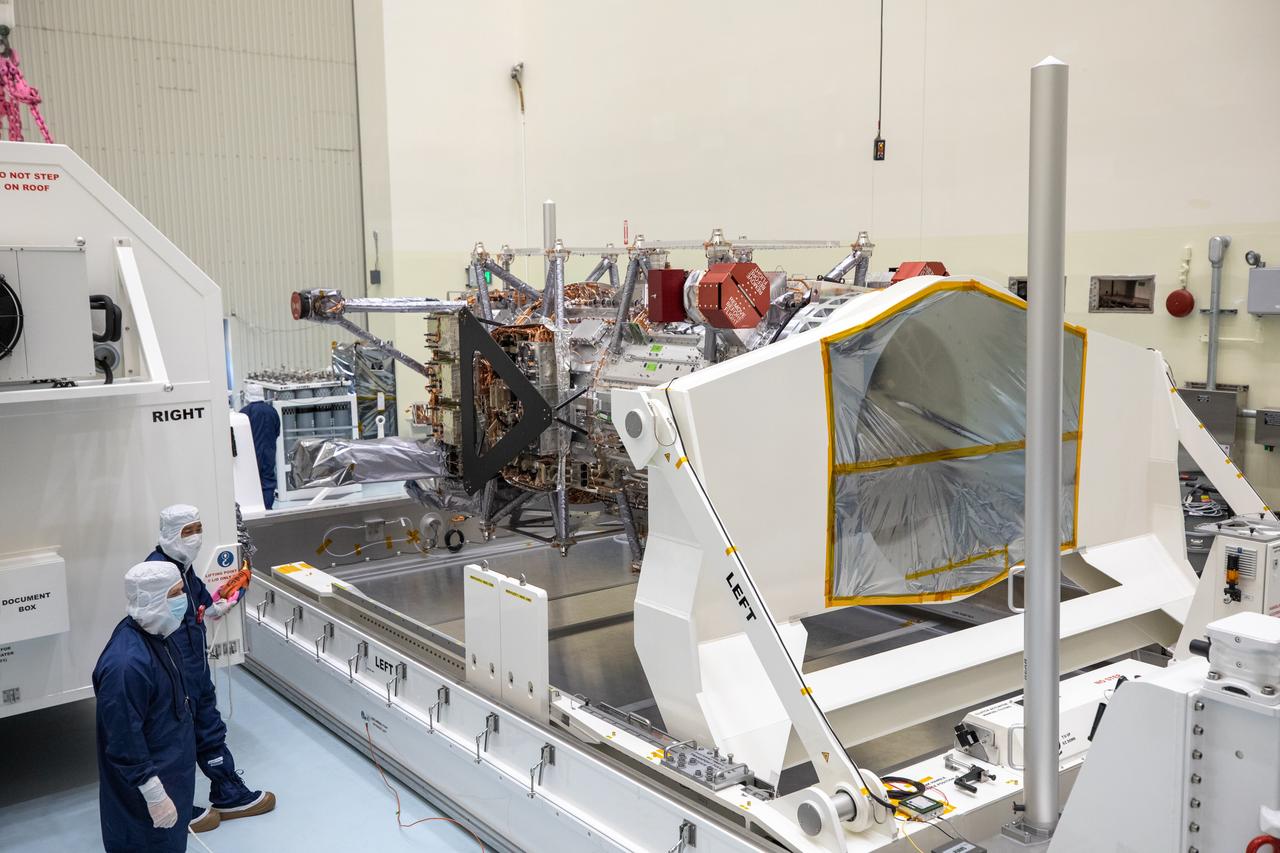
As part of prelaunch processing, crews inside the Payload Hazardous Servicing Facility at NASA’s Kennedy Space Center in Florida uncrate the agency’s largest planetary mission spacecraft, Europa Clipper, on Tuesday, May 28, 2024. Slated to launch aboard a SpaceX Falcon Heavy rocket later this year from Launch Complex 39A at Kennedy, Europa Clipper will help determine if conditions exist below the surface Jupiter’s fourth largest moon, Europa, that could support life.
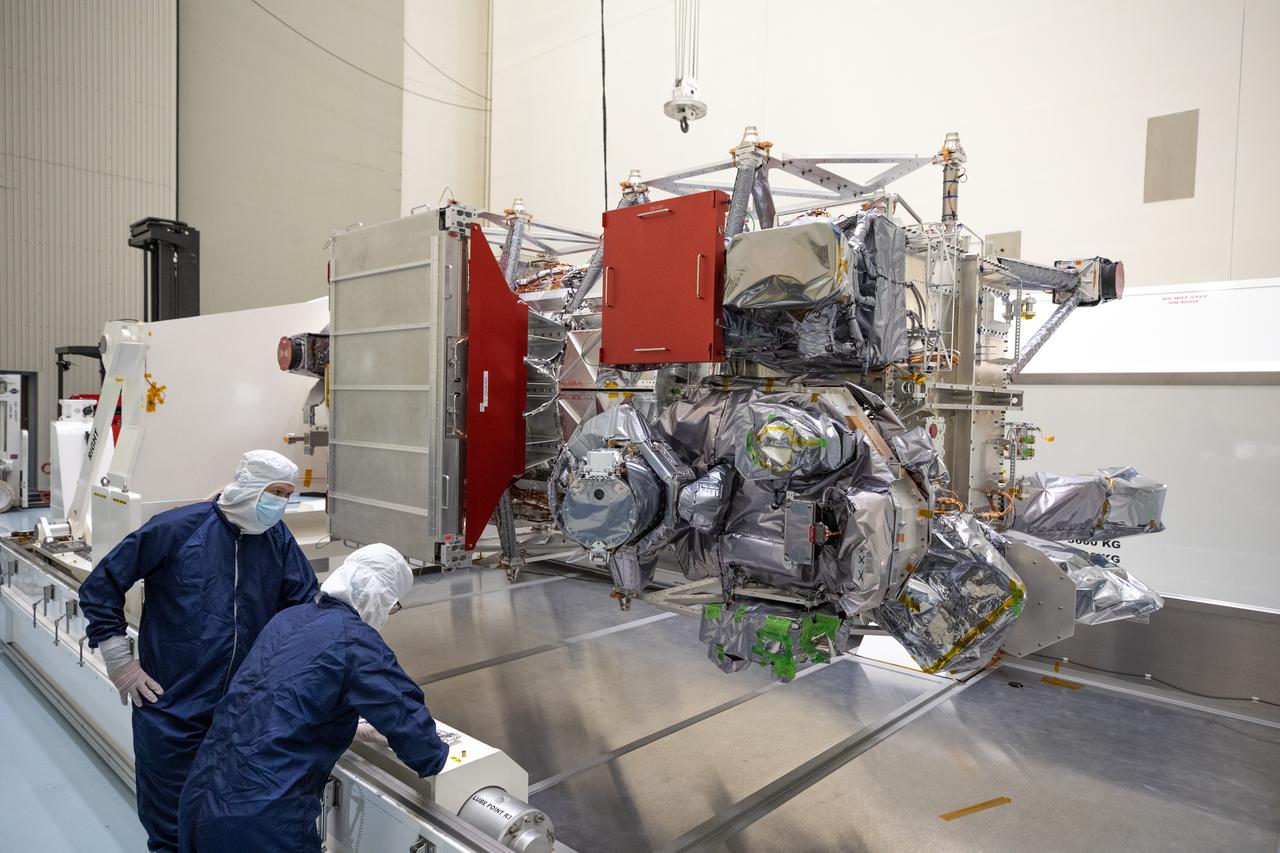
As part of prelaunch processing, crews inside the Payload Hazardous Servicing Facility at NASA’s Kennedy Space Center in Florida uncrate the agency’s largest planetary mission spacecraft, Europa Clipper, on Tuesday, May 28, 2024. Slated to launch aboard a SpaceX Falcon Heavy rocket later this year from Launch Complex 39A at Kennedy, Europa Clipper will help determine if conditions exist below the surface Jupiter’s fourth largest moon, Europa, that could support life.
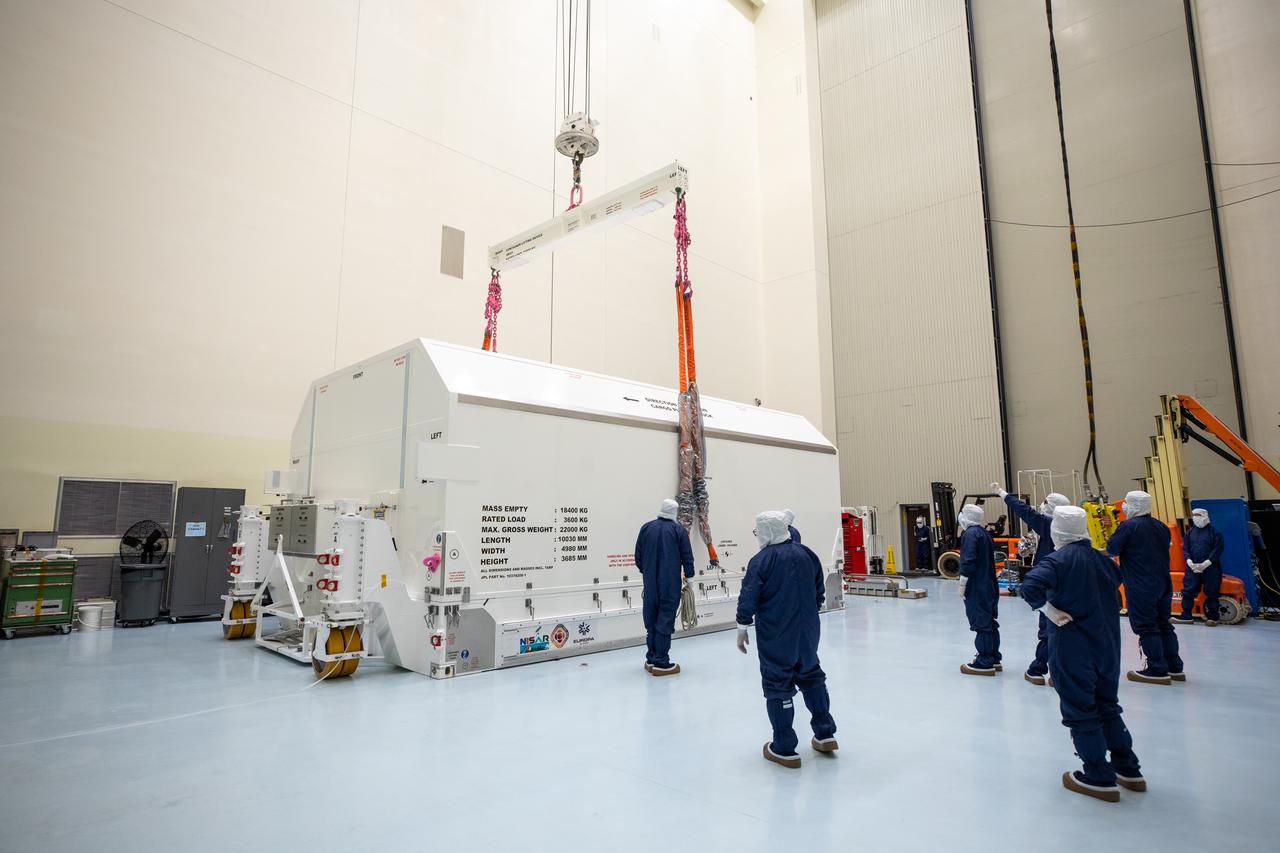
Technicians remove NASA’s largest planetary mission spacecraft, Europa Clipper, from its protective shipping container inside the Payload Hazardous Servicing Facility at the agency’s Kennedy Space Center in Florida on Tuesday, May 28, 2024. Slated to launch aboard a SpaceX Falcon Heavy rocket later this year from Launch Complex 39A at Kennedy, Europa Clipper will help determine if conditions exist below the surface Jupiter’s fourth largest moon, Europa that could support life.
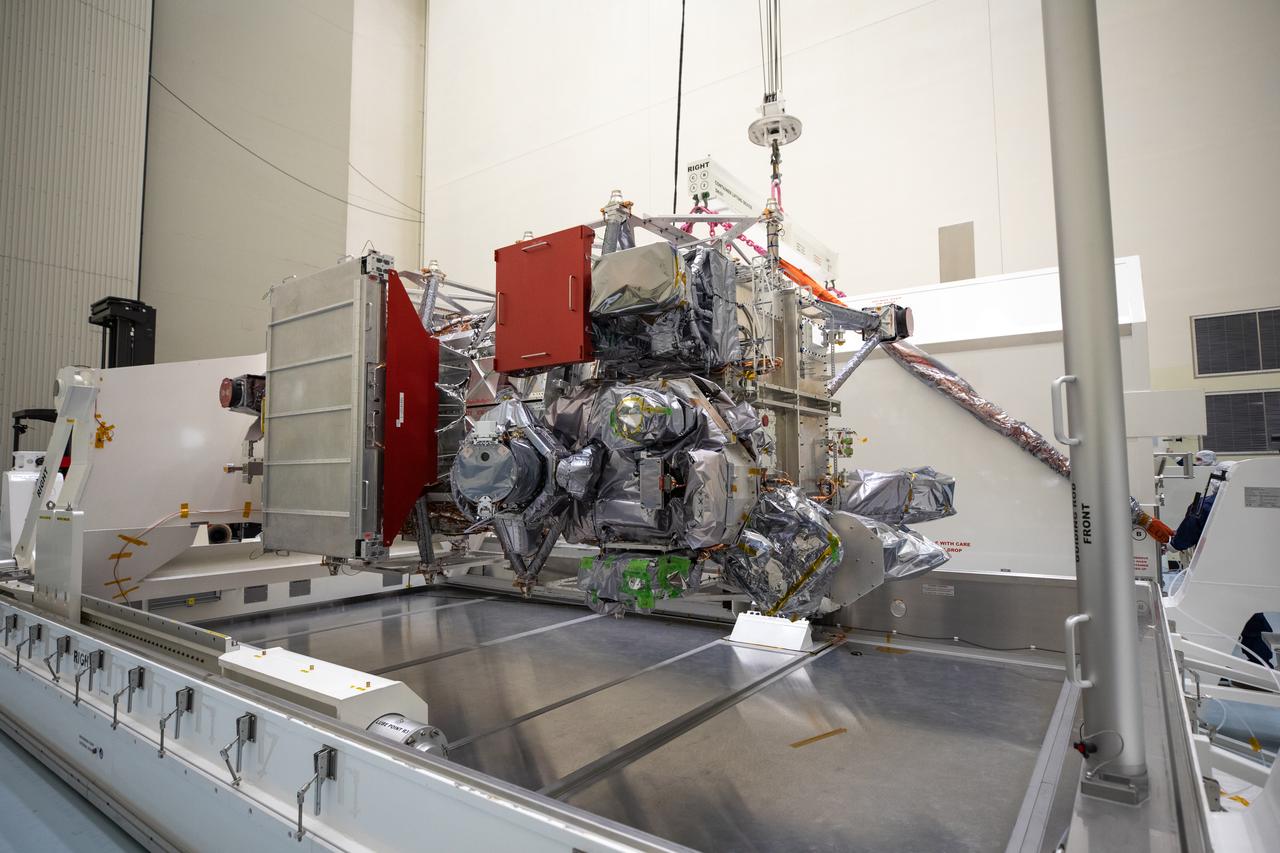
As part of prelaunch processing, crews inside the Payload Hazardous Servicing Facility at NASA’s Kennedy Space Center in Florida uncrate the agency’s largest planetary mission spacecraft, Europa Clipper, on Tuesday, May 28, 2024. Slated to launch aboard a SpaceX Falcon Heavy rocket later this year from Launch Complex 39A at Kennedy, Europa Clipper will help determine if conditions exist below the surface Jupiter’s fourth largest moon, Europa, that could support life.
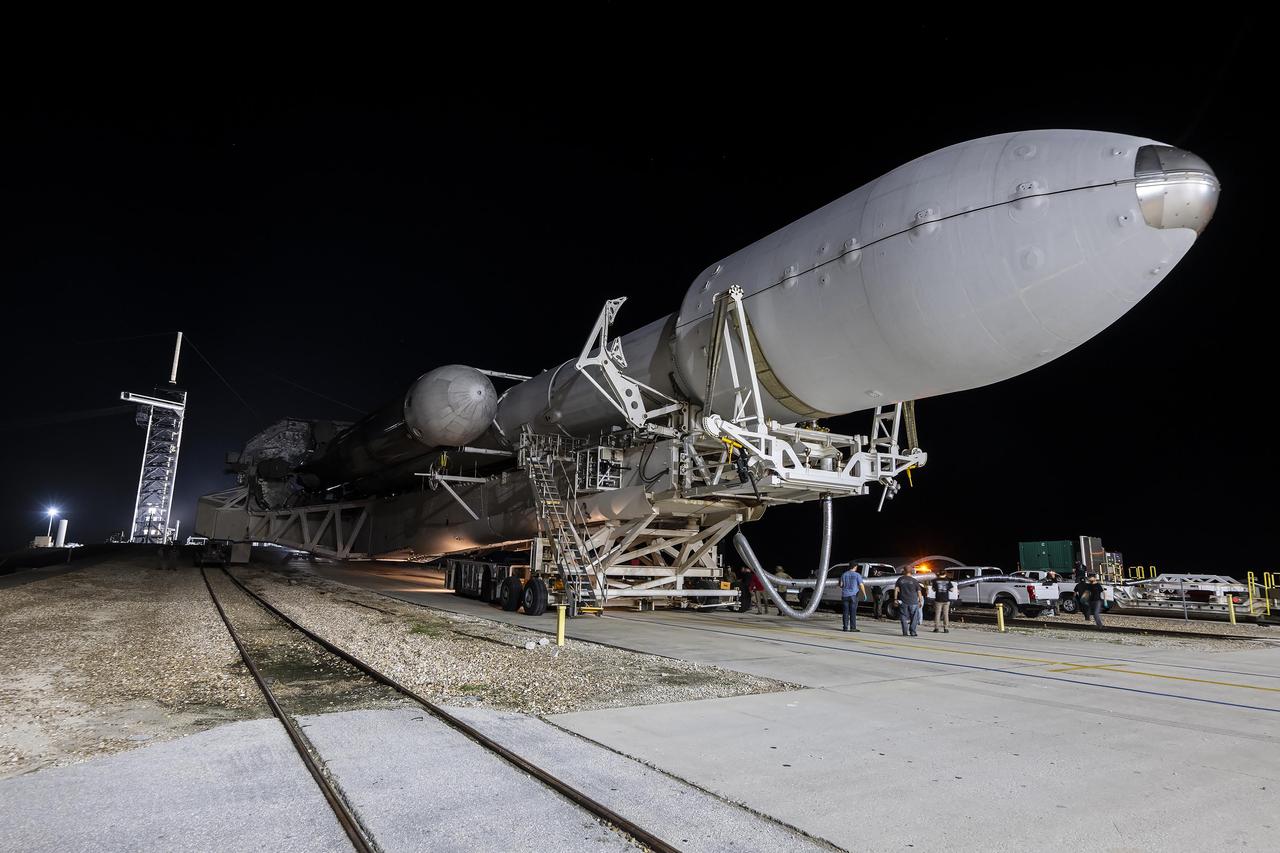
NASA’s Europa Clipper spacecraft attached to SpaceX’s Falcon Heavy rocket, rolls to Launch Pad 39A on Saturday, Oct. 12, 2024, at NASA’s Kennedy Space Center in Florida ahead of launch to Jupiter’s icy moon, Europa. The spacecraft will complete nearly 50 flybys of Europa to determine if there are conditions suitable for life beyond Earth. NASA and SpaceX are targeting launch for Europa Clipper at 12:06 p.m. EDT on Monday, Oct. 14, from Launch Complex 39A at Kennedy Space Center in Florida.
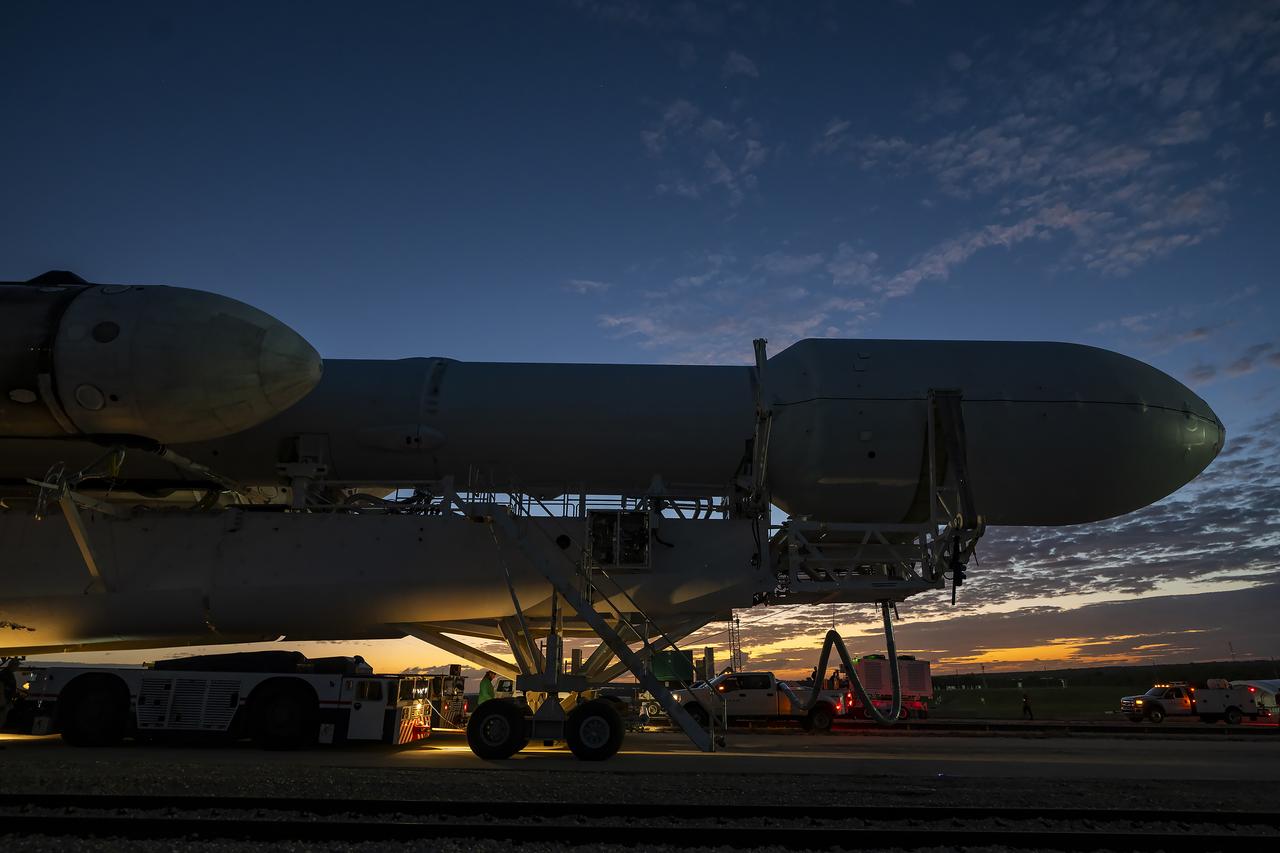
NASA’s Europa Clipper spacecraft attached to SpaceX’s Falcon Heavy rocket, rolls to Launch Pad 39A on Saturday, Oct. 12, 2024, at NASA’s Kennedy Space Center in Florida ahead of launch to Jupiter’s icy moon, Europa. The spacecraft will complete nearly 50 flybys of Europa to determine if there are conditions suitable for life beyond Earth. NASA and SpaceX are targeting launch for Europa Clipper at 12:06 p.m. EDT on Monday, Oct. 14, from Launch Complex 39A at Kennedy Space Center in Florida.

NASA’s Europa Clipper spacecraft attached to SpaceX’s Falcon Heavy rocket, rolls to Launch Pad 39A on Saturday, Oct. 12, 2024, at NASA’s Kennedy Space Center in Florida ahead of launch to Jupiter’s icy moon, Europa. The spacecraft will complete nearly 50 flybys of Europa to determine if there are conditions suitable for life beyond Earth. NASA and SpaceX are targeting launch for Europa Clipper at 12:06 p.m. EDT on Monday, Oct. 14, from Launch Complex 39A at Kennedy Space Center in Florida.
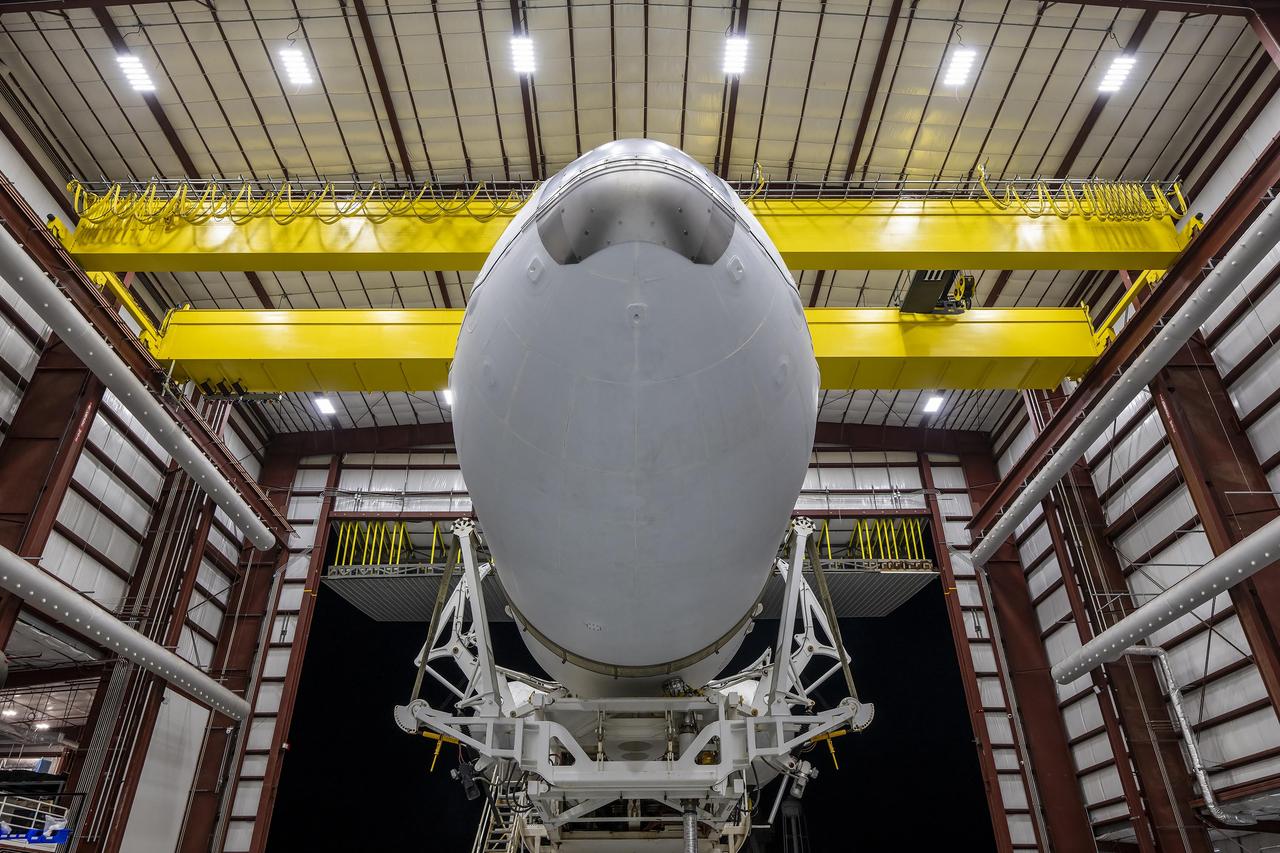
NASA’s Europa Clipper spacecraft attached to SpaceX’s Falcon Heavy rocket, rolls to Launch Pad 39A on Saturday, Oct. 12, 2024, at NASA’s Kennedy Space Center in Florida ahead of launch to Jupiter’s icy moon, Europa. The spacecraft will complete nearly 50 flybys of Europa to determine if there are conditions suitable for life beyond Earth. NASA and SpaceX are targeting launch for Europa Clipper at 12:06 p.m. EDT on Monday, Oct. 14, from Launch Complex 39A at Kennedy Space Center in Florida.
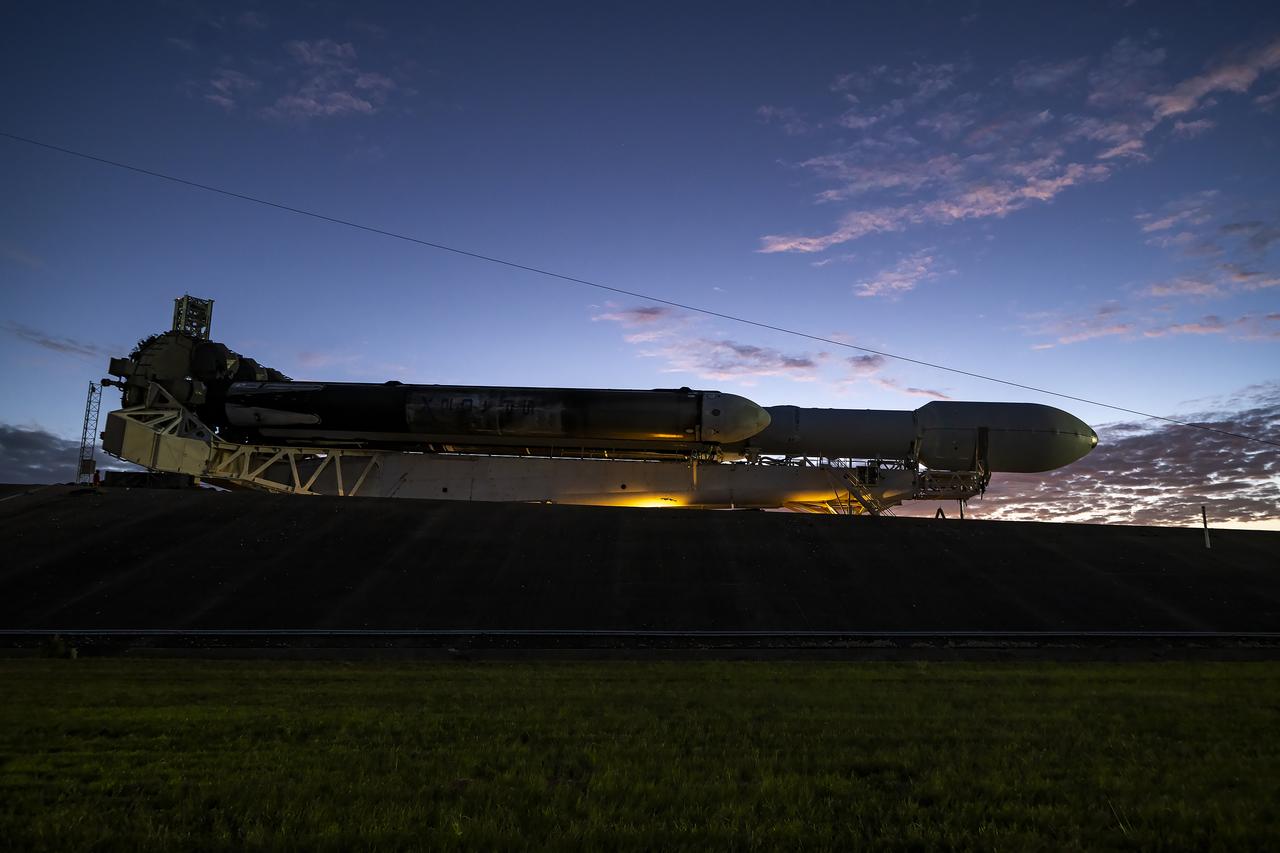
NASA’s Europa Clipper spacecraft attached to SpaceX’s Falcon Heavy rocket, rolls to Launch Pad 39A on Saturday, Oct. 12, 2024, at NASA’s Kennedy Space Center in Florida ahead of launch to Jupiter’s icy moon, Europa. The spacecraft will complete nearly 50 flybys of Europa to determine if there are conditions suitable for life beyond Earth. NASA and SpaceX are targeting launch for Europa Clipper at 12:06 p.m. EDT on Monday, Oct. 14, from Launch Complex 39A at Kennedy Space Center in Florida.
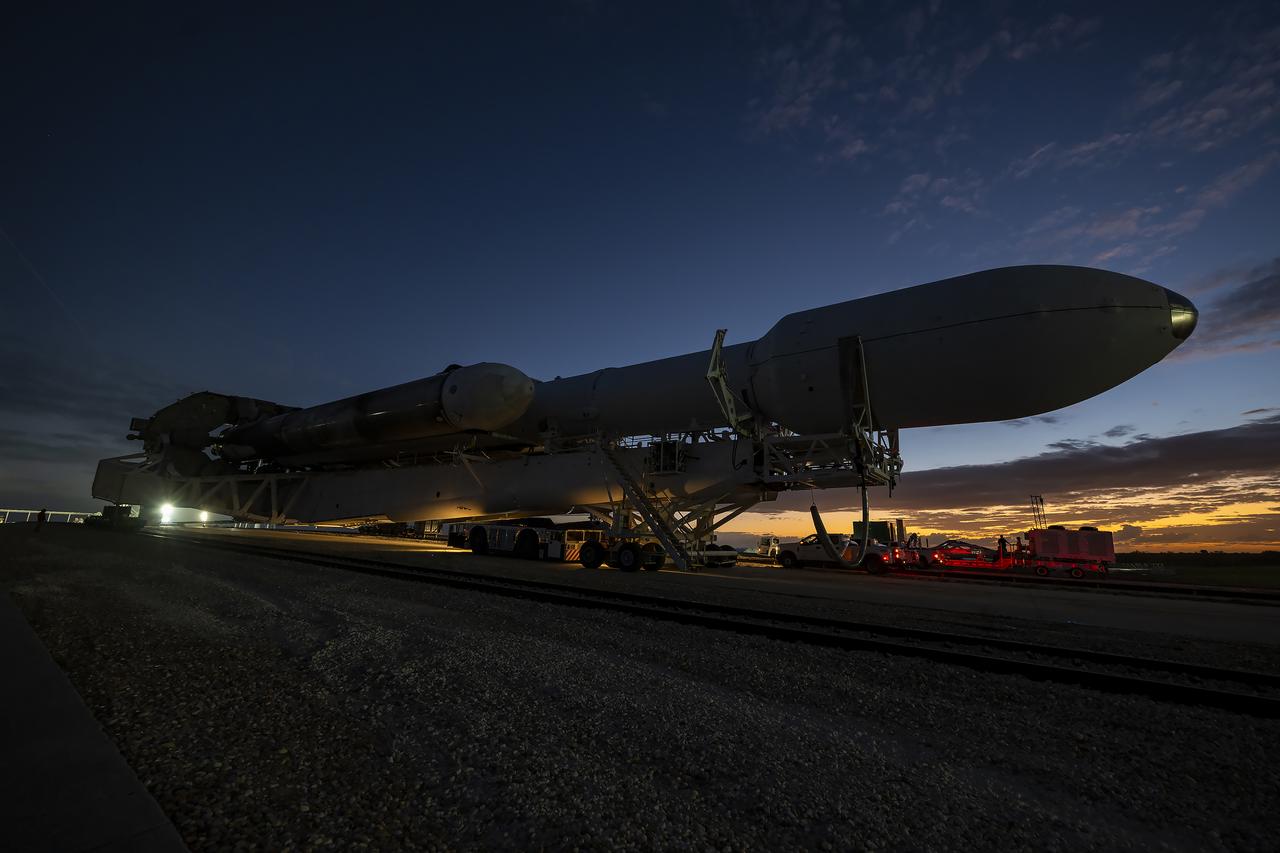
NASA’s Europa Clipper spacecraft attached to SpaceX’s Falcon Heavy rocket, rolls to Launch Pad 39A on Saturday, Oct. 12, 2024, at NASA’s Kennedy Space Center in Florida ahead of launch to Jupiter’s icy moon, Europa. The spacecraft will complete nearly 50 flybys of Europa to determine if there are conditions suitable for life beyond Earth. NASA and SpaceX are targeting launch for Europa Clipper at 12:06 p.m. EDT on Monday, Oct. 14, from Launch Complex 39A at Kennedy Space Center in Florida.
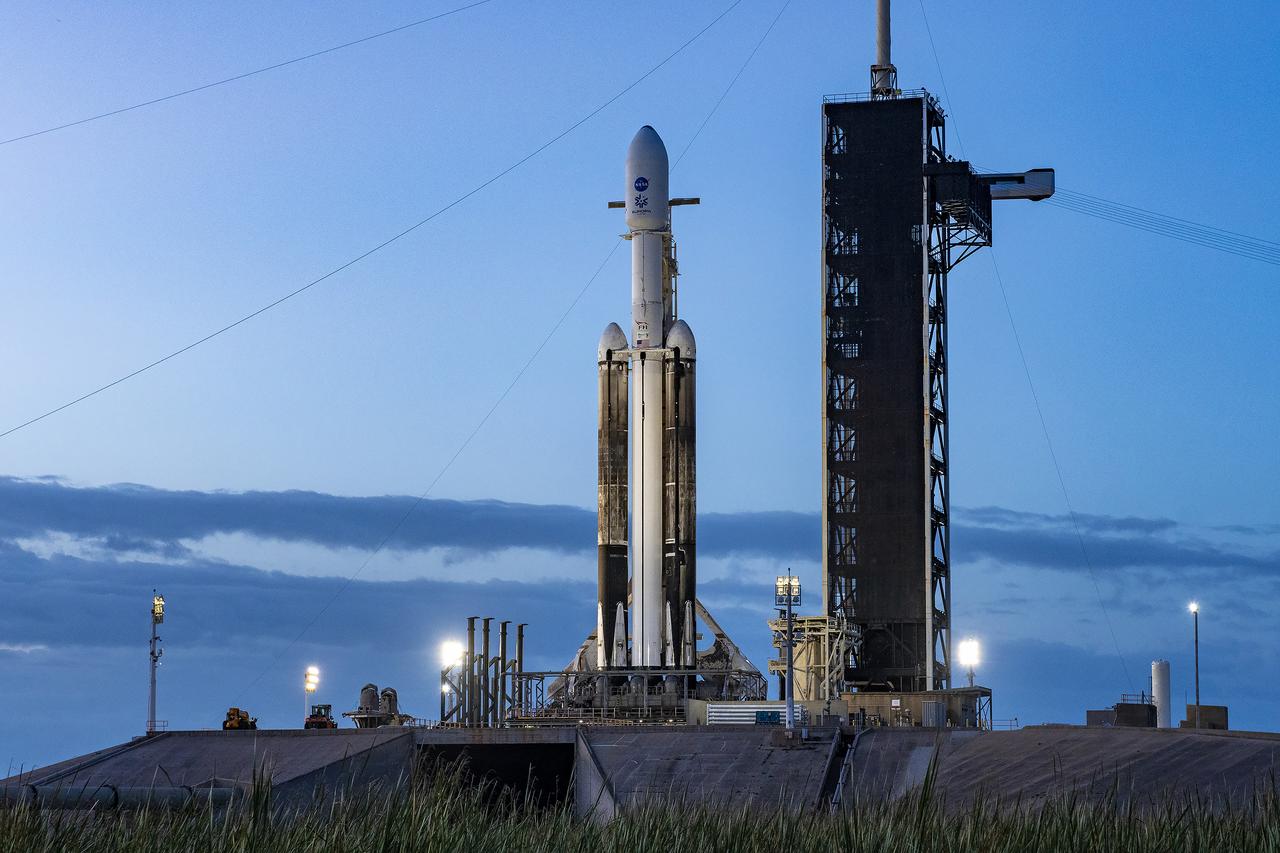
NASA’s Europa Clipper spacecraft and SpaceX’s Falcon Heavy rocket stands at Launch Pad 39A on Sunday, Oct. 13, 2024, at the agency’s Kennedy Space Center in Florida ahead of launch to Jupiter’s icy moon, Europa. The spacecraft will complete nearly 50 flybys of Europa to determine if there are conditions suitable for life beyond Earth. NASA and SpaceX are targeting launch for Europa Clipper at 12:06 p.m. EDT on Monday, Oct. 14, from Launch Complex 39A at Kennedy Space Center in Florida.
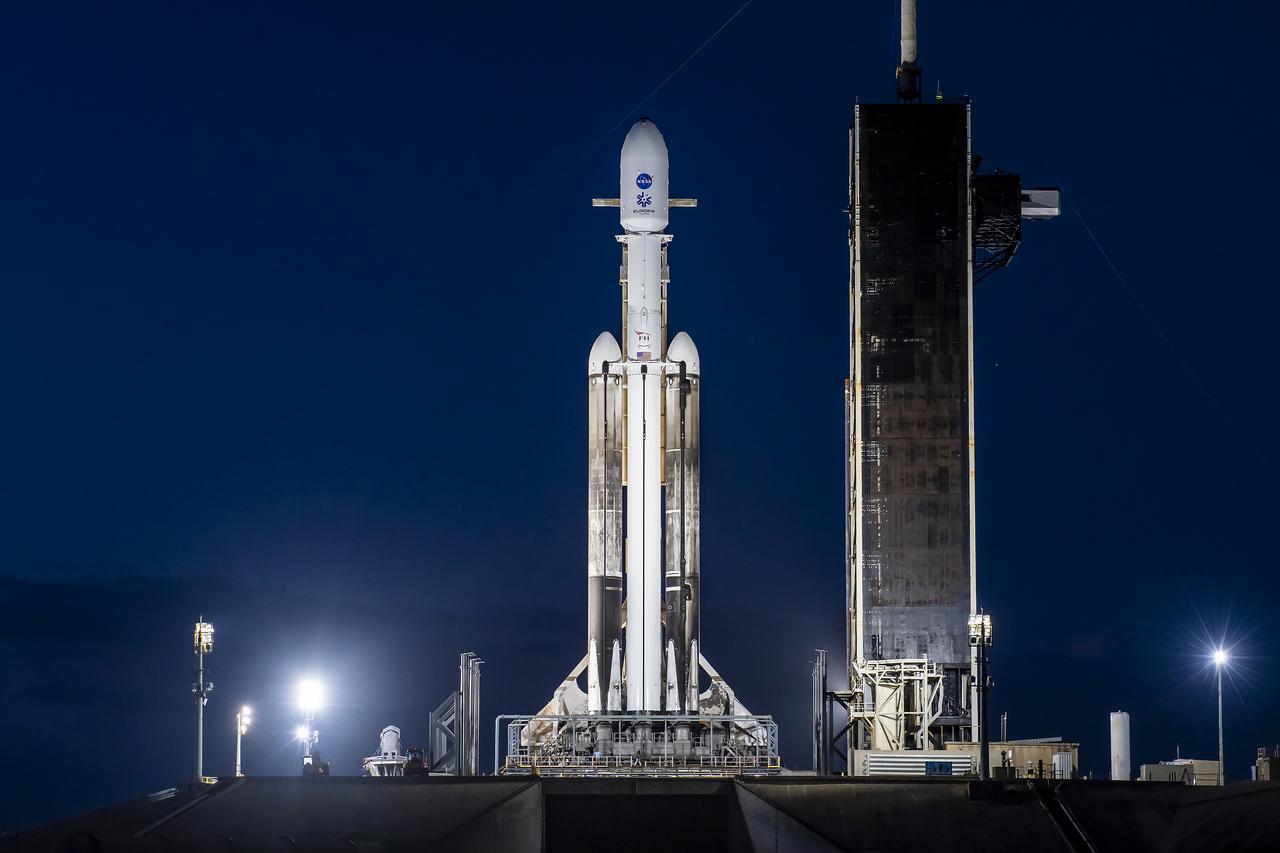
NASA’s Europa Clipper spacecraft and SpaceX’s Falcon Heavy rocket stands at Launch Pad 39A on Sunday, Oct. 13, 2024, at the agency’s Kennedy Space Center in Florida ahead of launch to Jupiter’s icy moon, Europa. The spacecraft will complete nearly 50 flybys of Europa to determine if there are conditions suitable for life beyond Earth. NASA and SpaceX are targeting launch for Europa Clipper at 12:06 p.m. EDT on Monday, Oct. 14, from Launch Complex 39A at Kennedy Space Center in Florida.

Teams offload NASA’s largest planetary mission spacecraft, Europa Clipper, from a United States Air Force C-17 Globemaster III transport aircraft onto the flatbed of a heavy-lift truck at the Launch and Landing Facility at NASA’s Kennedy Space Center in Florida on Thursday, May 23, 2024. Crews transported Europa Clipper to the Payload Hazardous Servicing Facility at Kennedy to prepare it for launch aboard a SpaceX Falcon Heavy rocket later this year from Launch Complex 39A at the Florida spaceport. Europa Clipper will help determine if conditions exist below the surface Jupiter’s fourth largest moon, Europa, that could support life.

Teams offload NASA’s largest planetary mission spacecraft, Europa Clipper, from a United States Air Force C-17 Globemaster III transport aircraft onto the flatbed of a heavy-lift truck at the Launch and Landing Facility at NASA’s Kennedy Space Center in Florida on Thursday, May 23, 2024. Crews transported Europa Clipper to the Payload Hazardous Servicing Facility at Kennedy to prepare it for launch aboard a SpaceX Falcon Heavy rocket later this year from Launch Complex 39A at the Florida spaceport. Europa Clipper will help determine if conditions exist below the surface Jupiter’s fourth largest moon, Europa, that could support life.

Teams offload NASA’s largest planetary mission spacecraft, Europa Clipper, from a United States Air Force C-17 Globemaster III transport aircraft onto the flatbed of a heavy-lift truck at the Launch and Landing Facility at NASA’s Kennedy Space Center in Florida on Thursday, May 23, 2024. Crews transported Europa Clipper to the Payload Hazardous Servicing Facility at Kennedy to prepare it for launch aboard a SpaceX Falcon Heavy rocket later this year from Launch Complex 39A at the Florida spaceport. Europa Clipper will help determine if conditions exist below the surface Jupiter’s fourth largest moon, Europa, that could support life.

Teams offload NASA’s largest planetary mission spacecraft, Europa Clipper, from a United States Air Force C-17 Globemaster III transport aircraft onto the flatbed of a heavy-lift truck at the Launch and Landing Facility at NASA’s Kennedy Space Center in Florida on Thursday, May 23, 2024. Crews transported Europa Clipper to the Payload Hazardous Servicing Facility at Kennedy to prepare it for launch aboard a SpaceX Falcon Heavy rocket later this year from Launch Complex 39A at the Florida spaceport. Europa Clipper will help determine if conditions exist below the surface Jupiter’s fourth largest moon, Europa, that could support life.

Teams offload NASA’s largest planetary mission spacecraft, Europa Clipper, from a United States Air Force C-17 Globemaster III transport aircraft onto the flatbed of a heavy-lift truck at the Launch and Landing Facility at NASA’s Kennedy Space Center in Florida on Thursday, May 23, 2024. Crews transported Europa Clipper to the Payload Hazardous Servicing Facility at Kennedy to prepare it for launch aboard a SpaceX Falcon Heavy rocket later this year from Launch Complex 39A at the Florida spaceport. Europa Clipper will help determine if conditions exist below the surface Jupiter’s fourth largest moon, Europa, that could support life.

Teams offload NASA’s largest planetary mission spacecraft, Europa Clipper, from a United States Air Force C-17 Globemaster III transport aircraft onto the flatbed of a heavy-lift truck at the Launch and Landing Facility at NASA’s Kennedy Space Center in Florida on Thursday, May 23, 2024. Crews transported Europa Clipper to the Payload Hazardous Servicing Facility at Kennedy to prepare it for launch aboard a SpaceX Falcon Heavy rocket later this year from Launch Complex 39A at the Florida spaceport. Europa Clipper will help determine if conditions exist below the surface Jupiter’s fourth largest moon, Europa, that could support life.