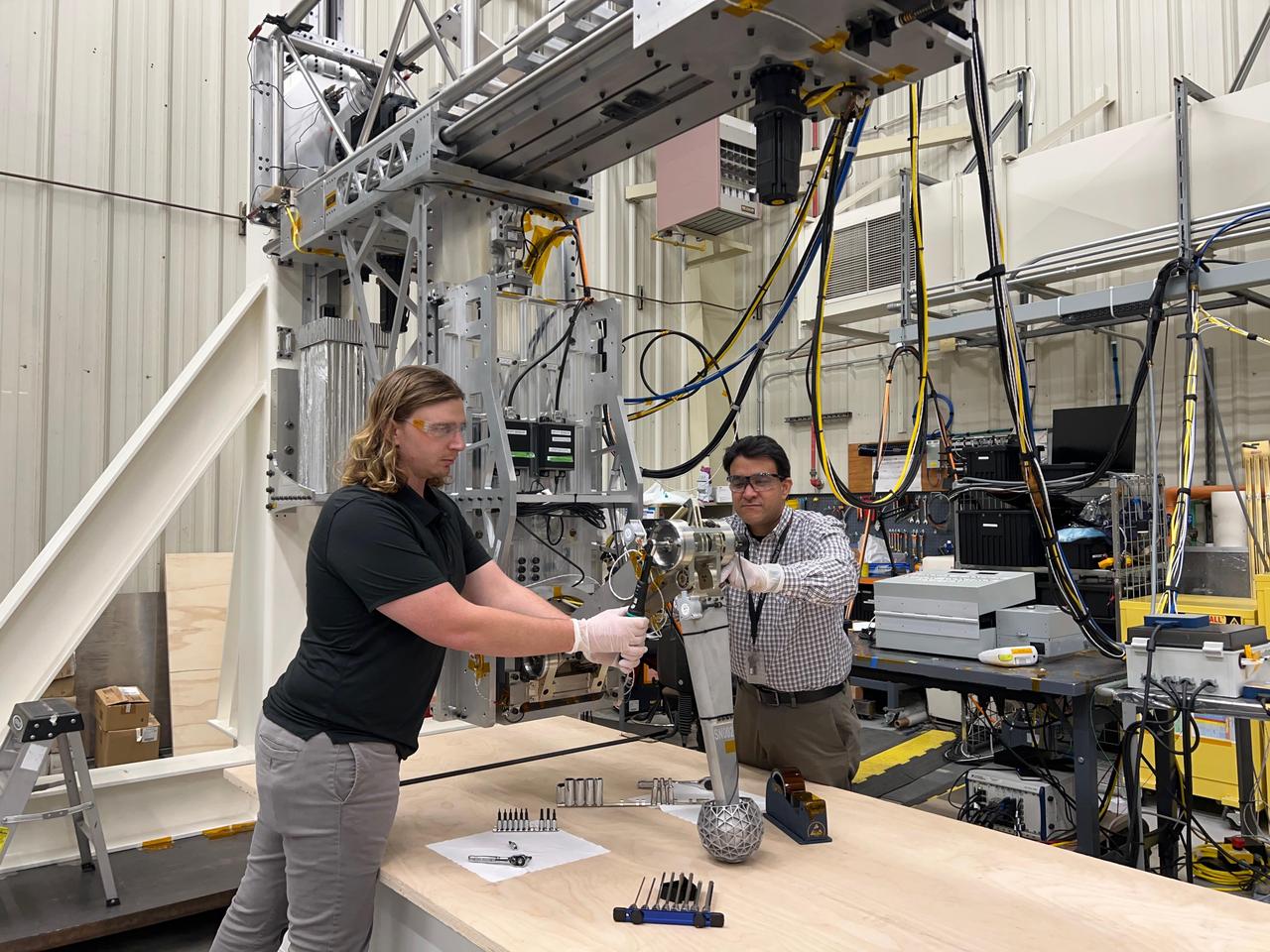
Engineers at NASA's Jet Propulsion Laboratory – from left, Matthew Cameron-Hooper, and Thomas Reynoso – prepare flight-like landing gear in the Europa Lander landing gear testbed in summer 2022. Europa Lander is a concept for a potential future mission that would look for signs of life in the icy surface material of Jupiter's moon Europa. The moon is thought to contain a global ocean of salty water beneath its frozen crust. If life exists in that ocean, signs of its existence called biosignatures could potentially find their way to the surface. In this mission concept, a spacecraft would land on Europa and collect and study samples from about 4 inches (10 centimeters) beneath the surface, looking for signs of life. The Europa Lander landing gear testbed was developed to test and inform the design of the landing gear for the spacecraft: It mimics the landing loads and ground interaction forces that a single flight landing gear would experience when touching down on the Europan surface. It does this by using gravity offloading to simulate the reduced gravity on Europa, and by replicating the mass and inertial properties of a flight lander as well as all the degrees of freedom that the landing gear would experience. https://photojournal.jpl.nasa.gov/catalog/PIA26198
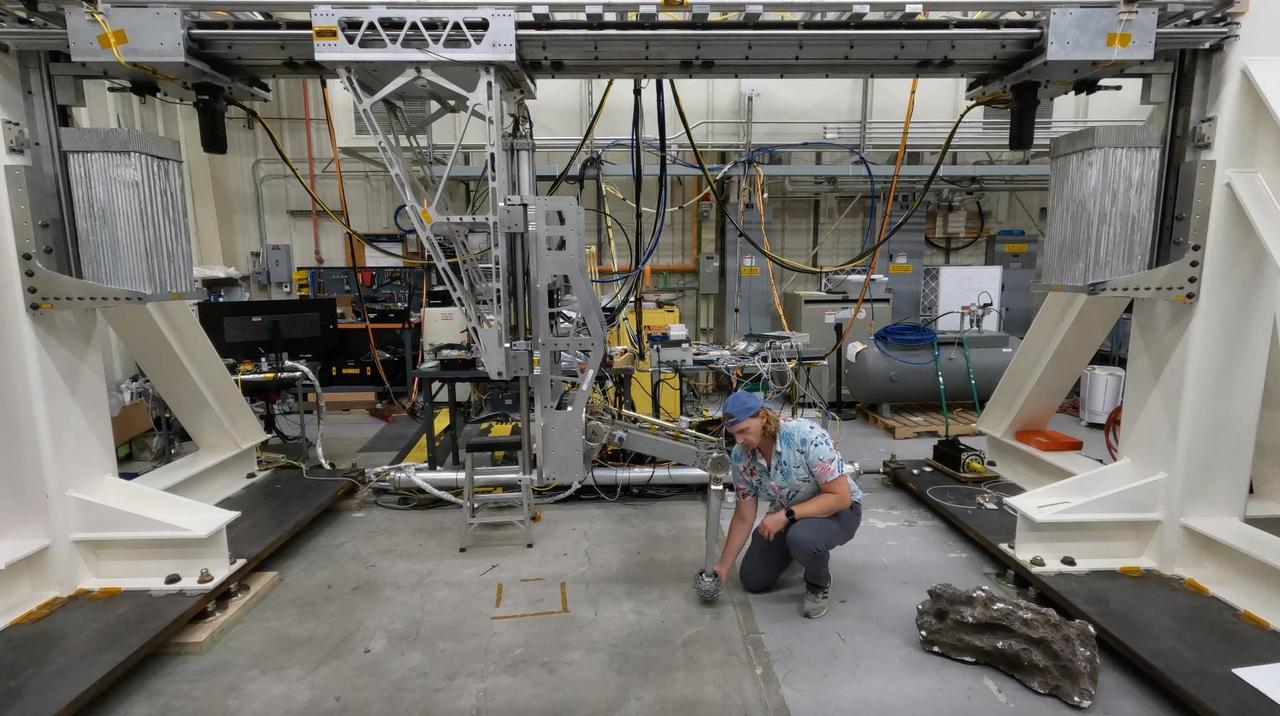
Engineer Matthew Cameron-Hooper performs a checkout on some systems of the Europa Lander landing gear testbed at NASA's Jet Propulsion Laboratory in Southern California on May 27, 2022. Europa Lander is a concept for a potential future mission that would look for signs of life in the icy surface material of Jupiter's moon Europa. The moon is thought to contain a global ocean of salty water beneath its frozen crust. If life exists in that ocean, signs of its existence called biosignatures could potentially find their way to the surface. In this mission concept, a spacecraft would land on Europa and collect and study samples from about 4 inches (10 centimeters) beneath the surface, looking for signs of life. The Europa Lander landing gear testbed was developed to test and inform the design of the landing gear for the spacecraft: It mimics the landing loads and ground interaction forces that a single flight landing gear would experience when touching down on the Europan surface. It does this by using gravity offloading to simulate the reduced gravity on Europa, and by replicating the mass and inertial properties of a flight lander as well as all the degrees of freedom that the landing gear would experience. This system checkout confirmed two critical functionalities of the testbed: low friction of the horizontal degree of freedom that carries the test landing gear, and proper functioning of the gravity offloading system. Together these functionalities ensure that only ground interaction forces cause the test landing gear to come to a stop during a test, just as a flight landing gear would experience when landing on the Europan surface. Video available at https://photojournal.jpl.nasa.gov/catalog/PIA26200
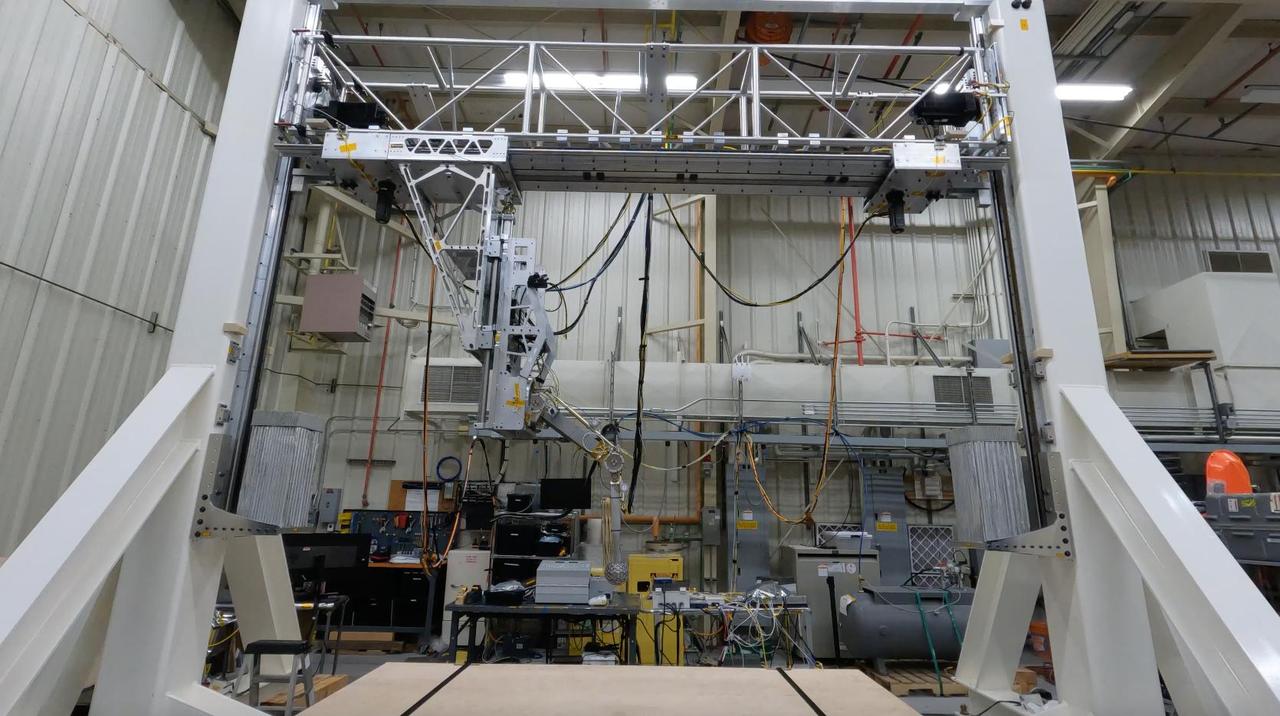
Engineers test the mechanical landing system for the proposed Europa Lander project at NASA's Jet Propulsion Laboratory on Sept. 15, 2022. This test, using the Europa Lander landing gear testbed, fully exercises the Europa Lander landing gear mechanism through a simulated dynamic landing. Europa Lander is a concept for a potential future mission that would look for signs of life in the icy surface material of Jupiter's moon Europa. The moon is thought to contain a global ocean of salty water beneath its frozen crust. If life exists in that ocean, signs of its existence called biosignatures could potentially find their way to the surface. In this mission concept, a spacecraft would land on Europa and collect and study samples from about 4 inches (10 centimeters) beneath the surface, looking for signs of life. The Europa Lander landing gear testbed was developed to test and inform the design of the landing gear for the spacecraft: It mimics the landing loads and ground interaction forces that a single flight landing gear would experience when touching down on the Europan surface. It does this by using gravity offloading to simulate the reduced gravity on Europa, and by replicating the mass and inertial properties of a flight lander as well as all the degrees of freedom that the landing gear would experience. Video available at https://photojournal.jpl.nasa.gov/catalog/PIA26199
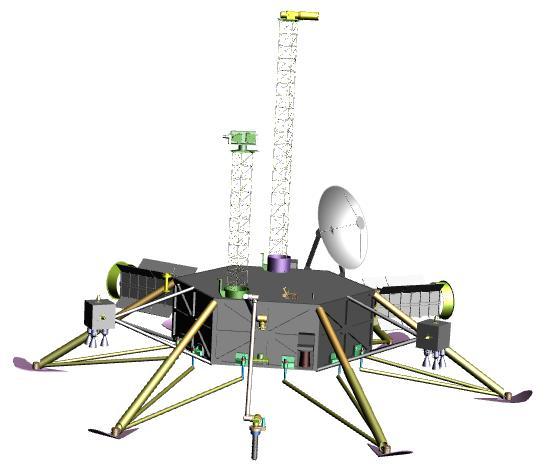
This graphic shows a possible robotic lander for a future mission to Jupiter moon Europa.
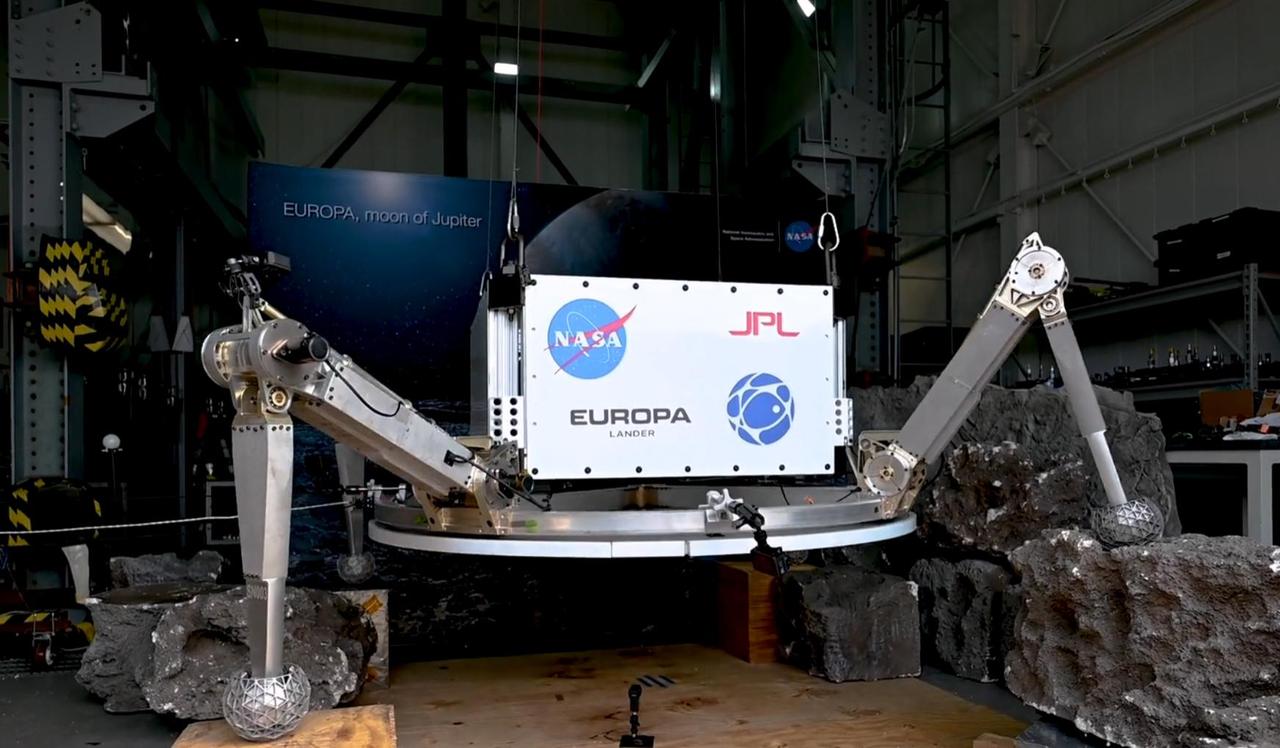
On Aug. 17 and 18, 2023, engineers at NASA's Jet Propulsion Laboratory in Southern California tested the landing system for a proposed future mission that would touch down on Jupiter's icy moon Europa. This system for the proposed Europa Lander is an evolution of hardware used on previous NASA lander missions. It includes the architecture used for the "sky crane maneuver" that helped lower NASA's Curiosity and Perseverance rovers onto the Martian surface, which would give the lander the stability it needs during touchdown. Although this landing architecture was developed with Europa as the target, it could be adapted for use at other moons and celestial bodies with challenging terrain. Four bridles, suspended from an overhead simulated propulsive descent stage, maintain a level lander body. The four legs conform passively to the terrain they encounter as the lander body continues to descend toward the surface. Each leg consists of a four-bar linkage mechanism that controls the leg's pose before and during landing. The legs are preloaded downward with a constant force spring to help them rearrange and compress the surface they encounter prior to landing, giving them extra traction and stability during and after the landing event. Acting like a skid plate, the belly pan provides the underside of the spacecraft with protection from potentially harmful terrain. The belly pan also resists shear motion on the terrain it interacts with. Once the belly pan contacts the surface, sensors trigger a mechanism that quickly locks the legs' "hip" and "knee" rotary joints, resulting in a table-like stance. At this point, the job of ensuring lander stability shifts from the bridles to the legs. This shift keeps the lander level after the bridles are unloaded. In the event the belly pan does not encounter terrain during the touchdown process, sensors in each leg can also declare touchdown. After the leg joints lock, the belly pan would be suspended above the landed terrain, and the lander would be supported only by the four legs. Not pictured in the video is the period after the bridles are offloaded and flyaway is commanded. The bridles would then be cut, and the hovering propulsive stage would fly away, leaving the lander in a stable stance on the surface. Movie available at https://photojournal.jpl.nasa.gov/catalog/PIA26010
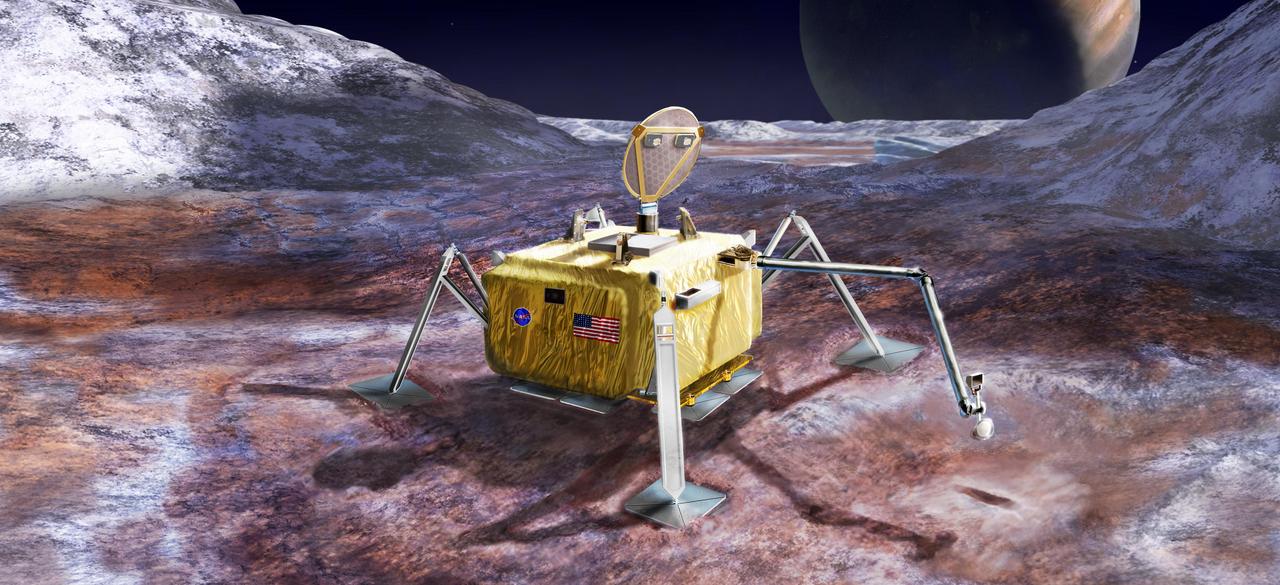
This artist's rendering illustrates a conceptual design for a potential future mission to land a robotic probe on the surface of Jupiter's moon Europa. The lander is shown with a sampling arm extended, having previously excavated a small area on the surface. The circular dish on top is a dual-purpose high-gain antenna and camera mast, with stereo imaging cameras mounted on the back of the antenna. Three vertical shapes located around the top center of the lander are attachment points for cables that would lower the rover from a sky crane, which is envisioned as the landing system for this mission concept. http://photojournal.jpl.nasa.gov/catalog/PIA21048
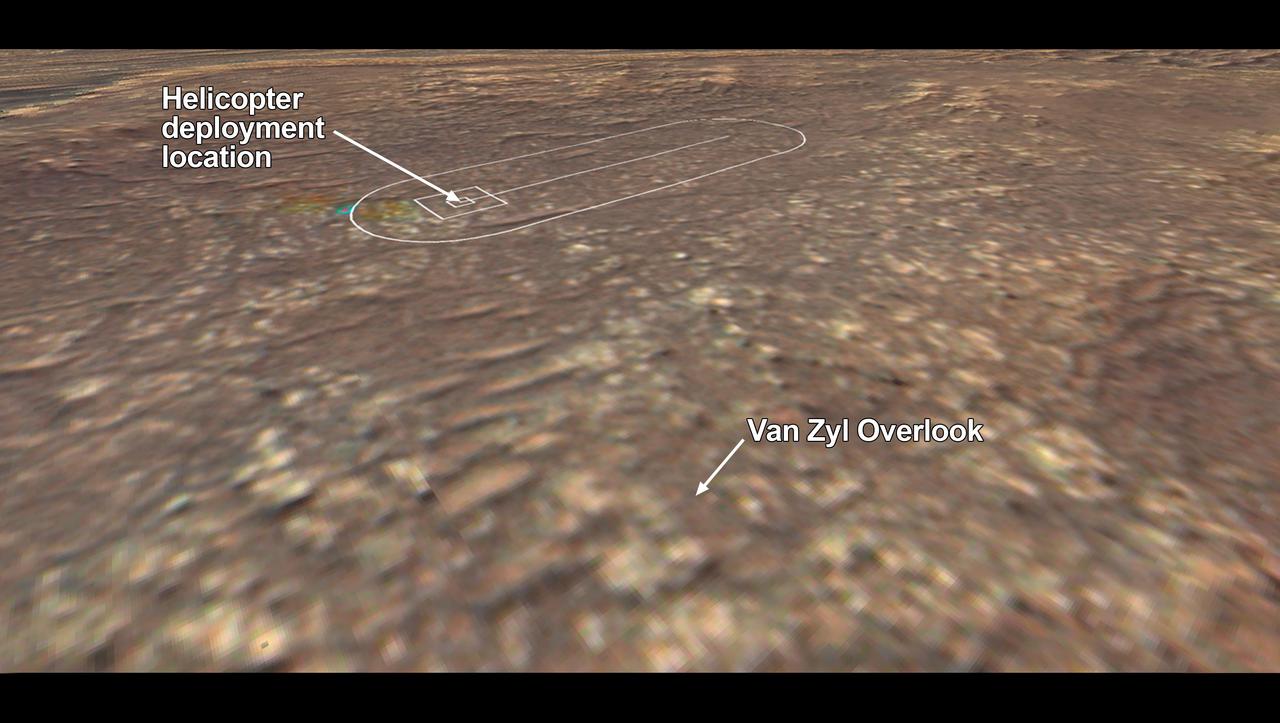
The location where NASA's Mars 2020 Perseverance rover will observe the Ingenuity Mars Helicopter's attempt at powered controlled flight at Mars is called "Van Zyl Overlook," after Jakob van Zyl. Van Zyl was the team's longtime colleague, mentor, and leader at NASA's Jet Propulsion Laboratory in Southern California. He passed away unexpectedly in August 2020, about a month after the launch of Perseverance. Van Zyl joined JPL in 1986 and served in crucial roles at the Lab over a 33-year career, including as director for the Astronomy and Physics Directorate, associate director for project formulation and strategy, and finally director for the Solar System Exploration Directorate. As leader of solar system exploration at JPL, he oversaw successful operations of such NASA missions as Juno, Dawn, and Cassini, the implementation of the Mars InSight lander and MarCO CubeSats, as well as ongoing development of Europa Clipper, Psyche, and all of JPL's instruments and Ingenuity. https://photojournal.jpl.nasa.gov/catalog/PIA24435