
Expedition 37 NASA Flight Engineer Karen Nyberg is seen speaking to her family by satellite phone minutes after her landing in the Soyuz TMA-09M spacecraft in a remote area southeast of the town of Zhezkazgan, Kazakhstan, on Monday, Nov. 11, 2013. Nyberg, Expedition 37 Commander Fyodor Yurchikhin of the Russian Federal Space Agency (Roscosmos) and Italian Flight Engineer Luca Parmitano returned to earth after five and a half months on the International Space Station. Photo Credit: (NASA/Carla Cioffi)
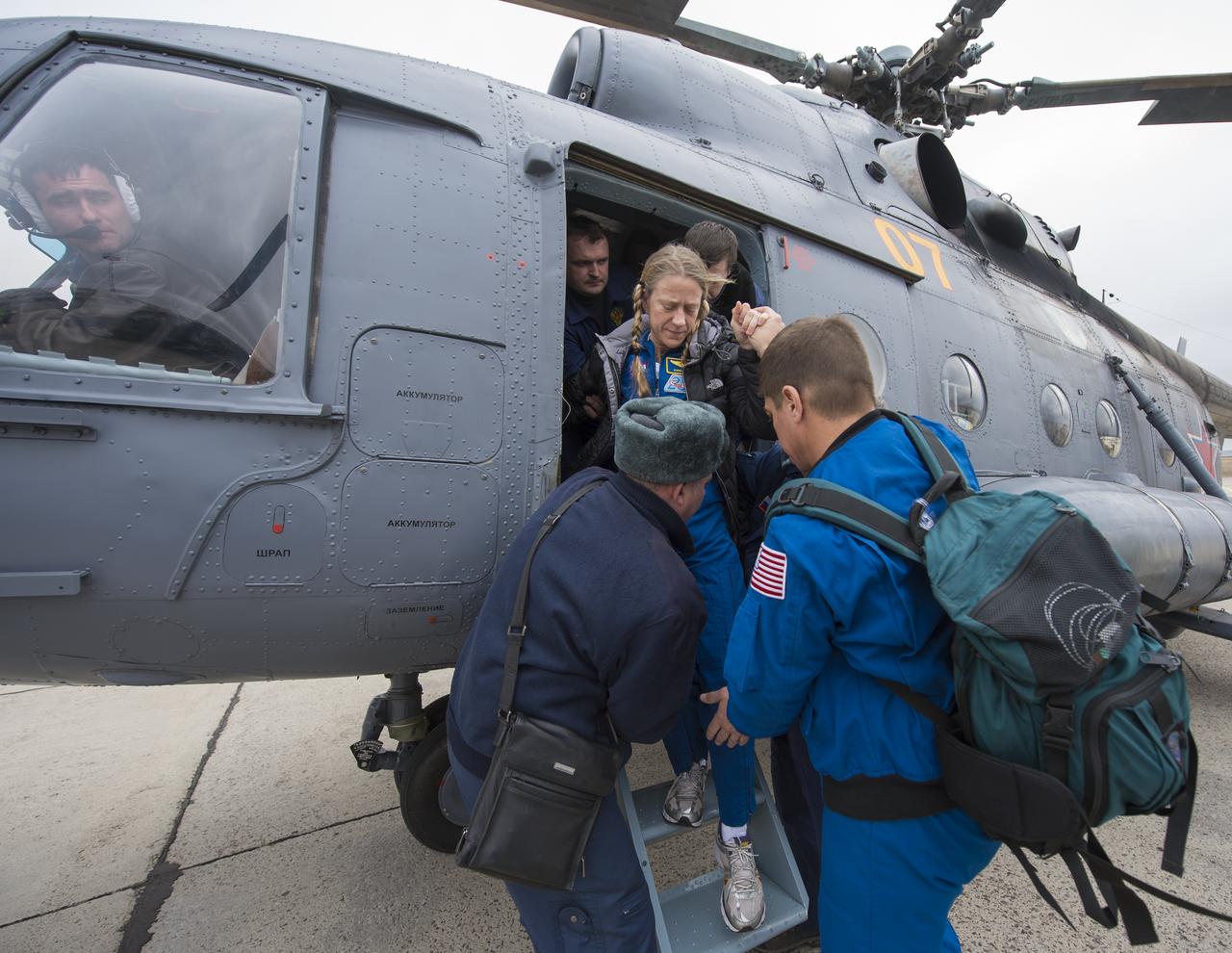
Expedition 37 NASA Flight Engineer Karen Nyberg is helped off the helicopter upon her arrival in Karaganda, Kazakhstan after her landing in the Soyuz TMA-09M spacecraft in a remote area southeast of the town of Zhezkazgan, Monday, Nov. 11, 2013. Nyberg, Expedition 37 Commander Fyodor Yurchikhin of the Russian Federal Space Agency (Roscosmos) and Italian Flight Engineer Luca Parmitano returned to earth after five and a half months on the International Space Station. Photo Credit: (NASA/Carla Cioffi)

Expedition 37 NASA Flight Engineer Karen Nyberg is seen minutes after her landing in the Soyuz TMA-09M spacecraft in a remote area southeast of the town of Zhezkazgan, Kazakhstan, on Monday, Nov. 11, 2013. Nyberg, Expedition 37 Commander Fyodor Yurchikhin of the Russian Federal Space Agency (Roscosmos) and Italian Flight Engineer Luca Parmitano returned to earth after five and a half months on the International Space Station. Photo Credit: (NASA/Carla Cioffi)
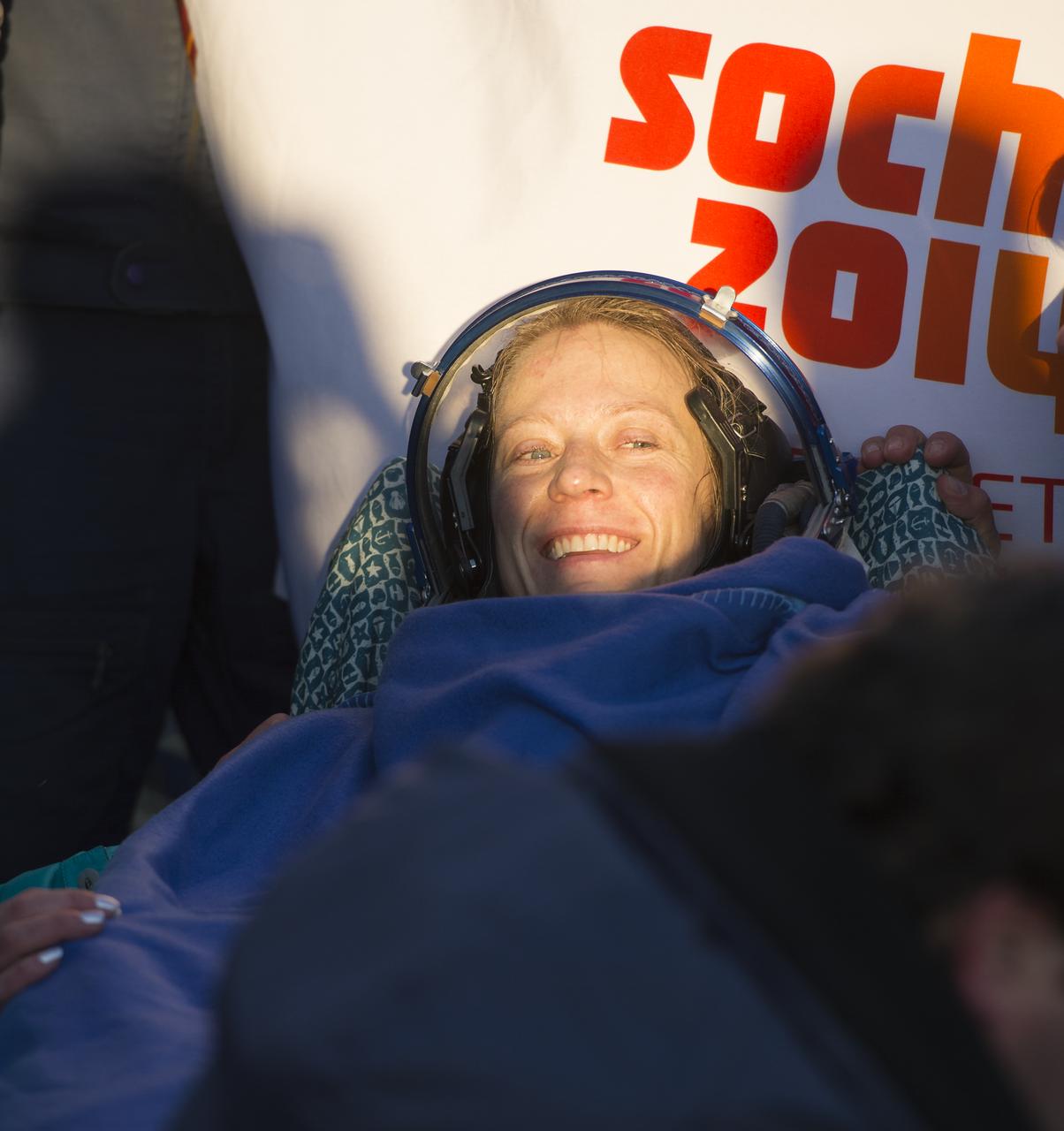
Expedition 37 NASA Flight Engineer Karen Nyberg smiles minutes after her landing in the Soyuz TMA-09M spacecraft in a remote area southeast of the town of Zhezkazgan, Kazakhstan, on Monday, Nov. 11, 2013. Nyberg, Expedition 37 Commander Fyodor Yurchikhin of the Russian Federal Space Agency (Roscosmos) and Italian Flight Engineer Luca Parmitano returned to earth after five and a half months on the International Space Station. Photo Credit: (NASA/Carla Cioffi)
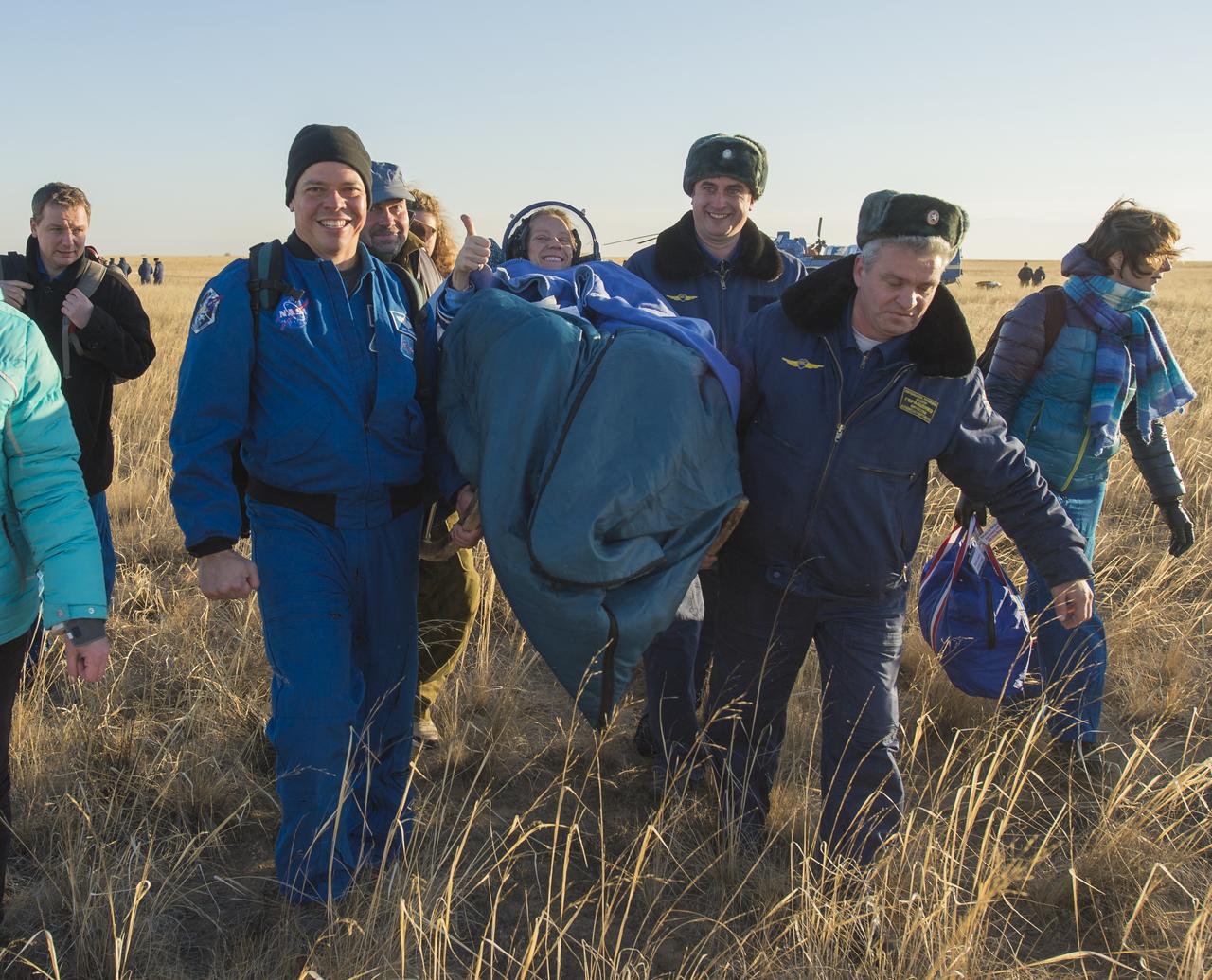
Expedition 37 NASA Flight Engineer Karen Nyberg gives the thumbs up as she is carried to the inflatable medical tent after her landing in the Soyuz TMA-09M spacecraft in a remote area southeast of the town of Zhezkazgan, Kazakhstan, on Monday, Nov. 11, 2013. Nyberg, Expedition 37 Commander Fyodor Yurchikhin of the Russian Federal Space Agency (Roscosmos) and Italian Flight Engineer Luca Parmitano returned to earth after five and a half months on the International Space Station. Photo Credit: (NASA/Carla Cioffi)
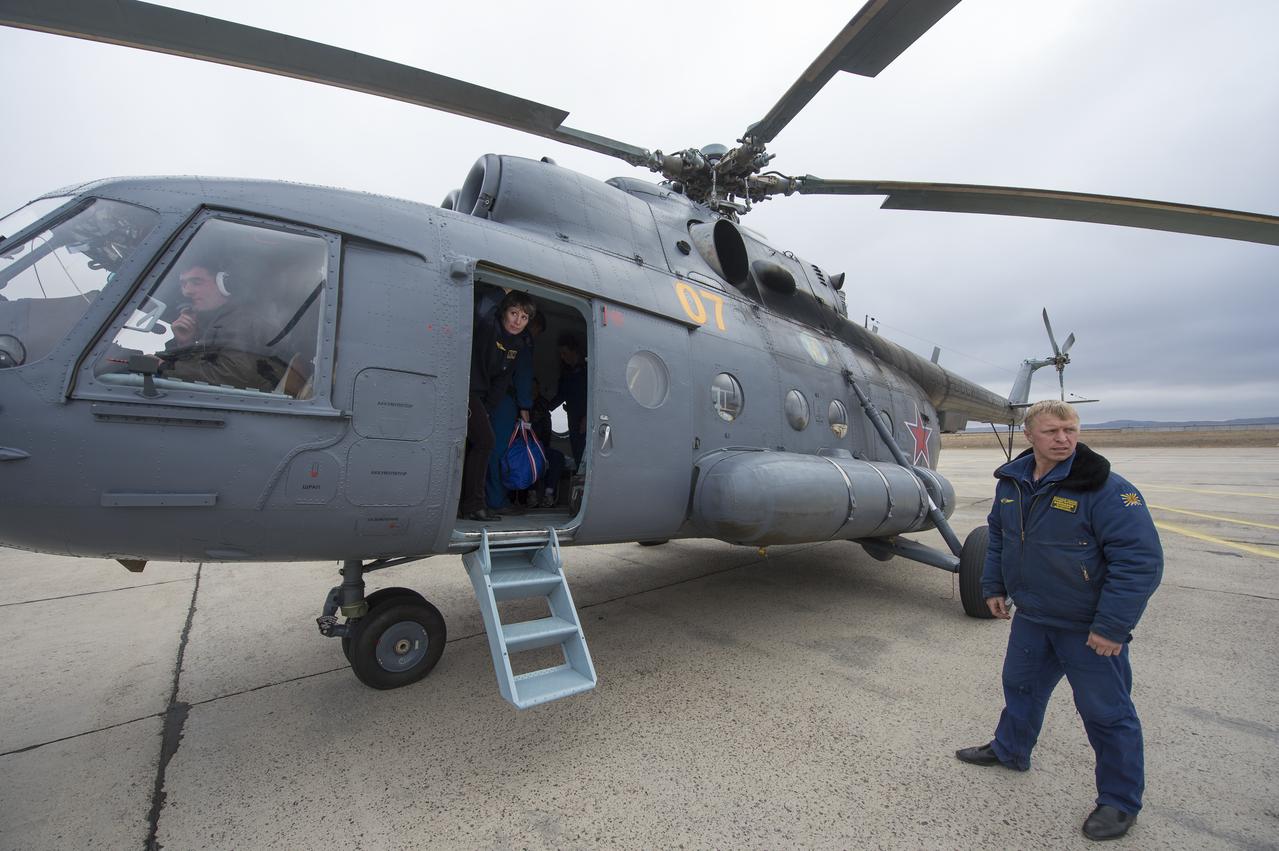
Russian Search and Rescue personnel prepare to assist Expedition 37 Flight Engineer Karen Nyberg from the helicopter shortly after her arrival at the Karaganda airport in Kazakhstan, Monday, Nov. 11, 2013. Nyberg, Expedition 37 Commander Fyodor Yurchikhin of the Russian Federal Space Agency (Roscosmos) and Italian Flight Engineer Luca Parmitano landed in a remote area outside of the town of Zhezkazgan after after five and a half months spent on the International Space Station. Photo Credit: (NASA/Carla Cioffi)
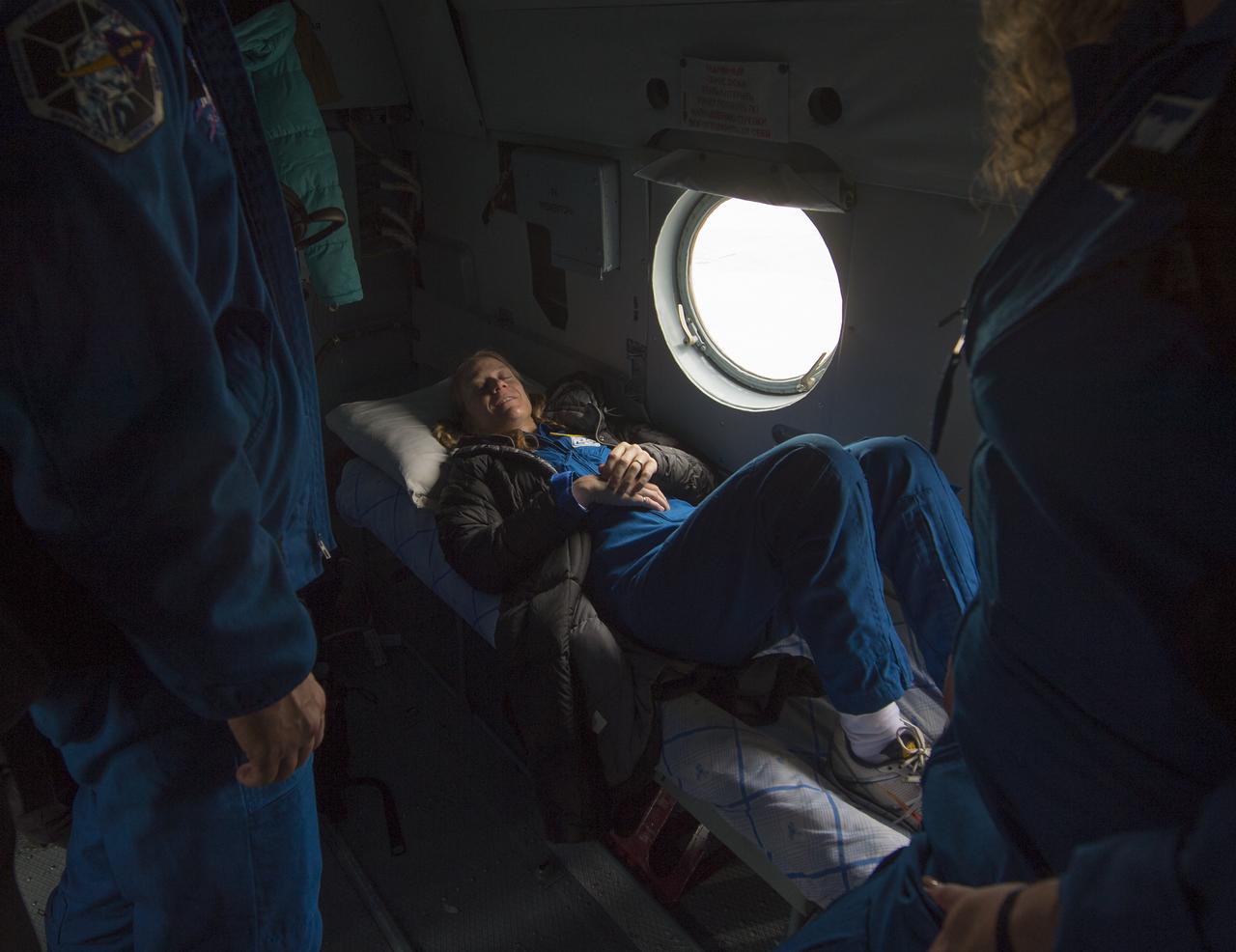
Expedition 37 NASA Flight Engineer Karen Nyberg rests on the helicopter ride to Karaganda, Kazakhstan after her landing in the Soyuz TMA-09M spacecraft in a remote area southeast of the town of Zhezkazgan, Monday, Nov. 11, 2013. Nyberg, Expedition 37 Commander Fyodor Yurchikhin of the Russian Federal Space Agency (Roscosmos) and Italian Flight Engineer Luca Parmitano returned to earth after five and a half months on the International Space Station. Photo Credit: (NASA/Carla Cioffi)
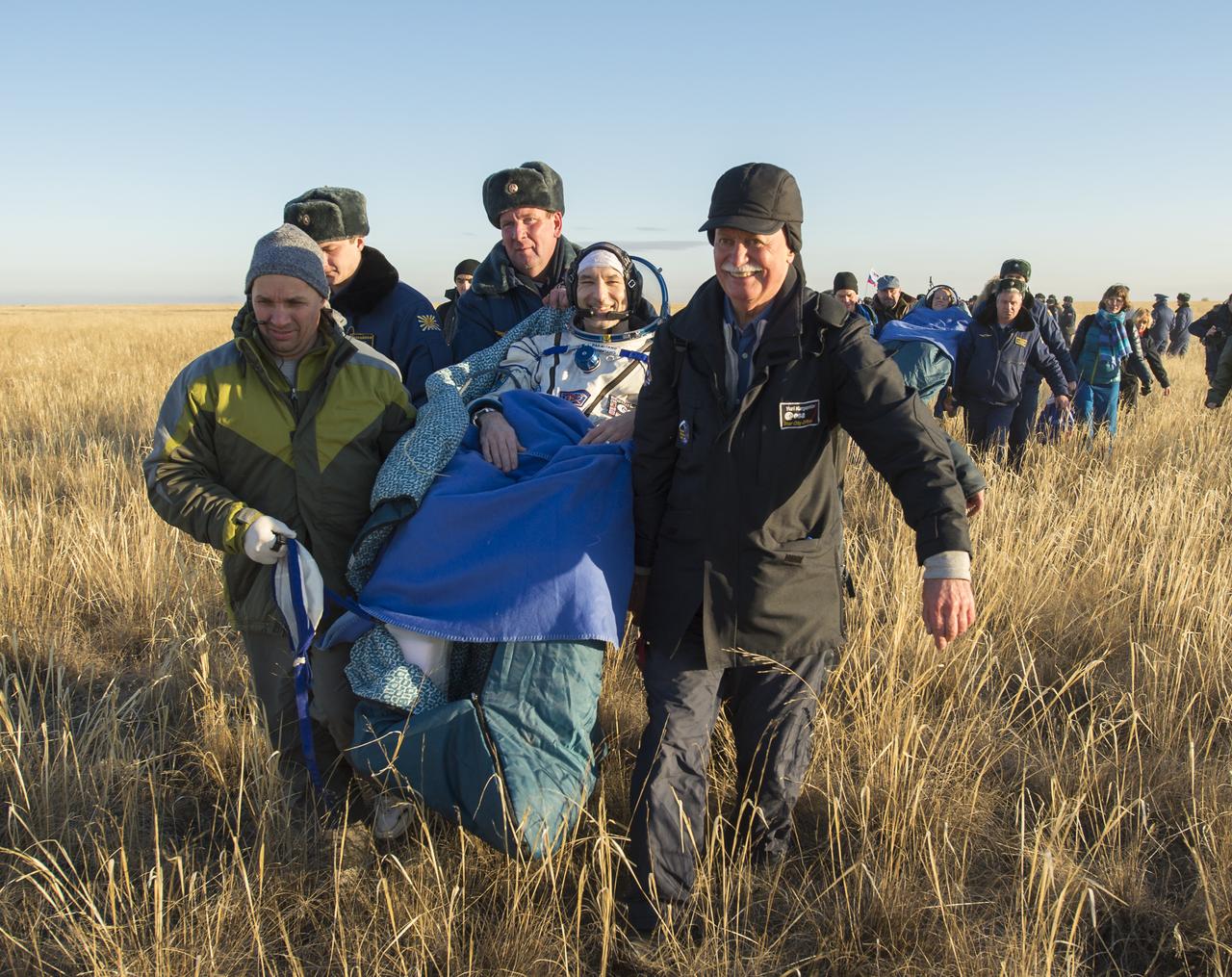
Expedition 37 Luca Parmitano of ESA (European Space Agency) is carried to the inflatable medical tent from minutes after he landed in the Soyuz TMA-09M spacecraft in a remote area outside the town of Zhezkazgan, Kazakhstan, on Monday, Nov. 11, 2013. Parmitano, Expedition 37 Commander Fyodor Yurchikhin of the Russian Federal Space Agency (Roscosmos) and NASA Flight Engineer Karen Nyberg returned to earth after five and a half months on the International Space Station. Photo Credit: (NASA/Carla Cioffi)
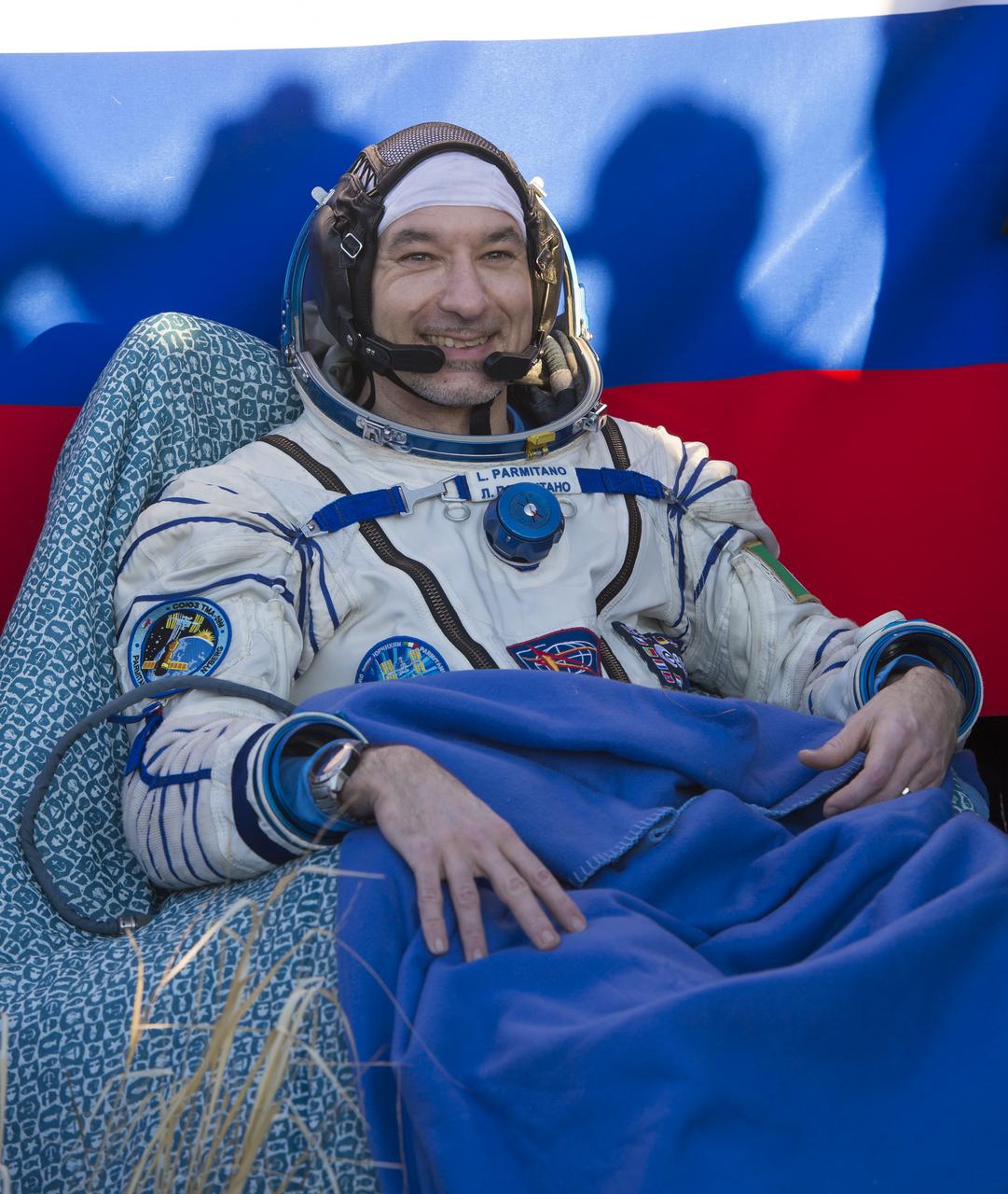
Expedition 37 Luca Parmitano of ESA (European Space Agency) smiles minutes after his landing in the Soyuz TMA-09M spacecraft in a remote area outside the town of Zhezkazgan, Kazakhstan, on Monday, Nov. 11, 2013. Parmitano, Expedition 37 Commander Fyodor Yurchikhin of the Russian Federal Space Agency (Roscosmos) and NASA Flight Engineer Karen Nyberg returned to earth after five and a half months on the International Space Station. Photo Credit: (NASA/Carla Cioffi)
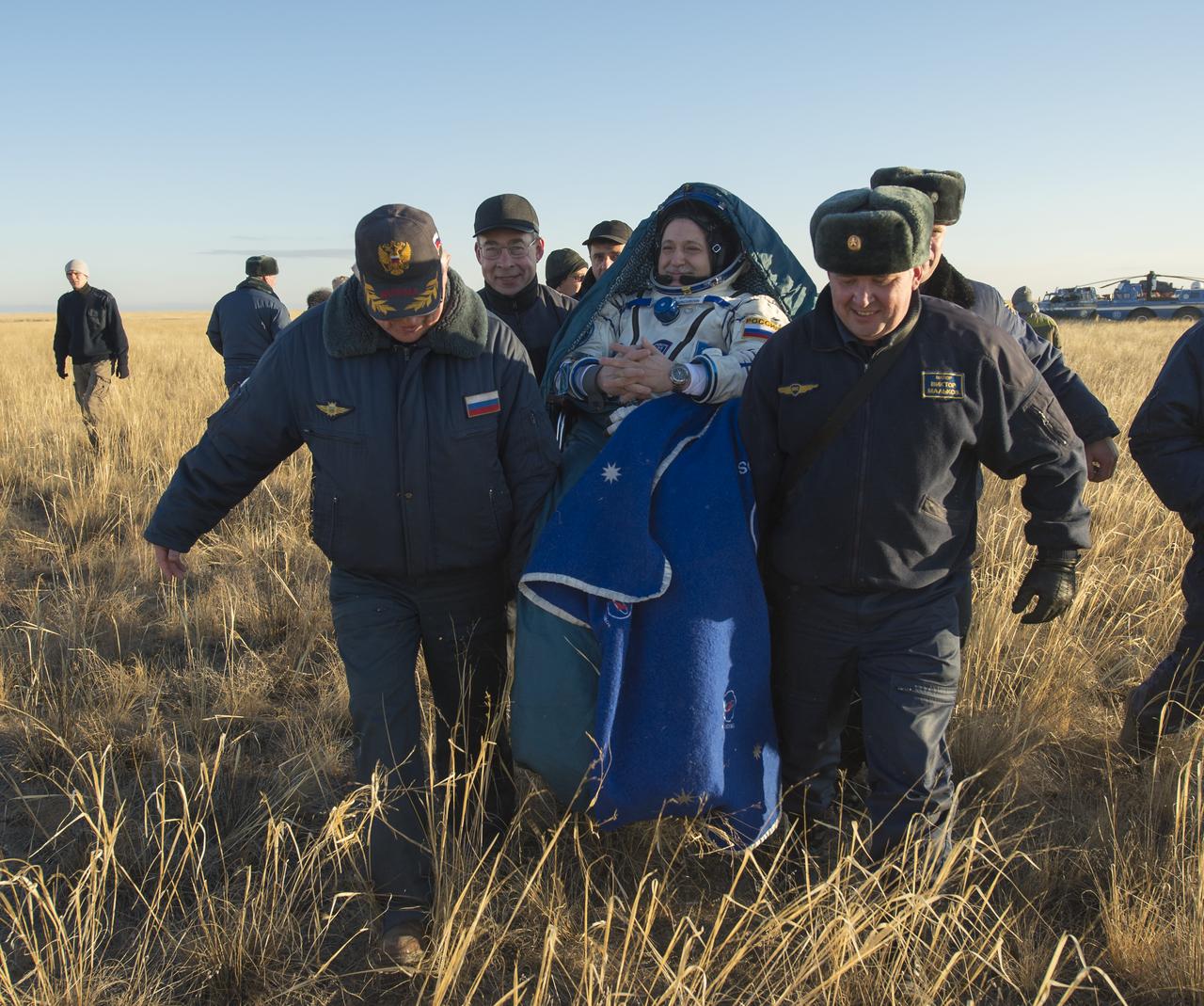
Expedition 37 Commander Fyodor Yurchikhin of Roscosmos (Russian Federal Space Agency) is carried to the inflatable medical tent from minutes after he landed in the Soyuz TMA-09M spacecraft in a remote area outside the town of Zhezkazgan, Kazakhstan, on Monday, Nov. 11, 2013. Yurchikhin, NASA Flight Engineer Karen Nyberg and Italian Flight Engineer Luca Parmitano returned to earth after five and a half months on the International Space Station. Photo Credit: (NASA/Carla Cioffi)
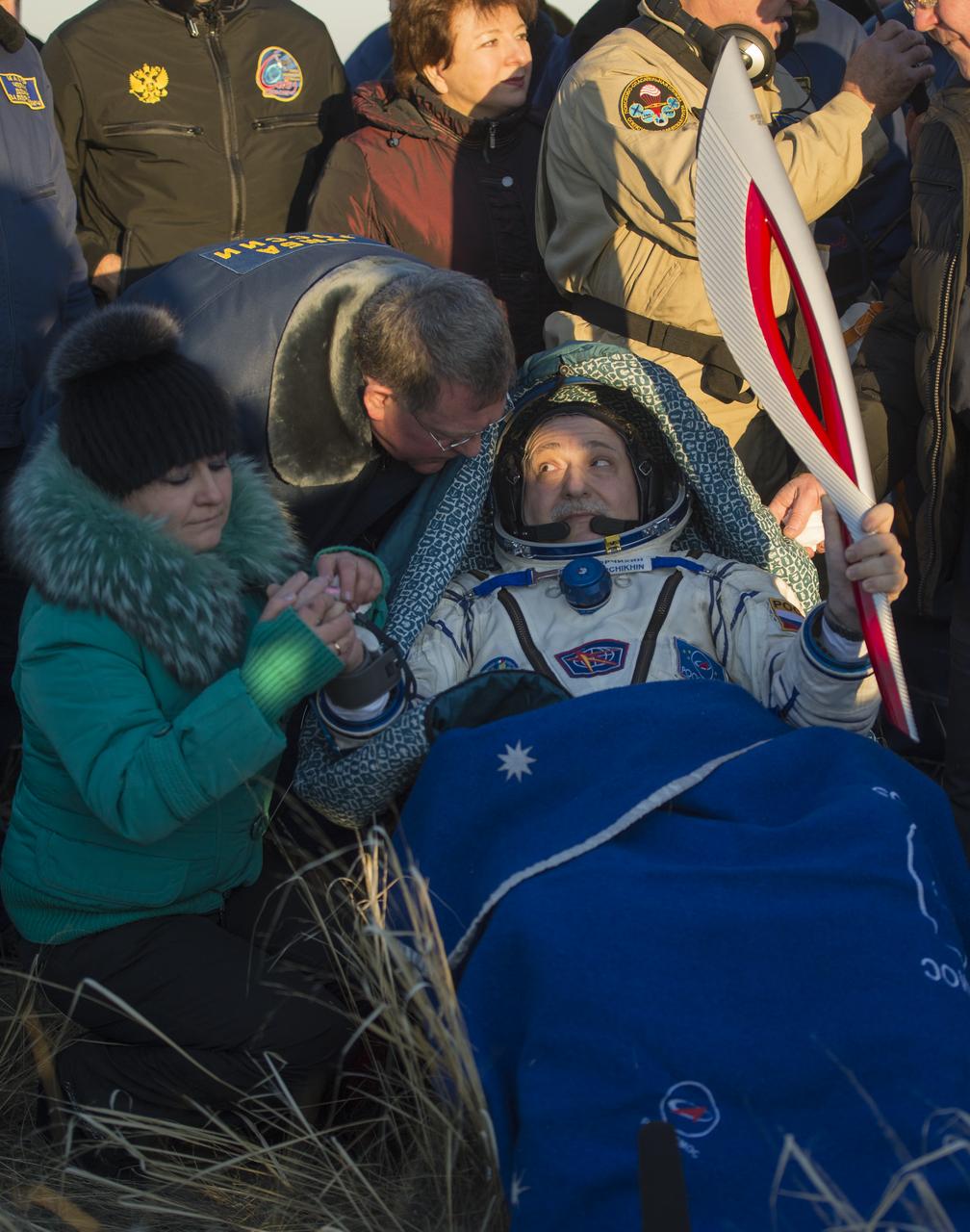
Expedition 37 Commander Fyodor Yurchikhin is seen holding the Olympic torch minutes after he and his crew landed in a remote area southeast of the town of Zhezkazgan, Kazakhstan, on Monday, Nov. 11, 2013. The Olympic torch was launched with the crew of Expedition 38 to the International Space Station on November 7. It was passed from one module to the next and had its first spacewalk on November 9 with two Russian cosmonauts as part of its international relay. Now back on earth it will continue its journey to Sochi, Russia for the 2014 Winter Games. Photo Credit: (NASA/Carla Cioffi)
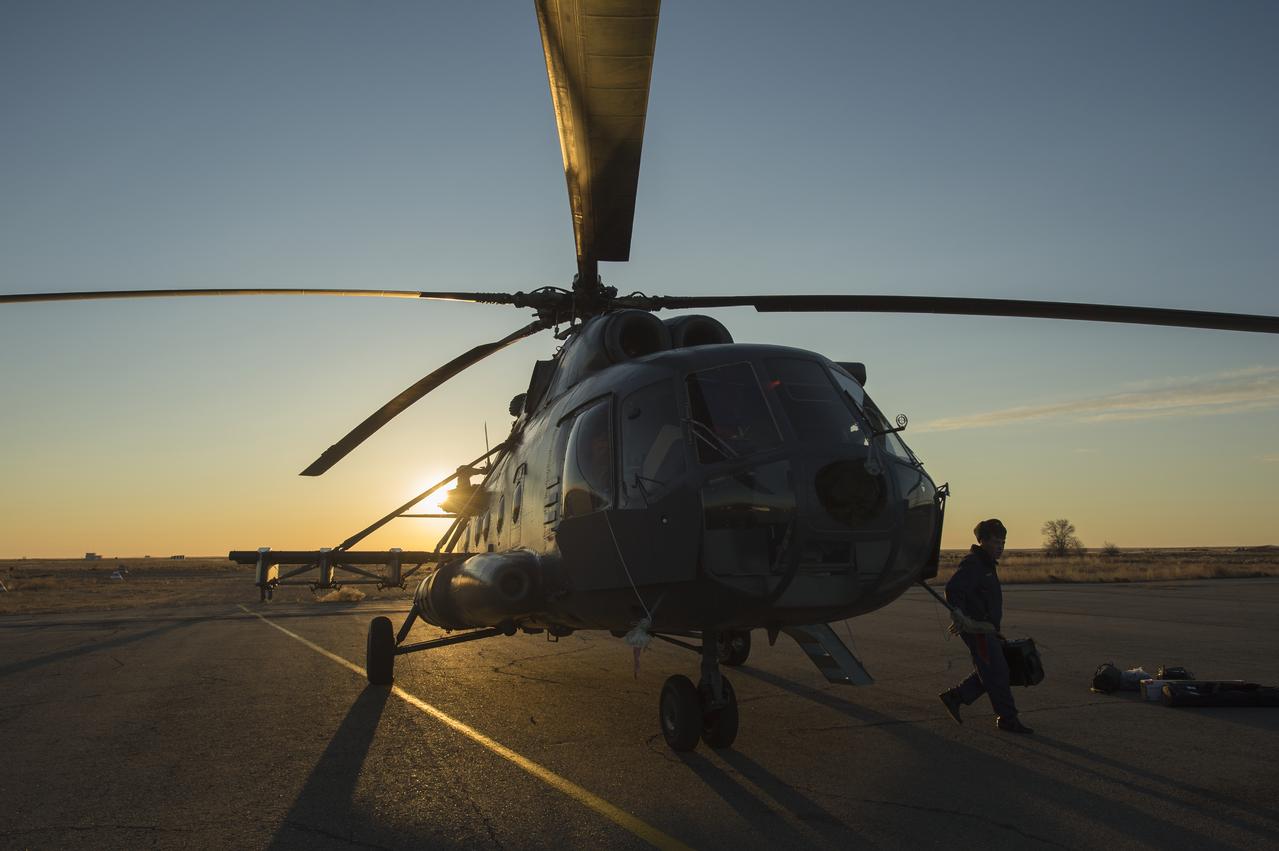
A member of Russian search and rescue exits a helicopter moments after landing at Zhezkazgan airport in Kazakhstan, Sunday, Nov. 10, 2013, a day ahead of the scheduled landing of the Soyuz TMA-09M spacecraft with Expedition 37 Commander Fyodor Yurchikhin of the Russian Federal Space Agency (Roscosmos), Flight Engineer Karen Nyberg of NASA and Flight Engineer Luca Parmitano of the European Space Agency. Yurchikhin, Nyberg and Parmitano are returning to Earth after five and a half months on the International Space Station. Photo Credit: (NASA/Carla Cioffi)
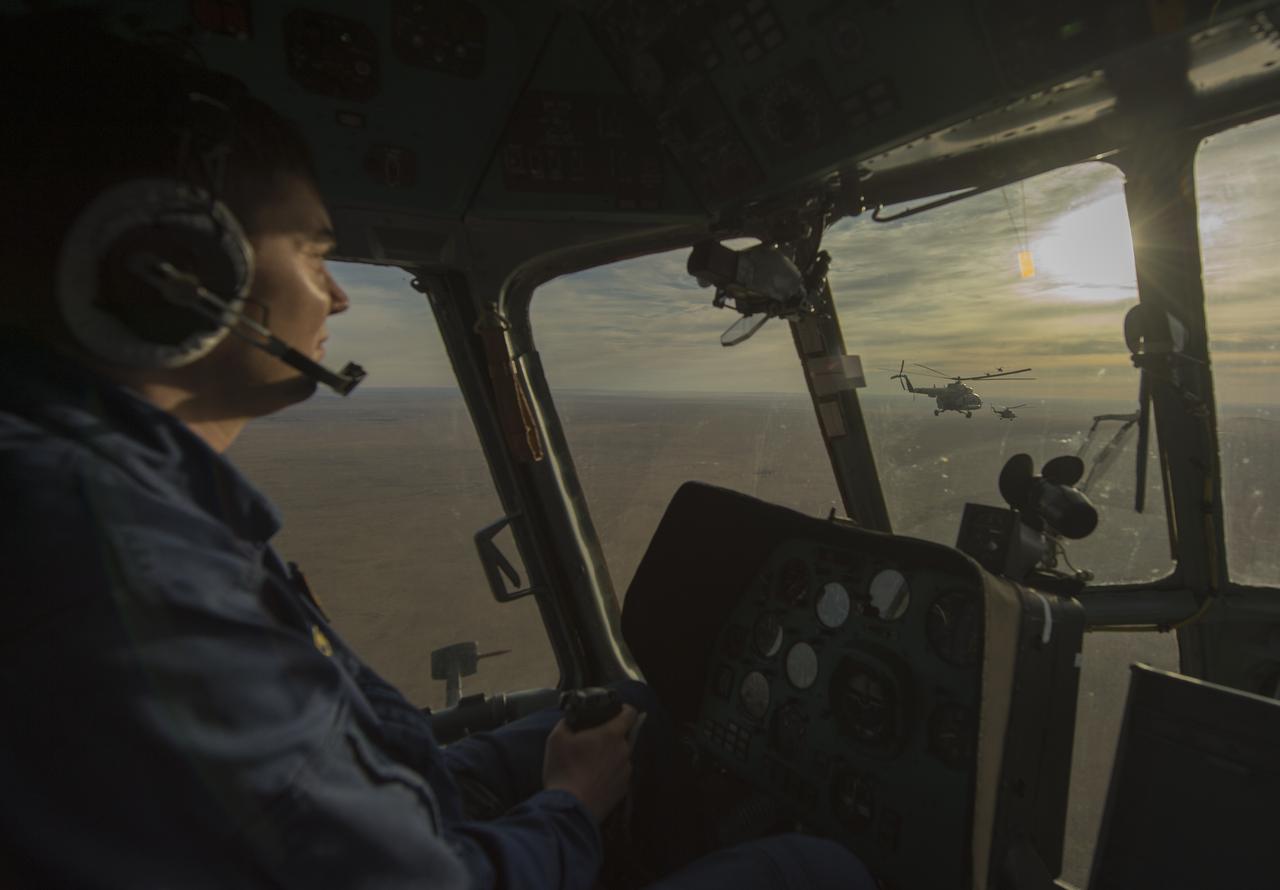
View from the cockpit of one of twelve Russian search and rescue helicopters as they fly from the city of Karaganda to Zhezkazgan in Kazakhstan, Sunday, Nov. 10, 2013, a day ahead of the scheduled landing of the Soyuz TMA-09M spacecraft with the Expedition 37 crew. Exp. 37 Commander Fyodor Yurchikhin of the Russian Federal Space Agency (Roscosmos), Flight Engineer Karen Nyberg of NASA and Flight Engineer Luca Parmitano of the European Space Agency are returning to Earth after five and a half months on the International Space Station. Photo Credit: (NASA/Carla Cioffi)
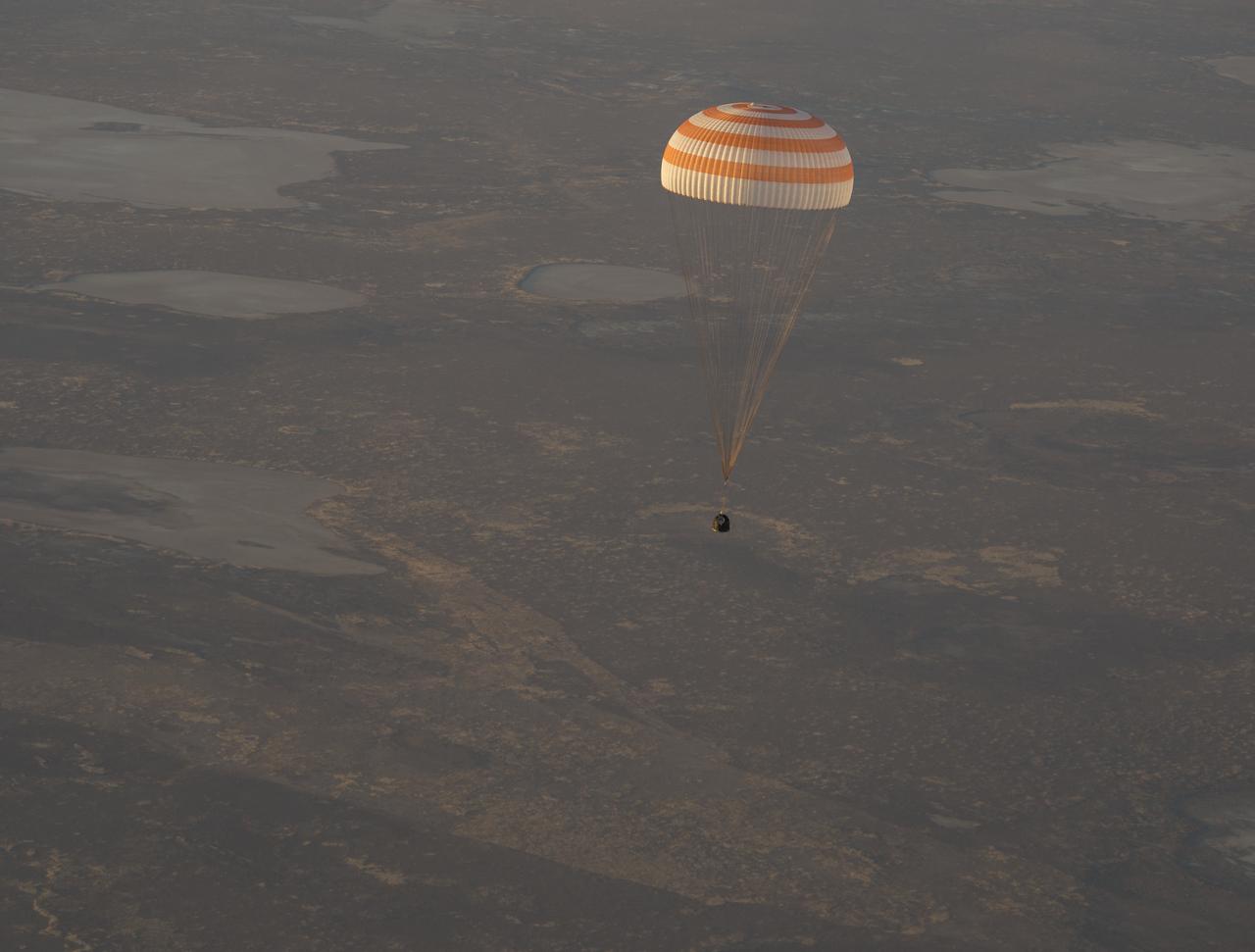
The Soyuz TMA-09M is seen moments before it lands southeast of the town of Zhezkazgan, Kazakstan with the crew of Expedition 37, Monday, Nov. 11, 2013. Expedition 37 Commander Fyodor Yurchikhin of the Russian Federal Space Agency (Roscosmos), Flight Engineer Karen Nyberg of NASA and Flight Engineer Luca Parmitano of the European Space Agency are returning to Earth after five and a half months on the International Space Station. Photo Credit: (NASA/Carla Cioffi)
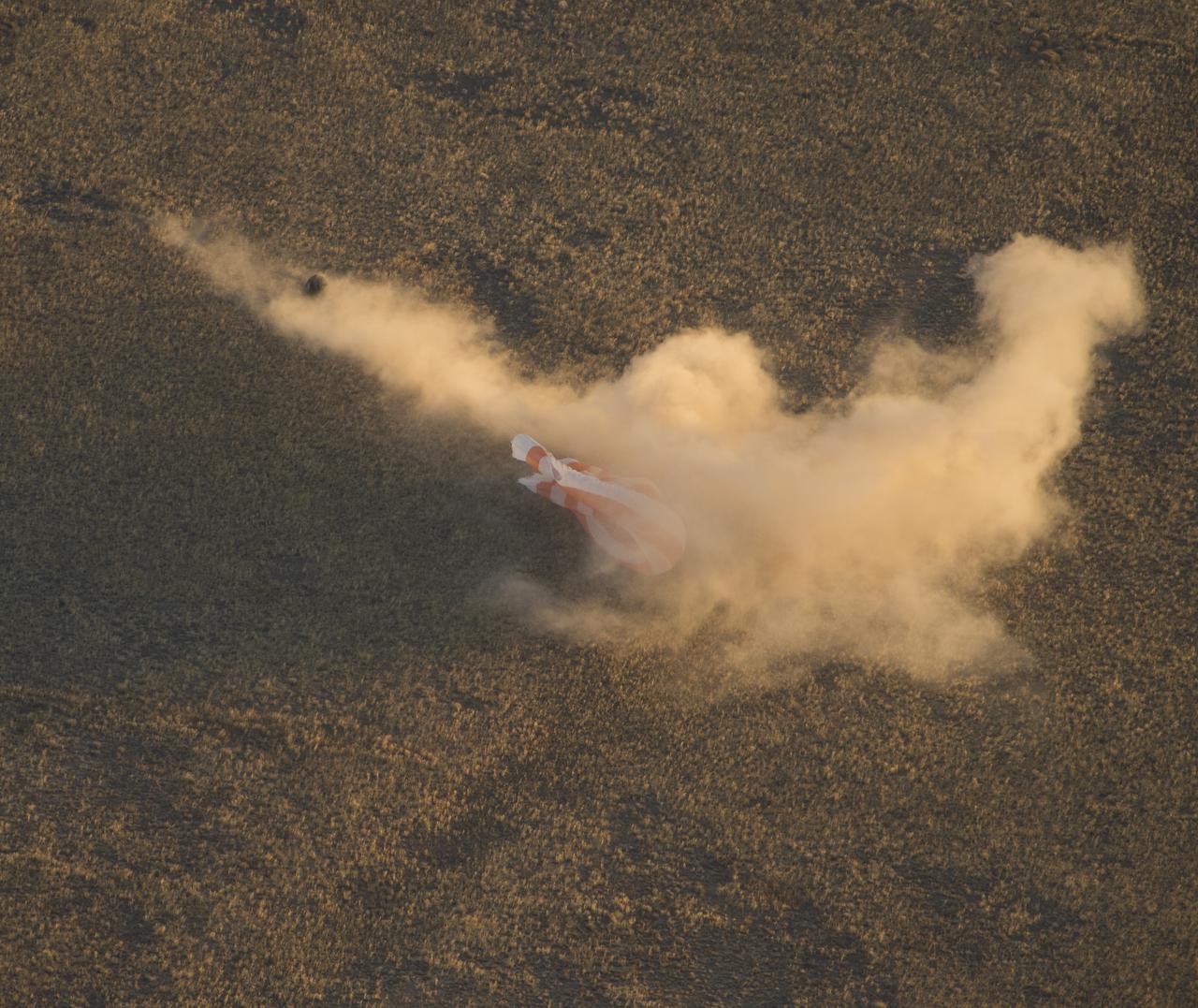
The Soyuz TMA-09M is seen moments before it lands southeast of the town of Zhezkazgan, Kazakhstan with the crew of Expedition 37, Monday, Nov. 11, 2013. Expedition 37 Commander Fyodor Yurchikhin of the Russian Federal Space Agency (Roscosmos), Flight Engineer Karen Nyberg of NASA and Flight Engineer Luca Parmitano of the European Space Agency are returning to Earth after five and a half months on the International Space Station. Photo Credit: (NASA/Carla Cioffi)
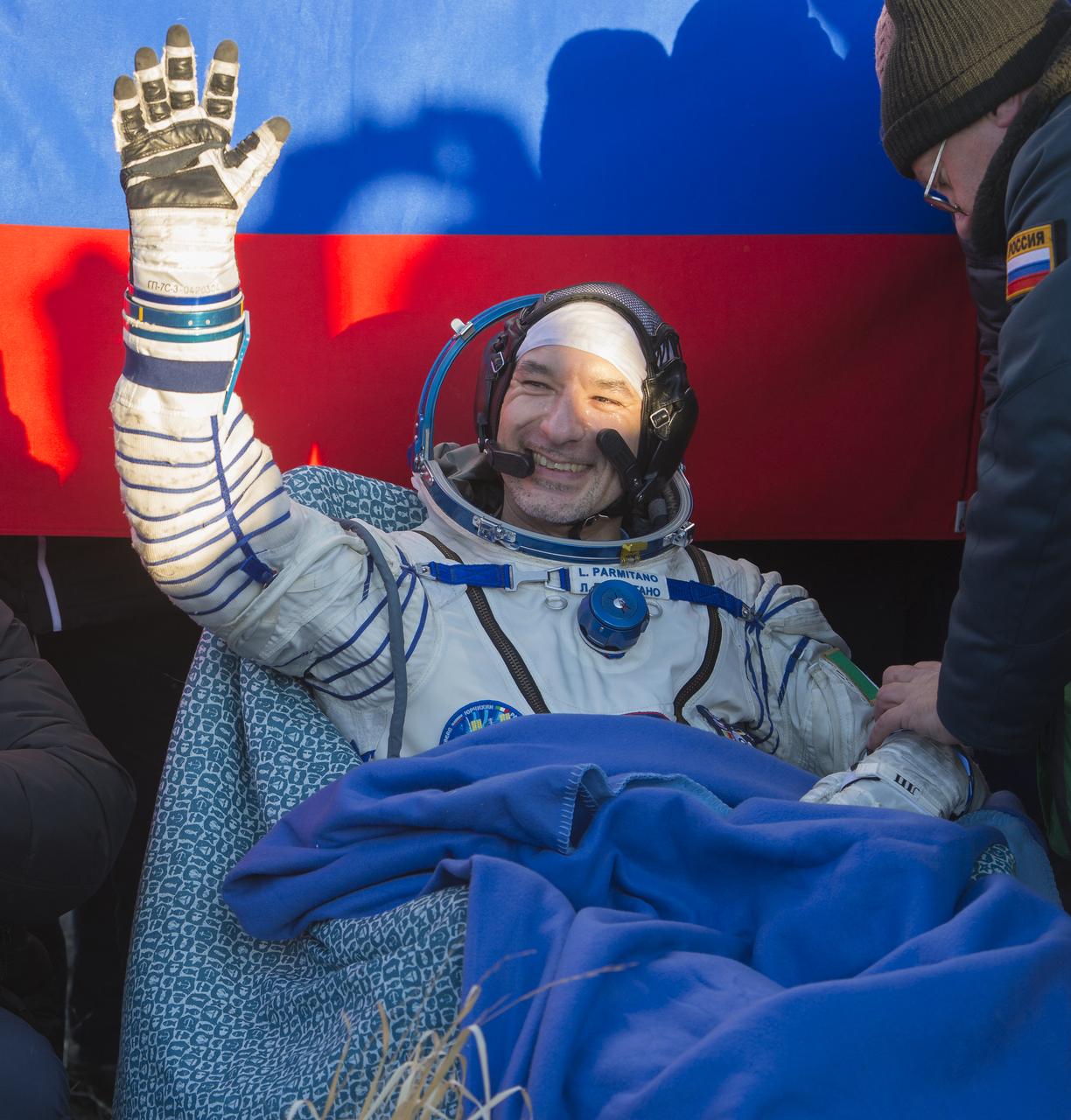
Expedition 37 Luca Parmitano of ESA (European Space Agency) waves minutes after his landing in the Soyuz TMA-09M spacecraft in a remote area outside the town of Zhezkazgan, Kazakhstan, on Monday, Nov. 11, 2013. Parmitano, Expedition 37 Commander Fyodor Yurchikhin of the Russian Federal Space Agency (Roscosmos) and NASA Flight Engineer Karen Nyberg returned to earth after five and a half months on the International Space Station. Photo Credit: (NASA/Carla Cioffi)
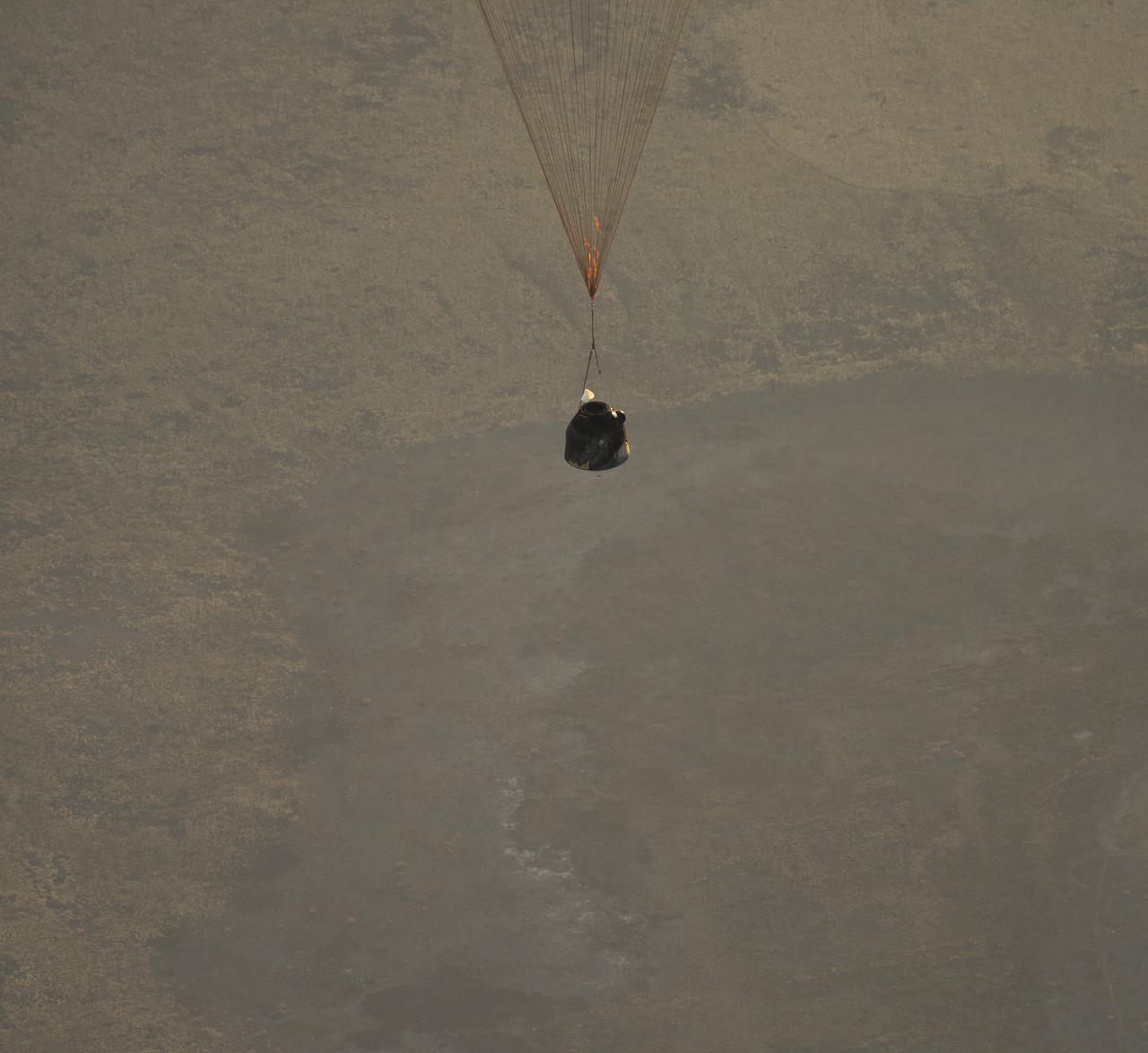
The Soyuz TMA-09M is seen moments before it lands southeast of the town of Zhezkazgan, Kazakhstan with the crew of Expedition 37, Monday, Nov. 11, 2013. Expedition 37 Commander Fyodor Yurchikhin of the Russian Federal Space Agency (Roscosmos), Flight Engineer Karen Nyberg of NASA and Flight Engineer Luca Parmitano of the European Space Agency are returning to Earth after five and a half months on the International Space Station. Photo Credit: (NASA/Carla Cioffi)
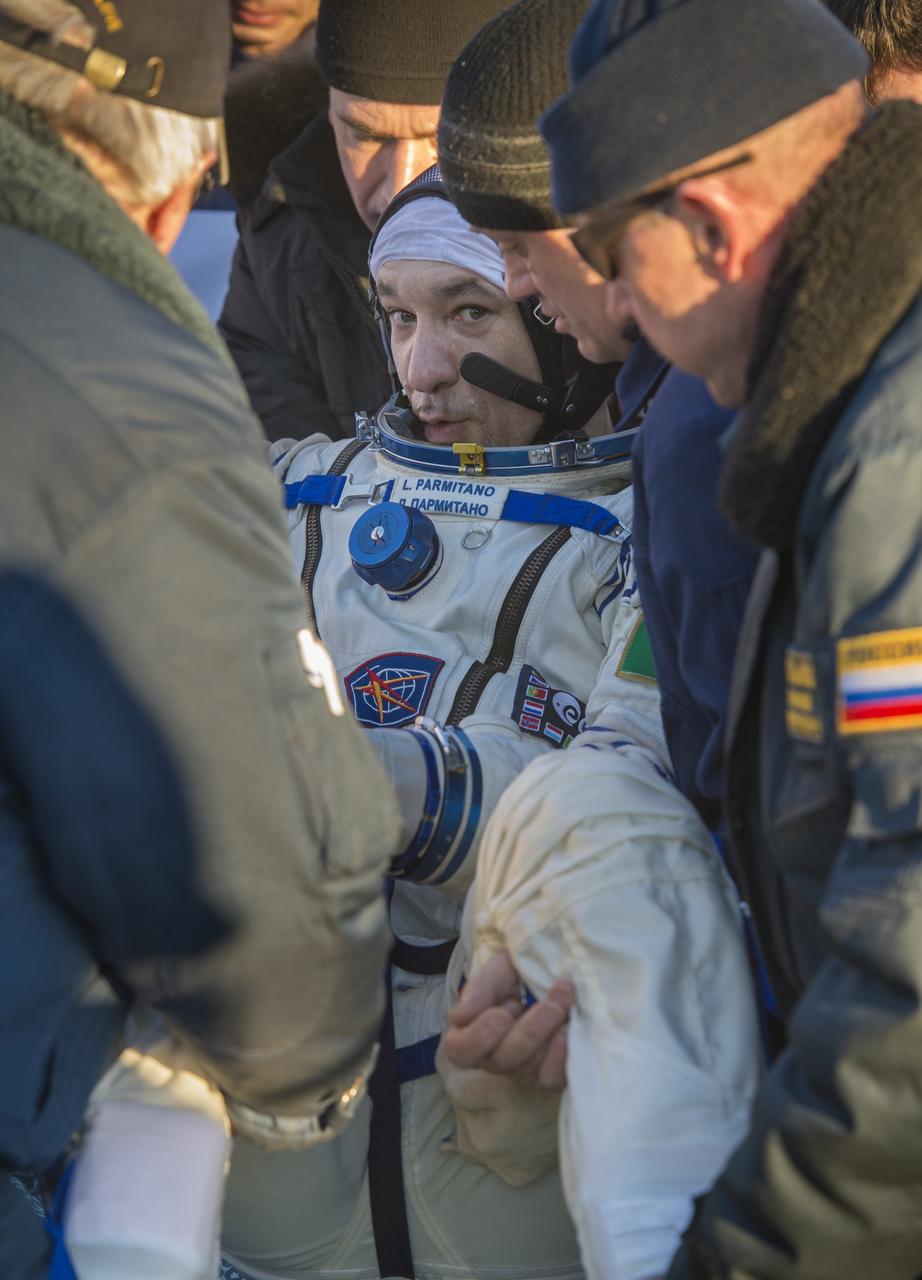
Expedition 37 Luca Parmitano of ESA (European Space Agency) is carried from the Soyuz TMA-09M spacecraft minutes after he landed in a remote area outside the town of Zhezkazgan, Kazakhstan, on Monday, Nov. 11, 2013. Parmitano, Expedition 37 Commander Fyodor Yurchikhin of the Russian Federal Space Agency (Roscosmos) and NASA Flight Engineer Karen Nyberg returned to earth after five and a half months on the International Space Station. Photo Credit: (NASA/Carla Cioffi)
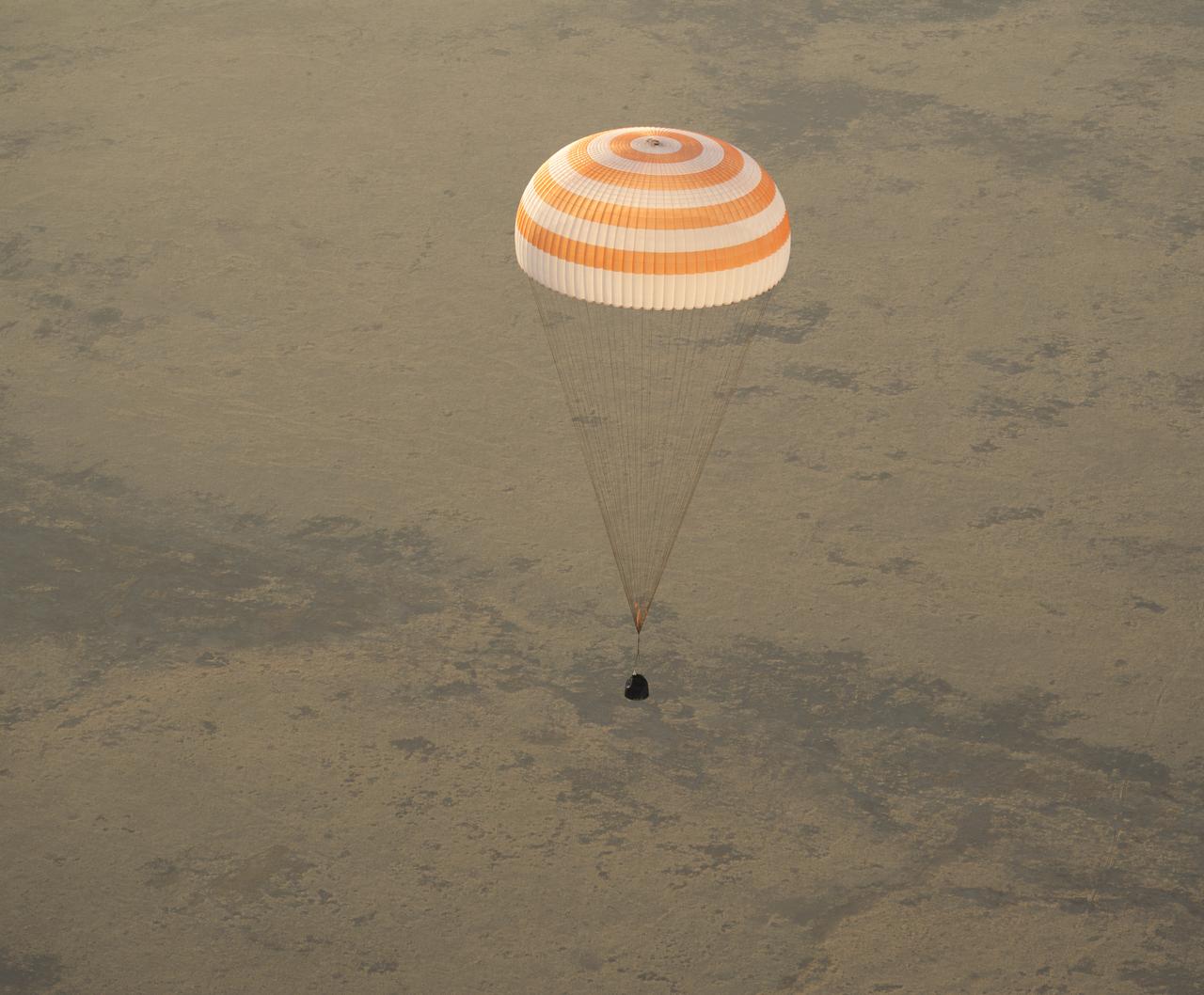
The Soyuz TMA-09M is seen moments before it lands southeast of the town of Zhezkazgan, Kazakhstan with the crew of Expedition 37, Monday, Nov. 11, 2013. Expedition 37 Commander Fyodor Yurchikhin of the Russian Federal Space Agency (Roscosmos), Flight Engineer Karen Nyberg of NASA and Flight Engineer Luca Parmitano of the European Space Agency are returning to Earth after five and a half months on the International Space Station. Photo Credit: (NASA/Carla Cioffi)
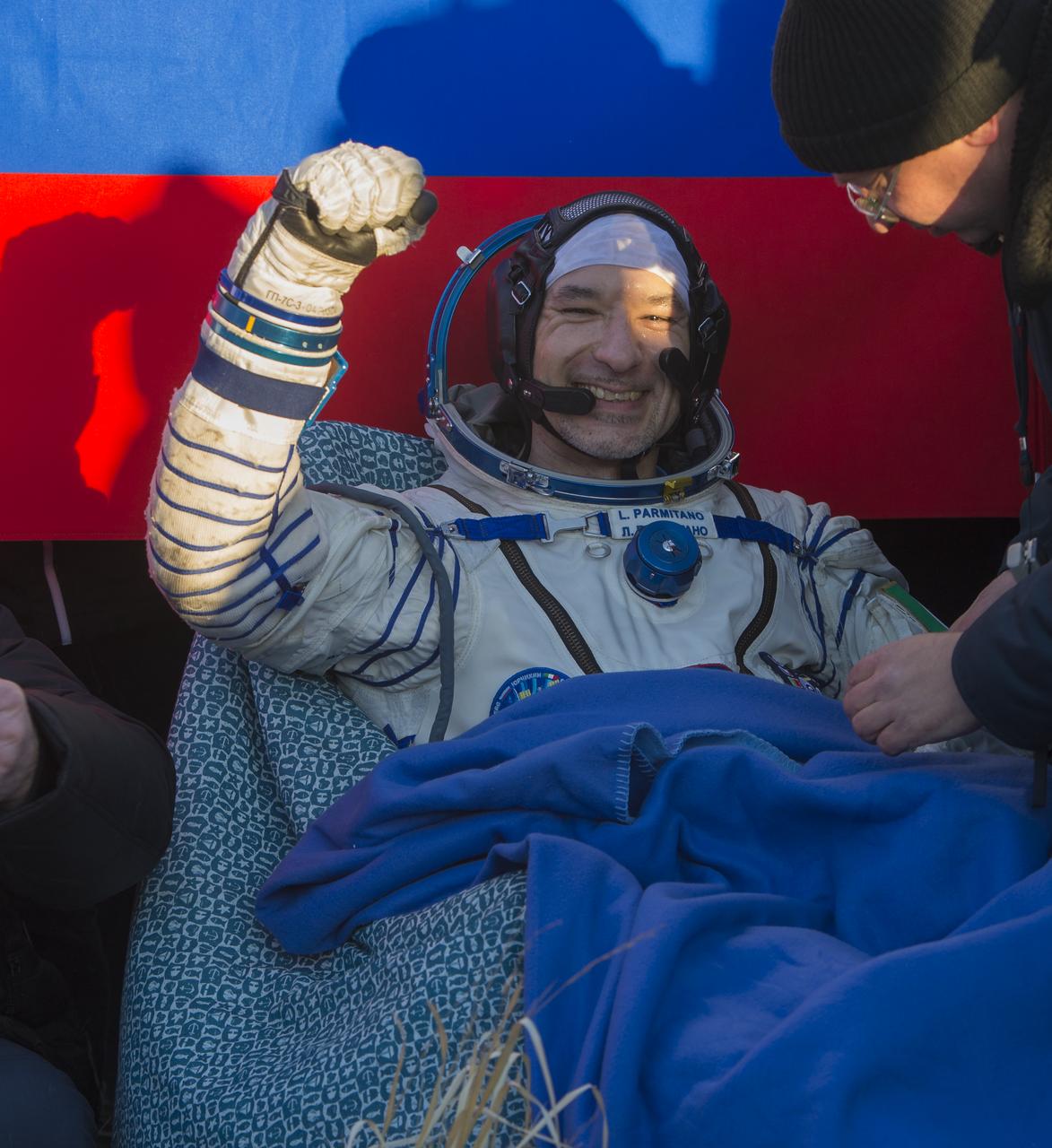
Expedition 37 Luca Parmitano of ESA (European Space Agency) pumps his fist minutes after his landing in the Soyuz TMA-09M spacecraft in a remote area outside the town of Zhezkazgan, Kazakhstan, on Monday, Nov. 11, 2013. Parmitano, Expedition 37 Commander Fyodor Yurchikhin of the Russian Federal Space Agency (Roscosmos) and NASA Flight Engineer Karen Nyberg returned to earth after five and a half months on the International Space Station. Photo Credit: (NASA/Carla Cioffi)
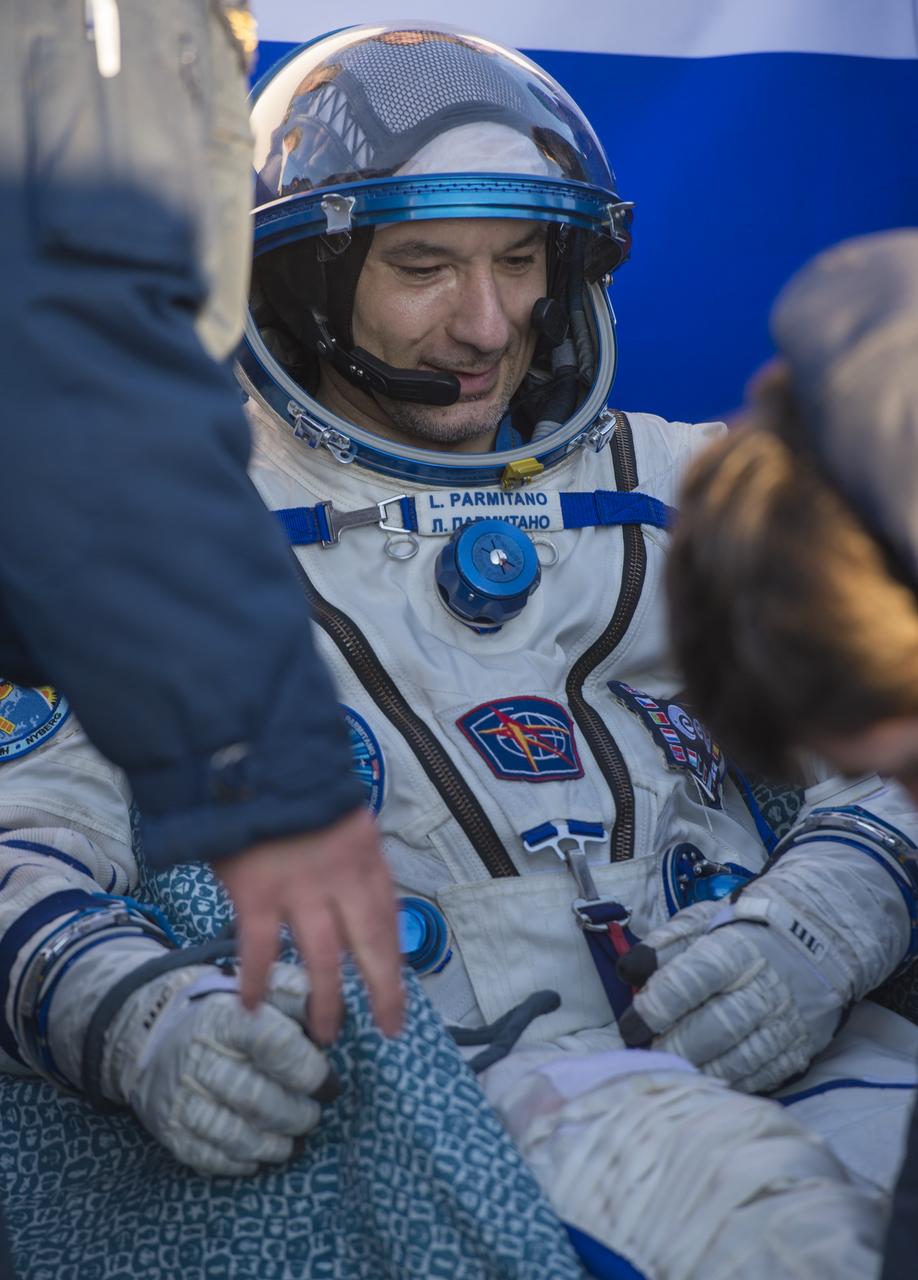
Expedition 37 Luca Parmitano of ESA (European Space Agency) is carried from the Soyuz TMA-09M spacecraft minutes after he landed in a remote area outside the town of Zhezkazgan, Kazakhstan, on Monday, Nov. 11, 2013. Parmitano, Expedition 37 Commander Fyodor Yurchikhin of the Russian Federal Space Agency (Roscosmos) and NASA Flight Engineer Karen Nyberg returned to earth after five and a half months on the International Space Station. Photo Credit: (NASA/Carla Cioffi)
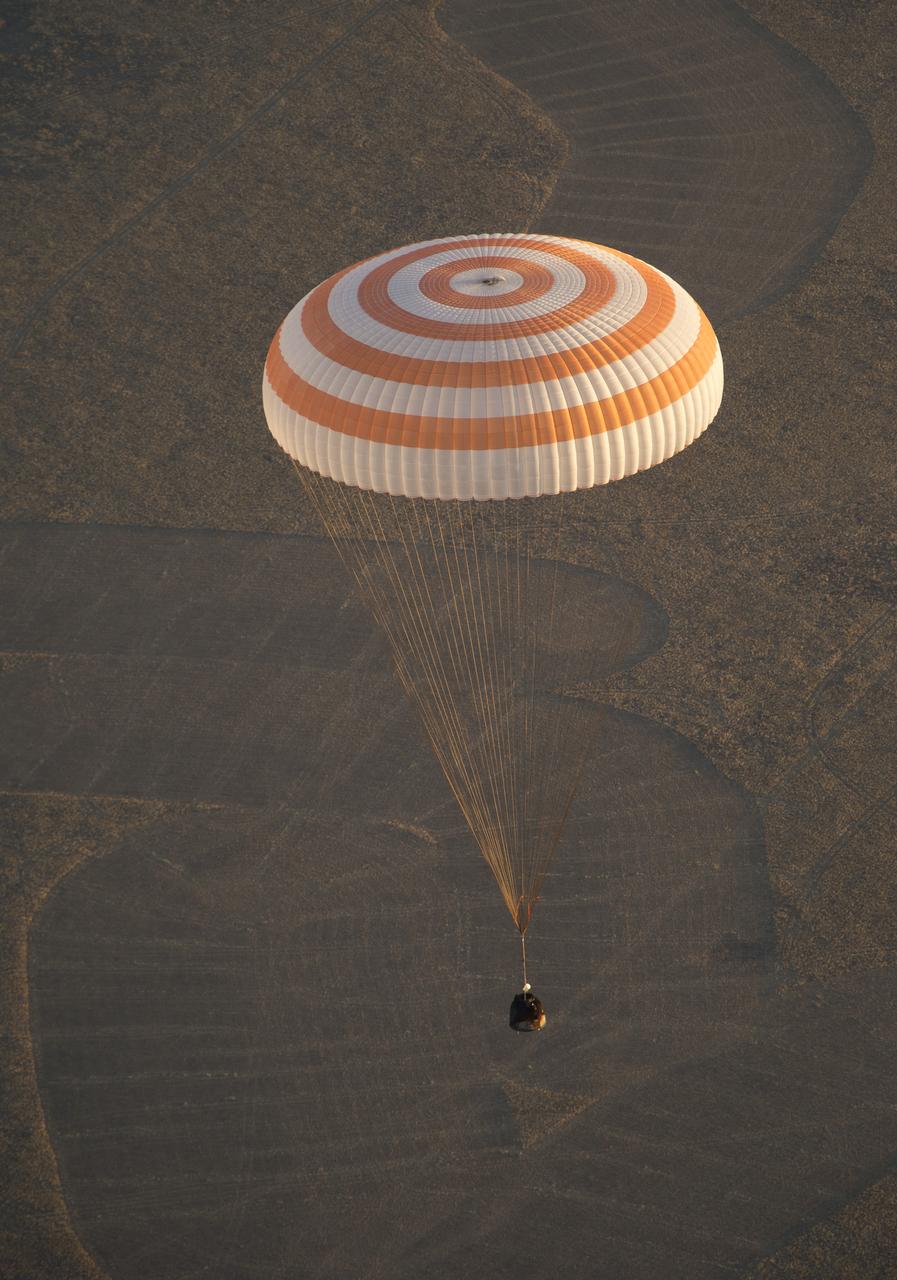
The Soyuz TMA-09M is seen moments before it lands southeast of the town of Zhezkazgan, Kazakhstan with the crew of Expedition 37, Monday, Nov. 11, 2013. Expedition 37 Commander Fyodor Yurchikhin of the Russian Federal Space Agency (Roscosmos), Flight Engineer Karen Nyberg of NASA and Flight Engineer Luca Parmitano of the European Space Agency are returning to Earth after five and a half months on the International Space Station. Photo Credit: (NASA/Carla Cioffi)
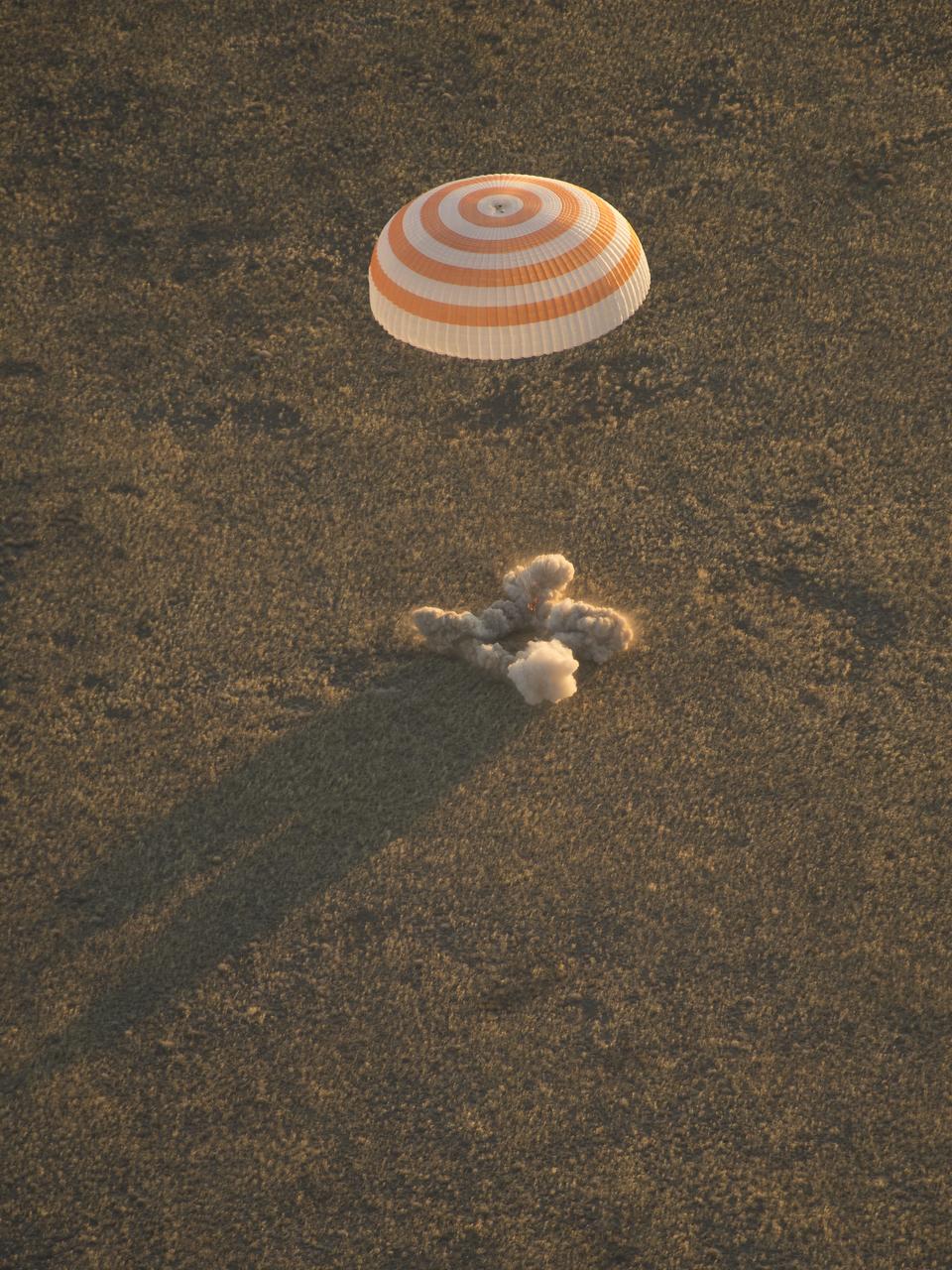
The Soyuz TMA-09M is seen moments before it lands southeast of the town of Zhezkazgan, Kazakhstan with the crew of Expedition 37, Monday, Nov. 11, 2013. Expedition 37 Commander Fyodor Yurchikhin of the Russian Federal Space Agency (Roscosmos), Flight Engineer Karen Nyberg of NASA and Flight Engineer Luca Parmitano of the European Space Agency are returning to Earth after five and a half months on the International Space Station. Photo Credit: (NASA/Carla Cioffi)
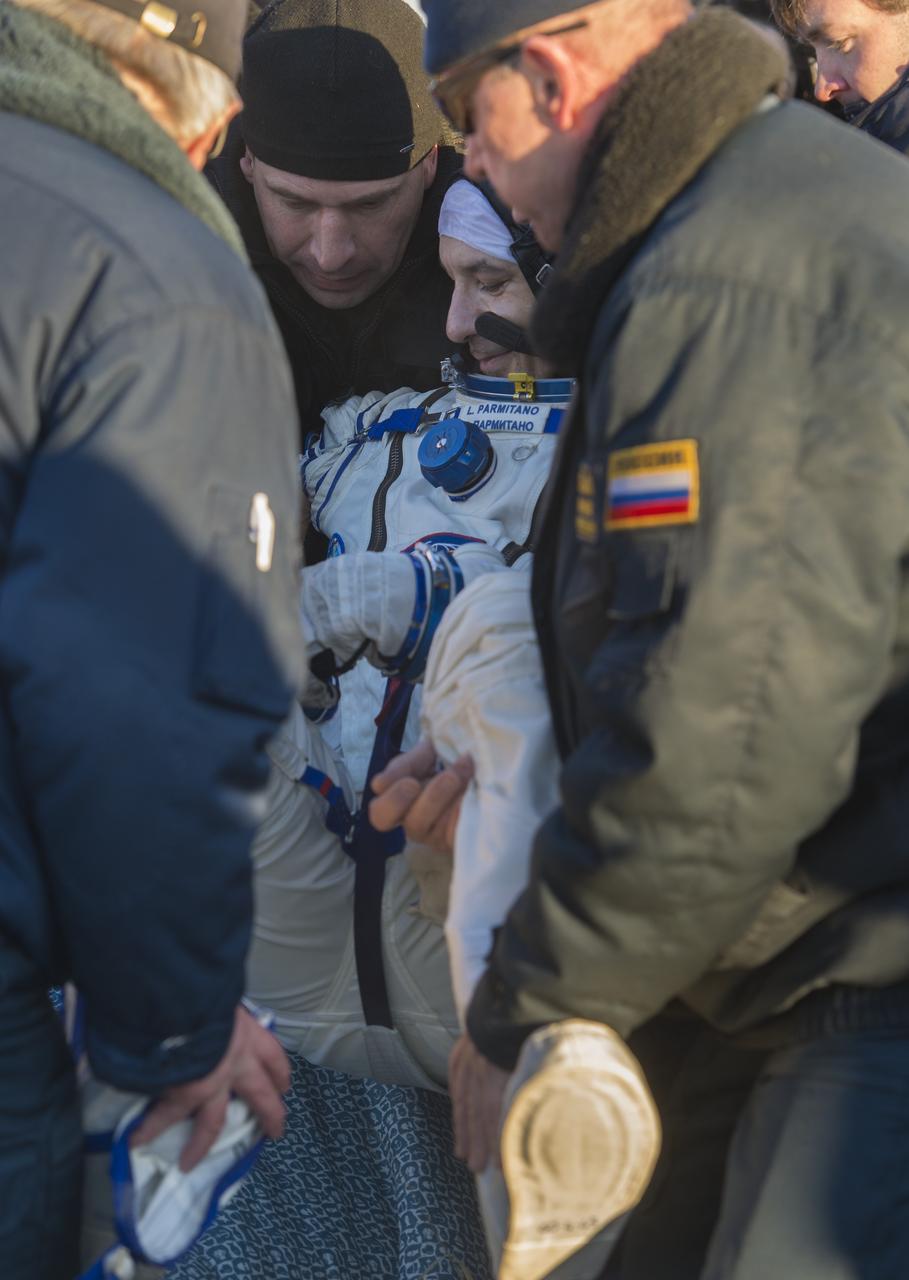
Expedition 37 Luca Parmitano of ESA (European Space Agency) is carried from the Soyuz TMA-09M spacecraft minutes after he landed in a remote area outside the town of Zhezkazgan, Kazakhstan, on Monday, Nov. 11, 2013. Parmitano, Expedition 37 Commander Fyodor Yurchikhin of the Russian Federal Space Agency (Roscosmos) and NASA Flight Engineer Karen Nyberg returned to earth after five and a half months on the International Space Station. Photo Credit: (NASA/Carla Cioffi)
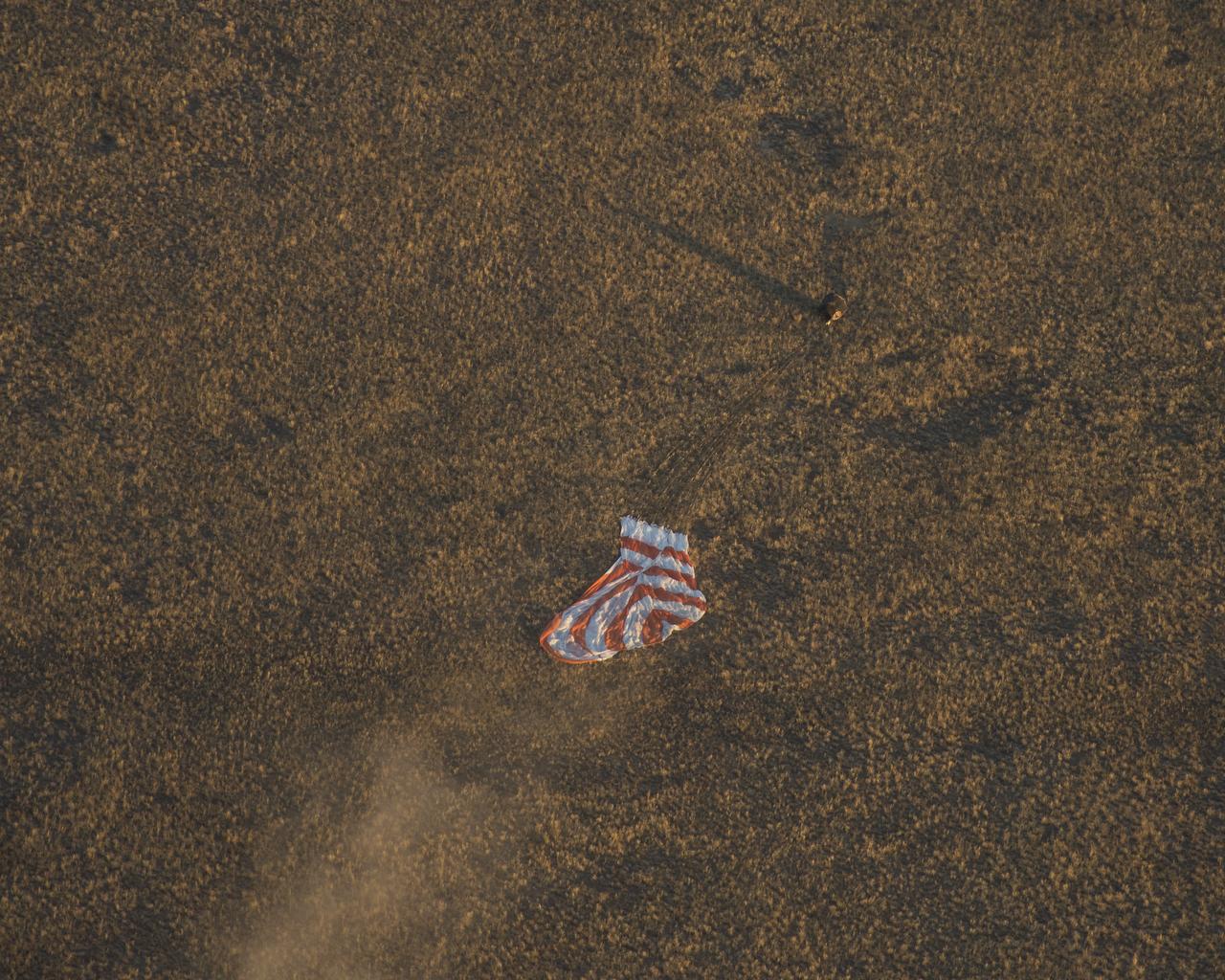
The Soyuz TMA-09M is seen moments before it lands southeast of the town of Zhezkazgan, Kazakhstan with the crew of Expedition 37, Monday, Nov. 11, 2013. Expedition 37 Commander Fyodor Yurchikhin of the Russian Federal Space Agency (Roscosmos), Flight Engineer Karen Nyberg of NASA and Flight Engineer Luca Parmitano of the European Space Agency are returning to Earth after five and a half months on the International Space Station. Photo Credit: (NASA/Carla Cioffi)
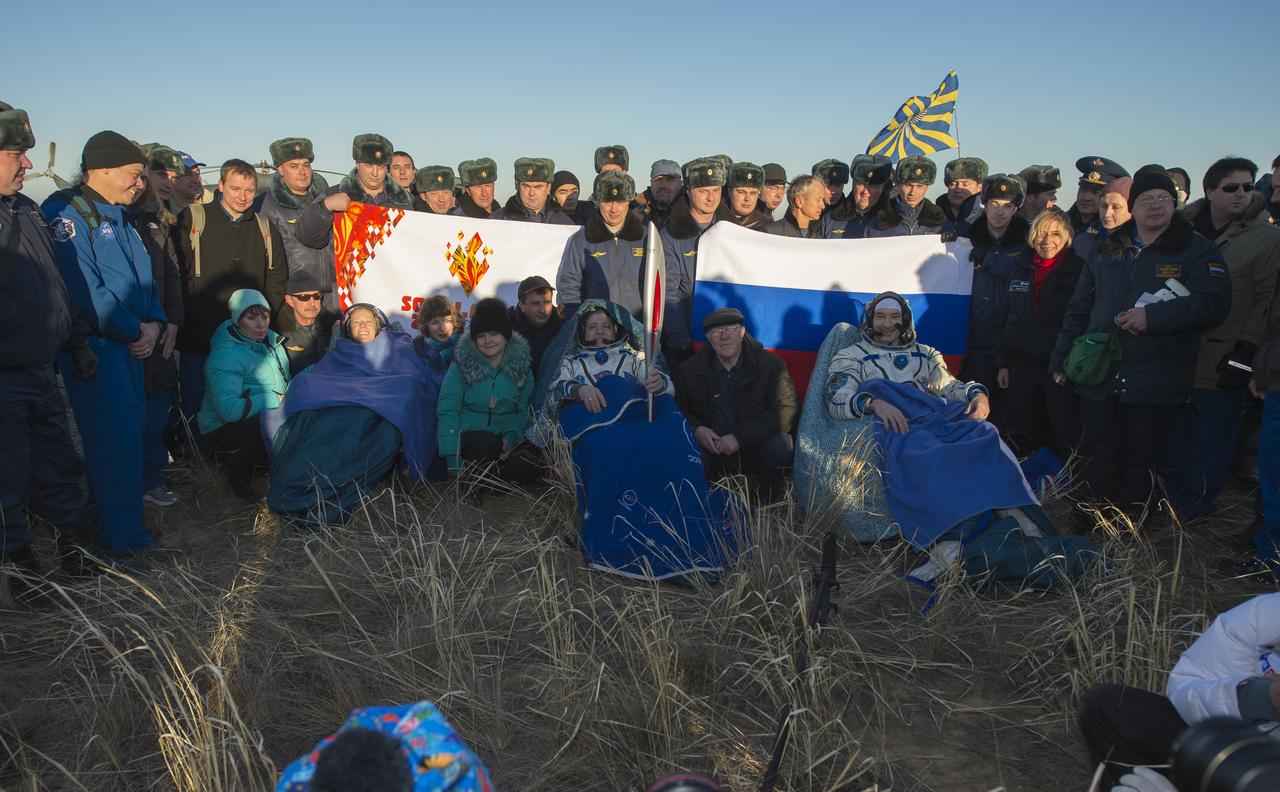
NASA Flight Engineer Karen Nyberg, left, Expedition 37 Commander Fyodor Yurchikhin of Roscosmos, center holding the Olympic torch, and European Space Agency Flight Engineer Luca Parmitano sit in chairs outside the Soyuz capsule just minutes after they landed in a remote area outside the town of Zhezkazgan, Kazakhstan, on Monday, Nov. 11, 2013. The Olympic torch was launched with the crew of Expedition 38 to the International Space Station on November 7. It was passed from one module to the next and had its first spacewalk on November 9 with two Russian cosmonauts as part of its international relay. Now back on earth it will continue its journey to Sochi, Russia for the 2014 Winter Games. Yurchikhin, Nyberg and Parmitano returned from five and a half months onboard the International Space Station. Photo Credit: (NASA/Carla Cioffi)
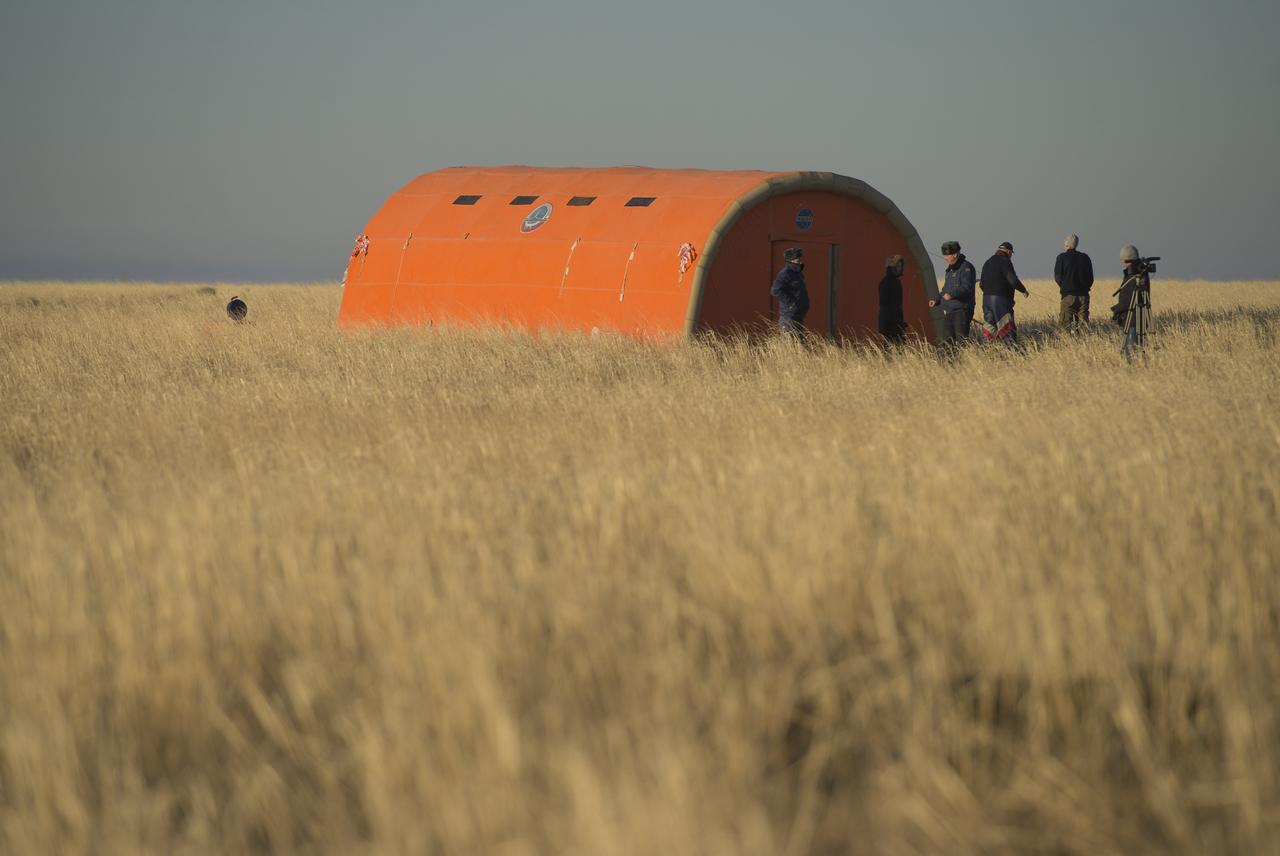
The inflatable medical tent is seen in a remote area outside the town of Zhezkazgan, Kazakhstan, on Monday, Nov. 11, 2013. Expedition 37 Commander Fyodor Yurchikhin of Roscosmos, Flight Engineers Karen Nyberg of NASA and Luca Parmitano of Italy returned to earth after five and a half months on the International Space Station. Photo Credit: (NASA/Carla Cioffi)
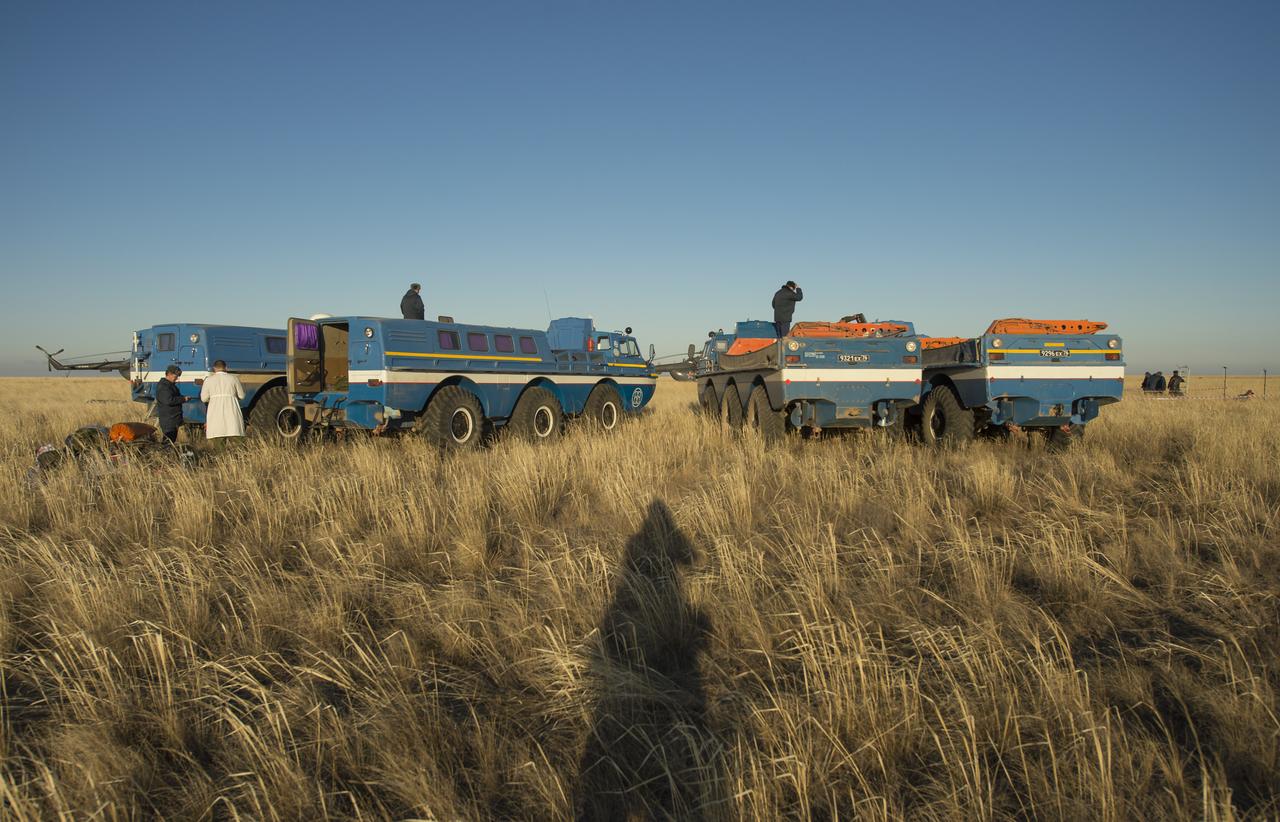
Russian Search and Rescue all-terrain vehicles are seen waiting to ferry the Expedition 37 crew to their respective helicopters in a remote area outside the town of Zhezkazgan, Kazakhstan, on Monday, Nov. 11, 2013. The crew of Expedition 37 Commander Fyodor Yurchikhin of Roscosmos, Flight Engineers Karen Nyberg of NASA and Luca Parmitano of Italy returned to earth after five and a half months on the International Space Station. Photo Credit: (NASA/Carla Cioffi)
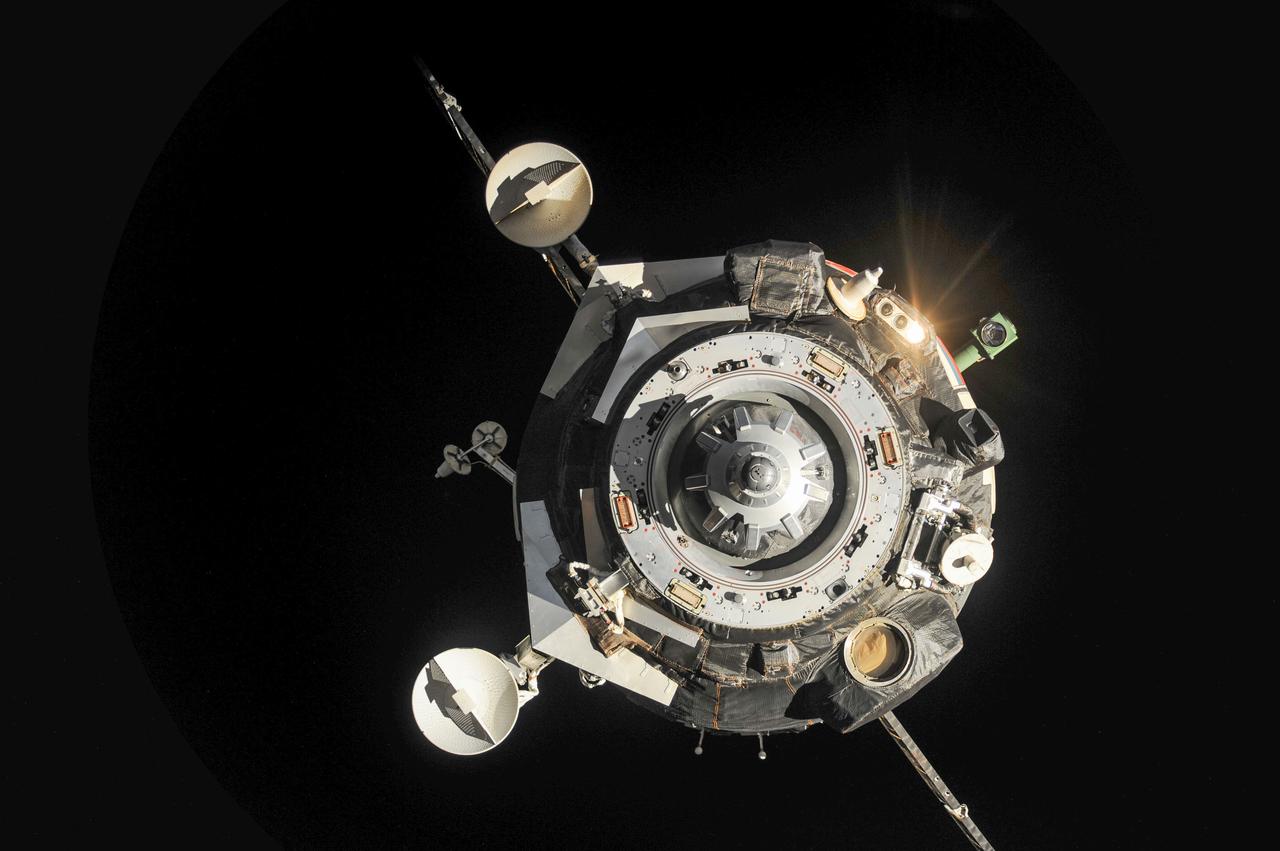
ISS038-E-000023 (10 Nov. 2013) --- The Soyuz TMA-09M spacecraft departs from the International Space Station?s Zvezda Service Module and heads toward a landing near the town of Zhezkazgan, Kazakhstan on Nov. 11, 2013 (Kazakh time). Russian cosmonaut Fyodor Yurchikhin, Expedition 37 commander; along with NASA astronaut Karen Nyberg and European Space Agency astronaut Luca Parmitano, both flight engineers, are ending a five-and-a-half month stay at the space station where they served as members of the Expedition 36 and 37 crews.
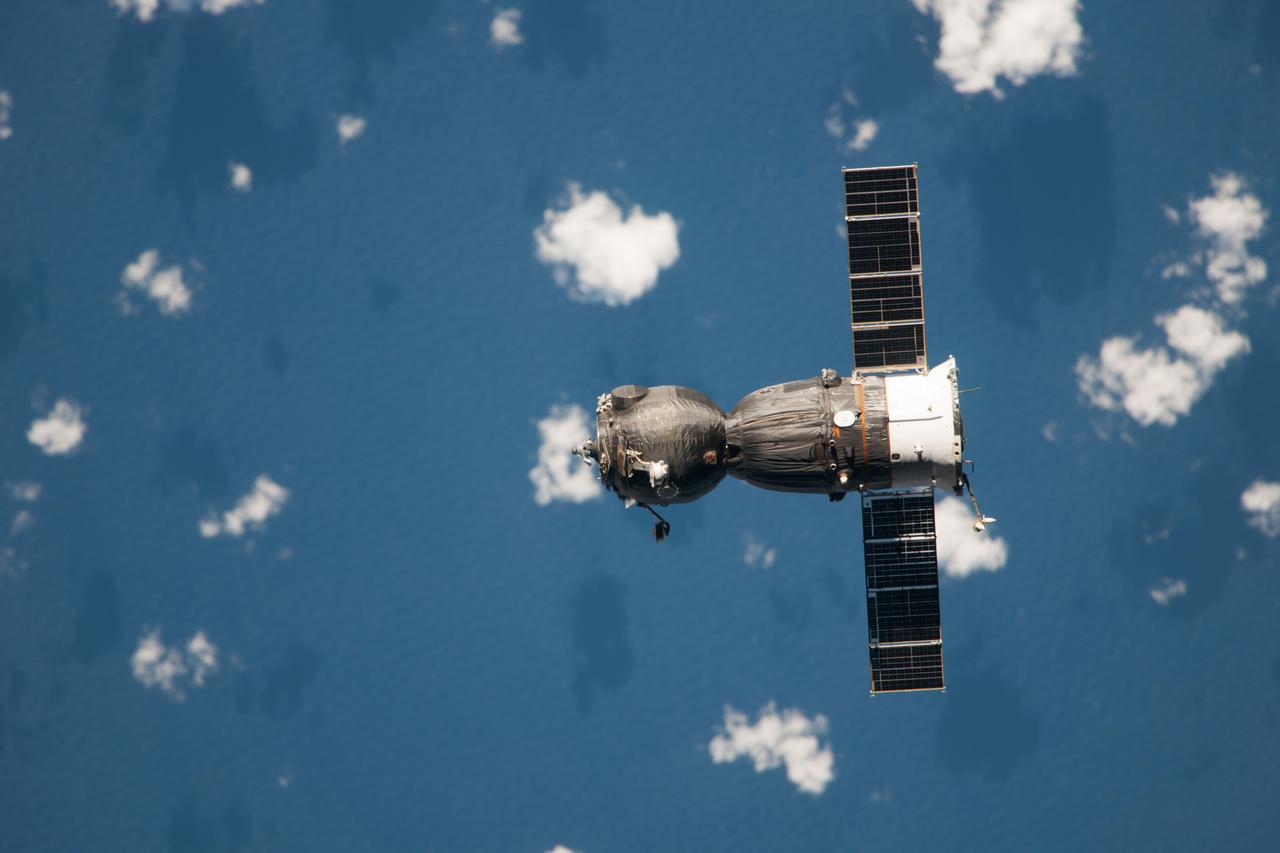
ISS038-E-001205 (10 Nov. 2013) --- The Soyuz TMA-09M spacecraft departs from the International Space Station?s Zvezda Service Module and heads toward a landing near the town of Zhezkazgan, Kazakhstan on Nov. 11, 2013 (Kazakh time). Russian cosmonaut Fyodor Yurchikhin, Expedition 37 commander; along with NASA astronaut Karen Nyberg and European Space Agency astronaut Luca Parmitano, both flight engineers, are ending a five-and-a-half month stay at the space station where they served as members of the Expedition 36 and 37 crews.
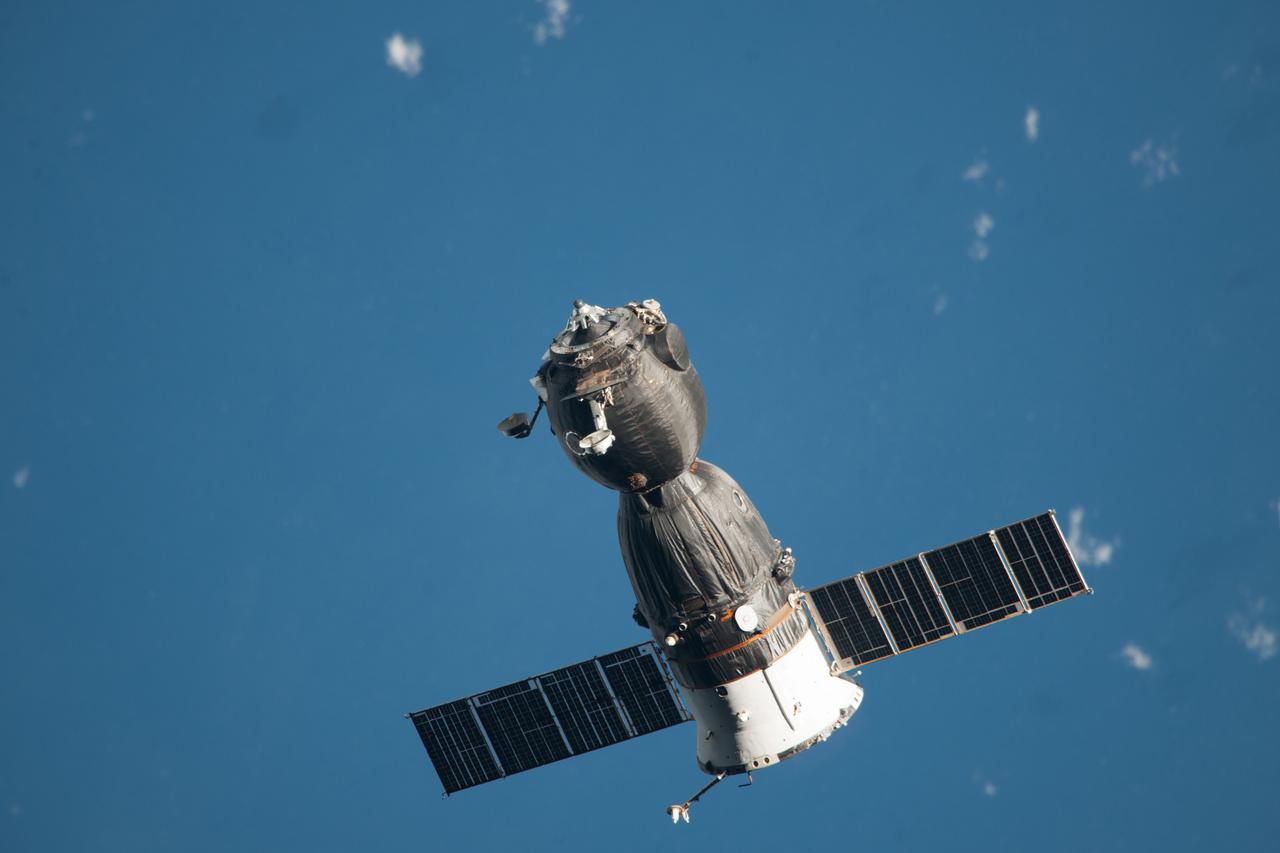
ISS038-E-001198 (10 Nov. 2013) --- The Soyuz TMA-09M spacecraft departs from the International Space Station?s Zvezda Service Module and heads toward a landing near the town of Zhezkazgan, Kazakhstan on Nov. 11, 2013 (Kazakh time). Russian cosmonaut Fyodor Yurchikhin, Expedition 37 commander; along with NASA astronaut Karen Nyberg and European Space Agency astronaut Luca Parmitano, both flight engineers, are ending a five-and-a-half month stay at the space station where they served as members of the Expedition 36 and 37 crews.
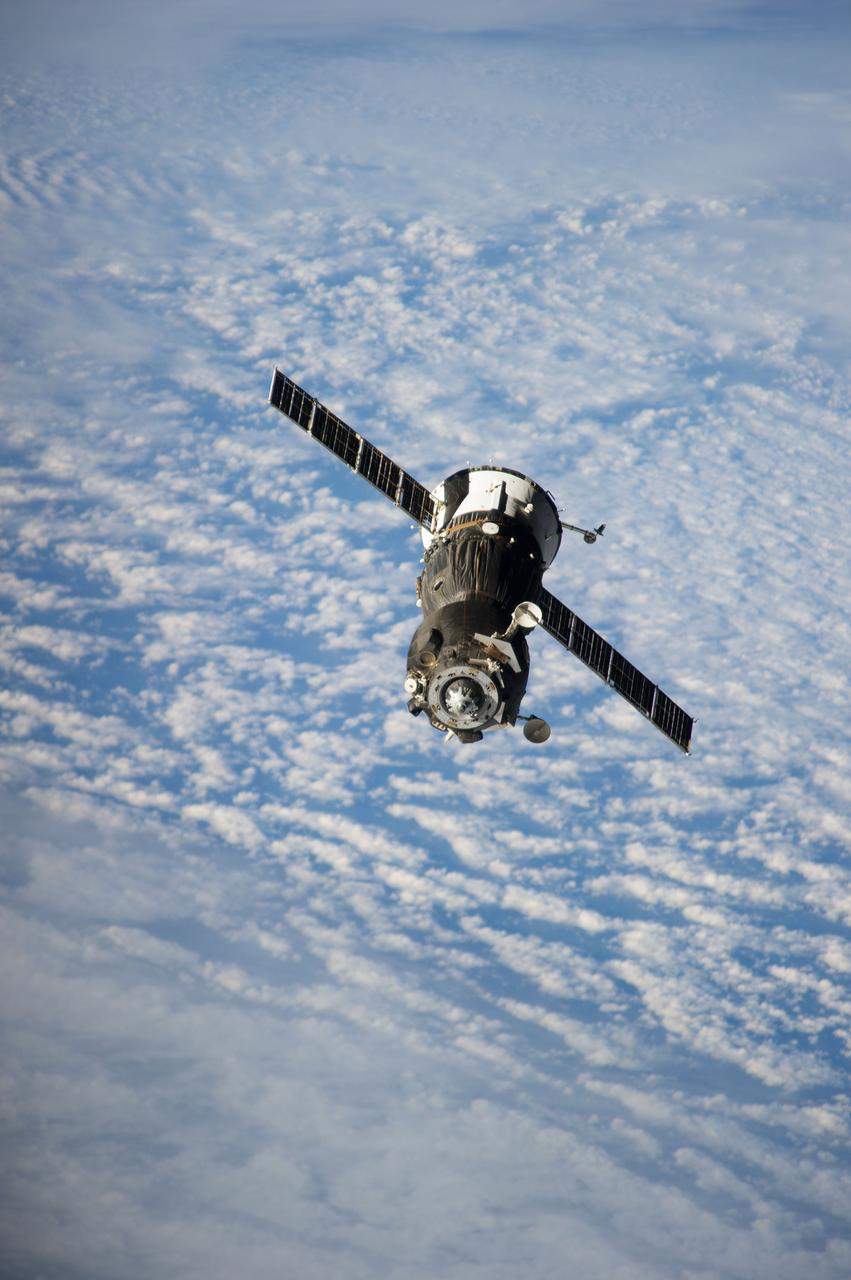
ISS038-E-001141 (10 Nov. 2013) --- The Soyuz TMA-09M spacecraft departs from the International Space Station?s Zvezda Service Module and heads toward a landing near the town of Zhezkazgan, Kazakhstan on Nov. 11, 2013 (Kazakh time). Russian cosmonaut Fyodor Yurchikhin, Expedition 37 commander; along with NASA astronaut Karen Nyberg and European Space Agency astronaut Luca Parmitano, both flight engineers, are ending a five-and-a-half month stay at the space station where they served as members of the Expedition 36 and 37 crews.
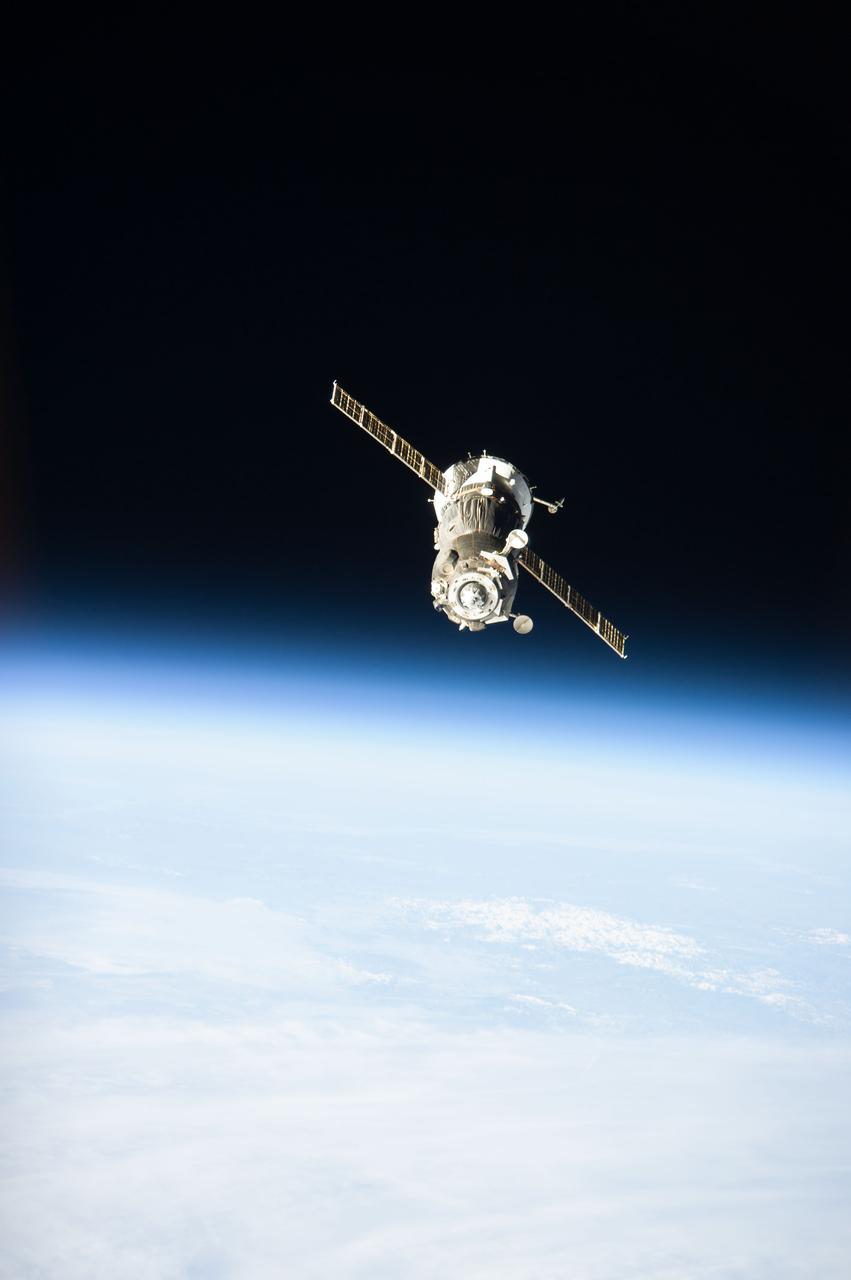
ISS038-E-001136 (10 Nov. 2013) --- The Soyuz TMA-09M spacecraft departs from the International Space Station?s Zvezda Service Module and heads toward a landing near the town of Zhezkazgan, Kazakhstan on Nov. 11, 2013 (Kazakh time). Russian cosmonaut Fyodor Yurchikhin, Expedition 37 commander; along with NASA astronaut Karen Nyberg and European Space Agency astronaut Luca Parmitano, both flight engineers, are ending a five-and-a-half month stay at the space station where they served as members of the Expedition 36 and 37 crews.
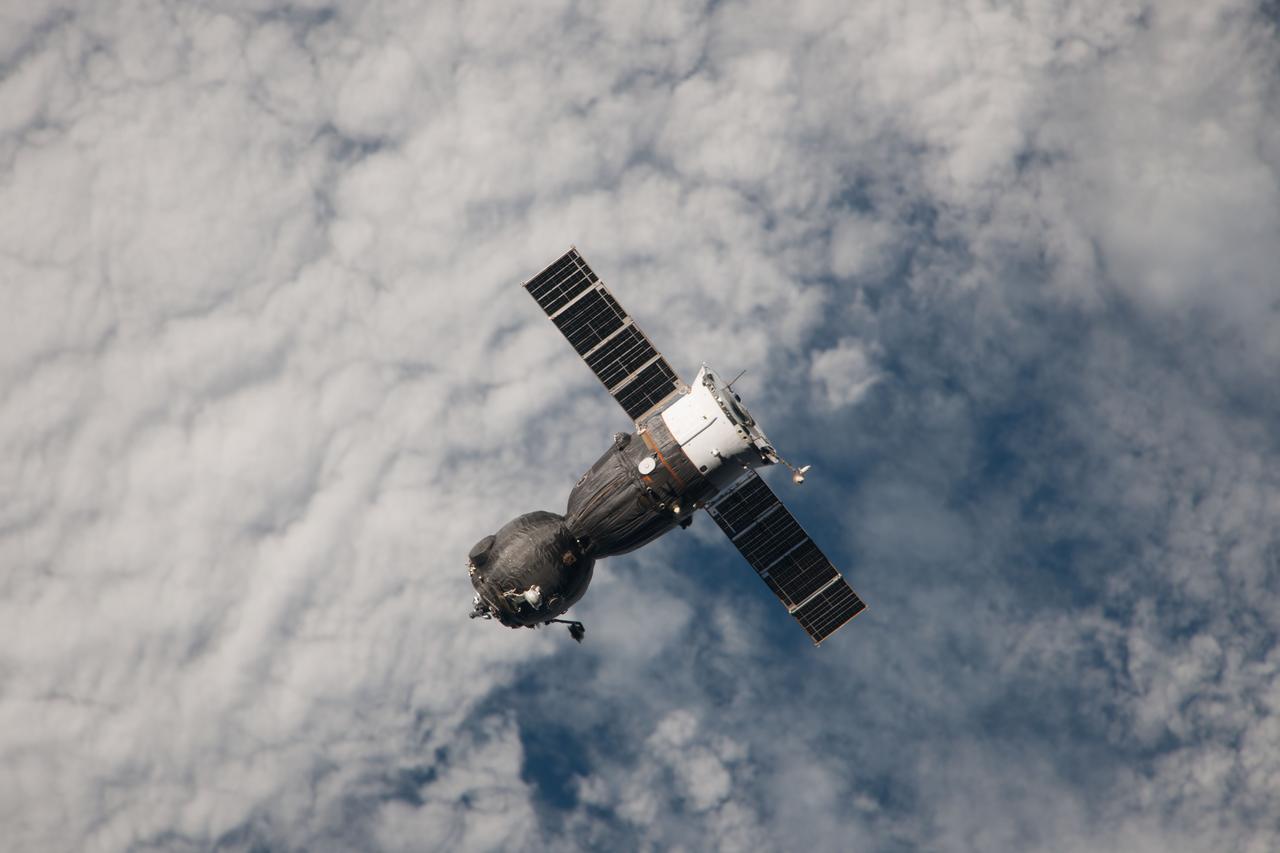
ISS038-E-001206 (10 Nov. 2013) --- The Soyuz TMA-09M spacecraft departs from the International Space Station?s Zvezda Service Module and heads toward a landing near the town of Zhezkazgan, Kazakhstan on Nov. 11, 2013 (Kazakh time). Russian cosmonaut Fyodor Yurchikhin, Expedition 37 commander; along with NASA astronaut Karen Nyberg and European Space Agency astronaut Luca Parmitano, both flight engineers, are ending a five-and-a-half month stay at the space station where they served as members of the Expedition 36 and 37 crews.
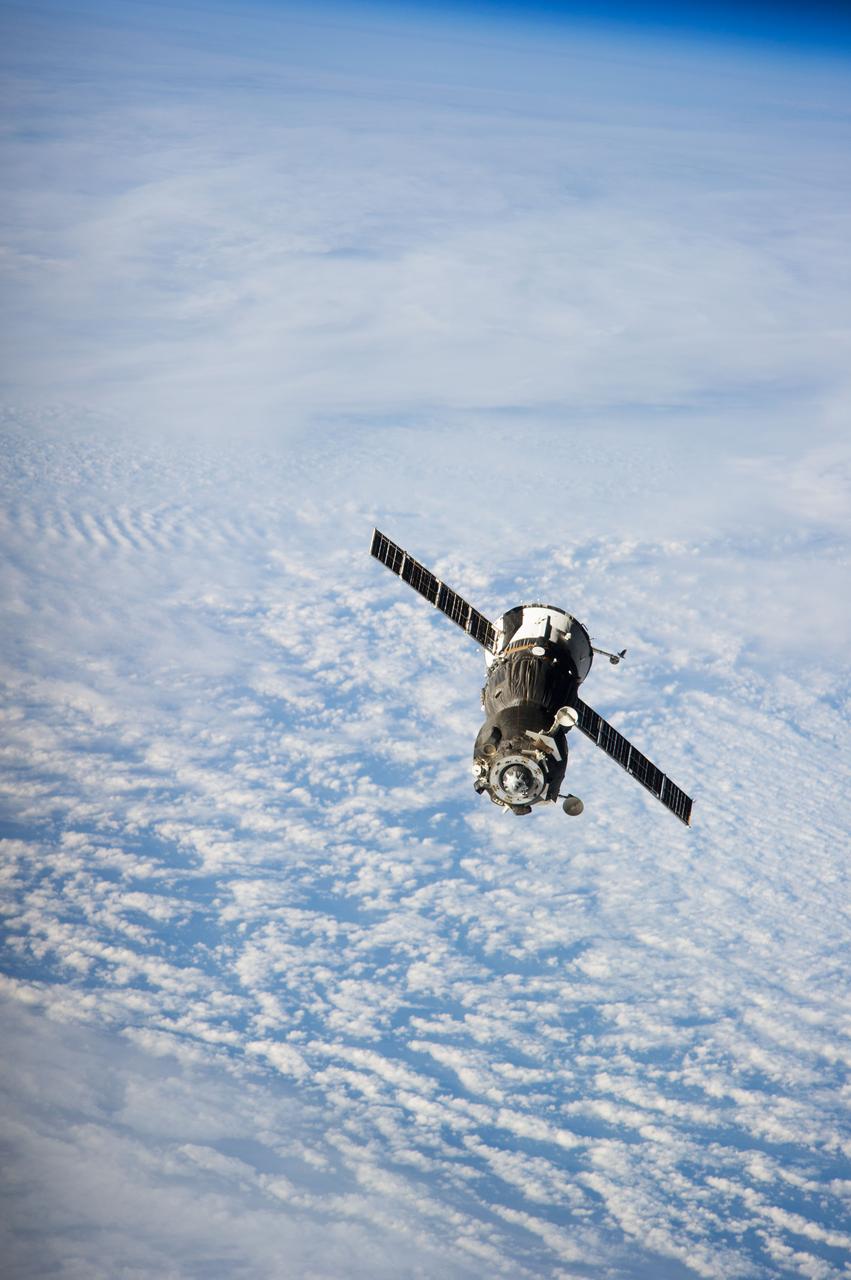
ISS038-E-001139 (10 Nov. 2013) --- The Soyuz TMA-09M spacecraft departs from the International Space Station?s Zvezda Service Module and heads toward a landing near the town of Zhezkazgan, Kazakhstan on Nov. 11, 2013 (Kazakh time). Russian cosmonaut Fyodor Yurchikhin, Expedition 37 commander; along with NASA astronaut Karen Nyberg and European Space Agency astronaut Luca Parmitano, both flight engineers, are ending a five-and-a-half month stay at the space station where they served as members of the Expedition 36 and 37 crews.
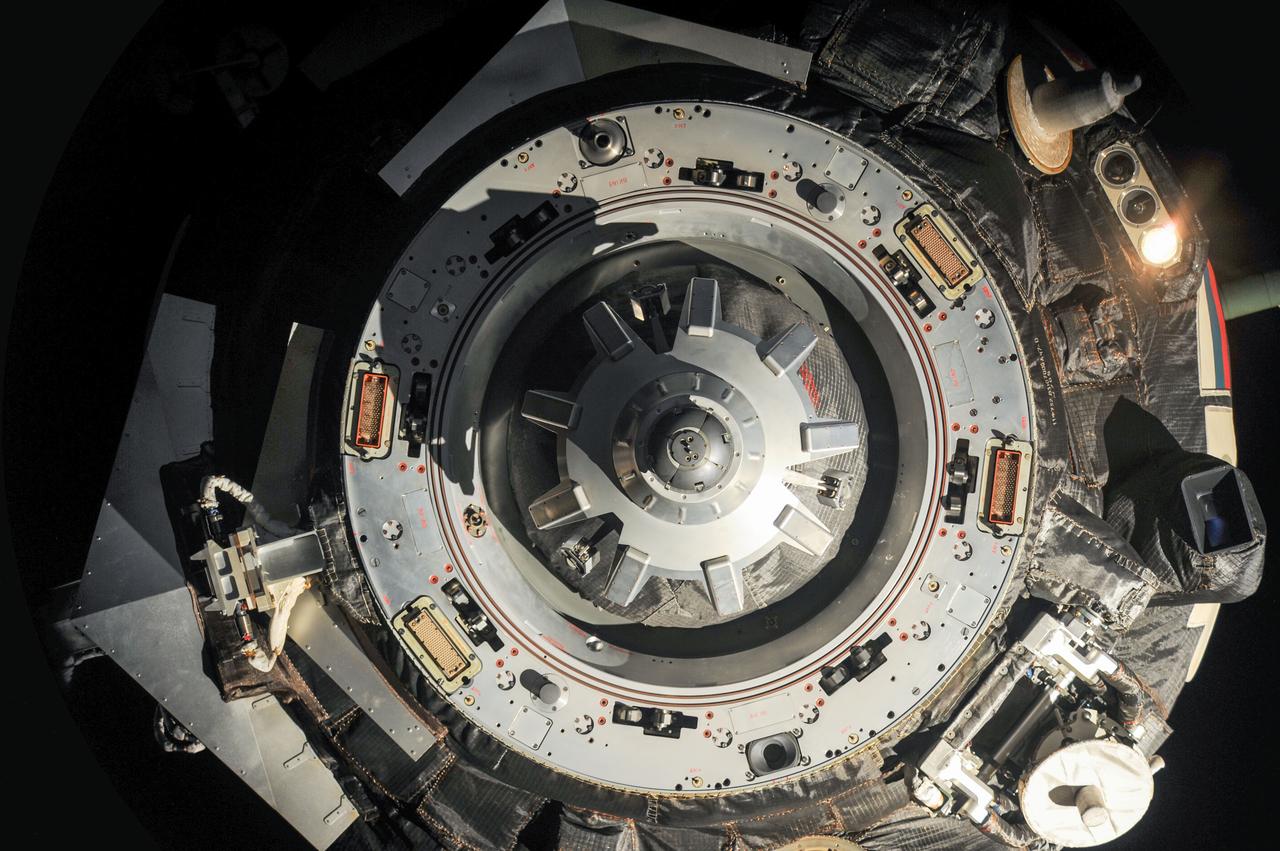
ISS038-E-000011 (10 Nov. 2013) --- The Soyuz TMA-09M spacecraft departs from the International Space Station?s Zvezda Service Module and heads toward a landing near the town of Zhezkazgan, Kazakhstan on Nov. 11, 2013 (Kazakh time). Russian cosmonaut Fyodor Yurchikhin, Expedition 37 commander; along with NASA astronaut Karen Nyberg and European Space Agency astronaut Luca Parmitano, both flight engineers, are ending a five-and-a-half month stay at the space station where they served as members of the Expedition 36 and 37 crews.
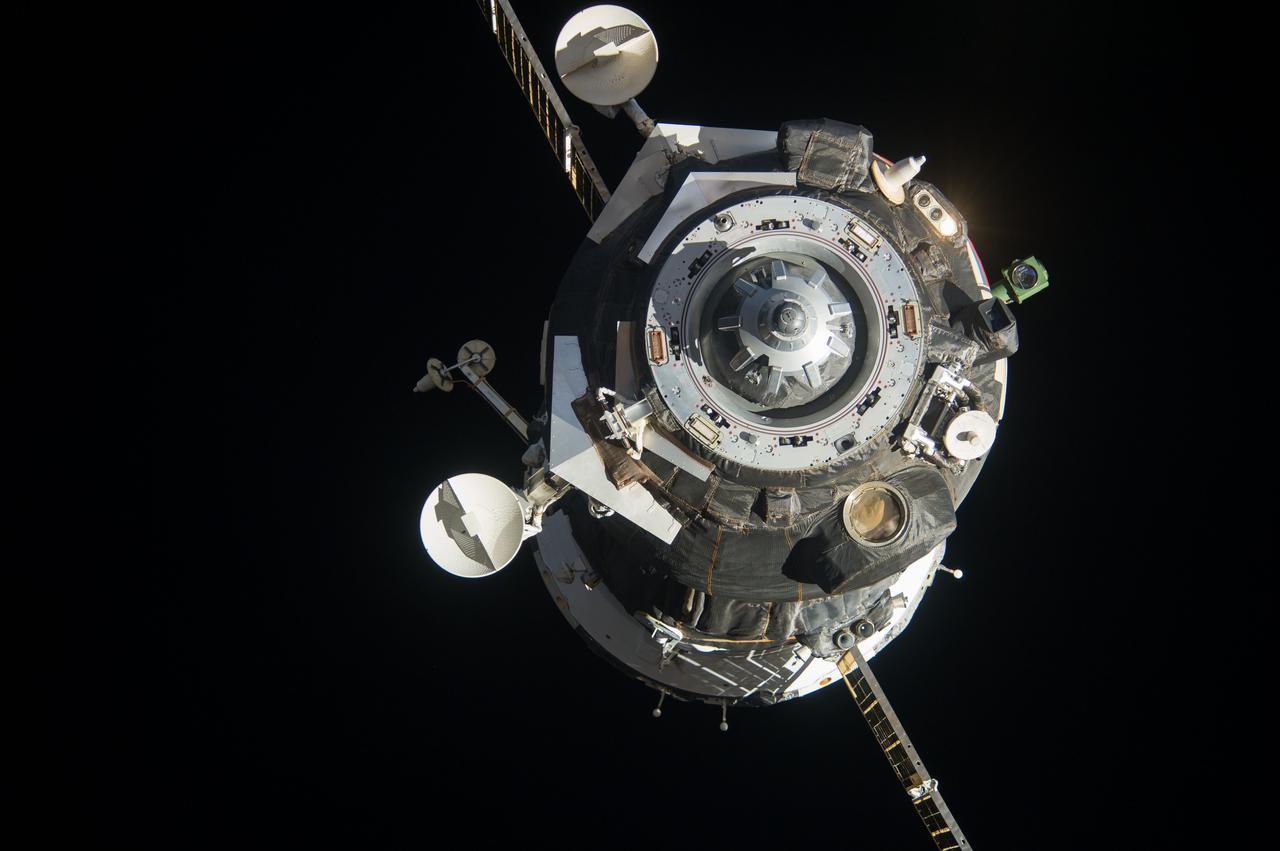
ISS038-E-001124 (10 Nov. 2013) --- The Soyuz TMA-09M spacecraft departs from the International Space Station’s Zvezda Service Module and heads toward a landing near the town of Zhezkazgan, Kazakhstan on Nov. 11, 2013 (Kazakh time). Russian cosmonaut Fyodor Yurchikhin, Expedition 37 commander; along with NASA astronaut Karen Nyberg and European Space Agency astronaut Luca Parmitano, both flight engineers, are ending a five-and-a-half month stay at the space station where they served as members of the Expedition 36 and 37 crews.
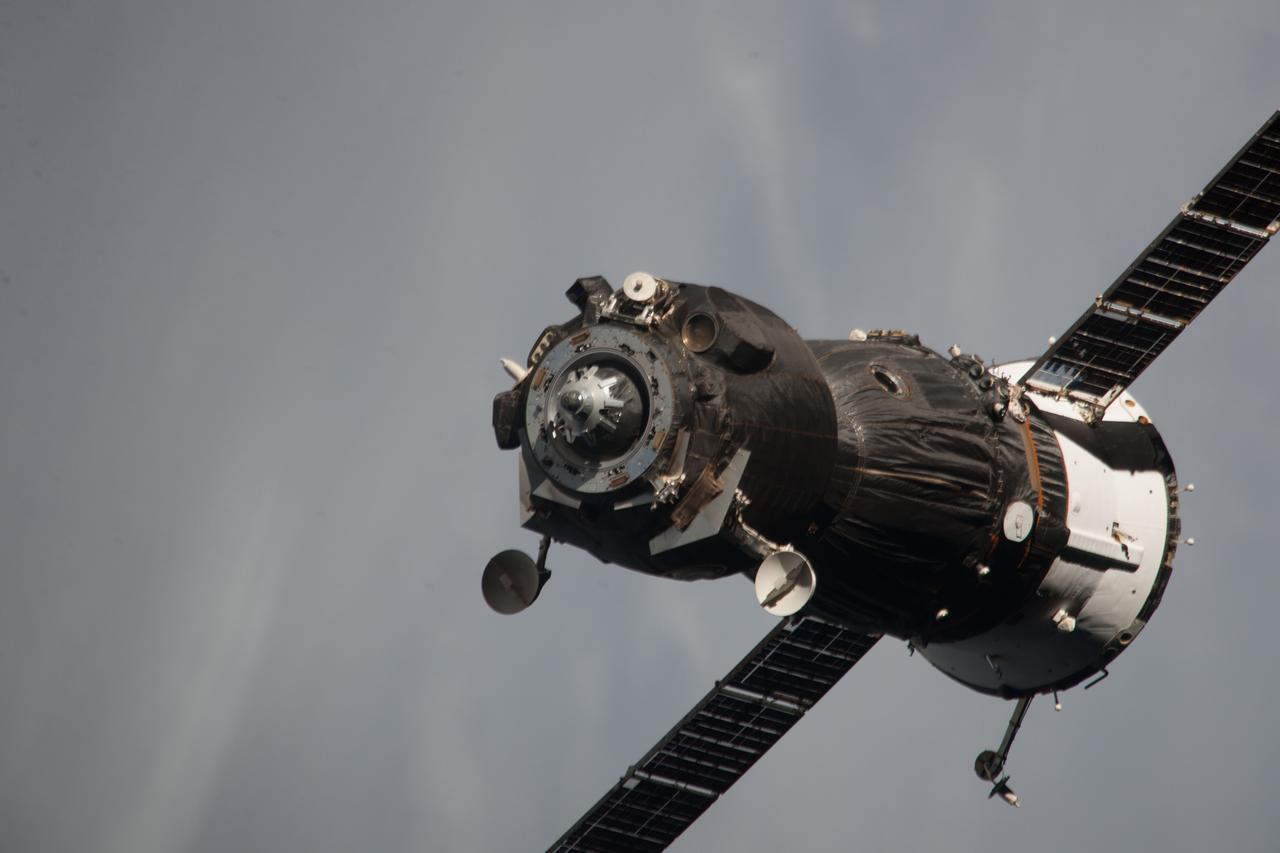
ISS038-E-001190 (10 Nov. 2013) --- The Soyuz TMA-09M spacecraft departs from the International Space Station?s Zvezda Service Module and heads toward a landing near the town of Zhezkazgan, Kazakhstan on Nov. 11, 2013 (Kazakh time). Russian cosmonaut Fyodor Yurchikhin, Expedition 37 commander; along with NASA astronaut Karen Nyberg and European Space Agency astronaut Luca Parmitano, both flight engineers, are ending a five-and-a-half month stay at the space station where they served as members of the Expedition 36 and 37 crews.
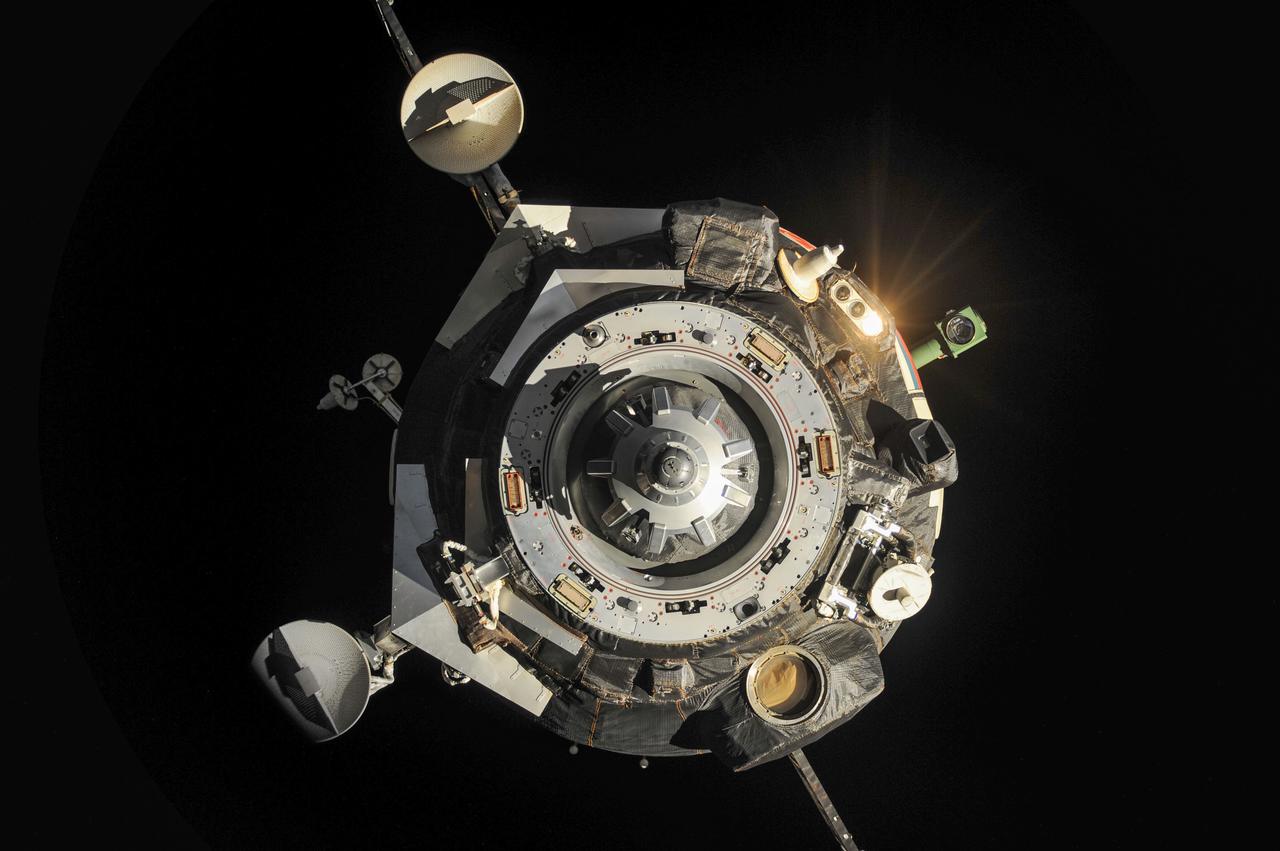
ISS038-E-000019 (10 Nov. 2013) --- The Soyuz TMA-09M spacecraft departs from the International Space Station?s Zvezda Service Module and heads toward a landing near the town of Zhezkazgan, Kazakhstan on Nov. 11, 2013 (Kazakh time). Russian cosmonaut Fyodor Yurchikhin, Expedition 37 commander; along with NASA astronaut Karen Nyberg and European Space Agency astronaut Luca Parmitano, both flight engineers, are ending a five-and-a-half month stay at the space station where they served as members of the Expedition 36 and 37 crews.
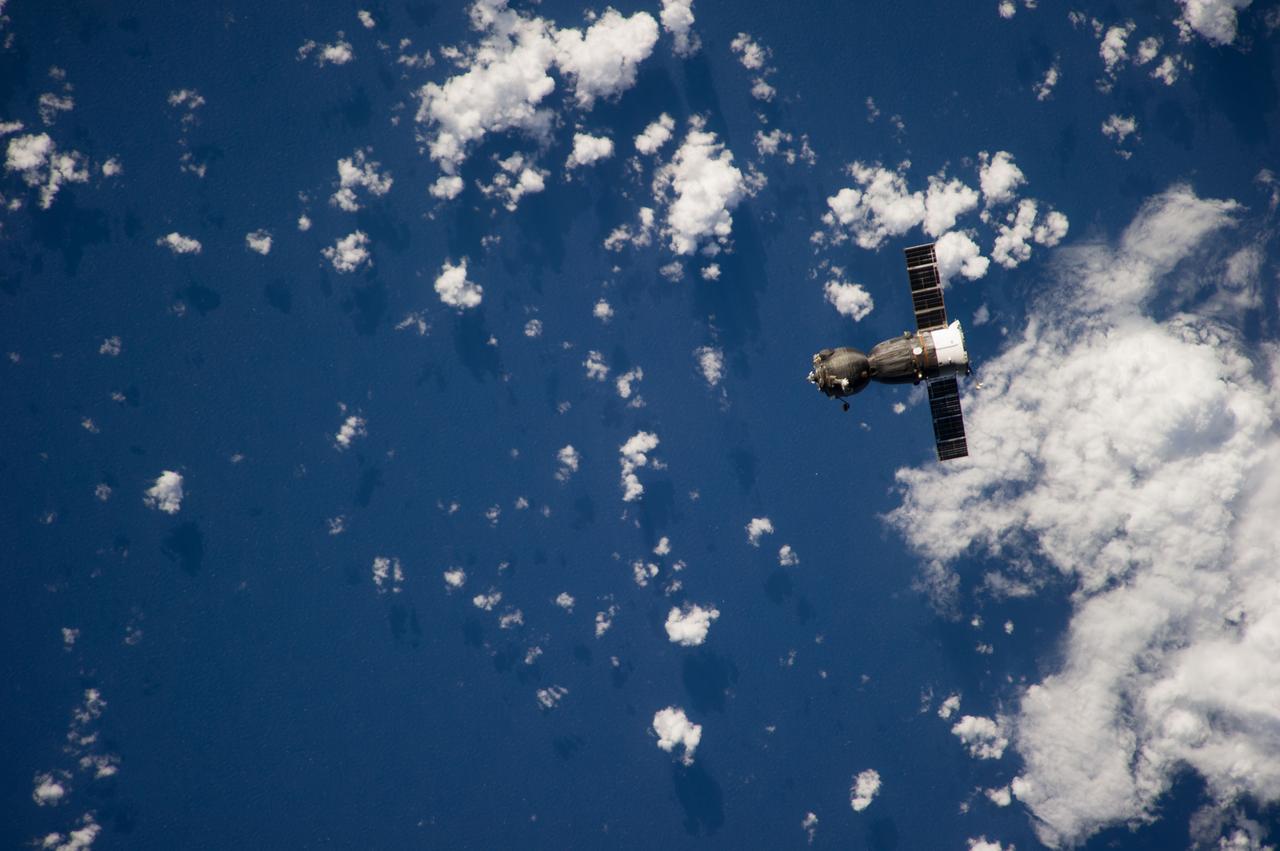
ISS038-E-001143 (10 Nov. 2013) --- The Soyuz TMA-09M spacecraft departs from the International Space Station?s Zvezda Service Module and heads toward a landing near the town of Zhezkazgan, Kazakhstan on Nov. 11, 2013 (Kazakh time). Russian cosmonaut Fyodor Yurchikhin, Expedition 37 commander; along with NASA astronaut Karen Nyberg and European Space Agency astronaut Luca Parmitano, both flight engineers, are ending a five-and-a-half month stay at the space station where they served as members of the Expedition 36 and 37 crews.
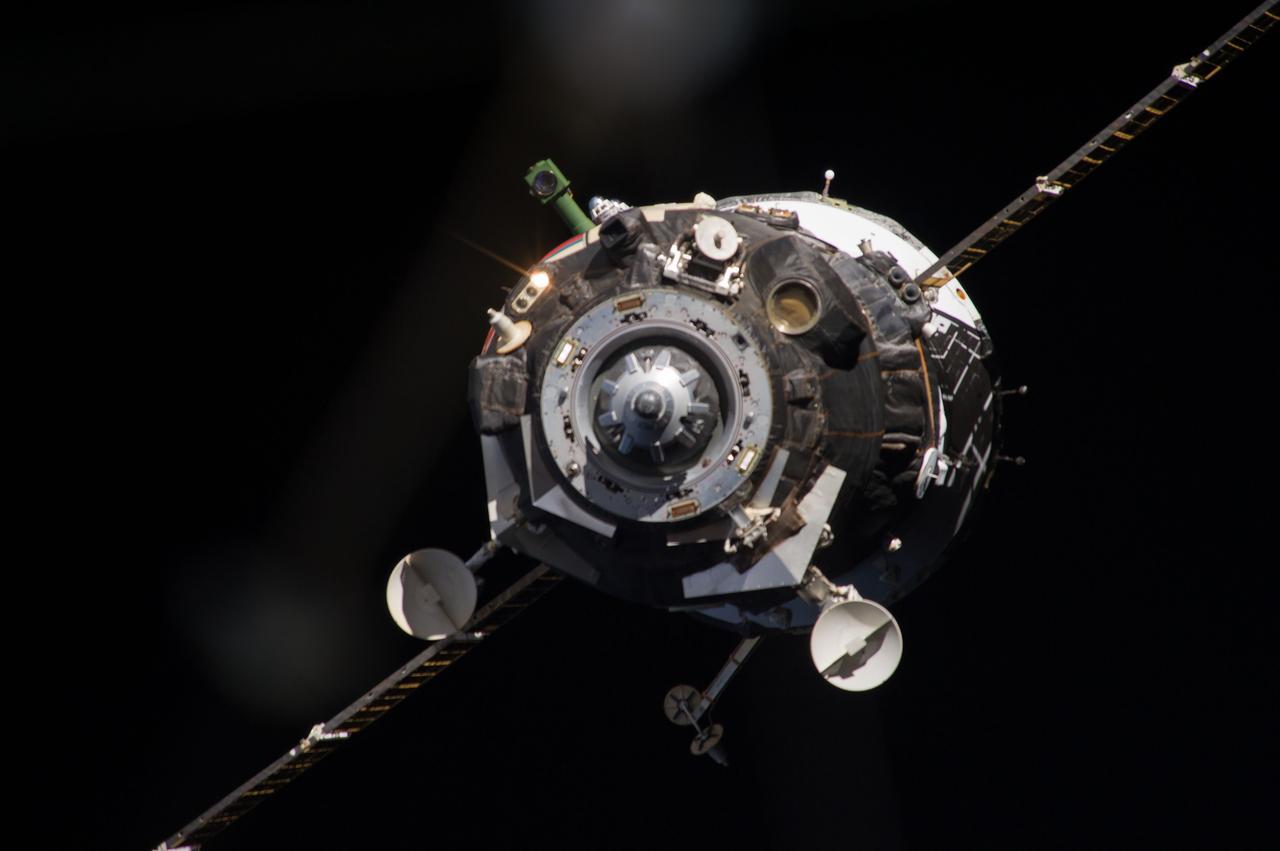
ISS038-E-001127 (10 Nov. 2013) --- The Soyuz TMA-09M spacecraft departs from the International Space Station?s Zvezda Service Module and heads toward a landing near the town of Zhezkazgan, Kazakhstan on Nov. 11, 2013 (Kazakh time). Russian cosmonaut Fyodor Yurchikhin, Expedition 37 commander; along with NASA astronaut Karen Nyberg and European Space Agency astronaut Luca Parmitano, both flight engineers, are ending a five-and-a-half month stay at the space station where they served as members of the Expedition 36 and 37 crews.
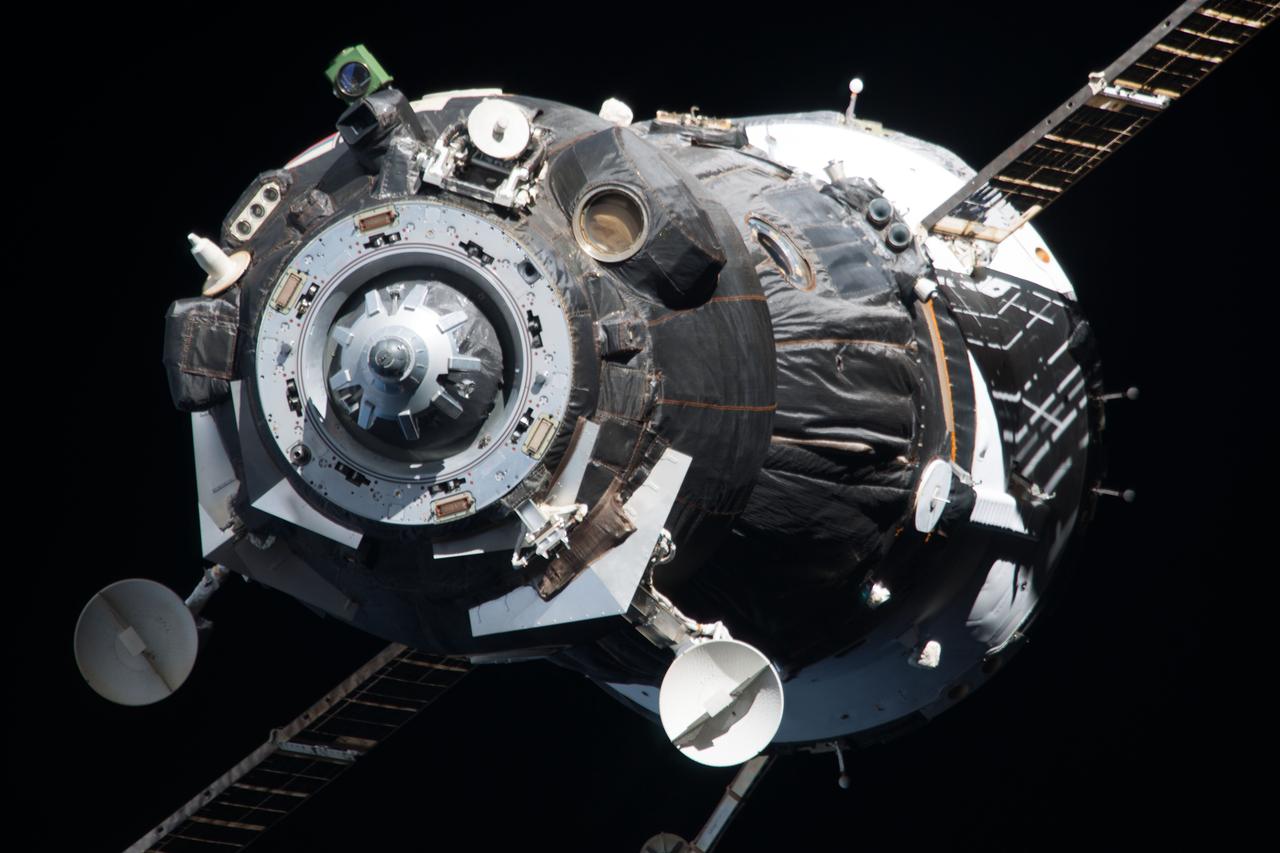
ISS038-E-001185 (10 Nov. 2013) --- The Soyuz TMA-09M spacecraft departs from the International Space Station?s Zvezda Service Module and heads toward a landing near the town of Zhezkazgan, Kazakhstan on Nov. 11, 2013 (Kazakh time). Russian cosmonaut Fyodor Yurchikhin, Expedition 37 commander; along with NASA astronaut Karen Nyberg and European Space Agency astronaut Luca Parmitano, both flight engineers, are ending a five-and-a-half month stay at the space station where they served as members of the Expedition 36 and 37 crews.
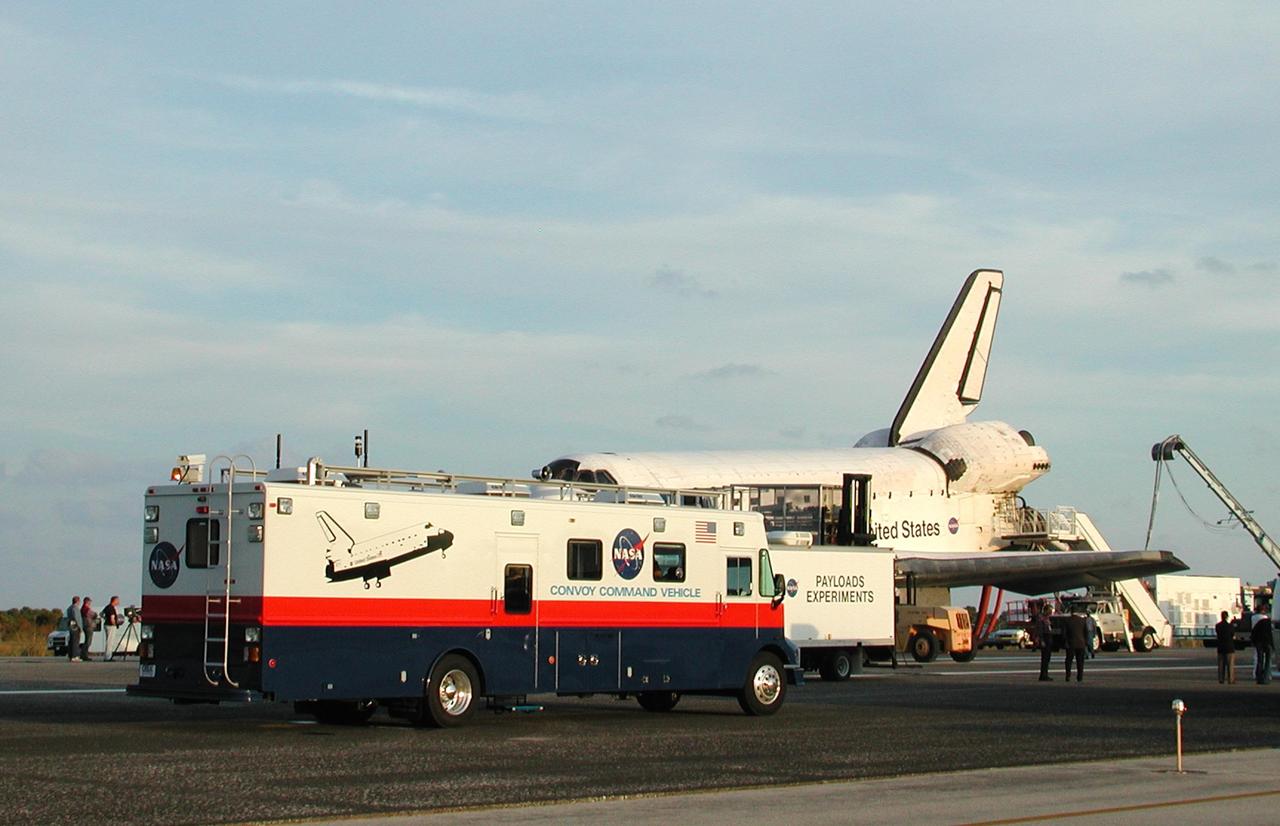
KENNEDY SPACE CENTER, FLA. - Space Shuttle Endeavour is surrounded by vehicles from the landing convoy on runway 33 at the Shuttle Landing Facility at the conclusion of the 13-day, 18-hour, 48-minute, 5.74-million mile STS-113 mission to the International Space Station. In the foreground is the Convoy Command Vehicle which is the command post for the Convoy Commander. The Convoy Commander is in communication with the orbiter and all of the landing convoy vehicles during the post-landing operations. The landing convoy's purpose is to safe the vehicle and provide support for the disembarking crew and experiments. Main gear touchdown was at 2:37:12 p.m. EST, nose gear touchdown was at 2:37:23 p.m., and wheel stop was at 2:38:25 p.m. Poor weather conditions thwarted landing opportunities until a fourth day, the first time in Shuttle program history that a landing has been waved off for three consecutive days. The vehicle carries the STS-113 crew, Commander James Wetherbee, Pilot Paul Lockhart and Mission Specialists Michael Lopez-Alegria and John Herrington, as well as the returning Expedition Five crew, Commander Valeri Korzun, ISS Science Officer Peggy Whitson and Flight Engineer Sergei Treschev. The installation of the P1 truss on the International Space Station was accomplished during the mission.
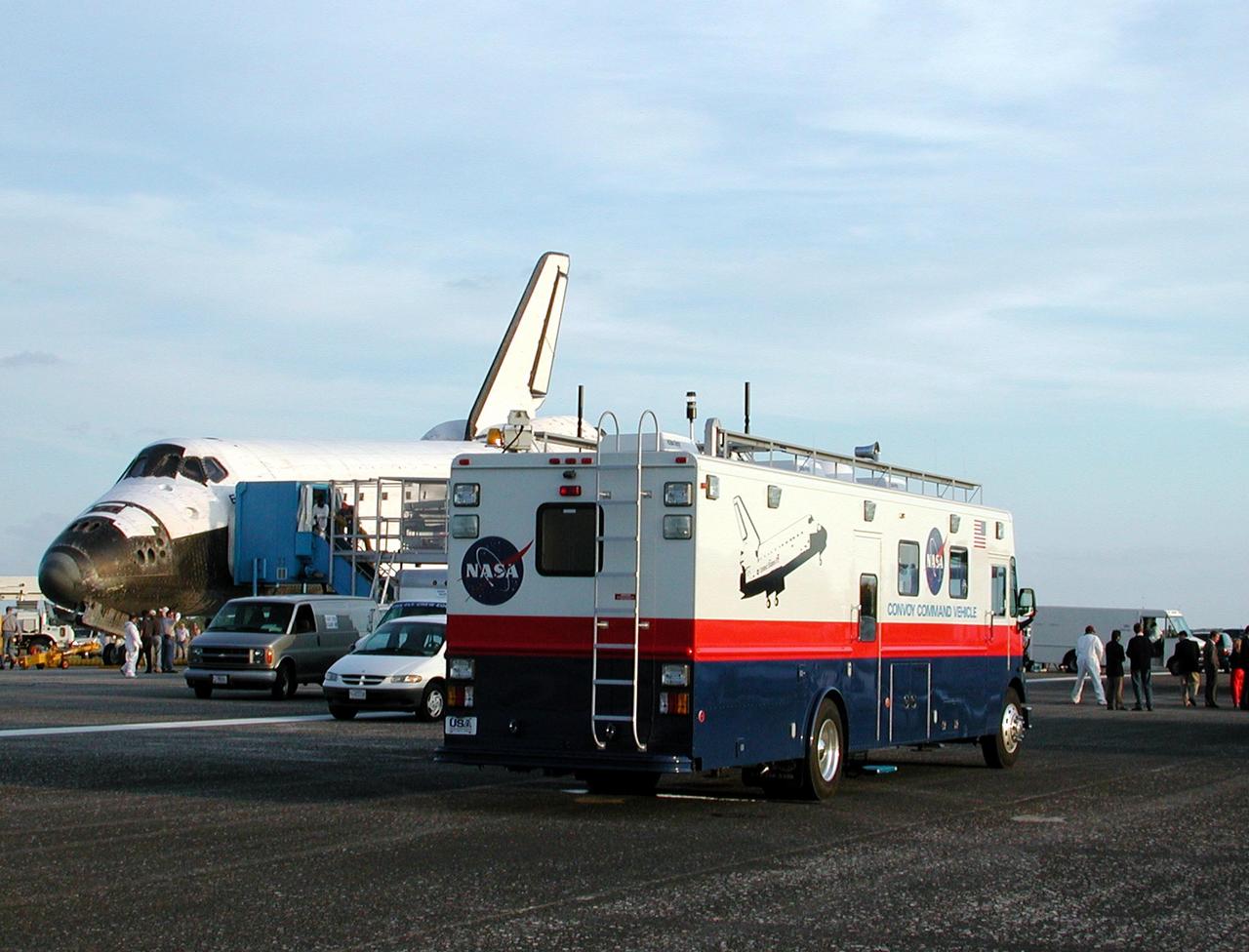
KENNEDY SPACE CENTER, FLA. - Space Shuttle Endeavour is surrounded by vehicles from the landing convoy on runway 33 at the Shuttle Landing Facility at the conclusion of the 13-day, 18-hour, 48-minute, 5.74-million mile STS-113 mission to the International Space Station. In the foreground is the Convoy Command Vehicle which is the command post for the Convoy Commander. The Convoy Commander is in communication with the orbiter and all of the landing convoy vehicles during the post-landing operations. The landing convoy's purpose is to safe the vehicle and provide support for the disembarking crew and experiments. Main gear touchdown was at 2:37:12 p.m. EST, nose gear touchdown was at 2:37:23 p.m., and wheel stop was at 2:38:25 p.m. Poor weather conditions thwarted landing opportunities until a fourth day, the first time in Shuttle program history that a landing has been waved off for three consecutive days. The vehicle carries the STS-113 crew, Commander James Wetherbee, Pilot Paul Lockhart and Mission Specialists Michael Lopez-Alegria and John Herrington, as well as the returning Expedition Five crew, Commander Valeri Korzun, ISS Science Officer Peggy Whitson and Flight Engineer Sergei Treschev. The installation of the P1 truss on the International Space Station was accomplished during the mission.
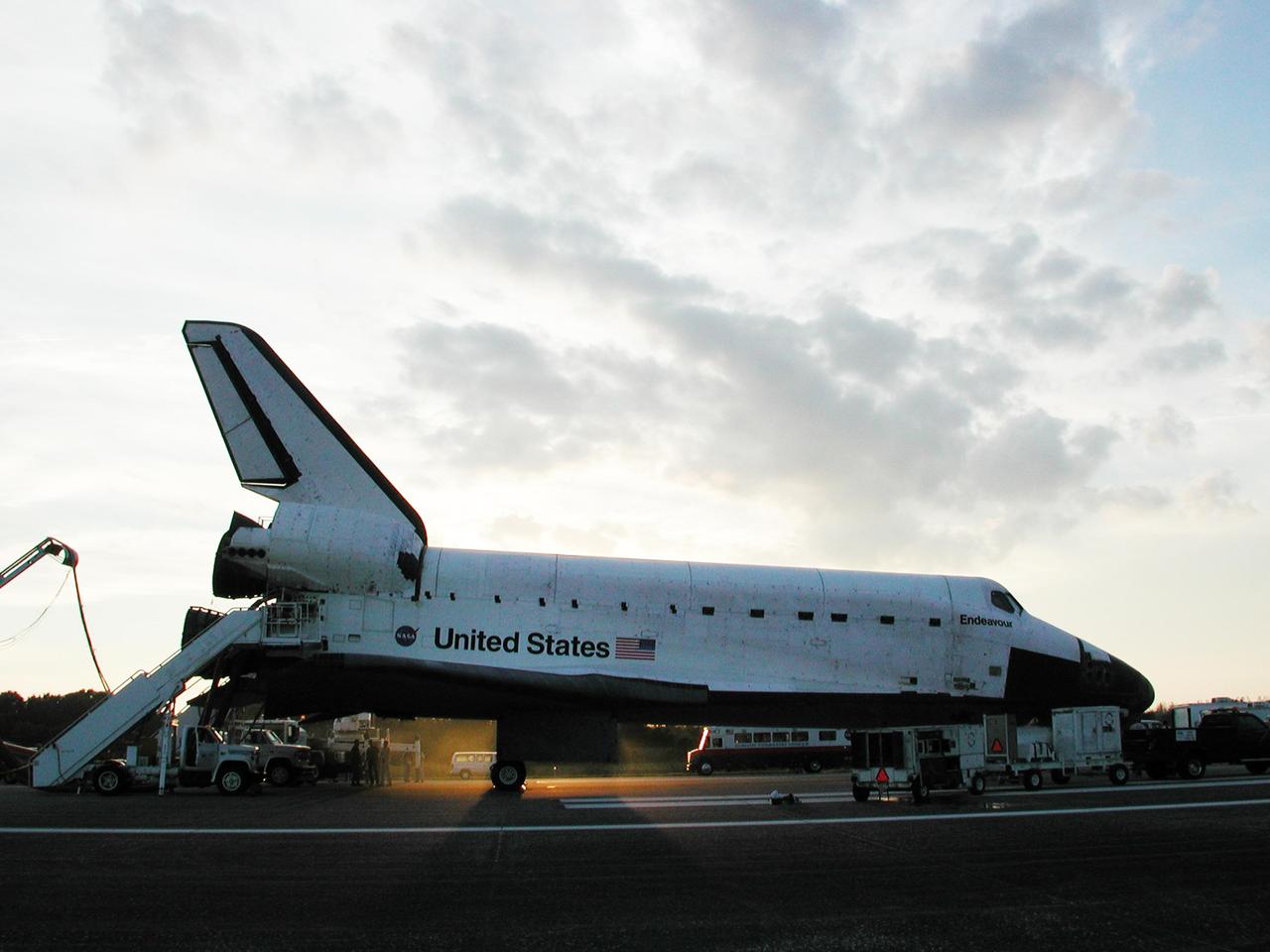
KENNEDY SPACE CENTER, FLA. - Space Shuttle Endeavour is surrounded by vehicles from the landing convoy, as the sun sets on runway 33 at the Shuttle Landing Facility at the conclusion of the 13-day, 18-hour, 48-minute, 5.74-million mile STS-113 mission to the International Space Station. Under the orbiter, the Convoy Command Vehicle, the command post for the Convoy Commander, can be seen on the far side of the runway. The Convoy Commander is in communication with the orbiter and all of the landing convoy vehicles during the post-landing operations. The landing convoy's purpose is to safe the vehicle and provide support for the disembarking crew and experiments. Main gear touchdown was at 2:37:12 p.m. EST, nose gear touchdown was at 2:37:23 p.m., and wheel stop was at 2:38:25 p.m. Poor weather conditions thwarted landing opportunities until a fourth day, the first time in Shuttle program history that a landing has been waved off for three consecutive days. The vehicle carries the STS-113 crew, Commander James Wetherbee, Pilot Paul Lockhart and Mission Specialists Michael Lopez-Alegria and John Herrington, as well as the returning Expedition Five crew, Commander Valeri Korzun, ISS Science Officer Peggy Whitson and Flight Engineer Sergei Treschev. The installation of the P1 truss on the International Space Station was accomplished during the mission.
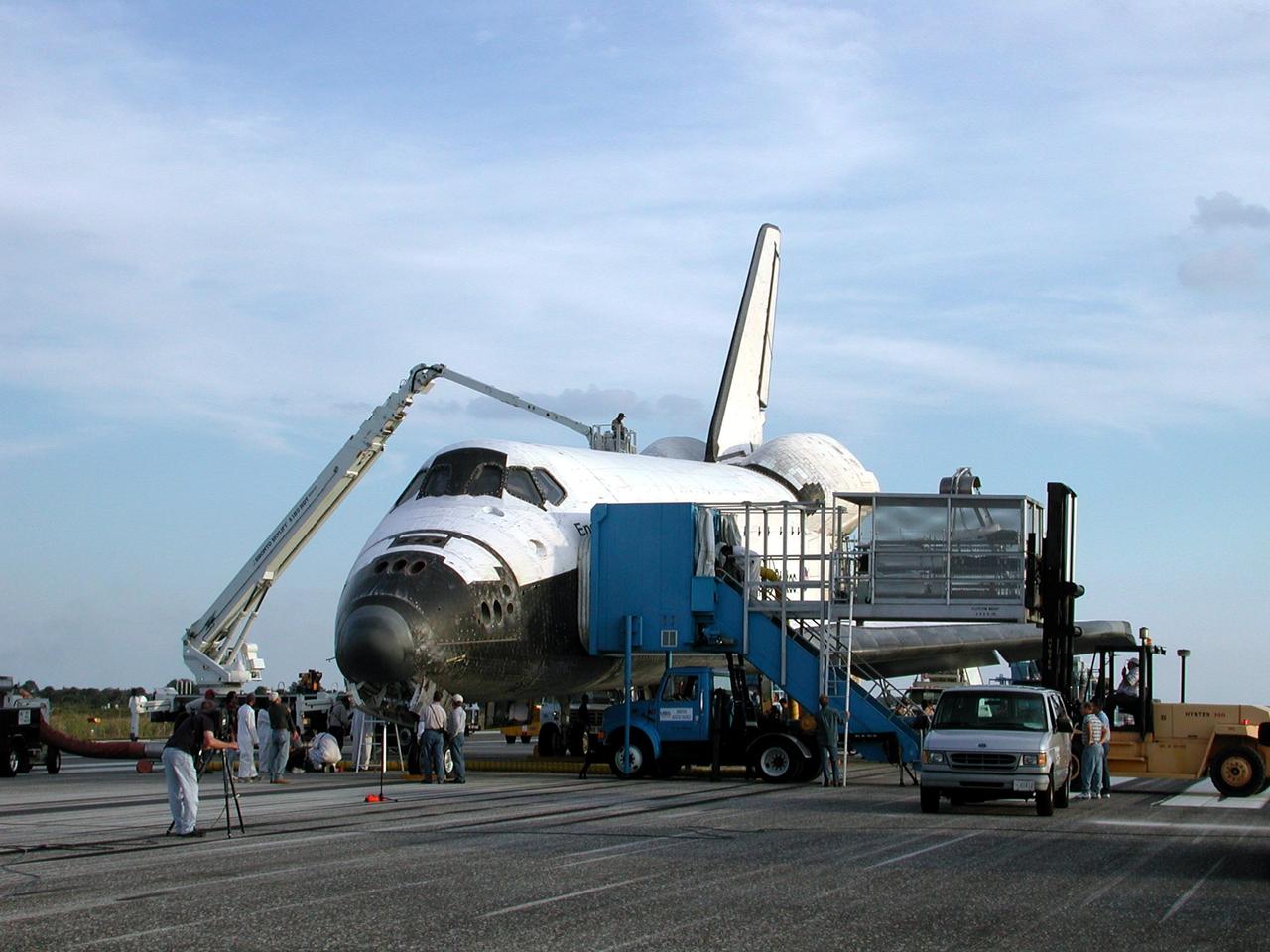
KENNEDY SPACE CENTER, FLA. - Space Shuttle Endeavour is surrounded by vehicles from the landing convoy on runway 33 at the Shuttle Landing Facility at the conclusion of the 13-day, 18-hour, 48-minute, 5.74-million mile STS-113 mission to the International Space Station. The landing convoy's purpose is to safe the vehicle and provide support for the disembarking crew and experiments. Main gear touchdown was at 2:37:12 p.m. EST, nose gear touchdown was at 2:37:23 p.m., and wheel stop was at 2:38:25 p.m. Poor weather conditions thwarted landing opportunities until a fourth day, the first time in Shuttle program history that a landing has been waved off for three consecutive days. The vehicle carries the STS-113 crew, Commander James Wetherbee, Pilot Paul Lockhart and Mission Specialists Michael Lopez-Alegria and John Herrington, as well as the returning Expedition Five crew, Commander Valeri Korzun, ISS Science Officer Peggy Whitson and Flight Engineer Sergei Treschev. The installation of the P1 truss on the International Space Station was accomplished during the mission.

KENNEDY SPACE CENTER, FLA. - Space Shuttle Endeavour's drag chute is unreefed as the orbiter lands on runway 33 at the Shuttle Landing Facility at the conclusion of the 13-day, 18-hour, 48-minute, 5.74-million mile STS-113 mission to the International Space Station. The landing convoy in the foreground is ready to approach and safe the vehicle after it comes to a full stop. Main gear touchdown was at 2:37:12 p.m. EST, nose gear touchdown was at 2:37:23 p.m., and wheel stop was at 2:38:25 p.m. Poor weather conditions thwarted landing opportunities until a fourth day, the first time in Shuttle program history that a landing has been waved off for three consecutive days. The vehicle carries the STS-113 crew, Commander James Wetherbee, Pilot Paul Lockhart and Mission Specialists Michael Lopez-Alegria and John Herrington, as well as the returning Expedition Five crew, Commander Valeri Korzun, ISS Science Officer Peggy Whitson and Flight Engineer Sergei Treschev. The installation of the P1 truss on the International Space Station was accomplished during the mission.
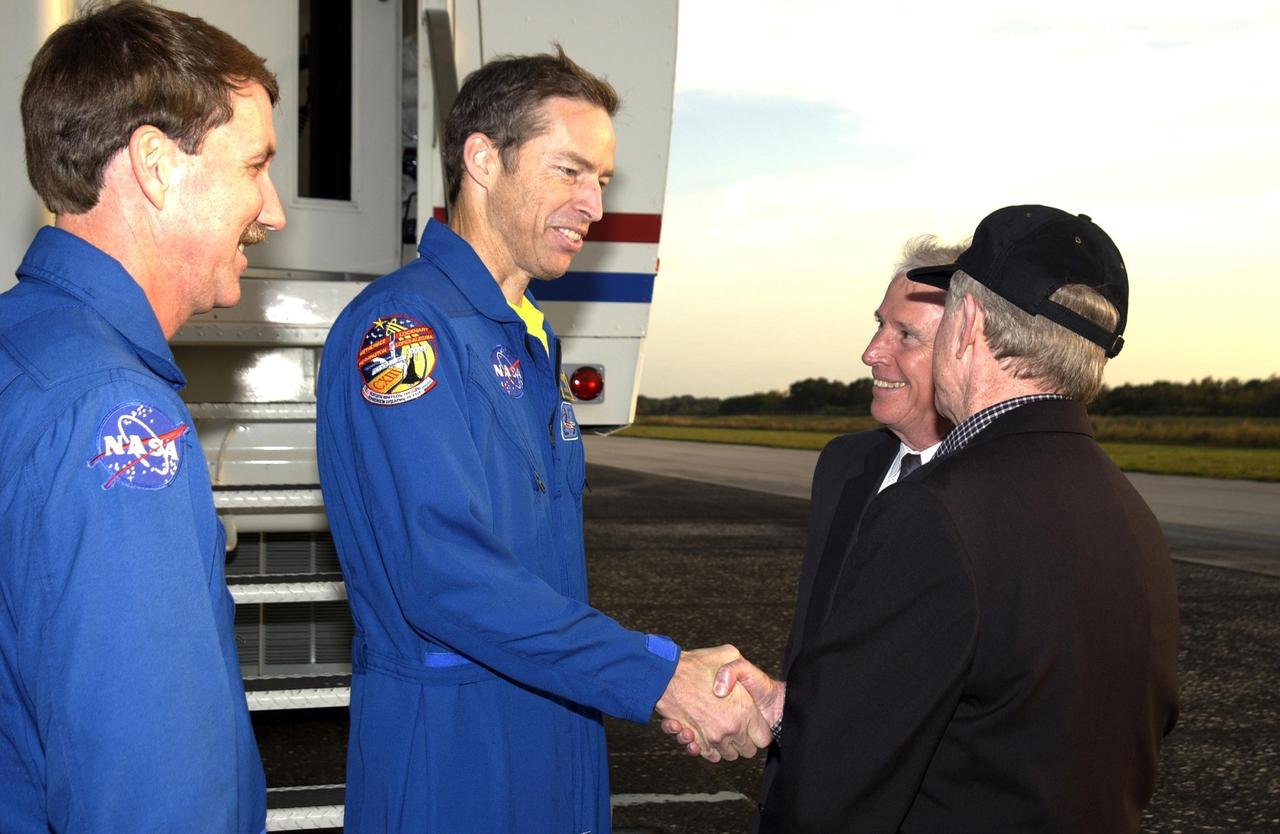
KENNEDY SPACE CENTER, FLA. - STS-113 Commander James Wetherbee shakes hands with KSC Director Roy D. Bridges Jr. following landing at the Shuttle Landing Facility. From left are Kent Rominger, Deputy Director of Flight Crew Operations, Wetherbee, Dr. Daniel R. Mulville, NASA Associate Deputy Administrator, and Bridges. Commander Wetherbee earlier guided Space Shuttle Endeavour to a flawless touchdown on runway 33 at the Shuttle Landing Facility after completing the 13-day, 18-hour, 48-minute, 5.74-million mile STS-113 mission to the International Space Station. Main gear touchdown was at 2:37:12 p.m. EST, nose gear touchdown was at 2:37:23 p.m., and wheel stop was at 2:38:25 p.m. Poor weather conditions thwarted landing opportunities until a fourth day, the first time in Shuttle program history that a landing has been waved off for three consecutive days. The orbiter also carried the other members of the STS-113 crew, Pilot Paul Lockhart and Mission Specialists Michael Lopez-Alegria and John Herrington, as well as the returning Expedition Five crew, Commander Valeri Korzun, ISS Science Officer Peggy Whitson and Flight Engineer Sergei Treschev. The installation of the P1 truss on the International Space Station was accomplished during the mission.
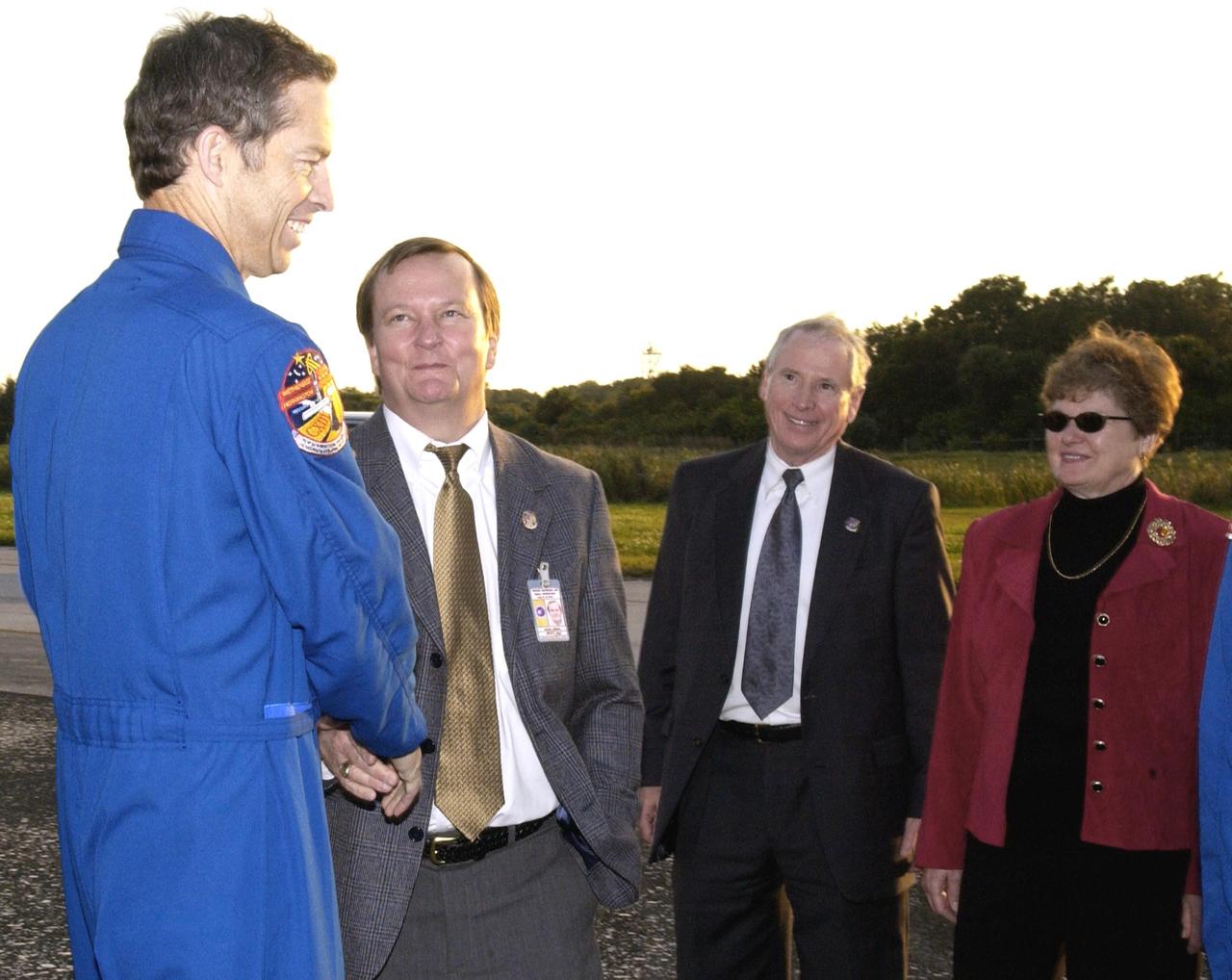
KENNEDY SPACE CENTER, FLA. - STS-113 Commander James Wetherbee shakes hands with Michael D. Leinbach, Shuttle Launch Director at KSC, on the runway of the Shuttle Landing Facility following the landing of Endeavour. From left are Wetherbee, Leinbach, Dr. Daniel R. Mulville, NASA Associate Deputy Administrator, and Mrs. Mulville. Commander Wetherbee earlier guided Space Shuttle Endeavour to a flawless touchdown on runway 33 at the Shuttle Landing Facility after completing the 13-day, 18-hour, 48-minute, 5.74-million mile STS-113 mission to the International Space Station. Main gear touchdown was at 2:37:12 p.m. EST, nose gear touchdown was at 2:37:23 p.m., and wheel stop was at 2:38:25 p.m. Poor weather conditions thwarted landing opportunities until a fourth day, the first time in Shuttle program history that a landing has been waved off for three consecutive days. The orbiter also carried the other members of the STS-113 crew, Pilot Paul Lockhart and Mission Specialists Michael Lopez-Alegria and John Herrington, as well as the returning Expedition Five crew, Commander Valeri Korzun, ISS Science Officer Peggy Whitson and Flight Engineer Sergei Treschev. The installation of the P1 truss on the International Space Station was accomplished during the mission.
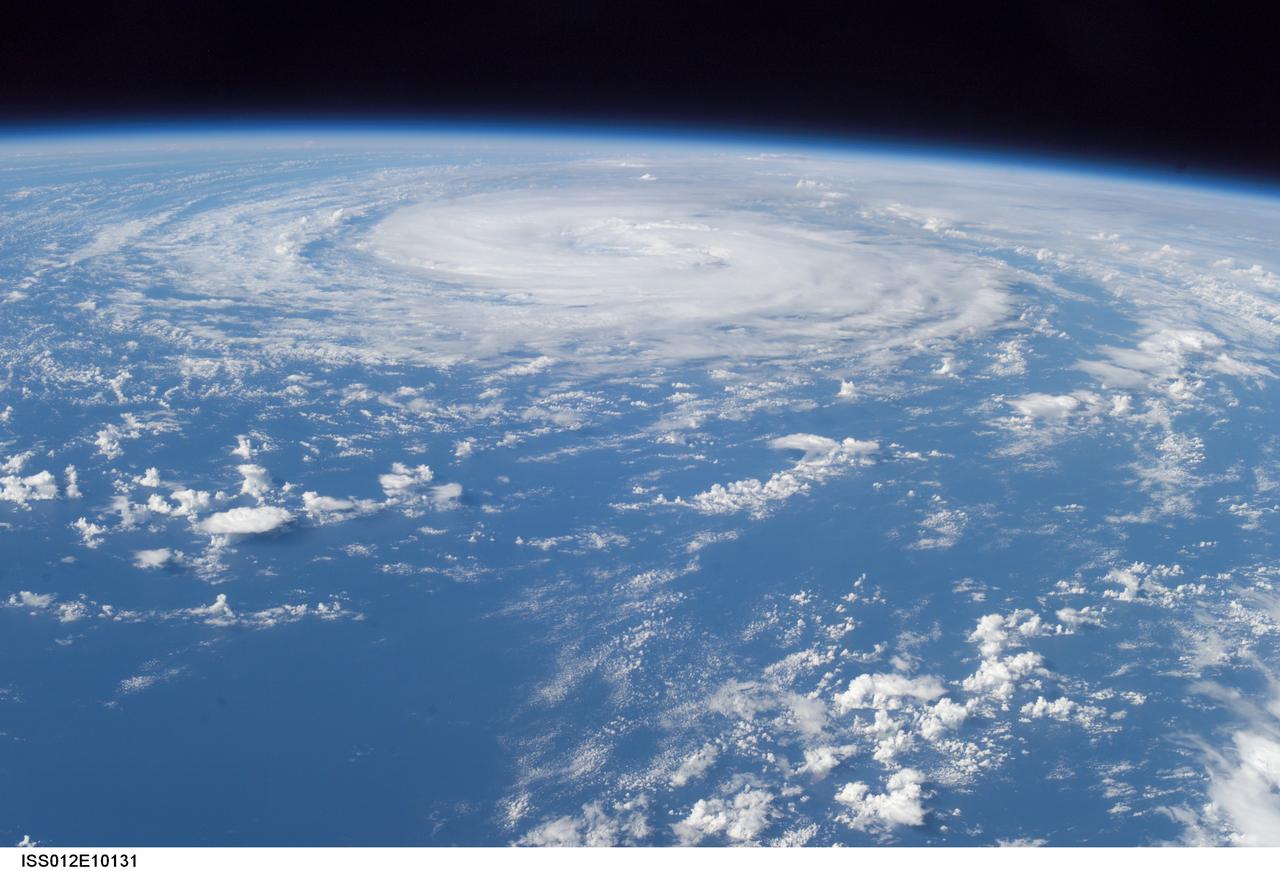
ISS012-E-10131 (3 Dec. 2005) --- This oblique view of Hurricane Epsilon in the Atlantic Ocean was photographed at 15:37:45 GMT on Dec. 3, 2005 by one of the crewmembers of Expedition 12 aboard the International Space Station. The orbital outpost was flying at an altitude of 190 nautical miles. Center point coordinates are 34.5 degrees north latitude and 44.4 degrees west longitude. As it continues moving in the Atlantic Ocean, the storm poses no threat to any land mass.
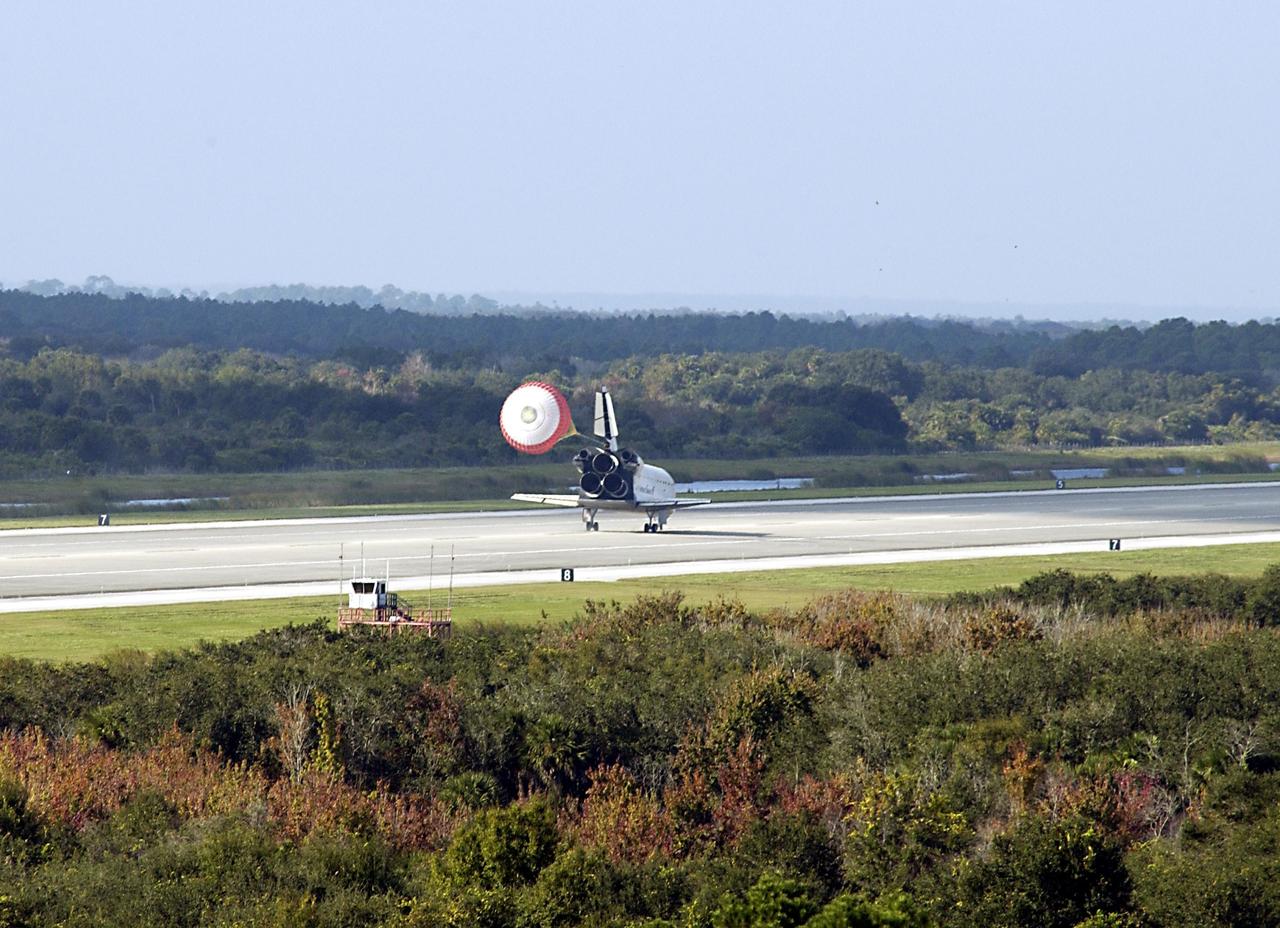
KENNEDY SPACE CENTER, FLA. - Space Shuttle Endeavour's drag chute deploys as the orbiter lands on runway 33 at the Shuttle Landing Facility after completing the 13-day, 18-hour, 48-minute, 5.74-million mile STS-113 mission to the International Space Station. Main gear touchdown was at 2:37:12 p.m. EST, nose gear touchdown was at 2:37:23 p.m., and wheel stop was at 2:38:25 p.m. Poor weather conditions thwarted landing opportunities until a fourth day, the first time in Shuttle program history that a landing has been waved off for three consecutive days. The vehicle carries the STS-113 crew, Commander James Wetherbee, Pilot Paul Lockhart and Mission Specialists Michael Lopez-Alegria and John Herrington, as well as the returning Expedition Five crew, Commander Valeri Korzun, ISS Science Officer Peggy Whitson and Flight Engineer Sergei Treschev. The installation of the P1 truss on the International Space Station was accomplished during the mission.
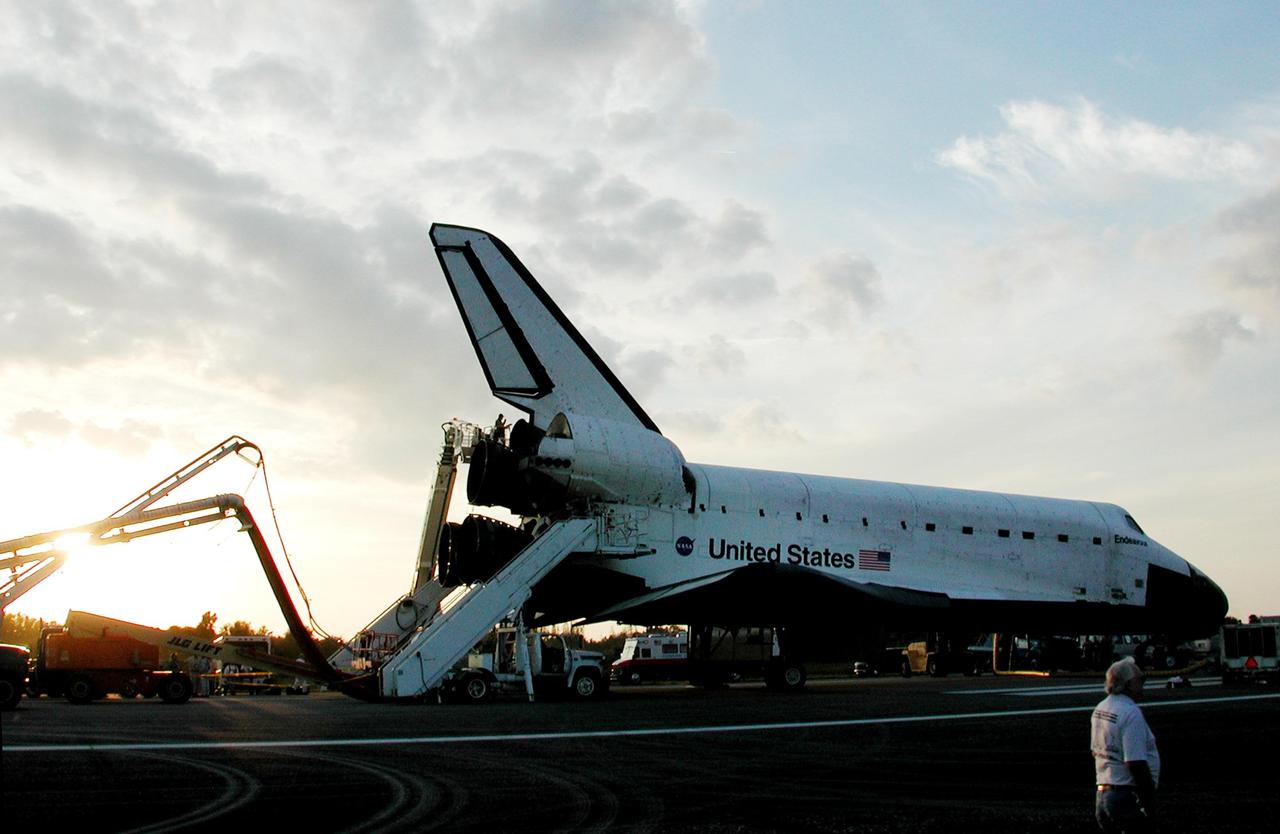
KENNEDY SPACE CENTER, FLA. - A technician, outlined against the setting sun, checks the main engines on Space Shuttle Endeavour on runway 33 at the Shuttle Landing Facility at the conclusion of the 13-day, 18-hour, 48-minute, 5.74-million mile STS-113 mission to the International Space Station. The landing convoy's purpose is to safe the vehicle and provide support for the disembarking crew and experiments. Main gear touchdown was at 2:37:12 p.m. EST, nose gear touchdown was at 2:37:23 p.m., and wheel stop was at 2:38:25 p.m. Poor weather conditions thwarted landing opportunities until a fourth day, the first time in Shuttle program history that a landing has been waved off for three consecutive days. The vehicle carries the STS-113 crew, Commander James Wetherbee, Pilot Paul Lockhart and Mission Specialists Michael Lopez-Alegria and John Herrington, as well as the returning Expedition Five crew, Commander Valeri Korzun, ISS Science Officer Peggy Whitson and Flight Engineer Sergei Treschev. The installation of the P1 truss on the International Space Station was accomplished during the mission.
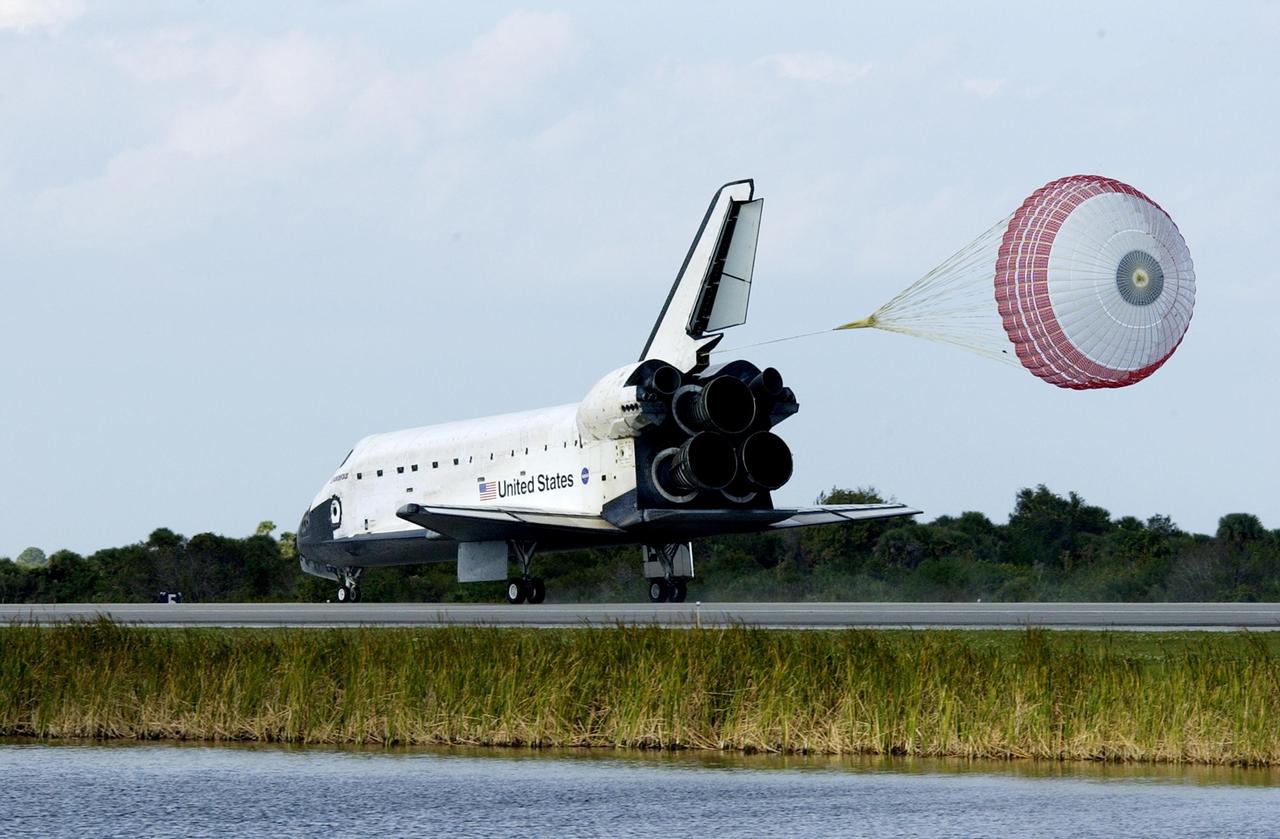
KENNEDY SPACE CENTER, FLA. - Space Shuttle Endeavour's drag chute slows down the orbiter as it lands on runway 33 at the Shuttle Landing Facility after completing the 13-day, 18-hour, 48-minute, 5.74-million mile STS-113 mission to the International Space Station. Main gear touchdown was at 2:37:12 p.m. EST, nose gear touchdown was at 2:37:23 p.m., and wheel stop was at 2:38:25 p.m. Poor weather conditions thwarted landing opportunities until a fourth day, the first time in Shuttle program history that a landing has been waved off for three consecutive days. The vehicle carries the STS-113 crew, Commander James Wetherbee, Pilot Paul Lockhart and Mission Specialists Michael Lopez-Alegria and John Herrington, as well as the returning Expedition Five crew, Commander Valeri Korzun, ISS Science Officer Peggy Whitson and Flight Engineer Sergei Treschev. The installation of the P1 truss on the International Space Station was accomplished during the mission.
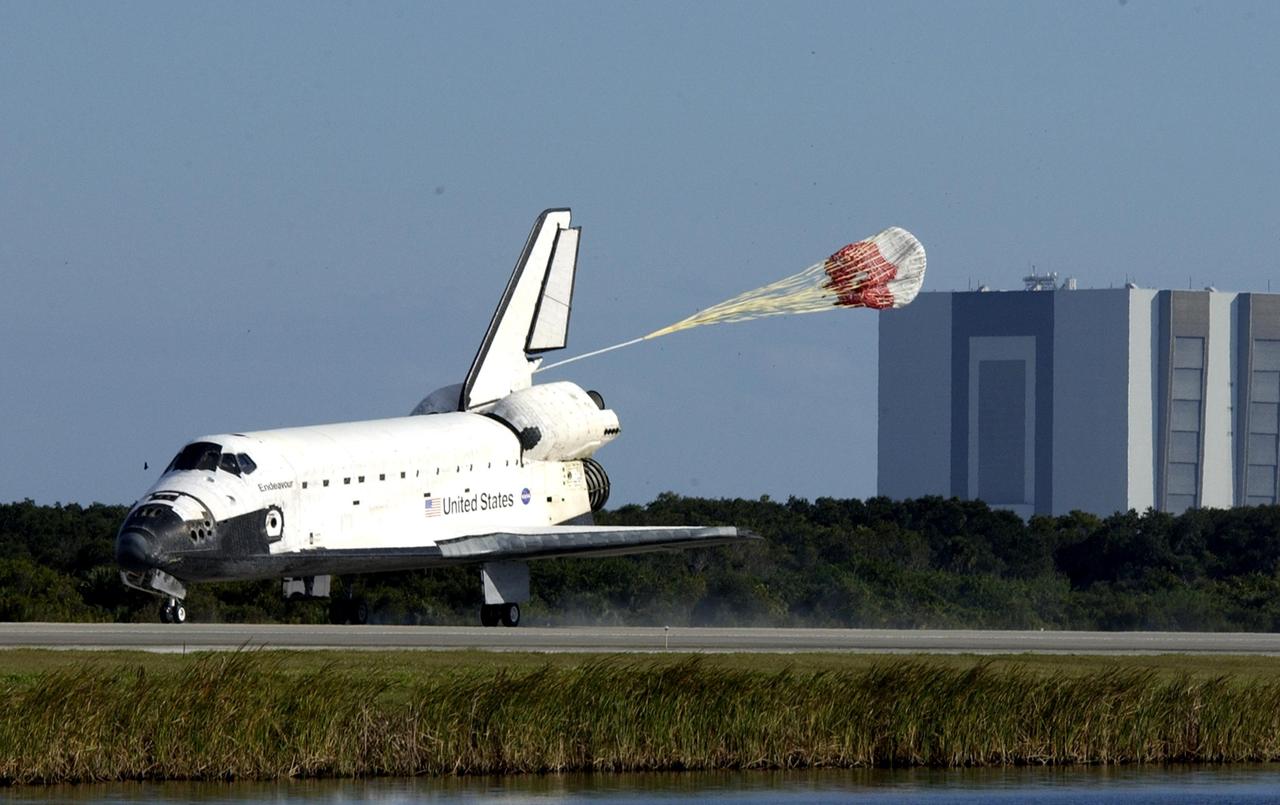
KENNEDY SPACE CENTER, FLA. - Space Shuttle Endeavour's drag chute deploys as the orbiter lands on runway 33 at the Shuttle Landing Facility after completing the 13-day, 18-hour, 48-minute, 5.74-million mile STS-113 mission to the International Space Station. In the background is a well known KSC landmark: the 525-foot-tall Vehicle Assembly Building. Main gear touchdown was at 2:37:12 p.m. EST, nose gear touchdown was at 2:37:23 p.m., and wheel stop was at 2:38:25 p.m. Poor weather conditions thwarted landing opportunities until a fourth day, the first time in Shuttle program history that a landing has been waved off for three consecutive days. The vehicle carries the STS-113 crew, Commander James Wetherbee, Pilot Paul Lockhart and Mission Specialists Michael Lopez-Alegria and John Herrington, as well as the returning Expedition Five crew, Commander Valeri Korzun, ISS Science Officer Peggy Whitson and Flight Engineer Sergei Treschev. The installation of the P1 truss on the International Space Station was accomplished during the mission.
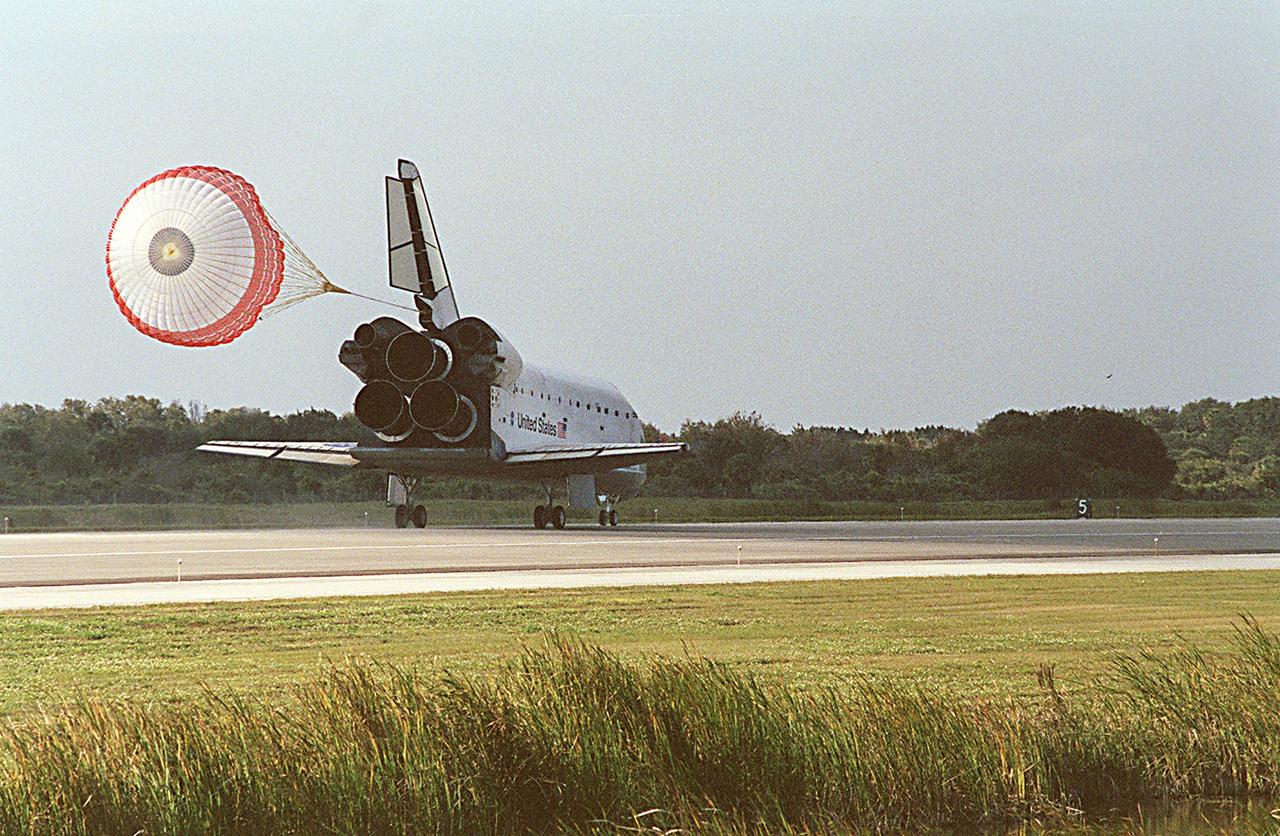
KENNEDY SPACE CENTER, FLA. -- The drag chute on Space Shuttle Endeavour unfurls upon landing on runway 33 at the Shuttle Landing Facility, bringing to a close the 13-day, 18-hour, 48-minute, 5.74-million mile STS-113 mission to the International Space Station. Main gear touchdown was at 2:37:12 p.m. EST, nose gear touchdown was at 2:37:23 p.m., and wheel stop was at 2:38:25 p.m. Poor weather conditions thwarted landing opportunities until a fourth day, the first time in Shuttle program history that a landing has been waved off for three consecutive days. The vehicle carries the STS-113 crew, Commander James Wetherbee, Pilot Paul Lockhart and Mission Specialists Michael Lopez-Alegria and John Herrington, as well as the returning Expedition Five crew, Commander Valeri Korzun, ISS Science Officer Peggy Whitson and Flight Engineer Sergei Treschev. The installation of the P1 truss on the International Space Station was accomplished during the mission.
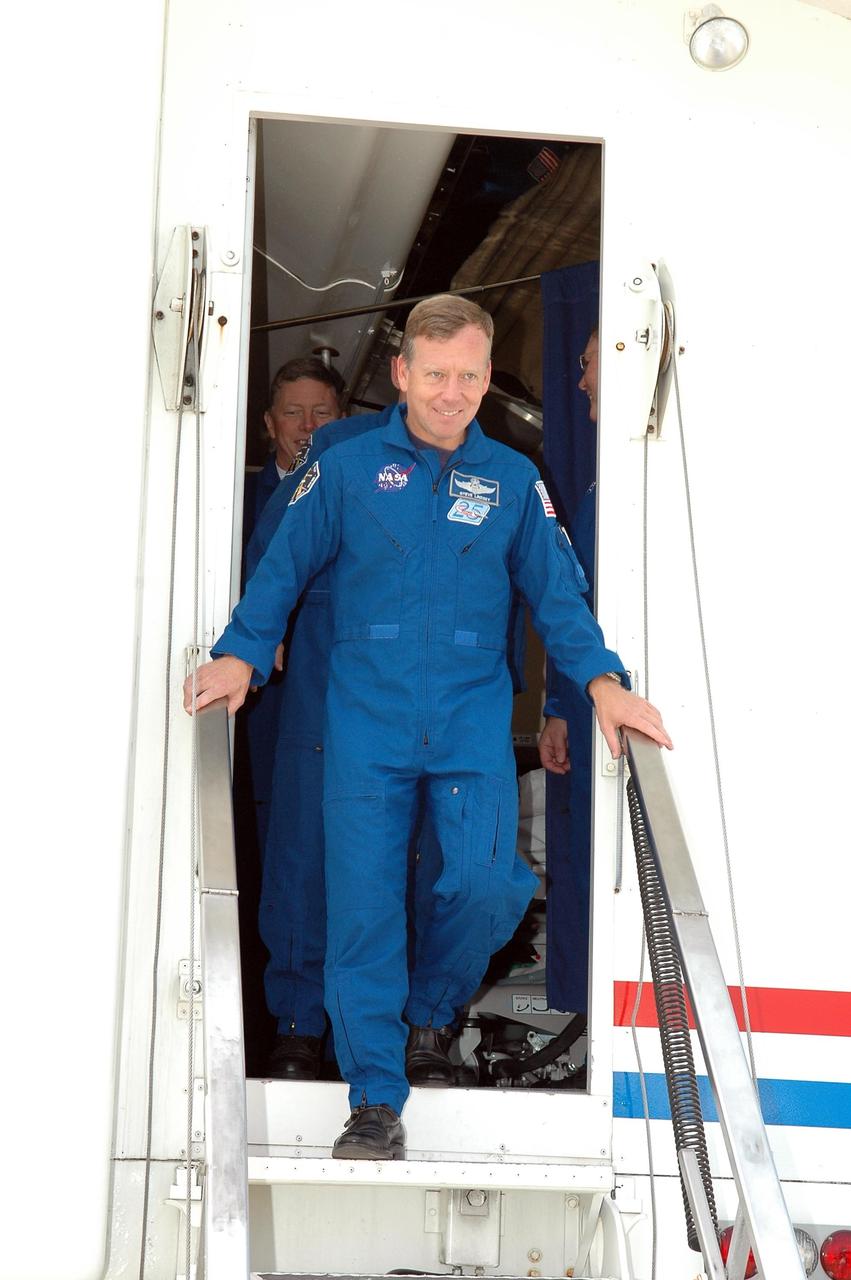
KENNEDY SPACE CENTER, FLA. - STS-121 Mission Commander Steven Lindsey is the first of the crew to exit the crew transport vehicle brought alongside the orbiter Discovery after landing. Behind him can be seen Mission Specialist Michael Fossum. The rest of the crew are Pilot Mark Kelly and Mission Specialists Piers Sellers, Lisa Nowak and Stephanie Wilson. Mission Specialist Thomas Reiter, who launched with the crew on July 4, remained on the station to join the Expedition 13 crew there. Discovery's smooth and perfect landing was on time at 9:14 a.m. EDT on Runway 15 of NASA's Shuttle Landing Facility after traveling 5.3 million miles on 202 orbits. Mission elapsed time was 12 days, 18 hours, 37 minutes and 54 seconds. The landing is the 62nd at Kennedy Space Center and the 32nd for Discovery. Photo credit: NASA/Kim Shiflett
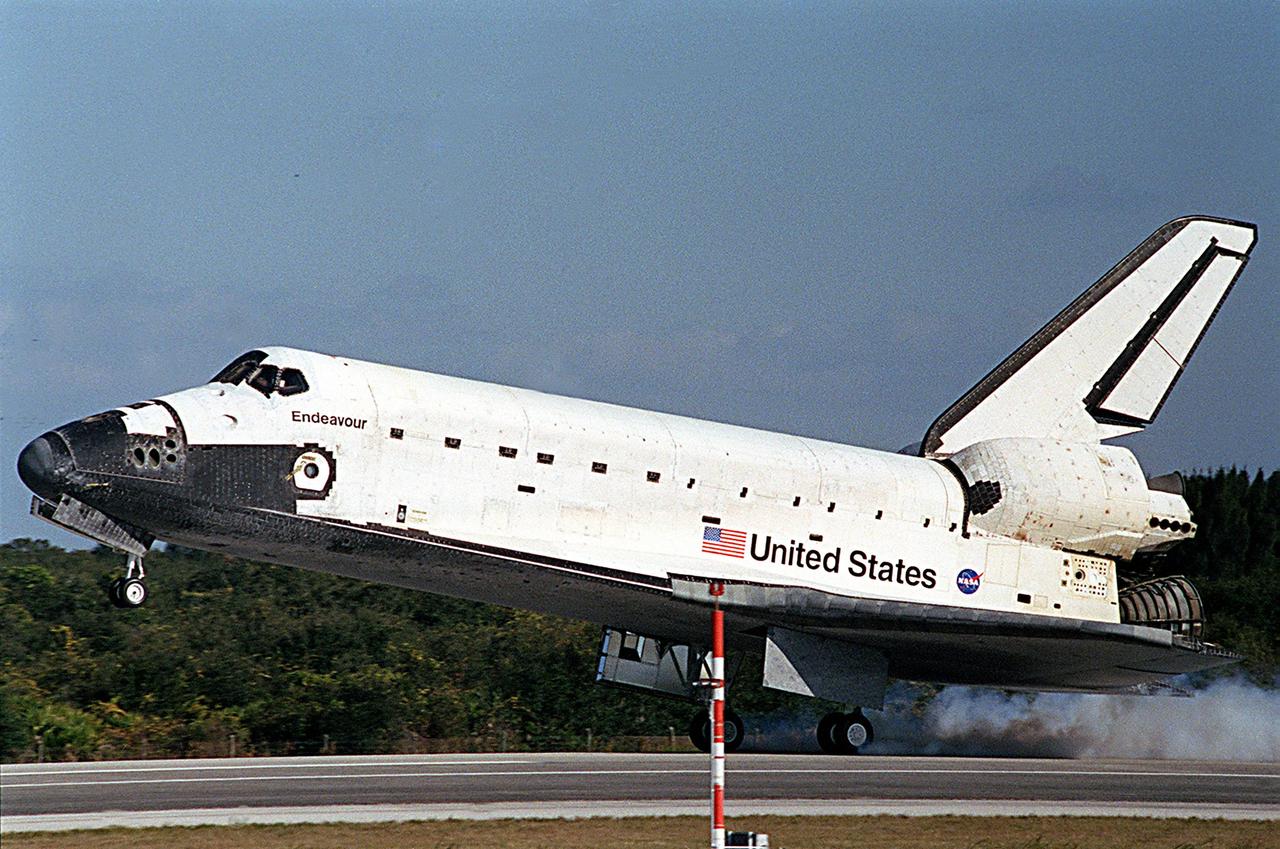
KENNEDY SPACE CENTER, FLA. -- The wheels of Space Shuttle Endeavour make contact with runway 33 at the Shuttle Landing Facility, bringing to a close the 13-day, 18-hour, 48-minute, 5.74-million mile STS-113 mission to the International Space Station. Main gear touchdown was at 2:37:12 p.m. EST, nose gear touchdown was at 2:37:23 p.m., and wheel stop was at 2:38:25 p.m. Poor weather conditions thwarted landing opportunities until a fourth day, the first time in Shuttle program history that a landing has been waved off for three consecutive days. The vehicle carries the STS-113 crew, Commander James Wetherbee, Pilot Paul Lockhart and Mission Specialists Michael Lopez-Alegria and John Herrington, as well as the returning Expedition Five crew, Commander Valeri Korzun, ISS Science Officer Peggy Whitson and Flight Engineer Sergei Treschev. The installation of the P1 truss on the International Space Station was accomplished during the mission.
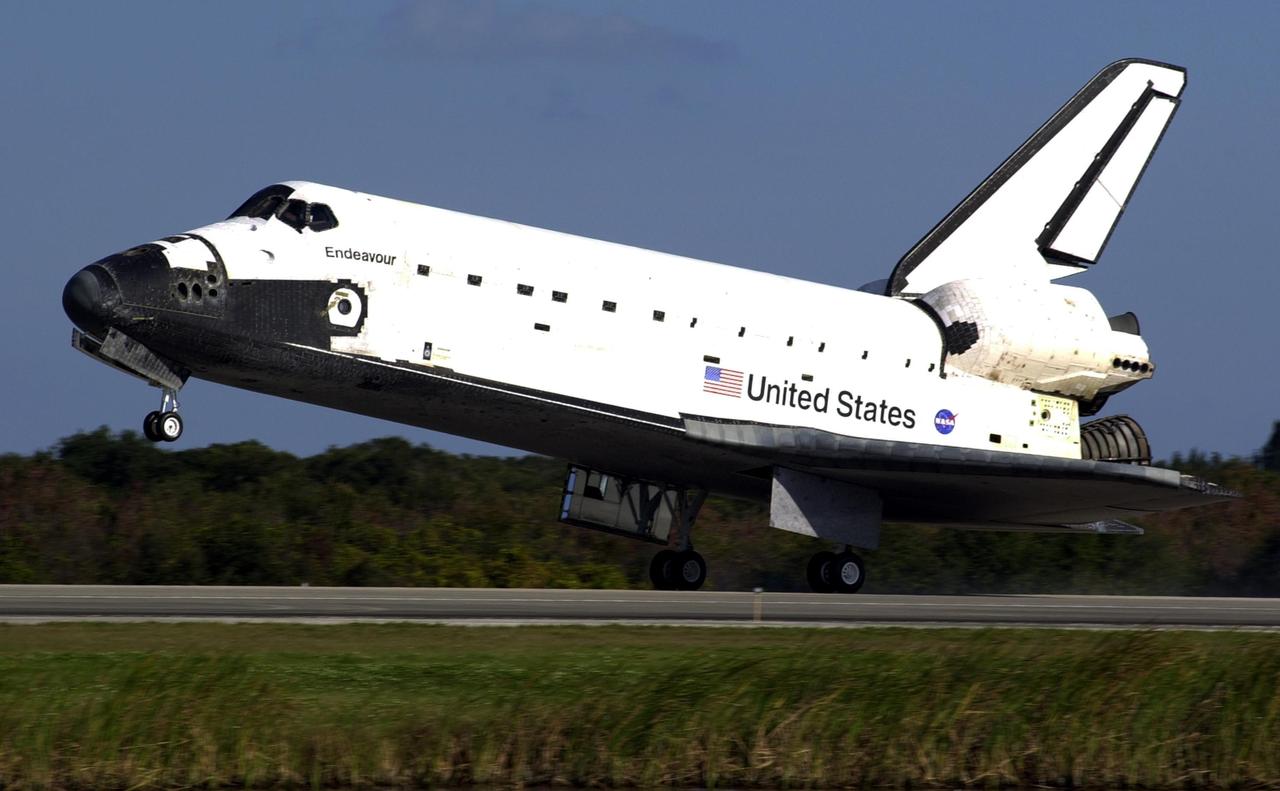
KENNEDY SPACE CENTER, FLA. - Space Shuttle Endeavour touches down on runway 33 at the Shuttle Landing Facility (SLF) after completing the 13-day, 18-hour, 48-minute, 5.74-million mile STS-113 mission to the International Space Station. Main gear touchdown was at 2:37:12 p.m. EST, nose gear touchdown was at 2:37:23 p.m., and wheel stop was at 2:38:25 p.m. Poor weather conditions thwarted landing opportunities until a fourth day, the first time in Shuttle program history that a landing has been waved off for three consecutive days. The vehicle carries the STS-113 crew, Commander James Wetherbee, Pilot Paul Lockhart and Mission Specialists Michael Lopez-Alegria and John Herrington, as well as the returning Expedition Five crew, Commander Valeri Korzun, ISS Science Officer Peggy Whitson and Flight Engineer Sergei Treschev. The installation of the P1 truss on the International Space Station was accomplished during the mission.
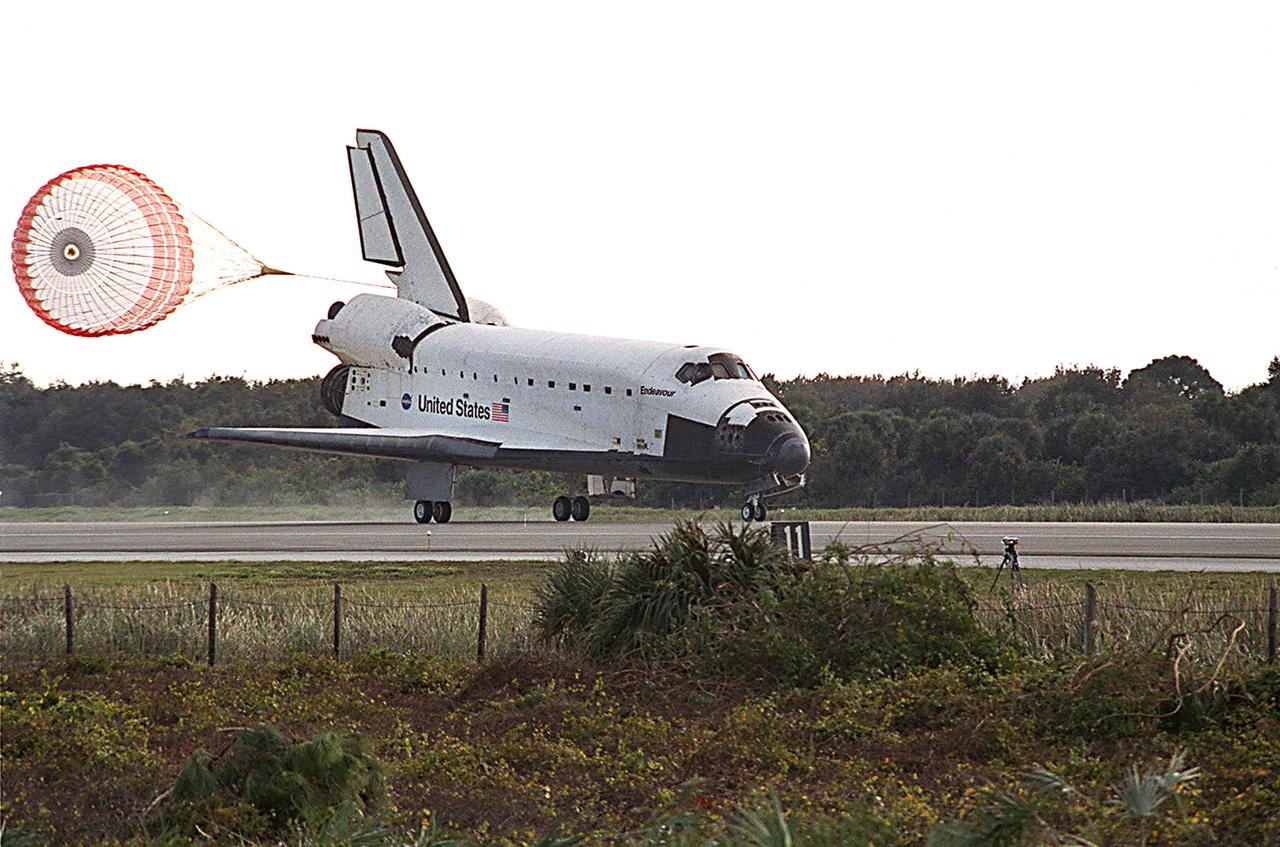
KENNEDY SPACE CENTER, FLA. -- The drag chute trails Space Shuttle Endeavour after touch down on runway 33 at the Shuttle Landing Facility, bringing to a close the 13-day, 18-hour, 48-minute, 5.74-million mile STS-113 mission to the International Space Station. Main gear touchdown was at 2:37:12 p.m. EST, nose gear touchdown was at 2:37:23 p.m., and wheel stop was at 2:38:25 p.m. Poor weather conditions thwarted landing opportunities until a fourth day, the first time in Shuttle program history that a landing has been waved off for three consecutive days. The vehicle carries the STS-113 crew, Commander James Wetherbee, Pilot Paul Lockhart and Mission Specialists Michael Lopez-Alegria and John Herrington, as well as the returning Expedition Five crew, Commander Valeri Korzun, ISS Science Officer Peggy Whitson and Flight Engineer Sergei Treschev. The installation of the P1 truss on the International Space Station was accomplished during the mission.
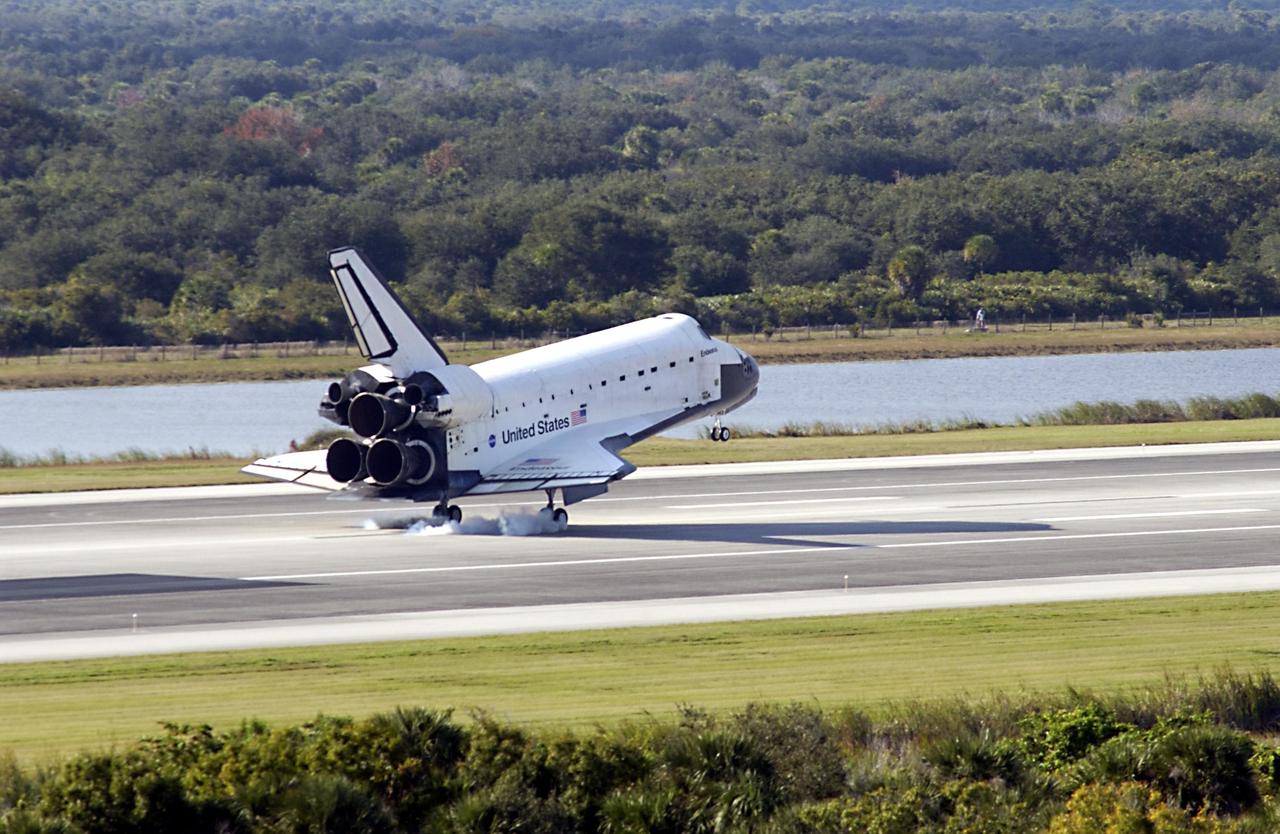
KENNEDY SPACE CENTER, FLA. - Space Shuttle Endeavour's wheels make first contact with runway 33 at the Shuttle Landing Facility after completing the 13-day, 18-hour, 48-minute, 5.74-million mile STS-113 mission to the International Space Station. Main gear touchdown was at 2:37:12 p.m. EST, nose gear touchdown was at 2:37:23 p.m., and wheel stop was at 2:38:25 p.m. Poor weather conditions thwarted landing opportunities until a fourth day, the first time in Shuttle program history that a landing has been waved off for three consecutive days. The vehicle carries the STS-113 crew, Commander James Wetherbee, Pilot Paul Lockhart and Mission Specialists Michael Lopez-Alegria and John Herrington, as well as the returning Expedition Five crew, Commander Valeri Korzun, ISS Science Officer Peggy Whitson and Flight Engineer Sergei Treschev. The installation of the P1 truss on the International Space Station was accomplished during the mission.
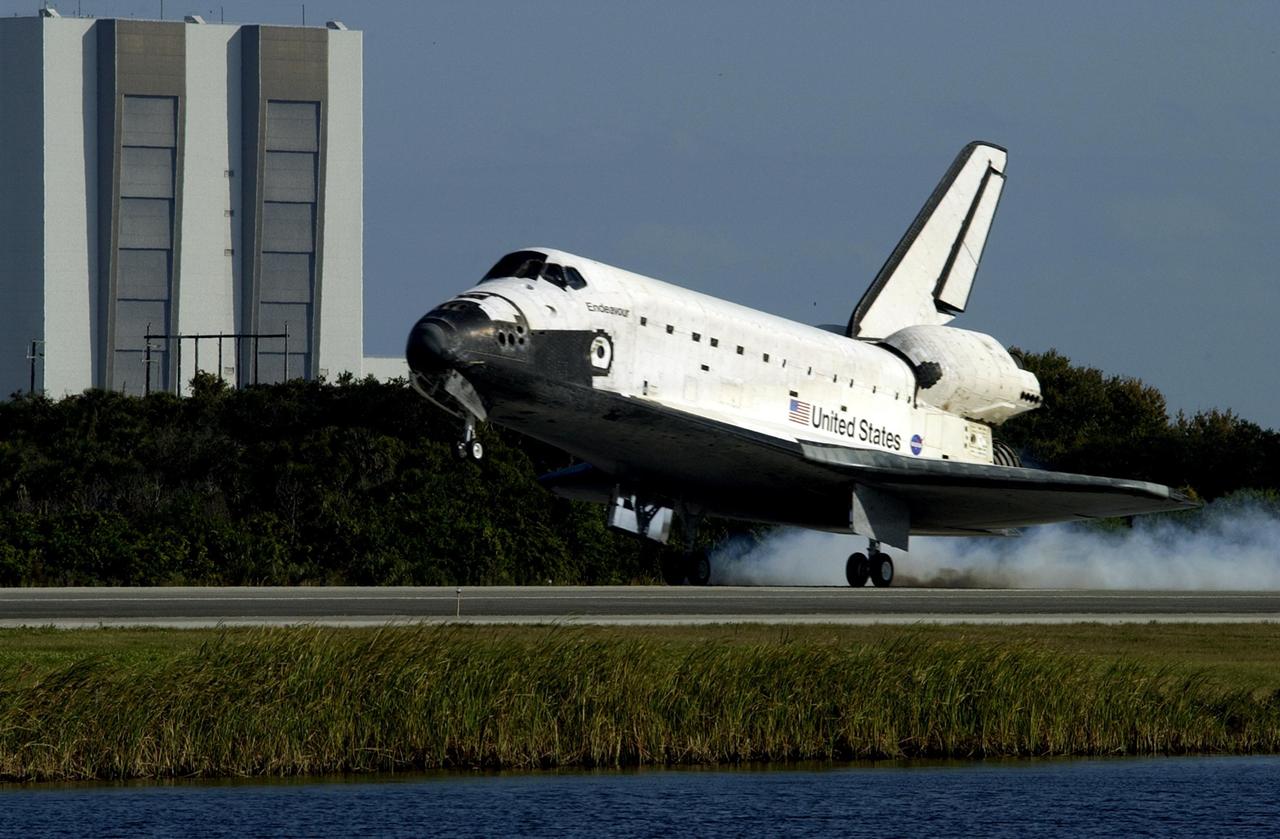
KENNEDY SPACE CENTER, FLA. - Space Shuttle Endeavour touches down on runway 33 at the Shuttle Landing Facility (SLF) after completing the 13-day, 18-hour, 48-minute, 5.74-million mile STS-113 mission to the International Space Station. In the background is a well known KSC landmark: the 525-foot-tall Vehicle Assembly Building. Main gear touchdown was at 2:37:12 p.m. EST, nose gear touchdown was at 2:37:23 p.m., and wheel stop was at 2:38:25 p.m. Poor weather conditions thwarted landing opportunities until a fourth day, the first time in Shuttle program history that a landing has been waved off for three consecutive days. The vehicle carries the STS-113 crew, Commander James Wetherbee, Pilot Paul Lockhart and Mission Specialists Michael Lopez-Alegria and John Herrington, as well as the returning Expedition Five crew, Commander Valeri Korzun, ISS Science Officer Peggy Whitson and Flight Engineer Sergei Treschev. The installation of the P1 truss on the International Space Station was accomplished during the mission.
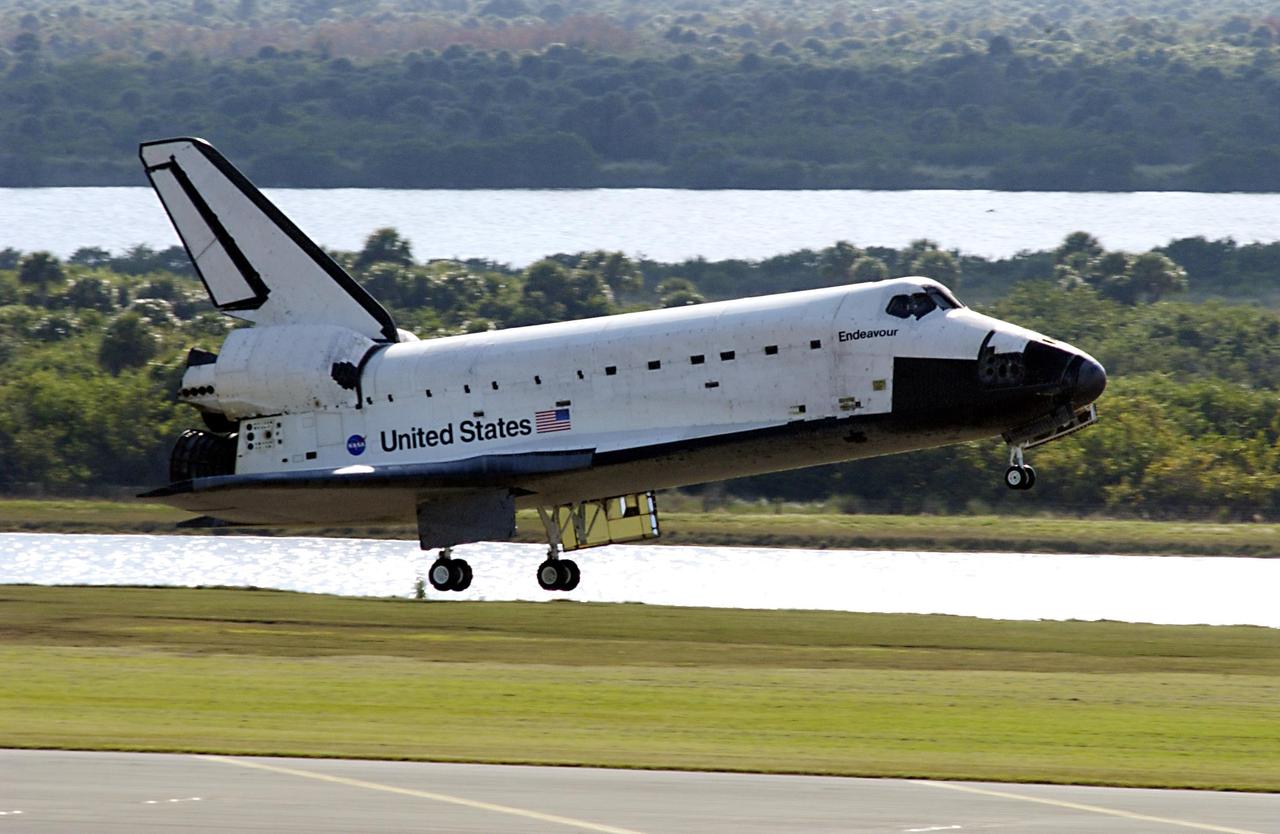
KENNEDY SPACE CENTER, FLA. - Space Shuttle Endeavour is moments away from touching down on runway 33 at the Shuttle Landing Facility after completing the 13-day, 18-hour, 48-minute, 5.74-million mile STS-113 mission to the International Space Station. Main gear touchdown was at 2:37:12 p.m. EST, nose gear touchdown was at 2:37:23 p.m., and wheel stop was at 2:38:25 p.m. Poor weather conditions thwarted landing opportunities until a fourth day, the first time in Shuttle program history that a landing has been waved off for three consecutive days. The vehicle carries the STS-113 crew, Commander James Wetherbee, Pilot Paul Lockhart and Mission Specialists Michael Lopez-Alegria and John Herrington, as well as the returning Expedition Five crew, Commander Valeri Korzun, ISS Science Officer Peggy Whitson and Flight Engineer Sergei Treschev. The installation of the P1 truss on the International Space Station was accomplished during the mission.
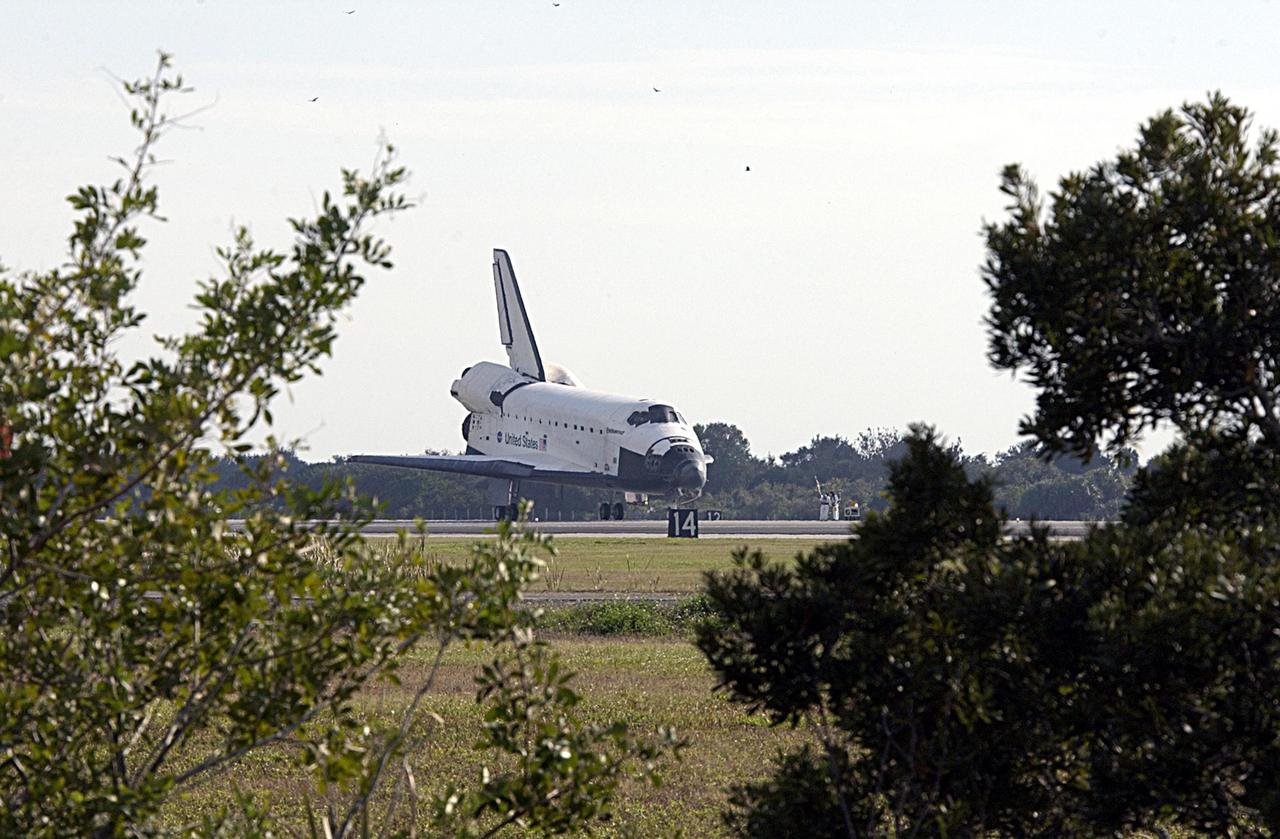
KENNEDY SPACE CENTER, FLA. - Seen through the lush Florida landscape, Space Shuttle Endeavour comes to a stop on runway 33 at the Shuttle Landing Facility after completing the 13-day, 18-hour, 48-minute, 5.74-million mile STS-113 mission to the International Space Station. Main gear touchdown was at 2:37:12 p.m. EST, nose gear touchdown was at 2:37:23 p.m., and wheel stop was at 2:38:25 p.m. Poor weather conditions thwarted landing opportunities until a fourth day, the first time in Shuttle program history that a landing has been waved off for three consecutive days. The vehicle carries the STS-113 crew, Commander James Wetherbee, Pilot Paul Lockhart and Mission Specialists Michael Lopez-Alegria and John Herrington, as well as the returning Expedition Five crew, Commander Valeri Korzun, ISS Science Officer Peggy Whitson and Flight Engineer Sergei Treschev. The installation of the P1 truss on the International Space Station was accomplished during the mission.
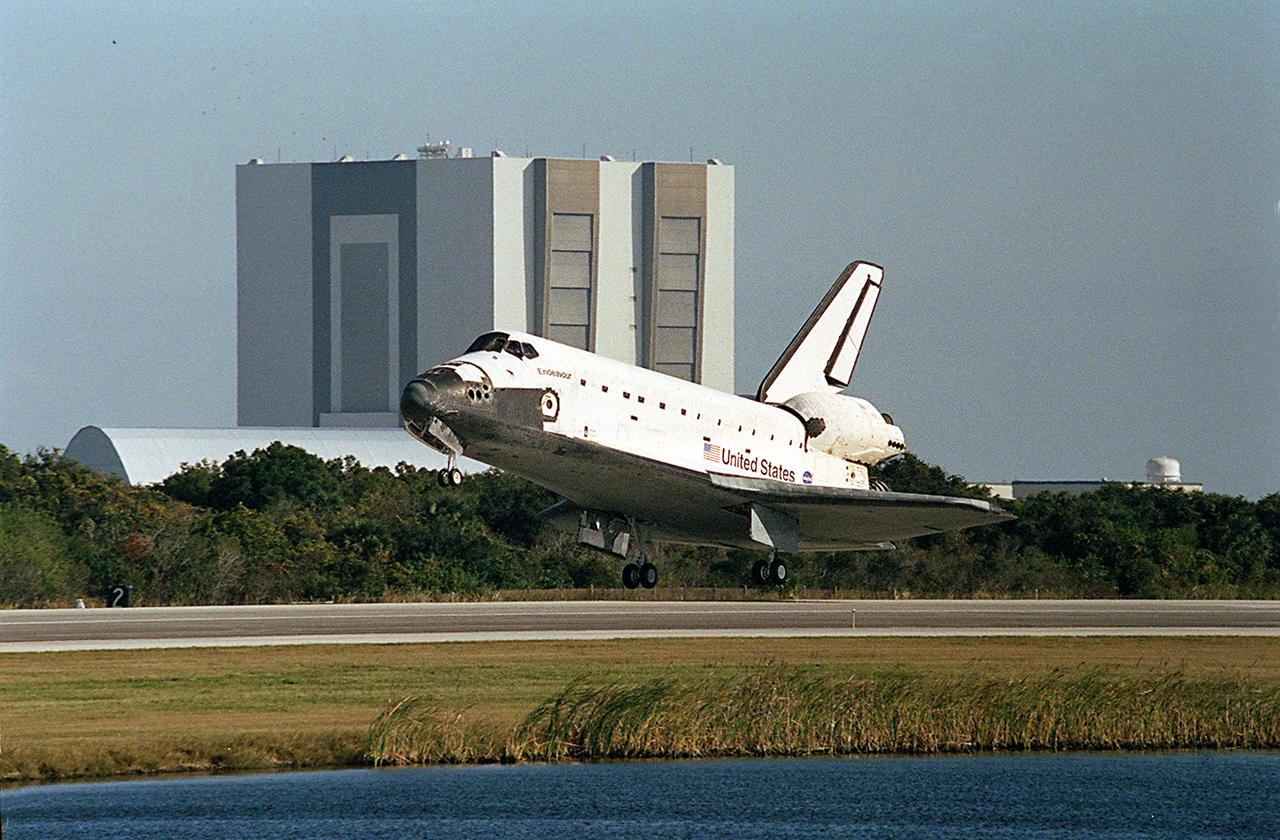
KENNEDY SPACE CENTER, FLA. -- Space Shuttle Endeavour is moments away from touch down on runway 33 at the Shuttle Landing Facility, bringing to a close the 13-day, 18-hour, 48-minute, 5.74-million mile STS-113 mission to the International Space Station. In the background is a KSC landmark: the Vehicle Assembly Building. Main gear touchdown was at 2:37:12 p.m. EST, nose gear touchdown was at 2:37:23 p.m., and wheel stop was at 2:38:25 p.m. Poor weather conditions thwarted landing opportunities until a fourth day, the first time in Shuttle program history that a landing has been waved off for three consecutive days. The vehicle carries the STS-113 crew, Commander James Wetherbee, Pilot Paul Lockhart and Mission Specialists Michael Lopez-Alegria and John Herrington, as well as the returning Expedition Five crew, Commander Valeri Korzun, ISS Science Officer Peggy Whitson and Flight Engineer Sergei Treschev. The installation of the P1 truss on the International Space Station was accomplished during the mission.
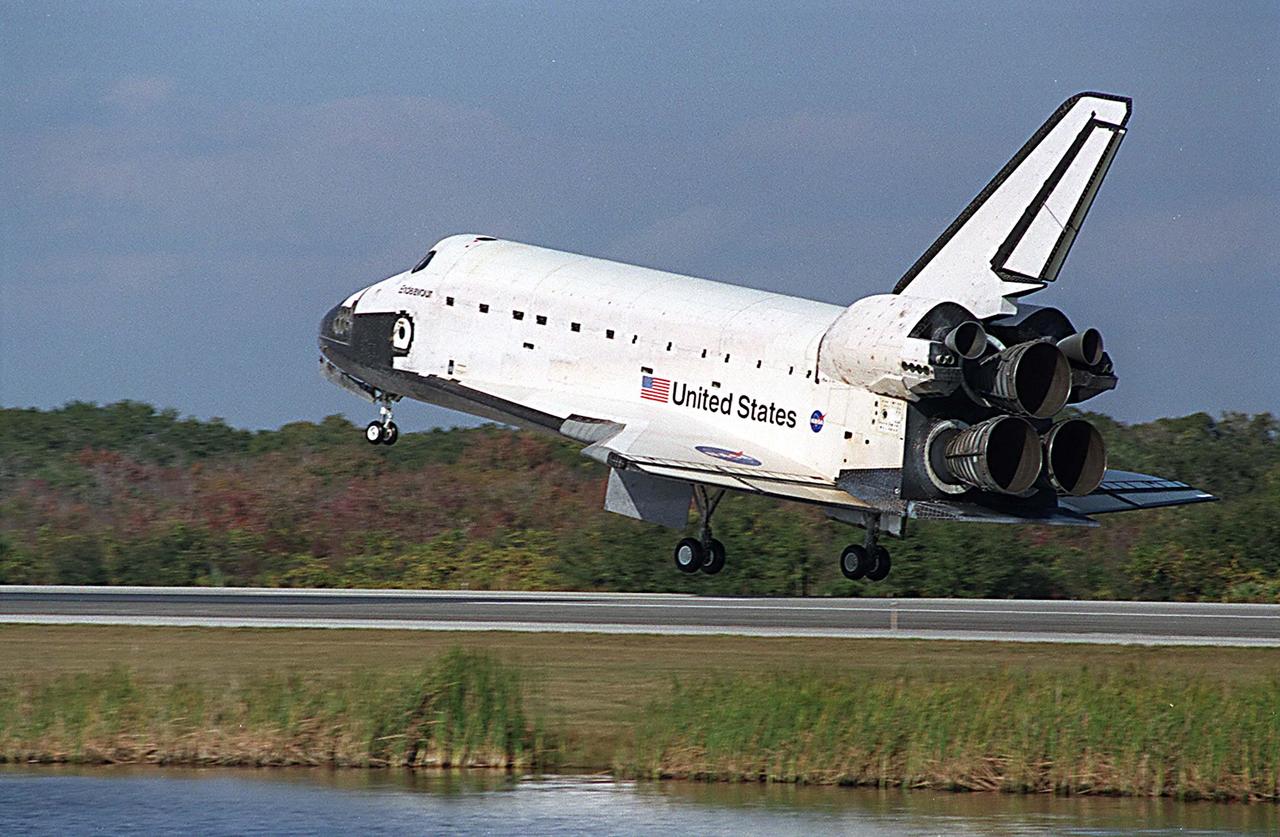
KENNEDY SPACE CENTER, FLA. -- Space Shuttle Endeavour is moments away from touching down on runway 33 at the Shuttle Landing Facility after completing the 13-day, 18-hour, 48-minute, 5.74-million mile STS-113 mission to the International Space Station. Main gear touchdown was at 2:37:12 p.m. EST, nose gear touchdown was at 2:37:23 p.m., and wheel stop was at 2:38:25 p.m. Poor weather conditions thwarted landing opportunities until a fourth day, the first time in Shuttle program history that a landing has been waved off for three consecutive days. The vehicle carries the STS-113 crew, Commander James Wetherbee, Pilot Paul Lockhart and Mission Specialists Michael Lopez-Alegria and John Herrington, as well as the returning Expedition Five crew, Commander Valeri Korzun, ISS Science Officer Peggy Whitson and Flight Engineer Sergei Treschev. The installation of the P1 truss on the International Space Station was accomplished during the mission.
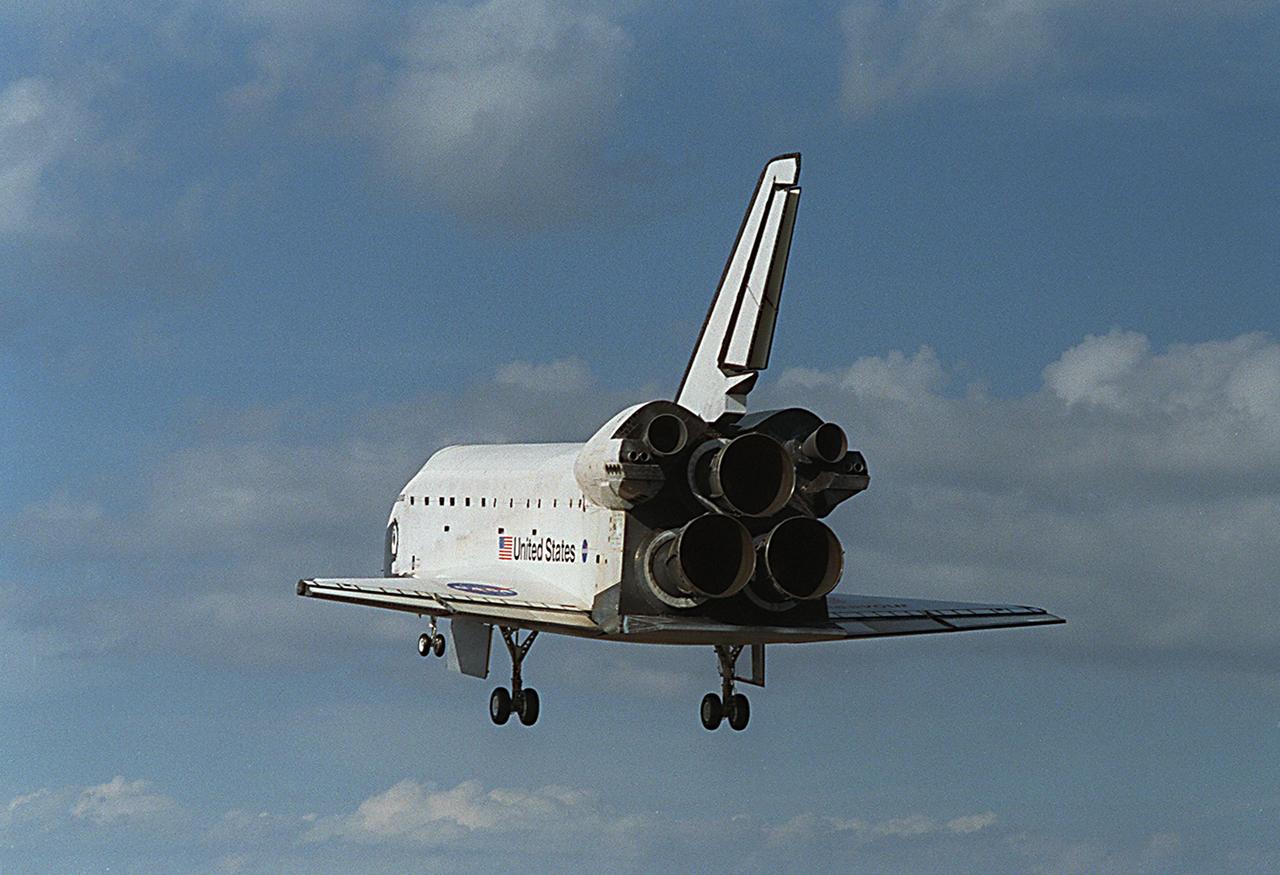
KENNEDY SPACE CENTER, FLA. -- Space Shuttle Endeavour makes its final approach to runway 33 at the Shuttle Landing Facility after completing the 13-day, 18-hour, 48-minute, 5.74-million mile STS-113 mission to the International Space Station. Main gear touchdown was at 2:37:12 p.m. EST, nose gear touchdown was at 2:37:23 p.m., and wheel stop was at 2:38:25 p.m. Poor weather conditions thwarted landing opportunities until a fourth day, the first time in Shuttle program history that a landing has been waved off for three consecutive days. The vehicle carries the STS-113 crew, Commander James Wetherbee, Pilot Paul Lockhart and Mission Specialists Michael Lopez-Alegria and John Herrington, as well as the returning Expedition Five crew, Commander Valeri Korzun, ISS Science Officer Peggy Whitson and Flight Engineer Sergei Treschev. The installation of the P1 truss on the International Space Station was accomplished during the mission.
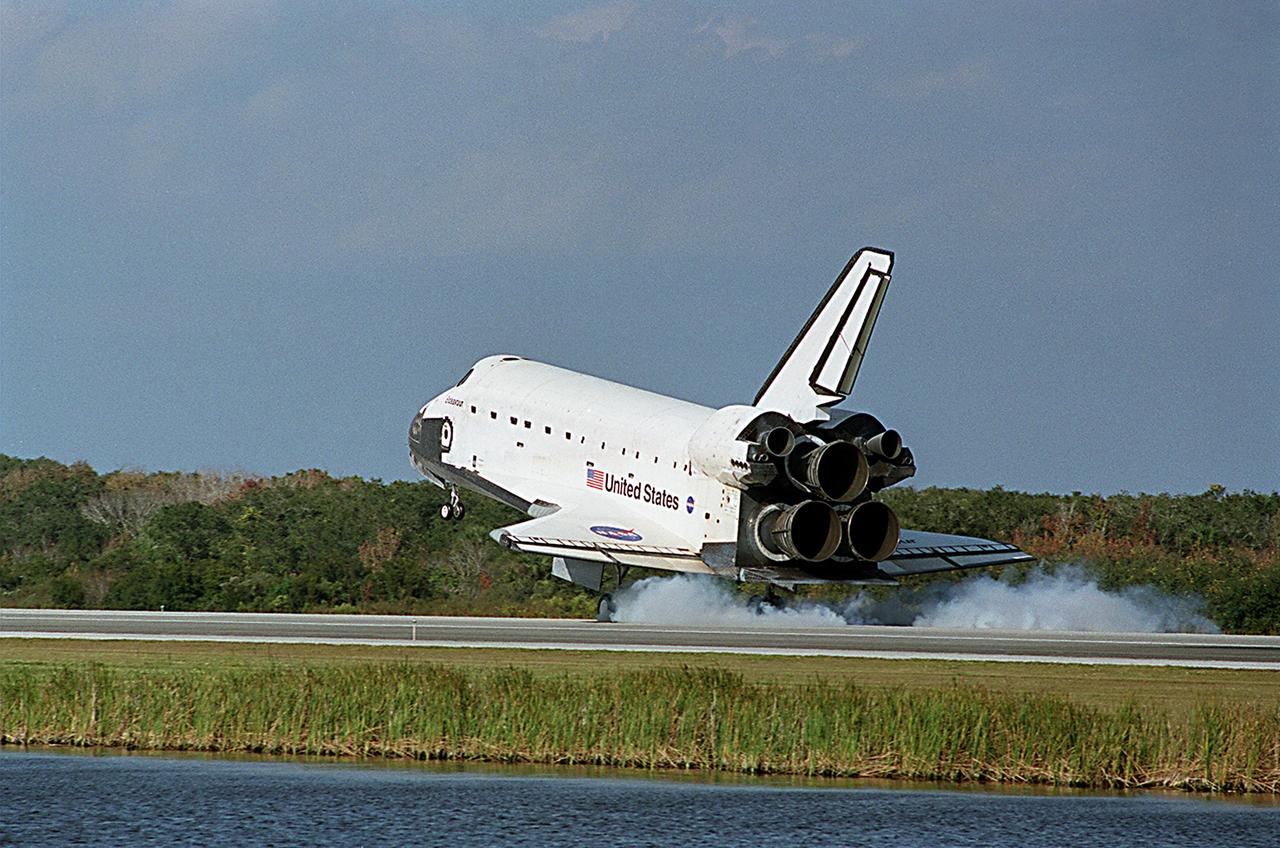
KENNEDY SPACE CENTER, FLA. -- The wheels of Space Shuttle Endeavour make contact with runway 33 at the Shuttle Landing Facility after completing the 13-day, 18-hour, 48-minute, 5.74-million mile STS-113 mission to the International Space Station. Main gear touchdown was at 2:37:12 p.m. EST, nose gear touchdown was at 2:37:23 p.m., and wheel stop was at 2:38:25 p.m. Poor weather conditions thwarted landing opportunities until a fourth day, the first time in Shuttle program history that a landing has been waved off for three consecutive days. The vehicle carries the STS-113 crew, Commander James Wetherbee, Pilot Paul Lockhart and Mission Specialists Michael Lopez-Alegria and John Herrington, as well as the returning Expedition Five crew, Commander Valeri Korzun, ISS Science Officer Peggy Whitson and Flight Engineer Sergei Treschev. The installation of the P1 truss on the International Space Station was accomplished during the mission.
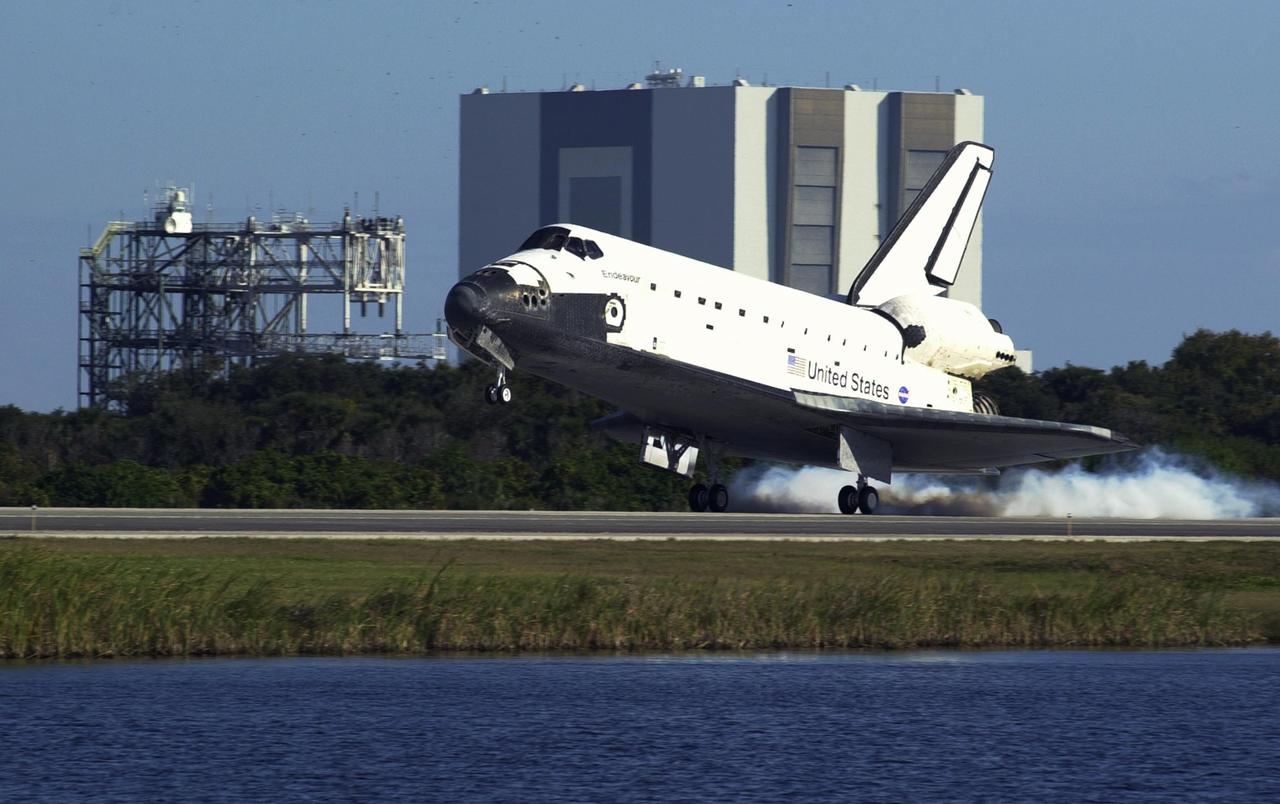
KENNEDY SPACE CENTER, FLA. - Space Shuttle Endeavour touches down on runway 33 at the Shuttle Landing Facility (SLF) after completing the 13-day, 18-hour, 48-minute, 5.74-million mile STS-113 mission to the International Space Station. In the background are two well known landmarks at KSC: the SLF's Mate/Demate Device (left) and the 525-foot-tall Vehicle Assembly Building. Main gear touchdown was at 2:37:12 p.m. EST, nose gear touchdown was at 2:37:23 p.m., and wheel stop was at 2:38:25 p.m. Poor weather conditions thwarted landing opportunities until a fourth day, the first time in Shuttle program history that a landing has been waved off for three consecutive days. The vehicle carries the STS-113 crew, Commander James Wetherbee, Pilot Paul Lockhart and Mission Specialists Michael Lopez-Alegria and John Herrington, as well as the returning Expedition Five crew, Commander Valeri Korzun, ISS Science Officer Peggy Whitson and Flight Engineer Sergei Treschev. The installation of the P1 truss on the International Space Station was accomplished during the mission.

KENNEDY SPACE CENTER, FLA. - Space Shuttle Endeavour touches down on runway 33 at the Shuttle Landing Facility (SLF) after completing the 13-day, 18-hour, 48-minute, 5.74-million mile STS-113 mission to the International Space Station. Main gear touchdown was at 2:37:12 p.m. EST, nose gear touchdown was at 2:37:23 p.m., and wheel stop was at 2:38:25 p.m. Poor weather conditions thwarted landing opportunities until a fourth day, the first time in Shuttle program history that a landing has been waved off for three consecutive days. The vehicle carries the STS-113 crew, Commander James Wetherbee, Pilot Paul Lockhart and Mission Specialists Michael Lopez-Alegria and John Herrington, as well as the returning Expedition Five crew, Commander Valeri Korzun, ISS Science Officer Peggy Whitson and Flight Engineer Sergei Treschev. The installation of the P1 truss on the International Space Station was accomplished during the mission.

KENNEDY SPACE CENTER, FLA. -- The wheels of Space Shuttle Endeavour make contact with runway 33 at the Shuttle Landing Facility, bringing to a close the 13-day, 18-hour, 48-minute, 5.74-million mile STS-113 mission to the International Space Station. Main gear touchdown was at 2:37:12 p.m. EST, nose gear touchdown was at 2:37:23 p.m., and wheel stop was at 2:38:25 p.m. Poor weather conditions thwarted landing opportunities until a fourth day, the first time in Shuttle program history that a landing has been waved off for three consecutive days. The vehicle carries the STS-113 crew, Commander James Wetherbee, Pilot Paul Lockhart and Mission Specialists Michael Lopez-Alegria and John Herrington, as well as the returning Expedition Five crew, Commander Valeri Korzun, ISS Science Officer Peggy Whitson and Flight Engineer Sergei Treschev. The installation of the P1 truss on the International Space Station was accomplished during the mission.
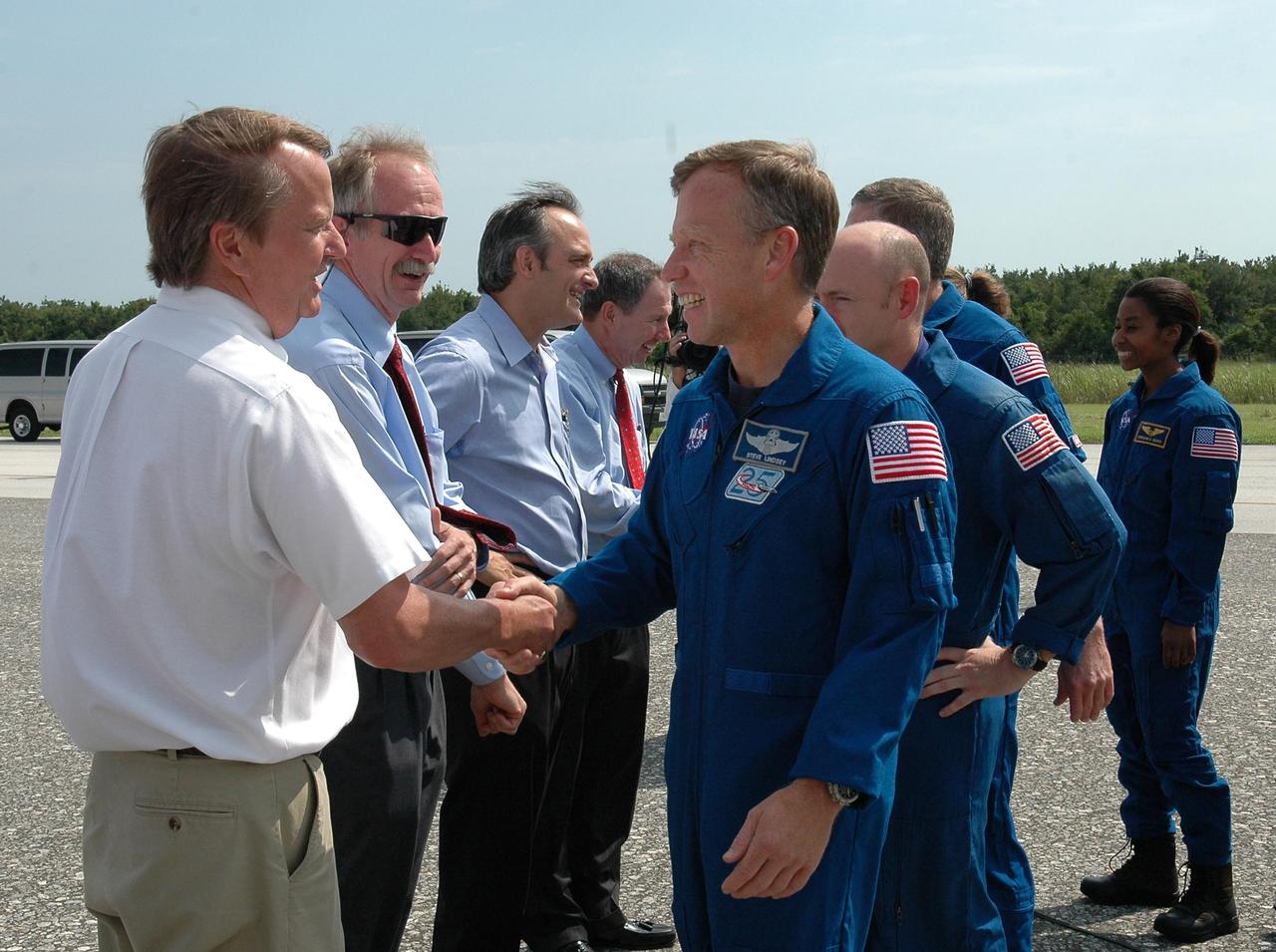
KENNEDY SPACE CENTER, FLA. - (From left) Shuttle Launch Director Mike Leinbach, Associate Administrator for Space Operations Bill Gerstenmaier, Associate Administrator Rex Geveden and NASA Administrator Mike Griffin greet STS-121 Commander Steven Lindsey, Pilot Mike Kelly and Mission Specialists Michael Fossum and Stephanie Wilson. Not visible are Mission Specialists Piers Sellers and Lisa Nowak. Mission Specialist Thomas Reiter, who launched with the crew on July 4, remained on the station to join the Expedition 13 crew there. Discovery's smooth and perfect landing was on time at 9:14 a.m. EDT on Runway 15 of NASA's Shuttle Landing Facility after traveling 5.3 million miles on 202 orbits. Mission elapsed time was 12 days, 18 hours, 37 minutes and 54 seconds. The landing is the 62nd at Kennedy Space Center and the 32nd for Discovery. Photo credit: NASA/Kim Shiflett
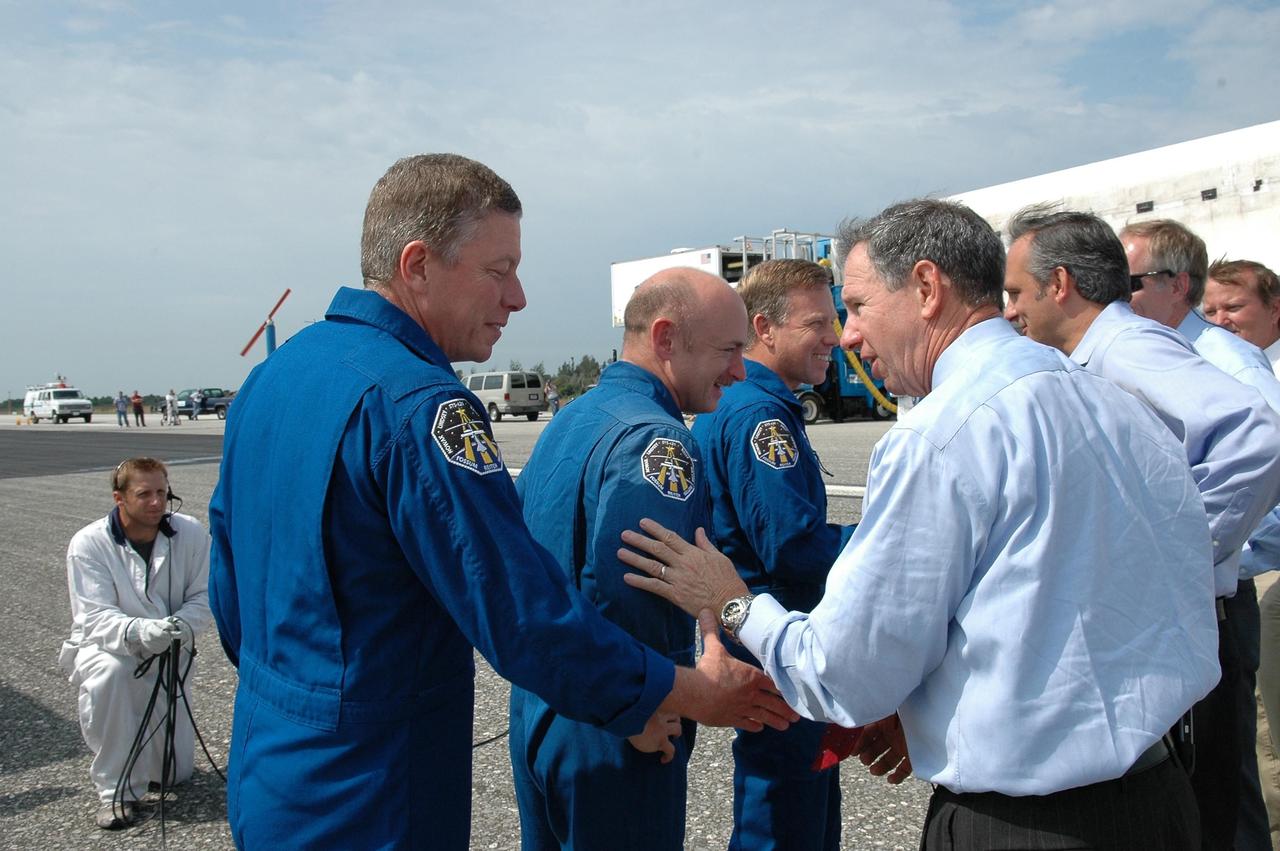
KENNEDY SPACE CENTER, FLA. - (From left) STS-121 Mission Specialist Michael Fossum, Pilot Mark Kelly and Commander Steven Lindsey are greeted by NASA Administrator Mike Griffin (foreground, right), Associate Administrator Rex Geveden and other senior managers after leaving the orbiter Discovery, in the background. The rest of the crew are Mission Specialists Piers Sellers, Lisa Nowak and Stephanie Wilson. Mission Specialist Thomas Reiter, who launched with the crew on July 4, remained on the station to join the Expedition 13 crew there. Discovery's smooth and perfect landing was on time at 9:14 a.m. EDT on Runway 15 of NASA's Shuttle Landing Facility after traveling 5.3 million miles on 202 orbits. Mission elapsed time was 12 days, 18 hours, 37 minutes and 54 seconds. The landing is the 62nd at Kennedy Space Center and the 32nd for Discovery. Photo credit: NASA/Kim Shiflett
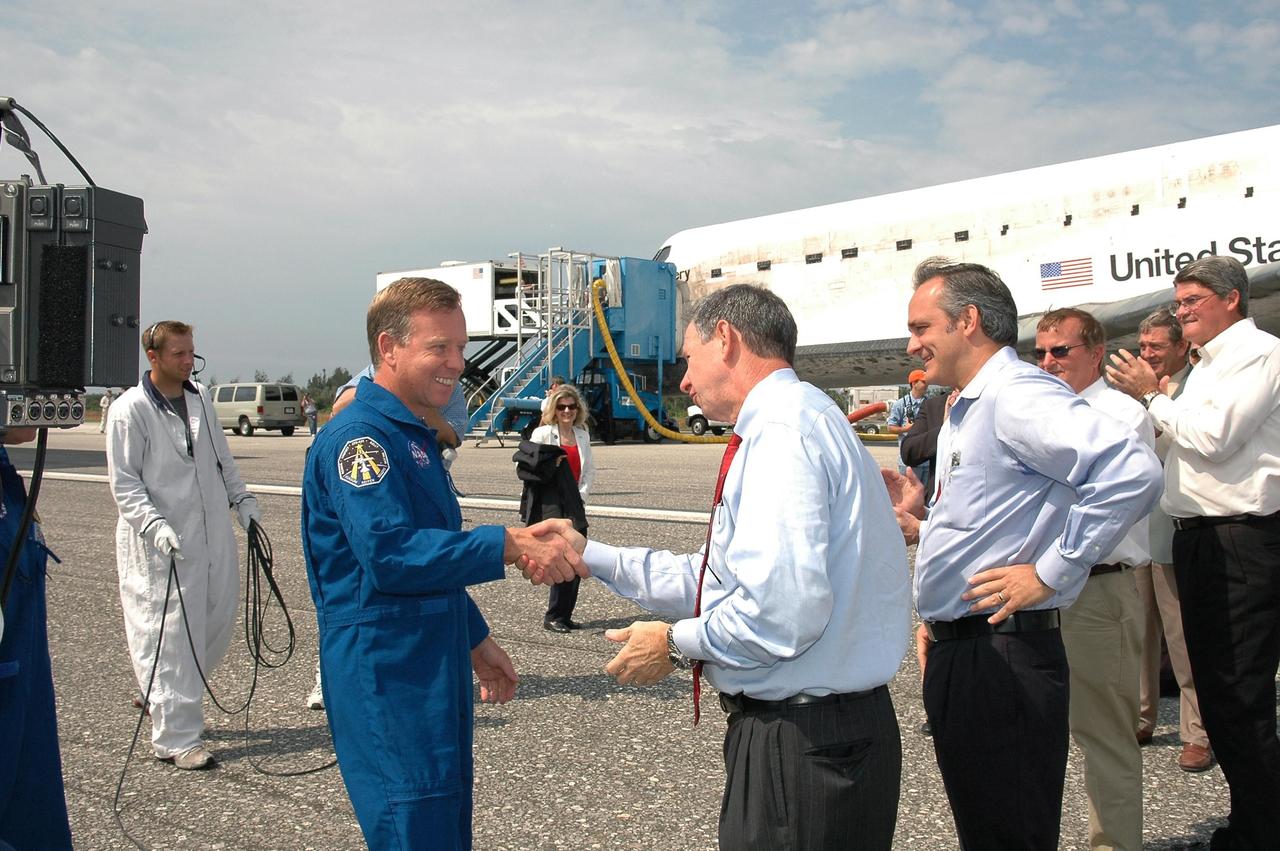
KENNEDY SPACE CENTER, FLA. - STS-121 Mission Commander Steven Lindsey is greeted by NASA Administrator Mike Griffin, Associate Administrator Rex Geveden, Shuttle Launch Director Mike Leinbach, KSC Deputy Director Bill Parsons and other senior managers after leaving the orbiter Discovery, in the background. The rest of the crew are Pilot Mark Kelly and Mission Specialists Piers Sellers, Lisa Nowak and Stephanie Wilson. Mission Specialist Thomas Reiter, who launched with the crew on July 4, remained on the station to join the Expedition 13 crew there. Discovery's smooth and perfect landing was on time at 9:14 a.m. EDT on Runway 15 of NASA's Shuttle Landing Facility after traveling 5.3 million miles on 202 orbits. Mission elapsed time was 12 days, 18 hours, 37 minutes and 54 seconds. The landing is the 62nd at Kennedy Space Center and the 32nd for Discovery. Photo credit: NASA/Kim Shiflett
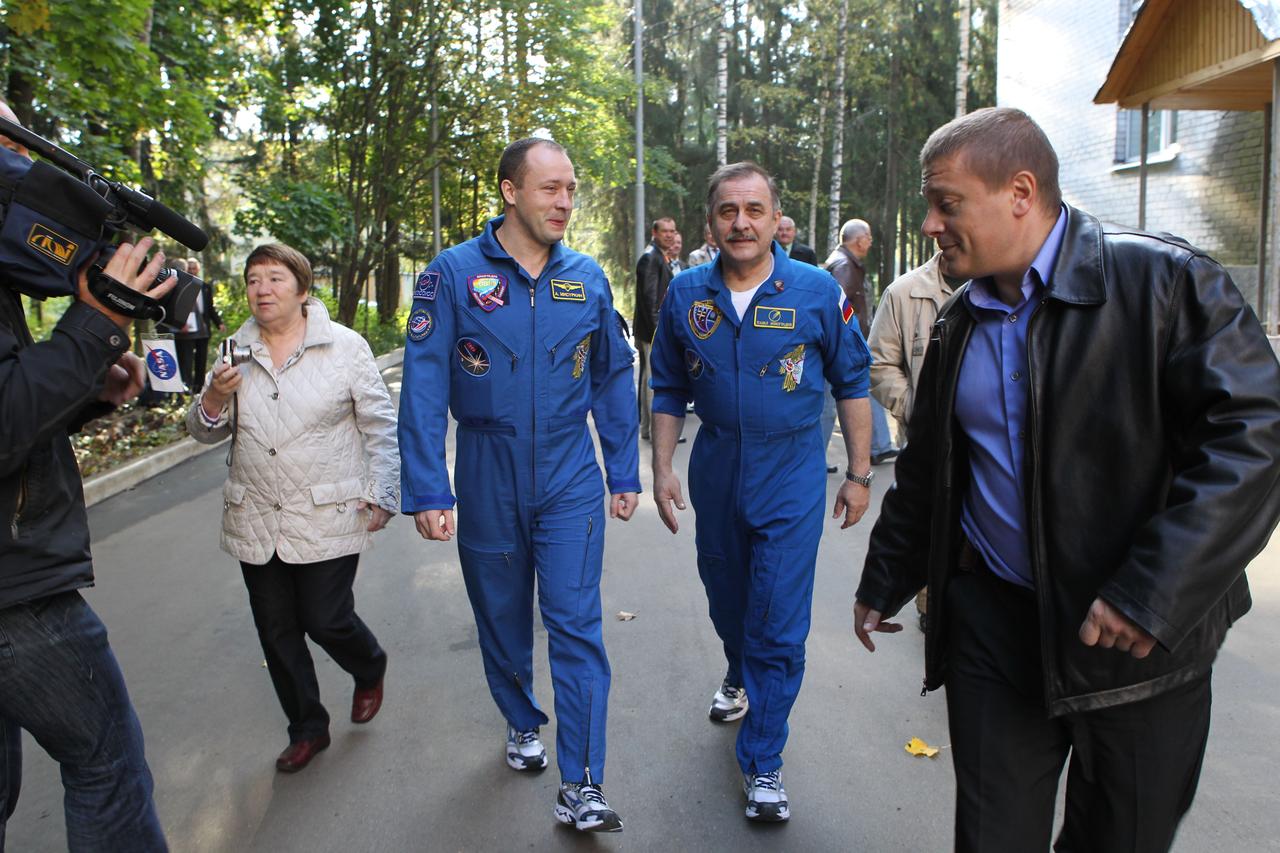
Fresh off of their return to Earth following almost six months aboard the International Space Station, Expedition 36 crewmembers Alexander Misurkin (left) and Pavel Vinogradov (right) take a stroll at the Gagarin Cosmonaut Training Center in Star City, Russia Sept. 13 following a departure ceremony for Expedition 37/38 Soyuz Commander Oleg Kotov, Flight Engineer Sergey Ryazanskiy and NASA Flight Engineer Michael Hopkins. Misurkin and Vinogradov landed in their Soyuz spacecraft on the steppe of Kazakhstan Sept. 11 with NASA’s Chris Cassidy. Hopkins, Kotov and Ryazanskiy left Star City for their launch site at the Baikonur Cosmodrome in Kazakhstan where they will launch Sept. 26, Kazakh time, in the Soyuz TMA-10M spacecraft for a five and a half month mission on the International Space Station. NASA/Stephanie Stoll
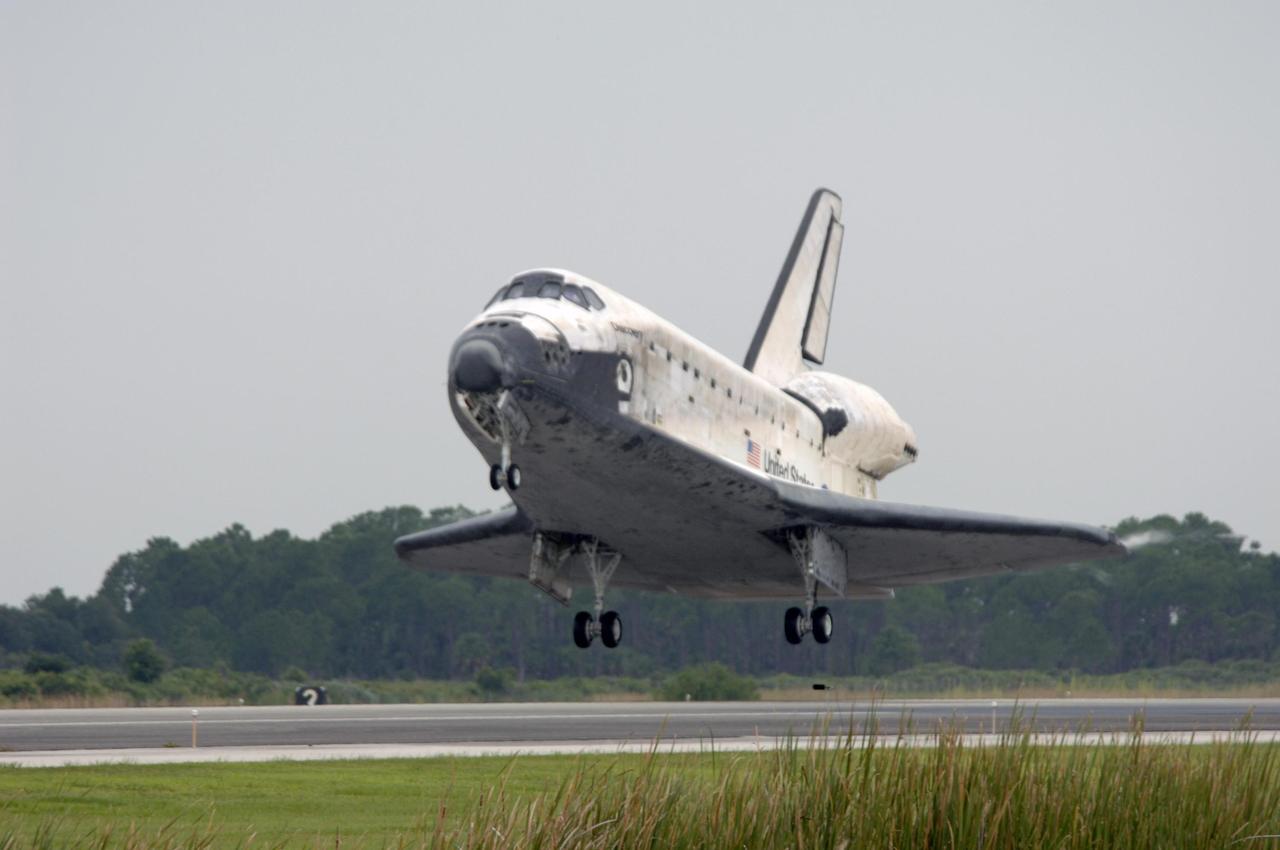
KENNEDY SPACE CENTER, FLA. - The orbiter Discovery drops toward Runway 15 at NASA's Shuttle Landing Facility for landing after completing mission STS-121 to the International Space Station. Discovery traveled 5.3 million miles, landing on orbit 202. Mission elapsed time was 12 days, 18 hours, 37 minutes and 54 seconds. Main gear touchdown occurred on time at 9:14:43 EDT. Wheel stop was at 9:15:49 EDT. The returning crew members aboard are Commander Steven Lindsey, Pilot Mark Kelly and Mission Specialists Piers Sellers, Michael Fossum, Lisa Nowak and Stephanie Wilson. Mission Specialist Thomas Reiter, who launched with the crew on July 4, remained on the station to join the Expedition 13 crew there. The landing is the 62nd at Kennedy Space Center and the 32nd for Discovery. Discovery's landing was as exhilarating as its launch, the first to take place on America's Independence Day. During the mission, the STS-121 crew tested new equipment and procedures to improve shuttle safety, and delivered supplies and made repairs to the International Space Station. Photo credit: NASA/Tim Powers
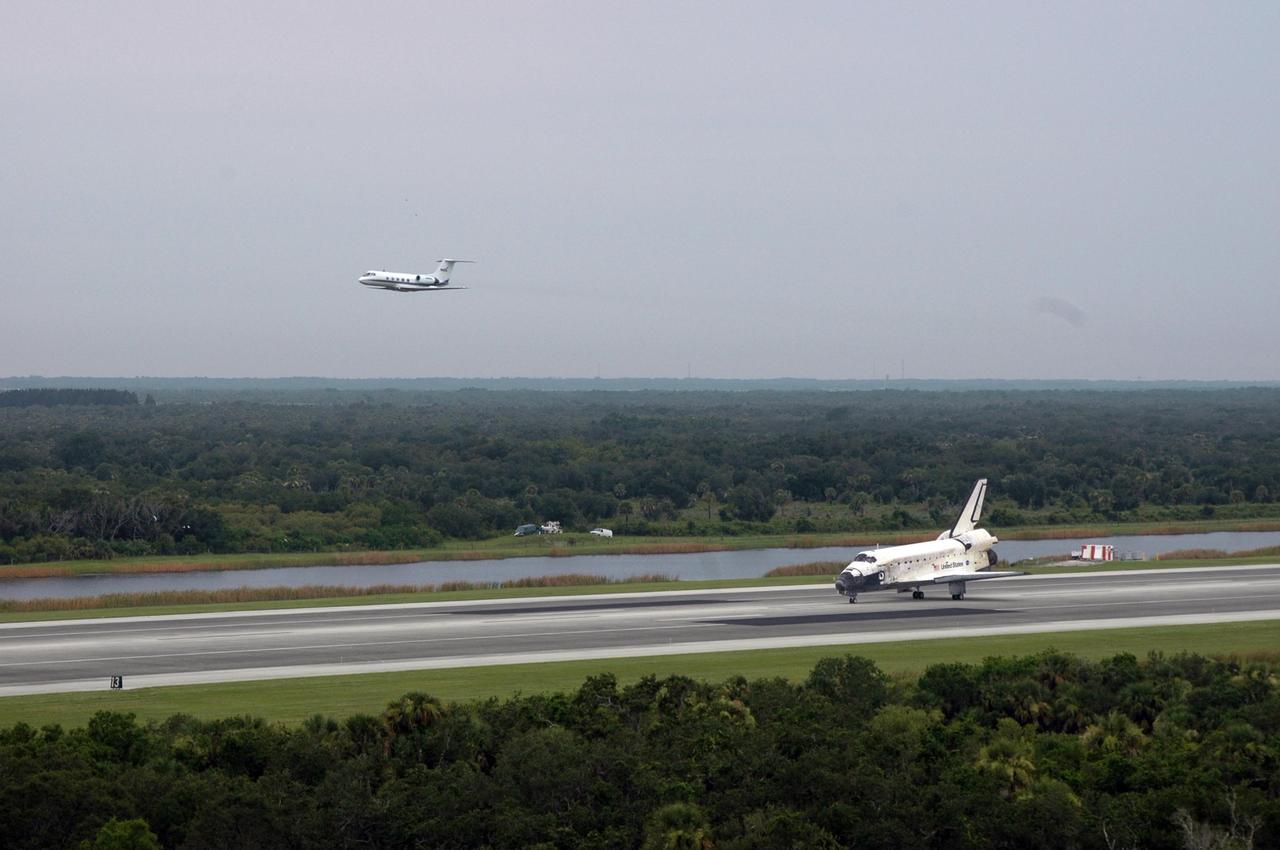
KENNEDY SPACE CENTER, FLA. - The orbiter Discovery makes a safe landing on Runway 15 at NASA's Shuttle Landing Facility, completing mission STS-121 to the International Space Station. Discovery traveled 5.3 million miles, landing on orbit 202. Mission elapsed time was 12 days, 18 hours, 37 minutes and 54 seconds. Main gear touchdown occurred on time at 9:14:43 EDT. Wheel stop was at 9:15:49 EDT. The returning crew members are Commander Steven Lindsey, Pilot Mark Kelly and Mission Specialists Piers Sellers, Michael Fossum, Lisa Nowak and Stephanie Wilson. Mission Specialist Thomas Reiter, who launched with the crew on July 4, remained on the station to join the Expedition 13 crew there. The landing is the 62nd at Kennedy Space Center and the 32nd for Discovery. Discovery's landing was as exhilarating as its launch, the first to take place on America's Independence Day. During the mission, the STS-121 crew tested new equipment and procedures to improve shuttle safety, and delivered supplies and made repairs to the International Space Station. Photo credit: NASA/Ken Thornsley
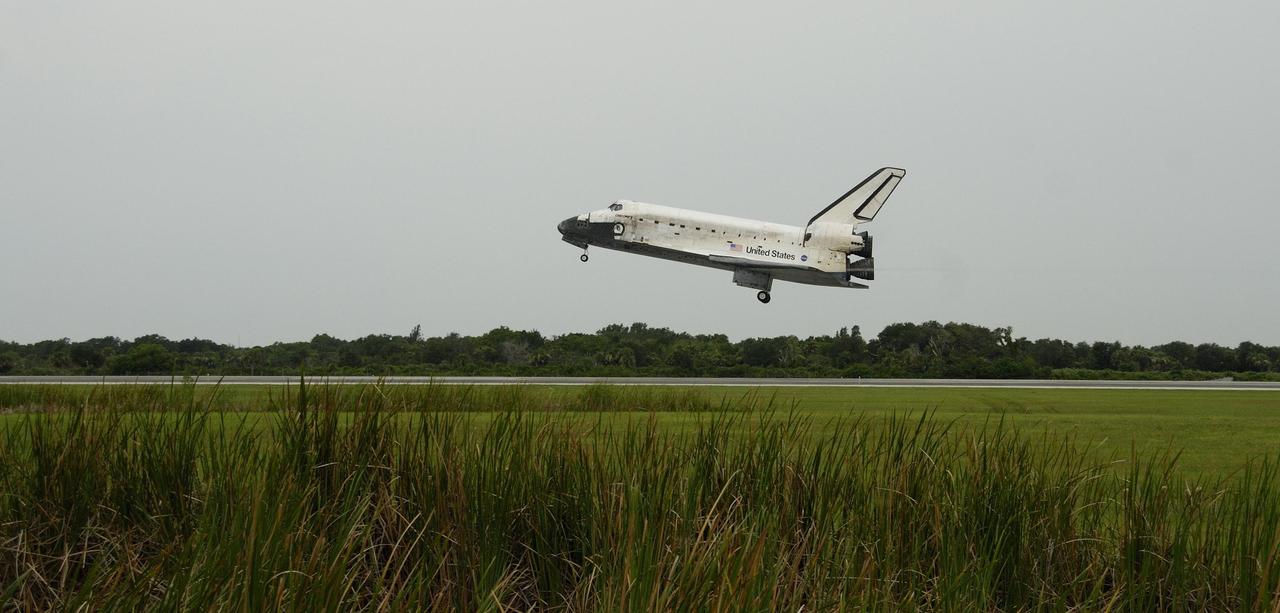
KENNEDY SPACE CENTER, FLA. - The orbiter Discovery, with Commander Steven Lindsey at the helm, approaches Runway 15 at NASA's Shuttle Landing Facility for landing after completing mission STS-121 to the International Space Station. Discovery traveled 5.3 million miles, landing on orbit 202. Mission elapsed time was 12 days, 18 hours, 37 minutes and 54 seconds. Main gear touchdown occurred on time at 9:14:43 EDT. Wheel stop was at 9:15:49 EDT. The rest of the crew aboard are Pilot Mark Kelly and Mission Specialists Piers Sellers, Michael Fossum, Lisa Nowak and Stephanie Wilson. Mission Specialist Thomas Reiter, who launched with the crew on July 4, remained on the station to join the Expedition 13 crew there. The landing is the 62nd at Kennedy Space Center and the 32nd for Discovery. Discovery's landing was as exhilarating as its launch, the first to take place on America's Independence Day. During the mission, the STS-121 crew tested new equipment and procedures to improve shuttle safety, and delivered supplies and made repairs to the International Space Station. Photo courtesy of Nikon/Scott Andrews
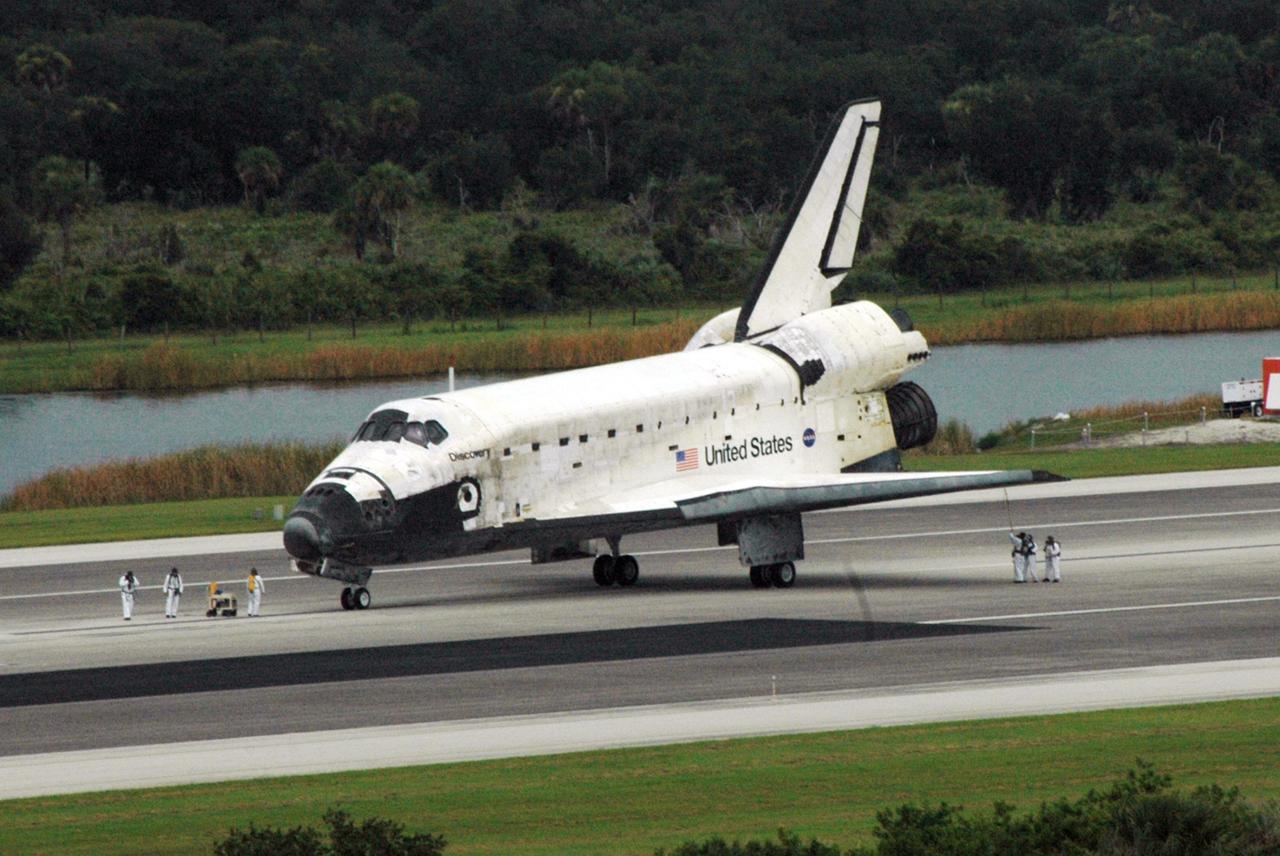
KENNEDY SPACE CENTER, FLA. - After Discovery's safe landing on Runway 15 at NASA's Shuttle Landing Facility, safety assessment teams dressed in protective attire and with breathing apparatus obtain vapor level readings around the orbiter and test for possible explosive or toxic gases such as hydrogen, hydrazine, monomethyl-hydrazine, nitrogen tetroxide or ammonia . Completing mission STS-121 to the International Space Station, Discovery traveled 5.3 million miles, landing on orbit 202. Mission elapsed time was 12 days, 18 hours, 37 minutes and 54 seconds. Main gear touchdown occurred on time at 9:14:43 EDT. Wheel stop was at 9:15:49 EDT. The returning crew members are Commander Steven Lindsey, Pilot Mark Kelly and Mission Specialists Piers Sellers, Michael Fossum, Lisa Nowak and Stephanie Wilson. Mission Specialist Thomas Reiter, who launched with the crew on July 4, remained on the station to join the Expedition 13 crew there. The landing is the 62nd at Kennedy Space Center and the 32nd for Discovery. Discovery's landing was as exhilarating as its launch, the first to take place on America's Independence Day. During the mission, the STS-121 crew tested new equipment and procedures to improve shuttle safety, and delivered supplies and made repairs to the International Space Station. Photo credit: NASA/Ken Thornsley
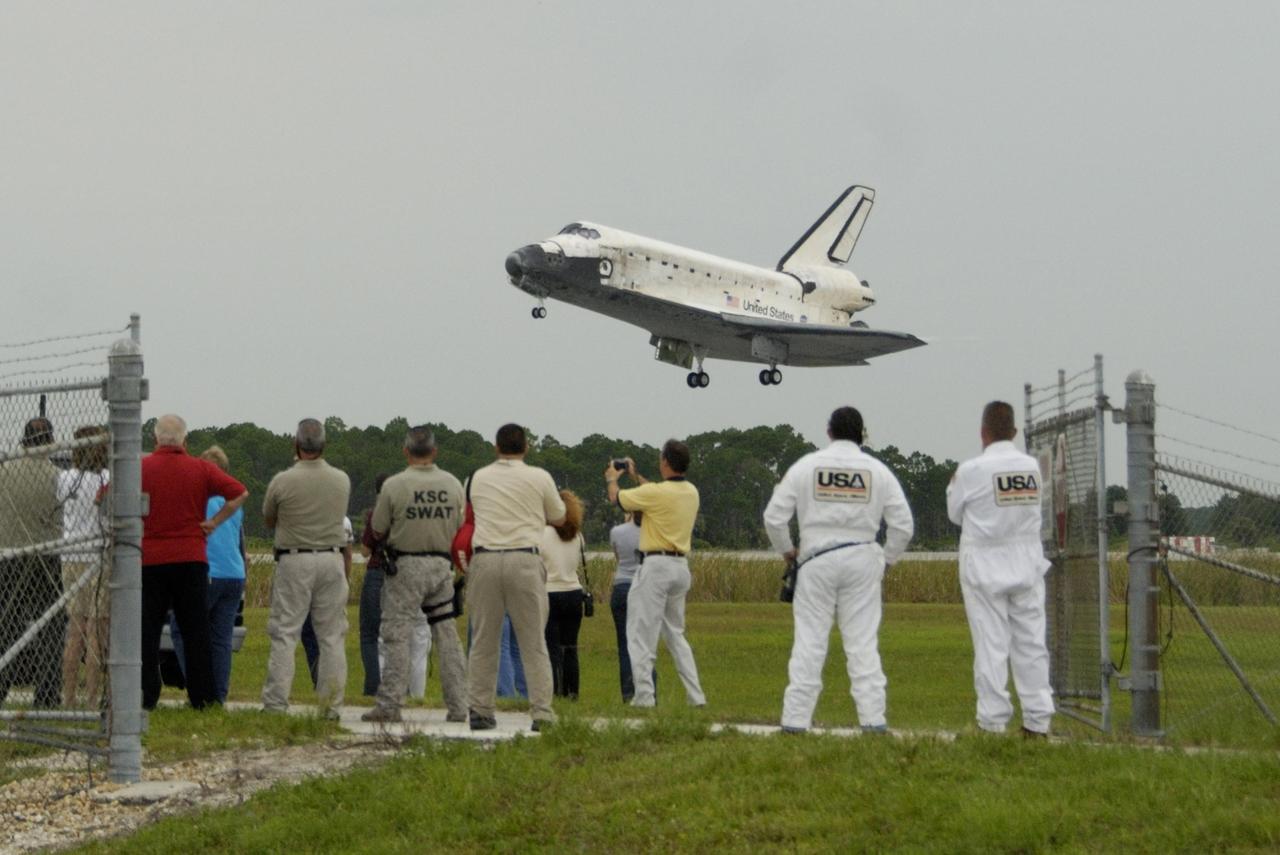
KENNEDY SPACE CENTER, FLA. - The orbiter Discovery, with Commander Steven Lindsey at the helm, approaches Runway 15 at NASA's Shuttle Landing Facility for landing after completing mission STS-121 to the International Space Station. Discovery traveled 5.3 million miles, landing on orbit 202. Mission elapsed time was 12 days, 18 hours, 37 minutes and 54 seconds. Main gear touchdown occurred on time at 9:14:43 EDT. Wheel stop was at 9:15:49 EDT. The rest of the crew aboard are Pilot Mark Kelly and Mission Specialists Piers Sellers, Michael Fossum, Lisa Nowak and Stephanie Wilson. Mission Specialist Thomas Reiter, who launched with the crew on July 4, remained on the station to join the Expedition 13 crew there. The landing is the 62nd at Kennedy Space Center and the 32nd for Discovery. Discovery's landing was as exhilarating as its launch, the first to take place on America's Independence Day. During the mission, the STS-121 crew tested new equipment and procedures to improve shuttle safety, and delivered supplies and made repairs to the International Space Station. Photo courtesy of Nikon/Scott Andrews
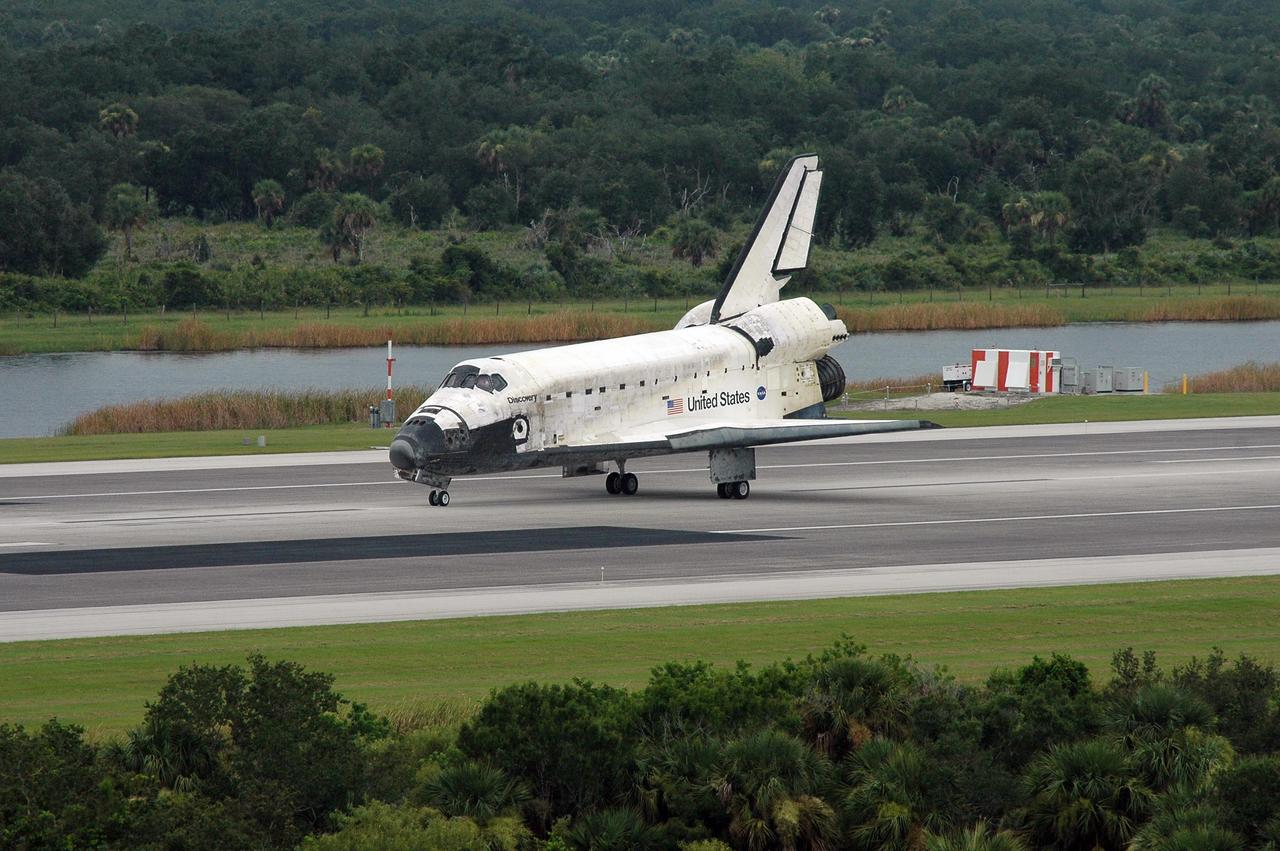
KENNEDY SPACE CENTER, FLA. - The orbiter Discovery slows to a stop after landing on Runway 15 at NASA's Shuttle Landing Facility, completing mission STS-121 to the International Space Station. Discovery traveled 5.3 million miles, landing on orbit 202. Mission elapsed time was 12 days, 18 hours, 37 minutes and 54 seconds. Main gear touchdown occurred on time at 9:14:43 EDT. Wheel stop was at 9:15:49 EDT. The returning crew members aboard are Commander Steven Lindsey, Pilot Mark Kelly and Mission Specialists Piers Sellers, Michael Fossum, Lisa Nowak and Stephanie Wilson. Mission Specialist Thomas Reiter, who launched with the crew on July 4, remained on the station to join the Expedition 13 crew there. The landing is the 62nd at Kennedy Space Center and the 32nd for Discovery. Discovery's landing was as exhilarating as its launch, the first to take place on America's Independence Day. During the mission, the STS-121 crew tested new equipment and procedures to improve shuttle safety, and delivered supplies and made repairs to the International Space Station. Photo credit: NASA/Kim Shiflett
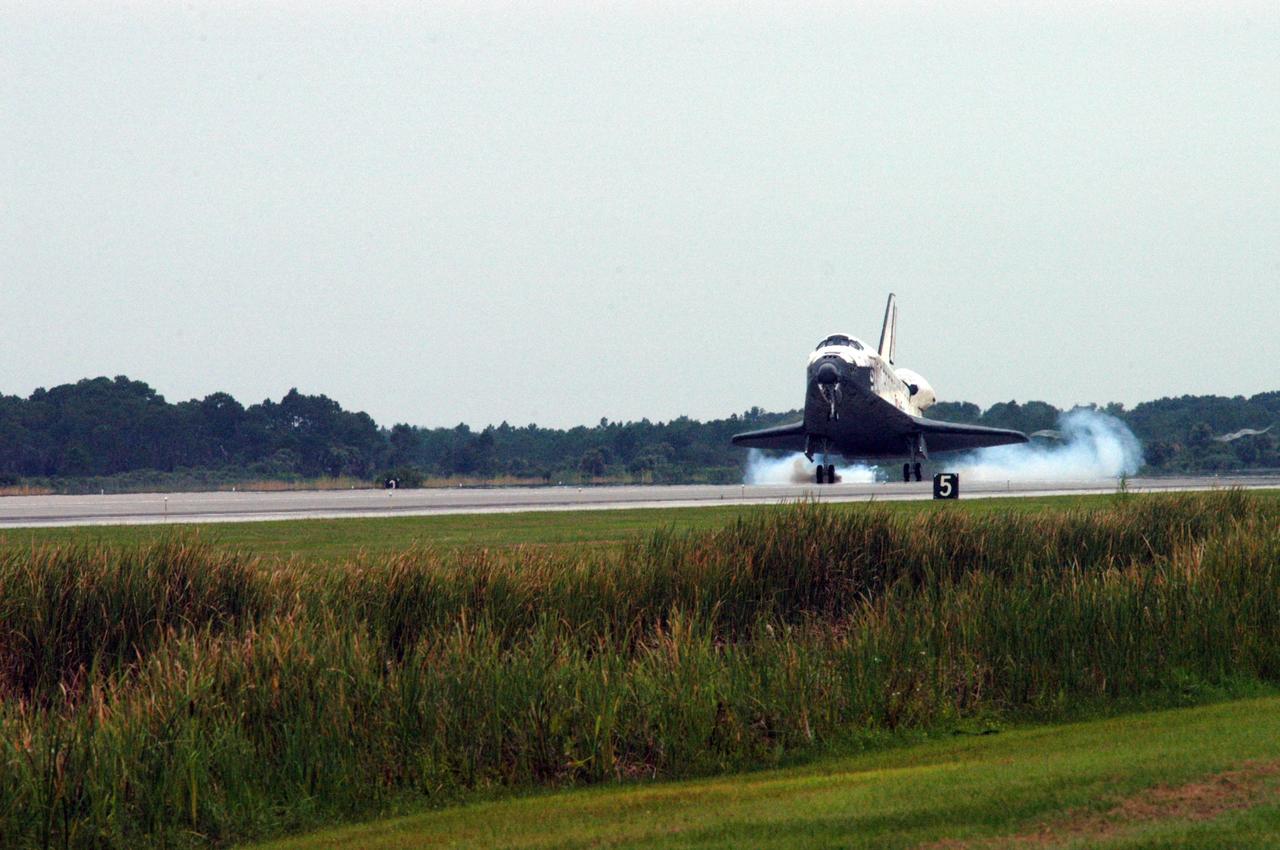
KENNEDY SPACE CENTER, FLA. - Kicking up dust as its wheels touch down, the orbiter Discovery lands on Runway 15 at NASA's Shuttle Landing Facility, completing mission STS-121 to the International Space Station. Discovery traveled 5.3 million miles, landing on orbit 202. Mission elapsed time was 12 days, 18 hours, 37 minutes and 54 seconds. Main gear touchdown occurred on time at 9:14:43 EDT. Wheel stop was at 9:15:49 EDT. The returning crew members aboard are Commander Steven Lindsey, Pilot Mark Kelly and Mission Specialists Piers Sellers, Michael Fossum, Lisa Nowak and Stephanie Wilson. Mission Specialist Thomas Reiter, who launched with the crew on July 4, remained on the station to join the Expedition 13 crew there. The landing is the 62nd at Kennedy Space Center and the 32nd for Discovery. Discovery's landing was as exhilarating as its launch, the first to take place on America's Independence Day. During the mission, the STS-121 crew tested new equipment and procedures to improve shuttle safety, and delivered supplies and made repairs to the International Space Station. Photo credit: NASA/George Shelton
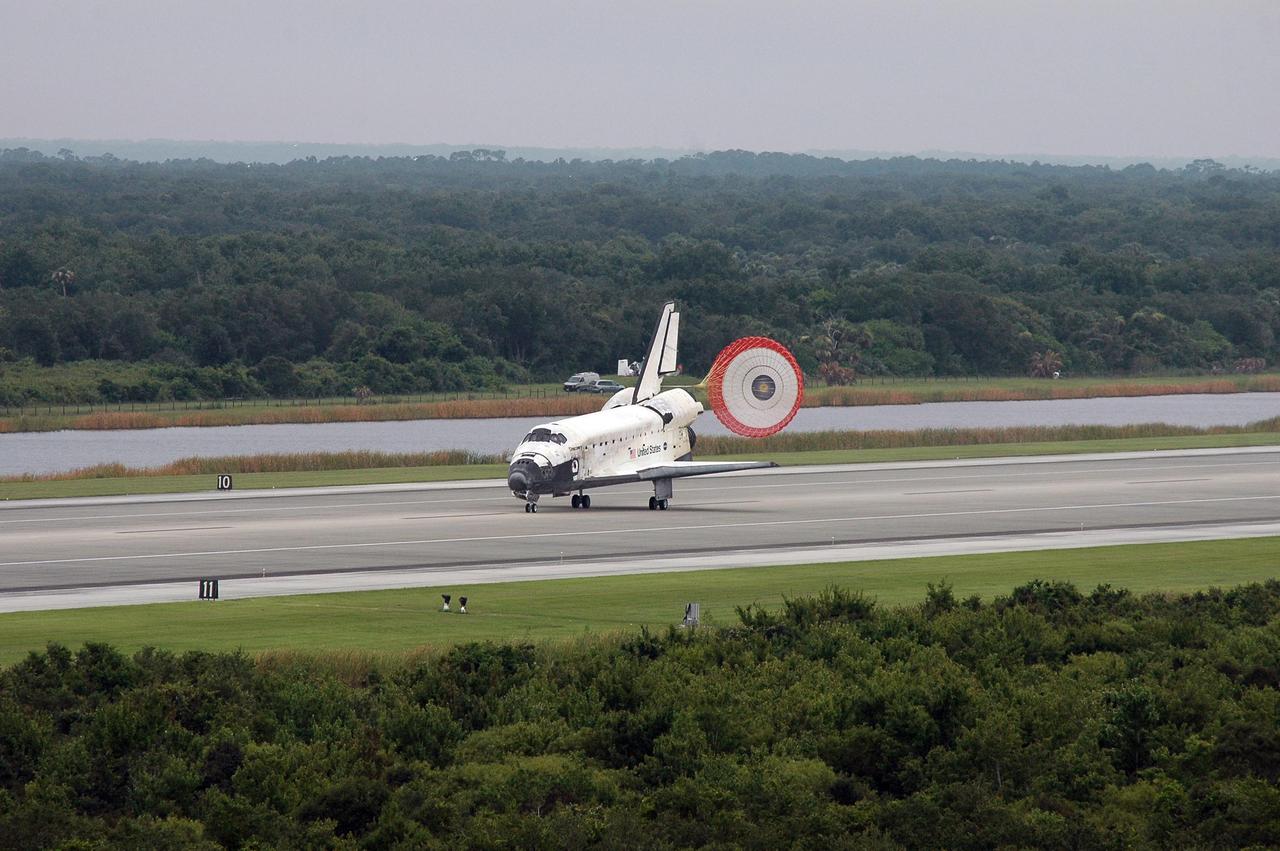
KENNEDY SPACE CENTER, FLA. - With drag chute deployed, the orbiter Discovery slows to a stop after landing on Runway 15 at NASA's Shuttle Landing Facility, completing mission STS-121 to the International Space Station. Discovery traveled 5.3 million miles, landing on orbit 202. Mission elapsed time was 12 days, 18 hours, 37 minutes and 54 seconds. Main gear touchdown occurred on time at 9:14:43 EDT. Wheel stop was at 9:15:49 EDT. The returning crew members aboard are Commander Steven Lindsey, Pilot Mark Kelly and Mission Specialists Piers Sellers, Michael Fossum, Lisa Nowak and Stephanie Wilson. Mission Specialist Thomas Reiter, who launched with the crew on July 4, remained on the station to join the Expedition 13 crew there. The landing is the 62nd at Kennedy Space Center and the 32nd for Discovery. Discovery's landing was as exhilarating as its launch, the first to take place on America's Independence Day. During the mission, the STS-121 crew tested new equipment and procedures to improve shuttle safety, and delivered supplies and made repairs to the International Space Station. Photo credit: NASA/Kim Shiflett

KENNEDY SPACE CENTER, FLA. - Mrs. Daniel R. Mulville shakes hands with Kent V. Rominger, Deputy Director of Flight Crew Operations, on the runway of the Shuttle Landing Facility following the landing of Endeavour. Mrs. Mulville is the wife of Dr. Daniel R. Mulville, NASA Associate Deputy Administrator. In the group, from left are KSC Director Roy D. Bridges; Mrs. Mulville; Dr. Mulville (back to camera); James D. Halsell Jr., Manager of Launch Integration at KSC, Space Shuttle Program; Rominger; and STS-113 Commander James Wetherbee. Commander Wetherbee earlier guided Space Shuttle Endeavour to a flawless touchdown on runway 33 at the Shuttle Landing Facility after completing the 13-day, 18-hour, 48-minute, 5.74-million mile STS-113 mission to the International Space Station. Main gear touchdown was at 2:37:12 p.m. EST, nose gear touchdown was at 2:37:23 p.m., and wheel stop was at 2:38:25 p.m. Poor weather conditions thwarted landing opportunities until a fourth day, the first time in Shuttle program history that a landing has been waved off for three consecutive days. The orbiter also carried the other members of the STS-113 crew, Pilot Paul Lockhart and Mission Specialists Michael Lopez-Alegria and John Herrington, as well as the returning Expedition Five crew, Commander Valeri Korzun, ISS Science Officer Peggy Whitson and Flight Engineer Sergei Treschev. The installation of the P1 truss on the International Space Station was accomplished during the mission.
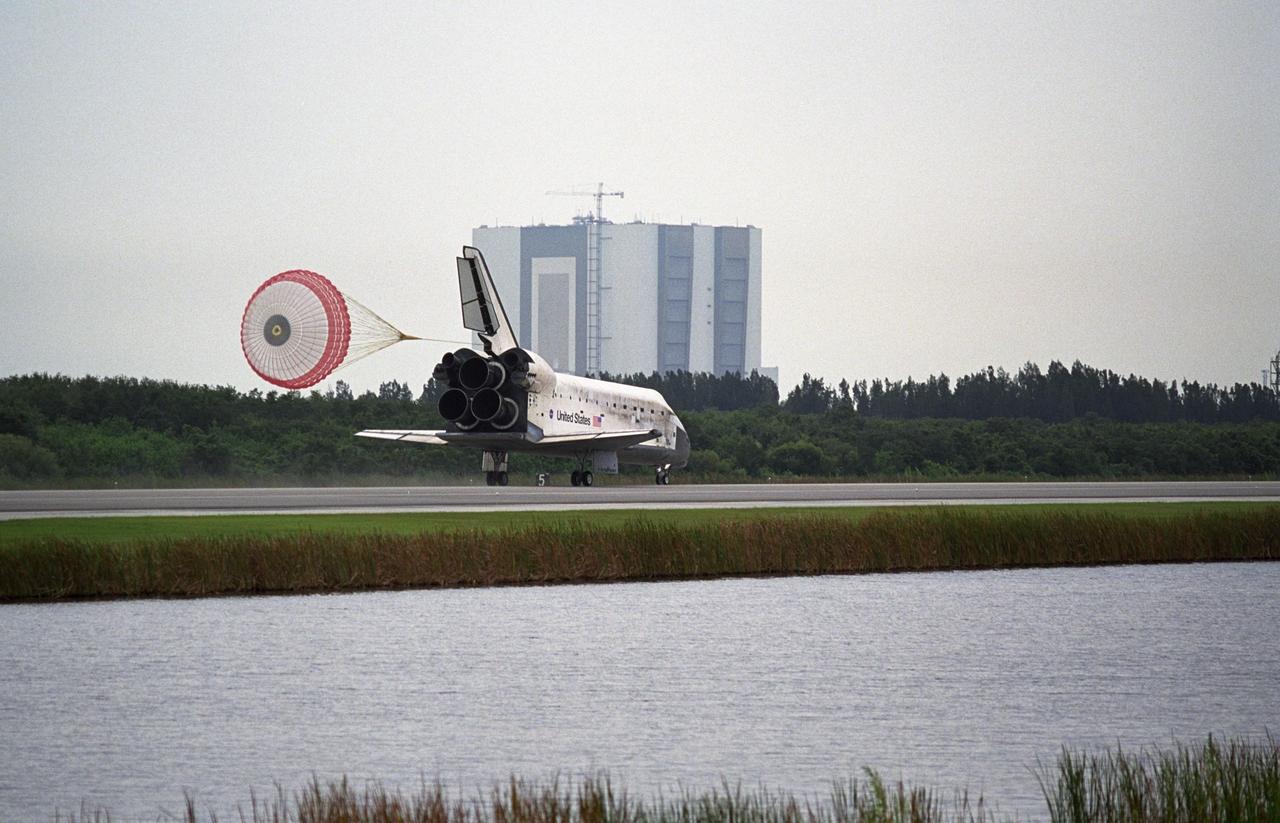
KENNEDY SPACE CENTER, FLA. - With the help of a drag chute to slow its speed, the orbiter Discovery lands on Runway 15 at NASA's Shuttle Landing Facility after completing mission STS-121 to the International Space Station. In the background is the Vehicle Assembly Building. Discovery traveled 5.3 million miles, landing on orbit 202. Mission elapsed time was 12 days, 18 hours, 37 minutes and 54 seconds. Main gear touchdown occurred on time at 9:14:43 EDT. Wheel stop was at 9:15:49 EDT. The returning crew members aboard are Commander Steven Lindsey, Pilot Mark Kelly and Mission Specialists Piers Sellers, Michael Fossum, Lisa Nowak and Stephanie Wilson. Mission Specialist Thomas Reiter, who launched with the crew on July 4, remained on the station to join the Expedition 13 crew there. The landing is the 62nd at Kennedy Space Center and the 32nd for Discovery. During the mission, the STS-121 crew tested new equipment and procedures to improve shuttle safety, and delivered supplies and made repairs to the International Space Station. Photo credit: NASA/Regina Mitchell-Ryall
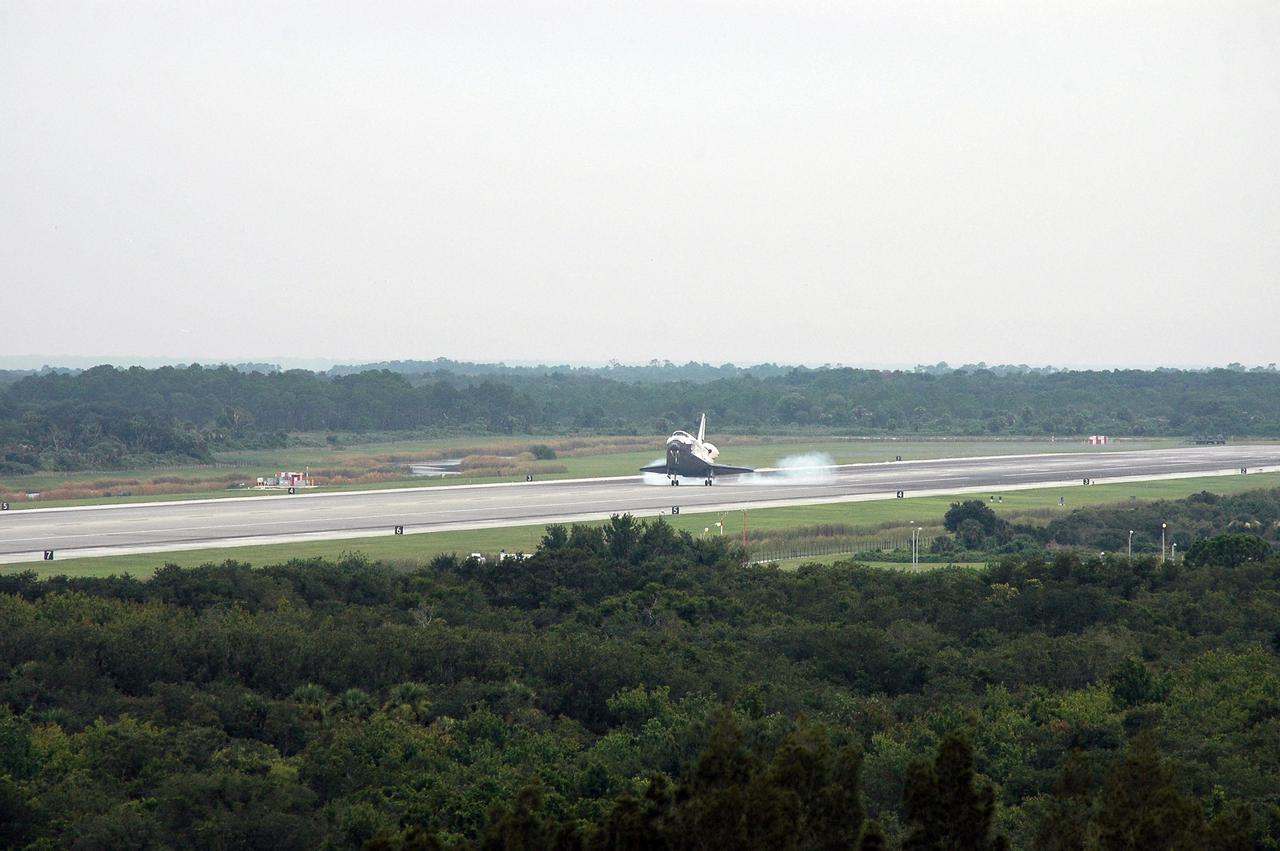
KENNEDY SPACE CENTER, FLA. - Under gray skies blanketing the Central Florida skies, the orbiter Discovery kicks up dust as it touches down on Runway 15 at NASA's Shuttle Landing Facility after completing mission STS-121 to the International Space Station. Discovery traveled 5.3 million miles, landing on orbit 202. Mission elapsed time was 12 days, 18 hours, 37 minutes and 54 seconds. Main gear touchdown occurred on time at 9:14:43 EDT. Wheel stop was at 9:15:49 EDT. The returning crew members aboard are Commander Steven Lindsey, Pilot Mark Kelly and Mission Specialists Piers Sellers, Michael Fossum, Lisa Nowak and Stephanie Wilson. Mission Specialist Thomas Reiter, who launched with the crew on July 4, remained on the station to join the Expedition 13 crew there. The landing is the 62nd at Kennedy Space Center and the 32nd for Discovery. Discovery's landing was as exhilarating as its launch, the first to take place on America's Independence Day. During the mission, the STS-121 crew tested new equipment and procedures to improve shuttle safety, and delivered supplies and made repairs to the International Space Station. Photo credit: NASA/Kim Shiflett
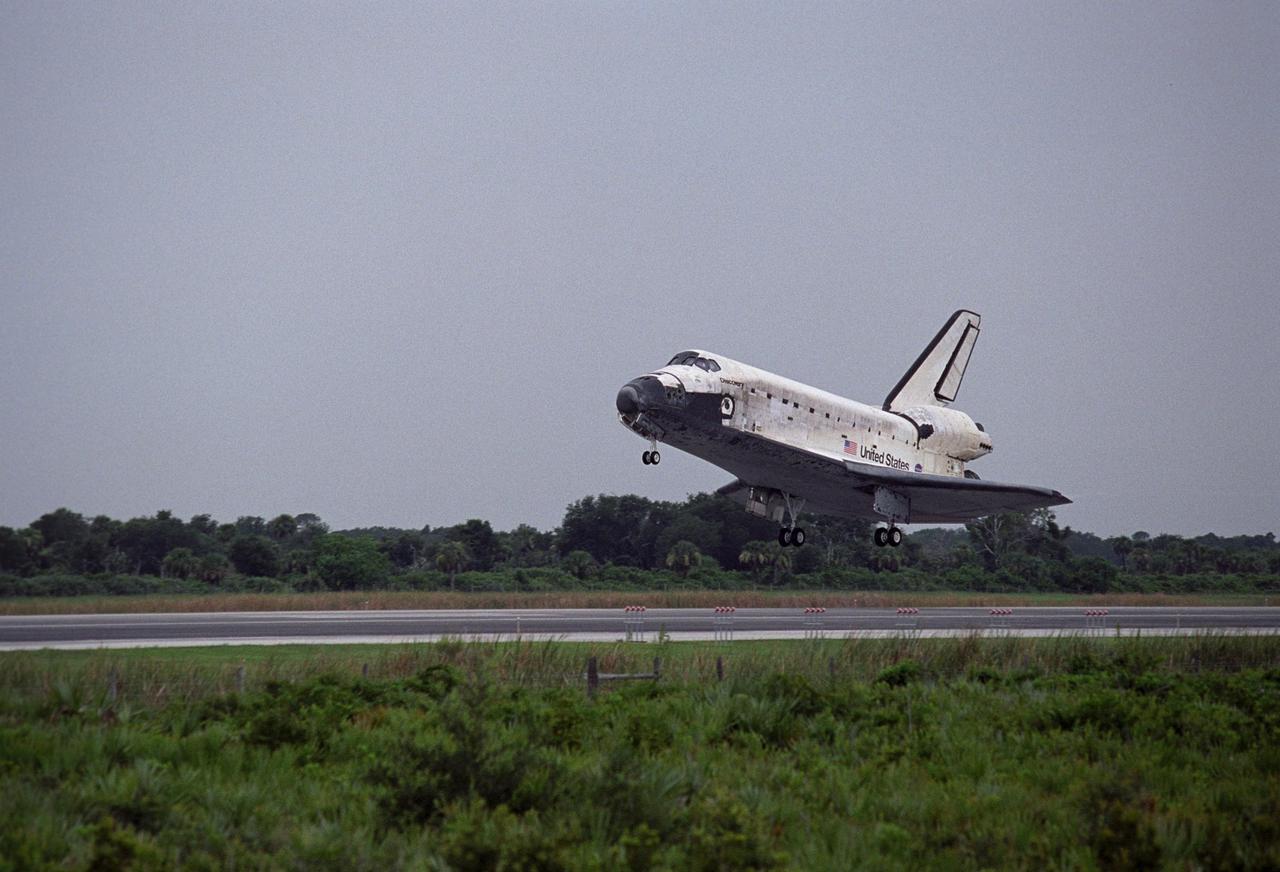
KENNEDY SPACE CENTER, FLA. - The orbiter Discovery's main landing gear kick up dust as they touch down on Runway 15 at NASA's Shuttle Landing Facility, completing mission STS-121 to the International Space Station.Discovery traveled 5.3 million miles, landing on orbit 202. Mission elapsed time was 12 days, 18 hours, 37 minutes and 54 seconds. Main gear touchdown occurred on time at 9:14:43 EDT. Wheel stop was at 9:15:49 EDT. The returning crew members aboard are Commander Steven Lindsey, Pilot Mark Kelly and Mission Specialists Piers Sellers, Michael Fossum, Lisa Nowak and Stephanie Wilson. Mission Specialist Thomas Reiter, who launched with the crew on July 4, remained on the station to join the Expedition 13 crew there. The landing is the 62nd at Kennedy Space Center and the 32nd for Discovery. During the mission, the STS-121 crew tested new equipment and procedures to improve shuttle safety, and delivered supplies and made repairs to the International Space Station. Photo credit: NASA/Rick Wetherington
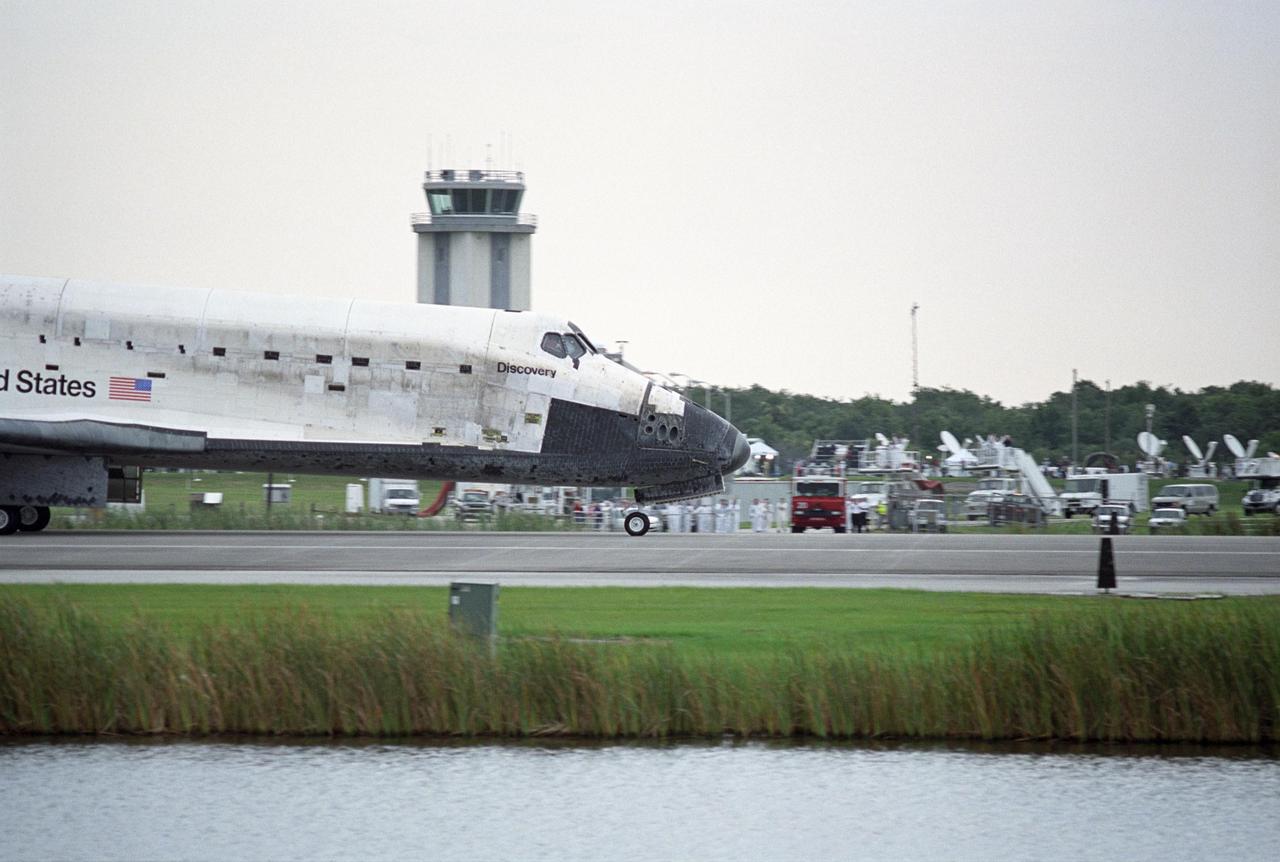
KENNEDY SPACE CENTER, FLA. - The orbiter Discovery passes dozens of satellite trucks and media at midfield after landing on Runway 15 at NASA's Shuttle Landing Facility, completing mission STS-121 to the International Space Station. Discovery traveled 5.3 million miles, landing on orbit 202. Mission elapsed time was 12 days, 18 hours, 37 minutes and 54 seconds. Main gear touchdown occurred on time at 9:14:43 EDT. Wheel stop was at 9:15:49 EDT. The returning crew members aboard are Commander Steven Lindsey, Pilot Mark Kelly and Mission Specialists Piers Sellers, Michael Fossum, Lisa Nowak and Stephanie Wilson. Mission Specialist Thomas Reiter, who launched with the crew on July 4, remained on the station to join the Expedition 13 crew there. The landing is the 62nd at Kennedy Space Center and the 32nd for Discovery. During the mission, the STS-121 crew tested new equipment and procedures to improve shuttle safety, and delivered supplies and made repairs to the International Space Station. Photo credit: NASA/Regina Mitchell-Ryall
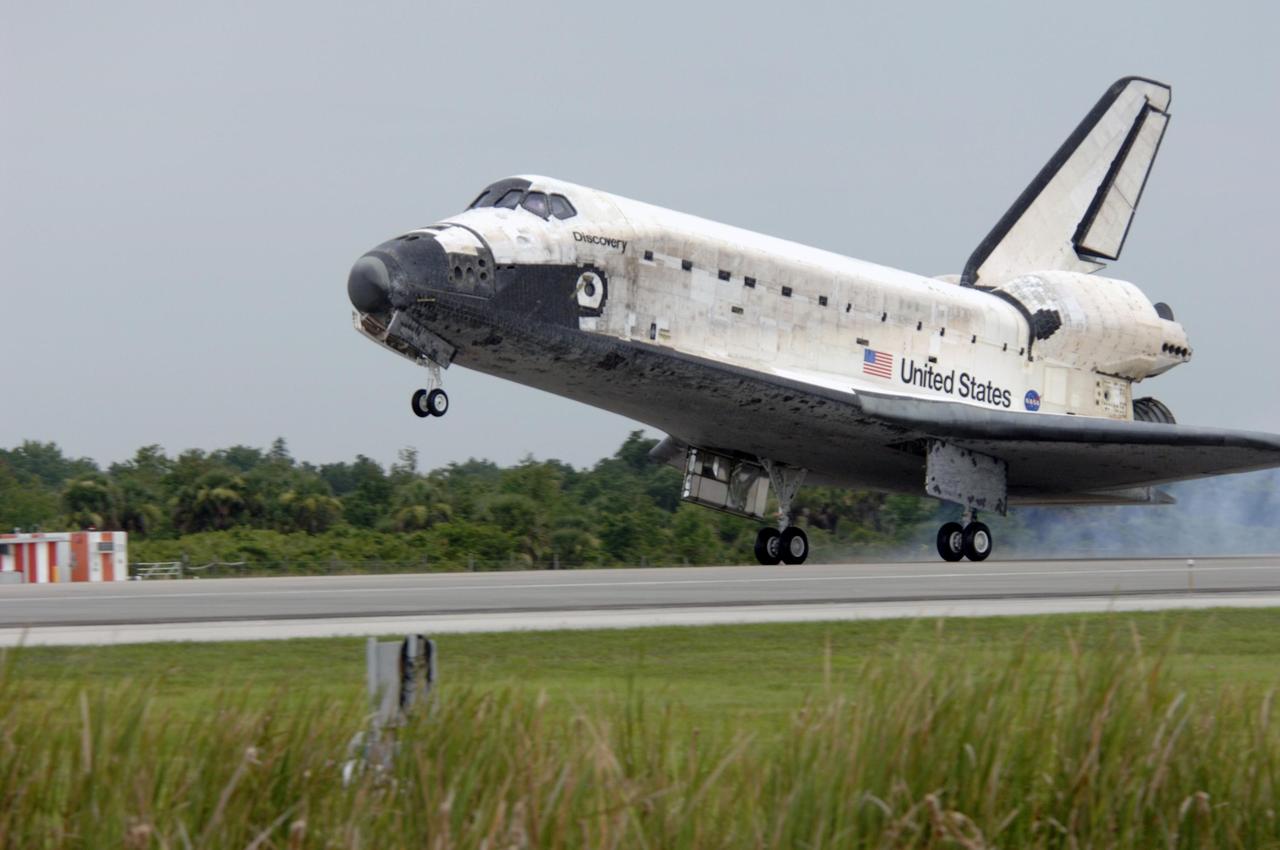
KENNEDY SPACE CENTER, FLA. - The orbiter Discovery touches down on Runway 15 at NASA's Shuttle Landing Facility after completing mission STS-121 to the International Space Station. Discovery traveled 5.3 million miles, landing on orbit 202. Mission elapsed time was 12 days, 18 hours, 37 minutes and 54 seconds. Main gear touchdown occurred on time at 9:14:43 EDT. Wheel stop was at 9:15:49 EDT. The returning crew members aboard are Commander Steven Lindsey, Pilot Mark Kelly and Mission Specialists Piers Sellers, Michael Fossum, Lisa Nowak and Stephanie Wilson. Mission Specialist Thomas Reiter, who launched with the crew on July 4, remained on the station to join the Expedition 13 crew there. The landing is the 62nd at Kennedy Space Center and the 32nd for Discovery. Discovery's landing was as exhilarating as its launch, the first to take place on America's Independence Day. During the mission, the STS-121 crew tested new equipment and procedures to improve shuttle safety, and delivered supplies and made repairs to the International Space Station. Photo credit: NASA/Tim Powers
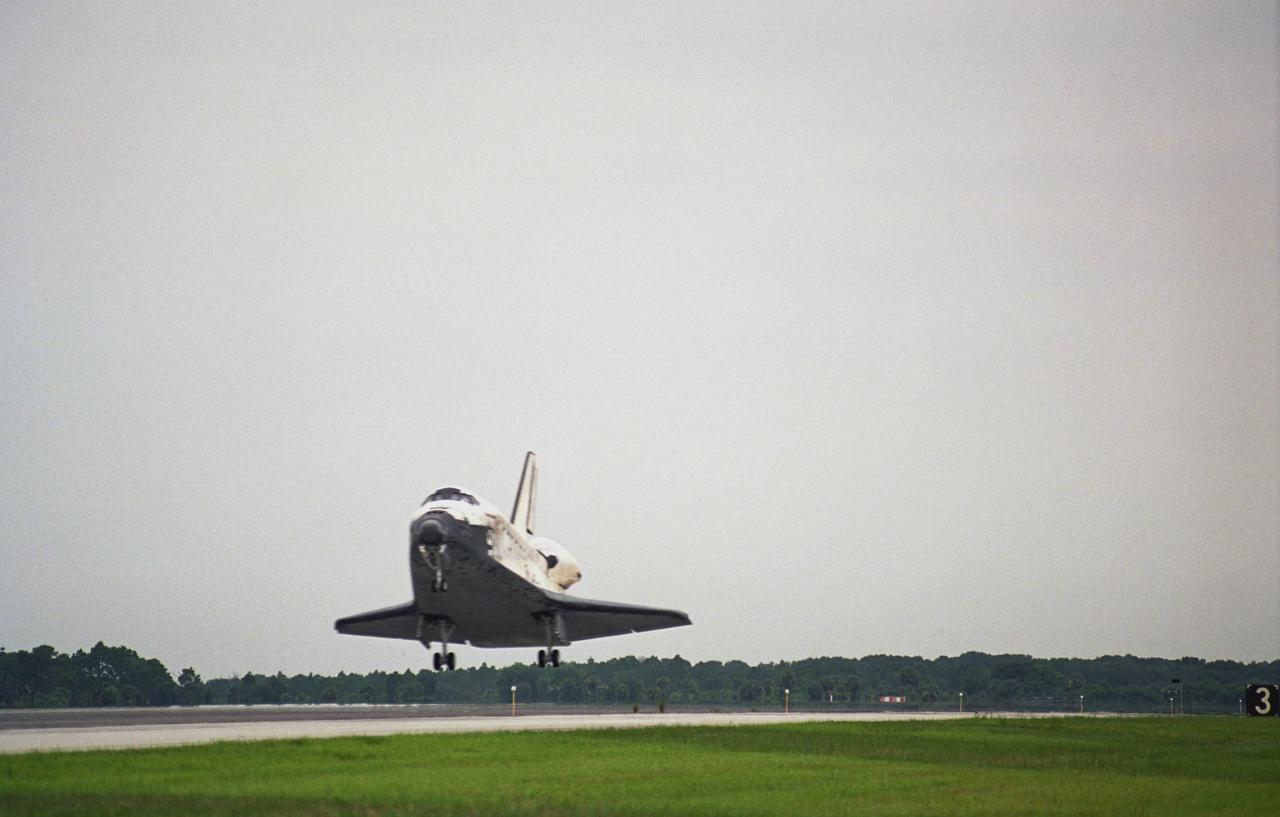
KENNEDY SPACE CENTER, FLA. - The orbiter Discovery nears touchdown on Runway 15 at NASA's Shuttle Landing Facility after completing mission STS-121 to the International Space Station. At touchdown -- nominally about 2,500 ft. beyond the runway threshold -- the orbiter is traveling at a speed ranging from 213 to 226 mph. Discovery traveled 5.3 million miles, landing on orbit 202. Mission elapsed time was 12 days, 18 hours, 37 minutes and 54 seconds. Main gear touchdown occurred on time at 9:14:43 EDT. Wheel stop was at 9:15:49 EDT. The returning crew members aboard are Commander Steven Lindsey, Pilot Mark Kelly and Mission Specialists Piers Sellers, Michael Fossum, Lisa Nowak and Stephanie Wilson. Mission Specialist Thomas Reiter, who launched with the crew on July 4, remained on the station to join the Expedition 13 crew there. The landing is the 62nd at Kennedy Space Center and the 32nd for Discovery. During the mission, the STS-121 crew tested new equipment and procedures to improve shuttle safety, and delivered supplies and made repairs to the International Space Station. Photo credit: NASA/Tony Gray & Tim Powers
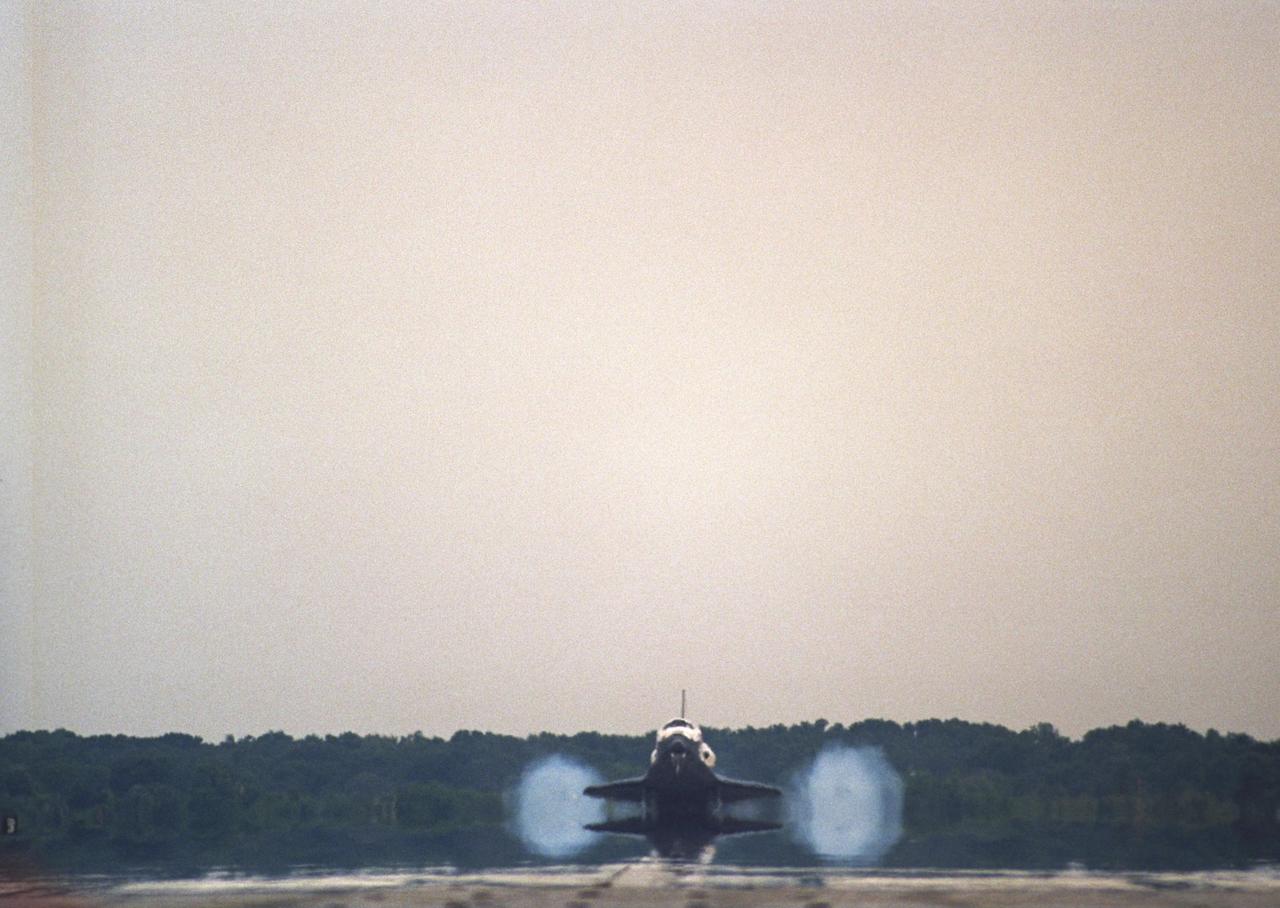
KENNEDY SPACE CENTER, FLA. - Vapor trails from Discovery's wing tips look like balls of smoke as the orbiter touches down on Runway 15 at NASA's Shuttle Landing Facility, completing mission STS-121 to the International Space Station. At touchdown -- nominally about 2,500 ft. beyond the runway threshold -- the orbiter is traveling at a speed ranging from 213 to 226 mph. Discovery traveled 5.3 million miles, landing on orbit 202. Mission elapsed time was 12 days, 18 hours, 37 minutes and 54 seconds. Main gear touchdown occurred on time at 9:14:43 EDT. Wheel stop was at 9:15:49 EDT. The returning crew members aboard are Commander Steven Lindsey, Pilot Mark Kelly and Mission Specialists Piers Sellers, Michael Fossum, Lisa Nowak and Stephanie Wilson. Mission Specialist Thomas Reiter, who launched with the crew on July 4, remained on the station to join the Expedition 13 crew there. The landing is the 62nd at Kennedy Space Center and the 32nd for Discovery. During the mission, the STS-121 crew tested new equipment and procedures to improve shuttle safety, and delivered supplies and made repairs to the International Space Station. Photo credit: NASA/Tony Gray & Tim Powers
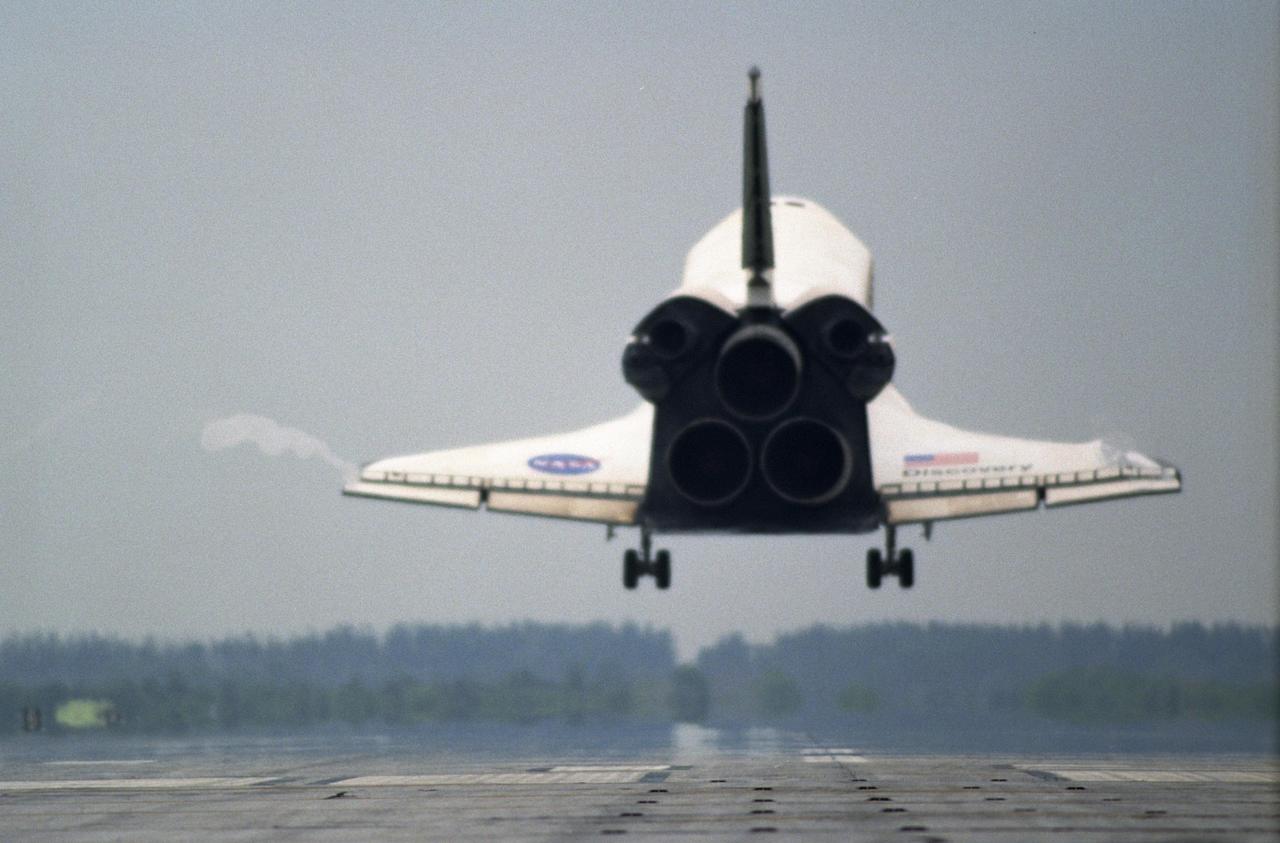
KENNEDY SPACE CENTER, FLA. - A vapor trail flows from Discovery's wing tip as it makes a speedy approach to Runway 15 at NASA's Shuttle Landing Facility, completing mission STS-121 to the International Space Station. At touchdown -- nominally about 2,500 ft. beyond the runway threshold -- the orbiter is traveling at a speed ranging from 213 to 226 mph. Discovery traveled 5.3 million miles, landing on orbit 202. Mission elapsed time was 12 days, 18 hours, 37 minutes and 54 seconds. Main gear touchdown occurred on time at 9:14:43 EDT. Wheel stop was at 9:15:49 EDT. The returning crew members aboard are Commander Steven Lindsey, Pilot Mark Kelly and Mission Specialists Piers Sellers, Michael Fossum, Lisa Nowak and Stephanie Wilson. Mission Specialist Thomas Reiter, who launched with the crew on July 4, remained on the station to join the Expedition 13 crew there. The landing is the 62nd at Kennedy Space Center and the 32nd for Discovery. During the mission, the STS-121 crew tested new equipment and procedures to improve shuttle safety, and delivered supplies and made repairs to the International Space Station. Photo credit: NASA/Tony Gray & Tim Powers
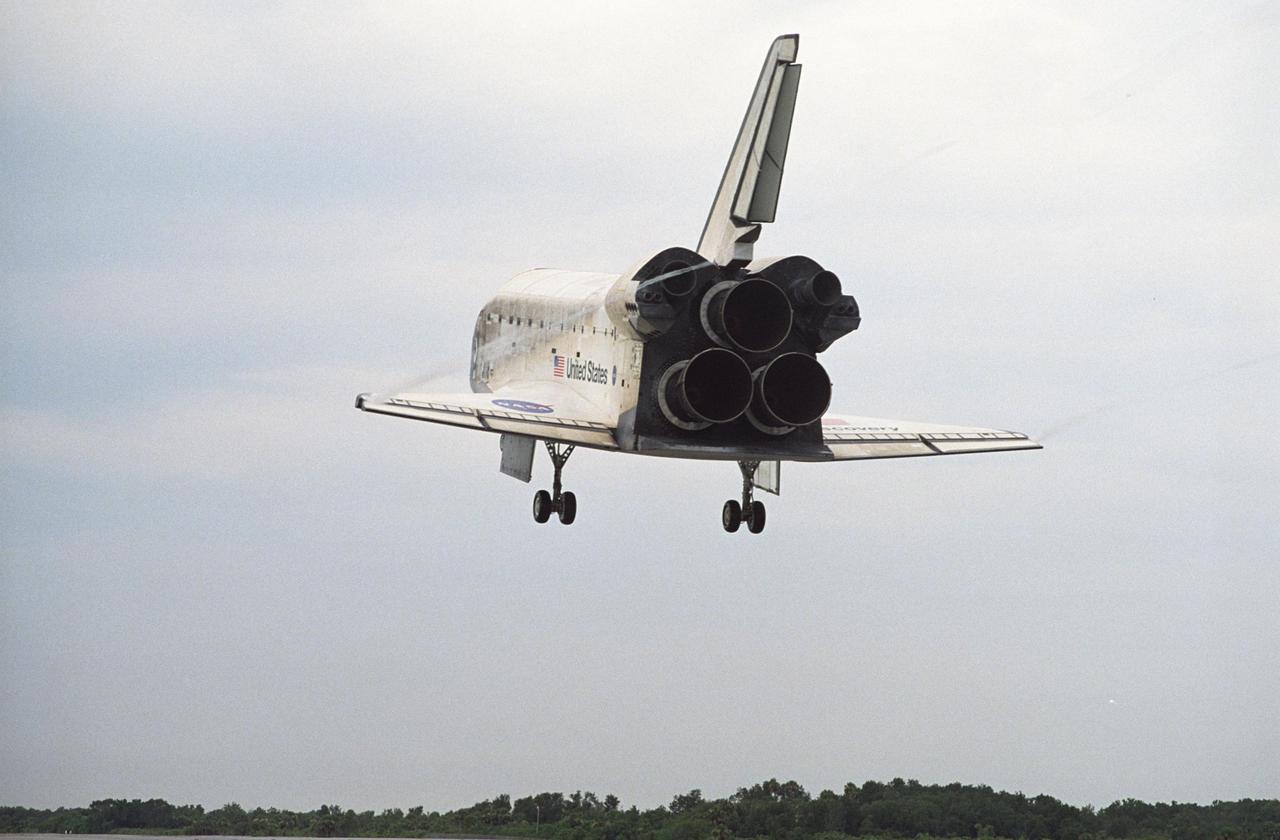
KENNEDY SPACE CENTER, FLA. - Vapor trails flow from Discovery's wing tips as it makes a speedy approach to Runway 15 at NASA's Shuttle Landing Facility, completing mission STS-121 to the International Space Station. At touchdown -- nominally about 2,500 ft. beyond the runway threshold -- the orbiter is traveling at a speed ranging from 213 to 226 mph. Discovery traveled 5.3 million miles, landing on orbit 202. Mission elapsed time was 12 days, 18 hours, 37 minutes and 54 seconds. Main gear touchdown occurred on time at 9:14:43 EDT. Wheel stop was at 9:15:49 EDT. The returning crew members aboard are Commander Steven Lindsey, Pilot Mark Kelly and Mission Specialists Piers Sellers, Michael Fossum, Lisa Nowak and Stephanie Wilson. Mission Specialist Thomas Reiter, who launched with the crew on July 4, remained on the station to join the Expedition 13 crew there. The landing is the 62nd at Kennedy Space Center and the 32nd for Discovery. During the mission, the STS-121 crew tested new equipment and procedures to improve shuttle safety, and delivered supplies and made repairs to the International Space Station. Photo credit: NASA/Tony Gray & Tim Powers
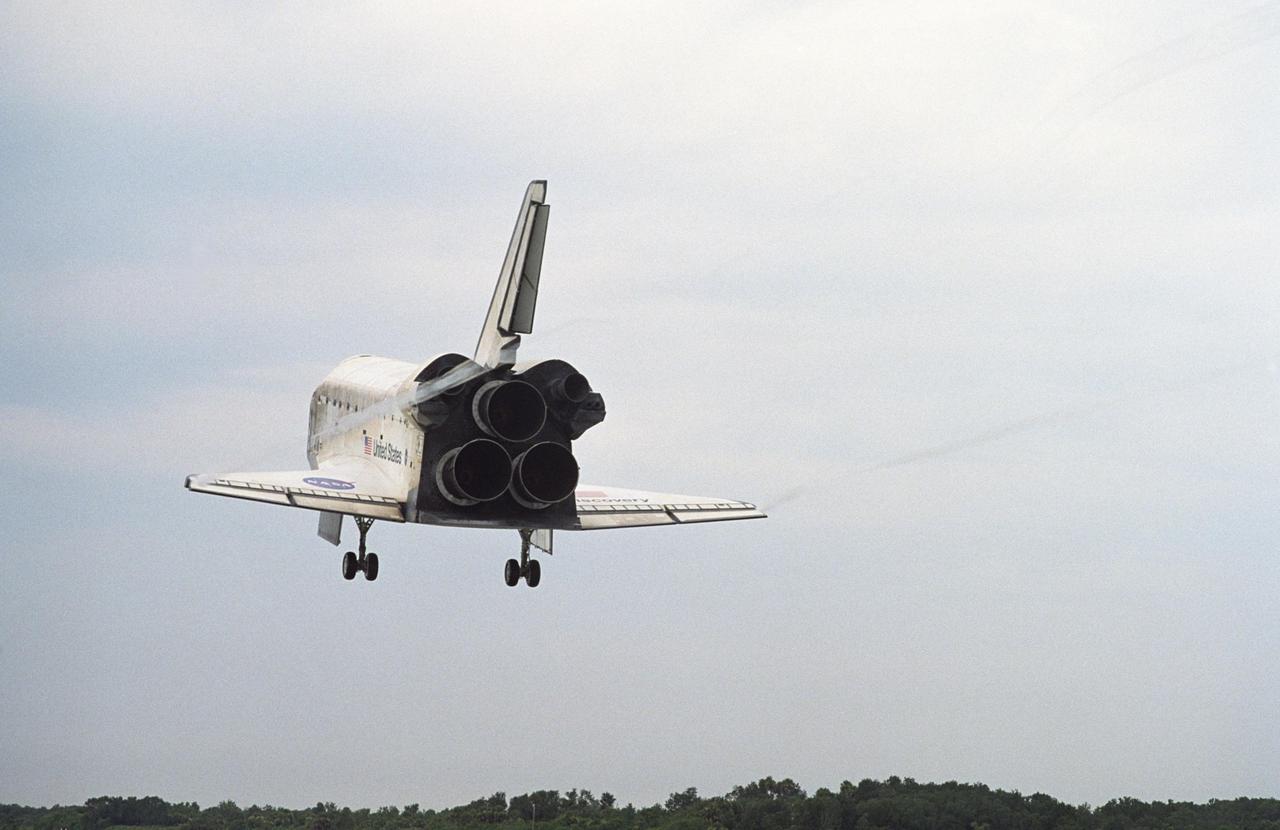
KENNEDY SPACE CENTER, FLA. - Vapor trails flow from Discovery's wing tips as it makes a speedy approach to Runway 15 at NASA's Shuttle Landing Facility, completing mission STS-121 to the International Space Station. At touchdown -- nominally about 2,500 ft. beyond the runway threshold -- the orbiter is traveling at a speed ranging from 213 to 226 mph. Discovery traveled 5.3 million miles, landing on orbit 202. Mission elapsed time was 12 days, 18 hours, 37 minutes and 54 seconds. Main gear touchdown occurred on time at 9:14:43 EDT. Wheel stop was at 9:15:49 EDT. The returning crew members aboard are Commander Steven Lindsey, Pilot Mark Kelly and Mission Specialists Piers Sellers, Michael Fossum, Lisa Nowak and Stephanie Wilson. Mission Specialist Thomas Reiter, who launched with the crew on July 4, remained on the station to join the Expedition 13 crew there. The landing is the 62nd at Kennedy Space Center and the 32nd for Discovery. During the mission, the STS-121 crew tested new equipment and procedures to improve shuttle safety, and delivered supplies and made repairs to the International Space Station. Photo credit: NASA/Tony Gray & Tim Powers
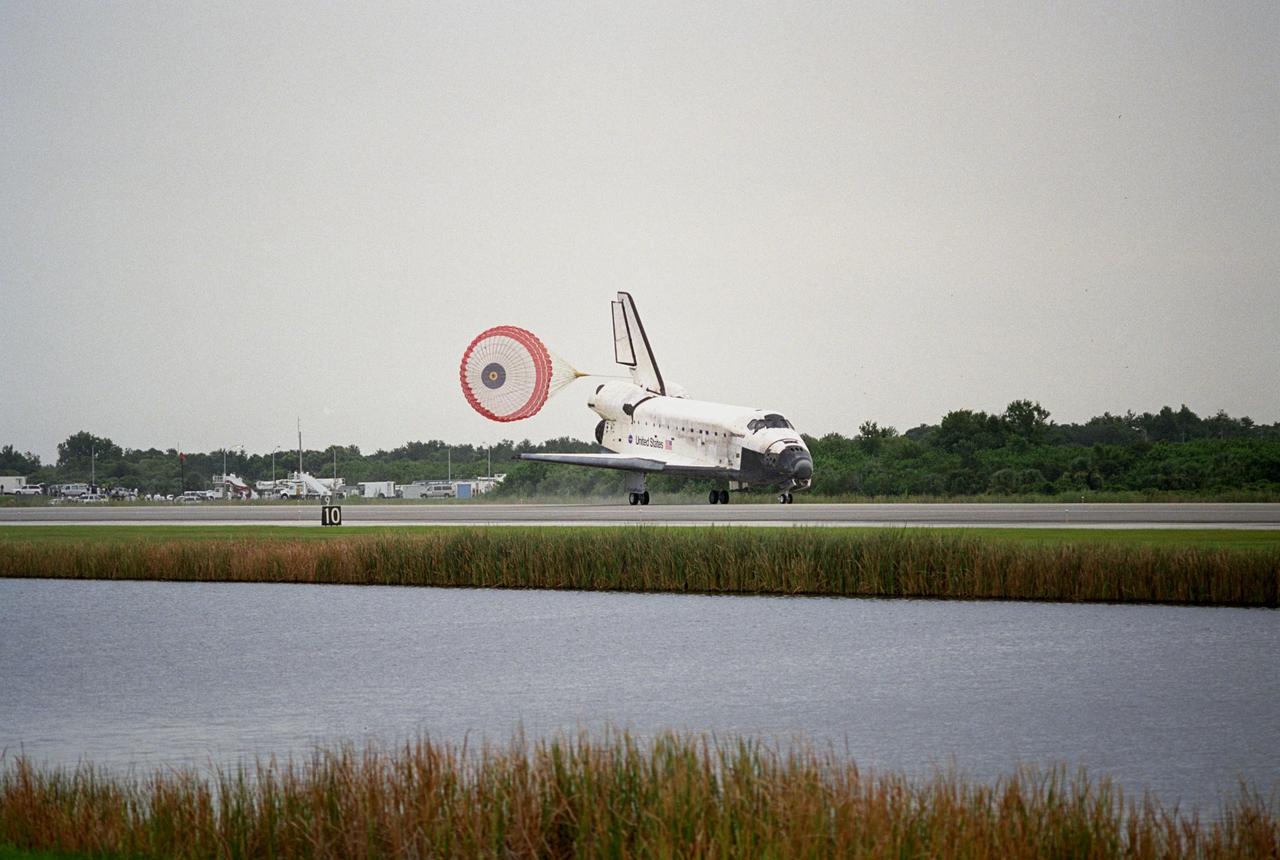
KENNEDY SPACE CENTER, FLA. - The drag chute begins to fall after the orbiter Discovery slows to a stop on Runway 15 at NASA's Shuttle Landing Facility, completing mission STS-121 to the International Space Station. Discovery traveled 5.3 million miles, landing on orbit 202. Mission elapsed time was 12 days, 18 hours, 37 minutes and 54 seconds. Main gear touchdown occurred on time at 9:14:43 EDT. Wheel stop was at 9:15:49 EDT. The returning crew members aboard are Commander Steven Lindsey, Pilot Mark Kelly and Mission Specialists Piers Sellers, Michael Fossum, Lisa Nowak and Stephanie Wilson. Mission Specialist Thomas Reiter, who launched with the crew on July 4, remained on the station to join the Expedition 13 crew there. The landing is the 62nd at Kennedy Space Center and the 32nd for Discovery. During the mission, the STS-121 crew tested new equipment and procedures to improve shuttle safety, and delivered supplies and made repairs to the International Space Station. Photo credit: NASA/Tim Terry
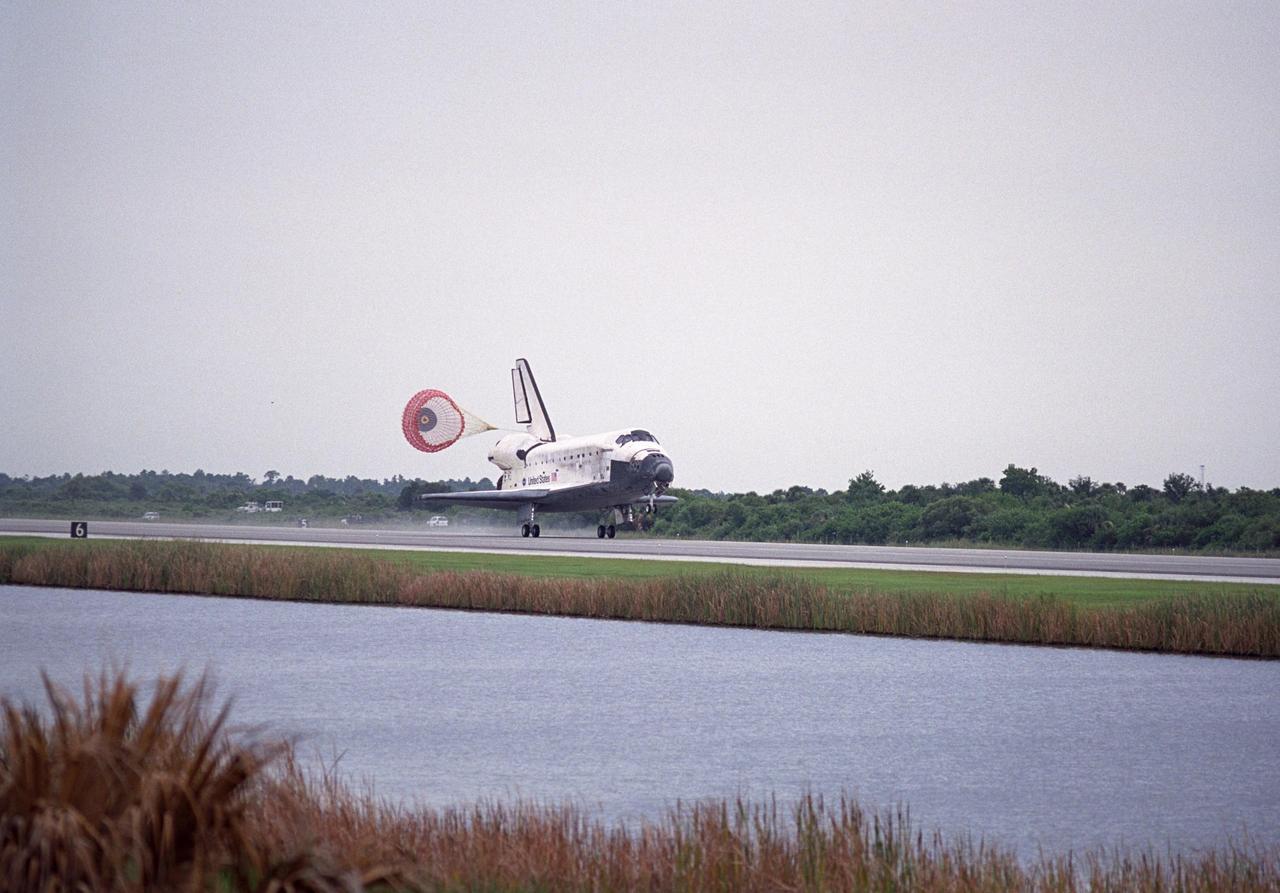
KENNEDY SPACE CENTER, FLA. - The orbiter Discovery releases a drag chute to slow its speed as it touches down on Runway 15 at NASA's Shuttle Landing Facility after completing mission STS-121 to the International Space Station. Discovery traveled 5.3 million miles, landing on orbit 202. Mission elapsed time was 12 days, 18 hours, 37 minutes and 54 seconds. Main gear touchdown occurred on time at 9:14:43 EDT. Wheel stop was at 9:15:49 EDT. The returning crew members aboard are Commander Steven Lindsey, Pilot Mark Kelly and Mission Specialists Piers Sellers, Michael Fossum, Lisa Nowak and Stephanie Wilson. Mission Specialist Thomas Reiter, who launched with the crew on July 4, remained on the station to join the Expedition 13 crew there. The landing is the 62nd at Kennedy Space Center and the 32nd for Discovery. During the mission, the STS-121 crew tested new equipment and procedures to improve shuttle safety, and delivered supplies and made repairs to the International Space Station. Photo credit: NASA/Regina Mitchell-Ryall
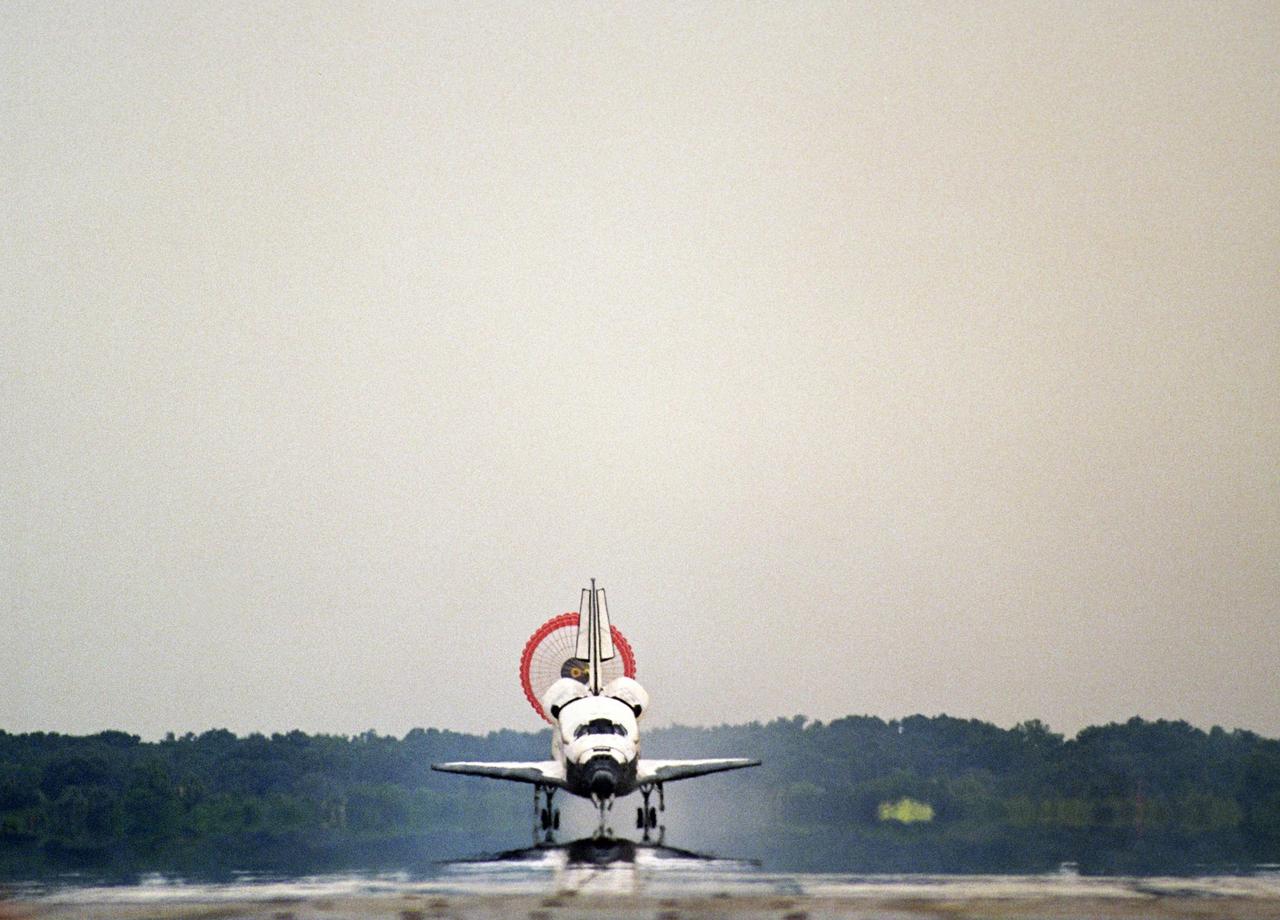
KENNEDY SPACE CENTER, FLA. - With its drag chute flowing behind it, the orbiter Discovery touches down on Runway 15 at NASA's Shuttle Landing Facility, completing mission STS-121 to the International Space Station. At touchdown -- nominally about 2,500 ft. beyond the runway threshold -- the orbiter is traveling at a speed ranging from 213 to 226 mph. Discovery traveled 5.3 million miles, landing on orbit 202. Mission elapsed time was 12 days, 18 hours, 37 minutes and 54 seconds. Main gear touchdown occurred on time at 9:14:43 EDT. Wheel stop was at 9:15:49 EDT. The returning crew members aboard are Commander Steven Lindsey, Pilot Mark Kelly and Mission Specialists Piers Sellers, Michael Fossum, Lisa Nowak and Stephanie Wilson. Mission Specialist Thomas Reiter, who launched with the crew on July 4, remained on the station to join the Expedition 13 crew there. The landing is the 62nd at Kennedy Space Center and the 32nd for Discovery. During the mission, the STS-121 crew tested new equipment and procedures to improve shuttle safety, and delivered supplies and made repairs to the International Space Station. Photo credit: NASA/Tony Gray & Tim Powers
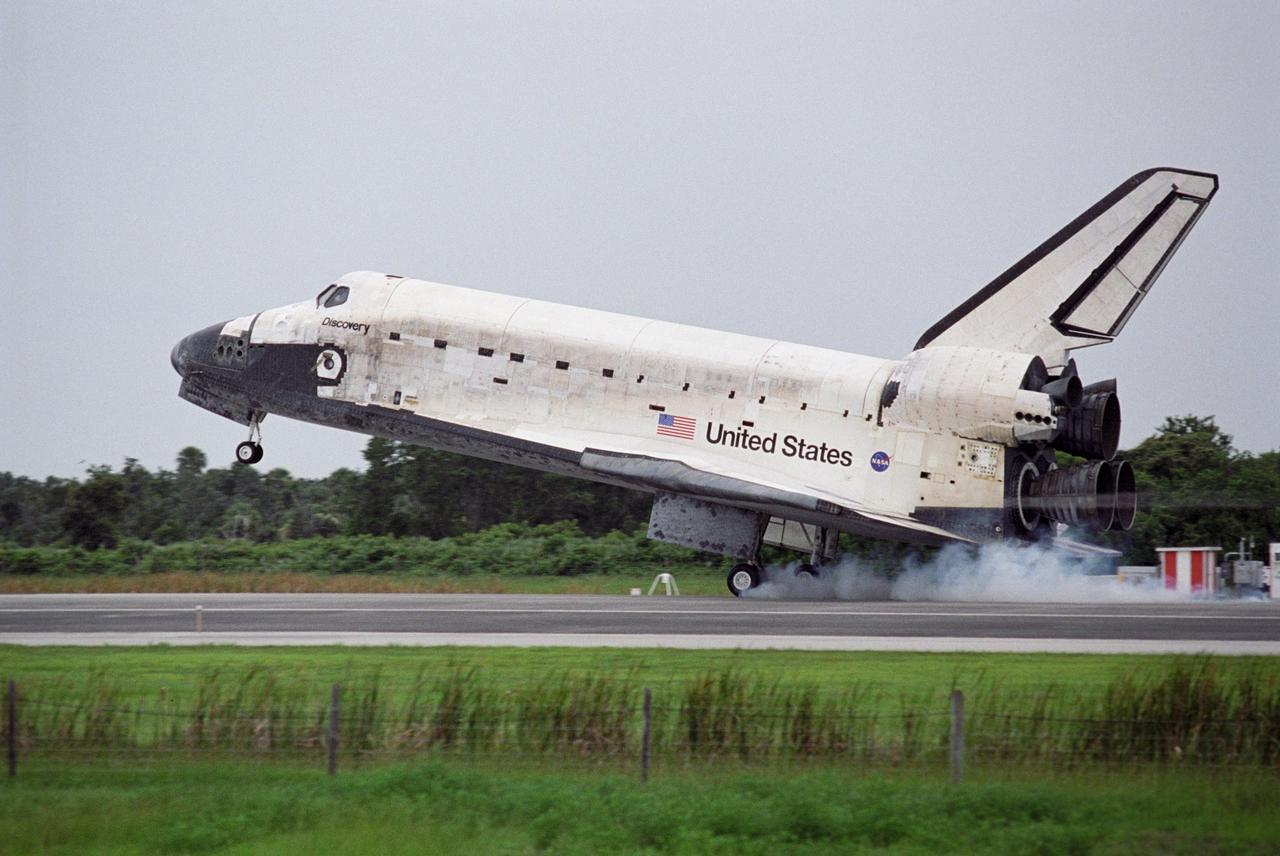
KENNEDY SPACE CENTER, FLA. - The orbiter Discovery approaches touchdown on Runway 15 at NASA's Shuttle Landing Facility, completing mission STS-121 to the International Space Station. Discovery traveled 5.3 million miles, landing on orbit 202. Mission elapsed time was 12 days, 18 hours, 37 minutes and 54 seconds. Main gear touchdown occurred on time at 9:14:43 EDT. Wheel stop was at 9:15:49 EDT. The returning crew members aboard are Commander Steven Lindsey, Pilot Mark Kelly and Mission Specialists Piers Sellers, Michael Fossum, Lisa Nowak and Stephanie Wilson. Mission Specialist Thomas Reiter, who launched with the crew on July 4, remained on the station to join the Expedition 13 crew there. The landing is the 62nd at Kennedy Space Center and the 32nd for Discovery. During the mission, the STS-121 crew tested new equipment and procedures to improve shuttle safety, and delivered supplies and made repairs to the International Space Station. Photo credit: NASA/Rick Wetherington
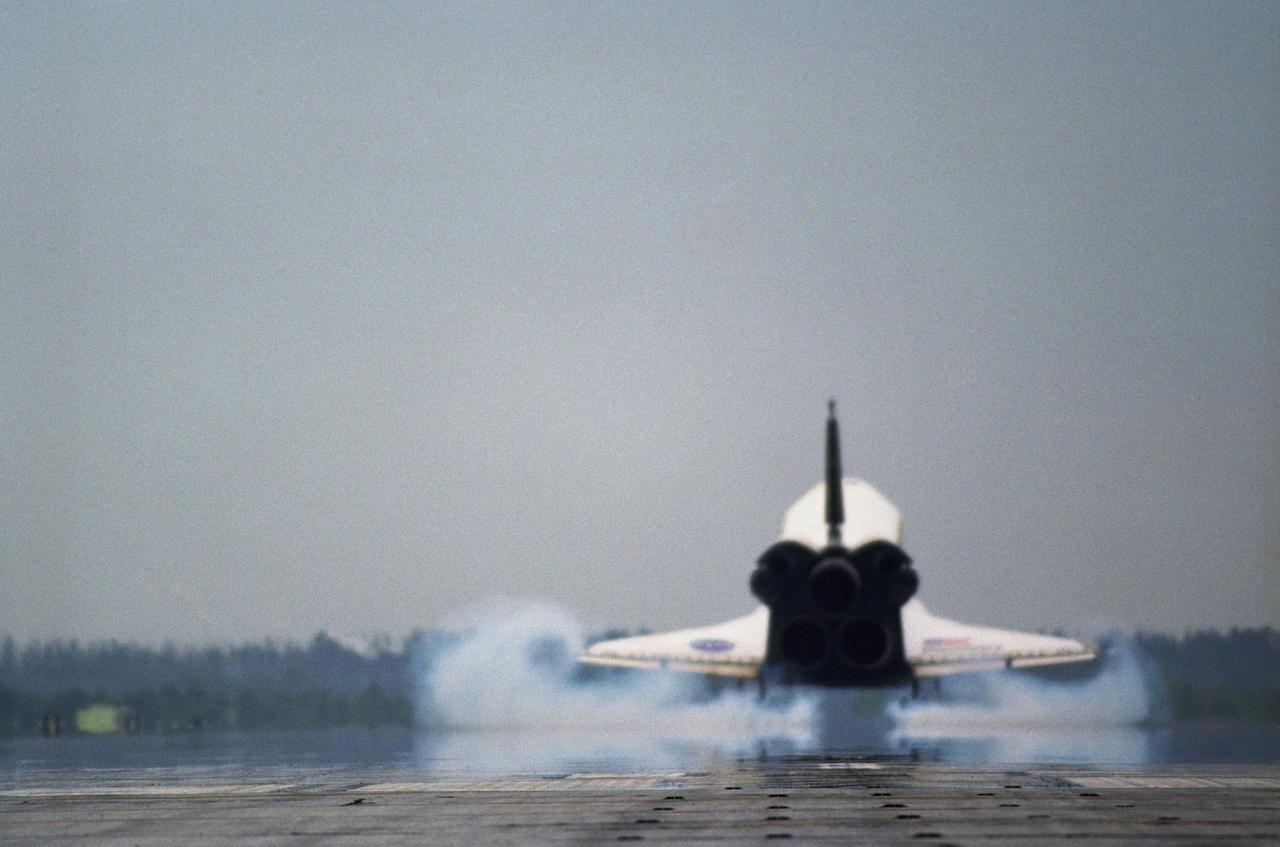
KENNEDY SPACE CENTER, FLA. - Kicking up dust as it touches down on Runway 15 at NASA's Shuttle Landing Facility, the orbiter Discovery completes mission STS-121 to the International Space Station. At touchdown -- nominally about 2,500 ft. beyond the runway threshold -- the orbiter is traveling at a speed ranging from 213 to 226 mph. Discovery traveled 5.3 million miles, landing on orbit 202. Mission elapsed time was 12 days, 18 hours, 37 minutes and 54 seconds. Main gear touchdown occurred on time at 9:14:43 EDT. Wheel stop was at 9:15:49 EDT. The returning crew members aboard are Commander Steven Lindsey, Pilot Mark Kelly and Mission Specialists Piers Sellers, Michael Fossum, Lisa Nowak and Stephanie Wilson. Mission Specialist Thomas Reiter, who launched with the crew on July 4, remained on the station to join the Expedition 13 crew there. The landing is the 62nd at Kennedy Space Center and the 32nd for Discovery. During the mission, the STS-121 crew tested new equipment and procedures to improve shuttle safety, and delivered supplies and made repairs to the International Space Station. Photo credit: NASA/Tony Gray & Tim Powers
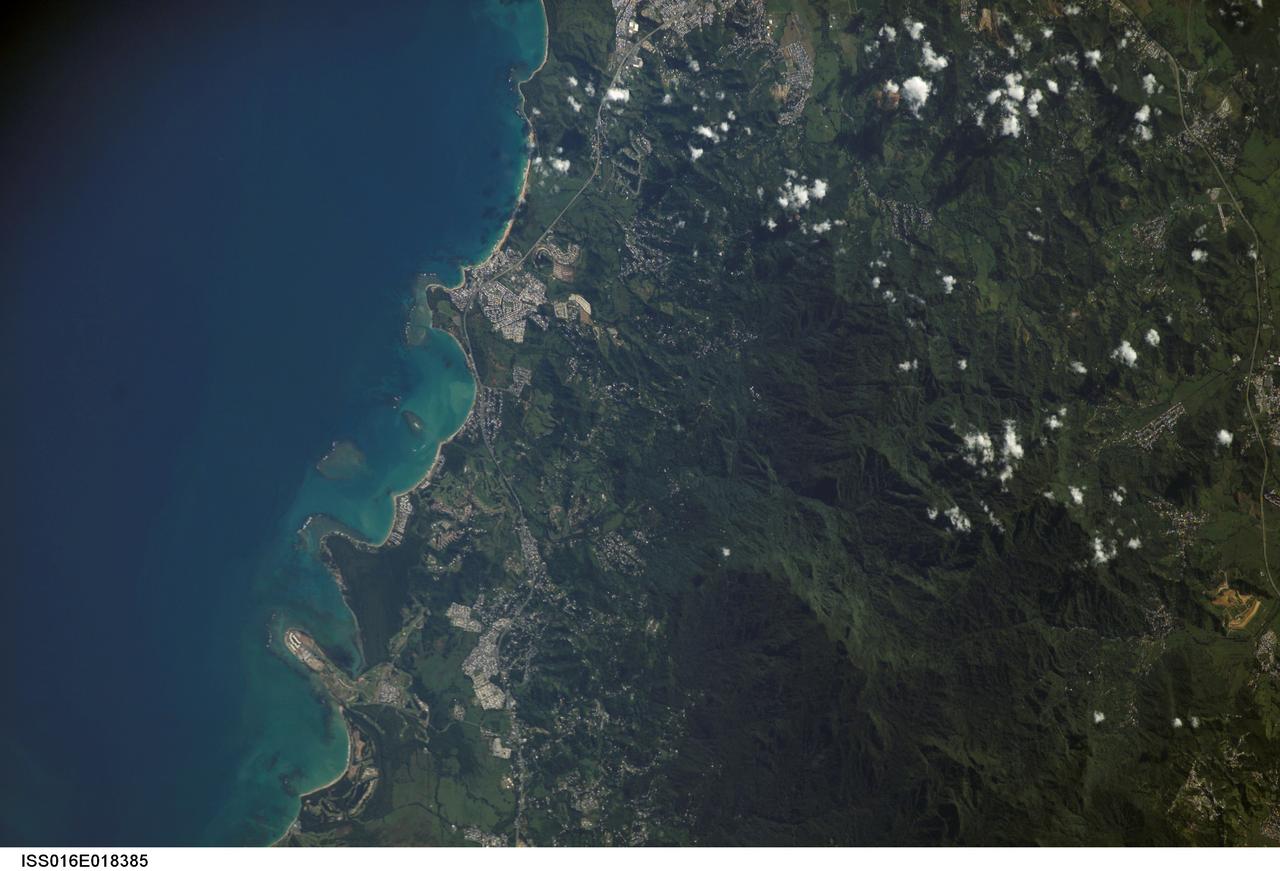
ISS016-E-018385 (23 Dec. 2008) --- Luquillo Mountains, Puerto Rico are featured in this image photographed by an Expedition 16 crewmember on the International Space Station. The Luquillo Mountains are located in the northeastern portion of Puerto Rico and rise to elevations of 1,075 meters. According to scientists, the mountains are comprised mainly of volcanic rock material that was uplifted by tectonism - Puerto Rico is located between the junction of the North American and Caribbean plates - approximately 37--28 million years ago. Prevailing easterly winds bring moisture from the Caribbean Sea that falls as precipitation as they cross the mountains. Higher elevations receive more rainfall than lower elevations, leading to subtropical forest types in the lowlands and montane forest types near the summits. This image, taken during the rainy season, illustrates the rich vegetation cover of the mountains. The rapid change in ecosystems with elevation, land use history, and exposure to frequent natural disturbances (such as hurricanes) makes the Luquillo Mountains as ideal location for ecological study. The Luquillo Experimental Forest Long Term Ecological Research (LTER) site is contained within the Luquillo National Forest, covering much of the mountains to the southwest of the city of Luquillo (center). Historical human land uses in the Forest -- such as logging, agriculture, charcoal production, and coffee plantations - have determined much of the current ecosystem structure. Results of LTER site research indicates that the forest ecosystems recover more rapidly from natural disturbances (like hurricanes) than they do from human disturbance.