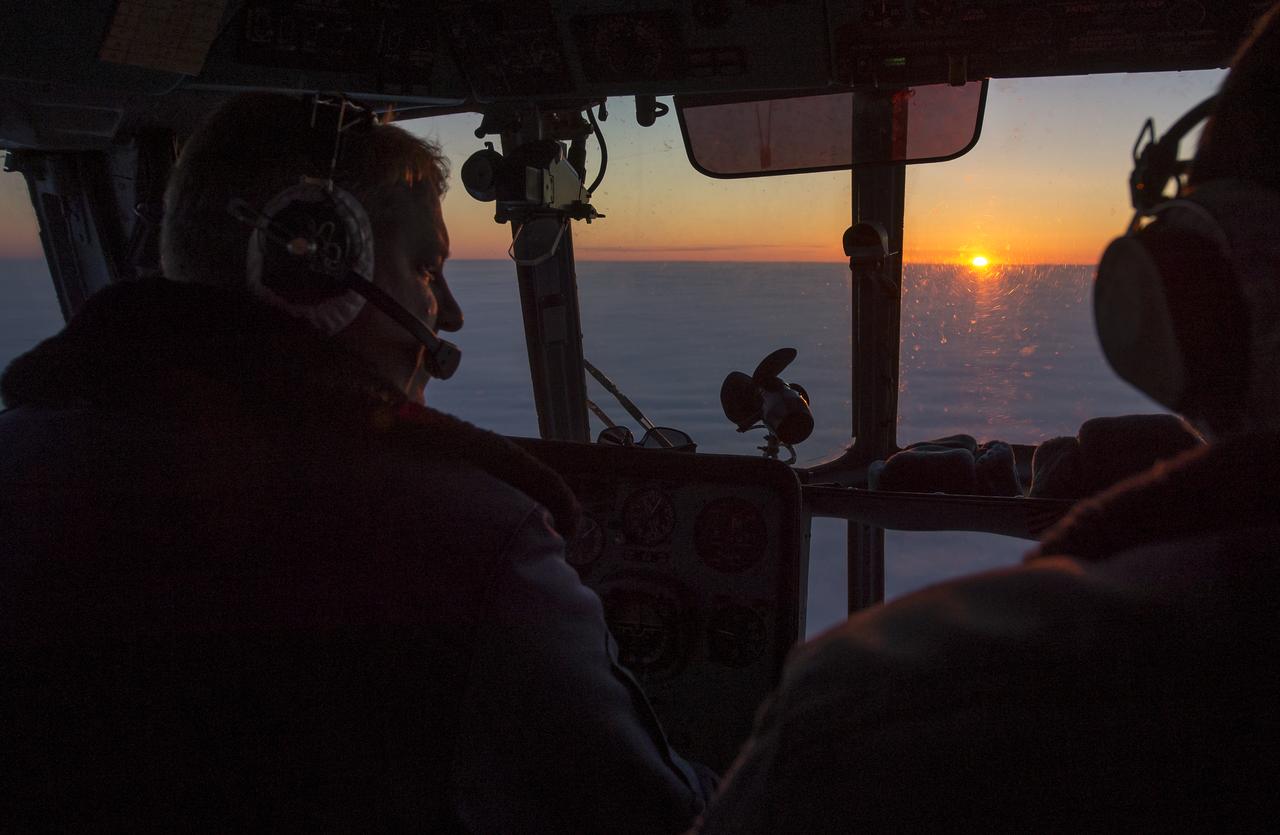
Pilots position a Russian MI-8 Helicopter for the Soyuz TMA-14M spacecraft landing with Expedition 42 commander Barry Wilmore of NASA, Alexander Samokutyaev of the Russian Federal Space Agency (Roscosmos) and Elena Serova of Roscosmos near the town of Zhezkazgan, Kazakhstan on Thursday, March 12, 2015. NASA Astronaut Wilmore, Russian Cosmonauts Samokutyaev and Serova are returning after almost six months onboard the International Space Station where they served as members of the Expedition 41 and 42 crews. Photo Credit: (NASA/Bill Ingalls)
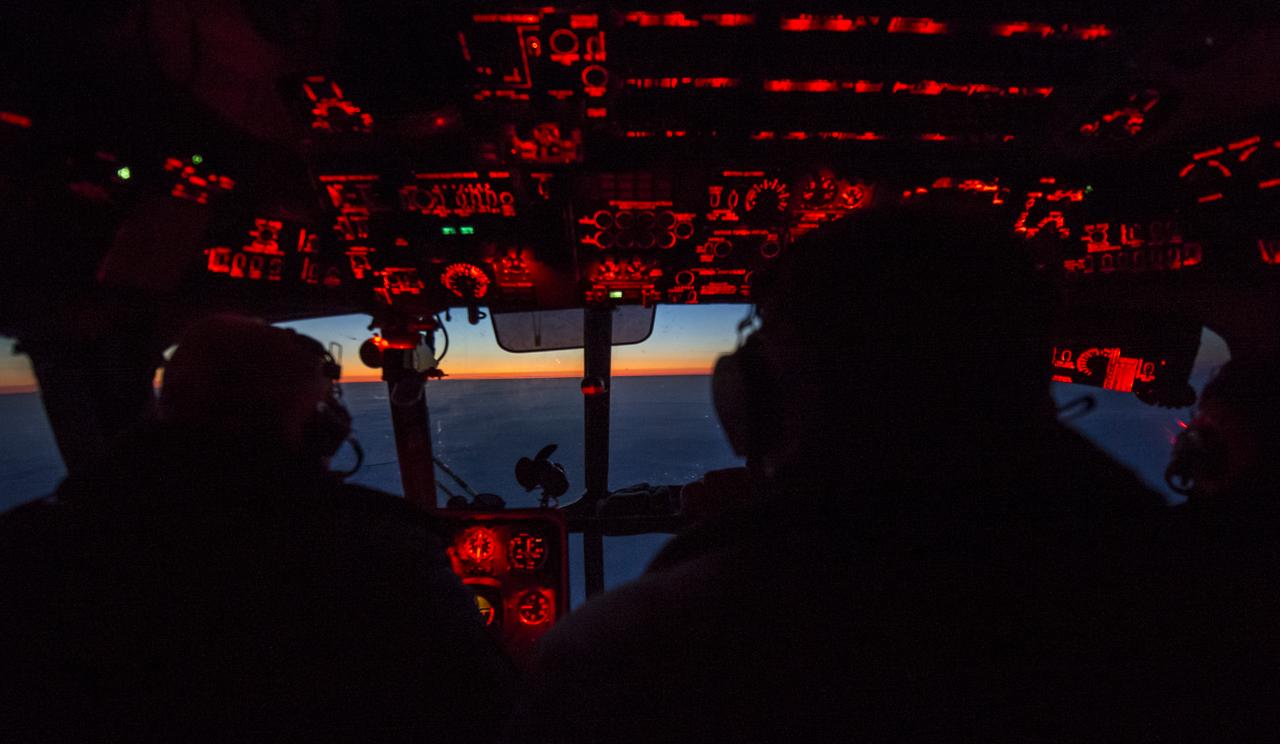
Pilots position a Russian MI-8 Helicopter for the Soyuz TMA-14M spacecraft landing with Expedition 42 commander Barry Wilmore of NASA, Alexander Samokutyaev of the Russian Federal Space Agency (Roscosmos) and Elena Serova of Roscosmos near the town of Zhezkazgan, Kazakhstan on Thursday, March 12, 2015. NASA Astronaut Wilmore, Russian Cosmonauts Samokutyaev and Serova are returning after almost six months onboard the International Space Station where they served as members of the Expedition 41 and 42 crews. Photo Credit: (NASA/Bill Ingalls)
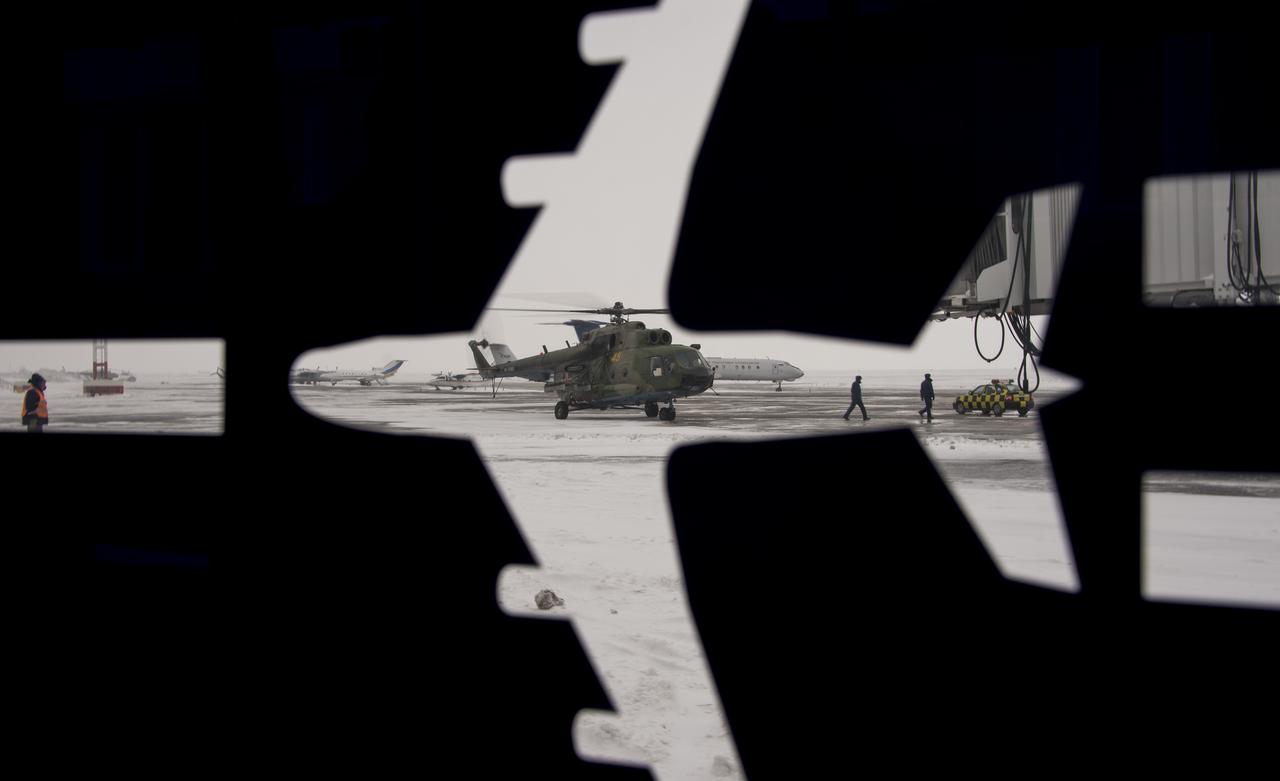
A Russian MI-8 Helicopter is seen through the airport bus decal a day before the Soyuz TMA-14M spacecraft landing with Expedition 42 commander Barry Wilmore of NASA, Alexander Samokutyaev of the Russian Federal Space Agency (Roscosmos) and Elena Serova of Roscosmos Wednesday, March 11, 2015 in Karaganda, Kazakhstan. NASA Astronaut Wilmore, Russian Cosmonauts Samokutyaev and Serova are returning after almost six months onboard the International Space Station where they served as members of the Expedition 41 and 42 crews. Photo Credit: (NASA/Bill Ingalls)
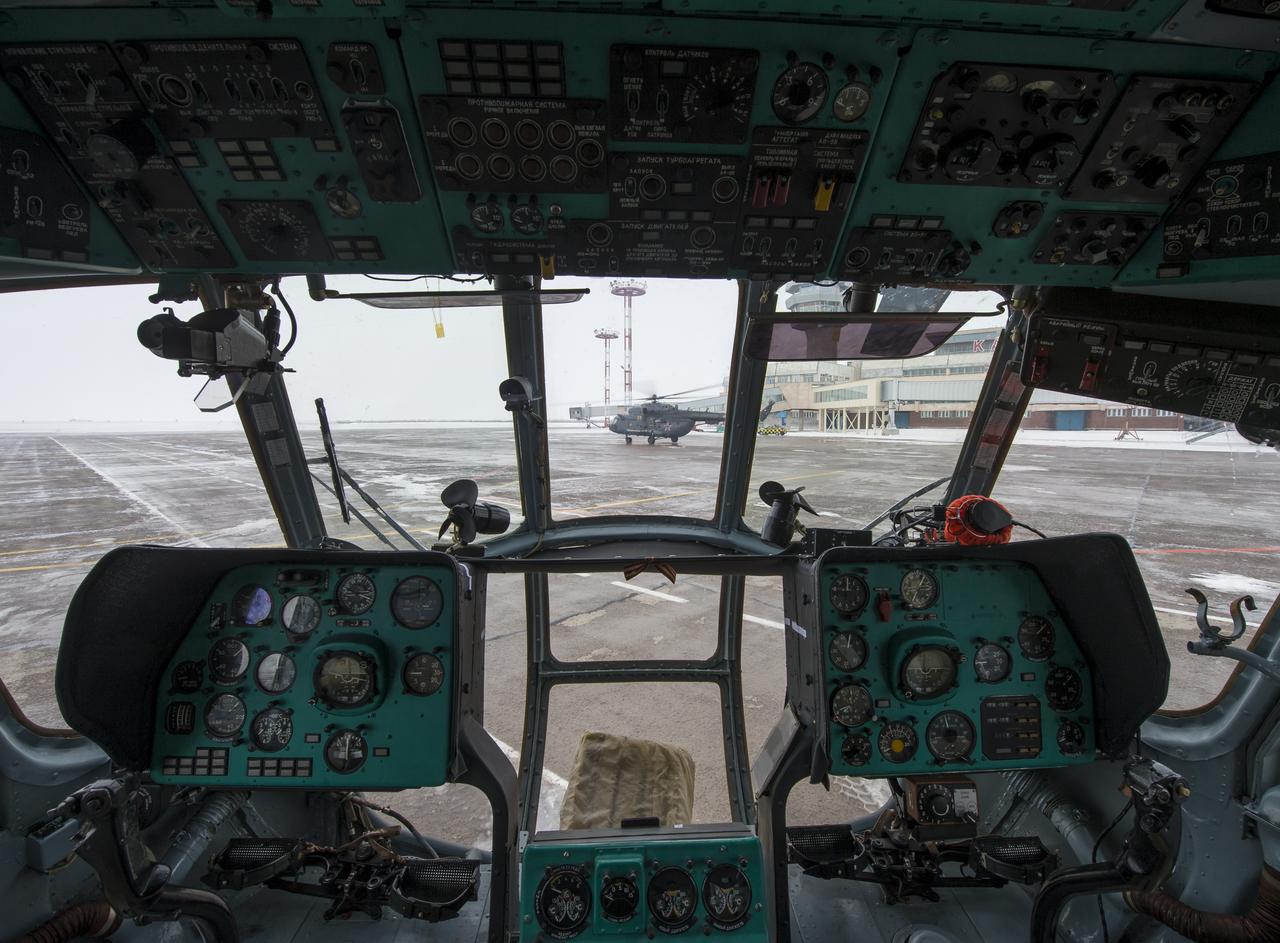
A Russian MI-8 Helicopter is seen through the cockpit of another helicopter a day before the Soyuz TMA-14M spacecraft landing with Expedition 42 commander Barry Wilmore of NASA, Alexander Samokutyaev of the Russian Federal Space Agency (Roscosmos) and Elena Serova of Roscosmos Wednesday, March 11, 2015 in Karaganda, Kazakhstan. NASA Astronaut Wilmore, Russian Cosmonauts Samokutyaev and Serova are returning after almost six months onboard the International Space Station where they served as members of the Expedition 41 and 42 crews. Photo Credit: (NASA/Bill Ingalls)
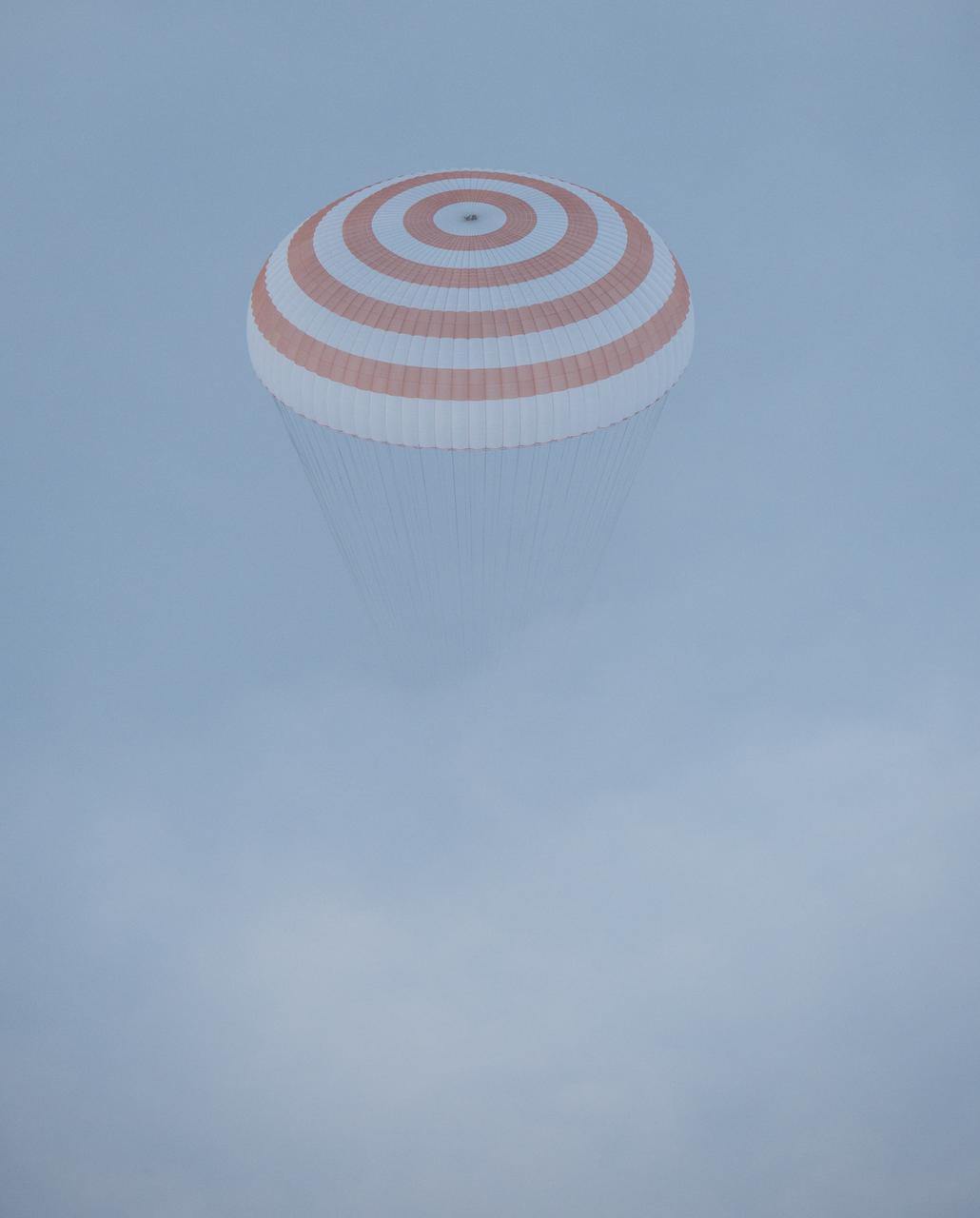
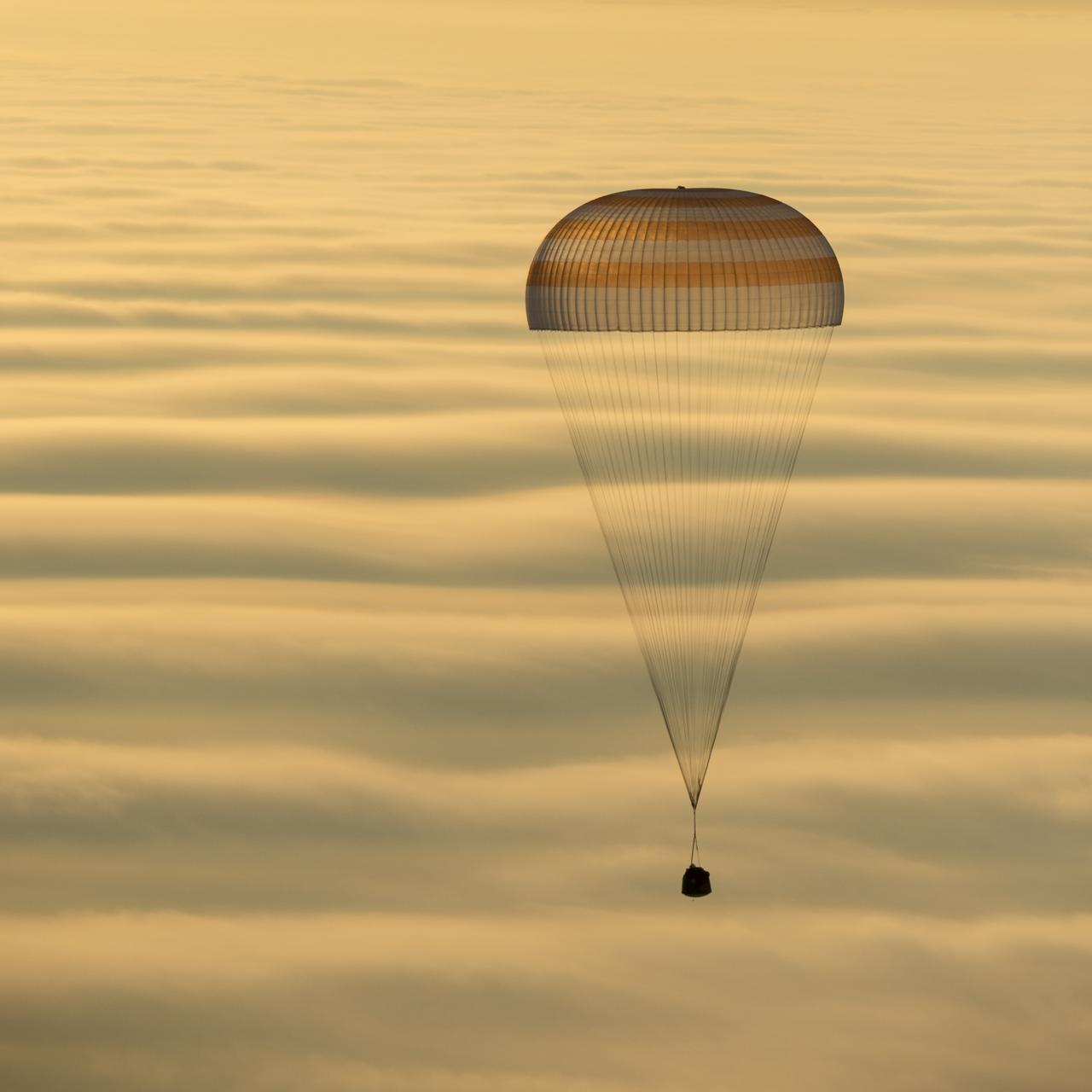
The Soyuz TMA-14M spacecraft is seen as it descends through the fog before landing with Expedition 42 commander Barry Wilmore of NASA, Alexander Samokutyaev of the Russian Federal Space Agency (Roscosmos) and Elena Serova of Roscosmos near the town of Zhezkazgan, Kazakhstan on Thursday, March 12, 2015. NASA Astronaut Wilmore, Russian Cosmonauts Samokutyaev and Serova are returning after almost six months onboard the International Space Station where they served as members of the Expedition 41 and 42 crews. Photo Credit: (NASA/Bill Ingalls)
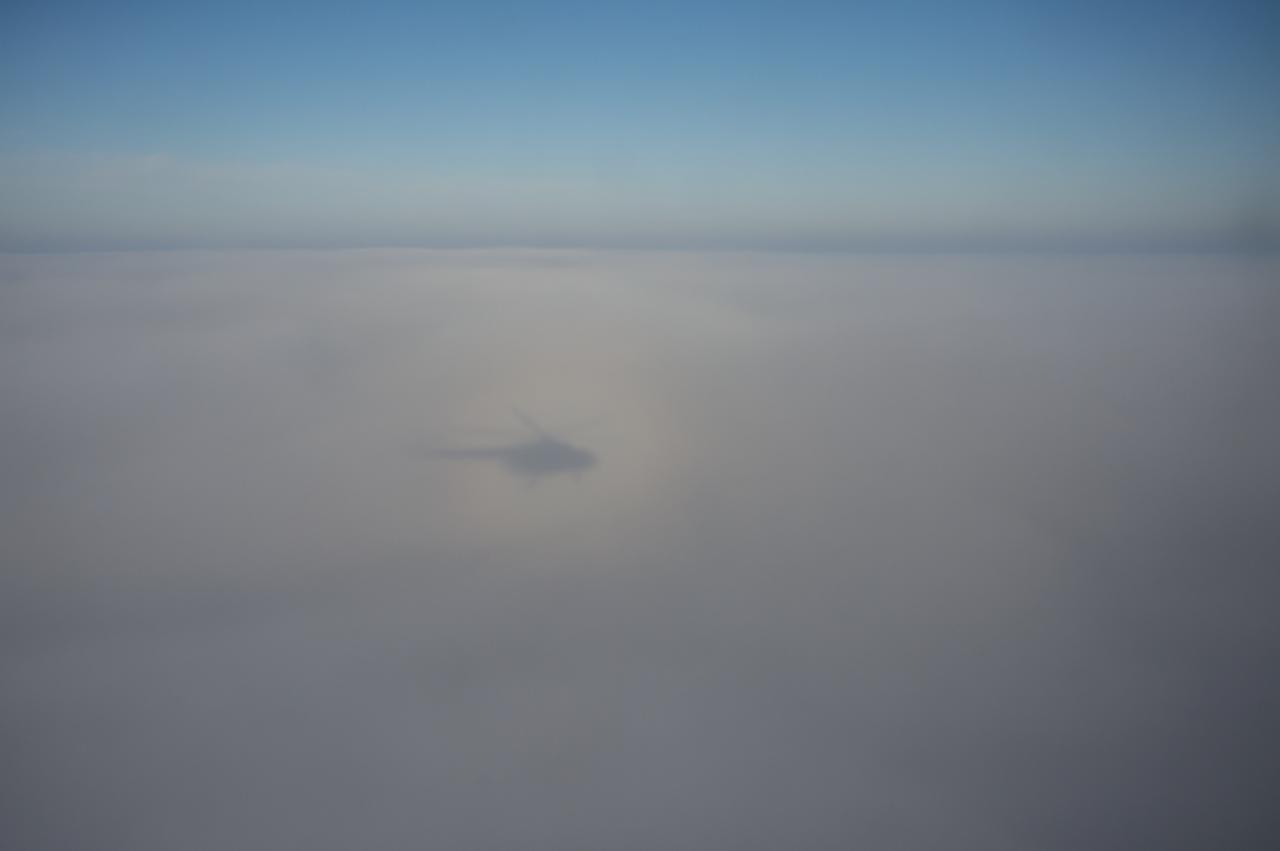
A shadow of a Russian MI-8 Helicopter is seen during the Soyuz TMA-14M spacecraft landing with Expedition 42 commander Barry Wilmore of NASA, Alexander Samokutyaev of the Russian Federal Space Agency (Roscosmos) and Elena Serova of Roscosmos near the town of Zhezkazgan, Kazakhstan on Thursday, March 12, 2015. NASA Astronaut Wilmore, Russian Cosmonauts Samokutyaev and Serova are returning after almost six months onboard the International Space Station where they served as members of the Expedition 41 and 42 crews. Photo Credit: (NASA/Bill Ingalls)
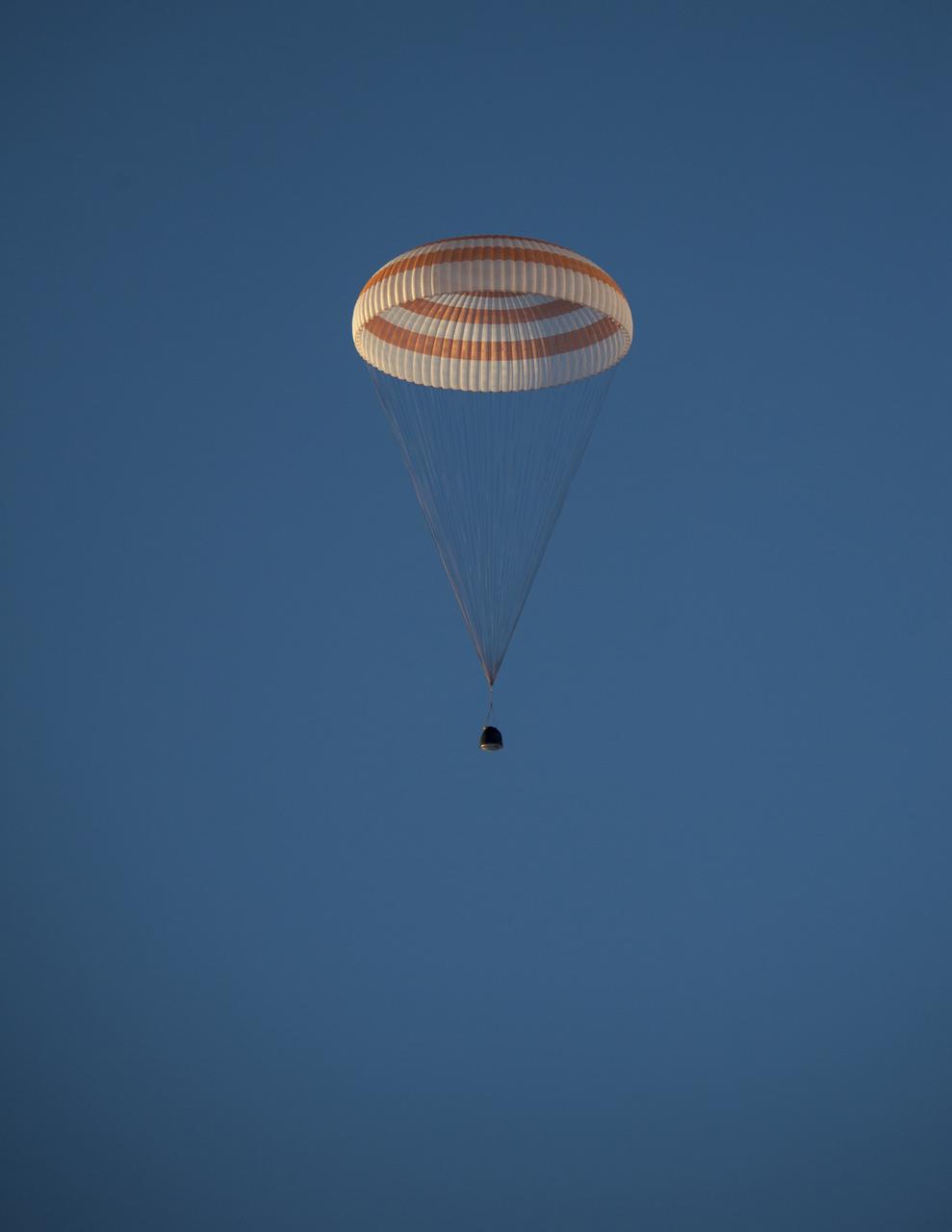
The Soyuz TMA-14M spacecraft is seen as it lands with Expedition 42 commander Barry Wilmore of NASA, Alexander Samokutyaev of the Russian Federal Space Agency (Roscosmos) and Elena Serova of Roscosmos near the town of Zhezkazgan, Kazakhstan on Thursday, March 12, 2015. NASA Astronaut Wilmore, Russian Cosmonauts Samokutyaev and Serova are returning after almost six months onboard the International Space Station where they served as members of the Expedition 41 and 42 crews. Photo Credit: (NASA/Bill Ingalls)
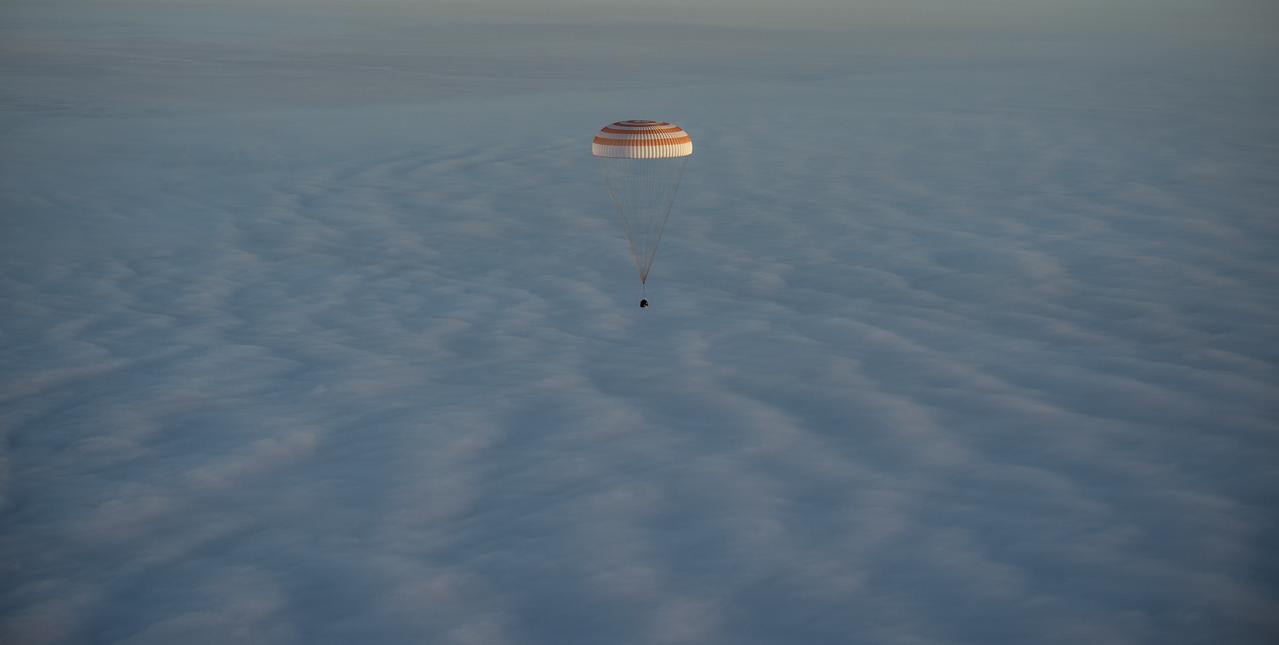
The Soyuz TMA-14M spacecraft is seen as it lands with Expedition 42 commander Barry Wilmore of NASA, Alexander Samokutyaev of the Russian Federal Space Agency (Roscosmos) and Elena Serova of Roscosmos near the town of Zhezkazgan, Kazakhstan on Thursday, March 12, 2015. NASA Astronaut Wilmore, Russian Cosmonauts Samokutyaev and Serova are returning after almost six months onboard the International Space Station where they served as members of the Expedition 41 and 42 crews. Photo Credit: (NASA/Bill Ingalls)
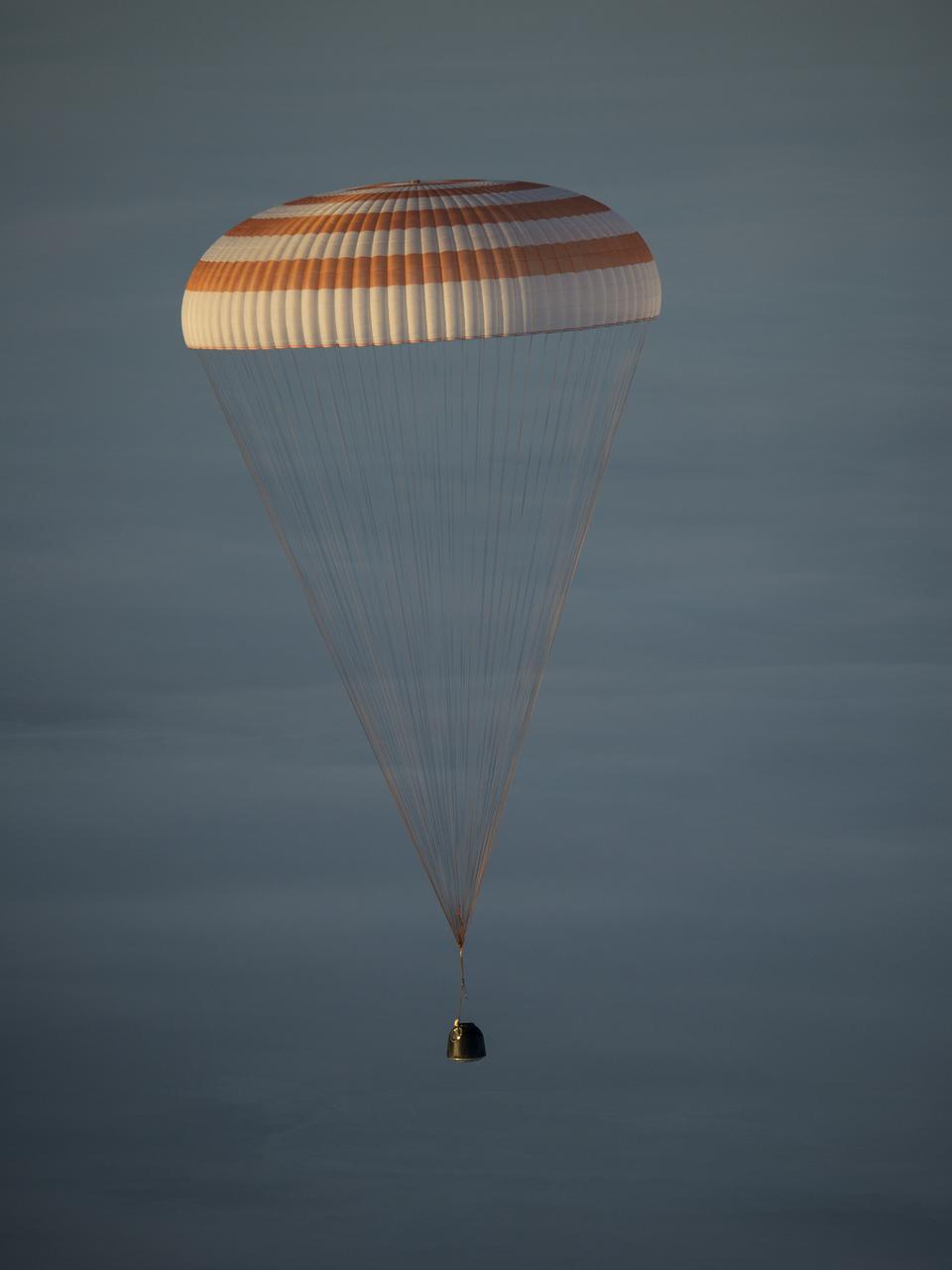
The Soyuz TMA-14M spacecraft is seen as it lands with Expedition 42 commander Barry Wilmore of NASA, Alexander Samokutyaev of the Russian Federal Space Agency (Roscosmos) and Elena Serova of Roscosmos near the town of Zhezkazgan, Kazakhstan on Thursday, March 12, 2015. NASA Astronaut Wilmore, Russian Cosmonauts Samokutyaev and Serova are returning after almost six months onboard the International Space Station where they served as members of the Expedition 41 and 42 crews. Photo Credit: (NASA/Bill Ingalls)
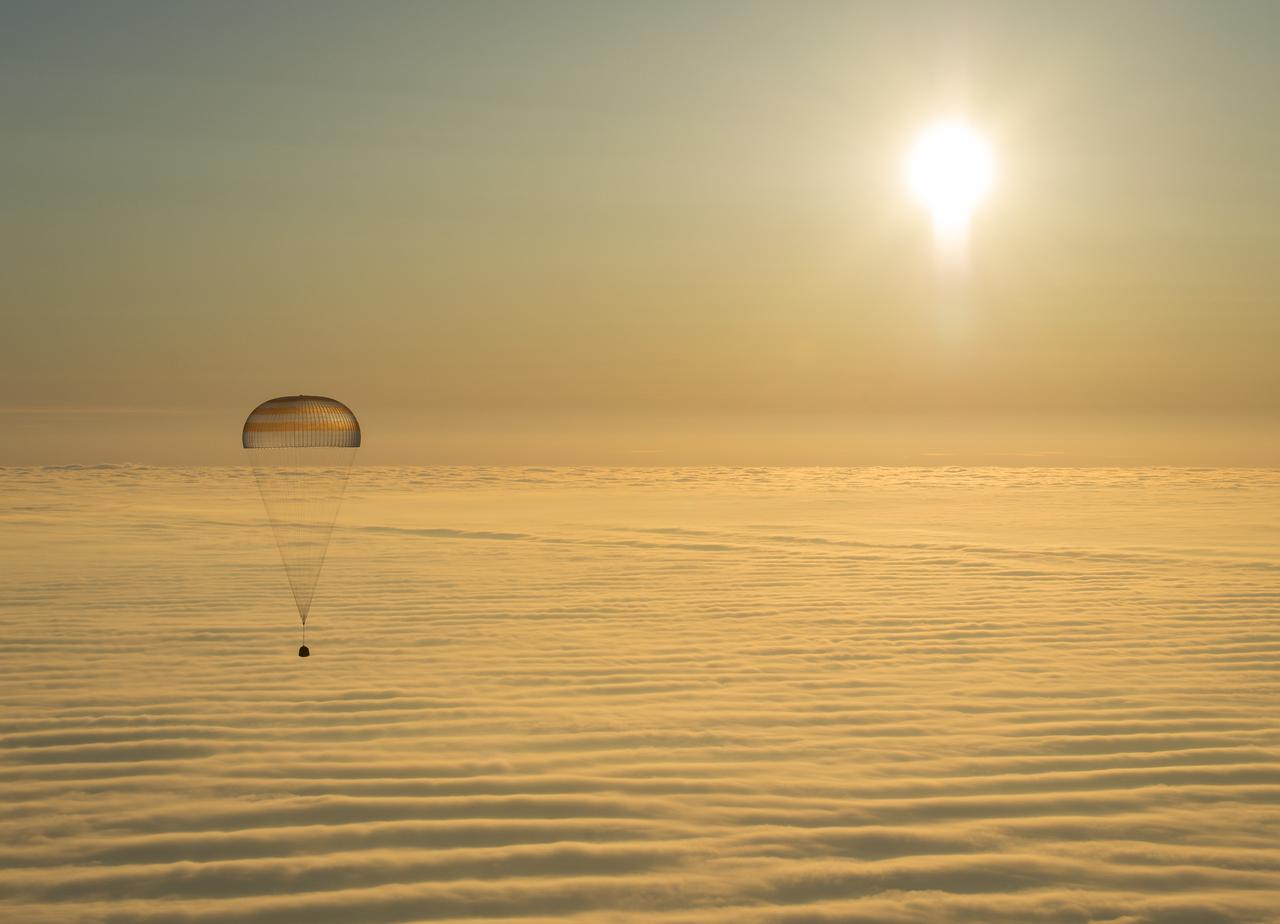
The Soyuz TMA-14M spacecraft is seen as it lands with Expedition 42 commander Barry Wilmore of NASA, Alexander Samokutyaev of the Russian Federal Space Agency (Roscosmos) and Elena Serova of Roscosmos near the town of Zhezkazgan, Kazakhstan on Thursday, March 12, 2015. NASA Astronaut Wilmore, Russian Cosmonauts Samokutyaev and Serova are returning after almost six months onboard the International Space Station where they served as members of the Expedition 41 and 42 crews. Photo Credit: (NASA/Bill Ingalls)
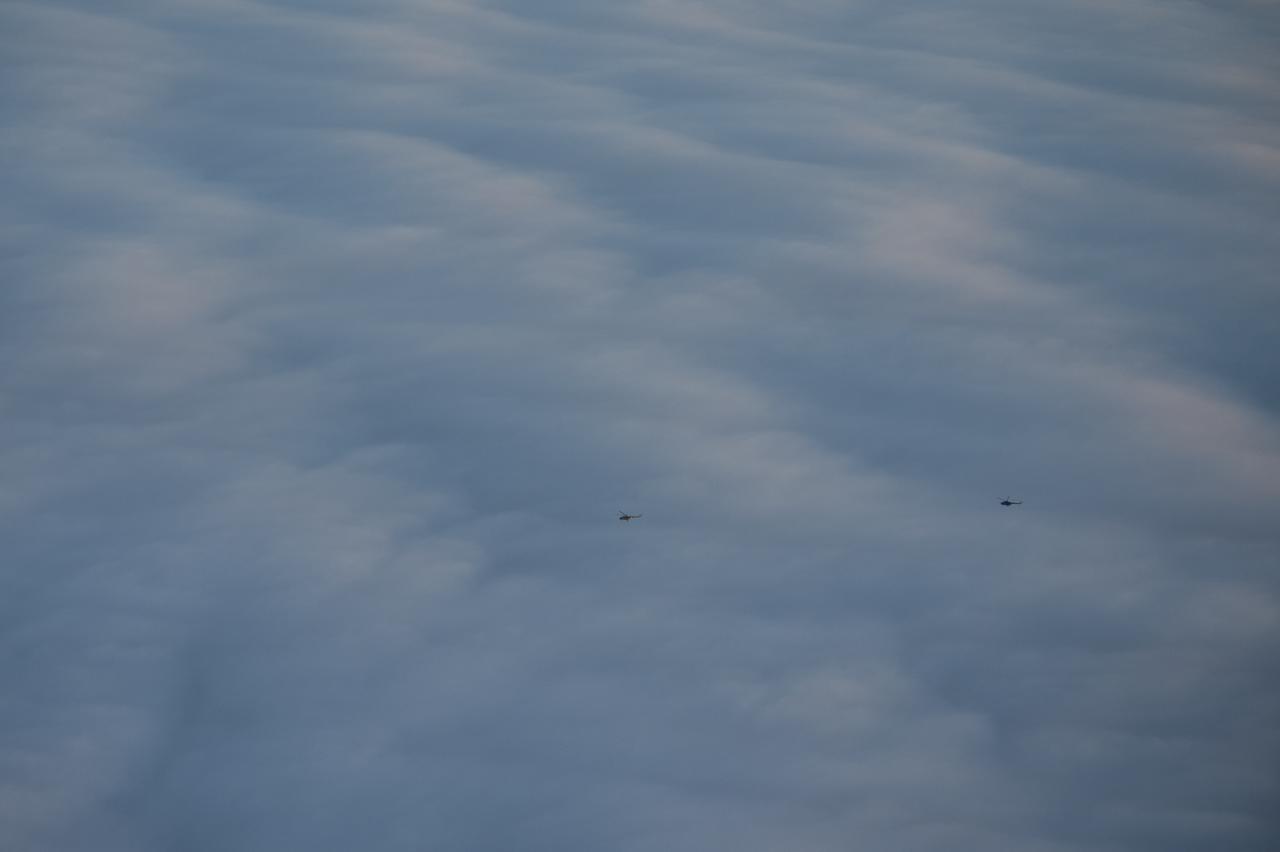
Russian MI-8 Helicopters are seen during the Soyuz TMA-14M spacecraft landing with Expedition 42 commander Barry Wilmore of NASA, Alexander Samokutyaev of the Russian Federal Space Agency (Roscosmos) and Elena Serova of Roscosmos near the town of Zhezkazgan, Kazakhstan on Thursday, March 12, 2015. NASA Astronaut Wilmore, Russian Cosmonauts Samokutyaev and Serova are returning after almost six months onboard the International Space Station where they served as members of the Expedition 41 and 42 crews. Photo Credit: (NASA/Bill Ingalls)
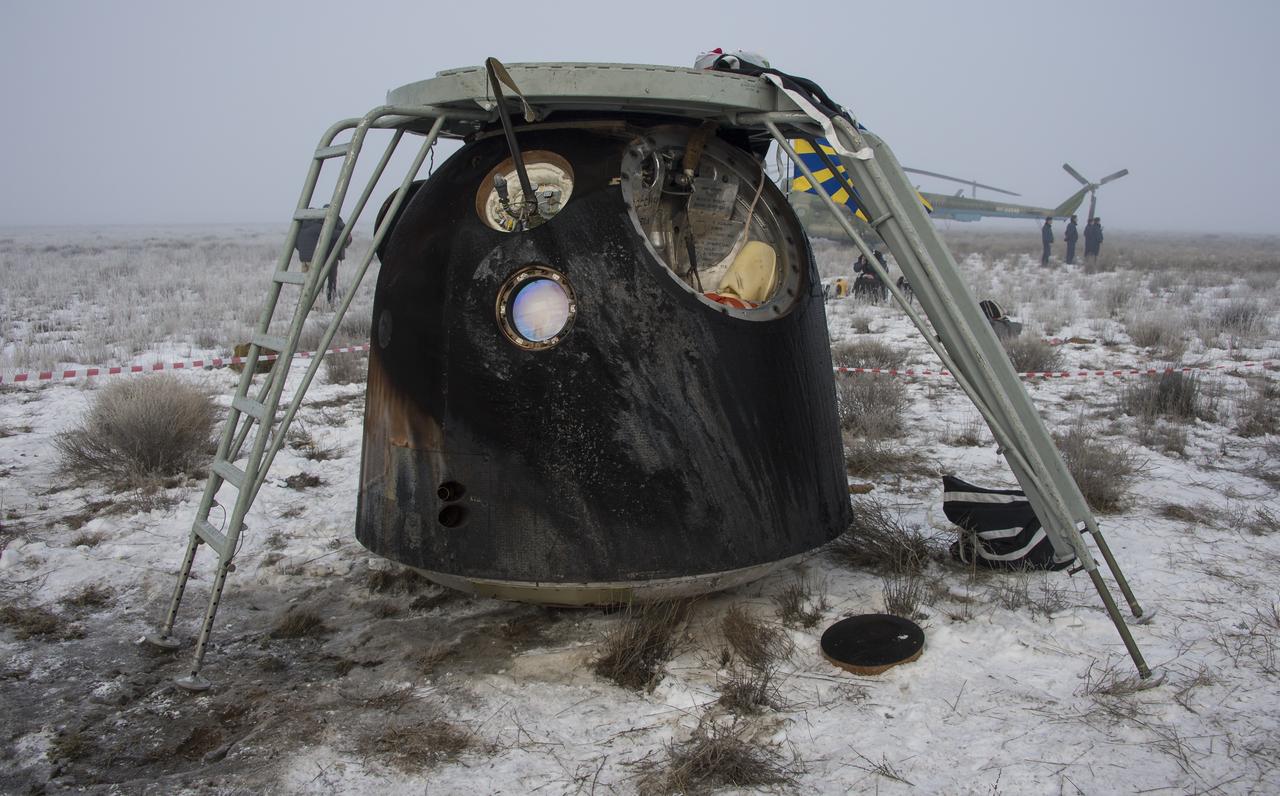
The Soyuz TMA-14M spacecraft is seen after it landed with Expedition 42 commander Barry Wilmore of NASA, Alexander Samokutyaev of the Russian Federal Space Agency (Roscosmos) and Elena Serova of Roscosmos near the town of Zhezkazgan, Kazakhstan on Thursday, March 12, 2015. NASA Astronaut Wilmore, Russian Cosmonauts Samokutyaev and Serova are returning after almost six months onboard the International Space Station where they served as members of the Expedition 41 and 42 crews. Photo Credit: (NASA/Bill Ingalls)
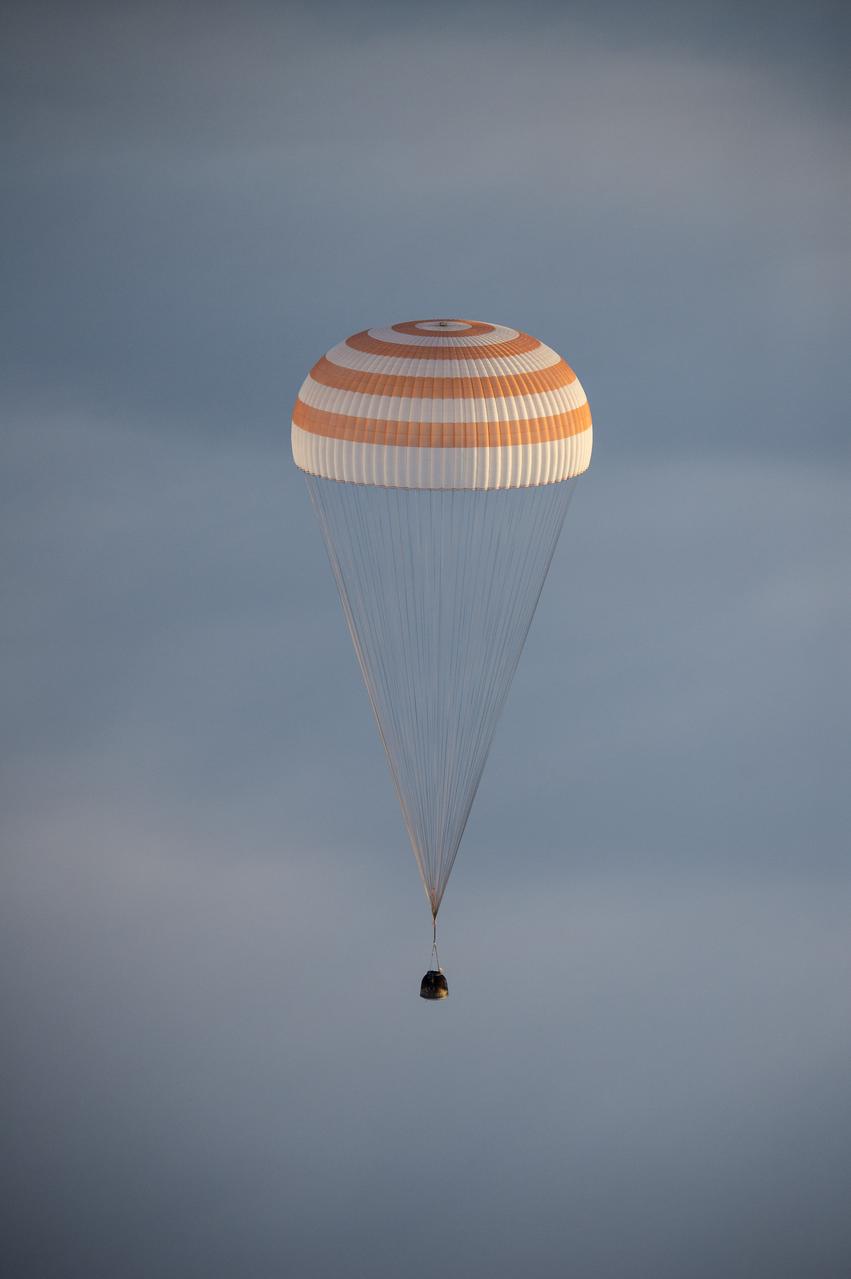
The Soyuz TMA-14M spacecraft is seen as it lands with Expedition 42 commander Barry Wilmore of NASA, Alexander Samokutyaev of the Russian Federal Space Agency (Roscosmos) and Elena Serova of Roscosmos near the town of Zhezkazgan, Kazakhstan on Thursday, March 12, 2015. NASA Astronaut Wilmore, Russian Cosmonauts Samokutyaev and Serova are returning after almost six months onboard the International Space Station where they served as members of the Expedition 41 and 42 crews. Photo Credit: (NASA/Bill Ingalls)
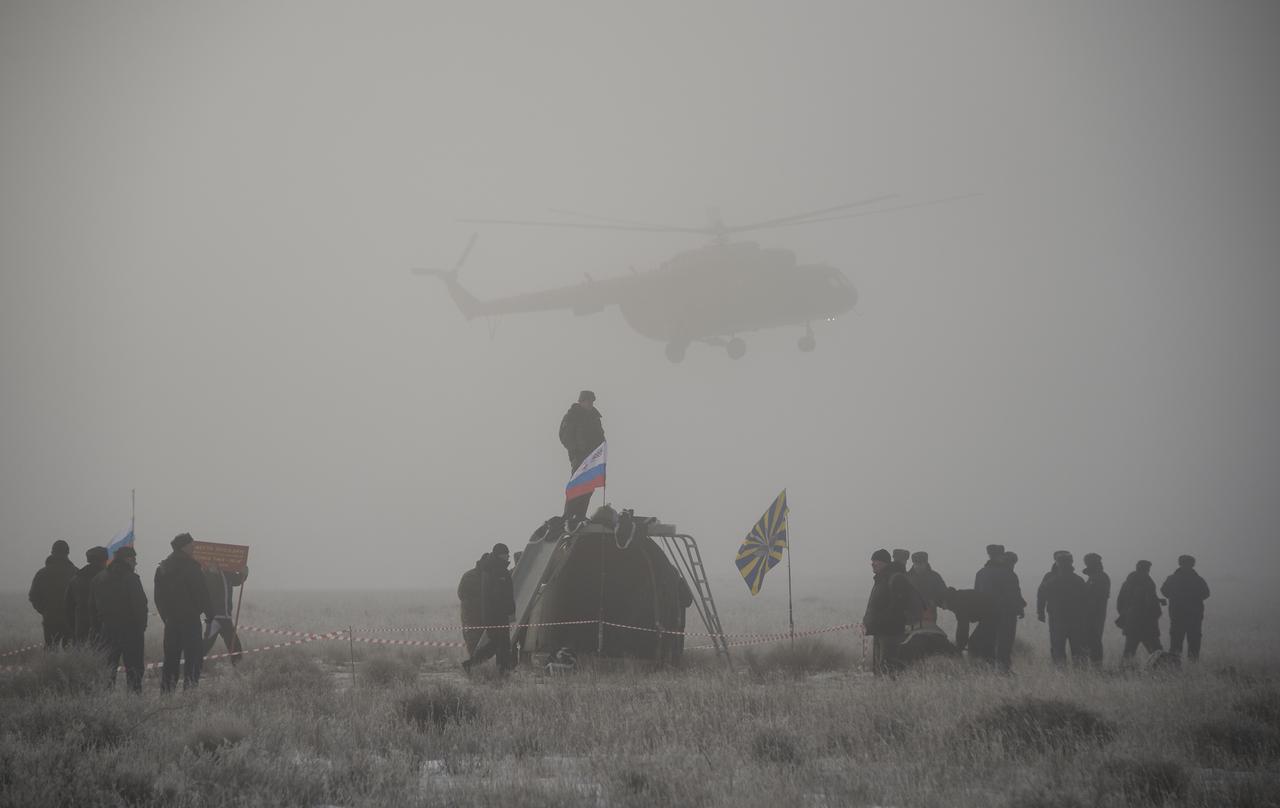
Russian support personnel work around the Soyuz TMA-14M spacecraft after it landed with Expedition 42 commander Barry Wilmore of NASA, Alexander Samokutyaev of the Russian Federal Space Agency (Roscosmos) and Elena Serova of Roscosmos near the town of Zhezkazgan, Kazakhstan on Thursday, March 12, 2015. NASA Astronaut Wilmore, Russian Cosmonauts Samokutyaev and Serova are returning after almost six months onboard the International Space Station where they served as members of the Expedition 41 and 42 crews. Photo Credit: (NASA/Bill Ingalls)
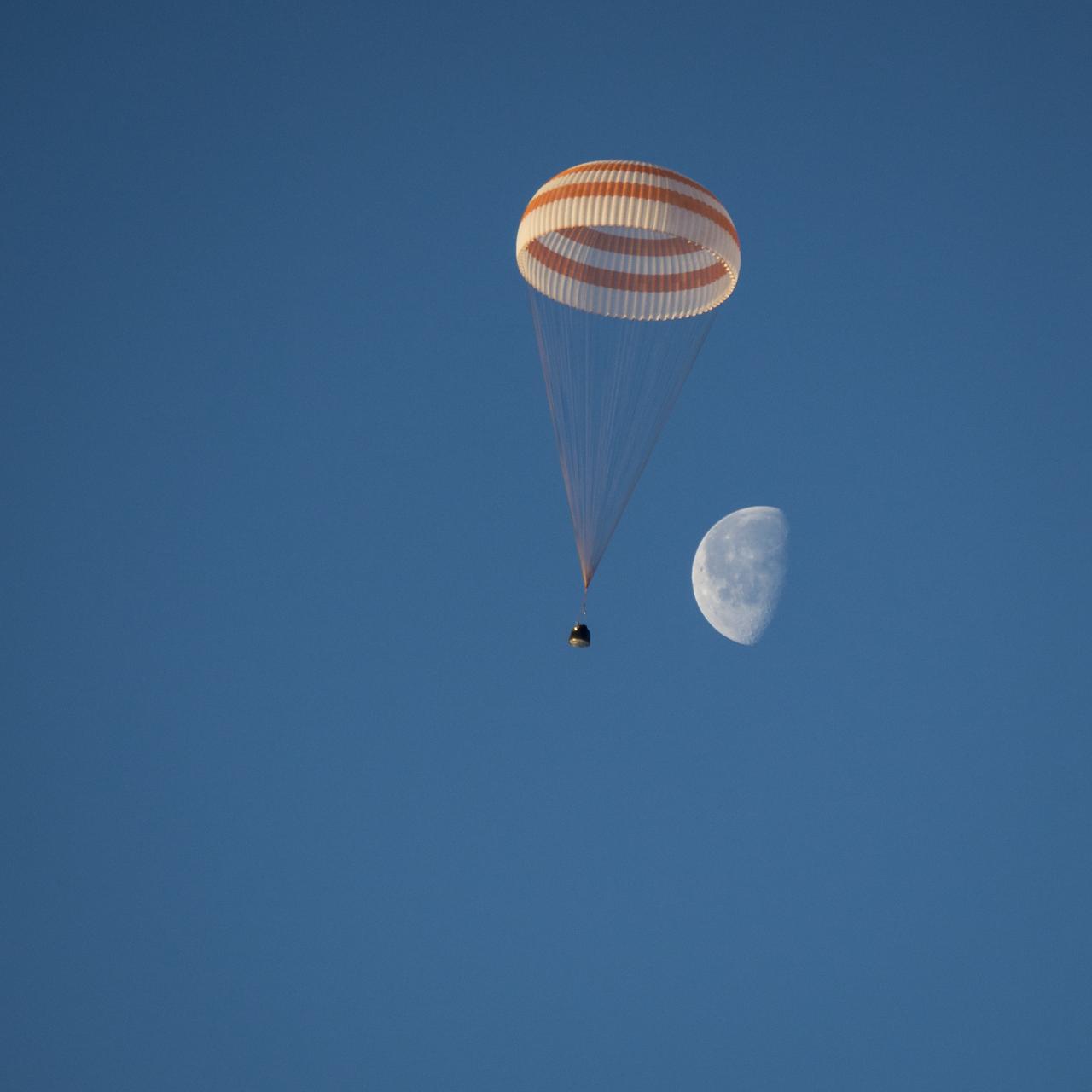
The Soyuz TMA-14M spacecraft is seen as it lands with Expedition 42 commander Barry Wilmore of NASA, Alexander Samokutyaev of the Russian Federal Space Agency (Roscosmos) and Elena Serova of Roscosmos near the town of Zhezkazgan, Kazakhstan on Thursday, March 12, 2015. NASA Astronaut Wilmore, Russian Cosmonauts Samokutyaev and Serova are returning after almost six months onboard the International Space Station where they served as members of the Expedition 41 and 42 crews. Photo Credit: (NASA/Bill Ingalls)
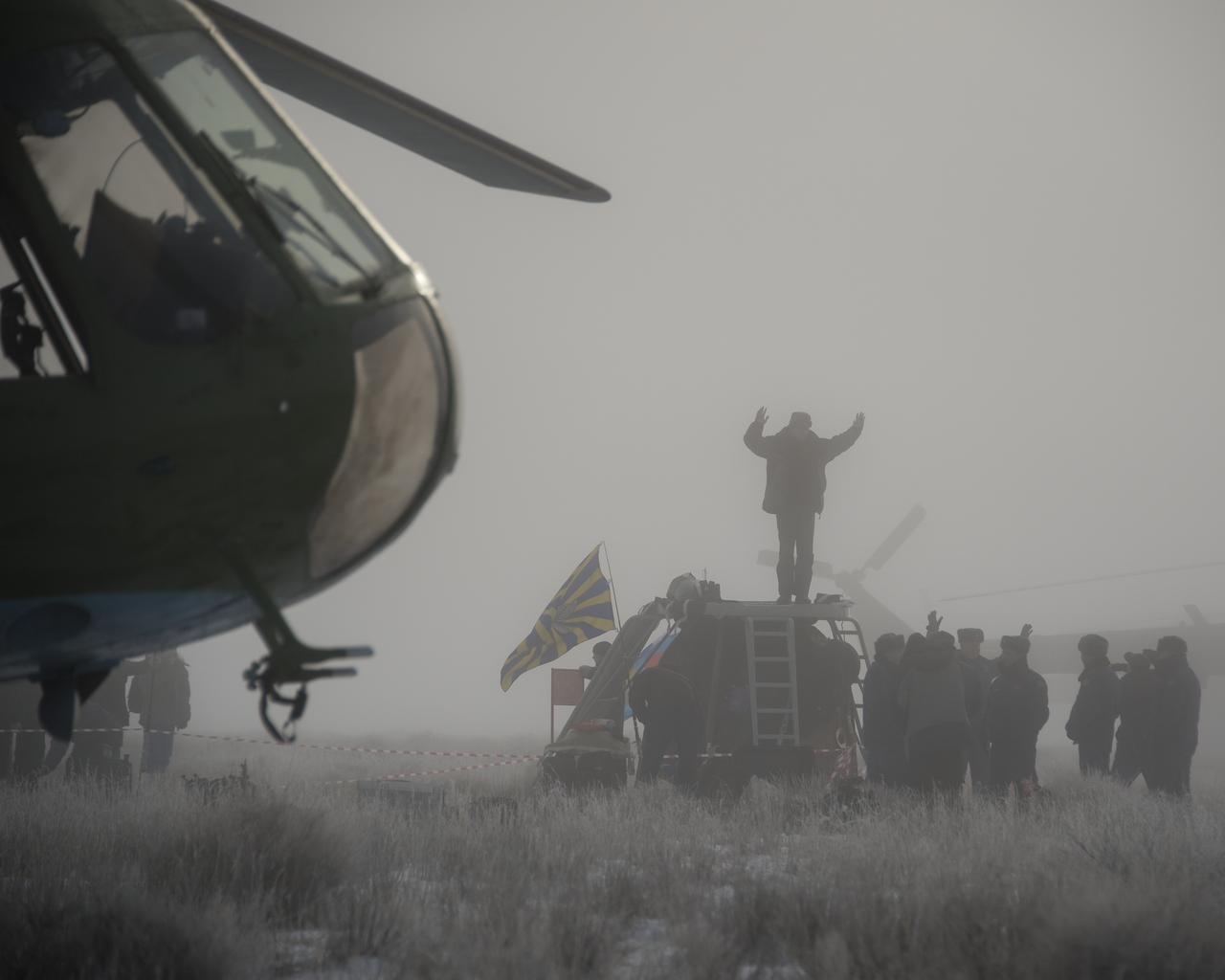
Russian support personnel work around the Soyuz TMA-14M spacecraft after it landed with Expedition 42 commander Barry Wilmore of NASA, Alexander Samokutyaev of the Russian Federal Space Agency (Roscosmos) and Elena Serova of Roscosmos near the town of Zhezkazgan, Kazakhstan on Thursday, March 12, 2015. NASA Astronaut Wilmore, Russian Cosmonauts Samokutyaev and Serova are returning after almost six months onboard the International Space Station where they served as members of the Expedition 41 and 42 crews. Photo Credit: (NASA/Bill Ingalls)
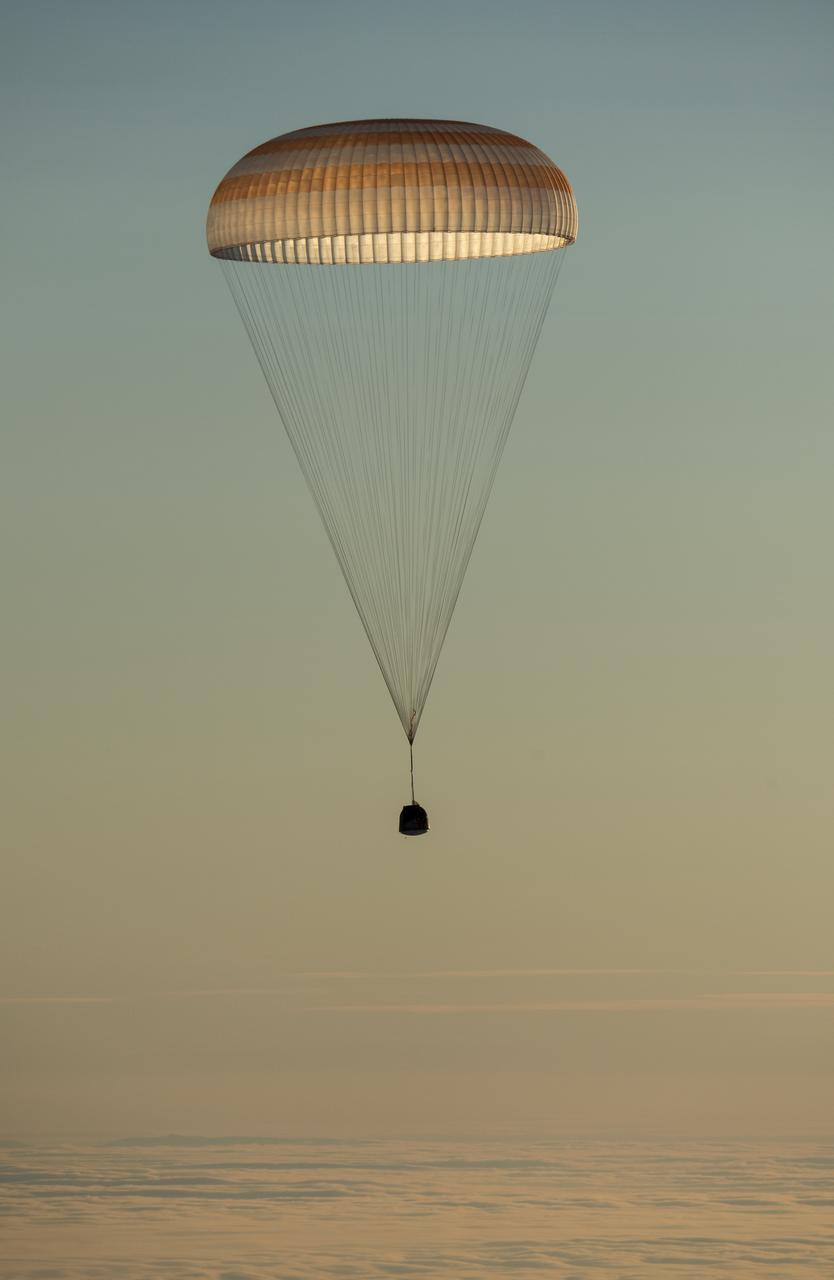
The Soyuz TMA-14M spacecraft is seen as it lands with Expedition 42 commander Barry Wilmore of NASA, Alexander Samokutyaev of the Russian Federal Space Agency (Roscosmos) and Elena Serova of Roscosmos near the town of Zhezkazgan, Kazakhstan on Thursday, March 12, 2015. NASA Astronaut Wilmore, Russian Cosmonauts Samokutyaev and Serova are returning after almost six months onboard the International Space Station where they served as members of the Expedition 41 and 42 crews. Photo Credit: (NASA/Bill Ingalls)
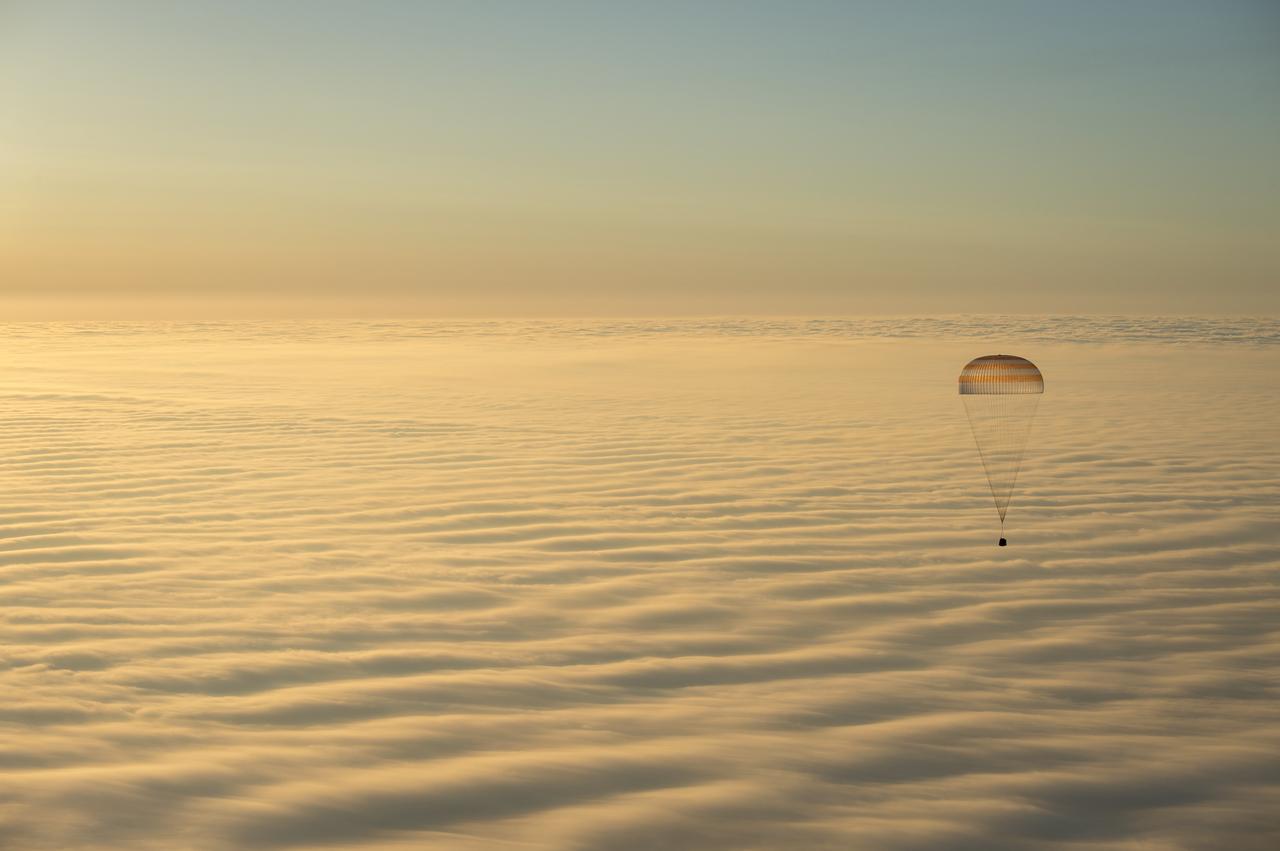
The Soyuz TMA-14M spacecraft is seen as it lands with Expedition 42 commander Barry Wilmore of NASA, Alexander Samokutyaev of the Russian Federal Space Agency (Roscosmos) and Elena Serova of Roscosmos near the town of Zhezkazgan, Kazakhstan on Thursday, March 12, 2015. NASA Astronaut Wilmore, Russian Cosmonauts Samokutyaev and Serova are returning after almost six months onboard the International Space Station where they served as members of the Expedition 41 and 42 crews. Photo Credit: (NASA/Bill Ingalls)
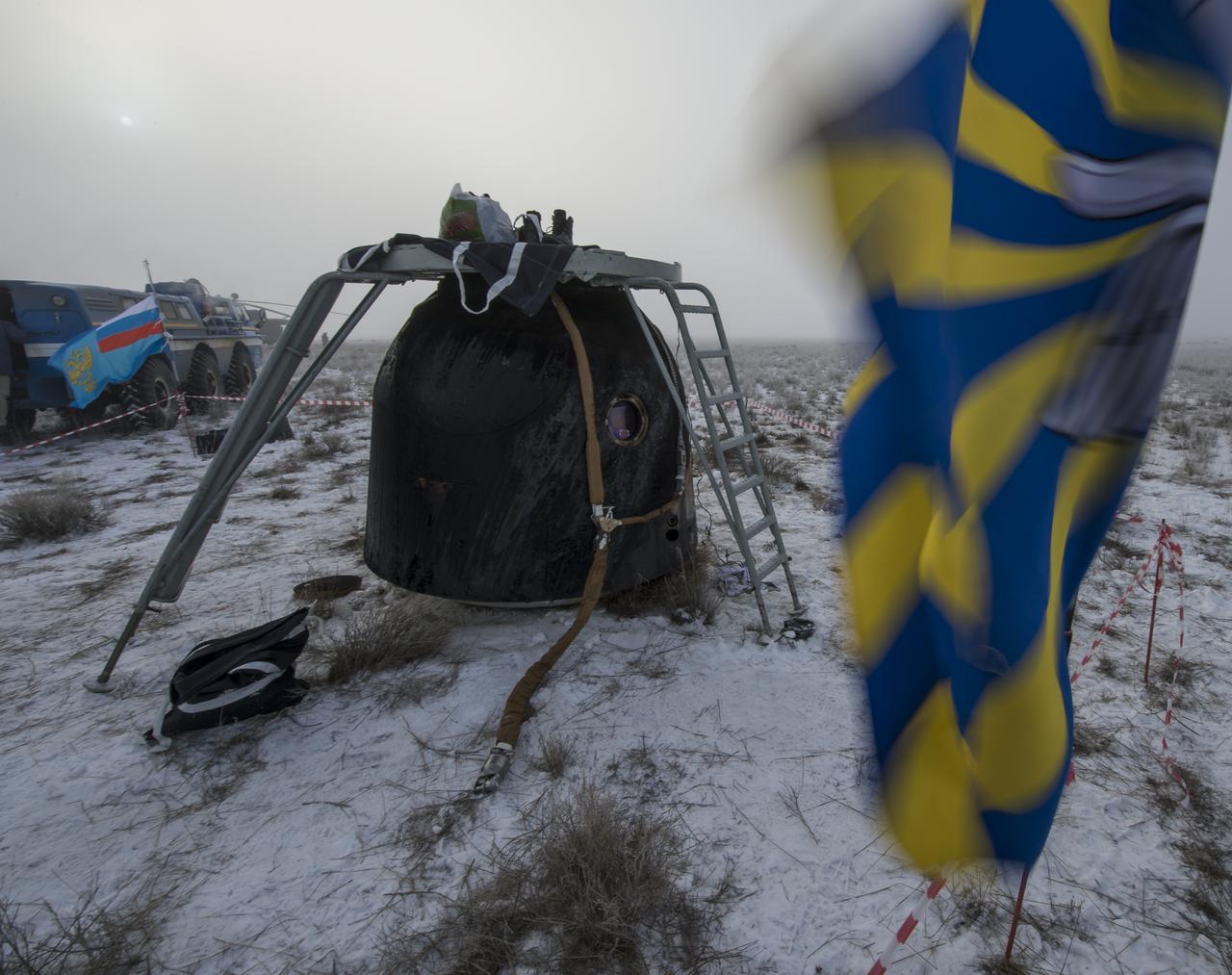
The Soyuz TMA-14M spacecraft is seen after it landed with Expedition 42 commander Barry Wilmore of NASA, Alexander Samokutyaev of the Russian Federal Space Agency (Roscosmos) and Elena Serova of Roscosmos near the town of Zhezkazgan, Kazakhstan on Thursday, March 12, 2015. NASA Astronaut Wilmore, Russian Cosmonauts Samokutyaev and Serova are returning after almost six months onboard the International Space Station where they served as members of the Expedition 41 and 42 crews. Photo Credit: (NASA/Bill Ingalls)
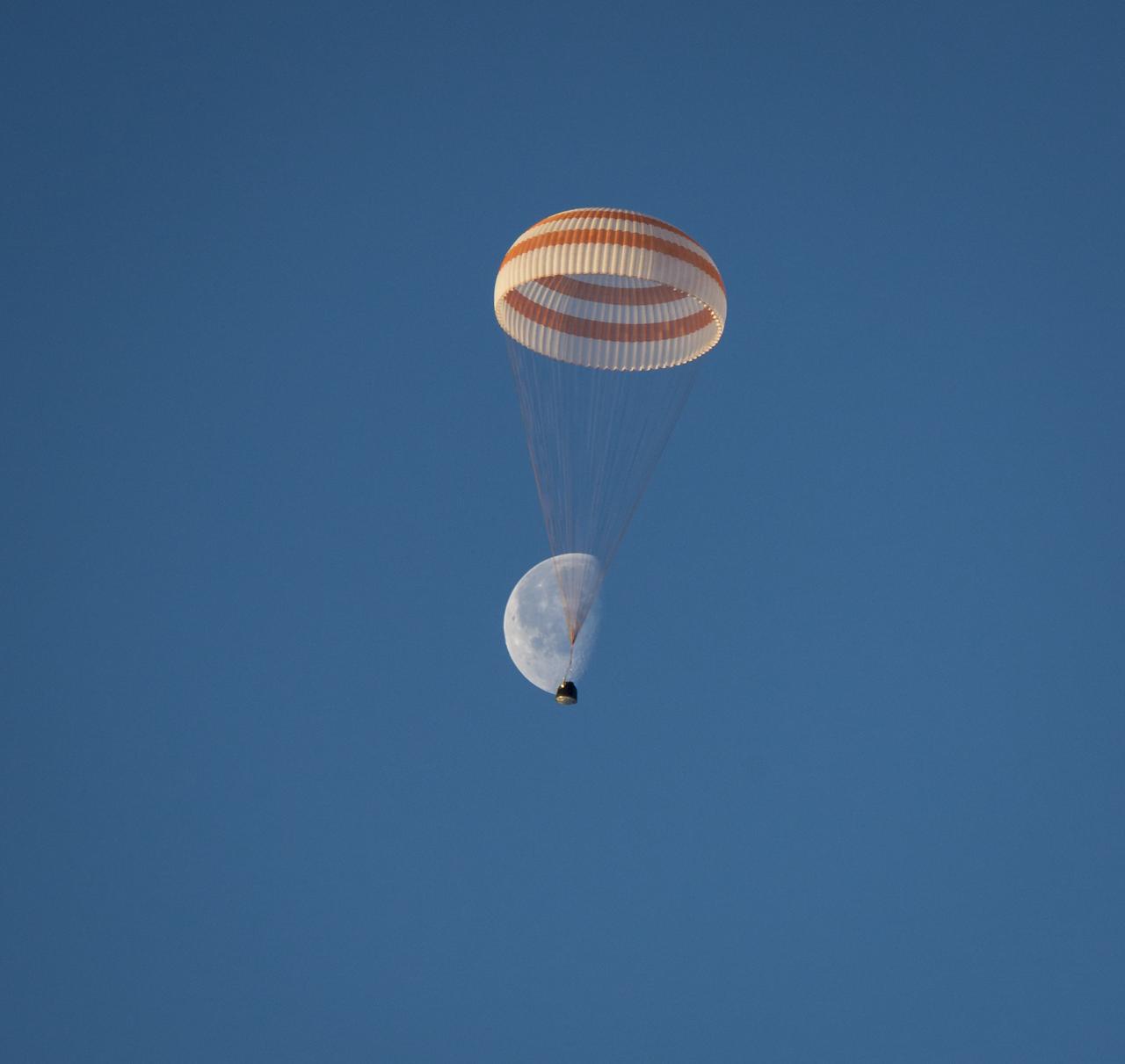
The Soyuz TMA-14M spacecraft is seen as it lands with Expedition 42 commander Barry Wilmore of NASA, Alexander Samokutyaev of the Russian Federal Space Agency (Roscosmos) and Elena Serova of Roscosmos near the town of Zhezkazgan, Kazakhstan on Thursday, March 12, 2015. NASA Astronaut Wilmore, Russian Cosmonauts Samokutyaev and Serova are returning after almost six months onboard the International Space Station where they served as members of the Expedition 41 and 42 crews. Photo Credit: (NASA/Bill Ingalls)
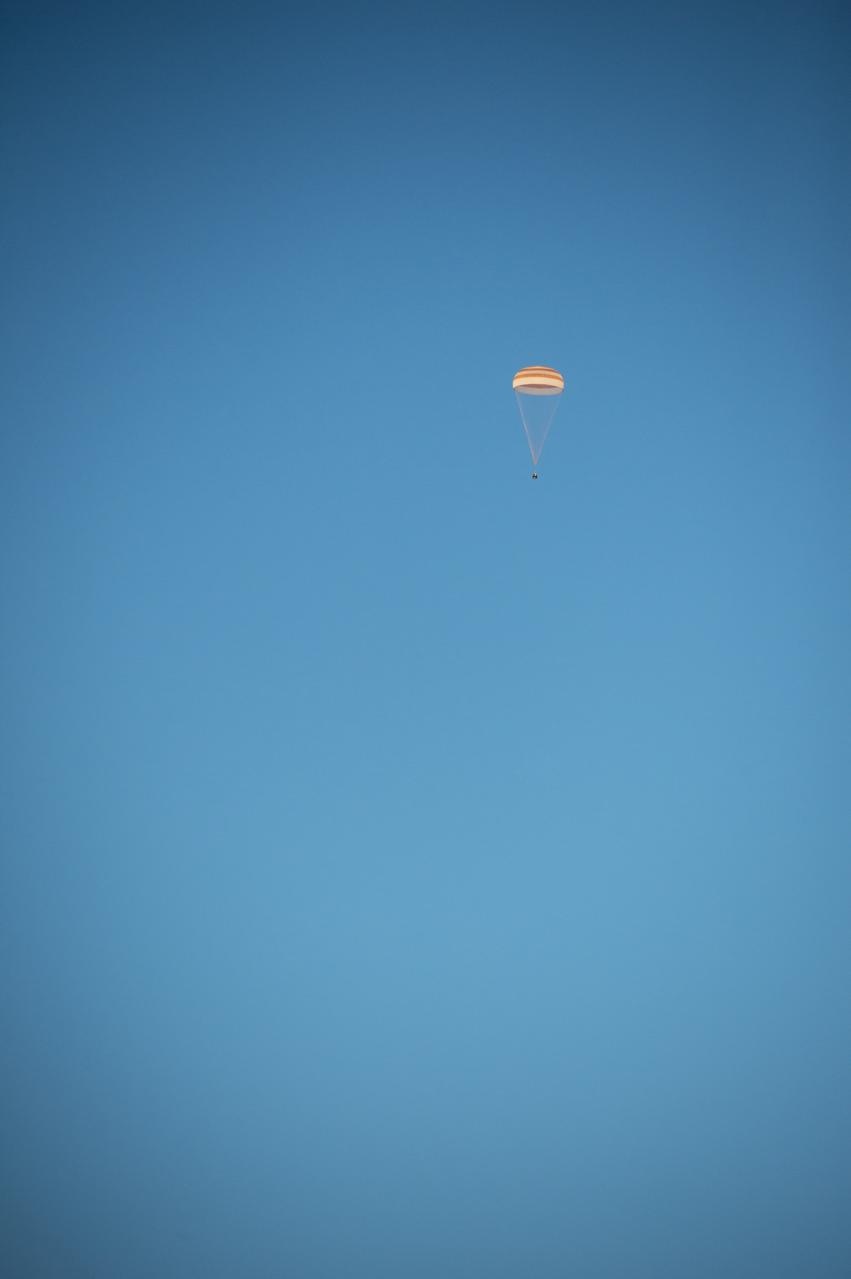
The Soyuz TMA-14M spacecraft is seen as it lands with Expedition 42 commander Barry Wilmore of NASA, Alexander Samokutyaev of the Russian Federal Space Agency (Roscosmos) and Elena Serova of Roscosmos near the town of Zhezkazgan, Kazakhstan on Thursday, March 12, 2015. NASA Astronaut Wilmore, Russian Cosmonauts Samokutyaev and Serova are returning after almost six months onboard the International Space Station where they served as members of the Expedition 41 and 42 crews. Photo Credit: (NASA/Bill Ingalls)
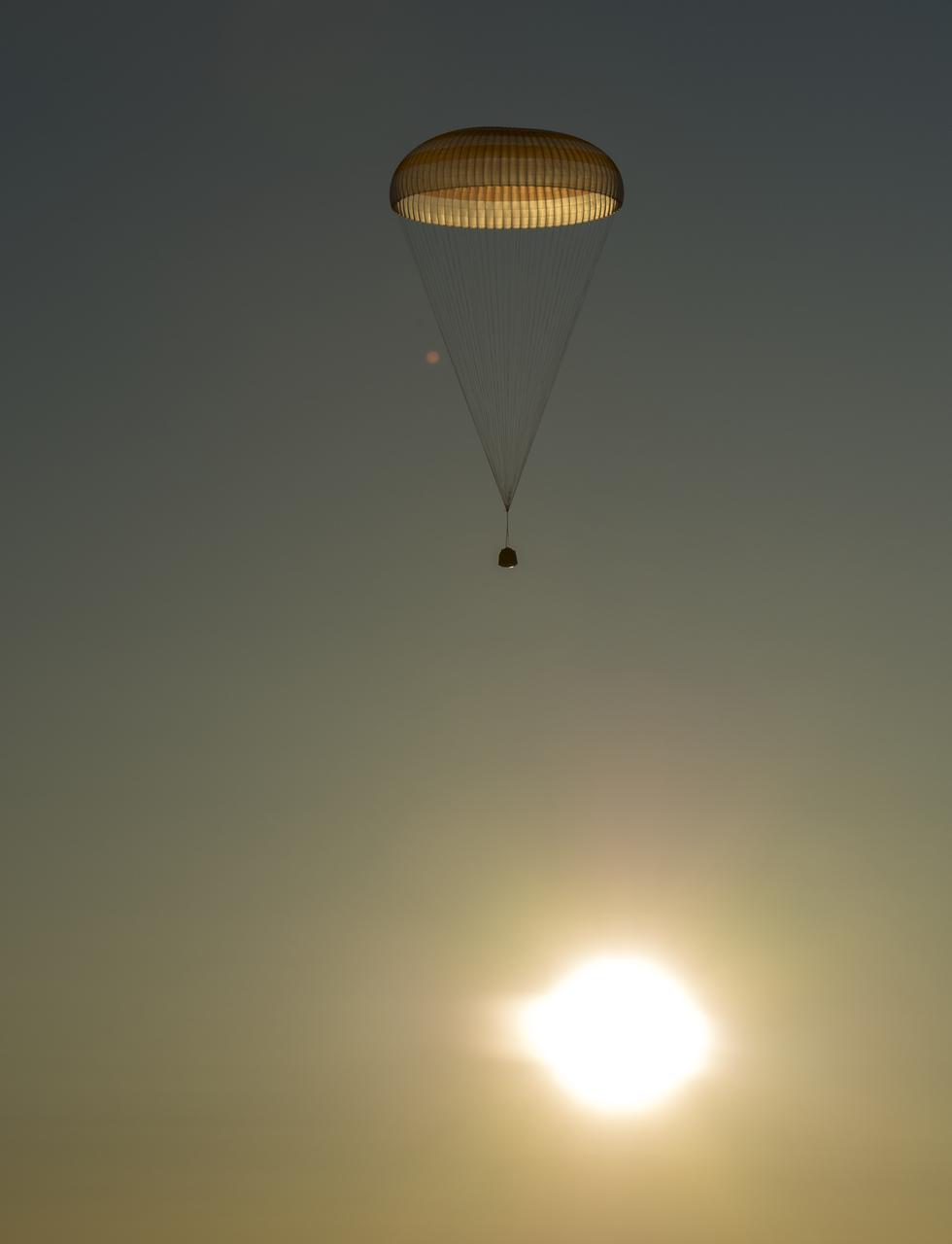
The Soyuz TMA-14M spacecraft is seen as it lands with Expedition 42 commander Barry Wilmore of NASA, Alexander Samokutyaev of the Russian Federal Space Agency (Roscosmos) and Elena Serova of Roscosmos near the town of Zhezkazgan, Kazakhstan on Thursday, March 12, 2015. NASA Astronaut Wilmore, Russian Cosmonauts Samokutyaev and Serova are returning after almost six months onboard the International Space Station where they served as members of the Expedition 41 and 42 crews. Photo Credit: (NASA/Bill Ingalls)
The Soyuz TMA-14M spacecraft is seen as it lands with Expedition 42 commander Barry Wilmore of NASA, Alexander Samokutyaev of the Russian Federal Space Agency (Roscosmos) and Elena Serova of Roscosmos near the town of Zhezkazgan, Kazakhstan on Thursday, March 12, 2015. NASA Astronaut Wilmore, Russian Cosmonauts Samokutyaev and Serova are returning after almost six months onboard the International Space Station where they served as members of the Expedition 41 and 42 crews. Photo Credit: (NASA/Bill Ingalls)
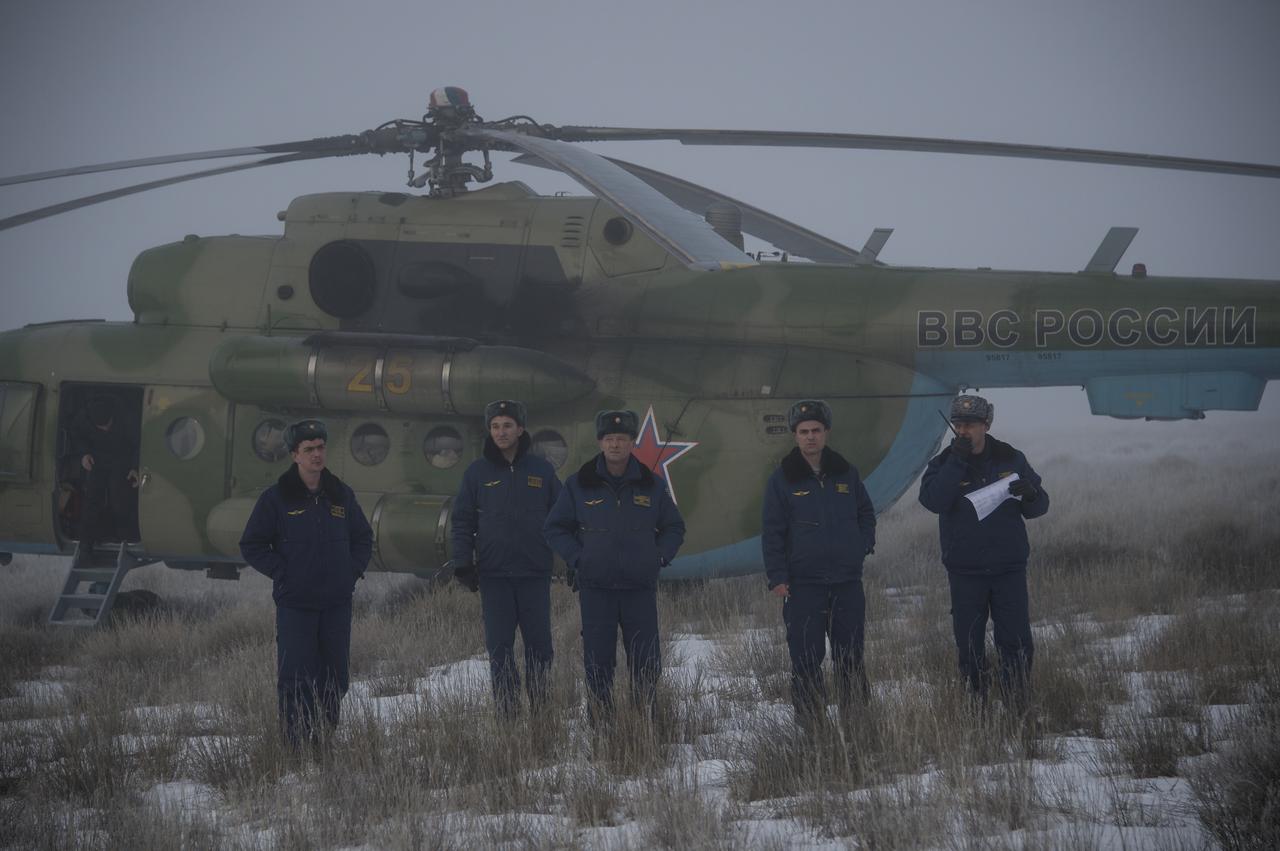
Russian MI-8 helicopter personnel look on at the Soyuz TMA-14M spacecraft landing site shortly after the capsule landed with Expedition 42 commander Barry Wilmore of NASA, Alexander Samokutyaev of the Russian Federal Space Agency (Roscosmos) and Elena Serova of Roscosmos near the town of Zhezkazgan, Kazakhstan on Thursday, March 12, 2015. NASA Astronaut Wilmore, Russian Cosmonauts Samokutyaev and Serova are returning after almost six months onboard the International Space Station where they served as members of the Expedition 41 and 42 crews. Photo Credit: (NASA/Bill Ingalls)
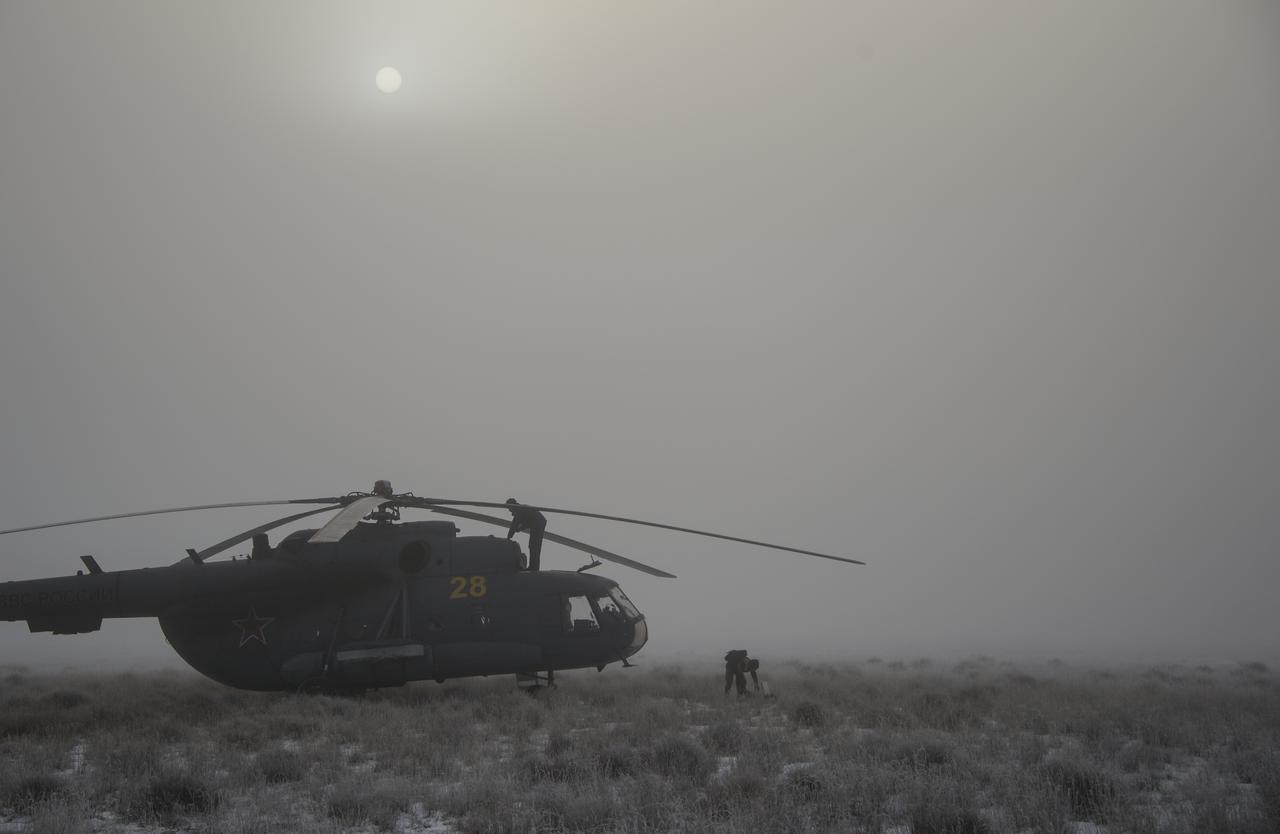
Russian MI-8 helicopter personnel work on their helicopters at the Soyuz TMA-14M spacecraft landing site shortly after the capsule landed with Expedition 42 commander Barry Wilmore of NASA, Alexander Samokutyaev of the Russian Federal Space Agency (Roscosmos) and Elena Serova of Roscosmos near the town of Zhezkazgan, Kazakhstan on Thursday, March 12, 2015. NASA Astronaut Wilmore, Russian Cosmonauts Samokutyaev and Serova are returning after almost six months onboard the International Space Station where they served as members of the Expedition 41 and 42 crews. Photo Credit: (NASA/Bill Ingalls)
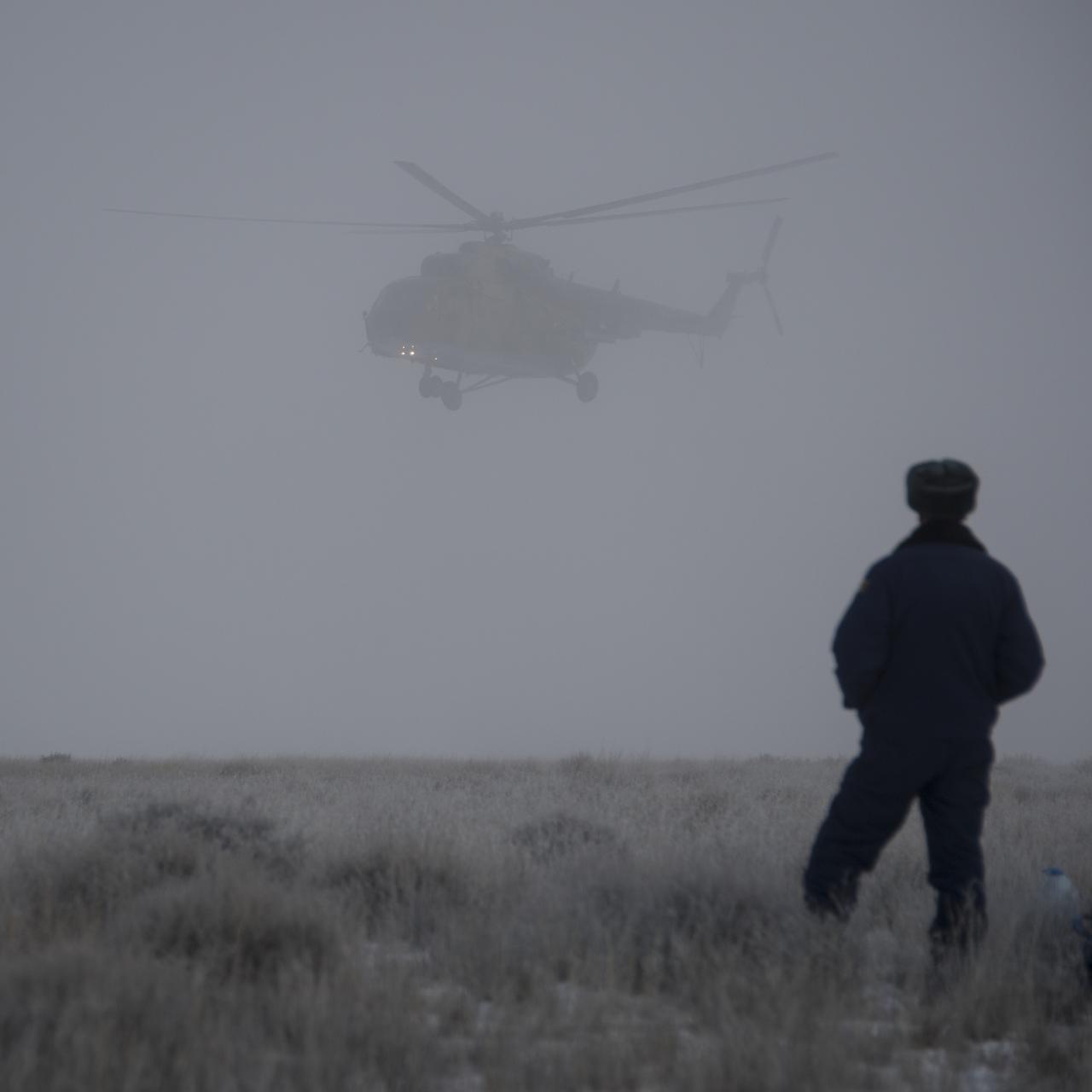
A Russian MI-8 Helicopter arrives at the Soyuz TMA-14M spacecraft landing site after the soyuz landed with Expedition 42 commander Barry Wilmore of NASA, Alexander Samokutyaev of the Russian Federal Space Agency (Roscosmos) and Elena Serova of Roscosmos near the town of Zhezkazgan, Kazakhstan on Thursday, March 12, 2015. NASA Astronaut Wilmore, Russian Cosmonauts Samokutyaev and Serova are returning after almost six months onboard the International Space Station where they served as members of the Expedition 41 and 42 crews. Photo Credit: (NASA/Bill Ingalls)
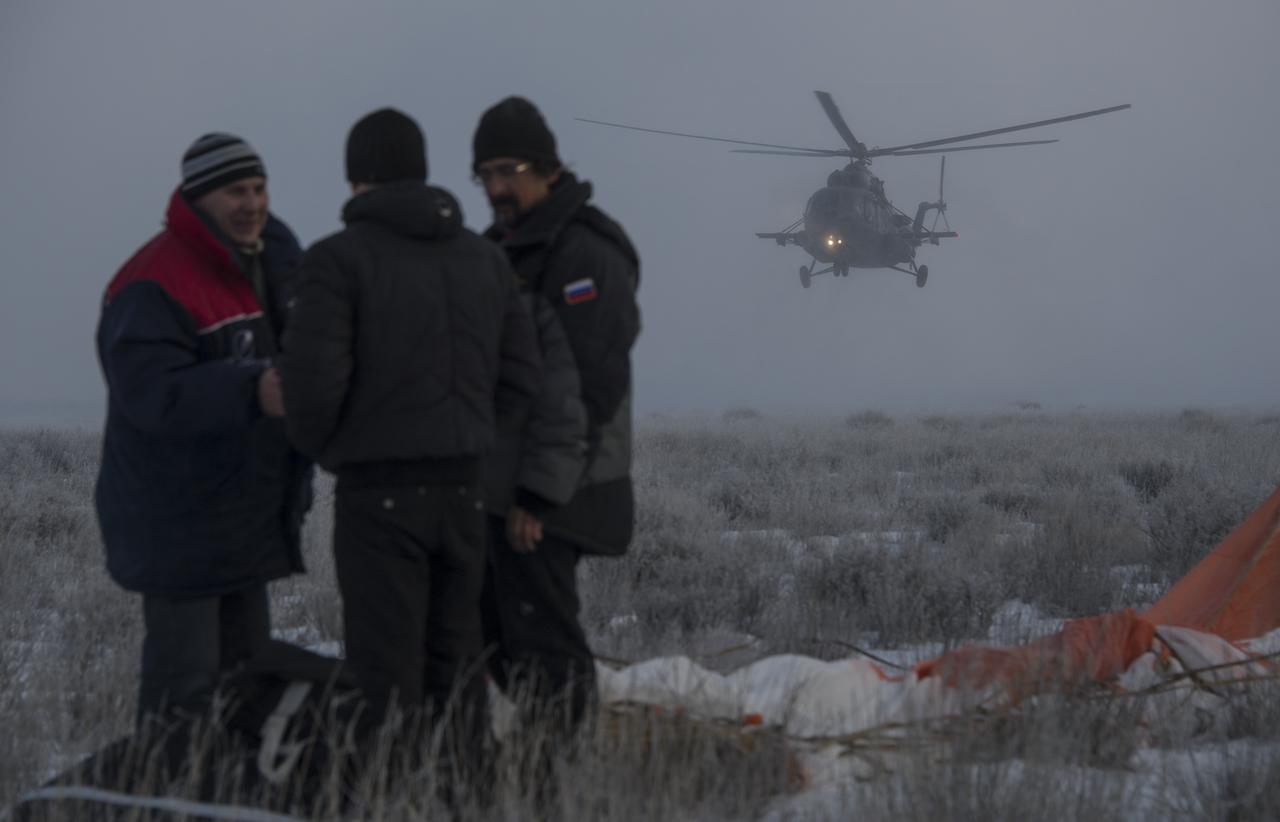
A Russian MI-8 Helicopter arrives at the Soyuz TMA-14M spacecraft landing site after the soyuz landed with Expedition 42 commander Barry Wilmore of NASA, Alexander Samokutyaev of the Russian Federal Space Agency (Roscosmos) and Elena Serova of Roscosmos near the town of Zhezkazgan, Kazakhstan on Thursday, March 12, 2015. NASA Astronaut Wilmore, Russian Cosmonauts Samokutyaev and Serova are returning after almost six months onboard the International Space Station where they served as members of the Expedition 41 and 42 crews. Photo Credit: (NASA/Bill Ingalls)
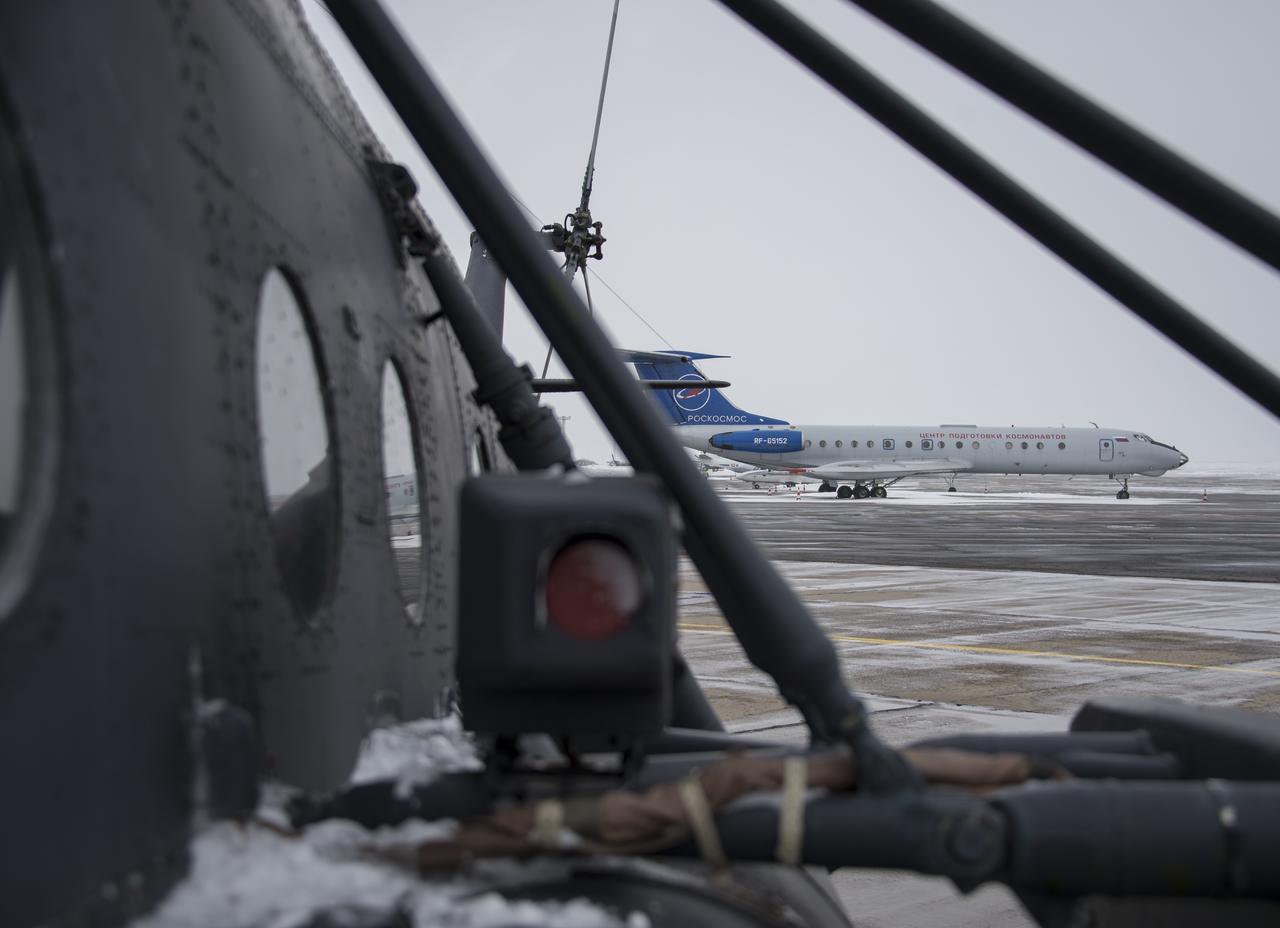
The Gargarin Cosmonaut Traning Center (GCTC) airplane is seen from a Russian MI-8 Helicopter a day before the Soyuz TMA-14M spacecraft landing with Expedition 42 commander Barry Wilmore of NASA, Alexander Samokutyaev of the Russian Federal Space Agency (Roscosmos) and Elena Serova of Roscosmos Wednesday, March 11, 2015 in Karaganda, Kazakhstan. NASA Astronaut Wilmore, Russian Cosmonauts Samokutyaev and Serova are returning after almost six months onboard the International Space Station where they served as members of the Expedition 41 and 42 crews. Photo Credit: (NASA/Bill Ingalls)
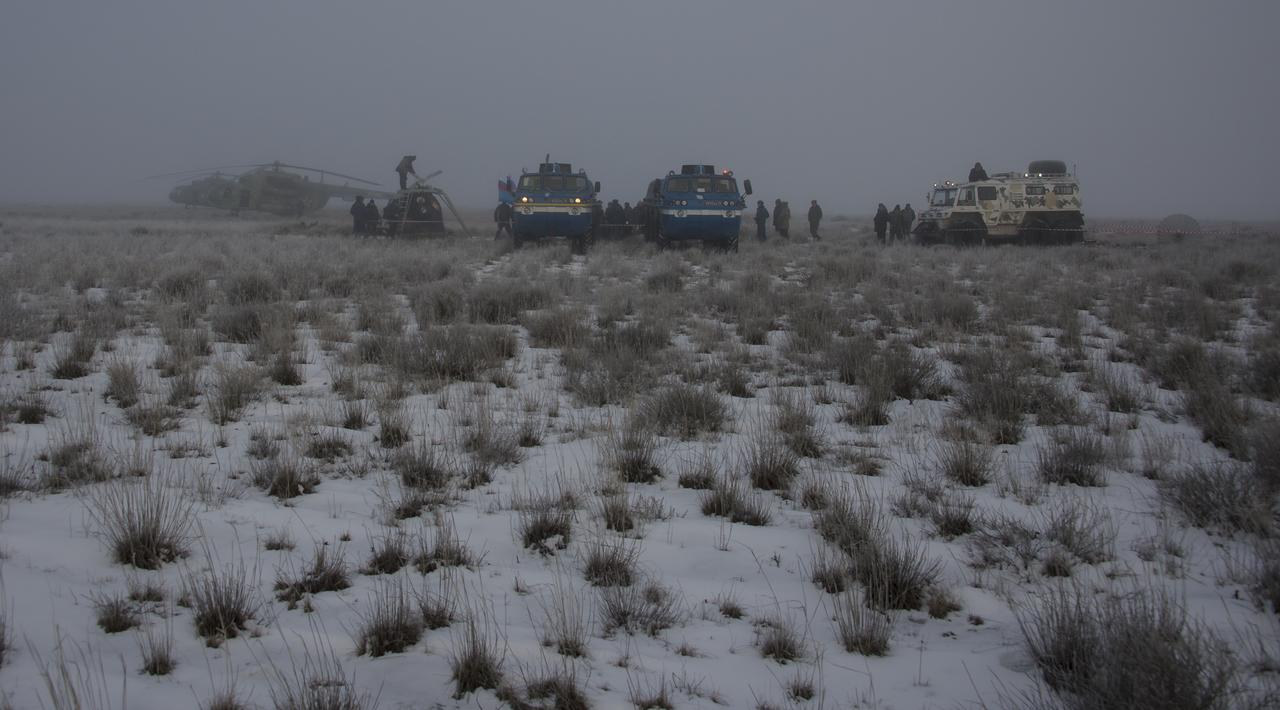
The Soyuz TMA-14M spacecraft, support helicopters, and all terrain vehicles are seen at the landing site where Expedition 42 commander Barry Wilmore of NASA, Alexander Samokutyaev of the Russian Federal Space Agency (Roscosmos) and Elena Serova of Roscosmos landed near the town of Zhezkazgan, Kazakhstan on Thursday, March 12, 2015. NASA Astronaut Wilmore, Russian Cosmonauts Samokutyaev and Serova are returning after almost six months onboard the International Space Station where they served as members of the Expedition 41 and 42 crews. Photo Credit: (NASA/Bill Ingalls)
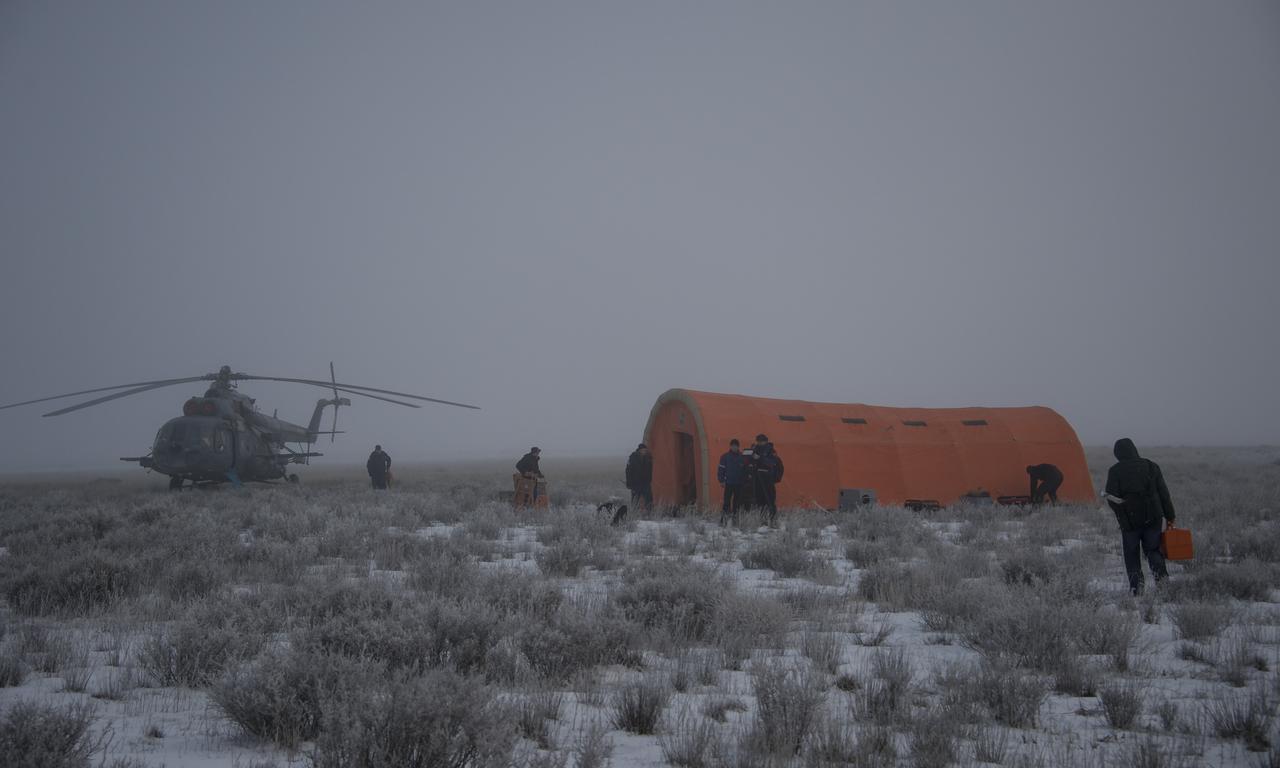
Russian ground support personnel assemble a portable medical tent at the Soyuz TMA-14M spacecraft landing site shortly after the capsule landed with Expedition 42 commander Barry Wilmore of NASA, Alexander Samokutyaev of the Russian Federal Space Agency (Roscosmos) and Elena Serova of Roscosmos near the town of Zhezkazgan, Kazakhstan on Thursday, March 12, 2015. NASA Astronaut Wilmore, Russian Cosmonauts Samokutyaev and Serova are returning after almost six months onboard the International Space Station where they served as members of the Expedition 41 and 42 crews. Photo Credit: (NASA/Bill Ingalls)
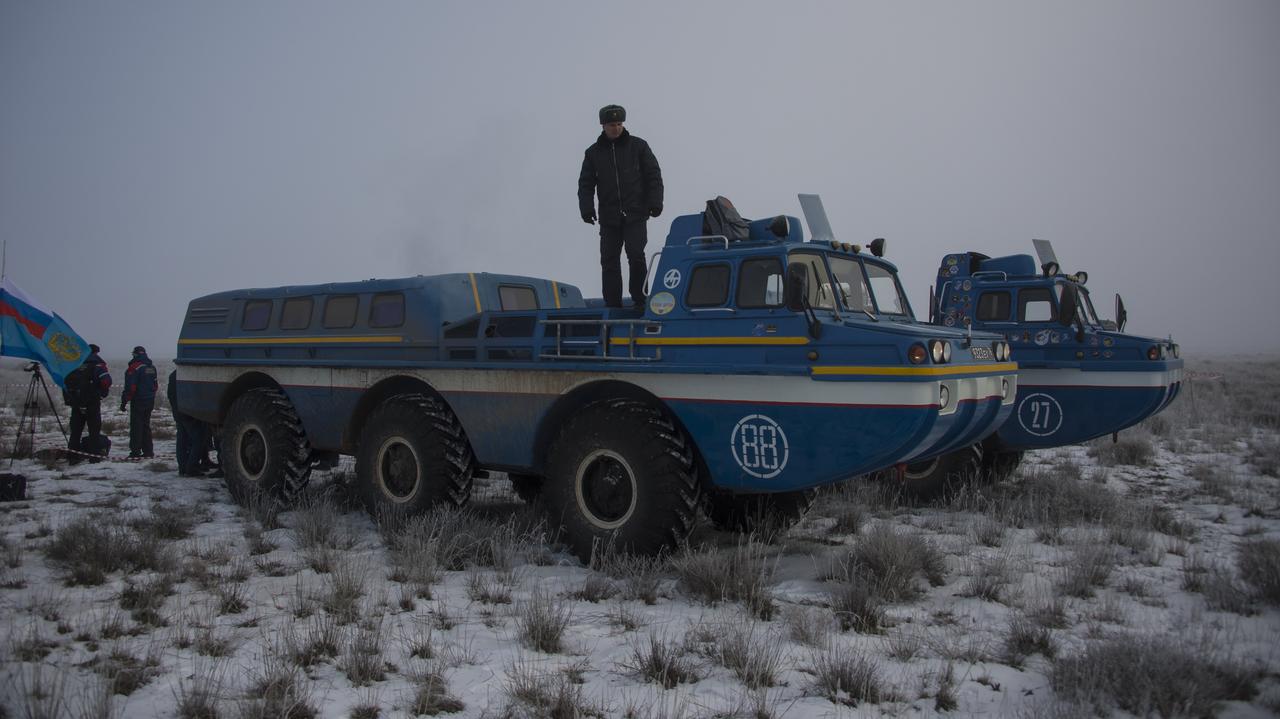
Russian all terrain vehicles (ATVs) are seen at the Soyuz TMA-14M spacecraft landing site shortly after the capsule landed with Expedition 42 commander Barry Wilmore of NASA, Alexander Samokutyaev of the Russian Federal Space Agency (Roscosmos) and Elena Serova of Roscosmos near the town of Zhezkazgan, Kazakhstan on Thursday, March 12, 2015. NASA Astronaut Wilmore, Russian Cosmonauts Samokutyaev and Serova are returning after almost six months onboard the International Space Station where they served as members of the Expedition 41 and 42 crews. Photo Credit: (NASA/Bill Ingalls)
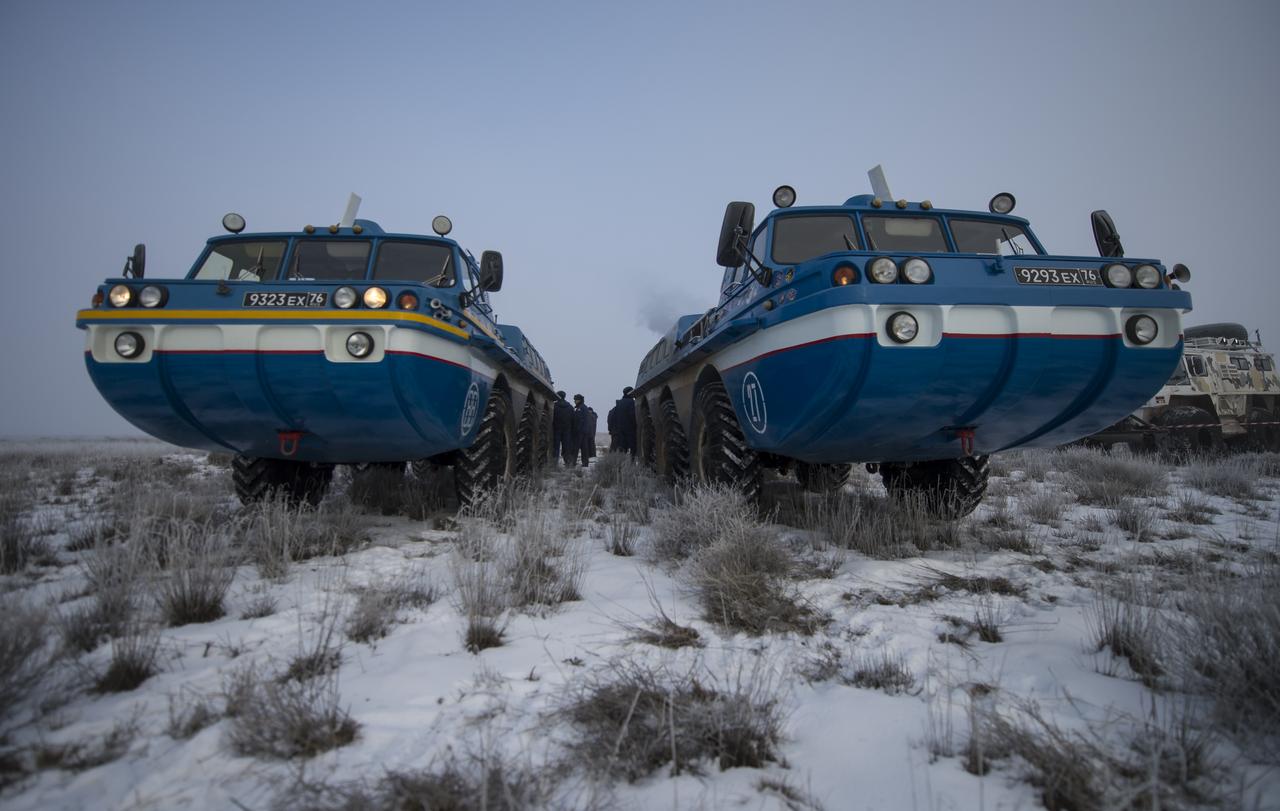
Russian all terrain vehicles (ATVs) are seen at the Soyuz TMA-14M spacecraft landing site shortly after the capsule landed with Expedition 42 commander Barry Wilmore of NASA, Alexander Samokutyaev of the Russian Federal Space Agency (Roscosmos) and Elena Serova of Roscosmos near the town of Zhezkazgan, Kazakhstan on Thursday, March 12, 2015. NASA Astronaut Wilmore, Russian Cosmonauts Samokutyaev and Serova are returning after almost six months onboard the International Space Station where they served as members of the Expedition 41 and 42 crews. Photo Credit: (NASA/Bill Ingalls)
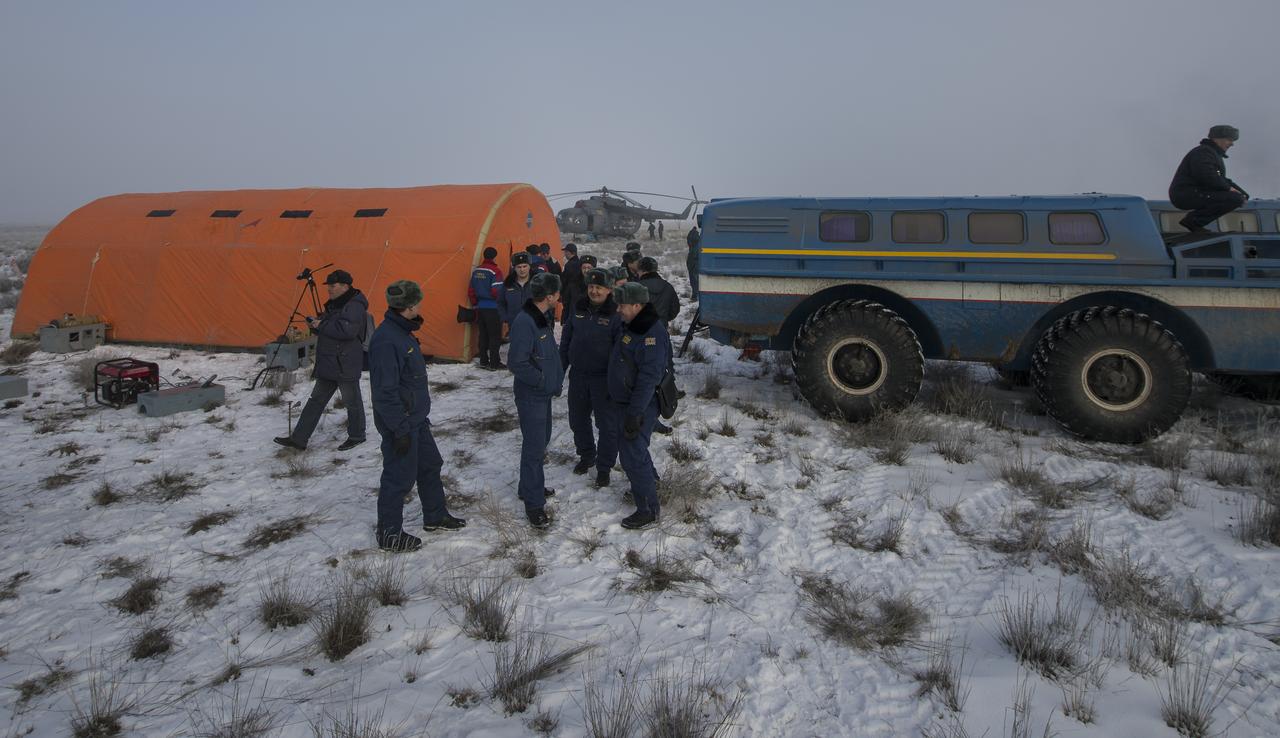
Russian support personnel wait outside the medical tent and all terrain vehicles (ATVs) after the Soyuz TMA-14M spacecraft landed with Expedition 42 commander Barry Wilmore of NASA, Alexander Samokutyaev of the Russian Federal Space Agency (Roscosmos) and Elena Serova of Roscosmos near the town of Zhezkazgan, Kazakhstan on Thursday, March 12, 2015. NASA Astronaut Wilmore, Russian Cosmonauts Samokutyaev and Serova are returning after almost six months onboard the International Space Station where they served as members of the Expedition 41 and 42 crews. Photo Credit: (NASA/Bill Ingalls)
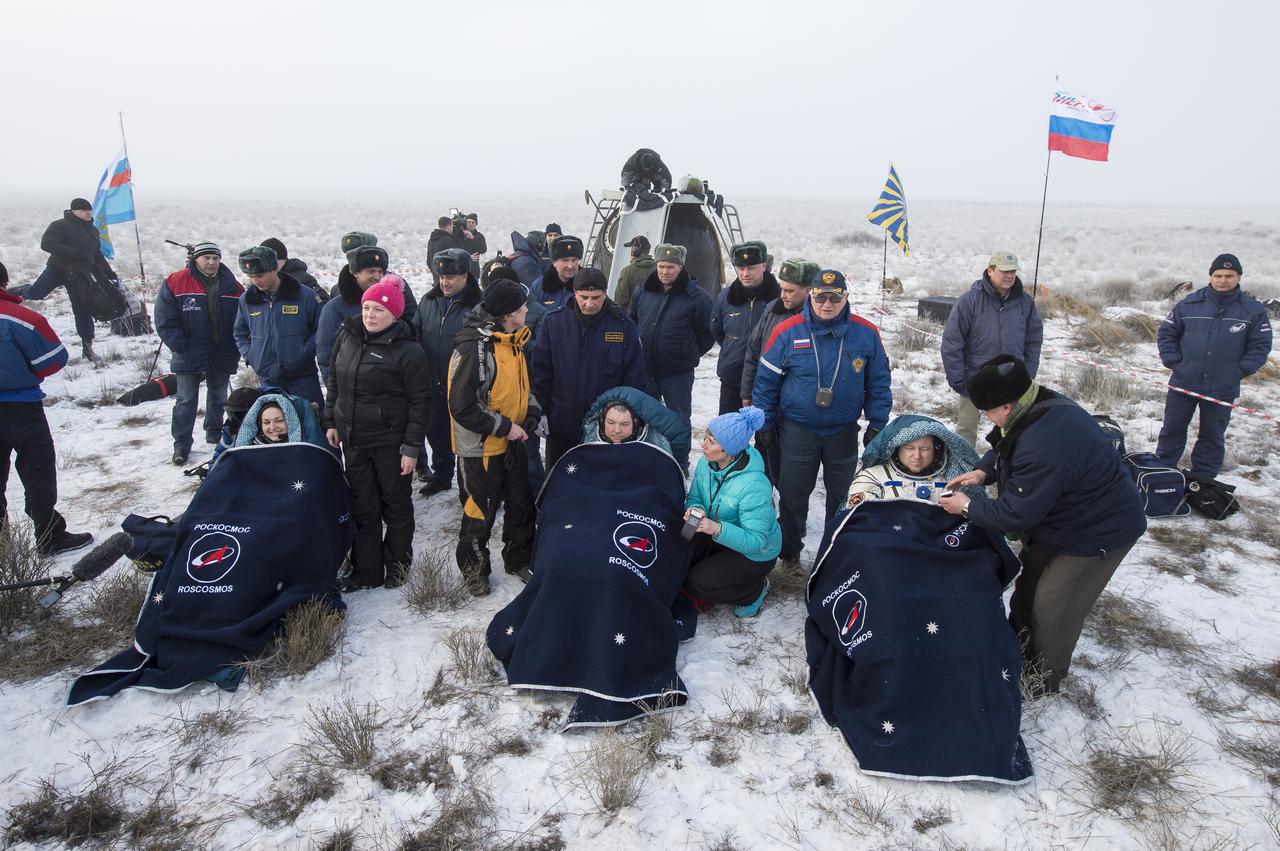
Expedition 42 Cosmonaut Elena Serova of the Russian Federal Space Agency (Roscosmos, left, Alexander Samokutyaev of Roscosmos, center, and NASA Astronaut Barry Wilmore of NASA sit in chairs outside the Soyuz TMA-14M spacecraft just minutes after they landed in a remote area near the town of Zhezkazgan, Kazakhstan on Thursday, March 12, 2015. NASA Astronaut Wilmore, Russian Cosmonauts Samokutyaev and Serova are returning after almost six months onboard the International Space Station where they served as members of the Expedition 41 and 42 crews. Photo Credit: (NASA/Bill Ingalls)

Expedition 42 Cosmonaut Alexander Samokutyaev of the Russian Federal Space Agency (Roscosmos) rests in a chair outside the Soyuz TMA-14M spacecraft just minutes after he and NASA Astronaut Barry Wilmore of NASA, and Elena Serova of Roscosmos landed in a remote area near the town of Zhezkazgan, Kazakhstan on Thursday, March 12, 2015. NASA Astronaut Wilmore, Russian Cosmonauts Samokutyaev and Serova are returning after almost six months onboard the International Space Station where they served as members of the Expedition 41 and 42 crews. Photo Credit: (NASA/Bill Ingalls)
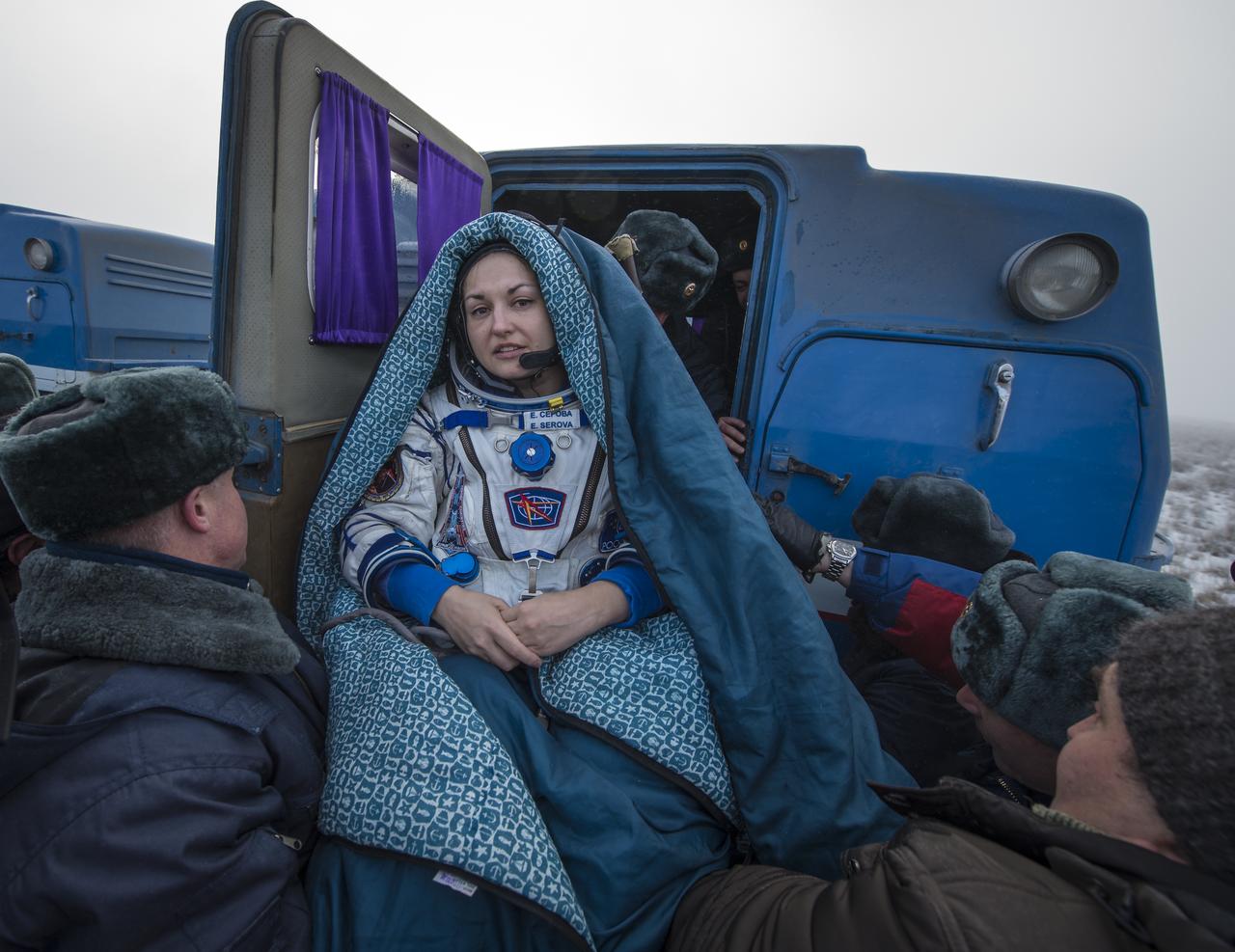
Expedition 42 Cosmonaut Elena Serova of the Russian Federal Space Agency (Roscosmos) is carried into terrain vehicle (ATV) shortly after she and NASA Astronaut Barry Wilmore of NASA, and Alexander Samokutyaev of Roscosmos landed in their Soyuz TMA-14M spacecraft in a remote area near the town of Zhezkazgan, Kazakhstan on Thursday, March 12, 2015. NASA Astronaut Wilmore, Russian Cosmonauts Samokutyaev and Serova are returning after almost six months onboard the International Space Station where they served as members of the Expedition 41 and 42 crews. Photo Credit: (NASA/Bill Ingalls)
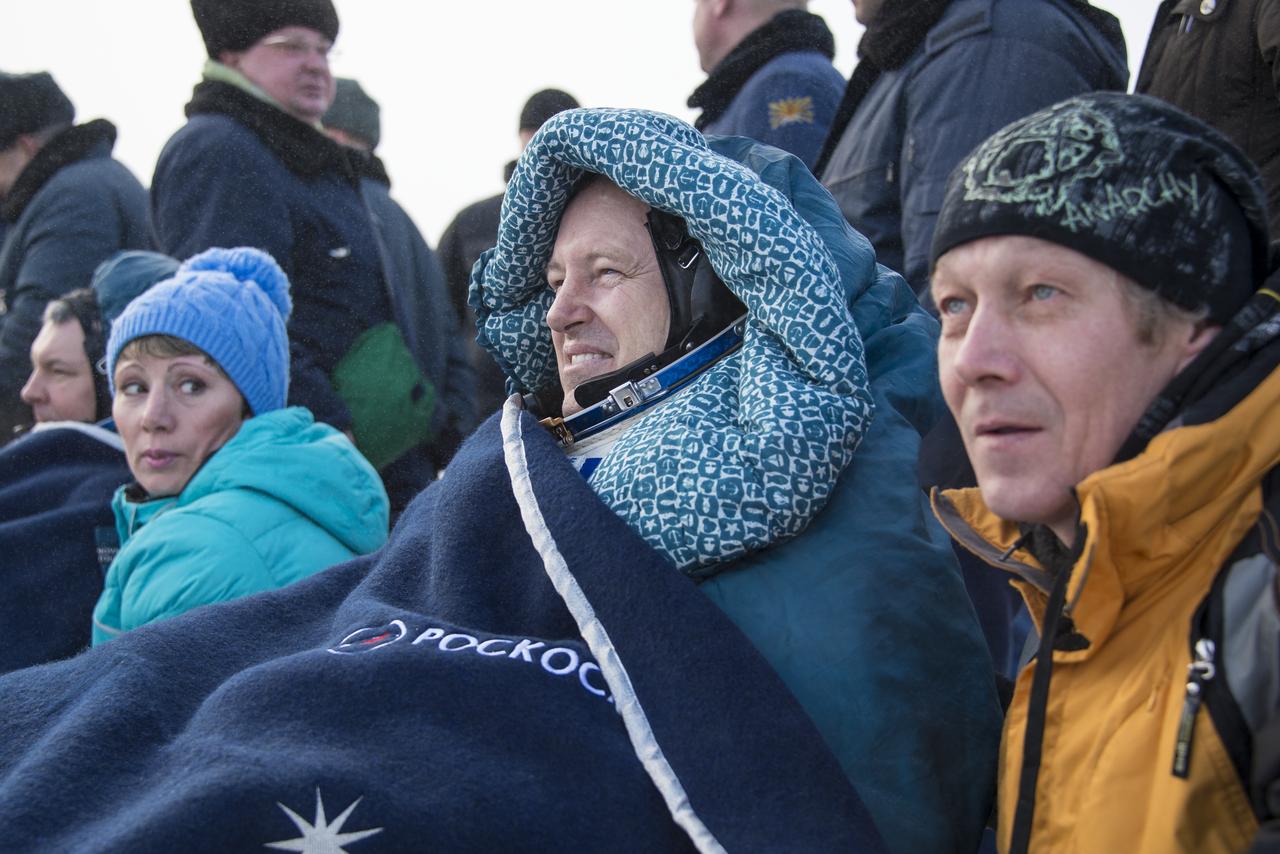
Expedition 42 commander Barry Wilmore of NASA rests in a chair outside the Soyuz TMA-14M spacecraft just minutes after he and Alexander Samokutyaev of the Russian Federal Space Agency (Roscosmos), and Elena Serova of Roscosmos landed in a remote area near the town of Zhezkazgan, Kazakhstan on Thursday, March 12, 2015. NASA Astronaut Wilmore, Russian Cosmonauts Samokutyaev and Serova are returning after almost six months onboard the International Space Station where they served as members of the Expedition 41 and 42 crews. Photo Credit: (NASA/Bill Ingalls)
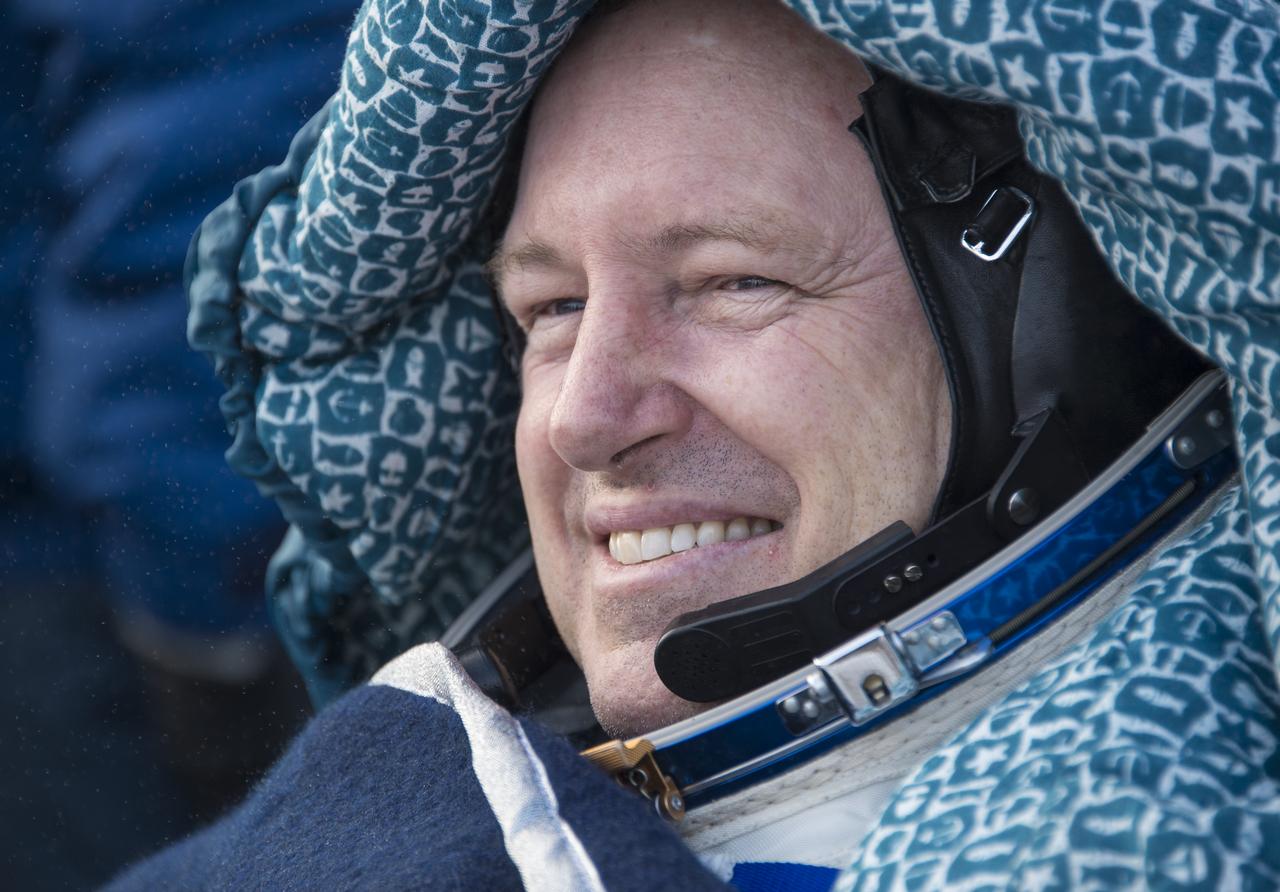
Expedition 42 commander Barry Wilmore of NASA rests in a chair outside the Soyuz TMA-14M spacecraft just minutes after he and Alexander Samokutyaev of the Russian Federal Space Agency (Roscosmos), and Elena Serova of Roscosmos landed in a remote area near the town of Zhezkazgan, Kazakhstan on Thursday, March 12, 2015. NASA Astronaut Wilmore, Russian Cosmonauts Samokutyaev and Serova are returning after almost six months onboard the International Space Station where they served as members of the Expedition 41 and 42 crews. Photo Credit: (NASA/Bill Ingalls)
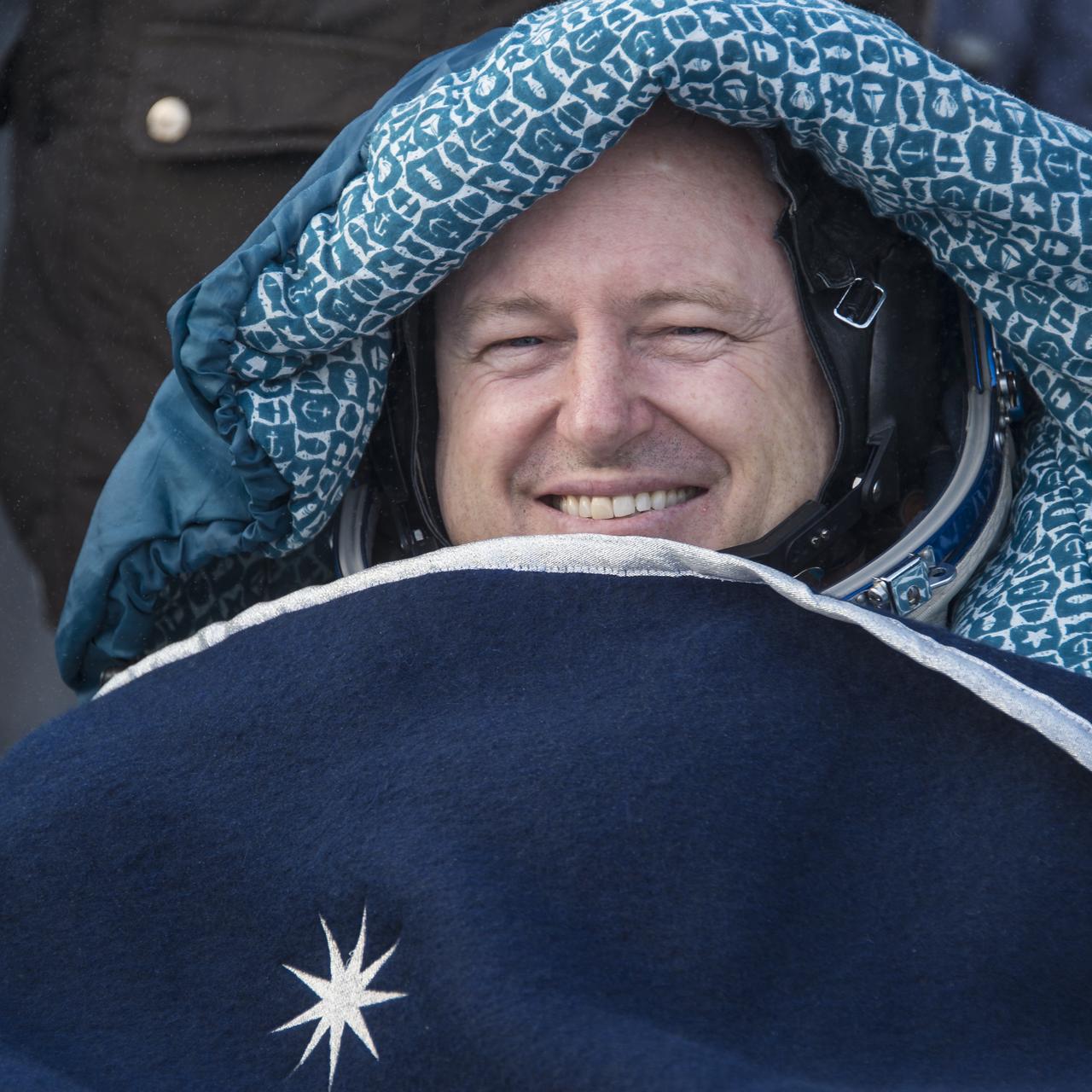
Expedition 42 commander Barry Wilmore of NASA rests in a chair outside the Soyuz TMA-14M spacecraft just minutes after he and Alexander Samokutyaev of the Russian Federal Space Agency (Roscosmos), and Elena Serova of Roscosmos landed in a remote area near the town of Zhezkazgan, Kazakhstan on Thursday, March 12, 2015. NASA Astronaut Wilmore, Russian Cosmonauts Samokutyaev and Serova are returning after almost six months onboard the International Space Station where they served as members of the Expedition 41 and 42 crews. Photo Credit: (NASA/Bill Ingalls)
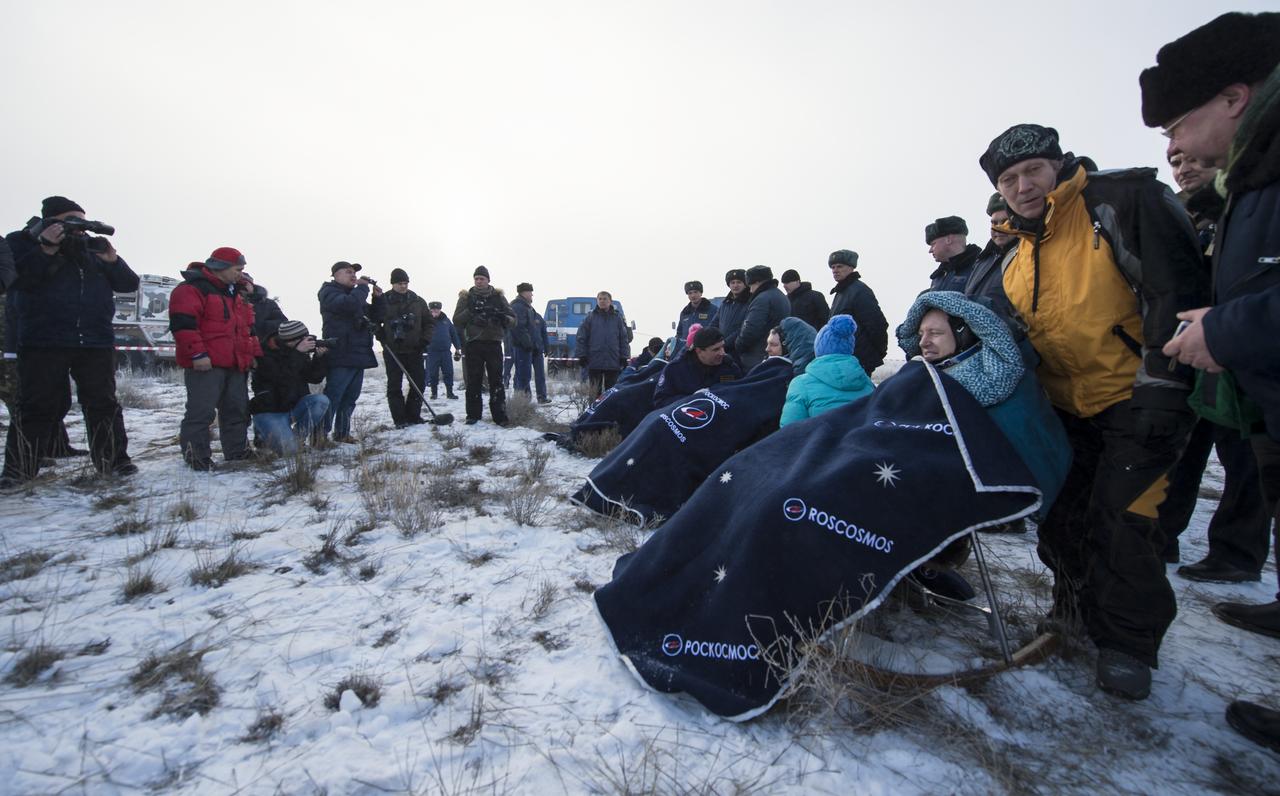
Expedition 42 Cosmonaut Elena Serova of the Russian Federal Space Agency (Roscosmos, seated left, Alexander Samokutyaev of Roscosmos, center, and NASA Astronaut Barry Wilmore of NASA sit in chairs outside the Soyuz TMA-14M spacecraft just minutes after they landed in a remote area near the town of Zhezkazgan, Kazakhstan on Thursday, March 12, 2015. NASA Astronaut Wilmore, Russian Cosmonauts Samokutyaev and Serova are returning after almost six months onboard the International Space Station where they served as members of the Expedition 41 and 42 crews. Photo Credit: (NASA/Bill Ingalls)
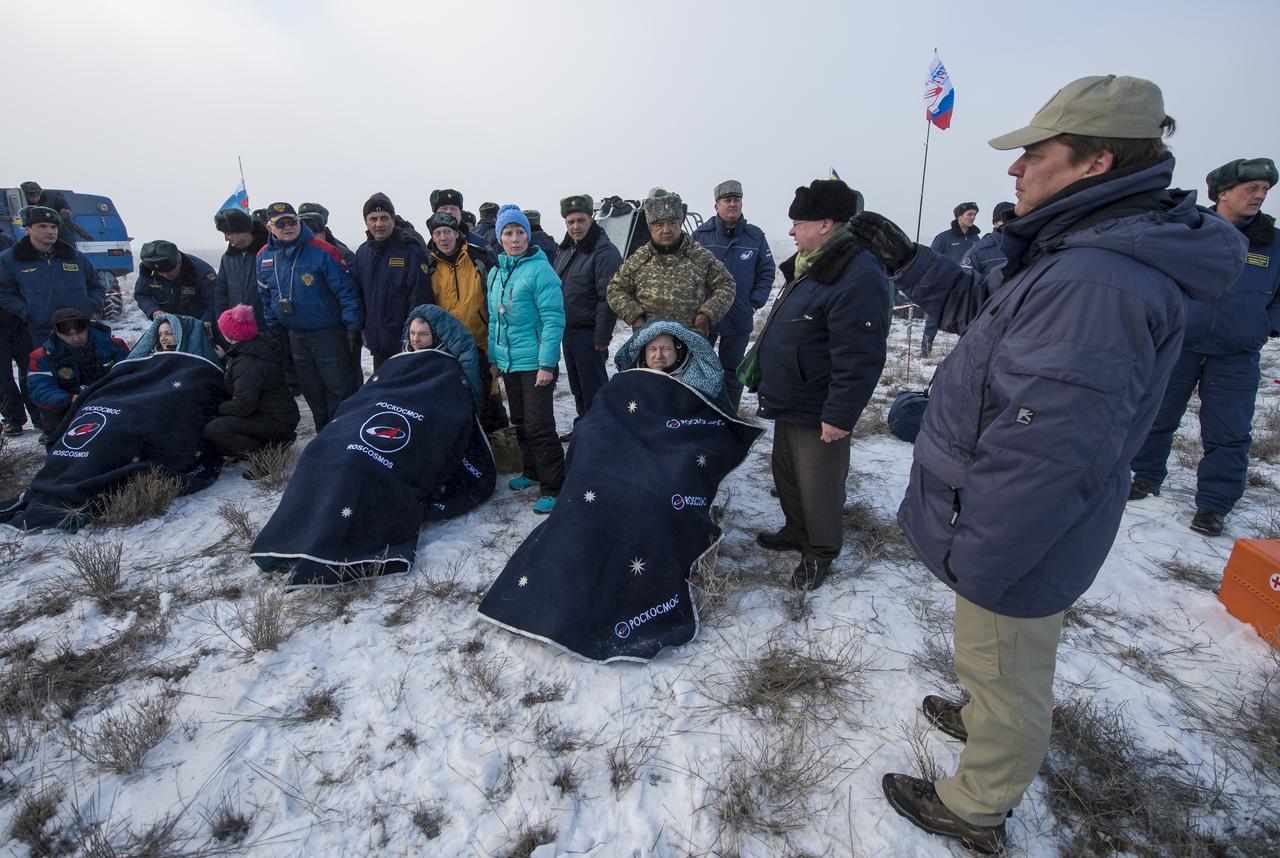
Expedition 42 Cosmonaut Elena Serova of the Russian Federal Space Agency (Roscosmos, left, Alexander Samokutyaev of Roscosmos, center, and NASA Astronaut Barry Wilmore of NASA sit in chairs outside the Soyuz TMA-14M spacecraft just minutes after they landed in a remote area near the town of Zhezkazgan, Kazakhstan on Thursday, March 12, 2015. NASA Astronaut Wilmore, Russian Cosmonauts Samokutyaev and Serova are returning after almost six months onboard the International Space Station where they served as members of the Expedition 41 and 42 crews. Photo Credit: (NASA/Bill Ingalls)
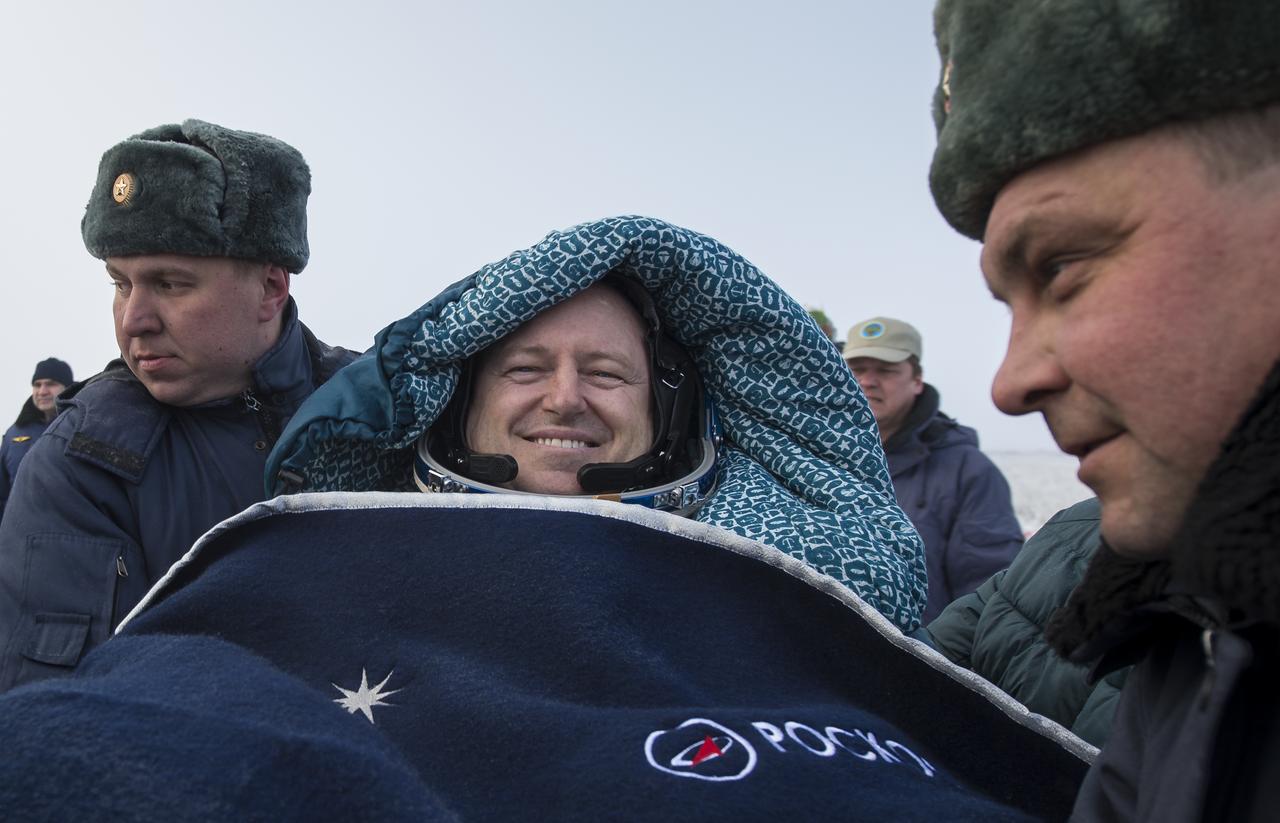
Expedition 42 commander Barry Wilmore of NASA is carried in a chair to an all terrain vehicle (ATV) shortly after he and Alexander Samokutyaev of the Russian Federal Space Agency (Roscosmos), and Elena Serova of Roscosmos landed in their Soyuz TMA-14M spacecraft in a remote area near the town of Zhezkazgan, Kazakhstan on Thursday, March 12, 2015. NASA Astronaut Wilmore, Russian Cosmonauts Samokutyaev and Serova are returning after almost six months onboard the International Space Station where they served as members of the Expedition 41 and 42 crews. Photo Credit: (NASA/Bill Ingalls)
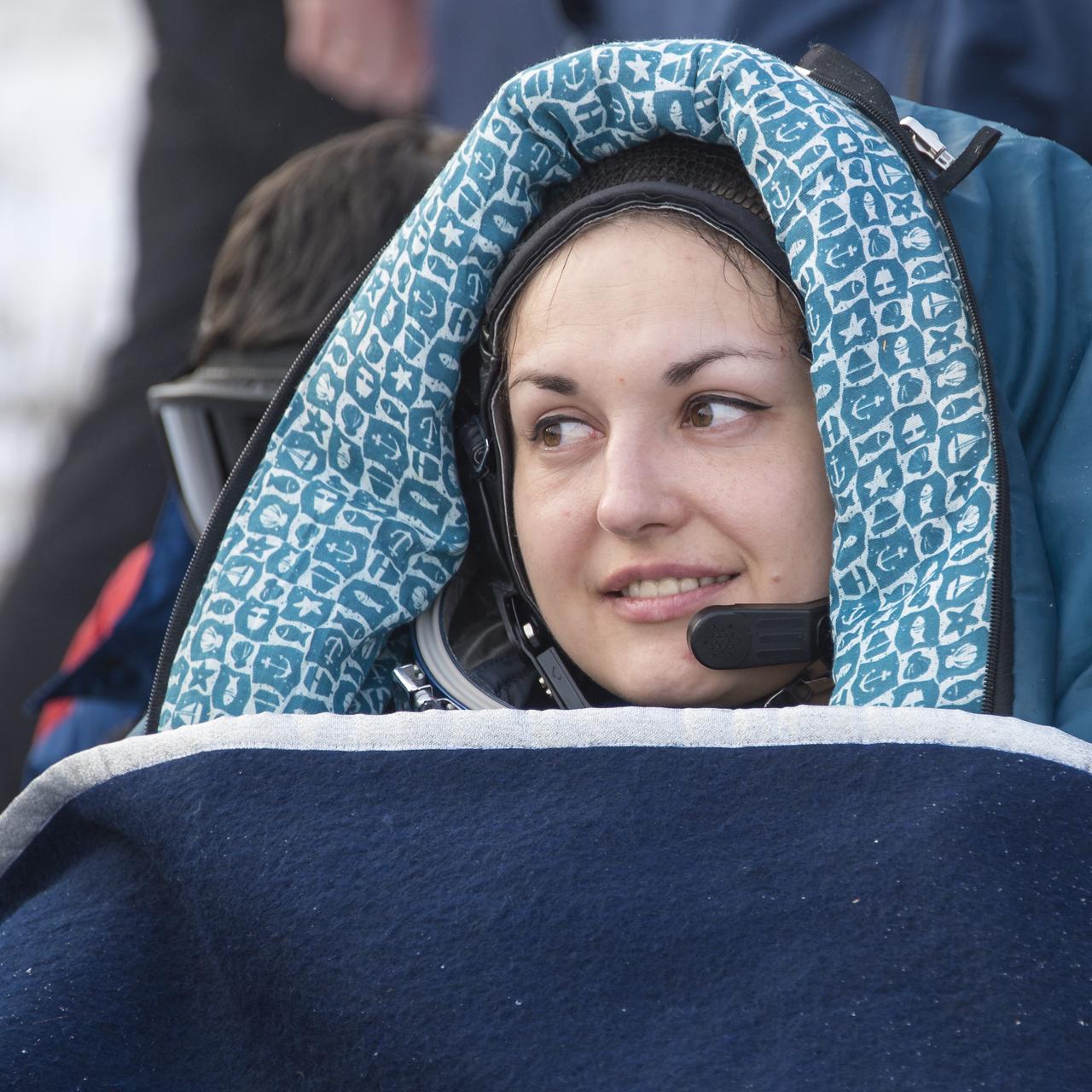
Expedition 42 Cosmonaut Elena Serova of the Russian Federal Space Agency (Roscosmos) rests in a chair outside the Soyuz TMA-14M spacecraft just minutes after she and NASA Astronaut Barry Wilmore of NASA, and Alexander Samokutyaev of Roscosmos landed in a remote area near the town of Zhezkazgan, Kazakhstan on Thursday, March 12, 2015. NASA Astronaut Wilmore, Russian Cosmonauts Samokutyaev and Serova are returning after almost six months onboard the International Space Station where they served as members of the Expedition 41 and 42 crews. Photo Credit: (NASA/Bill Ingalls)
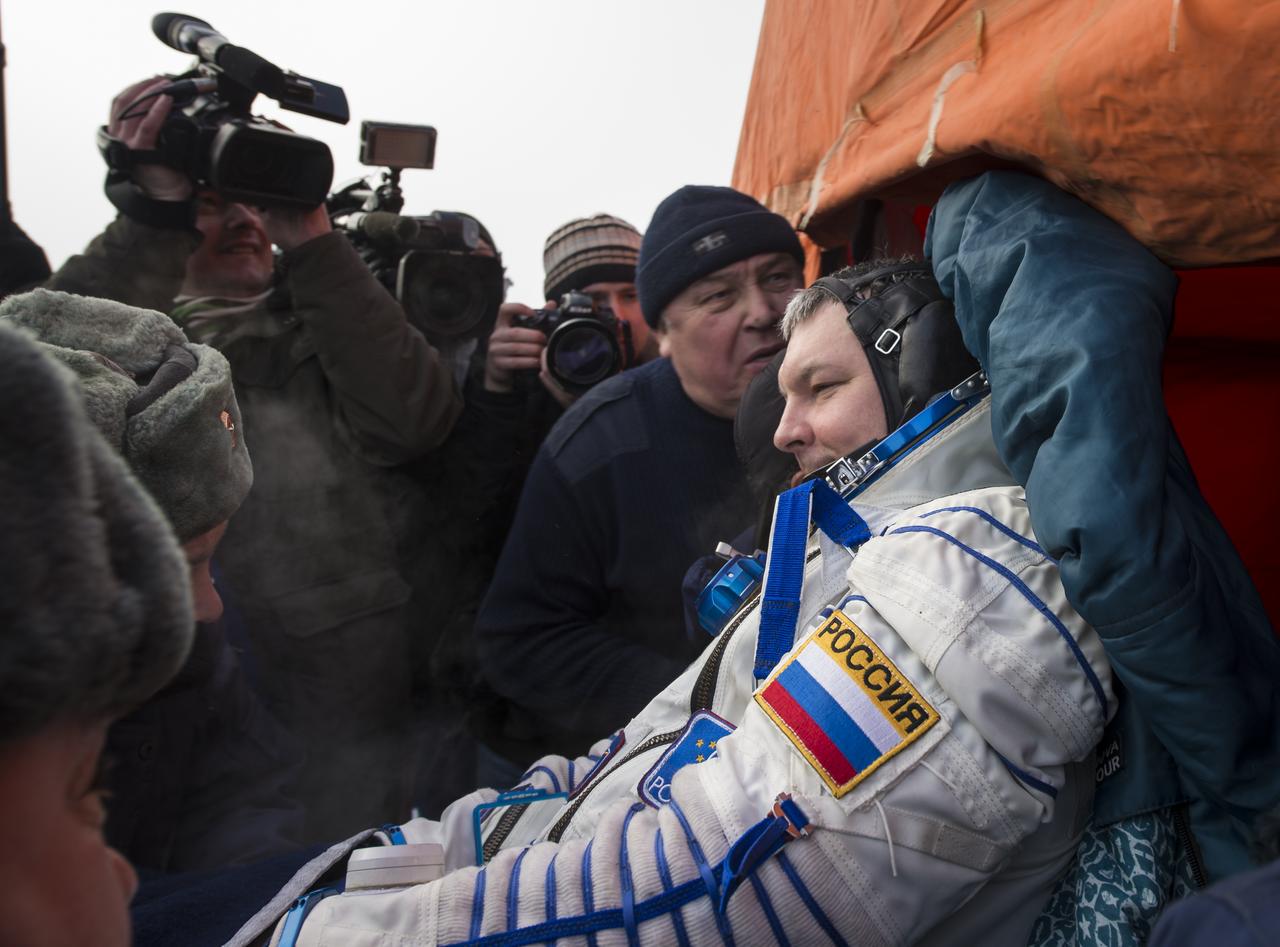
Expedition 42 Cosmonaut Alexander Samokutyaev of the Russian Federal Space Agency (Roscosmos) is carried in a chair from an all terrain vehicle (ATV) to a medical tent just minutes after he and NASA Astronaut Barry Wilmore of NASA, and Elena Serova of Roscosmos landed in their Soyuz TMA-14M spacecraft in a remote area near the town of Zhezkazgan, Kazakhstan on Thursday, March 12, 2015. NASA Astronaut Wilmore, Russian Cosmonauts Samokutyaev and Serova are returning after almost six months onboard the International Space Station where they served as members of the Expedition 41 and 42 crews. Photo Credit: (NASA/Bill Ingalls)
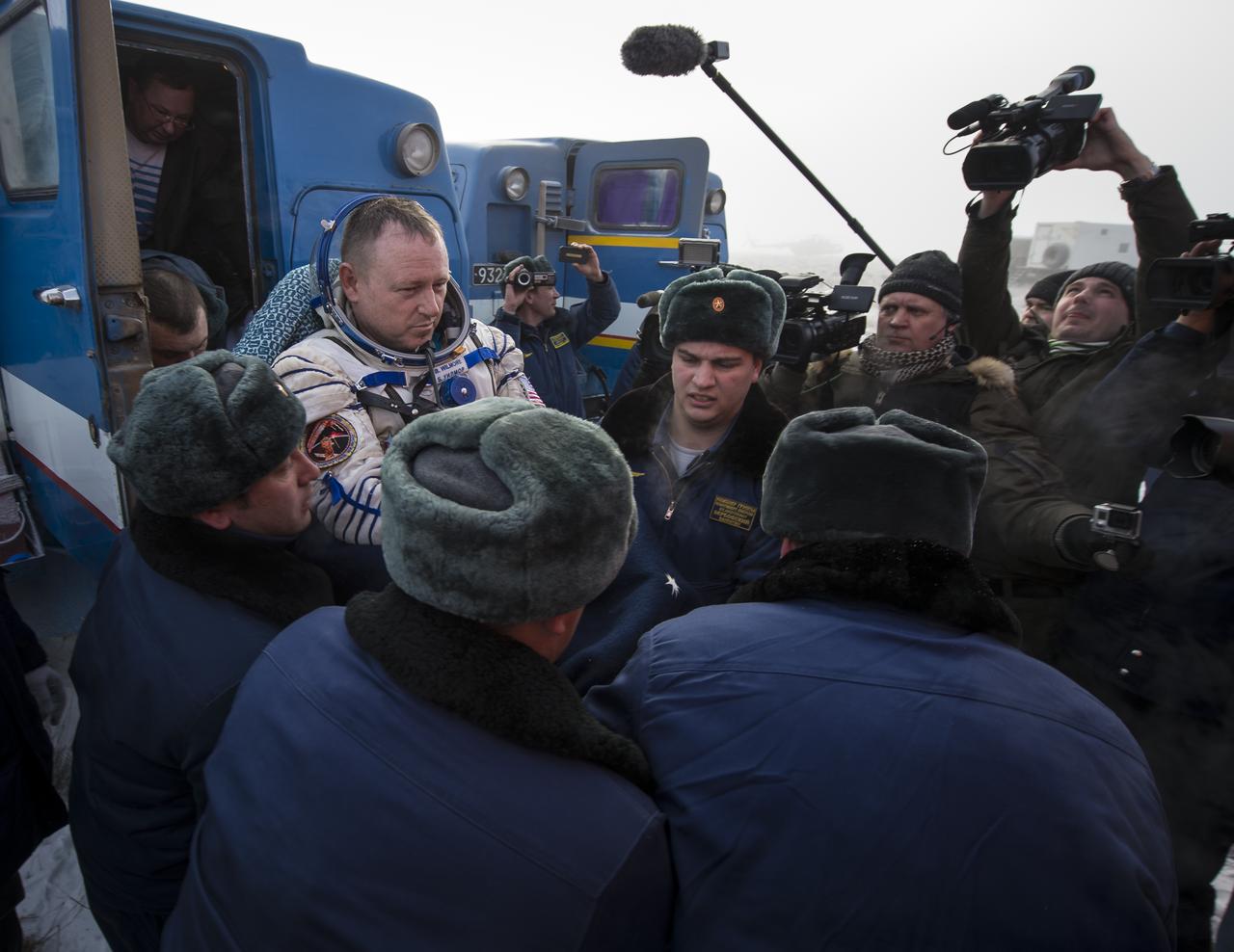
Expedition 42 commander Barry Wilmore of NASA is carried from all terrain vehicle (ATV) into a medical tent shortly after he and Alexander Samokutyaev of the Russian Federal Space Agency (Roscosmos), and Elena Serova of Roscosmos landed in their Soyuz TMA-14M spacecraft in a remote area near the town of Zhezkazgan, Kazakhstan on Thursday, March 12, 2015. NASA Astronaut Wilmore, Russian Cosmonauts Samokutyaev and Serova are returning after almost six months onboard the International Space Station where they served as members of the Expedition 41 and 42 crews. Photo Credit: (NASA/Bill Ingalls)
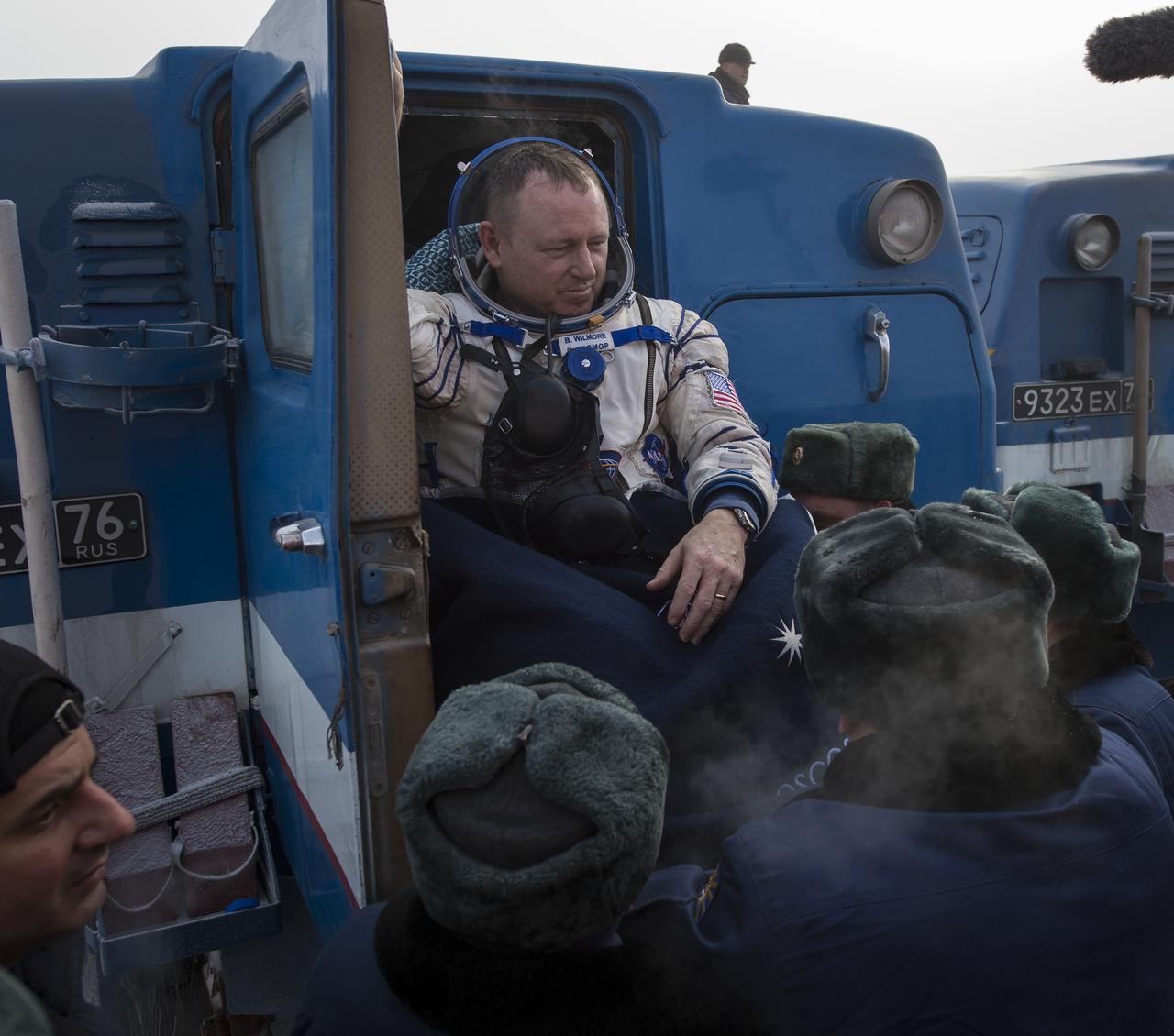
Expedition 42 commander Barry Wilmore of NASA is carried from all terrain vehicle (ATV) into a medical tent shortly after he and Alexander Samokutyaev of the Russian Federal Space Agency (Roscosmos), and Elena Serova of Roscosmos landed in their Soyuz TMA-14M spacecraft in a remote area near the town of Zhezkazgan, Kazakhstan on Thursday, March 12, 2015. NASA Astronaut Wilmore, Russian Cosmonauts Samokutyaev and Serova are returning after almost six months onboard the International Space Station where they served as members of the Expedition 41 and 42 crews. Photo Credit: (NASA/Bill Ingalls)
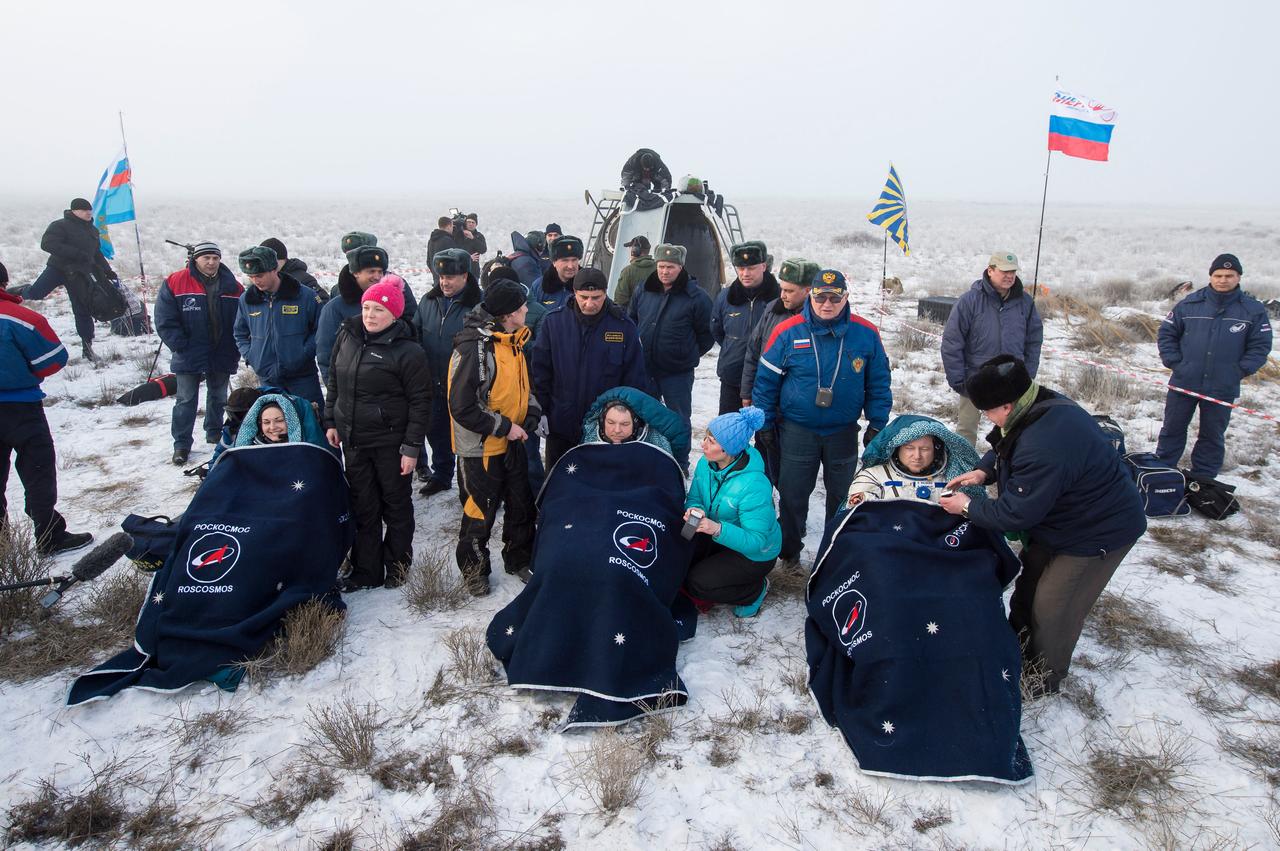
201503120104hq (03/12/2015) --- Expedition 42 Cosmonaut Elena Serova of the Russian Federal Space Agency (Roscosmos, left, Alexander Samokutyaev of Roscosmos, center, and NASA Astronaut Barry Wilmore sit in chairs outside the Soyuz TMA-14M spacecraft just minutes after they landed in a remote area near the town of Zhezkazgan, Kazakhstan on Thursday, Mar. 12, 2015. The three crew members returned to Earth after a 167-day mission on the International Space Station (ISS) that included hundreds of scientific experiments and several spacewalks to prepare the orbiting laboratory for future arrivals by U.S. commercial crew spacecraft. They served as members of the Expedition 41 and 42 crews. Photo Credit: (NASA/Bill Ingalls)
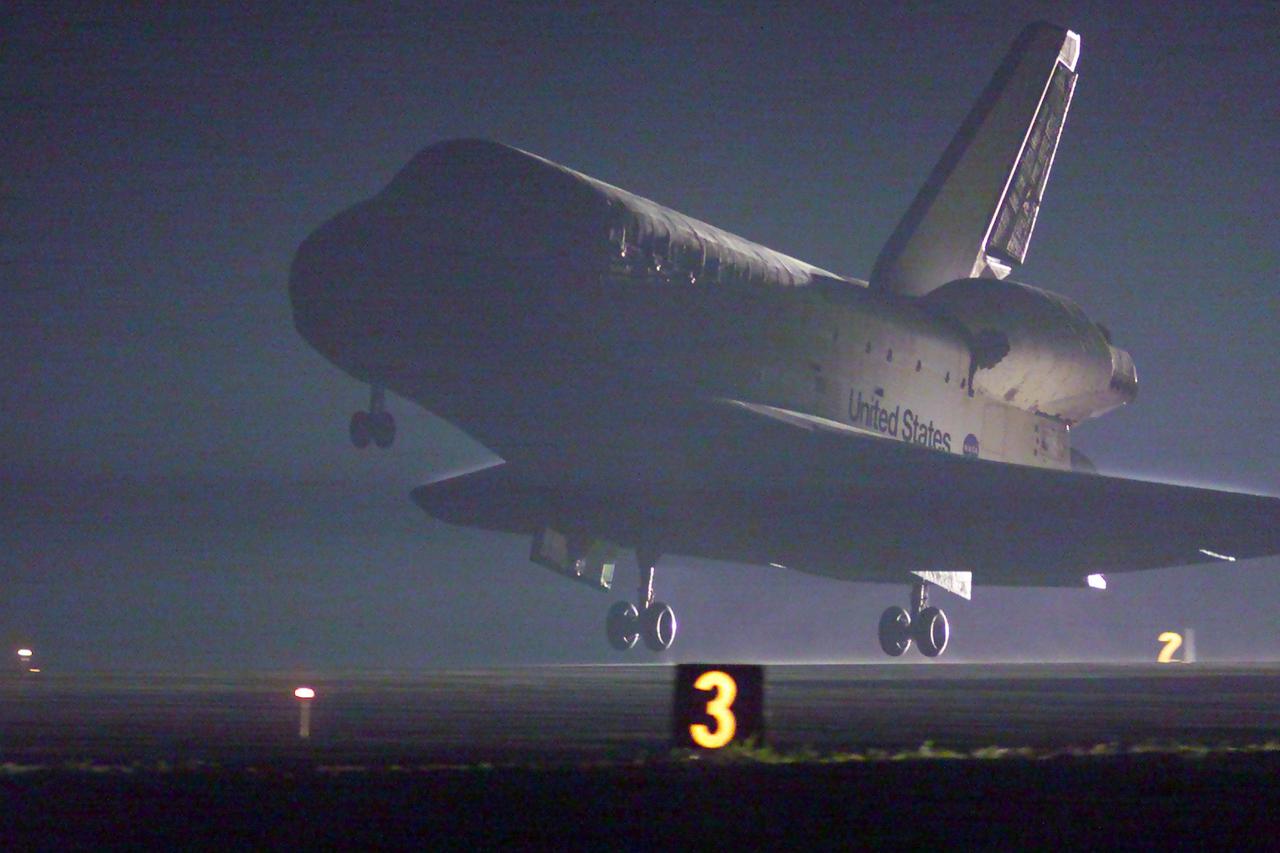
KENNEDY SPACE CENTER, Fla. -- Space Shuttle Discovery prepares to land at the KSC Shuttle Landing Facility on runway 15. Main gear touchdown occurred at 2:31:42 a.m. EST, nose wheel touchdown at 2:31:54 a.m., and wheel stop at 2:33:06 a.m. The landing on orbit 201 concluded mission STS-102, the eighth flight to the International Space Station, carrying the first Multi-Purpose Logistics Module Leonardo, to the ISS and Expedition Two, a replacement crew for the Station. The 12-day, 19-hour, 51-minute mission returned both the Leonardo and the first resident crew of the ISS, Expedition One, to KSC. Discovery logged 5.3 million miles on this mission. The landing marked the 54th at KSC in the history of the program, and the 12th night landing at KSC
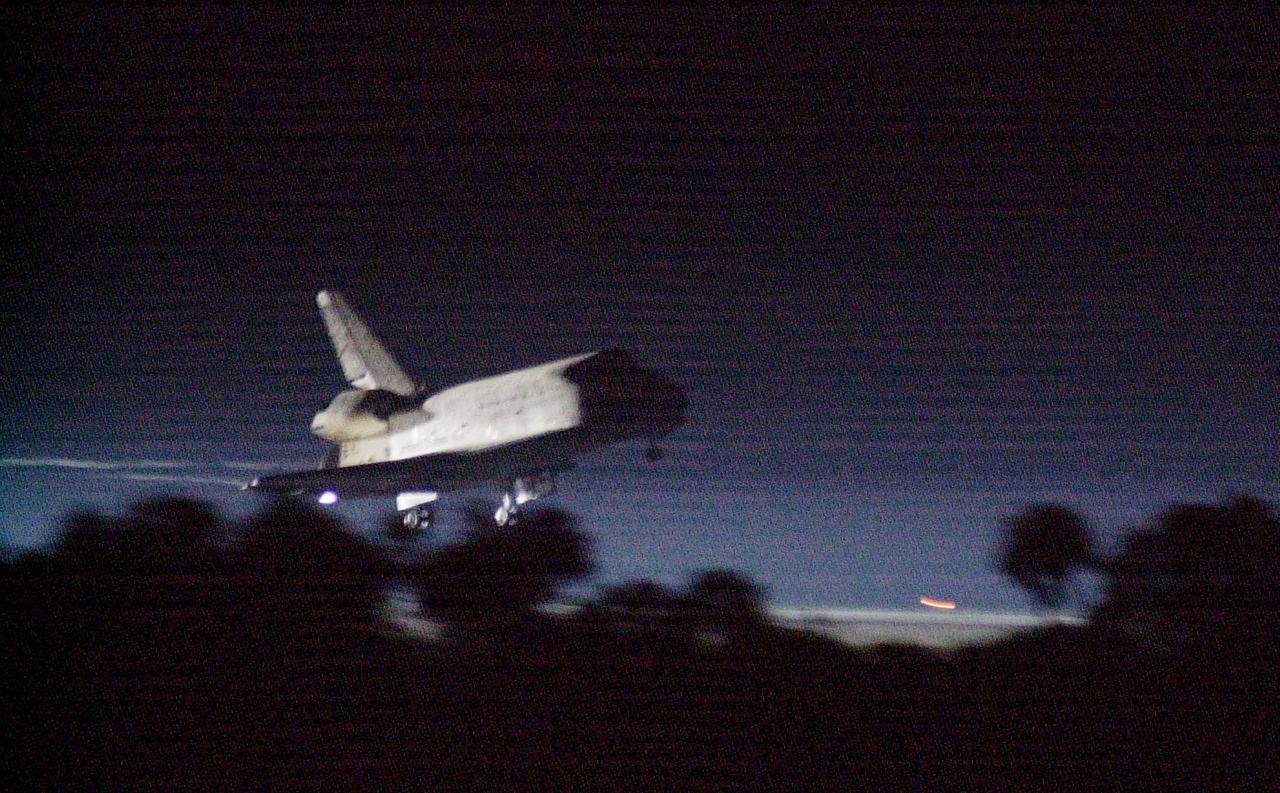
KENNEDY SPACE CENTER, Fla. -- Getting a break in the weather, Space Shuttle Discovery prepares to land at the KSC Shuttle Landing Facility March 21, on runway 15. Main gear touchdown occurred at 2:31:42 a.m. EST, nose wheel touchdown at 2:31:54 a.m., and wheel stop at 2:33:06 a.m. The landing on orbit 201 concluded mission STS-102, the eighth flight to the International Space Station, carrying the first Multi-Purpose Logistics Module Leonardo, to the ISS and Expedition Two, a replacement crew for the Station. The 12-day, 19-hour, 51-minute mission returned both the Leonardo; and the first resident crew of the ISS, Expedition One, to KSC. Discovery logged 5.3 million miles on this mission. The landing marked the 54th at KSC in the history of the program, and the 12th night landing at KSC
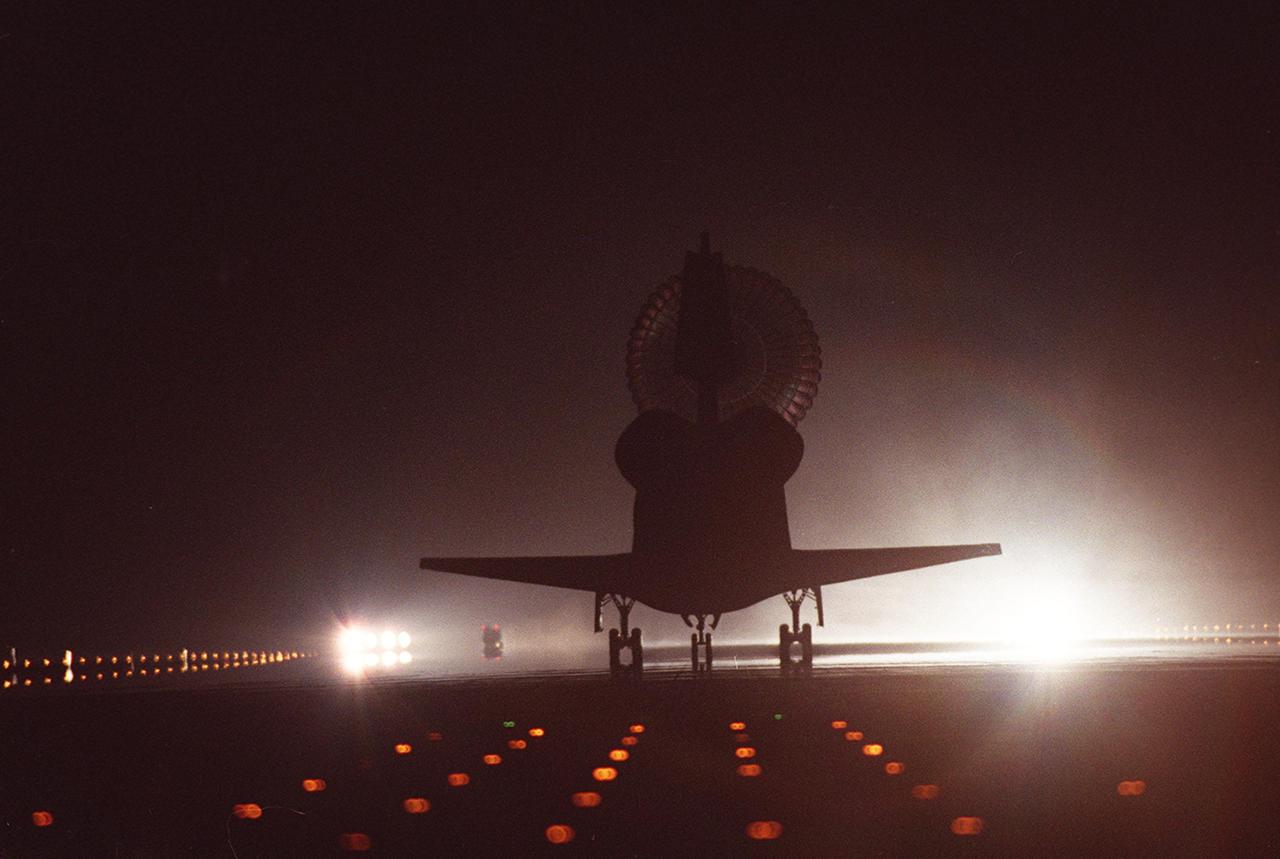
KENNEDY SPACE CENTER, Fla. -- Space Shuttle Discovery is silhouetted by the brilliant runway lights of runway 15 as it lands at the KSC Shuttle Landing Facility. Main gear touchdown occurred at 2:31:42 a.m. EST. Nose wheel touchdown occurred at 2:31:54 a.m., and wheel stop at 2:33:06 a.m. The landing on orbit 201 concluded mission STS-102, the eighth flight to the International Space Station, carrying the first Multi-Purpose Logistics Module, Leonardo, to the ISS and Expedition Two, a replacement crew for the Station. The 12-day, 19-hour, 51-minute mission returned both the Leonardo and the first resident crew of the ISS, Expedition One, to KSC. Discovery logged 5.3 million miles on this mission. The landing marked the 54th at KSC in the history of the program, and the 12th night landing at KSC
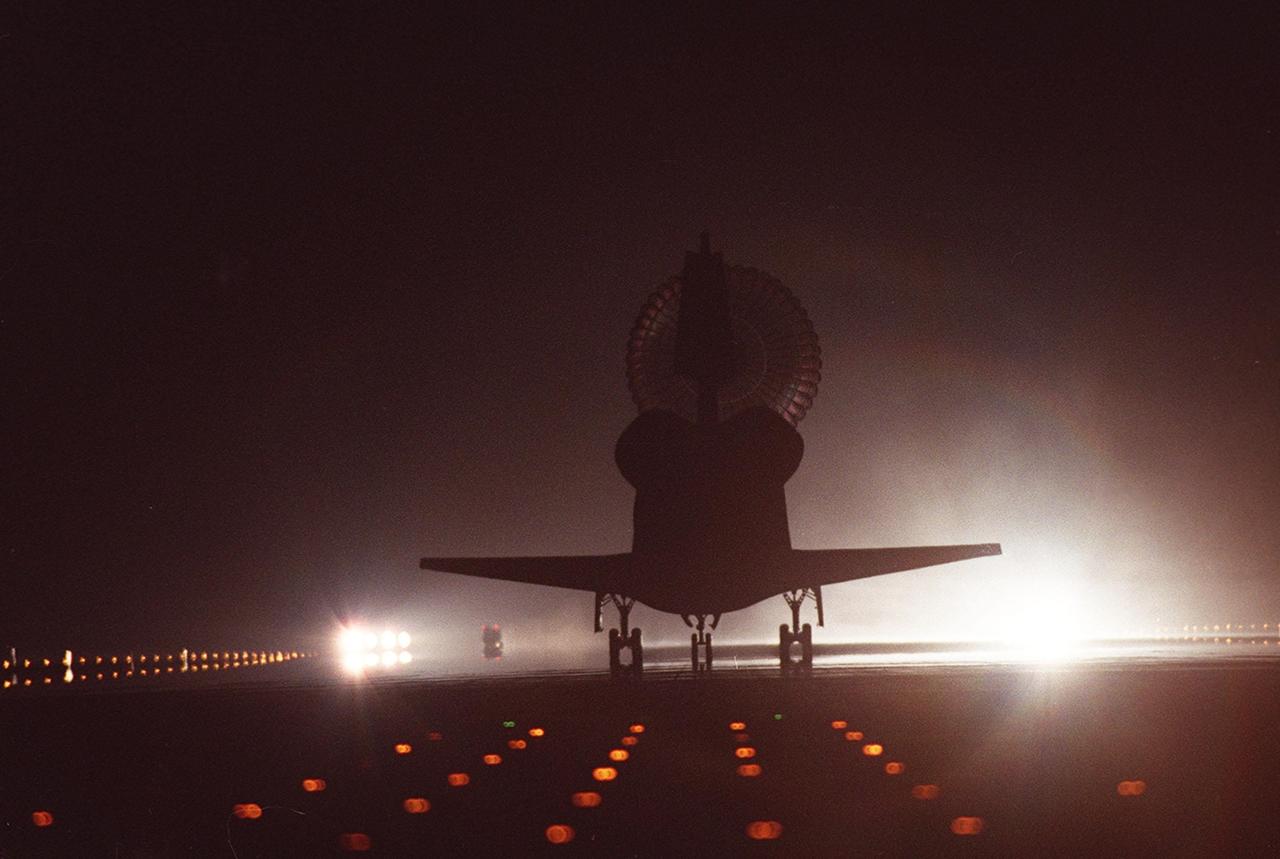
KENNEDY SPACE CENTER, Fla. -- Space Shuttle Discovery is silhouetted by the brilliant runway lights of runway 15 as it lands at the KSC Shuttle Landing Facility. Main gear touchdown occurred at 2:31:42 a.m. EST. Nose wheel touchdown occurred at 2:31:54 a.m., and wheel stop at 2:33:06 a.m. The landing on orbit 201 concluded mission STS-102, the eighth flight to the International Space Station, carrying the first Multi-Purpose Logistics Module, Leonardo, to the ISS and Expedition Two, a replacement crew for the Station. The 12-day, 19-hour, 51-minute mission returned both the Leonardo and the first resident crew of the ISS, Expedition One, to KSC. Discovery logged 5.3 million miles on this mission. The landing marked the 54th at KSC in the history of the program, and the 12th night landing at KSC
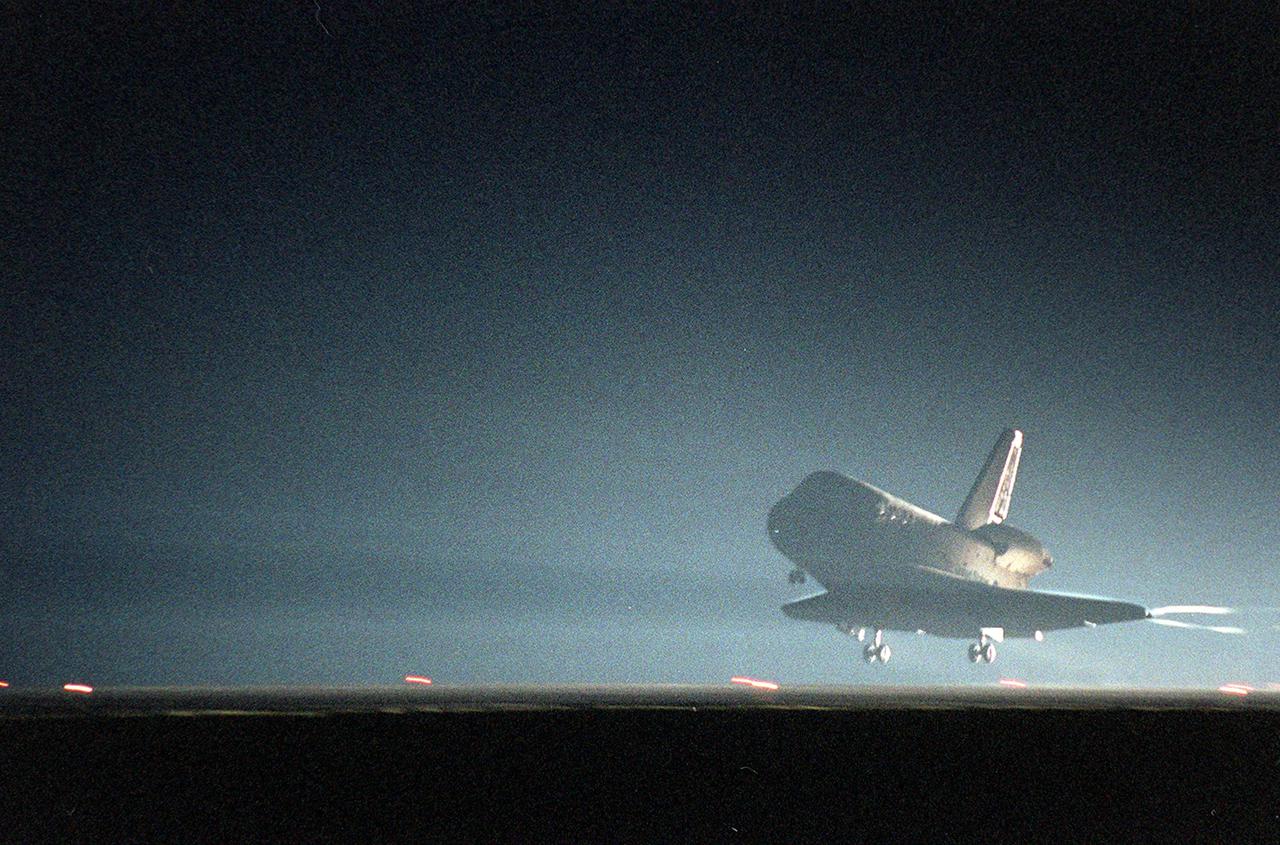
KENNEDY SPACE CENTER, Fla. -- Space Shuttle Discovery prepares to land at the KSC Shuttle Landing Facility on runway 15. Main gear touchdown occurred about 2:31:42 a.m. EST, nose wheel touchdown at 2:31:54 a.m., and wheel stop at 2:33:06 a.m. The landing, on orbit 201, concluded mission STS-102, the eighth flight to the International Space Station, carrying the first Multi-Purpose Logistics Module Leonardo, to the ISS and Expedition Two, a replacement crew for the Station. The 12-day, 19-hour, 51-minute mission returned both the Leonardo and the first resident crew of the ISS, Expedition One, to KSC. Discovery logged 5.3 million miles on this mission. The landing marked the 54th at KSC in the history of the program, and the 12th night landing at KSC
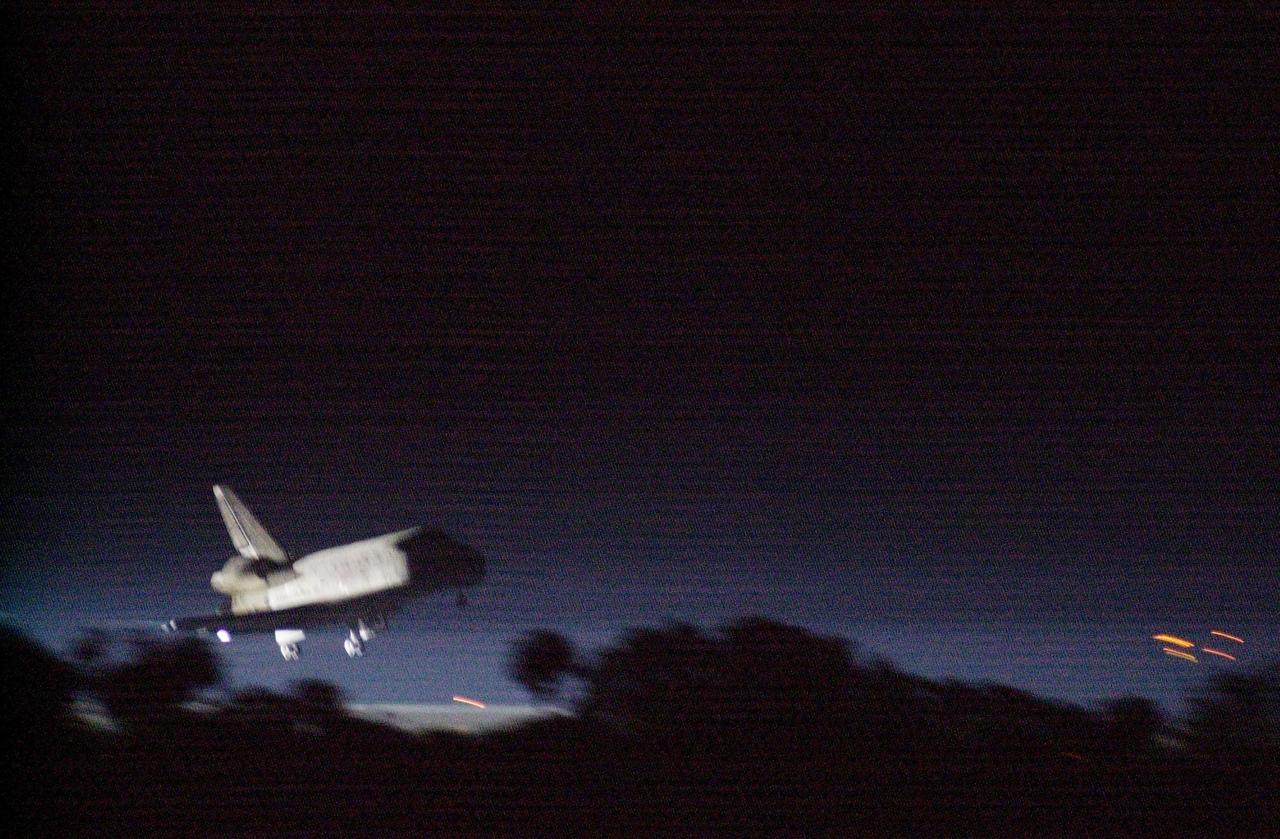
KENNEDY SPACE CENTER, Fla. -- Getting a break in the weather, Space Shuttle Discovery prepares to land at the KSC Shuttle Landing Facility March 21, on runway 15. Main gear touchdown occurred at 2:31:42 a.m. EST, nose wheel touchdown at 2:31:54 a.m., and wheel stop at 2:33:06 a.m. The landing on orbit 201 concluded mission STS-102, the eighth flight to the International Space Station, carrying the first Multi-Purpose Logistics Module Leonardo, to the ISS and Expedition Two, a replacement crew for the Station. The 12-day, 19-hour, 51-minute mission returned both the Leonardo and the first resident crew of the ISS, Expedition One, to KSC. Discovery logged 5.3 million miles on this mission. The landing marked the 54th at KSC in the history of the program, and the 12th night landing at KSC
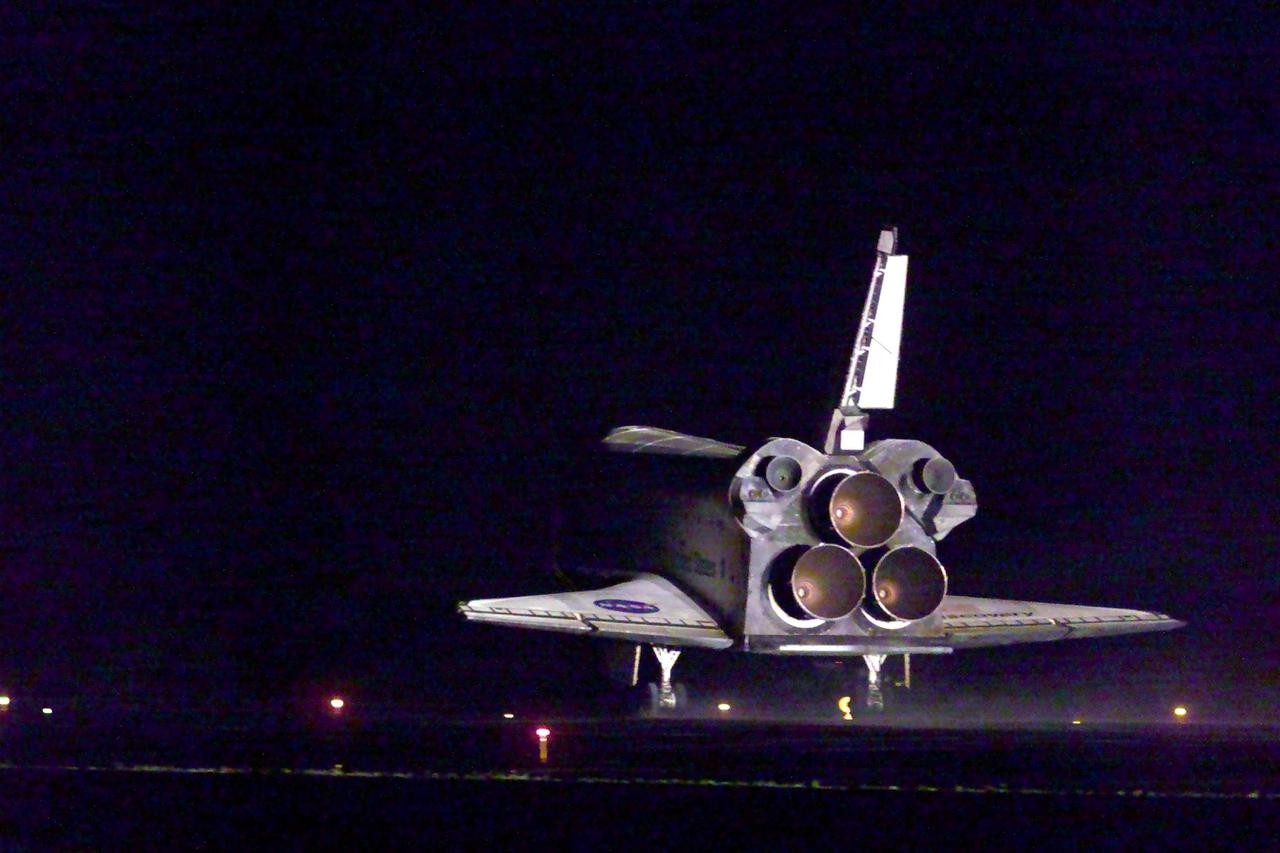
KENNEDY SPACE CENTER, Fla. -- Viewed from behind, Space Shuttle Discovery is seen landing on runway 15 of the KSC Shuttle Landing Facility. Main gear touchdown occurred at 2:31:42 a.m. EST. Nose wheel touchdown occurred at 2:31:54 a.m., and wheel stop at 2:33:06 a.m. The landing on orbit 201 concluded mission STS-102, the eighth flight to the International Space Station, carrying the first Multi-Purpose Logistics Module Leonardo, to the ISS and Expedition Two, a replacement crew for the Station. The 12-day, 19-hour, 51-minute mission returned both the Leonardo and the first resident crew of the ISS, Expedition One, to KSC. Discovery logged 5.3 million miles on this mission. The landing marked the 54th at KSC in the history of the program, and the 12th night landing at KSC
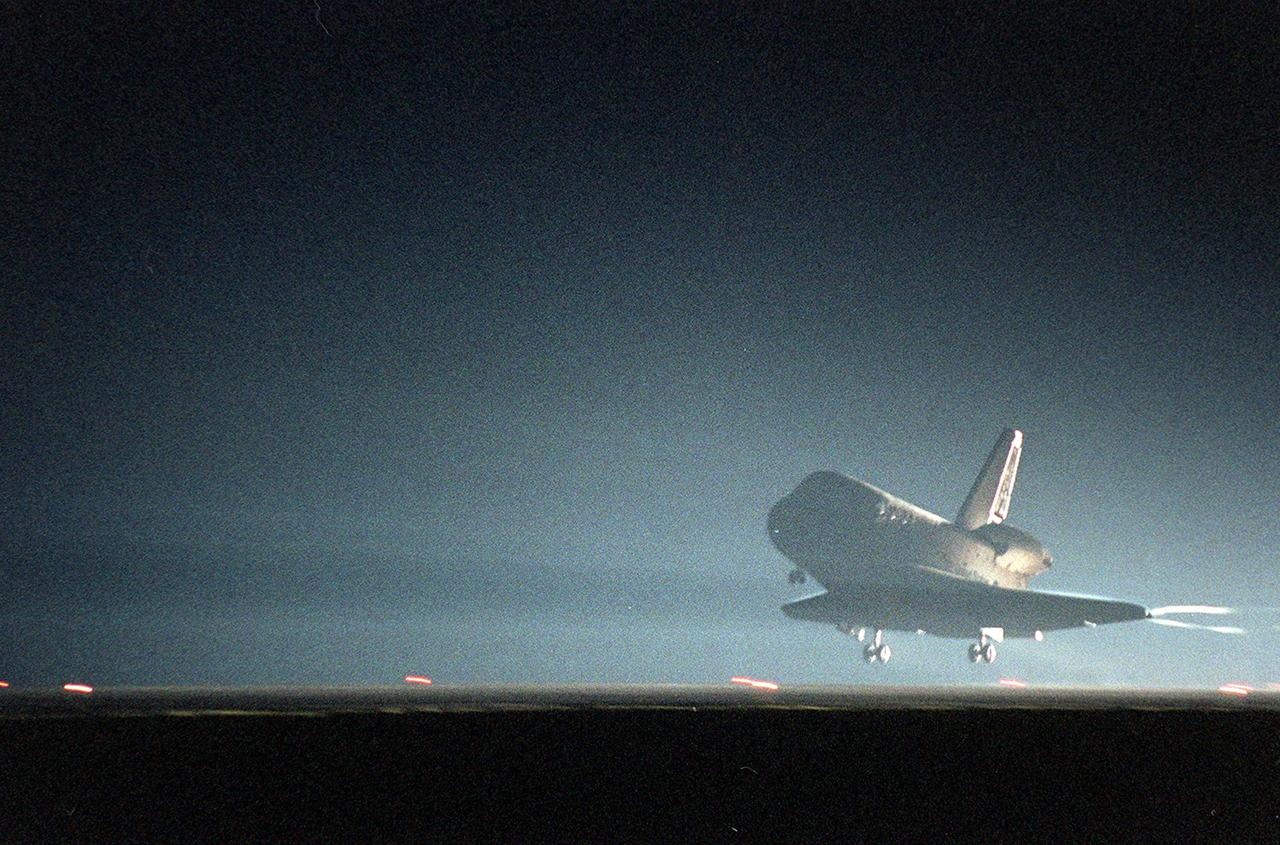
KENNEDY SPACE CENTER, Fla. -- Space Shuttle Discovery prepares to land at the KSC Shuttle Landing Facility on runway 15. Main gear touchdown occurred about 2:31:42 a.m. EST, nose wheel touchdown at 2:31:54 a.m., and wheel stop at 2:33:06 a.m. The landing, on orbit 201, concluded mission STS-102, the eighth flight to the International Space Station, carrying the first Multi-Purpose Logistics Module Leonardo, to the ISS and Expedition Two, a replacement crew for the Station. The 12-day, 19-hour, 51-minute mission returned both the Leonardo and the first resident crew of the ISS, Expedition One, to KSC. Discovery logged 5.3 million miles on this mission. The landing marked the 54th at KSC in the history of the program, and the 12th night landing at KSC
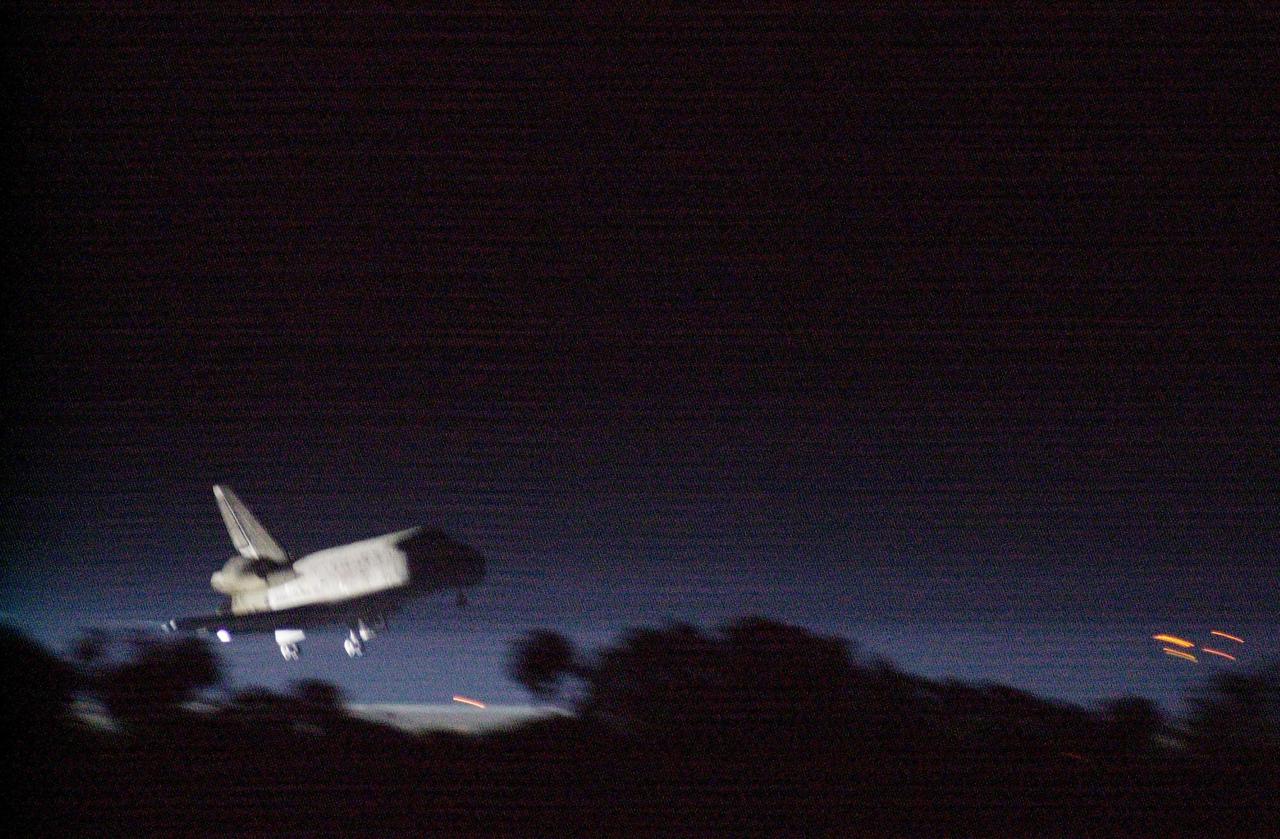
KENNEDY SPACE CENTER, Fla. -- Getting a break in the weather, Space Shuttle Discovery prepares to land at the KSC Shuttle Landing Facility March 21, on runway 15. Main gear touchdown occurred at 2:31:42 a.m. EST, nose wheel touchdown at 2:31:54 a.m., and wheel stop at 2:33:06 a.m. The landing on orbit 201 concluded mission STS-102, the eighth flight to the International Space Station, carrying the first Multi-Purpose Logistics Module Leonardo, to the ISS and Expedition Two, a replacement crew for the Station. The 12-day, 19-hour, 51-minute mission returned both the Leonardo and the first resident crew of the ISS, Expedition One, to KSC. Discovery logged 5.3 million miles on this mission. The landing marked the 54th at KSC in the history of the program, and the 12th night landing at KSC
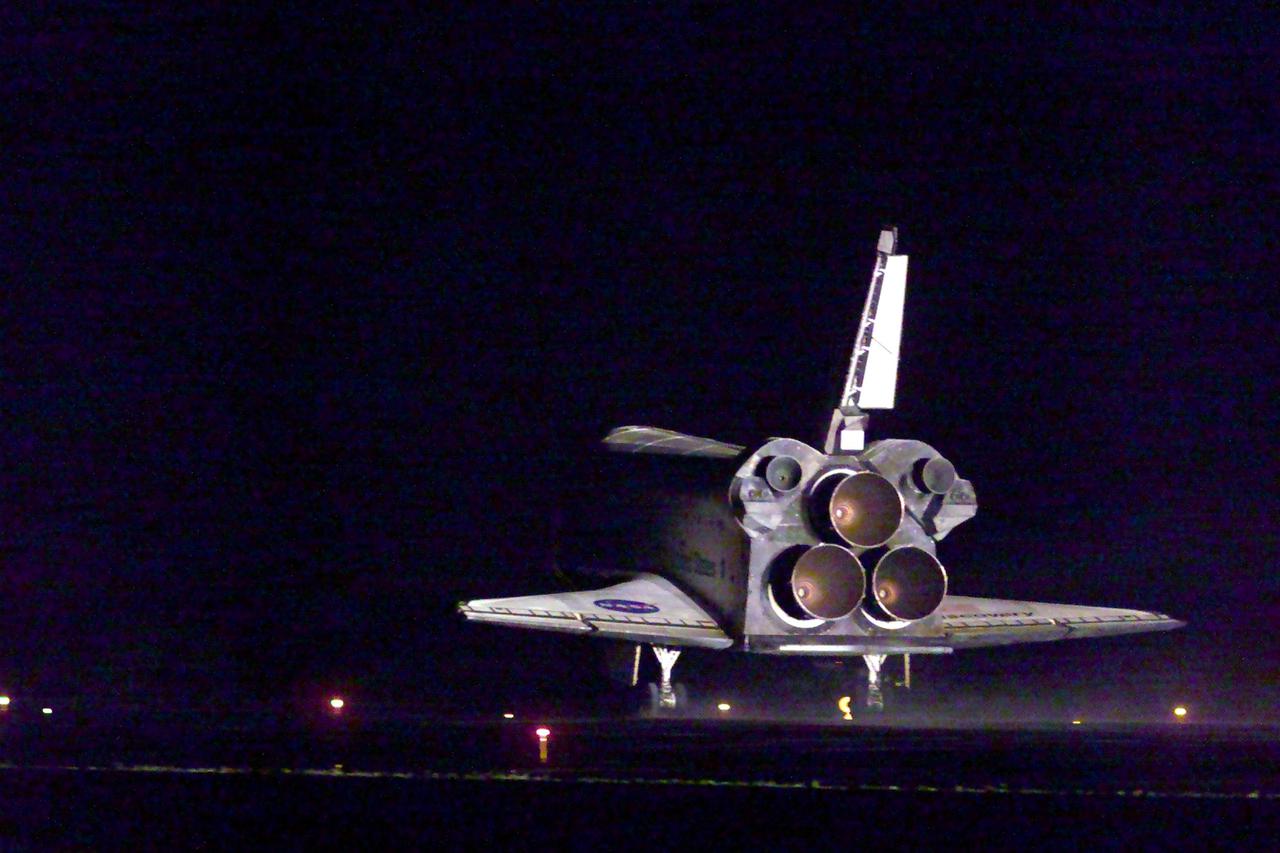
KENNEDY SPACE CENTER, Fla. -- Viewed from behind, Space Shuttle Discovery is seen landing on runway 15 of the KSC Shuttle Landing Facility. Main gear touchdown occurred at 2:31:42 a.m. EST. Nose wheel touchdown occurred at 2:31:54 a.m., and wheel stop at 2:33:06 a.m. The landing on orbit 201 concluded mission STS-102, the eighth flight to the International Space Station, carrying the first Multi-Purpose Logistics Module Leonardo, to the ISS and Expedition Two, a replacement crew for the Station. The 12-day, 19-hour, 51-minute mission returned both the Leonardo and the first resident crew of the ISS, Expedition One, to KSC. Discovery logged 5.3 million miles on this mission. The landing marked the 54th at KSC in the history of the program, and the 12th night landing at KSC
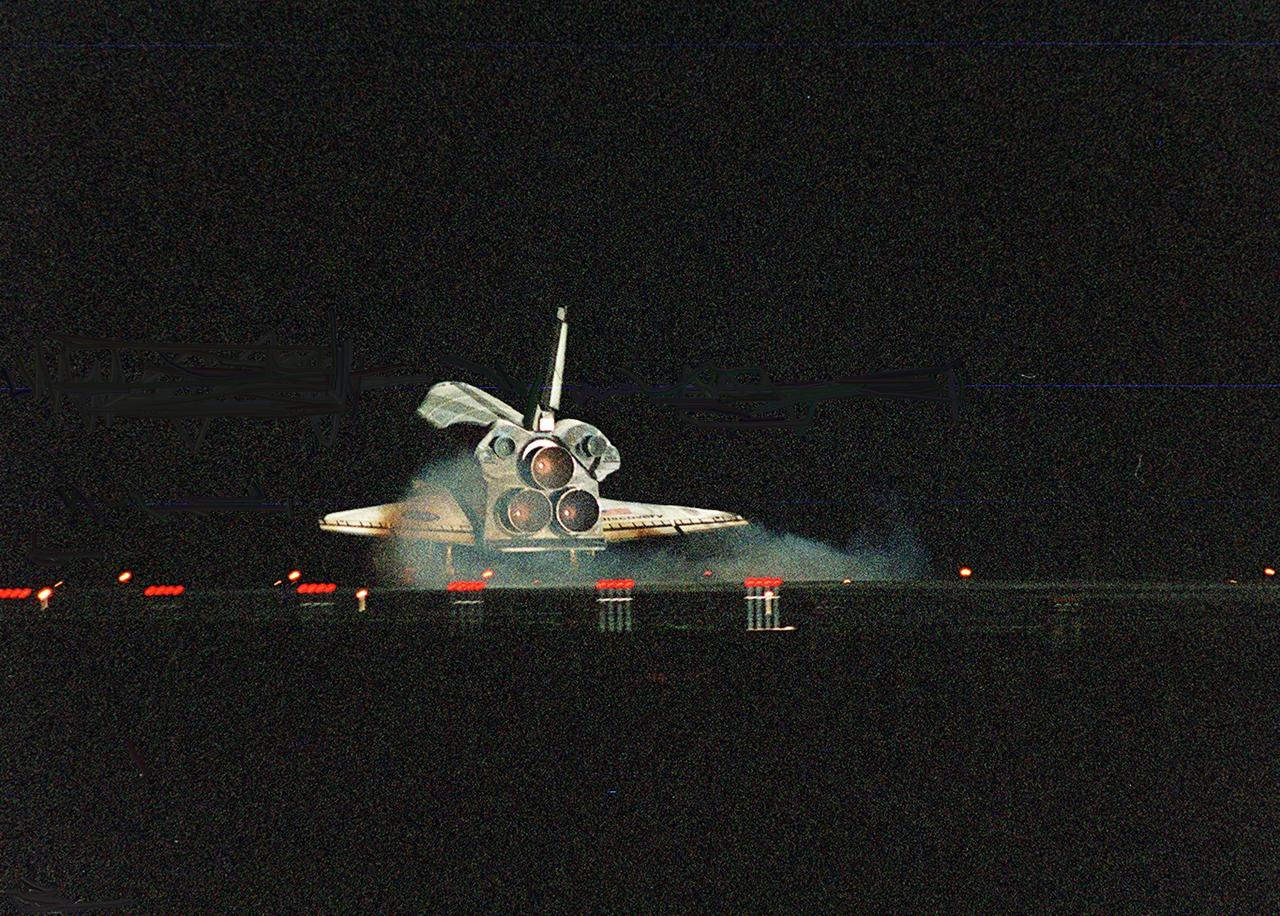
KENNEDY SPACE CENTER, Fla. -- Space Shuttle Discovery kicks up a swirl of dust as it touches down on runway 15 at the KSC Shuttle Landing Facility. Main gear touchdown occurred about 2:31:42 a.m. EST, nose wheel touchdown at 2:31:54 a.m., and wheel stop at 2:33:06 a.m. The landing, on orbit 201, concluded mission STS-102, the eighth flight to the International Space Station, carrying the first Multi-Purpose Logistics Module Leonardo, to the ISS and Expedition Two, a replacement crew for the Station. The 12-day, 19-hour, 51-minute mission returned both the Leonardo and the first resident crew of the ISS, Expedition One, to KSC. Discovery logged 5.3 million miles on this mission. The landing marked the 54th at KSC in the history of the program, and the 12th night landing at KSC
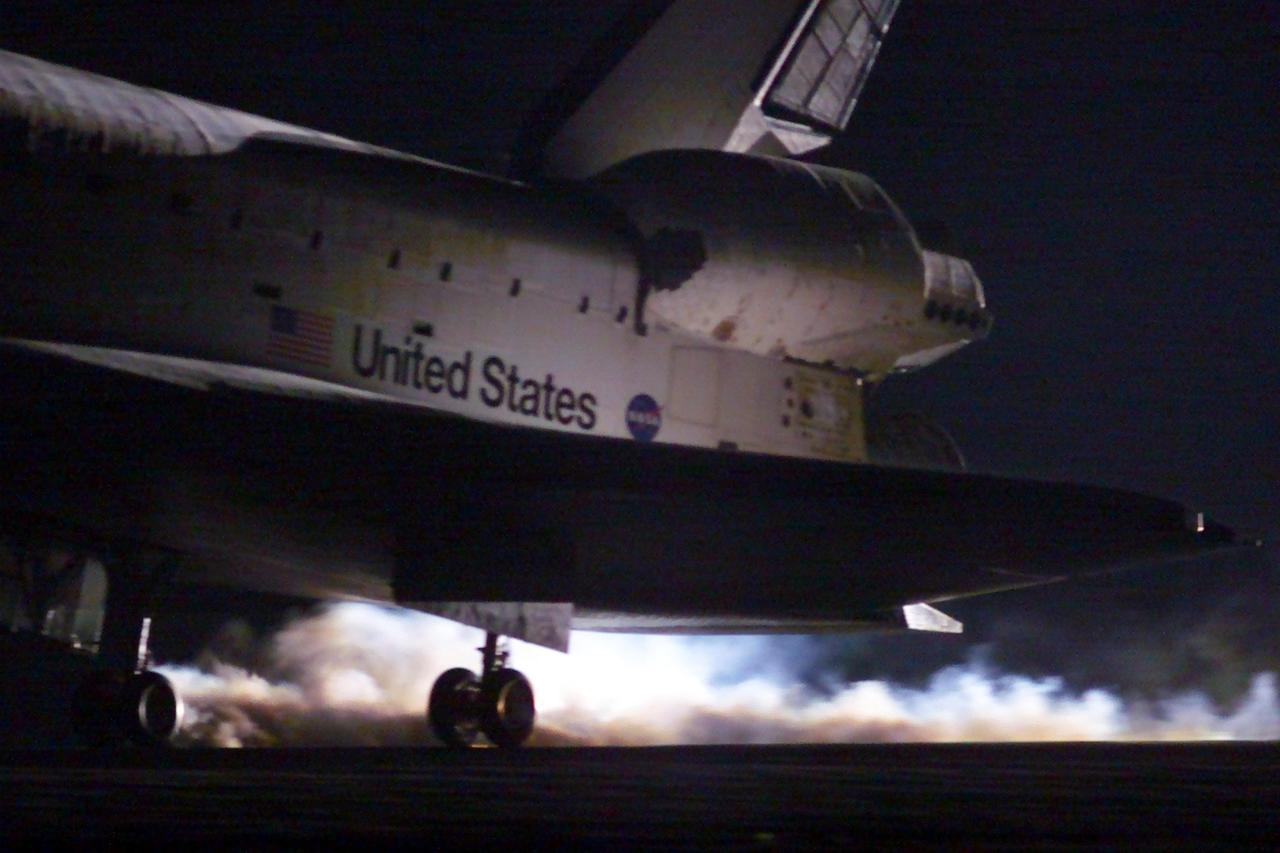
KENNEDY SPACE CENTER, Fla. -- In this view, the rear wheels on Space Shuttle Discovery are seen touching down on runway 15 of the KSC Shuttle Landing Facility. Main gear touchdown occurred at 2:31:42 a.m. EST. Nose wheel touchdown occurred at 2:31:54 a.m., and wheel stop at 2:33:06 a.m. The landing on orbit 201 concluded mission STS-102, the eighth flight to the International Space Station, carrying the first Multi-Purpose Logistics Module Leonardo, to the ISS and Expedition Two, a replacement crew for the Station. The 12-day, 19-hour, 51-minute mission returned both the Leonardo and the first resident crew of the ISS, Expedition One, to KSC. Discovery logged 5.3 million miles on this mission. The landing marked the 54th at KSC in the history of the program, and the 12th night landing at KSC
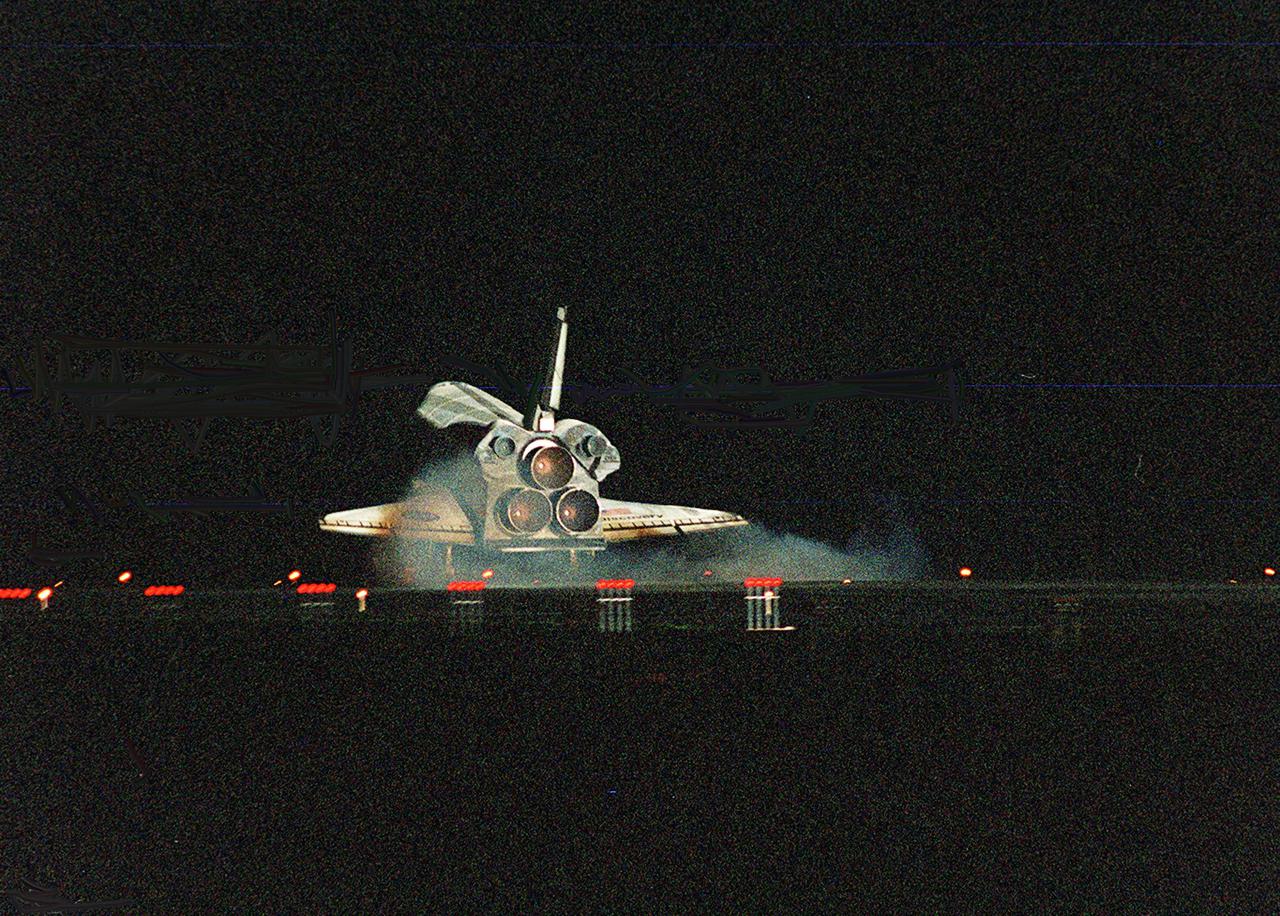
KENNEDY SPACE CENTER, Fla. -- Space Shuttle Discovery kicks up a swirl of dust as it touches down on runway 15 at the KSC Shuttle Landing Facility. Main gear touchdown occurred about 2:31:42 a.m. EST, nose wheel touchdown at 2:31:54 a.m., and wheel stop at 2:33:06 a.m. The landing, on orbit 201, concluded mission STS-102, the eighth flight to the International Space Station, carrying the first Multi-Purpose Logistics Module Leonardo, to the ISS and Expedition Two, a replacement crew for the Station. The 12-day, 19-hour, 51-minute mission returned both the Leonardo and the first resident crew of the ISS, Expedition One, to KSC. Discovery logged 5.3 million miles on this mission. The landing marked the 54th at KSC in the history of the program, and the 12th night landing at KSC
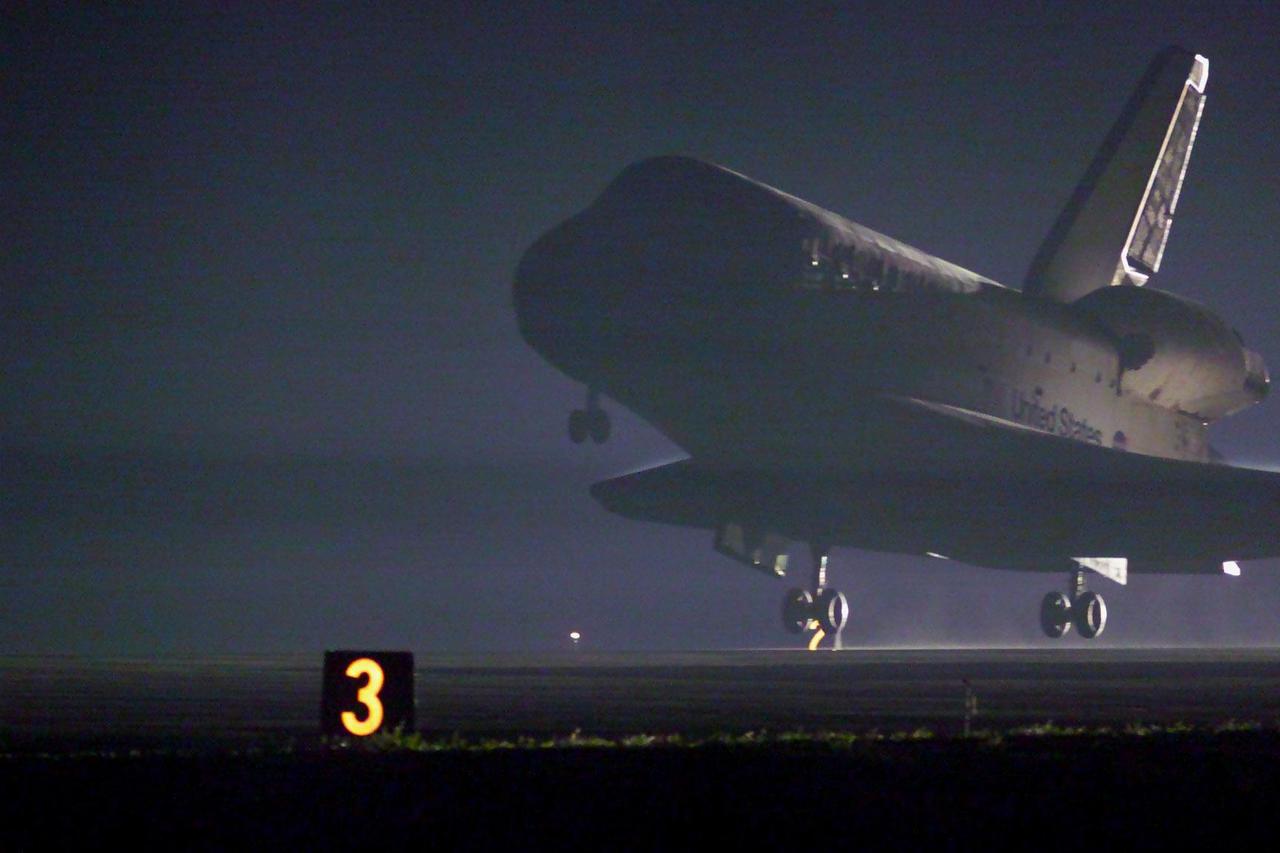
KENNEDY SPACE CENTER, Fla. -- Space Shuttle Discovery approaches touchdown on runway 15 at the KSC Shuttle Landing Facility. Main gear touchdown occurred at 2:31:42 a.m. EST, nose wheel touchdown at 2:31:54 a.m., and wheel stop at 2:33:06 a.m. The landing on orbit 201 concluded mission STS-102, the eighth flight to the International Space Station, carrying the first Multi-Purpose Logistics Module Leonardo, to the ISS and Expedition Two, a replacement crew for the Station. The 12-day, 19-hour, 51-minute mission returned both the Leonardo and the first resident crew of the ISS, Expedition One, to KSC . Discovery logged 5.3 million miles on this mission. The landing marked the 54th at KSC in the history of the program, and the 12th night landing at KSC
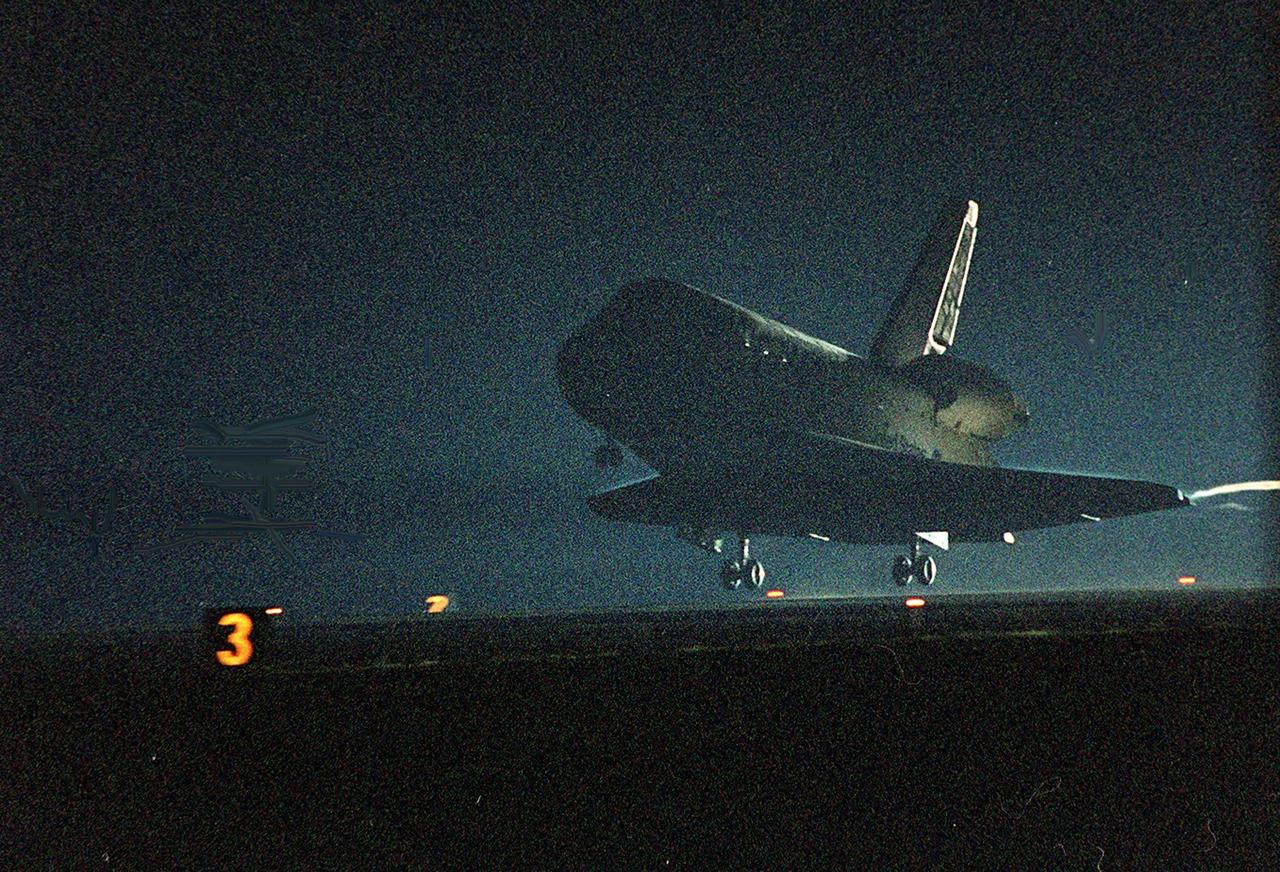
KENNEDY SPACE CENTER, Fla. -- Space Shuttle Discovery approaches touchdown on runway 15 at the KSC Shuttle Landing Facility. Main gear touchdown occurred about 2:31:42 a.m. EST, nose wheel touchdown at 2:31:54 a.m., and wheel stop at 2:33:06 a.m. The landing, on orbit 201, concluded mission STS-102, the eighth flight to the International Space Station, carrying the first Multi-Purpose Logistics Module Leonardo, to the ISS and Expedition Two, a replacement crew for the Station. The 12-day, 19-hour, 51-minute mission returned both the Leonardo and the first resident crew of the ISS, Expedition One, to KSC. Discovery logged 5.3 million miles on this mission. The landing marked the 54th at KSC in the history of the program, and the 12th night landing at KSC
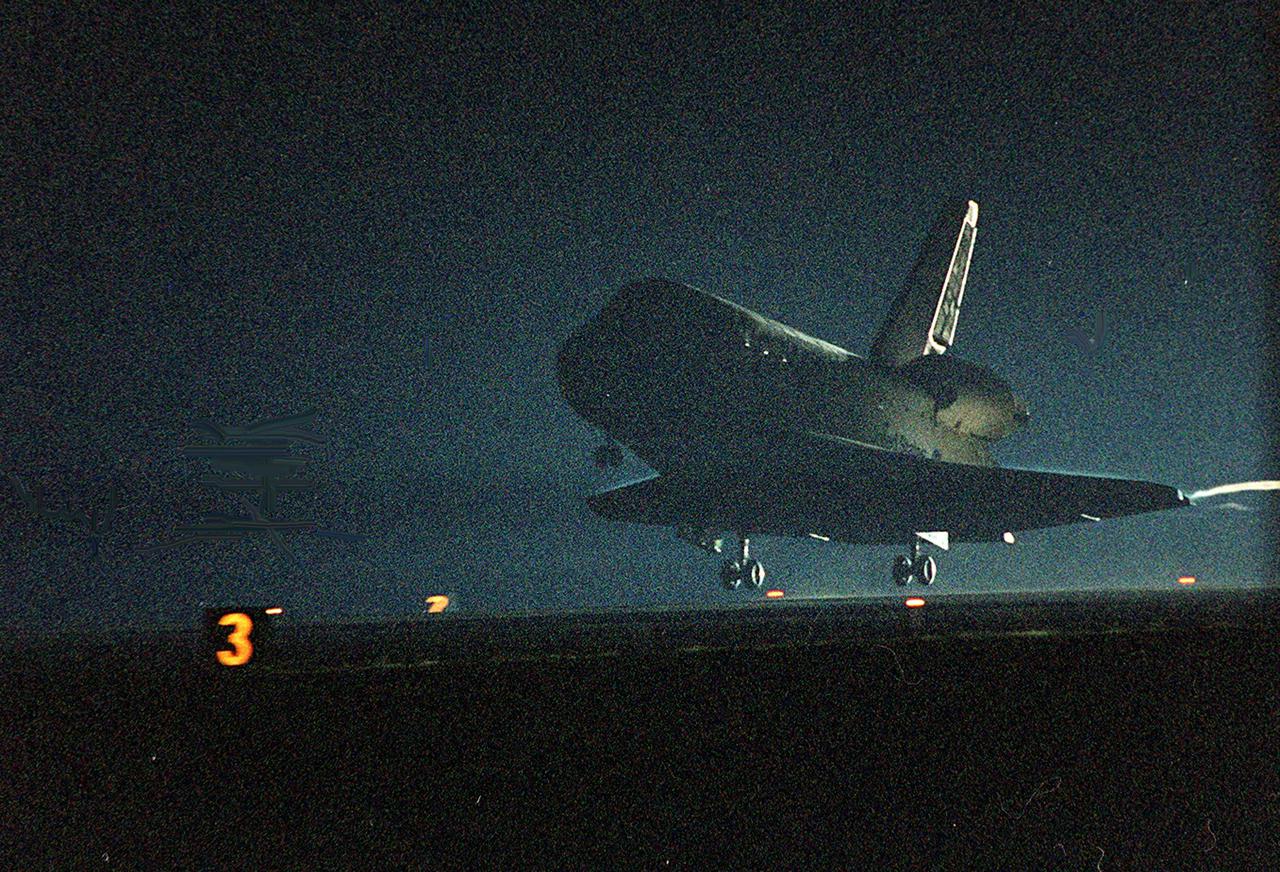
KENNEDY SPACE CENTER, Fla. -- Space Shuttle Discovery approaches touchdown on runway 15 at the KSC Shuttle Landing Facility. Main gear touchdown occurred about 2:31:42 a.m. EST, nose wheel touchdown at 2:31:54 a.m., and wheel stop at 2:33:06 a.m. The landing, on orbit 201, concluded mission STS-102, the eighth flight to the International Space Station, carrying the first Multi-Purpose Logistics Module Leonardo, to the ISS and Expedition Two, a replacement crew for the Station. The 12-day, 19-hour, 51-minute mission returned both the Leonardo and the first resident crew of the ISS, Expedition One, to KSC. Discovery logged 5.3 million miles on this mission. The landing marked the 54th at KSC in the history of the program, and the 12th night landing at KSC
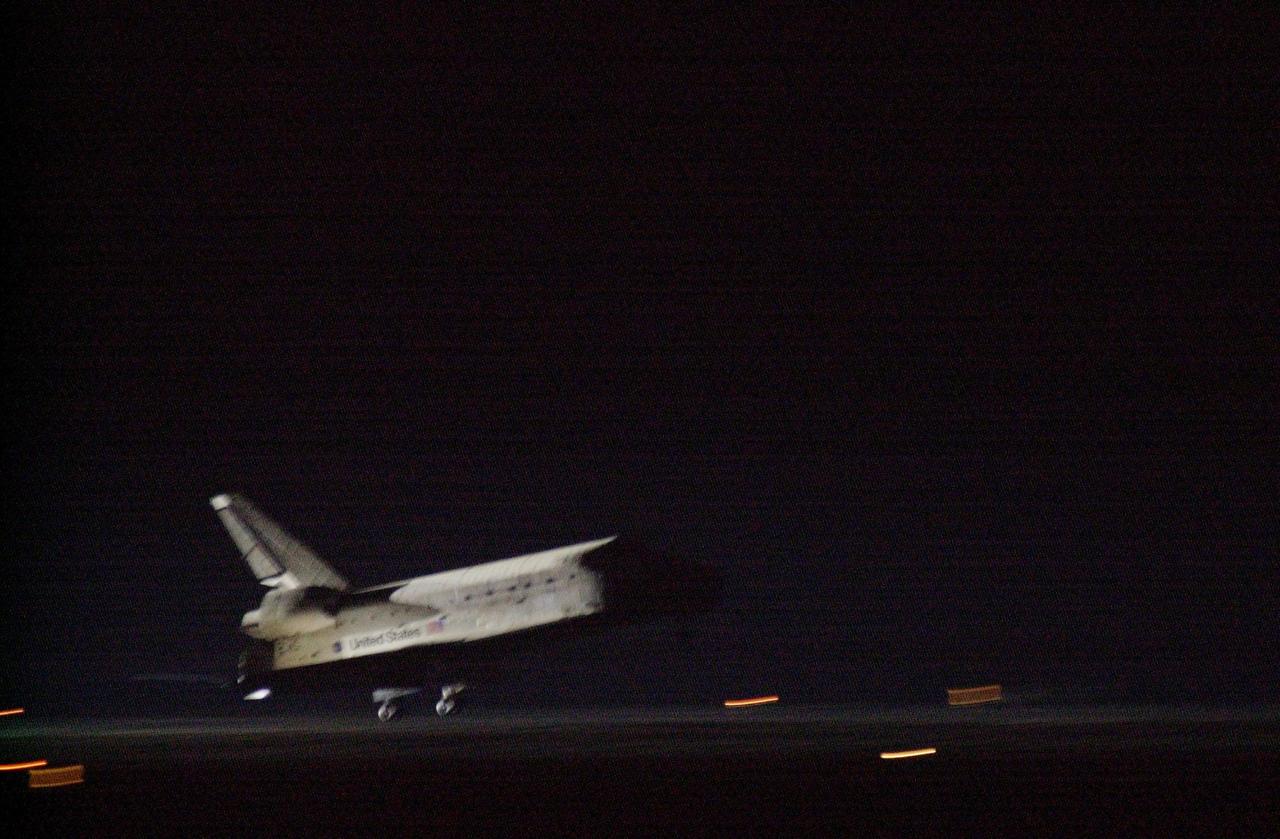
KENNEDY SPACE CENTER, Fla. -- Space Shuttle Discovery approaches runway 15 at the KSC Shuttle Landing Facility March 21. Main gear touchdown occurred at 2:31:42 a.m. EST, nose wheel touchdown at 2:31:54 a.m., and wheel stop at 2:33:06 a.m. The landing on orbit 201 concluded mission STS-102, the eighth flight to the International Space Station, carrying the first Multi-Purpose Logistics Module Leonardo, to the ISS and Expedition Two, a replacement crew for the Station. The 12-day, 19-hour, 51-minute mission returned both the Leonardo and the first resident crew of the ISS, Expedition One, to KSC . Discovery logged 5.3 million miles on this mission. The landing marked the 54th at KSC in the history of the program, and the 12th night landing at KSC
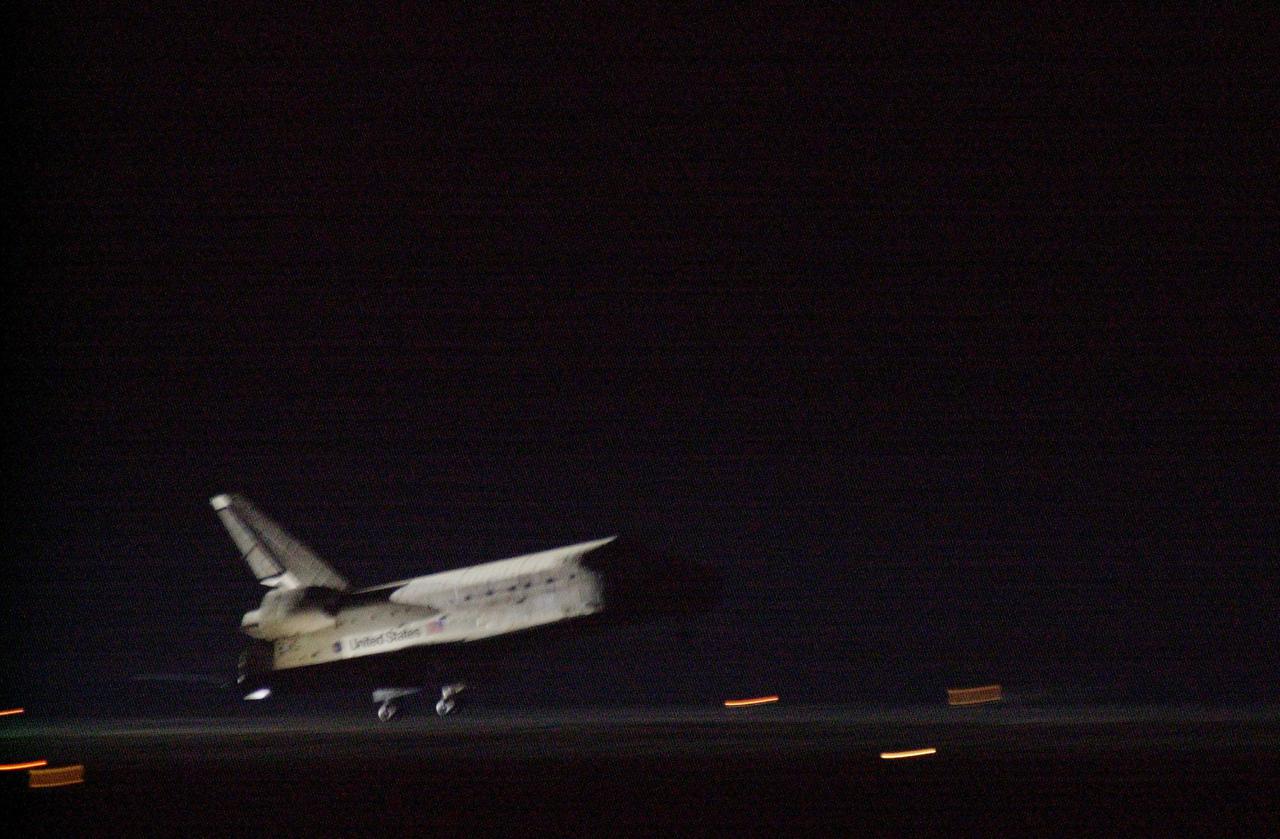
KENNEDY SPACE CENTER, Fla. -- Space Shuttle Discovery approaches runway 15 at the KSC Shuttle Landing Facility March 21. Main gear touchdown occurred at 2:31:42 a.m. EST, nose wheel touchdown at 2:31:54 a.m., and wheel stop at 2:33:06 a.m. The landing on orbit 201 concluded mission STS-102, the eighth flight to the International Space Station, carrying the first Multi-Purpose Logistics Module Leonardo, to the ISS and Expedition Two, a replacement crew for the Station. The 12-day, 19-hour, 51-minute mission returned both the Leonardo and the first resident crew of the ISS, Expedition One, to KSC . Discovery logged 5.3 million miles on this mission. The landing marked the 54th at KSC in the history of the program, and the 12th night landing at KSC
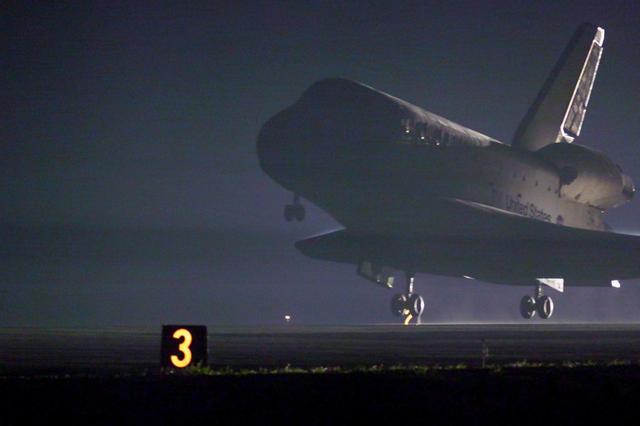
KENNEDY SPACE CENTER, Fla. -- Space Shuttle Discovery approaches touchdown on runway 15 at the KSC Shuttle Landing Facility. Main gear touchdown occurred at 2:31:42 a.m. EST, nose wheel touchdown at 2:31:54 a.m., and wheel stop at 2:33:06 a.m. The landing on orbit 201 concluded mission STS-102, the eighth flight to the International Space Station, carrying the first Multi-Purpose Logistics Module Leonardo, to the ISS and Expedition Two, a replacement crew for the Station. The 12-day, 19-hour, 51-minute mission returned both the Leonardo and the first resident crew of the ISS, Expedition One, to KSC . Discovery logged 5.3 million miles on this mission. The landing marked the 54th at KSC in the history of the program, and the 12th night landing at KSC
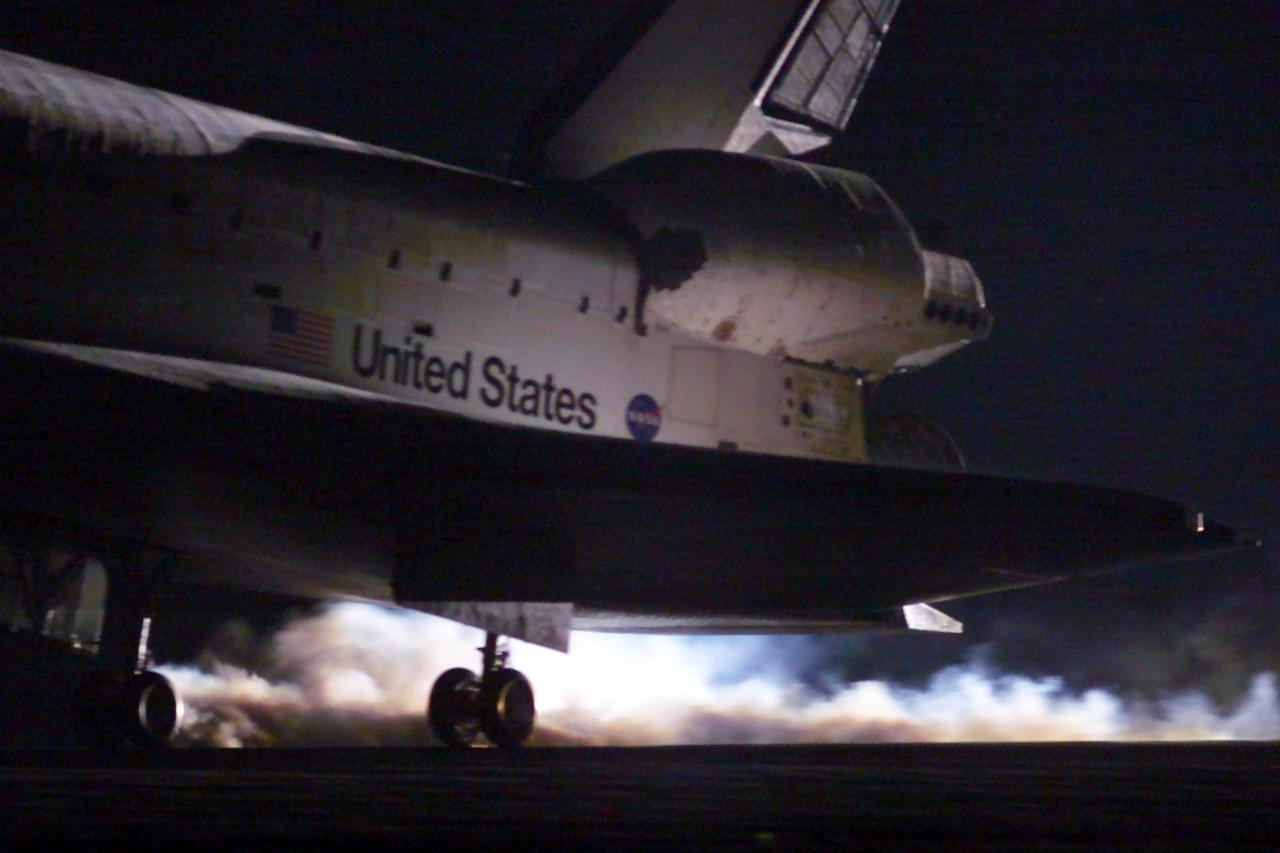
KENNEDY SPACE CENTER, Fla. -- In this view, the rear wheels on Space Shuttle Discovery are seen touching down on runway 15 of the KSC Shuttle Landing Facility. Main gear touchdown occurred at 2:31:42 a.m. EST. Nose wheel touchdown occurred at 2:31:54 a.m., and wheel stop at 2:33:06 a.m. The landing on orbit 201 concluded mission STS-102, the eighth flight to the International Space Station, carrying the first Multi-Purpose Logistics Module Leonardo, to the ISS and Expedition Two, a replacement crew for the Station. The 12-day, 19-hour, 51-minute mission returned both the Leonardo and the first resident crew of the ISS, Expedition One, to KSC. Discovery logged 5.3 million miles on this mission. The landing marked the 54th at KSC in the history of the program, and the 12th night landing at KSC
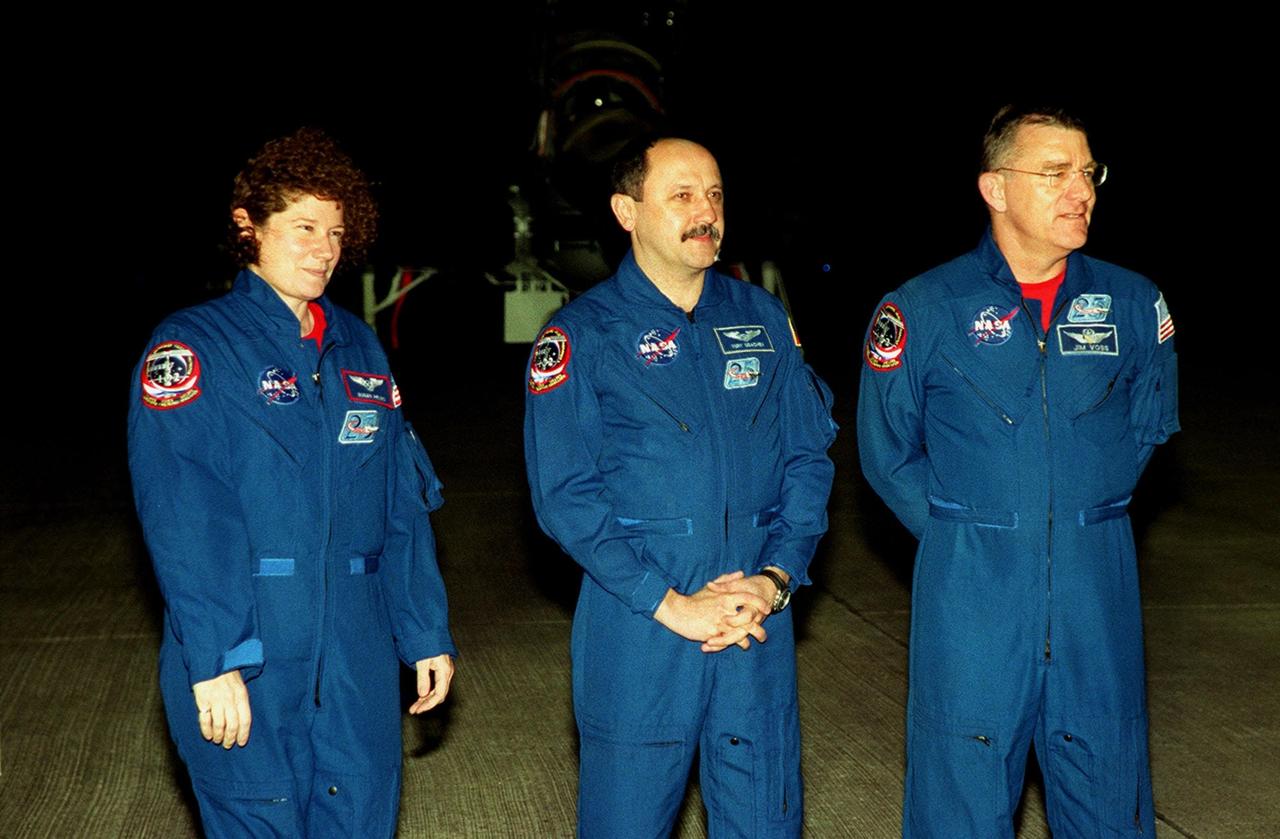
After their arrival at the Shuttle Landing Facility, STS-102 Mission Specialists (left to right) Susan Helms, Yury Usachev and James Voss happily greet the media. They are also the Expedition Two crew replacing Expedition One on the International Space Station. STS-102 will be carrying the Multi-Purpose Logistics Module Leonardo, the primary delivery system used to resupply and return Station cargo requiring a pressurized environment. Leonardo will deliver up to 10 tons of laboratory racks filled with equipment, experiments and supplies for outfitting the newly installed U.S. Laboratory Destiny. STS-102 is scheduled to launch March 8 at 6:42 a.m. EST
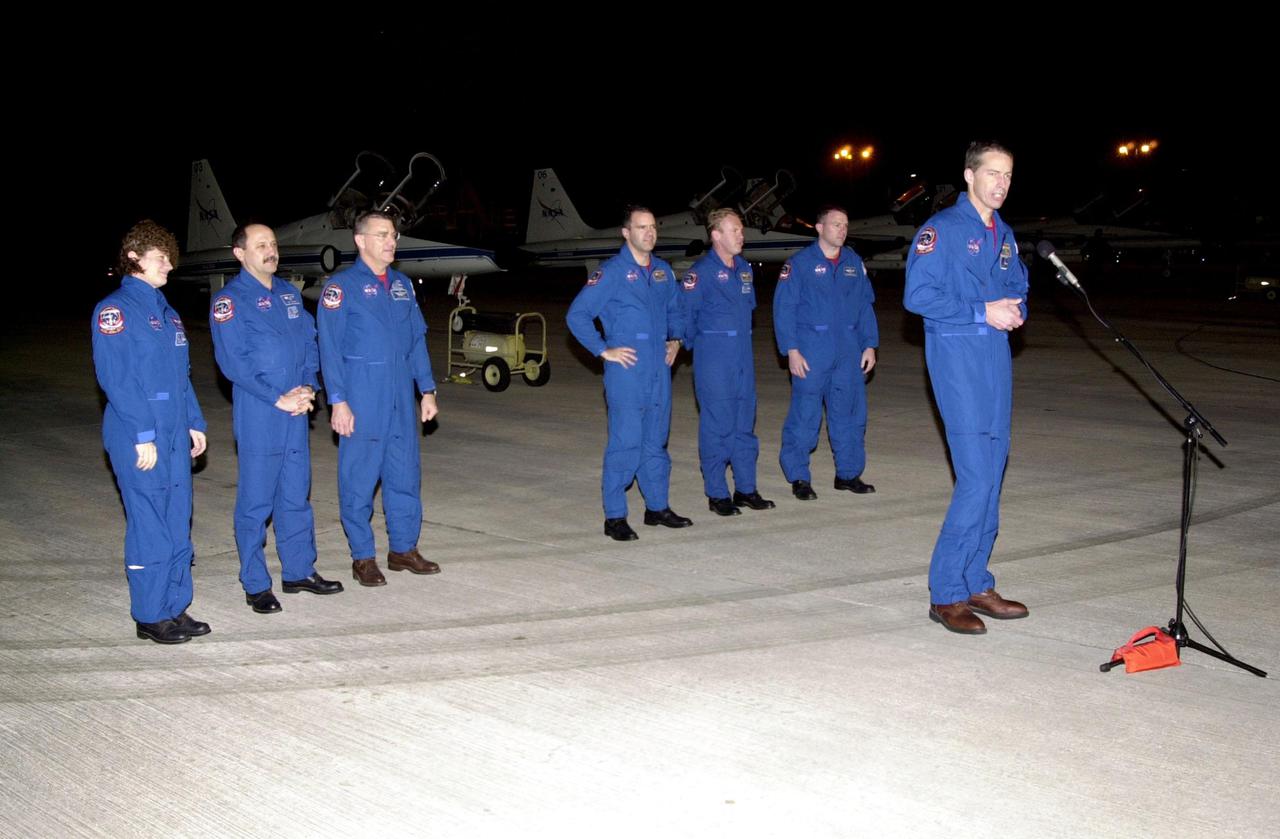
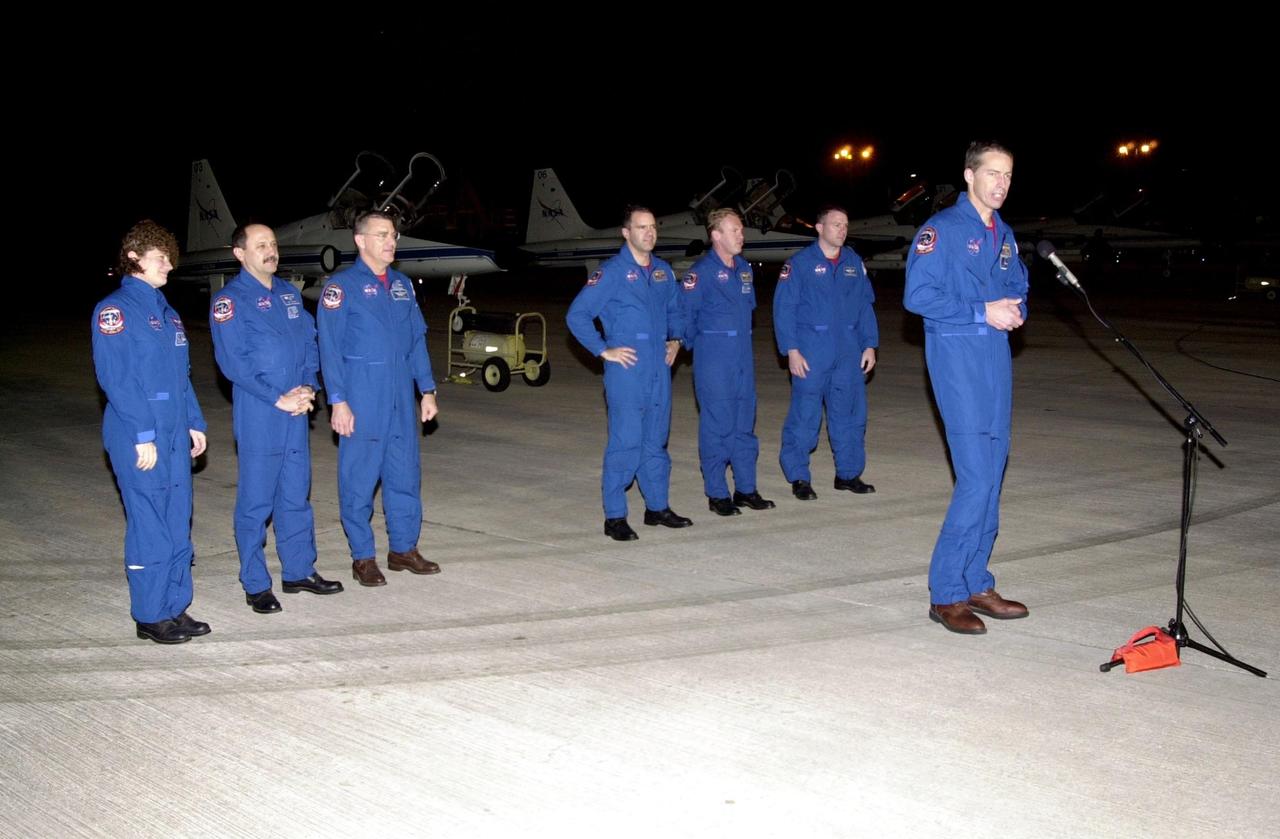
After landing at KSC’s Shuttle Landing Facility, the STS-102 crew pause to brief the media. At the microphone is Commander James Wetherbee. Standing behind him (left to right) are Missions Specialists Susan Helms, Yury Usachev and James Voss, who are also the Expedition Two crew due to replace Expedition One on the International Space Station; Mission Specialists Paul Richards and Andrew Thomas; and Pilot James Kelly. STS-102 will be carrying the Multi-Purpose Logistics Module Leonardo, the primary delivery system used to resupply and return Station cargo requiring a pressurized environment. Leonardo will deliver up to 10 tons of laboratory racks filled with equipment, experiments and supplies for outfitting the newly installed U.S. Laboratory Destiny. STS-102 is scheduled to launch March 8 at 6:42 a.m. EST
After landing at KSC’s Shuttle Landing Facility, the STS-102 crew pause to brief the media. At the microphone is Commander James Wetherbee. Standing behind him (left to right) are Missions Specialists Susan Helms, Yury Usachev and James Voss, who are also the Expedition Two crew due to replace Expedition One on the International Space Station; Mission Specialists Paul Richards and Andrew Thomas; and Pilot James Kelly. STS-102 will be carrying the Multi-Purpose Logistics Module Leonardo, the primary delivery system used to resupply and return Station cargo requiring a pressurized environment. Leonardo will deliver up to 10 tons of laboratory racks filled with equipment, experiments and supplies for outfitting the newly installed U.S. Laboratory Destiny. STS-102 is scheduled to launch March 8 at 6:42 a.m. EST
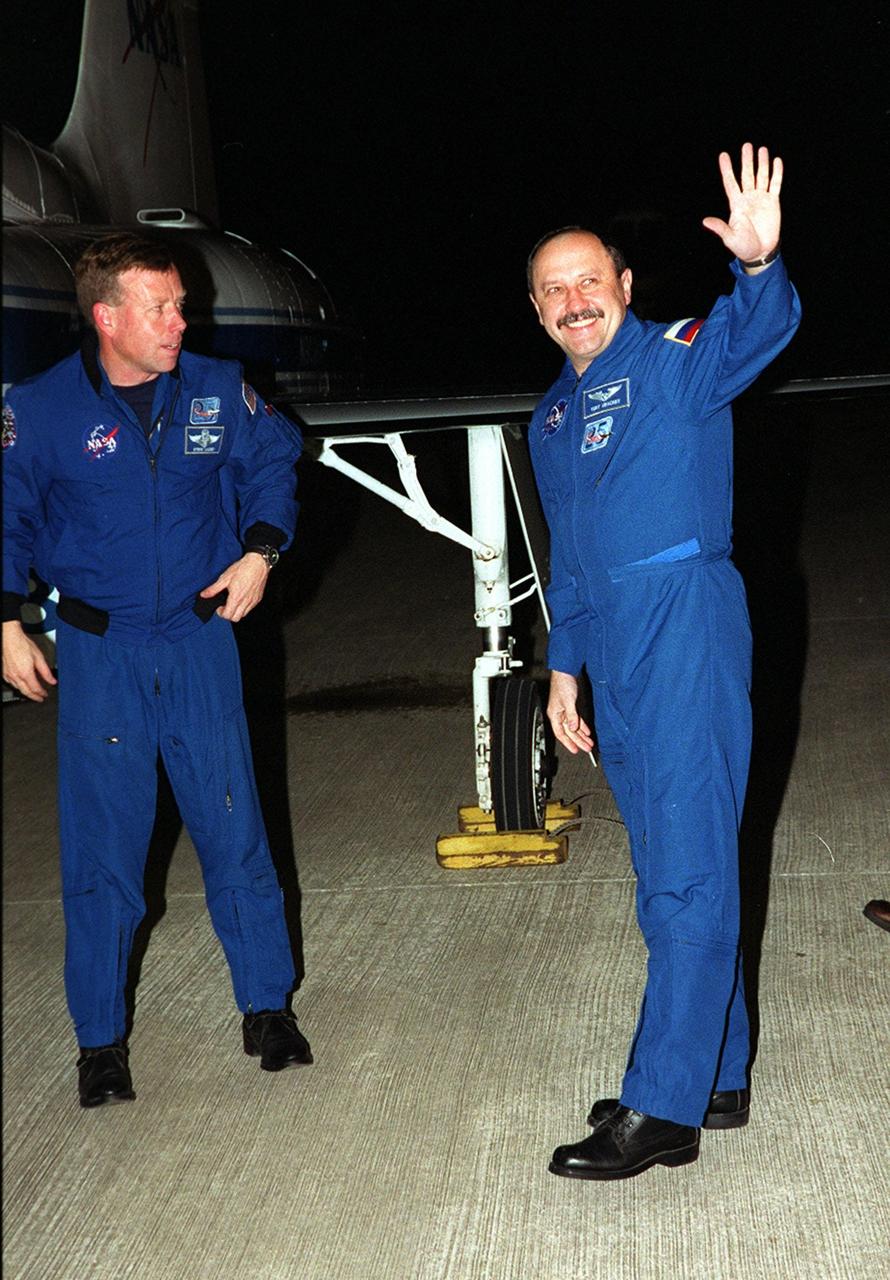
After landing at KSC’s Shuttle Landing Facility, Russian cosmonaut and STS-102 Mission Specialist Yury Usachev (right) waves to the media. Pilot James Kelly (left) is ready to join the other crew members at the microphone. The crew comprises Commander James Wetherbee, Kelly, and Mission Specialists Andrew Thomas, Paul Richards, James Voss, Susan Helms and Usachev. Helms, Usachev and Voss are also the Expedition Two crew replacing Expedition One on the International Space Station. STS-102 will be carrying the Multi-Purpose Logistics Module Leonardo, the primary delivery system used to resupply and return Station cargo requiring a pressurized environment. Leonardo will deliver up to 10 tons of laboratory racks filled with equipment, experiments and supplies for outfitting the newly installed U.S. Laboratory Destiny. STS-102 is scheduled to launch March 8 at 6:42 a.m. EST
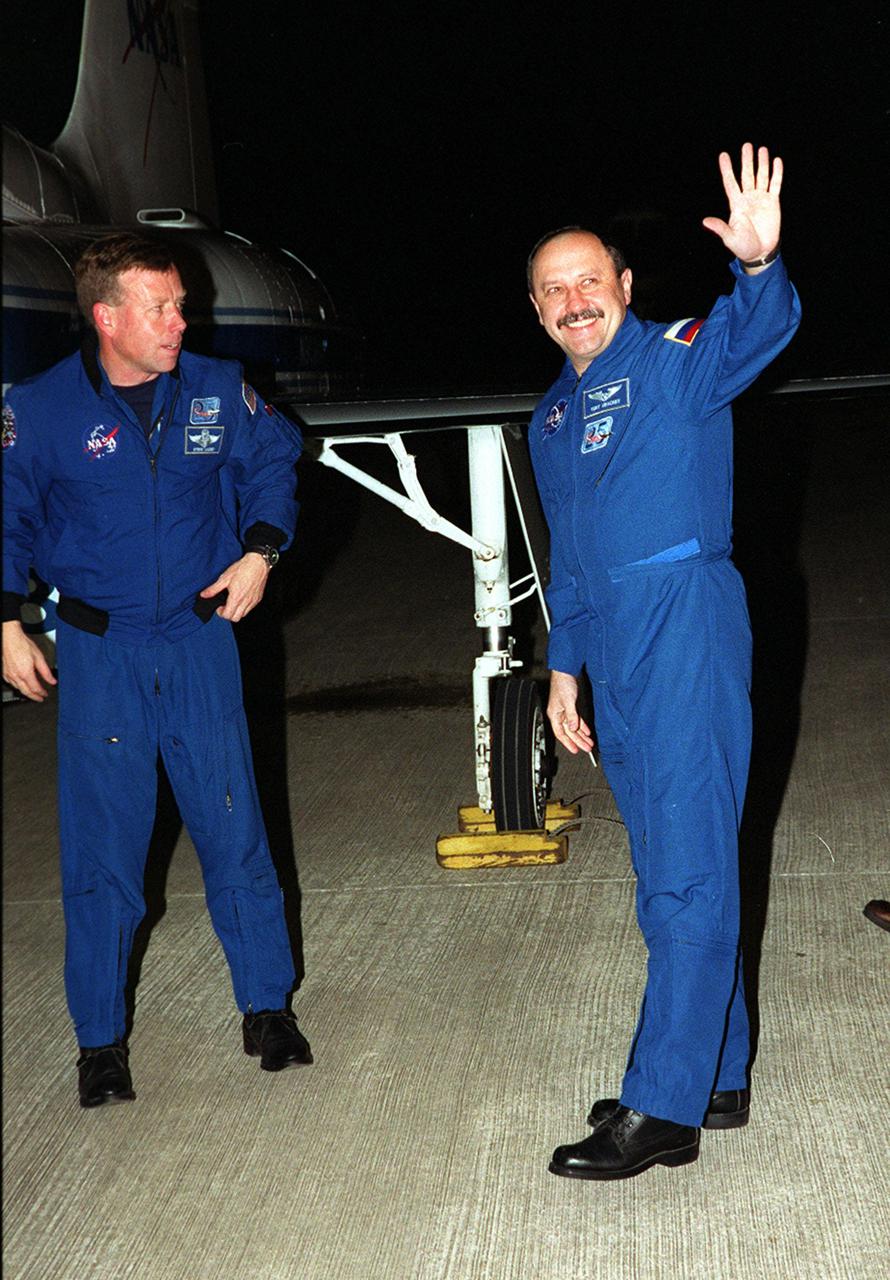
After landing at KSC’s Shuttle Landing Facility, Russian cosmonaut and STS-102 Mission Specialist Yury Usachev (right) waves to the media. Pilot James Kelly (left) is ready to join the other crew members at the microphone. The crew comprises Commander James Wetherbee, Kelly, and Mission Specialists Andrew Thomas, Paul Richards, James Voss, Susan Helms and Usachev. Helms, Usachev and Voss are also the Expedition Two crew replacing Expedition One on the International Space Station. STS-102 will be carrying the Multi-Purpose Logistics Module Leonardo, the primary delivery system used to resupply and return Station cargo requiring a pressurized environment. Leonardo will deliver up to 10 tons of laboratory racks filled with equipment, experiments and supplies for outfitting the newly installed U.S. Laboratory Destiny. STS-102 is scheduled to launch March 8 at 6:42 a.m. EST
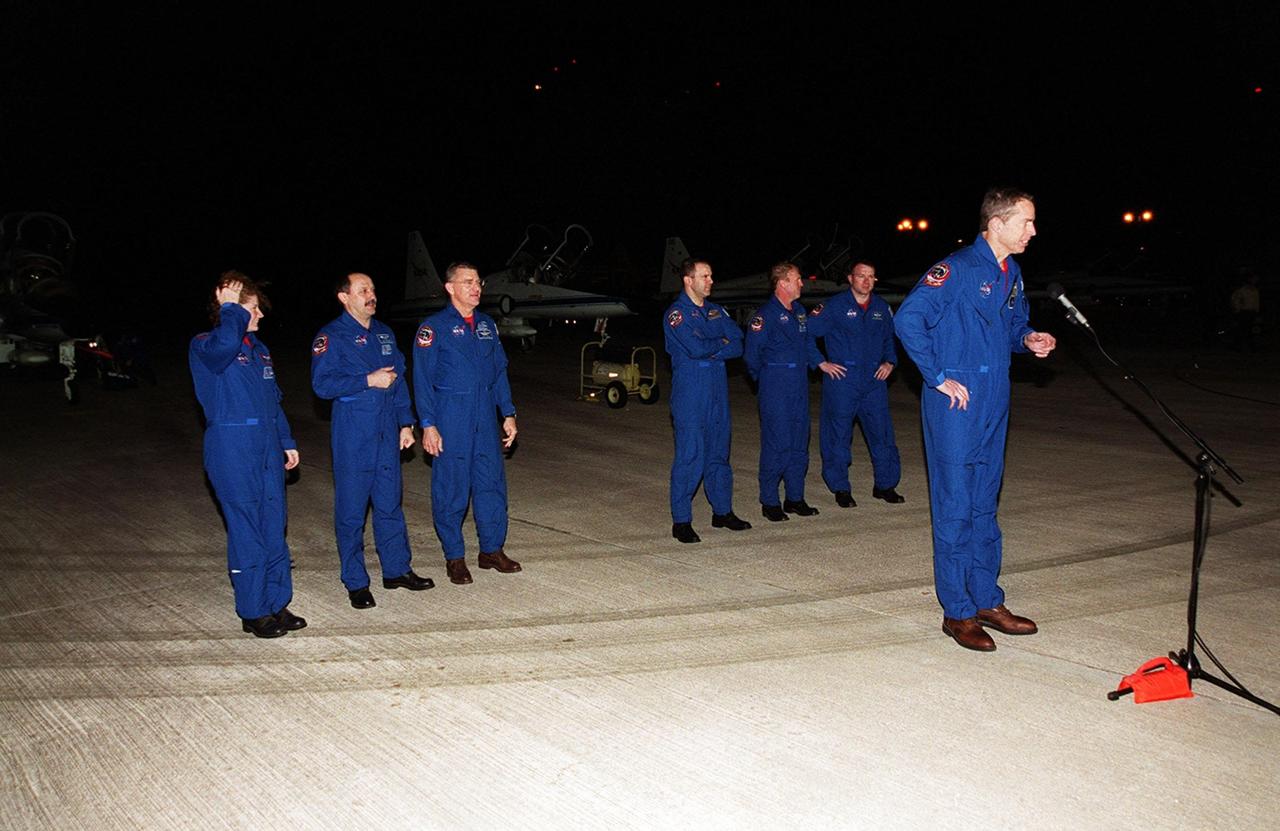
After landing at KSC’s Shuttle Landing Facility, the STS-102 crew pauses to brief the media. At the microphone is Commander James Wetherbee. Standing behind him (left to right) are Missions Specialists Susan Helms, Yury Usachev and James Voss, who are also the Expedition Two crew due to replace Expedition One on the International Space Station; Mission Specialists Paul Richards and Andrew Thomas; and Pilot James Kelly. STS-102 will be carrying the Multi-Purpose Logistics Module Leonardo, the primary delivery system used to resupply and return Station cargo requiring a pressurized environment. Leonardo will deliver up to 10 tons of laboratory racks filled with equipment, experiments and supplies for outfitting the newly installed U.S. Laboratory Destiny. STS-102 is scheduled to launch March 8 at 6:42 a.m. EST
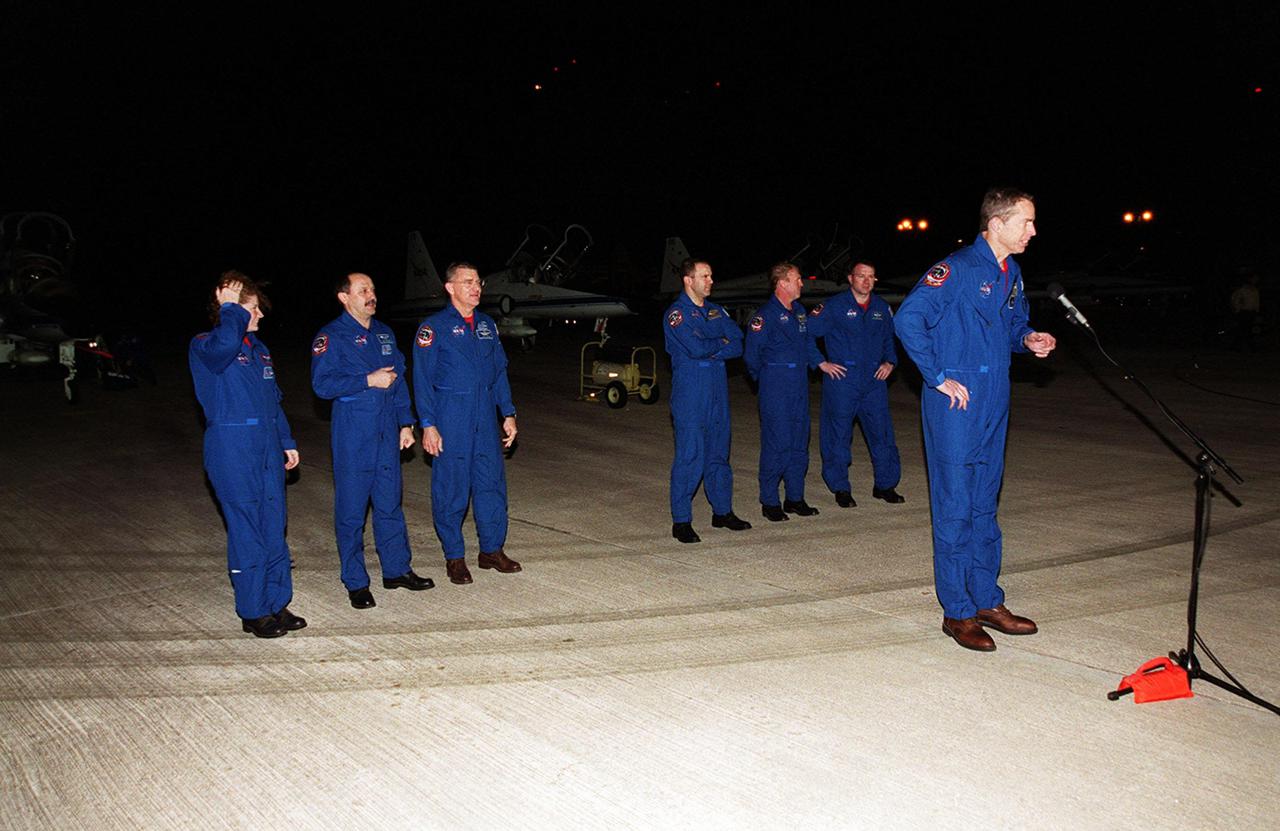
After landing at KSC’s Shuttle Landing Facility, the STS-102 crew pauses to brief the media. At the microphone is Commander James Wetherbee. Standing behind him (left to right) are Missions Specialists Susan Helms, Yury Usachev and James Voss, who are also the Expedition Two crew due to replace Expedition One on the International Space Station; Mission Specialists Paul Richards and Andrew Thomas; and Pilot James Kelly. STS-102 will be carrying the Multi-Purpose Logistics Module Leonardo, the primary delivery system used to resupply and return Station cargo requiring a pressurized environment. Leonardo will deliver up to 10 tons of laboratory racks filled with equipment, experiments and supplies for outfitting the newly installed U.S. Laboratory Destiny. STS-102 is scheduled to launch March 8 at 6:42 a.m. EST

Before entering Space Shuttle Discovery, STS-102 Mission Specialist James Voss (center) is helped preparing his launch and entry suit for launch from technicians in the White Room. The mission is Voss’s fifth Shuttle flight. In the background is Pilot James Kelly waiting to enter Discovery. Voss is also part of the Expedition Two crew flying on the mission to replace the Expedition One crew on the Station. Discovery is carrying the Multi-Purpose Logistics Module Leonardo on the eighth construction flight to the International Space Station. The primary delivery system used to resupply and return Station cargo requiring a pressurized environment, Leonardo will deliver up to 10 tons of laboratory racks filled with equipment, experiments and supplies for outfitting the newly installed U.S. Laboratory Destiny. Discovery is set to launch March 8 at 6:42 a.m. EST. The 12-day mission is expected to end with a landing at KSC on March 20
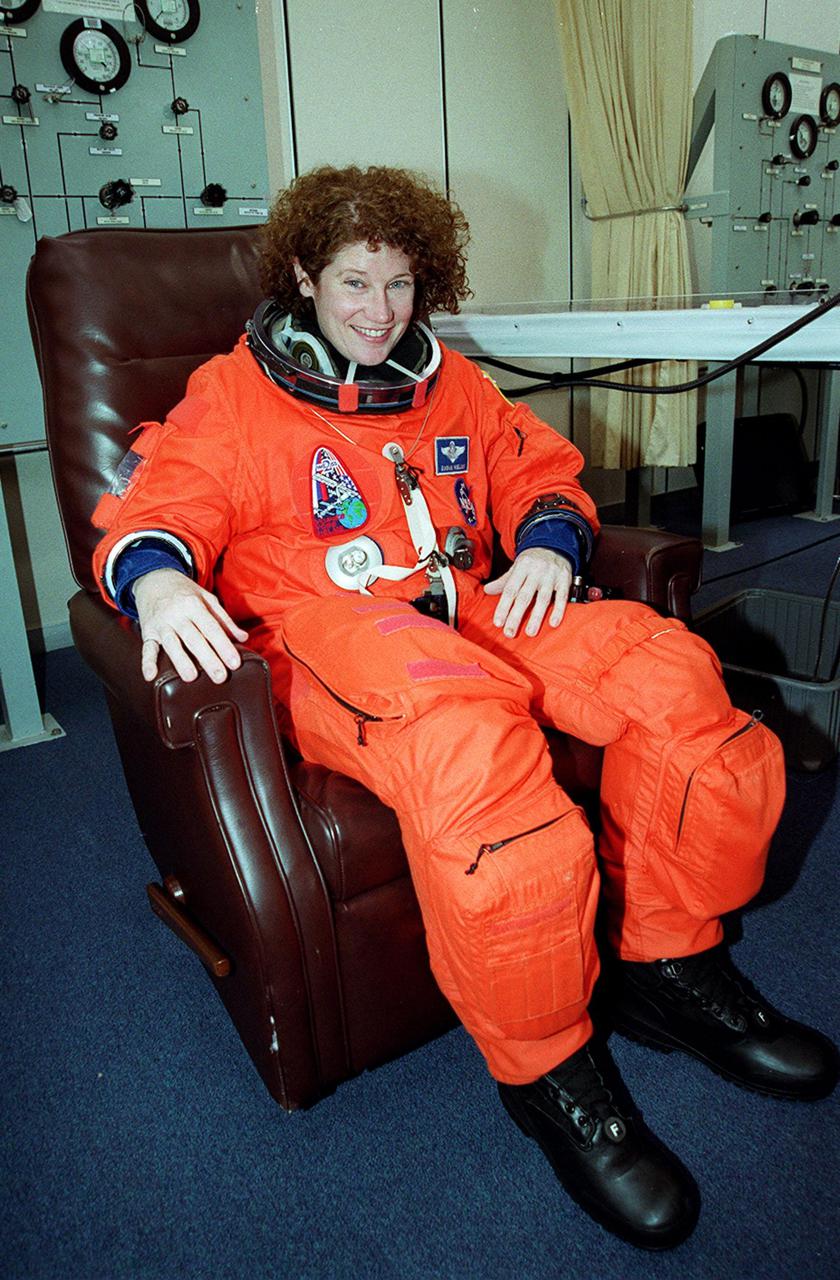
STS-102 Mission Specialist Susan Helms shows her pleasure at the imminent launch to the International Space Station. This will be Helms’ fifth Shuttle flight. She is also part of the Expedition Two crew replacing Expedition One. STS-102 is the eighth construction flight to the Station, carrying the Multi-Purpose Logistics Module Leonardo. The primary delivery system used to resupply and return Station cargo requiring a pressurized environment, Leonardo will deliver up to 10 tons of laboratory racks filled with equipment, experiments and supplies for outfitting the newly installed U.S. Laboratory Destiny. Discovery is set to launch March 8 at 6:42 a.m. EST. The 12-day mission is expected to end with a landing at KSC on March 20
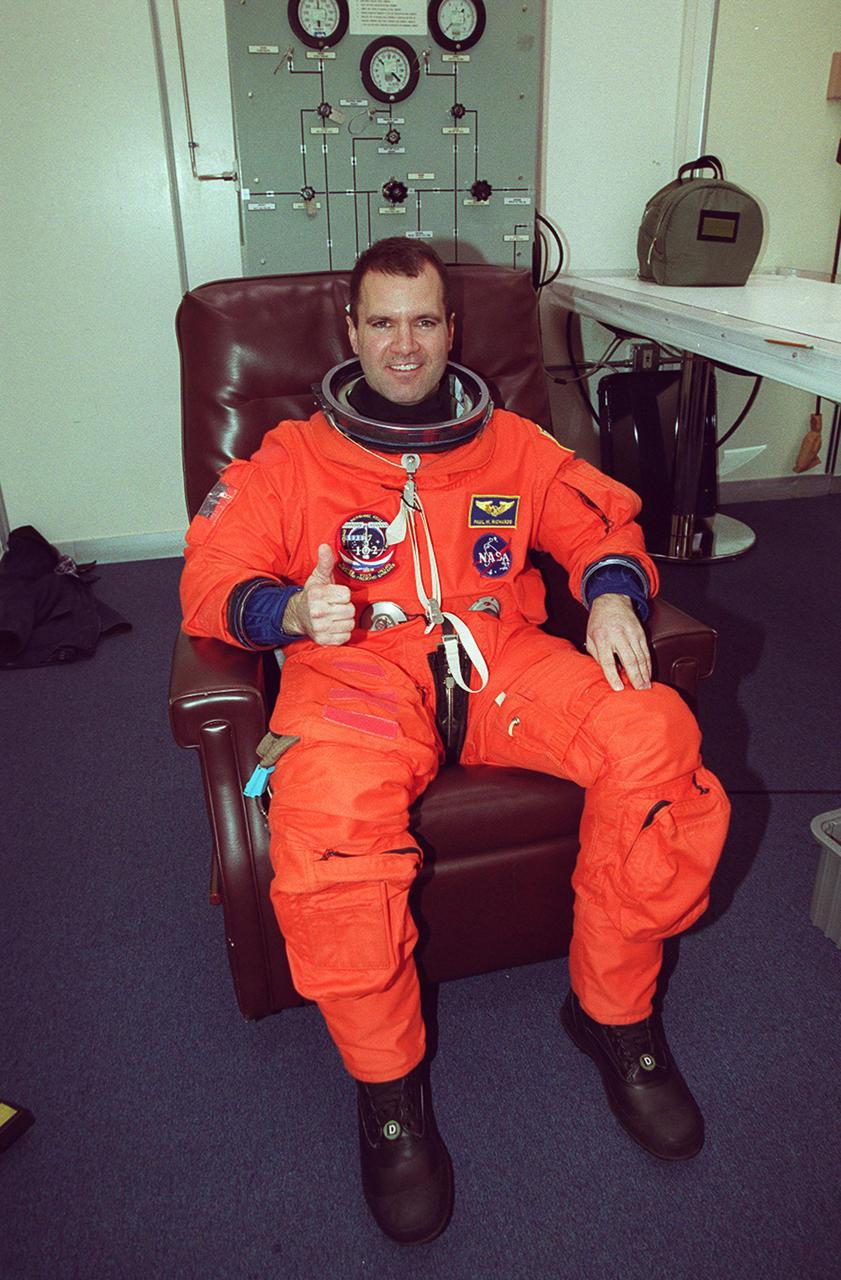
STS-102 Mission Specialist Paul Richards signals thumbs up for launch as he suits up in the Operations and Checkout Building. This will be Richards’ first Shuttle launch. . STS-102 is the eighth construction flight to the International Space Station, carrying the Multi-Purpose Logistics Module Leonardo. The primary delivery system used to resupply and return Station cargo requiring a pressurized environment, Leonardo will deliver up to 10 tons of laboratory racks filled with equipment, experiments and supplies for outfitting the newly installed U.S. Laboratory Destiny. In addition, three of the crew members Mission Specialists James Voss, Susan Helms and Yury Usachev, known as Expedition Two are flying to the Station to replace Expedition One, who will return to Earth on Discovery. Discovery is set to launch March 8 at 6:42 a.m. EST. The 12-day mission is expected to end with a landing at KSC on March 20
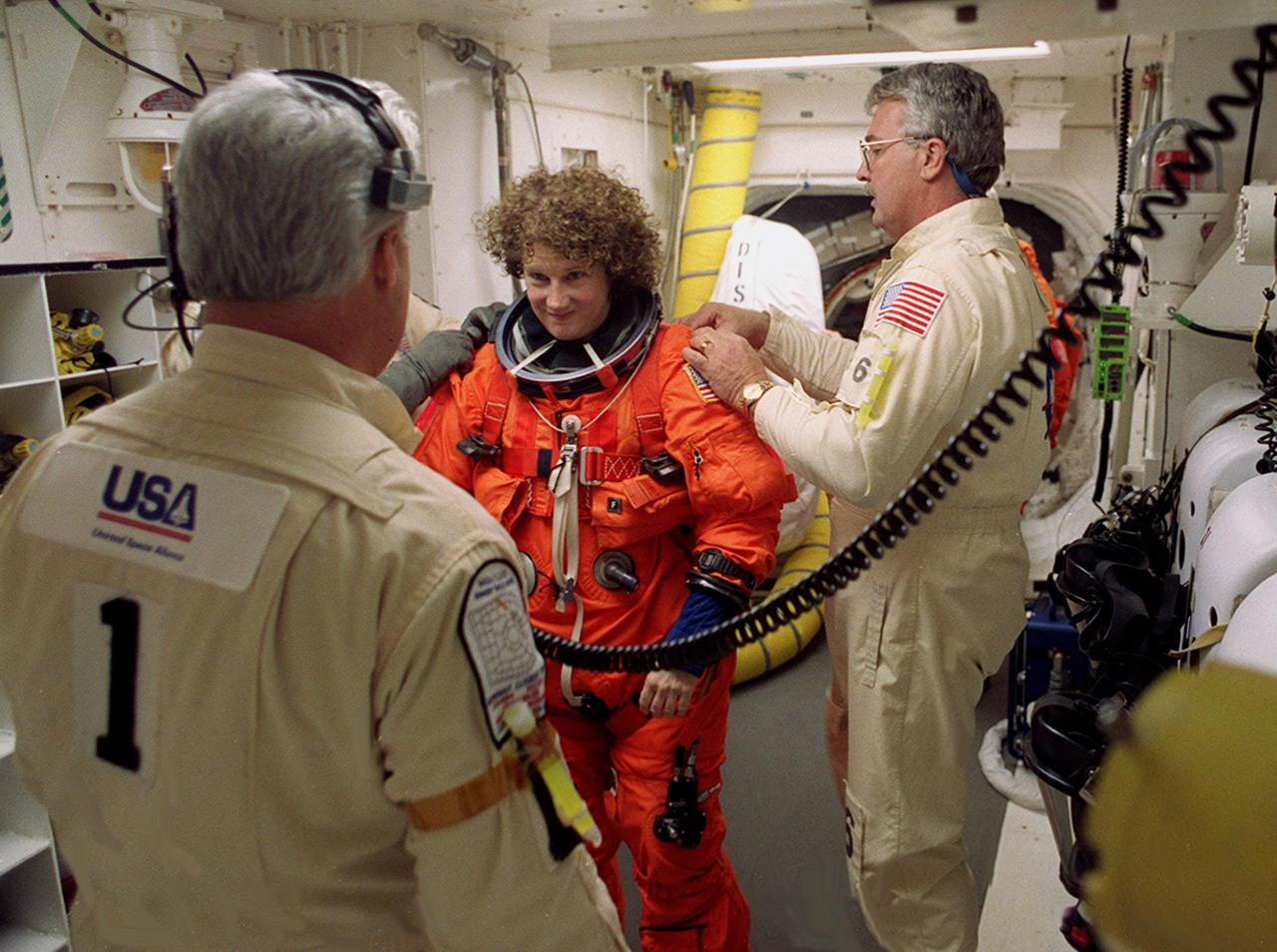
Technicians in the White Room, Launch Pad 39B, help STS-102 Mission Specialist Susan Helms with her launch and entry suit before she enters Space Shuttle Discovery. The mission is Helms’ fifth Shuttle flight. Helms is also part of the Expedition Two crew flying on the mission to replace the Expedition One crew on the Station. Discovery is carrying the Multi-Purpose Logistics Module Leonardo on the eighth construction flight to the International Space Station. The primary delivery system used to resupply and return Station cargo requiring a pressurized environment, Leonardo will deliver up to 10 tons of laboratory racks filled with equipment, experiments and supplies for outfitting the newly installed U.S. Laboratory Destiny. Discovery is set to launch March 8 at 6:42 a.m. EST. The 12-day mission is expected to end with a landing at KSC on March 20
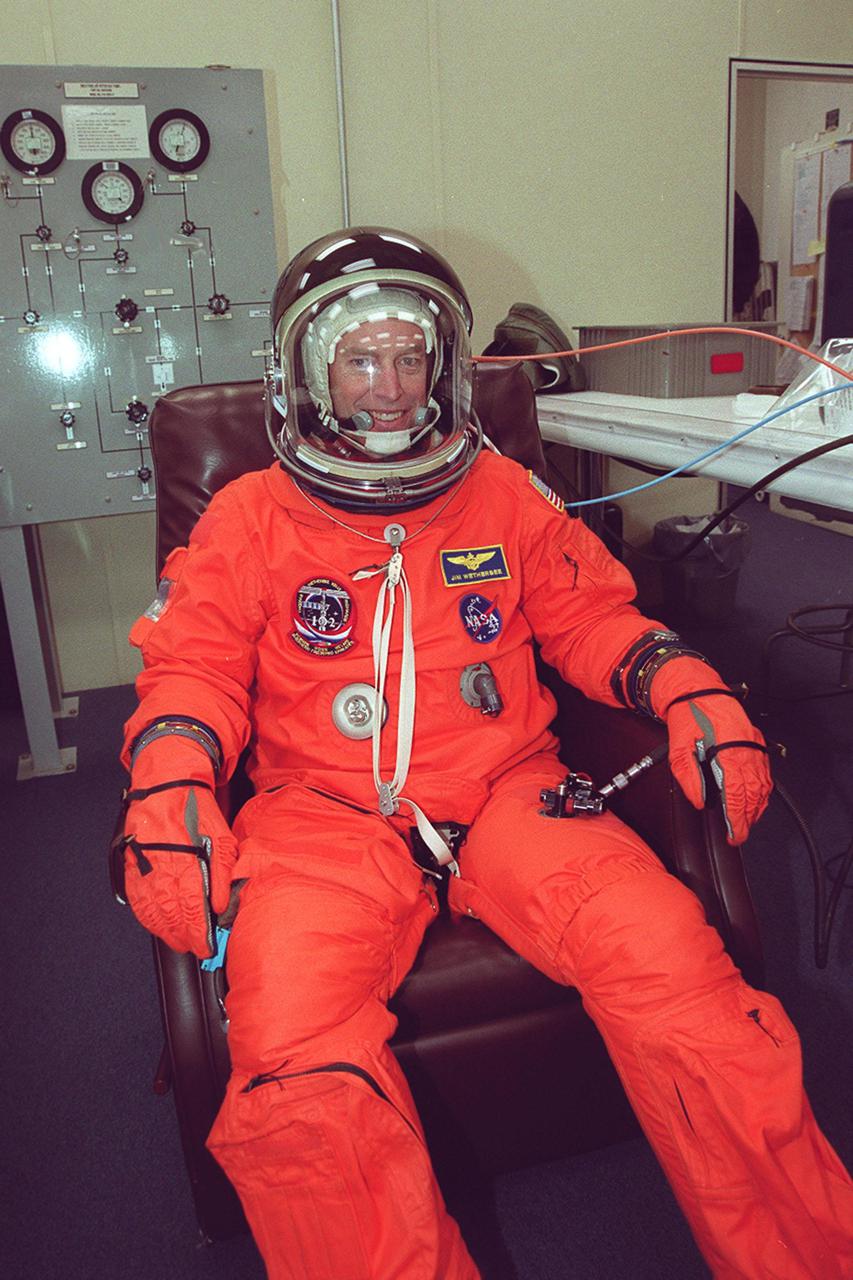
STS-102 Commander James Wetherbee gets final adjustments on his launch and entry suit before heading to Space Shuttle Discovery on Launch Pad 39B. This mission is Wetherbee’s fifth Shuttle flight. Discovery is scheduled to launch March 8 at 6:42 a.m. EST, carrying the Multi-Purpose Logistics Module Leonardo to the International Space Station. The primary delivery system used to resupply and return Station cargo requiring a pressurized environment, Leonardo will deliver up to 10 tons of laboratory racks filled with equipment, experiments and supplies for outfitting the newly installed U.S. Laboratory Destiny. In addition, three crew members Mission Specialists James Voss, Susan Helms and Russian cosmonaut Yury Usachev are the Expedition Two crew replacing Expedition One on the Station. Discovery is expected to land at KSC on March 20 at 2:02 a.m
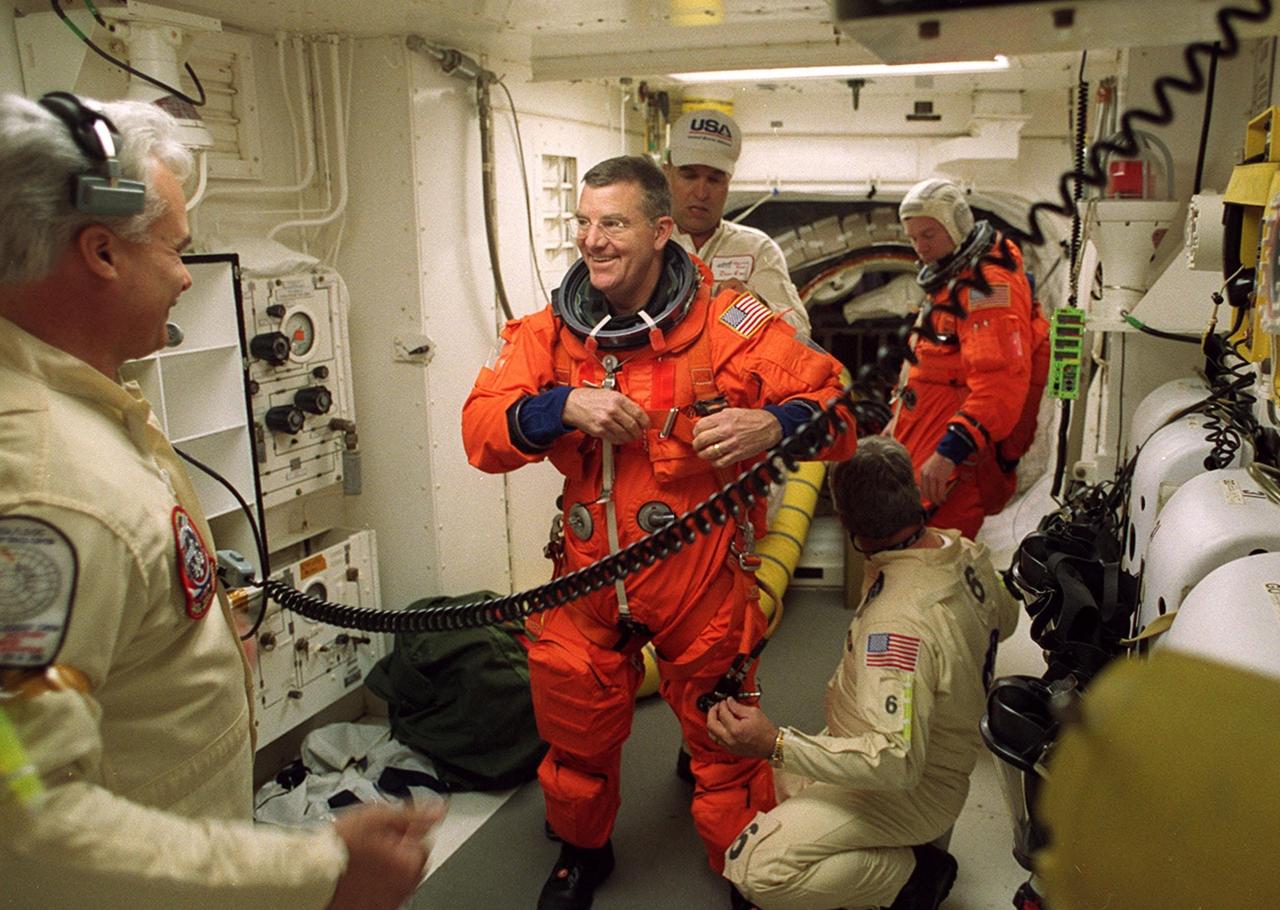
Before entering Space Shuttle Discovery, STS-102 Mission Specialist James Voss (center) is helped preparing his launch and entry suit for launch from technicians in the White Room. The mission is Voss’s fifth Shuttle flight. In the background is Pilot James Kelly waiting to enter Discovery. Voss is also part of the Expedition Two crew flying on the mission to replace the Expedition One crew on the Station. Discovery is carrying the Multi-Purpose Logistics Module Leonardo on the eighth construction flight to the International Space Station. The primary delivery system used to resupply and return Station cargo requiring a pressurized environment, Leonardo will deliver up to 10 tons of laboratory racks filled with equipment, experiments and supplies for outfitting the newly installed U.S. Laboratory Destiny. Discovery is set to launch March 8 at 6:42 a.m. EST. The 12-day mission is expected to end with a landing at KSC on March 20
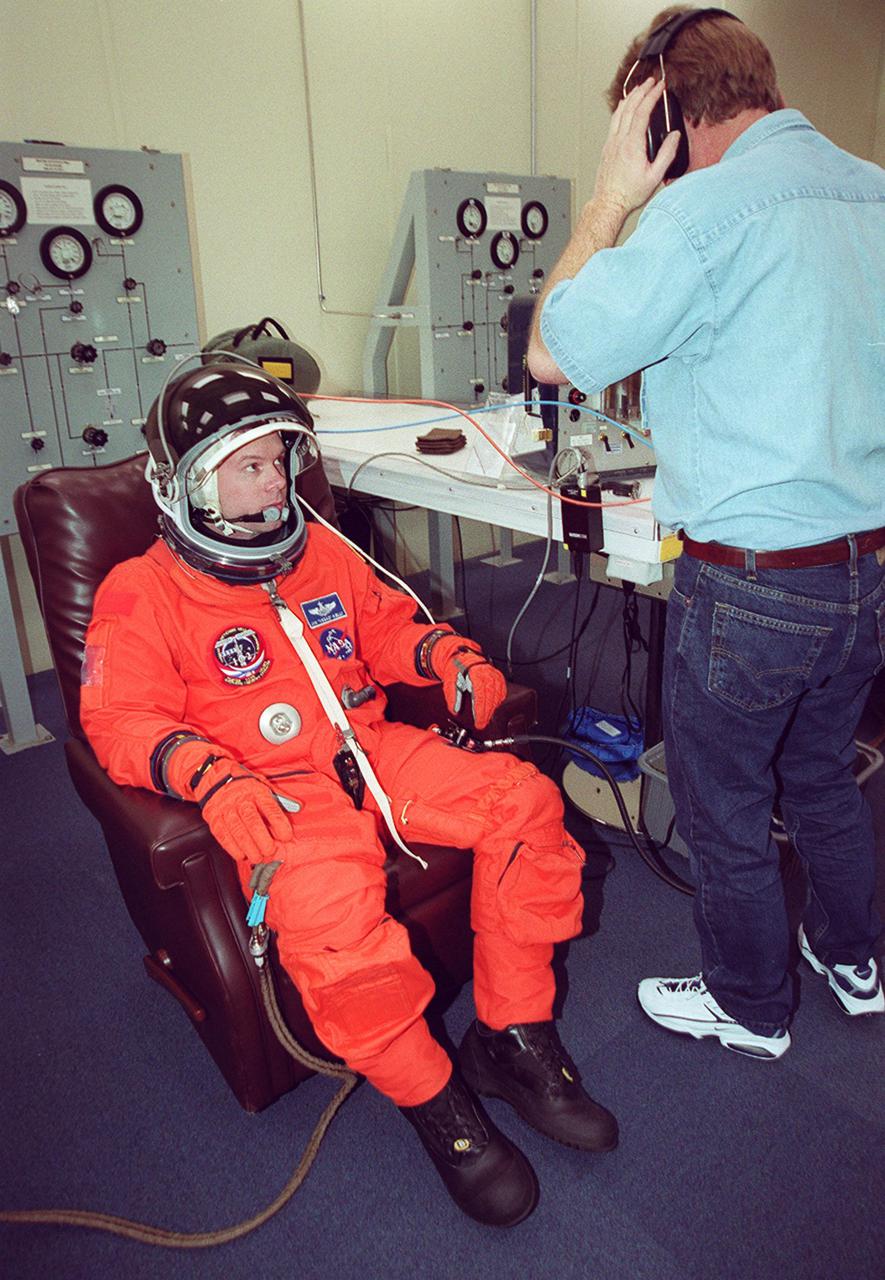
STS-102 Pilot James Kelly gets a final fitting in his launch and entry suit. This will be Kelly’s first Shuttle launch. . STS-102 is the eighth construction flight to the International Space Station, carrying the Multi-Purpose Logistics Module Leonardo. The primary delivery system used to resupply and return Station cargo requiring a pressurized environment, Leonardo will deliver up to 10 tons of laboratory racks filled with equipment, experiments and supplies for outfitting the newly installed U.S. Laboratory Destiny. In addition, three of the crew members Mission Specialists James Voss, Susan Helms and Yury Usachev, known as Expedition Two are flying to the Station to replace Expedition One, who will return to Earth on Discovery. Discovery is set to launch March 8 at 6:42 a.m. EST. The 12-day mission is expected to end with a landing at KSC on March 20

STS-102 Mission Specialist Paul Richards signals thumbs up for launch as he suits up in the Operations and Checkout Building. This will be Richards’ first Shuttle launch. . STS-102 is the eighth construction flight to the International Space Station, carrying the Multi-Purpose Logistics Module Leonardo. The primary delivery system used to resupply and return Station cargo requiring a pressurized environment, Leonardo will deliver up to 10 tons of laboratory racks filled with equipment, experiments and supplies for outfitting the newly installed U.S. Laboratory Destiny. In addition, three of the crew members Mission Specialists James Voss, Susan Helms and Yury Usachev, known as Expedition Two are flying to the Station to replace Expedition One, who will return to Earth on Discovery. Discovery is set to launch March 8 at 6:42 a.m. EST. The 12-day mission is expected to end with a landing at KSC on March 20
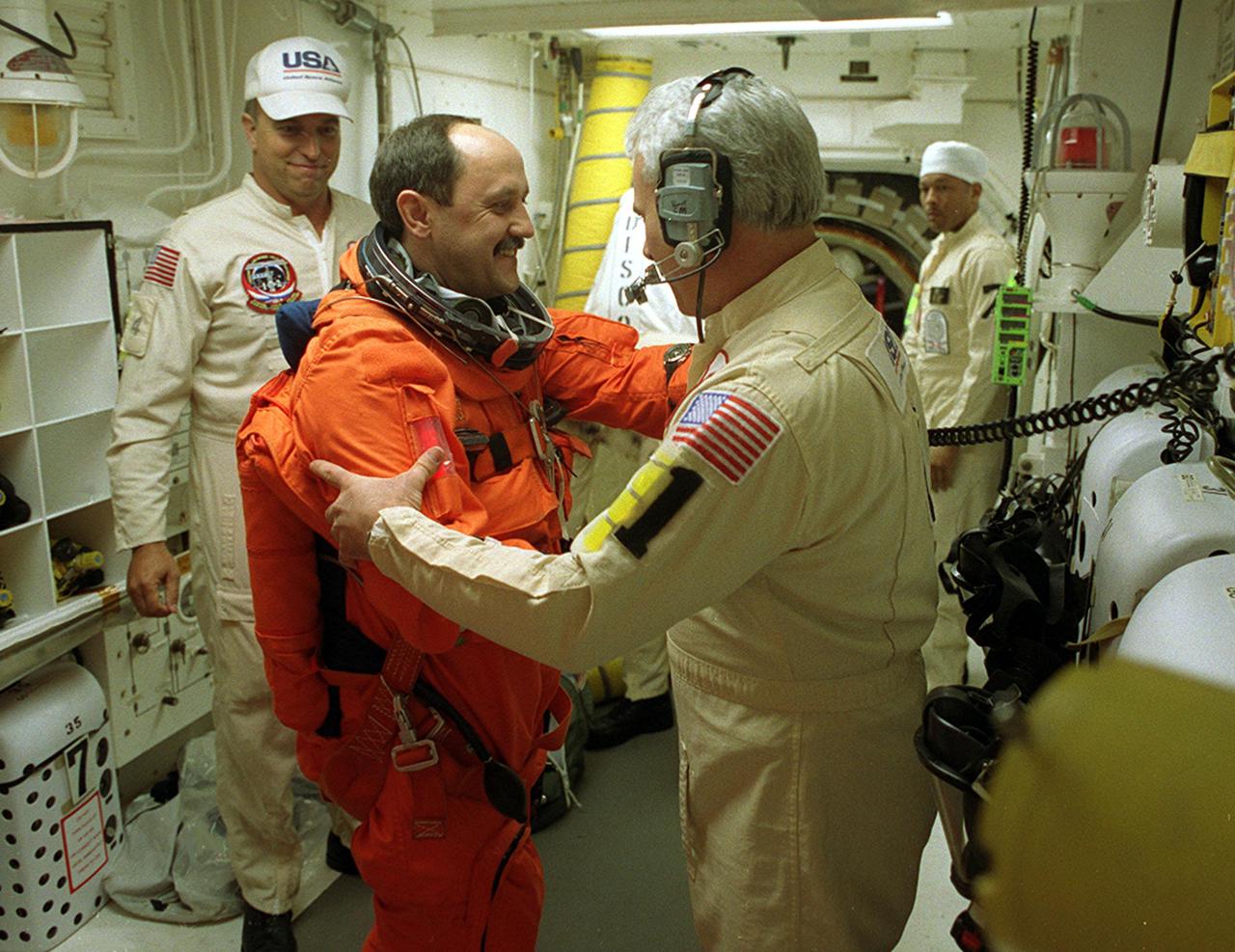
In the White Room, Launch Pad 39B, STS-102 Mission Specialist Yury Usachev gets warm greetings from one of the suit technicians helping with final preparations before entering Space Shuttle Discovery. STS-102 is Russian cosmonaut Usachev’s second Shuttle flight. He is also part of the Expedition Two crew flying on the mission to replace the Expedition One crew on the Station. Discovery is carrying the Multi-Purpose Logistics Module Leonardo on the eighth construction flight to the International Space Station. The primary delivery system used to resupply and return Station cargo requiring a pressurized environment, Leonardo will deliver up to 10 tons of laboratory racks filled with equipment, experiments and supplies for outfitting the newly installed U.S. Laboratory Destiny. Discovery is set to launch March 8 at 6:42 a.m. EST. The 12-day mission is expected to end with a landing at KSC on March 20
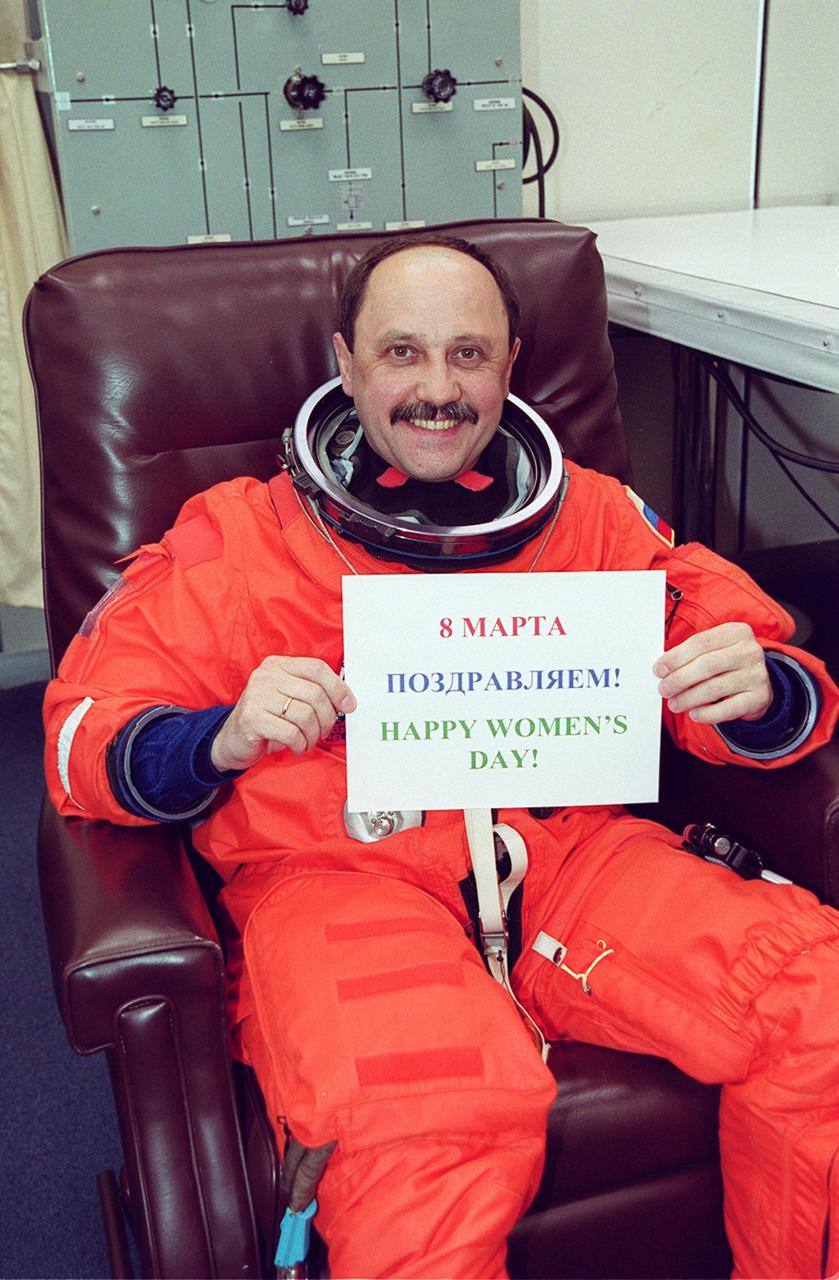
STS-102 Mission Specialist Yury Usachev, a Russian cosmonaut, shows his support of International Women’s Day, March 8, with a sign in both Cyrillic and English. This will be Usachev’s second Shuttle flight. Usachev is also part of a crew, known as Expedition One, who will be replacing Expedition One on the International Space Station. STS-102 is the eighth construction flight to the Space Station, carrying the Multi-Purpose Logistics Module Leonardo. The primary delivery system used to resupply and return Station cargo requiring a pressurized environment, Leonardo will deliver up to 10 tons of laboratory racks filled with equipment, experiments and supplies for outfitting the newly installed U.S. Laboratory Destiny. Discovery is set to launch March 8 at 6:42 a.m. EST. The 12-day mission is expected to end with a landing at KSC on March 20
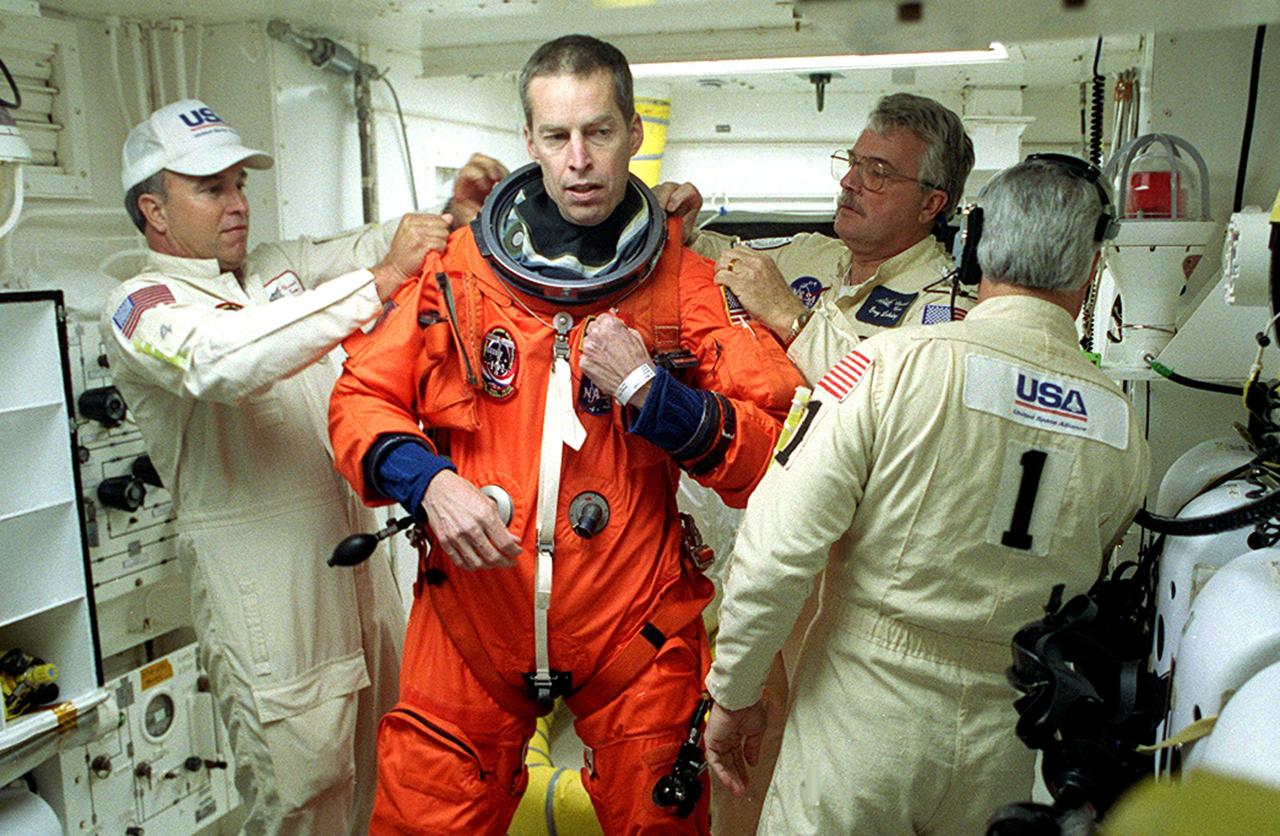
In the White Room, Launch Pad 39B, STS-102 Commander James Wetherbee gets help with final suit preparations before entering Space Shuttle Discovery. STS-102 is Wetherbee’s fifth Shuttle flight. Discovery is carrying the Multi-Purpose Logistics Module Leonardo on the eighth construction flight to the International Space Station. The primary delivery system used to resupply and return Station cargo requiring a pressurized environment, Leonardo will deliver up to 10 tons of laboratory racks filled with equipment, experiments and supplies for outfitting the newly installed U.S. Laboratory Destiny. In addition, Discovery is transporting Expedition Two, three crew members who are replacing Expedition One on the Station. Discovery is set to launch March 8 at 6:42 a.m. EST. The 12-day mission is expected to end with a landing at KSC on March 20
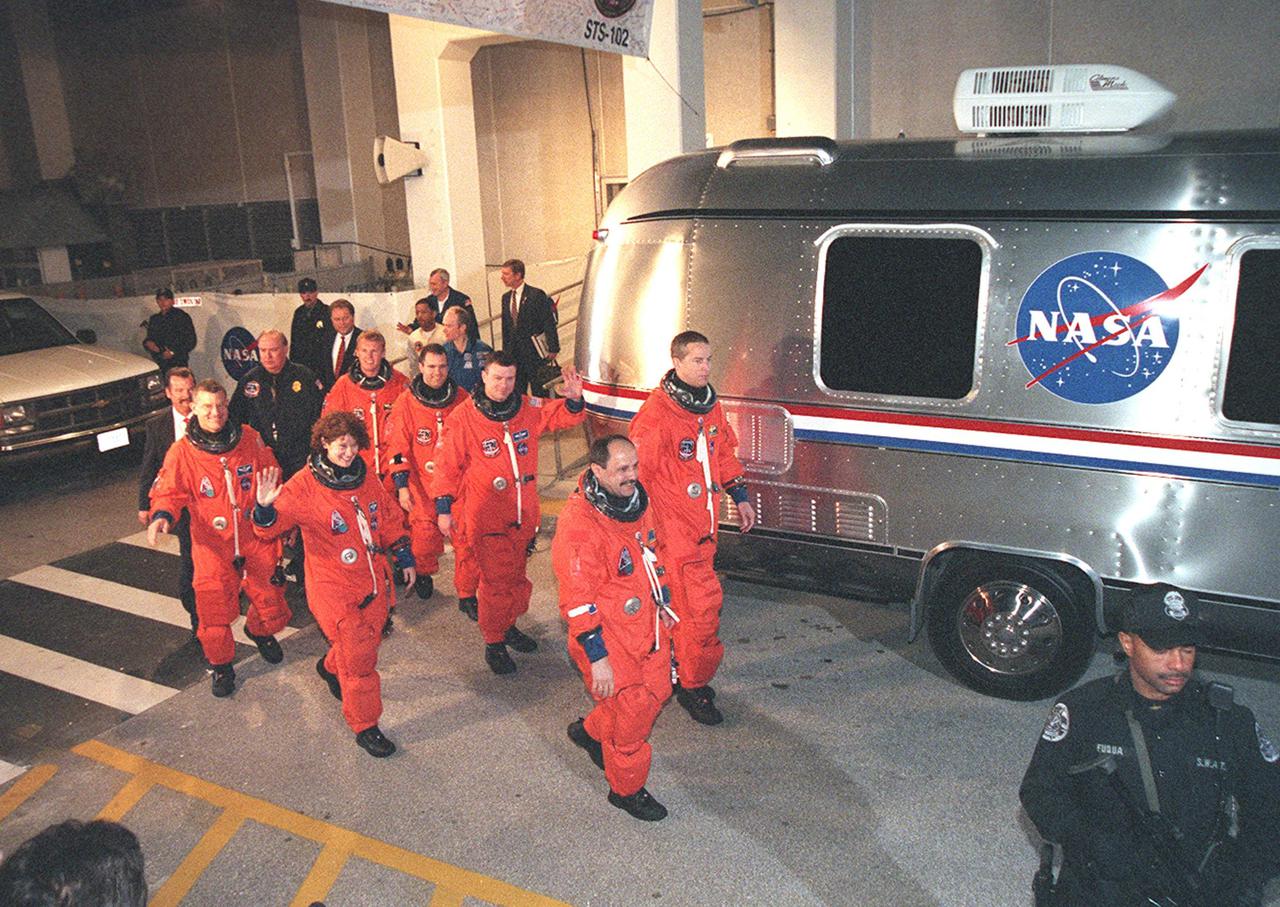
The STS-102 crew heads for the Astrovan after leaving the Operations and Checkout Building behind them. In front, left to right, are Mission Specialists James Voss, Susan Helms and Yury Usachev. In back, left to right, are Mission Specialists Andrew Thomas and Paul Richards, Pilot James Kelly and Commander James Wetherbee. STS-102 is the eighth construction flight to the Space Station, carrying the Multi-Purpose Logistics Module Leonardo. The primary delivery system used to resupply and return Station cargo requiring a pressurized environment, Leonardo will deliver up to 10 tons of laboratory racks filled with equipment, experiments and supplies for outfitting the newly installed U.S. Laboratory Destiny. In addition, Voss, Helms and Usachev, known as Expedition Two, are flying to the Station to replace Expedition One, who will return to Earth on Discovery. Discovery is set to launch March 8 at 6:42 a.m. EST. The 12-day mission is expected to end with a landing at KSC on March 20
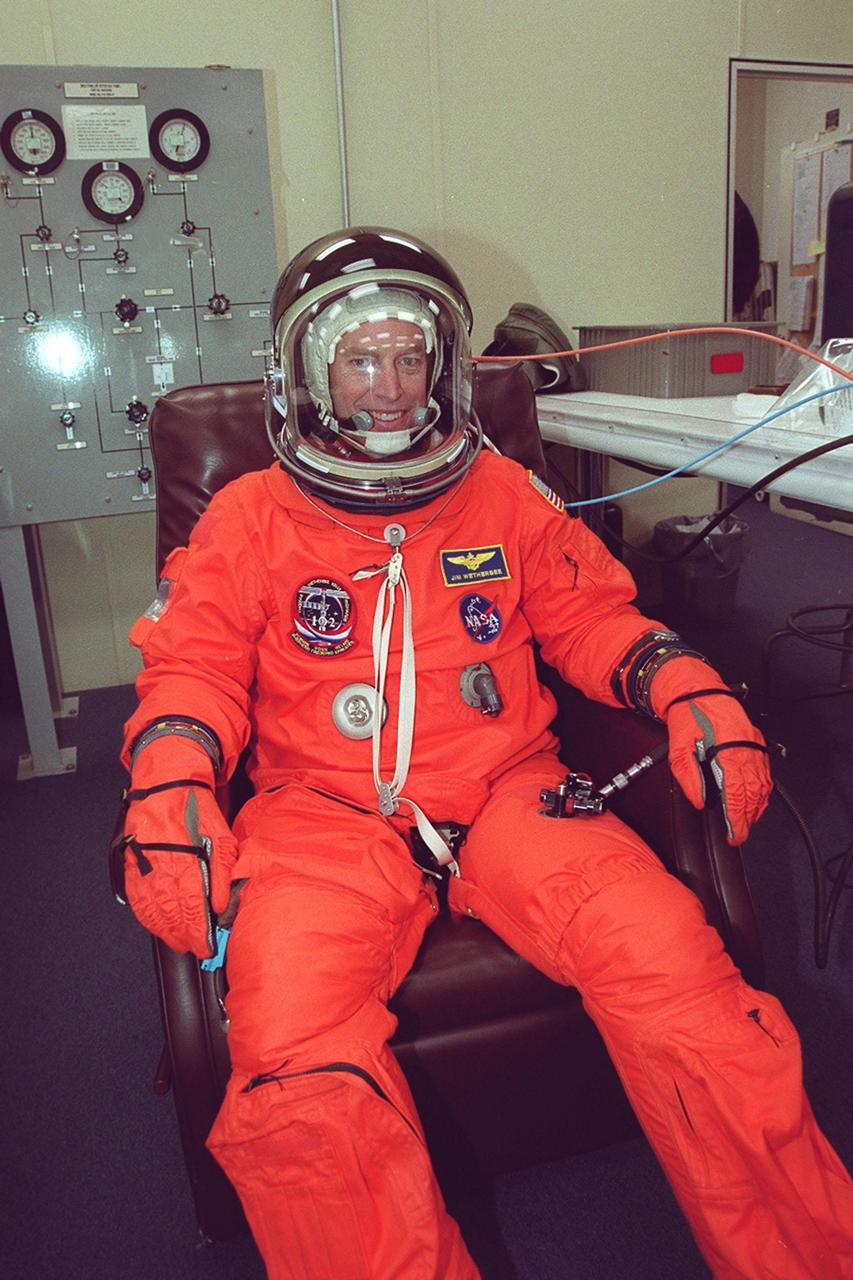
STS-102 Commander James Wetherbee gets final adjustments on his launch and entry suit before heading to Space Shuttle Discovery on Launch Pad 39B. This mission is Wetherbee’s fifth Shuttle flight. Discovery is scheduled to launch March 8 at 6:42 a.m. EST, carrying the Multi-Purpose Logistics Module Leonardo to the International Space Station. The primary delivery system used to resupply and return Station cargo requiring a pressurized environment, Leonardo will deliver up to 10 tons of laboratory racks filled with equipment, experiments and supplies for outfitting the newly installed U.S. Laboratory Destiny. In addition, three crew members Mission Specialists James Voss, Susan Helms and Russian cosmonaut Yury Usachev are the Expedition Two crew replacing Expedition One on the Station. Discovery is expected to land at KSC on March 20 at 2:02 a.m
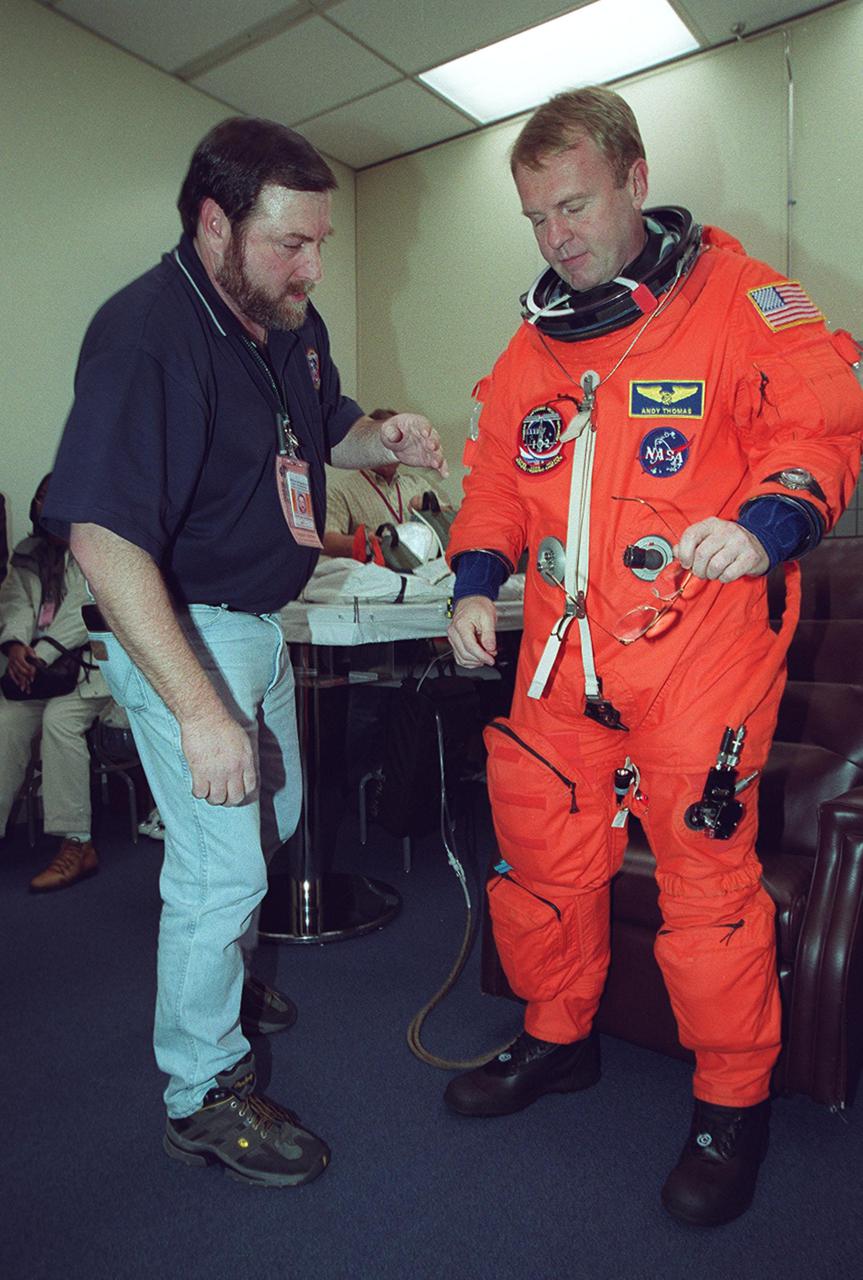
STS-102 Mission Specialist Susan Helms shows her pleasure at the imminent launch to the International Space Station. This will be Helms’ fifth Shuttle flight. She is also part of the Expedition Two crew replacing Expedition One. STS-102 is the eighth construction flight to the Station, carrying the Multi-Purpose Logistics Module Leonardo. The primary delivery system used to resupply and return Station cargo requiring a pressurized environment, Leonardo will deliver up to 10 tons of laboratory racks filled with equipment, experiments and supplies for outfitting the newly installed U.S. Laboratory Destiny. Discovery is set to launch March 8 at 6:42 a.m. EST. The 12-day mission is expected to end with a landing at KSC on March 20
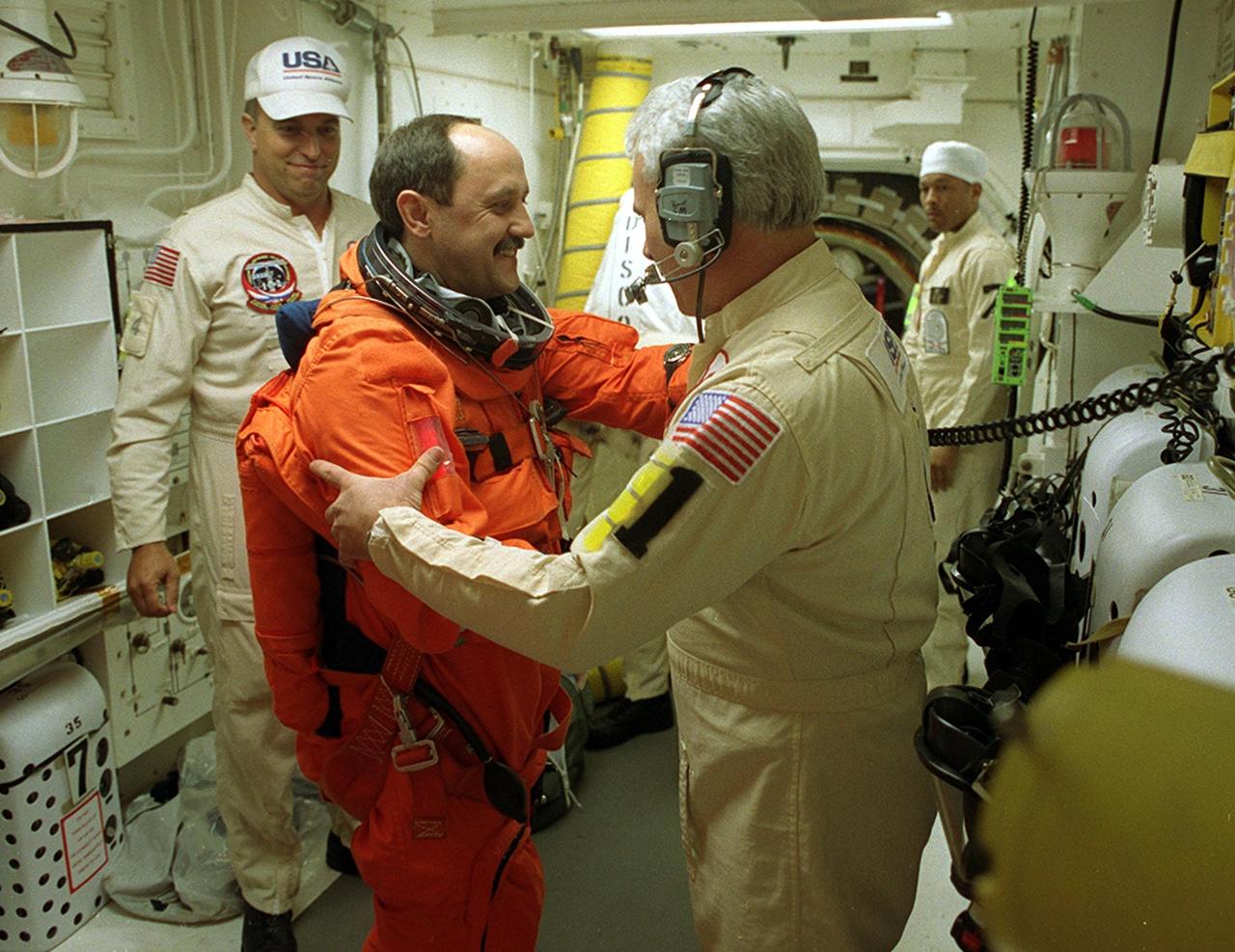
In the White Room, Launch Pad 39B, STS-102 Mission Specialist Yury Usachev gets warm greetings from one of the suit technicians helping with final preparations before entering Space Shuttle Discovery. STS-102 is Russian cosmonaut Usachev’s second Shuttle flight. He is also part of the Expedition Two crew flying on the mission to replace the Expedition One crew on the Station. Discovery is carrying the Multi-Purpose Logistics Module Leonardo on the eighth construction flight to the International Space Station. The primary delivery system used to resupply and return Station cargo requiring a pressurized environment, Leonardo will deliver up to 10 tons of laboratory racks filled with equipment, experiments and supplies for outfitting the newly installed U.S. Laboratory Destiny. Discovery is set to launch March 8 at 6:42 a.m. EST. The 12-day mission is expected to end with a landing at KSC on March 20

In the White Room, Launch Pad 39B, STS-102 Commander James Wetherbee gets help with final suit preparations before entering Space Shuttle Discovery. STS-102 is Wetherbee’s fifth Shuttle flight. Discovery is carrying the Multi-Purpose Logistics Module Leonardo on the eighth construction flight to the International Space Station. The primary delivery system used to resupply and return Station cargo requiring a pressurized environment, Leonardo will deliver up to 10 tons of laboratory racks filled with equipment, experiments and supplies for outfitting the newly installed U.S. Laboratory Destiny. In addition, Discovery is transporting Expedition Two, three crew members who are replacing Expedition One on the Station. Discovery is set to launch March 8 at 6:42 a.m. EST. The 12-day mission is expected to end with a landing at KSC on March 20
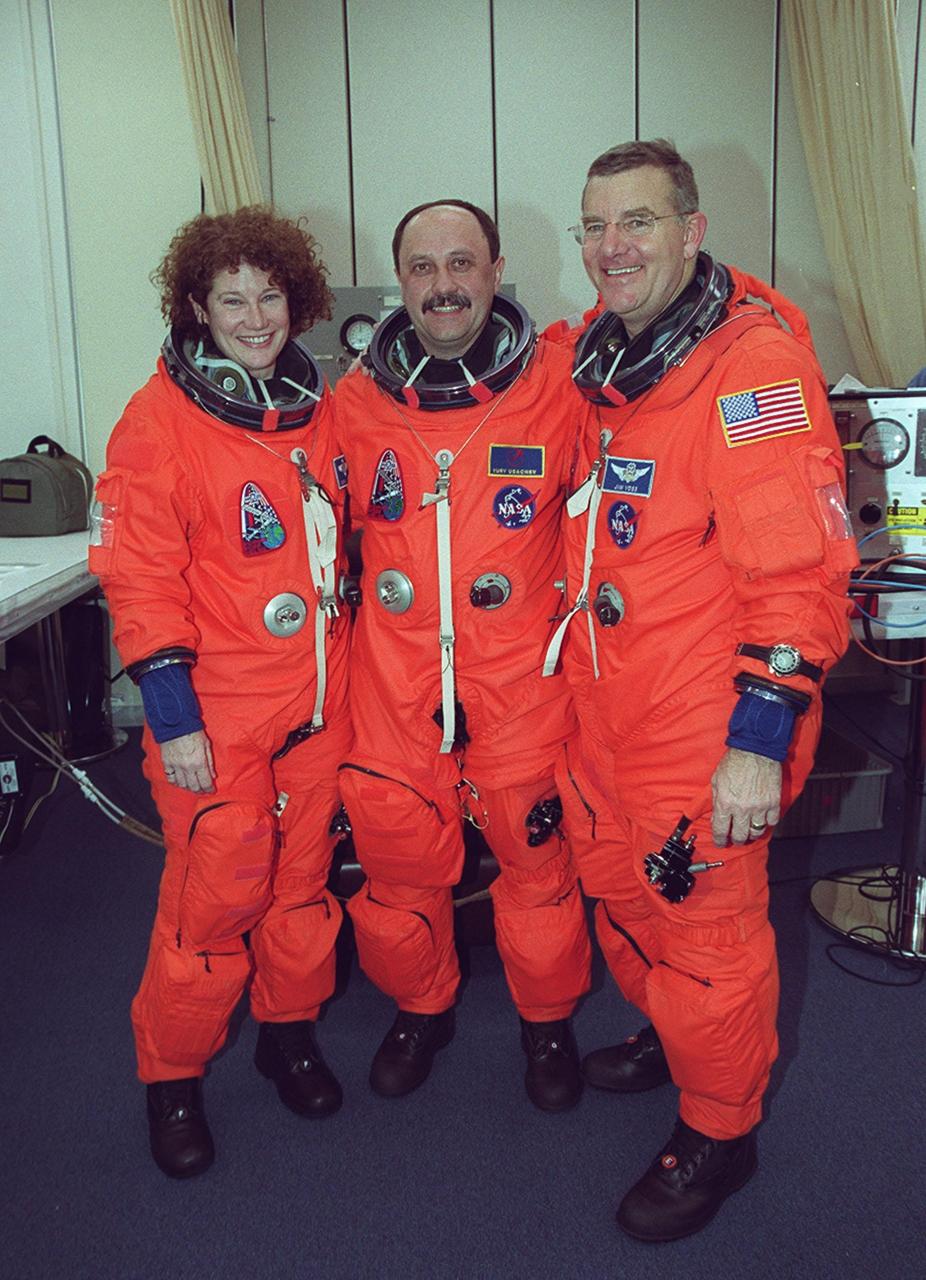
STS-102 Mission Specialists, Susan Helms, Yury Usachev and James Voss pose after suitup. Voss and Helms are making their fifth Shuttle flights and Usachev is making his second. All three are the Expedition Two crew who are replacing Expedition One on the International Space Station. STS-102 is the eighth construction flight to the Station, carrying the Multi-Purpose Logistics Module Leonardo. . The primary delivery system used to resupply and return Station cargo requiring a pressurized environment, Leonardo will deliver up to 10 tons of laboratory racks filled with equipment, experiments and supplies for outfitting the newly installed U.S. Laboratory Destiny. Discovery is set to launch March 8 at 6:42 a.m. EST. The 12-day mission is expected to end with a landing at KSC on March 20
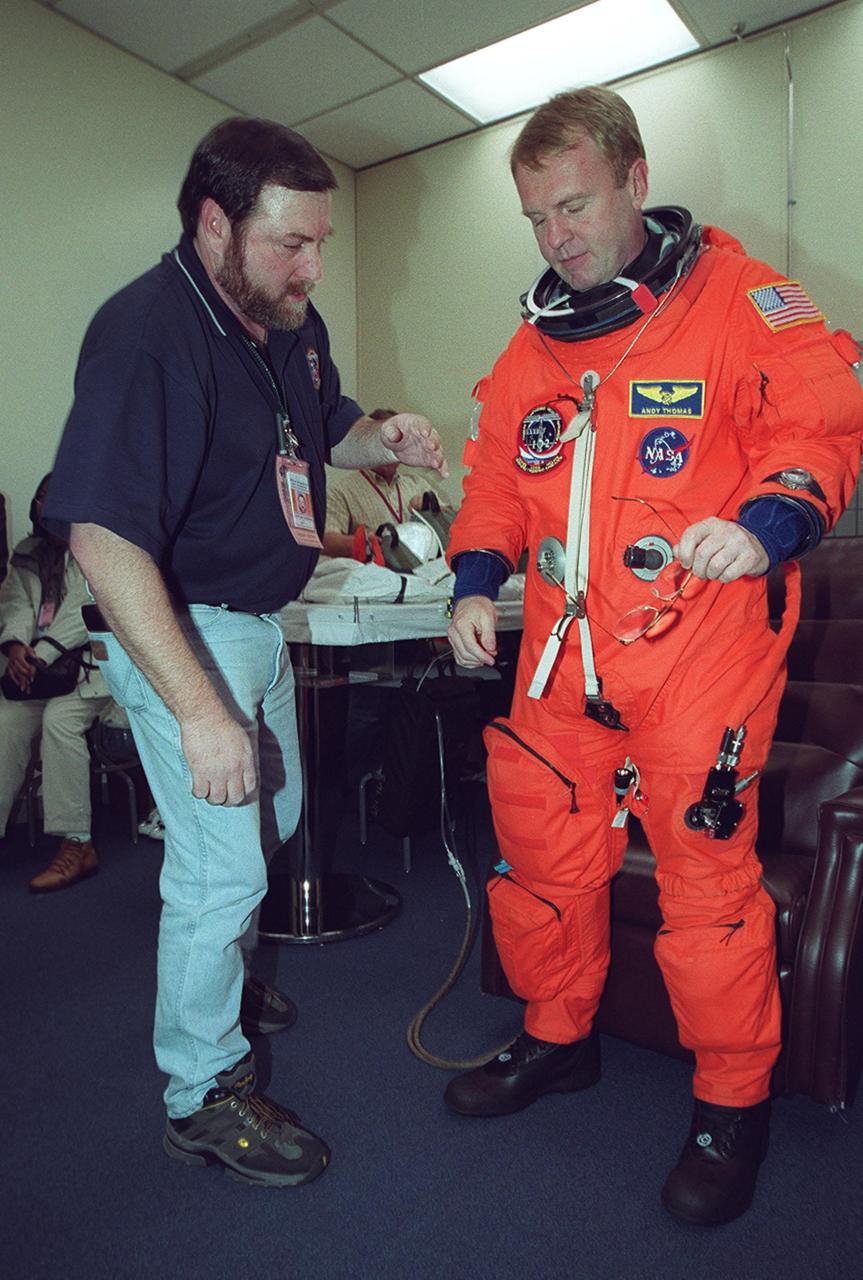
STS-102 Mission Specialist Susan Helms shows her pleasure at the imminent launch to the International Space Station. This will be Helms’ fifth Shuttle flight. She is also part of the Expedition Two crew replacing Expedition One. STS-102 is the eighth construction flight to the Station, carrying the Multi-Purpose Logistics Module Leonardo. The primary delivery system used to resupply and return Station cargo requiring a pressurized environment, Leonardo will deliver up to 10 tons of laboratory racks filled with equipment, experiments and supplies for outfitting the newly installed U.S. Laboratory Destiny. Discovery is set to launch March 8 at 6:42 a.m. EST. The 12-day mission is expected to end with a landing at KSC on March 20
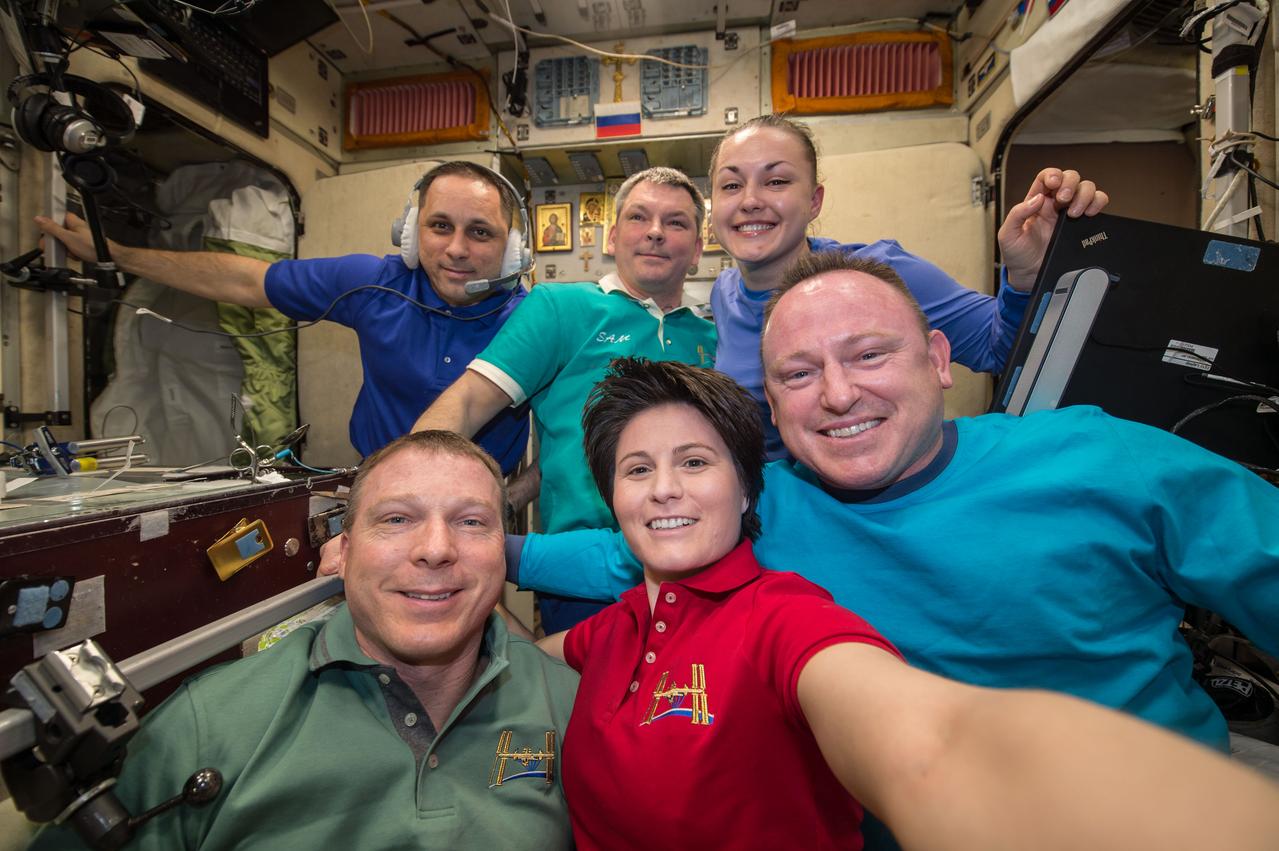
ISS042E329946 (03/11/2015) --- Making preparations for departure of three of his colleagues NASA astronaut Terry Virts, a flight engineer for Expedition 42 on the International Space Station tweeted this image down to his followers on Earth on Mar 11, 2015 with this candid message: "Our last minutes together as #Exp42 crew. It's been a pleasure serving on #ISS with these wonderful people'. Virts is now the Commander of Expedition 43 and his colleagues NASA astronaut Barry Wilmore (bottom right), cosmonaut Elena Serova (top right) and Alexander Samokutyaev ( top center) of the Russian Federal Space Agency (Roscosmos), have all landed safely back on Earth. The remaining crew with Virts in space is ESA (European Space Agency) astronaut Samantha Cristoforetti (bottom center) and cosmonaut Anton Shkaplerov (top left).
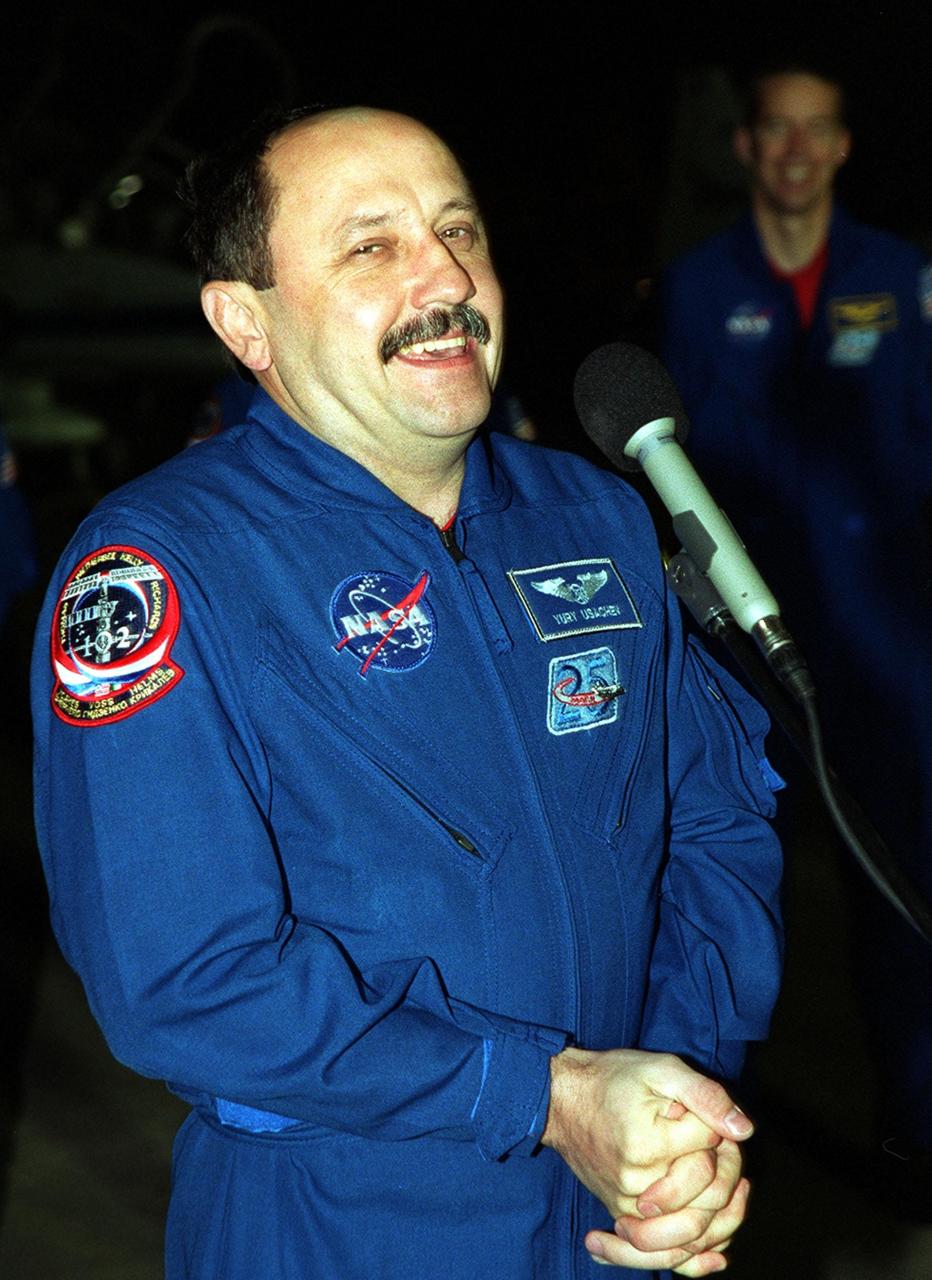
After arrival at the Shuttle Landing Facility, STS-102 Mission Specialist Yury Usachev laughs at a comment from the media. At the right can be seen Commander James Wetherbee. The crew is making the eighth construction flight to the International Space Station. In addition, Usachev is part of the Expedition Two crew who will be replacing Expedition One on the Station. STS-102 will be carrying the Multi-Purpose Logistics Module Leonardo, the primary delivery system used to resupply and return Station cargo requiring a pressurized environment. Leonardo will deliver up to 10 tons of laboratory racks filled with equipment, experiments and supplies for outfitting the newly installed U.S. Laboratory Destiny. STS-102 is scheduled to launch March 8 at 6:42 a.m. EST
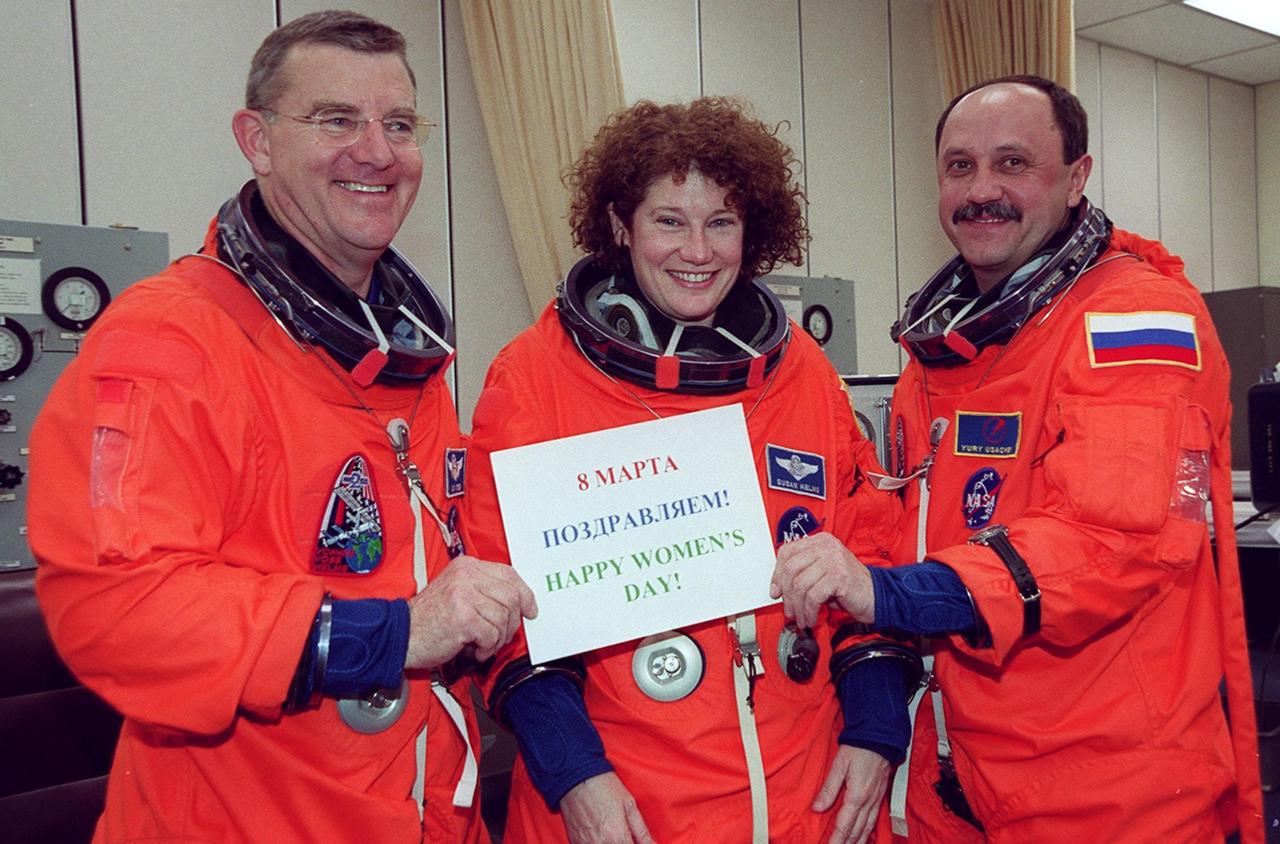
STS-102 Mission Specialists James Voss, Susan Helms and Yury Usachev hold up a sign after donning their launch and entry suits. In Cyrillic and English, the sign recognizes International Women’s Day, March 8. Voss and Helms are making their fifth Shuttle flights and Usachev is making his second. All three are the Expedition Two crew who are replacing Expedition One on the International Space Station. STS-102 is the eighth construction flight to the Station, carrying the Multi-Purpose Logistics Module Leonardo. . The primary delivery system used to resupply and return Station cargo requiring a pressurized environment, Leonardo will deliver up to 10 tons of laboratory racks filled with equipment, experiments and supplies for outfitting the newly installed U.S. Laboratory Destiny. Discovery is set to launch March 8 at 6:42 a.m. EST. The 12-day mission is expected to end with a landing at KSC on March 20
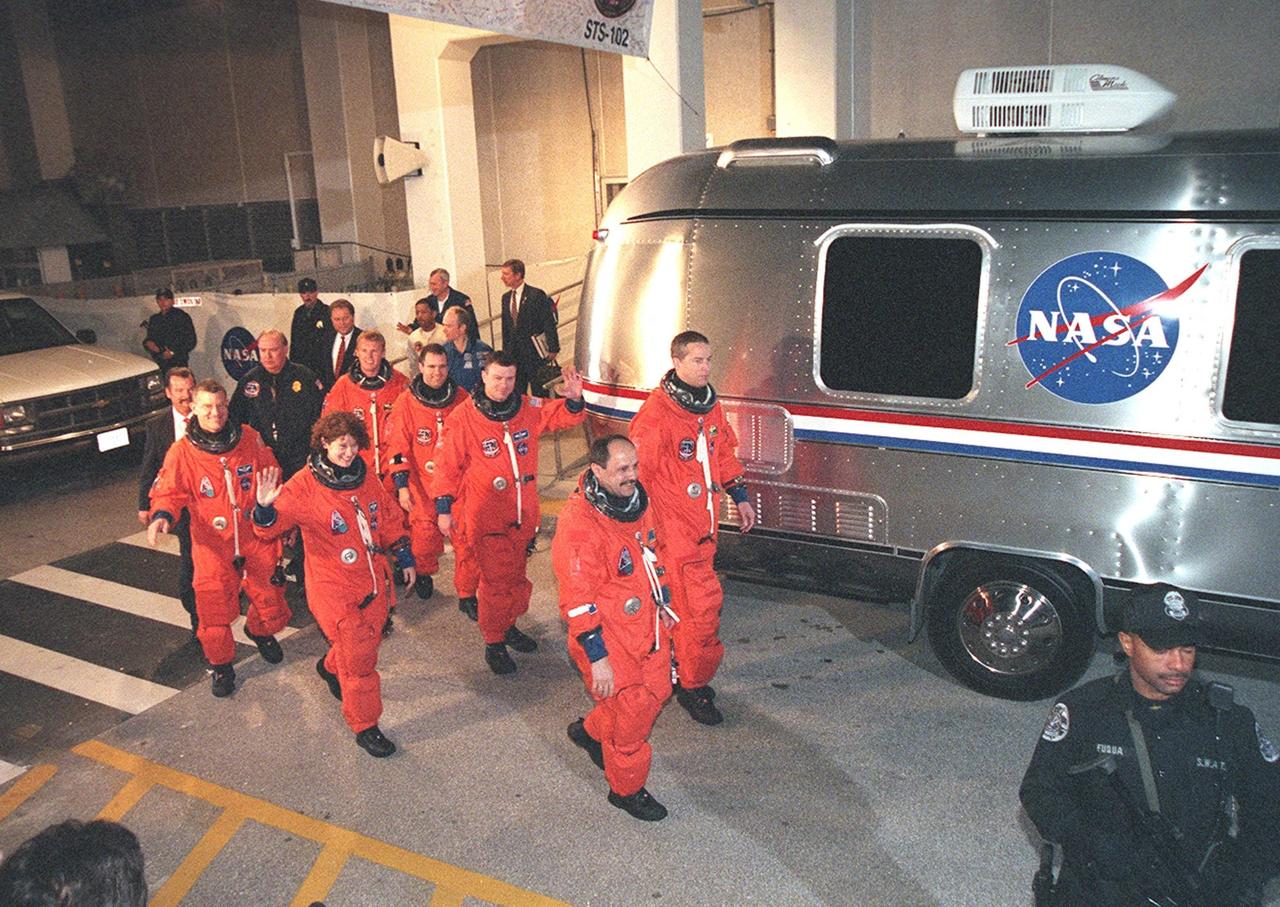
The STS-102 crew heads for the Astrovan after leaving the Operations and Checkout Building behind them. In front, left to right, are Mission Specialists James Voss, Susan Helms and Yury Usachev. In back, left to right, are Mission Specialists Andrew Thomas and Paul Richards, Pilot James Kelly and Commander James Wetherbee. STS-102 is the eighth construction flight to the Space Station, carrying the Multi-Purpose Logistics Module Leonardo. The primary delivery system used to resupply and return Station cargo requiring a pressurized environment, Leonardo will deliver up to 10 tons of laboratory racks filled with equipment, experiments and supplies for outfitting the newly installed U.S. Laboratory Destiny. In addition, Voss, Helms and Usachev, known as Expedition Two, are flying to the Station to replace Expedition One, who will return to Earth on Discovery. Discovery is set to launch March 8 at 6:42 a.m. EST. The 12-day mission is expected to end with a landing at KSC on March 20
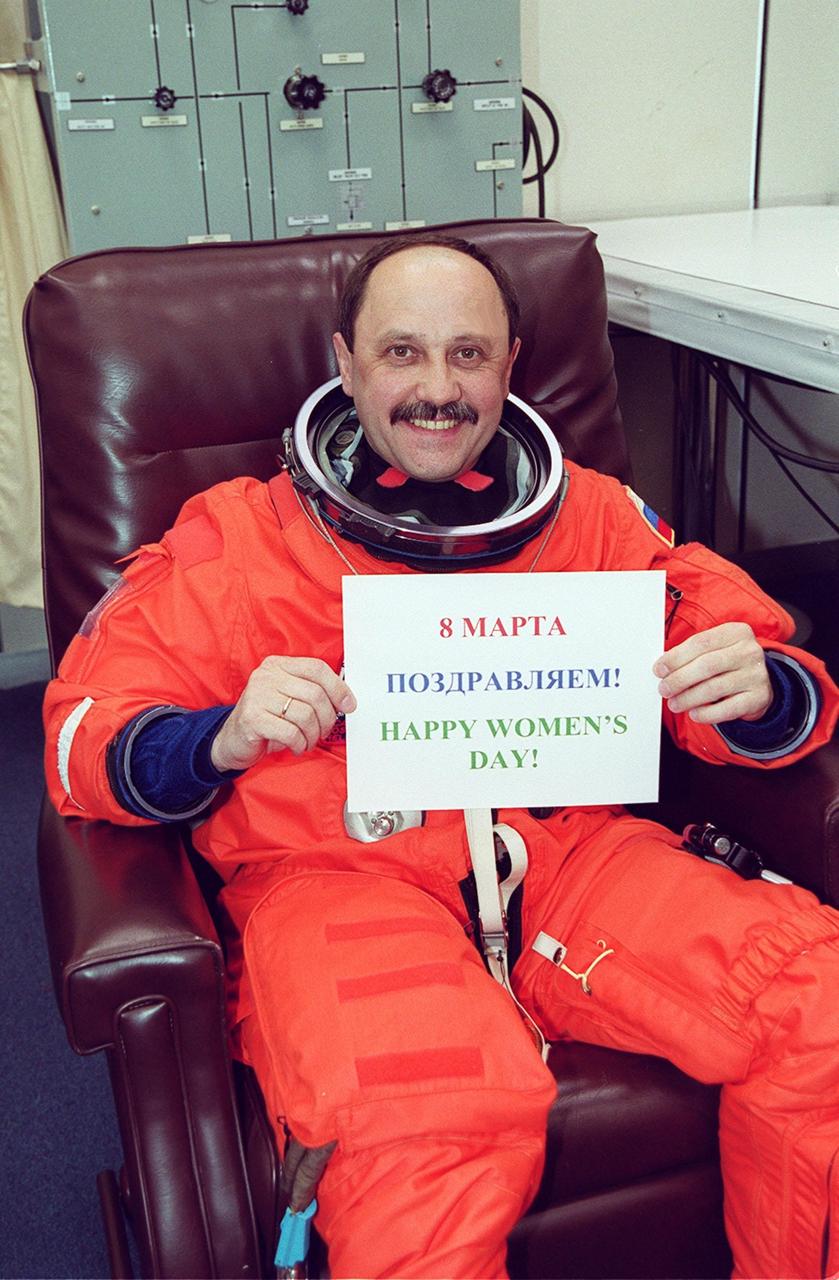
STS-102 Mission Specialist Yury Usachev, a Russian cosmonaut, shows his support of International Women’s Day, March 8, with a sign in both Cyrillic and English. This will be Usachev’s second Shuttle flight. Usachev is also part of a crew, known as Expedition One, who will be replacing Expedition One on the International Space Station. STS-102 is the eighth construction flight to the Space Station, carrying the Multi-Purpose Logistics Module Leonardo. The primary delivery system used to resupply and return Station cargo requiring a pressurized environment, Leonardo will deliver up to 10 tons of laboratory racks filled with equipment, experiments and supplies for outfitting the newly installed U.S. Laboratory Destiny. Discovery is set to launch March 8 at 6:42 a.m. EST. The 12-day mission is expected to end with a landing at KSC on March 20
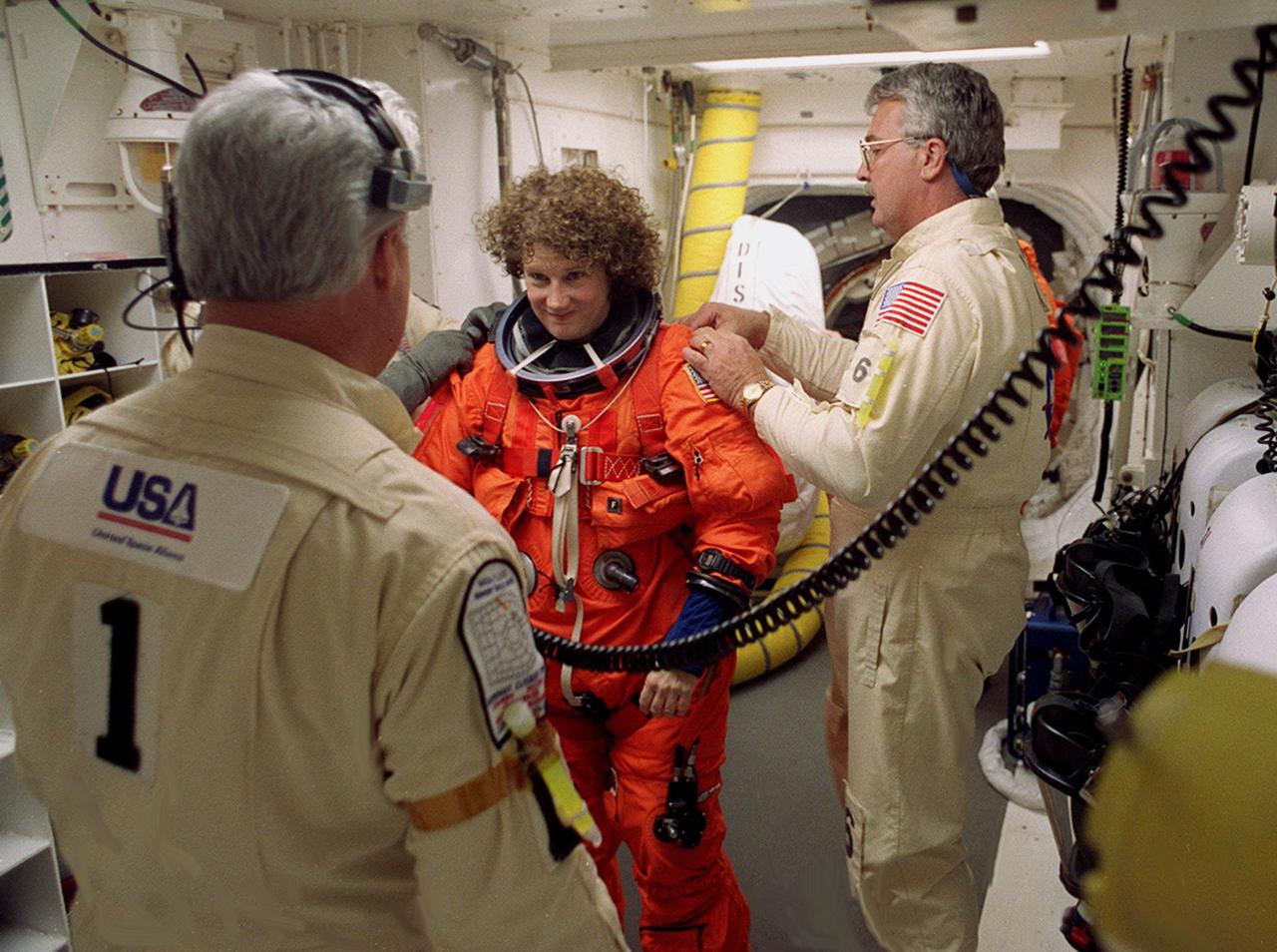
Technicians in the White Room, Launch Pad 39B, help STS-102 Mission Specialist Susan Helms with her launch and entry suit before she enters Space Shuttle Discovery. The mission is Helms’ fifth Shuttle flight. Helms is also part of the Expedition Two crew flying on the mission to replace the Expedition One crew on the Station. Discovery is carrying the Multi-Purpose Logistics Module Leonardo on the eighth construction flight to the International Space Station. The primary delivery system used to resupply and return Station cargo requiring a pressurized environment, Leonardo will deliver up to 10 tons of laboratory racks filled with equipment, experiments and supplies for outfitting the newly installed U.S. Laboratory Destiny. Discovery is set to launch March 8 at 6:42 a.m. EST. The 12-day mission is expected to end with a landing at KSC on March 20
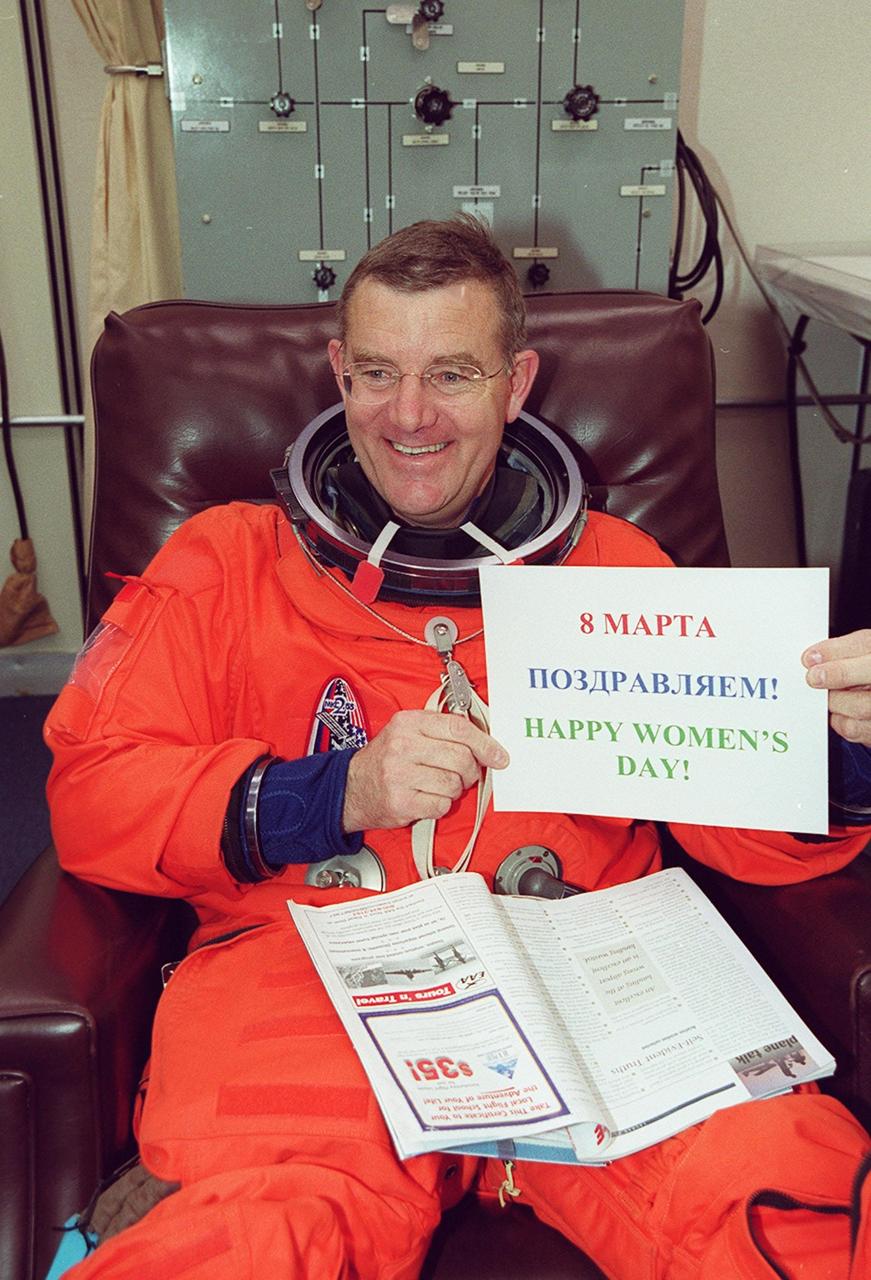
While suiting up in the Operations and Checkout Building, Mission Specialist James Voss shows his support of International Women’s Day, March 8, with a sign in both Cyrillic and English. Voss is also part of a crew, known as Expedition One, who will be replacing Expedition One on the International Space Station. STS-102 is the eighth construction flight to the Space Station, carrying the Multi-Purpose Logistics Module Leonardo. The primary delivery system used to resupply and return Station cargo requiring a pressurized environment, Leonardo will deliver up to 10 tons of laboratory racks filled with equipment, experiments and supplies for outfitting the newly installed U.S. Laboratory Destiny. Discovery is set to launch March 8 at 6:42 a.m. EST. The 12-day mission is expected to end with a landing at KSC on March 20
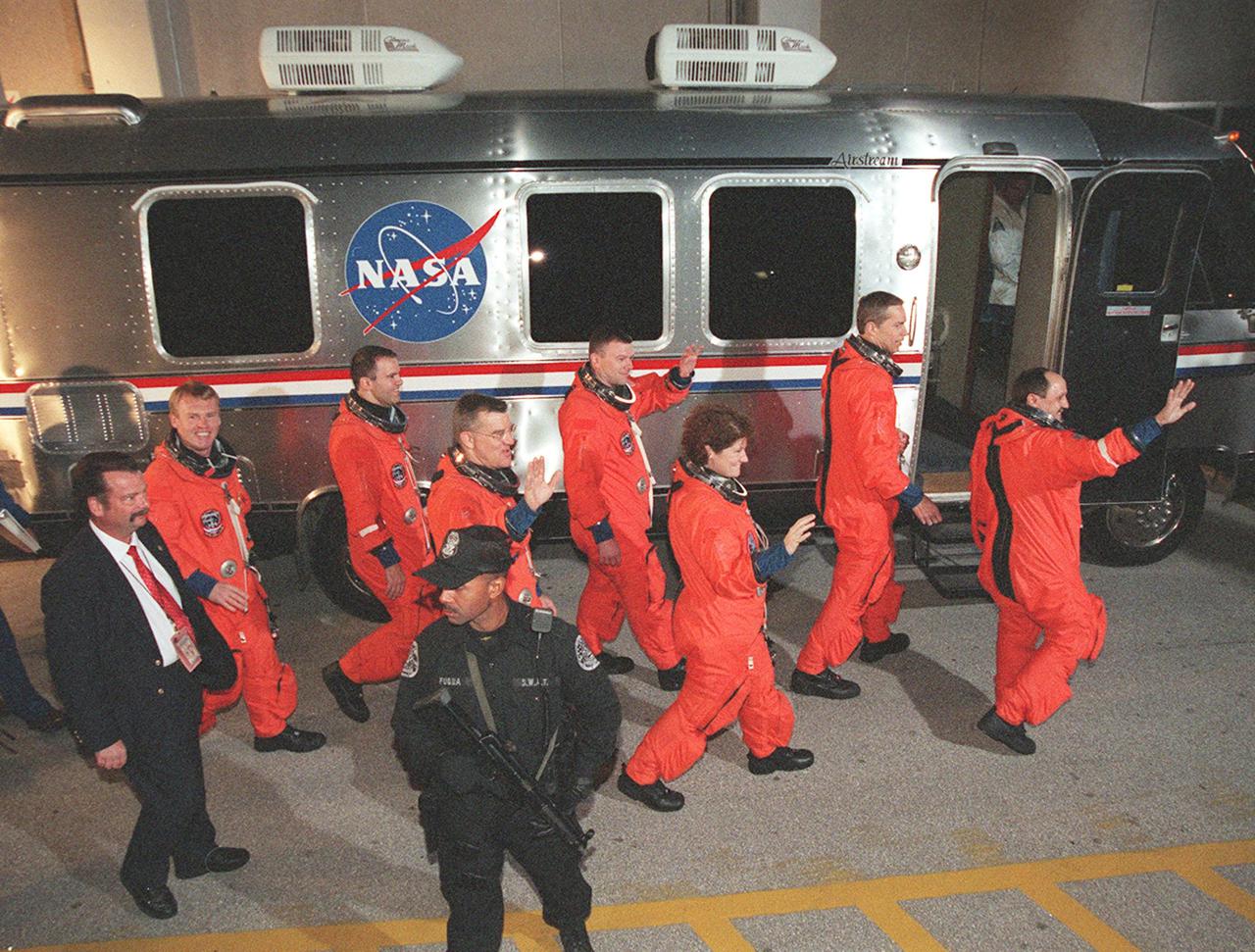
The STS-102 crew wave to onlookers as they head for the Astrovan after leaving the Operations and Checkout Building. Left to right are Mission Specialists Andrew Thomas, Paul Richards and James Voss; Pilot James Kelly; Mission Specialist Susan Helms; Commander James Wetherbee; and Mission Specialist Yury Usachev. STS-102 is the eighth construction flight to the Space Station, carrying the Multi-Purpose Logistics Module Leonardo. The primary delivery system used to resupply and return Station cargo requiring a pressurized environment, Leonardo will deliver up to 10 tons of laboratory racks filled with equipment, experiments and supplies for outfitting the newly installed U.S. Laboratory Destiny. In addition, Voss, Helms and Usachev, known as Expedition Two, are flying to the Station to replace Expedition One, who will return to Earth on Discovery. Discovery is set to launch March 8 at 6:42 a.m. EST. The 12-day mission is expected to end with a landing at KSC on March 20