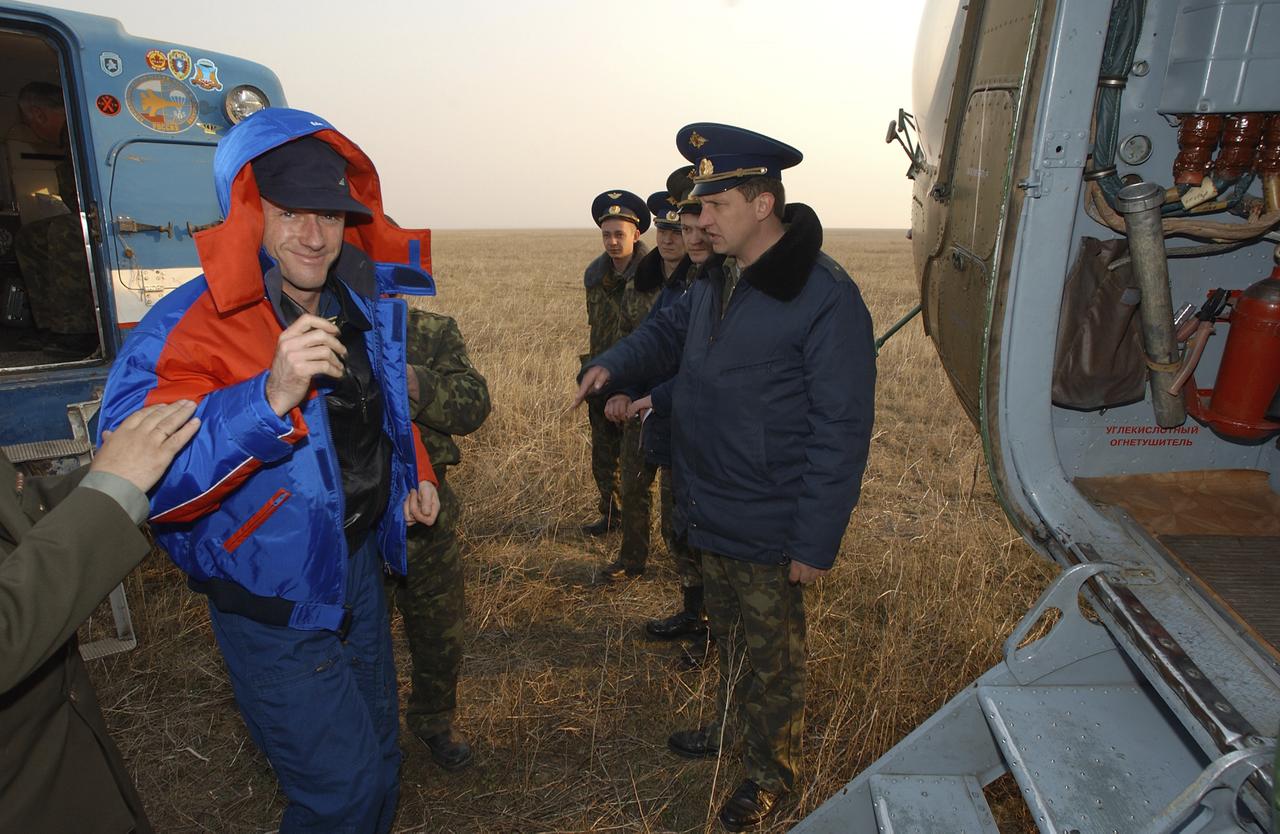
Expedition 8 Commander Mike Foale exits an all terrain vehicle and prepares to enter a Russian MI-8 helicopter for the flight to Kustanai, Kazakhstan after he, Soyuz Flight Engineer Alexander Kaleri and European Space Agency astronaut Andre Kuipers, of the Netherlands, landed in north central Kazakhstan, Friday, April 30, 2004, in a Soyuz TMA-3 capsule. Foale and Kaleri completed 195 days in space aboard the International Space Station, while Kuipers returned after an 11-day research mission as part of a commercial agreement between ESA and the Russian Federal Space Agency. Photo Credit: (NASA/Bill Ingalls)
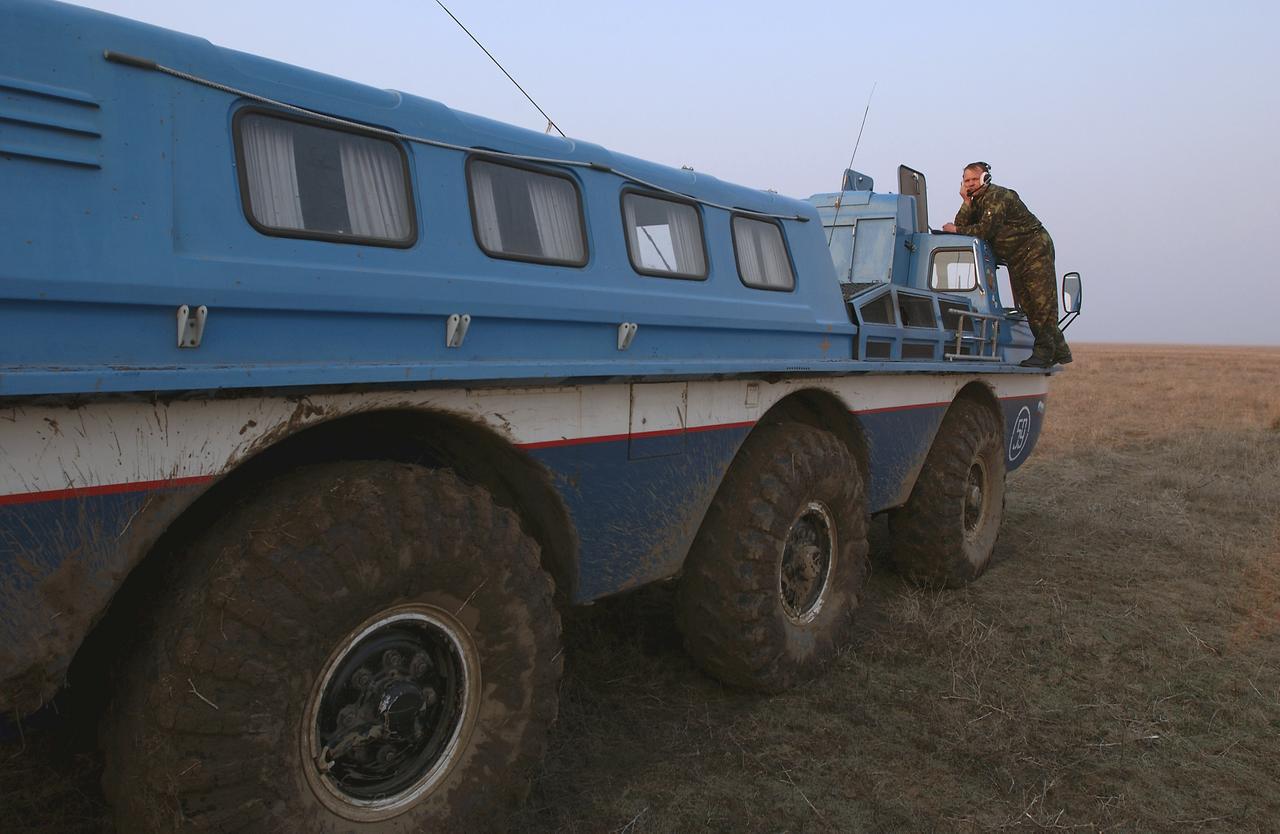
A Russian made all terrain vehicle waits to transport crew members from the inflatable medical tent to their helicopters, Friday, April 30, 2004, following the landing of Expedition 8 in north central Kazakhstan. Commander Michael Foale, Soyuz Flight Engineer Alexander Kaleri and European Space Agency astronaut Andre Kuipers, of the Netherlands landed in a Soyuz TMA-3 capsule. Foale and Kaleri completed 195 days in space aboard the International Space Station, while Kuipers returned after an 11-day research mission as part of a commercial agreement between ESA and the Russian Federal Space Agency. Photo Credit: (NASA/Bill Ingalls)
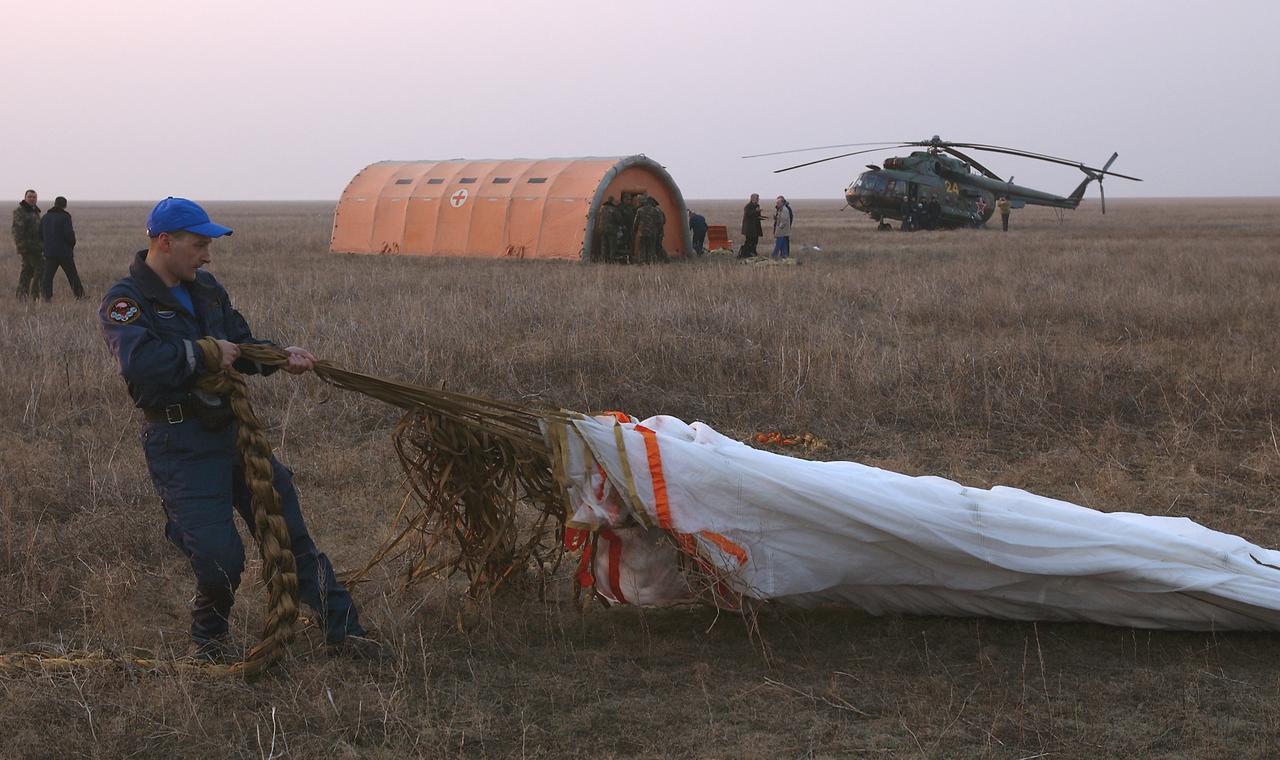
The main parachute for the Soyuz capsule is prepared for folding, Friday, April 30, 2004, following the landing of the Expedition 8. Commander Michael Foale, Soyuz Flight Engineer Alexander Kaleri and European Space Agency astronaut Andre Kuipers of the Netherlands landed in north central Kazakhstan in a Soyuz TMA-3 capsule. Foale and Kaleri completed 195 days in space aboard the International Space Station, while Kuipers returned after an 11-day research mission as part of a commercial agreement between ESA and the Russian Federal Space Agency. Photo Credit: (NASA/Bill Ingalls)
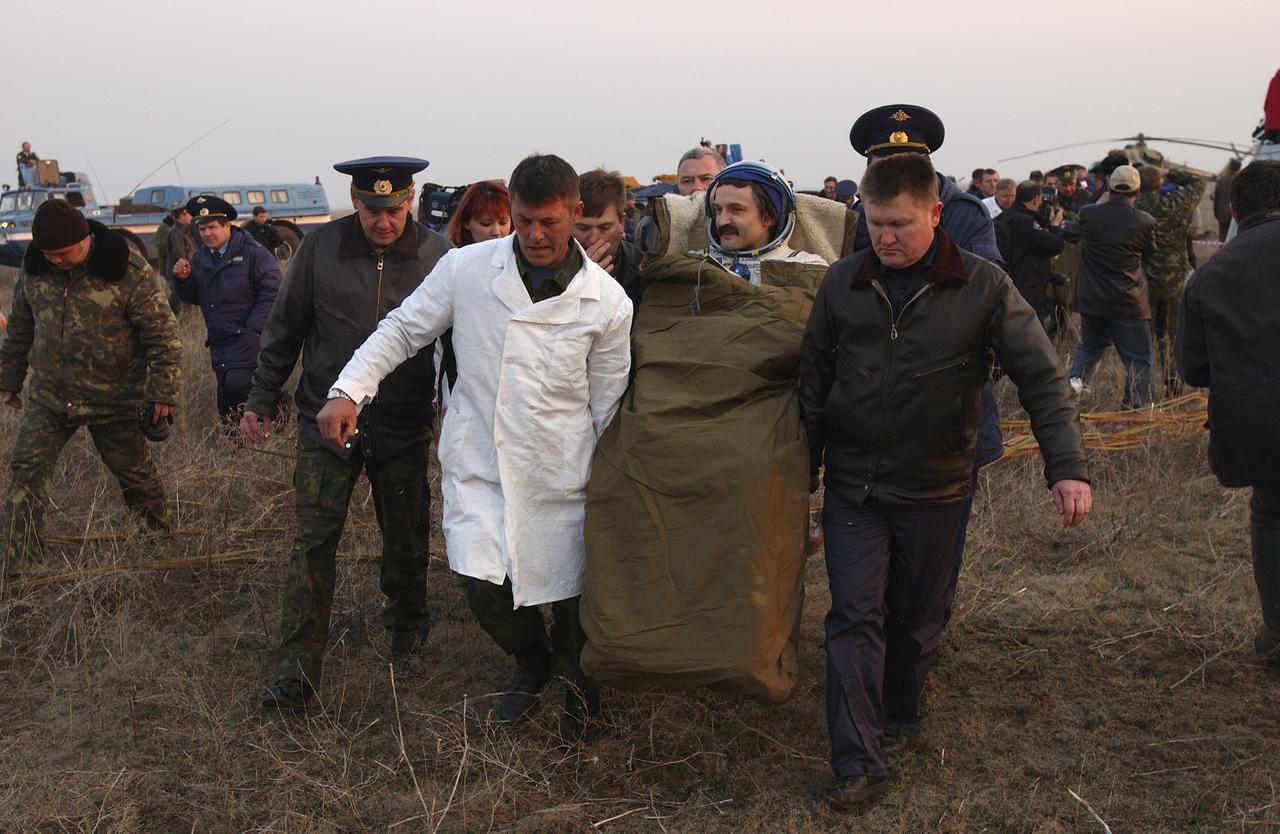
Soyuz Flight Engineer Alexander Kaleri is carried in a chair from the Soyuz landing site to an inflatable medical tent after he and Expedition 8 Commander Mike Foale and European Space Agency astronaut Andre Kuipers, of the Netherlands, landed in north central Kazakhstan, Friday, April 30, 2004, in a Soyuz TMA-3 capsule. Foale and Kaleri completed 195 days in space aboard the International Space Station, while Kuipers returned after an 11-day research mission as part of a commercial agreement between ESA and the Russian Federal Space Agency. Photo Credit: (NASA/Bill Ingalls)
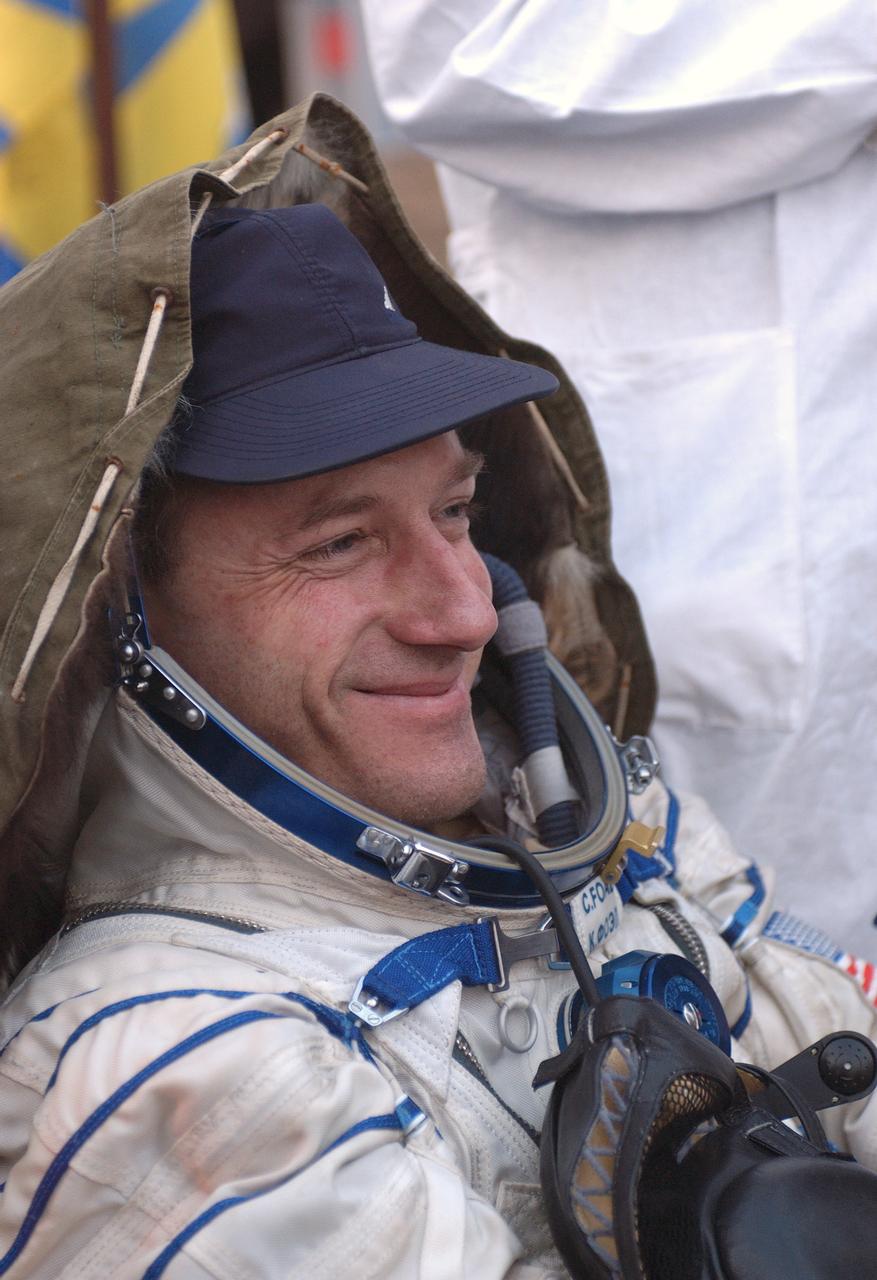
Expedition 8 Commander Mike Foale smiles shortly after he and Soyuz Flight Engineer Alexander Kaleri and European Space Agency astronaut Andre Kuipers, of the Netherlands, landed in north central Kazakhstan, Friday, April 30, 2004, in a Soyuz TMA-3 capsule. Foale and Kaleri completed 195 days in space aboard the International Space Station, while Kuipers returned after an 11-day research mission as part of a commercial agreement between ESA and the Russian Federal Space Agency. Photo Credit (NASA/Bill Ingalls)
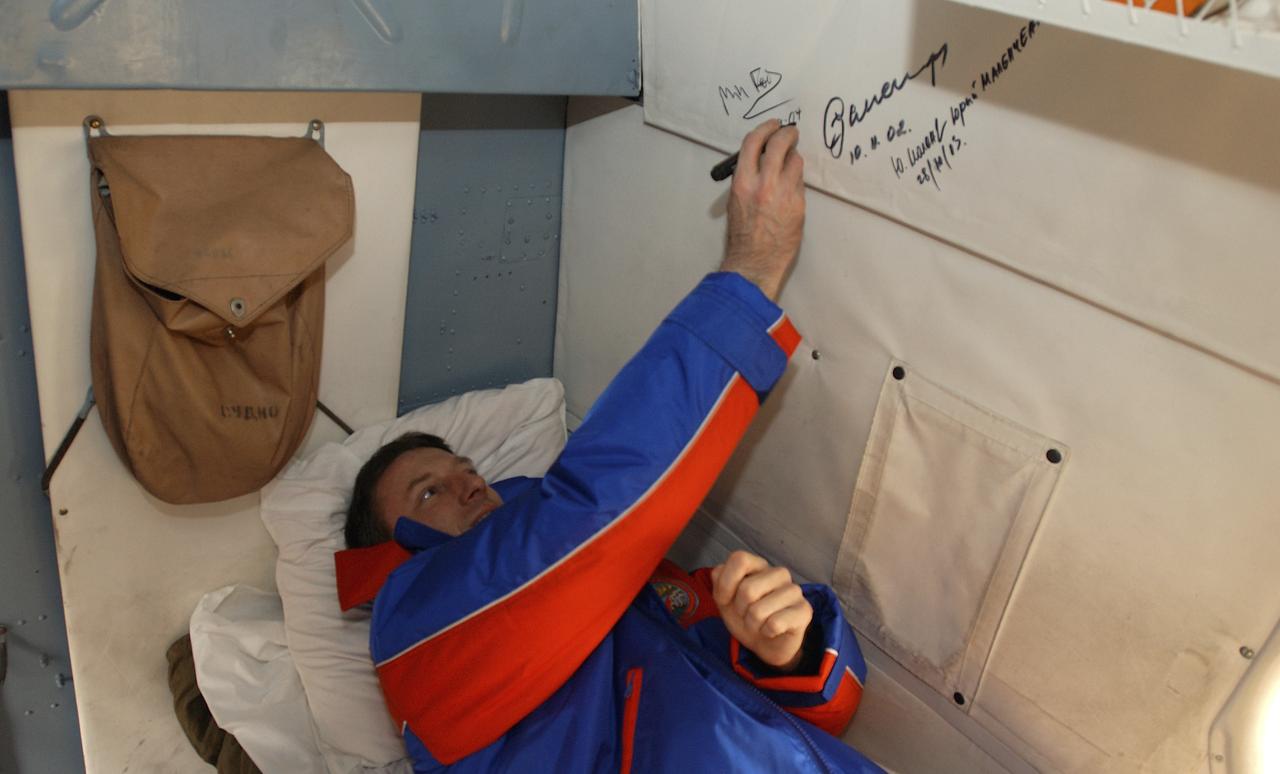
Expedition 8 Commander Michael Foale signs the inside of the Russian search and rescue helicopter as is tradition for returning cosmonauts, after he, Soyuz Flight Engineer Alexander Kaleri and European Space Agency astronaut Andre Kuipers, of the Netherlands, landed in north central Kazakhstan, Friday, April 30, 2004, in a Soyuz TMA-3 capsule. Foale and Kaleri completed 195 days in space aboard the International Space Station, while Kuipers returned after an 11-day research mission as part of a commercial agreement between ESA and the Russian Federal Space Agency. Photo Credit: (NASA/Bill Ingalls)
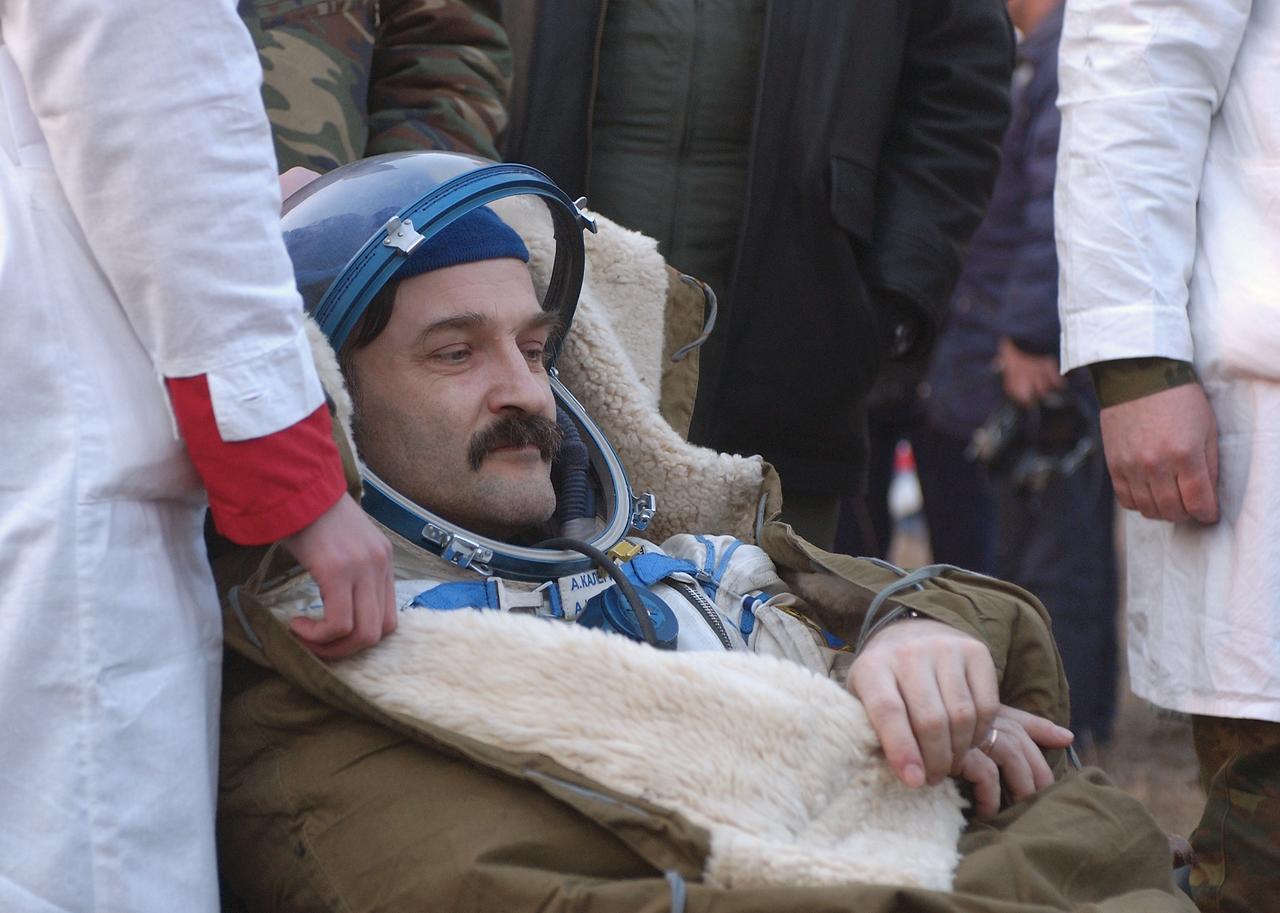
Soyuz Flight Engineer Alexander Kaleri relaxes in a chair after he and Expedition 8 Commander Michael Foale and European Space Agency astronaut Andre Kuipers, of the Netherlands, landed in north central Kazakhstan, Friday, April 30, 2004, in their Soyuz TMA-3 capsule. Foale and Kaleri completed 195 days in space aboard the International Space Station, while Kuipers returned after an 11-day research mission as part of a commercial agreement between ESA and the Russian Federal Space Agency. Photo Credit: (NASA/Bill Ingalls)
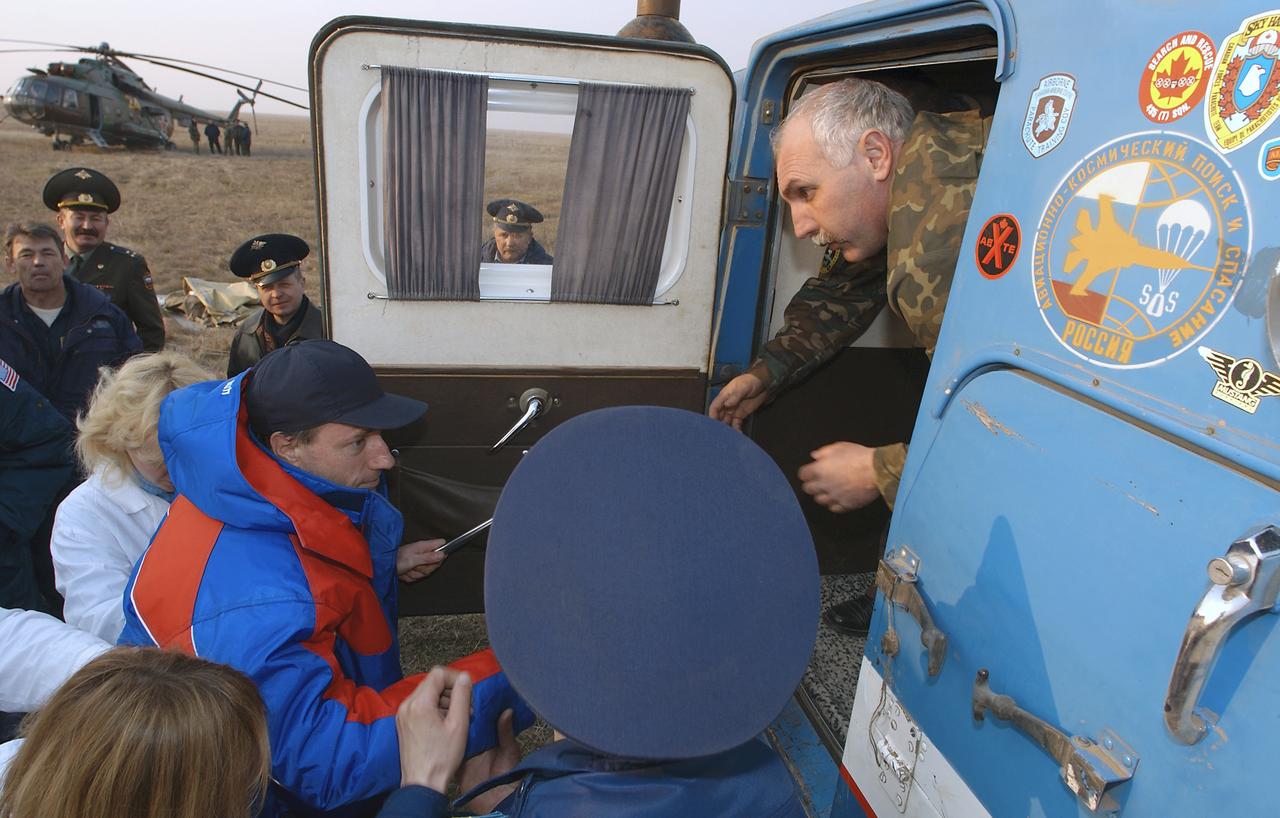
Expedition 8 Commander Michael Foale is helped from the medical tent to an all terrain vehicle for transportation to a helicopter for the flight to Kustanai, Kazakhstan after he, Soyuz Flight Engineer Alexander Kaleri and European Space Agency astronaut Andre Kuipers, of the Netherlands, landed in north central Kazakhstan, Friday, April 30, 2004, in a Soyuz TMA-3 capsule. Foale and Kaleri completed 195 days in space aboard the International Space Station, while Kuipers returned after an 11-day research mission as part of a commercial agreement between ESA and the Russian Federal Space Agency. Photo Credit: (NASA/Bill Ingalls)
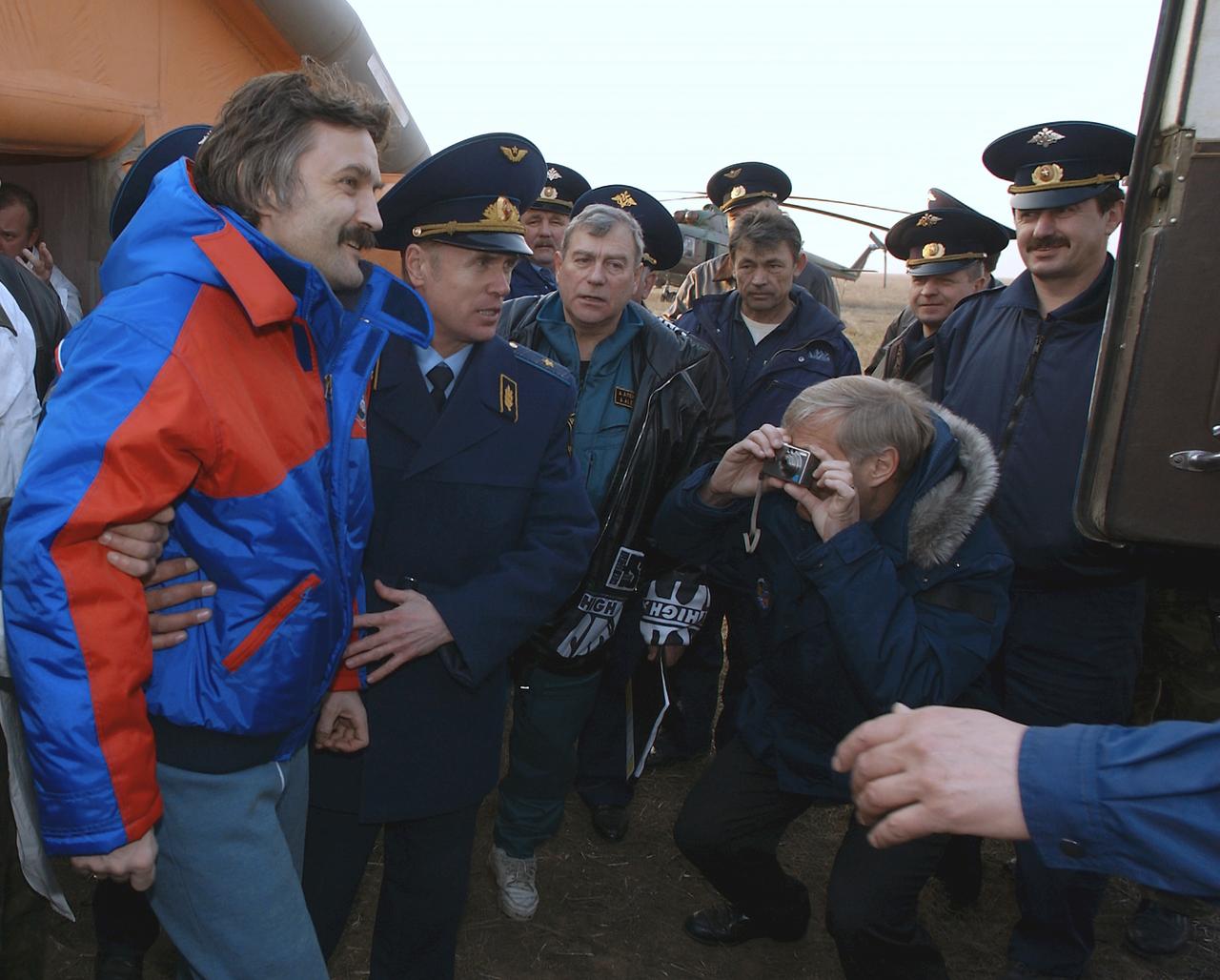
Soyuz Flight Engineer Alexander Kaleri is helped from the medical tent to the all terrain vehicle for transportation to a waiting helicopter for the flight to Kustanai, Kazakhstan, Friday, April 30, 2004, after he, Expedition 8 Commander Michael Foale, and European Space Agency astronaut Andre Kuipers of the Netherlands, landed in north central Kazakhstan in a Soyuz TMA-3 capsule. Foale and Kaleri completed 195 days in space aboard the International Space Station, while Kuipers returned after an 11-day research mission as part of a commercial agreement between ESA and the Russian Federal Space Agency. Photo Credit: (NASA/Bill Ingalls)

Expedition 8 Commander Michael Foale is carried in a chair from the Soyuz landing site to an inflatable medical tent after he, Soyuz Flight Engineer Alexander Kaleri and European Space Agency astronaut Andre Kuipers of the Netherlands landed in north central Kazakhstan, Friday, April 30, 2004, in a Soyuz TMA-3 capsule. Foale and Kaleri completed 195 days in space aboard the International Space Station, while Kuipers returned after an 11-day research mission as part of a commercial agreement between ESA and the Russian Federal Space Agency. Photo Credit: (NASA/Bill Ingalls)
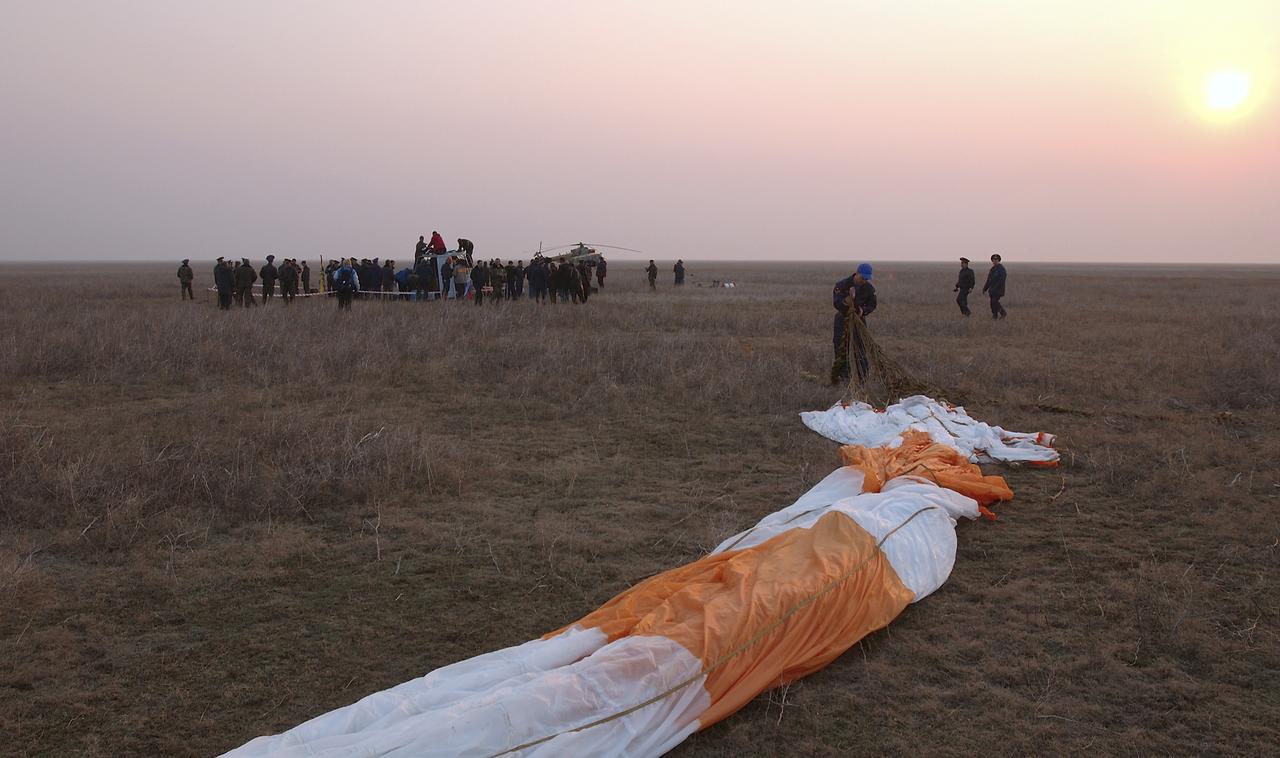
The main chute for the Soyuz capsule is prepared for folding, Friday, April 30, 2004, following the landing of the Expedition 8. Commander Michael Foale, Soyuz Flight Engineer Alexander Kaleri and European Space Agency astronaut Andre Kuipers of the Netherlands landed in north central Kazakhstan in a Soyuz TMA-3 capsule. Foale and Kaleri completed 195 days in space aboard the International Space Station, while Kuipers returned after an 11-day research mission as part of a commercial agreement between ESA and the Russian Federal Space Agency. Photo Credit: (NASA/Bill Ingalls)
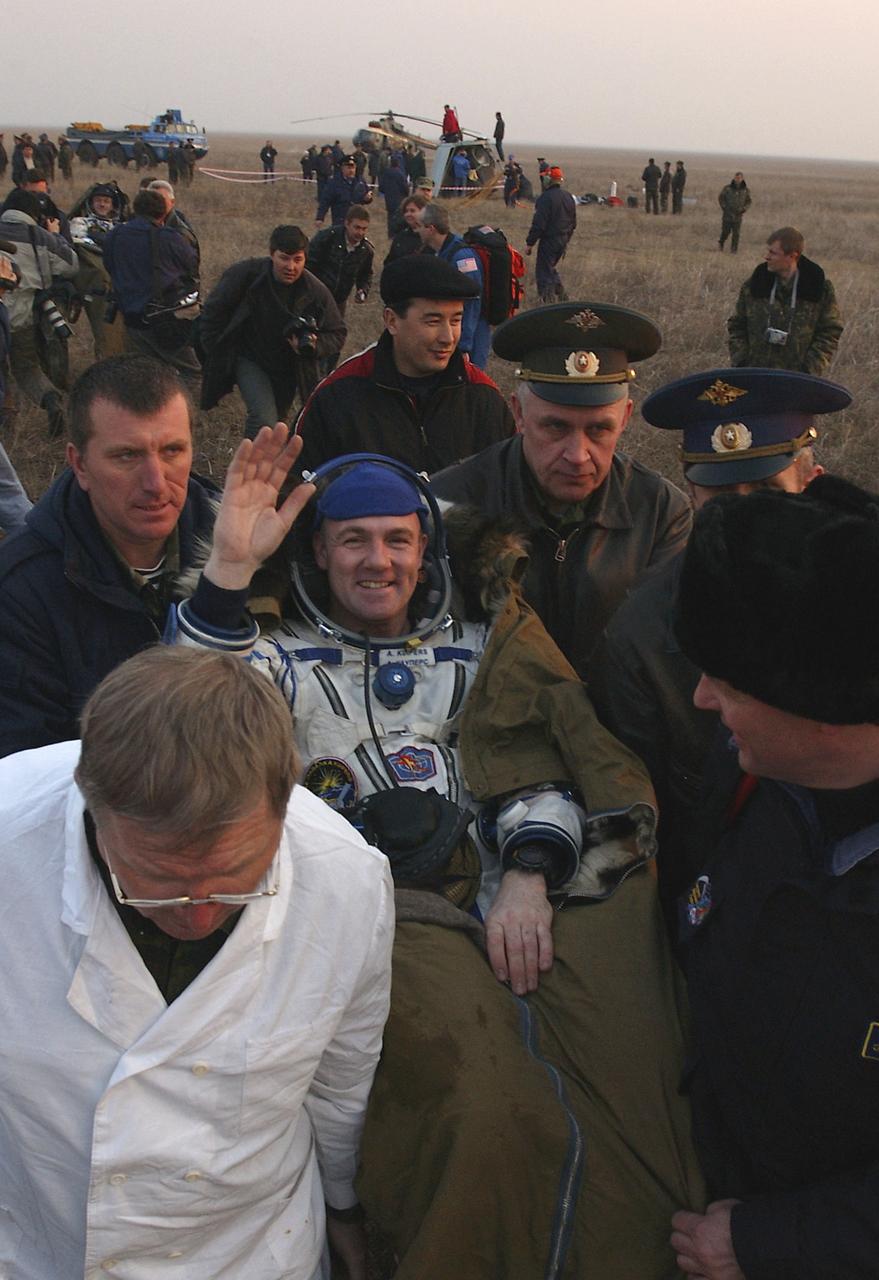
European Space Agency astronaut Andre Kuipers, of the Netherlands, is carried in a chair from the Soyuz landing site to an inflatable medical tent after he and Expedition 8 Commander Michael Foale and Soyuz Flight Engineer Alexander Kaleri landed in north central Kazakhstan, Friday, April 30, 2004, in a Soyuz TMA-3 capsule. Foale and Kaleri completed 195 days in space aboard the International Space Station, while Kuipers returned after an 11-day research mission as part of a commercial agreement between ESA and the Russian Federal Space Agency. Photo Credit: (NASA/Bill Ingalls)
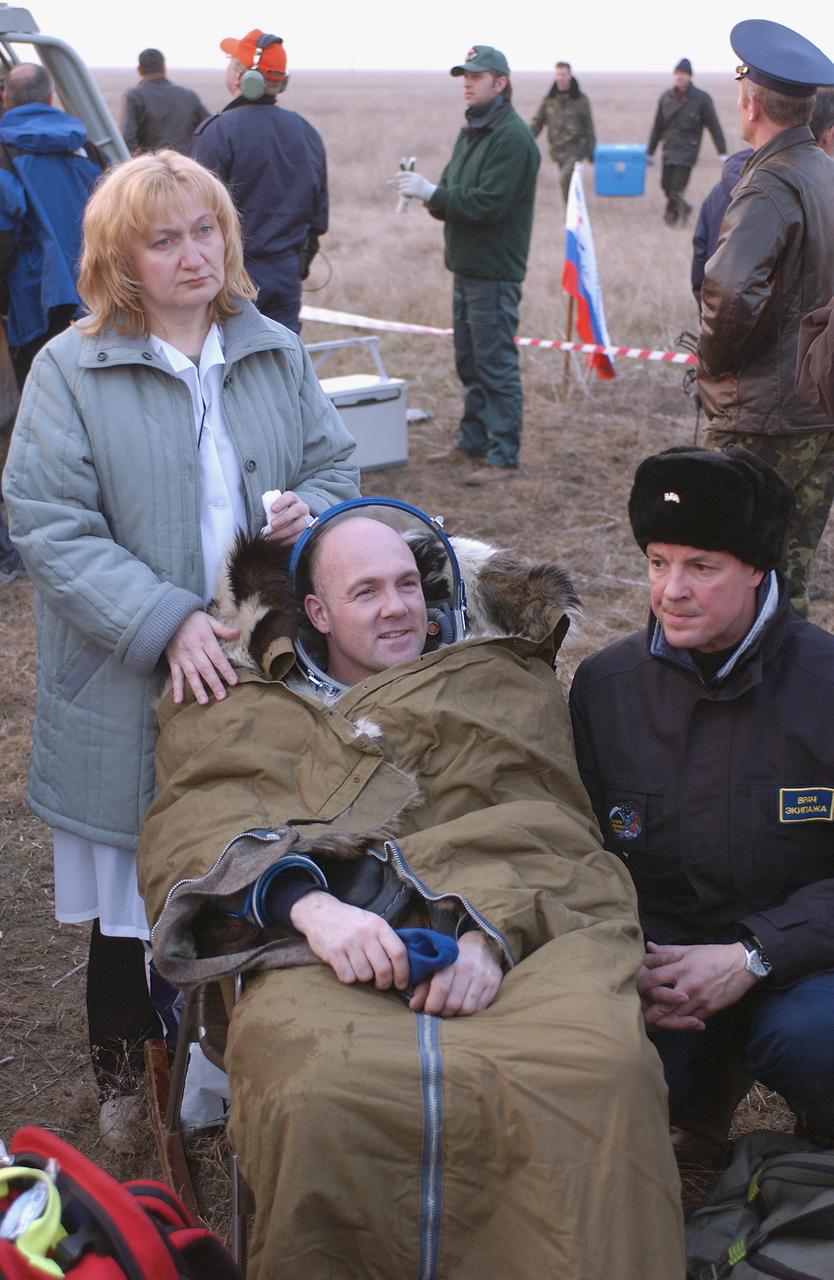
European Space Agency astronaut Andre Kuipers, of the Netherlands, is checked by his flight surgeon after he and Expedition 8 Commander Michael Foale and Soyuz Flight Engineer Alexander Kaleri landed in north central Kazakhstan, Friday, April 30, 2004, in their Soyuz TMA-3 capsule. Foale and Kaleri completed 195 days in space aboard the International Space Station, while Kuipers returned after an 11-day research mission as part of a commercial agreement between ESA and the Russian Federal Space Agency. Photo Credit: (NASA/Bill Ingalls)
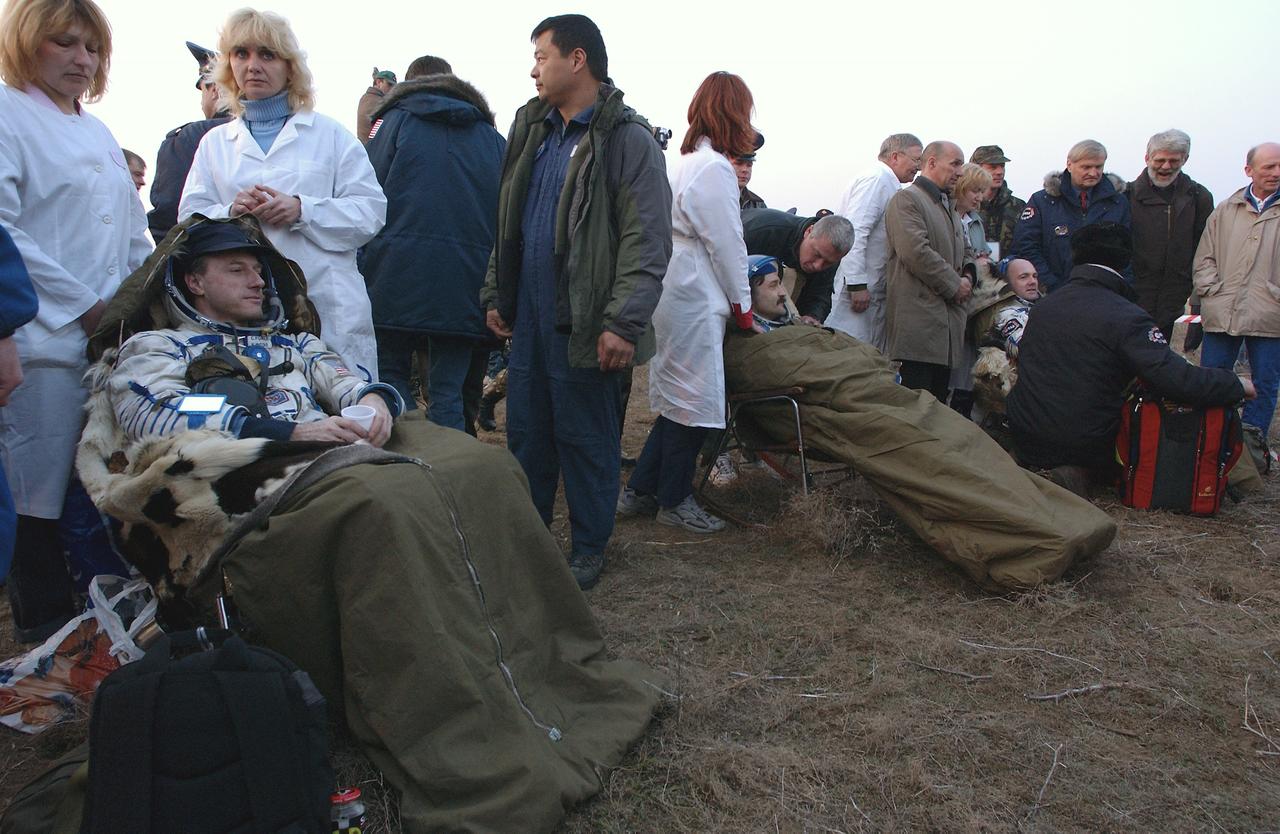
Expedition 8 Commander Michael Foale, left, Soyuz Flight Engineer Alexander Kaleri and European Space Agency astronaut Andre Kuipers, of the Netherlands, right, are seen seated after landing in north central Kazakhstan, Friday, April 30, 2004, in a Soyuz TMA-3 capsule. Foale and Kaleri completed 195 days in space aboard the International Space Station, while Kuipers returned after an 11-day research mission as part of a commercial agreement between ESA and the Russian Federal Space Agency. Photo Credit: (NASA/Bill Ingalls)
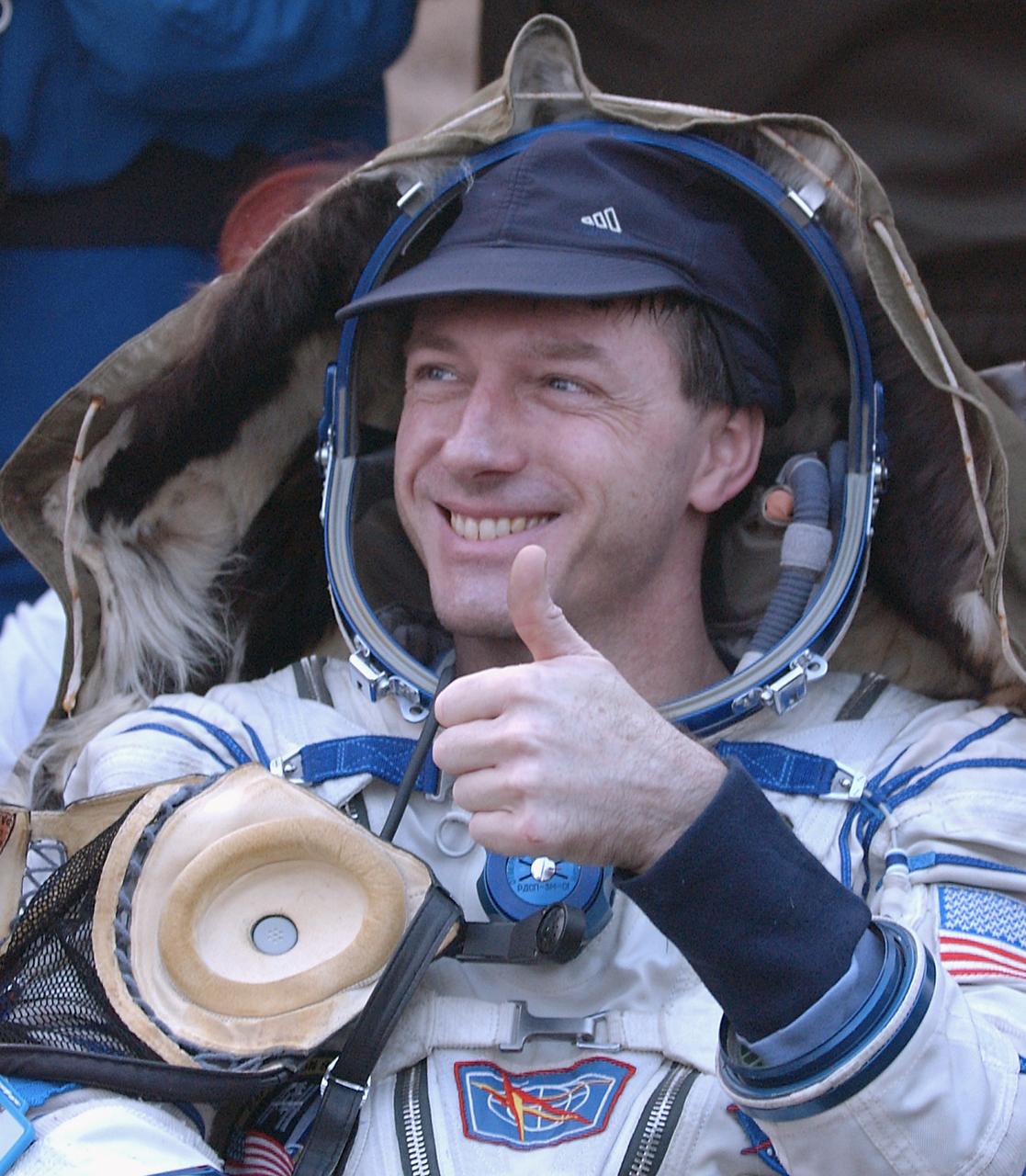
Expedition 8 Commander Michael Foale gives a thumbs up after he and his crew mates, Soyuz Flight Engineer Alexander Kaleri and European Space Agency astronaut Andre Kuipers, of the Netherlands, touched down in north central Kazakhstan, Friday, April 30, 2004, in their Soyuz TMA-3 capsule. Foale and Kaleri completed 195 days in space aboard the International Space Station, while Kuipers returned after an 11-day research mission as part of a commercial agreement between ESA and the Russian Federal Space Agency. Photo Credit (NASA/Bill Ingalls)
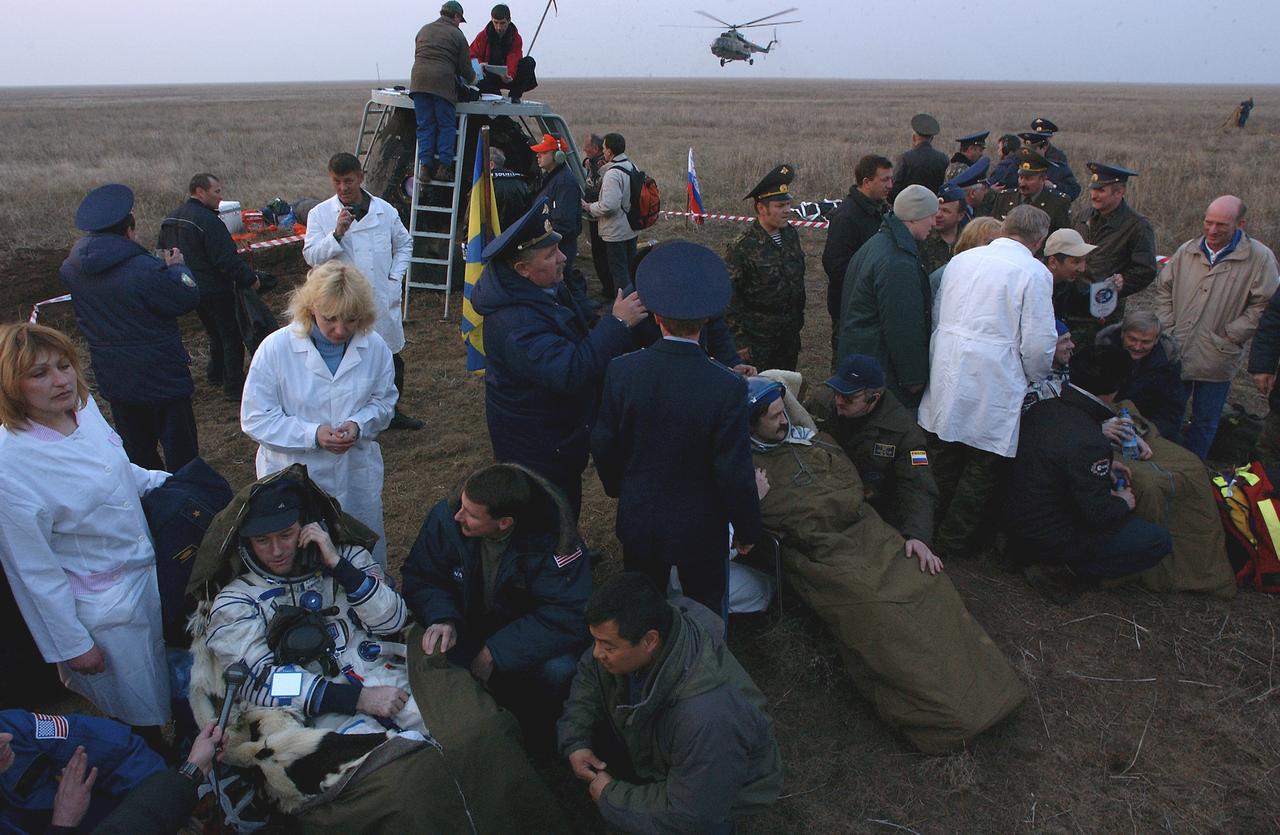
Expedition 8 Commander Mike Foale, lower left, Soyuz Flight Engineer Alexander Kaleri and European Space Agency astronaut Andre Kuipers of the Netherlands, partially hidden, are tended to after touching down in north central Kazakhstan, Friday, April 30, 2004. Foale and Kaleri completed 195 days in space aboard the International Space Station, while Kuipers returned after an 11-day research mission as part of a commercial agreement between ESA and the Russian Federal Space Agency. Photo Credit (NASA/Bill Ingalls)
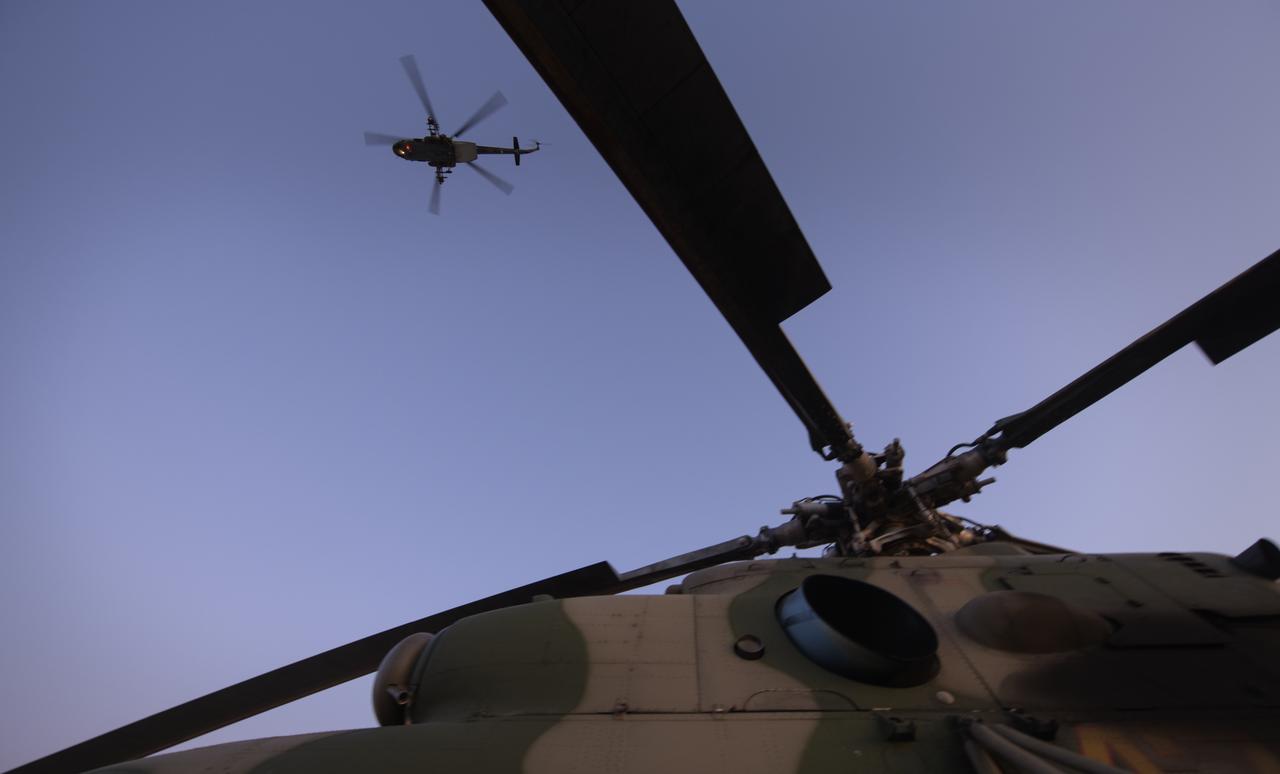
A Russian MI-8 helicopter departs the Soyuz MS-12 spacecraft landing site more than hour after the capsule landed with Expedition 60 crew members Nick Hague of NASA and Alexey Ovchinin of Roscosmos, along with visiting astronaut Hazzaa Ali Almansoori of the United Arab Emirates in a remote area near the town of Zhezkazgan, Kazakhstan, Thursday, Oct. 3, 2019. Hague and Ovchinin are returning after 203 days in space where they served as members of the Expedition 59 and 60 crews onboard the International Space Station. Almansoori logged 8 days in space during his first flight as an astronaut. Photo Credit: (NASA/Bill Ingalls)
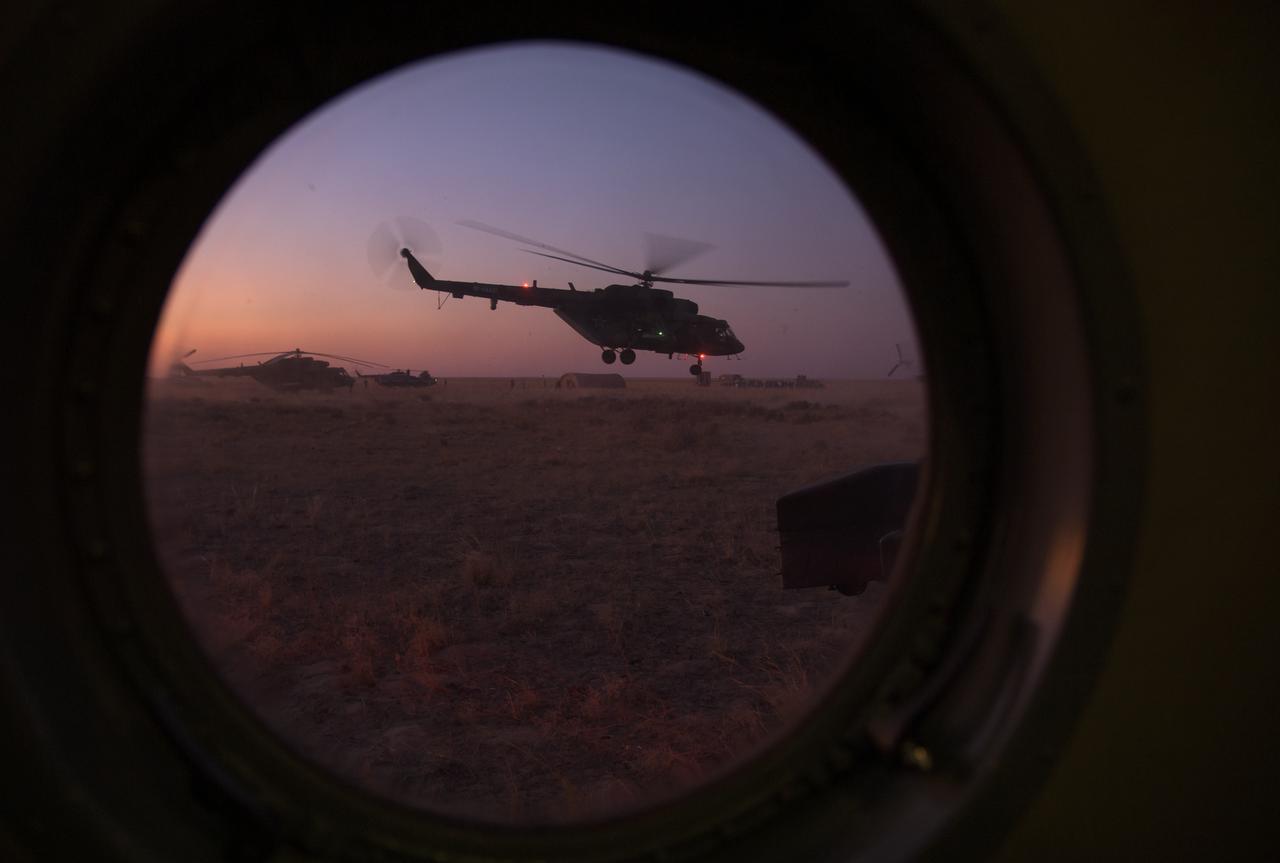
A Russian MI-8 helicopter departs the Soyuz MS-12 spacecraft landing site after the capsule landed with Expedition 60 crew members Nick Hague of NASA and Alexey Ovchinin of Roscosmos, along with visiting astronaut Hazzaa Ali Almansoori of the United Arab Emirates in a remote area near the town of Zhezkazgan, Kazakhstan, Thursday, Oct. 3, 2019. Hague and Ovchinin are returning after 203 days in space where they served as members of the Expedition 59 and 60 crews onboard the International Space Station. Almansoori logged 8 days in space during his first flight as an astronaut. Photo Credit: (NASA/Bill Ingalls)
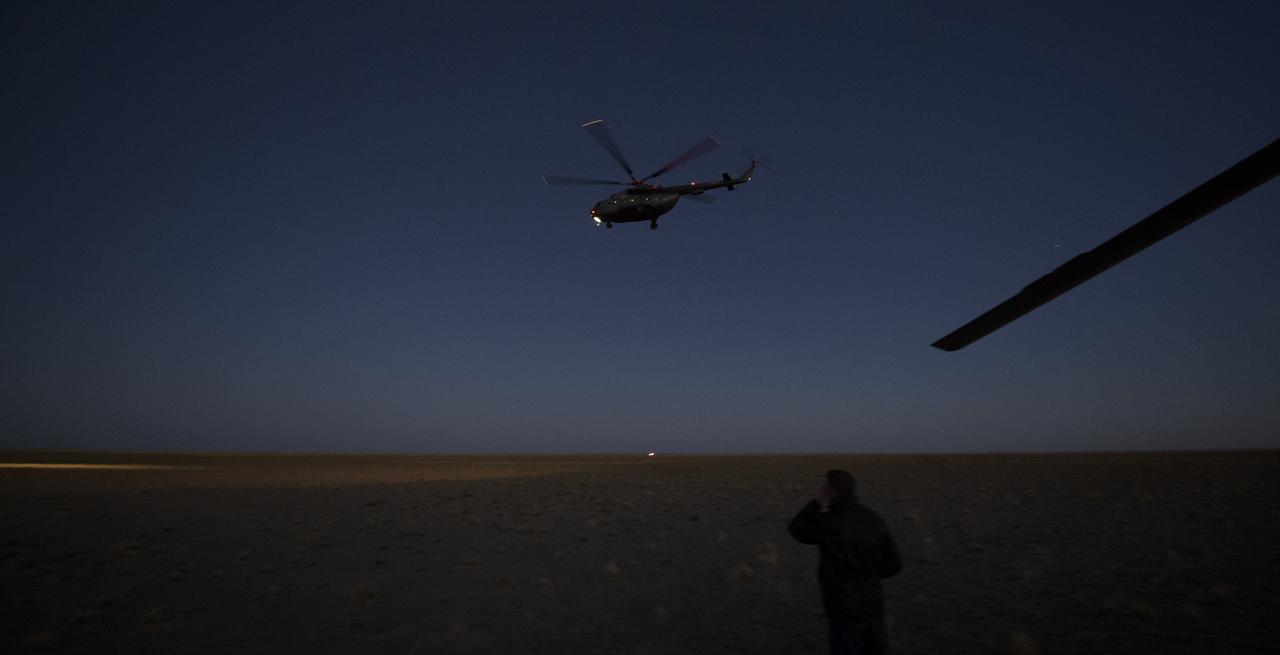
A Russian MI-8 helicopter leaves the Soyuz MS-08 spacecraft landing site after it the capsule landed with Expedition 56 Commander Drew Feustel and Flight Engineer Ricky Arnold of NASA, along with Flight Engineer and Soyuz Commander Oleg Artemyev of Roscosmos near the town of Zhezkazgan, Kazakhstan on Thursday, Oct. 4, 2018. Feustel, Arnold, and Artemyev are returning after 197 days in space where they served as members of the Expedition 55 and 56 crews onboard the International Space Station. Photo Credit: (NASA/Bill Ingalls)
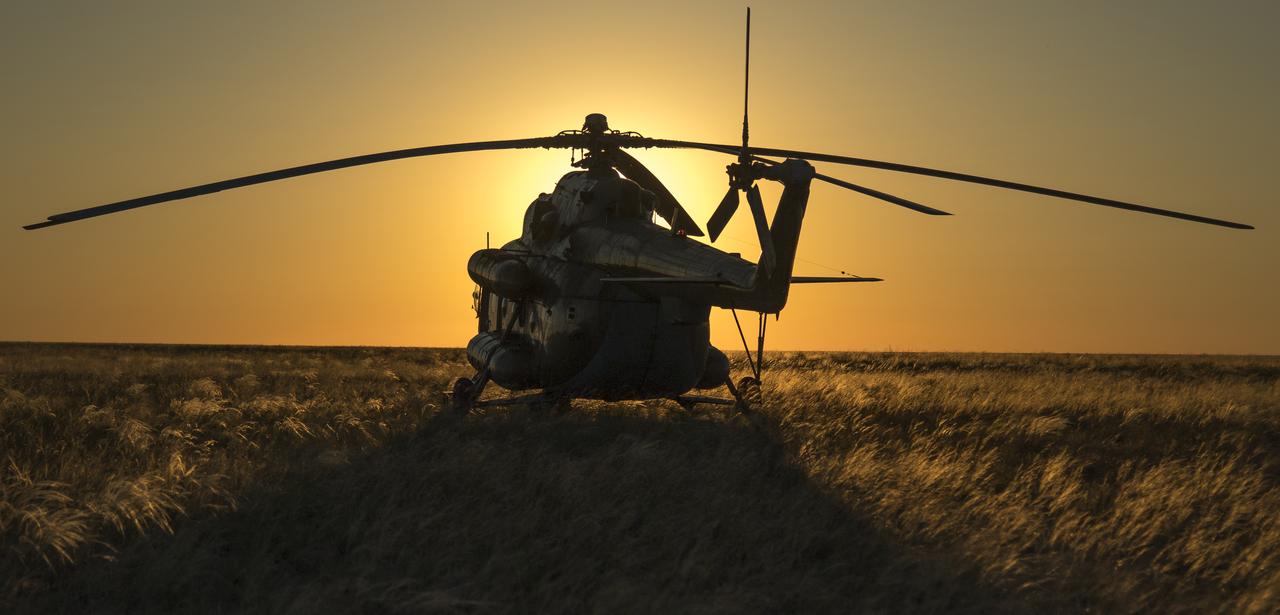
A Russian MI-8 helicopter is seen at the landing zone after Expedition 55 crew members Anton Shkaplerov of Roscosmos, Scott Tingle of NASA, and Norishige Kanai of the Japan Aerospace Exploration Agency (JAXA) landed in their Soyuz MS-07 spacecraft near the town of Zhezkazgan, Kazakhstan on Sunday, June 3, 2018. Shkaplerov, Tingle, and Kanai are returning after 168 days in space where they served as members of the Expedition 54 and 55 crews onboard the International Space Station. Photo Credit: (NASA/Bill Ingalls)
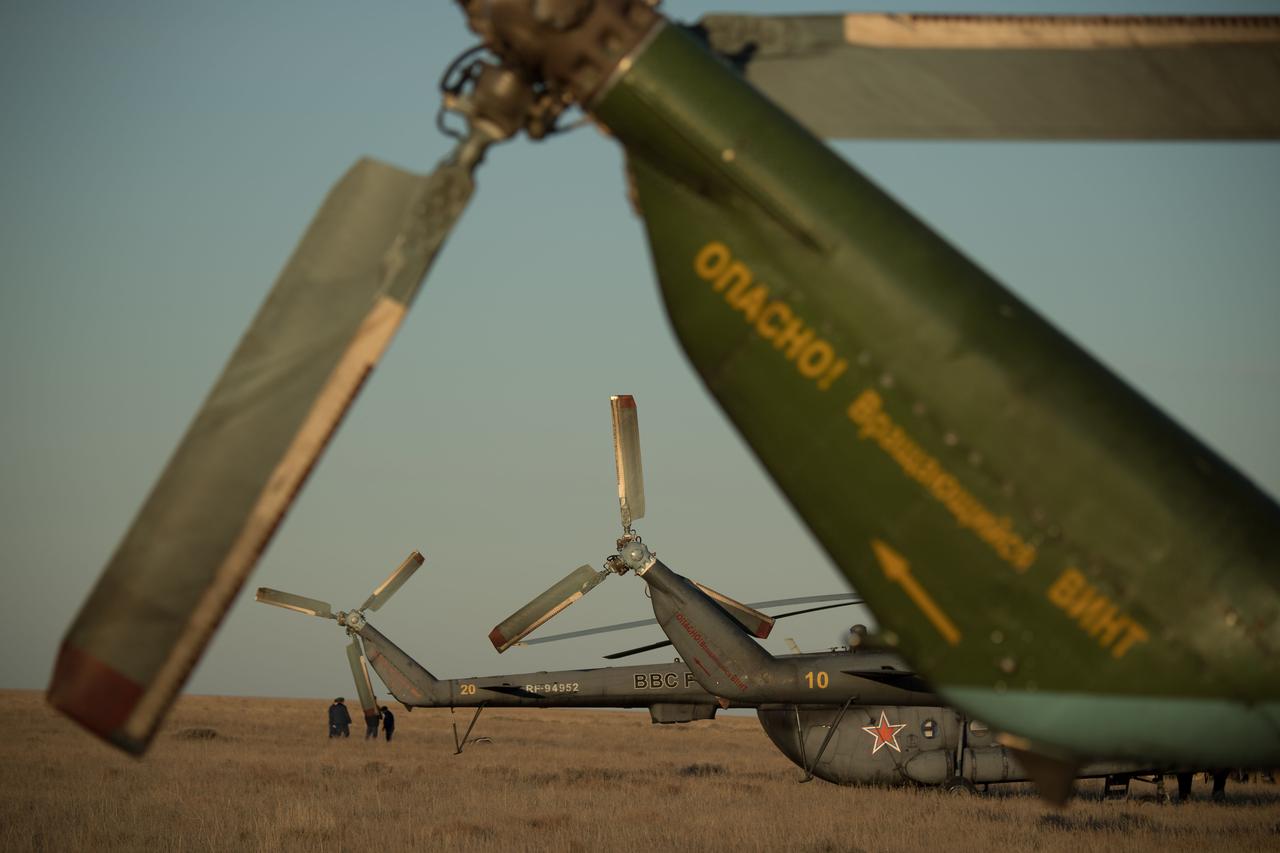
nhq201704100042 (April 10, 2017) --- Russian MI-8 helicopters are seen at the Soyuz MS-02 landing site after the spacecraft landed with Expedition 50 Commander Shane Kimbrough of NASA and Flight Engineers Sergey Ryzhikov and Andrey Borisenko of Roscosmos near the town of Zhezkazgan, Kazakhstan on Monday, April 10, 2017 (Kazakh time). Kimbrough, Ryzhikov, and Borisenko are returning after 173 days in space where they served as members of the Expedition 49 and 50 crews onboard the International Space Station. Photo Credit: (NASA/Bill Ingalls)
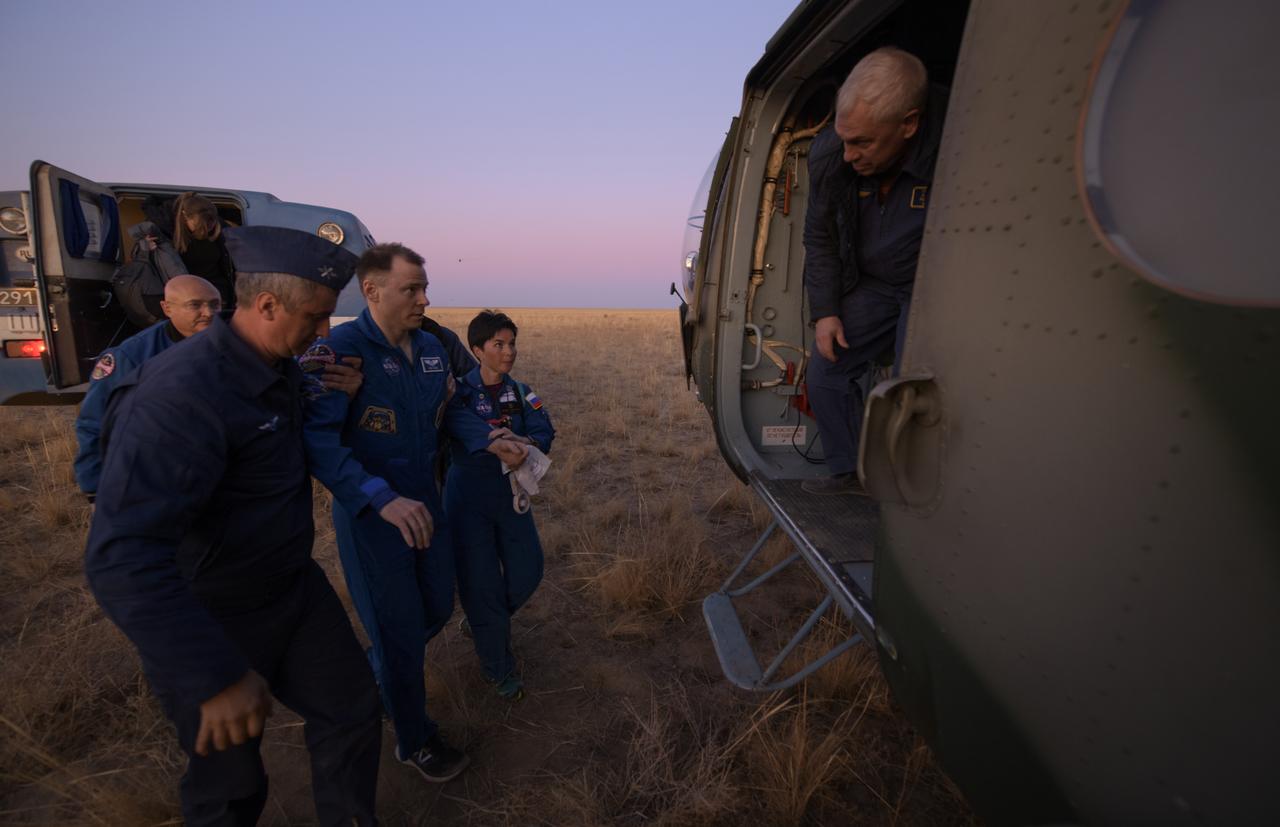
Expedition 60 crewmember Nick Hague of NASA is chelped into a Russian MI-8 helicopter after he and fellow Expedition 60 crewmember Alexey Ovchinin of Roscosmos and visiting astronaut Hazzaa Ali Almansoori of the United Arab Emirates landed in their Soyuz MS-12 spacecraft near the town of Zhezkazgan, Kazakhstan on Thursday, Oct. 3, 2019. Hague and Ovchinin are returning after 203 days in space where they served as members of the Expedition 59 and 60 crews onboard the International Space Station. Almansoori logged 8 days in space during his first flight as an astronaut. Photo Credit: (NASA/Bill Ingalls)
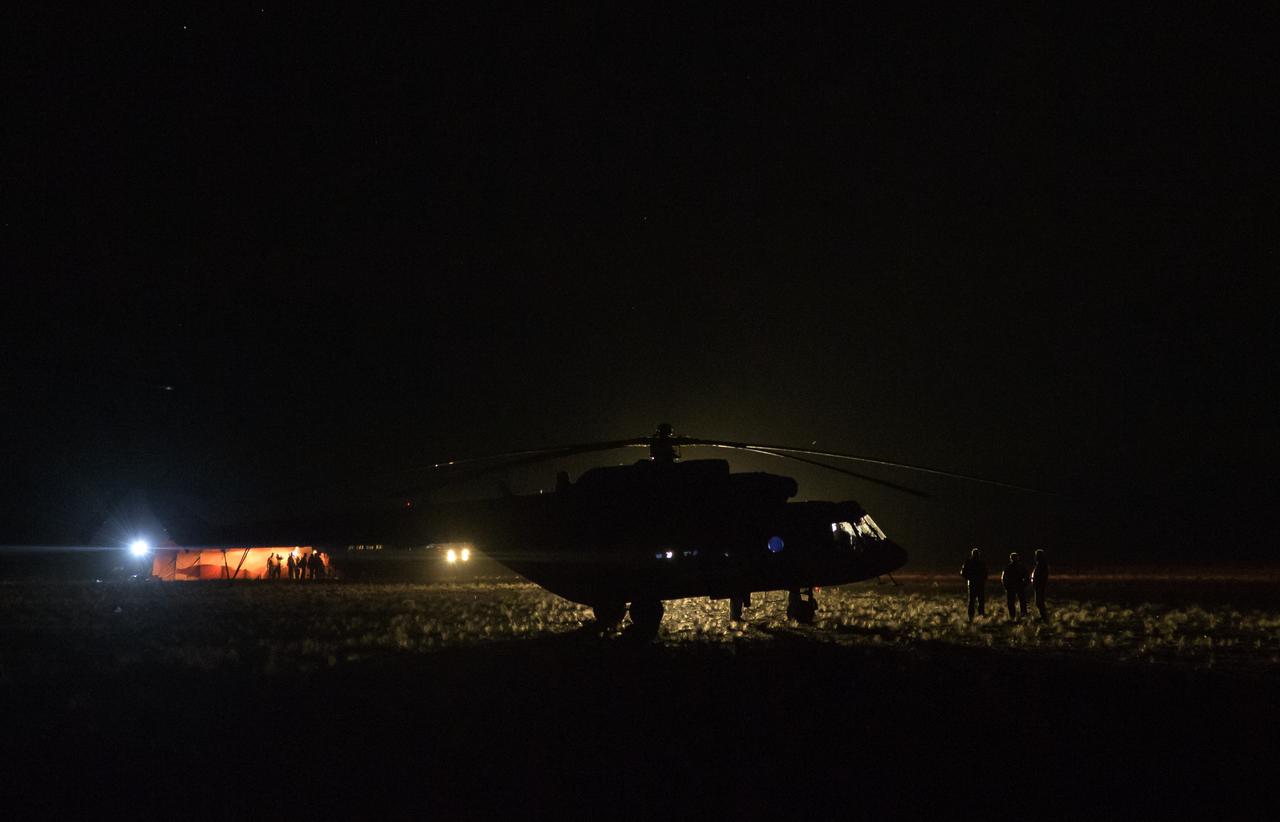
A Russian MI-8 helicopter waits to take Expedition 56 Commander Drew Feustel of NASA from the Soyuz MS-08 landing site to the Karaganda Airport in Kazakhstan on Thursday, Oct. 4, 2018. Feustel, Expedition 56 Flight Engineer Ricky Arnold of NASA, and Expedition 56 Flight Engineer and Soyuz Commander Oleg Artemyev of Roscosmos returned after 197 days in space where they served as members of the Expedition 55 and 56 crews onboard the International Space Station. Photo Credit: (NASA/Bill Ingalls)
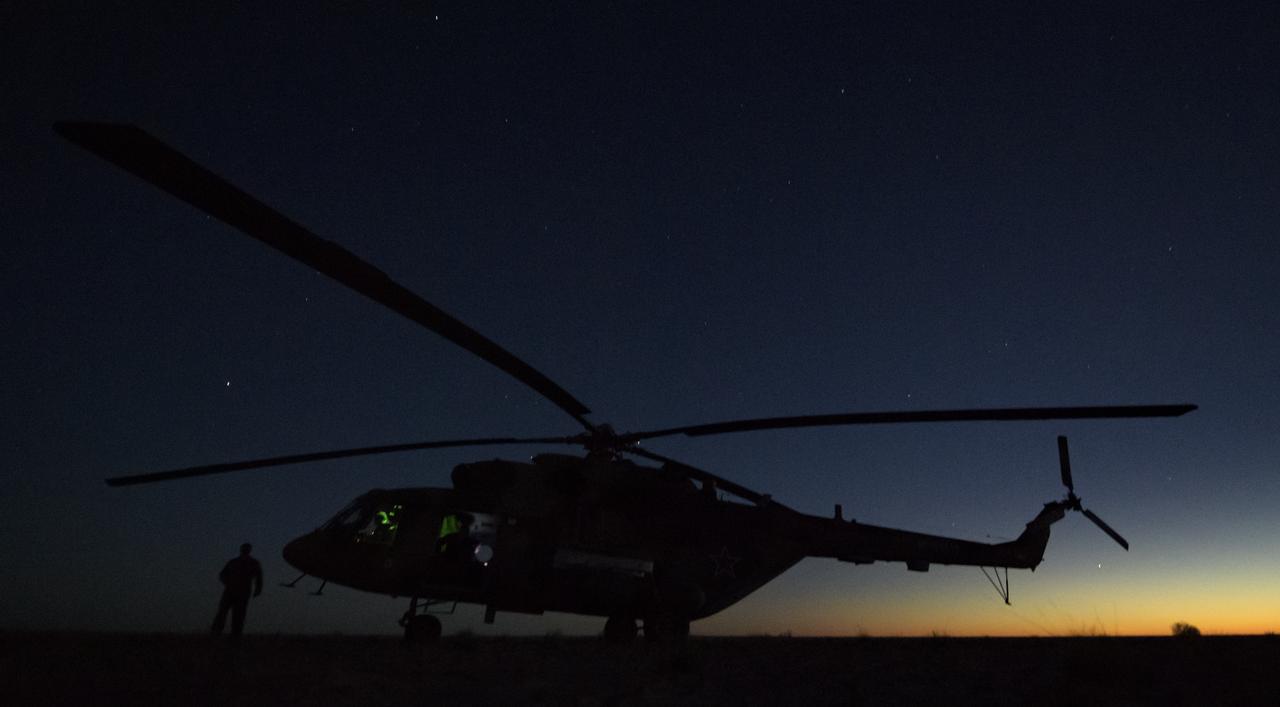
A Russian MI-8 helicopter waits to take Expedition 56 Flight Engineer Ricky Arnold of NASA from the Soyuz MS-08 landing site to the Karaganda Airport in Kazakhstan on Thursday, Oct. 4, 2018. Arnold, Expedition 56 Commander Drew Feustel of NASA, and Expedition 56 Flight Engineer and Soyuz Commander Oleg Artemyev of Roscosmos returned after 197 days in space where they served as members of the Expedition 55 and 56 crews onboard the International Space Station. Photo Credit: (NASA/Bill Ingalls)
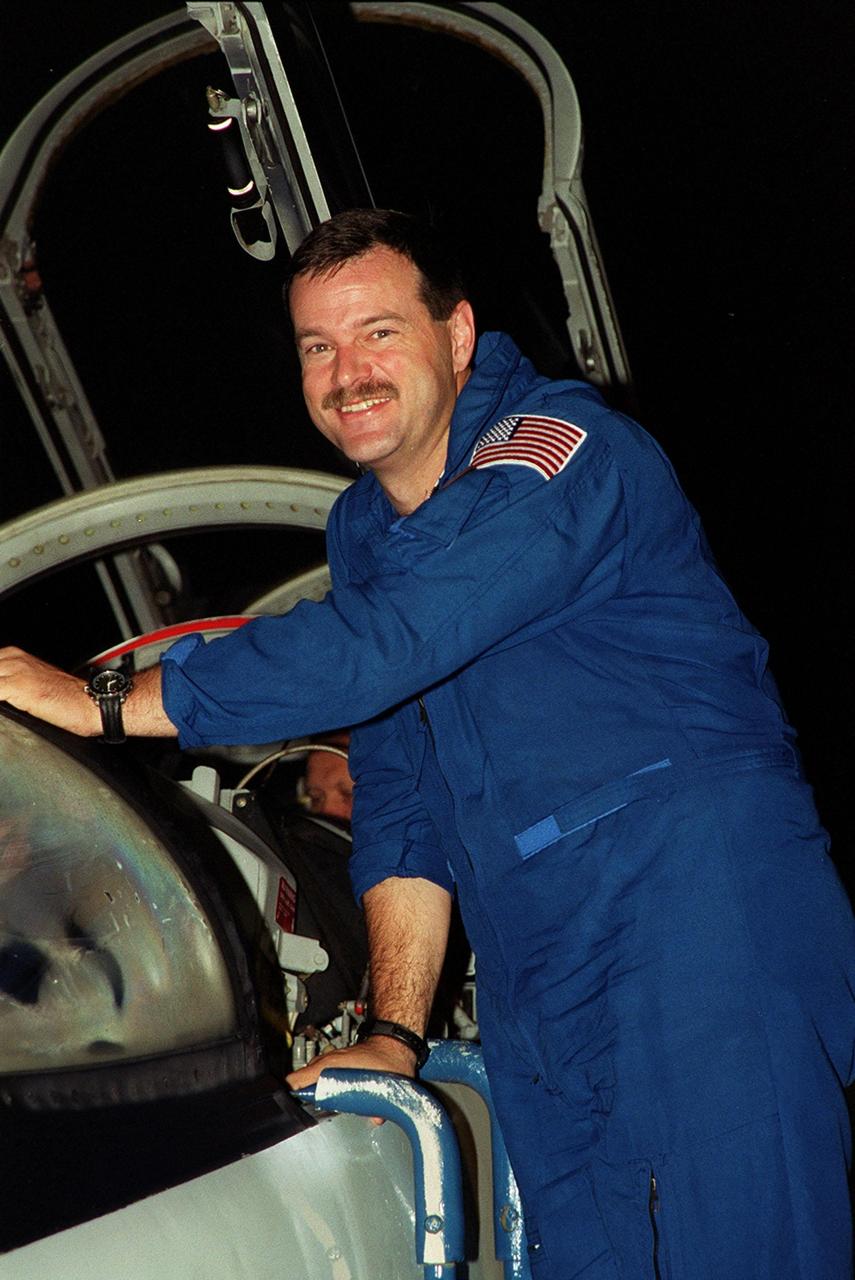
STS-106 Pilot Scott D. Altman steps down from the T-38 jet aircraft after landing at the KSC Shuttle Landing Facility. He and the rest of the crew will be making pre-launch preparations for the fourth flight to the International Space Station. STS-106 is scheduled to launch Sept. 8, 2000, at 8:45 a.m. EDT from Launch Pad 39B. On the 11-day mission, the seven-member crew will perform support tasks on orbit, transfer supplies and prepare the living quarters in the newly arrived Zvezda Service Module. The first long-duration crew, dubbed “Expedition One,” is due to arrive at the Station in late fall
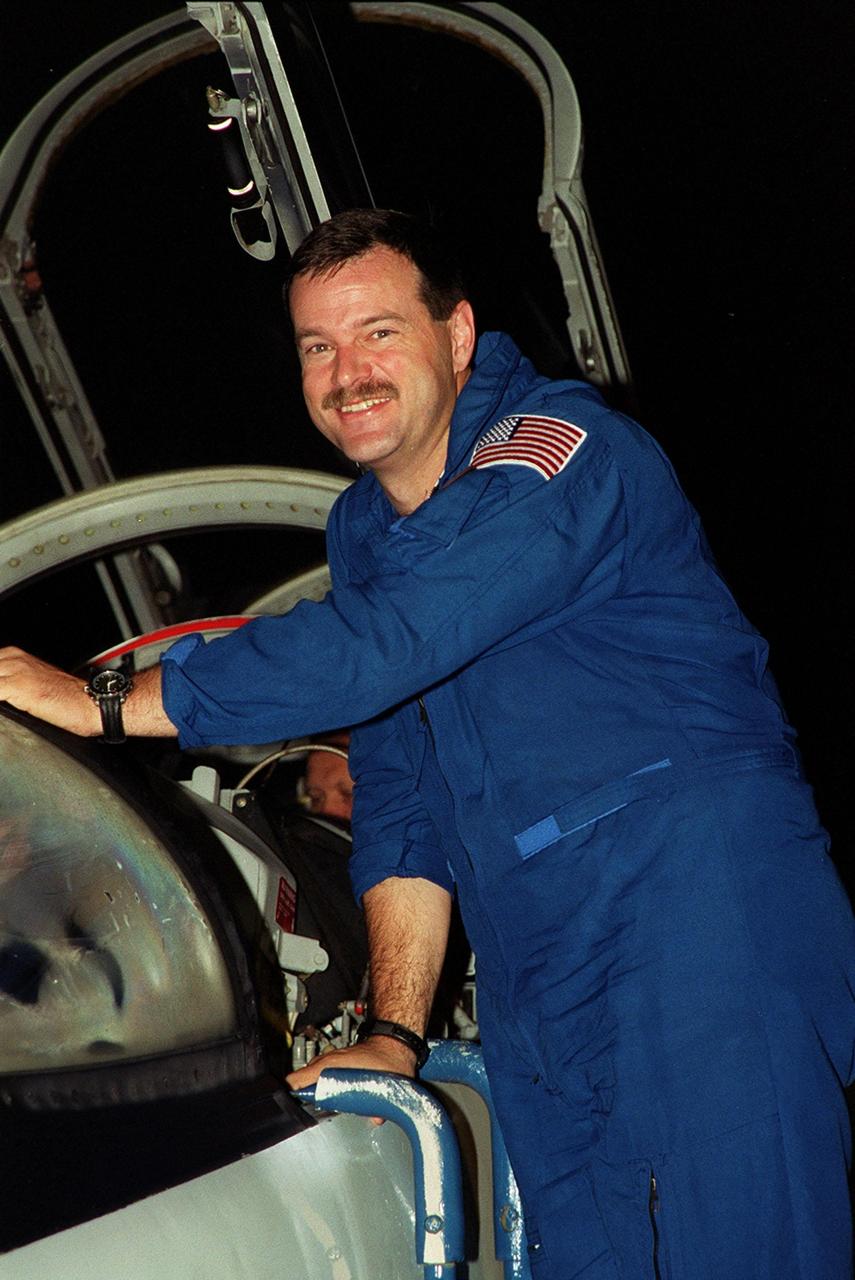
STS-106 Pilot Scott D. Altman steps down from the T-38 jet aircraft after landing at the KSC Shuttle Landing Facility. He and the rest of the crew will be making pre-launch preparations for the fourth flight to the International Space Station. STS-106 is scheduled to launch Sept. 8, 2000, at 8:45 a.m. EDT from Launch Pad 39B. On the 11-day mission, the seven-member crew will perform support tasks on orbit, transfer supplies and prepare the living quarters in the newly arrived Zvezda Service Module. The first long-duration crew, dubbed “Expedition One,” is due to arrive at the Station in late fall
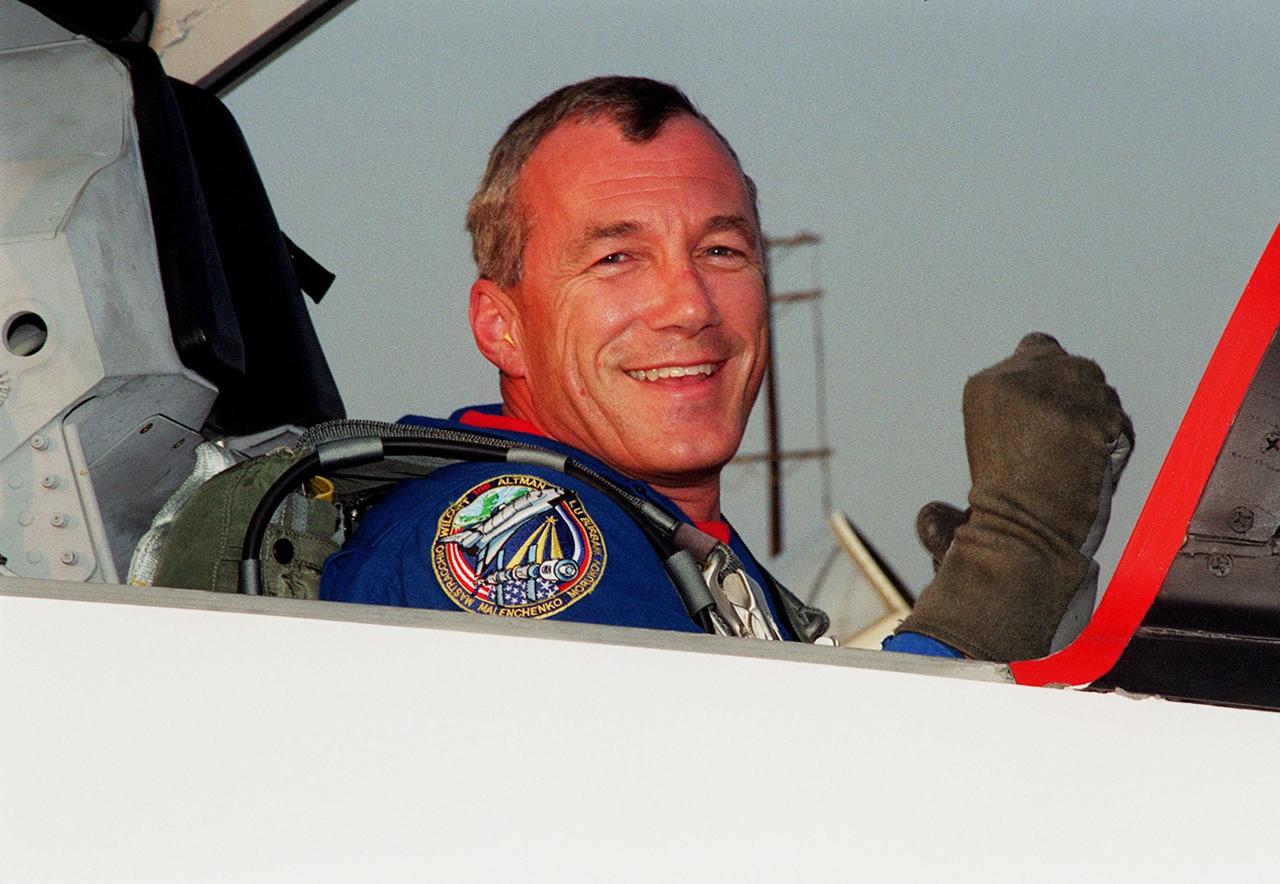
STS-106 Commander Terrence W. Wilcutt grins after landing at the KSC Shuttle Landing Facility aboard a T-38 jet aircraft. He and the rest of the crew will be taking part in Terminal Countdown Demonstration Test activities, which include emergency egress training and a simulated launch countdown. STS-106 is scheduled to launch Sept. 8, 2000, at 8:31 a.m. EDT from Launch Pad 39B. On the 11-day mission, the seven-member crew will perform support tasks on orbit, transfer supplies and prepare the living quarters in the newly arrived Zvezda Service Module. The first long-duration crew, dubbed “Expedition One,” is due to arrive at the Station in late fall
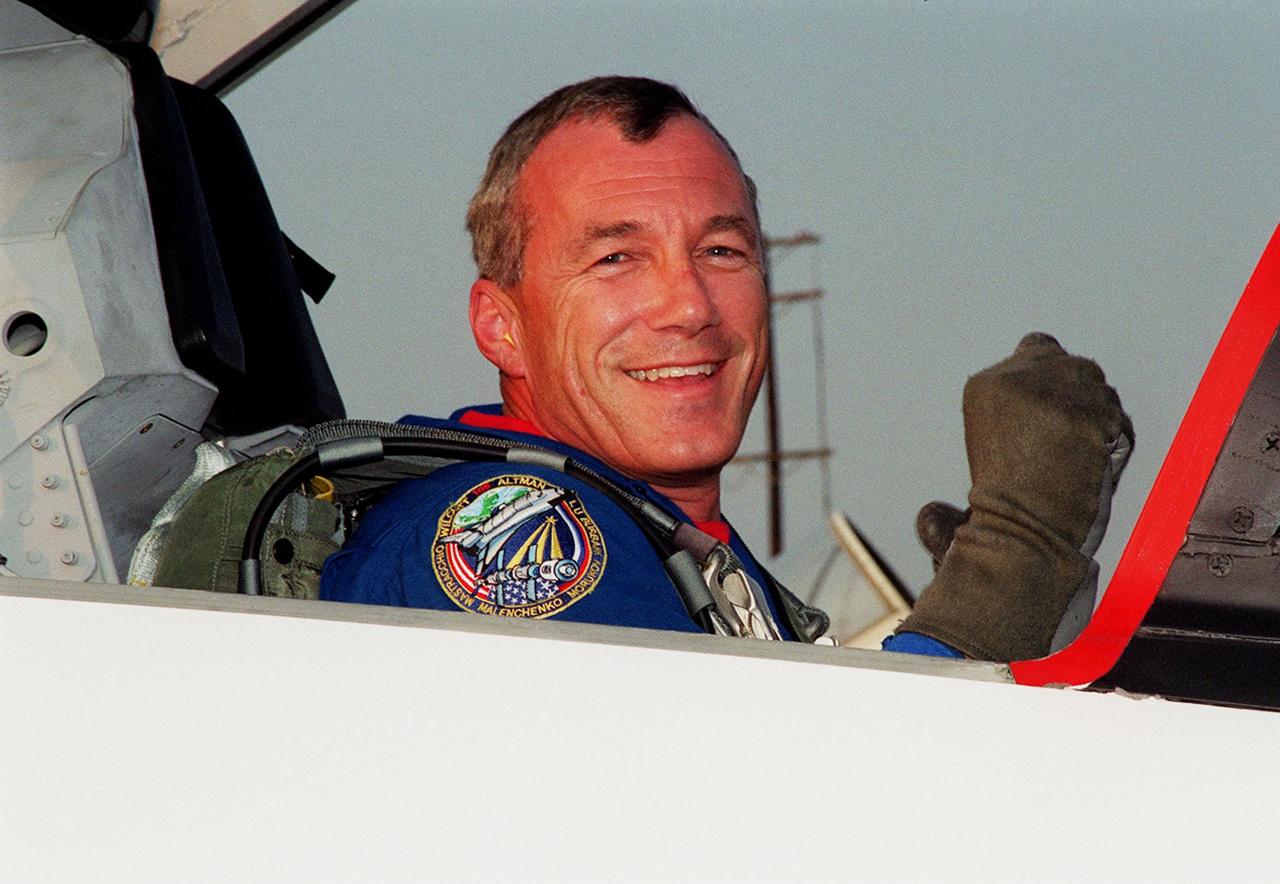
STS-106 Commander Terrence W. Wilcutt grins after landing at the KSC Shuttle Landing Facility aboard a T-38 jet aircraft. He and the rest of the crew will be taking part in Terminal Countdown Demonstration Test activities, which include emergency egress training and a simulated launch countdown. STS-106 is scheduled to launch Sept. 8, 2000, at 8:31 a.m. EDT from Launch Pad 39B. On the 11-day mission, the seven-member crew will perform support tasks on orbit, transfer supplies and prepare the living quarters in the newly arrived Zvezda Service Module. The first long-duration crew, dubbed “Expedition One,” is due to arrive at the Station in late fall
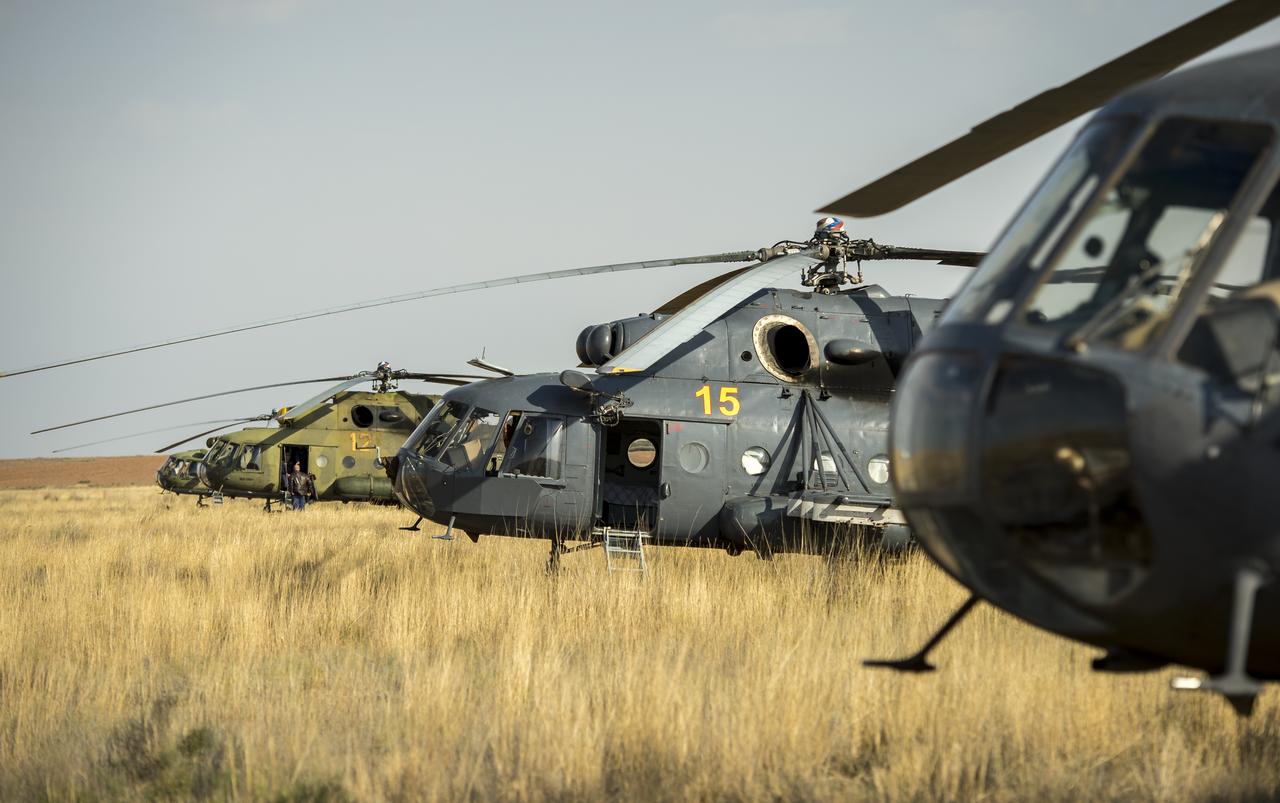
Russian search and rescue MI-8 helicopters are seen at the landing site of the Soyuz TMA-08M spacecraft in a remote area near the town of Zhezkazgan, Kazakhstan, on Wednesday, Sept. 11, 2013. The Soyuz landed with Expedition 36 Commander Pavel Vinogradov of the Russian Federal Space Agency (Roscosmos), Flight Engineer Alexander Misurkin of Roscosmos and Flight Engineer Chris Cassidy. Vinogradov, Misurkin and Cassidy are returning to Earth after five and a half months on the International Space Station. Photo Credit: (NASA/Bill Ingalls)
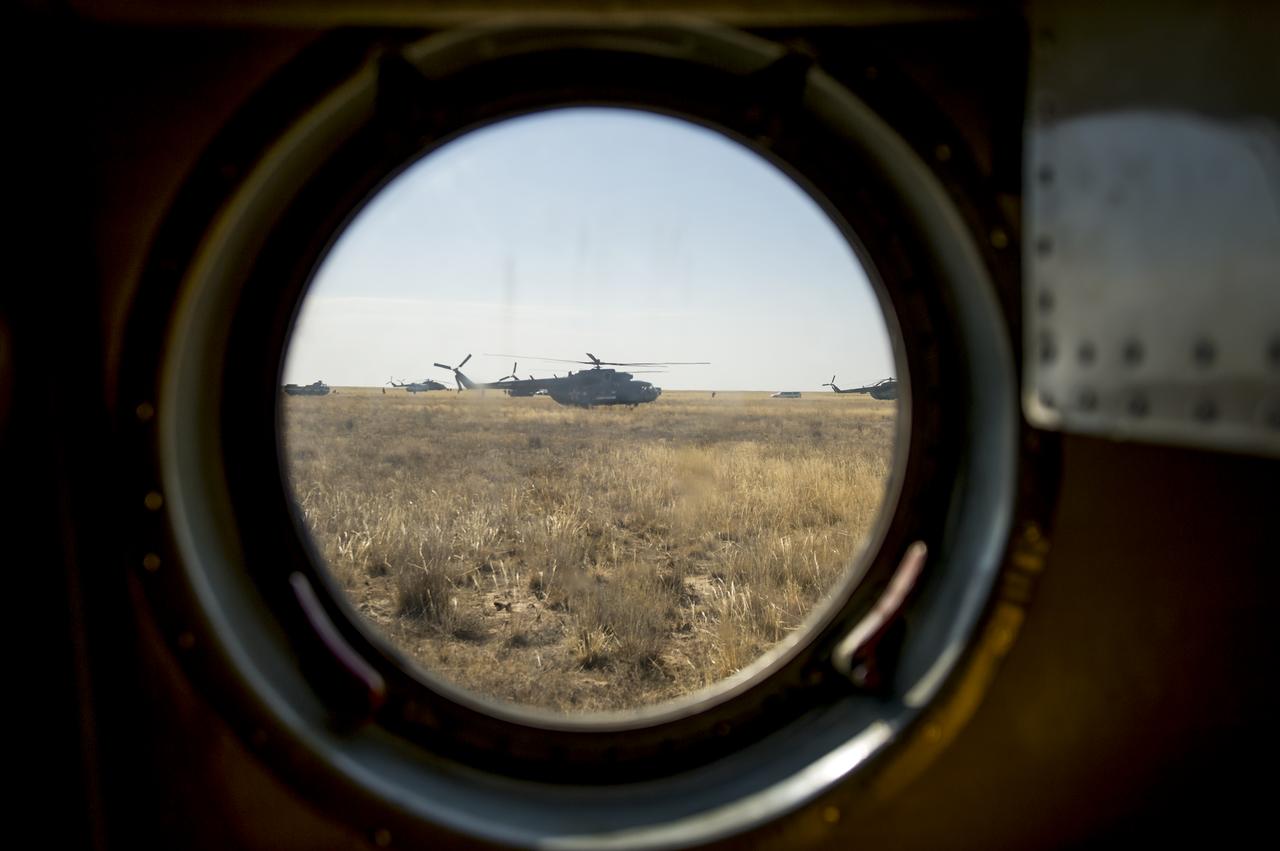
Russian search and rescue MI-8 helicopters are seen through the window of another helicopter at the landing site of the Soyuz TMA-08M spacecraft near the town of Zhezkazgan, Kazakhstan, on Wednesday, Sept. 11, 2013. The Soyuz landed with Expedition 36 Commander Pavel Vinogradov of the Russian Federal Space Agency (Roscosmos), Flight Engineer Alexander Misurkin of Roscosmos and Flight Engineer Chris Cassidy. Vinogradov, Misurkin and Cassidy are returning to Earth after five and a half months on the International Space Station. Photo Credit: (NASA/Bill Ingalls)
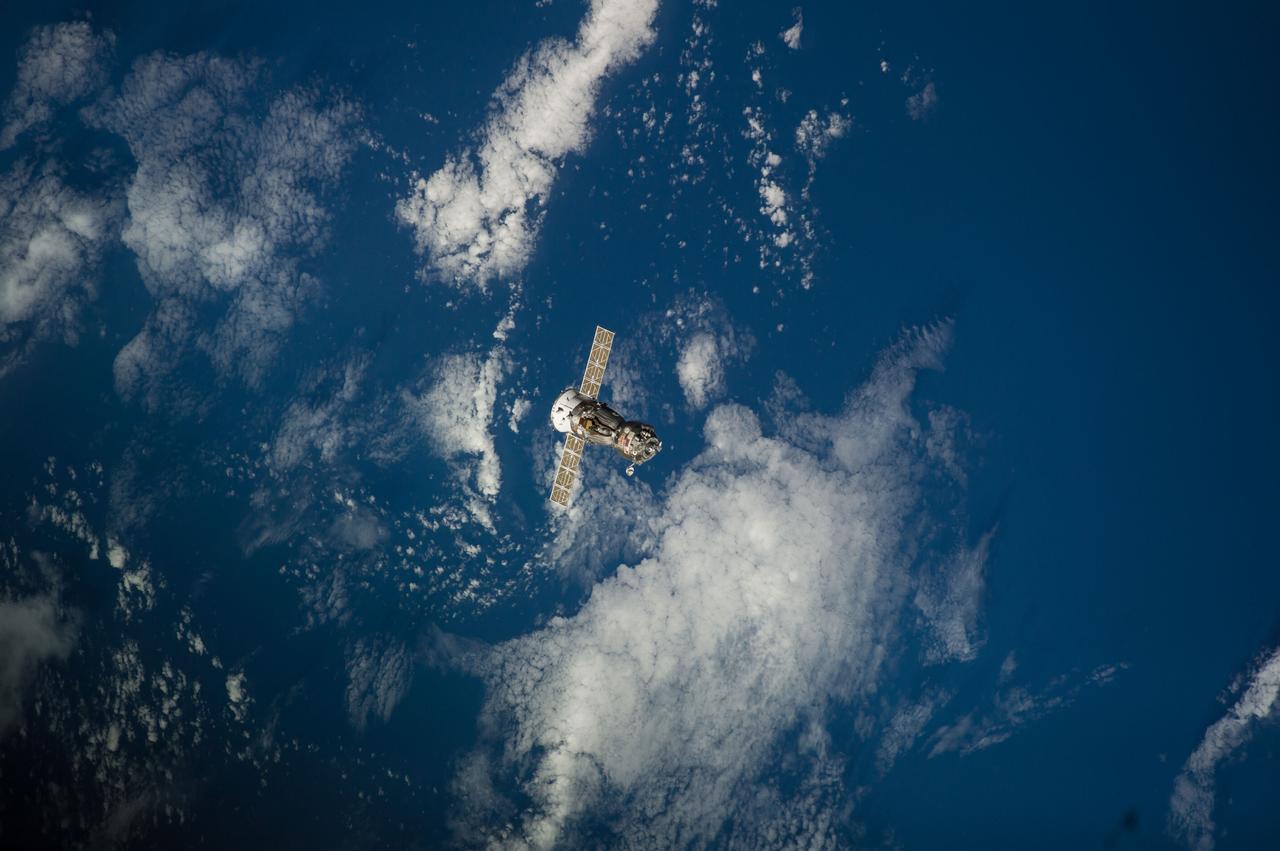
ISS041-E-000044 (10 Sept. 2014) --- The Soyuz TMA-12M spacecraft departs from the International Space Station and heads toward a landing in a remote area near the town of Zhezkazgan, Kazakhstan. NASA astronaut Steve Swanson, Expedition 40 commander; Russian cosmonaut Alexander Skvortsov, Soyuz commander and flight engineer; and Russian cosmonaut Oleg Artemyev, flight engineer, are returning from more than five months aboard the space station where they served as members of the Expedition 39 and 40 crews. Landing occurred at 10:23 p.m. (EDT), Sept. 10, 2014 (8:23 a.m., Sept. 11, Kazakh time).
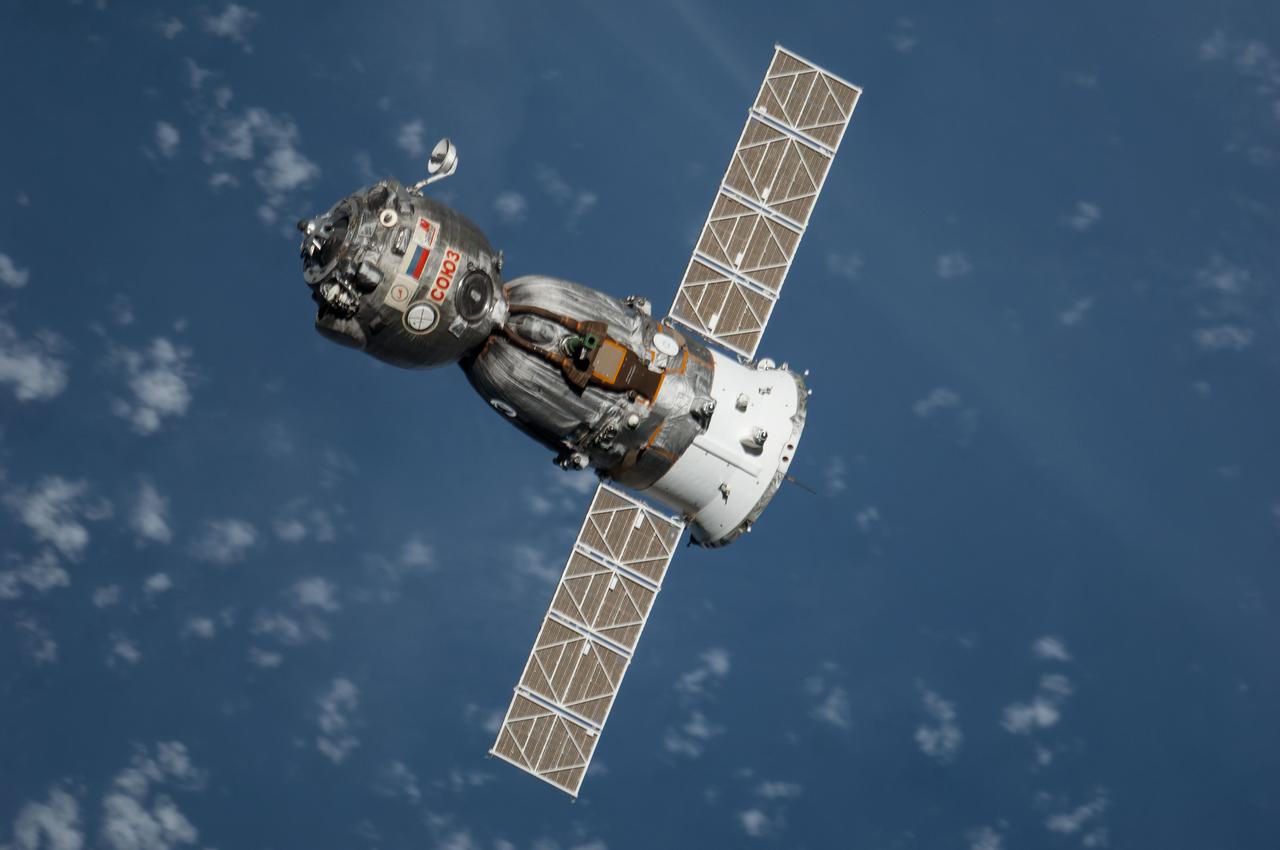
ISS041-E-000005 (10 Sept. 2014) --- The Soyuz TMA-12M spacecraft departs from the International Space Station and heads toward a landing in a remote area near the town of Zhezkazgan, Kazakhstan. NASA astronaut Steve Swanson, Expedition 40 commander; Russian cosmonaut Alexander Skvortsov, Soyuz commander and flight engineer; and Russian cosmonaut Oleg Artemyev, flight engineer, are returning from more than five months aboard the space station where they served as members of the Expedition 39 and 40 crews. Landing occurred at 10:23 p.m. (EDT), Sept. 10, 2014 (8:23 a.m., Sept. 11, Kazakh time).
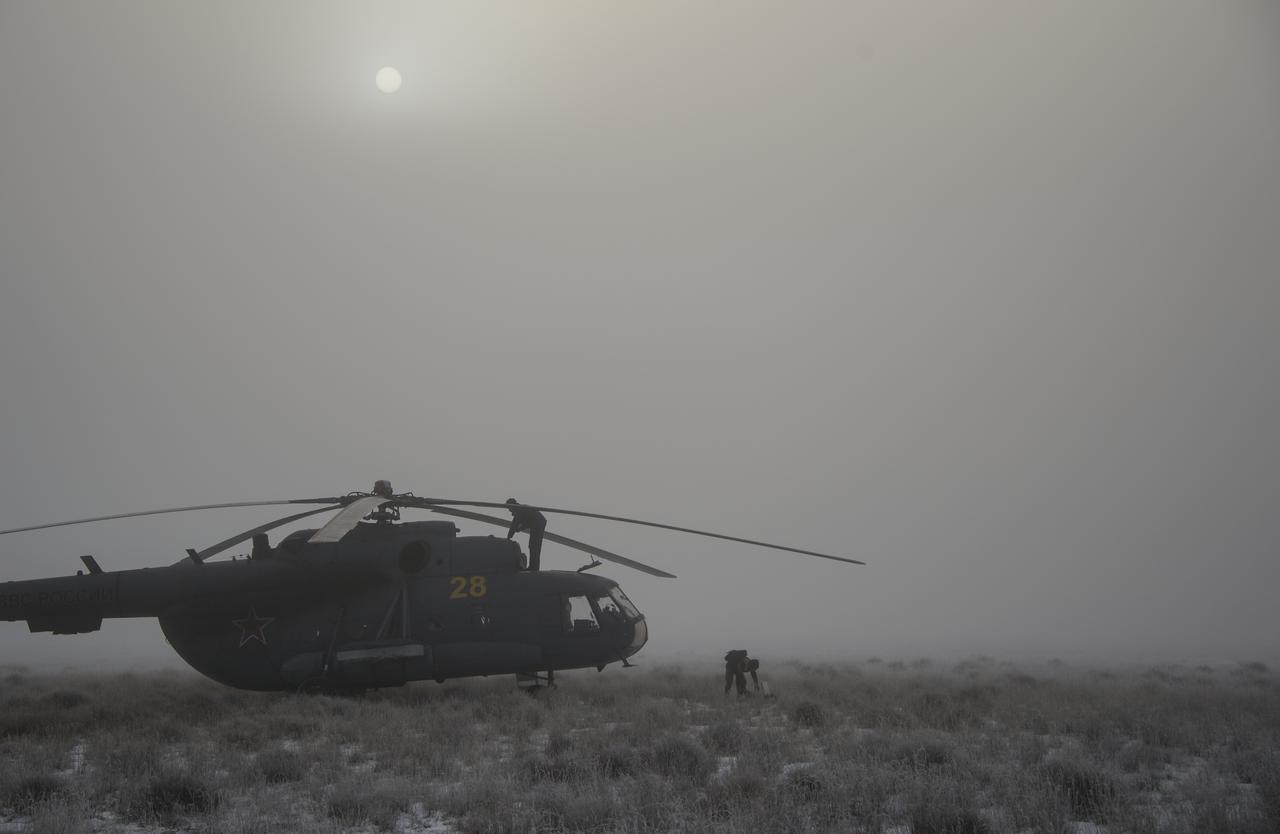
Russian MI-8 helicopter personnel work on their helicopters at the Soyuz TMA-14M spacecraft landing site shortly after the capsule landed with Expedition 42 commander Barry Wilmore of NASA, Alexander Samokutyaev of the Russian Federal Space Agency (Roscosmos) and Elena Serova of Roscosmos near the town of Zhezkazgan, Kazakhstan on Thursday, March 12, 2015. NASA Astronaut Wilmore, Russian Cosmonauts Samokutyaev and Serova are returning after almost six months onboard the International Space Station where they served as members of the Expedition 41 and 42 crews. Photo Credit: (NASA/Bill Ingalls)
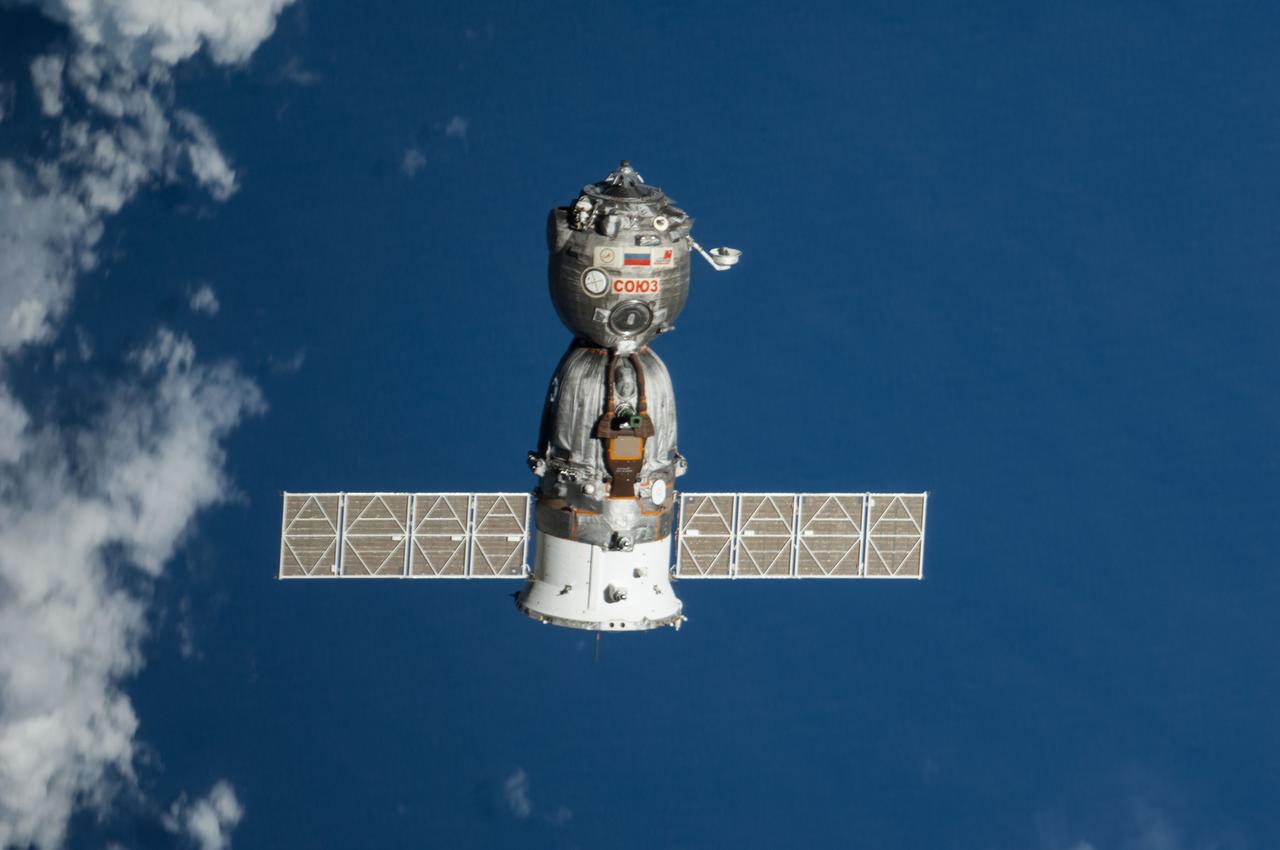
ISS041-E-000027 (10 Sept. 2014) --- The Soyuz TMA-12M spacecraft departs from the International Space Station and heads toward a landing in a remote area near the town of Zhezkazgan, Kazakhstan. NASA astronaut Steve Swanson, Expedition 40 commander; Russian cosmonaut Alexander Skvortsov, Soyuz commander and flight engineer; and Russian cosmonaut Oleg Artemyev, flight engineer, are returning from more than five months aboard the space station where they served as members of the Expedition 39 and 40 crews. Landing occurred at 10:23 p.m. (EDT), Sept. 10, 2014 (8:23 a.m., Sept. 11, Kazakh time).
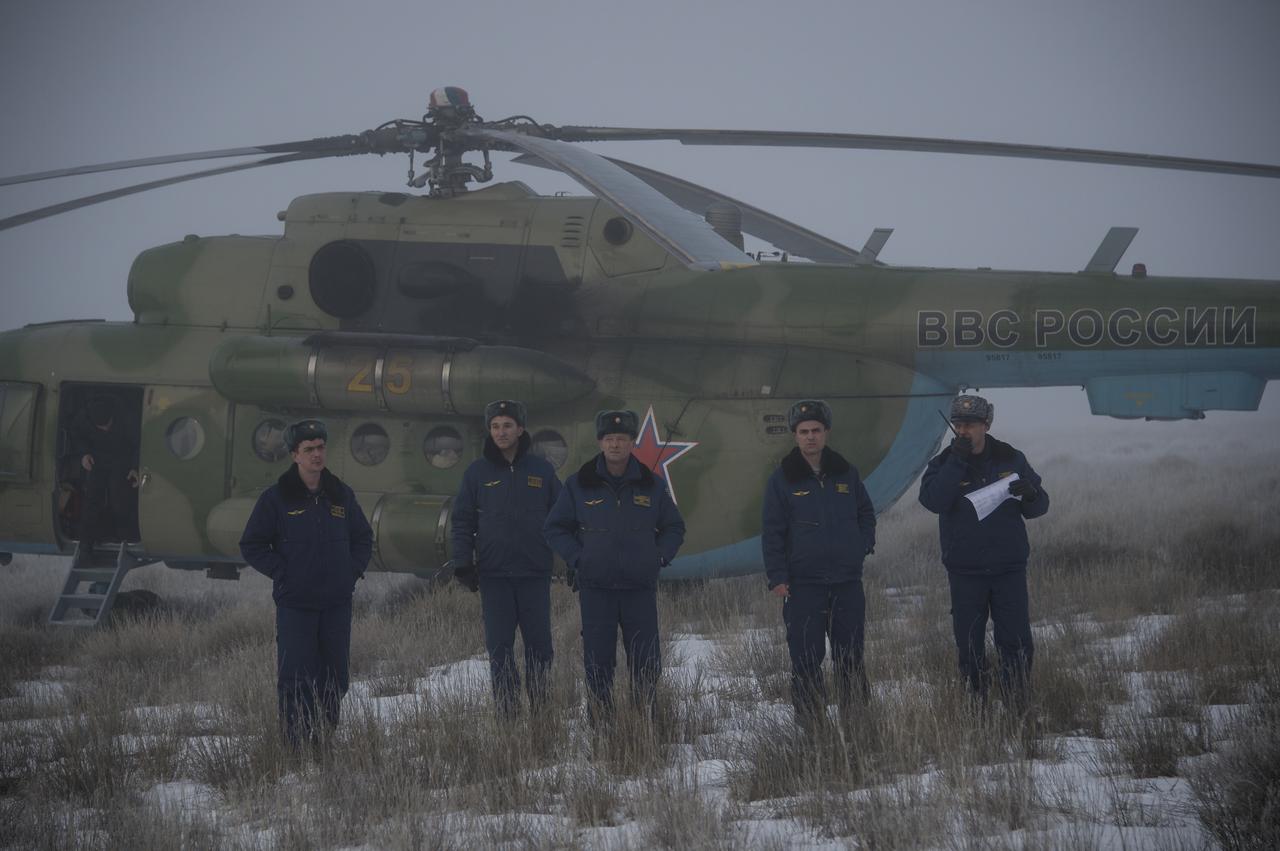
Russian MI-8 helicopter personnel look on at the Soyuz TMA-14M spacecraft landing site shortly after the capsule landed with Expedition 42 commander Barry Wilmore of NASA, Alexander Samokutyaev of the Russian Federal Space Agency (Roscosmos) and Elena Serova of Roscosmos near the town of Zhezkazgan, Kazakhstan on Thursday, March 12, 2015. NASA Astronaut Wilmore, Russian Cosmonauts Samokutyaev and Serova are returning after almost six months onboard the International Space Station where they served as members of the Expedition 41 and 42 crews. Photo Credit: (NASA/Bill Ingalls)
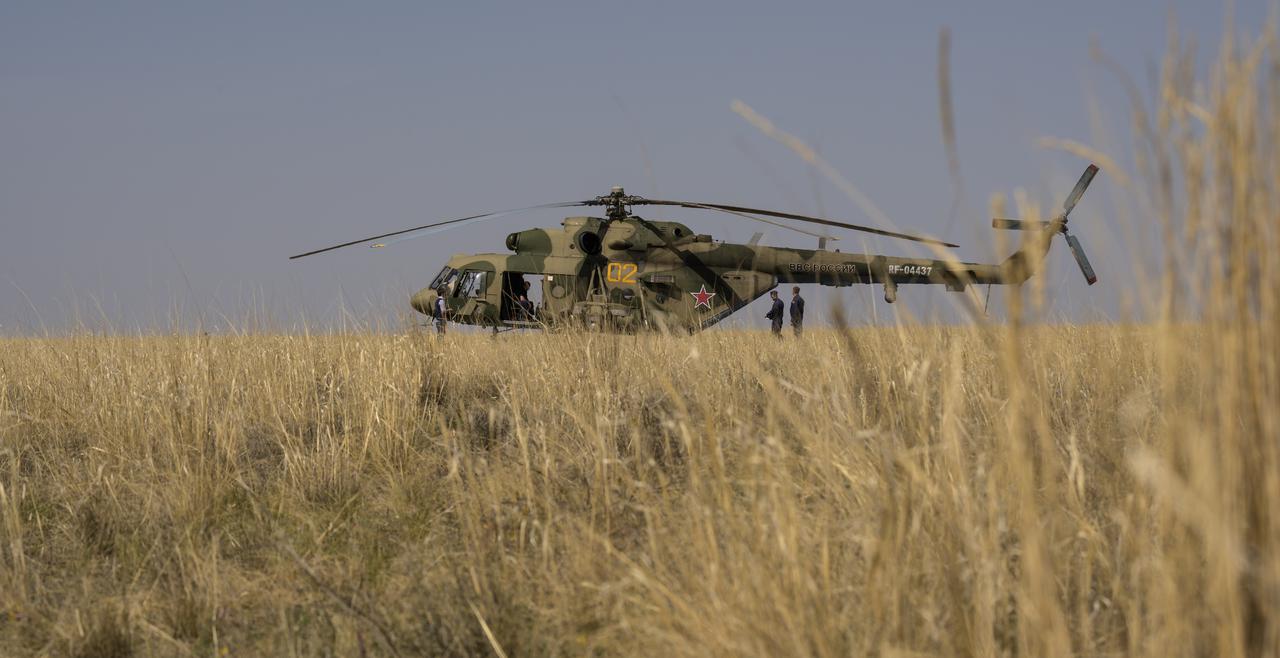
A Russian MI-8 helicopter waits at the Soyuz MS-17 landing site to take Expedition 64 crew members to the Karaganda Airport after NASA astronaut Kate Rubins, and Roscosmos cosmonauts Sergey Ryzhikov and Sergey Kud-Sverchkov landed in their Soyuz MS-17 spacecraft near the town of Zhezkazgan, Kazakhstan on Saturday, April 17, 2021. Rubins, Ryzhikov and Kud-Sverchkov returned after 185 days in space having served as Expedition 63-64 crew members onboard the International Space Station. Photo Credit: NASA/Bill Ingalls
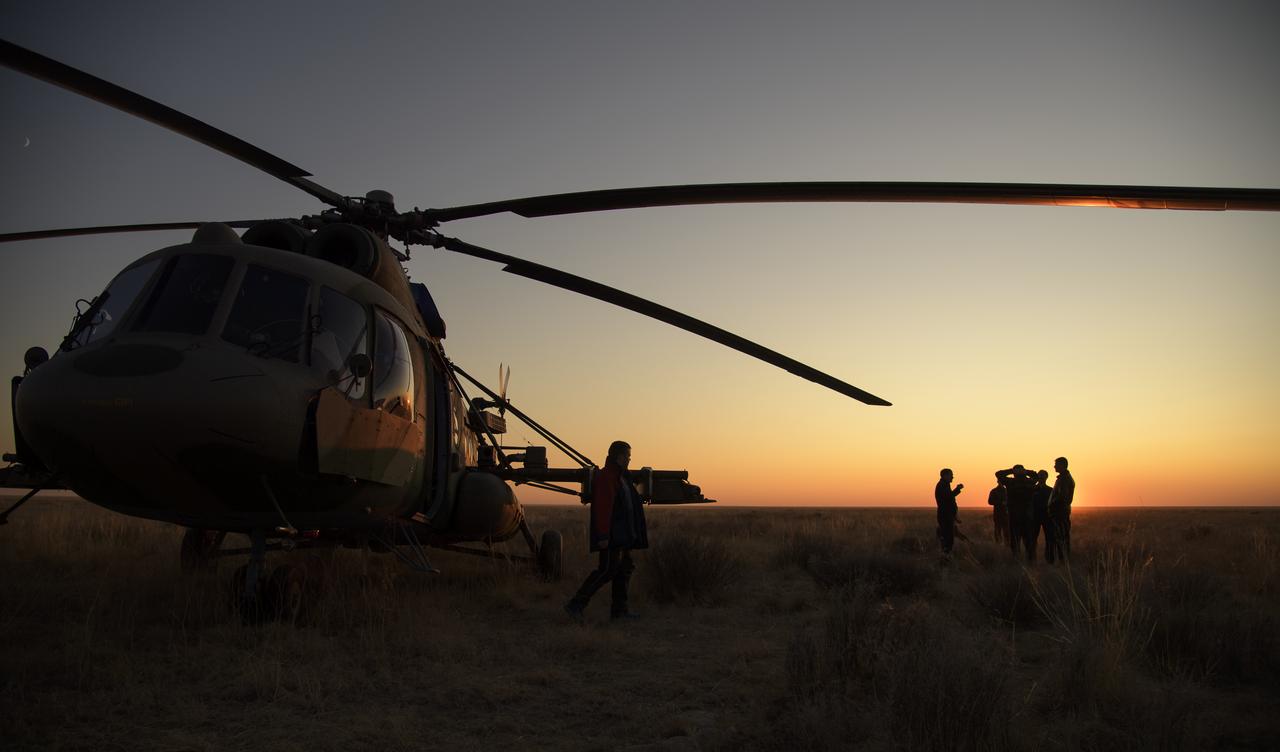
Supports teams wait to depart the Soyuz MS-12 spacecraft landing site after the capsule landed with Expedition 60 crew members Nick Hague of NASA and Alexey Ovchinin of Roscosmos, along with visiting astronaut Hazzaa Ali Almansoori of the United Arab Emirates in a remote area near the town of Zhezkazgan, Kazakhstan, Thursday, Oct. 3, 2019. Hague and Ovchinin are returning after 203 days in space where they served as members of the Expedition 59 and 60 crews onboard the International Space Station. Almansoori logged 8 days in space during his first flight as an astronaut. Photo Credit: (NASA/Bill Ingalls)
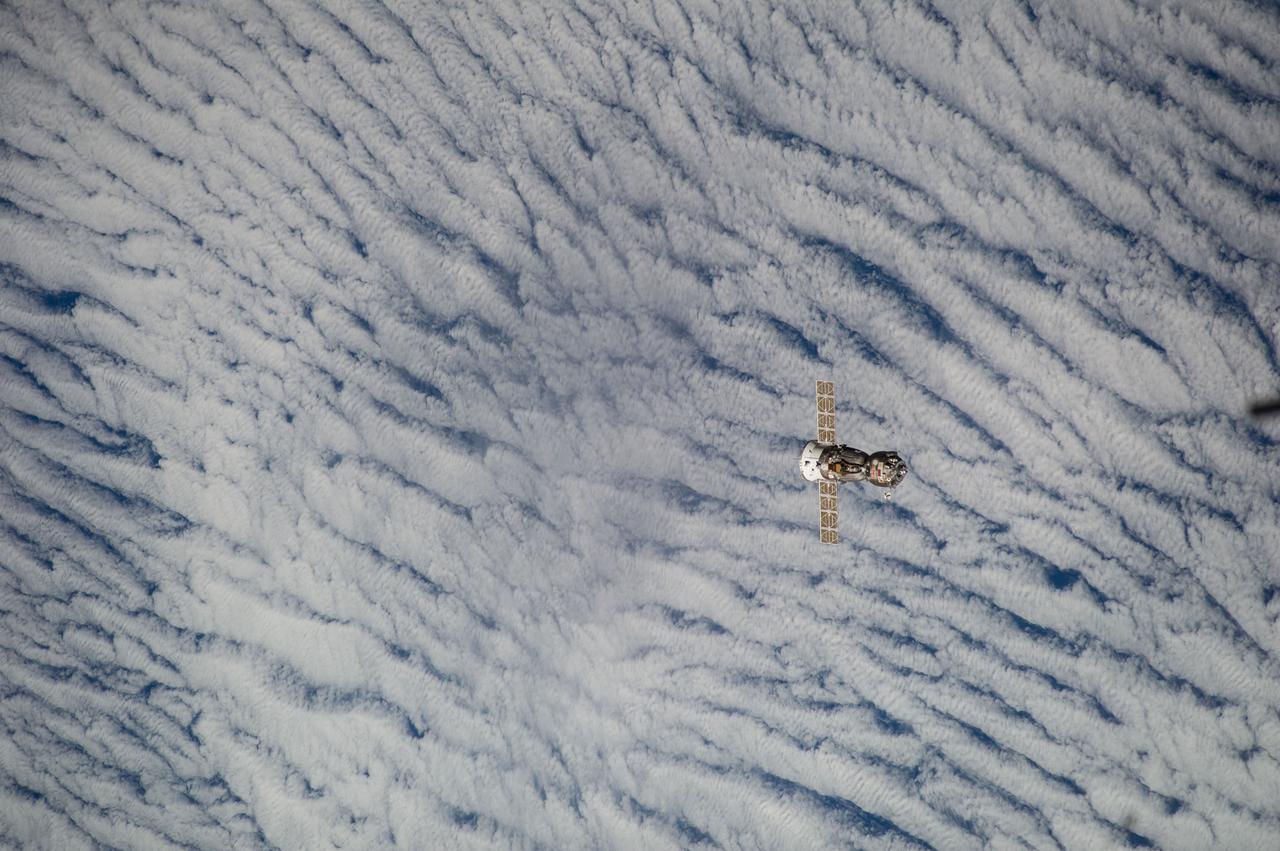
ISS041-E-000047 (10 Sept. 2014) --- The Soyuz TMA-12M spacecraft departs from the International Space Station and heads toward a landing in a remote area near the town of Zhezkazgan, Kazakhstan. NASA astronaut Steve Swanson, Expedition 40 commander; Russian cosmonaut Alexander Skvortsov, Soyuz commander and flight engineer; and Russian cosmonaut Oleg Artemyev, flight engineer, are returning from more than five months aboard the space station where they served as members of the Expedition 39 and 40 crews. Landing occurred at 10:23 p.m. (EDT), Sept. 10, 2014 (8:23 a.m., Sept. 11, Kazakh time).
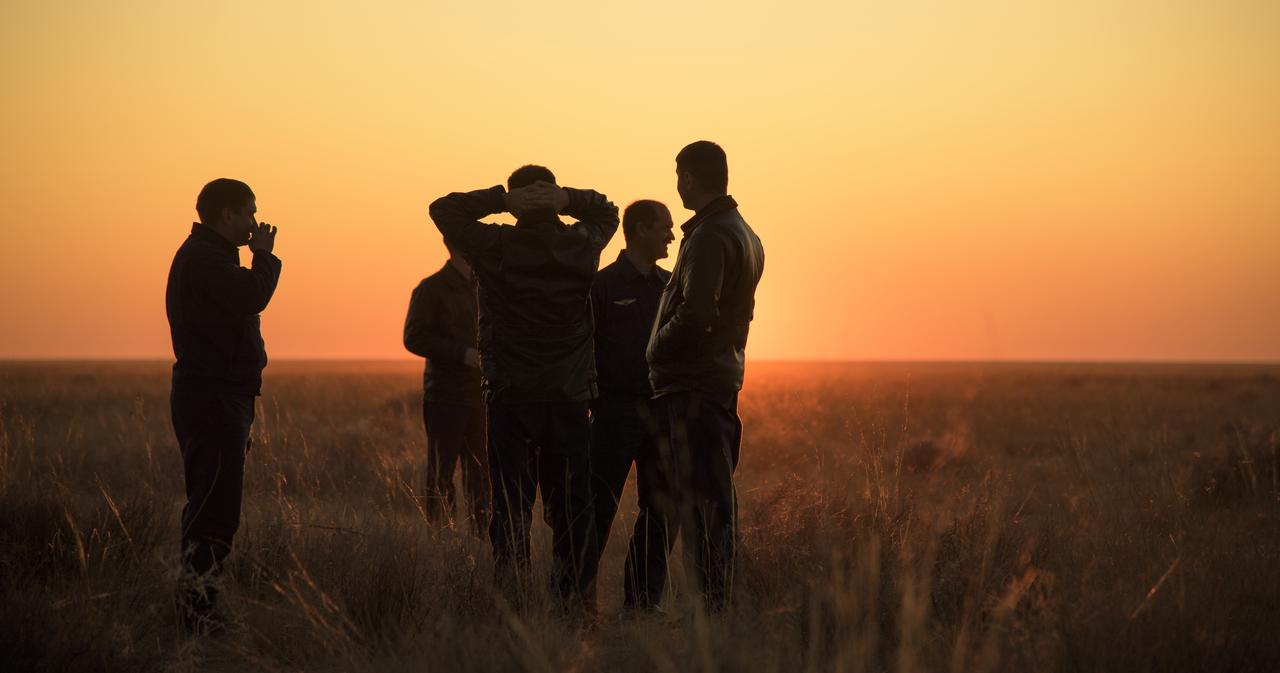
Supports teams wait to depart the Soyuz MS-12 spacecraft landing site after the capsule landed with Expedition 60 crew members Nick Hague of NASA and Alexey Ovchinin of Roscosmos, along with visiting astronaut Hazzaa Ali Almansoori of the United Arab Emirates in a remote area near the town of Zhezkazgan, Kazakhstan, Thursday, Oct. 3, 2019. Hague and Ovchinin are returning after 203 days in space where they served as members of the Expedition 59 and 60 crews onboard the International Space Station. Almansoori logged 8 days in space during his first flight as an astronaut. Photo Credit: (NASA/Bill Ingalls)
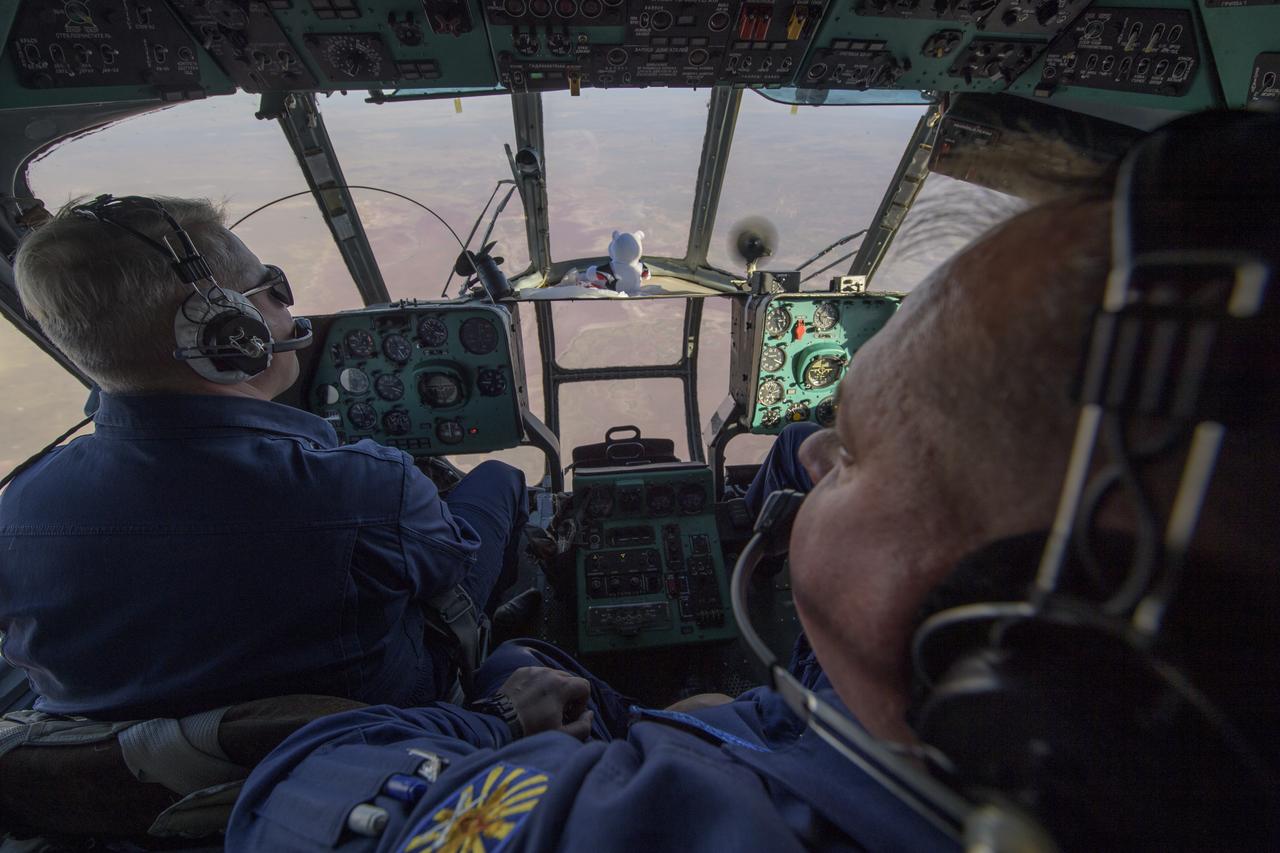
Russian MI-8 pilots scan the horizon for the Soyuz MS-08 spacecraft in the predicted landing zone near the town of Zhezkazgan, Kazakhstan on Thursday, Oct. 4, 2018. The spacecraft landed with Expedition 56 Commander Drew Feustel and Flight Engineer Ricky Arnold of NASA, along with Flight Engineer and Soyuz Commander Oleg Artemyev of Roscosmos. Feustel, Arnold, and Artemyev returned to Earth after having spent 197 days in space where they served as members of the Expedition 55 and 56 crews onboard the International Space Station. Photo Credit: (NASA/Bill Ingalls)
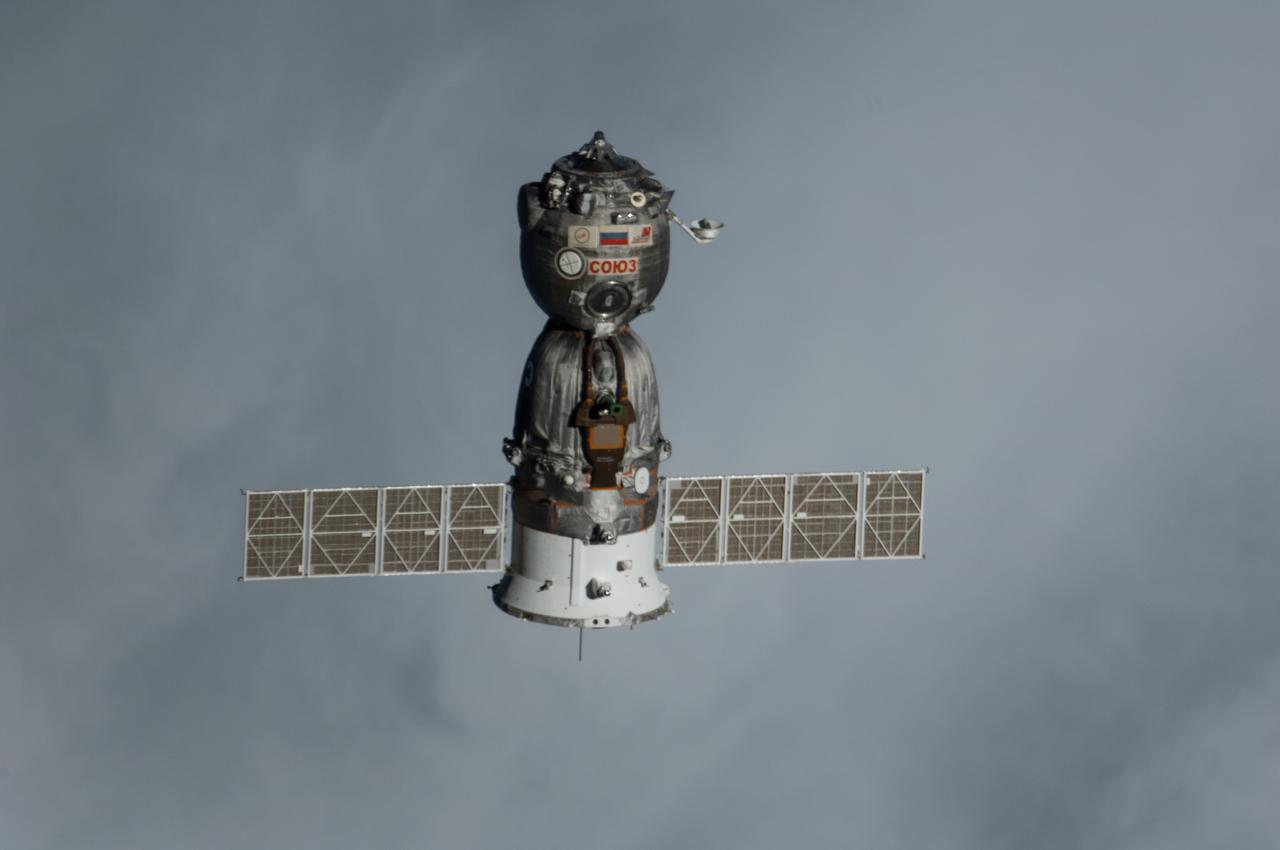
ISS041-E-000021 (10 Sept. 2014) --- The Soyuz TMA-12M spacecraft departs from the International Space Station and heads toward a landing in a remote area near the town of Zhezkazgan, Kazakhstan. NASA astronaut Steve Swanson, Expedition 40 commander; Russian cosmonaut Alexander Skvortsov, Soyuz commander and flight engineer; and Russian cosmonaut Oleg Artemyev, flight engineer, are returning from more than five months aboard the space station where they served as members of the Expedition 39 and 40 crews. Landing occurred at 10:23 p.m. (EDT), Sept. 10, 2014 (8:23 a.m., Sept. 11, Kazakh time).
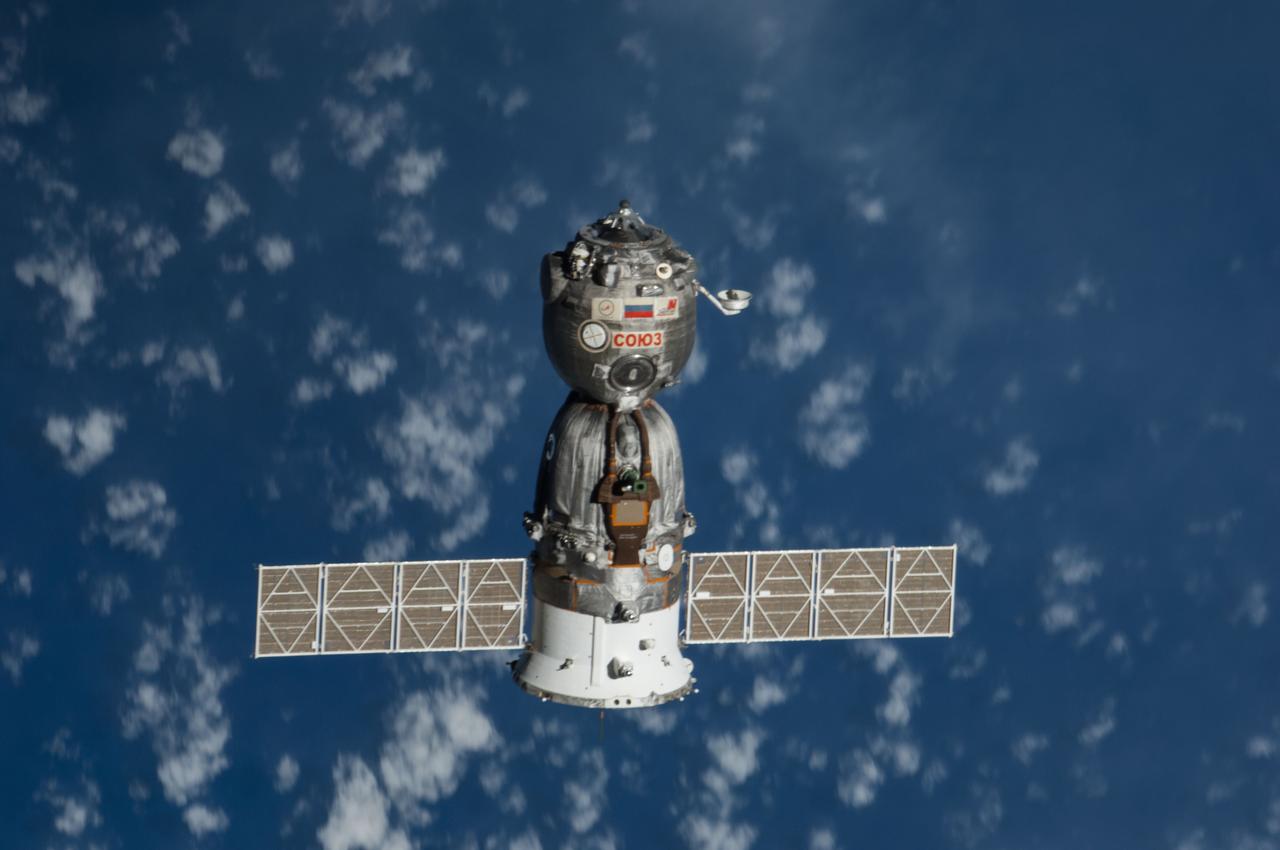
ISS041-E-000017 (10 Sept. 2014) --- The Soyuz TMA-12M spacecraft departs from the International Space Station and heads toward a landing in a remote area near the town of Zhezkazgan, Kazakhstan. NASA astronaut Steve Swanson, Expedition 40 commander; Russian cosmonaut Alexander Skvortsov, Soyuz commander and flight engineer; and Russian cosmonaut Oleg Artemyev, flight engineer, are returning from more than five months aboard the space station where they served as members of the Expedition 39 and 40 crews. Landing occurred at 10:23 p.m. (EDT), Sept. 10, 2014 (8:23 a.m., Sept. 11, Kazakh time).
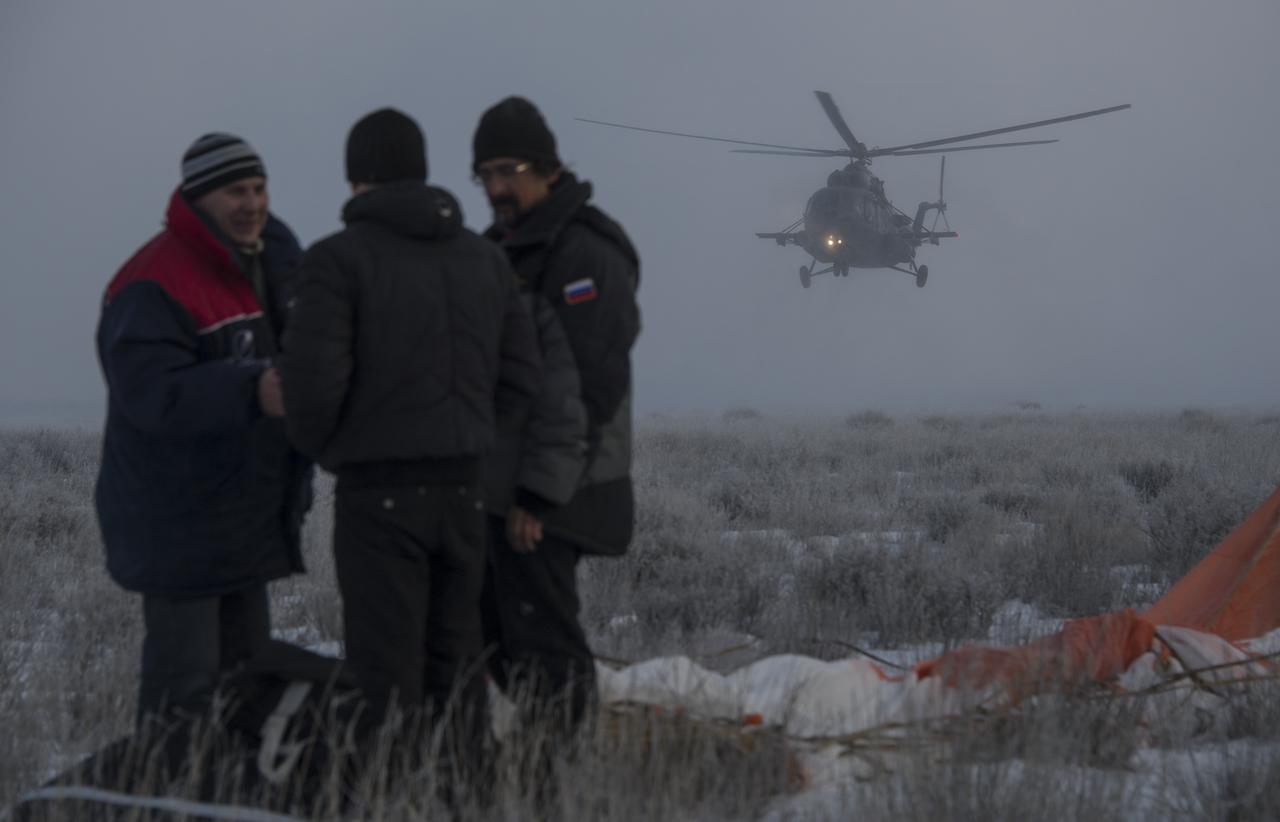
A Russian MI-8 Helicopter arrives at the Soyuz TMA-14M spacecraft landing site after the soyuz landed with Expedition 42 commander Barry Wilmore of NASA, Alexander Samokutyaev of the Russian Federal Space Agency (Roscosmos) and Elena Serova of Roscosmos near the town of Zhezkazgan, Kazakhstan on Thursday, March 12, 2015. NASA Astronaut Wilmore, Russian Cosmonauts Samokutyaev and Serova are returning after almost six months onboard the International Space Station where they served as members of the Expedition 41 and 42 crews. Photo Credit: (NASA/Bill Ingalls)
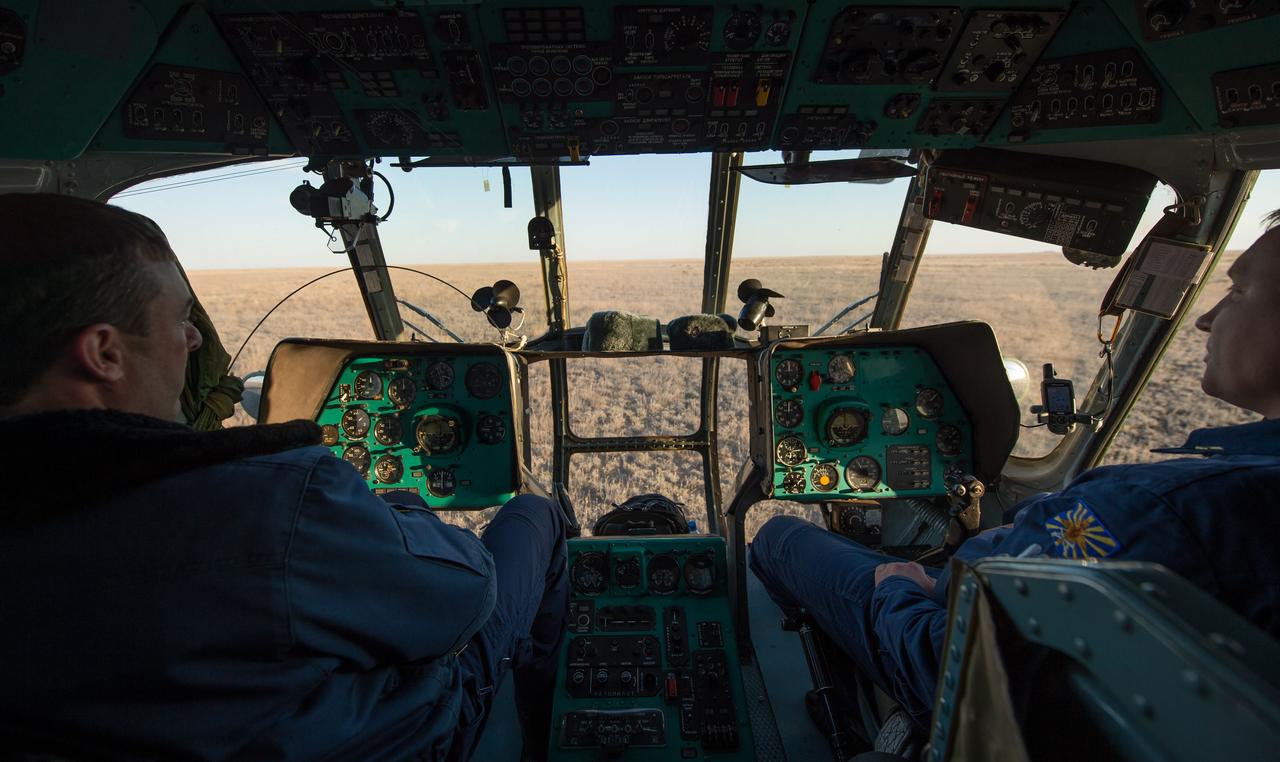
nhq201704100041 (April 10, 2017) --- Russian helicopter crew members wait in the cockpit of an MI-8 at the Soyuz MS-02 landing site after the spacecraft landed with Expedition 50 Commander Shane Kimbrough of NASA and Flight Engineers Sergey Ryzhikov and Andrey Borisenko of Roscosmos near the town of Zhezkazgan, Kazakhstan on Monday, April 10, 2017 (Kazakh time). Kimbrough, Ryzhikov, and Borisenko are returning after 173 days in space where they served as members of the Expedition 49 and 50 crews onboard the International Space Station. Photo Credit: (NASA/Bill Ingalls)
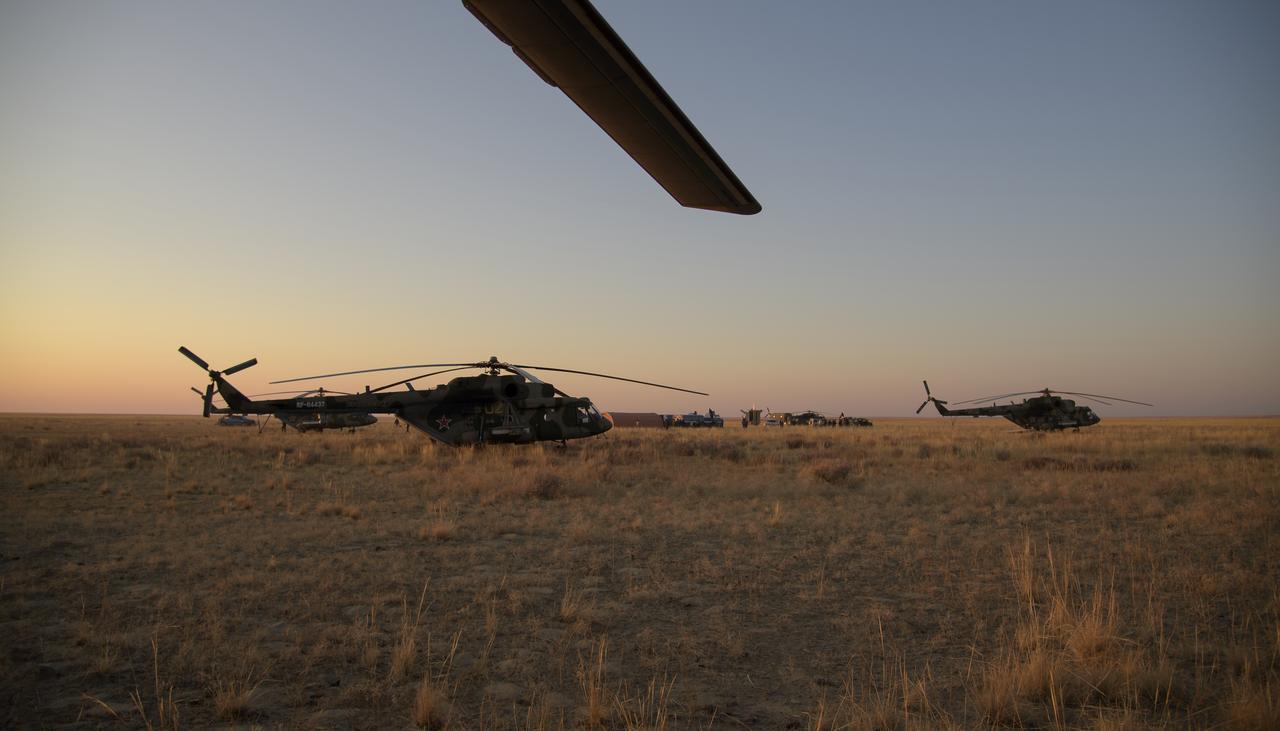
Crews work around the Soyuz MS-12 spacecraft landing site after the capsule landed with Expedition 60 crew members Nick Hague of NASA and Alexey Ovchinin of Roscosmos, along with visiting astronaut Hazzaa Ali Almansoori of the United Arab Emirates in a remote area near the town of Zhezkazgan, Kazakhstan, Thursday, Oct. 3, 2019. Hague and Ovchinin are returning after 203 days in space where they served as members of the Expedition 59 and 60 crews onboard the International Space Station. Almansoori logged 8 days in space during his first flight as an astronaut. Photo Credit: (NASA/Bill Ingalls)
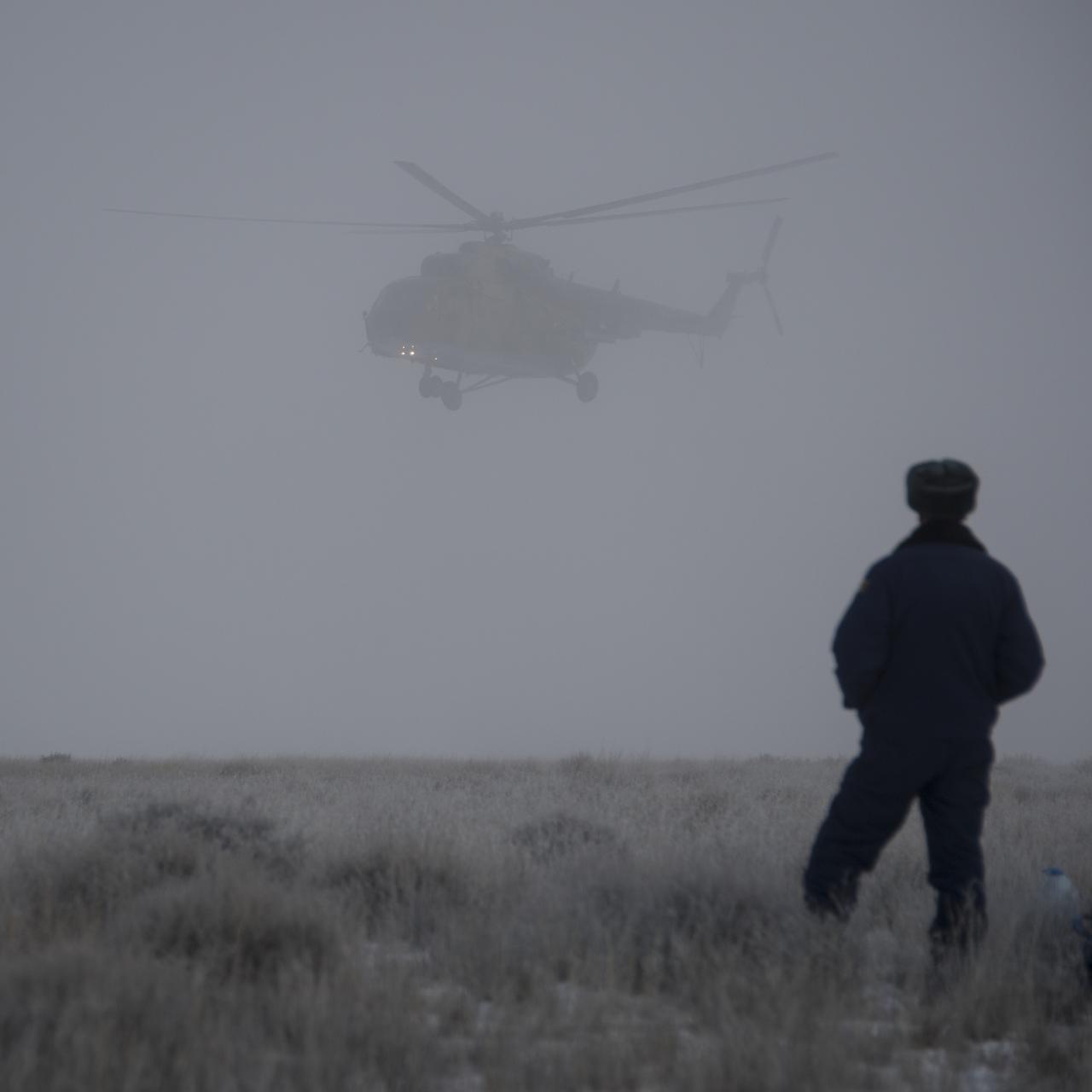
A Russian MI-8 Helicopter arrives at the Soyuz TMA-14M spacecraft landing site after the soyuz landed with Expedition 42 commander Barry Wilmore of NASA, Alexander Samokutyaev of the Russian Federal Space Agency (Roscosmos) and Elena Serova of Roscosmos near the town of Zhezkazgan, Kazakhstan on Thursday, March 12, 2015. NASA Astronaut Wilmore, Russian Cosmonauts Samokutyaev and Serova are returning after almost six months onboard the International Space Station where they served as members of the Expedition 41 and 42 crews. Photo Credit: (NASA/Bill Ingalls)
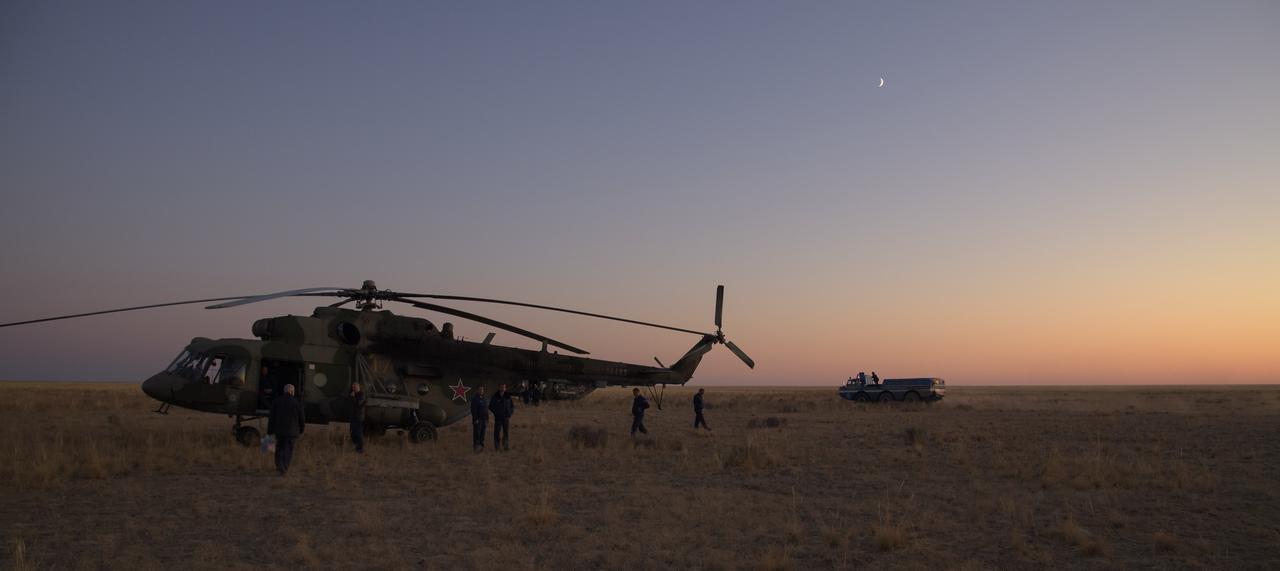
Supports teams wait to depart the Soyuz MS-12 spacecraft landing site after the capsule landed with Expedition 60 crew members Nick Hague of NASA and Alexey Ovchinin of Roscosmos, along with visiting astronaut Hazzaa Ali Almansoori of the United Arab Emirates in a remote area near the town of Zhezkazgan, Kazakhstan, Thursday, Oct. 3, 2019. Hague and Ovchinin are returning after 203 days in space where they served as members of the Expedition 59 and 60 crews onboard the International Space Station. Almansoori logged 8 days in space during his first flight as an astronaut. Photo Credit: (NASA/Bill Ingalls)
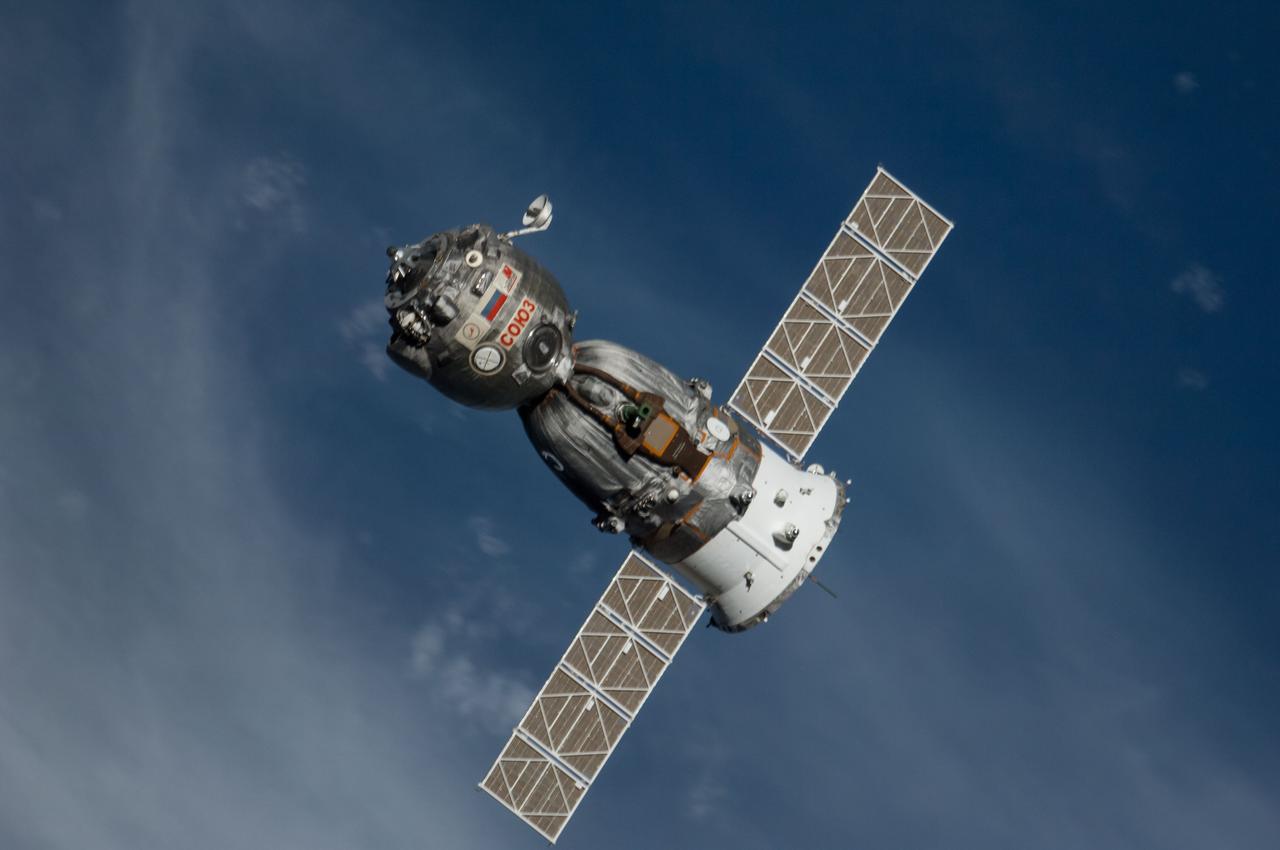
ISS041-E-000012 (10 Sept. 2014) --- The Soyuz TMA-12M spacecraft departs from the International Space Station and heads toward a landing in a remote area near the town of Zhezkazgan, Kazakhstan. NASA astronaut Steve Swanson, Expedition 40 commander; Russian cosmonaut Alexander Skvortsov, Soyuz commander and flight engineer; and Russian cosmonaut Oleg Artemyev, flight engineer, are returning from more than five months aboard the space station where they served as members of the Expedition 39 and 40 crews. Landing occurred at 10:23 p.m. (EDT), Sept. 10, 2014 (8:23 a.m., Sept. 11, Kazakh time).
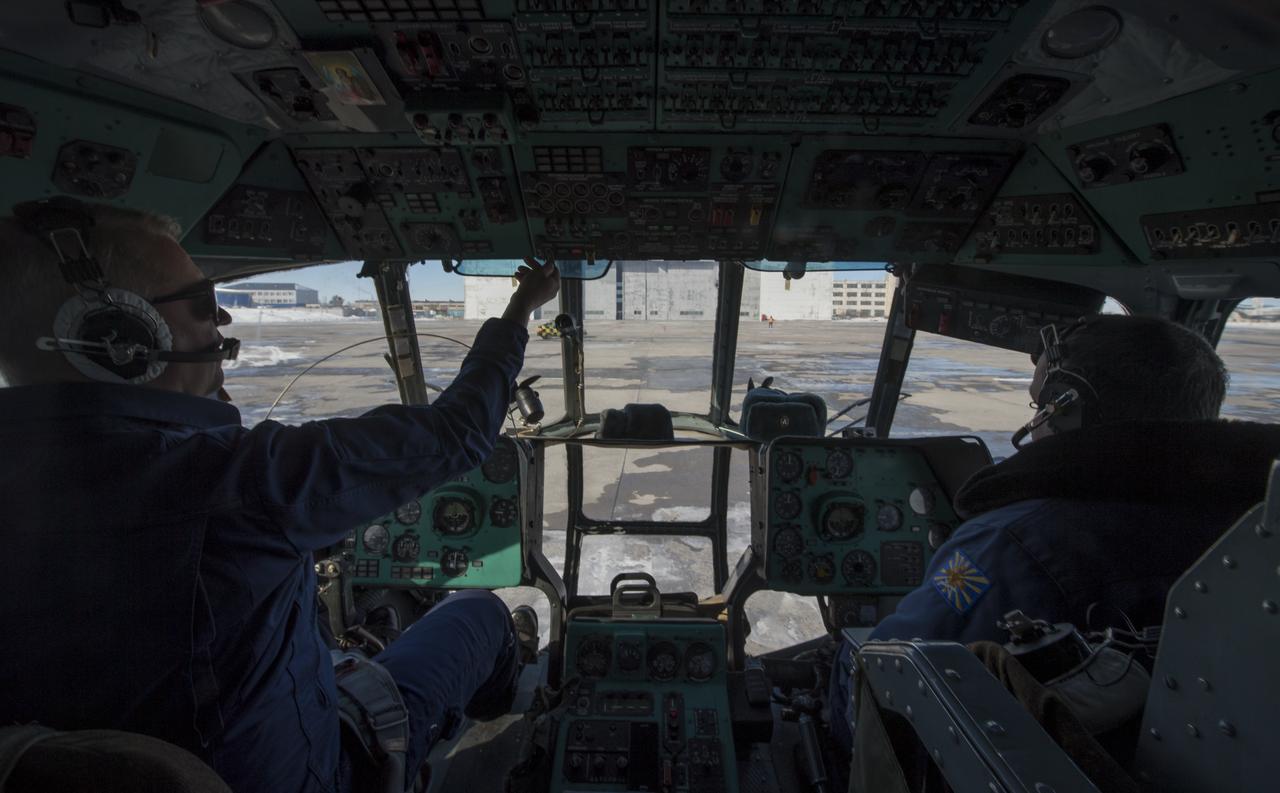
Russian Search and Rescue teams deploy on MI-8 helicopters from Karaganda to Zhezkazgan, Kazakhstan to prepare for the Soyuz MS-06 landing with Expedition 54 crew members Joe Acaba and Mark Vande Hei of NASA and cosmonaut Alexander Misurkin, Monday, Feb. 26, 2018. Acaba, Vande Hei, and Misurkin are returning after 168 days in space where they served as members of the Expedition 53 and 54 crews onboard the International Space Station. Photo Credit: (NASA/Bill Ingalls)
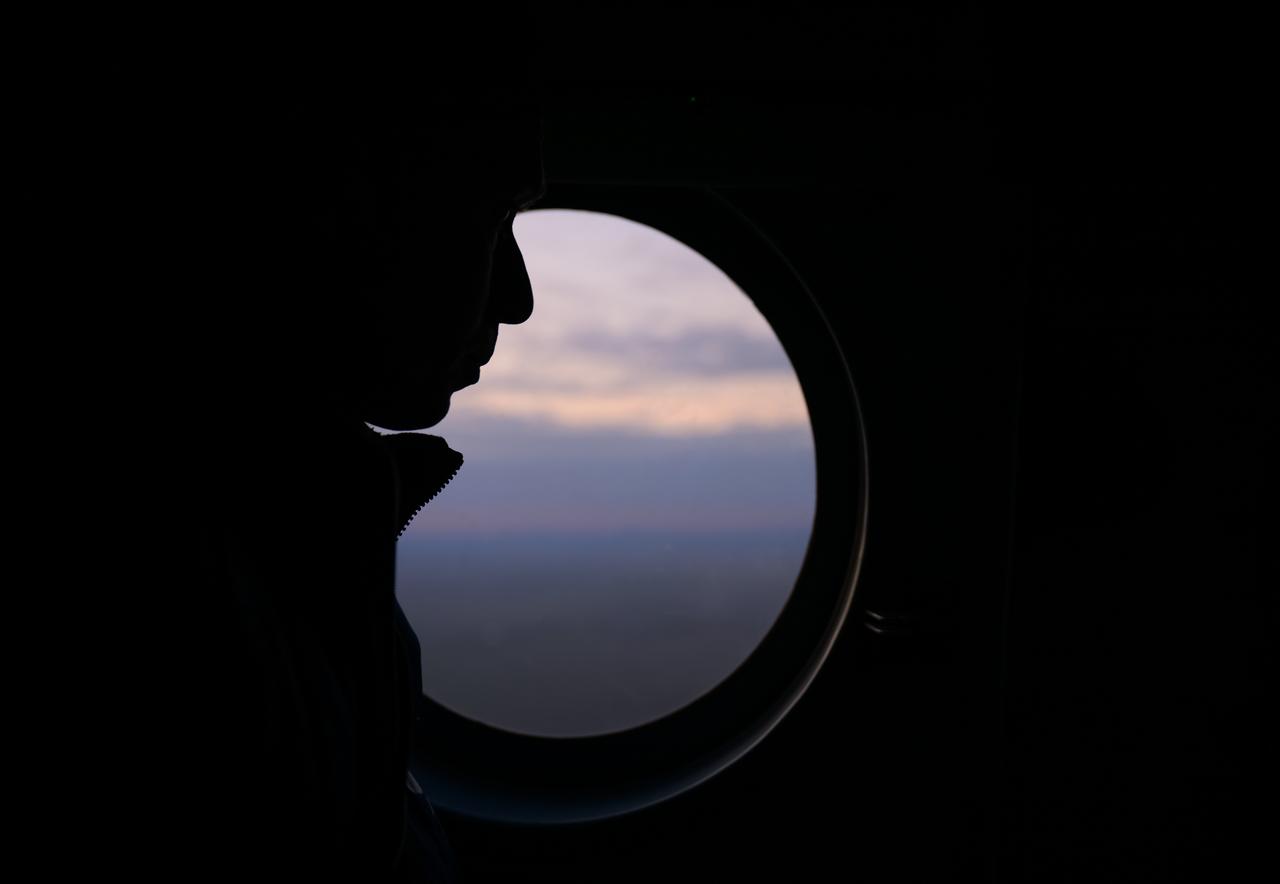
Recovery teams are seen aboard a Russian MI-8 helicopter as they support the landing of Expedition 72 NASA astronaut Don Pettit, and Roscosmos cosmonauts Alexey Ovchinin and Ivan Vagner, Sunday, April 20, 2025. The trio are returning to Earth after logging 220 days in space as members of Expeditions 71 and 72 aboard the International Space Station. Photo Credit: (NASA/Bill Ingalls)
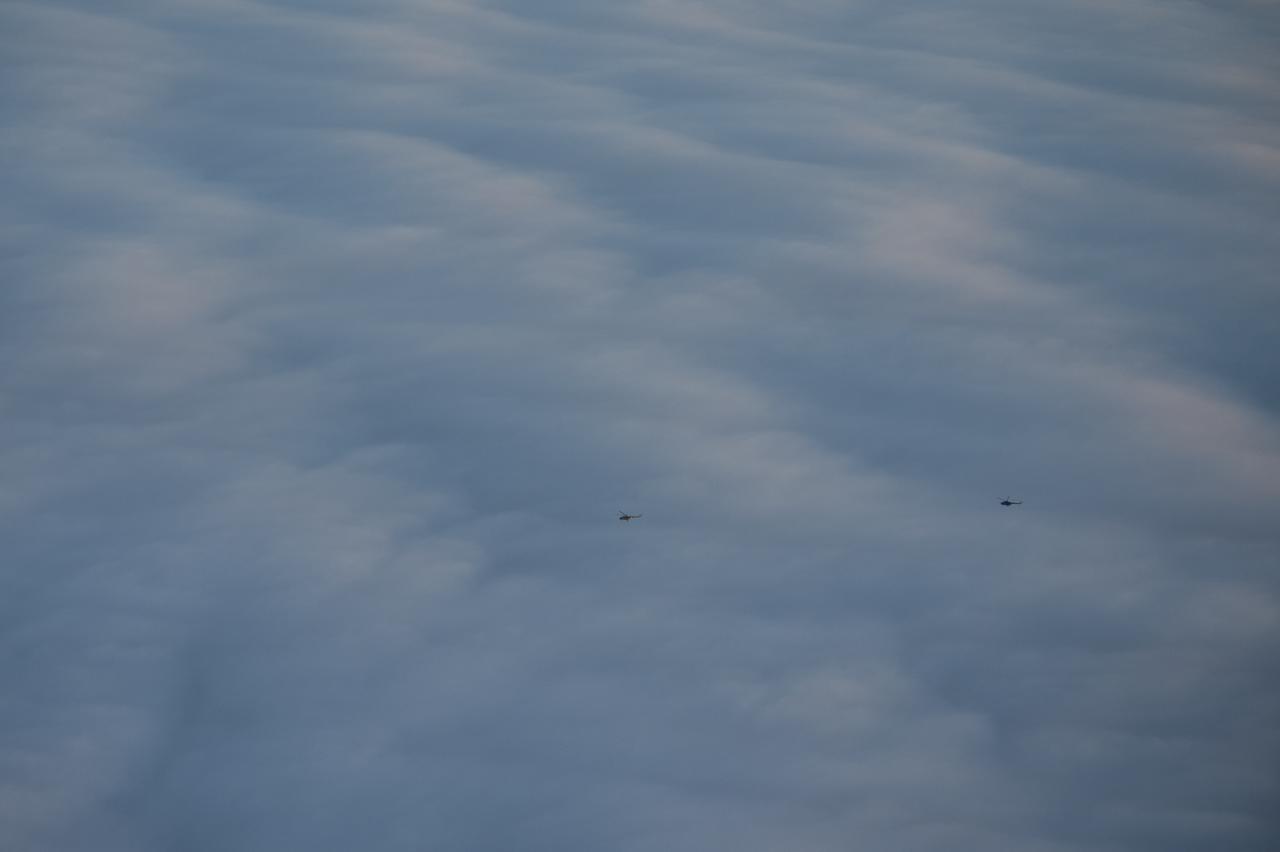
Russian MI-8 Helicopters are seen during the Soyuz TMA-14M spacecraft landing with Expedition 42 commander Barry Wilmore of NASA, Alexander Samokutyaev of the Russian Federal Space Agency (Roscosmos) and Elena Serova of Roscosmos near the town of Zhezkazgan, Kazakhstan on Thursday, March 12, 2015. NASA Astronaut Wilmore, Russian Cosmonauts Samokutyaev and Serova are returning after almost six months onboard the International Space Station where they served as members of the Expedition 41 and 42 crews. Photo Credit: (NASA/Bill Ingalls)
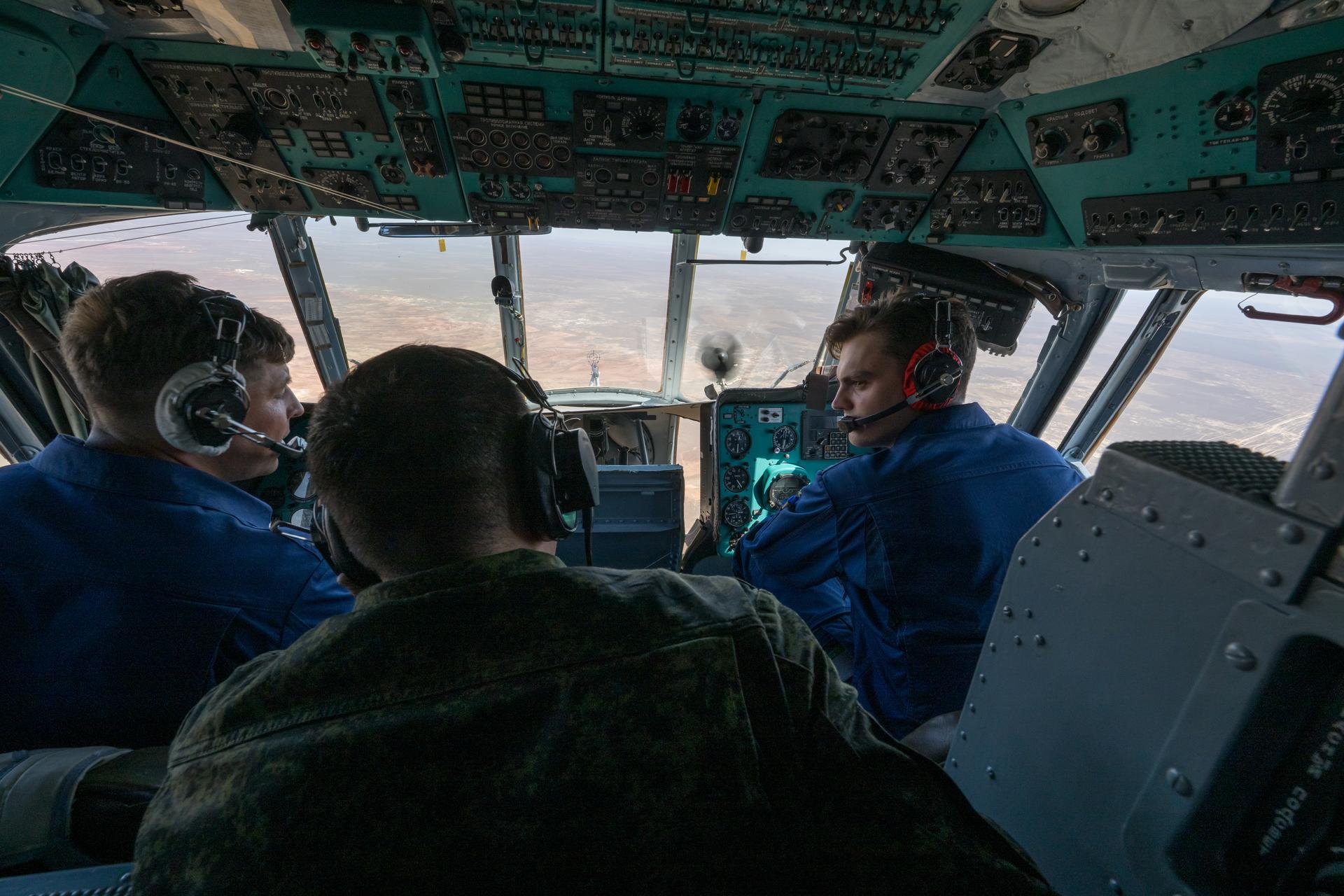
Russian Search and Recovery Forces fly their MI-8 Helicopter to the predicted landing site of Expedition 74 NASA astronaut Chris Williams, and Roscosmos cosmonauts Sergey Kud-Sverchkov, and Sergei Mikaev, Sunday, July 26, 2026 outside of Zhezkazgan, Kazakhstan. Williams, Kud-Sverchkov, and Mikaev, are returning to Earth after logging 241 days in space as a members of Expeditions 73 and 74 aboard the International Space Station. Photo Credit: (NASA/Bill Ingalls)
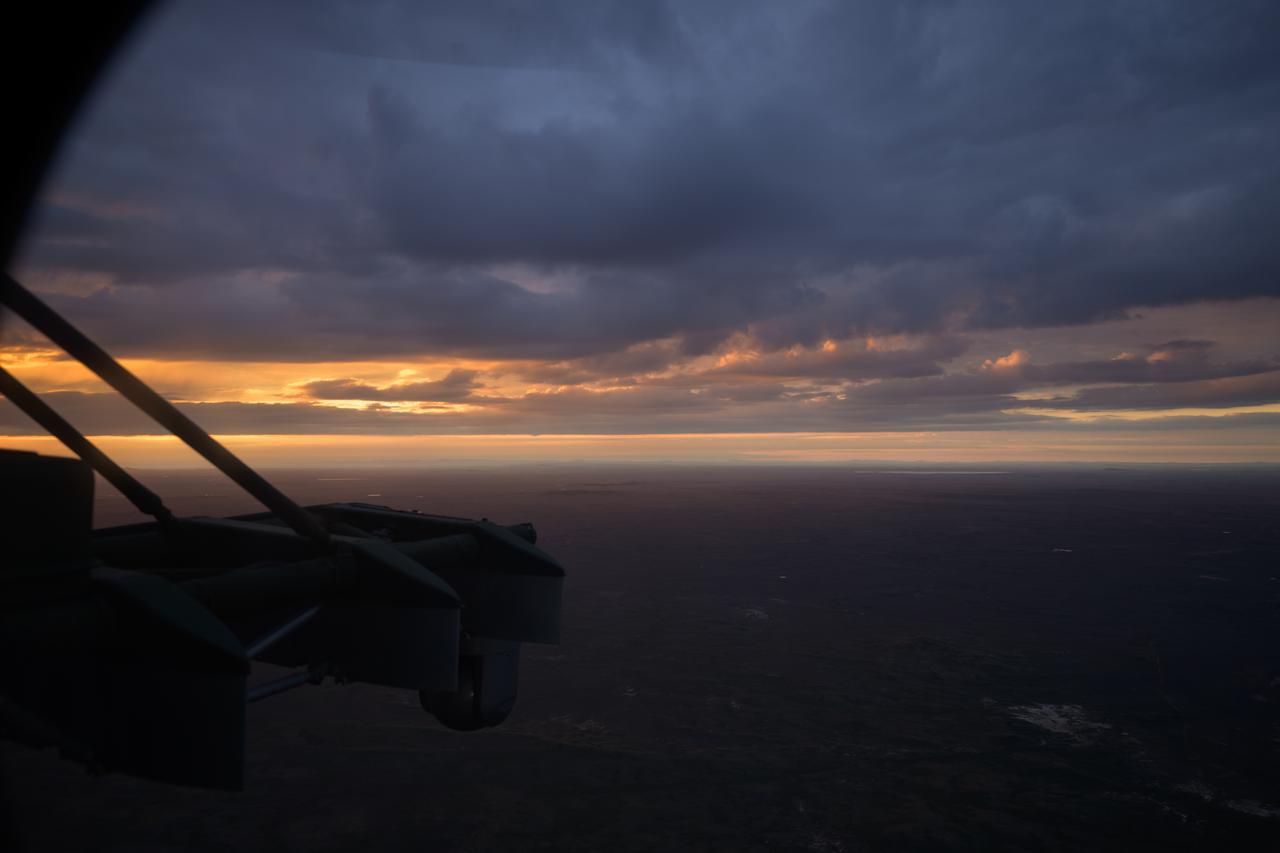
Sunrise is seen from a Russian MI-8 helicopter as teams support the landing of Expedition 72 NASA astronaut Don Pettit, and Roscosmos cosmonauts Alexey Ovchinin and Ivan Vagner, Sunday, April 20, 2025. The trio are returning to Earth after logging 220 days in space as members of Expeditions 71 and 72 aboard the International Space Station. Photo Credit: (NASA/Bill Ingalls)
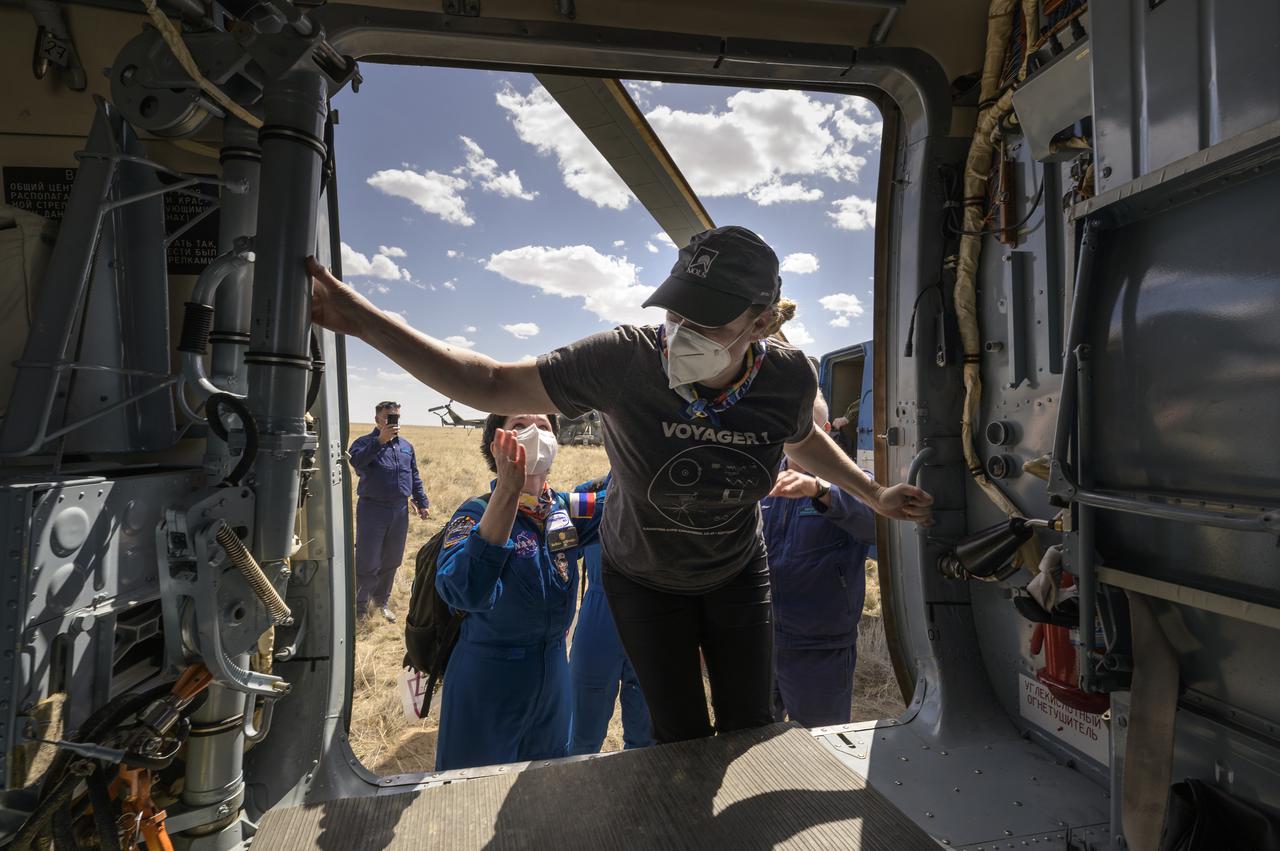
Expedition 64 NASA astronaut Kate Rubins boards a Russian MI-8 helicopter to take her to Karaganda after she, and Roscosmos cosmonauts Sergey Ryzhikov and Sergey Kud-Sverchkov, landed in their Soyuz MS-17 spacecraft near the town of Zhezkazgan, Kazakhstan on Saturday, April 17, 2021. Rubins, Ryzhikov and Kud-Sverchkov returned after 185 days in space having served as Expedition 63-64 crew members onboard the International Space Station. Photo Credit: NASA/Bill Ingalls
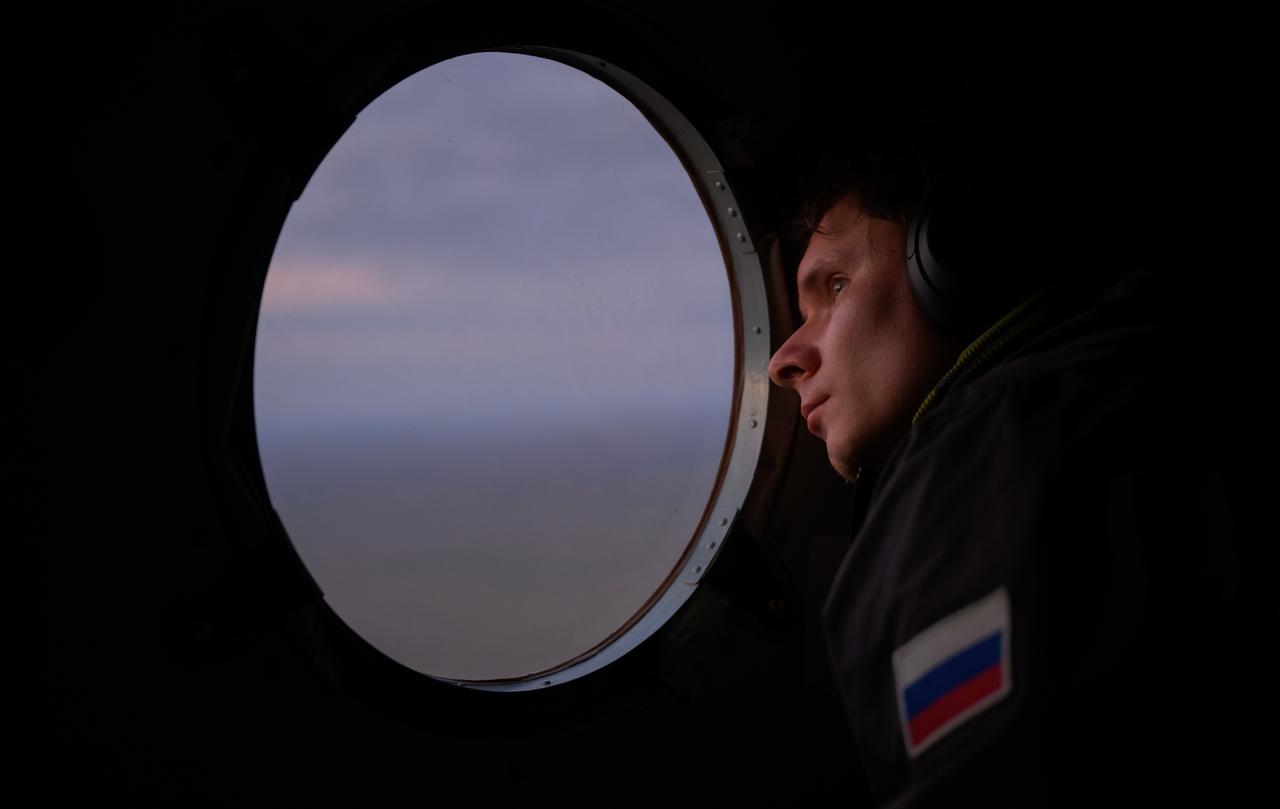
Recovery teams are seen aboard a Russian MI-8 helicopter as they support the landing of Expedition 72 NASA astronaut Don Pettit, and Roscosmos cosmonauts Alexey Ovchinin and Ivan Vagner, Sunday, April 20, 2025. The trio are returning to Earth after logging 220 days in space as members of Expeditions 71 and 72 aboard the International Space Station. Photo Credit: (NASA/Bill Ingalls)
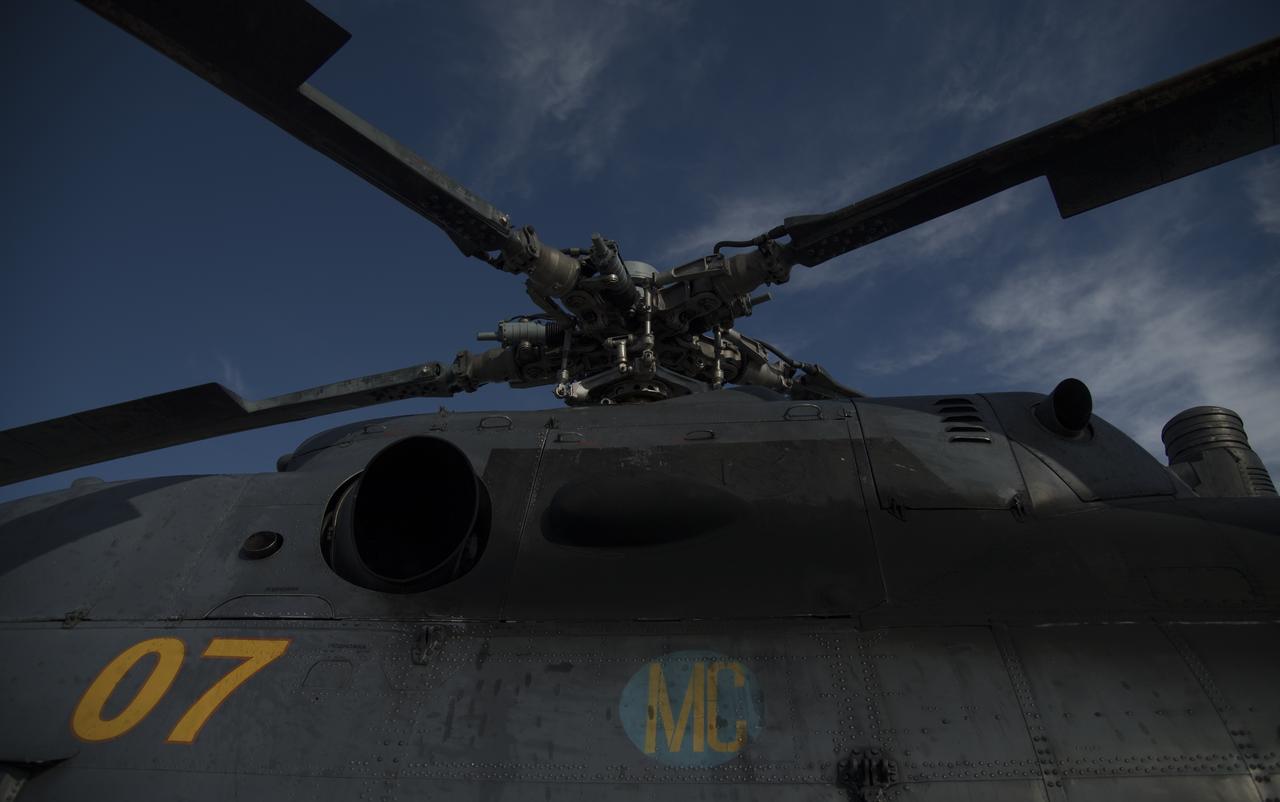
Russian Search and Rescue teams deploy on MI-8 helicopters from Karaganda to Zhezkazgan, Kazakhstan to prepare for the Soyuz MS-06 landing with Expedition 54 crew members Joe Acaba and Mark Vande Hei of NASA and cosmonaut Alexander Misurkin, Monday, Feb. 26, 2018. Acaba, Vande Hei, and Misurkin are returning after 168 days in space where they served as members of the Expedition 53 and 54 crews onboard the International Space Station. Photo Credit: (NASA/Bill Ingalls)
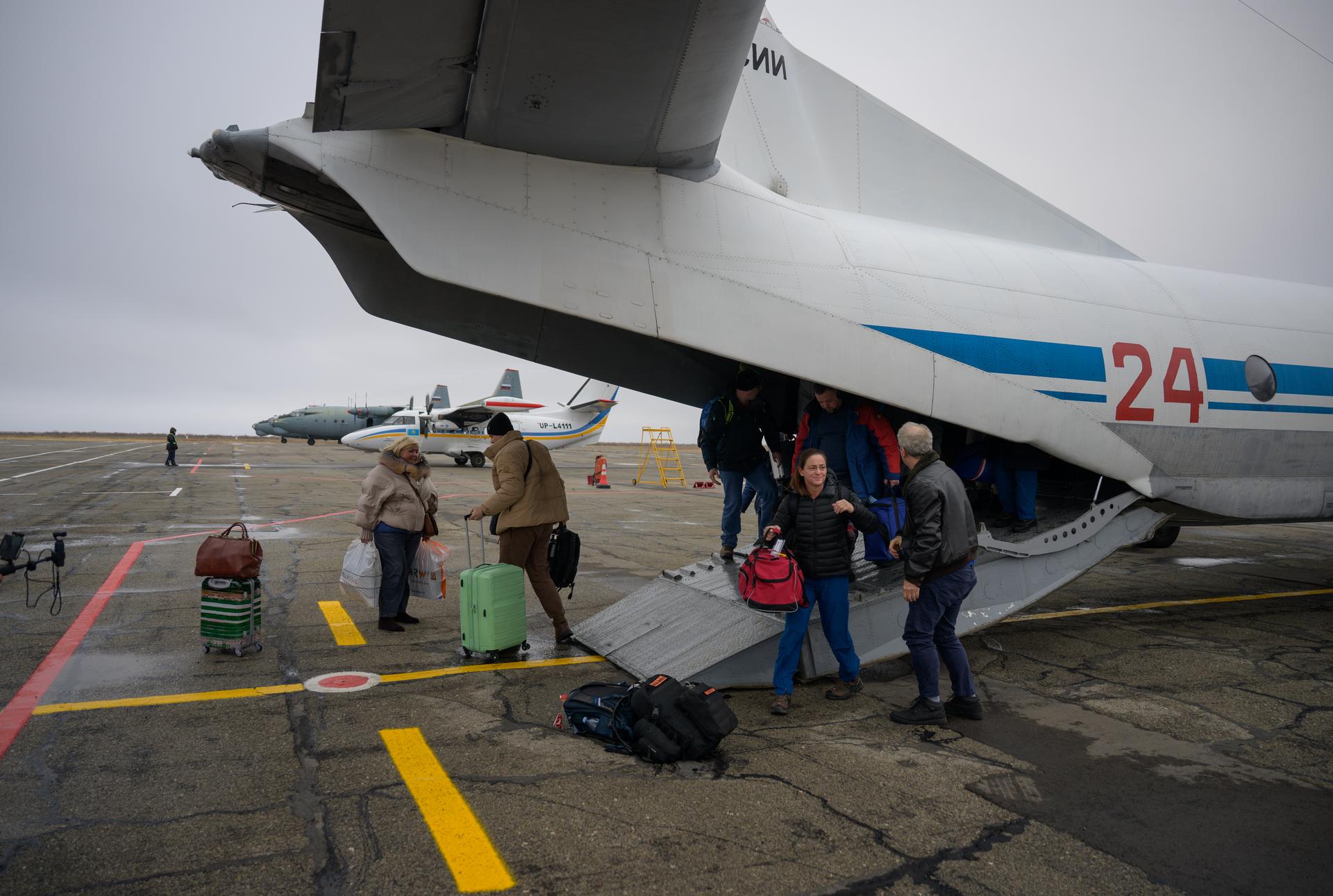
NASA, Roscosmos, and Russian Search and Recovery Forces arrive on an AN-26 plane in Zhezkazgan, Kazakhstan to prepare for the landing of Expedition 73 NASA astronaut Jonny Kim, and Roscosmos cosmonauts Sergey Ryzhikov, and Alexey Zubritsky, Monday, Dec. 8, 2025. The trio are returning to Earth after logging 245 days in space as a members of Expeditions 72 and 73 aboard the International Space Station. Photo Credit: (NASA/Bill Ingalls)
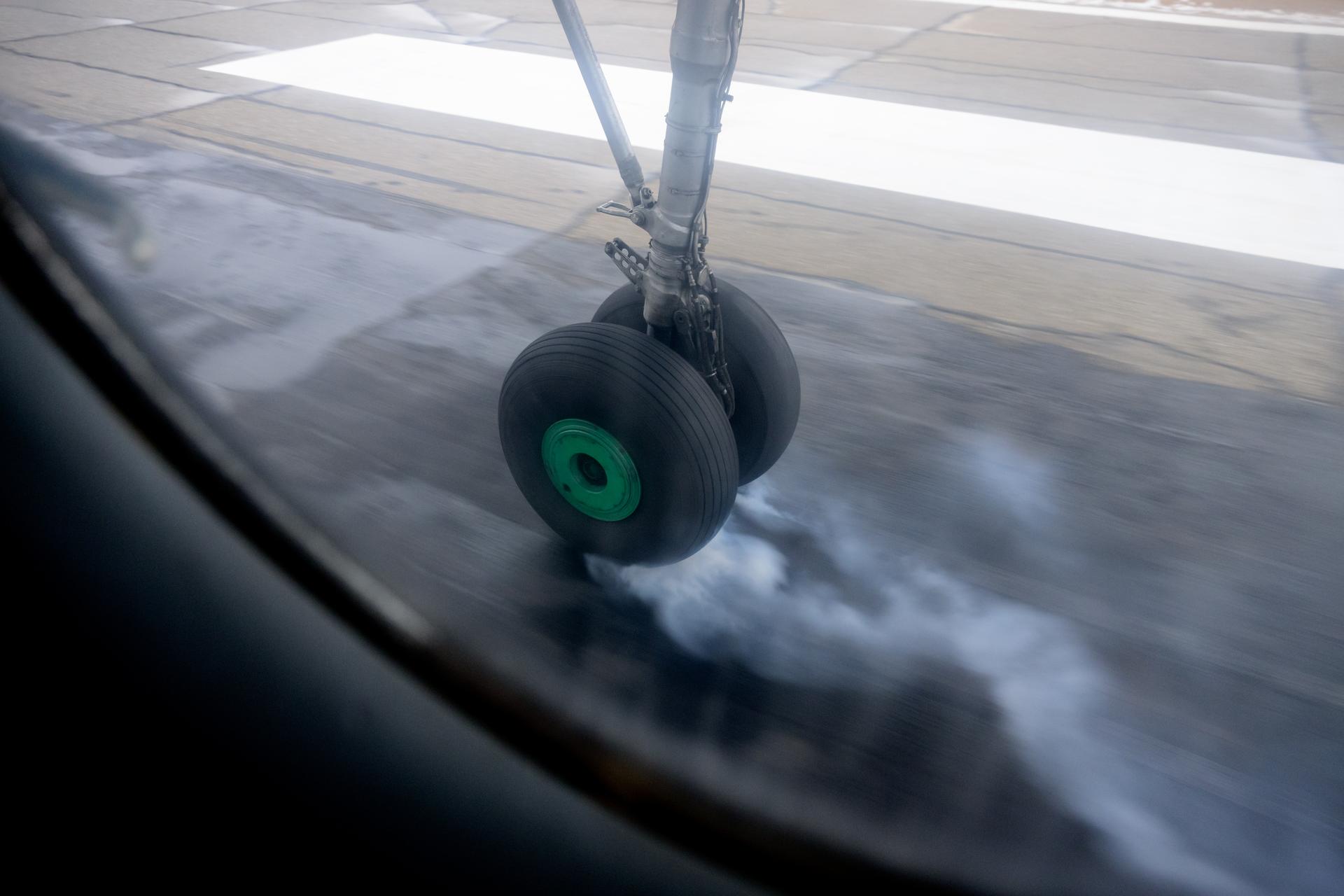
NASA, Roscosmos, and Russian Search and Recovery Forces arrive on an AN-26 plane in Zhezkazgan, Kazakhstan to prepare for the landing of Expedition 73 NASA astronaut Jonny Kim, and Roscosmos cosmonauts Sergey Ryzhikov, and Alexey Zubritsky, Monday, Dec. 8, 2025. The trio are returning to Earth after logging 245 days in space as a members of Expeditions 72 and 73 aboard the International Space Station. Photo Credit: (NASA/Bill Ingalls)
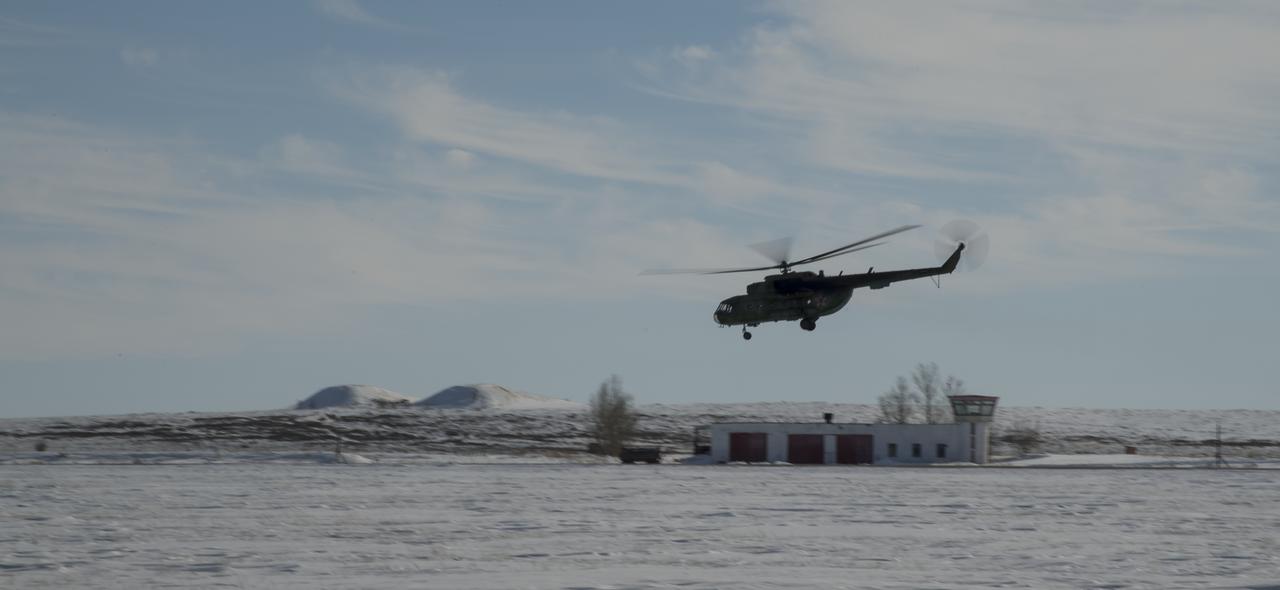
Russian Search and Rescue teams deploy on MI-8 helicopters from Karaganda to Zhezkazgan, Kazakhstan to prepare for the Soyuz MS-06 landing with Expedition 54 crew members Joe Acaba and Mark Vande Hei of NASA and cosmonaut Alexander Misurkin, Monday, Feb. 26, 2018. Acaba, Vande Hei, and Misurkin are returning after 168 days in space where they served as members of the Expedition 53 and 54 crews onboard the International Space Station. Photo Credit: (NASA/Bill Ingalls)
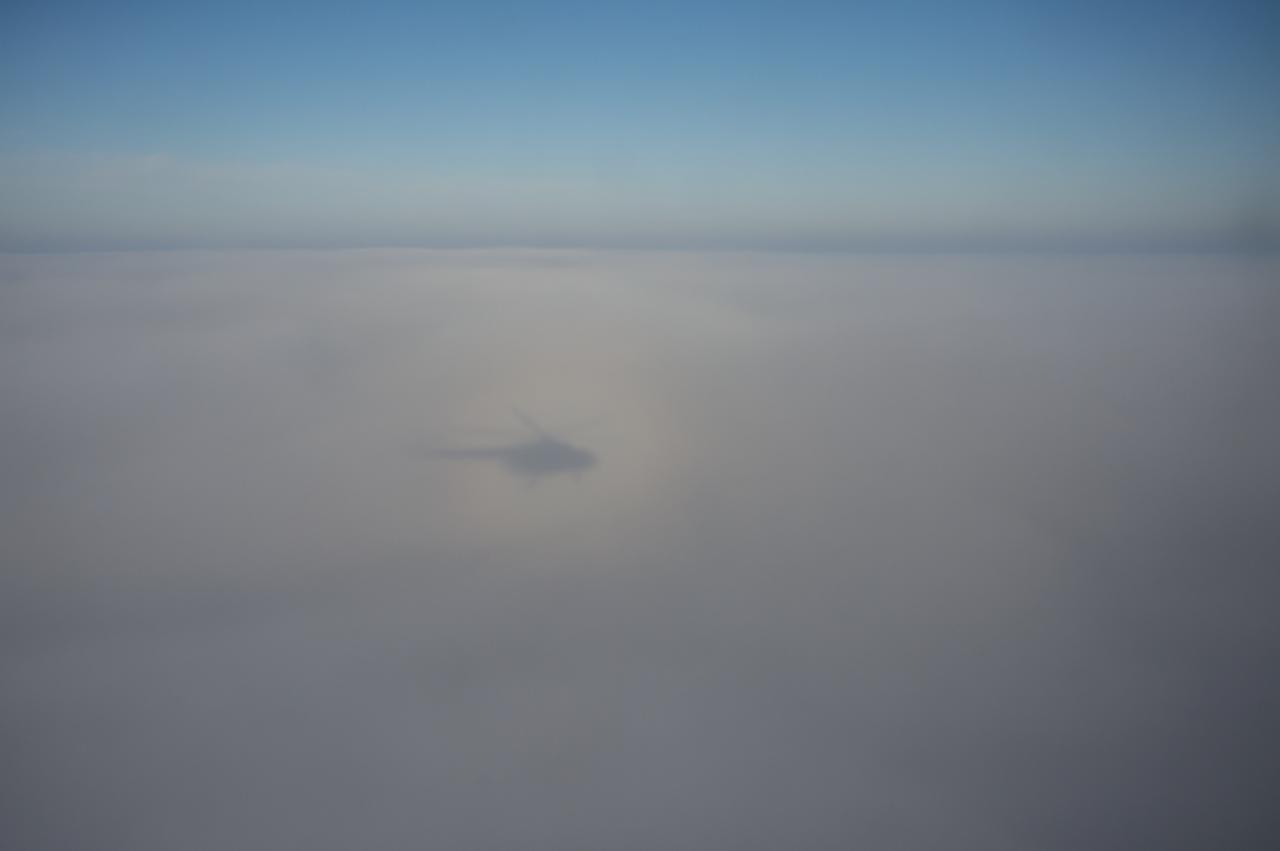
A shadow of a Russian MI-8 Helicopter is seen during the Soyuz TMA-14M spacecraft landing with Expedition 42 commander Barry Wilmore of NASA, Alexander Samokutyaev of the Russian Federal Space Agency (Roscosmos) and Elena Serova of Roscosmos near the town of Zhezkazgan, Kazakhstan on Thursday, March 12, 2015. NASA Astronaut Wilmore, Russian Cosmonauts Samokutyaev and Serova are returning after almost six months onboard the International Space Station where they served as members of the Expedition 41 and 42 crews. Photo Credit: (NASA/Bill Ingalls)
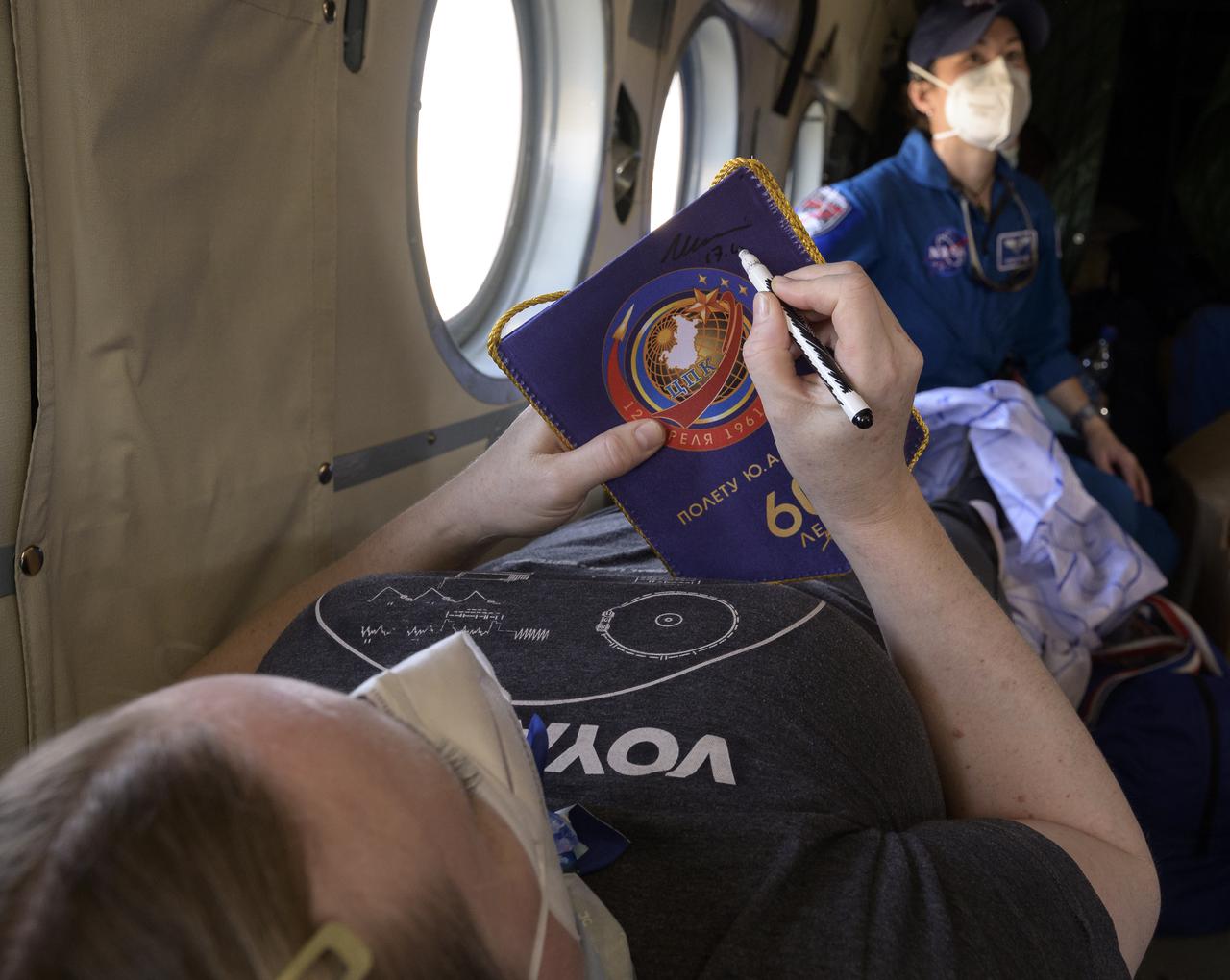
Expedition 64 NASA astronaut Kate Rubins signs a memento while onboard a Russian MI-8 helicopter that will take her to Karaganda after she, and Roscosmos cosmonauts Sergey Ryzhikov and Sergey Kud-Sverchkov, landed in their Soyuz MS-17 spacecraft near the town of Zhezkazgan, Kazakhstan on Saturday, April 17, 2021. Rubins, Ryzhikov and Kud-Sverchkov returned after 185 days in space having served as Expedition 63-64 crew members onboard the International Space Station. Photo Credit: NASA/Bill Ingalls
Russian Search and Rescue teams deploy on MI-8 helicopters from Karaganda to Zhezkazgan, Kazakhstan to prepare for the Soyuz MS-06 landing with Expedition 54 crew members Joe Acaba and Mark Vande Hei of NASA and cosmonaut Alexander Misurkin, Monday, Feb. 26, 2018. Acaba, Vande Hei, and Misurkin are returning after 168 days in space where they served as members of the Expedition 53 and 54 crews onboard the International Space Station. Photo Credit: (NASA/Bill Ingalls)
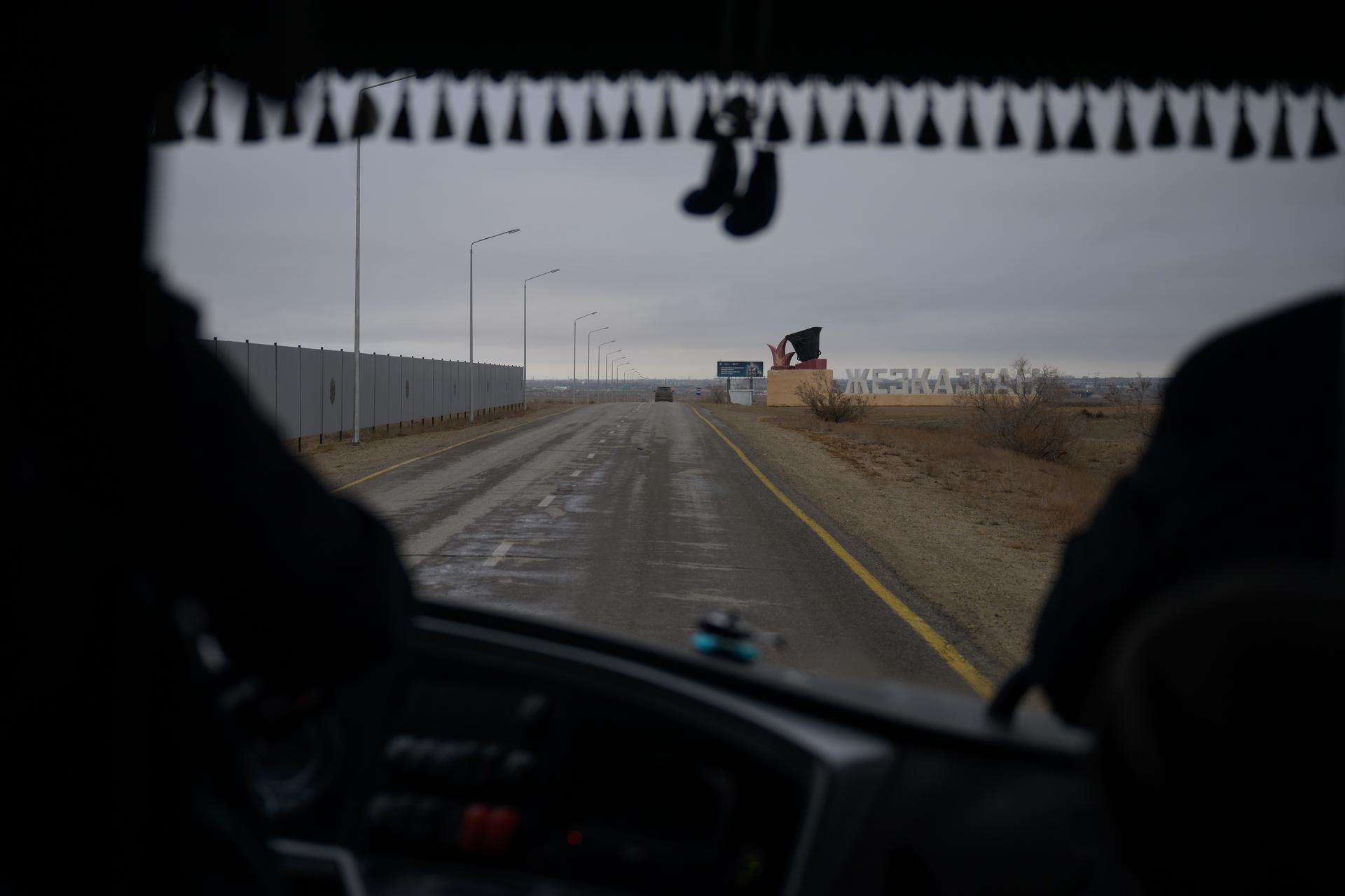
NASA, Roscosmos, and Russian Search and Recovery Forces arrive in Zhezkazgan, Kazakhstan to prepare for the landing of Expedition 73 NASA astronaut Jonny Kim, and Roscosmos cosmonauts Sergey Ryzhikov, and Alexey Zubritsky, Monday, Dec. 8, 2025. The trio are returning to Earth after logging 245 days in space as a members of Expeditions 72 and 73 aboard the International Space Station. Photo Credit: (NASA/Bill Ingalls)
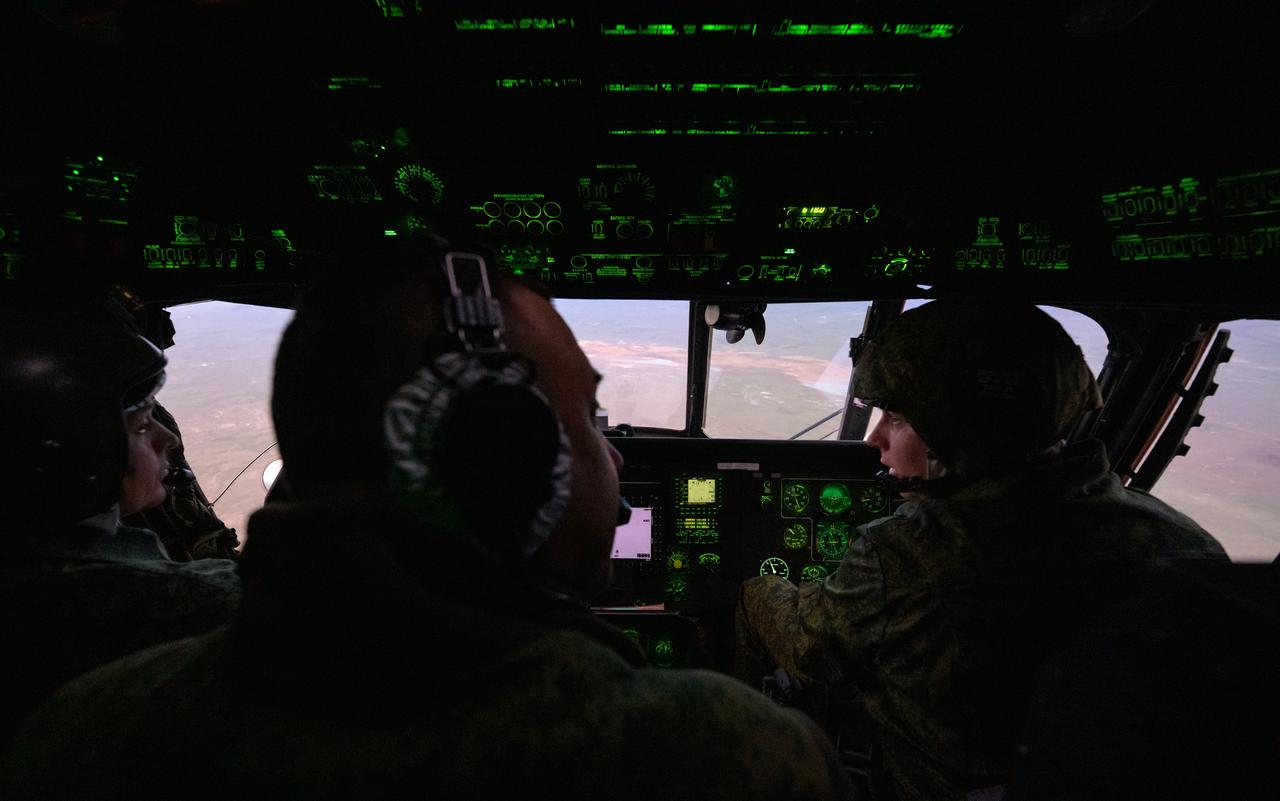
Russian Search and Recovery Forces fly their MI-8 Helicopter to the predicted landing site of Expedition 74 NASA astronaut Chris Williams, and Roscosmos cosmonauts Sergey Kud-Sverchkov, and Sergei Mikaev, Sunday, July 26, 2026 outside of Zhezkazgan, Kazakhstan. Williams, Kud-Sverchkov, and Mikaev, are returning to Earth after logging 241 days in space as a members of Expeditions 73 and 74 aboard the International Space Station. Photo Credit: (NASA/Bill Ingalls)
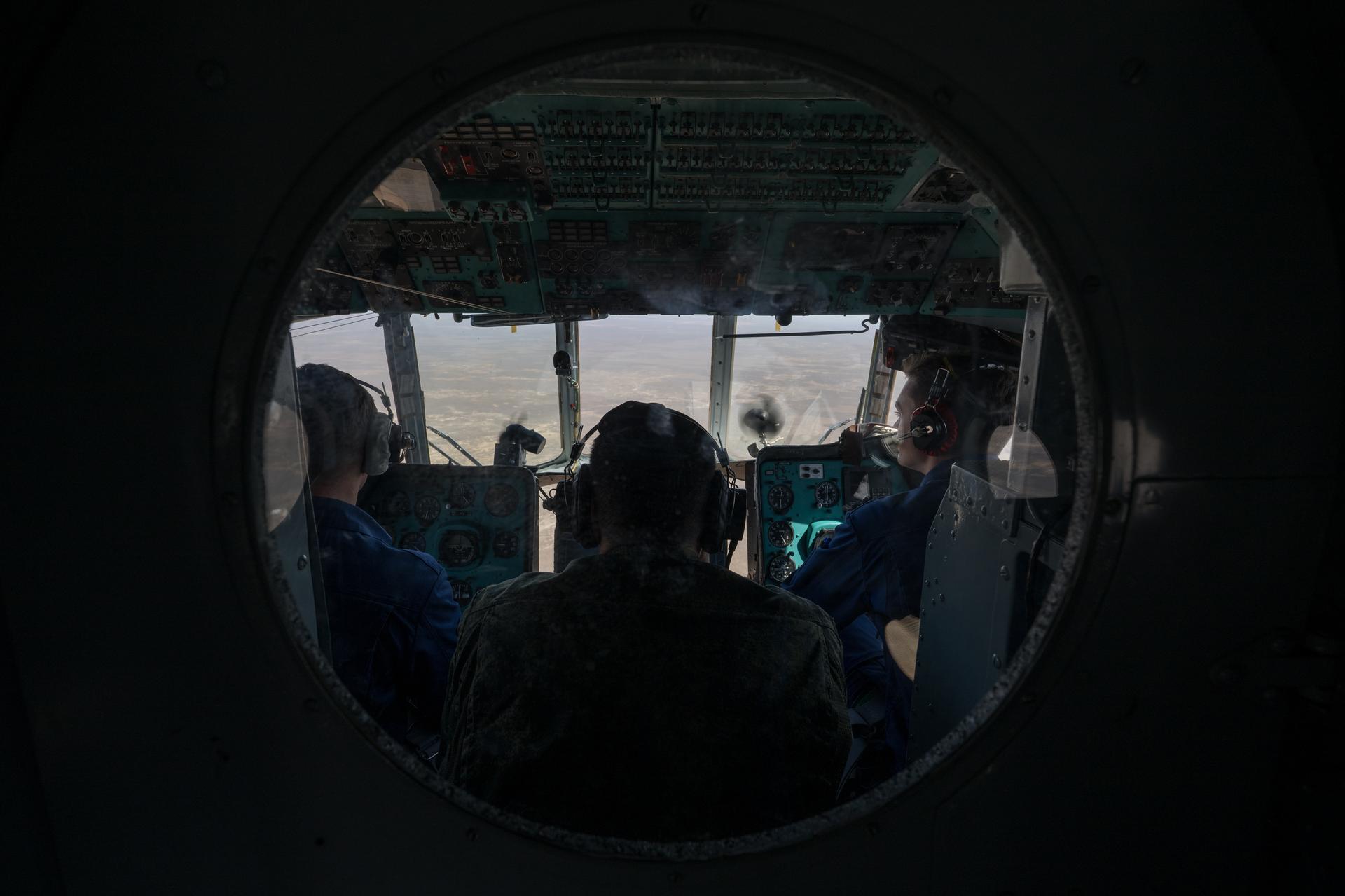
Recovery teams are seen aboard a Russian MI-8 helicopter as they support the landing of Expedition 72 NASA astronaut Don Pettit, and Roscosmos cosmonauts Alexey Ovchinin and Ivan Vagner, Sunday, April 20, 2025. The trio are returning to Earth after logging 220 days in space as members of Expeditions 71 and 72 aboard the International Space Station. Photo Credit: (NASA/Bill Ingalls)
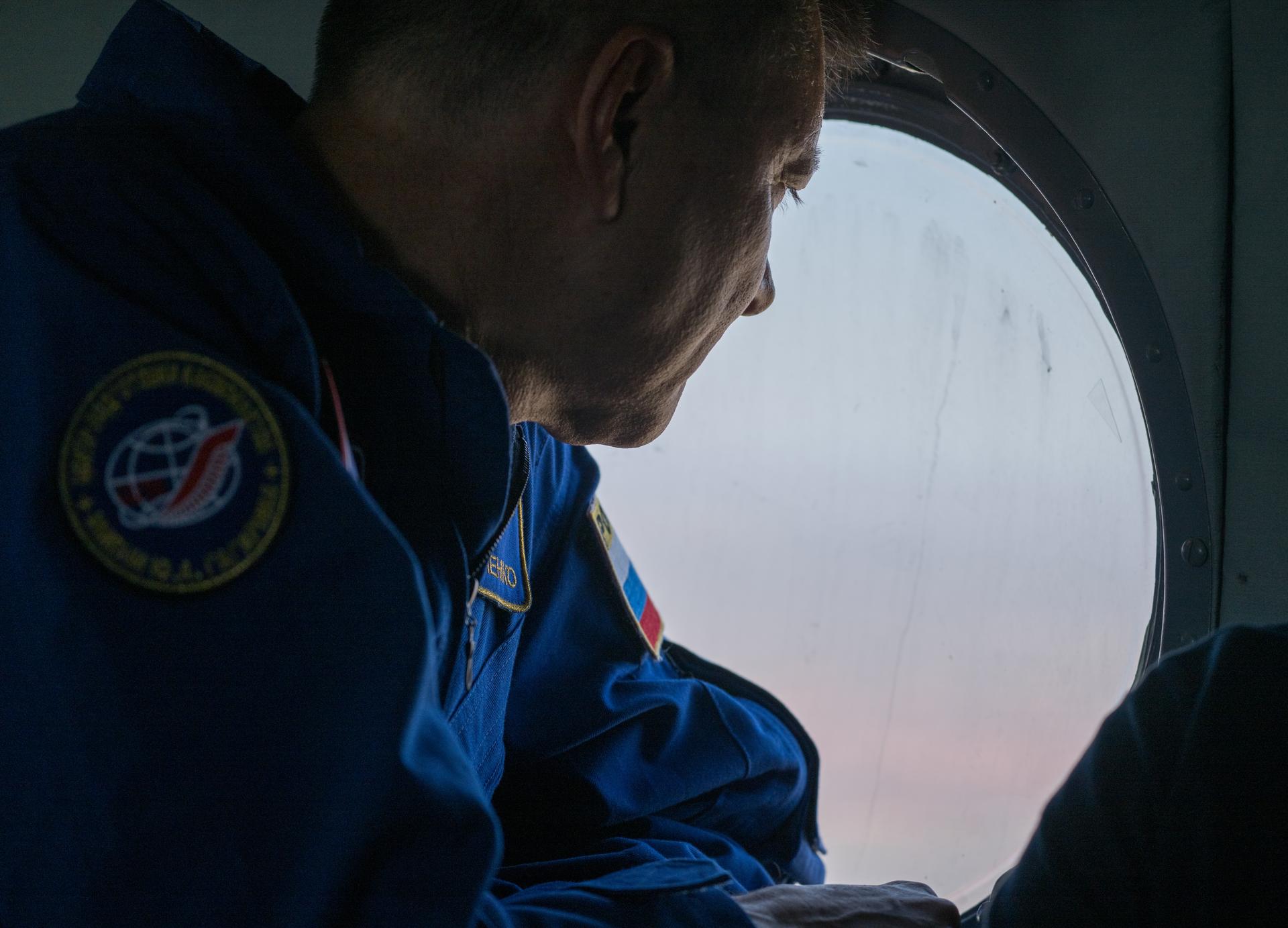
Head of Gargarin Cosmonaut Training Center Oleg Kononenko, looks out the window of a Russian MI-8 Helicopter as teams support the Soyuz MS-28 landing of Expedition 74 NASA astronaut Chris Williams, and Roscosmos cosmonauts Sergey Kud-Sverchkov, and Sergei Mikaev, Sunday, July 26, 2026 outside of Zhezkazgan, Kazakhstan. Williams, Kud-Sverchkov, and Mikaev, are returning to Earth after logging 241 days in space as a members of Expeditions 73 and 74 aboard the International Space Station. Photo Credit: (NASA/Bill Ingalls)
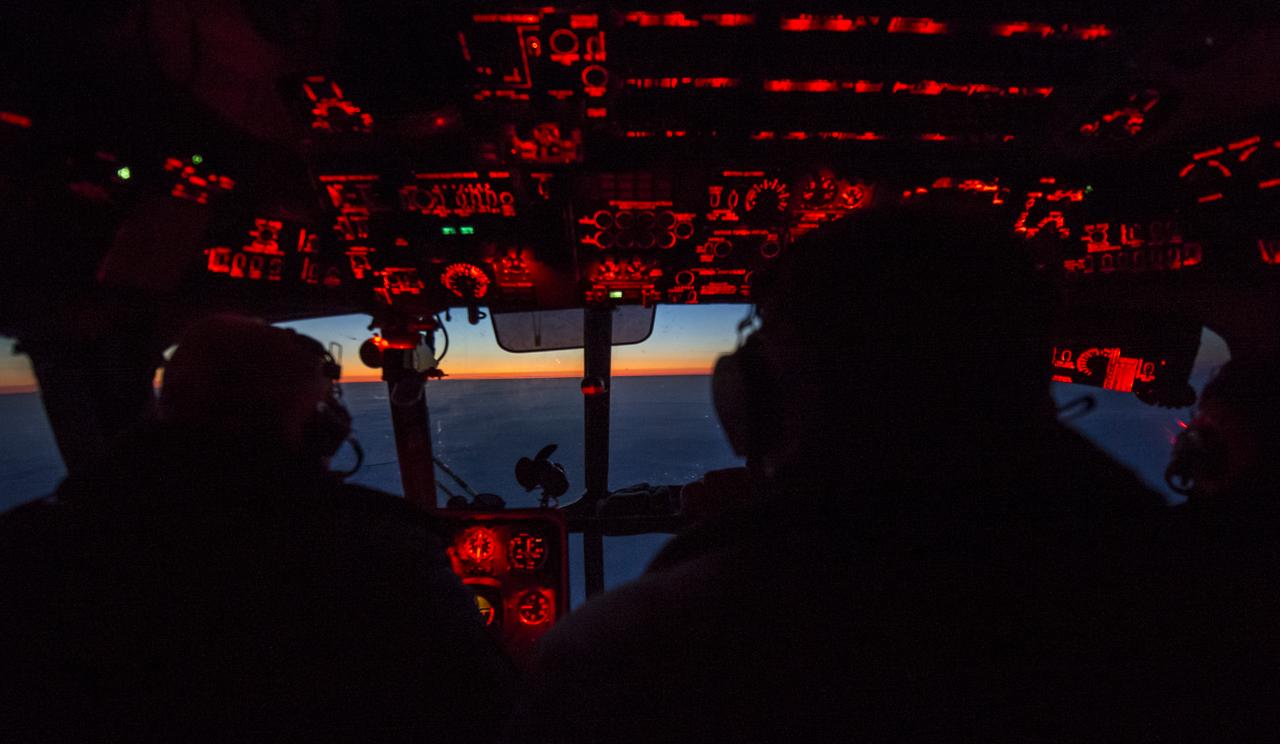
Pilots position a Russian MI-8 Helicopter for the Soyuz TMA-14M spacecraft landing with Expedition 42 commander Barry Wilmore of NASA, Alexander Samokutyaev of the Russian Federal Space Agency (Roscosmos) and Elena Serova of Roscosmos near the town of Zhezkazgan, Kazakhstan on Thursday, March 12, 2015. NASA Astronaut Wilmore, Russian Cosmonauts Samokutyaev and Serova are returning after almost six months onboard the International Space Station where they served as members of the Expedition 41 and 42 crews. Photo Credit: (NASA/Bill Ingalls)
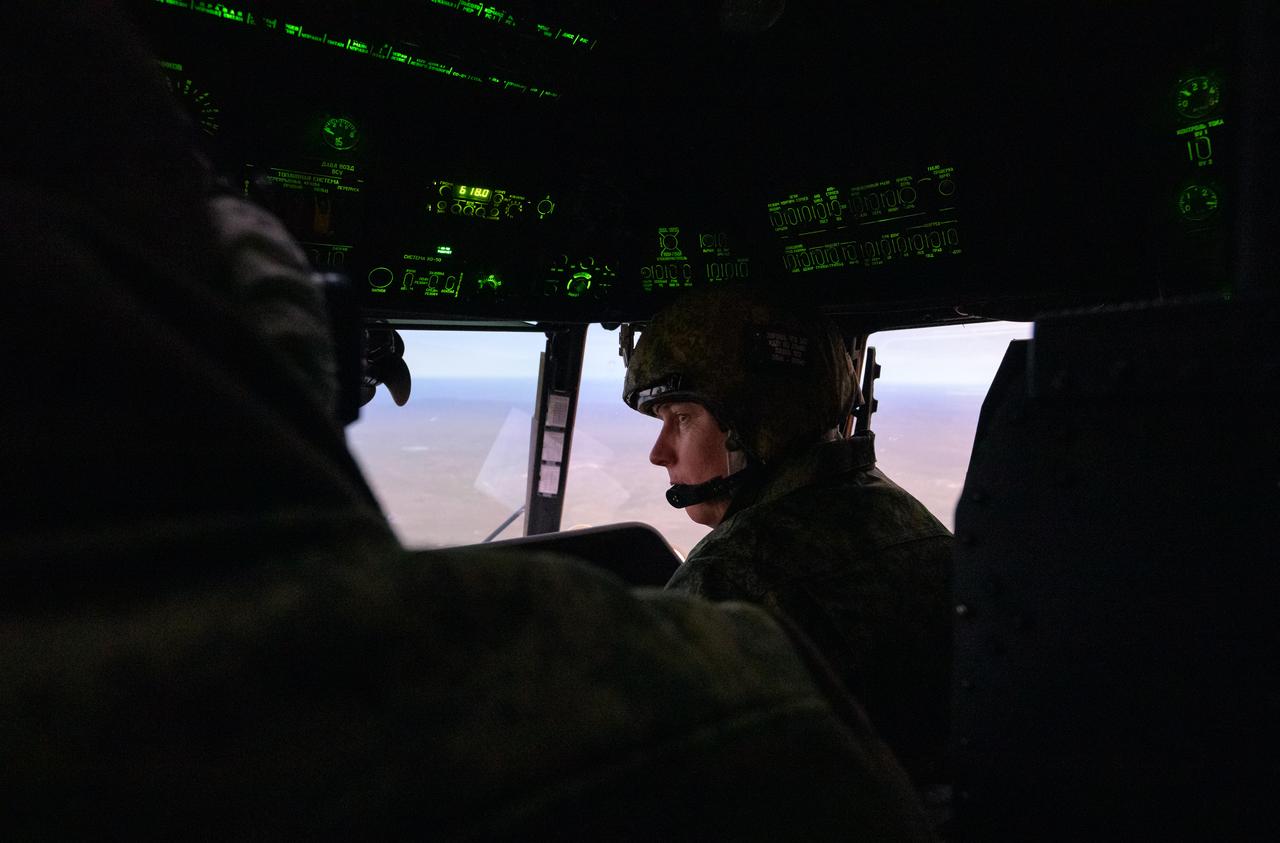
Recovery teams are seen aboard a Russian MI-8 helicopter as they support the landing of Expedition 72 NASA astronaut Don Pettit, and Roscosmos cosmonauts Alexey Ovchinin and Ivan Vagner, Sunday, April 20, 2025. The trio are returning to Earth after logging 220 days in space as members of Expeditions 71 and 72 aboard the International Space Station. Photo Credit: (NASA/Bill Ingalls)
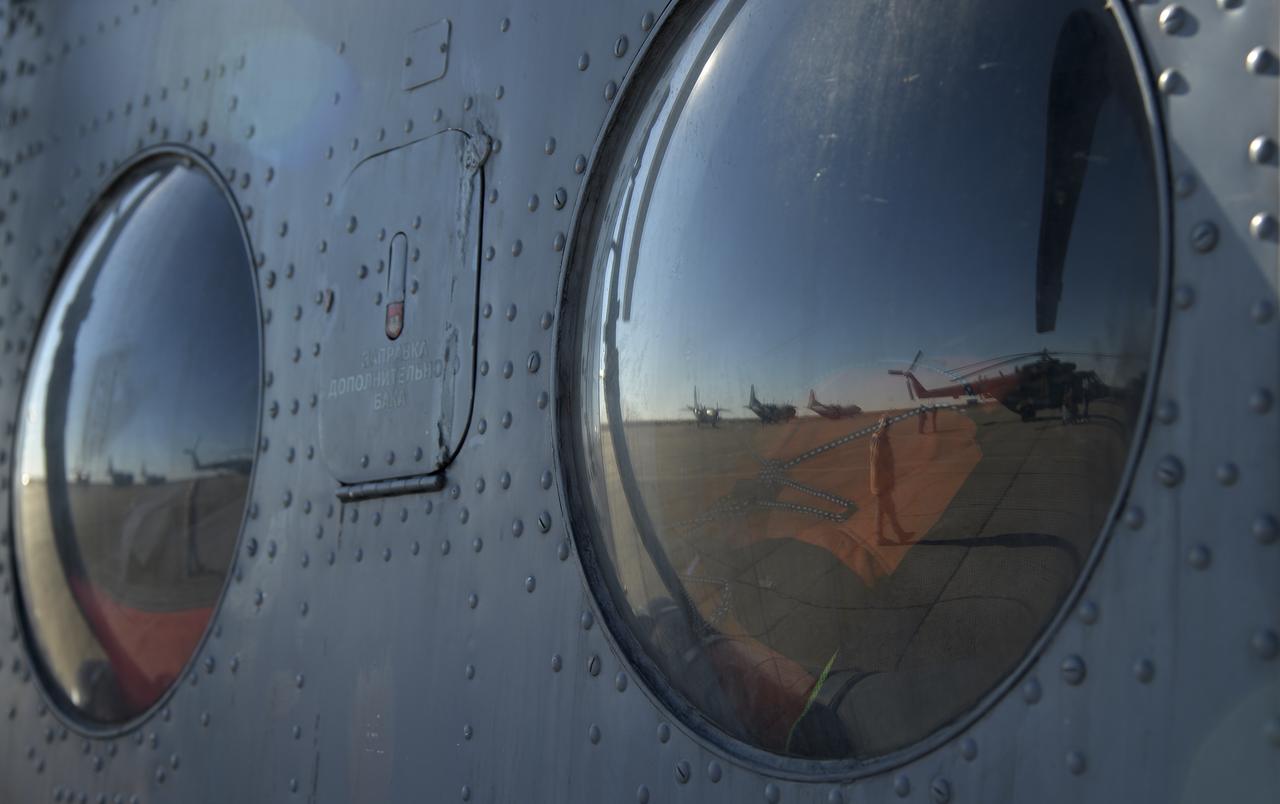
Russian MI-8 helicopters wait at the Zhezkazgan Airport in Kazakhstan to deploy to the Soyuz MS-08 spacecraft landing with Expedition 56 Commander Drew Feustel and Flight Engineer Ricky Arnold of NASA, along with Flight Engineer and Soyuz Commander Oleg Artemyev of Roscosmos, Thursday, Oct. 4, 2018. Feustel, Arnold, and Artemyev are returning after 197 days in space where they served as members of the Expedition 55 and 56 crews onboard the International Space Station. Photo Credit: (NASA/Bill Ingalls)
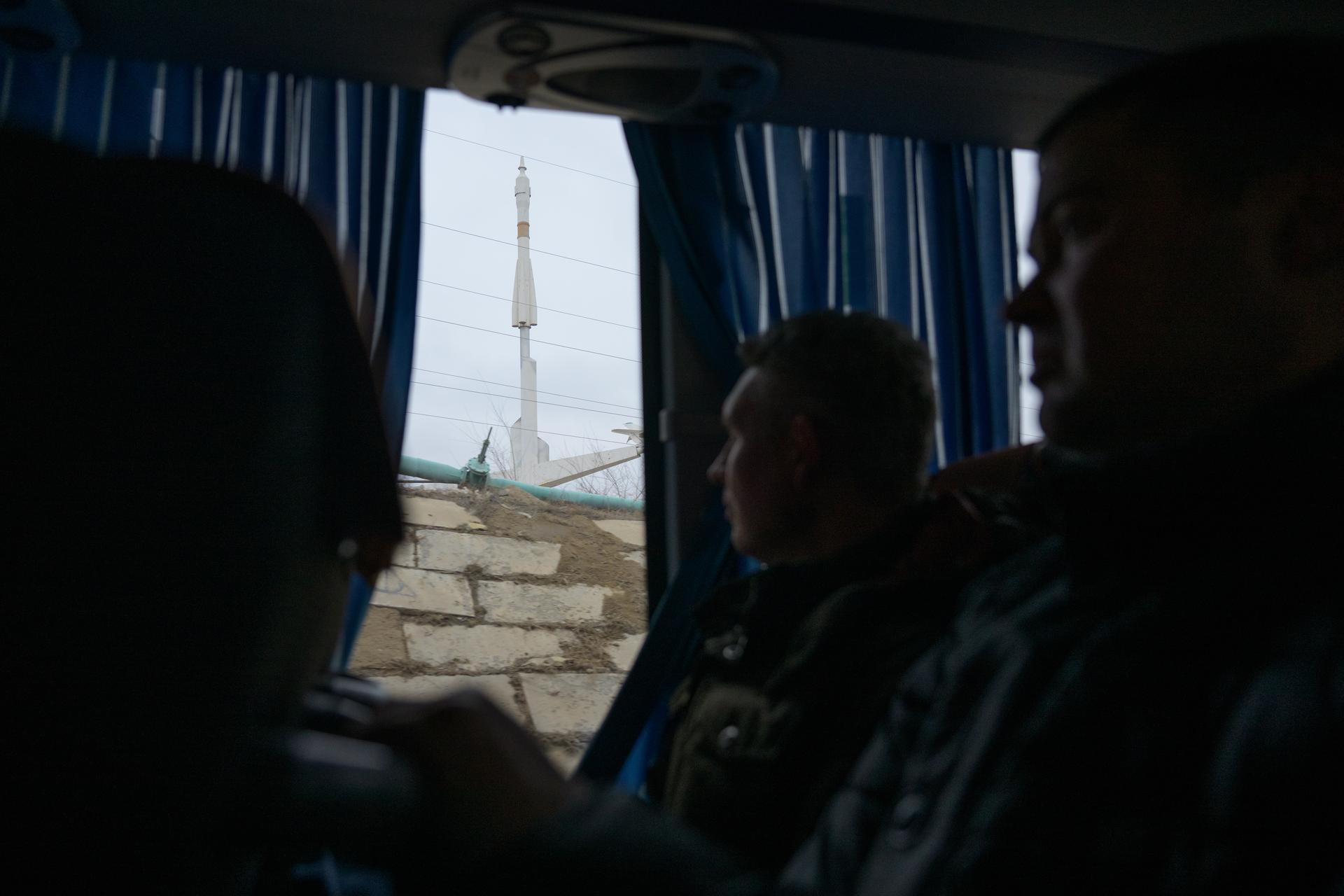
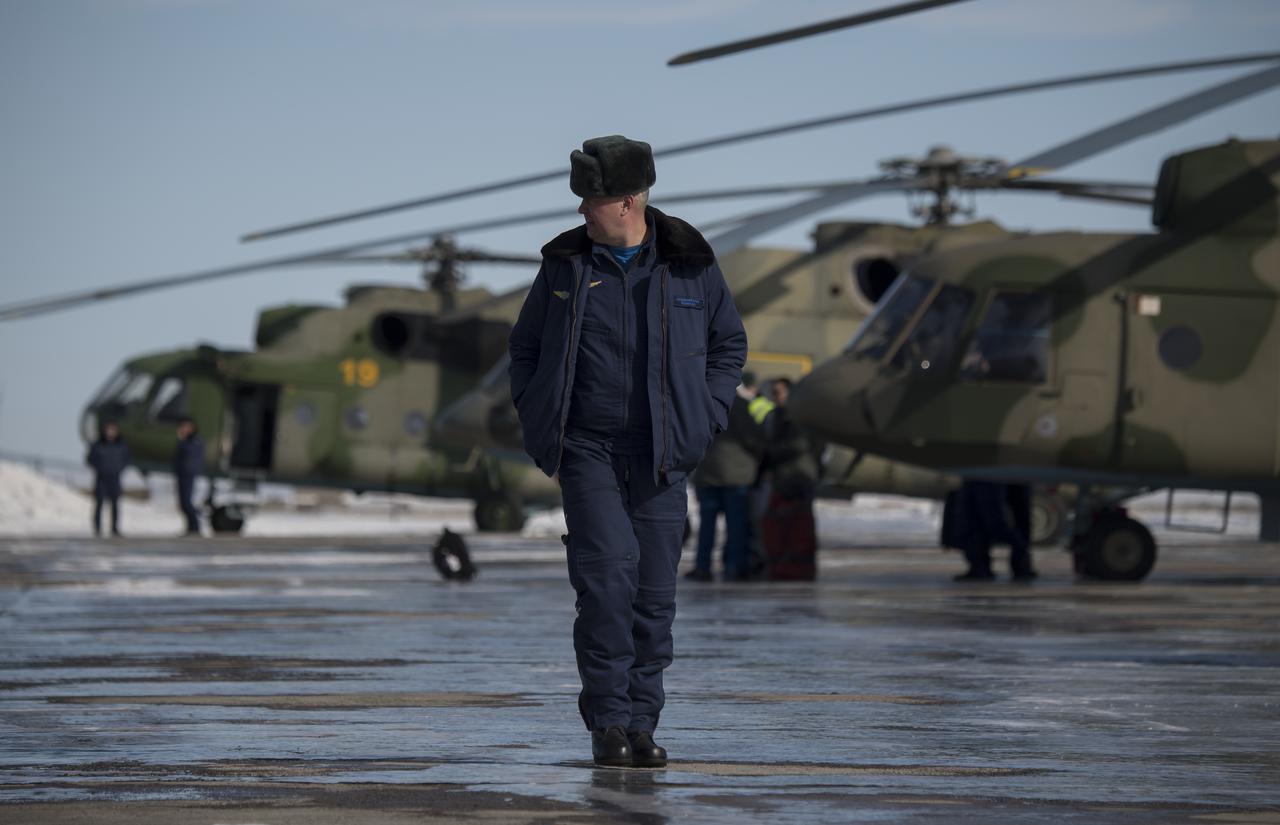
NASA, Roscosmos, and Russian Search and Recovery Forces arrive in Zhezkazgan, Kazakhstan to prepare for the landing of Expedition 73 NASA astronaut Jonny Kim, and Roscosmos cosmonauts Sergey Ryzhikov, and Alexey Zubritsky, Monday, Dec. 8, 2025. The trio are returning to Earth after logging 245 days in space as a members of Expeditions 72 and 73 aboard the International Space Station. Photo Credit: (NASA/Bill Ingalls)
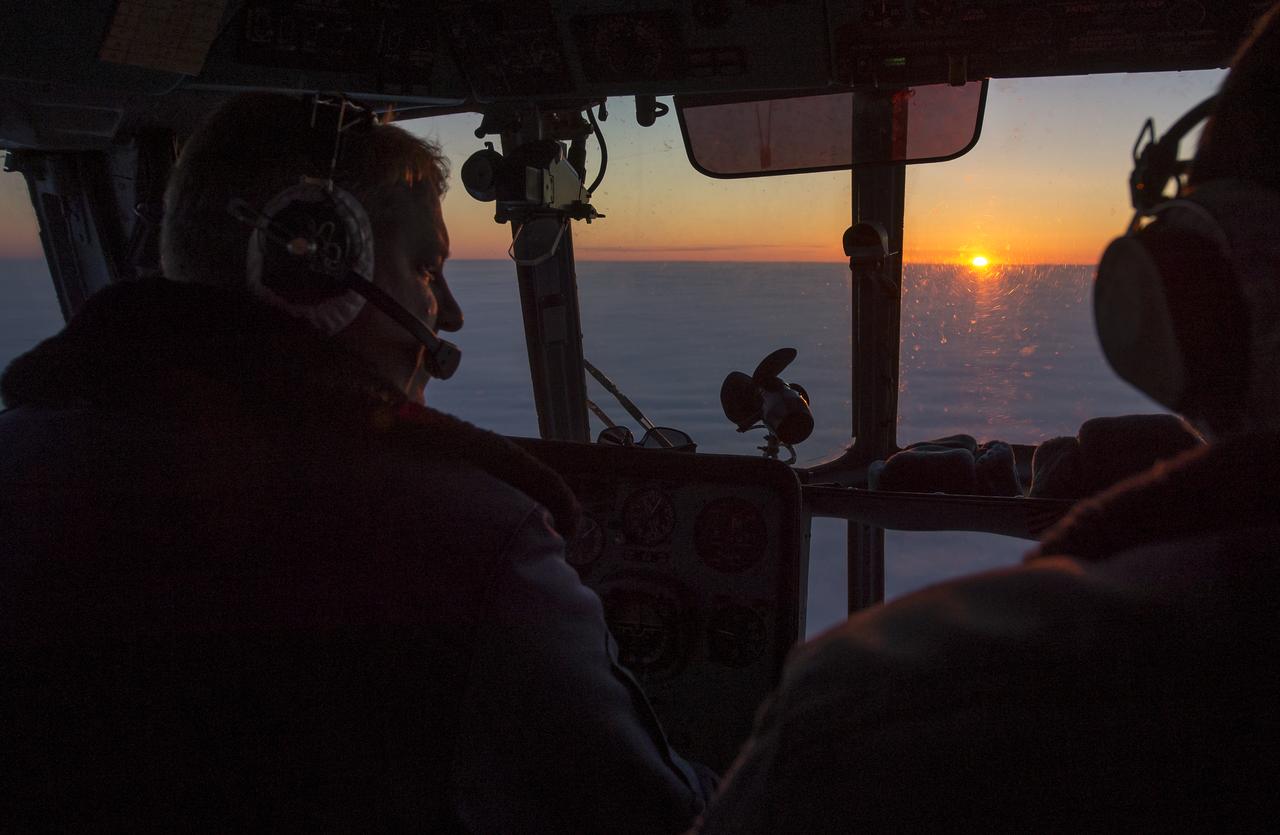
Pilots position a Russian MI-8 Helicopter for the Soyuz TMA-14M spacecraft landing with Expedition 42 commander Barry Wilmore of NASA, Alexander Samokutyaev of the Russian Federal Space Agency (Roscosmos) and Elena Serova of Roscosmos near the town of Zhezkazgan, Kazakhstan on Thursday, March 12, 2015. NASA Astronaut Wilmore, Russian Cosmonauts Samokutyaev and Serova are returning after almost six months onboard the International Space Station where they served as members of the Expedition 41 and 42 crews. Photo Credit: (NASA/Bill Ingalls)
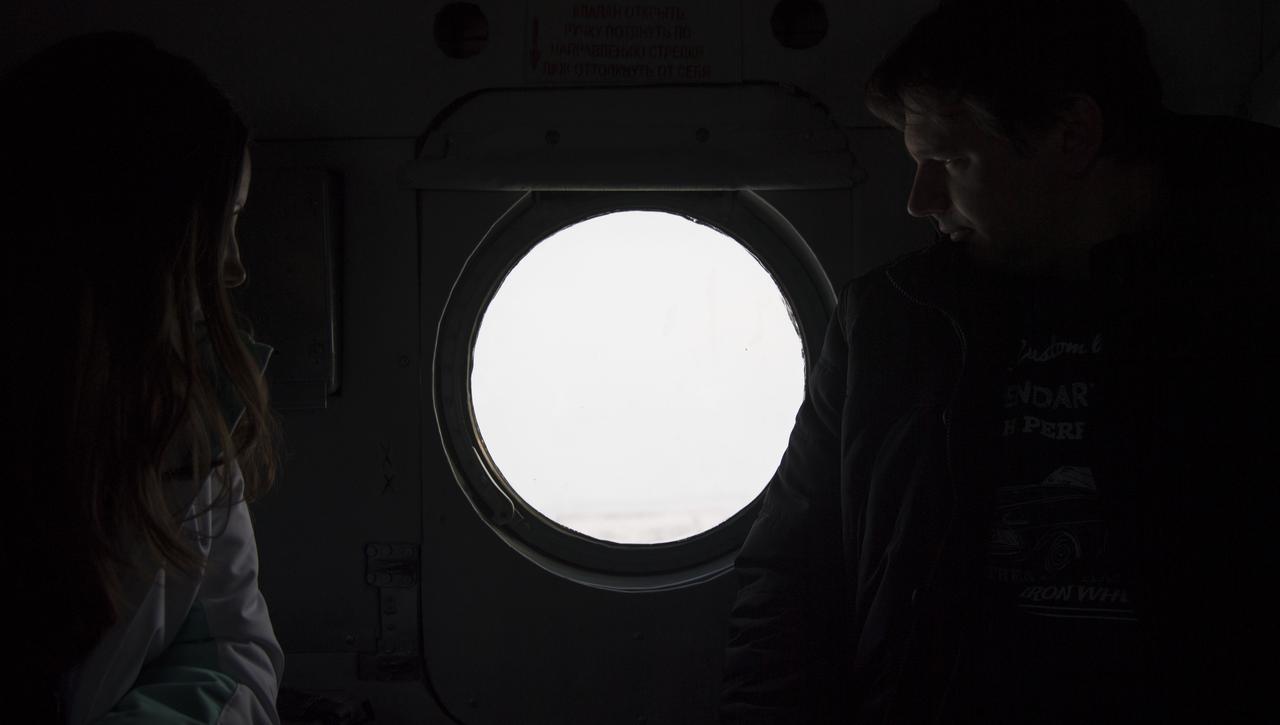
Russian Search and Rescue teams deploy on MI-8 helicopters from Karaganda to Zhezkazgan, Kazakhstan to prepare for the Soyuz MS-06 landing with Expedition 54 crew members Joe Acaba and Mark Vande Hei of NASA and cosmonaut Alexander Misurkin, Monday, Feb. 26, 2018. Acaba, Vande Hei, and Misurkin are returning after 168 days in space where they served as members of the Expedition 53 and 54 crews onboard the International Space Station. Photo Credit: (NASA/Bill Ingalls)
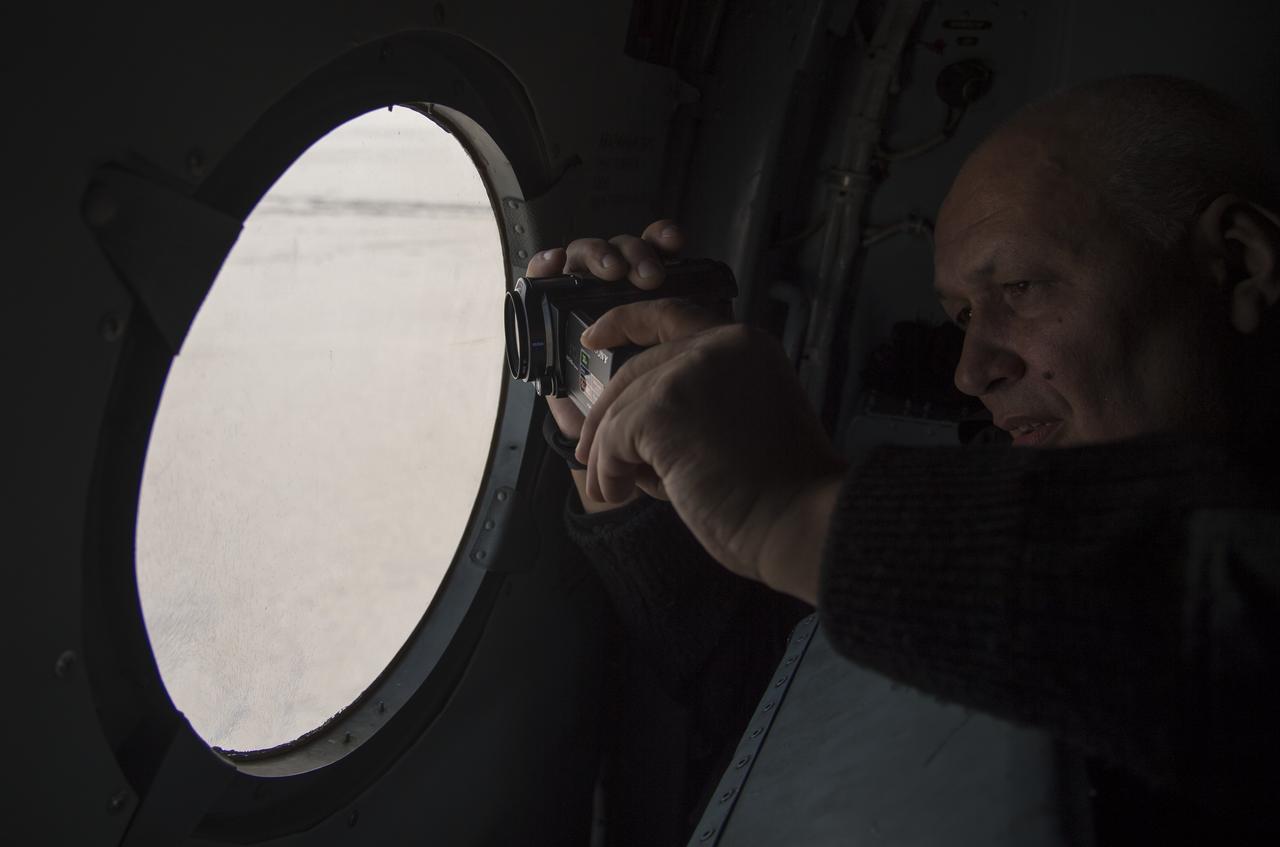
Russian Search and Rescue teams deploy on MI-8 helicopters from Karaganda to Zhezkazgan, Kazakhstan to prepare for the Soyuz MS-06 landing with Expedition 54 crew members Joe Acaba and Mark Vande Hei of NASA and cosmonaut Alexander Misurkin, Monday, Feb. 26, 2018. Acaba, Vande Hei, and Misurkin are returning after 168 days in space where they served as members of the Expedition 53 and 54 crews onboard the International Space Station. Photo Credit: (NASA/Bill Ingalls)
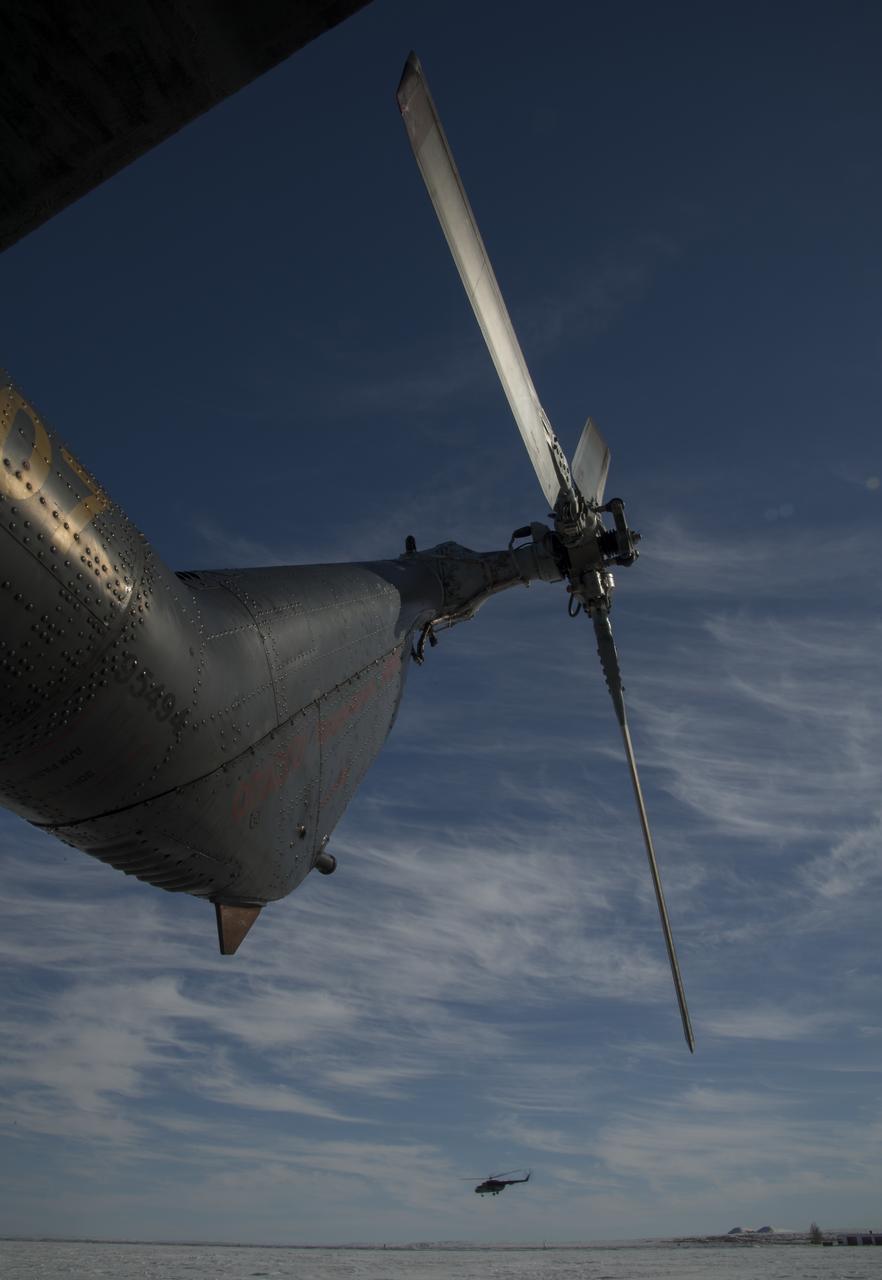
Russian Search and Rescue teams deploy on MI-8 helicopters from Karaganda to Zhezkazgan, Kazakhstan to prepare for the Soyuz MS-06 landing with Expedition 54 crew members Joe Acaba and Mark Vande Hei of NASA and cosmonaut Alexander Misurkin, Monday, Feb. 26, 2018. Acaba, Vande Hei, and Misurkin are returning after 168 days in space where they served as members of the Expedition 53 and 54 crews onboard the International Space Station. Photo Credit: (NASA/Bill Ingalls)
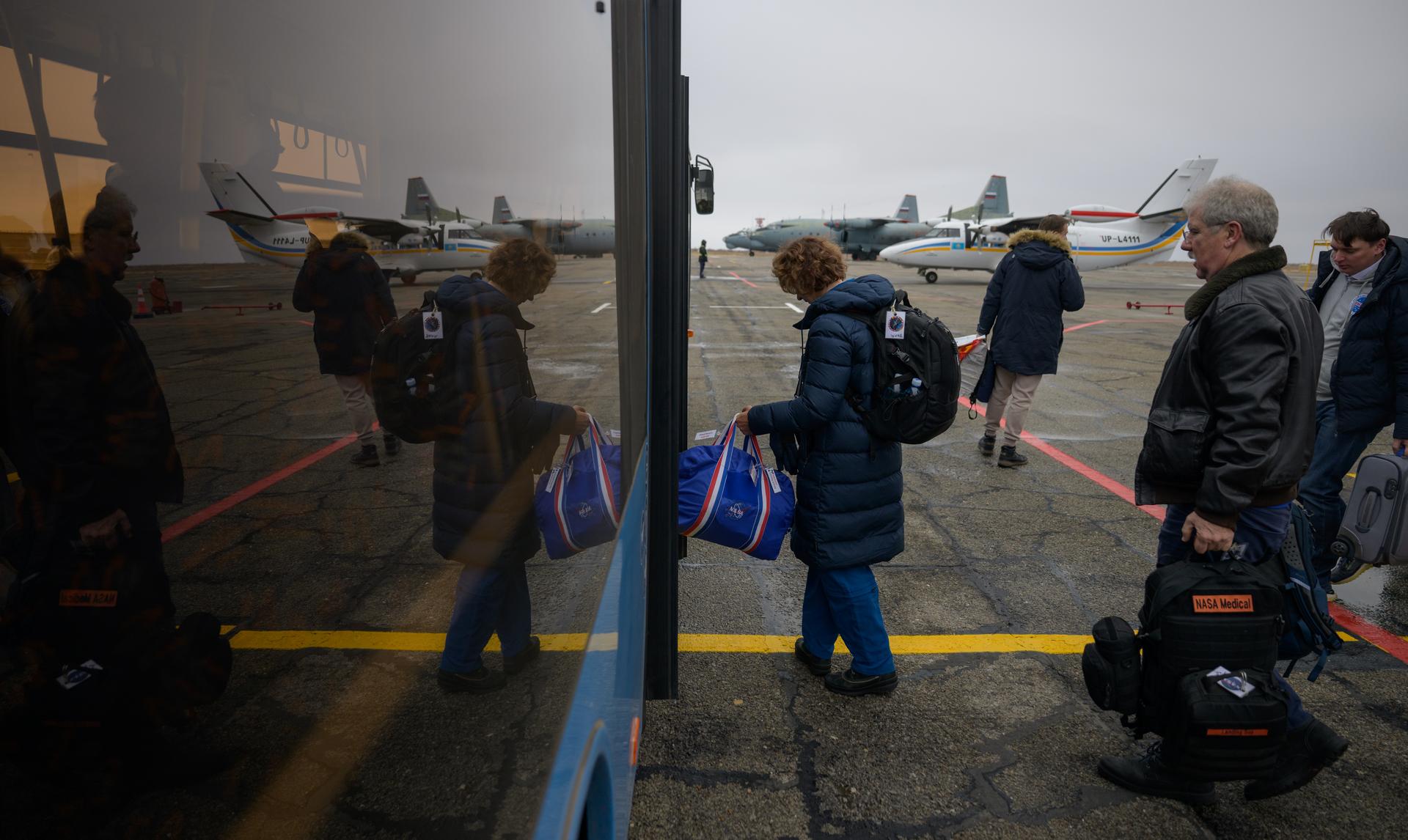
NASA, Roscosmos, and Russian Search and Recovery Forces arrive on an AN-26 plane in Zhezkazgan, Kazakhstan to prepare for the landing of Expedition 73 NASA astronaut Jonny Kim, and Roscosmos cosmonauts Sergey Ryzhikov, and Alexey Zubritsky, Monday, Dec. 8, 2025. The trio are returning to Earth after logging 245 days in space as a members of Expeditions 72 and 73 aboard the International Space Station. Photo Credit: (NASA/Bill Ingalls)
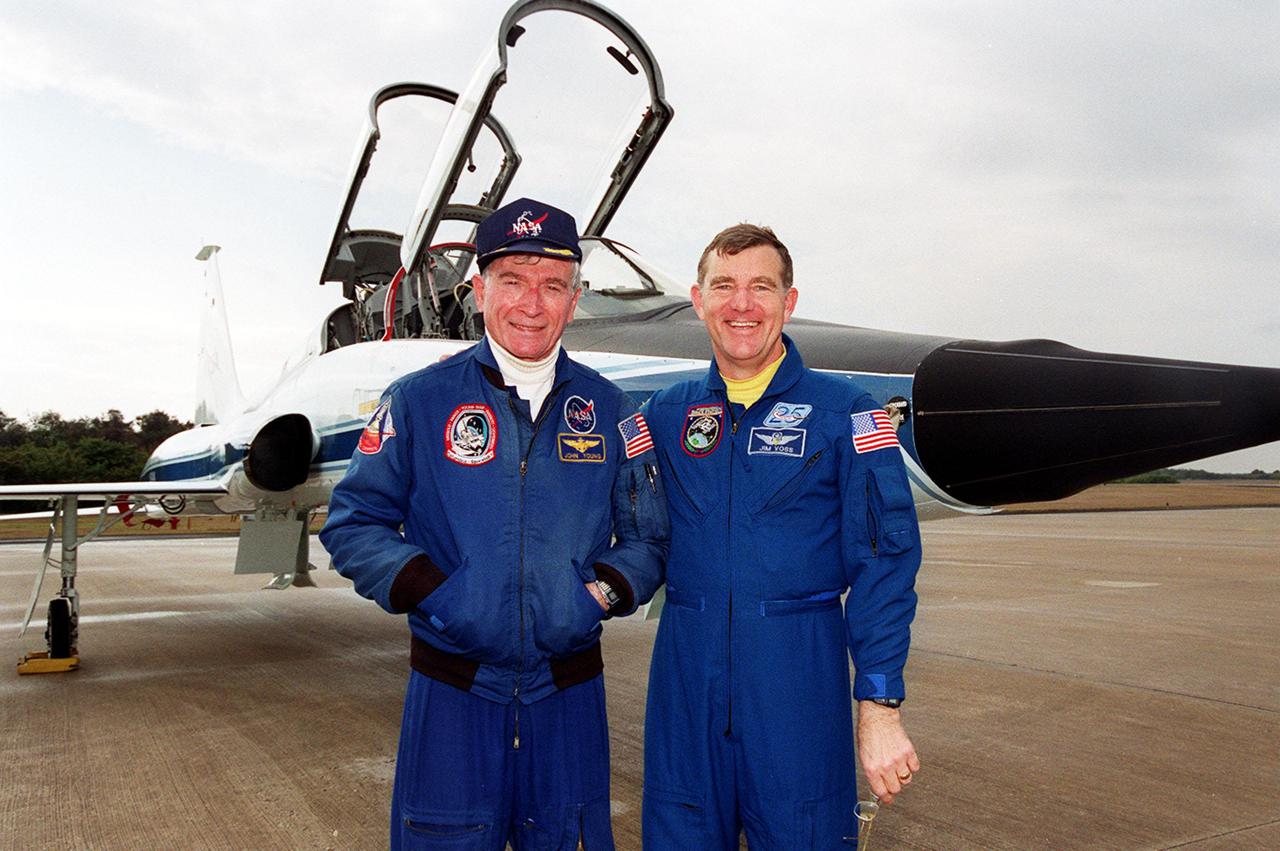
Astronaut James Voss (right) stands with astronaut John Young on the tarmac at the KSC Shuttle Landing Facility. Voss is flying on mission STS-102, launching March 8, as part of the Expedition Two crew going to the International Space Station. Young made his fifth flight as Spacecraft Commander of STS-1, the first flight of the Space Shuttle, April 12-14, 1981. His sixth and final flight was as Spacecraft Commander of STS-9, the first Spacelab mission, Nov. 28-Dec. 8, 1983. The other members of the Expedition Two crew are Susan Helms and Yury Usachev. STS-102 will be Helms’ and Voss’s fifth Shuttle flight, and Usachev’s second. They will be replacing the Expedition One crew (Bill Shepherd, Yuri Gidzenko and Sergei Krikalev), who will return to Earth March 20 on Discovery along with the STS-102 crew
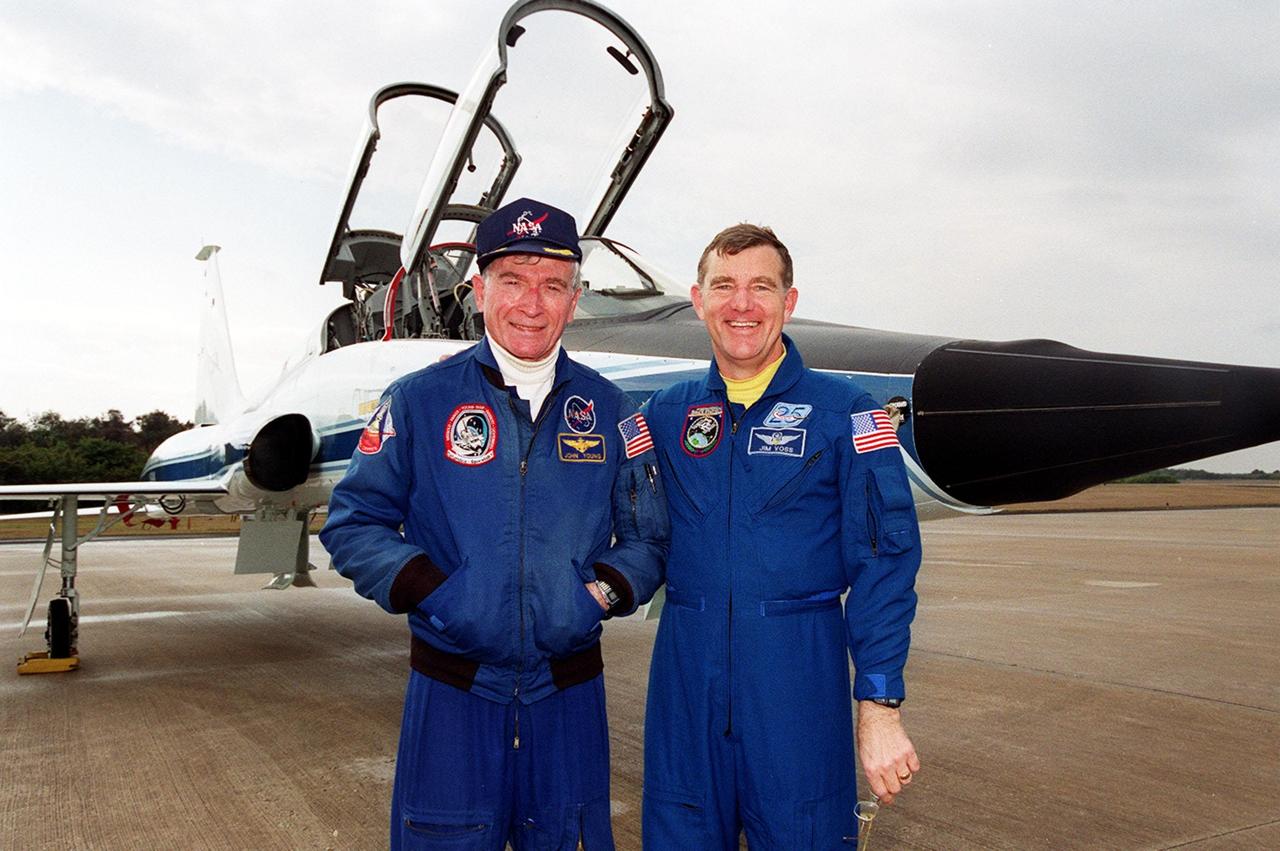
Astronaut James Voss (right) stands with astronaut John Young on the tarmac at the KSC Shuttle Landing Facility. Voss is flying on mission STS-102, launching March 8, as part of the Expedition Two crew going to the International Space Station. Young made his fifth flight as Spacecraft Commander of STS-1, the first flight of the Space Shuttle, April 12-14, 1981. His sixth and final flight was as Spacecraft Commander of STS-9, the first Spacelab mission, Nov. 28-Dec. 8, 1983. The other members of the Expedition Two crew are Susan Helms and Yury Usachev. STS-102 will be Helms’ and Voss’s fifth Shuttle flight, and Usachev’s second. They will be replacing the Expedition One crew (Bill Shepherd, Yuri Gidzenko and Sergei Krikalev), who will return to Earth March 20 on Discovery along with the STS-102 crew
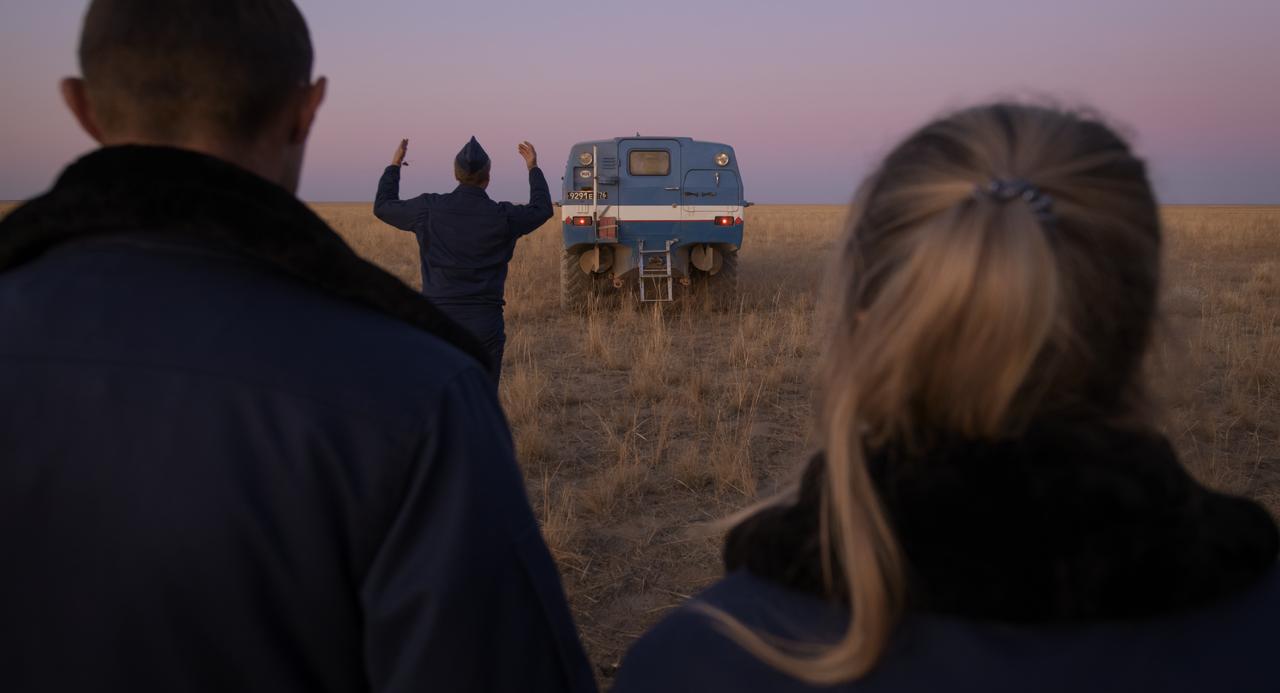
An all-terrain vehicle, with Expedition 60 crewmember Nick Hague of NASA onboard, is backed up to an awaiting helicopter after Hague landed in the Soyuz MS-12 spacecraft with Expedition 60 crewmember Alexey Ovchinin of Roscosmos, and visiting astronaut Hazzaa Ali Almansoori of the United Arab Emirates in a remote area near the town of Zhezkazgan, Kazakhstan, Thursday, Oct. 3, 2019. Hague and Ovchinin are returning after 203 days in space where they served as members of the Expedition 59 and 60 crews onboard the International Space Station. Almansoori logged 8 days in space during his first flight as an astronaut. Photo Credit: (NASA/Bill Ingalls)
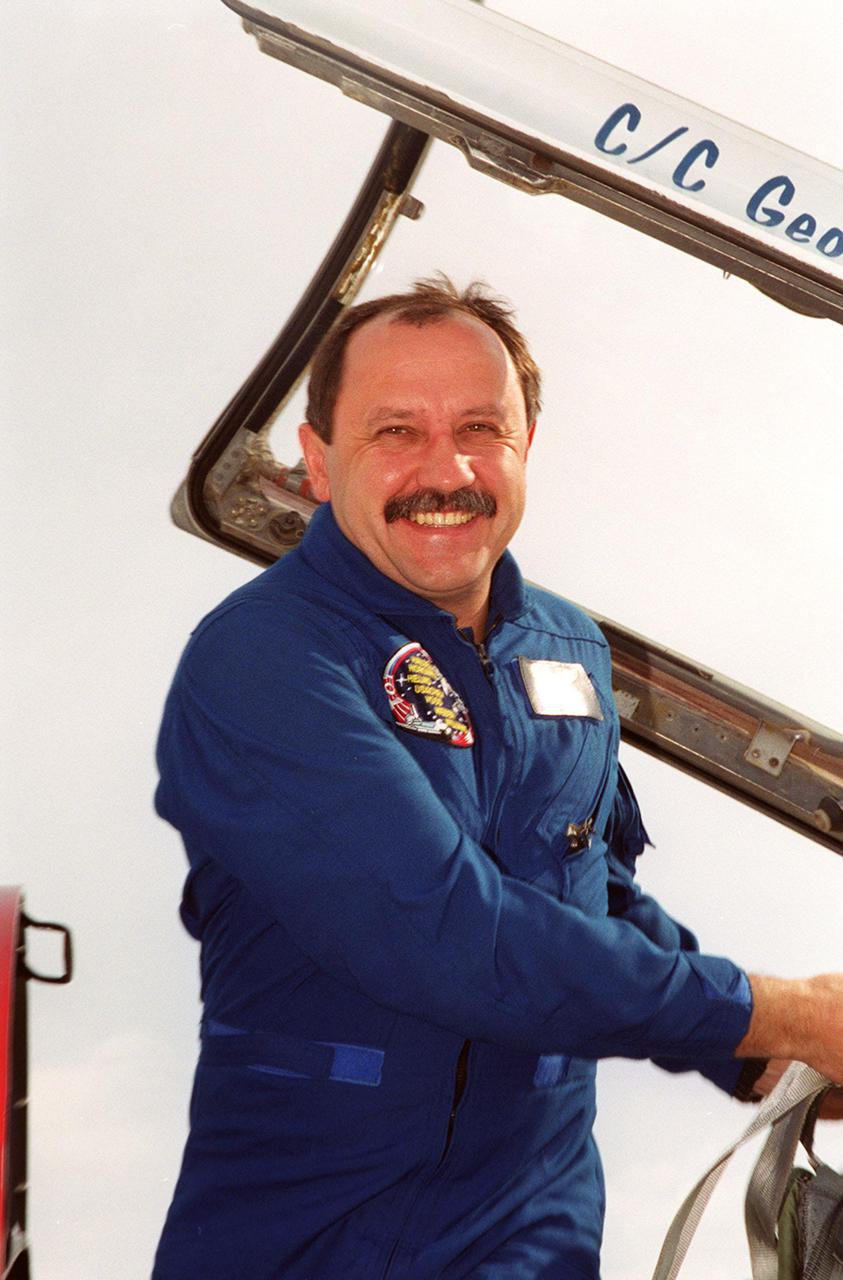
Cosmonaut Yury Usachev arrives at the KSC Shuttle Landing Facility. Usachev s flying on mission STS-102, launching March 8, as part of the Expedition Two crew going to the International Space Station. The other members of the Expedition Two crew are James Voss and Susan Helms. They are at KSC to inspect the air lock that will be carried to the Station during their tenure in space. STS-102 will be Helms’ and Voss’s fifth Shuttle flight, and Usachev’s second. They will be replacing the Expedition One crew (Bill Shepherd, Yuri Gidzenko and Sergei Krikalev), who will return to Earth March 20 on Discovery along with the STS-102 crew
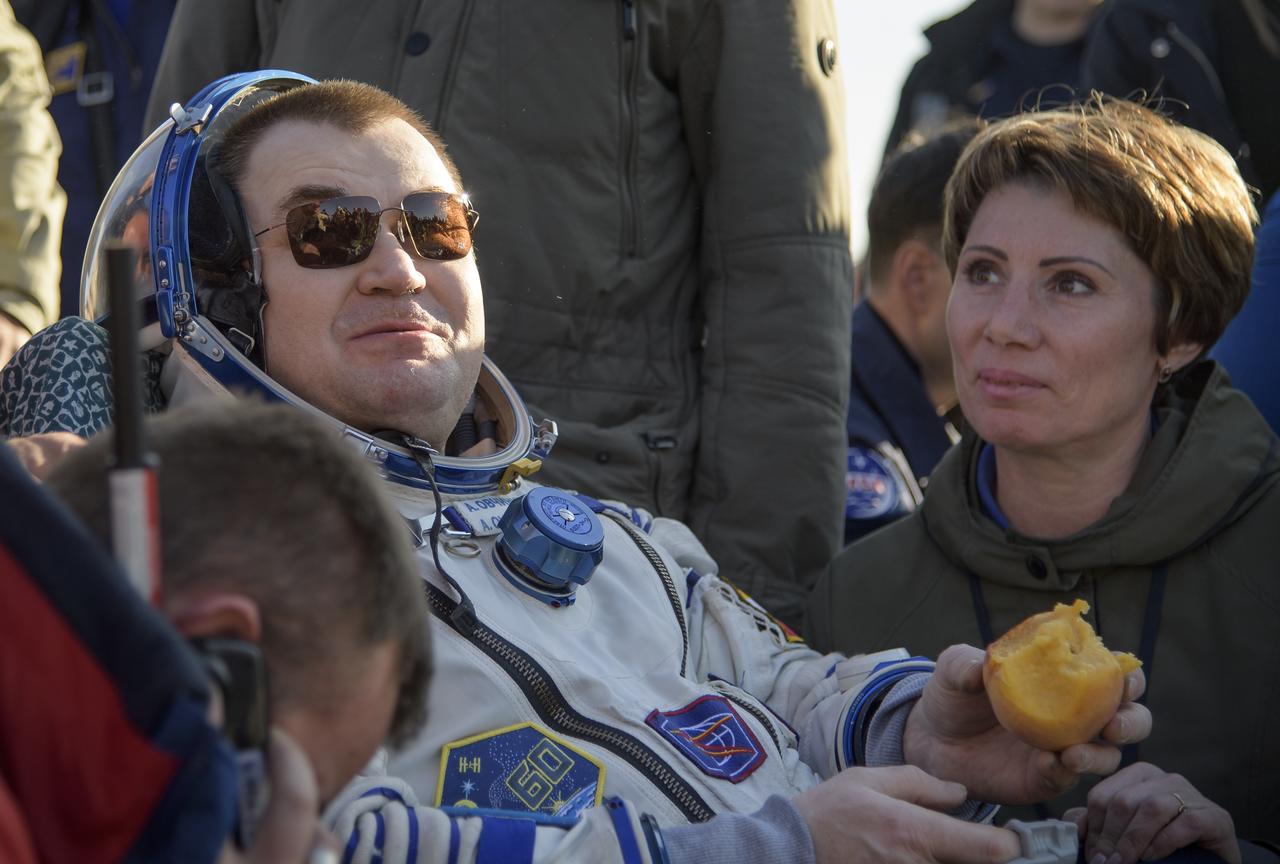
Expedition 60 crewmember Alexey Ovchinin of Roscosmos is seen outside the Soyuz MS-12 spacecraft after he landed with fellow Expedition 60 crewmember Nick Hague of NASA and visiting astronaut Hazzaa Ali Almansoori of the United Arab Emirates in a remote area near the town of Zhezkazgan, Kazakhstan on Thursday, Oct. 3, 2019. Hague and Ovchinin are returning after 203 days in space where they served as members of the Expedition 59 and 60 crews onboard the International Space Station. Almansoori logged 8 days in space during his first flight as an astronaut. Photo Credit: (NASA/Bill Ingalls)

Expedition 60 crewmember Nick Hague of NASA departs the medical tent after he and fellow Expedition 60 crewmember Alexey Ovchinin of Roscosmos and visiting astronaut Hazzaa Ali Almansoori of the United Arab Emirates landed in their Soyuz MS-12 spacecraft near the town of Zhezkazgan, Kazakhstan on Thursday, Oct. 3, 2019. Hague and Ovchinin are returning after 203 days in space where they served as members of the Expedition 59 and 60 crews onboard the International Space Station. Almansoori logged 8 days in space during his first flight as an astronaut. Photo Credit: (NASA/Bill Ingalls)
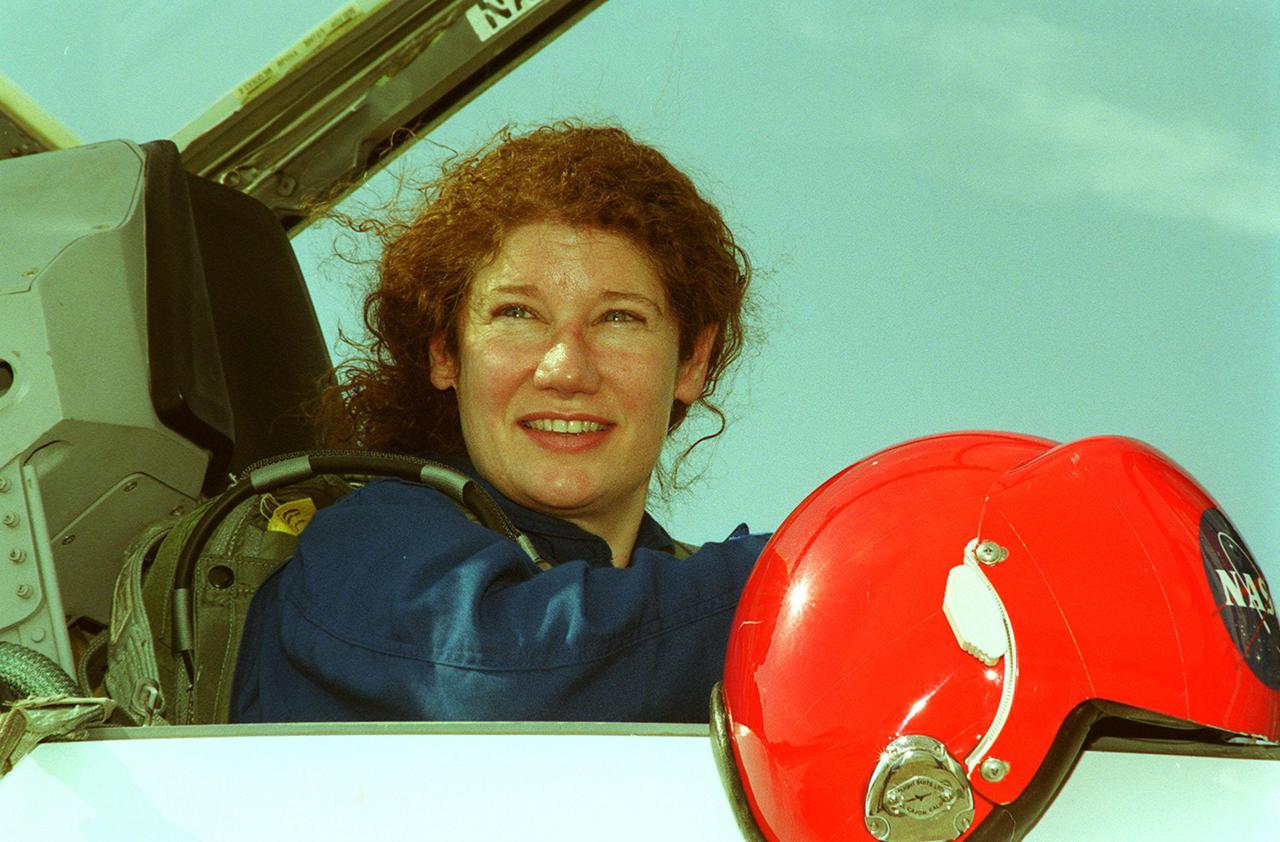
Astronaut Susan Helms arrives at the KSC Shuttle Landing Facility. Helms is flying on mission STS-102, launching March 8, as part of the Expedition Two crew going to the International Space Station. The other members of the Expedition Two crew are James Voss and Yury Usachev. They are at KSC to inspect the air lock that will be carried to the Station during their tenure in space. STS-102 will be Helms’ and Voss’s fifth Shuttle flight, and Usachev’s second. They will be replacing the Expedition One crew (Bill Shepherd, Yuri Gidzenko and Sergei Krikalev), who will return to Earth March 20 on Discovery along with the STS-102 crew
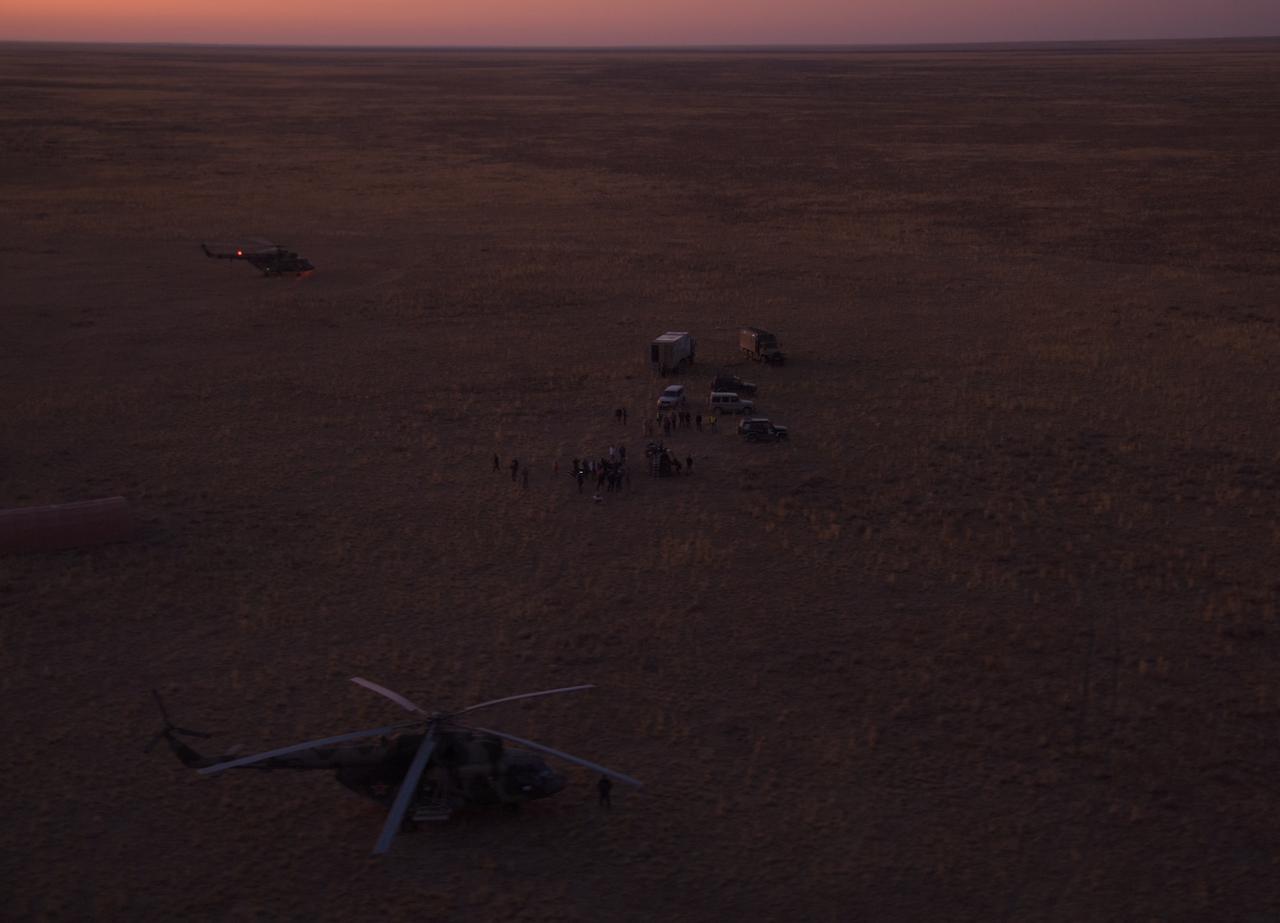
The Soyuz MS-12 spacecraft landing site is seen from the helicopter carrying Expedition 60 crew member Nick Hague of NASA back to Karaganda, Kazakhstan, Thursday, Oct. 3, 2019. Hague and fellow Expedition 60 crewmember Alexey Ovchinin are returning after 203 days in space where they served as members of the Expedition 59 and 60 crews onboard the International Space Station. Visiting astronaut Hazzaa Ali Almansoori of the United Arab Emirates also returned with etc crew after logging 8 days in space during his first flight as an astronaut. Photo Credit: (NASA/Bill Ingalls)
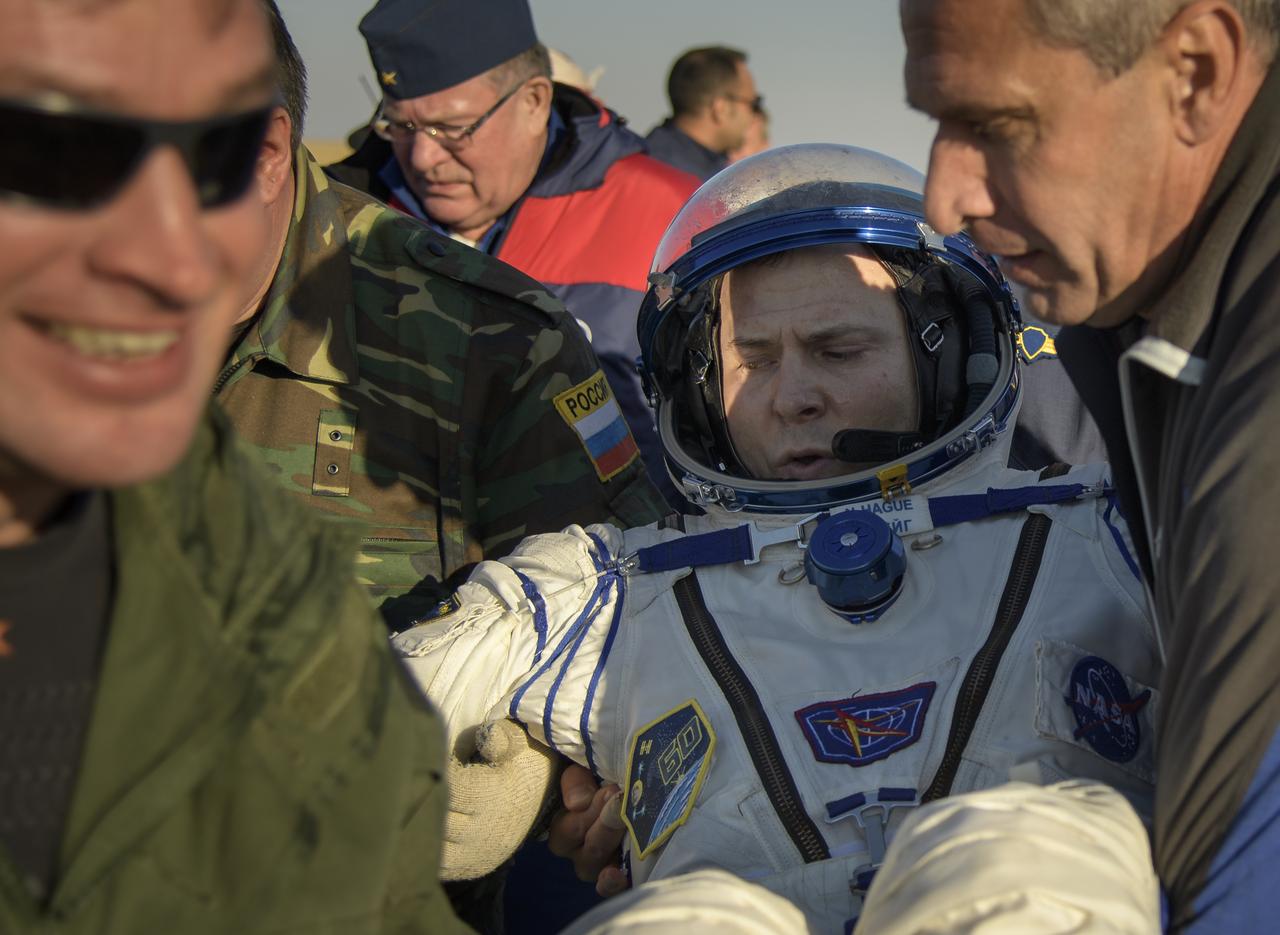
Expedition 60 crewmembers Nick Hague of NASA is helped out of the Soyuz MS-12 spacecraft just minutes after he and fellow crew mate Expedition 60 cosmonaut Alexey Ovchinin of Roscosmos, and visiting astronaut Hazzaa Ali Almansoori of the United Arab Emirates, landed in a remote area near the town of Zhezkazgan, Kazakhstan on Thursday, Oct. 3, 2019. Hague and Ovchinin are returning after 203 days in space where they served as members of the Expedition 59 and 60 crews onboard the International Space Station. Almansoori logged 8 days in space during his first flight as an astronaut. Photo Credit: (NASA/Bill Ingalls)
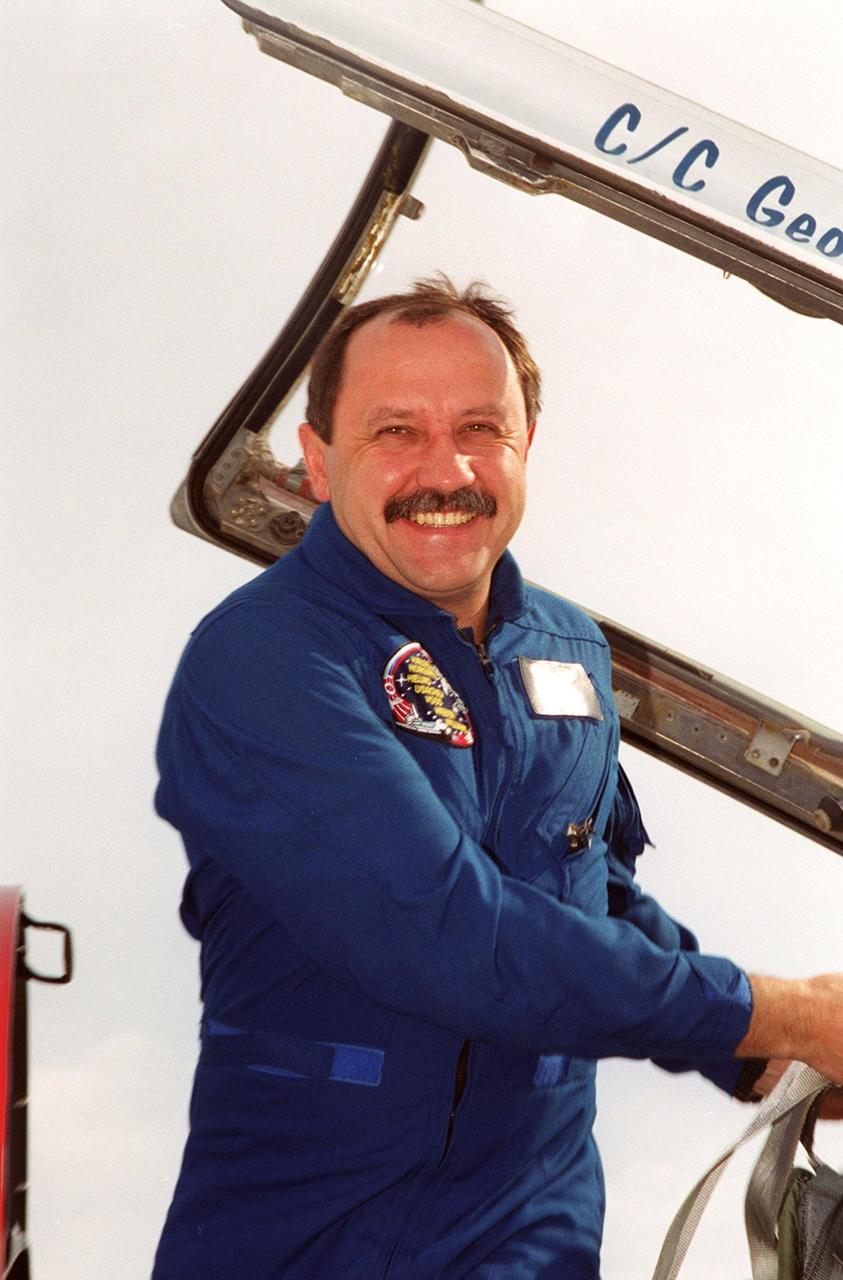
Cosmonaut Yury Usachev arrives at the KSC Shuttle Landing Facility. Usachev s flying on mission STS-102, launching March 8, as part of the Expedition Two crew going to the International Space Station. The other members of the Expedition Two crew are James Voss and Susan Helms. They are at KSC to inspect the air lock that will be carried to the Station during their tenure in space. STS-102 will be Helms’ and Voss’s fifth Shuttle flight, and Usachev’s second. They will be replacing the Expedition One crew (Bill Shepherd, Yuri Gidzenko and Sergei Krikalev), who will return to Earth March 20 on Discovery along with the STS-102 crew
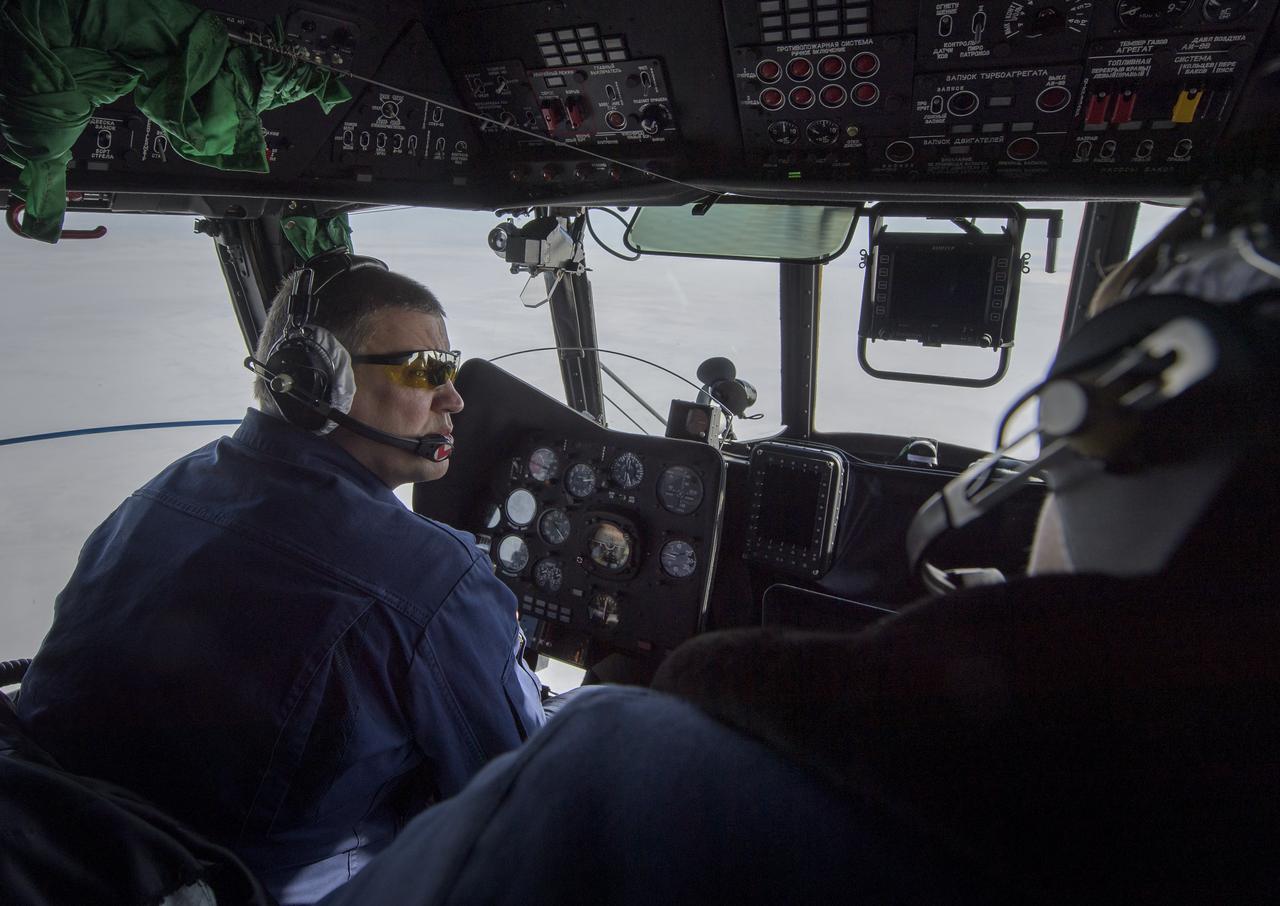
A Russian MI-8 helicopter pilot flies to the predicted landing zone of the Expedition 61 crew’s Soyuz MS-13 spacecraft near the town of Zhezkazgan, Kazakhstan Thursday, Feb. 6, 2020. Christina Koch returned to Earth after logging 328 days in space --- the longest spaceflight in history by a woman --- as a member of Expeditions 59-60-61 on the International Space Station. Roscosmos cosmonaut Alexander Skvortsov and ESA astronaut Luca Parmitano returned after 201 days in space where they served as Expedition 60-61 crew members onboard the station. Photo Credit: (NASA/Bill Ingalls)
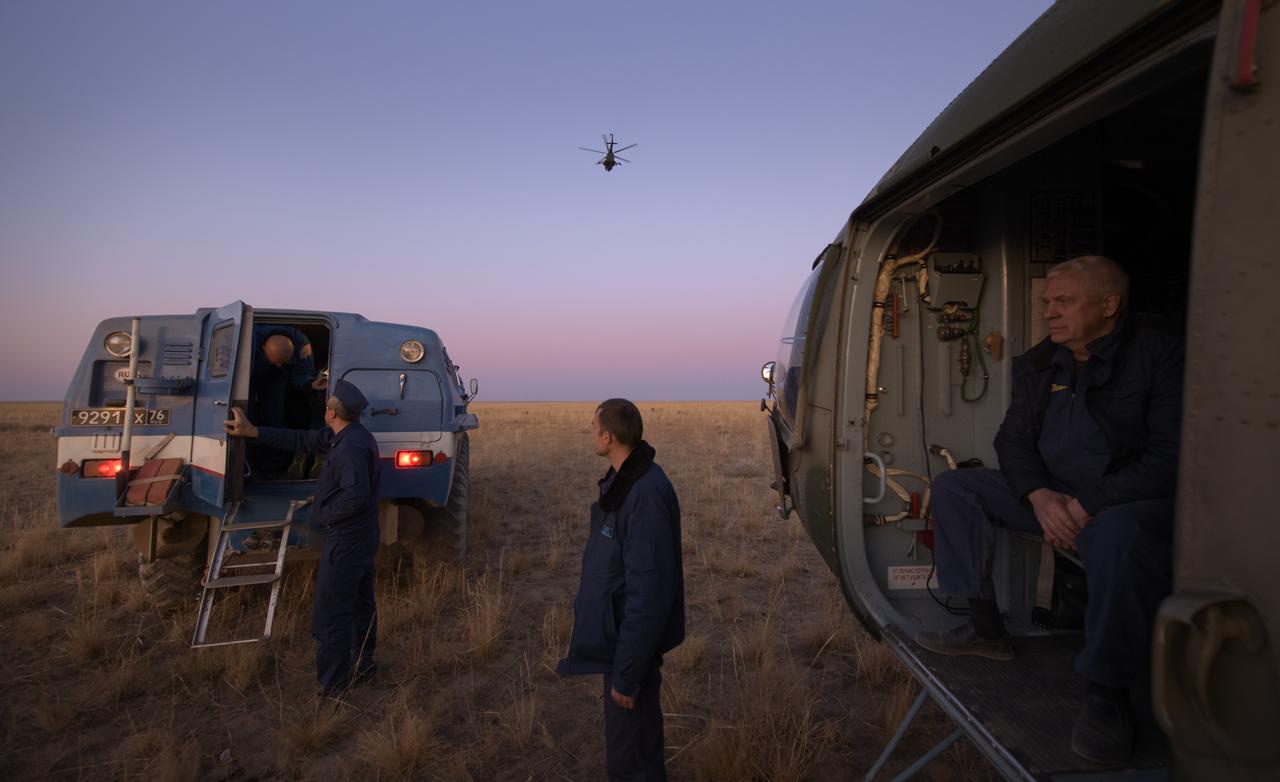
An all-terrain vehicle, with Expedition 60 crewmember Nick Hague of NASA onboard, arrives to an awaiting helicopter after Hague landed in the Soyuz MS-12 spacecraft with Expedition 60 crewmember Alexey Ovchinin of Roscosmos, and visiting astronaut Hazzaa Ali Almansoori of the United Arab Emirates in a remote area near the town of Zhezkazgan, Kazakhstan, Thursday, Oct. 3, 2019. Hague and Ovchinin are returning after 203 days in space where they served as members of the Expedition 59 and 60 crews onboard the International Space Station. Almansoori logged 8 days in space during his first flight as an astronaut. Photo Credit: (NASA/Bill Ingalls)
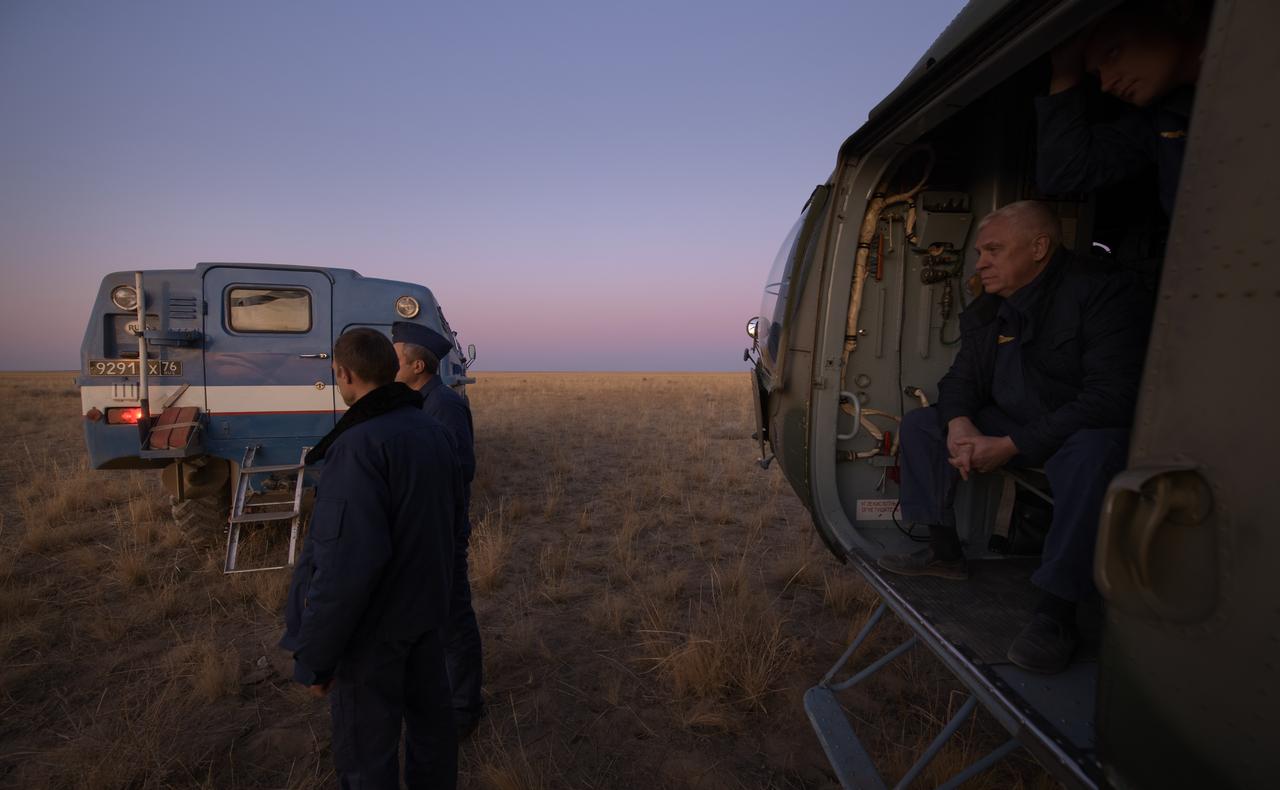
An all-terrain vehicle, with Expedition 60 crewmember Nick Hague of NASA onboard, is backed up to an awaiting helicopter after Hague landed in the Soyuz MS-12 spacecraft with Expedition 60 crewmember Alexey Ovchinin of Roscosmos, and visiting astronaut Hazzaa Ali Almansoori of the United Arab Emirates in a remote area near the town of Zhezkazgan, Kazakhstan, Thursday, Oct. 3, 2019. Hague and Ovchinin are returning after 203 days in space where they served as members of the Expedition 59 and 60 crews onboard the International Space Station. Almansoori logged 8 days in space during his first flight as an astronaut. Photo Credit: (NASA/Bill Ingalls)
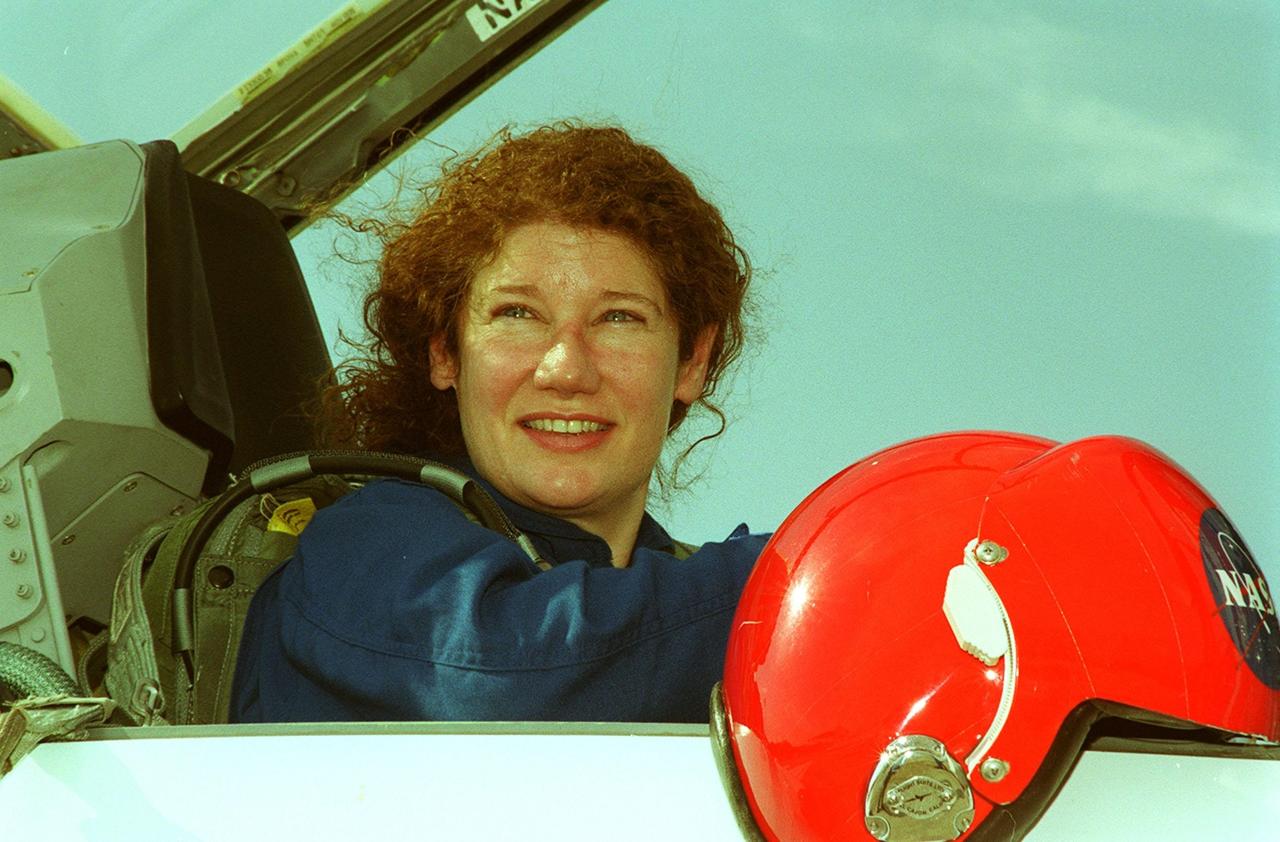
Astronaut Susan Helms arrives at the KSC Shuttle Landing Facility. Helms is flying on mission STS-102, launching March 8, as part of the Expedition Two crew going to the International Space Station. The other members of the Expedition Two crew are James Voss and Yury Usachev. They are at KSC to inspect the air lock that will be carried to the Station during their tenure in space. STS-102 will be Helms’ and Voss’s fifth Shuttle flight, and Usachev’s second. They will be replacing the Expedition One crew (Bill Shepherd, Yuri Gidzenko and Sergei Krikalev), who will return to Earth March 20 on Discovery along with the STS-102 crew
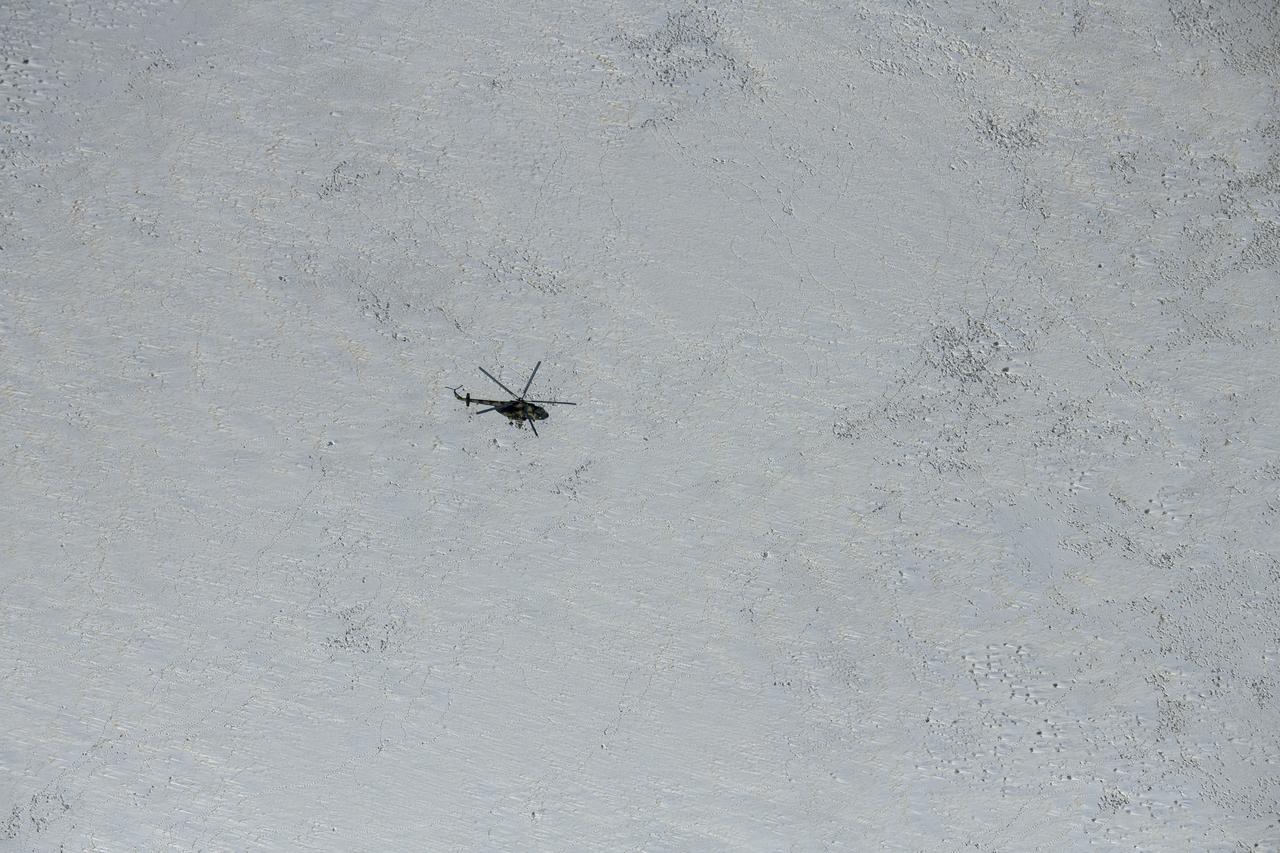
Russian MI-8 helicopters fly around the predicted landing zone of the Expedition 61 crew’s Soyuz MS-13 spacecraft near the town of Zhezkazgan, Kazakhstan Thursday, Feb. 6, 2020. Christina Koch returned to Earth after logging 328 days in space --- the longest spaceflight in history by a woman --- as a member of Expeditions 59-60-61 on the International Space Station. Roscosmos cosmonaut Alexander Skvortsov and ESA astronaut Luca Parmitano returned after 201 days in space where they served as Expedition 60-61 crew members onboard the station. Photo Credit: (NASA/Bill Ingalls)
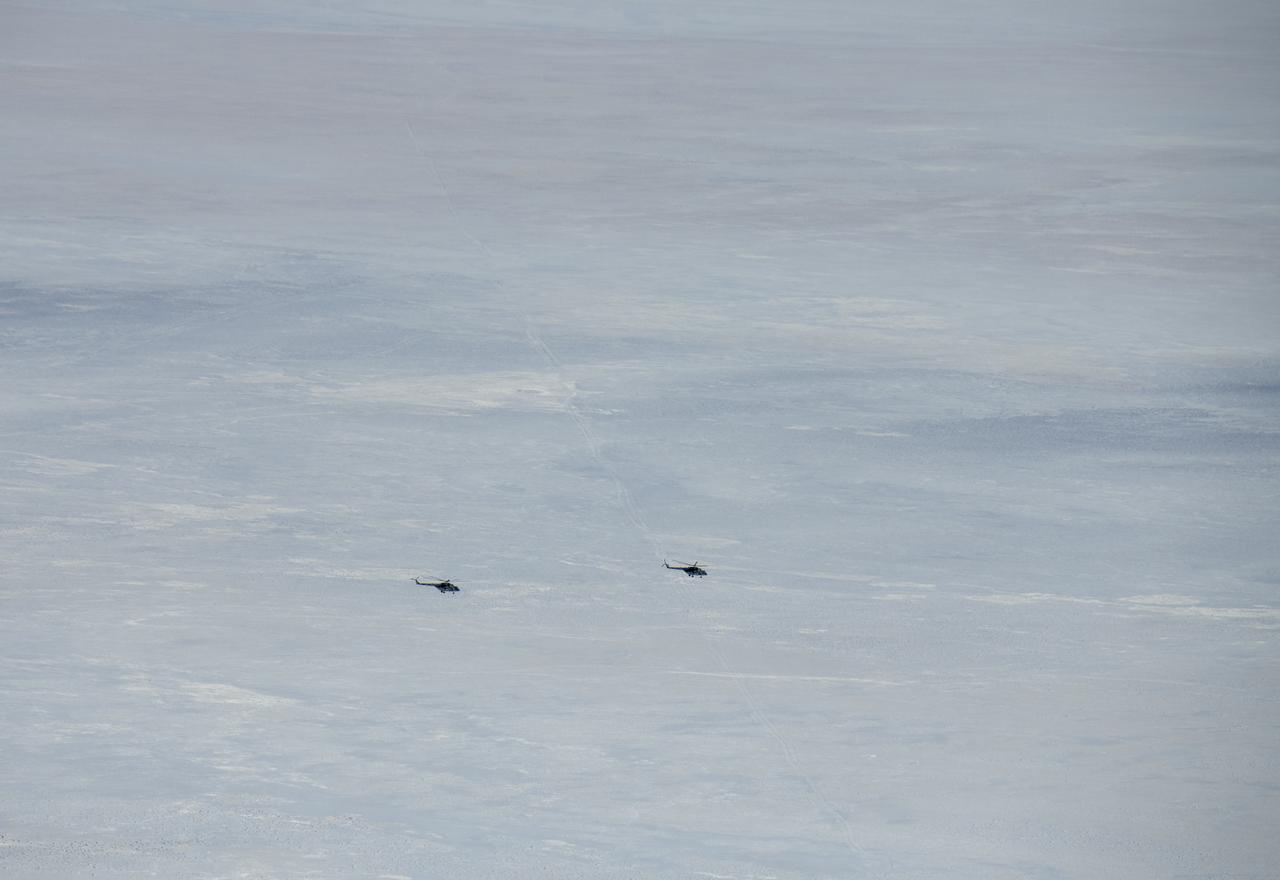
Russian MI-8 helicopters fly around the predicted landing zone of the Expedition 61 crew’s Soyuz MS-13 spacecraft near the town of Zhezkazgan, Kazakhstan Thursday, Feb. 6, 2020. Christina Koch returned to Earth after logging 328 days in space --- the longest spaceflight in history by a woman --- as a member of Expeditions 59-60-61 on the International Space Station. Roscosmos cosmonaut Alexander Skvortsov and ESA astronaut Luca Parmitano returned after 201 days in space where they served as Expedition 60-61 crew members onboard the station. Photo Credit: (NASA/Bill Ingalls)
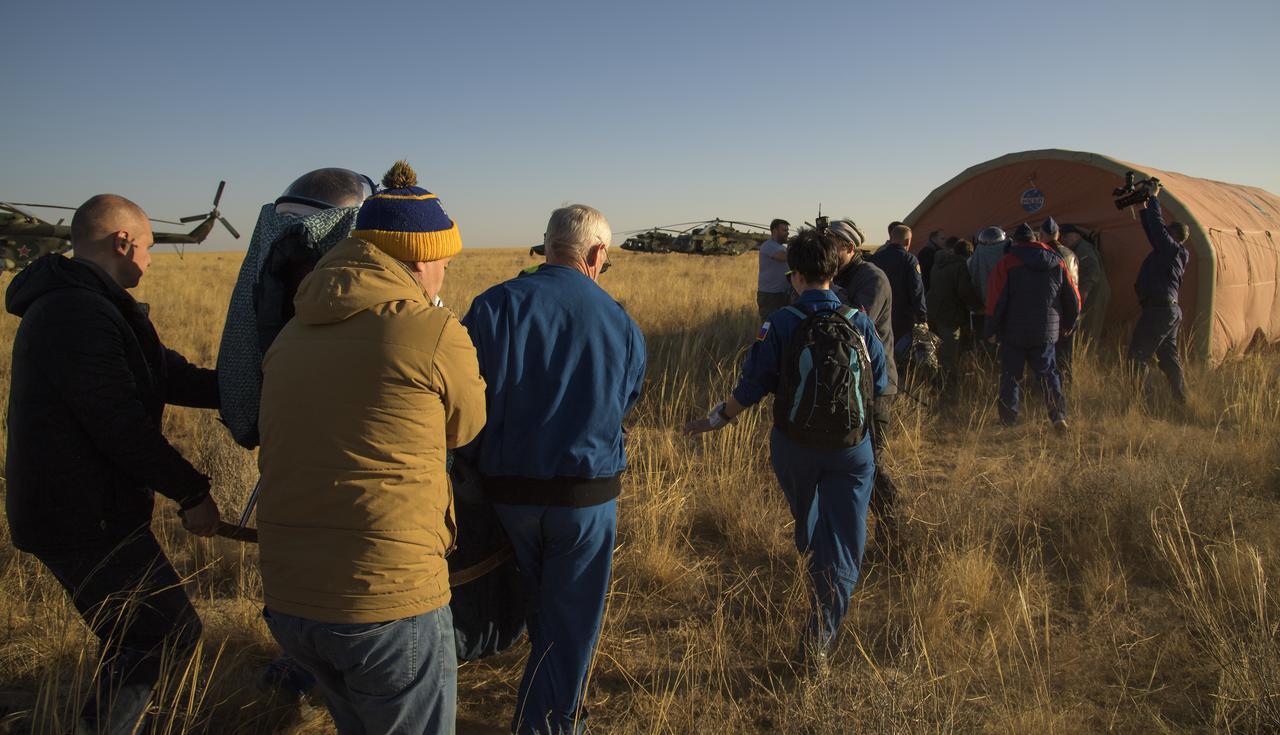
Expedition 60 crewmember Nick Hague of NASA is carried to a medical tent after he and fellow Expedition 60 crewmember Alexey Ovchinin of Roscosmos and visiting astronaut Hazzaa Ali Almansoori of the United Arab Emirates landed in their Soyuz MS-12 spacecraft near the town of Zhezkazgan, Kazakhstan on Thursday, Oct. 3, 2019. Hague and Ovchinin are returning after 203 days in space where they served as members of the Expedition 59 and 60 crews onboard the International Space Station. Almansoori logged 8 days in space during his first flight as an astronaut. Photo Credit: (NASA/Bill Ingalls)
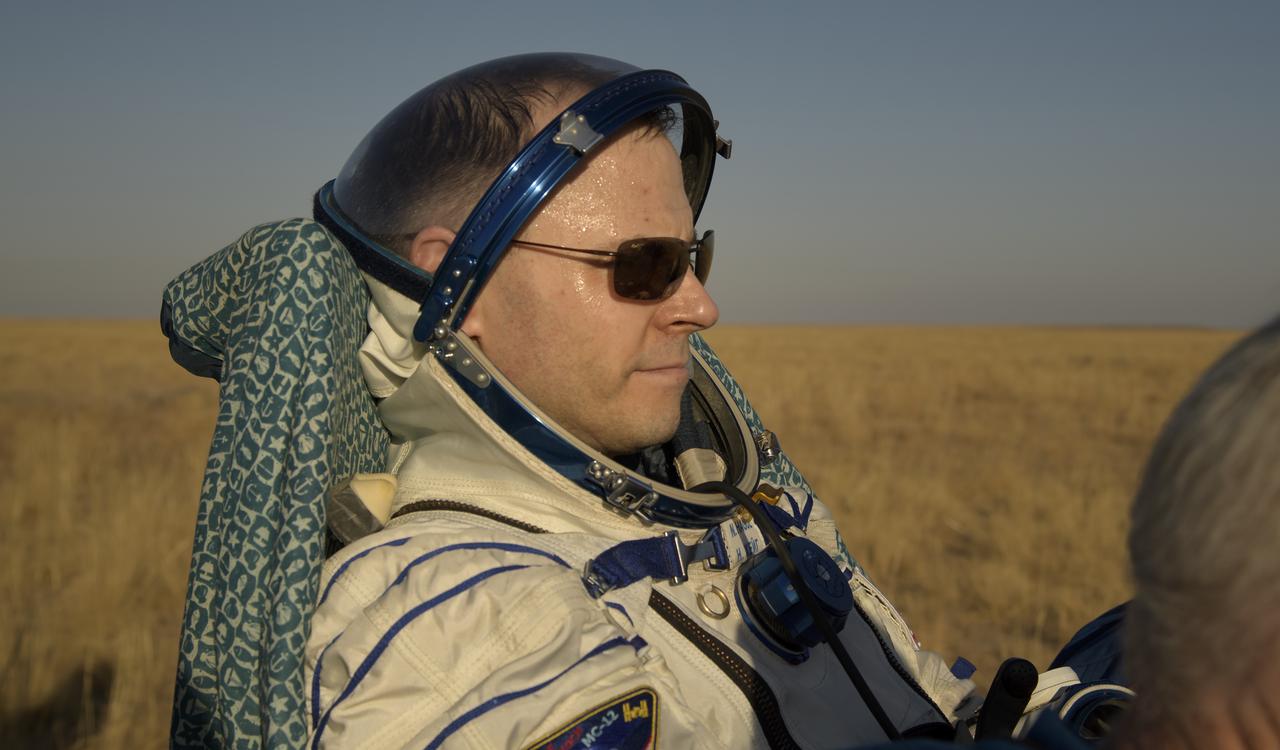
Expedition 60 crewmember Nick Hague of NASA is carried to a medical tent after he and fellow Expedition 60 crewmember Alexey Ovchinin of Roscosmos and visiting astronaut Hazzaa Ali Almansoori of the United Arab Emirates landed in their Soyuz MS-12 spacecraft near the town of Zhezkazgan, Kazakhstan on Thursday, Oct. 3, 2019. Hague and Ovchinin are returning after 203 days in space where they served as members of the Expedition 59 and 60 crews onboard the International Space Station. Almansoori logged 8 days in space during his first flight as an astronaut. Photo Credit: (NASA/Bill Ingalls)
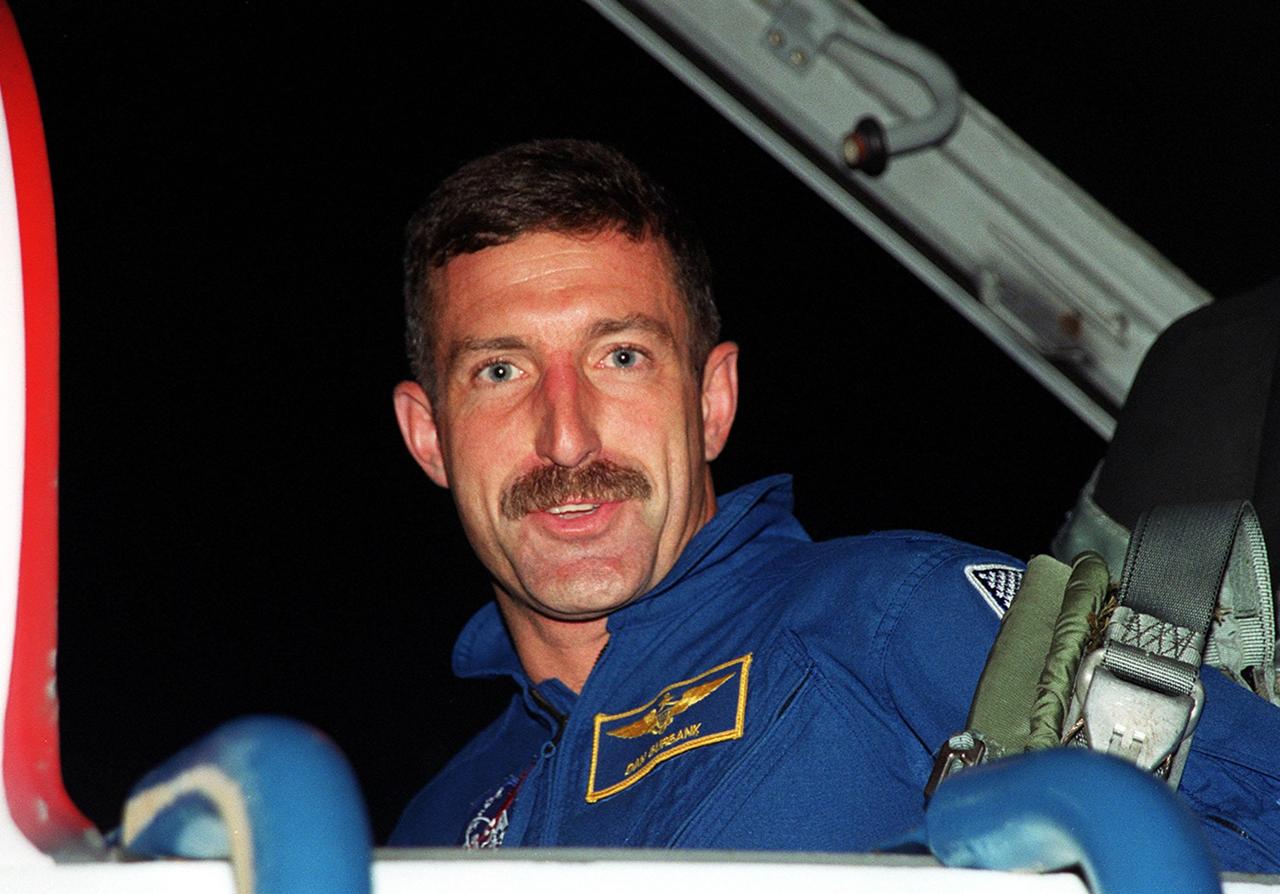
STS-106 Mission Specialist Daniel C. Burbank smiles on his arrival at the KSC Shuttle Landing Facility. He and the rest of the crew will be making pre-launch preparations for the fourth flight to the International Space Station. STS-106 is scheduled to launch Sept. 8, 2000, at 8:45 a.m. EDT from Launch Pad 39B. On the 11-day mission, the seven-member crew will perform support tasks on orbit, transfer supplies and prepare the living quarters in the newly arrived Zvezda Service Module. The first long-duration crew, dubbed “Expedition One,” is due to arrive at the Station in late fall
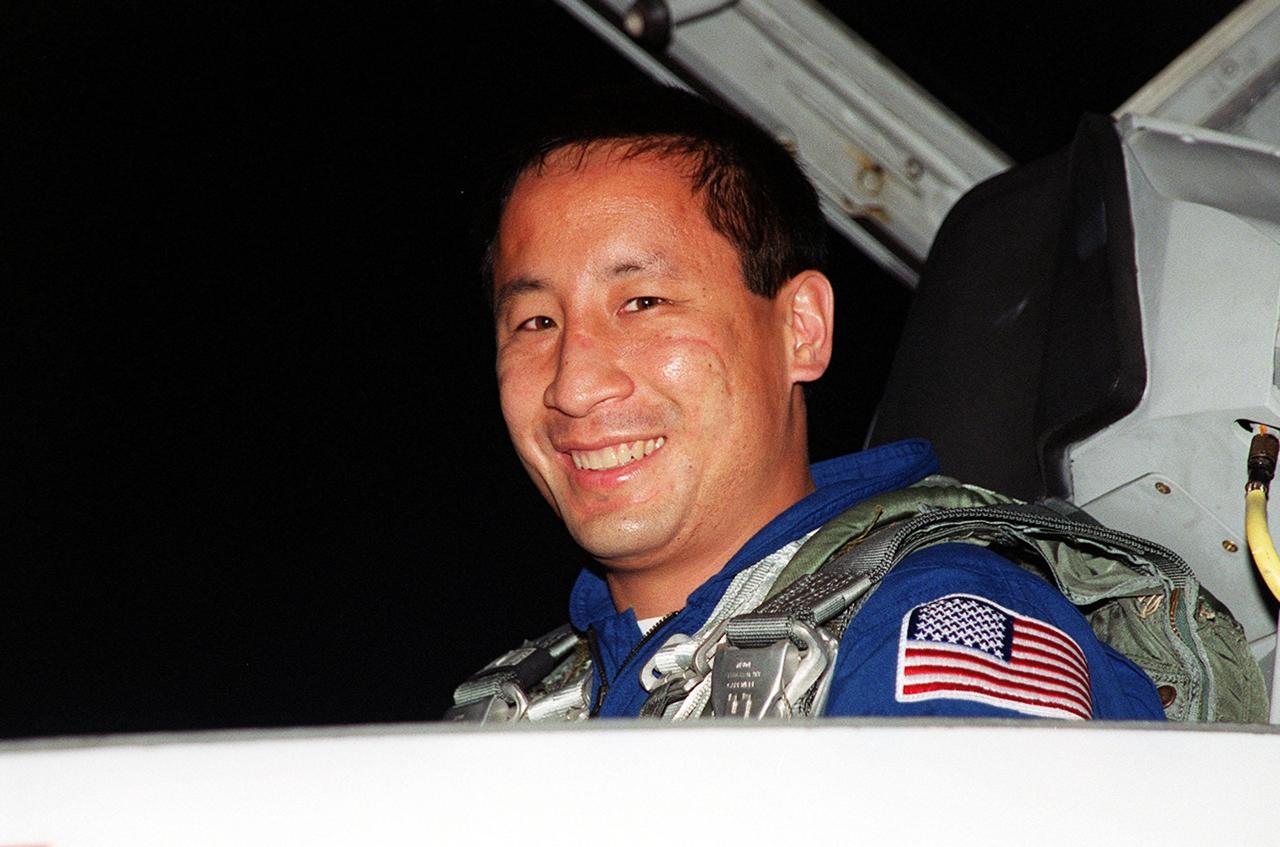
STS-106 Mission Specialist Edward T. Lu grins upon his arrival at the KSC Shuttle Landing Facility. He and the rest of the crew will be making pre-launch preparations for the fourth flight to the International Space Station. STS-106 is scheduled to launch Sept. 8, 2000, at 8:45 a.m. EDT from Launch Pad 39B. On the 11-day mission, the seven-member crew will perform support tasks on orbit, transfer supplies and prepare the living quarters in the newly arrived Zvezda Service Module. The first long-duration crew, dubbed "Expedition One," is due to arrive at the Station in late fall
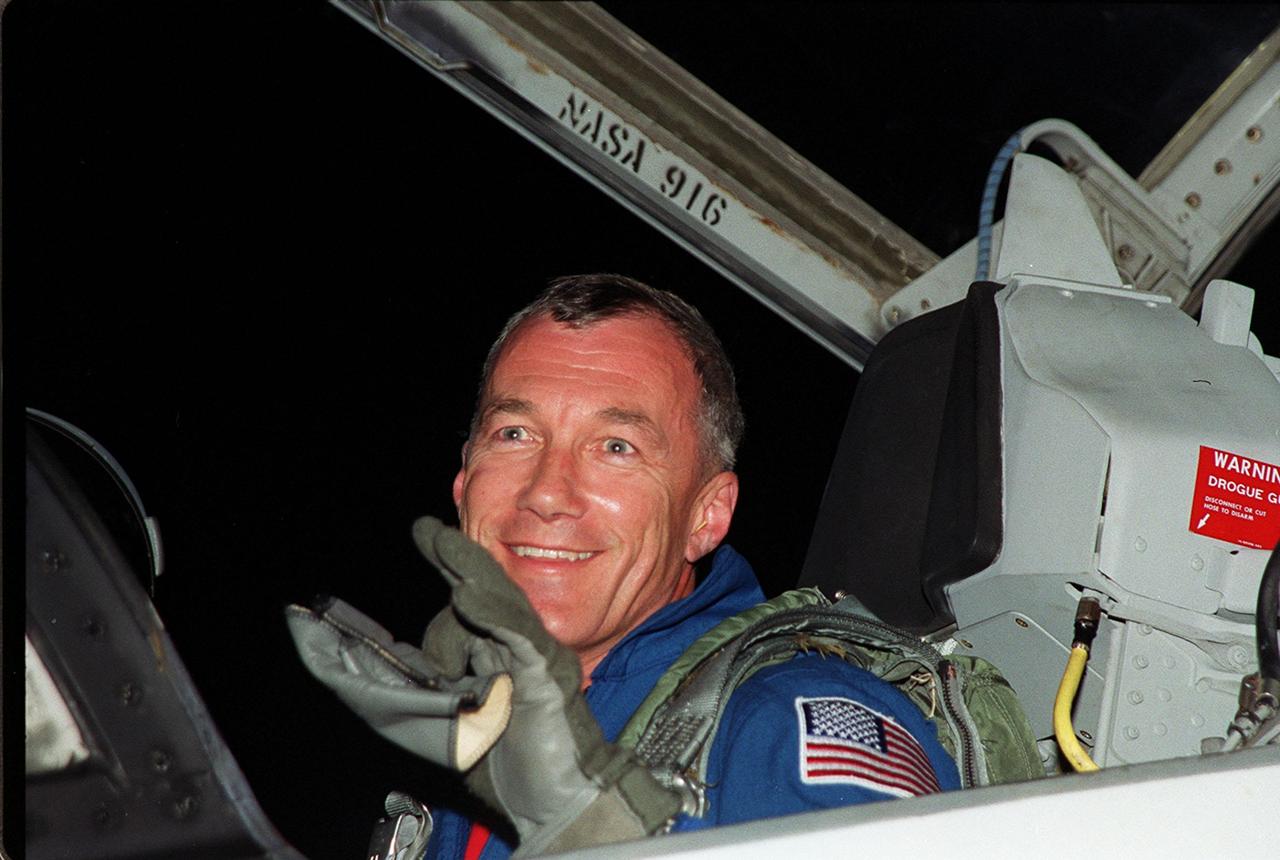
STS-106 Commander Terrence W. Wilcutt waves to onlookers as he arrives at the KSC Shuttle Landing Facility. He and the rest of the crew will be making pre-launch preparations for the fourth flight to the International Space Station. STS-106 is scheduled to launch Sept. 8, 2000, at 8:45 a.m. EDT from Launch Pad 39B. On the 11-day mission, the seven-member crew will perform support tasks on orbit, transfer supplies and prepare the living quarters in the newly arrived Zvezda Service Module. The first long-duration crew, dubbed “Expedition One,” is due to arrive at the Station in late fall
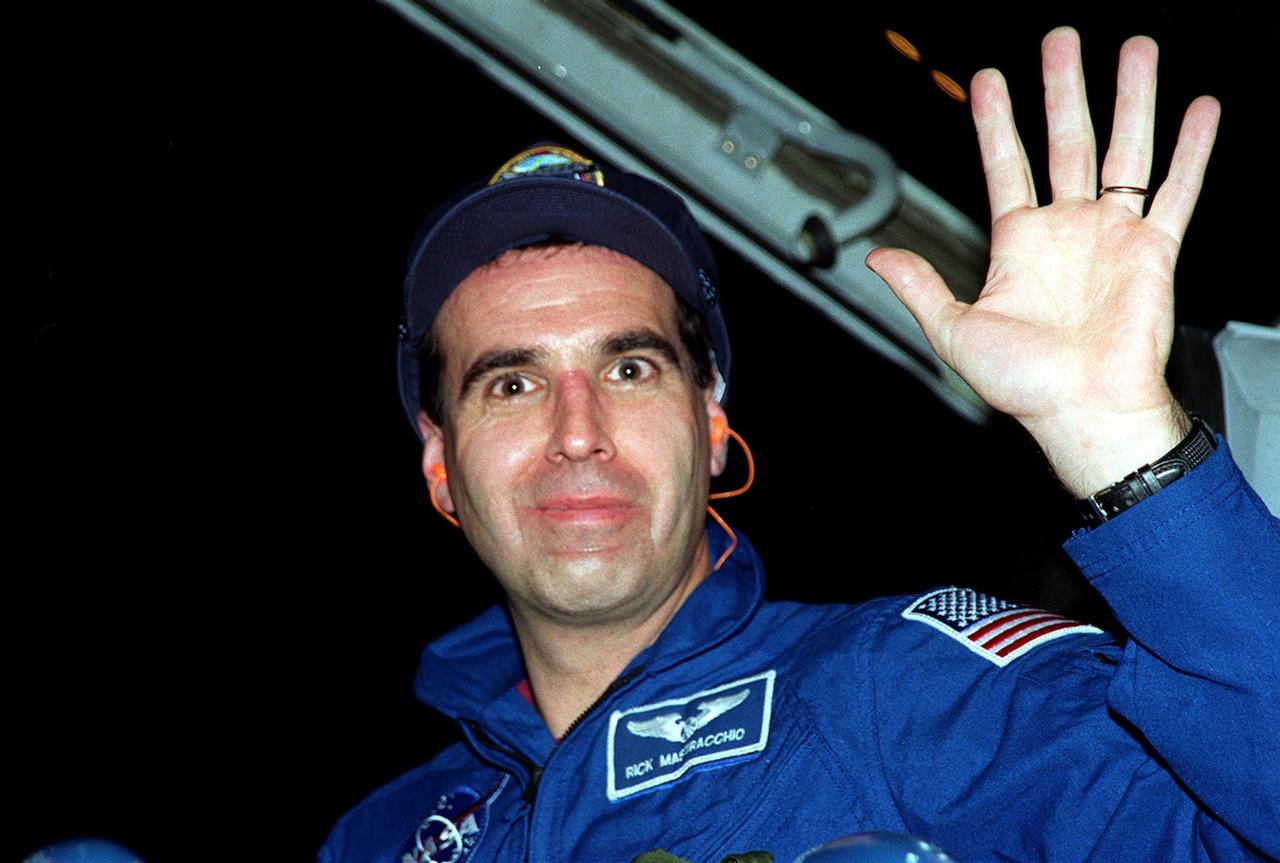
STS-106 Mission Specialist Richard A. Mastracchio waves at the camera upon his arrival at the KSC Shuttle Landing Facility. He and the rest of the crew will be making pre-launch preparations for the fourth flight to the International Space Station. STS-106 is scheduled to launch Sept. 8, 2000, at 8:45 a.m. EDT from Launch Pad 39B. On the 11-day mission, the seven-member crew will perform support tasks on orbit, transfer supplies and prepare the living quarters in the newly arrived Zvezda Service Module. The first long-duration crew, dubbed “Expedition One,” is due to arrive at the Station in late fall
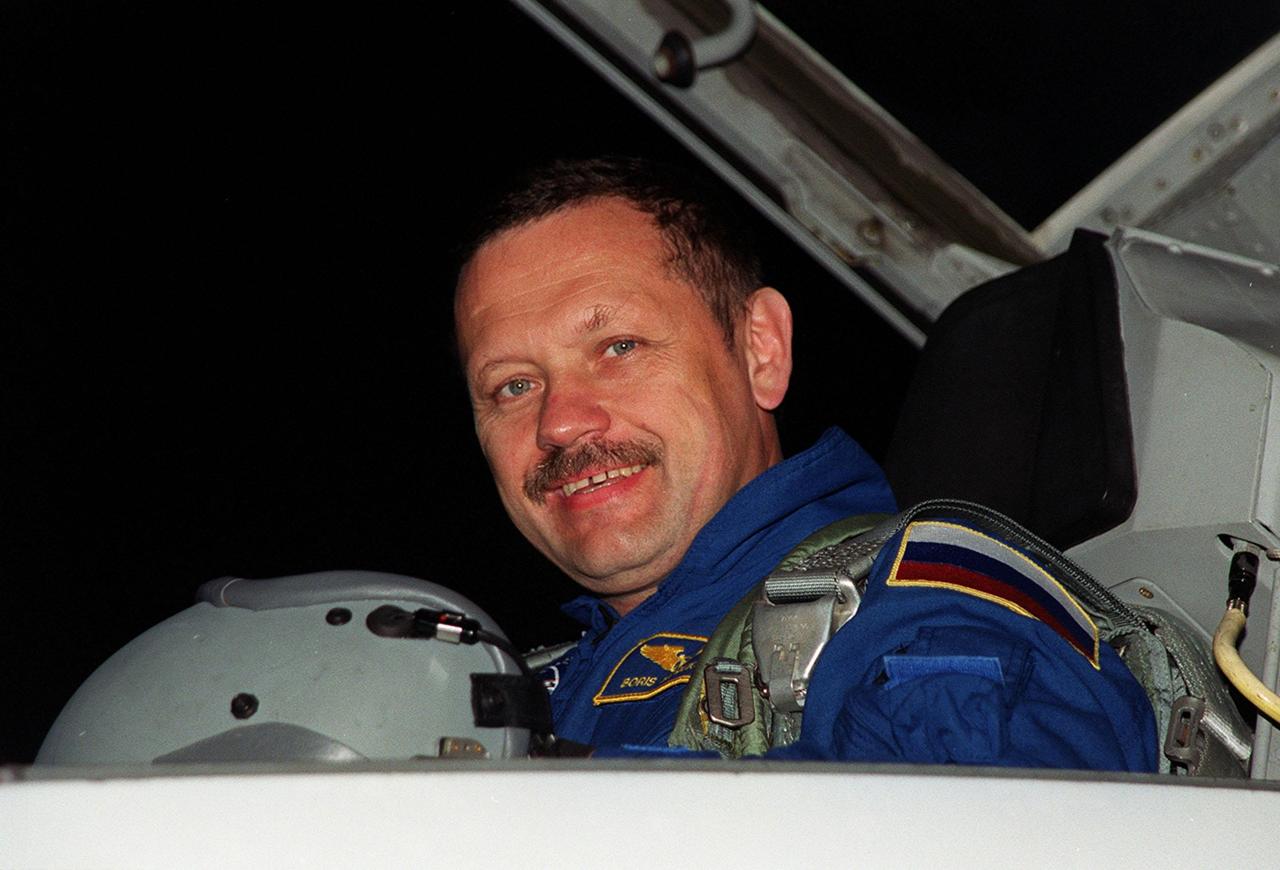
STS-106 Mission Specialist Boris V. Morukov smiles upon his arrival at the KSC Shuttle Landing Facility. He and the rest of the crew will be making pre-launch preparations for the fourth flight to the International Space Station. STS-106 is scheduled to launch Sept. 8, 2000, at 8:45 a.m. EDT from Launch Pad 39B. On the 11-day mission, the seven-member crew will perform support tasks on orbit, transfer supplies and prepare the living quarters in the newly arrived Zvezda Service Module. The first long-duration crew, dubbed “Expedition One,” is due to arrive at the Station in late fall
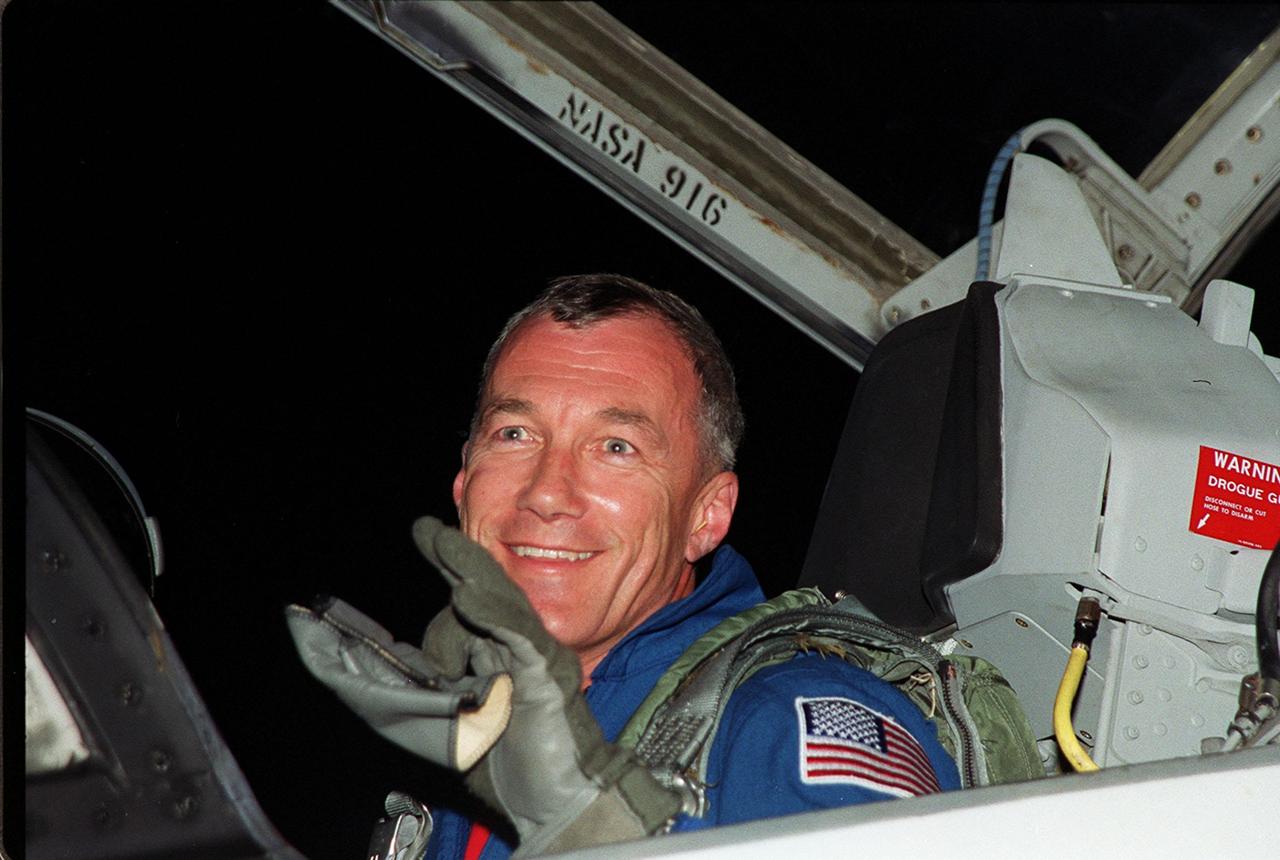
STS-106 Commander Terrence W. Wilcutt waves to onlookers as he arrives at the KSC Shuttle Landing Facility. He and the rest of the crew will be making pre-launch preparations for the fourth flight to the International Space Station. STS-106 is scheduled to launch Sept. 8, 2000, at 8:45 a.m. EDT from Launch Pad 39B. On the 11-day mission, the seven-member crew will perform support tasks on orbit, transfer supplies and prepare the living quarters in the newly arrived Zvezda Service Module. The first long-duration crew, dubbed “Expedition One,” is due to arrive at the Station in late fall
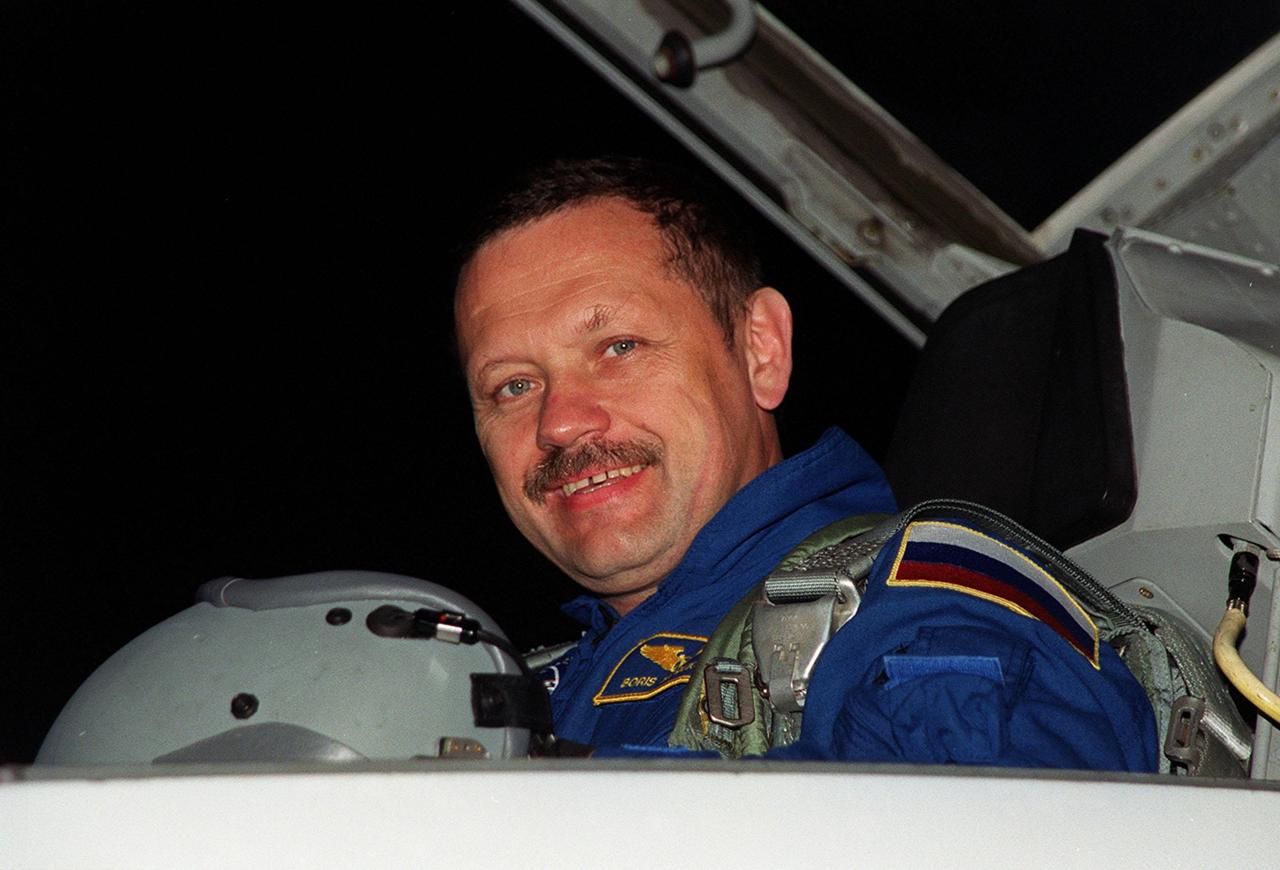
STS-106 Mission Specialist Boris V. Morukov smiles upon his arrival at the KSC Shuttle Landing Facility. He and the rest of the crew will be making pre-launch preparations for the fourth flight to the International Space Station. STS-106 is scheduled to launch Sept. 8, 2000, at 8:45 a.m. EDT from Launch Pad 39B. On the 11-day mission, the seven-member crew will perform support tasks on orbit, transfer supplies and prepare the living quarters in the newly arrived Zvezda Service Module. The first long-duration crew, dubbed “Expedition One,” is due to arrive at the Station in late fall