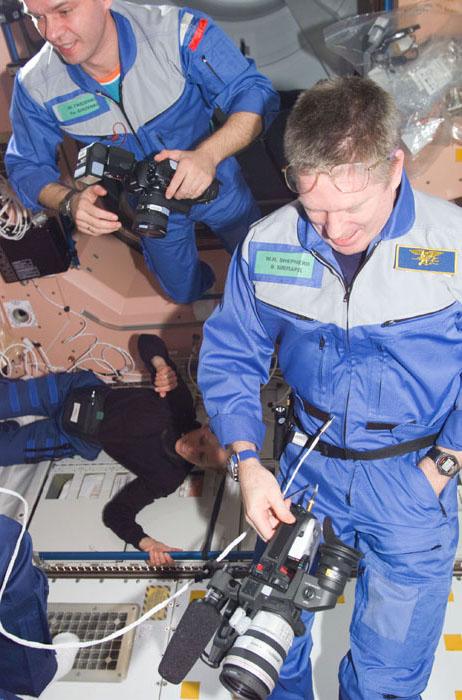
STS98-E-5047 (9 February 2001) --- Two Expedition One crew members prepare to greet and photograph their newest visitors aboard the International Space Station (ISS) soon after the STS-98 astronauts opened the hatches and paid a visit to the station. Astronaut William M. (Bill) Shepherd, Expedition One commander, is in right foreground; and cosmonaut Yuri P. Gidzenko, Soyuz commander, is at left. This scene was recorded with a digital still camera.
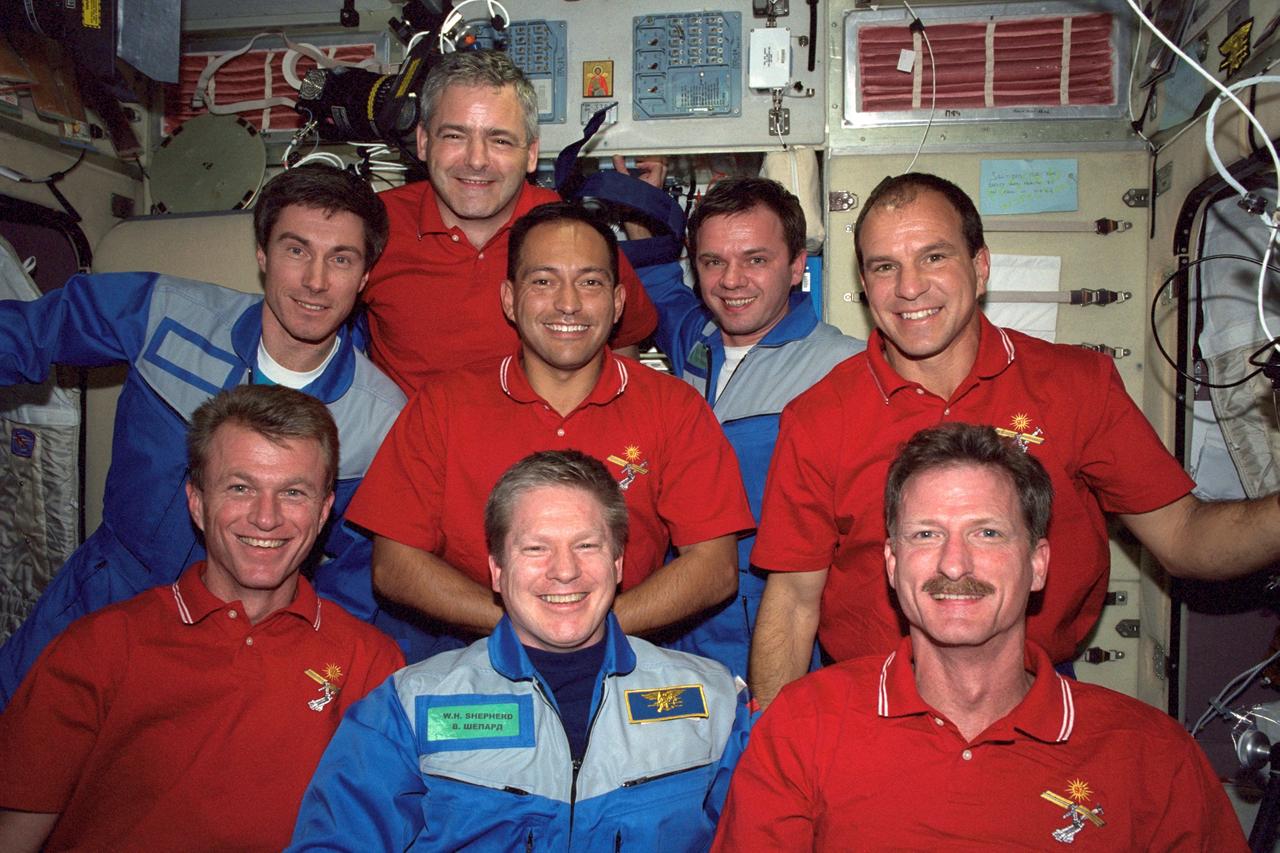
In this image, the five STS-97 crew members pose with the 3 members of the Expedition One crew onboard the International Space Station (ISS) for the first ever traditional onboard portrait taken in the Zvezda Service Module. On the front row, left to right, are astronauts Brent W. Jett, Jr., STS-97 commander; William M. Shepherd, Expedition One mission commander; and Joseph R. Tarner, STS-97 mission specialist. On the second row, from the left are Cosmonaut Sergei K. Krikalev, Expedition One flight engineer; astronaut Carlos I. Noriega, STS-97 mission specialist; cosmonaut Yuri P. Gidzenko, Expedition One Soyuz commander; and Michael J. Bloomfield, STS-97 pilot. Behind them is astronaut Marc Garneau, STS-97 mission specialist representing the Canadian Space Agency (CSA). The primary objective of the STS-97 mission was the delivery, assembly, and activation of the U.S. electrical power system onboard the International Space Station (ISS). The electrical power system, which is built into a 73-meter (240-foot) long solar array structure consists of solar arrays, radiators, batteries, and electronics. The entire 15.4-metric ton (17-ton) package is called the P6 Integrated Truss Segment, and is the heaviest and largest element yet delivered to the station aboard a space shuttle. The electrical system will eventually provide the power necessary for the first ISS crews to live and work in the U.S. segment. The STS-97 crew of five launched aboard the Space Shuttle Orbiter Endeavor on November 30, 2000 for an 11 day mission.
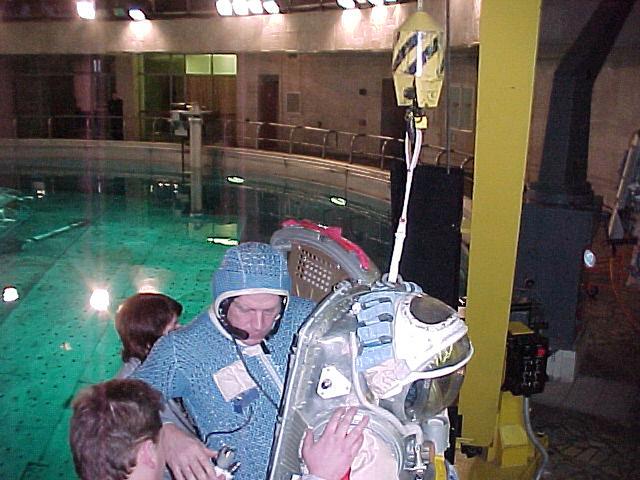
JSC2000-E-20603 (February 2000) --- Astronaut William M. Shepherd, Expedition One commander, prepares to don an Orlan space suit in order to rehearse a spacewalk in the Hydrolab facility at the Gagarin Cosmonaut Training Center in Star City, Russia.

JSC2000-E-20600 (February 2000) --- Astronaut William M. Shepherd, Expedition One commander, prepares to don an Orlan space suit in order to rehearse a spacewalk in the Hydrolab facility at the Gagarin Cosmonaut Training Center in Star City, Russia.
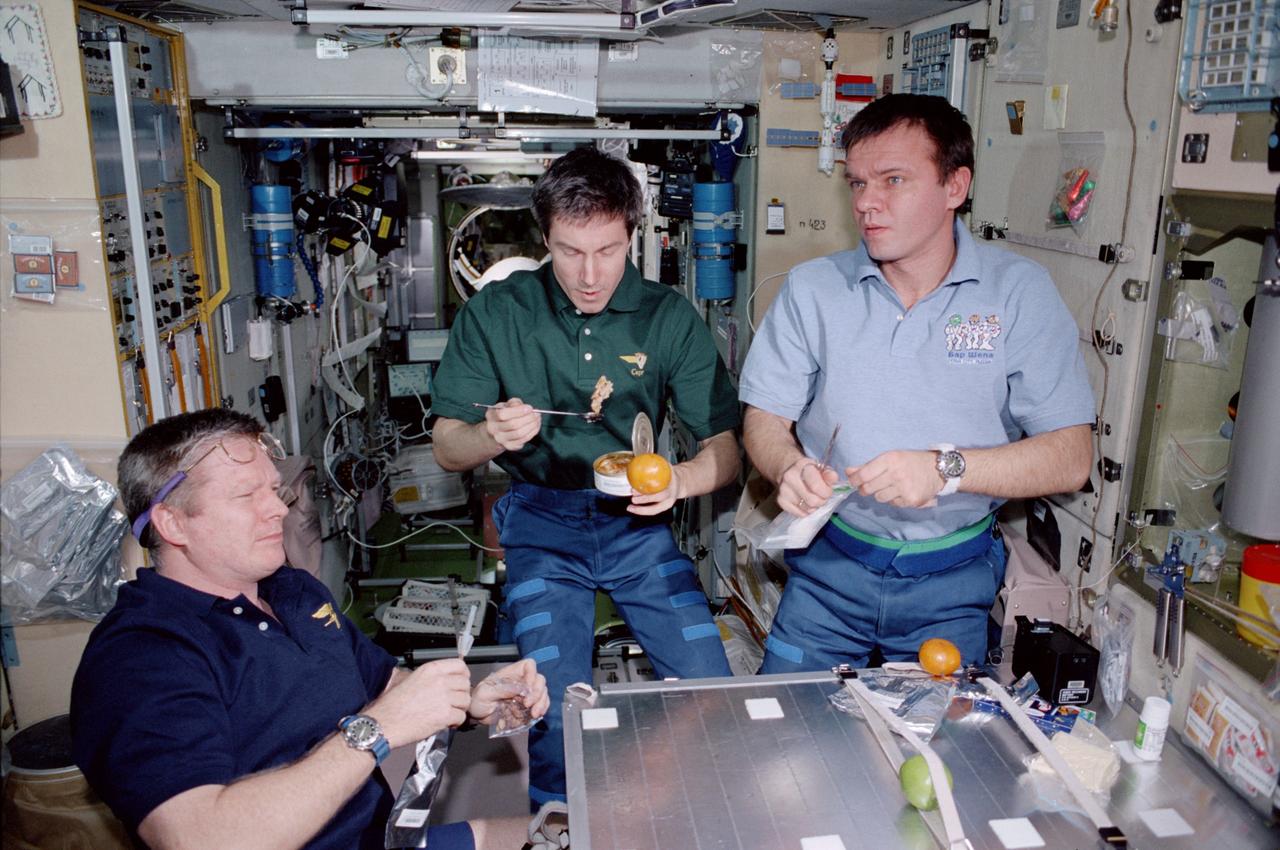
STS098-353-0006 (7-20 February 2001) --- The Expedition One crew enjoys a snack on the ward room table of the Zvezda service module onboard the International Space Station (ISS). The photograph was taken by one of the visiting STS-98 crew members.
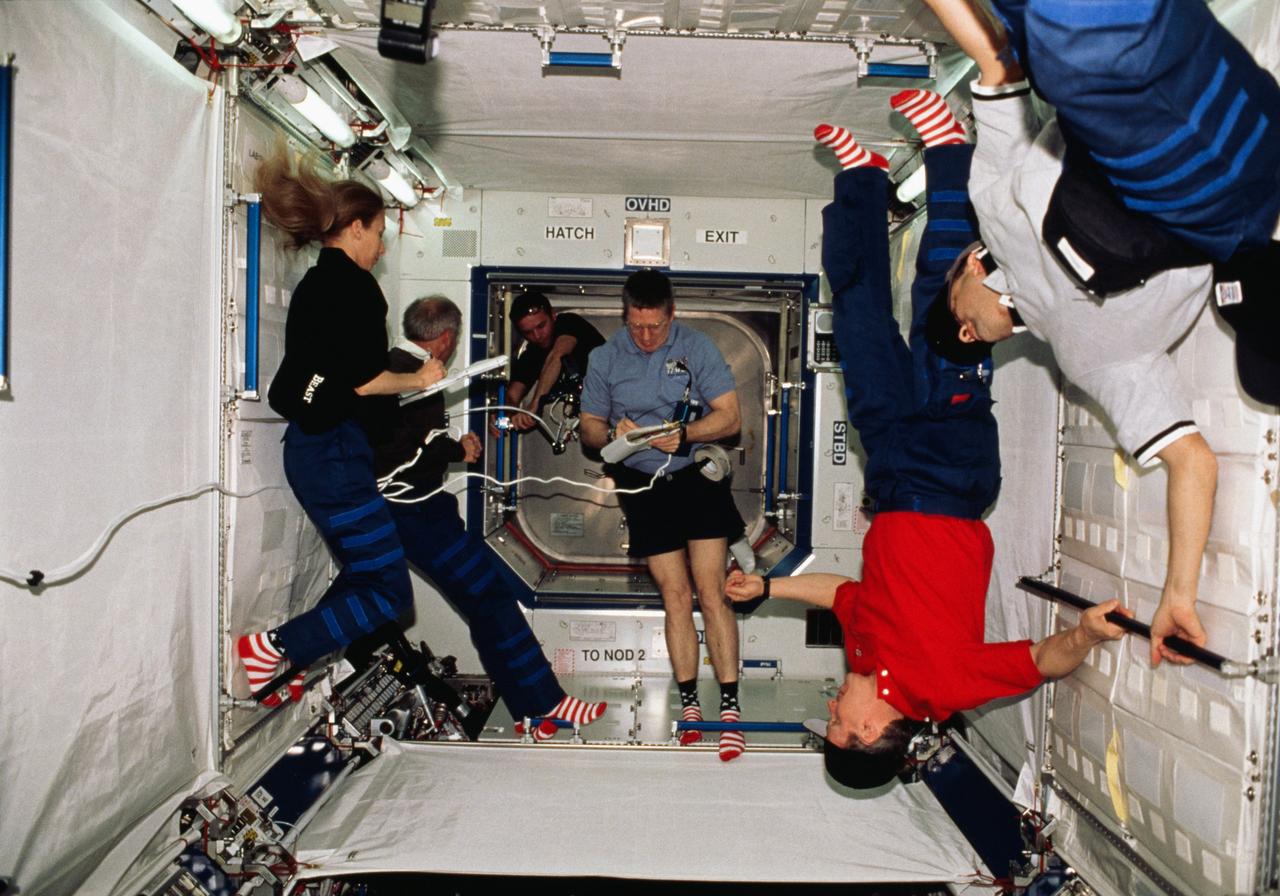
STS098-323-015 (7-20 February 2001) --- Astronauts and cosmonauts from the Expedition One and STS-98 crews are photographed in the newly-attached Destiny laboratory on the International Space Station (ISS). From the left are Marsha S. Ivins, mission specialist; Kenneth D. Cockrell, mission commander; Yuri P. Gidzenko, Expedition One Soyuz commander; William M. (Bill) Shepherd, Expedition One mission commander; Thomas D. Jones, mission specialist; and Mark L. Polansky, pilot. Out of view are Robert L. Curbeam, mission specialist, and Sergei K. Krikalev, Expedition One flight engineer. Gidzenko and Krikalev represent Rosaviakosmos.
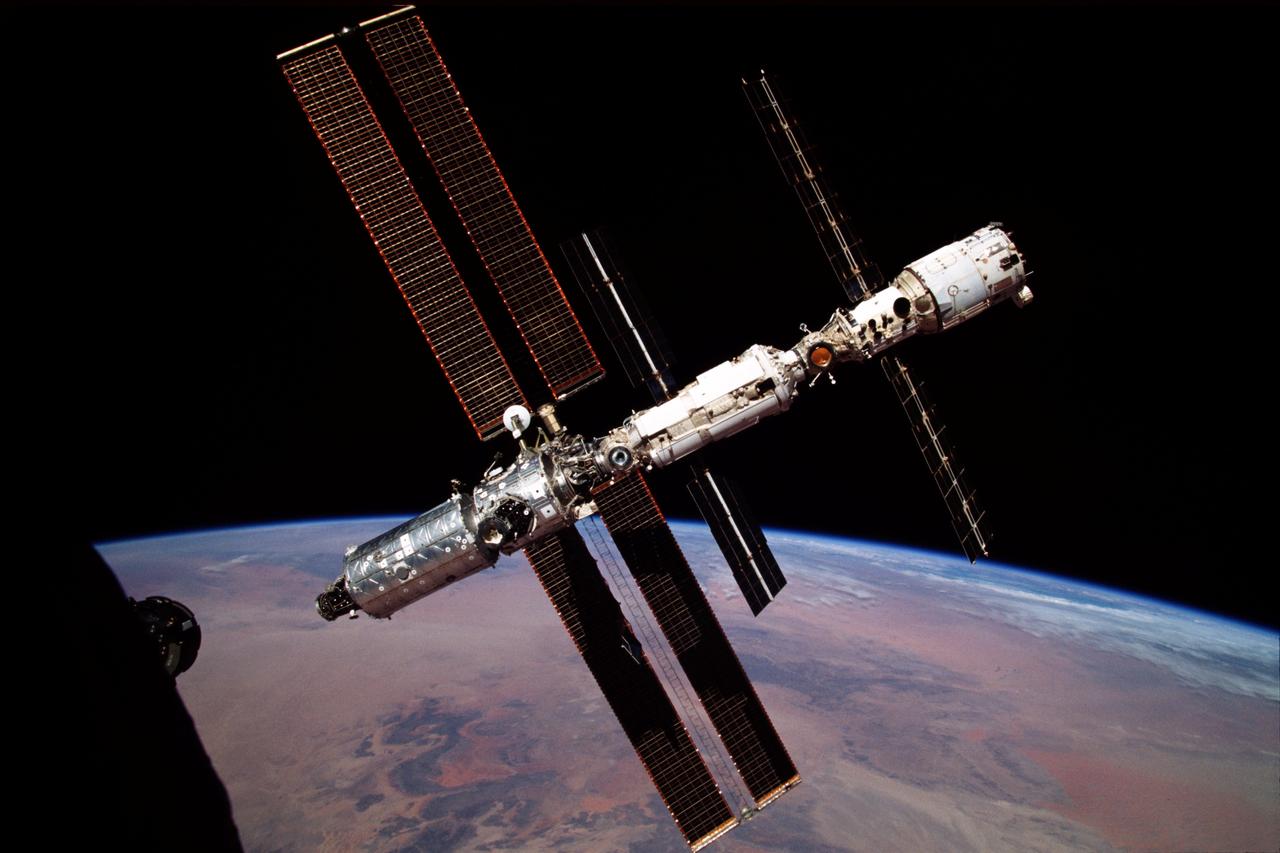
ISS001-389-023 (24 February 2001) --- The International Space Station (ISS), backdropped against the darkness of space and Earth at its horizon, was photographed by the Expedition One crew during a flyaround aboard a Soyuz capsule.
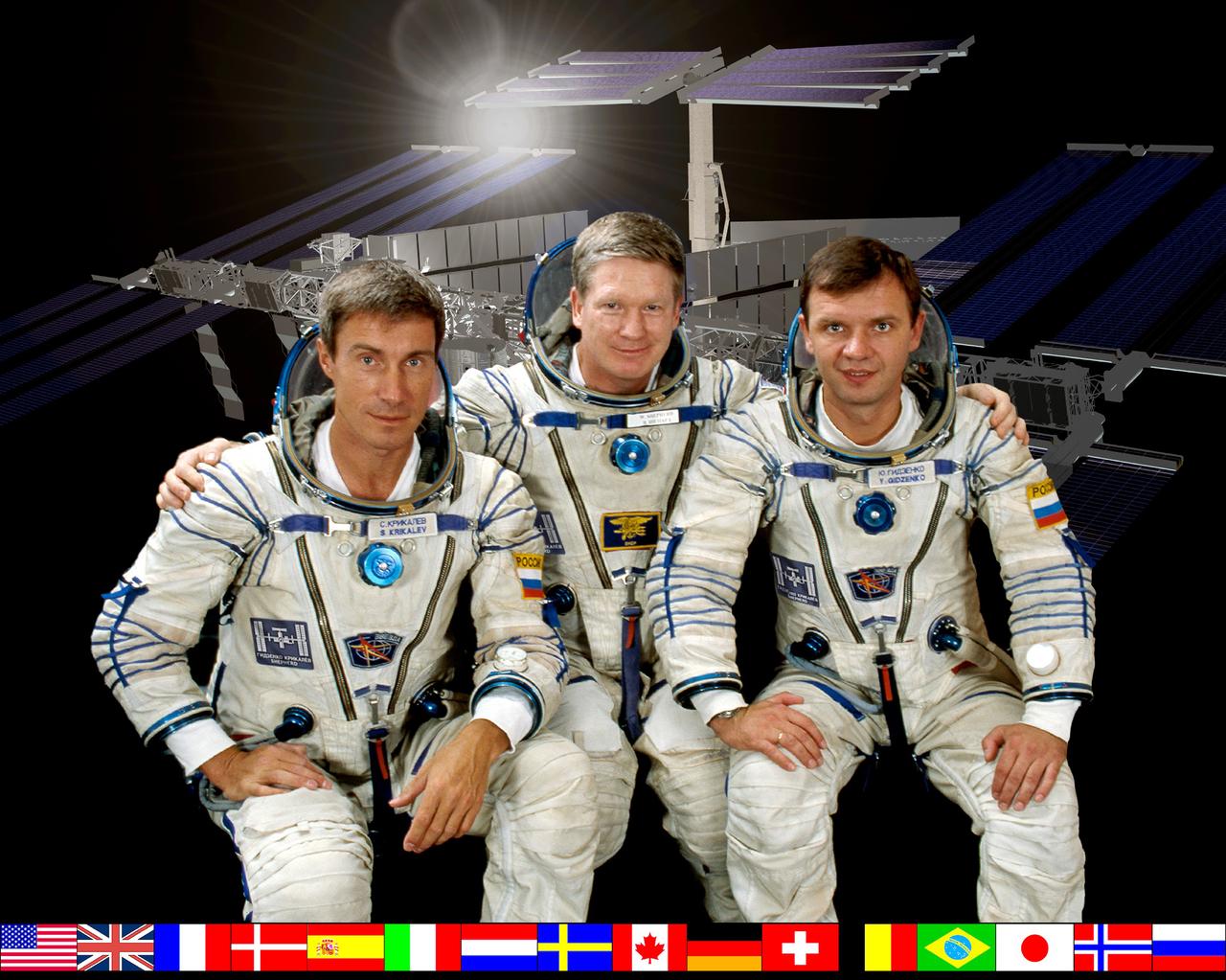
This is a crew portrait of the International Space Station (ISS) Expedition One. Left to right are flight engineer Sergei K. Krikalev, commander William M. (Bill) Shepherd, and Soyuz commander Yuri P. Gidzenko. They are wearing the Russian Sokol space suits. The Russian Soyuz rocket carrying the Expedition One crew was launched from the Baikonur Cosmodrome, Kazakhstan on October 31, 2000. The crew returned to the Kennedy Space Center on March 21, 2002 aboard the Space Shuttle Orbiter Discovery (STS-102 mission). The crew's duration on the ISS was 138 days. National flags representing all the international partners run along the bottom of the portrait.
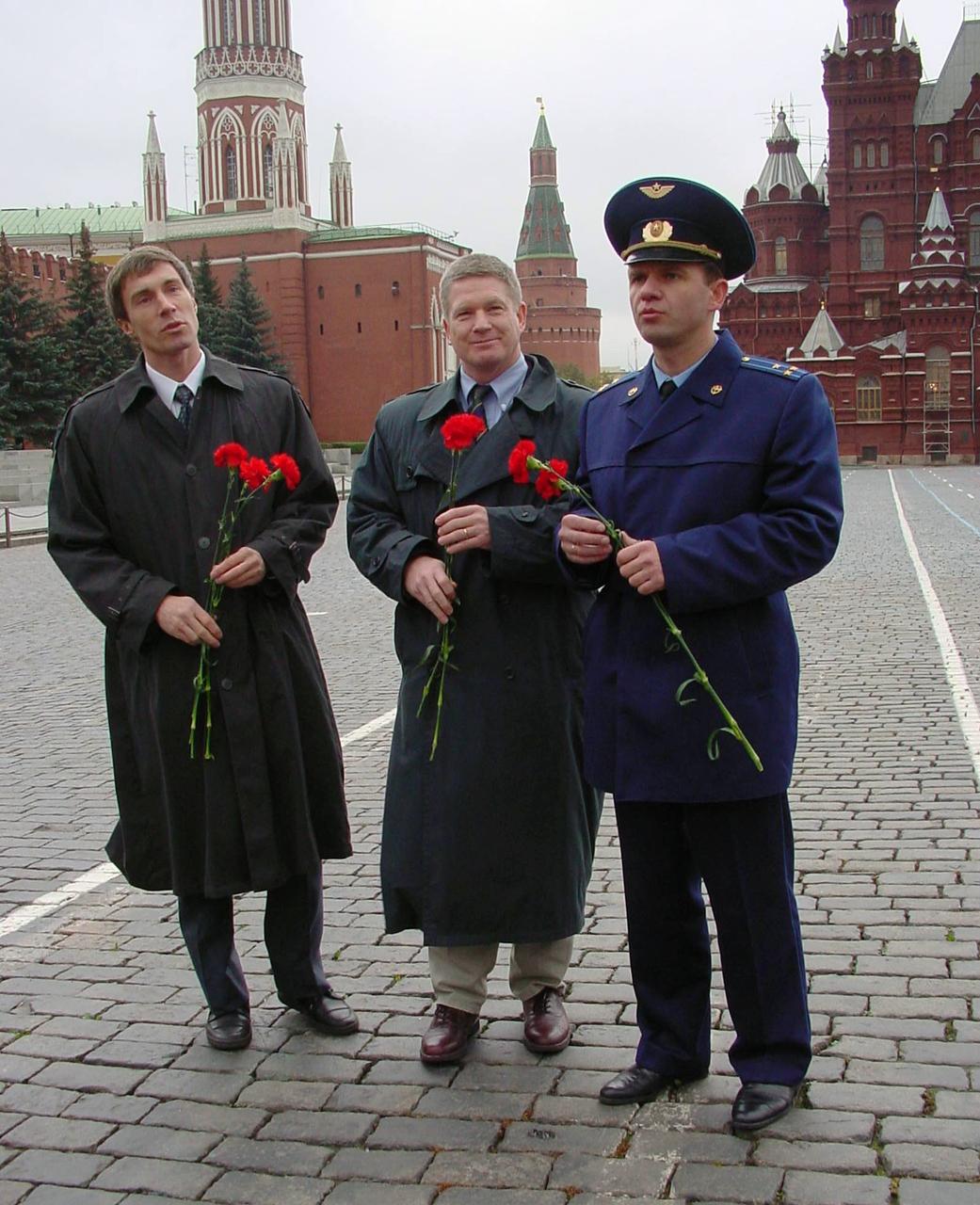
JSC2000-E-27075 (16 October 2000) --- Expedition One crew members in Moscow. From left, flight engineer Sergei Krikalev, expedition commander William (Bill) Shepherd and Soyuz pilot Yuri Gidzenko.
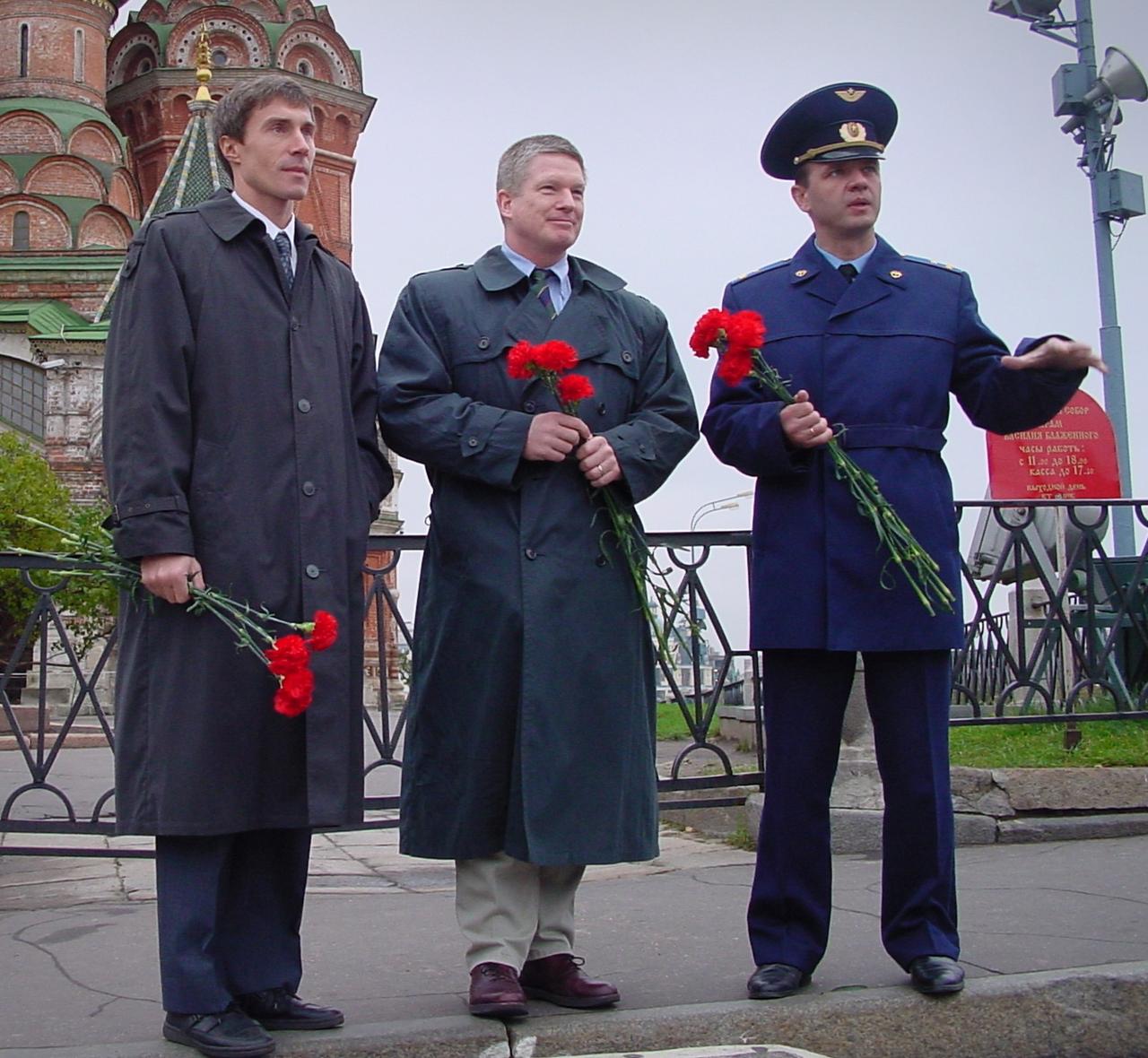
JSC2000-E-27078 (16 October 2000) --- Expedition One crew members in Moscow. From left, flight engineer Sergei Krikalev, expedition coammander William (Bill) Shepherd and Soyuz pilot Yuri Gidzenko.
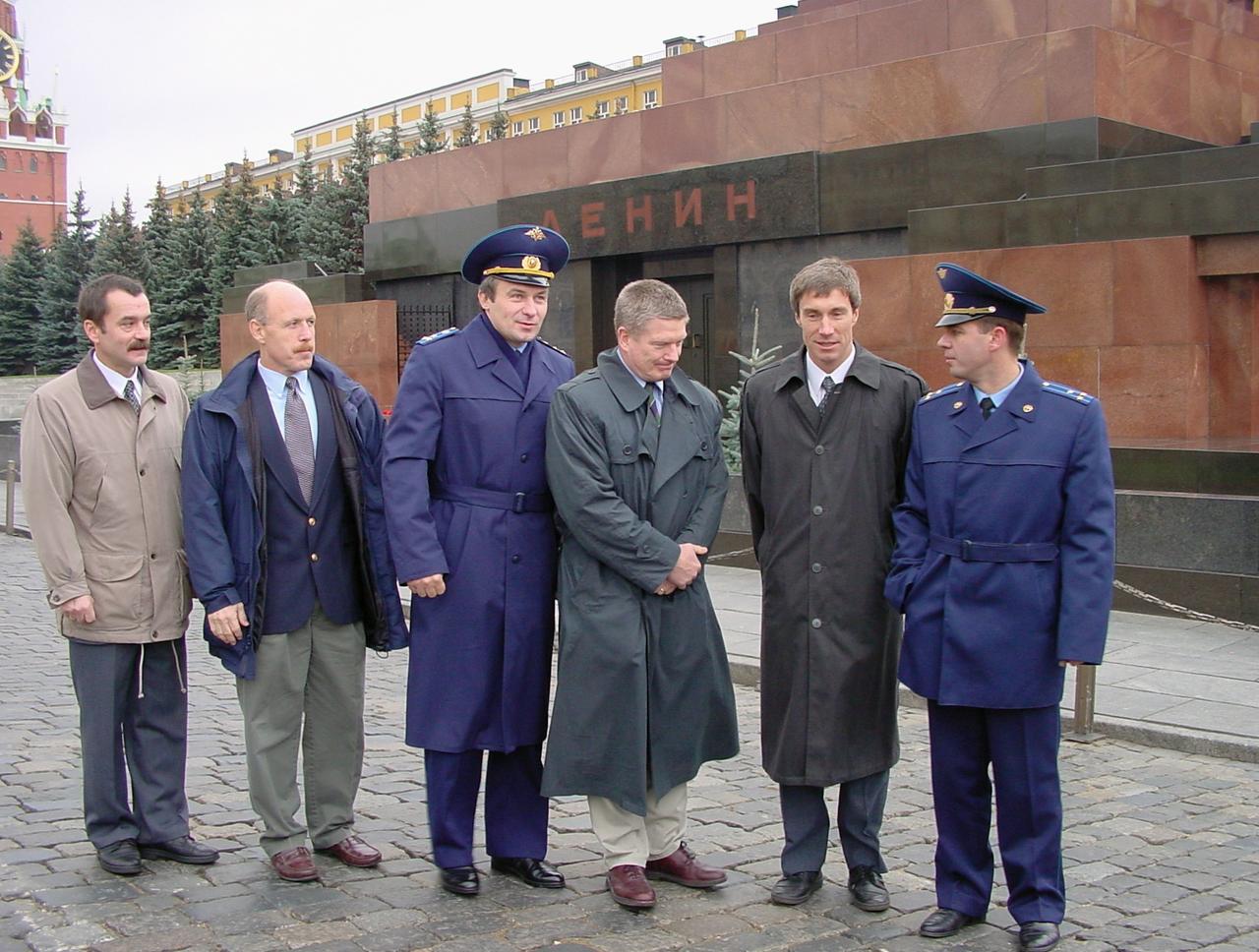
JSC2000-E-27076 (16 October 2000) --- Expedition One prime and backup crew members in Moscow. From left, cosmonaut Mikhail Turin, astronaut Kenneth D. Bowersox, cosmonaut Vladimir Dezhurov, astronaut William M. (Bill) Shepherd and cosmonauts Sergei Krikalev and Yuri P. Gidzenko. Shepherd is Expedition One prime crew commander; Gidzenko, prime crew Soyuz commander; and Krikalev, the prime crew's flight engineer. Bowersox, Turin and Dezhurov are backups.
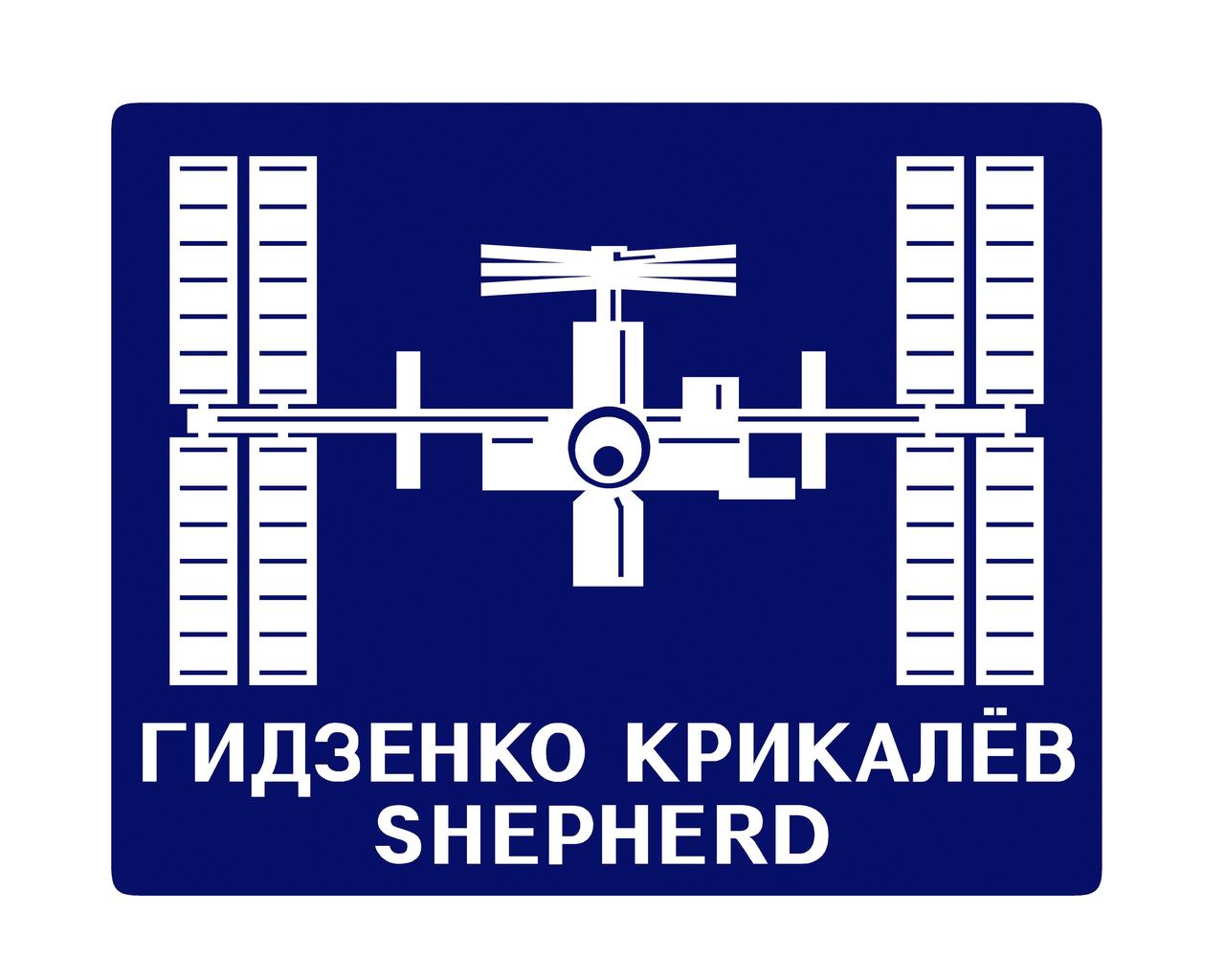
ISS001-S-001 (October 2000) --- The first International Space Station (ISS) crew patch is a simplified graphic of the station complex when fully completed. The station is seen with solar arrays turned forward. The last names of the Expedition One crew, Soyuz pilot Yuri Gidzenko, flight engineer Sergei Krikalev, and expedition commander William (Bill) Shepherd, appear under the station symbol. The insignia design for ISS flights is reserved for use by the astronauts and cosmonauts and for other official use as the NASA Administrator and NASA's international partners may authorize. Public availability has been approved only in the form of illustrations by the various news media. When and if there is any change in this policy, which we do not anticipate, it will be publicly announced.
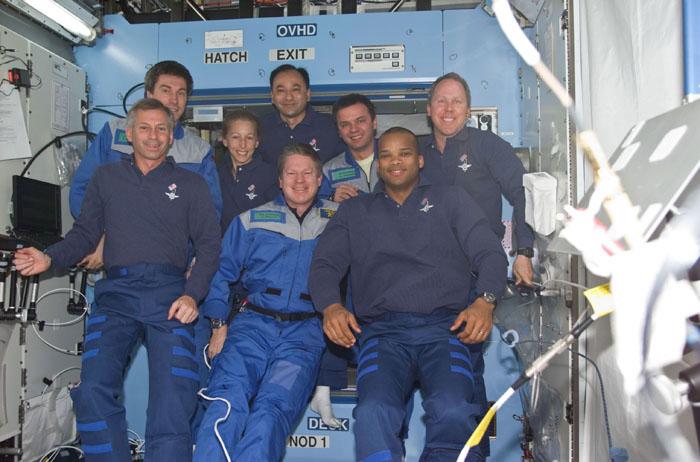
STS98-E-5276 (15 February 2001) --- Six NASA astronauts and two Russian cosmonauts pose for a group portrait representing both shuttle and station crews near the end of several days of joint work aboard the International Space Station (ISS). In front, from the left, are astronauts Kenneth D. Cockrell, STS-98 commander; William M. (Bill) Shepherd, Expedition One commander; and Robert L. Curbeam, STS-98 mission specialist. In the rear, from the left, are cosmonaut Sergei K. Krikalev, Expedition One flight engineer; astronaut Marsha S. Ivins, STS-98 mission specialist; astronaut Mark L. Polansky, shuttle pilot; cosmonaut Yuri P. Gidzenko, Soyuz commander for Expedition One; and astronaut Thomas D. Jones, shuttle mission specialist.
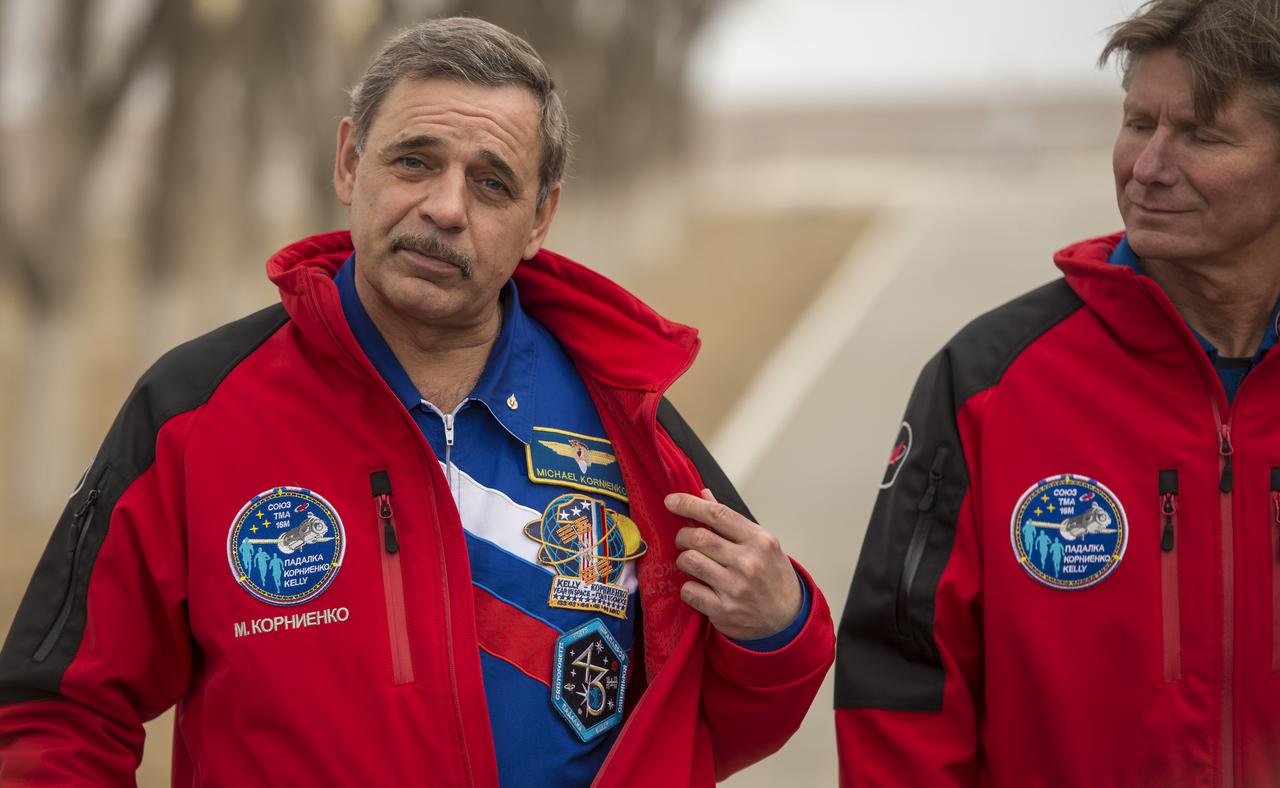
Expedition 43 Russian Cosmonaut Mikhail Kornienko of the Russian Federal Space Agency (Roscosmos), left, shows his One-Year and Expedition 43 mission patches to members of the press during media day, Saturday, March 21, 2015 at the Cosmonaut Hotel in Baikonur, Kazakhstan. Kornienko, NASA Astronaut Scott Kelly, and Russian Cosmonaut Gennady Padalka of Roscosmos are scheduled to launch to the International Space Station in the Soyuz TMA-16M spacecraft from the Baikonur Cosmodrome in Kazakhstan March 28, Kazakh time (March 27 Eastern time.) As the one-year crew, Kelly and Kornienko will return to Earth on Soyuz TMA-18M in March 2016. Photo Credit: (NASA/Bill Ingalls)
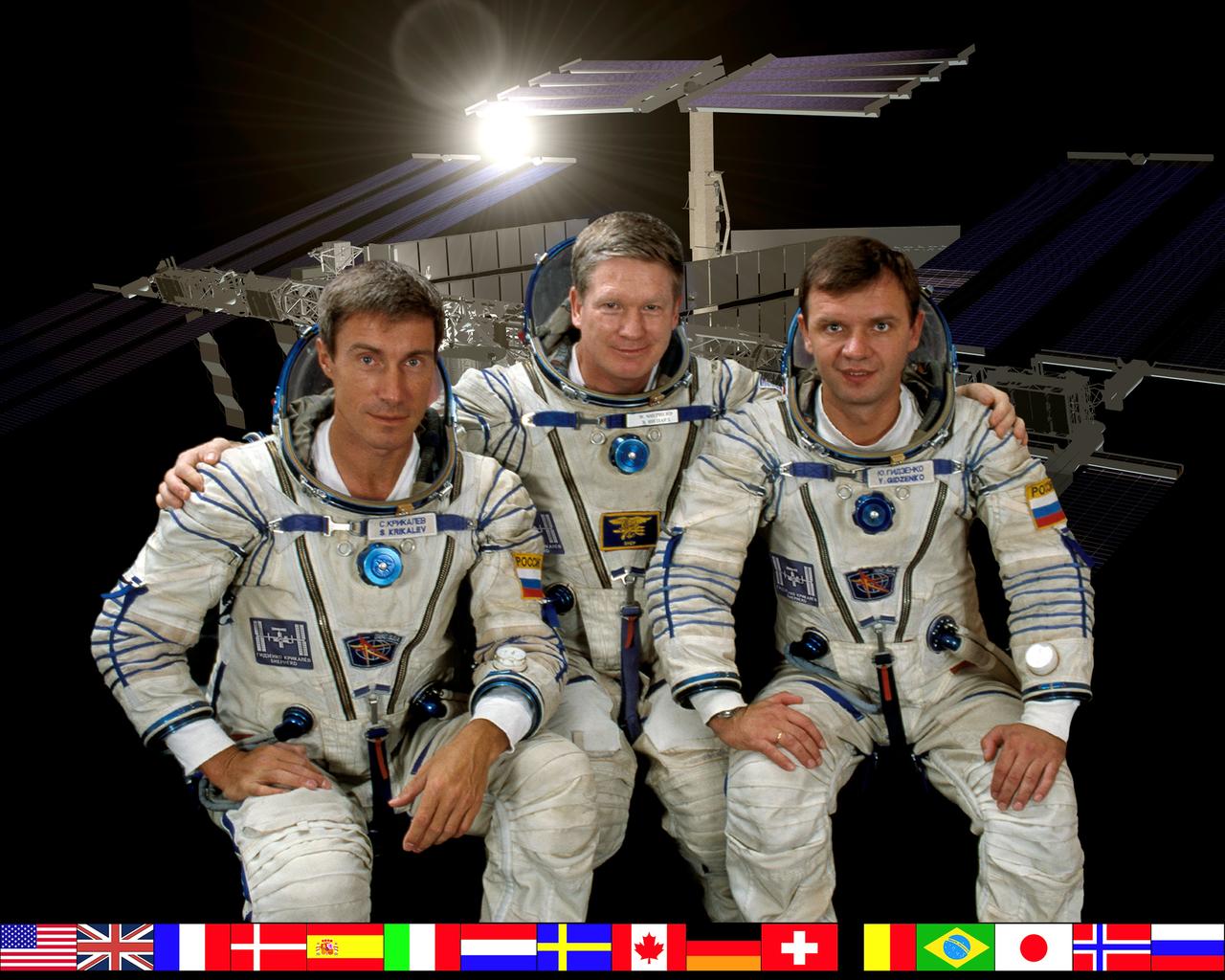
ISS001-S-002 (October 2000)--- International Space Station (ISS) Expedition One Commander William M. (Bill) Shepherd (center) is flanked by Soyuz Commander Yuri P. Gidzenko (right) and Flight Engineer Sergei K. Krikalev (left) in this crew photograph taken during a break in training in Russia. The three, posed in front of a rendition of the ISS, are wearing the Sokol space suits like those they will don for their Soyuz-provided trip to ISS later this month. National flags representing all the international partners run along the bottom of the portrait.
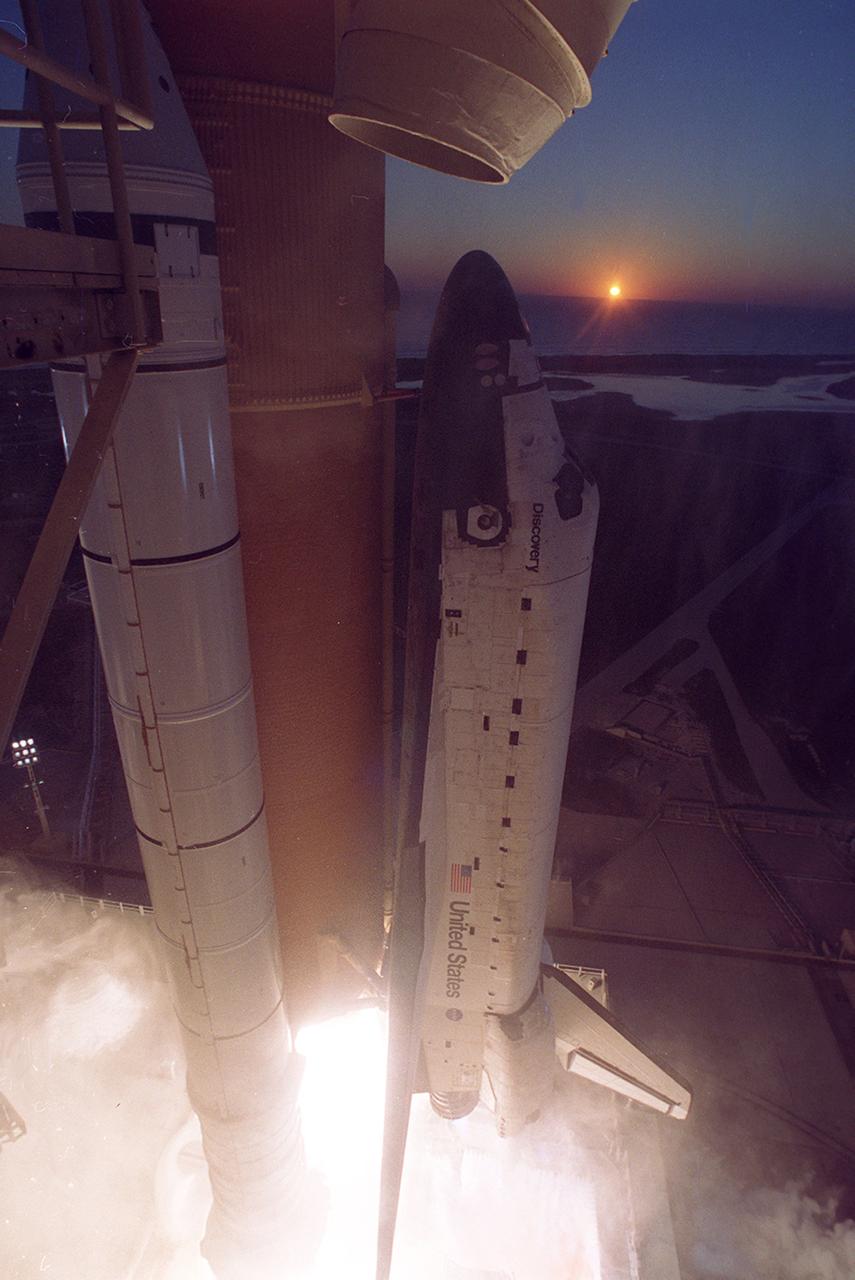
The Space Shuttle Discovery, STS-102 mission, clears launch pad 39B at the Kennedy Space Center as the sun peers over the Atlantic Ocean on March 8, 2001. STS-102's primary cargo was the Leonardo, the Italian Space Agency built Multipurpose Logistics Module (MPLM). The Leonardo MPLM is the first of three such pressurized modules that will serve as the International Space Station's (ISS') moving vans, carrying laboratory racks filled with equipment, experiments, and supplies to and from the Station aboard the Space Shuttle. The cylindrical module is approximately 21-feet long and 15- feet in diameter, weighing almost 4.5 tons. It can carry up to 10 tons of cargo in 16 standard Space Station equipment racks. Of the 16 racks the module can carry, 5 can be furnished with power, data, and fluid to support refrigerators or freezers. In order to function as an attached station module as well as a cargo transport, the logistics module also includes components that provide life support, fire detection and suppression, electrical distribution, and computer functions. NASA's 103rd overall flight and the eighth assembly flight, STS-102 was also the first flight involved with Expedition Crew rotation. The Expedition Two crew was delivered to the station while Expedition One was returned home to Earth.
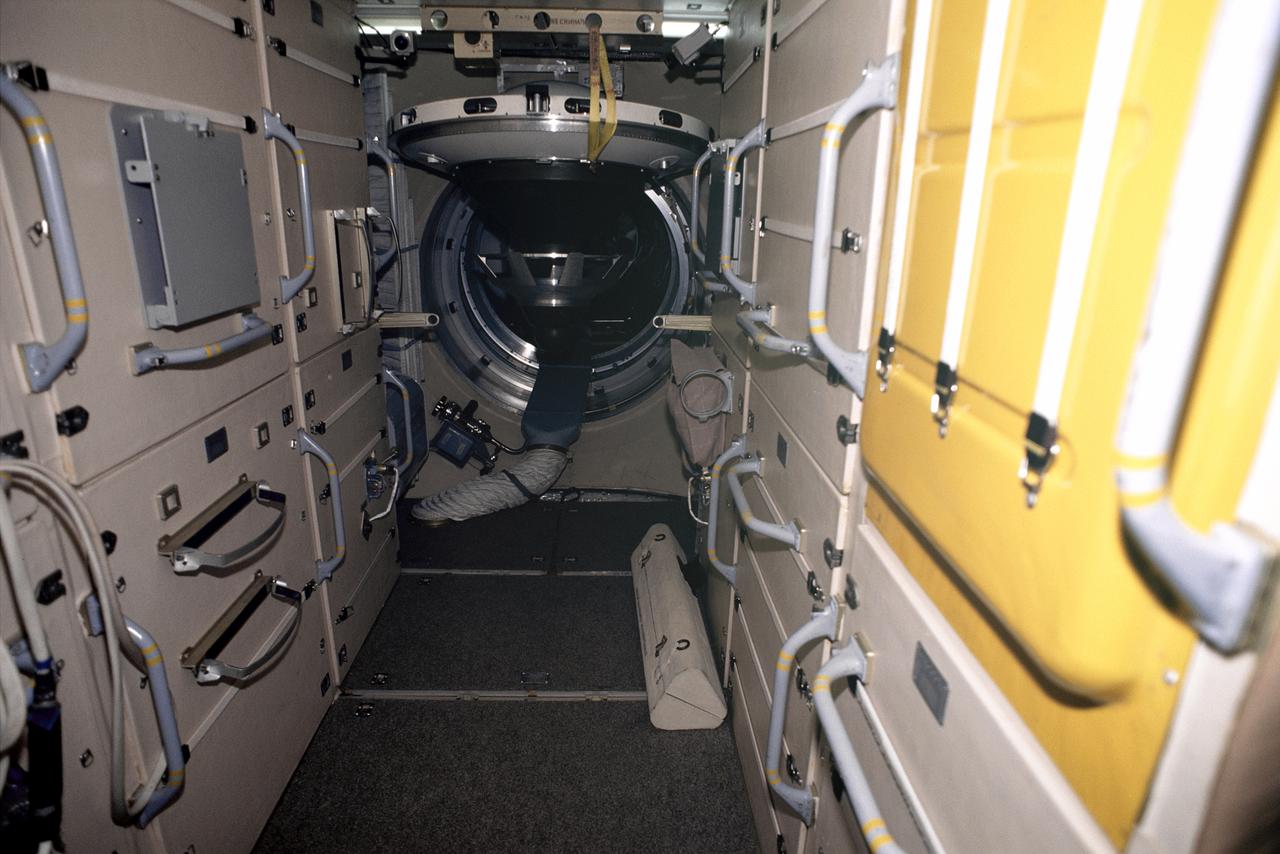
JSC2000-E-18632 (June 2000) --- An interior shot of the Zarya Functional Cargo Bay (FGB) trainer/mockup at the Gagarin Cosmonaut Training Center in Russia. This photo was taken prior to a training session by the Expedition One crew.
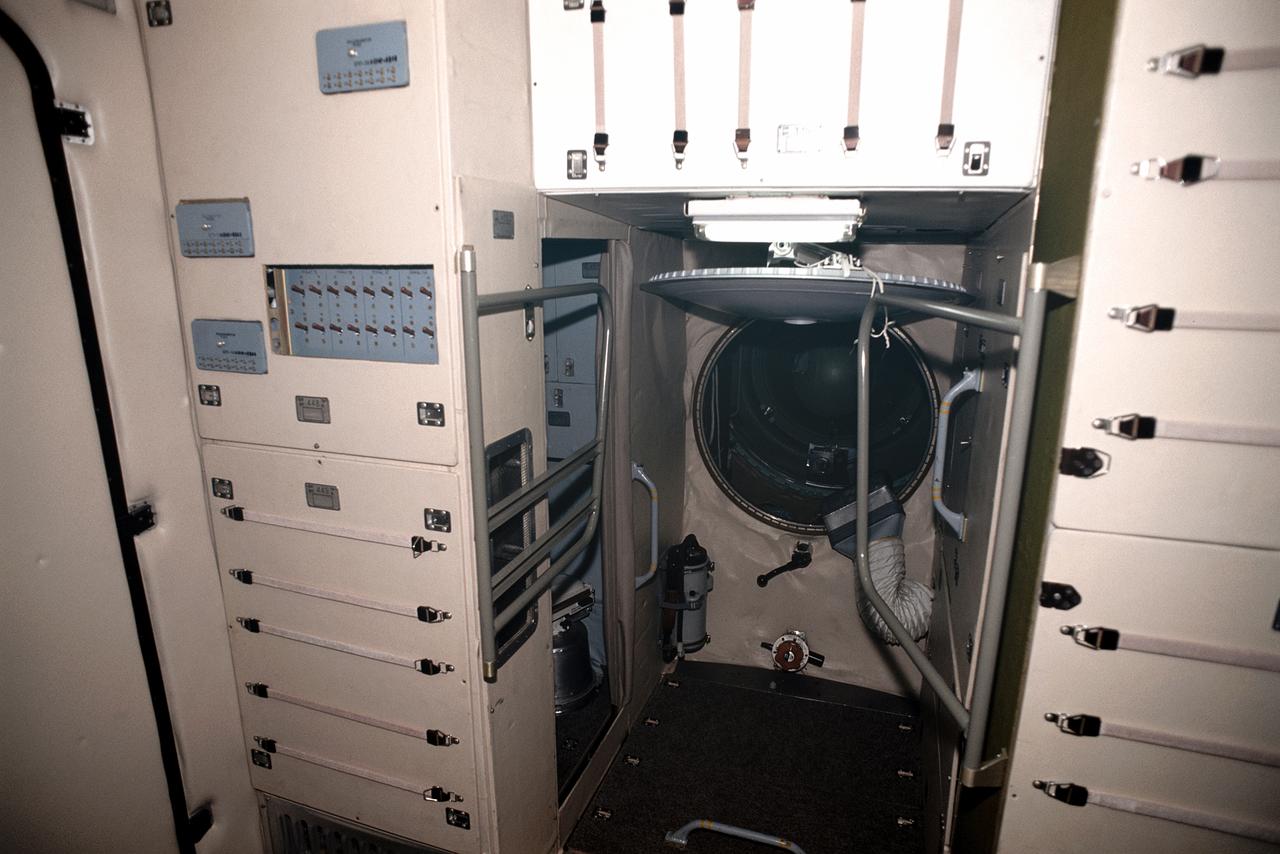
JSC2000-E-18629 ( June 2000) --- A view looking toward the hatch inside the Zvezda Service Module trainer/mockup at the Gagarin Cosmonaut Training Center in Russia. This photo was taken prior to a training session with the Expedition One crew.
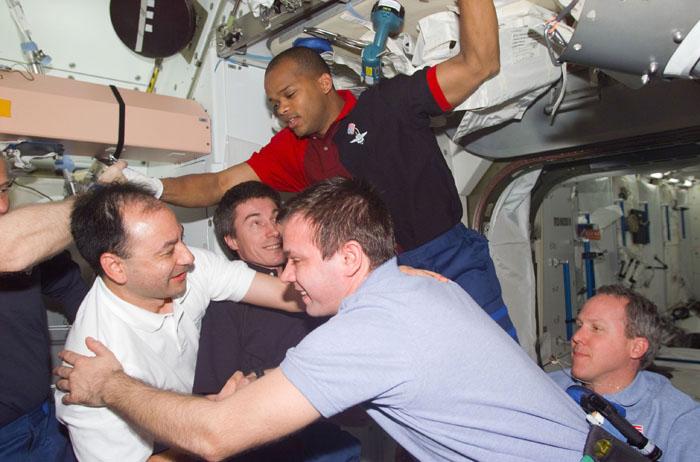
STS98-E-5297 (16 February 2001) --- Goodbyes are plentiful as five astronauts prepare to depart the International Space Station (ISS) and return to the Space Shuttle Atlantis. Cosmonauts Sergei K. Krikalev, Expedition One flight engineer; and Yuri P. Gidzenko, Soyuz commander for the station crew, appear in the center of the scene. They are surrounded by astronauts Mark L. Polansky, STS-98 pilot; and Robert L. Curbeam (top) and Thomas D. Jones, right, both shuttle mission specialists. The cosmonauts, along with astronaut William M. (Bill) Shepherd (out of frame), Expedition One commander, will stay aboard the outpost for several more weeks and return to Earth with the next shuttle visitors.
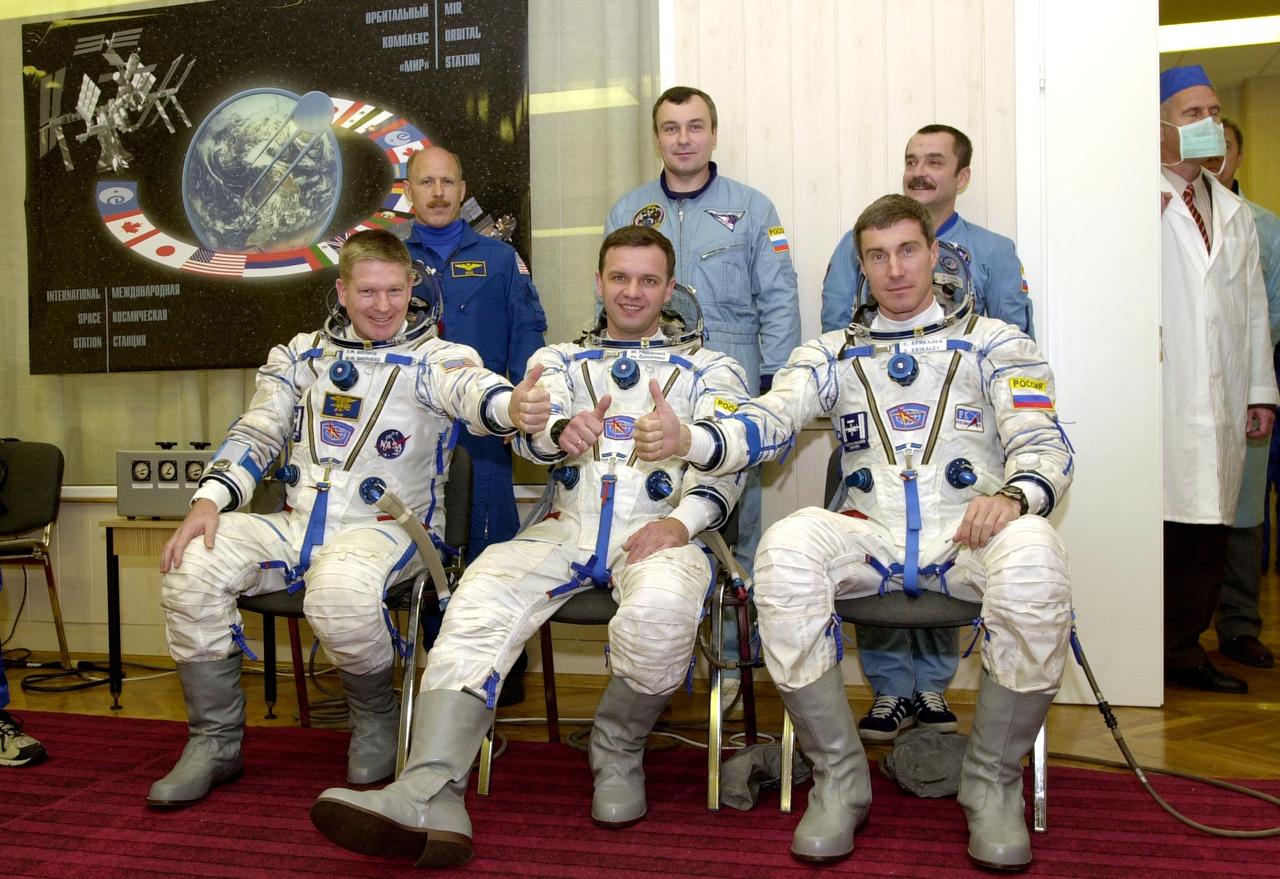
ISS01-S-007 (20 October 2000) --- Appearing ready for their rapidly-approaching date with the International Space Station (ISS) are (seated, from the left) astronaut William M. Shepherd, Expedition One commander; with cosmonauts Yuri P. Gidzenko, Soyuz commander; and Sergei K. Krikalev, flight engineer. Behind them are the backup crewmembers (from left)-- astronaut Kenneth D. Bowersox with cosmonauts Vladimir N. Dezhurov and Mikhail Turin.
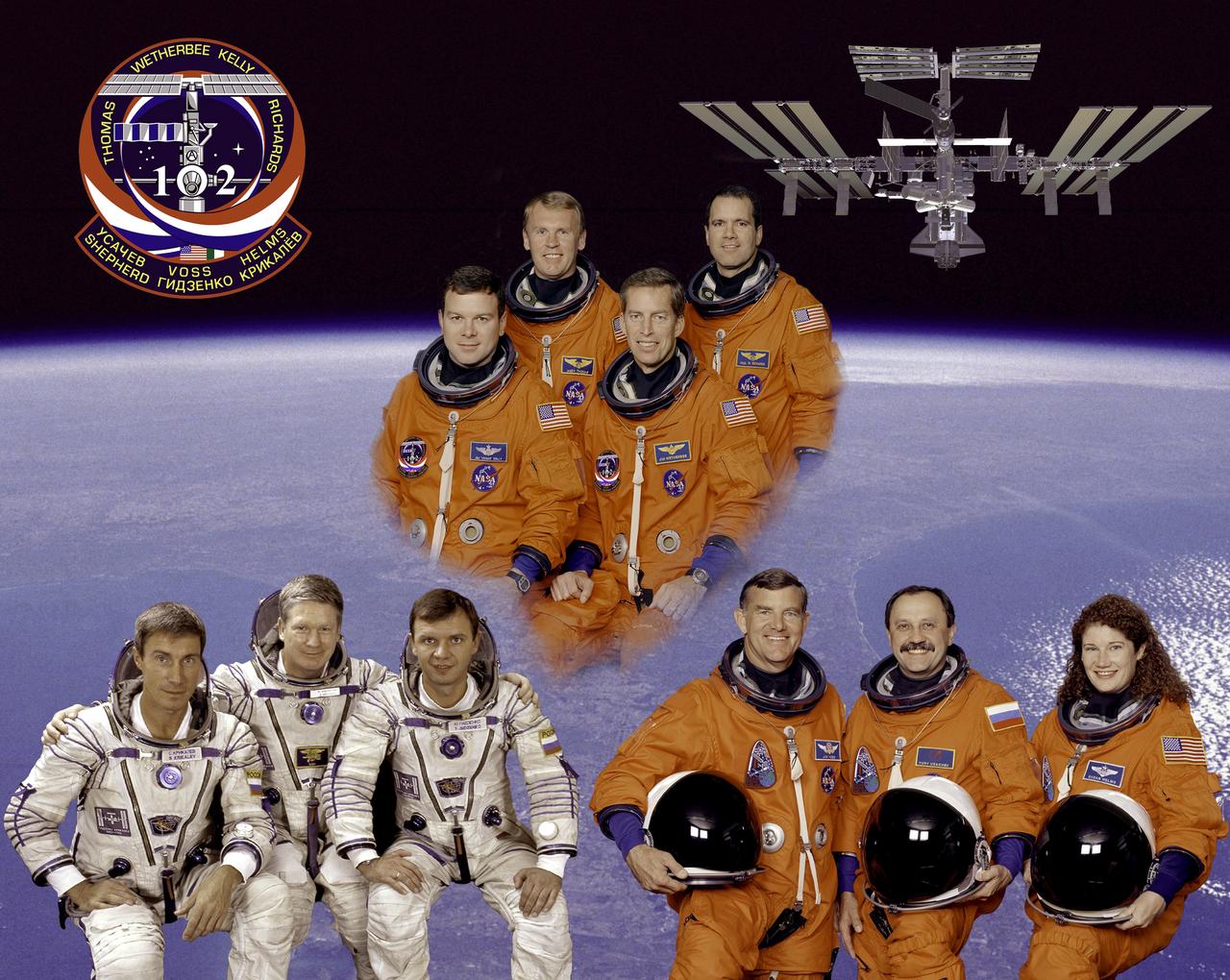
These 10 astronauts and cosmonauts represent the base STS-102 space travelers, as well as the crew members for the station crews switching out turns aboard the outpost. Those astronauts wearing orange represent the STS-102 crew members. In the top photo, from left to right are: James M. Kelly, pilot; Andrew S.W. Thomas, mission specialist; James D. Wetherbee, commander; and Paul W. Richards, mission specialist. The group pictured in the lower right portion of the portrait are STS-members as well as Expedition Two crew members (from left): mission specialist and flight engineer James S. Voss; cosmonaut Yury V. Usachev, Expedition Two Commander; and mission specialist and flight engineer Susan Helms. The lower left inset are the 3 man crew of Expedition One (pictured from left): Cosmonaut Sergei K. Krikalev, flight engineer; astronaut William M. (Bill) Shepherd, commander; and cosmonaut Yuri P. Gidzenko, Soyuz commander. The main objective of the STS-102 mission was the first Expedition Crew rotation and the primary cargo was the Leonardo, the Italian Space Agency-built Multipurpose Logistics Module (MPLM). The Leonardo MPLM is the first of three such pressurized modules that will serve as the International Space Station's (ISS') moving vans, carrying laboratory racks filled with equipment, experiments, and supplies to and from the Station aboard the Space Shuttle. NASA's 103rd overall mission and the 8th Space Station Assembly Flight, STS-102 mission launched on March 8, 2001 aboard the Space Shuttle Orbiter Discovery.
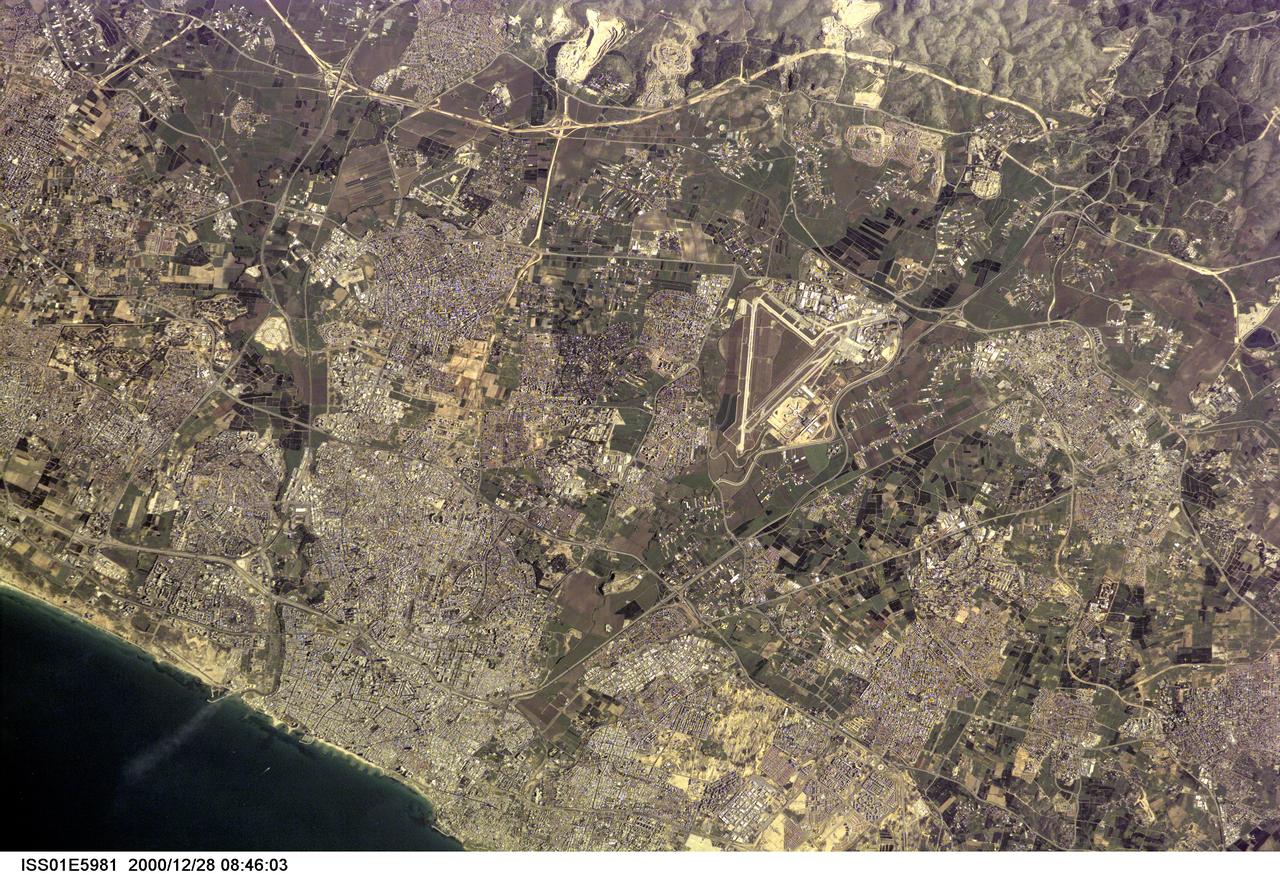
ISS001-E-5981 (28 December 2000) --- A near-vertical digital still image from the International Space Station (ISS) features Tel Aviv-Yafo, Israel. A small section of the Mediterranean Sea coastline is at bottom left. One of the Expedition One crew members used an extender on a 400mm lens to provide detail in the image. Onboard the outpost for the first habitation tour were astronaut William M. (Bill) Shepherd, commander; along with cosmonauts Yuri P. Gidzenko, Soyuz commander; and Sergei K. Krikalev, flight engineer.
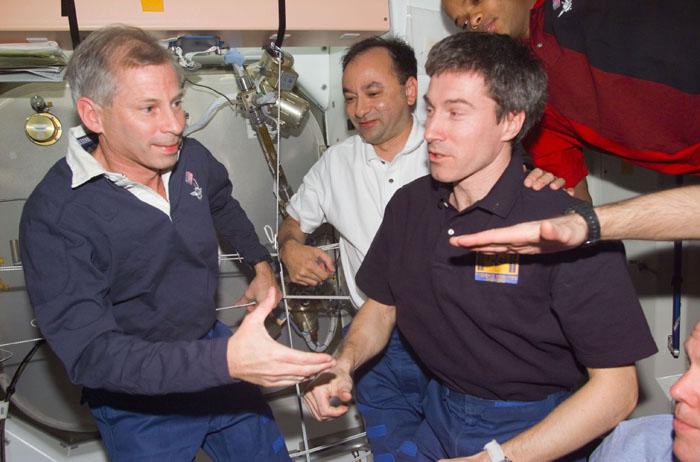
STS98-E-5295 (16 February 2001) --- Astronaut Kenneth D. Cockrell (left), STS-98 mission commander, participates in farewells with Expedition One crew members. Cosmonaut Sergei K. Krikalev (right foreground), Expedition One flight engineer, is one of three crew members who will stay behind for several weeks prior to return to Earth. Astronauts Mark L. Polansky, STS-98 pilot, and Robert L. Curbeam, mission specialist, are also pictured. The scene was recorded with a digital still camera.
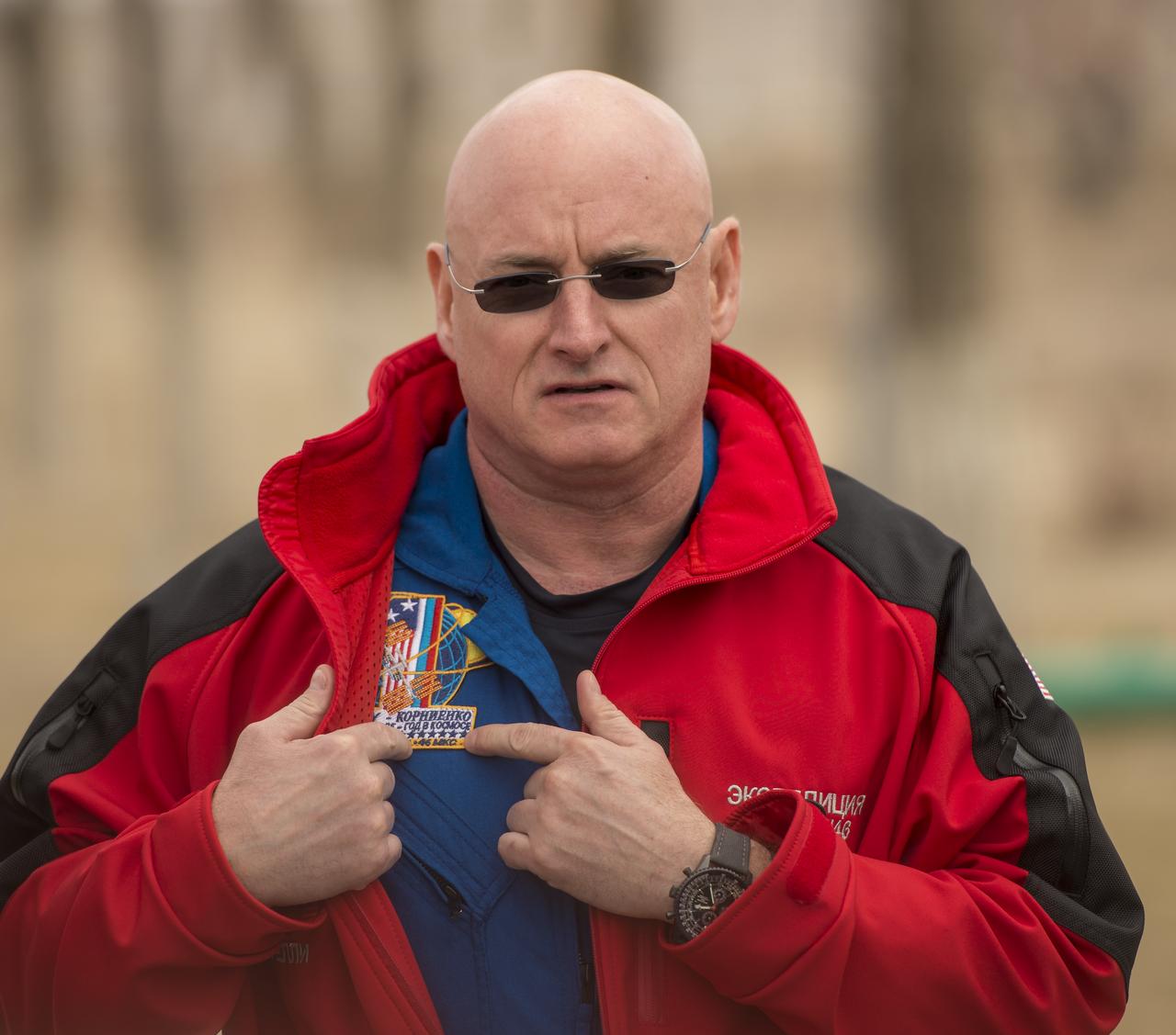
Expedition 43 NASA Astronaut Scott Kelly describes his One-Year mission patch to members of the press during media day, Saturday, March 21, 2015 at the Cosmonaut Hotel in Baikonur, Kazakhstan. Kelly, and Russian Cosmonauts Mikhail Kornienko, and Gennady Padalka of the Russian Federal Space Agency (Roscosmos) are scheduled to launch to the International Space Station in the Soyuz TMA-16M spacecraft from the Baikonur Cosmodrome in Kazakhstan March 28, Kazakh time (March 27 Eastern time.) As the one-year crew, Kelly and Kornienko will return to Earth on Soyuz TMA-18M in March 2016. Photo Credit: (NASA/Bill Ingalls)
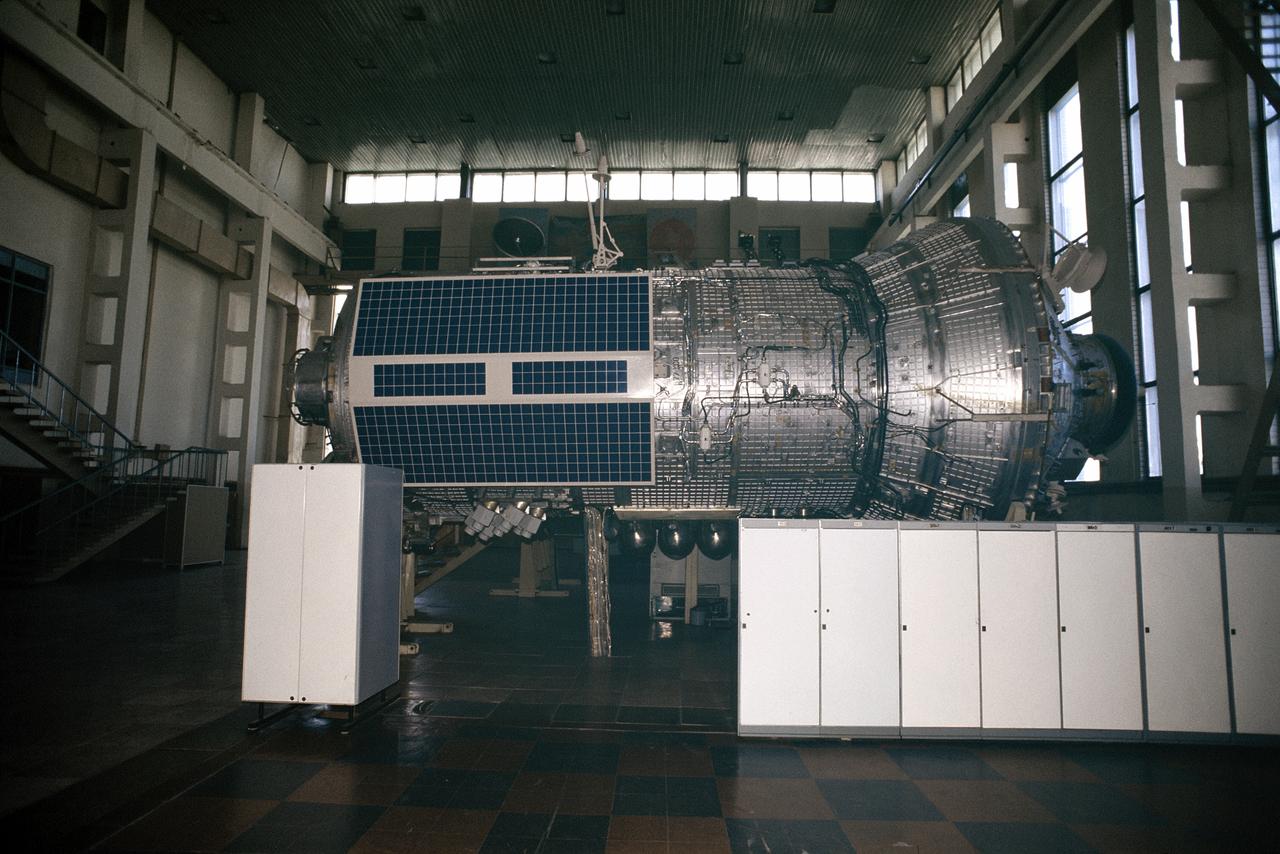
Photographic documentation of Expedition One crew in Russia with Service Module. Views include: The three crew members for ISS Expedition One train with computers on the trainer / mockup for the Zvezda Service Module. From the left are cosmonauts Yuri Gidzenko, Soyuz commander; and Sergei Krikalev, flight engineer; and astronaut William Shepherd, mission commander. The session took place at the Gagarin Cosmonaut Training Center in Russia (18628). View looking toward the hatch inside the Zvezda Service Module trainer / mockup at the Gagarin Cosmonaut Training Center in Russia (18629). A wide shot of the Zvezda Service Module trainer / mockup, with the transfer compartment in the foreground (18630). Side view of the Zvezda Service Module (18631). An interior shot of the Zarya / Functional Cargo Bay (FGB) trainer / mockup (18632). Astronaut Scott Kelly, director of operations - Russia, walks through a full scale trainer / mockup for the Zvezda Service Module at the Gagarin Cosmonaut Training Center in Russia (18633). Astronaut William Shepherd (right) mission commander for ISS Expedition One, and Sergei Krikalev, flight engineer, participate in a training session in a trainer / mockup of the Zvezda Service Module (18634).
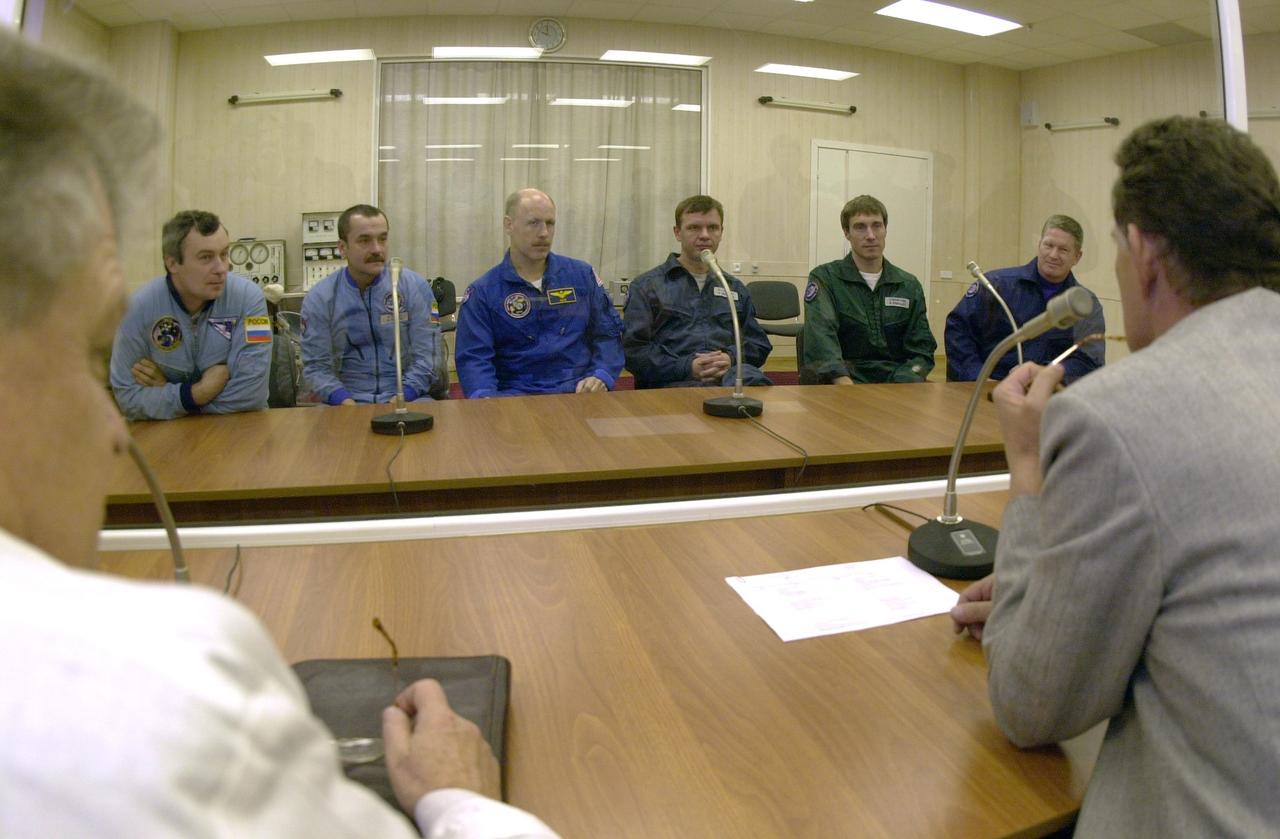
JSC2000-E-27080 (20 October 2000) --- In background, from left, Vladimir N. Dezhurov, Mikhail Turin, Kenneth D. Bowersox, Yuri P. Gidzenko, Sergei K. Krikalev and William M. (Bill) Shepherd, the backup and prime crew members for Expedition One, during conference prior to simulation at Baikonur complex in Kazakhstan.
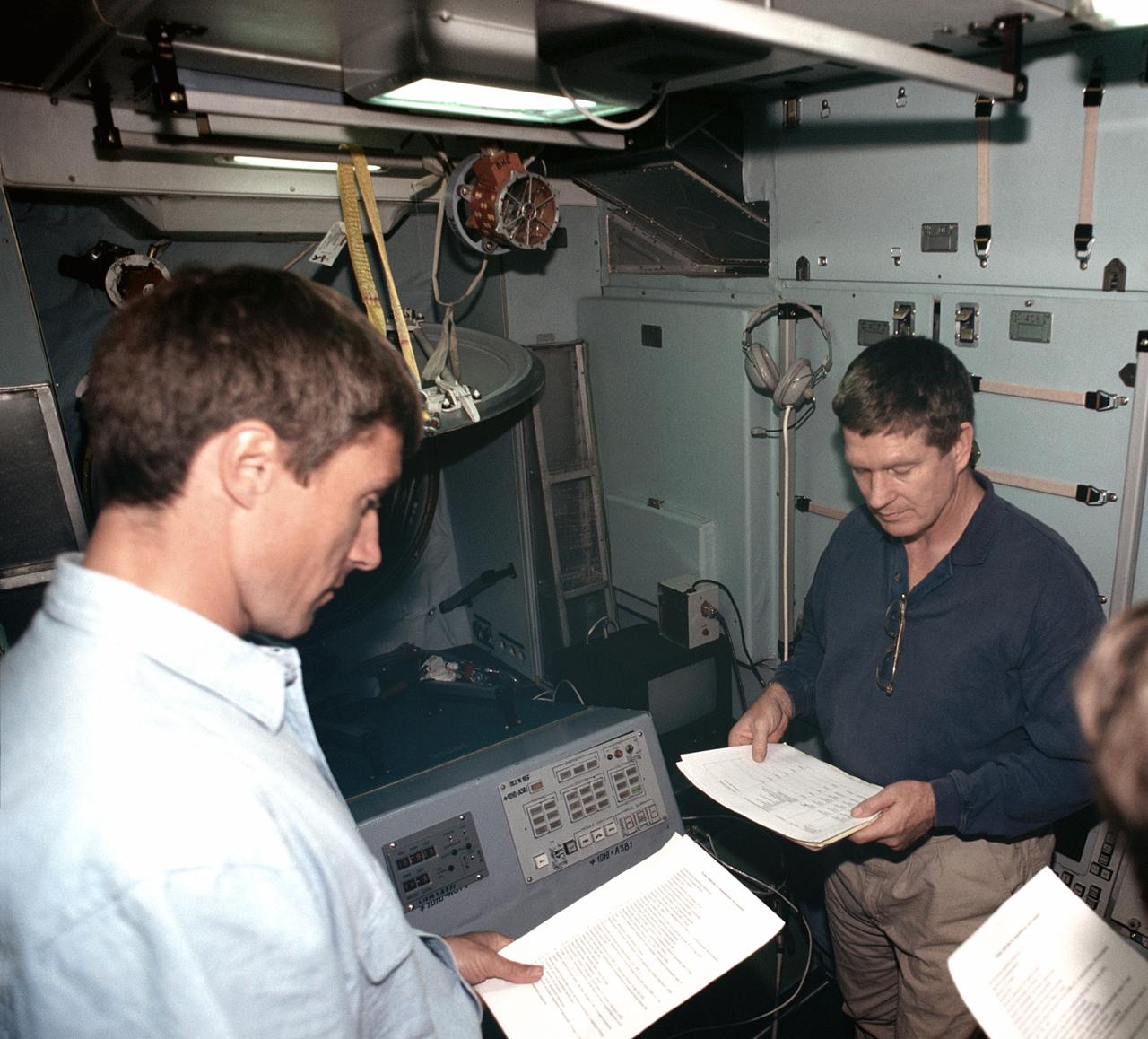
JSC2000-E-18634 (June 2000) --- Astronaut William Shepherd (right) mission commander for ISS Expedition One,and Sergei Krikalev, flight engineer, participate in a training session in a trainer/mockup of the Zvezda Service Module at the Gagarin Cosmonaut Training Center in Russia. Cosmonaut Yuri Gidzenko, Soyuz commander, is out of frame at right.
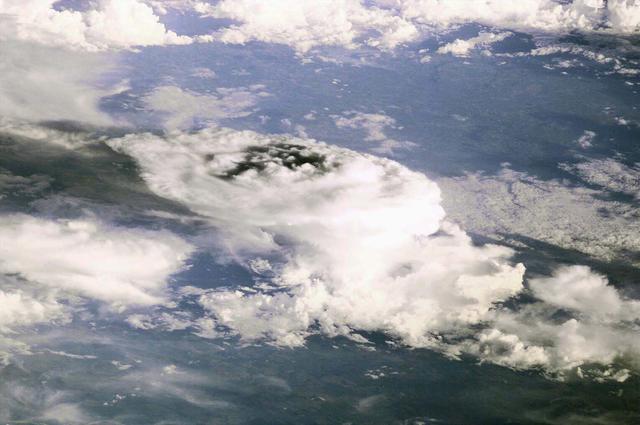
ISS01-E-5011 (November 2000) --- A mass of storm clouds was captured with an electronic still camera (ESC) from the International Space Station (ISS) by the Expedition One crew members. The picture was the first Earth observation still image downlinked by the three-man crew.
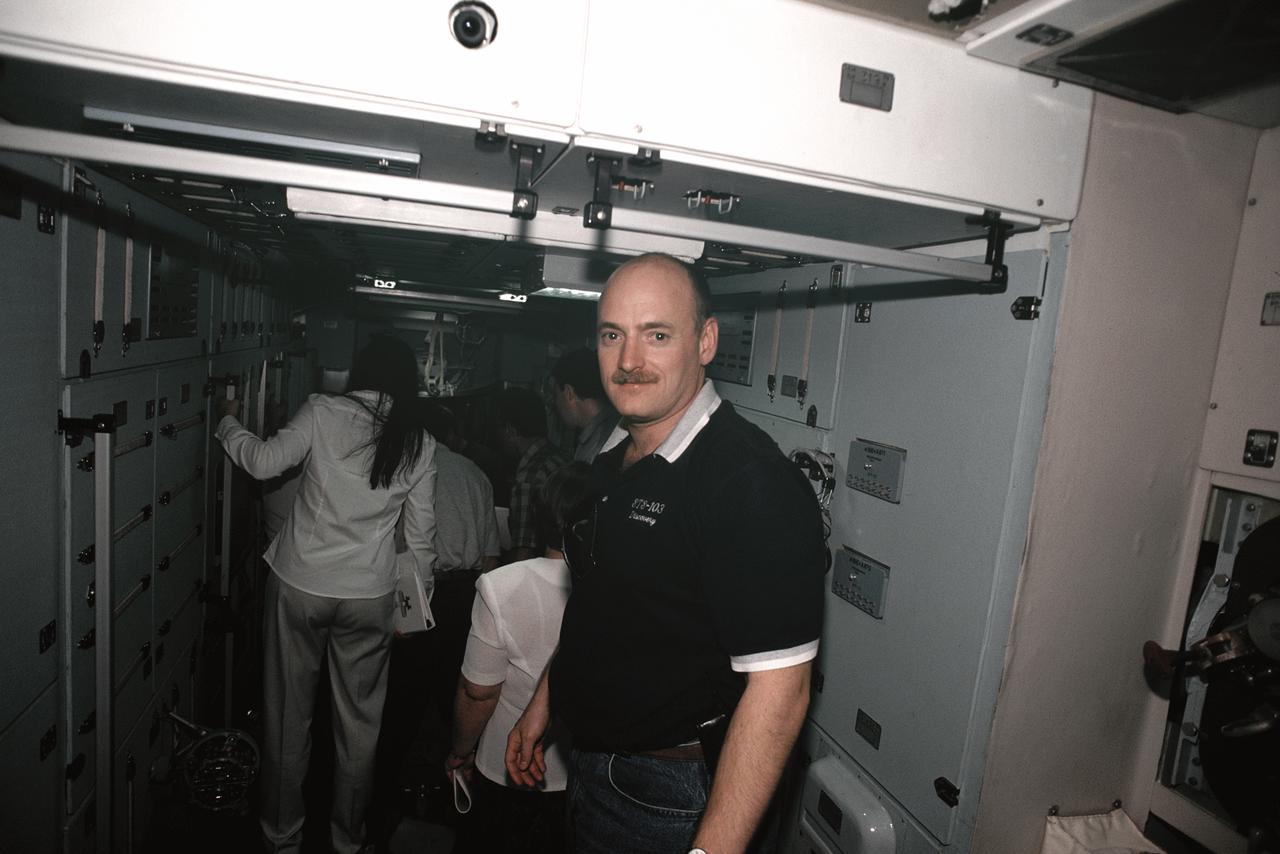
JSC2000-E-18633 (June 2000) --- Astronaut Scott Kelly, director of operations - Russia, walks through a full scale trainer/mockup for the Zvezda Service Module at the Gagarin Cosmonaut Training Center in Russia. The Expedition One crew was training in another area of the SM when this photo was made.
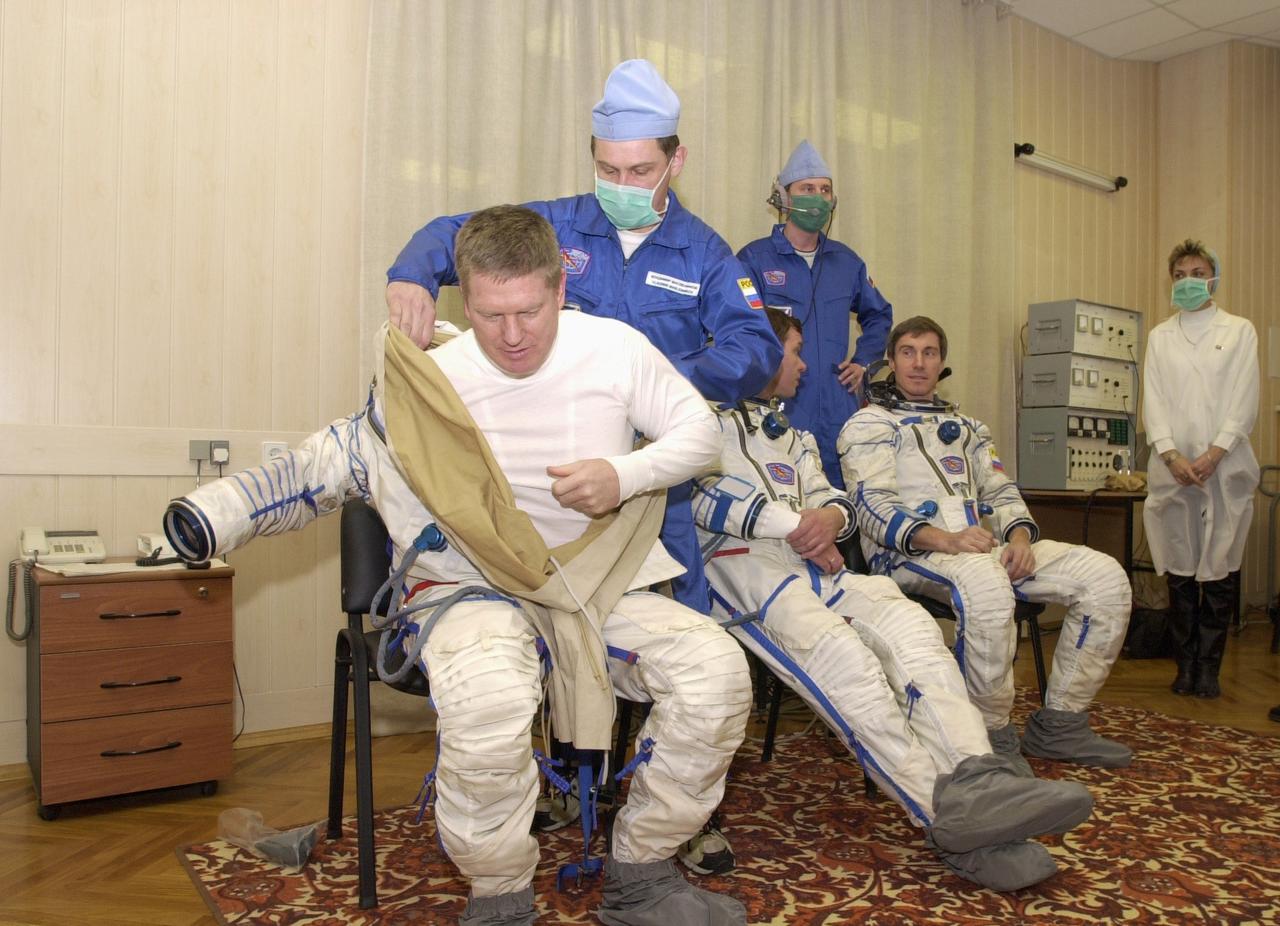
JSC2000-E-27081 (20 October 2000) --- Expedition One commander William M. (Bill) Shepherd gets help with his Sokol suit prior to a simulation at Baikonur. Also donning suits are Soyuz pilot Yuri P. Gidzenko (seated at center) and flight engineer Sergei K. Krikalev.
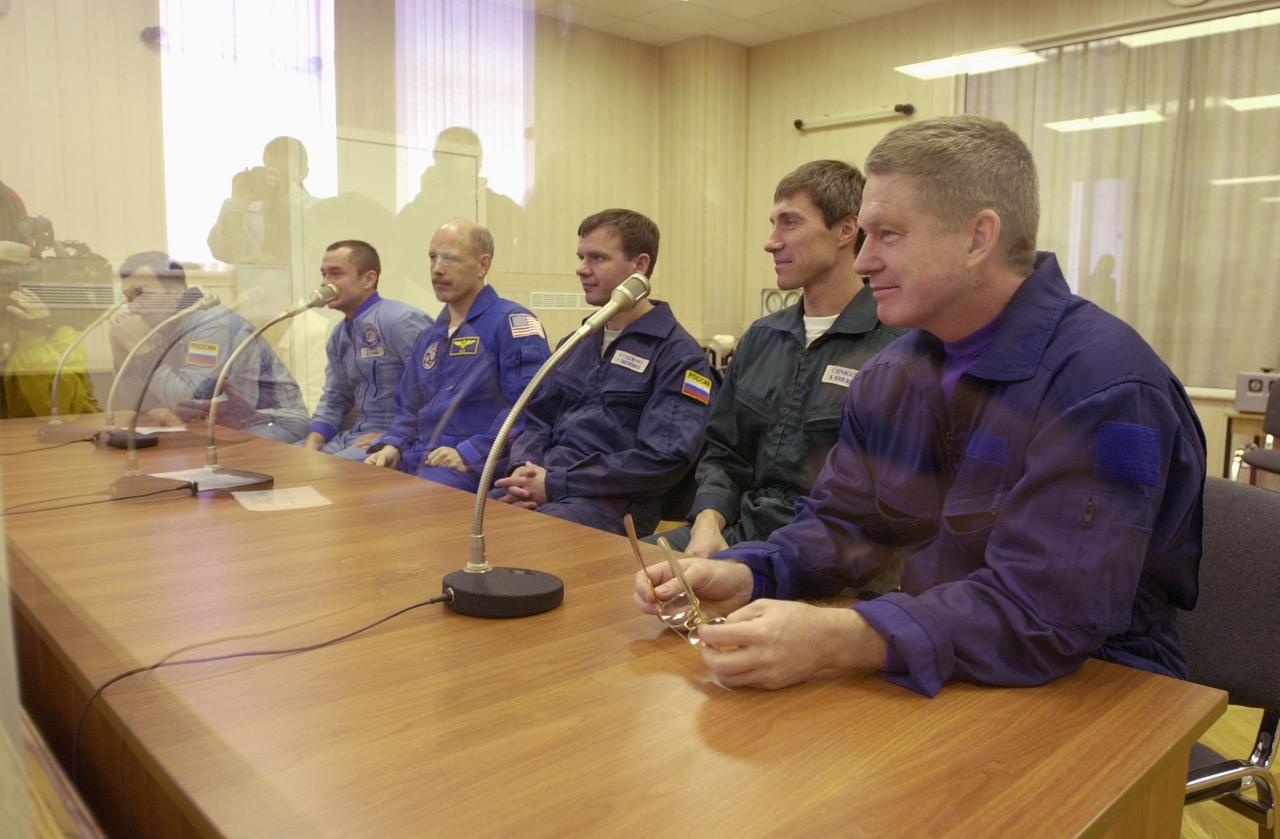
JSC2000-E-27079 (20 October 2000) --- From left, Vladimir N. Dezhurov, Mikhail Turin, Kenneth D. Bowersox, Yuri P. Gidzenko, Sergei K. Krikalev and William M. (Bill) Shepherd, the backup and prime crew members for Expedition One, during conference prior to simulation at Baikonur complex in Kazakhstan.

JSC2000-E-27077 (16 October 2000) --- Expedition One crew members in Moscow's Red Square. From left, Soyuz pilot Yuri Gidzenko, flight engineer Sergei Krikalev, and expedition commander William M. (Bill) Shepherd. While in Moscow, the trio also visited the grave of Soviet cosmonaut Yuri Gagarin (1934-1968). Paying respects to the first man in space is customary in Russia prior to a spaceflight.
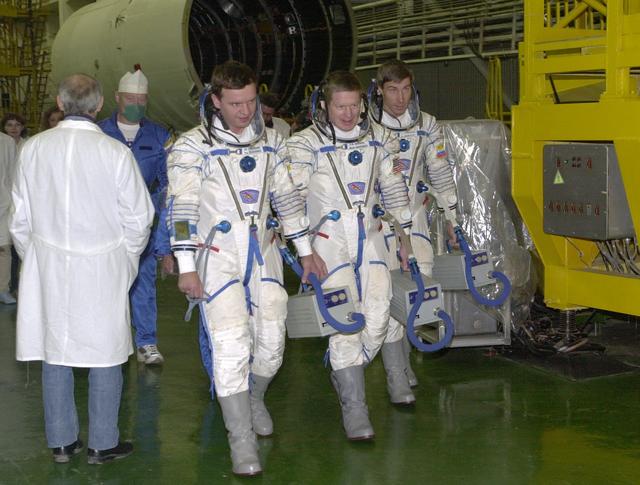
JSC2000-E-27090 (20 October 2000) --- One of the final "dry runs" before the real thing found the Expedition 1 crew members still training for their upcoming mission, about a week-and-half prior to the scheduled Oct. 30 launch. They are, from the left, Yuri P. Gidzenko, Soyuz commander; William M. (Bill) Shepherd, Expedition 1 commander; and Sergei K. Krikalev, flight engineer.
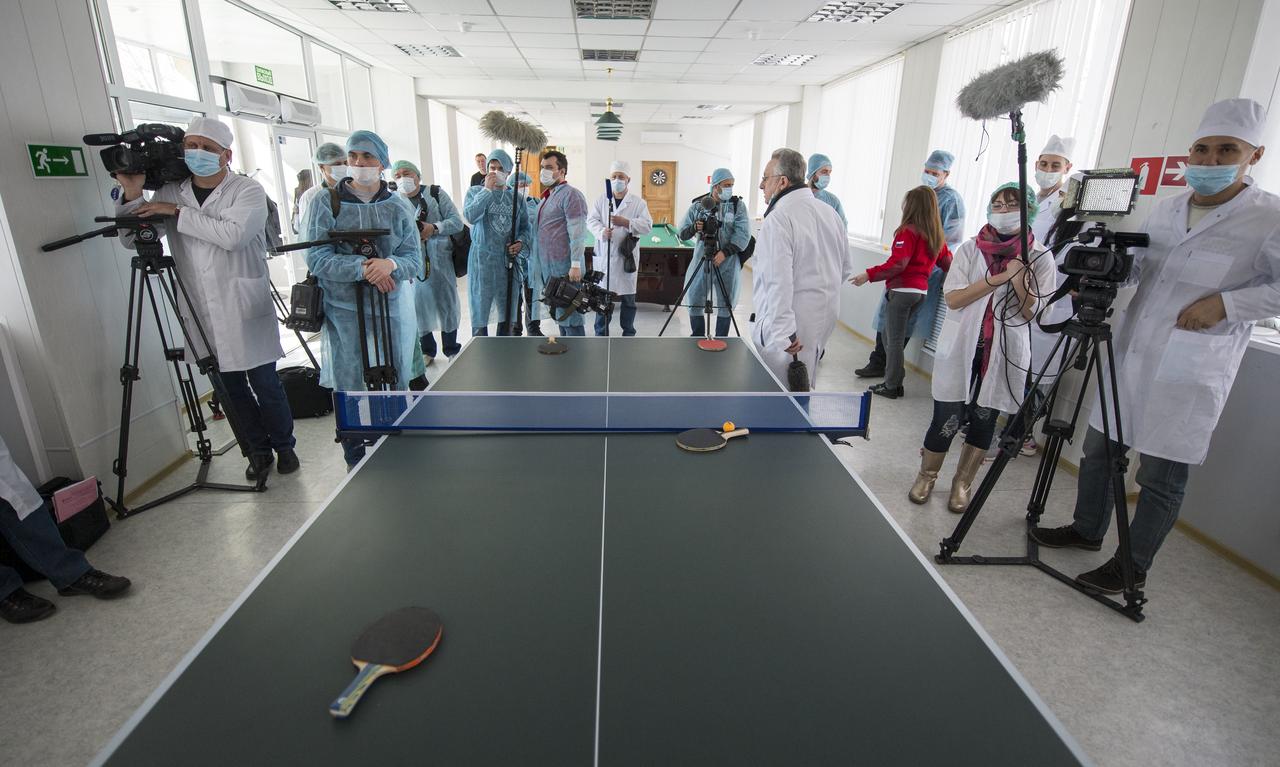
Media wait to be escorted to the next event during the Expedition 43 prime and backup crew media day on Saturday, March 21, 2015 at the Cosmonaut Hotel in Baikonur, Kazakhstan. Expedition 43 NASA Astronaut Scott Kelly, and Russian Cosmonauts Gennady Padalka, and Mikhail Kornienko of the Russian Federal Space Agency (Roscosmos) are scheduled to launch to the International Space Station in the Soyuz TMA-16M spacecraft from the Baikonur Cosmodrome in Kazakhstan March 28, Kazakh time (March 27 Eastern time.) As the one-year crew, Kelly and Kornienko will return to Earth on Soyuz TMA-18M in March 2016. Photo Credit: (NASA/Bill Ingalls)
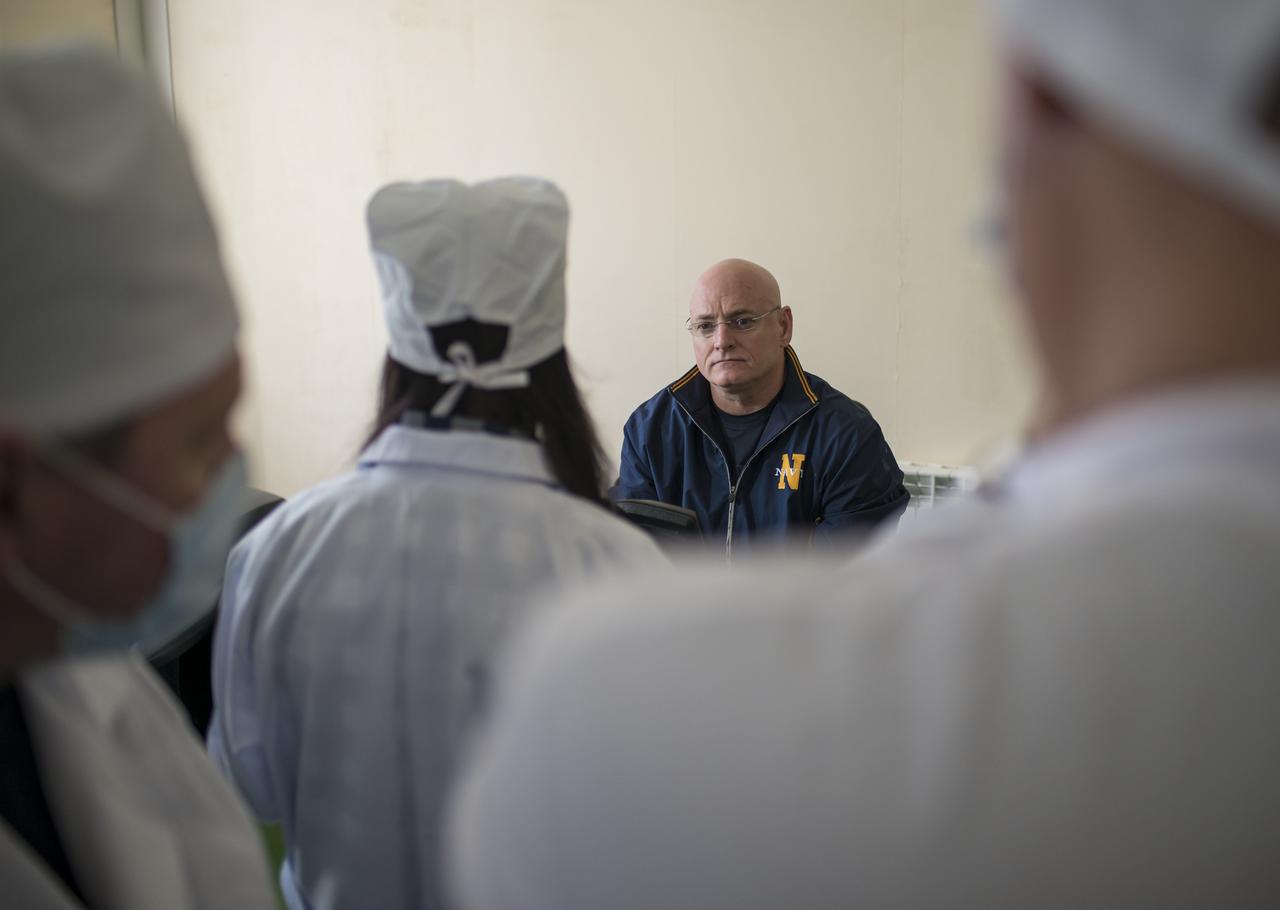
Expedition 43 NASA Astronaut Scott Kelly answers questions from the press during media day, Saturday, March 21, 2015, Baikonur, Kazakhstan. Expedition 43 NASA Astronaut Scott Kelly, and Russian Cosmonauts Gennady Padalka, and Mikhail Kornienko of the Russian Federal Space Agency (Roscosmos) are scheduled to launch to the International Space Station in the Soyuz TMA-16M spacecraft from the Baikonur Cosmodrome in Kazakhstan March 28, Kazakh time (March 27 Eastern time.) As the one-year crew, Kelly and Kornienko will return to Earth on Soyuz TMA-18M in March 2016. Photo Credit: (NASA/Bill Ingalls)
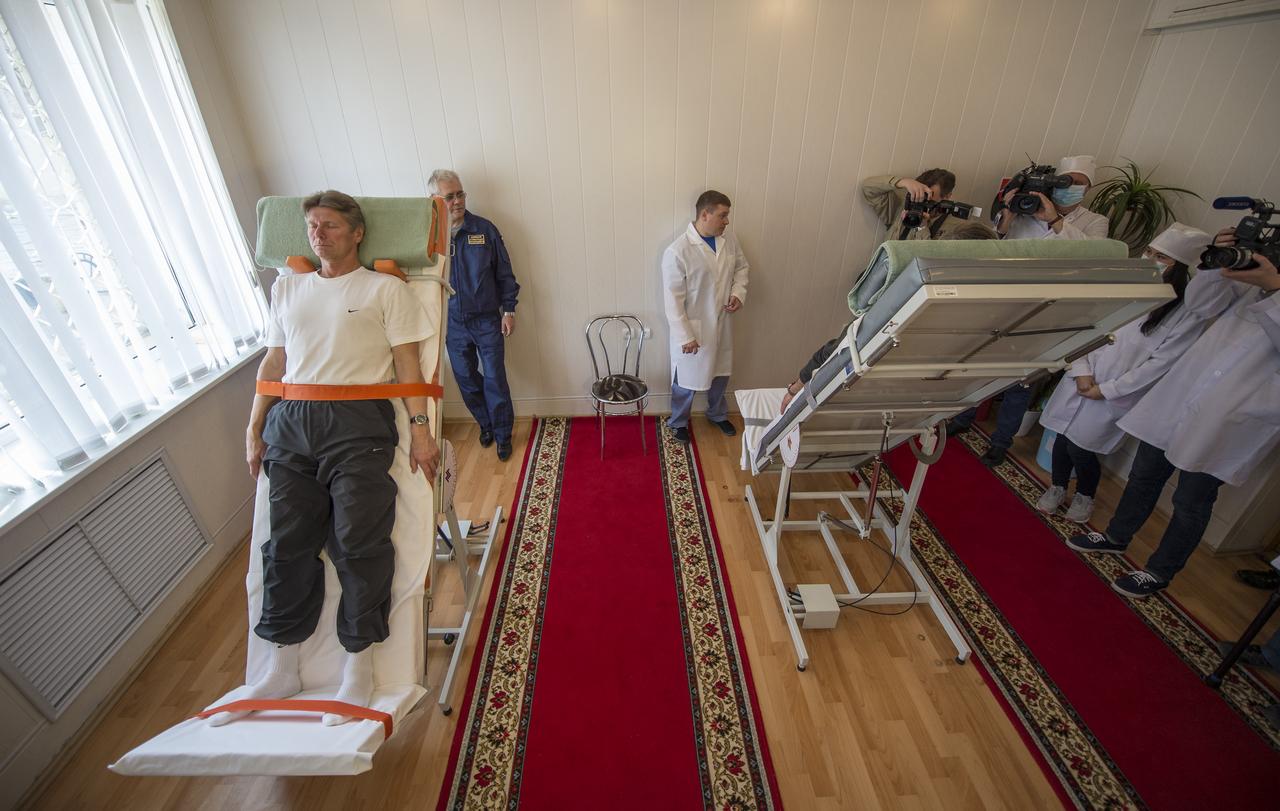
Expedition 43 Russian Cosmonauts Gennady Padalka, left, and Mikhail Kornienko of the Russian Federal Space Agency (Roscosmos) take part the tilt table training during media day, Saturday, March 21, 2015, Baikonur, Kazakhstan. Padalka, Kornienko, and Expedition 43 NASA Astronaut Scott Kelly are scheduled to launch to the International Space Station in the Soyuz TMA-16M spacecraft from the Baikonur Cosmodrome in Kazakhstan March 28, Kazakh time (March 27 Eastern time.) As the one-year crew, Kelly and Kornienko will return to Earth on Soyuz TMA-18M in March 2016. Photo Credit: (NASA/Bill Ingalls)
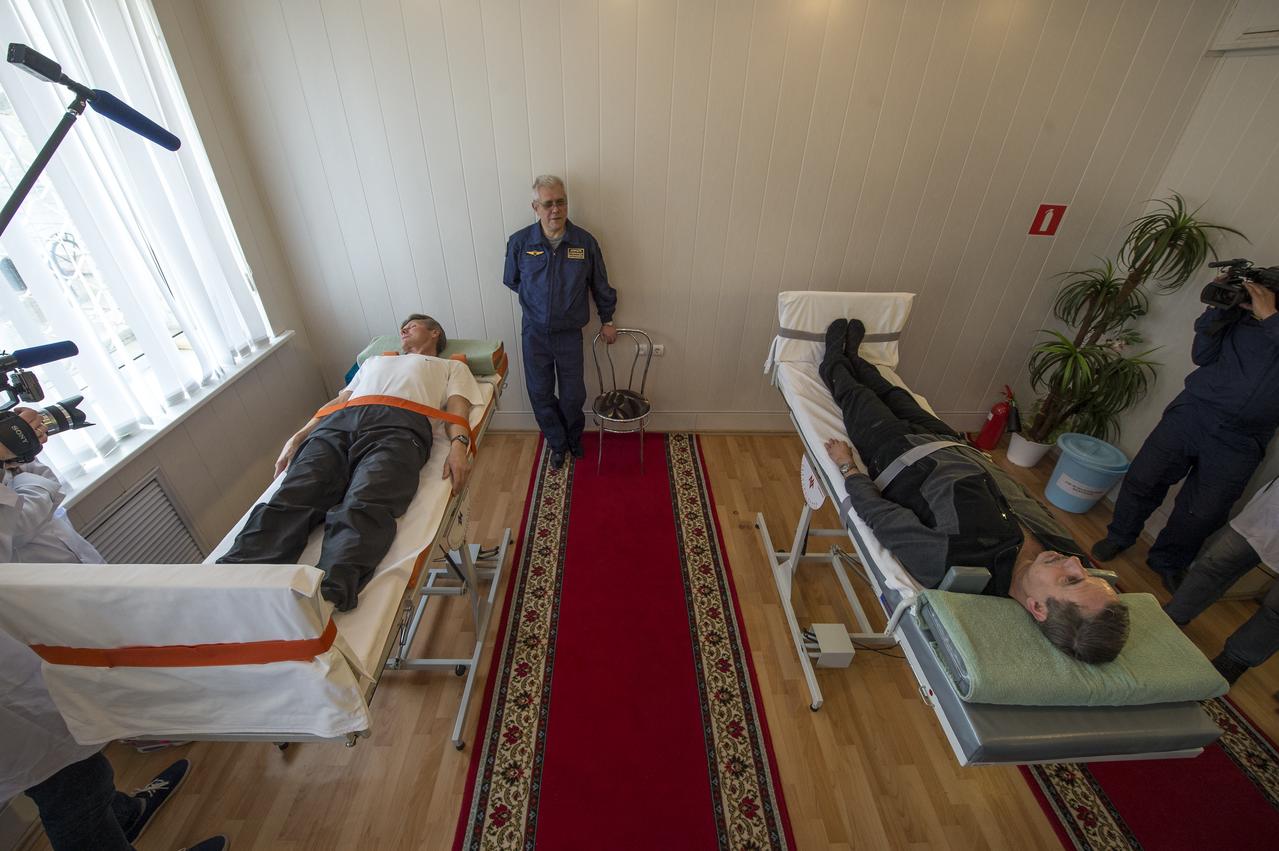
Expedition 43 Russian Cosmonauts Gennady Padalka, left, and Mikhail Kornienko of the Russian Federal Space Agency (Roscosmos) take part the tilt table training during media day, Saturday, March 21, 2015, Baikonur, Kazakhstan. Padalka, Kornienko, and Expedition 43 NASA Astronaut Scott Kelly are scheduled to launch to the International Space Station in the Soyuz TMA-16M spacecraft from the Baikonur Cosmodrome in Kazakhstan March 28, Kazakh time (March 27 Eastern time.) As the one-year crew, Kelly and Kornienko will return to Earth on Soyuz TMA-18M in March 2016. Photo Credit: (NASA/Bill Ingalls)
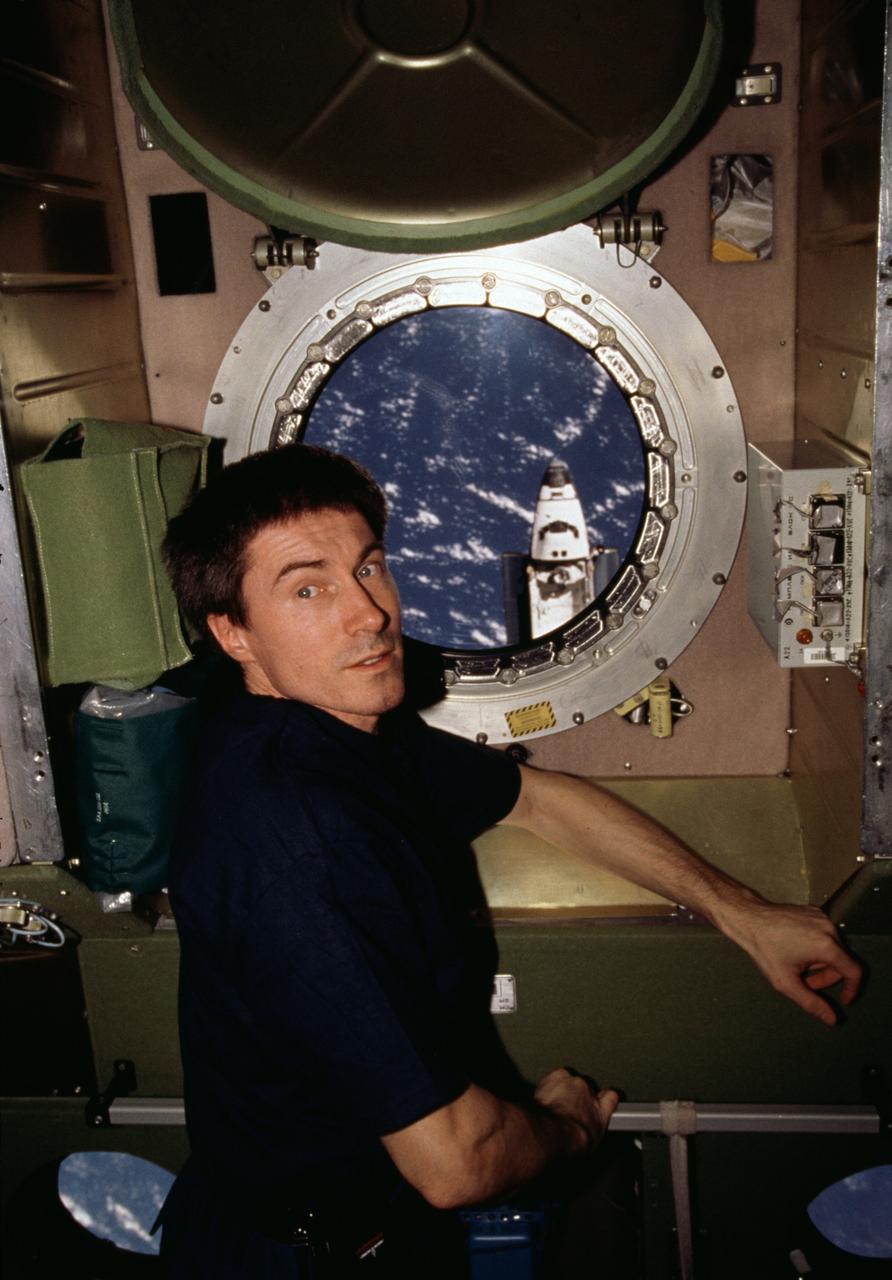
ISS001-361-017 (9 February 2001) --- Cosmonaut Sergei K. Krikalev, flight engineer for Expedition One, is positioned at a port hole on the Zvezda service module of the International Space Station (ISS) as the Space Shuttle Atlantis approaches for a link-up leading to several days of joint activities between the two crews. The crew cabin and forward section of the Space Shuttle Atlantis can be seen in the window. The aft part of the cargo bay, where the Destiny laboratory was stowed, is not visible in the scene. Scattered clouds over the Western Pacific are visible in the window scene.
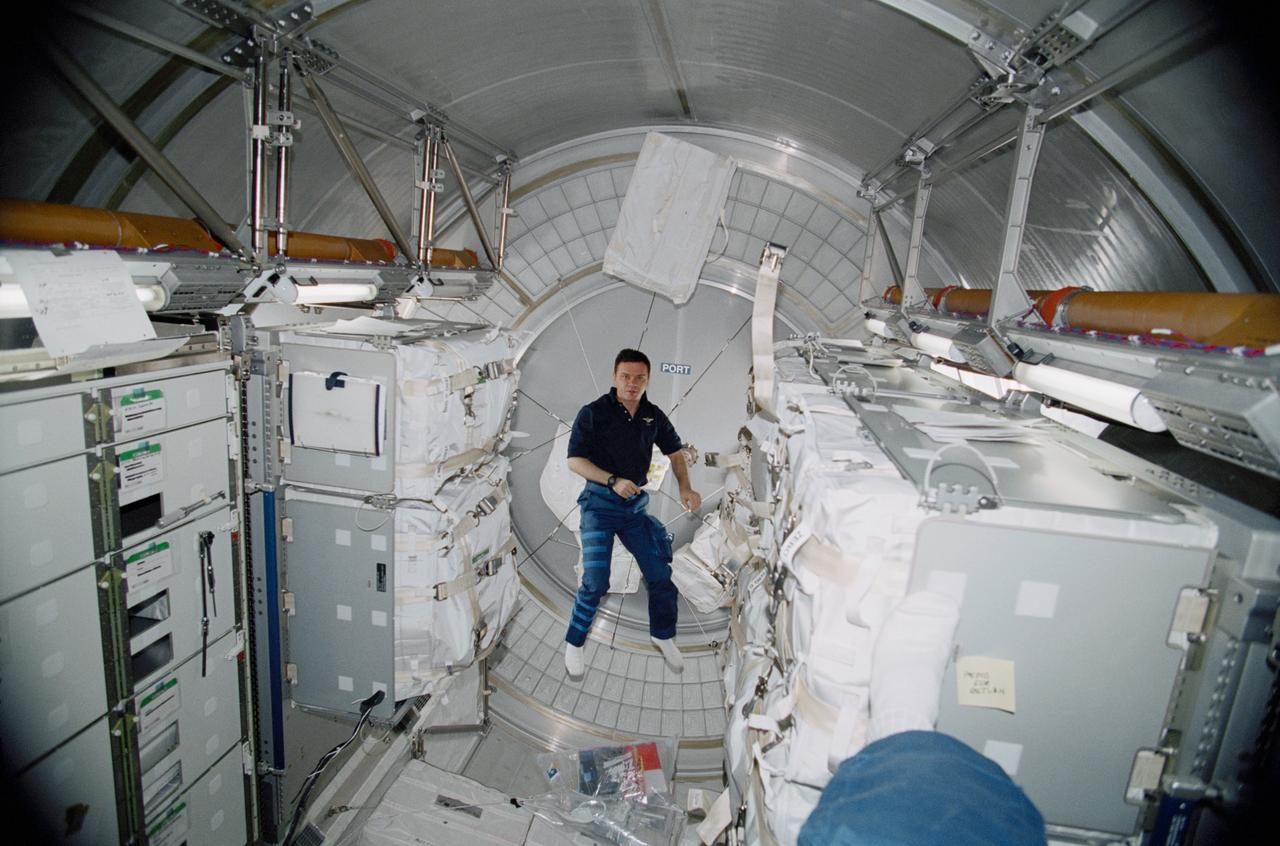
A crewmember of Expedition One, cosmonaut Yuri P. Gidzenko, is dwarfed by transient hardware aboard Leonardo, the Italian Space Agency-built Multi-Purpose Logistics Module (MPLM), a primary cargo of the STS-102 mission. The Leonardo MPLM is the first of three such pressurized modules that will serve as the International Space Station's (ISS's) moving vans, carrying laboratory racks filled with equipment, experiments and supplies to and from the Space Station aboard the Space Shuttle. The cylindrical module is approximately 21-feet long and 15- feet in diameter, weighing almost 4.5 tons. It can carry up to 10 tons of cargo into 16 standard Space Station equipment racks. Of the 16 racks the module can carry, 5 can be furnished with power, data, and fluid to support refrigerators or freezers. In order to function as an attached station module as well as a cargo transport, the logistics module also includes components that provide life support, fire detection and suppression, electrical distribution, and computer functions. The eighth Shuttle mission to visit the ISS, the STS-102 mission served as a crew rotation flight. It delivered the Expedition Two crew to the Station and returned the Expedition One crew back to Earth.

ISS005-E-08115 (July 2002) --- View of a gibbous Moon photographed by one of the crewmembers aboard the International Space Station (ISS) for Expedition Five.
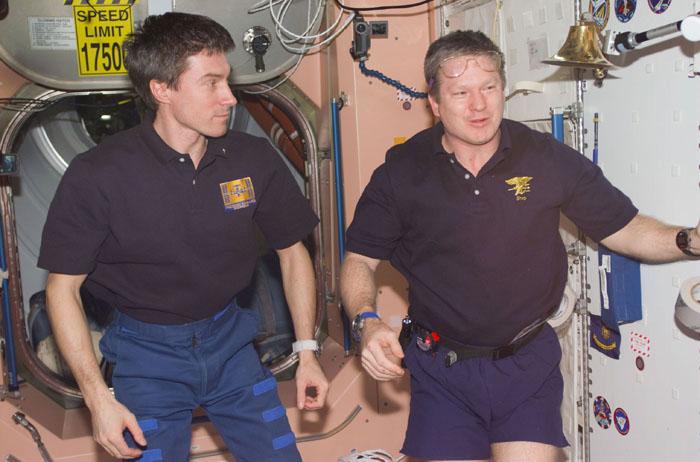
STS98-E-5291 (16 February 2001) --- Cosmonaut Sergei K. Krikalev (left), Expedition One flight engineer representing the Russian Aviation and Space Agency, and astronaut William M. (Bill) Shepherd, Expedition One commander, look toward their astronaut visitors (out of frame), about to conclude their time on the outpost. The scene was recorded with a digital still camera during farewells in the Unity node.
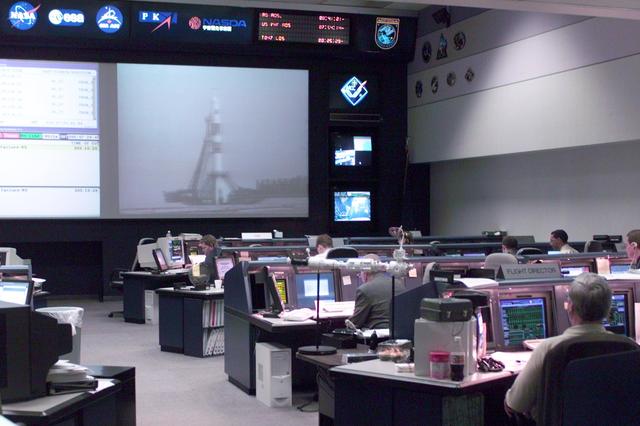
JSC2000-E-27301 (31 October 2000) --- Flight controllers in Houston's Mission Control Center follow the countdown to the Kazakhstan liftoff of the Soyuz, carrying the Expedition One crew.
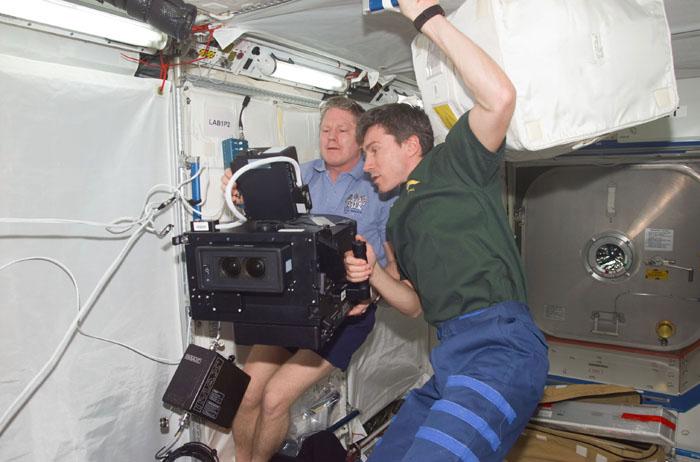
STS98-E-5167 (11 February 2001) --- Astronaut William M. (Bill) Shepherd (left), Expedition One commander, with the help of cosmonaut Sergei K. Krikalev, films activity onboard the newly attached Destiny laboratory. The crews of Atlantis and the International Space Station on February 11 opened the Destiny laboratory and spent the first full day of what are planned to be years of work ahead inside the orbiting science and command center. Shepherd opened the Destiny hatch, and he and Shuttle commander Kenneth D. Cockrell ventured inside at 8:38 a.m. (CST). Members of both crews went to work quickly inside the new module, activating air systems, fire extinguishers, alarm systems, computers and internal communications. The crew also continued equipment transfers from the shuttle to the station and filmed several scenes onboard the station using an IMAX camera. This scene was recorded with a digital still camera.
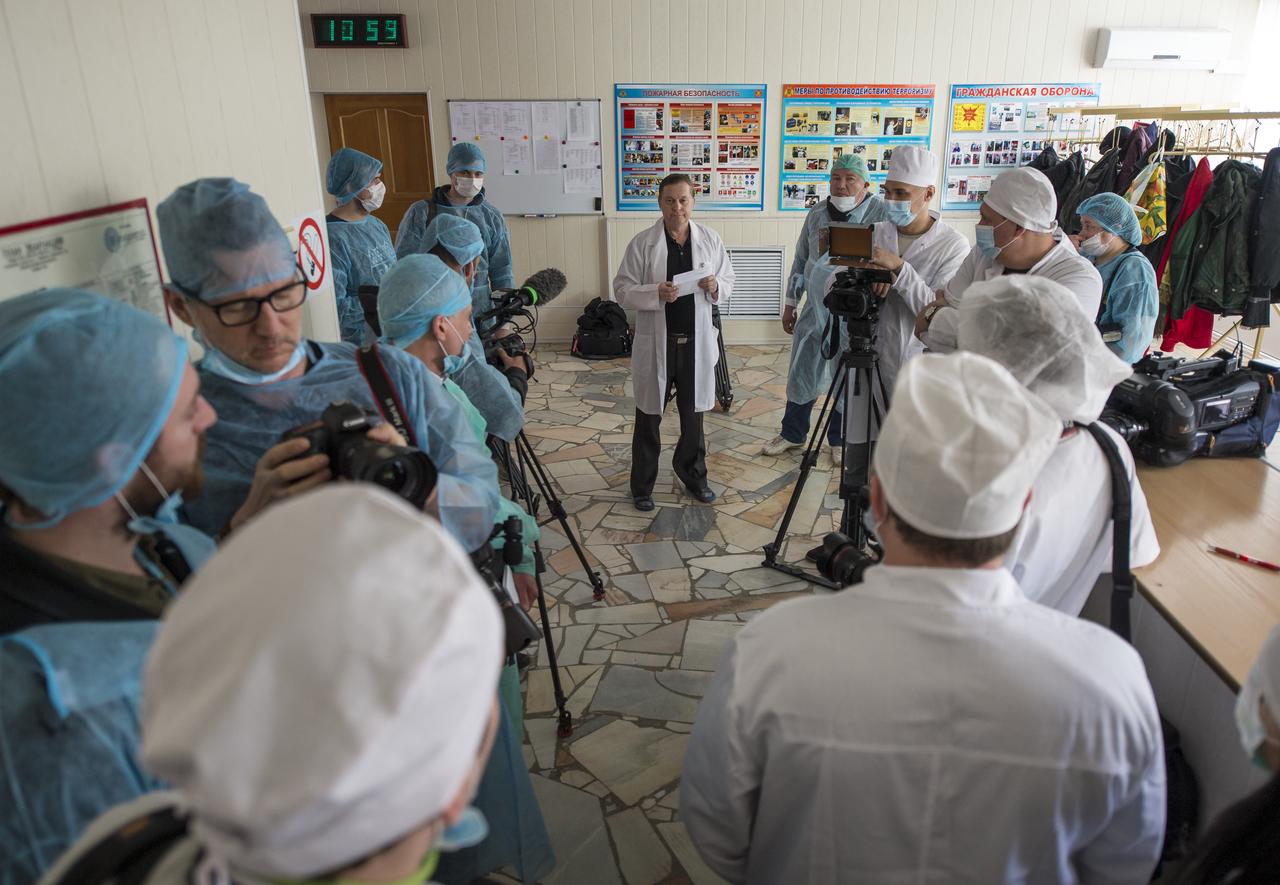
Gagarin Cosmonaut Training Center (GCTC) Chief Epidemiologist Sergei Savin stands in the Cosmonaut Hotel lobby and instructs the media on how their access to the Expedition 43 prime and backup crews will be organized during media day, Saturday, March 21, 2015, Baikonur, Kazakhstan. Expedition 43 NASA Astronaut Scott Kelly, and Russian Cosmonauts Gennady Padalka, and Mikhail Kornienko of the Russian Federal Space Agency (Roscosmos) are scheduled to launch to the International Space Station in the Soyuz TMA-16M spacecraft from the Baikonur Cosmodrome in Kazakhstan March 28, Kazakh time (March 27 Eastern time.) As the one-year crew, Kelly and Kornienko will return to Earth on Soyuz TMA-18M in March 2016. Photo Credit: (NASA/Bill Ingalls)
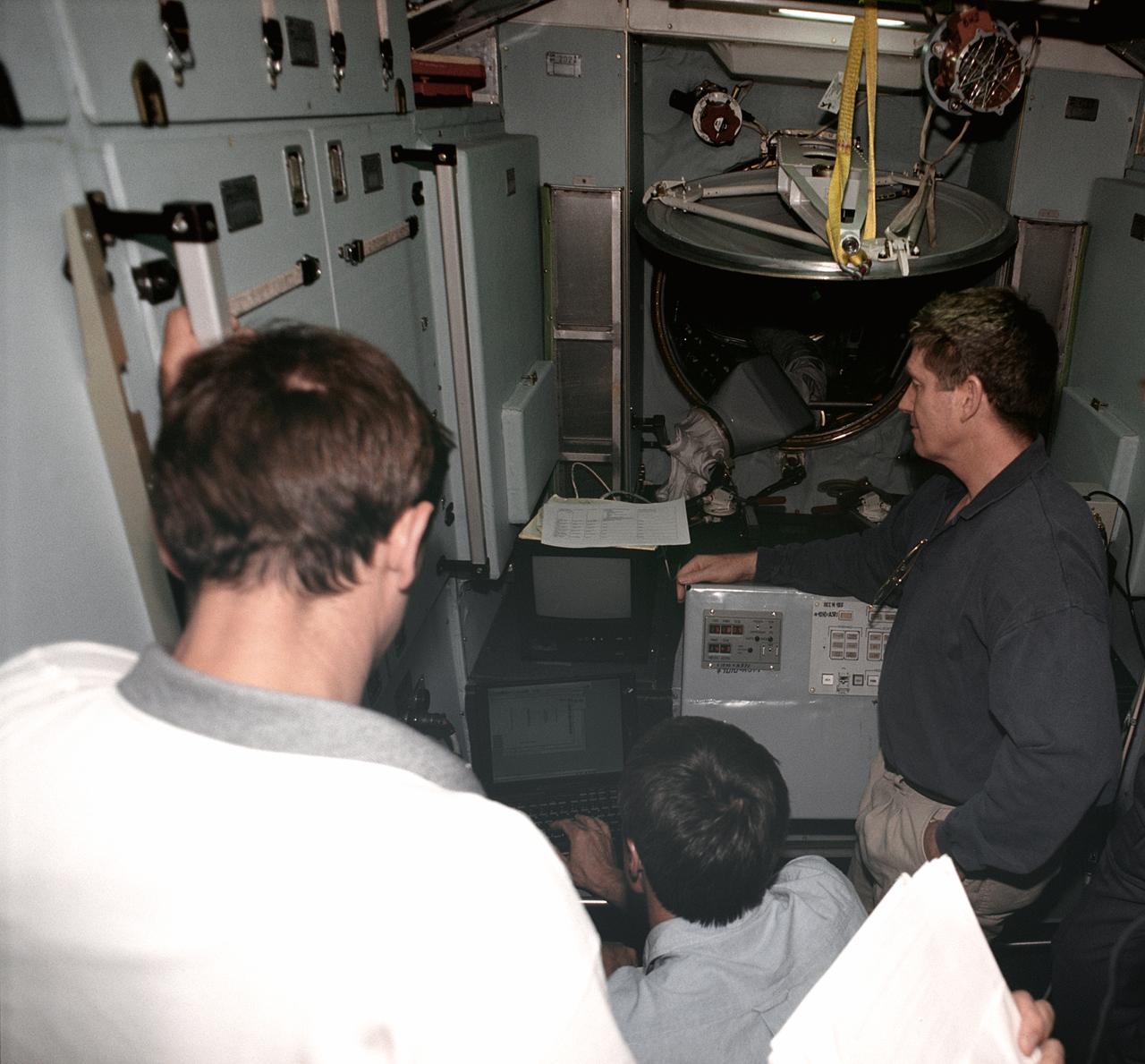
JSC2000-E-18628 (June 2000) --- The three crew members for ISS Expedition One train with computers on the trainer/mockup for the Zvezda Service Module. From the left are cosmonauts Yuri Gidzenko, Soyuz commander; and Sergei Krikalev, flight engineer; and astronaut William Shepherd, mission commander. The session took place at the Gagarin Cosmonaut Training Center in Russia.
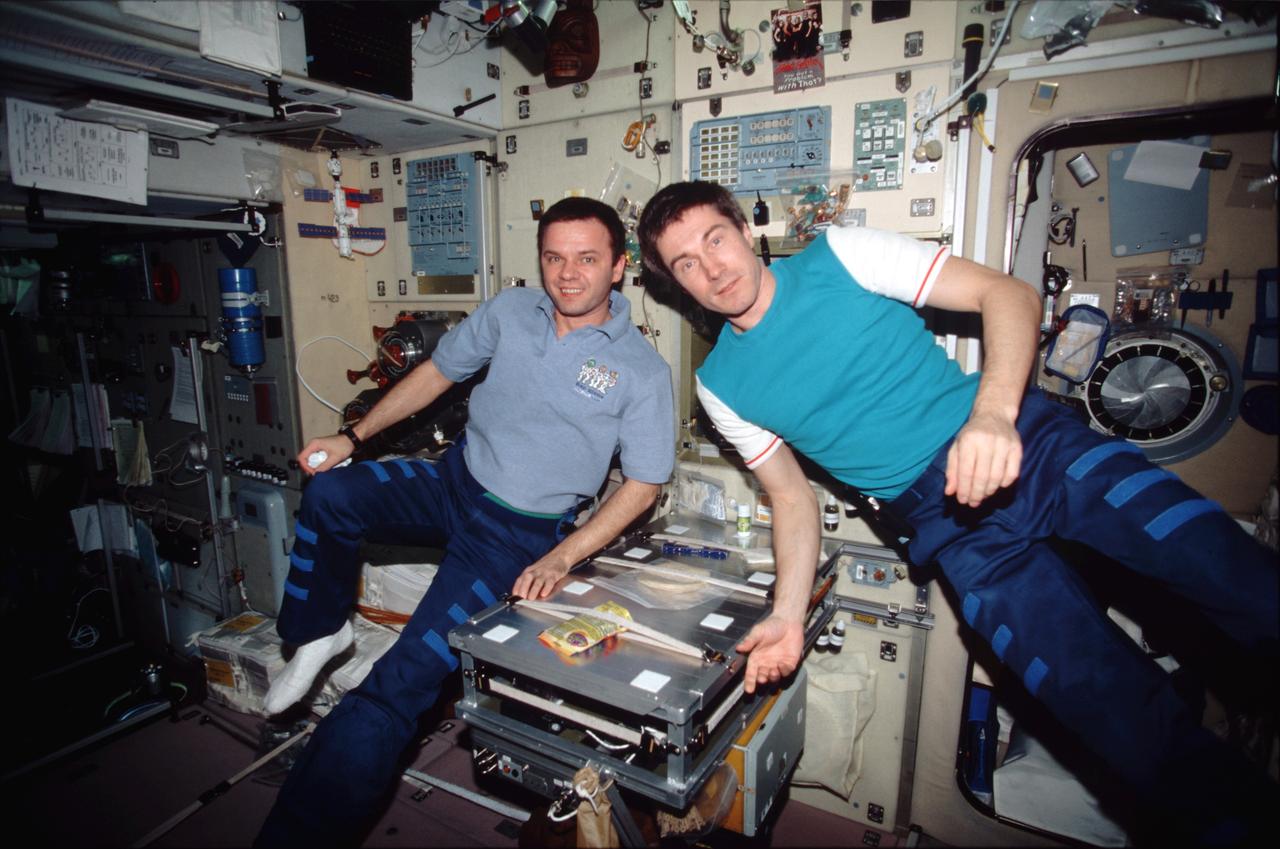
STS098-314-0017 (7-20 February 2001) --- Cosmonauts Yuri P. Gidzenko (left), Expedition One Soyuz commander; and Sergei K. Krikalev, flight engineer, are pictured in the Zvezda service module while hosting the STS-98 crew on the International Space Station (ISS). The two, who represent the Russian Aviation and Space Agency, along with astronaut William M. (Bill) Shepherd (out of frame), mission commander, have been on the outpost since early November 2000.
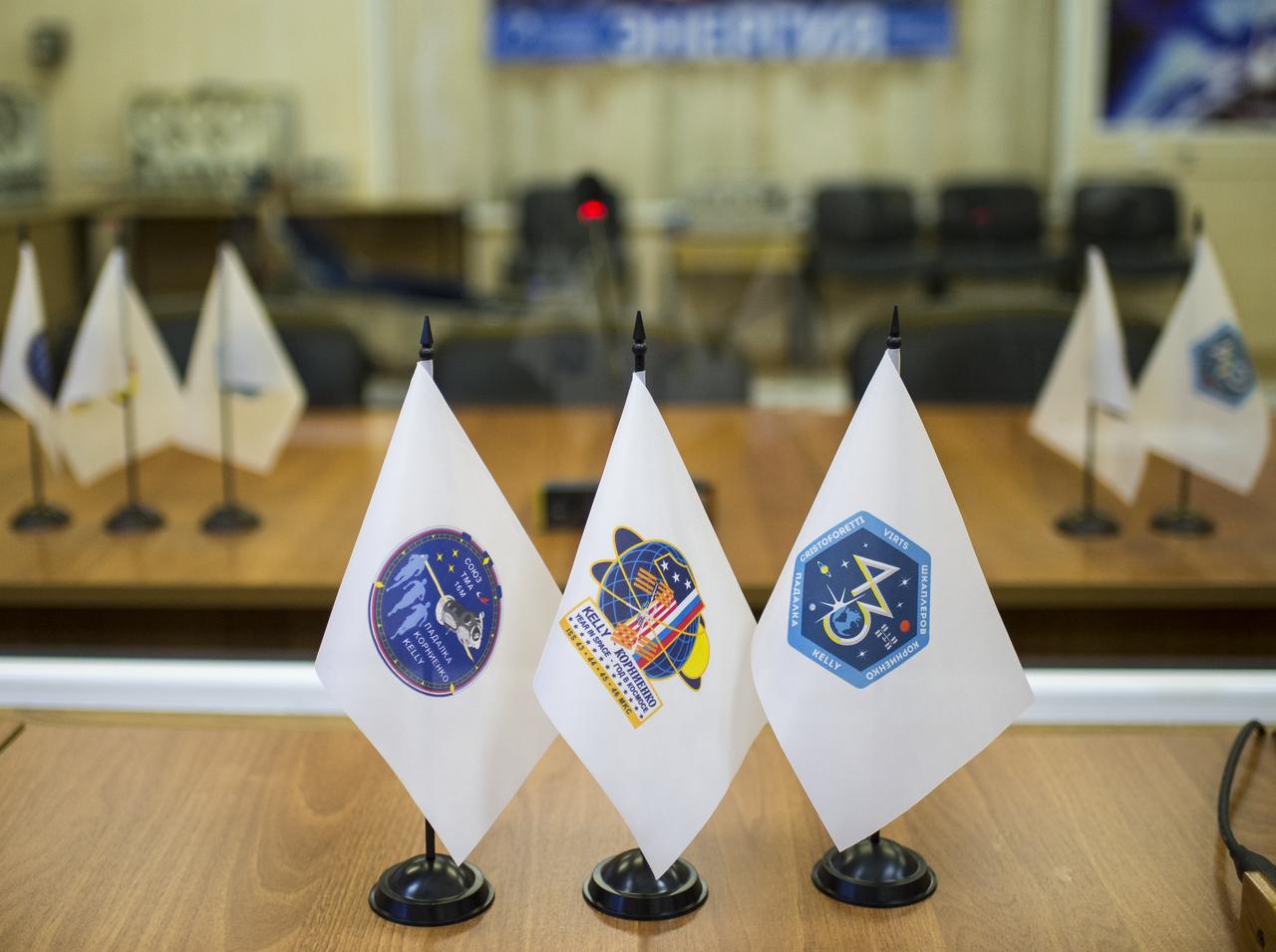
Flags depicting the Soyuz TMA-16M spacecraft, the One-Year Mission, and the Expedition 43 Mission are seen on desks in two different rooms separated by glass where Expedition 43 prime and backup crews will meet with space officials on their final check of the Soyuz capsule, Monday, March 23, 2015 at the Baikonur Cosmodrome in Kazakhstan. NASA Astronaut Scott Kelly, and Russian Cosmonauts Mikhail Kornienko, and Gennady Padalka of the Russian Federal Space Agency (Roscosmos) are scheduled to launch to the International Space Station in the Soyuz TMA-16M spacecraft from the Baikonur Cosmodrome in Kazakhstan March 28, Kazakh time (March 27 Eastern time.) As the one-year crew, Kelly and Kornienko will return to Earth on Soyuz TMA-18M in March 2016. Photo Credit: (NASA/Bill Ingalls)
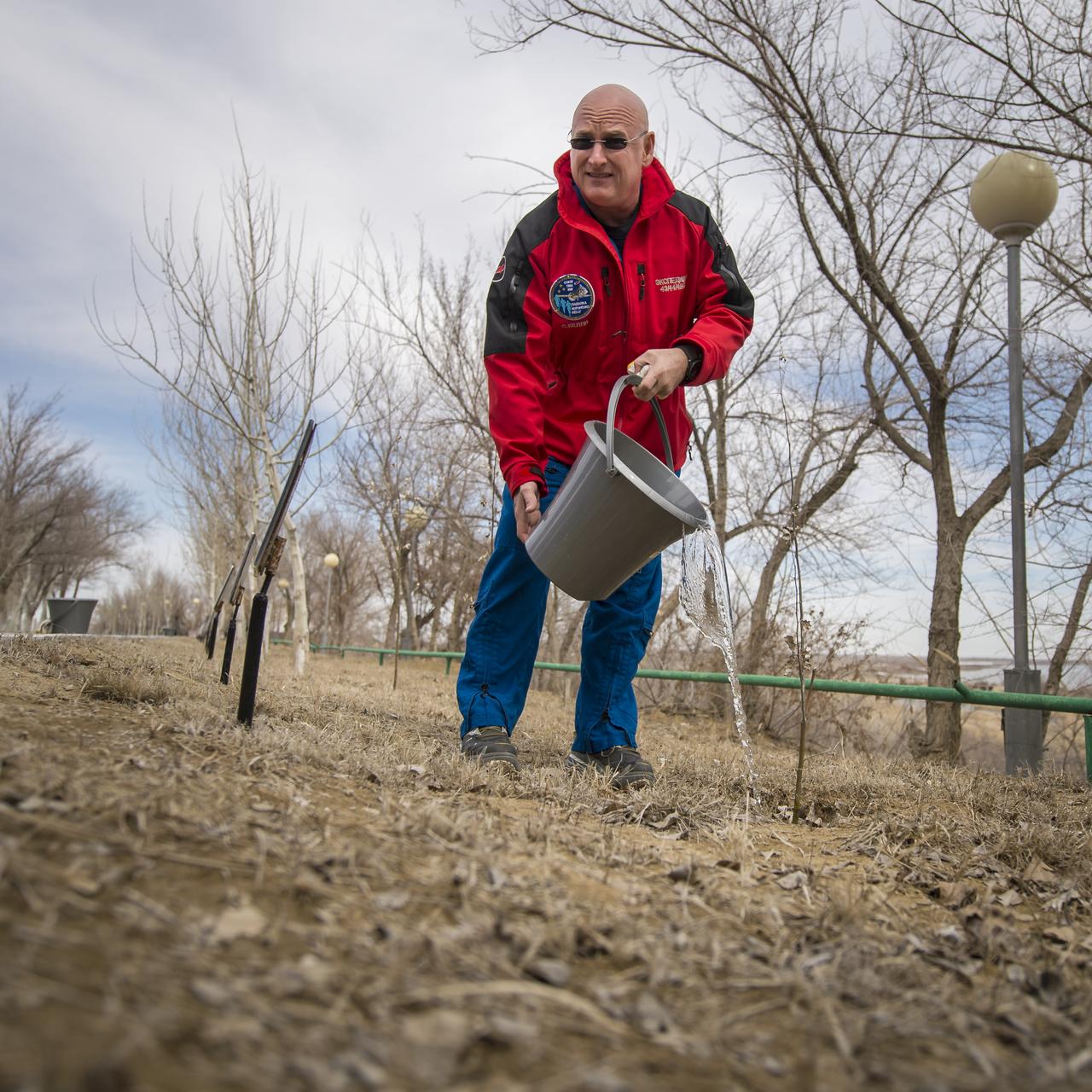
Expedition 43 NASA Astronaut Scott Kelly waters a tree planted in his honor during media day, Saturday, March 21, 2015, Baikonur, Kazakhstan. Kelly, and Russian Cosmonauts Gennady Padalka, and Mikhail Kornienko of the Russian Federal Space Agency (Roscosmos) are scheduled to launch to the International Space Station in the Soyuz TMA-16M spacecraft from the Baikonur Cosmodrome in Kazakhstan March 28, Kazakh time (March 27 Eastern time.) As the one-year crew, Kelly and Kornienko will return to Earth on Soyuz TMA-18M in March 2016. Photo Credit: (NASA/Bill Ingalls)
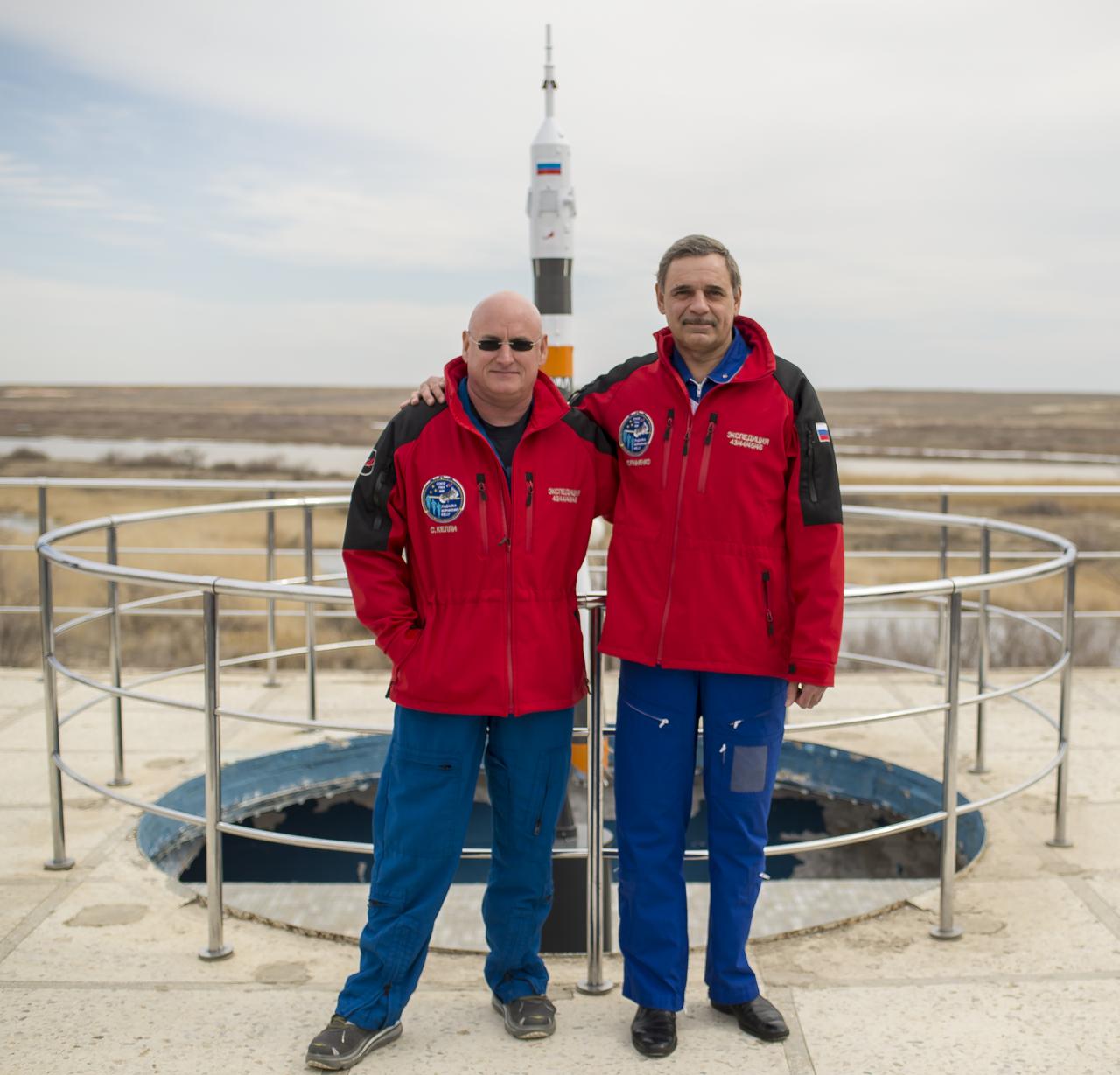
Expedition 43 NASA Astronaut Scott Kelly, left, and Russian Cosmonaut Mikhail Kornienko of the Russian Federal Space Agency (Roscosmos) pose for a photo near a model of the Soyuz rocket during media day, Saturday, March 21, 2015 at the Cosmonaut Hotel in Baikonur, Kazakhstan. Kelly, Kornienko, and Russian Cosmonaut Gennady Padalka of Roscosmos are preparing for launch to the International Space Station in their Soyuz TMA-16M spacecraft from the Baikonur Cosmodrome in Kazakhstan March 28, Kazakh time (March 27 Eastern time.) As the one-year crew, Kelly and Kornienko will return to Earth on Soyuz TMA-18M in March 2016. Photo Credit: (NASA/Bill Ingalls)
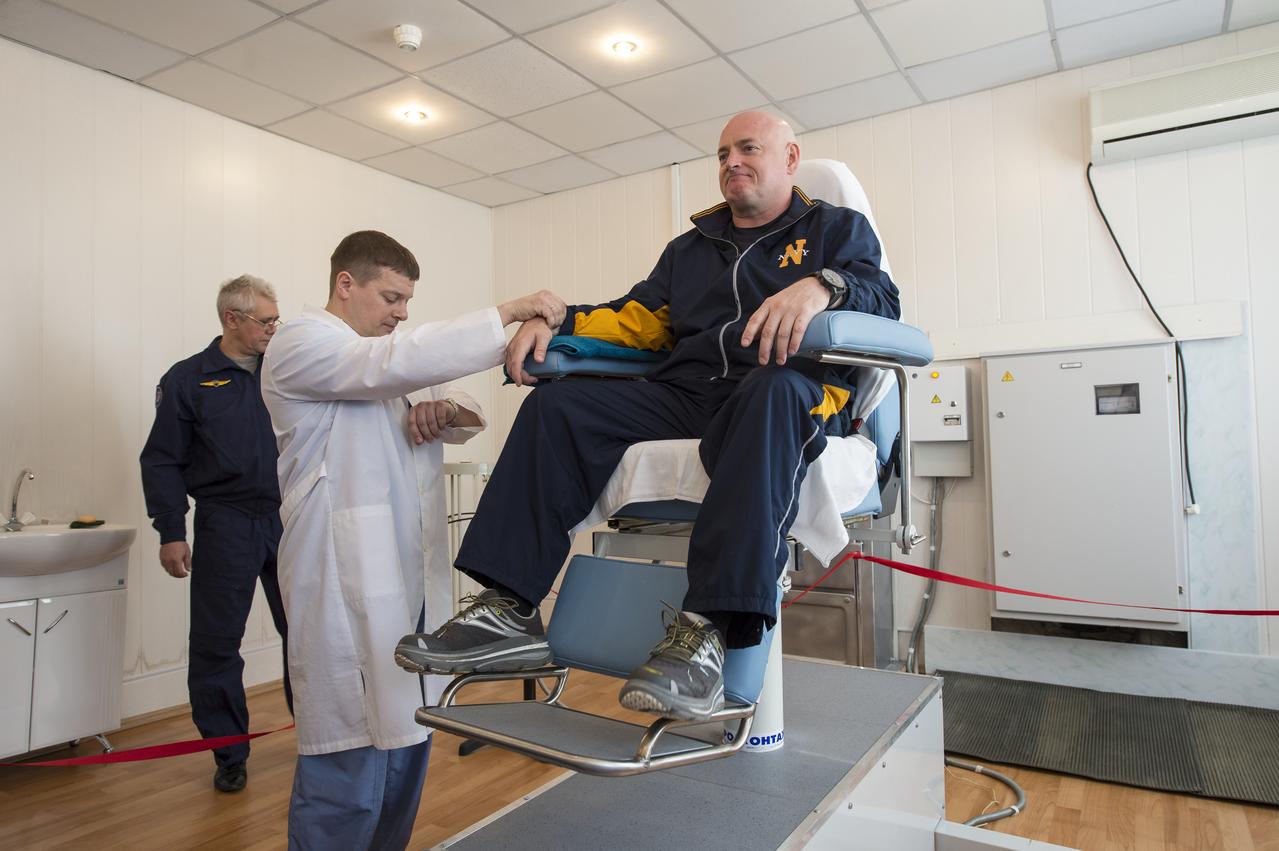
Expedition 43 NASA Astronaut Scott Kelly takes part in the spin chair training during media day, Saturday, March 21, 2015, Baikonur, Kazakhstan. Kelly, and Russian Cosmonauts Gennady Padalka, and Mikhail Kornienko of the Russian Federal Space Agency (Roscosmos) are scheduled to launch to the International Space Station in the Soyuz TMA-16M spacecraft from the Baikonur Cosmodrome in Kazakhstan March 28, Kazakh time (March 27 Eastern time.) As the one-year crew, Kelly and Kornienko will return to Earth on Soyuz TMA-18M in March 2016. Photo Credit: (NASA/Bill Ingalls)
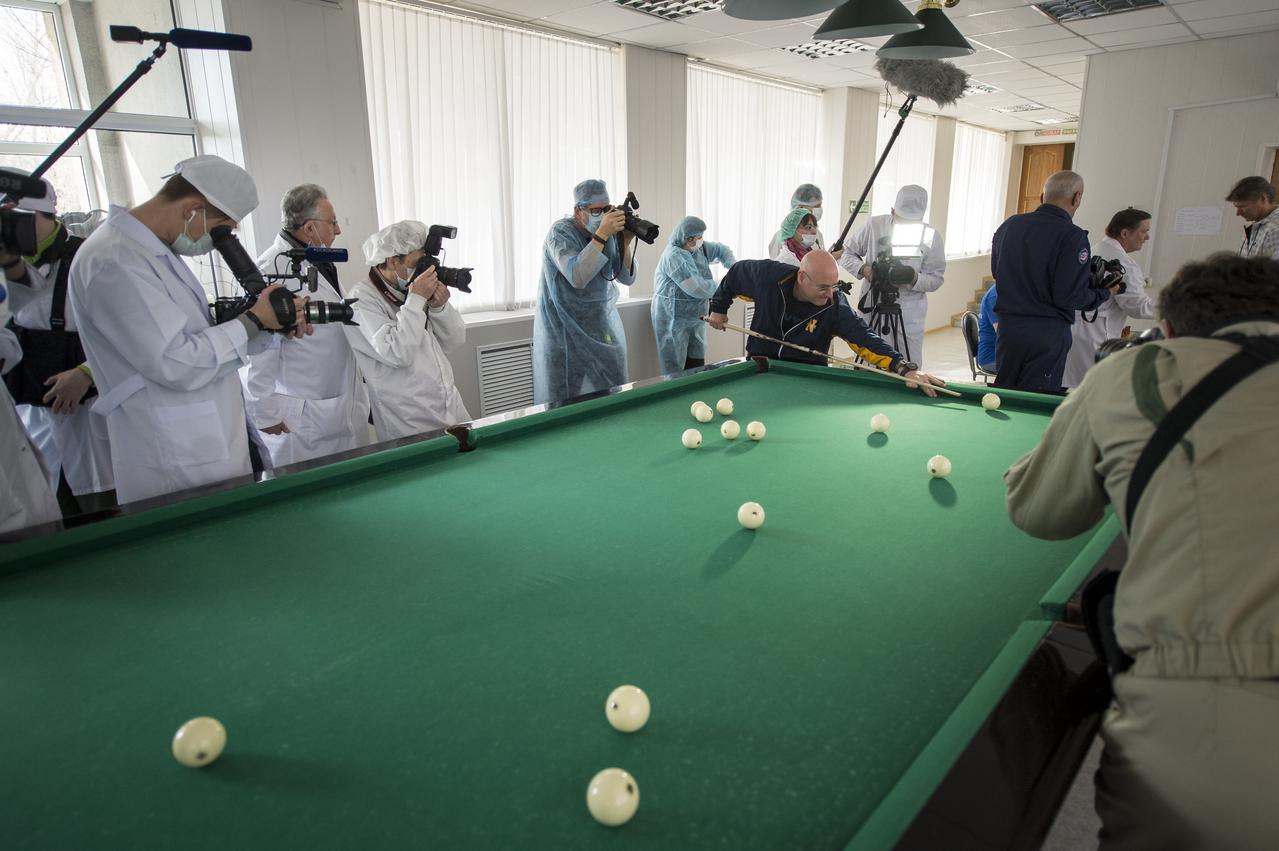
Media document Expedition 43 NASA Astronaut Scott Kelly as he plays billiards during media day, Saturday, March 21, 2015, Baikonur, Kazakhstan. Kelly, and Russian Cosmonauts Gennady Padalka, and Mikhail Kornienko of the Russian Federal Space Agency (Roscosmos) are scheduled to launch to the International Space Station in the Soyuz TMA-16M spacecraft from the Baikonur Cosmodrome in Kazakhstan March 28, Kazakh time (March 27 Eastern time.) As the one-year crew, Kelly and Kornienko will return to Earth on Soyuz TMA-18M in March 2016. Photo Credit: (NASA/Bill Ingalls)
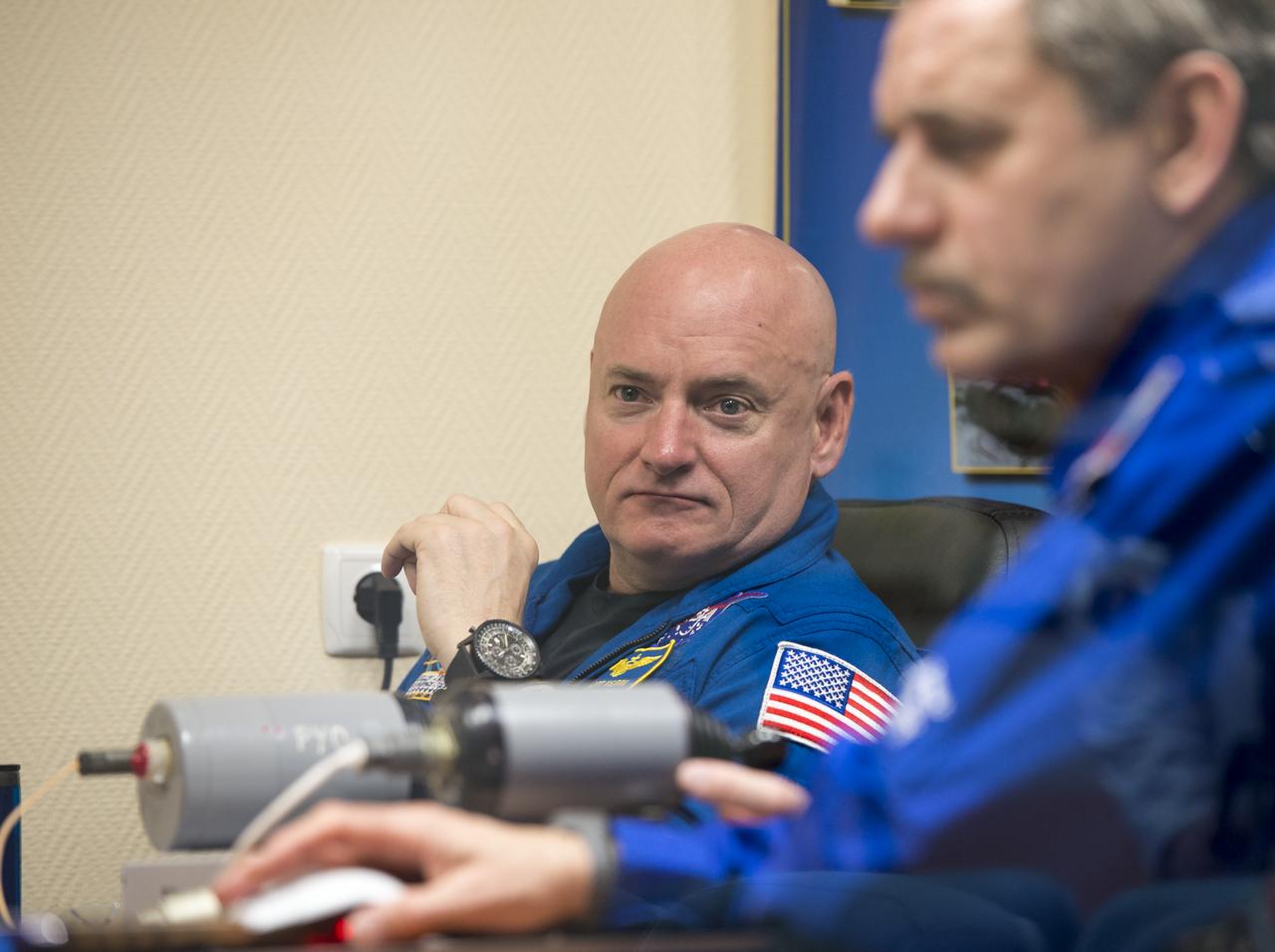
Expedition 43 NASA Astronaut Scott Kelly, watches carefully as Russian Cosmonauts Gennady Padalka, and Mikhail Kornienko of the Russian Federal Space Agency (Roscosmos) work on Soyuz training, Saturday, March 21, 2015 at the Cosmonaut Hotel in Baikonur, Kazakhstan. Kelly, Padalka, and Kornienko are preparing for launch to the International Space Station in their Soyuz TMA-16M spacecraft from the Baikonur Cosmodrome in Kazakhstan March 28, Kazakh time (March 27 Eastern time.) As the one-year crew, Kelly and Kornienko will return to Earth on Soyuz TMA-18M in March 2016. Photo Credit: (NASA/Bill Ingalls)
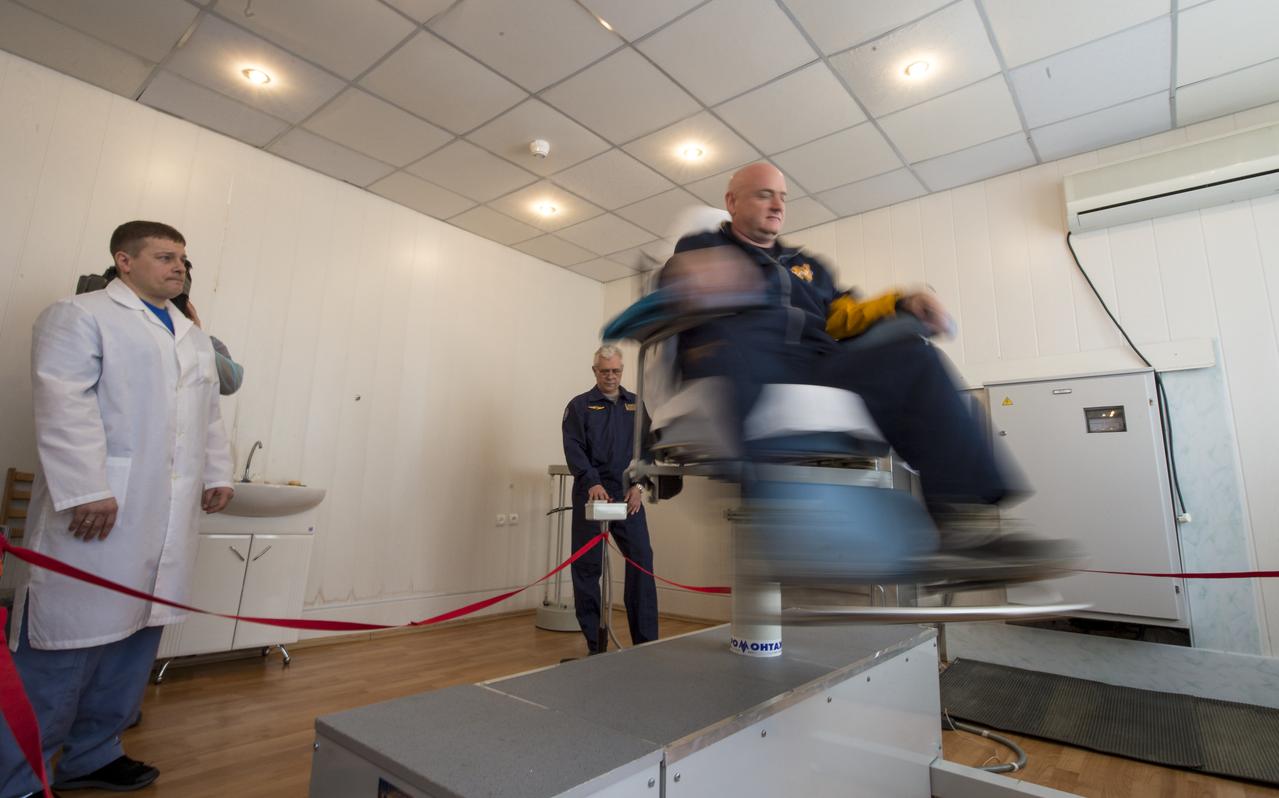
Expedition 43 NASA Astronaut Scott Kelly takes part in the spin chair training during media day, Saturday, March 21, 2015, Baikonur, Kazakhstan. Kelly, and Russian Cosmonauts Gennady Padalka, and Mikhail Kornienko of the Russian Federal Space Agency (Roscosmos) are scheduled to launch to the International Space Station in the Soyuz TMA-16M spacecraft from the Baikonur Cosmodrome in Kazakhstan March 28, Kazakh time (March 27 Eastern time.) As the one-year crew, Kelly and Kornienko will return to Earth on Soyuz TMA-18M in March 2016. Photo Credit: (NASA/Bill Ingalls)
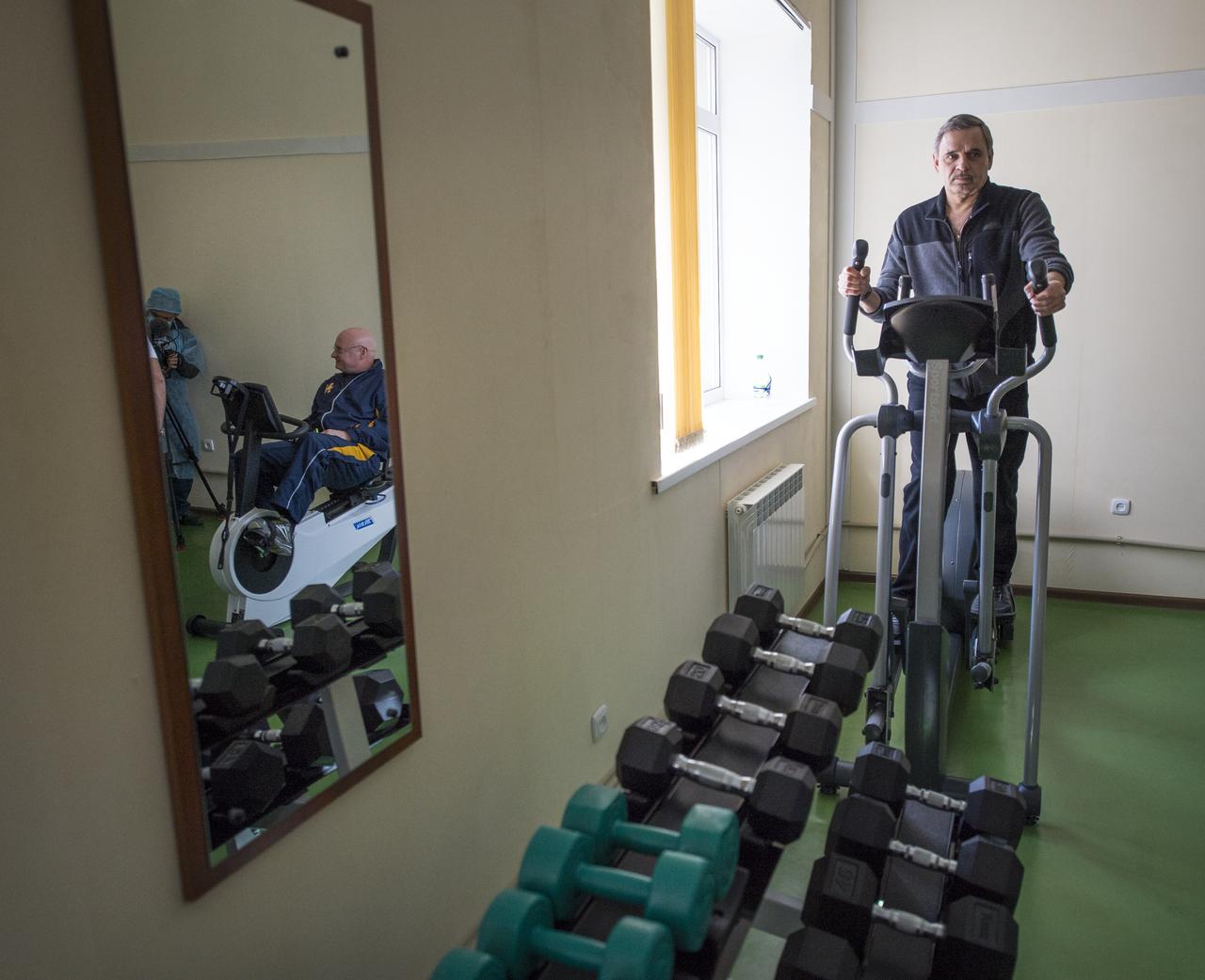
Expedition 43 NASA Astronaut Scott Kelly, left in mirror, and Russian Cosmonaut Mikhail Kornienko, of the Russian Federal Space Agency (Roscosmos) are seen exercising during media day, Saturday, March 21, 2015, Baikonur, Kazakhstan. Kornienko, Kelly and Russian Cosmonaut Gennady Padalka of Roscosmos are scheduled to launch to the International Space Station in the Soyuz TMA-16M spacecraft from the Baikonur Cosmodrome in Kazakhstan March 28, Kazakh time (March 27 Eastern time.) As the one-year crew, Kelly and Kornienko will return to Earth on Soyuz TMA-18M in March 2016. Photo Credit: (NASA/Bill Ingall
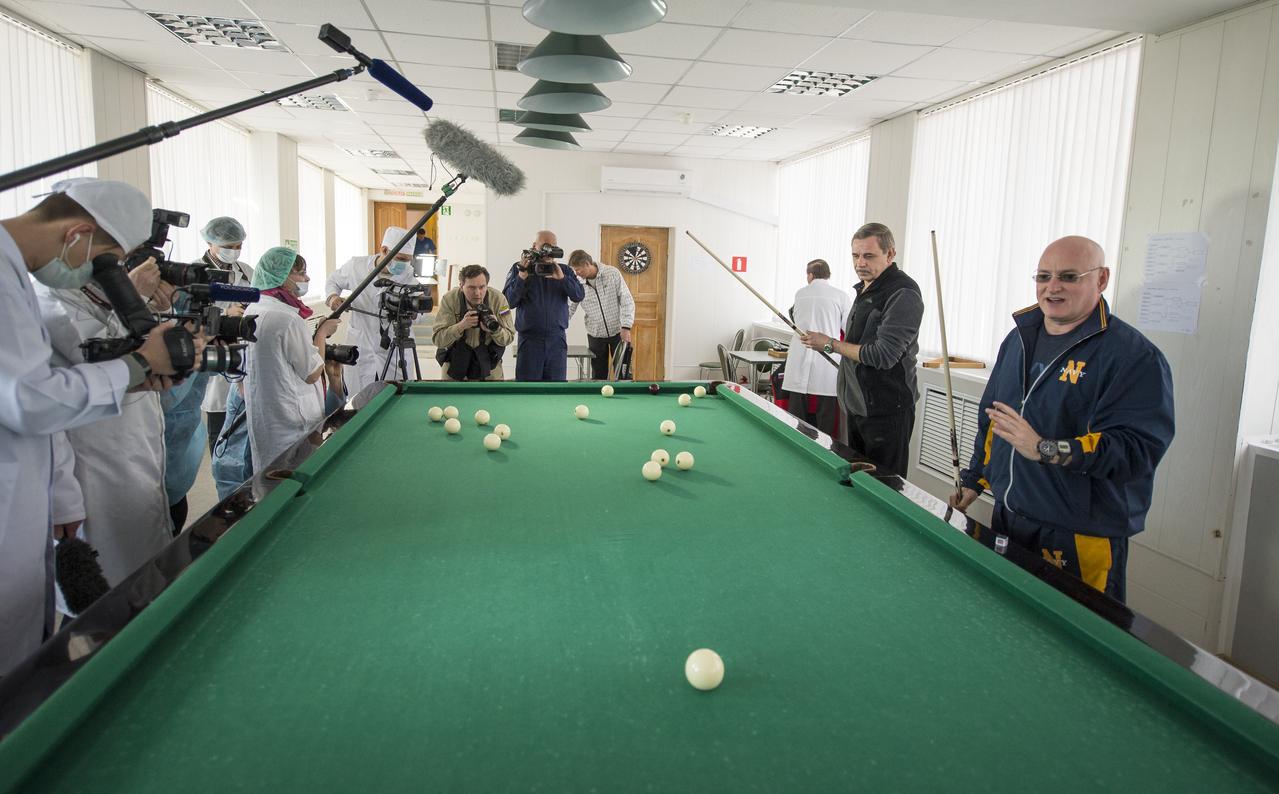
Media document Expedition 43 Russian Cosmonaut Mikhail Kornienko of the Russian Federal Space Agency (Roscosmos), left, and NASA Astronaut Scott Kelly, right, as they play billiards during media day, Saturday, March 21, 2015, Baikonur, Kazakhstan. Kelly, and Russian Cosmonauts Gennady Padalka, and Mikhail Kornienko of Roscosmos are scheduled to launch to the International Space Station in the Soyuz TMA-16M spacecraft from the Baikonur Cosmodrome in Kazakhstan March 28, Kazakh time (March 27 Eastern time.) As the one-year crew, Kelly and Kornienko will return to Earth on Soyuz TMA-18M in March 2016. Photo Credit: (NASA/Bill Ingalls)
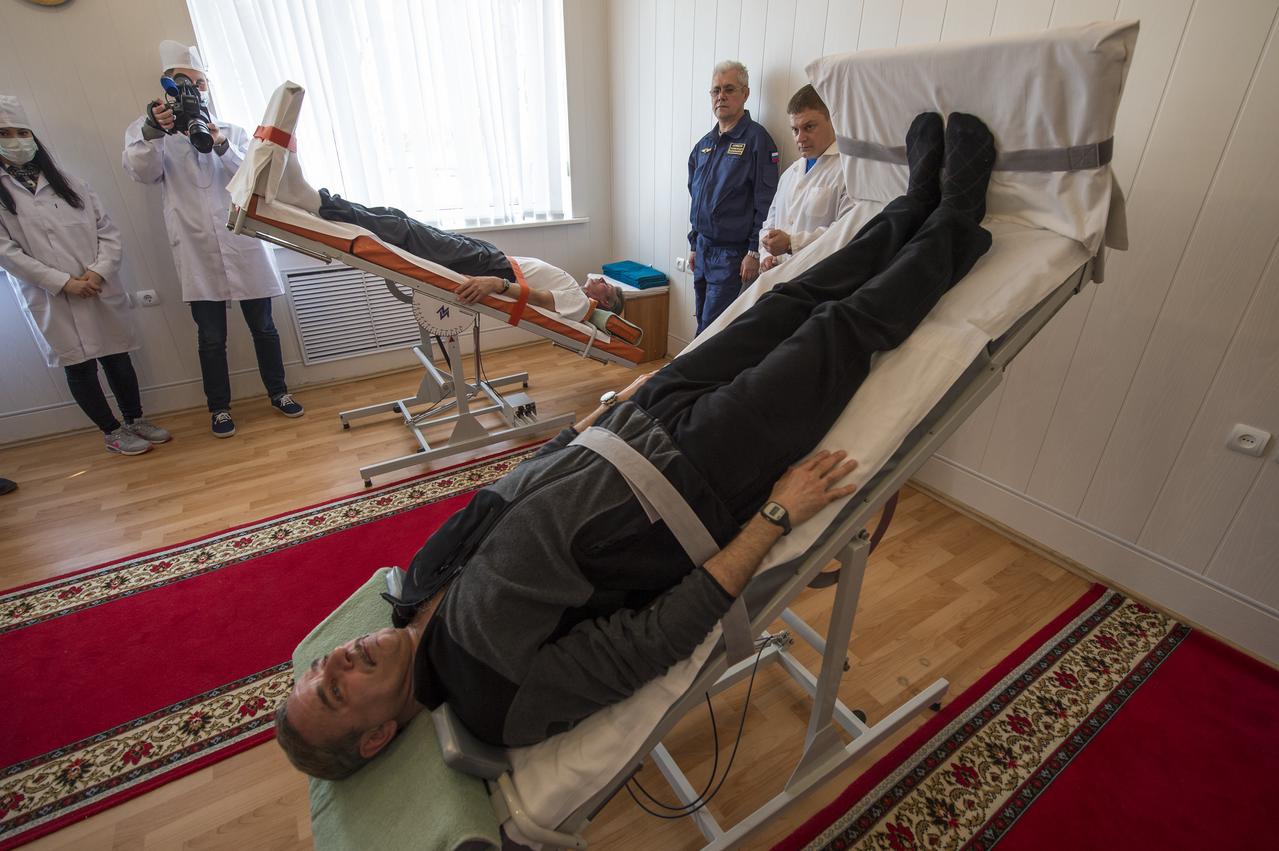
Expedition 43 Russian Cosmonauts Gennady Padalka, background, and Mikhail Kornienko of the Russian Federal Space Agency (Roscosmos) take part the tilt table training during media day, Saturday, March 21, 2015, Baikonur, Kazakhstan. Padalka, Kornienko, and Expedition 43 NASA Astronaut Scott Kelly are scheduled to launch to the International Space Station in the Soyuz TMA-16M spacecraft from the Baikonur Cosmodrome in Kazakhstan March 28, Kazakh time (March 27 Eastern time.) As the one-year crew, Kelly and Kornienko will return to Earth on Soyuz TMA-18M in March 2016. Photo Credit: (NASA/Bill Ingalls)
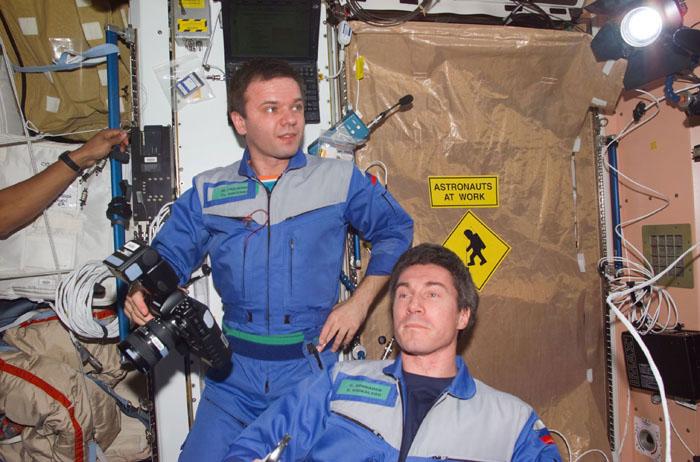
S98-E-5052 (9 February 2001) --- Cosmonauts Yuri P. Gidzenko, Expedition One's Soyuz commander; and Sergei K. Krikalev, flight engineer, look on as five visitors (out of frame) ingress the International Space Station (ISS) from the recently-docked Space Shuttle Atlantis. This scene was recorded with a digital still camera.
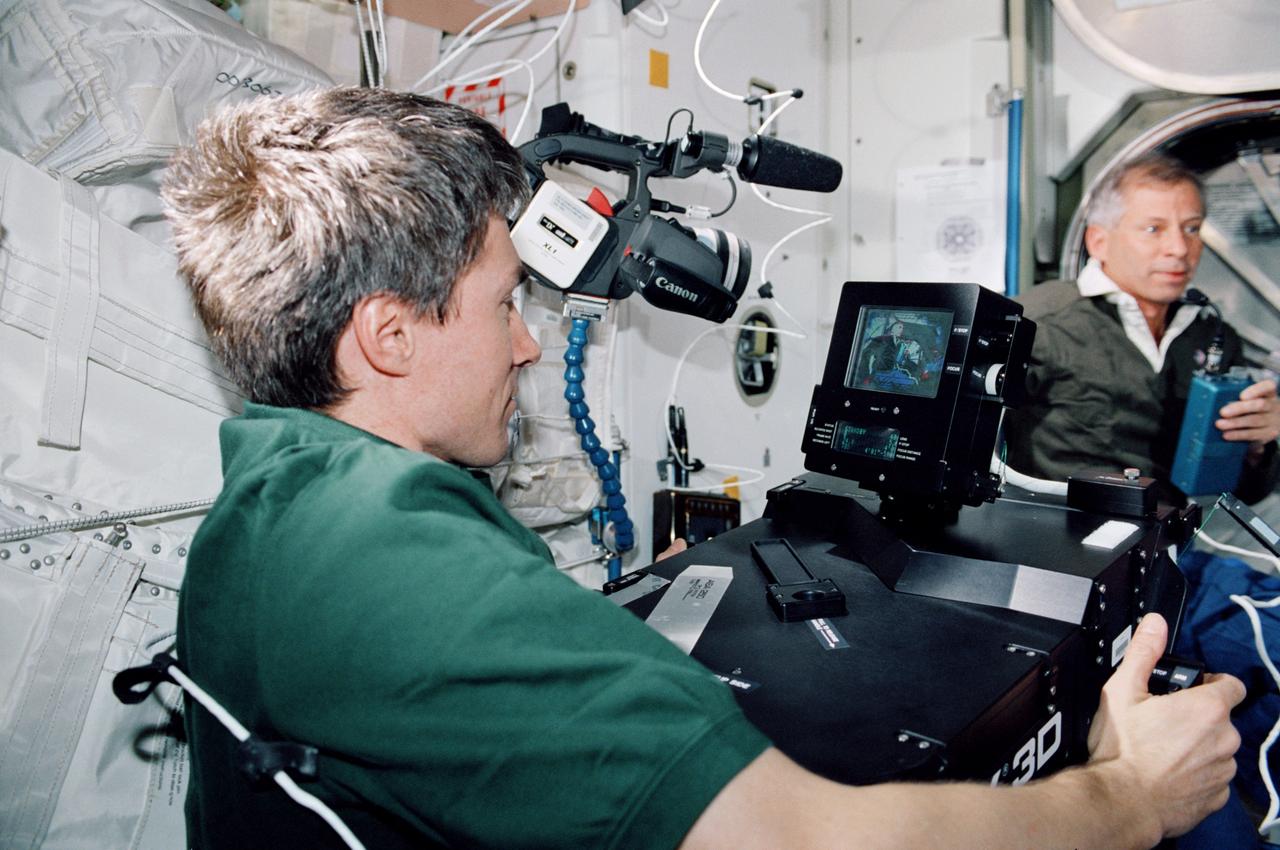
STS098-352-021 (7-20 February 2001) --- Cosmonaut Sergei K. Krikalev, Expedition One flight engineer, photographs astronaut Kenneth D. Cockrell, STS-98 mission commander, using an IMAX camera aboard the newly-attached Destiny laboratory on the International Space Station (ISS). Krikalev represents Rosaviakosmos.
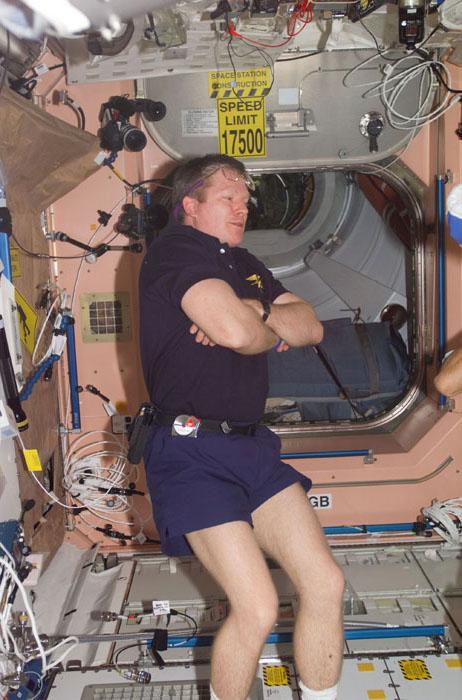
STS98-E-5287 (16 February 2001) --- Astronaut William M. (Bill) Shepherd, Expedition One commander, participates in a parting chat with some astronaut visitors (out of frame), about to conclude their time on the outpost. The scene was recorded with a digital still camera during farewells in the Unity node.
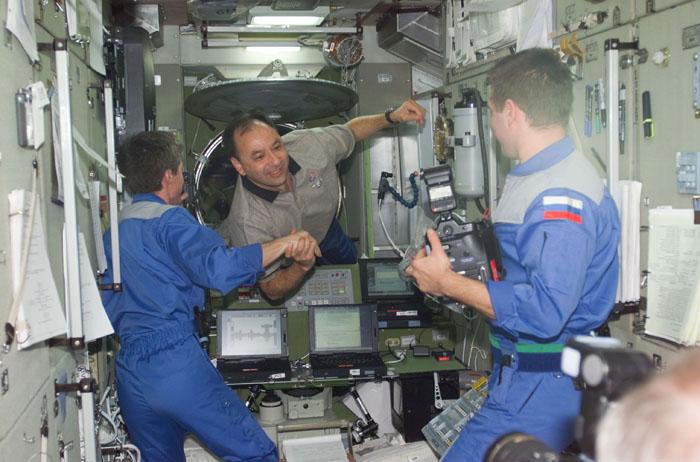
STS98-E-5056 (9 February 2001) --- Cosmonauts Sergei K. Krikalev (left), Expedition One flight engineer, and Yuri P. Gidzenko (left), Soyuz commander for the first station expedition crew, welcome astronaut Mark L. Polansky, STS-98 pilot, aboard the International Space Station. The scene was recorded with a digital still camera shortly after the hatches were opened on STS-98 Flight Day 3.
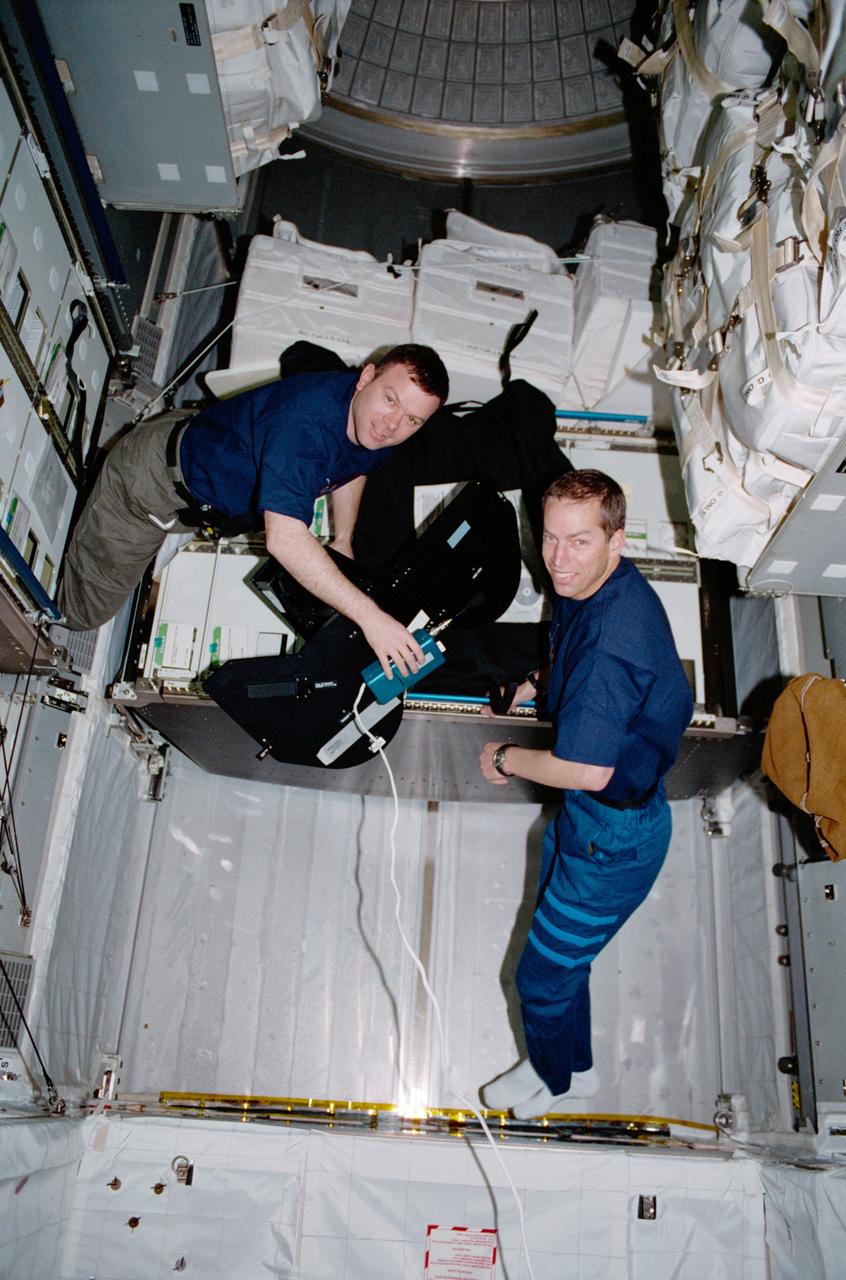
Pilot James M. Kelly (left) and Commander James D. Wetherbee for the STS-102 mission, participate in the movement of supplies inside Leonardo, the Italian Space Agency built Multipurpose Logistics Module (MPLM). In this particular photograph, the two are handling a film magazine for the IMAX cargo bay camera. The primary cargo of the STS-102 mission, the Leonardo MPLM is the first of three such pressurized modules that will serve as the International Space Station's (ISS') moving vans, carrying laboratory racks filled with equipment, experiments, and supplies to and from the Station aboard the Space Shuttle. The cylindrical module is approximately 21-feet long and 15- feet in diameter, weighing almost 4.5 tons. It can carry up to 10 tons of cargo in 16 standard Space Station equipment racks. Of the 16 racks the module can carry, 5 can be furnished with power, data, and fluid to support refrigerators or freezers. In order to function as an attached station module as well as a cargo transport, the logistics module also includes components that provide life support, fire detection and suppression, electrical distribution, and computer functions. The eighth station assembly flight, the STS-102 mission also served as a crew rotation flight. It delivered the Expedition Two crew to the Station and returned the Expedition One crew back to Earth.
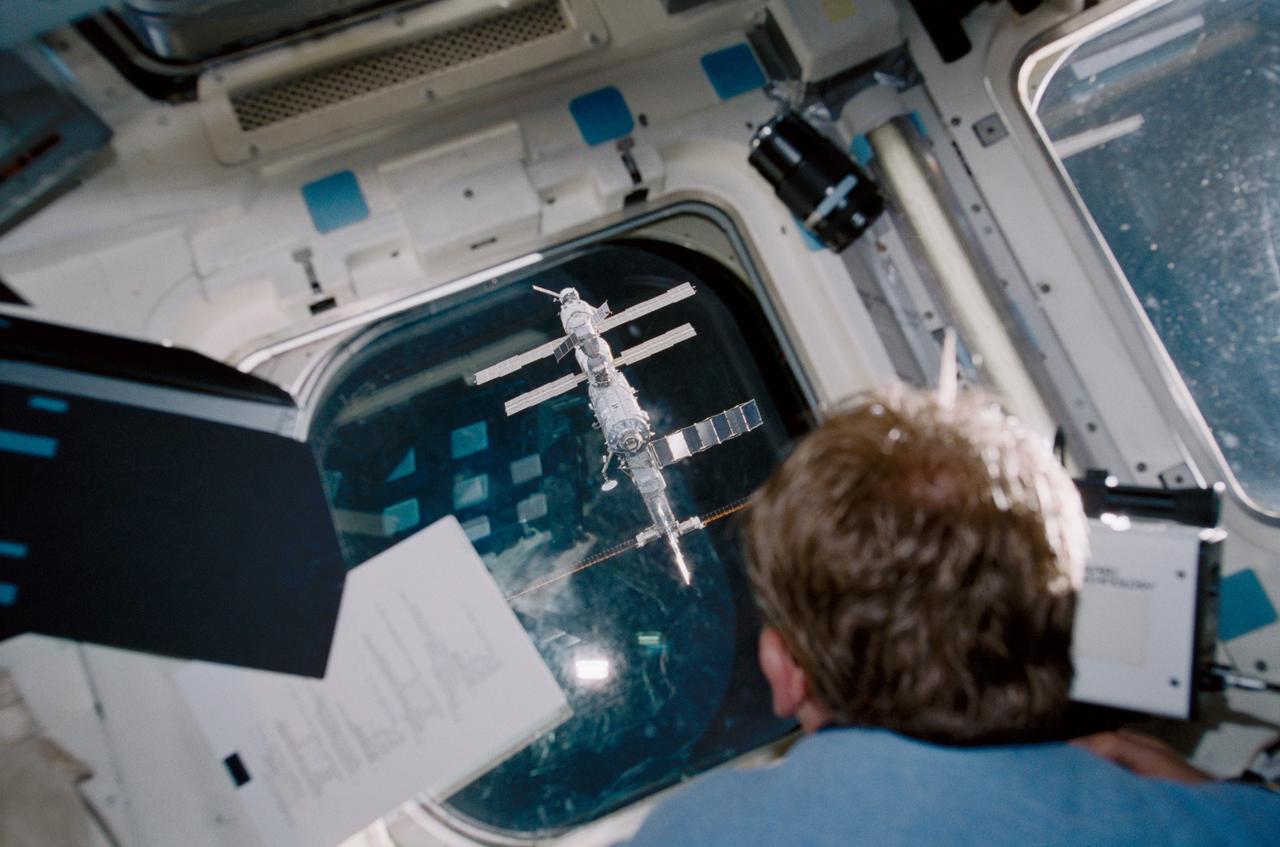
STS-102 astronaut and mission specialist, Andrew S.W. Thomas, gazes through an aft window of the Space Shuttle Orbiter Discovery as it approaches the docking bay of the International Space Station (ISS). Launched March 8, 2001, STS-102's primary cargo was the Leonardo, the Italian Space Agency-built Multipurpose Logistics Module (MPLM). The Leonardo MPLM is the first of three such pressurized modules that will serve as the ISS's moving vans, carrying laboratory racks filled with equipment, experiments, and supplies to and from the Station aboard the Space Shuttle. The cylindrical module is approximately 21-feet long and 15- feet in diameter, weighing almost 4.5 tons. It can carry up to 10 tons of cargo in 16 standard Space Station equipment racks. Of the 16 racks the module can carry, 5 can be furnished with power, data, and fluid to support refrigerators or freezers. In order to function as an attached station module as well as a cargo transport, the logistics module also includes components that provide life support, fire detection and suppression, electrical distribution, and computer functions. NASA's 103rd overall mission and the 8th Space Station Assembly Flight, STS-102 mission also served as a crew rotation flight. It delivered the Expedition Two crew to the Station and returned the Expedition One crew back to Earth.
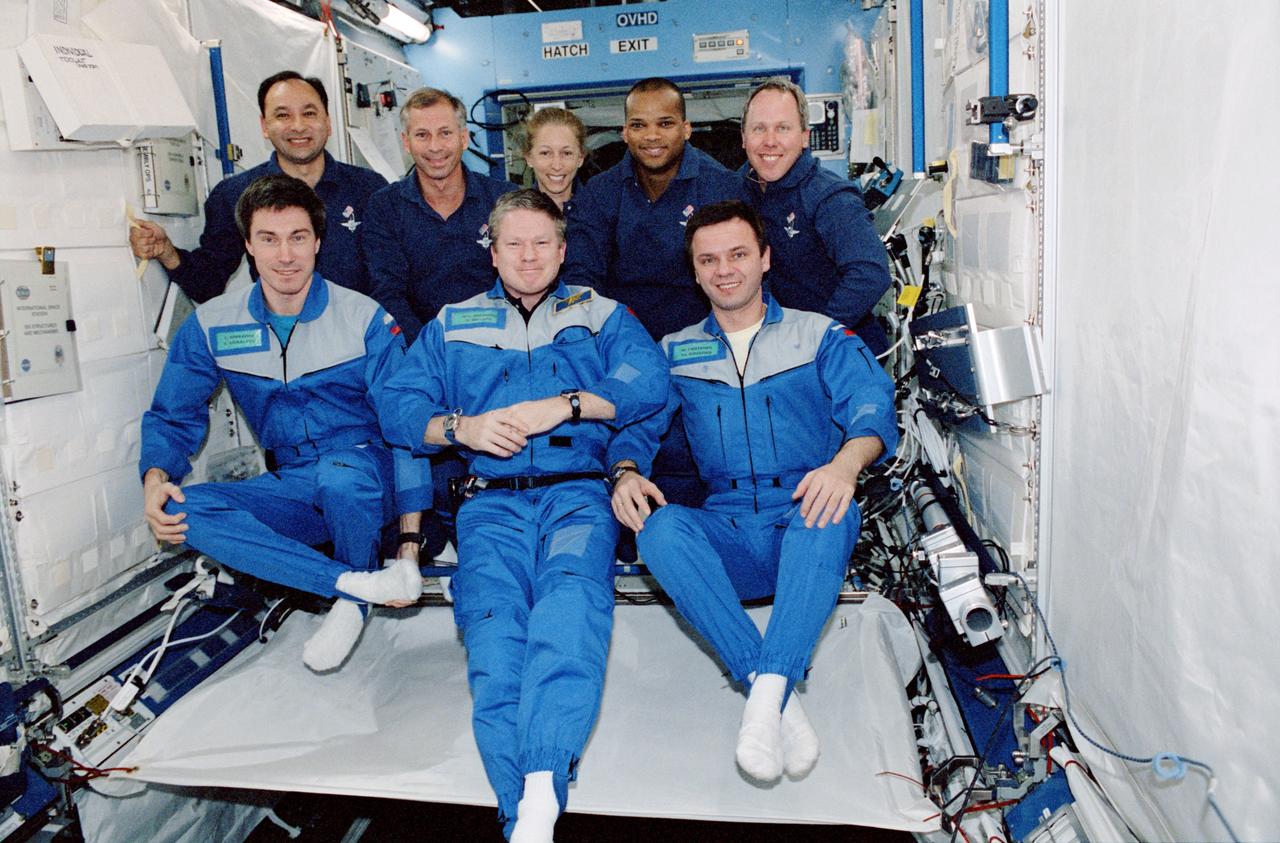
STS098-371-0019 (7-20 February 2001) --- The crews of the Space Shuttle Atlantis and International Space Station (ISS) interrupt work aboard the newly installed Destiny laboratory to pose for an in-flight joint group portrait. In front are (from the left) cosmonaut Sergei K. Krikalev, Expedition One flight engineer; astronaut William M. (Bill) Shepherd, Expedition One mission commander; and Yuri P. Gidzenko, Soyuz commander. The shuttle crew is made up of (from the left) astronauts Mark L. Polansky, pilot; Kenneth D. Cockrell, mission commander; and Marsha S. Ivins, Robert L. Curbeam and Thomas D. Jones, all mission specialists. Krikalev and Gidzenko represent the Russian Aviation and Space Agency.
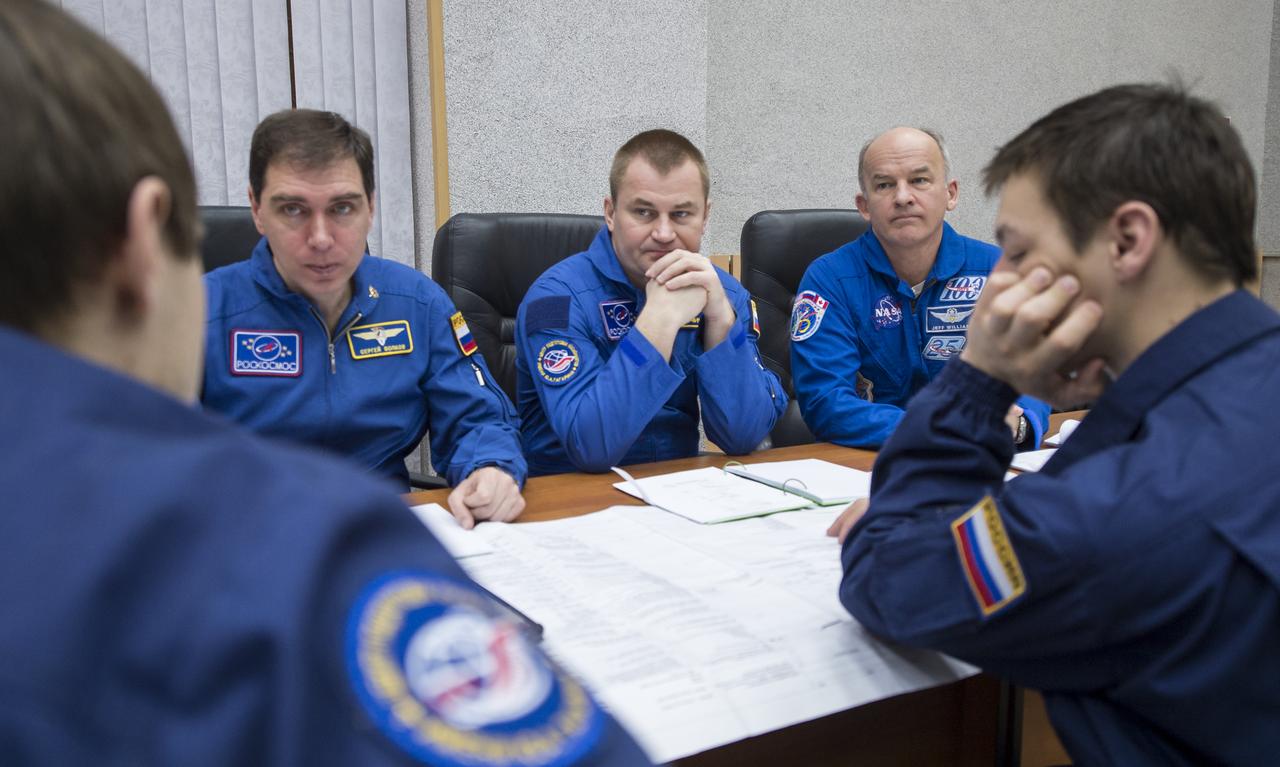
Expedition 43 backup crew members Sergei Volkov, left, and Alexey Ovchinin and of the Russian Federal Space Agency (Roscosmos), center, and NASA Astronaut Jeff Williams attend a training briefing, Saturday, March 21, 2015 at the Cosmonaut Hotel in Baikonur, Kazakhstan. Expedition 43 prime crew members: NASA Astronaut Scott Kelly, and Russian Cosmonauts Gennady Padalka, and Mikhail Kornienko of the Russian Federal Space Agency (Roscosmos) are scheduled to launch to the International Space Station in the Soyuz TMA-16M spacecraft from the Baikonur Cosmodrome in Kazakhstan March 28, Kazakh time (March 27 Eastern time.) As the one-year crew, Kelly and Kornienko will return to Earth on Soyuz TMA-18M in March 2016. Photo Credit: (NASA/Bill Ingalls)
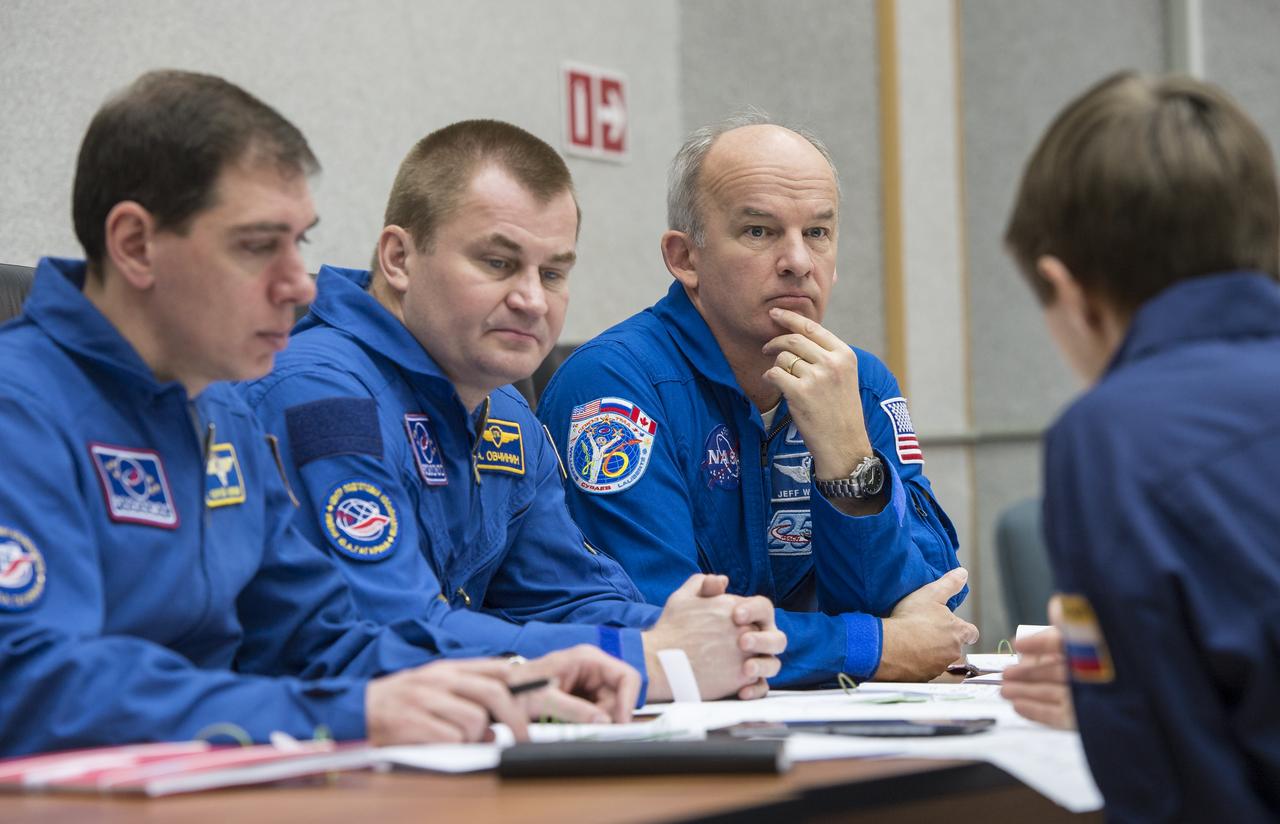
Expedition 43 backup crew members Sergei Volkov, left, and Alexey Ovchinin and of the Russian Federal Space Agency (Roscosmos), center, and NASA Astronaut Jeff Williams attend a training briefing, Saturday, March 21, 2015 at the Cosmonaut Hotel in Baikonur, Kazakhstan. Expedition 43 prime crew members: NASA Astronaut Scott Kelly, and Russian Cosmonauts Gennady Padalka, and Mikhail Kornienko of the Russian Federal Space Agency (Roscosmos) are scheduled to launch to the International Space Station in the Soyuz TMA-16M spacecraft from the Baikonur Cosmodrome in Kazakhstan March 28, Kazakh time (March 27 Eastern time.) As the one-year crew, Kelly and Kornienko will return to Earth on Soyuz TMA-18M in March 2016. Photo Credit: (NASA/Bill Ingalls)
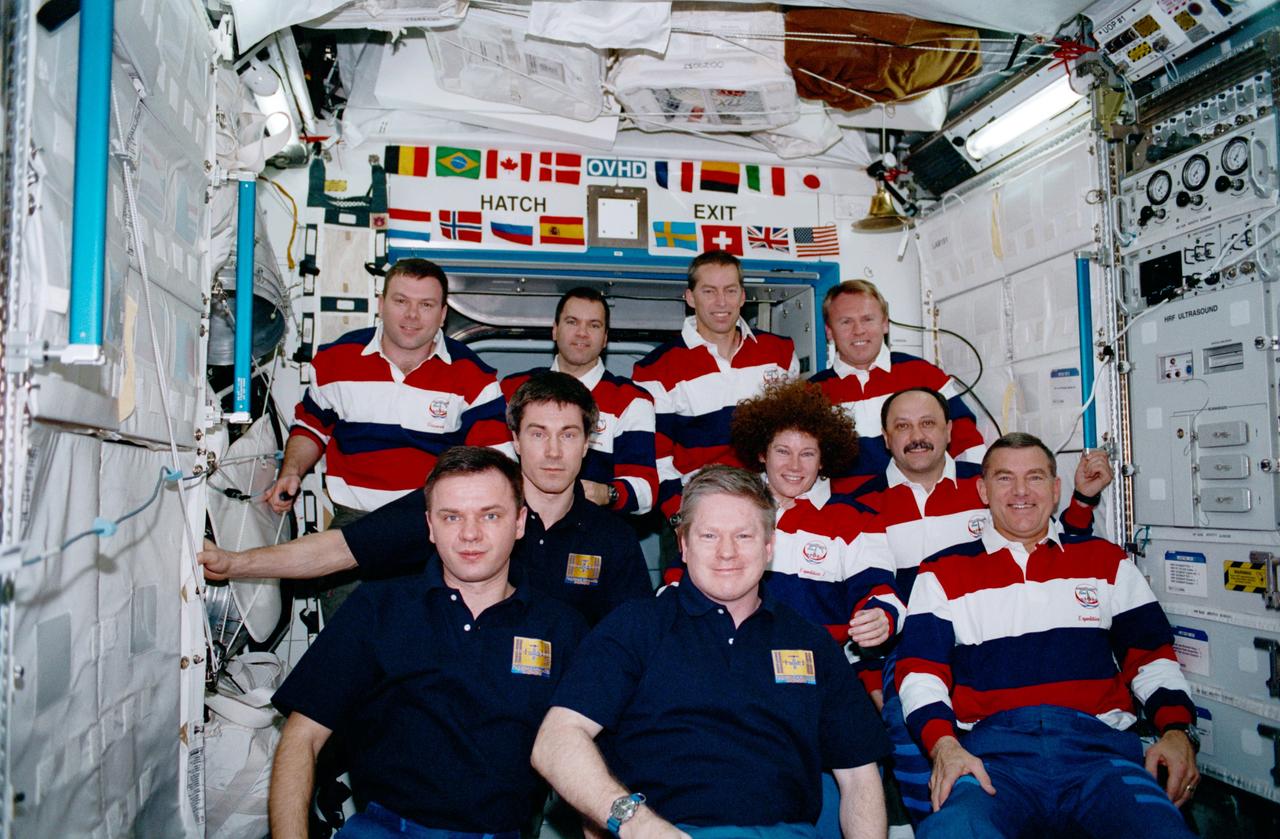
STS102-319-028 (8 - 21 March 2001) --- The 10 astronauts and cosmonauts making up the STS-102, Expedition One and Expedition Two crews assemble in the Destiny laboratory for a group portrait. In front are, from the left, cosmonauts Yuri P. Gidzenko and Sergei Krikalev, astronauts William M. (Bill) Shepherd and Susan J. Helms, cosmonaut Yury V. Usachev and astronaut James S. Voss. In the rear are, from the left, astronauts James M. Kelly, Paul W. Richards, James D. Wetherbee and Andrew S.W. Thomas.
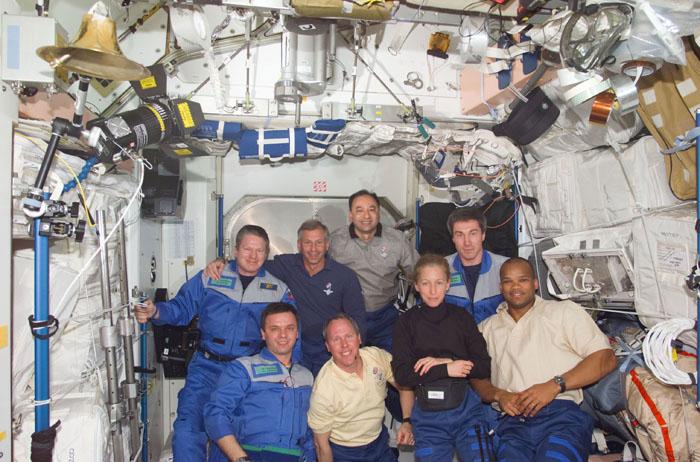
STS98-E-5053 (9 February 2001) --- The three-man Expedition One crew hosts its second group of visitors since beginning occupancy of the International Space Station in November of last year. A pre-set digital still camera was used to record the gathering. Wearing blue flight suits for the reunion are the station's first fulltime occupants--astronaut William M. (Bill) Shepherd (rear left), Expedition One commander;cosmonaut Yuri P. Gidzenko (front left), Soyuz commander; and cosmonaut Sergei K. Krikalev (rear right), flight engineer. Astronauts Kenneth D. Cockrell (second left, rear) and Mark L. Polansky (second right, rear) are STS-98 mission commander and pilot, respectively. Astronauts Thomas D. Jones, Marsha S. Ivins and Robert L. Curbeam--all mission specialists--are in front. Atlantis docked to the station on schedule at 10:51 a.m. (CST), Feb. 9 and the station and shuttle crews opened hatches between the spacecraft at 1:03 p.m., promptly beginning to unload supplies. The three-member station crew, on the eve of their 100th day aboard the outpost, greeted their first visitors in almost two months. The hatches were open for about four hours before they were closed in preparation for the first of three upcoming space walks, a six-hour sojourn scheduled for the following day from Atlantis by Jones and Curbeam.
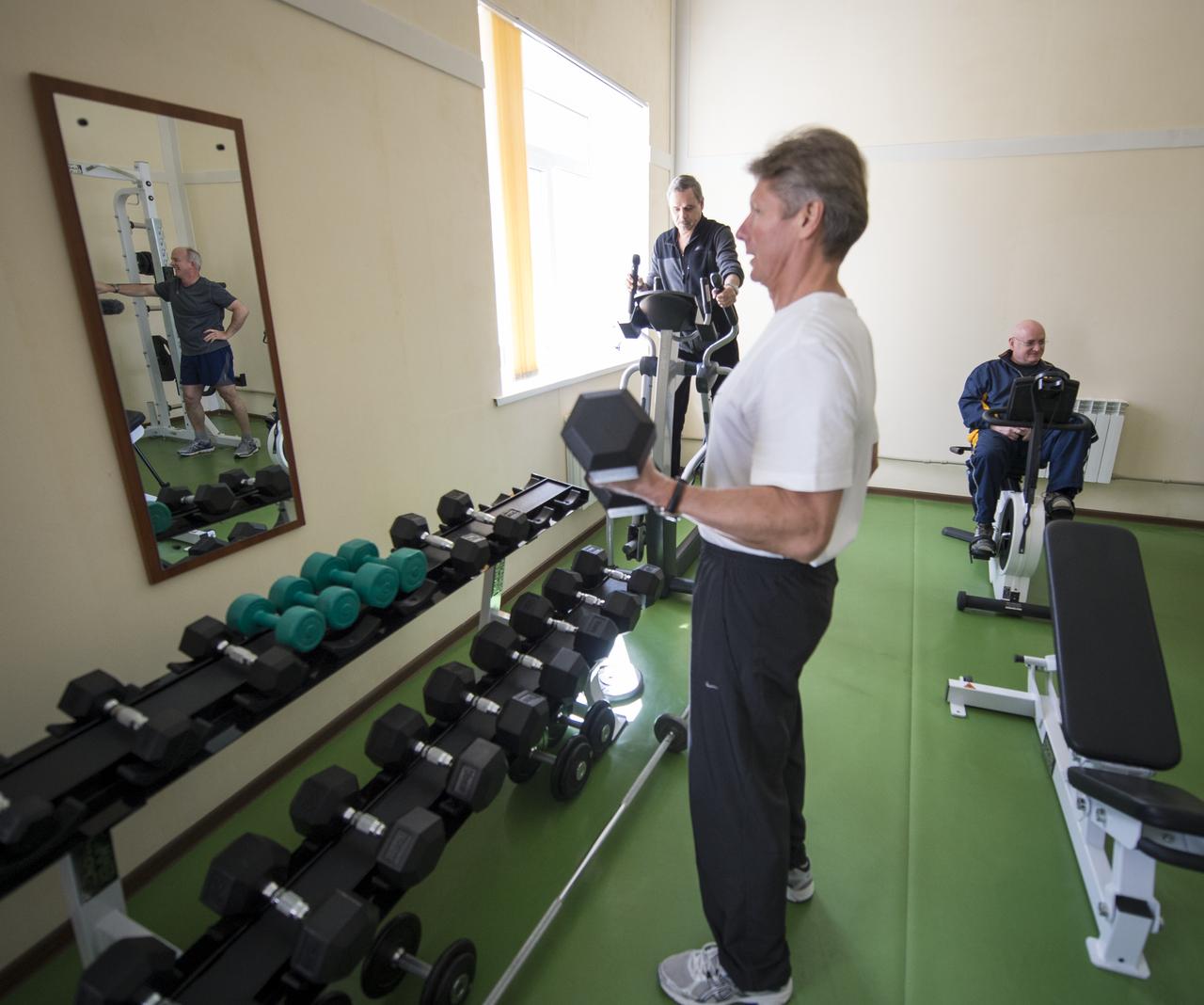
Expedition 43 backup crew member NASA Astronaut Jeff Williams, reflected in mirror, Russian Cosmonauts Mikhail Kornienko, on elliptical, Gennady Padalka of the Russian Federal Space Agency (Roscosmos), and NASA Astronaut Scott Kelly, right, are seen exercising during media day, Saturday, March 21, 2015, Baikonur, Kazakhstan. Padalka, Kornienko, and Kelly are scheduled to launch to the International Space Station in the Soyuz TMA-16M spacecraft from the Baikonur Cosmodrome in Kazakhstan March 28, Kazakh time (March 27 Eastern time.) As the one-year crew, Kelly and Kornienko will return to Earth on Soyuz TMA-18M in March 2016. Photo Credit: (NASA/Bill Ingalls)
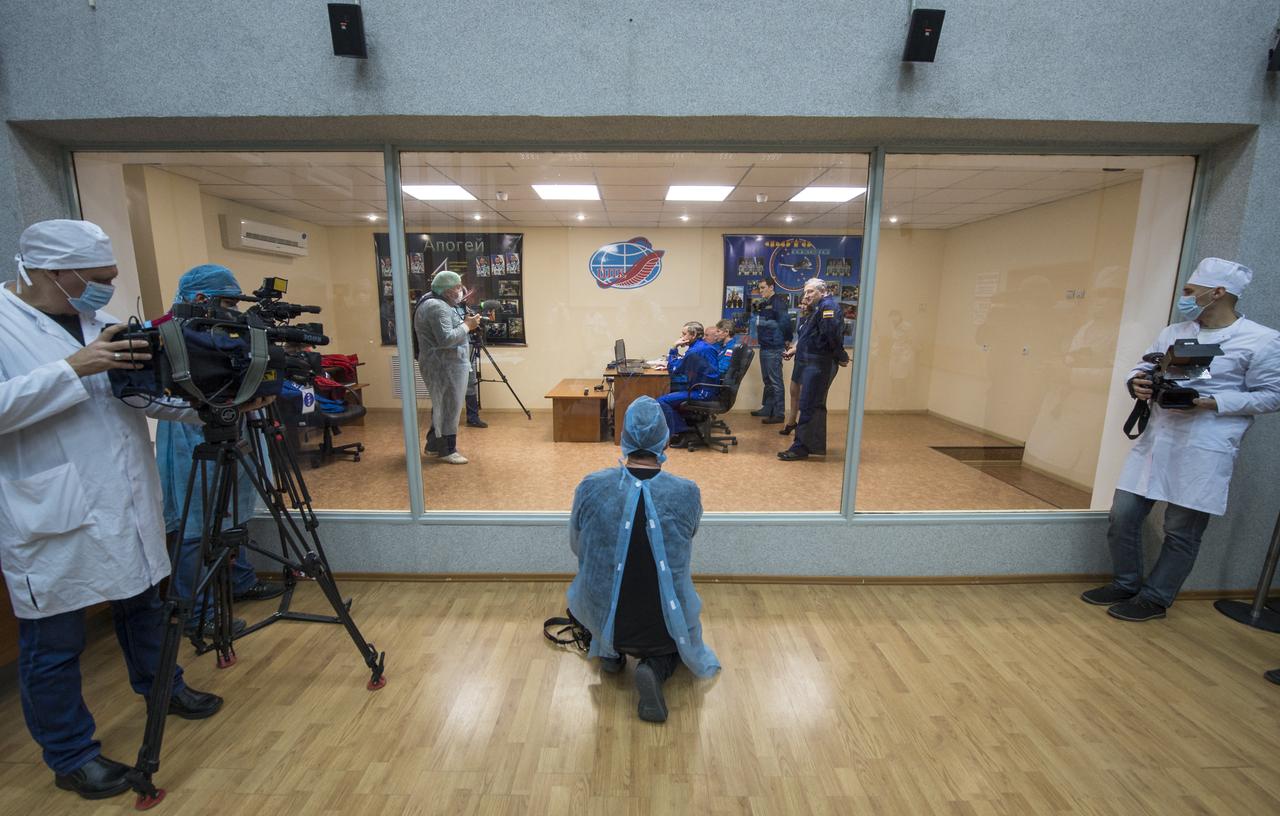
Media document Expedition 43 NASA Astronaut Scott Kelly, Russian Cosmonauts Gennady Padalka, and Mikhail Kornienko of the Russian Federal Space Agency (Roscosmos) as they work on Soyuz training, Saturday, March 21, 2015 at the Cosmonaut Hotel in Baikonur, Kazakhstan. Kelly, Padalka, and Kornienko are preparing for launch to the International Space Station in their Soyuz TMA-16M spacecraft from the Baikonur Cosmodrome in Kazakhstan March 28, Kazakh time (March 27 Eastern time.) As the one-year crew, Kelly and Kornienko will return to Earth on Soyuz TMA-18M in March 2016. Photo Credit: (NASA/Bill Ingalls)
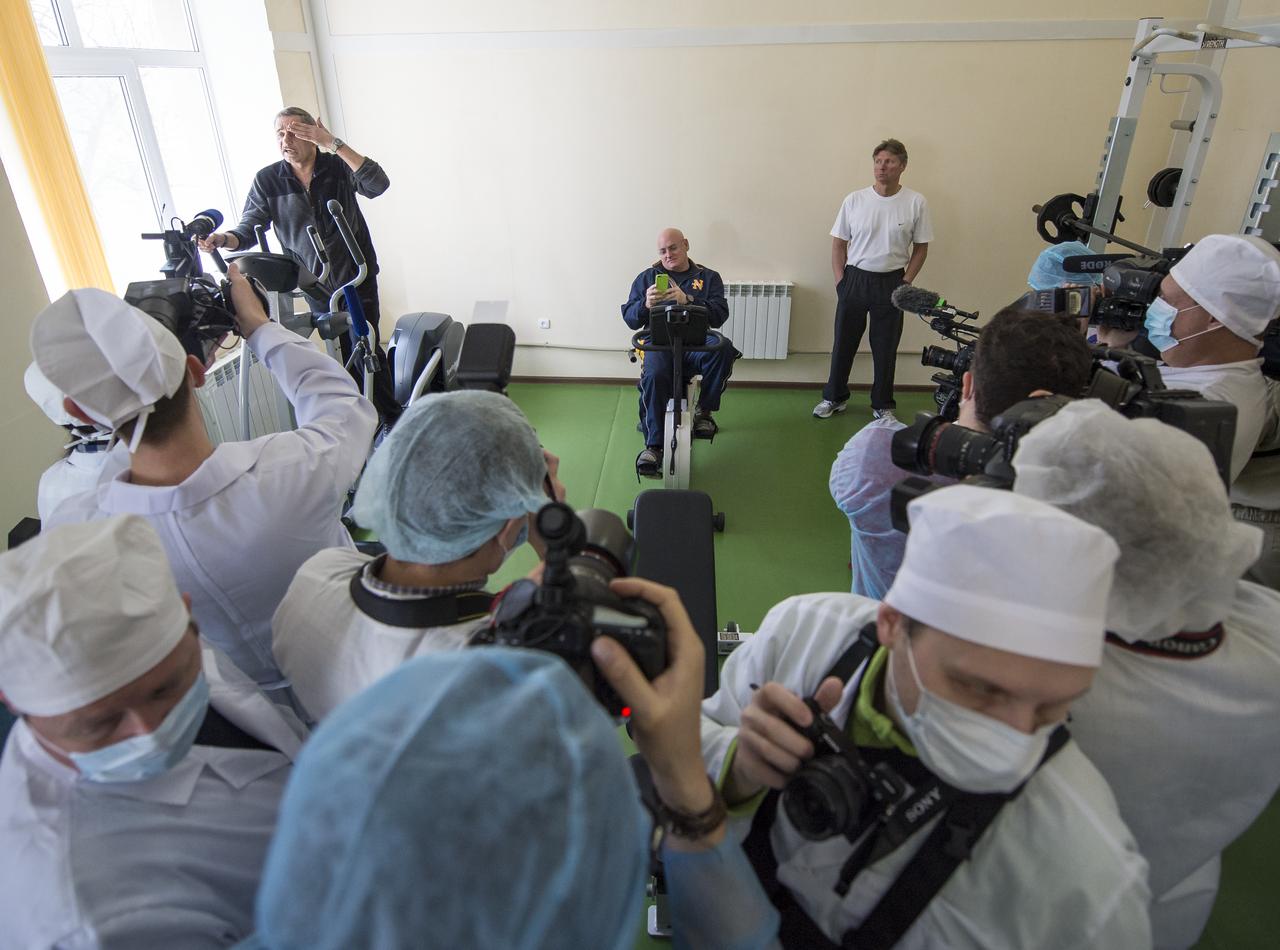
Expedition 43 Russian Cosmonaut Mikhail Kornienko of the Russian Federal Space Agency (Roscosmos), left, NASA Astronaut Scott Kelly, center, and Russian Cosmonaut Gennady Padalka are seen during media day, Saturday, March 21, 2015, Baikonur, Kazakhstan. Kelly, Padalka, and Kornienko are scheduled to launch to the International Space Station in the Soyuz TMA-16M spacecraft from the Baikonur Cosmodrome in Kazakhstan March 28, Kazakh time (March 27 Eastern time.) As the one-year crew, Kelly and Kornienko will return to Earth on Soyuz TMA-18M in March 2016. Photo Credit: (NASA/Bill Ingalls)
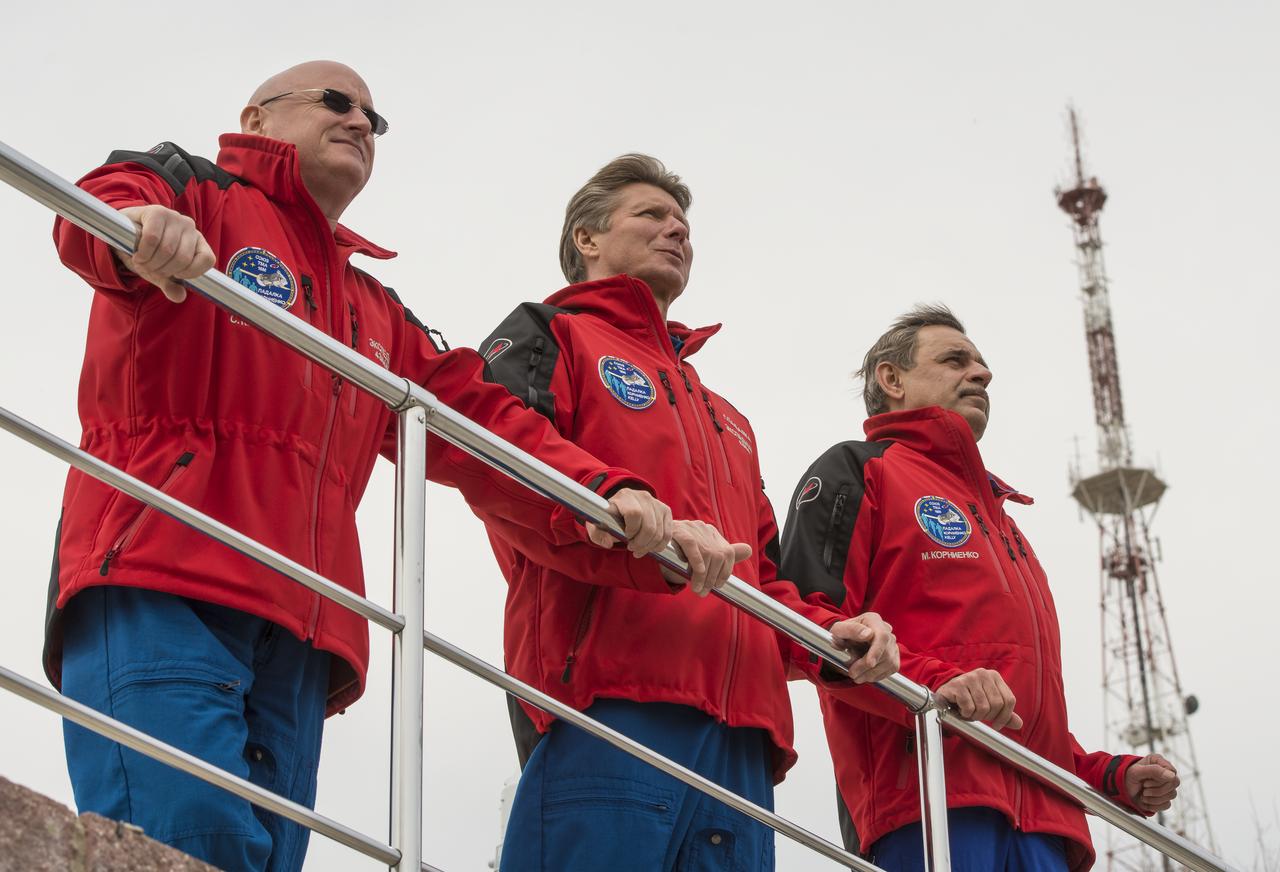
Expedition 43 NASA Astronaut Scott Kelly, left, Russian Cosmonauts Gennady Padalka, center, and Mikhail Kornienko of the Russian Federal Space Agency (Roscosmos) take in the view from a overlook during media day, Saturday, March 21, 2015 at the Cosmonaut Hotel in Baikonur, Kazakhstan. Kelly, Padalka, and Kornienko are preparing for launch to the International Space Station in their Soyuz TMA-16M spacecraft from the Baikonur Cosmodrome in Kazakhstan March 28, Kazakh time (March 27 Eastern time.) As the one-year crew, Kelly and Kornienko will return to Earth on Soyuz TMA-18M in March 2016. Photo Credit: (NASA/Bill Ingalls)
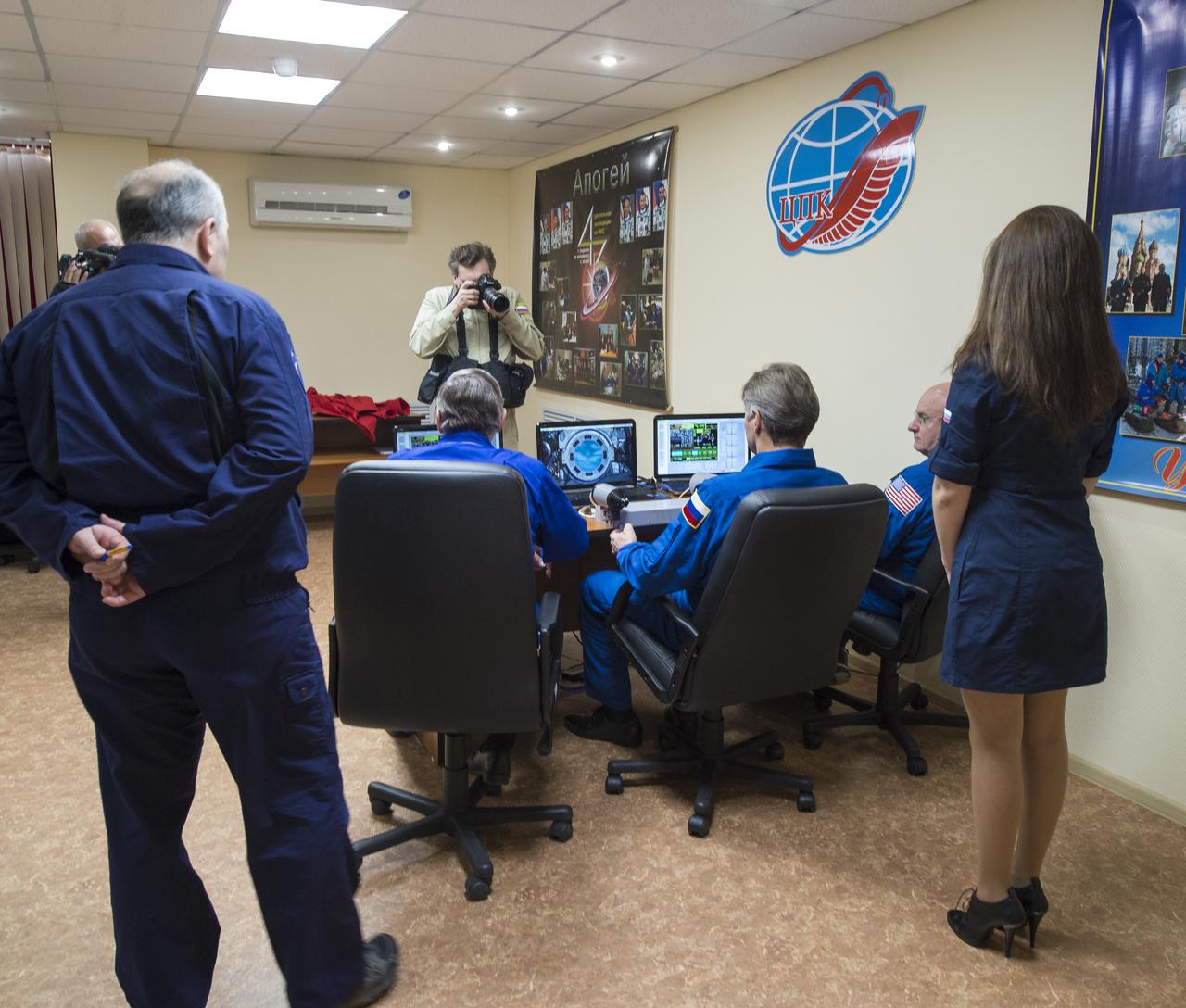
Expedition 43 Russian Cosmonauts Mikhail Kornienko, seated left, and Gennady Padalka of the Russian Federal Space Agency (Roscosmos), center, and NASA Astronaut Scott Kelly work on Soyuz training, Saturday, March 21, 2015 at the Cosmonaut Hotel in Baikonur, Kazakhstan. Kelly, Padalka, and Kornienko are preparing for launch to the International Space Station in their Soyuz TMA-16M spacecraft from the Baikonur Cosmodrome in Kazakhstan March 28, Kazakh time (March 27 Eastern time.) As the one-year crew, Kelly and Kornienko will return to Earth on Soyuz TMA-18M in March 2016. Photo Credit: (NASA/Bill Ingalls)
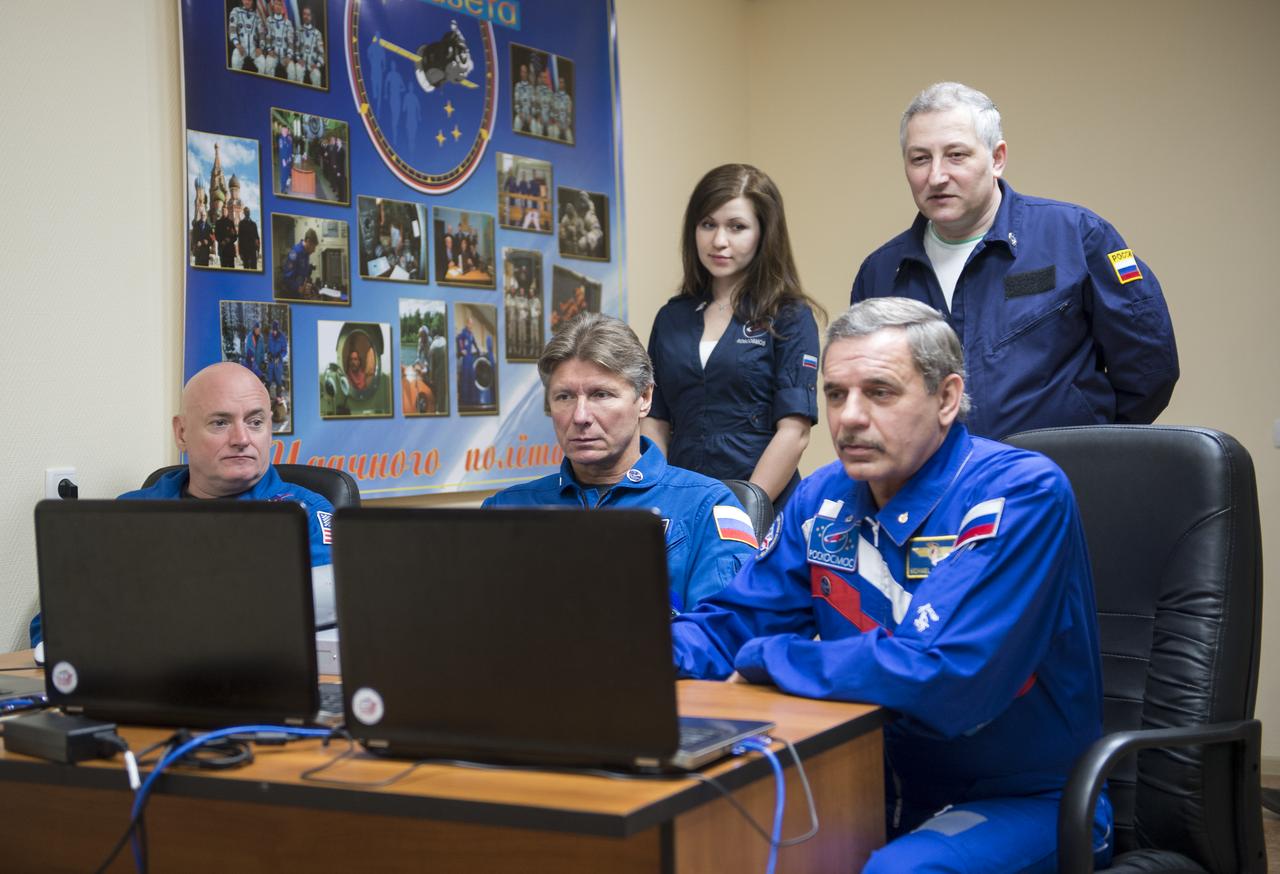
Expedition 43 NASA Astronaut Scott Kelly, seated left, Russian Cosmonauts Gennady Padalka, center, and Mikhail Kornienko of the Russian Federal Space Agency (Roscosmos), work on Soyuz training, Saturday, March 21, 2015 at the Cosmonaut Hotel in Baikonur, Kazakhstan. Kelly, Padalka, and Kornienko are preparing for launch to the International Space Station in their Soyuz TMA-16M spacecraft from the Baikonur Cosmodrome in Kazakhstan March 28, Kazakh time (March 27 Eastern time.) As the one-year crew, Kelly and Kornienko will return to Earth on Soyuz TMA-18M in March 2016. Photo Credit: (NASA/Bill Ingalls)
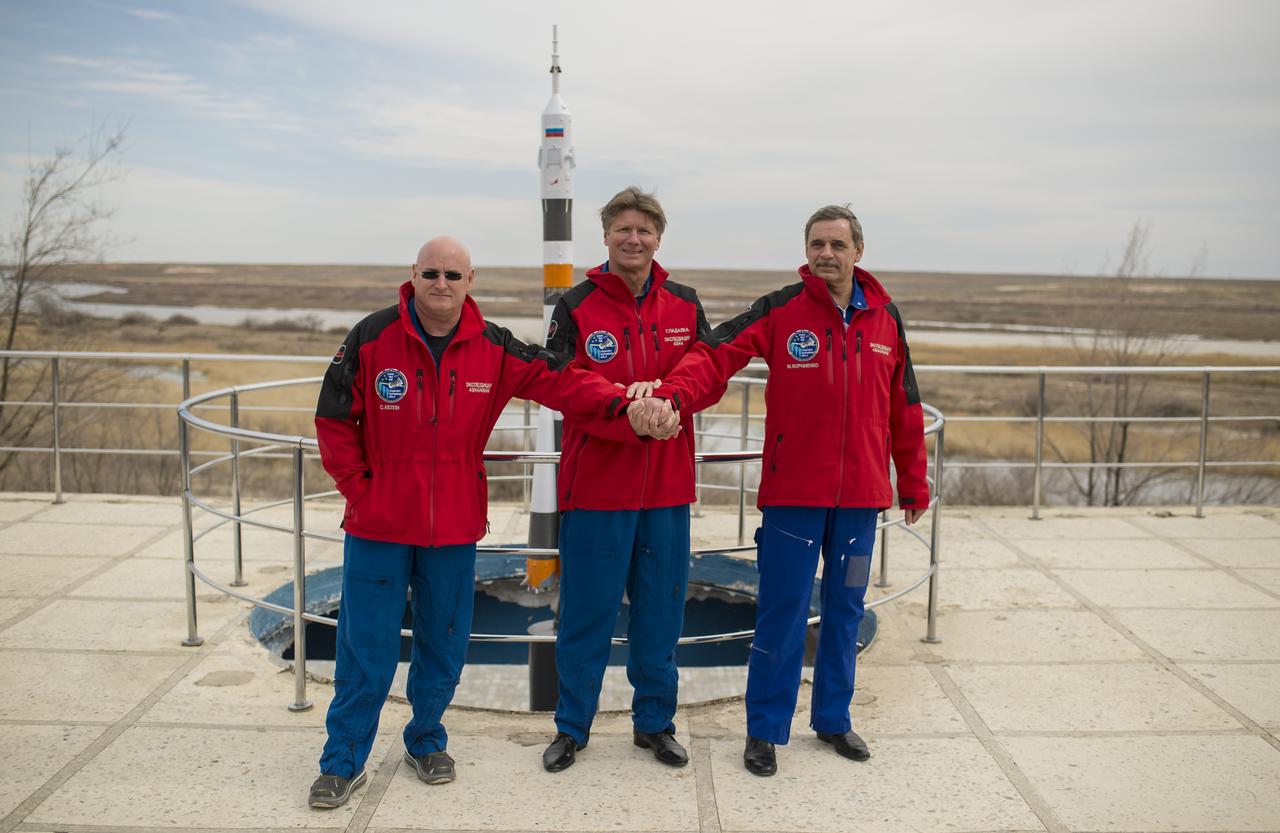
Expedition 43 NASA Astronaut Scott Kelly, left, Russian Cosmonauts Gennady Padalka, center, and Mikhail Kornienko of the Russian Federal Space Agency (Roscosmos) pose for a group photo near a model of the Soyuz rocket during media day, Saturday, March 21, 2015 at the Cosmonaut Hotel in Baikonur, Kazakhstan. Kelly, Padalka, and Kornienko are preparing for launch to the International Space Station in their Soyuz TMA-16M spacecraft from the Baikonur Cosmodrome in Kazakhstan March 28, Kazakh time (March 27 Eastern time.) As the one-year crew, Kelly and Kornienko will return to Earth on Soyuz TMA-18M in March 2016. Photo Credit: (NASA/Bill Ingalls)
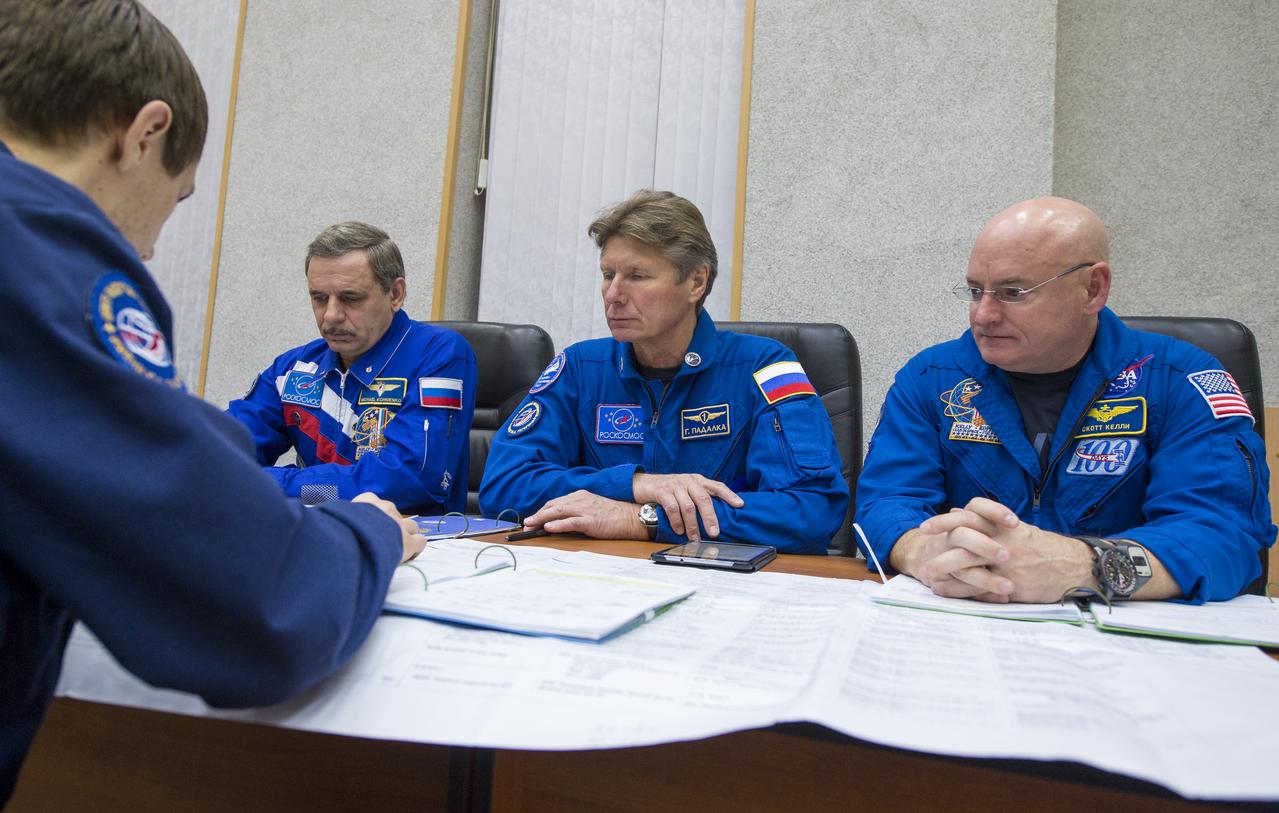
Expedition 43 Russian Cosmonauts Mikhail Kornienko, left, and Gennady Padalka of the Russian Federal Space Agency (Roscosmos), center, and NASA Astronaut Scott Kelly attend a briefing, Saturday, March 21, 2015 at the Cosmonaut Hotel in Baikonur, Kazakhstan. Kelly, Padalka, and Kornienko are preparing for launch to the International Space Station in their Soyuz TMA-16M spacecraft from the Baikonur Cosmodrome in Kazakhstan March 28, Kazakh time (March 27 Eastern time.) As the one-year crew, Kelly and Kornienko will return to Earth on Soyuz TMA-18M in March 2016. Photo Credit: (NASA/Bill Ingalls)
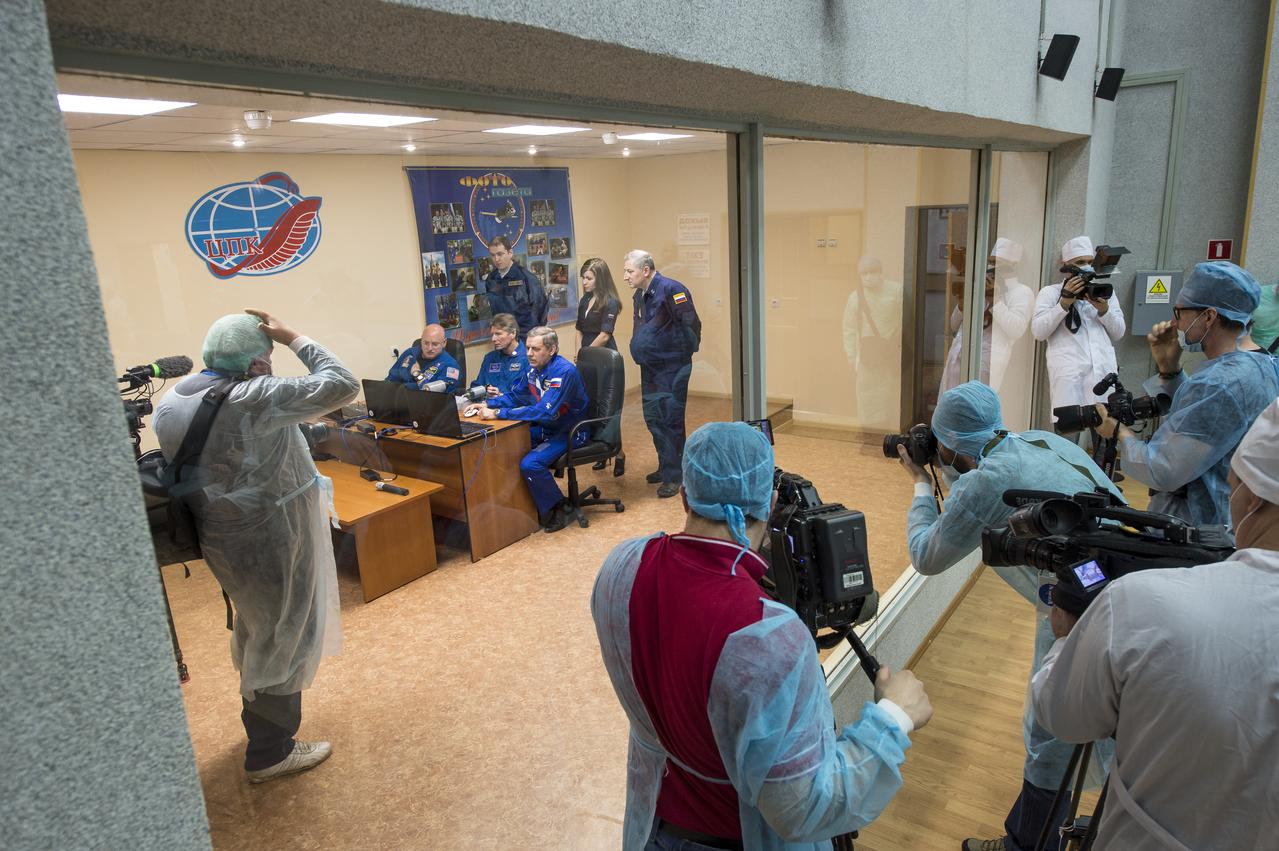
Media document Expedition 43 NASA Astronaut Scott Kelly, seated left, Russian Cosmonauts Gennady Padalka, center, and Mikhail Kornienko of the Russian Federal Space Agency (Roscosmos) as they work on Soyuz training, Saturday, March 21, 2015 at the Cosmonaut Hotel in Baikonur, Kazakhstan. Kelly, Padalka, and Kornienko are preparing for launch to the International Space Station in their Soyuz TMA-16M spacecraft from the Baikonur Cosmodrome in Kazakhstan March 28, Kazakh time (March 27 Eastern time.) As the one-year crew, Kelly and Kornienko will return to Earth on Soyuz TMA-18M in March 2016. Photo Credit: (NASA/Bill Ingalls)
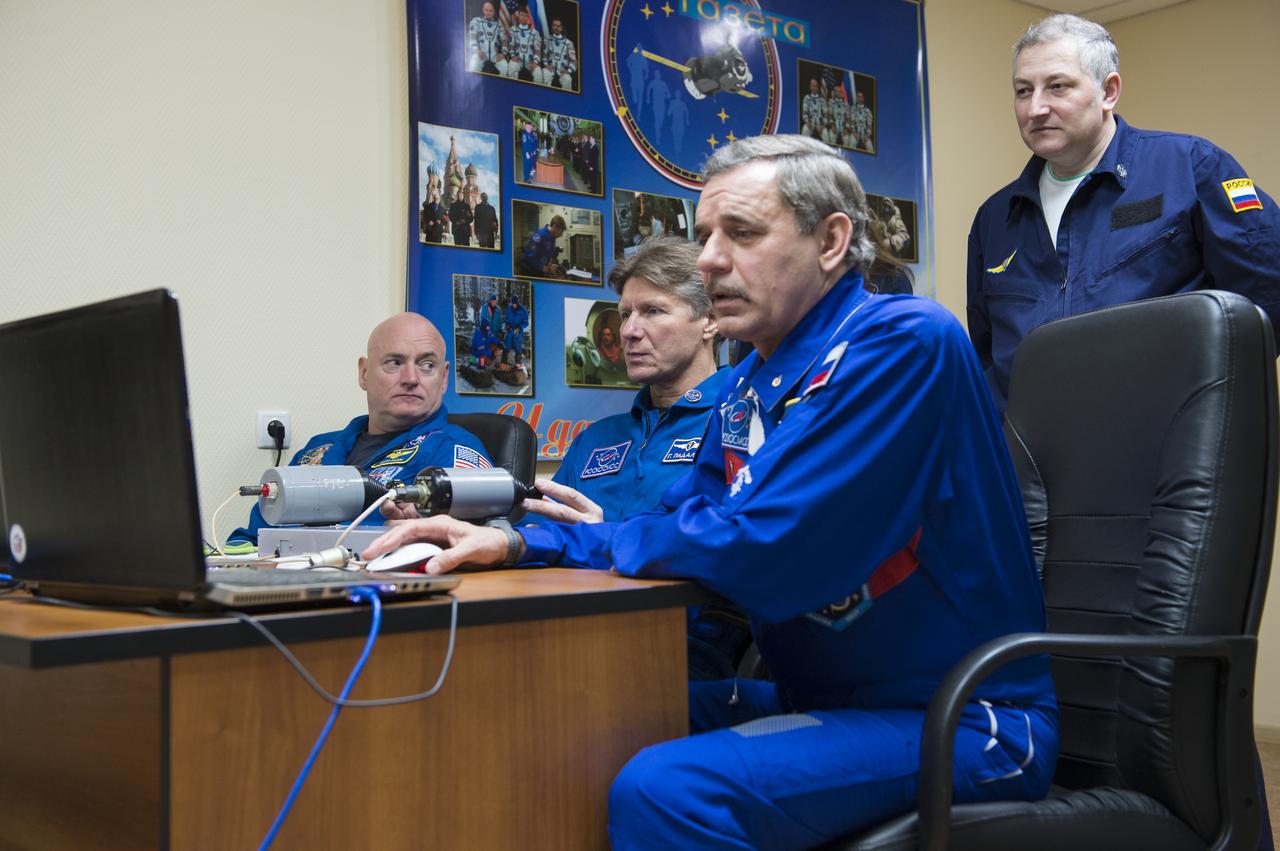
Expedition 43 NASA Astronaut Scott Kelly, seated left, Russian Cosmonauts Gennady Padalka, center, and Mikhail Kornienko of the Russian Federal Space Agency (Roscosmos), work on Soyuz training, Saturday, March 21, 2015 at the Cosmonaut Hotel in Baikonur, Kazakhstan. Kelly, Padalka, and Kornienko are preparing for launch to the International Space Station in their Soyuz TMA-16M spacecraft from the Baikonur Cosmodrome in Kazakhstan March 28, Kazakh time (March 27 Eastern time.) As the one-year crew, Kelly and Kornienko will return to Earth on Soyuz TMA-18M in March 2016. Photo Credit: (NASA/Bill Ingalls)
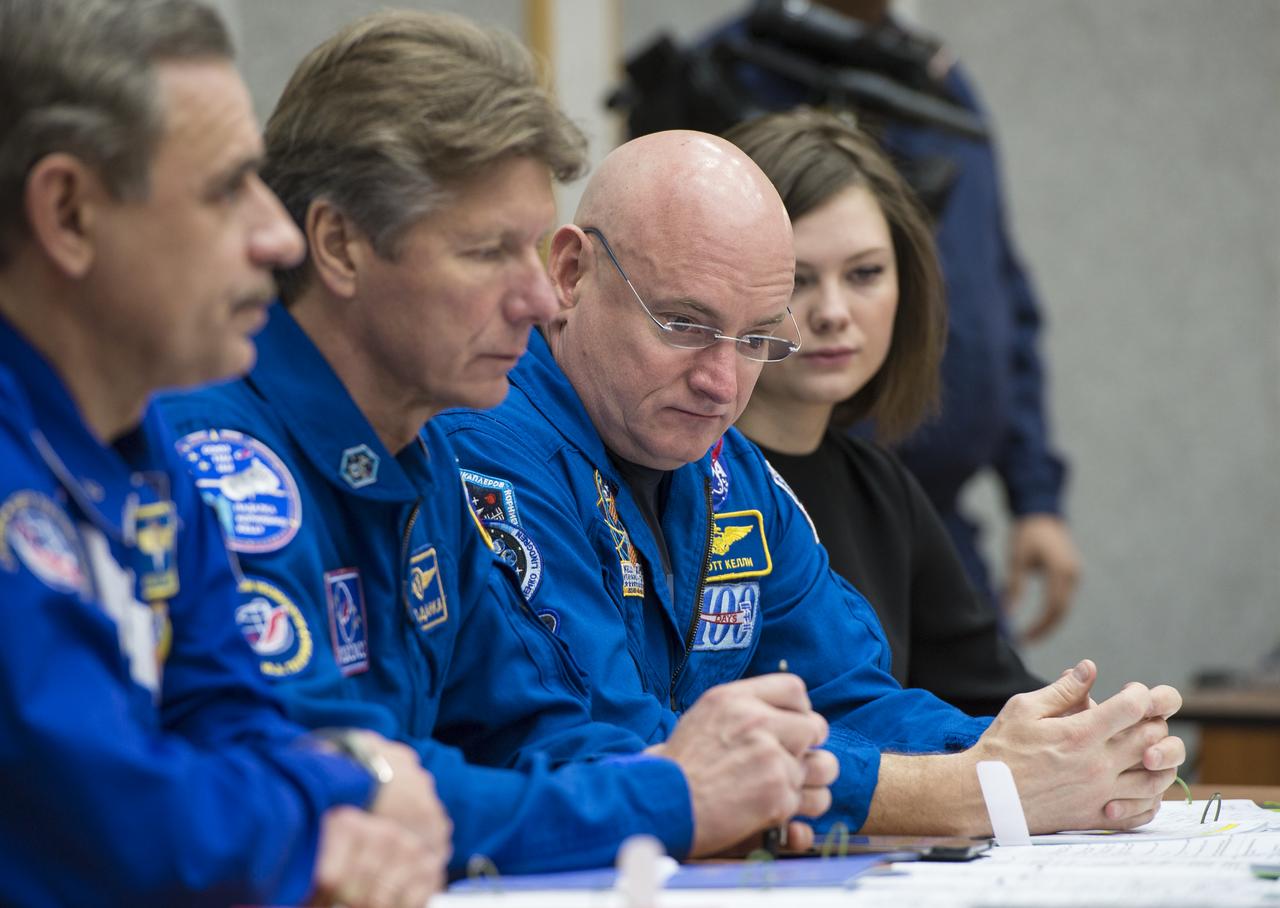
Expedition 43 Russian Cosmonauts Mikhail Kornienko, left, and Gennady Padalka of the Russian Federal Space Agency (Roscosmos), center, and NASA Astronaut Scott Kelly attend a briefing, Saturday, March 21, 2015 at the Cosmonaut Hotel in Baikonur, Kazakhstan. Kelly, Padalka, and Kornienko are preparing for launch to the International Space Station in their Soyuz TMA-16M spacecraft from the Baikonur Cosmodrome in Kazakhstan March 28, Kazakh time (March 27 Eastern time.) As the one-year crew, Kelly and Kornienko will return to Earth on Soyuz TMA-18M in March 2016. Photo Credit: (NASA/Bill Ingalls)
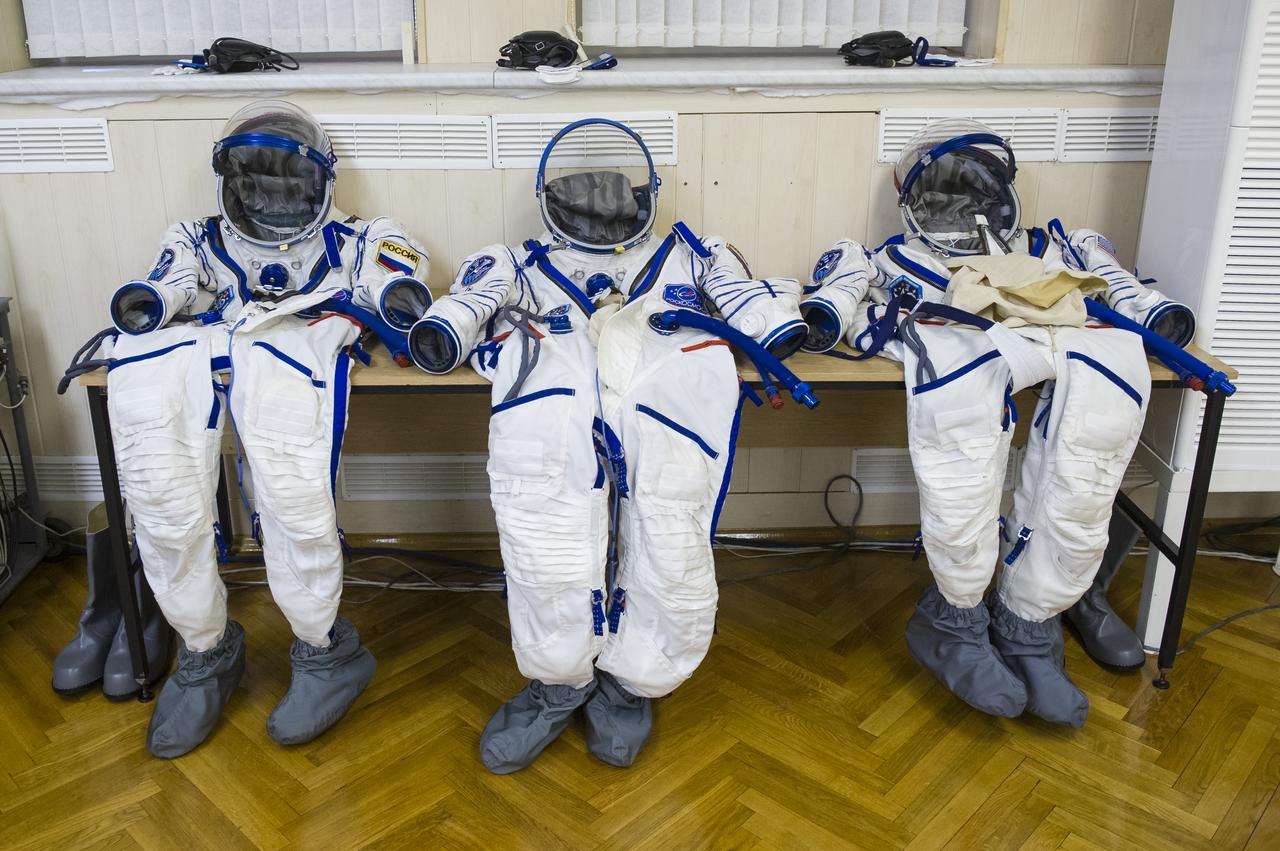
The Russian Sokol suits for Expedition 43 NASA Astronaut Scott Kelly, Russian Cosmonauts Gennady Padalka, and Mikhail Kornienko of the Russian Federal Space Agency (Roscosmos), are seen moments before they were donned by the trio for their launch onboard the Soyuz TMA-16M spacecraft to the International Space Station, Friday, March 27, 2015 in Baikonor, Kazakhstan. Kelly, Padalka, and Kornienko launched to the ISS from the Baikonur Cosmodrome in Kazakhstan March 28, Kazakh time (March 27 Eastern time.) As the one-year crew, Kelly and Kornienko will return to Earth on Soyuz TMA-18M in March 2016. Photo Credit: (NASA/GCTC/Andrey Shelepin)
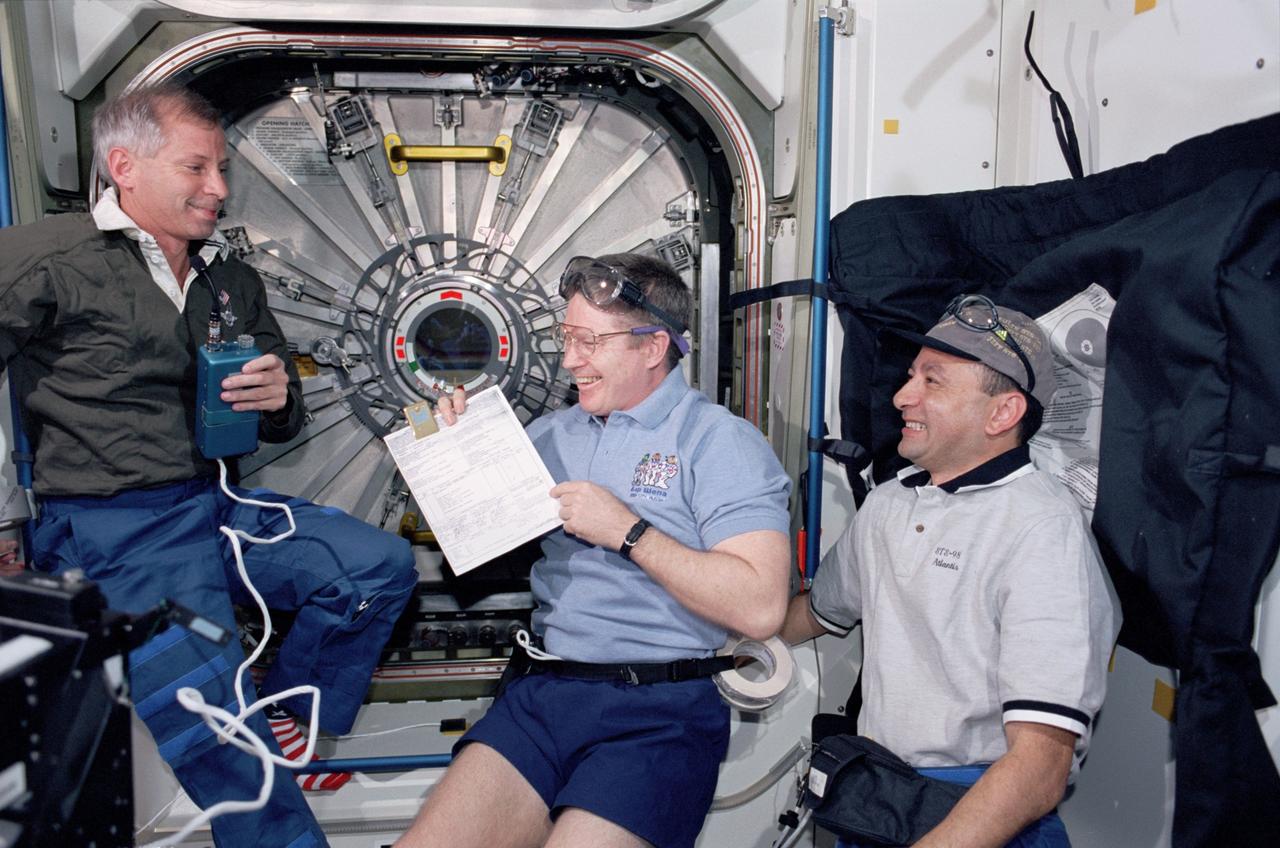
STS098-352-0019 (11 February 2001) --- Inside the Unity node, astronaut William M. (Bill) Shepherd (center), Expedition One commander, holds a document of receipt of the U.S. laboratory, called Destiny, as part of the International Space Station (ISS). Looking on are astronauts Kenneth D. Cockrell (left) and Mark L. Polansky, commander and pilot, respectively, for STS-98. The hatch to Destiny, not yet opened, is in the background.
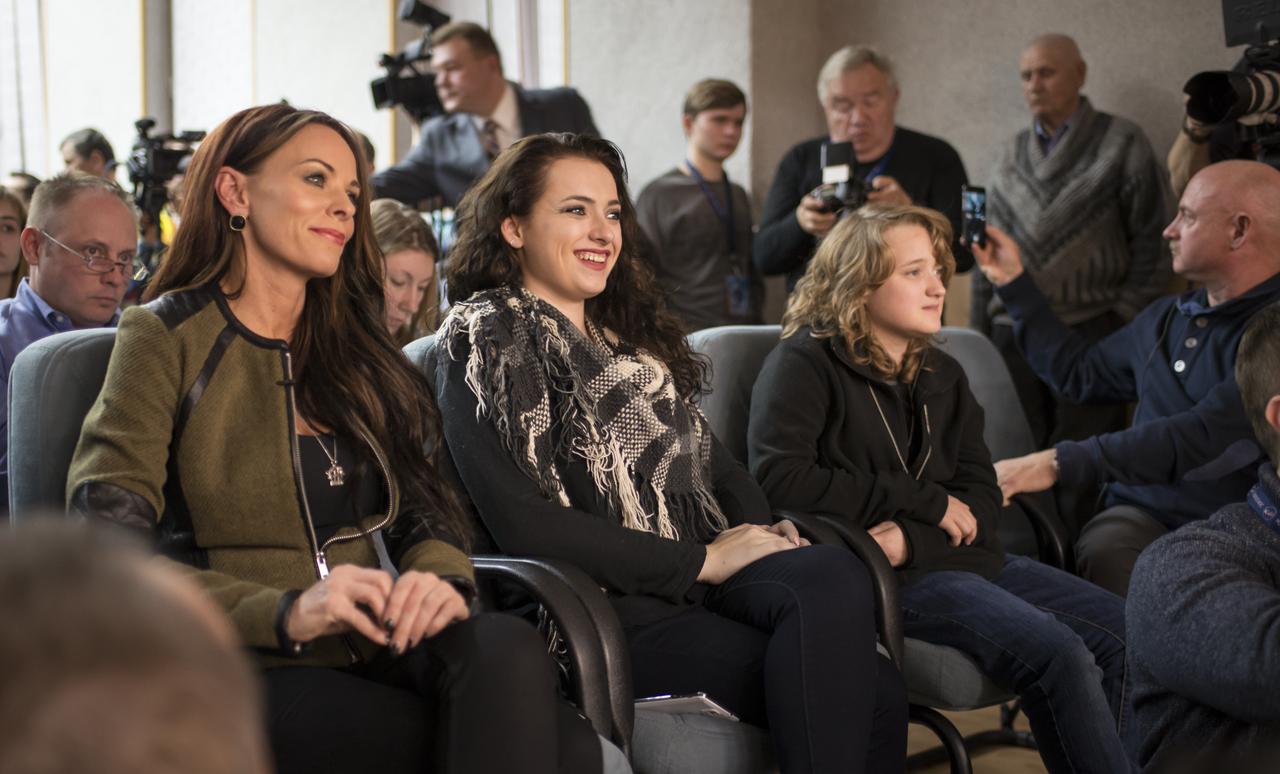
Family and loved ones of Expedition 43 NASA Astronaut Scott Kelly look on as Kelly and fellow crew mates, Russian cosmonauts Gennady Padalka, and Mikhail Kornienko of the Russian Federal Space Agency (Roscosmos), participate in a press conference, Thursday, March 26, 2015, at the Cosmonaut Hotel in Baikonur, Kazakhstan. Kelly, Kornienko, and Padalka launched to the International Space Station in the Soyuz TMA-16M spacecraft from the Baikonur Cosmodrome in Kazakhstan March 28, Kazakh time (March 27 Eastern time.) As the one-year crew, Kelly and Kornienko will return to Earth on Soyuz TMA-18M in March 2016. Photo Credit (NASA/Bill Ingalls)
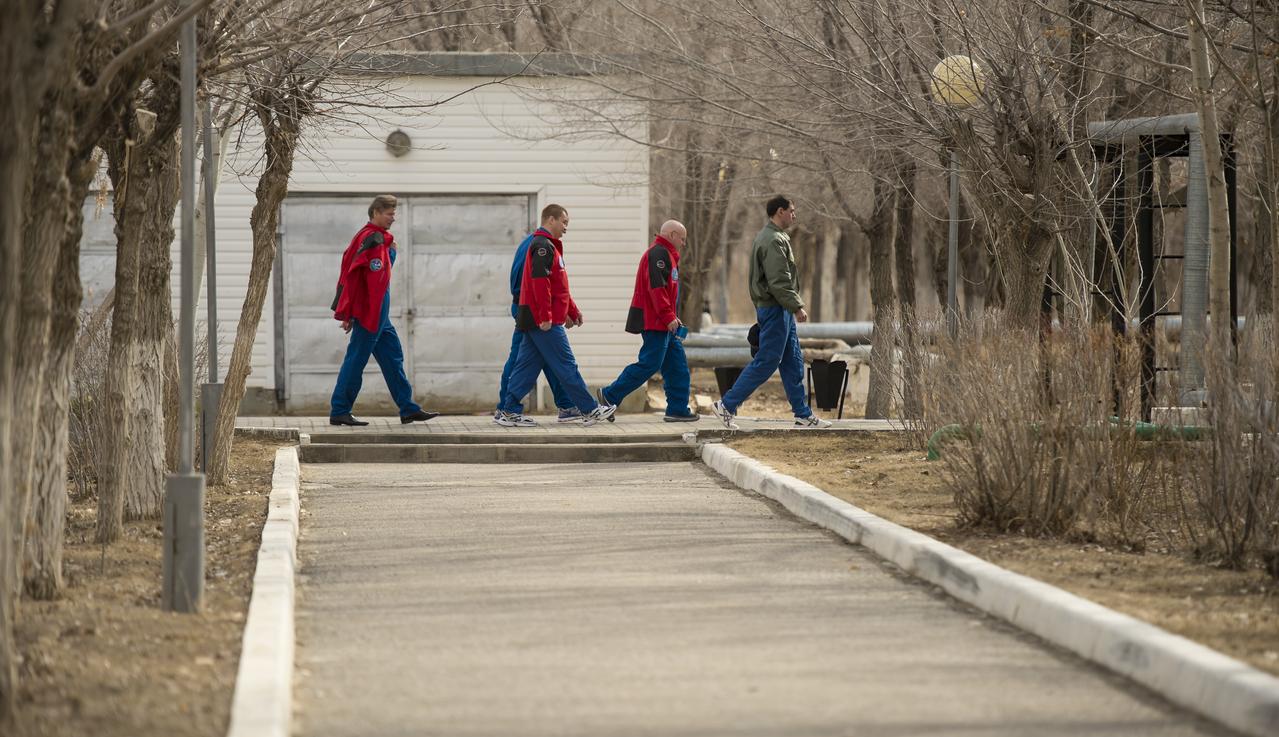
Expedition 43 prime and backup crews walk from the Cosmonaut Hotel over to the Zvjozdnyj Hotel for a short break during media day, Saturday, March 21, 2015, Baikonur, Kazakhstan. Expedition 43 NASA Astronaut Scott Kelly, and Russian Cosmonauts Gennady Padalka, and Mikhail Kornienko of the Russian Federal Space Agency (Roscosmos) are scheduled to launch to the International Space Station in the Soyuz TMA-16M spacecraft from the Baikonur Cosmodrome in Kazakhstan March 28, Kazakh time (March 27 Eastern time.) As the one-year crew, Kelly and Kornienko will return to Earth on Soyuz TMA-18M in March 2016. Photo Credit: (NASA/Bill Ingalls)
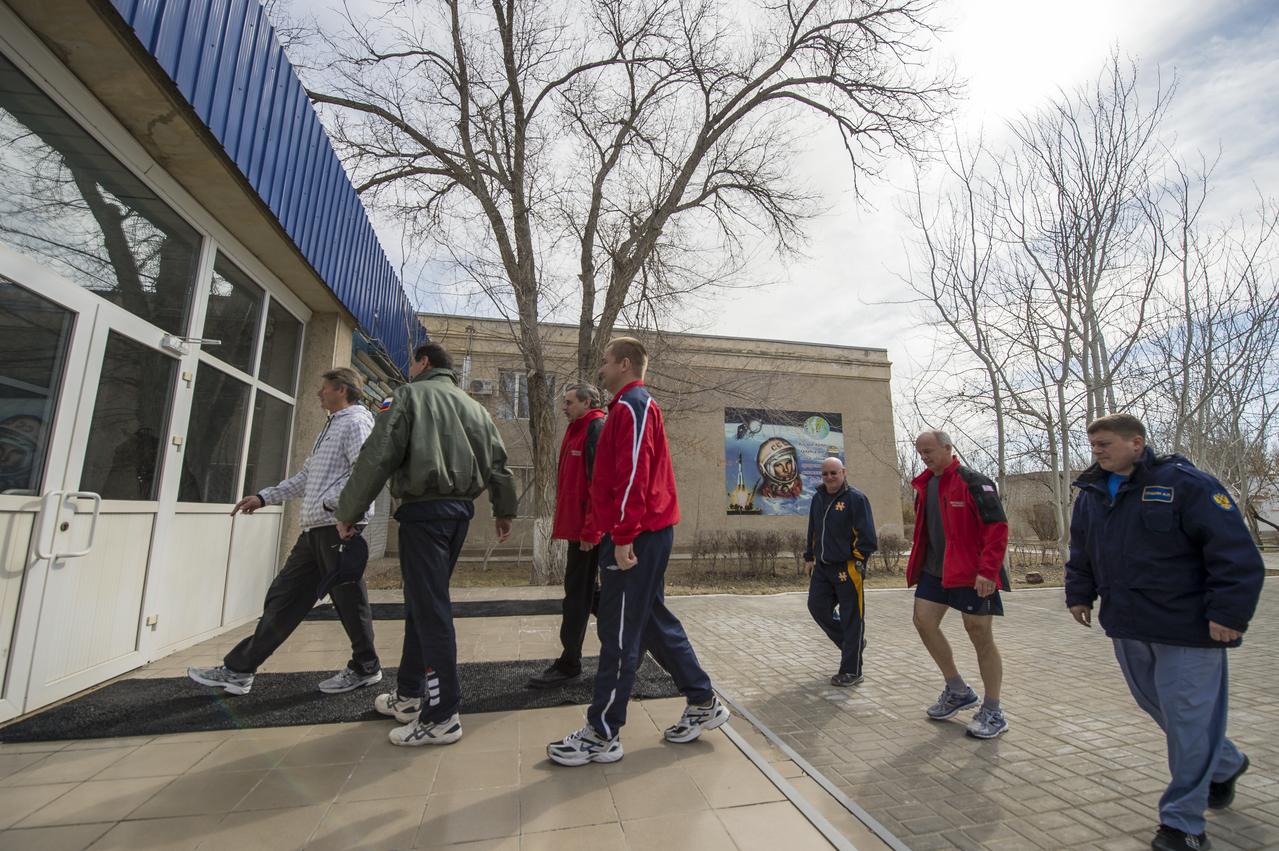
Expedition 43 prime and backup crews arrive at the Cosmonaut Hotel during media day, Saturday, March 21, 2015, Baikonur, Kazakhstan. Expedition 43 NASA Astronaut Scott Kelly, and Russian Cosmonauts Gennady Padalka, and Mikhail Kornienko of the Russian Federal Space Agency (Roscosmos) are scheduled to launch to the International Space Station in the Soyuz TMA-16M spacecraft from the Baikonur Cosmodrome in Kazakhstan March 28, Kazakh time (March 27 Eastern time.) As the one-year crew, Kelly and Kornienko will return to Earth on Soyuz TMA-18M in March 2016. Photo Credit: (NASA/Bill Ingalls)
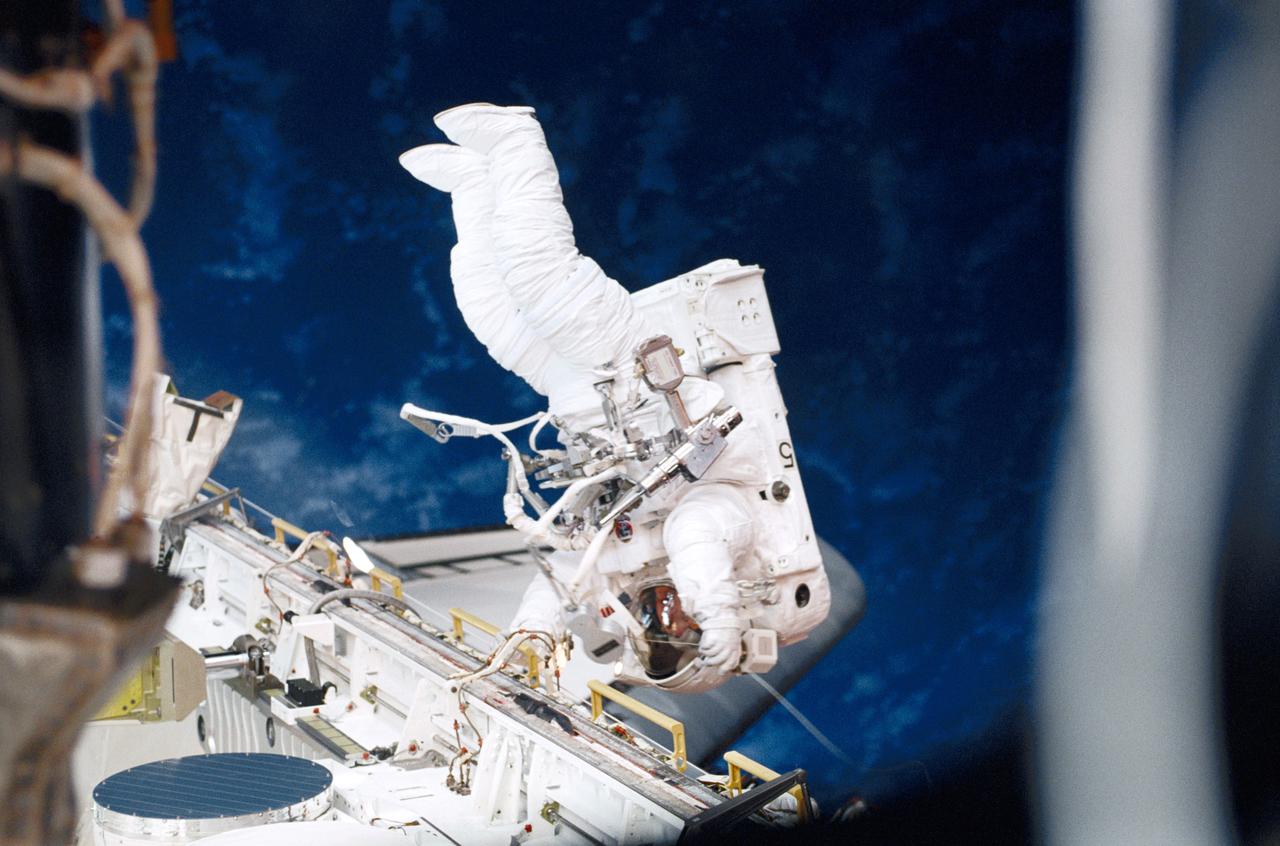
STS-102 mission astronaut Susan J. Helms translates along the longerons of the Space Shuttle Discovery during the first of two space walks. During this walk, the Pressurized Mating Adapter 3 was prepared for repositioning from the Unity Module's Earth-facing berth to its port-side berth to make room for the Leonardo multipurpose Logistics Module (MPLM), supplied by the Italian Space Agency. The Leonardo MPLM is the first of three such pressurized modules that will serve as the International Space Station's (ISS') moving vans, carrying laboratory racks filled with equipment, experiments, and supplies to and from the Station aboard the Space Shuttle. The cylindrical module is approximately 21-feet long and 15- feet in diameter, weighing almost 4.5 tons. It can carry up to 10 tons of cargo in 16 standard Space Station equipment racks. Of the 16 racks the module can carry, 5 can be furnished with power, data, and fluid to support refrigerators or freezers. In order to function as an attached station module as well as a cargo transport, the logistics module also includes components that provide life support, fire detection and suppression, electrical distribution, and computer functions. NASA's 103rd overall mission and the 8th Space Station Assembly Flight, STS-102 mission also served as a crew rotation flight. It delivered the Expedition Two crew to the Station and returned the Expedition One crew back to Earth.

Expedition 43 Russian Cosmonauts Mikhail Kornienko, left, and Gennady Padalka of the Russian Federal Space Agency (Roscosmos), center, and NASA Astronaut Scott Kelly answer questions from the press while standing on the Avenue of the Cosmonauts where two long rows of trees are all marked with the name and year of the crew member who planted them starting from Yuri Gagarin's tree, Saturday, March 21, 2015 at the Cosmonaut Hotel in Baikonur, Kazakhstan. Kelly, Padalka, and Kornienko are preparing for launch to the International Space Station in their Soyuz TMA-16M spacecraft from the Baikonur Cosmodrome in Kazakhstan March 28, Kazakh time (March 27 Eastern time.) As the one-year crew, Kelly and Kornienko will return to Earth on Soyuz TMA-18M in March 2016. Photo Credit: (NASA/Bill Ingalls)

Expedition 43 Russian Cosmonauts Mikhail Kornienko, left, and Gennady Padalka of the Russian Federal Space Agency (Roscosmos), center, and NASA Astronaut Scott Kelly answer questions from the press while standing on the Avenue of the Cosmonauts where two long rows of trees are all marked with the name and year of the crew member who planted them starting from Yuri Gagarin's tree, Saturday, March 21, 2015 at the Cosmonaut Hotel in Baikonur, Kazakhstan. Kelly, Padalka, and Kornienko are preparing for launch to the International Space Station in their Soyuz TMA-16M spacecraft from the Baikonur Cosmodrome in Kazakhstan March 28, Kazakh time (March 27 Eastern time.) As the one-year crew, Kelly and Kornienko will return to Earth on Soyuz TMA-18M in March 2016. Photo Credit: (NASA/Bill Ingalls)
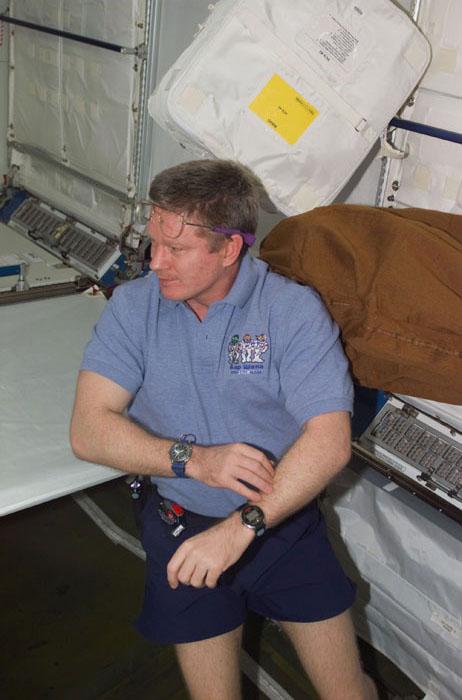
STS98-E-5160 (11 February 2001) --- Astronaut William M. (Bill) Shepherd, Expedition One commander, surveys the interior of the newly attached Destiny laboratory onboard the International Space Station (ISS). After the Destiny hatch was opened early in the day, members of both crews went to work quickly inside the new module, activating air systems, fire extinguishers, alarm systems, computers and internal communications. The crews also took some photos and continued equipment transfers from the shuttle to the station. The scene was taken with a digital still camera.
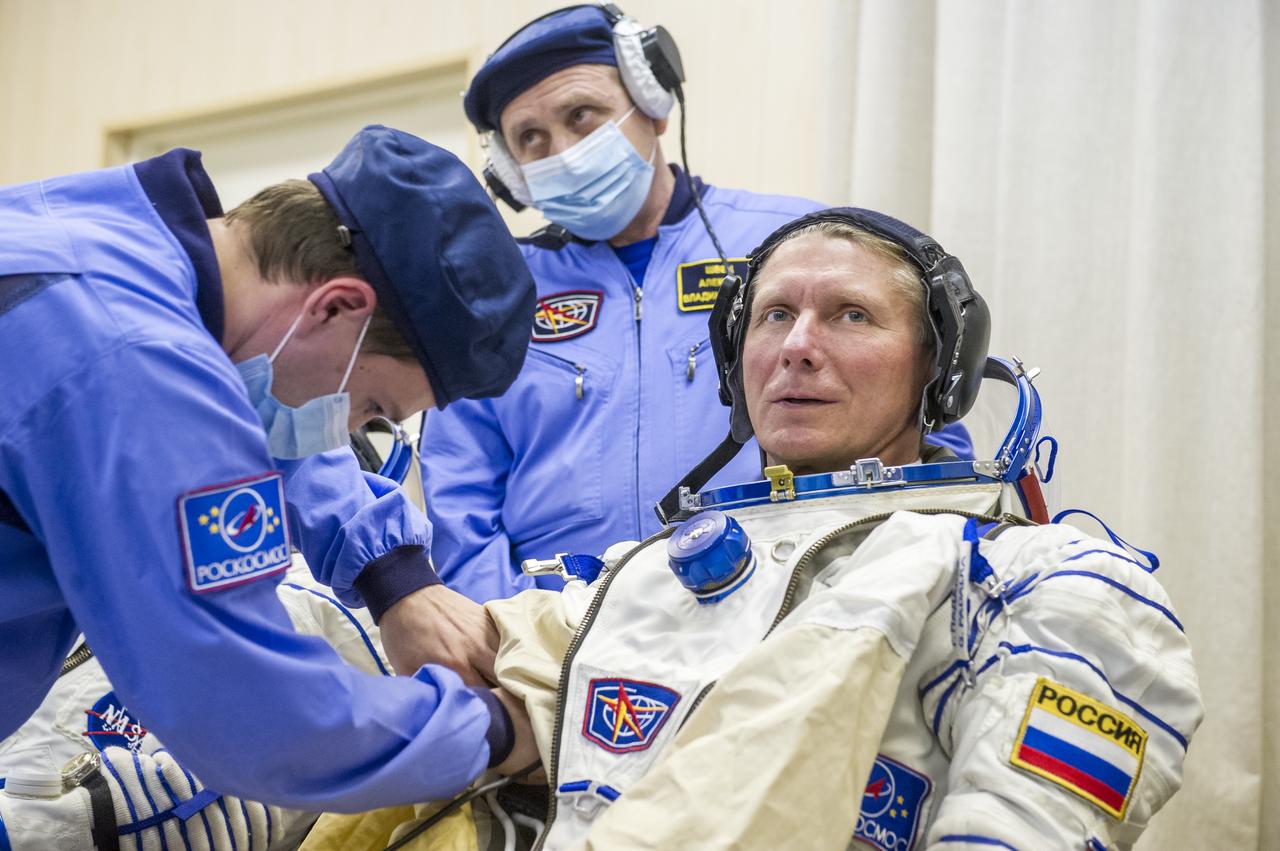
Expedition 43 Russian Cosmonaut Gennady Padalka of the Russian Federal Space Agency (Roscosmos) dons his Russian sokol suit ahead of his launch onboard the Soyuz TMA-16M spacecraft to the International Space Station with fellow crew mates, NASA Astronaut Scott Kelly, and Russian Cosmonaut Mikhail Kornienko Friday, March 27, 2015 in Baikonor, Kazakhstan. As the one-year crew, Kelly and Kornienko will return to Earth on Soyuz TMA-18M in March 2016. Photo Credit: (NASA/GCTC/Andrey Shelepin)
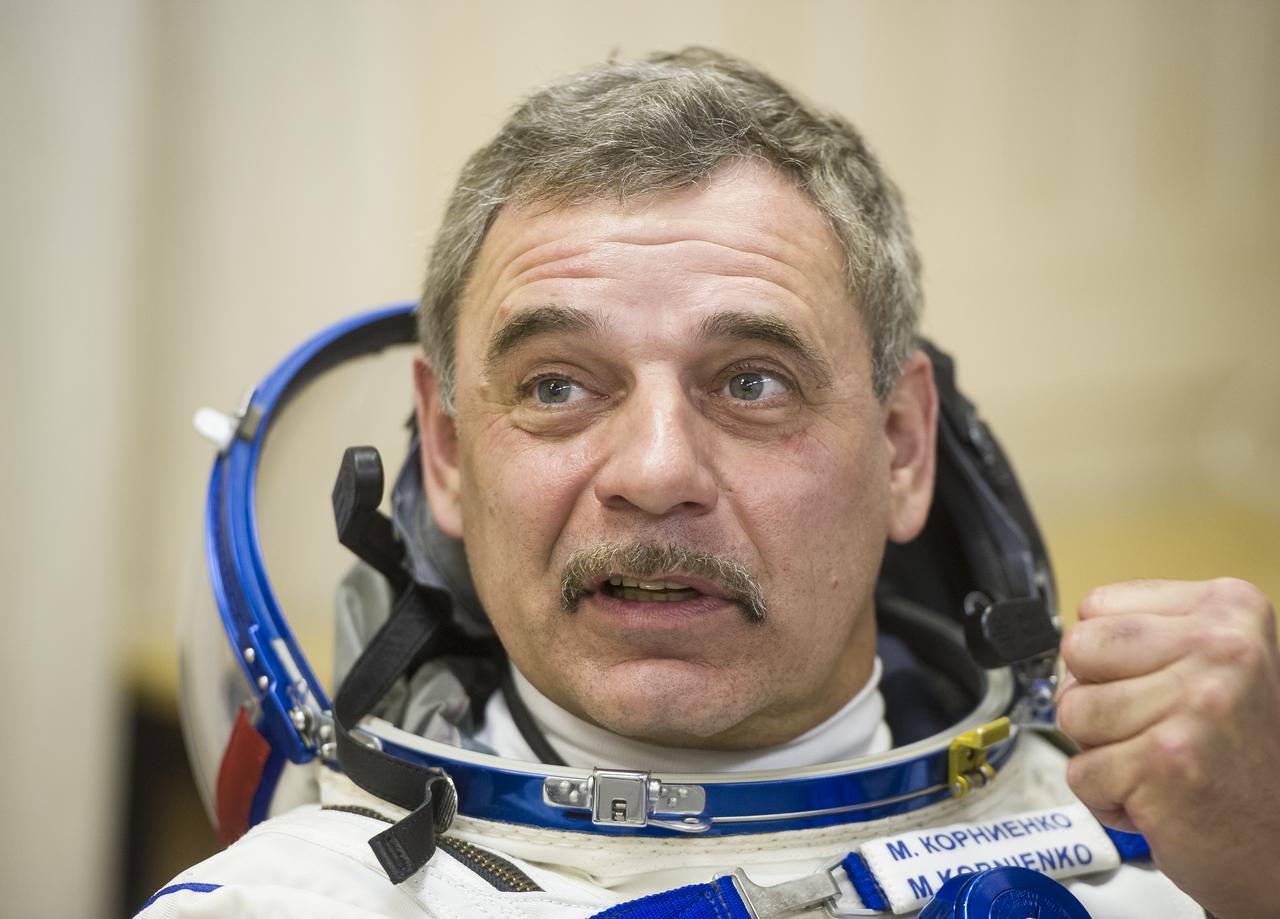
Expedition 43 Russian Cosmonaut Mikhail Kornienko of the Russian Federal Space Agency (Roscosmos) dons his Russian sokol suit ahead of his launch onboard the Soyuz TMA-16M spacecraft to the International Space Station with fellow crew mates, NASA Astronaut Scott Kelly, and Russian Cosmonaut Gennady Padalka of Roscosmos Friday, March 27, 2015 in Baikonor, Kazakhstan. As the one-year crew, Kelly and Kornienko will return to Earth on Soyuz TMA-18M in March 2016. Photo Credit: (NASA/GCTC/Andrey Shelepin)
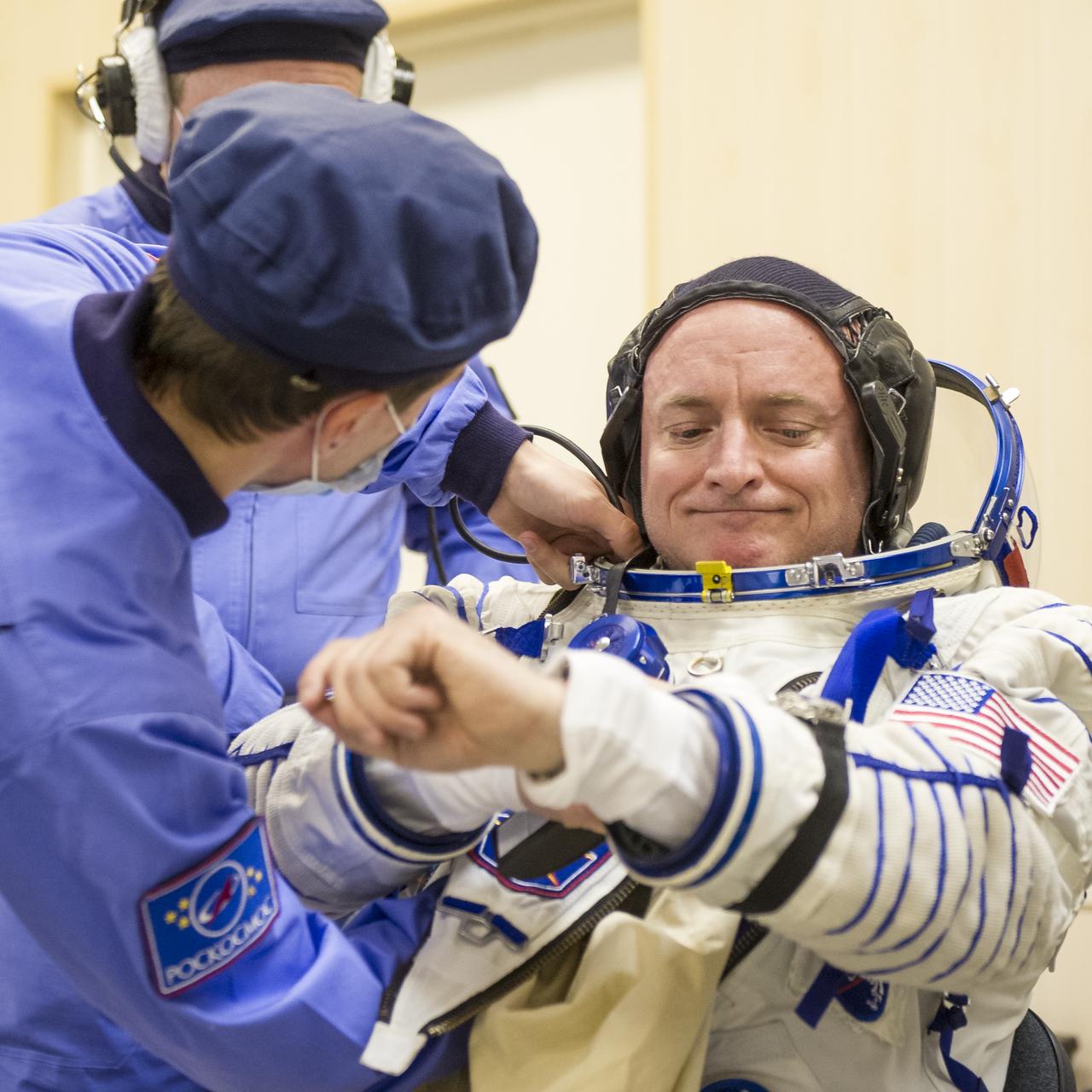
Expedition 43 NASA Astronaut Scott Kelly dons his Russian sokol suit ahead of his launch onboard the Soyuz TMA-16M spacecraft to the International Space Station with fellow crew mates, Russian Cosmonauts Gennady Padalka, and Mikhail Kornienko of the Russian Federal Space Agency (Roscosmos) Friday, March 27, 2015 in Baikonor, Kazakhstan. As the one-year crew, Kelly and Kornienko will return to Earth on Soyuz TMA-18M in March 2016. Photo Credit: (NASA/GCTC/Andrey Shelepin)
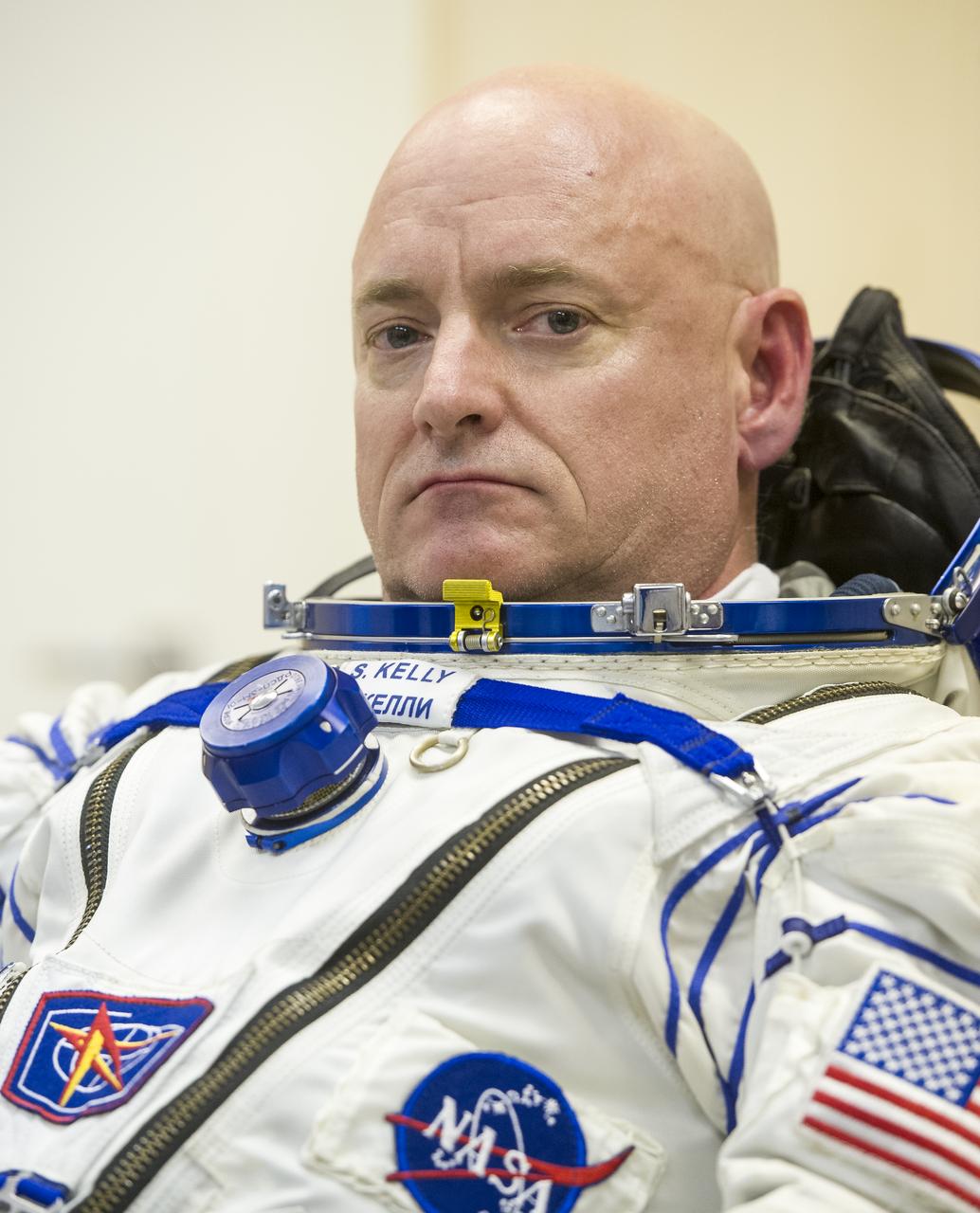
Expedition 43 NASA Astronaut Scott Kelly dons his Russian sokol suit ahead of his launch onboard the Soyuz TMA-16M spacecraft to the International Space Station with fellow crew mates, Russian Cosmonauts Gennady Padalka, and Mikhail Kornienko of the Russian Federal Space Agency (Roscosmos) Friday, March 27, 2015 in Baikonor, Kazakhstan. As the one-year crew, Kelly and Kornienko will return to Earth on Soyuz TMA-18M in March 2016. Photo Credit: (NASA/GCTC/Andrey Shelepin)
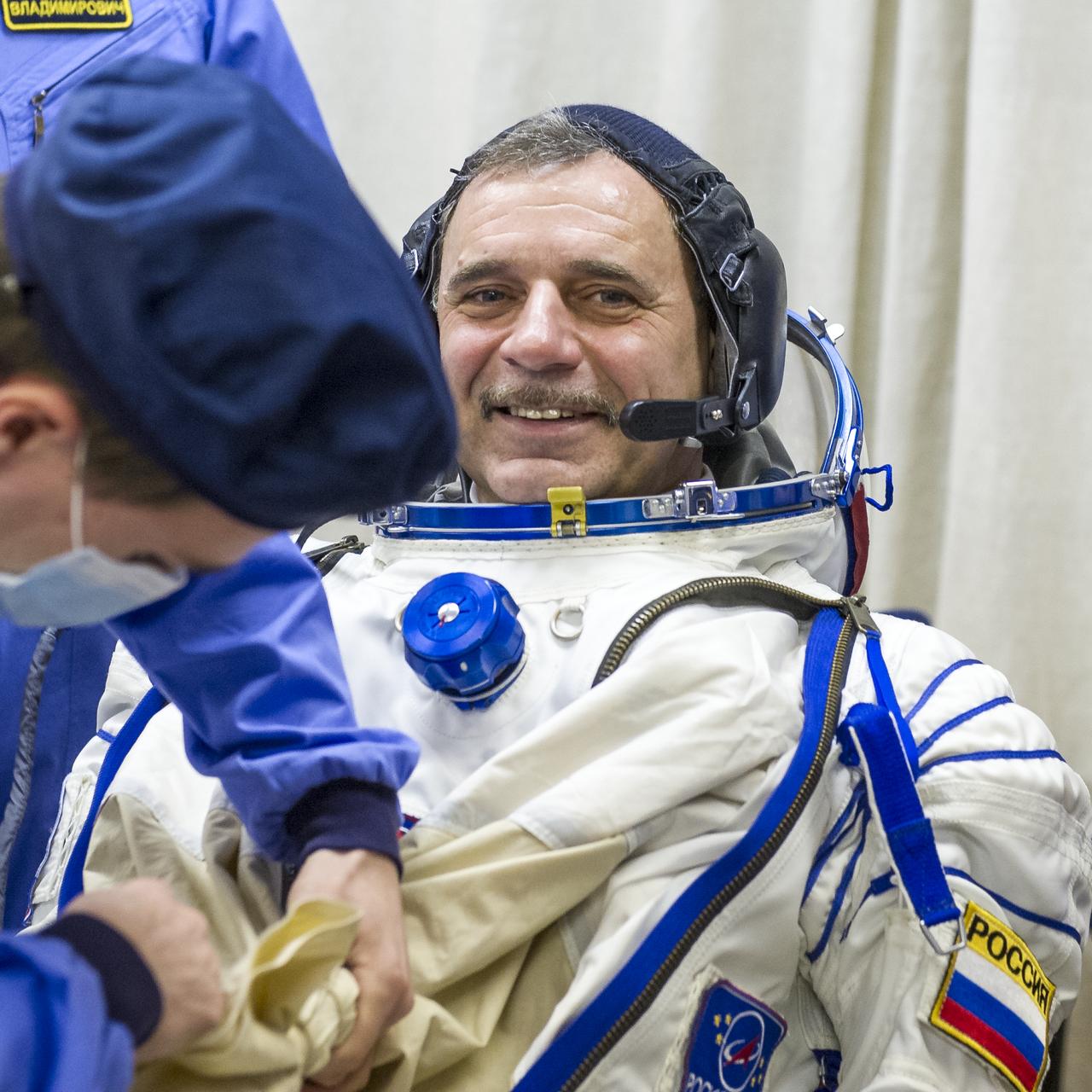
Expedition 43 Russian Cosmonaut Mikhail Kornienko of the Russian Federal Space Agency (Roscosmos) dons his Russian sokol suit ahead of his launch onboard the Soyuz TMA-16M spacecraft to the International Space Station with fellow crew mates, NASA Astronaut Scott Kelly, and Russian Cosmonaut Gennady Padalka of Roscosmos Friday, March 27, 2015 in Baikonor, Kazakhstan. As the one-year crew, Kelly and Kornienko will return to Earth on Soyuz TMA-18M in March 2016. Photo Credit: (NASA/GCTC/Andrey Shelepin)
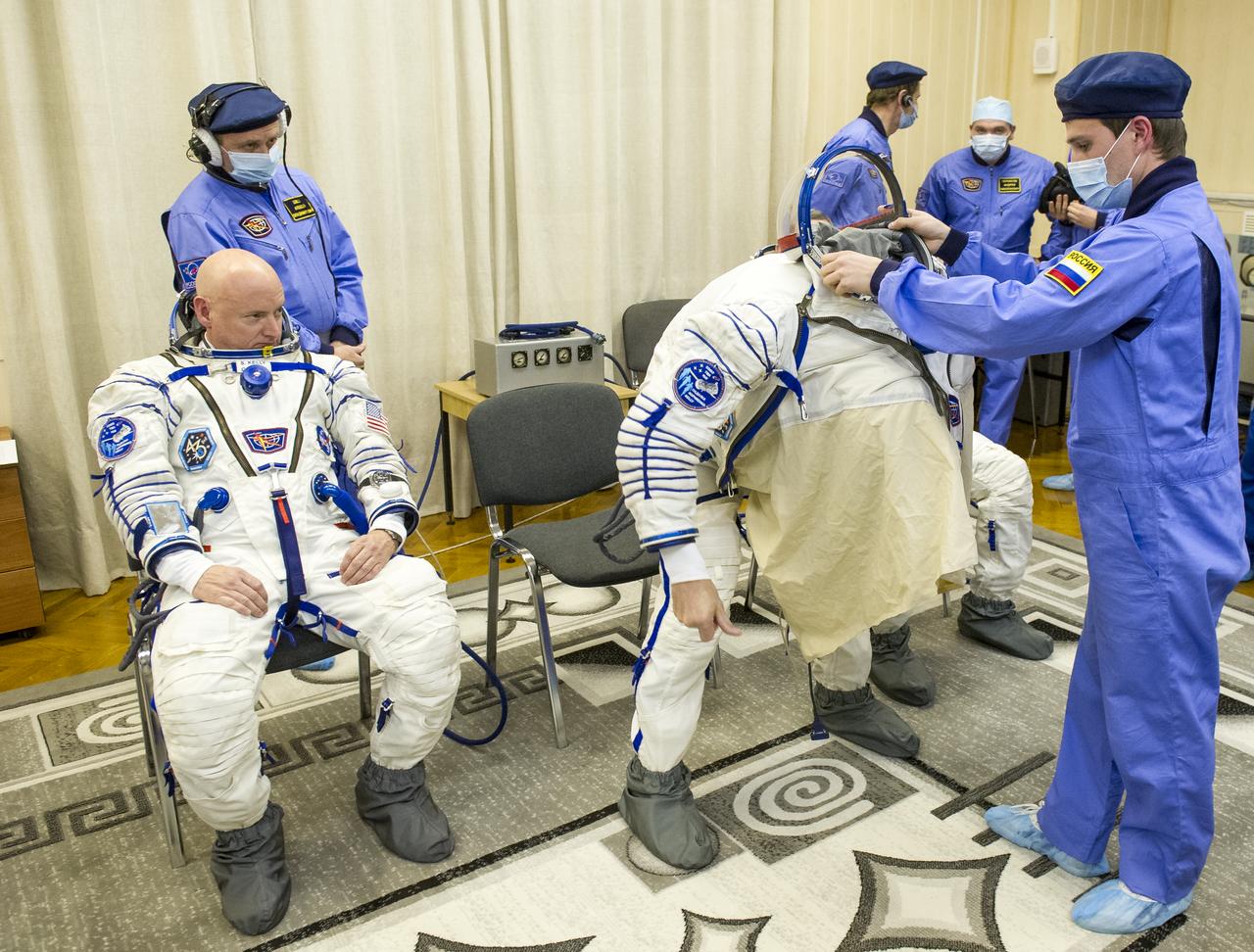
Expedition 43 NASA Astronaut Scott Kelly, left, watches as Russian Cosmonaut Gennady Padalka of the Russian Federal Space Agency (Roscosmos) dons his Russian sokol suit ahead of their launch onboard the Soyuz TMA-16M spacecraft to the International Space Station with fellow crew mate, Russian Cosmonaut Mikhail Kornienko Friday, March 27, 2015 in Baikonor, Kazakhstan. As the one-year crew, Kelly and Kornienko will return to Earth on Soyuz TMA-18M in March 2016. Photo Credit: (NASA/GCTC/Andrey Shelepin)
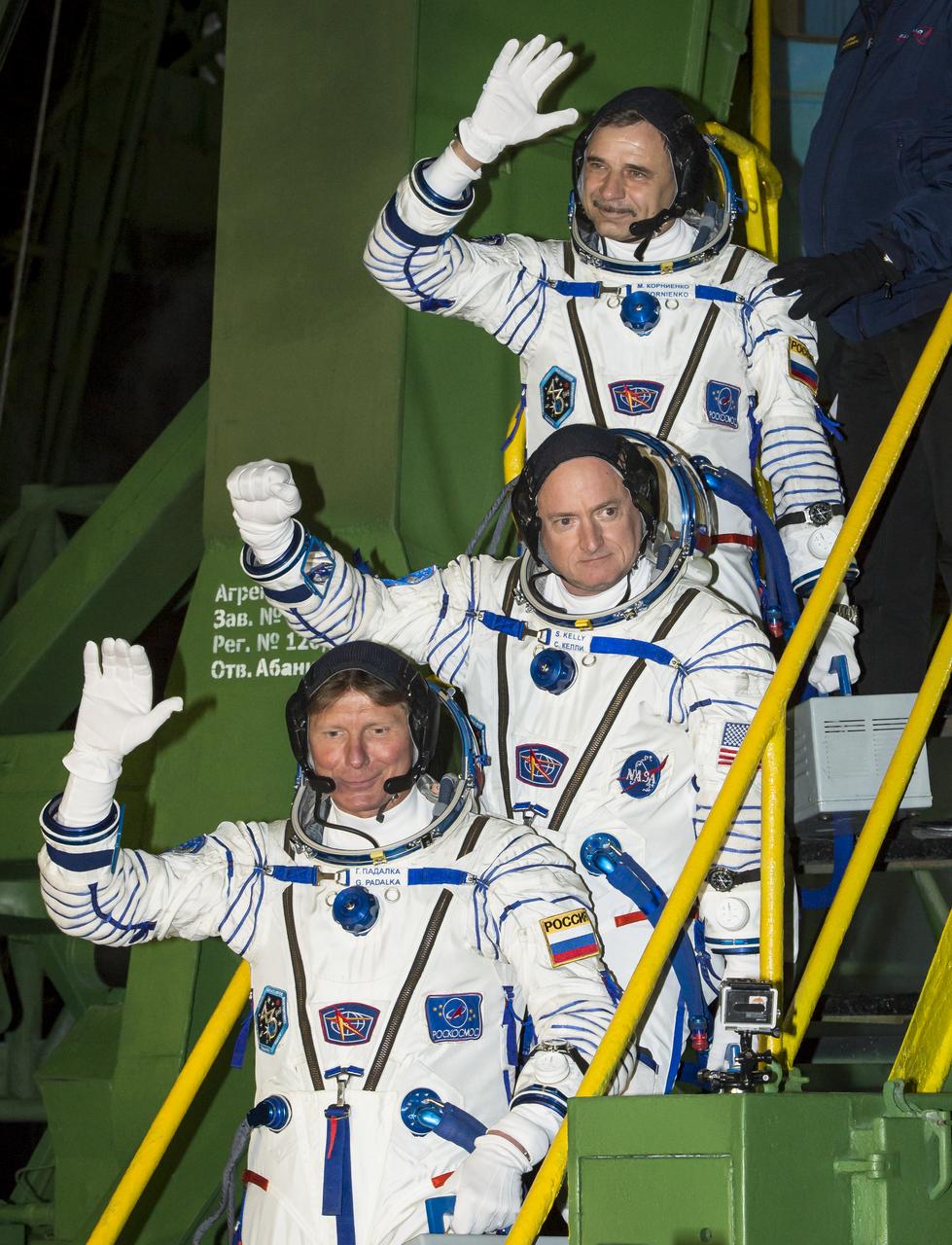
Expedition 43 Russian Cosmonaut Mikhail Kornienko of the Russian Federal Space Agency (Roscosmos), top, NASA Astronaut Scott Kelly, center, and Russian Cosmonaut Gennady Padalka of Roscosmos wave farewell as they board the Soyuz TMA-16M spacecraft ahead of their launch to the International Space Station, Friday, March 27, 2015 in Baikonor, Kazakhstan. As the one-year crew, Kelly and Kornienko will return to Earth on Soyuz TMA-18M in March 2016. Photo Credit (NASA/Bill Ingalls)
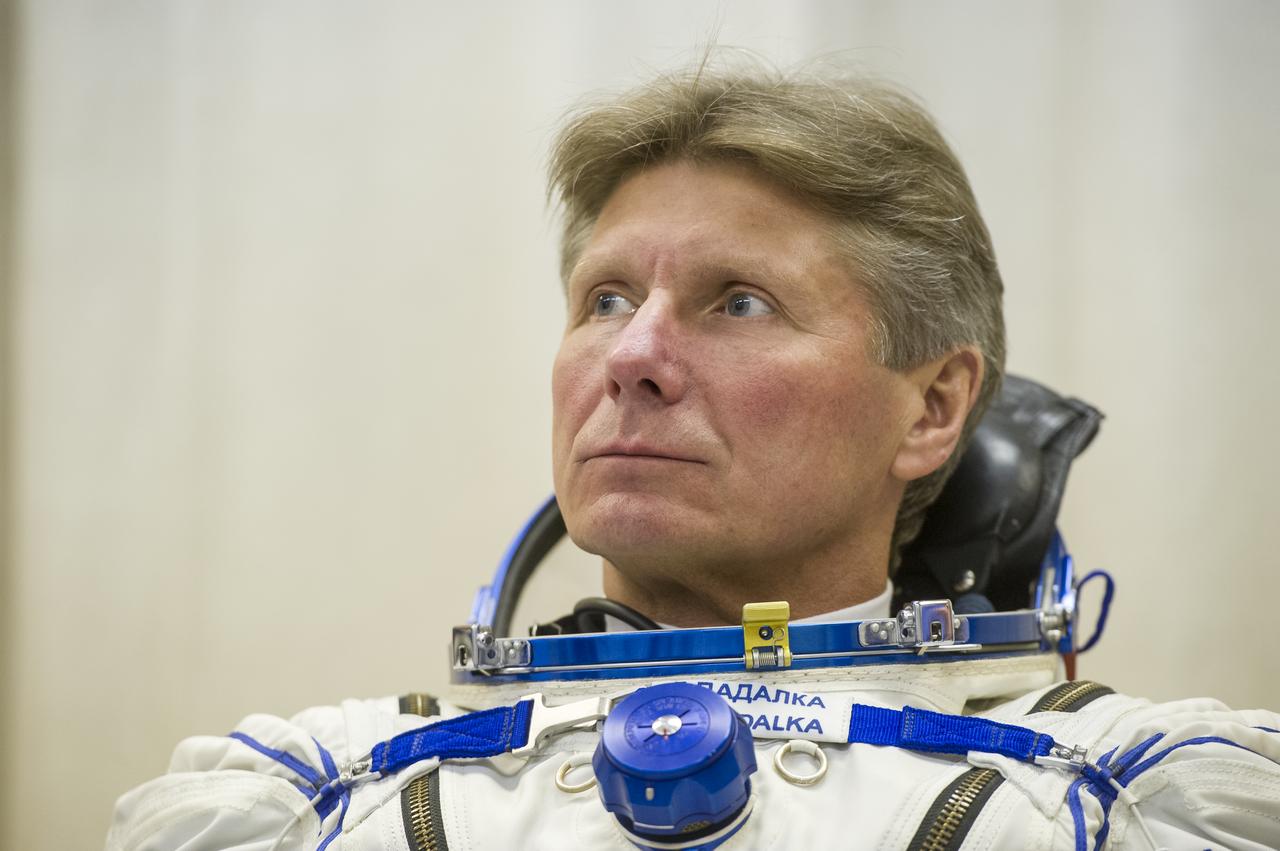
Expedition 43 Russian Cosmonaut Gennady Padalka of the Russian Federal Space Agency (Roscosmos) dons his Russian sokol suit ahead of his launch onboard the Soyuz TMA-16M spacecraft to the International Space Station with fellow crew mates, NASA Astronaut Scott Kelly, and Russian Cosmonaut Mikhail Kornienko Friday, March 27, 2015 in Baikonor, Kazakhstan. As the one-year crew, Kelly and Kornienko will return to Earth on Soyuz TMA-18M in March 2016. Photo Credit: (NASA/GCTC/Andrey Shelepin)
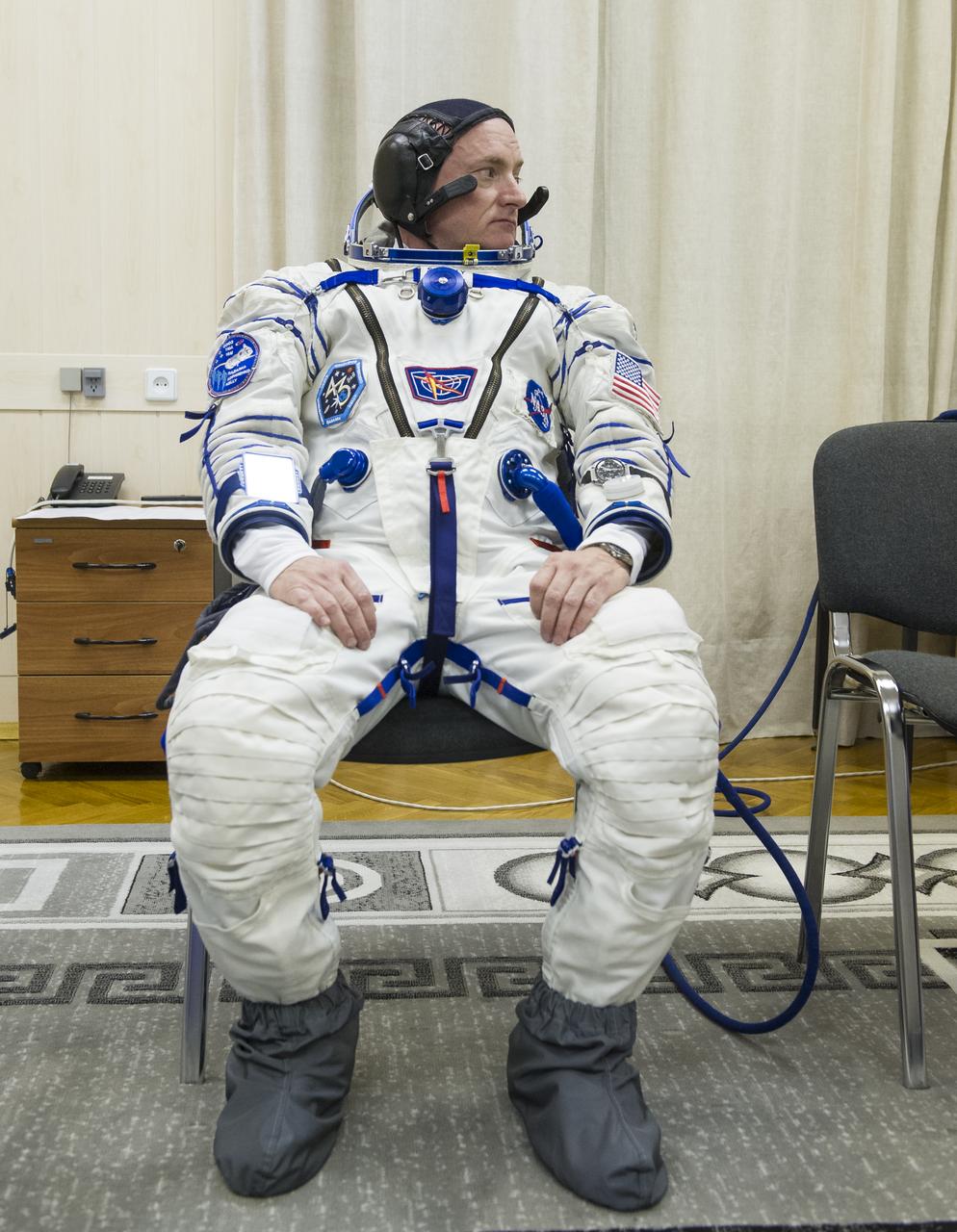
Expedition 43 NASA Astronaut Scott Kelly dons his Russian sokol suit ahead of his launch onboard the Soyuz TMA-16M spacecraft to the International Space Station with fellow crew mates, Russian Cosmonauts Gennady Padalka, and Mikhail Kornienko of the Russian Federal Space Agency (Roscosmos) Friday, March 27, 2015 in Baikonor, Kazakhstan. As the one-year crew, Kelly and Kornienko will return to Earth on Soyuz TMA-18M in March 2016. Photo Credit: (NASA/GCTC/Andrey Shelepin)
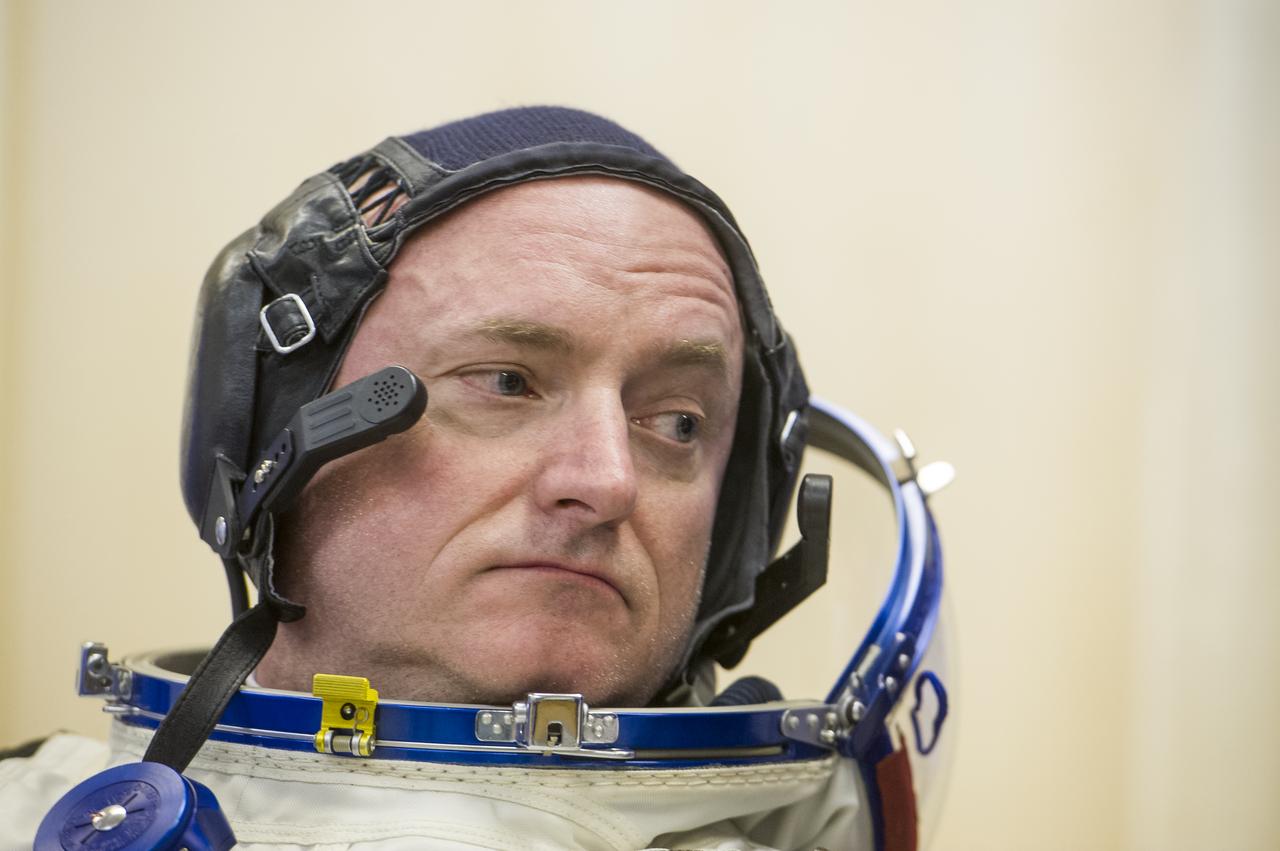
Expedition 43 NASA Astronaut Scott Kelly dons his Russian sokol suit ahead of his launch onboard the Soyuz TMA-16M spacecraft to the International Space Station with fellow crew mates, Russian Cosmonauts Gennady Padalka, and Mikhail Kornienko of the Russian Federal Space Agency (Roscosmos) Friday, March 27, 2015 in Baikonor, Kazakhstan. As the one-year crew, Kelly and Kornienko will return to Earth on Soyuz TMA-18M in March 2016. Photo Credit: (NASA/GCTC/Andrey Shelepin)

STS-102 mission astronauts James S. Voss and James D. Weatherbee share a congratulatory handshake as the Space Shuttle Orbiter Discovery successfully docks with the International Space Station (ISS). Photographed from left to right are: Astronauts Susan J. Helms, mission specialist; James S. Voss, Expedition 2 crew member; James D. Weatherbee, mission commander; Andrew S.W. Thomas, mission specialist; and nearly out of frame is James M. Kelley, Pilot. Launched March 8, 2001, STS-102's primary cargo was the Leonardo, the Italian Space Agency-built Multipurpose Logistics Module (MPLM). The Leonardo MPLM is the first of three such pressurized modules that will serve as ISS' moving vans, carrying laboratory racks filled with equipment, experiments, and supplies to and from the Station aboard the Space Shuttle. The cylindrical module is approximately 21-feet long and 15- feet in diameter, weighing almost 4.5 tons. It can carry up to 10 tons of cargo in 16 standard Space Station equipment racks. Of the 16 racks the module can carry, 5 can be furnished with power, data, and fluid to support refrigerators or freezers. In order to function as an attached station module as well as a cargo transport, the logistics module also includes components that provide life support, fire detection and suppression, electrical distribution, and computer functions. NASA's 103rd overall mission and the 8th Space Station Assembly Flight, STS-102 mission also served as a crew rotation flight. It delivered the Expedition Two crew to the Station and returned the Expedition One crew back to Earth.
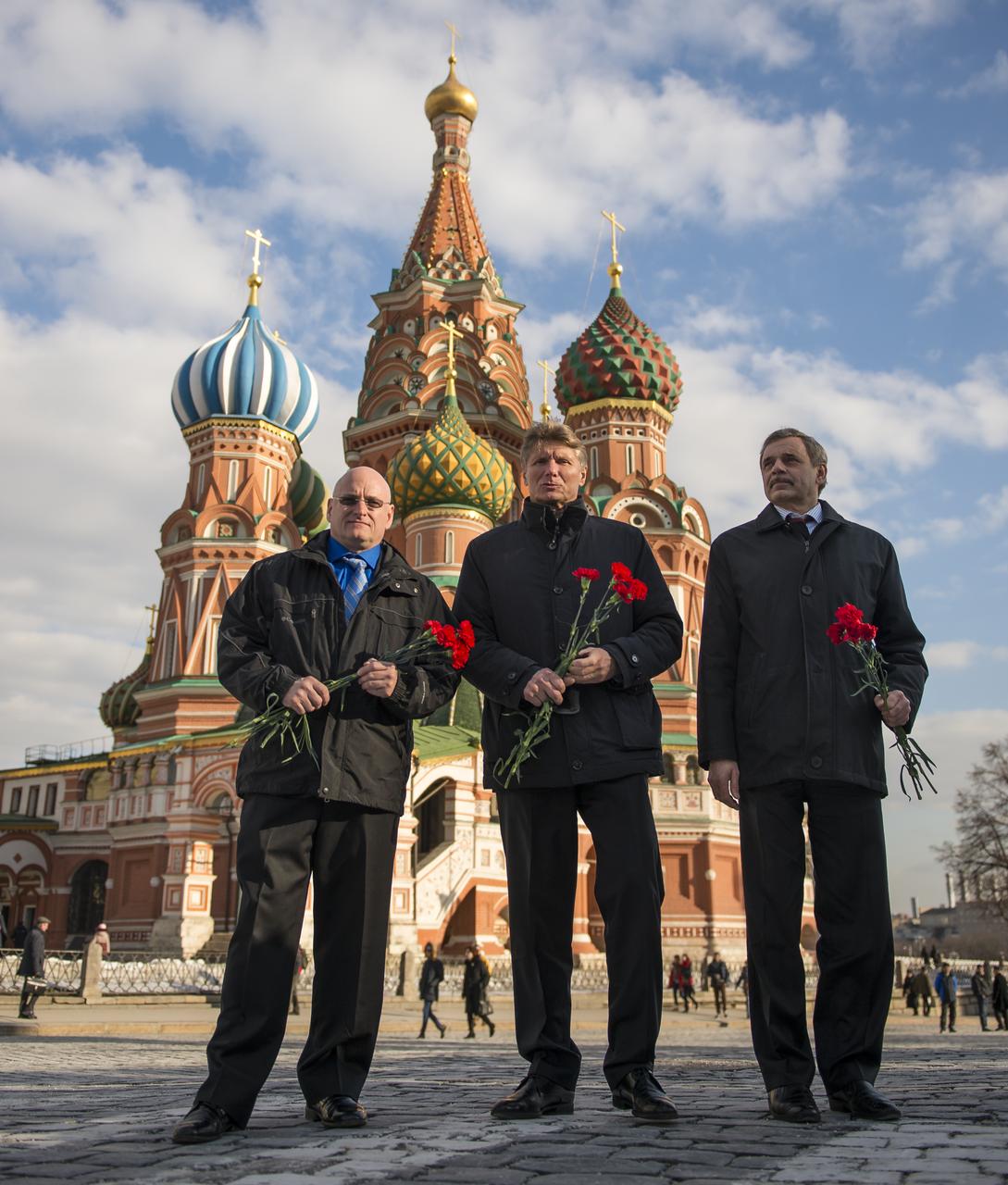
Expedition 43 NASA Astronaut Scott Kelly, left, Russian cosmonaut Gennady Padalka of the Russian Federal Space Agency (Roscosmos), center, and Russian cosmonaut Mikhail Kornienko of Roscosmos pose for a photograph in front of St. Basil's Cathedral in Moscow as part of traditional pre-launch ceremonies, Friday, March 6, 2015. The trio is preparing for launch to the International Space Station in their Soyuz TMA-16M spacecraft from the Baikonur Cosmodrome in Kazakhstan March 28, Kazakh time. As the one-year crew, Kelly and Kornienko will return to Earth on Soyuz TMA-18M in March 2016. Photo Credit: (NASA/Bill Ingalls)
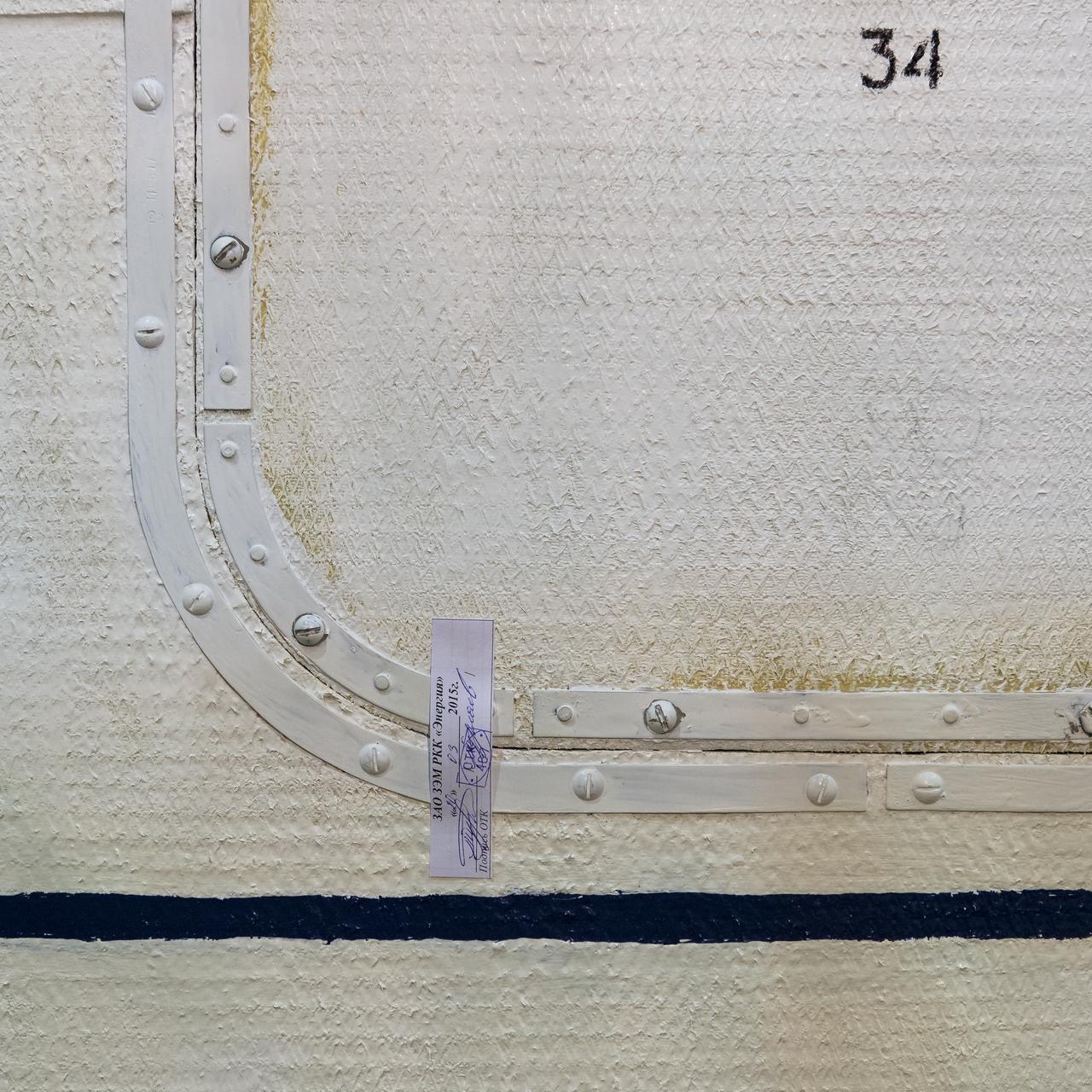
A Soyuz TMA-16M spacecraft access panel and inspection sticker is seen on the fairing during the final check of the spacecraft with Expedition 43 NASA Astronaut Scott Kelly, Russian Cosmonauts Mikhail Kornienko, and Gennady Padalka of the Russian Federal Space Agency (Roscosmos) inside, Monday, March 23, 2015 at the Baikonur Cosmodrome in Kazakhstan. Kelly, Kornienko, and Padalka are scheduled to launch to the International Space Station in the Soyuz TMA-16M spacecraft from the Baikonur Cosmodrome in Kazakhstan March 28, Kazakh time (March 27 Eastern time.) As the one-year crew, Kelly and Kornienko will return to Earth on Soyuz TMA-18M in March 2016. Photo Credit: (NASA/Bill Ingalls)