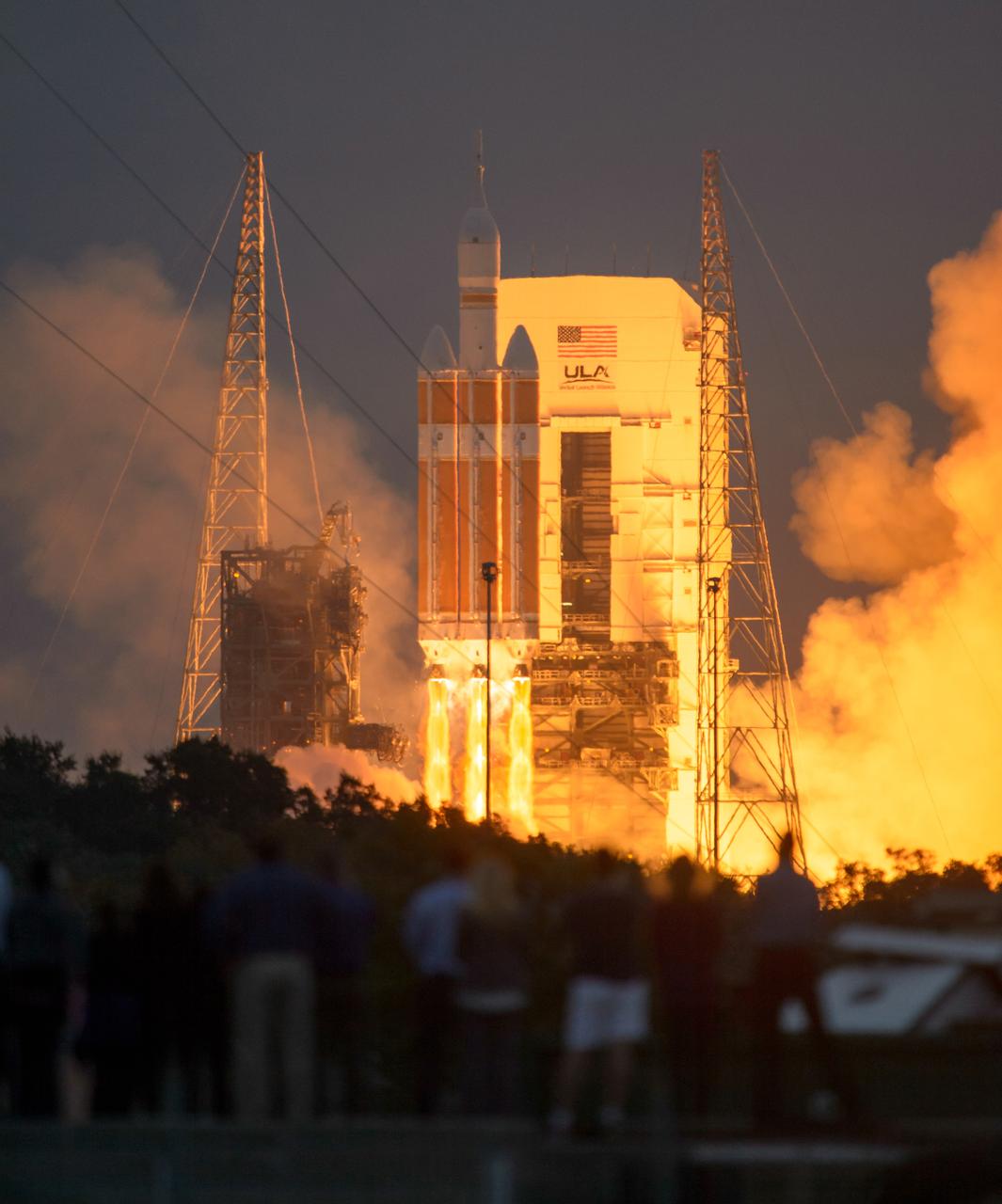
The United Launch Alliance Delta IV Heavy rocket with NASA’s Orion spacecraft mounted atop, lifts off on Exploration Flight Test-1 (EFT-1) from Cape Canaveral Air Force Station's Space Launch Complex 37 at at 7:05 a.m. EST, Friday, Dec. 5, 2014, in Florida. Part of Batch image transfer from Flickr.
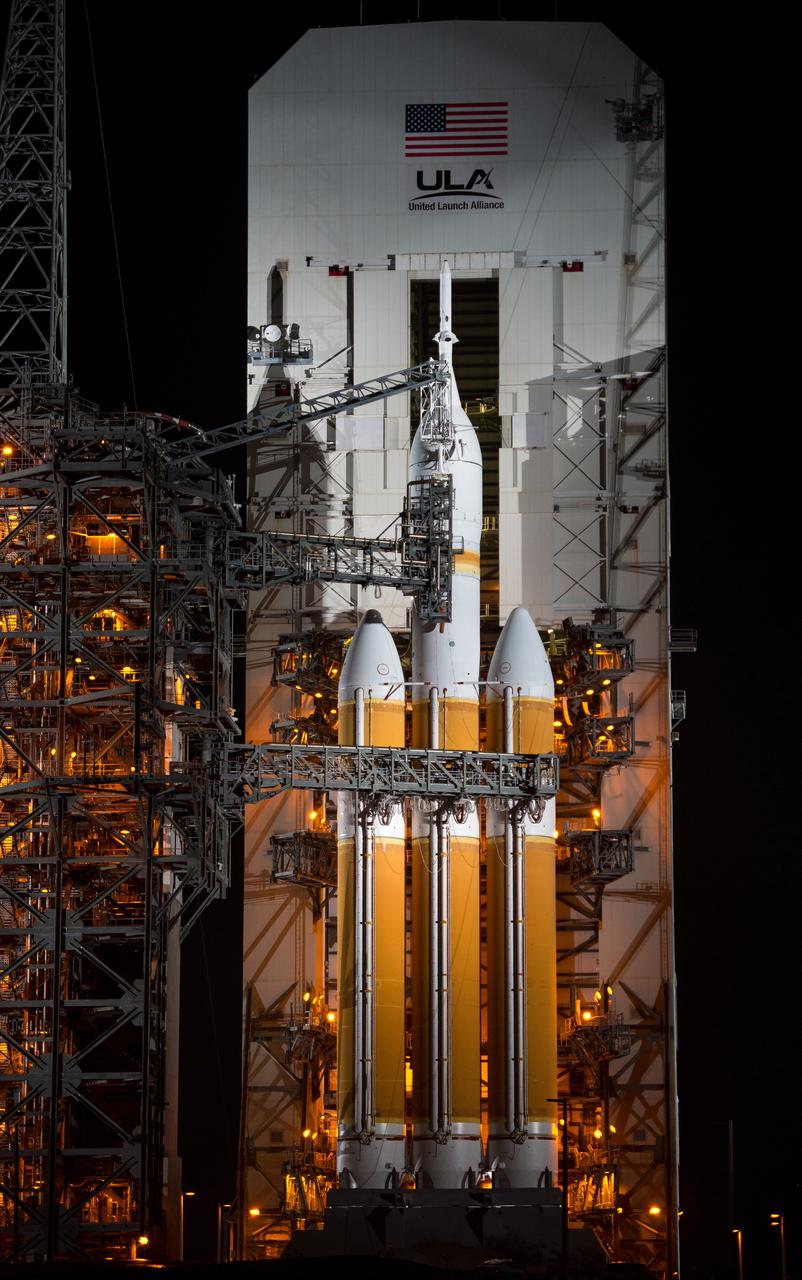
A United Launch Alliance Delta IV Heavy rocket with NASA’s Orion spacecraft mounted atop is seen as the Mobile Service Tower is rolled back on Dec. 3, 2014, at Cape Canaveral Air Force Station's Space Launch Complex 37, Florida. Orion is scheduled to make its first flight test on Exploration Flight Test-1 (EFT-1) on Dec. 4 with a morning launch atop the Delta IV Heavy. Part of Batch image transfer from Flickr.

A United Launch Alliance Delta IV Heavy rocket with NASA’s Orion spacecraft mounted atop for Exploration Flight Test-1 (EFT-1) is seen illuminated in the distance in this long exposure photograph taken early on Dec. 4, 2014, at Cape Canaveral Air Force Station's Space Launch Complex 37, Florida. Part of Batch image transfer from Flickr.
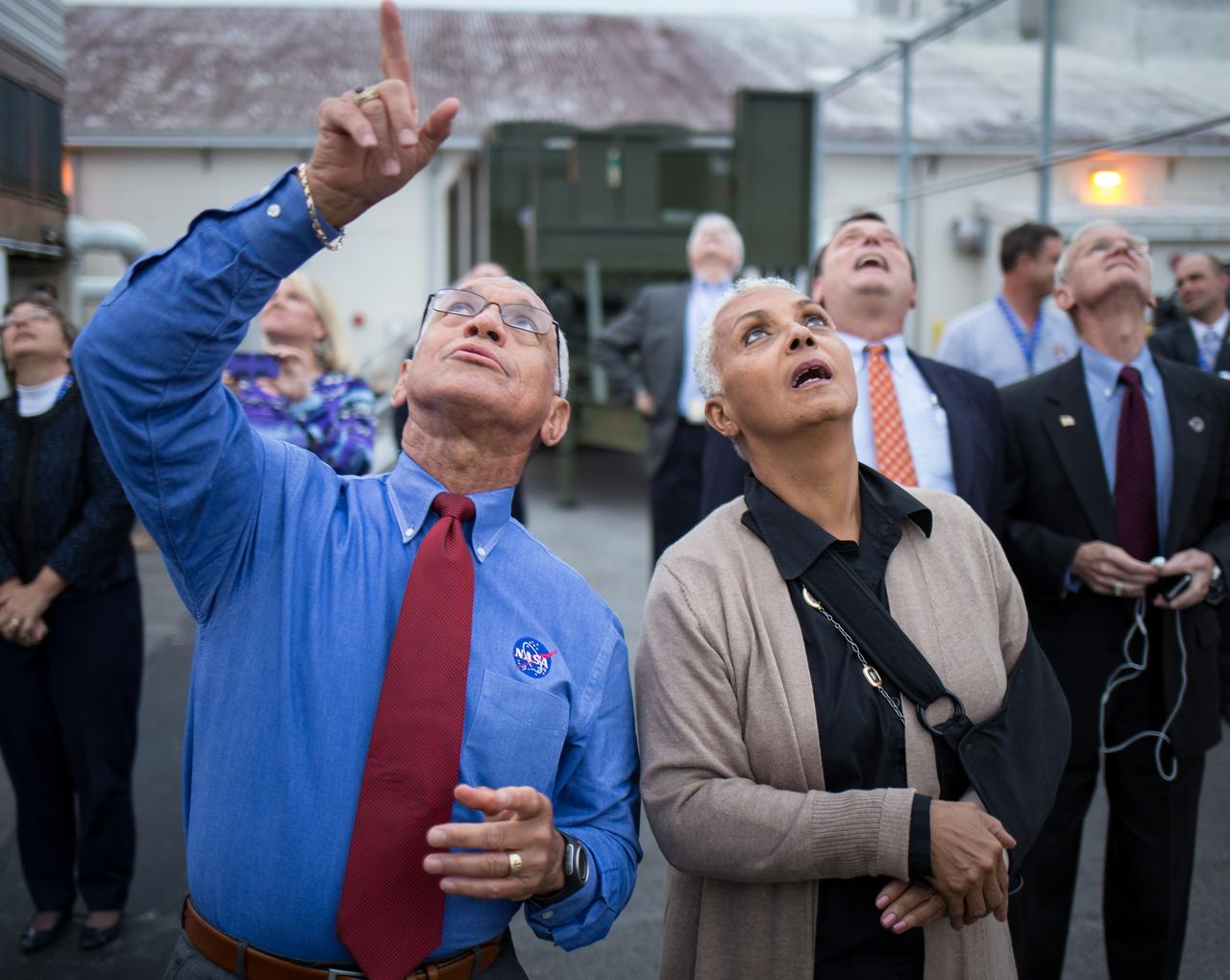
NASA Administrator Charles Bolden and his wife Jackie Bolden watch as the United Launch Alliance Delta IV Heavy rocket, with NASA’s Orion spacecraft mounted atop, lifts off on Exploration Flight Test-1 (EFT-1) from Cape Canaveral Air Force Station's Space Launch Complex 37 at at 7:05 a.m. EST, Friday, Dec. 5, 2014, Cape Canaveral, Florida. Part of Batch image transfer from Flickr.
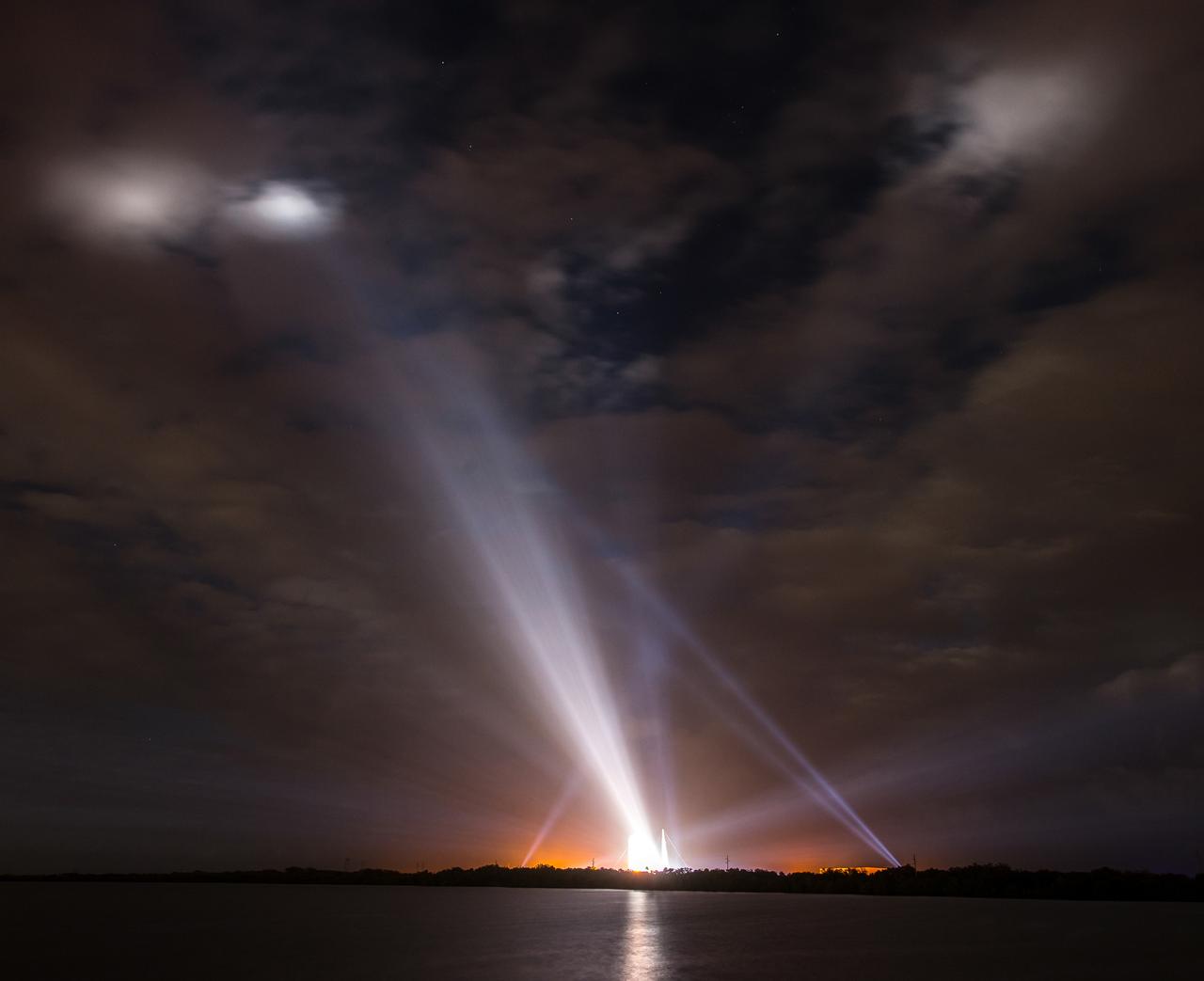
Bright lights illuminate the United Launch Alliance Delta IV Heavy rocket with NASA’s Orion spacecraft mounted atop for Exploration Flight Test-1 (EFT-1), early on Friday, Dec. 5, 2014, at Cape Canaveral Air Force Station's Space Launch Complex 37, Florida. Part of Batch image transfer from Flickr.
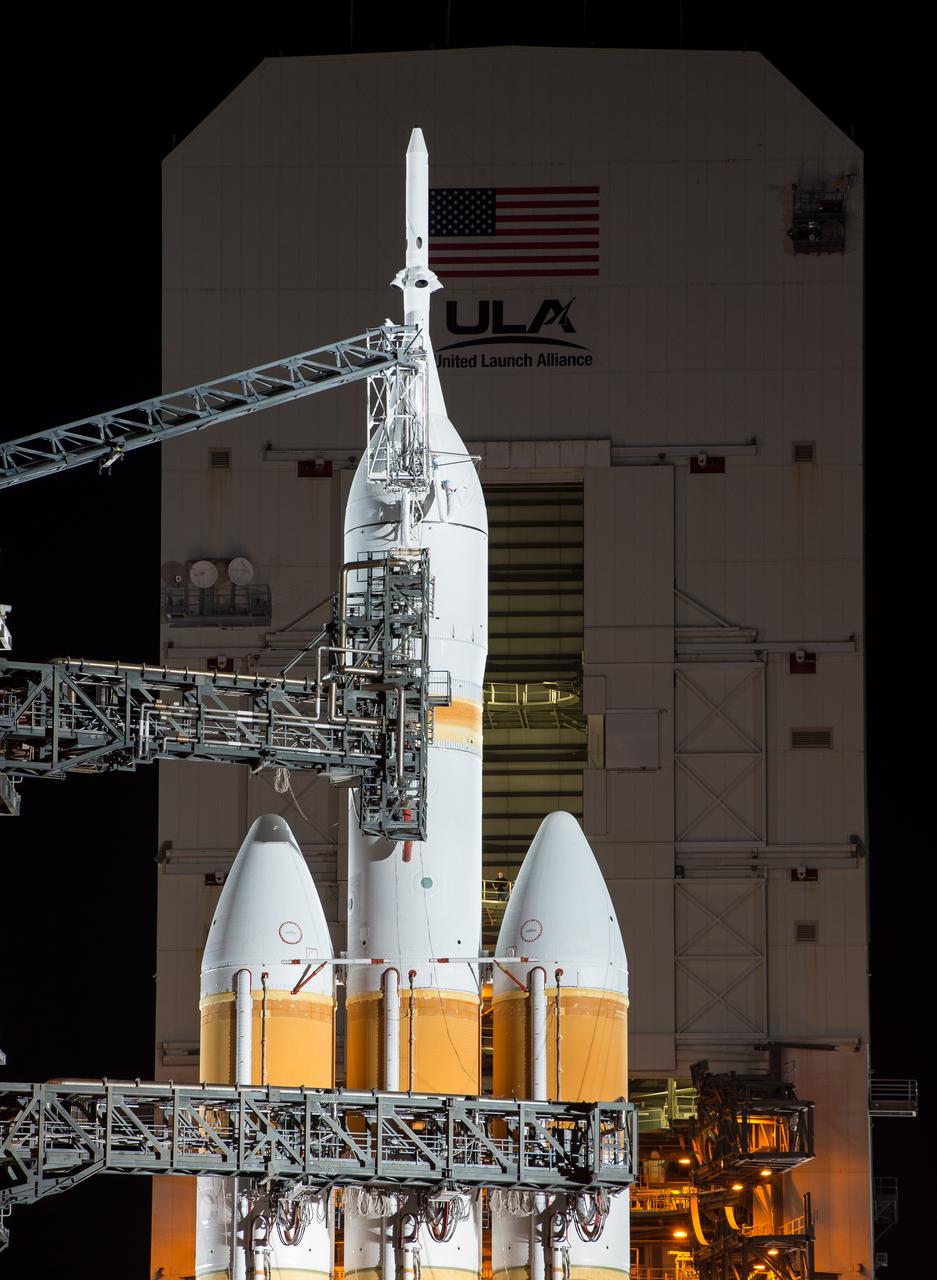
A United Launch Alliance Delta IV Heavy rocket with NASA’s Orion spacecraft mounted atop for Exploration Flight Test-1 (EFT-1) is seen after the Mobile Service Tower was finished rolling back early on Dec. 4, 2014, at Cape Canaveral Air Force Station's Space Launch Complex 37, Florida. Part of Batch image transfer from Flickr.
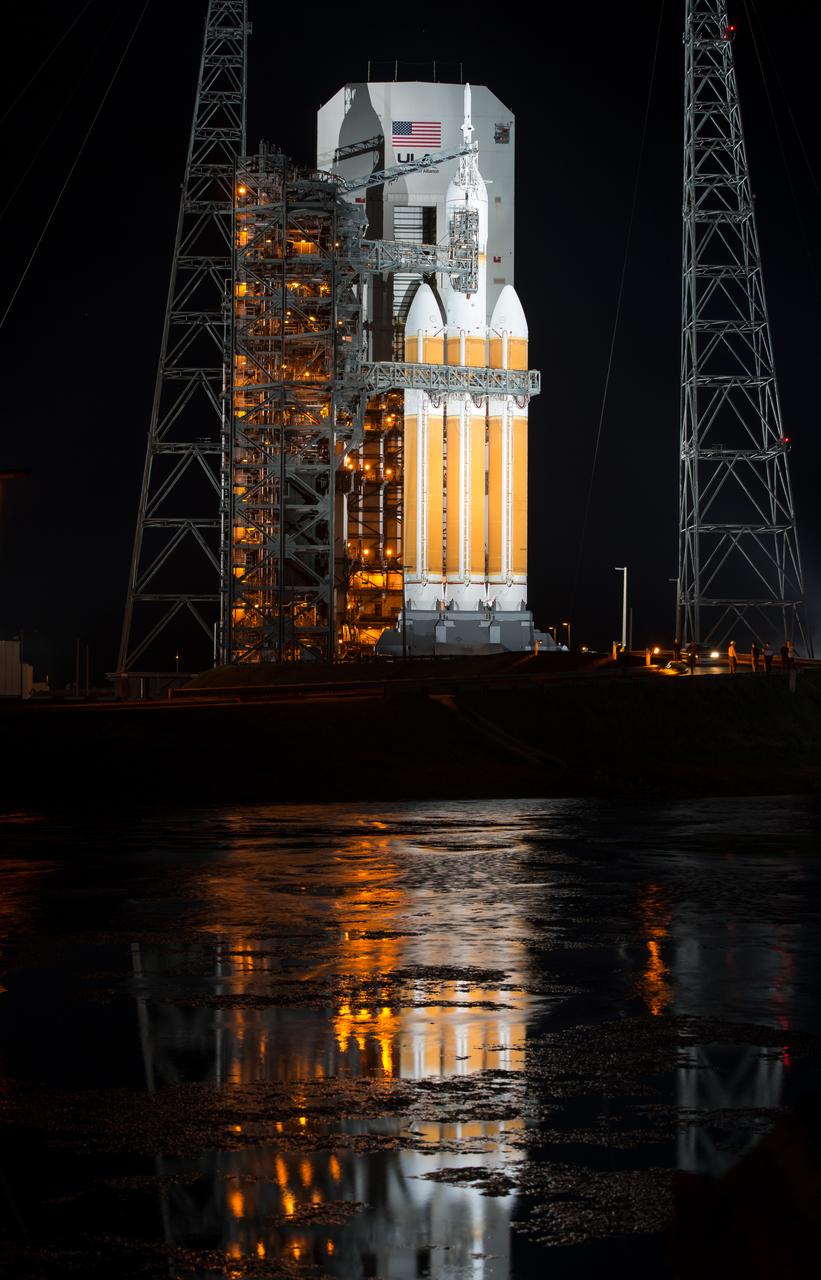
A United Launch Alliance Delta IV Heavy rocket with NASA’s Orion spacecraft mounted atop for Exploration Flight Test-1 (EFT-1) is seen after the Mobile Service Tower was finished rolling back early on Dec. 4, 2014, at Cape Canaveral Air Force Station's Space Launch Complex 37, Florida. Part of Batch image transfer from Flickr.
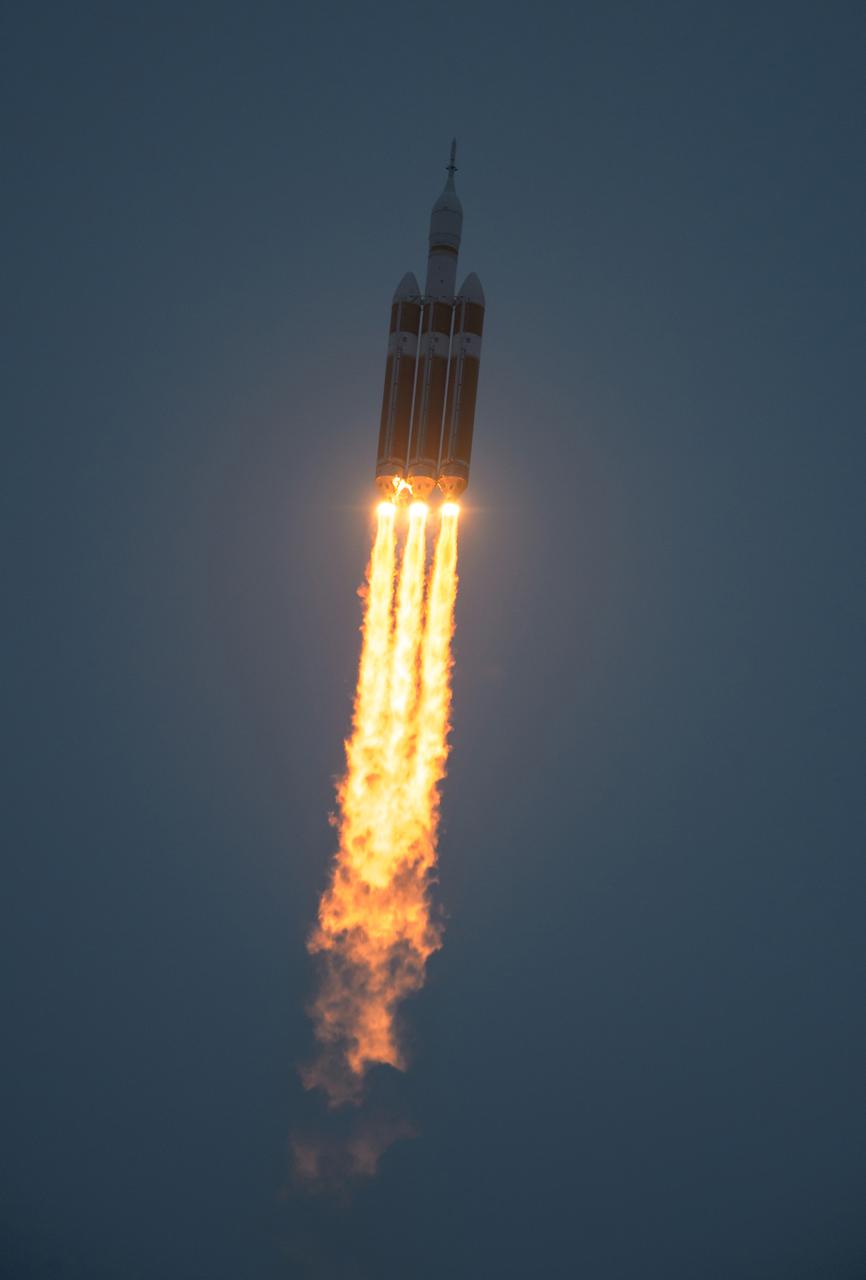
The United Launch Alliance Delta IV Heavy rocket with NASA’s Orion spacecraft mounted atop, lifts off on Exploration Flight Test-1 (EFT-1) from Cape Canaveral Air Force Station's Space Launch Complex 37 at at 7:05 a.m. EST, Friday, Dec. 5, 2014, in Florida. Part of Batch image transfer from Flickr.
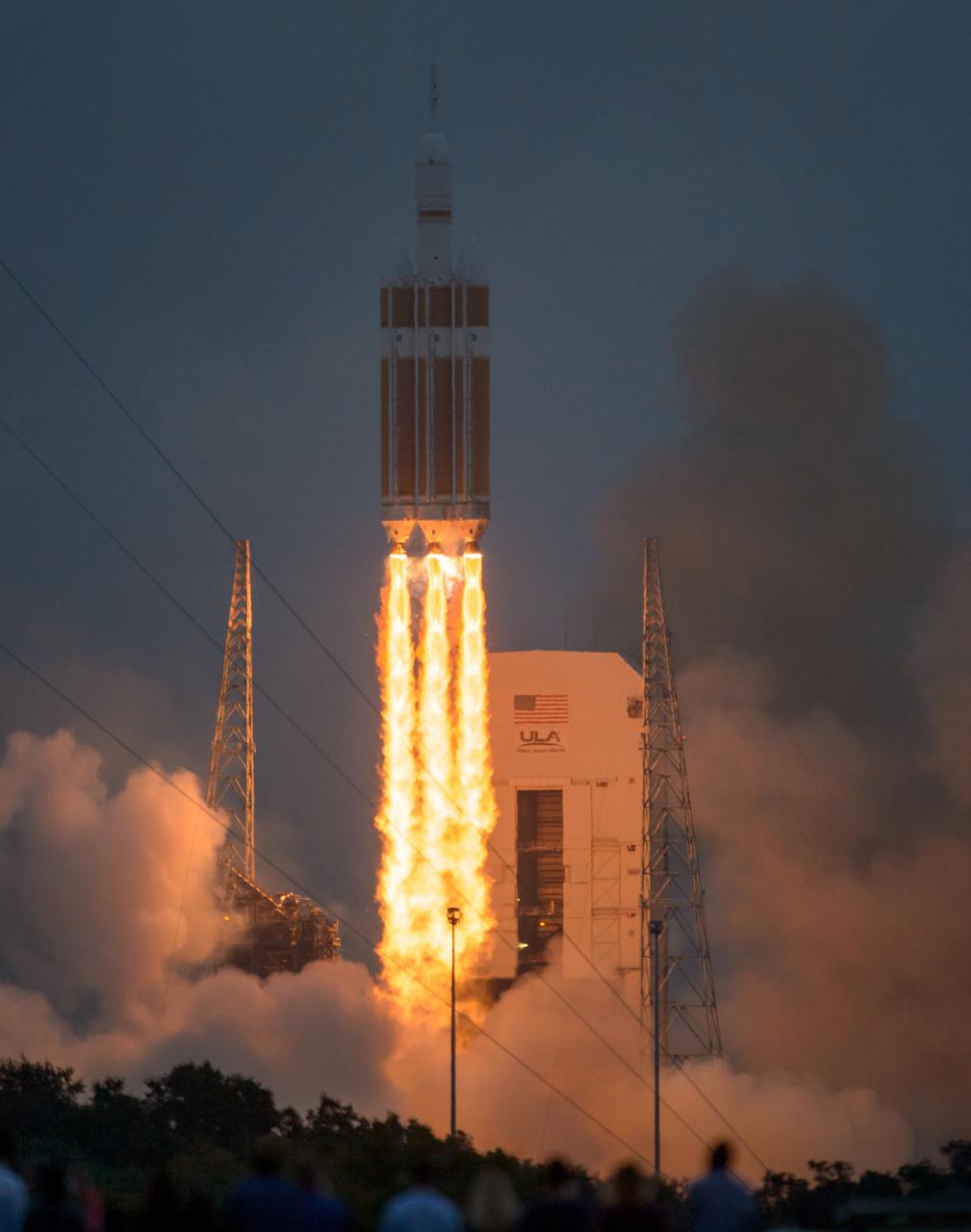
The United Launch Alliance Delta IV Heavy rocket with NASA’s Orion spacecraft mounted atop, lifts off on Exploration Flight Test-1 (EFT-1) from Cape Canaveral Air Force Station's Space Launch Complex 37 at at 7:05 a.m. EST, Friday, Dec. 5, 2014, in Florida. Part of Batch image transfer from Flickr.
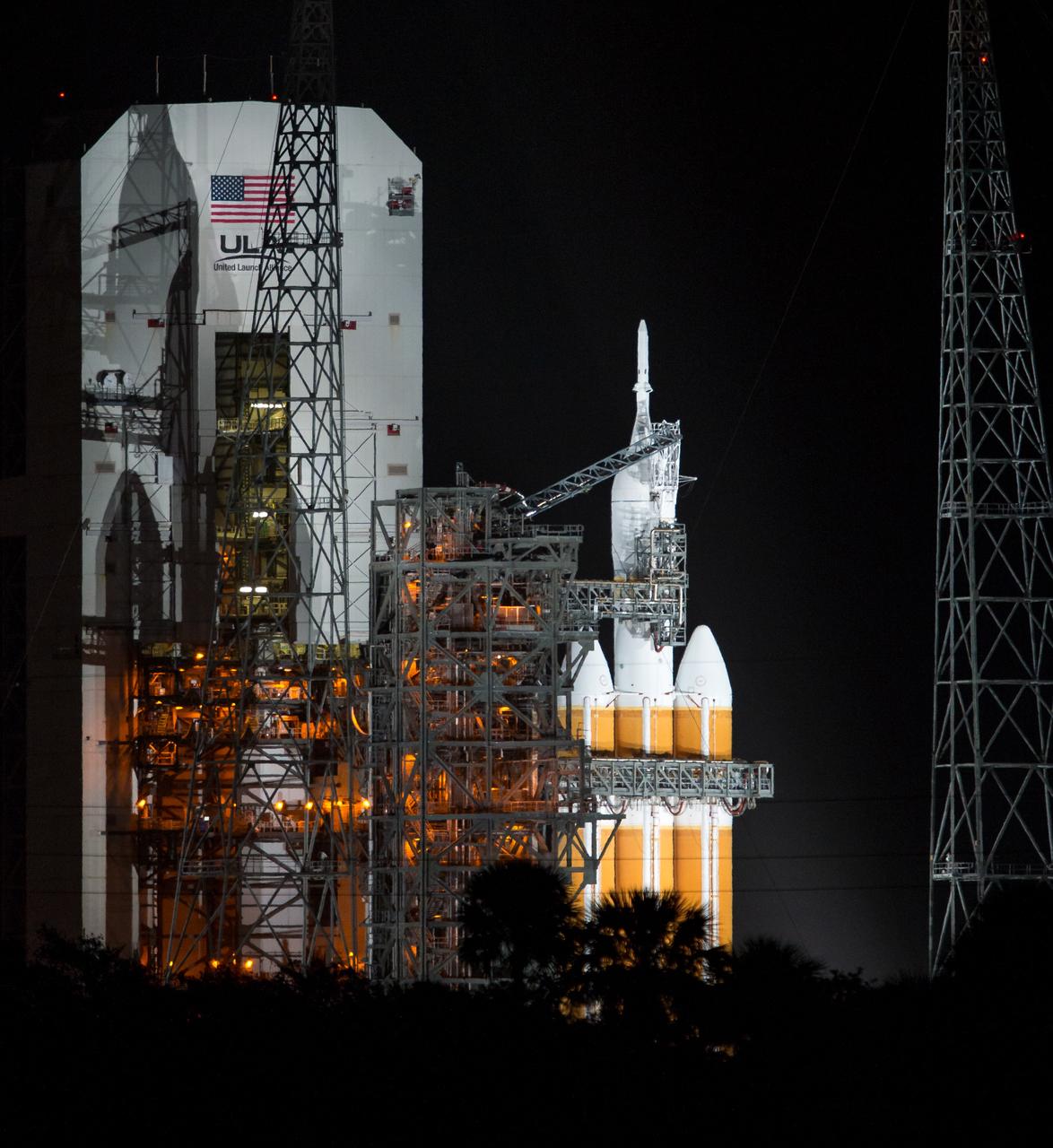
The United Launch Alliance Delta IV Heavy rocket with NASA’s Orion spacecraft mounted atop for Exploration Flight Test-1 (EFT-1) is seen early on Friday, Dec. 5, 2014, at Cape Canaveral Air Force Station's Space Launch Complex 37, Florida. Part of Batch image transfer from Flickr.
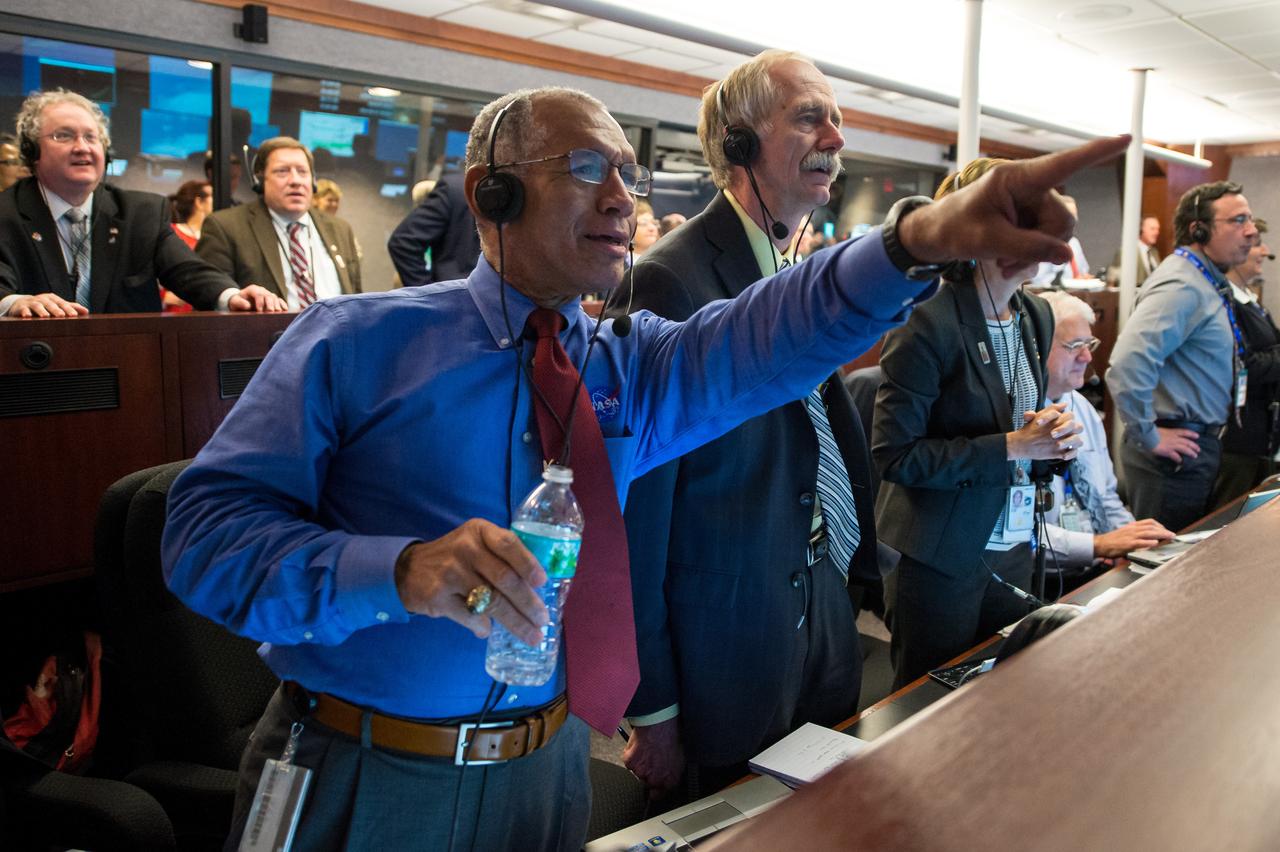
NASA Administrator Charles Bolden, left, NASA Associate Administrator for the Human Exploration and Operations Directorate William Gerstenmaier, and others in Building AE at Cape Canaveral Air Force Station, react as they watch the Orion spacecraft splash down in the Pacific Ocean a more than three hours after launching onboard a United Launch Alliance Delta IV Heavy rocket from Launch Complex 37, Friday, Dec. 5, 2014, Cape Canaveral, Florida. The Orion spacecraft orbited Earth twice, reaching an altitude of approximately 3,600 miles above Earth before landing. No one was aboard Orion for this flight test, but the spacecraft is designed to allow us to journey to destinations never before visited by humans, including an asteroid and Mars. Part of Batch image transfer from Flickr.
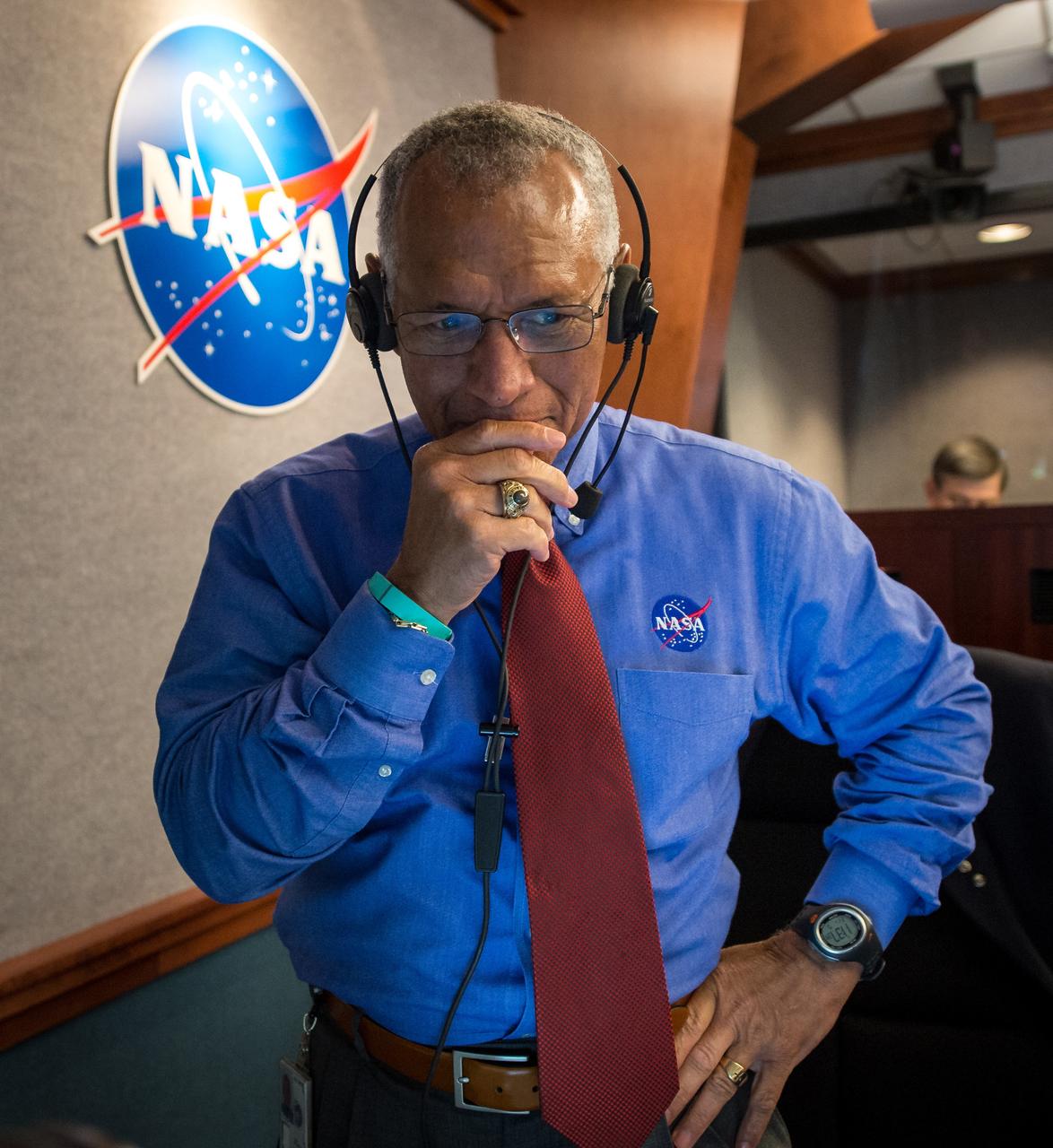
NASA Administrator Charles Bolden pauses for a moment in Building AE at Cape Canaveral Air Force Station after having watched and celebrated the Orion spacecraft splash down in the Pacific Ocean more than three hours after the spacecraft launched onboard a United Launch Alliance Delta IV Heavy rocket from Launch Complex 37, Friday, Dec. 5, 2014, Cape Canaveral, Florida. The Orion spacecraft orbited Earth twice, reaching an altitude of approximately 3,600 miles above Earth before landing. No one was aboard Orion for this flight test, but the spacecraft is designed to allow us to journey to destinations never before visited by humans, including an asteroid and Mars. Part of Batch image transfer from Flickr.
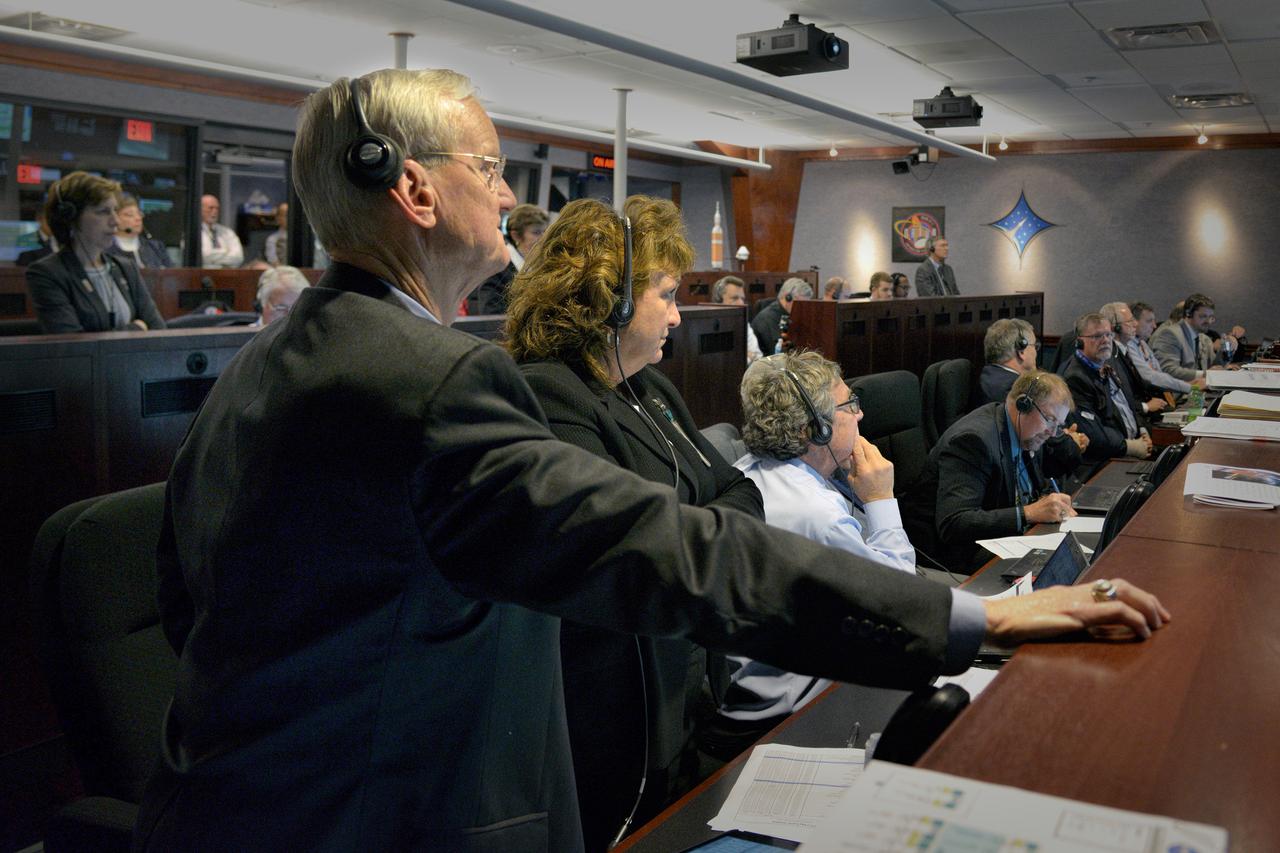
The Orion team watches the flight in Building AE at Cape Canaveral Air Force Station during Exploration Flight Test-1 (EFT-1) on Dec. 5, 2014. Part of Batch image transfer from Flickr.
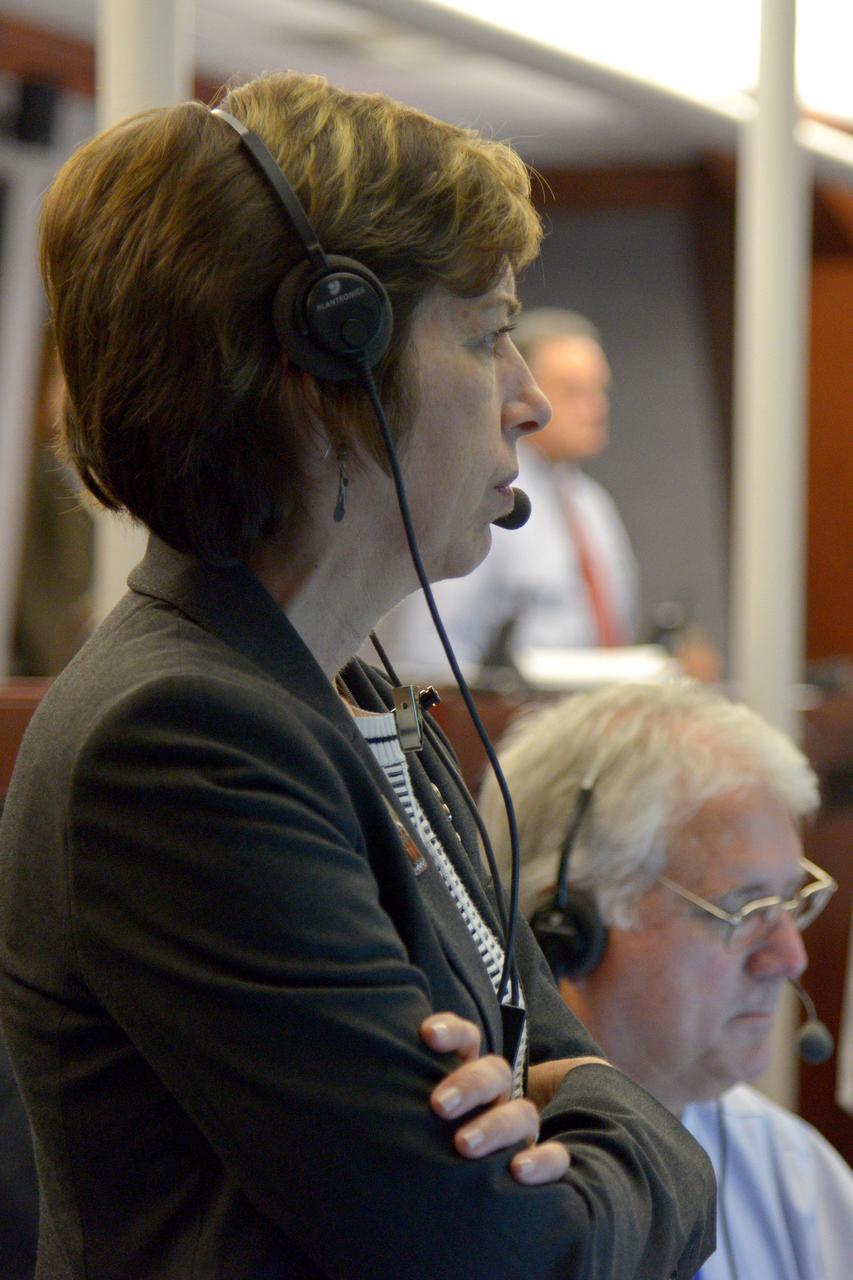
The Orion team watches the flight in Building AE at Cape Canaveral Air Force Station during Exploration Flight Test-1 (EFT-1) on Dec. 5, 2014. Part of Batch image transfer from Flickr.
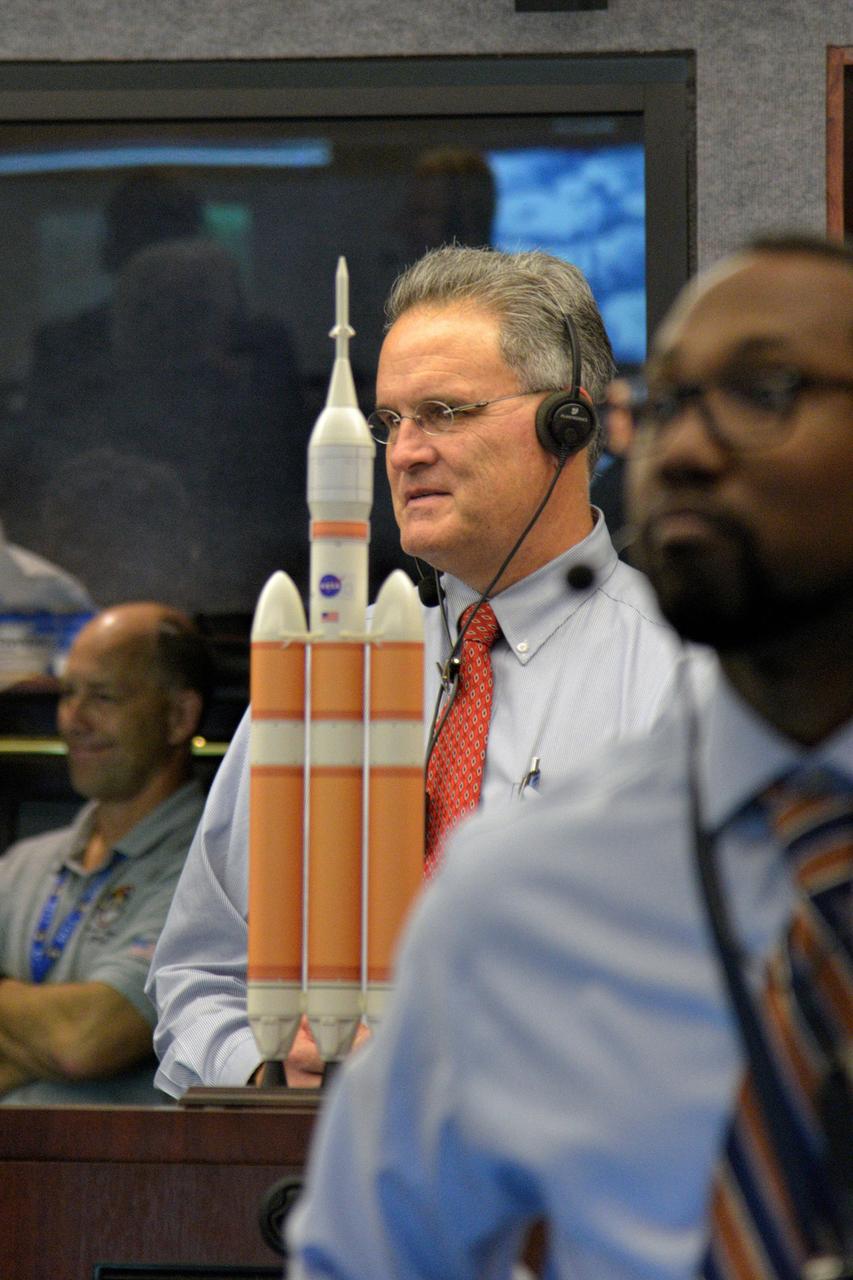
The Orion team watches the flight in Building AE at Cape Canaveral Air Force Station during Exploration Flight Test-1 (EFT-1) on Dec. 5, 2014. Part of Batch image transfer from Flickr.
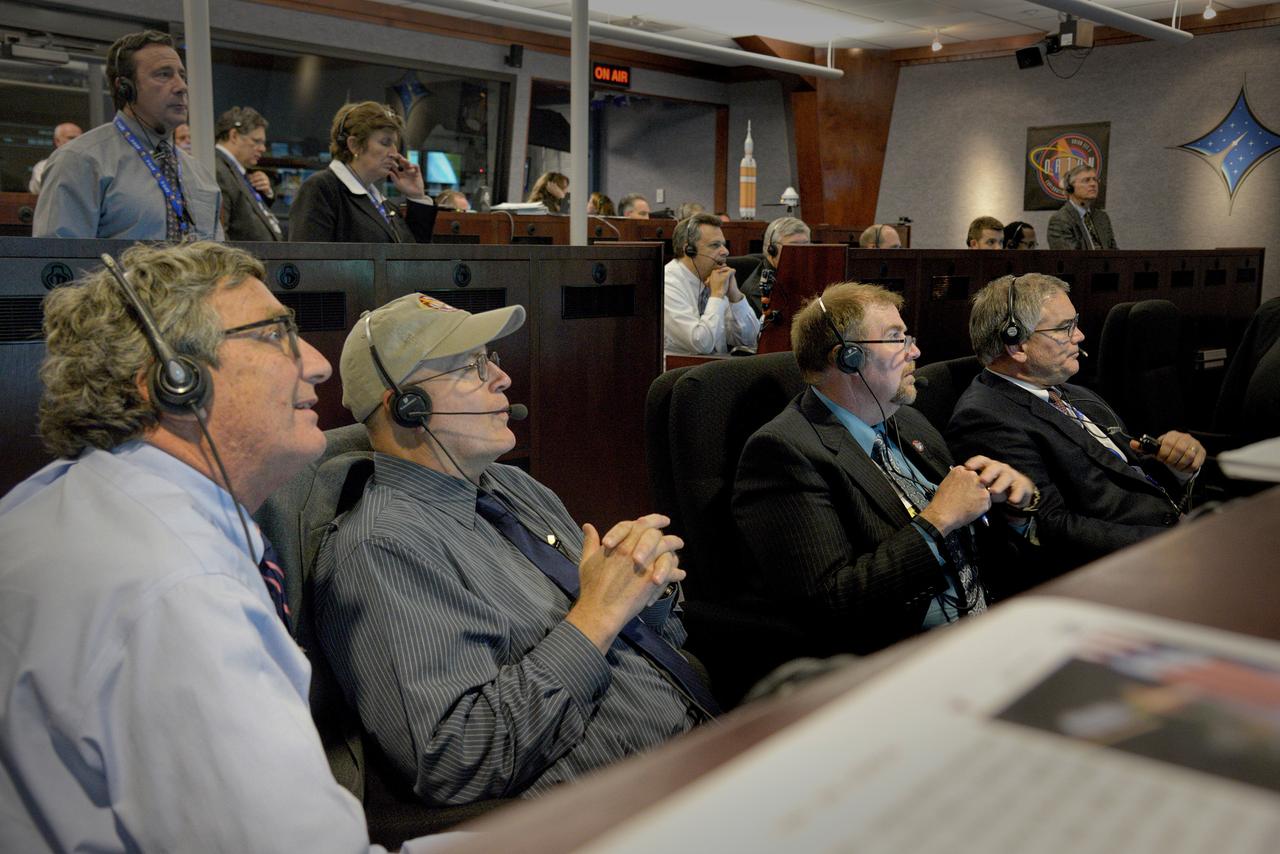
The Orion team watches the flight in Building AE at Cape Canaveral Air Force Station during Exploration Flight Test-1 (EFT-1) on Dec. 5, 2014. Part of Batch image transfer from Flickr.
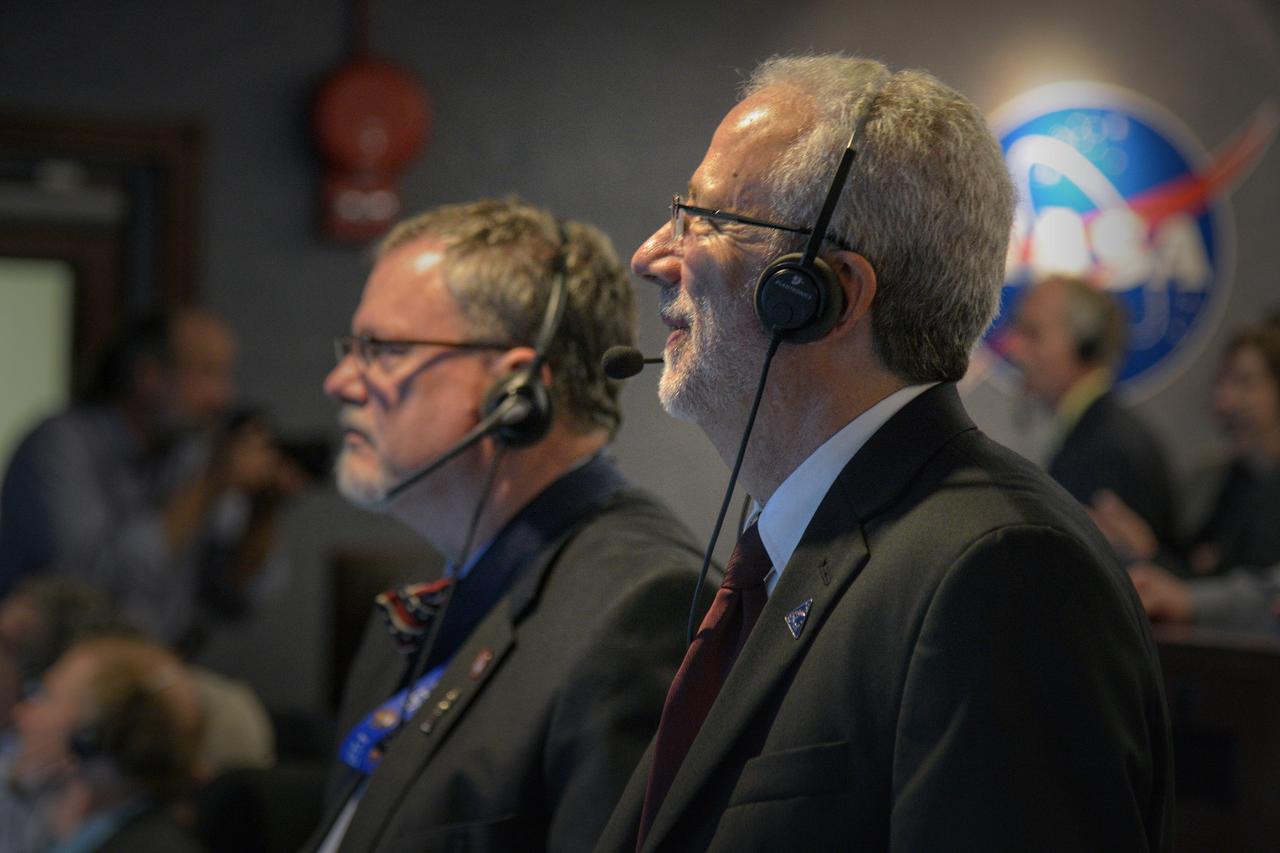
The Orion team watches the flight in Building AE at Cape Canaveral Air Force Station during Exploration Flight Test-1 (EFT-1) on Dec. 5, 2014. Part of Batch image transfer from Flickr.
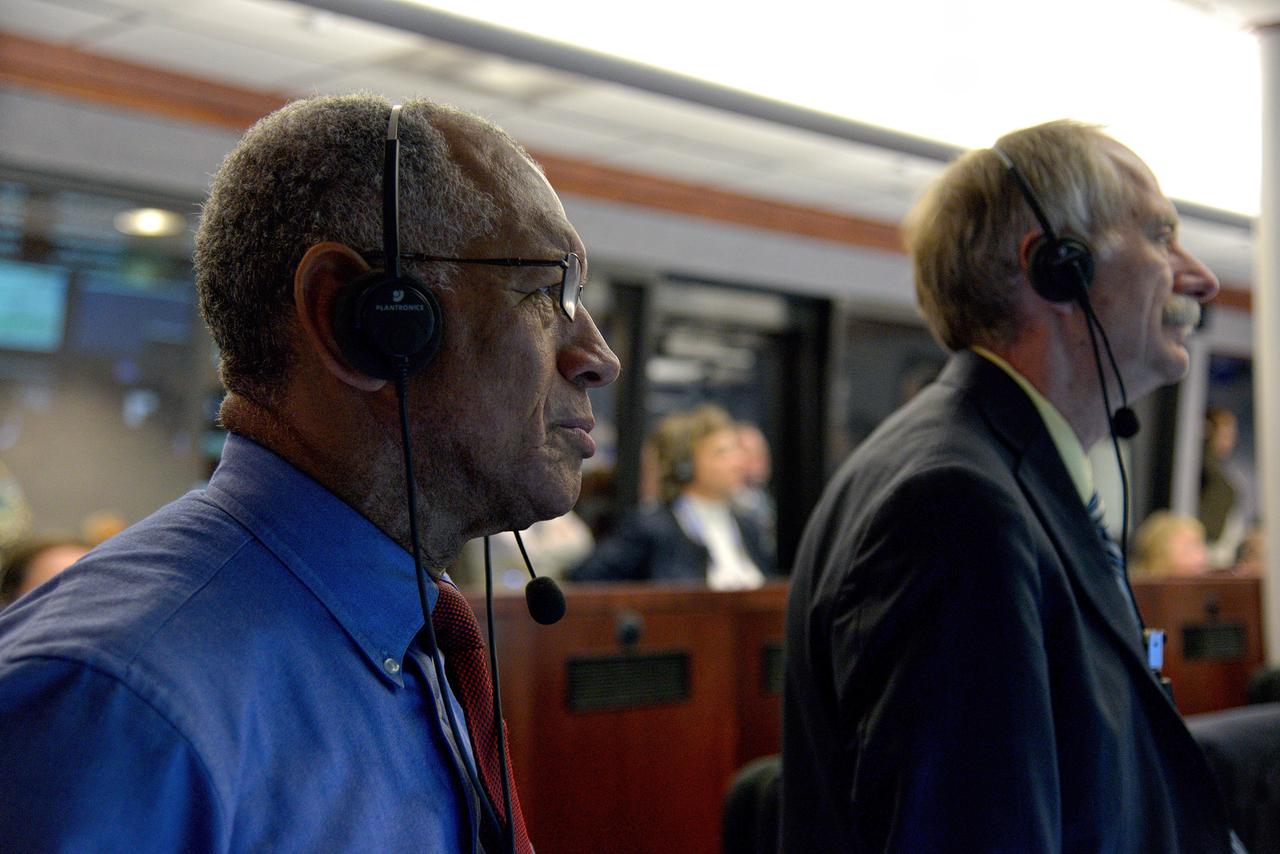
The Orion team watches the flight in Building AE at Cape Canaveral Air Force Station during Exploration Flight Test-1 (EFT-1) on Dec. 5, 2014. NASA Administrator Charles Bolden, left, NASA Associate Administrator for the Human Exploration and Operations Directorate William Gerstenmaier, are in frame. Part of Batch image transfer from Flickr.
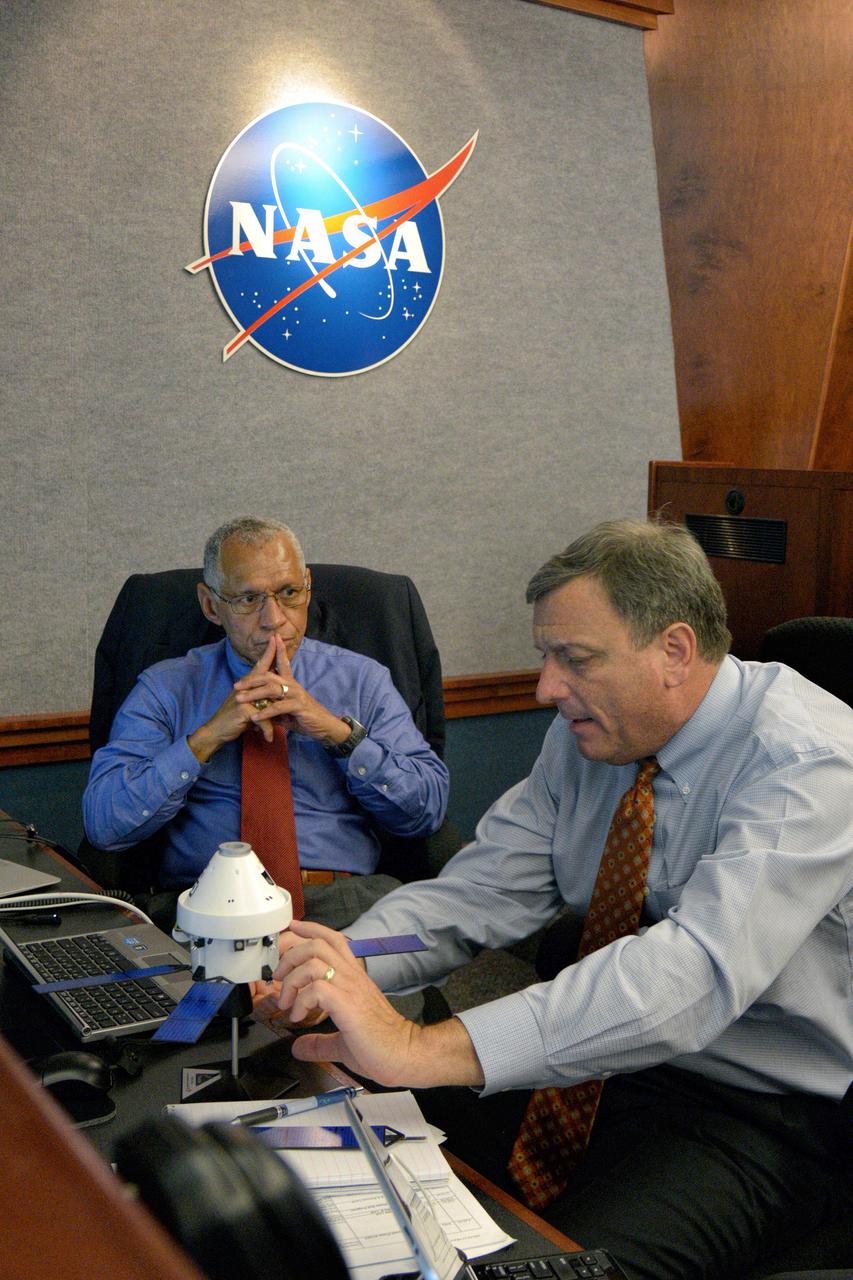
The Orion team discusses Orion operations in Building AE at Cape Canaveral Air Force Station during Exploration Flight Test-1 (EFT-1) on Dec. 5, 2014. Part of Batch image transfer from Flickr.
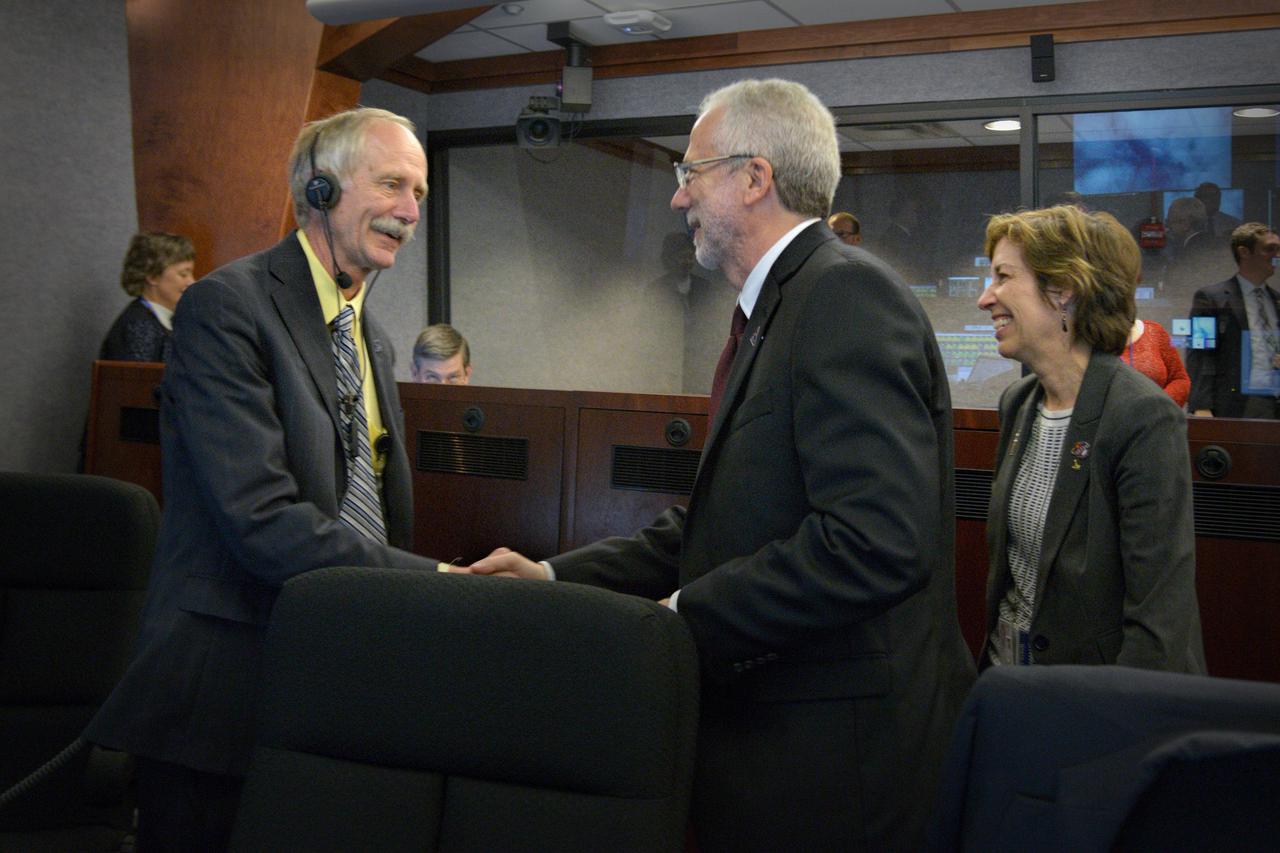
The Orion team celebrates Orion's successful Exploration Flight Test-1 (EFT-1) mission in Building AE at Cape Canaveral Air Force Station on Dec. 5, 2014. Orion Program Manager Mark Geyer, NASA Director Ellen Ochoa and NASA Associate Administrator for the Human Exploration and Operations Directorate William Gerstenmaier are in frame. The Orion spacecraft orbited Earth twice, reaching an altitude of approximately 3,600 miles above Earth before landing. No one was aboard Orion for this flight test, but the spacecraft is designed to allow us to journey to destinations never before visited by humans, including an asteroid and Mars. Part of Batch image transfer from Flickr.
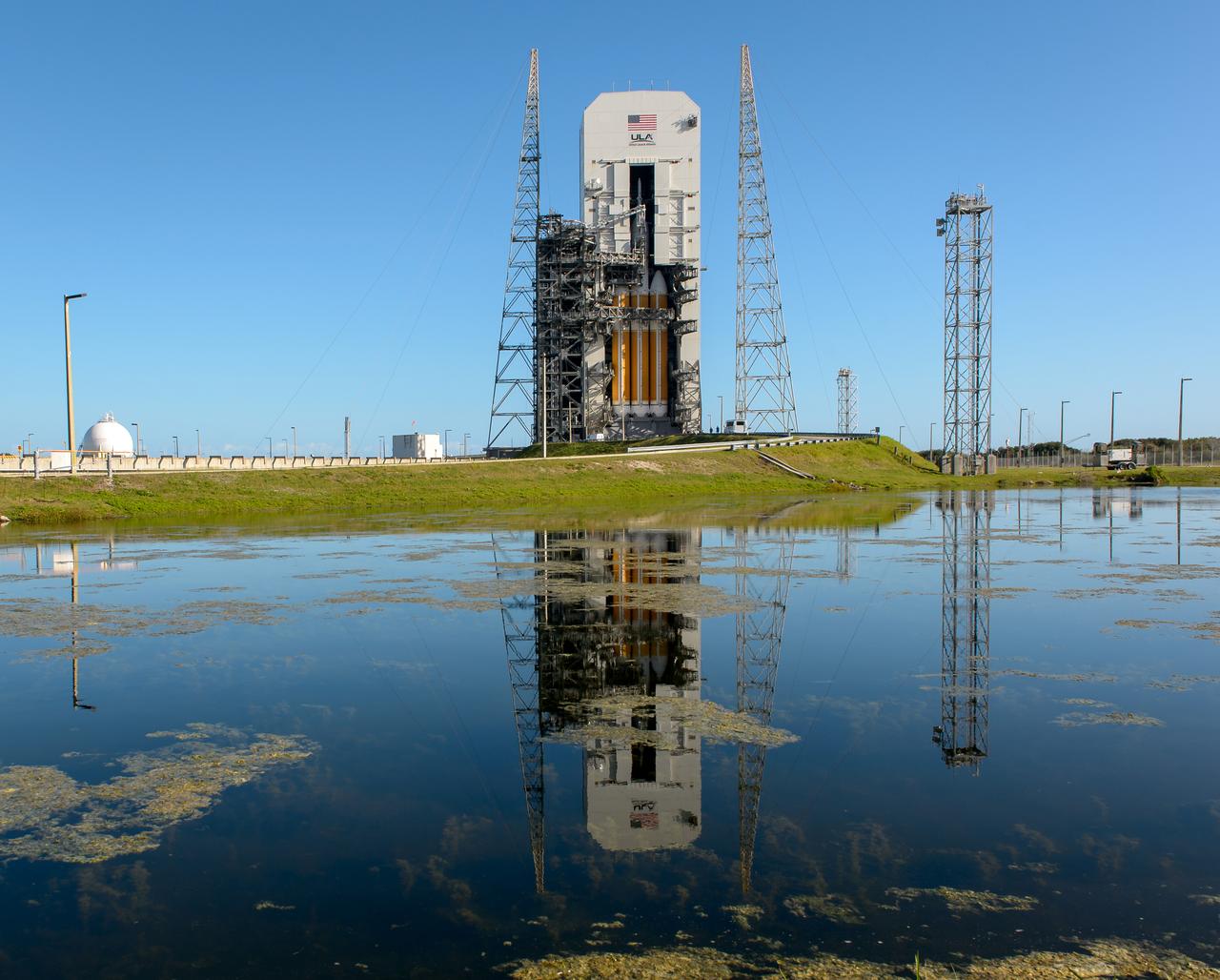
NASA’s Orion spacecraft mounted atop a United Launch Alliance Delta IV Heavy rocket is visible inside the Mobile Service Tower where the vehicle is undergoing launch preparations on Dec. 3, 2014 at Cape Canaveral Air Force Station's Space Launch Complex 37 in Florida. Part of Batch image transfer from Flickr.
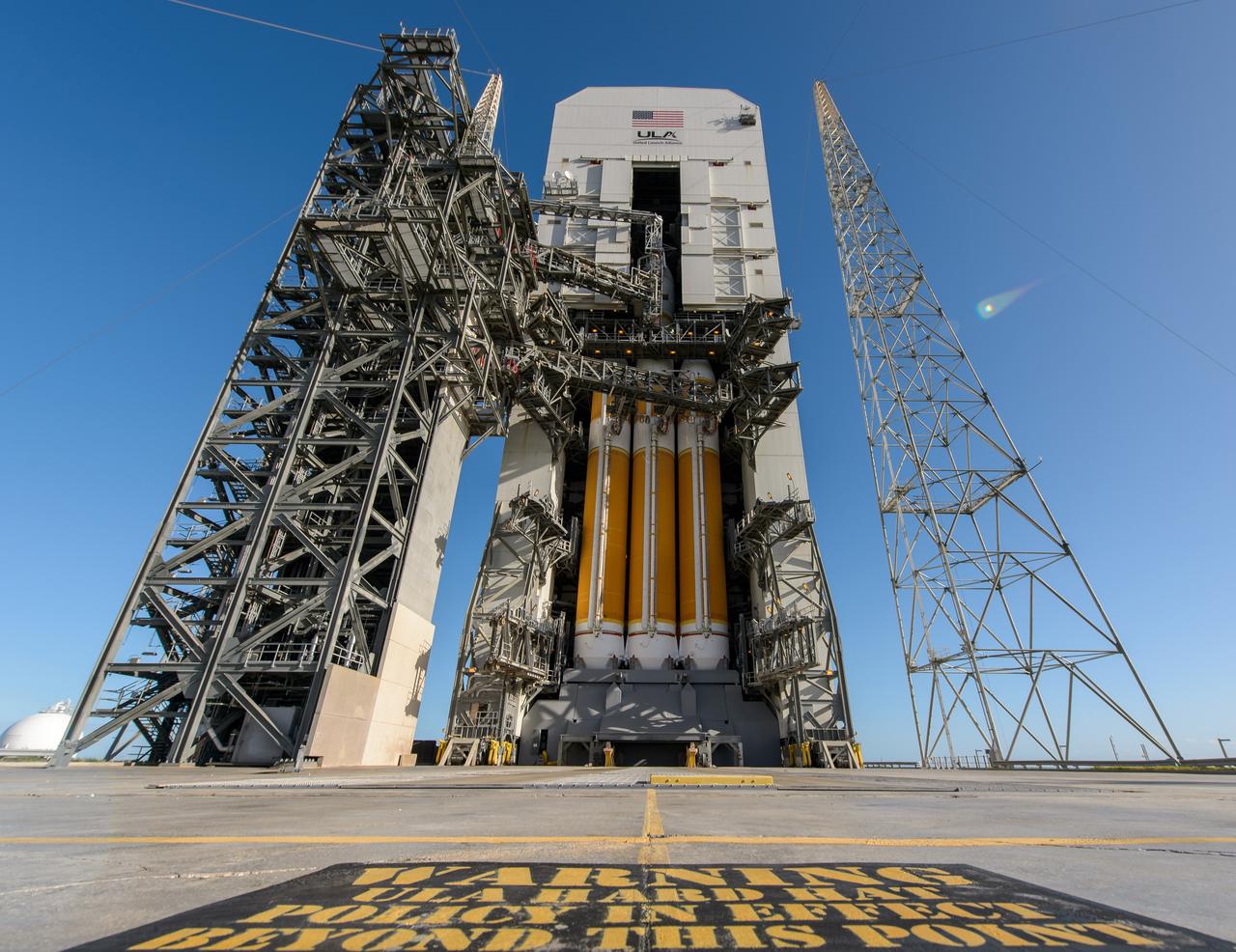
NASA’s Orion spacecraft mounted atop a United Launch Alliance Delta IV Heavy rocket is visible inside the Mobile Service Tower where the vehicle is undergoing launch preparations on Dec. 3, 2014, at Cape Canaveral Air Force Station's Space Launch Complex 37 in Florida. Part of Batch image transfer from Flickr.
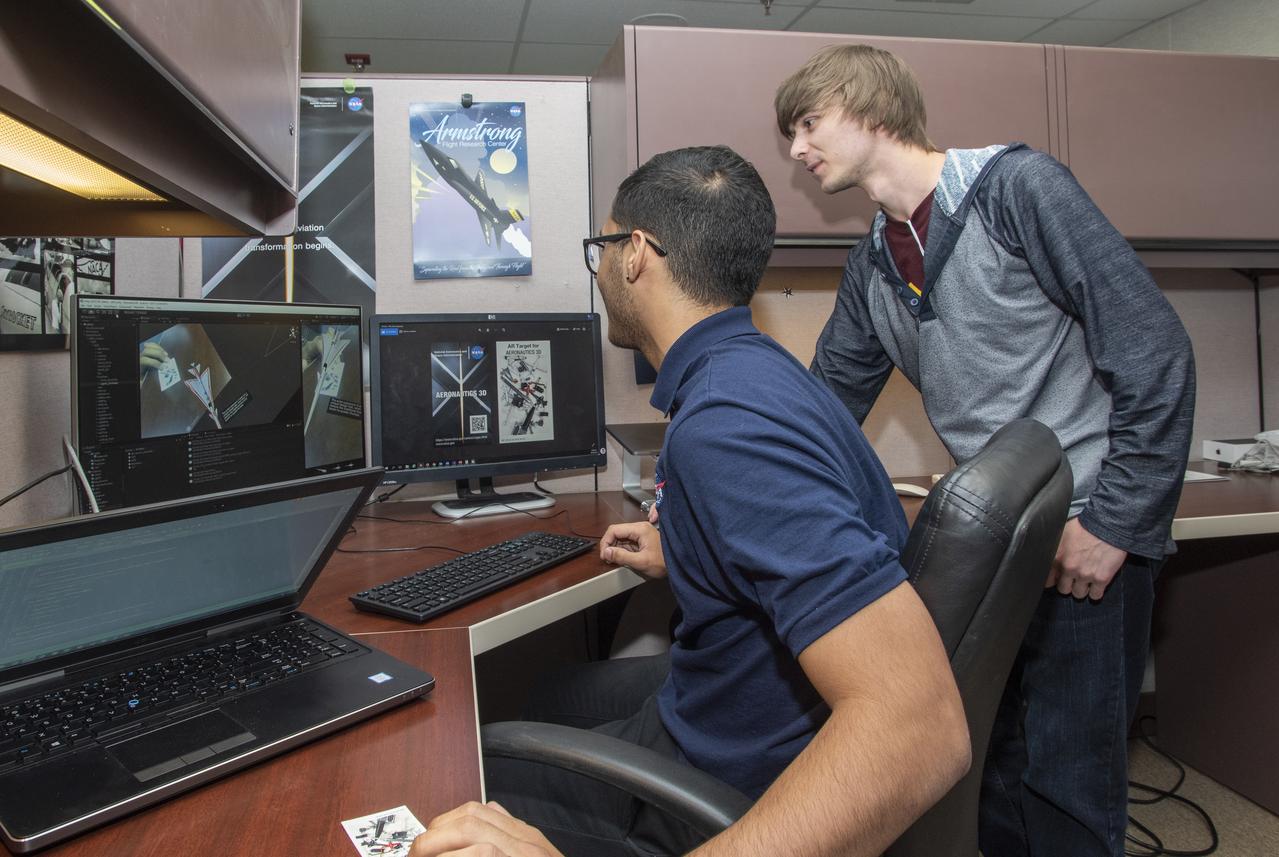
Kendrick Morales, left, and Alexander Passofaro, right, work together to transition the software for the Aeronautics AR app from being target image dependent to deleting the target image.
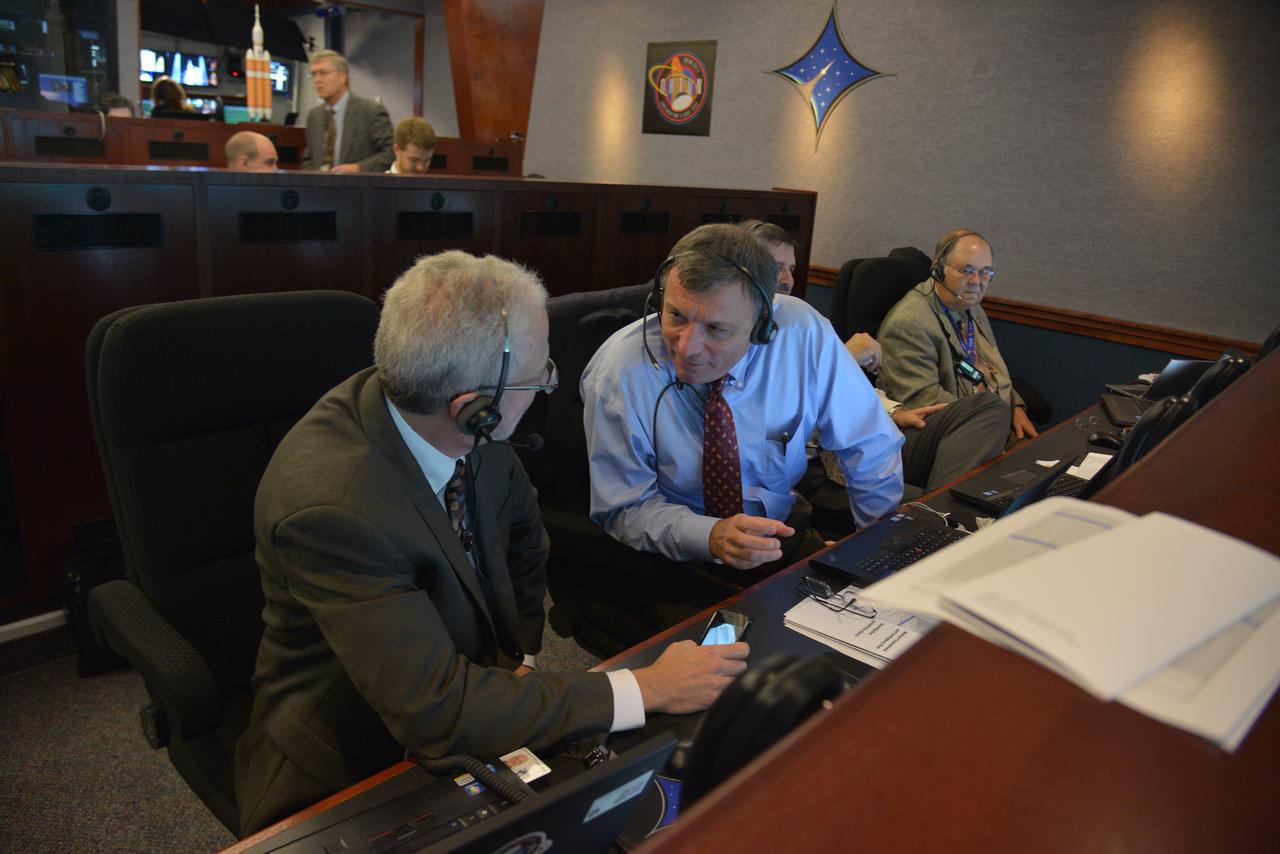
The Orion team reviews the launch procedure in Building AE at Cape Canaveral Air Force Station ahead of the launch of Orion on Exploration Flight Test-1 (EFT-1) on Dec. 4, 2014. Part of Batch image transfer from Flickr.
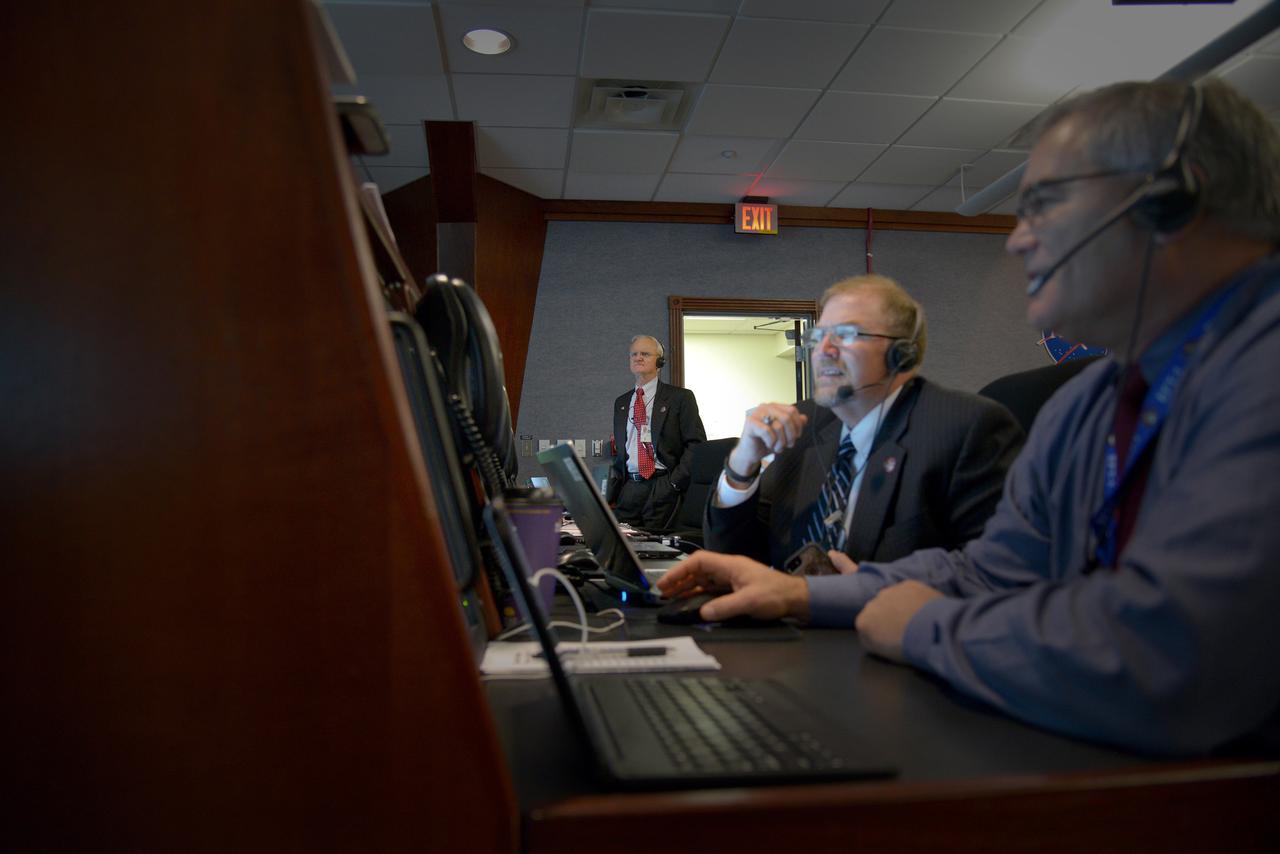
The Orion team reviews the launch procedure in Building AE at Cape Canaveral Air Force Station ahead of the launch of Orion on Exploration Flight Test-1 (EFT-1) on Dec. 4, 2014. Part of Batch image transfer from Flickr.
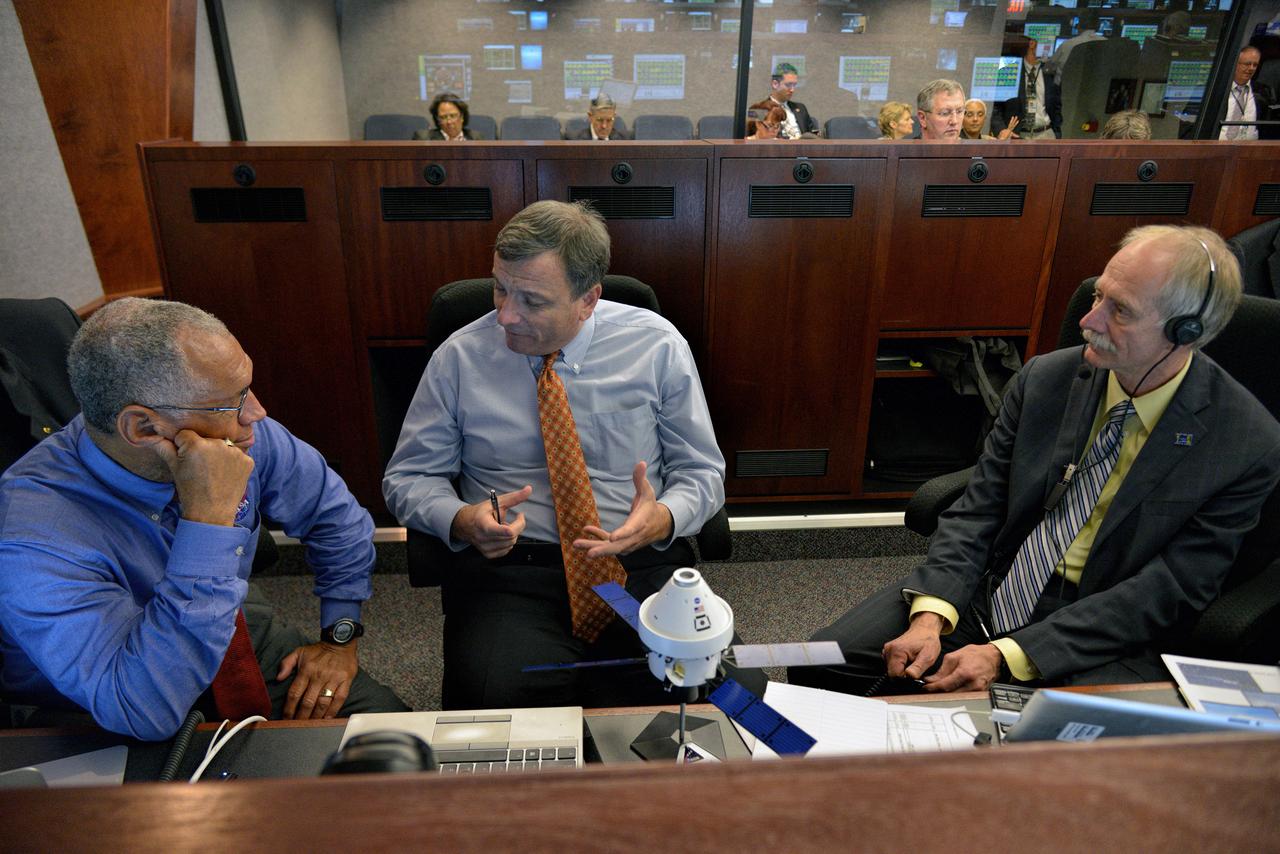
The Orion team (including NASA Administrator Charles Bolden and Operations Directorate William Gerstenmaier) discuss Orion operations in Building AE at Cape Canaveral Air Force Station during Exploration Flight Test-1 (EFT-1) on Dec. 5, 2014. Part of Batch image transfer from Flickr.
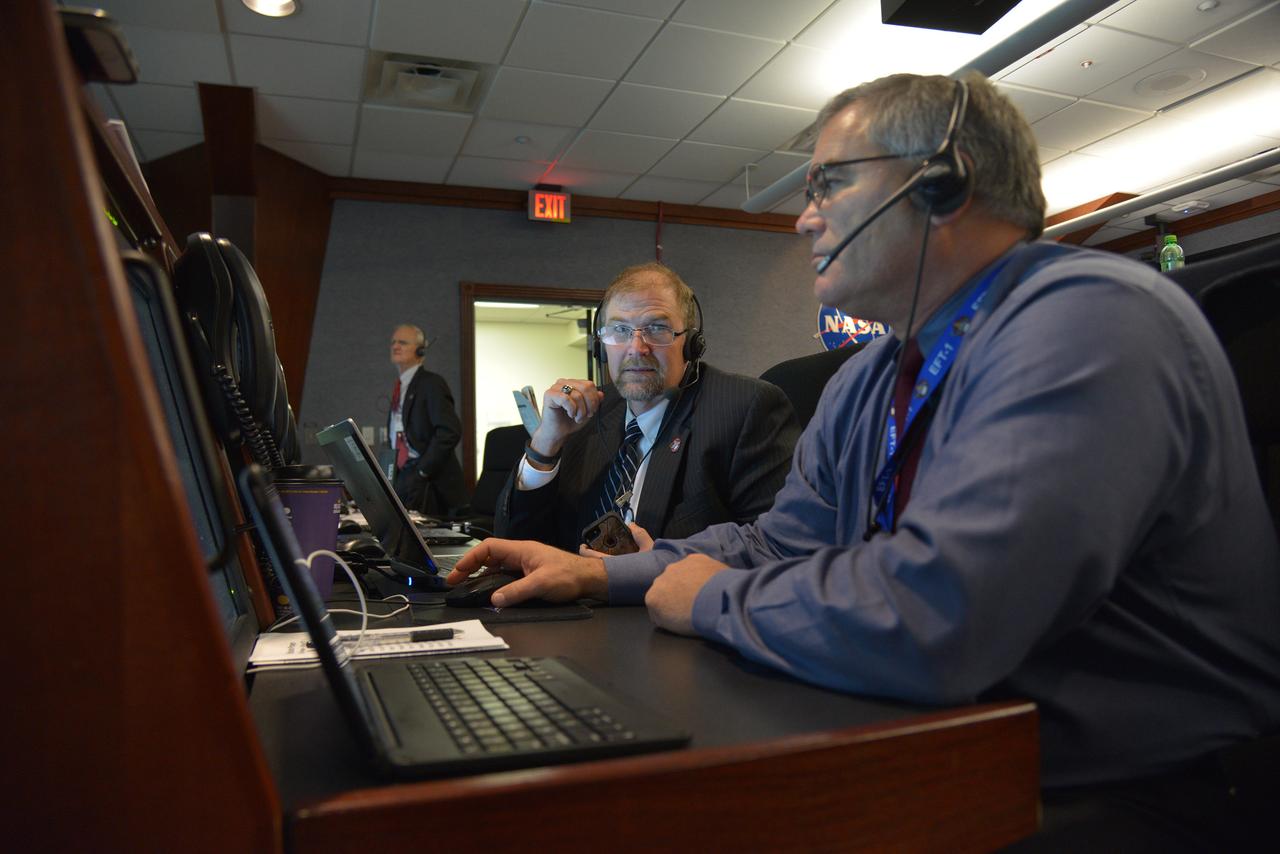
The Orion team reviews the launch procedure in Building AE at Cape Canaveral Air Force Stationahead of the launch of Orion on Exploration Flight Test-1 (EFT-1) on Dec. 4, 2014. Part of Batch image transfer from Flickr.
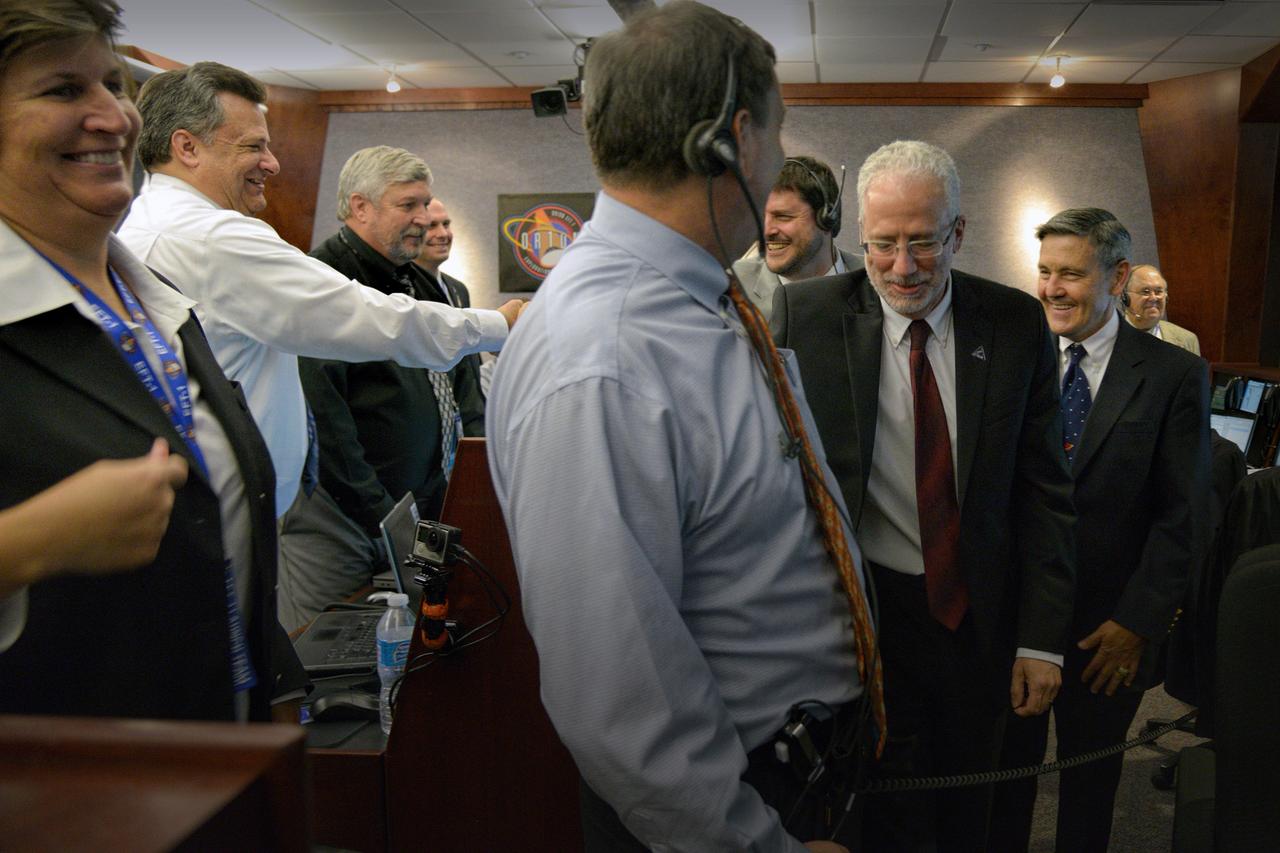
The Orion team celebrates Orion's successful Exploration Flight Test-1 (EFT-1) mission in Building AE at Cape Canaveral Air Force Station on Dec. 5, 2014. The Orion spacecraft orbited Earth twice, reaching an altitude of approximately 3,600 miles above Earth before landing. No one was aboard Orion for this flight test, but the spacecraft is designed to allow us to journey to destinations never before visited by humans, including an asteroid and Mars. Part of Batch image transfer from Flickr.
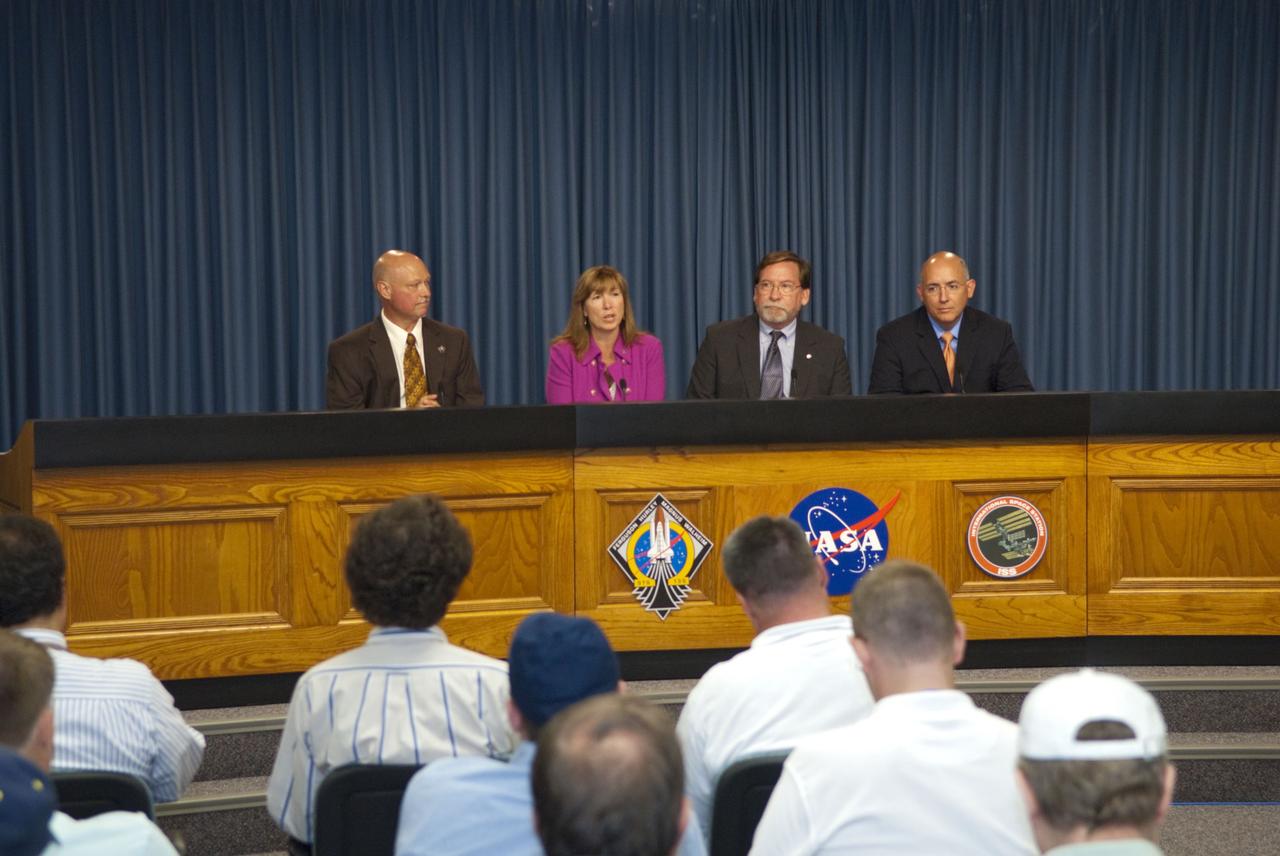
CAPE CANAVERAL, Fla. -- In the Press Site auditorium at NASA's Kennedy Space Center in Florida, media were briefed about the agency's next step for Human Space Flight. Seen here are NASA Public Affairs Officer Mike Curie (left); Lori Garver, NASA deputy administrator; Doug Cooke, Exploration Systems Mission Directorate associate administrator and Mike Suffredini, NASA International Space Station Program manager. Photo credit: NASA/Jim Grossmann
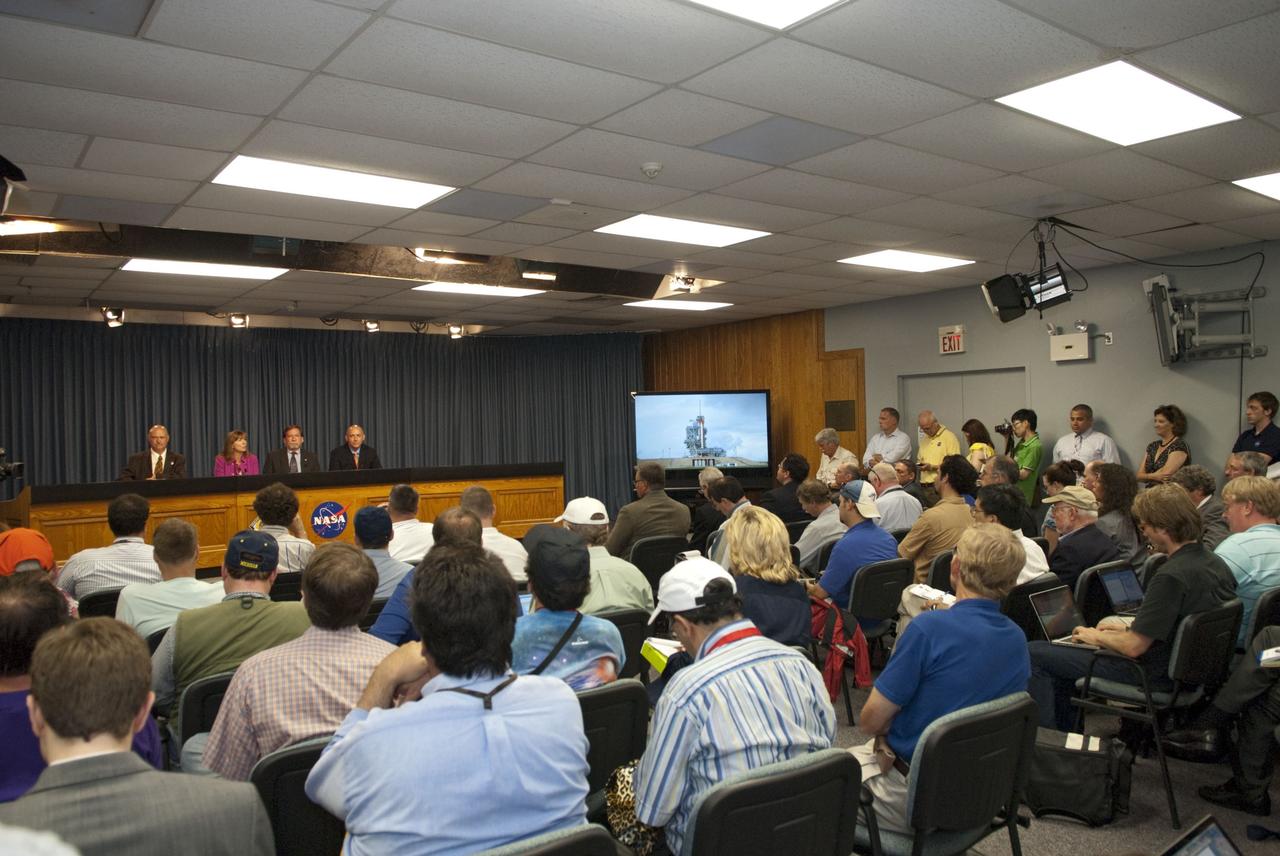
CAPE CANAVERAL, Fla. -- In the Press Site auditorium at NASA's Kennedy Space Center in Florida, media were briefed about the agency's next step for Human Space Flight. Seen here are NASA Public Affairs Officer Mike Curie (left); Lori Garver, NASA deputy administrator; Doug Cooke, Exploration Systems Mission Directorate associate administrator and Mike Suffredini, NASA International Space Station Program manager. Photo credit: NASA/Jim Grossmann
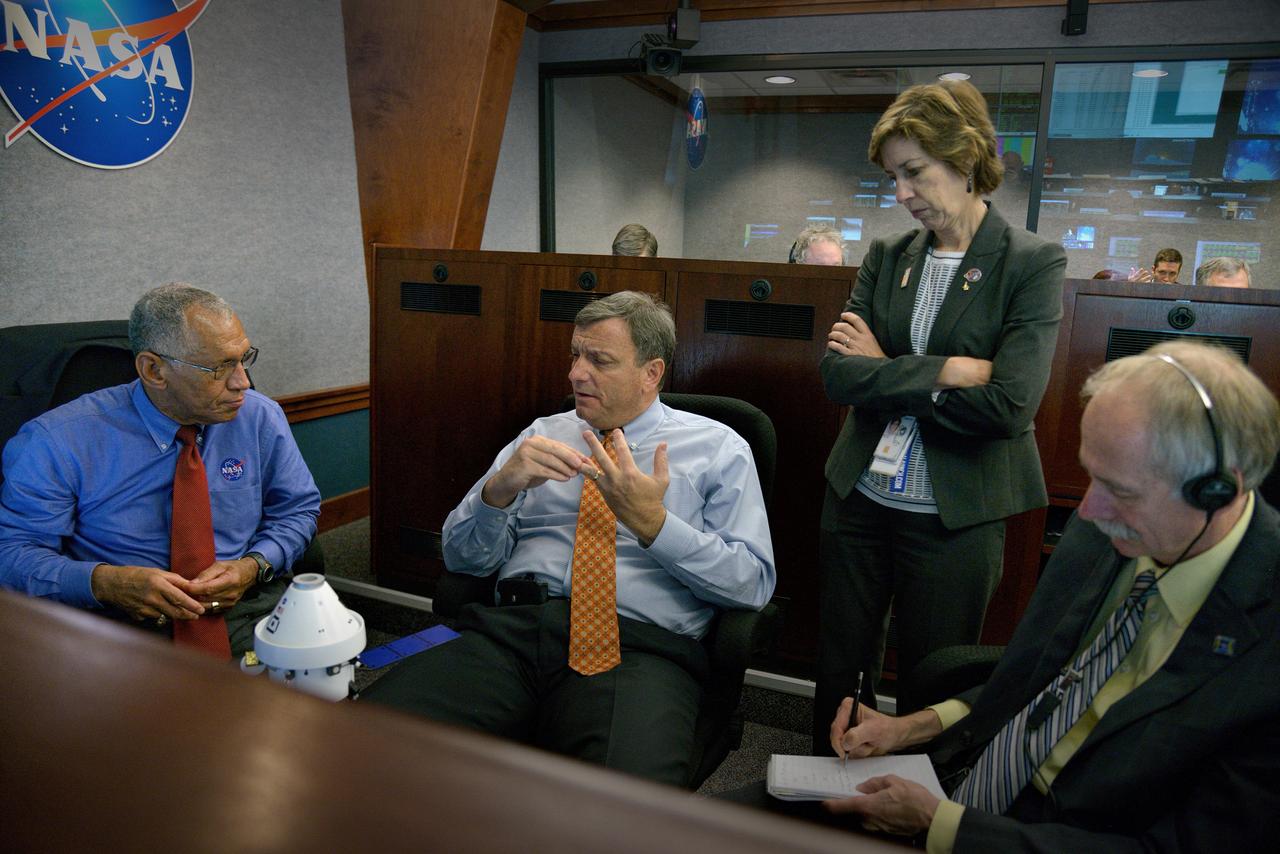
The Orion team (including JSC Director Ellen Ochoa, NASA Administrator Charles Bolden and Operations Directorate William Gerstenmaier) discuss Orion operations in Building AE at Cape Canaveral Air Force Station during Exploration Flight Test-1 (EFT-1) on Dec. 5, 2014. Part of Batch image transfer from Flickr.
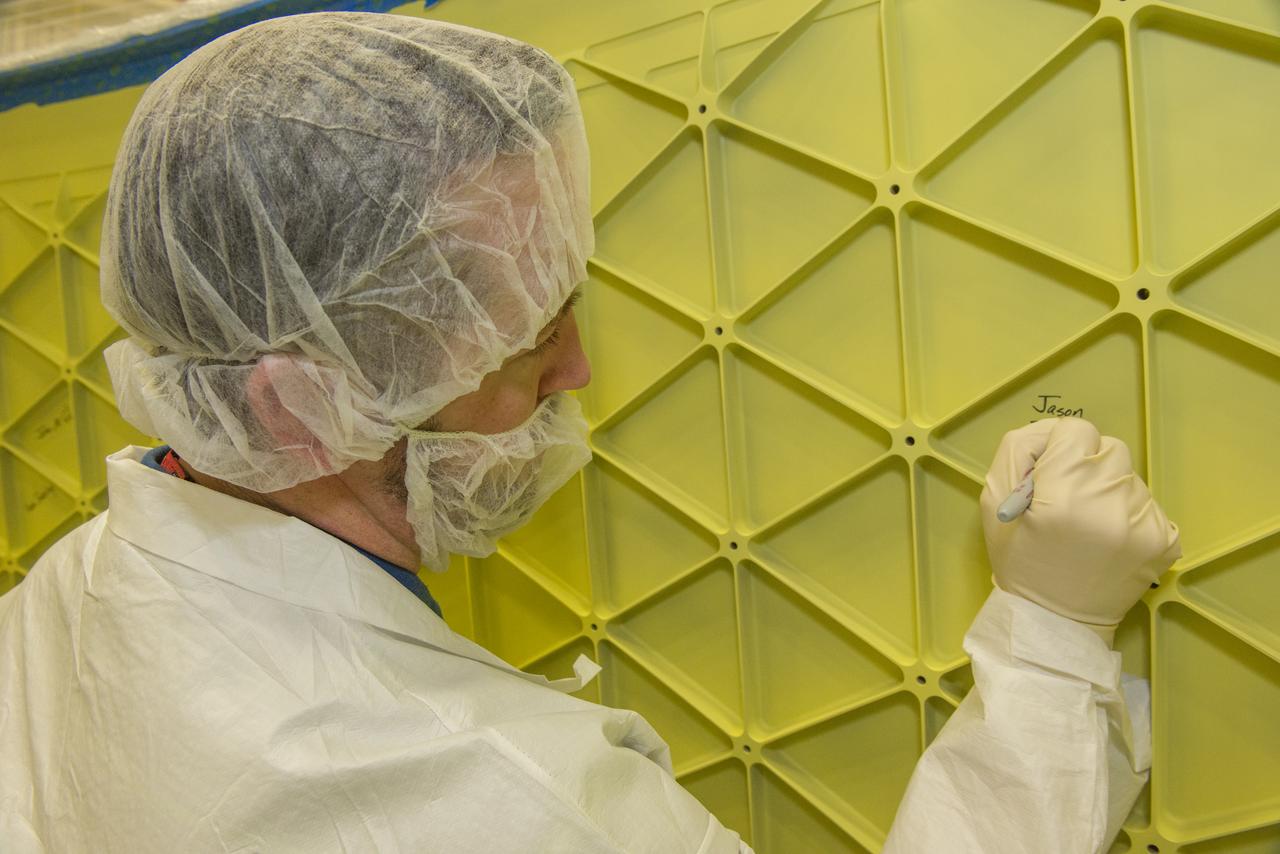
JASON ELDRIDGE, AN ERC INCORPORATED EMPLOYEE SUPPORTING THE MATERIALS & PROCESSES LABORATORY AT NASA'S MARSHALL SPACE FLIGHT CENTER, SIGNS HIS NAME ON THE INTERIOR OF THE ADAPTER THAT WILL CONNECT THE ORION SPACECRAFT TO A UNITED LAUNCH ALLIANCE DELTA IV ROCKET FOR EXPLORATION FLIGHT TEST (EFT)-1. MARSHALL CENTER TEAM MEMBERS WHO WERE INVOLVED IN THE DESIGN, CONSTRUCTION AND TESTING OF THE ADAPTER HAD THE OPPORTUNITY TO AUTOGRAPH IT BEFORE THE HARDWARE IS SHIPPED TO NASA'S KENNEDY SPACE CENTER IN FEBRUARY. ELDRIDGE WAS ON A TEAM THAT PERFORMED ULTRASONIC INSPECTIONS ON THE ADAPTER'S WELDS -- ENSURING THEY ARE STRUCTURALLY SOUND. EFT-1, SCHEDULED FOR 2014, WILL PROVIDE EARLY EXPERIENCE FOR NASA SPACE LAUNCH SYSTEM (SLS) HARDWARE AHEAD OF THE ROCKET'S FIRST FLIGHT IN 2017.
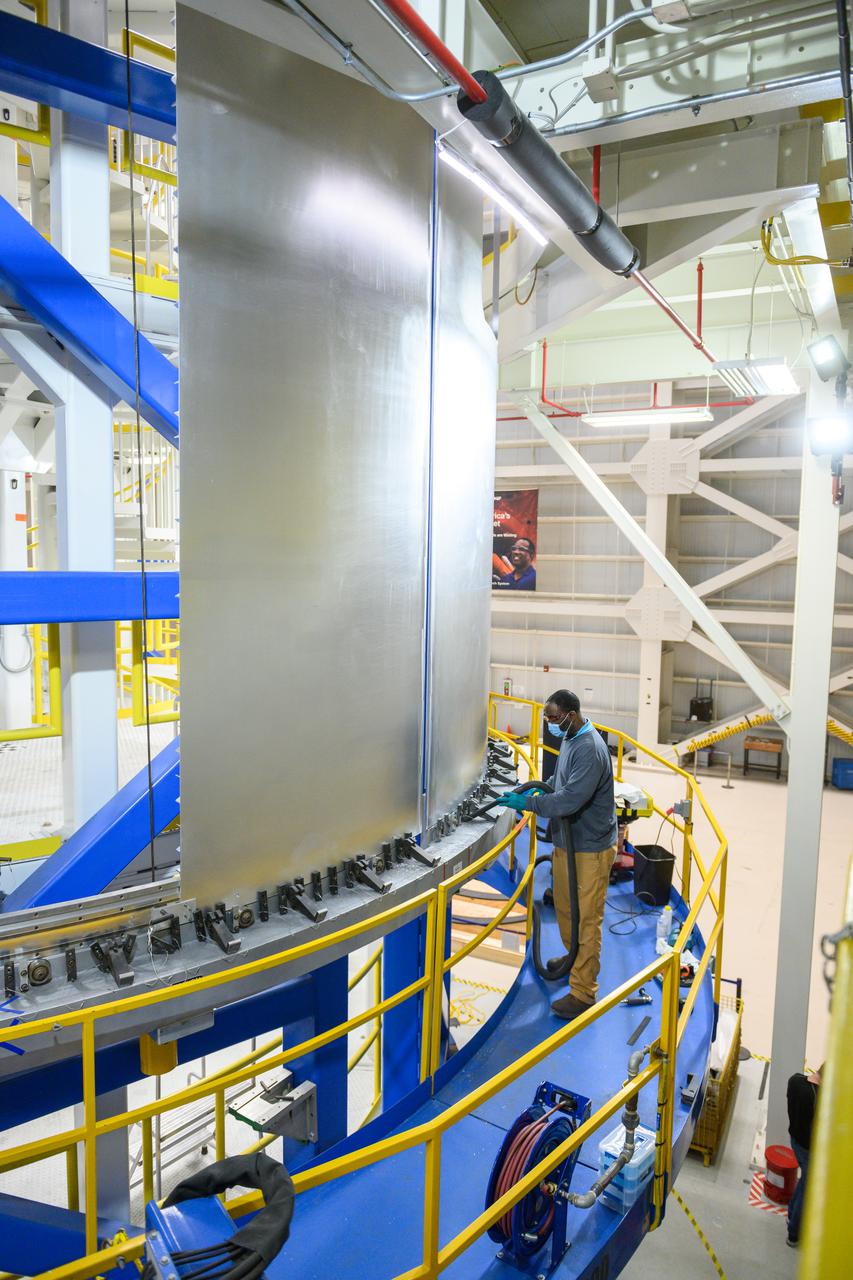
Technicians are manufacturing and testing the first in a series of initial weld confidence articles for the Exploration Upper Stage (EUS) for future flights of NASA’s Space Launch System (SLS) rocket at the agency’s Michoud Assembly Facility in New Orleans. The Exploration Upper Stage will be used on the second configuration of the SLS rocket, known as Block 1B, and will provide in-space propulsion to send astronauts in NASA’s Orion spacecraft and heavy cargo on a precise trajectory to the Moon. The Exploration Upper Stage weld confidence panels are first produced in the Vertical Weld Center at Michoud, then small sections of the panels are removed for mechanical testing and analysis in another area of the factory. Teams use weld confidence articles to verify welding procedures, interfaces between the tooling and hardware, and the structural integrity of the welds. Testing of the EUS weld confidence articles will help engineers and technicians validate welding parameters for manufacturing EUS hardware. The first three SLS flights of NASA’s Artemis program will use an interim cryogenic propulsion stage with one RL10 engine to send Orion to the Moon. The SLS Exploration Upper Stage for flights beyond Artemis III has larger propellant tanks and four RL10 engines. The evolution of the rocket to SLS Block 1B configuration with EUS enables SLS to launch 40% more cargo to the Moon along with the crew. Manufacturing the Exploration Upper Stage is a collaborative effort between NASA and Boeing, the lead contractor for EUS and the SLS core stage. SLS is the only rocket that can send Orion, astronauts, and supplies to the Moon in a single mission. The SLS rocket, NASA’s Orion spacecraft, Gateway, and human landing system are part of NASA’s backbone for deep space exploration. Under the Artemis program, NASA is working to land the first woman and the next man on the Moon to pave the way for sustainable exploration at the Moon and future missions to Mars. (NASA)
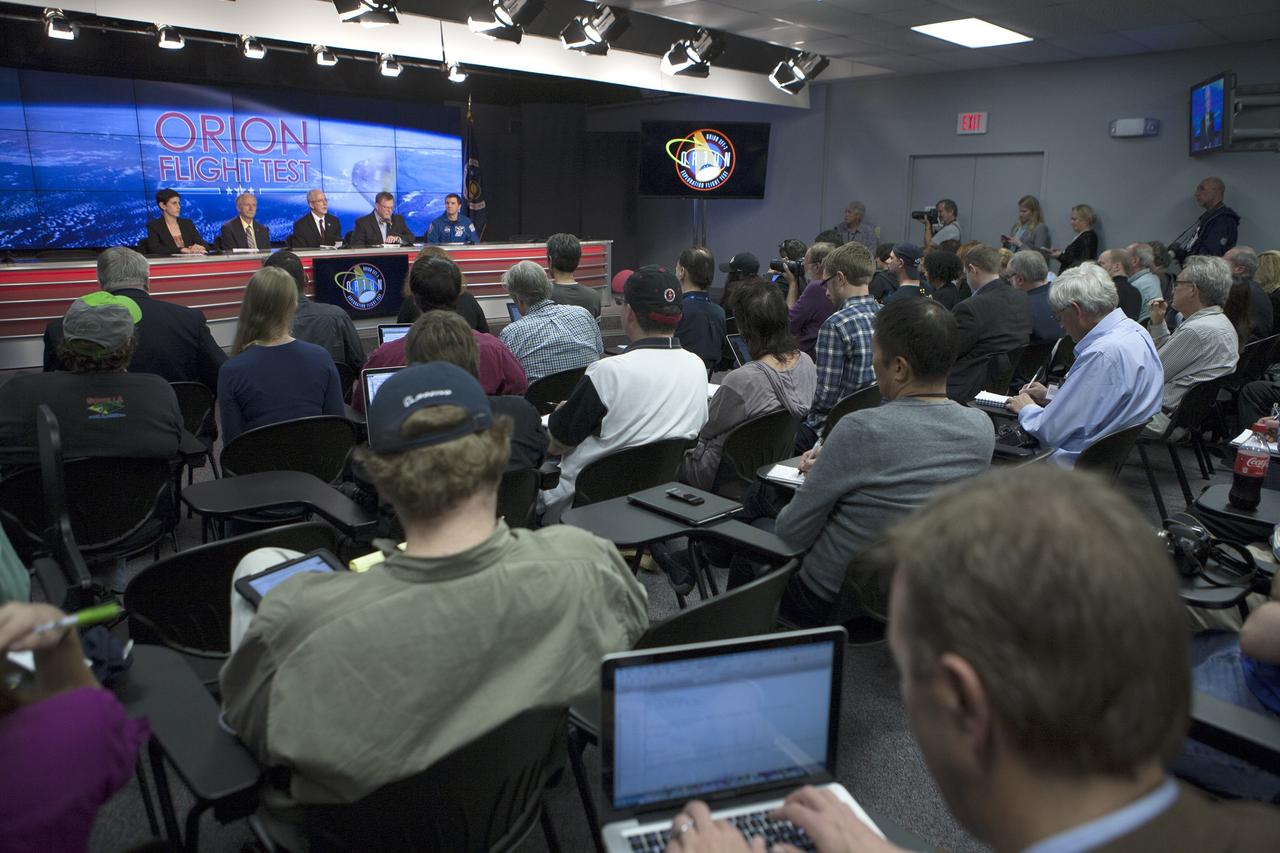
CAPE CANAVERAL, Fla. -- In the Kennedy Space Center’s Press Site auditorium, agency leaders spoke to members of the news media about the successful Orion Flight Test. From left are: Rachel Kraft, of NASA Public Affairs, Bill Gerstenmaier, NASA associate administrator for Human Exploration and Operations, Mark Geyer, Orion program manager, Mike Hawes, Lockheed Martin Orion Program manager, and NASA astronaut Rex Walheim. For more information, visit www.nasa.gov/orion Photo credit: NASA/Kim Shiflett
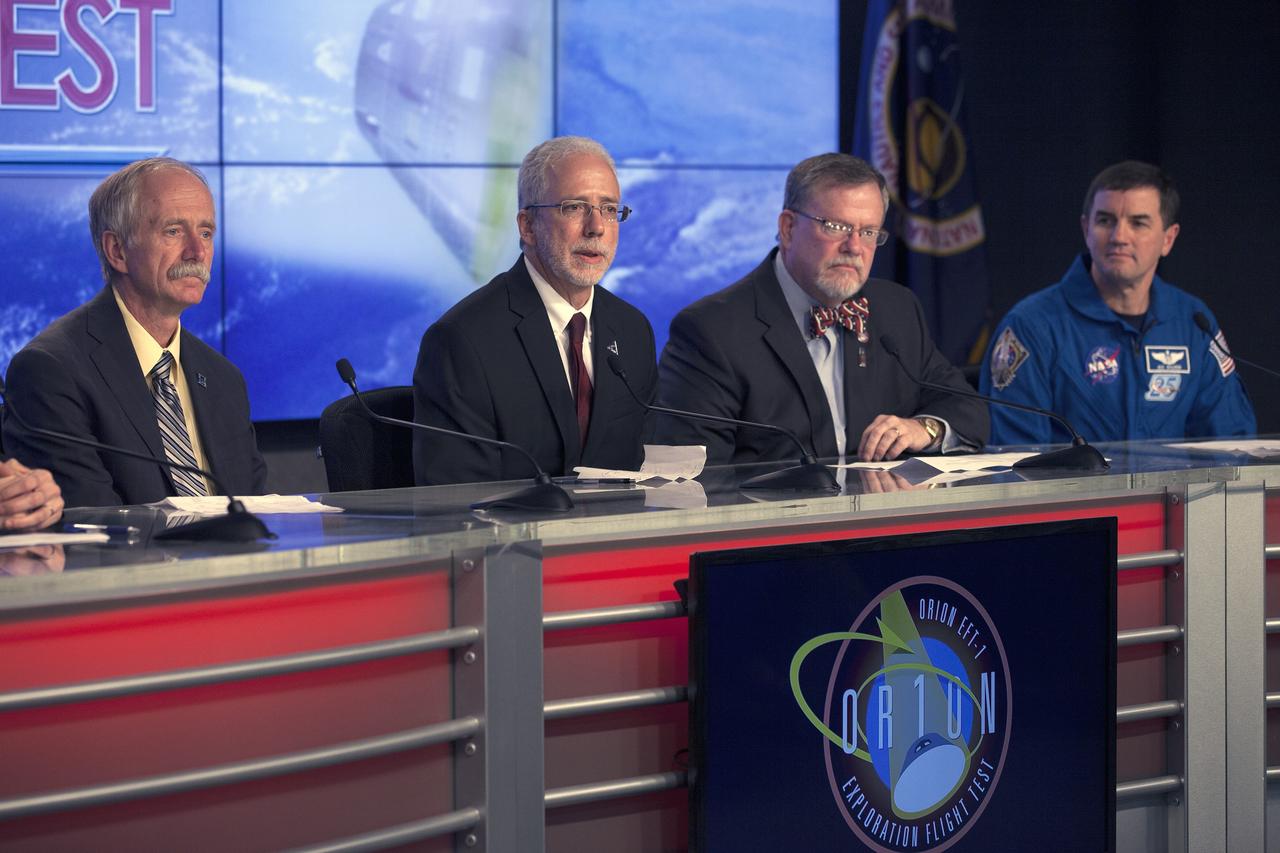
CAPE CANAVERAL, Fla. -- In the Kennedy Space Center’s Press Site auditorium, agency leaders spoke to members of the news media about the successful Orion Flight Test. From left are: Bill Gerstenmaier, NASA associate administrator for Human Exploration and Operations, Mark Geyer, Orion program manager, Mike Hawes, Lockheed Martin Orion Program manager, and NASA astronaut Rex Walheim. For more information, visit www.nasa.gov/orion Photo credit: NASA/Kim Shiflett
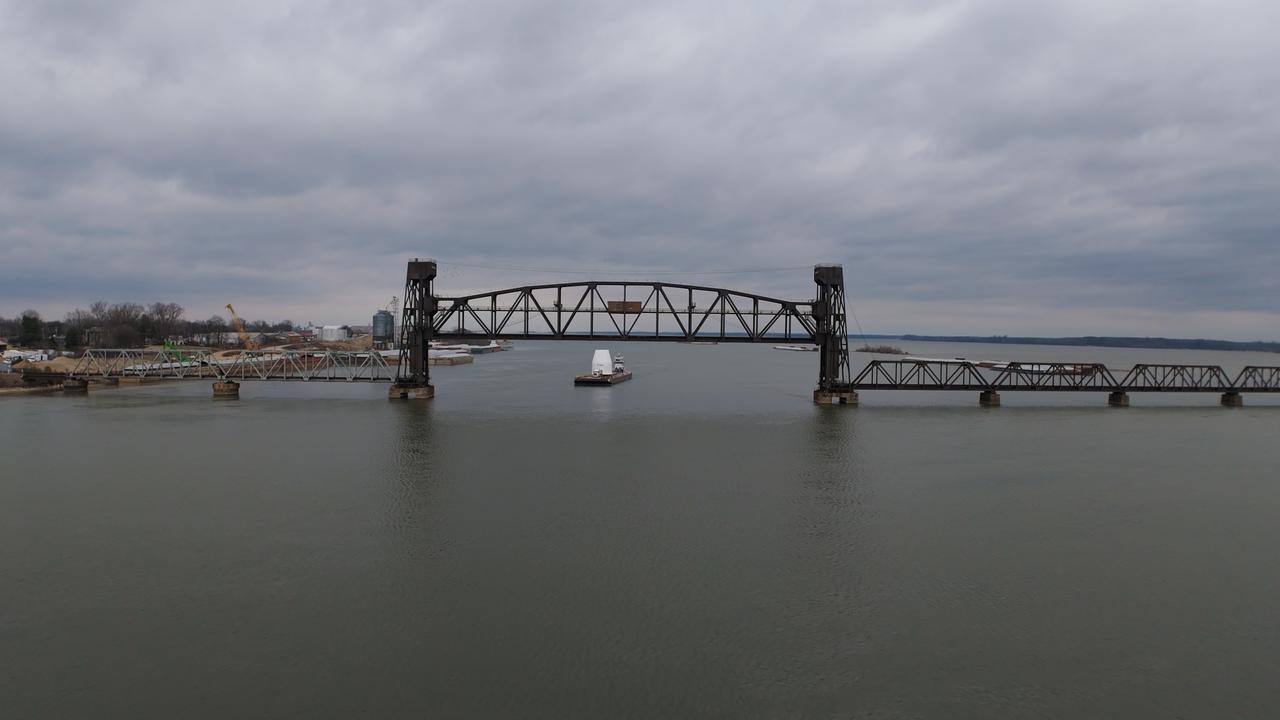
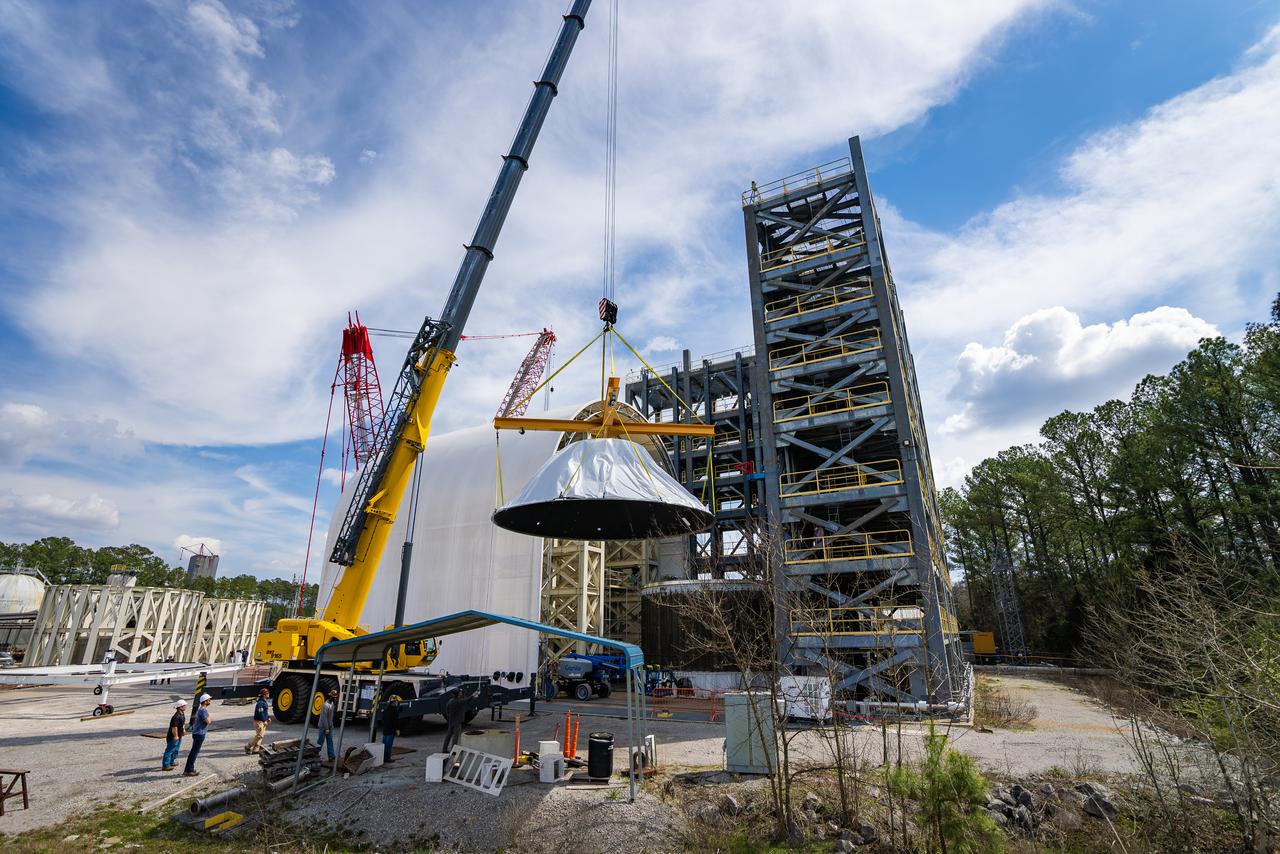
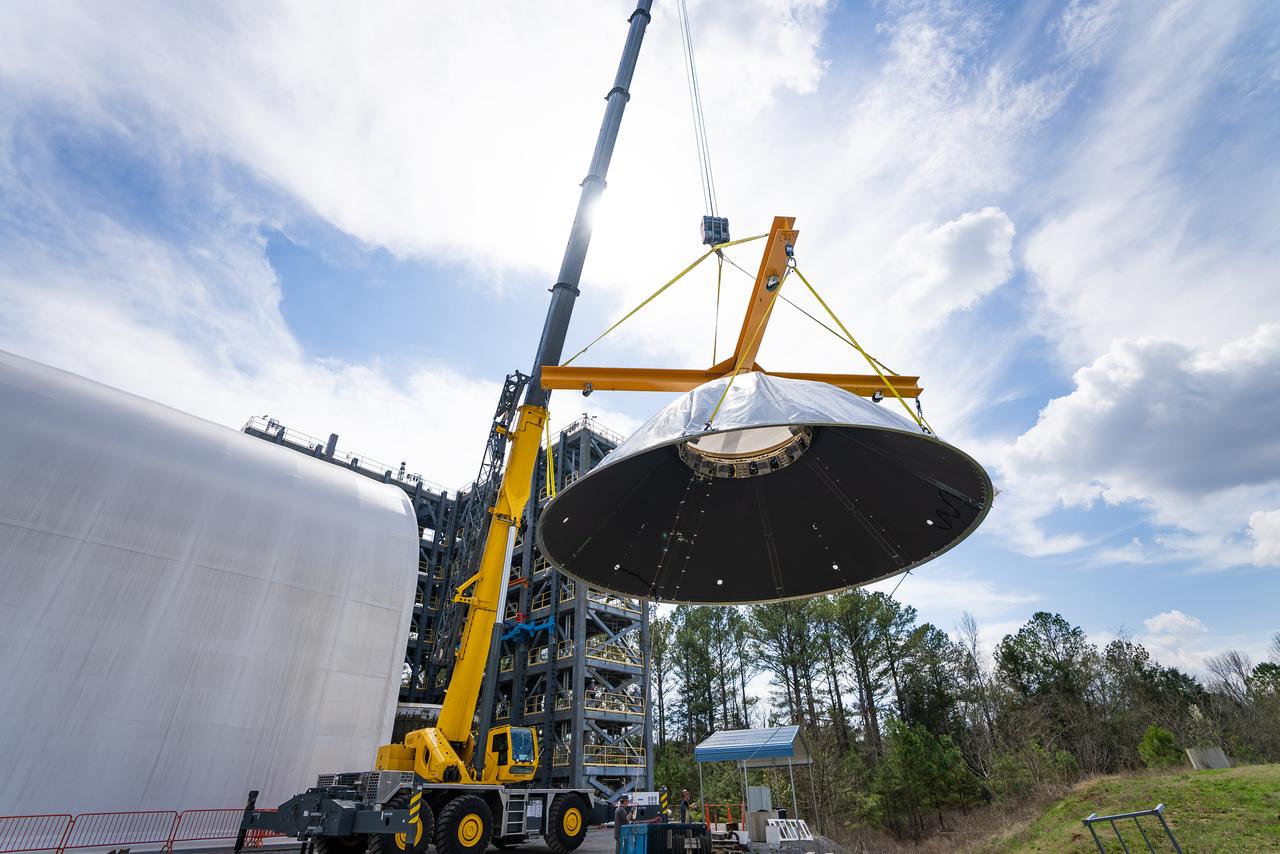
These photos and videos show how crews guided a test version of the universal stage adapter for NASA’s more powerful version of its SLS (Space Launch System) rocket to Building 4619 at the agency’s Marshall Space Flight Center in Huntsville, Alabama, Feb. 22. Built by Leidos, the lead contractor for the universal stage adapter, crews transported the hardware from a Leidos facility in Decatur, Alabama, the same day. The universal stage adapter will connect the SLS rocket’s upgraded in-space propulsion stage, called the exploration upper stage, to NASA’s Orion spacecraft as part of the evolved Block 1B configuration of the SLS rocket. It will also serve as a compartment capable of accommodating large payloads, such as modules or other exploration spacecraft. In Building 4619’s Load Test Annex High Bay at Marshall, the development test article will first undergo modal testing that will shake the hardware to validate dynamic models. Later, during ultimate load testing, force will be applied vertically and to the sides of the hardware. Unlike the flight hardware, the development test article has flaws intentionally included in its design, which will help engineers verity that the flight adapter can withstand the extreme forces it will face during launch and flight.
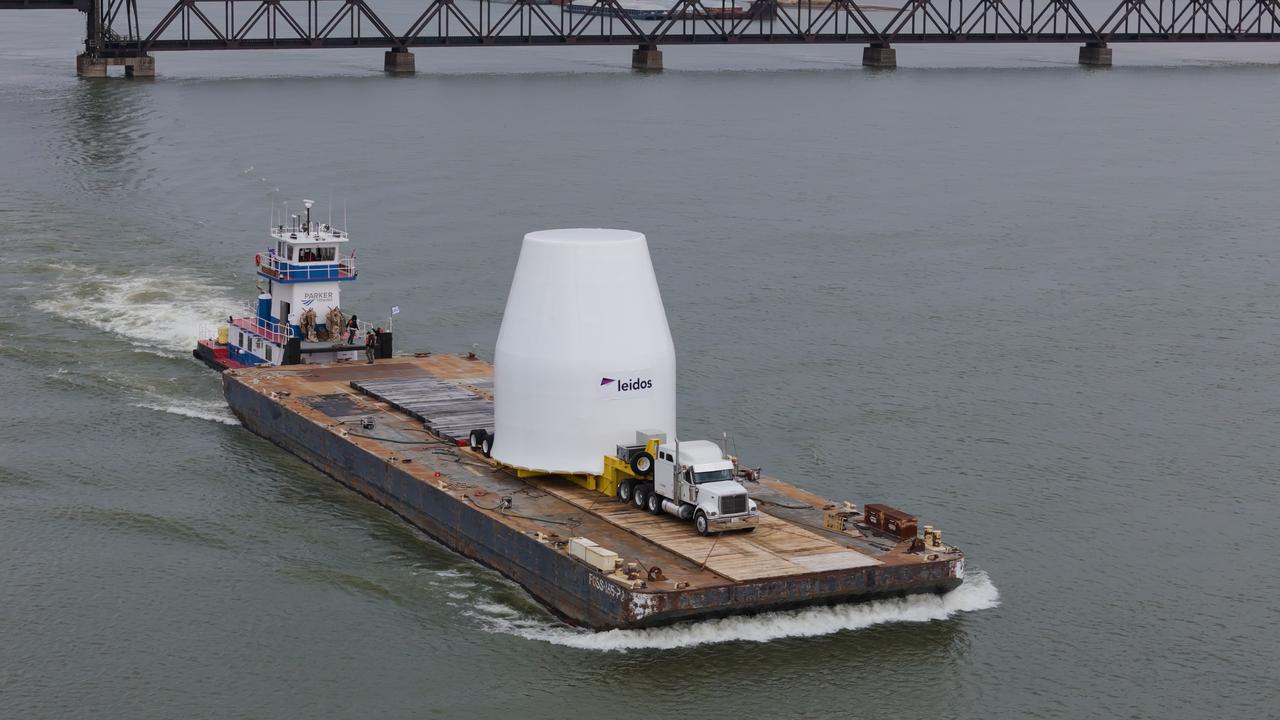
These photos and videos show how crews guided a test version of the universal stage adapter for NASA’s more powerful version of its SLS (Space Launch System) rocket to Building 4619 at the agency’s Marshall Space Flight Center in Huntsville, Alabama, Feb. 22. Built by Leidos, the lead contractor for the universal stage adapter, crews transported the hardware from a Leidos facility in Decatur, Alabama, the same day. The universal stage adapter will connect the SLS rocket’s upgraded in-space propulsion stage, called the exploration upper stage, to NASA’s Orion spacecraft as part of the evolved Block 1B configuration of the SLS rocket. It will also serve as a compartment capable of accommodating large payloads, such as modules or other exploration spacecraft. In Building 4619’s Load Test Annex High Bay at Marshall, the development test article will first undergo modal testing that will shake the hardware to validate dynamic models. Later, during ultimate load testing, force will be applied vertically and to the sides of the hardware. Unlike the flight hardware, the development test article has flaws intentionally included in its design, which will help engineers verity that the flight adapter can withstand the extreme forces it will face during launch and flight.
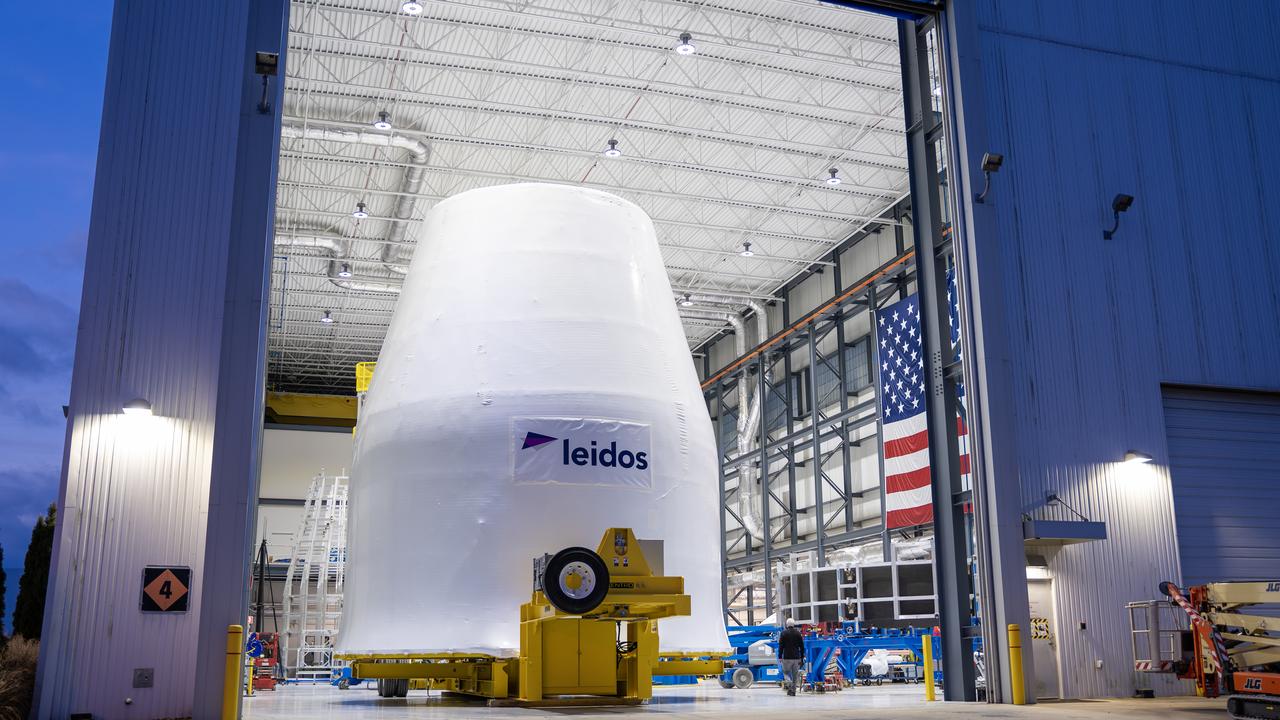
These photos and videos show how crews guided a test version of the universal stage adapter for NASA’s more powerful version of its SLS (Space Launch System) rocket to Building 4619 at the agency’s Marshall Space Flight Center in Huntsville, Alabama, Feb. 22. Built by Leidos, the lead contractor for the universal stage adapter, crews transported the hardware from a Leidos facility in Decatur, Alabama, the same day. The universal stage adapter will connect the SLS rocket’s upgraded in-space propulsion stage, called the exploration upper stage, to NASA’s Orion spacecraft as part of the evolved Block 1B configuration of the SLS rocket. It will also serve as a compartment capable of accommodating large payloads, such as modules or other exploration spacecraft. In Building 4619’s Load Test Annex High Bay at Marshall, the development test article will first undergo modal testing that will shake the hardware to validate dynamic models. Later, during ultimate load testing, force will be applied vertically and to the sides of the hardware. Unlike the flight hardware, the development test article has flaws intentionally included in its design, which will help engineers verity that the flight adapter can withstand the extreme forces it will face during launch and flight.
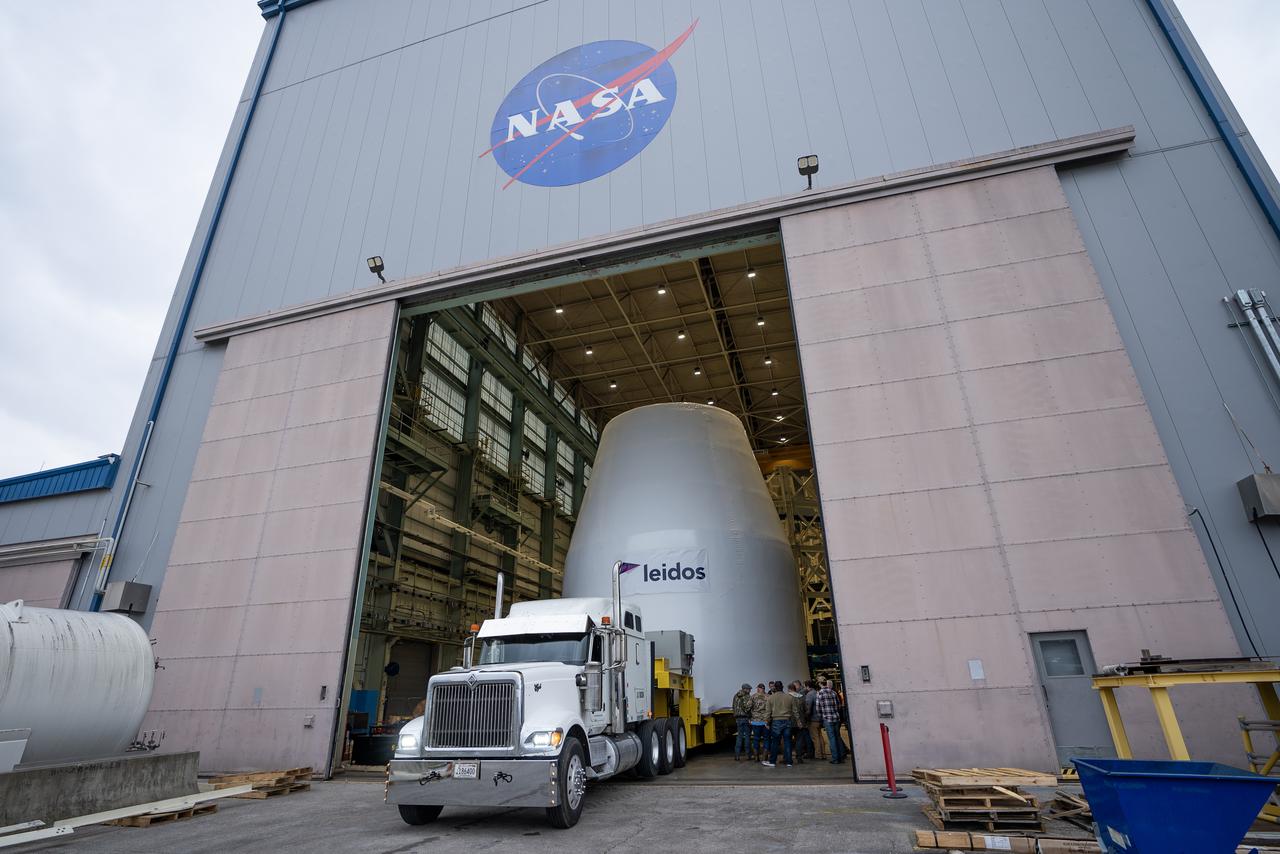
These photos and videos show how crews guided a test version of the universal stage adapter for NASA’s more powerful version of its SLS (Space Launch System) rocket to Building 4619 at the agency’s Marshall Space Flight Center in Huntsville, Alabama, Feb. 22. Built by Leidos, the lead contractor for the universal stage adapter, crews transported the hardware from a Leidos facility in Decatur, Alabama, the same day. The universal stage adapter will connect the SLS rocket’s upgraded in-space propulsion stage, called the exploration upper stage, to NASA’s Orion spacecraft as part of the evolved Block 1B configuration of the SLS rocket. It will also serve as a compartment capable of accommodating large payloads, such as modules or other exploration spacecraft. In Building 4619’s Load Test Annex High Bay at Marshall, the development test article will first undergo modal testing that will shake the hardware to validate dynamic models. Later, during ultimate load testing, force will be applied vertically and to the sides of the hardware. Unlike the flight hardware, the development test article has flaws intentionally included in its design, which will help engineers verity that the flight adapter can withstand the extreme forces it will face during launch and flight.
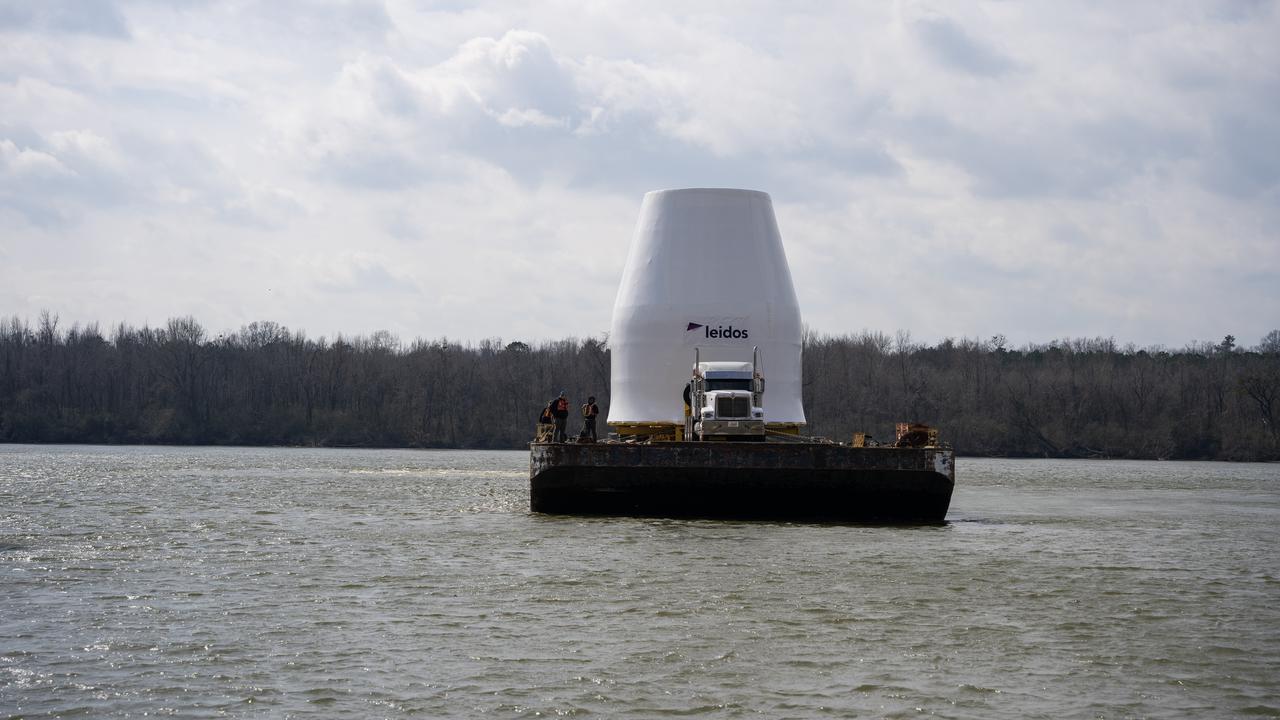
These photos and videos show how crews guided a test version of the universal stage adapter for NASA’s more powerful version of its SLS (Space Launch System) rocket to Building 4619 at the agency’s Marshall Space Flight Center in Huntsville, Alabama, Feb. 22. Built by Leidos, the lead contractor for the universal stage adapter, crews transported the hardware from a Leidos facility in Decatur, Alabama, the same day. The universal stage adapter will connect the SLS rocket’s upgraded in-space propulsion stage, called the exploration upper stage, to NASA’s Orion spacecraft as part of the evolved Block 1B configuration of the SLS rocket. It will also serve as a compartment capable of accommodating large payloads, such as modules or other exploration spacecraft. In Building 4619’s Load Test Annex High Bay at Marshall, the development test article will first undergo modal testing that will shake the hardware to validate dynamic models. Later, during ultimate load testing, force will be applied vertically and to the sides of the hardware. Unlike the flight hardware, the development test article has flaws intentionally included in its design, which will help engineers verity that the flight adapter can withstand the extreme forces it will face during launch and flight.
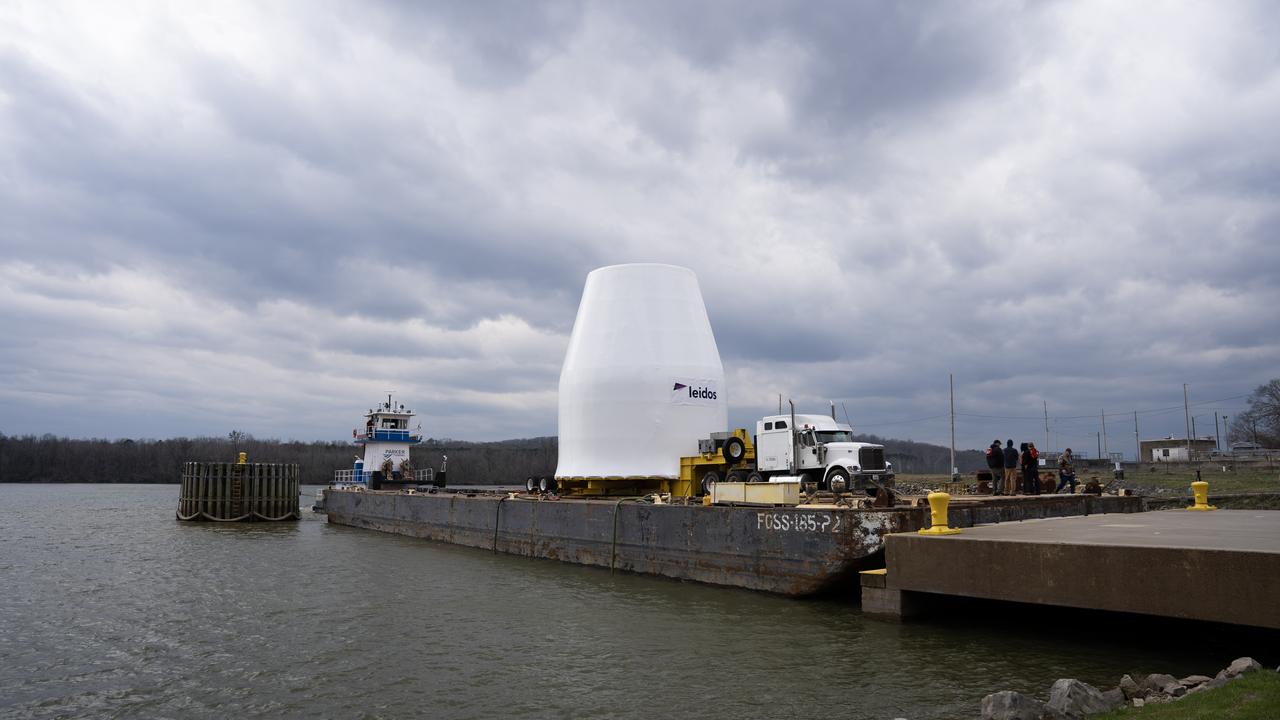
These photos and videos show how crews guided a test version of the universal stage adapter for NASA’s more powerful version of its SLS (Space Launch System) rocket to Building 4619 at the agency’s Marshall Space Flight Center in Huntsville, Alabama, Feb. 22. Built by Leidos, the lead contractor for the universal stage adapter, crews transported the hardware from a Leidos facility in Decatur, Alabama, the same day. The universal stage adapter will connect the SLS rocket’s upgraded in-space propulsion stage, called the exploration upper stage, to NASA’s Orion spacecraft as part of the evolved Block 1B configuration of the SLS rocket. It will also serve as a compartment capable of accommodating large payloads, such as modules or other exploration spacecraft. In Building 4619’s Load Test Annex High Bay at Marshall, the development test article will first undergo modal testing that will shake the hardware to validate dynamic models. Later, during ultimate load testing, force will be applied vertically and to the sides of the hardware. Unlike the flight hardware, the development test article has flaws intentionally included in its design, which will help engineers verity that the flight adapter can withstand the extreme forces it will face during launch and flight.
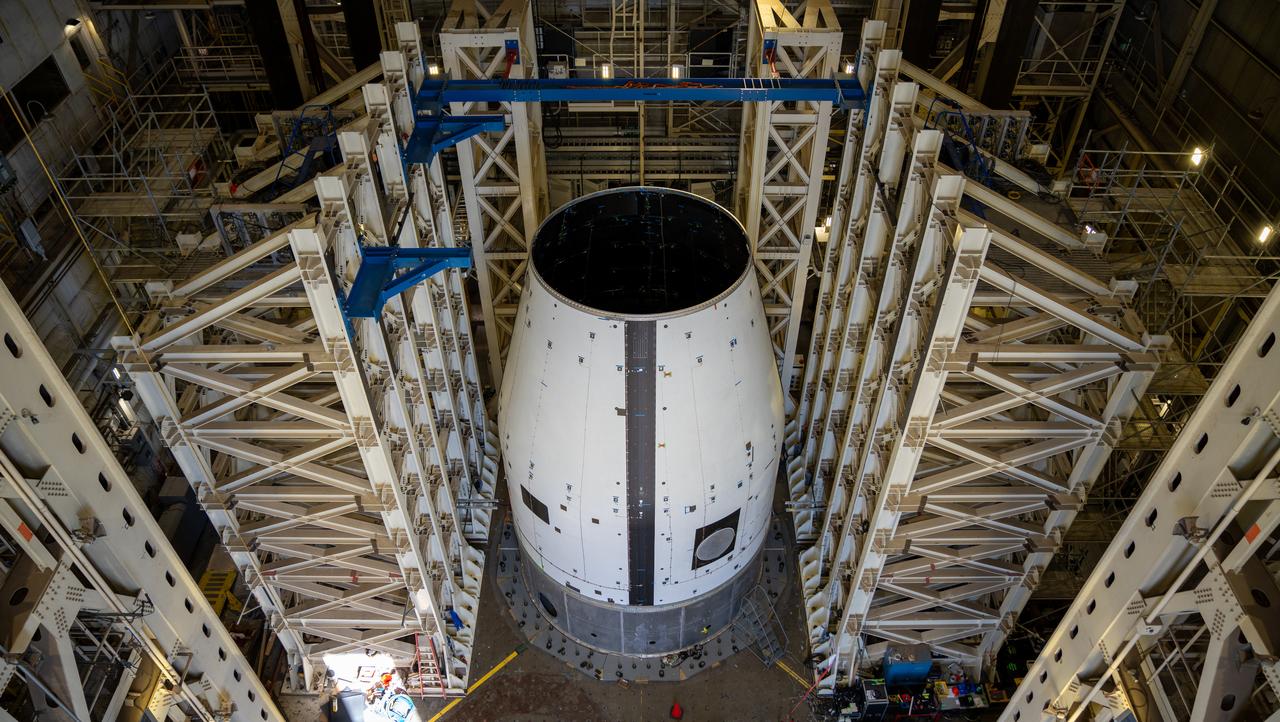
These photos and videos show how crews guided a test version of the universal stage adapter for NASA’s more powerful version of its SLS (Space Launch System) rocket to Building 4619 at the agency’s Marshall Space Flight Center in Huntsville, Alabama, Feb. 22. Built by Leidos, the lead contractor for the universal stage adapter, crews transported the hardware from a Leidos facility in Decatur, Alabama, the same day. The universal stage adapter will connect the SLS rocket’s upgraded in-space propulsion stage, called the exploration upper stage, to NASA’s Orion spacecraft as part of the evolved Block 1B configuration of the SLS rocket. It will also serve as a compartment capable of accommodating large payloads, such as modules or other exploration spacecraft. In Building 4619’s Load Test Annex High Bay at Marshall, the development test article will first undergo modal testing that will shake the hardware to validate dynamic models. Later, during ultimate load testing, force will be applied vertically and to the sides of the hardware. Unlike the flight hardware, the development test article has flaws intentionally included in its design, which will help engineers verity that the flight adapter can withstand the extreme forces it will face during launch and flight.
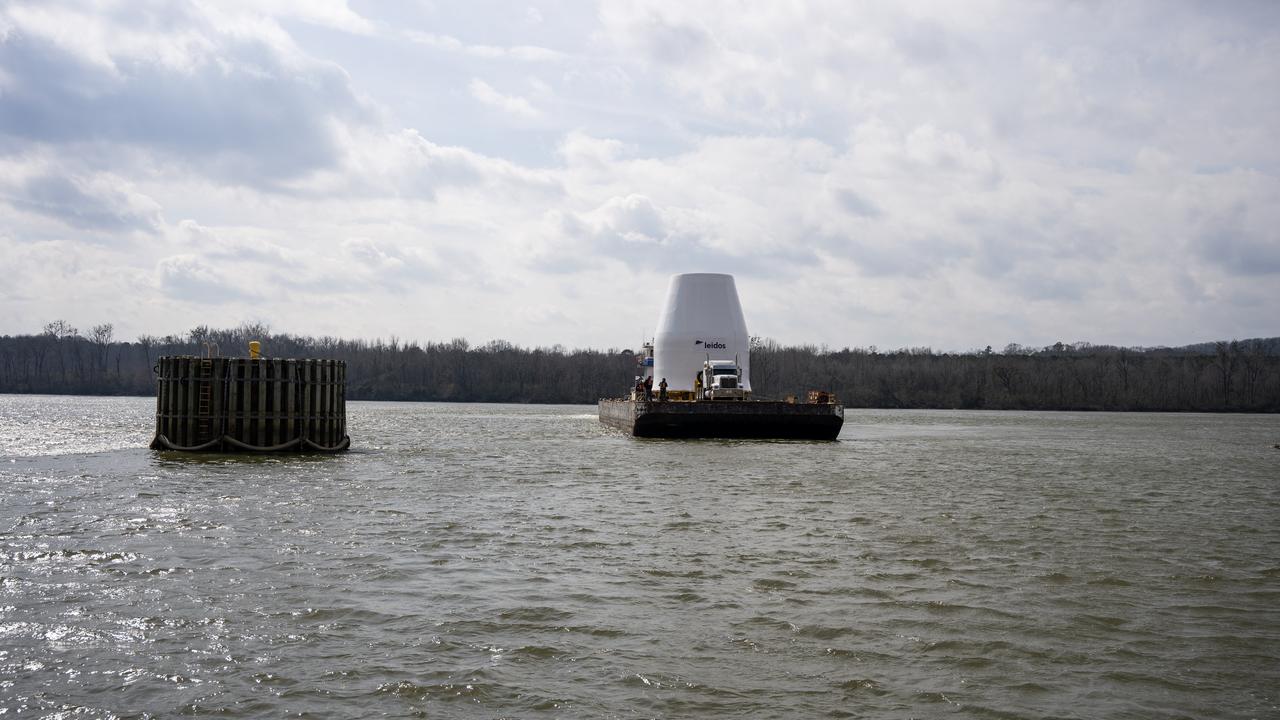
These photos and videos show how crews guided a test version of the universal stage adapter for NASA’s more powerful version of its SLS (Space Launch System) rocket to Building 4619 at the agency’s Marshall Space Flight Center in Huntsville, Alabama, Feb. 22. Built by Leidos, the lead contractor for the universal stage adapter, crews transported the hardware from a Leidos facility in Decatur, Alabama, the same day. The universal stage adapter will connect the SLS rocket’s upgraded in-space propulsion stage, called the exploration upper stage, to NASA’s Orion spacecraft as part of the evolved Block 1B configuration of the SLS rocket. It will also serve as a compartment capable of accommodating large payloads, such as modules or other exploration spacecraft. In Building 4619’s Load Test Annex High Bay at Marshall, the development test article will first undergo modal testing that will shake the hardware to validate dynamic models. Later, during ultimate load testing, force will be applied vertically and to the sides of the hardware. Unlike the flight hardware, the development test article has flaws intentionally included in its design, which will help engineers verity that the flight adapter can withstand the extreme forces it will face during launch and flight.
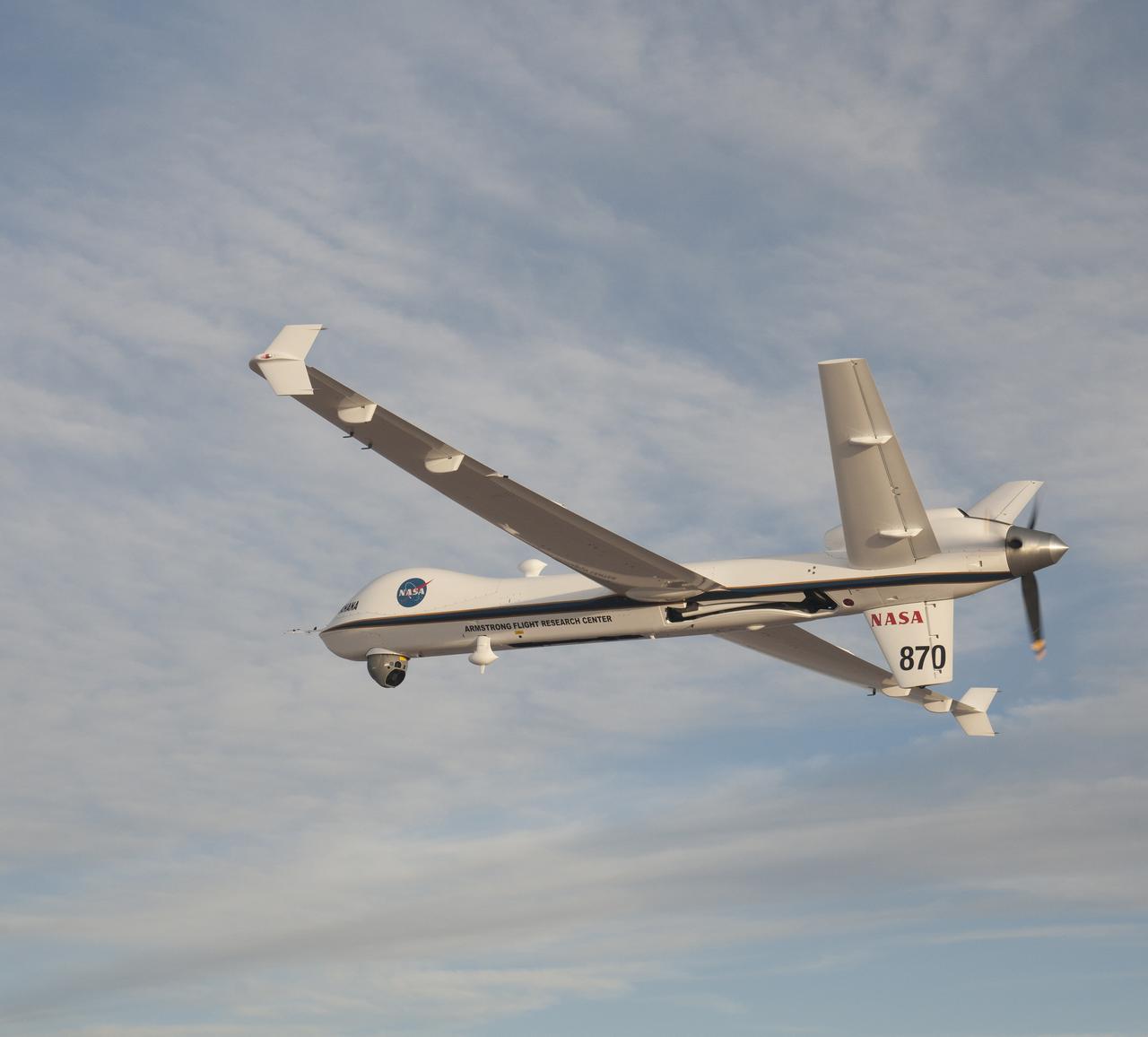
The Ikhana remotely piloted aircraft captured real-time video when the Orion Exploration Flight Test-1 mission concluded on Dec. 5, 2014. It is planned for the Ikhana to capture video again for the Orion and Space Launch System Exploration Mission-1 (EM-1) certification flight.
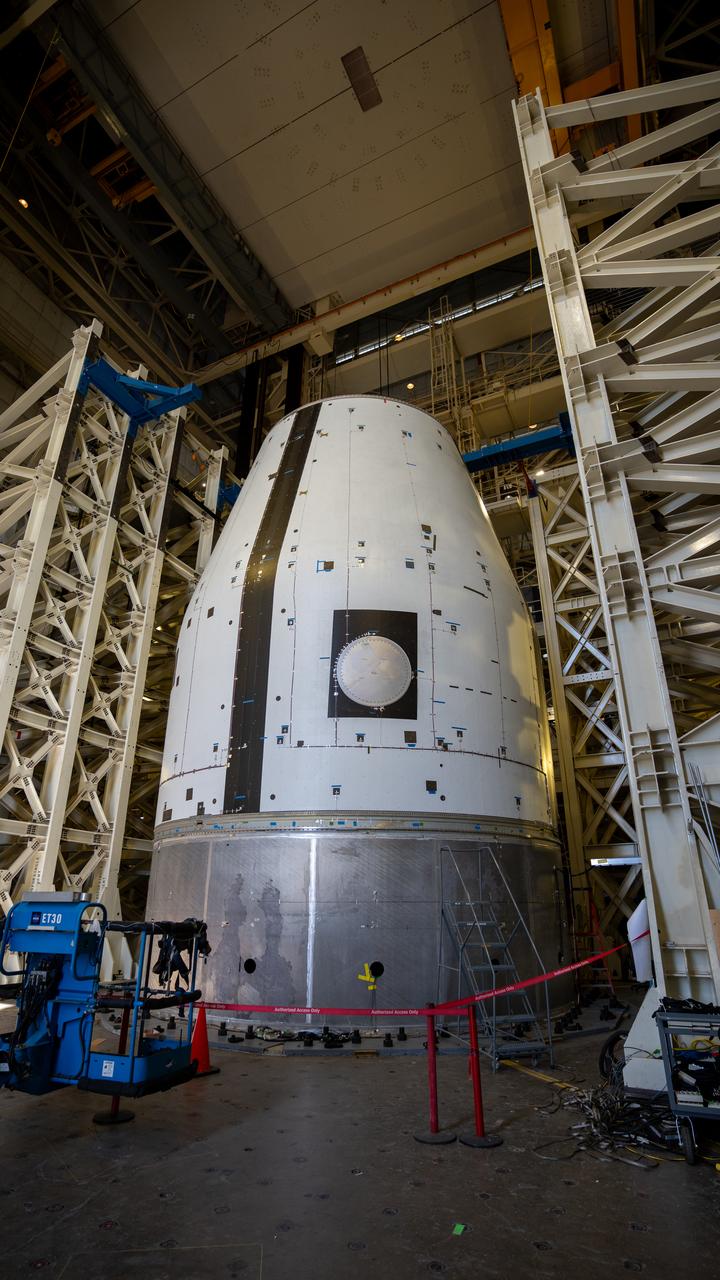
These photos and videos show how crews guided a test version of the universal stage adapter for NASA’s more powerful version of its SLS (Space Launch System) rocket to Building 4619 at the agency’s Marshall Space Flight Center in Huntsville, Alabama, Feb. 22. Built by Leidos, the lead contractor for the universal stage adapter, crews transported the hardware from a Leidos facility in Decatur, Alabama, the same day. The universal stage adapter will connect the SLS rocket’s upgraded in-space propulsion stage, called the exploration upper stage, to NASA’s Orion spacecraft as part of the evolved Block 1B configuration of the SLS rocket. It will also serve as a compartment capable of accommodating large payloads, such as modules or other exploration spacecraft. In Building 4619’s Load Test Annex High Bay at Marshall, the development test article will first undergo modal testing that will shake the hardware to validate dynamic models. Later, during ultimate load testing, force will be applied vertically and to the sides of the hardware. Unlike the flight hardware, the development test article has flaws intentionally included in its design, which will help engineers verity that the flight adapter can withstand the extreme forces it will face during launch and flight.
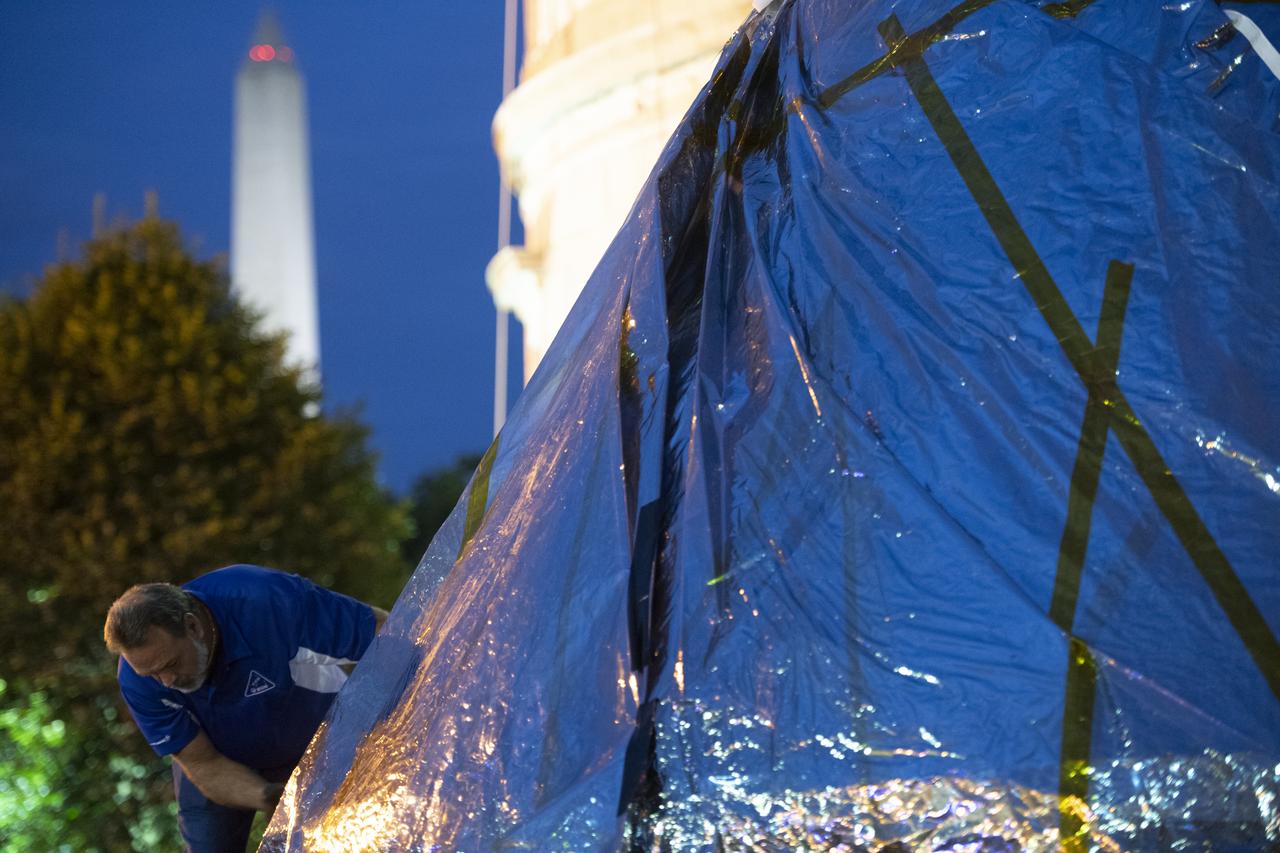
NASA's Orion spacecraft that flew Exploration Flight Test-1 on Dec. 5, 2014 is seen as it arrives at the White House complex, Saturday, July 21, 2018 in Washington, DC. Lockheed Martin, NASA’s prime contractor for Orion, began manufacturing the Orion crew module in 2011 and delivered it in July 2012 to NASA's Kennedy Space Center where final assembly, integration and testing was completed. More than 1,000 companies across the country manufactured or contributed elements to the spacecraft. Photo Credit: (NASA/Joel Kowsky)
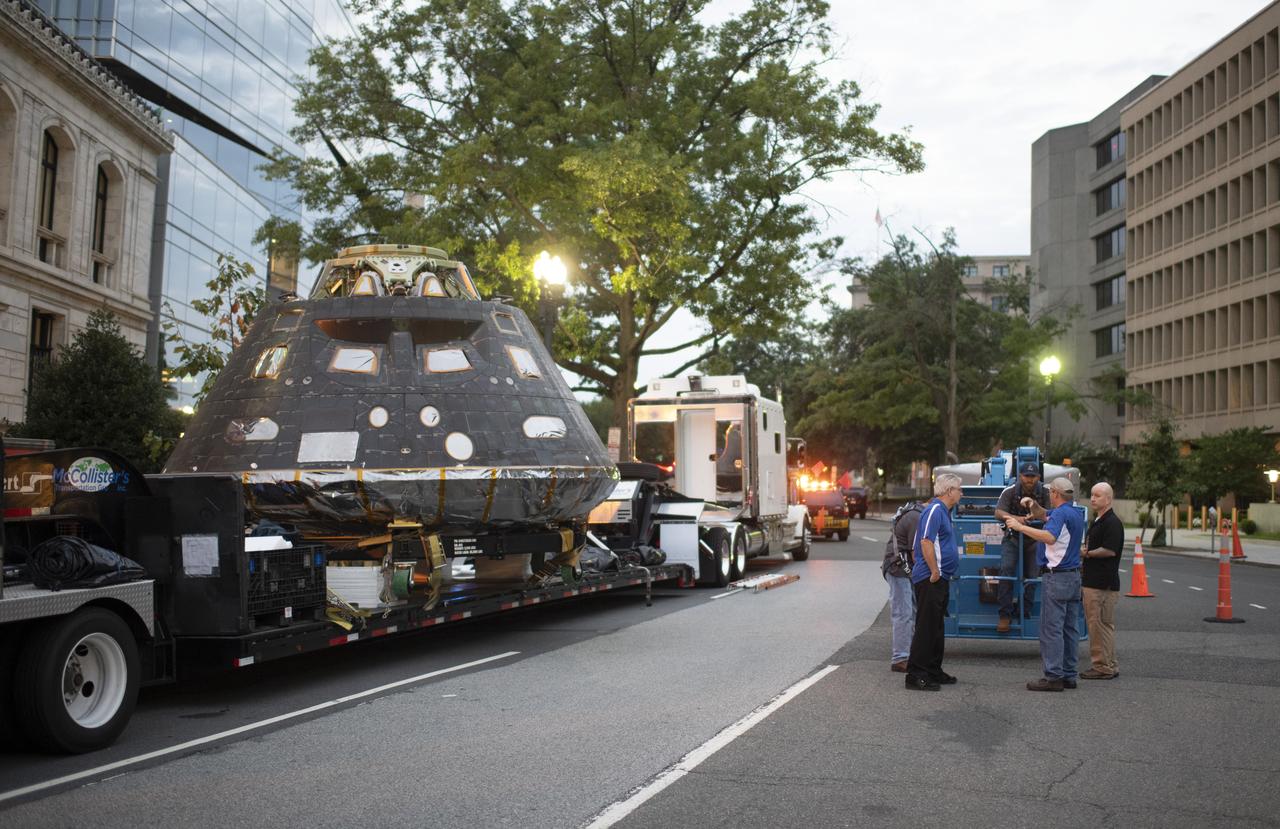
NASA's Orion spacecraft that flew Exploration Flight Test-1 on Dec. 5, 2014 is seen as it arrives at the White House complex, Saturday, July 21, 2018 in Washington, DC. Lockheed Martin, NASA’s prime contractor for Orion, began manufacturing the Orion crew module in 2011 and delivered it in July 2012 to NASA's Kennedy Space Center where final assembly, integration and testing was completed. More than 1,000 companies across the country manufactured or contributed elements to the spacecraft. Photo Credit: (NASA/Joel Kowsky)
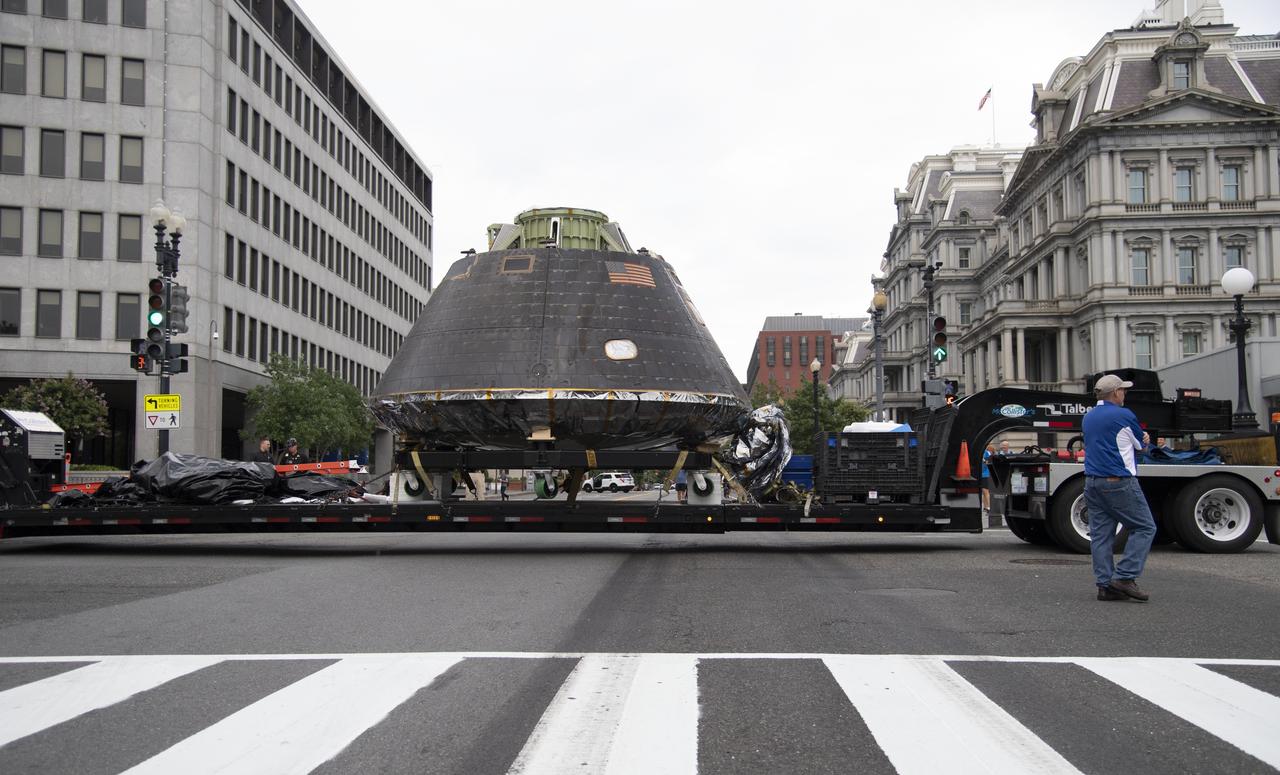
NASA's Orion spacecraft that flew Exploration Flight Test-1 on Dec. 5, 2014 is seen as it arrives at the White House complex, Saturday, July 21, 2018 in Washington, DC. Lockheed Martin, NASA’s prime contractor for Orion, began manufacturing the Orion crew module in 2011 and delivered it in July 2012 to NASA's Kennedy Space Center where final assembly, integration and testing was completed. More than 1,000 companies across the country manufactured or contributed elements to the spacecraft. Photo Credit: (NASA/Joel Kowsky)
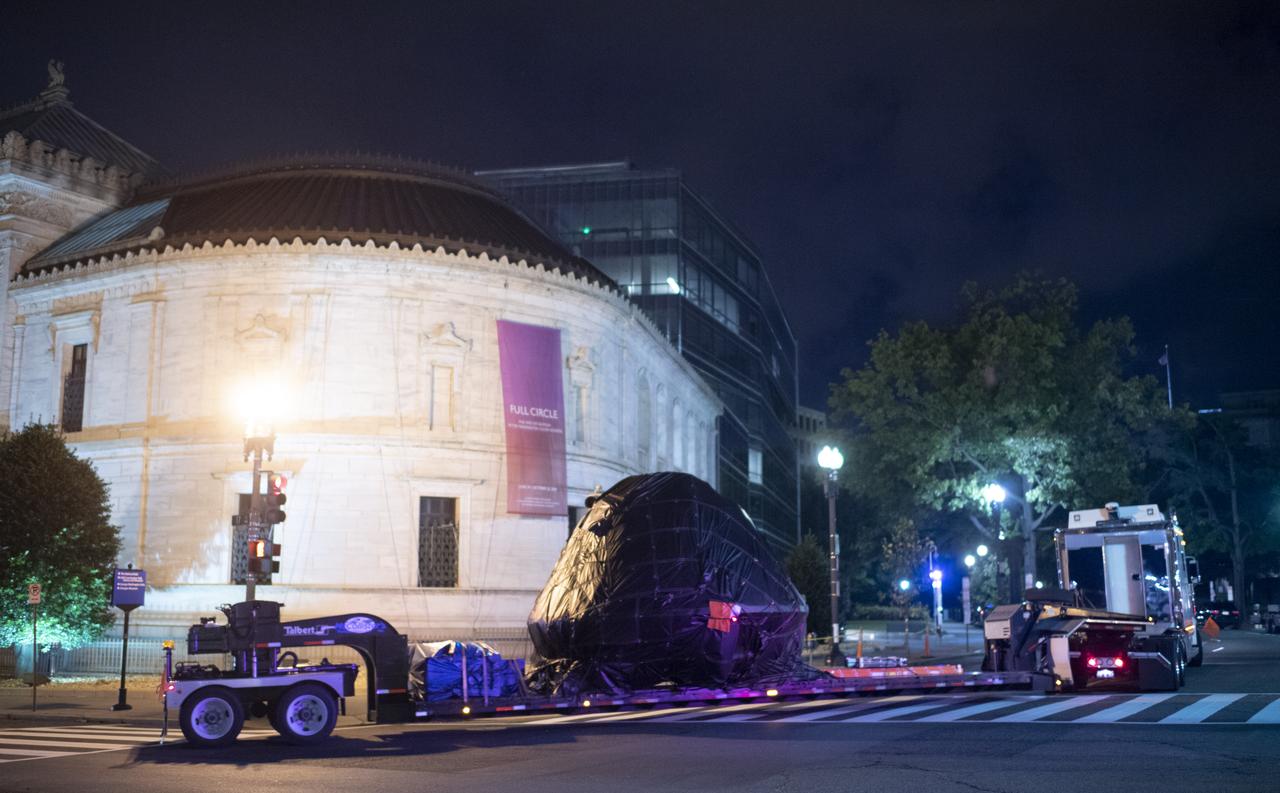
NASA's Orion spacecraft that flew Exploration Flight Test-1 on Dec. 5, 2014 is seen as it arrives at the White House complex, Saturday, July 21, 2018 in Washington, DC. Lockheed Martin, NASA’s prime contractor for Orion, began manufacturing the Orion crew module in 2011 and delivered it in July 2012 to NASA's Kennedy Space Center where final assembly, integration and testing was completed. More than 1,000 companies across the country manufactured or contributed elements to the spacecraft. Photo Credit: (NASA/Joel Kowsky)

NASA's Orion spacecraft that flew Exploration Flight Test-1 on Dec. 5, 2014 is seen on the South Lawn of the White House, Sunday, July 22, 2018 in Washington, DC. Lockheed Martin, NASA’s prime contractor for Orion, began manufacturing the Orion crew module in 2011 and delivered it in July 2012 to NASA's Kennedy Space Center where final assembly, integration and testing was completed. More than 1,000 companies across the country manufactured or contributed elements to the spacecraft. Photo Credit: (NASA/Joel Kowsky)
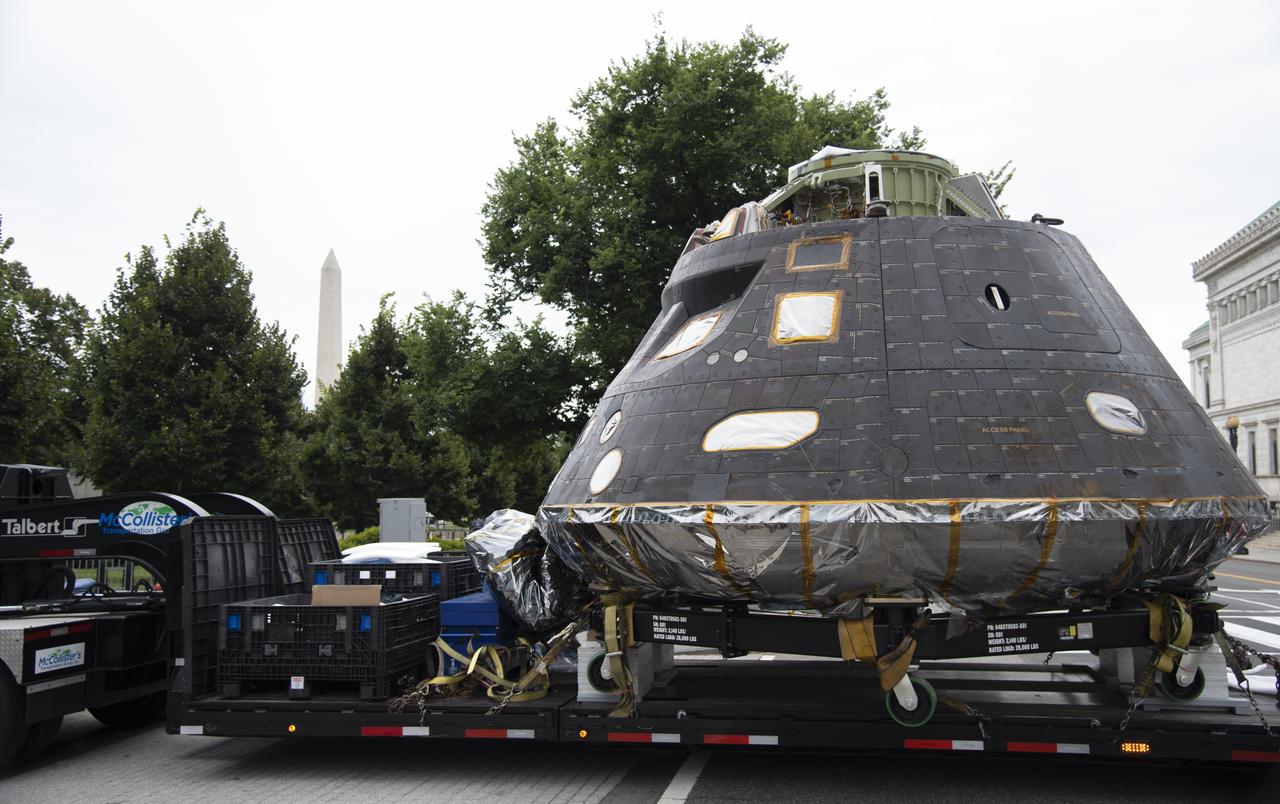
NASA's Orion spacecraft that flew Exploration Flight Test-1 on Dec. 5, 2014 is seen as it arrives at the White House complex, Saturday, July 21, 2018 in Washington, DC. Lockheed Martin, NASA’s prime contractor for Orion, began manufacturing the Orion crew module in 2011 and delivered it in July 2012 to NASA's Kennedy Space Center where final assembly, integration and testing was completed. More than 1,000 companies across the country manufactured or contributed elements to the spacecraft. Photo Credit: (NASA/Joel Kowsky)
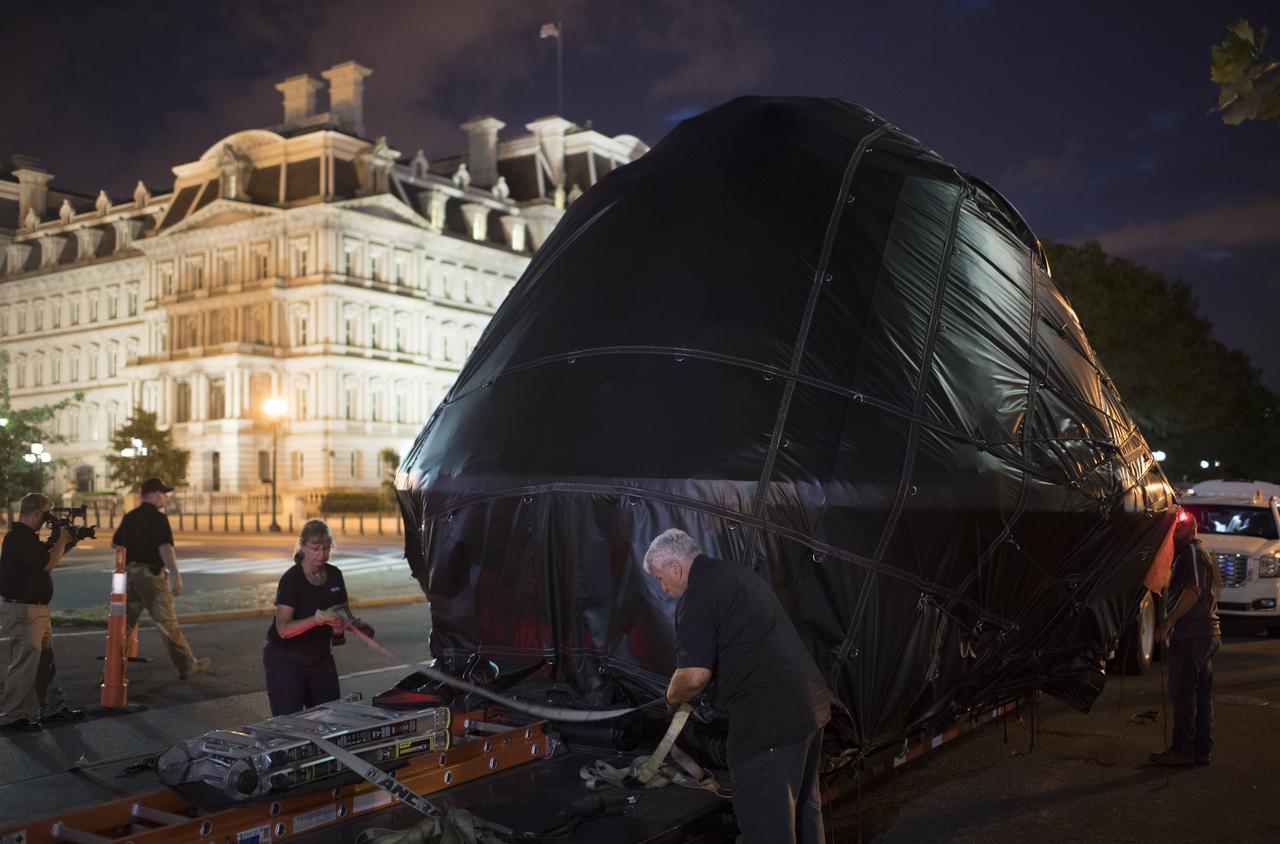
NASA's Orion spacecraft that flew Exploration Flight Test-1 on Dec. 5, 2014 is seen as it arrives at the White House complex, Saturday, July 21, 2018 in Washington, DC. Lockheed Martin, NASA’s prime contractor for Orion, began manufacturing the Orion crew module in 2011 and delivered it in July 2012 to NASA's Kennedy Space Center where final assembly, integration and testing was completed. More than 1,000 companies across the country manufactured or contributed elements to the spacecraft. Photo Credit: (NASA/Joel Kowsky)
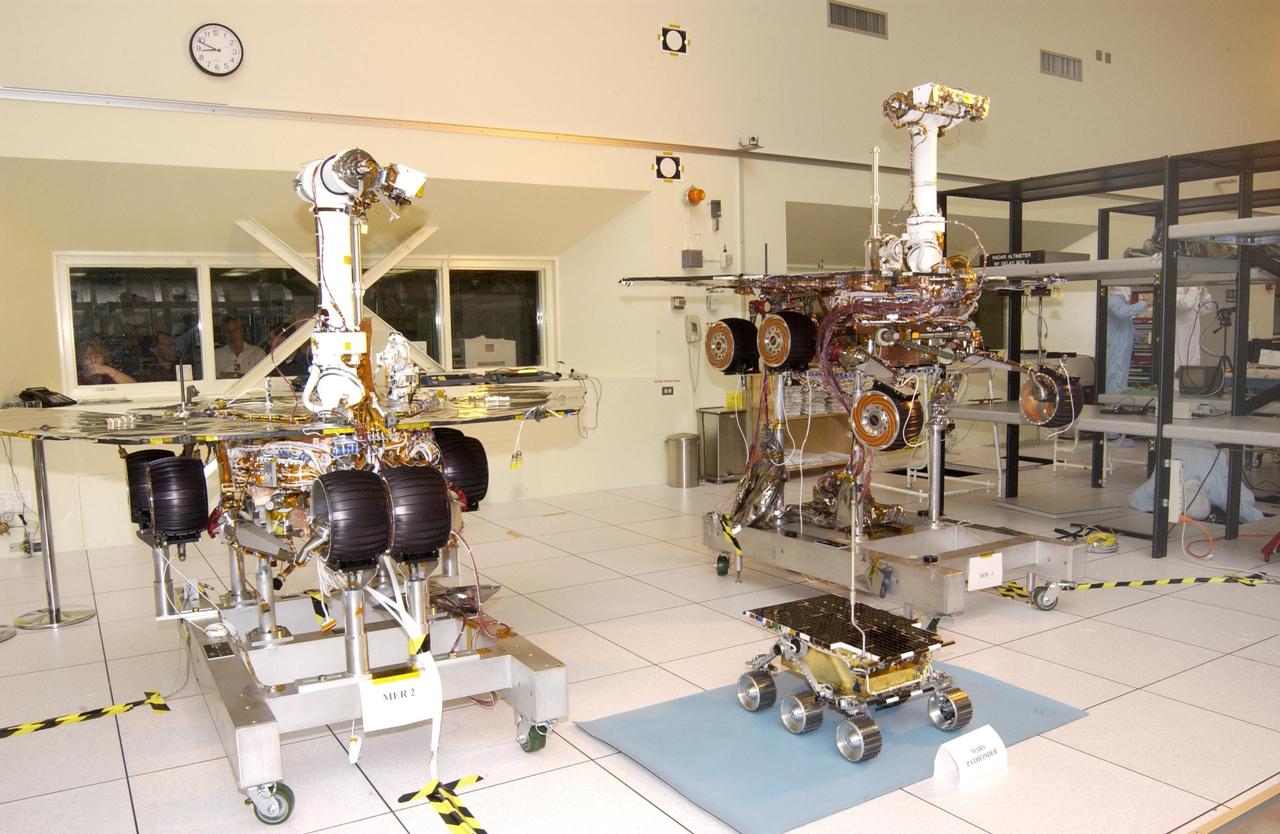
The twin rovers of NASAa Mars Exploration Rover Mission pose with their groundbreaking predecessor, the flight spare of the Sojourner rover from NASA 1997 Pathfinder mission.

The Seagull nebula, seen in this infrared mosaic from NASA Wide-field Infrared Survey Explorer, draws its common name from it resemblance to a gull in flight.

These images show technicians at NASA’s Michoud Assembly Facility in New Orleans removing a weld-confidence article from a robotic welding tool in December 2023. This article features pieces of a liquid hydrogen tank dome that were welded as a test to make sure the dome used for flight will be welded correctly. The dome will be part of the new, four-engine EUS (exploration upper stage) for NASA’s SLS (Space Launch System) rocket. EUS will be used for the Artemis IV lunar mission, replacing the single-engine interim cryogenic propulsion stage (ICPS) used for the first three Artemis missions. The evolved in-space stage will use a combination of liquid oxygen and liquid hydrogen propellants to help power the engines to send large cargo and crew inside NASA’s Orion spacecraft to the Moon. The weld-confidence article pictured here will not be used for flight but is instead helping teams prepare and certify the procedures needed to manufacture flight hardware. NASA is working to land the first woman and person of color on the Moon under Artemis. SLS is part of NASA’s backbone for deep space exploration, along with the Orion spacecraft, advanced spacesuits and rovers, the Gateway in orbit around the Moon, and commercial human landing systems. SLS is the only rocket that can send Orion, astronauts, and supplies to the Moon in a single launch.

These images show technicians at NASA’s Michoud Assembly Facility in New Orleans removing a weld-confidence article from a robotic welding tool in December 2023. This article features pieces of a liquid hydrogen tank dome that were welded as a test to make sure the dome used for flight will be welded correctly. The dome will be part of the new, four-engine EUS (exploration upper stage) for NASA’s SLS (Space Launch System) rocket. EUS will be used for the Artemis IV lunar mission, replacing the single-engine interim cryogenic propulsion stage (ICPS) used for the first three Artemis missions. The evolved in-space stage will use a combination of liquid oxygen and liquid hydrogen propellants to help power the engines to send large cargo and crew inside NASA’s Orion spacecraft to the Moon. The weld-confidence article pictured here will not be used for flight but is instead helping teams prepare and certify the procedures needed to manufacture flight hardware. NASA is working to land the first woman and person of color on the Moon under Artemis. SLS is part of NASA’s backbone for deep space exploration, along with the Orion spacecraft, advanced spacesuits and rovers, the Gateway in orbit around the Moon, and commercial human landing systems. SLS is the only rocket that can send Orion, astronauts, and supplies to the Moon in a single launch.

These images show technicians at NASA’s Michoud Assembly Facility in New Orleans removing a weld-confidence article from a robotic welding tool in December 2023. This article features pieces of a liquid hydrogen tank dome that were welded as a test to make sure the dome used for flight will be welded correctly. The dome will be part of the new, four-engine EUS (exploration upper stage) for NASA’s SLS (Space Launch System) rocket. EUS will be used for the Artemis IV lunar mission, replacing the single-engine interim cryogenic propulsion stage (ICPS) used for the first three Artemis missions. The evolved in-space stage will use a combination of liquid oxygen and liquid hydrogen propellants to help power the engines to send large cargo and crew inside NASA’s Orion spacecraft to the Moon. The weld-confidence article pictured here will not be used for flight but is instead helping teams prepare and certify the procedures needed to manufacture flight hardware. NASA is working to land the first woman and person of color on the Moon under Artemis. SLS is part of NASA’s backbone for deep space exploration, along with the Orion spacecraft, advanced spacesuits and rovers, the Gateway in orbit around the Moon, and commercial human landing systems. SLS is the only rocket that can send Orion, astronauts, and supplies to the Moon in a single launch.

These images show technicians at NASA’s Michoud Assembly Facility in New Orleans removing a weld-confidence article from a robotic welding tool in December 2023. This article features pieces of a liquid hydrogen tank dome that were welded as a test to make sure the dome used for flight will be welded correctly. The dome will be part of the new, four-engine EUS (exploration upper stage) for NASA’s SLS (Space Launch System) rocket. EUS will be used for the Artemis IV lunar mission, replacing the single-engine interim cryogenic propulsion stage (ICPS) used for the first three Artemis missions. The evolved in-space stage will use a combination of liquid oxygen and liquid hydrogen propellants to help power the engines to send large cargo and crew inside NASA’s Orion spacecraft to the Moon. The weld-confidence article pictured here will not be used for flight but is instead helping teams prepare and certify the procedures needed to manufacture flight hardware. NASA is working to land the first woman and person of color on the Moon under Artemis. SLS is part of NASA’s backbone for deep space exploration, along with the Orion spacecraft, advanced spacesuits and rovers, the Gateway in orbit around the Moon, and commercial human landing systems. SLS is the only rocket that can send Orion, astronauts, and supplies to the Moon in a single launch.

These images show technicians at NASA’s Michoud Assembly Facility in New Orleans removing a weld-confidence article from a robotic welding tool in December 2023. This article features pieces of a liquid hydrogen tank dome that were welded as a test to make sure the dome used for flight will be welded correctly. The dome will be part of the new, four-engine EUS (exploration upper stage) for NASA’s SLS (Space Launch System) rocket. EUS will be used for the Artemis IV lunar mission, replacing the single-engine interim cryogenic propulsion stage (ICPS) used for the first three Artemis missions. The evolved in-space stage will use a combination of liquid oxygen and liquid hydrogen propellants to help power the engines to send large cargo and crew inside NASA’s Orion spacecraft to the Moon. The weld-confidence article pictured here will not be used for flight but is instead helping teams prepare and certify the procedures needed to manufacture flight hardware. NASA is working to land the first woman and person of color on the Moon under Artemis. SLS is part of NASA’s backbone for deep space exploration, along with the Orion spacecraft, advanced spacesuits and rovers, the Gateway in orbit around the Moon, and commercial human landing systems. SLS is the only rocket that can send Orion, astronauts, and supplies to the Moon in a single launch.

More than 600 students with 44 teams from around the world participated in the 32nd year of NASA’s Human Exploration Rover Challenge (HERC) on April 10 and April 11 near NASA’s Marshall Space Flight Center in Huntsville, Alabama. Participating teams represented 28 colleges and universities, 13 high schools, and one middle school from 18 states, Puerto Rico, and four Artemis Accord countries. Teams were awarded points based on navigating a half-mile obstacle course with either a human-powered or remote-controlled rover, conducting mission-specific task challenges, and completing multiple safety and design reviews with NASA engineers.
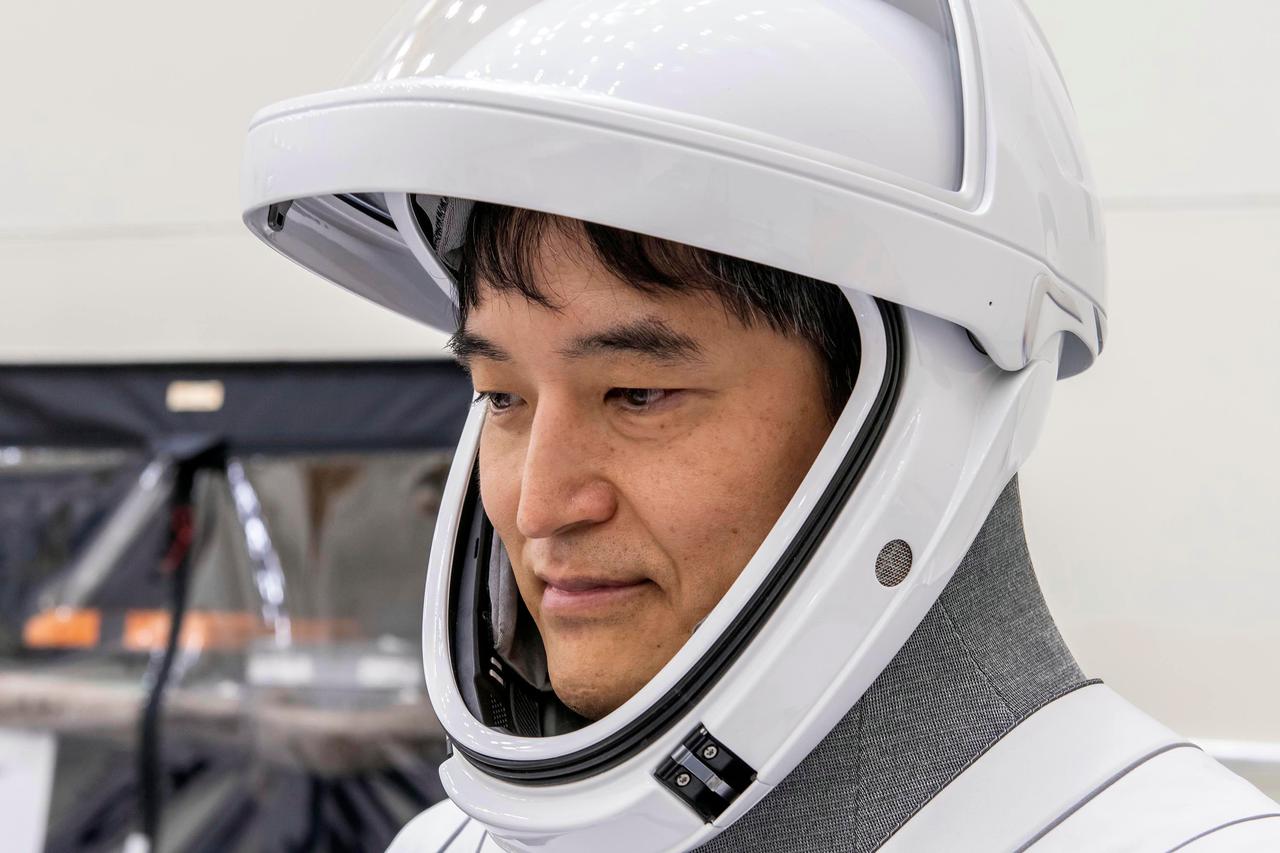
jsc2025e012273 - (February 17, 2025) --- SpaceX Crew-10 Mission Specialist Takuya Onishi of JAXA (Japan Aerospace Exploration Agency) in his flight suit at NASA's Kennedy Space Center in Florida.
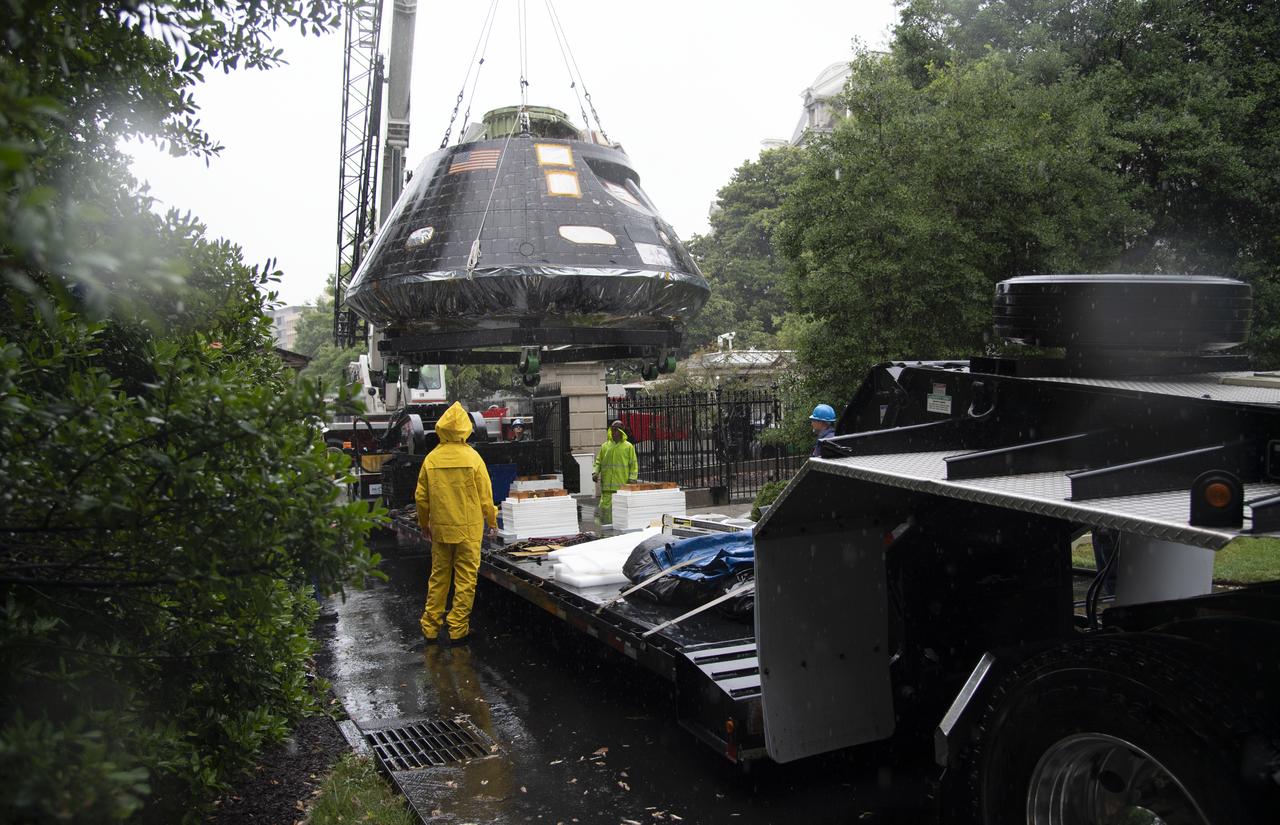
NASA's Orion spacecraft that flew Exploration Flight Test-1 on Dec. 5, 2014 is seen while being lifted over a gate and onto the South Lawn of the White House, Saturday, July 21, 2018 in Washington, DC. Lockheed Martin, NASA’s prime contractor for Orion, began manufacturing the Orion crew module in 2011 and delivered it in July 2012 to NASA's Kennedy Space Center where final assembly, integration and testing was completed. More than 1,000 companies across the country manufactured or contributed elements to the spacecraft. Photo Credit: (NASA/Joel Kowsky)
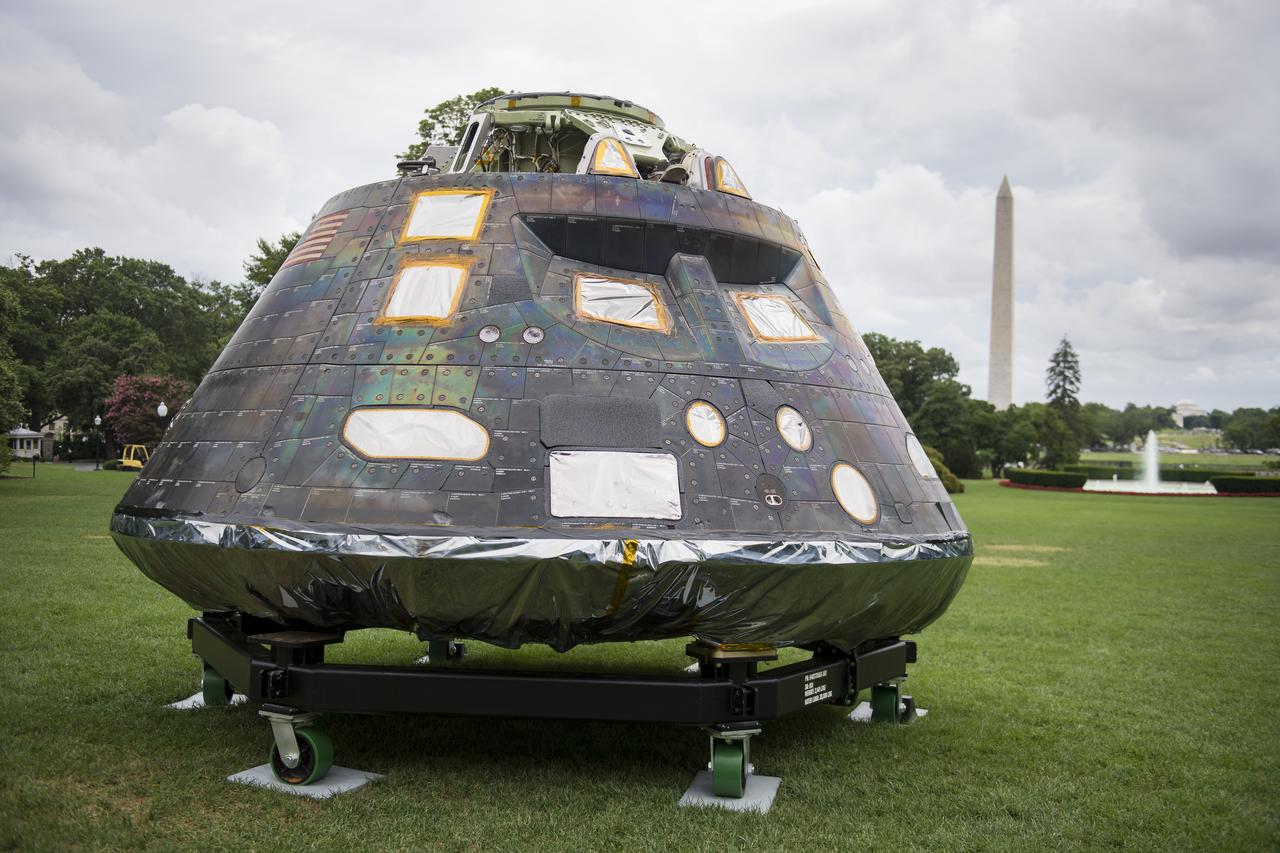
NASA's Orion spacecraft that flew on Exploration Flight Test-1 on Dec. 5, 2014, is seen on the south lawn of the White House during a Made in America Product Showcase, Monday, July 23, 2018 in Washington. Lockheed Martin, NASA’s prime contractor for Orion, began manufacturing the Orion crew module in 2011 and delivered it in July 2012 to NASA's Kennedy Space Center where final assembly, integration and testing was completed. More than 1,000 companies across the country manufactured or contributed elements to the spacecraft. Photo Credit: (NASA/Aubrey Gemignani)
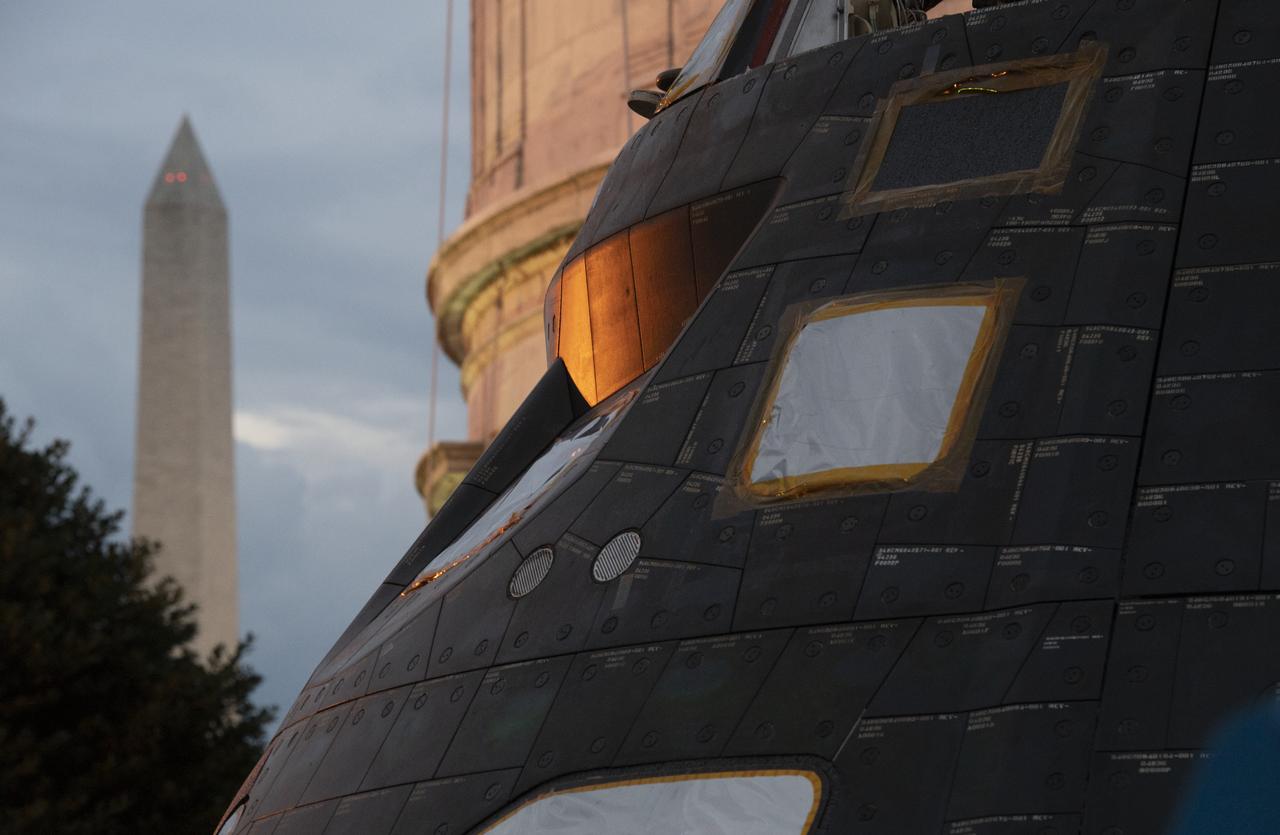
NASA's Orion spacecraft that flew Exploration Flight Test-1 on Dec. 5, 2014 is seen after being uncovered in preparation for being moved onto the White House complex, Saturday, July 21, 2018 in Washington, DC. Lockheed Martin, NASA’s prime contractor for Orion, began manufacturing the Orion crew module in 2011 and delivered it in July 2012 to NASA's Kennedy Space Center where final assembly, integration and testing was completed. More than 1,000 companies across the country manufactured or contributed elements to the spacecraft. Photo Credit: (NASA/Joel Kowsky)
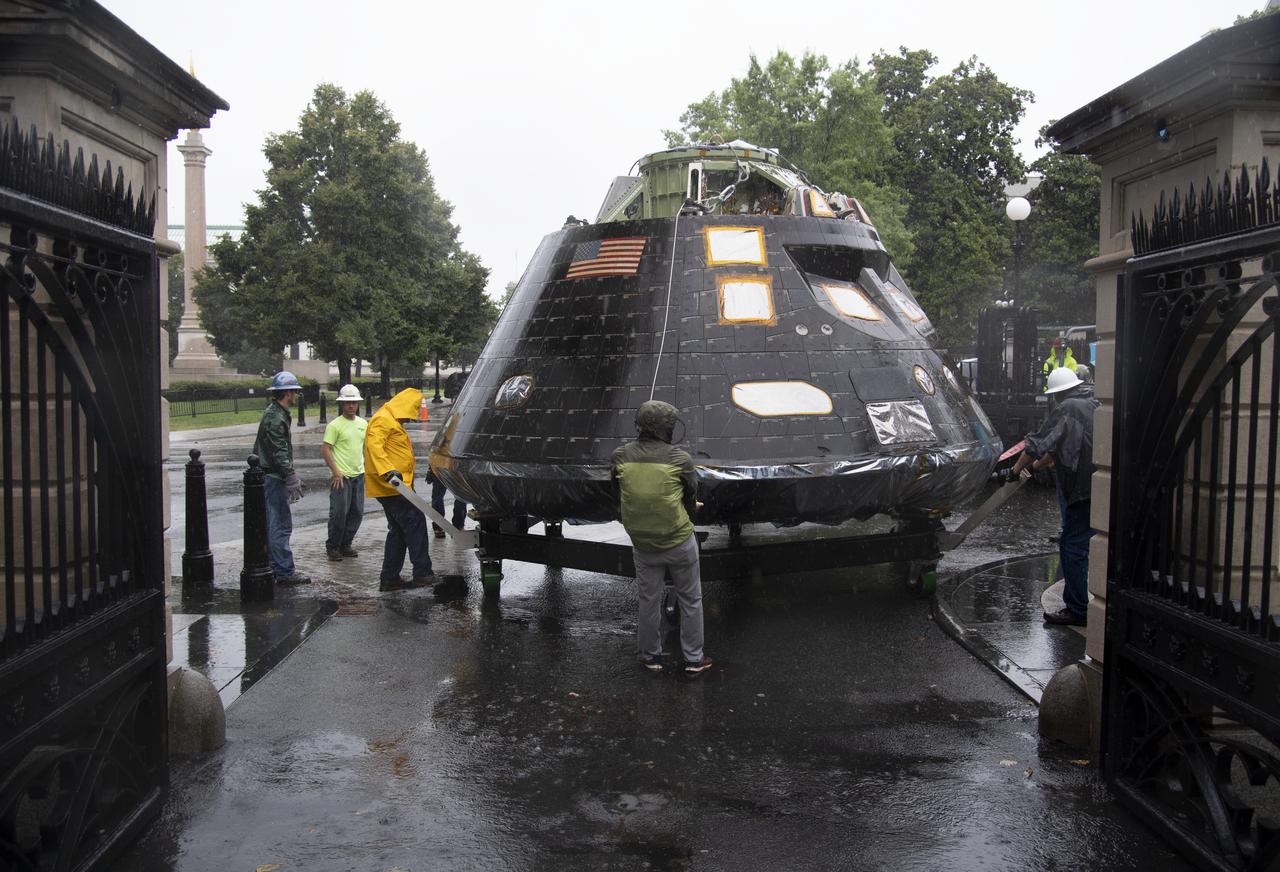
NASA's Orion spacecraft that flew Exploration Flight Test-1 on Dec. 5, 2014 is seen while being moved into position to be lifted over a gate and onto the South Lawn of the White House, Saturday, July 21, 2018 in Washington, DC. Lockheed Martin, NASA’s prime contractor for Orion, began manufacturing the Orion crew module in 2011 and delivered it in July 2012 to NASA's Kennedy Space Center where final assembly, integration and testing was completed. More than 1,000 companies across the country manufactured or contributed elements to the spacecraft. Photo Credit: (NASA/Joel Kowsky)
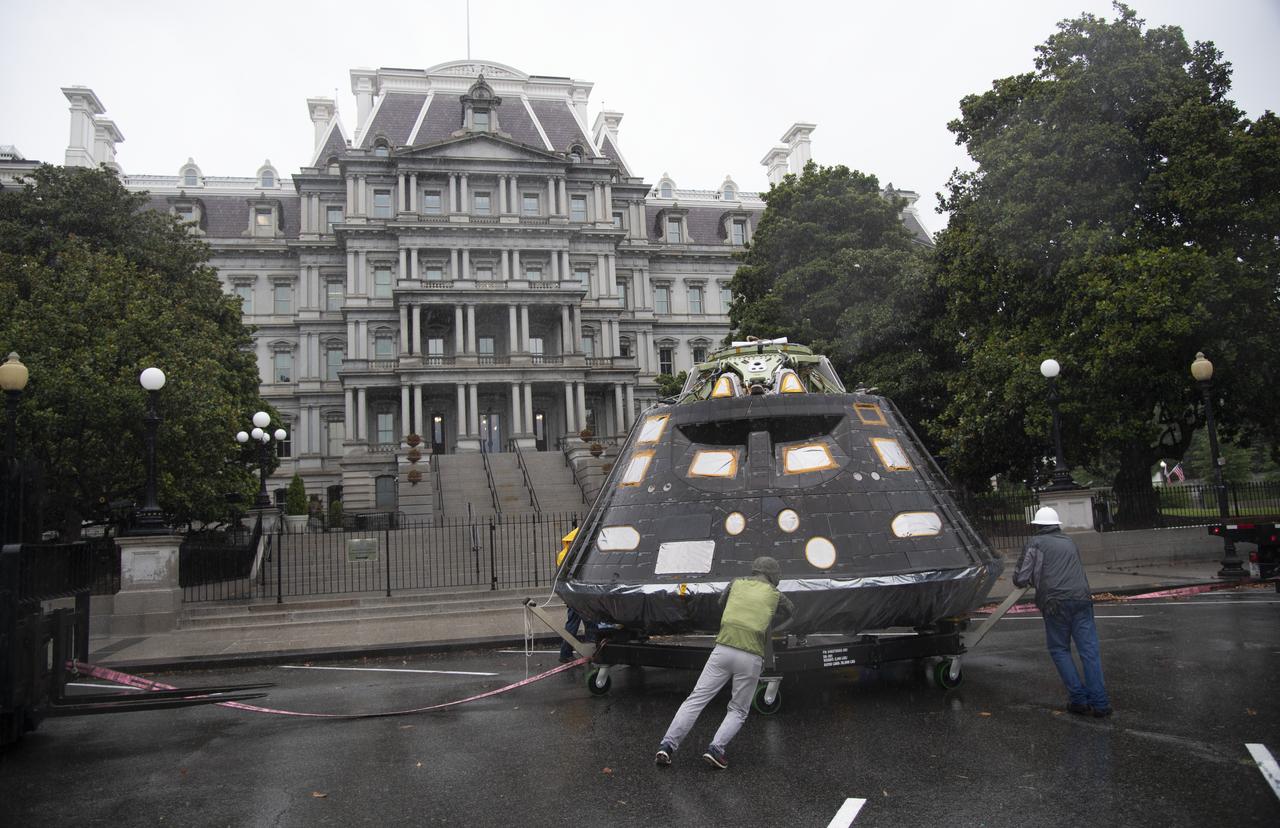
NASA's Orion spacecraft that flew Exploration Flight Test-1 on Dec. 5, 2014 is seen in front of the Eisenhower Executive Office Building on the White House complex, Saturday, July 21, 2018 in Washington, DC. Lockheed Martin, NASA’s prime contractor for Orion, began manufacturing the Orion crew module in 2011 and delivered it in July 2012 to NASA's Kennedy Space Center where final assembly, integration and testing was completed. More than 1,000 companies across the country manufactured or contributed elements to the spacecraft. Photo Credit: (NASA/Joel Kowsky)
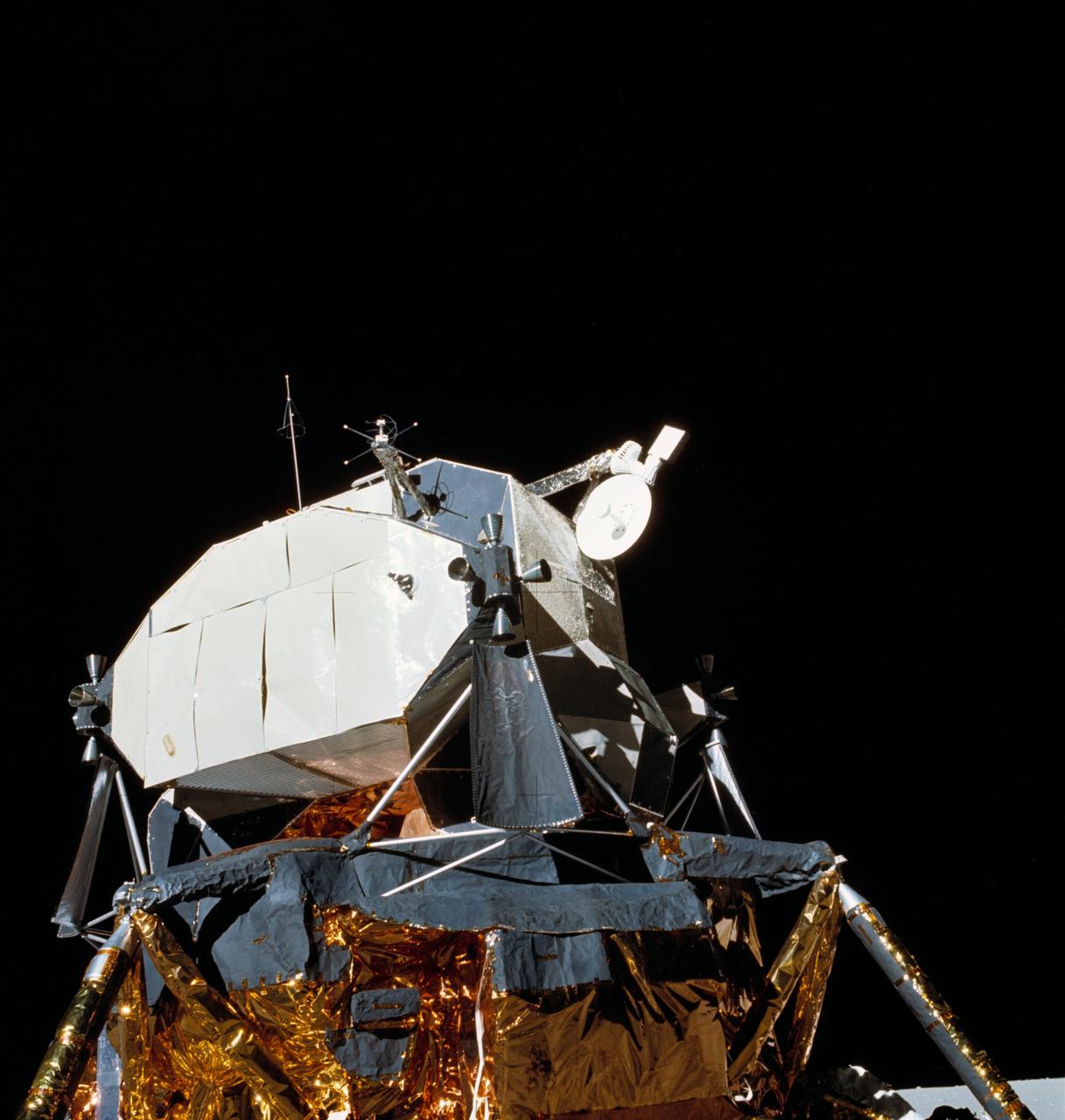
AS16-113-18334 (21 April 1972) --- View of the Lunar Module (LM) "Orion" parked on the lunar surface. During their post mission press conference, the Apollo 16 crewmembers called attention to the steerable S-band antenna, which was "frozen" in a yaw axis during much of the flight. This view of the LM was photographed by astronaut Charles M. Duke Jr., the lunar module pilot, during the mission's first extravehicular activity (EVA). Astronauts John W. Young, commander, and Duke had earlier descended in the LM to explore the Descartes region of the moon, while astronaut Thomas K. Mattingly II, command module pilot, remained with the Command and Service Modules (CSM) "Casper" in lunar orbit.
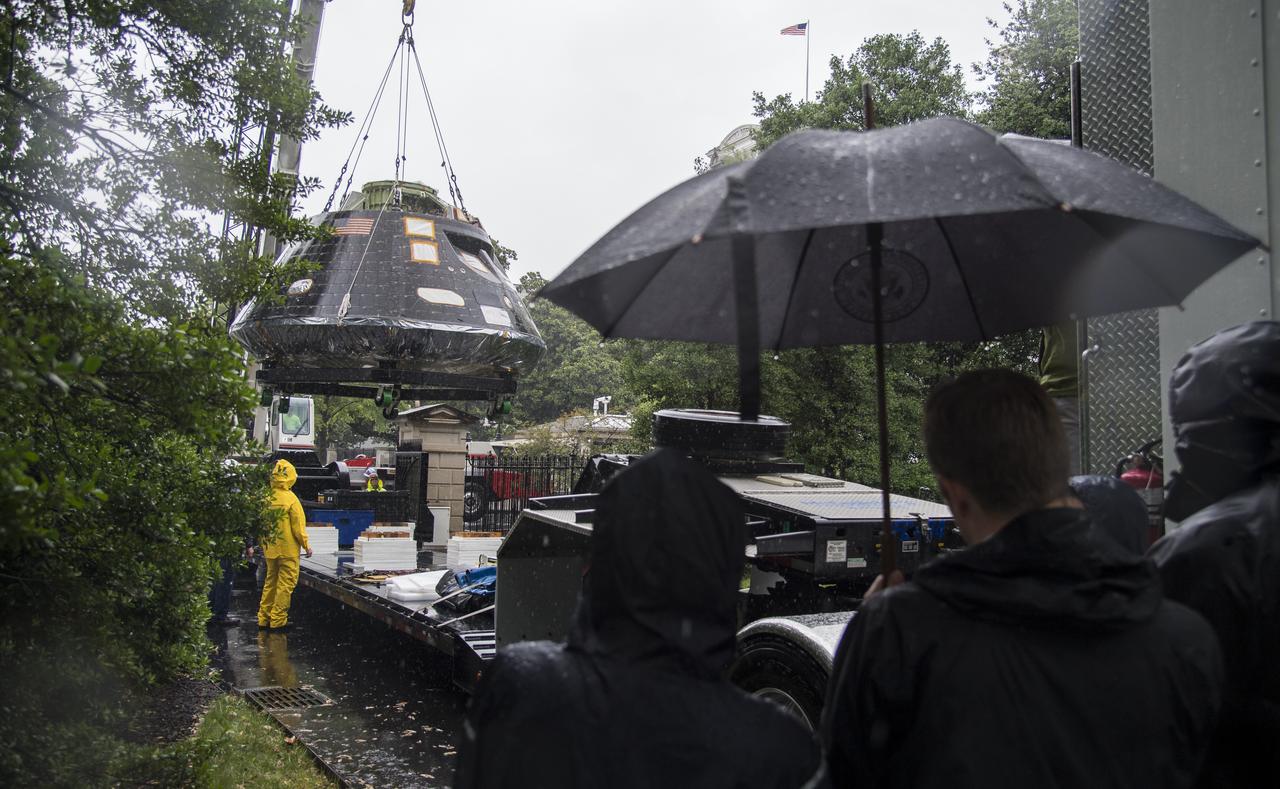
NASA's Orion spacecraft that flew Exploration Flight Test-1 on Dec. 5, 2014 is seen while being lifted over a gate and onto the South Lawn of the White House, Saturday, July 21, 2018 in Washington, DC. Lockheed Martin, NASA’s prime contractor for Orion, began manufacturing the Orion crew module in 2011 and delivered it in July 2012 to NASA's Kennedy Space Center where final assembly, integration and testing was completed. More than 1,000 companies across the country manufactured or contributed elements to the spacecraft. Photo Credit: (NASA/Joel Kowsky)
NASA's Orion spacecraft that flew Exploration Flight Test-1 on Dec. 5, 2014 is seen as it is lifted over a gate onto the White House complex, Saturday, July 21, 2018 in Washington, DC. Lockheed Martin, NASA’s prime contractor for Orion, began manufacturing the Orion crew module in 2011 and delivered it in July 2012 to NASA's Kennedy Space Center where final assembly, integration and testing was completed. More than 1,000 companies across the country manufactured or contributed elements to the spacecraft. Photo Credit: (NASA/Joel Kowsky)
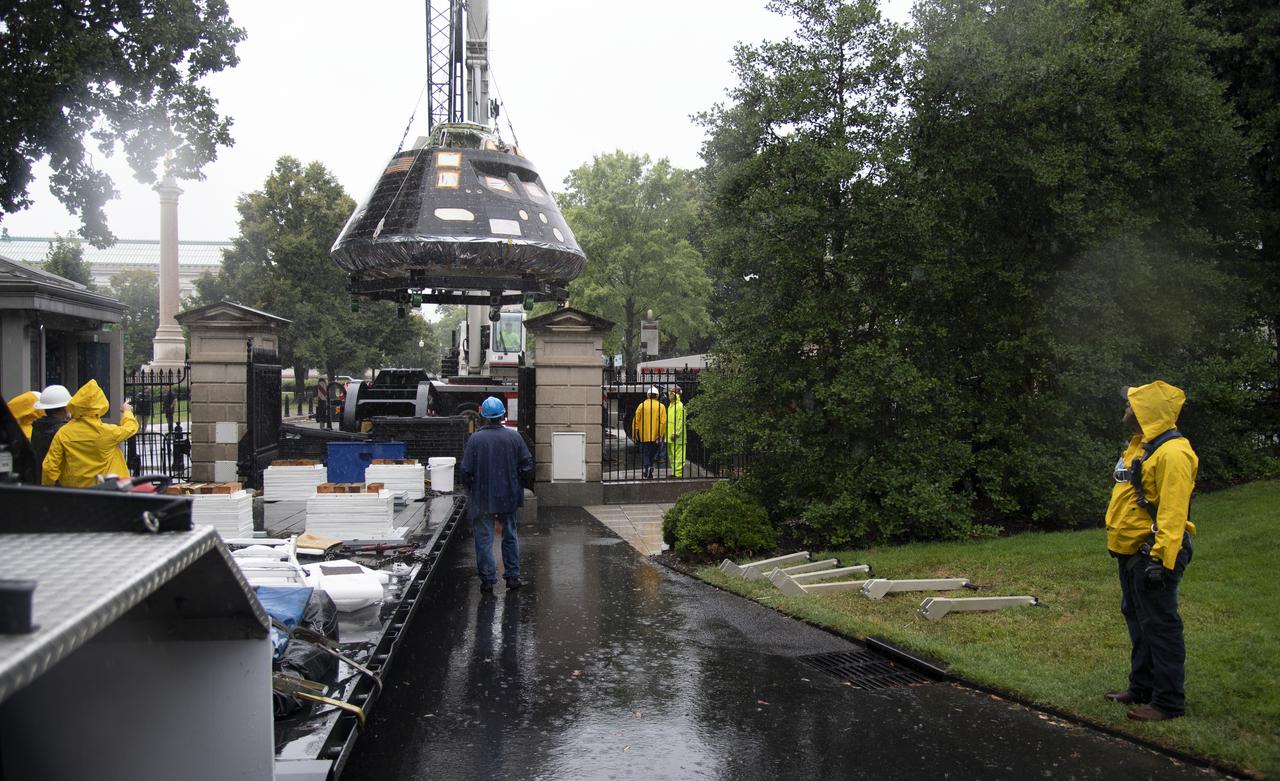
NASA's Orion spacecraft that flew Exploration Flight Test-1 on Dec. 5, 2014 is seen while being lifted over a gate and onto the South Lawn of the White House, Saturday, July 21, 2018 in Washington, DC. Lockheed Martin, NASA’s prime contractor for Orion, began manufacturing the Orion crew module in 2011 and delivered it in July 2012 to NASA's Kennedy Space Center where final assembly, integration and testing was completed. More than 1,000 companies across the country manufactured or contributed elements to the spacecraft. Photo Credit: (NASA/Joel Kowsky)
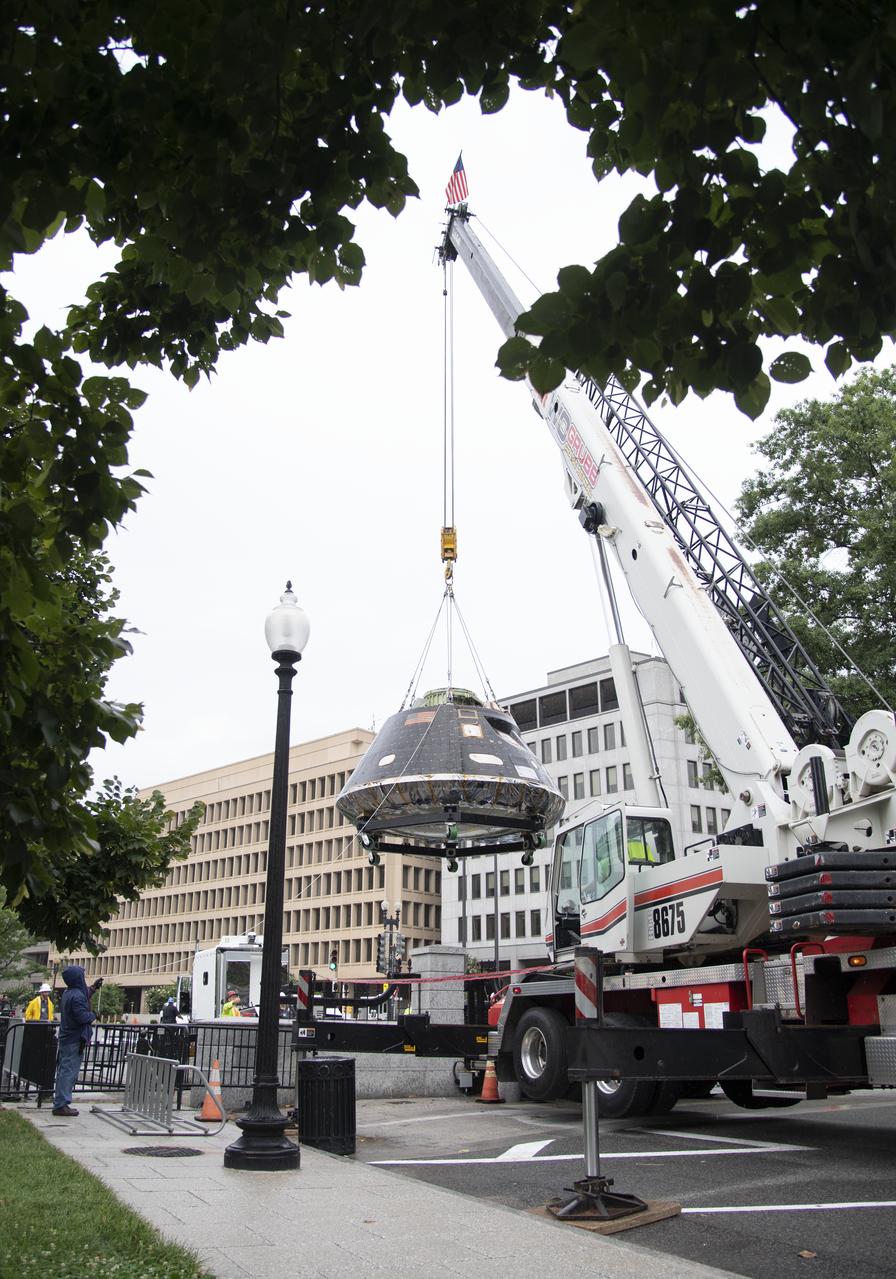
NASA's Orion spacecraft that flew Exploration Flight Test-1 on Dec. 5, 2014 is seen as it is lifted over a gate onto the White House complex, Saturday, July 21, 2018 in Washington, DC. Lockheed Martin, NASA’s prime contractor for Orion, began manufacturing the Orion crew module in 2011 and delivered it in July 2012 to NASA's Kennedy Space Center where final assembly, integration and testing was completed. More than 1,000 companies across the country manufactured or contributed elements to the spacecraft. Photo Credit: (NASA/Joel Kowsky)

NASA's Orion spacecraft that flew Exploration Flight Test-1 on Dec. 5, 2014 is seen after being uncovered in preparation for being moved onto the White House complex, Saturday, July 21, 2018 in Washington, DC. Lockheed Martin, NASA’s prime contractor for Orion, began manufacturing the Orion crew module in 2011 and delivered it in July 2012 to NASA's Kennedy Space Center where final assembly, integration and testing was completed. More than 1,000 companies across the country manufactured or contributed elements to the spacecraft. Photo Credit: (NASA/Joel Kowsky)
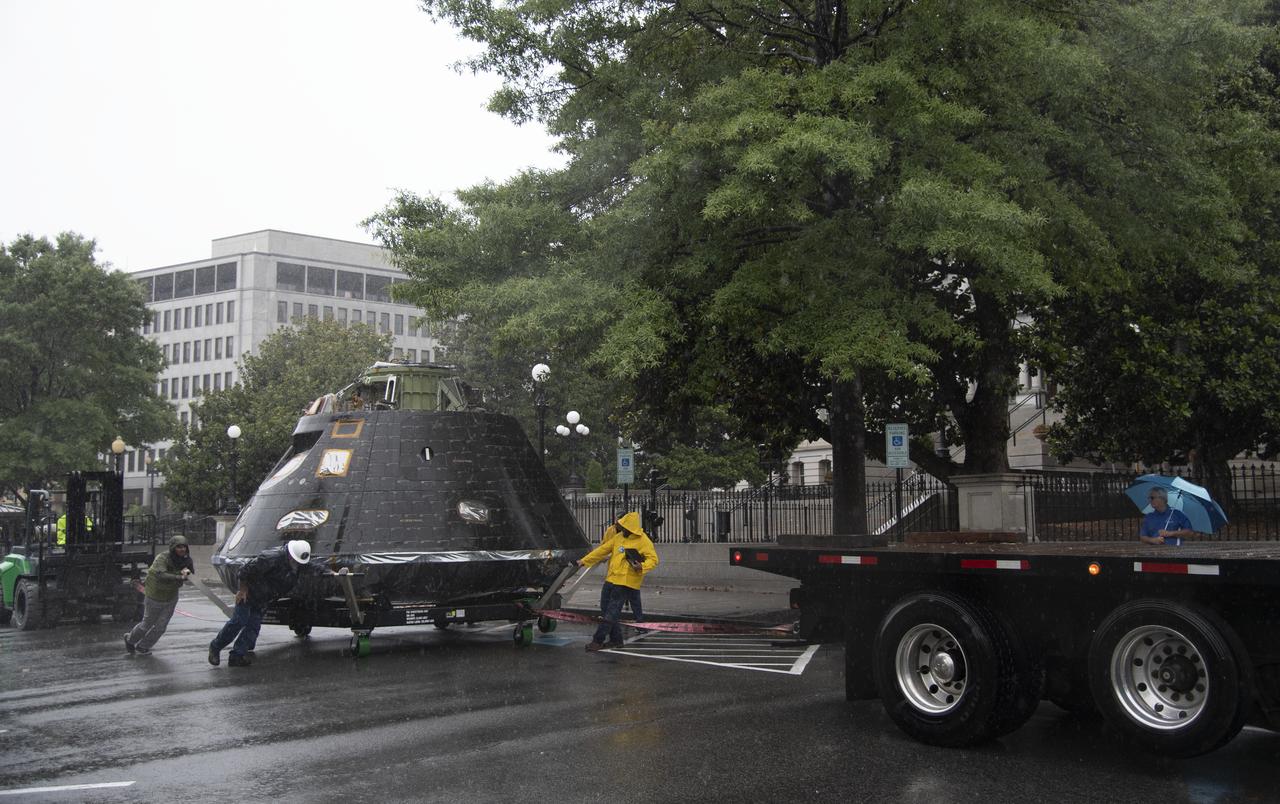
NASA's Orion spacecraft that flew Exploration Flight Test-1 on Dec. 5, 2014 is seen in front of the Eisenhower Executive Office Building on the White House complex, Saturday, July 21, 2018 in Washington, DC. Lockheed Martin, NASA’s prime contractor for Orion, began manufacturing the Orion crew module in 2011 and delivered it in July 2012 to NASA's Kennedy Space Center where final assembly, integration and testing was completed. More than 1,000 companies across the country manufactured or contributed elements to the spacecraft. Photo Credit: (NASA/Joel Kowsky)

NASA's Orion spacecraft that flew on Exploration Flight Test-1 on Dec. 5, 2014, is seen on the south lawn of the White House during a Made in America Product Showcase, Monday, July 23, 2018 in Washington. Lockheed Martin, NASA’s prime contractor for Orion, began manufacturing the Orion crew module in 2011 and delivered it in July 2012 to NASA's Kennedy Space Center where final assembly, integration and testing was completed. More than 1,000 companies across the country manufactured or contributed elements to the spacecraft. Photo Credit: (NASA/Aubrey Gemignani)
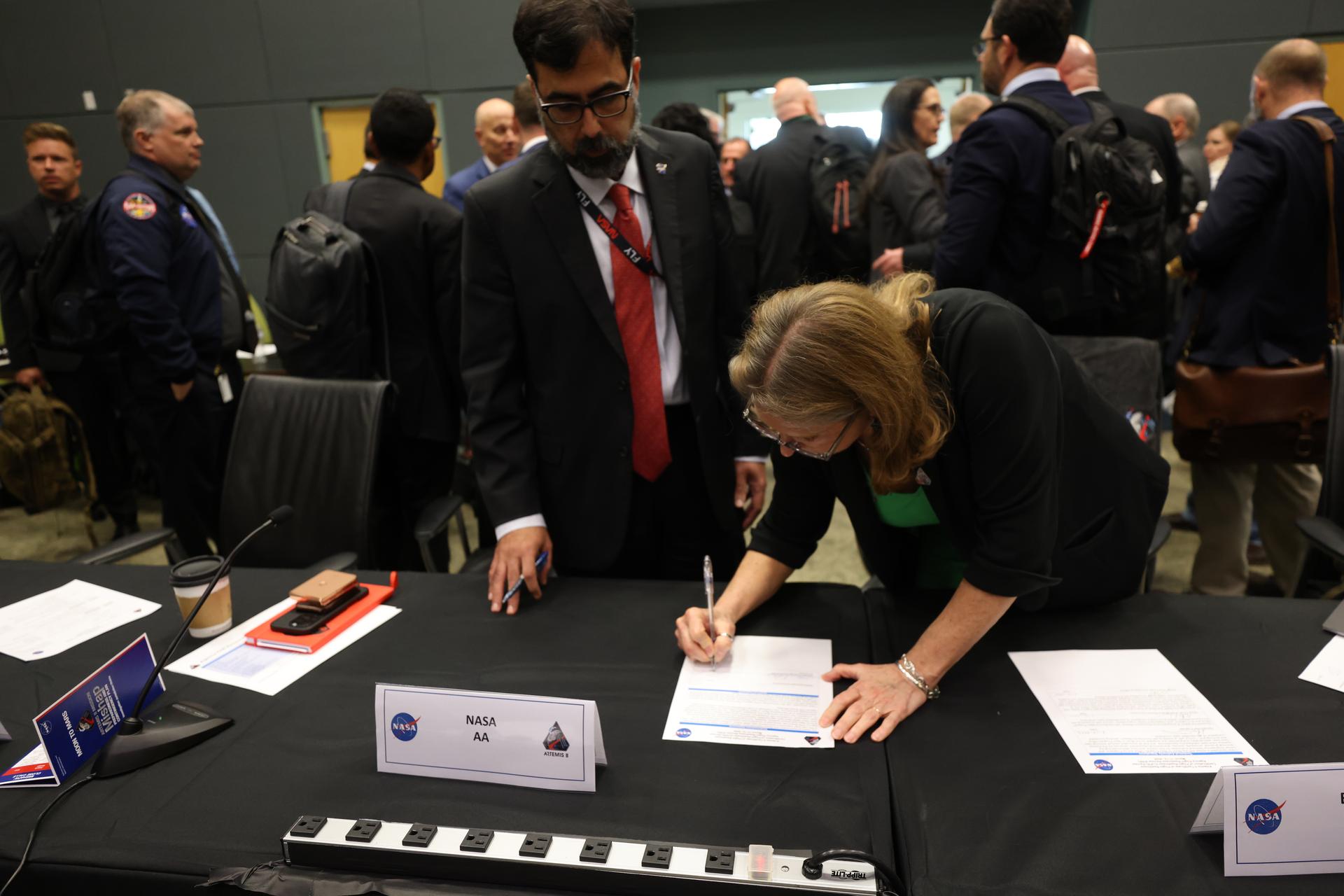
With NASA Associate Administrator Amit Kshatriya looking on, Lori Glaze, acting associate administrator, Exploration Systems Development Mission Directorate, signs the certification for flight readiness following the completion of the Flight Readiness Review for the Artemis II test flight on Thursday, March 12, 2026, at NASA’s Kennedy Space Center in Florida. The review is an assessment of the readiness of NASA’s SLS (Space Launch System) rocket and Orion spacecraft to support the Artemis II test flight as four astronauts journey around the Moon and return to Earth.
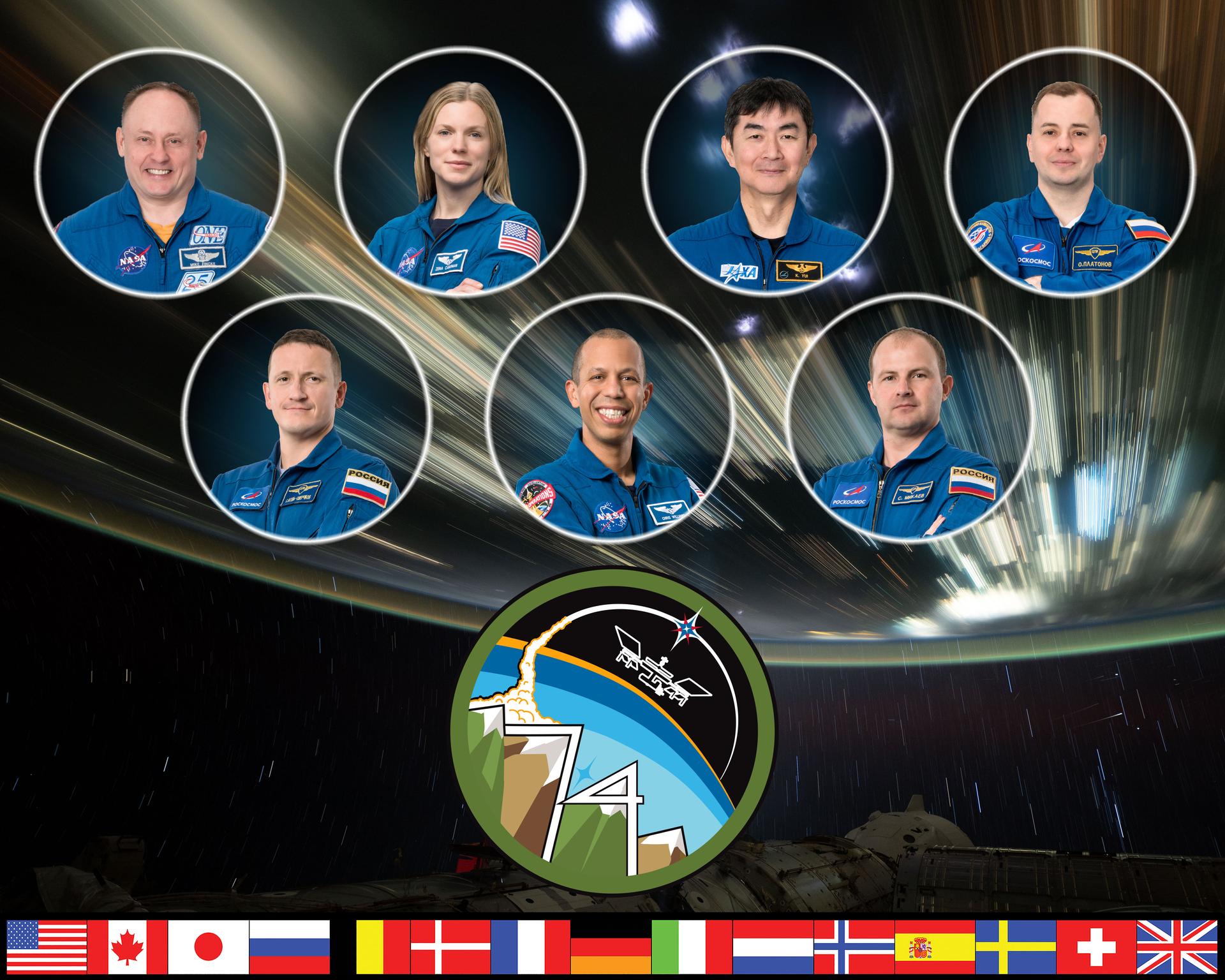
iss074-s-002 (Oct. 16, 2024) --- The official portrait of the Expedition 74 crew on the International Space Station. Top row from left, Commander Mike Fincke and Flight Engineer Zena Cardman, both NASA astronauts, JAXA (Japan Aerospace Exploration Agency) Flight Engineer Kimiya Yui, and Roscosmos Flight Engineer Oleg Platonov. Bottom row, Roscosmos Flight Engineer Sergey Kud-Sverchkov, NASA astronaut Chris Williams, and Roscosmos Flight Engineer Sergei Mikaev.
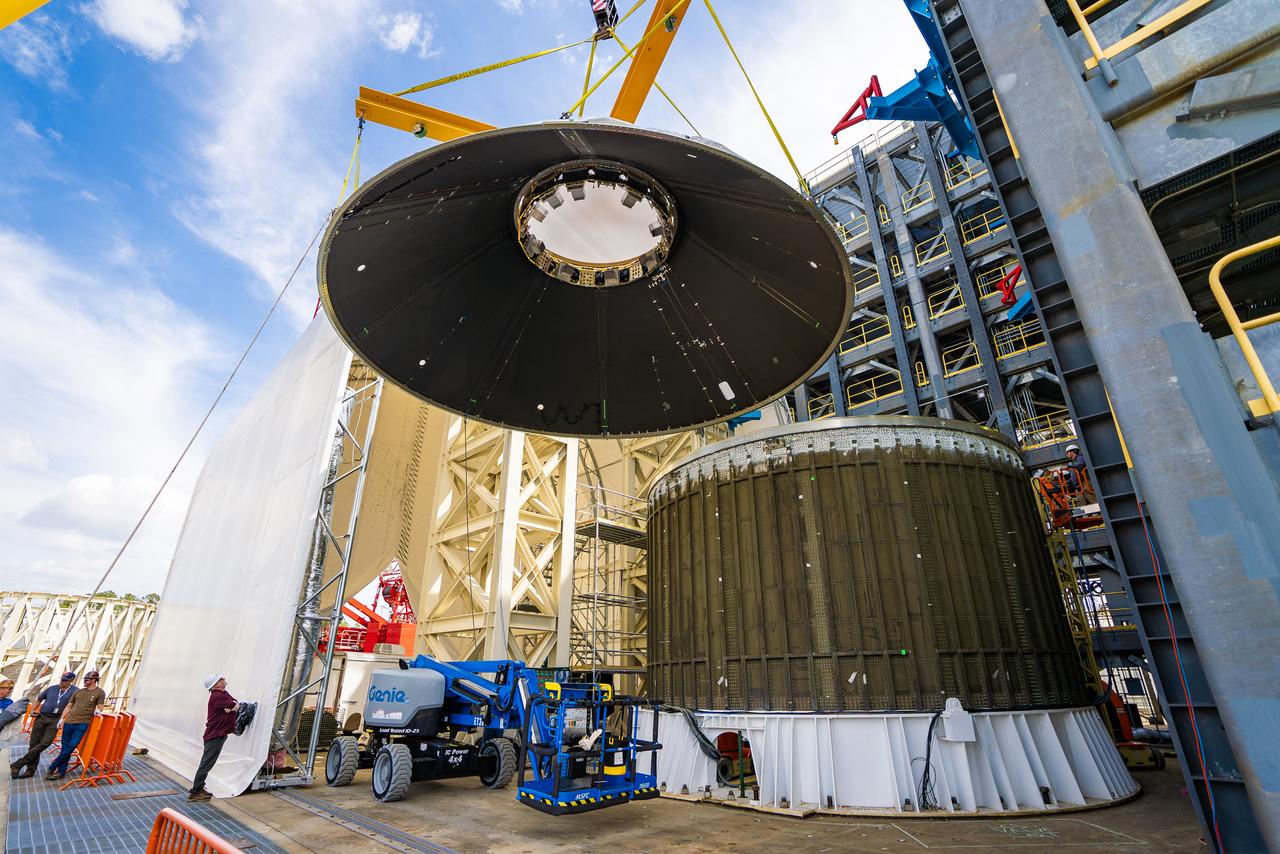
These photos and videos show how crews at NASA’s Marshall Space Flight Center in Huntsville, Alabama, moved and installed the payload adapter that will be used in the Block 1B configuration of the SLS (Space Launch System) rocket from Building 4708, where it was manufactured, into Structural Test Stand 4697 at NASA’s Marshall Space Flight Center on March 13. Teams at Marshall will begin structural testing the engineering development unit of the payload adapter – an exact replica of the flight version of the hardware – this spring. The cone-shaped payload adapter is about 8.5 feet tall and features two metal rings and eight composite panels. The adapter, which will debut on NASA’s Artemis IV mission, is an evolution from the Orion stage adapter used in the Block 1 configuration of the first three Artemis missions. It will be housed inside the universal stage adapter atop the rocket’s more powerful in-space stage, called the exploration upper stage. The payload adapter, like the launch vehicle stage adapter and the Orion stage adapter, is fully manufactured and tested at Marshall, which manages the SLS Program. NASA is working to land the first woman, first person of color, and its first international partner astronaut on the Moon under Artemis. SLS is part of NASA’s backbone for deep space exploration, along with the Orion spacecraft and Gateway in orbit around the Moon and commercial human landing systems, next-generational spacesuits, and rovers on the lunar surface. SLS is the only rocket that can send Orion, astronauts, and supplies to the Moon in a single launch.
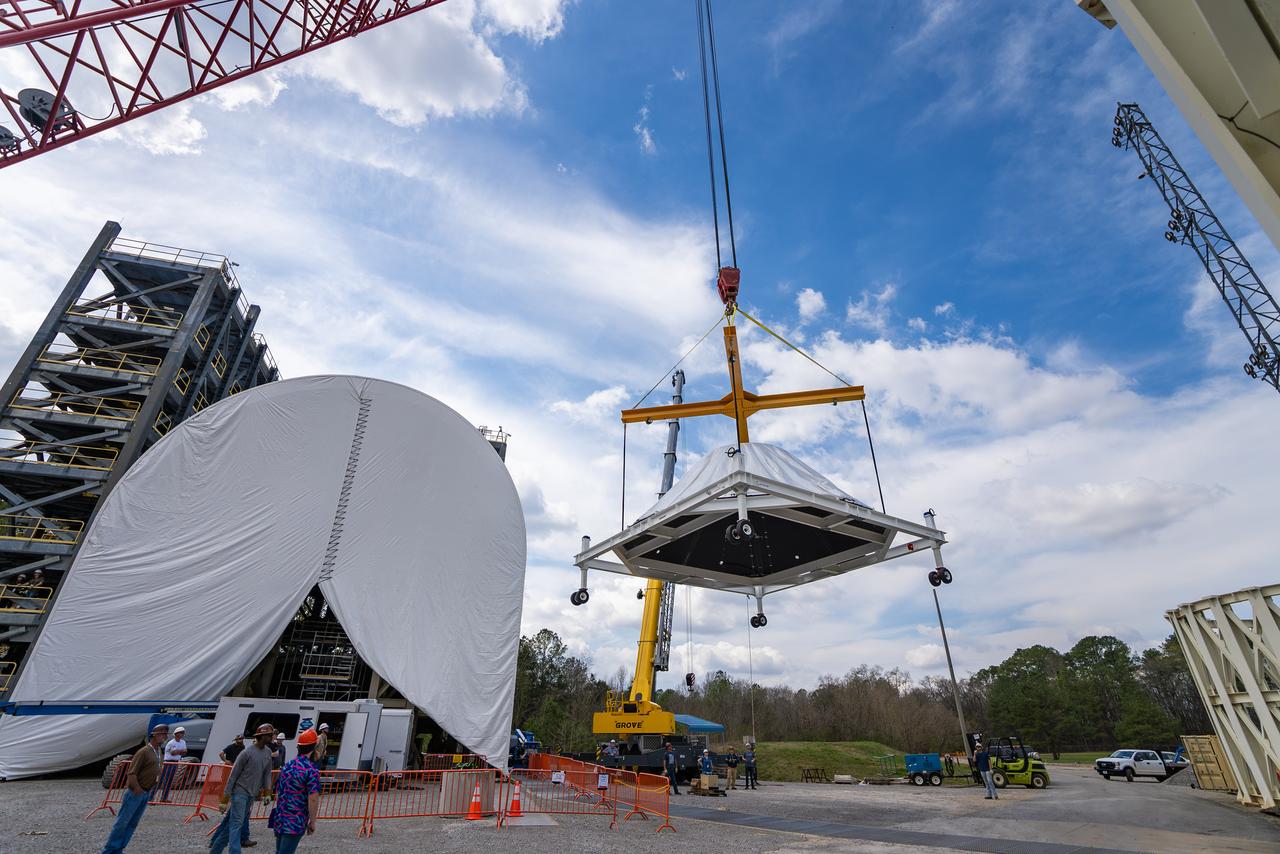
These photos and videos show how crews at NASA’s Marshall Space Flight Center in Huntsville, Alabama, moved and installed the payload adapter that will be used in the Block 1B configuration of the SLS (Space Launch System) rocket from Building 4708, where it was manufactured, into Structural Test Stand 4697 at NASA’s Marshall Space Flight Center on March 13. Teams at Marshall will begin structural testing the engineering development unit of the payload adapter – an exact replica of the flight version of the hardware – this spring. The cone-shaped payload adapter is about 8.5 feet tall and features two metal rings and eight composite panels. The adapter, which will debut on NASA’s Artemis IV mission, is an evolution from the Orion stage adapter used in the Block 1 configuration of the first three Artemis missions. It will be housed inside the universal stage adapter atop the rocket’s more powerful in-space stage, called the exploration upper stage. The payload adapter, like the launch vehicle stage adapter and the Orion stage adapter, is fully manufactured and tested at Marshall, which manages the SLS Program. NASA is working to land the first woman, first person of color, and its first international partner astronaut on the Moon under Artemis. SLS is part of NASA’s backbone for deep space exploration, along with the Orion spacecraft and Gateway in orbit around the Moon and commercial human landing systems, next-generational spacesuits, and rovers on the lunar surface. SLS is the only rocket that can send Orion, astronauts, and supplies to the Moon in a single launch.
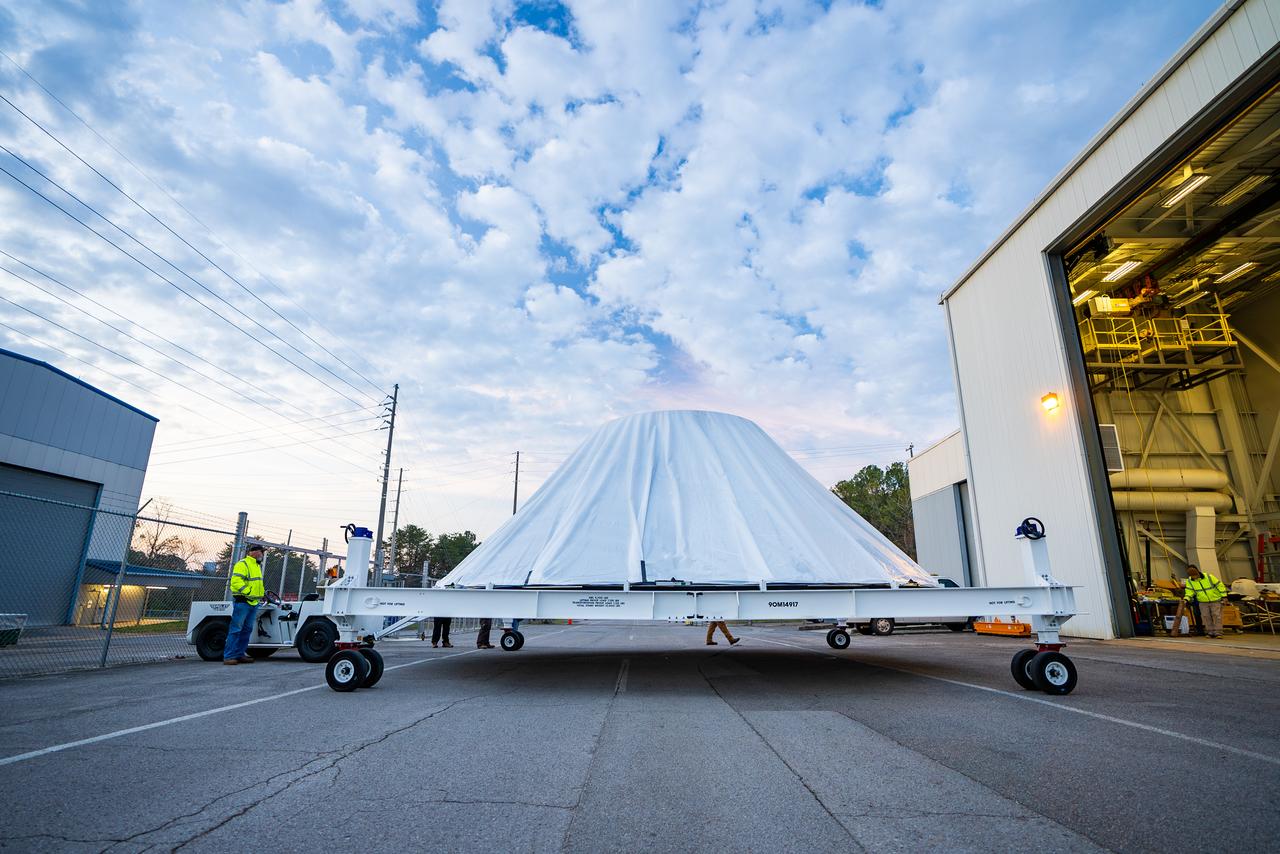
These photos and videos show how crews at NASA’s Marshall Space Flight Center in Huntsville, Alabama, moved and installed the payload adapter that will be used in the Block 1B configuration of the SLS (Space Launch System) rocket from Building 4708, where it was manufactured, into Structural Test Stand 4697 at NASA’s Marshall Space Flight Center on March 13. Teams at Marshall will begin structural testing the engineering development unit of the payload adapter – an exact replica of the flight version of the hardware – this spring. The cone-shaped payload adapter is about 8.5 feet tall and features two metal rings and eight composite panels. The adapter, which will debut on NASA’s Artemis IV mission, is an evolution from the Orion stage adapter used in the Block 1 configuration of the first three Artemis missions. It will be housed inside the universal stage adapter atop the rocket’s more powerful in-space stage, called the exploration upper stage. The payload adapter, like the launch vehicle stage adapter and the Orion stage adapter, is fully manufactured and tested at Marshall, which manages the SLS Program. NASA is working to land the first woman, first person of color, and its first international partner astronaut on the Moon under Artemis. SLS is part of NASA’s backbone for deep space exploration, along with the Orion spacecraft and Gateway in orbit around the Moon and commercial human landing systems, next-generational spacesuits, and rovers on the lunar surface. SLS is the only rocket that can send Orion, astronauts, and supplies to the Moon in a single launch.
These photos and videos show how crews at NASA’s Marshall Space Flight Center in Huntsville, Alabama, moved and installed the payload adapter that will be used in the Block 1B configuration of the SLS (Space Launch System) rocket from Building 4708, where it was manufactured, into Structural Test Stand 4697 at NASA’s Marshall Space Flight Center on March 13. Teams at Marshall will begin structural testing the engineering development unit of the payload adapter – an exact replica of the flight version of the hardware – this spring. The cone-shaped payload adapter is about 8.5 feet tall and features two metal rings and eight composite panels. The adapter, which will debut on NASA’s Artemis IV mission, is an evolution from the Orion stage adapter used in the Block 1 configuration of the first three Artemis missions. It will be housed inside the universal stage adapter atop the rocket’s more powerful in-space stage, called the exploration upper stage. The payload adapter, like the launch vehicle stage adapter and the Orion stage adapter, is fully manufactured and tested at Marshall, which manages the SLS Program. NASA is working to land the first woman, first person of color, and its first international partner astronaut on the Moon under Artemis. SLS is part of NASA’s backbone for deep space exploration, along with the Orion spacecraft and Gateway in orbit around the Moon and commercial human landing systems, next-generational spacesuits, and rovers on the lunar surface. SLS is the only rocket that can send Orion, astronauts, and supplies to the Moon in a single launch.
These photos and videos show how crews at NASA’s Marshall Space Flight Center in Huntsville, Alabama, moved and installed the payload adapter that will be used in the Block 1B configuration of the SLS (Space Launch System) rocket from Building 4708, where it was manufactured, into Structural Test Stand 4697 at NASA’s Marshall Space Flight Center on March 13. Teams at Marshall will begin structural testing the engineering development unit of the payload adapter – an exact replica of the flight version of the hardware – this spring. The cone-shaped payload adapter is about 8.5 feet tall and features two metal rings and eight composite panels. The adapter, which will debut on NASA’s Artemis IV mission, is an evolution from the Orion stage adapter used in the Block 1 configuration of the first three Artemis missions. It will be housed inside the universal stage adapter atop the rocket’s more powerful in-space stage, called the exploration upper stage. The payload adapter, like the launch vehicle stage adapter and the Orion stage adapter, is fully manufactured and tested at Marshall, which manages the SLS Program. NASA is working to land the first woman, first person of color, and its first international partner astronaut on the Moon under Artemis. SLS is part of NASA’s backbone for deep space exploration, along with the Orion spacecraft and Gateway in orbit around the Moon and commercial human landing systems, next-generational spacesuits, and rovers on the lunar surface. SLS is the only rocket that can send Orion, astronauts, and supplies to the Moon in a single launch.
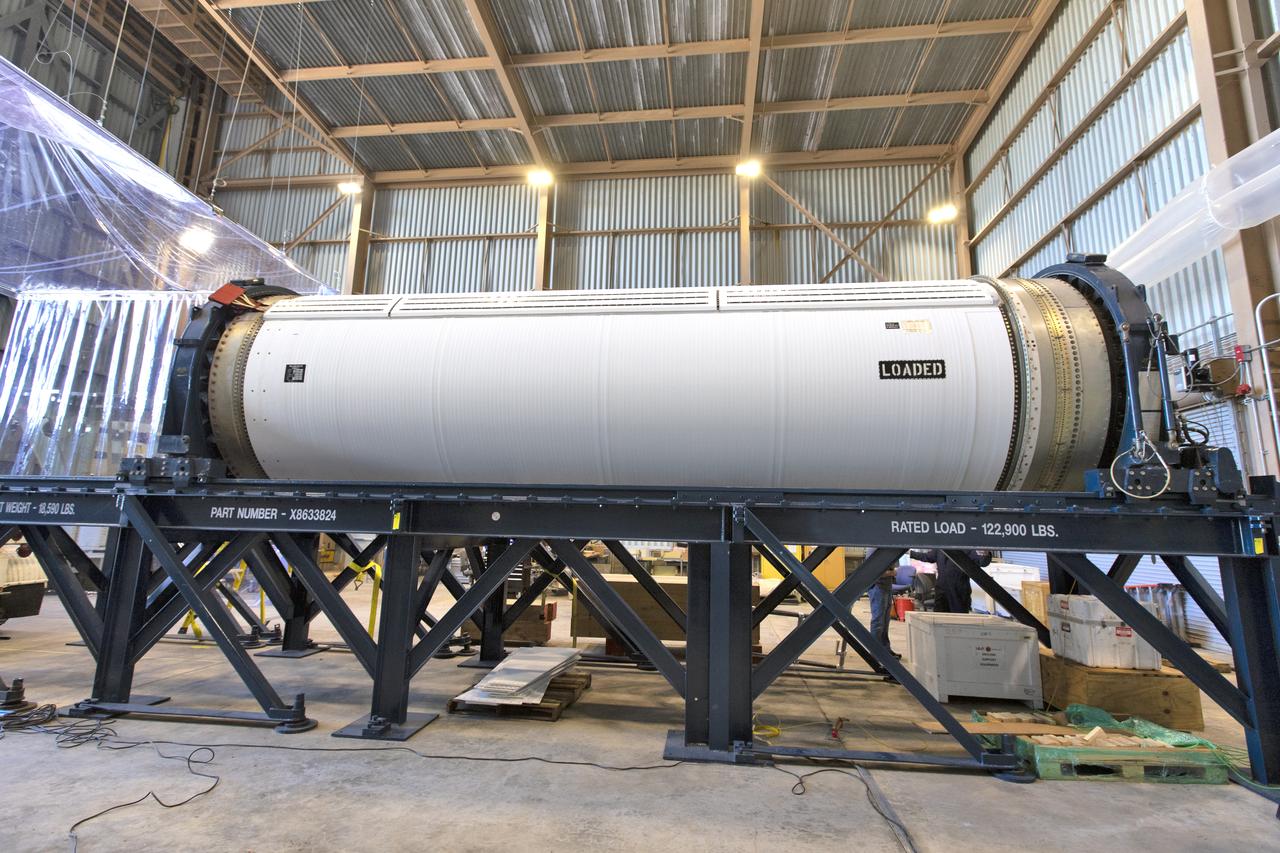
The Northrop Grumman-provided ascent test booster for the Orion Ascent Abort-2 (AA-2) Flight Test is secured on a work stand inside the Rotation, Processing and Surge Facility (RPSF) at NASA’s Kennedy Space Center in Florida on Jan. 29, 2019. The booster will be outfitted for flight. AA-2 is a full-stress test of the Launch Abort System, scheduled for April 2019. AA-2 will launch from Space Launch Complex 46, carrying a fully functional LAS and a 22,000-pound Orion test vehicle to an altitude of 31,000 feet and traveling at more than 1,000 miles an hour. The test will verify the LAS can steer the crew module and astronauts aboard to safety in the event of an issue with the Space Launch System (SLS) rocket when the spacecraft is under the highest aerodynamic loads it will experience during a rapid climb into space. NASA's Orion and Exploration Ground Systems programs and contractors from Jacob's and Northrup Grumman in conjunction with the Air Force Space and Missile Center's Launch Operations branch are performing flight operations for AA-2.
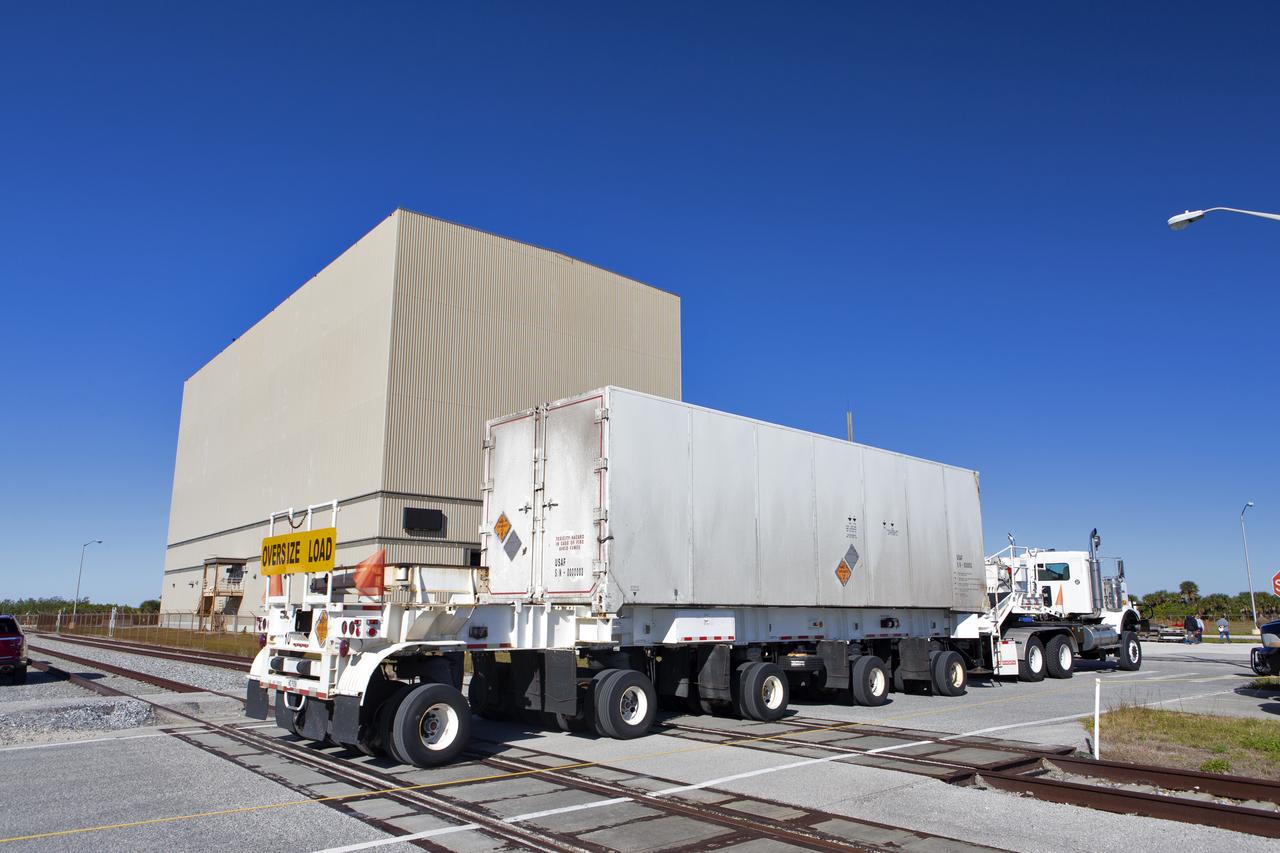
A heavy transport truck containing the Northrop Grumman-provided ascent test booster for the Orion Ascent Abort-2 (AA-2) Flight Test, arrives at the Rotation, Processing and Surge Facility (RPSF) at NASA’s Kennedy Space Center in Florida on Jan. 29, 2019. The booster will be unloaded and moved into the RPSF where it will be outfitted for flight. AA-2 is a full-stress test of the Launch Abort System, scheduled for April 2019. AA-2 will launch from Space Launch Complex 46, carrying a fully functional LAS and a 22,000-pound Orion test vehicle to an altitude of 31,000 feet and traveling at more than 1,000 miles an hour. The test will verify the LAS can steer the crew module and astronauts aboard to safety in the event of an issue with the Space Launch System (SLS) rocket when the spacecraft is under the highest aerodynamic loads it will experience during a rapid climb into space. NASA's Orion and Exploration Ground Systems programs and contractors from Jacob's and Northrup Grumman in conjunction with the Air Force Space and Missile Center's Launch Operations branch are performing flight operations for AA-2.
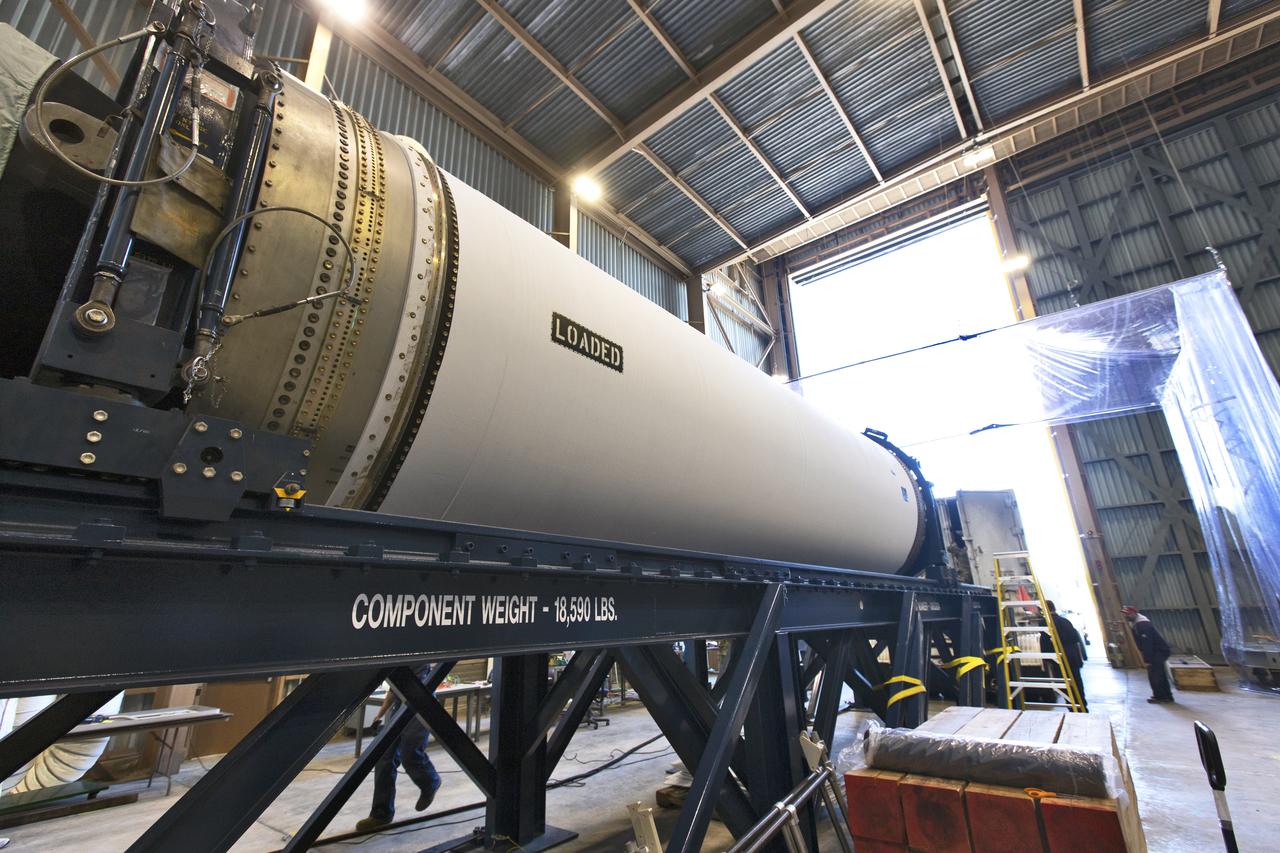
The Northrop Grumman-provided ascent test booster for the Orion Ascent Abort-2 (AA-2) Flight Test is secured on a work stand inside the Rotation, Processing and Surge Facility (RPSF) at NASA’s Kennedy Space Center in Florida on Jan. 29, 2019. The booster will be outfitted for flight. AA-2 is a full-stress test of the Launch Abort System, scheduled for April 2019. AA-2 will launch from Space Launch Complex 46, carrying a fully functional LAS and a 22,000-pound Orion test vehicle to an altitude of 31,000 feet and traveling at more than 1,000 miles an hour. The test will verify the LAS can steer the crew module and astronauts aboard to safety in the event of an issue with the Space Launch System (SLS) rocket when the spacecraft is under the highest aerodynamic loads it will experience during a rapid climb into space. NASA's Orion and Exploration Ground Systems programs and contractors from Jacob's and Northrup Grumman in conjunction with the Air Force Space and Missile Center's Launch Operations branch are performing flight operations for AA-2.
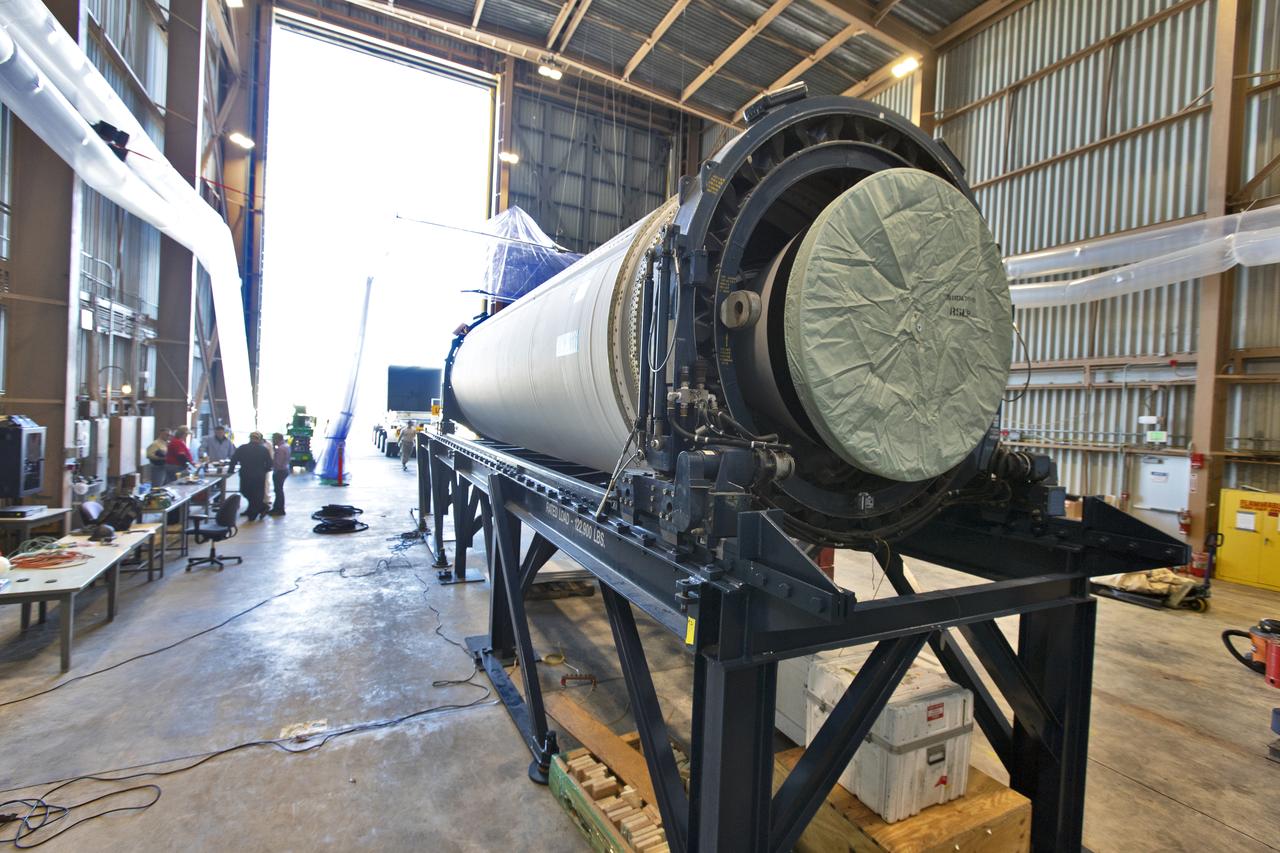
The Northrop Grumman-provided ascent test booster for the Orion Ascent Abort-2 (AA-2) Flight Test is secured on a work stand inside the Rotation, Processing and Surge Facility (RPSF) at NASA’s Kennedy Space Center in Florida on Jan. 29, 2019. The booster will be outfitted for flight. AA-2 is a full-stress test of the Launch Abort System, scheduled for April 2019. AA-2 will launch from Space Launch Complex 46, carrying a fully functional LAS and a 22,000-pound Orion test vehicle to an altitude of 31,000 feet and traveling at more than 1,000 miles an hour. The test will verify the LAS can steer the crew module and astronauts aboard to safety in the event of an issue with the Space Launch System (SLS) rocket when the spacecraft is under the highest aerodynamic loads it will experience during a rapid climb into space. NASA's Orion and Exploration Ground Systems programs and contractors from Jacob's and Northrup Grumman in conjunction with the Air Force Space and Missile Center's Launch Operations branch are performing flight operations for AA-2.
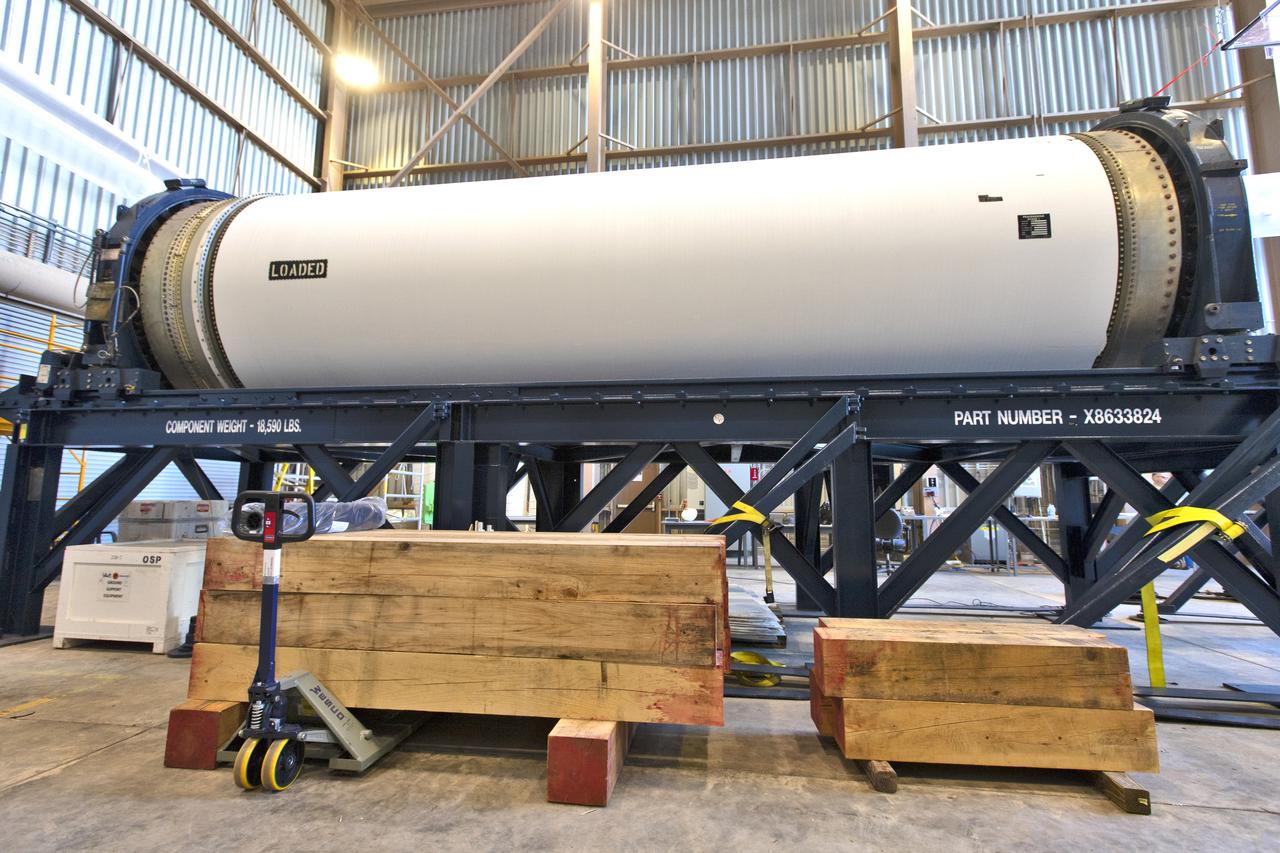
The Northrop Grumman-provided ascent test booster for the Orion Ascent Abort-2 (AA-2) Flight Test is secured on a work stand inside the Rotation, Processing and Surge Facility (RPSF) at NASA’s Kennedy Space Center in Florida on Jan. 29, 2019. The booster will be outfitted for flight. AA-2 is a full-stress test of the Launch Abort System, scheduled for April 2019. AA-2 will launch from Space Launch Complex 46, carrying a fully functional LAS and a 22,000-pound Orion test vehicle to an altitude of 31,000 feet and traveling at more than 1,000 miles an hour. The test will verify the LAS can steer the crew module and astronauts aboard to safety in the event of an issue with the Space Launch System (SLS) rocket when the spacecraft is under the highest aerodynamic loads it will experience during a rapid climb into space. NASA's Orion and Exploration Ground Systems programs and contractors from Jacob's and Northrup Grumman in conjunction with the Air Force Space and Missile Center's Launch Operations branch are performing flight operations for AA-2.
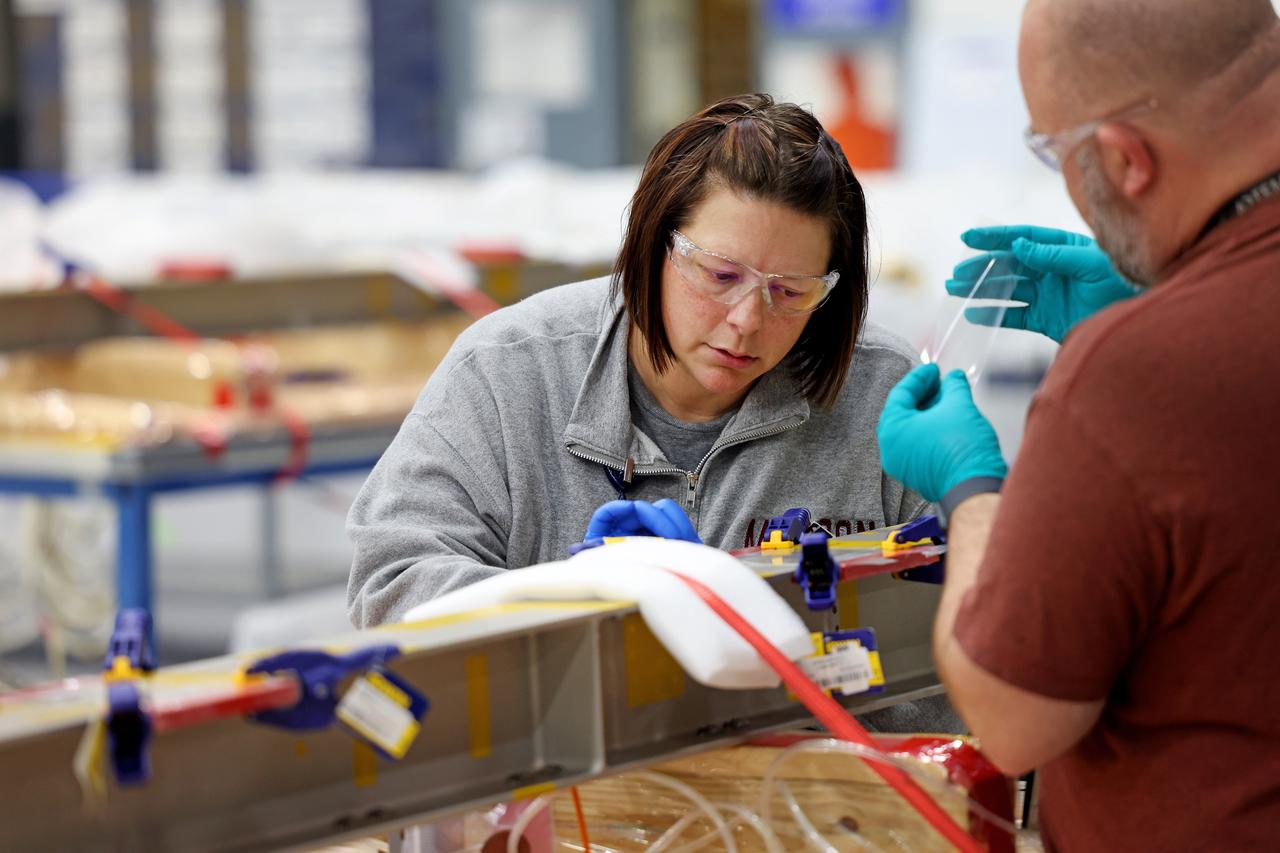
Technicians at NASA’s Michoud Assembly Facility in New Orleans on Feb. 22 prepare elements that will form part of the midbody for the future exploration upper stage for the SLS (Space Launch System) rocket. The midbody struts, or V-struts, will create the midbody’s cage-like outer structure to connect the upper stage’s larger liquid hydrogen tank to its smaller liquid oxygen tank. Manufacturing flight and test hardware for the future SLS upper stage is a collaborative effort between NASA and Boeing, the lead contractor for EUS and the SLS core stage. Beginning with Artemis IV, SLS will evolve to its more powerful Block 1B configuration with the advanced exploration upper stage that gives the rocket the capability to launch 40% more to the Moon along with Artemis astronauts inside NASA’s Orion spacecraft. The evolved in-space stage for SLS will use a combination of liquid oxygen and liquid hydrogen propellants to help power the engines to send large cargo and crew inside Orion to the Moon. Image credit: NASA/Michael DeMocker
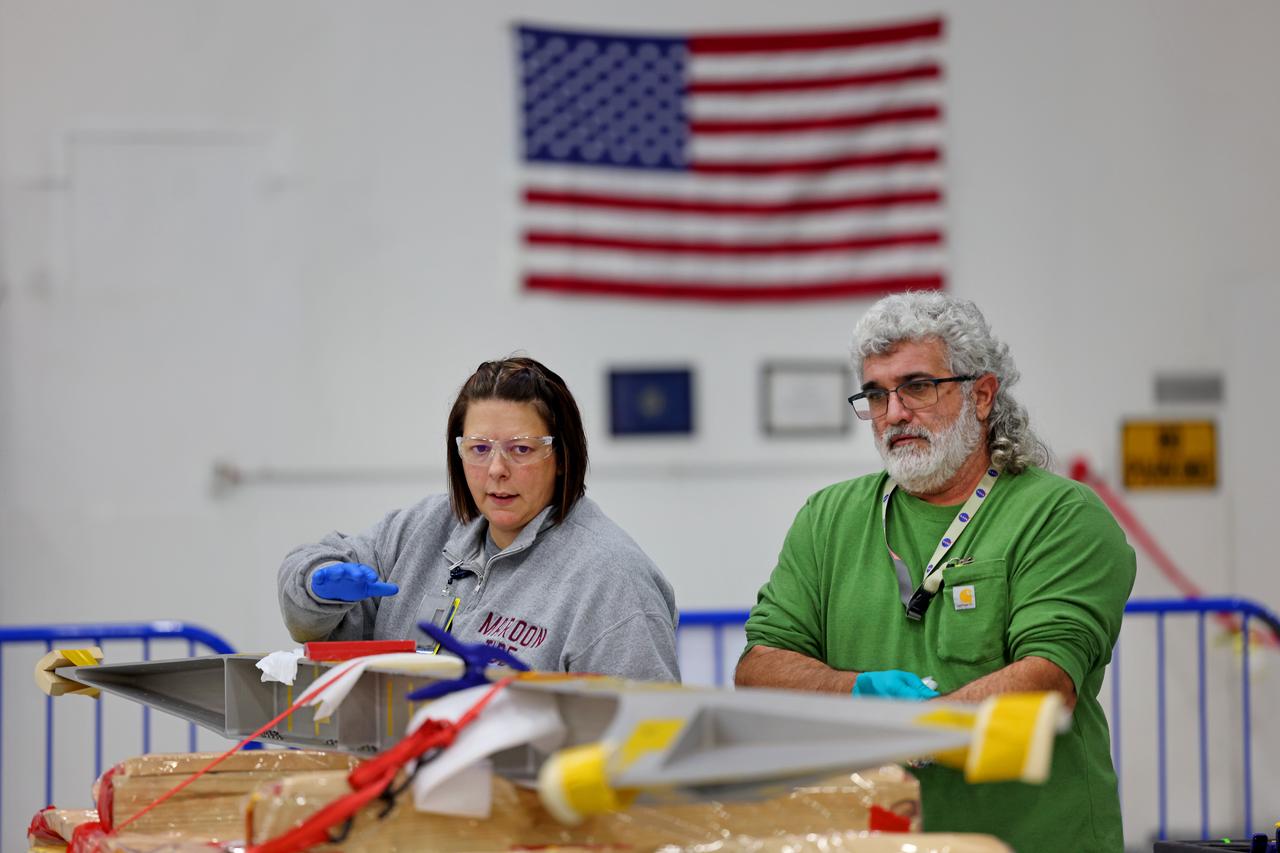
Technicians at NASA’s Michoud Assembly Facility in New Orleans on Feb. 22 prepare elements that will form part of the midbody for the future exploration upper stage for the SLS (Space Launch System) rocket. The midbody struts, or V-struts, will create the midbody’s cage-like outer structure to connect the upper stage’s larger liquid hydrogen tank to its smaller liquid oxygen tank. Manufacturing flight and test hardware for the future SLS upper stage is a collaborative effort between NASA and Boeing, the lead contractor for EUS and the SLS core stage. Beginning with Artemis IV, SLS will evolve to its more powerful Block 1B configuration with the advanced exploration upper stage that gives the rocket the capability to launch 40% more to the Moon along with Artemis astronauts inside NASA’s Orion spacecraft. The evolved in-space stage for SLS will use a combination of liquid oxygen and liquid hydrogen propellants to help power the engines to send large cargo and crew inside Orion to the Moon. Image credit: NASA/Michael DeMocker

Technicians at NASA’s Michoud Assembly Facility in New Orleans on Feb. 22 prepare elements that will form part of the midbody for the future exploration upper stage for the SLS (Space Launch System) rocket. The midbody struts, or V-struts, will create the midbody’s cage-like outer structure to connect the upper stage’s larger liquid hydrogen tank to its smaller liquid oxygen tank. Manufacturing flight and test hardware for the future SLS upper stage is a collaborative effort between NASA and Boeing, the lead contractor for EUS and the SLS core stage. Beginning with Artemis IV, SLS will evolve to its more powerful Block 1B configuration with the advanced exploration upper stage that gives the rocket the capability to launch 40% more to the Moon along with Artemis astronauts inside NASA’s Orion spacecraft. The evolved in-space stage for SLS will use a combination of liquid oxygen and liquid hydrogen propellants to help power the engines to send large cargo and crew inside Orion to the Moon. Image credit: NASA/Michael DeMocker
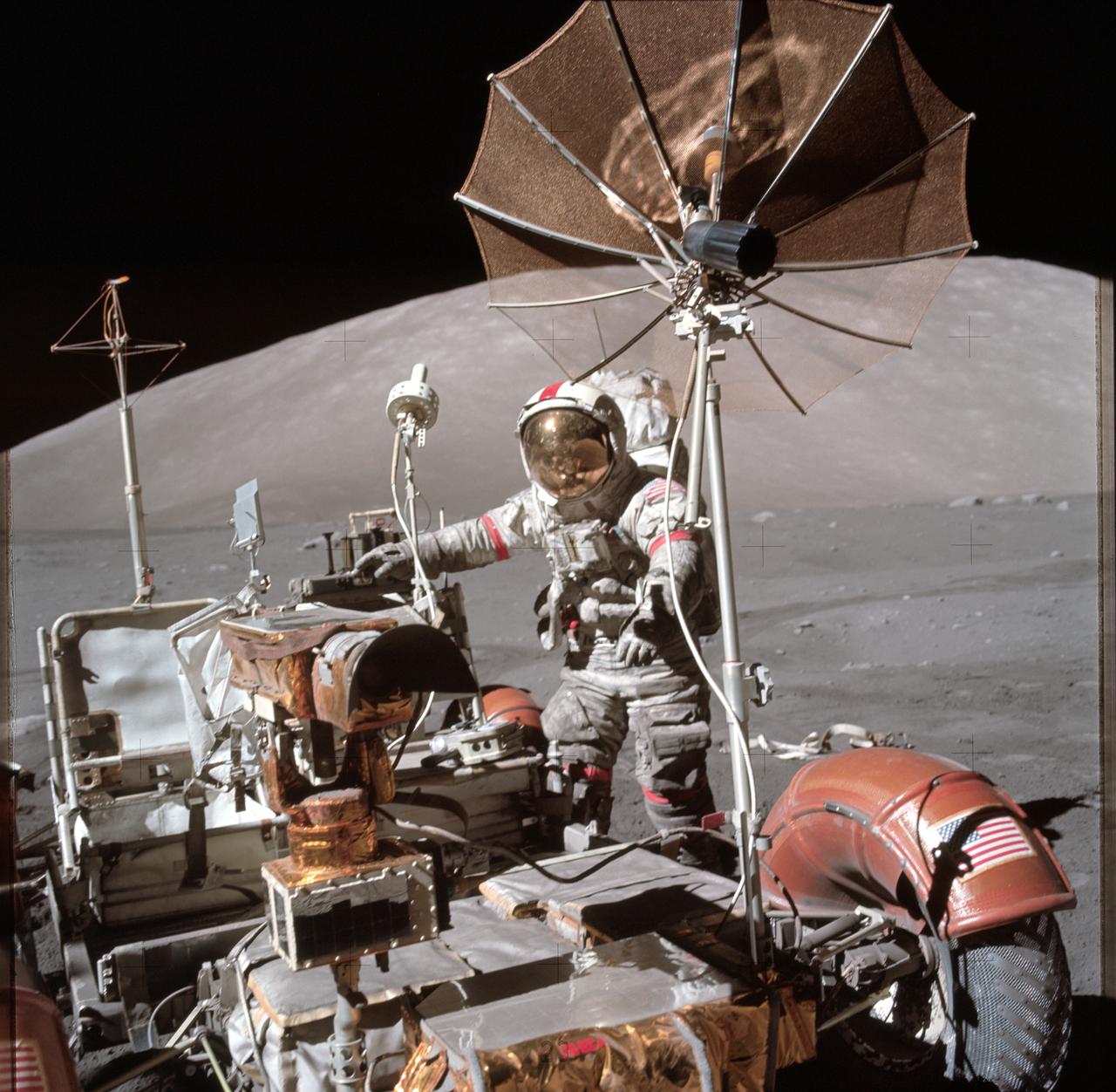
AS17-134-20476 (13 Dec. 1972) --- Astronaut Eugene A. Cernan, Apollo 17 commander, approaches the parked Lunar Roving Vehicle (LRV) on the lunar surface during the flight's third period of extravehicular activity (EVA). South Massif can be seen in the background. The photograph was taken with a hand-held Hasselblad camera by scientist-astronaut Harrison H. Schmitt, lunar module pilot. While the two explored the surface of the moon, astronaut Ronald E. Evans remained with the Command and Service Modules (CSM) in lunar orbit.
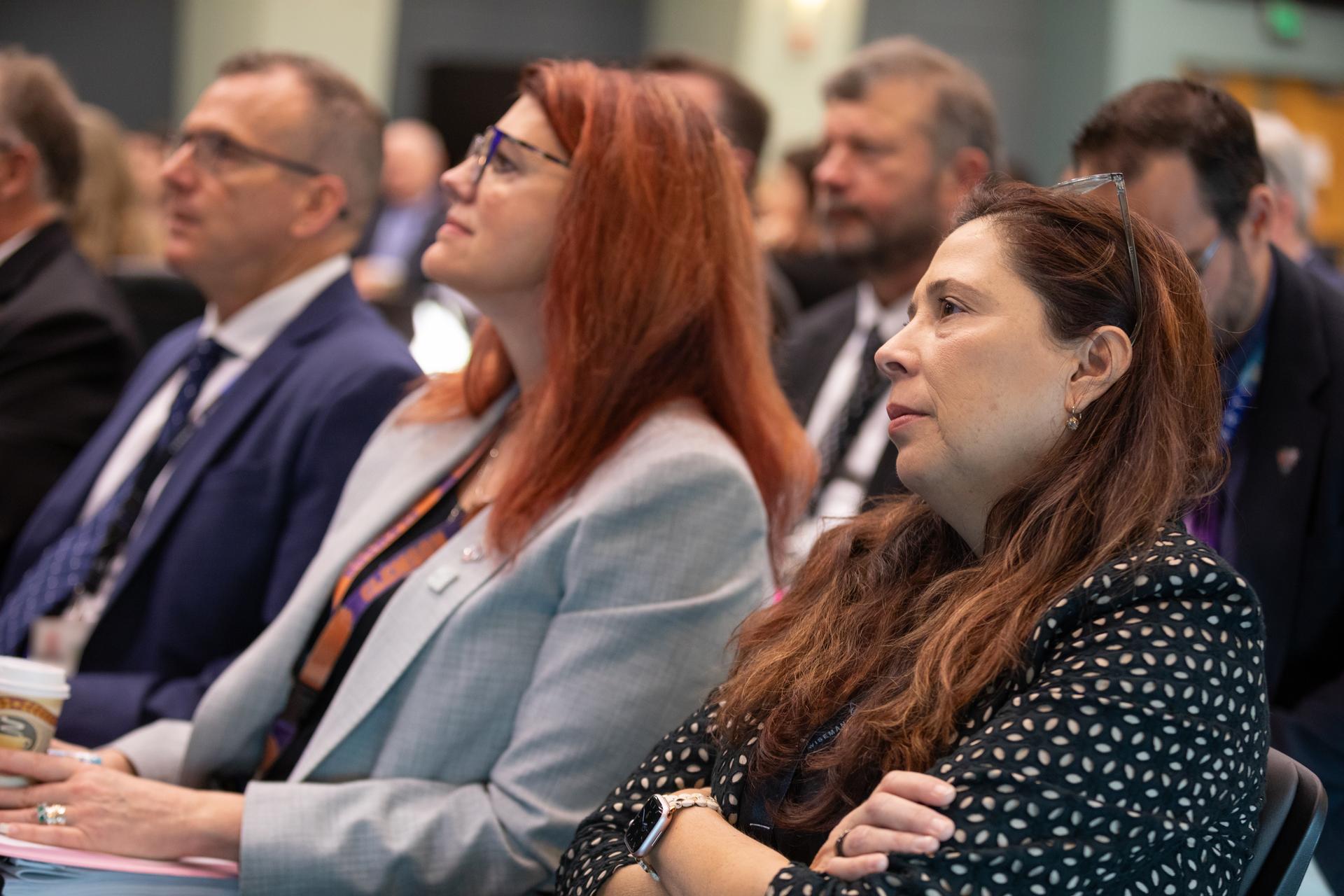
From left, Cliff Lanham, deputy manager, Exploration Ground Systems; Charlie Blackwell-Thompson, launch director, Exploration Ground Systems Program; and Lili Villarreal, Artemis II landing and recovery director in Exploration Ground Systems Program at NASA’s Kennedy Space Center in Florida, participate in the Artemis II Flight Readiness Review with NASA leadership on Wednesday, March 11, 2026, at NASA Kennedy. The review is an assessment of the readiness of NASA’s SLS (Space Launch System) rocket and Orion spacecraft to support the Artemis II test flight as four astronauts journey around the Moon and return to Earth.

From left, Shawn Quinn, manager, Exploration Ground Systems Program; Cliff Lanham, deputy manager, Exploration Ground Systems; and Charlie Blackwell-Thompson, launch director, Exploration Ground Systems Program Program at NASA’s Kennedy Space Center in Florida, participate in the Artemis II Flight Readiness Review with NASA leadership on Wednesday, March 11, 2026, at NASA Kennedy. The review is an assessment of the readiness of NASA’s SLS (Space Launch System) rocket and Orion spacecraft to support the Artemis II test flight as four astronauts journey around the Moon and return to Earth.

From left, NASA Associate Administrator Amit Kshatriya and Lori Glaze, acting associate administrator, Exploration Systems Development Mission Directorate, shake hands after each signing the certification for flight readiness following the completion of the Flight Readiness Review for the Artemis II test flight on Thursday, March 12, 2026, at NASA’s Kennedy Space Center in Florida. The review is an assessment of the readiness of NASA’s SLS (Space Launch System) rocket and Orion spacecraft to support the Artemis II test flight as four astronauts journey around the Moon and return to Earth.

From left, Kennedy Space Center Director Janet Petro; Charlie Blackwell-Thompson, launch director, Exploration Ground Systems Program; and Shawn Quinn, manager, Exploration Ground Systems Program, participate in the Artemis II Flight Readiness Review with NASA leadership on Wednesday, March 11, 2026, at NASA’s Kennedy Space Center in Florida. The review is an assessment of the readiness of NASA’s SLS (Space Launch System) rocket and Orion spacecraft to support the Artemis II test flight as four astronauts journey around the Moon and return to Earth.

From left, Charlie Blackwell-Thompson, launch director, Exploration Ground Systems Program and Lili Villarreal, Artemis II landing and recovery director in Exploration Ground Systems Program at NASA’s Kennedy Space Center in Florida, participate in the Artemis II Flight Readiness Review with NASA leadership on Wednesday, March 11, 2026, at NASA Kennedy. The review is an assessment of the readiness of NASA’s SLS (Space Launch System) rocket and Orion spacecraft to support the Artemis II test flight as four astronauts journey around the Moon and return to Earth.
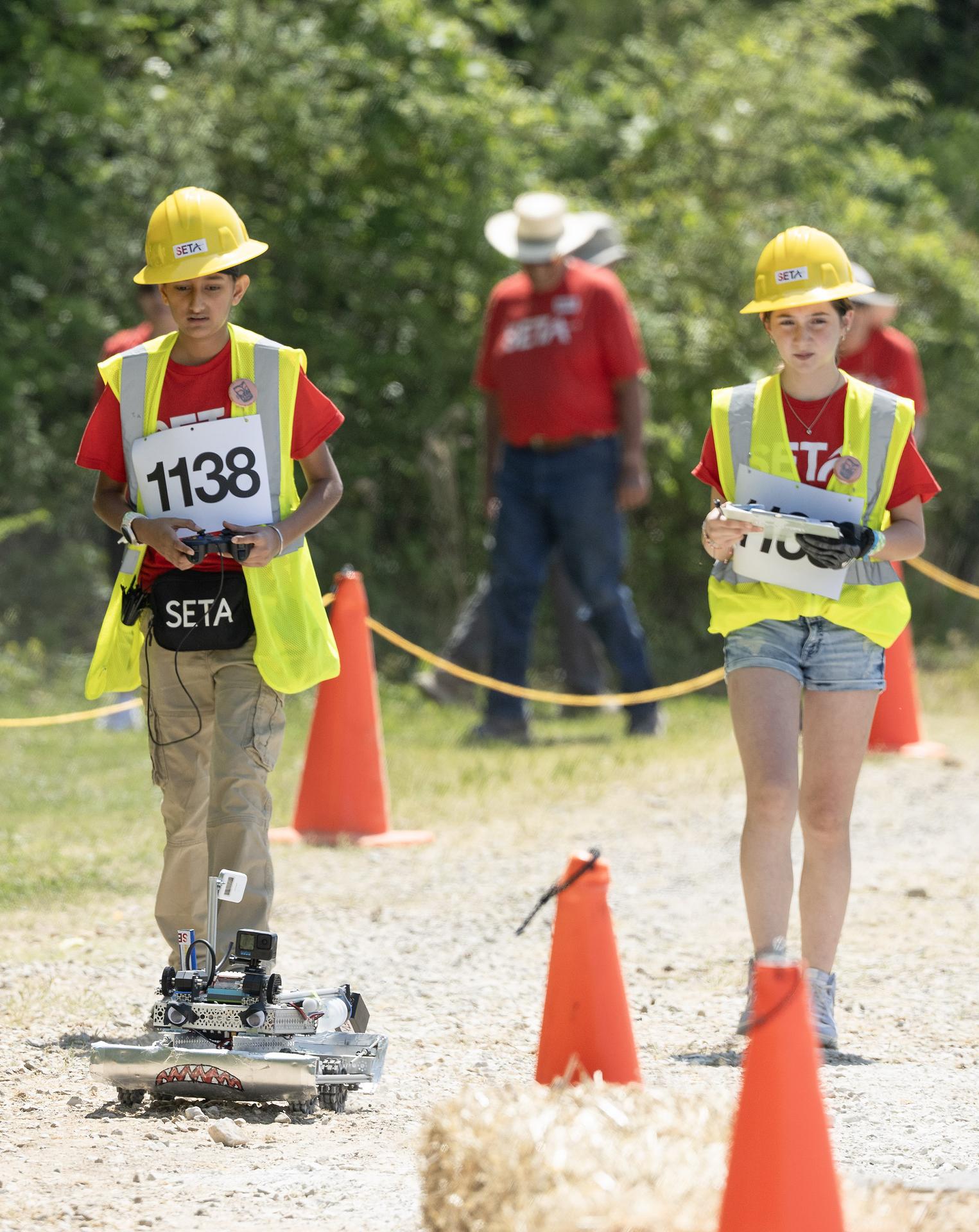
More than 600 students with 44 teams from around the world participated in the 32nd year of NASA’s Human Exploration Rover Challenge (HERC) on April 10 and April 11 near NASA’s Marshall Space Flight Center in Huntsville, Alabama. Participating teams represented 28 colleges and universities, 13 high schools, and one middle school from 18 states, Puerto Rico, and four Artemis Accord countries. Teams were awarded points based on navigating a half-mile obstacle course with either a human-powered or remote-controlled rover, conducting mission-specific task challenges, and completing multiple safety and design reviews with NASA engineers.
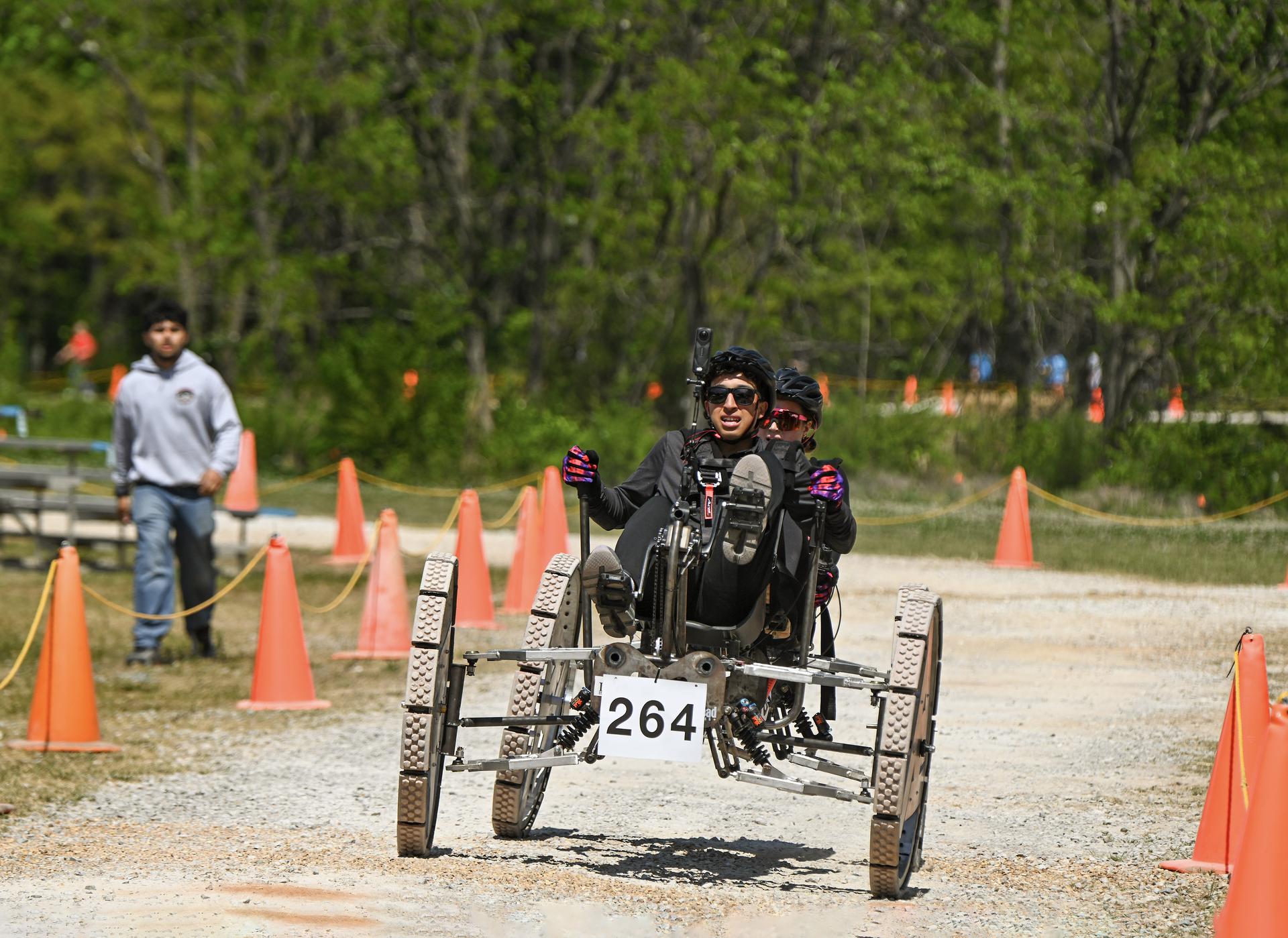
More than 600 students with 44 teams from around the world participated in the 32nd year of NASA’s Human Exploration Rover Challenge (HERC) on April 10 and April 11 near NASA’s Marshall Space Flight Center in Huntsville, Alabama. Participating teams represented 28 colleges and universities, 13 high schools, and one middle school from 18 states, Puerto Rico, and four Artemis Accord countries. Teams were awarded points based on navigating a half-mile obstacle course with either a human-powered or remote-controlled rover, conducting mission-specific task challenges, and completing multiple safety and design reviews with NASA engineers.
/USSRC_MeganHolbrook (191)~large.jpg)
More than 600 students with 44 teams from around the world participated in the 32nd year of NASA’s Human Exploration Rover Challenge (HERC) on April 10 and April 11 near NASA’s Marshall Space Flight Center in Huntsville, Alabama. Participating teams represented 28 colleges and universities, 13 high schools, and one middle school from 18 states, Puerto Rico, and four Artemis Accord countries. Teams were awarded points based on navigating a half-mile obstacle course with either a human-powered or remote-controlled rover, conducting mission-specific task challenges, and completing multiple safety and design reviews with NASA engineers.
/USSRC_MeganHolbrook (344)~large.jpg)
More than 600 students with 44 teams from around the world participated in the 32nd year of NASA’s Human Exploration Rover Challenge (HERC) on April 10 and April 11 near NASA’s Marshall Space Flight Center in Huntsville, Alabama. Participating teams represented 28 colleges and universities, 13 high schools, and one middle school from 18 states, Puerto Rico, and four Artemis Accord countries. Teams were awarded points based on navigating a half-mile obstacle course with either a human-powered or remote-controlled rover, conducting mission-specific task challenges, and completing multiple safety and design reviews with NASA engineers.
/USSRC_MeganHolbrook (98)~large.jpg)
More than 600 students with 44 teams from around the world participated in the 32nd year of NASA’s Human Exploration Rover Challenge (HERC) on April 10 and April 11 near NASA’s Marshall Space Flight Center in Huntsville, Alabama. Participating teams represented 28 colleges and universities, 13 high schools, and one middle school from 18 states, Puerto Rico, and four Artemis Accord countries. Teams were awarded points based on navigating a half-mile obstacle course with either a human-powered or remote-controlled rover, conducting mission-specific task challenges, and completing multiple safety and design reviews with NASA engineers.