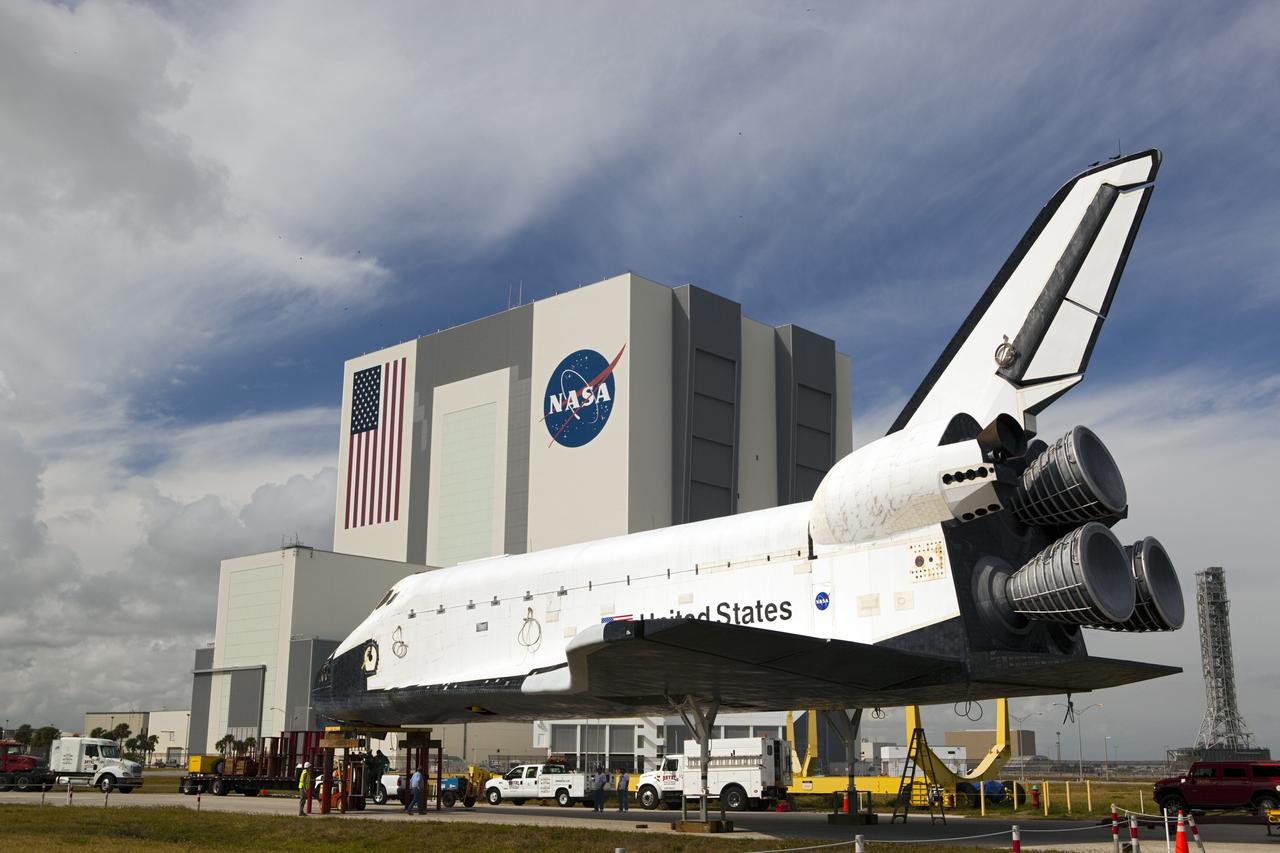
CAPE CANAVERAL, Fla. – Pedestals support the high-fidelity space shuttle model which was on display at the NASA Kennedy Space Center Visitor Complex in Florida following its delivery to Kennedy's Launch Complex 39 turn basin. Behind it, the Vehicle Assembly Building towers 525 feet in the air. The shuttle was part of a display at the visitor complex that also included an external tank and two solid rocket boosters that were used to show visitors the size of actual space shuttle components. The full-scale shuttle model is being transferred from Kennedy to Space Center Houston, NASA Johnson Space Center's visitor center. The model will stay at the turn basin for a few months until it is ready to be transported to Texas via barge. The move also helps clear the way for the Kennedy Space Center Visitor Complex to begin construction of a new facility next year to display space shuttle Atlantis in 2013. For more information about Space Center Houston, visit http://www.spacecenter.org. Photo credit: NASA/Dimitri Gerondidakis
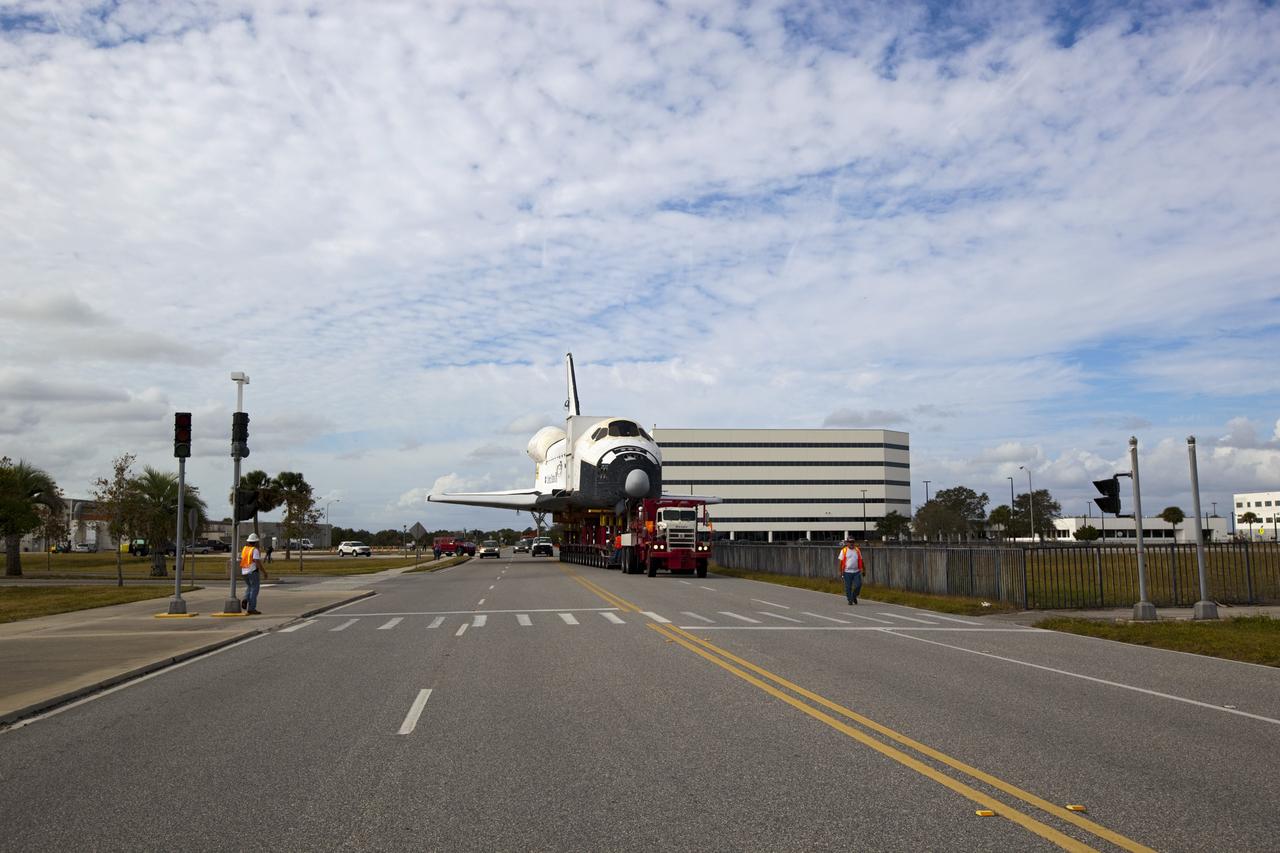
CAPE CANAVERAL, Fla. – The high-fidelity space shuttle model which was on display at the NASA Kennedy Space Center Visitor Complex in Florida travels down Saturn Causeway as it makes its way to Kennedy's Launch Complex 39 turn basin. In the background is the Operations Support Building I. The shuttle was part of a display at the visitor complex that also included an external tank and two solid rocket boosters that were used to show visitors the size of actual space shuttle components. The full-scale shuttle model is being transferred from Kennedy to Space Center Houston, NASA Johnson Space Center's visitor center. The model will stay at the turn basin for a few months until it is ready to be transported to Texas via barge. The move also helps clear the way for the Kennedy Space Center Visitor Complex to begin construction of a new facility next year to display space shuttle Atlantis in 2013. For more information about Space Center Houston, visit http://www.spacecenter.org. Photo credit: NASA/Dimitri Gerondidakis
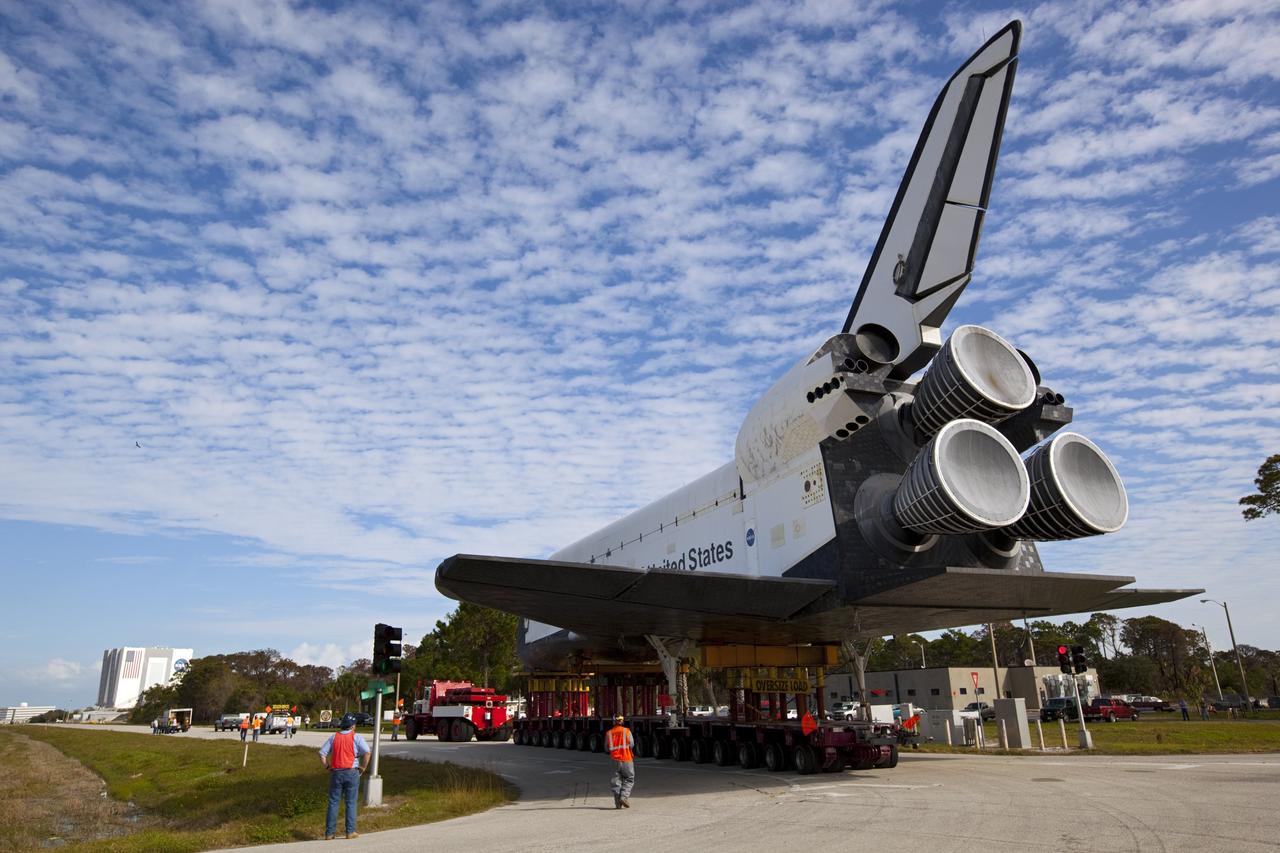
CAPE CANAVERAL, Fla. – The high-fidelity space shuttle model which was on display at the NASA Kennedy Space Center Visitor Complex in Florida travels down Contractor Road on its way to Kennedy's Launch Complex 39 turn basin. In the distance is the 525-foot-tall Vehicle Assembly Building. The shuttle was part of a display at the visitor complex that also included an external tank and two solid rocket boosters that were used to show visitors the size of actual space shuttle components. The full-scale shuttle model is being transferred from Kennedy to Space Center Houston, NASA Johnson Space Center's visitor center. The model will stay at the turn basin for a few months until it is ready to be transported to Texas via barge. The move also helps clear the way for the Kennedy Space Center Visitor Complex to begin construction of a new facility next year to display space shuttle Atlantis in 2013. For more information about Space Center Houston, visit http://www.spacecenter.org. Photo credit: NASA/Dimitri Gerondidakis
CAPE CANAVERAL, Fla. – The high-fidelity space shuttle model which was on display at the NASA Kennedy Space Center Visitor Complex in Florida approaches its destination, Kennedy's Launch Complex 39 turn basin, in the distance. The shuttle was part of a display at the visitor complex that also included an external tank and two solid rocket boosters that were used to show visitors the size of actual space shuttle components. The full-scale shuttle model is being transferred from Kennedy to Space Center Houston, NASA Johnson Space Center's visitor center. The model will stay at the turn basin for a few months until it is ready to be transported to Texas via barge. The move also helps clear the way for the Kennedy Space Center Visitor Complex to begin construction of a new facility next year to display space shuttle Atlantis in 2013. For more information about Space Center Houston, visit http://www.spacecenter.org. Photo credit: NASA/Dimitri Gerondidakis
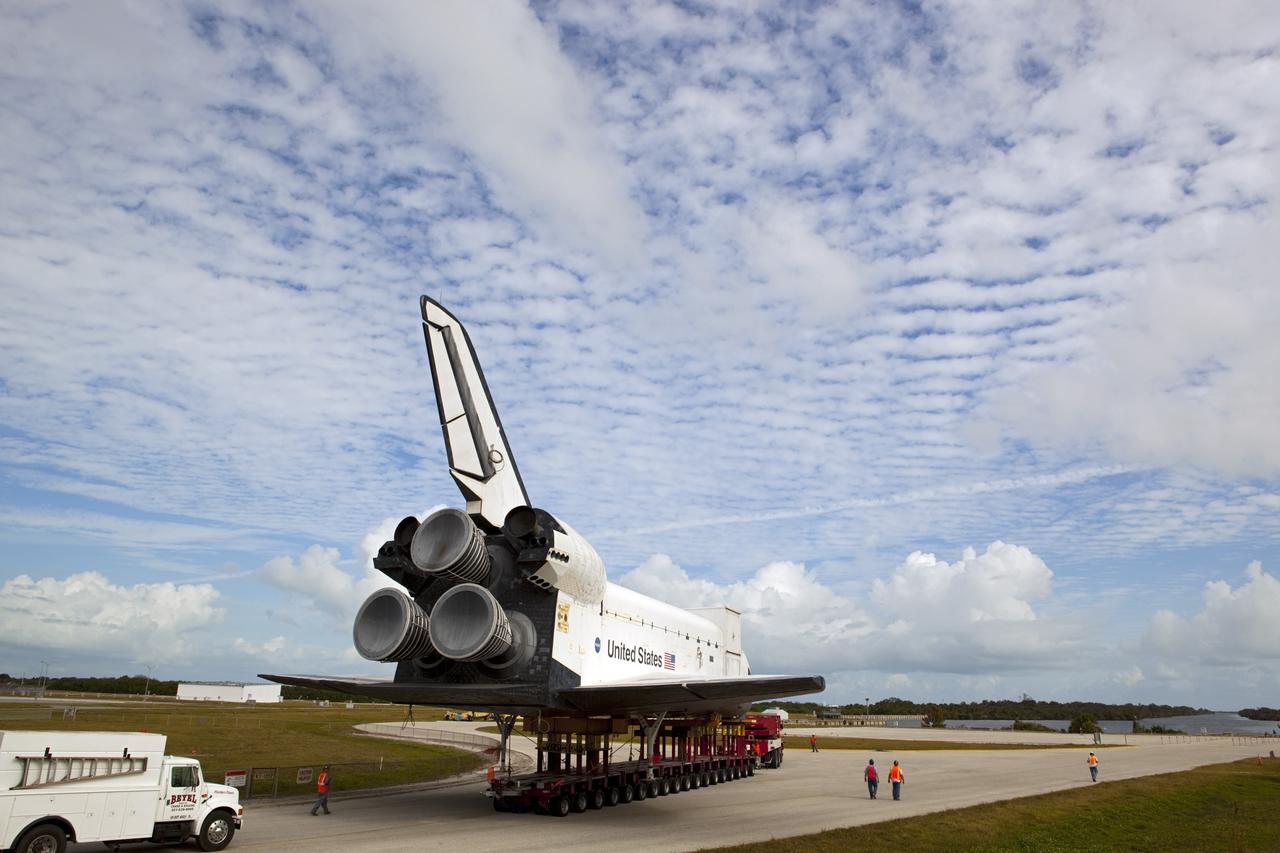
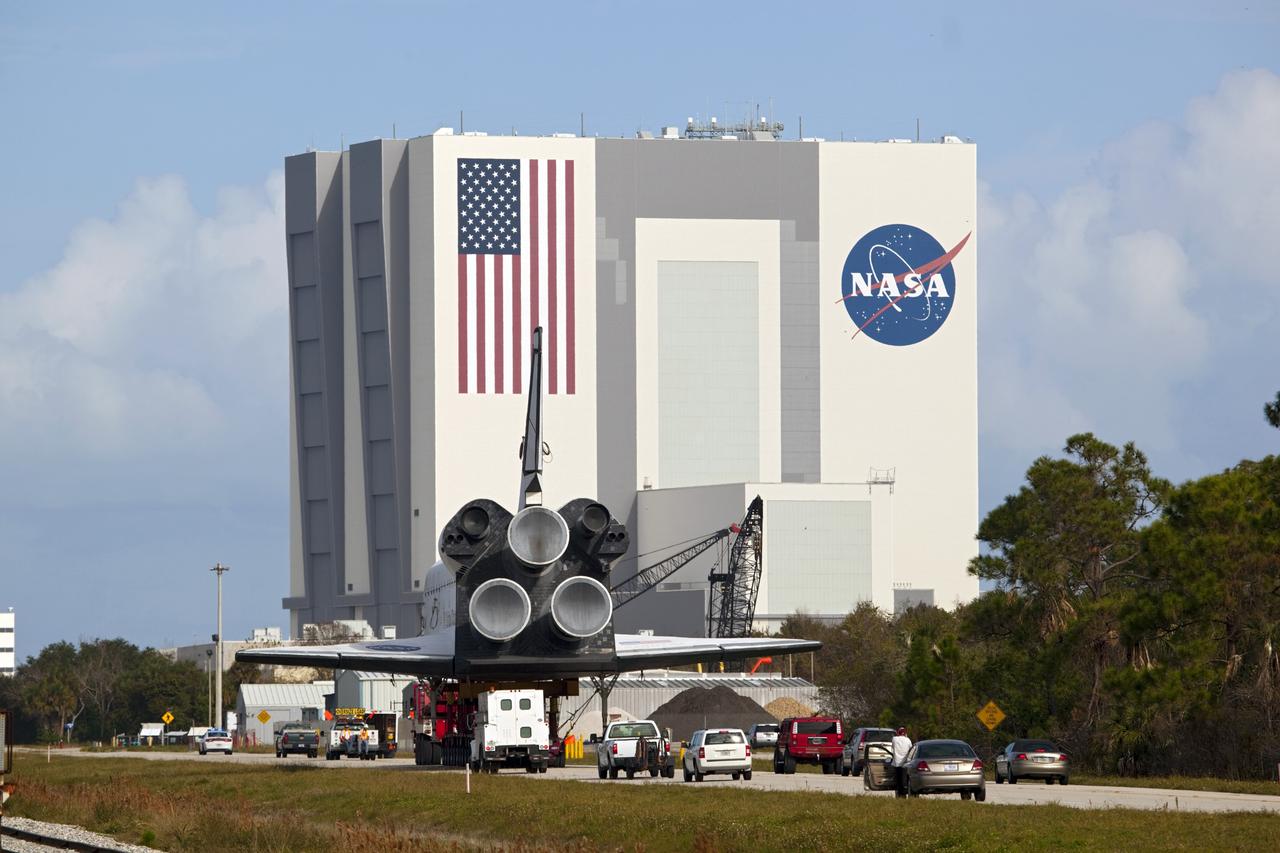
CAPE CANAVERAL, Fla. – The high-fidelity space shuttle model which was on display at the NASA Kennedy Space Center Visitor Complex in Florida backs toward its destination, Kennedy's Launch Complex 39 turn basin. The Vehicle Assembly Building across the street towers 525 feet above it. The shuttle was part of a display at the visitor complex that also included an external tank and two solid rocket boosters that were used to show visitors the size of actual space shuttle components. The full-scale shuttle model is being transferred from Kennedy to Space Center Houston, NASA Johnson Space Center's visitor center. The model will stay at the turn basin for a few months until it is ready to be transported to Texas via barge. The move also helps clear the way for the Kennedy Space Center Visitor Complex to begin construction of a new facility next year to display space shuttle Atlantis in 2013. For more information about Space Center Houston, visit http://www.spacecenter.org. Photo credit: NASA/Dimitri Gerondidakis
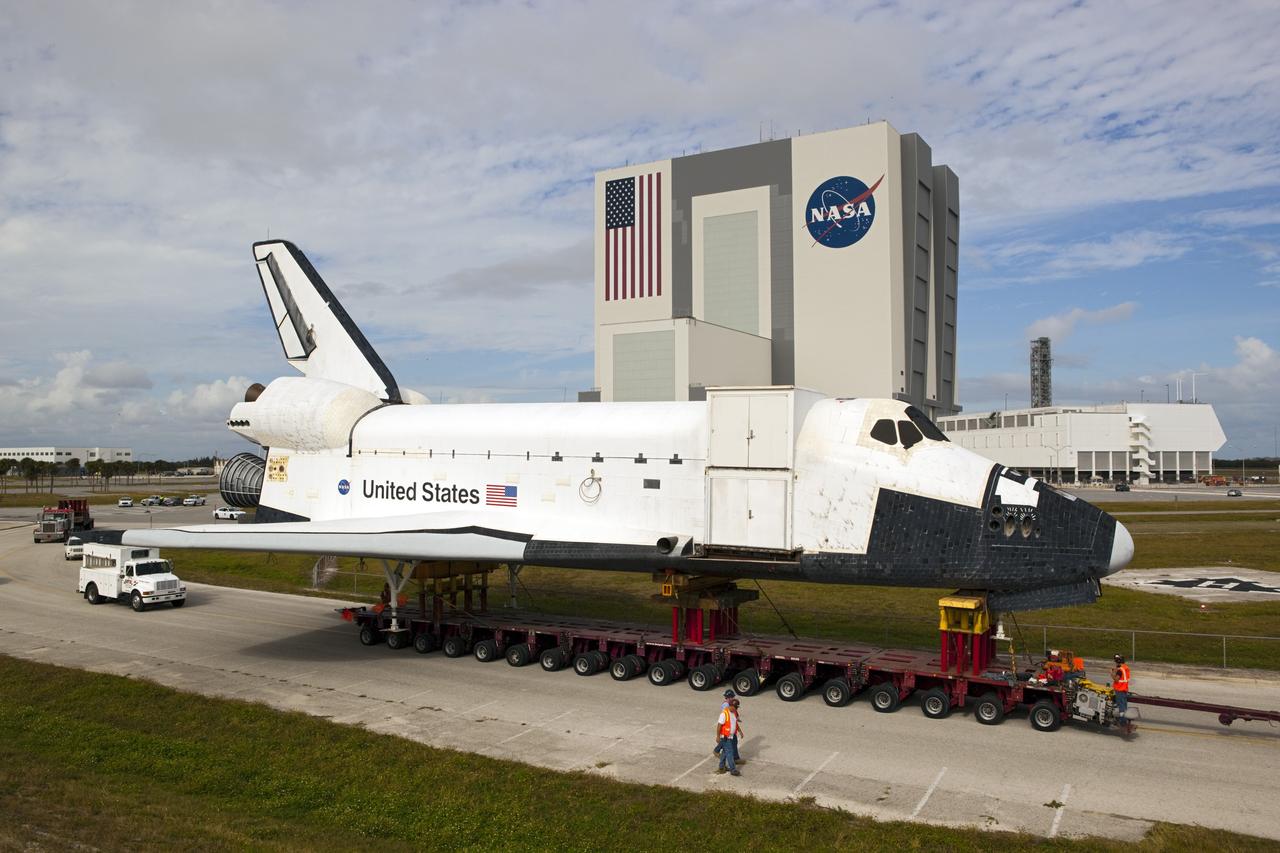
CAPE CANAVERAL, Fla. – The high-fidelity space shuttle model which was on display at the NASA Kennedy Space Center Visitor Complex in Florida approaches the 525-foot-tall Vehicle Assembly Building as it makes its way to Kennedy's Launch Complex 39 turn basin. The shuttle was part of a display at the visitor complex that also included an external tank and two solid rocket boosters that were used to show visitors the size of actual space shuttle components. The full-scale shuttle model is being transferred from Kennedy to Space Center Houston, NASA Johnson Space Center's visitor center. The model will stay at the turn basin for a few months until it is ready to be transported to Texas via barge. The move also helps clear the way for the Kennedy Space Center Visitor Complex to begin construction of a new facility next year to display space shuttle Atlantis in 2013. For more information about Space Center Houston, visit http://www.spacecenter.org. Photo credit: NASA/Dimitri Gerondidakis
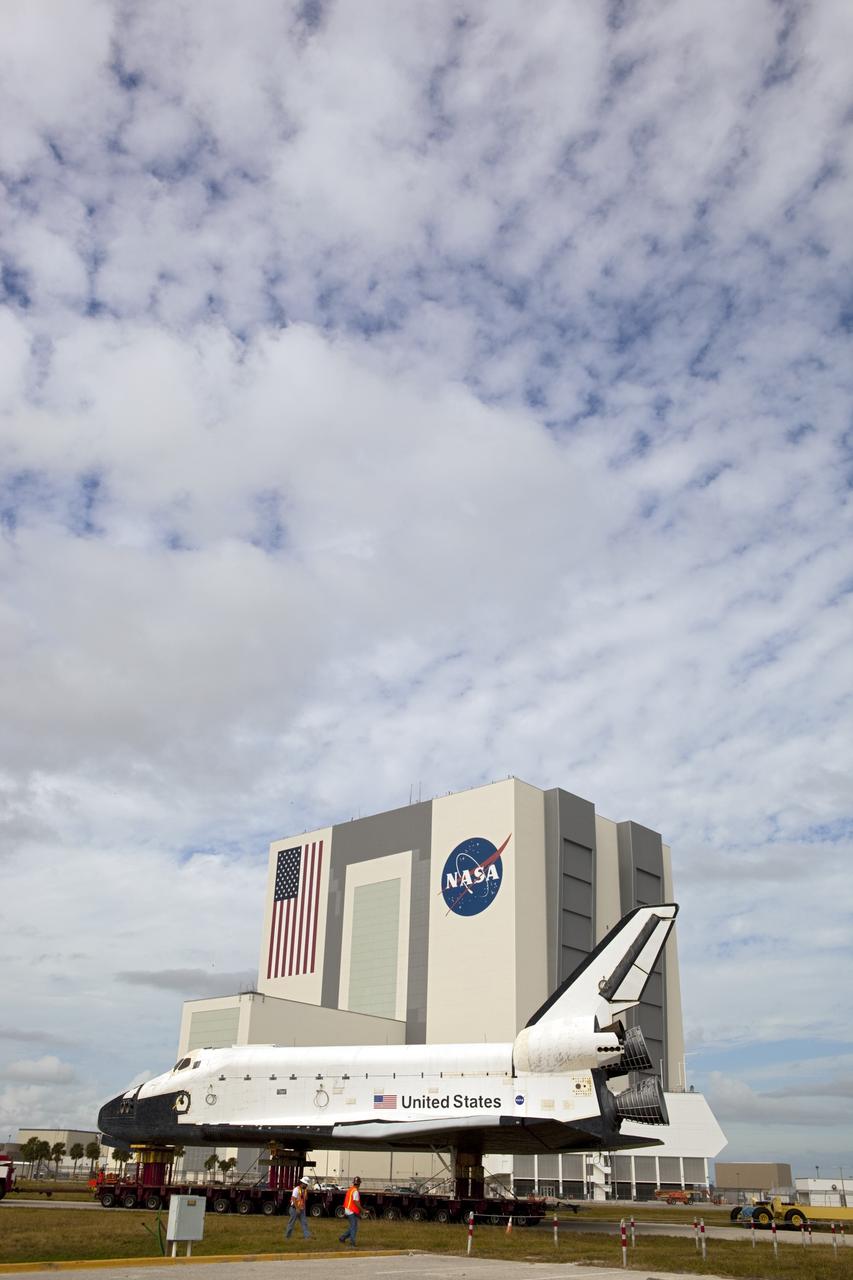
CAPE CANAVERAL, Fla. – Support personnel walk with the high-fidelity space shuttle model which was on display at the NASA Kennedy Space Center Visitor Complex in Florida as it rolls through the parking lot leading to Kennedy's Launch Complex 39 turn basin. Behind it are the 525-foot-tall Vehicle Assembly Building and the Launch Control Center. The shuttle was part of a display at the visitor complex that also included an external tank and two solid rocket boosters that were used to show visitors the size of actual space shuttle components. The full-scale shuttle model is being transferred from Kennedy to Space Center Houston, NASA Johnson Space Center's visitor center. The model will stay at the turn basin for a few months until it is ready to be transported to Texas via barge. The move also helps clear the way for the Kennedy Space Center Visitor Complex to begin construction of a new facility next year to display space shuttle Atlantis in 2013. For more information about Space Center Houston, visit http://www.spacecenter.org. Photo credit: NASA/Dimitri Gerondidakis
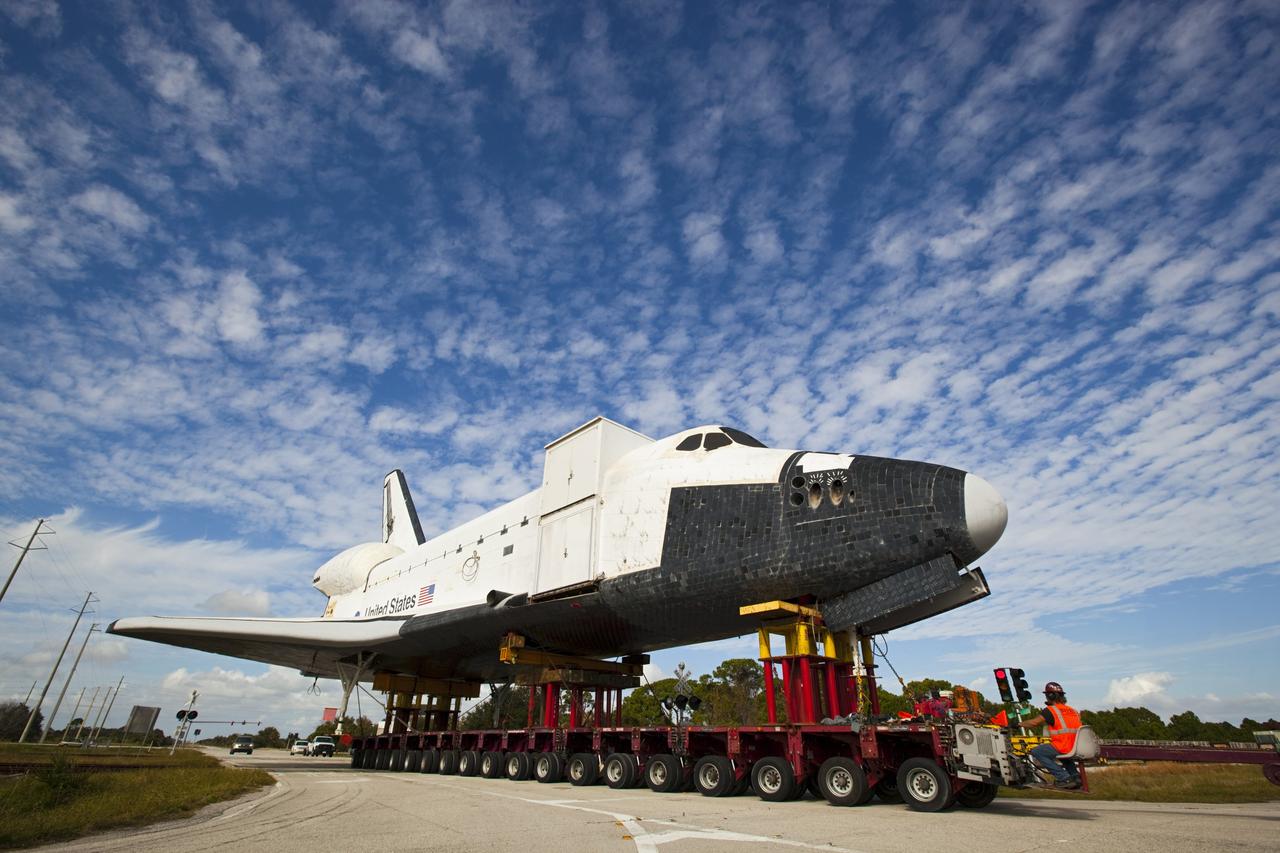
CAPE CANAVERAL, Fla. – The high-fidelity space shuttle model which was on display at the NASA Kennedy Space Center Visitor Complex in Florida makes its way along the center's roadways to Kennedy's Launch Complex 39 turn basin. The shuttle was part of a display at the visitor complex that also included an external tank and two solid rocket boosters that were used to show visitors the size of actual space shuttle components. The full-scale shuttle model is being transferred from Kennedy to Space Center Houston, NASA Johnson Space Center's visitor center. The model will stay at the turn basin for a few months until it is ready to be transported to Texas via barge. The move also helps clear the way for the Kennedy Space Center Visitor Complex to begin construction of a new facility next year to display space shuttle Atlantis in 2013. For more information about Space Center Houston, visit http://www.spacecenter.org. Photo credit: NASA/Dimitri Gerondidakis
CAPE CANAVERAL, Fla. – The high-fidelity space shuttle model which was on display at the NASA Kennedy Space Center Visitor Complex in Florida arrives at Kennedy's Launch Complex 39 turn basin where it will be prepared for the next leg of its journey. Across the street, the Vehicle Assembly Building towers 525 feet into the sky. The shuttle was part of a display at the visitor complex that also included an external tank and two solid rocket boosters that were used to show visitors the size of actual space shuttle components. The full-scale shuttle model is being transferred from Kennedy to Space Center Houston, NASA Johnson Space Center's visitor center. The model will stay at the turn basin for a few months until it is ready to be transported to Texas via barge. The move also helps clear the way for the Kennedy Space Center Visitor Complex to begin construction of a new facility next year to display space shuttle Atlantis in 2013. For more information about Space Center Houston, visit http://www.spacecenter.org. Photo credit: NASA/Dimitri Gerondidakis
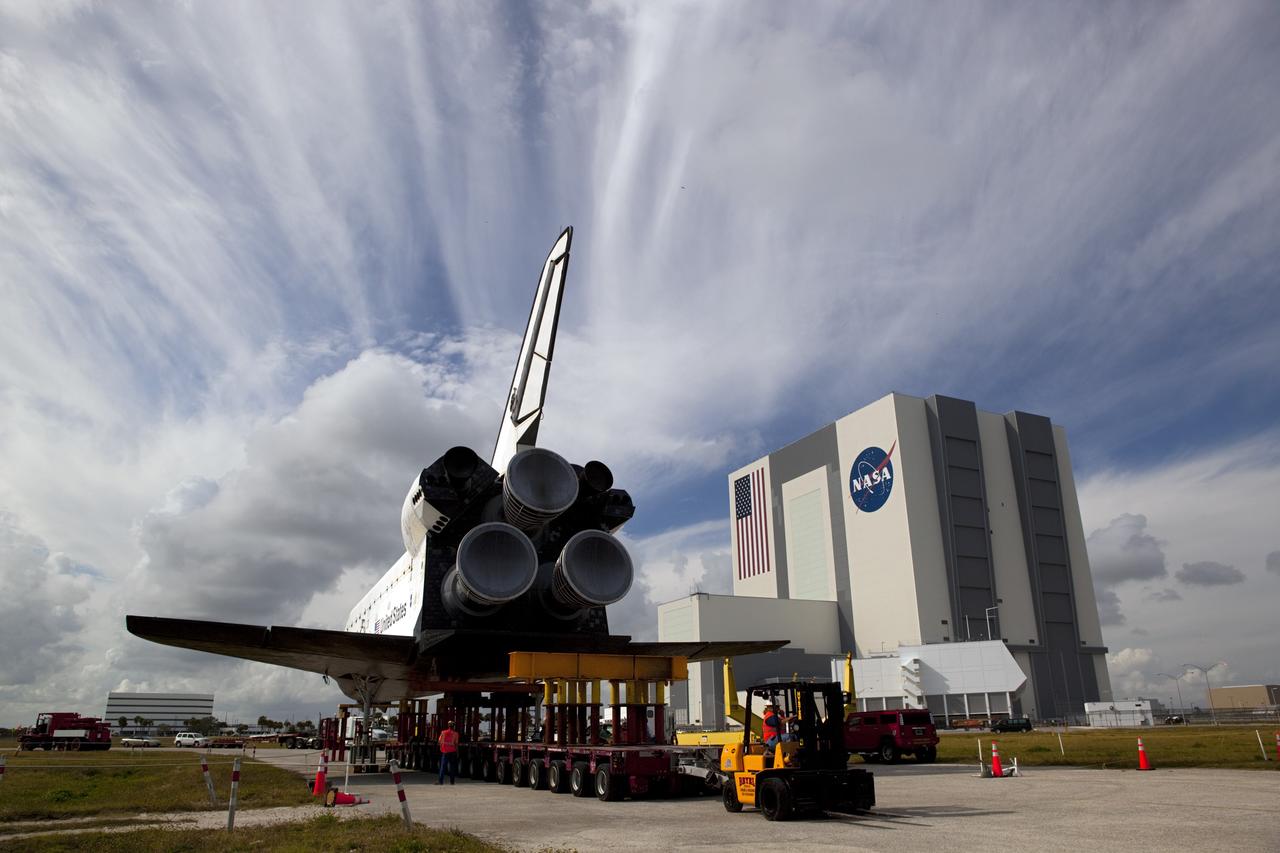
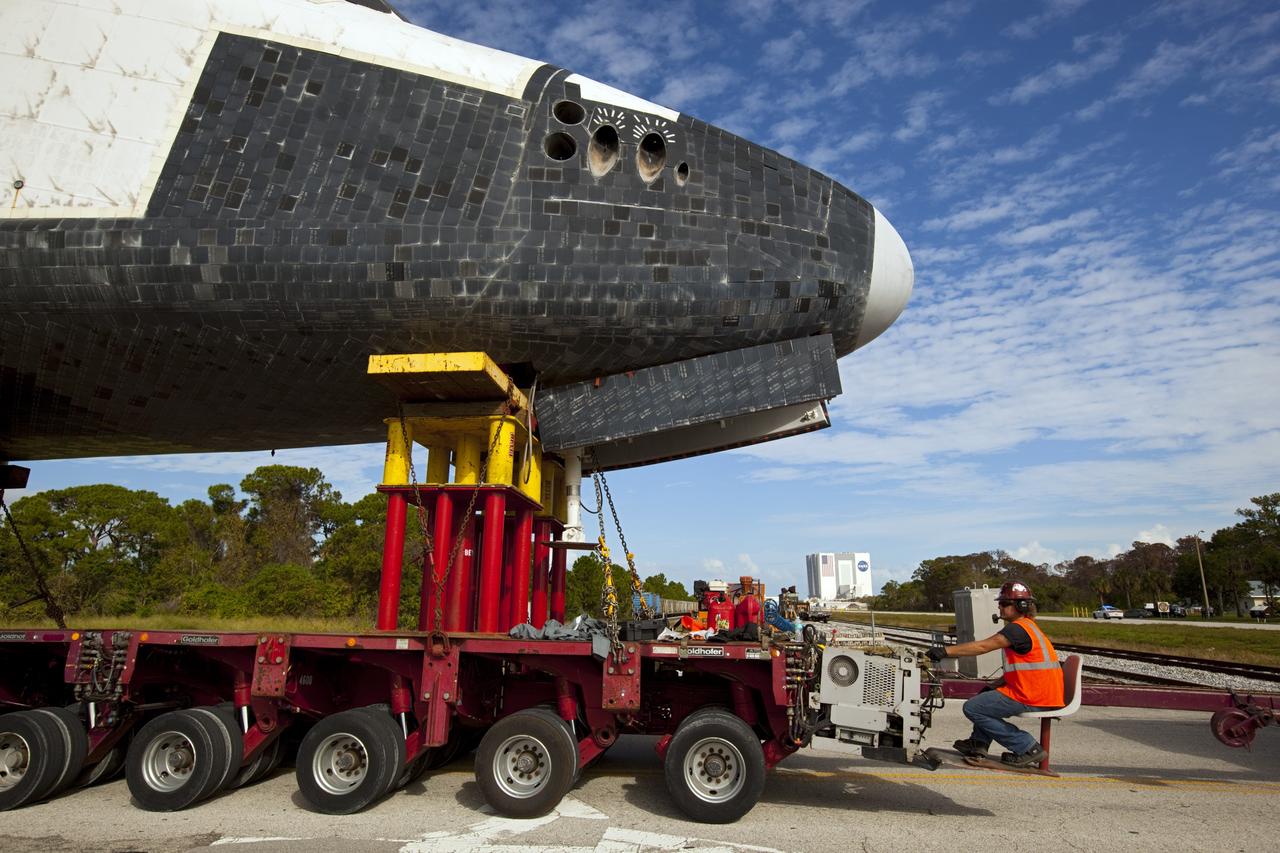
CAPE CANAVERAL, Fla. – Support personnel pull the transporter from beneath the high-fidelity space shuttle model which was on display at the NASA Kennedy Space Center Visitor Complex in Florida following its delivery to Kennedy's Launch Complex 39 turn basin. Across the street is the 525-foot-tall Vehicle Assembly Building. The shuttle was part of a display at the visitor complex that also included an external tank and two solid rocket boosters that were used to show visitors the size of actual space shuttle components. The full-scale shuttle model is being transferred from Kennedy to Space Center Houston, NASA Johnson Space Center's visitor center. The model will stay at the turn basin for a few months until it is ready to be transported to Texas via barge. The move also helps clear the way for the Kennedy Space Center Visitor Complex to begin construction of a new facility next year to display space shuttle Atlantis in 2013. For more information about Space Center Houston, visit http://www.spacecenter.org. Photo credit: NASA/Dimitri Gerondidakis
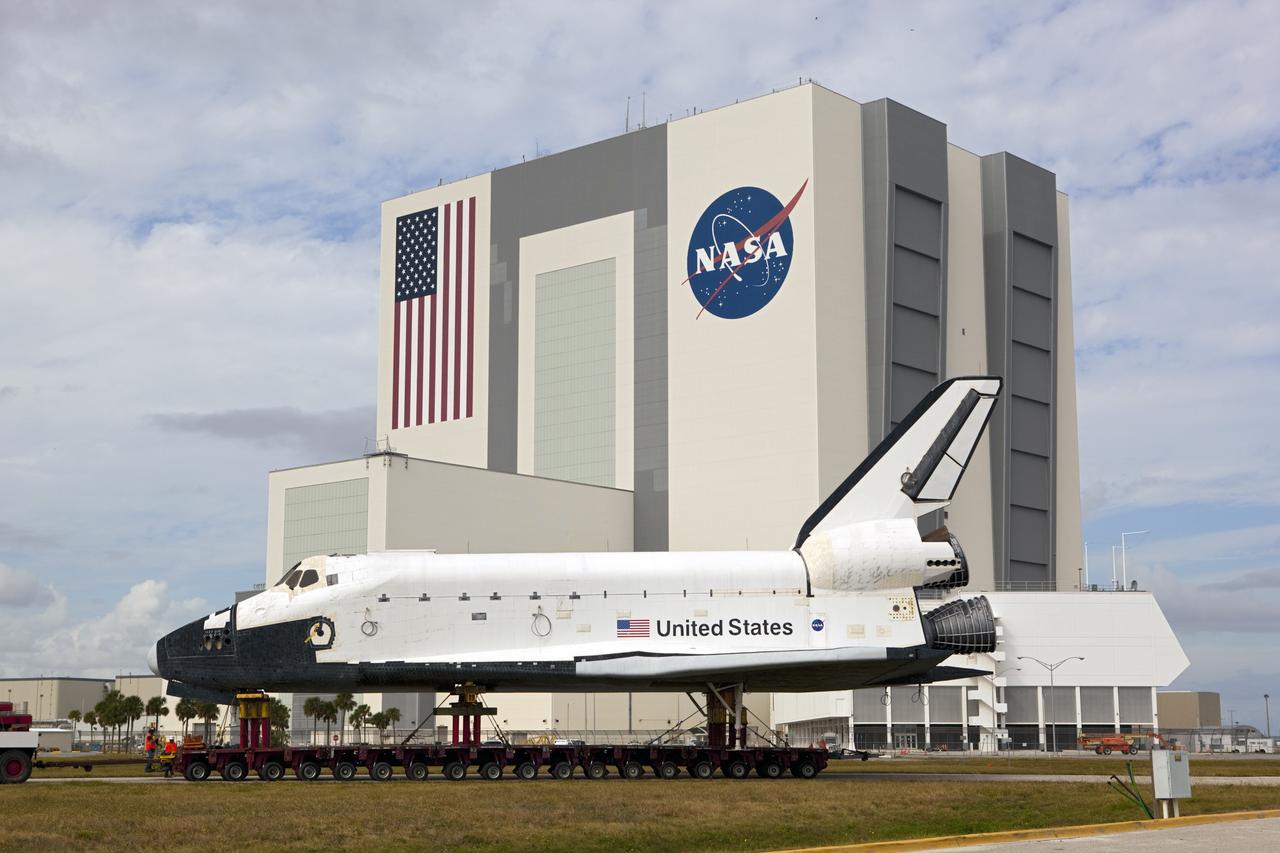
CAPE CANAVERAL, Fla. – The high-fidelity space shuttle model which was on display at the NASA Kennedy Space Center Visitor Complex in Florida backs through the Press Site parking lot toward Kennedy's Launch Complex 39 turn basin. Behind it, the Vehicle Assembly Building towers 525 feet into the sky. The shuttle was part of a display at the visitor complex that also included an external tank and two solid rocket boosters that were used to show visitors the size of actual space shuttle components. The full-scale shuttle model is being transferred from Kennedy to Space Center Houston, NASA Johnson Space Center's visitor center. The model will stay at the turn basin for a few months until it is ready to be transported to Texas via barge. The move also helps clear the way for the Kennedy Space Center Visitor Complex to begin construction of a new facility next year to display space shuttle Atlantis in 2013. For more information about Space Center Houston, visit http://www.spacecenter.org. Photo credit: NASA/Dimitri Gerondidakis
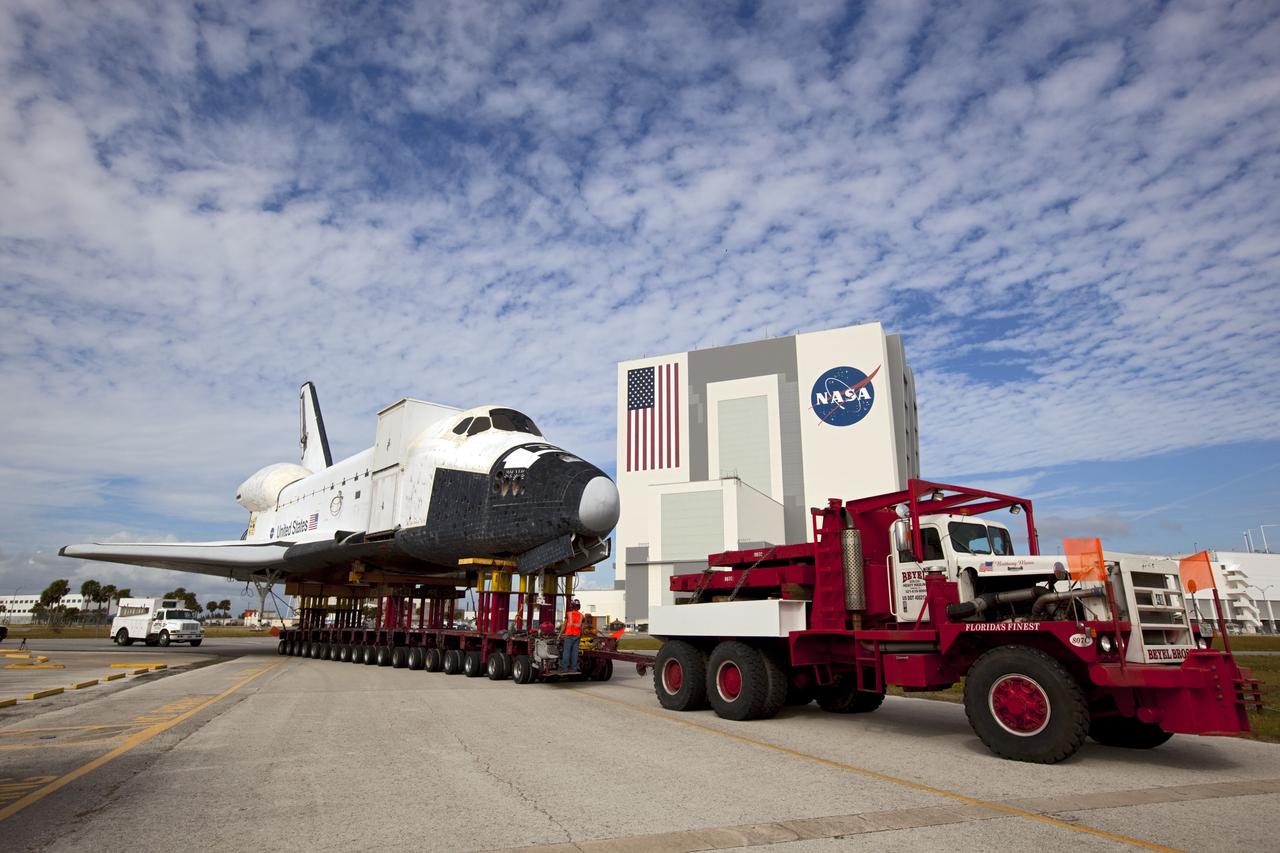
CAPE CANAVERAL, Fla. – The high-fidelity space shuttle model which was on display at the NASA Kennedy Space Center Visitor Complex in Florida turns into the parking lot leading to Kennedy's Launch Complex 39 turn basin. Behind it is the 525-foot-tall Vehicle Assembly Building. The shuttle was part of a display at the visitor complex that also included an external tank and two solid rocket boosters that were used to show visitors the size of actual space shuttle components. The full-scale shuttle model is being transferred from Kennedy to Space Center Houston, NASA Johnson Space Center's visitor center. The model will stay at the turn basin for a few months until it is ready to be transported to Texas via barge. The move also helps clear the way for the Kennedy Space Center Visitor Complex to begin construction of a new facility next year to display space shuttle Atlantis in 2013. For more information about Space Center Houston, visit http://www.spacecenter.org. Photo credit: NASA/Dimitri Gerondidakis
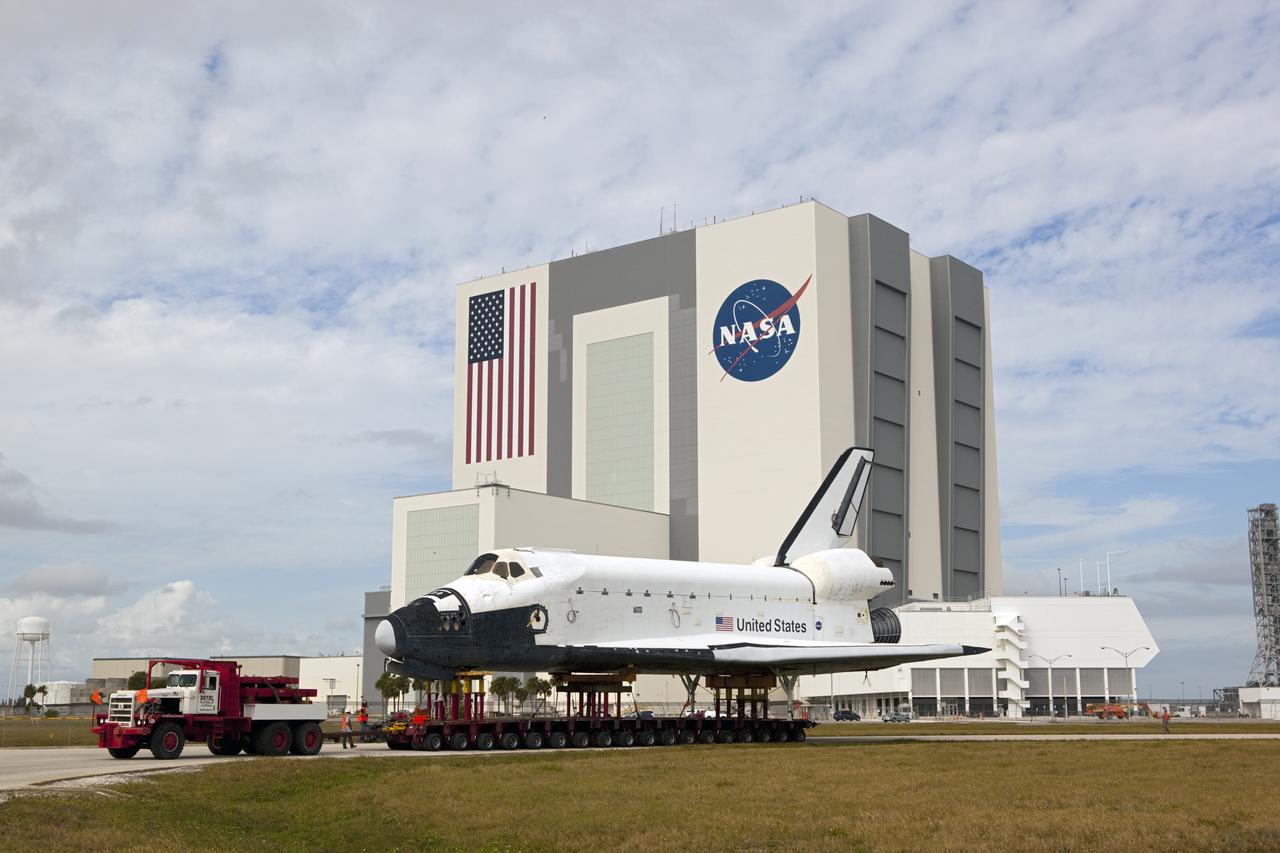
CAPE CANAVERAL, Fla. – The high-fidelity space shuttle model which was on display at the NASA Kennedy Space Center Visitor Complex in Florida rolls through the Press Site parking lot toward Kennedy's Launch Complex 39 turn basin. Behind it, the Vehicle Assembly Building towers 525 feet in the air. The shuttle was part of a display at the visitor complex that also included an external tank and two solid rocket boosters that were used to show visitors the size of actual space shuttle components. The full-scale shuttle model is being transferred from Kennedy to Space Center Houston, NASA Johnson Space Center's visitor center. The model will stay at the turn basin for a few months until it is ready to be transported to Texas via barge. The move also helps clear the way for the Kennedy Space Center Visitor Complex to begin construction of a new facility next year to display space shuttle Atlantis in 2013. For more information about Space Center Houston, visit http://www.spacecenter.org. Photo credit: NASA/Dimitri Gerondidakis
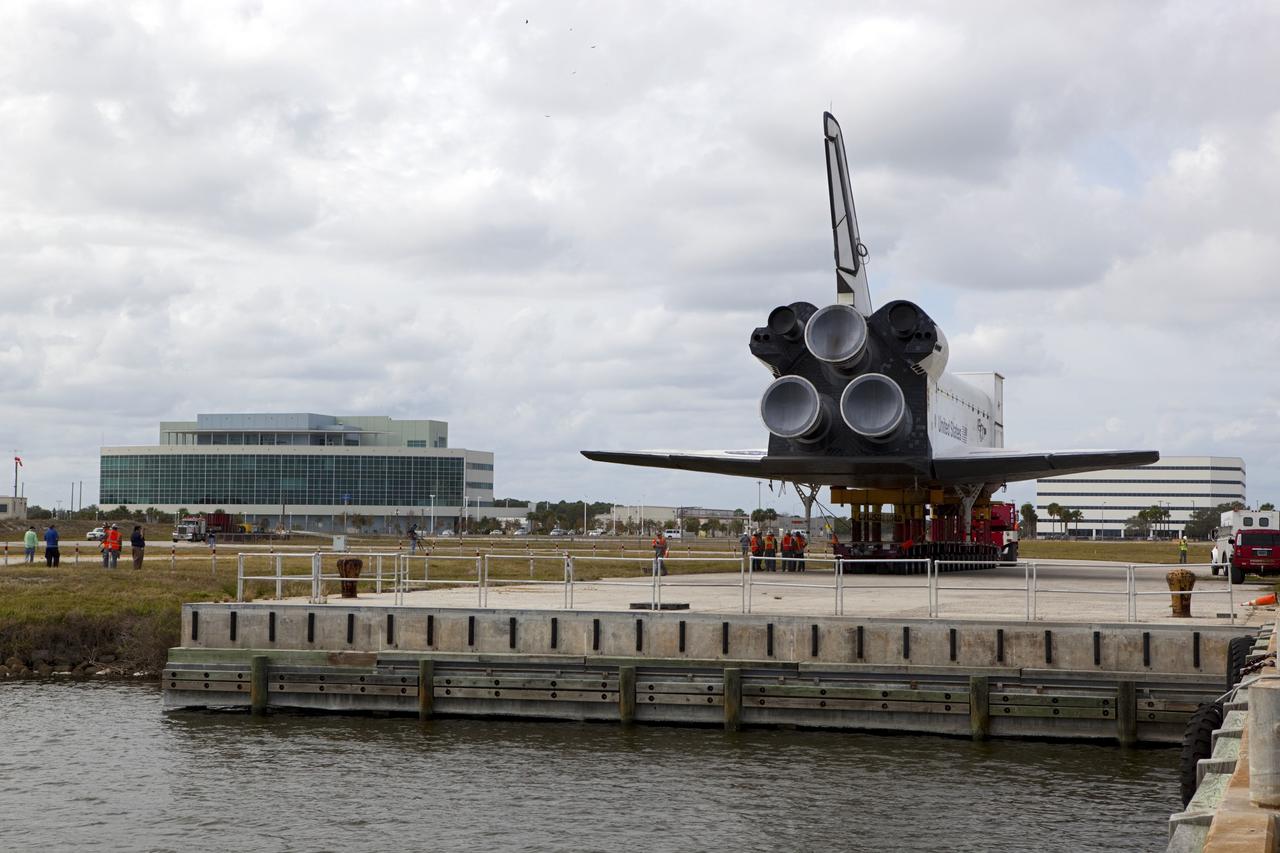
CAPE CANAVERAL, Fla. – The high-fidelity space shuttle model which was on display at the NASA Kennedy Space Center Visitor Complex in Florida rolls to a stop at Kennedy's Launch Complex 39 turn basin. In the background at left is the Operations Support Building II. The shuttle was part of a display at the visitor complex that also included an external tank and two solid rocket boosters that were used to show visitors the size of actual space shuttle components. The full-scale shuttle model is being transferred from Kennedy to Space Center Houston, NASA Johnson Space Center's visitor center. The model will stay at the turn basin for a few months until it is ready to be transported to Texas via barge. The move also helps clear the way for the Kennedy Space Center Visitor Complex to begin construction of a new facility next year to display space shuttle Atlantis in 2013. For more information about Space Center Houston, visit http://www.spacecenter.org. Photo credit: NASA/Dimitri Gerondidakis
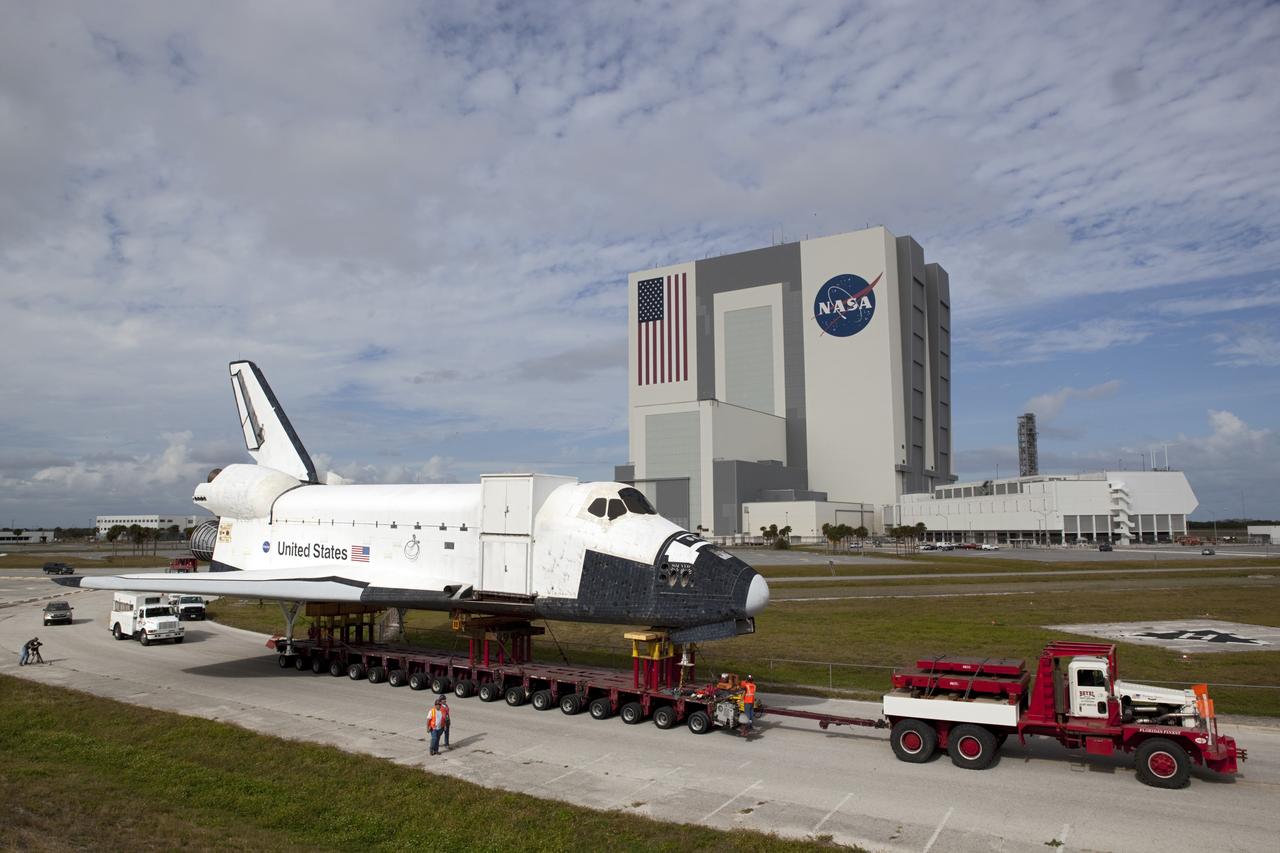
CAPE CANAVERAL, Fla. – The high-fidelity space shuttle model which was on display at the NASA Kennedy Space Center Visitor Complex in Florida rolls through the parking lot leading to Kennedy's Launch Complex 39 turn basin. Behind it are the 525-foot-tall Vehicle Assembly Building and the Launch Control Center. The shuttle was part of a display at the visitor complex that also included an external tank and two solid rocket boosters that were used to show visitors the size of actual space shuttle components. The full-scale shuttle model is being transferred from Kennedy to Space Center Houston, NASA Johnson Space Center's visitor center. The model will stay at the turn basin for a few months until it is ready to be transported to Texas via barge. The move also helps clear the way for the Kennedy Space Center Visitor Complex to begin construction of a new facility next year to display space shuttle Atlantis in 2013. For more information about Space Center Houston, visit http://www.spacecenter.org. Photo credit: NASA/Dimitri Gerondidakis
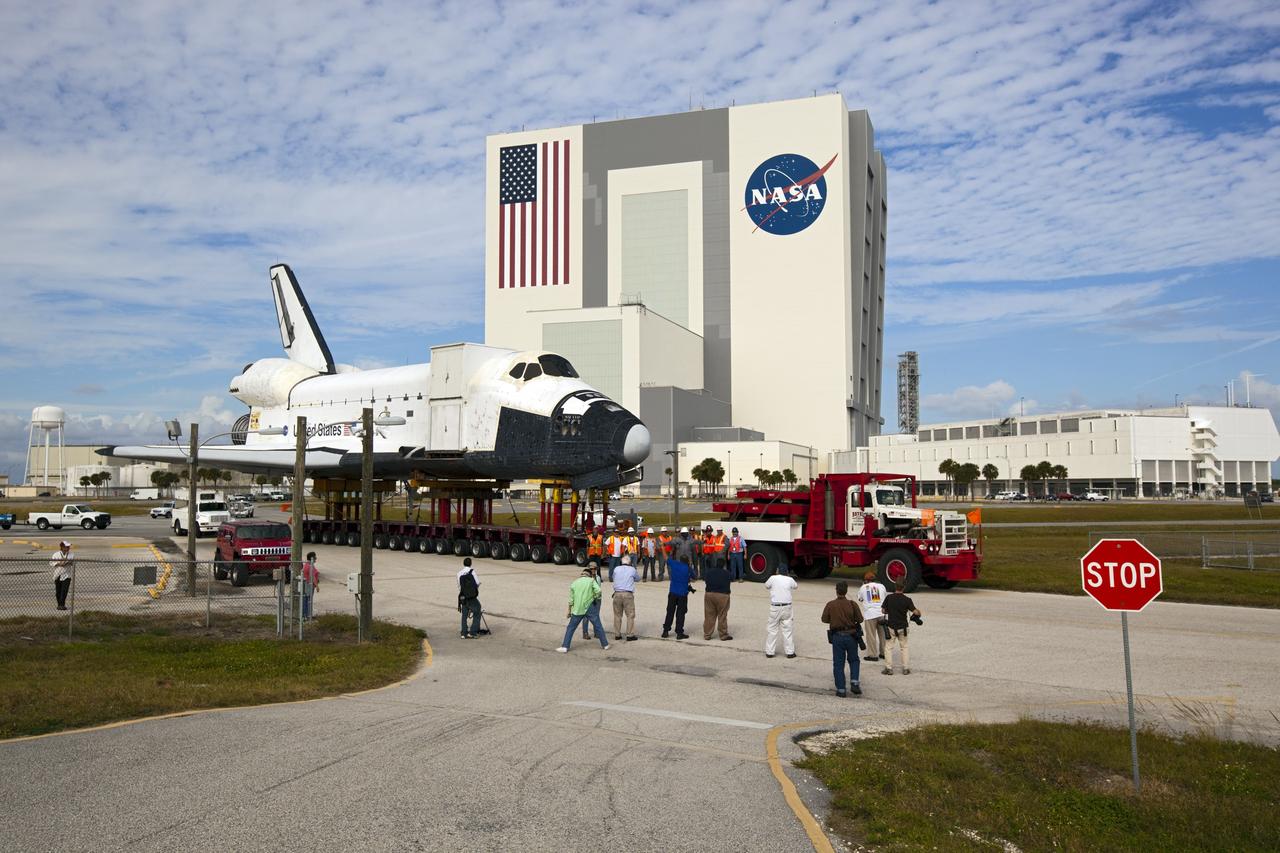
CAPE CANAVERAL, Fla. – Support personnel pose for a group portrait with the high-fidelity space shuttle model which was on display at the NASA Kennedy Space Center Visitor Complex in Florida. The shuttle lingered momentarily in the parking lot entrance to its destination, Kennedy's Launch Complex 39 turn basin. Behind them are the 525-foot-tall Vehicle Assembly Building and the Launch Control Center (at right). The shuttle was part of a display at the visitor complex that also included an external tank and two solid rocket boosters that were used to show visitors the size of actual space shuttle components. The full-scale shuttle model is being transferred from Kennedy to Space Center Houston, NASA Johnson Space Center's visitor center. The model will stay at the turn basin for a few months until it is ready to be transported to Texas via barge. The move also helps clear the way for the Kennedy Space Center Visitor Complex to begin construction of a new facility next year to display space shuttle Atlantis in 2013. For more information about Space Center Houston, visit http://www.spacecenter.org. Photo credit: NASA/Dimitri Gerondidakis
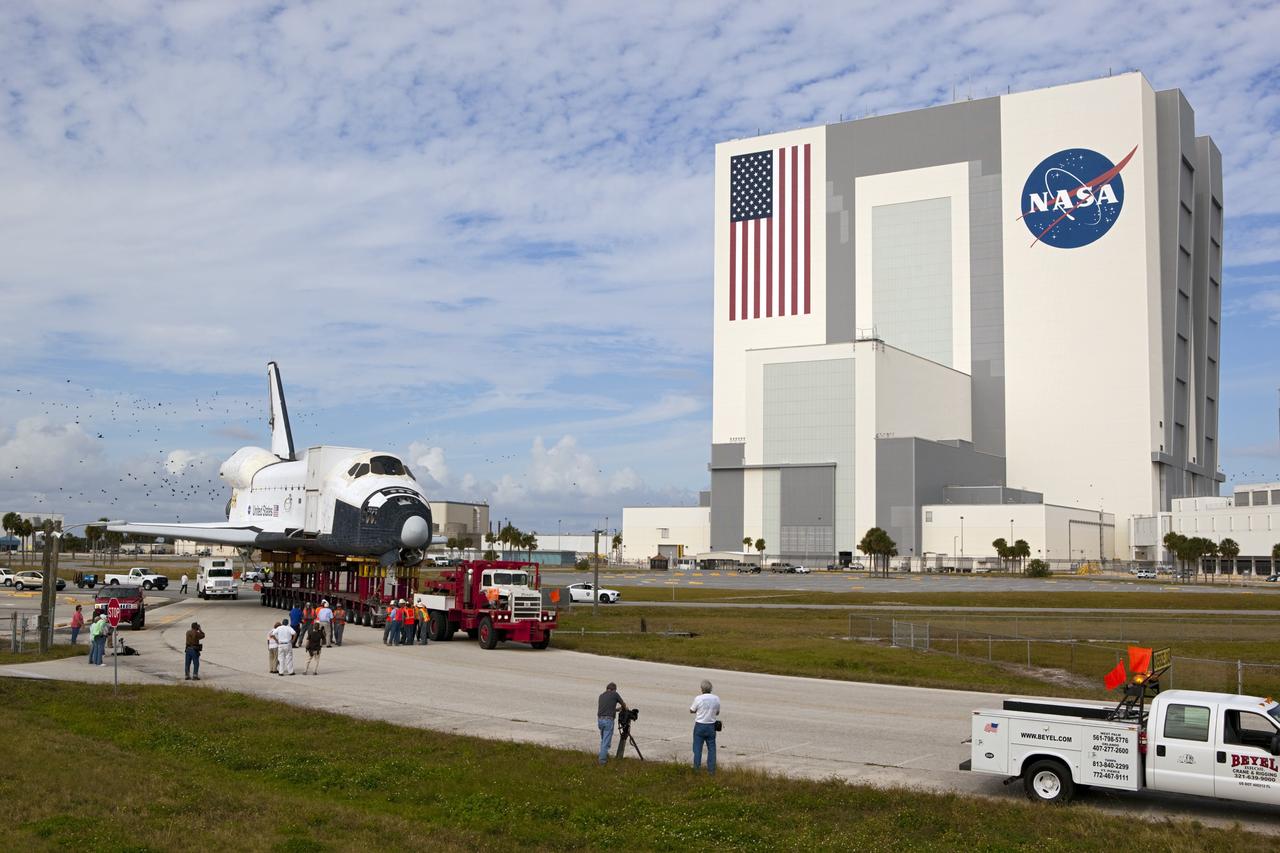
CAPE CANAVERAL, Fla. – Support personnel plan the last leg of the move of the high-fidelity space shuttle model which was on display at the NASA Kennedy Space Center Visitor Complex in Florida to Kennedy's Launch Complex 39 turn basin. Across the street (at right) are the 525-foot-tall Vehicle Assembly Building and the Launch Control Center. The shuttle was part of a display at the visitor complex that also included an external tank and two solid rocket boosters that were used to show visitors the size of actual space shuttle components. The full-scale shuttle model is being transferred from Kennedy to Space Center Houston, NASA Johnson Space Center's visitor center. The model will stay at the turn basin for a few months until it is ready to be transported to Texas via barge. The move also helps clear the way for the Kennedy Space Center Visitor Complex to begin construction of a new facility next year to display space shuttle Atlantis in 2013. For more information about Space Center Houston, visit http://www.spacecenter.org. Photo credit: NASA/Dimitri Gerondidakis
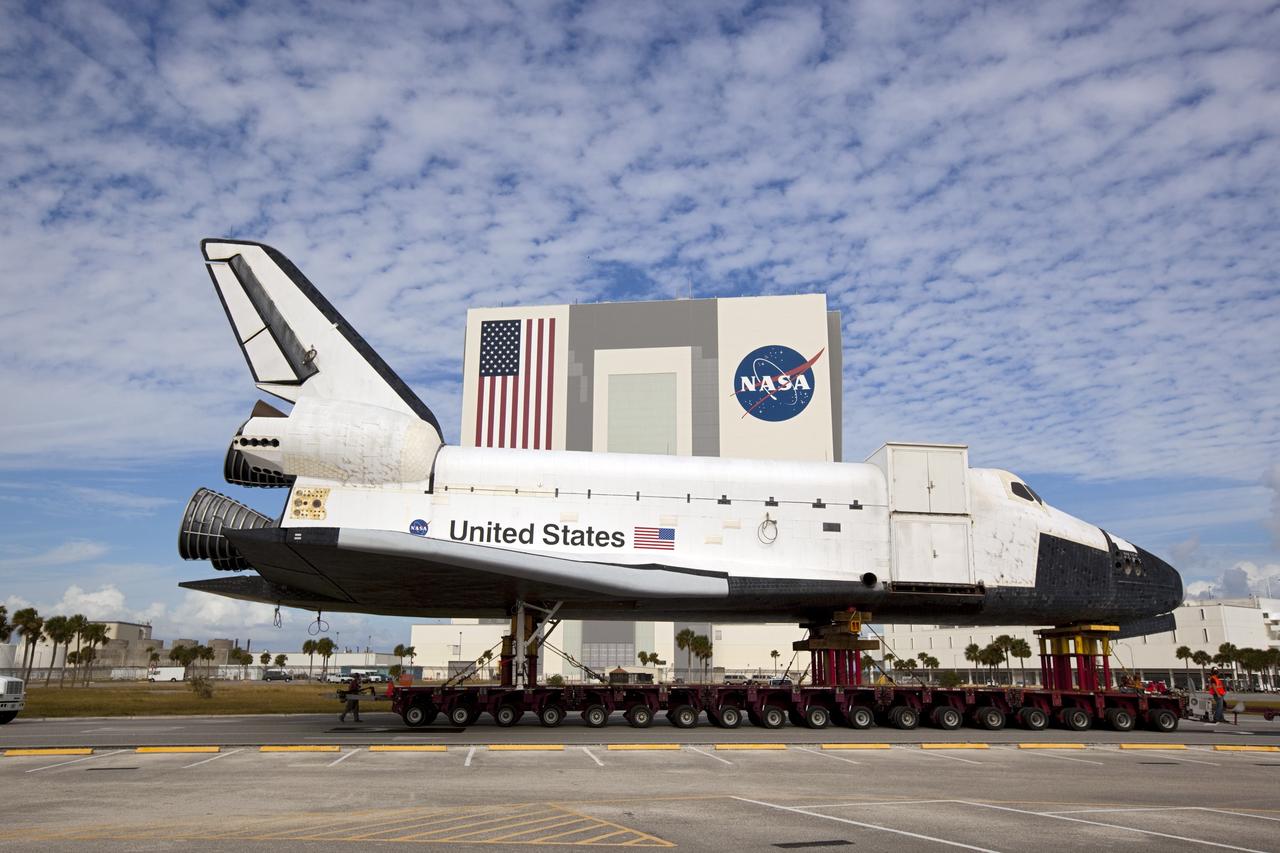
CAPE CANAVERAL, Fla. – The high-fidelity space shuttle model which was on display at the NASA Kennedy Space Center Visitor Complex in Florida passes in front of the 525-foot-tall Vehicle Assembly Building as it makes its way to Kennedy's Launch Complex 39 turn basin. The shuttle was part of a display at the visitor complex that also included an external tank and two solid rocket boosters that were used to show visitors the size of actual space shuttle components. The full-scale shuttle model is being transferred from Kennedy to Space Center Houston, NASA Johnson Space Center's visitor center. The model will stay at the turn basin for a few months until it is ready to be transported to Texas via barge. The move also helps clear the way for the Kennedy Space Center Visitor Complex to begin construction of a new facility next year to display space shuttle Atlantis in 2013. For more information about Space Center Houston, visit http://www.spacecenter.org. Photo credit: NASA/Dimitri Gerondidakis
CAPE CANAVERAL, Fla. – The high-fidelity space shuttle model which was on display at the NASA Kennedy Space Center Visitor Complex in Florida makes its way through the center to Kennedy's Launch Complex 39 turn basin. In the distance is the 525-foot-tall Vehicle Assembly Building. The shuttle was part of a display at the visitor complex that also included an external tank and two solid rocket boosters that were used to show visitors the size of actual space shuttle components. The full-scale shuttle model is being transferred from Kennedy to Space Center Houston, NASA Johnson Space Center's visitor center. The model will stay at the turn basin for a few months until it is ready to be transported to Texas via barge. The move also helps clear the way for the Kennedy Space Center Visitor Complex to begin construction of a new facility next year to display space shuttle Atlantis in 2013. For more information about Space Center Houston, visit http://www.spacecenter.org. Photo credit: NASA/Dimitri Gerondidakis
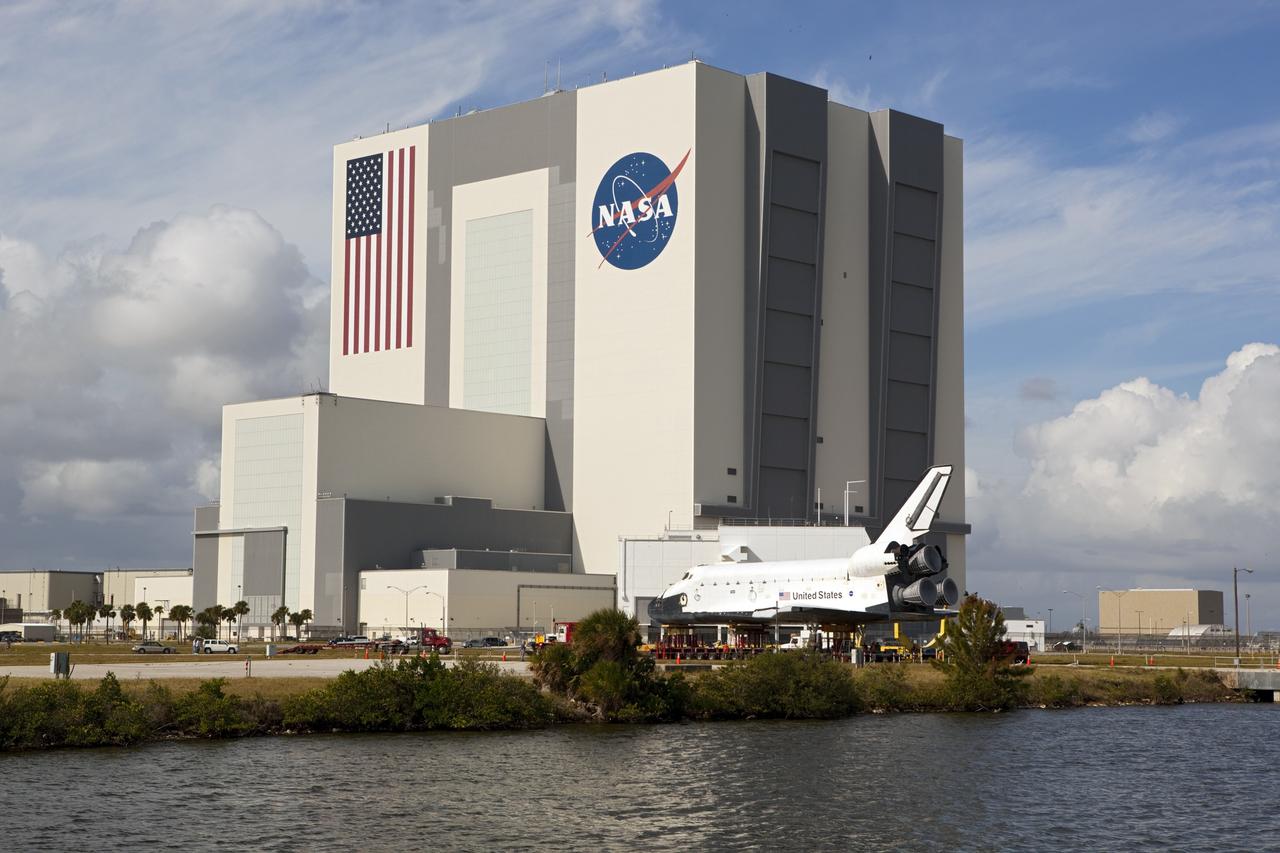
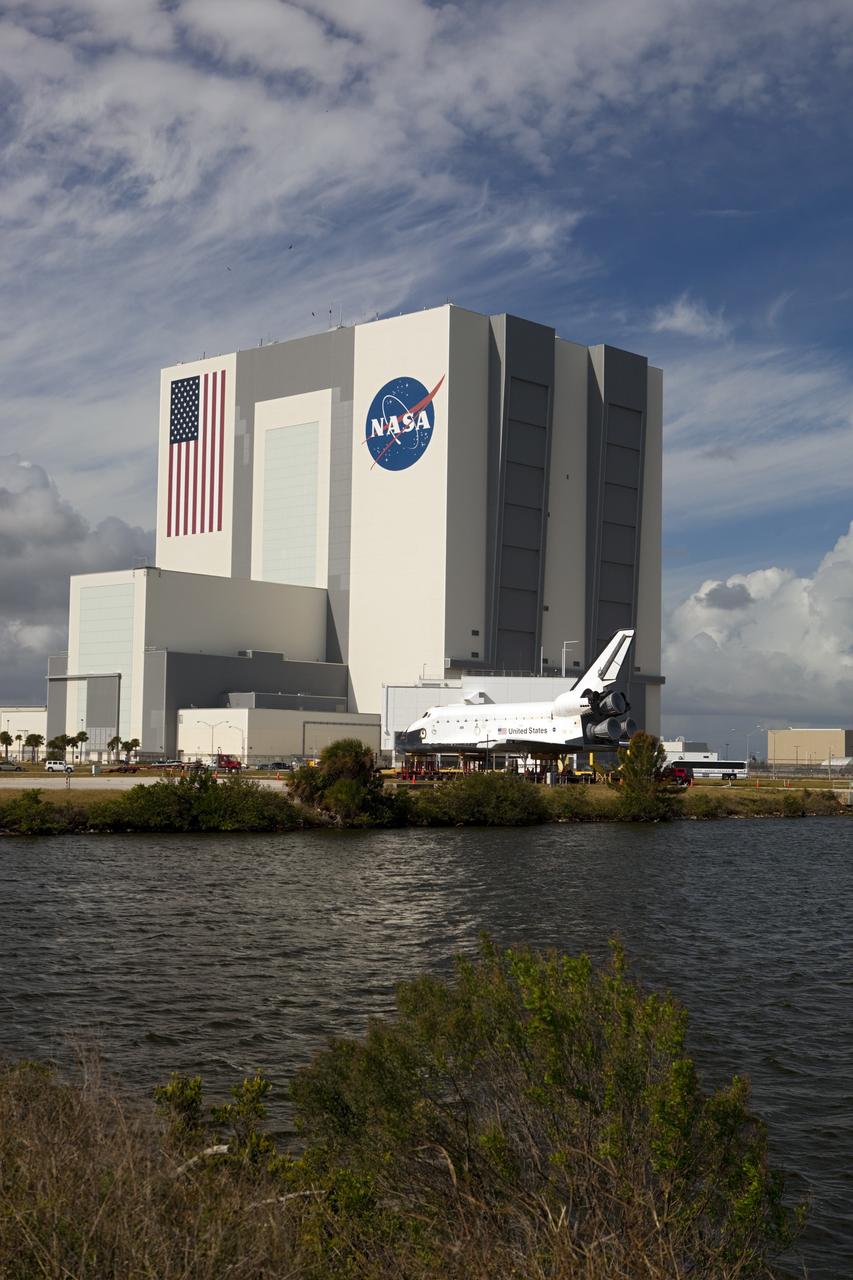
CAPE CANAVERAL, Fla. – The high-fidelity space shuttle model which was on display at the NASA Kennedy Space Center Visitor Complex in Florida seems out of place when viewed across the water of Kennedy's Launch Complex 39 turn basin. The Vehicle Assembly Building across the street towers 525 feet above it. The shuttle was part of a display at the visitor complex that also included an external tank and two solid rocket boosters that were used to show visitors the size of actual space shuttle components. The full-scale shuttle model is being transferred from Kennedy to Space Center Houston, NASA Johnson Space Center's visitor center. The model will stay at the turn basin for a few months until it is ready to be transported to Texas via barge. The move also helps clear the way for the Kennedy Space Center Visitor Complex to begin construction of a new facility next year to display space shuttle Atlantis in 2013. For more information about Space Center Houston, visit http://www.spacecenter.org. Photo credit: NASA/Dimitri Gerondidakis
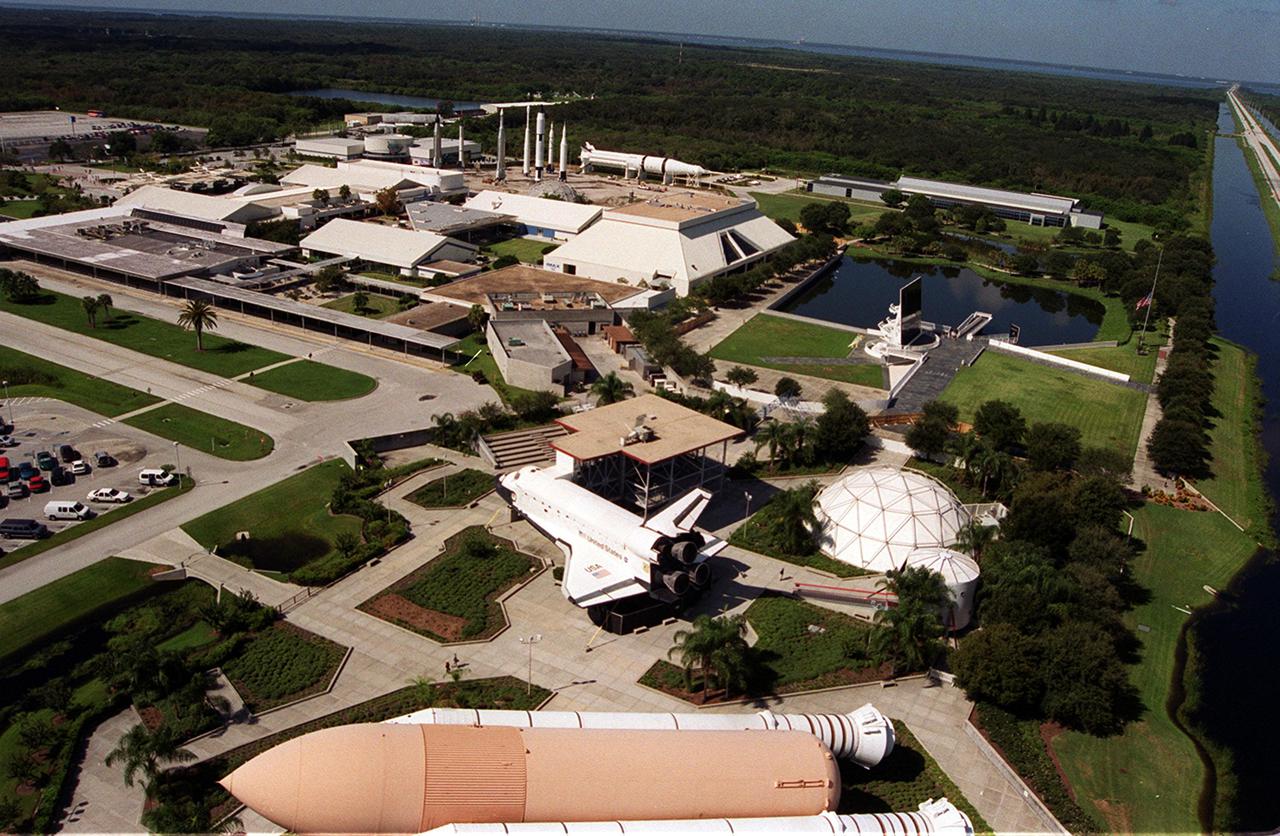
KENNEDY SPACE CENTER, Fla. -- This aerial view of the KSC Visitor Complex shows many of the buildings and exhibits, such as the full-scale solid rocket boosters and external tank in the foreground, a full-scale model of a Space Shuttle orbiter behind them, the Launch Status Dome to the right, and the Astronauts Memorial Space Mirror next to the retention pond. Names of the 17 American astronauts who gave their lives to the quest to explore space are engraved in the mirror-finished surface of this memorial exhibit. Sunlight projecting through the names appears to emblazon them against a reflection of the sky. To the left of the mirror is the Center for Space Education. In the background is the Rocket Garden, exhibiting early rockets from the space program
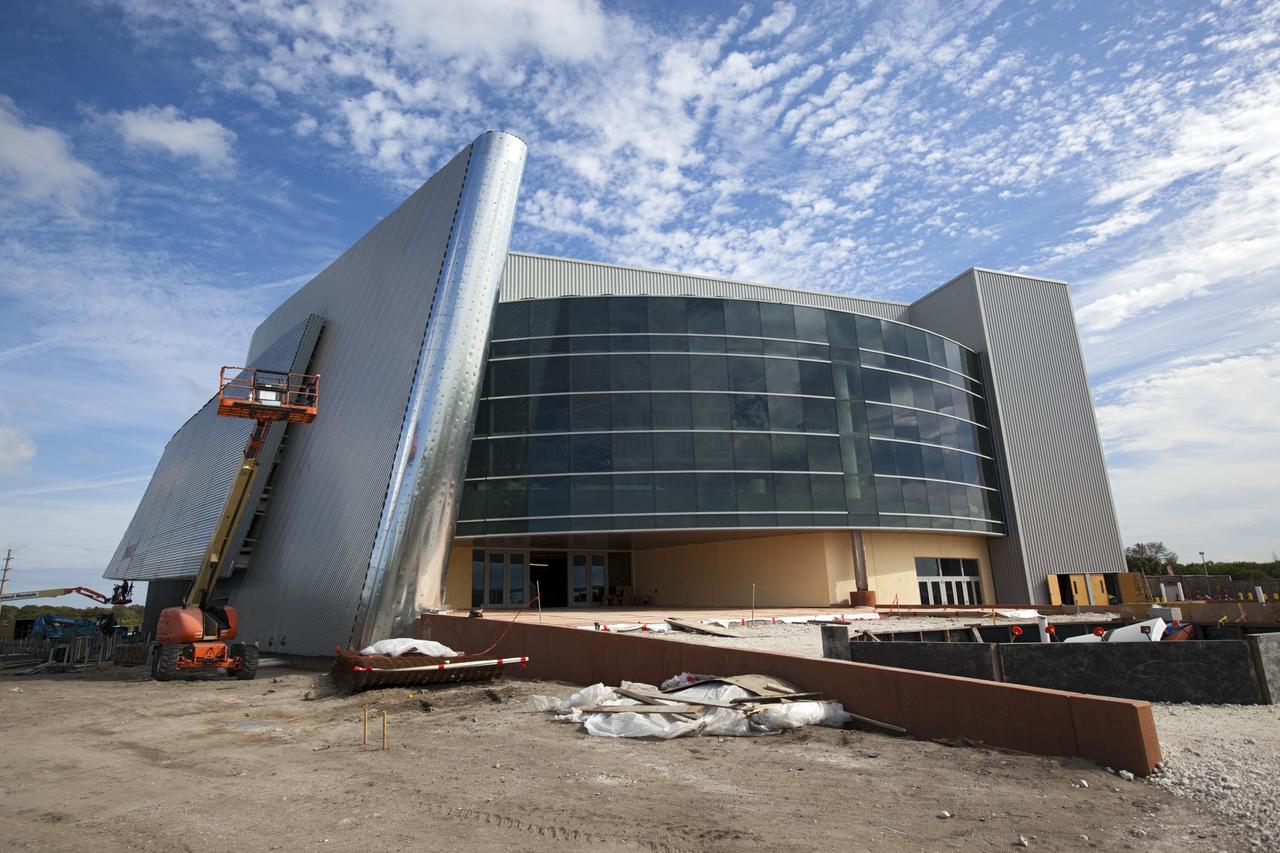
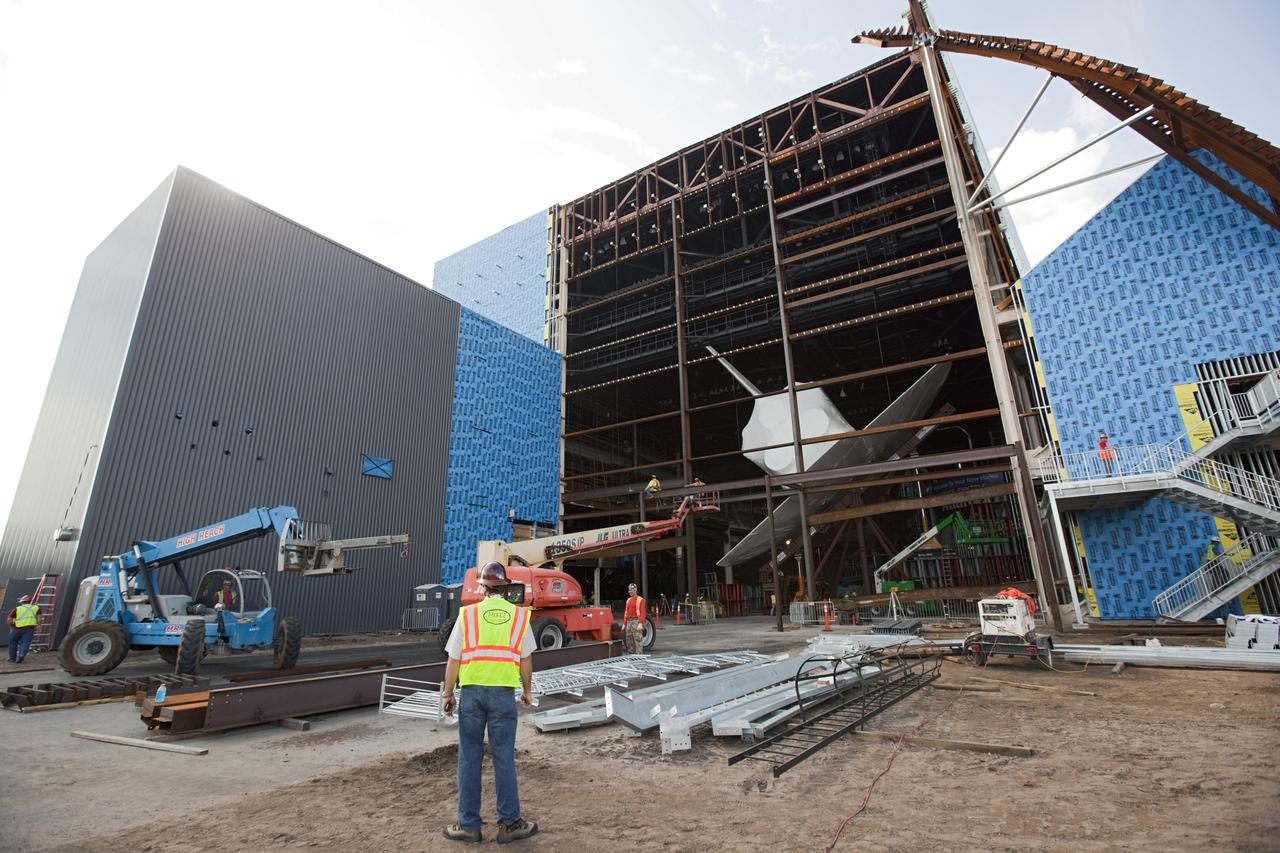
CAPE CANAVERAL, Fla. – The new facility at the Kennedy Space Center Visitor Complex in Florida where space shuttle Atlantis will be displayed is nearing completion. The new home of Atlantis is scheduled to open in July 2013. The exhibits in the new, 90,000-square-foot interactive facility will tell the story of the 30-year Space Shuttle Program and what lies ahead in space exploration. More than 60 exhibits will be set up around Atlantis, including a full-scale mockup of the Hubble Space Telescope and a full-scale model of a portion of the International Space Station. Over the course of its 26-year career, Atlantis traveled 125,935,769 miles during 307 days in space over 33 missions. For more information, visit http://www.nasa.gov/transition Photo credit: NASA/ Dimitri Gerondidakis
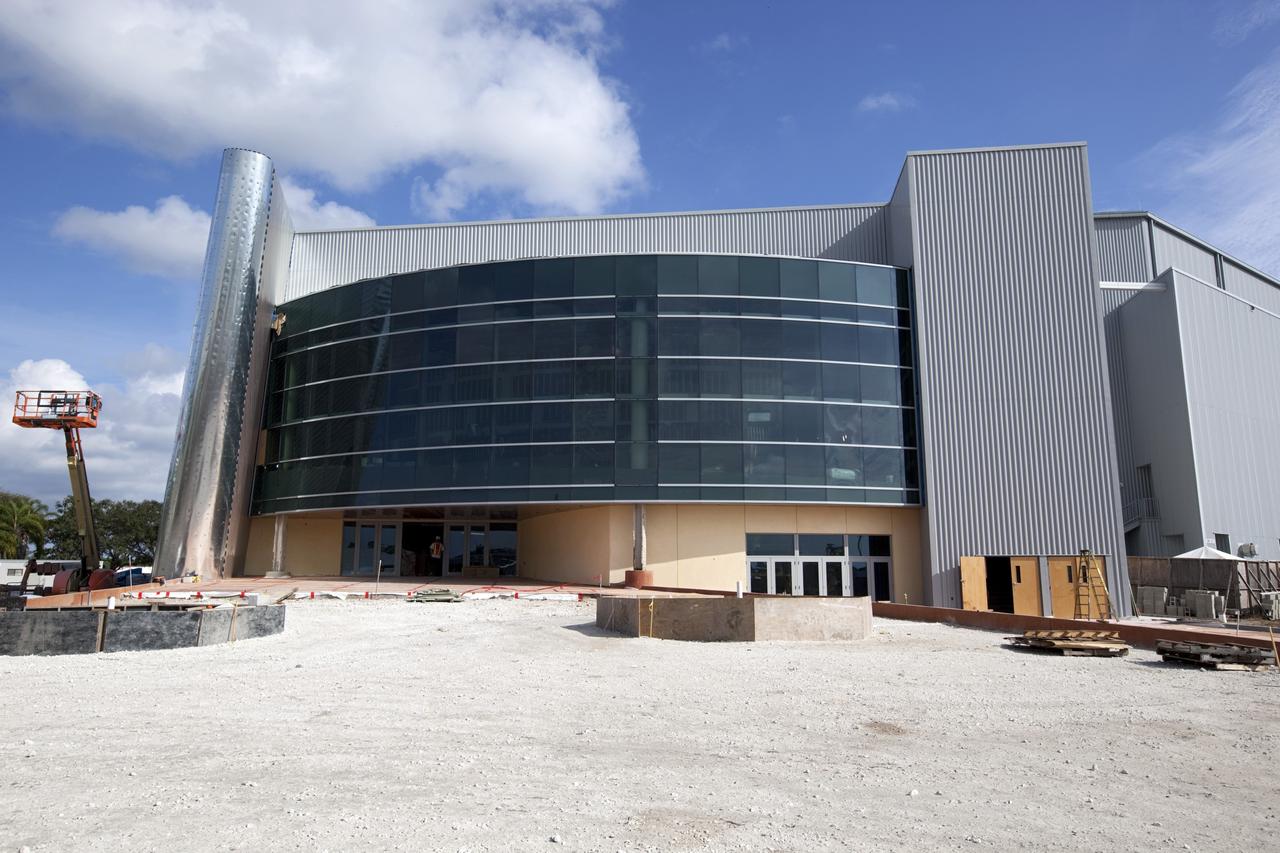
CAPE CANAVERAL, Fla. – The new facility at the Kennedy Space Center Visitor Complex in Florida where space shuttle Atlantis will be displayed is nearing completion. The new home of Atlantis is scheduled to open in July 2013. The exhibits in the new, 90,000-square-foot interactive facility will tell the story of the 30-year Space Shuttle Program and what lies ahead in space exploration. More than 60 exhibits will be set up around Atlantis, including a full-scale mockup of the Hubble Space Telescope and a full-scale model of a portion of the International Space Station. Over the course of its 26-year career, Atlantis traveled 125,935,769 miles during 307 days in space over 33 missions. For more information, visit http://www.nasa.gov/transition Photo credit: NASA/ Dimitri Gerondidakis
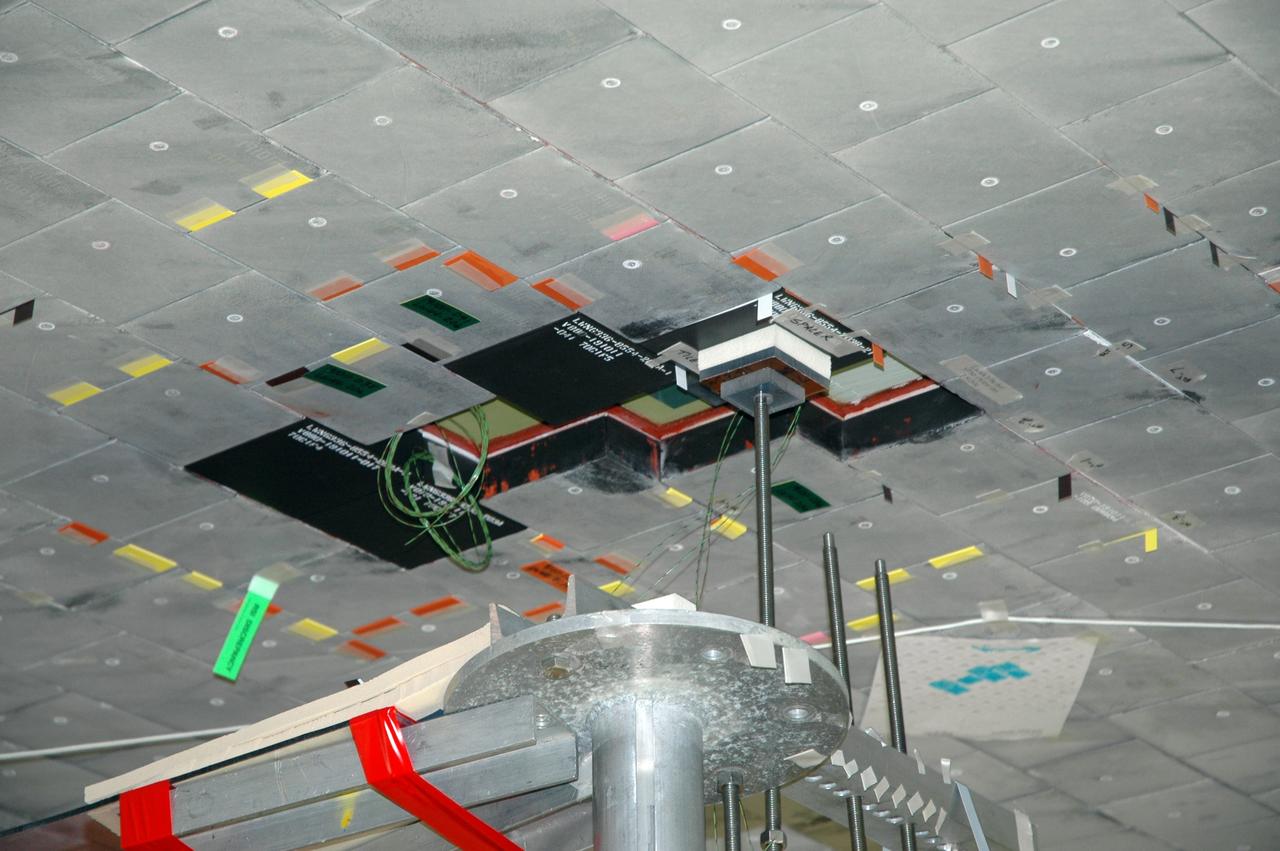
CAPE CANAVERAL, Fla. - In Orbiter Processing Facility bay 3 at NASA's Kennedy Space Center in Florida, boundary layer transition, or BLT, tile is being affixed to space shuttle Discovery before its launch on the STS-119 mission in February 2009. The specially modified tiles and instrumentation package will monitor the heating effects of early re-entry boundary layer transition at high mach numbers. These data support analytical modeling and design efforts for both the space shuttles and NASA next-generation spacecraft, the Orion crew exploration vehicle. On the STS-119 mission, Discovery also will carry the S6 truss segment to complete the 361-foot-long backbone of the International Space Station. The truss includes the fourth pair of solar array wings and electronics that convert sunlight to power for the orbiting laboratory. Photo credit: NASA/Tim Jacobs
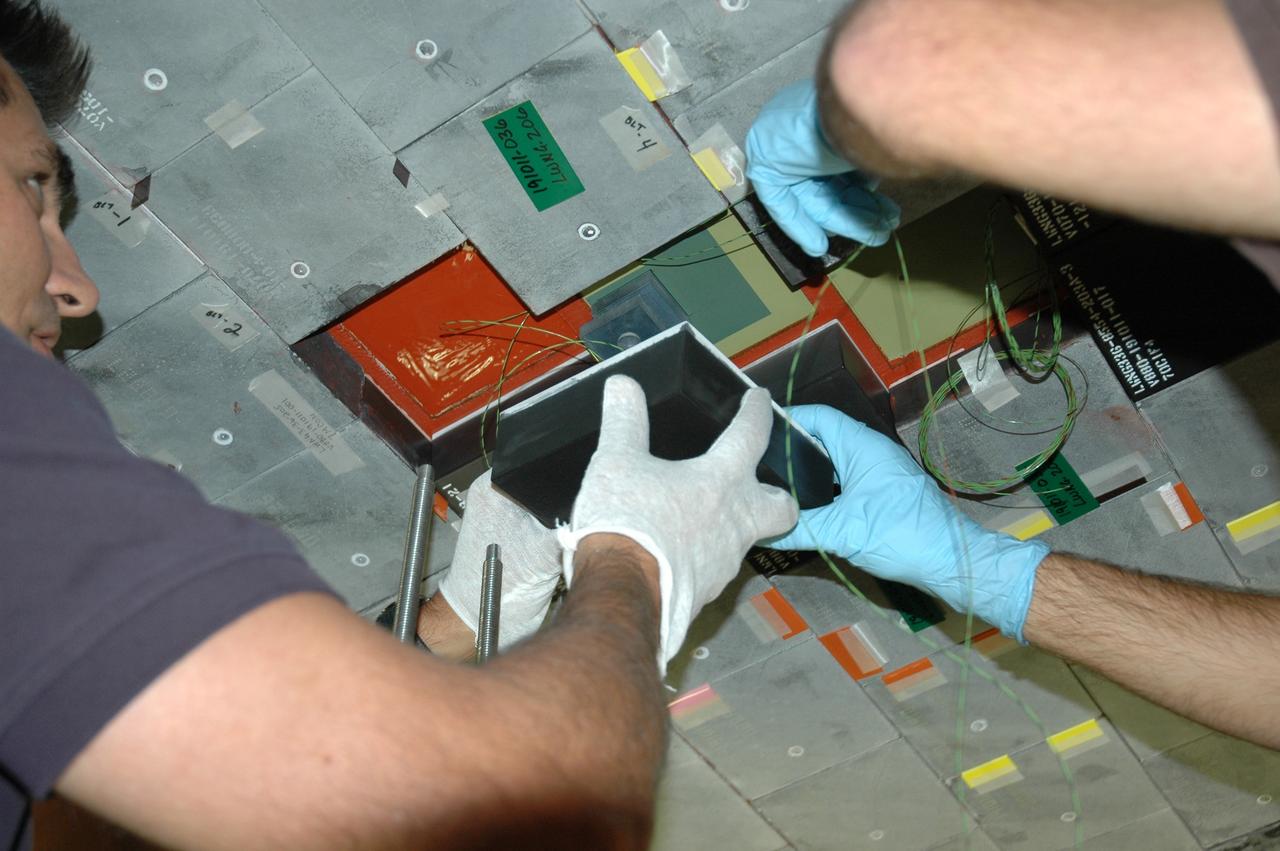
CAPE CANAVERAL, Fla. - In Orbiter Processing Facility bay 3 at NASA's Kennedy Space Center in Florida, workers attach boundary layer transition, or BLT, tile to space shuttle Discovery before its launch on the STS-119 mission in February 2009. The specially modified tiles and instrumentation package will monitor the heating effects of early re-entry boundary layer transition at high mach numbers. These data support analytical modeling and design efforts for both the space shuttles and NASA next-generation spacecraft, the Orion crew exploration vehicle. On the STS-119 mission, Discovery also will carry the S6 truss segment to complete the 361-foot-long backbone of the International Space Station. The truss includes the fourth pair of solar array wings and electronics that convert sunlight to power for the orbiting laboratory. Photo credit: NASA/Tim Jacobs
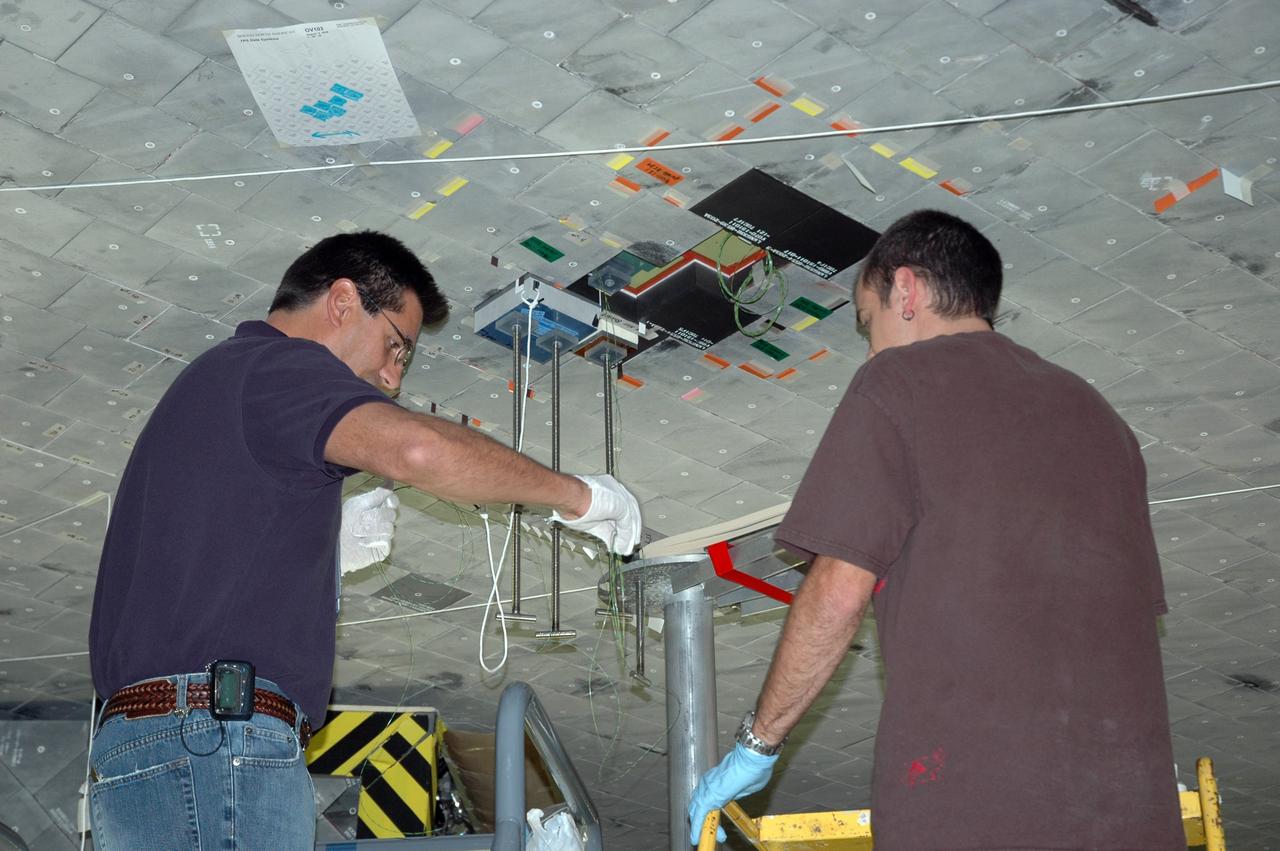
CAPE CANAVERAL, Fla. - In Orbiter Processing Facility bay 3 at NASA's Kennedy Space Center in Florida, workers attach boundary layer transition, or BLT, tile to space shuttle Discovery before its launch on the STS-119 mission in February 2009. The specially modified tiles and instrumentation package will monitor the heating effects of early re-entry boundary layer transition at high mach numbers. These data support analytical modeling and design efforts for both the space shuttles and NASA next-generation spacecraft, the Orion crew exploration vehicle. On the STS-119 mission, Discovery also will carry the S6 truss segment to complete the 361-foot-long backbone of the International Space Station. The truss includes the fourth pair of solar array wings and electronics that convert sunlight to power for the orbiting laboratory. Photo credit: NASA/Tim Jacobs
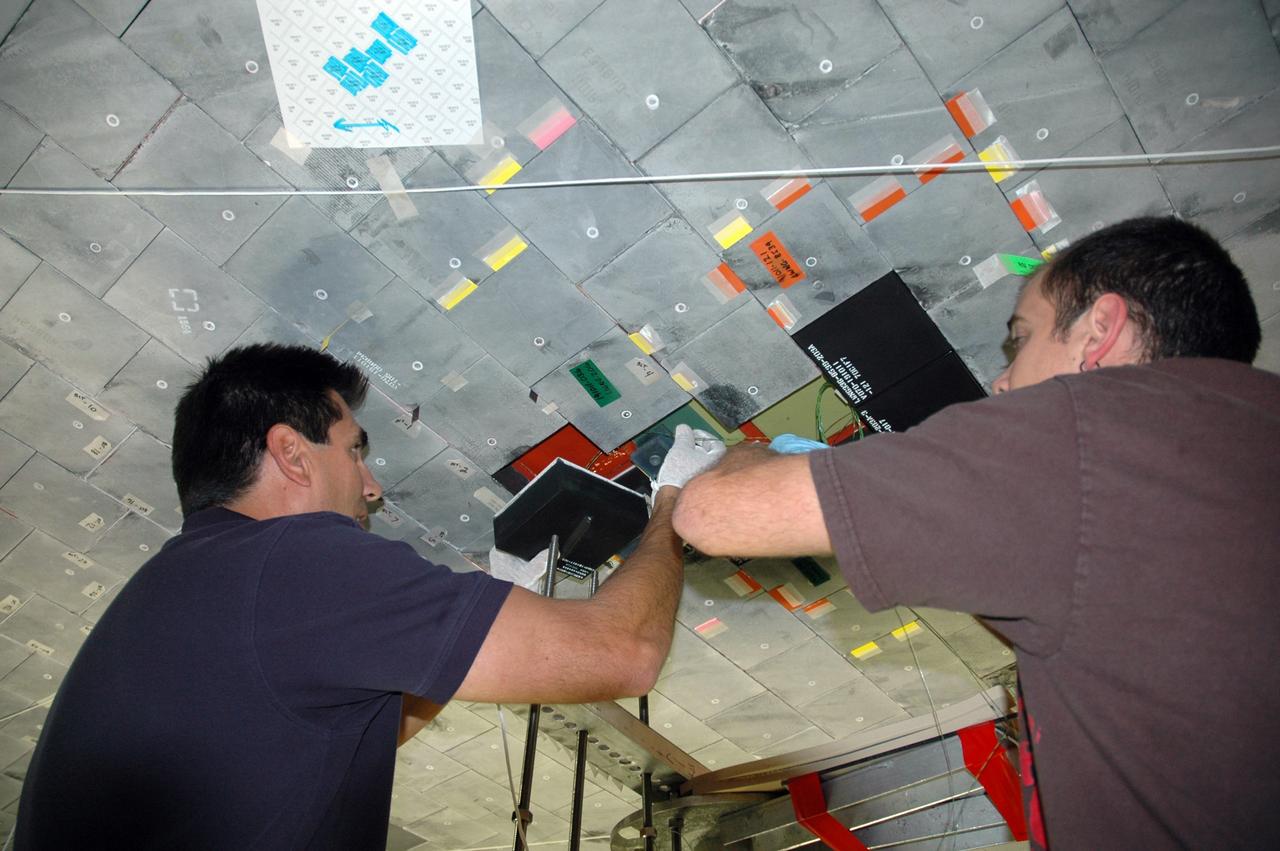
CAPE CANAVERAL, Fla. - In Orbiter Processing Facility bay 3 at NASA's Kennedy Space Center in Florida, workers attach boundary layer transition, or BLT, tile to space shuttle Discovery before its launch on the STS-119 mission in February 2009. The specially modified tiles and instrumentation package will monitor the heating effects of early re-entry boundary layer transition at high mach numbers. These data support analytical modeling and design efforts for both the space shuttles and NASA next-generation spacecraft, the Orion crew exploration vehicle. On the STS-119 mission, Discovery also will carry the S6 truss segment to complete the 361-foot-long backbone of the International Space Station. The truss includes the fourth pair of solar array wings and electronics that convert sunlight to power for the orbiting laboratory. Photo credit: NASA/Tim Jacobs
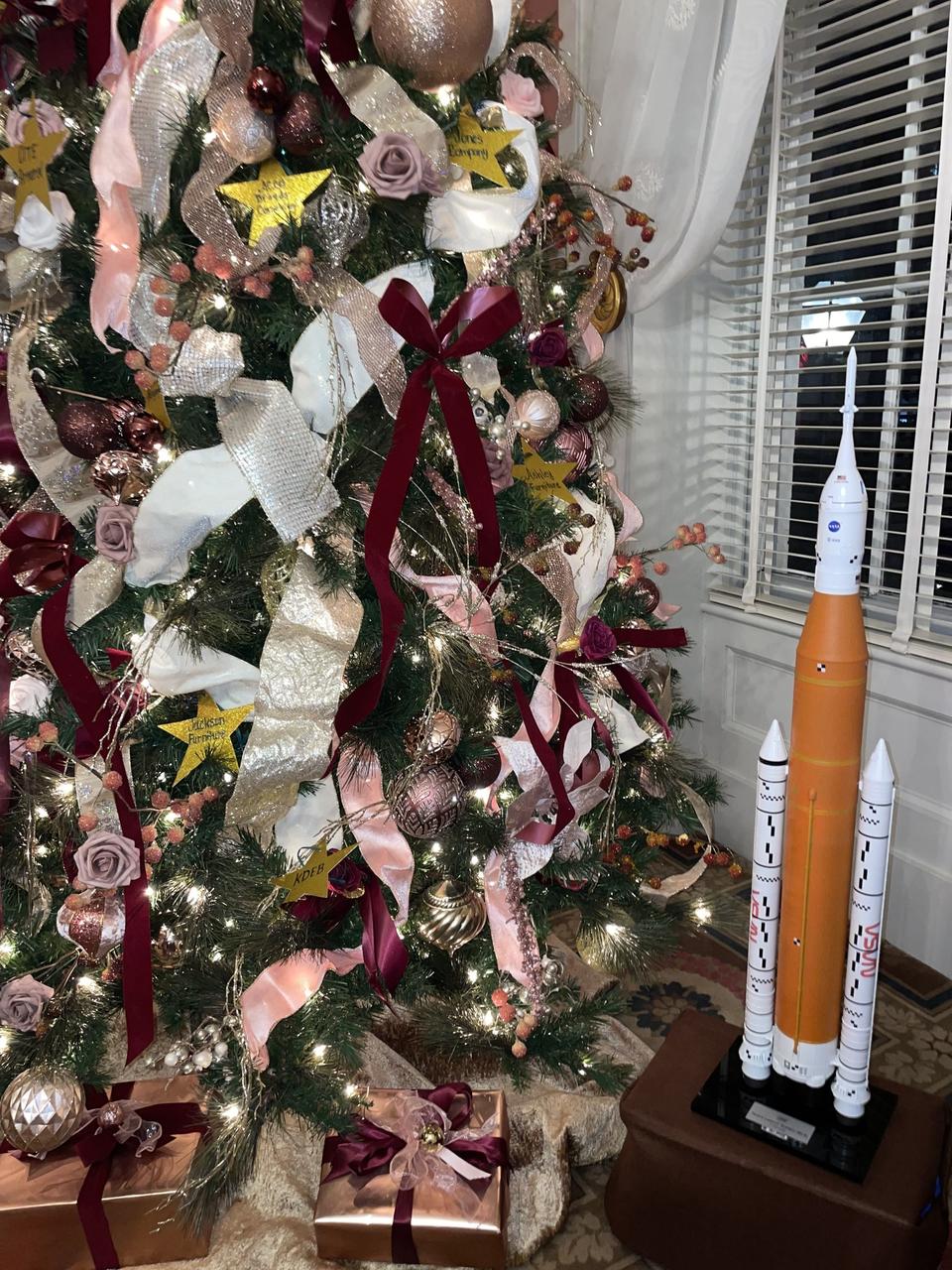
A model of NASA’s SLS (Space Launch System) rocket is part of the holiday display in the Mississippi Governor’s Mansion in Jackson, the official residence of state Gov. Tate Reeves. The model symbolizes the longtime relationship and shared history between the state of Mississippi and NASA’s Stennis Space Center near Bay St. Louis, Mississippi, the nation’s largest rocket propulsion test site. Built in the 1960s, NASA Stennis tested Apollo rocket stages that carried humans to the Moon and every main engine that helped launch 135 space shuttle missions. It now is testing engines and systems for NASA’s Artemis missions and operates as a powerful aerospace and technology hub for the region and state. “We are grateful for our ongoing relationship with the state of Mississippi,” NASA Stennis Director John Bailey said. “We appreciate every opportunity to highlight the role NASA Stennis and the state play in helping to power the nation’s human space exploration program. We look forward to 2025 and continuing our work to test engines and systems that will help launch Artemis missions back to the Moon and beyond.”
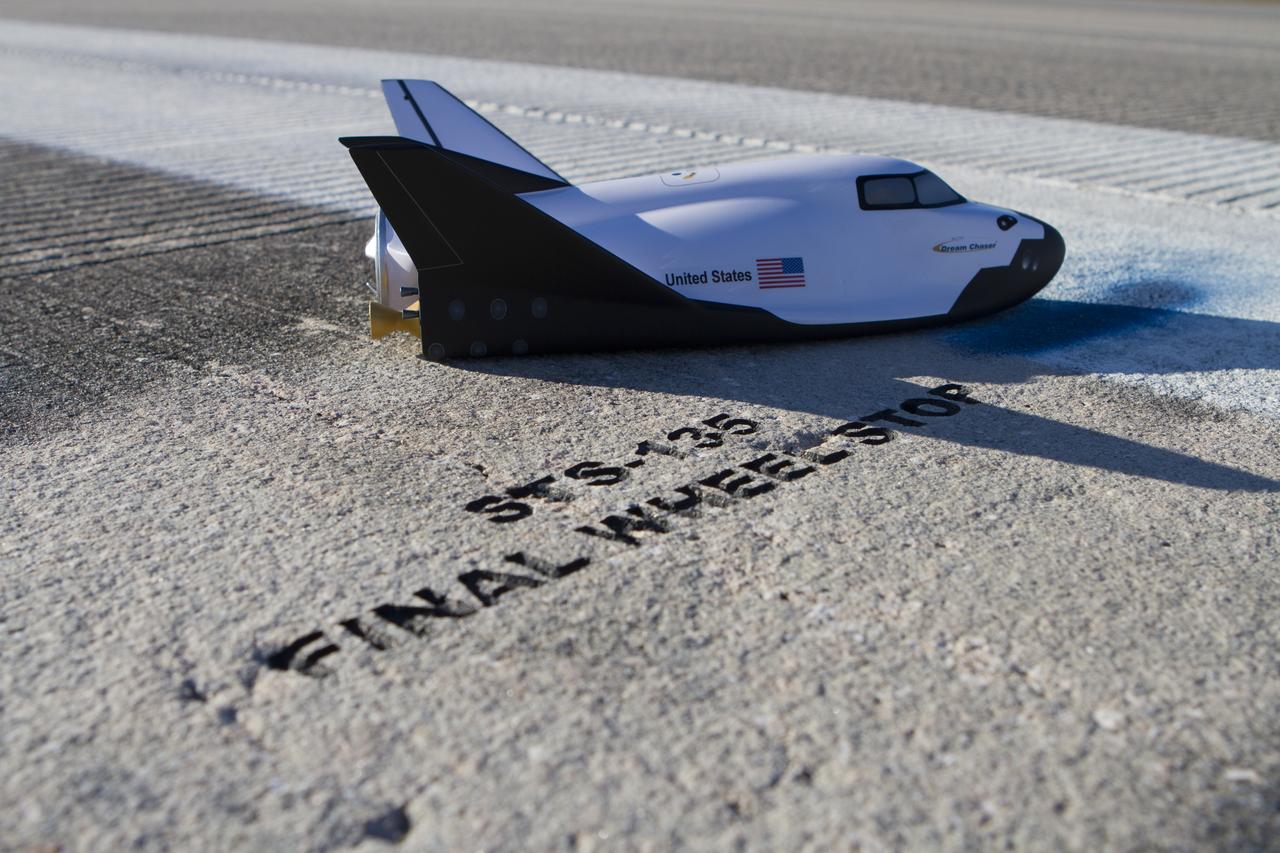
CAPE CANAVERAL, Fla. – A model of the Sierra Nevada Corporation, or SNC, Dream Chaser spacecraft stands next to the final wheelstop location of space shuttle Atlantis, the final shuttle to land on the 3.5-mile-long runway at Kennedy Space Center’s Shuttle Landing Facility. SNC announced it plans to work with United Launch Alliance, or ULA, to launch the Dream Chaser spacecraft into orbit atop an Atlas V rocket from Space Launch Complex 41 at Cape Canaveral Air Force Station in November 2016 intends to land the winged spacecraft at the Shuttle Landing Facility lease office space at Exploration Park, right outside Kennedy’s gates and process the spacecraft in the high bay of the Operations and Checkout Building at Kennedy, with Lockheed Martin performing the work. The announcements made during a news conference at Kennedy are considered substantial for SNC and important to plans by NASA and Space Florida for Kennedy’s transformation into a multi-user spaceport for both commercial and government customers. Photo credit: NASA/Cory Huston
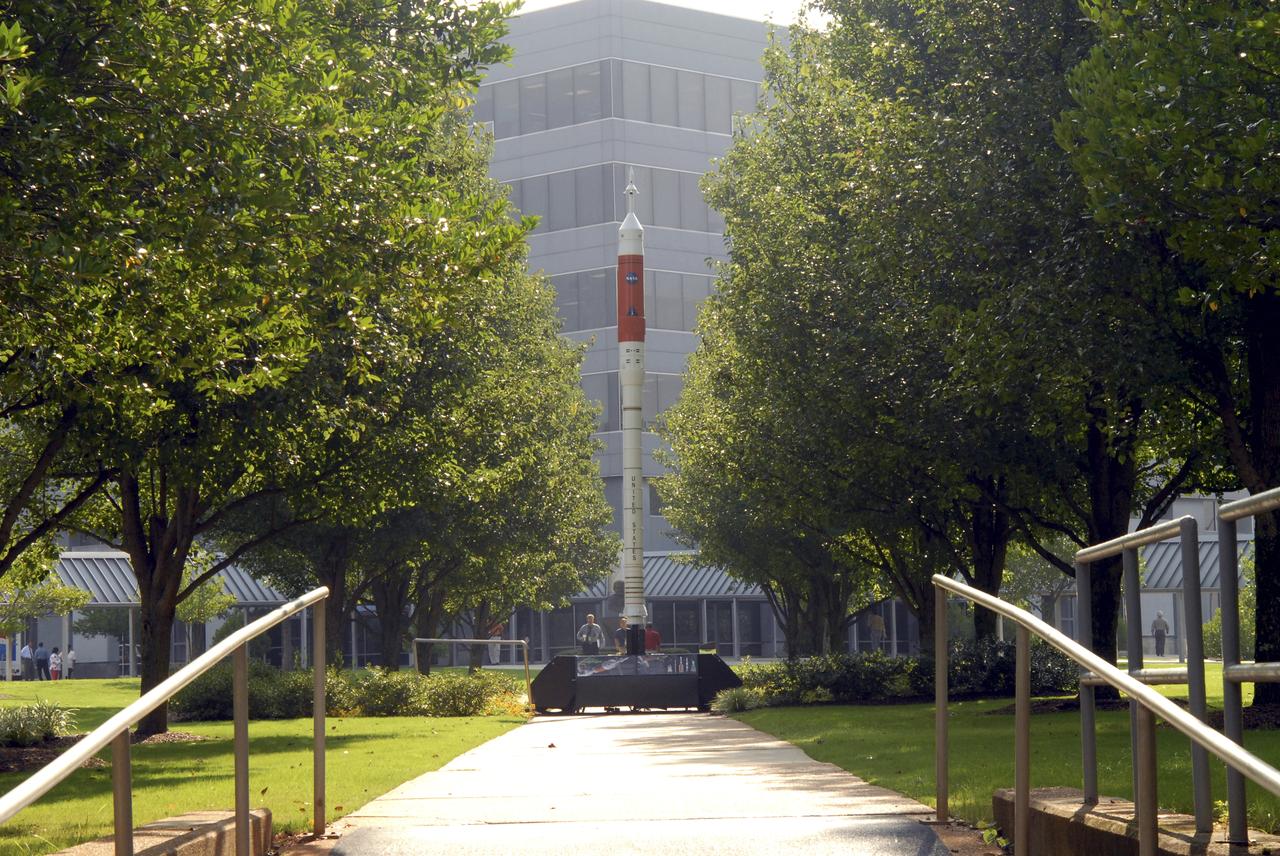
A model of the new Aries I crew launch vehicle, for which NASA is designing, testing and evaluating hardware and related systems, is seen here on display at the Marshall Space Fight Center (MSFC), in Huntsville, Alabama. The Ares I crew launch vehicle is the rocket that will carry a new generation of space explorers into orbit. Under the goals of the Vision for Space Exploration, Ares I is a chief component of the cost-effective space transportation infrastructure being developed by NASA’s Constellation Program. These transportation systems will safely and reliably carry human explorers back to the moon, and then onward to Mars and other destinations in the solar system. The Ares I effort includes multiple project element teams at NASA centers and contract organizations around the nation, and is led by the Exploration Launch Projects Office at NASA’s MFSC. Together, these teams are developing vehicle hardware, evolving proven technologies, and testing components and systems. Their work builds on powerful, reliable space shuttle propulsion elements and nearly a half-century of NASA space flight experience and technological advances. Ares I is an inline, two-stage rocket configuration topped by the Crew Exploration Vehicle, its service module and a launch abort system. The launch vehicle’s first stage is a single, five-segment reusable solid rocket booster derived from the Space Shuttle Program’s reusable solid rocket motor that burns a specially formulated and shaped solid propellant called polybutadiene acrylonitrile (PBAN). The second or upper stage will be propelled by a J-2X main engine fueled with liquid oxygen and liquid hydrogen. In addition to its primary mission of carrying crews of four to six astronauts to Earth orbit, the launch vehicle’s 25-ton payload capacity might be used for delivering cargo to space, bringing resources and supplies to the International Space Station or dropping payloads off in orbit for retrieval and transport to exploration teams on the moon. Crew transportation to the space station is planned to begin no later than 2014. The first lunar excursion is scheduled for the 2020 timeframe.
CAPE CANAVERAL, Fla. – The space shuttle Atlantis is lifted and tilted for display at the Kennedy Space Center Visitor Complex in Florida. Atlantis will be exhibited at 43.21 degrees with its payload bay doors open so the shuttle will look as it did in space. Atlantis was wrapped in a protective plastic to protect it from dust and debris while being prepared for display. The new home of Atlantis is scheduled to open in July 2013. The exhibits in the new, 90,000-square-foot interactive facility will tell the story of the 30-year Space Shuttle Program and what lies ahead in space exploration. More than 60 exhibits will be set up around Atlantis, including a full-scale mockup of the Hubble Space Telescope and a full-scale model of a portion of the International Space Station. Over the course of its 26-year career, Atlantis traveled 125,935,769 miles during 307 days in space over 33 missions. For more information, visit http://www.nasa.gov/transition Photo credit: NASA/ Dimitri Gerondidakis
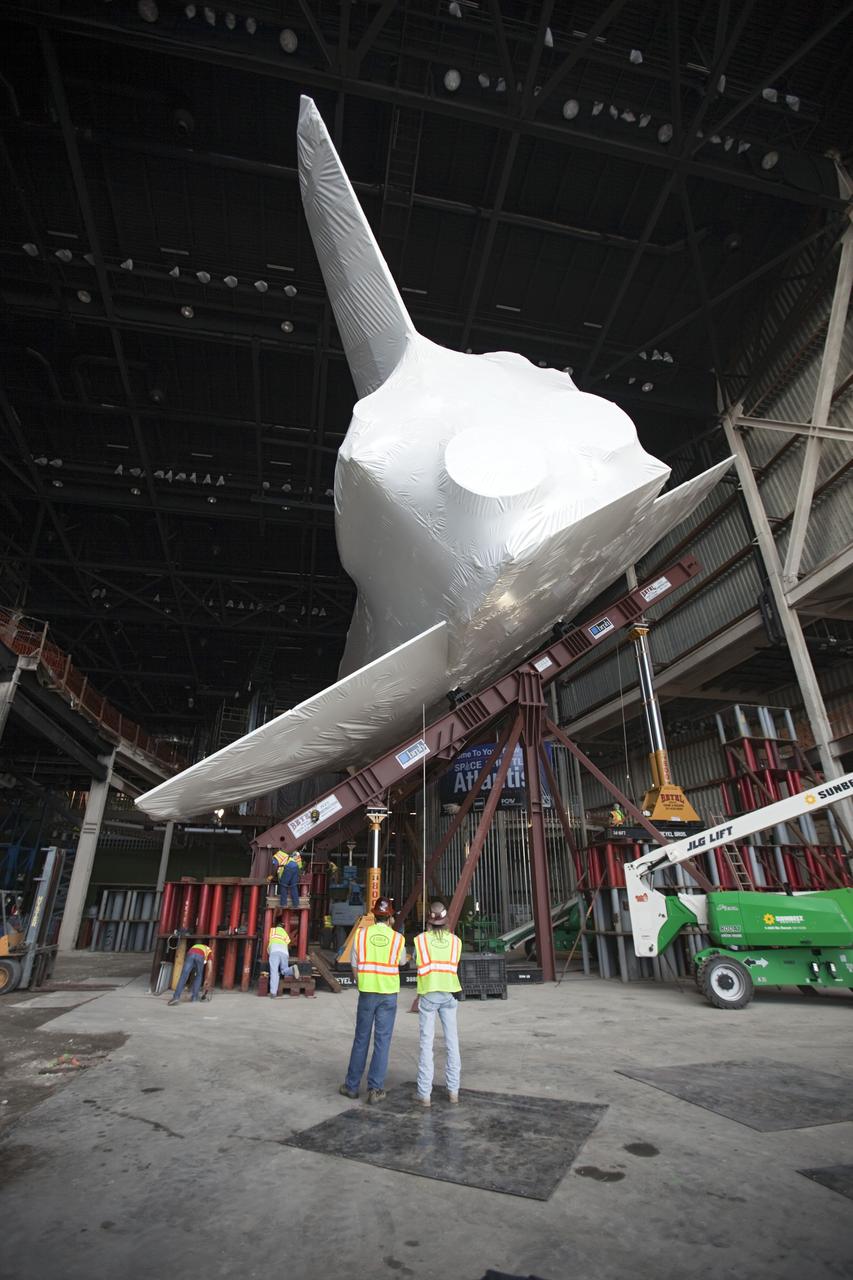
CAPE CANAVERAL, Fla. – The space shuttle Atlantis is lifted and tilted for display at the Kennedy Space Center Visitor Complex in Florida. Atlantis will be exhibited at 43.21 degrees with its payload bay doors open so the shuttle will look as it did in space. Atlantis was wrapped in a protective plastic to protect it from dust and debris while being prepared for display. The new home of Atlantis is scheduled to open in July 2013. The exhibits in the new, 90,000-square-foot interactive facility will tell the story of the 30-year Space Shuttle Program and what lies ahead in space exploration. More than 60 exhibits will be set up around Atlantis, including a full-scale mockup of the Hubble Space Telescope and a full-scale model of a portion of the International Space Station. Over the course of its 26-year career, Atlantis traveled 125,935,769 miles during 307 days in space over 33 missions. For more information, visit http://www.nasa.gov/transition Photo credit: NASA/ Dimitri Gerondidakis
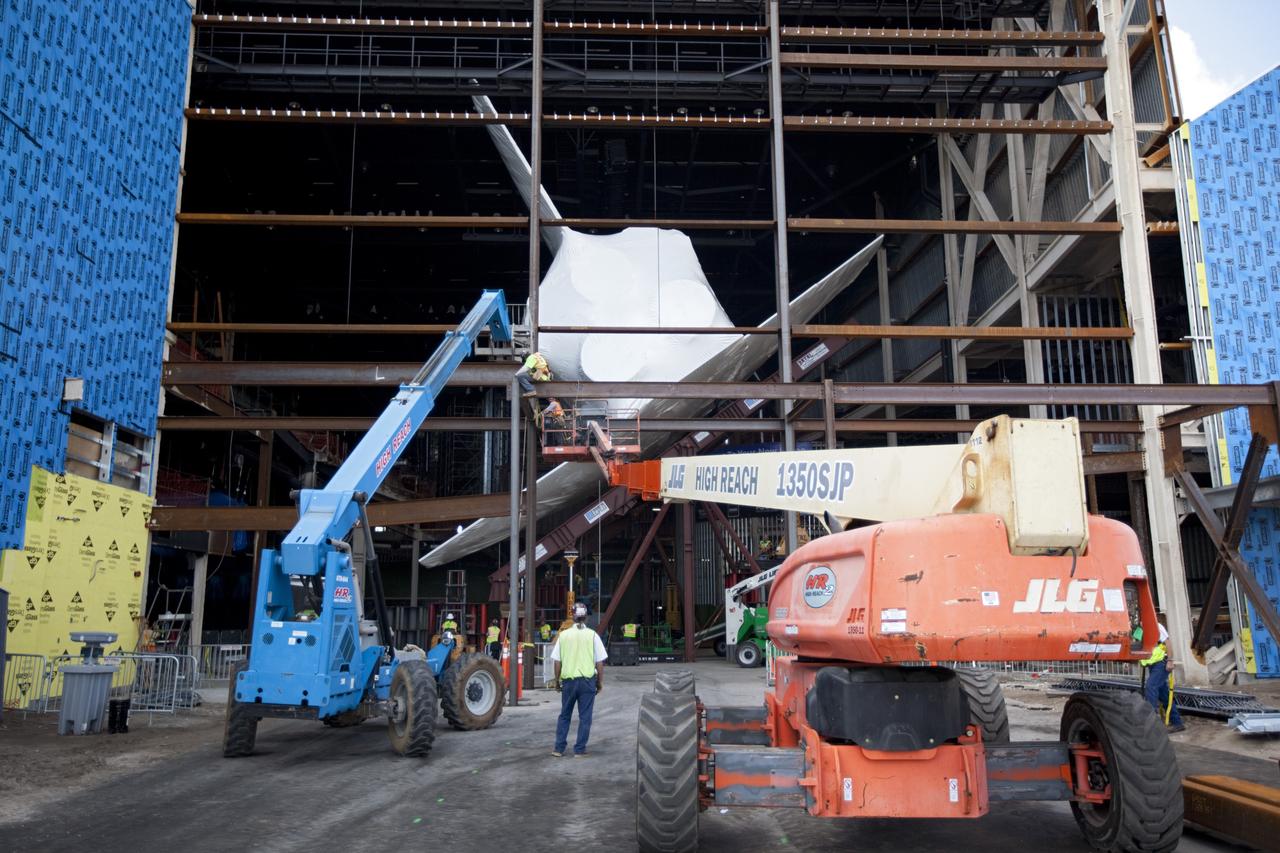
CAPE CANAVERAL, Fla. – The space shuttle Atlantis is lifted and tilted for display at the Kennedy Space Center Visitor Complex in Florida. Atlantis will be exhibited at 43.21 degrees with its payload bay doors open so the shuttle will look as it did in space. Atlantis was wrapped in a protective plastic to protect it from dust and debris while being prepared for display. The new home of Atlantis is scheduled to open in July 2013. The exhibits in the new, 90,000-square-foot interactive facility will tell the story of the 30-year Space Shuttle Program and what lies ahead in space exploration. More than 60 exhibits will be set up around Atlantis, including a full-scale mockup of the Hubble Space Telescope and a full-scale model of a portion of the International Space Station. Over the course of its 26-year career, Atlantis traveled 125,935,769 miles during 307 days in space over 33 missions. For more information, visit http://www.nasa.gov/transition Photo credit: NASA/ Dimitri Gerondidakis
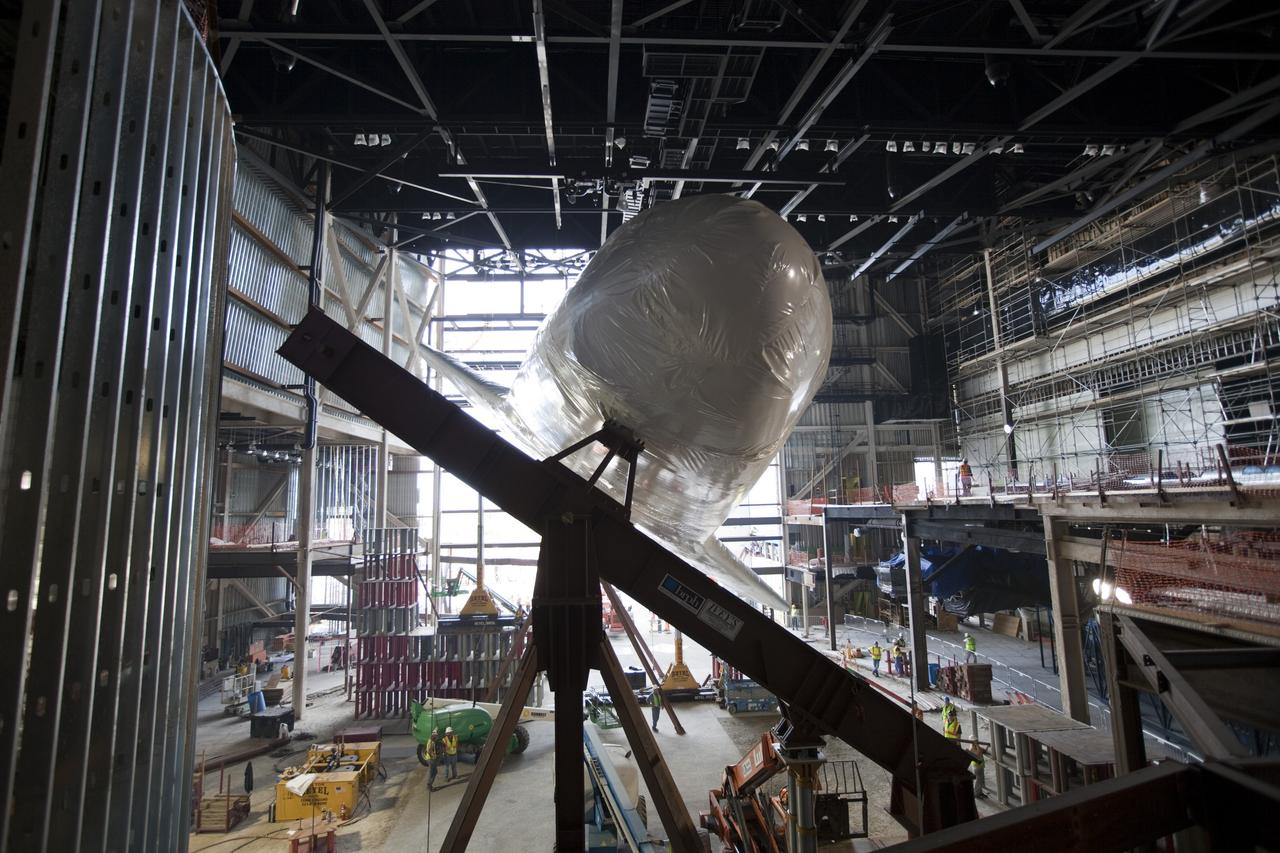
CAPE CANAVERAL, Fla. – The space shuttle Atlantis is lifted and tilted for display at the Kennedy Space Center Visitor Complex in Florida. Atlantis will be exhibited at 43.21 degrees with its payload bay doors open so the shuttle will look as it did in space. Atlantis was wrapped in a protective plastic to protect it from dust and debris while being prepared for display. The new home of Atlantis is scheduled to open in July 2013. The exhibits in the new, 90,000-square-foot interactive facility will tell the story of the 30-year Space Shuttle Program and what lies ahead in space exploration. More than 60 exhibits will be set up around Atlantis, including a full-scale mockup of the Hubble Space Telescope and a full-scale model of a portion of the International Space Station. Over the course of its 26-year career, Atlantis traveled 125,935,769 miles during 307 days in space over 33 missions. For more information, visit http://www.nasa.gov/transition Photo credit: NASA/ Dimitri Gerondidakis
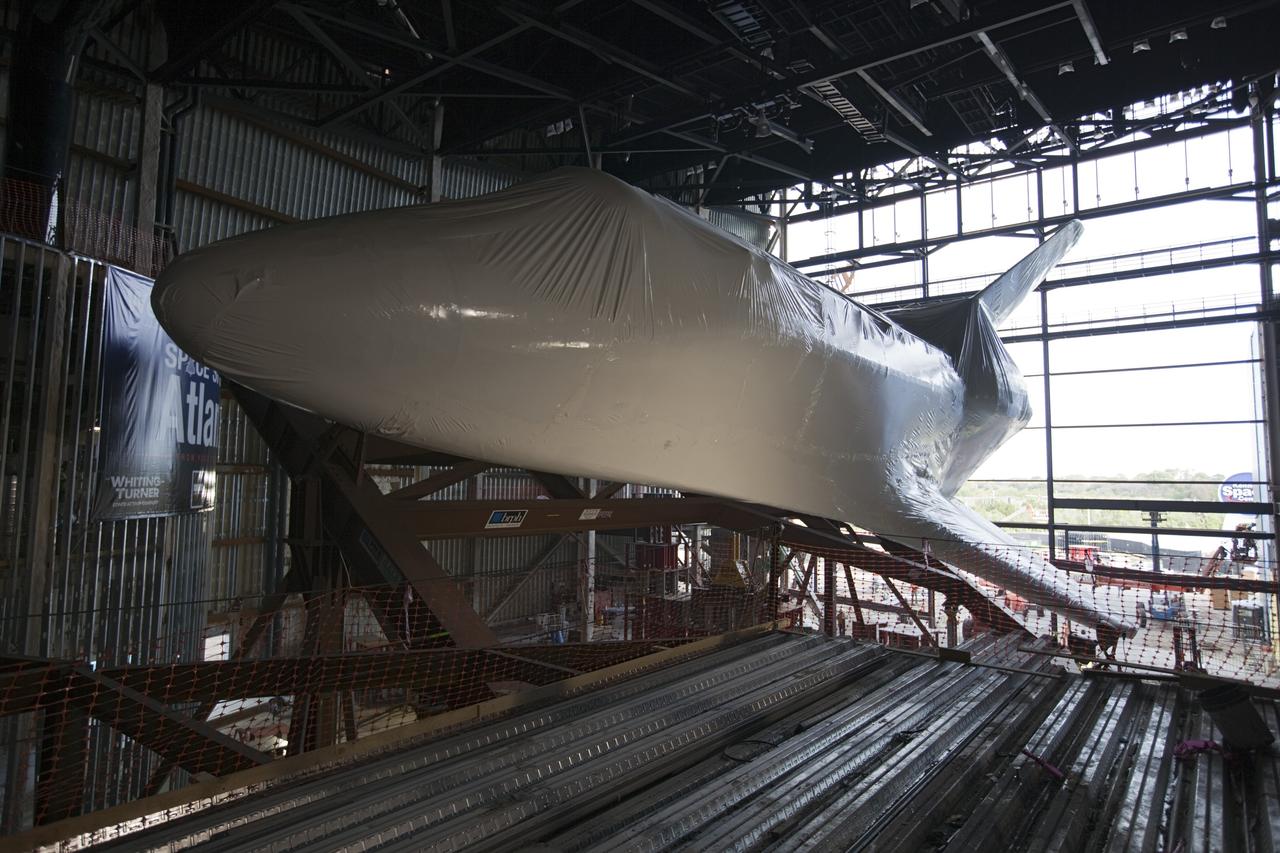
CAPE CANAVERAL, Fla. – The space shuttle Atlantis is lifted and tilted for display at the Kennedy Space Center Visitor Complex in Florida. Atlantis will be exhibited at 43.21 degrees with its payload bay doors open so the shuttle will look as it did in space. Atlantis was wrapped in a protective plastic to protect it from dust and debris while being prepared for display. The new home of Atlantis is scheduled to open in July 2013. The exhibits in the new, 90,000-square-foot interactive facility will tell the story of the 30-year Space Shuttle Program and what lies ahead in space exploration. More than 60 exhibits will be set up around Atlantis, including a full-scale mockup of the Hubble Space Telescope and a full-scale model of a portion of the International Space Station. Over the course of its 26-year career, Atlantis traveled 125,935,769 miles during 307 days in space over 33 missions. For more information, visit http://www.nasa.gov/transition Photo credit: NASA/ Dimitri Gerondidakis
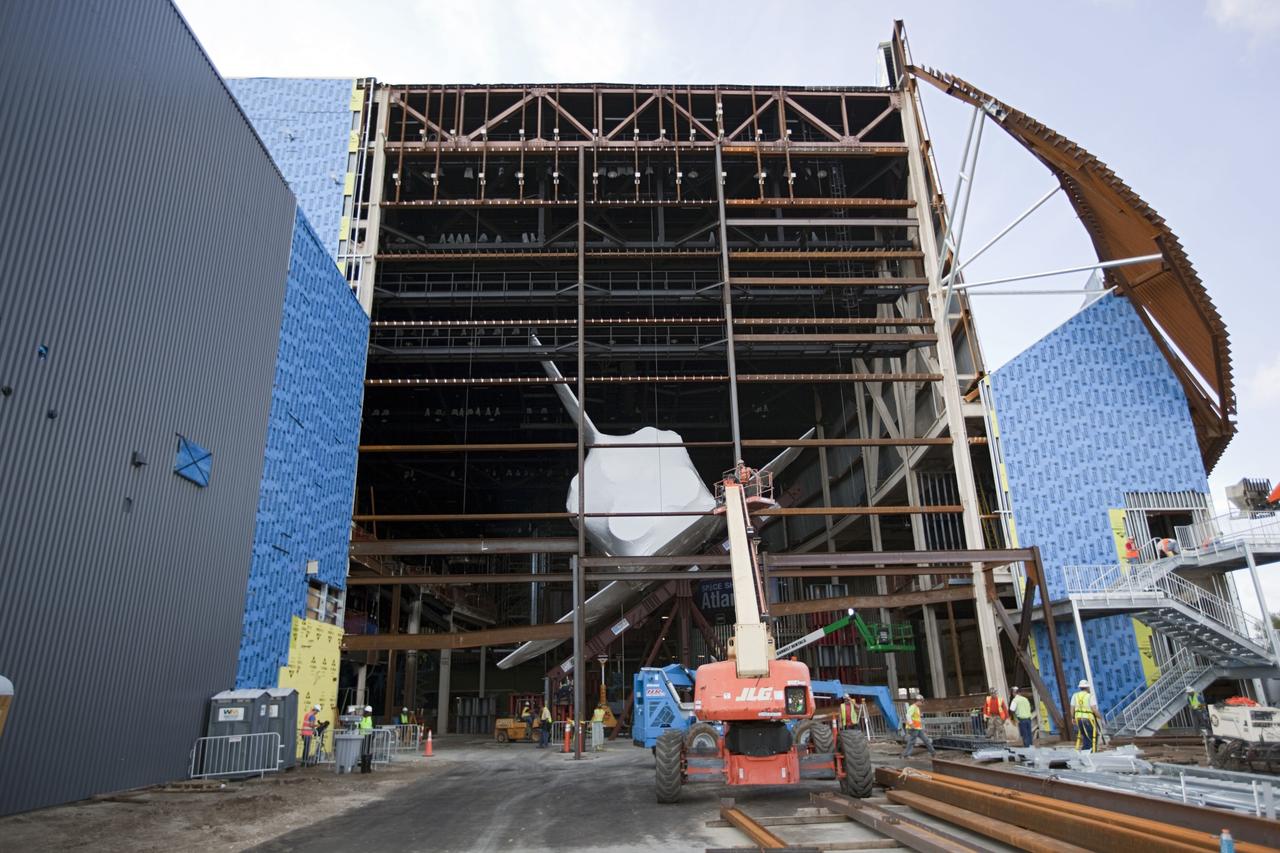
CAPE CANAVERAL, Fla. – The space shuttle Atlantis is lifted and tilted for display at the Kennedy Space Center Visitor Complex in Florida. Atlantis will be exhibited at 43.21 degrees with its payload bay doors open so the shuttle will look as it did in space. Atlantis was wrapped in a protective plastic to protect it from dust and debris while being prepared for display. The new home of Atlantis is scheduled to open in July 2013. The exhibits in the new, 90,000-square-foot interactive facility will tell the story of the 30-year Space Shuttle Program and what lies ahead in space exploration. More than 60 exhibits will be set up around Atlantis, including a full-scale mockup of the Hubble Space Telescope and a full-scale model of a portion of the International Space Station. Over the course of its 26-year career, Atlantis traveled 125,935,769 miles during 307 days in space over 33 missions. For more information, visit http://www.nasa.gov/transition Photo credit: NASA/ Dimitri Gerondidakis
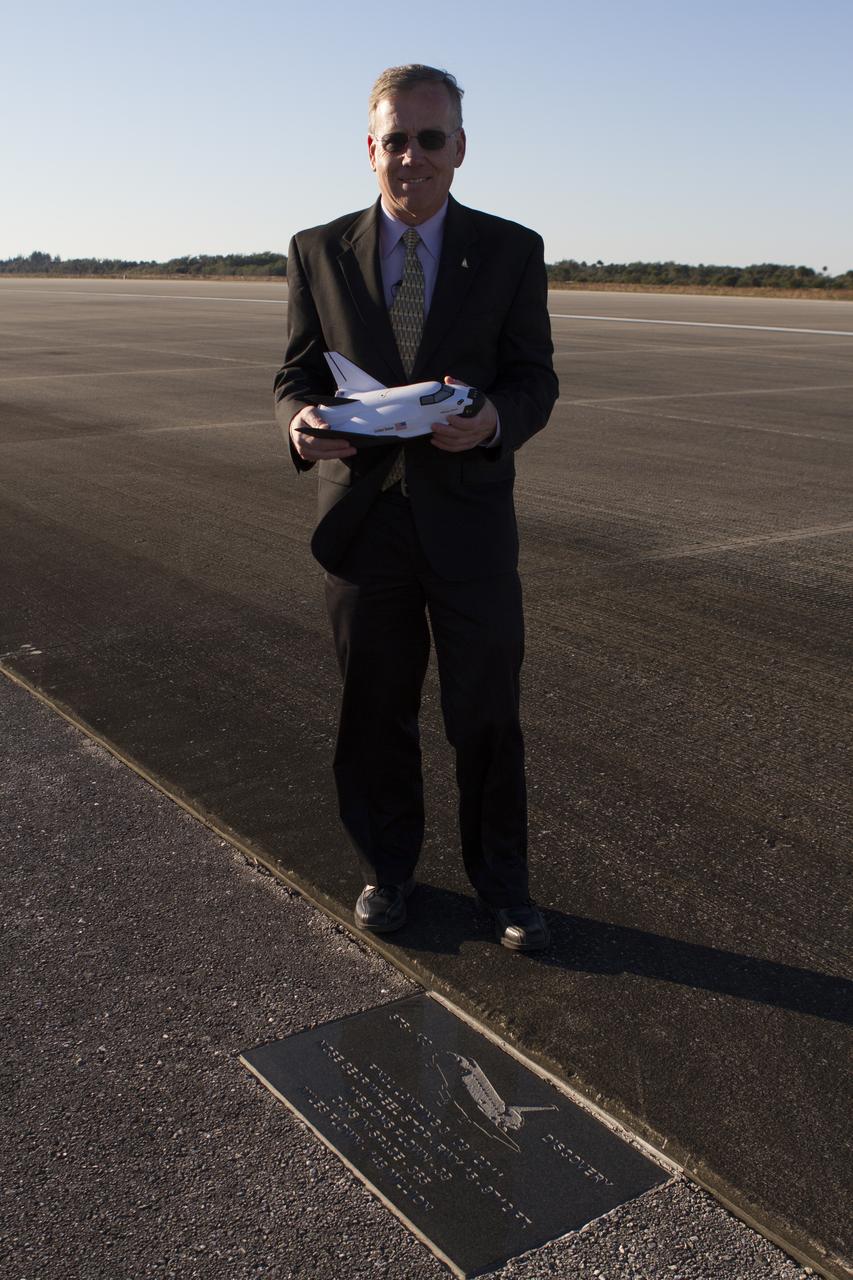
CAPE CANAVERAL, Fla. – Steve Lindsey, former NASA astronaut and Dream Chaser program manager for Sierra Nevada Corporation, or SNC, Space Systems stands at a plaque honoring the final landing of space shuttle Discovery on the 3.5-mile-long runway at Kennedy Space Center’s Shuttle Landing Facility. Lindsey, who was the commander of Discovery’s STS-133 mission, is holding a model of SNC’s Dream Chaser. SNC announced it plans to work with United Launch Alliance, or ULA, to launch the Dream Chaser spacecraft into orbit atop an Atlas V rocket from Space Launch Complex 41 at Cape Canaveral Air Force Station in November 2016 intends to land the winged spacecraft at the Shuttle Landing Facility lease office space at Exploration Park, right outside Kennedy’s gates and process the spacecraft in the high bay of the Operations and Checkout Building at Kennedy, with Lockheed Martin performing the work. The announcements made during a news conference at Kennedy are considered substantial for SNC and important to plans by NASA and Space Florida for Kennedy’s transformation into a multi-user spaceport for both commercial and government customers. Photo credit: NASA/Cory Huston
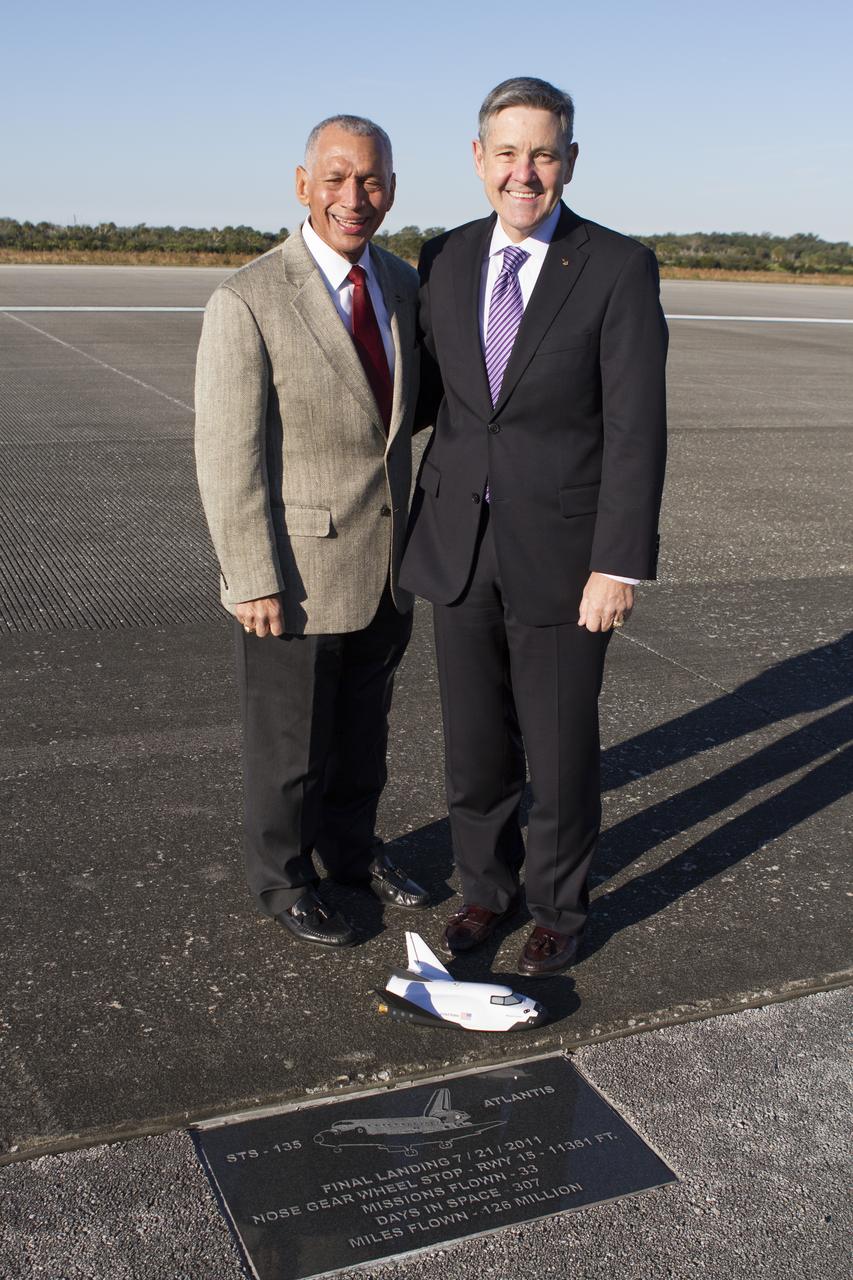
CAPE CANAVERAL, Fla. – NASA Administrator Charlie Bolden and Kennedy Space Center Director Bob Cabana pose for a photo at the plaque marking space shuttle Atlantis’ final mission, STS-135, along the 3.5-mile-long runway at Kennedy’s Shuttle Landing Facility. Also in the photo is a model of the Sierra Nevada Corporation, or SNC, Dream Chaser. SNC announced it plans to work with United Launch Alliance, or ULA, to launch the Dream Chaser spacecraft into orbit atop an Atlas V rocket from Space Launch Complex 41 at Cape Canaveral Air Force Station in November 2016 intends to land the winged spacecraft at the Shuttle Landing Facility lease office space at Exploration Park, right outside Kennedy’s gates and process the spacecraft in the high bay of the Operations and Checkout Building at Kennedy, with Lockheed Martin performing the work. The announcements made during a news conference at Kennedy are considered substantial for SNC and important to plans by NASA and Space Florida for Kennedy’s transformation into a multi-user spaceport for both commercial and government customers. Photo credit: NASA/Cory Huston

CAPE CANAVERAL, Fla. – A model of the Sierra Nevada Corporation, or SNC, Dream Chaser spacecraft stands next to a plaque honoring the final landing of space shuttle Discovery on the 3.5-mile-long runway at Kennedy Space Center’s Shuttle Landing Facility. Dream Chaser’s program manager, Steve Lindsey is a former astronaut who commanded Discovery on its final mission, STS-133. SNC announced it plans to work with United Launch Alliance, or ULA, to launch the Dream Chaser spacecraft into orbit atop an Atlas V rocket from Space Launch Complex 41 at Cape Canaveral Air Force Station in November 2016 intends to land the winged spacecraft at the Shuttle Landing Facility lease office space at Exploration Park, right outside Kennedy’s gates and process the spacecraft in the high bay of the Operations and Checkout Building at Kennedy, with Lockheed Martin performing the work. The announcements made during a news conference at Kennedy are considered substantial for SNC and important to plans by NASA and Space Florida for Kennedy’s transformation into a multi-user spaceport for both commercial and government customers. Photo credit: NASA/Cory Huston
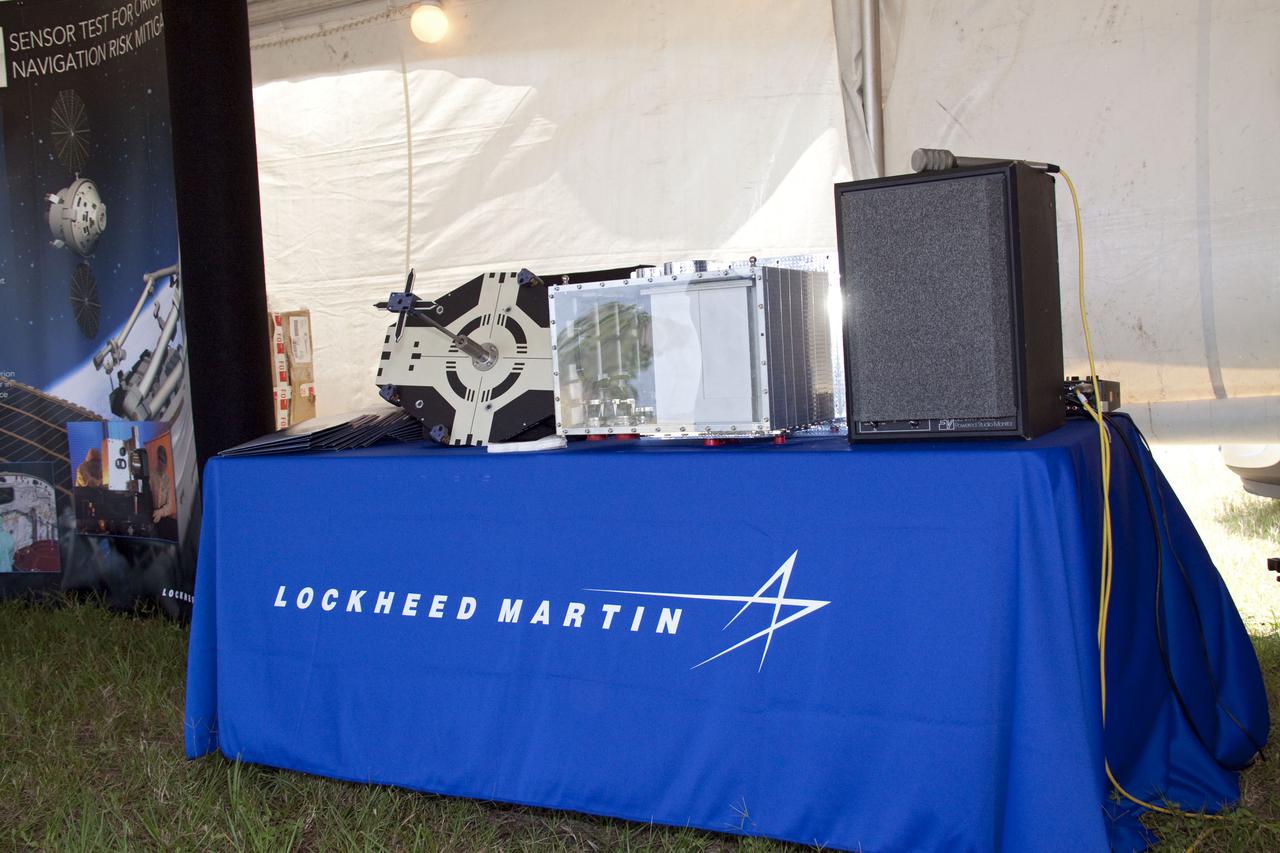
CAPE CANAVERAL, Fla. -- A model of the Sensor Test for Orion Relnav Risk Mitigation, or STORRM, is displayed at NASA's Kennedy Space Center in Florida. Seen here, is the International Space Station docking target and STORMM sensor enclosure assembly. A flight test of STORRM will be performed on STS-134 on the last on-orbit day of the mission, when space shuttle Endeavour will fly a dedicated maneuver to simulate an Orion rendezvous trajectory. Throughout the maneuver, two Orion sensors will collect visual- and laser-based relative navigation data. This will provide an unprecedented in-flight test opportunity for America's next-generation exploration spacecraft. STS-134 also will deliver the Express Logistics Carrier-3, Alpha Magnetic Spectrometer-2 (AMS), a high-pressure gas tank and additional spare parts for the Dextre robotic helper to the space station. Endeavour was scheduled to launch at 3:47 p.m. on April 29, but that attempt was scrubbed for at least 72 hours while engineers assess an issue associated with the shuttle's Auxiliary Power Unit 1. STS-134 will be the final spaceflight for Endeavour. For more information visit, www.nasa.gov_mission_pages_shuttle_shuttlemissions_sts134_index.html. Photo credit: NASA_Jack Pfaller
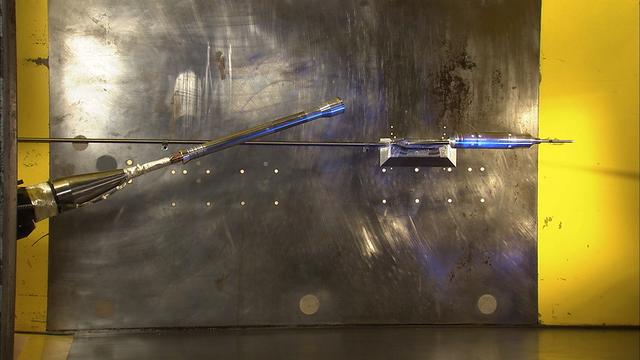
Under the goals of the Vision for Space Exploration, Ares I is a chief component of the cost-effective space transportation infrastructure being developed by NASA's Constellation Program. This transportation system will safely and reliably carry human explorers back to the moon, and then onward to Mars and other destinations in the solar system. The Ares I effort includes multiple project element teams at NASA centers and contract organizations around the nation, and is managed by the Exploration Launch Projects Office at NASA's Marshall Space Flight Center (MFSC). ATK Launch Systems near Brigham City, Utah, is the prime contractor for the first stage booster. ATK's subcontractor, United Space Alliance of Houston, is designing, developing and testing the parachutes at its facilities at NASA's Kennedy Space Center in Florida. NASA's Johnson Space Center in Houston hosts the Constellation Program and Orion Crew Capsule Project Office and provides test instrumentation and support personnel. Together, these teams are developing vehicle hardware, evolving proven technologies, and testing components and systems. Their work builds on powerful, reliable space shuttle propulsion elements and nearly a half-century of NASA space flight experience and technological advances. Ares I is an inline, two-stage rocket configuration topped by the Crew Exploration Vehicle, its service module, and a launch abort system. In this HD video image, the first stage reentry 1/2% model is undergoing pressure measurements inside the wind tunnel testing facility at MSFC. (Highest resolution available)
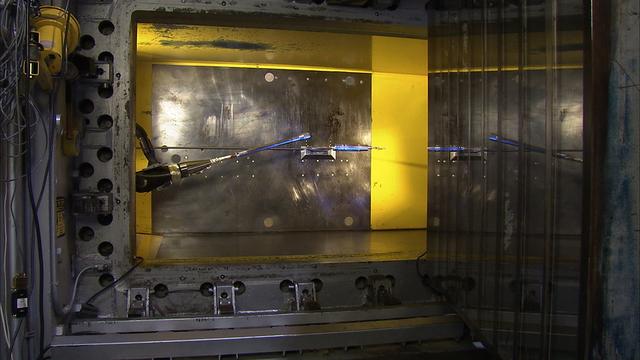
Under the goals of the Vision for Space Exploration, Ares I is a chief component of the cost-effective space transportation infrastructure being developed by NASA's Constellation Program. This transportation system will safely and reliably carry human explorers back to the moon, and then onward to Mars and other destinations in the solar system. The Ares I effort includes multiple project element teams at NASA centers and contract organizations around the nation, and is managed by the Exploration Launch Projects Office at NASA's Marshall Space Flight Center (MFSC). ATK Launch Systems near Brigham City, Utah, is the prime contractor for the first stage booster. ATK's subcontractor, United Space Alliance of Houston, is designing, developing and testing the parachutes at its facilities at NASA's Kennedy Space Center in Florida. NASA's Johnson Space Center in Houston hosts the Constellation Program and Orion Crew Capsule Project Office and provides test instrumentation and support personnel. Together, these teams are developing vehicle hardware, evolving proven technologies, and testing components and systems. Their work builds on powerful, reliable space shuttle propulsion elements and nearly a half-century of NASA space flight experience and technological advances. Ares I is an inline, two-stage rocket configuration topped by the Crew Exploration Vehicle, its service module, and a launch abort system. In this HD video image, the first stage reentry 1/2% model is undergoing pressure measurements inside the wind tunnel testing facility at MSFC. (Highest resolution available)
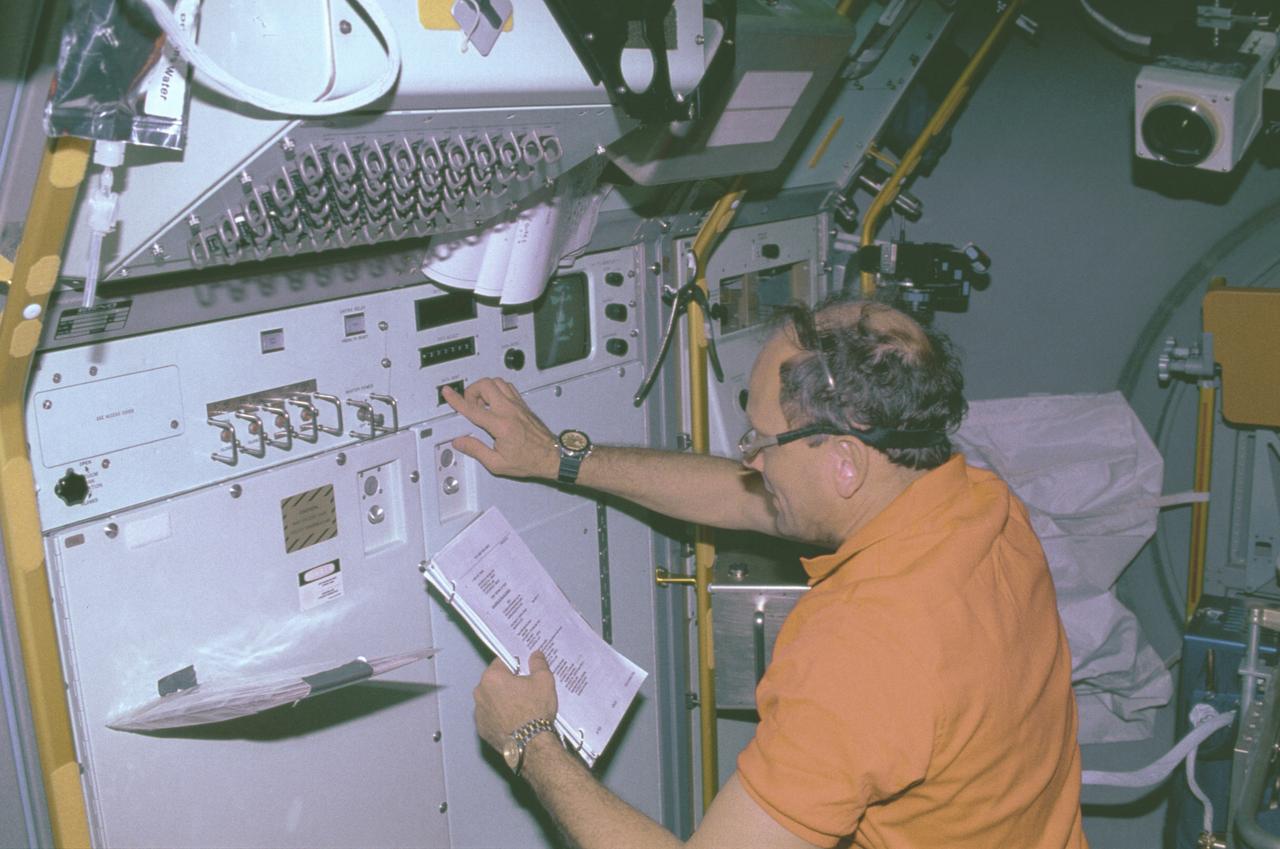
The IML-1 mission was the first in a series of Shuttle flights dedicated to fundamental materials and life sciences research with the international partners. The participating space agencies included: NASA, the 14-nation European Space Agency (ESA), the Canadian Space Agency (CSA), The French National Center of Space Studies (CNES), the German Space Agency and the German Aerospace Research Establishment (DAR/DLR), and the National Space Development Agency of Japan (NASDA). Dedicated to the study of life and materials sciences in microgravity, the IML missions explored how life forms adapt to weightlessness and investigated how materials behave when processed in space. Both life and materials sciences benefited from the extended periods of microgravity available inside the Spacelab science module in the cargo bay of the Space Shuttle Orbiter. This photograph shows Astronaut Norman Thagard performing the fluid experiment at the Fluid Experiment System (FES) facility inside the laboratory module. The FES facility had sophisticated optical systems for imaging fluid flows during materials processing, such as experiments to grow crystals from solution and solidify metal-modeling salts. A special laser diagnostic technique recorded the experiments, holograms were made for post-flight analysis, and video was used to view the samples in space and on the ground. Managed by the Marshall Space Flight Center (MSFC), the IML-1 mission was launched on January 22, 1992 aboard the Shuttle Orbiter Discovery (STS-42).