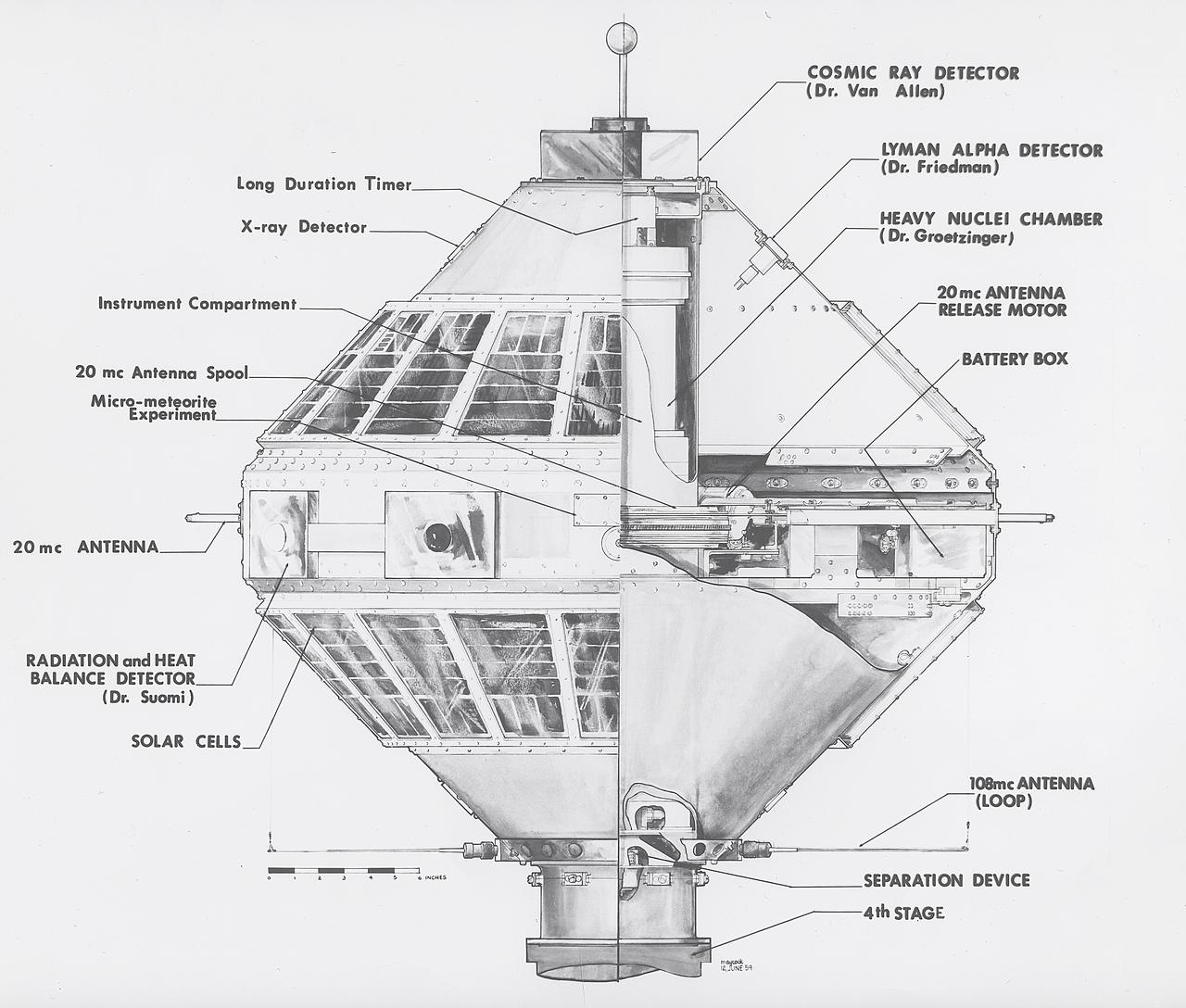
A Juno II launched an Explorer VII satellite on October 13, 1959. Explorer VII, with a total weight of 91.5 pounds, carried a scientific package for detecting micrometeors, measuring the Earth's radiation balance, and conducting other experiments.
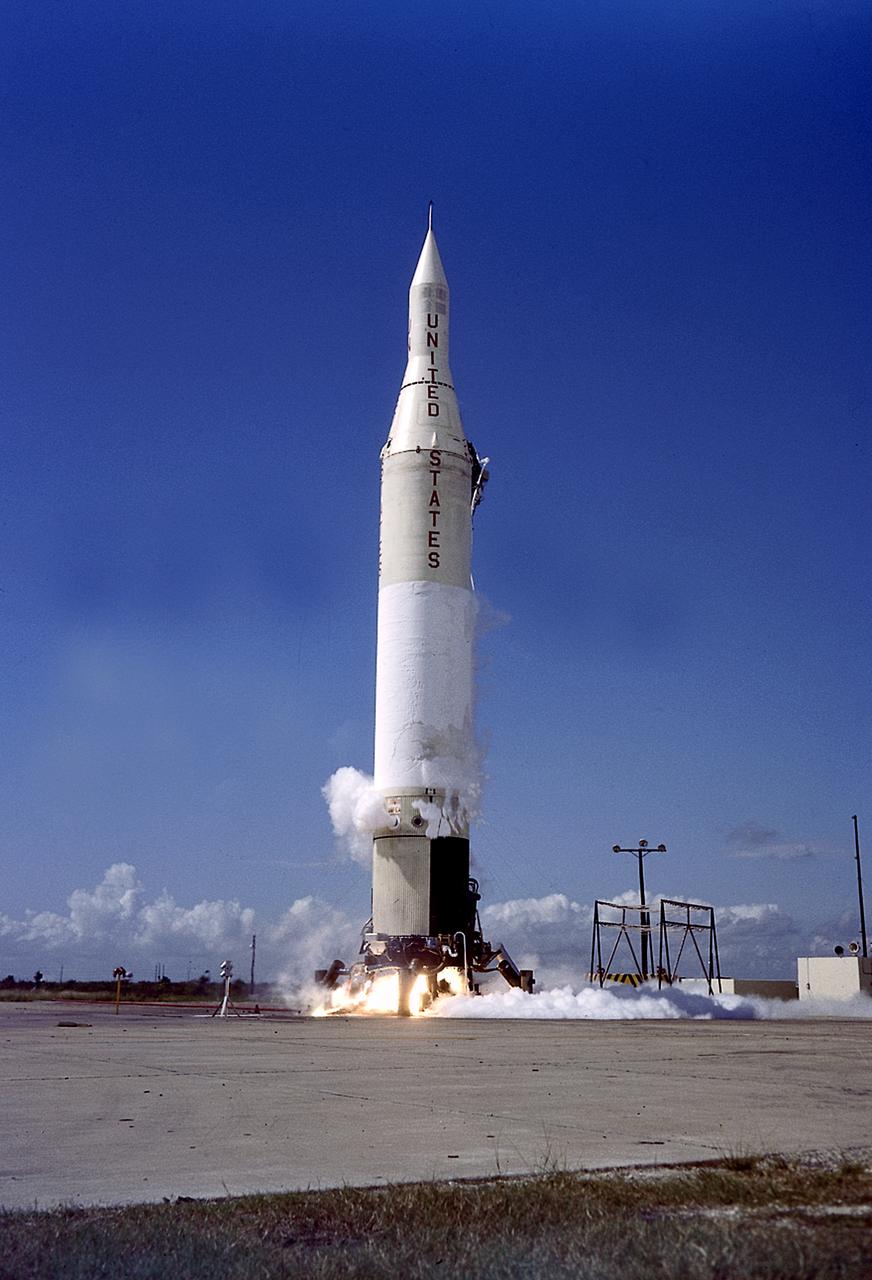
The ignition of Juno II (AM-19A). Juno II (AM-19) successfully placed a physics and astronomy satellite, Explorer VII, in orbit on October 13, 1959.
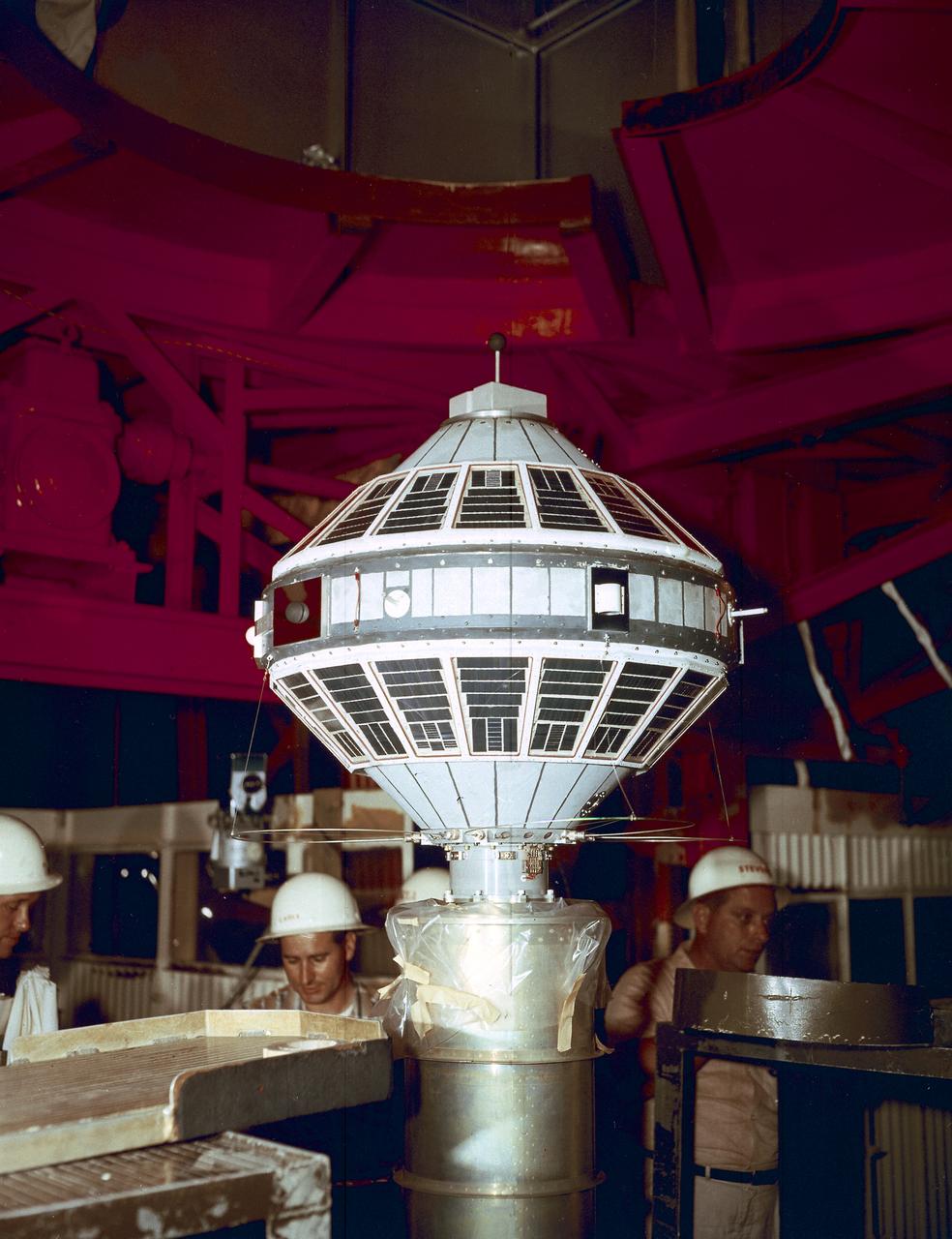
Juno II was a part of America's effort to increase its capability to lift heavier satellites into orbit. One payload was Explorer VII. This photograph depicts workers installing the Explorer VII satellite on Juno II (AM-19A) booster. The Explorer VII investigated energetic particles and obtained data on radiation and magnetic storms. The successful launch of Juno II took place on October 13, 1959.
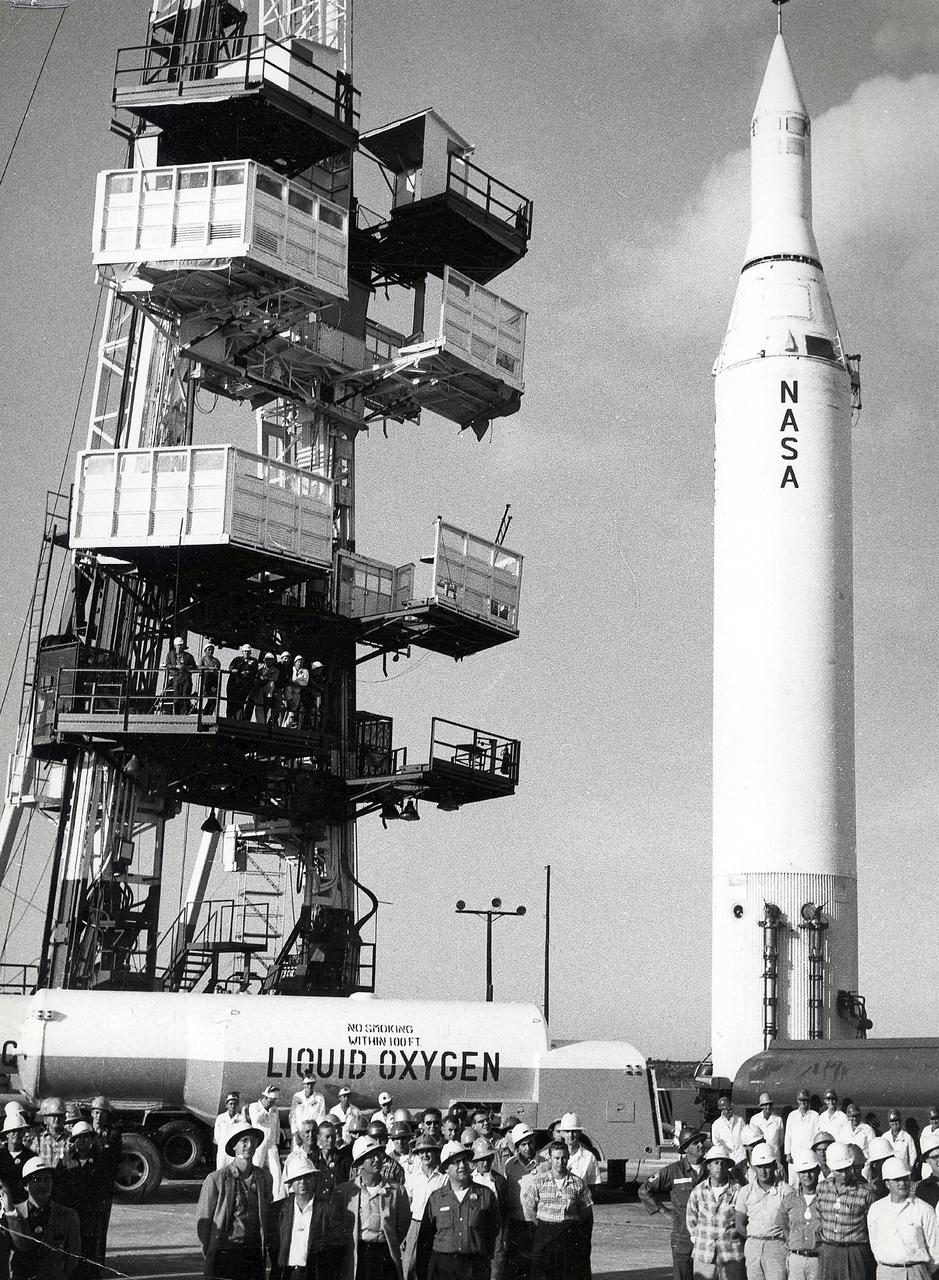
The modified Jupiter C (sometimes called Juno I), used to launch Explorer I, had minimum payload lifting capabilities. Explorer I weighed slightly less than 31 pounds. Juno II was part of America's effort to increase payload lifting capabilities. Among other achievements, the vehicle successfully launched a Pioneer IV satellite on March 3, 1959, and an Explorer VII satellite on October 13, 1959. Responsibility for Juno II passed from the Army to the Marshall Space Flight Center when the Center was activated on July 1, 1960. On November 3, 1960, a Juno II sent Explorer VIII into a 1,000-mile deep orbit within the ionosphere.
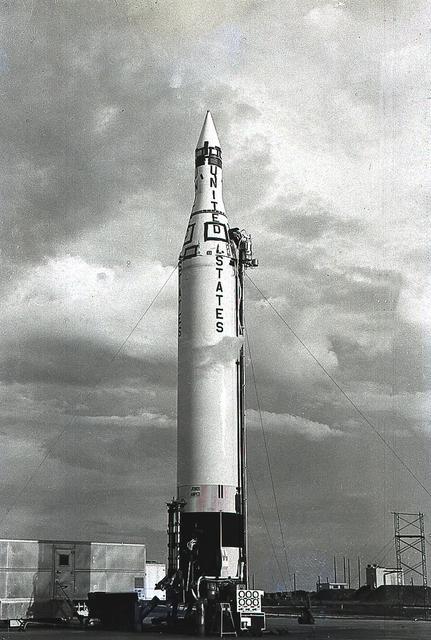
The Juno II launch vehicle, shown here, was a modified Jupiter Intermediate-Range Ballistic missionile, developed by Dr. Wernher von Braun and the rocket team at Redstone Arsenal in Huntsville, Alabama. Between December 1958 and April 1961, the Juno II launched space probes Pioneer III and IV, as well as Explorer satellites VII, VIII and XI.

Just in time for the release of the movie “Star Wars Episode VII: The Force Awakens,” NASA’s Hubble Space Telescope has photographed what looks like a cosmic, double-bladed lightsaber. In the center of the image, partially obscured by a dark, Jedi-like cloak of dust, a newborn star shoots twin jets out into space as a sort of birth announcement to the universe. “Science fiction has been an inspiration to generations of scientists and engineers, and the film series Star Wars is no exception,” said John Grunsfeld, astronaut and associate administrator for the NASA Science Mission directorate. “There is no stronger case for the motivational power of real science than the discoveries that come from the Hubble Space Telescope as it unravels the mysteries of the universe." This celestial lightsaber does not lie in a galaxy far, far away, but rather inside our home galaxy, the Milky Way. It’s inside a turbulent birthing ground for new stars known as the Orion B molecular cloud complex, located 1,350 light-years away. When stars form within giant clouds of cool molecular hydrogen, some of the surrounding material collapses under gravity to form a rotating, flattened disk encircling the newborn star. Though planets will later congeal in the disk, at this early stage the protostar is feeding on the disk with a Jabba-like appetite. Gas from the disk rains down onto the protostar and engorges it. Superheated material spills away and is shot outward from the star in opposite directions along an uncluttered escape route — the star’s rotation axis. Shock fronts develop along the jets and heat the surrounding gas to thousands of degrees Fahrenheit. The jets collide with the surrounding gas and dust and clear vast spaces, like a stream of water plowing into a hill of sand. The shock fronts form tangled, knotted clumps of nebulosity and are collectively known as Herbig-Haro (HH) objects. The prominent HH object shown in this image is HH 24. Just to the right of the cloaked star, a couple of bright points are young stars peeking through and showing off their own faint lightsabers — including one that has bored a tunnel through the cloud towards the upper-right side of the picture. Overall, just a handful of HH jets have been spotted in this region in visible light, and about the same number in the infrared. Hubble’s observations for this image were performed in infrared light, which enabled the telescope to peer through the gas and dust cocooning the newly forming stars and capture a clear view of the HH objects. These young stellar jets are ideal targets for NASA’s upcoming James Webb Space Telescope, which will have even greater infrared wavelength vision to see deeper into the dust surrounding newly forming stars. The Hubble Space Telescope is a project of international cooperation between NASA and the European Space Agency. NASA’s Goddard Space Flight Center in Greenbelt, Maryland, manages the telescope. The Space Telescope Science Institute (STScI) in Baltimore, Maryland, conducts Hubble science operations. STScI is operated for NASA by the Association of Universities for Research in Astronomy, in Washington, D.C. Credits: NASA/ESA <b><a href="http://www.nasa.gov/audience/formedia/features/MP_Photo_Guidelines.html" rel="nofollow">NASA image use policy.</a></b> <b><a href="http://www.nasa.gov/centers/goddard/home/index.html" rel="nofollow">NASA Goddard Space Flight Center</a></b> enables NASA’s mission through four scientific endeavors: Earth Science, Heliophysics, Solar System Exploration, and Astrophysics. Goddard plays a leading role in NASA’s accomplishments by contributing compelling scientific knowledge to advance the Agency’s mission. <b>Follow us on <a href="http://twitter.com/NASAGoddardPix" rel="nofollow">Twitter</a></b> <b>Like us on <a href="http://www.facebook.com/pages/Greenbelt-MD/NASA-Goddard/395013845897?ref=tsd" rel="nofollow">Facebook</a></b> <b>Find us on <a href="http://instagrid.me/nasagoddard/?vm=grid" rel="nofollow">Instagram</a></b>