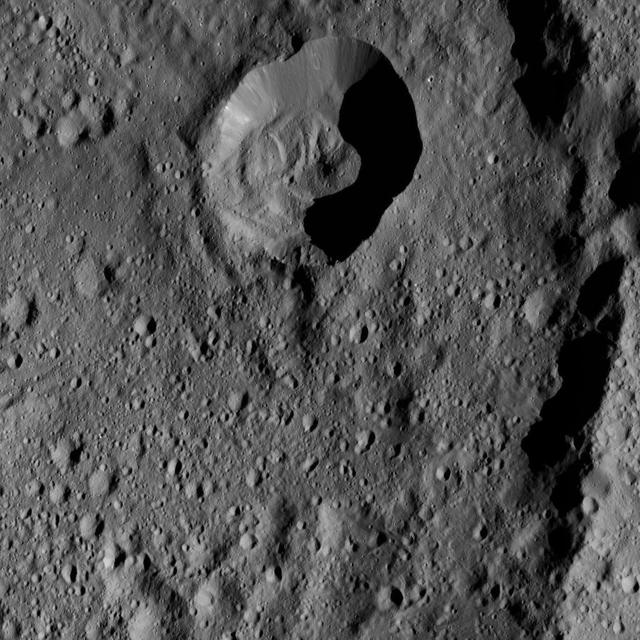
This view from NASA's Dawn spacecraft shows an area within Ezinu Crater on Ceres. Ezinu, which is 72 miles (116 kilometers) wide, was named for the Sumerian goddess of grain. Part of the crater's eastern rim is visible along the right side of the image. The image is centered at 42 degrees north latitude, 202 degrees east longitude. Ezinu can also be seen at PIA20190. Dawn took this image on June 8, 2016, from its low-altitude mapping orbit, at a distance of about 240 miles (385 kilometers) above the surface. The image resolution is 120 feet (35 meters) per pixel. http://photojournal.jpl.nasa.gov/catalog/PIA20958

Ceres' Ezinu Crater is seen at top right in this image from NASA's Dawn spacecraft. The crater features a network of canyon-like features. Ezinu measures about 72 miles (116 kilometers) in diameter and was named for the Sumerian goddess of grain. Dawn took this image on Oct. 21, 2016, from its second extended-mission science orbit (XMO2), at a distance of about 920 miles (1,480 kilometers) above the surface. The image resolution is about 460 feet (140 meters) per pixel. http://photojournal.jpl.nasa.gov/catalog/PIA21240
This image highlights the complex set of fractures near the center of the large (72 miles, 116 kilometers) Ezinu Crater. It was obtained by NASA's Dawn spacecraft on September 2, 2018 from an altitude of about 2095 miles (3070 kilometers). NASA announced the conclusion of Dawn's mission operations was Oct. 31, 2018, when the spacecraft depleted its hydrazine. The center of Ezinu Crater is located at about 43.2 degrees north latitude and 195.7 degrees east longitude. Ezinu Crater is named after the Sumerian goddess of the grain. https://photojournal.jpl.nasa.gov/catalog/PIA22983
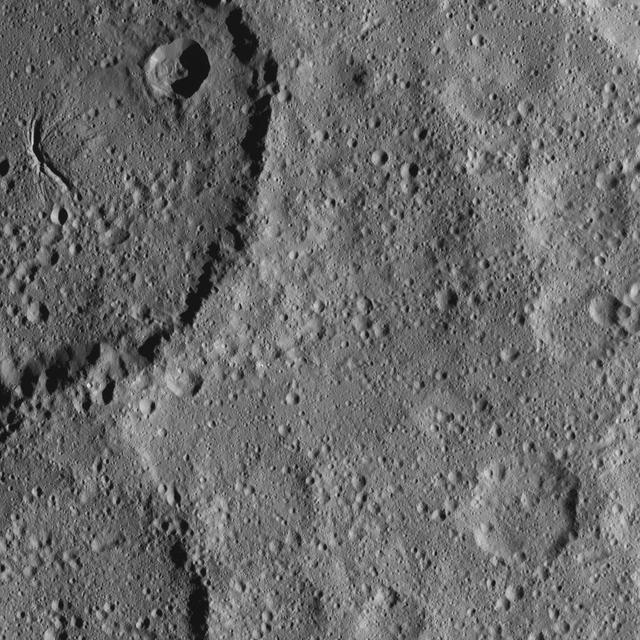
Part of Ezinu Crater on Ceres is seen at top left in this image from NASA's Dawn spacecraft. The crater features a network of canyon-like features. Ezinu measures about 72 miles (116 kilometers) in diameter and was named for the Sumerian goddess of grain. Dawn took this image on Oct. 20, 2016, from its second extended-mission science orbit (XMO2), at a distance of about 920 miles (1,480 kilometers) above the surface. The image resolution is about 460 feet (140 meters) per pixel. http://photojournal.jpl.nasa.gov/catalog/PIA21239
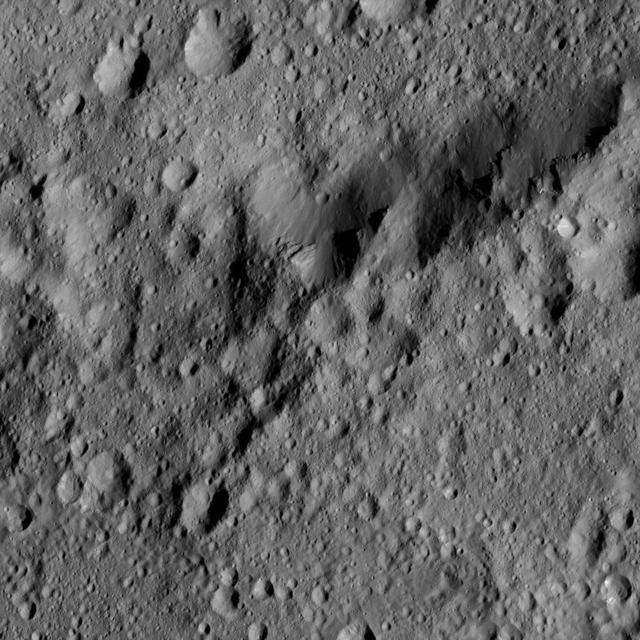
This image from NASA's Dawn spacecraft shows the edge of Ezinu Crater on Ceres. The image is centered at 36 degrees north latitude, 193 degrees east longitude. Dawn took this image on June 10, 2016, from its low-altitude mapping orbit, at a distance of about 240 miles (385 kilometers) above the surface. The image resolution is 120 feet (35 meters) per pixel. http://photojournal.jpl.nasa.gov/catalog/PIA20962
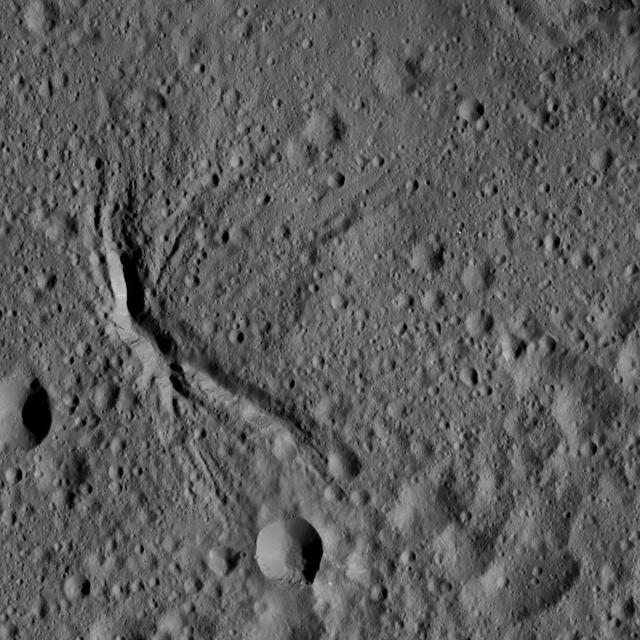
The center of Ezinu Crater on Ceres is seen in this view from NASA Dawn spacecraft. The crater features a network of canyon-like features. Ezinu measures about 72 miles 116 kilometers in diameter and was named for the Sumerian goddess of grain.
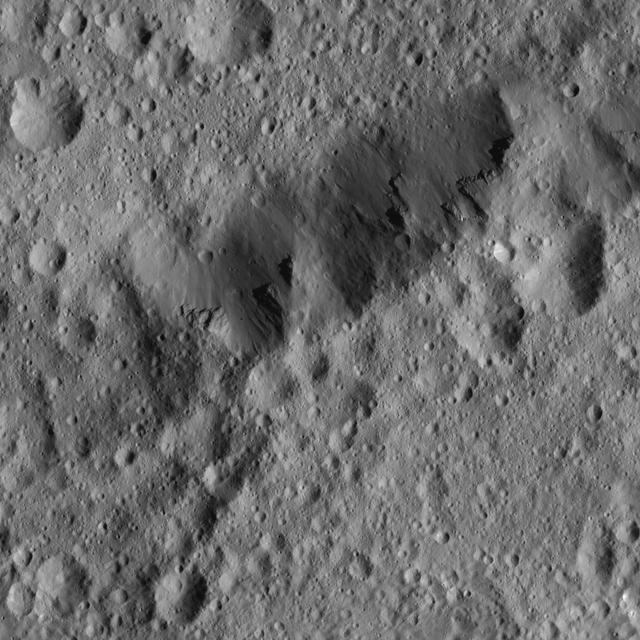
The rim of Ezinu Crater is seen in this view from NASA Dawn spacecraft.
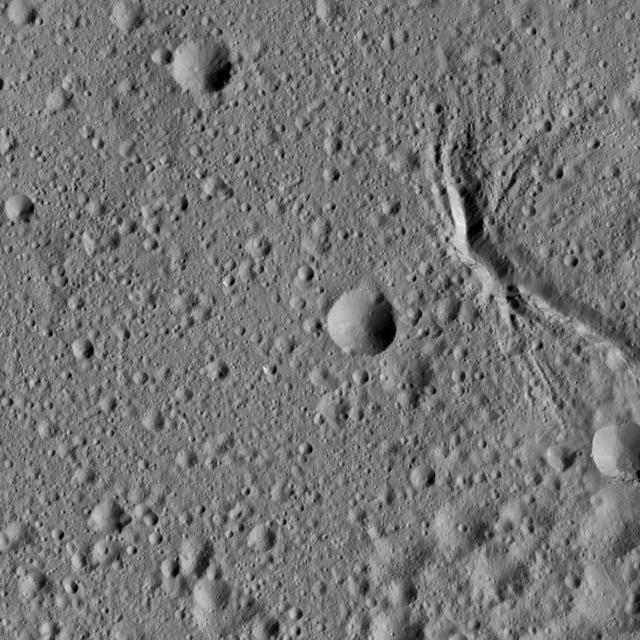
This picture from NASA Dawn spacecraft shows a network of canyon-like features near the center of Ezinu Crater on Ceres. Ezinu measures about 72 miles 116 kilometers in diameter and was named for the Sumerian goddess of grain
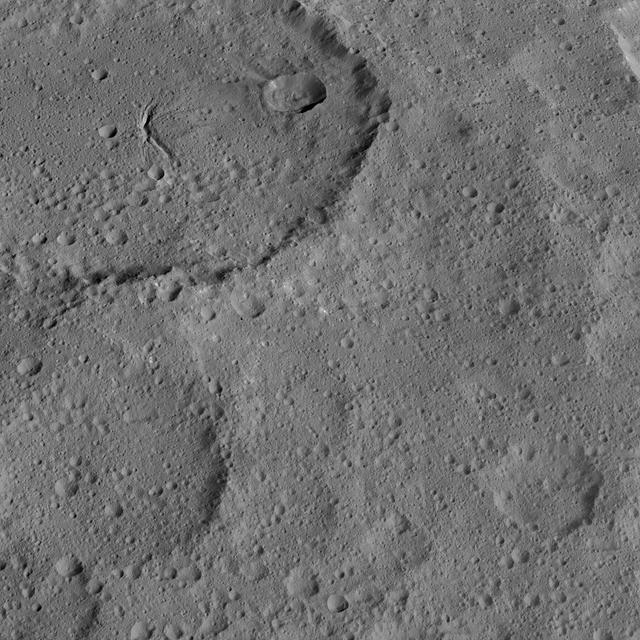
This view of Ezinu Crater on Ceres was taken by NASA's Dawn spacecraft on Oct. 19, 2015. Ezinu is the large crater in the top left corner of the image. The crater is 72 miles (116 kilometers) wide and contains a canyon-like feature near its center. The image was taken from a spacecraft altitude of 915 miles (1,470 kilometers) during Dawn's High Altitude Mapping Orbit (HAMO) phase. Image resolution is 450 feet (140 meters) per pixel. The image is centered at approximately 37 degrees north latitude, 200 degrees east latitude. http://photojournal.jpl.nasa.gov/catalog/PIA20190
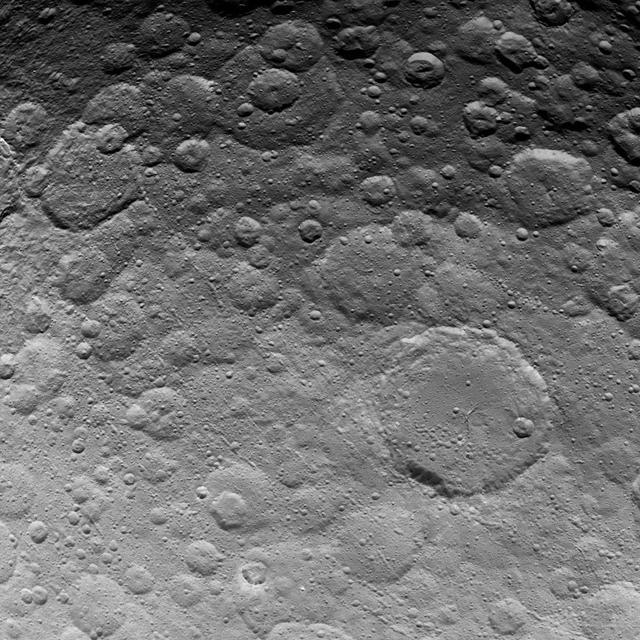
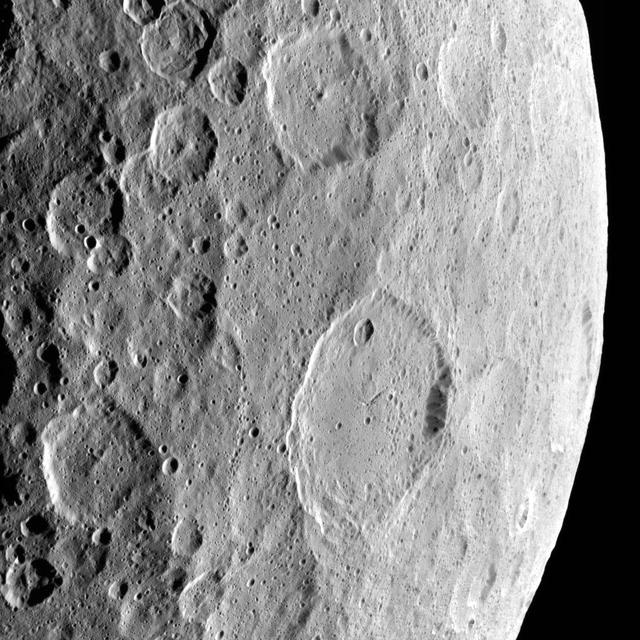
This image, taken by NASA's Dawn spacecraft, shows a portion of the northern hemisphere on dwarf planet Ceres from an altitude of 2,700 miles (4,400 kilometers). The image, with a resolution of 1,400 feet (410 meters) per pixel, was taken on June 24, 2015. The largest crater in this image, in the lower right quadrant, is called Ezinu. It is 75 miles (120 kilometers) across. http://photojournal.jpl.nasa.gov/catalog/PIA19610