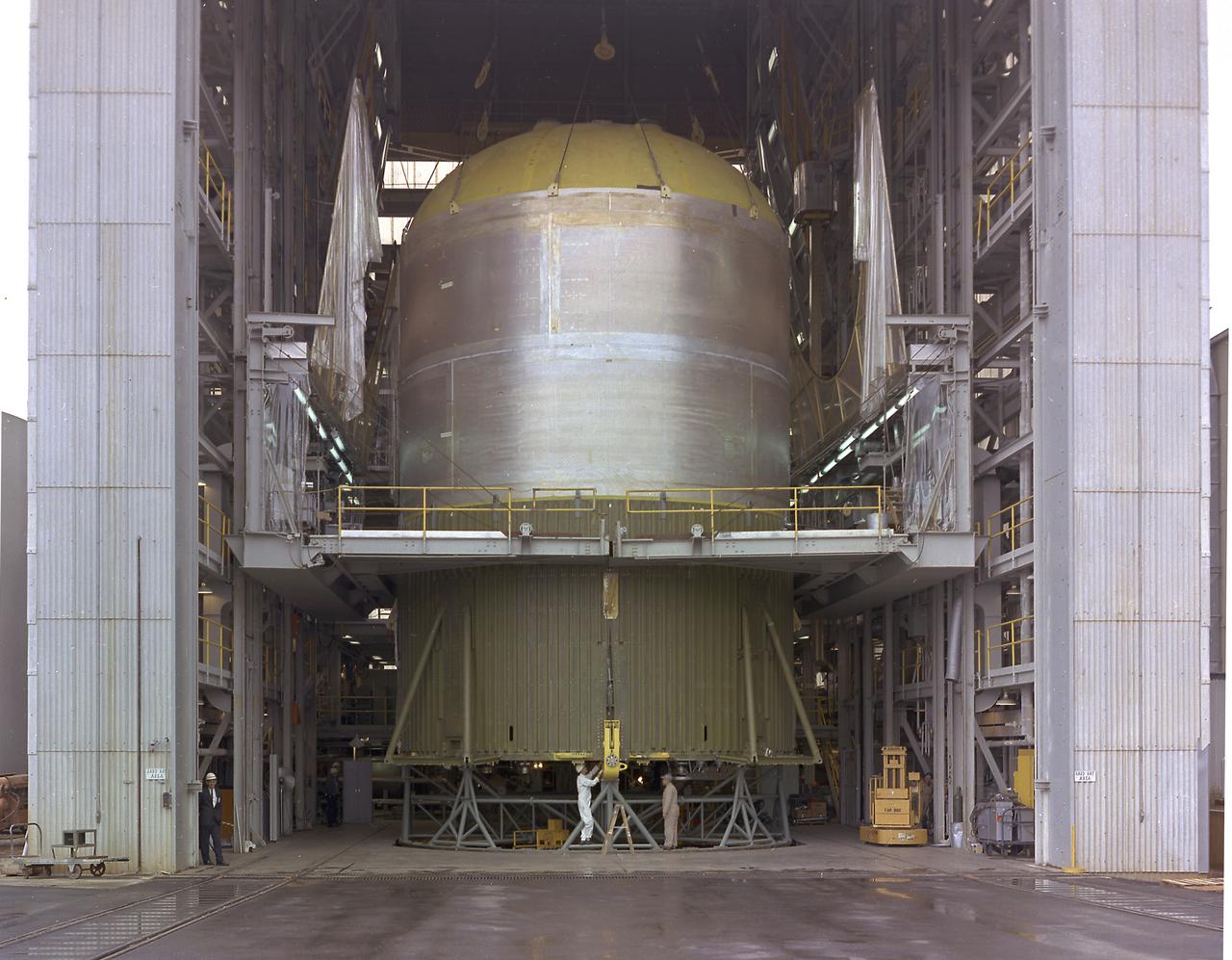
This image shows the Saturn V S-IC-T stage (S-IC static test article) fuel tank being attached to the thrust structure in the vehicle assembly building at the Marshall Space Flight Center (MSFC). The S-IC stage utilized five F-1 engines that used liquid oxygen and kerosene as propellant and provided a combined thrust of 7,500,000 pounds.
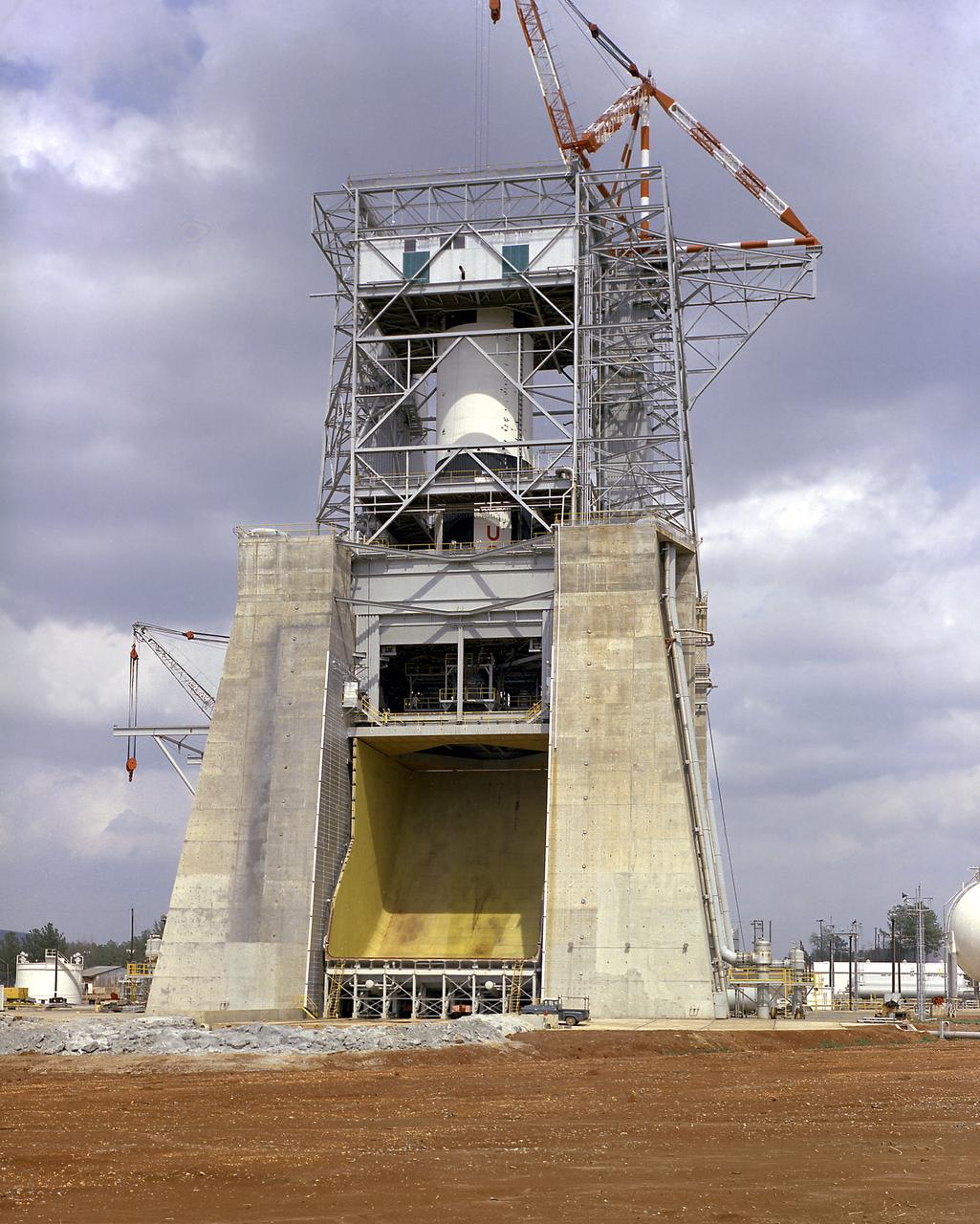
The S-IC-T stage (static firing stage) is installed and awaits the first static firing of all five F-1 engines at the Marshall Space Flight Center S-IC static test stand. Constructed in 1964, the S-IC static test stand was designed and constructed to develop and test the first stage of the Saturn V launch vehicle that used five F-1 engines. Each F-1 engine developed 1,500,000 pounds of thrust for a total liftoff thrust of 7,500,000 pounds. To handle this research and development effort, the stand contains 12,000,000 pounds of concrete on its base legs that are planted down to bedrock 40 feet below ground level. Of concrete and steel construction, the stand foundation walls are 4 feet thick, and topped by a crane with a 135-foot boom. With the boom in the up position, the stand is given an overall height of 405 feet, placing it among the highest structures in Alabama at the time.
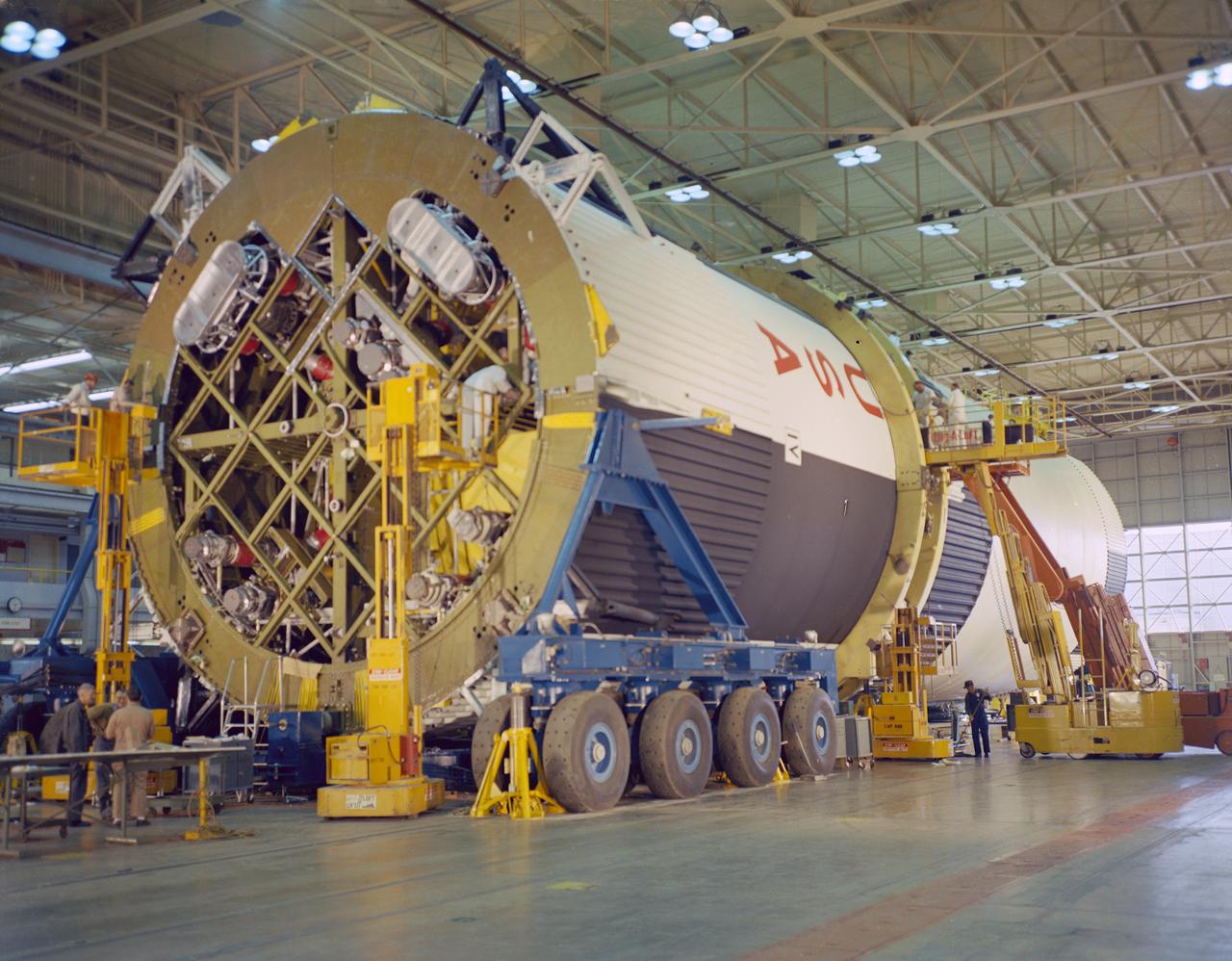
At the Marshall Space Flight Center (MSFC), the fuel tank assembly for the Saturn V S-IC-T (static test stage) fuel tank assembly is mated to the liquid oxygen (LOX) tank in building 4705. This stage underwent numerous static firings at the newly-built S-IC Static Test Stand at the MSFC west test area. The S-IC (first) stage used five F-1 engines that produced a total thrust of 7,500,000 pounds as each engine produced 1,500,000 pounds of thrust. The S-IC stage lifted the Saturn V vehicle and Apollo spacecraft from the launch pad.
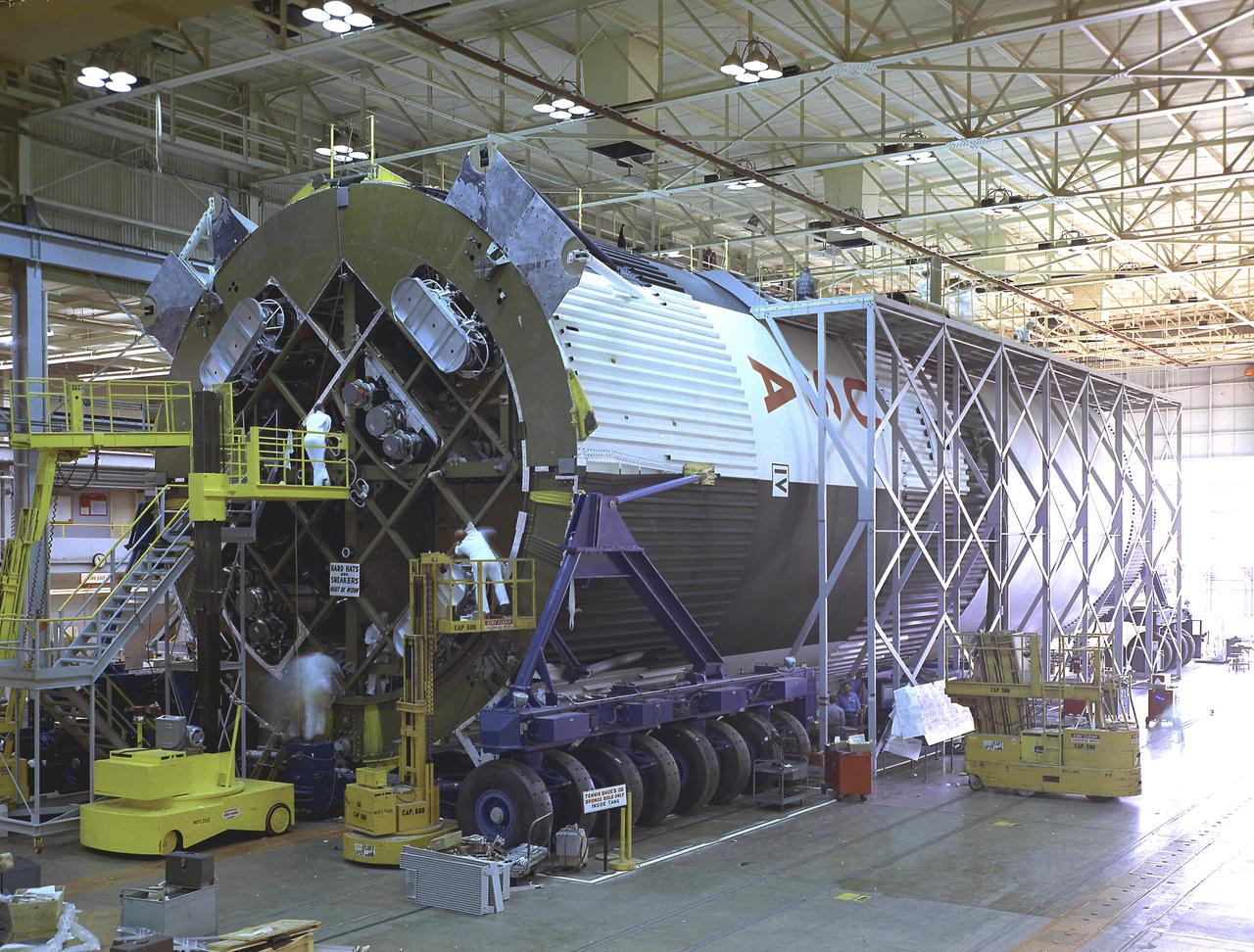
Pictured is the Saturn V S-IC-T stage (static testing stage) being assembled in the horizontal assembly station at the Marshall Space Flight Center (MSFC), building 4705. This stage underwent numerous static firings at the newly-built S-IC Static Test Stand at the MSFC west test area. The S-IC (first) stage used five F-1 engines that produced a total thrust of 7,500,000 pounds as each engine produced 1,500,000 pounds of thrust. The S-IC stage lifted the Saturn V vehicle and Apollo spacecraft from the launch pad.
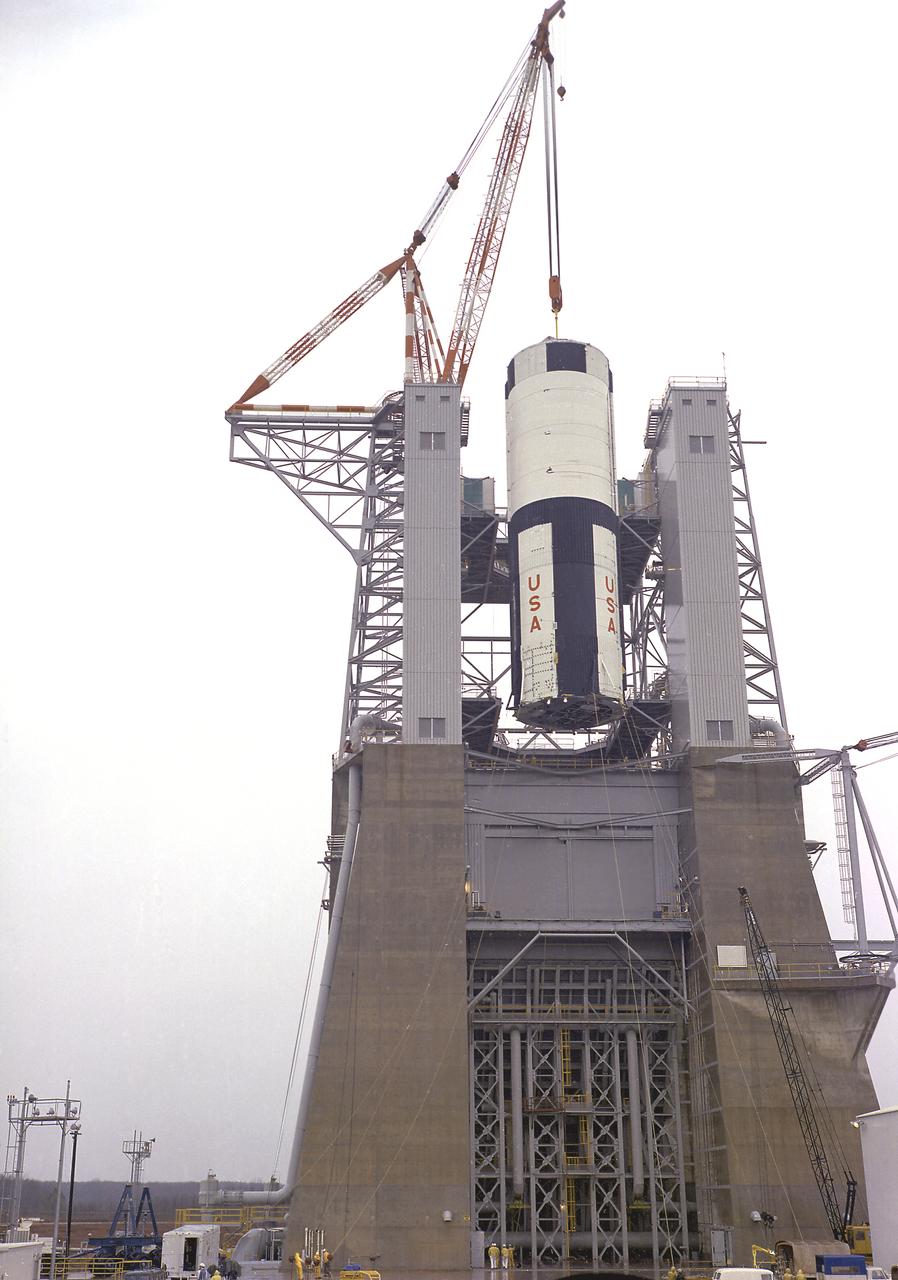
The S-IC-T stage is hoisted into the S-IC static test stand at the Marshall Space Flight Center. The S-IC-T stage is a static test vehicle not intended for flight. It was ground tested repeatedly over a period of many months proving the vehicle's propulsion system. The 280,000-pound stage, 138 feet long and 33 feet in diameter, houses the fuel and liquid oxygen tanks that hold a total of 4,400,000 pounds of liquid oxygen and kerosene. The two tanks are cornected by a 26-foot-long intertank section. Other parts of the booster included the forward skirt and the thrust structure, on which the engines were to be mounted. Five F-1 engines, each weighing 10 tons, gave the booster a total thrust of 7,500,000 pounds, roughly equivalent to 160 million horsepower.
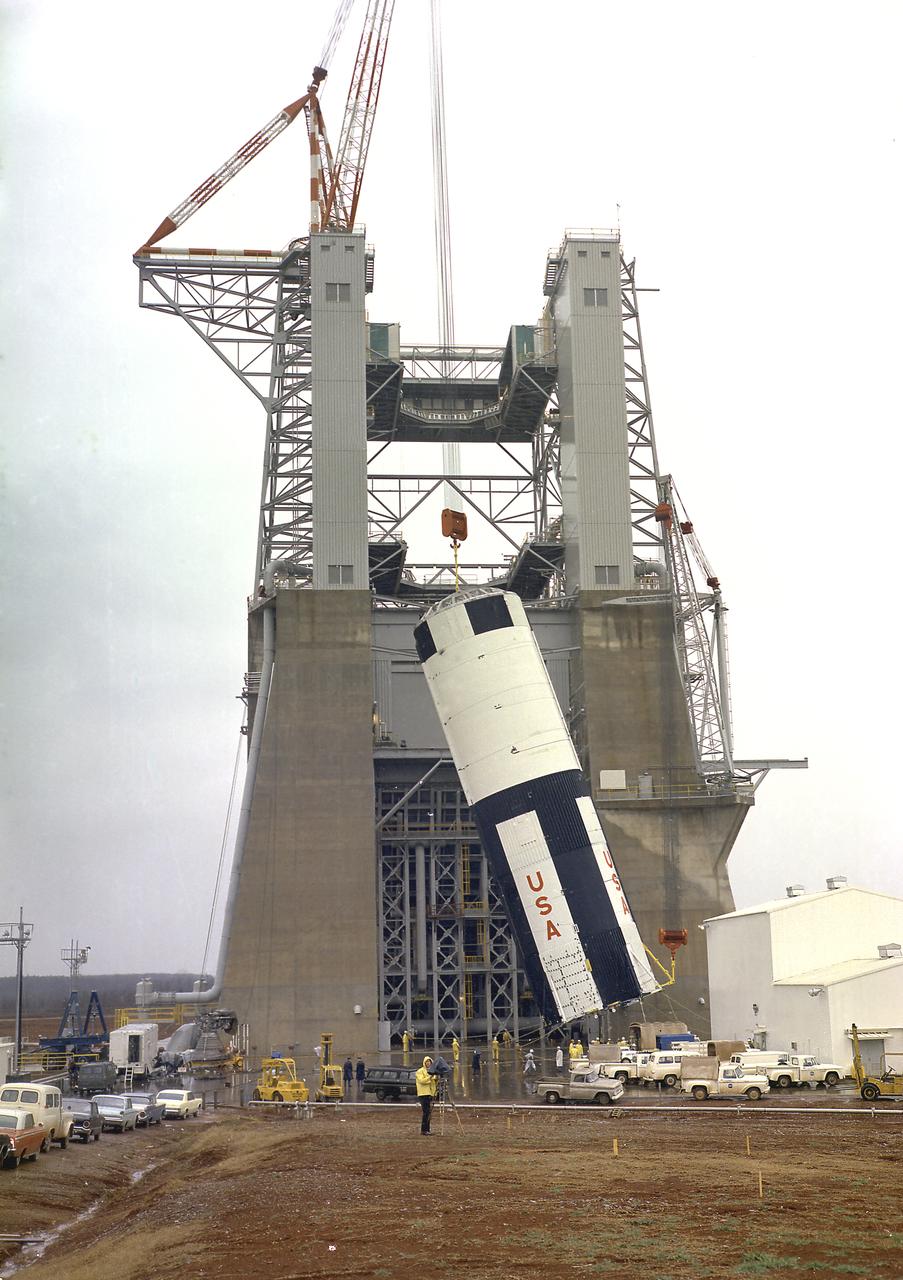
The S-IC-T stage was hoisted into the S-IC static test stand at the Marshall Space Flight Center. The S-IC-T stage was a static test vehicle not intended for flight. It was ground tested repeatedly over a period of many months to prove the vehicle's propulsion system. The 280,000-pound stage, 138 feet long and 33 feet in diameter, housed the fuel and liquid oxygen tanks that held a total of 4,400,000 pounds of liquid oxygen and kerosene. The two tanks are cornected by a 26-foot-long intertank section. Other parts of the booster included the forward skirt and the thrust structure, on which the engines were to be mounted. Five F-1 engines, each weighing 10 tons, gave the booster a total thrust of 7,500,000 pounds, roughly equivalent to 160 million horsepower.
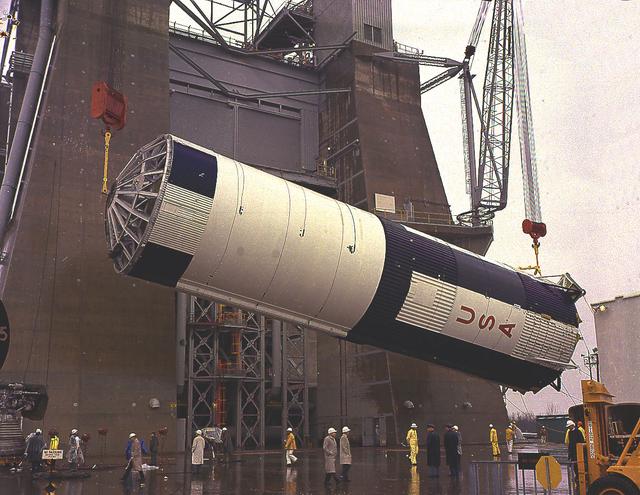
The S-IC-T stage was hoisted into the S-IC Static Test Stand at the Marshall Space Flight Center. The S-IC-T stage was a static test vehicle, not intended for flight. It was ground tested repeatedly over a period of many months to prove the vehicle's propulsion system. The 280,000-pound stage, 138 feet long and 33 feet in diameter, housed the fuel and liquid oxygen tanks that held a total of 4,400,000 pounds of liquid oxygen and kerosene. The two tanks were cornected by a 26-foot intertank section. Other parts of the booster included the forward skirt and the thrust structure, on which the engines were to be mounted. Five F-1 engines, each weighing 10 tons, gave the booster a total thrust of 7,500,000 pounds, roughly equivalent to 160 million horsepower.

NASA pilot Ed Lewis with the T-34C aircraft on the Dryden Flight Research Center Ramp. The aircraft was previously used at the Lewis Research Center in propulsion experiments involving turboprop engines, and was used as a chase aircraft at Dryden for smaller and slower research projects. Chase aircraft accompany research flights for photography and video purposes, and also as support for safety and research. At Dryden, the T-34 is used mainly for smaller remotely piloted vehicles which fly slower than NASA's F-18's, used for larger scale projects. This aircraft was returned to the U.S. Navy in May of 2002.
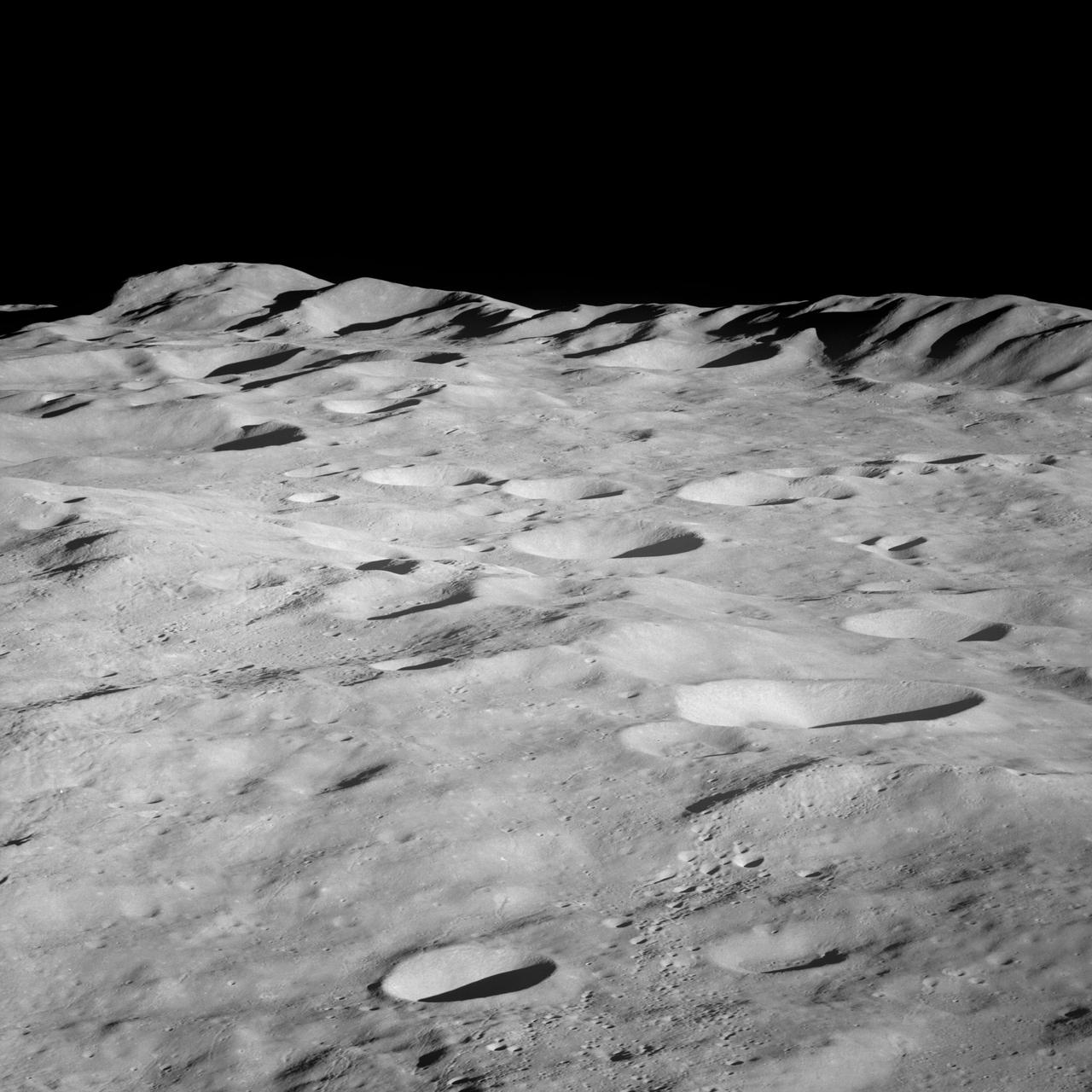
Apollo 8,Moon,Target of Opportunity (T/O) 10, Various targets. Latitude 18 degrees South,Longitude 163.50 degrees West. Camera Tilt Mode: High Oblique. Direction: South. Sun Angle 12 degrees. Original Film Magazine was labeled E. Camera Data: 70mm Hasselblad; F-Stop: F-5.6; Shutter Speed: 1/250 second. Film Type: Kodak SO-3400 Black and White,ASA 40. Other Photographic Coverage: Lunar Orbiter 1 (LO I) S-3. Flight Date: December 21-27,1968.
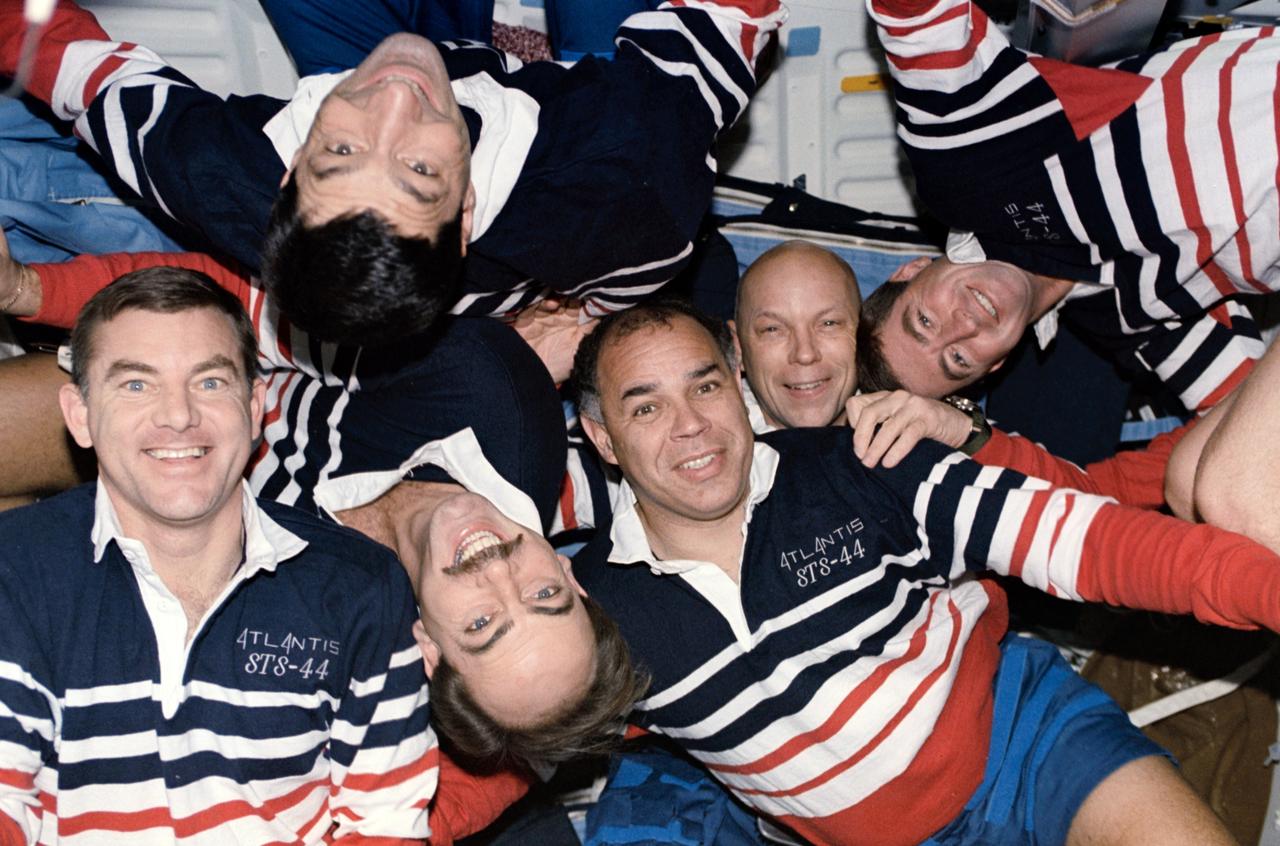
STS044-50-033 (24 Nov-1 Dec 1991) --- The six crewmembers for STS-44 assemble on the middeck. An auto-set 35mm camera recorded this view of them enroute to a more formal pose. Astronaut Frederick D. Gregory, Mission Commander, is at center. Clockwise from his position, other crewmembers are Payload Specialist Thomas J. Hennen; and astronauts James S. Voss, Mario Runco Jr. and F. Story Musgrave, all Mission Specialists, and Terence T. (Tom) Henricks, Pilot.

STS029-S-004 (10 March 1989) --- Astronaut James F. Buchli, STS-29 mission specialist, prepares to take a rear-seat ride in a NASA T-38 jet aircraft from Houston's Johnson Space Center to Florida's Kennedy Space Center. In three days, he and four fellow STS-29 crewmembers are scheduled to lift off aboard the Space Shuttle Discovery from Launch Pad 39B.
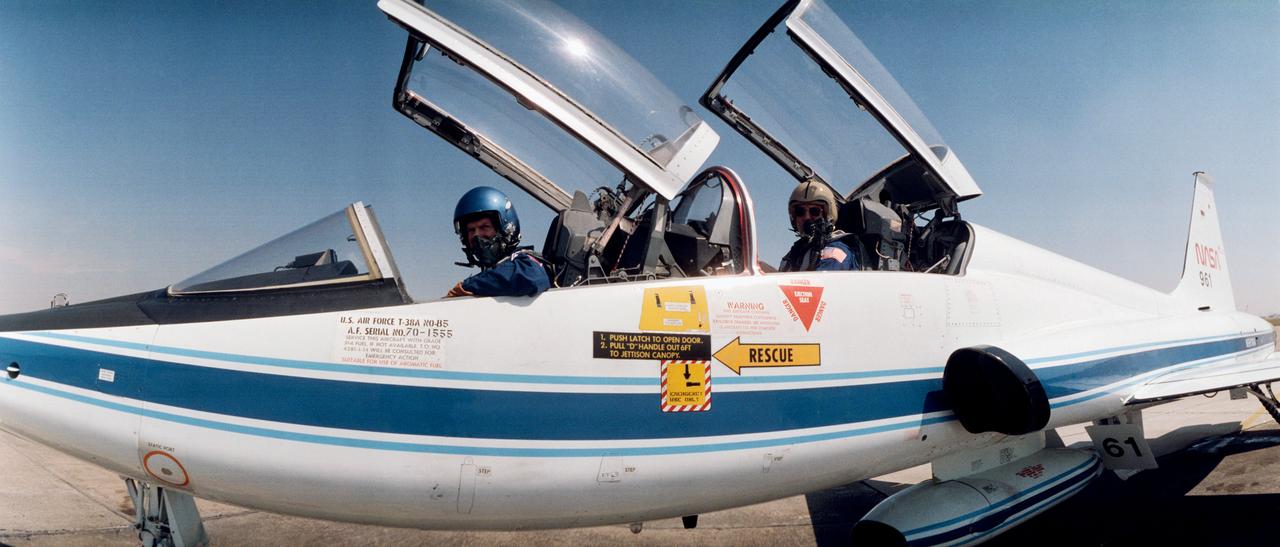
STS029-S-005 (10 March 1989) --- A wide angle view of a T-38 on the flight line at Ellington Field near the Johnson Space Center (JSC). Astronauts Michael L. Coats, mission commander; and James F. Buchli, STS-29 mission specialist, moments later were en route to Florida's Kennedy Space Center. In three days, they and three fellow STS-29 crew members are scheduled to lift off aboard the space shuttle Discovery from Launch Pad 39B. Photo credit: NASA
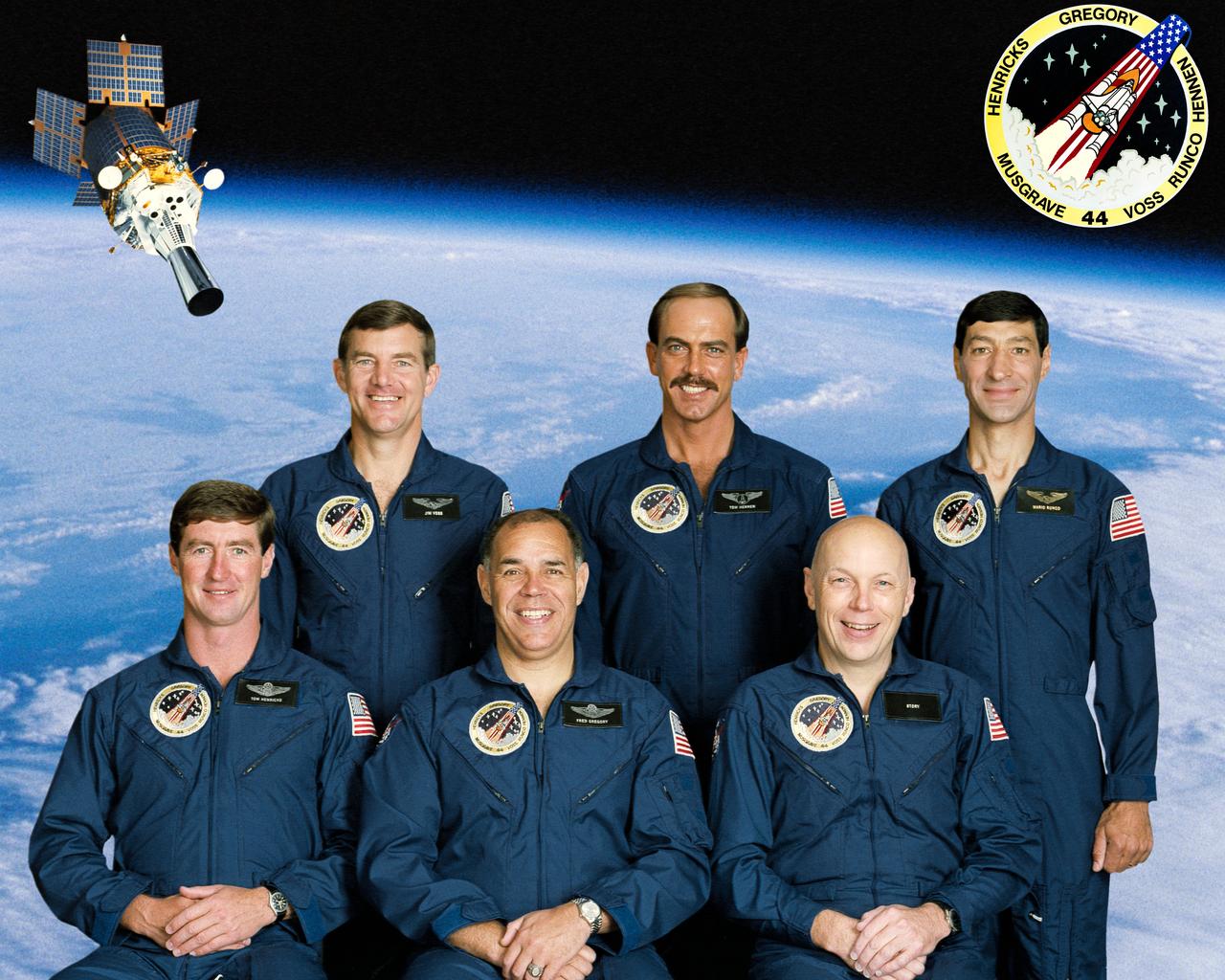
STS044-S-002 (July 1991) --- These are the six crew members assigned to fly onboard the Space Shuttle Atlantis for NASA's STS 44 mission, scheduled for later this year. Astronaut Frederick D. Gregory (center, front row) is mission commander. He is flanked by astronauts Terence T. (Tom) Henricks (left), pilot; and F. Story Musgrave, mission specialist. On the back row are astronaut James S. Voss, mission specialist; payload specialist Thomas J. Hennen of the U.S. Army; and astronaut Mario Runco Jr., mission specialist. The mission insignia is seen in the upper right corner, while the Defense Support System (DPS)/IUS payload is depicted in the upper left corner.

A NASA T-34C aircraft, used for safety chase, is shown flying above the Dryden Flight Research Center, Edwards, California in March 1997. The aircraft was previously used at the Lewis Research Center in propulsion experiments involving turboprop engines, and was used as a chase aircraft at Dryden for smaller and slower research projects. Chase aircraft accompany research flights for photography and video purposes, and also as support for safety and research. At Dryden, the T-34 is used mainly for smaller remotely piloted vehicles which fly slower than NASA's F-18's, used for larger scale projects. This aircraft was returned to the U.S. Navy in May of 2002. The T-34C, built by Beech, carries a crew of 2 and is nicknamed the Mentor.

A NASA T-34C aircraft, used for safety chase, is shown flying above the Dryden Flight Research Center, Edwards, California in March 1997. The aircraft was previously used at the Lewis Research Center in propulsion experiments involving turboprop engines, and was used as a chase aircraft at Dryden for smaller and slower research projects. Chase aircraft accompany research flights for photography and video purposes, and also as support for safety and research. At Dryden, the T-34 is used mainly for smaller remotely piloted vehicles which fly slower than NASA's F-18's, used for larger scale projects. This aircraft was returned to the U.S. Navy in May of 2002. The T-34C, built by Beech, carries a crew of 2 and is nicknamed the Mentor.

The back seat instrument panel on the NASA T-34C chase plane. In its role as a military trainer, the instructor pilot would ride in the back seat, while the student would be in the front seat. As a chase plane, the back seat would be occupied by a photographer. The aircraft was previously used at the Lewis Research Center in propulsion experiments involving turboprop engines, and was used as a chase aircraft at Dryden for smaller and slower research projects. Chase aircraft accompany research flights for photography and video purposes, and also as support for safety and research. At Dryden, the T-34 is used mainly for smaller remotely piloted vehicles which fly slower than NASA's F-18's, used for larger scale projects. This aircraft was returned to the U.S. Navy in May of 2002. The T-34C, built by Beech, carries a crew of 2 and is nicknamed the Mentor.
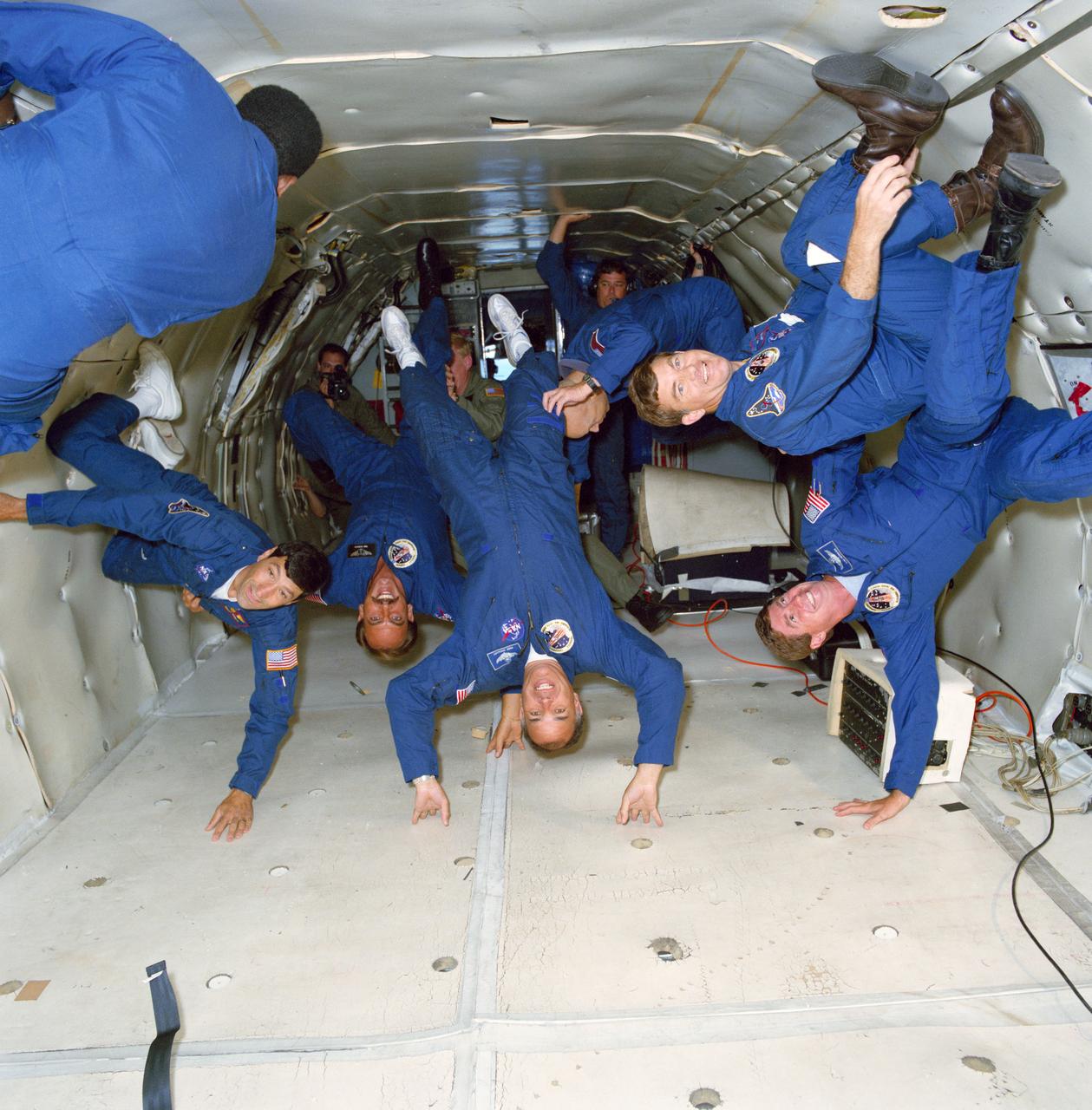
S91-38355 (28 May 1991) --- Seen floating about the vacant spaces of the Johnson Space Center's KC-135 "zero-gravity" aircraft are the six crewmembers for the STS 44 mission. Left to right are Terence T. Henricks, James S. Voss, F. Story Musgrave (partially obscured), Frederick D. Gregory, Thomas J. Hennen and Mario Runco Jr. Gregory is mission commander. Hennen is payload specialist for this flight, dedicated to the Department of Defense. The flight served as a refresher and a preview of the experience of weightlessness, as the special aircraft flew a series of parabolas which provided short sessions of zero-gravity.
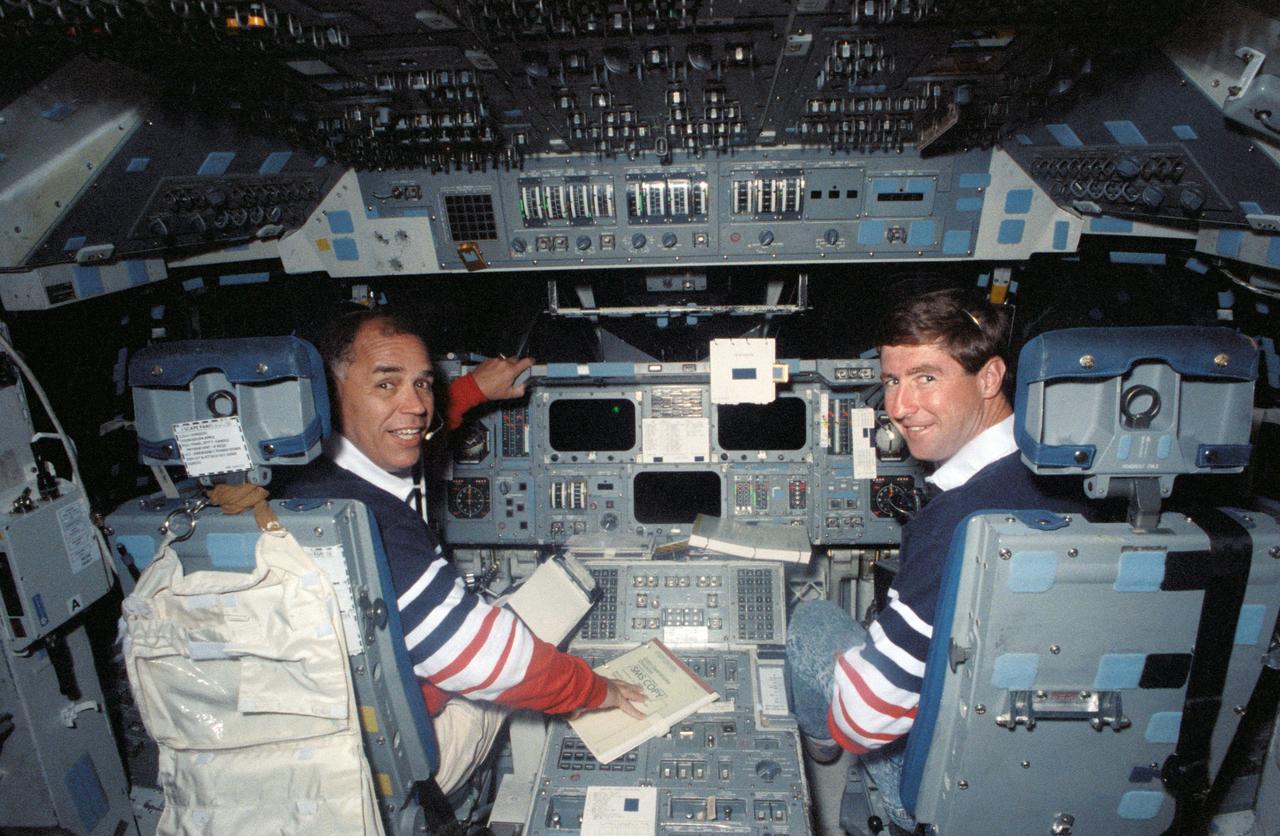
S91-38355 (28 May 1991) --- Seen floating about the vacant spaces of the Johnson Space Center's KC-135 "zero-gravity" aircraft are the six crewmembers for the STS 44 mission. Left to right are Terence T. Henricks, James S. Voss, F. Story Musgrave (partially obscured), Frederick D. Gregory, Thomas J. Hennen and Mario Runco Jr. Gregory is mission commander. Hennen is payload specialist for this flight, dedicated to the Department of Defense. The flight served as a refresher and a preview of the experience of weightlessness, as the special aircraft flew a series of parabolas which provided short sessions of zero-gravity.
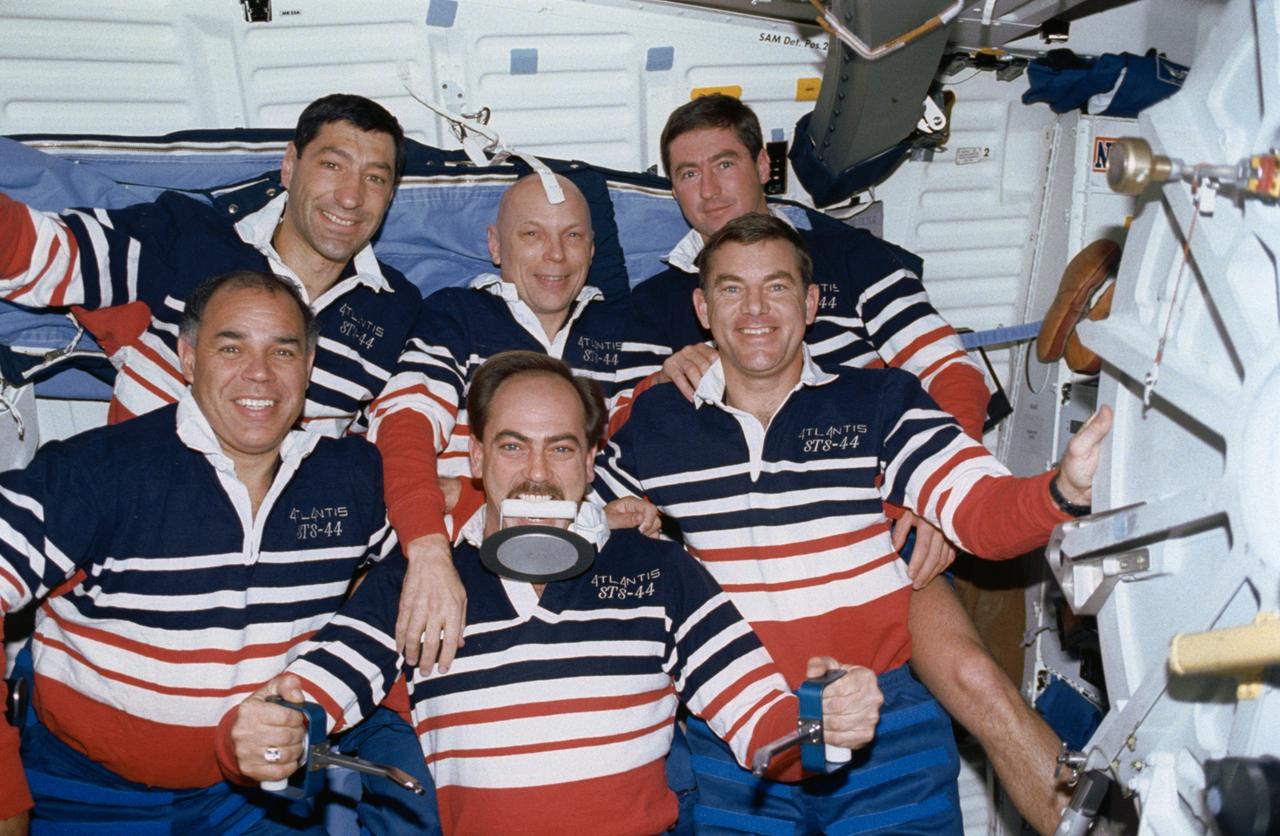
STS044-17-030 (24 Nov-1 Dec 1991) --- The six crewmembers for STS-44 pose for a second crew portrait on Atlantis' flight deck. This portrait was intended to focus on Payload Specialist Thomas J. Hennen (front center), who earned the nickname, "Trash Man" during the flight. It was Hennen who "starred" in a brief onboard video production about the disposal of trash and waste. Others in the picture are (front row) Astronauts Frederick D. Gregory (left), Mission Commander; and James S. Voss, Mission Specialist; and (back row, left to right) Astronauts Mario Runco Jr. and F. Story Musgrave, both Mission Specialists; and Terence T. (Tom) Henricks, Pilot.
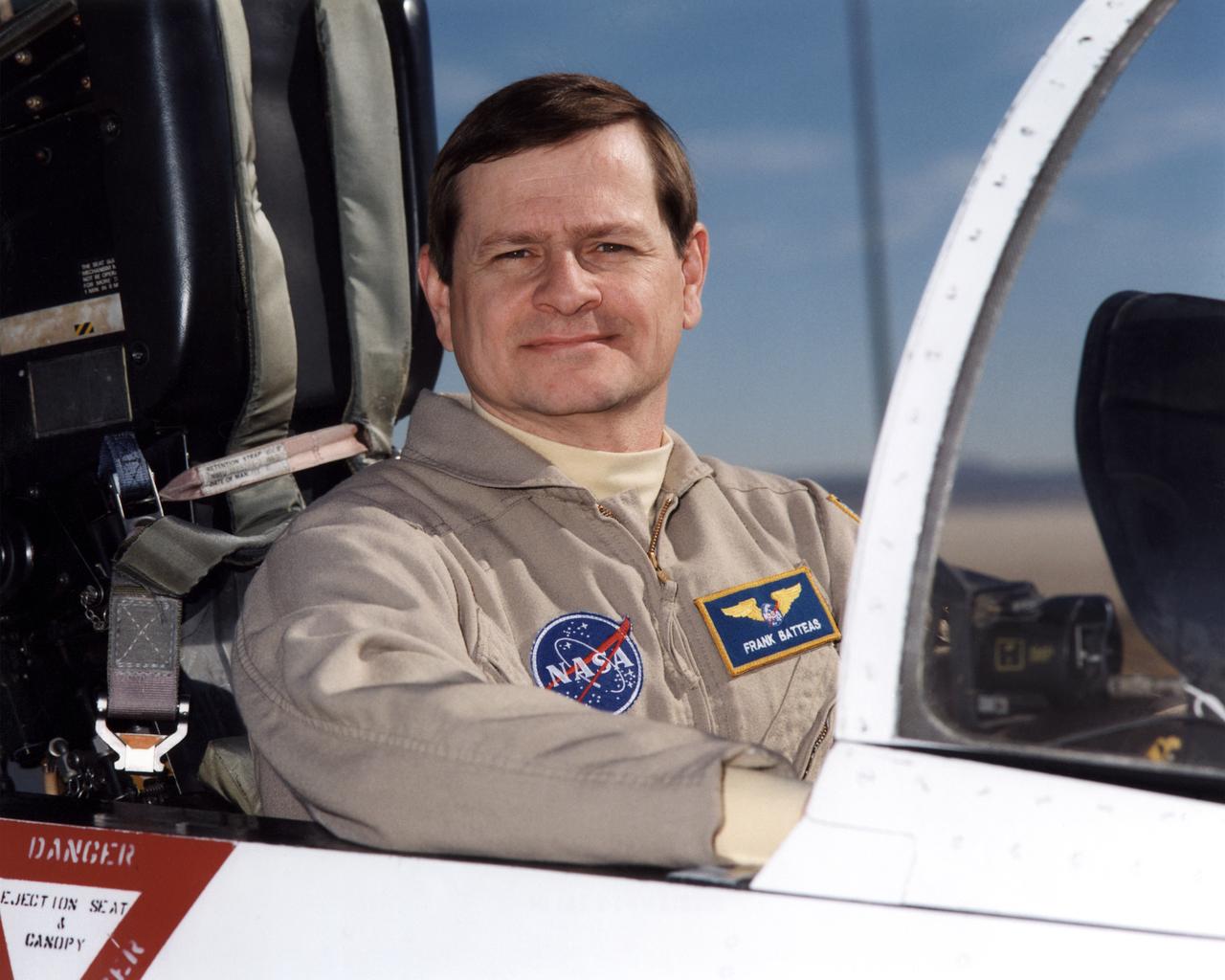
Frank Batteas is a research test pilot in the Flight Crew Branch of NASA's Dryden Flight Research Center, Edwards, California. He is currently a project pilot for the F/A-18 and C-17 flight research projects. In addition, his flying duties include operation of the DC-8 Flying Laboratory in the Airborne Science program, and piloting the B-52B launch aircraft, the King Air, and the T-34C support aircraft. Batteas has accumulated more than 4,700 hours of military and civilian flight experience in more than 40 different aircraft types. Batteas came to NASA Dryden in April 1998, following a career in the U.S. Air Force. His last assignment was at Wright-Patterson Air Force Base, Dayton, Ohio, where Lieutenant Colonel Batteas led the B-2 Systems Test and Evaluation efforts for a two-year period. Batteas graduated from Class 88A of the Air Force Test Pilot School, Edwards Air Force Base, California, in December 1988. He served more than five years as a test pilot for the Air Force's newest airlifter, the C-17, involved in nearly every phase of testing from flutter and high angle-of-attack tests to airdrop and air refueling envelope expansion. In the process, he achieved several C-17 firsts including the first day and night aerial refuelings, the first flight over the North Pole, and a payload-to-altitude world aviation record. As a KC-135 test pilot, he also was involved in aerial refueling certification tests on a number of other Air Force aircraft. Batteas received his commission as a second lieutenant in the U. S. Air Force through the Reserve Officer Training Corps and served initially as an engineer working on the Peacekeeper and Minuteman missile programs at the Ballistic Missile Office, Norton Air Force Base, Calif. After attending pilot training at Williams Air Force Base, Phoenix, Ariz., he flew operational flights in the KC-135 tanker aircraft and then was assigned to research flying at the 4950th Test Wing, Wright-Patterson. He flew extensively modified C-135