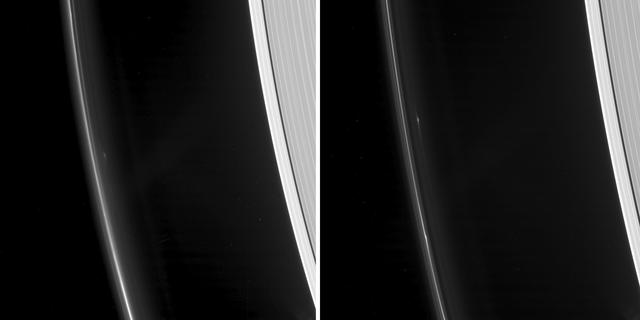
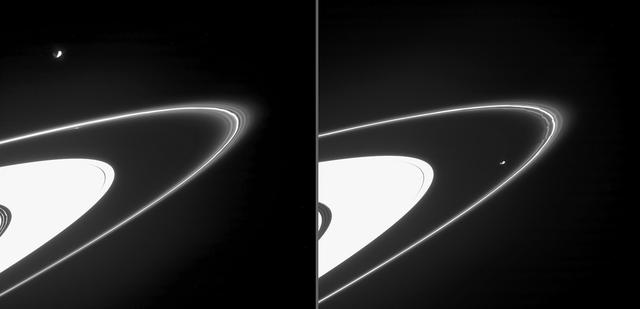
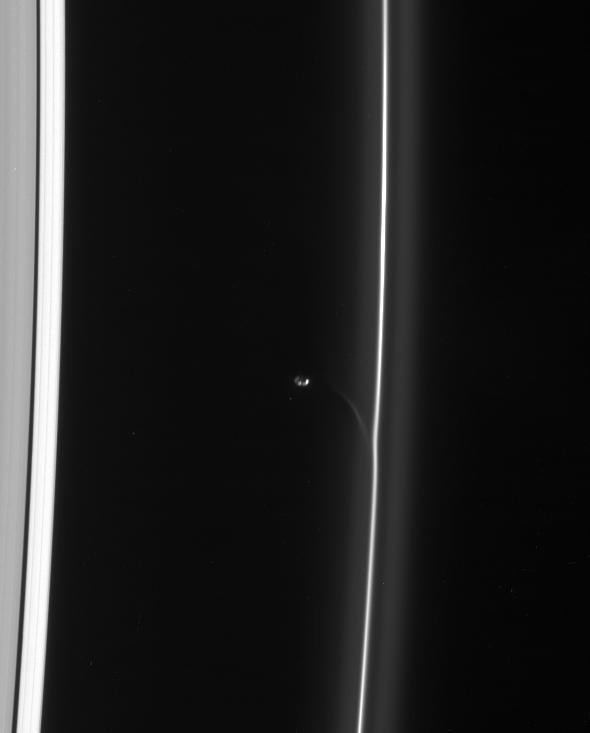
As NASA's Cassini spacecraft continues its weekly ring-grazing orbits, diving just past the outside of Saturn F ring, it is tracking several small, persistent objects there. These images show two such objects that Cassini originally detected in spring 2016, as the spacecraft transitioned from more equatorial orbits to orbits at increasingly high inclination about the planet's equator. Imaging team members studying these objects gave them the informal designations F16QA (right image) and F16QB (left image). The researchers have observed that objects such as these occasionally crash through the F ring's bright core, producing spectacular collisional structures.While these objects may be mostly loose agglomerations of tiny ring particles, scientists suspect that small, fairly solid bodies lurk within each object, given that they have survived several collisions with the ring since their discovery. The faint retinue of dust around them is likely the result of the most recent collision each underwent before these images were obtained. The researchers think these objects originally form as loose clumps in the F ring core as a result of perturbations triggered by Saturn's moon Prometheus. . If they survive subsequent encounters with Prometheus, their orbits can evolve, eventually leading to core-crossing clumps that produce spectacular features, even though they collide with the ring at low speeds. The images were obtained using the Cassini spacecraft narrow-angle camera on Feb. 5, 2017, at a distance of 610,000 miles (982,000 kilometers, left image) and 556,000 miles (894,000 kilometers, right image) from the F ring. Image scale is about 4 miles (6 kilometers) per pixel. http://photojournal.jpl.nasa.gov/catalog/PIA21432
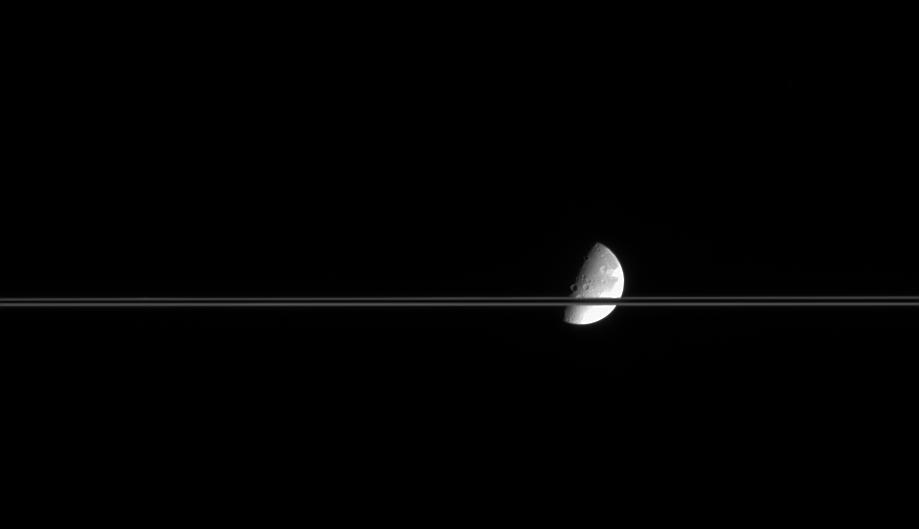
Unidentified F Ring Objects
Fascinating F Ring

Unrolling the F-ring
The F Ring Spiral Arm
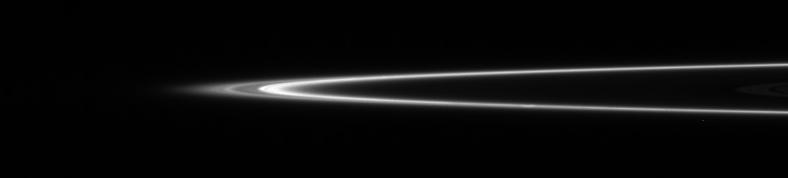
F Ring Edge
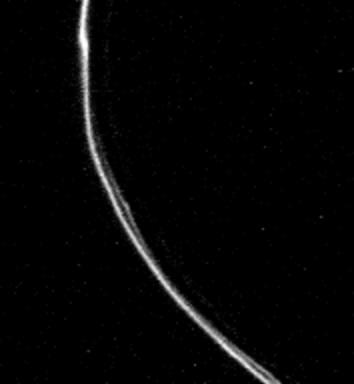
Saturn F Ring
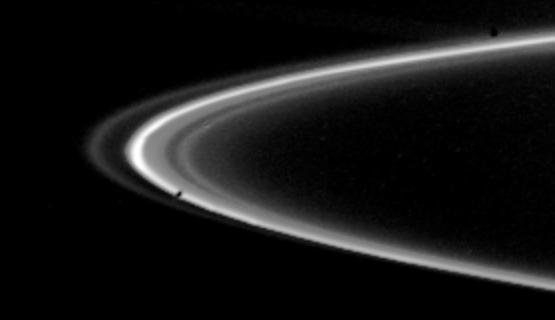
A View of Saturn F-ring
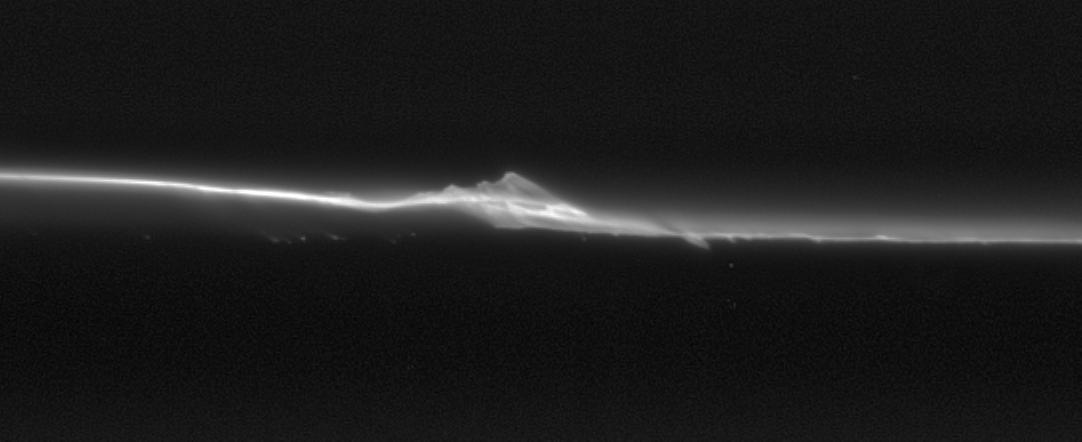
F Ring Dynamism
Two F Ring Views

F Ring Fender Bender

Saturn F-Ring
F Ring Informants
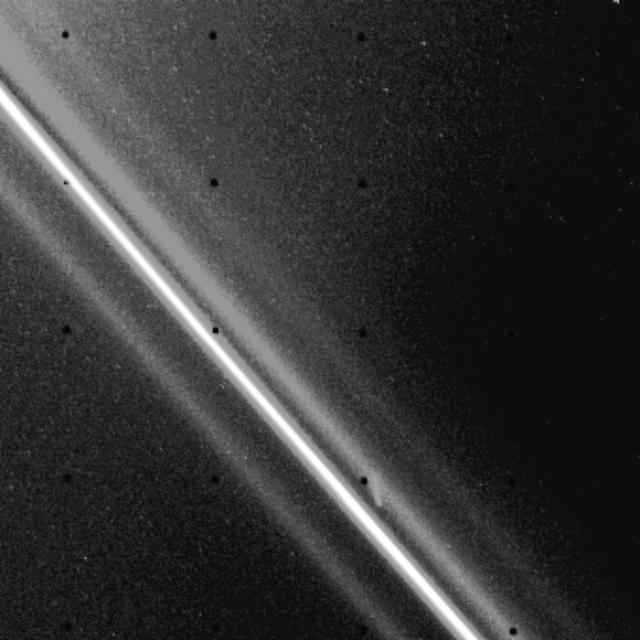
Image of Saturn F-ring
Sculpting the F Ring
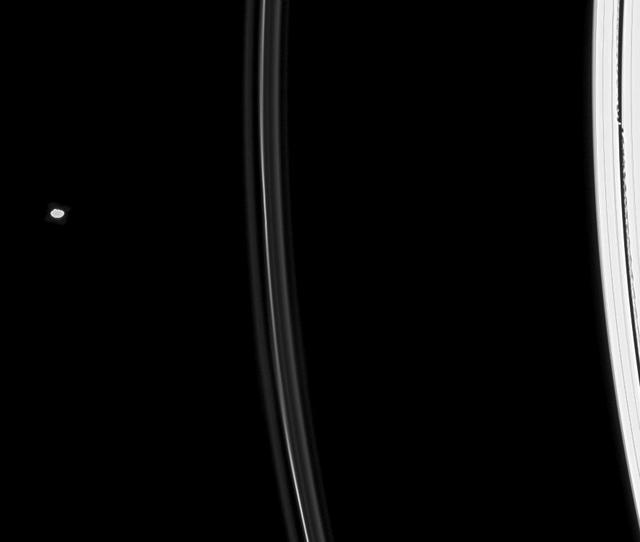
F Ring in Between
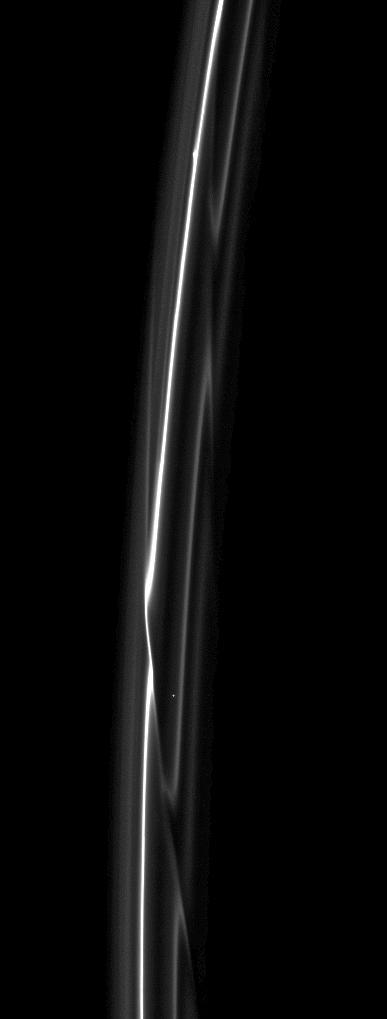
Fragile F Ring
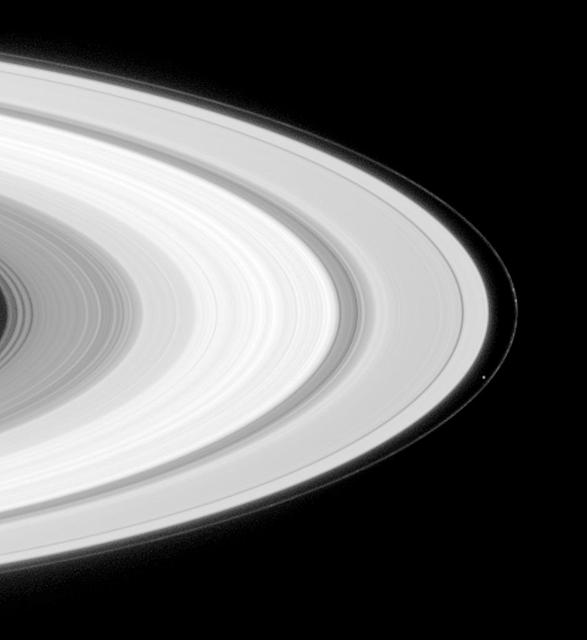
Prometheus and Knots in the F Ring
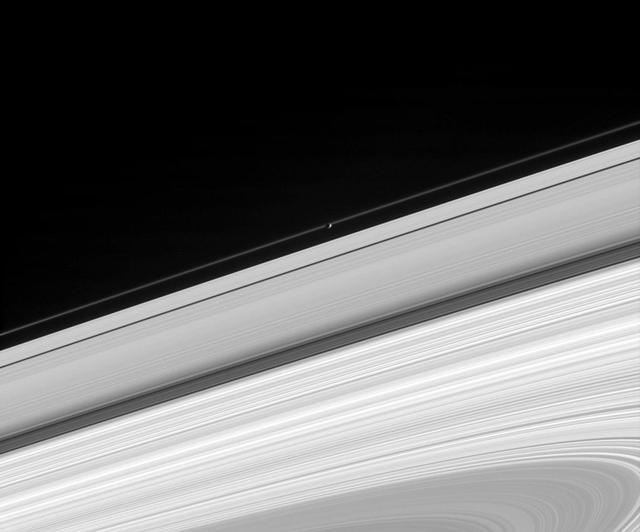
Pandora Occults the F Ring
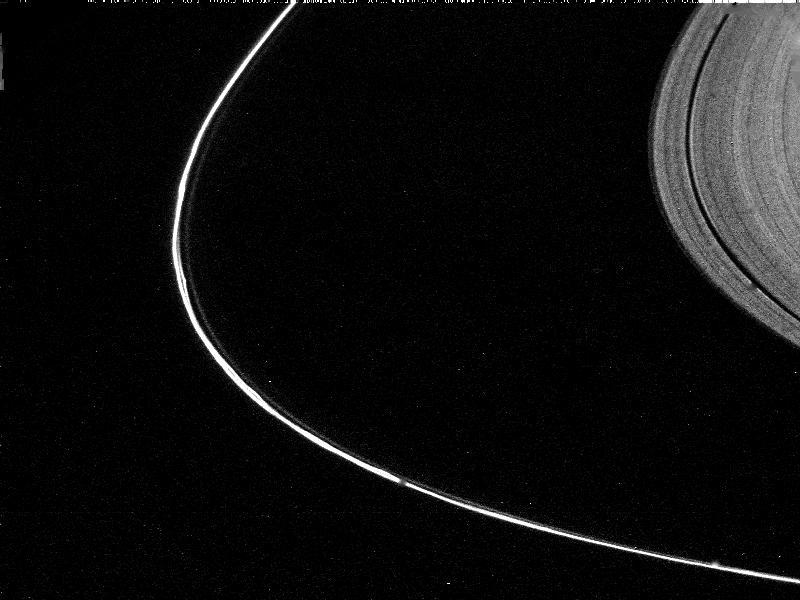
Saturn F-Ring
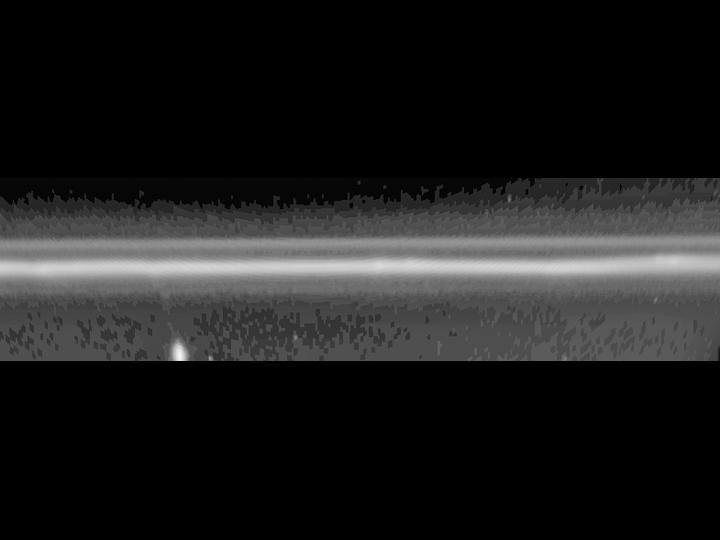
Streaming F Ring
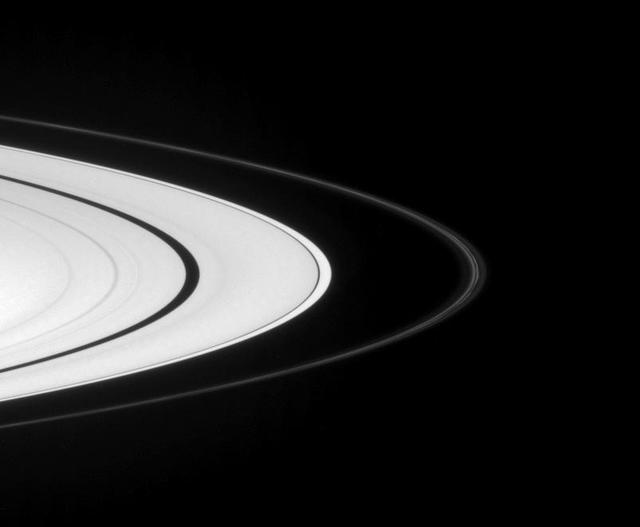
F-ring Evolution
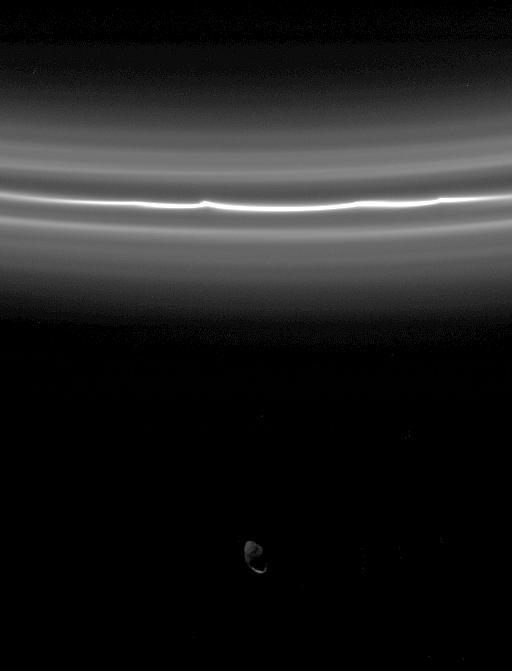
Brilliant F Ring
F Ring Edges
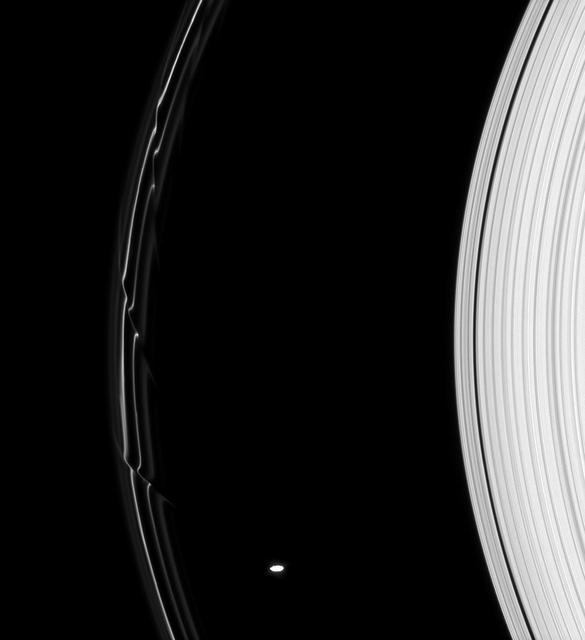
Warped F Ring
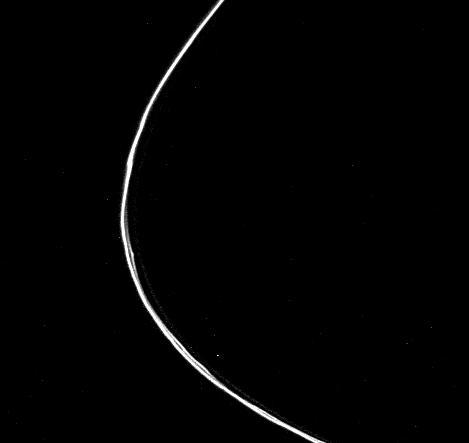
Saturn F-ring
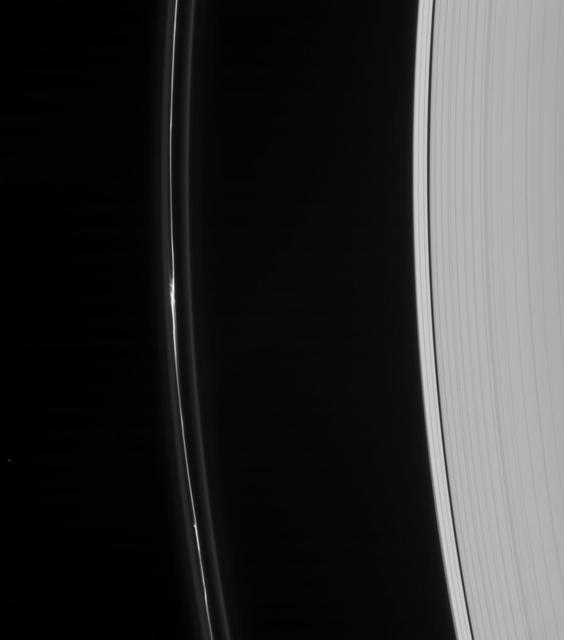
F Ring Knot
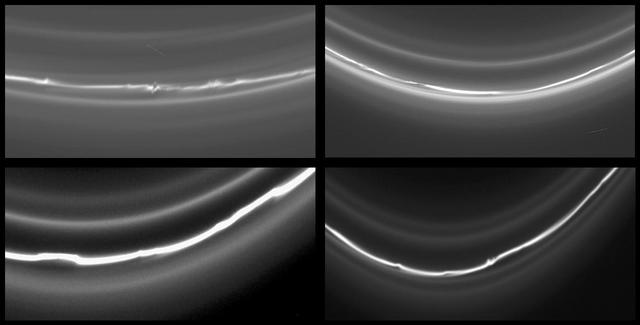
Four Views of the F Ring
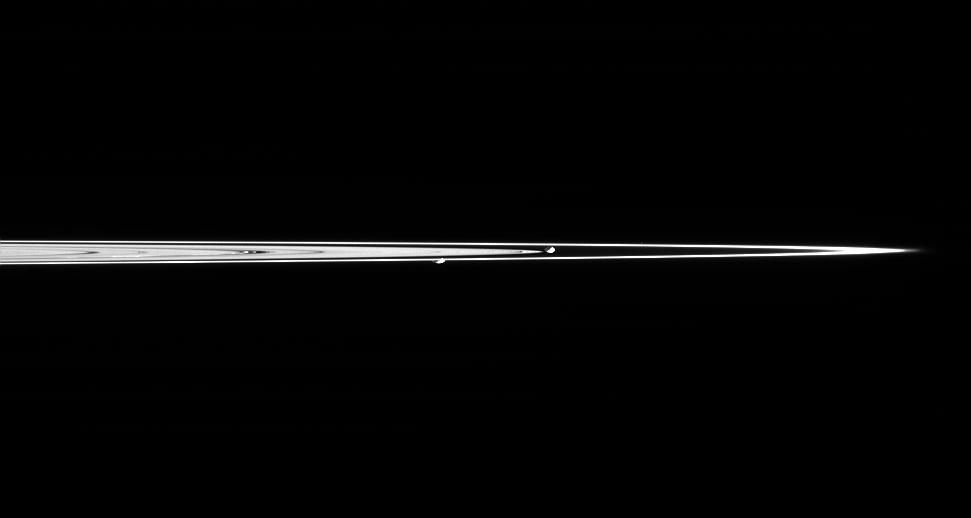
F Ring Shepherds
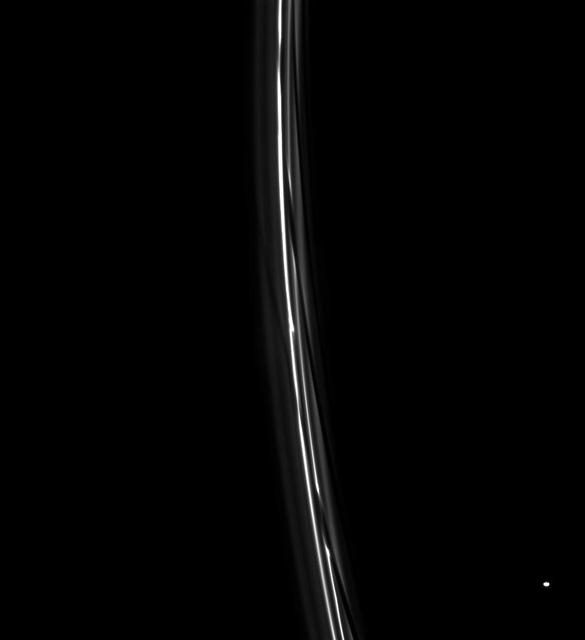
F Ring Channels

F Ring Close-up
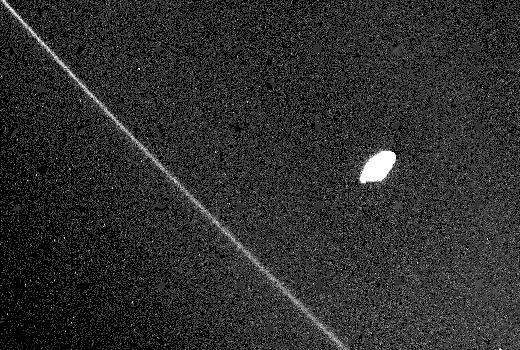
Saturn F-ring and Inner Satellite
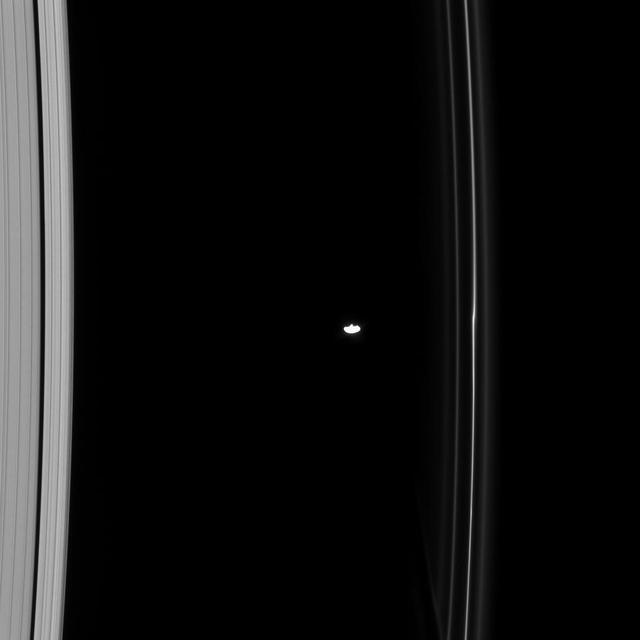
Prometheus Brings Change to the F Ring

Cassini First Picture of F Ring

Wide View of Saturn F Ring
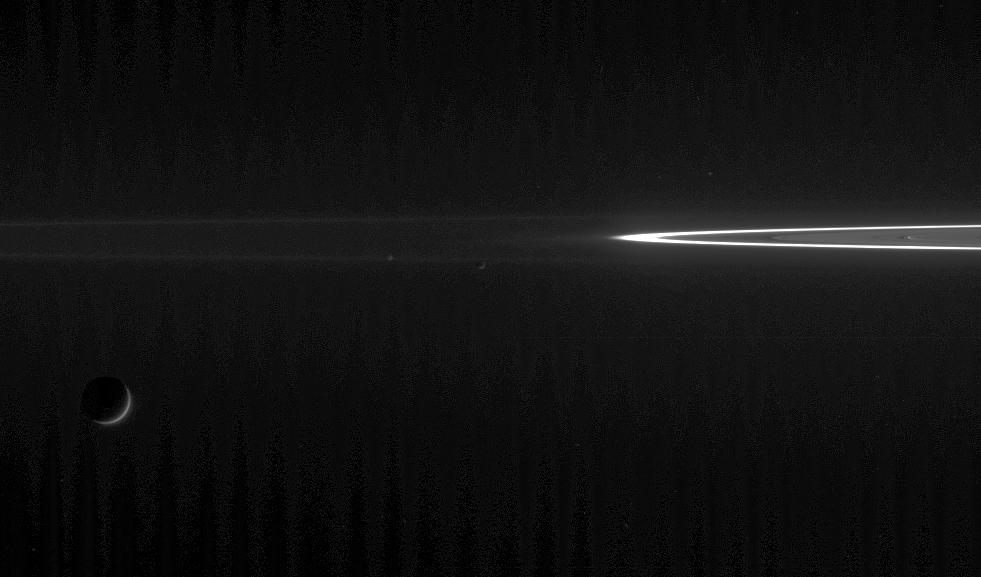
Darkened Moons, Searing F Ring
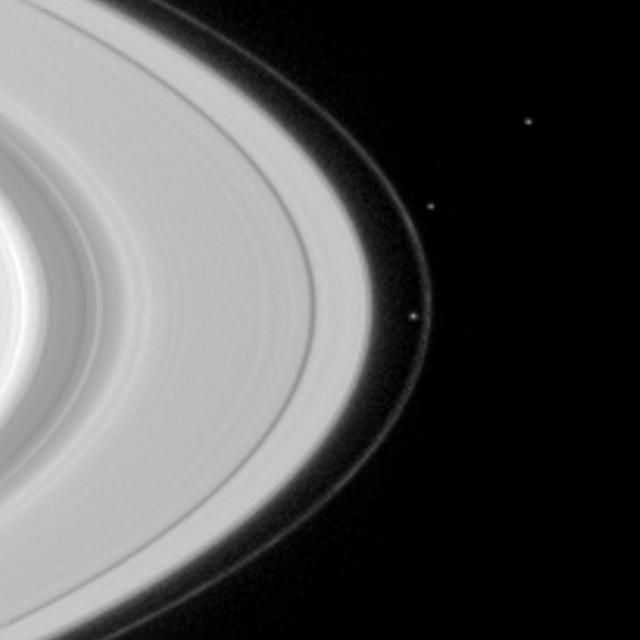
Pandora and Prometheus Near F Ring
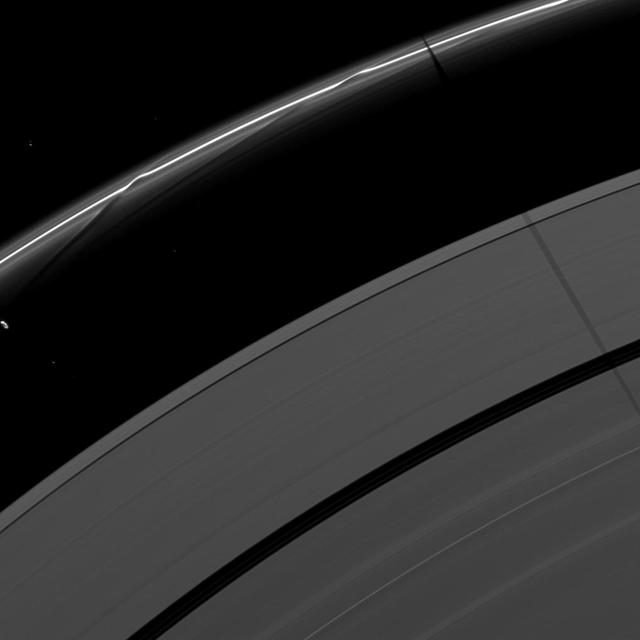
Saturn moon Janus casts a shadow on the F and A rings while the moon Prometheus, seen on the left of the image, creates a streamer-channel in the thin F ring.
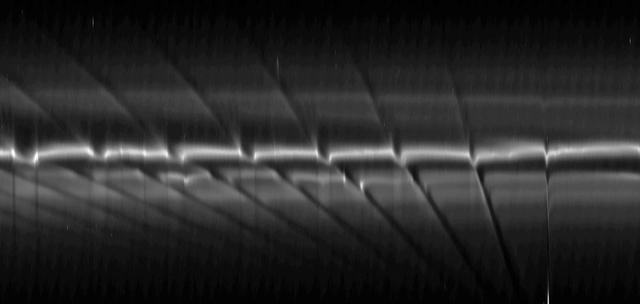
This mosaic of images from NASA Cassini spacecraft depicts fan-like structures in Saturn tenuous F ring. Bright features are also visible near the core of the ring. Such features suggest the existence of additional objects in the F ring.
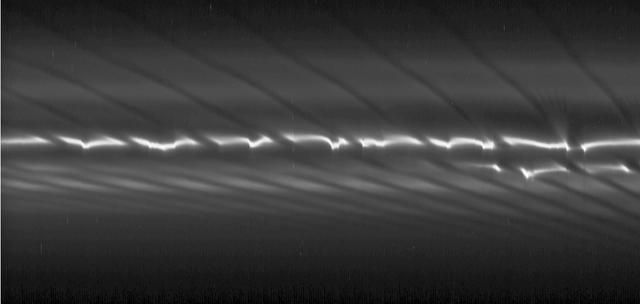
Bright clumps of ring material and a fan-like structure appear near the core of Saturn tenuous F ring in this mosaic of images from NASA Cassini spacecraft. Such features suggest the existence of additional objects in the F ring.
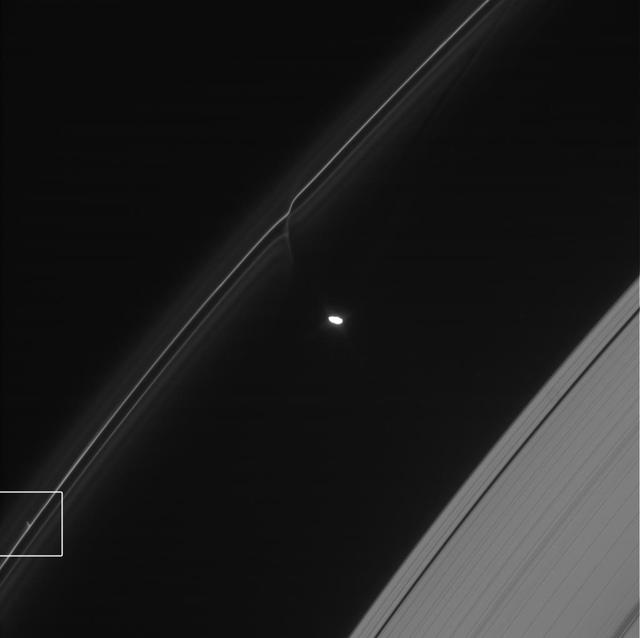
One of the glittering trails caused by small objects punching through Saturn F ring is highlighted in this image from NASA Cassini spacecraft. These trails show how the F ring, the outermost of Saturn main rings, is constantly changing.
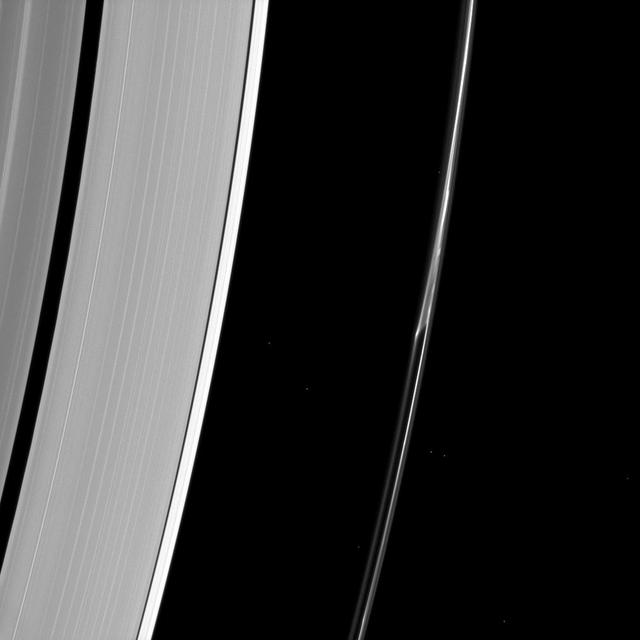
Saturn F ring often appears to do things other rings dont. In this image from NASA Cassini spacecraft, a strand of ring appears to separate from the core of the ring as if pulled apart by mysterious forces.
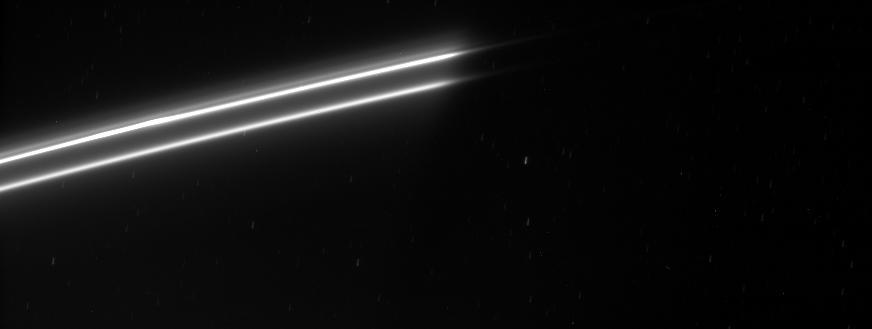
Bright strands in Saturn ever changing F ring emerge from the planet shadow. The F ring usually has a single bright core, about 50 kilometers 31 miles across, but the section of the ring seen here appears to have a second bright strand
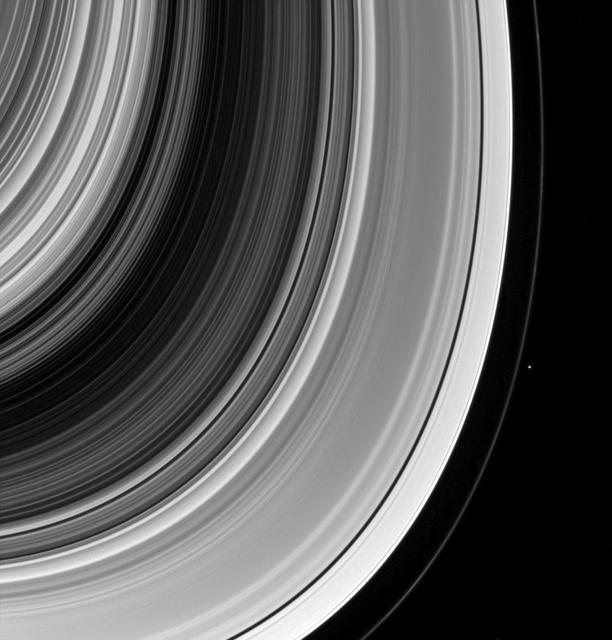
The F ring shepherd Pandora is captured here by NASA Cassini spacecraft along with other well-known examples of Saturn moons shaping the rings. From the narrow F ring, to the gaps in the A ring, to the Cassini Division, Saturn's rings are a masterpiece of gravitational sculpting by the moons. Pandora (50 miles, or 81 kilometers across), along with its fellow shepherd Prometheus (53 miles, or 86 kilometers across), helps confine the F ring and keep it from spreading. This view looks toward the unilluminated side of the rings from about 31 degrees below the ringplane. The image was taken in visible light with the Cassini spacecraft wide-angle camera on March 8, 2014. The view was obtained at a distance of approximately 533,000 miles (858,000 kilometers) from Saturn and at a Sun-Saturn-spacecraft, or phase, angle of 63 degrees. Image scale is 32 miles (51 kilometers) per pixel. http://photojournal.jpl.nasa.gov/catalog/PIA18271
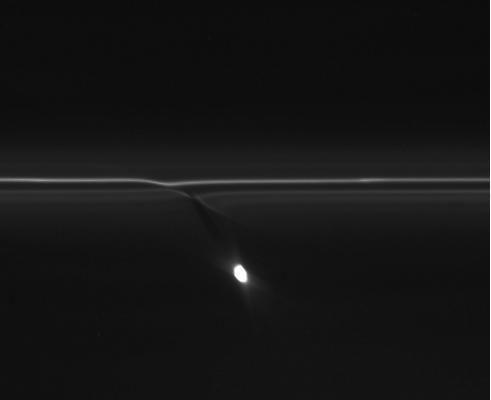
In this image from NASA Cassini spacecraft, the gravitational pull of Saturn moon Prometheus creates patterns in Saturn F ring.
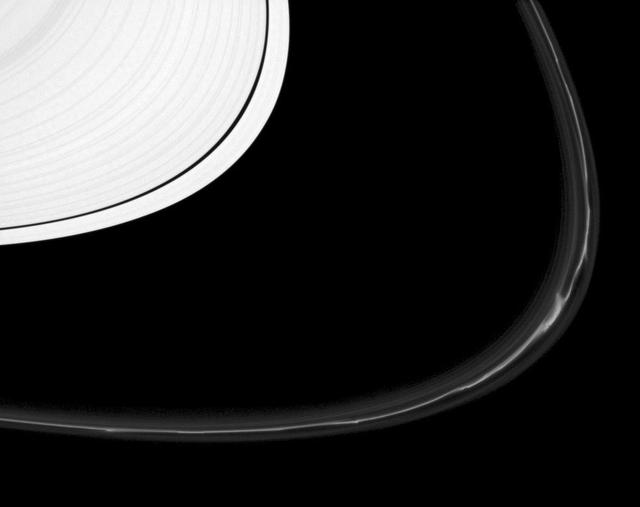
The F ring shows off a rich variety of phenomena in this image from NASA Cassini spacecraft.
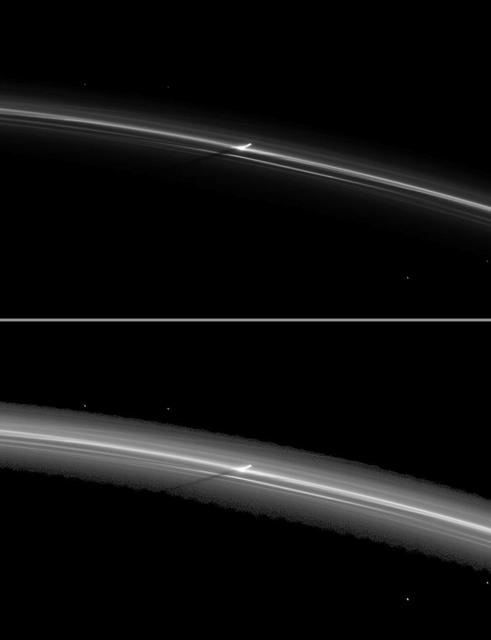
As Saturn approaches its August 2009 equinox, a shadow is cast by a narrow, vertically extended feature in the F ring.
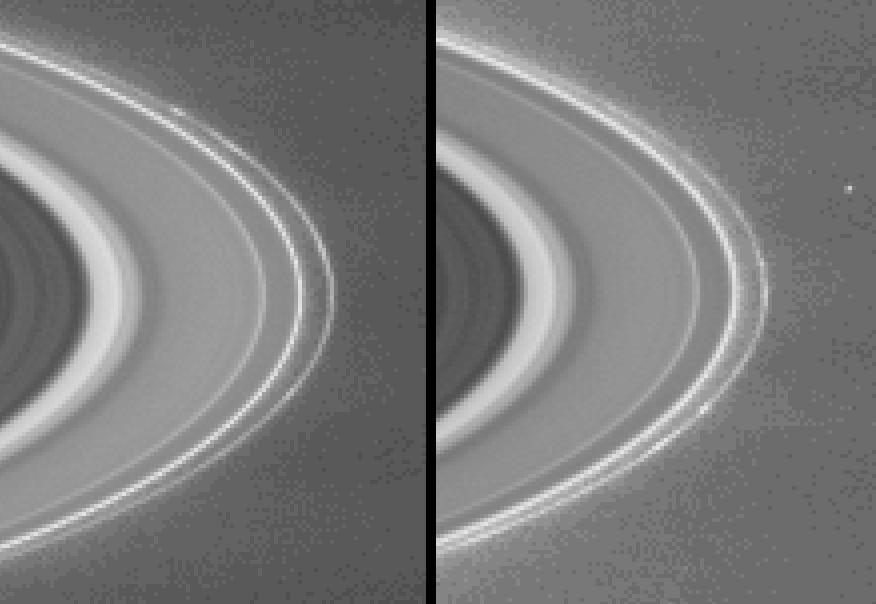
Scientists have only a rough idea of the lifetime of clumps in Saturn's rings - a mystery that Cassini may help answer. The latest images taken by the Cassini-Huygens spacecraft show clumps seemingly embedded within Saturn's narrow, outermost F ring. The narrow angle camera took the images on Feb. 23, 2004, from a distance of 62.9 million kilometers (39 million miles). The two images taken nearly two hours apart show these clumps as they revolve about the planet. The small dot at center right in the second image is one of Saturn's small moons, Janus, which is 181 kilometers, (112 miles) across. Like all particles in Saturn's ring system, these clump features orbit the planet in the same direction in which the planet rotates. This direction is clockwise as seen from Cassini's southern vantage point below the ring plane. Two clumps in particular, one of them extended, is visible in the upper part of the F ring in the image on the left, and in the lower part of the ring in the image on the right. Other knot-like irregularities in the ring's brightness are visible in the image on the right. The core of the F ring is about 50 kilometers (31miles) wide, and from Cassini's current distance, is not fully visible. The imaging team enhanced the contrast of the images and magnified them to aid visibility of the F ring and the clump features. The camera took the images with the green filter, which is centered at 568 nanometers. The image scale is 377 kilometers (234 miles) per pixel. NASA's two Voyager spacecraft that flew past Saturn in 1980 and 1981 were the first to see these clumps. The Voyager data suggest that the clumps change very little and can be tracked as they orbit for 30 days or more. No clump survived from the time of the first Voyager flyby to the Voyager 2 flyby nine months later. Scientists are not certain of the cause of these features. Among the theories proposed are meteoroid bombardments and inter-particle collisions in the F ring. http://photojournal.jpl.nasa.gov/catalog/PIA05382
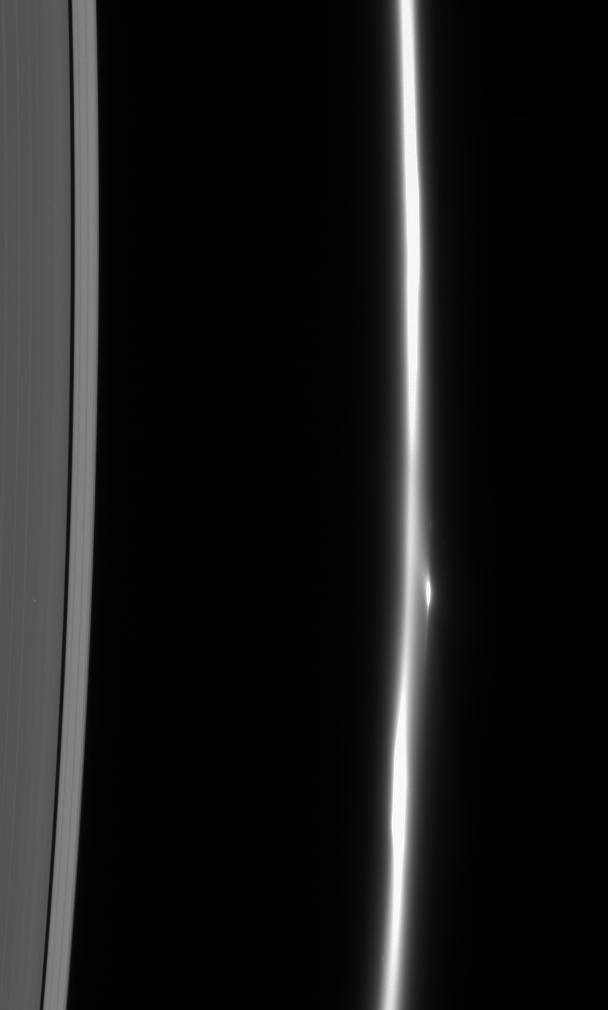
The F ring dissolves into a fuzzy stream of particles -- rather different from its usual appearance of a narrow, bright core flanked by dimmer ringlets. Also notable here is the bright clump of material that flanks the ring core
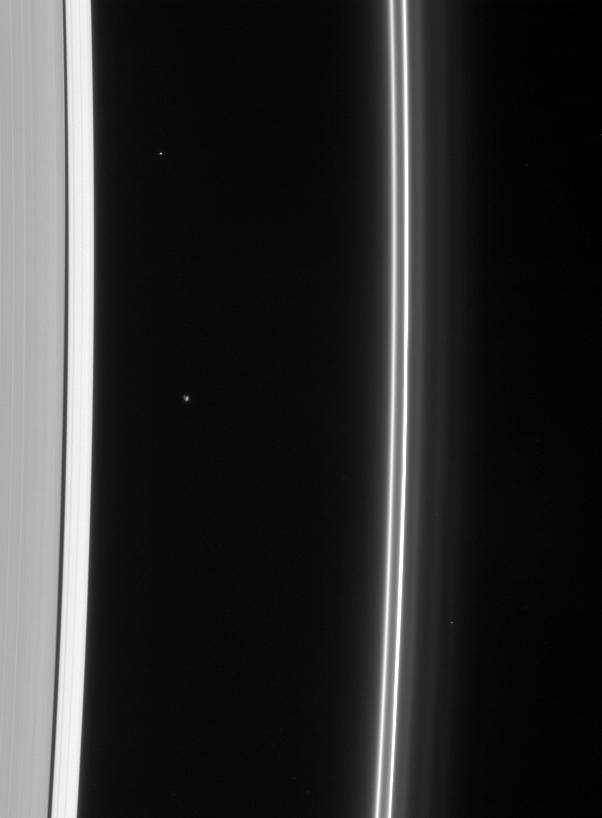
The Cassini spacecraft gazes toward the multiple strands of the ever-changing F ring, also sighting Atlas at its station just beyond the A ring edge. A few faint background stars are visible in the image
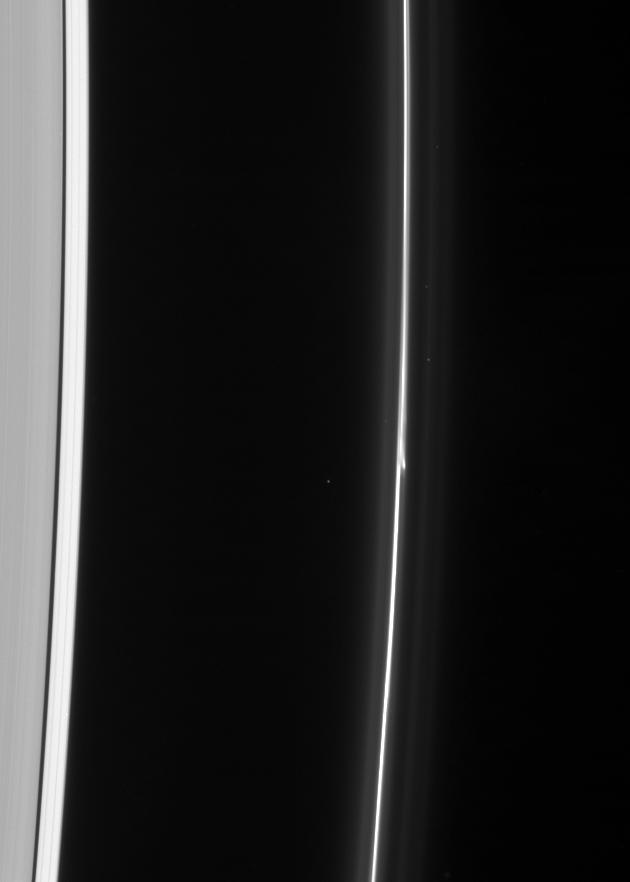
The brilliant core of the F ring displays a breakaway clump of material, possibly related to the other objects the Cassini spacecraft has witnessed in the dynamic ring in the past few years of observations
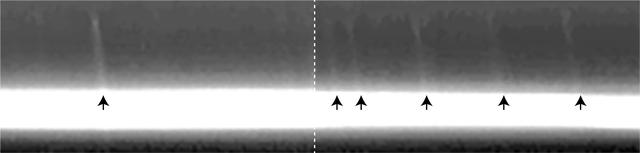
The core region of the F ring is visible here, showing evidence that a population of small objects impacted the rings at the same time and caused streaks of material to emerge. The mini-jets, noted with black arrows, leave trails that extend approximately 19 miles (30 kilometers). They have the same length and orientation, showing that they were likely caused by a flock of impactors that all struck the ring at approximately the same time. This shows that the ring is shaped by streams of material that orbit Saturn itself rather than, for instance, by cometary debris moving around the Sun that happens to crash into the rings. The dashed line in the center of the image indicates where two images were spliced together. The F ring core (at bottom) is overexposed in the figure, partly to enhance the image and make the streaks visible. The figure was produced from ISS narrow-angle camera images taken July 13, 2017. https://photojournal.jpl.nasa.gov/catalog/PIA23169
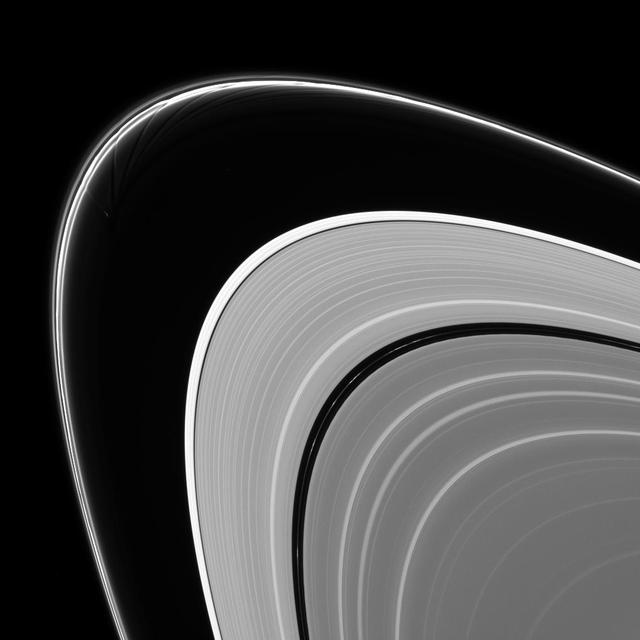
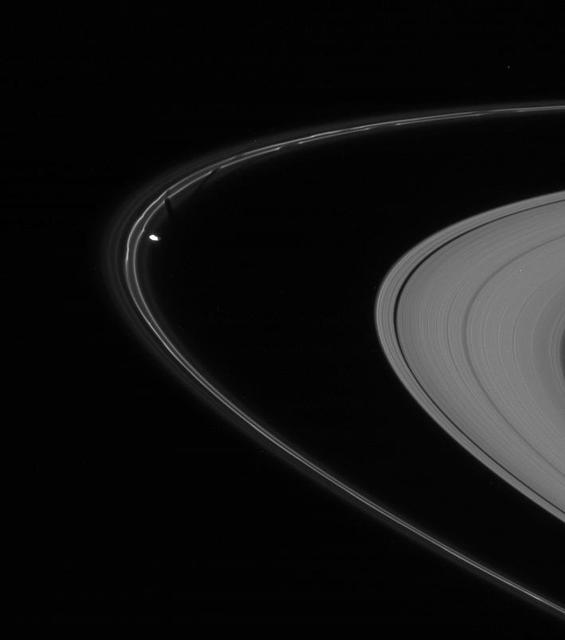
Prometheus is caught in the act of creating gores and streamers in the F ring. Scientists believe that Prometheus and its partner-moon Pandora are responsible for much of the structure in the F ring as shown by NASA Cassini spacecraft. The orbit of Prometheus (53 miles, or 86 kilometers across) regularly brings it into the F ring. When this happens, it creates gores, or channels, in the ring where it entered. Prometheus then draws ring material with it as it exits the ring, leaving streamers in its wake. This process creates the pattern of structures seen in this image. This process is described in detail, along with a movie of Prometheus creating one of the streamer/channel features, in PIA08397. This view looks toward the sunlit side of the rings from about 8.6 degrees above the ringplane. The image was taken in visible light with the Cassini spacecraft narrow-angle camera on Feb. 11, 2014. The view was acquired at a distance of approximately 1.3 million miles (2.1 million kilometers) from Saturn and at a Sun-Saturn-spacecraft, or phase, angle of 147 degrees. Image scale is 8 miles (13 kilometers) per pixel. http://photojournal.jpl.nasa.gov/catalog/PIA18270
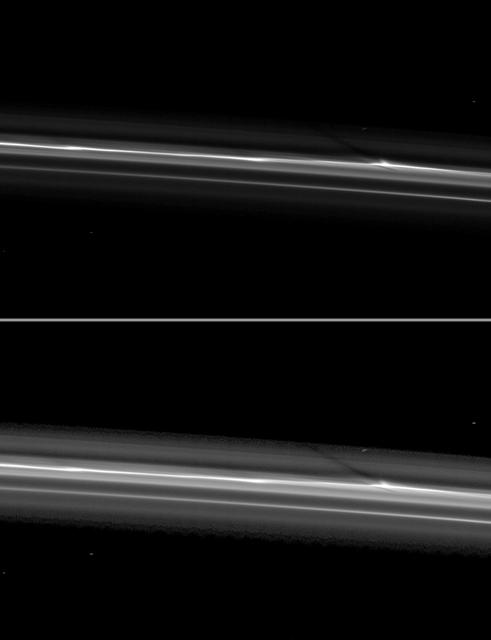
Cassini spies a shadow cast by a vertically extended structure or object in the F ring in this image taken as Saturn approaches its August 2009 equinox.
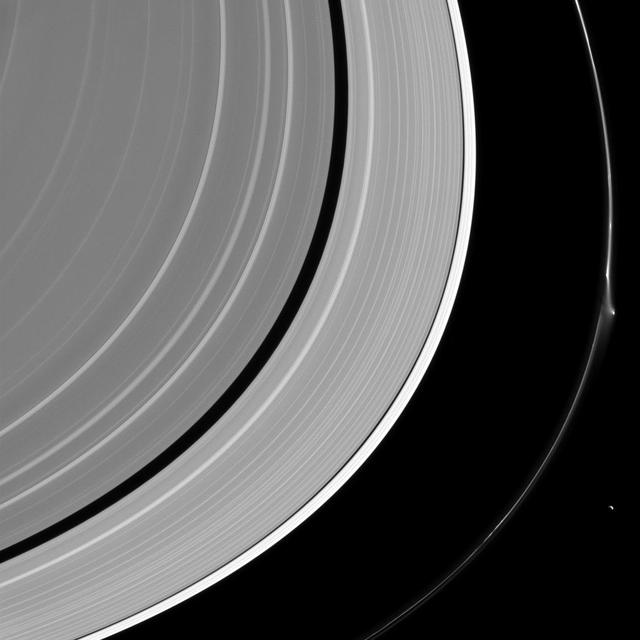
A bright disruption in Saturn's narrow F ring suggests it may have been disturbed recently. This feature was mostly likely not caused by Pandora (50 miles or 81 kilometers across) which lurks nearby, at lower right. More likely, it was created by the interaction of a small object embedded in the ring itself and material in the core of the ring. Scientists sometimes refer to these features as "jets." Because these bodies are small and embedded in the F ring itself, they are difficult to spot at the resolution available to NASA's Cassini spacecraft. Instead, their handiwork reveals their presence, and scientists use the Cassini spacecraft to study these stealthy sculptors of the F ring. This view looks toward the sunlit side of the rings from about 15 degrees above the ring plane. The image was taken in visible light with the Cassini spacecraft narrow-angle camera on April 8, 2016. The view was acquired at a distance of approximately 1.4 million miles (2.2 million kilometers) from Saturn and at a Sun-Saturn-spacecraft, or phase, angle of 105 degrees. Image scale is 8 miles (13 kilometers) per pixel. http://photojournal.jpl.nasa.gov/catalog/PIA20485

This image is from a set of mosaic images from NASA Cassini spacecraft showing three fan-like structures in Saturn tenuous F ring. Such fans suggest the existence of additional objects in the F ring.
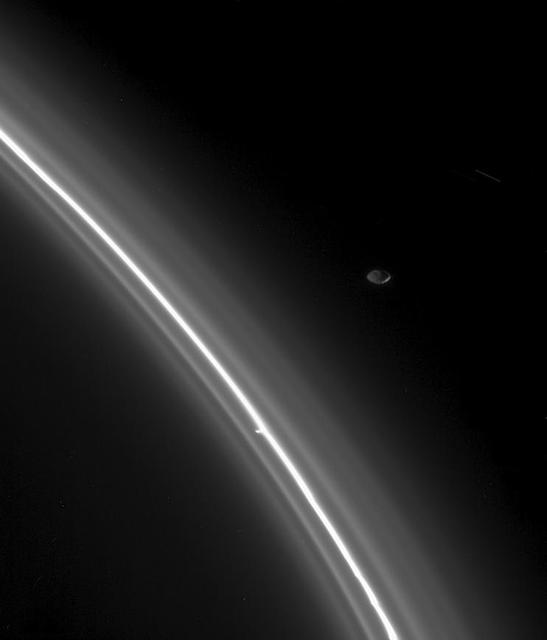
From just outside the faint edge of Saturn's F ring, the moon Pandora keeps watch over her fine-grained flock. The outer flanks of the F ring region are populated by ice particles approaching the size of the particles comprising smoke. As a shepherd moon, Pandora helps her cohort Prometheus confine and shape the main F ring. Pandora is 84 kilometers (52 miles) across. Prometheus is 102 kilometers (63 miles) wide and orbits interior to the F ring. The small knot seen attached to the core is one of several that Cassini scientists are eyeing as they attempt to distinguish embedded moons from transient clumps of material (see PIA07716). The image was taken with the Cassini spacecraft narrow-angle camera on Aug. 2, 2005, using a filter sensitive to wavelengths of infrared light centered at 930 nanometers at a distance of approximately 610,000 kilometers (379,000 miles) from Pandora and at a Sun-Pandora-spacecraft, or phase, angle of 146 degrees. Image scale is 4 kilometers (2 miles) per pixel. http://photojournal.jpl.nasa.gov/catalog/PIA07579
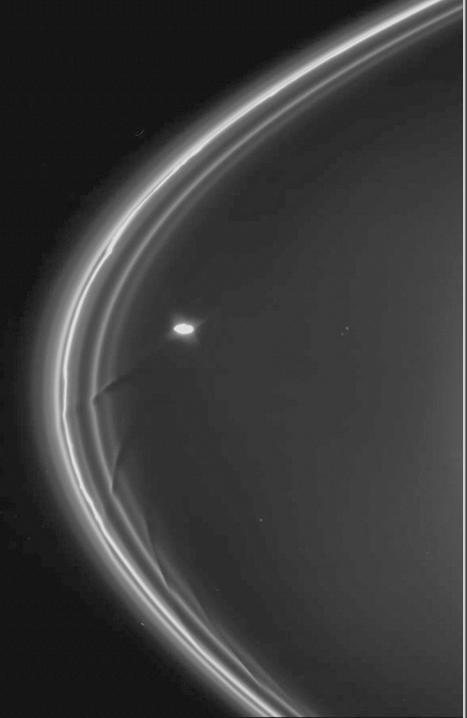
This image is from a simulation showing the changes to a portion of Saturn F ring as the shepherding moon Prometheus swings by it. The animation uses data obtained by the imaging cameras aboard NASA Cassini spacecraft.
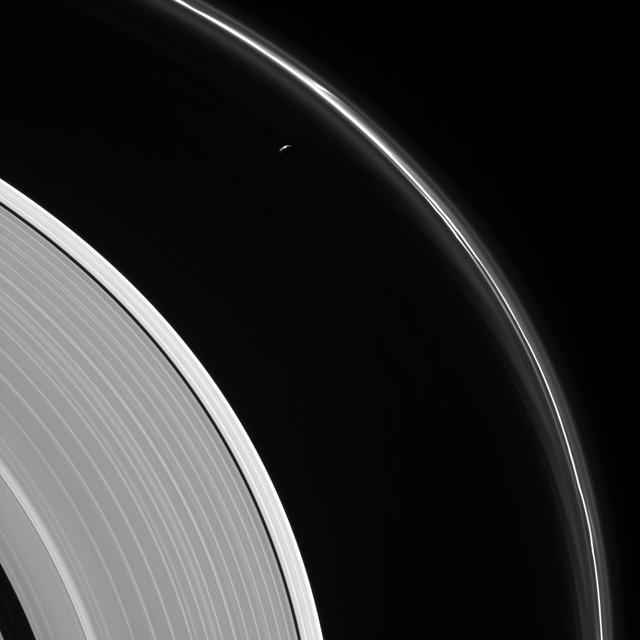
The thin sliver of Saturn's moon Prometheus lurks near ghostly structures in Saturn's narrow F ring in this view from NASA's Cassini spacecraft. Many of the narrow ring's faint and wispy features result from its gravitational interactions with Prometheus (86 kilometers, or 53 miles across). Most of the small moon's surface is in darkness due to the viewing geometry here. Cassini was positioned behind Saturn and Prometheus with respect to the sun, looking toward the moon's dark side and just a bit of the moon's sunlit northern hemisphere. Also visible here is a distinct difference in brightness between the outermost section of Saturn's A ring (left of center) and rest of the ring, interior to the Keeler Gap (lower left). This view looks toward the sunlit side of the rings from about 13 degrees above the ring plane. The image was taken in visible light with the Cassini spacecraft narrow-angle camera on May 13, 2017. The view was acquired at a distance of approximately 680,000 miles (1.1 million kilometers) from Saturn. Image scale is 4 miles (6 kilometers) per pixel. https://photojournal.jpl.nasa.gov/catalog/PIA21340
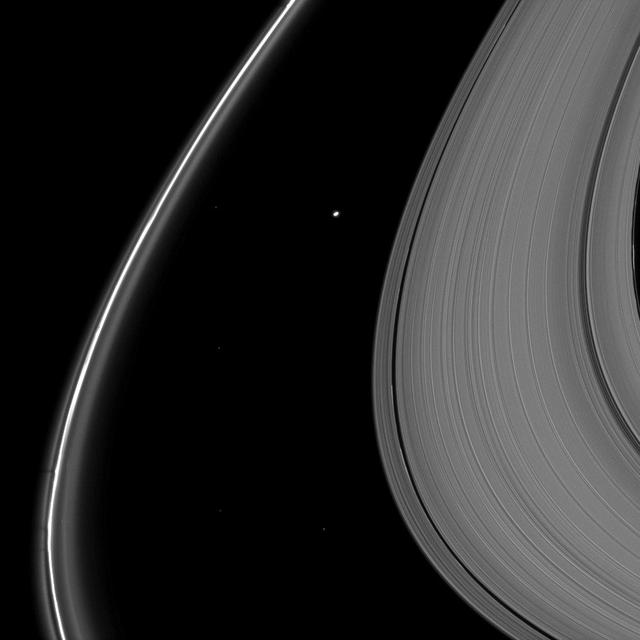
Delicate shadows are cast outward from Saturn thin F ring in the lower left of this image taken as the planet approached its August 2009 equinox. The moon Atlas 30 kilometers, or 19 miles across is seen just above the center of the image.
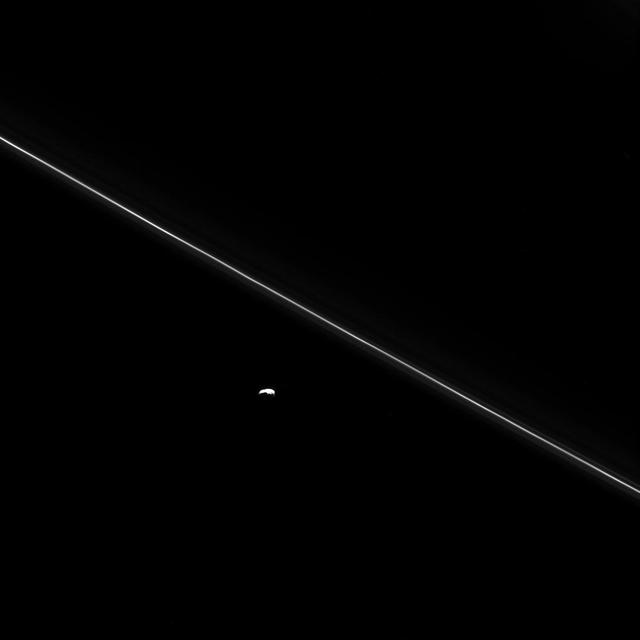
As Cassini hurtled toward its fatal encounter with Saturn, the spacecraft turned to catch this final look at Saturn's moon Pandora next to the thin line of the F ring. Over the course of its mission, Cassini helped scientists understand that Pandora plays a smaller role than they originally thought in shaping the narrow ring. When Cassini arrived at Saturn, many thought that Pandora and Prometheus worked together to shepherd the F ring between them, confining it and sculpting its unusual braided and kinked structures. However, data from Cassini show that the gravity of the two moons together actually stirs the F ring into a chaotic state, generating the "gap and streamer" structure. Recent models, supported by Cassini images, suggest that it is Prometheus alone, not Pandora, that confines the bulk of the F ring, aided by the particular characteristics of its orbit. Prometheus establishes stable locations for F ring material where the moon's own gravitational resonances are least cluttered by the perturbing influence of its sibling satellite, Pandora. This view looks toward the sunlit side of the rings from about 28 degrees above the ringplane. The image was taken in visible light with the Cassini spacecraft narrow-angle camera on Sept. 14, 2017. The view was obtained at a distance of approximately 360,000 miles (577,000 kilometers) from Pandora and at a Sun-Pandora-spacecraft, or phase, angle of 119 degrees. Image scale is about 2.2 miles (3.5 kilometers) per pixel. The Cassini spacecraft ended its mission on Sept. 15, 2017. https://photojournal.jpl.nasa.gov/catalog/PIA21355
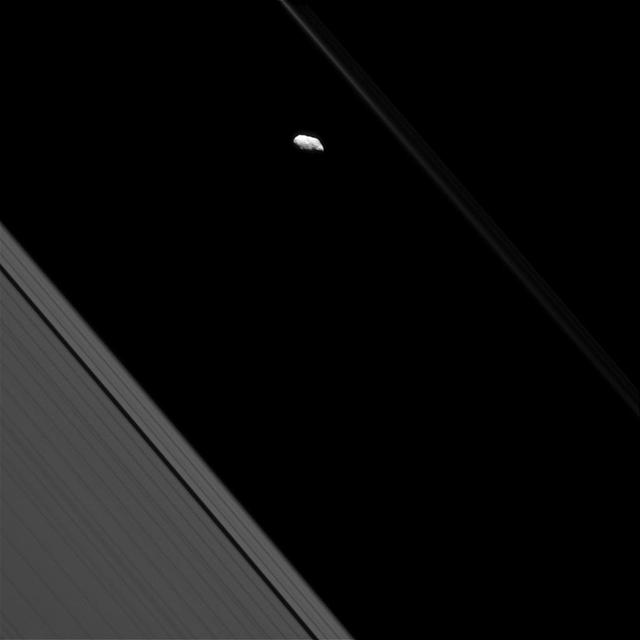
Surface features are visible on Saturn's moon Prometheus in this view from NASA's Cassini spacecraft. Most of Cassini's images of Prometheus are too distant to resolve individual craters, making views like this a rare treat. Saturn's narrow F ring, which makes a diagonal line beginning at top center, appears bright and bold in some Cassini views, but not here. Since the sun is nearly behind Cassini in this image, most of the light hitting the F ring is being scattered away from the camera, making it appear dim. Light-scattering behavior like this is typical of rings comprised of small particles, such as the F ring. This view looks toward the unilluminated side of the rings from about 14 degrees below the ring plane. The image was taken in visible light with the Cassini spacecraft narrow-angle camera on Sept. 24, 2016. The view was acquired at a distance of approximately 226,000 miles (364,000 kilometers) from Prometheus and at a sun-Prometheus-spacecraft, or phase, angle of 51 degrees. Image scale is 1.2 miles (2 kilometers) per pixel. http://photojournal.jpl.nasa.gov/catalog/PIA20508
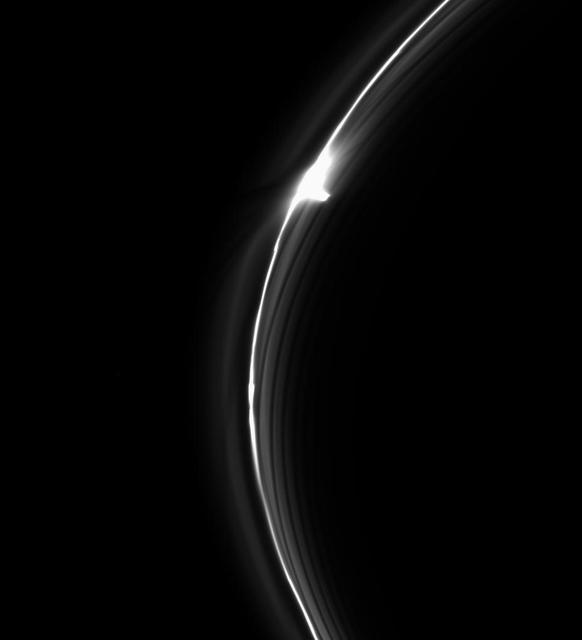
Saturn's dynamic F ring contains many different types of features to keep scientists perplexed. In this image we see features ring scientists call "gores," to the right of the bright clump, and a "jet," to the left of the bright spot. Thanks to the ring's interaction with the moons Prometheus and Pandora, and perhaps a host of smaller moonlets hidden in its core, the F ring is a constantly changing structure, with features that form, fade and re-appear on timescales of hours to days. This view looks toward the unilluminated side of the rings from about 7 degrees below the ring plane. The image was taken in visible light with the Cassini spacecraft narrow-angle camera on March 15, 2015. The view was acquired at a distance of approximately 295,000 miles (475,000 kilometers) from Saturn and at a Sun-ring-spacecraft, or phase, angle of 117 degrees. Image scale is 1.8 miles (2.9 kilometers) per pixel. http://photojournal.jpl.nasa.gov/catalog/PIA18337
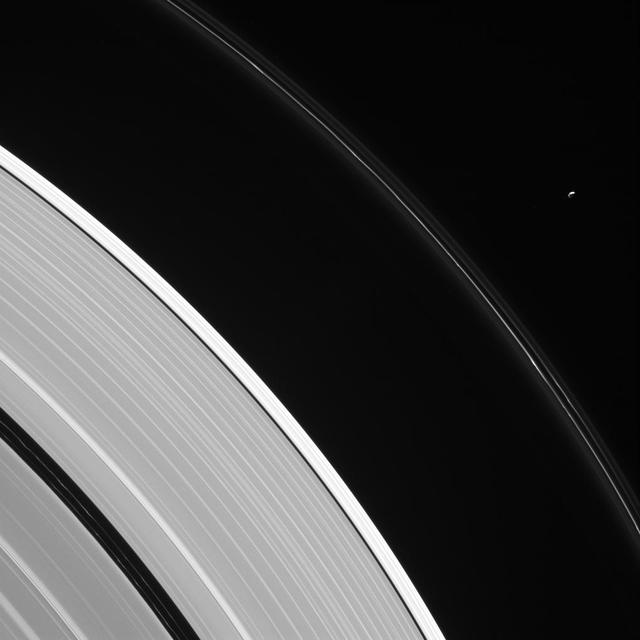
Pandora is seen here, in isolation beside Saturn's kinked and constantly changing F ring. Pandora (near upper right) is 50 miles (81 kilometers) wide. The moon has an elongated, potato-like shape (see PIA07632). Two faint ringlets are visible within the Encke Gap, near lower left. The gap is about 202 miles (325 kilometers) wide. The much narrower Keeler Gap, which lies outside the Encke Gap, is maintained by the diminutive moon Daphnis (not seen here). This view looks toward the sunlit side of the rings from about 23 degrees above the ring plane. The image was taken in visible light with the Cassini spacecraft narrow-angle camera on Aug. 12, 2016. The view was acquired at a distance of approximately 907,000 miles (1.46 million kilometers) from Saturn and at a Sun-Saturn-spacecraft, or phase, angle of 113 degrees. Image scale is 6 miles (9 kilometers) per pixel. http://photojournal.jpl.nasa.gov/catalog/PIA20504
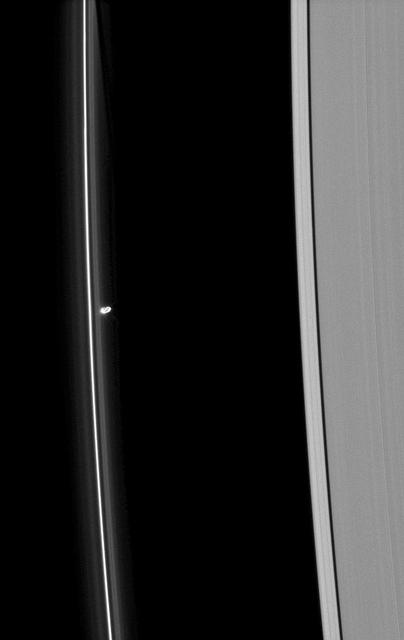
Prometheus is seen near Saturn tenuous F ring as the moon orbits in the Roche Division, between the F and A rings.
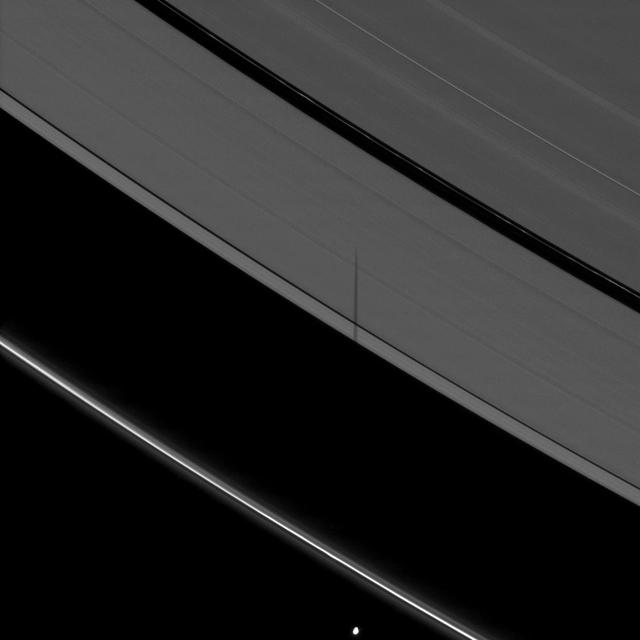
The moon Pandora casts a shadow onto Saturn A ring but not the F ring.
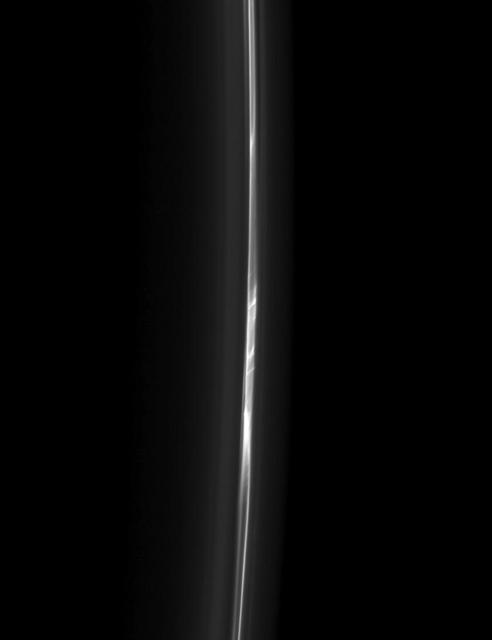
Forever changing, the F ring takes on a ladder-like appearance in this recent image from NASA Cassini spacecraft. Scientists believe that interactions between the F ring and the moons Prometheus and Pandora cause the dynamic structure of the ring.
Prometheus draws a fresh streamer of material from the F ring as it passes the ring interior edge. The streamer will continuously shear out as it orbits the planet, becoming more elongated and increasingly aligned with the F ring with time
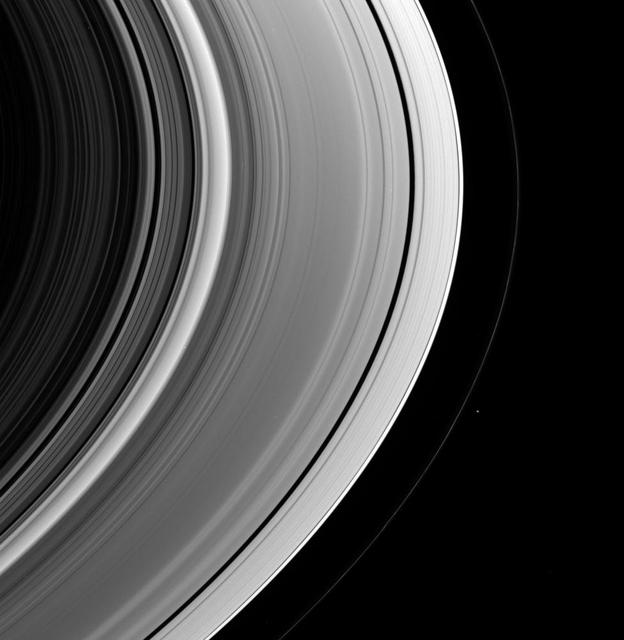
This view of the unlit side of Saturn rings captures the small shepherd moon Pandora as it swings around the outside of the F ring. The F ring displays a few discrete bright clumps here
Prometheus zooms across the Cassini spacecraft field of view, attended by faint streamers and deep gores in the F ring. This movie sequence of five images shows the F ring shepherd moon shaping the ring inner edge
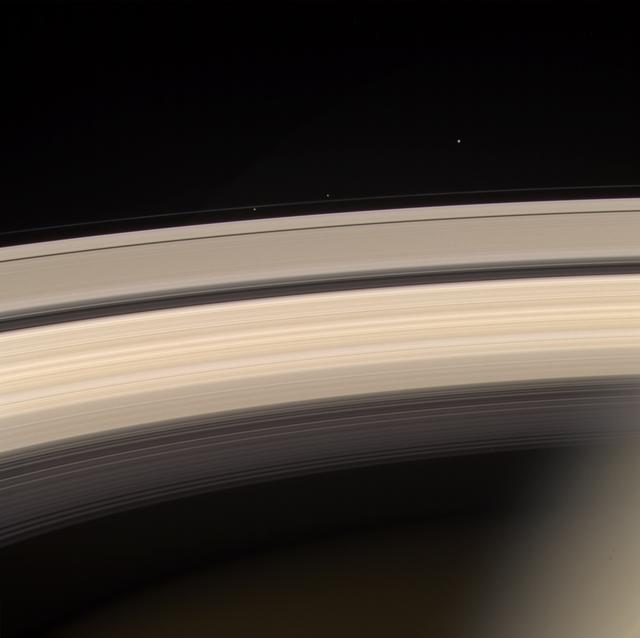
Saturn and its rings are prominently shown in this color image, along with three of Saturn's smaller moons. From left to right, they are Prometheus, Pandora and Janus. Prometheus and Pandora are often called the "F ring shepherds" as they control and interact with Saturn's interesting F ring, seen between them. This image was taken on June 18, 2004, with the Cassini spacecraft narrow angle camera 8.2 million kilometers (5.1 million miles) from Saturn. It was created using the red, green, and blue filters. Contrast has been enhanced to aid visibility. http://photojournal.jpl.nasa.gov/catalog/PIA06422
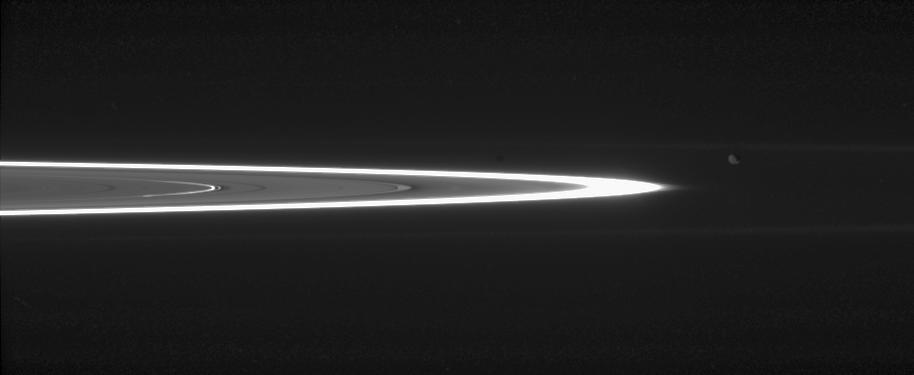
Tiny, dust-sized particles in Saturn rings become much easier to see at high phase angle -- the angle formed by the Sun, the rings and the spacecraft. The brightest ring is the F ring; the next feature to the left is the outer edge of the A ring
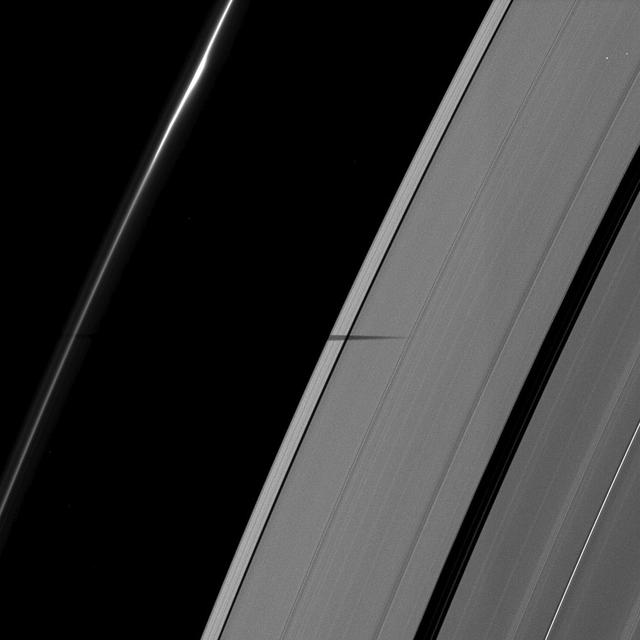
The shadow of the moon Epimetheus is cast onto Saturn rings, striking the outer-most part of the A ring and only just nipping the F ring.
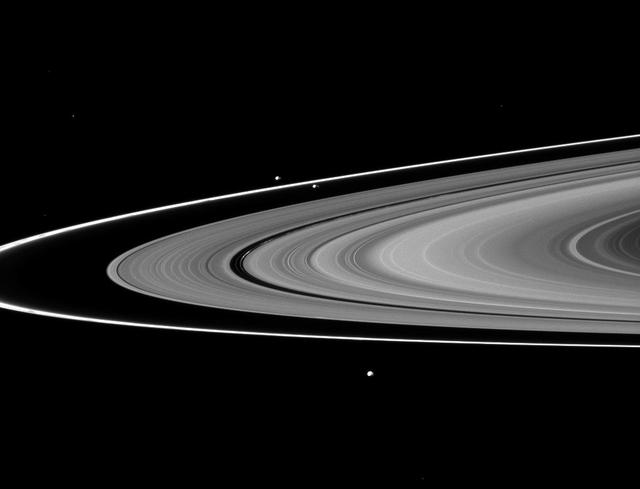
The F ring shepherds, Prometheus and Pandora, join Epimetheus in this image taken by NASA Cassini spacecraft of three of Saturn moons and the rings.
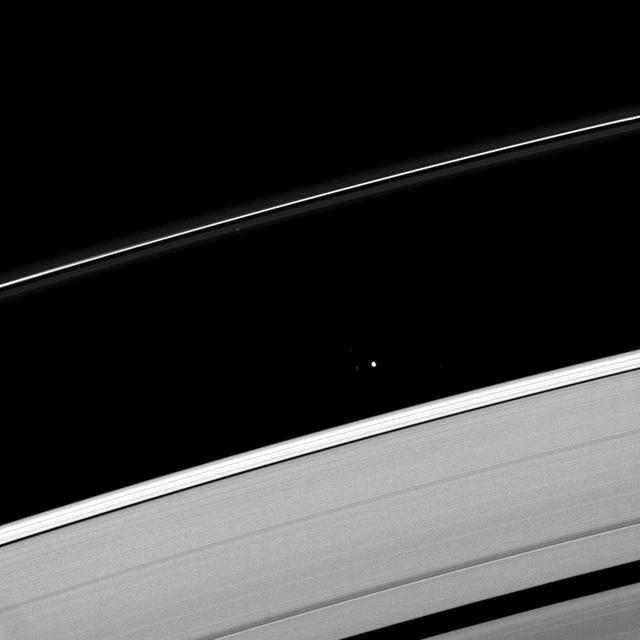
Saturn moon Atlas plies the Roche Division between the A ring and the thin F ring.
The striated appearance of the F ring is immediately apparent in the region of the ring that trails behind the moon Prometheus

Gazing across the plains of Saturn icy rings, Cassini catches the F ring shepherd moon Pandora hovering in the distance
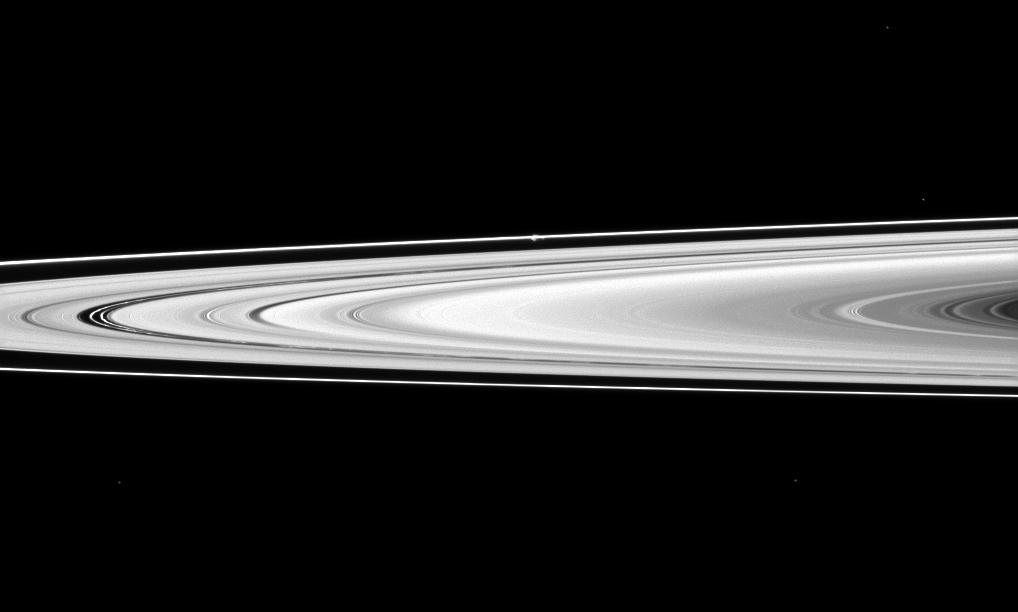
NASA Cassini spacecraft looks across Saturn rings and finds the moon Prometheus, a shepherd of the thin F ring. Prometheus looks like a small white bulge near the F ring -- the outermost ring seen here -- above the center of the image.
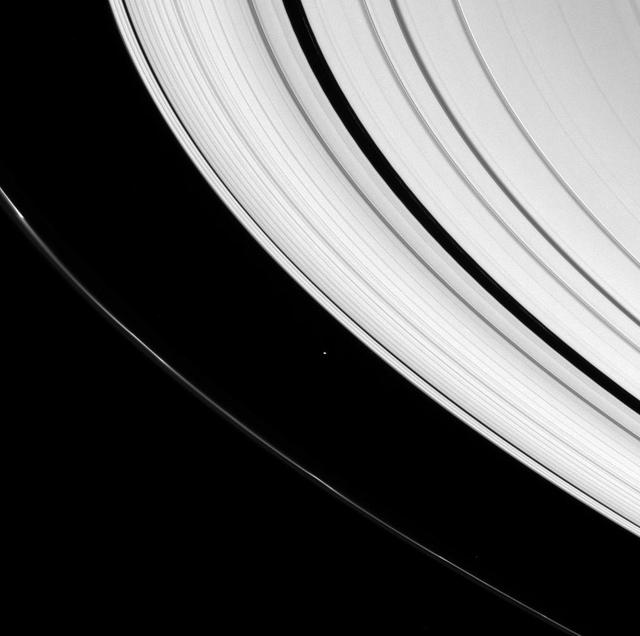
A small icy world plies the space between Saturn A and F rings
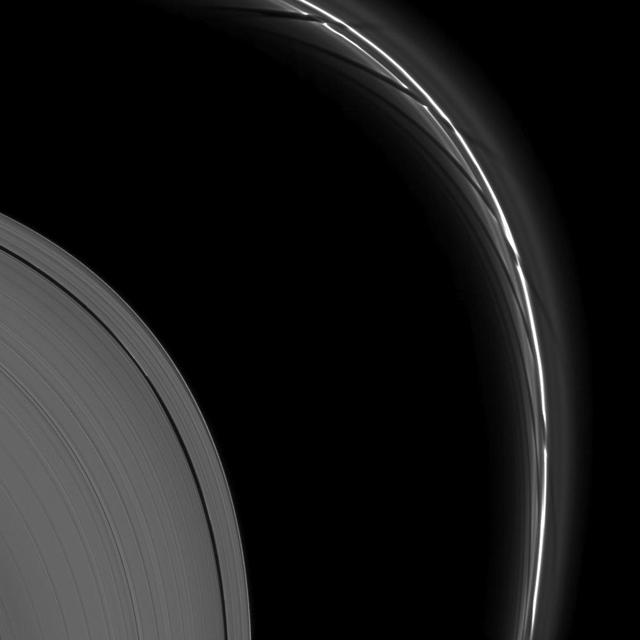
The effects of the moon Prometheus create intricate formations in Saturn thin F ring.
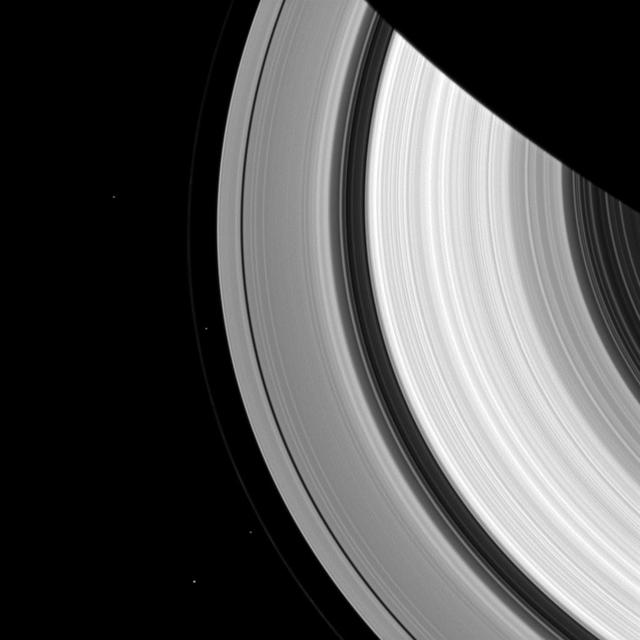
A close-up of the F ring shows dark gores in its interior faint ringlets following the passage of Prometheus. Each gore represents a single interaction of the moon with the F ring material

Saturn moon Prometheus orbits near some of its handiwork in the F ring in this image from NASA Cassini spacecraft. Prometheus and its partner Pandora gravitationally sculpt and maintain the narrow F ring.
Two pairs of moons make a rare joint appearance. The F ring shepherd moons, Prometheus and Pandora, appear just inside and outside of the F ring the thin faint ring furthest from Saturn as seen by NASA Cassini spacecraft.
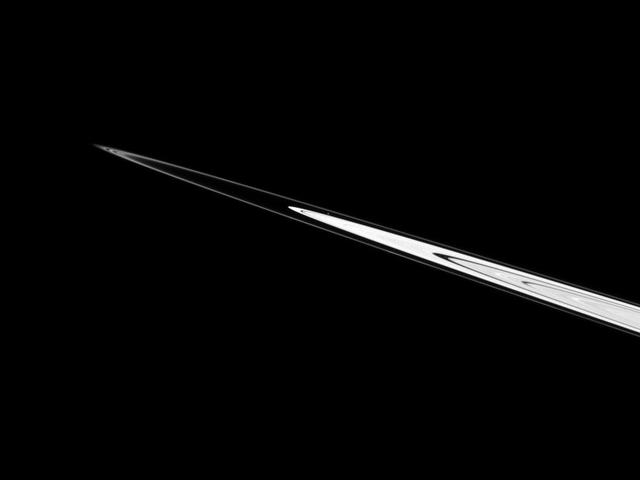
Atlas can be seen just above the center of this NASA Cassini spacecraft image as the moon orbits in the Roche Division between Saturn A ring and thin F ring.
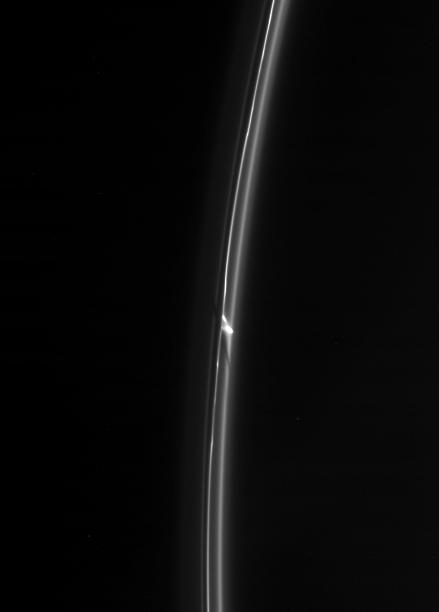
The Cassini spacecraft spies an intriguing bright clump in Saturn F ring. Also of interest is the dark gash that appears to cut through the ring immediately below the clump
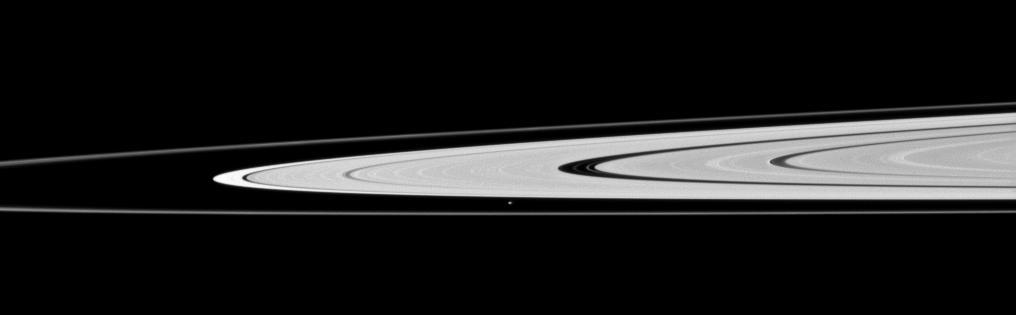
Saturn moon Atlas, just below the center of this image taken by NASA Cassini spacecraft, orbits in the Roche Division between the A ring and thin F ring.
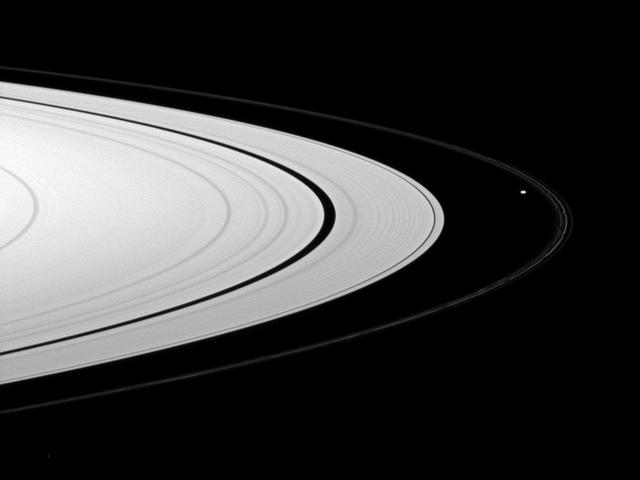
Saturn A ring appears bright compared to the thin F ring, which is shepherded by the moon Prometheus, in this view from NASA Cassini spacecraft.
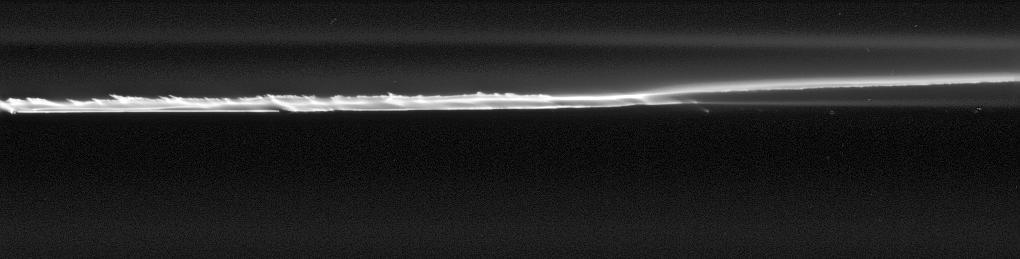
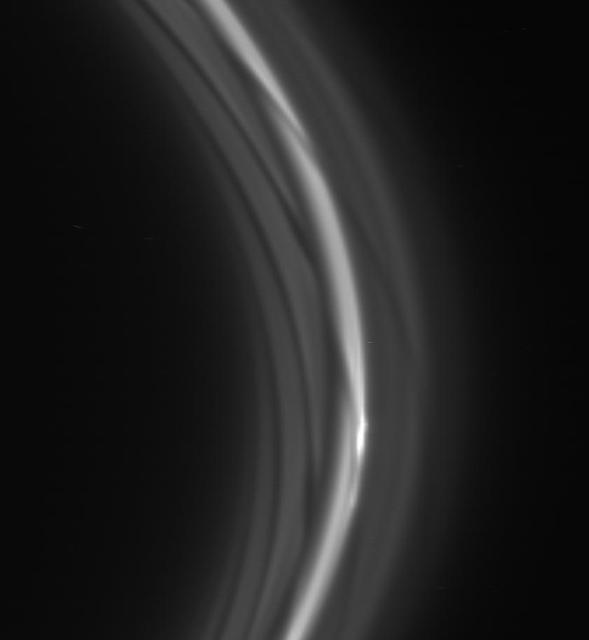
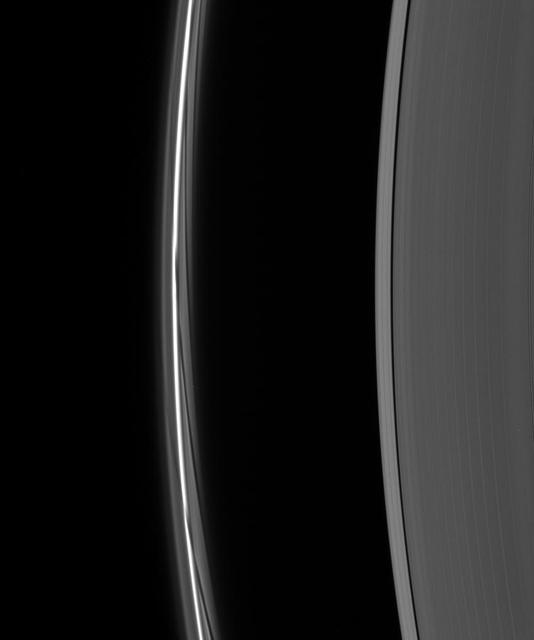
This close-up view of the core of Saturn narrow outlying F ring provides an unprecedented look at the fine scale structure of this highly perturbed ring
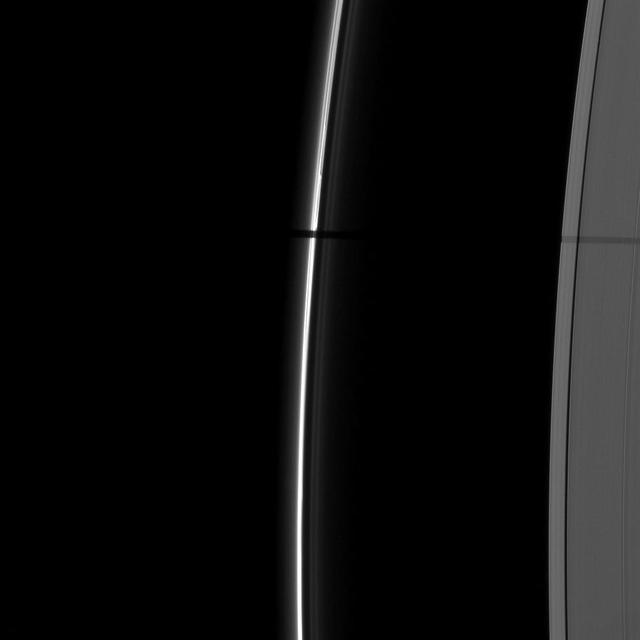
A wide shadow is cast onto the thin F ring and the A ring by the moon Janus in this image taken as Saturn approached its August 2009 equinox.
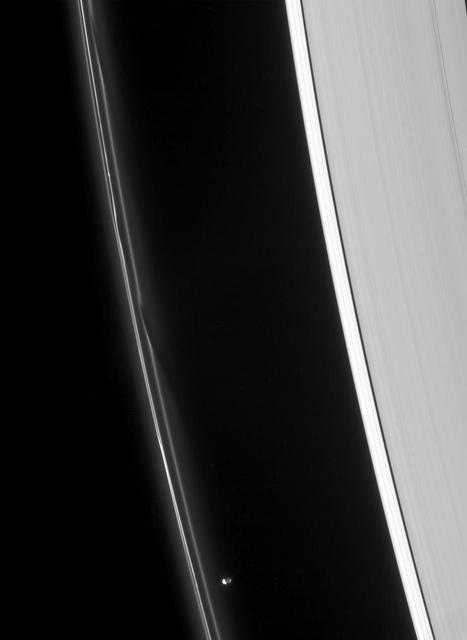
Prometheus speeds ahead of two dark gores in the F ring inner edge. The ring bright core swerves and twirls in its wake
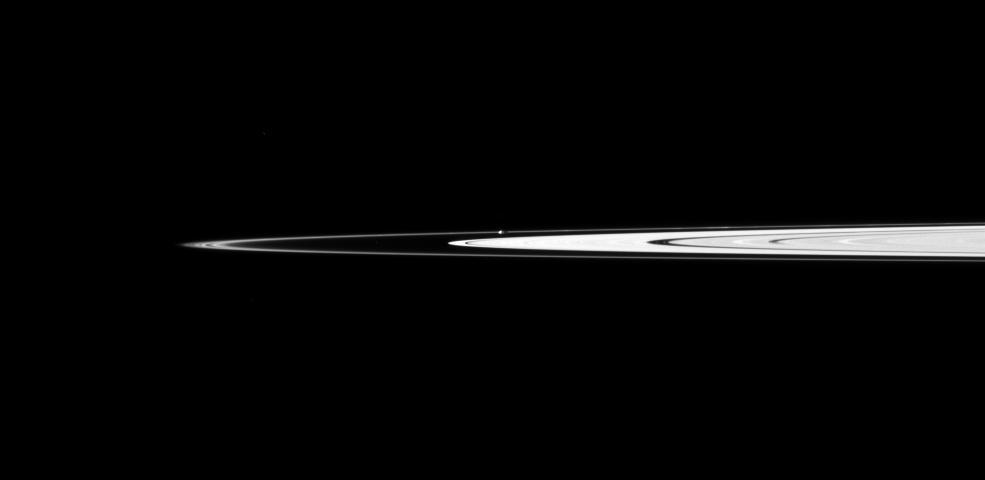
Saturn small, potato-shaped moon Prometheus orbits between the main rings and the thin F ring in this view captured by NASA Cassini spacecraft.
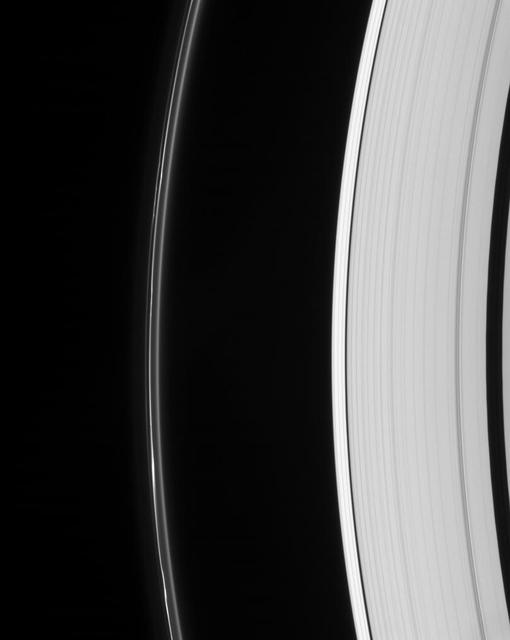
Saturn odd but ever-intriguing F ring displays multiple lanes and several bright clumps. The Keeler and Encke gaps are visible in the outer A ring, at right
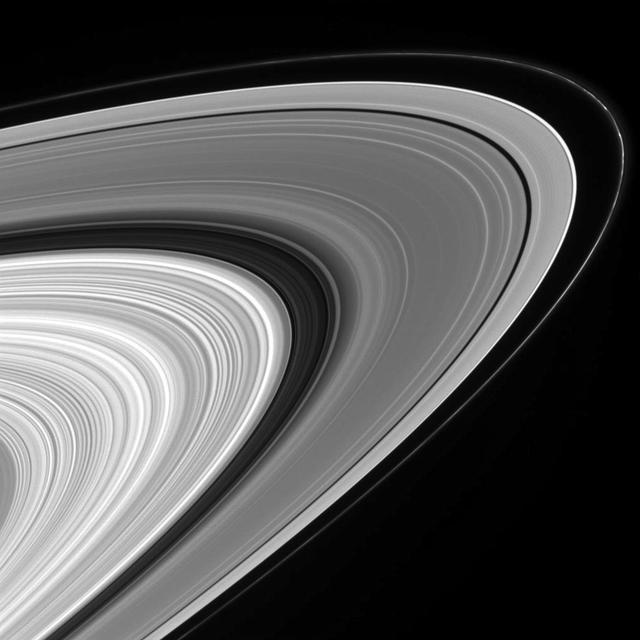
This wide and sweeping view of the sunlit rings of Saturn takes in the impressive variety in their structure -- from the clumpy and perennially intriguing F ring to the many waves, ringlets and gaps in the A and B rings and the Cassini Division in between
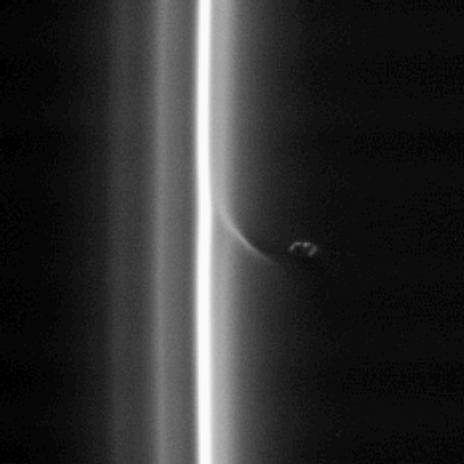
This view shows Prometheus with a streamer it has created in the inner edge of the F ring. Prometheus comes close to the inner edge of the ring once per orbit, perturbing the ring particles there
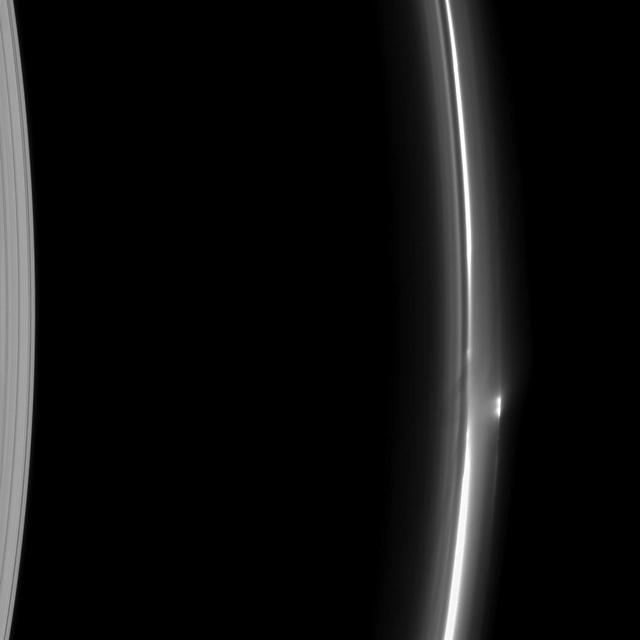
The rich dynamics of Saturn F ring are seen in this image taken by NASA Cassini spacecraft. Most of the features are believed to be due to the ring interactions with its shepherd moons or with small moonlets embedded within the ring itself.
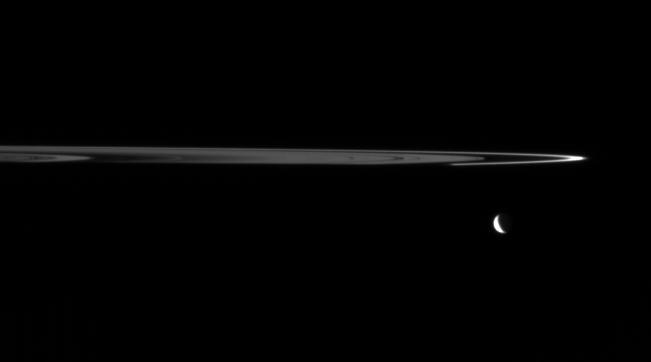
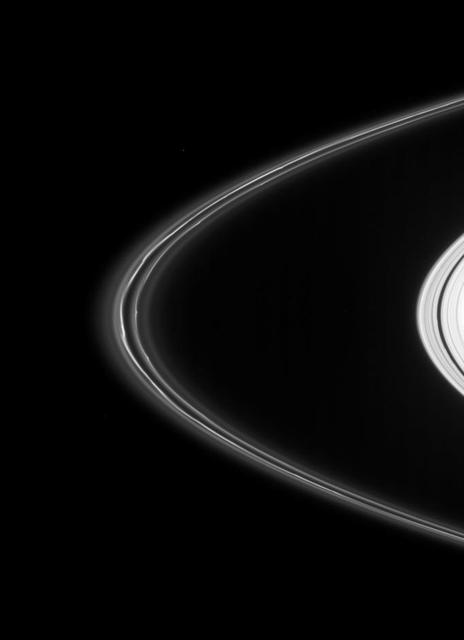
Cassini finds artistic harmony in the dark and icy realm of Saturn. The dim, unlit side of the rings is shown here. The narrow F ring appears bright when seen from angles near the plane of the rings
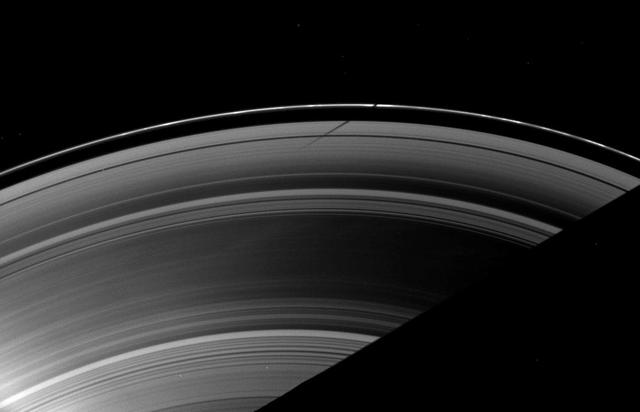
The shadow of the moon Mimas strikes the F ring at a different angle than the angle at which it is cast on the A ring, illustrating differences in the vertical heights of the rings in this image taken as Saturn approaches its August 2009 equinox.
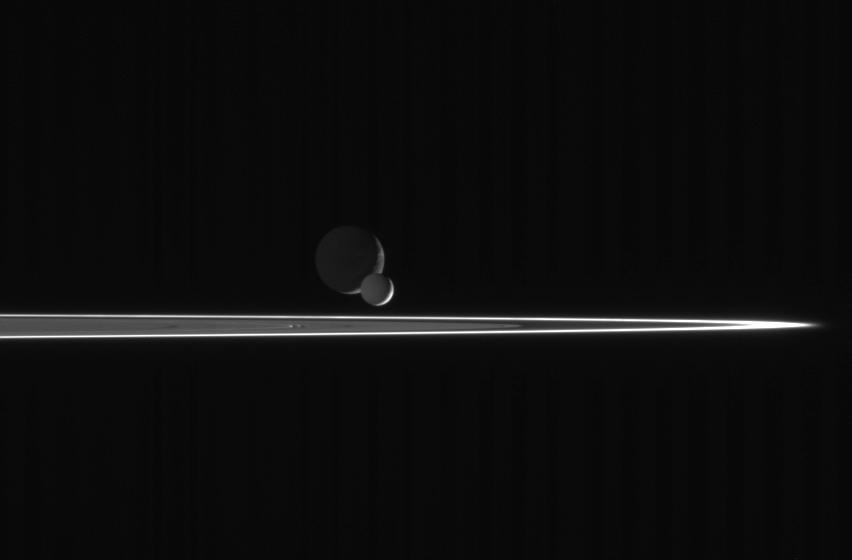
s our robotic emissary to Saturn, the Cassini spacecraft is privileged to behold such fantastic sights as this pairing of two moons beyond the rings. The bright, narrow F ring is the outermost ring structure seen here
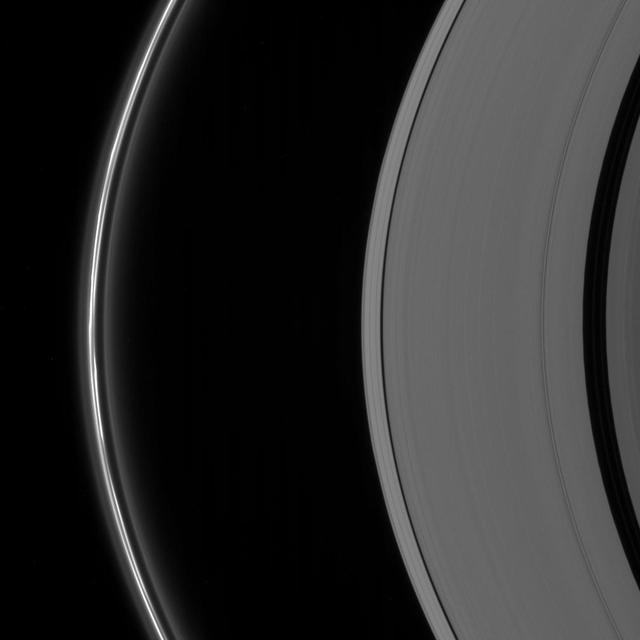
The clumpy disturbed appearance of the brilliant F ring constantly changes. The irregular structure of the ring is due, in large part, to the gravitational perturbations on the ring material by one of Saturn moons, Prometheus
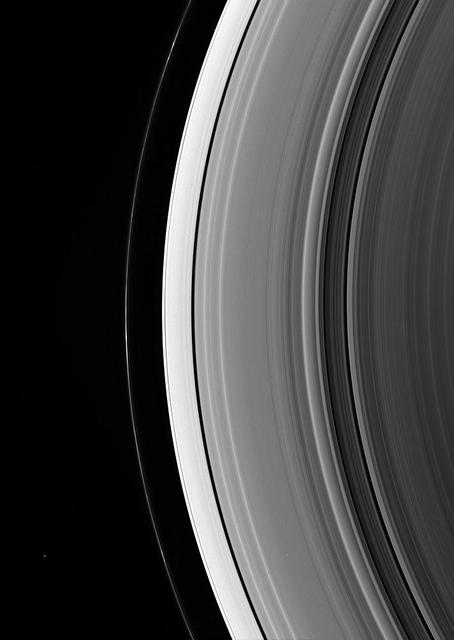
Epimetheus is a lonely dot beyond Saturn rings. The little moon appears at lower left, outside the narrow F ring. Several very faint spokes lurk in the B ring, at right