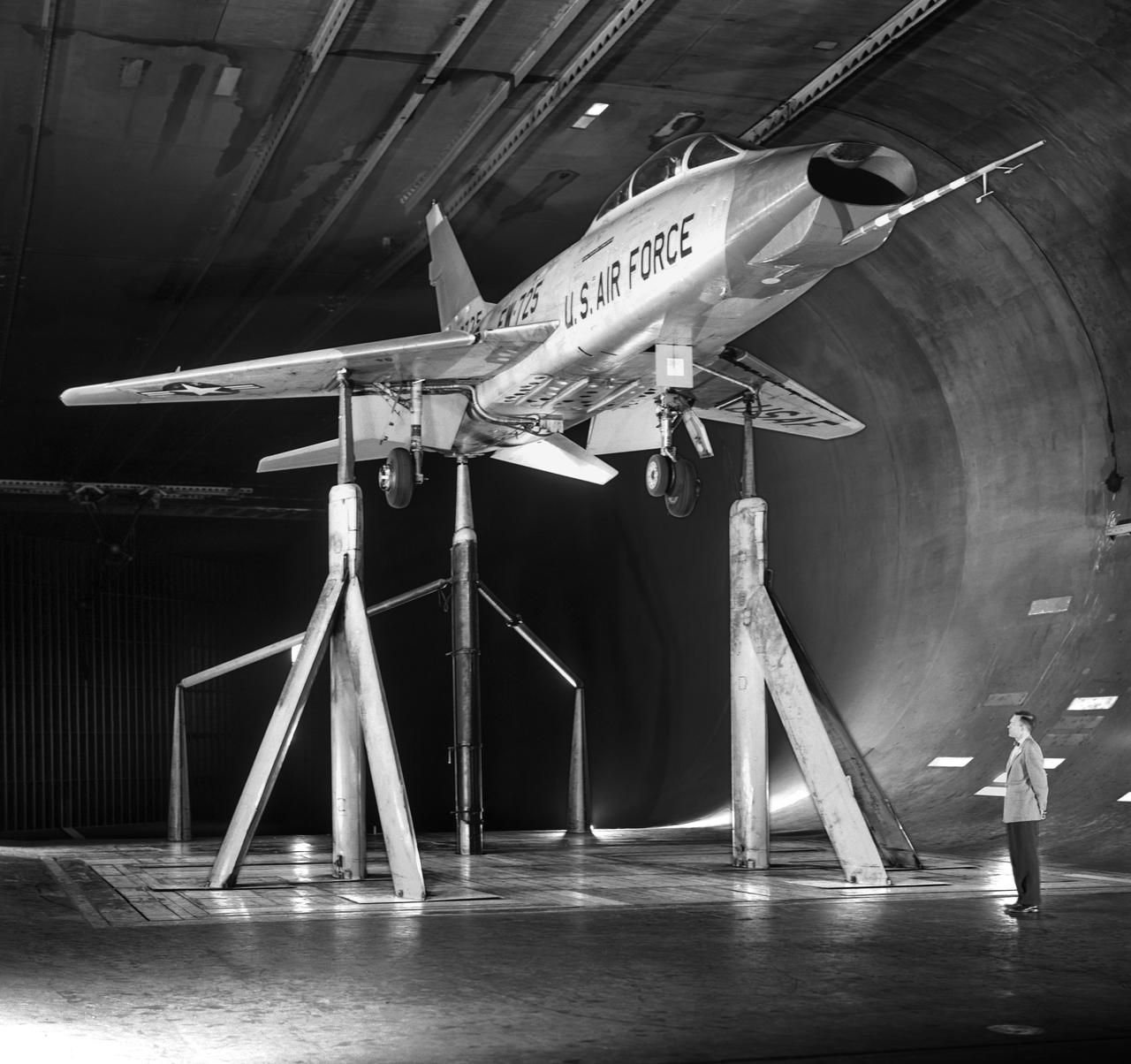
North American F-100-F airplane, equipped with thrust reversers, full scale wind tunnel test. 3/4 front view of F-100-F airplane with North American Aviation thrust reverser. On standard 40x80 struts landing gear down. Mark Kelly, branch chief in photo.
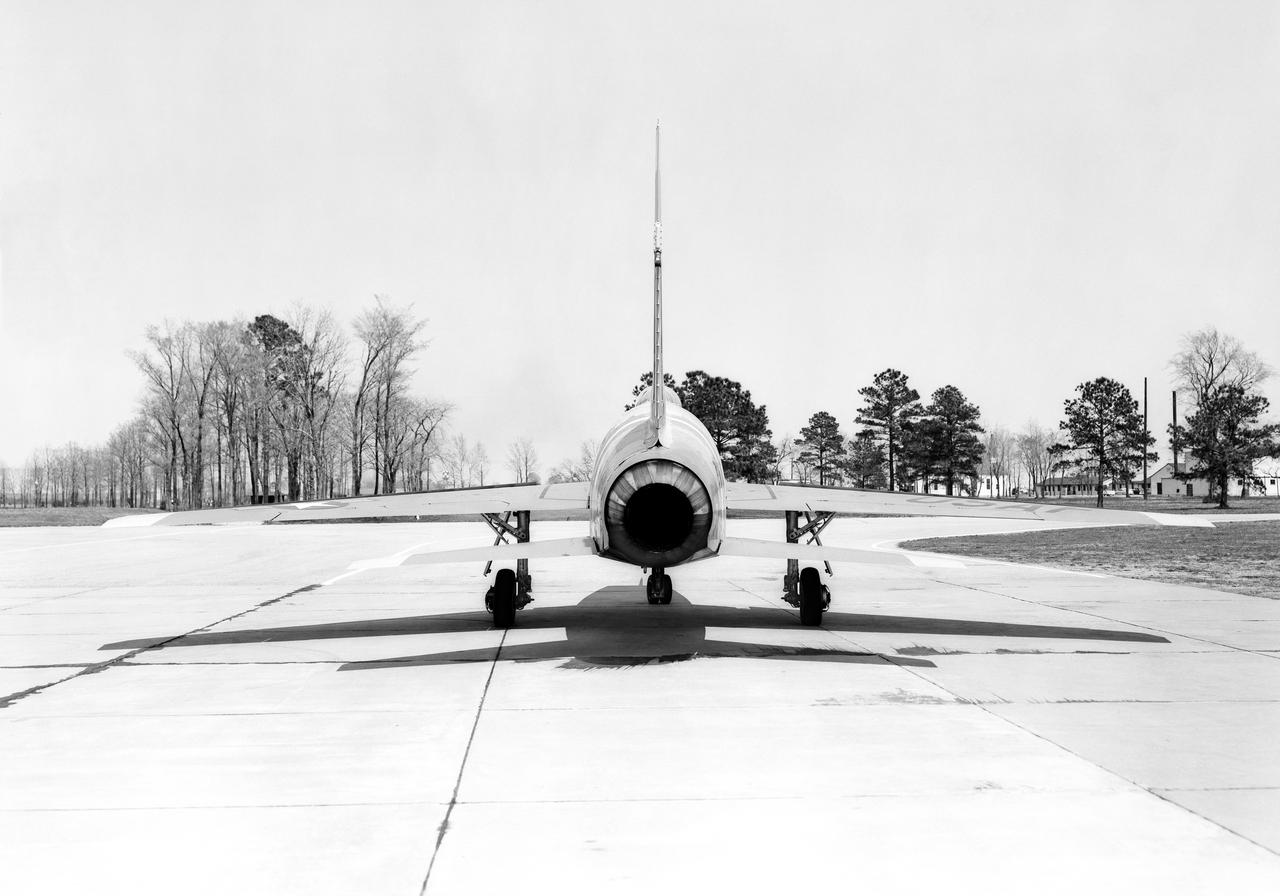
North American F-100 C airplane used in sonic boom investigation at Wallops, October 7, 1958. Photograph published in: A New Dimension Wallops Island Flight Test Range: The First Fifteen Years by Joseph Shortal. A NASA publication. Page 672. -- Aircraft number: NACA 42024. Side view, 3/4 view from front, 3/4 view from rear, rear view, and two front views.
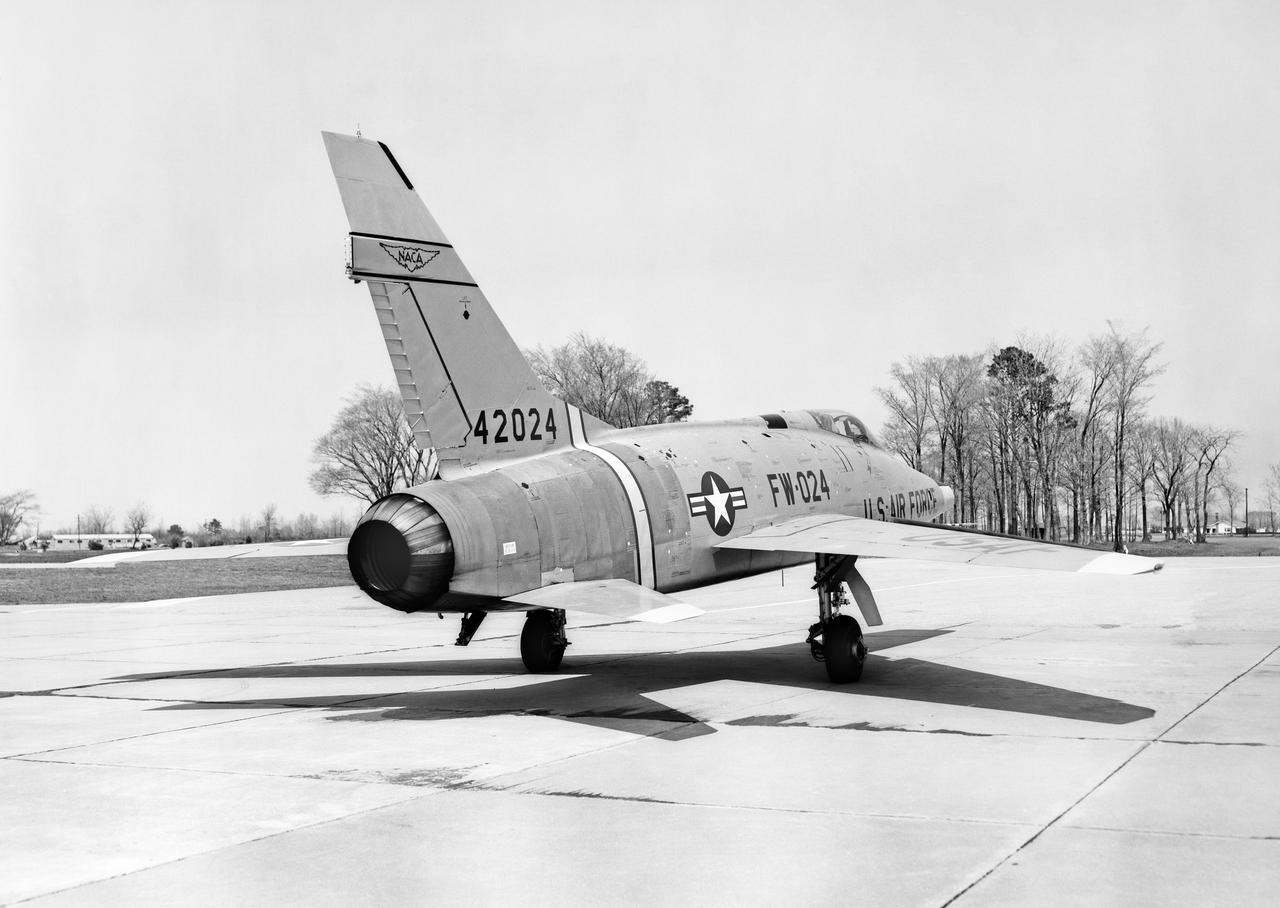
North American F-100 C airplane used in sonic boom investigation at Wallops, October 7, 1958. Photograph published in: A New Dimension Wallops Island Flight Test Range: The First Fifteen Years by Joseph Shortal. A NASA publication. Page 672. -- Aircraft number: NACA 42024. Side view, 3/4 view from front, 3/4 view from rear, rear view, and two front views.
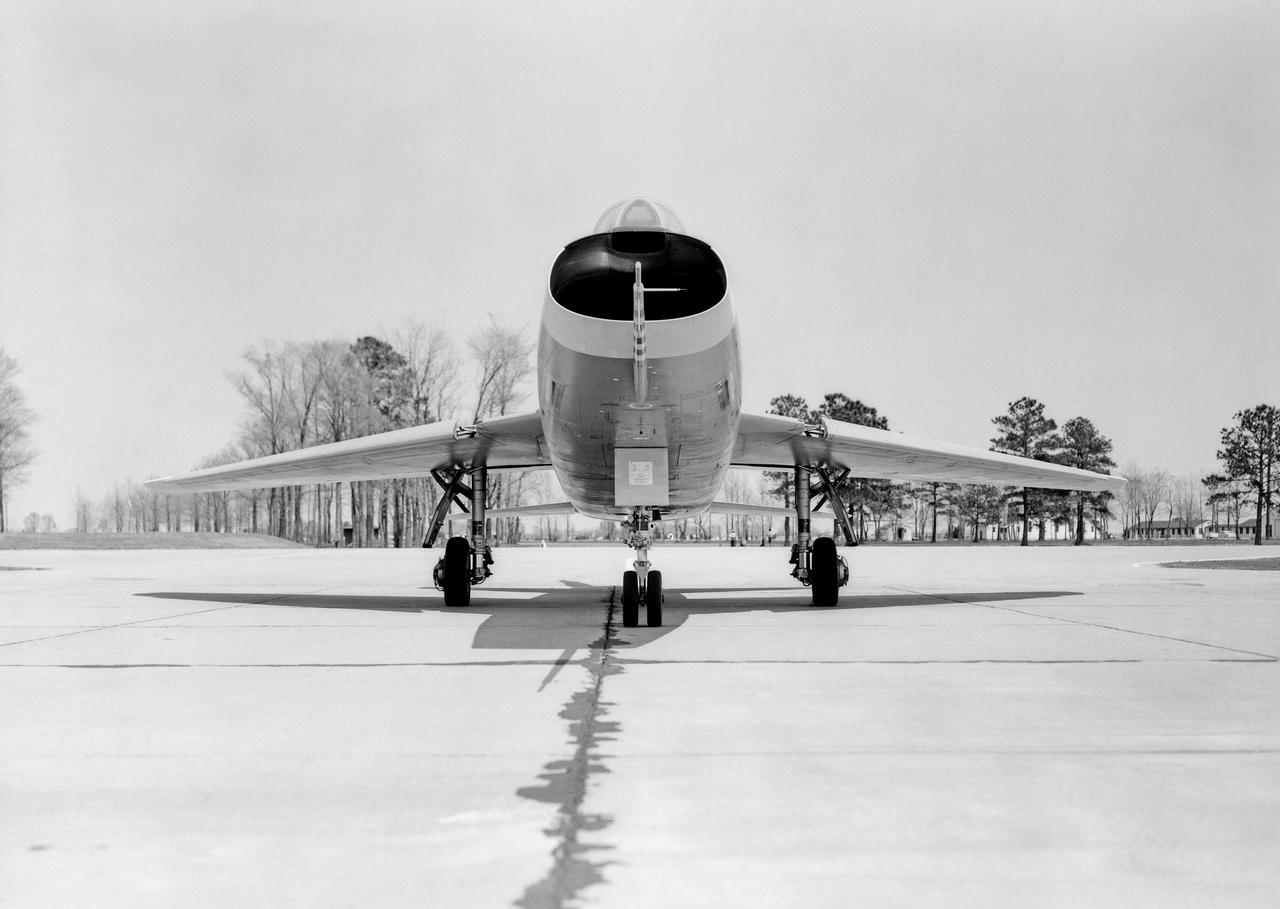
North American F-100 C airplane used in sonic boom investigation at Wallops, October 7, 1958. Photograph published in: A New Dimension Wallops Island Flight Test Range: The First Fifteen Years by Joseph Shortal. A NASA publication. Page 672. -- Aircraft number: NACA 42024. Side view, 3/4 view from front, 3/4 view from rear, rear view, and two front views.
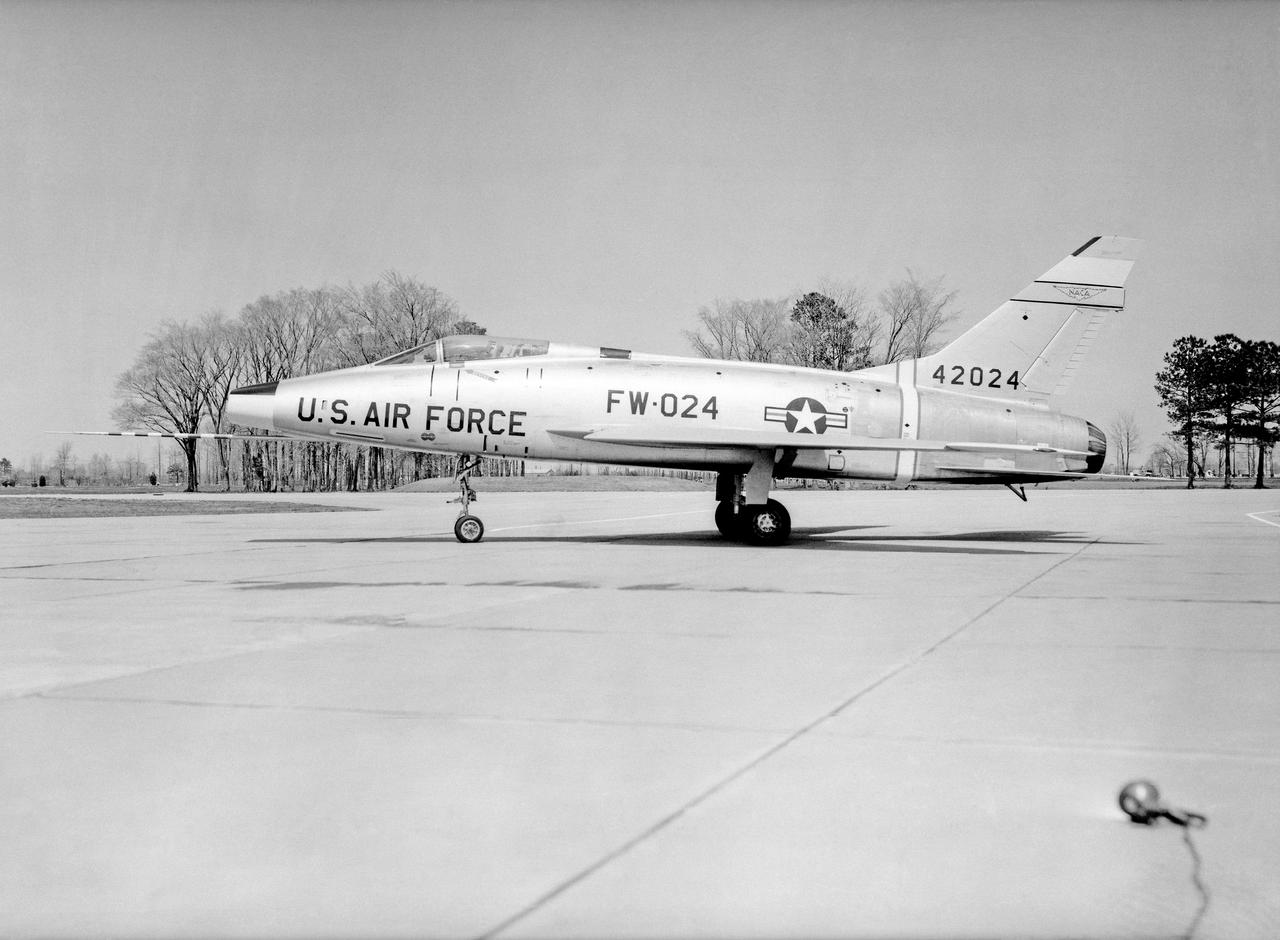
North American F-100 C airplane used in sonic boom investigation at Wallops, October 7, 1958. Photograph published in: A New Dimension Wallops Island Flight Test Range: The First Fifteen Years by Joseph Shortal. A NASA publication. Page 672. -- Aircraft number: NACA 42024. Side view, 3/4 view from front, 3/4 view from rear, rear view, and two front views.
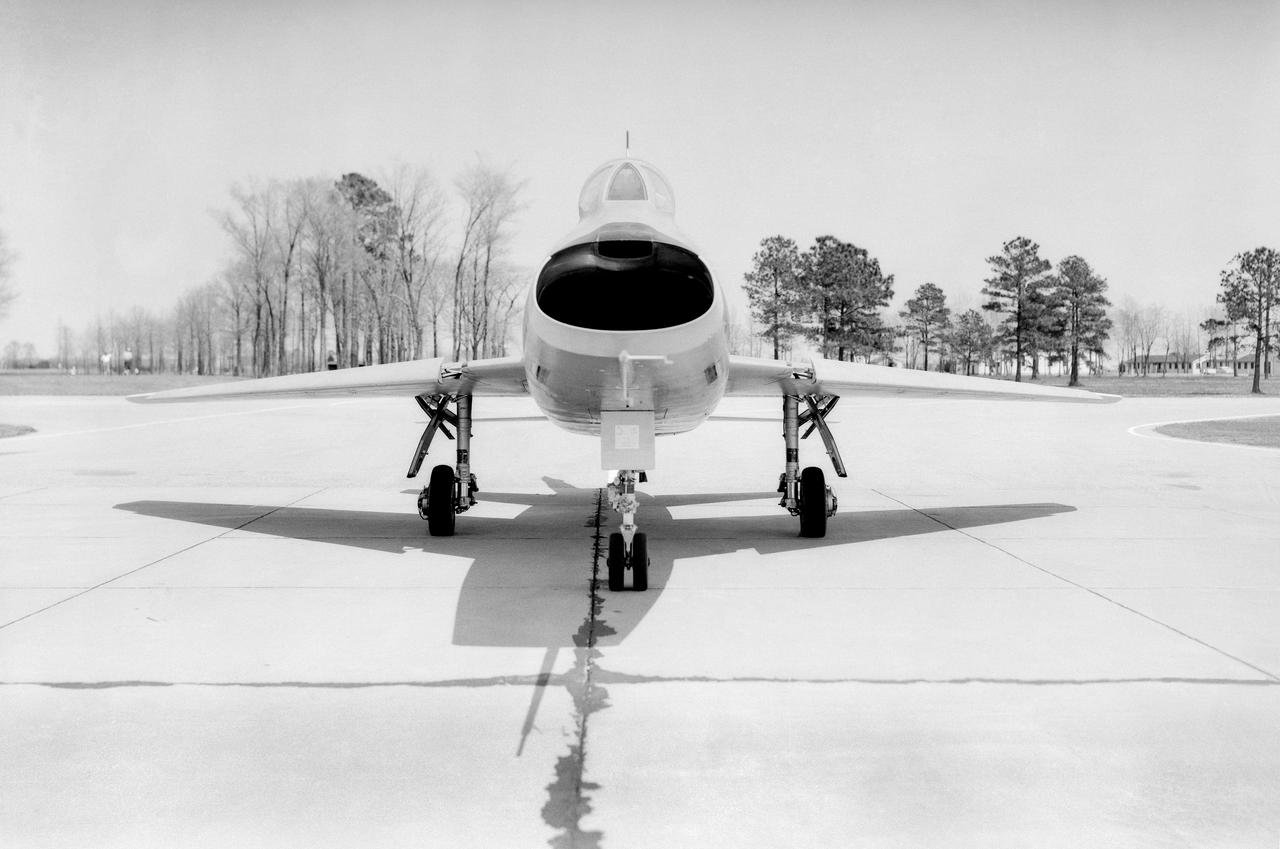
North American F-100 C airplane used in sonic boom investigation at Wallops, October 7, 1958. Photograph published in: A New Dimension Wallops Island Flight Test Range: The First Fifteen Years by Joseph Shortal. A NASA publication. Page 672. -- Aircraft number: NACA 42024. Side view, 3/4 view from front, 3/4 view from rear, rear view, and two front views.
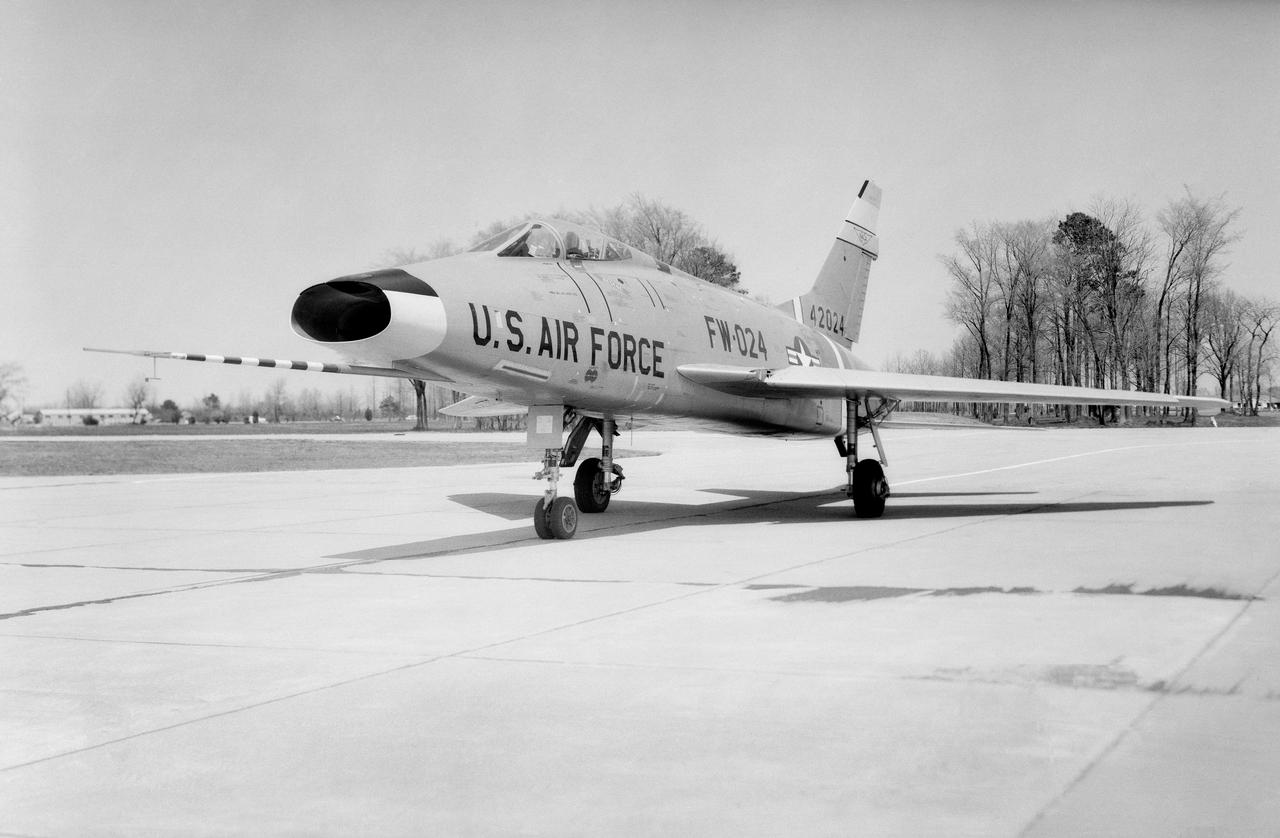
North American F-100 C airplane used in sonic boom investigation at Wallops, October 7, 1958. Photograph published in: A New Dimension Wallops Island Flight Test Range: The First Fifteen Years by Joseph Shortal. A NASA publication. Page 672. -- Aircraft number: NACA 42024. Side view, 3/4 view from front, 3/4 view from rear, rear view, and two front views.
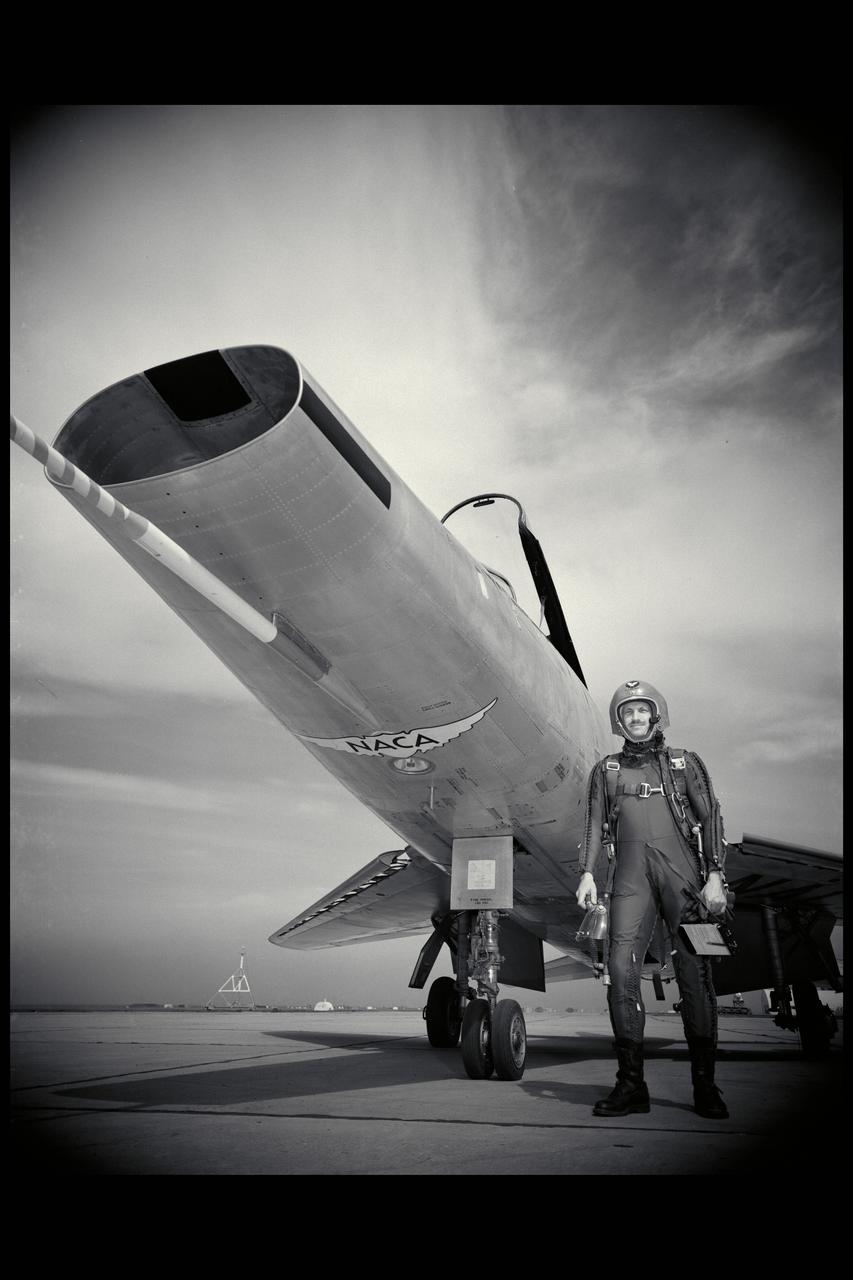
North American F-100 Airplane (NACA 709), with Pilot George Cooper
![[14] ISO: 100 Aprt: F4 Shut: 60 Lens: 35 Exps: P Prog: Po ExpC: -1.3 Metr: Mtrx Fl s: Norm D md: S F md: S F ar: Spot Dist: 1.6m](https://images-assets.nasa.gov/image/s93e5050/s93e5050~medium.jpg)
[14] ISO: 100 Aprt: F4 Shut: 60 Lens: 35 Exps: P Prog: Po ExpC: -1.3 Metr: Mtrx Fl s: Norm D md: S F md: S F ar: Spot Dist: 1.6m
![[56] ISO: 100 Aprt: F4 Shut: 60 Lens: 35 Exps: P Prog: Po ExpC: -1.3 Metr: Mtrx Fl s: Norm D md: S F md: S F ar: Spot Dist: 1.8m](https://images-assets.nasa.gov/image/s93e5067/s93e5067~medium.jpg)
[56] ISO: 100 Aprt: F4 Shut: 60 Lens: 35 Exps: P Prog: Po ExpC: -1.3 Metr: Mtrx Fl s: Norm D md: S F md: S F ar: Spot Dist: 1.8m
![[55] ISO: 100 Aprt: F4 Shut: 60 Lens: 35 Exps: P Prog: Po ExpC: -1.3 Metr: Mtrx Fl s: Norm D md: S F md: S F ar: Spot Dist: 1.8m](https://images-assets.nasa.gov/image/s93e5066/s93e5066~medium.jpg)
[55] ISO: 100 Aprt: F4 Shut: 60 Lens: 35 Exps: P Prog: Po ExpC: -1.3 Metr: Mtrx Fl s: Norm D md: S F md: S F ar: Spot Dist: 1.8m
![[19] ISO: 100 Aprt: F8 Shut: 250 Lens: 35 Exps: P Prog: Po ExpC: -1.3 Metr: Mtrx Fl s: Norm D md: S F md: S F ar: Spot Dist: 1.2m](https://images-assets.nasa.gov/image/s93e5055/s93e5055~medium.jpg)
[19] ISO: 100 Aprt: F8 Shut: 250 Lens: 35 Exps: P Prog: Po ExpC: -1.3 Metr: Mtrx Fl s: Norm D md: S F md: S F ar: Spot Dist: 1.2m
![[22] ISO: 100 Aprt: F5.6 Shut: 250 Lens: 35 Exps: P Prog: Po ExpC: -1.3 Metr: Mtrx Fl s: Norm D md: S F md: S F ar: Spot Dist: 1.6m](https://images-assets.nasa.gov/image/s93e5058/s93e5058~medium.jpg)
[22] ISO: 100 Aprt: F5.6 Shut: 250 Lens: 35 Exps: P Prog: Po ExpC: -1.3 Metr: Mtrx Fl s: Norm D md: S F md: S F ar: Spot Dist: 1.6m
![[54] ISO: 100 Aprt: F4 Shut: 60 Lens: 35 Exps: P Prog: Po ExpC: -1.3 Metr: Mtrx Fl s: Norm D md: S F md: S F ar: Spot Dist: 2.0m](https://images-assets.nasa.gov/image/s93e5065/s93e5065~medium.jpg)
[54] ISO: 100 Aprt: F4 Shut: 60 Lens: 35 Exps: P Prog: Po ExpC: -1.3 Metr: Mtrx Fl s: Norm D md: S F md: S F ar: Spot Dist: 2.0m
![[16] ISO: 100 Aprt: F4 Shut: 125 Lens: 35 Exps: P Prog: Po ExpC: -1.3 Metr: Mtrx Fl s: Norm D md: S F md: S F ar: Spot Dist: 1.4m](https://images-assets.nasa.gov/image/s93e5052/s93e5052~medium.jpg)
[16] ISO: 100 Aprt: F4 Shut: 125 Lens: 35 Exps: P Prog: Po ExpC: -1.3 Metr: Mtrx Fl s: Norm D md: S F md: S F ar: Spot Dist: 1.4m
![[21] ISO: 100 Aprt: F4 Shut: 125 Lens: 35 Exps: P Prog: Po ExpC: -1.3 Metr: Mtrx Fl s: Norm D md: S F md: S F ar: Spot Dist: 1.8m](https://images-assets.nasa.gov/image/s93e5057/s93e5057~medium.jpg)
[21] ISO: 100 Aprt: F4 Shut: 125 Lens: 35 Exps: P Prog: Po ExpC: -1.3 Metr: Mtrx Fl s: Norm D md: S F md: S F ar: Spot Dist: 1.8m
![[50] ISO: 100 Aprt: F4 Shut: 60 Lens: 35 Exps: P Prog: Po ExpC: 0.0 Metr: Mtrx Fl s: Norm D md: S F md: S F ar: Spot Dist: 1.6m](https://images-assets.nasa.gov/image/s93e5082/s93e5082~medium.jpg)
[50] ISO: 100 Aprt: F4 Shut: 60 Lens: 35 Exps: P Prog: Po ExpC: 0.0 Metr: Mtrx Fl s: Norm D md: S F md: S F ar: Spot Dist: 1.6m
![[18] ISO: 100 Aprt: F5.6 Shut: 250 Lens: 35 Exps: P Prog: Po ExpC: -1.3 Metr: Mtrx Fl s: Norm D md: S F md: S F ar: Spot Dist: 1.0m](https://images-assets.nasa.gov/image/s93e5054/s93e5054~medium.jpg)
[18] ISO: 100 Aprt: F5.6 Shut: 250 Lens: 35 Exps: P Prog: Po ExpC: -1.3 Metr: Mtrx Fl s: Norm D md: S F md: S F ar: Spot Dist: 1.0m
![[94] ISO: 100 Aprt: F4 Shut: 60 Lens: 35 Exps: P Prog: Po ExpC: -1.3 Metr: Mtrx Fl s: Norm D md: S F md: S F ar: Spot Dist: 1.8m](https://images-assets.nasa.gov/image/s93e5069/s93e5069~medium.jpg)
[94] ISO: 100 Aprt: F4 Shut: 60 Lens: 35 Exps: P Prog: Po ExpC: -1.3 Metr: Mtrx Fl s: Norm D md: S F md: S F ar: Spot Dist: 1.8m
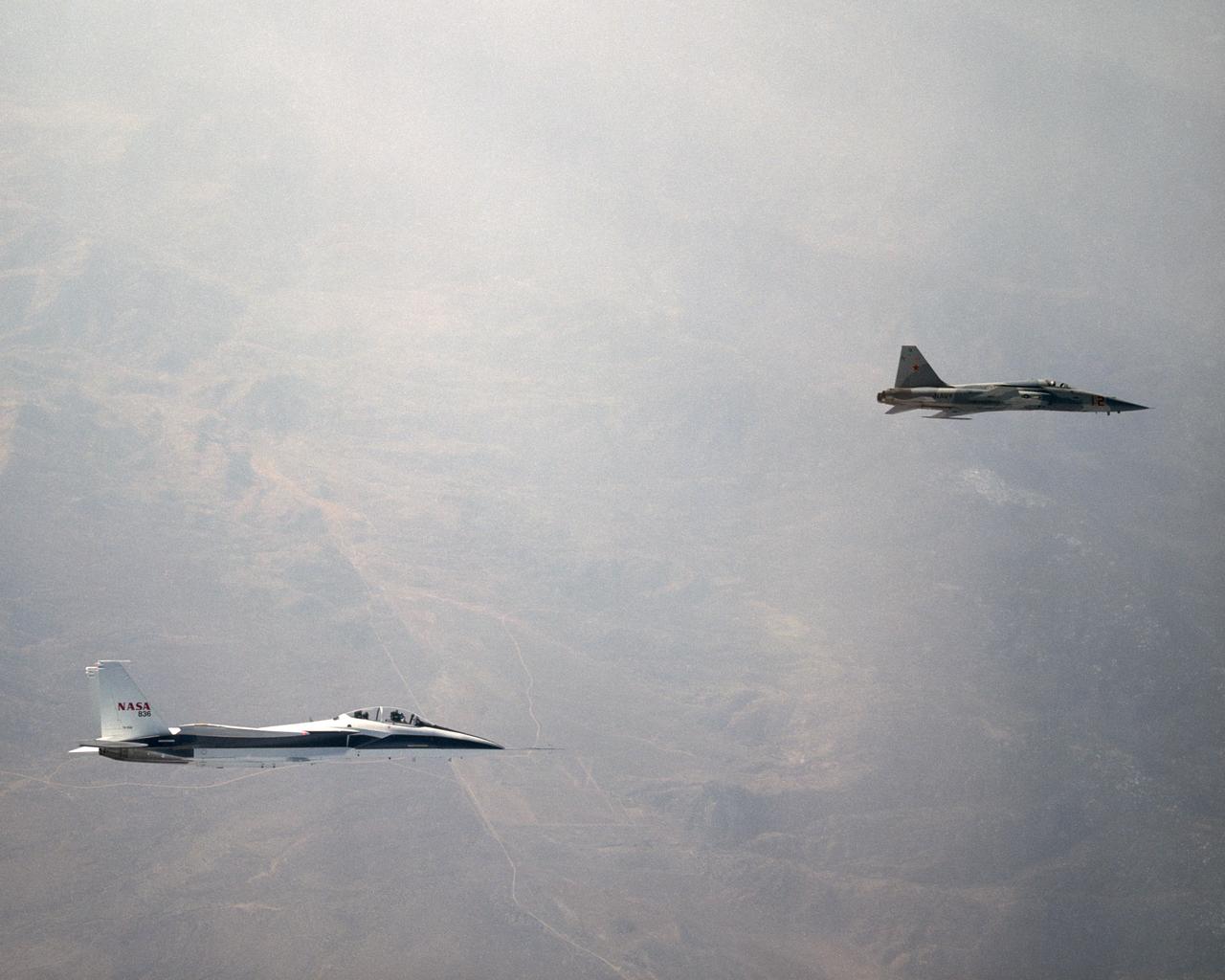
NASA's F-15B Research Testbed aircraft recently flew in the supersonic shock wave of a U.S. Navy F-5E in support of the F-5 Shaped Sonic Boom Demonstration (SSBD) project, part of the Defense Advanced Research Projects Agency's (DARPA) Quiet Supersonic Platform (QSP) program. The flights originated from the NASA Dryden Flight Research Center at Edwards, California. Four flights were flown in order to measure the F-5E's near-field (close-up) sonic boom signature at Mach 1.4, during which more than 50 shockwave patterns were measured at distances as close as 100 feet below the F-5E.
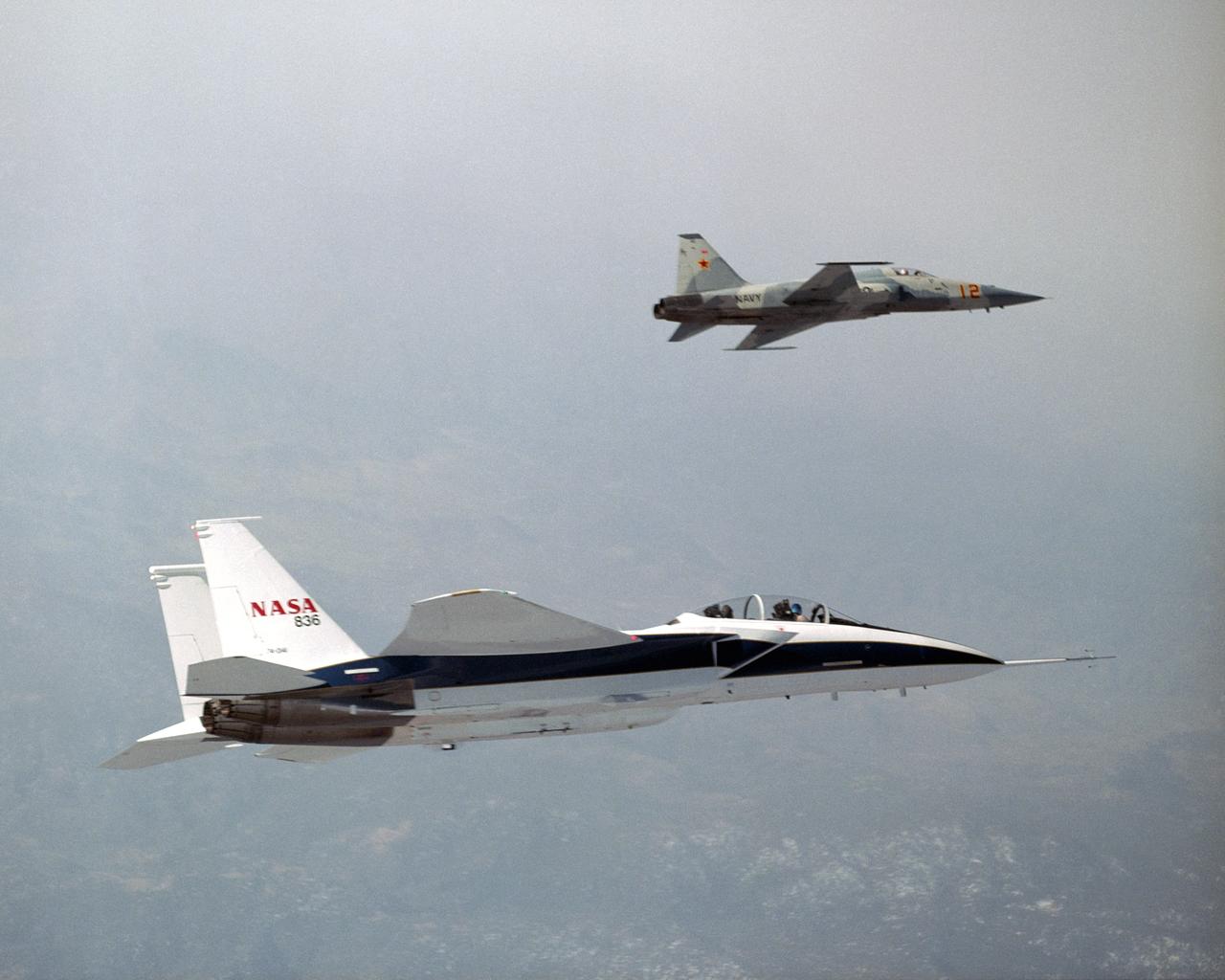
NASA's F-15B Research Testbed aircraft recently flew in the supersonic shock wave of a U.S. Navy F-5E in support of the F-5 Shaped Sonic Boom Demonstration (SSBD) project, part of the Defense Advanced Research Projects Agency's (DARPA) Quiet Supersonic Platform (QSP) program. The flights originated from the NASA Dryden Flight Research Center at Edwards, California. Four flights were flown in order to measure the F-5E's near-field (close-up) sonic boom signature at Mach 1.4, during which more than 50 shockwave patterns were measured at distances as close as 100 feet below the F-5E.
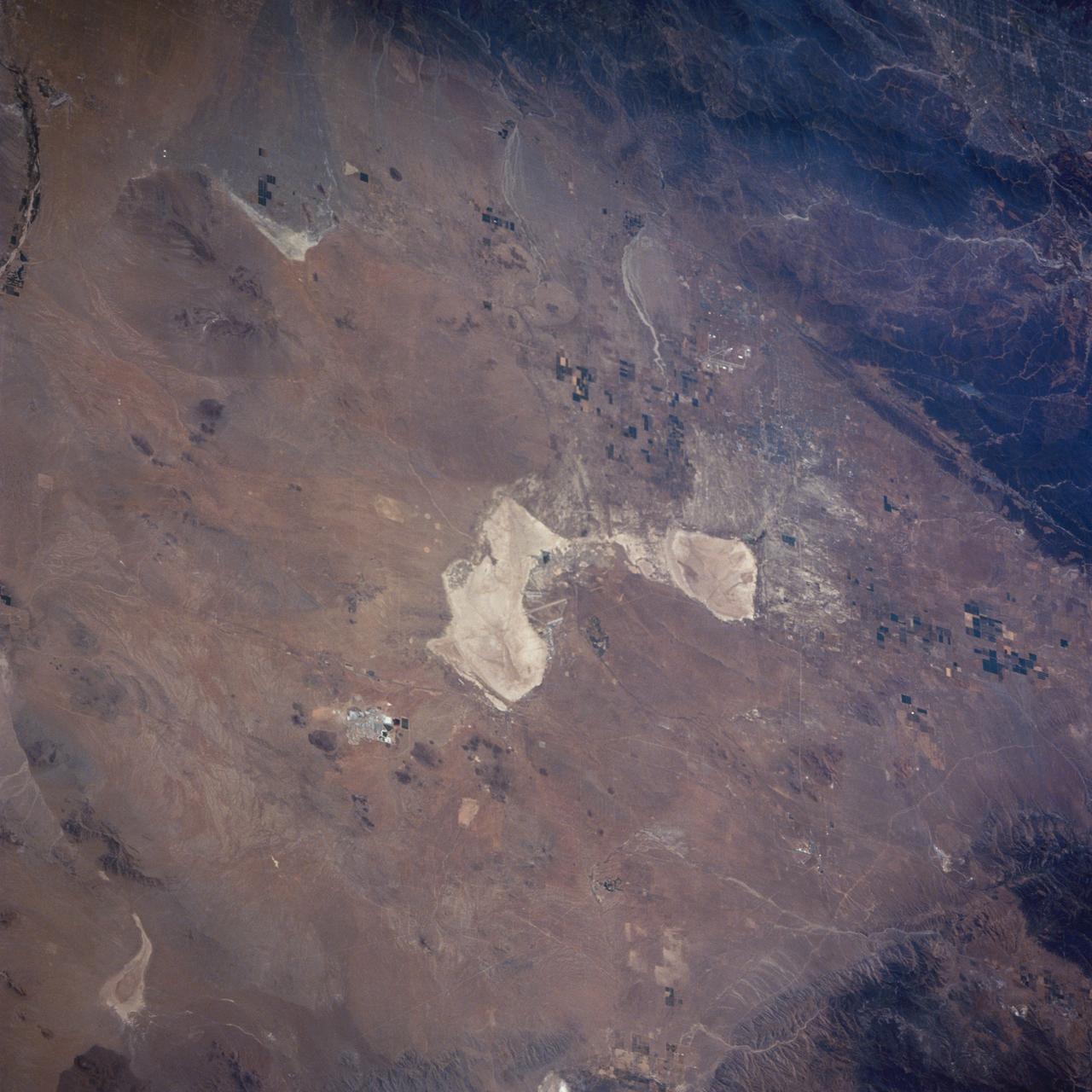
51F-46-100 (29 July-6 Aug 1985) --- The remarkable 51-F mission would end at Edwards Air Force Base, lakebed runway 23 at the center of the photograph. The San Andres Fault gashes across the lower left corner of the photo as does the Garlock fault at the upper left corner. The California Aqueduct can be traced from left center to lower right corner.
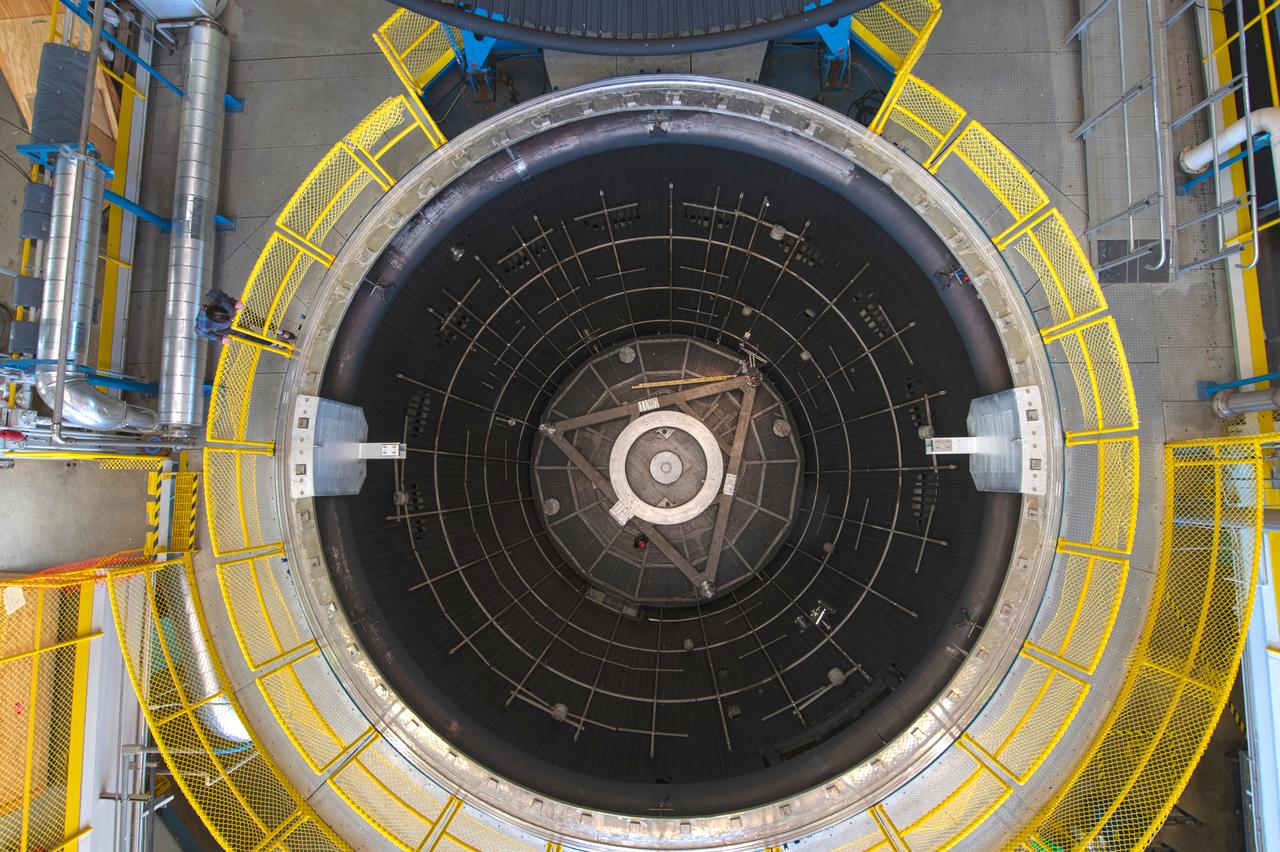
The test chamber is 38 ft in diameter by 62 ft deep amd made of stainless steel. It is vacuum rated at 10-7 torr long duration (Local atmospheric pressure to 100 statute miles altitude). The vacuum chamber surfaces are lined with a liquid nitrogen cold wall, capable of maintaining -320 °F. A quartz infrared heating system can be programmed to radiate a sinusoidal distribution, simulating rotational solar heating. Photo Credit: (NASA/Quentin Schwinn)

Richard F. Gordon Jr. climbing into training simulator. Astronaut Richard (Dick) Gordon, died in November 2017, at his home in California. He was 88. Gordon orbited the Moon on Apollo 12 in 1969 while two other astronauts walked on it. The Apollo 12 crew capsule can be seen at Langley's official visitor center, the Virginia Air and Space Center in Hampton VA. NASA 2017 Annual report, Celebrating 100 years.page 23 Milestones.
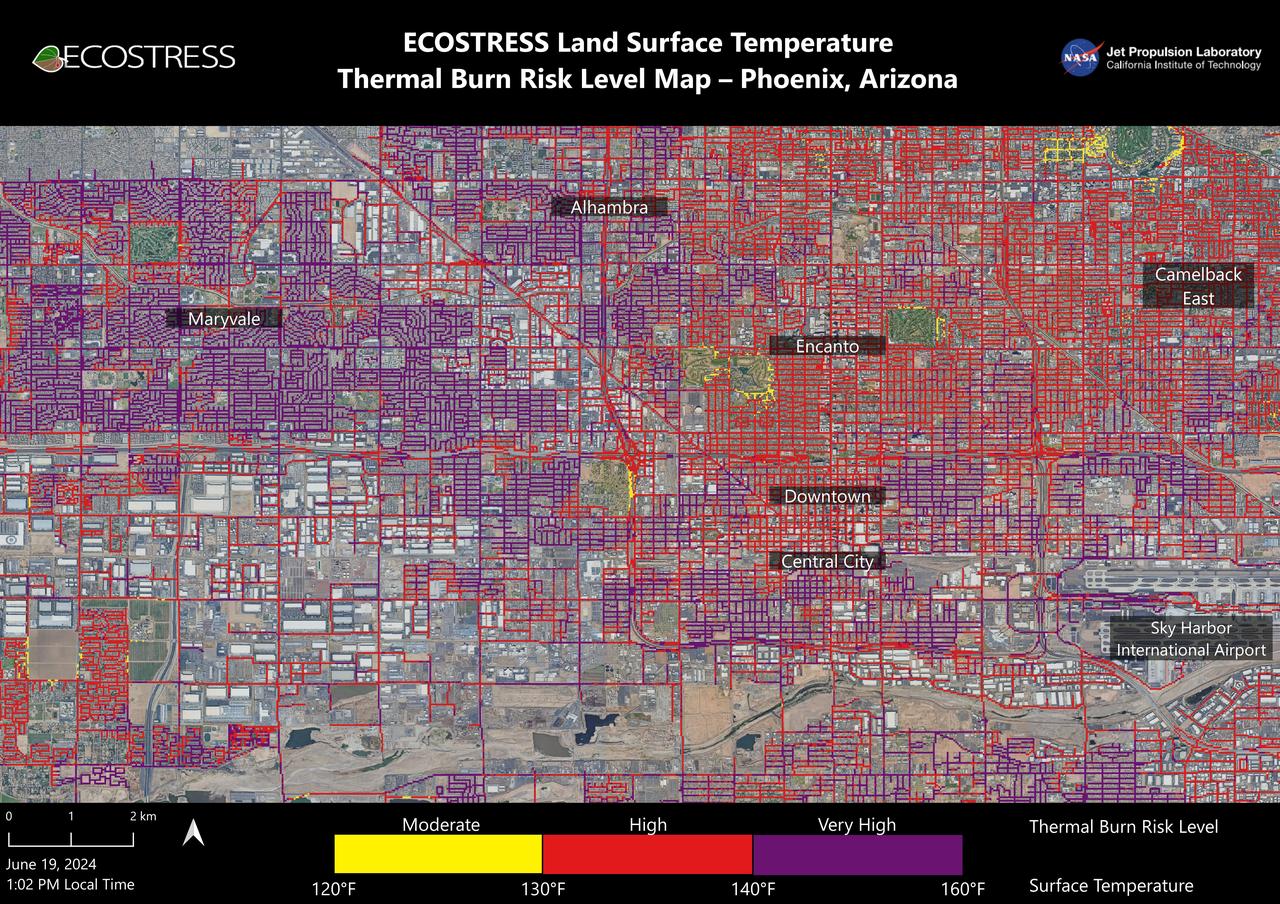
Data from NASA's ECOSTRESS (Ecosystem Spaceborne Thermal Radiometer Experiment on Space Station) instrument was used to map scorching pavement in Phoenix where contact with skin can cause serious burns. Based on measurements captured at 1:02 p.m. local time on June 19, 2024, the image shows land surface temperatures across a grid of roads and adjacent sidewalks, revealing how urban spaces can turn hazardous during hot weather. The Arizona city's miles of asphalt and concrete surfaces (colored here in yellow, red, and purple, based on temperature) trap heat, as the image indicates. The surfaces registered at least 120 degrees Fahrenheit (49 degrees Celsius) to the touch – hot enough to cause contact burns in minutes to seconds. At the lower right of the image is Phoenix Sky Harbor International Airport, where ECOSTRESS recorded some of the hottest land surface temperatures within the city – around 140 F (60 C). The air temperature on June 19 at the airport reached 106 F (43 C). Air temperature, which is measured out of direct sunlight, can differ significantly from the temperature at the land surface. Streets are often the hottest surfaces of the built environment due to dark asphalt paving that absorbs more sunlight than lighter-colored surfaces; asphalt absorbs up to 95% of solar radiation. These types of surfaces can easily be 40 to 60 degrees F (22 to 33 degrees C) hotter than the air temperature on a very hot day. Launched to the International Space Station in 2018, ECOSTRESS measures temperatures at the highest spatial resolution of any space-based instrument, producing images with a typical pixel size of about 225 feet (70 meters) by 125 feet (38 meters). The image of Phoenix was produced at higher spatial resolution using a machine learning algorithm that incorporates data from additional satellites: NASA/USGS Landsat and Sentinel-2. The combined measurements were used to "sharpen" the surface temperatures to a resolution of 100 feet (30 meters) by 100 feet (30 meters). https://photojournal.jpl.nasa.gov/catalog/PIA25529
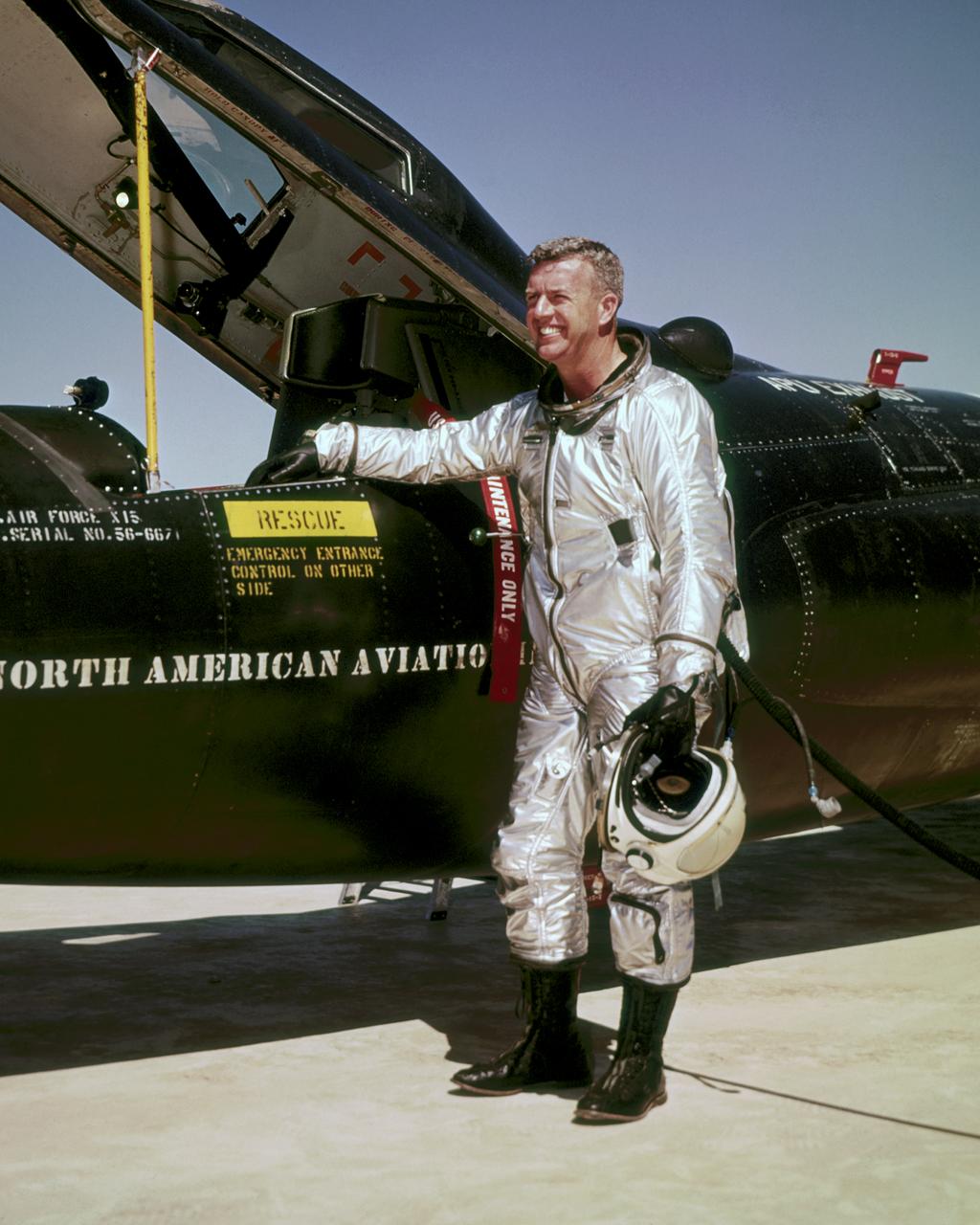
Joseph A. Walker was a Chief Research Pilot at the NASA Dryden Flight Research Center during the mid-1960s. He joined the NACA in March 1945, and served as project pilot at the Edwards flight research facility on such pioneering research projects as the D-558-1, D-558-2, X-1, X-3, X-4, X-5, and the X-15. He also flew programs involving the F-100, F-101, F-102, F-104, and the B-47. Walker made the first NASA X-15 flight on March 25, 1960. He flew the research aircraft 24 times and achieved its fastest speed and highest altitude. He attained a speed of 4,104 mph (Mach 5.92) during a flight on June 27, 1962, and reached an altitude of 354,300 feet on August 22, 1963 (his last X-15 flight). He was the first man to pilot the Lunar Landing Research Vehicle (LLRV) that was used to develop piloting and operational techniques for lunar landings. Walker was born February 20, 1921, in Washington, Pa. He lived there until graduating from Washington and Jefferson College in 1942, with a B.A. degree in Physics. During World War II he flew P-38 fighters for the Air Force, earning the Distinguished Flying Cross and the Air Medal with Seven Oak Clusters. Walker was the recipient of many awards during his 21 years as a research pilot. These include the 1961 Robert J. Collier Trophy, 1961 Harmon International Trophy for Aviators, the 1961 Kincheloe Award and 1961 Octave Chanute Award. He received an honorary Doctor of Aeronautical Sciences degree from his alma mater in June of 1962. Walker was named Pilot of the Year in 1963 by the National Pilots Association. He was a charter member of the Society of Experimental Test Pilots, and one of the first to be designated a Fellow. He was fatally injured on June 8, 1966, in a mid-air collision between an F-104 he was piloting and the XB-70.
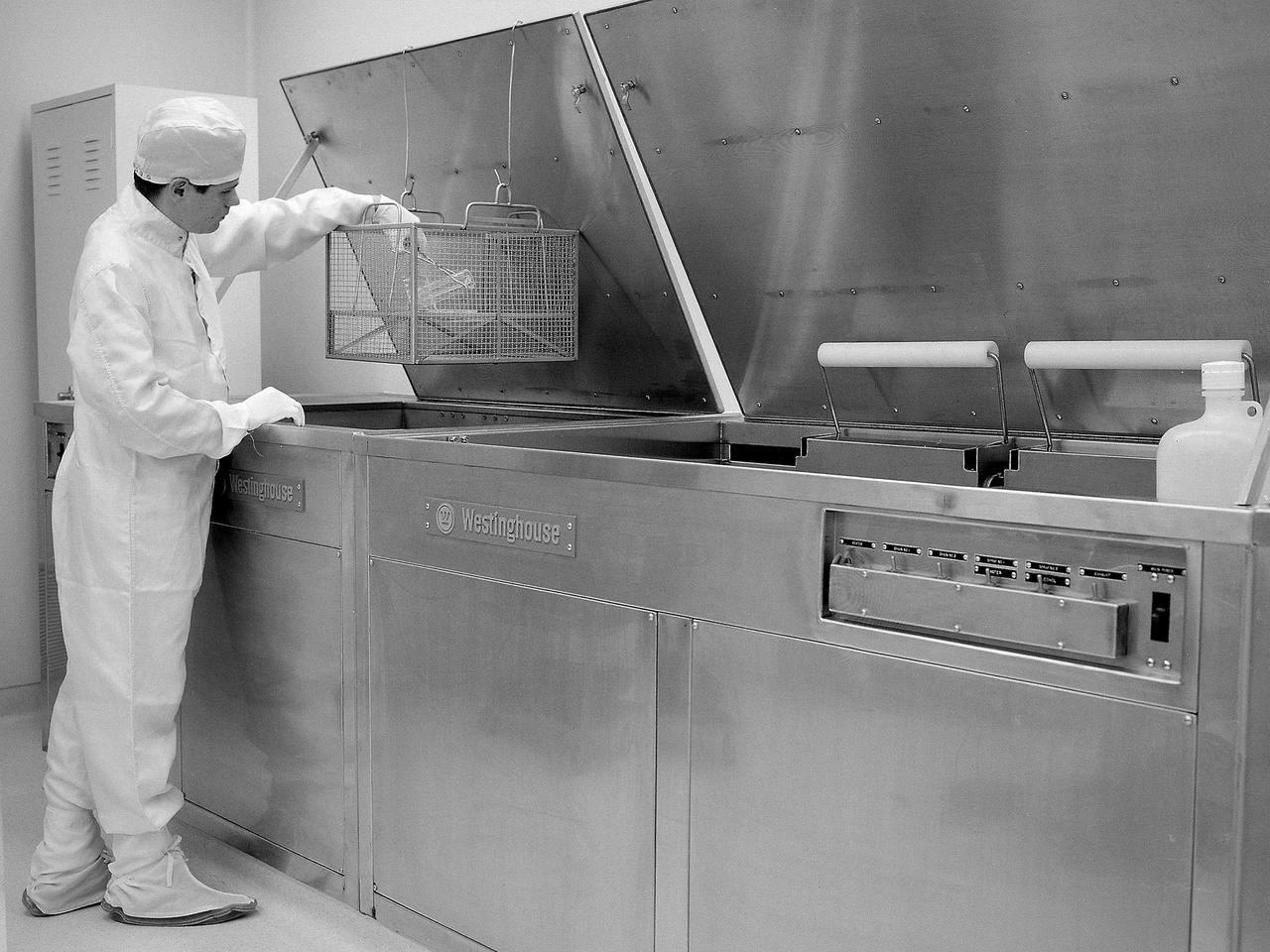
A technician prepares a test sample in the Zero Gravity Research Facility clean room at the National Aeronautics and Space Administration (NASA) Lewis Research Center. The Zero Gravity Research Facility contained a drop tower which provided five seconds of microgravity during freefall in its 450-foot deep vacuum chamber. The facility has been used for a variety of studies relating to the behavior of fluids and flames in microgravity. During normal operations, a cylindrical 3-foot diameter and 11-foot long vehicle was used to house the experiments, instrumentation, and high speed cameras. The 4.5-foot long and 1.5-foot wide rectangular vehicle, seen in this photograph, was used less frequently. A 3-foot diameter orb was used for the special ten-second drops in which the package was pneumatically shot to the top of the tower then dropped. The facility also contained a control room, shop offices, tool and equipment rooms, and this clean room. The 242.5-foot long and 19.5-foot wide clean room was equipped with specialized cleaning equipment. In the 1960s the room was rated as a class 10,000 clean room, but I was capable of meeting the class 100 requirements. The room included a fume hood, ultrasonic cleaner, and a laminar flow station which operated as a class 100 environment. The environment in the clean room was maintained at 71° F and a relative humidity of 45- percent.
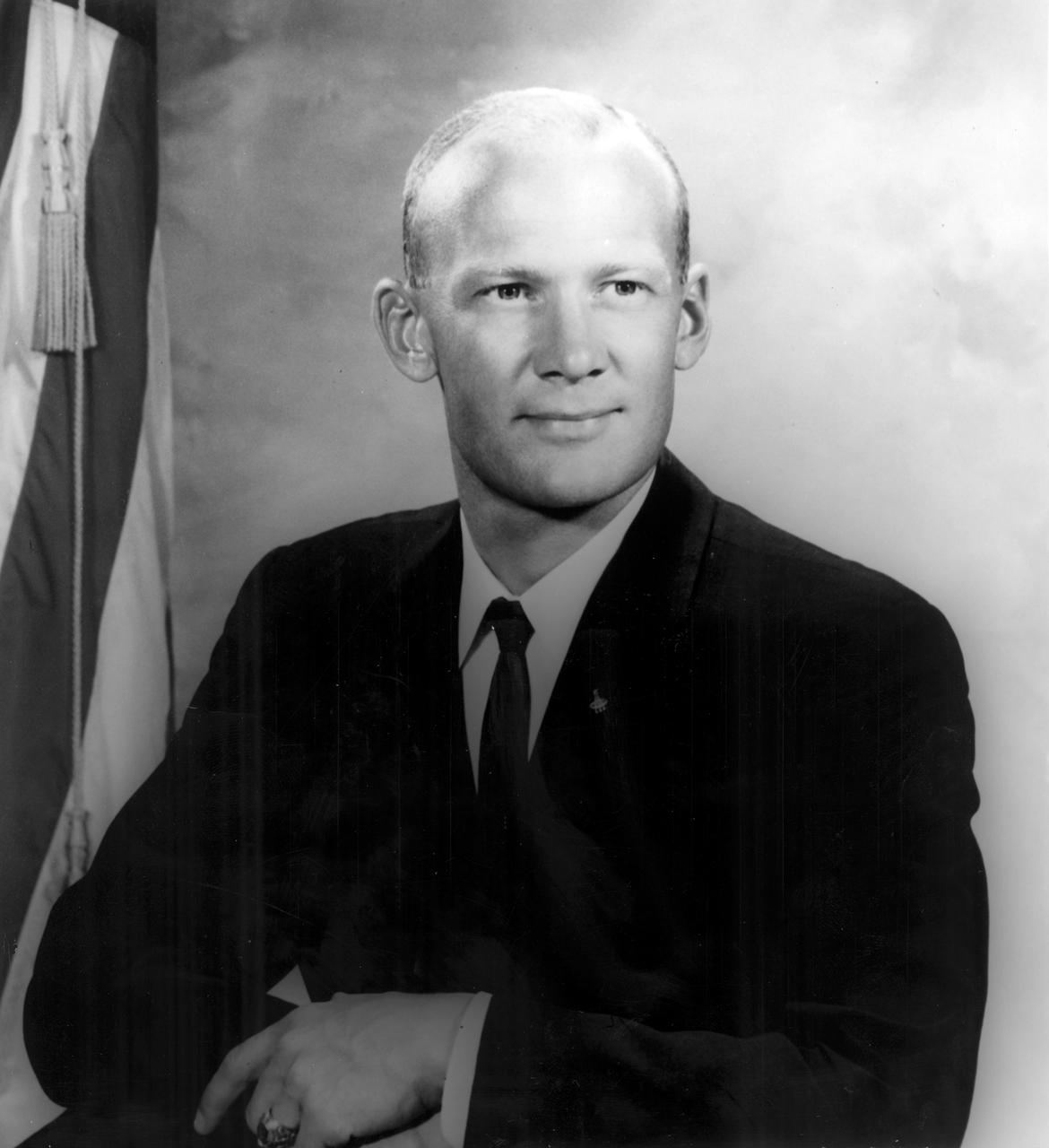
This is the official NASA portrait of astronaut Edwin E. (Buzz) Aldrin. Prior to joining NASA, Aldrin flew 66 combat missions in F-86s while on duty in Korea. At Nellis Air Force Base, Nevada, he served as an aerial gunnery instructor. Following his assignment as aide to the dean of faculty at the Air Force Academy, Aldrin flew F-100s as a flight commander at Bitburg, Germany. Aldrin was one of the third group of astronauts named by NASA in October 1963 and has logged 289 hours and 53 minutes in space, of which, 7 hours and 52 minutes were spent in Extra Vehicular Activity (EVA). On November 11, 1966, he launched into space aboard the Gemini 12 spacecraft on a 4-day flight, which brought the Gemini program to a successful close. During that mission, Aldrin established a new record for EVA, spending 5-1/2 hours outside the spacecraft. July 16-24, 1969, Aldrin served as lunar module pilot for Apollo 11, the first manned lunar landing mission. Aldrin followed Neil Armstrong onto the lunar surface on July 20, 1969, completing a 2-hour and 15 minute lunar EVA. Aldrin resigned from NASA in July 1971.
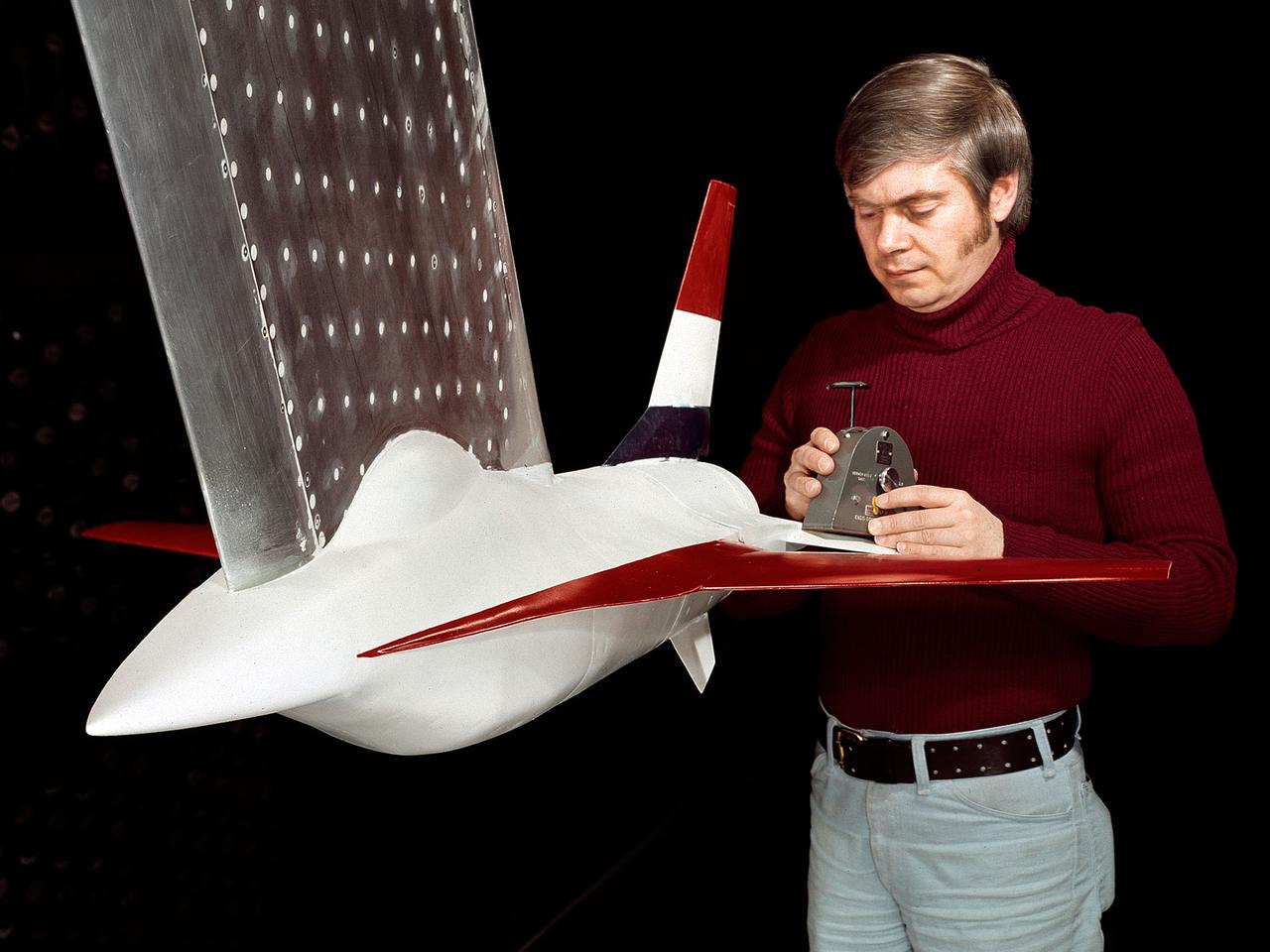
A model of the General Dynamics YF-16 Fighting Falcon in the test section of the 8- by 6-Foot Supersonic Wind Tunnel at the National Aeronautics and Space Administration (NASA) Lewis Research Center. The YF-16 was General Dynamics response to the military’s 1972 request for proposals to design a new 20,000-pound fighter jet with exceptional acceleration, turn rate, and range. The aircraft included innovative design elements to help pilots survive turns up to 9Gs, a new frameless bubble canopy, and a Pratt and Whitney 24,000-pound thrust F-100 engine. The YF-16 made its initial flight in February 1974, just six weeks before this photograph, at Edwards Air Force Base. Less than a year later, the Air Force ordered 650 of the aircraft, designated as F-16 Fighting Falcons. The March and April 1974 tests in the 8- by 6-foot tunnel analyzed the aircraft’s fixed-shroud ejector nozzle. The fixed-nozzle area limited drag, but also limited the nozzle’s internal performance. NASA researchers identified and assessed aerodynamic and aerodynamic-propulsion interaction uncertainties associated the prototype concept. YF-16 models were also tested extensively in the 11- by 11-Foot Transonic Wind Tunnel and 9- by 7-Foot Supersonic Wind Tunnel at Ames Research Center and the 12-Foot Pressure Wind Tunnel at Langley Research Center.
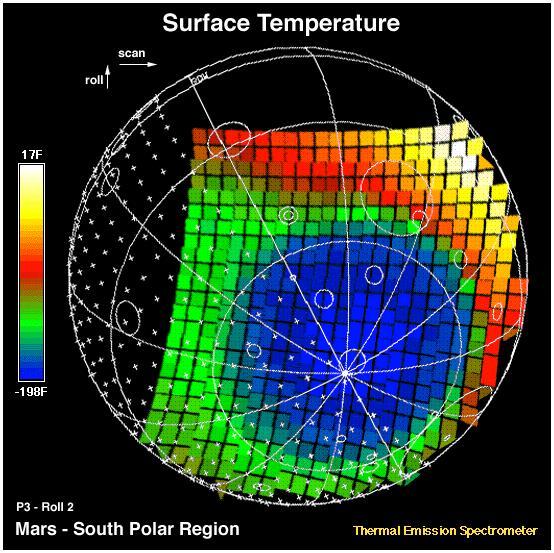
This image shows the temperature of the martian surface measured by the Mars Global Surveyor Thermal Emission Spectrometer (TES) instrument. On September 15, 3 hours and 48 minutes after the spacecrafts third close approach to the planet, the TES instrument was commanded to point at Mars and measure the temperature of the surface during a four minute scan. At this time MGS was approximately 15,000 miles (~24,000 km) from the planet, with a view looking up from beneath the planet at the south polar region. The circular blue region (- 198 F) is the south polar cap of Mars that is composed of CO2 ice. The night side of the planet, shown with crosses, is generally cool (green). The sunlit side of the planet reaches temperatures near 15 F (yellow). Each square represents an individual observation acquired in 2 seconds with a ground resolution of ~125 miles (~200 km). The TES instrument will remain on and collect similar images every 100 minutes to monitor the temperature of the surface and atmosphere throughout the aerobraking phase of the MGS mission. http://photojournal.jpl.nasa.gov/catalog/PIA00937
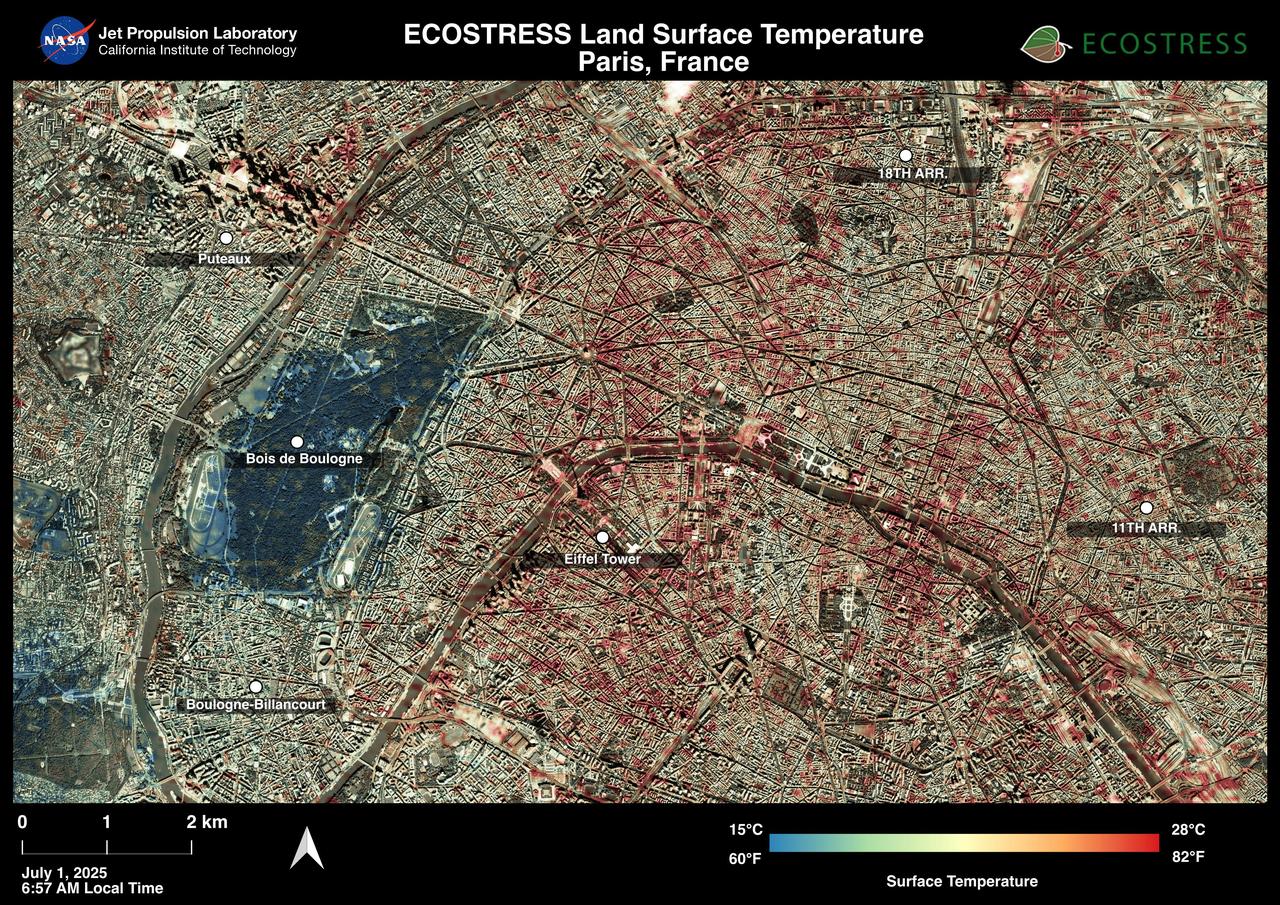
Paris was one of many European cities hit by a record-breaking heat wave at the end of June and early July 2025. NASA's Ecosystem Spaceborne Thermal Radiometer Experiment on Space Station (ECOSTRESS) instrument recorded surface temperatures of 82 degrees Fahrenheit (23 degrees Celsius) at 6:57 a.m. local time on July 1. Extreme daytime air temperatures – of over 100 degrees F (38 degrees C) – prompted officials to close the summit of the Eiffel Tower on July 1 and 2. In this visualization of ECOSTRESS data, dark red indicates higher temperatures while green and blue are cooler. The city is peppered with areas of several blocks where surface temperatures reached more than 80 F (27 C), including around the Eiffel Tower, before 7 a.m. The ECOSTRESS instrument measures thermal infrared emissions from Earth's surface. This enables researchers to monitor plant health, the progress of wildfires, land surface temperatures, and the burn risk to people from hot surfaces such as asphalt. Land surface temperatures are hotter than air temperatures during the day. Air temperatures, which are measured out of direct sunlight, are usually what meteorologists report in a weather forecast. https://photojournal.jpl.nasa.gov/catalog/PIA26190
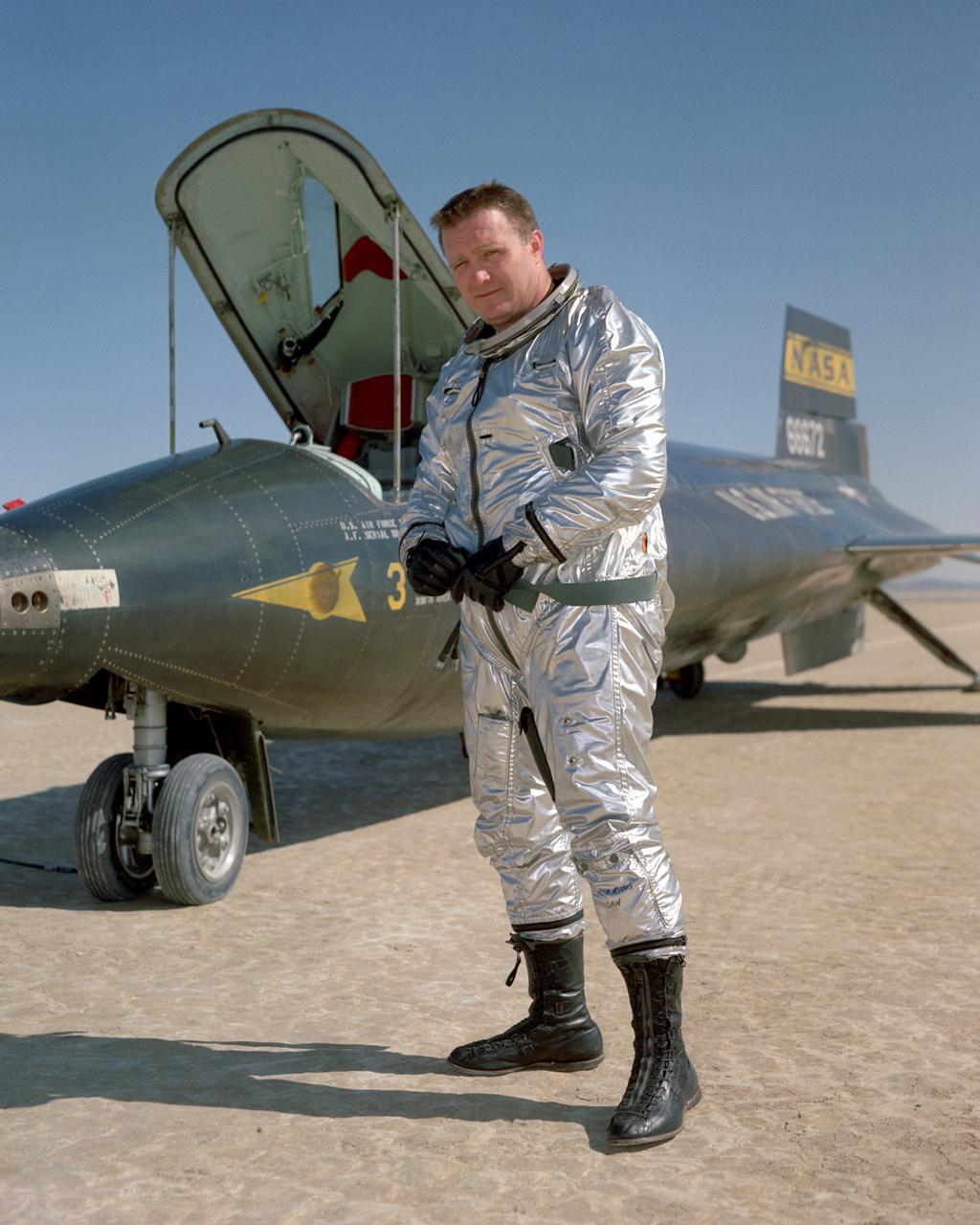
John B. McKay was one of the first pilots assigned to the X-15 flight research program at NASA's Flight Research Center, Edwards, Calif. As a civilian research pilot and aeronautical engineer, he made 30 flights in X-15s from October 28, 1960, until September 8, 1966. His peak altitude was 295,600 feet, and his highest speed was 3863 mph (Mach 5.64). McKay was with the NACA and NASA from February 8,1951 until October 5, 1971 and specialized in high-speed flight research programs. He began as an NACA intern, but assumed pilot status on July 11, 1952. In addition to the X-l5, he flew such experimental aircraft as the D-558-1, D-558-2, X-lB, and the X-lE. He has also served as a research pilot on flight programs involving the F-100, F-102, F-104, and the F-107. Born on December 8, 1922, in Portsmouth, Va., McKay graduated from Virginia Polytechnic Institute in 195O with a Bachelor of Science degree in Aeronautical Engineering. During World War II he served as a Navy pilot in the Pacific Theater, earning the Air Medal and Two Clusters, and a Presidential Unit Citation. McKay wrote several technical papers, and was a member of the American Institute of Aeronautics and Astronautics, as well as the Society of Experimental Test Pilots. He passed away on April 27, 1975.
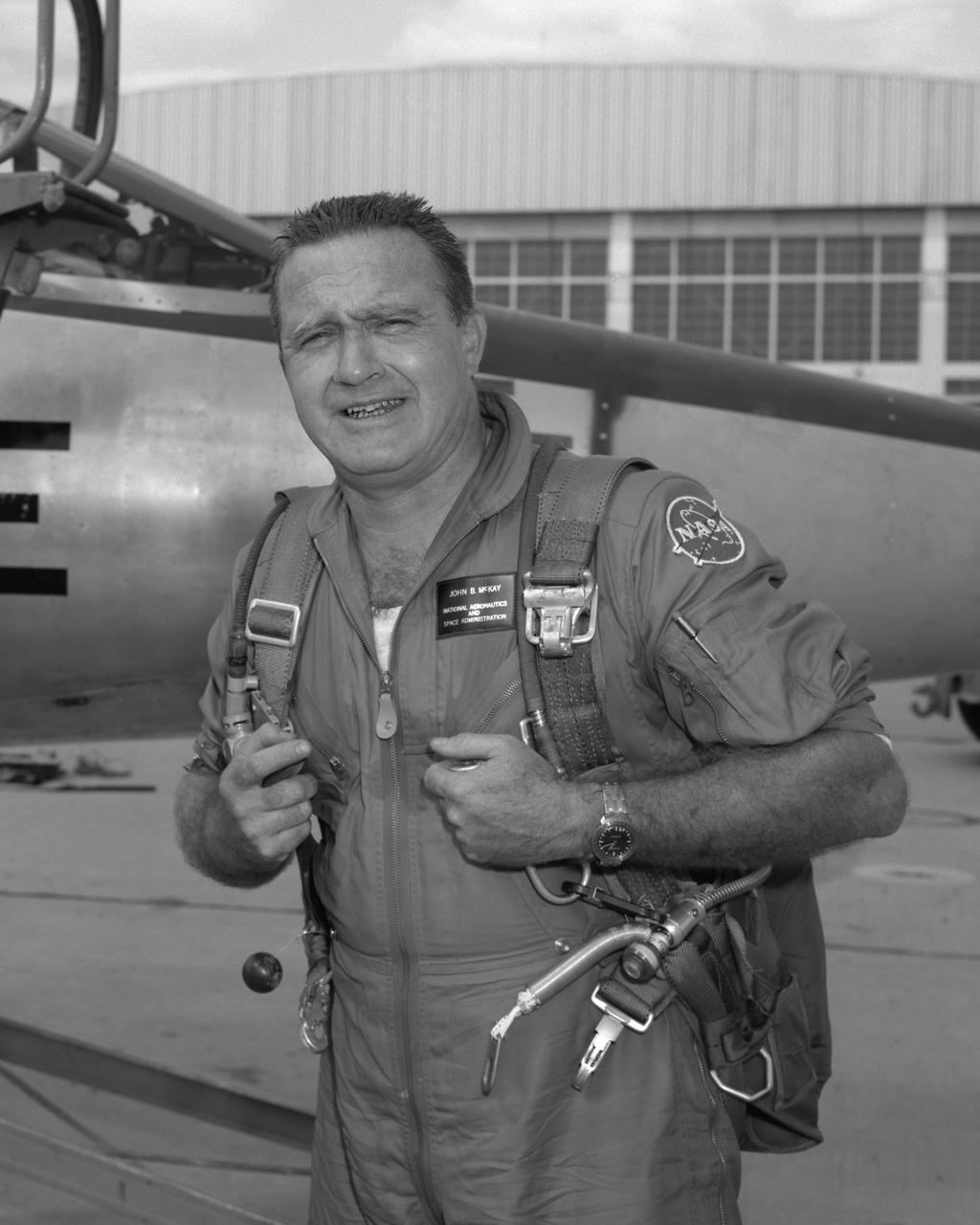
John McKay after flight in F-104B
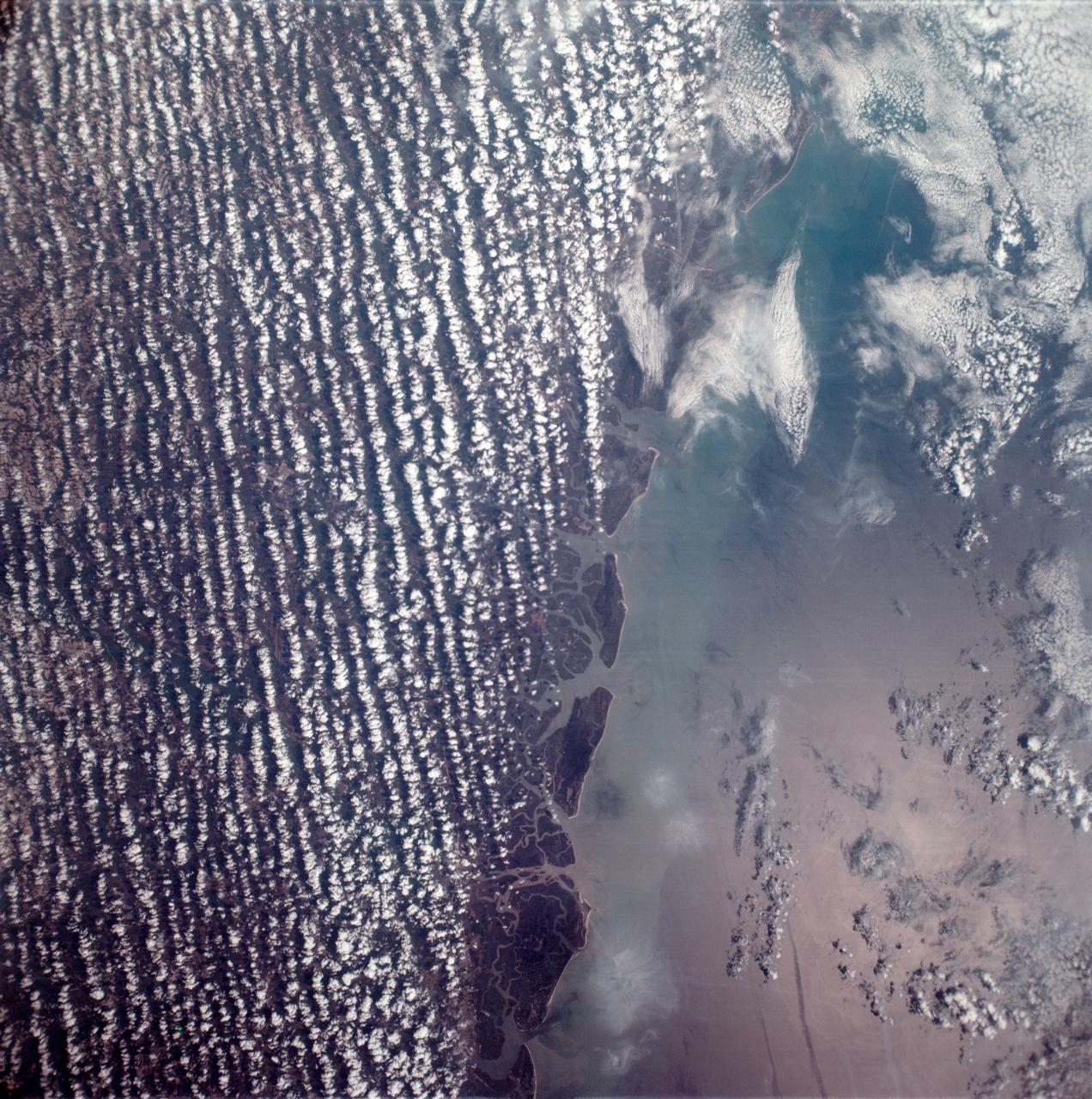
AS6-02-1485 (4 April 1968) --- View of the east coast of the United States as photographed from the National Aeronautics and Space Administration's unmanned Apollo 6 (Spacecraft 020/Saturn 502) space mission. This photograph was taken during a pass over Georgia, between Savannah and Brunswick. Altitude of the spacecraft was 100 nautical miles. Numerous jet aircraft contrails can be seen over the Atlantic Ocean. Sun glint on the surface of the ocean permits oceanographers to determine conditions of the water. This photograph was taken April 4, 1968, three hours and 14 minutes after liftoff, using Eastman Kodak SO-121 high resolution aerial Ektachrome film (exposure setting f/5.6 at 1/500 second), in a J. A. Maurer model 220G camera.
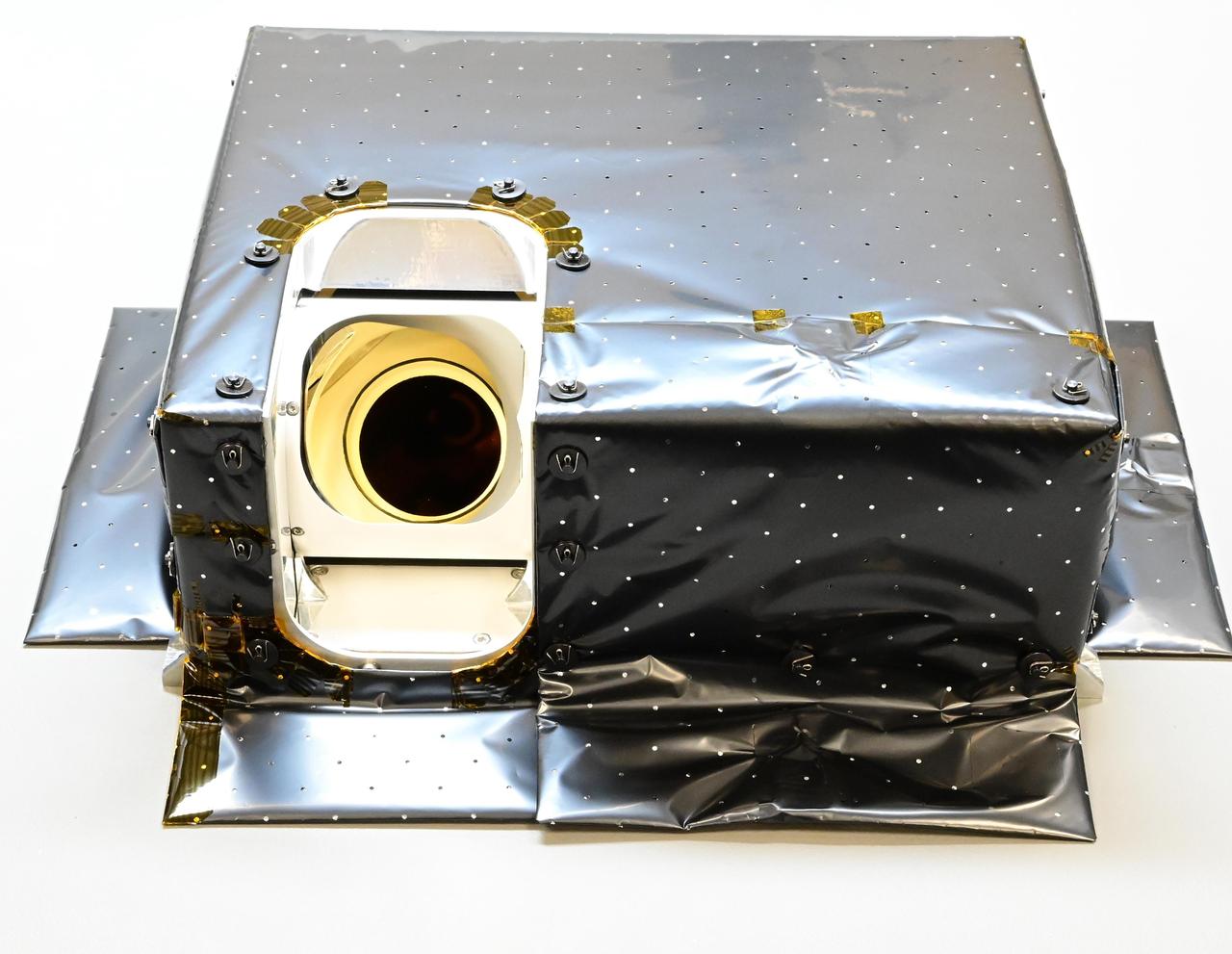
Seen here before being shipped from the U.K. to the U.S., the Lunar Thermal Mapper (LTM) is one of two instruments that will be carried by NASA's Lunar Trailblazer. Launching in 2023, the small spacecraft – measuring only about 11 feet (3.5 meters) wide with its solar panels fully deployed – will also carry the High-resolution Volatiles and Minerals Moon Mapper (HVM³). The two instruments will work together to help detect and map water on the Moon's surface to determine its abundance, location, form, and how and why it varies by location and time. In February 2023, LTM completed qualification for flight and calibration at the University of Oxford in England. The instrument will provide maps of lunar surface temperature from about minus 261 degrees Fahrenheit (minus 163 degrees Celsius) to 261 F (127 C) using four broad-band infrared channels covering wavelengths from 6.25 to 100 micrometers. The instrument also has 11 narrower infrared channels that are sensitive enough to detect and map small variations in the composition of silicate minerals that make up the rocks and soils of the Moon's surface. The instrument is shown here wrapped with a multilayer insulation blanket to assist with thermal control. Not covered by insulation is LTM's single "eye" – a scan mirror that can pivot down to look at the Moon's surface or outward into space for calibration purposes. The scan mirror collects a line of pixels at a time to form an image via the motion of the spacecraft. During vacuum testing the instrument viewed external targets that varied in temperature between minus 261 F (minus 163 C) and 243 F (117 C) so that it could be calibrated. The alignment, spectral, and radiometric (temperature) accuracy of LTM was checked both before and after the instrument was tested via vibration and cycling through thermal environments identical to what it will experience during launch and operation in lunar orbit. With these tests complete, the instrument was packed and shipped for integration with the Lunar Trailblazer spacecraft at Lockheed Martin Space in Colorado. https://photojournal.jpl.nasa.gov/catalog/PIA25831
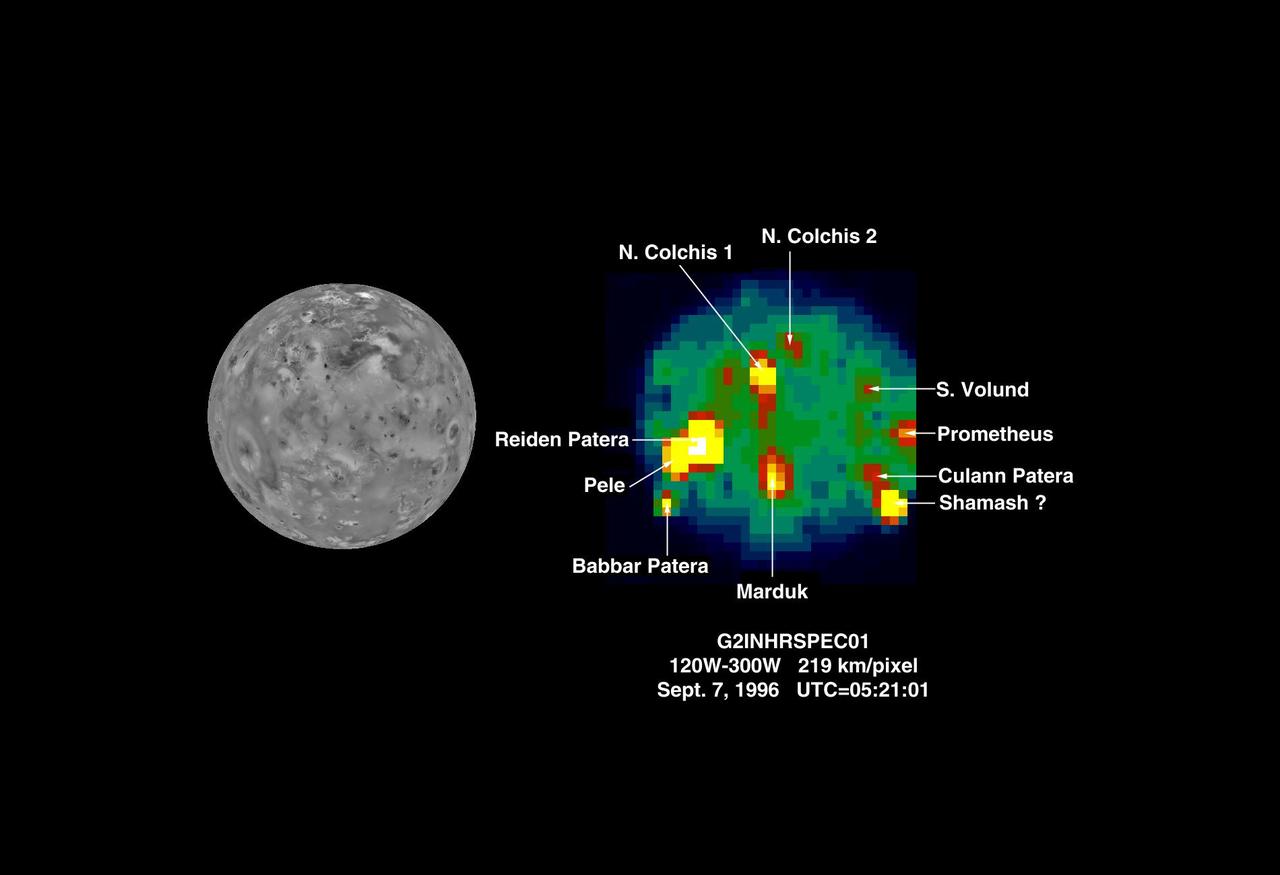
The Near Infrared Mapping Spectrometer (NIMS) on the Galileo spacecraft imaged Io at high spectral resolution at a range of 439,000 km (275,000 miles) during the G2 encounter on 7 September 1996. This image shows (on the right) Io as seen in the infrared by NIMS. The image on the left shows the same view from Voyager in 1979. This NIMS image can be compared to the NIMS images from the G1 orbit (June 1996) to monitor changes on Io. The NIMS image is at 4.9 microns, showing thermal emissions from the hotspots. The brightness of the pixels is a function of size and temperature. At least 10 hotspots have been identified and can be matched with surface features. An accurate determination of the position of the hotspot in the vicinity of Shamash Patera is pending. Hotspots are seen in the vicinity of Prometheus, Volund and Marduk, all sites of volcanic plume activity during the Galileo encounters, and also of active plumes in 1979. Temperatures and areas have been calculated for the hotspots shown. Temperatures range from 828 K (1031 F) to 210 K (- 81.4 F). The lowest temperature is significantly higher than the Io background (non-hotspot) surface temperature of about 100 K (-279 F). Hotspot areas range from 6.5 square km (2.5 sq miles) to 40,000 sq km (15,400 sq miles). The hottest hotspots have smallest areas, and the cooler hotspots have the largest areas. NIMS is continuing to observe Io to monitor volcanic activity throughout the Galileo mission. http://photojournal.jpl.nasa.gov/catalog/PIA00520

A Republic F-84 Thunderjet dramatically modified at the NASA Lewis Research Center to investigate the use of slotted nozzles to reduce exhaust noise. The F-84 was a single-seat fighter-bomber powered by an Allison J35 turbojet. It was the Air Force’s first post-World War II tactical aircraft and was used extensively in the Korean War. The laboratory had acquired the aircraft in 1954 and modified it in order to demonstrate the reverse thruster. The tail end of the aircraft was then removed for a series of large nozzle investigations. Lewis researchers launched an extensive program in the mid-1950s to develop methods of reducing engine noise as the airline industry was preparing to introduce the first turbojet-powered passenger aircraft. The early NACA investigations determined that the primary source of noise was the mixing of the engine’s hot exhaust with the cool surrounding air. Lewis researchers studied many different nozzles designed to facilitate this mixing. Nozzles with elongated exit sections, as seen in this photograph, produced lower noise levels. These long slot nozzles were also considered for Short Take-off and Landing aircraft because their long flat surfaces provided lift. In 1958 Lewis tested several full-scale slot nozzles on the F-84. The researchers, led by Willard Cole, sought to determine the noise-generation characteristics for nozzles having large a width-to-height ratio. The nozzle in this photograph has a 100 to 1 width-to-height ratio. Cole determined that the experimental nozzles produced the same levels of sound as the standard nozzle, but the changes in the directional noise were substantial.

CAPE CANAVERAL, Fla. – The “pathfinder” aircraft for space shuttle Discovery’s ferry flight parks near the Shuttle Carrier Aircraft on the tarmac of the Shuttle Landing Facility at NASA’s Kennedy Space Center in Florida. The NASA C-9 aircraft will fly about 100 miles ahead of Discovery to scout for the safest route between destinations. Its crew includes an SCA flight engineer who studies the weather patterns along the flight path to find a route free of rain and other turbulence. The carrier aircraft, also known as an SCA, is a Boeing 747 jet, originally manufactured for commercial use which was modified by NASA to transport the shuttles between destinations on Earth. NASA 905 is scheduled to ferry Discovery to the Washington Dulles International Airport in Virginia on April 17, and is assigned to all remaining ferry missions, delivering the shuttles to their permanent public display sites. After its arrival at Dulles, Discovery will be placed on display in the Smithsonian's National Air and Space Museum Steven F. Udvar-Hazy Center on April 19. For more information on the SCA, visit http://www.nasa.gov/centers/dryden/news/FactSheets/FS-013-DFRC.html. For more information on shuttle transition and retirement activities, visit http://www.nasa.gov/transition. Photo credit: NASA/Amanda Diller

This view shows Mercury's north polar region, colored by the maximum biannual surface temperature, which ranges from >400 K (red) to 50 K (purple). As expected for the Solar System's innermost planet, areas of Mercury's surface that are sunlit reach high temperatures, and hence most of this image is colored red! In contrast, some craters near Mercury's poles have regions that remain permanently in shadow, and in these regions even the maximum temperatures can be extremely low. Evidence from MESSENGER and Earth-based observations indicate that water ice deposits are present in these cold craters. The craters nearest Mercury' poles have surface temperatures less than 100 K (-173°C, -280°F), and water ice is stable on the surface, such as in Prokofiev. However, many craters near but somewhat farther from Mercury's poles have cold, permanently shadowed interiors, but the maximum temperature is too high for water ice to persist at the surface. In these craters, water ice is present but is buried beneath a thin, low-reflectance volatile layer likely consisting of organic-rich material, such as in Berlioz crater. http://photojournal.jpl.nasa.gov/catalog/PIA19247
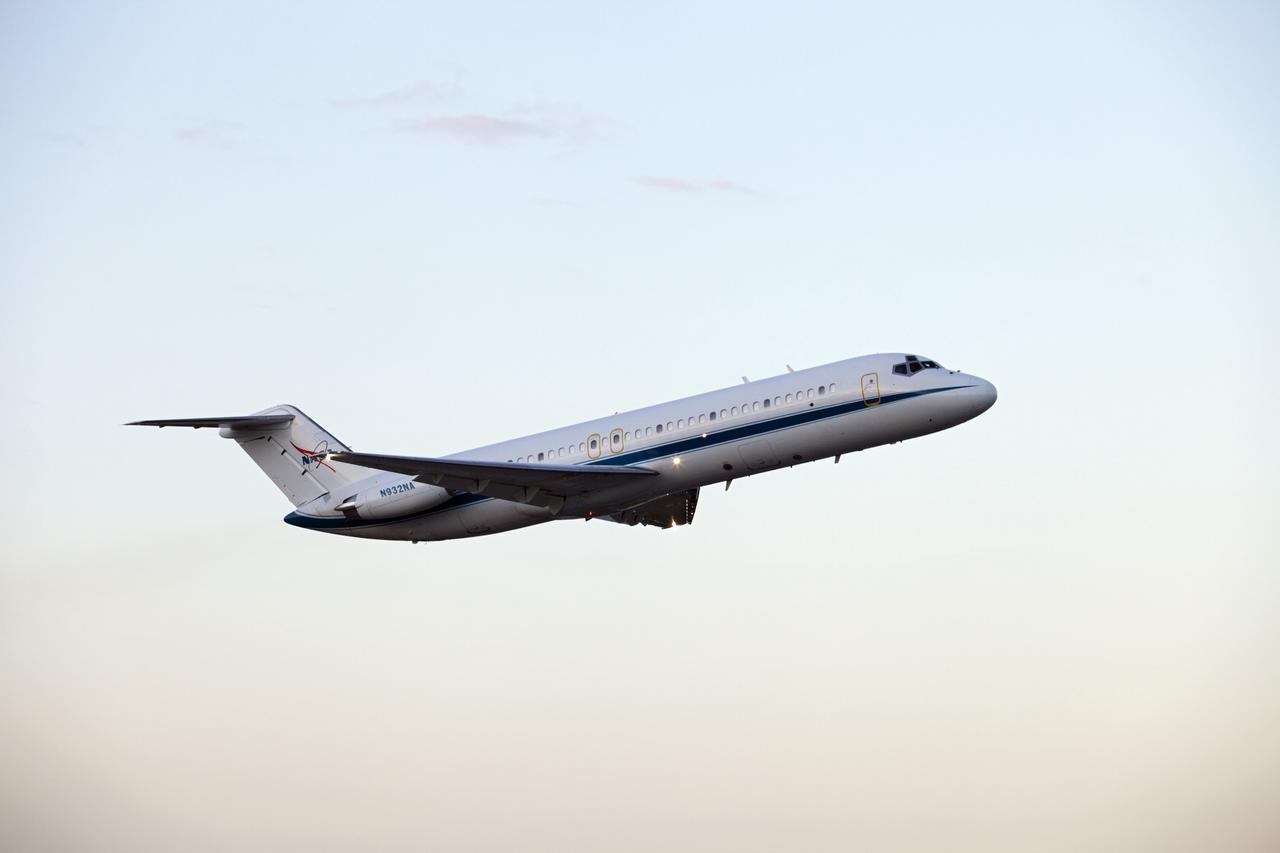
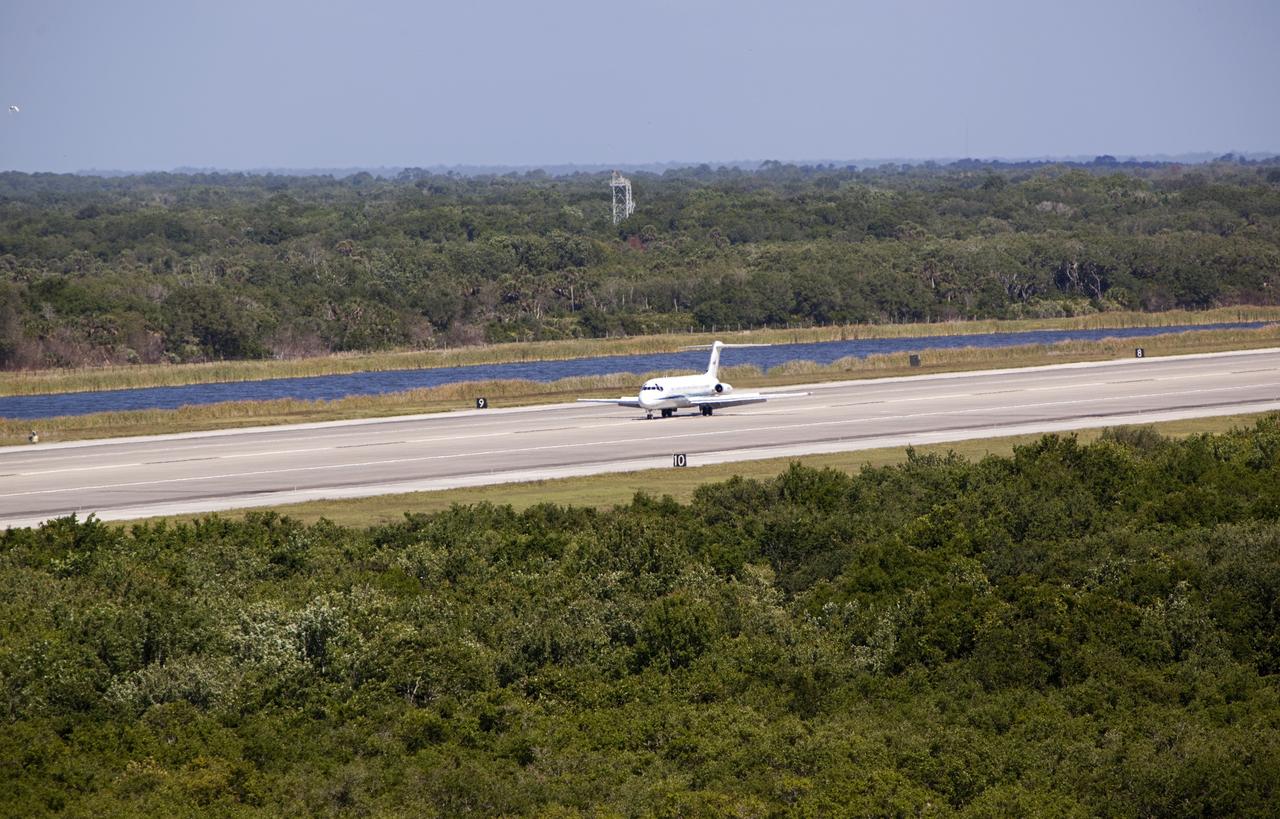
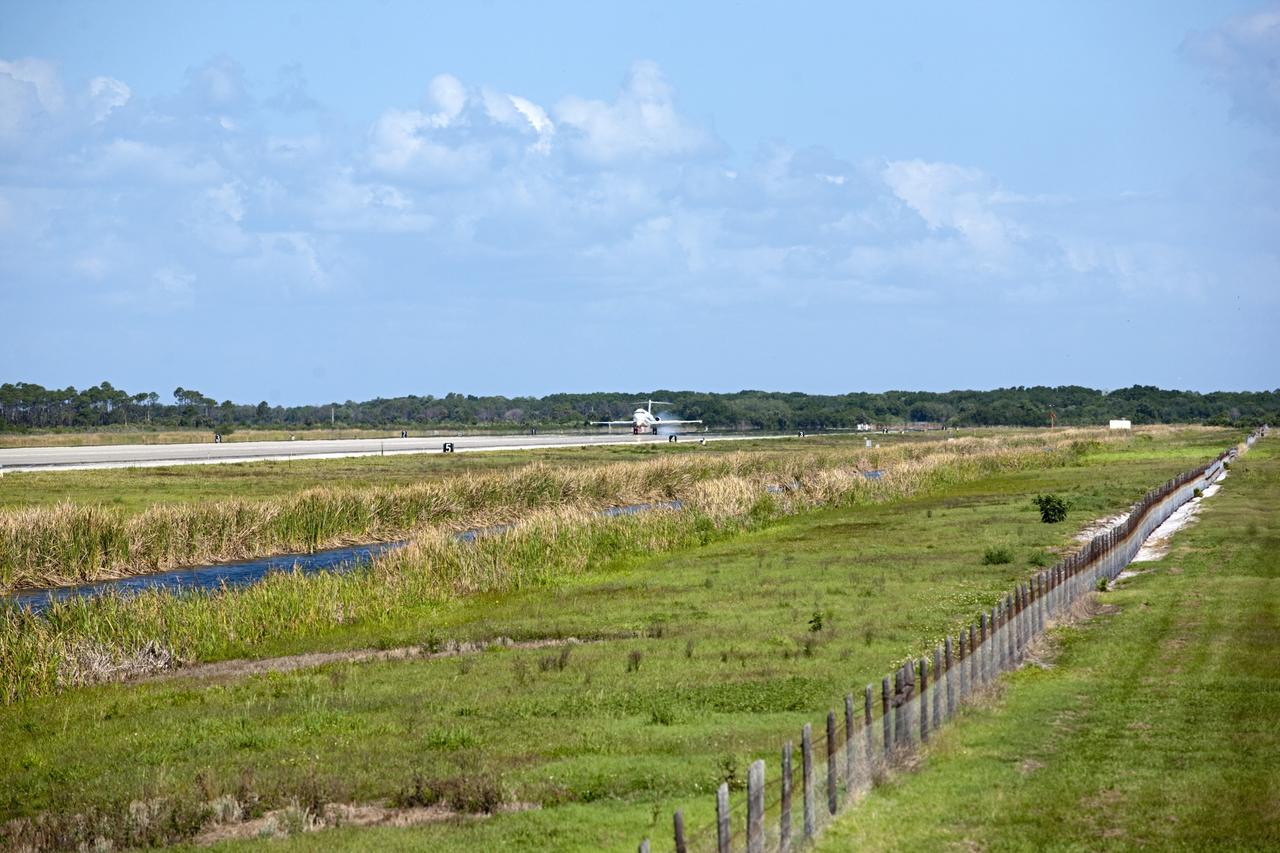
CAPE CANAVERAL, Fla. – A NASA C-9 “Pathfinder” DC-9 takes off from the Shuttle Landing Facility at NASA's Kennedy Space Center in Florida ahead of space shuttle Discovery, which is bolted to the top of a Shuttle Carrier Aircraft. The craft are set to begin their 3 1/2 hour ferry flight to the Washington Dulles International Airport in Virginia at about 7 a.m. EDT. The Pathfinder will fly about 100 miles ahead of the attached pair, making sure the flight path is free of harmful weather or hazardous conditions. Discovery is leaving Kennedy after more than 28 years of service beginning with its arrival on the space coast Nov. 9, 1983. Discovery first launched to space Aug. 30, 1984, on the STS-41D mission. Discovery is the agency's most-flown shuttle with 39 missions, more than 148 million miles and a total of one year in space. Discovery is set to move to the Smithsonian's National Air and Space Museum Steven F. Udvar-Hazy Center on April 19 where it will be placed on public display. For more information on the SCA, visit http://www.nasa.gov/centers/dryden/news/FactSheets/FS-013-DFRC.html. For more information on shuttle transition and retirement activities, visit http://www.nasa.gov/transition. Photo credit: NASA/Frankie Martin
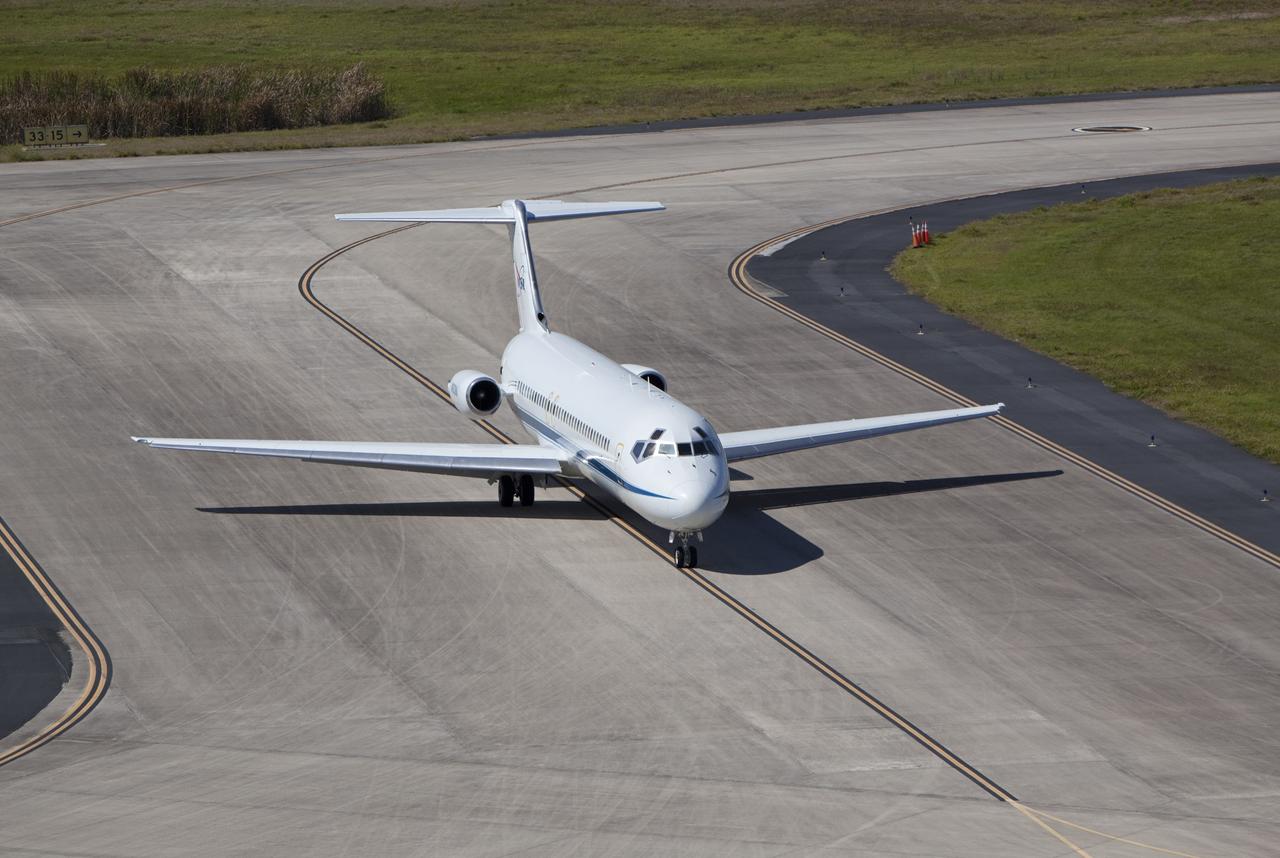
CAPE CANAVERAL, Fla. – The “pathfinder” aircraft for space shuttle Discovery’s ferry flight taxis onto the apron of the Shuttle Landing Facility at NASA’s Kennedy Space Center in Florida. The NASA C-9 aircraft will fly about 100 miles ahead of Discovery to scout for the safest route between destinations. Its crew includes an SCA flight engineer who studies the weather patterns along the flight path to find a route free of rain and other turbulence. The carrier aircraft, also known as an SCA, is a Boeing 747 jet, originally manufactured for commercial use which was modified by NASA to transport the shuttles between destinations on Earth. NASA 905 is scheduled to ferry Discovery to the Washington Dulles International Airport in Virginia on April 17, and is assigned to all remaining ferry missions, delivering the shuttles to their permanent public display sites. After its arrival at Dulles, Discovery will be placed on display in the Smithsonian's National Air and Space Museum Steven F. Udvar-Hazy Center on April 19. For more information on the SCA, visit http://www.nasa.gov/centers/dryden/news/FactSheets/FS-013-DFRC.html. For more information on shuttle transition and retirement activities, visit http://www.nasa.gov/transition. Photo credit: NASA/Dimitri Gerondidaki

Technicians set up test hardware inside the test section of the Icing Research Tunnel at the National Aeronautics and Space Administration (NASA) Lewis Research Center. The Icing Research Tunnel was built in the early 1940s to study the formation of ice on aircraft surfaces and develop methods of preventing or eradicating that ice. Ice buildup is dangerous because it adds extra weight, effects aerodynamics, and sometimes blocks air flow through engines. The Icing Research Tunnel is a closed-loop atmospheric wind tunnel with a 6- by 9-foot test section. The tunnel can produce speeds up to 300 miles per hour and temperatures from 30 to -45 °F. NACA engineers struggled initially to perfect a spray bar system to introduce moisture into the airstream. The tunnel was shut down in the late 1950s as the center focused its energy exclusively on space. Industrial customers began using the tunnel sporadically, then steadily, in the 1960s. Boeing, Aerojet, Lockheed, Sikorsky, Beech and others ran tests during the 1960s. Boeing analyzed engine inlets for the CH-47 Chinook, CH-46 (Sea Knight) and CH-113. This photograph was taken during a series of 100 ice-phobic coatings for the Federal Aviation Administration. They found that many of the coatings reduced ice adhesion to the test sample, but they could not be used for aircraft applications.
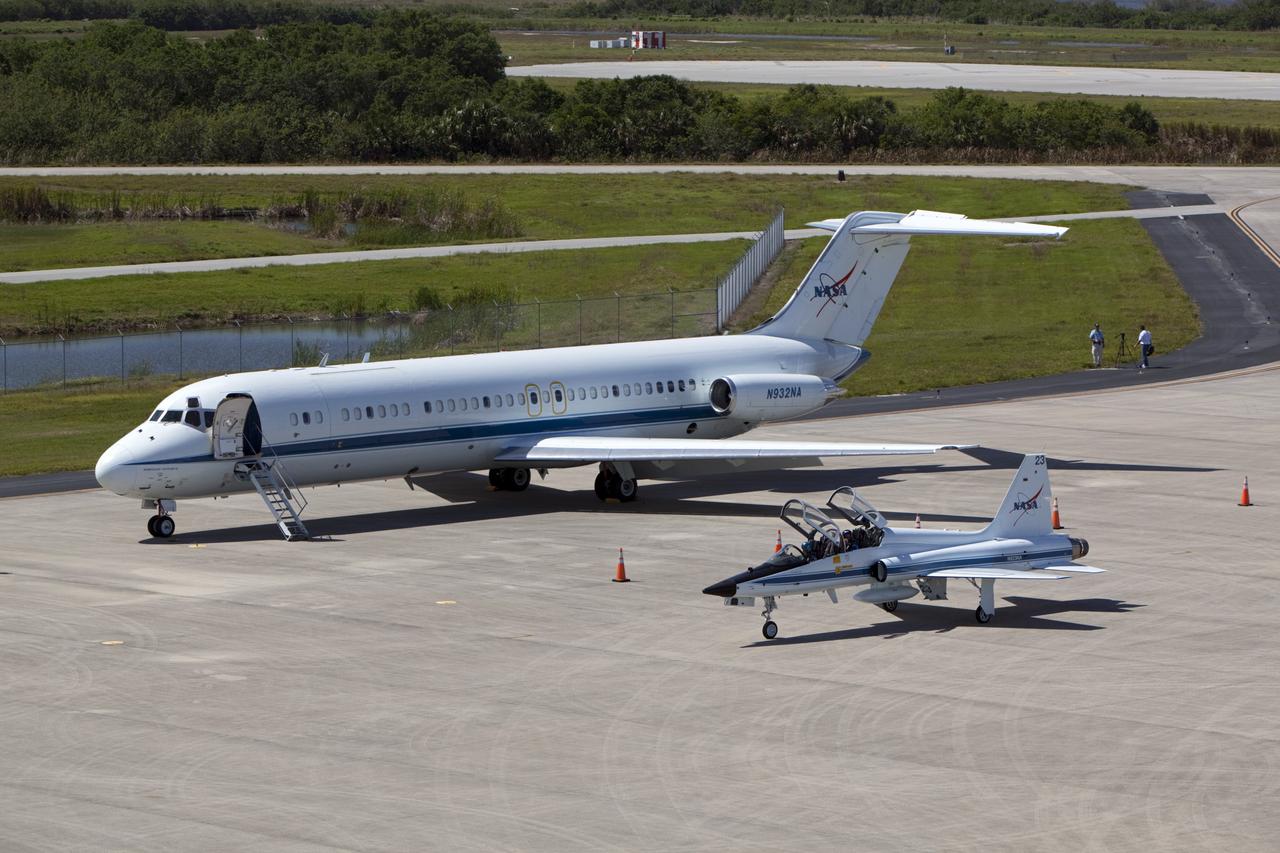
CAPE CANAVERAL, Fla. – A T-38 jet parks beside the “pathfinder” aircraft for space shuttle Discovery’s ferry flight on the apron of the Shuttle Landing Facility at NASA’s Kennedy Space Center in Florida. The NASA C-9 aircraft will fly about 100 miles ahead of Discovery to scout for the safest route between destinations. Its crew includes an SCA flight engineer who studies the weather patterns along the flight path to find a route free of rain and other turbulence. The carrier aircraft, also known as an SCA, is a Boeing 747 jet, originally manufactured for commercial use which was modified by NASA to transport the shuttles between destinations on Earth. NASA 905 is scheduled to ferry Discovery to the Washington Dulles International Airport in Virginia on April 17, and is assigned to all remaining ferry missions, delivering the shuttles to their permanent public display sites. After its arrival at Dulles, Discovery will be placed on display in the Smithsonian's National Air and Space Museum Steven F. Udvar-Hazy Center on April 19. For more information on the SCA, visit http://www.nasa.gov/centers/dryden/news/FactSheets/FS-013-DFRC.html. For more information on shuttle transition and retirement activities, visit http://www.nasa.gov/transition. Photo credit: NASA/Dimitri Gerondidaki

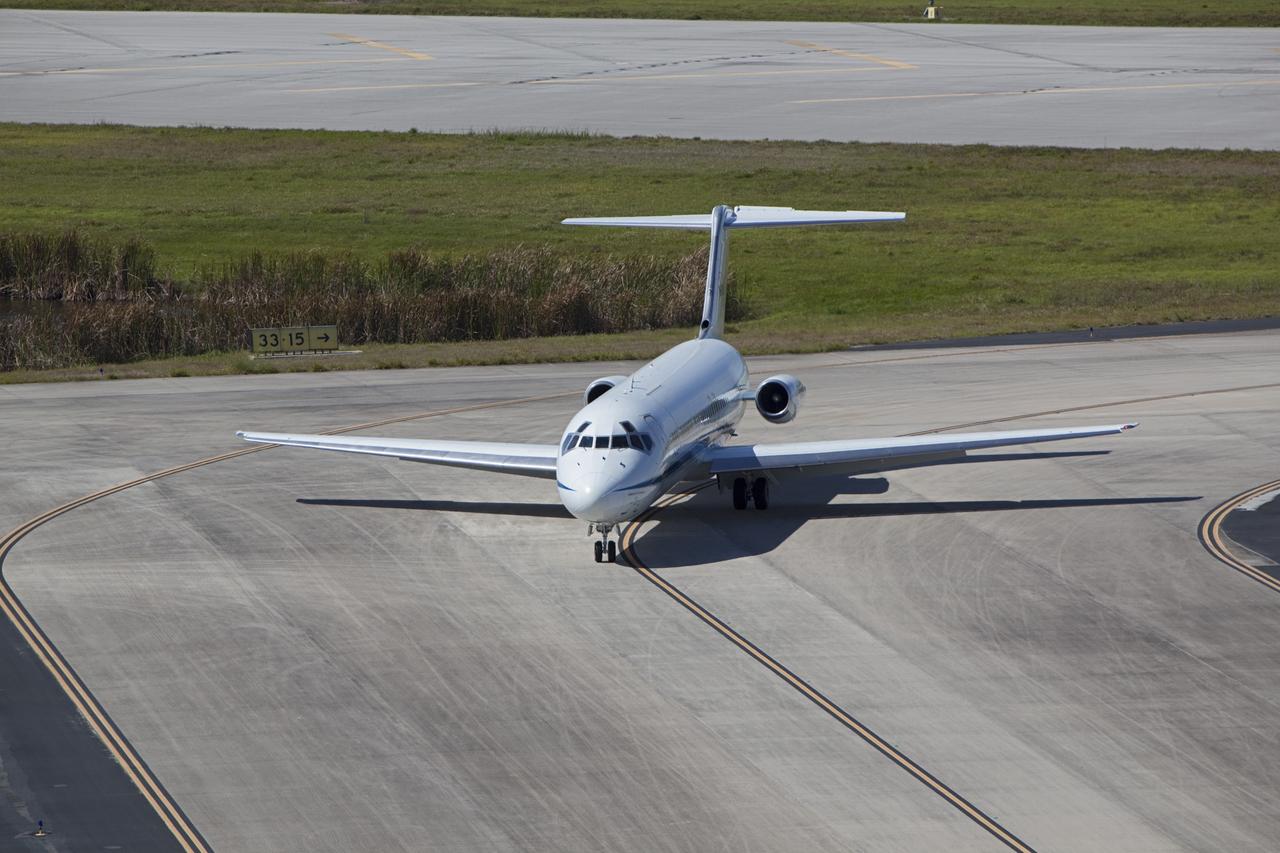
CAPE CANAVERAL, Fla. – The “pathfinder” aircraft for space shuttle Discovery’s ferry flight arrives at the Shuttle Landing Facility at NASA’s Kennedy Space Center in Florida. The NASA C-9 aircraft will fly about 100 miles ahead of Discovery to scout for the safest route between destinations. Its crew includes an SCA flight engineer who studies the weather patterns along the flight path to find a route free of rain and other turbulence. The carrier aircraft, also known as an SCA, is a Boeing 747 jet, originally manufactured for commercial use which was modified by NASA to transport the shuttles between destinations on Earth. NASA 905 is scheduled to ferry Discovery to the Washington Dulles International Airport in Virginia on April 17, and is assigned to all remaining ferry missions, delivering the shuttles to their permanent public display sites. After its arrival at Dulles, Discovery will be placed on display in the Smithsonian's National Air and Space Museum Steven F. Udvar-Hazy Center on April 19. For more information on the SCA, visit http://www.nasa.gov/centers/dryden/news/FactSheets/FS-013-DFRC.html. For more information on shuttle transition and retirement activities, visit http://www.nasa.gov/transition. Photo credit: NASA/Amanda Diller
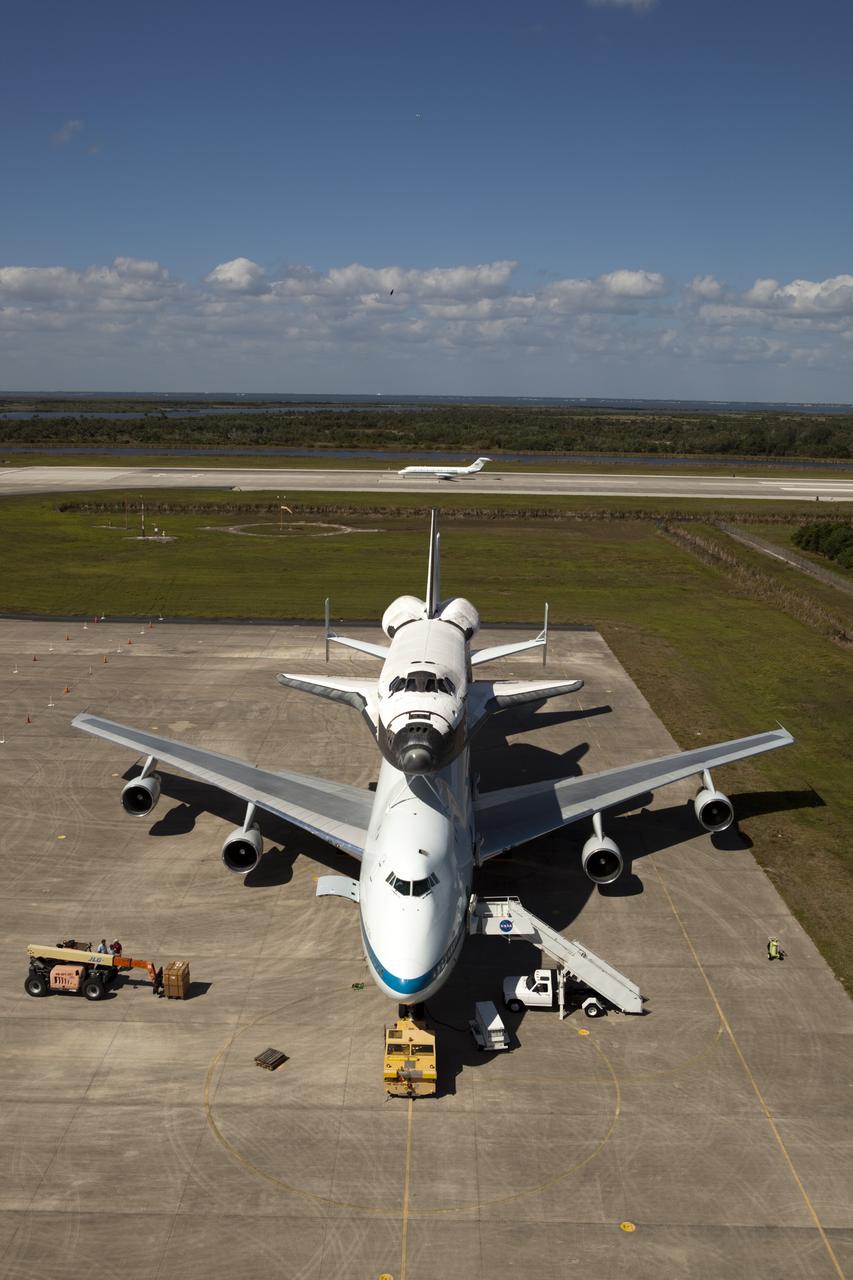
CAPE CANAVERAL, Fla. – Preparations for space shuttle Discovery’s ferry flight aboard a Shuttle Carrier Aircraft continue as the “pathfinder” aircraft for the flight lands at the Shuttle Landing Facility at NASA’s Kennedy Space Center in Florida. The NASA C-9 aircraft will fly about 100 miles ahead of Discovery to scout for the safest route between destinations. Its crew includes an SCA flight engineer who studies the weather patterns along the flight path to find a route free of rain and other turbulence. The carrier aircraft, also known as an SCA, is a Boeing 747 jet, originally manufactured for commercial use which was modified by NASA to transport the shuttles between destinations on Earth. NASA 905 is scheduled to ferry Discovery to the Washington Dulles International Airport in Virginia on April 17, and is assigned to all remaining ferry missions, delivering the shuttles to their permanent public display sites. After its arrival at Dulles, Discovery will be placed on display in the Smithsonian's National Air and Space Museum Steven F. Udvar-Hazy Center on April 19. For more information on the SCA, visit http://www.nasa.gov/centers/dryden/news/FactSheets/FS-013-DFRC.html. For more information on shuttle transition and retirement activities, visit http://www.nasa.gov/transition. Photo credit: NASA/Dimitri Gerondidaki

CAPE CANAVERAL, Fla. – A NASA C-9 “Pathfinder” DC-9 prepares for takeoff from the Shuttle Landing Facility at NASA's Kennedy Space Center in Florida ahead of space shuttle Discovery, which is bolted to the top of a Shuttle Carrier Aircraft. The craft are set to begin their 3 1/2 hour ferry flight to the Washington Dulles International Airport in Virginia at about 7 a.m. EDT. The Pathfinder will fly about 100 miles ahead of the attached pair, making sure the flight path is free of harmful weather or hazardous conditions. Discovery is leaving Kennedy after more than 28 years of service beginning with its arrival on the space coast Nov. 9, 1983. Discovery first launched to space Aug. 30, 1984, on the STS-41D mission. Discovery is the agency's most-flown shuttle with 39 missions, more than 148 million miles and a total of one year in space. Discovery is set to move to the Smithsonian's National Air and Space Museum Steven F. Udvar-Hazy Center on April 19 where it will be placed on public display. For more information on the SCA, visit http://www.nasa.gov/centers/dryden/news/FactSheets/FS-013-DFRC.html. For more information on shuttle transition and retirement activities, visit http://www.nasa.gov/transition. Photo credit: NASA/Jim Grossmann
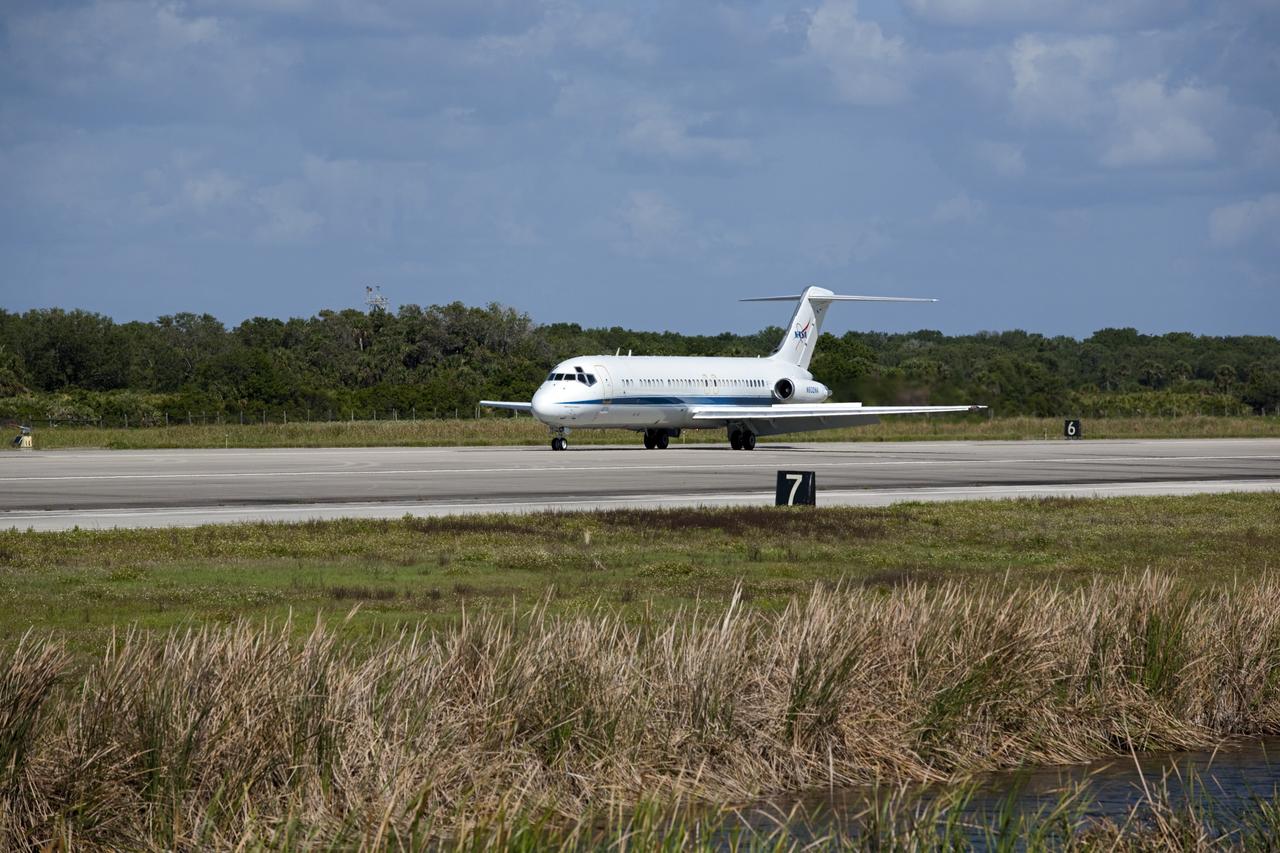
CAPE CANAVERAL, Fla. – The “pathfinder” aircraft for space shuttle Discovery’s ferry flight lands at the Shuttle Landing Facility at NASA’s Kennedy Space Center in Florida. The NASA C-9 aircraft will fly about 100 miles ahead of Discovery to scout for the safest route between destinations. Its crew includes an SCA flight engineer who studies the weather patterns along the flight path to find a route free of rain and other turbulence. The carrier aircraft, also known as an SCA, is a Boeing 747 jet, originally manufactured for commercial use which was modified by NASA to transport the shuttles between destinations on Earth. NASA 905 is scheduled to ferry Discovery to the Washington Dulles International Airport in Virginia on April 17, and is assigned to all remaining ferry missions, delivering the shuttles to their permanent public display sites. After its arrival at Dulles, Discovery will be placed on display in the Smithsonian's National Air and Space Museum Steven F. Udvar-Hazy Center on April 19. For more information on the SCA, visit http://www.nasa.gov/centers/dryden/news/FactSheets/FS-013-DFRC.html. For more information on shuttle transition and retirement activities, visit http://www.nasa.gov/transition. Photo credit: NASA/Amanda Diller
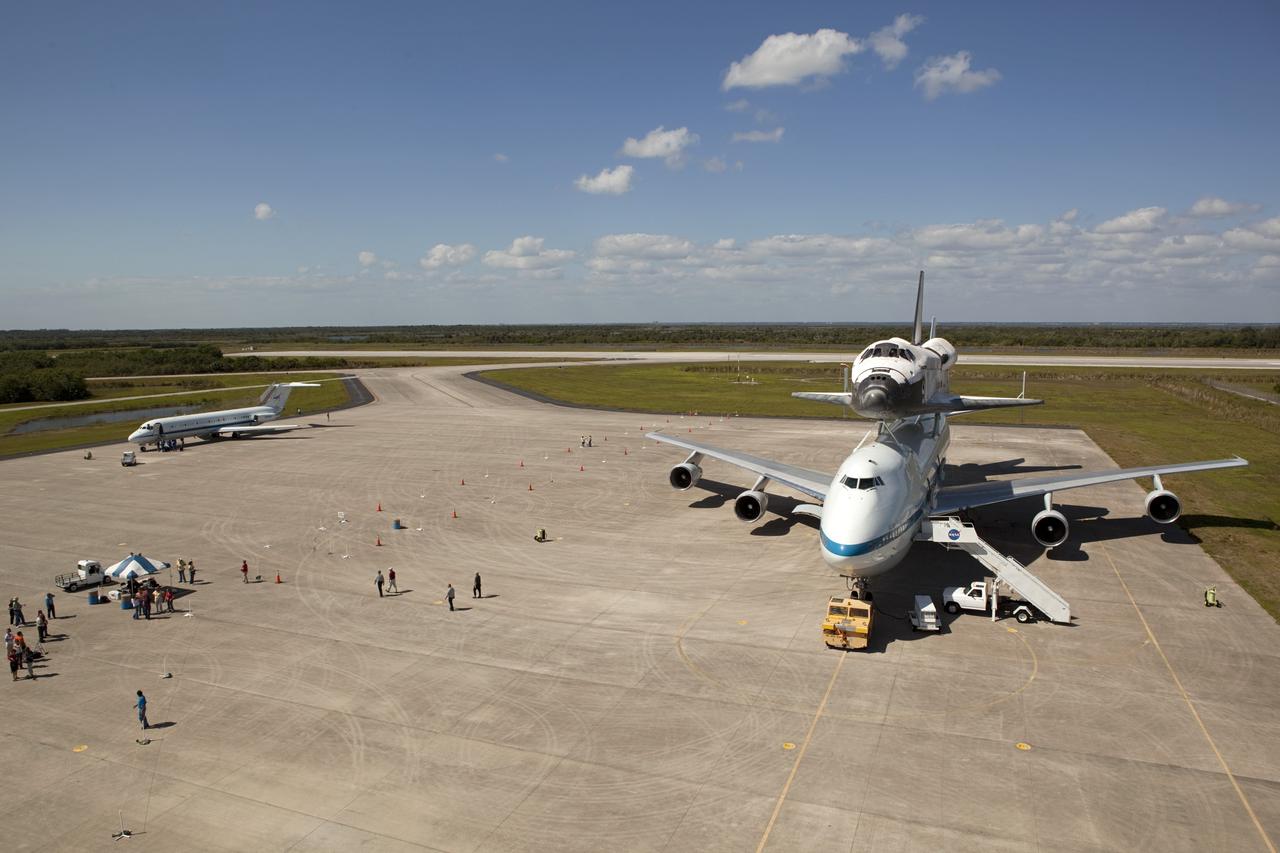
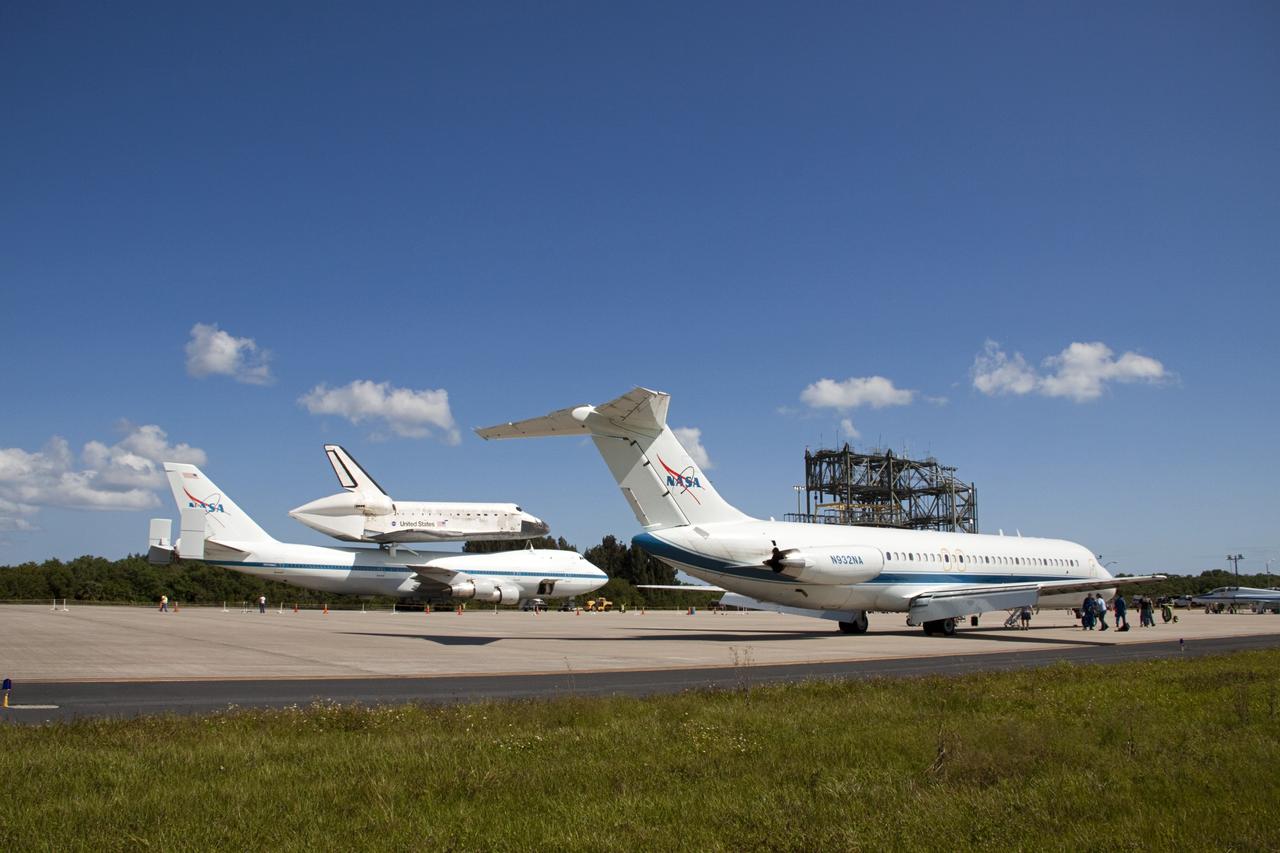
CAPE CANAVERAL, Fla. – The “pathfinder” aircraft for space shuttle Discovery’s ferry flight parks near the Shuttle Carrier Aircraft on the apron of the Shuttle Landing Facility at NASA’s Kennedy Space Center in Florida. The NASA C-9 aircraft will fly about 100 miles ahead of Discovery to scout for the safest route between destinations. Its crew includes an SCA flight engineer who studies the weather patterns along the flight path to find a route free of rain and other turbulence. The carrier aircraft, also known as an SCA, is a Boeing 747 jet, originally manufactured for commercial use which was modified by NASA to transport the shuttles between destinations on Earth. NASA 905 is scheduled to ferry Discovery to the Washington Dulles International Airport in Virginia on April 17, and is assigned to all remaining ferry missions, delivering the shuttles to their permanent public display sites. After its arrival at Dulles, Discovery will be placed on display in the Smithsonian's National Air and Space Museum Steven F. Udvar-Hazy Center on April 19. For more information on the SCA, visit http://www.nasa.gov/centers/dryden/news/FactSheets/FS-013-DFRC.html. For more information on shuttle transition and retirement activities, visit http://www.nasa.gov/transition. Photo credit: NASA/Dimitri Gerondidaki

CAPE CANAVERAL, Fla. – The “pathfinder” aircraft for space shuttle Discovery’s ferry flight arrives at the Shuttle Landing Facility at NASA’s Kennedy Space Center in Florida to support Discovery’s ferry flight. The NASA C-9 aircraft will fly about 100 miles ahead of Discovery to scout for the safest route between destinations. Its crew includes an SCA flight engineer who studies the weather patterns along the flight path to find a route free of rain and other turbulence. The carrier aircraft, also known as an SCA, is a Boeing 747 jet, originally manufactured for commercial use which was modified by NASA to transport the shuttles between destinations on Earth. NASA 905 is scheduled to ferry Discovery to the Washington Dulles International Airport in Virginia on April 17, and is assigned to all remaining ferry missions, delivering the shuttles to their permanent public display sites. After its arrival at Dulles, Discovery will be placed on display in the Smithsonian's National Air and Space Museum Steven F. Udvar-Hazy Center on April 19. For more information on the SCA, visit http://www.nasa.gov/centers/dryden/news/FactSheets/FS-013-DFRC.html. For more information on shuttle transition and retirement activities, visit http://www.nasa.gov/transition. Photo credit: NASA/Amanda Diller
CAPE CANAVERAL, Fla. – The “pathfinder” aircraft for space shuttle Discovery’s ferry flight arrives at the Shuttle Landing Facility at NASA’s Kennedy Space Center in Florida. The NASA C-9 aircraft will fly about 100 miles ahead of Discovery to scout for the safest route between destinations. Its crew includes an SCA flight engineer who studies the weather patterns along the flight path to find a route free of rain and other turbulence. The carrier aircraft, also known as an SCA, is a Boeing 747 jet, originally manufactured for commercial use which was modified by NASA to transport the shuttles between destinations on Earth. NASA 905 is scheduled to ferry Discovery to the Washington Dulles International Airport in Virginia on April 17, and is assigned to all remaining ferry missions, delivering the shuttles to their permanent public display sites. After its arrival at Dulles, Discovery will be placed on display in the Smithsonian's National Air and Space Museum Steven F. Udvar-Hazy Center on April 19. For more information on the SCA, visit http://www.nasa.gov/centers/dryden/news/FactSheets/FS-013-DFRC.html. For more information on shuttle transition and retirement activities, visit http://www.nasa.gov/transition. Photo credit: NASA/Dimitri Gerondidaki
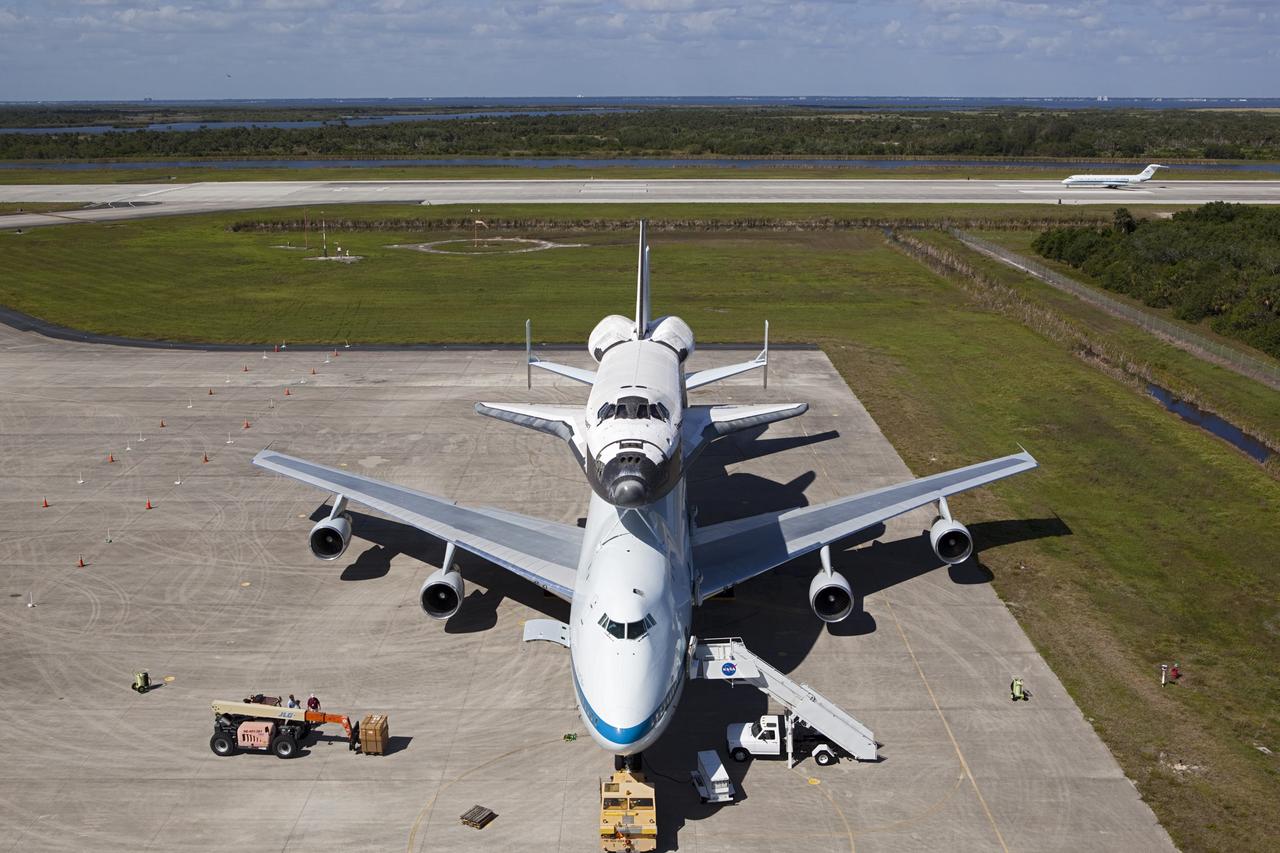
CAPE CANAVERAL, Fla. – Preparations for space shuttle Discovery’s ferry flight aboard a Shuttle Carrier Aircraft continue as the “pathfinder” aircraft for the flight lands at the Shuttle Landing Facility at NASA’s Kennedy Space Center in Florida. The NASA C-9 aircraft will fly about 100 miles ahead of Discovery to scout for the safest route between destinations. Its crew includes an SCA flight engineer who studies the weather patterns along the flight path to find a route free of rain and other turbulence. The carrier aircraft, also known as an SCA, is a Boeing 747 jet, originally manufactured for commercial use which was modified by NASA to transport the shuttles between destinations on Earth. NASA 905 is scheduled to ferry Discovery to the Washington Dulles International Airport in Virginia on April 17, and is assigned to all remaining ferry missions, delivering the shuttles to their permanent public display sites. After its arrival at Dulles, Discovery will be placed on display in the Smithsonian's National Air and Space Museum Steven F. Udvar-Hazy Center on April 19. For more information on the SCA, visit http://www.nasa.gov/centers/dryden/news/FactSheets/FS-013-DFRC.html. For more information on shuttle transition and retirement activities, visit http://www.nasa.gov/transition. Photo credit: NASA/Dimitri Gerondidaki

Data from NASA's ECOSTRESS (Ecosystem Spaceborne Thermal Radiometer Experiment on Space Station) instrument aboard the International Space Station shows three wildfires burning in the mountains east and southeast of the Los Angeles area on Sept. 10, 2024. The Bridge Fire started Sept. 8 in the Angeles National Forest during an intense heat wave that blanketed the area for about a week. As of Sept. 13, the fire was only 3% contained. The Line Fire started Sept. 5 in Highland, within San Bernardino County, and spread toward the mountain communities of Running Springs and Big Bear. After more than a week of battling the blaze, firefighters had the conflagration 21% contained. The Airport Fire ignited Sept. 9 in the foothills of the Santa Ana Mountains east of the Orange County city of Irvine and spread into Riverside County. As of Sept. 13, it was 8% contained. The ECOSTRESS instrument measures the temperature of the land rather than air temperatures that most people are familiar with in weather forecasts. Bright white spots in the active fire areas in the visual above indicate a land surface temperature of over 300 degrees Fahrenheit (149 degrees Celsius). Dark red represents areas closer to 100 F (38 C). https://photojournal.jpl.nasa.gov/catalog/PIA26187
CAPE CANAVERAL, Fla. – The “pathfinder” aircraft for space shuttle Discovery’s ferry flight touches down at the Shuttle Landing Facility at NASA’s Kennedy Space Center in Florida. The NASA C-9 aircraft will fly about 100 miles ahead of Discovery to scout for the safest route between destinations. Its crew includes an SCA flight engineer who studies the weather patterns along the flight path to find a route free of rain and other turbulence. The carrier aircraft, also known as an SCA, is a Boeing 747 jet, originally manufactured for commercial use which was modified by NASA to transport the shuttles between destinations on Earth. NASA 905 is scheduled to ferry Discovery to the Washington Dulles International Airport in Virginia on April 17, and is assigned to all remaining ferry missions, delivering the shuttles to their permanent public display sites. After its arrival at Dulles, Discovery will be placed on display in the Smithsonian's National Air and Space Museum Steven F. Udvar-Hazy Center on April 19. For more information on the SCA, visit http://www.nasa.gov/centers/dryden/news/FactSheets/FS-013-DFRC.html. For more information on shuttle transition and retirement activities, visit http://www.nasa.gov/transition. Photo credit: NASA/Dimitri Gerondidaki
CAPE CANAVERAL, Fla. – A buzz of activity surrounds the “pathfinder” aircraft for space shuttle Discovery’s ferry flight on the tarmac of the Shuttle Landing Facility at NASA’s Kennedy Space Center in Florida. The NASA C-9 aircraft will fly about 100 miles ahead of Discovery to scout for the safest route between destinations. Its crew includes an SCA flight engineer who studies the weather patterns along the flight path to find a route free of rain and other turbulence. The carrier aircraft, also known as an SCA, is a Boeing 747 jet, originally manufactured for commercial use which was modified by NASA to transport the shuttles between destinations on Earth. NASA 905 is scheduled to ferry Discovery to the Washington Dulles International Airport in Virginia on April 17, and is assigned to all remaining ferry missions, delivering the shuttles to their permanent public display sites. After its arrival at Dulles, Discovery will be placed on display in the Smithsonian's National Air and Space Museum Steven F. Udvar-Hazy Center on April 19. For more information on the SCA, visit http://www.nasa.gov/centers/dryden/news/FactSheets/FS-013-DFRC.html. For more information on shuttle transition and retirement activities, visit http://www.nasa.gov/transition. Photo credit: NASA/Amanda Diller
CAPE CANAVERAL, Fla. – The “pathfinder” aircraft for space shuttle Discovery’s ferry flight touches down at the Shuttle Landing Facility at NASA’s Kennedy Space Center in Florida . The NASA C-9 aircraft will fly about 100 miles ahead of Discovery to scout for the safest route between destinations. Its crew includes an SCA flight engineer who studies the weather patterns along the flight path to find a route free of rain and other turbulence. The carrier aircraft, also known as an SCA, is a Boeing 747 jet, originally manufactured for commercial use which was modified by NASA to transport the shuttles between destinations on Earth. NASA 905 is scheduled to ferry Discovery to the Washington Dulles International Airport in Virginia on April 17, and is assigned to all remaining ferry missions, delivering the shuttles to their permanent public display sites. After its arrival at Dulles, Discovery will be placed on display in the Smithsonian's National Air and Space Museum Steven F. Udvar-Hazy Center on April 19. For more information on the SCA, visit http://www.nasa.gov/centers/dryden/news/FactSheets/FS-013-DFRC.html. For more information on shuttle transition and retirement activities, visit http://www.nasa.gov/transition. Photo credit: NASA/Amanda Diller
CAPE CANAVERAL, Fla. – The “pathfinder” aircraft for space shuttle Discovery’s ferry flight taxis onto the apron of the Shuttle Landing Facility at NASA’s Kennedy Space Center in Florida. The NASA C-9 aircraft will fly about 100 miles ahead of Discovery to scout for the safest route between destinations. Its crew includes an SCA flight engineer who studies the weather patterns along the flight path to find a route free of rain and other turbulence. The carrier aircraft, also known as an SCA, is a Boeing 747 jet, originally manufactured for commercial use which was modified by NASA to transport the shuttles between destinations on Earth. NASA 905 is scheduled to ferry Discovery to the Washington Dulles International Airport in Virginia on April 17, and is assigned to all remaining ferry missions, delivering the shuttles to their permanent public display sites. After its arrival at Dulles, Discovery will be placed on display in the Smithsonian's National Air and Space Museum Steven F. Udvar-Hazy Center on April 19. For more information on the SCA, visit http://www.nasa.gov/centers/dryden/news/FactSheets/FS-013-DFRC.html. For more information on shuttle transition and retirement activities, visit http://www.nasa.gov/transition. Photo credit: NASA/Dimitri Gerondidaki

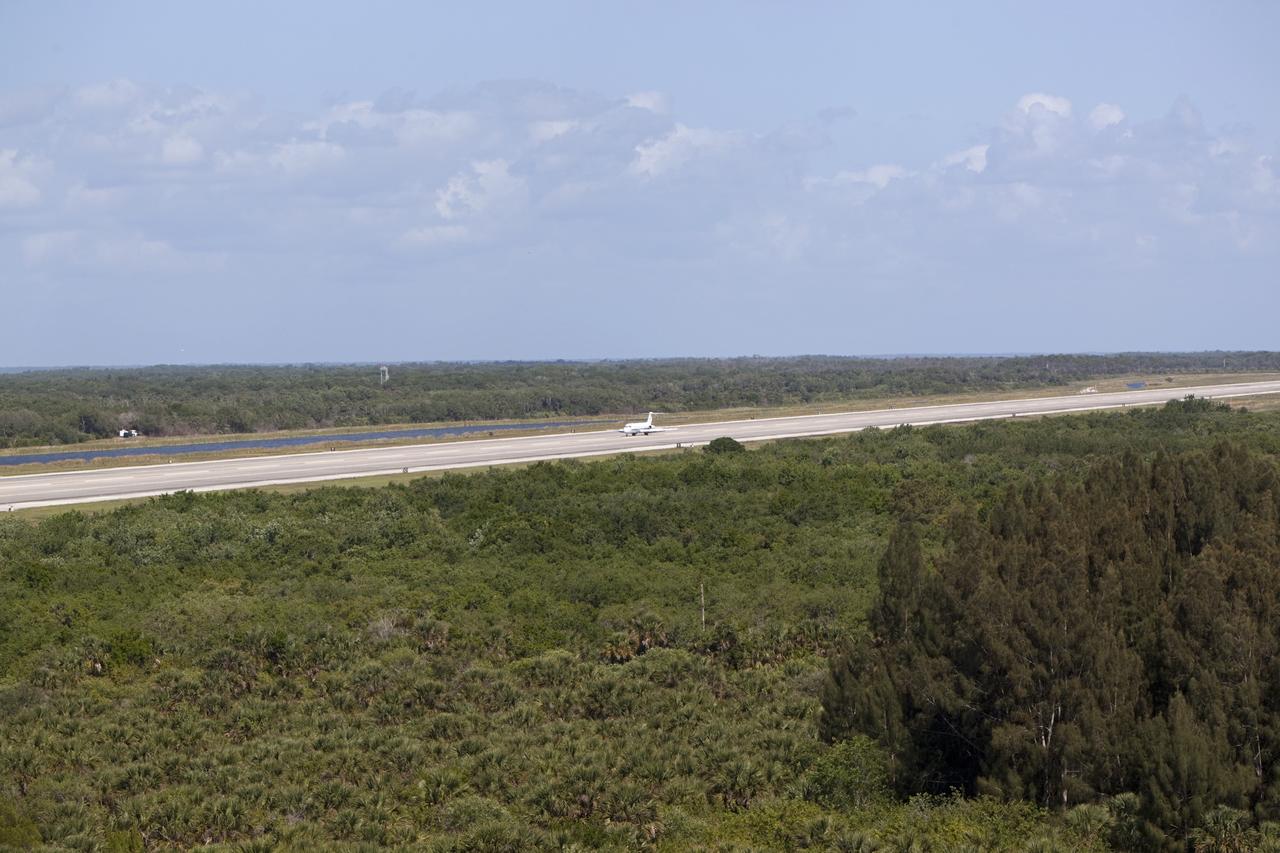
CAPE CANAVERAL, Fla. – The “pathfinder” aircraft for space shuttle Discovery’s ferry flight taxis down the runway at the Shuttle Landing Facility at NASA’s Kennedy Space Center in Florida. The NASA C-9 aircraft will fly about 100 miles ahead of Discovery to scout for the safest route between destinations. Its crew includes an SCA flight engineer who studies the weather patterns along the flight path to find a route free of rain and other turbulence. The carrier aircraft, also known as an SCA, is a Boeing 747 jet, originally manufactured for commercial use which was modified by NASA to transport the shuttles between destinations on Earth. NASA 905 is scheduled to ferry Discovery to the Washington Dulles International Airport in Virginia on April 17, and is assigned to all remaining ferry missions, delivering the shuttles to their permanent public display sites. After its arrival at Dulles, Discovery will be placed on display in the Smithsonian's National Air and Space Museum Steven F. Udvar-Hazy Center on April 19. For more information on the SCA, visit http://www.nasa.gov/centers/dryden/news/FactSheets/FS-013-DFRC.html. For more information on shuttle transition and retirement activities, visit http://www.nasa.gov/transition. Photo credit: NASA/Amanda Diller
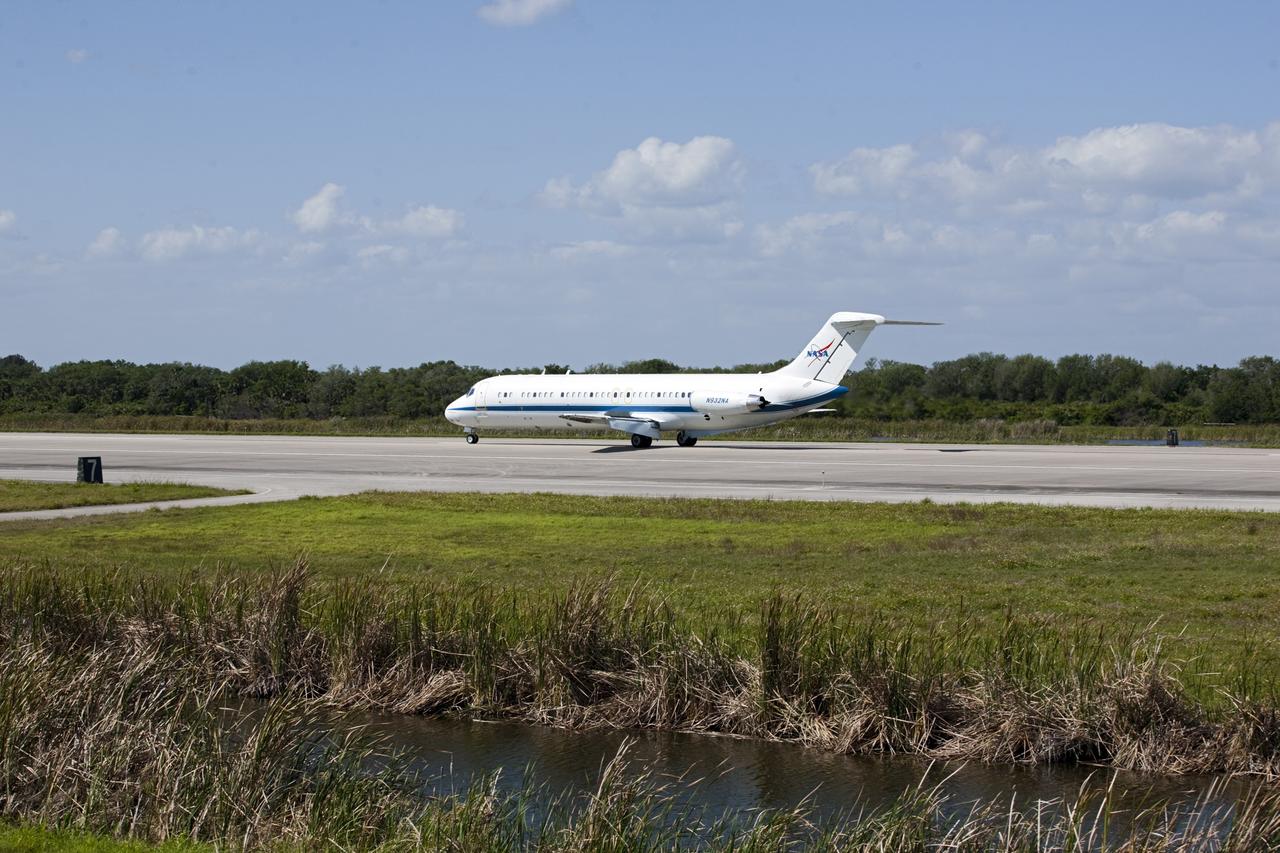
CAPE CANAVERAL, Fla. – The “pathfinder” aircraft for space shuttle Discovery’s ferry flight taxis down the runway at the Shuttle Landing Facility at NASA’s Kennedy Space Center in Florida. The NASA C-9 aircraft will fly about 100 miles ahead of Discovery to scout for the safest route between destinations. Its crew includes an SCA flight engineer who studies the weather patterns along the flight path to find a route free of rain and other turbulence. The carrier aircraft, also known as an SCA, is a Boeing 747 jet, originally manufactured for commercial use which was modified by NASA to transport the shuttles between destinations on Earth. NASA 905 is scheduled to ferry Discovery to the Washington Dulles International Airport in Virginia on April 17, and is assigned to all remaining ferry missions, delivering the shuttles to their permanent public display sites. After its arrival at Dulles, Discovery will be placed on display in the Smithsonian's National Air and Space Museum Steven F. Udvar-Hazy Center on April 19. For more information on the SCA, visit http://www.nasa.gov/centers/dryden/news/FactSheets/FS-013-DFRC.html. For more information on shuttle transition and retirement activities, visit http://www.nasa.gov/transition. Photo credit: NASA/Amanda Diller
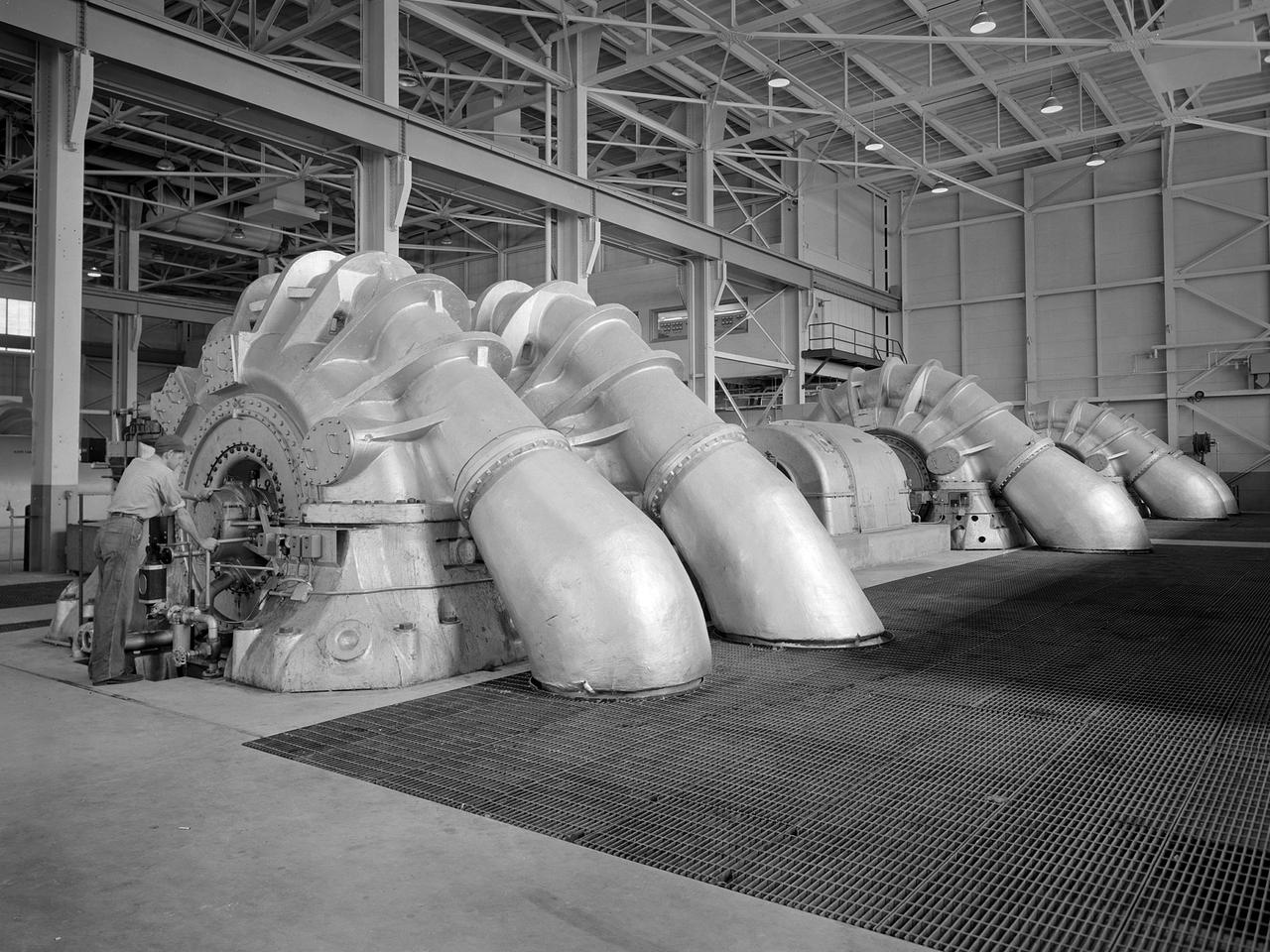
The Propulsion Systems Laboratory’s exhaust system was expanded in 1955 at the National Advisory Committee for Aeronautics (NACA) Lewis Flight Propulsion Laboratory. The facility contained two altitude chambers that were first used to study the increasingly-powerful jet engines of the early 1950s and the ramjets for missile programs such as Navaho and Bomarc. Later, the facility tested large rocket engines and a variety of turbofan engines. The exhaust system served two roles: reducing the density of the air in the test chambers to simulate high altitudes and removing the hot gases exhausted by the engines being tested. These tasks were accomplished by large Roots-Connersville exhauster equipment in the Equipment Building. The original configuration could exhaust the 3500° F gases at a rate of 100 pounds per second when the simulated altitude was 50,000 feet. In 1955, three years after operation started, a fourth line of exhausters was added. There were three centrifugal exhausters capable of supplying 166 pounds of air per second at the test chamber altitude of 50,000 feet or 384 pounds per second at 32,000 feet. These exhausters had two first-stage castings driven by a 10,000-horsepower motor; one second; one third; and one fourth-stage casting driven by a 16,500-horsepower motor. The total inlet volume of the exhausters is 1,650,000 cubic feet of gas per minute. The exhausters were continually improved and upgraded over the years.
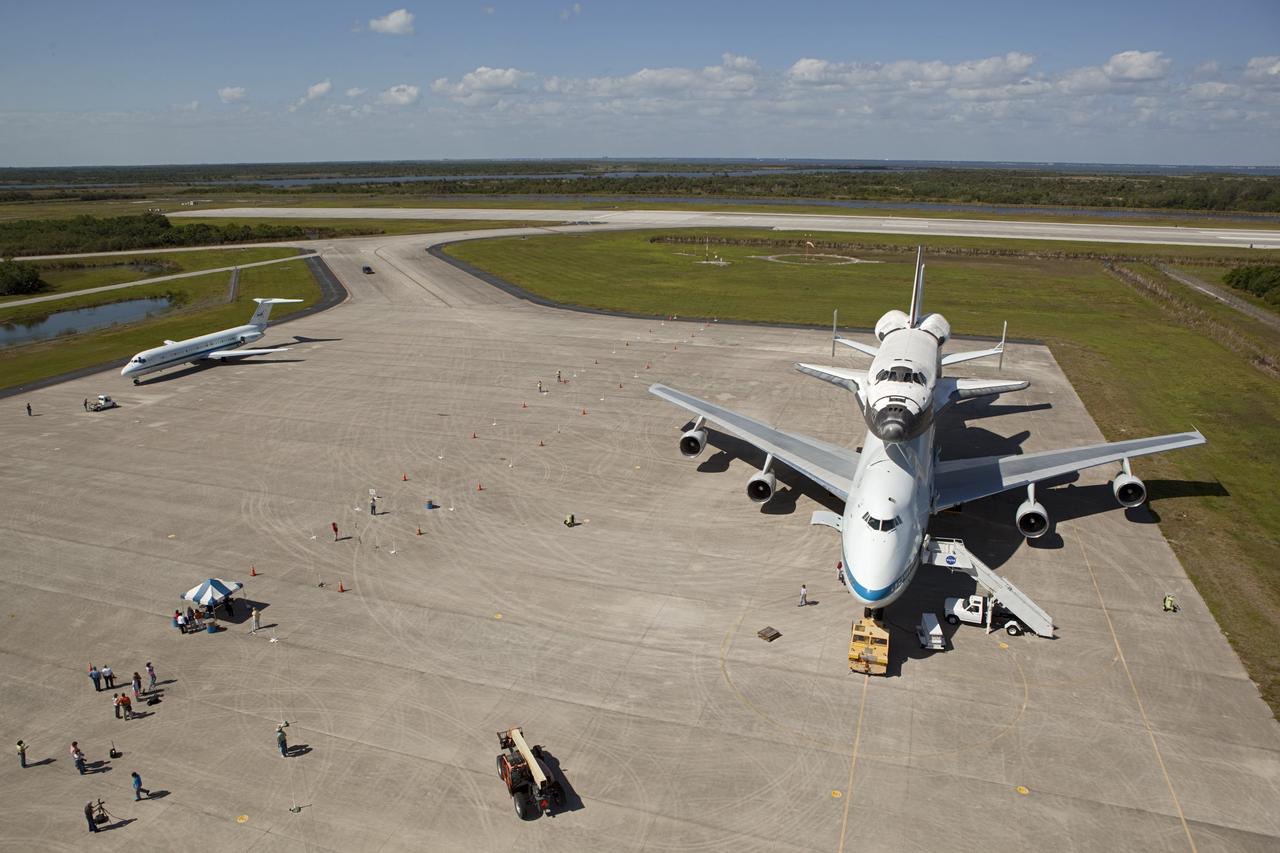
CAPE CANAVERAL, Fla. – The “pathfinder” aircraft for space shuttle Discovery’s ferry flight pulls up beside the Shuttle Carrier Aircraft on the apron of the Shuttle Landing Facility at NASA’s Kennedy Space Center in Florida. The NASA C-9 aircraft will fly about 100 miles ahead of Discovery to scout for the safest route between destinations. Its crew includes an SCA flight engineer who studies the weather patterns along the flight path to find a route free of rain and other turbulence. The carrier aircraft, also known as an SCA, is a Boeing 747 jet, originally manufactured for commercial use which was modified by NASA to transport the shuttles between destinations on Earth. NASA 905 is scheduled to ferry Discovery to the Washington Dulles International Airport in Virginia on April 17, and is assigned to all remaining ferry missions, delivering the shuttles to their permanent public display sites. After its arrival at Dulles, Discovery will be placed on display in the Smithsonian's National Air and Space Museum Steven F. Udvar-Hazy Center on April 19. For more information on the SCA, visit http://www.nasa.gov/centers/dryden/news/FactSheets/FS-013-DFRC.html. For more information on shuttle transition and retirement activities, visit http://www.nasa.gov/transition. Photo credit: NASA/Dimitri Gerondidaki

CAPE CANAVERAL, Fla. – The “pathfinder” aircraft for space shuttle Discovery’s ferry flight pulls up beside the Shuttle Carrier Aircraft on the tarmac of the Shuttle Landing Facility at NASA’s Kennedy Space Center in Florida. The NASA C-9 aircraft will fly about 100 miles ahead of Discovery to scout for the safest route between destinations. Its crew includes an SCA flight engineer who studies the weather patterns along the flight path to find a route free of rain and other turbulence. The carrier aircraft, also known as an SCA, is a Boeing 747 jet, originally manufactured for commercial use which was modified by NASA to transport the shuttles between destinations on Earth. NASA 905 is scheduled to ferry Discovery to the Washington Dulles International Airport in Virginia on April 17, and is assigned to all remaining ferry missions, delivering the shuttles to their permanent public display sites. After its arrival at Dulles, Discovery will be placed on display in the Smithsonian's National Air and Space Museum Steven F. Udvar-Hazy Center on April 19. For more information on the SCA, visit http://www.nasa.gov/centers/dryden/news/FactSheets/FS-013-DFRC.html. For more information on shuttle transition and retirement activities, visit http://www.nasa.gov/transition. Photo credit: NASA/Amanda Diller
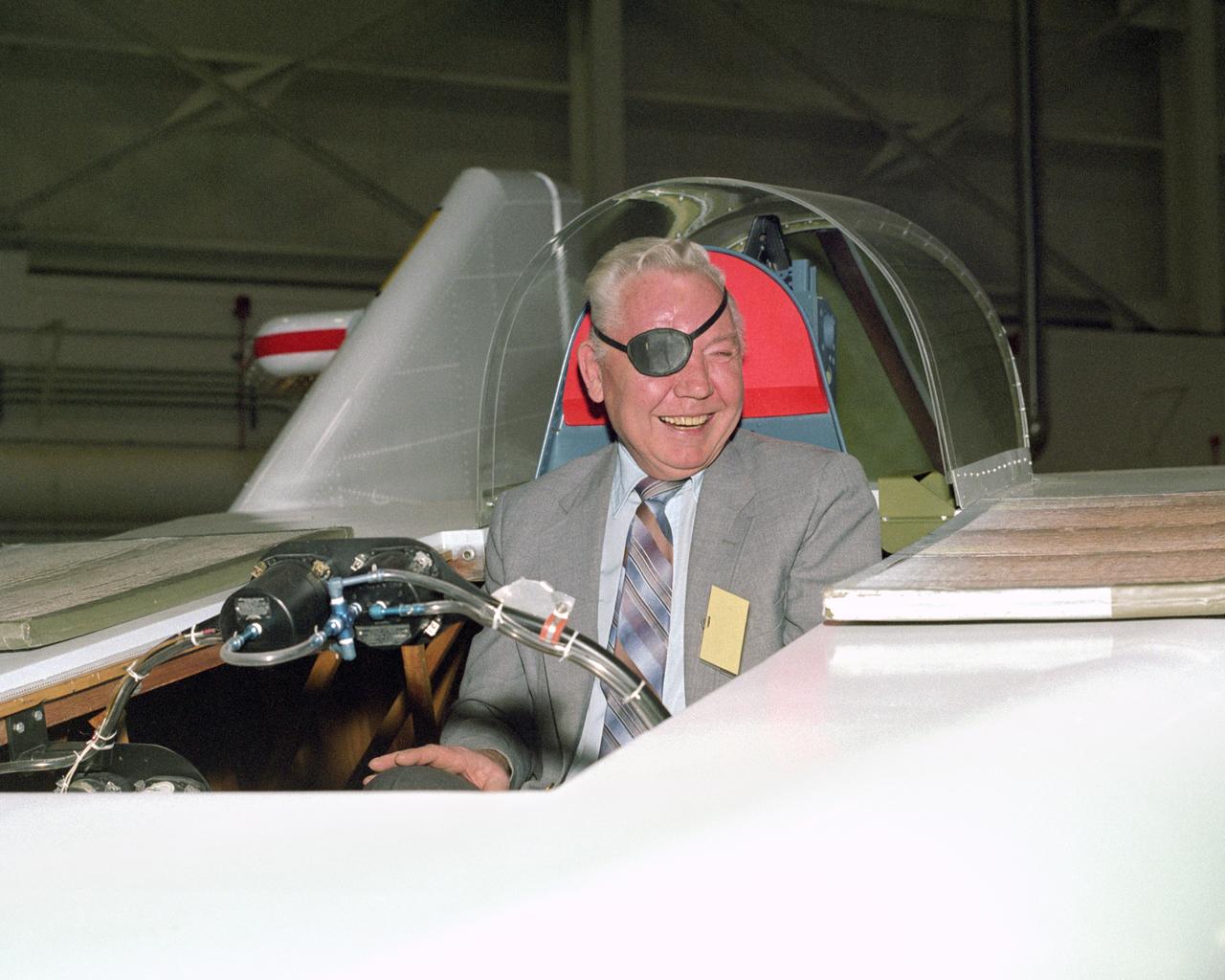
NASA Pilot Bruce Peterson in the cockpit of the restored M2-F1 Lifting Body.
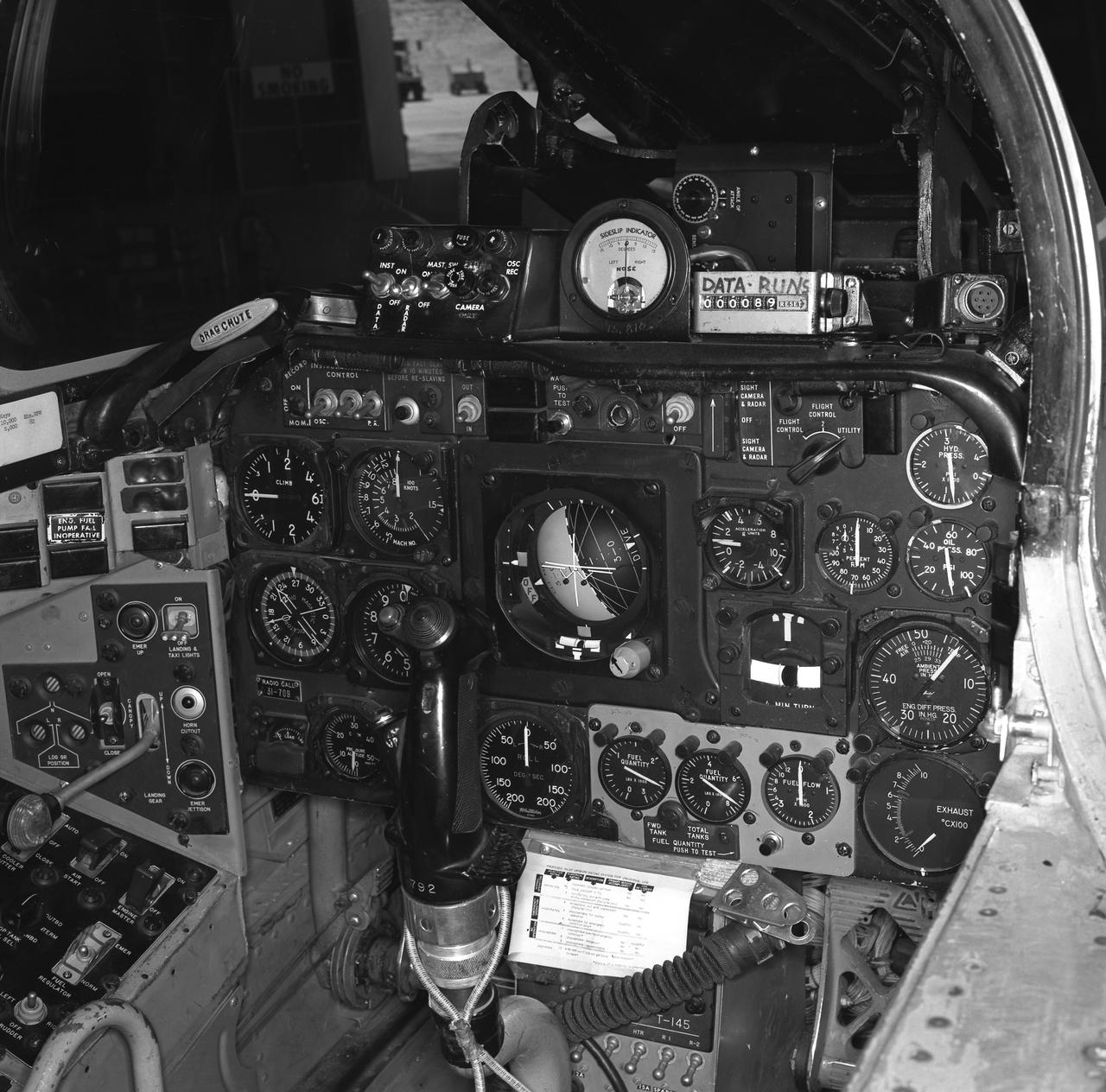
JF-100C #709 cockpit control panel July 17, 1963
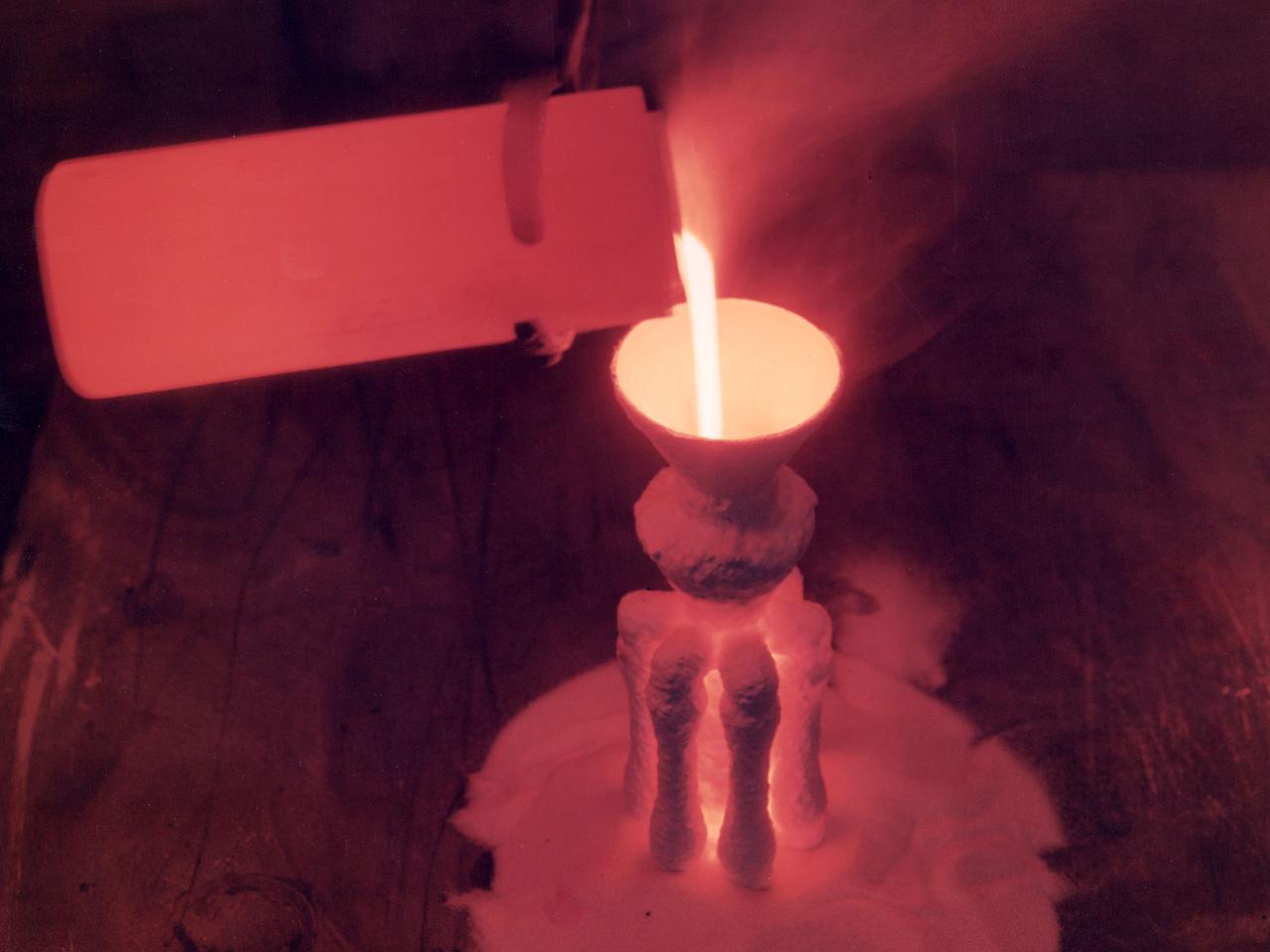
A nickel alloy developed at the National Aeronautics and Space Administration (NASA) Lewis Research Center being poured in a shop inside the Technical Services Building. Materials technology is an important element in the successful development of both advanced airbreathing and rocket propulsion systems. An array of dependable materials is needed to build different types of engines for operation in diverse environments. NASA Lewis began investigating the characteristics of different materials shortly after World War II. In 1949 the materials research group was expanded into its own division. The Lewis researchers studied and tested materials in environments that simulated the environment in which they would operate. Lewis created two programs in the early 1960s to create materials for new airbreathing engines. One concentrated on high-temperature alloys and the other on cooling turbine blades. William Klopp, Peter Raffo, Lester Rubenstein, and Walter Witzke developed Tungsten RHC, the highest strength metal at temperatures over 3500⁰ F. The men received an IR-100 Award for their efforts. Similarly a cobalt-tungsten alloy was developed by the Fatigue and Alloys Research Branch. The result was a combination of high temperature strength and magnetic properties that were applicable for generator rotor application. John Freche invented and patented a nickel alloy while searching for high temperature metals for aerospace use. NASA agreed to a three-year deal which granted Union Carbide exclusive use of the new alloy before it became public property.
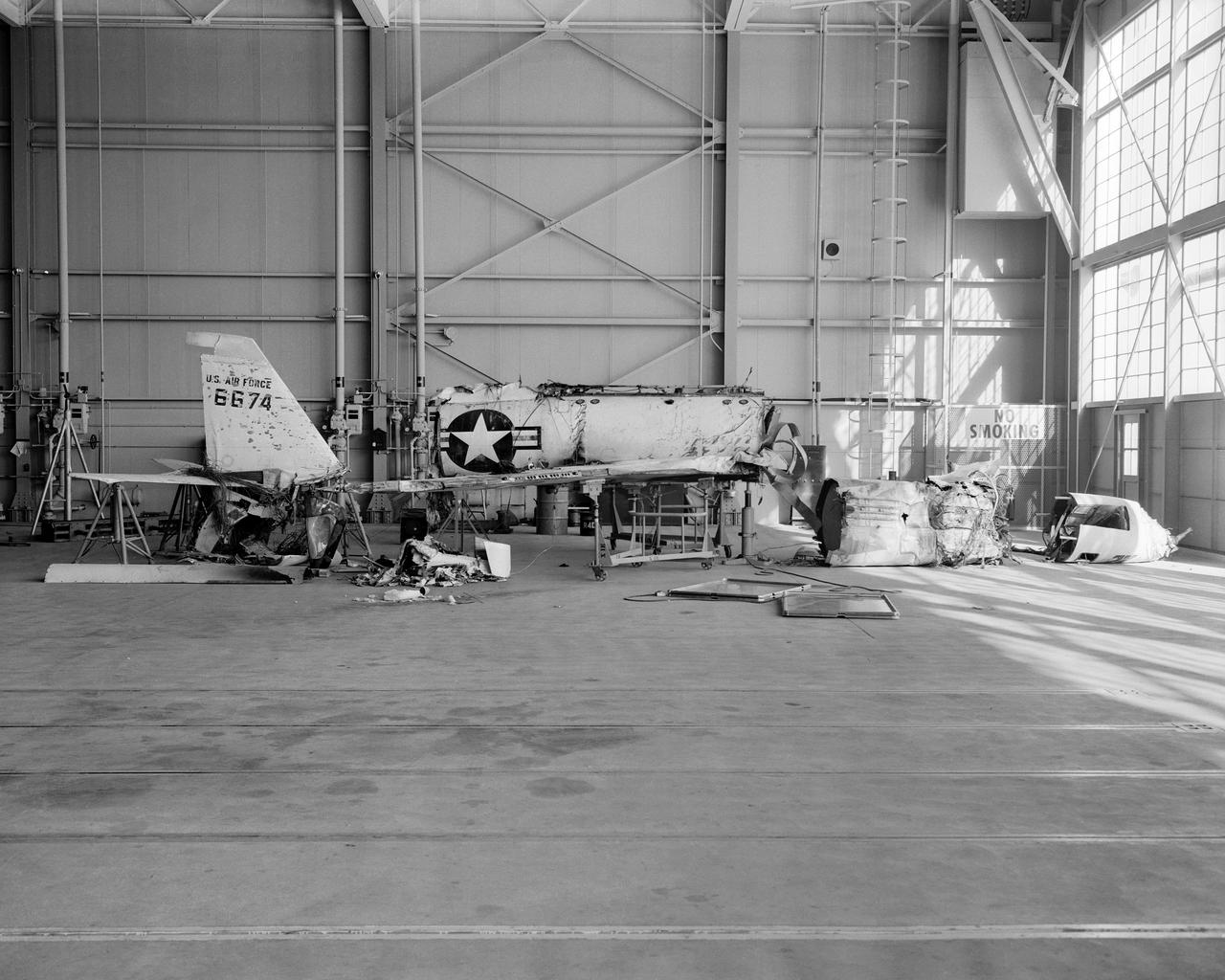
The X-2, initially an Air Force program, was scheduled to be transferred to the civilian National Advisory Committee for Aeronautics (NACA) for scientific research. The Air Force delayed turning the aircraft over to the NACA in the hope of attaining Mach 3 in the airplane. The service requested and received a two-month extension to qualify another Air Force test pilot, Capt. Miburn "Mel" Apt, in the X-2 and attempt to exceed Mach 3. After several ground briefings in the simulator, Apt (with no previous rocket plane experience) made his flight on 27 September 1956. Apt raced away from the B-50 under full power, quickly outdistancing the F-100 chase planes. At high altitude, he nosed over, accelerating rapidly. The X-2 reached Mach 3.2 (2,094 mph) at 65,000 feet. Apt became the first man to fly more than three times the speed of sound. Still above Mach 3, he began an abrupt turn back to Edwards. This maneuver proved fatal as the X-2 began a series of diverging rolls and tumbled out of control. Apt tried to regain control of the aircraft. Unable to do so, Apt separated the escape capsule. Too late, he attempted to bail out and was killed when the capsule impacted on the Edwards bombing range. The rest of the X-2 crashed five miles away. The wreckage of the X-2 rocket plane was later taken to NACA's High Speed Flight Station for analysis following the crash.
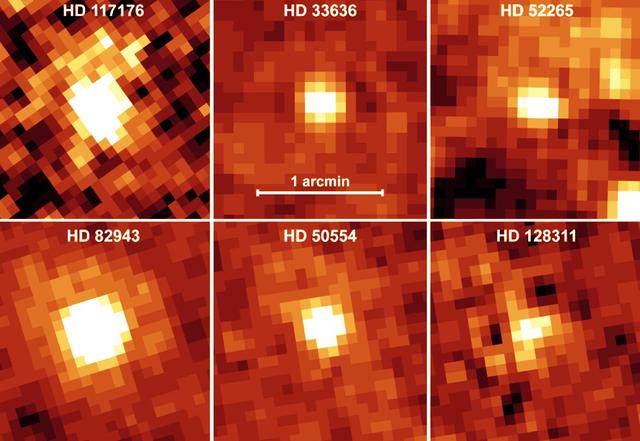
NASA's Spitzer Space Telescope recently captured these infrared images of six older stars with known planets. The yellow, fuzzy blobs are stars circled by disks of dust, or "debris disks," like the one that surrounds our own Sun. Though astronomers had predicted that stars with planets would harbor debris disks, they could not detect such disks until now. Spitzer was able to sense these dusty disks via their warm infrared glows. Specifically, the presence of the disks was inferred from an excess amount of infrared emission relative to what is emitted from the parent star alone. The stars themselves are similar in age and temperature to our Sun. In astronomical terms, they are stellar main sequence stars, with spectral types of F, G, or K. These planet-bearing stars have a median age of four billion years. For reference, our Sun is classified as a G star, with an age of approximately five billion years. The disks surrounding these planetary systems are comprised of cool material, with temperatures less than 100 Kelvin (-173 degrees Celsius). They are10 times farther away from their parent stars than Earth is from the Sun, and are thought to be analogues of the comet-filled Kuiper Belt in our solar system. The contrast scale is the same for each image. The images are approximately 2 arcminutes on each side. North is oriented upward and east is to the left. The pictures were taken with the 70-micron filter of Spitzer's multiband imaging photometer. The telescope resolution at 70 microns is 17 arcseconds and there is no evidence for any emission extended beyond the telescope resolution. http://photojournal.jpl.nasa.gov/catalog/PIA07098
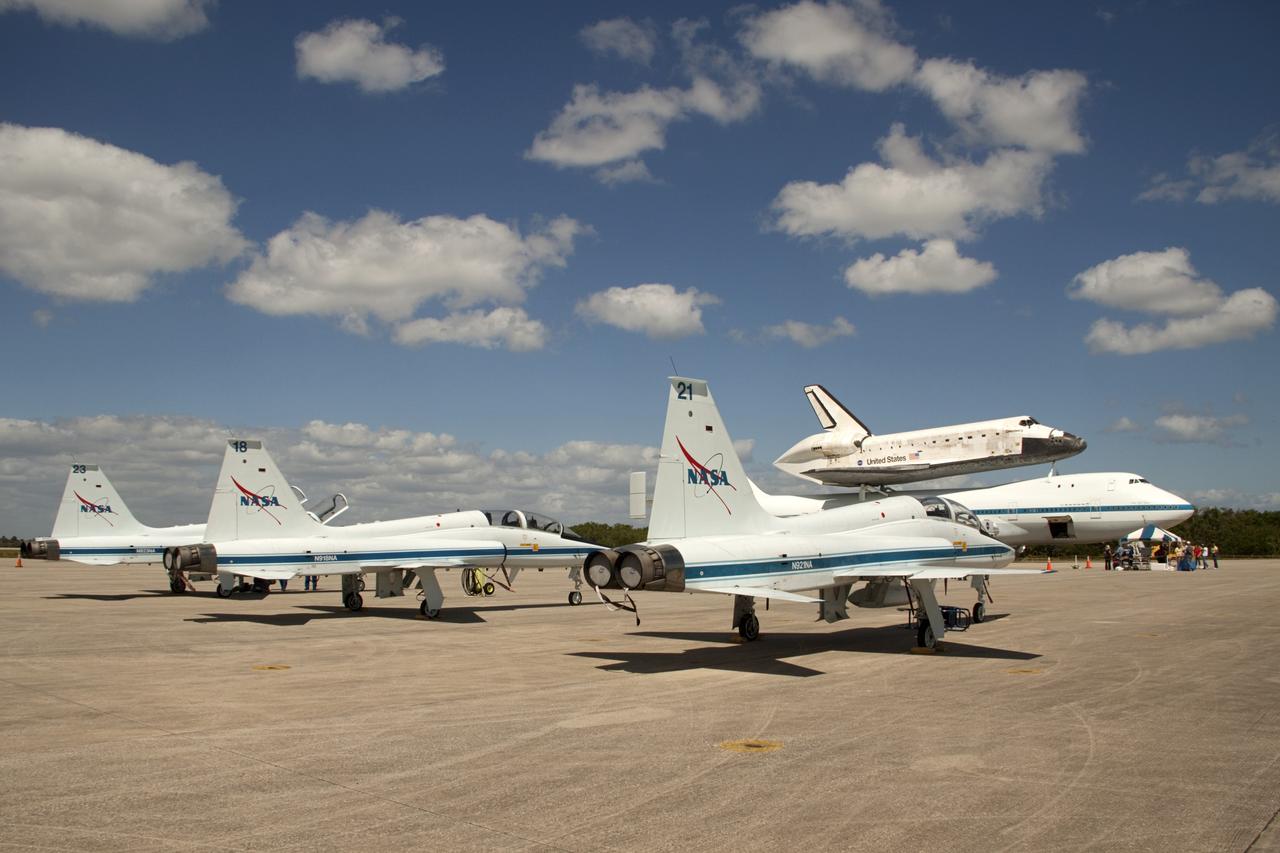
CAPE CANAVERAL, Fla. – It’s a full house on the tarmac at the Shuttle Landing Facility at NASA’s Kennedy Space Center in Florida with the arrival of astronauts in T-38 jets, the “pathfinder” aircraft for space shuttle Discovery’s ferry flight and the Shuttle Carrier Aircraft with Discovery secured on its back. The astronauts are participating in the festivities related to the final departure of Discovery from Kennedy. The NASA C-9 pathfinder aircraft will fly about 100 miles ahead of Discovery to scout for the safest route between destinations. Its crew includes an SCA flight engineer who studies the weather patterns along the flight path to find a route free of rain and other turbulence. The carrier aircraft, also known as an SCA, is a Boeing 747 jet, originally manufactured for commercial use which was modified by NASA to transport the shuttles between destinations on Earth. NASA 905 is scheduled to ferry Discovery to the Washington Dulles International Airport in Virginia on April 17, and is assigned to all remaining ferry missions, delivering the shuttles to their permanent public display sites. After its arrival at Dulles, Discovery will be placed on display in the Smithsonian's National Air and Space Museum Steven F. Udvar-Hazy Center on April 19. For more information on the SCA, visit http://www.nasa.gov/centers/dryden/news/FactSheets/FS-013-DFRC.html. For more information on shuttle transition and retirement activities, visit http://www.nasa.gov/transition. Photo credit: NASA/Amanda Diller

This collage and animation represent NASA radar observations of near-Earth asteroid 7335 1989 JA on May 26, 2022, one day before it made its closest approach with Earth. The potentially hazardous asteroid came within 2.5 million miles (4 million kilometers) of our planet, or 10.5 times the distance between the Earth and the Moon. Astronomers at NASA's Jet Propulsion Laboratory used the 230-foot (70-meter) radio antenna at the Deep Space Network's Goldstone Deep Space Communications Complex near Barstow, California, to precisely track the asteroid's motion and obtain detailed radar images. 1989 JA is a binary system, consisting of a large asteroid and a significantly smaller satellite asteroid that revolve around each other without touching. The larger asteroid is about 0.4 miles (700 meters) across and shows several topographic features as it rotates. The secondary asteroid, which was discovered this year, is between 100 and 200 meters in diameter and has an orbital period of about 17 hours. 1989 JA was discovered by Eleanor F. Helin at Palomar Observatory in Southern California on May 1, 1989. Follow-up radar observations that year did not reveal a satellite. In 2010, NASA's Wide-field Infrared Survey Explorer (WISE) was used to help determine the primary asteroid's size. This year, a few weeks before the asteroid's most recent close approach, astronomers at Ondrejov Observatory in the Czech Republic measured the asteroid's light curve (the change in reflected light intensity over time) and found hints of the satellite in orbit. The new Goldstone observations refined the size of 1989 JA and established that it is a binary system. 1989 JA does not currently pose an impact risk to Earth, but observations by planetary radar can help astronomers better understand its orbit around the Sun so that any future risk can be continually assessed. https://photojournal.jpl.nasa.gov/catalog/PIA25251
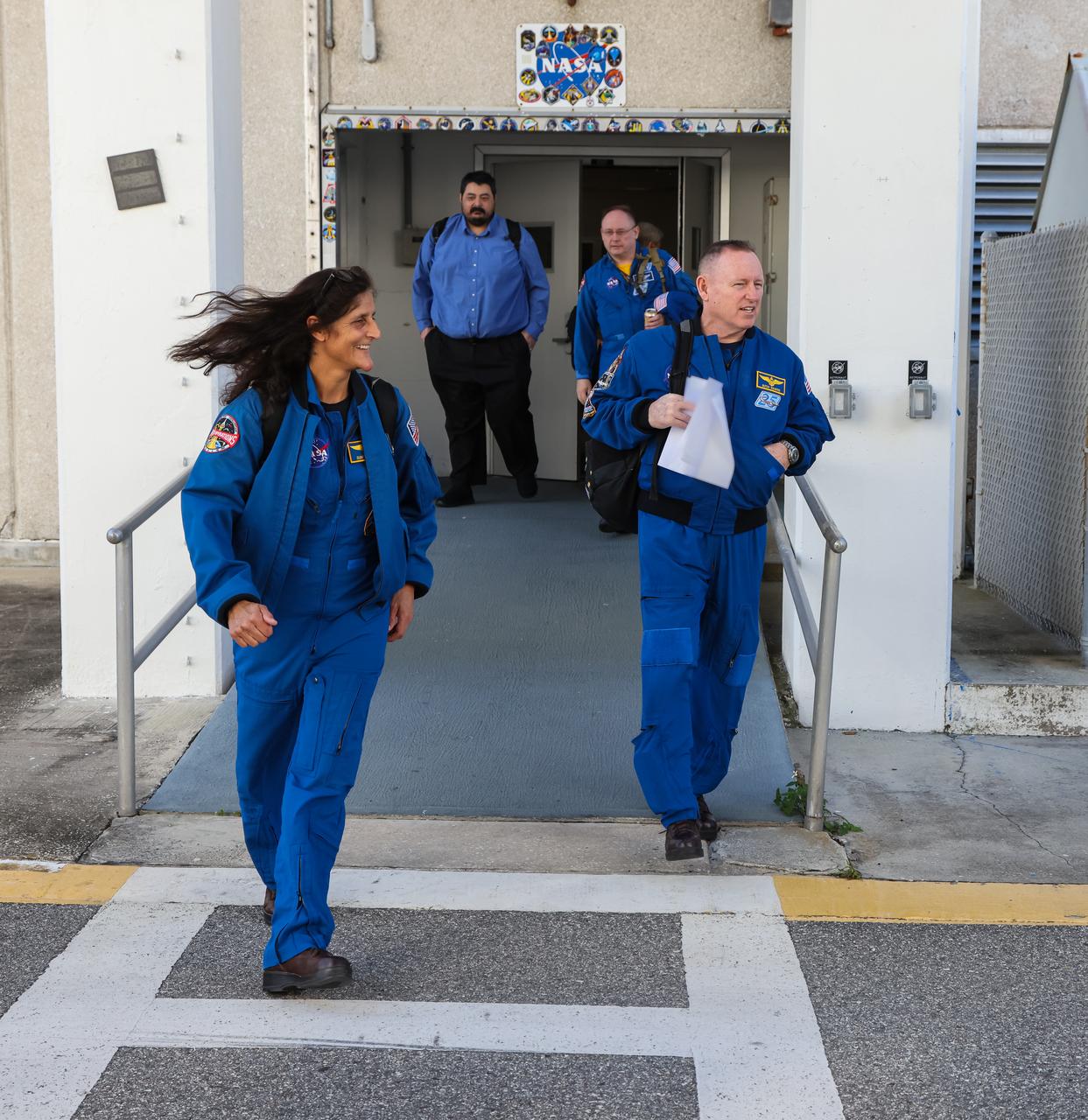
NASA astronauts Suni Williams and Barry “Butch” Wilmore emerge from the Neil Armstrong Operations and Checkout Building at the agency’s Kennedy Space Center in Florida on Wednesday, Jan. 31, 2024, as part of an integrated crew exercise simulation for NASA’s Boeing Crew Flight Test (CFT). The integrated exercise involved participation from the flight crew, NASA, Boeing, and United Launch Alliance (ULA), and allowed teams to rehearse prelaunch operations beginning roughly four hours before a targeted liftoff. CFT will be the first flight with astronauts to the International Space Station for Boeing’s Starliner spacecraft as part of NASA’s Commercial Crew Program. Starliner is scheduled to launch atop ULA’s Atlas V rocket no earlier than mid-April 2024.
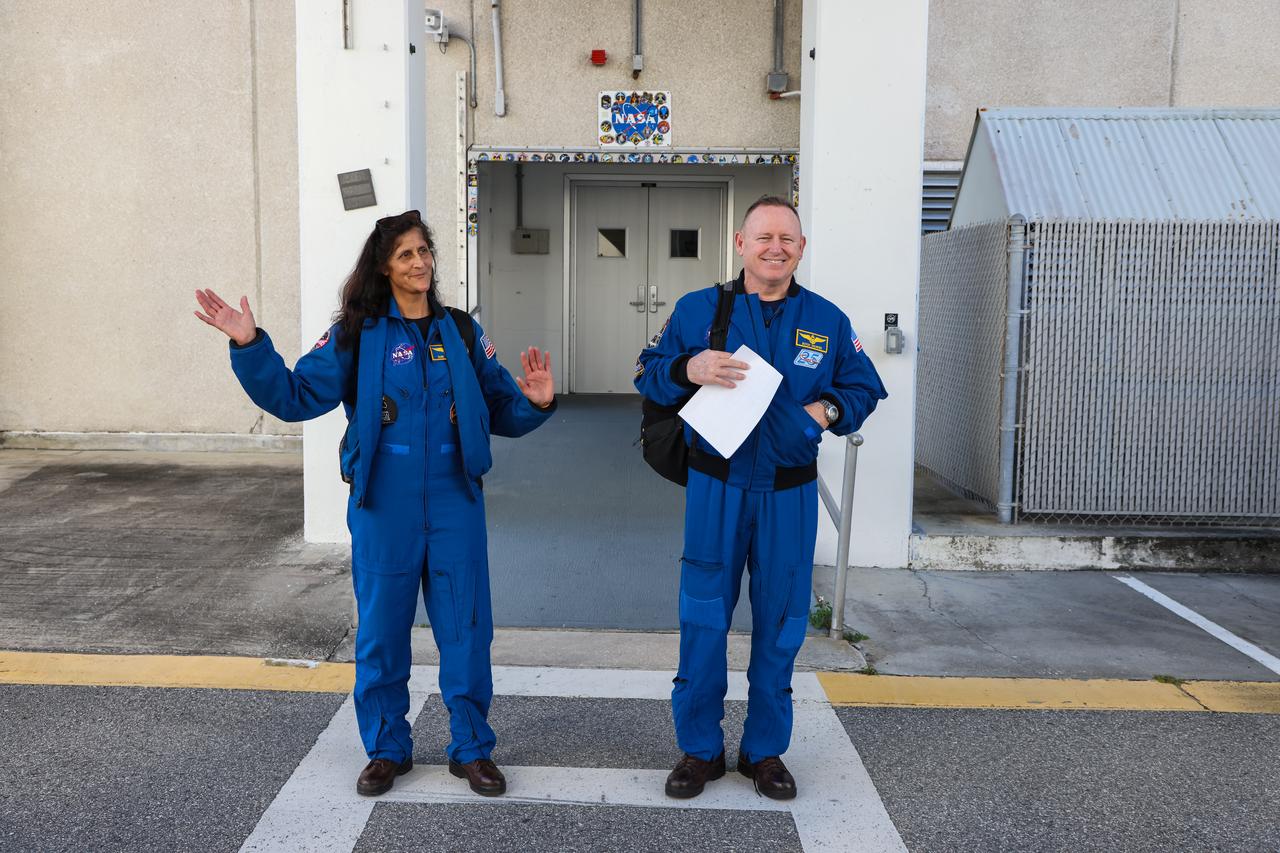
NASA astronauts Suni Williams and Barry “Butch” Wilmore emerge from the Neil Armstrong Operations and Checkout Building at the agency’s Kennedy Space Center in Florida on Wednesday, Jan. 31, 2024, as part of an integrated crew exercise simulation for NASA’s Boeing Crew Flight Test (CFT). The integrated exercise involved participation from the flight crew, NASA, Boeing, and United Launch Alliance (ULA), and allowed teams to rehearse prelaunch operations beginning roughly four hours before a targeted liftoff. CFT will be the first flight with astronauts to the International Space Station for Boeing’s Starliner spacecraft as part of NASA’s Commercial Crew Program. Starliner is scheduled to launch atop ULA’s Atlas V rocket no earlier than mid-April 2024.
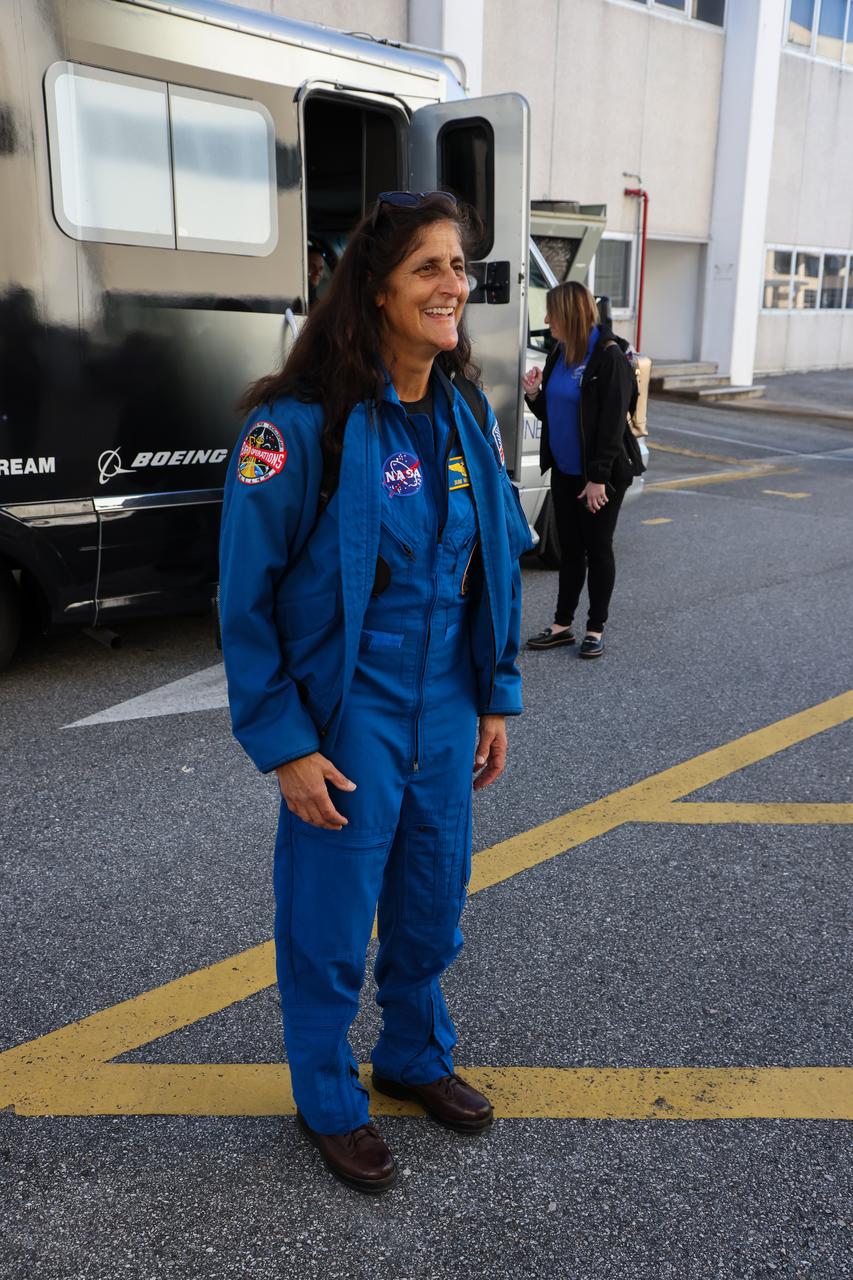
NASA astronaut Suni Williams emerges from the Neil Armstrong Operations and Checkout Building at the agency’s Kennedy Space Center in Florida on Wednesday, Jan. 31, 2024, as part of an integrated crew exercise simulation for NASA’s Boeing Crew Flight Test (CFT). Williams and fellow crew member Barry “Butch” Wilmore, along with NASA, Boeing, and United Launch Alliance (ULA), participated in the integrated exercise, which allowed teams to rehearse prelaunch operations beginning roughly four hours before a targeted liftoff. CFT will be the first flight with astronauts to the International Space Station for Boeing’s Starliner spacecraft as part of NASA’s Commercial Crew Program. Starliner is scheduled to launch atop ULA’s Atlas V rocket no earlier than mid-April 2024.
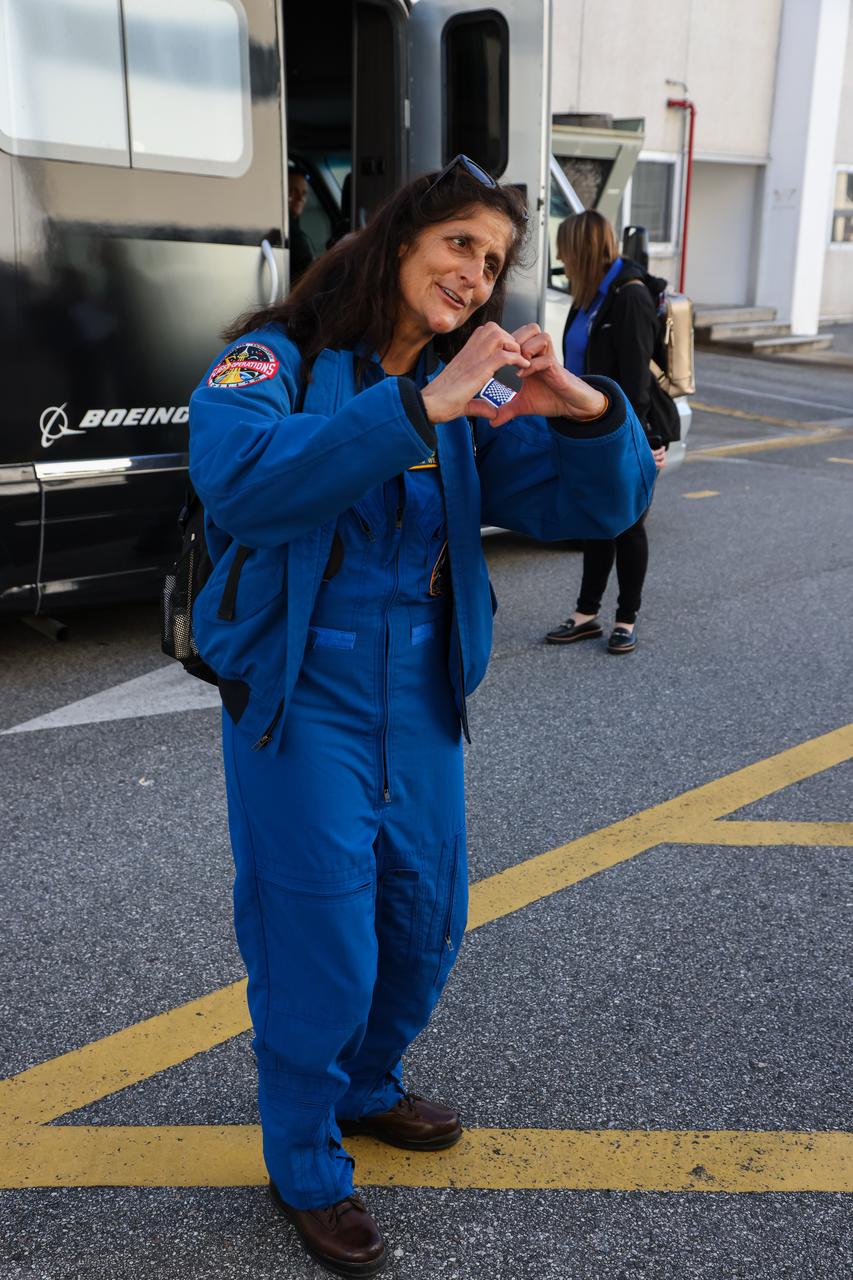
NASA astronaut Suni Williams emerges from the Neil Armstrong Operations and Checkout Building at the agency’s Kennedy Space Center in Florida on Wednesday, Jan. 31, 2024, as part of an integrated crew exercise simulation for NASA’s Boeing Crew Flight Test (CFT). Williams and fellow crew member Barry “Butch” Wilmore, along with NASA, Boeing, and United Launch Alliance (ULA), participated in the integrated exercise, which allowed teams to rehearse prelaunch operations beginning roughly four hours before a targeted liftoff. CFT will be the first flight with astronauts to the International Space Station for Boeing’s Starliner spacecraft as part of NASA’s Commercial Crew Program. Starliner is scheduled to launch atop ULA’s Atlas V rocket no earlier than mid-April 2024.

NASA astronauts Suni Williams and Barry “Butch” Wilmore prepare to enter a crew transportation vehicle in front of the Neil Armstrong Operations and Checkout Building at the agency’s Kennedy Space Center in Florida on Wednesday, Jan. 31, 2024, as part of an integrated crew exercise simulation for NASA’s Boeing Crew Flight Test (CFT). The integrated exercise involved participation from the flight crew, NASA, Boeing, and United Launch Alliance (ULA), and allowed teams to rehearse prelaunch operations beginning roughly four hours before a targeted liftoff. CFT will be the first flight with astronauts to the International Space Station for Boeing’s Starliner spacecraft as part of NASA’s Commercial Crew Program. Starliner is scheduled to launch atop ULA’s Atlas V rocket no earlier than mid-April 2024.
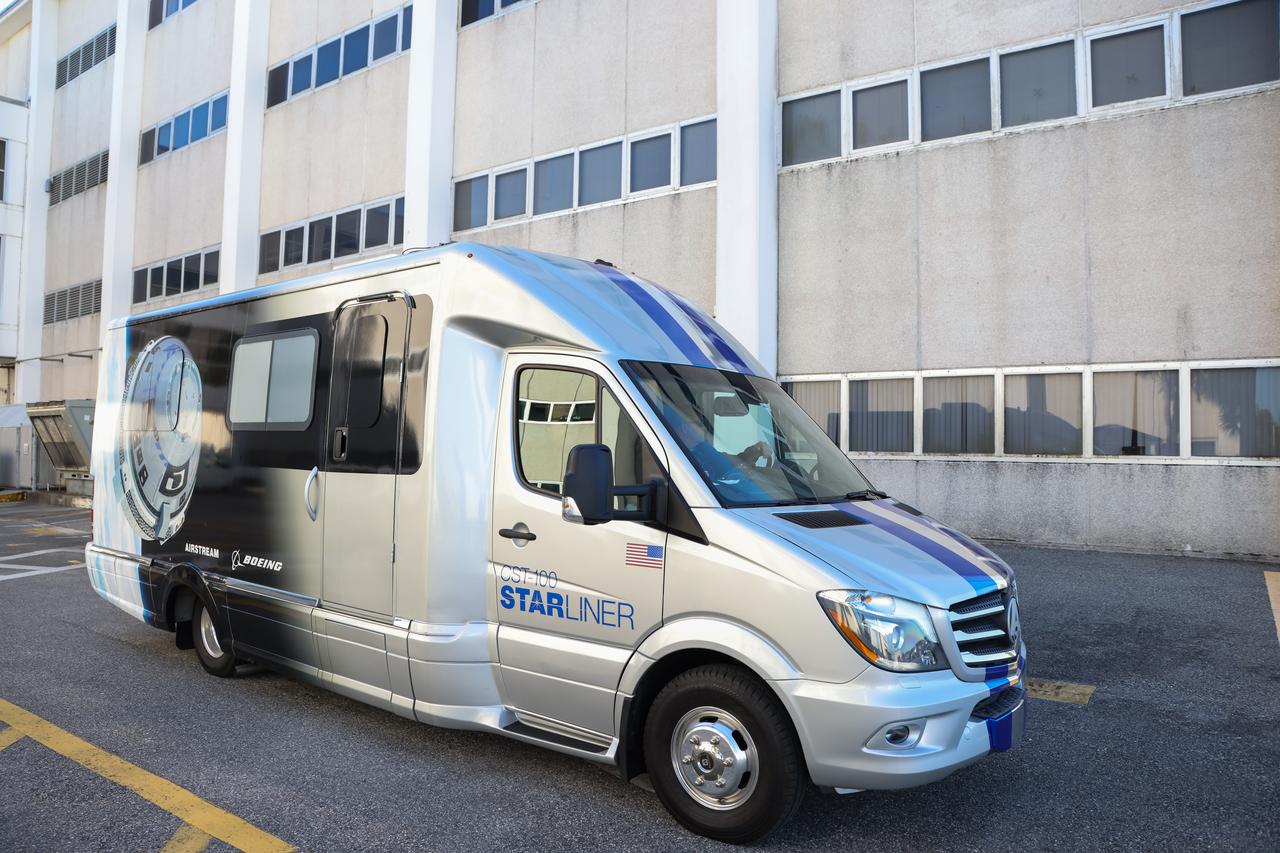
A crew transportation vehicle carrying NASA astronauts Suni Williams and Barry “Butch” Wilmore drives past the Neil Armstrong Operations and Checkout Building at the agency’s Kennedy Space Center in Florida on Wednesday, Jan. 31, 2024, as part of an integrated crew exercise simulation for NASA’s Boeing Crew Flight Test (CFT). The integrated exercise involved participation from the flight crew, NASA, Boeing, and United Launch Alliance (ULA), and allowed teams to rehearse prelaunch operations beginning roughly four hours before a targeted liftoff. CFT will be the first flight with astronauts to the International Space Station for Boeing’s Starliner spacecraft as part of NASA’s Commercial Crew Program. Starliner is scheduled to launch atop ULA’s Atlas V rocket no earlier than mid-April 2024.
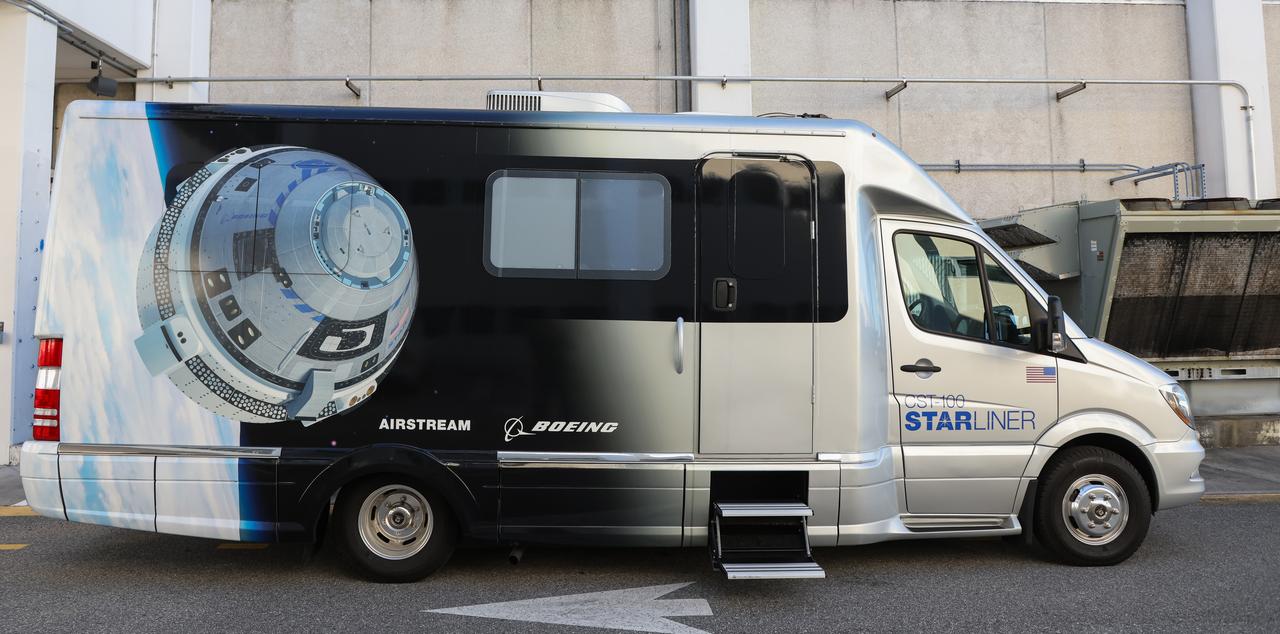
A crew transportation vehicle outside the Neil Armstrong Operations and Checkout Building at the agency’s Kennedy Space Center in Florida waits to carry NASA astronauts Suni Williams and Barry “Butch” Wilmore as part of an integrated crew exercise simulation for NASA’s Boeing Crew Flight Test (CFT) on Wednesday, Jan. 31, 2024. The integrated exercise involved participation from the flight crew, NASA, Boeing, and United Launch Alliance (ULA), and allowed teams to rehearse prelaunch operations beginning roughly four hours before a targeted liftoff. CFT will be the first flight with astronauts to the International Space Station for Boeing’s Starliner spacecraft as part of NASA’s Commercial Crew Program. Starliner is scheduled to launch atop ULA’s Atlas V rocket no earlier than mid-April 2024.
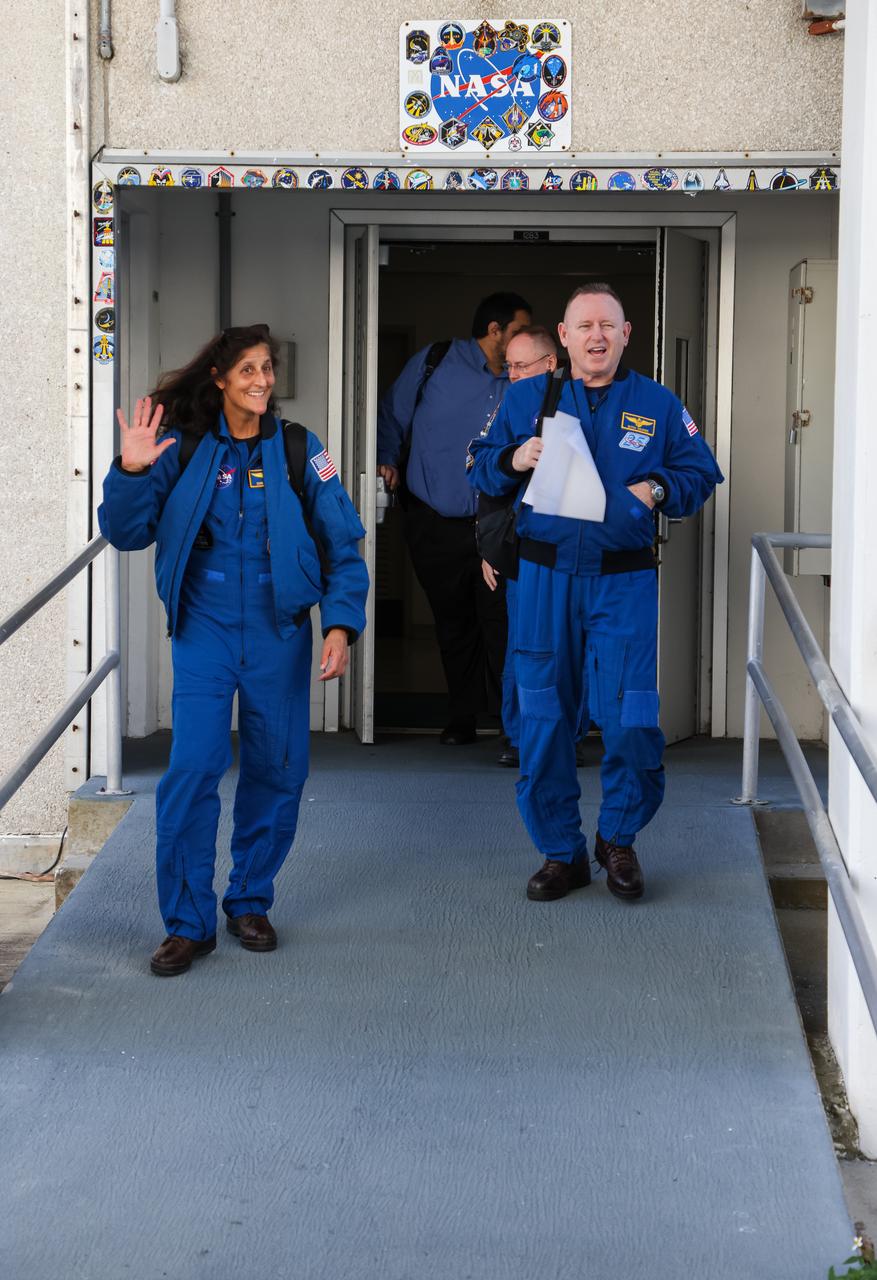
NASA astronauts Suni Williams and Barry “Butch” Wilmore emerge from the Neil Armstrong Operations and Checkout Building at the agency’s Kennedy Space Center in Florida on Wednesday, Jan. 31, 2024, as part of an integrated crew exercise simulation for NASA’s Boeing Crew Flight Test (CFT). The integrated exercise involved participation from the flight crew, NASA, Boeing, and United Launch Alliance (ULA), and allowed teams to rehearse prelaunch operations beginning roughly four hours before a targeted liftoff. CFT will be the first flight with astronauts to the International Space Station for Boeing’s Starliner spacecraft as part of NASA’s Commercial Crew Program. Starliner is scheduled to launch atop ULA’s Atlas V rocket no earlier than mid-April 2024.
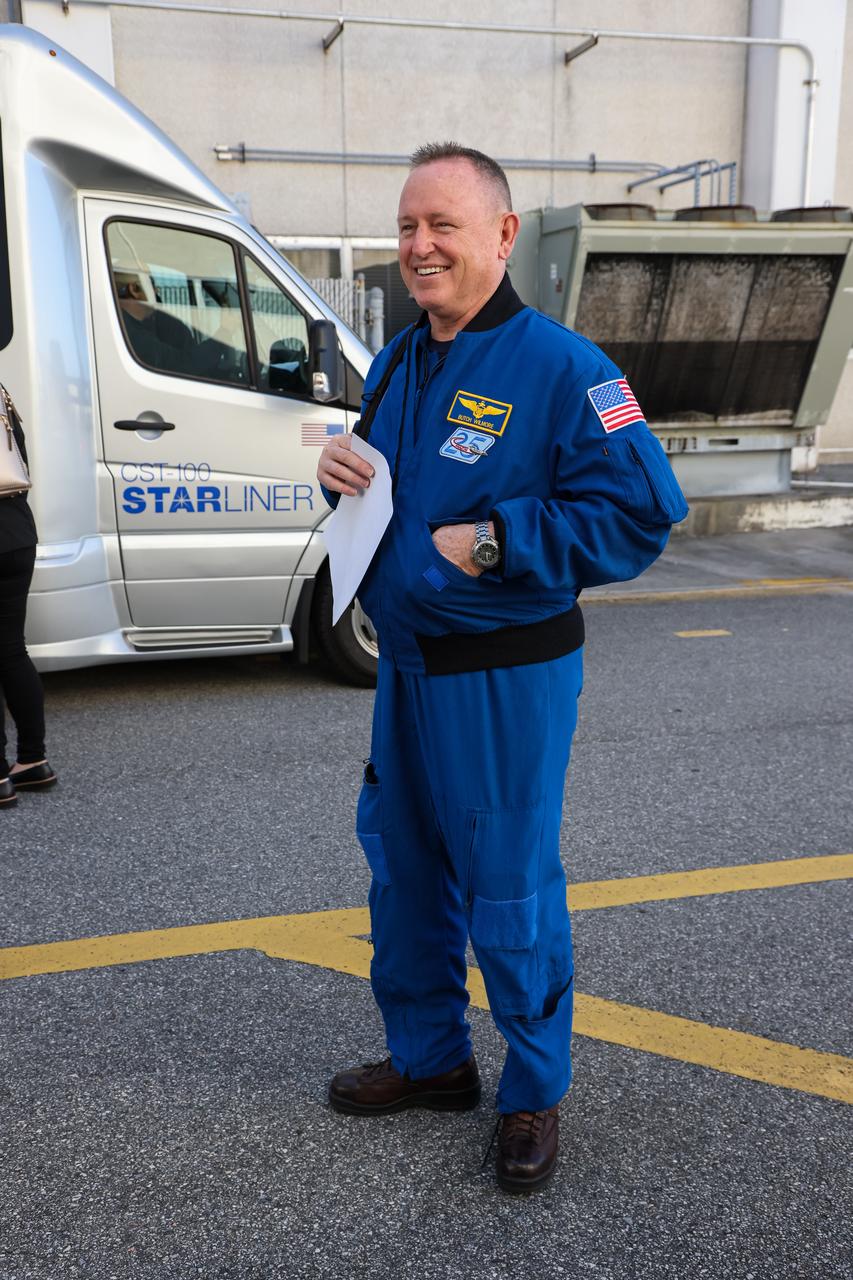
NASA astronaut Barry “Butch” Wilmore emerges from the Neil Armstrong Operations and Checkout Building and prepares to enter a crew transportation vehicle at the agency’s Kennedy Space Center in Florida on Wednesday, Jan. 31, 2024, as part of an integrated crew exercise simulation for NASA’s Boeing Crew Flight Test (CFT). Wilmore and fellow crew member Suni Williams, along with NASA, Boeing, and United Launch Alliance (ULA), participated in the integrated exercise, which allowed teams to rehearse prelaunch operations beginning roughly four hours before a targeted liftoff. CFT will be the first flight with astronauts to the International Space Station for Boeing’s Starliner spacecraft as part of NASA’s Commercial Crew Program. Starliner is scheduled to launch atop ULA’s Atlas V rocket no earlier than mid-April 2024.

On most days, relentless rivers of clouds wash over Alaska, obscuring most of the state’s 6,640 miles (10,690 kilometers) of coastline and 586,000 square miles (1,518,000 square kilometers) of land. The south coast of Alaska even has the dubious distinction of being the cloudiest region of the United States, with some locations averaging more than 340 cloudy days per year. That was certainly not the case on June 17, 2013, the date that the Moderate Resolution Imaging Spectroradiometer (MODIS) on NASA’s Terra satellite acquired this rare, nearly cloud-free view of the state. The absence of clouds exposed a striking tapestry of water, ice, land, forests, and even wildfires. Snow-covered mountains such as the Alaska Range and Chugach Mountains were visible in southern Alaska, while the arc of mountains that make up the Brooks Range dominated the northern part of the state. The Yukon River—the longest in Alaska and the third longest in the United States—wound its way through the green boreal forests that inhabit the interior of the state. Plumes of sediment and glacial dust poured into the Gulf of Alaska from the Copper River. And Iliamna Lake, the largest in Alaska, was ice free. The same ridge of high pressure that cleared Alaska’s skies also brought stifling temperatures to many areas accustomed to chilly June days. Talkeetna, a town about 100 miles north of Anchorage, saw temperatures reach 96°F (36°C) on June 17. Other towns in southern Alaska set all-time record highs, including Cordova, Valez, and Seward. The high temperatures also helped fuel wildfires and hastened the breakup of sea ice in the Chukchi Sea. NASA image courtesy Jeff Schmaltz, LANCE MODIS Rapid Response Team at NASA GSFC. Caption by Adam Voiland. Instrument: Terra - MODIS More info: <a href="http://1.usa.gov/102MAEj" rel="nofollow">1.usa.gov/102MAEj</a> Credit: <b><a href="http://www.earthobservatory.nasa.gov/" rel="nofollow"> NASA Earth Observatory</a></b> <b><a href="http://www.nasa.gov/audience/formedia/features/MP_Photo_Guidelines.html" rel="nofollow">NASA image use policy.</a></b> <b><a href="http://www.nasa.gov/centers/goddard/home/index.html" rel="nofollow">NASA Goddard Space Flight Center</a></b> enables NASA’s mission through four scientific endeavors: Earth Science, Heliophysics, Solar System Exploration, and Astrophysics. Goddard plays a leading role in NASA’s accomplishments by contributing compelling scientific knowledge to advance the Agency’s mission. <b>Follow us on <a href="http://twitter.com/NASA_GoddardPix" rel="nofollow">Twitter</a></b> <b>Like us on <a href="http://www.facebook.com/pages/Greenbelt-MD/NASA-Goddard/395013845897?ref=tsd" rel="nofollow">Facebook</a></b> <b>Find us on <a href="http://instagram.com/nasagoddard?vm=grid" rel="nofollow">Instagram</a></b>
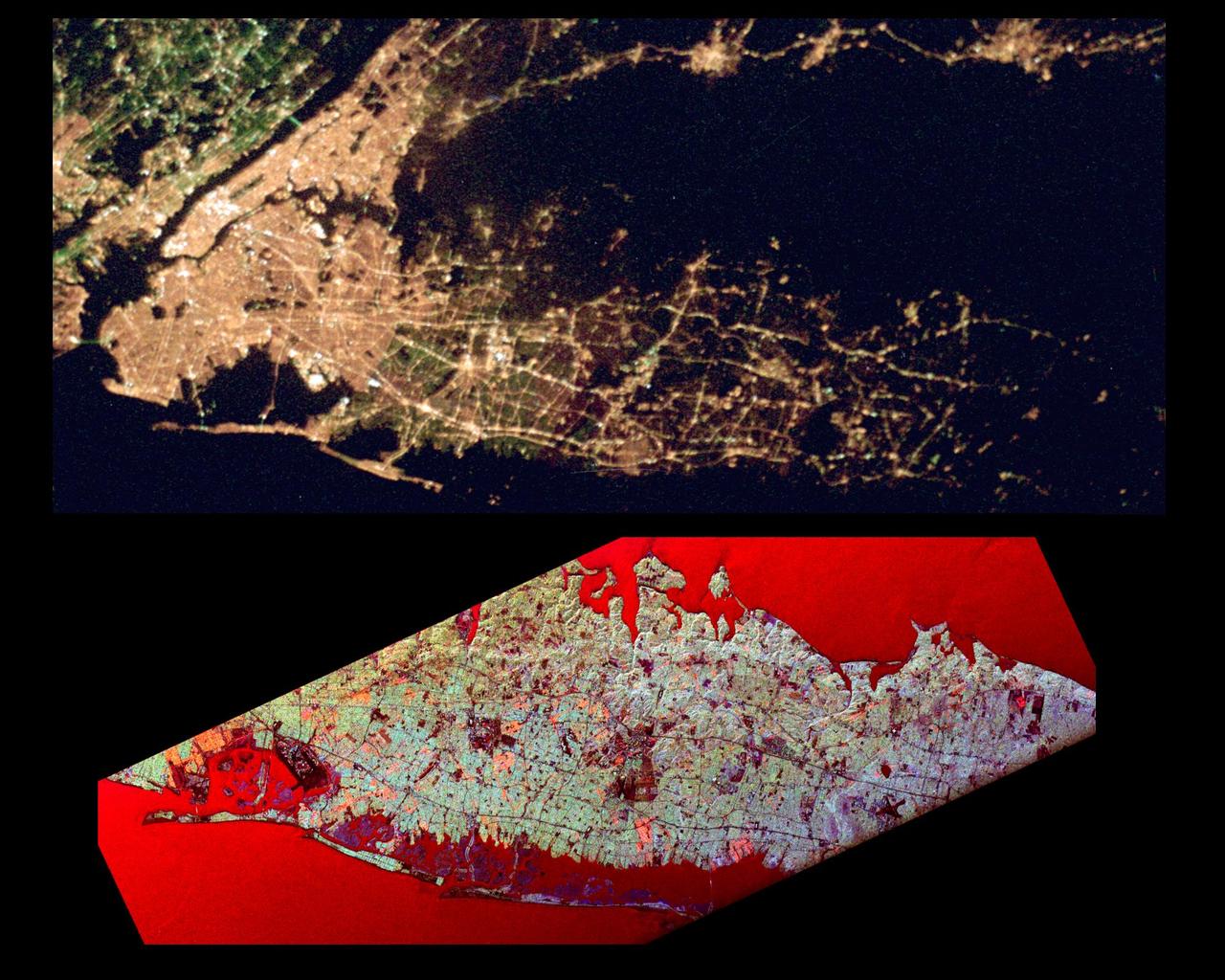
This pair of images of the Long Island, New York region is a comparison of an optical photograph (top) and a radar image (bottom), both taken in darkness in April 1994. The photograph at the top was taken by the Endeavour astronauts at about 3 a.m. Eastern time on April 20, 1994. The image at the bottom was acquired at about the same time four days earlier on April 16,1994 by the Spaceborne Imaging Radar-C/X-Band Synthetic Aperture Radar (SIR-C/X-SAR) system aboard the space shuttle Endeavour. Both images show an area approximately 100 kilometers by 40 kilometers (62 miles by 25 miles) that is centered at 40.7 degrees North latitude and 73.5 degrees West longitude. North is toward the upper right. The optical image is dominated by city lights, which are particularly bright in the densely developed urban areas of New York City located on the left half of the photo. The brightest white zones appear on the island of Manhattan in the left center, and Central Park can be seen as a darker area in the middle of Manhattan. To the northeast (right) of the city, suburban Long Island appears as a less densely illuminated area, with the brightest zones occurring along major transportation and development corridors. Since radar is an active sensing system that provides its own illumination, the radar image shows a great amount of surface detail, despite the night-time acquisition. The colors in the radar image were obtained using the following radar channels: red represents the L-band (horizontally transmitted and received); green represents the L-band (horizontally transmitted and vertically received); blue represents the C-band (horizontally transmitted and vertically received). In this image, the water surface - the Atlantic Ocean along the bottom edge and Long Island Sound shown at the top edge - appears red because small waves at the surface strongly reflect the horizontally transmitted and received L-band radar signal. Networks of highways and railroad lines are clearly visible in the radar image; many of them can also be seen as bright lines i the optical image. The runways of John F. Kennedy International Airport appear as a dark rectangle in Jamaica Bay on the left side of the image. Developed areas appear generally as bright green and orange, while agricultural, protected and undeveloped areas appear darker blue or purple. This contrast can be seen on the barrier islands along the south coast of Long Island, which are heavily developed in the Rockaway and Long Beach areas south and east of Jamaica Bay, but further to the east, the islands are protected and undeveloped. http://photojournal.jpl.nasa.gov/catalog/PIA01785

On most days, relentless rivers of clouds wash over Alaska, obscuring most of the state’s 6,640 miles (10,690 kilometers) of coastline and 586,000 square miles (1,518,000 square kilometers) of land. The south coast of Alaska even has the dubious distinction of being the cloudiest region of the United States, with some locations averaging more than 340 cloudy days per year. That was certainly not the case on June 17, 2013, the date that the Moderate Resolution Imaging Spectroradiometer (MODIS) on NASA’s Terra satellite acquired this rare, nearly cloud-free view of the state. The absence of clouds exposed a striking tapestry of water, ice, land, forests, and even wildfires. Snow-covered mountains such as the Alaska Range and Chugach Mountains were visible in southern Alaska, while the arc of mountains that make up the Brooks Range dominated the northern part of the state. The Yukon River—the longest in Alaska and the third longest in the United States—wound its way through the green boreal forests that inhabit the interior of the state. Plumes of sediment and glacial dust poured into the Gulf of Alaska from the Copper River. And Iliamna Lake, the largest in Alaska, was ice free. The same ridge of high pressure that cleared Alaska’s skies also brought stifling temperatures to many areas accustomed to chilly June days. Talkeetna, a town about 100 miles north of Anchorage, saw temperatures reach 96°F (36°C) on June 17. Other towns in southern Alaska set all-time record highs, including Cordova, Valez, and Seward. The high temperatures also helped fuel wildfires and hastened the breakup of sea ice in the Chukchi Sea. NASA image courtesy Jeff Schmaltz, LANCE MODIS Rapid Response Team at NASA GSFC. Caption by Adam Voiland. Instrument: Terra - MODIS More info: <a href="http://1.usa.gov/102MAEj" rel="nofollow">1.usa.gov/102MAEj</a> Credit: <b><a href="http://www.earthobservatory.nasa.gov/" rel="nofollow"> NASA Earth Observatory</a></b> <b><a href="http://www.nasa.gov/audience/formedia/features/MP_Photo_Guidelines.html" rel="nofollow">NASA image use policy.</a></b> <b><a href="http://www.nasa.gov/centers/goddard/home/index.html" rel="nofollow">NASA Goddard Space Flight Center</a></b> enables NASA’s mission through four scientific endeavors: Earth Science, Heliophysics, Solar System Exploration, and Astrophysics. Goddard plays a leading role in NASA’s accomplishments by contributing compelling scientific knowledge to advance the Agency’s mission. <b>Follow us on <a href="http://twitter.com/NASA_GoddardPix" rel="nofollow">Twitter</a></b> <b>Like us on <a href="http://www.facebook.com/pages/Greenbelt-MD/NASA-Goddard/395013845897?ref=tsd" rel="nofollow">Facebook</a></b> <b>Find us on <a href="http://instagram.com/nasagoddard?vm=grid" rel="nofollow">Instagram</a></b>
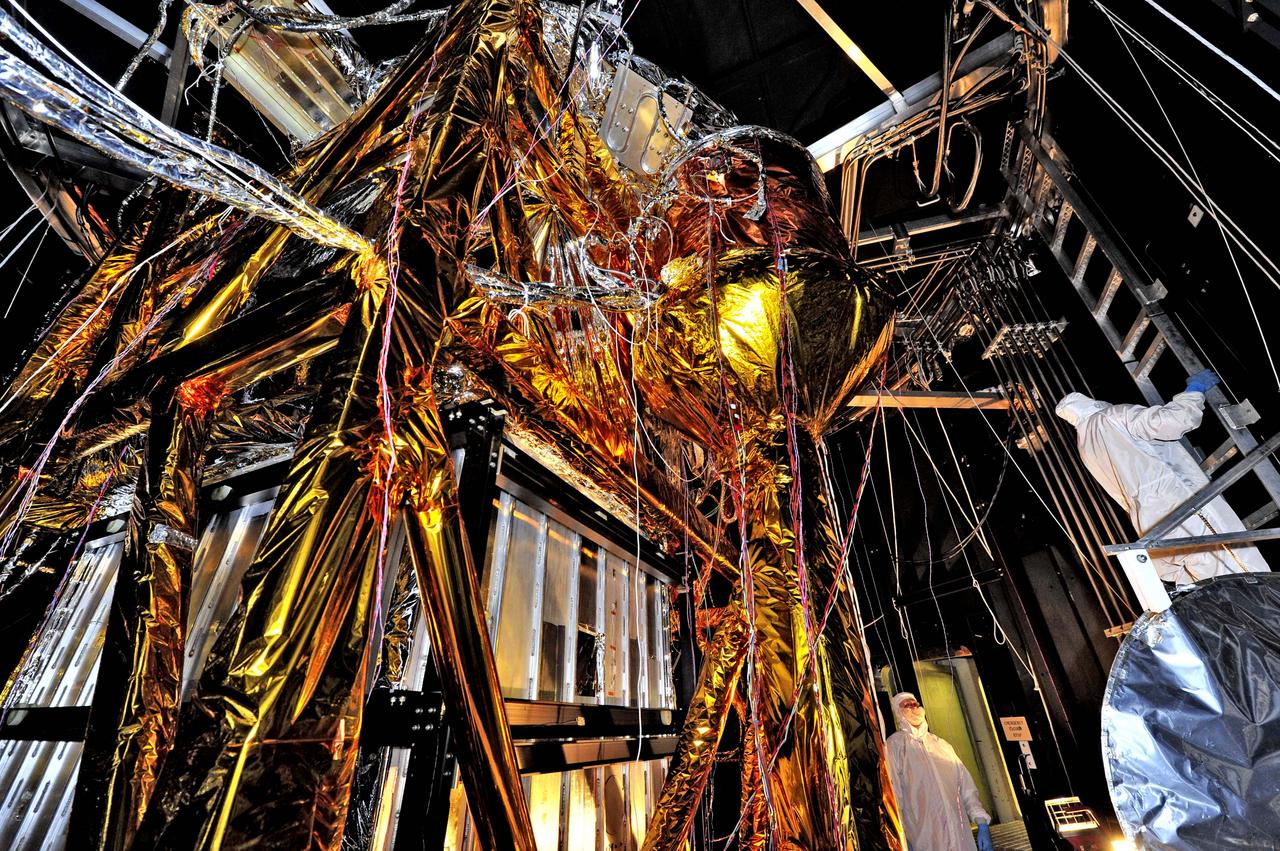
NASA image release August 23, 2012 What looks like a giant golden spider weaving a web of cables and cords, is actually ground support equipment, including the Optical Telescope Simulator (OSIM), for the James Webb Space Telescope. OSIM's job is to generate a beam of light just like the one that the real telescope optics will feed into the actual flight instruments. Because the real flight instruments will be used to test the real flight telescope, their alignment and performance first have to be verified by using the OSIM. Engineers are thoroughly checking out OSIM now in preparation for using it to test the flight science instruments later. This photo was taken from inside a large thermal-vacuum chamber called the Space Environment Simulator (SES), at NASA's Goddard Space Flight Center in Greenbelt, Md. Engineers have blanketed the structure of the OSIM with special insulating material to help control its temperature while it goes into the deep freeze testing that mimics the chill of space that Webb will ultimately experience in its operational orbit over 1 million miles from Earth. The golden-colored thermal blankets are made of aluminized kapton, a polymer film that remains stable over a wide range of temperatures. The structure that looks like a silver and black cube underneath the "spider" is a set of cold panels that surround OSIM's optics. During testing, OSIM's temperature will drop to 100 Kelvin (-280 F or -173 C) as liquid nitrogen flows through tubes welded to the chamber walls and through tubes along the silver panels surrounding OSIM's optics. These cold panels will keep the OSIM optics very cold, but the parts covered by the aluminized kapton blankets will stay warm. "Some blankets have silver facing out and gold facing in, or inverted, or silver on both sides, etc.," says Erin Wilson, a Goddard engineer. "Depending on which side of the blanket your hardware is looking at, the blankets can help it get colder or stay warmer, in an environmental test." Another reason for thermal blankets is to shield the cold OSIM optics from unwanted stray infrared light. When the OSIM is pointing its calibrated light beam at Webb's science instruments, engineers don't want any stray infrared light, such as "warm photons" from warm structures, leaking into the instruments' field of view. Too much of this stray light would raise the background too much for the instruments to "see" light from the OSIM—it would be like trying to photograph a lightning bug flying in front of car headlights. To get OSIM's optics cold, the inside of the chamber has to get cold, and to do that, all the air has to be pumped out to create a vacuum. Then liquid nitrogen has to be run though the plumbing along the inner walls of the chamber. Wilson notes that's why the blankets have to have vents in them: "That way, the air between all the layers can be evacuated as the chamber pressure drops, otherwise the blankets could pop," says Wilson. The most powerful space telescope ever built, Webb is the successor to NASA's Hubble Space Telescope. Webb's four instruments will reveal how the universe evolved from the Big Bang to the formation of our solar system. Webb is a joint project of NASA, the European Space Agency and the Canadian Space Agency. Credit: NASA/GSFC/Chris Gunn <b><a href="http://www.nasa.gov/audience/formedia/features/MP_Photo_Guidelines.html" rel="nofollow">NASA image use policy.</a></b> <b><a href="http://www.nasa.gov/centers/goddard/home/index.html" rel="nofollow">NASA Goddard Space Flight Center</a></b> enables NASA’s mission through four scientific endeavors: Earth Science, Heliophysics, Solar System Exploration, and Astrophysics. Goddard plays a leading role in NASA’s accomplishments by contributing compelling scientific knowledge to advance the Agency’s mission. <b>Follow us on <a href="http://twitter.com/NASA_GoddardPix" rel="nofollow">Twitter</a></b> <b>Like us on <a href="http://www.facebook.com/pages/Greenbelt-MD/NASA-Goddard/395013845897?ref=tsd" rel="nofollow">Facebook</a></b> <b>Find us on <a href="http://instagrid.me/nasagoddard/?vm=grid" rel="nofollow">Instagram</a></b>