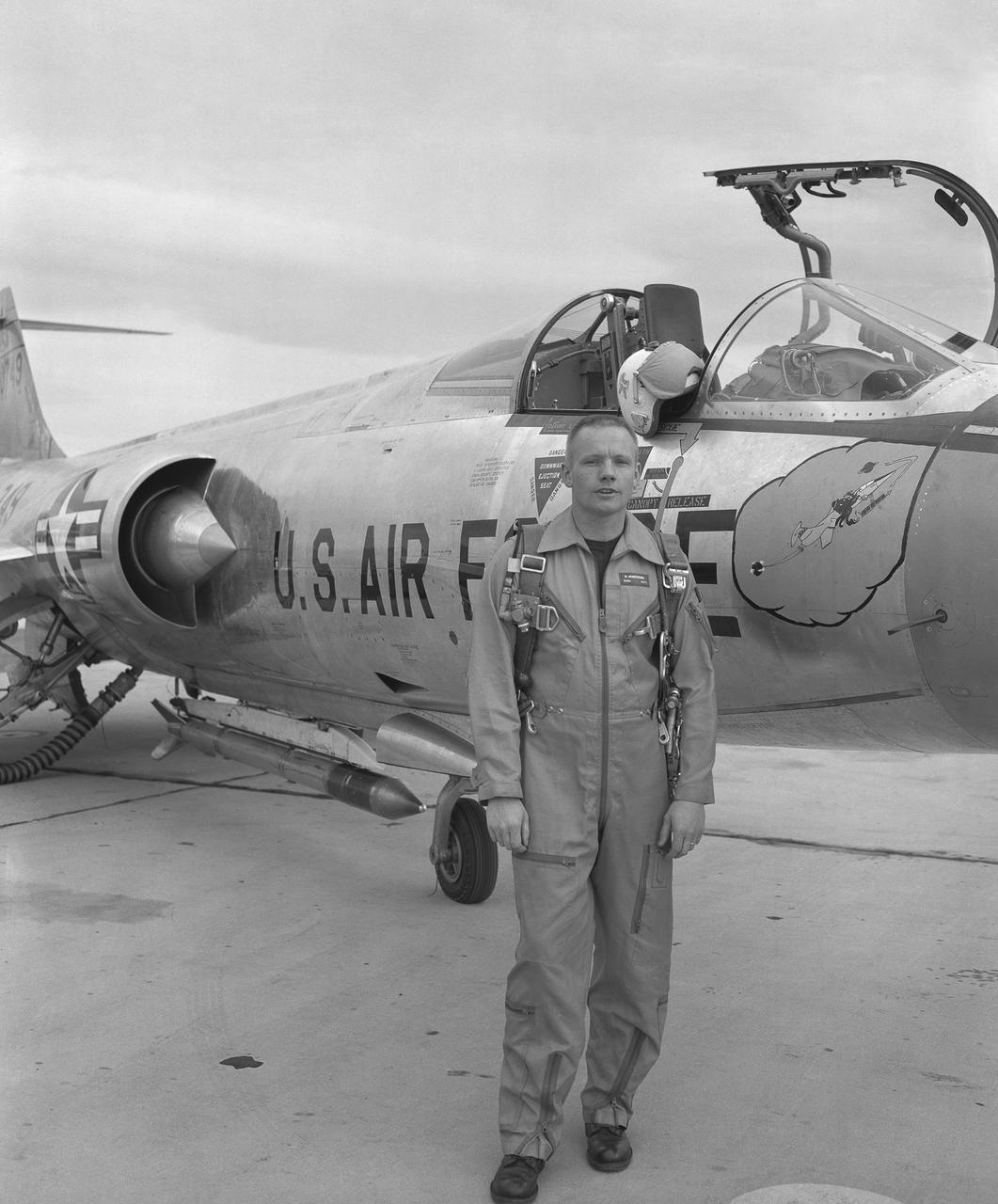
Famed astronaut Neil A. Armstrong – the first person to set foot on the Moon during the historic Apollo 11 mission in July 1969 – spent seven years as a research pilot at the NACA-NASA High-Speed Flight Station, now NASA’s Armstrong Flight Research Center in Edwards, California, before joining the space program. During his time there, he served as a project pilot on the F-100A, F-100C, F-101, and F-104A (pictured here).

S68-33744 (22 May 1968) --- The prime crew of the first manned Apollo space mission, Apollo 7 (Spacecraft 101/Saturn 205), left to right, are astronauts Donn F. Eisele, command module pilot, Walter M. Schirra Jr., commander; and Walter Cunningham, lunar module pilot.
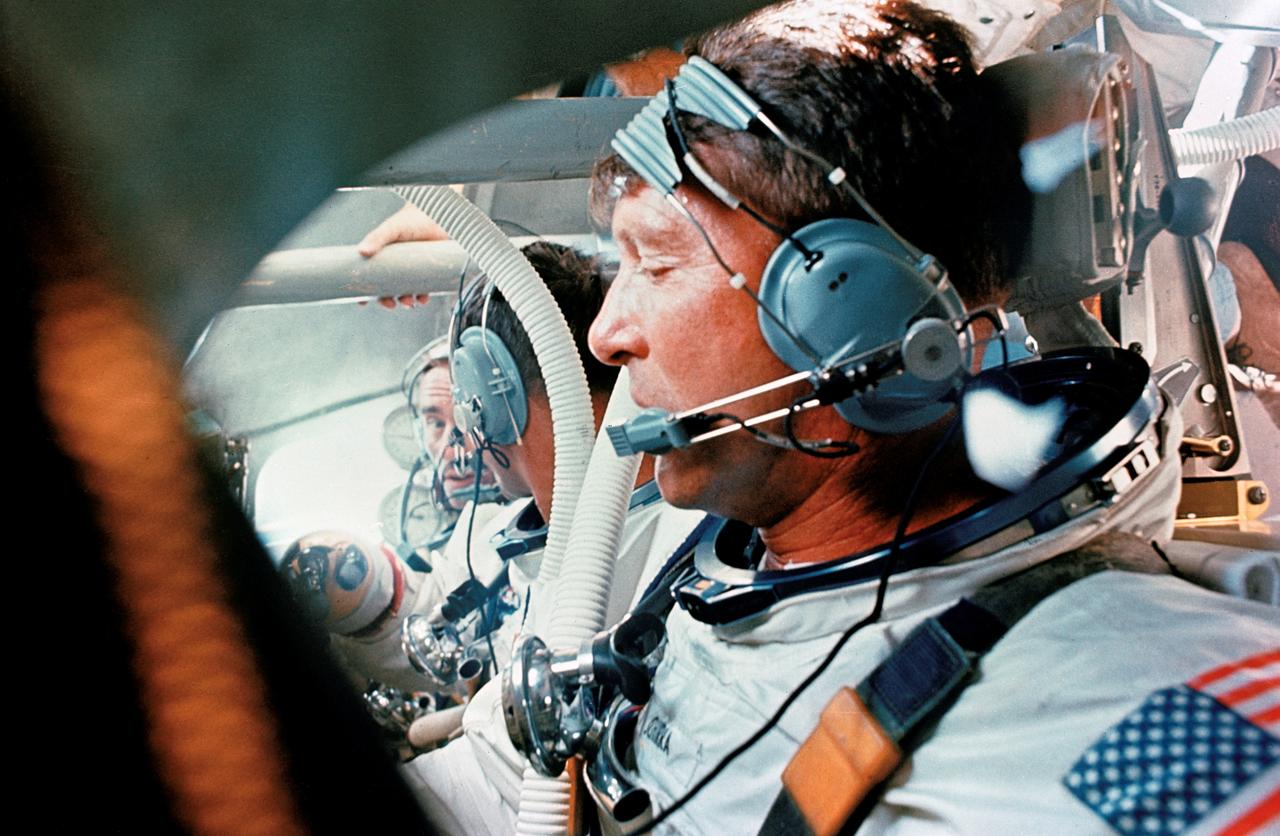
S68-46604 (5 Aug. 1968) --- The prime crew of the first manned Apollo mission (Spacecraft 101/Saturn 205) is seen in Apollo Command Module Boilerplate 1102 during water egress training in the Gulf of Mexico. In foreground is astronaut Walter M. Schirra Jr., in center is astronaut Donn F. Eisele, and in background is astronaut Walter Cunningham.
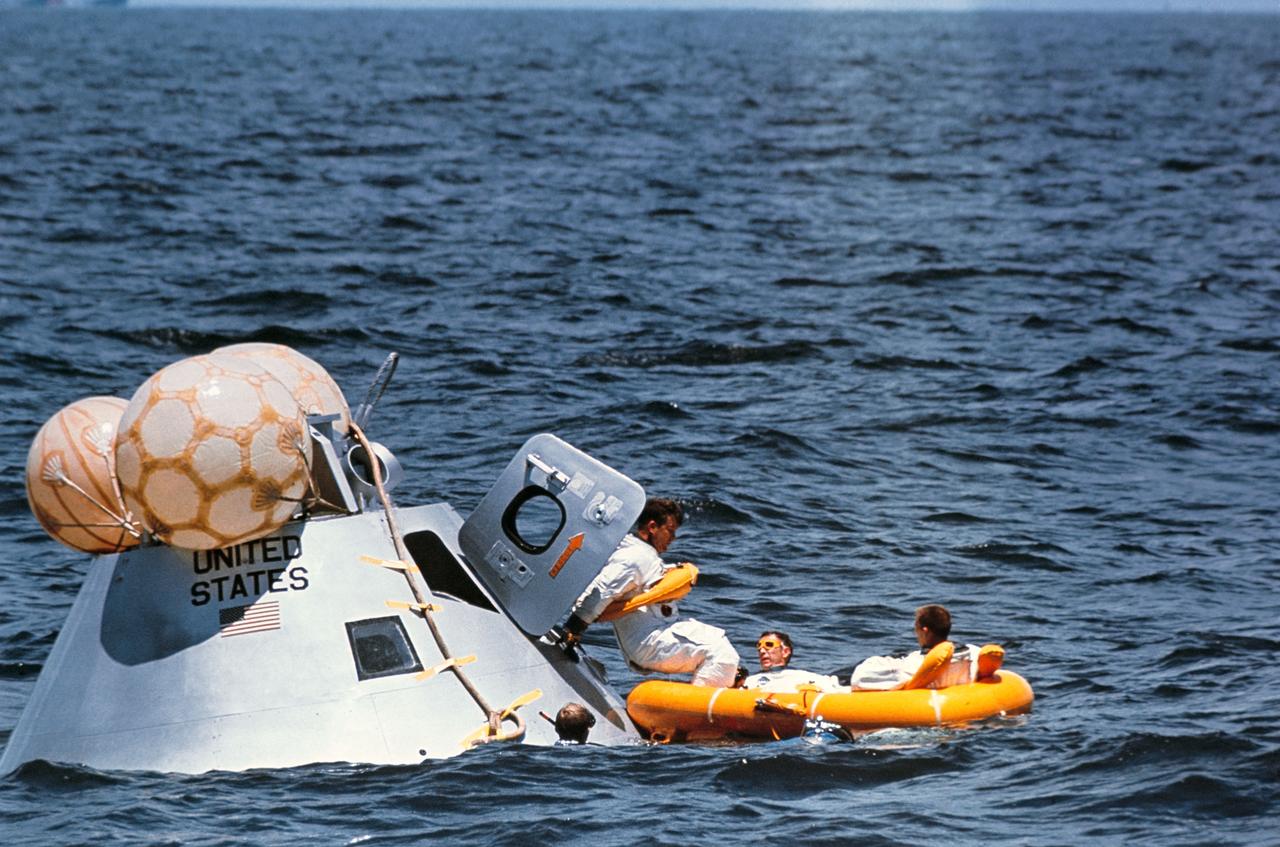
S68-46605 (5 Aug. 1968) --- The prime crew of the first manned Apollo mission (Spacecraft 101/Saturn 205) participates in water egress training in the Gulf of Mexico. Left to right, are astronauts Walter M. Schirra Jr. (stepping into life raft), Donn F. Eisele, and Walter Cunningham. They have just egressed Apollo Command Module Boilerplate 1102, and are awaiting helicopter pickup. Inflated bags were used to upright the boilerplate. MSC swimmers assisted in the training exercise.
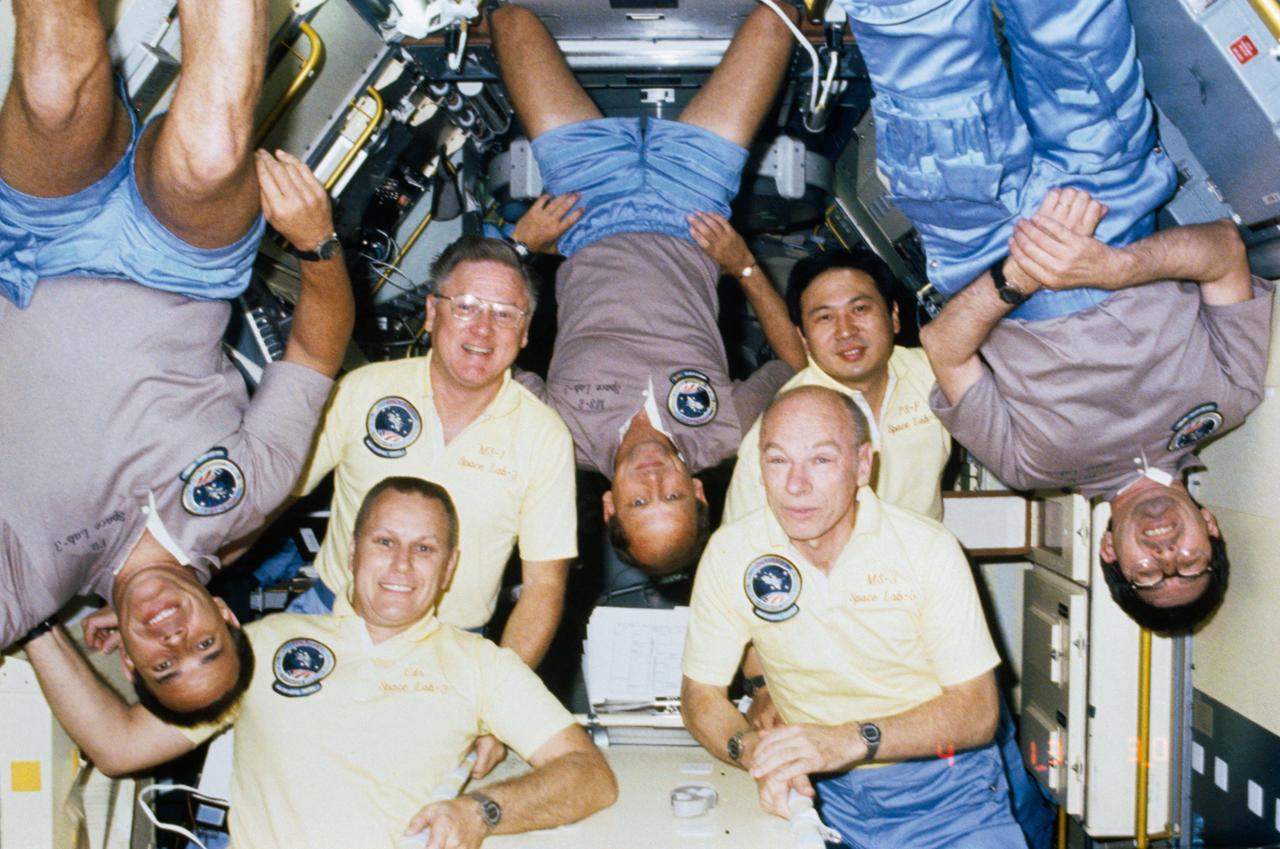
51B-101-025 (29 April-6 May 1985) --- A new twist to the traditional on-orbit group portrait was added by the 51-B/Spacelab 3 crewmembers. Note the Gold T-shirts of ?Gold? team members Robert F. Overmyer (bottom left), Don L. Lind (behind Overmyer), William E. Thornton (bottom right) and Taylor G. Wang (behind Thornton). Posting ?upside down? are ?silver? team members (L-R) Frederick D. Gregory, Norman E. Thagard and Lodewijk van den Berg. The seven are in the Long Science Module for Spacelab 3 in the cargo bay of the earth-orbiting Space Shuttle Challenger.
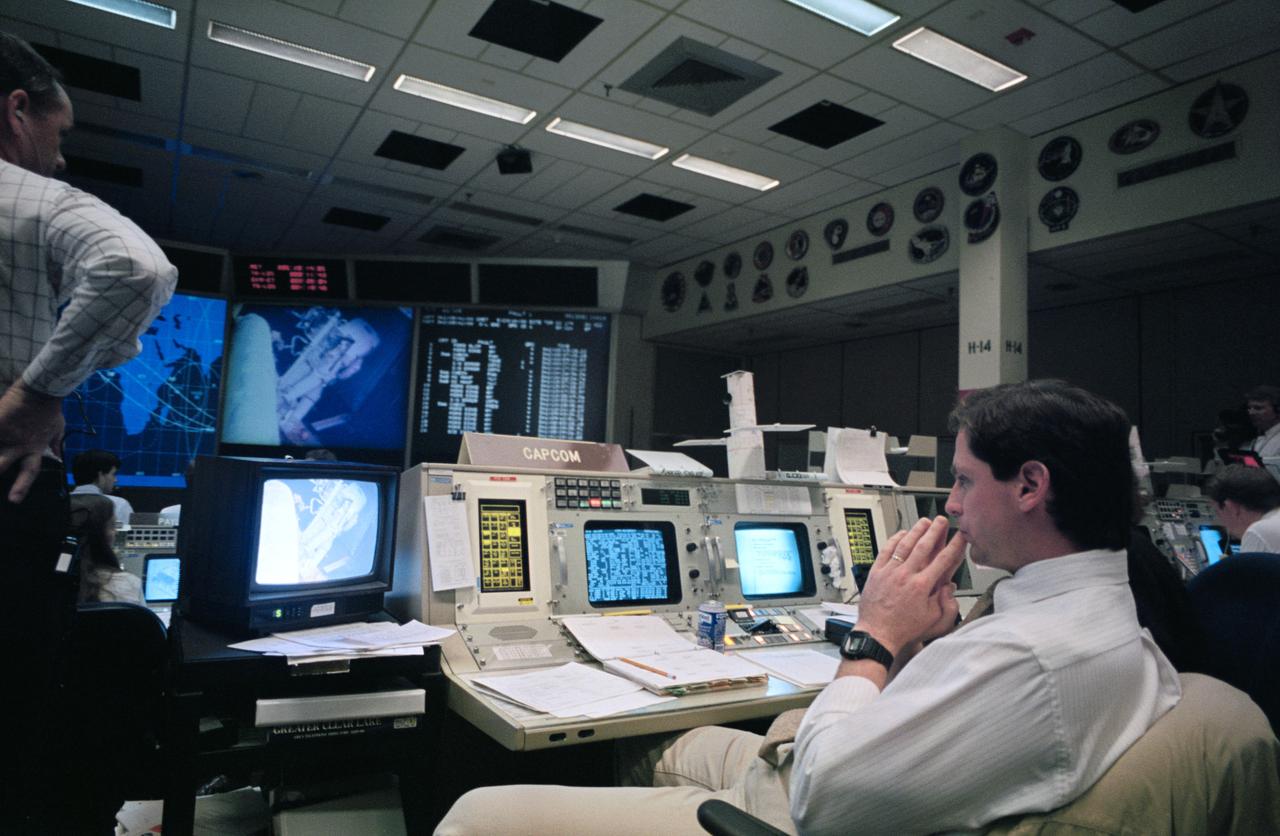
STS61-S-101 (8 Dec 1993) --- Astronaut Gregory J. Harbaugh, spacecraft communicator (CAPCOM), observes as two astronauts work through a lengthy period of extravehicular activity (EVA) in the cargo bay of the Earth-orbiting Space Shuttle Endeavour. Seen on the screen in the front of the flight control room, preparing to work with the Hubble Space Telescope's (HST) magnetometers, are astronauts F. Story Musgrave and Jeffrey A. Hoffman. Harbaugh stayed busy passing up flight controllers suggestions and directions during the record-breaking battery of in-space servicing sessions. Lead flight director Milt Heflin is partially visible at left edge of frame.
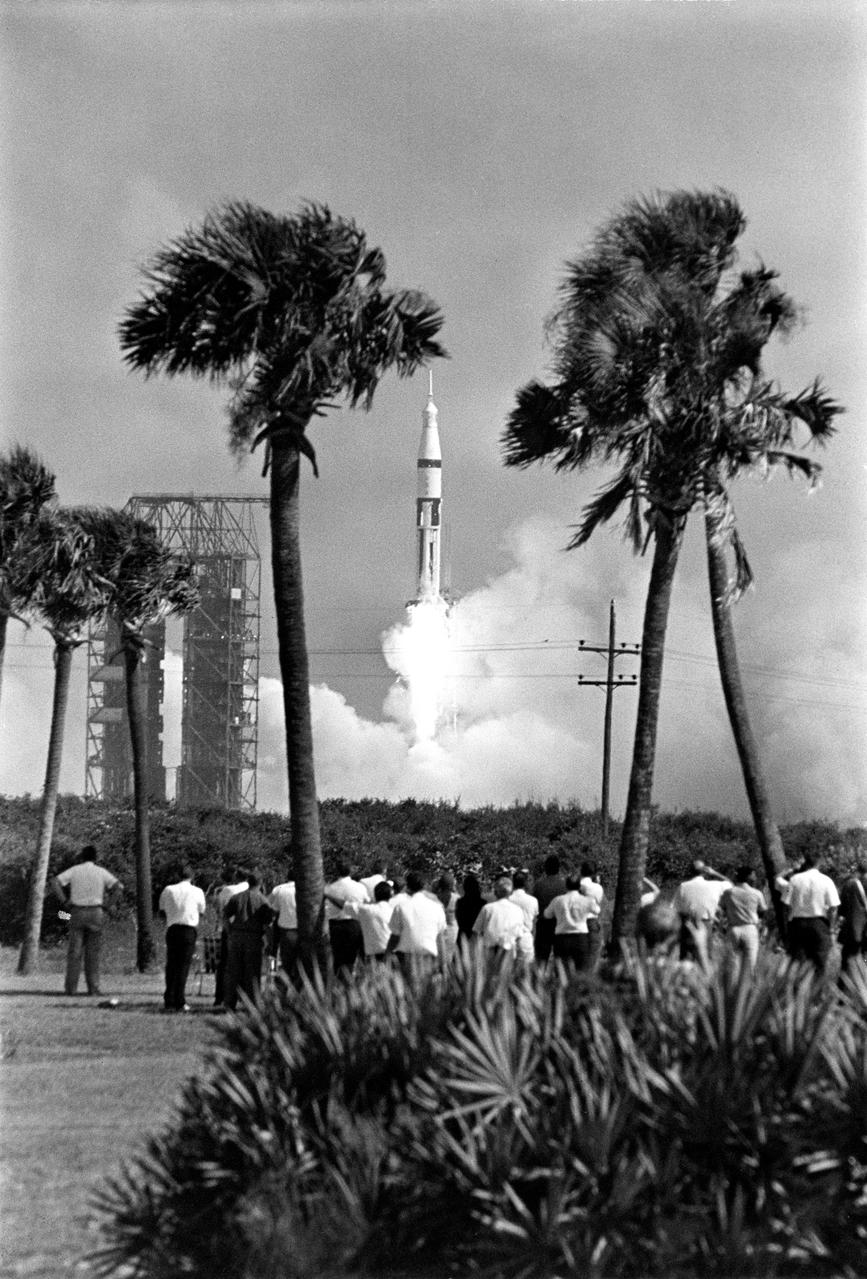
S68-48662 (11 Oct. 1968) --- The Apollo 7/Saturn IB space vehicle is launched from the Kennedy Space Center's Launch Complex 34 at 11:03 a.m. (EDT), Oct. 11, 1968. Apollo 7 (Spacecraft 101/Saturn 205) is the first of several manned flights aimed at qualifying the spacecraft for the half-million mile round trip to the moon. Aboard the Apollo spacecraft are astronauts Walter M. Schirra Jr., commander; Donn F. Eisele, command module pilot; and Walter Cunningham, lunar module pilot. (This view is framed by palm trees on either side).

S68-48788 (11 Oct. 1968) --- The Apollo 7/Saturn IB space vehicle is launched from the Kennedy Space Center's Launch Complex 34 at 11:03 a.m. (EDT), Oct. 11, 1968. Apollo 7 (Spacecraft 101/Saturn 205) is the first of several manned flights aimed at qualifying the spacecraft for the half-million-mile round trip to the moon. Aboard the Apollo spacecraft are astronauts Walter M. Schirra Jr., commander; Donn F. Eisele, command module pilot; and Walter Cunningham, lunar module pilot. (Tracking antenna on left and pad service structure on right)
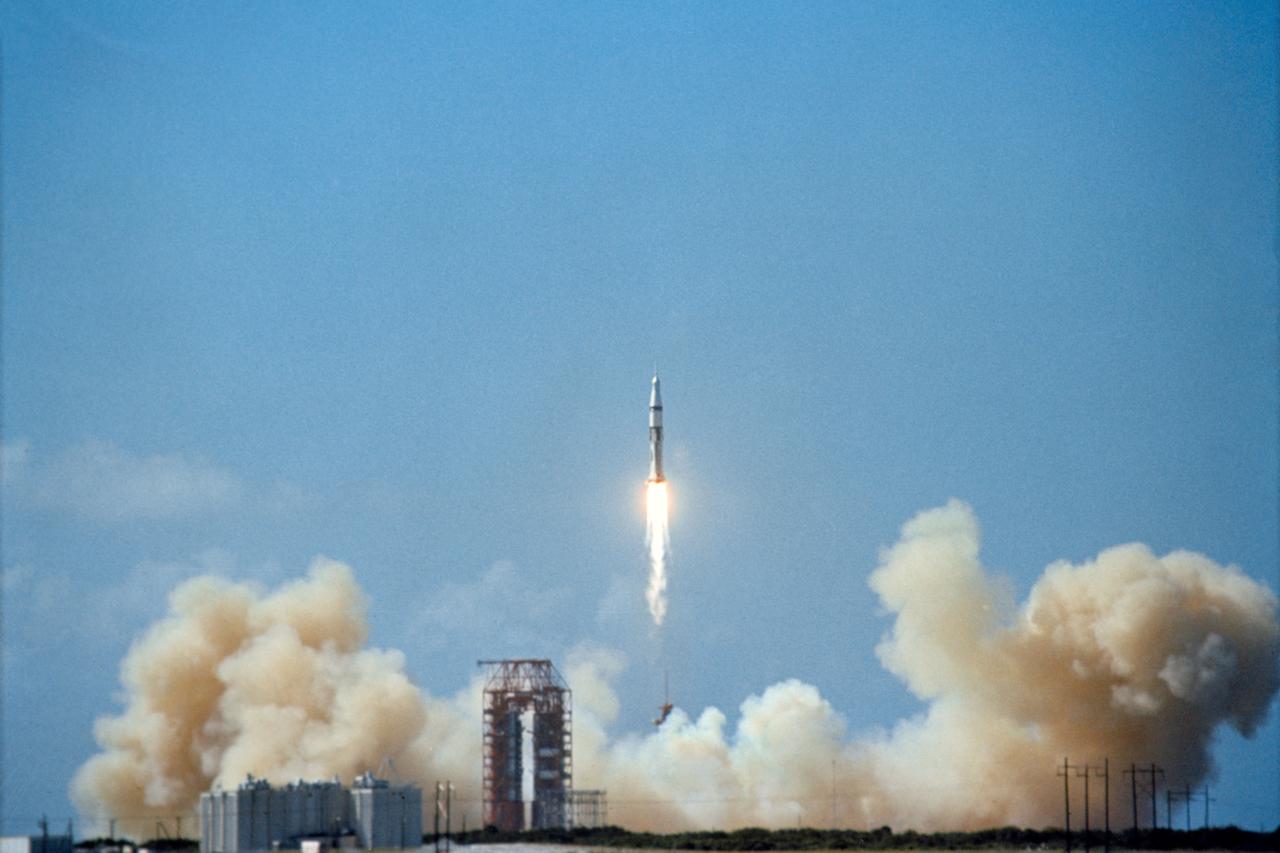
S68-48666 (11 Oct. 1968) --- The Apollo 7/Saturn IB space vehicle is launched from the Kennedy Space Center's Launch Complex 34 at 11:03 a.m. (EDT), Oct. 11, 1968. Apollo 7 (Spacecraft 101/Saturn 205) is the first of several manned flights aimed at qualifying the spacecraft for the half-million-mile round trip to the moon. Aboard the Apollo spacecraft are astronauts Walter M. Schirra Jr., commander; Donn F. Eisele, command module pilot; and Walter Cunningham, lunar module pilot.
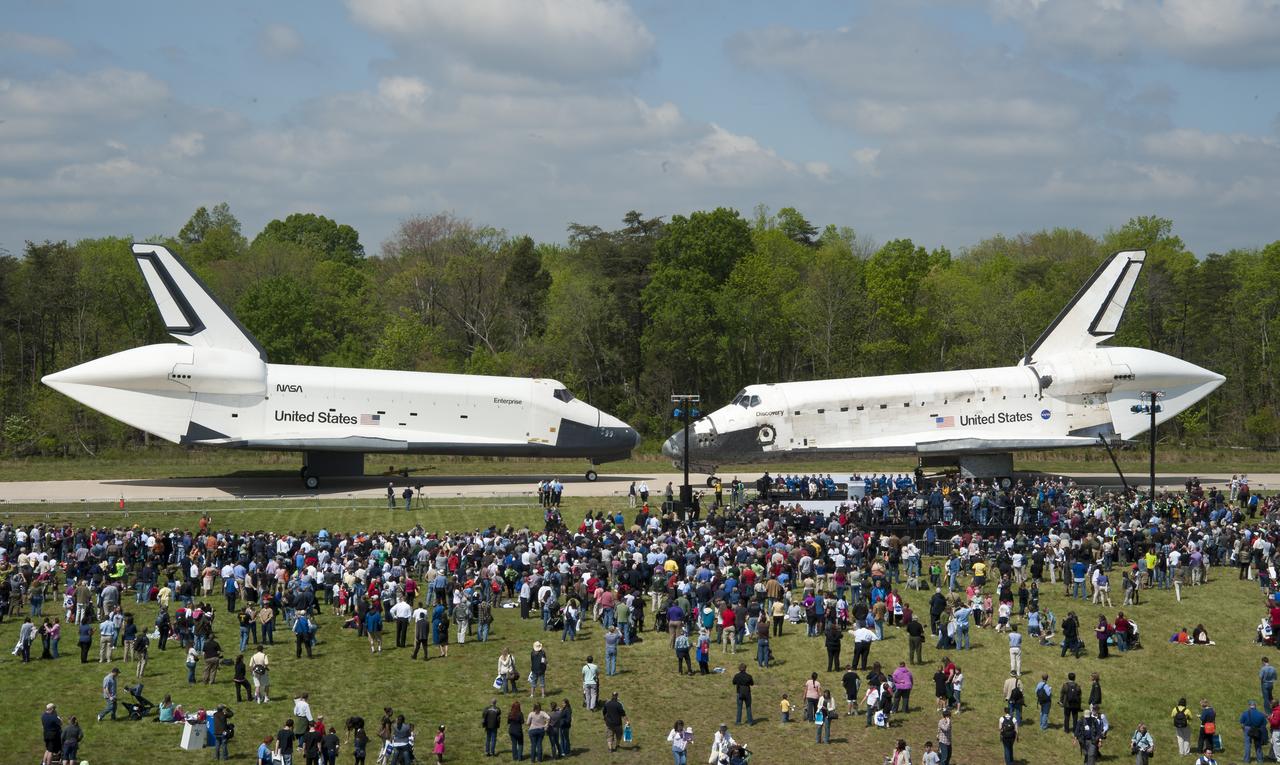
Space Shuttles Enterprise, left, and Discovery meet nose-to-nose at the beginning of a transfer ceremony at the Smithsonian's Steven F. Udvar-Hazy Center, Thursday, April 19, 2012, in Chantilly, Va. Space shuttle Discovery, the first orbiter retired from NASA’s shuttle fleet, completed 39 missions, spent 365 days in space, orbited the Earth 5,830 times, and traveled 148,221,675 miles will take the place of Enterprise at the center to commemorate past achievements in space and to educate and inspire future generations of explorers at the center. Photo Credit: (NASA/Smithsonian Institution/Carolyn Russo)
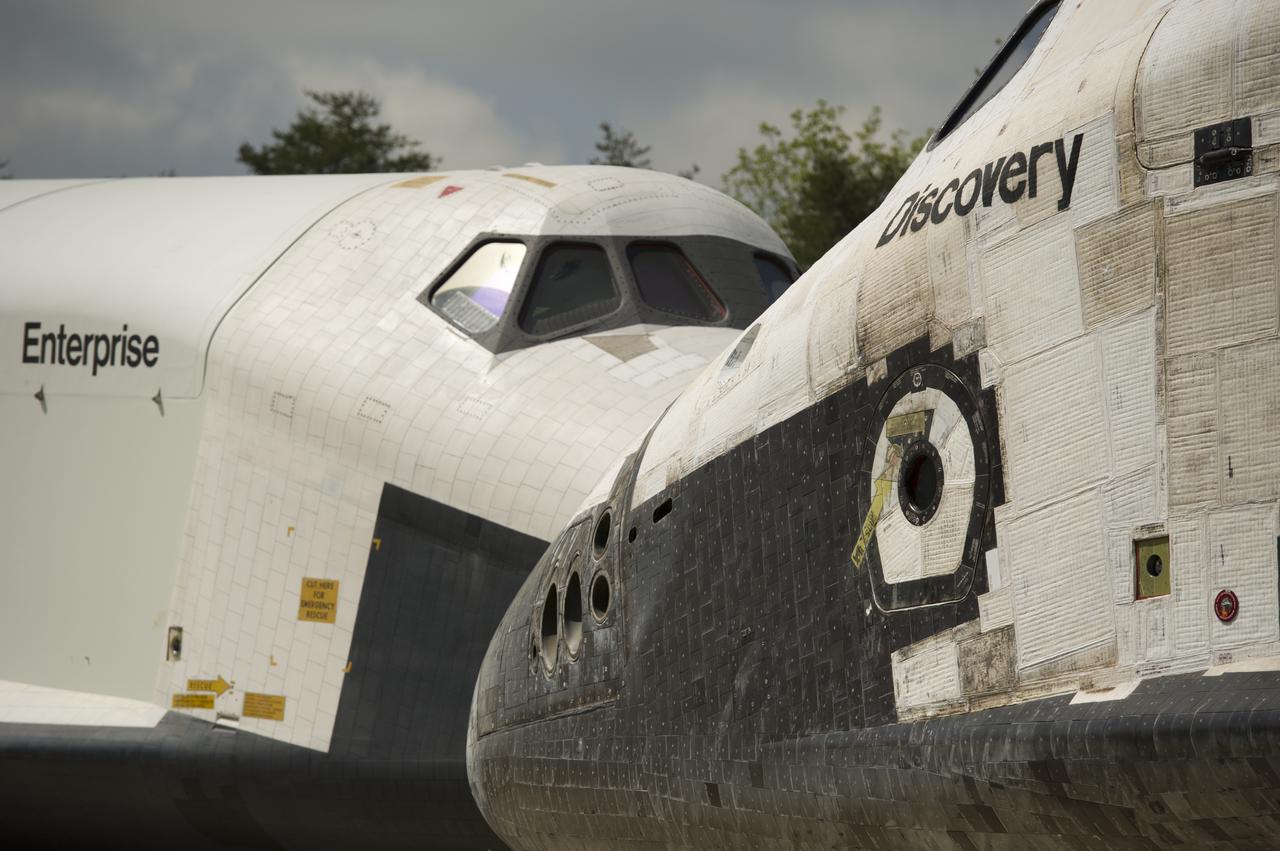
Space Shuttles Enterprise, left, and Discovery meet nose-to-nose during the a transfer ceremony at the Smithsonian's Steven F. Udvar-Hazy Center, Thursday, April 19, 2012, in Chantilly, Va. Space shuttle Discovery, the first orbiter retired from NASA’s shuttle fleet, completed 39 missions, spent 365 days in space, orbited the Earth 5,830 times, and traveled 148,221,675 miles will take the place of Enterprise at the center to commemorate past achievements in space and to educate and inspire future generations of explorers at the center. Photo Credit: (NASA/Carla Cioffi)
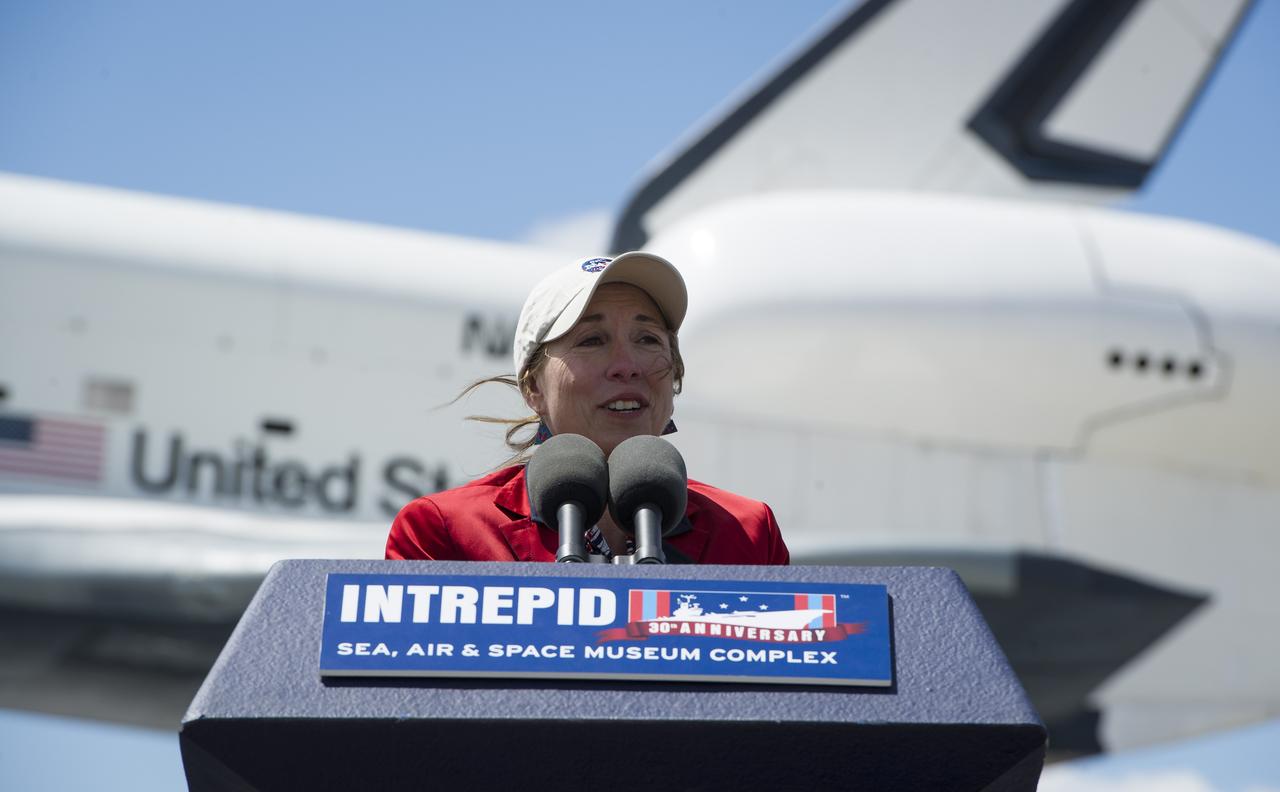
NASA Deputy Administrator Lori Garver speaks Friday, April 27, 2012, during the transfer ceremony for space shuttle Enterprise at John F. Kennedy Airport in New York. Enterprise was the first shuttle orbiter built for NASA performing test flights in the atmosphere and was incapable of spaceflight. Originally housed at the Smithsonian's Steven F. Udvar-Hazy Center, Enterprise will be demated from the SCA and placed on a barge that will eventually be moved by tugboat up the Hudson River to the Intrepid Sea, Air & Space Museum in June. Photo Credit: (NASA/Paul E. Alers)
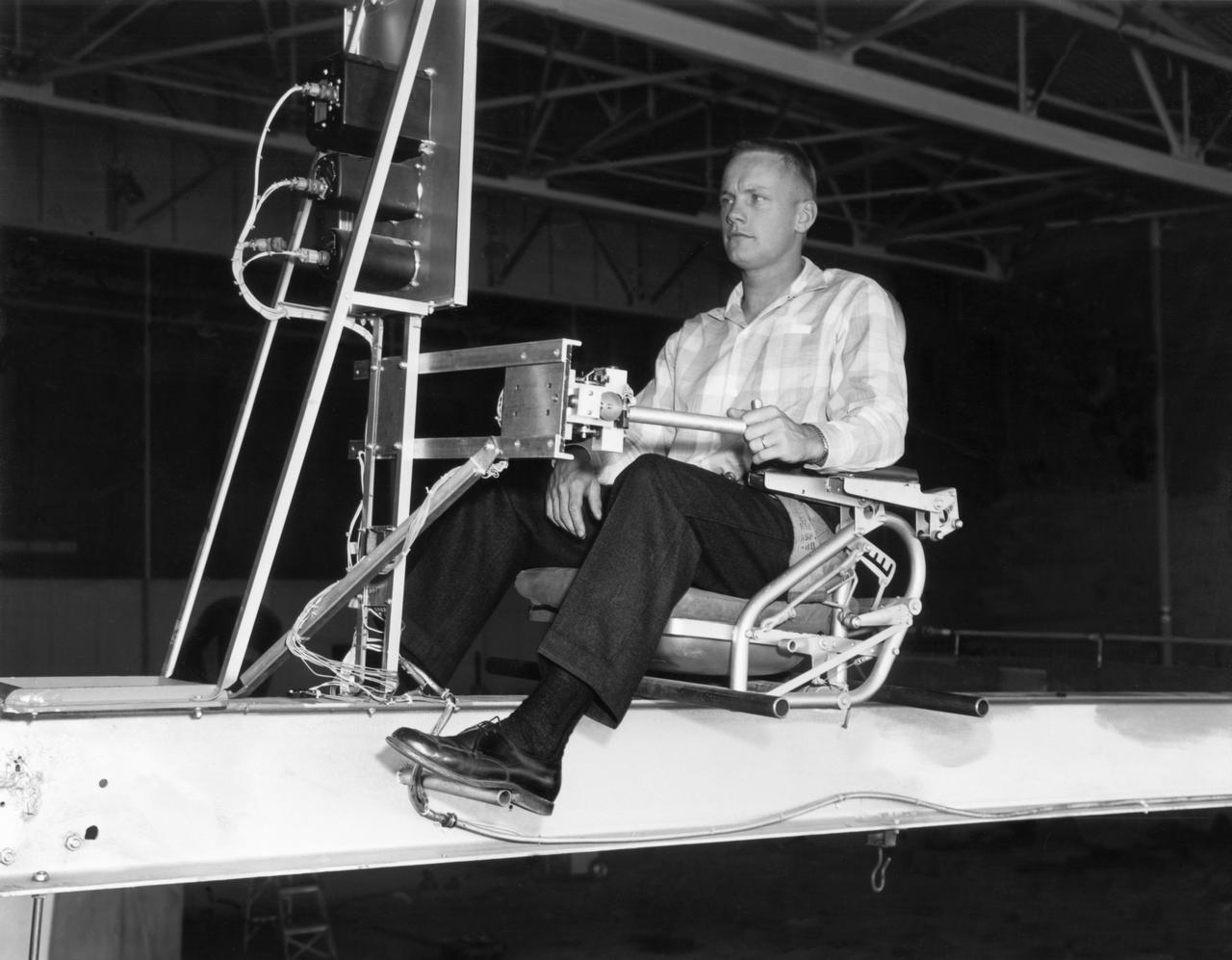
Famed astronaut Neil A. Armstrong, the first man to set foot on the moon during the historic Apollo 11 space mission in July 1969, served for seven years as a research pilot at the NACA-NASA High-Speed Flight Station, now the Dryden Flight Research Center, at Edwards, California, before he entered the space program. Armstrong joined the National Advisory Committee for Aeronautics (NACA) at the Lewis Flight Propulsion Laboratory (later NASA's Lewis Research Center, Cleveland, Ohio, and today the Glenn Research Center) in 1955. Later that year, he transferred to the High-Speed Flight Station at Edwards as an aeronautical research scientist and then as a pilot, a position he held until becoming an astronaut in 1962. He was one of nine NASA astronauts in the second class to be chosen. As a research pilot Armstrong served as project pilot on the F-100A and F-100C aircraft, F-101, and the F-104A. He also flew the X-1B, X-5, F-105, F-106, B-47, KC-135, and Paresev. He left Dryden with a total of over 2450 flying hours. He was a member of the USAF-NASA Dyna-Soar Pilot Consultant Group before the Dyna-Soar project was cancelled, and studied X-20 Dyna-Soar approaches and abort maneuvers through use of the F-102A and F5D jet aircraft. Armstrong was actively engaged in both piloting and engineering aspects of the X-15 program from its inception. He completed the first flight in the aircraft equipped with a new flow-direction sensor (ball nose) and the initial flight in an X-15 equipped with a self-adaptive flight control system. He worked closely with designers and engineers in development of the adaptive system, and made seven flights in the rocket plane from December 1960 until July 1962. During those fights he reached a peak altitude of 207,500 feet in the X-15-3, and a speed of 3,989 mph (Mach 5.74) in the X-15-1. Armstrong has a total of 8 days and 14 hours in space, including 2 hours and 48 minutes walking on the Moon. In March 1966 he was commander of the Gemini 8 or
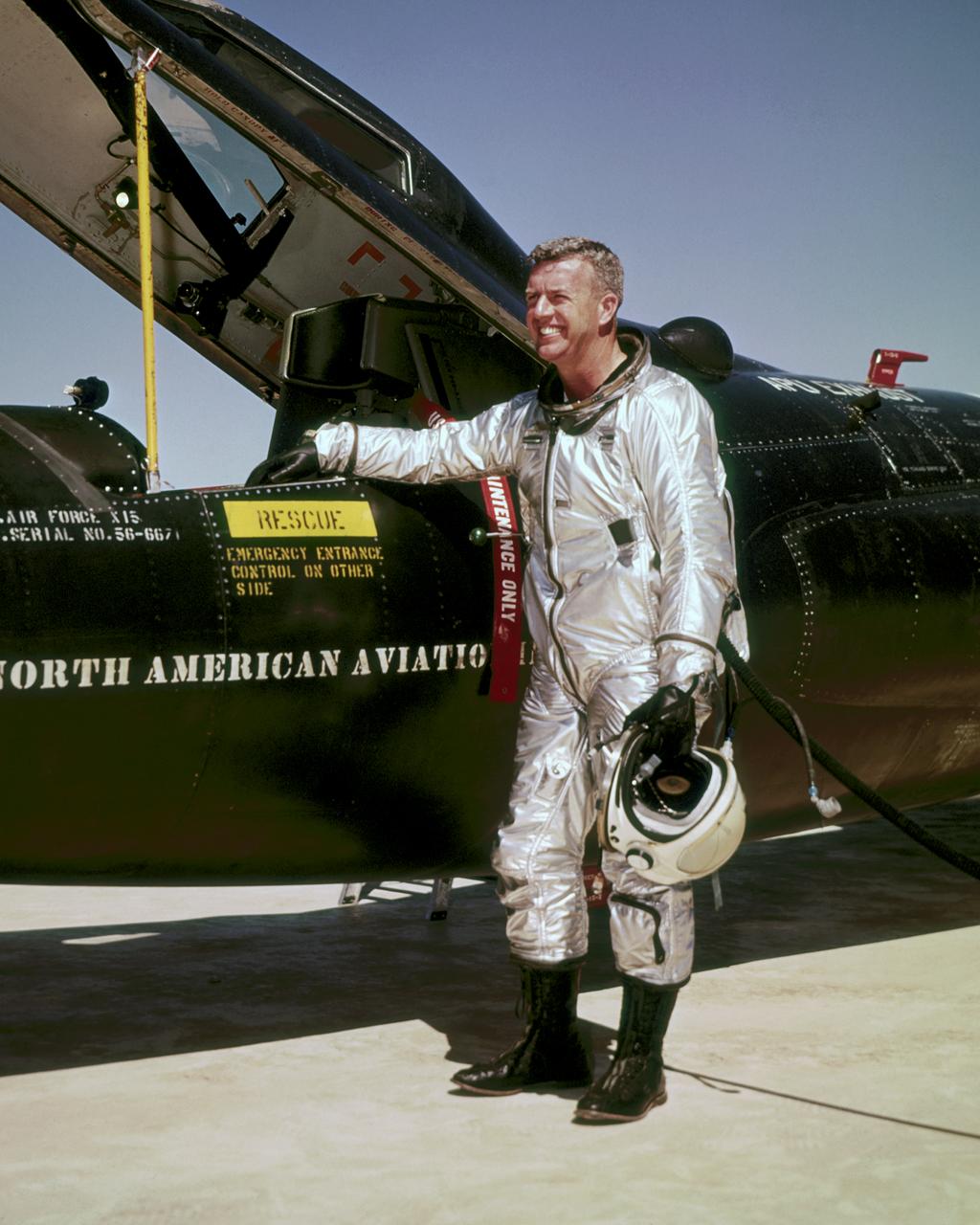
Joseph A. Walker was a Chief Research Pilot at the NASA Dryden Flight Research Center during the mid-1960s. He joined the NACA in March 1945, and served as project pilot at the Edwards flight research facility on such pioneering research projects as the D-558-1, D-558-2, X-1, X-3, X-4, X-5, and the X-15. He also flew programs involving the F-100, F-101, F-102, F-104, and the B-47. Walker made the first NASA X-15 flight on March 25, 1960. He flew the research aircraft 24 times and achieved its fastest speed and highest altitude. He attained a speed of 4,104 mph (Mach 5.92) during a flight on June 27, 1962, and reached an altitude of 354,300 feet on August 22, 1963 (his last X-15 flight). He was the first man to pilot the Lunar Landing Research Vehicle (LLRV) that was used to develop piloting and operational techniques for lunar landings. Walker was born February 20, 1921, in Washington, Pa. He lived there until graduating from Washington and Jefferson College in 1942, with a B.A. degree in Physics. During World War II he flew P-38 fighters for the Air Force, earning the Distinguished Flying Cross and the Air Medal with Seven Oak Clusters. Walker was the recipient of many awards during his 21 years as a research pilot. These include the 1961 Robert J. Collier Trophy, 1961 Harmon International Trophy for Aviators, the 1961 Kincheloe Award and 1961 Octave Chanute Award. He received an honorary Doctor of Aeronautical Sciences degree from his alma mater in June of 1962. Walker was named Pilot of the Year in 1963 by the National Pilots Association. He was a charter member of the Society of Experimental Test Pilots, and one of the first to be designated a Fellow. He was fatally injured on June 8, 1966, in a mid-air collision between an F-104 he was piloting and the XB-70.
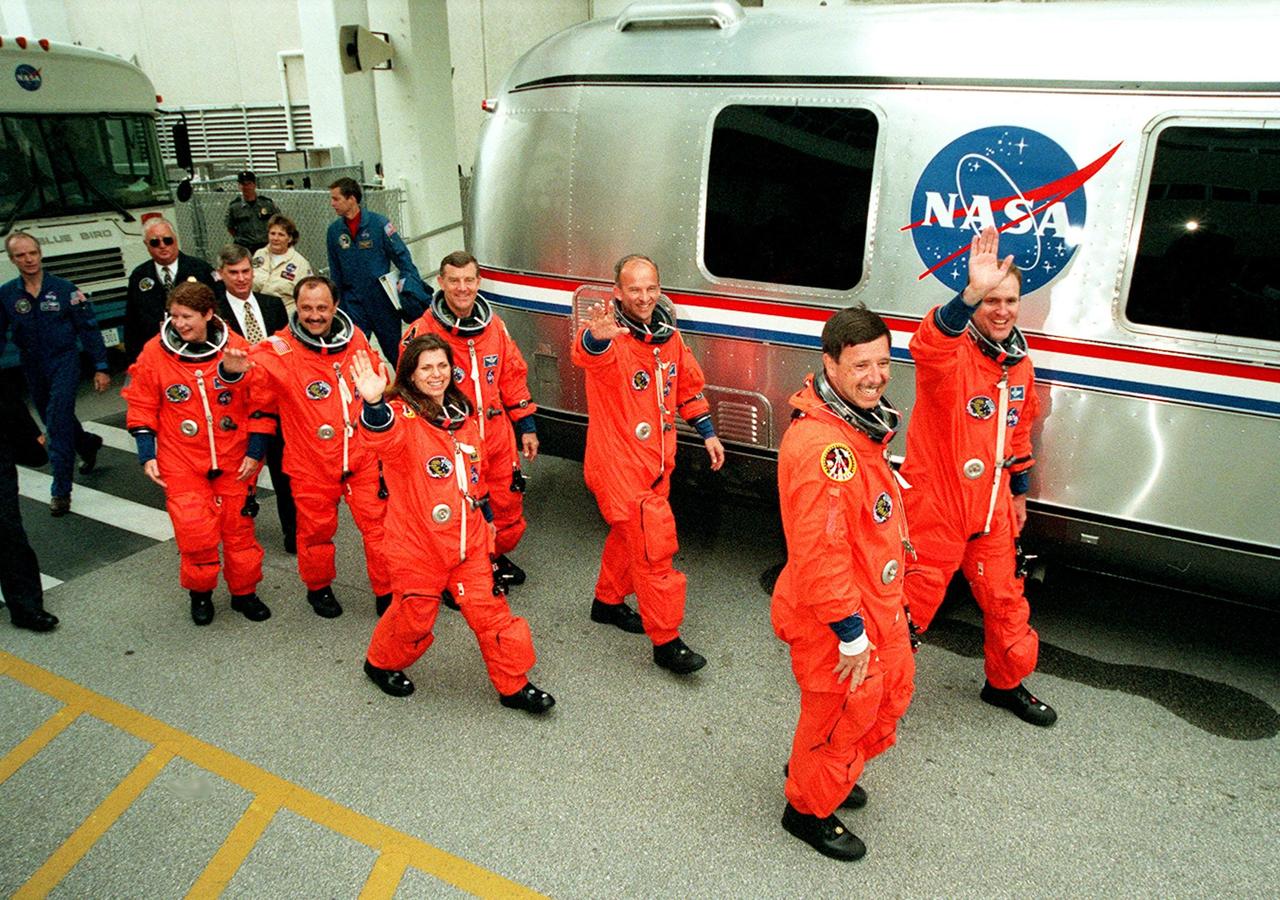
Waving to onlookers, the STS-101 crew eagerly walk to the waiting Astrovan that will take them to Launch Pad 39A and liftoff of Space Shuttle Atlantis, targeted for 4:15 p.m. EDT. In their orange launch and entry suits, they are (in the f ront, left to right) Mission Specialists Susan Helms, Yuri Usachev of Russia and Mary Ellen Weber, plus Pilot Scott J. Horowitz; (in the rear, left to right) Mission Specialists James S. Voss and Jeffrey N. Williams, plus Commander James D. Halsell Jr. The mission will take the crew to the International Space Station to deliver logistics and supplies and to prepare the Station for the arrival of the Zvezda Service Module, expected to be launched by Russia in July 2000. Also, the crew will conduct one space walk. This will be the third assembly flight to the Space Station. The mission is expected to last about 10 days, with Atlantis landing at KSC Thursday, May 4, about 11:23 a.m. EDT
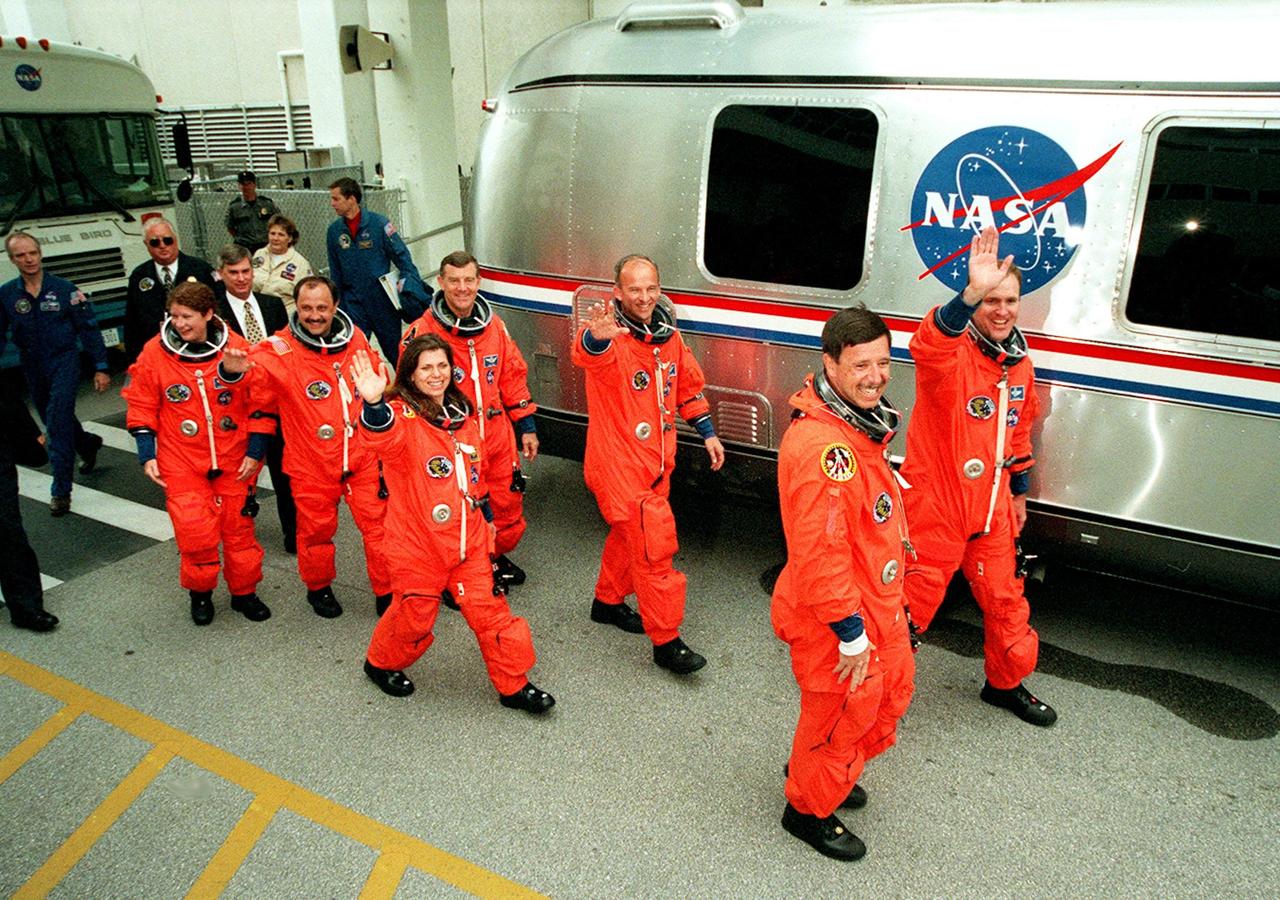
Waving to onlookers, the STS-101 crew eagerly walk to the waiting Astrovan that will take them to Launch Pad 39A and liftoff of Space Shuttle Atlantis, targeted for 4:15 p.m. EDT. In their orange launch and entry suits, they are (in the f ront, left to right) Mission Specialists Susan Helms, Yuri Usachev of Russia and Mary Ellen Weber, plus Pilot Scott J. Horowitz; (in the rear, left to right) Mission Specialists James S. Voss and Jeffrey N. Williams, plus Commander James D. Halsell Jr. The mission will take the crew to the International Space Station to deliver logistics and supplies and to prepare the Station for the arrival of the Zvezda Service Module, expected to be launched by Russia in July 2000. Also, the crew will conduct one space walk. This will be the third assembly flight to the Space Station. The mission is expected to last about 10 days, with Atlantis landing at KSC Thursday, May 4, about 11:23 a.m. EDT

NASA's 747 Shuttle Carrier Aircraft (SCA), with space shuttle Enterprise latched on its back, is towed from the hangar at John F. Kennedy (JFK) International Airport in New York late in the night on Saturday, May 12, 2012. Early Sunday morning, Enterprise was removed from the SCA. The shuttle will be placed on a barge that will move by tugboat up the Hudson River to Intrepid in June. The shuttle will be lifted by crane and placed on the flight deck of the Intrepid, where it will be on exhibit to the public starting this summer in a temporary climate-controlled pavilion. Photo Credit: (NASA/Kim Shiflet)

The space shuttle Enterprise, mounted on transport vehicle, is backed into a temporary hangar after being demated from the NASA 747 Shuttle Carrier Aircraft (SCA) at John F. Kennedy (JFK) International Airport in Jamica, New York, Sunday, May 13, 2012. Enterprise will be placed on a barge that will move by tugboat up the Hudson River to the Intrepid Sea, Air & Space Museum in June. The shuttle will be lifted by crane and placed on the flight deck of the Intrepid, where it will be on exhibit to the public starting this summer in a temporary climate-controlled pavilion. Photo Credit: (NASA/Kim Shiflet)

The space shuttle Enterprise, mounted on transport vehicle, is backed into a temporary hangar after being demated from the NASA 747 Shuttle Carrier Aircraft (SCA) at John F. Kennedy (JFK) International Airport in Jamica, New York, Sunday, May 13, 2012. Enterprise will be placed on a barge that will move by tugboat up the Hudson River to the Intrepid Sea, Air & Space Museum in June. The shuttle will be lifted by crane and placed on the flight deck of the Intrepid, where it will be on exhibit to the public starting this summer in a temporary climate-controlled pavilion. Photo Credit: (NASA/Kim Shiflet)

NASA and United Space Alliance workers lower a yellow sling onto space shuttle Enterprise, which sits atop NASA's 747 Shuttle Carrier Aircraft (SCA) prior to it being demated a few hours later at John F. Kennedy (JFK) International Airport in New York, Saturday, May 12, 2012. Once the sling was firmly attached early Sunday morning, Enterprise was lifted from the SCA. The shuttle will be placed on a barge that will move by tugboat up the Hudson River to Intrepid in June. The shuttle will be lifted by crane and placed on the flight deck of the Intrepid, where it will be on exhibit to the public starting this summer in a temporary climate-controlled pavilion. Photo Credit: (NASA/Kim Shiflet)
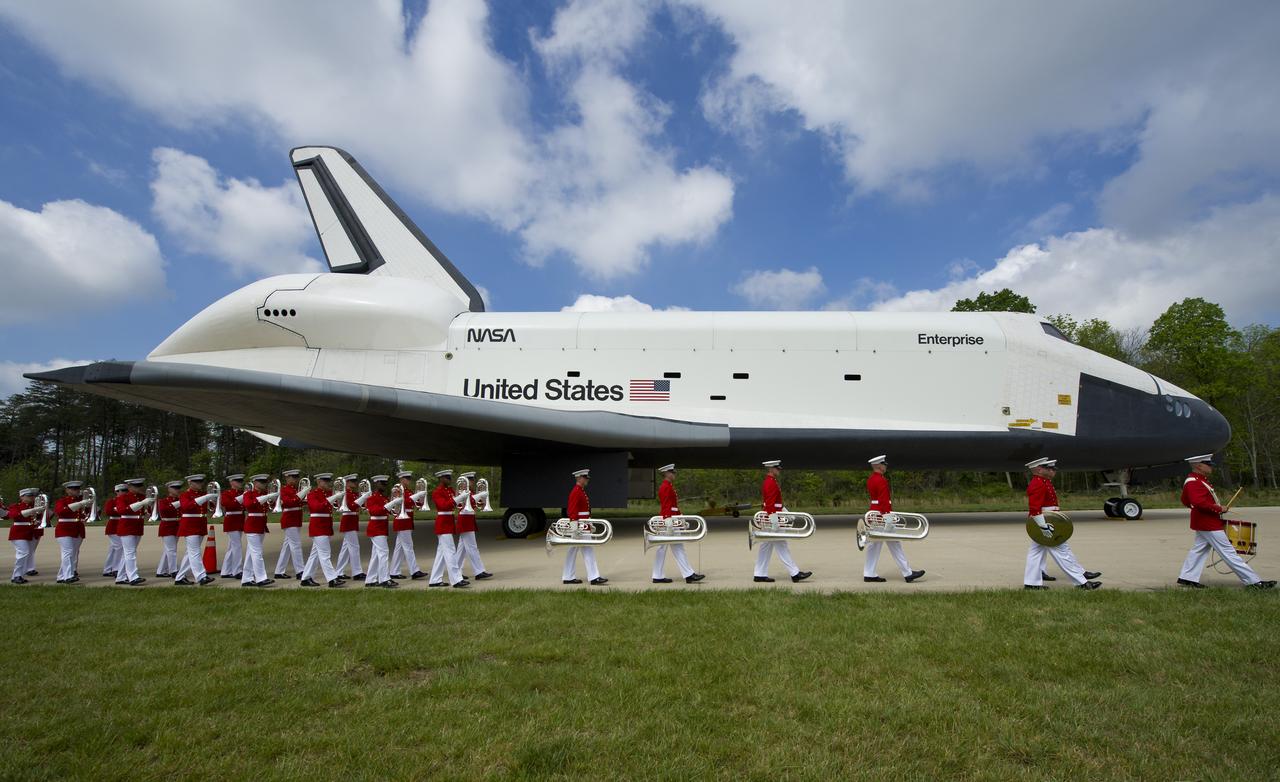
Space shuttle Enterprise is seen as the United States Marine Corp Drum and Bugle Corps and Color Guard march by at the Steven F. Udvar-Hazy Center Thursday, April 19, 2012 in Chantilly, Va. Enterprise was the first space shuttle orbiter, built for NASA to perform test flights in the atmosphere and was not capable of spaceflight. It has been on display at the Udvar-Hazy Center's Space Hangar since 2004. Enterprise will be transferred to the Intrepid Sea, Air and Space Museum in New York City. Photo Credit: (NASA/Carla Cioffi)

The space shuttle Enterprise hangs from a sling after being demated from the NASA 747 Shuttle Carrier Aircraft (SCA) at John F. Kennedy (JFK) International Airport in Jamica, New York, Sunday, May 13, 2012. The shuttle will be placed on a barge that will move by tugboat up the Hudson River to the Intrepid Sea, Air & Space Museum in June. The shuttle will be lifted by crane and placed on the flight deck of the Intrepid, where it will be on exhibit to the public starting this summer in a temporary climate-controlled pavilion. Photo Credit: (NASA/Kim Shiflet)

A set of cranes and wind restraints constructed to remove space shuttle Enterprise from atop NASA's 747 Shuttle Carrier Aircraft are being put into place at John F. Kennedy (JFK) International Airport in New York, Saturday, May 12, 2012. Enterprise will be placed on a barge that will move by tugboat up the Hudson River to Intrepid in June. The shuttle will be lifted by crane and placed on the flight deck of the Intrepid, where it will be on exhibit to the public starting this summer in a temporary climate-controlled pavilion. Photo Credit: (NASA/Kim Shiflet)

A yellow sling is lowered onto space shuttle Enterprise, which sits atop NASA's 747 Shuttle Carrier Aircraft (SCA) prior to it being demated a few hours later at John F. Kennedy (JFK) International Airport in New York, Saturday, May 12, 2012. The shuttle will be placed on a barge that will move by tugboat up the Hudson River to Intrepid in June. The shuttle will be lifted by crane and placed on the flight deck of the Intrepid, where it will be on exhibit to the public starting this summer in a temporary climate-controlled pavilion. Photo Credit: (NASA/Kim Shiflet)

The space shuttle Enterprise is lowered onto a transport vehicle after being demated from the NASA 747 Shuttle Carrier Aircraft (SCA) at John F. Kennedy (JFK) International Airport in Jamica, New York, Sunday, May 13, 2012. The shuttle will be placed on a barge that will move by tugboat up the Hudson River to the Intrepid Sea, Air & Space Museum in June. The shuttle will be lifted by crane and placed on the flight deck of the Intrepid, where it will be on exhibit to the public starting this summer in a temporary climate-controlled pavilion. Photo Credit: (NASA/Kim Shiflet)
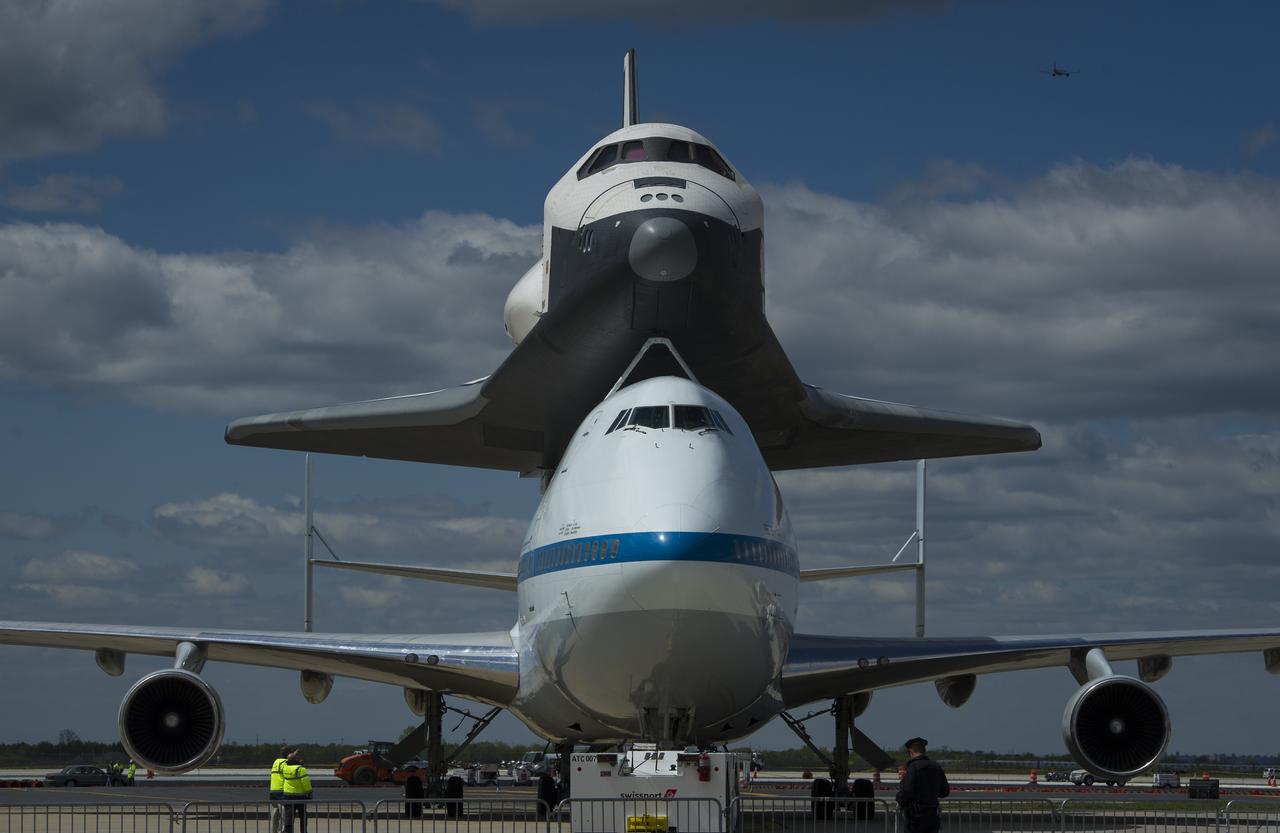
Space shuttle Enterprise, mounted atop a NASA 747 Shuttle Carrier Aircraft (SCA), is seen as it taxis at John F. Kennedy Airport, Friday, April 27, 2012, in New York. Enterprise was the first shuttle orbiter built for NASA performing test flights in the atmosphere and was incapable of spaceflight. Originally housed at the Smithsonian's Steven F. Udvar-Hazy Center, Enterprise will be demated from the SCA and placed on a barge that will eventually be moved by tugboat up the Hudson River to the Intrepid Sea, Air & Space Museum in June. Photo Credit: (NASA/Paul E. Alers)
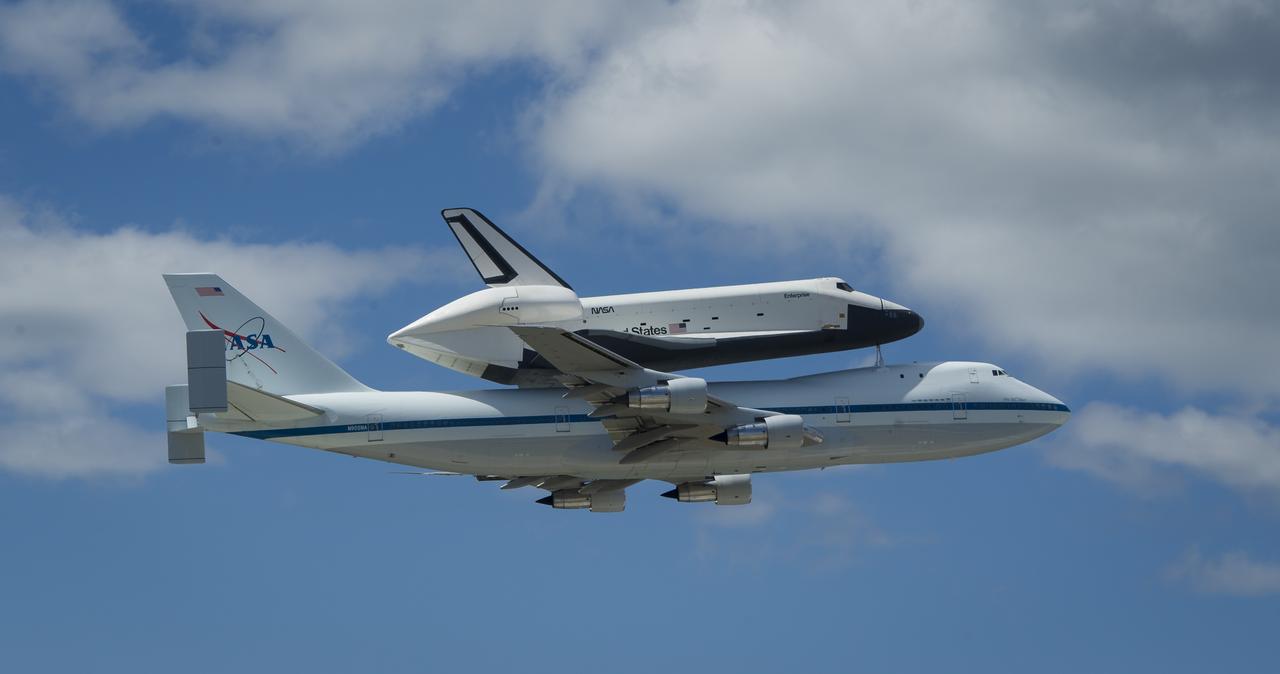
Space shuttle Enterprise, mounted atop a NASA 747 Shuttle Carrier Aircraft (SCA), is seen as it flies over John F. Kennedy Airport, Friday, April 27, 2012, in New York. Enterprise was the first shuttle orbiter built for NASA performing test flights in the atmosphere and was incapable of spaceflight. Originally housed at the Smithsonian's Steven F. Udvar-Hazy Center, Enterprise will be demated from the SCA and placed on a barge that will eventually be moved by tugboat up the Hudson River to the Intrepid Sea, Air & Space Museum in June. Photo Credit: (NASA/Paul E. Alers)

Space shuttle Enterprise is held aloft by a yellow sling and a set of cranes after it was removed from the top of NASA's 747 Shuttle Carrier Aircraft early Sunday morning at John F. Kennedy (JFK) International Airport in New York, Sunday, May 13, 2012 .The 747 was towed backwards so that Enterprise could be lowered. The shuttle will be placed on a barge that will move by tugboat up the Hudson River to the Intrepid Sea, Air & Space Museum in June. The shuttle will be lifted by crane and placed on the flight deck of the Intrepid, where it will be on exhibit to the public starting this summer in a temporary climate-controlled pavilion. Photo Credit: (NASA/Kim Shiflet)
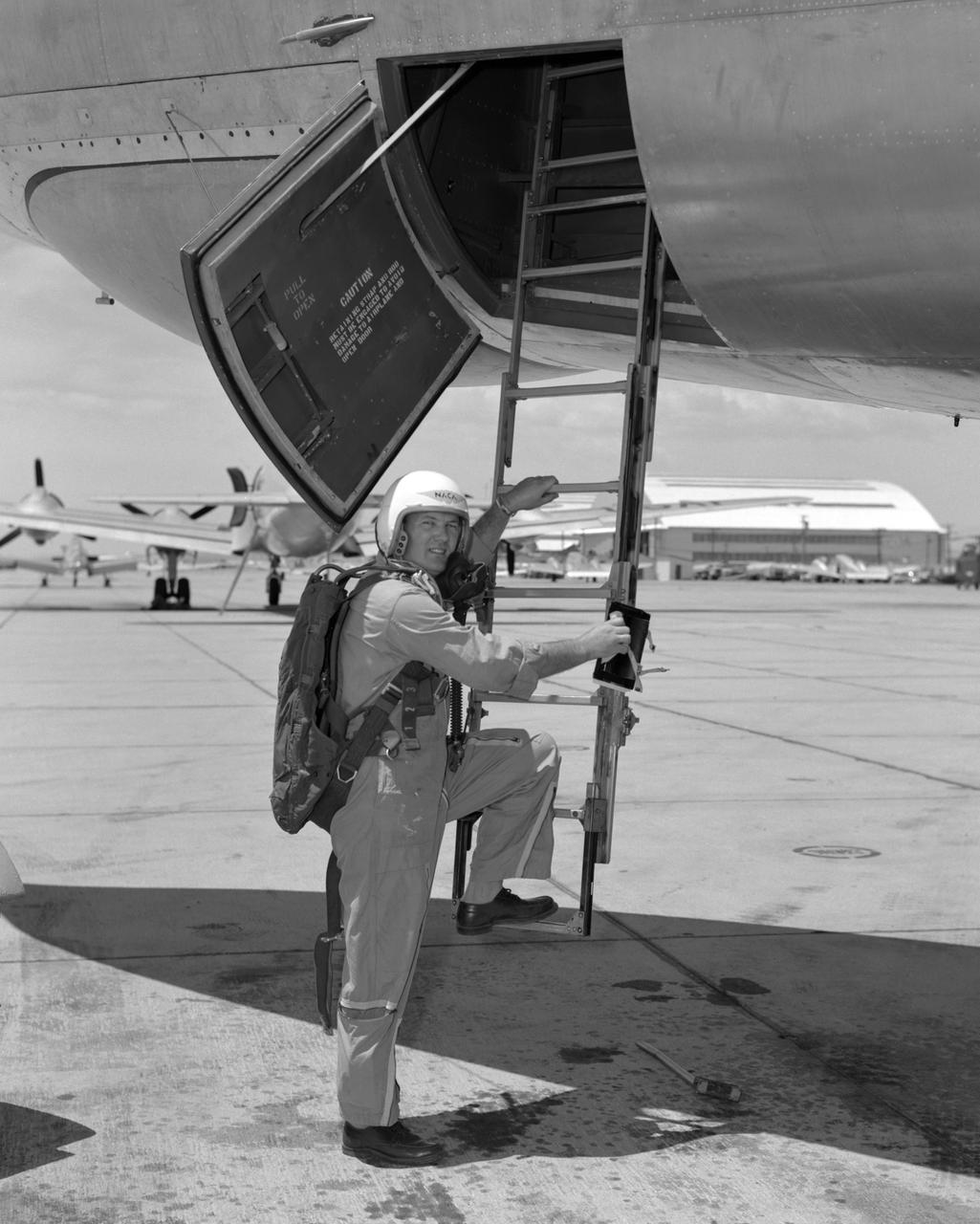
From December 10, 1966, until his retirement on February 27, 1976, Stanley P. Butchart served as Chief (later, Director) of Flight Operations at NASA's Flight Research Center (renamed on March 26, 1976, the Hugh L. Dryden Flight Research Center). Initially, his responsibilities in this position included the Research Pilots Branch, a Maintenance and Manufacturing Branch, and an Operations Engineering Branch, the last of which not only included propulsion and electrical/electronic sections but project engineers for the X-15 and lifting bodies. During his tenure, however, the responsibilities of his directorate came to include not only Flight Test Engineering Support but Flight Systems and Loads laboratories. Before becoming Chief of Flight Operations, Butchart had served since June of 1966 as head of the Research Pilots Branch (Chief Pilot) and then as acting chief of Flight Operations. He had joined the Center (then known as the National Advisory Committee for Aeronautics' High-Speed Flight Research Station) as a research pilot on May 10, 1951. During his career as a research pilot, he flew a great variety of research and air-launch aircraft including the D-558-I, D-558-II, B-29 (plus its Navy version, the P2B), X-4, X-5, KC-135, CV-880, CV-990, B-47, B-52, B-747, F-100A, F-101, F-102, F-104, PA-30 Twin Comanche, JetStar, F-111, R4D, B-720, and B-47. Although previously a single-engine pilot, he became the Center's principal multi-engine pilot during a period of air-launches in which the pilot of the air-launch aircraft (B-29 or P2B) basically directed the operations. It was he who called for the chase planes before each drop, directed the positioning of fire rescue vehicles, and released the experimental aircraft after ensuring that all was ready for the drop. As pilot of the B-29 and P2B, Butchart launched the X-1A once, the X-1B 13 times, the X-1E 22 times, and the D-558-II 102 times. In addition, he towed the M2-F1 lightweight lifting body 14 times behind an R4