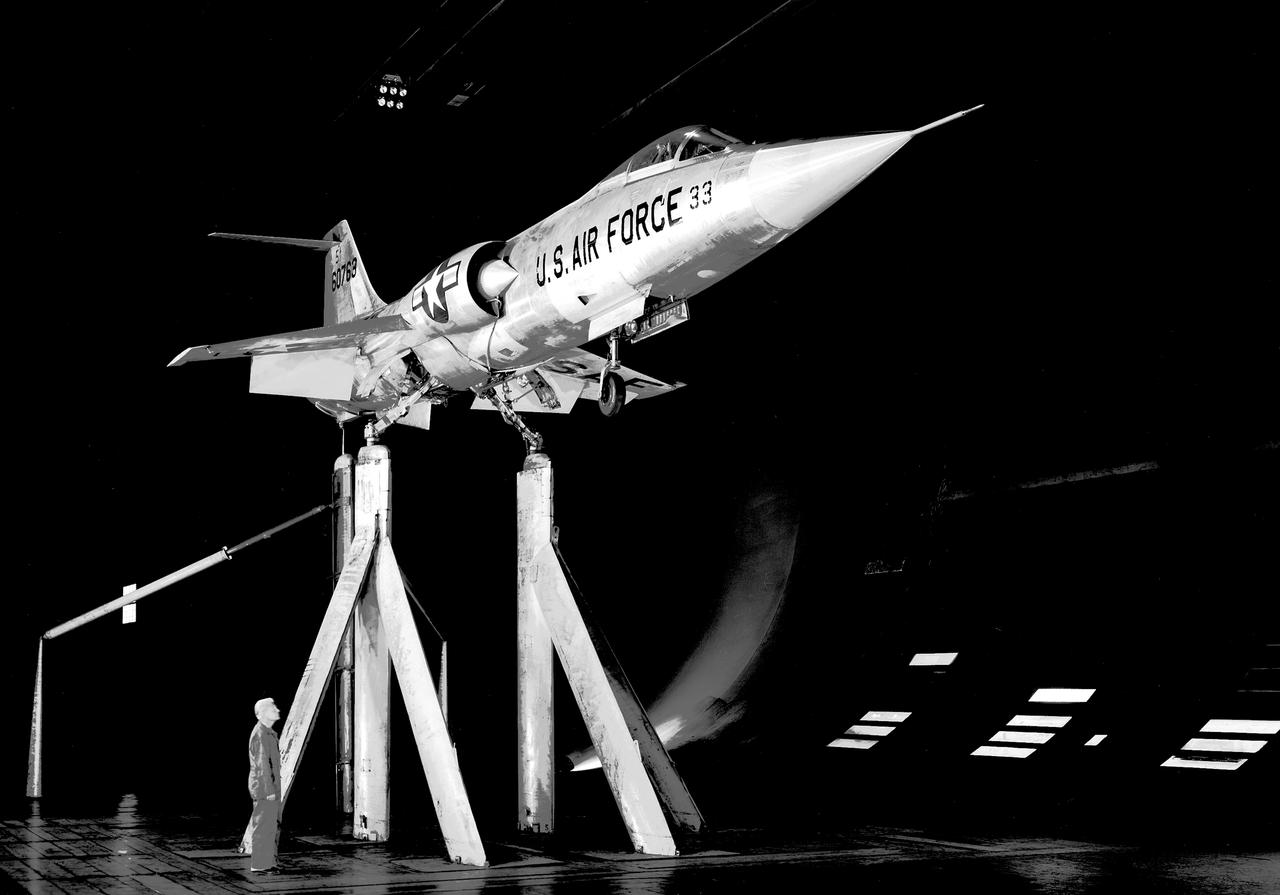
3/4 front view from below of Air Force F-104. The Lockheed F-104 Starfighter is a single-engine, supersonic interceptor aircraft originally developed by Lockheed for the United States Air Force (USAF). One of the Century Series of fighter aircraft, it was operated by the air forces of more than a dozen nations from 1958 to 2004.
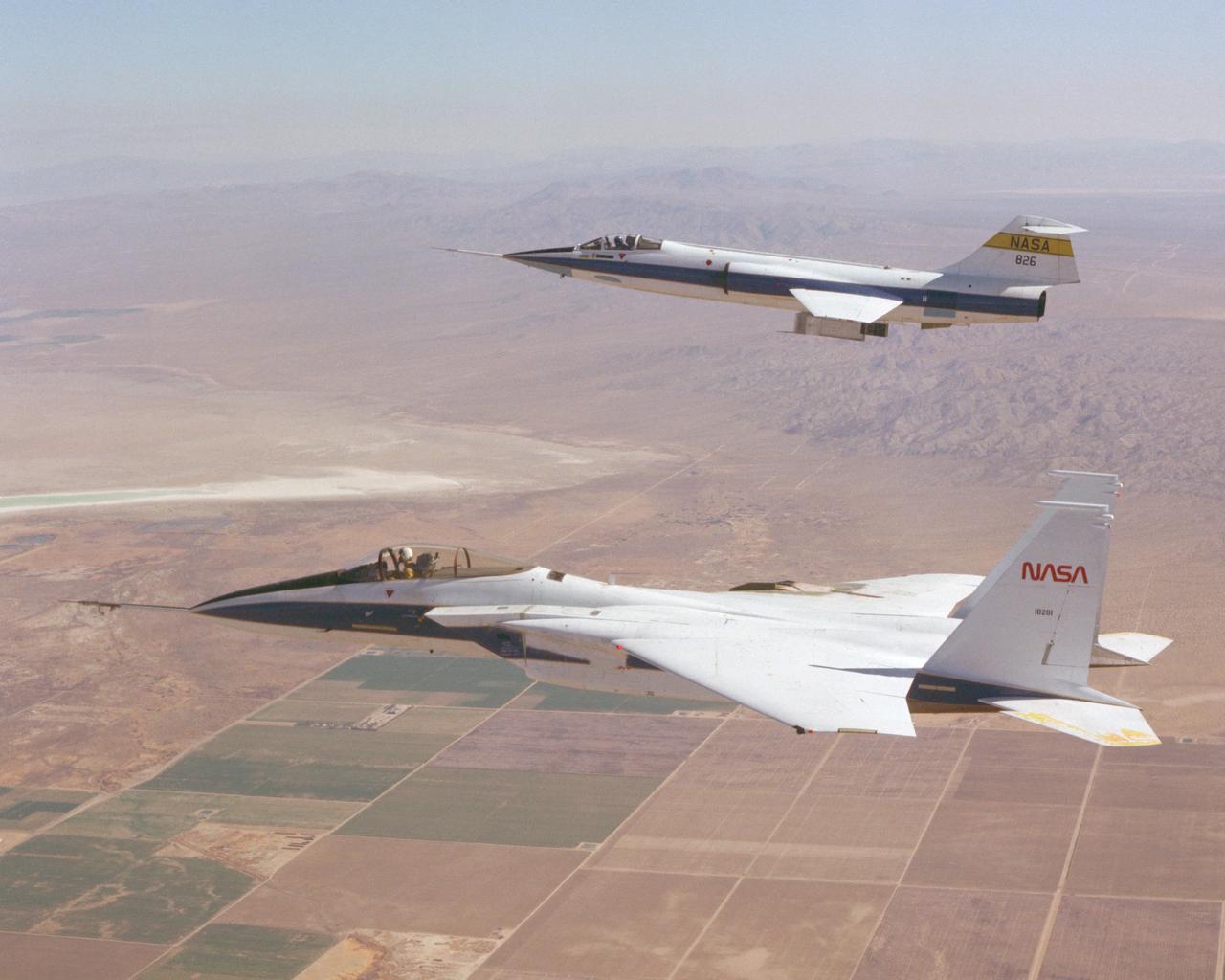
F-15 #281 and F-104 #826 fly in formation during Space Shuttle tile testing. Note the tiles mounted on the right wing of the F-15 and the centerline test fixture of the F-104.
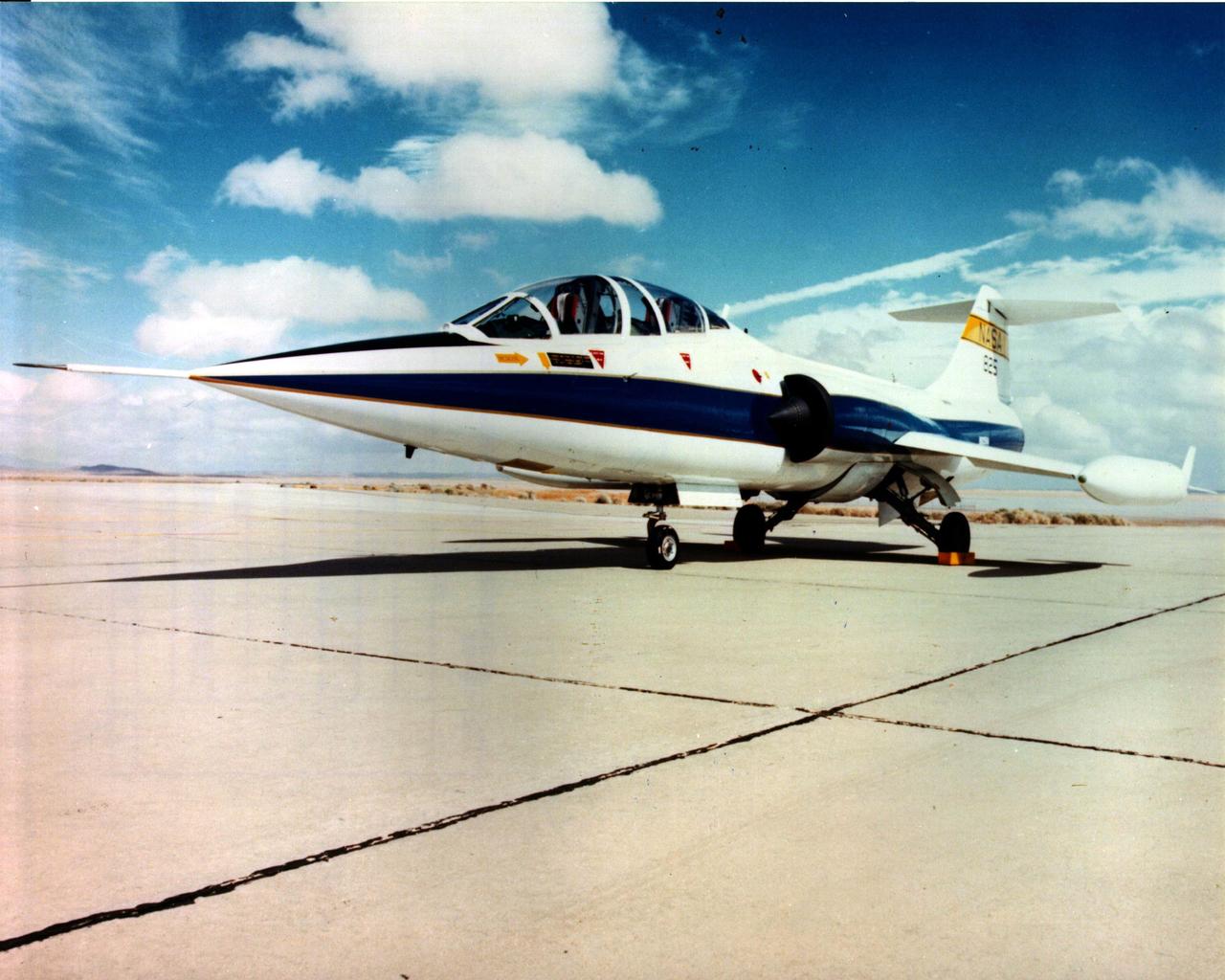
NASA F-104 Aircraft
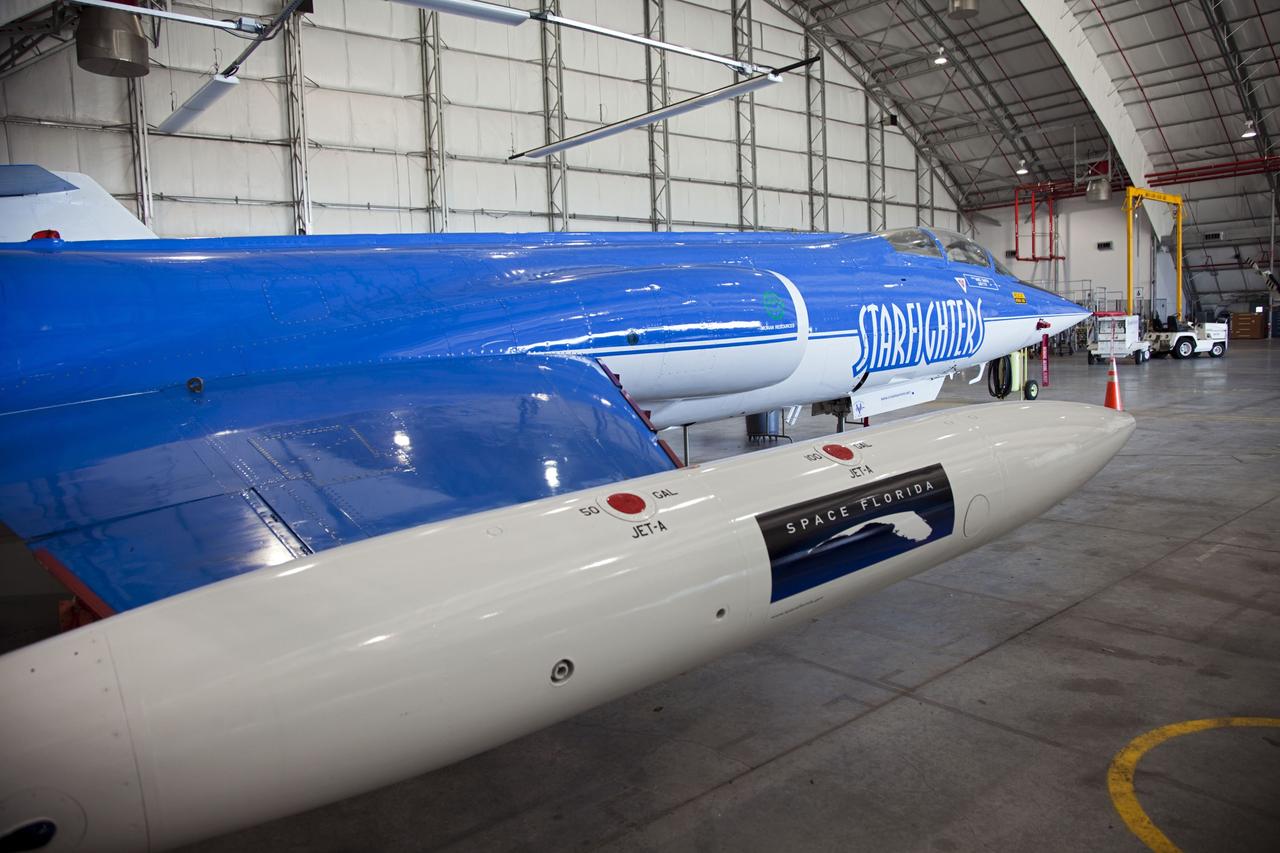
CAPE CANAVERAL, Fla. -- Starfighters has four F-104 aircraft that have been operational for several years. They have been used to fly research and development and other missions. Starfighters operates out of a hangar at the Shuttle Landing Facility at Kennedy under an agreement with Kennedy. Photo credit: NASA/Frankie Martin
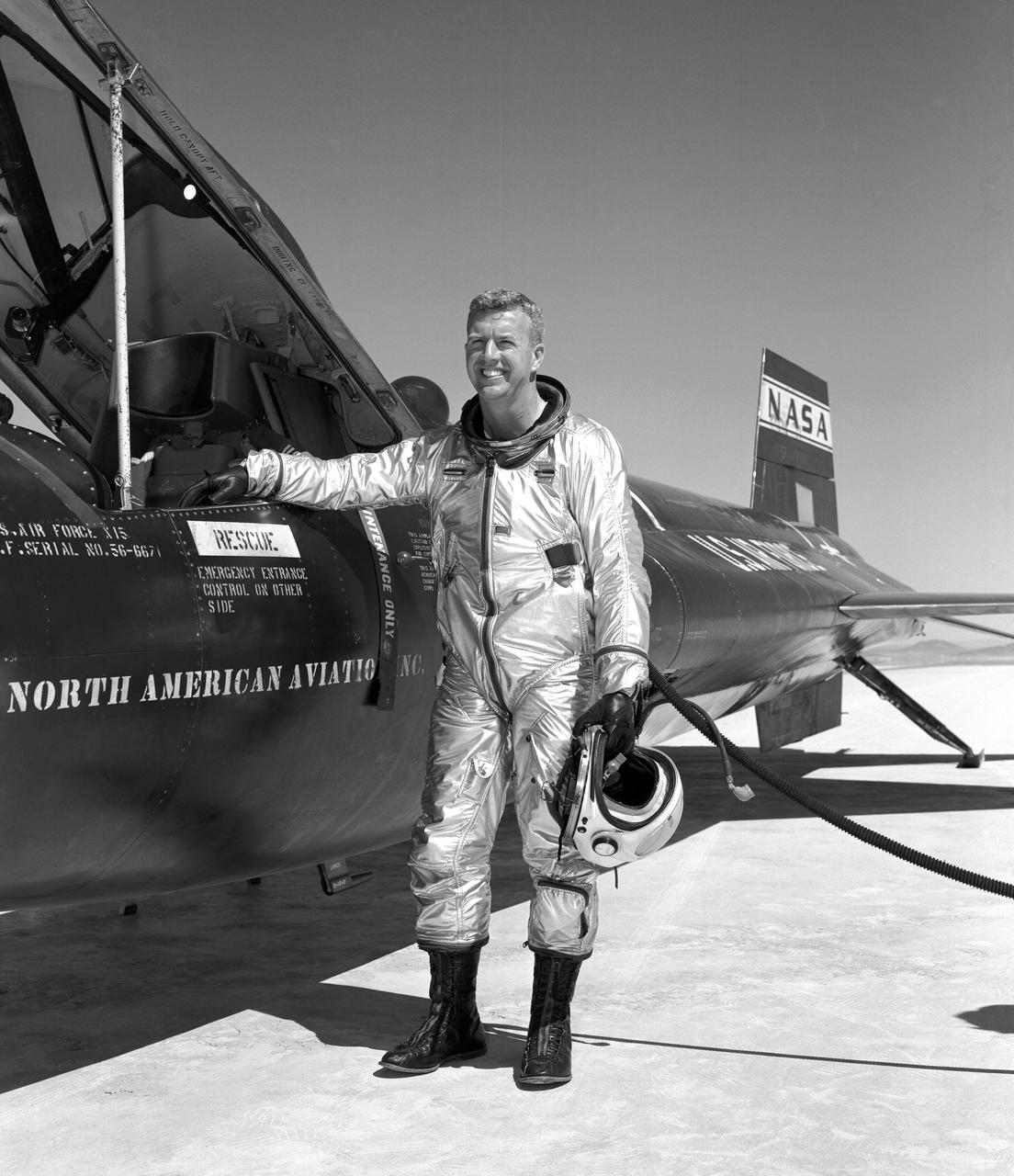
Walker made the first NASA-piloted X-15 flight March 25, 1960, and flew the aircraft 24 times, achieving its highest altitude (354,300 ft.) Aug. 22, 1963. He died piloting a F-104 that was caught up in a vortex of the XB-70.
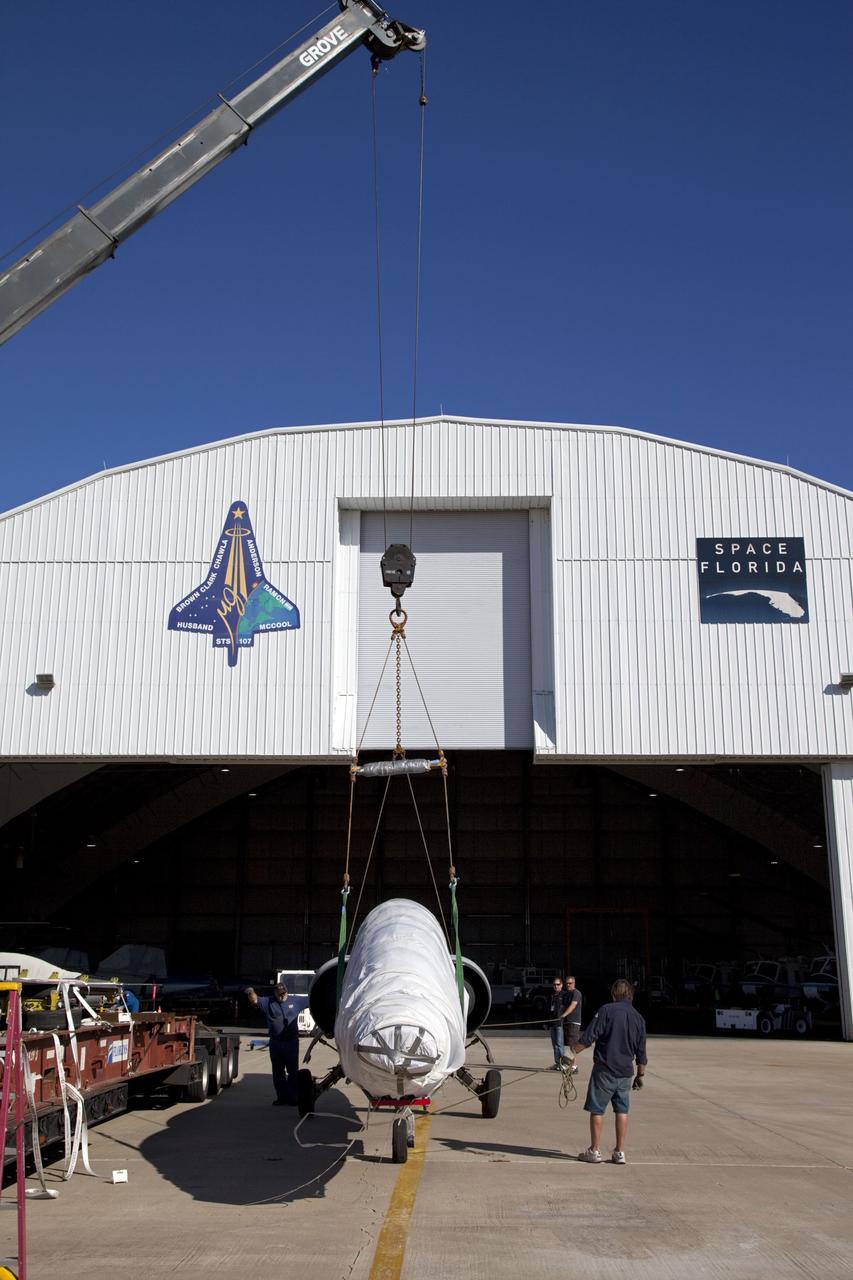
CAPE CANAVERAL, Fla. -- A crane lifts an F-104 Starfighter off the bed of a truck at NASA's Kennedy Space Center in Florida on Jan. 19, 2012. The aircraft is one of five delivered to the company recently. They will be reassembled to fly research and development and other missions. Starfighters operates out of a hangar at the Shuttle Landing Facility at Kennedy under an agreement with Kennedy. Photo credit: NASA/Frankie Martin
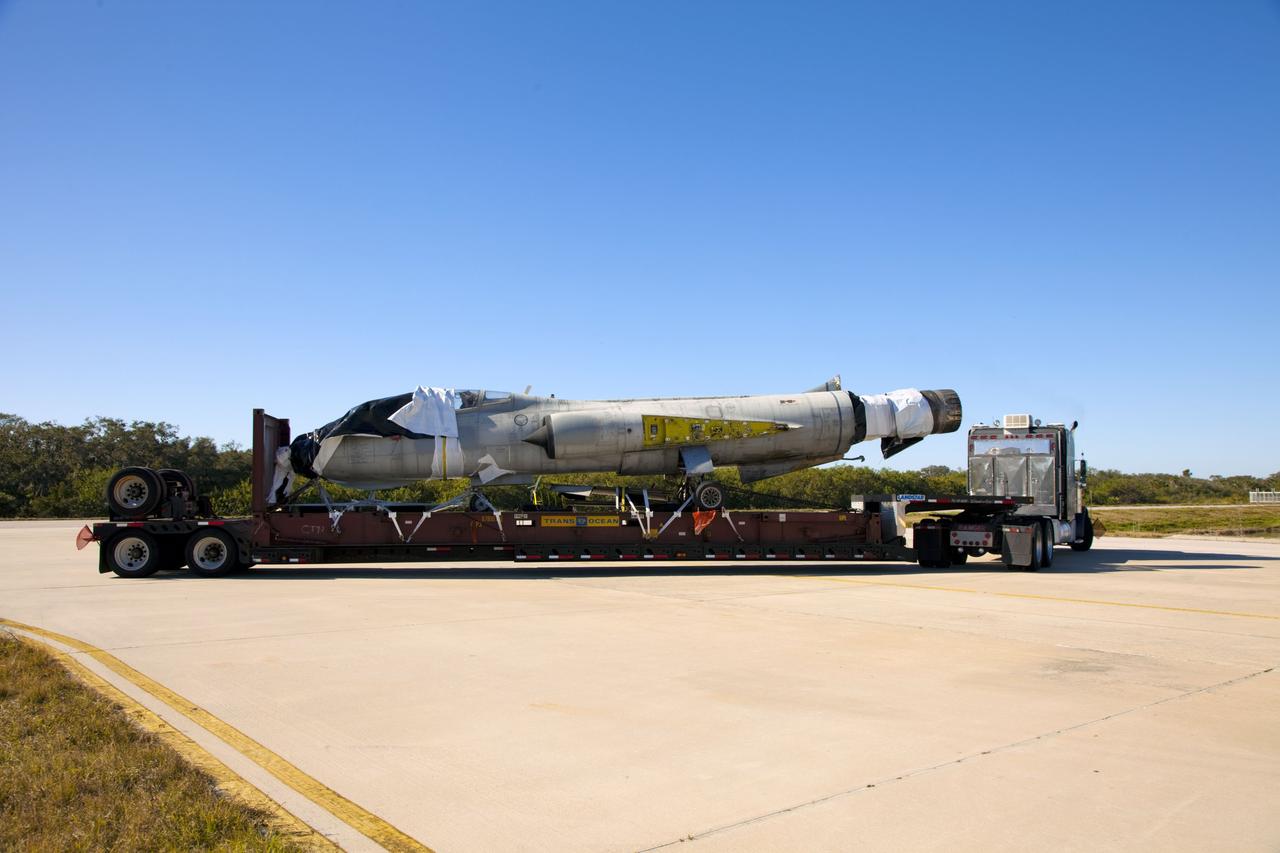
CAPE CANAVERAL, Fla. -- A truck delivers an F-104 Starfighter, formerly of the Italian Air Force, to Starfighters Inc. at NASA's Kennedy Space Center in Florida on Jan. 19, 2012. The aircraft is one of five delivered to the company recently. They will be reassembled to fly research and development and other missions. Starfighters operates out of a hangar at the Shuttle Landing Facility at Kennedy under an agreement with Kennedy. Photo credit: NASA/Frankie Martin
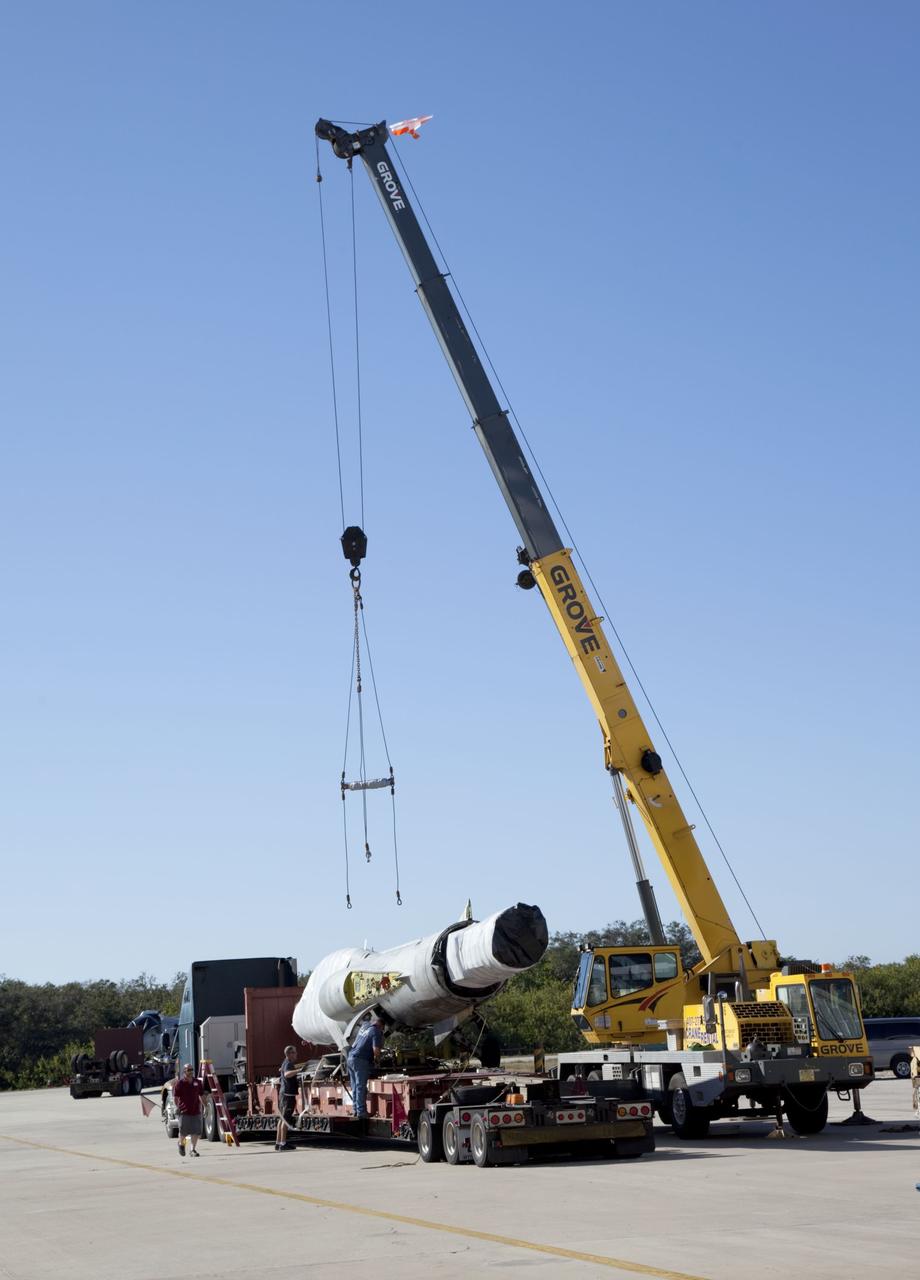
CAPE CANAVERAL, Fla. -- A crane lifts an F-104 Starfighter off the bed of a truck at NASA's Kennedy Space Center in Florida on Jan. 19, 2012. The aircraft is one of five delivered to the company recently. They will be reassembled to fly research and development and other missions. Starfighters operates out of a hangar at the Shuttle Landing Facility at Kennedy under an agreement with Kennedy. Photo credit: NASA/Frankie Martin
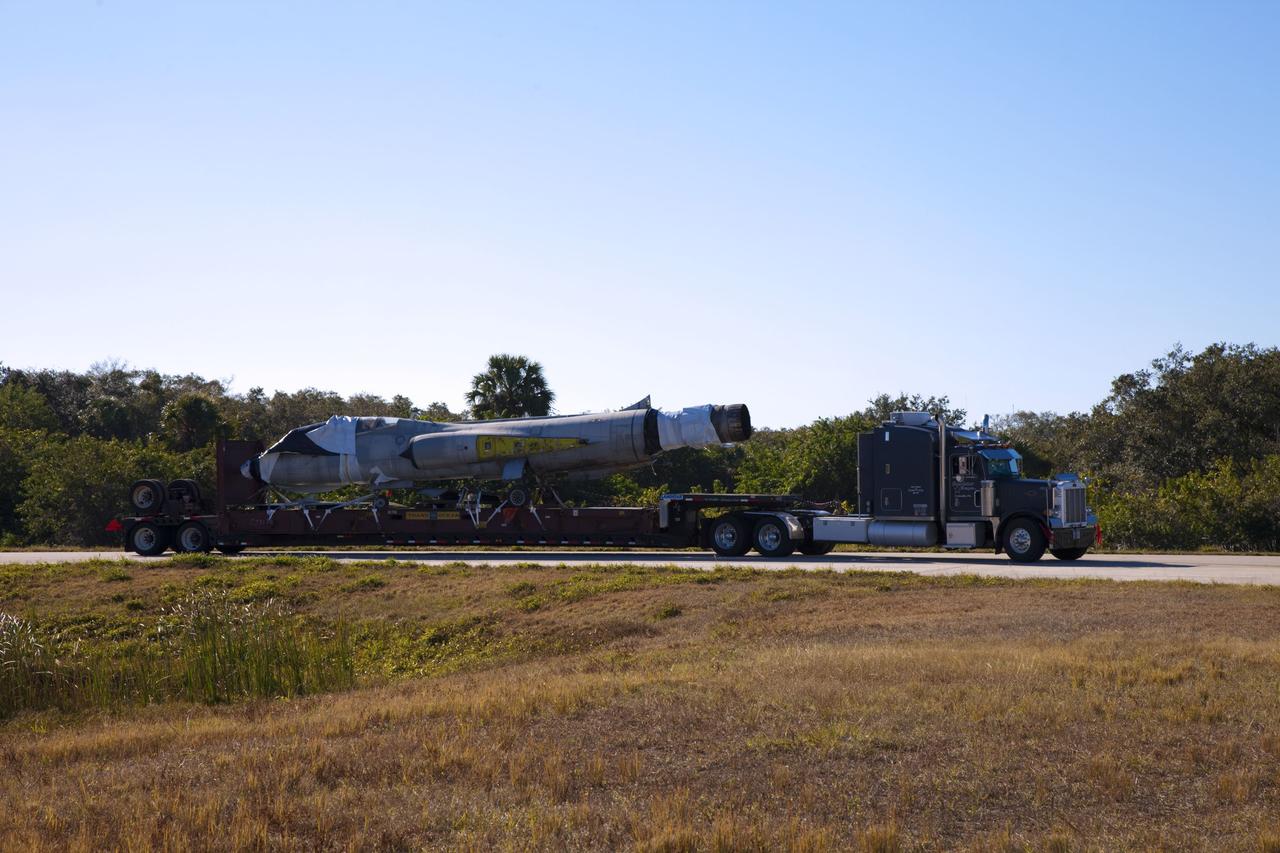
CAPE CANAVERAL, Fla. -- A truck delivers an F-104 Starfighter, formerly of the Italian Air Force, to Starfighters Inc. at NASA's Kennedy Space Center in Florida on Jan. 19, 2012. The aircraft is one of five delivered to the company recently. They will be reassembled to fly research and development and other missions. Starfighters operates out of a hangar at the Shuttle Landing Facility at Kennedy under an agreement with Kennedy. Photo credit: NASA/Frankie Martin
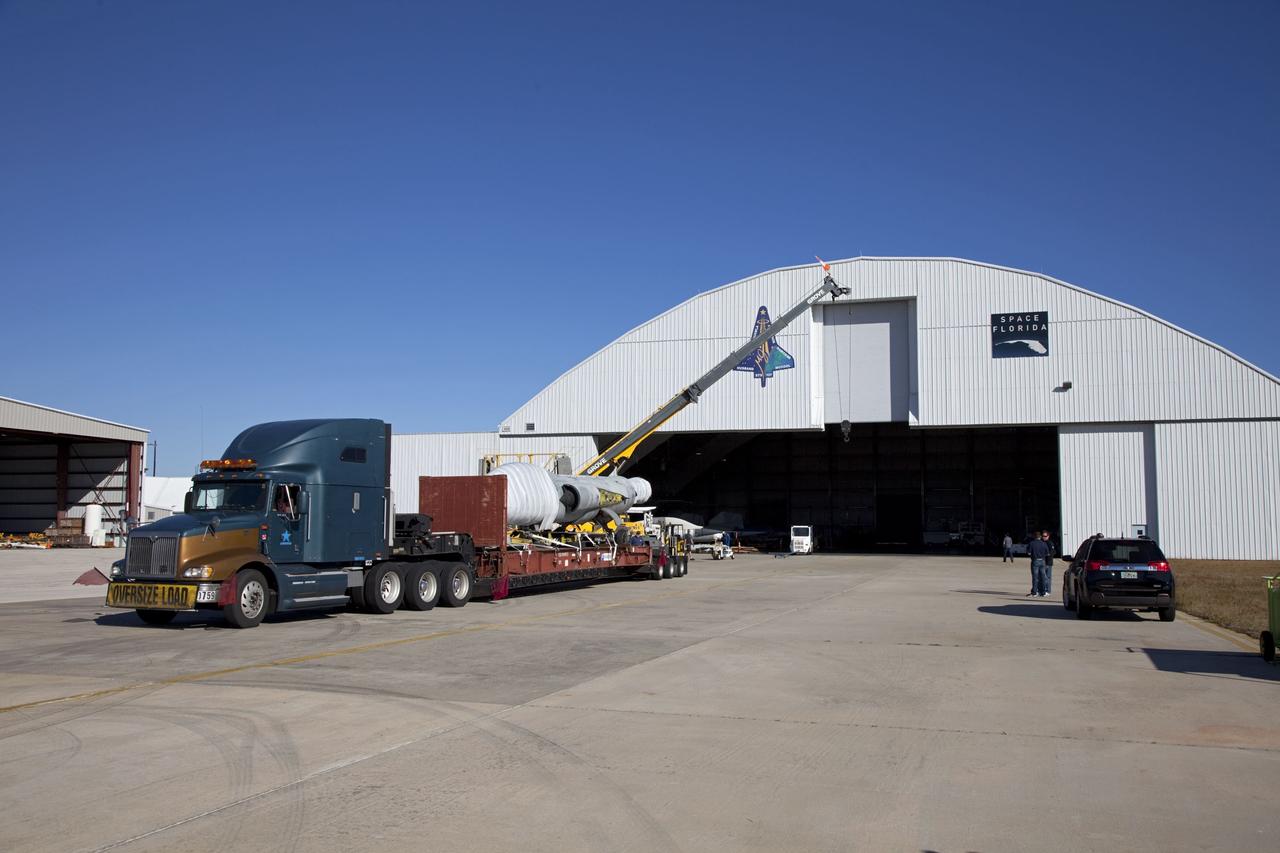
CAPE CANAVERAL, Fla. -- A truck delivers an F-104 Starfighter, formerly of the Italian Air Force, to Starfighters Inc. at NASA's Kennedy Space Center in Florida on Jan. 19, 2012. The aircraft is one of five delivered to the company recently. They will be reassembled to fly research and development and other missions. Starfighters operates out of a hangar at the Shuttle Landing Facility at Kennedy under an agreement with Kennedy. Photo credit: NASA/Frankie Martin
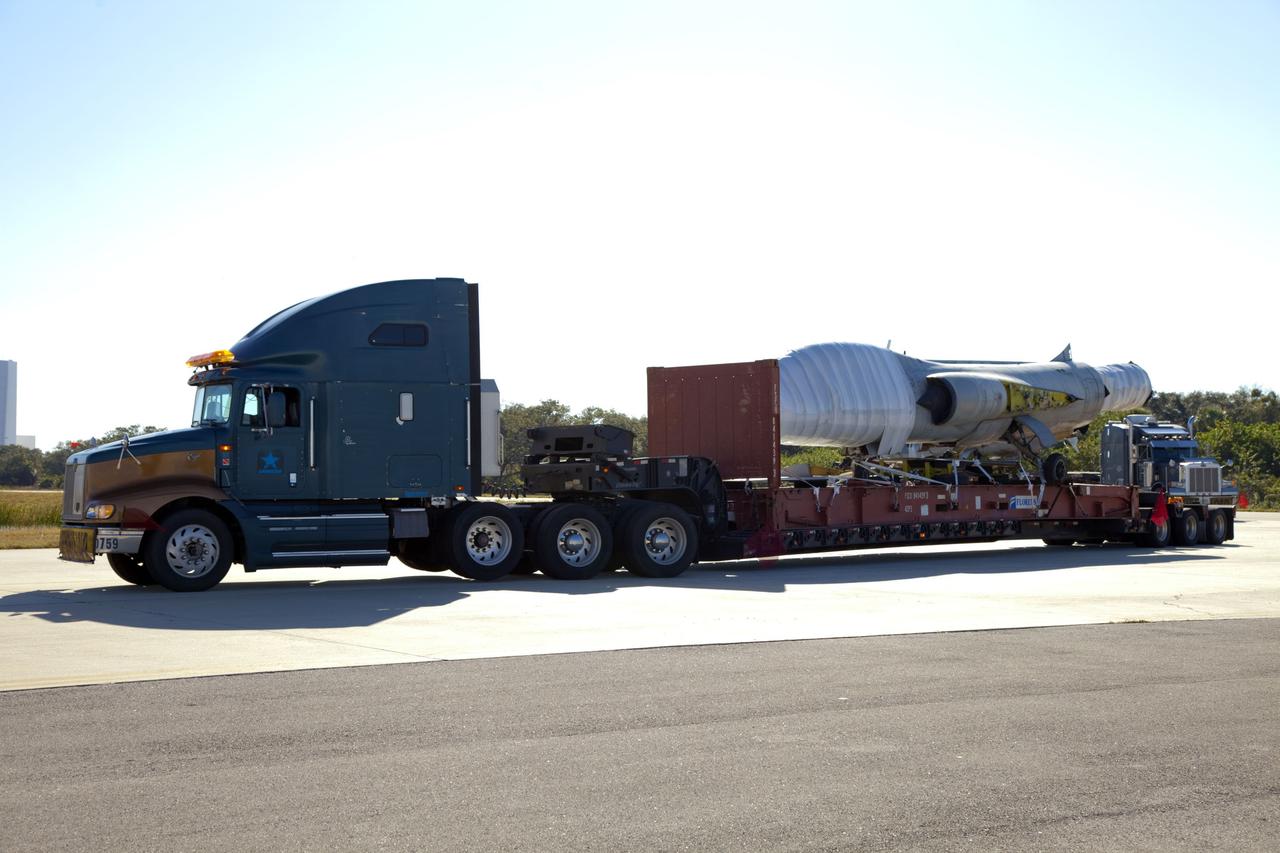
CAPE CANAVERAL, Fla. -- A truck delivers an F-104 Starfighter, formerly of the Italian Air Force, to Starfighters Inc. at NASA's Kennedy Space Center in Florida on Jan. 19, 2012. The aircraft is one of five delivered to the company recently. They will be reassembled to fly research and development and other missions. Starfighters operates out of a hangar at the Shuttle Landing Facility at Kennedy under an agreement with Kennedy. Photo credit: NASA/Frankie Martin
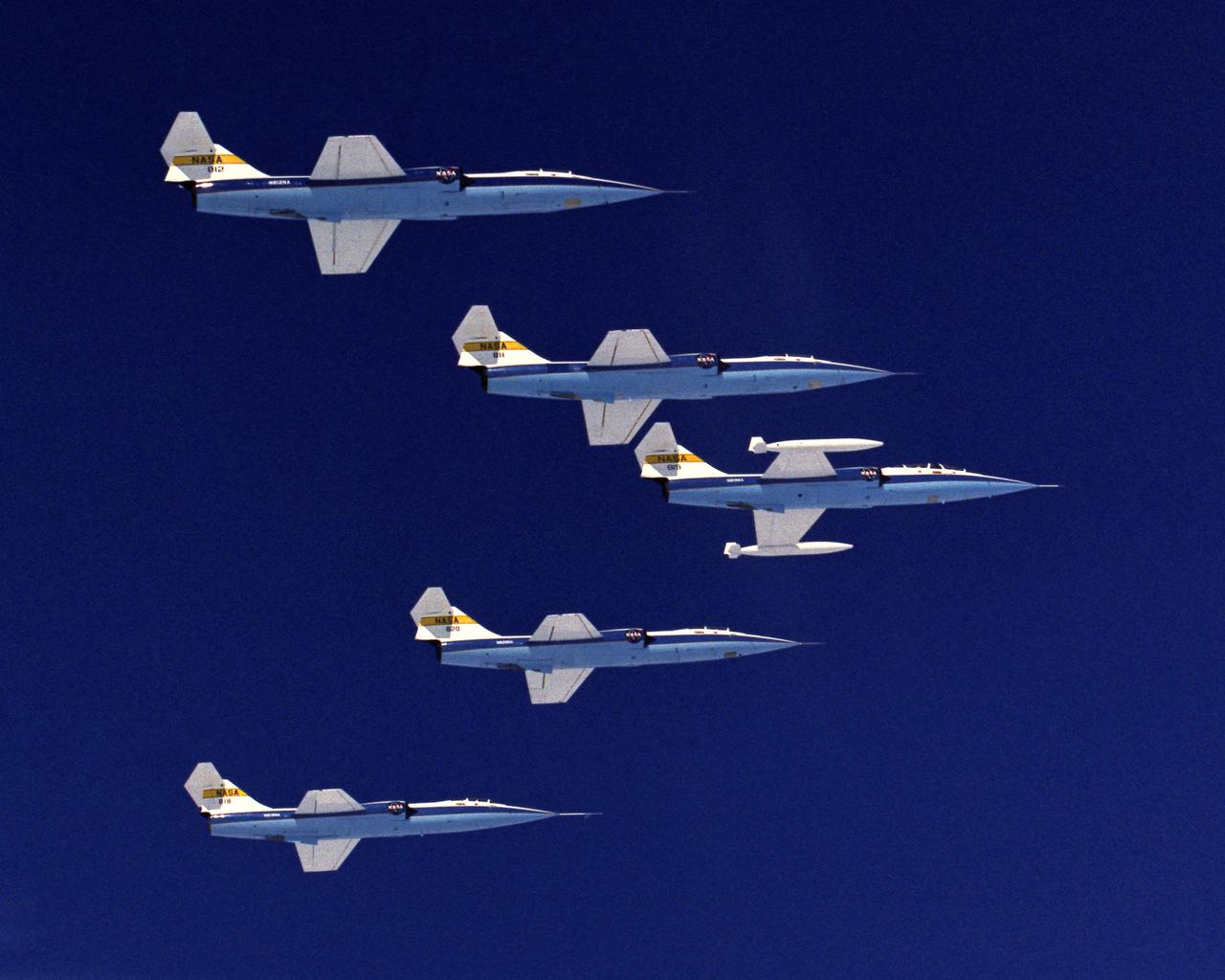
The only time the five ship fleet of F-104 Starfighters was ever airborne at the same time. Pilots were: F-104N #811-Bill Dana; F-104N #812-Tom McMurtry; F-104A #818-Einar Enevoldson; F-104A #820-Gary Krier; F-104B #819-Fitz Fulton and Ray Young. Photo taken from T-38 #821 flown by Don Mallick and photographer was Bob Rhine. 4/11/75 NASA DFRC EC76-5145
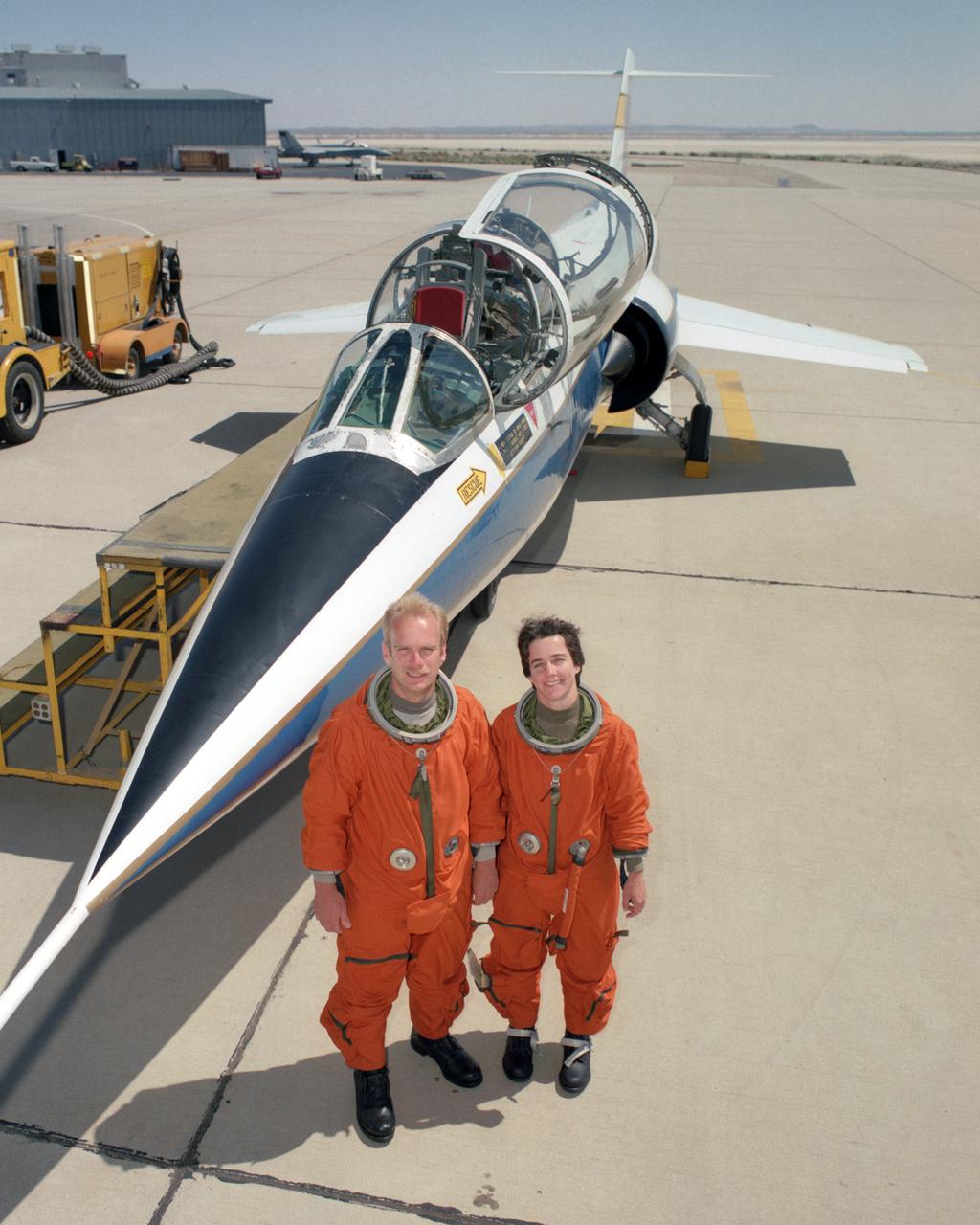
Flight test engineers Bob Meyer and Marta Bohn-Meyer had the distinction of being the only married couple to both serve on flight status on this two-seat F-104 at NASA Dryden.
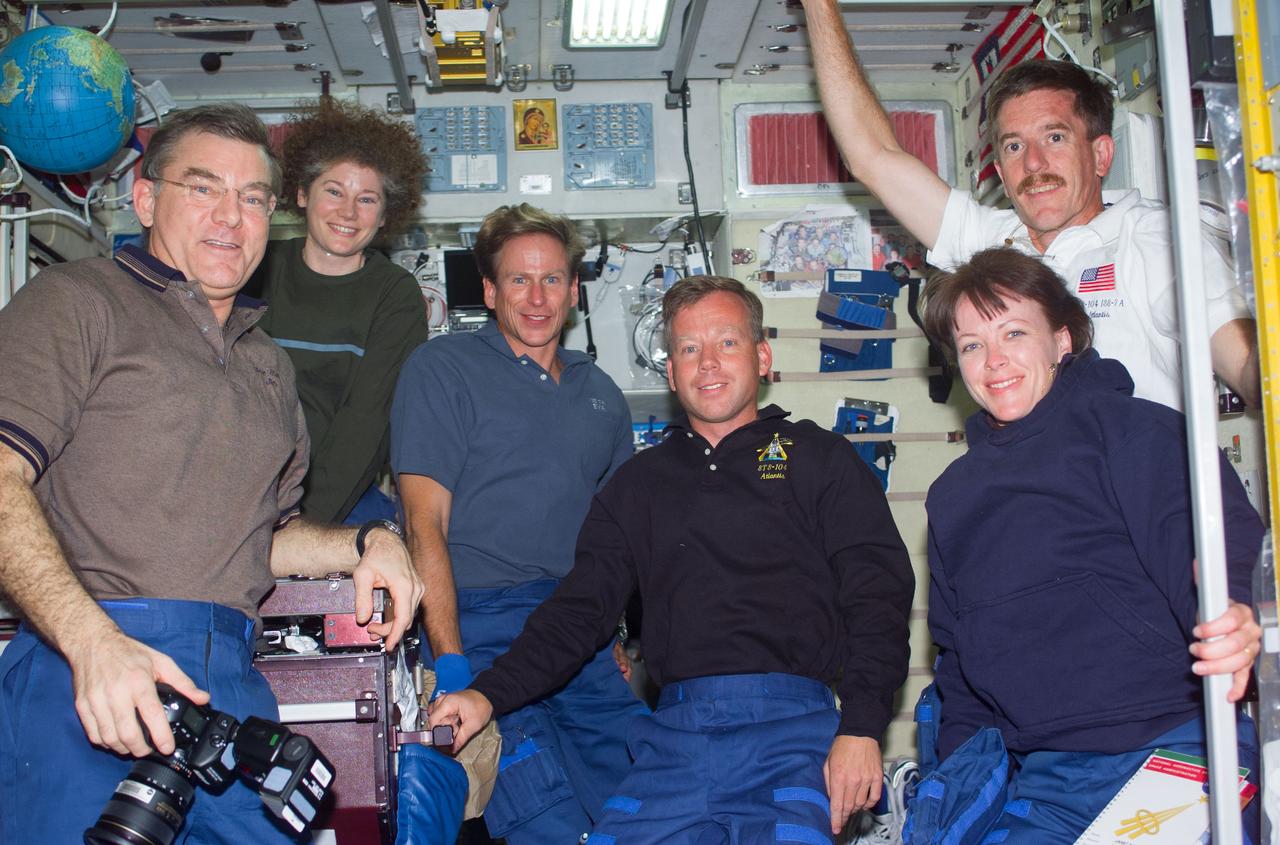
S104-E-5053 (14 July 2001) --- Soon after their ingress into the International Space Station (ISS), STS-104 crewmembers pose for a photograph with Expedition Two crewmembers in the Zvezda Service Module. From left to right are: James S. Voss, Expedition Two flight engineer; Susan J. Helms, Expedition Two flight engineer; Michael L. Gernhardt, STS-104 mission specialist; Steven W. Lindsey, STS-104 mission commander; Janet L. Kavandi, STS-104 mission specialist; and James F. Reilly, STS-104 mission specialist.
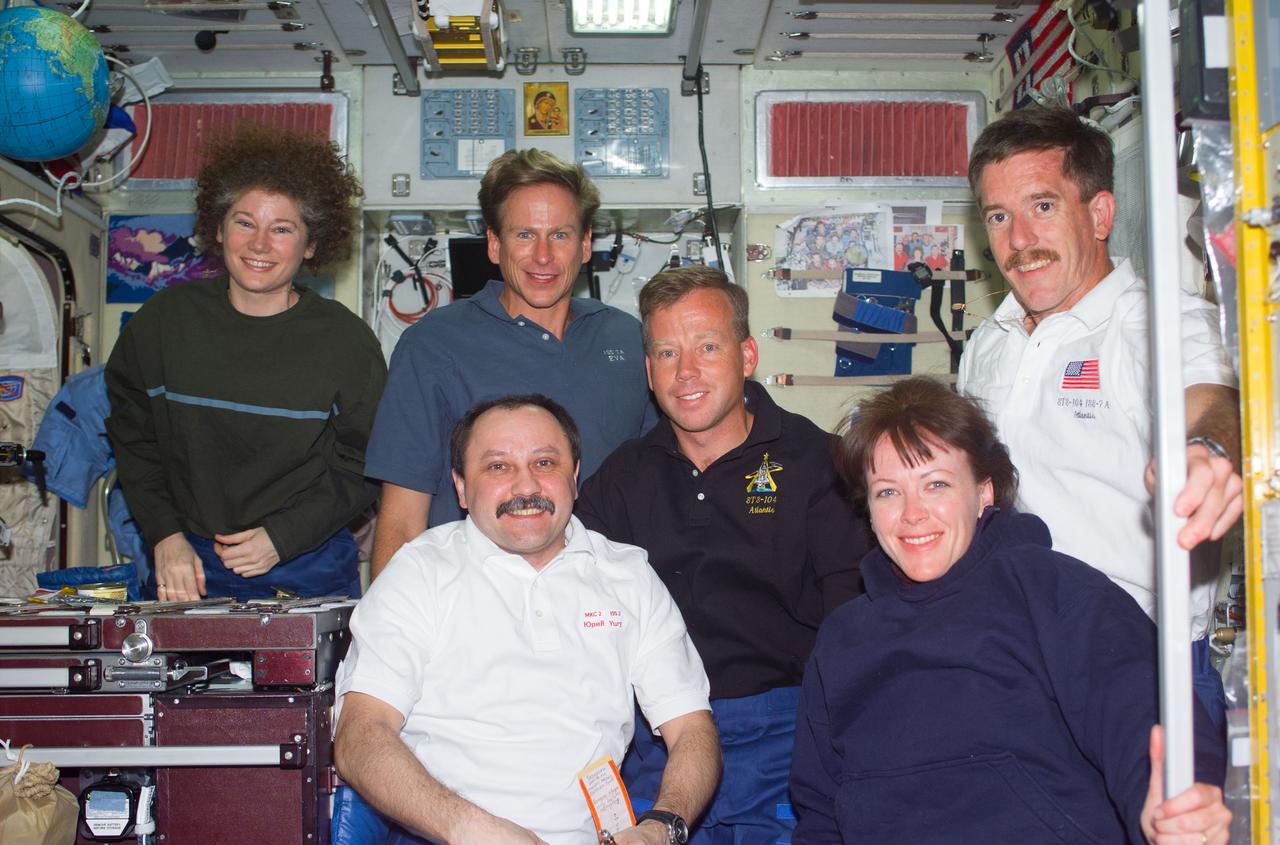
S104-E-5055 (14 July 2001) --- Soon after their ingress into the International Space Station (ISS), STS-104 crewmembers pose for a photograph with Expedition Two crewmembers in the Zvezda Service Module. From left to right are: back row - Susan J. Helms, Expedition Two flight engineer; Michael L. Gernhardt, STS-104 mission specialist; Steven W. Lindsey, STS-104 mission commander; James F. Reilly, STS-104 mission specialist; front row - Yury V. Usachev, Expedition Two mission commander; and Janet L. Kavandi, STS-104 mission specialist. Usachev represents Rosaviakosmos.
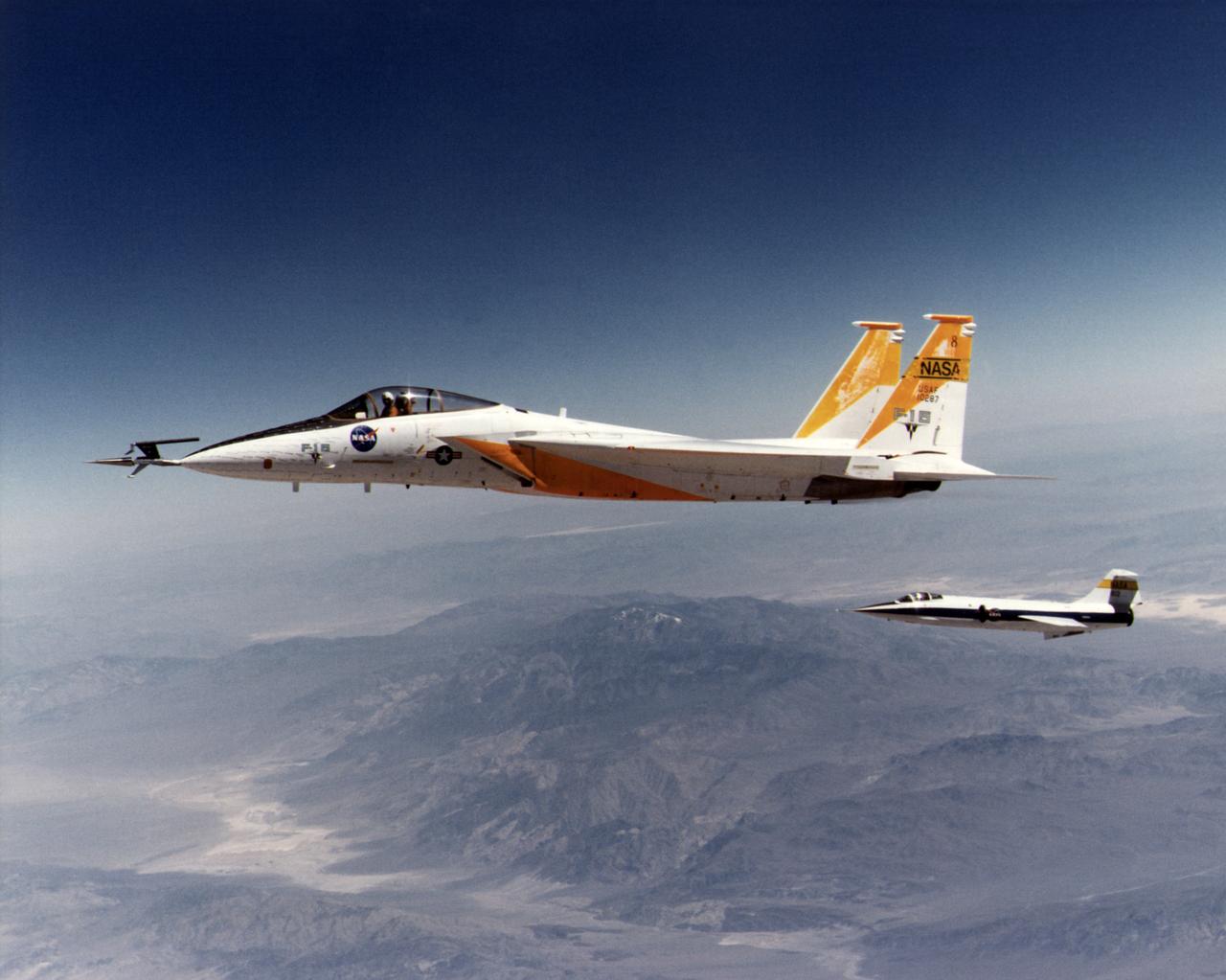
An in-flight photo of the NASA F-15A used to carry a 10 degree cone to collect aerodynamic data to calibrate the data from wind tunnels. The flight was made on May 17, 1978. Acting as chase for the flight was a NASA F-104 aircraft.
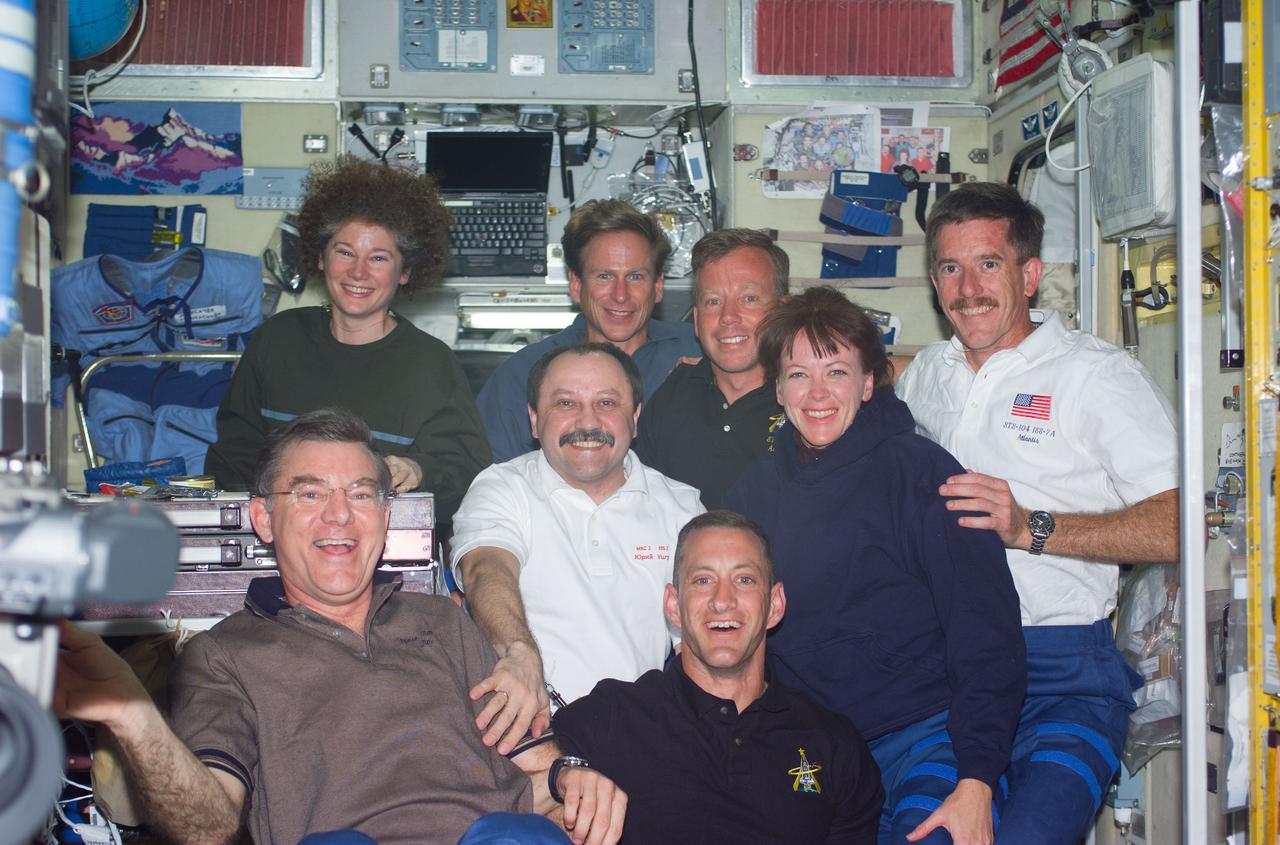
S104-E-5057 (14 July 2001) --- Soon after their ingress into the International Space Station (ISS), the STS-104 crewmembers pose for a photograph with the Expedition Two crewmembers in the Zvezda Service Module. From left to right are: back row - Susan J. Helms, Expedition Two flight engineer; Michael L. Gernhardt, STS-104 mission specialist; Steven W. Lindsey, STS-104; James F. Reilly, STS-104 mission specialist; middle row - Yury V. Usachev, Expedition Two mission commander; Janet L. Kavandi, STS-104 mission specialist; front row - James S. Voss, Expedition Two flight engineer; and Charles O. Hobaugh, STS-104 pilot. Usachev represents Rosaviakosmos.
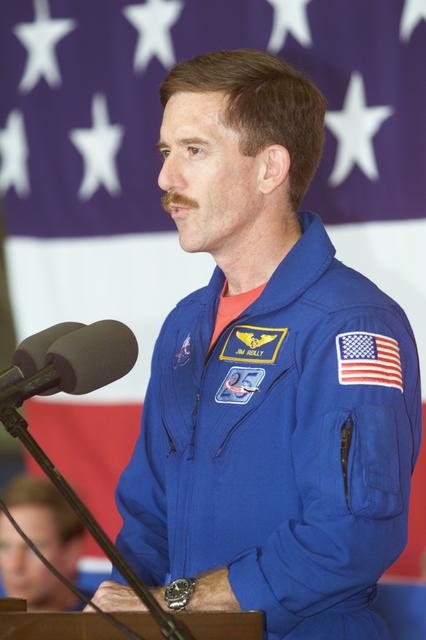
JSC2001-E-22798 (25 July 2001) --- Astronaut James F. Reilly, STS-104 mission specialist, addresses a crowd at Ellington Field’s Hangar 990 for a crew return ceremony.
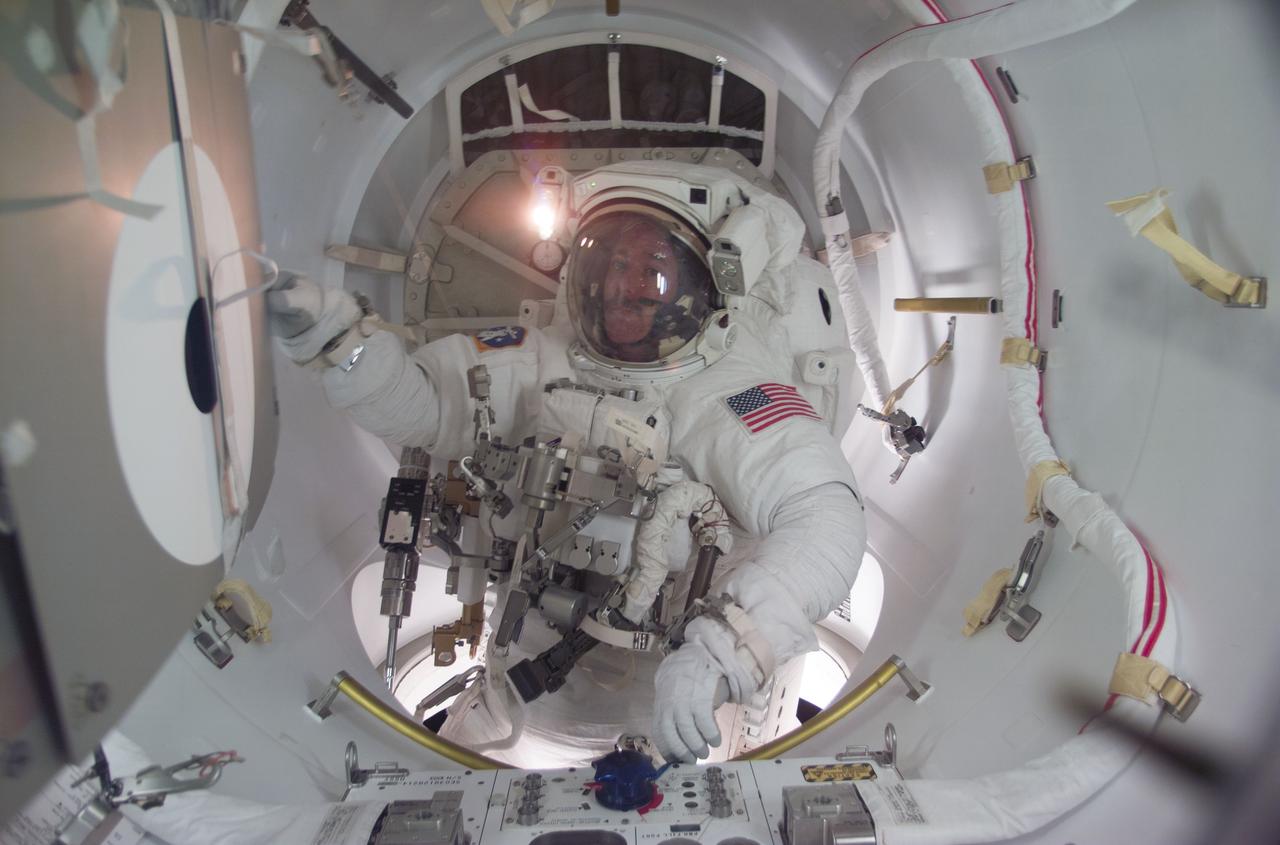
STS104-E-5232 (21 July 2001) --- A crew member used a digital still camera to take a picture of astronaut James F. Reilly in the airlock at the completion of the final STS-104 extravehicular activity (EVA).
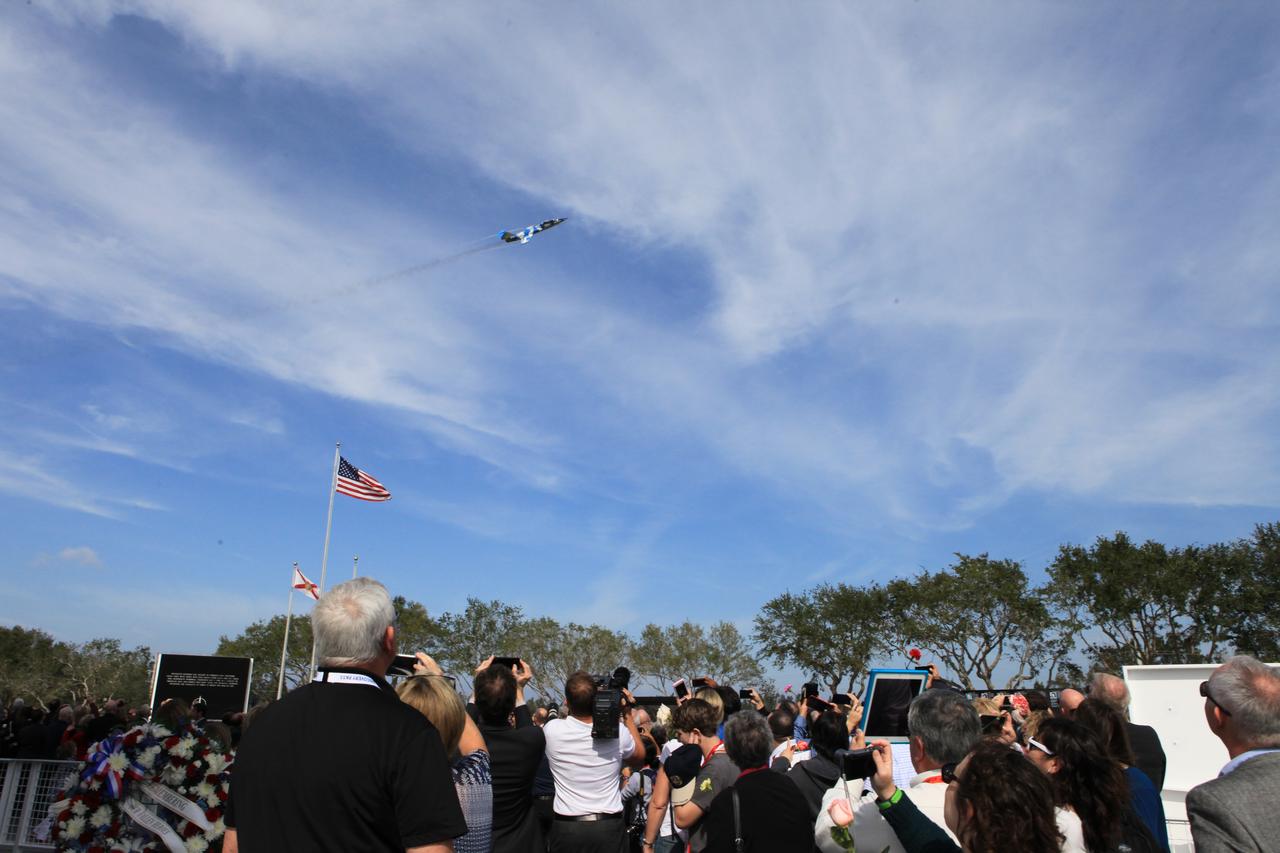
An F-104 Starfighter flies above a gathering of NASA officials, family members and other invited guests following Kennedy Space Center's Day of Remembrance ceremony at the Kennedy Space Center Visitor Complex.
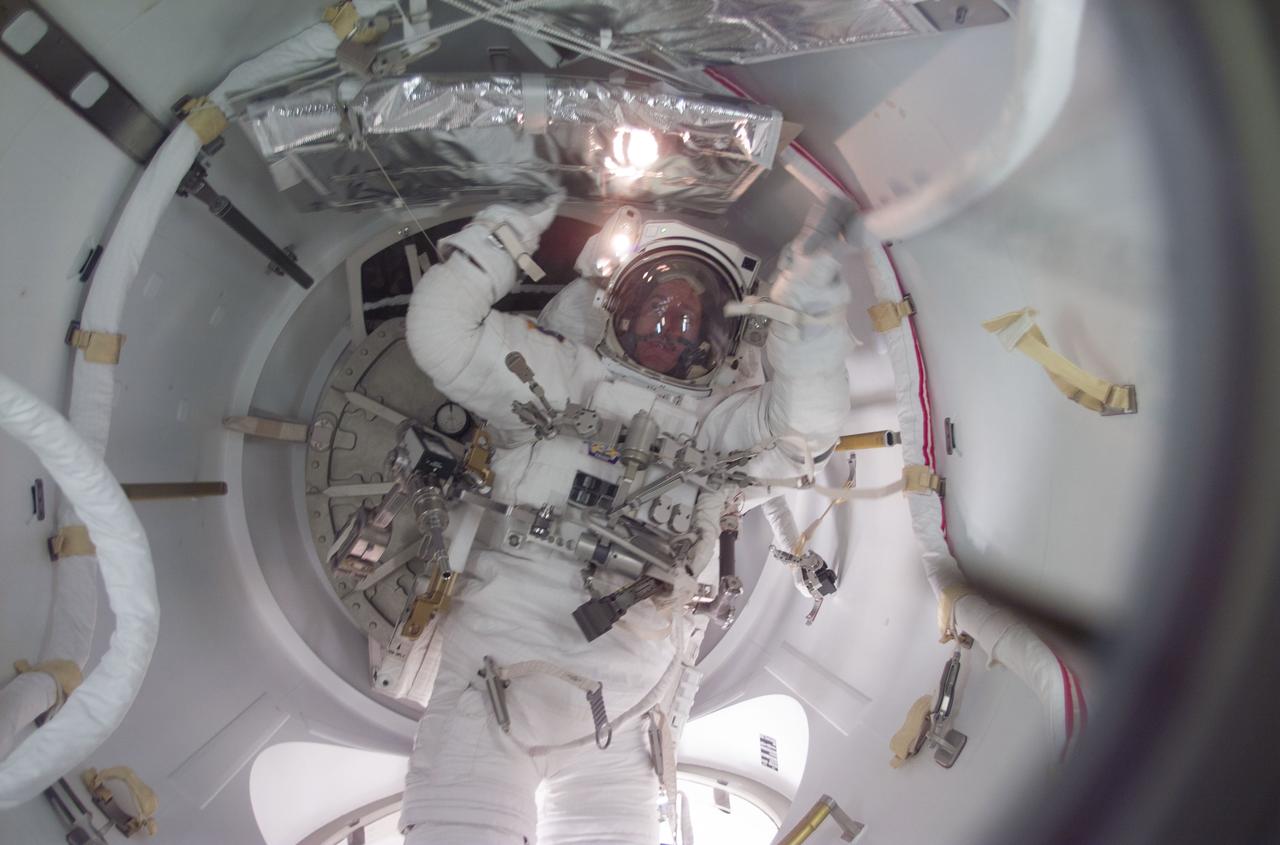
STS104-E-5234 (21 July 2001) --- A crew member used a digital still camera to take a picture of astronaut James F. Reilly in the airlock at the completion of the final STS-104 extravehicular activity (EVA).
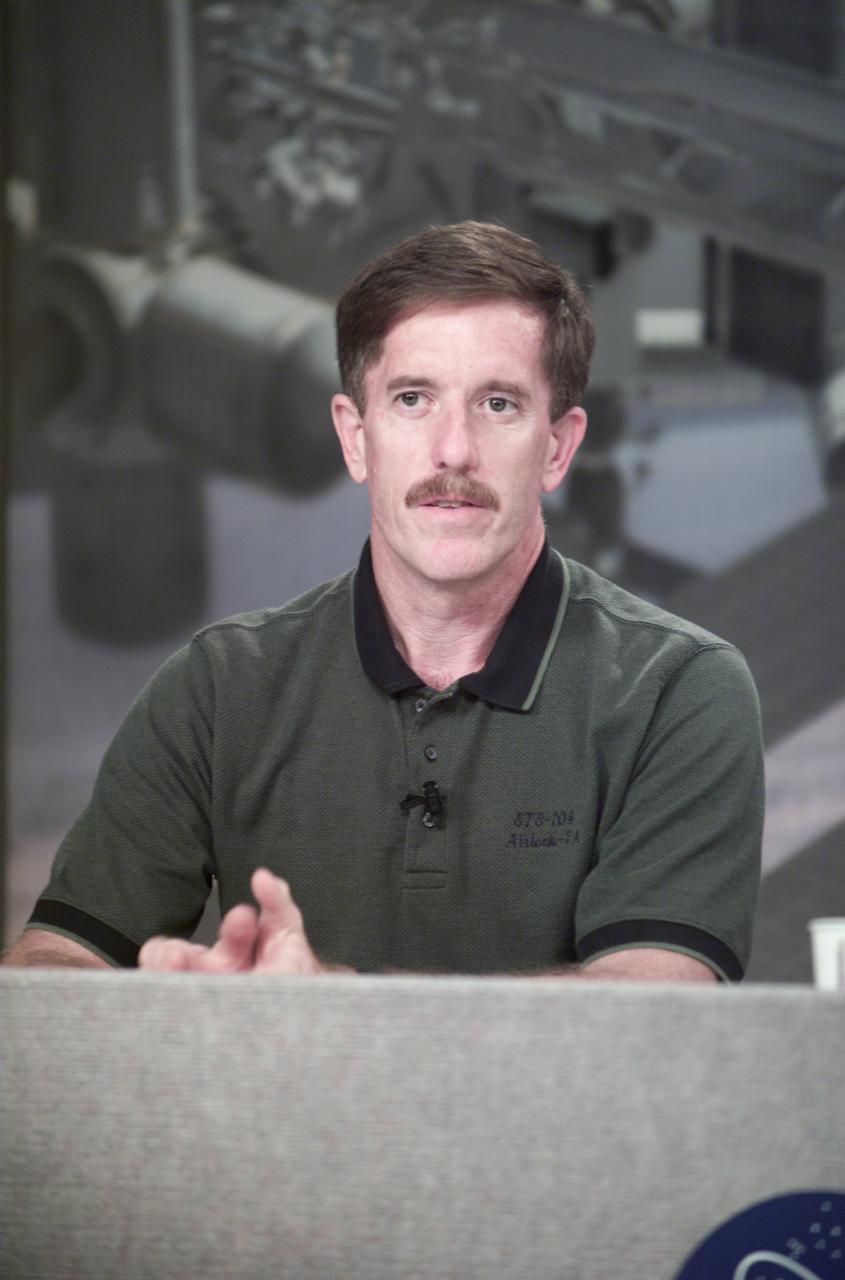
JSC2001-E-19302 (25 June 2001) --- Astronaut James F. Reilly, STS-104 mission specialist, ponders a question during a pre-flight press conference at Johnson Space Center (JSC).

In-flight photo of the NASA F-15B used in tests of the X-33 Thermal Protection System (TPS) materials. Flying at subsonic speeds, the F-15B tests measured the air loads on the proposed X-33 protective materials. In contrast, shock loads testing investigated the local impact of the supersonic shock wave itself on the TPS materials. Similar tests had been done in 1985 for the space shuttle tiles, using an F-104 aircraft.
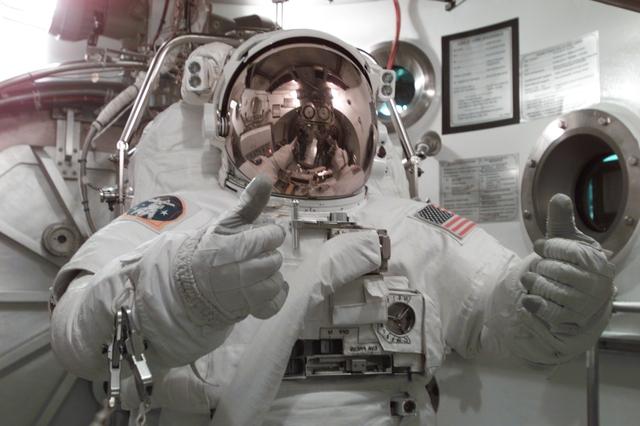
JSC2001-E-11702 (9 April 2001) --- Astronaut James F. Reilly, STS-104 mission specialist, participates in an Extravehicular Mobility Unit (EMU) fit check in one of the chambers in the Crew Systems Laboratory at the Johnson Space Center (JSC). The STS-104 mission to the International Space Station (ISS) represents the Space Shuttle Atlantis' first flight using a new engine and is targeted for a liftoff no earlier than June 14, 2001.
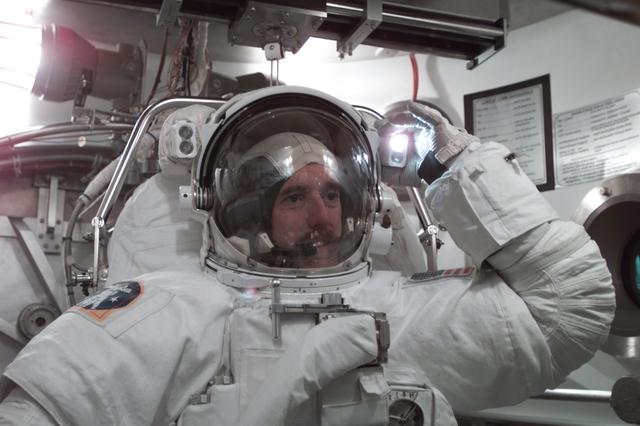
JSC2001-E-11698 (9 April 2001) --- Astronaut James F. Reilly, STS-104 mission specialist, participates in an Extravehicular Mobility Unit (EMU) fit check in one of the chambers in the Crew Systems Laboratory at the Johnson Space Center (JSC). The STS-104 mission to the International Space Station (ISS) represents the Space Shuttle Atlantis' first flight using a new engine and is targeted for a liftoff no earlier than June 14, 2001.
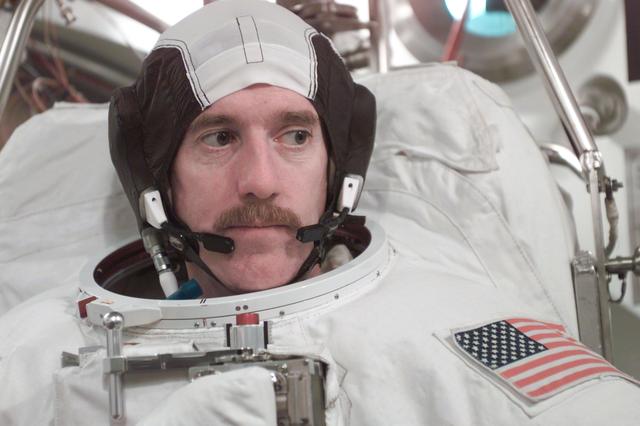
JSC2001-E-11691 (9 April 2001) --- Astronaut James F. Reilly, STS-104 mission specialist, prepares to don his helmet for an Extravehicular Mobility Unit (EMU) fit check in one of the chambers in the Crew Systems Laboratory at the Johnson Space Center (JSC). The STS-104 mission to the International Space Station (ISS) represents the Space Shuttle Atlantis' first flight using a new engine and is targeted for a liftoff no earlier than June 14, 2001.
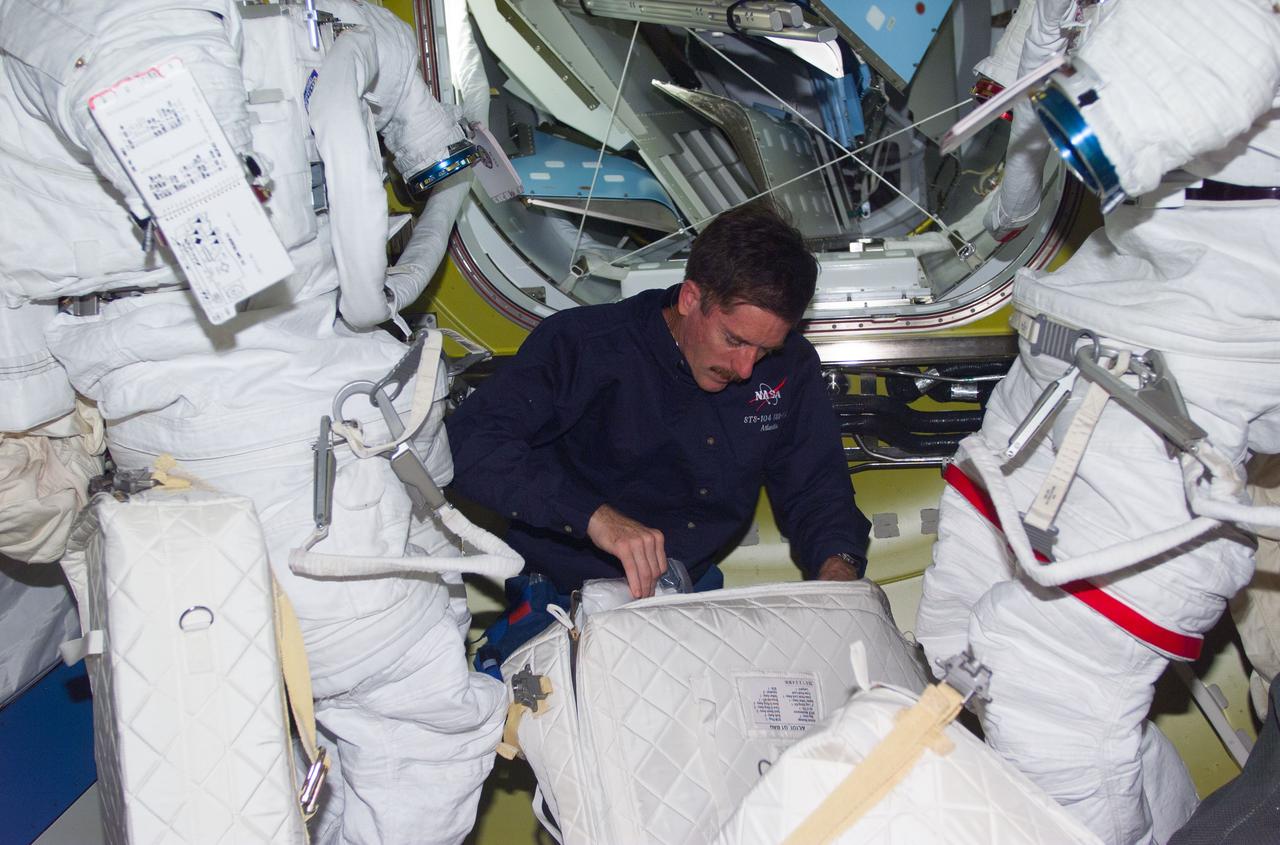
STS104-E-5166 (19 July 2001) --- Astronaut James F. Reilly, STS-104 mission specialist, looks over some supplies in the Quest Airlock aboard the International Space Station (ISS). Reilly is one of two assigned space walkers on the STS-104 mission. The third and final scheduled extravehicular activity (EVA) is to utilize the new airlock, marking its first ever usage. The image was recorded with a digital still camera.
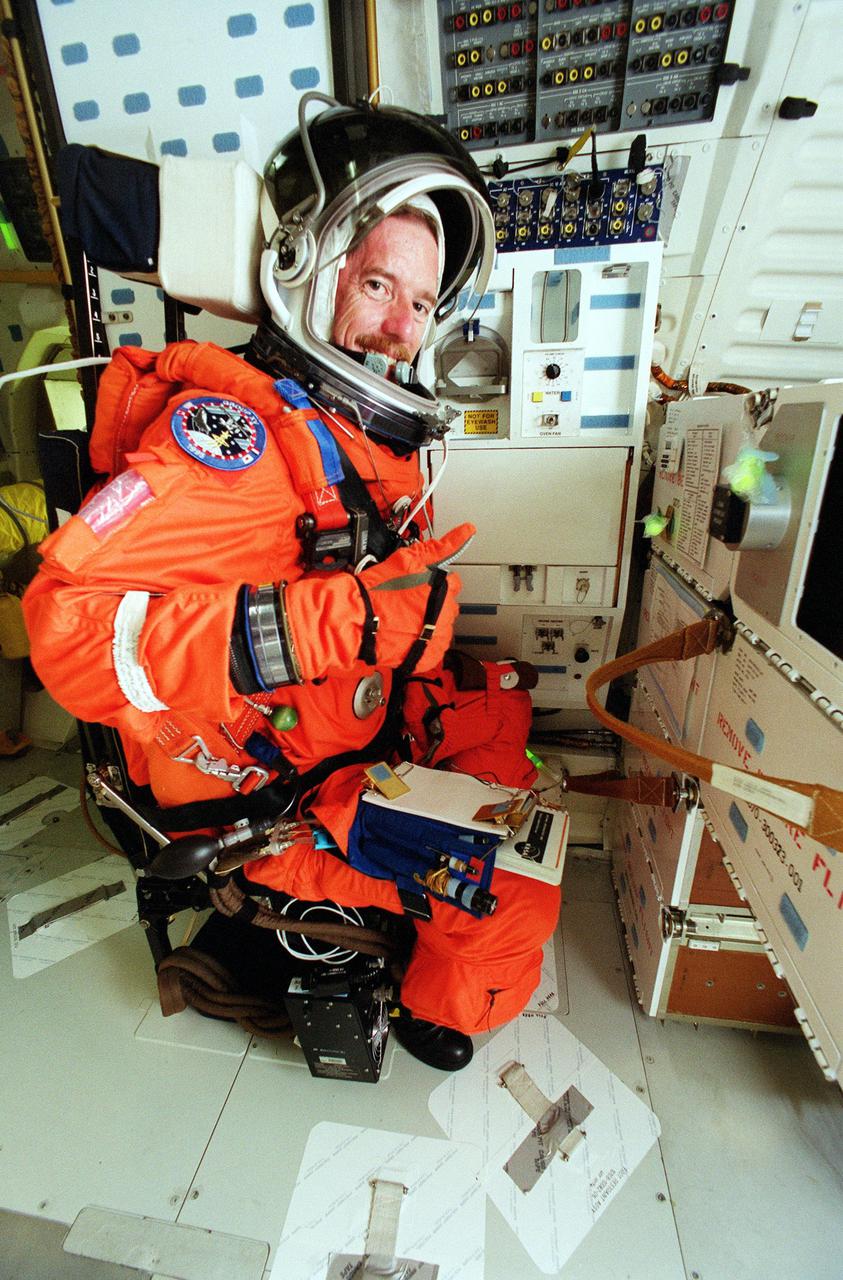
KENNEDY SPACE CENTER, Fla. -- STS-104 Mission Specialist James F. Reilly checks out equipment inside Atlantis. He and other crew members are taking part in a simulated countdown exercise, which is part of Terminal Countdown Demonstration Test activities. The launch of Atlantis on mission STS-104 is scheduled July 12. The mission is the 10th flight to the International Space Station and carries the Joint Airlock Module and High Pressure Gas Assembly
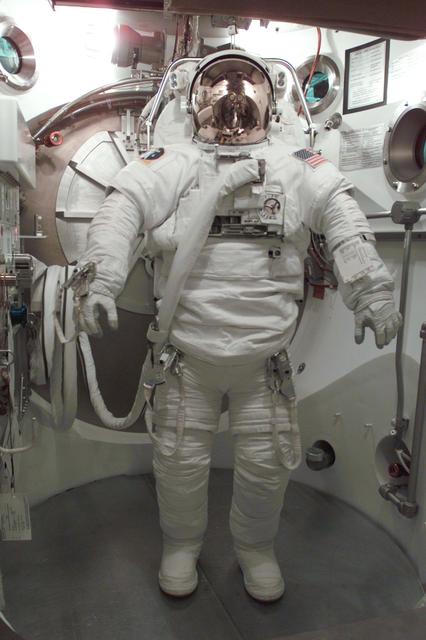
JSC2001-E-11703 (9 April 2001) --- Astronaut James F. Reilly, STS-104 mission specialist, participates in an Extravehicular Mobility Unit (EMU) fit check in one of the chambers in the Crew Systems Laboratory at the Johnson Space Center (JSC). The STS-104 mission to the International Space Station (ISS) represents the Space Shuttle Atlantis' first flight using a new engine and is targeted for a liftoff no earlier than June 14, 2001.
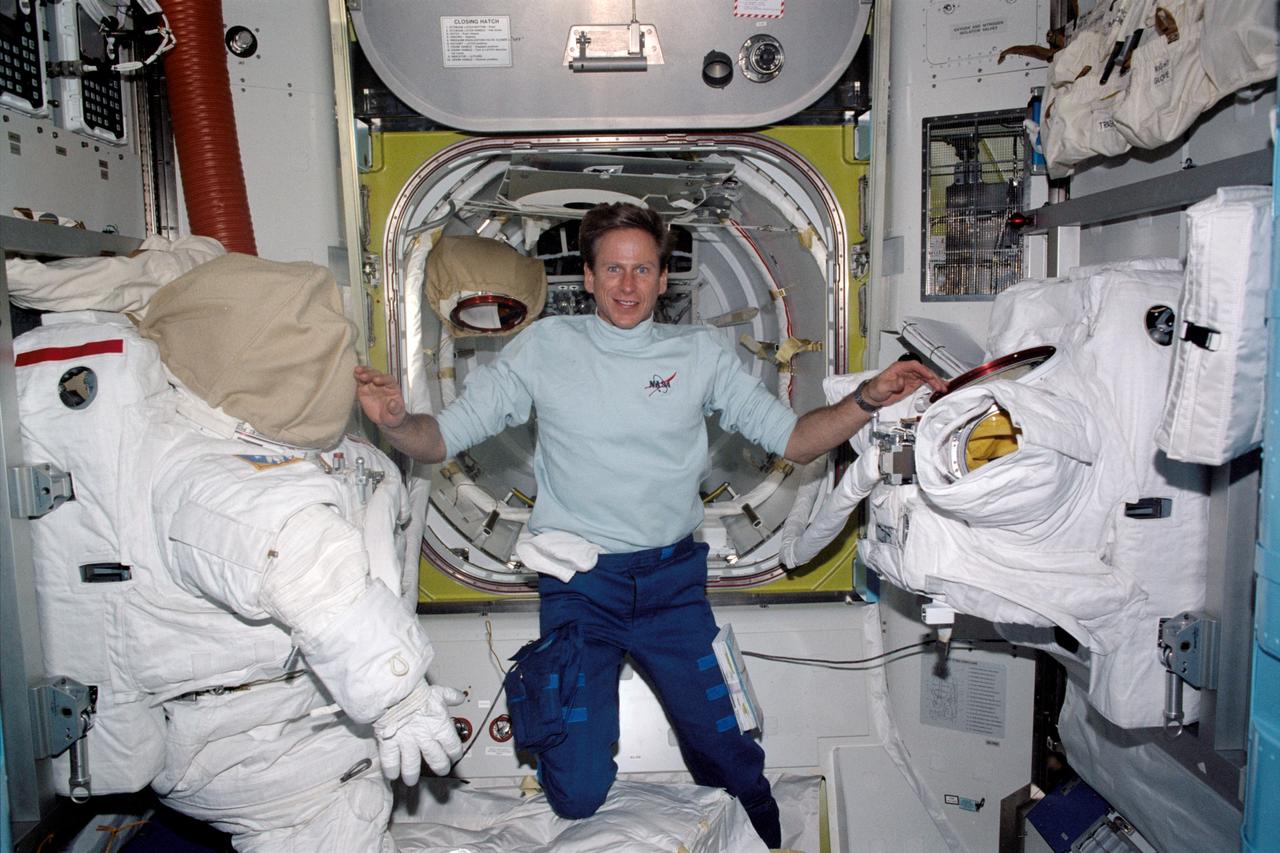
STS104-313-011 (12-24 July 2001) --- Astronaut Michael L. Gernhardt, mission specialist for STS-104, checks out the extravehicular mobility unit (EMU) space suits in the equipment lock of the newly installed Quest airlock on the International Space Station (ISS). Astronauts Gernhardt and James F. Reilly went on to utilize the new airlock to egress the station on the occasion of the third and final space walk of the STS-104 mission.
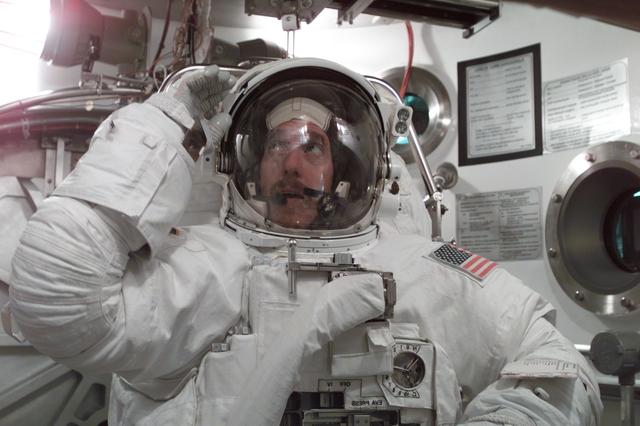
JSC2001-E-11699 (9 April 2001) --- Astronaut James F. Reilly, STS-104 mission specialist, participates in an Extravehicular Mobility Unit (EMU) fit check in one of the chambers in the Crew Systems Laboratory at the Johnson Space Center (JSC). The STS-104 mission to the International Space Station (ISS) represents the Space Shuttle Atlantis' first flight using a new engine and is targeted for a liftoff no earlier than June 14, 2001.
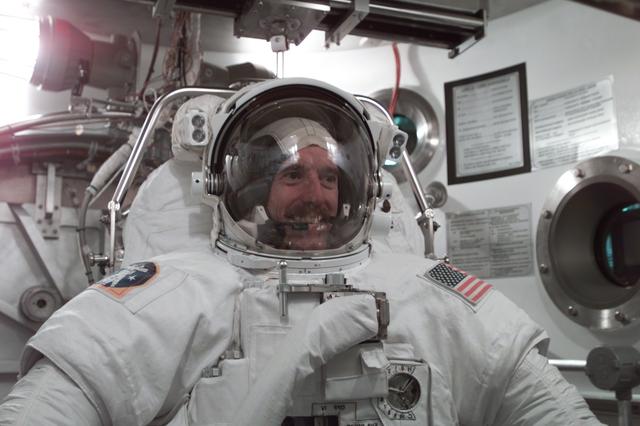
JSC2001-E-11697 (9 April 2001) --- Astronaut James F. Reilly, STS-104 mission specialist, participates in an Extravehicular Mobility Unit (EMU) fit check in one of the chambers in the Crew Systems Laboratory at the Johnson Space Center (JSC). The STS-104 mission to the International Space Station (ISS) represents the Space Shuttle Atlantis' first flight using a new engine and is targeted for a liftoff no earlier than June 14, 2001.
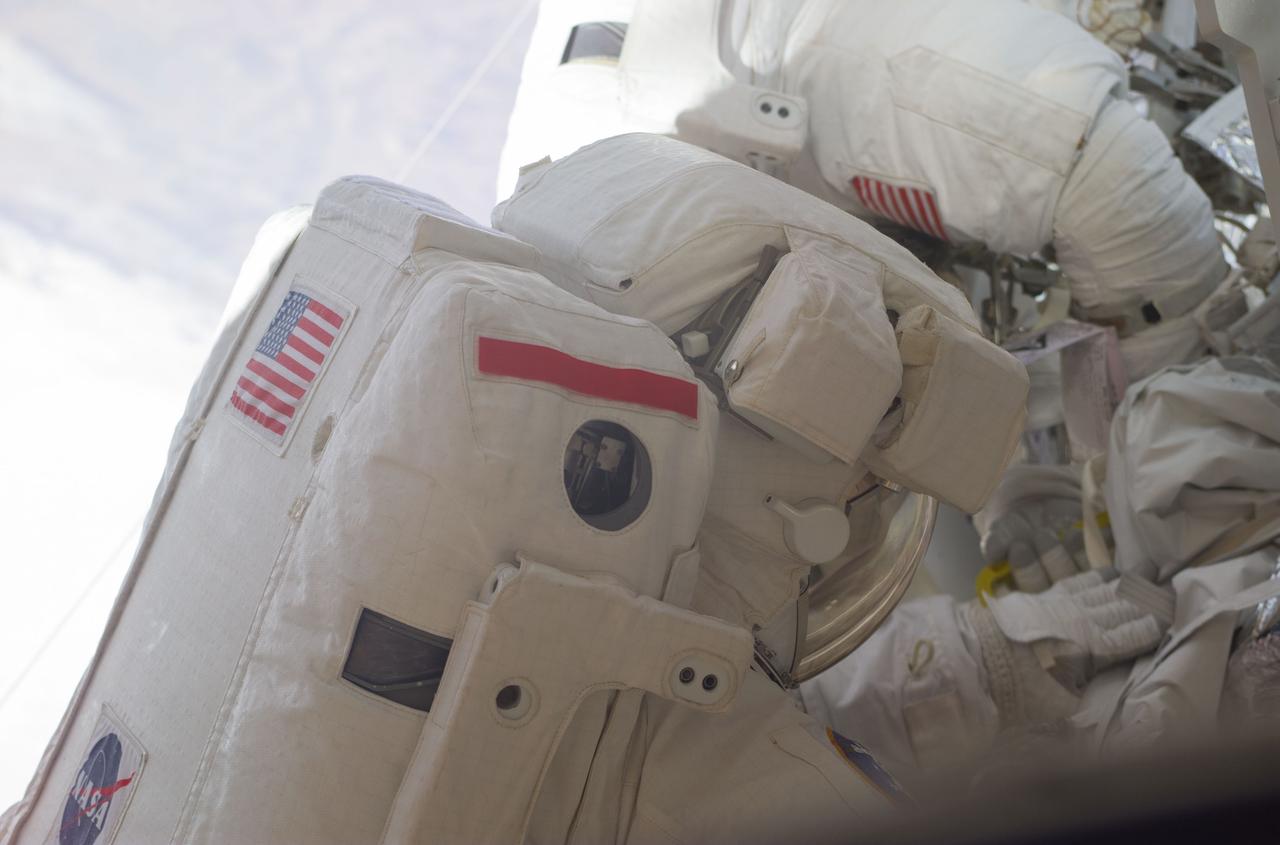
S104-E-5064 (15 July 2001) --- Michael L. Gernhardt (front), mission specialist and EV1, and James F. Reilly, mission specialist and EV2, work in the payload bay of the Space Shuttle Atlantis during the first extravehicular activity (EVA) of the STS-104 mission. This image was taken by a STS-104 crewmember in Atlantis with a digital still camera.
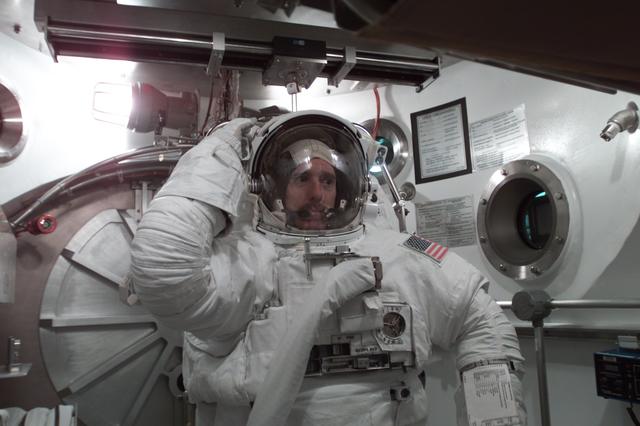
JSC2001-E-11696 (9 April 2001) --- Astronaut James F. Reilly, STS-104 mission specialist, participates in an Extravehicular Mobility Unit (EMU) fit check in one of the chambers in the Crew Systems Laboratory at the Johnson Space Center (JSC). The STS-104 mission to the International Space Station (ISS) represents the Space Shuttle Atlantis' first flight using a new engine and is targeted for a liftoff no earlier than June 14, 2001.
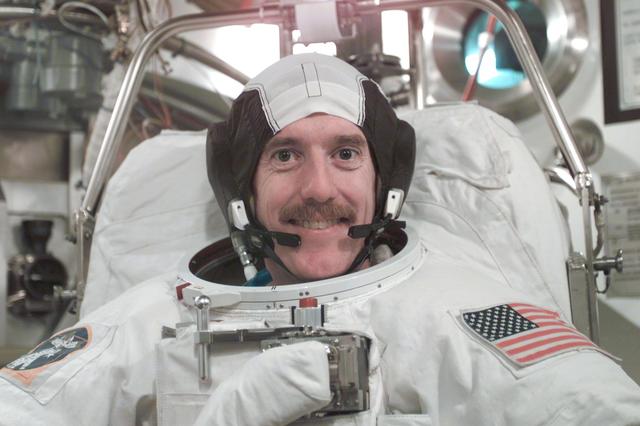
JSC2001-E-11690 (9 April 2001) --- Astronaut James F. Reilly, STS-104 mission specialist, prepares to don his helmet for an Extravehicular Mobility Unit (EMU) fit check in one of the chambers in the Crew Systems Laboratory at the Johnson Space Center (JSC). The STS-104 mission to the International Space Station (ISS) represents the Space Shuttle Atlantis' first flight using a new engine and is targeted for a liftoff no earlier than June 14, 2001.
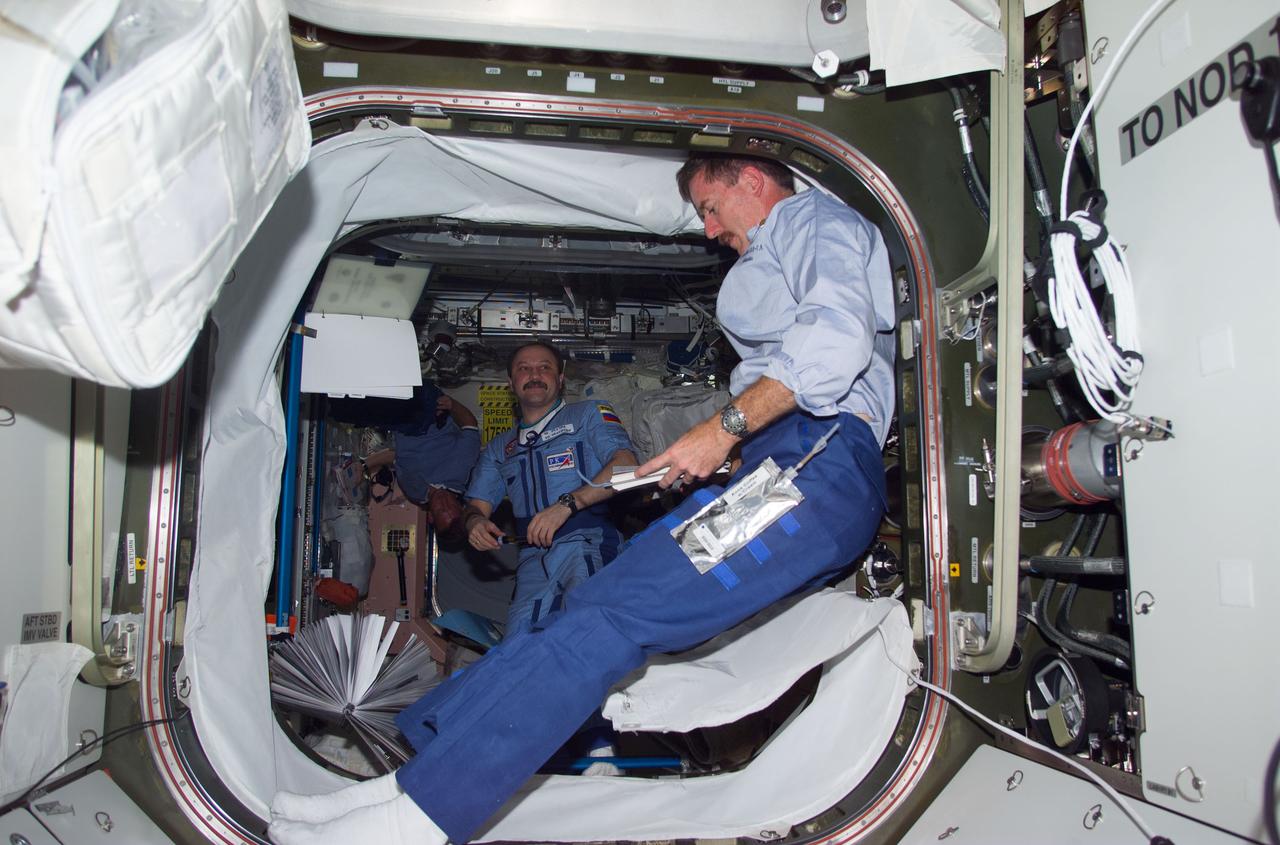
S104-E-5108 (16 July 2001) --- James F. Reilly, STS-104 mission specialist, reads over a checklist in the hatchway of the newly installed Quest Airlock. In the background, cosmonaut Yury V. Usachev of Rosaviakosmos, Expedition Two mission commander, is working in Unity Node 1.
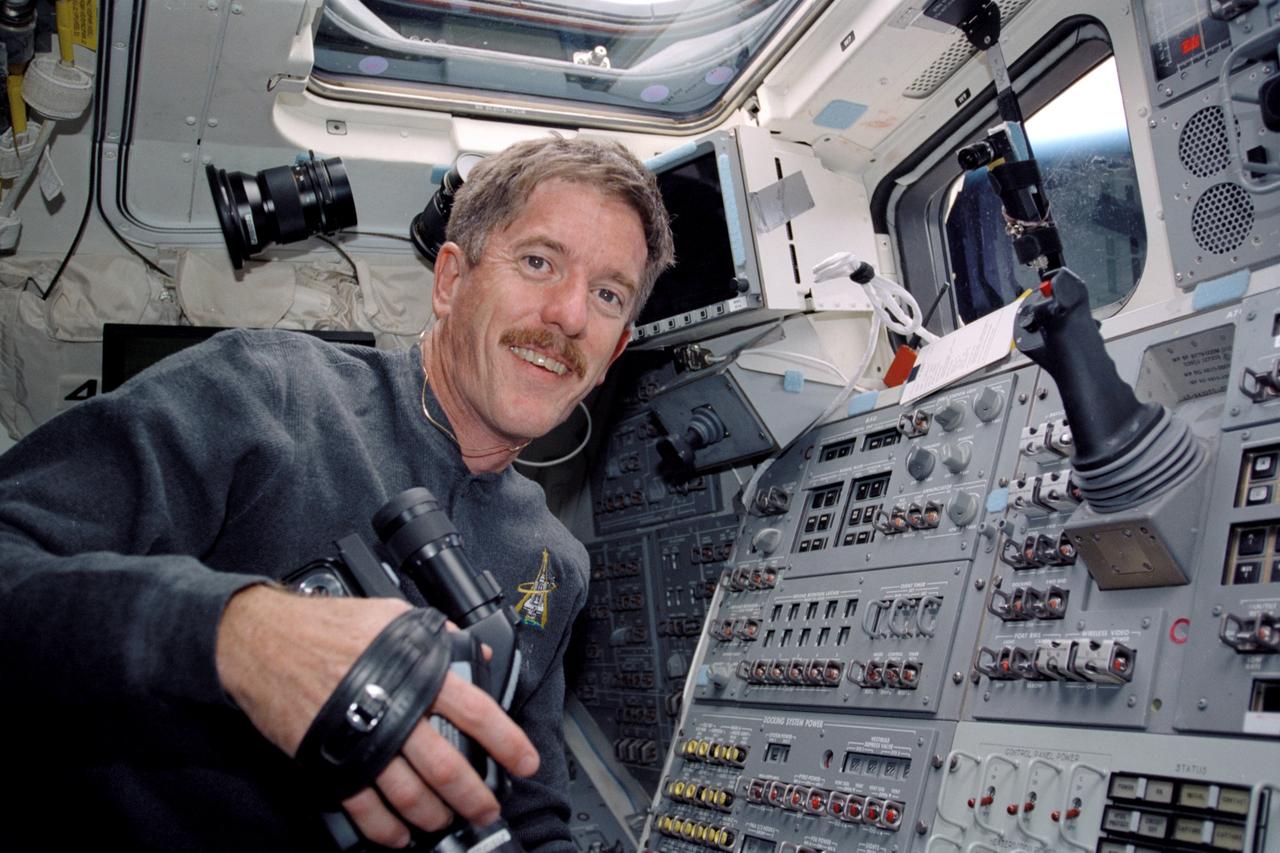
STS104-309-003 (12-24 July 2001) --- Astronaut James F. Reilly, STS-104 mission specialist, moves toward aft flight deck windows on the Space Shuttle Atlantis for a viewing opportunity. Reilly is one of five NASA astronauts aboard the Atlantis who will be participating in work on the International Space Station (ISS).
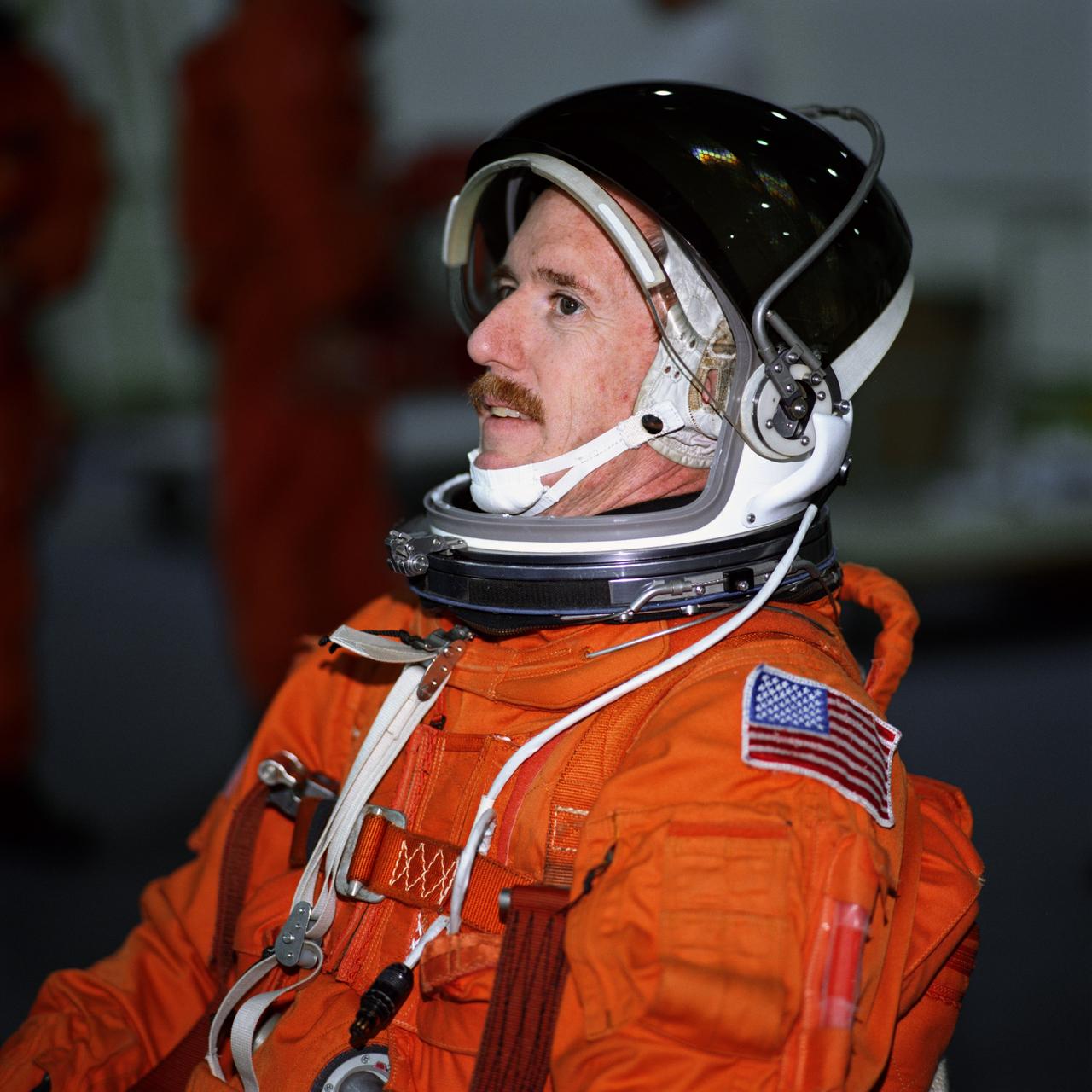
JSC2001-00020 (January 2001) --- Astronaut James F. Reilly, STS-104 mission specialist, attired in a training version of the shuttle launch and entry garment at the Neutral Buoyancy Laboratory (NBL) near Johnson Space Center (JSC). Reilly will join four other astronauts for a June mission with the International Space Station (ISS).
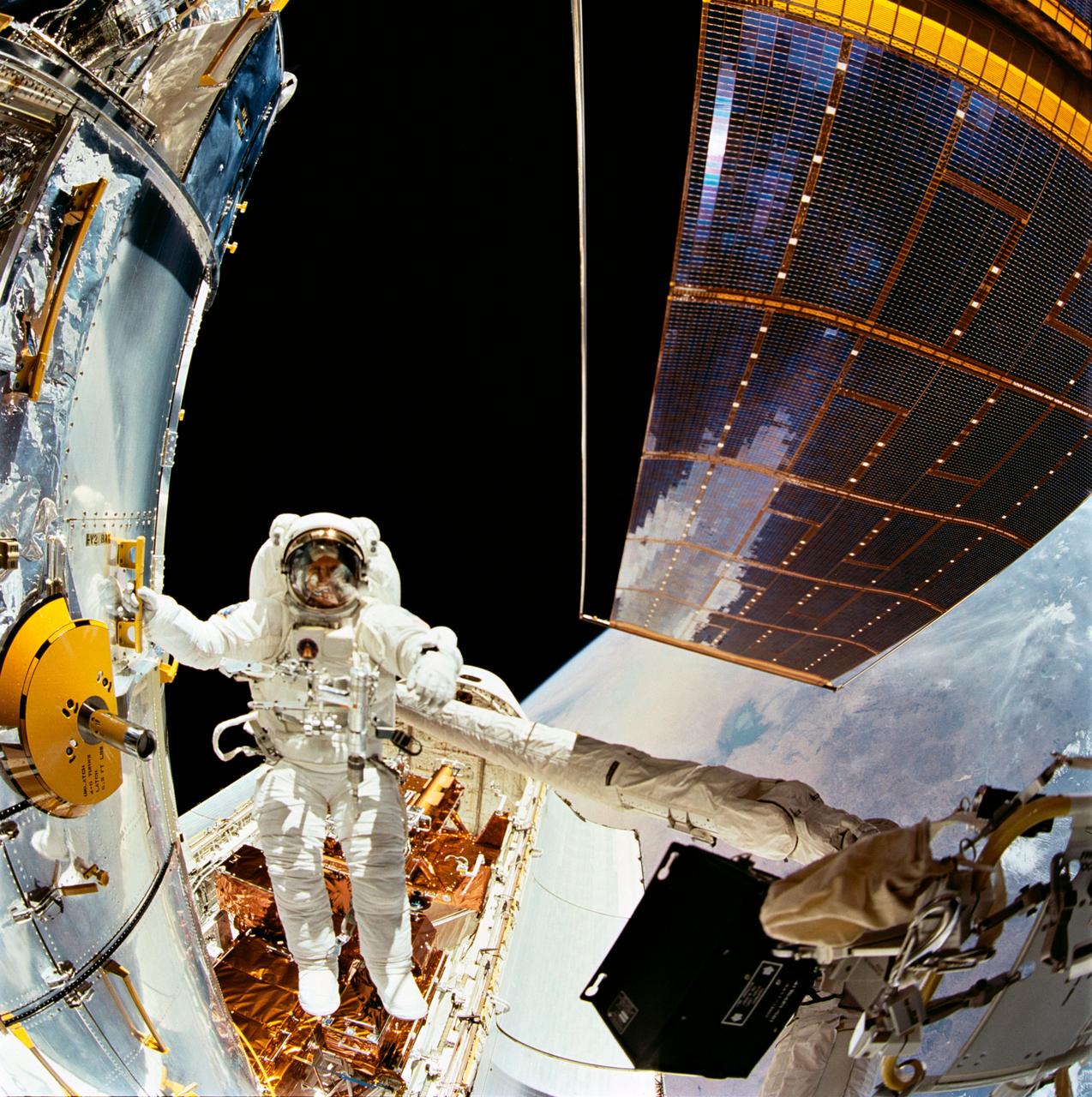
STS061-104-007 (5 Dec 1993) --- Astronaut F. Story Musgrave, holding to one of many strategically placed handrails on the Hubble Space Telescope (HST), is photographed during the first of five extravehicular activity?s (EVA) on the HST-servicing mission, aboard the Space Shuttle Endeavour.
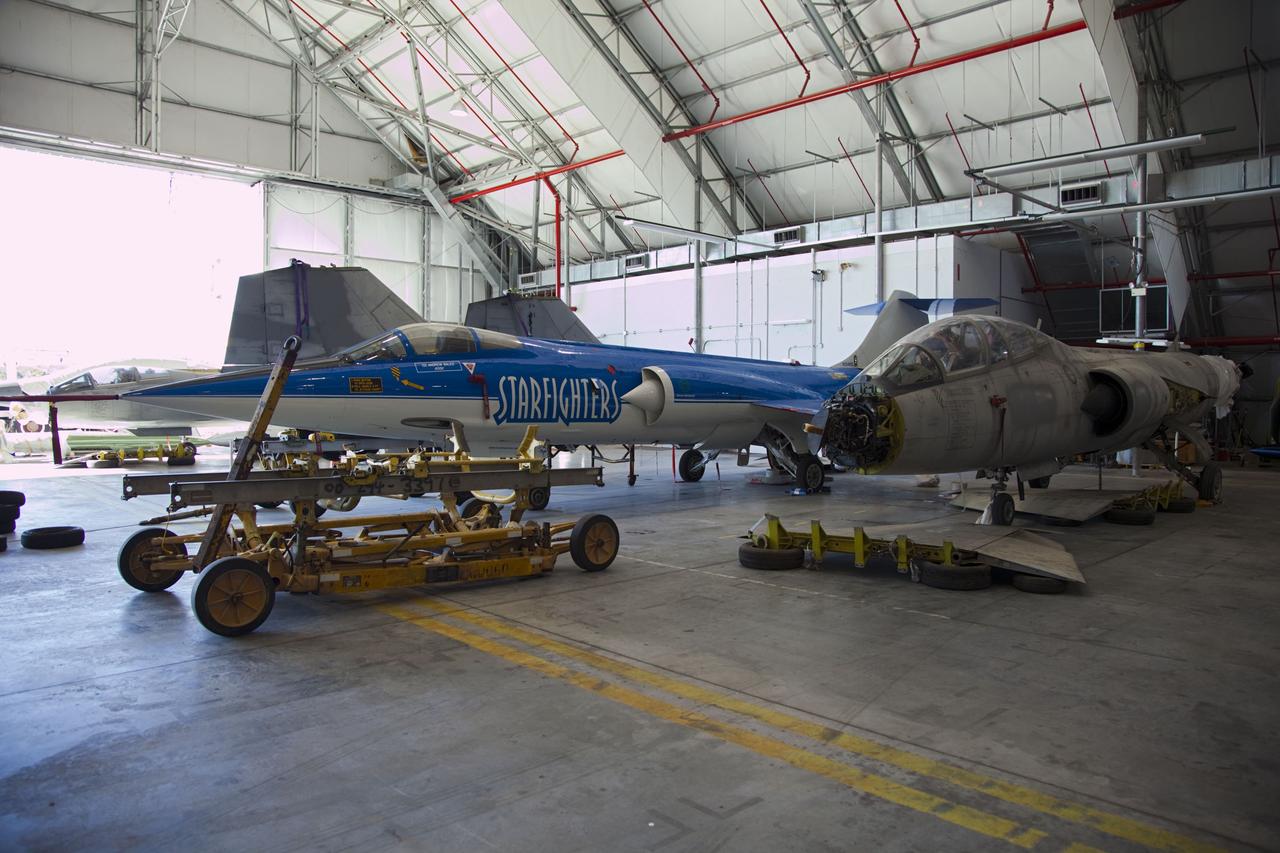
CAPE CANAVERAL, Fla. -- A hangar at NASA's Kennedy Space Center in Florida fills up with new aircraft for the company Starfighters Inc. The blue and white aircraft is part of the company's original fleet of supersonic aircraft. The gray aircraft is one of five delivered to the company recently. They will be reassembled to fly research and development and other missions. They have been used to fly research and development and other missions. Starfighters operates out of a hangar at the Shuttle Landing Facility at Kennedy under an agreement with Kennedy. Photo credit: NASA/Frankie Martin
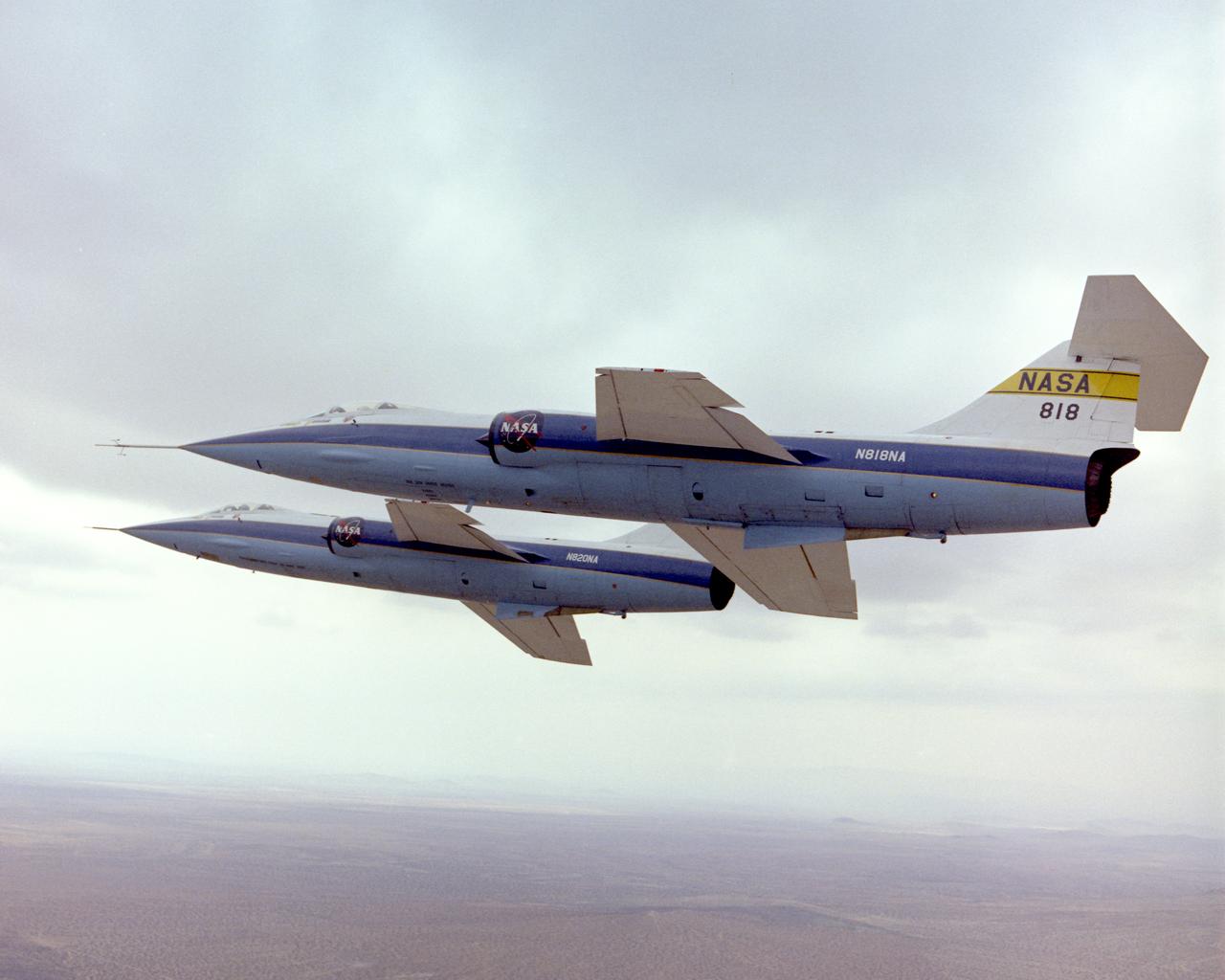
F-104A #818 flown by Einar Enevoldson and F-104A #820 flown by Gary Krier in formation over the Mojave Desert. 4/11/75 NASA DFRC EC76-5140

YF-104A (Serial # 55-2961) on Rogers Dry Lake at Edwards AFB.
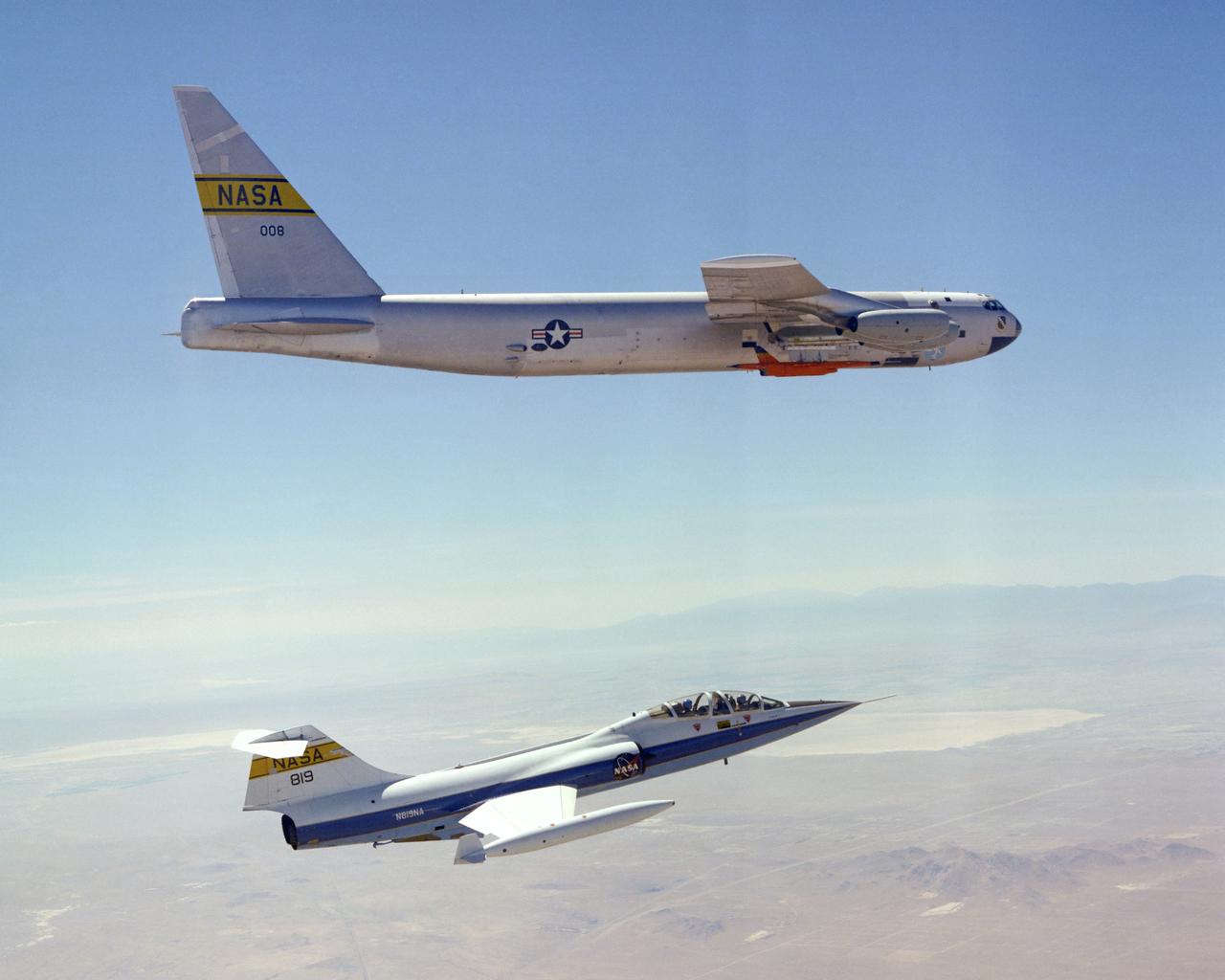
F-104B #819 flies chase on the NB-52B #008 during the first DAST captive flight.
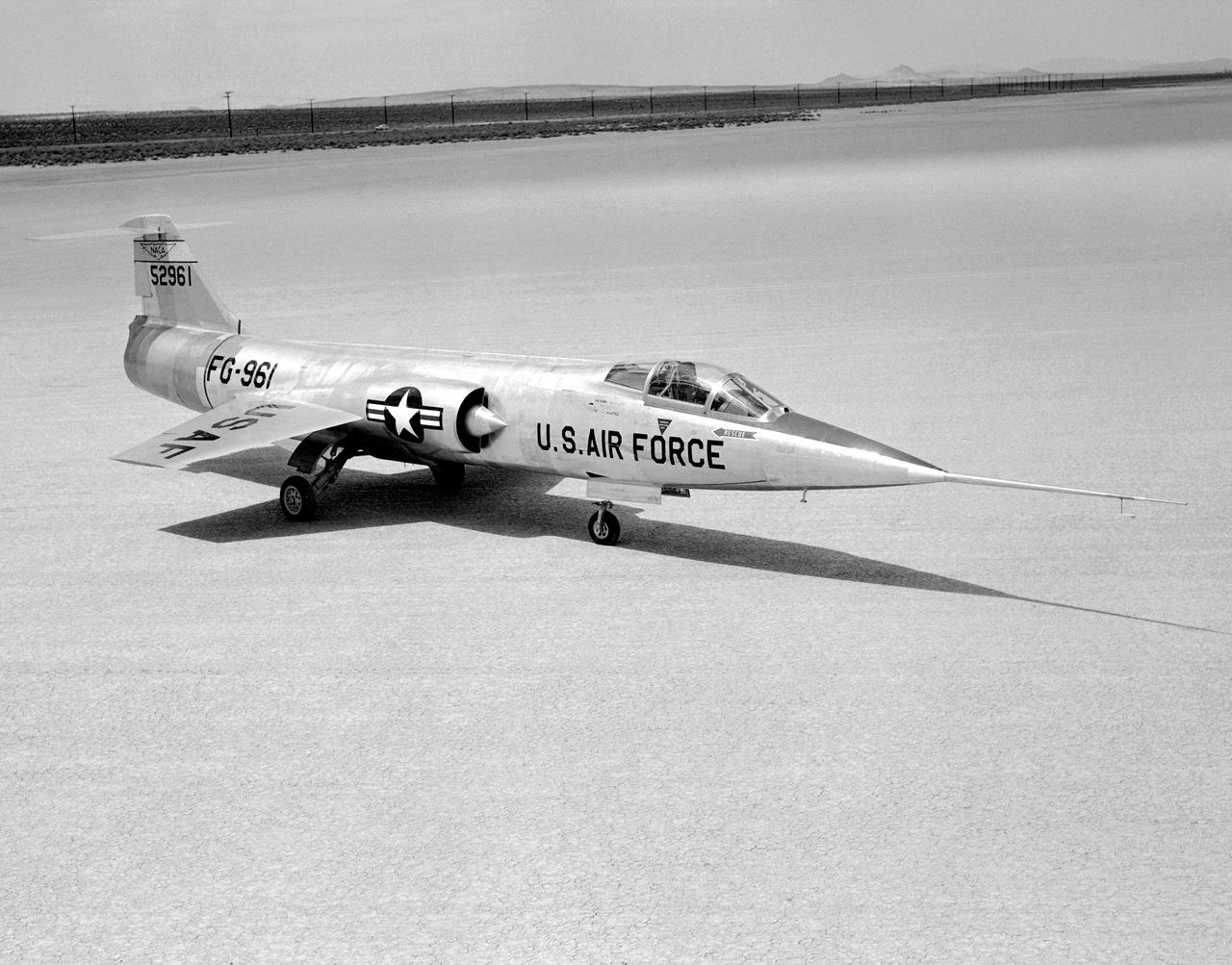
YF-104A (Serial #55-2961) on Rogers Dry Lake at Edwards AFB.
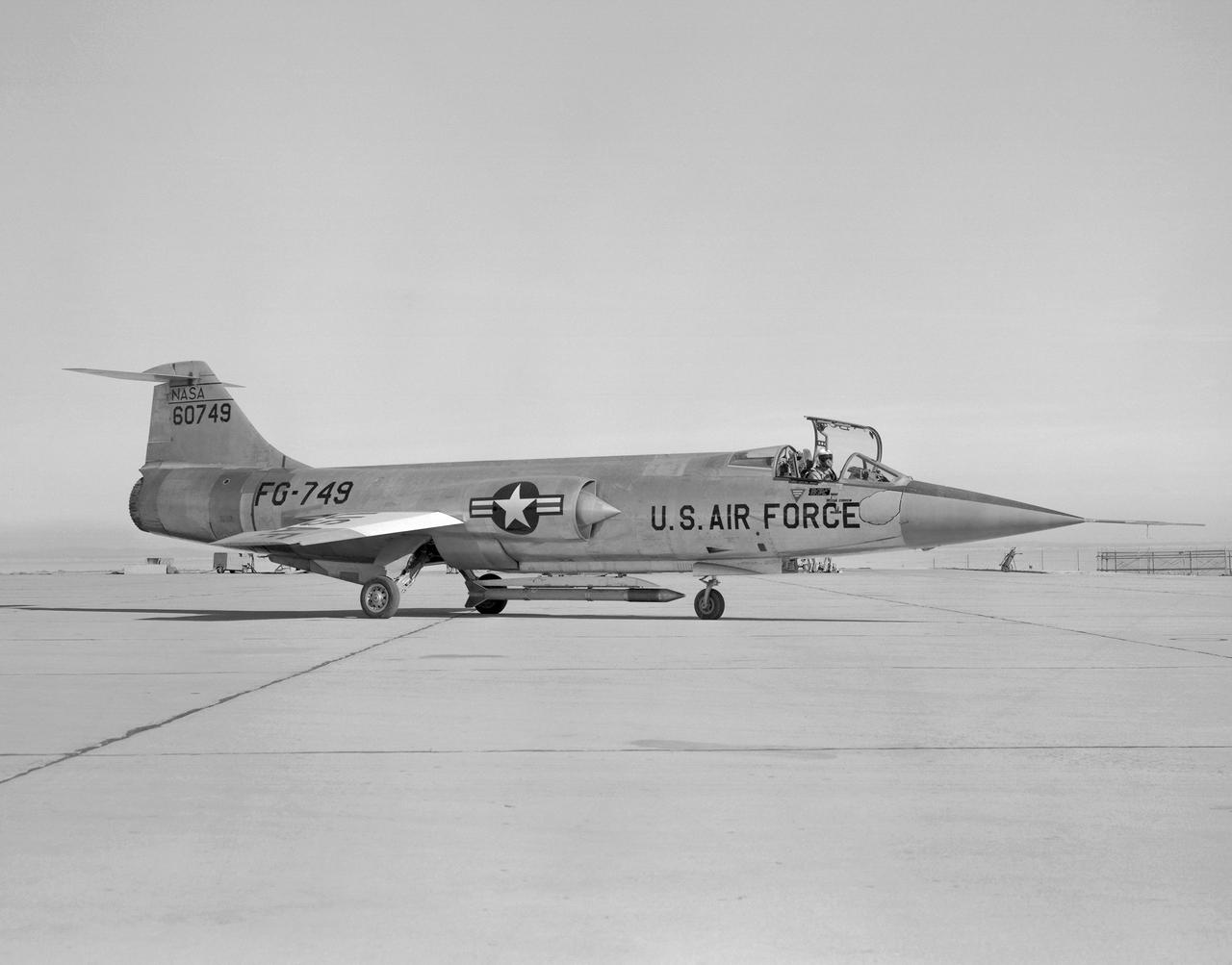
JF-104A (Serial #56-0749) on the ramp at the NASA Flight Research Center (now the Dryden Flight Research Center) at Edwards AFB. The aircraft is shown with the Air Launched Sounding Rocket (ALSOR) attached to the underside. NASA test pilot Milton O. Thompson ejected from this aircraft on 20 December 1962, after an asymmetrical flap condition made the jet uncontrollable.
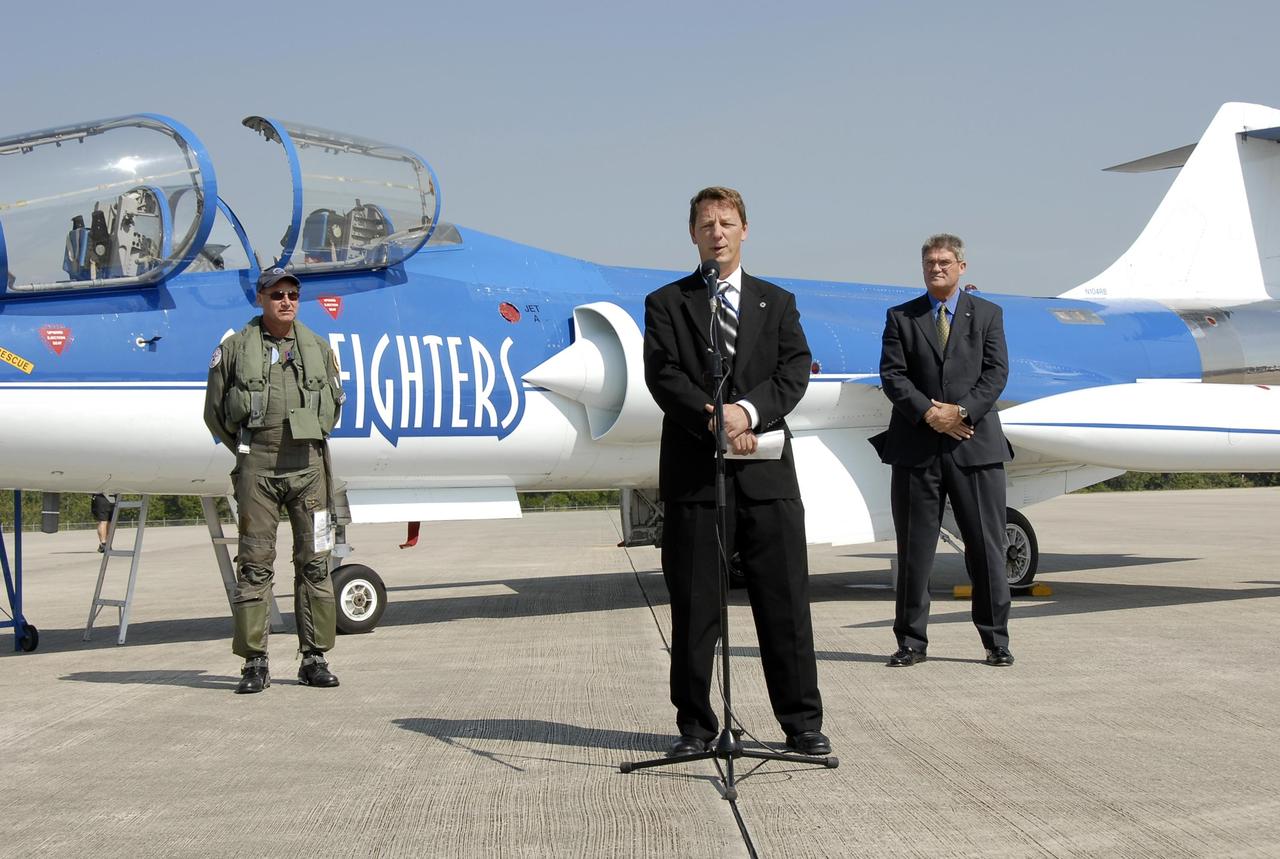
KENNEDY SPACE CENTER, FLA. -- After a test flight of the Starfighter F-104, Al Wassel, a representative from the FAA Office of Commercial Space, addresses the media on the KSC Shuttle Landing Facility. At left is the F-104 pilot, Rick Svetkoff. At right is Bill Parsons, director of Kennedy Space Center. The aircraft is taking part in a series of pathfinder test missions from the space shuttle runway. Two flights will generate test data to validate sonic boom assumptions about the potential impacts of suborbital and orbital commercial spaceflight from the facility. NASA is assessing the environmental impact of such flights. Starfighters Inc. of Clearwater, Fla., will perform the flights to help in assessing suborbital space launch trajectories from the runway and paving the way for future commercial space tourism and research flights from the facility. Photo credit: NASA/Kim Shiflett
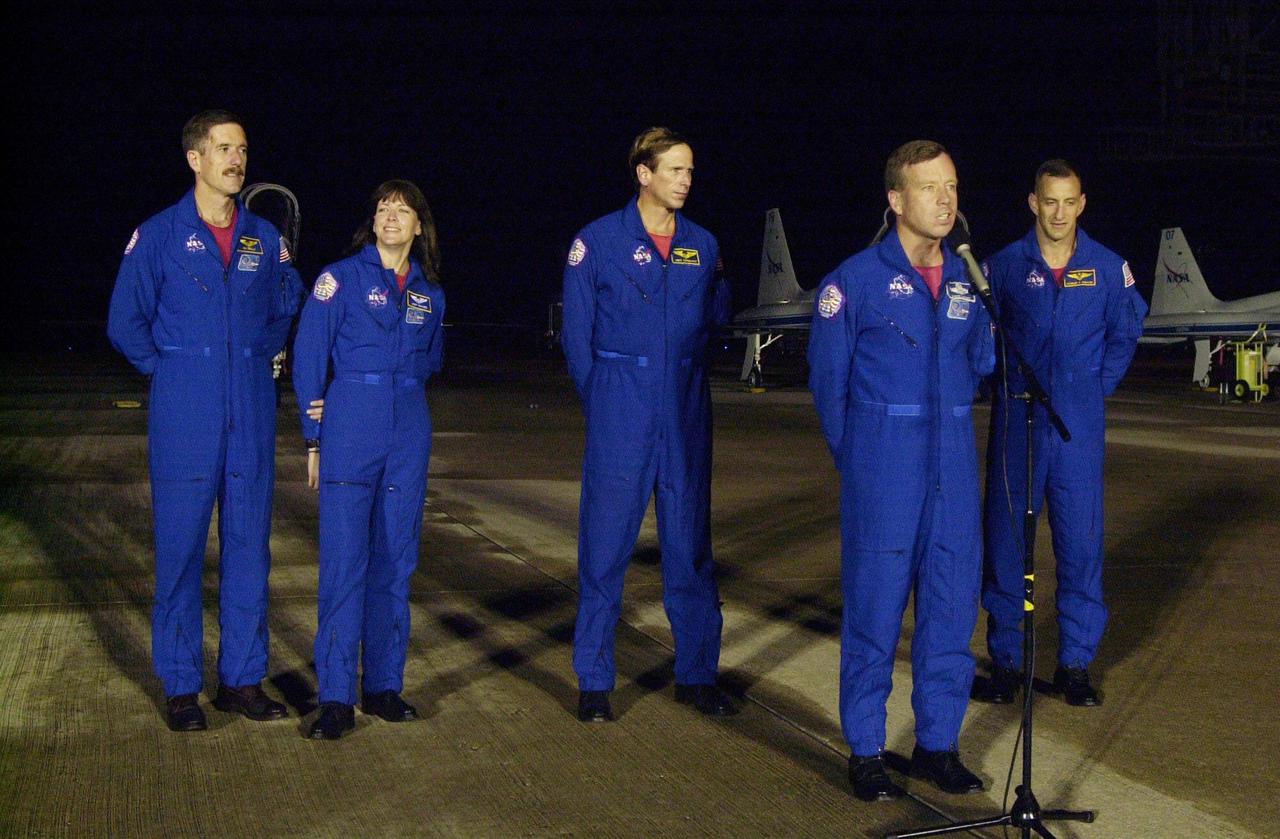
KENNEDY SPACE CENTER, Fla. -- The STS-104 crew talks to the media at the Shuttle Landing Facility after arriving at Kennedy Space Center to make final preparations for their launch. From left to right are Mission Specialists James F. Reilly, Janet Lynn Kavandi and Michael L. Gernhardt; Commander Steven W. Lindsey (at microphone); and Pilot Charles O. Hobaugh. The launch of Atlantis on mission STS-104 is scheduled for July 12 from Launch Pad 39B. The mission is the 10th assembly flight to the International Space Station and carries the Joint Airlock Module, which will become the primary path for spacewalk entry and departure using both U.S. spacesuits and the Russian Orlan spacesuit for EVA activity
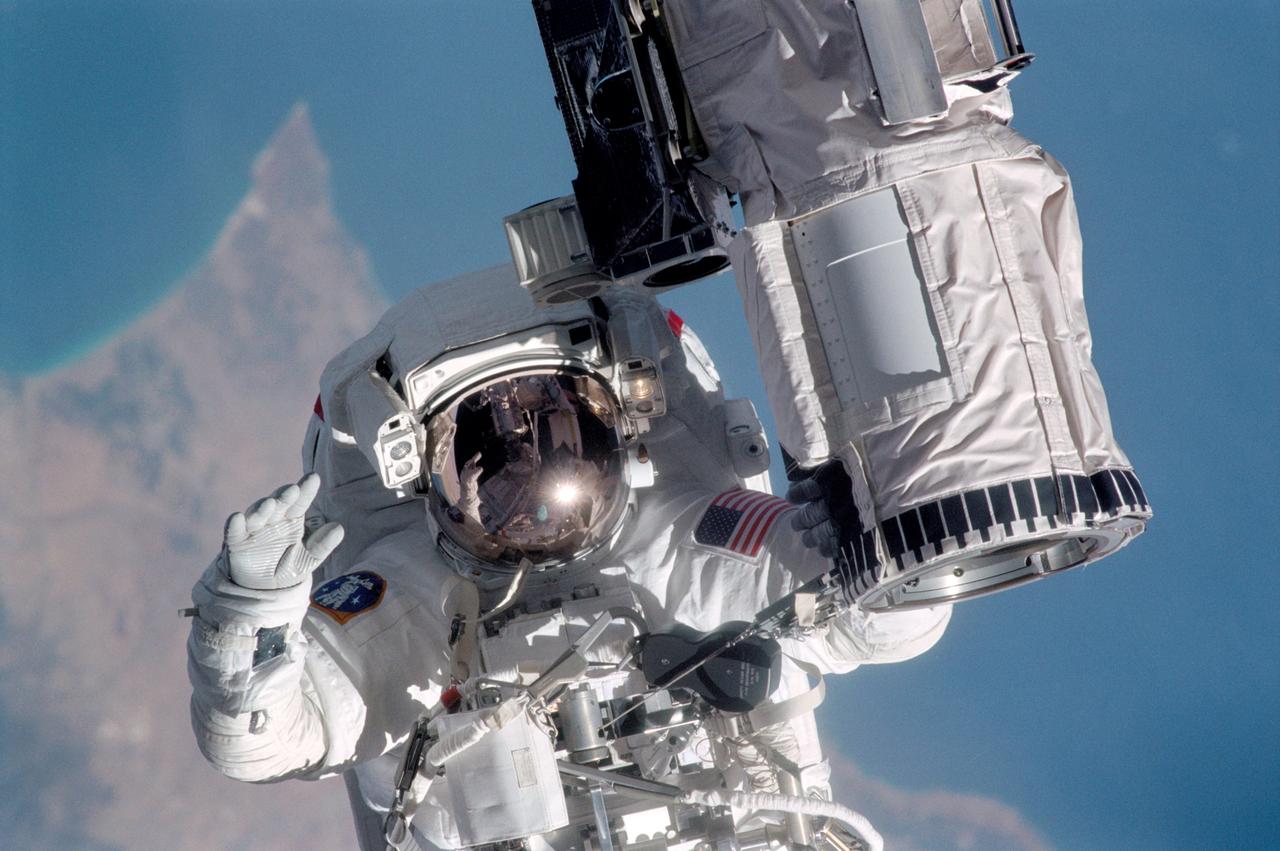
Astronaut Michael L. Gernhardt, STS-104 mission specialist, participates in one of three STS-104 space walks while holding on to the end effector of the Canadarm on the Space Shuttle Atlantis. Gernhardt was joined on the extravehicular activity (EVA) by astronaut James F. Reilly (out of frame). The major objective of the mission was to install and activate the Joint Airlock, which completed the second phase of construction on the International Space Station (ISS). The airlock accommodates both United States and Russian space suits and was designed and built at the Marshall Space Flight Center by the Boeing Company.
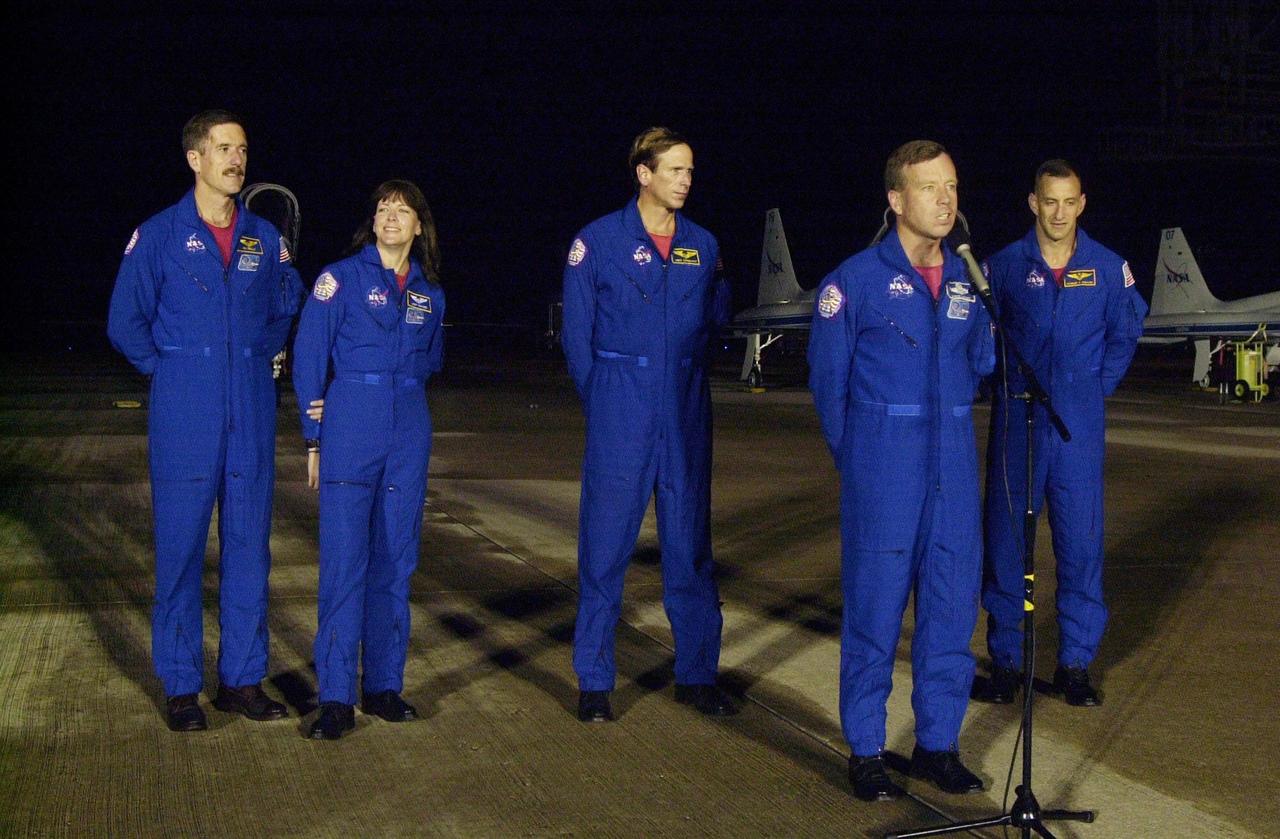
KENNEDY SPACE CENTER, Fla. -- The STS-104 crew talks to the media at the Shuttle Landing Facility after arriving at Kennedy Space Center to make final preparations for their launch. From left to right are Mission Specialists James F. Reilly, Janet Lynn Kavandi and Michael L. Gernhardt; Commander Steven W. Lindsey (at microphone); and Pilot Charles O. Hobaugh. The launch of Atlantis on mission STS-104 is scheduled for July 12 from Launch Pad 39B. The mission is the 10th assembly flight to the International Space Station and carries the Joint Airlock Module, which will become the primary path for spacewalk entry and departure using both U.S. spacesuits and the Russian Orlan spacesuit for EVA activity
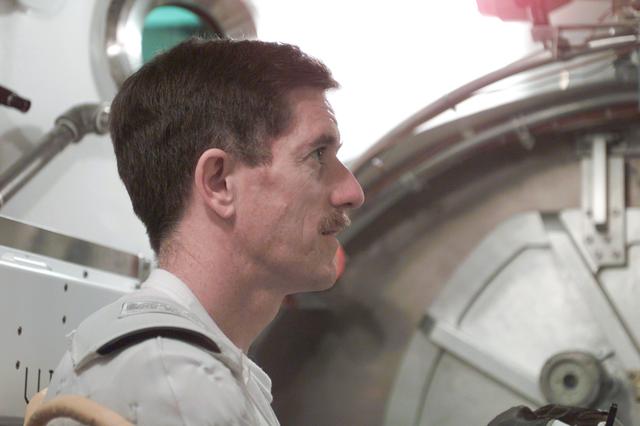
JSC2001-E-11687 (9 April 2001) --- Astronaut James F. Reilly, STS-104 mission specialist, prepares to don his Extravehicular Mobility Unit (EMU) space suit for a fit check in one of the chambers in the Crew Systems Laboratory at the Johnson Space Center (JSC). Reilly is wearing a thermal undergarment over which he will wear the EMU. The STS-104 mission to the International Space Station (ISS) represents the Space Shuttle Atlantis' first flight using a new engine and is targeted for a liftoff no earlier than June 14, 2001.
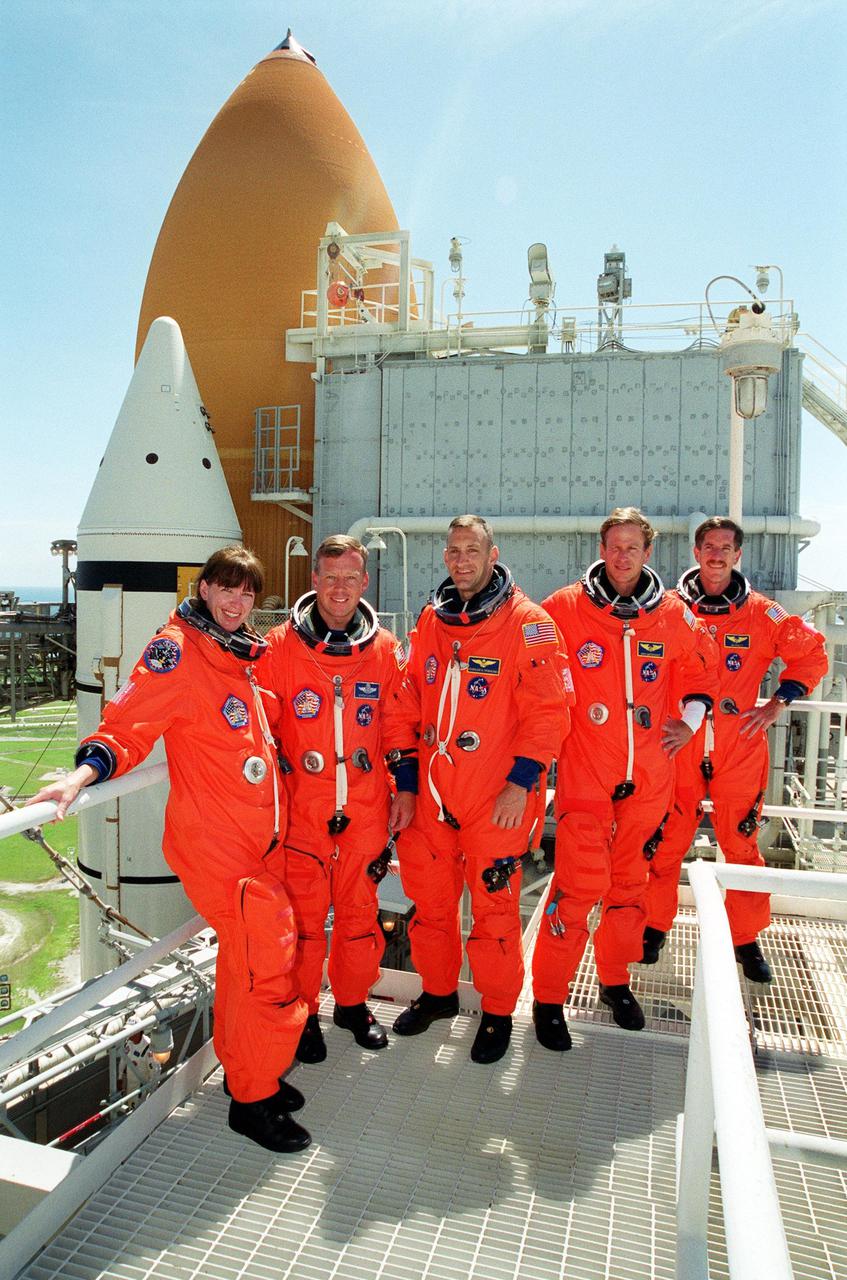
KENNEDY SPACE CENTER, Fla. -- The STS-104 crew poses for a group photo on the 215-foot level of the Fixed Service Structure. Standing left to right are Mission Specialist Janet Lynn Kavandi, Commander Steven Lindsey, Pilot Charles O. Hobaugh, and Mission Specialists Michael L. Gernhardt and James F. Reilly. The crew has been taking part in Terminal Countdown Demonstration Test activities, which include emergency egress training and a simulated countdown exercise. The launch of Atlantis on mission STS-104 is scheduled July 12. The mission is the 10th flight to the International Space Station and carries the Joint Airlock Module and High Pressure Gas Assembly
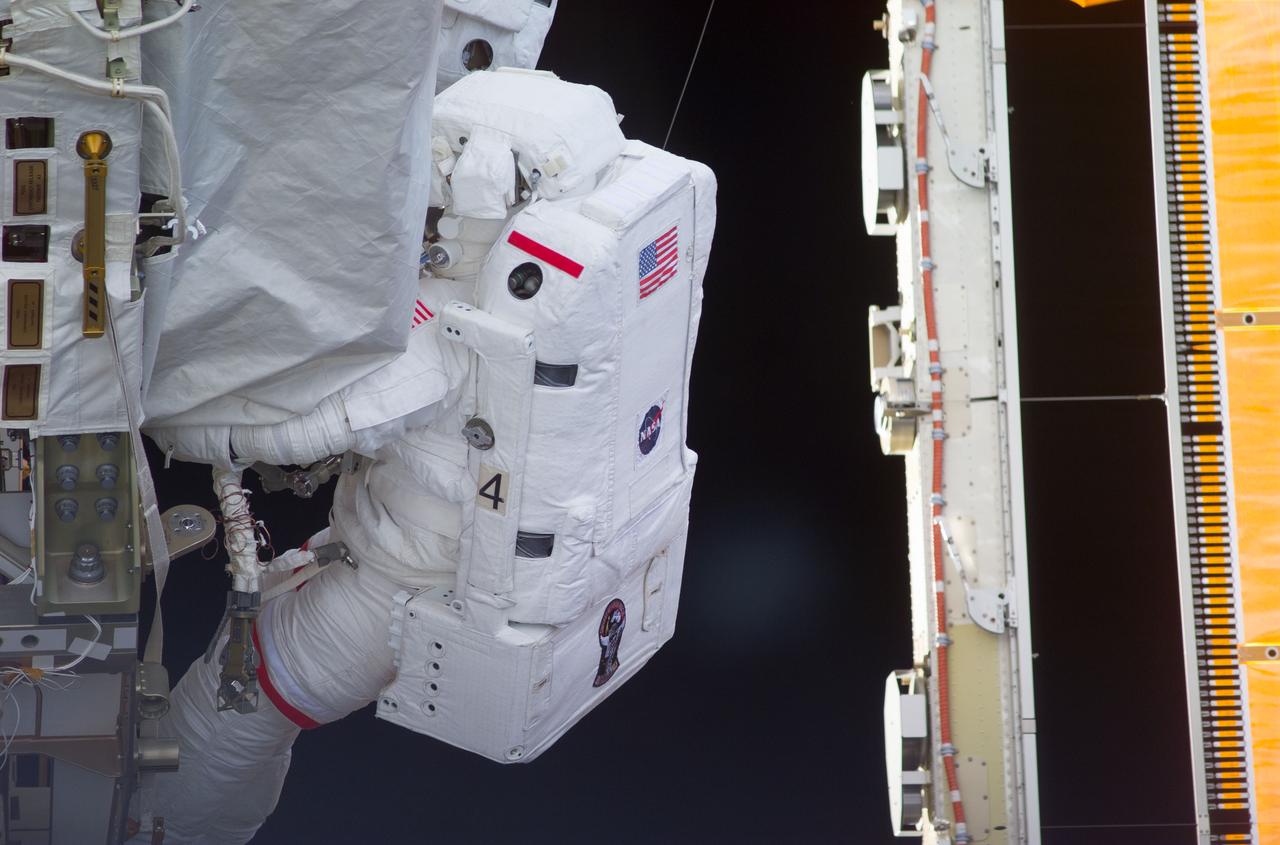
STS104-E-5239 (21 July 2001) --- Astronaut Michael L. Gernhardt, STS-104 mission specialist, was photographed with a digital still camera during extravehicular activity (EVA) with the International Space Station (ISS). During this, the third, STS-104 space walk, Gernhardt and astronaut James F. Reilly attached a nitrogen supply tank to the Airlock Quest's shell and also moved hand-over-hand up the station's solar array truss to take a look at a gimbal assembly mechanism that allows the arrays to swivel with the Sun. This space walk was the first ever that has utilized the new airlock.
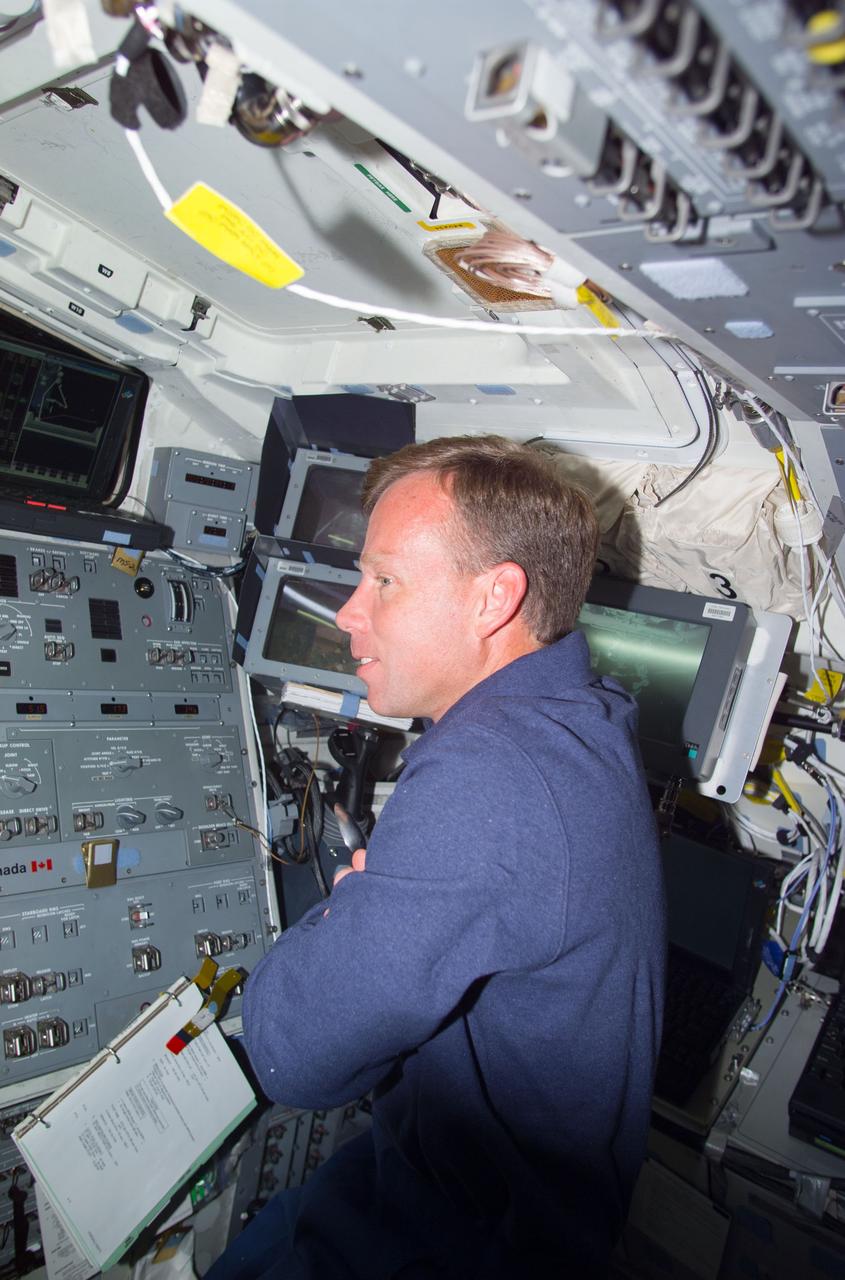
STS104-E-5227 (21 July 2001) --- Working in tandem with the station's Canadarm2 operator and Expedition Two flight engineer James S. Voss, astronaut Steven W. Lindsey, STS-104 commander, supports mission specialists Michael L. Gernhardt and James F. Reilly during the final of three STS-104 space walks. Lindsey is on the aft flight deck of the Space Shuttle Atlantis, while Voss worked at controls in the Destiny laboratory. The extravehicular activity (EVA) was partly devoted to the attachment of a new nitrogen supply tank to the shell of the new Airlock Quest. This photo was recorded with a digital still camera.
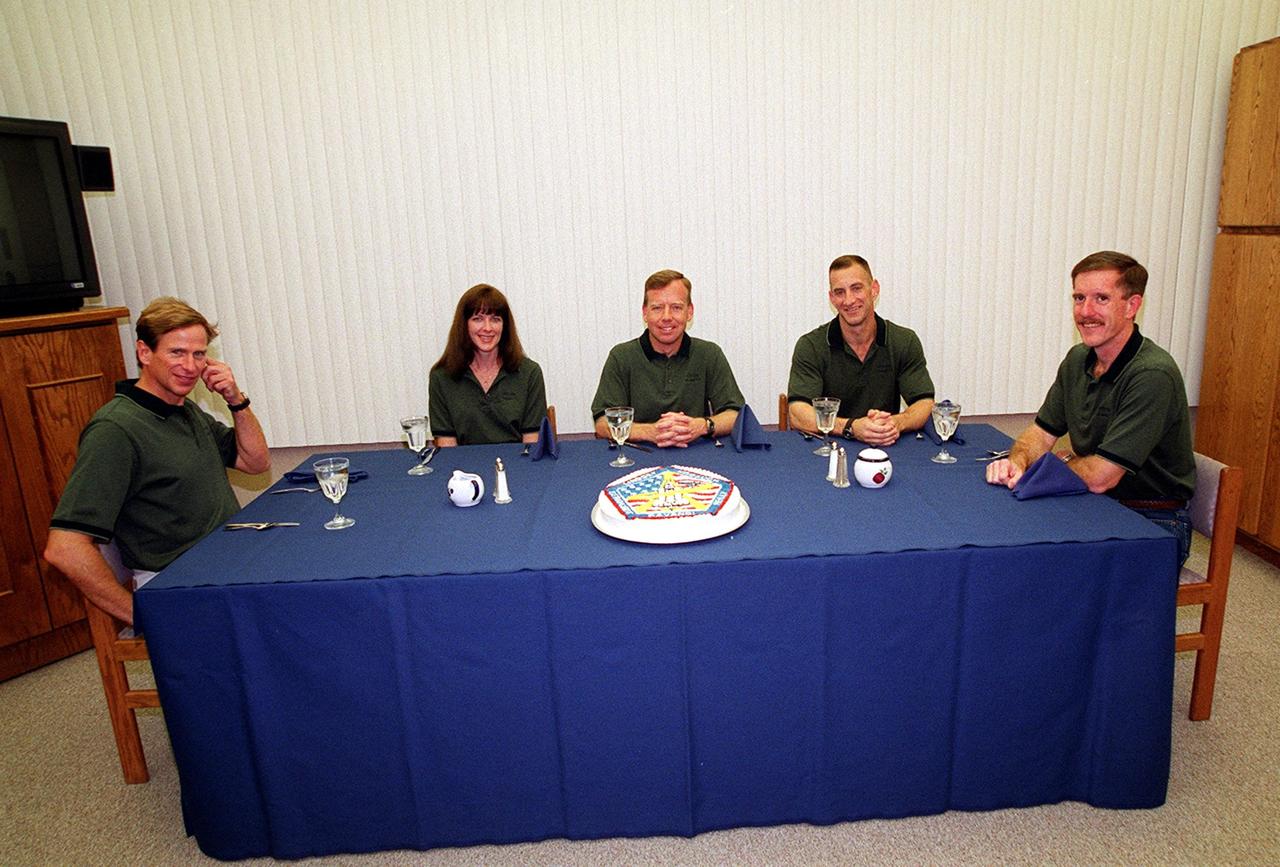
KENNEDY SPACE CENTER, Fla. -- The STS-104 crew finish their final meal of the day before launch. Seated from left are Mission Specialists Michael L. Gernhardt and Janet Lynn Kavandi, Commander Steven W. Lindsey, Pilot Charles O. Hobaugh and Mission Specialist James F. Reilly. The launch of Space Shuttle Atlantis on mission STS-104 is targeted for 5:04 a.m., July 12, from Launch Pad 39B. The primary payload on the mission is the joint airlock module, which will be added to the International Space Station. The airlock will be the primary path for Space Station spacewalk entry and departure for U.S. spacesuits, and will also support the Russian Orlan spacesuit for EVA activity
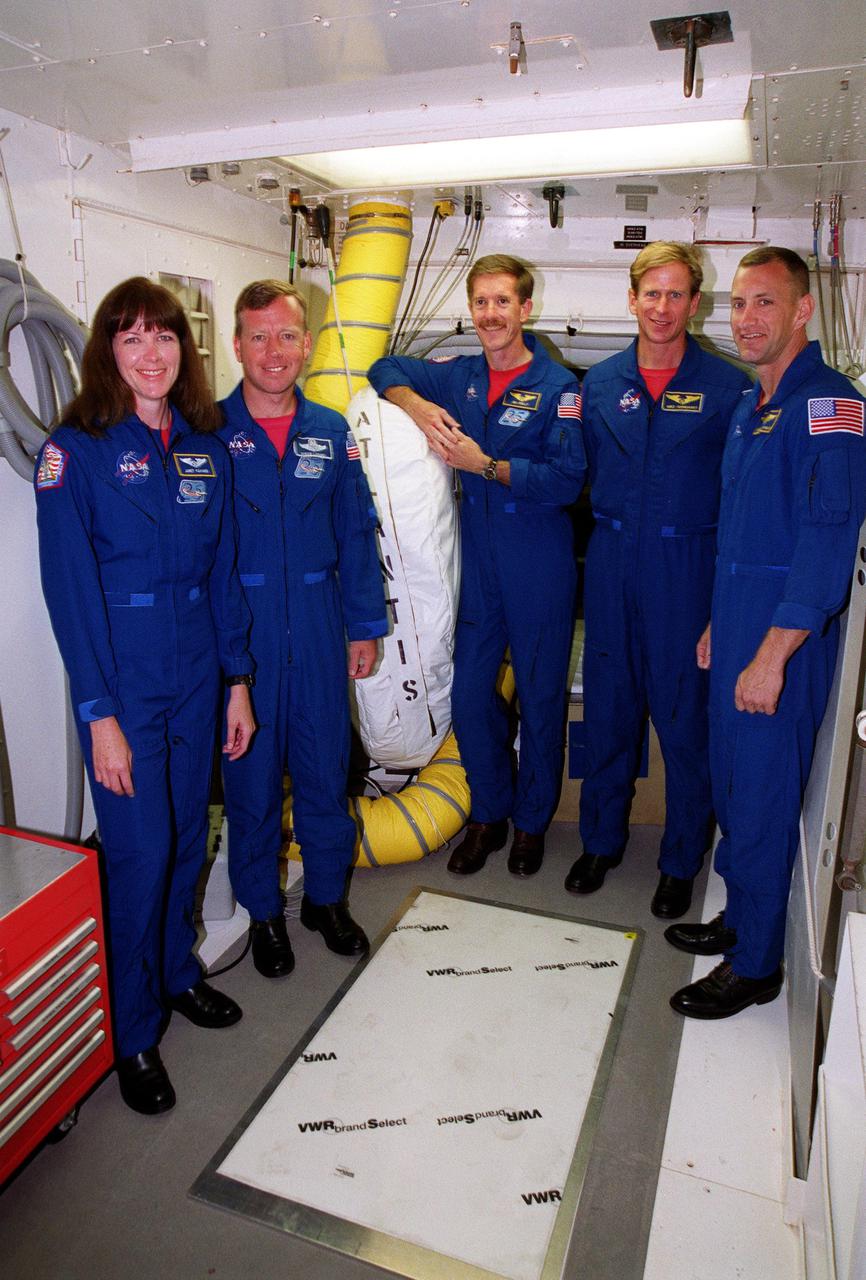
KENNEDY SPACE CENTER, Fla. -- The STS-104 crew pauses during Terminal Countdown Demonstration Test (TCDT) activities to pose for a group photo. Standing left to right are Mission Specialist Janet Lynn Kavandi, Commander Steven W. Lindsey, Mission Specialists James F. Reilly and Michael L. Gernhardt, and Pilot Charles O. Hobaugh. The TCDT includes emergency exit training from the orbiter, opportunities to inspect their mission payloads in the orbiter’s payload bay and simulated countdown exercises. The launch of Atlantis on mission STS-104 is scheduled July 12 from Launch Pad 39B. The mission is the 10th flight to the International Space Station and carries the Joint Airlock Module
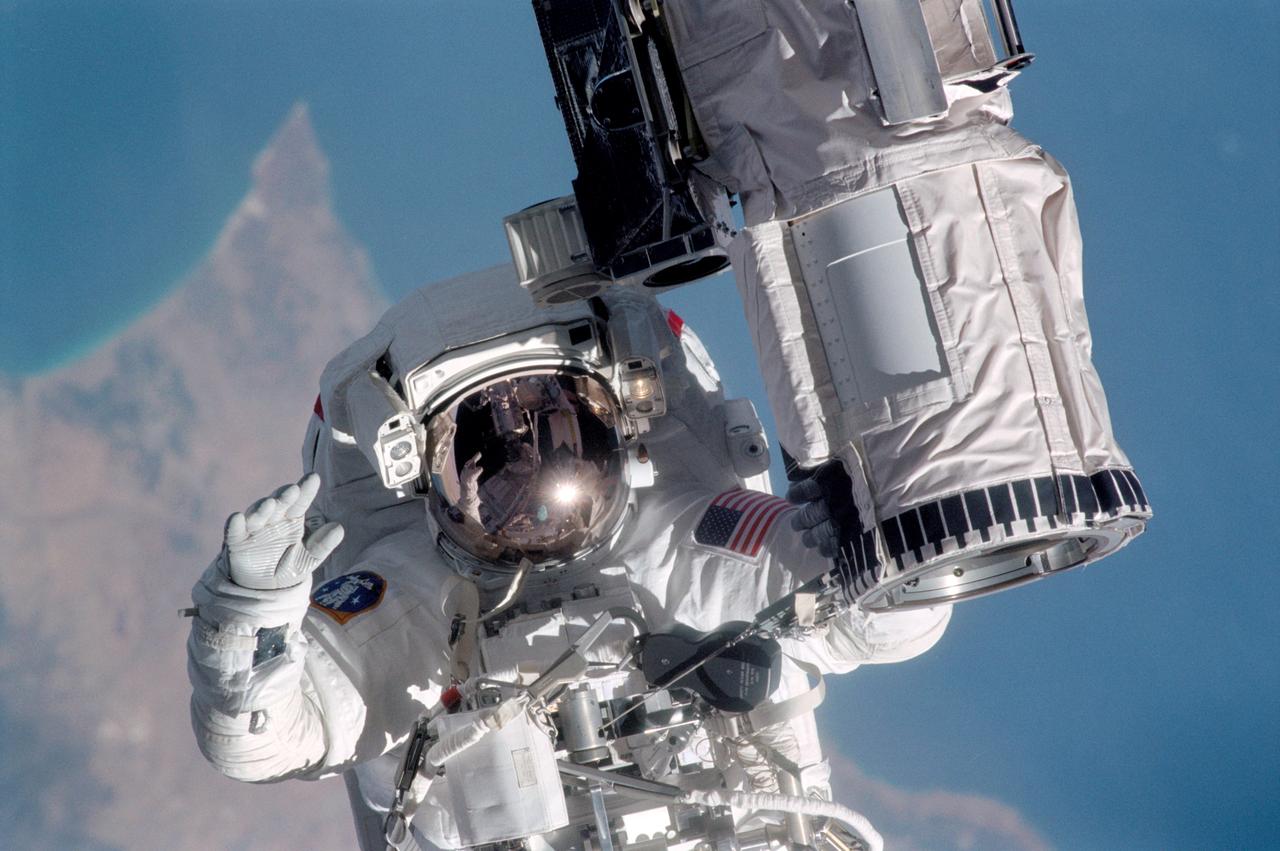
STS104-315-013 (12-24 July 2001) --- Holding onto the end effector of the Canadarm on the Space Shuttle Atlantis, astronaut Michael L. Gernhardt, STS-104 mission specialist, participates in one of three STS-104 space walks. The extravehicular activity (EVA) was designed to help wrap up the completion of work on the second phase of the International Space Station (ISS). Gernhardt was joined on the extravehicular activity (EVA) by astronaut James F. Reilly. The jutting peninsula in the background is Cape Kormakiti on the north central coast of Cyprus and the water body to the left of the cape is Morphu Bay.
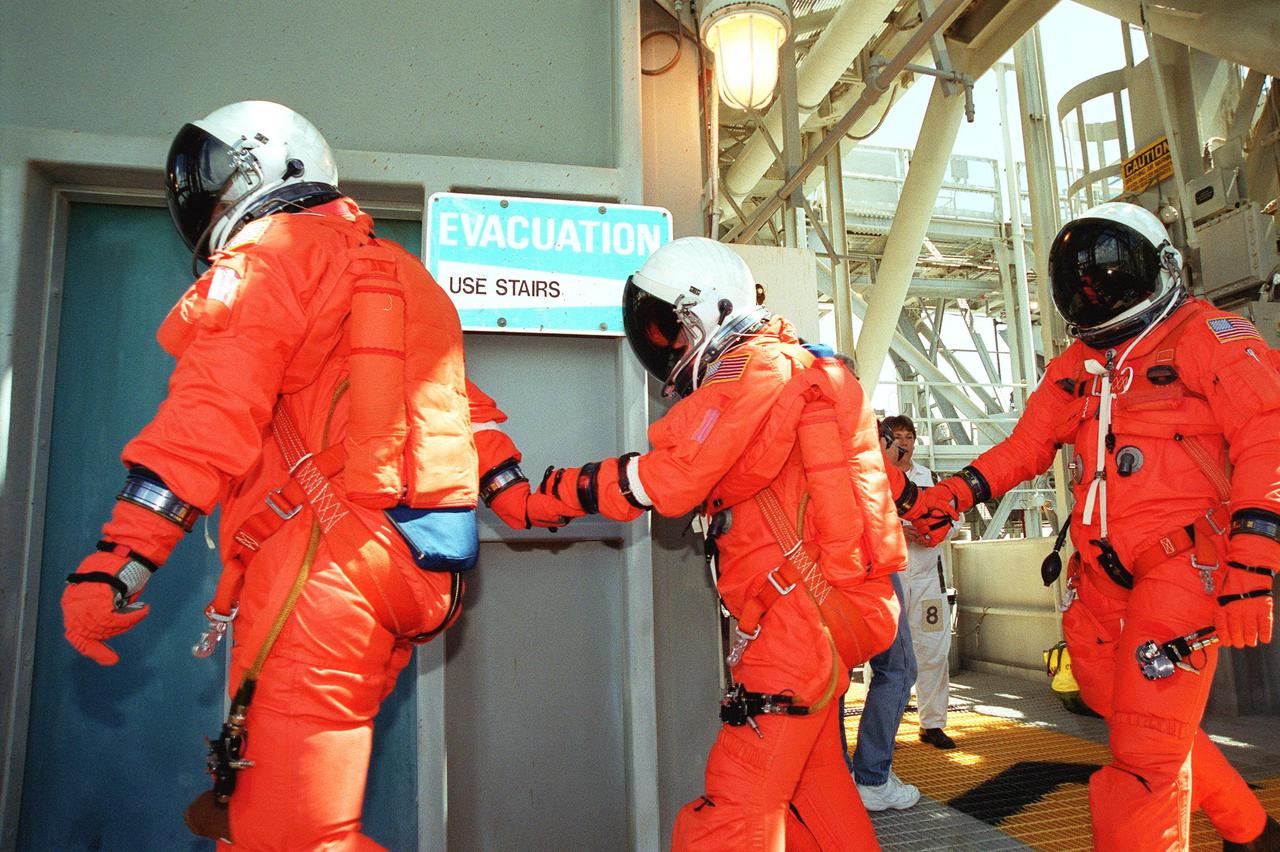
KENNEDY SPACE CENTER, Fla. -- On Launch Pad 39B, dressed in their launch and entry suits, STS-104 Mission Specialists (left to right) James F. Reilly, Janet Lynn Kavandi and Michael L. Gernhardt make their way from Space Shuttle Atlantis to the slidewire baskets, part of the emergency egress system at the pad. They and other crew members are taking part in Terminal Countdown Demonstration Test activities, which include the emergency egress training and a simulated countdown exercise. The launch of Atlantis on mission STS-104 is scheduled July 12. The mission is the 10th flight to the International Space Station and carries the Joint Airlock Module and High Pressure Gas Assembly
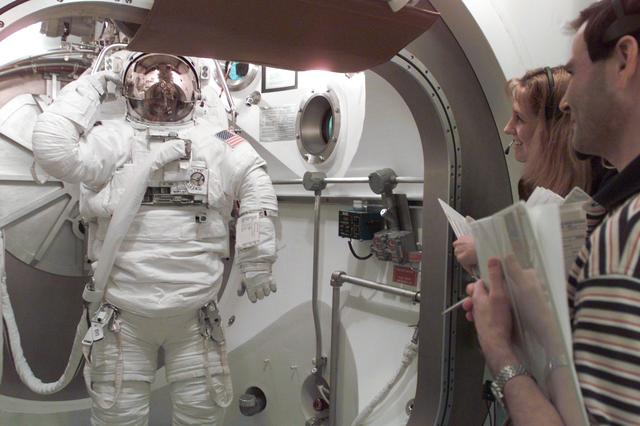
JSC2001-E-11704 (9 April 2001) --- Astronaut James F. Reilly, STS-104 mission specialist, participates in an Extravehicular Mobility Unit (EMU) fit check in one of the chambers in the Crew Systems Laboratory at the Johnson Space Center (JSC). Standing near the doorway are Peggy Berg and Dave Simon, Crew Personnel Representatives (CPR), from the Mission Operations Directorate (MOD) at the Johnson Space Center. The STS-104 mission to the International Space Station (ISS) represents the Space Shuttle Atlantis' first flight using a new engine and is targeted for a liftoff no earlier than June 14, 2001.
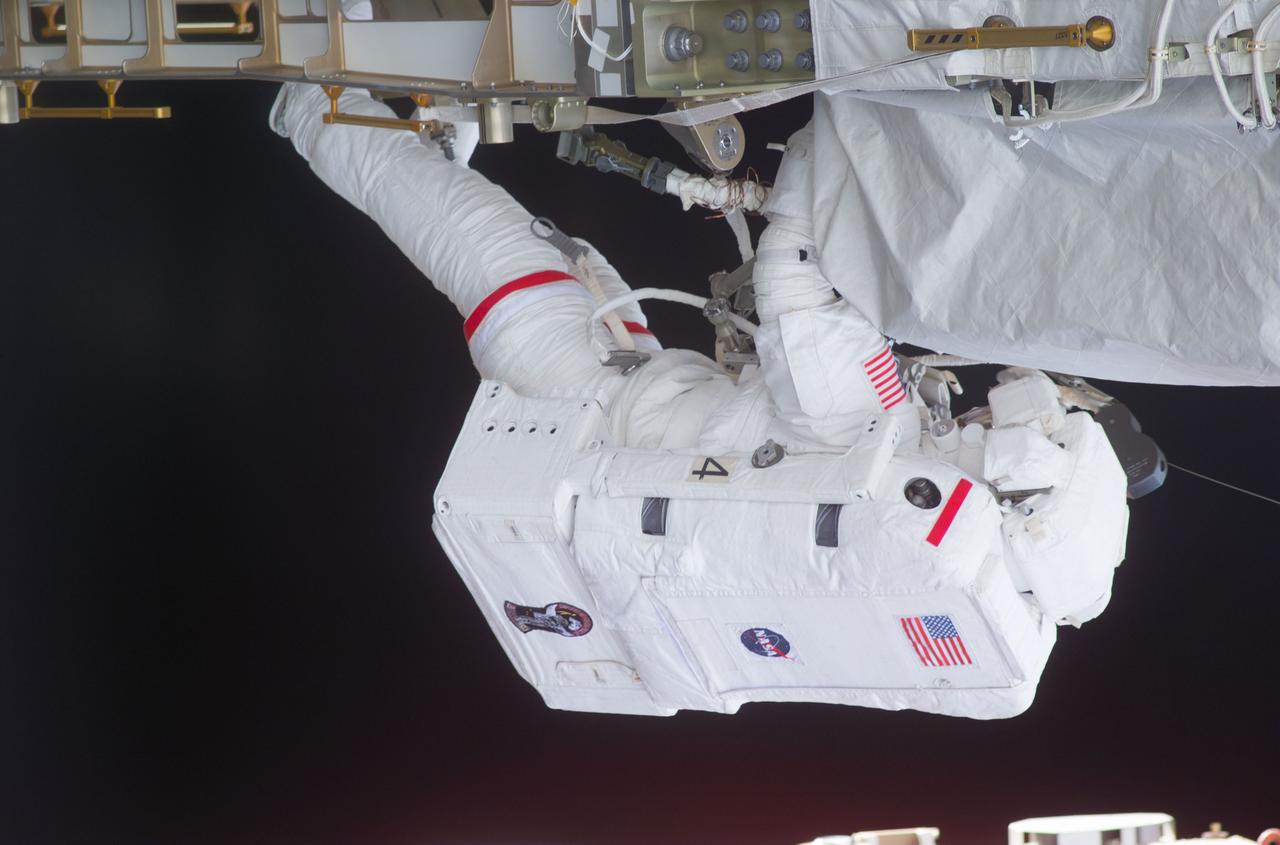
STS104-E-5238 (21 July 2001) --- Astronaut Michael L. Gernhardt, STS-104 mission specialist, was photographed with a digital still camera during extravehicular activity (EVA) with the International Space Station (ISS). During this, the third, STS-104 space walk, Gernhardt and astronaut James F. Reilly attached a nitrogen supply tank to the Airlock Quest's shell and also moved hand-over-hand up the station's solar array truss to take a look at a gimbal assembly mechanism that allows the arrays to swivel with the Sun. This space walk was the first ever that has utilized the new airlock.
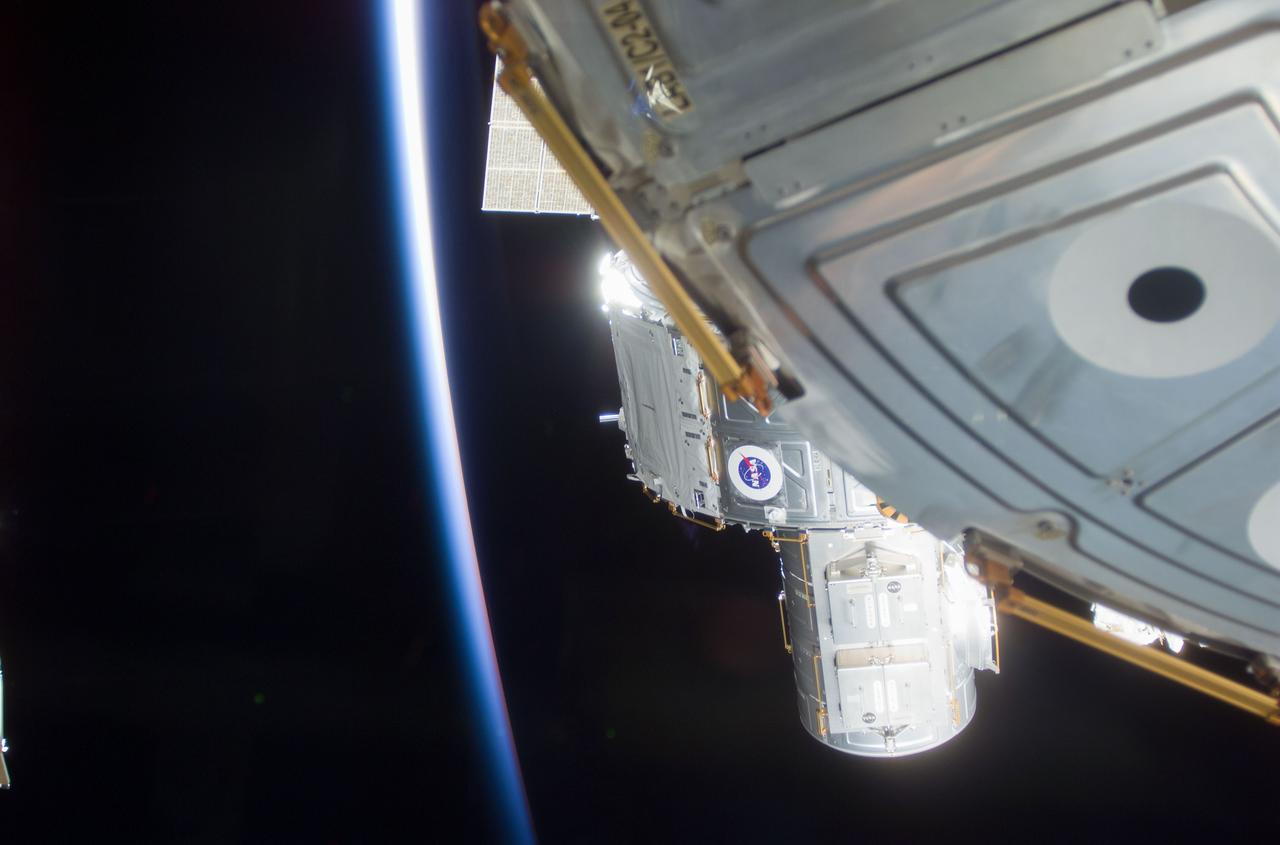
S104-E-5071 (15 July 2001) --- As the sun sets behind the Earth's horizon, the Expedition Two and STS-104 crews continue to install the Quest Airlock onto the starboard side of Unity Node 1. Susan J. Helms, Expedition Two flight engineer, working in the Destiny U.S. Laboratory, maneuvered the Airlock into place with the Canadarm2, Space Station Remote Manipulator System (SSRMS), while being assisted by Michael L. Gernhardt and James F. Reilly, STS-104 mission specialists, during their first extravehicular activity (EVA).
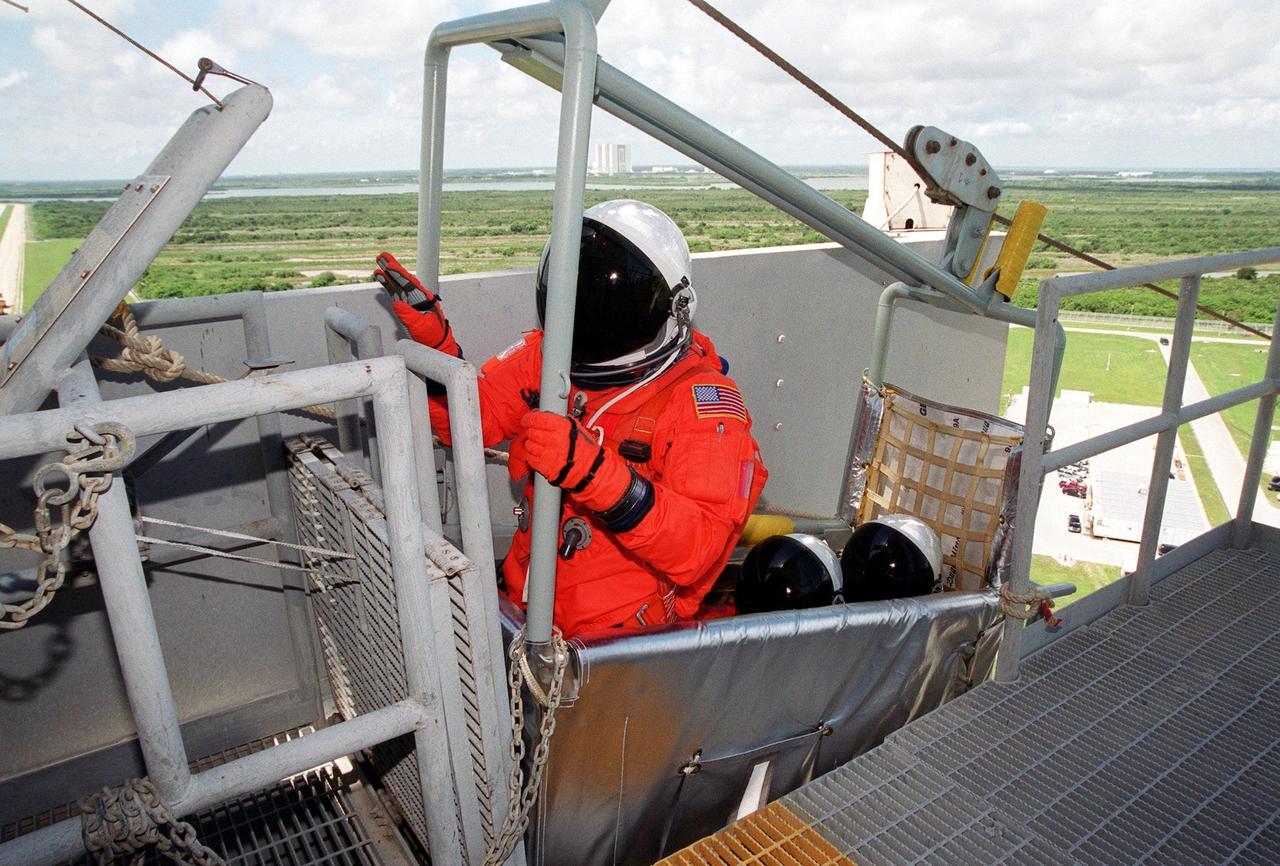
KENNEDY SPACE CENTER, Fla. -- On Launch Pad 39B, STS-104 Mission Specialist James F. Reilly reaches for the lever that will send the slidewire basket he is in speeding to the landing field below. Seated behind Reilly are Mission Specialists Janet Lynn Kavandi and Michael L. Gernhardt. They and other crew members are taking part in Terminal Countdown Demonstration Test activities, which include the emergency egress training and a simulated countdown exercise. The launch of Atlantis on mission STS-104 is scheduled July 12. The mission is the 10th flight to the International Space Station and carries the Joint Airlock Module and High Pressure Gas Assembly
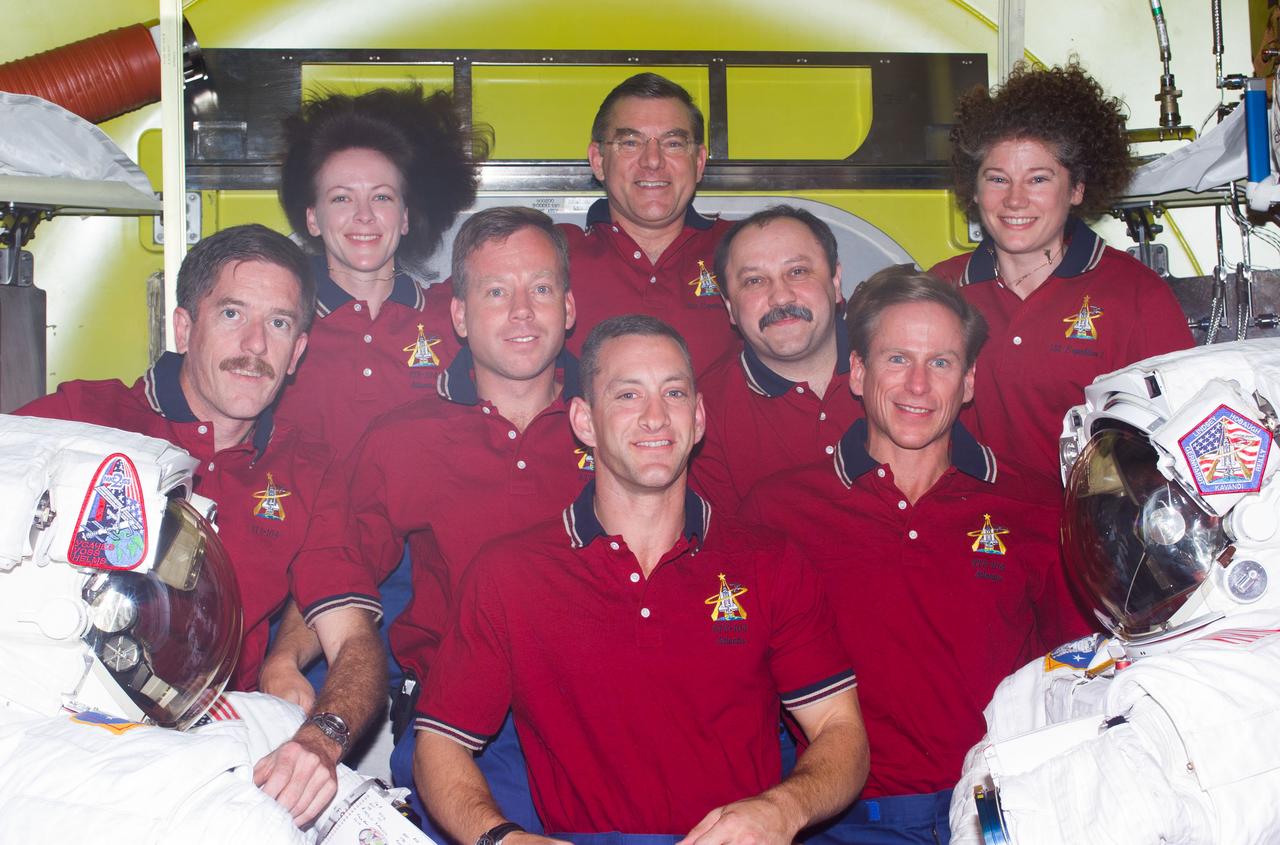
STS104-E-5177 (20 July 2001) --- Seven astronauts and a cosmonaut representing Rosaviakosmos take a break in joint activities involving the Expedition Two and STS-104 crews to pose for an in-flight portrait in the newly delivered Quest Airlock on the International Space Station (ISS). Flanked by two extravehicular mobility unit (EMU) space suits, Charles O. Hobaugh is in front. On the second row are, from the left, James F. Reilly, Steven W. Lindsey, Yury V. Usachev and Michael L. Gernhardt. In the rear are Janet L. Kavandi, James S. Voss and Susan J. Helms. Usachev, commander; along with Voss and Helms, both flight engineers, comprise the Expedition Two crew. Lindsey is STS-104 commander, with Hobaugh serving as pilot. Kavandi, STS-104 flight engineer, is joined by Gernhardt and Reilly as mission specialists on the mission. This image was recorded with a digital still camera.
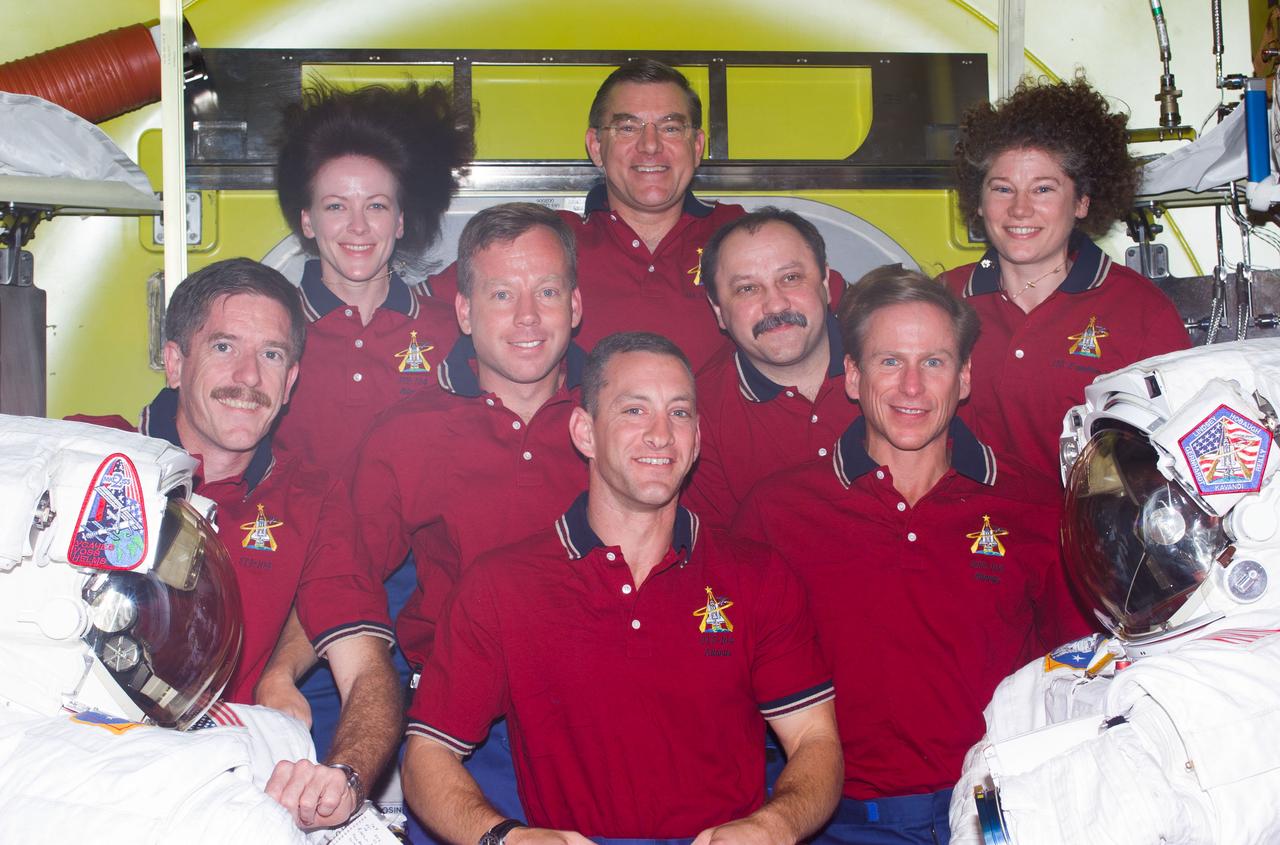
STS104-E-5178 (20 July 2001) --- Seven astronauts and a cosmonaut representing Rosaviakosmos take a break in joint activities involving the Expedition Two and STS-104 crews to pose for an inflight portrait in the newly delivered Quest Airlock on the International Space Station (ISS). Charles O. Hobaugh is in front. On the second row are, from the left, James F. Reilly, Steven W. Lindsey, Yury V. Usachev and Michael L. Gernhardt. In the rear are astronauts Janet L. Kavandi, James S. Voss and Susan J. Helms. Usachev, commander; along with Voss and Helms, both flight engineers, comprise the Expediton Two crew. Lindsey is STS-104 commander, with Hobaugh serving as pilot. Kavandi, STS-104 flight engineer, is joined by Gernhardt and Reilly as mission specialists on the mission. This image was recorded with a digital still camera.
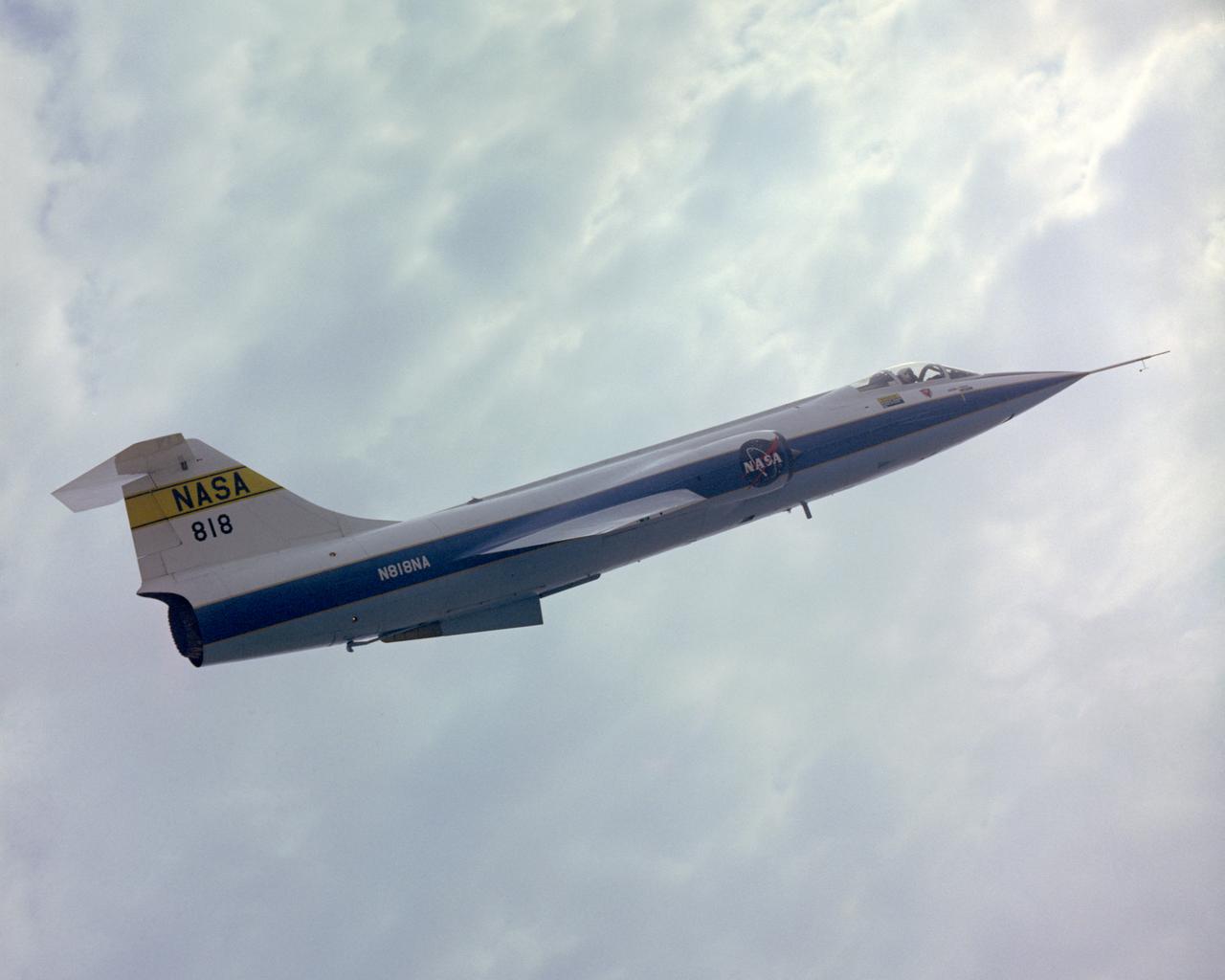
F-104A #818 flown by Einar Enevoldson. 4/11/75 NASA DFRC EC76-5079 NASA Photo by Bob Rhine
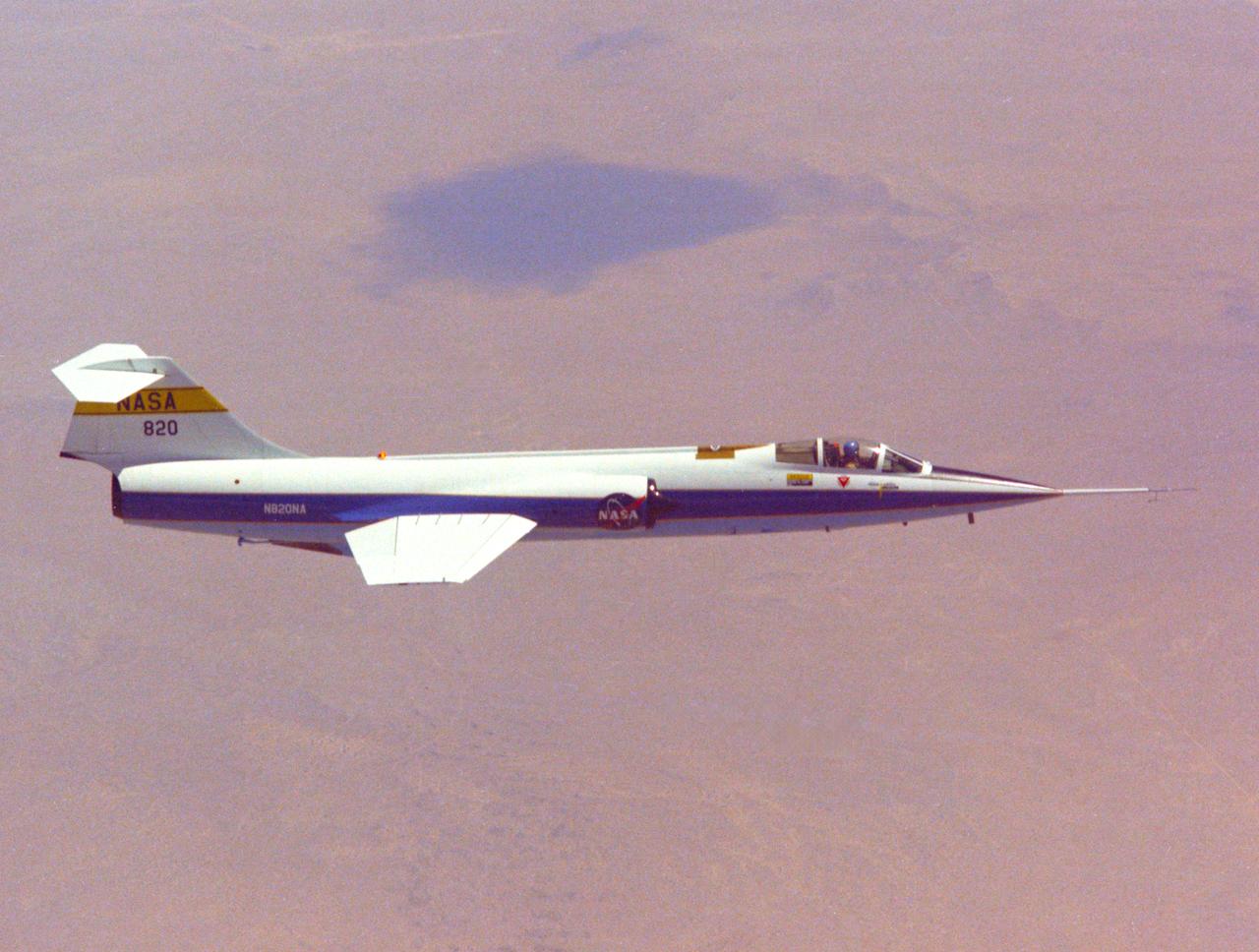
F-104A #820 in flight 8/23/71 NASA DFRC EC71-2811
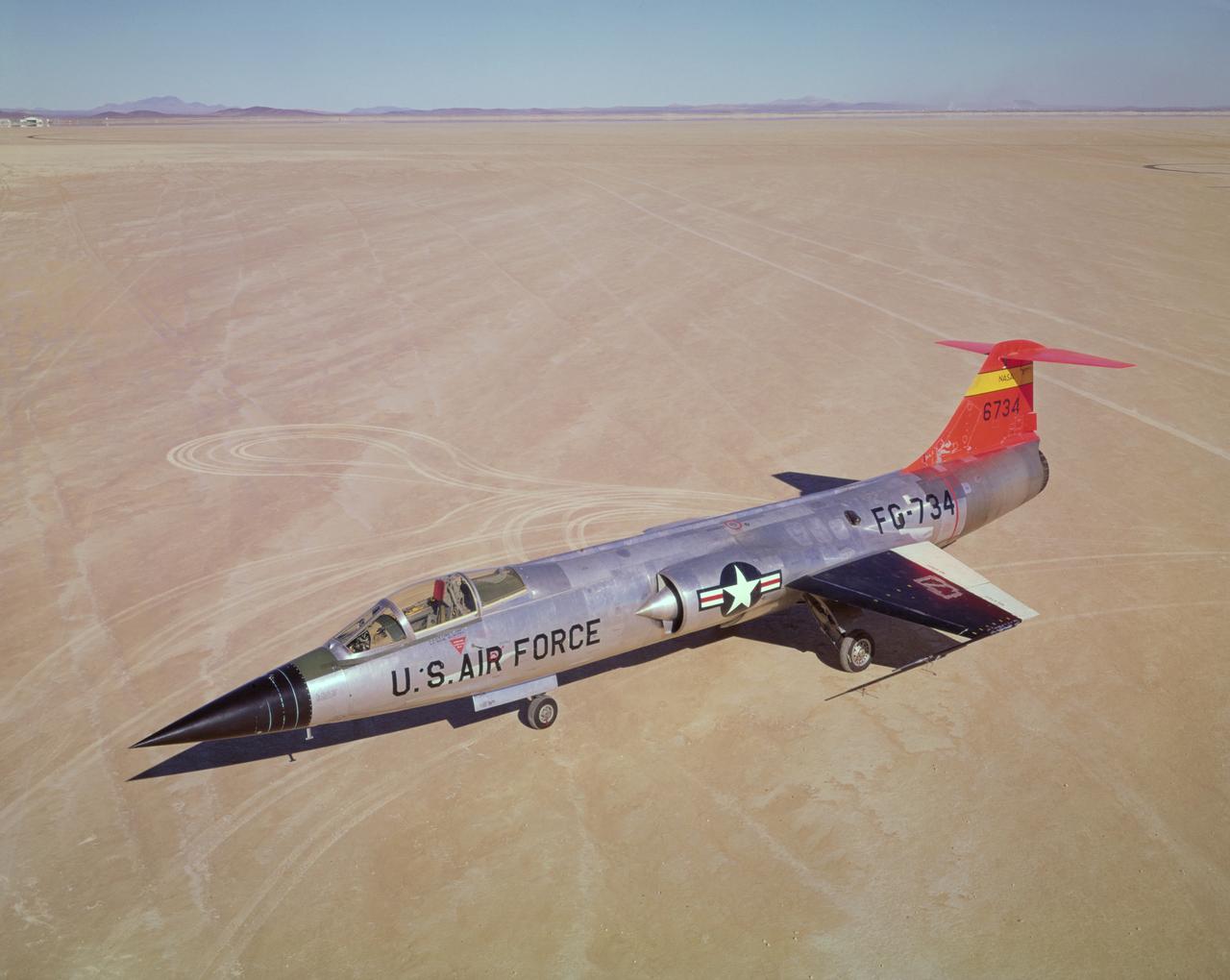
F-104A #734 on lakebed. 11/16/60
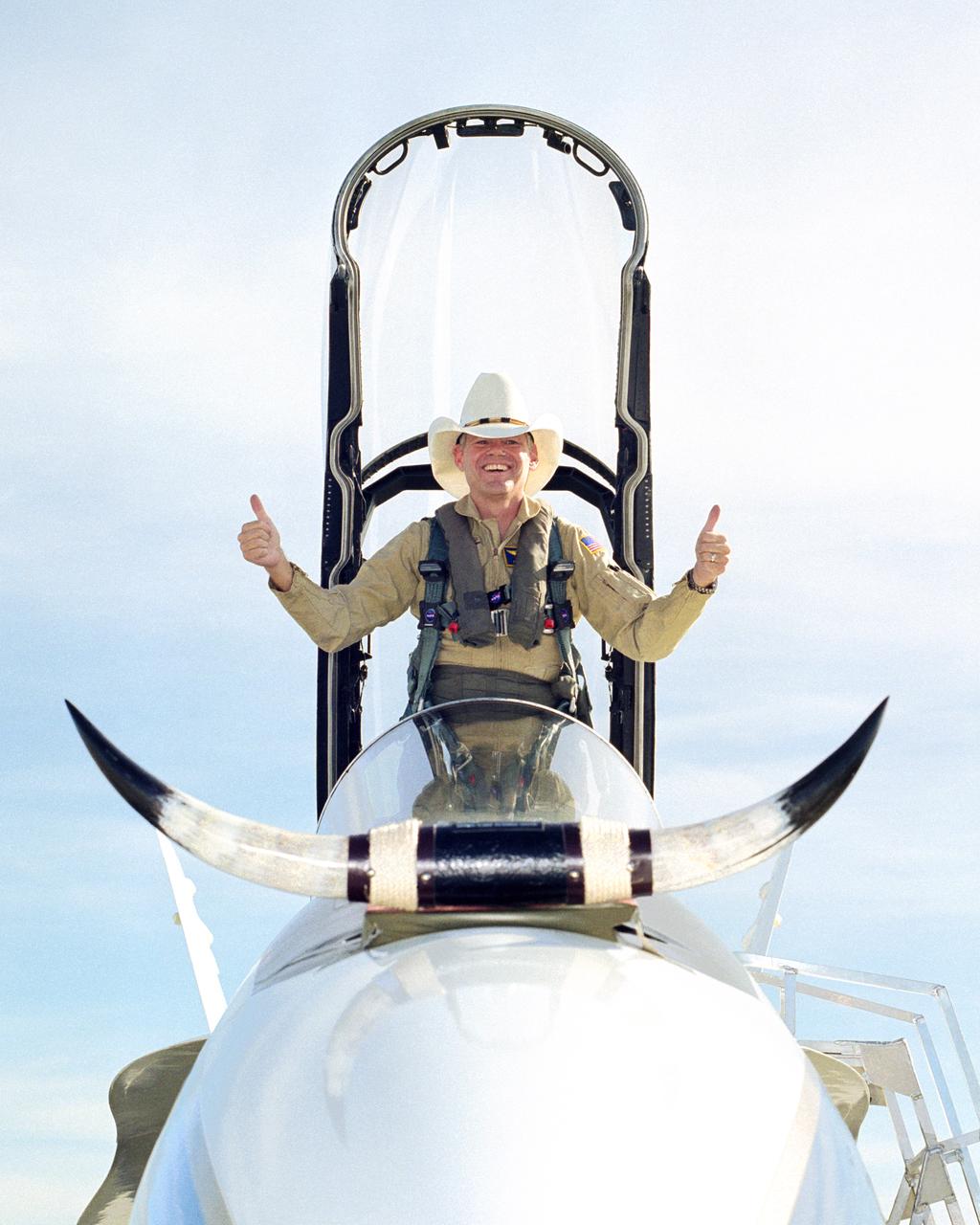
In a lighter mood, Ed Schneider gives a "thumbs-up" after his last flight at the Dryden Flight Research Center on September 19, 2000. Schneider arrived at the NASA Ames-Dryden Flight Research Facility on July 5, 1982, as a Navy Liaison Officer, becoming a NASA research pilot one year later. He has been project pilot for the F-18 High Angle-of-Attack program (HARV), the F-15 aeronautical research aircraft, the NASA B-52 launch aircraft, and the SR-71 "Blackbird" aircraft. He also participated in such programs as the F-8 Digital Fly-By-Wire, the FAA/NASA 720 Controlled Impact Demonstration, the F-14 Automatic Rudder Interconnect and Laminar Flow, and the F-104 Aeronautical Research and Microgravity projects.
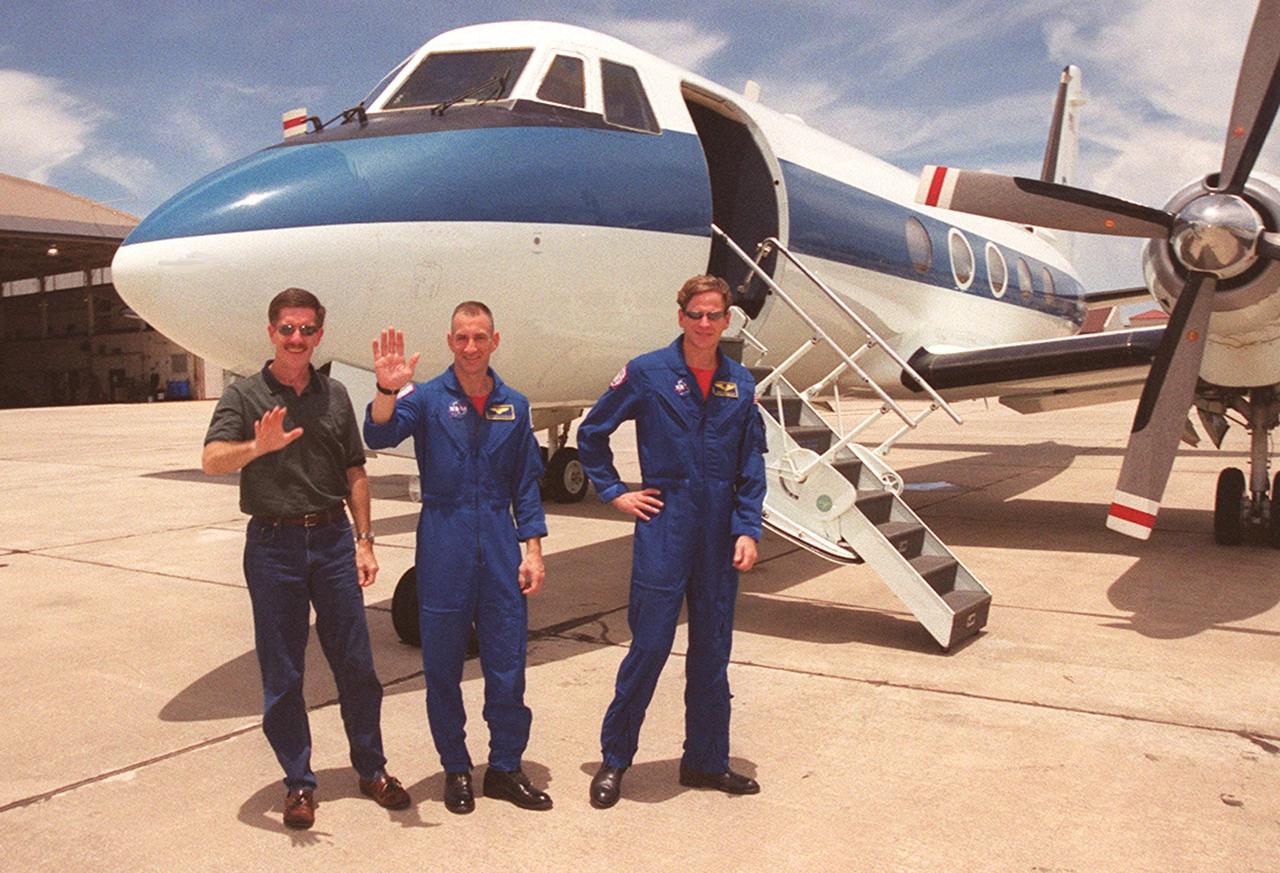
KENNEDY SPACE CENTER, Fla. -- Members of the STS-104 crew get ready to return to Houston after their successful mission to the International Space Station. Leaving from Patrick Air Force Base are (left to right) Mission Specialist James F. Reilly, Pilot Charles O. Hobaugh and Mission Specialist Michael L. Gernhardt. The crew completed their mission Tuesday, July 24, landing at KSC after 13 days in orbit
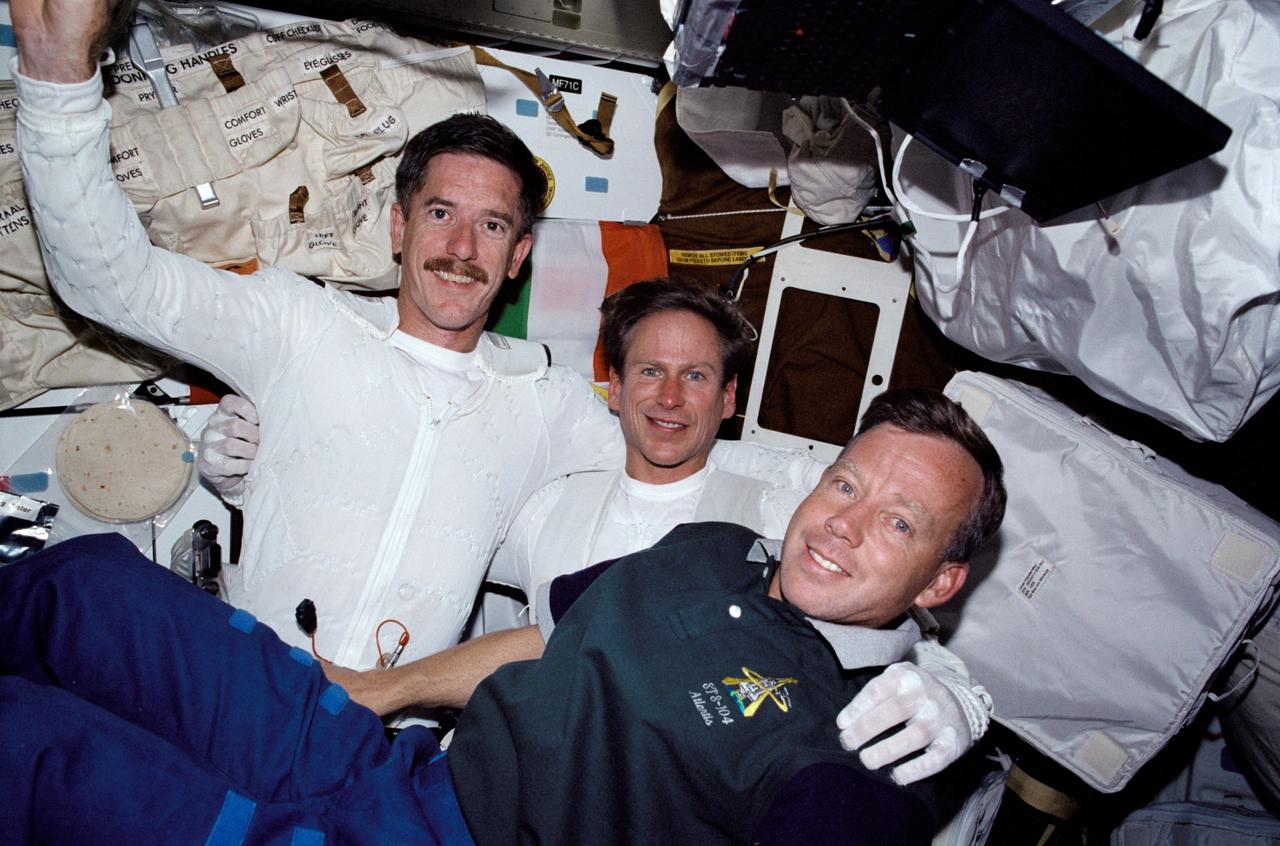
STS104-326-037 (12-24 July 2001) --- Astronaut Steven W. Lindsey (right), STS-104 mission commander, is pictured on Atlantis' mid deck with the assigned space walkers for the 12-day mission following one of their three days of extravehicular activity (EVA). In the special undergarments for their extravehicular mobility units (EMU) are astronauts James F. Reilly (left) and Michael L. Gernhardt.
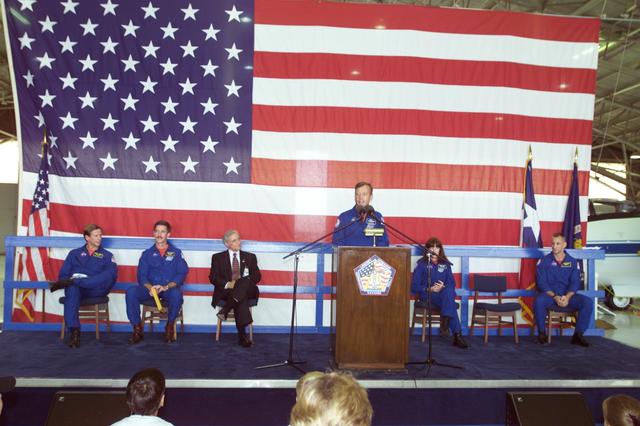
JSC2001-E-22794 (25 July 2001) --- Astronaut Steven W. Lindsey, STS-104 mission commander, addresses a crowd at Ellington Field’s Hangar 990 for a crew return ceremony. Seated from the left are Michael L. Gernhardt, James F. Reilly, both mission specialist, and Roy S. Estess, JSC Acting Director, along with Janet L. Kavandi, mission specialist, and Charles O. Hobaugh, pilot.
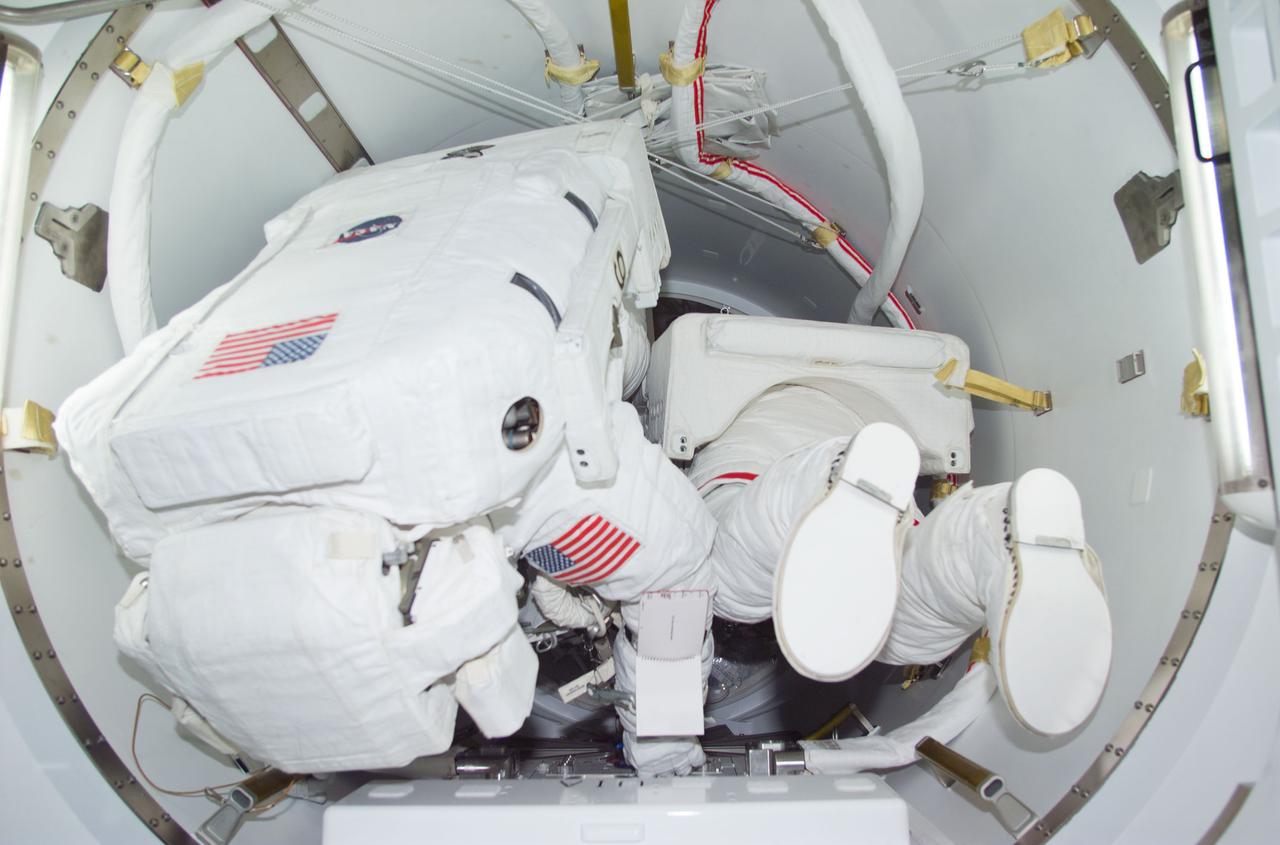
STS104-E-5200 (20 July 2001) --- Though it was a bit before Friday midnight in Houston, it was already into the morning hours of Saturday by Greenwich Mean Time (GMT) when astronauts James F. Reilly (left) and Michael L. Gernhardt were photographed with a digital still camera in the Crew Lock prior to depressurization of the compartment for the third and final space walk of STS-104.
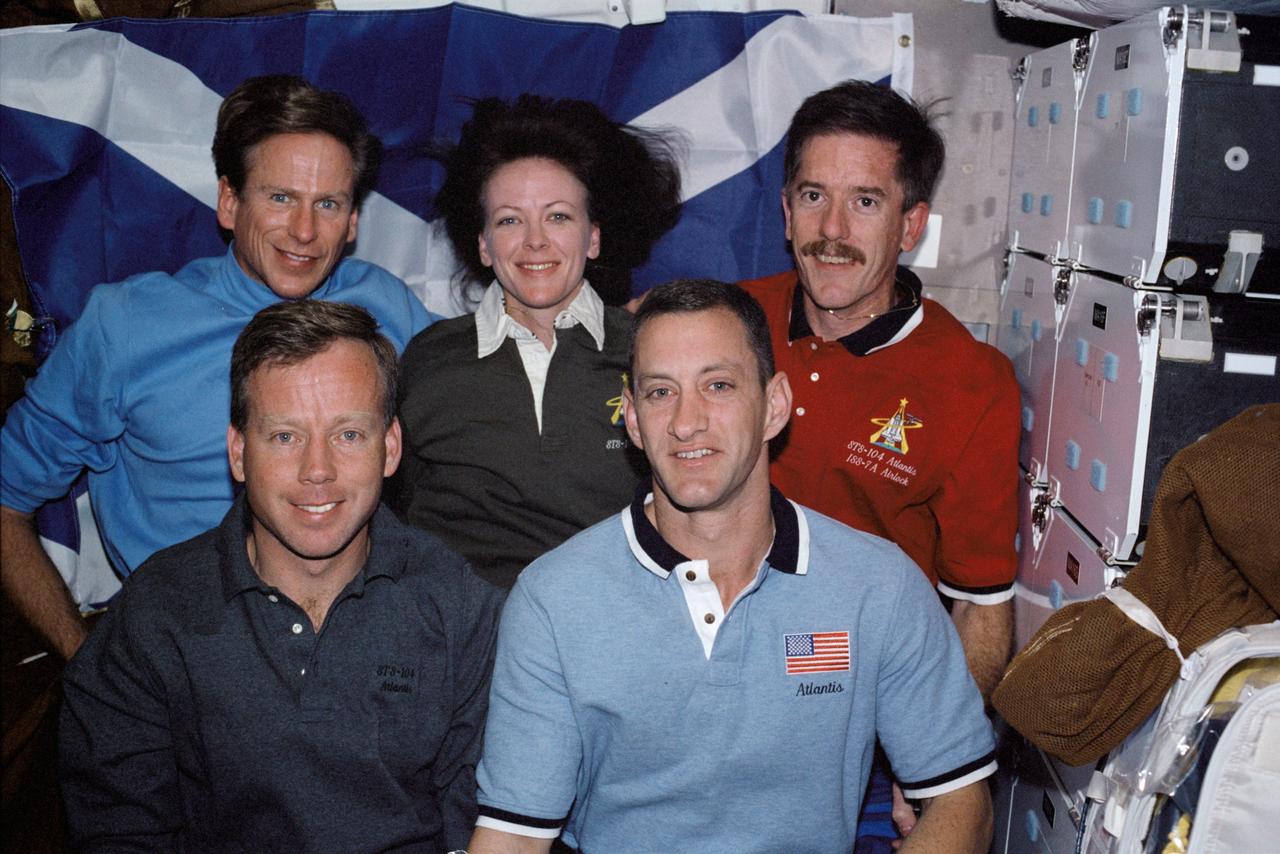
STS104-337-004 (12-24 July 2001) --- The STS-104 astronauts took a moment from a busy agenda to pose for their traditional in-flight crew portrait. In front are astronauts Steven W. Lindsey (left) and Charles O. Hobaugh, commander and pilot, respectively. From left in back are astronauts Michael L. Gernhardt, Janet L. Kavandi and James F. Reilly, all mission specialists.
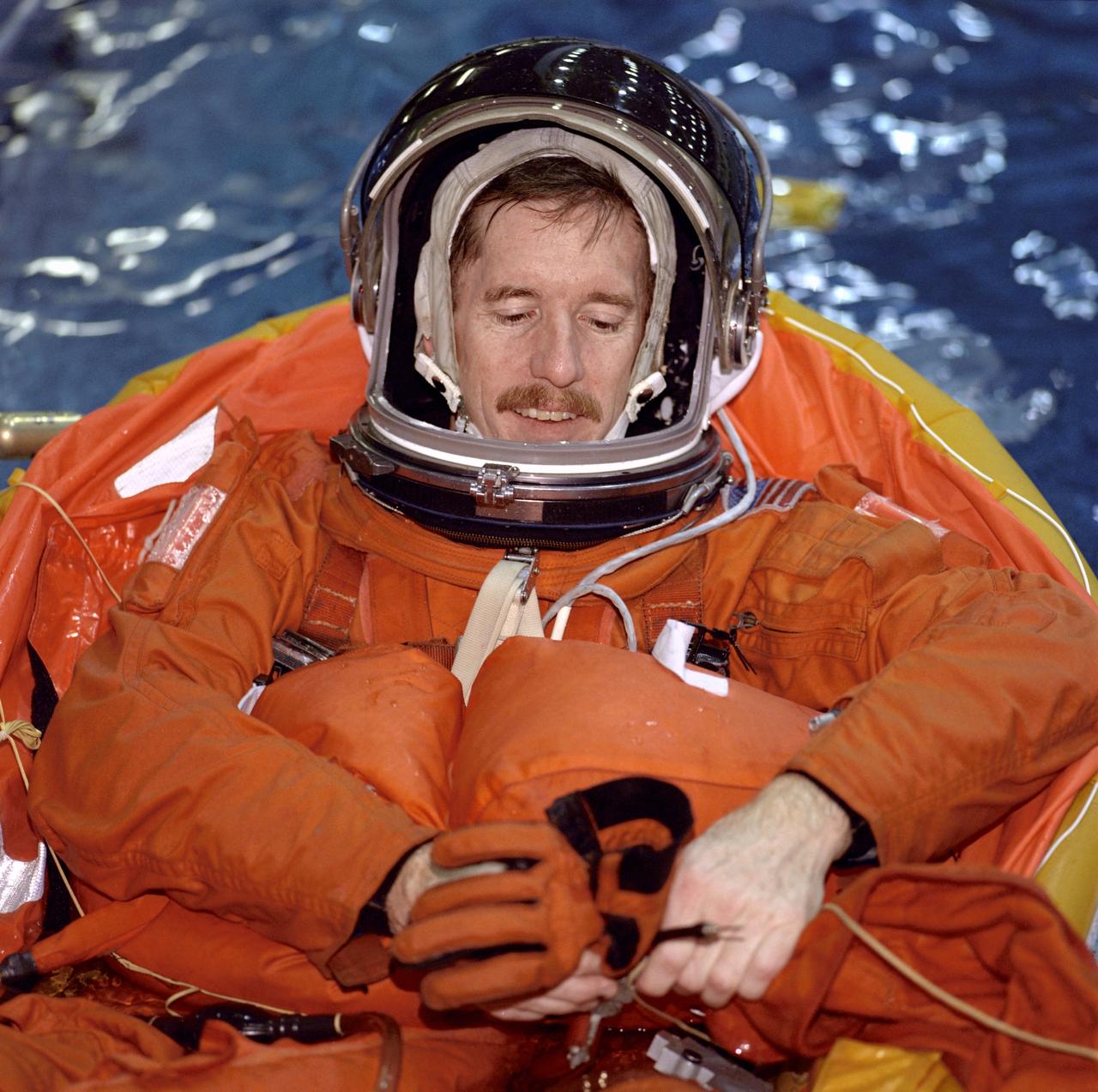
JSC2001-00010 (January 2001) --- Astronaut James F. Reilly, STS-104 mission specialist, floats in a small life raft during an emergency egress training session at the Neutral Buoyancy Laboratory (NBL) near the Johnson Space Center (JSC). Reilly will join four other astronauts for a June mission to the International Space Station (ISS).
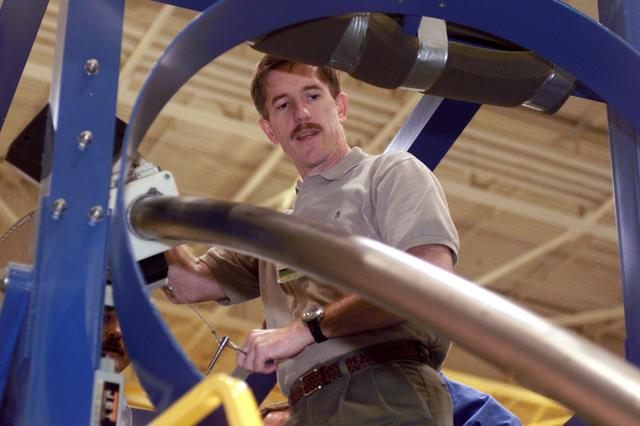
JSC2001-E-06401 (27 February 2001) --- Astronaut James F. Reilly, mission specialist, rehearses emergency egress procedures in the Systems Integration Facility at the Johnson Space Center (JSC). The long tube at left is a training version of the launch escape pole which is now carried onboard for all shuttle flights. The STS-104 mission to the International Space Station (ISS) represents the Space Shuttle Atlantis' first flight using a new engine and is targeted for a liftoff no earlier than June 14, 2001.
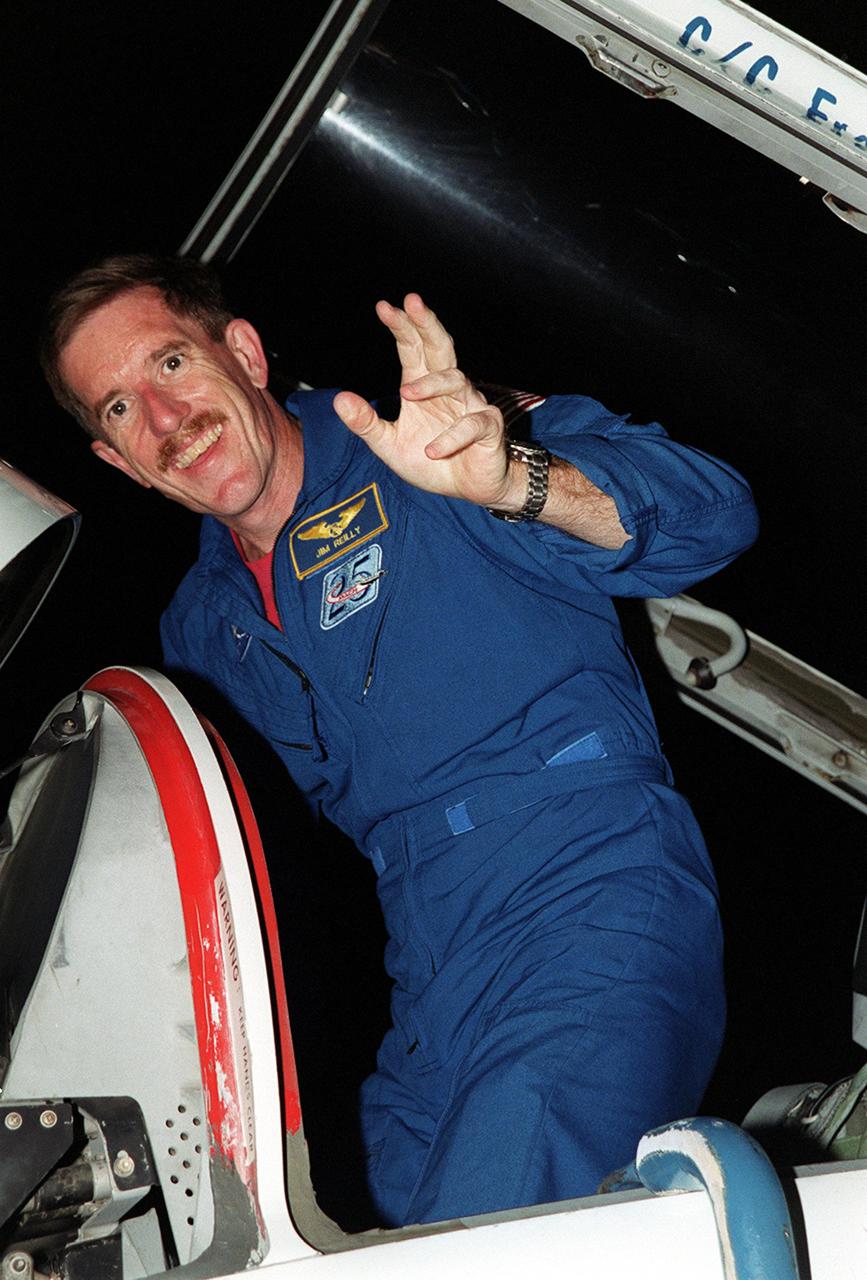
KENNEDY SPACE CENTER, Fla. -- STS-104 Mission Specialist James F. Reilly arrives at the KSC Shuttle Landing Facility to make final preparations for launch of Space Shuttle Atlantis July 12. The mission is the 10th assembly flight to the International Space Station and carries the Joint Airlock Module, which will become the primary path for spacewalk entry and departure using both U.S. spacesuits and the Russian Orlan spacesuit for EVA activity
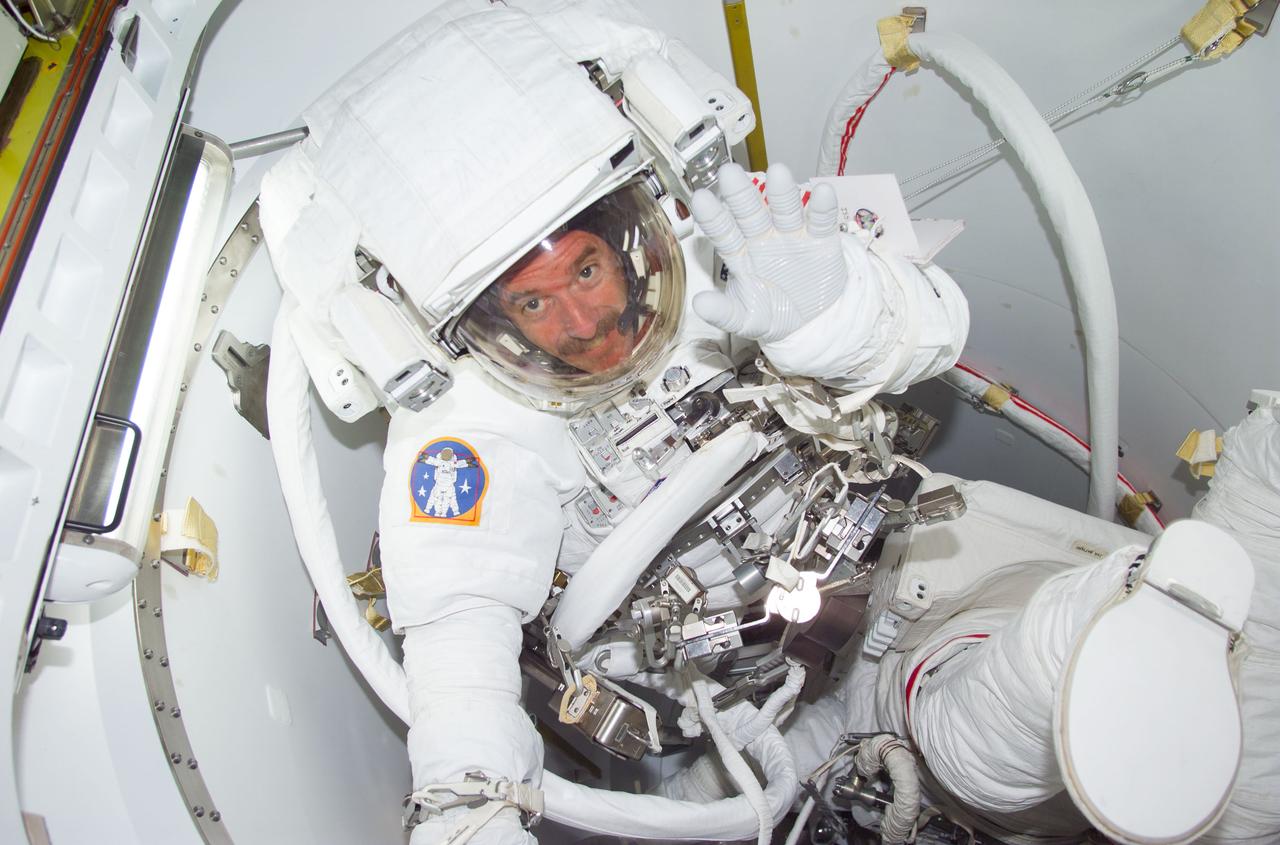
STS104-E-5202 (20 July 2001) --- Though it was a bit before Friday midnight in Houston, it was already into the morning hours of Saturday by Greenwich Mean Time (GMT) when astronauts James F. Reilly (facing camera) and Michael L. Gernhardt were photographed with a digital still camera in the Crew Lock prior to depressurization of the compartment for the third and final space walk of STS-104.
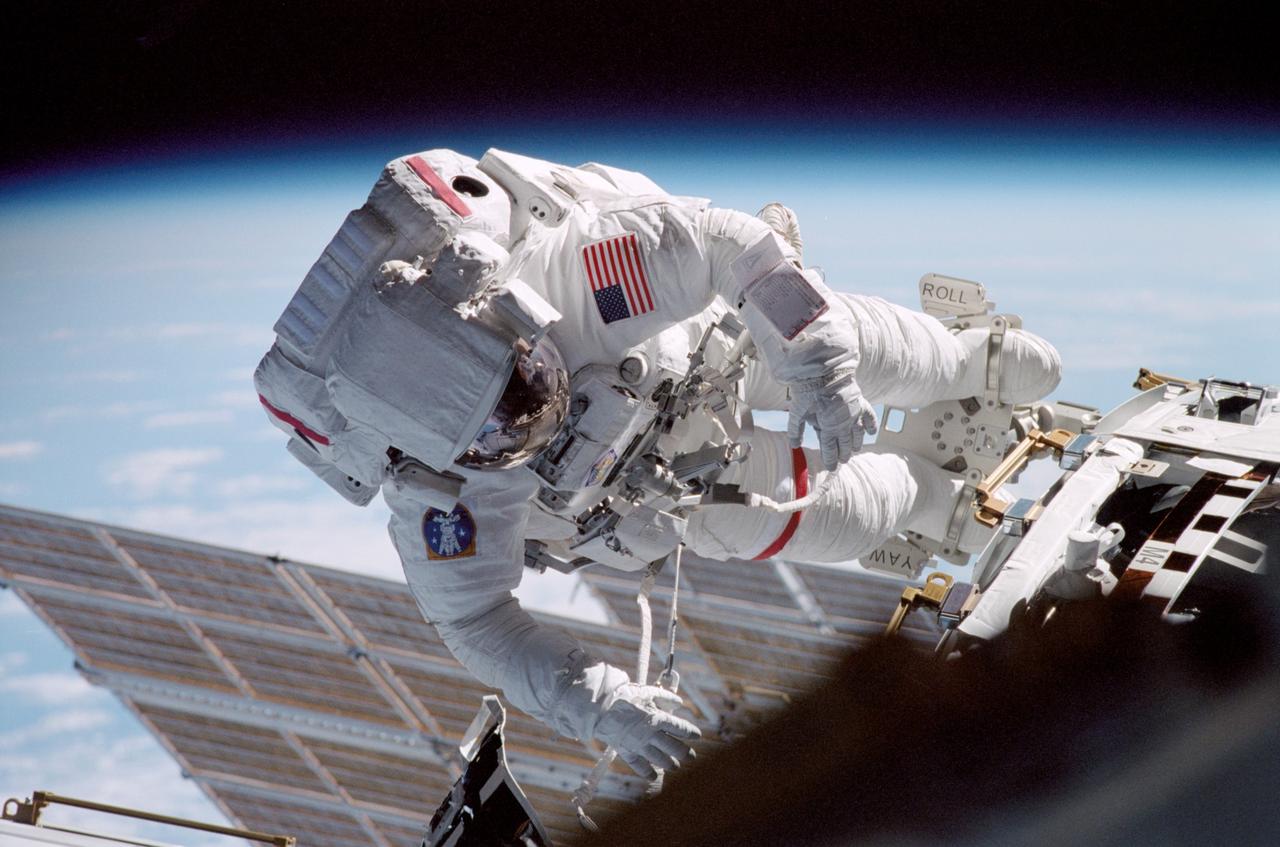
STS104-315-005 (12-24 July 2001) --- With Earth's horizon in the background, astronaut Michael L. Gernhardt, STS-104 mission specialist, participates in one of three space walks aimed toward wrapping up the completion of work on the second phase of the International Space Station (ISS). Gernhardt was joined on the extravehicular activity (EVA) by astronaut James F. Reilly.
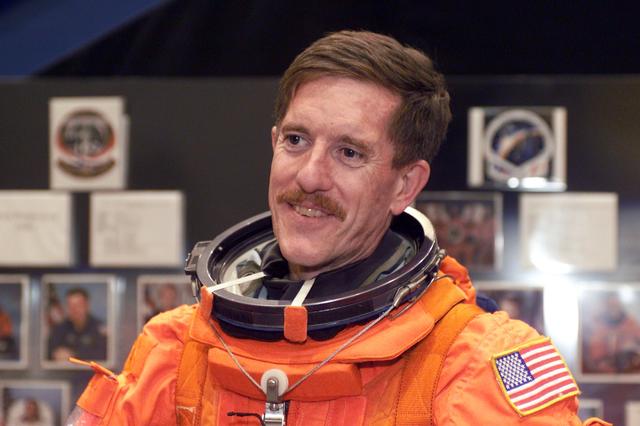
JSC2001-E-06418 (27 February 2001) --- Astronaut James F. Reilly, mission specialist, is pictured while in training at the Systems Integration Facility at Johnson Space Center (JSC). The STS-104 mission to the International Space Station (ISS) represents the Space Shuttle Atlantis' first flight using a new engine and is targeted for a liftoff no earlier than June 14, 2001.
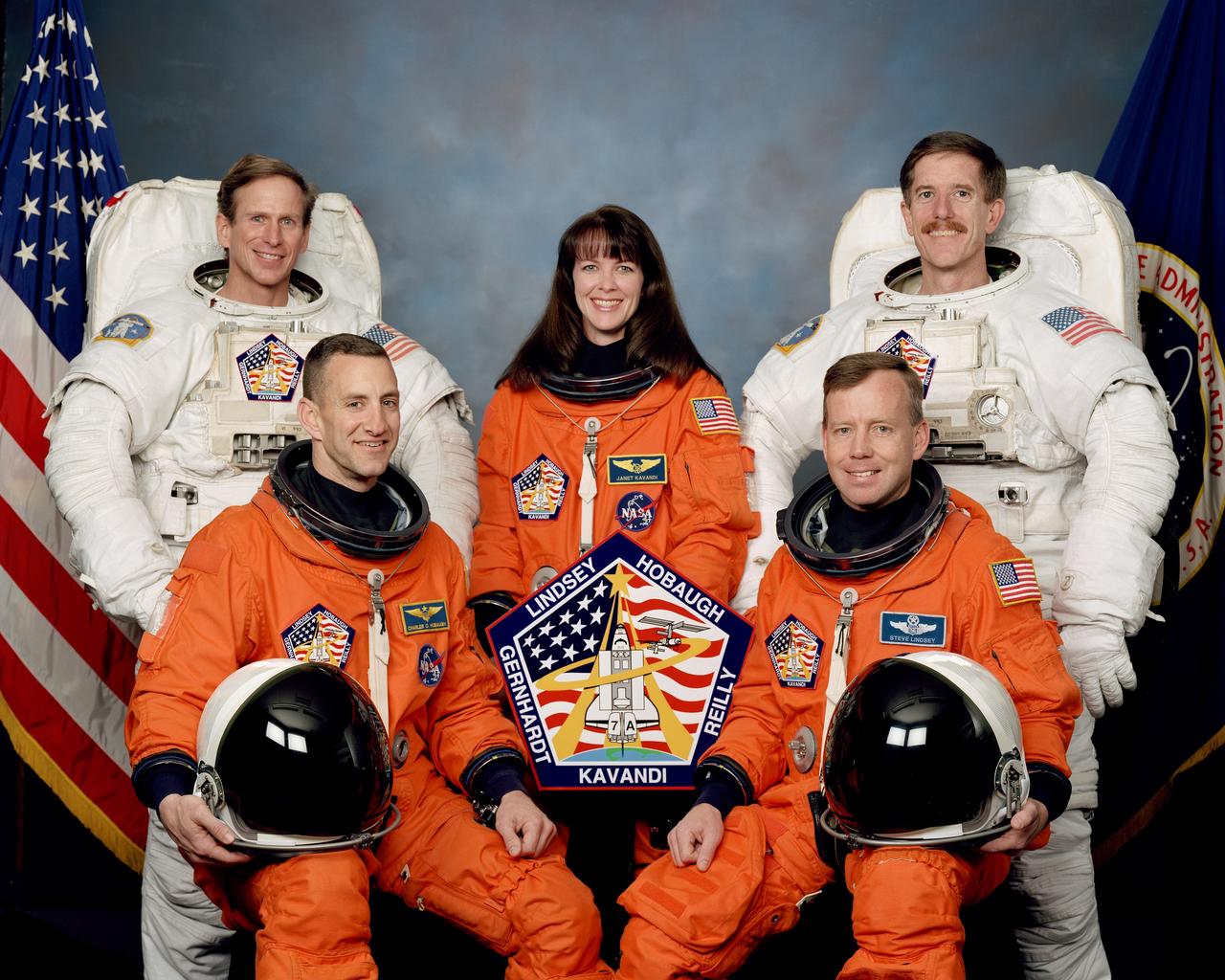
STS104-S-002 (May 2001) --- These five astronauts are currently in training for the STS-104 mission, scheduled for a June 2001 liftoff. Seated with the crew insignia are astronauts Steven W. Lindsey (right), mission commander; and Charles O. Hobaugh, pilot. Standing, from left, are astronauts Michael L. Gernhardt, Janet L. Kavandi and James F. Reilly, all mission specialists.
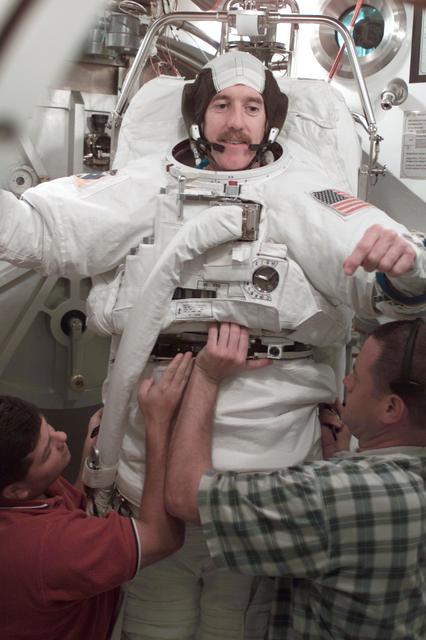
JSC2001-E-11692 (9 April 2001) --- Astronaut James F. Reilly, mission specialist, prepares to don his helmet for an Extravehicular Mobility Unit (EMU) fit check in one of the chambers in the Crew Systems Laboratory at the Johnson Space Center (JSC). The STS-104 mission to the International Space Station (ISS) represents the Space Shuttle Atlantis' first flight using a new engine and is targeted for a liftoff no earlier than June 14, 2001.
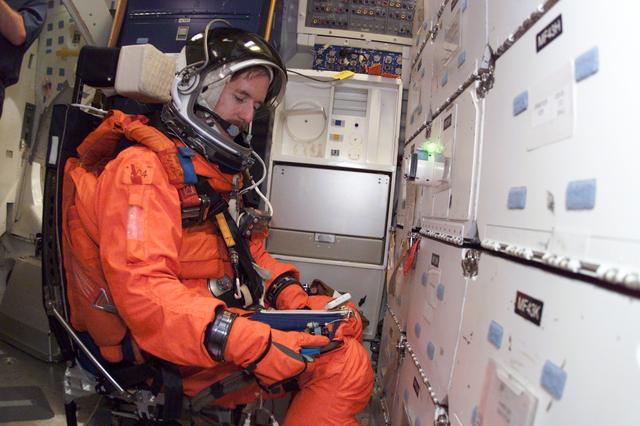
JSC2001-E-06426 (27 February 2001) --- Astronaut James F. Reilly, mission specialist, makes a notation during mission training in one of the high fidelity trainers/mockups in the Systems Integration Facility at Johnson Space Center (JSC). The STS-104 mission to the International Space Station (ISS) represents the Space Shuttle Atlantis' first flight using a new engine and is targeted for a liftoff no earlier than June 14, 2001.
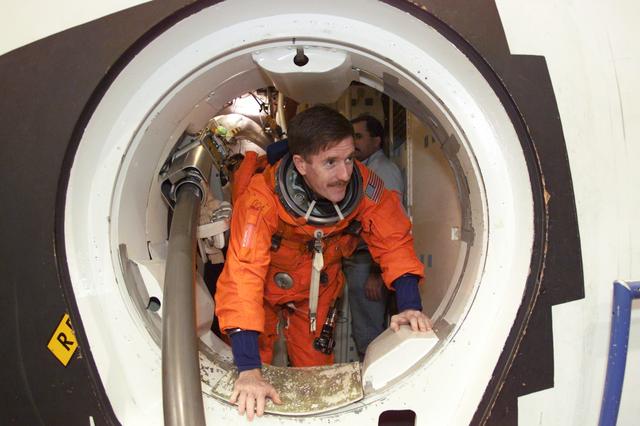
JSC2001-E-06422 (27 February 2001) --- Astronaut James F. Reilly, mission specialist, rehearses emergency egress procedures in the Systems Integration Facility at the Johnson Space Center (JSC). The long tube at left is a training version of the launch escape pole which is now carried onboard for all shuttle flights. The STS-104 mission to the International Space Station (ISS) represents the Space Shuttle Atlantis' first flight using a new engine and is targeted for a liftoff no earlier than June 14, 2001.
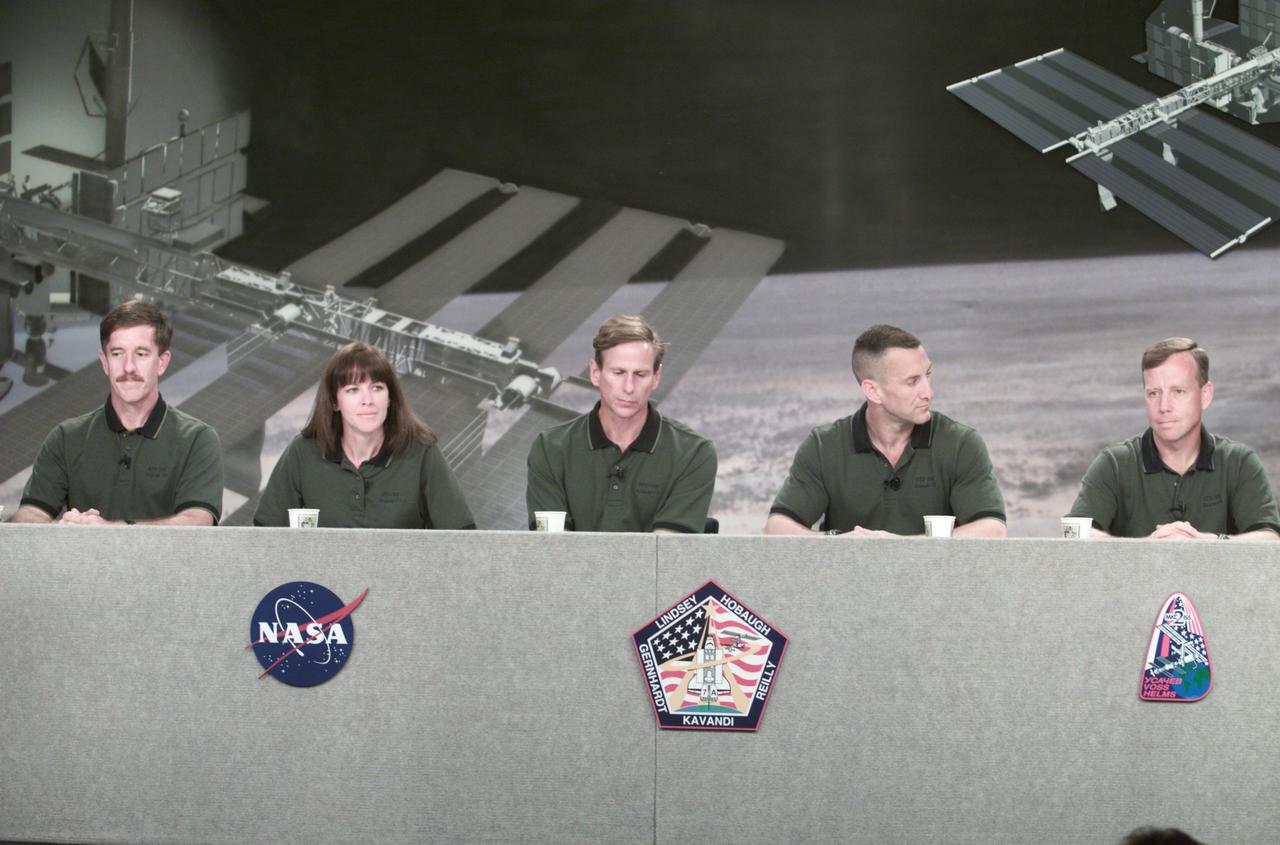
JSC2001-E-19296 (25 June 2001) --- Astronauts James F. Reilly (left), Janet L. Kavandi, Michael L. Gernhardt, all STS-104 mission specialists; along with Charles O. Hobaugh and Steven W. Lindsey, pilot and mission commander, respectively, are photographed during a pre-flight press conference at Johnson Space Center (JSC).
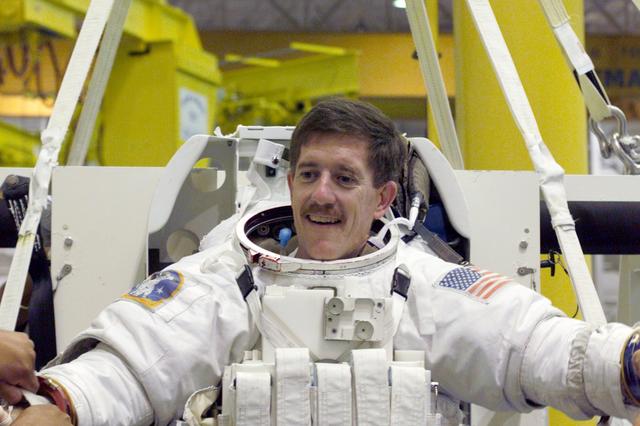
JSC2001-E-10909 (13 April 2001) --- Astronaut James F. Reilly, mission specialist, gets help with final touches on the training version of his Extravehicular Mobility Unit (EMU) space suit prior to being submerged in the waters of the Neutral Buoyancy Laboratory (NBL) at the Johnson Space Center (JSC). The STS-104 mission to the International Space Station (ISS) represents the Space Shuttle Atlantis’ first flight using a new engine and is targeted for a liftoff no earlier than June 14, 2001.
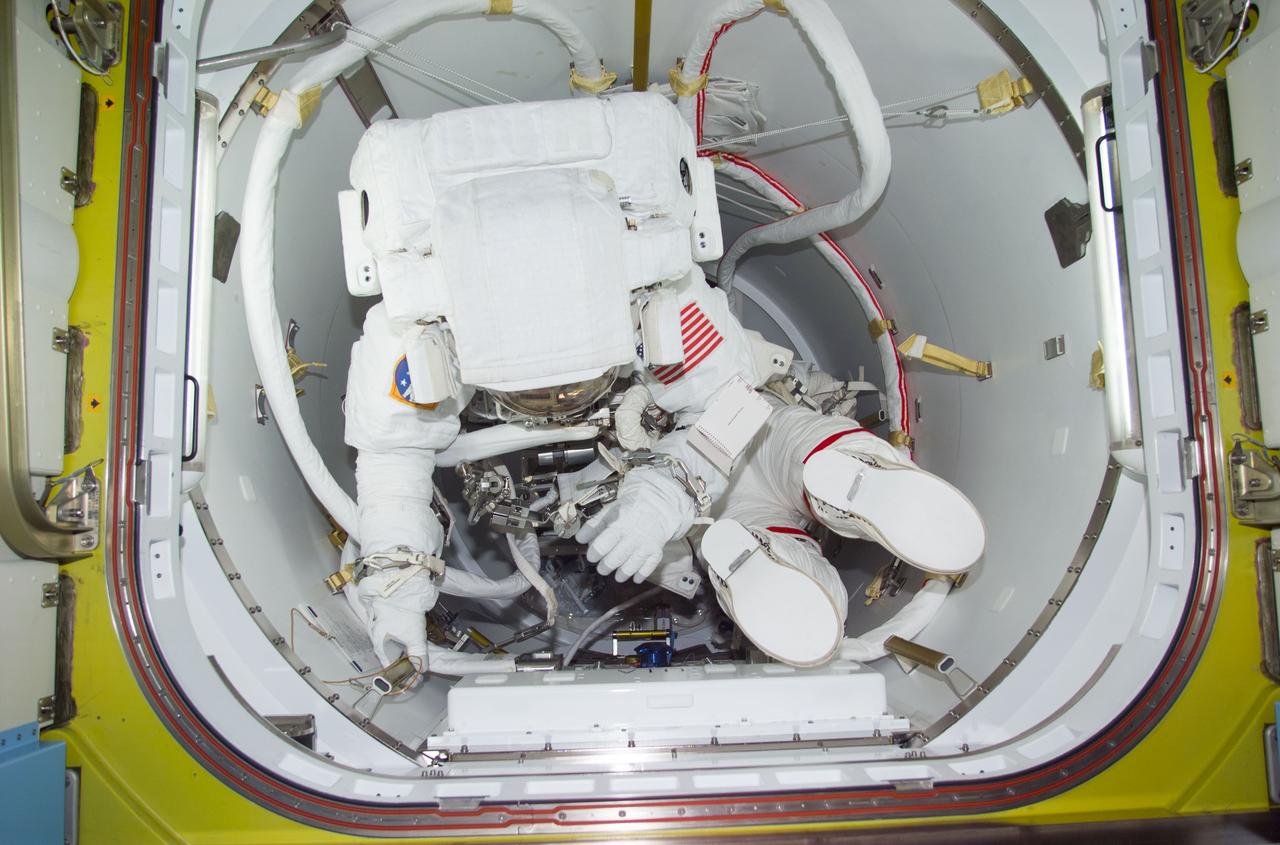
STS104-E-5201 (20 July 2001) --- Though it was a bit before Friday midnight in Houston, it was already into the morning hours of Saturday by Greenwich Mean Time (GMT) when astronauts James F. Reilly (left) and Michael L. Gernhardt were photographed with a digital still camera in the Crew Lock prior to depressurization of the compartment for the third and final space walk of STS-104.
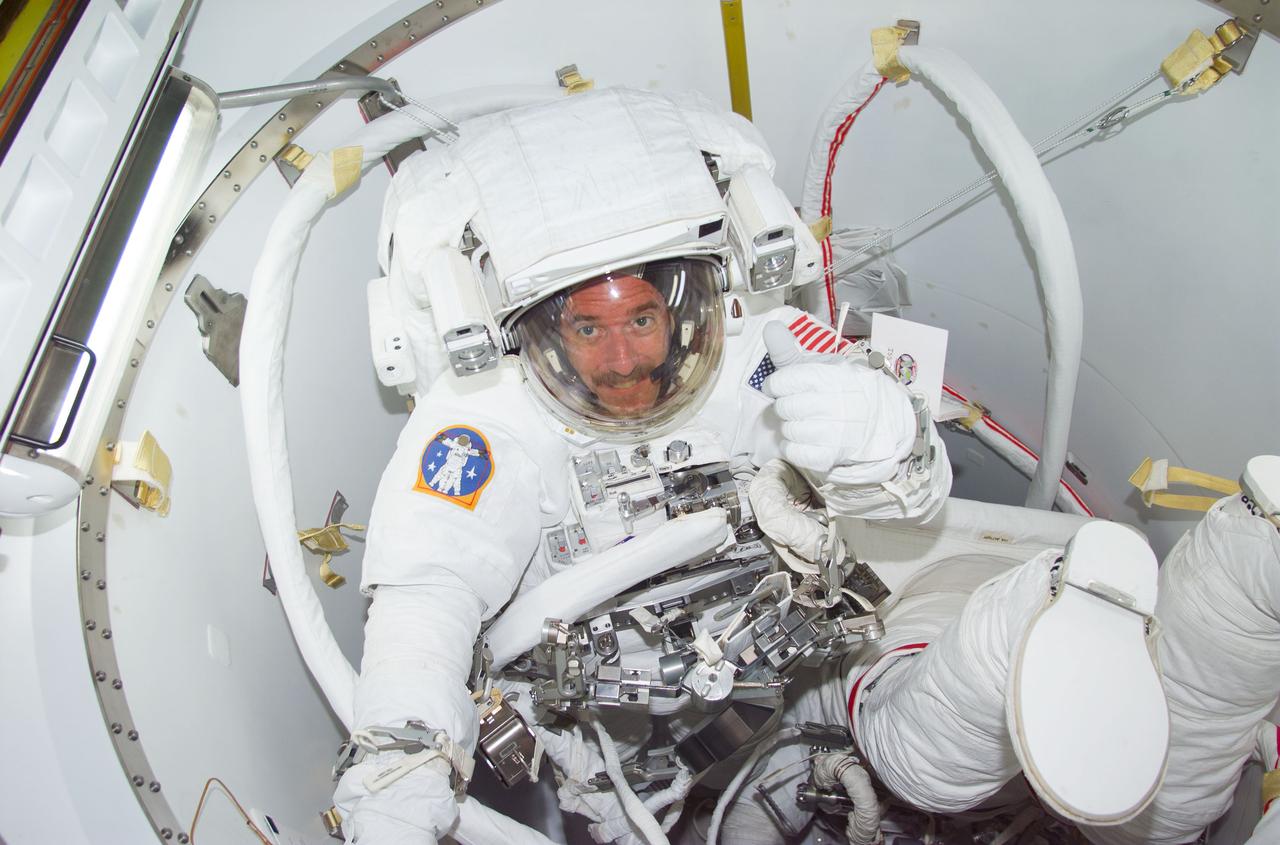
STS104-E-5203 (20 July 2001) --- Though it was a bit before Friday midnight in Houston, it was already into the morning hours of Saturday by Greenwich Mean Time (GMT) when astronauts James F. Reilly (facing camera) and Michael L. Gernhardt were photographed with a digital still camera in the Crew Lock prior to depressurization of the compartment for the third and final space walk of STS-104.
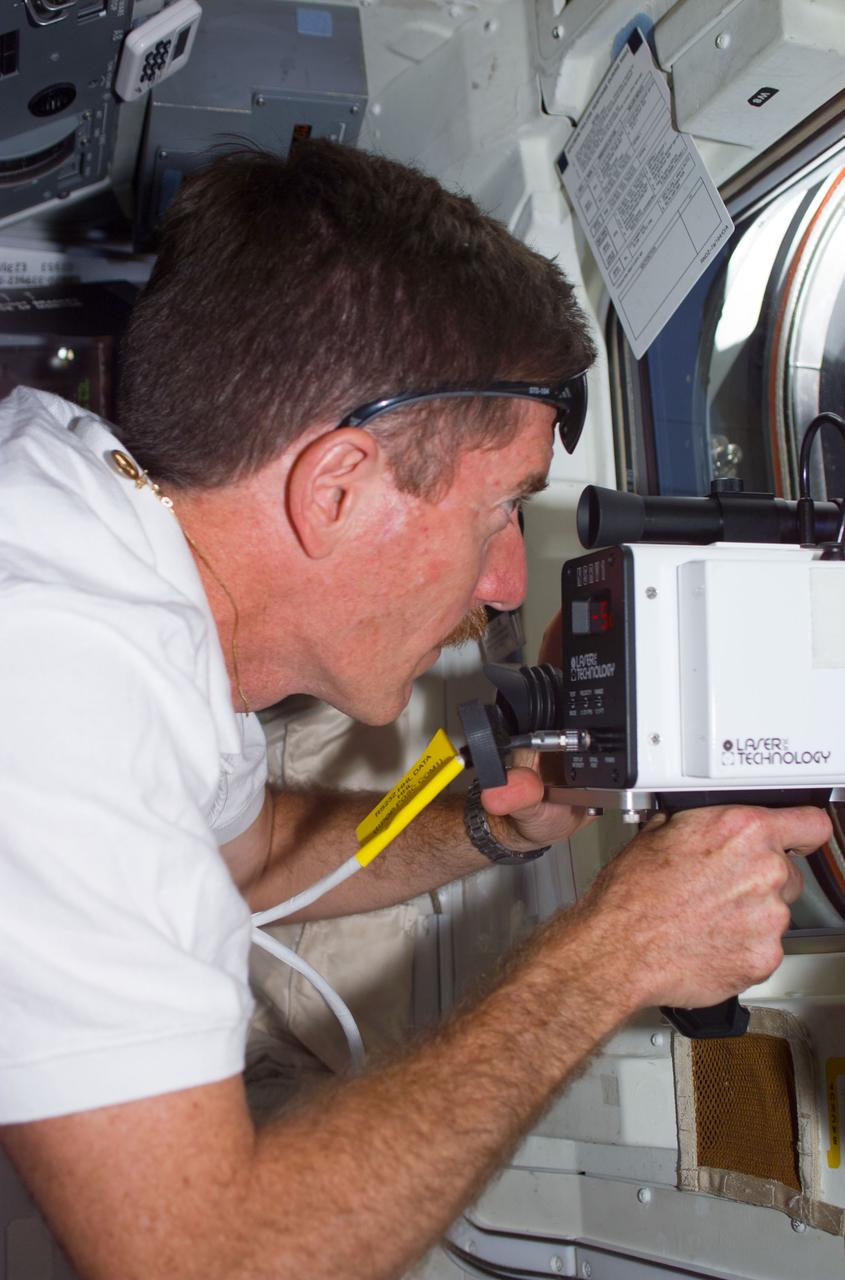
STS104-E-5026 (14 July 2001) --- Positioned near a window on the aft flight deck of the Space Shuttle Atlantis, astronaut James F. Reilly, STS-104 mission specialist, uses a laser ranging device to hone in on the International Space Station (ISS) during pre-docking operations about 237 miles above Earth.
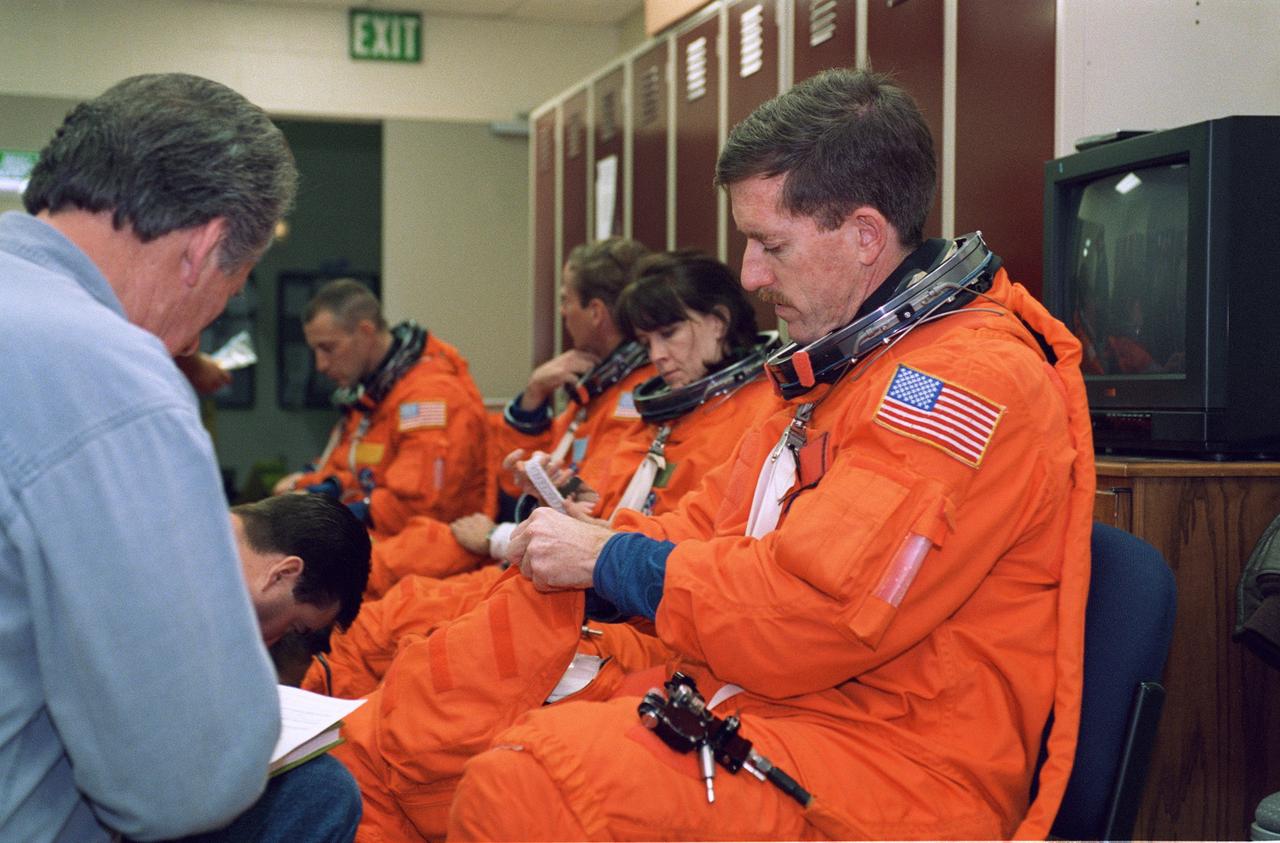
JSC2001-00083 (January 2001) --- Several members of the STS-104 crew, assisted by suit technician Jim Cheatham, don training versions of the full-pressure launch and entry suit prior to a training session in one of the trainer/mockups (out of frame) in the Johnson Space Center’s Systems Integration Facility. Pictured (from right foreground) are astronauts James F. Reilly, Janet L. Kavandi, Michael L. Gernhardt, and Charles O. Hobaugh.
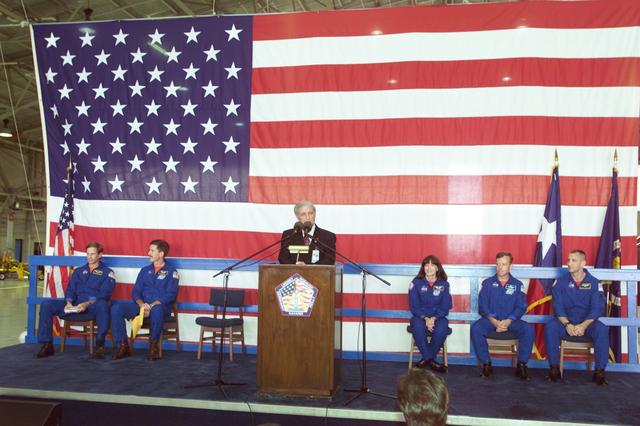
JSC2001-E-22791 (25 July 2001) --- JSC Acting Director Roy S. Estess introduces the STS-104 crew members to a crowd gathered in Ellington Field’s Hangar 990 during crew return ceremonies. Seated (from left) are Michael L. Gernhardt, James F. Reilly, Janet L. Kavandi, all mission specialists, along with Steven W. Lindsey and Charles O. Hobaugh, mission commander and pilot, respectively.
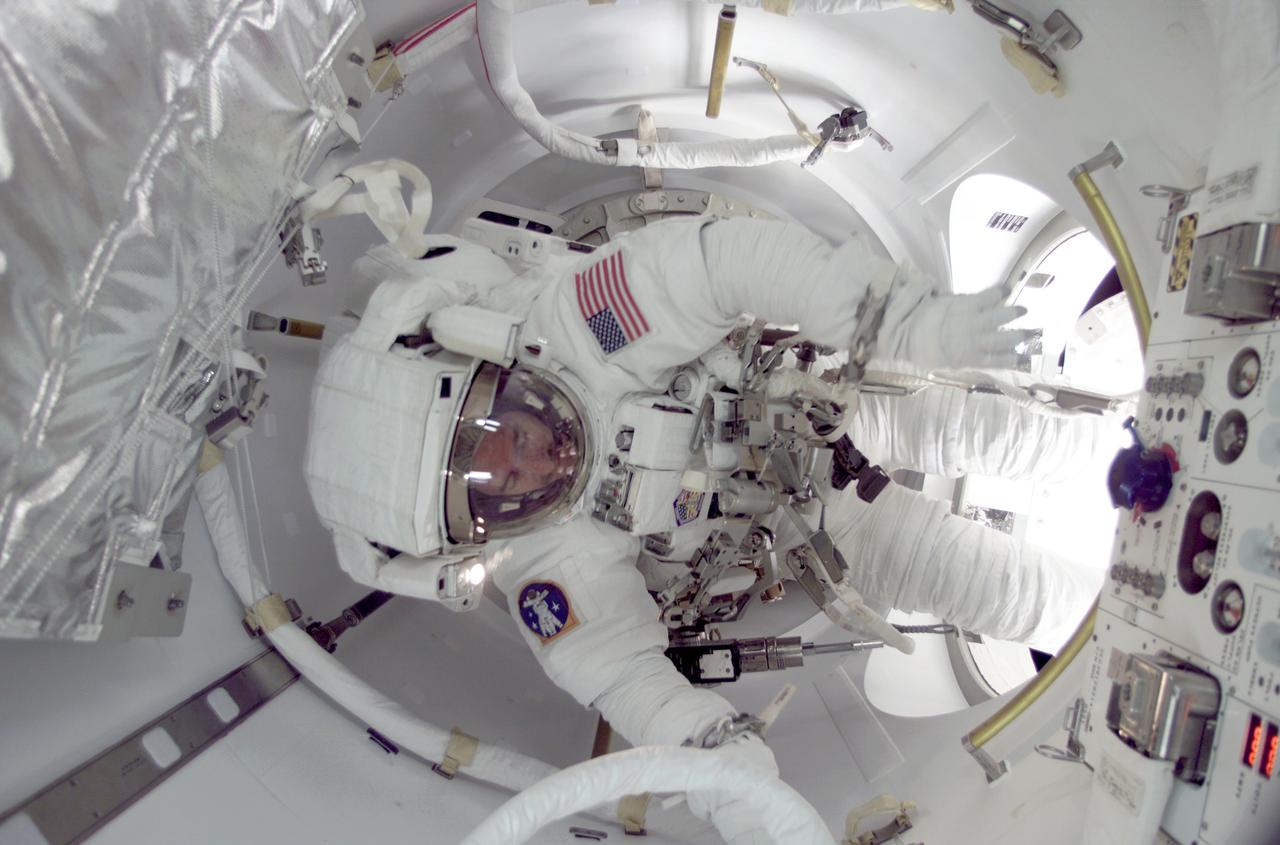
Astronaut James F. Reilly, STS-104 mission specialist, participates in space history as he joins fellow astronaut and mission specialist Michael L. Gernhardt (out of frame) in utilizing the new Quest Airlock for the first ever space walk to egress from the International Space Station (ISS). The major objective of the mission was to install and activate the airlock, which completed the second phase of construction on the ISS. The airlock accommodates both United States and Russian space suits and was designed and built at the Marshall Space Flight Center by the Boeing Company.
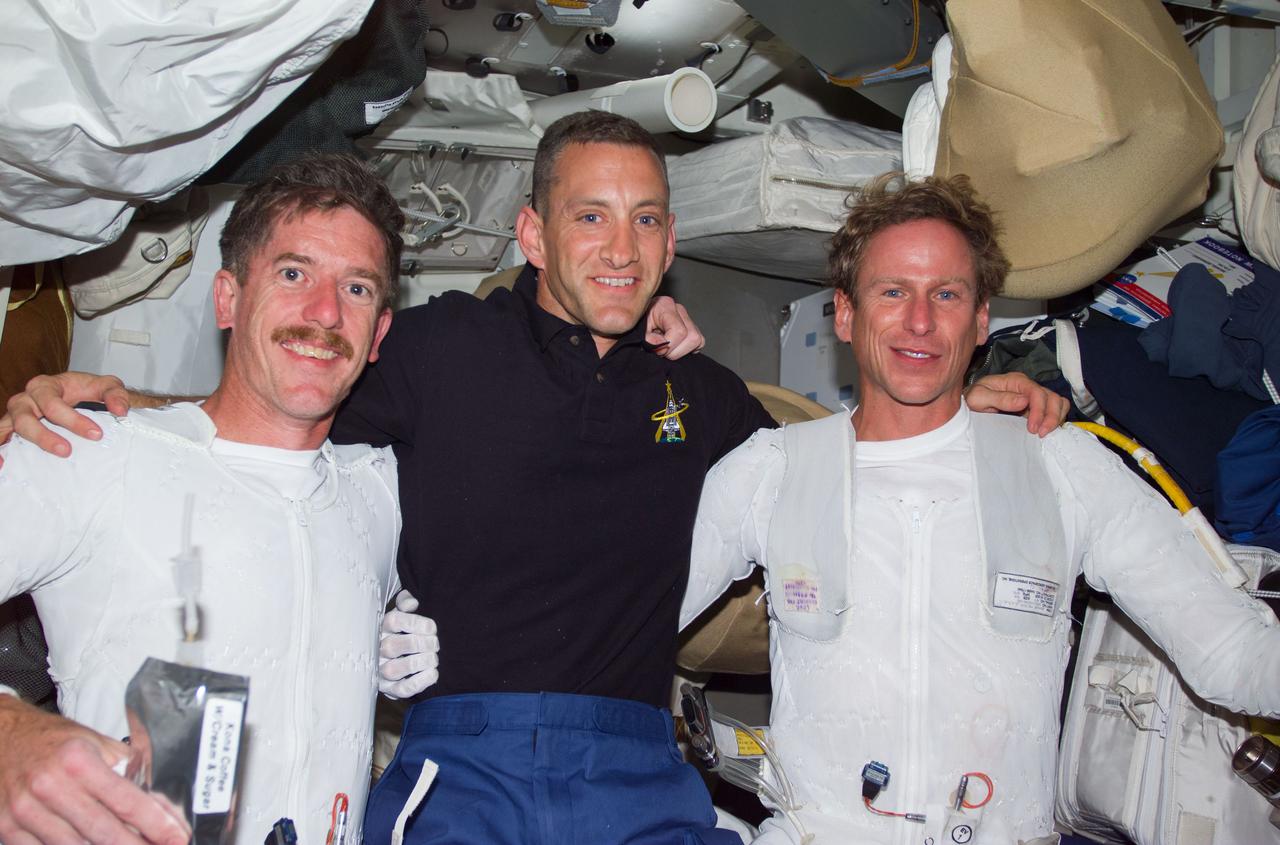
S104-E-5076 (15 July 2001) --- After completing the first extravehicular activity (EVA) of the STS-104 mission, James F. Reilly (left), mission specialist, and Michael L. Gernhardt (right), mission specialist, both wearing Liquid Cooling and Ventilation Garments (LCVG's), pose for a picture with Charles O. Hobaugh, pilot, on the middeck of the Space Shuttle Atlantis.
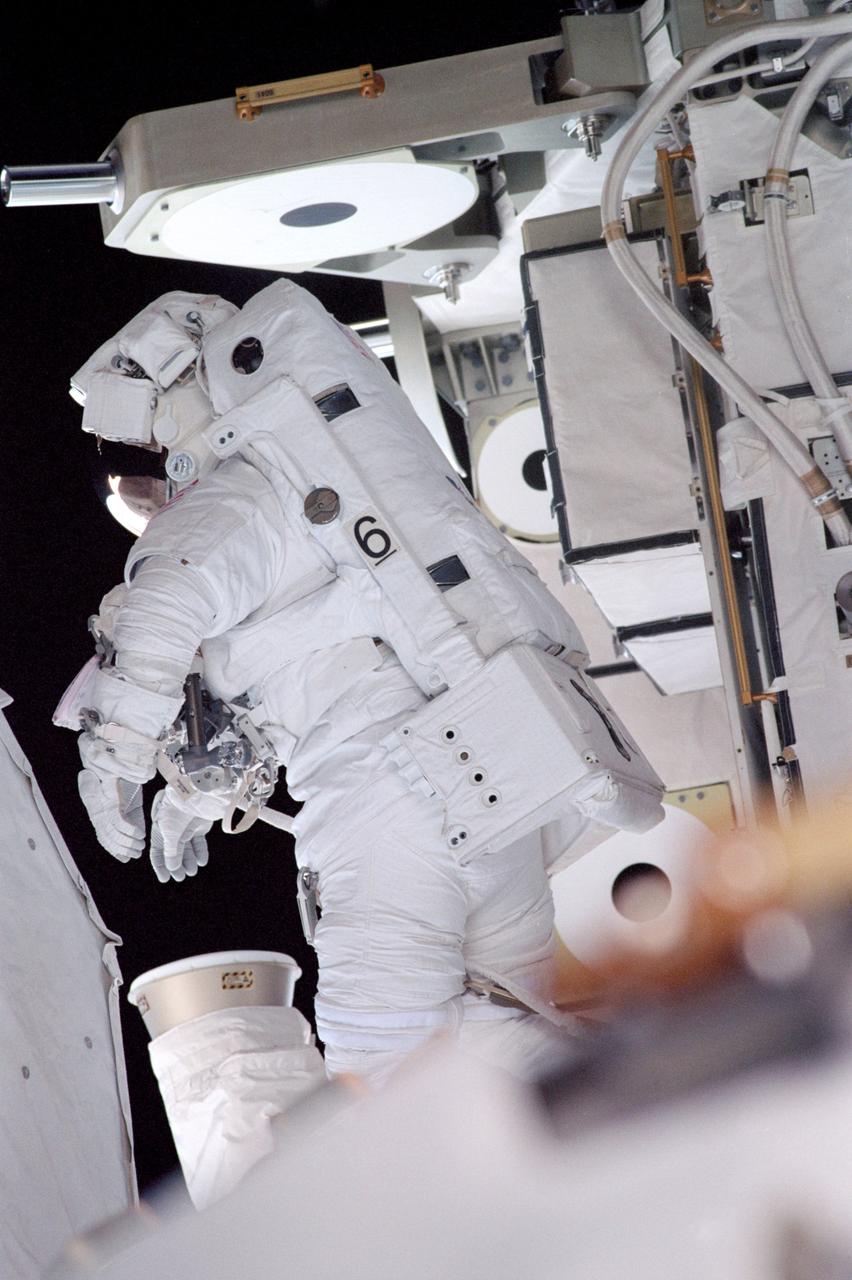
STS104-315-007 (12-24 July 2001) --- Astronaut James F. Reilly, STS-104 mission specialist, participates in one of three space walks aimed toward wrapping up the completion of work on the second phase of the International Space Station (ISS). Reilly was joined on the extravehicular activity (EVA) by astronaut Michael L. Gernhardt.
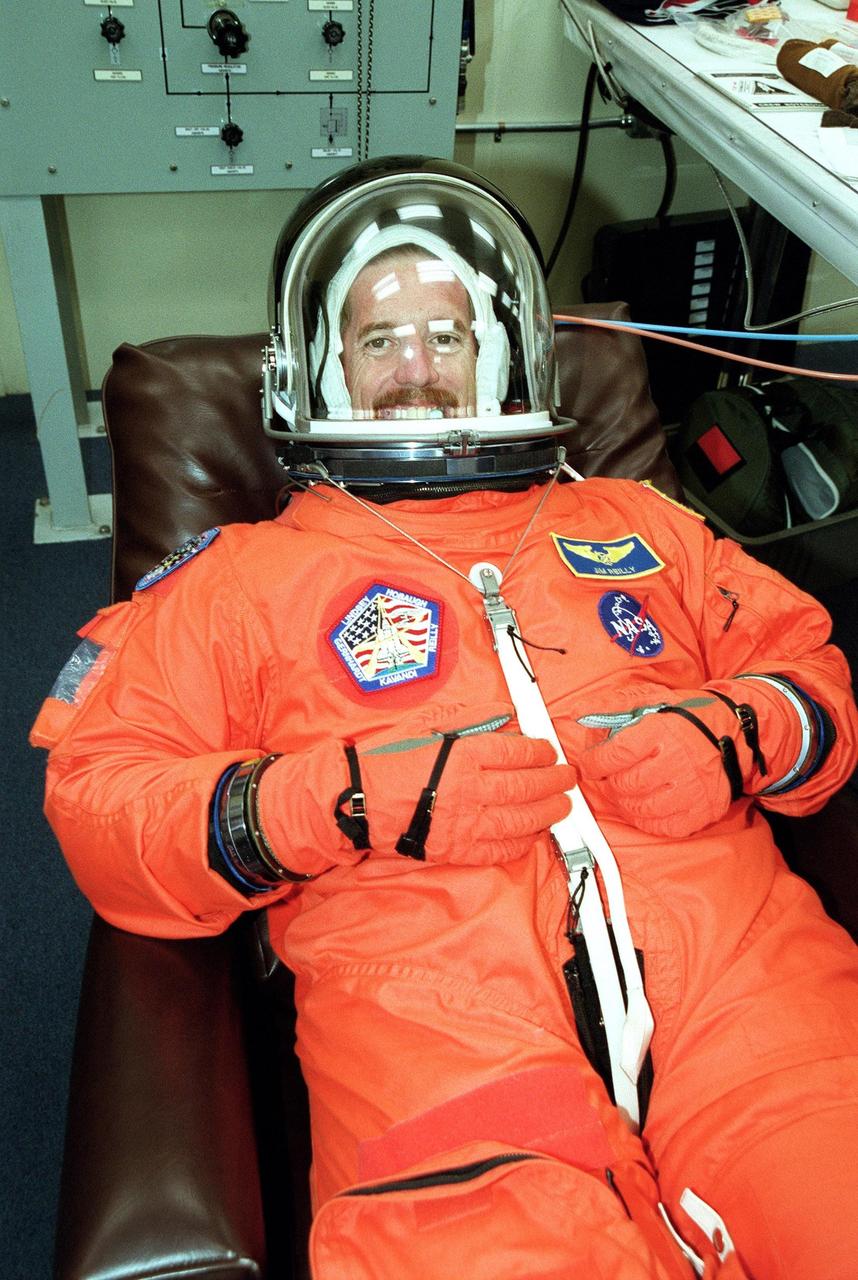
KENNEDY SPACE CENTER, Fla. -- STS-104 Mission Specialist James F. Reilly is happy to be going through suit and fit check during Terminal Countdown Demonstration Test (TCDT) activities at KSC. The TCDT provides the crew with emergency egress training, opportunities to inspect their mission payloads in Space Shuttle Atlantis’s payload bay, and simulated countdown exercises. Other crew members participating are Commander Steven W. Lindsey, Pilot Charles O. Hobaugh and Mission Specialists Janet Lynn Kavandi and Michael L. Gernhardt. The launch of Atlantis on mission STS-104 is scheduled no earlier than July 12 from Launch Pad 39B. The mission is the 10th flight to the International Space Station and carries the Joint Airlock Module
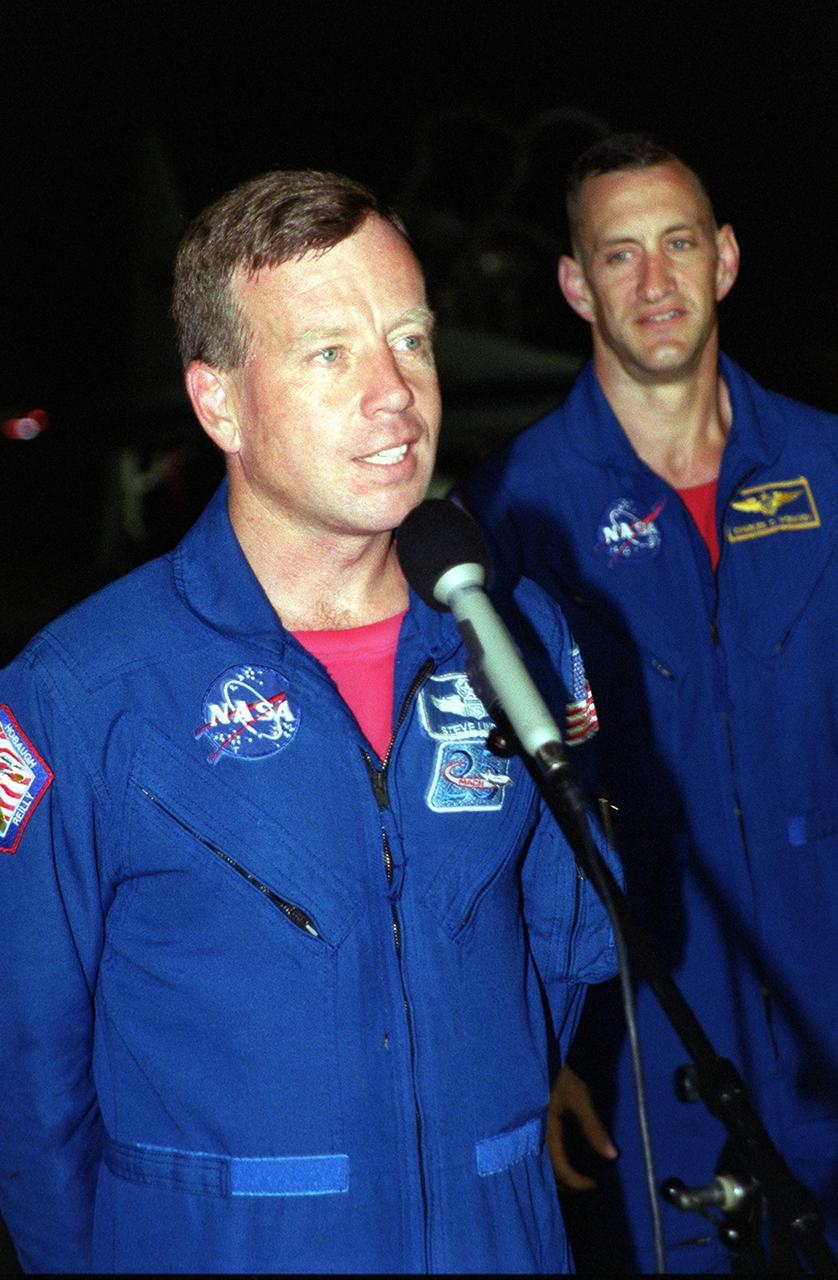
KENNEDY SPACE CENTER, Fla. -- After arriving at the Shuttle Landing Facility, the STS-104 crew stopped to talk to the media. At the microphone is Commander Steven W. Lindsey; at right is Pilot Charles O. Hobaugh. The crew is at KSC to make final preparations for their launch. Other crew members are Mission Specialists James F. Reilly, Janet Lynn Kavandi and Michael L. Gernhardt. The launch of Atlantis on mission STS-104 is scheduled for July 12 from Launch Pad 39B. The mission is the 10th assembly flight to the International Space Station and carries the Joint Airlock Module, which will become the primary path for spacewalk entry and departure using both U.S. spacesuits and the Russian Orlan spacesuit for EVA activity
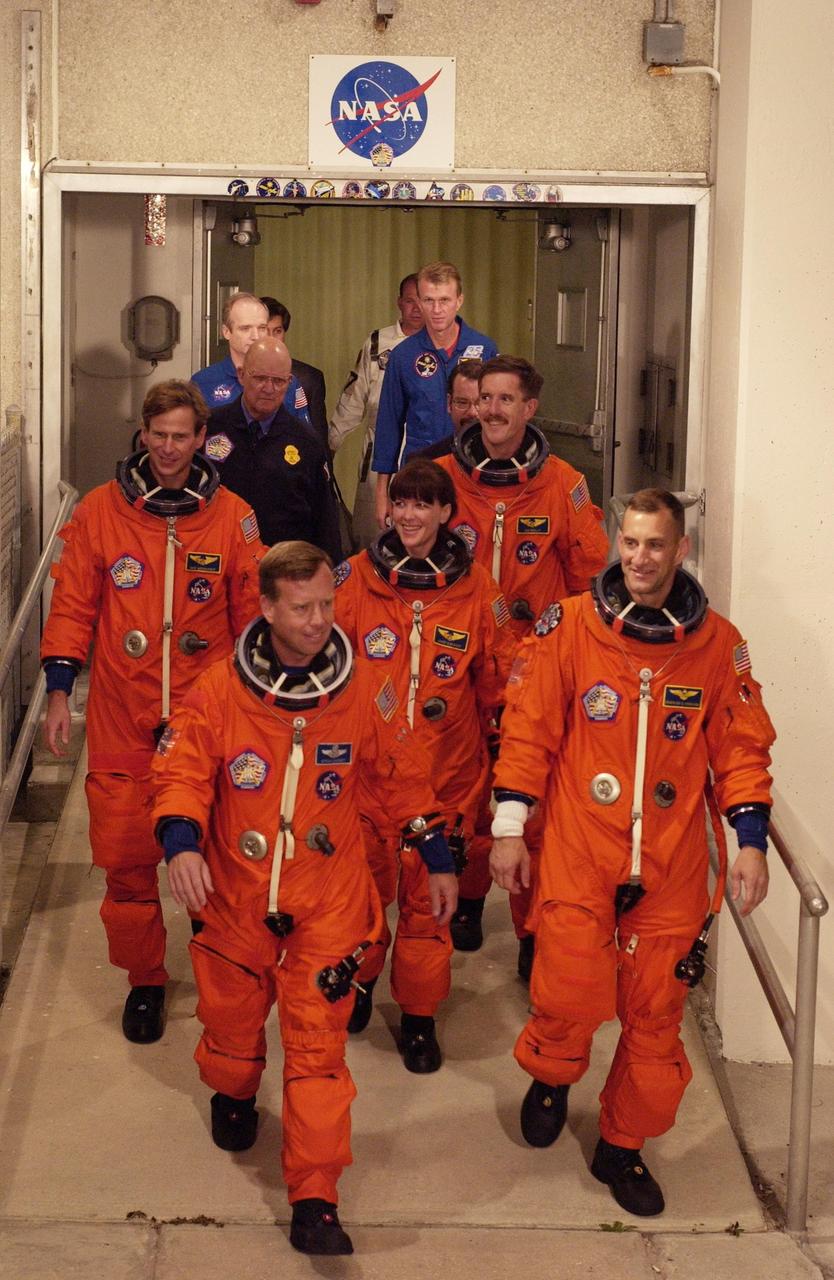
KENNEDY SPACE CENTER, Fla. -- The STS-104 crew exits out of the Operations and Checkout Building on their way to Launch Pad 39B. Leading are Commander Steven W. Lindsey (left) and Pilot Charles O. Hobaugh. In the center is Mission Specialist Janet Lynn Kavandi. Following her are Mission Specialists Michael L. Gernhardt (left) and James F. Reilly. . The launch of Space Shuttle Atlantis on mission STS-104 is targeted for 5:04 a.m., July 12, from Launch Pad 39B. The primary payload on the mission is the joint airlock module, which will be added to the International Space Station. The airlock will be the primary path for Space Station spacewalk entry and departure for U.S. spacesuits, and will also support the Russian Orlan spacesuit for EVA activity. D1X NIKON Photo by S. Andrews
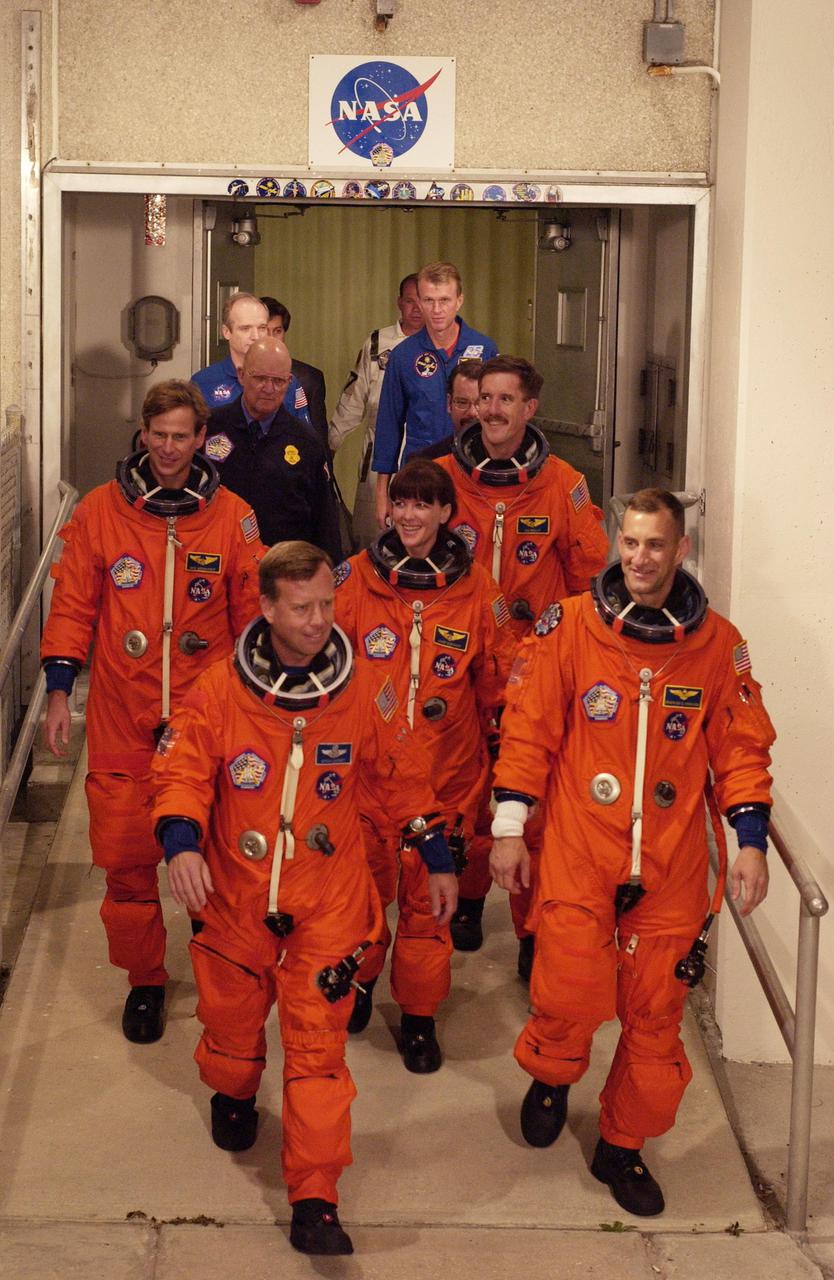
KENNEDY SPACE CENTER, Fla. -- The STS-104 crew exits out of the Operations and Checkout Building on their way to Launch Pad 39B. Leading are Commander Steven W. Lindsey (left) and Pilot Charles O. Hobaugh. In the center is Mission Specialist Janet Lynn Kavandi. Following her are Mission Specialists Michael L. Gernhardt (left) and James F. Reilly. . The launch of Space Shuttle Atlantis on mission STS-104 is targeted for 5:04 a.m., July 12, from Launch Pad 39B. The primary payload on the mission is the joint airlock module, which will be added to the International Space Station. The airlock will be the primary path for Space Station spacewalk entry and departure for U.S. spacesuits, and will also support the Russian Orlan spacesuit for EVA activity. D1X NIKON Photo by S. Andrews
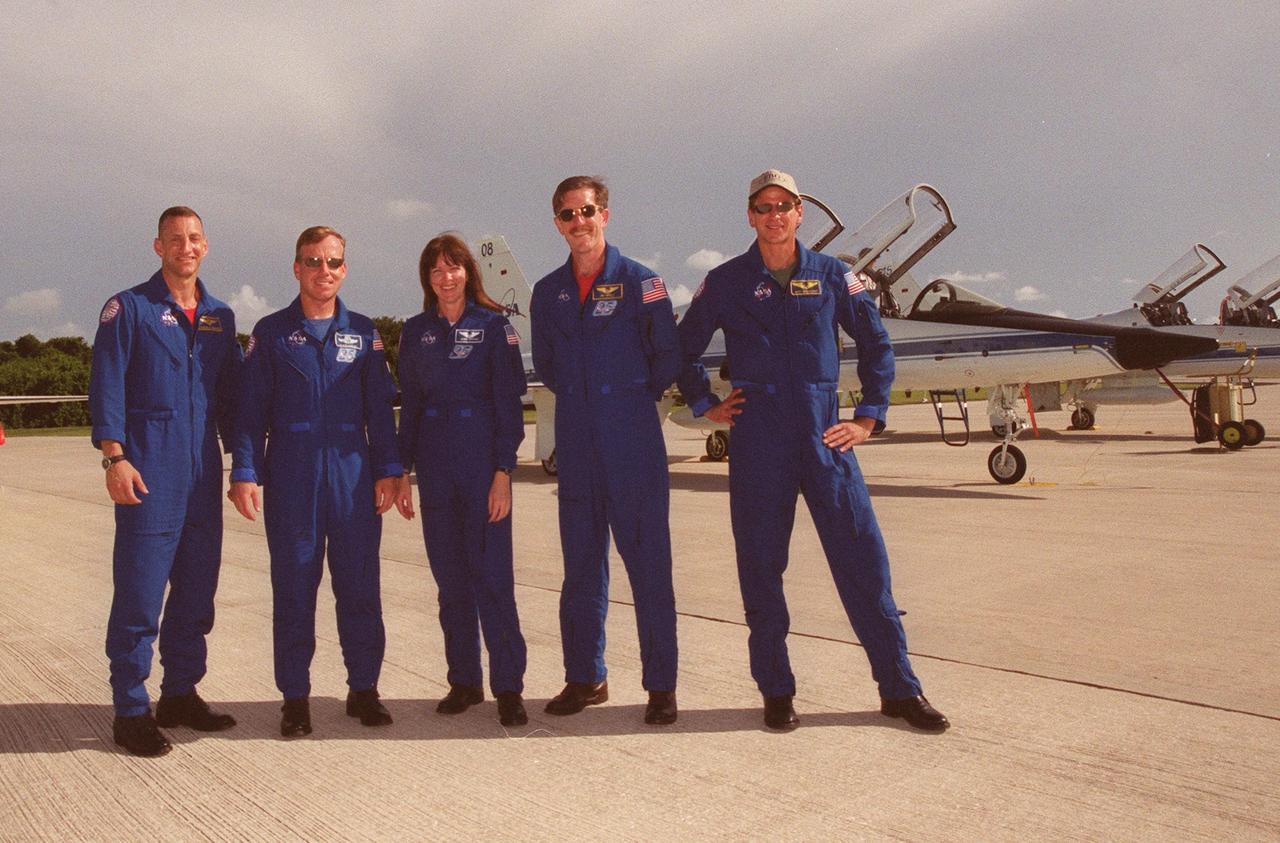
KENNEDY SPACE CENTER, Fla. -- The STS-104 crew pauses at the SLF after their arrival. Standing left to right are Pilot Charles O. Hobaugh, Commander Steven W. Lindsey and Mission Specialists Janet Lynn Kavandi, James F. Reilly and Michael L. Gernhardt. They are at KSC to take part in Terminal Countdown Demonstration Test (TCDT) Activities. The TCDT provides the crew with emergency egress training, opportunities to inspect their mission payloads in Space Shuttle Atlantis’s payload bay, and simulated countdown exercises. The launch of Atlantis on mission STS-104 is scheduled no earlier than July 12 from Launch Pad 39B. The mission is the 10th flight to the International Space Station and carries the Joint Airlock Module
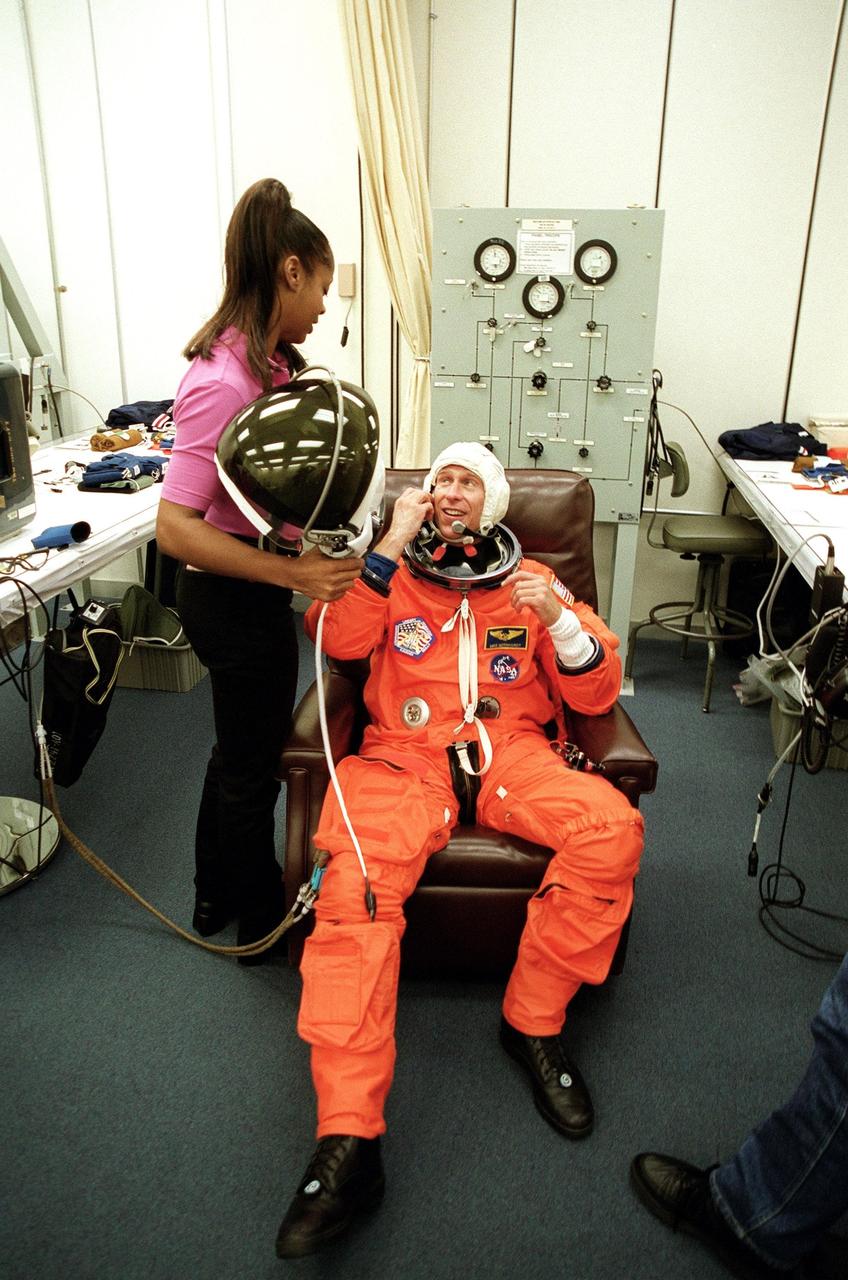
KENNEDY SPACE CENTER, Fla. -- STS-104 Mission Specialist Michael L. Gernhardt has suit and fit check during Terminal Countdown Demonstration Test (TCDT) activities at KSC. The TCDT provides the crew with emergency egress training, opportunities to inspect their mission payloads in Space Shuttle Atlantis’s payload bay, and simulated countdown exercises. Other crew members participating are Commander Steven W. Lindsey, Pilot Charles O. Hobaugh and Mission Specialists Janet Lynn Kavandi and James F. Reilly. The launch of Atlantis on mission STS-104 is scheduled no earlier than July 12 from Launch Pad 39B. The mission is the 10th flight to the International Space Station and carries the Joint Airlock Module
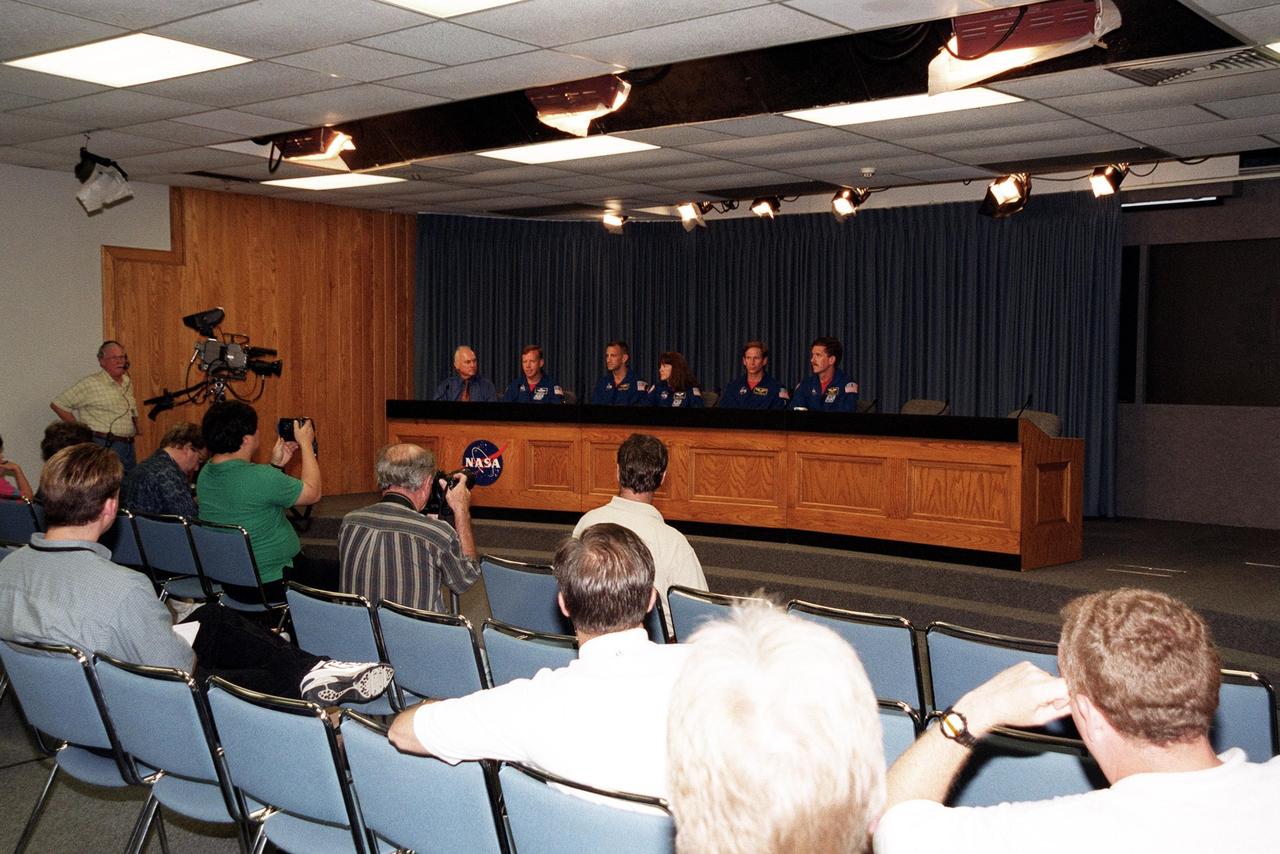
KENNEDY SPACE CENTER, Fla. -- The STS-104 crew responds to questions from the media in the television studio. Seated at far left is moderator Bill Johnson, NASA/KSC TV manager. Beside him, left to right, are Commander Steven W. Lindsey, Pilot Charles O. Hobaugh, and Mission Specialists Janet Lynn Kavandi, Michael L. Gernhardt and James F. Reilly. . The crew is taking part in Terminal Countdown Demonstration Test activities, which include emergency exit training from the orbiter, opportunities to inspect their mission payloads in the orbiter’s payload bay and simulated countdown exercises. The launch of Atlantis on mission STS-104 is scheduled July 12 from Launch Pad 39B. The mission is the 10th flight to the International Space Station and carries the Joint Airlock Module
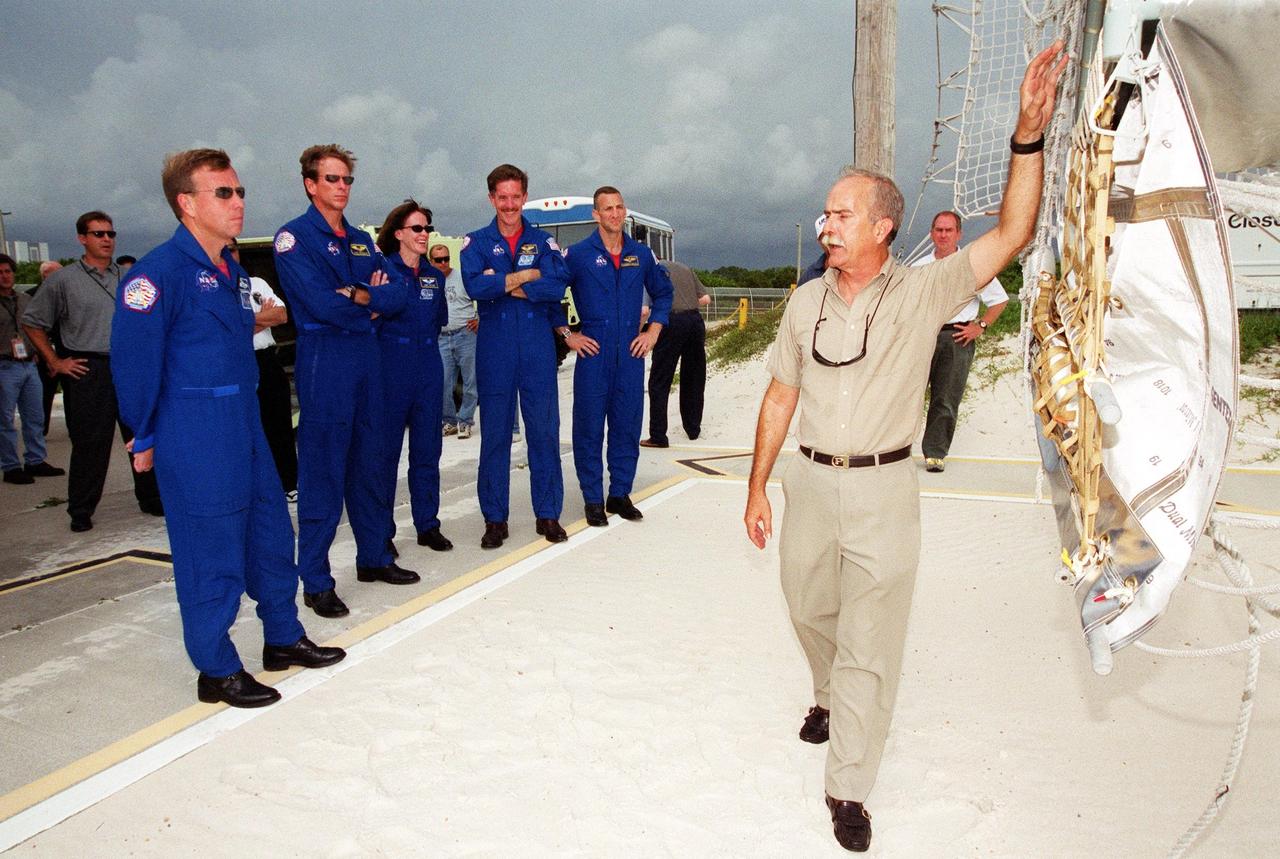
KENNEDY SPACE CENTER, Fla. -- During training at the launch pad, the STS-104 crew listen to instructions on use of the slidewire basket for emergency exit from the orbiter at the pad. Standing left to right are Commander Steven W. Lindsey, Mission Specialists Michael L. Gernhardt, Janet Lynn Kavandi and James F. Reilly, and Pilot Charles O. Hobaugh. The training is part of Terminal Countdown Demonstration Test activities, which also include opportunities to inspect their mission payloads in the orbiter’s payload bay and simulated countdown exercises. The launch of Atlantis on mission STS-104 is scheduled July 12 from Launch Pad 39B. The mission is the 10th flight to the International Space Station and carries the Joint Airlock Module