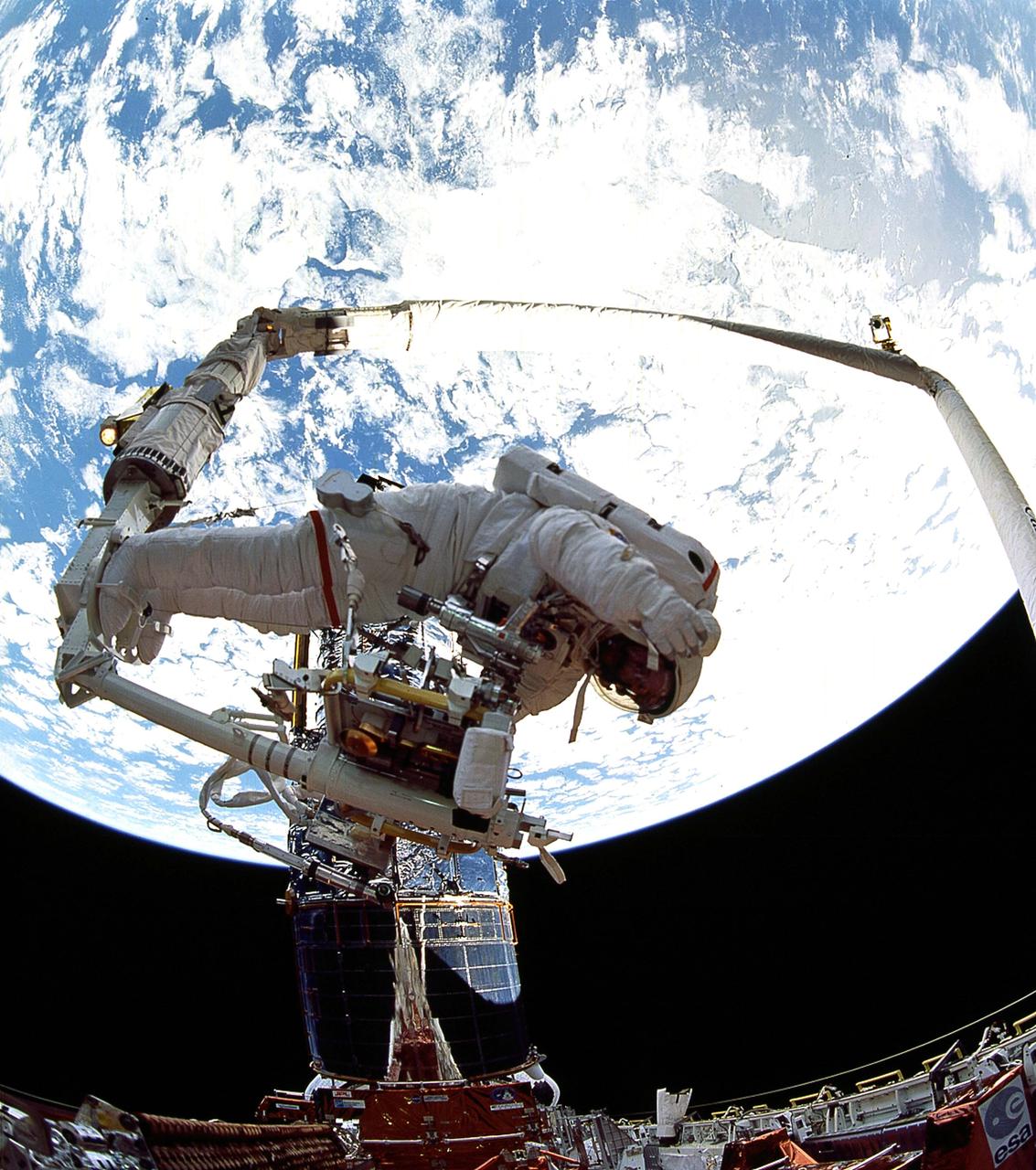
STS061-105-026 (7 Dec. 1993) --- Astronaut Jeffrey A. Hoffman signals directions to European Space Agency (ESA) astronaut Claude Nicollier, as the latter controls the Remote Manipulator System (RMS) arm during the third of five Extravehicular Activities (EVA) on the Hubble Space Telescope (HST) servicing mission. Astronauts Hoffman and F. Story Musgrave earlier changed out the Wide Field\Planetary Camera (WF\PC).
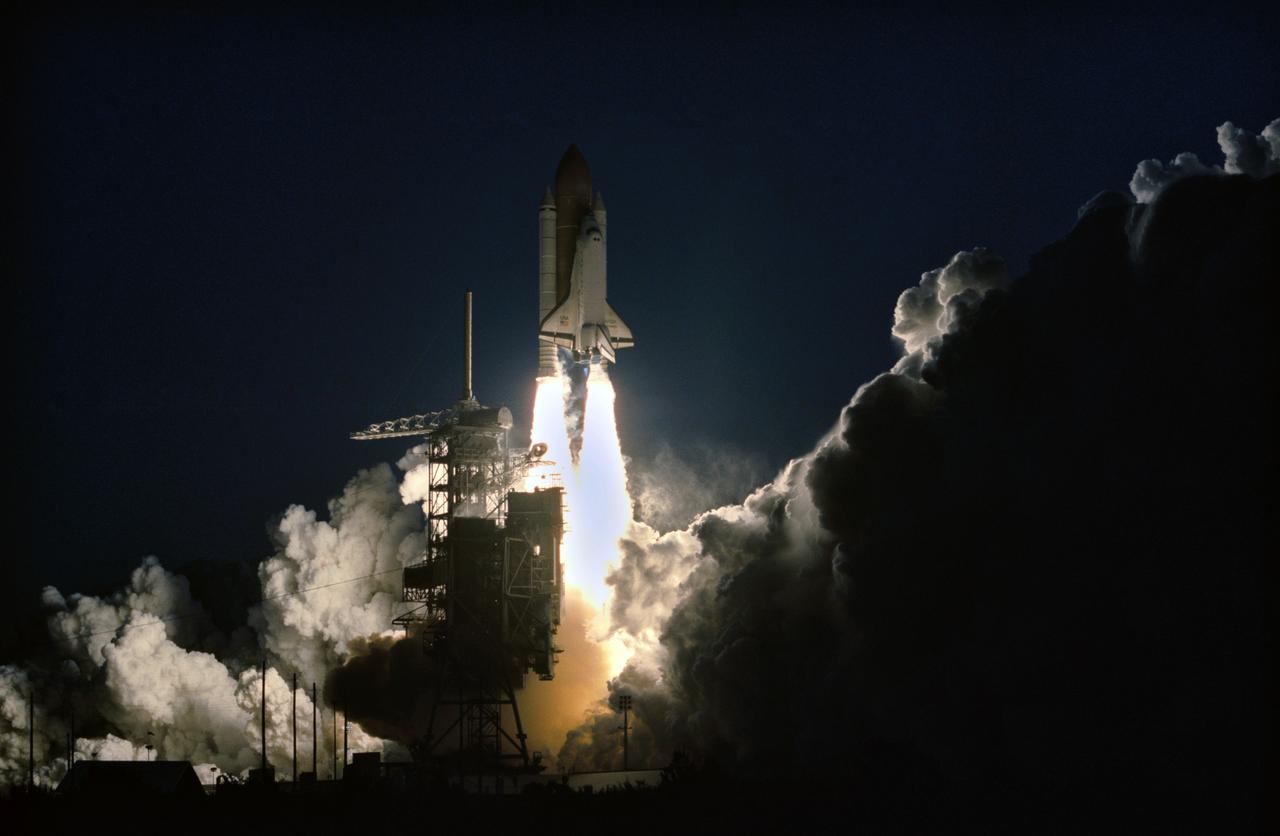
STS060-S-105 (3 Feb 1994) --- The Space Shuttle Discovery heads toward an eight-day mission in Earth orbit with five NASA astronauts and a Russian cosmonaut aboard. Liftoff occurred as scheduled at 7:10 a.m. (EST), February 3, 1994. Aboard the spacecraft were astronauts Charles F. Bolden Jr., commander; Kenneth S. Reightler Jr., pilot; Franklin R. Chang-Diaz, payload commander; and N. Jan Davis and Ronald M. Sega, mission specialists, along with Russian cosmonaut Sergei K. Krikalev, also a mission specialist.
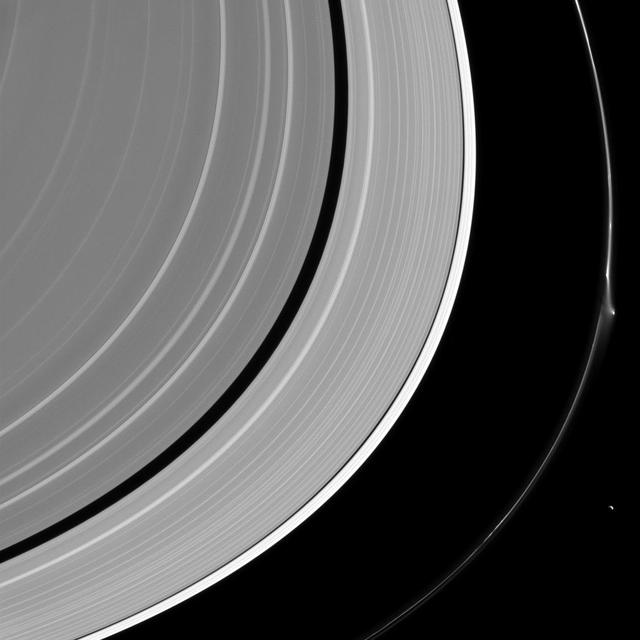
A bright disruption in Saturn's narrow F ring suggests it may have been disturbed recently. This feature was mostly likely not caused by Pandora (50 miles or 81 kilometers across) which lurks nearby, at lower right. More likely, it was created by the interaction of a small object embedded in the ring itself and material in the core of the ring. Scientists sometimes refer to these features as "jets." Because these bodies are small and embedded in the F ring itself, they are difficult to spot at the resolution available to NASA's Cassini spacecraft. Instead, their handiwork reveals their presence, and scientists use the Cassini spacecraft to study these stealthy sculptors of the F ring. This view looks toward the sunlit side of the rings from about 15 degrees above the ring plane. The image was taken in visible light with the Cassini spacecraft narrow-angle camera on April 8, 2016. The view was acquired at a distance of approximately 1.4 million miles (2.2 million kilometers) from Saturn and at a Sun-Saturn-spacecraft, or phase, angle of 105 degrees. Image scale is 8 miles (13 kilometers) per pixel. http://photojournal.jpl.nasa.gov/catalog/PIA20485
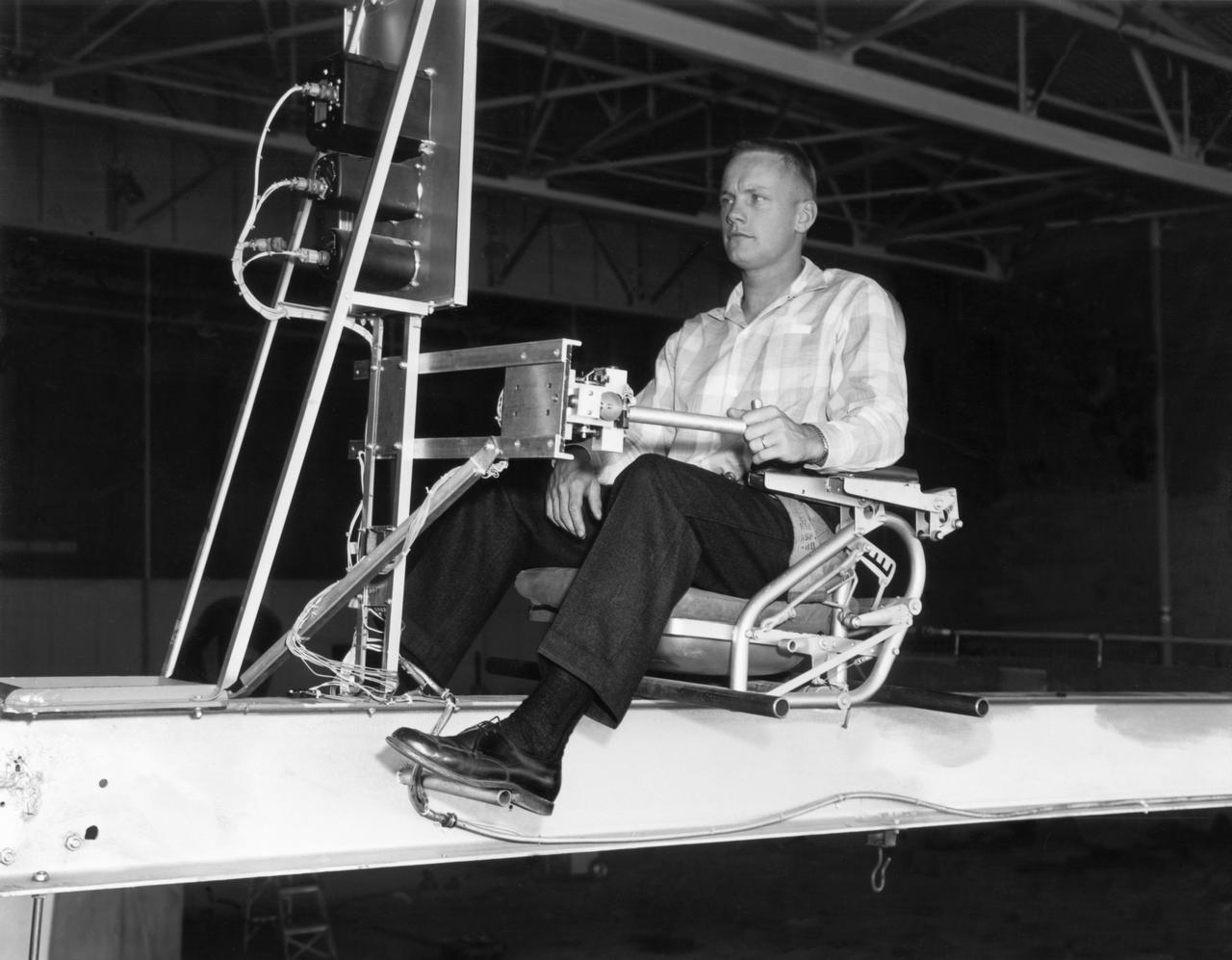
Famed astronaut Neil A. Armstrong, the first man to set foot on the moon during the historic Apollo 11 space mission in July 1969, served for seven years as a research pilot at the NACA-NASA High-Speed Flight Station, now the Dryden Flight Research Center, at Edwards, California, before he entered the space program. Armstrong joined the National Advisory Committee for Aeronautics (NACA) at the Lewis Flight Propulsion Laboratory (later NASA's Lewis Research Center, Cleveland, Ohio, and today the Glenn Research Center) in 1955. Later that year, he transferred to the High-Speed Flight Station at Edwards as an aeronautical research scientist and then as a pilot, a position he held until becoming an astronaut in 1962. He was one of nine NASA astronauts in the second class to be chosen. As a research pilot Armstrong served as project pilot on the F-100A and F-100C aircraft, F-101, and the F-104A. He also flew the X-1B, X-5, F-105, F-106, B-47, KC-135, and Paresev. He left Dryden with a total of over 2450 flying hours. He was a member of the USAF-NASA Dyna-Soar Pilot Consultant Group before the Dyna-Soar project was cancelled, and studied X-20 Dyna-Soar approaches and abort maneuvers through use of the F-102A and F5D jet aircraft. Armstrong was actively engaged in both piloting and engineering aspects of the X-15 program from its inception. He completed the first flight in the aircraft equipped with a new flow-direction sensor (ball nose) and the initial flight in an X-15 equipped with a self-adaptive flight control system. He worked closely with designers and engineers in development of the adaptive system, and made seven flights in the rocket plane from December 1960 until July 1962. During those fights he reached a peak altitude of 207,500 feet in the X-15-3, and a speed of 3,989 mph (Mach 5.74) in the X-15-1. Armstrong has a total of 8 days and 14 hours in space, including 2 hours and 48 minutes walking on the Moon. In March 1966 he was commander of the Gemini 8 or
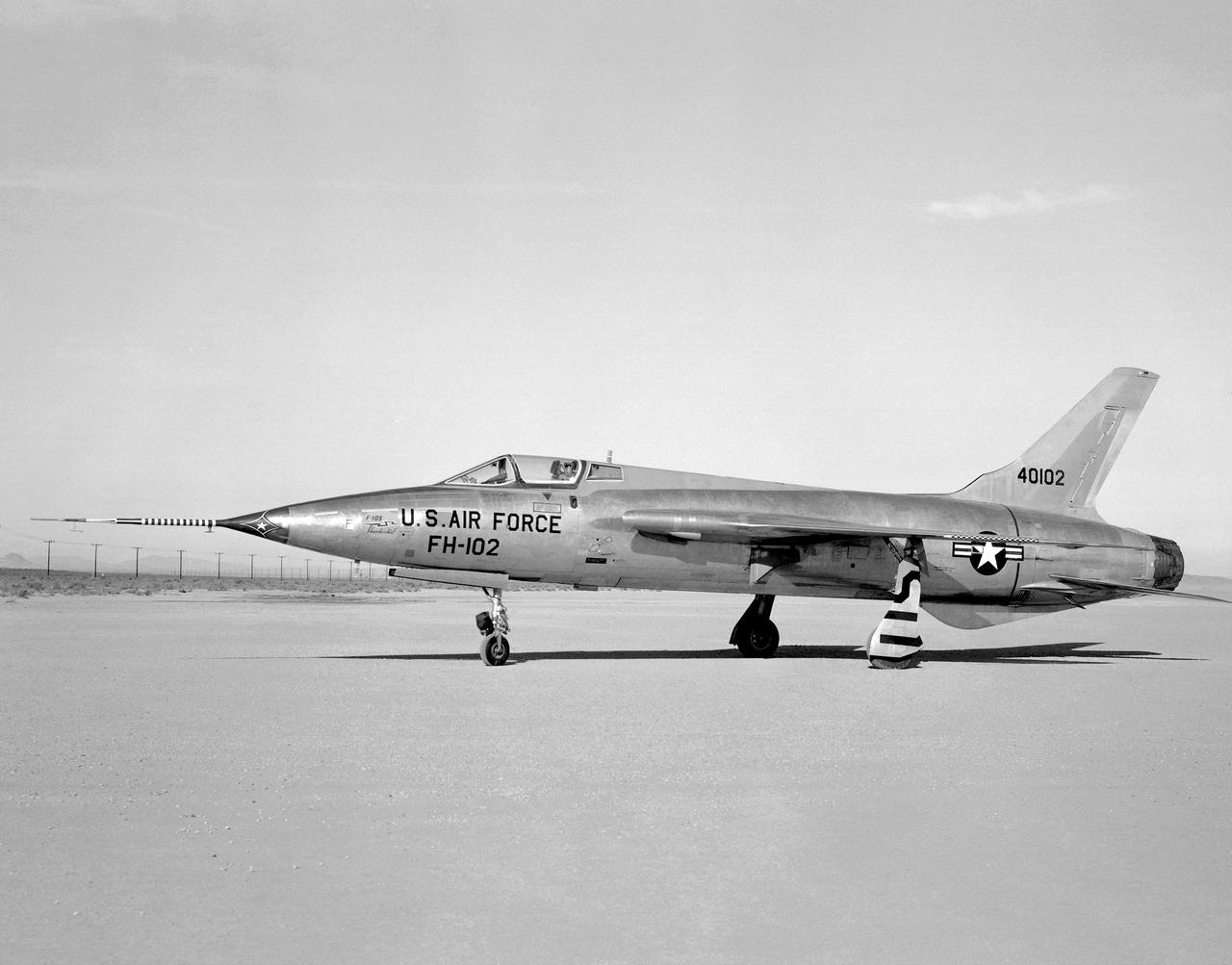
Side view of a F-105B (serial #54-0102) photographed on Rogers Dry Lakebed at Edwards Air Force Base, California in 1959. The black stripes across the left wheel-panel complete the lettering on the bottom of the wing when wheels are retracted. Two of the F-105B characteristics are fuselage length of 61 feet 1.33 inches and a wing area of 385.0 square feet.