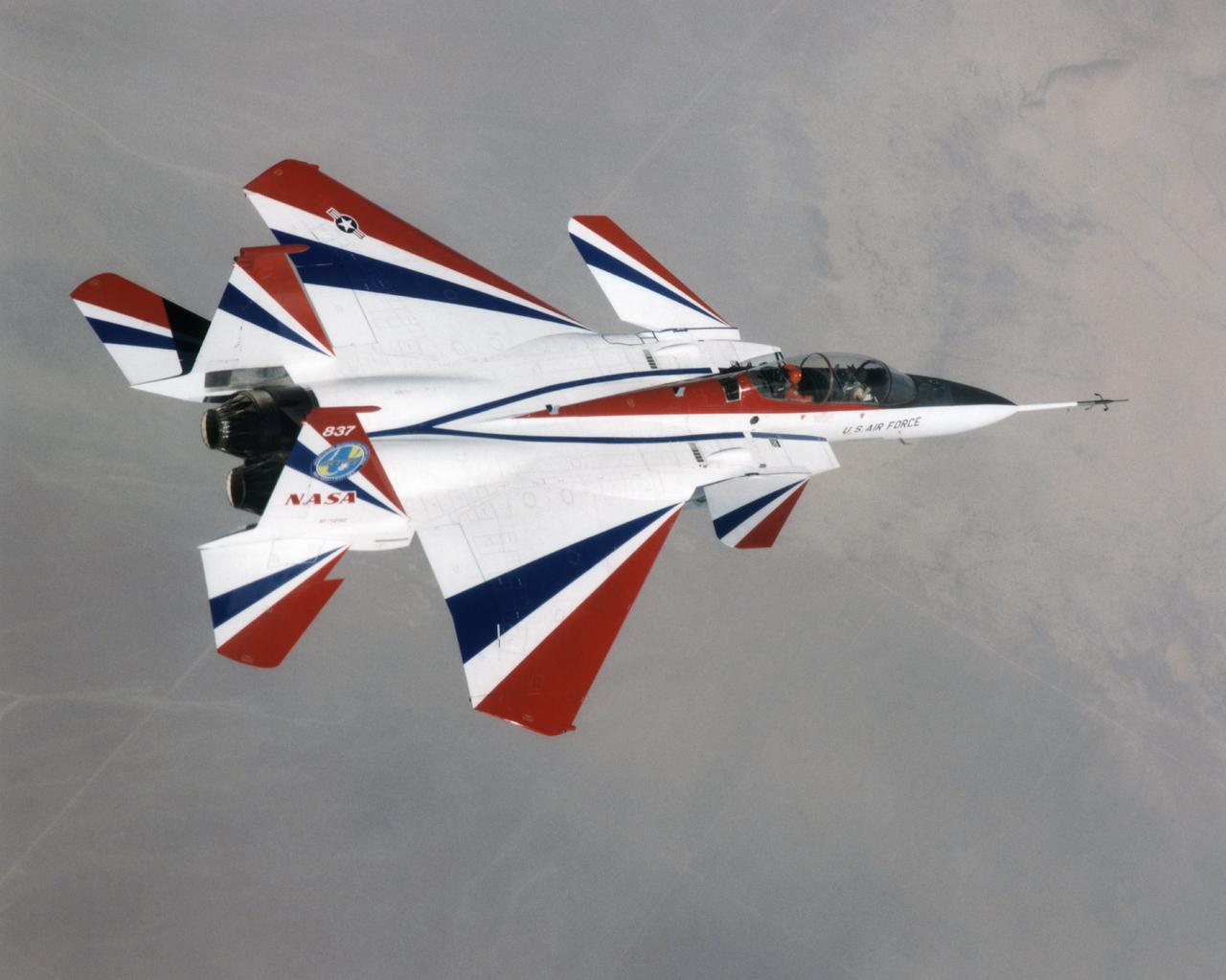
The F-15 ACTIVE in flight above the Mojave desert on April 14, 1998. The overhead shot shows the aircraft's striking red and while paint scheme/ The large forward canards are actually the tail surfaces from an F-18.
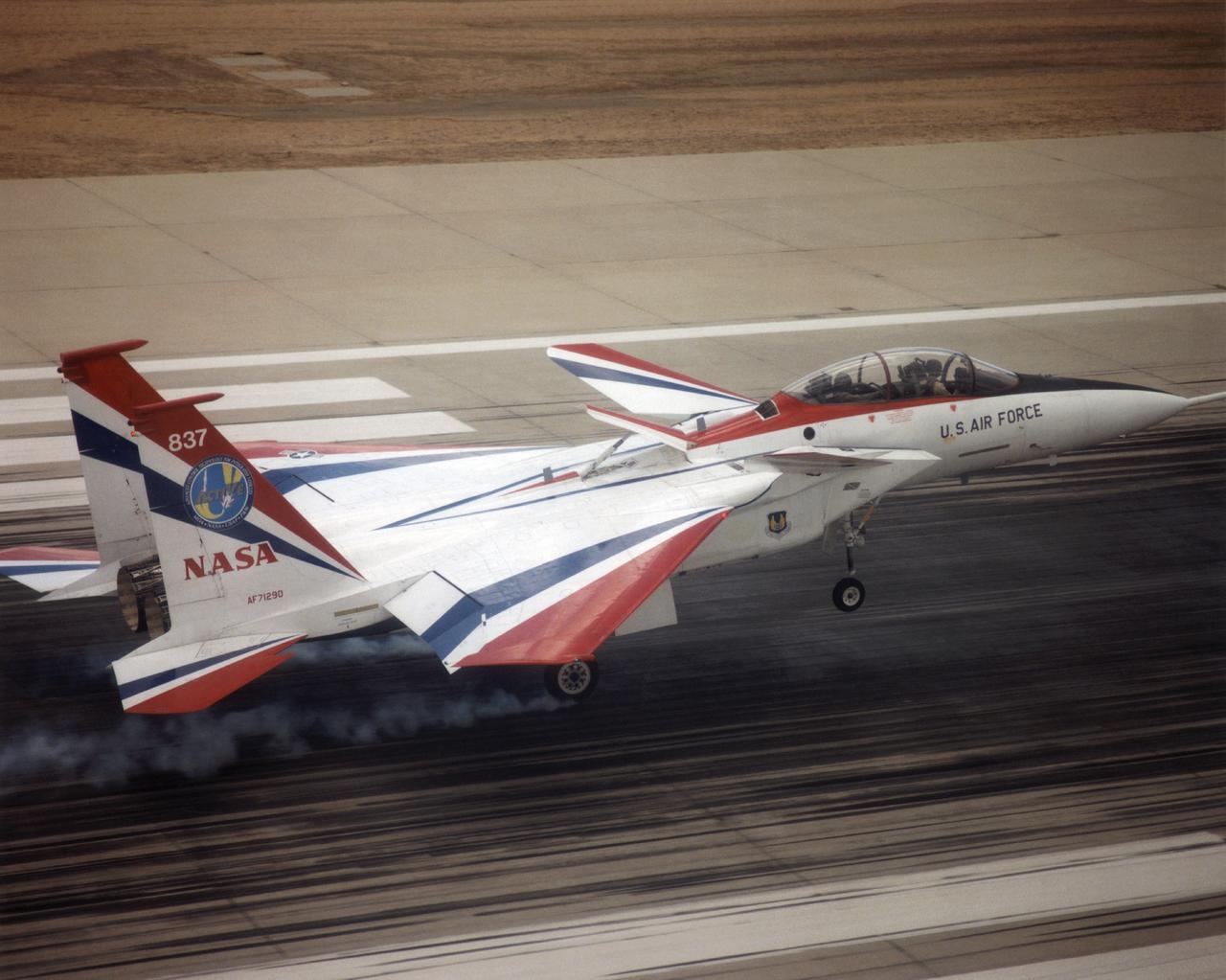
The F-15 ACTIVE touches down on the Edwards runway following its April 14, 1998 flight. The nose is high while the canards have their rear edge raised. the aircraft's speed brake, located on the top of the aircraft behind the canopy, is also raised.
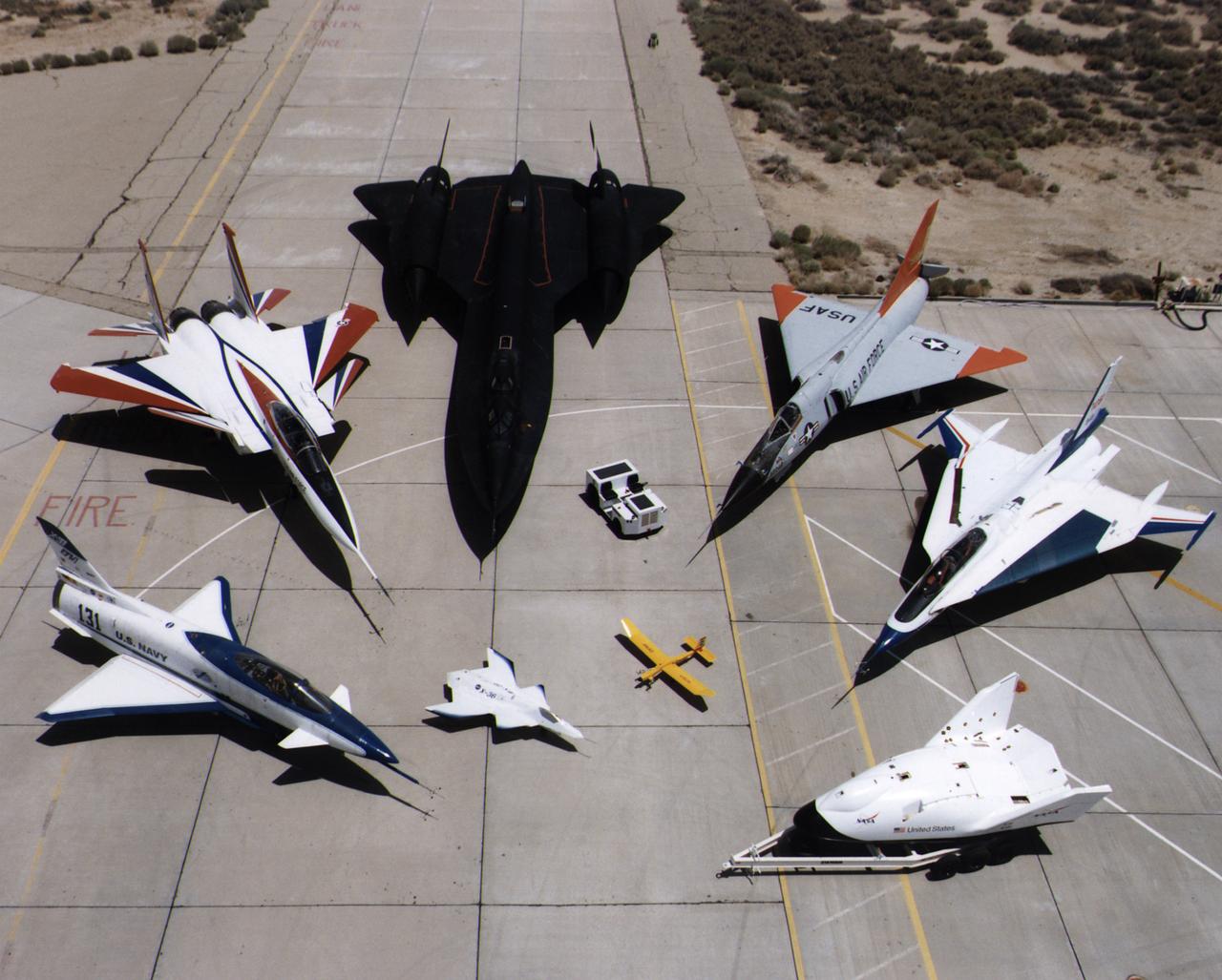
A collection of NASA's research aircraft on the ramp at the Dryden Flight Research Center in July 1997: X-31, F-15 ACTIVE, SR-71, F-106, F-16XL Ship #2, X-38, Radio Controlled Mothership and X-36.
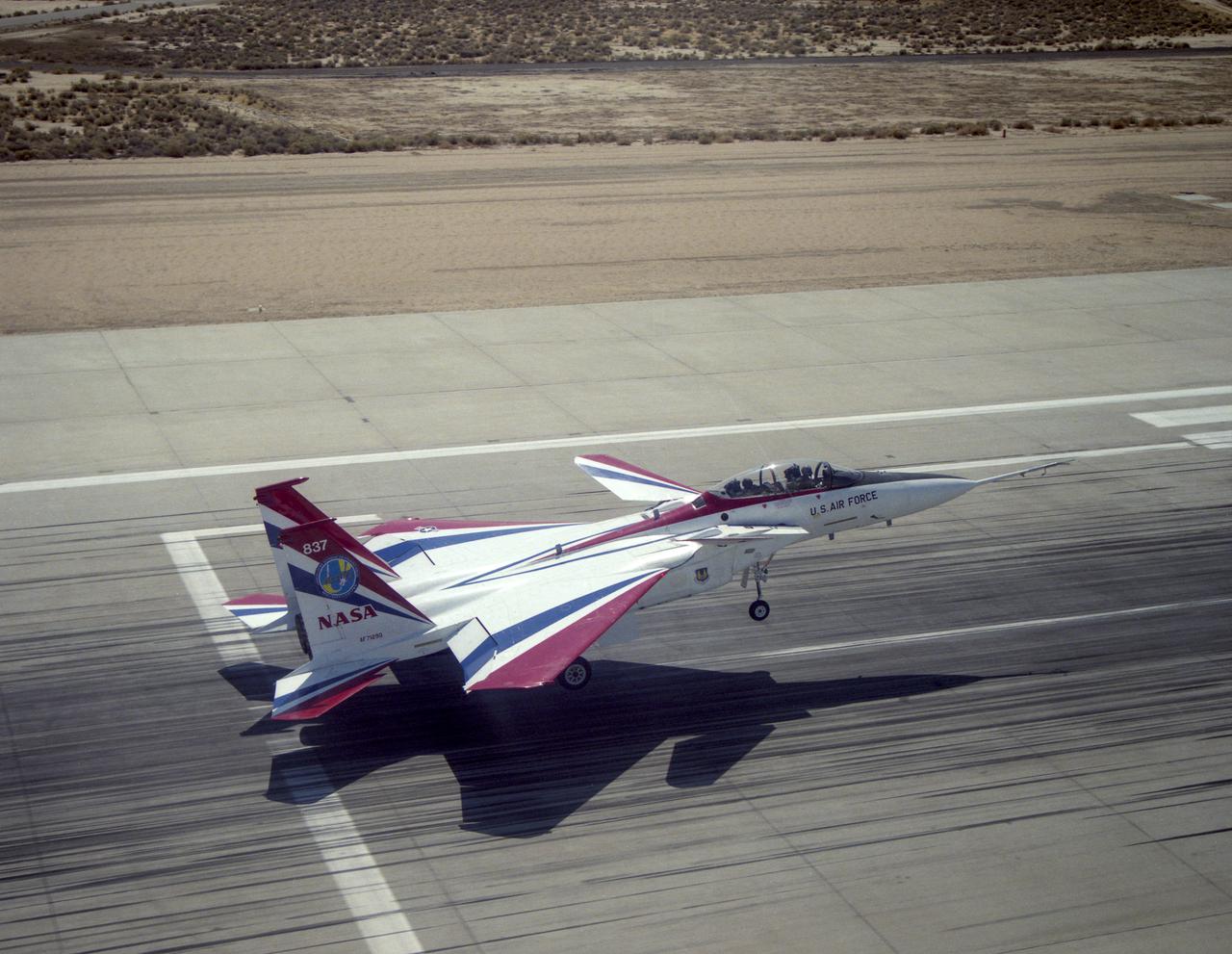
The F-15 Advanced Controls Technology for Integrated Vehicles, the first pre-production F-15B, shows its canards. Less obvious are the multi-axis thrust vectoring exhaust nozzles.
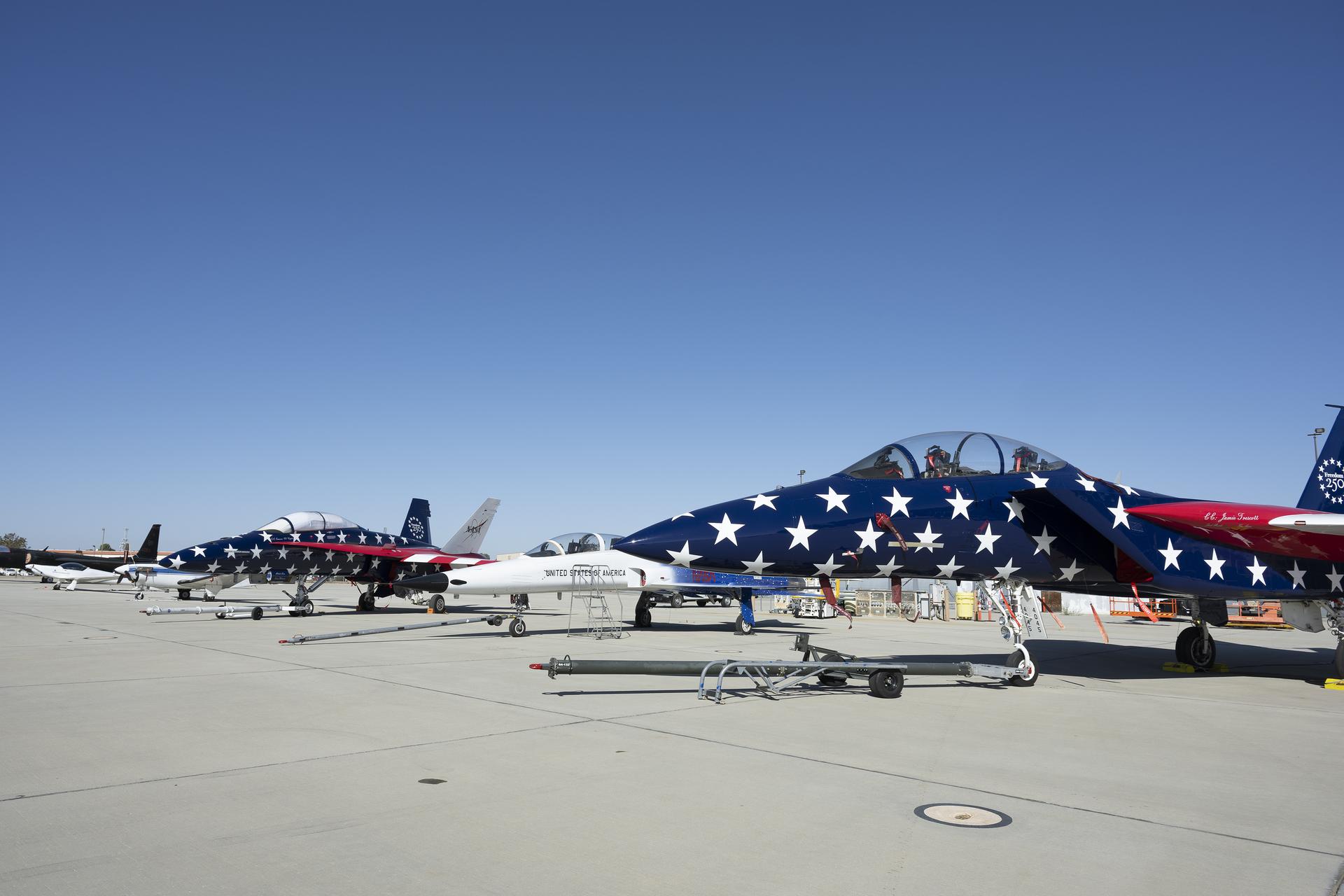
NASA’s F/A-18, a Northrop F-5 Tiger II, and NASA’s F-15 are on static display at Red, White, and Boom, the U.S. Air Force Test Center’s celebration of America’s 250th anniversary and NASA Armstrong’s commemoration of its 80th year at Edwards Air Force Base, California, on Friday, Sept. 18, 2026. The event brought together the workforce, families, and the Edwards community for a high‑energy day featuring a Flightline 5K, Ramp Fest and STEM Expo, static aircraft displays, hands‑on STEM activities, and a NASA flyover with a sonic boom.
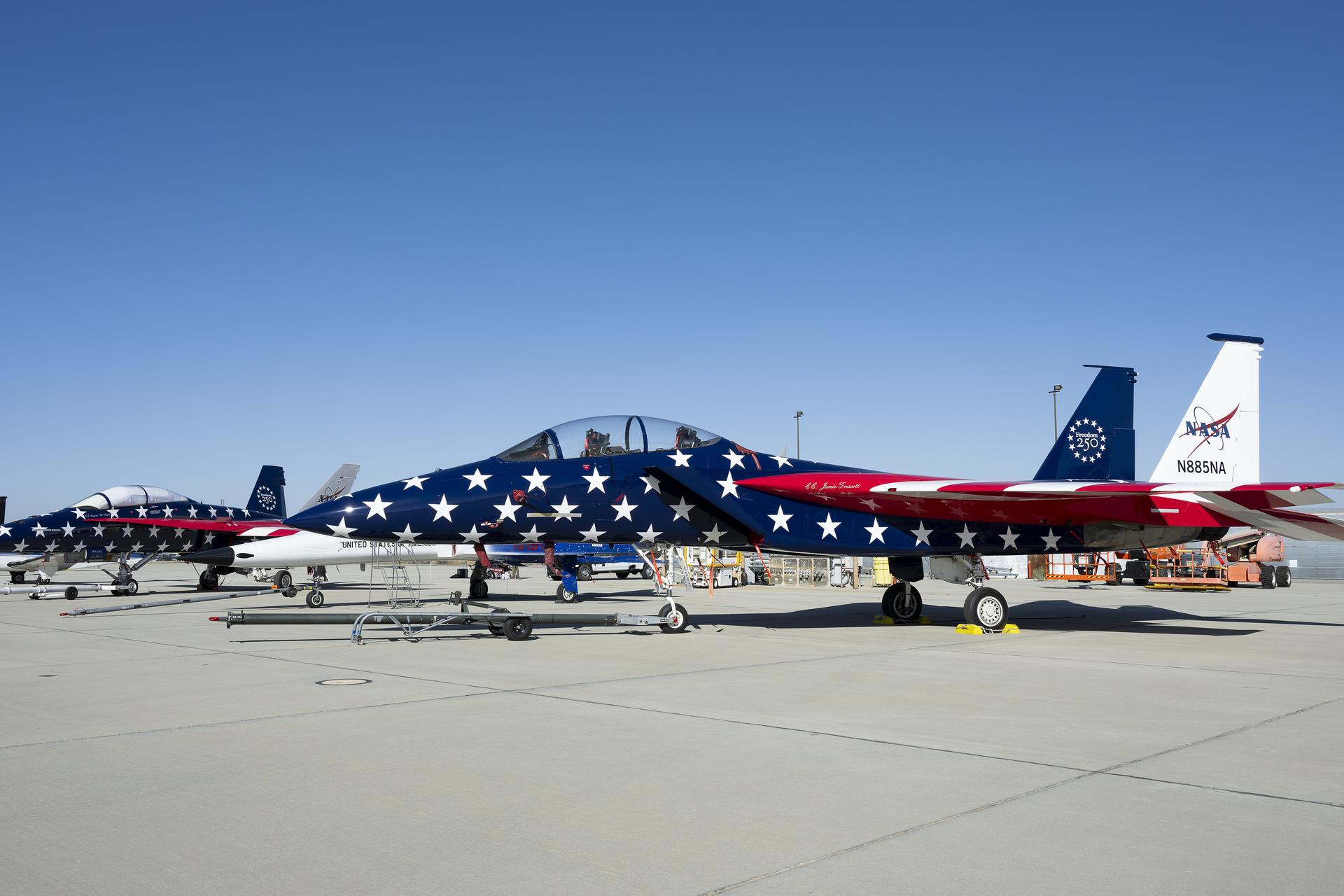
NASA’s F/A-18, a Northrop F-5 Tiger II, and NASA’s F-15 are on static display at Red, White, and Boom, the U.S. Air Force Test Center’s celebration of America’s 250th anniversary and NASA Armstrong’s commemoration of its 80th year at Edwards Air Force Base, California, on Friday, Sept. 18, 2026. The event brought together the workforce, families, and the Edwards community for a high‑energy day featuring a Flightline 5K, Ramp Fest and STEM Expo, static aircraft displays, hands‑on STEM activities, and a NASA flyover with sonic boom.

F-15B ACTIVE in flight

F-15B ACTIVE in flight
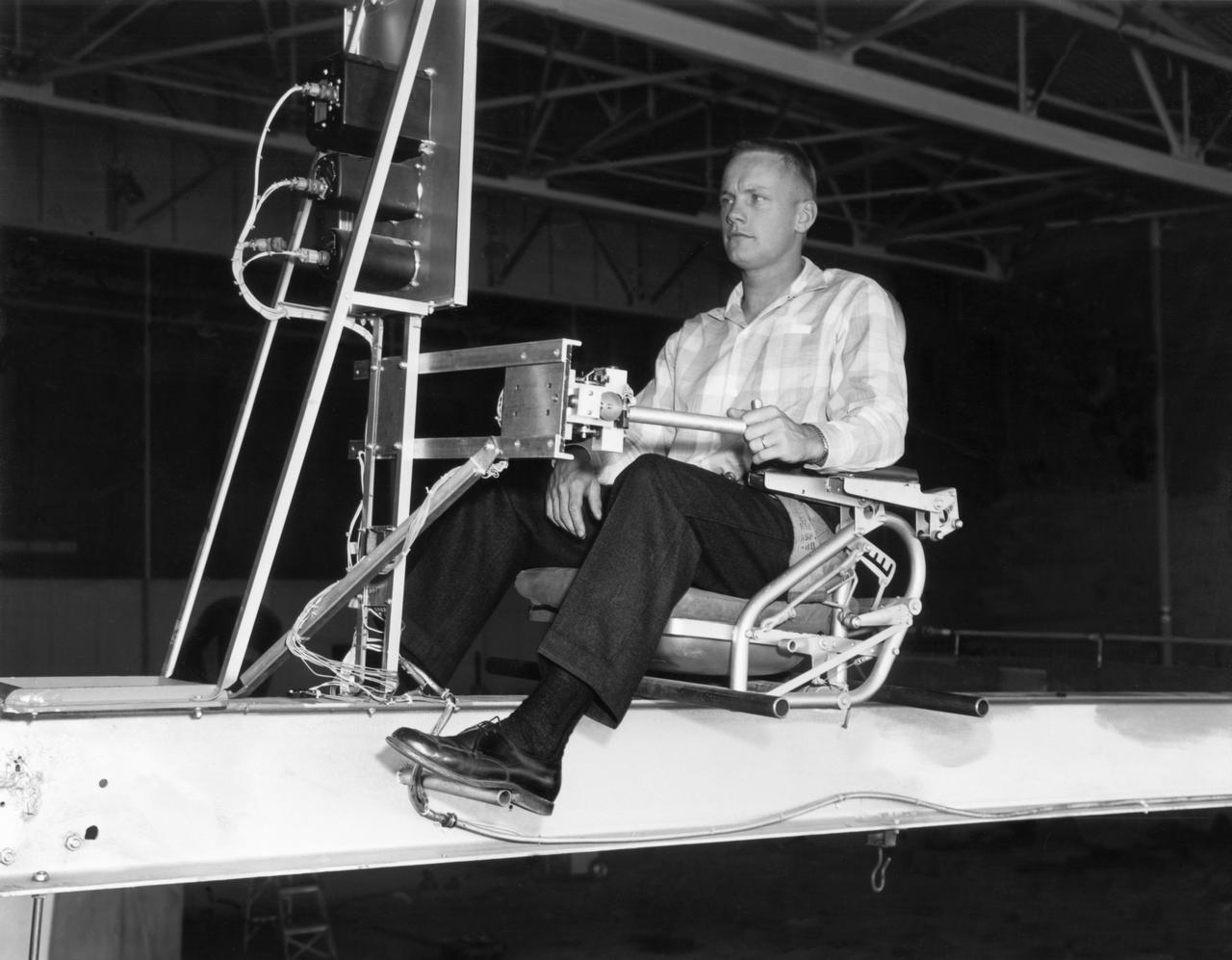
Famed astronaut Neil A. Armstrong, the first man to set foot on the moon during the historic Apollo 11 space mission in July 1969, served for seven years as a research pilot at the NACA-NASA High-Speed Flight Station, now the Dryden Flight Research Center, at Edwards, California, before he entered the space program. Armstrong joined the National Advisory Committee for Aeronautics (NACA) at the Lewis Flight Propulsion Laboratory (later NASA's Lewis Research Center, Cleveland, Ohio, and today the Glenn Research Center) in 1955. Later that year, he transferred to the High-Speed Flight Station at Edwards as an aeronautical research scientist and then as a pilot, a position he held until becoming an astronaut in 1962. He was one of nine NASA astronauts in the second class to be chosen. As a research pilot Armstrong served as project pilot on the F-100A and F-100C aircraft, F-101, and the F-104A. He also flew the X-1B, X-5, F-105, F-106, B-47, KC-135, and Paresev. He left Dryden with a total of over 2450 flying hours. He was a member of the USAF-NASA Dyna-Soar Pilot Consultant Group before the Dyna-Soar project was cancelled, and studied X-20 Dyna-Soar approaches and abort maneuvers through use of the F-102A and F5D jet aircraft. Armstrong was actively engaged in both piloting and engineering aspects of the X-15 program from its inception. He completed the first flight in the aircraft equipped with a new flow-direction sensor (ball nose) and the initial flight in an X-15 equipped with a self-adaptive flight control system. He worked closely with designers and engineers in development of the adaptive system, and made seven flights in the rocket plane from December 1960 until July 1962. During those fights he reached a peak altitude of 207,500 feet in the X-15-3, and a speed of 3,989 mph (Mach 5.74) in the X-15-1. Armstrong has a total of 8 days and 14 hours in space, including 2 hours and 48 minutes walking on the Moon. In March 1966 he was commander of the Gemini 8 or
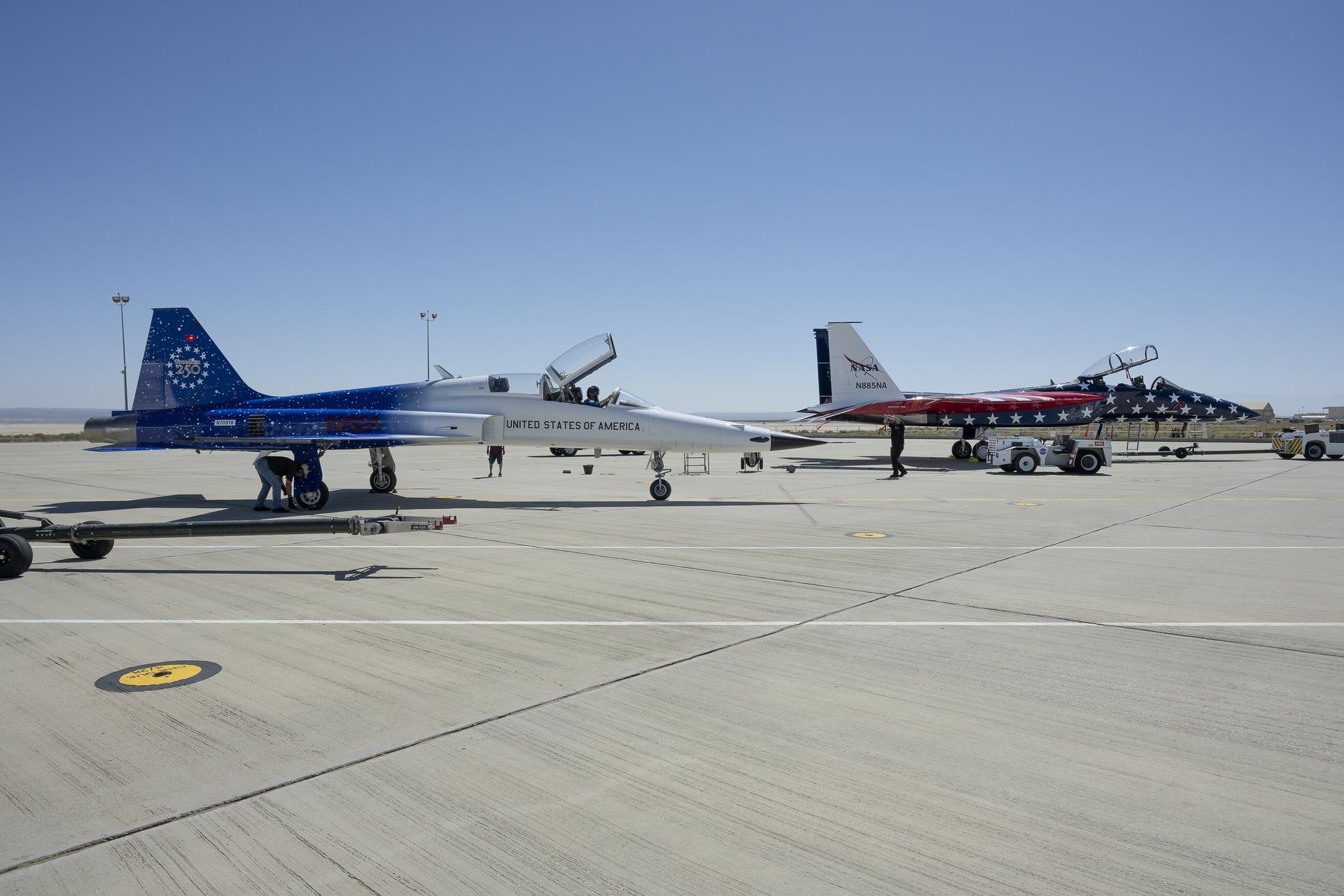
A Northrop F-5 Tiger II and NASA’s F-15 prepare for Red, White, and Boom, the U.S. Air Force Test Center’s celebration of America’s 250th anniversary and NASA Armstrong’s commemoration of its 80th year, at NASA’s Armstrong Flight Research Center in Edwards, California, on Thursday, Sept. 17, 2026. The event brought together the workforce, families, and the Edwards community for a high‑energy day featuring a Flightline 5K, Ramp Fest and STEM Expo, static aircraft displays, hands‑on STEM activities, and a NASA flyover with sonic boom.
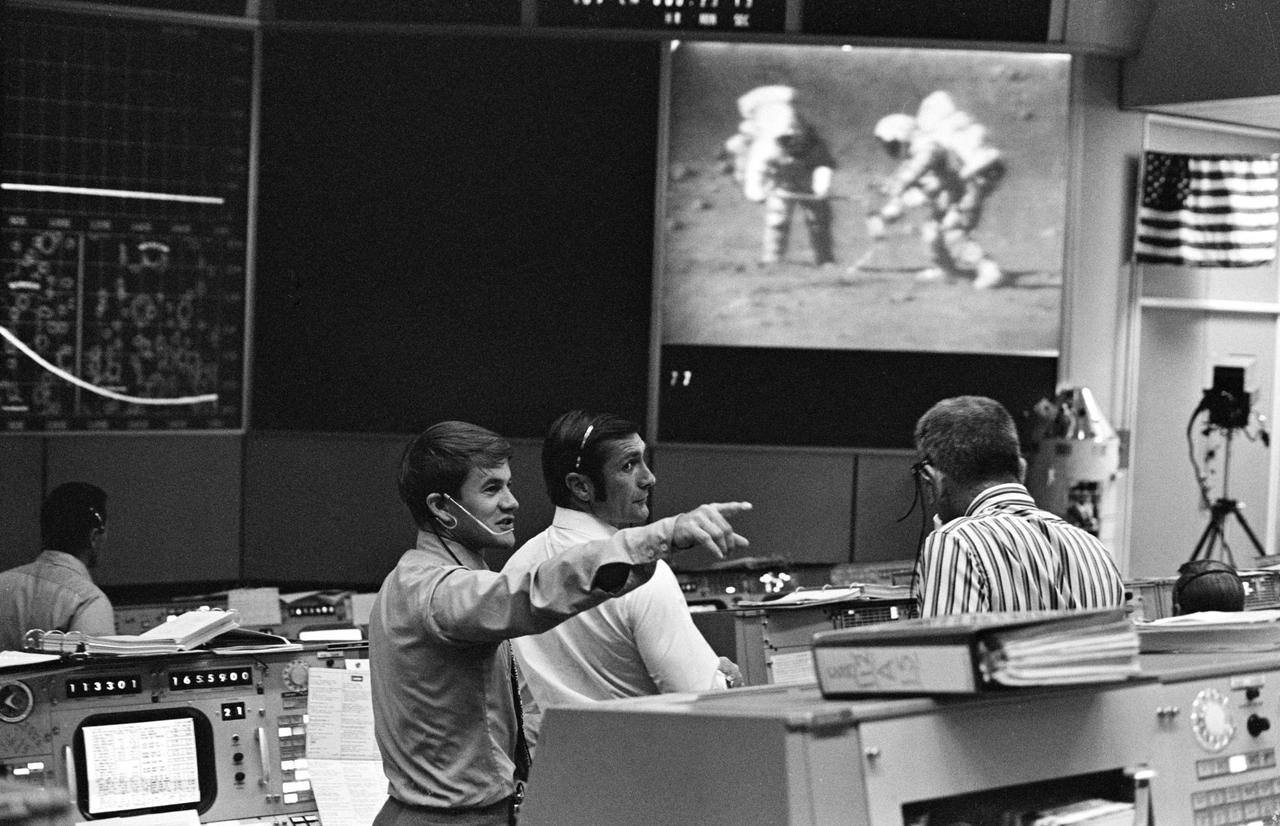
S71-41836 (2 Aug. 1971) --- Scientist-astronaut Joseph P. Allen, left, directs the attention of astronaut Richard F. Gordon Jr., to an occurrence out of view at right in the Mission Control Center's (MCC) Mission Operations Control Room (MOCR), while Dr. Donald K. (Deke) Slayton, on right with back to camera, views activity of Apollo 15 on a large screen at the front of the MOCR. Astronauts David R. Scott and James B. Irwin are seen on the screen performing tasks of the mission's third extravehicular activity (EVA), on Aug. 2, 1971. Dr. Slayton is director of Flight Crew Operations, NASA-MSC; Gordon is Apollo 15 backup commander; and Dr. Allen is an Apollo 15 spacecraft communicator.
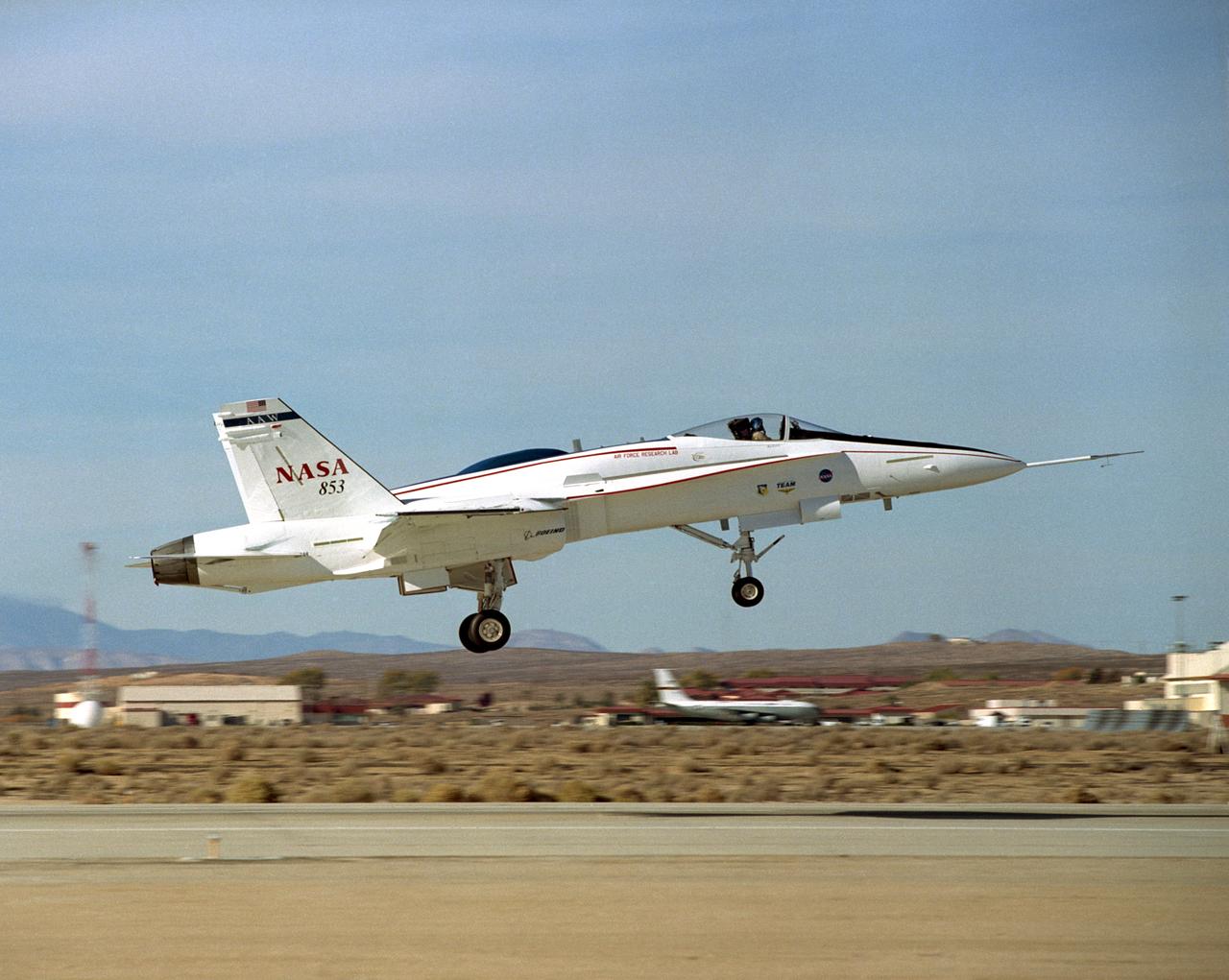
The Active Aeroelastic Wing F-18A lifts off on its first checkout flight November 15, 2002, from NASA's Dryden Flight Research Center at Edwards Air Force Base, Calif. The checkout flight initiated a two-phase NASA--Air Force flight research program that will investigate the potential of aerodynamically twisting flexible wings to improve maneuverability of high-performance aircraft at transonic and supersonic speeds.
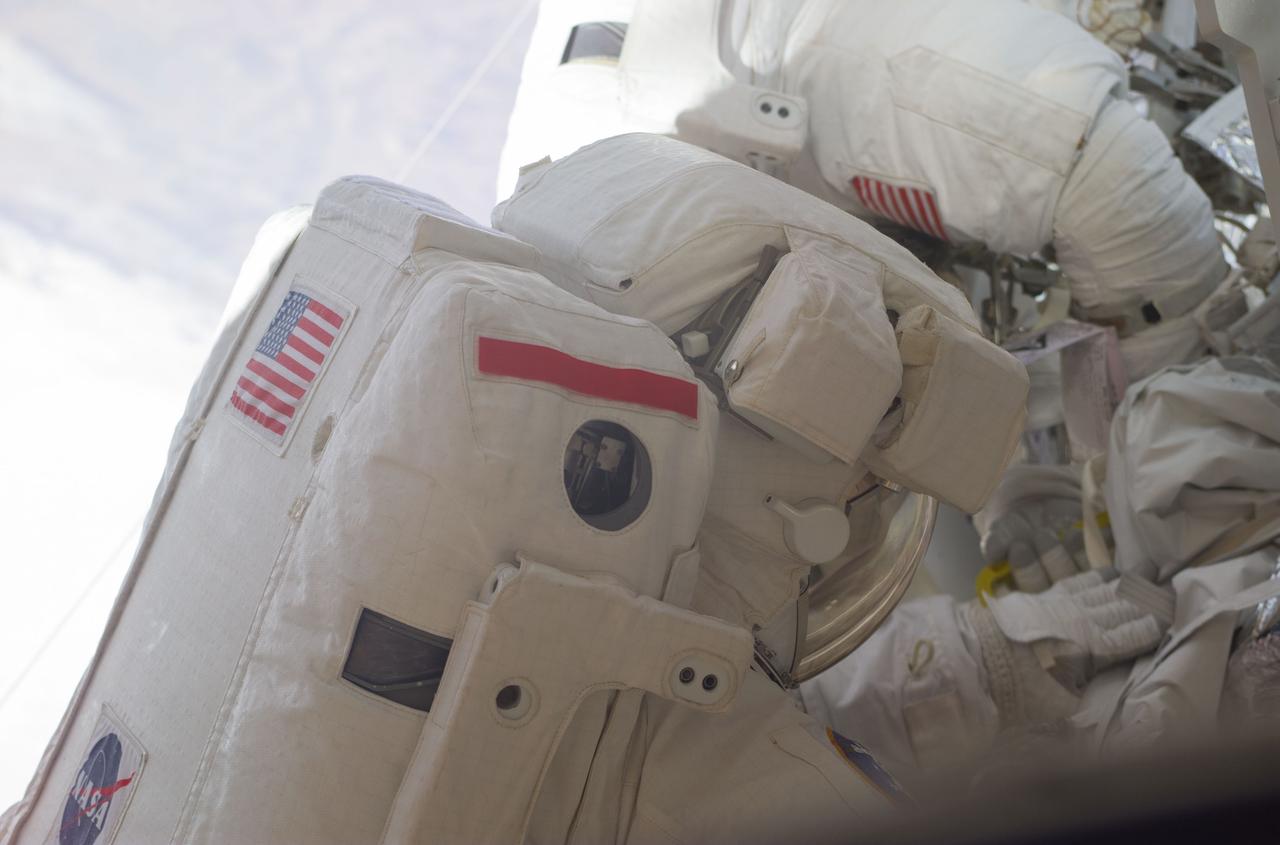
S104-E-5064 (15 July 2001) --- Michael L. Gernhardt (front), mission specialist and EV1, and James F. Reilly, mission specialist and EV2, work in the payload bay of the Space Shuttle Atlantis during the first extravehicular activity (EVA) of the STS-104 mission. This image was taken by a STS-104 crewmember in Atlantis with a digital still camera.
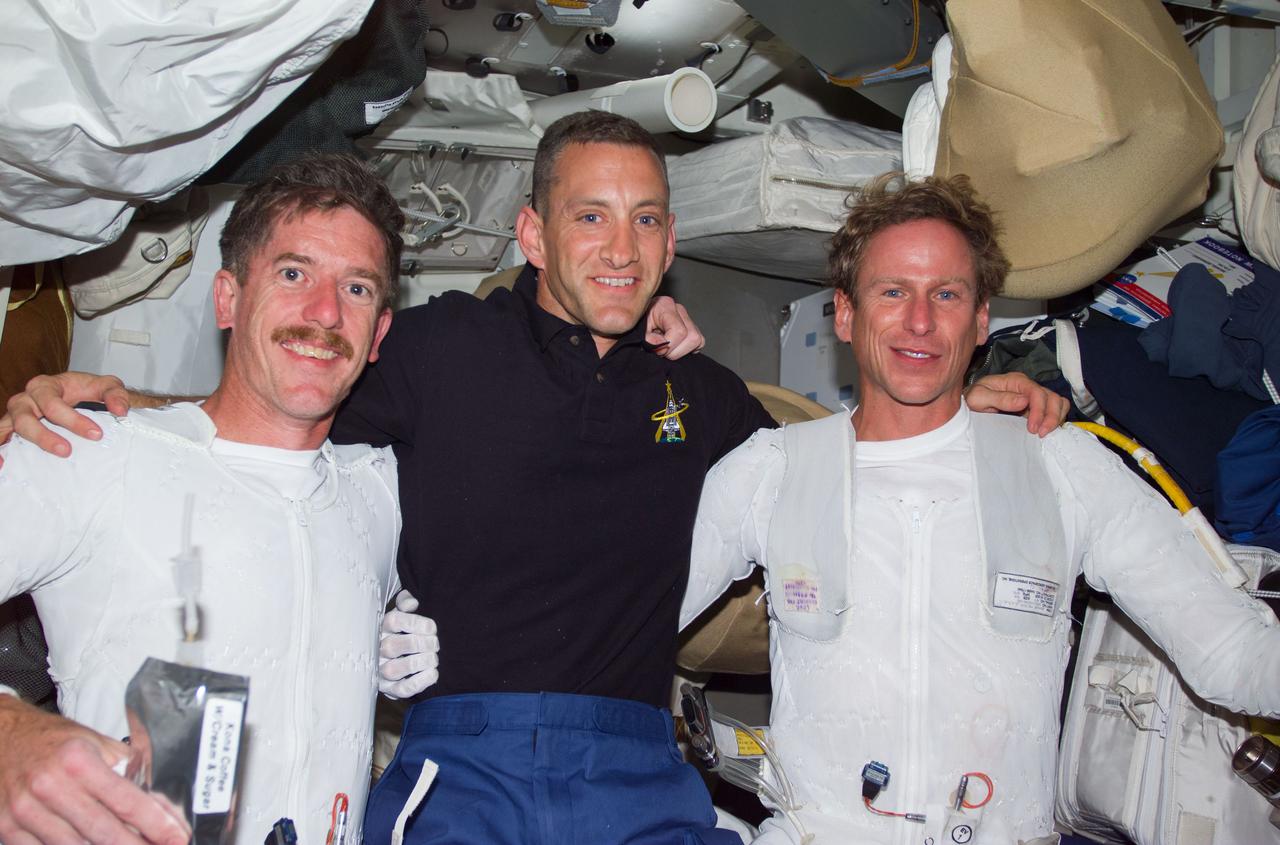
S104-E-5076 (15 July 2001) --- After completing the first extravehicular activity (EVA) of the STS-104 mission, James F. Reilly (left), mission specialist, and Michael L. Gernhardt (right), mission specialist, both wearing Liquid Cooling and Ventilation Garments (LCVG's), pose for a picture with Charles O. Hobaugh, pilot, on the middeck of the Space Shuttle Atlantis.
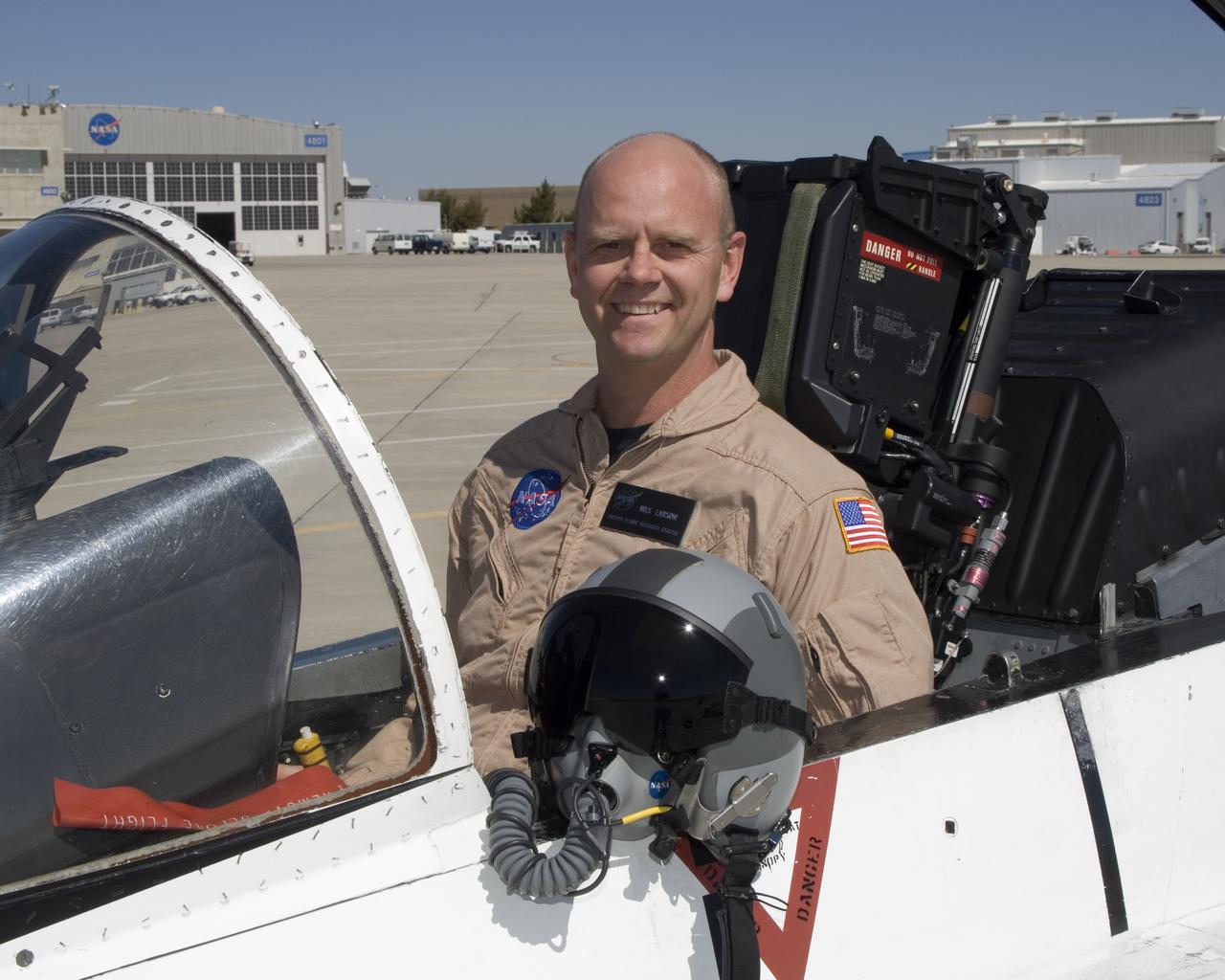
Nils Larson is a research pilot in the Flight Crew Branch of NASA's Dryden Flight Research Center, Edwards, Calif. Larson joined NASA in February 2007 and will fly the F-15, F-18, T-38 and ER-2. Prior to joining NASA, Larson was on active duty with the U.S. Air Force. He has accumulated more that 4,900 hours of military and civilian flight experience in more than 70 fixed and rotary winged aircraft. Larson completed undergraduate pilot training at Williams Air Force Base, Chandler, Ariz., in 1987. He remained at Williams as a T-37 instructor pilot. In 1991, Larson was assigned to Beale Air Force Base, Calif., as a U-2 pilot. He flew 88 operational missions from Korea, Saudi Arabia, the United Kingdom, Panama and other locations. Larson graduated from the U.S. Air Force Test Pilot School at Edwards Air Force Base, Calif., in Class 95A. He became a flight commander and assistant operations officer for the 445th squadron at Edwards. He flew the radar, avionics integration and engine tests in F-15 A-D, the early flights of the glass cockpit T-38C and airworthiness flights of the Coast Guard RU-38. He was selected to serve as an Air Force exchange instructor at the U.S. Naval Test Pilot School, Patuxent River, Md. He taught systems and fixed-wing flight test and flew as an instructor pilot in the F-18, T-2, U-6A Beaver and X-26 Schweizer sailplane. Larson commanded U-2 operations for Warner Robins Air Logistics Center's Detachment 2 located in Palmdale, Calif. In addition to flying the U-2, Larson supervised the aircraft's depot maintenance and flight test. He was the deputy group commander for the 412th Operations Group at Edwards before retiring from active duty in 2007 with the rank of lieutenant colonel. His first experience with NASA was at the Glenn Research Center, Cleveland, where he served a college summer internship working on arcjet engines. Larson is a native of Bethany, W.Va,, and received his commission from the U.S. Air Force Academy in 1986 with a
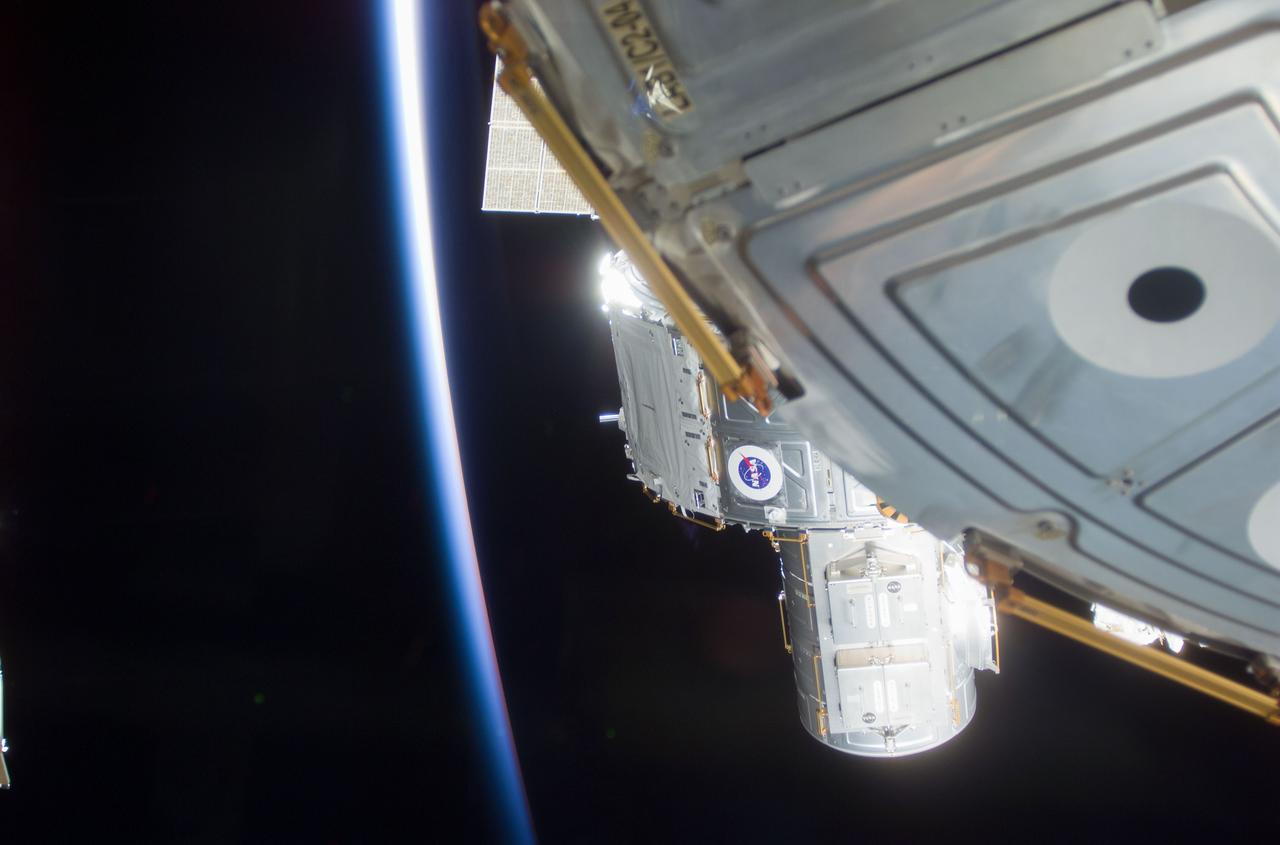
S104-E-5071 (15 July 2001) --- As the sun sets behind the Earth's horizon, the Expedition Two and STS-104 crews continue to install the Quest Airlock onto the starboard side of Unity Node 1. Susan J. Helms, Expedition Two flight engineer, working in the Destiny U.S. Laboratory, maneuvered the Airlock into place with the Canadarm2, Space Station Remote Manipulator System (SSRMS), while being assisted by Michael L. Gernhardt and James F. Reilly, STS-104 mission specialists, during their first extravehicular activity (EVA).
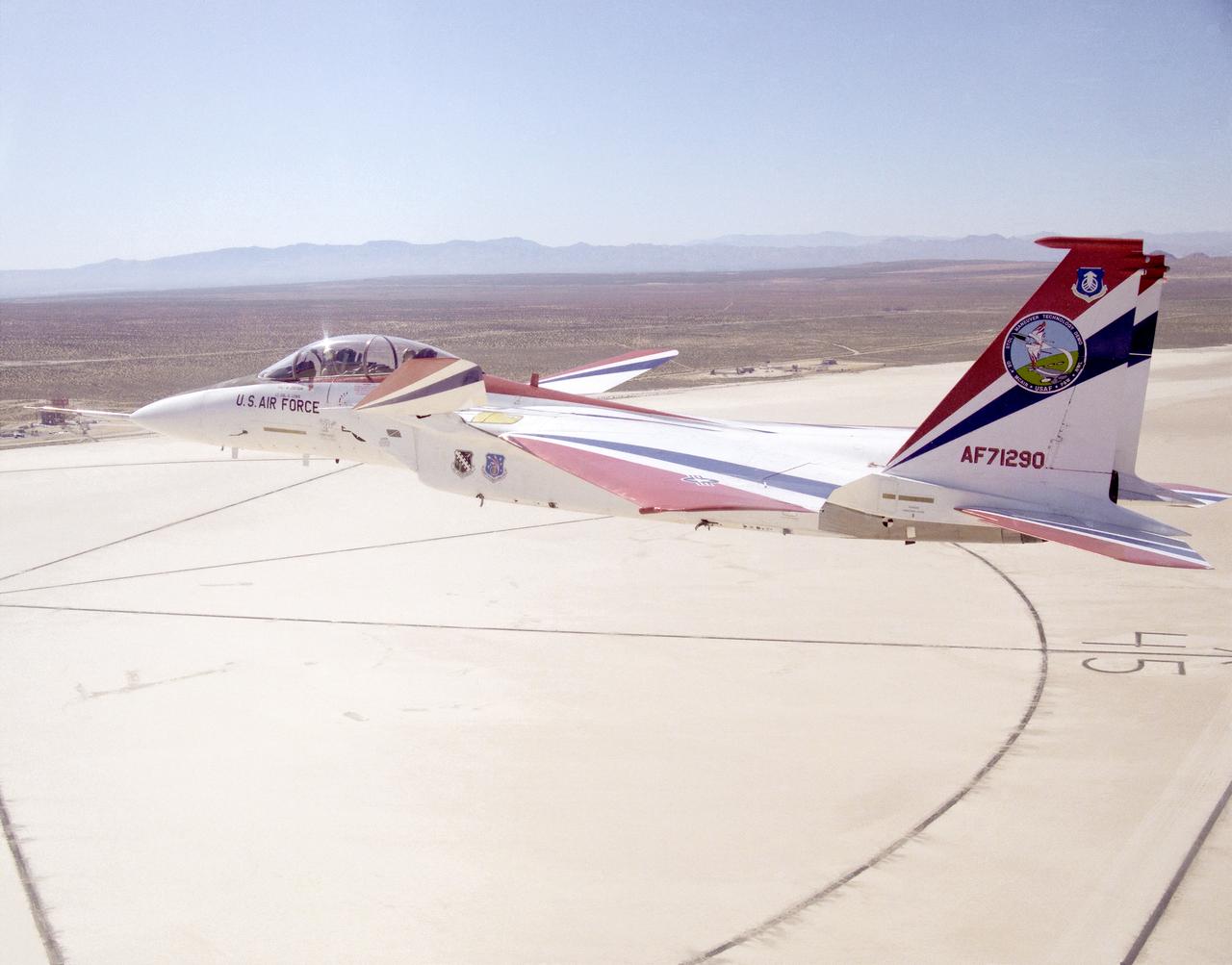
F-15B ACTIVE in flight over lakebed
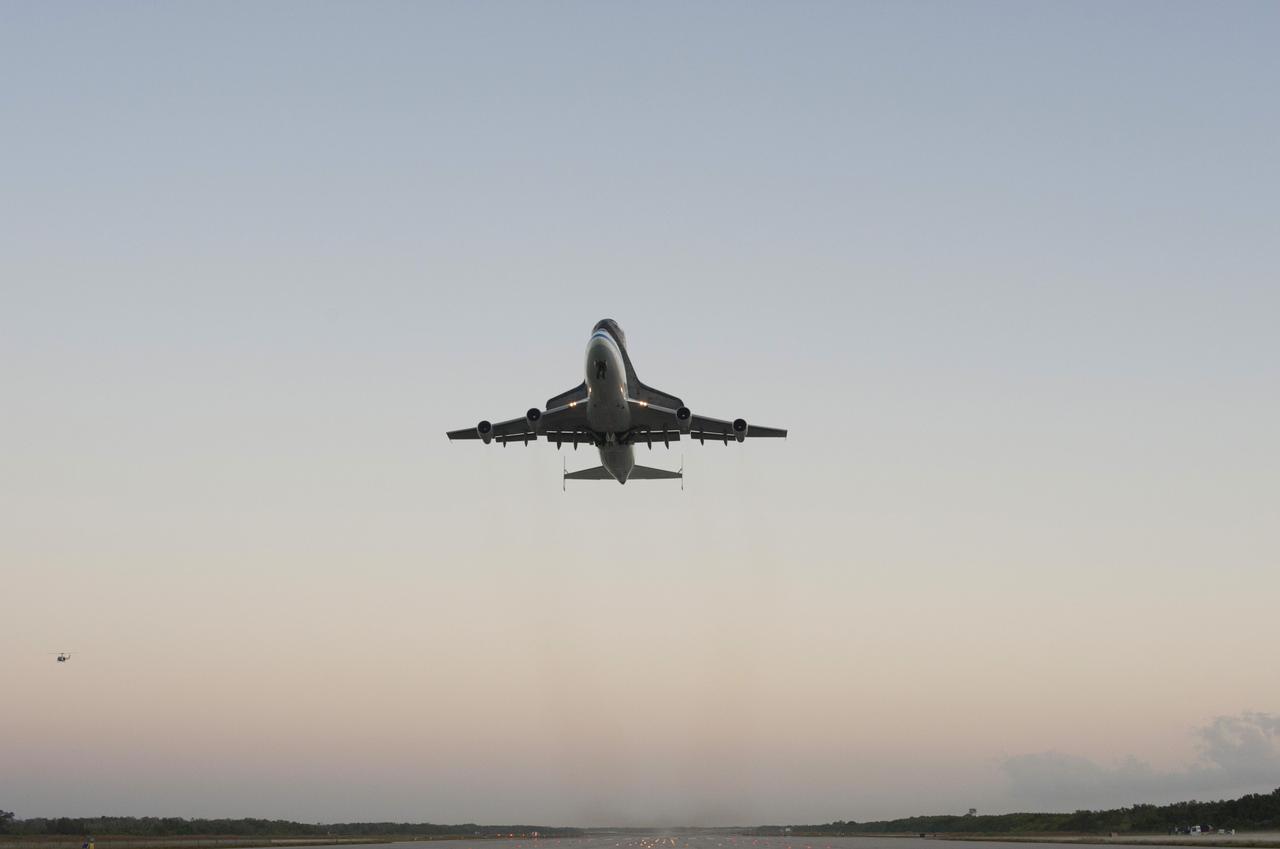
CAPE CANAVERAL, Fla. - The Shuttle Carrier Aircraft transporting space shuttle Discovery soars overhead shortly after takeoff from NASA Kennedy Space Center's runway 15 at 7 a.m. EDT. The duo is beginning its ferry flight to the Washington Dulles International Airport in Virginia that also includes a flyby of the Space Coast and Washington, D.C. Discovery is leaving Kennedy after more than 28 years of service beginning with its arrival on the space coast Nov. 9, 1983. Discovery is set to move to the Smithsonian's National Air and Space Museum, Steven F. Udvar-Hazy Center in Chantilly, Va., on April 19 where it will be placed on public display. For more information on the Shuttle Carrier Aircraft, visit http://www.nasa .gov/centers/dryden/news/FactSheets/FS-013- DFRC.html. For more information on shuttle transition and retirement activities, visit http://www.nasa.gov/transition. Photo credit: NASA/Tim Powers and Tim Terry
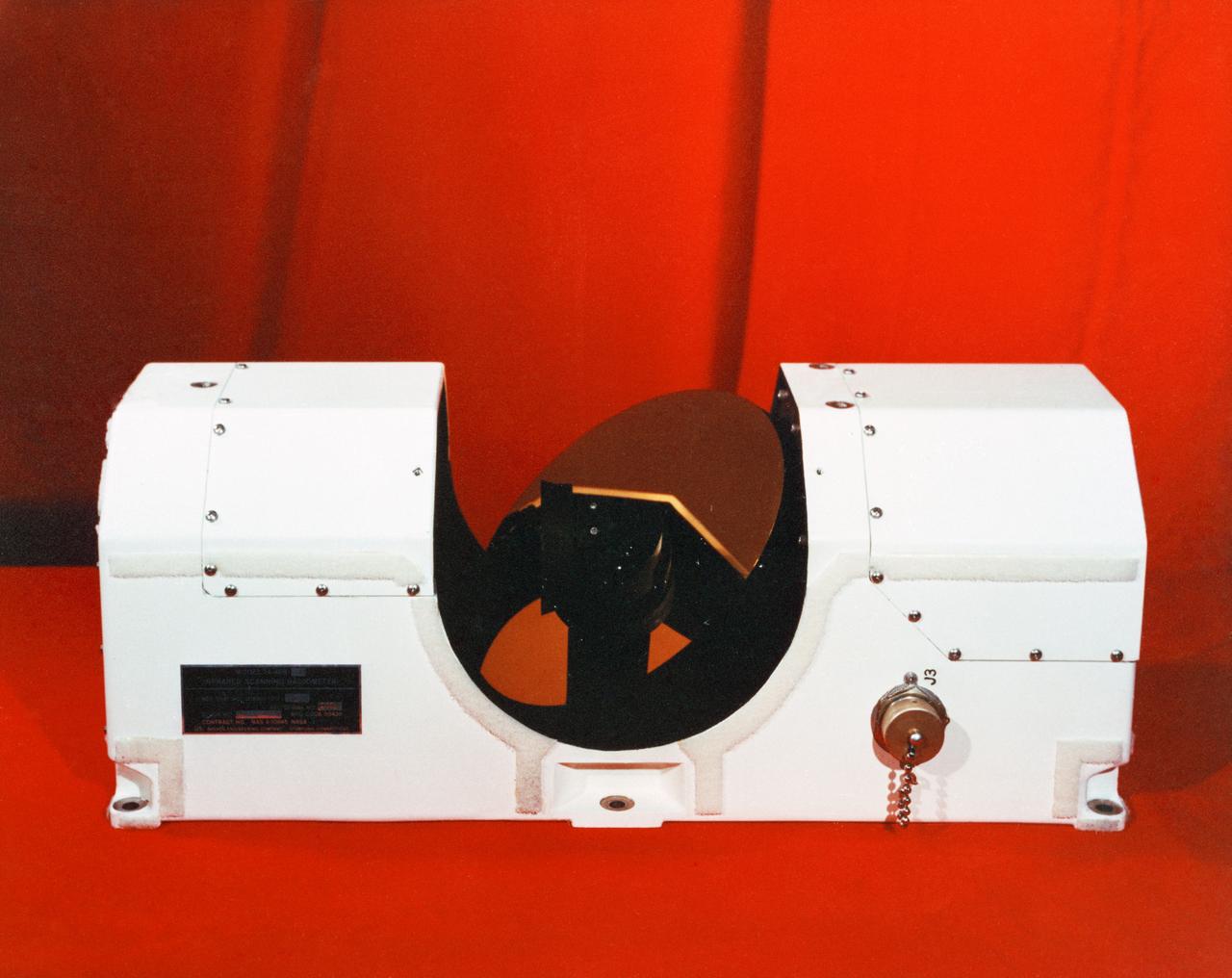
S72-53471 (November 1972) --- The Infrared Scanning Radiometer, Experiment S-171, one of the lunar orbital science experiments which will be mounted in the SIM bay of the Apollo 17 Service Module. The ISR experiment will provide a lunar surface temperature map with improved temperature and spatial resolution over what has been impossible before. Previous Earth-based observations of the lunar surface thermal balance have been limited to the front side with a temperature resolution of about 210 degrees K (-80 degrees F) and a surface resolution of about 15 kilometers (9.3 miles). When correlated with orbital photography and lunar sounder data, ISR temperature measurements are expected to aid in locating surface rock fields, crustal structural differences, volcanic activity and fissures emitting "hot" gases.

S85-30878 (15 April 1985) --- Astronaut Jerry L. Ross, left, and Astronaut candidate Mark C. Lee rehearse the deployment of two specially designed flyswatter like tools on the end of the orbiter's remote manipulator system (RMS) arm. Their "dry" run of a planned Discovery STS 51-D extravehicular activity (EVA) is actually not so dry, since it is held in a 25 ft. deep pool, part of the Johnson Space Center's (JSC) weightless environment test facility (WET-F). Astronauts Jeffrey A. Hoffman and S. David Griggs, two 51-D mission specialists, have been assigned the task of April 16's EVA. A rendezvous with the troubled Syncom IV (LEASAT) satellite has been scheduled for the day after the EVA, and an attempt will be made by the arm to trip an important lever on the troubled communications satellite.
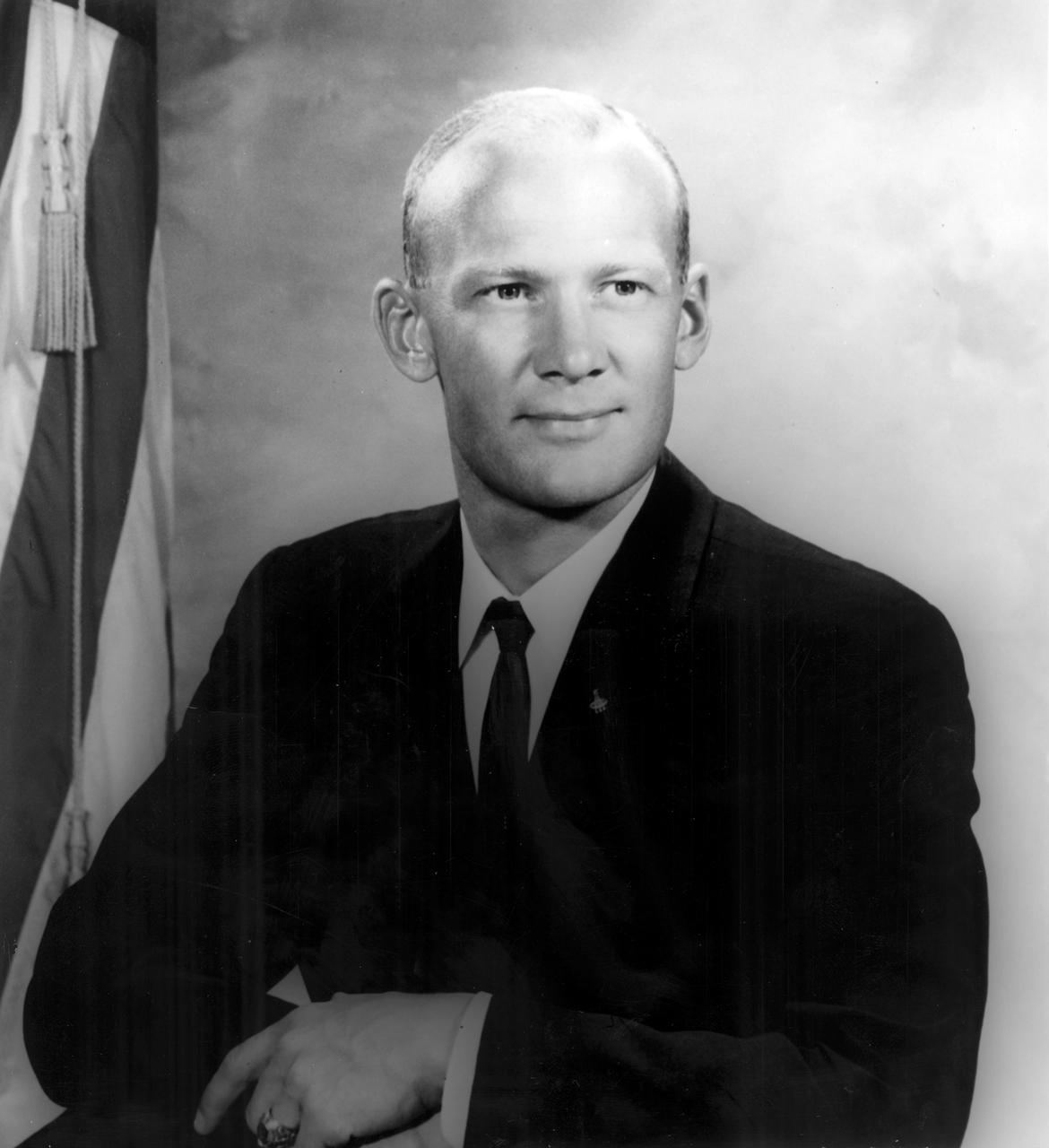
This is the official NASA portrait of astronaut Edwin E. (Buzz) Aldrin. Prior to joining NASA, Aldrin flew 66 combat missions in F-86s while on duty in Korea. At Nellis Air Force Base, Nevada, he served as an aerial gunnery instructor. Following his assignment as aide to the dean of faculty at the Air Force Academy, Aldrin flew F-100s as a flight commander at Bitburg, Germany. Aldrin was one of the third group of astronauts named by NASA in October 1963 and has logged 289 hours and 53 minutes in space, of which, 7 hours and 52 minutes were spent in Extra Vehicular Activity (EVA). On November 11, 1966, he launched into space aboard the Gemini 12 spacecraft on a 4-day flight, which brought the Gemini program to a successful close. During that mission, Aldrin established a new record for EVA, spending 5-1/2 hours outside the spacecraft. July 16-24, 1969, Aldrin served as lunar module pilot for Apollo 11, the first manned lunar landing mission. Aldrin followed Neil Armstrong onto the lunar surface on July 20, 1969, completing a 2-hour and 15 minute lunar EVA. Aldrin resigned from NASA in July 1971.
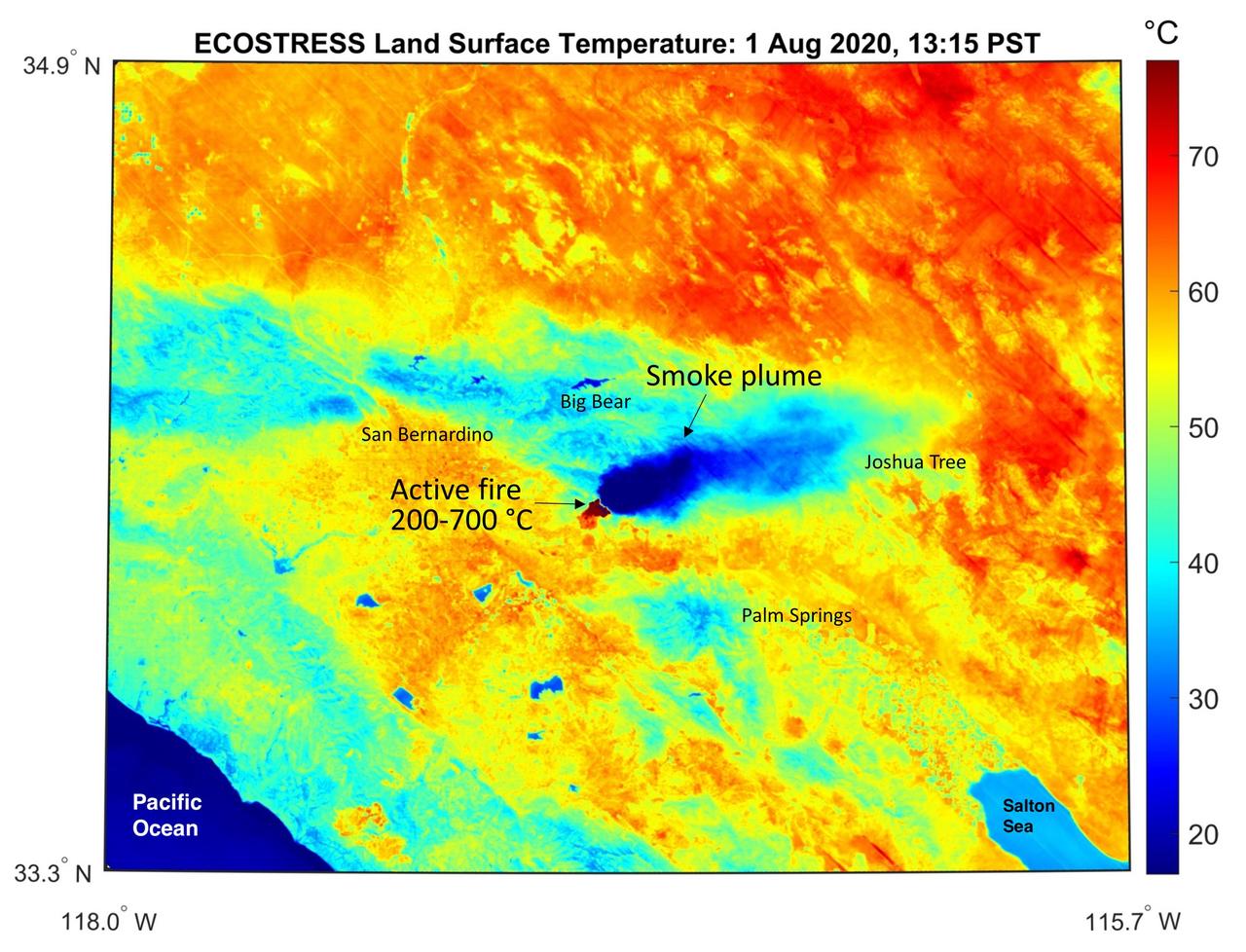
This temperature map shows the stressed and dry vegetation surrounding the Apple fire in Southern California on Aug. 1, 2020. The observation was made possible by NASA's Ecosystem Spaceborne Thermal Radiometer Experiment on Space Station (ECOSTRESS) that measured the temperature of the burn area and tracked the dark smoke plume drifting east from California to Arizona. ECOSTRESS collected this data when the space station passed over the region at about 1:15 p.m. PST on Saturday, Aug. 1, 2020, when the burn area was approximately 4,000 acres in size. Black smoke can be seen drifting east and over Joshua Tree National Park in the Mojave Desert. With a resolution of about 77 by 77 yards (70 by 70 meters), the image enables surface-temperature conditions down to the size of a football field to be studied. In the active burn area, temperatures of between 390-1290 F (200-700 C) were recorded, and in one pixel in the ECOSTRESS image of the burn zone, a peak temperature of 1387 F (753 C) was detected. Tasked with detecting plant water use and stress, ECOSTRESS measures the temperature of plants as they heat up when they run out of water. But it can also measure and track heat-related phenomena like fires, heat waves, and volcanoes. https://photojournal.jpl.nasa.gov/catalog/PIA23798
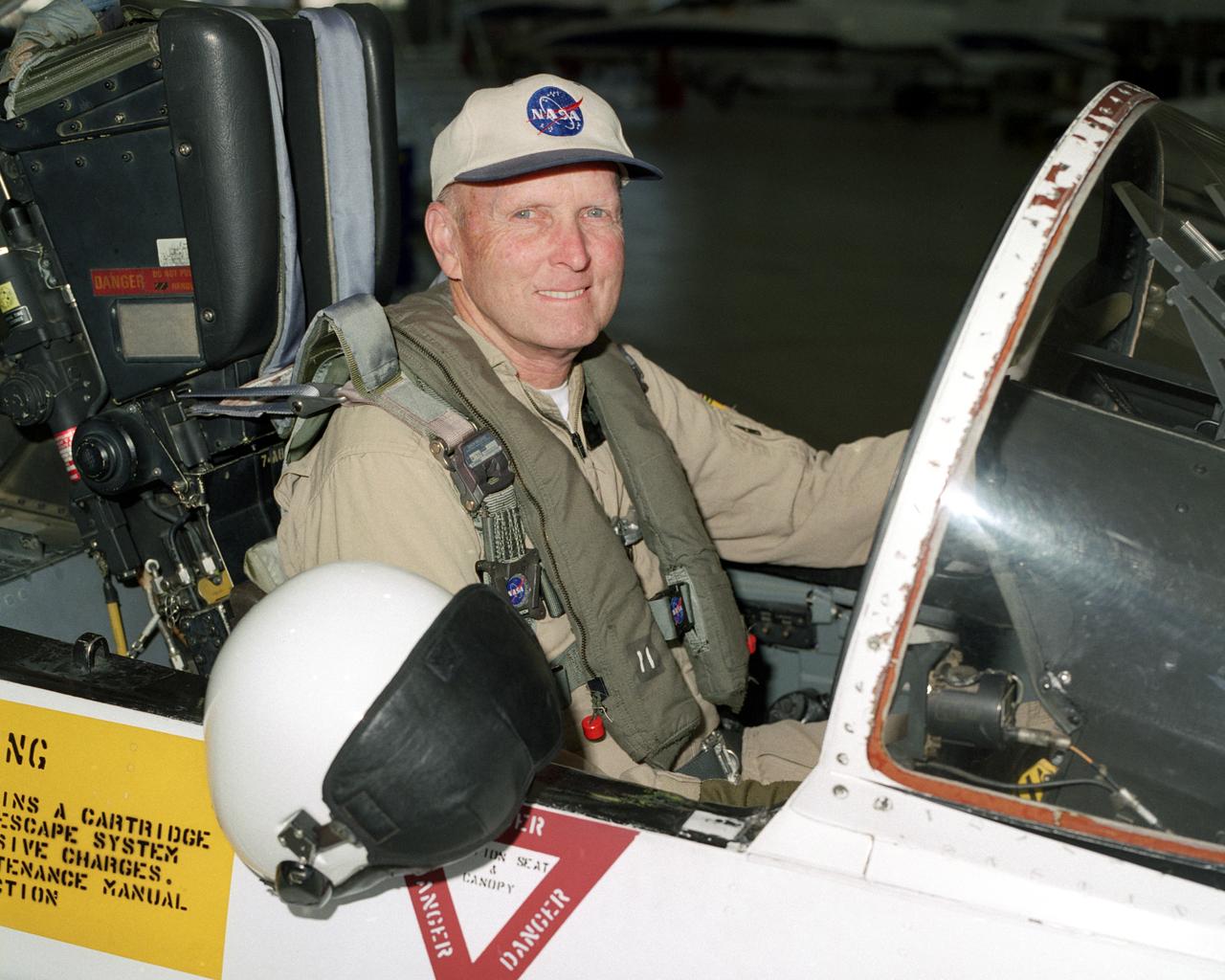
Former NASA astronaut C. Gordon Fullerton, seated in the cockpit of an F/A-18, is a research pilot at NASA's Dryden Flight Research Center, Edwards, Calif. Since transferring to Dryden in 1986, his assignments have included a variety of flight research and support activities piloting NASA's B-52 launch aircraft, the 747 Shuttle Carrier Aircraft (SCA), and other multi-engine and high performance aircraft. He flew a series of development air launches of the X-38 prototype Crew Return Vehicle and in the launches for the X-43A Hyper-X project. Fullerton also flies Dryden's DC-8 Airborne Science aircraft in support a variety of atmospheric physics, ground mapping and meteorology studies. Fullerton also was project pilot on the Propulsion Controlled Aircraft program, during which he successfully landed both a modified F-15 and an MD-11 transport with all control surfaces neutralized, using only engine thrust modulation for control. Fullerton also evaluated the flying qualities of the Russian Tu-144 supersonic transport during two flights in 1998, one of only two non-Russian pilots to fly that aircraft. With more than 15,000 hours of flying time, Fullerton has piloted 135 different types of aircraft in his career. As an astronaut, Fullerton served on the support crews for the Apollo 14, 15, 16, and 17 lunar missions. In 1977, Fullerton was on one of the two flight crews that piloted the Space Shuttle prototype Enterprise during the Approach and Landing Test Program at Dryden. Fullerton was the pilot on the STS-3 Space Shuttle orbital flight test mission in 1982, and commanded the STS-51F Spacelab 2 mission in 1985. He has logged 382 hours in space flight. In July 1988, he completed a 30-year career with the U.S. Air Force and retired as a colonel.
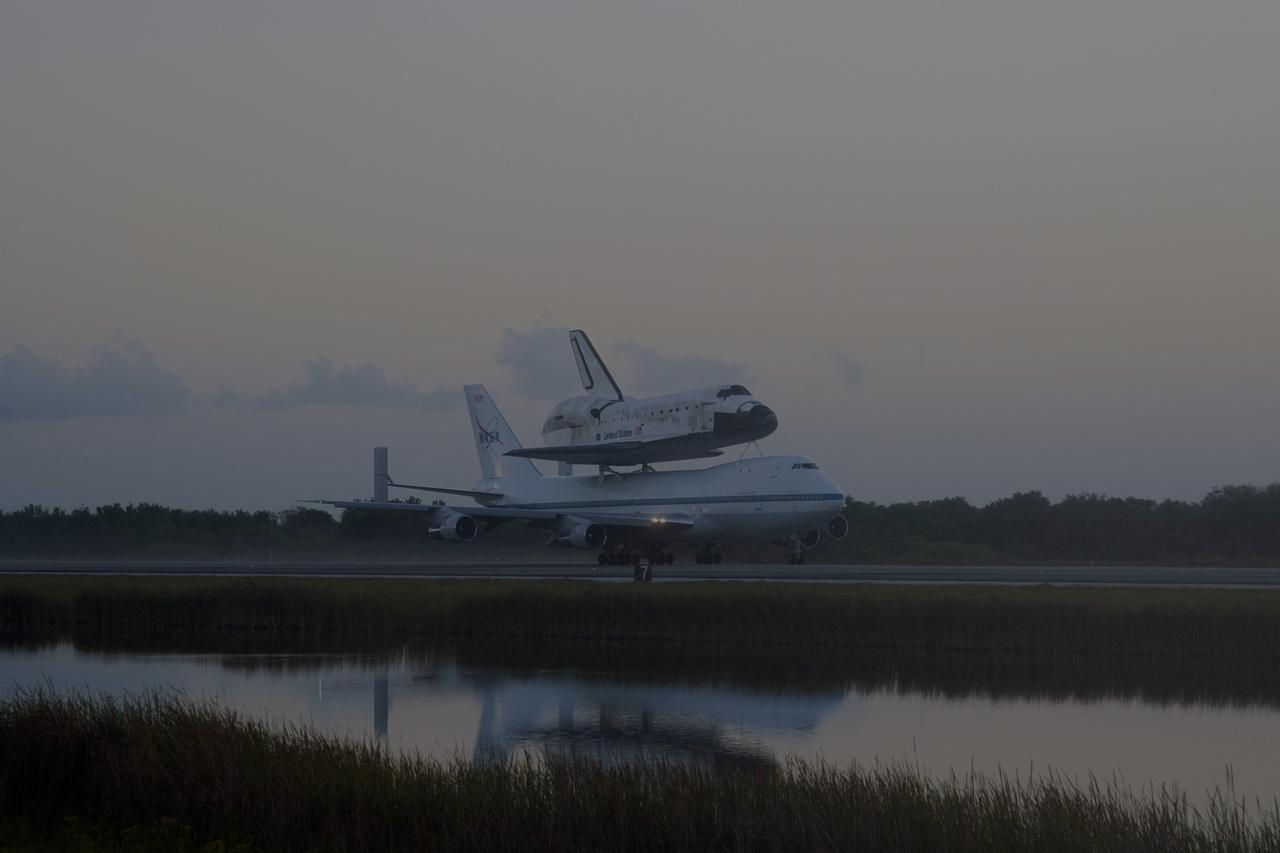
CAPE CANAVERAL, Fla. – In the early morning hours at NASA Kennedy Space Center’s Shuttle Landing Facility in Florida, the Shuttle Carrier Aircraft, or SCA, with space shuttle Discovery secured atop, taxies past the midpoint on its way for a takeoff on runway 15 at 7 a.m. EDT. The aircraft, known as an SCA, is a Boeing 747 jet, originally manufactured for commercial use, which was modified by NASA to transport the shuttles between destinations on Earth. This SCA, designated NASA 905, is assigned to the remaining ferry missions, delivering the shuttles to their permanent public display sites. NASA 905 is scheduled to ferry Discovery to the Washington Dulles International Airport in Virginia on April 17, after which the shuttle will be placed on display in the Smithsonian’s National Air and Space Museum, Steven F. Udvar-Hazy Center in Chantilly, Va. For more information on the SCA, visit http://www.nasa.gov/centers/dryden/news/FactSheets/FS-013-DFRC.html. For more information on shuttle transition and retirement activities, visit http://www.nasa.gov/transition. Photo credit: NASA/Tim Powers and Rick Wetherington
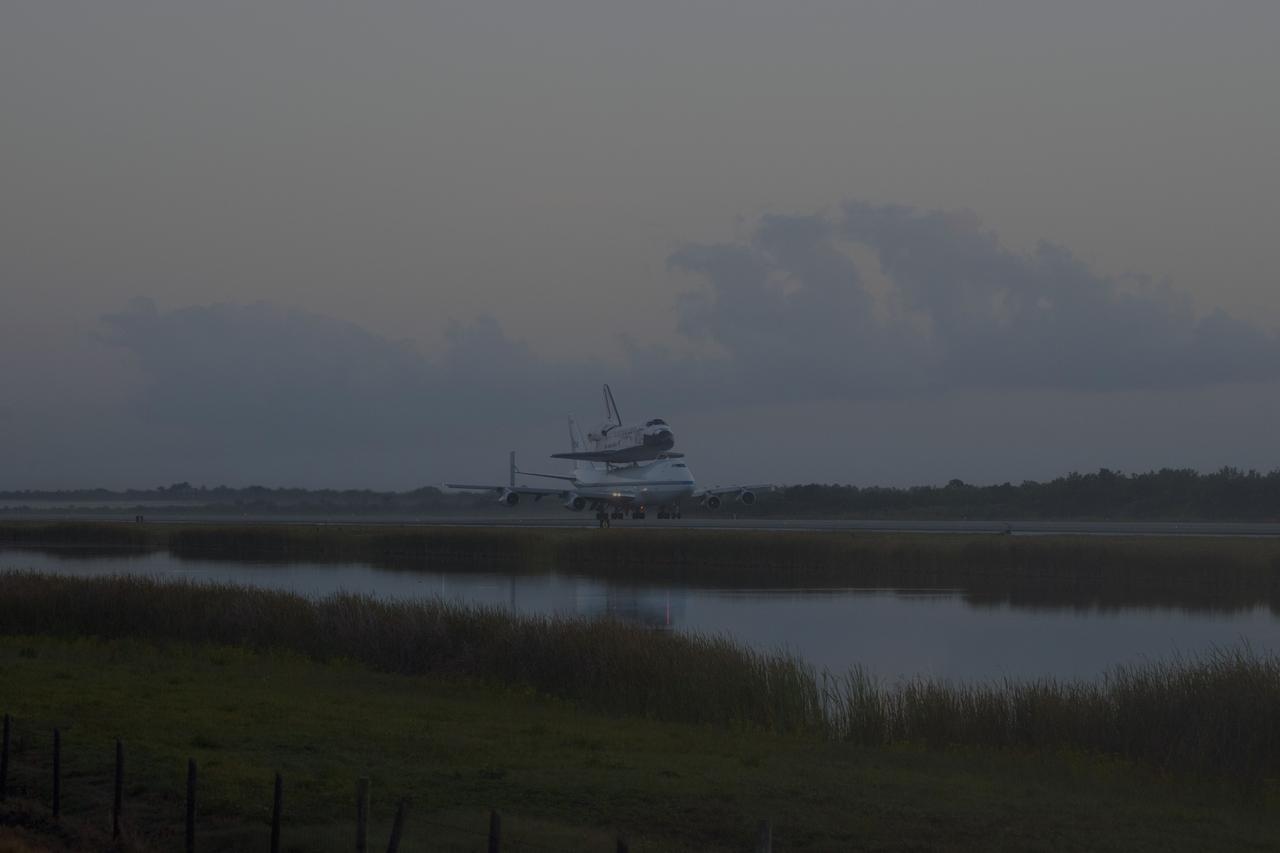
CAPE CANAVERAL, Fla. – In the early morning hours at NASA Kennedy Space Center’s Shuttle Landing Facility in Florida, the Shuttle Carrier Aircraft, or SCA, with space shuttle Discovery secured atop, taxies past the midpoint on its way for a takeoff on runway 15 at 7 a.m. EDT. The aircraft, known as an SCA, is a Boeing 747 jet, originally manufactured for commercial use, which was modified by NASA to transport the shuttles between destinations on Earth. This SCA, designated NASA 905, is assigned to the remaining ferry missions, delivering the shuttles to their permanent public display sites. NASA 905 is scheduled to ferry Discovery to the Washington Dulles International Airport in Virginia on April 17, after which the shuttle will be placed on display in the Smithsonian’s National Air and Space Museum, Steven F. Udvar-Hazy Center in Chantilly, Va. For more information on the SCA, visit http://www.nasa.gov/centers/dryden/news/FactSheets/FS-013-DFRC.html. For more information on shuttle transition and retirement activities, visit http://www.nasa.gov/transition. Photo credit: NASA/Tim Powers and Rick Wetherington
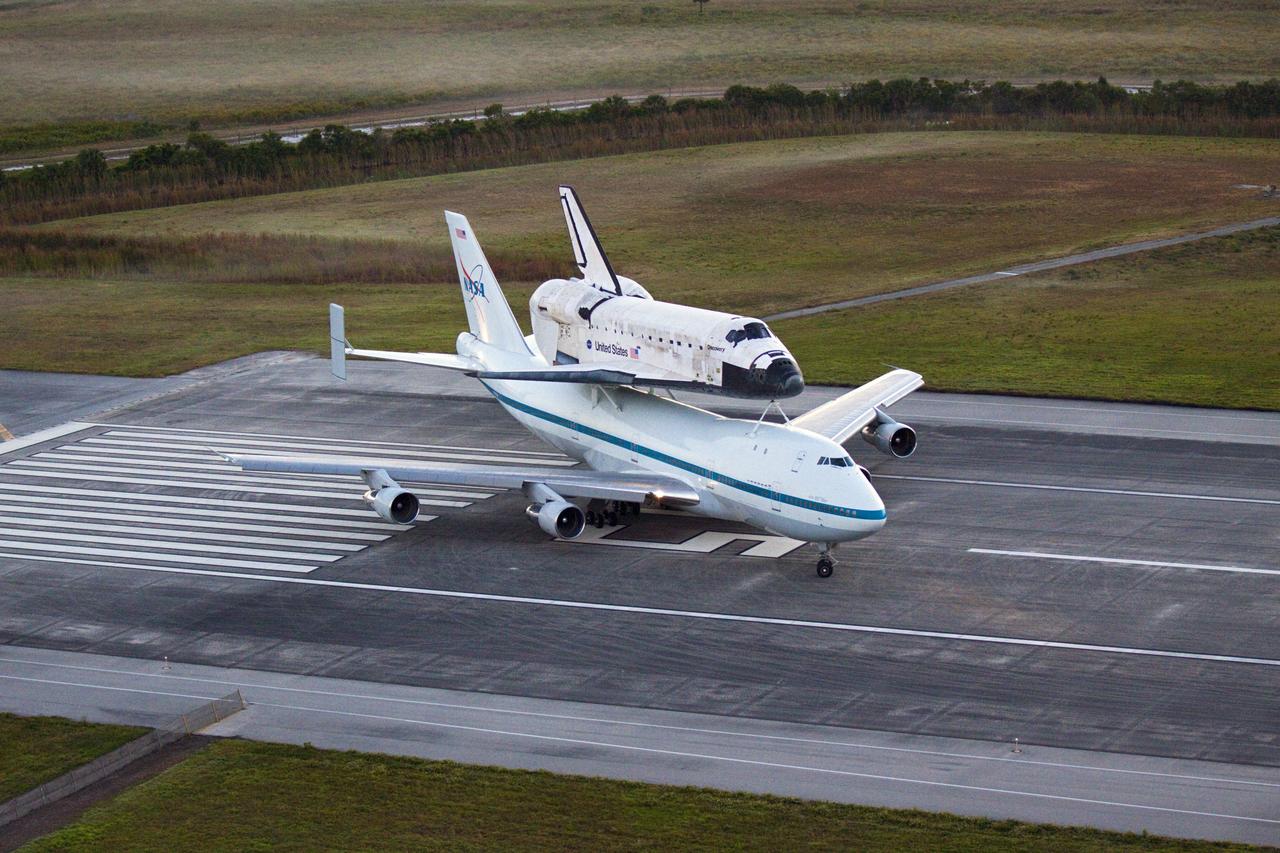
CAPE CANAVERAL, Fla. – In the early morning hours at NASA Kennedy Space Center’s Shuttle Landing Facility in Florida, the Shuttle Carrier Aircraft, or SCA, with space shuttle Discovery secured atop, completes the turn on runway 15 in preparation for a takeoff at 7 a.m. EDT to deliver Discovery to its new home. The aircraft, known as an SCA, is a Boeing 747 jet, originally manufactured for commercial use, which was modified by NASA to transport the shuttles between destinations on Earth. This SCA, designated NASA 905, is assigned to the remaining ferry missions, delivering the shuttles to their permanent public display sites. NASA 905 is scheduled to ferry Discovery to the Washington Dulles International Airport in Virginia on April 17, after which the shuttle will be placed on display in the Smithsonian’s National Air and Space Museum, Steven F. Udvar-Hazy Center in Chantilly, Va. For more information on the SCA, visit http://www.nasa.gov/centers/dryden/news/FactSheets/FS-013-DFRC.html. For more information on shuttle transition and retirement activities, visit http://www.nasa.gov/transition. Photo credit: NASA/Glenn Benson
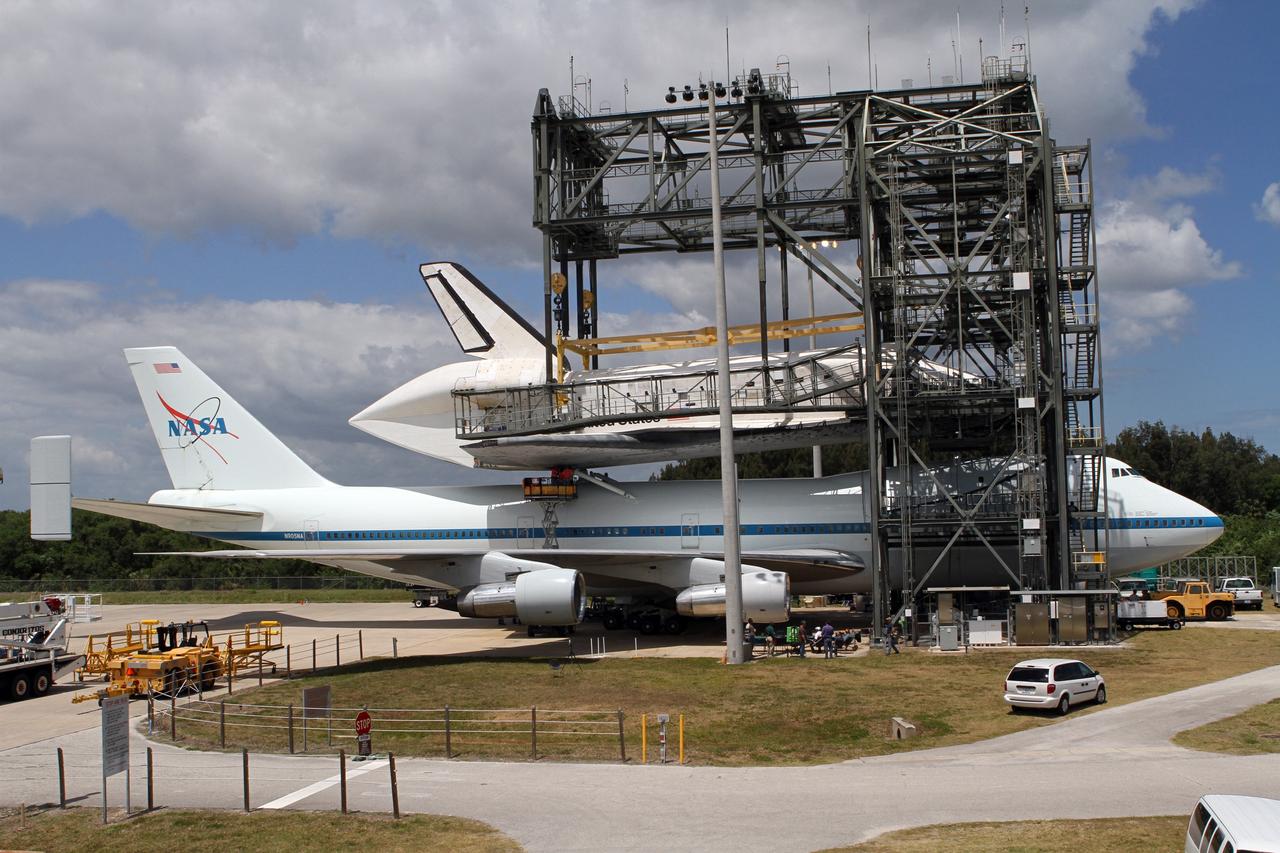
CAPE CANAVERAL, Fla. – At the Shuttle Landing Facility at NASA’s Kennedy Space Center in Florida, initial mating of space shuttle Discovery and the Shuttle Carrier Aircraft is complete in the mate-demate device. Known as the “soft mate,” the procedure was complete at about 11:15 a.m. EDT. The device, known as the MDD, is a large gantry-like steel structure used to hoist a shuttle off the ground and position it onto the back of the aircraft, or SCA. The SCA is a Boeing 747 jet, originally manufactured for commercial use, which was modified by NASA to transport the shuttles between destinations on Earth. This SCA, designated NASA 905, is assigned to the remaining ferry missions, delivering the shuttles to their permanent public display sites. NASA 905 is scheduled to ferry Discovery to the Washington Dulles International Airport in Virginia on April 17, after which the shuttle will be placed on display in the Smithsonian's National Air and Space Museum Steven F. Udvar-Hazy Center. For more information on the SCA, visit http://www.nasa.gov/centers/dryden/news/FactSheets/FS-013-DFRC.html. For more information on shuttle transition and retirement activities, visit http://www.nasa.gov/transition. Photo credit: NASA/Kim Shiflett
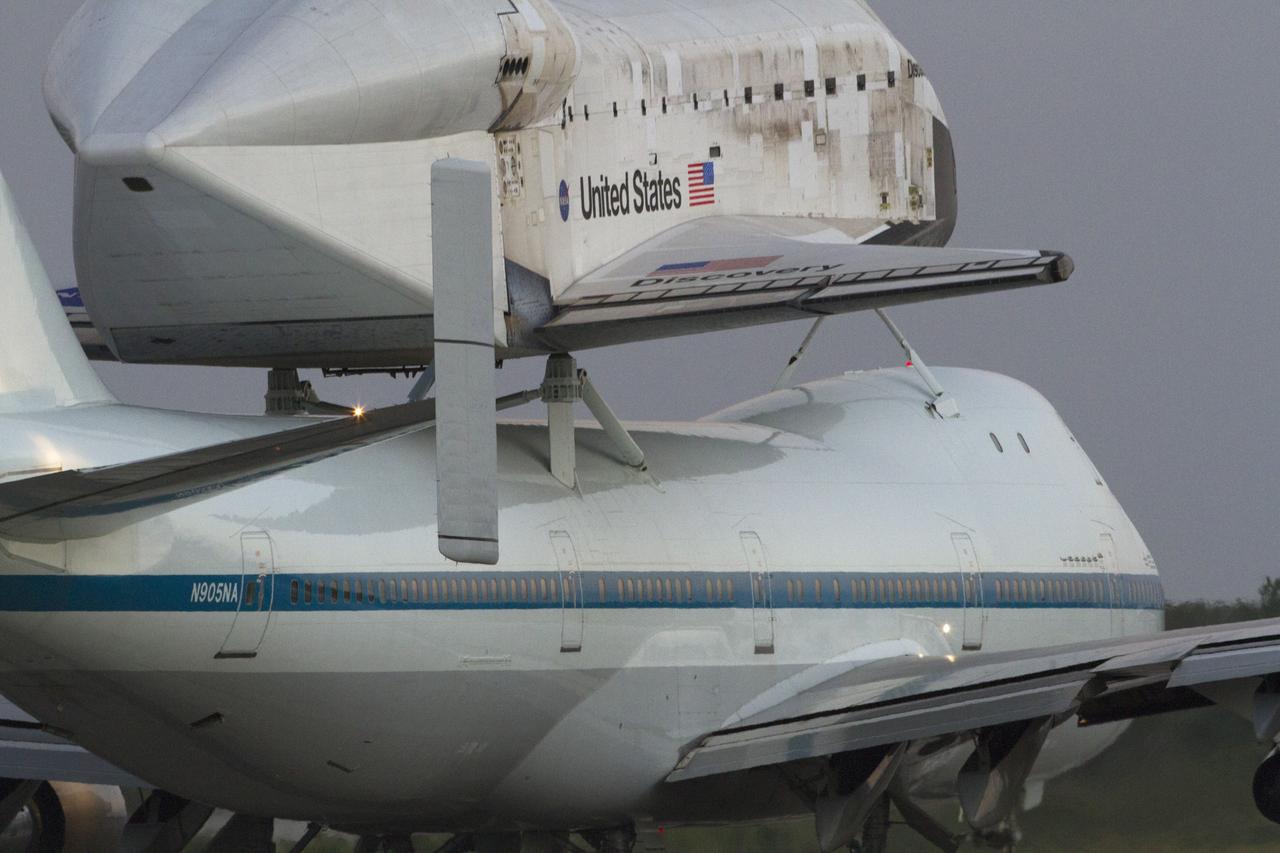
CAPE CANAVERAL, Fla. - Space shuttle Discovery, mounted atop the Shuttle Carrier Aircraft, taxies down the runway at NASA's Kennedy Space Center in Florida. The duo departed Kennedy' s runway 15 at 7 a.m. EDT. The aircraft, known as an SCA, is a Boeing 747 jet, originally manufactured for commercial use, which was modified by NASA to transport the shuttles between destinations on Earth. This SCA, designated NASA 905, is assigned to the remaining ferry missions, delivering the shuttles to their permanent public display sites. NASA 905 carried Discovery to the Washington Dulles International Airport in Virginia on April 17, after which the shuttle will be placed on display in the Smithsonian's National Air and Space Museum, Steven F. Udvar-Hazy Center in Chantilly, Va. For more information on the SCA, visit http://www.nasa.gov/centers/dryden/news/FactSheets/FS- 013-DFRC.html. For more information on shuttle transition and retirement activities, visit http://www .nasa.gov/transition. Photo credit: NASA/Rusty Backer

CAPE CANAVERAL, Fla. – At NASA Kennedy Space Center’s Shuttle Landing Facility in Florida, A T-38 chase aircraft sits on runway 15 waiting for clearance from Kennedy’s air traffic control tower to begin takeoff prior to the Shuttle Carrier Aircraft, or SCA, with space shuttle Discovery attached atop. The aircraft, known as an SCA, is a Boeing 747 jet, originally manufactured for commercial use, which was modified by NASA to transport the shuttles between destinations on Earth. This SCA, designated NASA 905, is assigned to the remaining ferry missions, delivering the shuttles to their permanent public display sites. NASA 905 is scheduled to ferry Discovery to the Washington Dulles International Airport in Virginia on April 17, after which the shuttle will be placed on display in the Smithsonian’s National Air and Space Museum, Steven F. Udvar-Hazy Center in Chantilly, Va. For more information on the SCA, visit http://www.nasa.gov/centers/dryden/news/FactSheets/FS-013-DFRC.html. For more information on shuttle transition and retirement activities, visit http://www.nasa.gov/transition. Photo credit: NASA/Glenn Benson
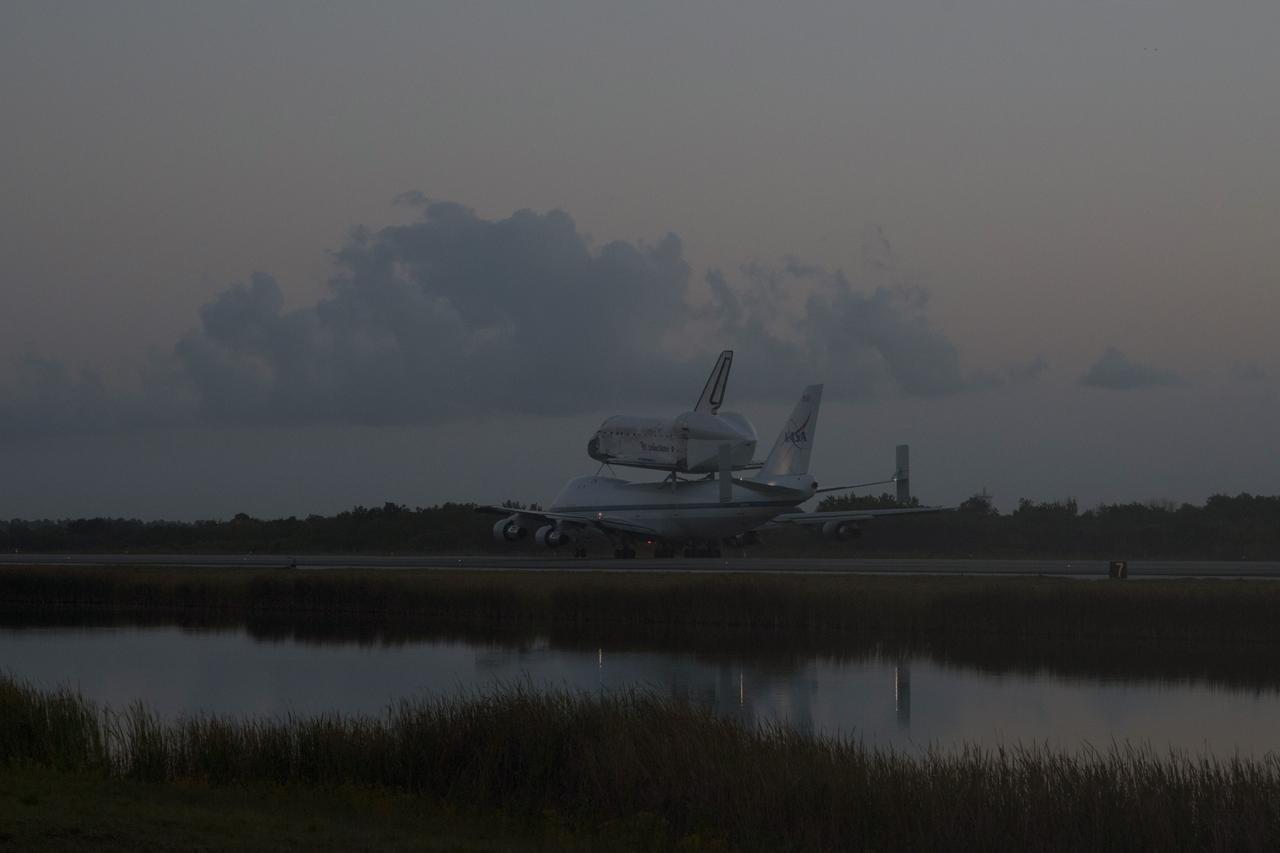
CAPE CANAVERAL, Fla. – In the early morning hours at NASA Kennedy Space Center’s Shuttle Landing Facility in Florida, the Shuttle Carrier Aircraft, or SCA, with space shuttle Discovery secured atop, taxies past the midpoint on its way for a takeoff on runway 15 at 7 a.m. EDT. The aircraft, known as an SCA, is a Boeing 747 jet, originally manufactured for commercial use, which was modified by NASA to transport the shuttles between destinations on Earth. This SCA, designated NASA 905, is assigned to the remaining ferry missions, delivering the shuttles to their permanent public display sites. NASA 905 is scheduled to ferry Discovery to the Washington Dulles International Airport in Virginia on April 17, after which the shuttle will be placed on display in the Smithsonian’s National Air and Space Museum, Steven F. Udvar-Hazy Center in Chantilly, Va. For more information on the SCA, visit http://www.nasa.gov/centers/dryden/news/FactSheets/FS-013-DFRC.html. For more information on shuttle transition and retirement activities, visit http://www.nasa.gov/transition. Photo credit: NASA/Tim Powers and Rick Wetherington
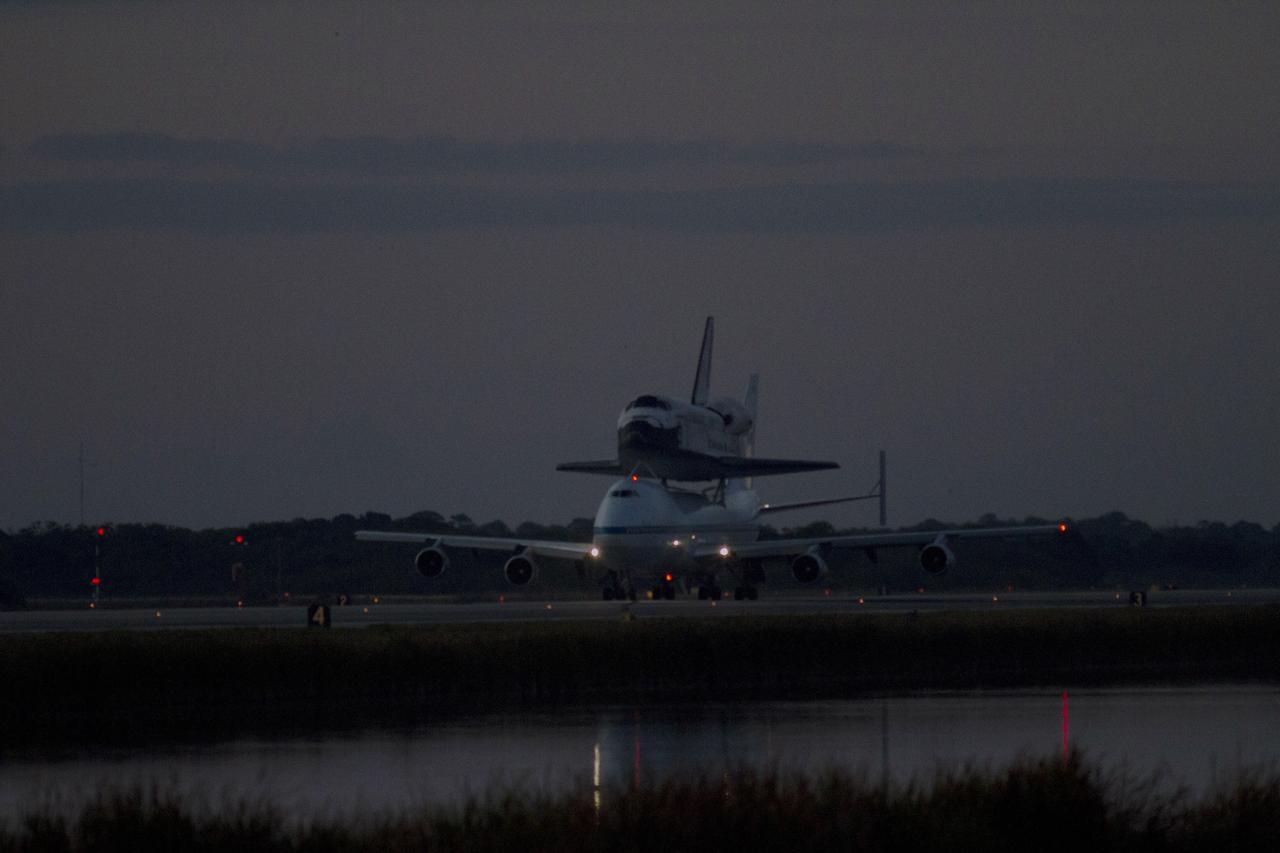
CAPE CANAVERAL, Fla. – At NASA Kennedy Space Center’s Shuttle Landing Facility in Florida, the Shuttle Carrier Aircraft, or SCA, with space shuttle Discovery secured atop, taxies past the midpoint on its way for a takeoff on runway 15 at 7 a.m. EDT. The aircraft, known as an SCA, is a Boeing 747 jet, originally manufactured for commercial use, which was modified by NASA to transport the shuttles between destinations on Earth. This SCA, designated NASA 905, is assigned to the remaining ferry missions, delivering the shuttles to their permanent public display sites. NASA 905 is scheduled to ferry Discovery to the Washington Dulles International Airport in Virginia on April 17, after which the shuttle will be placed on display in the Smithsonian’s National Air and Space Museum, Steven F. Udvar-Hazy Center in Chantilly, Va. For more information on the SCA, visit http://www.nasa.gov/centers/dryden/news/FactSheets/FS-013-DFRC.html. For more information on shuttle transition and retirement activities, visit http://www.nasa.gov/transition. Photo credit: NASA/Tim Powers and Rick Wetherington
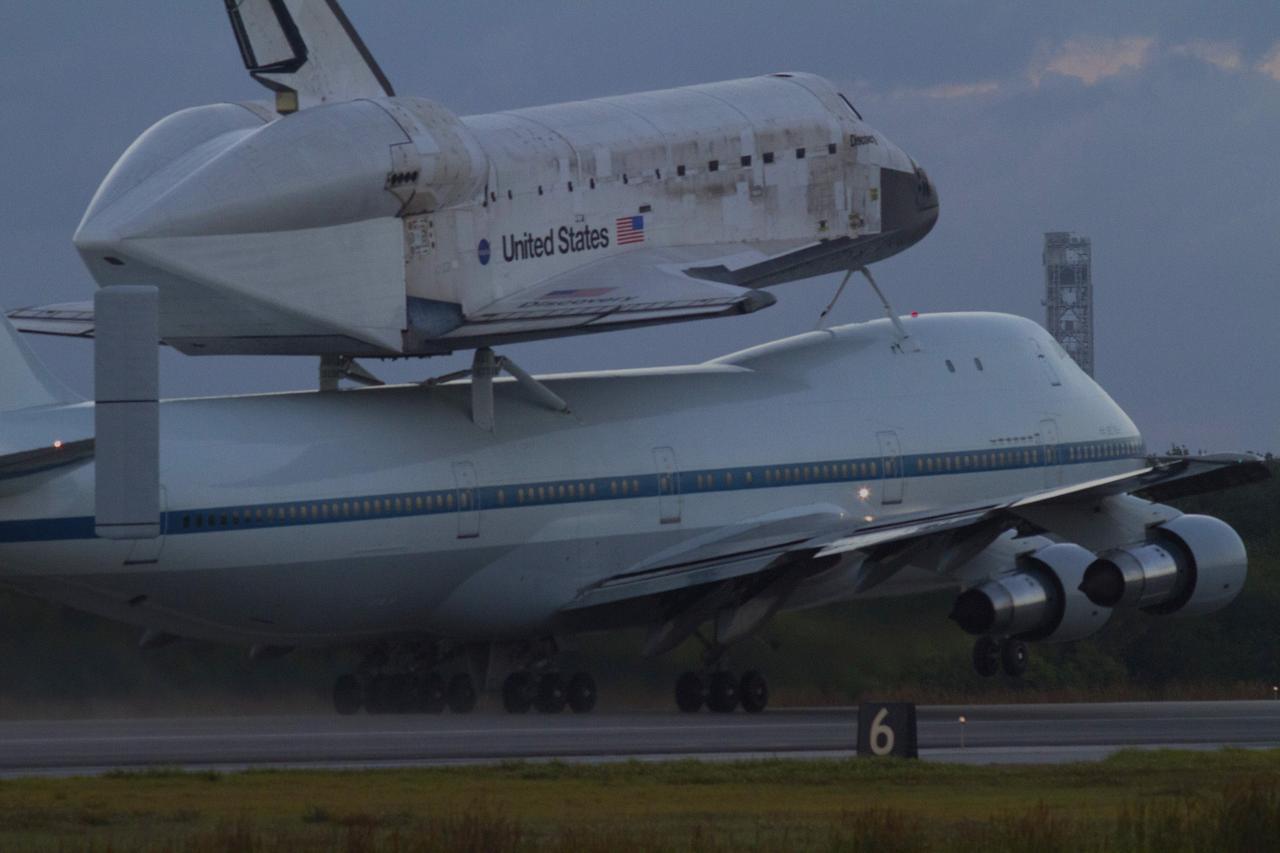
CAPE CANAVERAL, Fla. – In the early morning hours at NASA Kennedy Space Center’s Shuttle Landing Facility in Florida, the Shuttle Carrier Aircraft, or SCA, with space shuttle Discovery secured atop, begins takeoff on runway 15 at 7 a.m. EDT. Discovery is on the way to its new home. The aircraft, known as an SCA, is a Boeing 747 jet, originally manufactured for commercial use, which was modified by NASA to transport the shuttles between destinations on Earth. This SCA, designated NASA 905, is assigned to the remaining ferry missions, delivering the shuttles to their permanent public display sites. NASA 905 is scheduled to ferry Discovery to the Washington Dulles International Airport in Virginia on April 17, after which the shuttle will be placed on display in the Smithsonian’s National Air and Space Museum, Steven F. Udvar-Hazy Center in Chantilly, Va. For more information on the SCA, visit http://www.nasa.gov/centers/dryden/news/FactSheets/FS-013-DFRC.html. For more information on shuttle transition and retirement activities, visit http://www.nasa.gov/transition. Photo credit: NASA/Tim Powers and Rick Wetherington
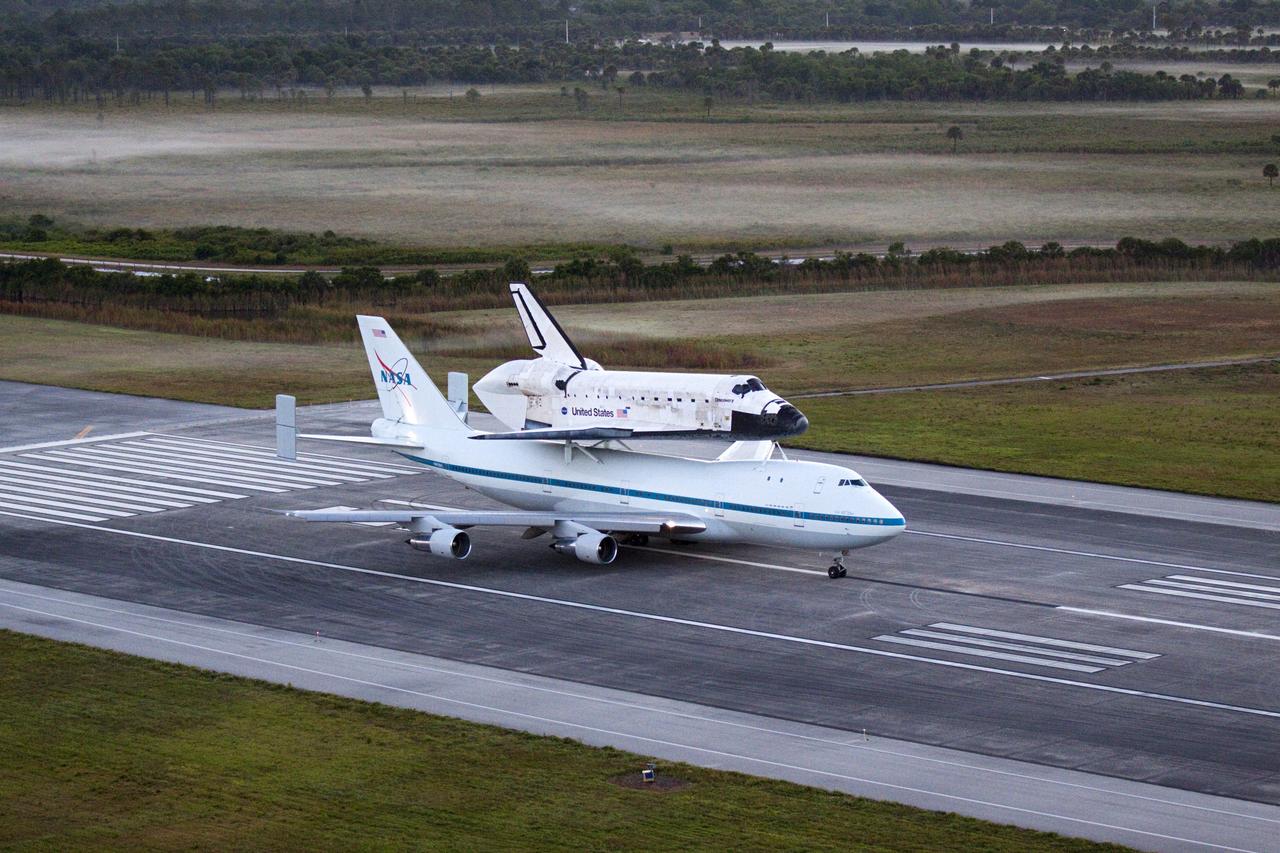
CAPE CANAVERAL, Fla. – In the early morning hours at NASA Kennedy Space Center’s Shuttle Landing Facility in Florida, the Shuttle Carrier Aircraft, or SCA, with space shuttle Discovery secured atop, waits on runway 15 for clearance from Kennedy’s air traffic control tower to begin takeoff at 7 a.m. EDT. The SCA will deliver Discovery to its new home. The aircraft, known as an SCA, is a Boeing 747 jet, originally manufactured for commercial use, which was modified by NASA to transport the shuttles between destinations on Earth. This SCA, designated NASA 905, is assigned to the remaining ferry missions, delivering the shuttles to their permanent public display sites. NASA 905 is scheduled to ferry Discovery to the Washington Dulles International Airport in Virginia on April 17, after which the shuttle will be placed on display in the Smithsonian’s National Air and Space Museum, Steven F. Udvar-Hazy Center in Chantilly, Va. For more information on the SCA, visit http://www.nasa.gov/centers/dryden/news/FactSheets/FS-013-DFRC.html. For more information on shuttle transition and retirement activities, visit http://www.nasa.gov/transition. Photo credit: NASA/Glenn Benson
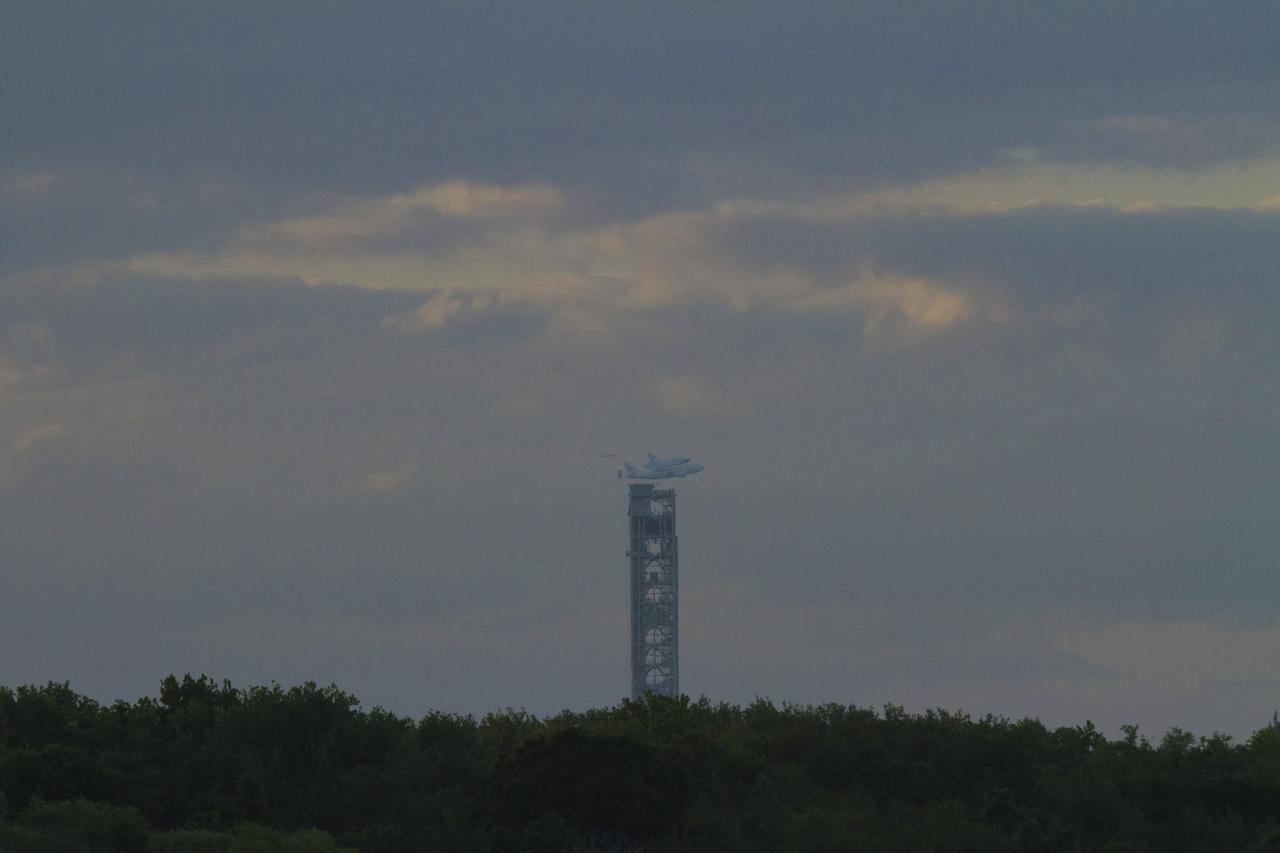
CAPE CANAVERAL, Fla. – Space shuttle Discovery, mounted to a Shuttle Carrier Aircraft, or SCA, takes off from NASA Kennedy Space Center’s Shuttle Landing Facility runway 15 in Florida at 7 a.m. EDT. The duo is beginning its ferry flight to the Washington Dulles International Airport in Virginia that also includes a flyby of the Space Coast and Washington, D.C. Also flying along with the pair is a T-38 training jet. Discovery is leaving Kennedy after more than 28 years of service beginning with its arrival on the space coast Nov. 9, 1983. Discovery first launched to space Aug. 30, 1984, on the STS-41D mission. Discovery is the agency’s most-flown shuttle with 39 missions, more than 148 million miles and a total of one year in space. Discovery is set to move to the Smithsonian’s National Air and Space Museum, Steven F. Udvar-Hazy Center in Chantilly, Va., on April 19 where it will be place on public display. For more information on the SCA, visit http://www.nasa.gov/centers/dryden/news/FactSheets/FS-013-DFRC.html. For more information on shuttle transition and retirement activities, visit http://www.nasa.gov/transition. Photo credit: NASA/Tim Powers and Rick Wetherington
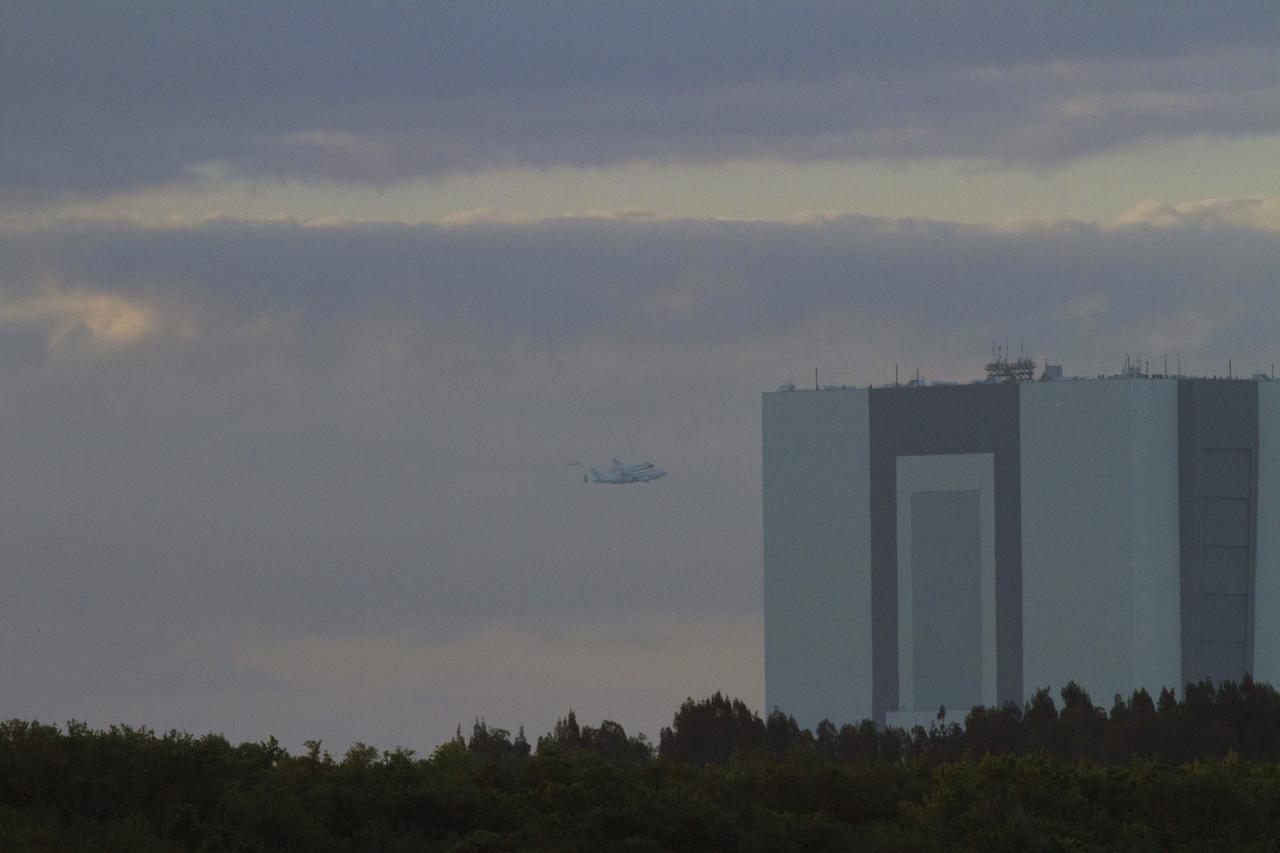
CAPE CANAVERAL, Fla. – Space shuttle Discovery, mounted to a Shuttle Carrier Aircraft, or SCA, takes off from NASA Kennedy Space Center’s Shuttle Landing Facility runway 15 in Florida at 7 a.m. EDT and makes a flyby near the 525-foot-tall Vehicle Assembly Building. The duo is beginning its ferry flight to the Washington Dulles International Airport in Virginia that also includes a flyby of the Space Coast and Washington, D.C. Also flying along with the pair is a T-38 training jet. Discovery is leaving Kennedy after more than 28 years of service beginning with its arrival on the space coast Nov. 9, 1983. Discovery first launched to space Aug. 30, 1984, on the STS-41D mission. Discovery is the agency’s most-flown shuttle with 39 missions, more than 148 million miles and a total of one year in space. Discovery is set to move to the Smithsonian’s National Air and Space Museum, Steven F. Udvar-Hazy Center in Chantilly, Va., on April 19 where it will be place on public display. For more information on the SCA, visit http://www.nasa.gov/centers/dryden/news/FactSheets/FS-013-DFRC.html. For more information on shuttle transition and retirement activities, visit http://www.nasa.gov/transition. Photo credit: NASA/Tim Powers and Rick Wetherington
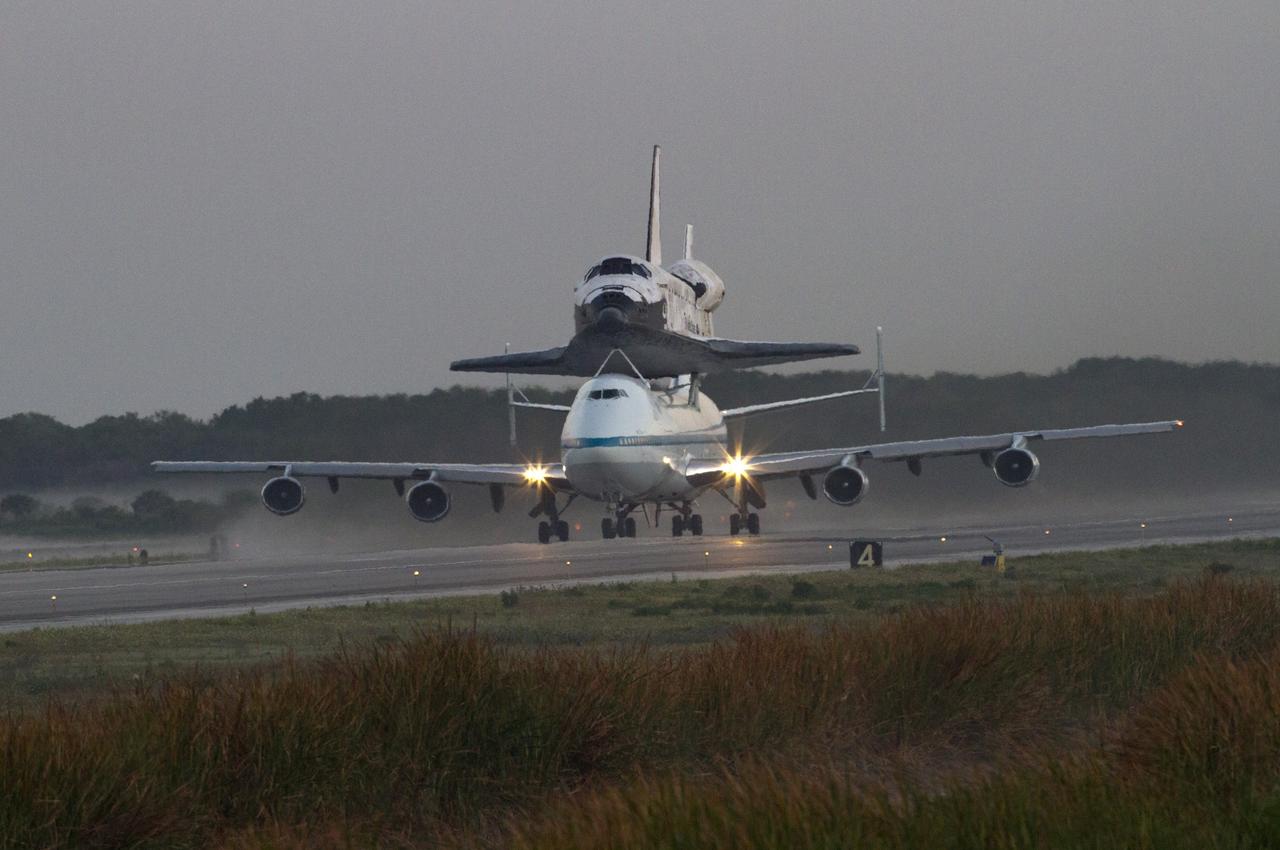
CAPE CANAVERAL, Fla. - With space shuttle Discovery secured to its back, the Shuttle Carrier Aircraft is positioned for takeoff at the north end of runway 15 at NASA's Kennedy Space Center in Florida. The duo departed Kennedy at 7 a.m. EDT. The aircraft, known as an SCA, is a Boeing 747 jet, originally manufactured for commercial use, which was modified by NASA to transport the shuttles between destinations on Earth. This SCA, designated NASA 905, is assigned to the remaining ferry missions, delivering the shuttles to their permanent public display sites. NASA 905 carried Discovery to the Washington Dulles International Airport in Virginia on April 17, after which the shuttle will be placed on display in the Smithsonian's National Air and Space Museum, Steven F. Udvar-Hazy Center in Chantilly, Va. For more information on the SCA, visit http://www.nasa.gov/centers/dryden/news/FactSheets/FS- 013-DFRC.html. For more information on shuttle transition and retirement activities, visit http://www .nasa.gov/transition. Photo credit: NASA/Rusty Backer
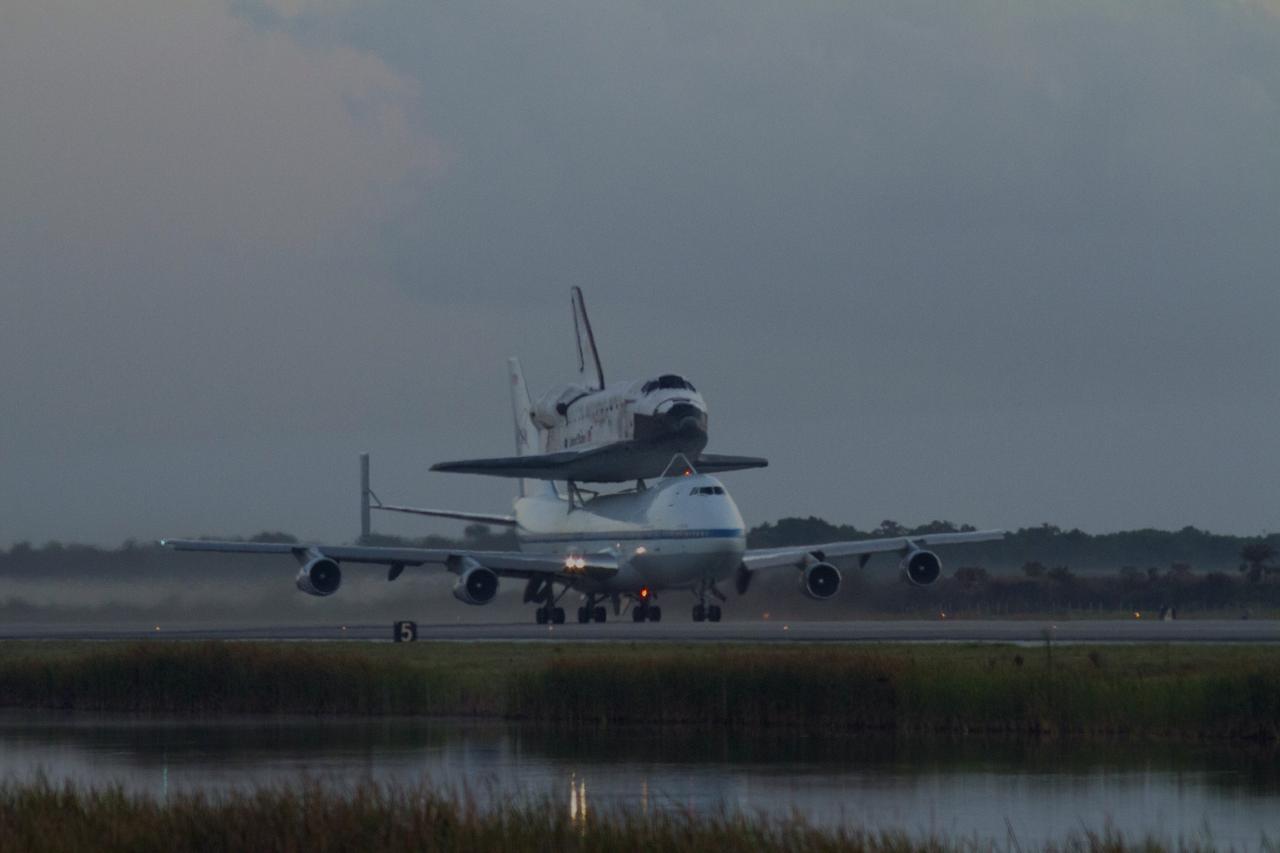
CAPE CANAVERAL, Fla. – In the early morning hours at NASA Kennedy Space Center’s Shuttle Landing Facility in Florida, the Shuttle Carrier Aircraft, or SCA, with space shuttle Discovery secured atop, begins takeoff on runway 15 at 7 a.m. EDT. The aircraft, known as an SCA, is a Boeing 747 jet, originally manufactured for commercial use, which was modified by NASA to transport the shuttles between destinations on Earth. This SCA, designated NASA 905, is assigned to the remaining ferry missions, delivering the shuttles to their permanent public display sites. NASA 905 is scheduled to ferry Discovery to the Washington Dulles International Airport in Virginia on April 17, after which the shuttle will be placed on display in the Smithsonian’s National Air and Space Museum, Steven F. Udvar-Hazy Center in Chantilly, Va. For more information on the SCA, visit http://www.nasa.gov/centers/dryden/news/FactSheets/FS-013-DFRC.html. For more information on shuttle transition and retirement activities, visit http://www.nasa.gov/transition. Photo credit: NASA/Tim Powers and Rick Wetherington
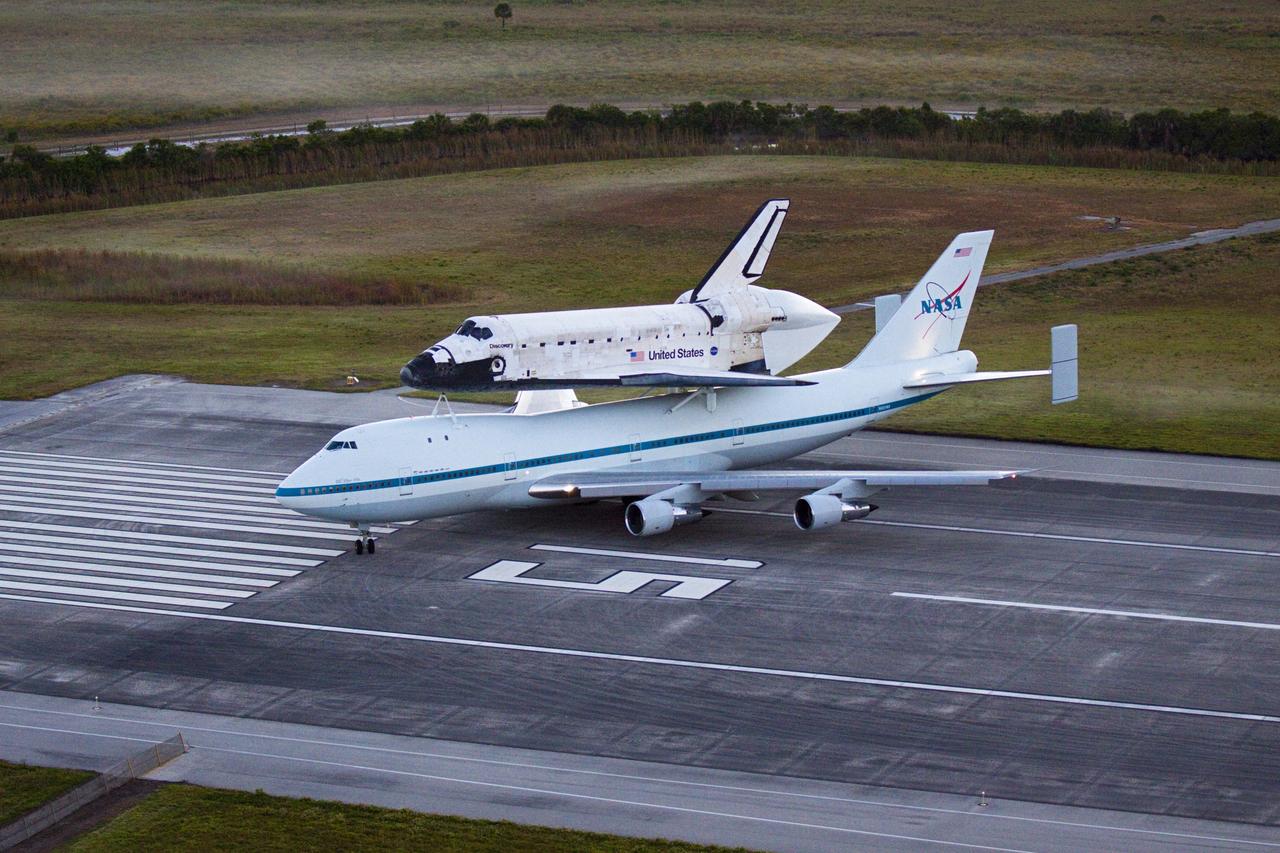
CAPE CANAVERAL, Fla. – In the early morning hours at NASA Kennedy Space Center’s Shuttle Landing Facility in Florida, the Shuttle Carrier Aircraft, or SCA, with space shuttle Discovery secured atop, begins to make the turn on runway 15 for a takeoff at 7 a.m. EDT to deliver Discovery to its new home. The aircraft, known as an SCA, is a Boeing 747 jet, originally manufactured for commercial use, which was modified by NASA to transport the shuttles between destinations on Earth. This SCA, designated NASA 905, is assigned to the remaining ferry missions, delivering the shuttles to their permanent public display sites. NASA 905 is scheduled to ferry Discovery to the Washington Dulles International Airport in Virginia on April 17, after which the shuttle will be placed on display in the Smithsonian’s National Air and Space Museum, Steven F. Udvar-Hazy Center in Chantilly, Va. For more information on the SCA, visit http://www.nasa.gov/centers/dryden/news/FactSheets/FS-013-DFRC.html. For more information on shuttle transition and retirement activities, visit http://www.nasa.gov/transition. Photo credit: NASA/Glenn Benson
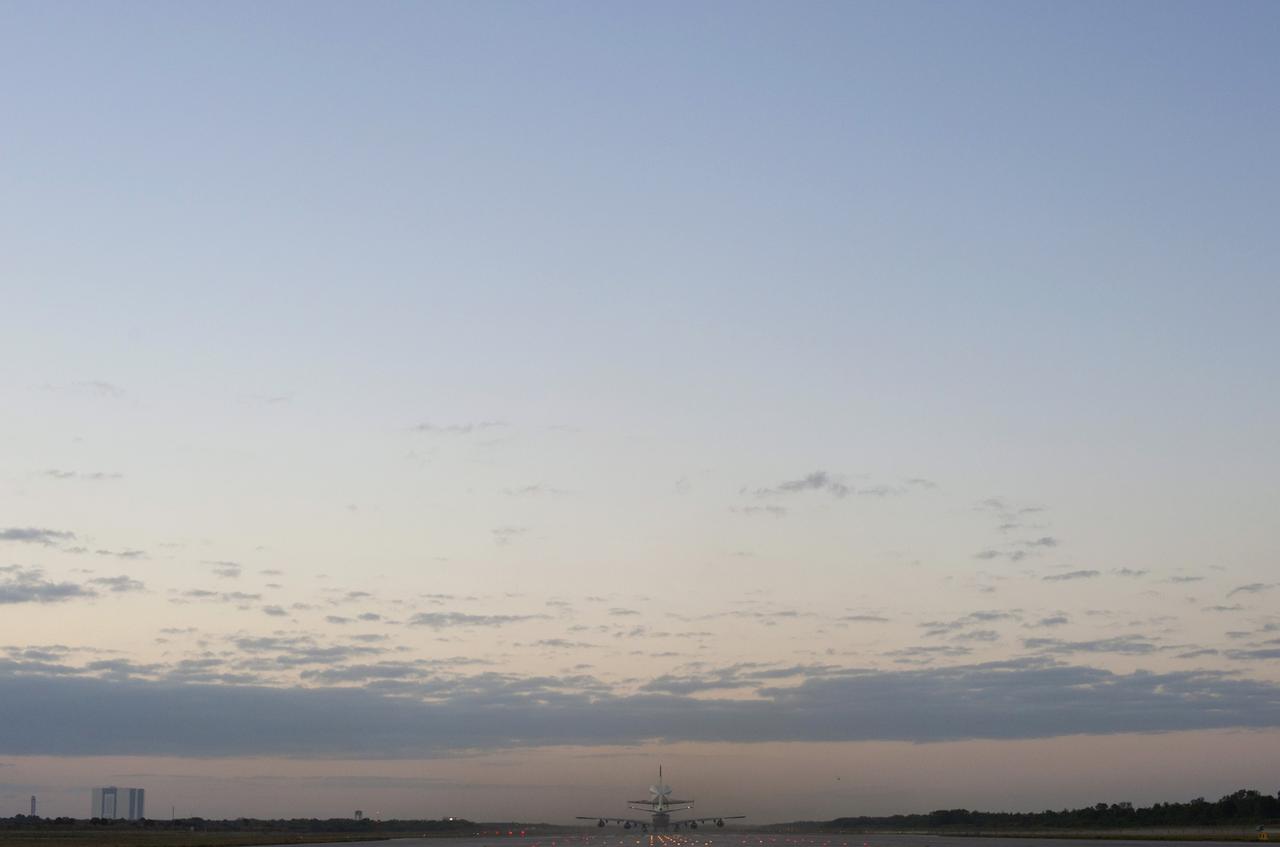
CAPE CANAVERAL, Fla. - Dawn breaks at NASA's Kennedy Space Center in Florida, revealing the Shuttle Carrier Aircraft and its piggybacked cargo, space shuttle Discovery, rolling down runway 15 toward an on-time takeoff at 7 a.m. EDT. The duo is beginning its ferry flight to the Washington Dulles International Airport in Virginia that also includes a flyby of the Space Coast and Washington, D.C. Discovery is leaving Kennedy after more than 28 years of service beginning with its arrival on the space coast Nov. 9, 1983. Discovery is set to move to the Smithsonian's National Air and Space Museum, Steven F. Udvar-Hazy Center in Chantilly, Va., on April 19 where it will be placed on public display. For more information on the Shuttle Carrier Aircraft, visit http://www.nasa .gov/centers/dryden/news/FactSheets/FS-013- DFRC.html. For more information on shuttle transition and retirement activities, visit http://www.nasa.gov/transition. Photo credit: NASA/Tim Powers and Tim Terry
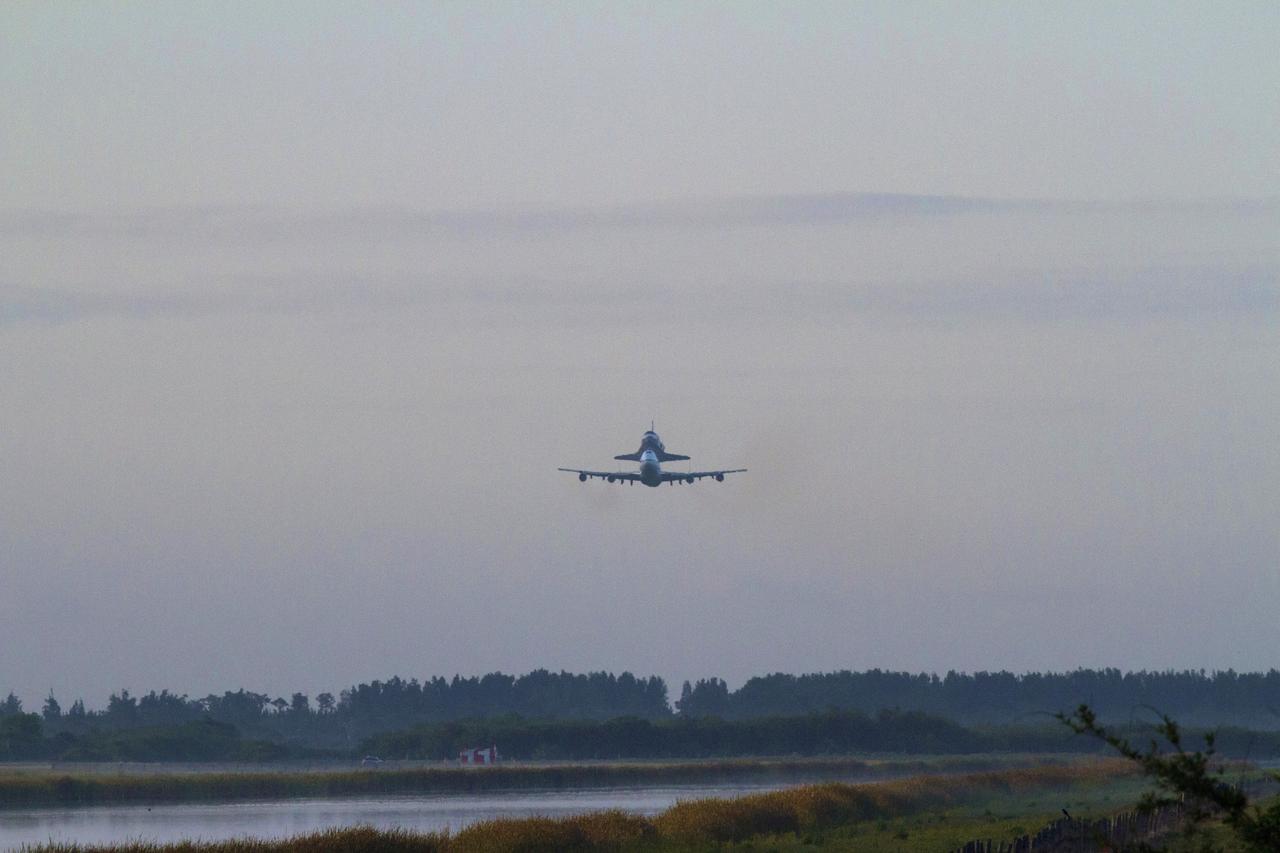
CAPE CANAVERAL, Fla. – Space shuttle Discovery, mounted to a Shuttle Carrier Aircraft, or SCA, takes off from NASA Kennedy Space Center’s Shuttle Landing Facility runway 15 in Florida at 7 a.m. EDT. The duo is beginning its ferry flight to the Washington Dulles International Airport in Virginia that also includes a flyby of the Space Coast and Washington, D.C. Discovery is leaving Kennedy after more than 28 years of service beginning with its arrival on the space coast Nov. 9, 1983. Discovery first launched to space Aug. 30, 1984, on the STS-41D mission. Discovery is the agency’s most-flown shuttle with 39 missions, more than 148 million miles and a total of one year in space. Discovery is set to move to the Smithsonian’s National Air and Space Museum, Steven F. Udvar-Hazy Center in Chantilly, Va., on April 19 where it will be place on public display. For more information on the SCA, visit http://www.nasa.gov/centers/dryden/news/FactSheets/FS-013-DFRC.html. For more information on shuttle transition and retirement activities, visit http://www.nasa.gov/transition. Photo credit: NASA/Tim Powers and Rick Wetherington

CAPE CANAVERAL, Fla. – Space shuttle Discovery, mounted to a Shuttle Carrier Aircraft, or SCA, takes off from NASA Kennedy Space Center’s Shuttle Landing Facility runway 15 in Florida at 7 a.m. EDT. The duo is beginning its ferry flight to the Washington Dulles International Airport in Virginia that also includes a flyby of the Space Coast and Washington, D.C. Also flying along with the pair is a T-38 training jet. Discovery is leaving Kennedy after more than 28 years of service beginning with its arrival on the space coast Nov. 9, 1983. Discovery first launched to space Aug. 30, 1984, on the STS-41D mission. Discovery is the agency’s most-flown shuttle with 39 missions, more than 148 million miles and a total of one year in space. Discovery is set to move to the Smithsonian’s National Air and Space Museum, Steven F. Udvar-Hazy Center in Chantilly, Va., on April 19 where it will be place on public display. For more information on the SCA, visit http://www.nasa.gov/centers/dryden/news/FactSheets/FS-013-DFRC.html. For more information on shuttle transition and retirement activities, visit http://www.nasa.gov/transition. Photo credit: NASA/Tim Powers and Rick Wetherington
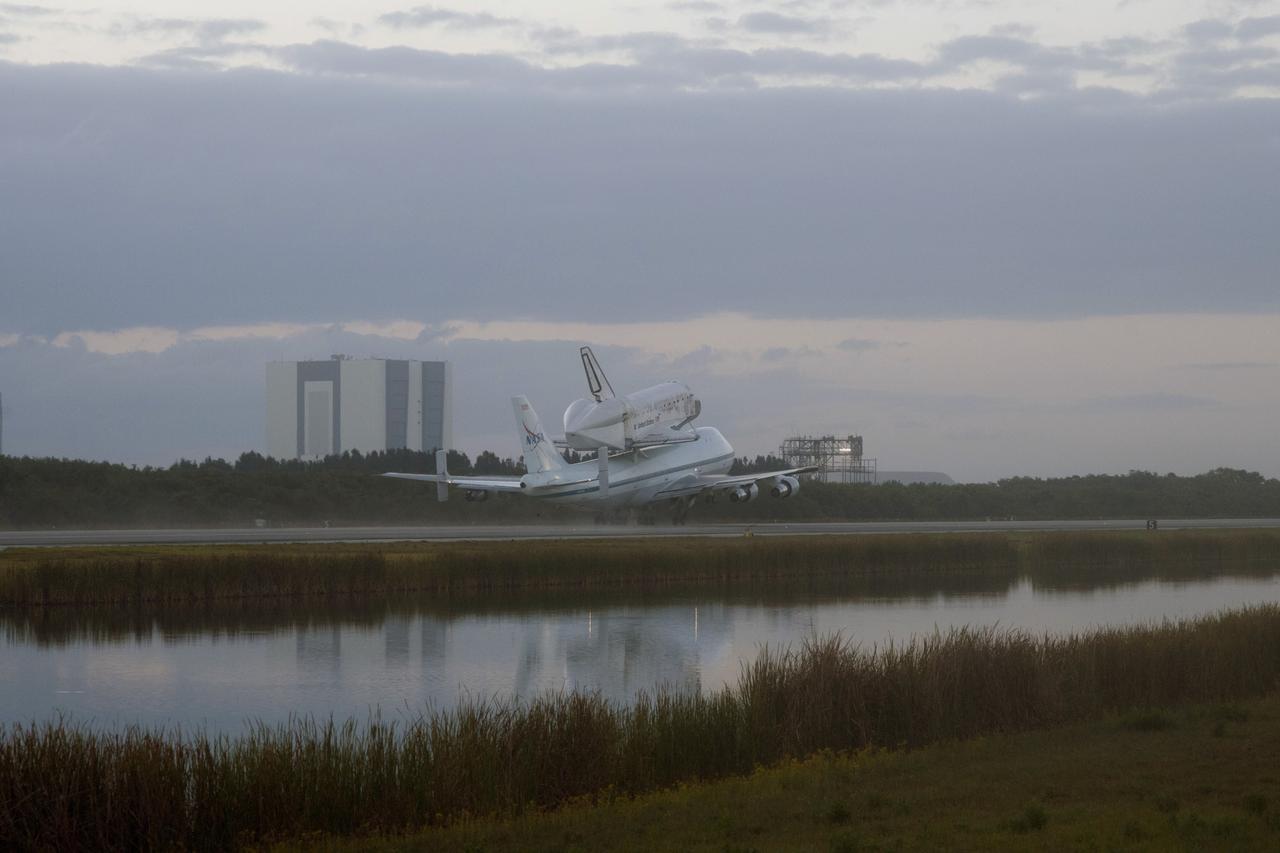
CAPE CANAVERAL, Fla. – In the early morning hours at NASA Kennedy Space Center’s Shuttle Landing Facility in Florida, the Shuttle Carrier Aircraft, or SCA, with space shuttle Discovery secured atop, taxies past the midpoint on its way for a takeoff on runway 15 at 7 a.m. EDT. The aircraft, known as an SCA, is a Boeing 747 jet, originally manufactured for commercial use, which was modified by NASA to transport the shuttles between destinations on Earth. This SCA, designated NASA 905, is assigned to the remaining ferry missions, delivering the shuttles to their permanent public display sites. NASA 905 is scheduled to ferry Discovery to the Washington Dulles International Airport in Virginia on April 17, after which the shuttle will be placed on display in the Smithsonian’s National Air and Space Museum, Steven F. Udvar-Hazy Center in Chantilly, Va. For more information on the SCA, visit http://www.nasa.gov/centers/dryden/news/FactSheets/FS-013-DFRC.html. For more information on shuttle transition and retirement activities, visit http://www.nasa.gov/transition. Photo credit: NASA/Tim Powers and Rick Wetherington

CAPE CANAVERAL, Fla. – In the early morning hours at NASA Kennedy Space Center’s Shuttle Landing Facility in Florida, the Shuttle Carrier Aircraft, or SCA, with space shuttle Discovery secured atop, is in the air after taking off from runway 15 at 7 a.m. EDT. Discovery is on the way to its new home. The aircraft, known as an SCA, is a Boeing 747 jet, originally manufactured for commercial use, which was modified by NASA to transport the shuttles between destinations on Earth. This SCA, designated NASA 905, is assigned to the remaining ferry missions, delivering the shuttles to their permanent public display sites. NASA 905 is scheduled to ferry Discovery to the Washington Dulles International Airport in Virginia on April 17, after which the shuttle will be placed on display in the Smithsonian’s National Air and Space Museum, Steven F. Udvar-Hazy Center in Chantilly, Va. For more information on the SCA, visit http://www.nasa.gov/centers/dryden/news/FactSheets/FS-013-DFRC.html. For more information on shuttle transition and retirement activities, visit http://www.nasa.gov/transition. Photo credit: NASA/Tim Powers and Rick Wetherington

CAPE CANAVERAL, Fla. – At the Shuttle Landing Facility at NASA’s Kennedy Space Center in Florida, initial mating of space shuttle Discovery and the Shuttle Carrier Aircraft is complete in the mate-demate device. Known as the “soft mate,” the procedure was complete at about 11:15 a.m. EDT. The device, known as the MDD, is a large gantry-like steel structure used to hoist a shuttle off the ground and position it onto the back of the aircraft, or SCA. The SCA is a Boeing 747 jet, originally manufactured for commercial use, which was modified by NASA to transport the shuttles between destinations on Earth. This SCA, designated NASA 905, is assigned to the remaining ferry missions, delivering the shuttles to their permanent public display sites. NASA 905 is scheduled to ferry Discovery to the Washington Dulles International Airport in Virginia on April 17, after which the shuttle will be placed on display in the Smithsonian's National Air and Space Museum Steven F. Udvar-Hazy Center. For more information on the SCA, visit http://www.nasa.gov/centers/dryden/news/FactSheets/FS-013-DFRC.html. For more information on shuttle transition and retirement activities, visit http://www.nasa.gov/transition. Photo credit: NASA/Kim Shiflett
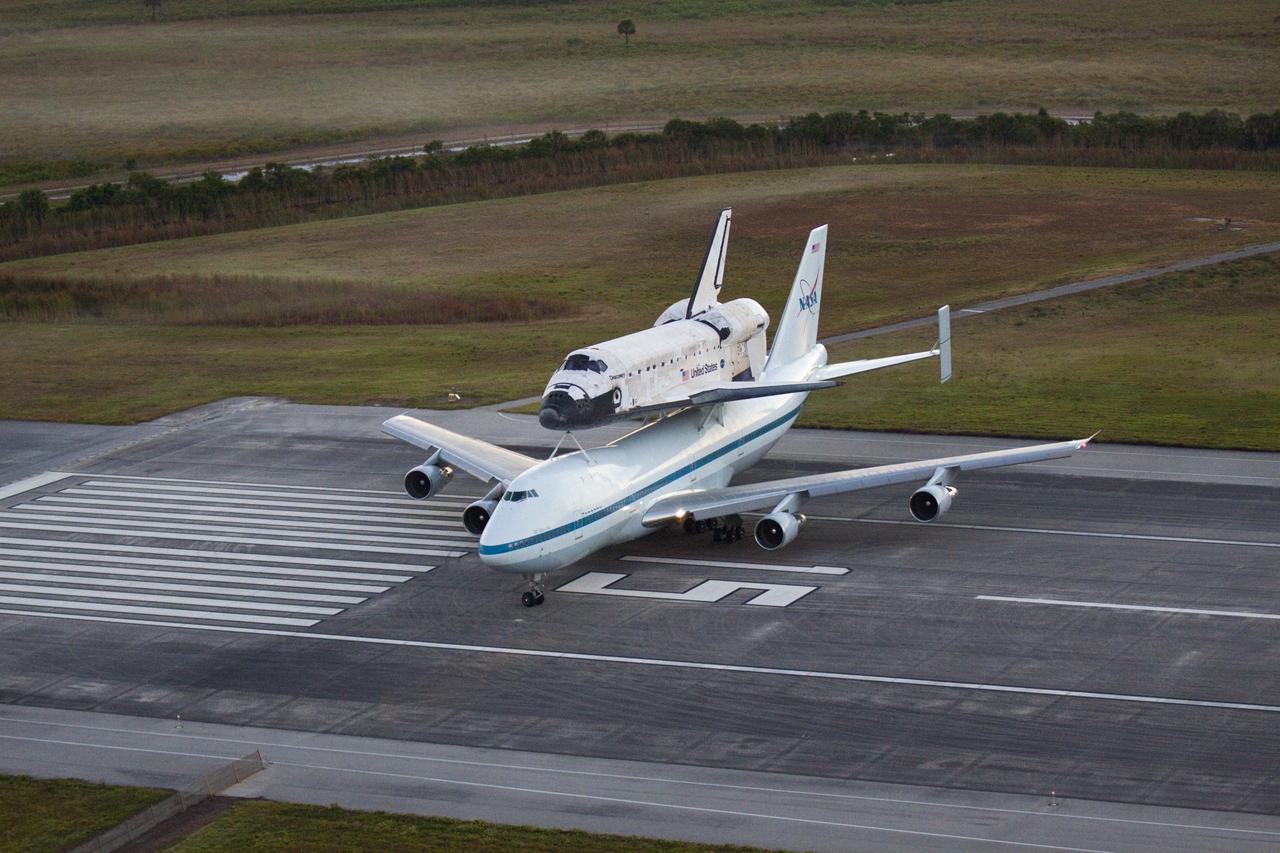
CAPE CANAVERAL, Fla. – In the early morning hours at NASA Kennedy Space Center’s Shuttle Landing Facility in Florida, the Shuttle Carrier Aircraft, or SCA, with space shuttle Discovery secured atop, begins to make the turn on runway 15 for a takeoff at 7 a.m. EDT to deliver Discovery to its new home. The aircraft, known as an SCA, is a Boeing 747 jet, originally manufactured for commercial use, which was modified by NASA to transport the shuttles between destinations on Earth. This SCA, designated NASA 905, is assigned to the remaining ferry missions, delivering the shuttles to their permanent public display sites. NASA 905 is scheduled to ferry Discovery to the Washington Dulles International Airport in Virginia on April 17, after which the shuttle will be placed on display in the Smithsonian’s National Air and Space Museum, Steven F. Udvar-Hazy Center in Chantilly, Va. For more information on the SCA, visit http://www.nasa.gov/centers/dryden/news/FactSheets/FS-013-DFRC.html. For more information on shuttle transition and retirement activities, visit http://www.nasa.gov/transition. Photo credit: NASA/Glenn Benson
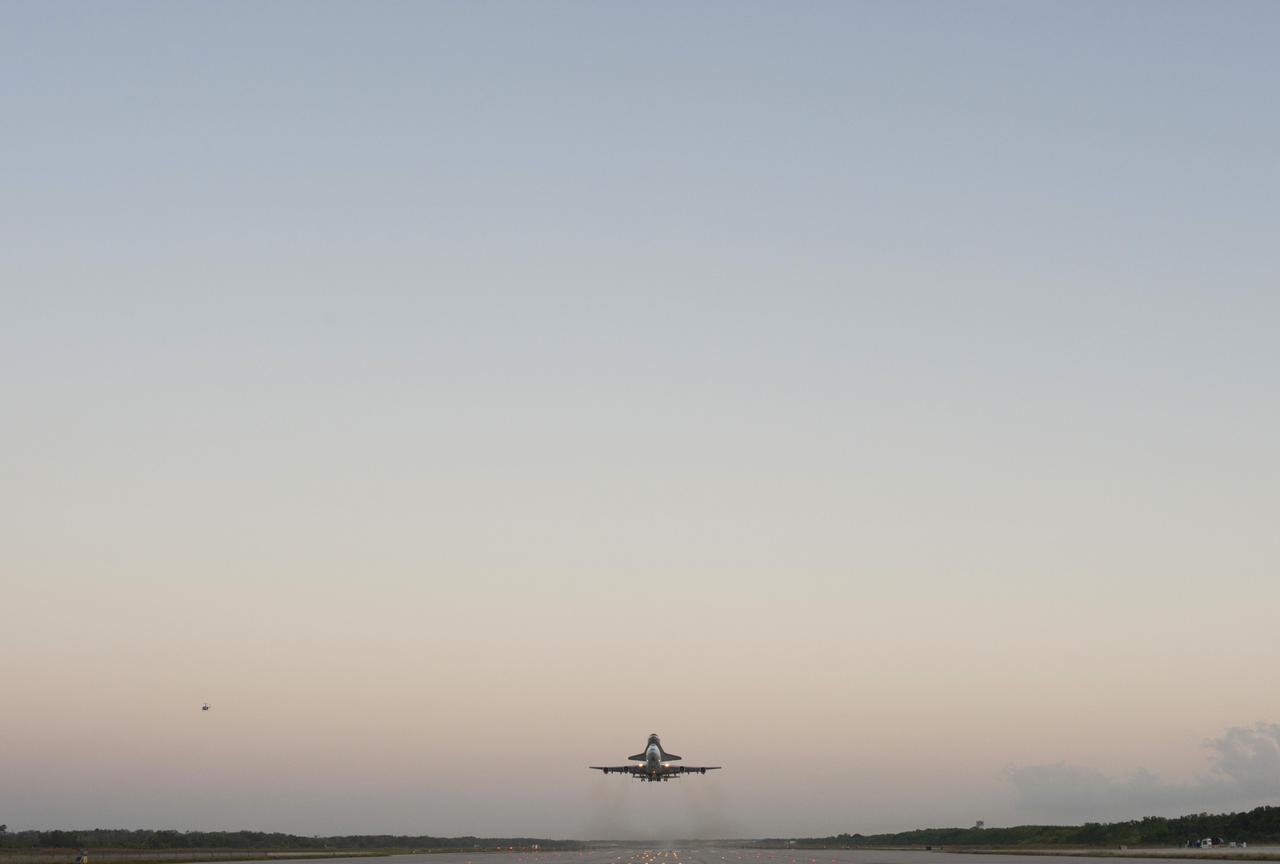
CAPE CANAVERAL, Fla. - Sunrise paints the sky above NASA's Kennedy Space Center in Florida as the Shuttle Carrier Aircraft transporting space shuttle Discovery takes off from runway 15 at 7 a.m. EDT. The duo is beginning its ferry flight to the Washington Dulles International Airport in Virginia that also includes a flyby of the Space Coast and Washington, D.C. Discovery is leaving Kennedy after more than 28 years of service beginning with its arrival on the space coast Nov. 9, 1983. Discovery is set to move to the Smithsonian's National Air and Space Museum, Steven F. Udvar-Hazy Center in Chantilly, Va., on April 19 where it will be placed on public display. For more information on the Shuttle Carrier Aircraft, visit http://www.nasa .gov/centers/dryden/news/FactSheets/FS-013- DFRC.html. For more information on shuttle transition and retirement activities, visit http://www.nasa.gov/transition. Photo credit: NASA/Tim Powers and Tim Terry
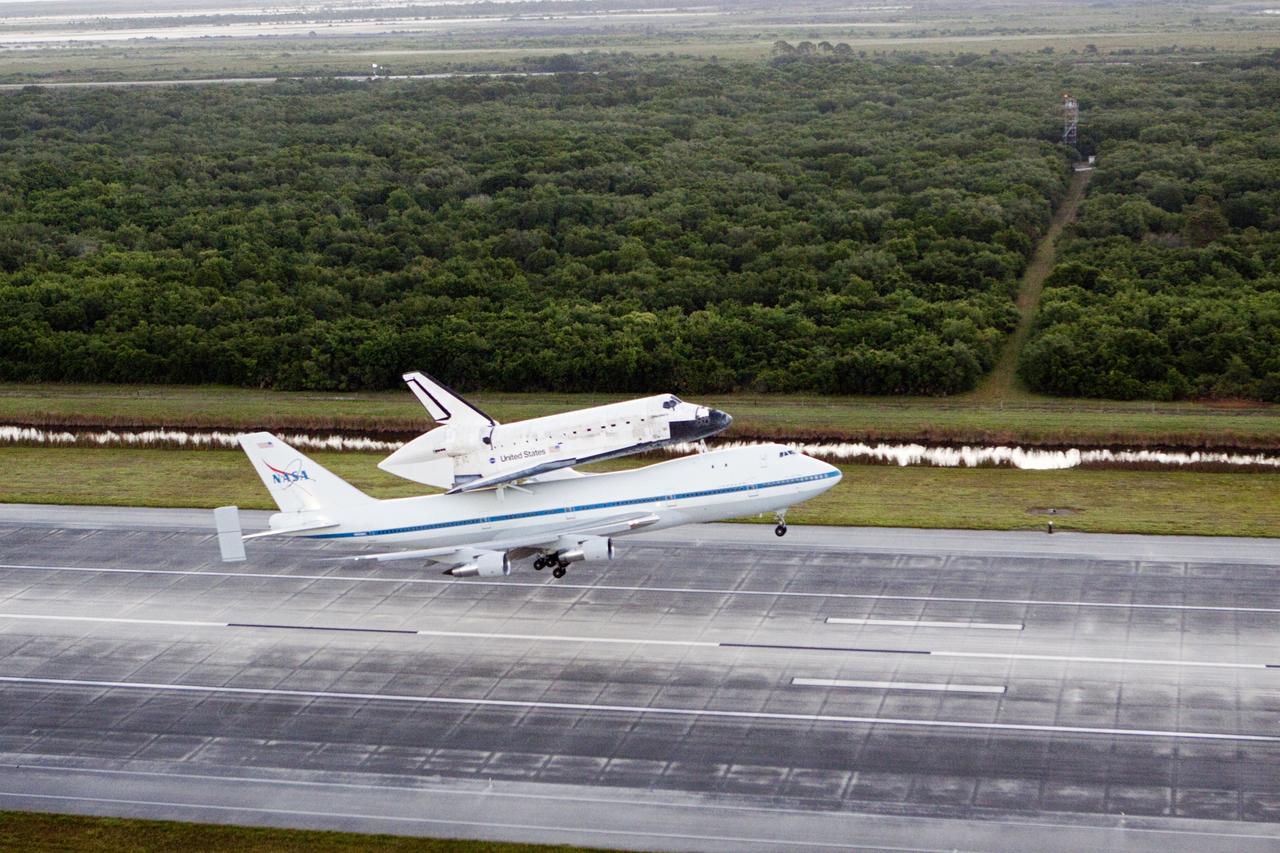
CAPE CANAVERAL, Fla. – In the early morning hours at NASA Kennedy Space Center’s Shuttle Landing Facility in Florida, the Shuttle Carrier Aircraft, or SCA, with space shuttle Discovery secured atop, takes off from runway 15 at 7 a.m. EDT. The SCA will deliver Discovery to its new home. The aircraft, known as an SCA, is a Boeing 747 jet, originally manufactured for commercial use, which was modified by NASA to transport the shuttles between destinations on Earth. This SCA, designated NASA 905, is assigned to the remaining ferry missions, delivering the shuttles to their permanent public display sites. NASA 905 is scheduled to ferry Discovery to the Washington Dulles International Airport in Virginia on April 17, after which the shuttle will be placed on display in the Smithsonian’s National Air and Space Museum, Steven F. Udvar-Hazy Center in Chantilly, Va. For more information on the SCA, visit http://www.nasa.gov/centers/dryden/news/FactSheets/FS-013-DFRC.html. For more information on shuttle transition and retirement activities, visit http://www.nasa.gov/transition. Photo credit: NASA/Glenn Benson
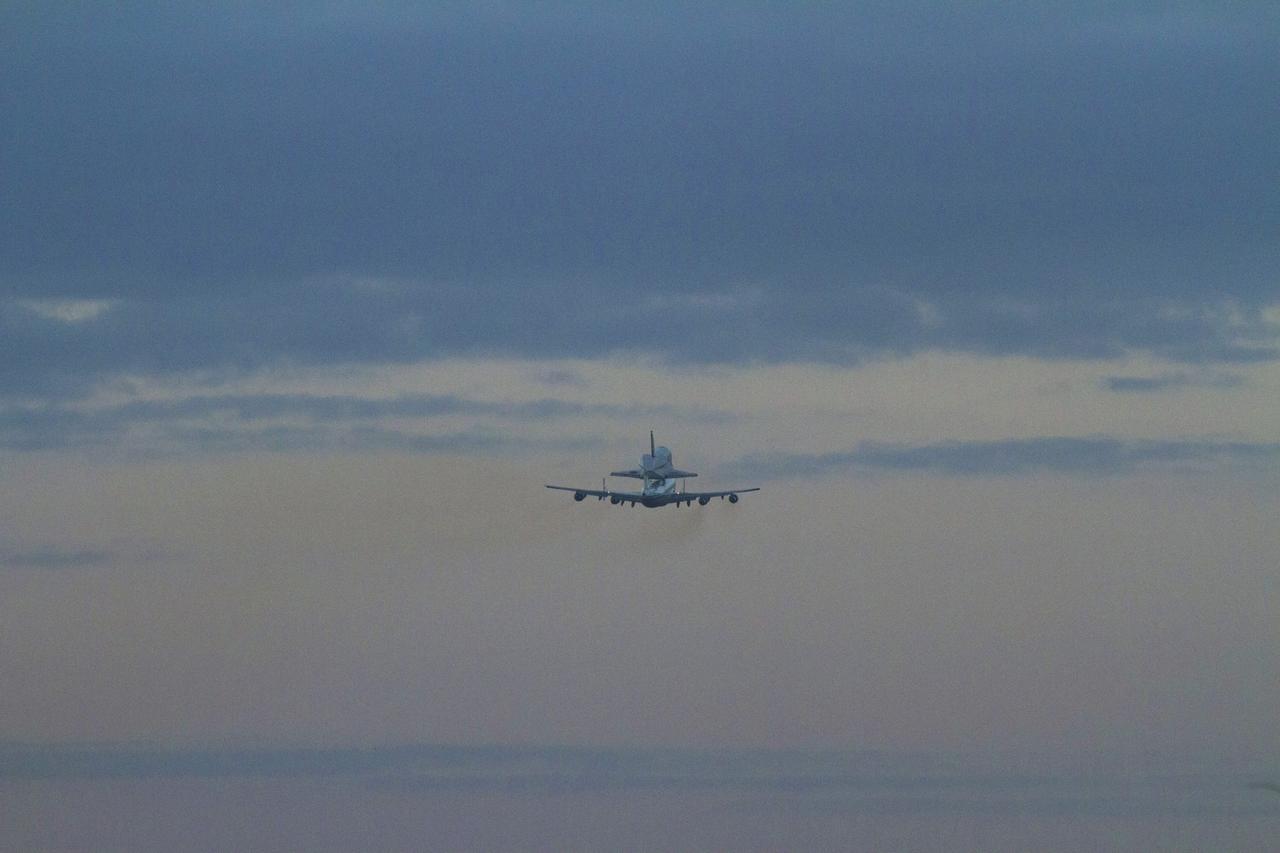
CAPE CANAVERAL, Fla. – In the early morning hours at NASA Kennedy Space Center’s Shuttle Landing Facility in Florida, the Shuttle Carrier Aircraft, or SCA, with space shuttle Discovery secured atop, is in the air after taking off from runway 15 at 7 a.m. EDT. The aircraft, known as an SCA, is a Boeing 747 jet, originally manufactured for commercial use, which was modified by NASA to transport the shuttles between destinations on Earth. This SCA, designated NASA 905, is assigned to the remaining ferry missions, delivering the shuttles to their permanent public display sites. NASA 905 is scheduled to ferry Discovery to the Washington Dulles International Airport in Virginia on April 17, after which the shuttle will be placed on display in the Smithsonian’s National Air and Space Museum, Steven F. Udvar-Hazy Center in Chantilly, Va. For more information on the SCA, visit http://www.nasa.gov/centers/dryden/news/FactSheets/FS-013-DFRC.html. For more information on shuttle transition and retirement activities, visit http://www.nasa.gov/transition. Photo credit: NASA/Tim Powers and Rick Wetherington
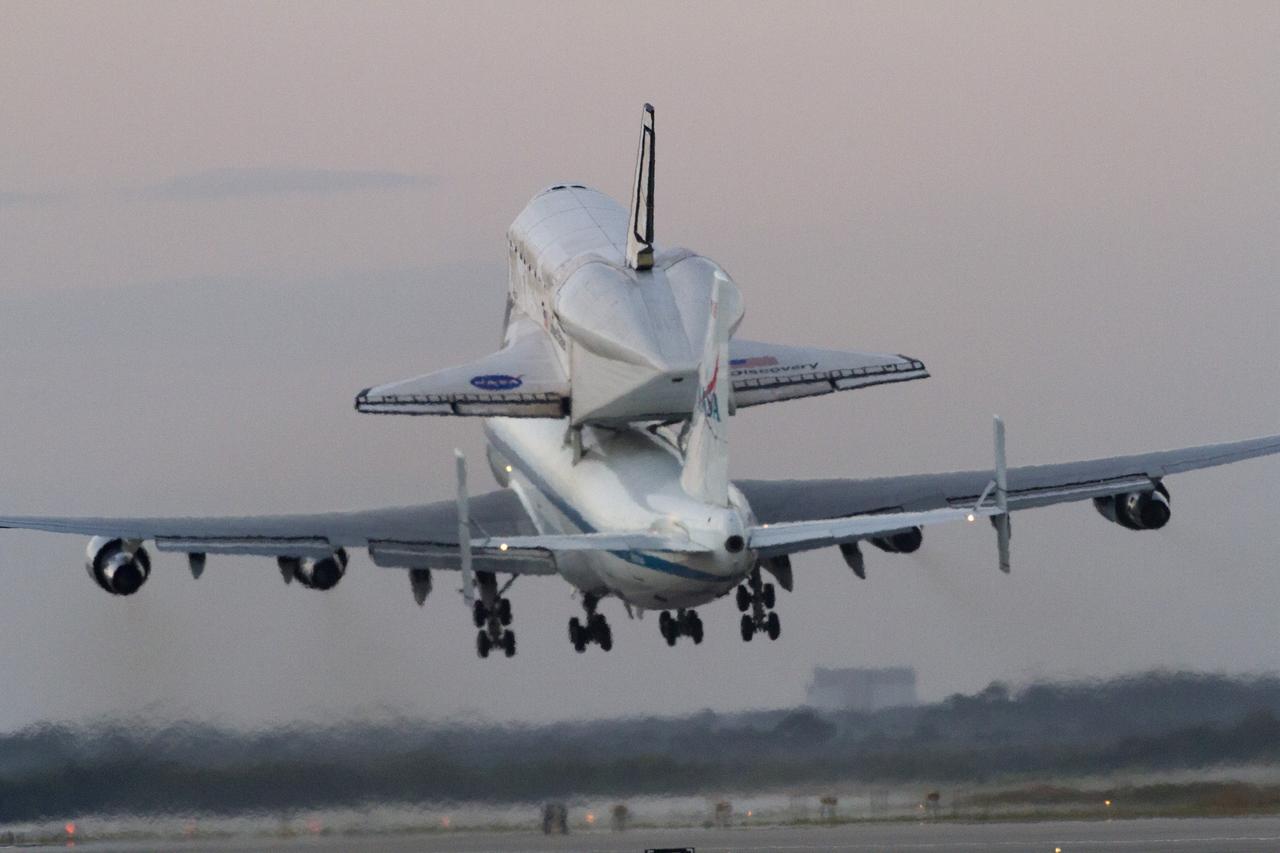
CAPE CANAVERAL, Fla. - The wheels of the Shuttle Carrier Aircraft leave the ground at NASA's Kennedy Space Center in Florida as space shuttle Discovery's ferry flight begins. The duo took off from Kennedy's runway 15 at 7 a.m. EDT. The aircraft, known as an SCA, is a Boeing 747 jet, originally manufactured for commercial use, which was modified by NASA to transport the shuttles between destinations on Earth. This SCA, designated NASA 905, is assigned to the remaining ferry missions, delivering the shuttles to their permanent public display sites. NASA 905 carried Discovery to the Washington Dulles International Airport in Virginia on April 17, after which the shuttle will be placed on display in the Smithsonian's National Air and Space Museum, Steven F. Udvar-Hazy Center in Chantilly, Va. For more information on the SCA, visit http://www.nasa.gov/centers/dryden/news/FactSheets/FS- 013-DFRC.html. For more information on shuttle transition and retirement activities, visit http://www .nasa.gov/transition. Photo credit: NASA/Rusty Backer
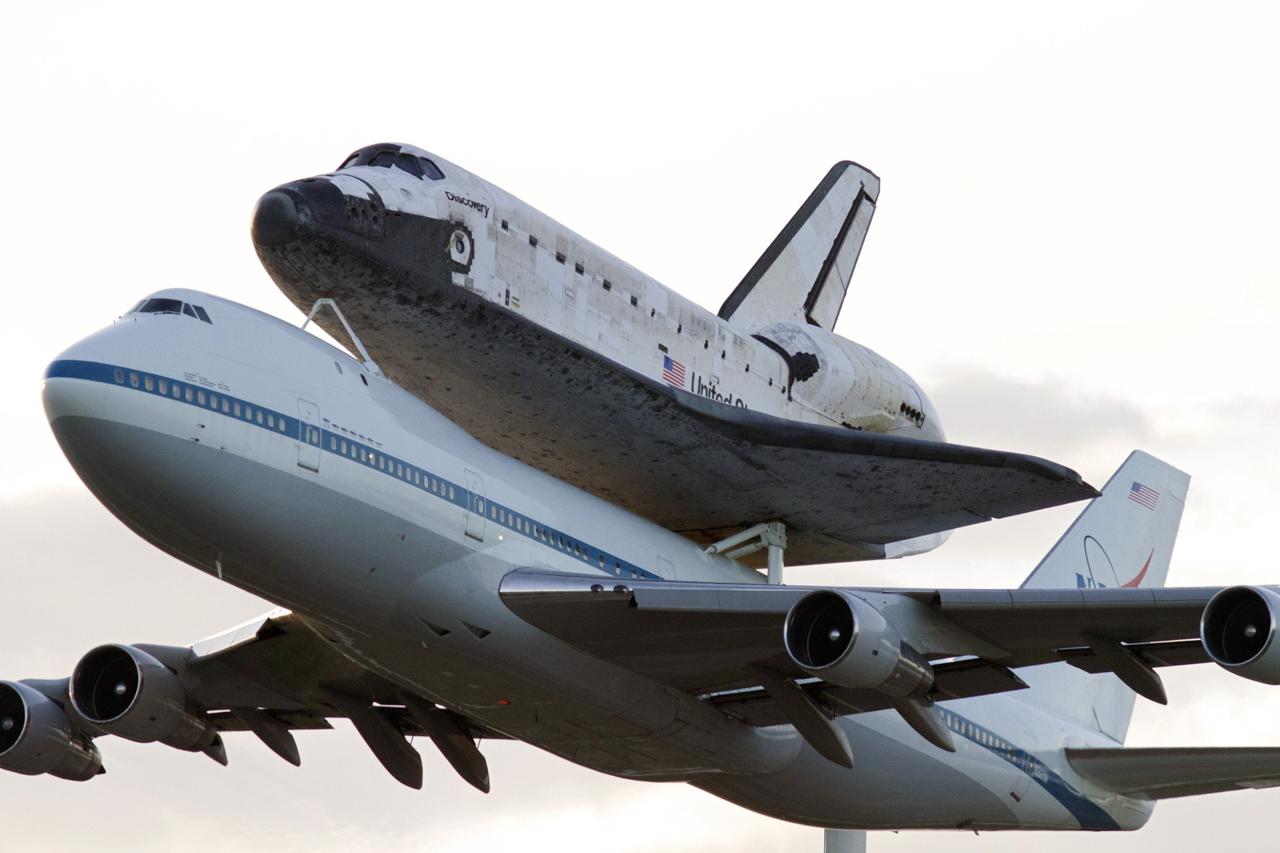
CAPE CANAVERAL, Fla. – A spectacular close up view of space shuttle Discovery, mounted to a Shuttle Carrier Aircraft, or SCA, after it takes off from NASA Kennedy Space Center’s Shuttle Landing Facility runway 15 in Florida at 7 a.m. EDT. The duo is beginning its ferry flight to the Washington Dulles International Airport in Virginia that also includes a flyby of the Space Coast and Washington, D.C. Discovery is leaving Kennedy after more than 28 years of service beginning with its arrival on the space coast Nov. 9, 1983. Discovery first launched to space Aug. 30, 1984, on the STS-41D mission. Discovery is the agency’s most-flown shuttle with 39 missions, more than 148 million miles and a total of one year in space. Discovery is set to move to the Smithsonian’s National Air and Space Museum, Steven F. Udvar-Hazy Center in Chantilly, Va., on April 19 where it will be place on public display. For more information on the SCA, visit http://www.nasa.gov/centers/dryden/news/FactSheets/FS-013-DFRC.html. For more information on shuttle transition and retirement activities, visit http://www.nasa.gov/transition. Photo credit: NASA/Tim Powers and Rick Wetherington
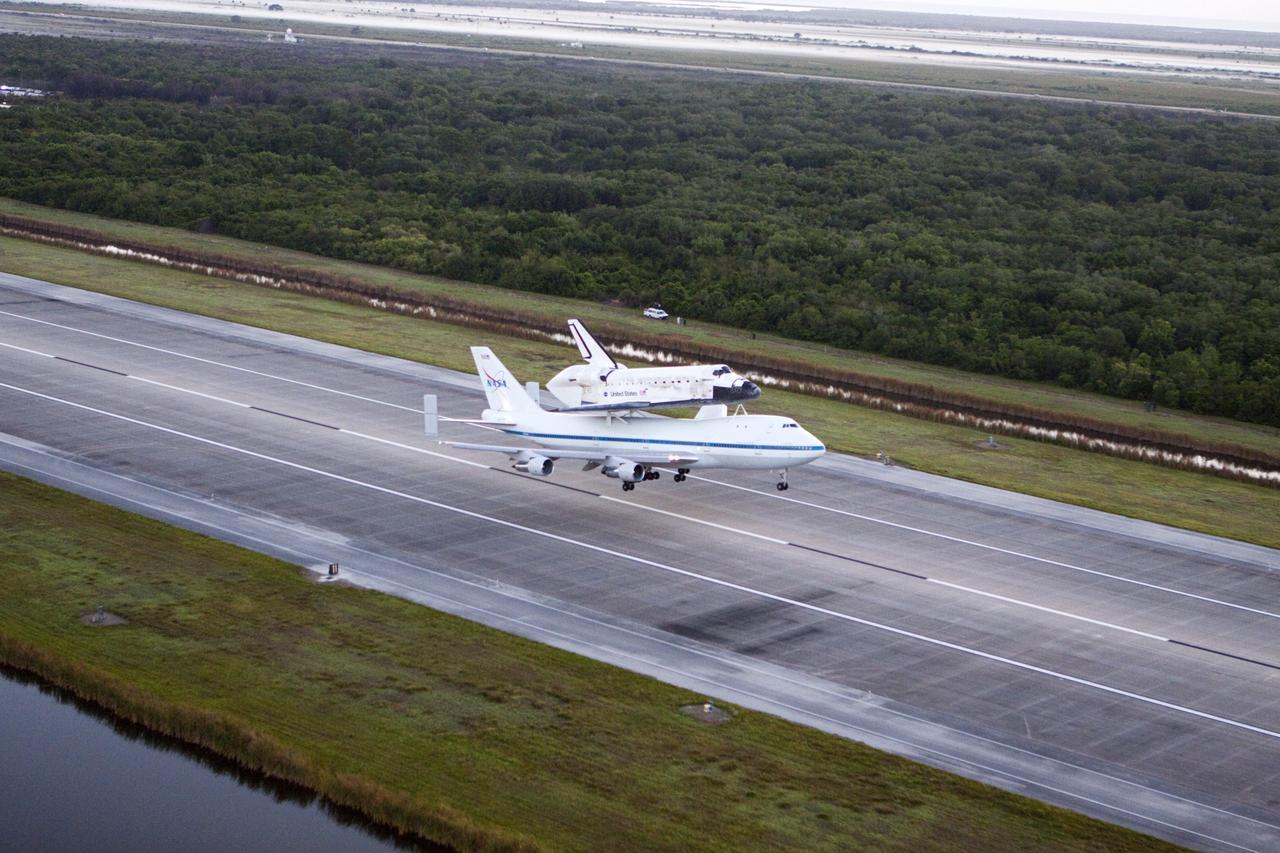
CAPE CANAVERAL, Fla. – In the early morning hours at NASA Kennedy Space Center’s Shuttle Landing Facility in Florida, the Shuttle Carrier Aircraft, or SCA, with space shuttle Discovery secured atop, takes off from runway 15 at 7 a.m. EDT. The SCA will deliver Discovery to its new home. The aircraft, known as an SCA, is a Boeing 747 jet, originally manufactured for commercial use, which was modified by NASA to transport the shuttles between destinations on Earth. This SCA, designated NASA 905, is assigned to the remaining ferry missions, delivering the shuttles to their permanent public display sites. NASA 905 is scheduled to ferry Discovery to the Washington Dulles International Airport in Virginia on April 17, after which the shuttle will be placed on display in the Smithsonian’s National Air and Space Museum, Steven F. Udvar-Hazy Center in Chantilly, Va. For more information on the SCA, visit http://www.nasa.gov/centers/dryden/news/FactSheets/FS-013-DFRC.html. For more information on shuttle transition and retirement activities, visit http://www.nasa.gov/transition. Photo credit: NASA/Glenn Benson
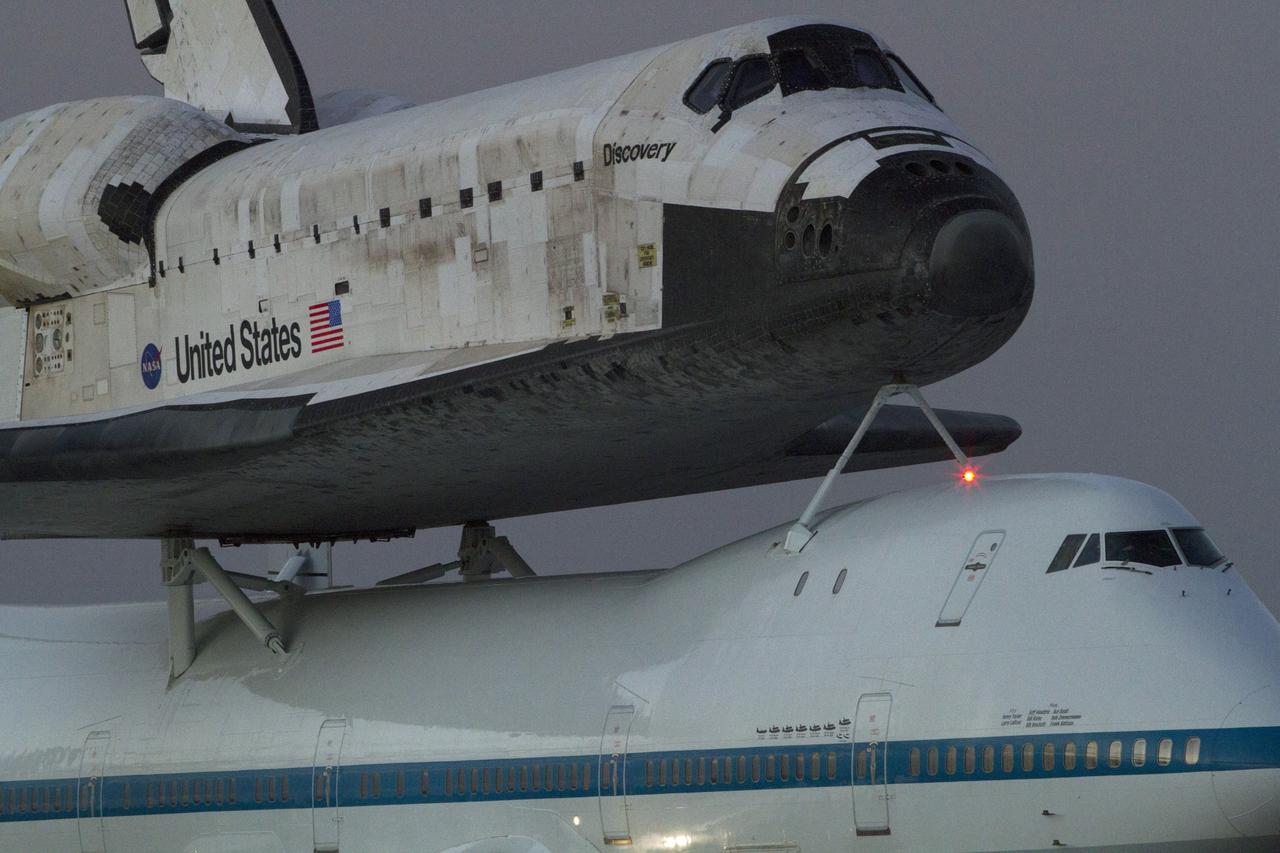
CAPE CANAVERAL, Fla. - Space shuttle Discovery is secured to the top of the Shuttle Carrier Aircraft in anticipation of an early morning takeoff from NASA's Kennedy Space Center in Florida. The duo departed Kennedy's runway 15 at 7 a.m. EDT. The aircraft, known as an SCA, is a Boeing 747 jet, originally manufactured for commercial use, which was modified by NASA to transport the shuttles between destinations on Earth. This SCA, designated NASA 905, is assigned to the remaining ferry missions, delivering the shuttles to their permanent public display sites. NASA 905 carried Discovery to the Washington Dulles International Airport in Virginia on April 17, after which the shuttle will be placed on display in the Smithsonian's National Air and Space Museum, Steven F. Udvar-Hazy Center in Chantilly, Va. For more information on the SCA, visit http://www.nasa.gov/centers/dryden/news/FactSheets/FS- 013-DFRC.html. For more information on shuttle transition and retirement activities, visit http://www .nasa.gov/transition. Photo credit: NASA/Rusty Backer
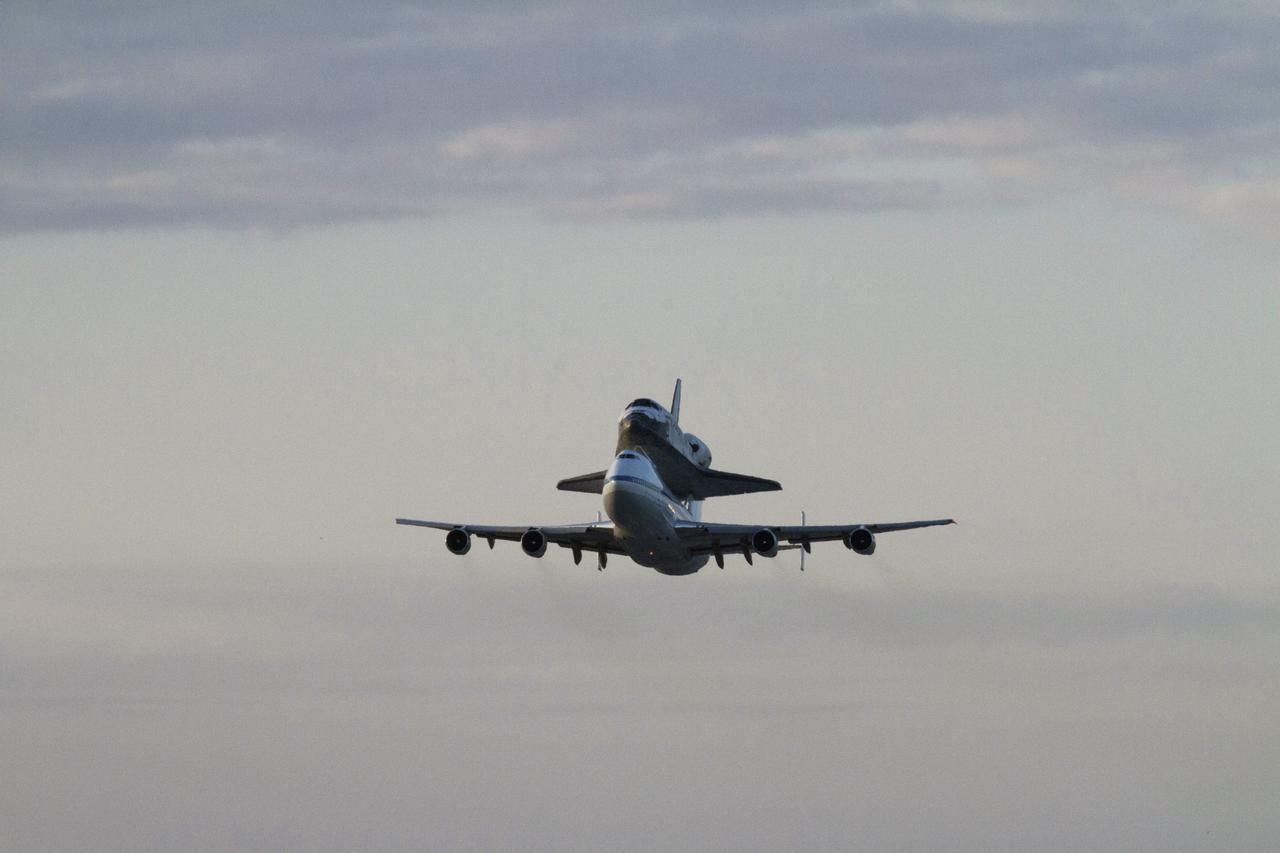
CAPE CANAVERAL, Fla. – Space shuttle Discovery, mounted to a Shuttle Carrier Aircraft, or SCA, takes off from NASA Kennedy Space Center’s Shuttle Landing Facility runway 15 in Florida at 7 a.m. EDT. The duo is beginning its ferry flight to the Washington Dulles International Airport in Virginia that also includes a flyby of the Space Coast and Washington, D.C. Discovery is leaving Kennedy after more than 28 years of service beginning with its arrival on the space coast Nov. 9, 1983. Discovery first launched to space Aug. 30, 1984, on the STS-41D mission. Discovery is the agency’s most-flown shuttle with 39 missions, more than 148 million miles and a total of one year in space. Discovery is set to move to the Smithsonian’s National Air and Space Museum, Steven F. Udvar-Hazy Center in Chantilly, Va., on April 19 where it will be place on public display. For more information on the SCA, visit http://www.nasa.gov/centers/dryden/news/FactSheets/FS-013-DFRC.html. For more information on shuttle transition and retirement activities, visit http://www.nasa.gov/transition. Photo credit: NASA/Tim Powers and Rick Wetherington
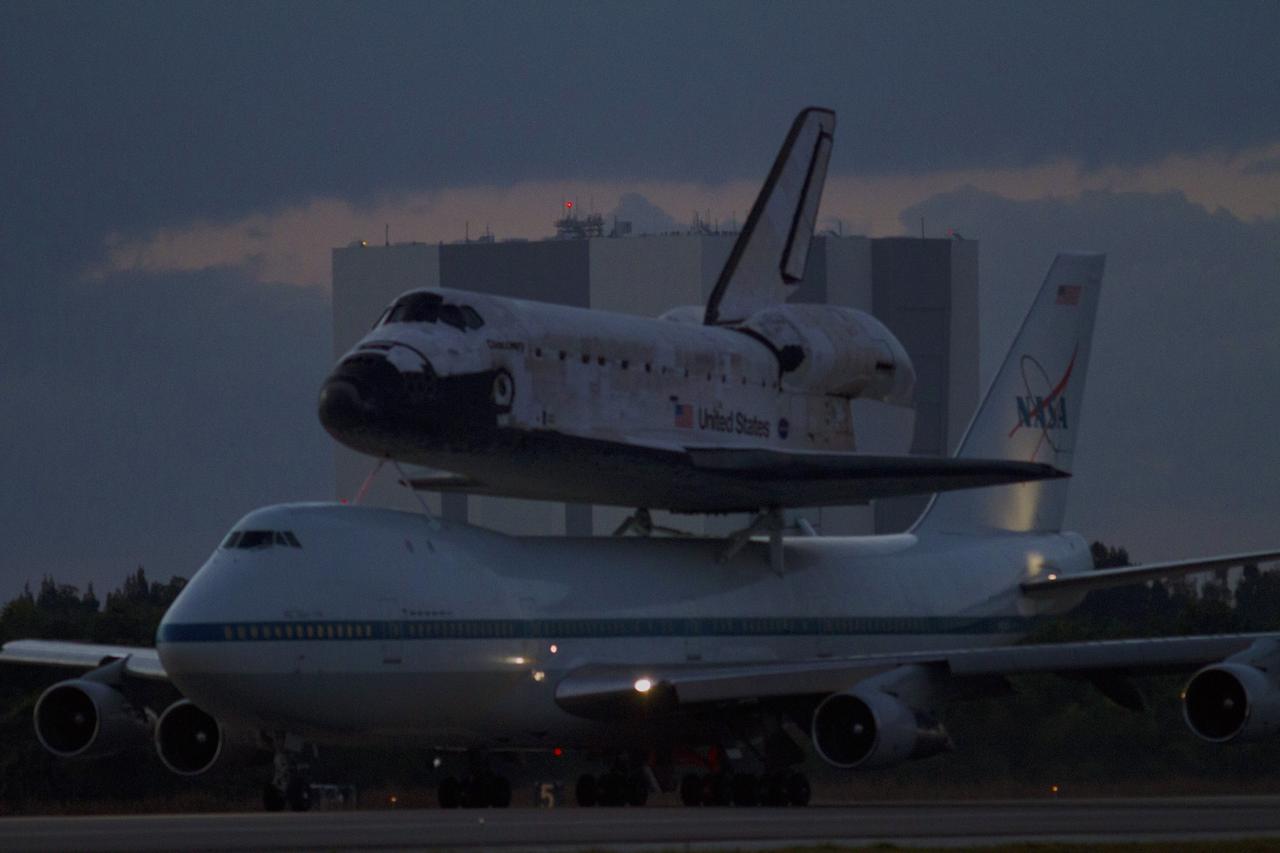
CAPE CANAVERAL, Fla. – In the early morning hours at NASA Kennedy Space Center’s Shuttle Landing Facility in Florida, the Shuttle Carrier Aircraft, or SCA, with space shuttle Discovery secured atop, taxies past the midpoint on its way for a takeoff on runway 15 at 7 a.m. EDT. In the background is the 525-foot-tall Vehicle Assembly Building. The aircraft, known as an SCA, is a Boeing 747 jet, originally manufactured for commercial use, which was modified by NASA to transport the shuttles between destinations on Earth. This SCA, designated NASA 905, is assigned to the remaining ferry missions, delivering the shuttles to their permanent public display sites. NASA 905 is scheduled to ferry Discovery to the Washington Dulles International Airport in Virginia on April 17, after which the shuttle will be placed on display in the Smithsonian’s National Air and Space Museum, Steven F. Udvar-Hazy Center in Chantilly, Va. For more information on the SCA, visit http://www.nasa.gov/centers/dryden/news/FactSheets/FS-013-DFRC.html. For more information on shuttle transition and retirement activities, visit http://www.nasa.gov/transition. Photo credit: NASA/Tim Powers and Rick Wetherington

CAPE CANAVERAL, Fla. – Space shuttle Discovery, mounted to a Shuttle Carrier Aircraft, or SCA, takes off from NASA Kennedy Space Center’s Shuttle Landing Facility runway 15 in Florida at 7 a.m. EDT and makes a flyby near the mate/demate device. The duo is beginning its ferry flight to the Washington Dulles International Airport in Virginia that also includes a flyby of the Space Coast and Washington, D.C. Also flying along with the pair are a T-38 training jet and a helicopter. Discovery is leaving Kennedy after more than 28 years of service beginning with its arrival on the space coast Nov. 9, 1983. Discovery first launched to space Aug. 30, 1984, on the STS-41D mission. Discovery is the agency’s most-flown shuttle with 39 missions, more than 148 million miles and a total of one year in space. Discovery is set to move to the Smithsonian’s National Air and Space Museum, Steven F. Udvar-Hazy Center in Chantilly, Va., on April 19 where it will be place on public display. For more information on the SCA, visit http://www.nasa.gov/centers/dryden/news/FactSheets/FS-013-DFRC.html. For more information on shuttle transition and retirement activities, visit http://www.nasa.gov/transition. Photo credit: NASA/Tim Powers and Rick Wetherington
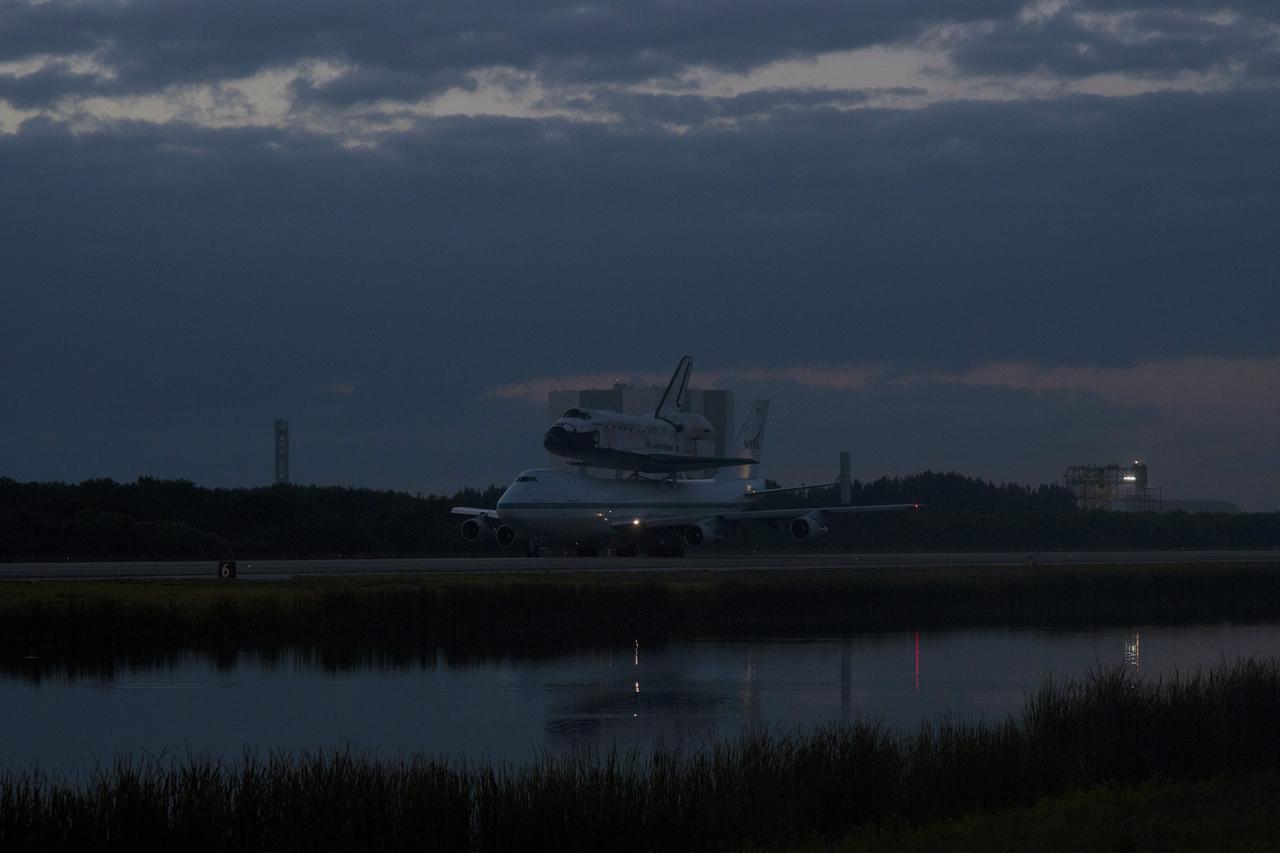
CAPE CANAVERAL, Fla. – In the early morning hours at NASA Kennedy Space Center’s Shuttle Landing Facility in Florida, the Shuttle Carrier Aircraft, or SCA, with space shuttle Discovery secured atop, taxies along the runway on its way for a takeoff on runway 15 at 7 a.m. EDT. The aircraft, known as an SCA, is a Boeing 747 jet, originally manufactured for commercial use, which was modified by NASA to transport the shuttles between destinations on Earth. This SCA, designated NASA 905, is assigned to the remaining ferry missions, delivering the shuttles to their permanent public display sites. NASA 905 is scheduled to ferry Discovery to the Washington Dulles International Airport in Virginia on April 17, after which the shuttle will be placed on display in the Smithsonian’s National Air and Space Museum, Steven F. Udvar-Hazy Center in Chantilly, Va. For more information on the SCA, visit http://www.nasa.gov/centers/dryden/news/FactSheets/FS-013-DFRC.html. For more information on shuttle transition and retirement activities, visit http://www.nasa.gov/transition. Photo credit: NASA/Tim Powers and Rick Wetherington
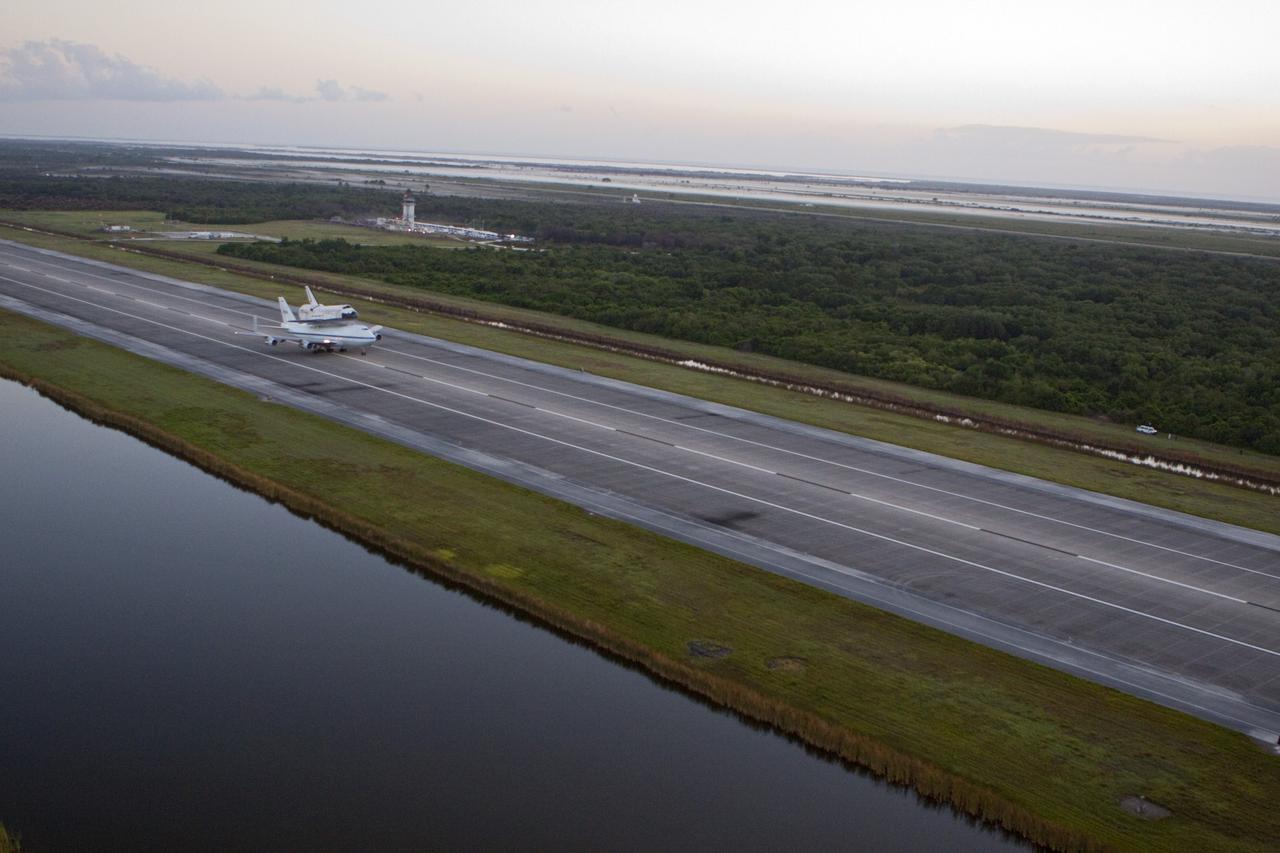
CAPE CANAVERAL, Fla. – In the early morning hours at NASA Kennedy Space Center’s Shuttle Landing Facility in Florida, the Shuttle Carrier Aircraft, or SCA, with space shuttle Discovery secured atop, begins takeoff from runway 15 at 7 a.m. EDT on its way to deliver Discovery to its new home. The aircraft, known as an SCA, is a Boeing 747 jet, originally manufactured for commercial use, which was modified by NASA to transport the shuttles between destinations on Earth. This SCA, designated NASA 905, is assigned to the remaining ferry missions, delivering the shuttles to their permanent public display sites. NASA 905 is scheduled to ferry Discovery to the Washington Dulles International Airport in Virginia on April 17, after which the shuttle will be placed on display in the Smithsonian’s National Air and Space Museum, Steven F. Udvar-Hazy Center in Chantilly, Va. For more information on the SCA, visit http://www.nasa.gov/centers/dryden/news/FactSheets/FS-013-DFRC.html. For more information on shuttle transition and retirement activities, visit http://www.nasa.gov/transition. Photo credit: NASA/Glenn Benson
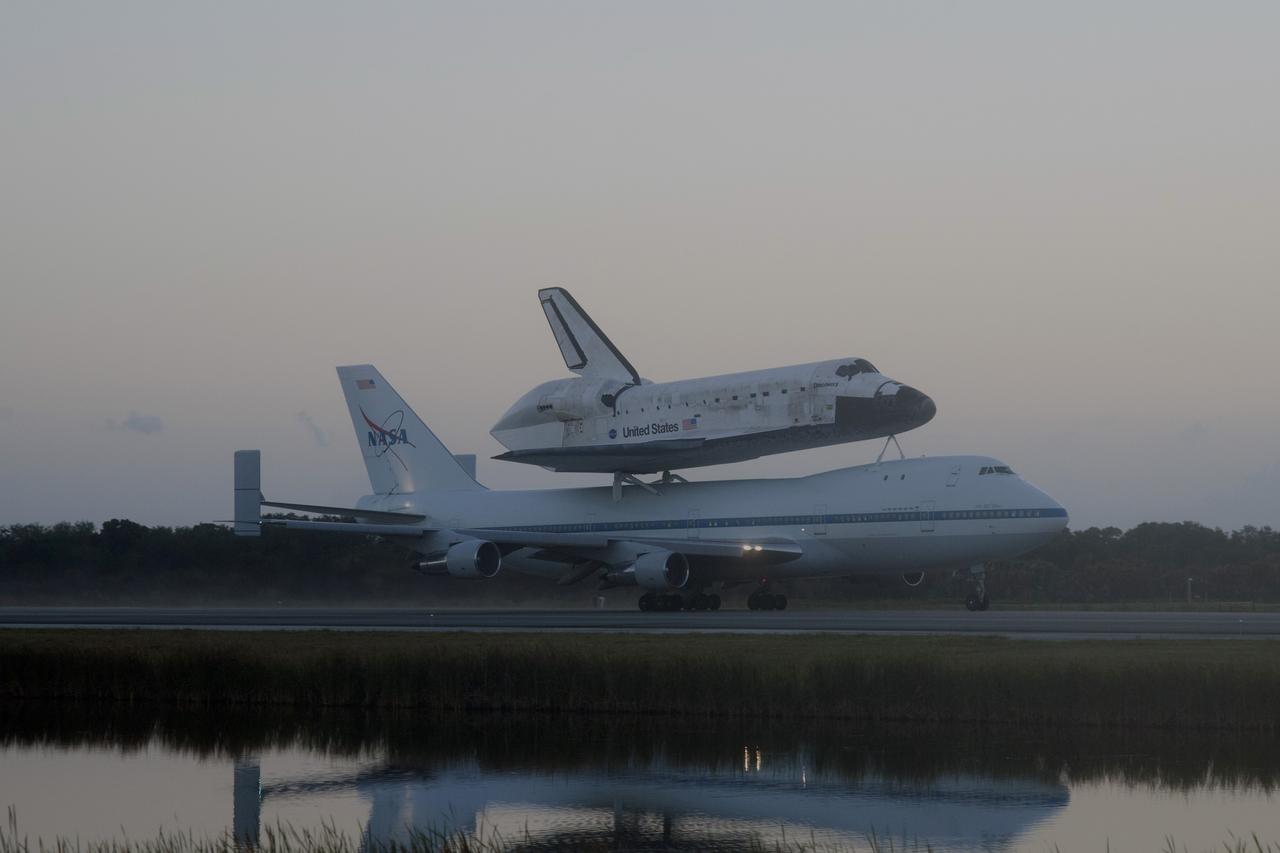
CAPE CANAVERAL, Fla. – In the early morning hours at NASA Kennedy Space Center’s Shuttle Landing Facility in Florida, the Shuttle Carrier Aircraft, or SCA, with space shuttle Discovery secured atop, taxies past the midpoint on its way for a takeoff on runway 15 at 7 a.m. EDT. The aircraft, known as an SCA, is a Boeing 747 jet, originally manufactured for commercial use, which was modified by NASA to transport the shuttles between destinations on Earth. This SCA, designated NASA 905, is assigned to the remaining ferry missions, delivering the shuttles to their permanent public display sites. NASA 905 is scheduled to ferry Discovery to the Washington Dulles International Airport in Virginia on April 17, after which the shuttle will be placed on display in the Smithsonian’s National Air and Space Museum, Steven F. Udvar-Hazy Center in Chantilly, Va. For more information on the SCA, visit http://www.nasa.gov/centers/dryden/news/FactSheets/FS-013-DFRC.html. For more information on shuttle transition and retirement activities, visit http://www.nasa.gov/transition. Photo credit: NASA/Tim Powers and Rick Wetherington
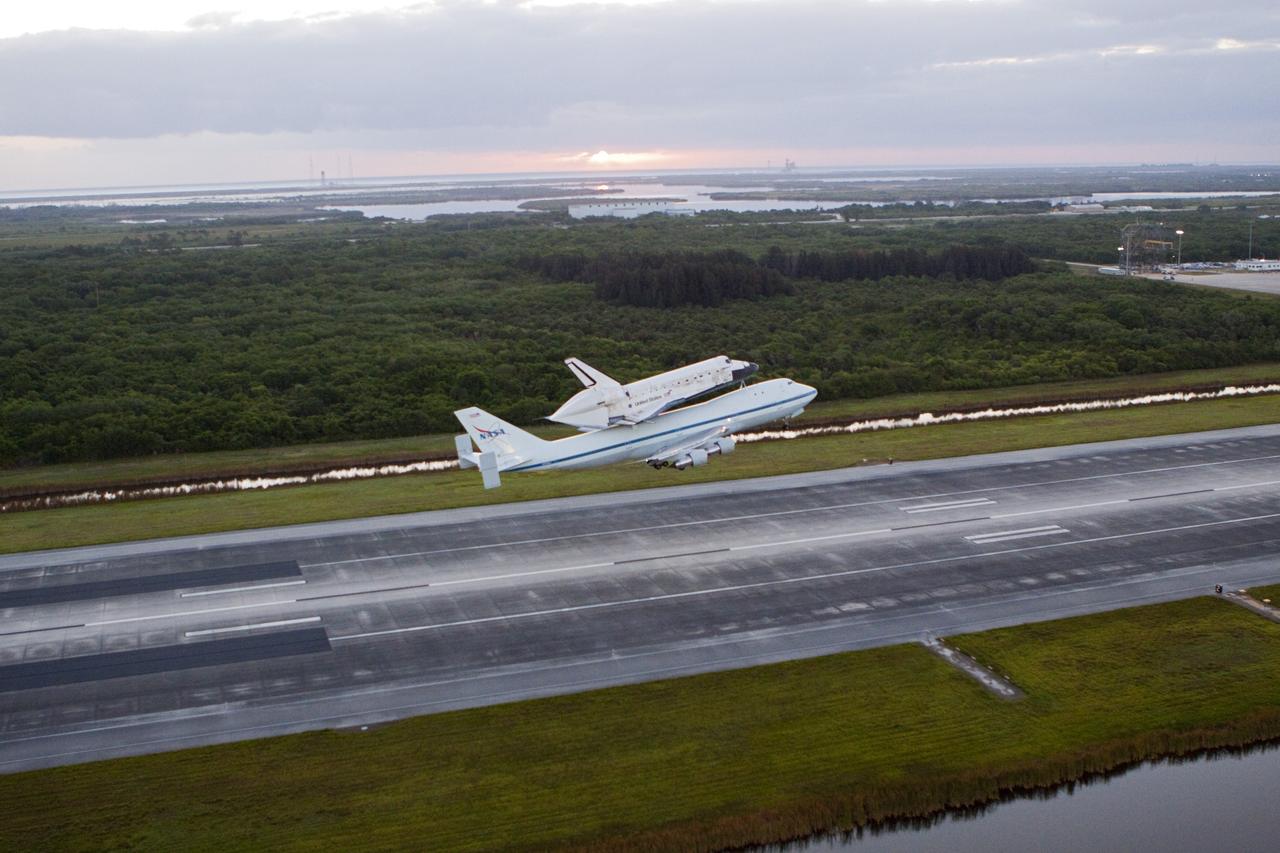
CAPE CANAVERAL, Fla. – In the early morning hours at NASA Kennedy Space Center’s Shuttle Landing Facility in Florida, the Shuttle Carrier Aircraft, or SCA, with space shuttle Discovery secured atop, takes off from runway 15 at 7 a.m. EDT. The SCA will deliver Discovery to its new home. The aircraft, known as an SCA, is a Boeing 747 jet, originally manufactured for commercial use, which was modified by NASA to transport the shuttles between destinations on Earth. This SCA, designated NASA 905, is assigned to the remaining ferry missions, delivering the shuttles to their permanent public display sites. NASA 905 is scheduled to ferry Discovery to the Washington Dulles International Airport in Virginia on April 17, after which the shuttle will be placed on display in the Smithsonian’s National Air and Space Museum, Steven F. Udvar-Hazy Center in Chantilly, Va. For more information on the SCA, visit http://www.nasa.gov/centers/dryden/news/FactSheets/FS-013-DFRC.html. For more information on shuttle transition and retirement activities, visit http://www.nasa.gov/transition. Photo credit: NASA/Glenn Benson

A relentless heat wave has blanketed India and Pakistan since mid-March 2022, causing dozens of deaths, fires, increased air pollution, and reduced crop yields. NASA's Ecosystem Spaceborne Thermal Radiometer Experiment on Space Station instrument (ECOSTRESS) has been measuring these temperatures from space, at the highest spatial resolution of any satellite instrument. This image, taken shortly before local midnight on May 5, shows urban areas and agricultural lands northwest of Delhi that are home to about 28 million people. The image covers about 4,800 square miles (12,350 square kilometers). Cities are usually markedly warmer than the surrounding countryside due to human activities and the materials used in the built environment. The image clearly delineates these urban "heat islands." Nighttime temperatures in Delhi and several smaller villages were above 95 degrees Fahrenheit (35 degrees Celsius), peaking at about 102 degrees F (39 degrees C), while the rural fields nearby had cooled to around 60 degrees F (15 degrees C). This data suggests that city dwellers are experiencing considerably higher temperatures than the average temperatures reported for their regions. ECOSTRESS measures the temperature of the ground itself, which is very similar to air temperature at night (though the ground may be warmer than the air in daylight hours). The instrument launched to the space station in 2018. Its primary mission is to identify plants' thresholds for water use and water stress, giving insight into their ability to adapt to a warming climate. However, ECOSTRESS also records other heat-related phenomena like this heat wave. Its high-resolution images, with a pixel size of about 225 feet (70 meters) by 125 feet (38 meters), are a powerful tool for understanding aspects of the weather event that might be overlooked by traditional observation networks. https://photojournal.jpl.nasa.gov/catalog/PIA24987
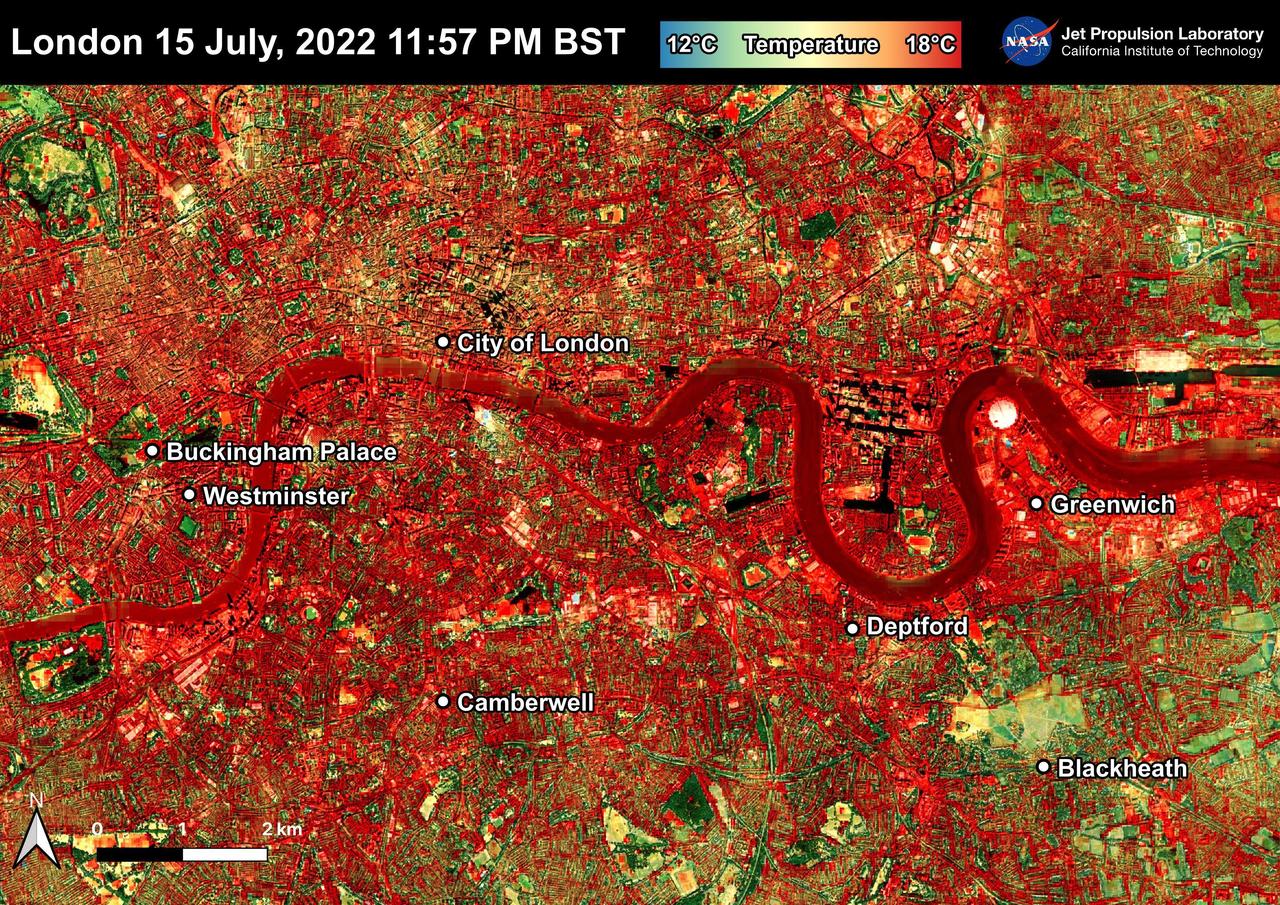
NASA's Ecosystem Spaceborne Thermal Radiometer Experiment on Space Station (ECOSTRESS) instrument recorded this image of ground surface temperatures in London and surrounding areas on July 15, 2022, just before midnight local time. It shows surface temperatures exceeding 68 degrees Fahrenheit (20 degrees Celsius) at 11:57 p.m. British Summer Time. Parts of Europe in mid-July experienced a record-breaking heat wave. The United Kingdom reaching its highest air temperature on record on July 19, 104.5 F (40.3 C) in Coningsby, about 110 miles (177 kilometers) north of London, which itself saw a high of 104.3 F (40.2 C) the same day. That evening, the overnight low was also a record-breaker: 78.4 F (25.8 C) at Kenley Airfield in Greater London. In this image, the red areas indicate hotter temperatures commonly associated with developed areas. These surfaces – roofs, paved streets, and other built structures – remain warm long after the sun sets. Blue and green areas indicate cooler areas commonly associated with parks and other natural land surfaces. Because this image was acquired at night, it shows bodies of water being warmer than the land surface. This is because water tends to change temperature more slowly, so its temperature stays elevated long after land surfaces have cooled down. Cities are usually warmer than open land with natural surfaces because of human activities as well as the materials used in building and construction. Streets are often the hottest part of the built environment due to asphalt paving. Dark-colored surfaces absorb more heat from the Sun than lighter-colored ones; asphalt absorbs up to 95% of solar radiation and retains the heat for hours into nighttime. This image overlays ECOSTRESS surface temperature data on a Google satellite map for context. ECOSTRESS measures the temperature of the ground, which is hotter than the air temperature during the daytime. The instrument launched to the space station in 2018. Its primary mission is to identify plants' thresholds for water use and water stress, giving insight into their ability to adapt to a warming climate. However, ECOSTRESS is also useful for documenting other heat-related phenomena, like patterns of heat absorption and retention. Its high-resolution images, with a pixel size of about 225 feet (70 meters) by 125 feet (38 meters), are a powerful tool for understanding our environment. https://photojournal.jpl.nasa.gov/catalog/PIA25423

This image depicts a vast canyon of dust and gas in the Orion Nebula from a 3-D computer model based on observations by NASA's Hubble Space Telescope and created by science visualization specialists at the Space Telescope Science Institute (STScI) in Baltimore, Md. A 3-D visualization of this model takes viewers on an amazing four-minute voyage through the 15-light-year-wide canyon. Credit: NASA, G. Bacon, L. Frattare, Z. Levay, and F. Summers (STScI/AURA) Go here to learn more about Hubble 3D: <a href="http://www.nasa.gov/topics/universe/features/hubble_imax_premiere.html" rel="nofollow">www.nasa.gov/topics/universe/features/hubble_imax_premier...</a> or <a href="http://www.imax.com/hubble/" rel="nofollow">www.imax.com/hubble/</a> Take an exhilarating ride through the Orion Nebula, a vast star-making factory 1,500 light-years away. Swoop through Orion's giant canyon of gas and dust. Fly past behemoth stars whose brilliant light illuminates and energizes the entire cloudy region. Zoom by dusty tadpole-shaped objects that are fledgling solar systems. This virtual space journey isn't the latest video game but one of several groundbreaking astronomy visualizations created by specialists at the Space Telescope Science Institute (STScI) in Baltimore, the science operations center for NASA's Hubble Space Telescope. The cinematic space odysseys are part of the new Imax film "Hubble 3D," which opens today at select Imax theaters worldwide. The 43-minute movie chronicles the 20-year life of Hubble and includes highlights from the May 2009 servicing mission to the Earth-orbiting observatory, with footage taken by the astronauts. The giant-screen film showcases some of Hubble's breathtaking iconic pictures, such as the Eagle Nebula's "Pillars of Creation," as well as stunning views taken by the newly installed Wide Field Camera 3. While Hubble pictures of celestial objects are awe-inspiring, they are flat 2-D photographs. For this film, those 2-D images have been converted into 3-D environments, giving the audience the impression they are space travelers taking a tour of Hubble's most popular targets. "A large-format movie is a truly immersive experience," says Frank Summers, an STScI astronomer and science visualization specialist who led the team that developed the movie visualizations. The team labored for nine months, working on four visualization sequences that comprise about 12 minutes of the movie. "Seeing these Hubble images in 3-D, you feel like you are flying through space and not just looking at picture postcards," Summers continued. "The spacescapes are all based on Hubble images and data, though some artistic license is necessary to produce the full depth of field needed for 3-D." The most ambitious sequence is a four-minute voyage through the Orion Nebula's gas-and-dust canyon, about 15 light-years across. During the ride, viewers will see bright and dark, gaseous clouds; thousands of stars, including a grouping of bright, hefty stars called the Trapezium; and embryonic planetary systems. The tour ends with a detailed look at a young circumstellar disk, which is much like the structure from which our solar system formed 4.5 billion years ago. Based on a Hubble image of Orion released in 2006, the visualization was a collaborative effort between science visualization specialists at STScI, including Greg Bacon, who sculpted the Orion Nebula digital model, with input from STScI astronomer Massimo Roberto; the National Center for Supercomputing Applications at the University of Illinois at Urbana-Champaign; and the Spitzer Science Center at the California Institute of Technology in Pasadena. For some of the sequences, STScI imaging specialists developed new techniques for transforming the 2-D Hubble images into 3-D. STScI image processing specialists Lisa Frattare and Zolt Levay, for example, created methods of splitting a giant gaseous pillar in the Carina Nebula into multiple layers to produce a 3-D effect, giving the structure depth. The Carina Nebula is a nursery for baby stars. Frattare painstakingly removed the thousands of stars in the image so that Levay could separate the gaseous layers on the isolated Carina pillar. Frattare then replaced the stars into both foreground and background layers to complete the 3-D model. For added effect, the same separation was done for both visible and infrared Hubble images, allowing the film to cross-fade between wavelength views in 3-D. In another sequence viewers fly into a field of 170,000 stars in the giant star cluster Omega Centauri. STScI astronomer Jay Anderson used his stellar database to create a synthetic star field in 3-D that matches recent razor-sharp Hubble photos. The film's final four-minute sequence takes viewers on a voyage from our Milky Way Galaxy past many of Hubble's best galaxy shots and deep into space. Some 15,000 galaxies from Hubble's deepest surveys stretch billions of light-years across the universe in a 3-D sequence created by STScI astronomers and visualizers. The view dissolves into a cobweb that traces the universe's large-scale structure, the backbone from which galaxies were born. In addition to creating visualizations, STScI's education group also provided guidance on the "Hubble 3D" Educator Guide, which includes standards-based lesson plans and activities about Hubble and its mission. Students will use the guide before or after seeing the movie. "The guide will enhance the movie experience for students and extend the movie into classrooms," says Bonnie Eisenhamer, STScI's Hubble Formal Education manager. The Hubble Space Telescope is a project of international cooperation between NASA and the European Space Agency (ESA) and is managed by NASA’s Goddard Space Flight Center (GSFC) in Greenbelt, Md. The Space Telescope Science Institute (STScI) conducts Hubble science operations. The institute is operated for NASA by the Association of Universities for Research in Astronomy, Inc., Washington, D.C.