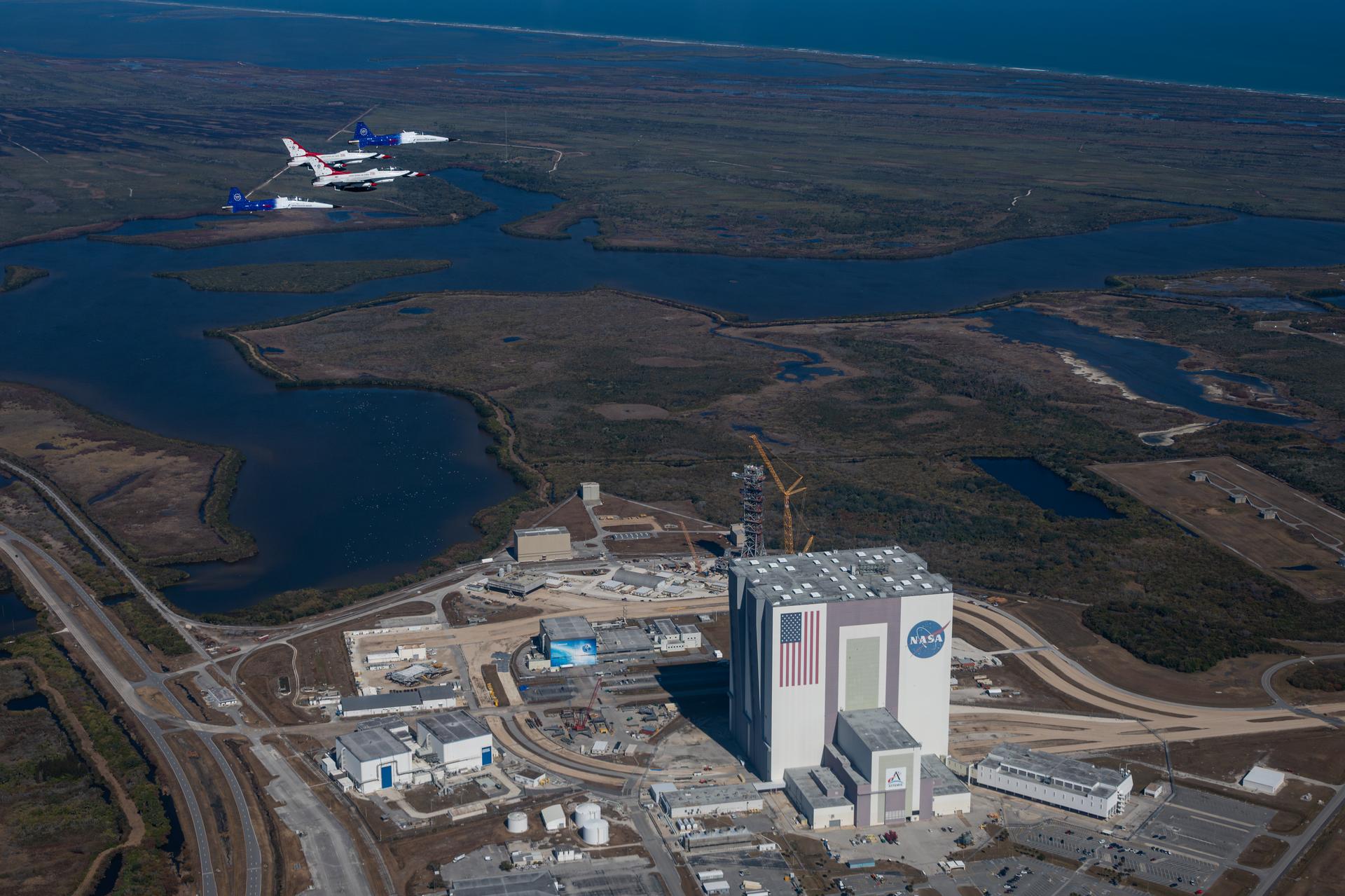
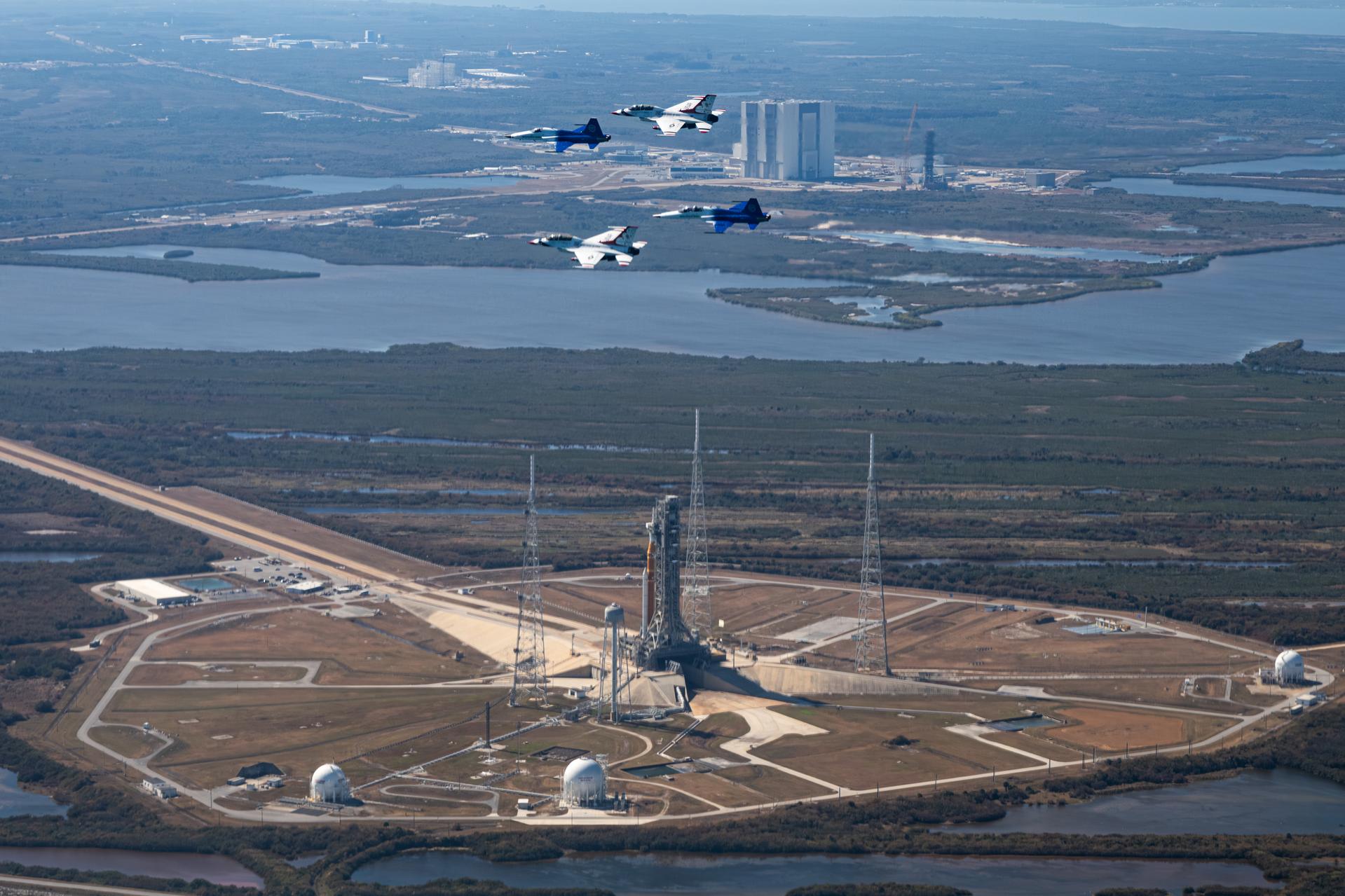
NASA Administrator Jared Isaacman conducts a formation flight with two of his personal F-5 aircraft, piloted by Isaacman and Sean Gustafson, senior advisor to the administrator, and two U.S. Air Force Thunderbirds F-16s, piloted by Thunderbird 7 Lt. Col. Tyler Keener and Thunderbird 8 Maj. Samuel Larson, Sunday, Feb. 8, 2026, at NASA’s Kennedy Space Center in Florida. The formation flew near the Vehicle Assembly Building and the surrounding area at Kennedy. Photo Credit: (NASA/John Kraus)
The three thrust-vectoring aircraft at Edwards, California, each capable of flying at extreme angles of attack, cruise over the California desert in formation during flight in March 1994. They are, from left, NASA's F-18 High Alpha Research Vehicle (HARV), flown by the NASA Dryden Flight Research Center; the X-31, flown by the X-31 International Test Organization (ITO) at Dryden; and the Air Force F-16 Multi-Axis Thrust Vectoring (MATV) aircraft.
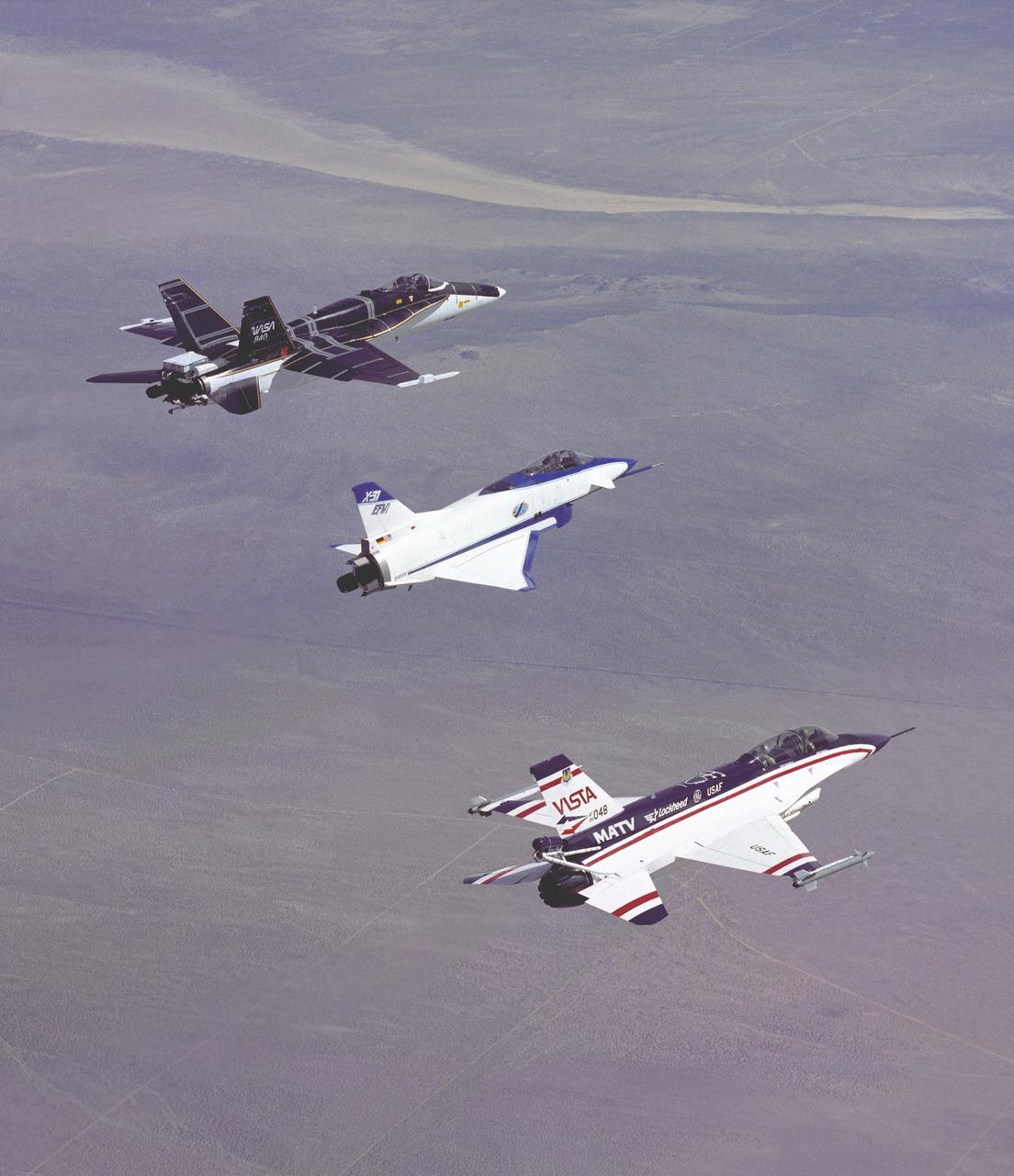
The three thrust-vectoring aircraft at Edwards, California, each capable of flying at extreme angles of attack, cruise over the California desert in formation during flight in March 1994. They are, from left, NASA's F-18 High Alpha Research Vehicle (HARV), flown by the NASA Dryden Flight Research Center; the X-31, flown by the X-31 International Test Organization (ITO) at Dryden; and the Air Force F-16 Multi-Axis Thrust Vectoring (MATV) aircraft.
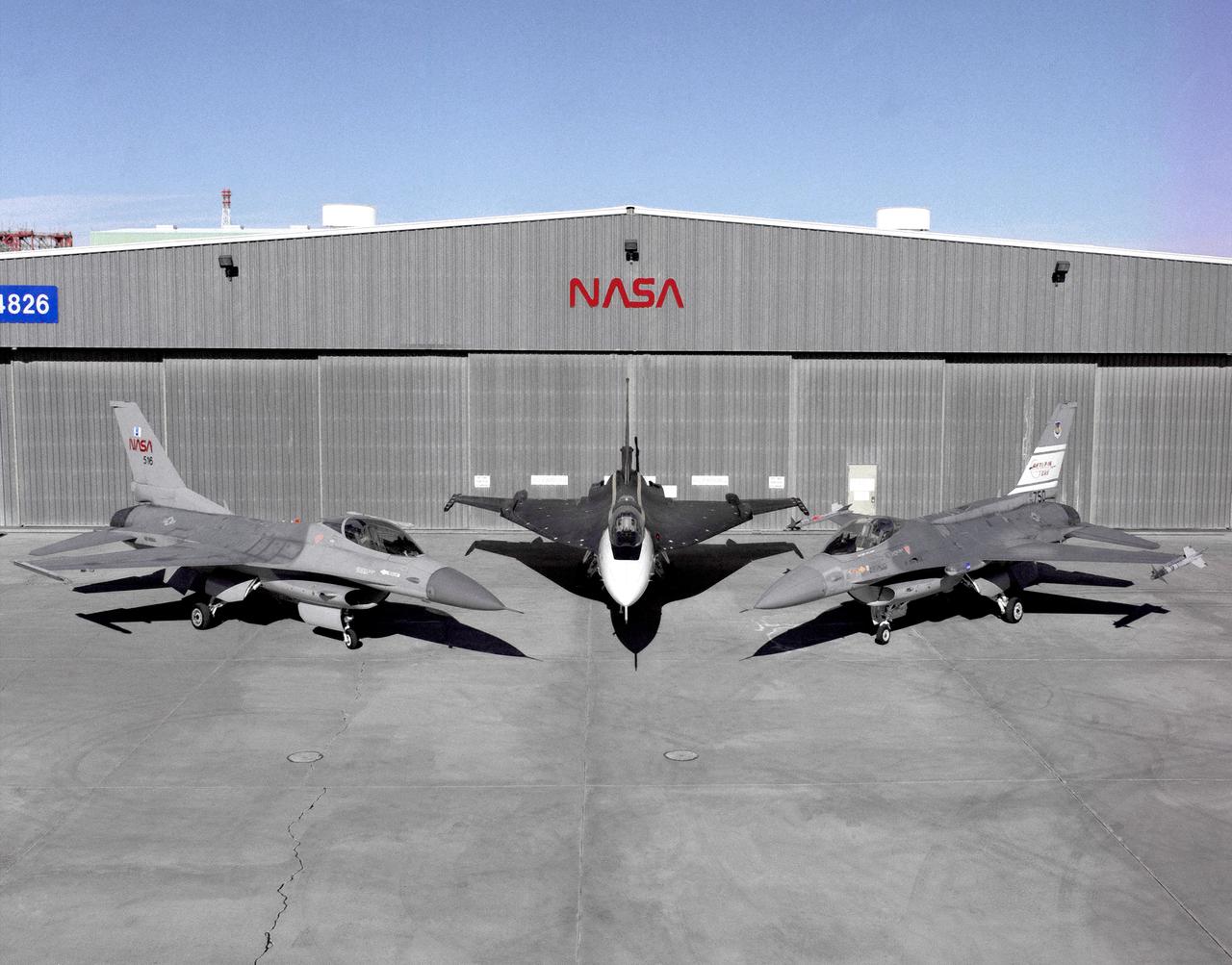
Photographed outside their hangar at the Dryden Flight Research Center, Edwards, California, part of Dryden's F-16 fleet is, left to right; an F-16A, the F-16XL no. 1, and the F-16 AFTI. The F-16A (NASA 516), the only civil registered F-16 in existence, was transferred to Dryden from Langley, and was primarily used in engine tests and for parts. It was subsequently transfered from Dryden. The single-seat F-16XL no. 1 (NASA 849) was most recently used in the Cranked-Arrow Wing Aerodynamics Project (CAWAP) to test boundary layer pressures and distribution. Previously it had been used in a program to investigate the characteristics of sonic booms for NASA's High Speed Research Program. Data from the program will be used in the development of a high speed civilian transport. During the series of sonic boom research flights, the F-16XL was used to probe the shock waves being generated by a NASA SR-71 and record their shape and intensity. The Advanced Fighter Technology Integration (AFTI) F-16 was used to develop and demonstrate technologies to improve navigation and a pilot's ability to find and destroy enemy ground targets day or night, including adverse weather. Earlier research in the joint NASA-Air Force AFTI F-16 program demonstrated voice actuated controls, helmet-mounted sighting and integration of forward-mounted canards with the standard flight control system to achieve uncoupled flight.
NASA Administrator Jared Isaacman conducts a formation flight with two of his personal F-5 aircraft, piloted by Isaacman and Sean Gustafson, senior advisor to the administrator, and two U.S. Air Force Thunderbirds F-16s, piloted by Thunderbird 7 Lt. Col. Tyler Keener and Thunderbird 8 Maj. Samuel Larson, Sunday, Feb. 8, 2026, at NASA’s Kennedy Space Center in Florida. The formation flew near the Artemis II SLS (Space Launch System) rocket and Orion spacecraft at Launch Complex 39B and the surrounding area at Kennedy. Photo Credit: (NASA/John Kraus)
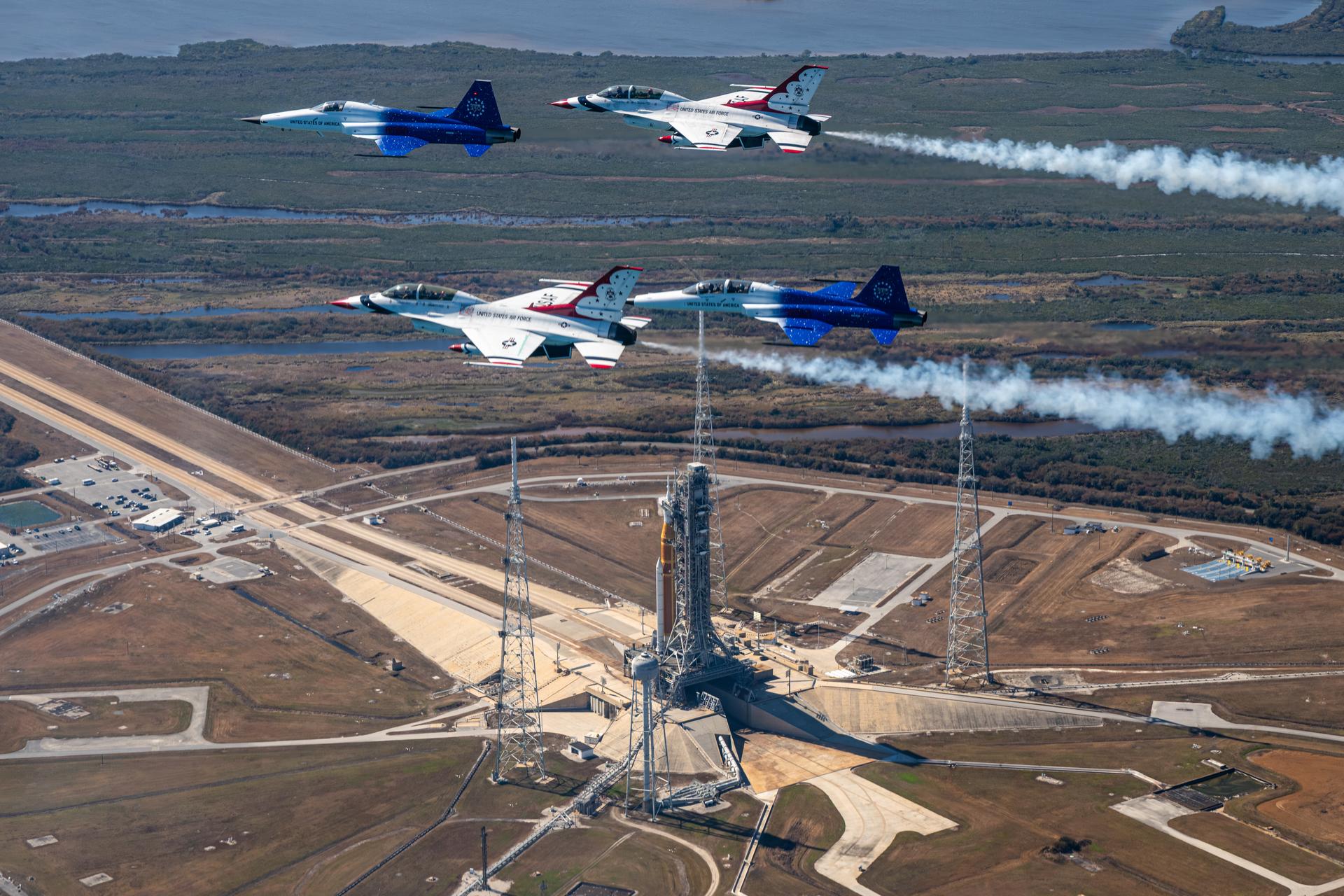
NASA Administrator Jared Isaacman conducts a formation flight with two of his personal F-5 aircraft, piloted by Isaacman and Sean Gustafson, senior advisor to the administrator, and two U.S. Air Force Thunderbirds F-16s, piloted by Thunderbird 7 Lt. Col. Tyler Keener and Thunderbird 8 Maj. Samuel Larson, Sunday, Feb. 8, 2026, at NASA’s Kennedy Space Center in Florida. The formation flew near the Artemis II SLS (Space Launch System) rocket and Orion spacecraft at Launch Complex 39B and the surrounding area at Kennedy. Photo Credit: (NASA/John Kraus)
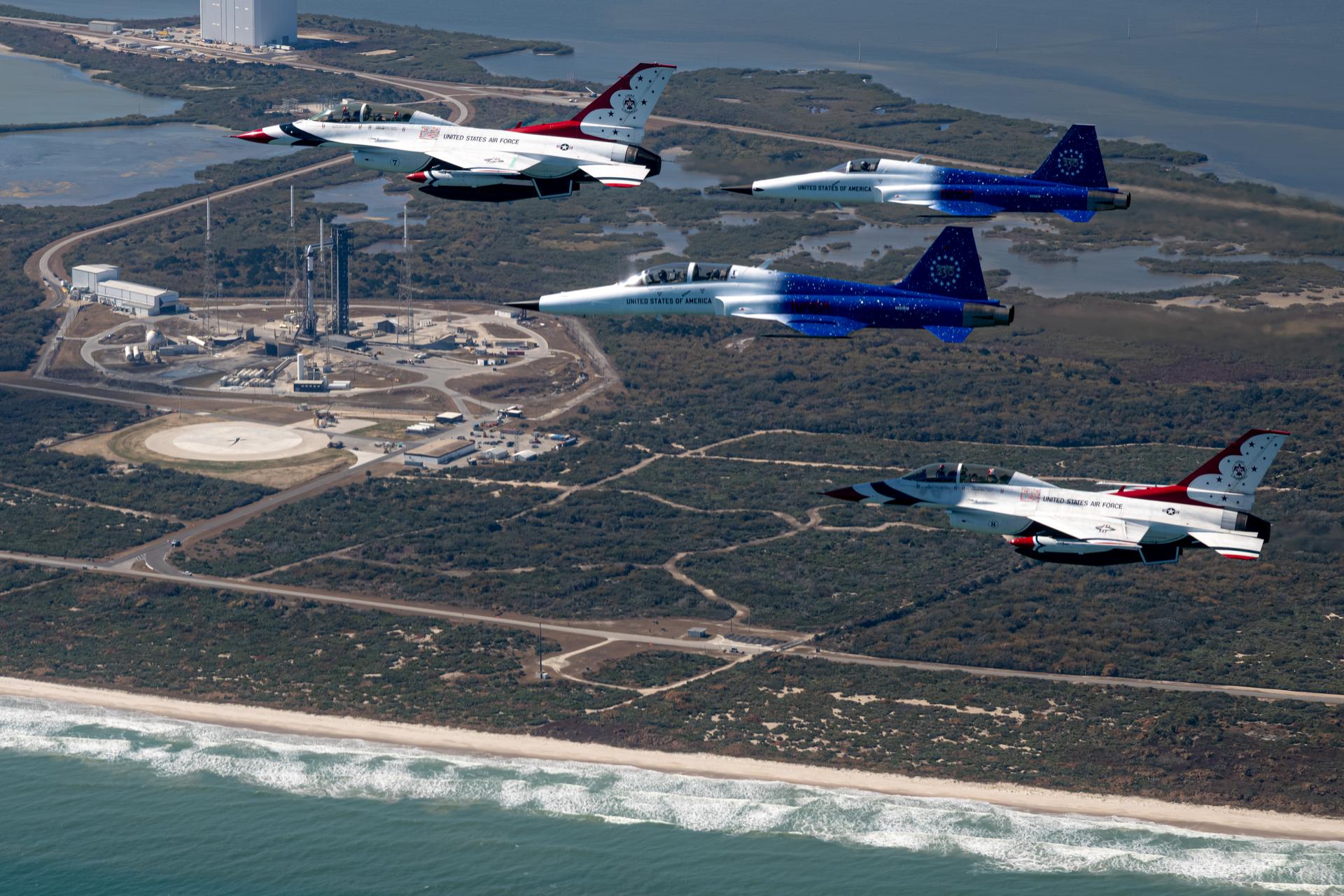
NASA Administrator Jared Isaacman conducts a formation flight with two of his personal F-5 aircraft, piloted by Isaacman and Sean Gustafson, senior advisor to the administrator, and two U.S. Air Force Thunderbirds F-16s, piloted by Thunderbird 7 Lt. Col. Tyler Keener and Thunderbird 8 Maj. Samuel Larson, Sunday, Feb. 8, 2026, at NASA’s Kennedy Space Center in Florida. The formation flew near Space Launch Complex 40 at Cape Canaveral Space Force Station and the surrounding area at Kennedy ahead of Crew-12’s mission to the International Space Station. Photo Credit: (NASA/John Kraus)
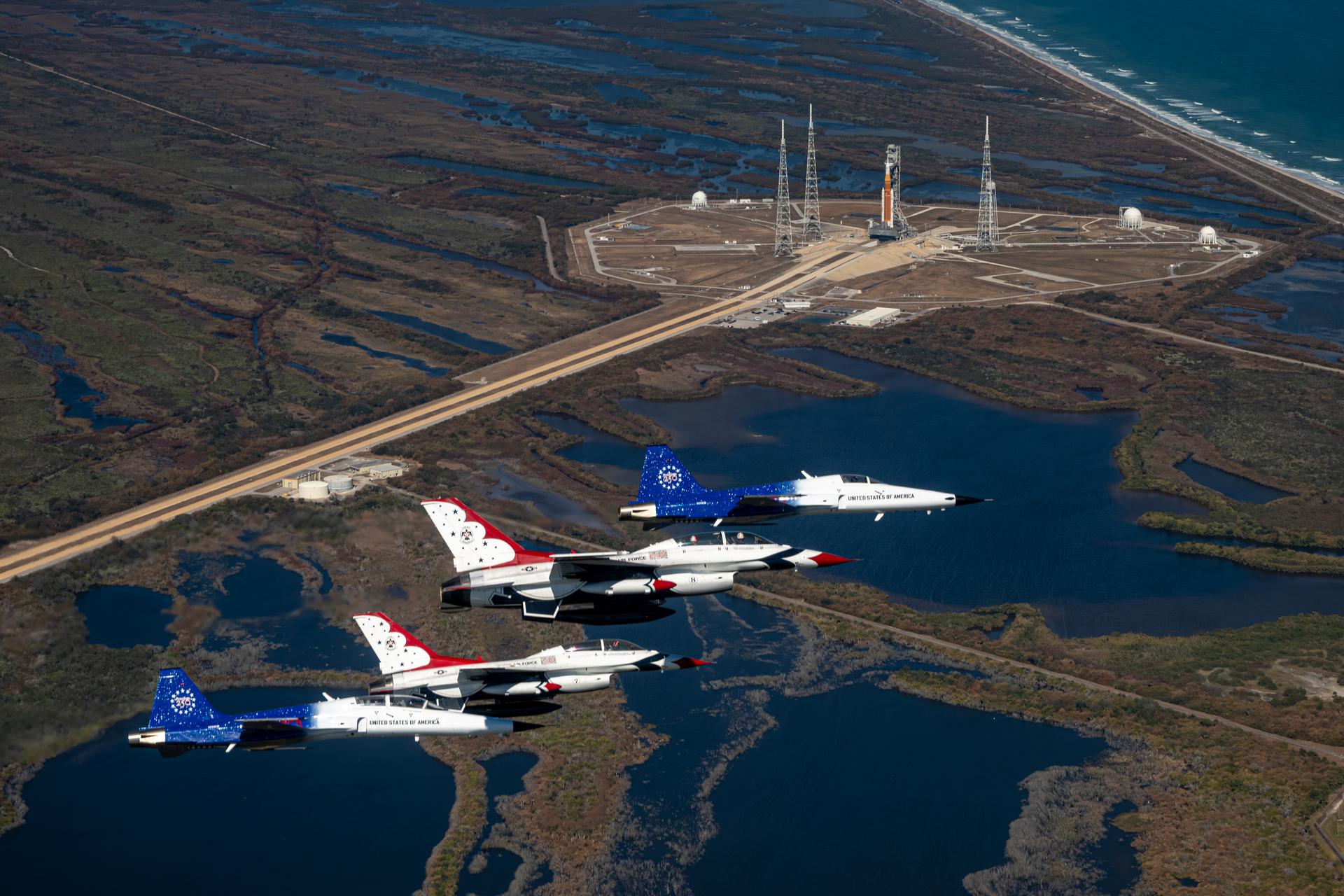
NASA Administrator Jared Isaacman conducts a formation flight with two of his personal F-5 aircraft, piloted by Isaacman and Sean Gustafson, senior advisor to the administrator, and two U.S. Air Force Thunderbirds F-16s, piloted by Thunderbird 7 Lt. Col. Tyler Keener and Thunderbird 8 Maj. Samuel Larson, Sunday, Feb. 8, 2026, at NASA’s Kennedy Space Center in Florida. The formation flew near the Artemis II SLS (Space Launch System) rocket and Orion spacecraft at Launch Complex 39B and the surrounding area at Kennedy. Photo Credit: (NASA/John Kraus)
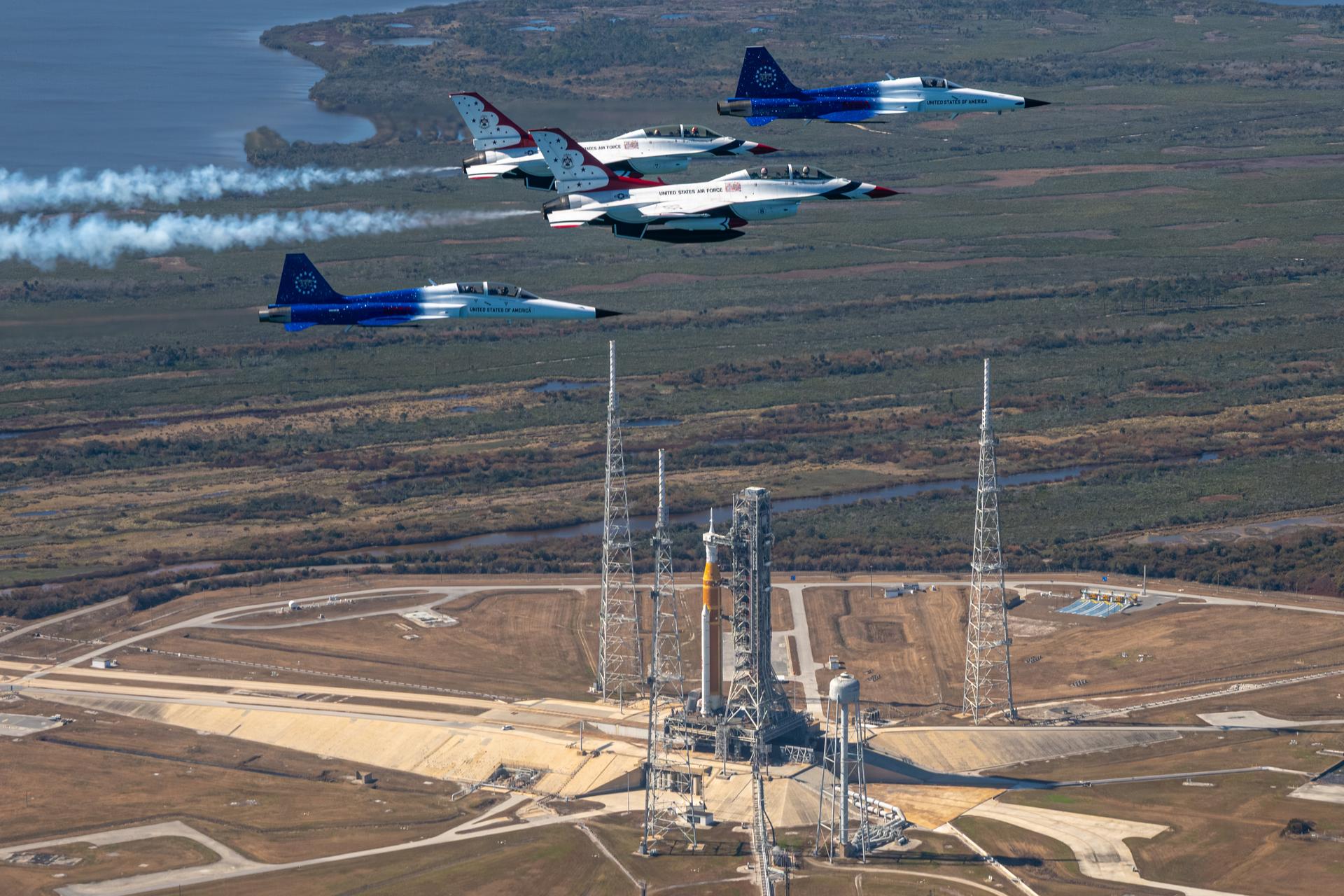
NASA Administrator Jared Isaacman conducts a formation flight with two of his personal F-5 aircraft, piloted by Isaacman and Sean Gustafson, senior advisor to the administrator, and two U.S. Air Force Thunderbirds F-16s, piloted by Thunderbird 7 Lt. Col. Tyler Keener and Thunderbird 8 Maj. Samuel Larson, Sunday, Feb. 8, 2026, at NASA’s Kennedy Space Center in Florida. The formation flew near the Artemis II SLS (Space Launch System) rocket and Orion spacecraft at Launch Complex 39B and the surrounding area at Kennedy. Photo Credit: (NASA/John Kraus)
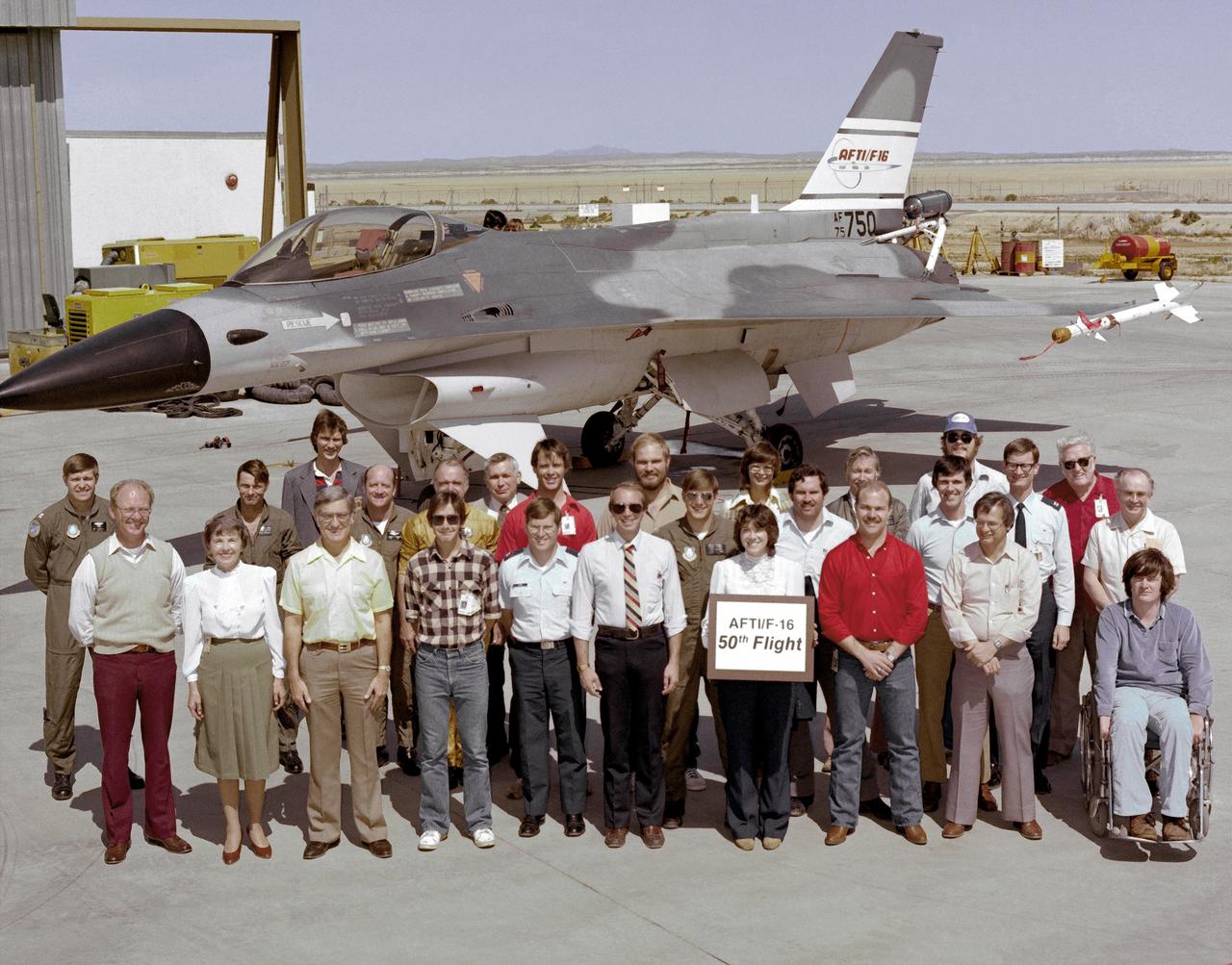
An early (1983) photograph of the AFTI F-16 team, commemorating the aircraft's 50th flight. It shows the initial configuration and paint finish of the AFTI F-16, as well as the forward mounted canards and the spin chute.
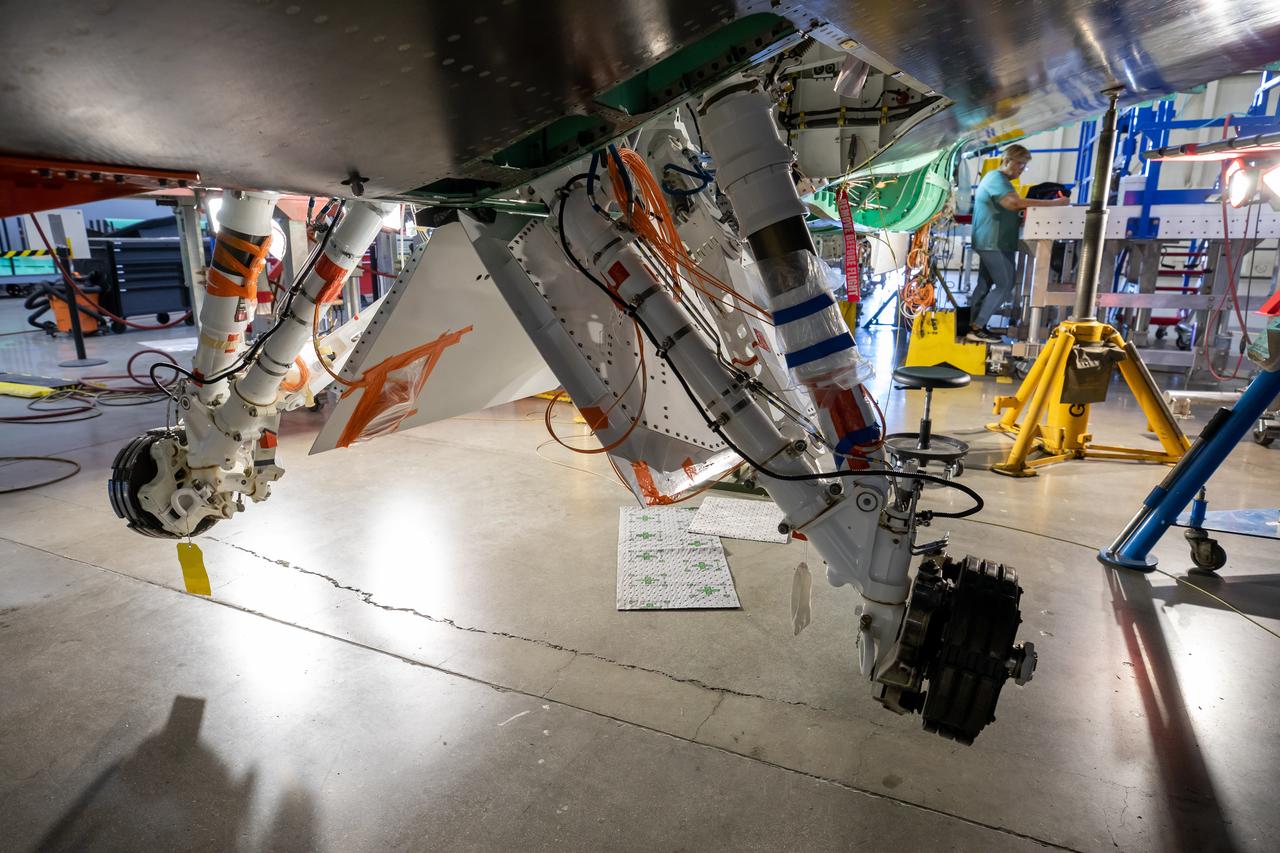
The Quesst team has repurposed the landing gear from an F-16 Fighting Falcon aircraft and is working on adjusting the fit onto the X-59 airplane. This is part of NASA’s Quesst mission which plans to help enable commercial supersonic air travel over land.
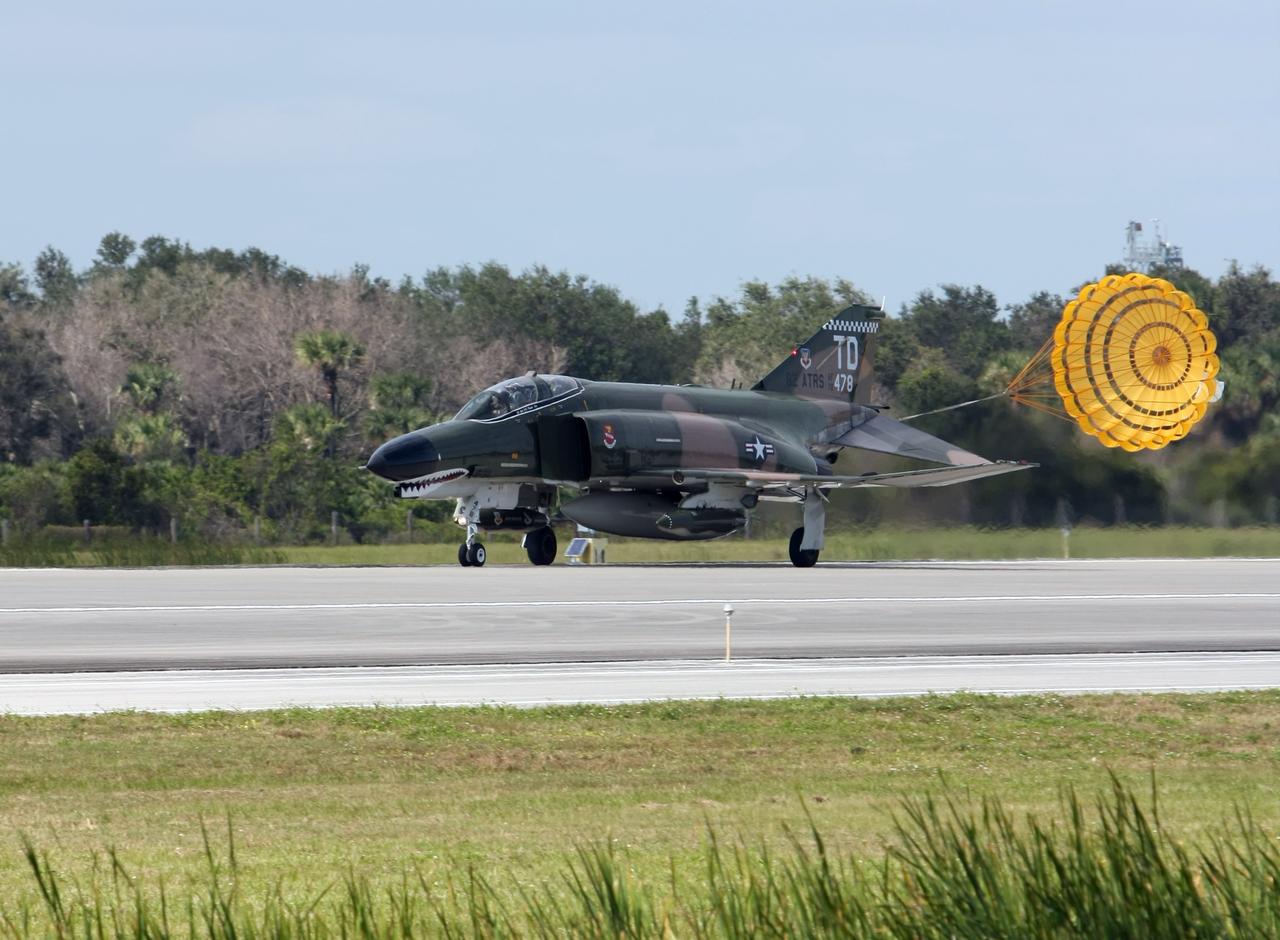
CAPE CANAVERAL, Fla. – An F-4 jet aircraft lands at NASA's Kennedy Space Center in Florida. It will join the U.S. Navy's Blue Angels and other aircraft for demonstrations at the Kennedy Space Center Visitor Complex Space and Air Show Nov. 8-9. The Navy's elite flight demonstration squadron will take to the skies in military aircraft demonstrations by the F-16 Fighting Falcon and F/A-18 Super Hornet jets for the second annual Space & Air Show at Kennedy. This year’s show brings together the best in military aircraft, coupled with precision pilots and veteran astronauts to celebrate spaceflight and aviation. The event includes military aircraft demonstrations by the F-16 Fighting Falcon and a water rescue demonstration by the 920th Rescue Wing. Photo credit: NASA/Kim Shiflett
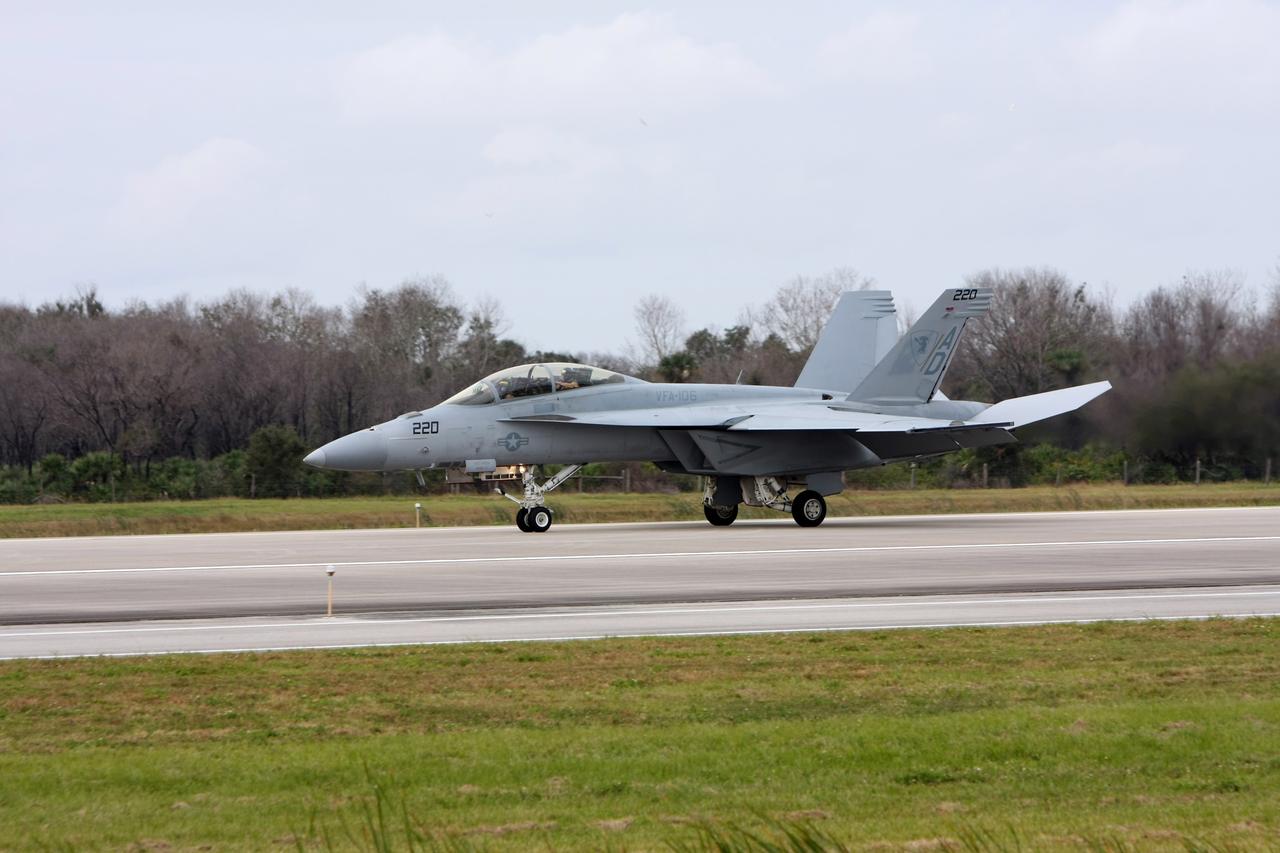
CAPE CANAVERAL, Fla. – An F/A-18 jet lands at NASA's Kennedy Space Center in Florida. It will join the U.S. Navy's Blue Angels and other aircraft for demonstrations at the Kennedy Space Center Visitor Complex Space and Air Show Nov. 8-9. The Navy's elite flight demonstration squadron will take to the skies in military aircraft demonstrations by the F-16 Fighting Falcon and F/A-18 Super Hornet jets for the second annual Space & Air Show at Kennedy. This year’s show brings together the best in military aircraft, coupled with precision pilots and veteran astronauts to celebrate spaceflight and aviation. The event includes military aircraft demonstrations by the F-16 Fighting Falcon and a water rescue demonstration by the 920th Rescue Wing. Photo credit: NASA/Kim Shiflett
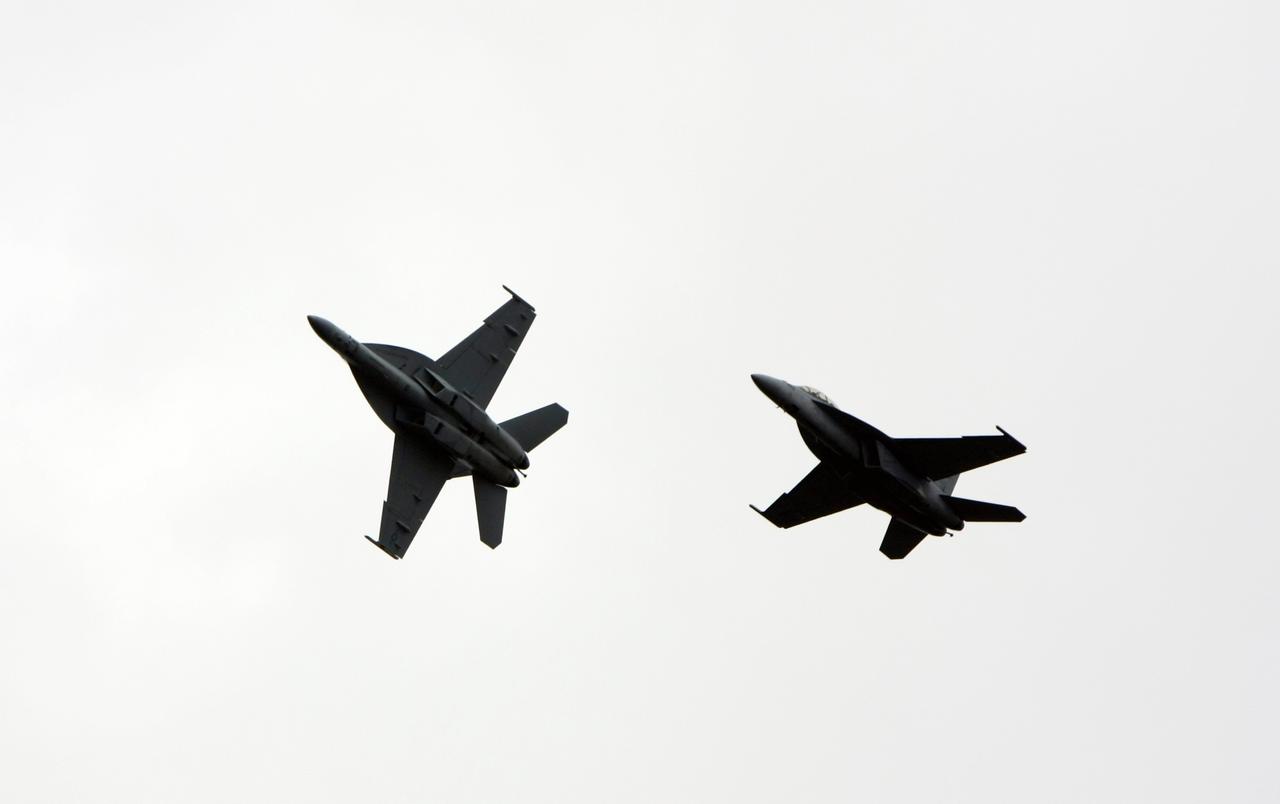
CAPE CANAVERAL, Fla. – Two F/A-18 jets fly over the Shuttle Landing Facility at NASA's Kennedy Space Center in Florida. They will join the U.S. Navy's Blue Angels and other aircraft for demonstrations at the Kennedy Space Center Visitor Complex Space and Air Show Nov. 8-9. The Navy's elite flight demonstration squadron will take to the skies in military aircraft demonstrations by the F-16 Fighting Falcon and F/A-18 Super Hornet jets for the second annual Space & Air Show at Kennedy. This year’s show brings together the best in military aircraft, coupled with precision pilots and veteran astronauts to celebrate spaceflight and aviation. The event includes military aircraft demonstrations by the F-16 Fighting Falcon and a water rescue demonstration by the 920th Rescue Wing. Photo credit: NASA/Kim Shiflett
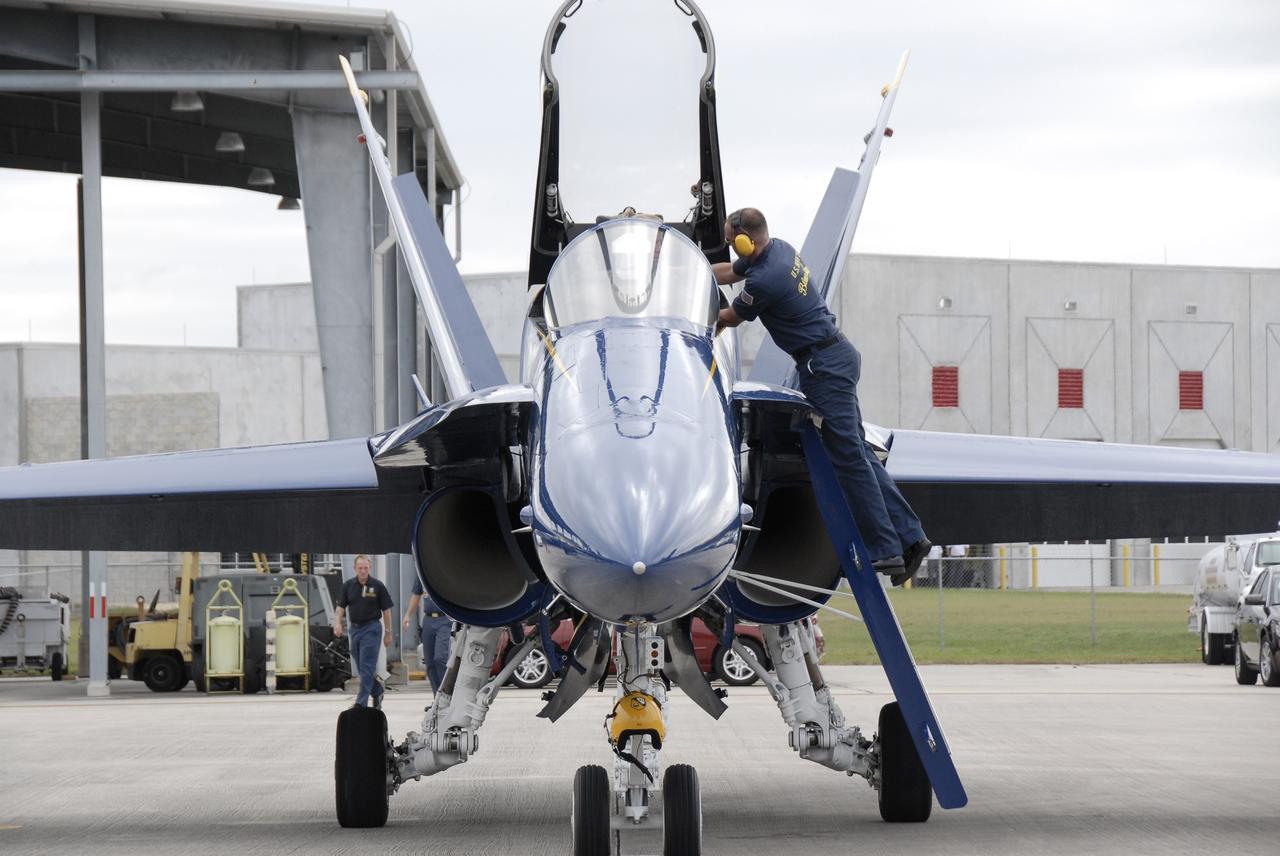
CAPE CANAVERAL, Fla. – At the Shuttle Landing Facility at NASA's Kennedy Space Center in Florida, ground support personnel work on an F/A-18, one of the U.S. Navy's Blue Angels aircraft. The demonstration squadron will perform at the Kennedy Space Center Visitor Complex Space and Air Show Nov. 8-9. The Navy's elite flight demonstration squadron will take to the skies in military aircraft demonstrations by the F-16 Fighting Falcon and F/A-18 Super Hornet jets for the second annual Space & Air Show at Kennedy. This year’s show brings together the best in military aircraft, coupled with precision pilots and veteran astronauts to celebrate spaceflight and aviation. The event includes military aircraft demonstrations by the F-16 Fighting Falcon and a water rescue demonstration by the 920th Rescue Wing. Photo credit: NASA/Kim Shiflett
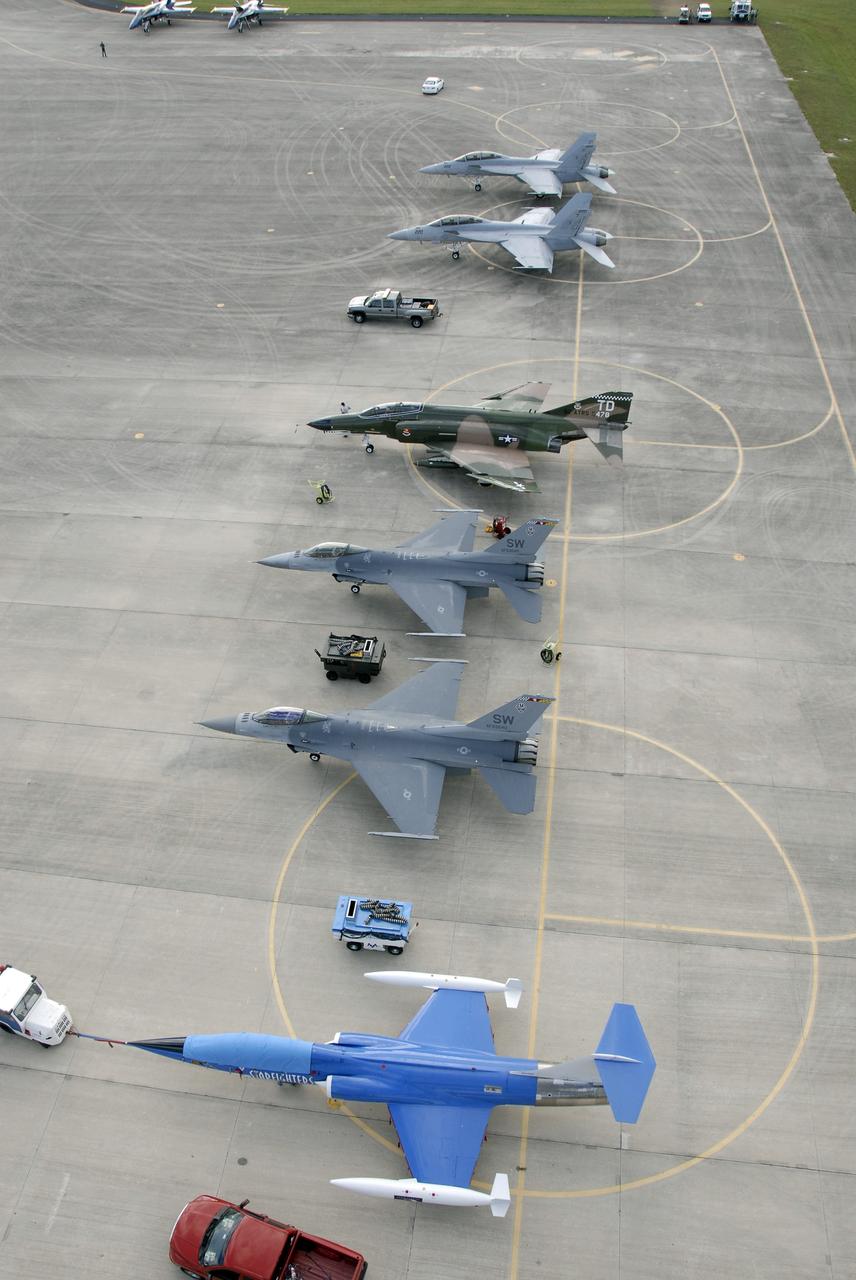
CAPE CANAVERAL, Fla. – Military aircraft are lined up on the Shuttle Landing Facility at NASA's Kennedy Space Center in Florida. The F/A-18s, F-4, F-16 and F-104G Starfighter will take part in demonstrations at the Kennedy Space Center Visitor Complex Space and Air Show Nov. 8-9. The Navy's elite flight demonstration squadron, the Blue Angels, will take to the skies in military aircraft demonstrations for the second annual Space & Air Show at Kennedy. This year’s show brings together the best in military aircraft, coupled with precision pilots and veteran astronauts to celebrate spaceflight and aviation. The event also includes demonstrations by the F-16 Fighting Falcon and a water rescue demonstration by the 920th Rescue Wing. Photo credit: NASA/Kim Shiflett
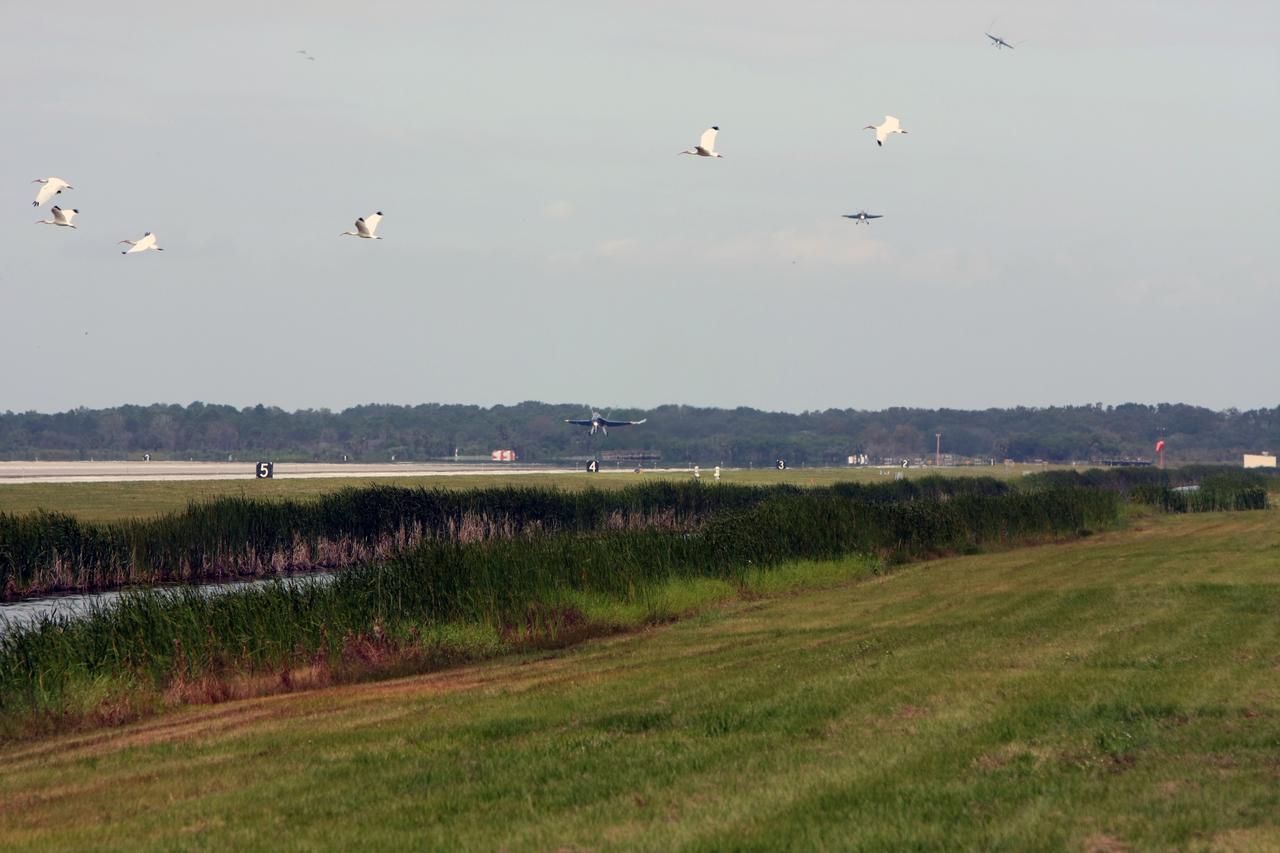
CAPE CANAVERAL, Fla. – Storks seem to join the formation as the U.S. Navy's Blue Angels F/A-18 jets land on the runway at NASA's Kennedy Space Center in Florida. The Blue Angels are at Kennedy to perform in the Kennedy Space Center Visitor Complex Space and Air Show Nov. 8-9. The Navy's elite flight demonstration squadron will take to the skies in military aircraft demonstrations by the F-16 Fighting Falcon and F/A-18 Super Hornet jets for the second annual Space & Air Show at Kennedy. This year’s show brings together the best in military aircraft, coupled with precision pilots and veteran astronauts to celebrate spaceflight and aviation. The event includes military aircraft demonstrations by the F-16 Fighting Falcon and a water rescue demonstration by the 920th Rescue Wing. Photo credit: NASA/Kim Shiflett
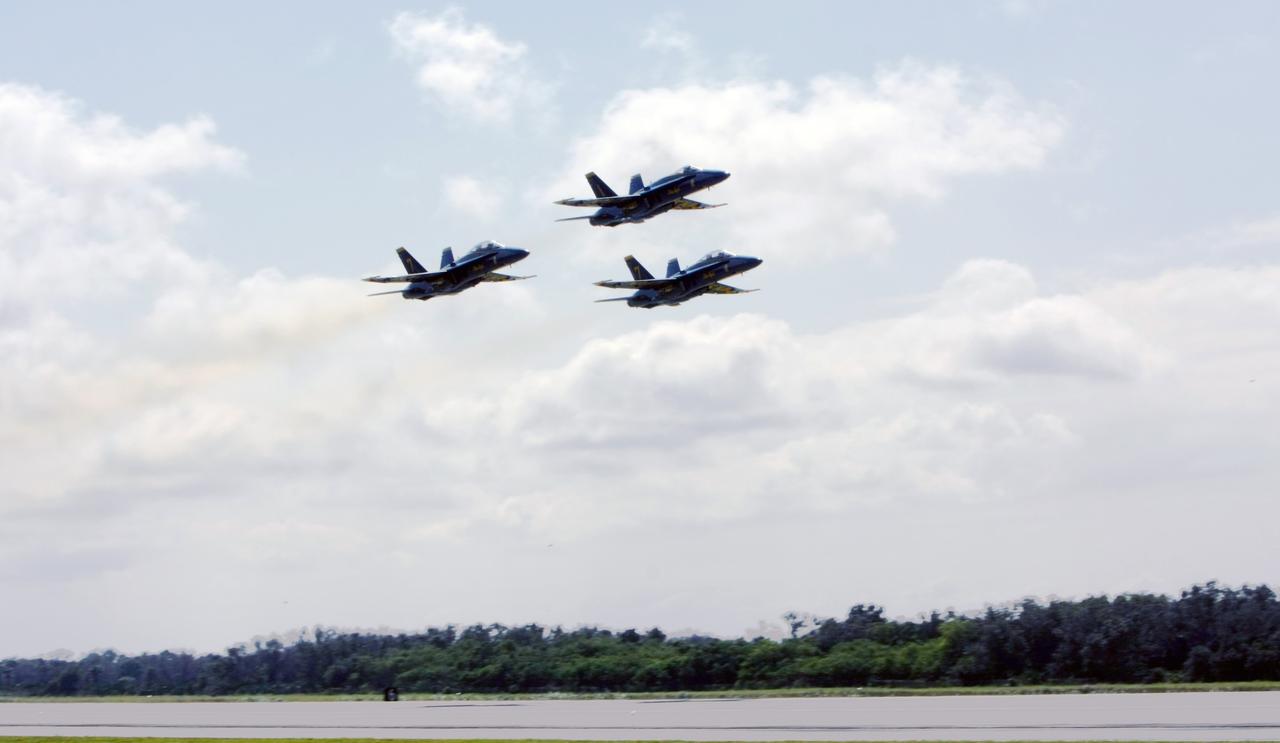
CAPE CANAVERAL, Fla. – Three of the U.S. Navy's Blue Angels F/A-18 jets fly over the runway at NASA's Kennedy Space Center in Florida. The Blue Angels are at Kennedy to perform in the Kennedy Space Center Visitor Complex Space and Air Show Nov. 8-9. The Navy's elite flight demonstration squadron will take to the skies in military aircraft demonstrations by the F-16 Fighting Falcon and F/A-18 Super Hornet jets for the second annual Space & Air Show at Kennedy. This year’s show brings together the best in military aircraft, coupled with precision pilots and veteran astronauts to celebrate spaceflight and aviation. The event includes military aircraft demonstrations by the F-16 Fighting Falcon and a water rescue demonstration by the 920th Rescue Wing. Photo credit: NASA/Kim Shiflett
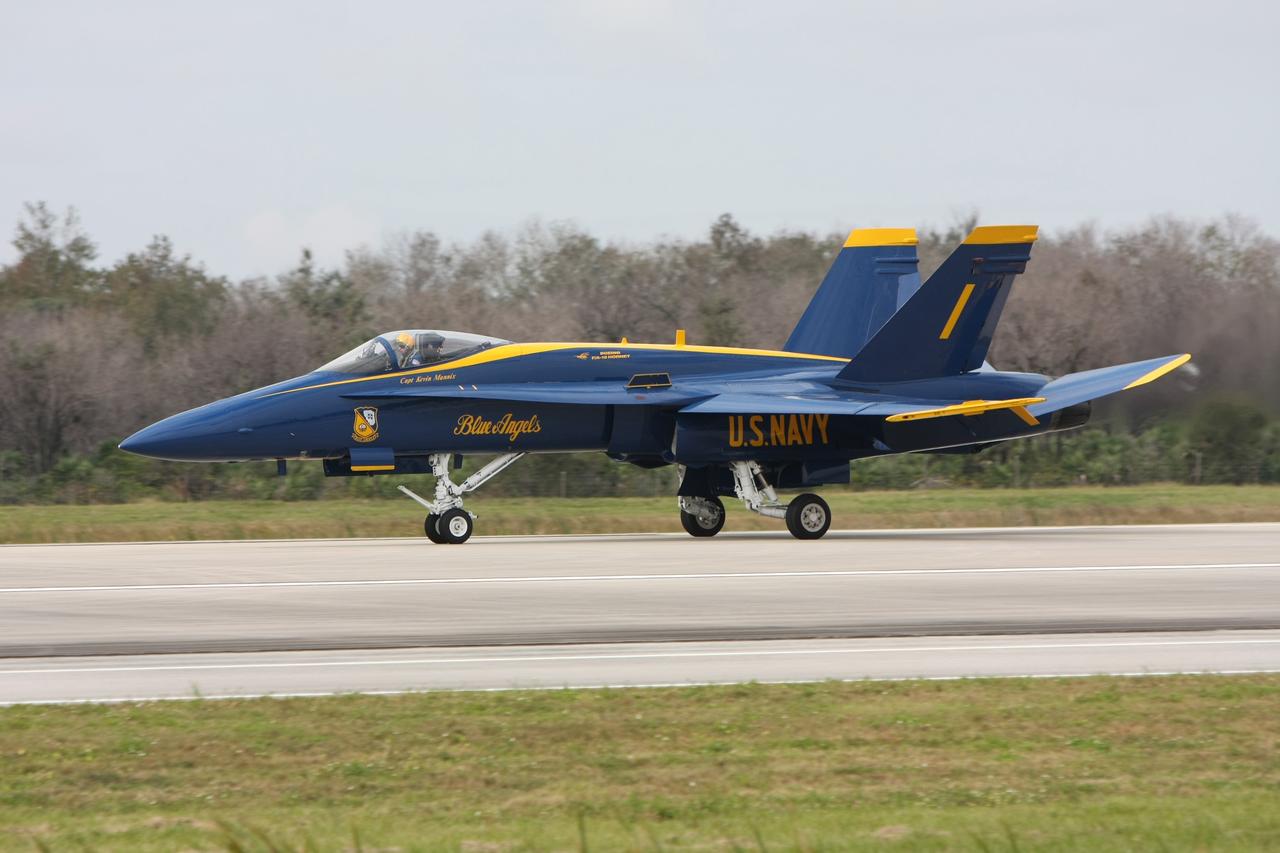
CAPE CANAVERAL, Fla. – The U.S. Navy's Blue Angels F/A-18 jet No. 1 lands on the runway at NASA's Kennedy Space Center in Florida. The Blue Angels are at Kennedy to perform in the Kennedy Space Center Visitor Complex Space and Air Show Nov. 8-9. The Navy's elite flight demonstration squadron will take to the skies in military aircraft demonstrations by the F-16 Fighting Falcon and F/A-18 Super Hornet jets for the second annual Space & Air Show at Kennedy. This year’s show brings together the best in military aircraft, coupled with precision pilots and veteran astronauts to celebrate spaceflight and aviation. The event includes military aircraft demonstrations by the F-16 Fighting Falcon and a water rescue demonstration by the 920th Rescue Wing. Photo credit: NASA/Kim Shiflett
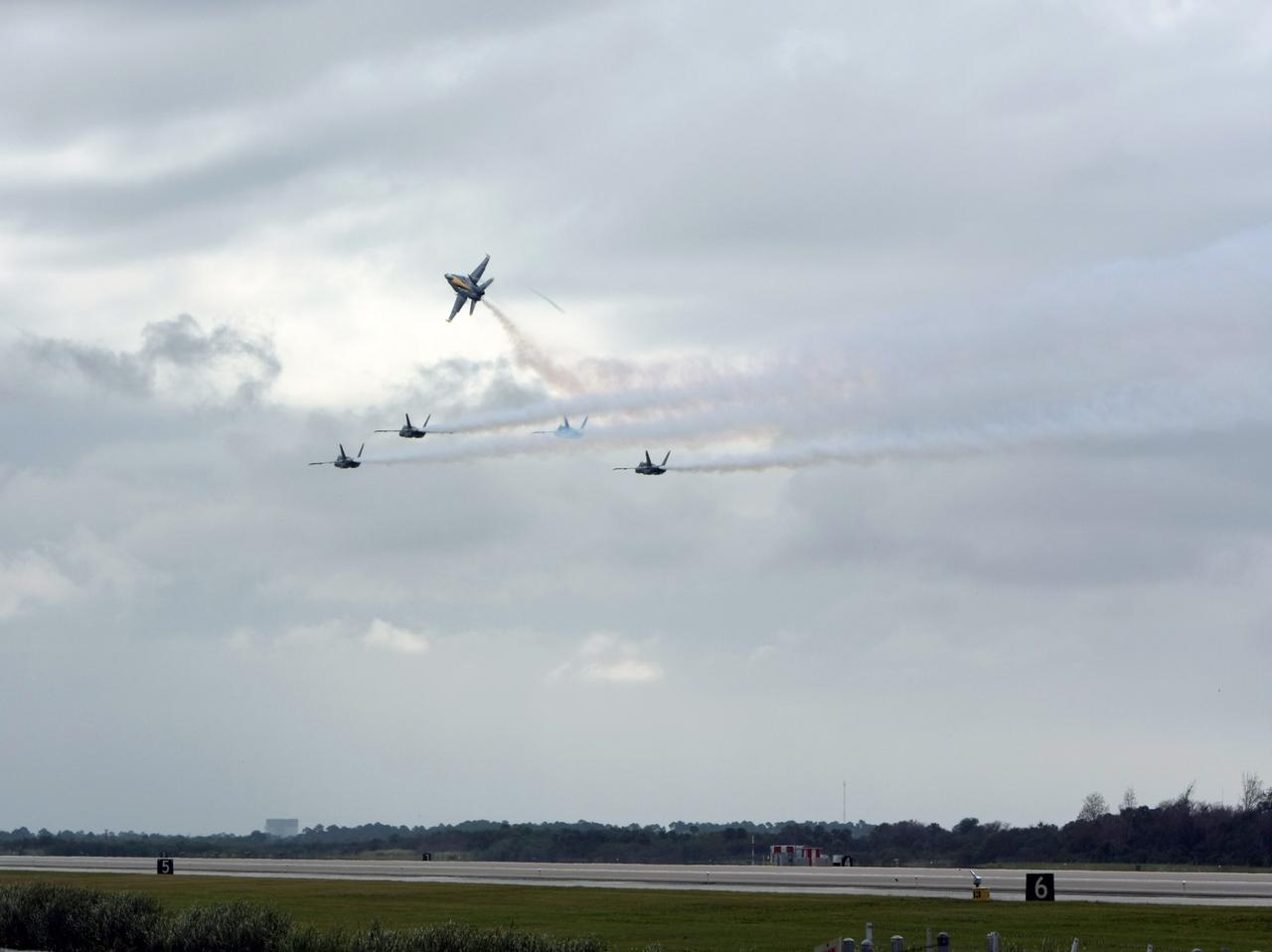
CAPE CANAVERAL, Fla. – The U.S. Navy's Blue Angels F/A-18 jets fly in formation over the runway at NASA's Kennedy Space Center in Florida before landing. They are at Kennedy to perform in the Kennedy Space Center Visitor Complex Space and Air Show Nov. 8-9. The Navy's elite flight demonstration squadron will take to the skies in military aircraft demonstrations by the F-16 Fighting Falcon and F/A-18 Super Hornet jets for the second annual Space & Air Show at Kennedy. This year’s show brings together the best in military aircraft, coupled with precision pilots and veteran astronauts to celebrate spaceflight and aviation. The event includes military aircraft demonstrations by the F-16 Fighting Falcon and a water rescue demonstration by the 920th Rescue Wing. Photo credit: NASA/Kim Shiflett

CAPE CANAVERAL, Fla. – Three of the U.S. Navy's Blue Angels F/A-18 jets fly in formation over the runway before landing at NASA's Kennedy Space Center in Florida. The Blue Angels are at Kennedy to perform in the Kennedy Space Center Visitor Complex Space and Air Show Nov. 8-9. The Navy's elite flight demonstration squadron will take to the skies in military aircraft demonstrations by the F-16 Fighting Falcon and F/A-18 Super Hornet jets for the second annual Space & Air Show at Kennedy. This year’s show brings together the best in military aircraft, coupled with precision pilots and veteran astronauts to celebrate spaceflight and aviation. The event includes military aircraft demonstrations by the F-16 Fighting Falcon and a water rescue demonstration by the 920th Rescue Wing. Photo credit: NASA/Kim Shiflett
CAPE CANAVERAL, Fla. – Aircraft of the 920th Rescue Wing are lined up at the Shuttle Landing Facility at NASA's Kennedy Space Center in Florida to take part in the Kennedy Space Center Visitor Complex Space and Air Show Nov. 8-9. They will join the U.S. Navy's Blue Angels for the show. The Navy's elite flight demonstration squadron will take to the skies in military aircraft demonstrations by the F-16 Fighting Falcon and F/A-18 Super Hornet jets for the second annual Space & Air Show at Kennedy. This year’s show brings together the best in military aircraft, coupled with precision pilots and veteran astronauts to celebrate spaceflight and aviation. The event includes military aircraft demonstrations by the F-16 Fighting Falcon and a water rescue demonstration by the 920th Rescue Wing. Photo credit: NASA/Kim Shiflett
CAPE CANAVERAL, Fla. – Aircraft of the 920th Rescue Wing are lined up at the Shuttle landing Facility at NASA's Kennedy Space Center in Florida to take part in the Kennedy Space Center Visitor Complex Space and Air Show Nov. 8-9. They will join the U.S. Navy's Blue Angels for the show. The Navy's elite flight demonstration squadron will take to the skies in military aircraft demonstrations by the F-16 Fighting Falcon and F/A-18 Super Hornet jets for the second annual Space & Air Show at Kennedy. This year’s show brings together the best in military aircraft, coupled with precision pilots and veteran astronauts to celebrate spaceflight and aviation. The event includes military aircraft demonstrations by the F-16 Fighting Falcon and a water rescue demonstration by the 920th Rescue Wing. Photo credit: NASA/Kim Shiflett
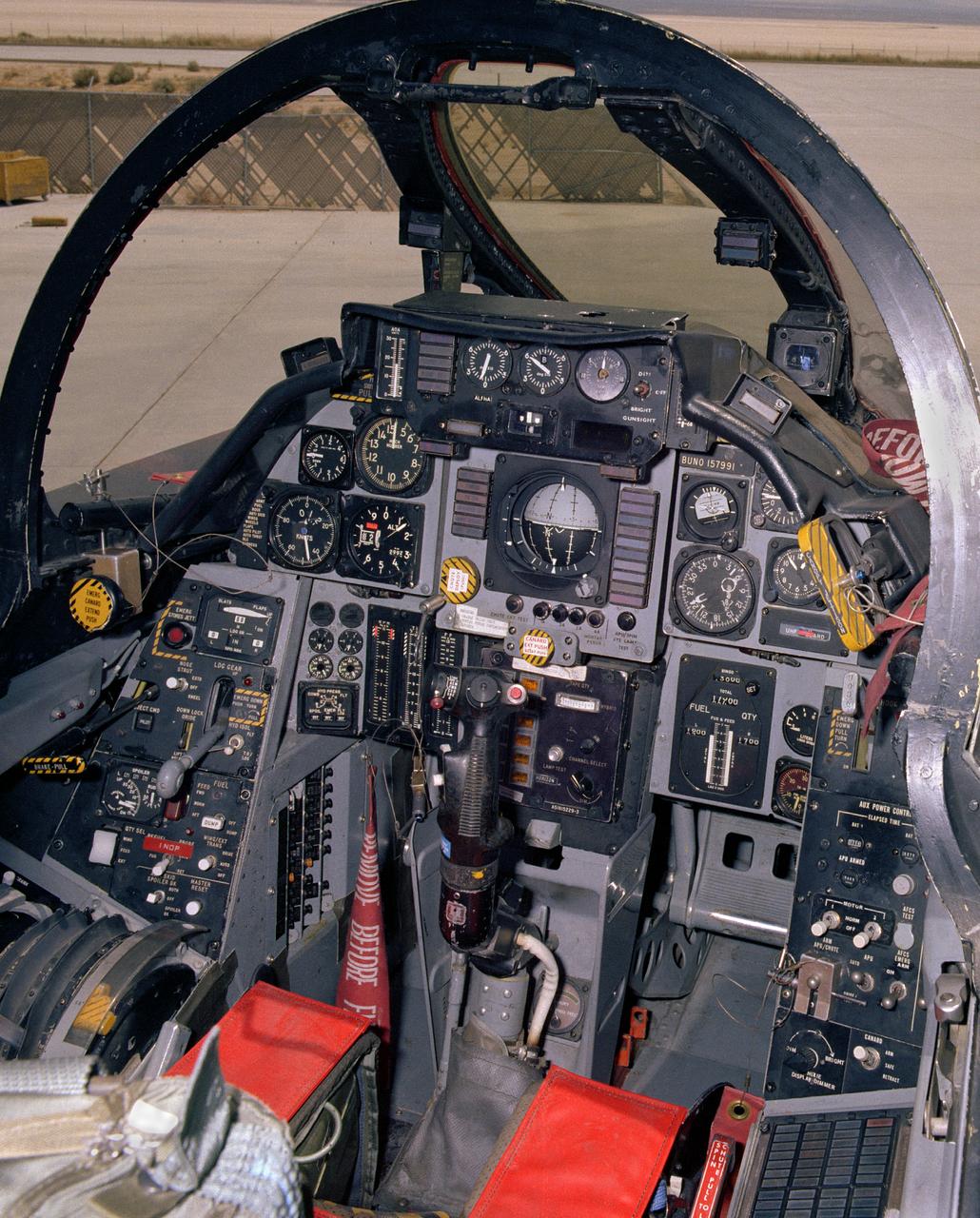
View of the cockpit of NASA's F-14, tail number 991. This aircraft was the first of a series of post-Vietnam fighters, followed by the F-15, F-16, and F-18. They were designed for maneuverability in air-to-air combat. The F-14s had a spin problem that posed problems for its ability to engage successfully in a dogfight, since it tended to depart from controlled flight at the high angles of attack that frequently occur in close-in engagements.
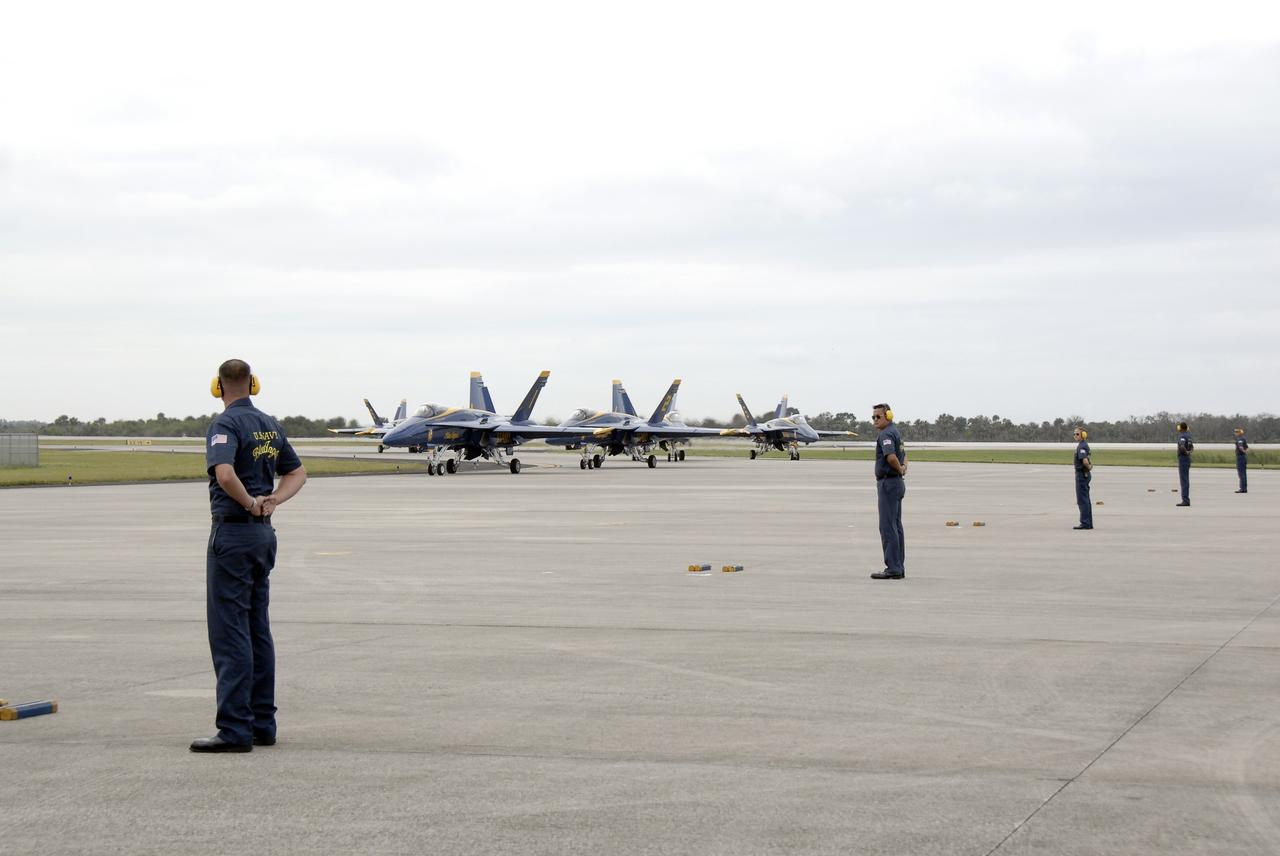
CAPE CANAVERAL, Fla. – The U.S. Navy's Blue Angels demonstration squadron lands at the Shuttle Landing Facility at NASA's Kennedy Space Center in Florida. They will perform at the Kennedy Space Center Visitor Complex Space and Air Show Nov. 8-9. The Navy's elite flight demonstration squadron will take to the skies in military aircraft demonstrations by the F-16 Fighting Falcon and F/A-18 Super Hornet jets for the second annual Space & Air Show at Kennedy. This year’s show brings together the best in military aircraft, coupled with precision pilots and veteran astronauts to celebrate spaceflight and aviation. The event includes military aircraft demonstrations by the F-16 Fighting Falcon and a water rescue demonstration by the 920th Rescue Wing. Photo credit: NASA/Kim Shiflett
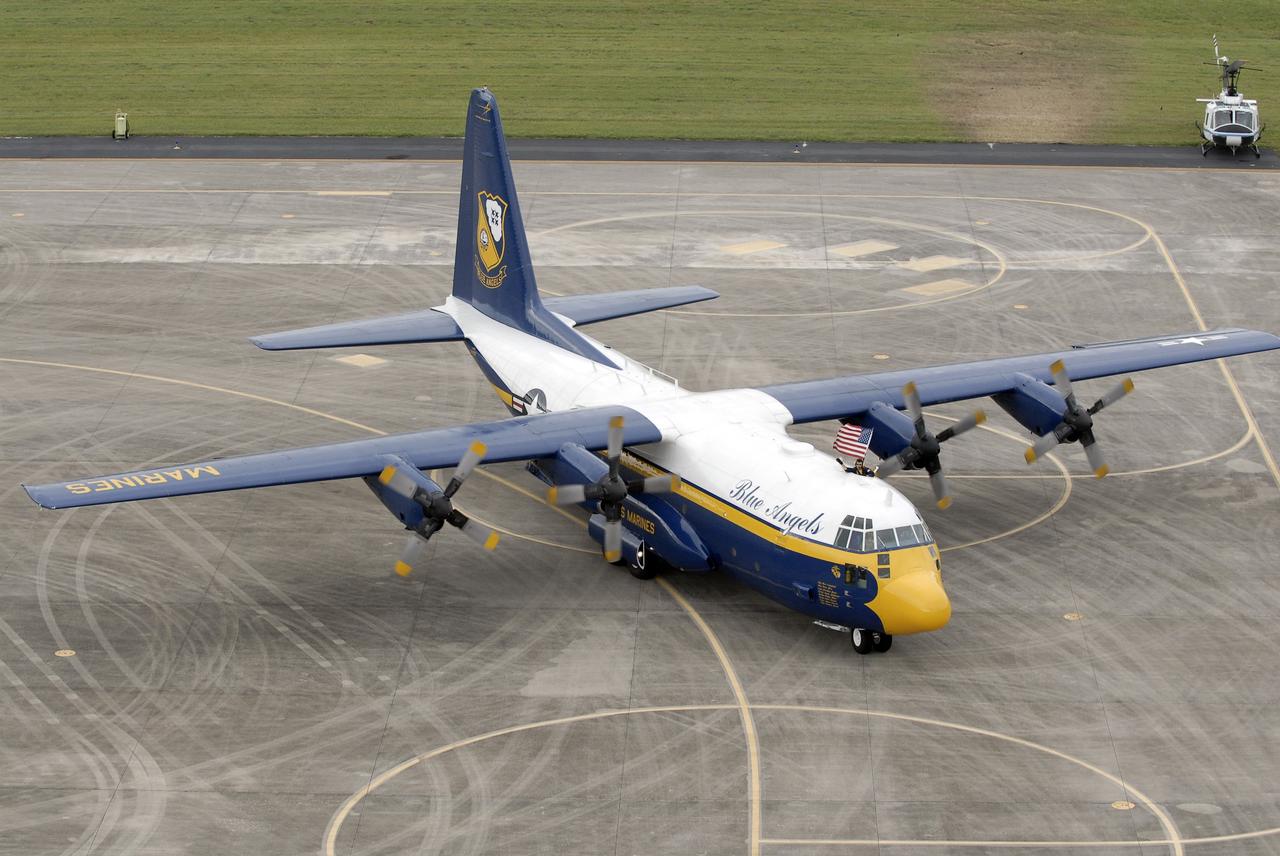
CAPE CANAVERAL, Fla. – A C-130 airplane flown by U.S. Marines lands at the Shuttle Landing Facility at NASA's Kennedy Space Center in Florida. The plane carries the support team for the U.S. Navy's Blue Angels, who are going to perform at the Kennedy Space Center Visitor Complex Space and Air Show Nov. 8-9. The Navy's elite flight demonstration squadron will take to the skies in military aircraft demonstrations by the F-16 Fighting Falcon and F/A-18 Super Hornet jets for the second annual Space & Air Show at Kennedy. This year’s show brings together the best in military aircraft, coupled with precision pilots and veteran astronauts to celebrate spaceflight and aviation. The event includes military aircraft demonstrations by the F-16 Fighting Falcon and a water rescue demonstration by the 920th Rescue Wing. Photo credit: NASA/Kim Shiflett
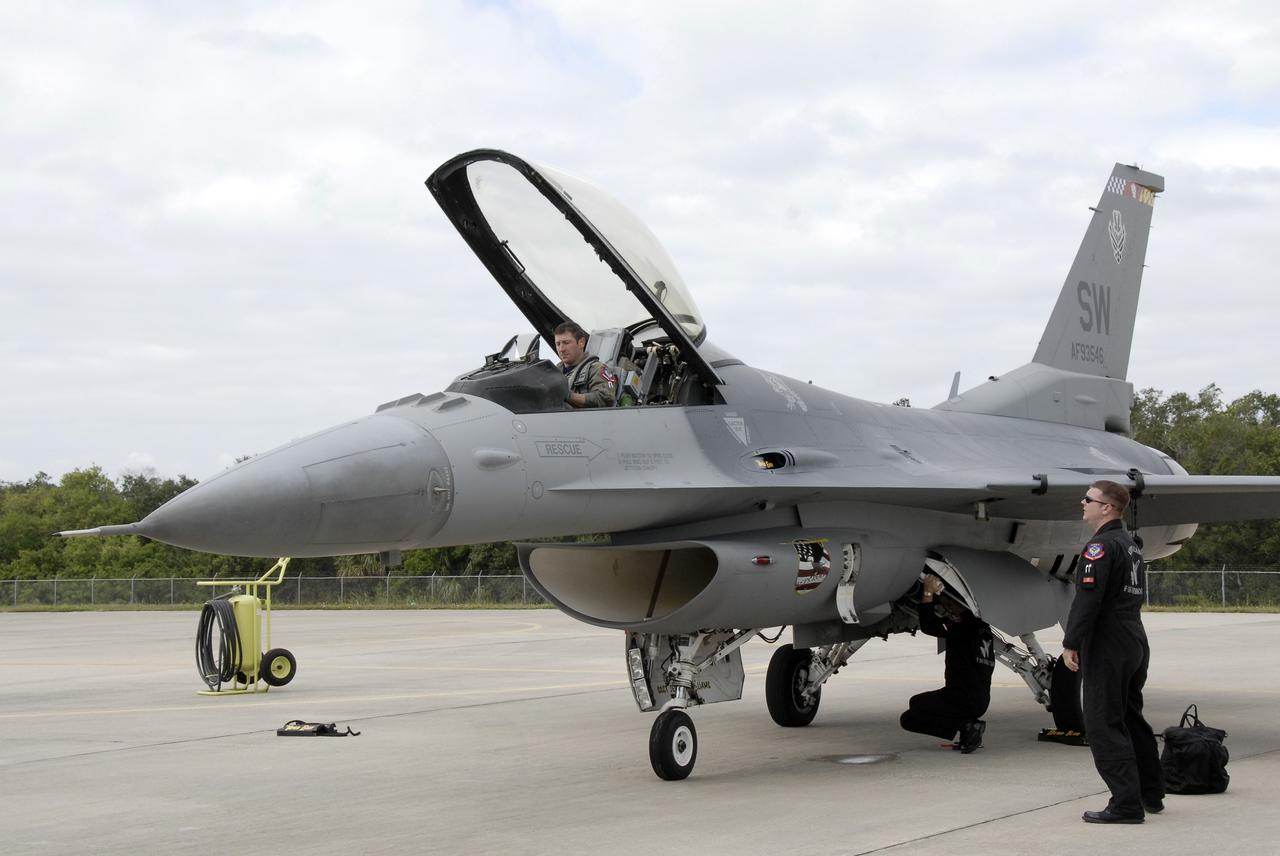
CAPE CANAVERAL, Fla. – A pilot with the 920th Rescue Wing gets ready to disembark his plane after landing at NASA's Kennedy Space Center in Florida. The Rescue Wing will join the U.S. Navy's Blue Angels for the Space and Air Show Nov. 8-9 at the Kennedy Space Center Visitor Complex. The Navy's elite flight demonstration squadron will take to the skies in military aircraft demonstrations by the F-16 Fighting Falcon and F/A-18 Super Hornet jets for the second annual Space & Air Show at Kennedy. This year’s show brings together the best in military aircraft, coupled with precision pilots and veteran astronauts to celebrate spaceflight and aviation. The event includes military aircraft demonstrations by the F-16 Fighting Falcon and a water rescue demonstration by the 920th Rescue Wing. Photo credit: NASA/Kim Shiflett
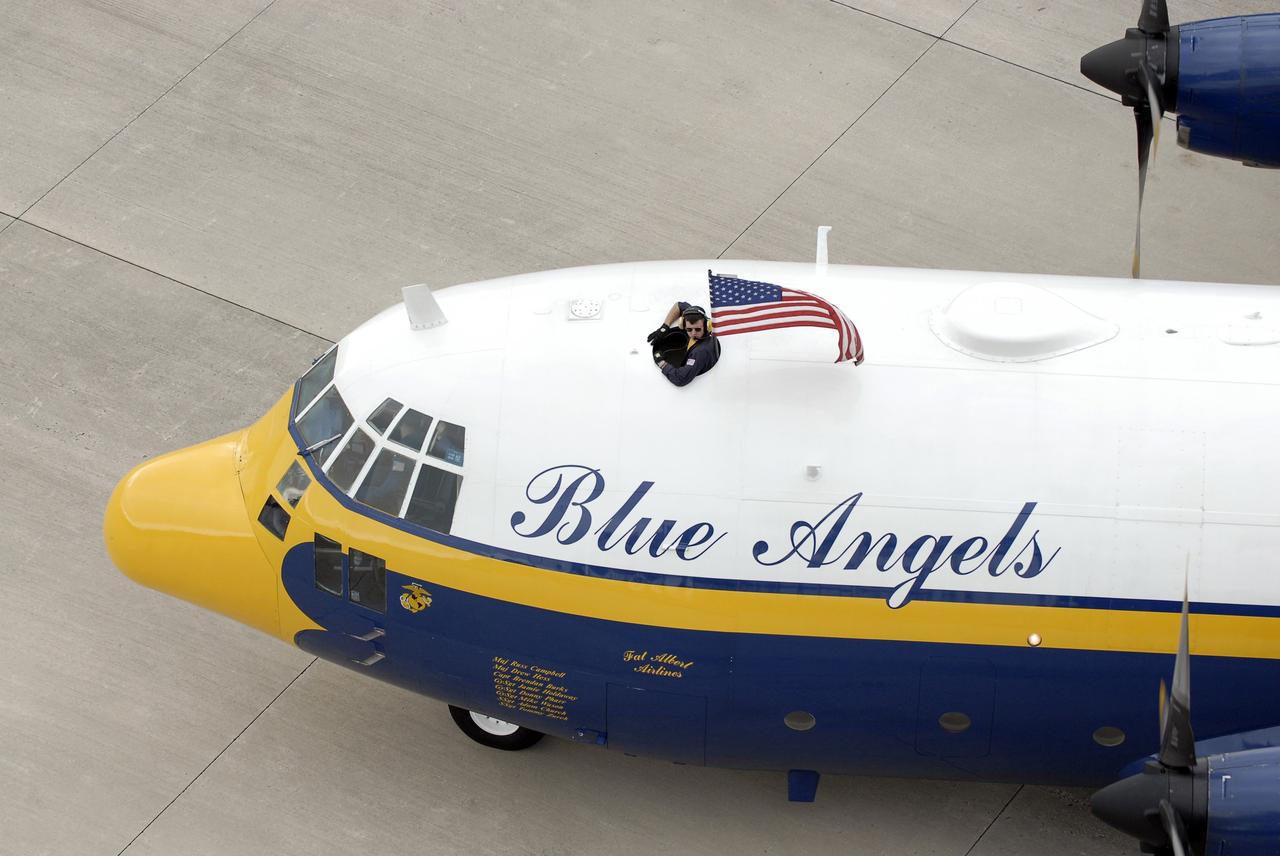
CAPE CANAVERAL, Fla. – A C-130 airplane flown by U.S. Marines stops at the Shuttle Landing Facility at NASA's Kennedy Space Center in Florida. The plane carries the support team for the U.S. Navy's Blue Angels, who are going to perform at the Kennedy Space Center Visitor Complex Space and Air Show Nov. 8-9. The Navy's elite flight demonstration squadron will take to the skies in military aircraft demonstrations by the F-16 Fighting Falcon and F/A-18 Super Hornet jets for the second annual Space & Air Show at Kennedy. This year’s show brings together the best in military aircraft, coupled with precision pilots and veteran astronauts to celebrate spaceflight and aviation. The event includes military aircraft demonstrations by the F-16 Fighting Falcon and a water rescue demonstration by the 920th Rescue Wing. Photo credit: NASA/Kim Shiflett
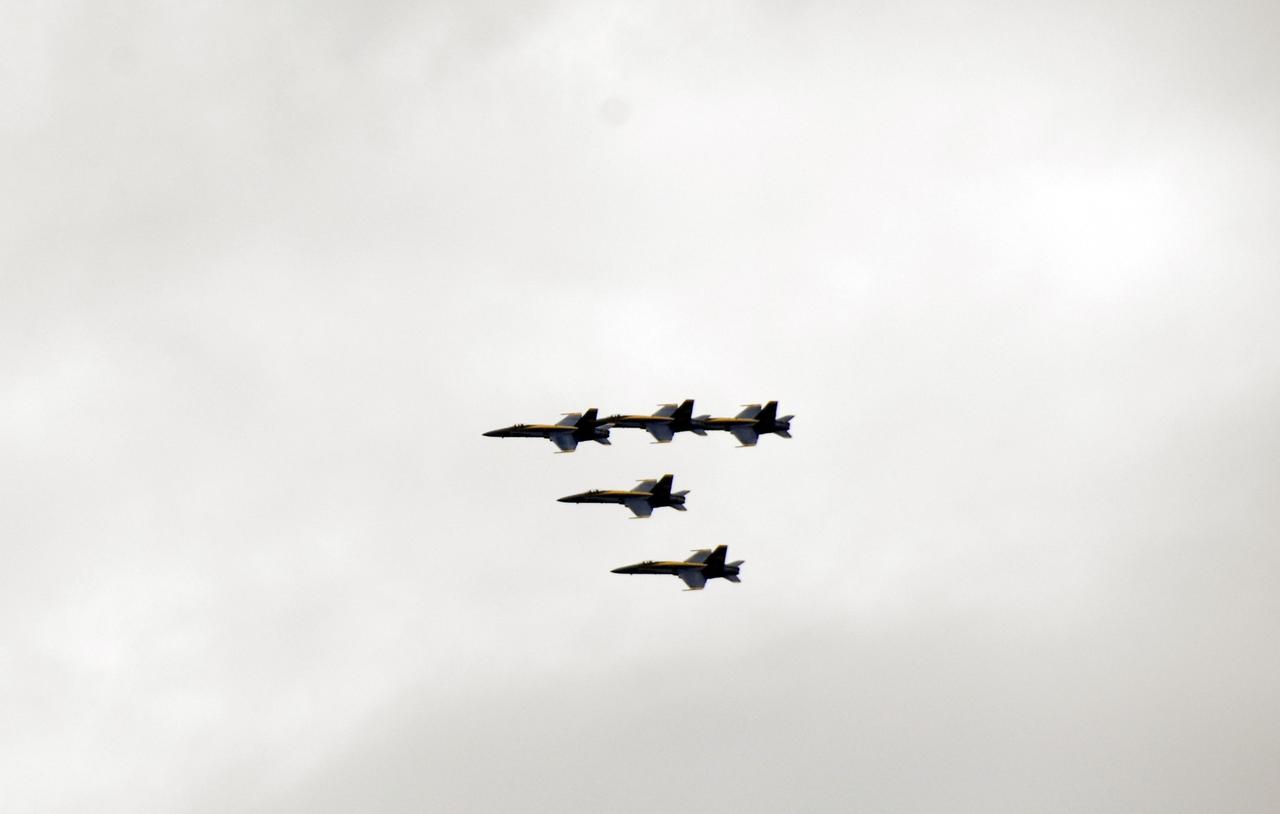
CAPE CANAVERAL, Fla. – The U.S. Navy's Blue Angels approach the Shuttle Landing Facility for a landing at NASA's Kennedy Space Center in Florida. They will perform at the Kennedy Space Center Visitor Complex Space and Air Show Nov. 8-9. The Navy's elite flight demonstration squadron will take to the skies in military aircraft demonstrations by the F-16 Fighting Falcon and F/A-18 Super Hornet jets for the second annual Space & Air Show at Kennedy. This year’s show brings together the best in military aircraft, coupled with precision pilots and veteran astronauts to celebrate spaceflight and aviation. The event includes military aircraft demonstrations by the F-16 Fighting Falcon and a water rescue demonstration by the 920th Rescue Wing. Photo credit: NASA/Kim Shiflett
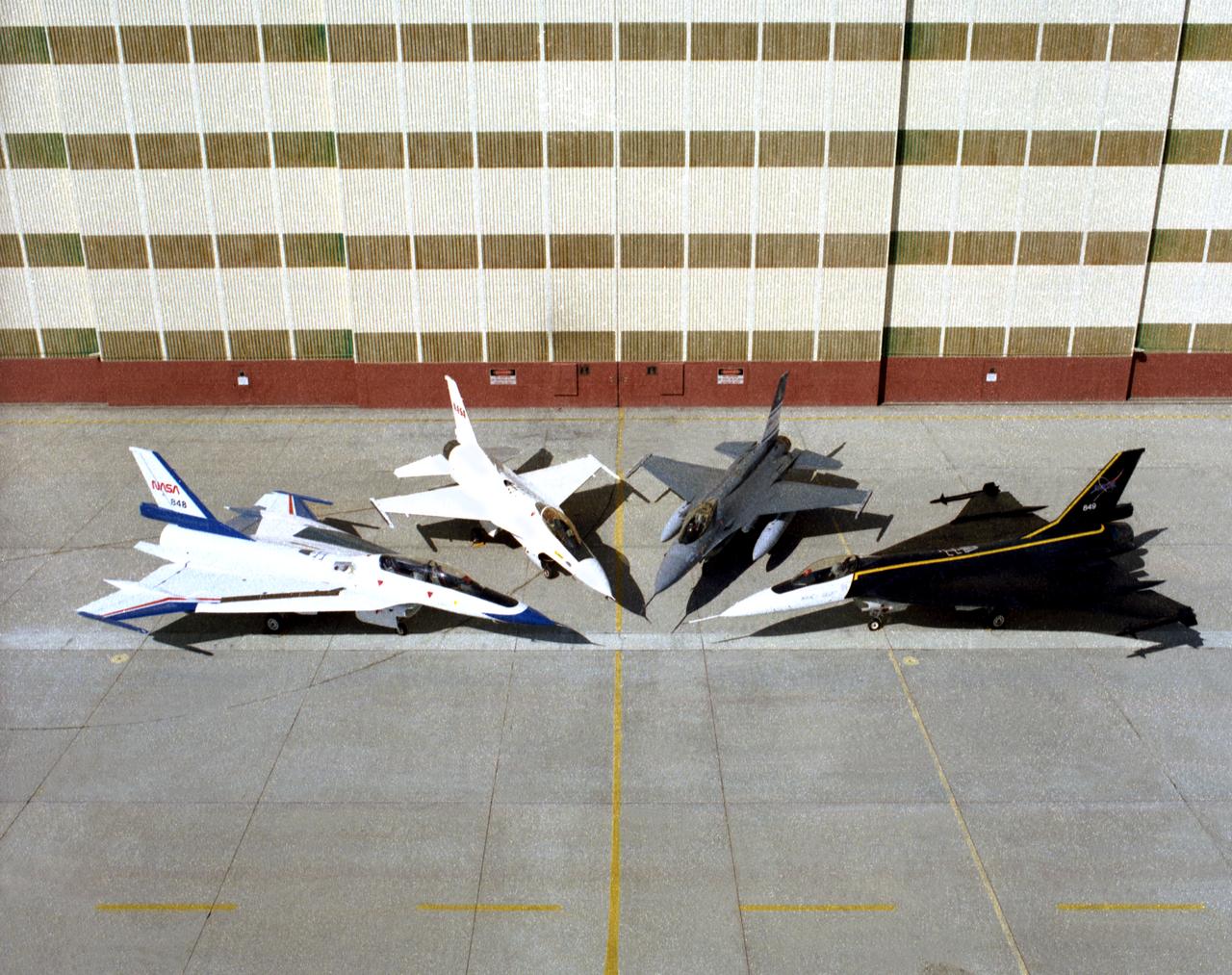
Four different versions of the F-16 were used by Dryden in the 1990s. On the left and right sides are two F-16XLs. On the left is the F-16XL #2 (NASA 848), which is the two-seat version, used for advanced laminar flow studies until late 1996. On the right is the single-seat F-16XL #1 (NASA 849), used for laminar flow research and sonic boom research. (Laminar flow refers to smooth airflow over a wing, which increases lift and reduces drag compared to turbulent airflow). Between them at center left is an F-16A (NASA 816), the only civilian operated F-16. Next to it at center right is the U.S. Air Force Advance Fighter Technology Integration (AFTI) F-16, a program to test new sensor and control technologies for future fighter aircraft. Both F-16XLs are in storage at Dryden. The F-16A was never flown at Dryden, and was parked by the entrance to the center. The AFTI F-16 is in the Air Force Museum.
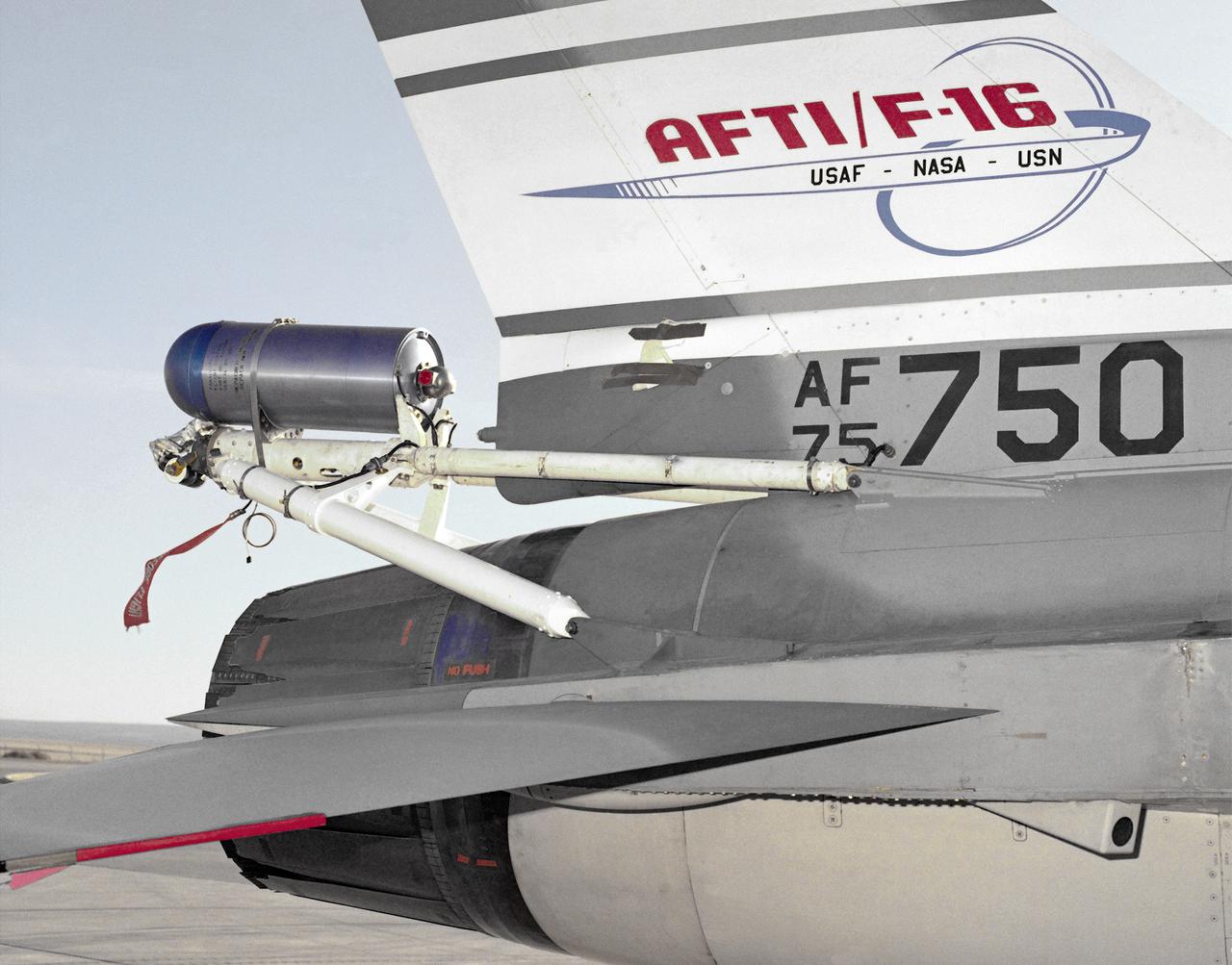
A close-up photo of the spin chute mounted on the rear fuselage of the AFTI F-16, a safety device designed to prevent the loss of aircraft in spin conditions. Under some circumstances, pilots cannot recover from spins using normal controls. It these instances, the spin chute is deployed, thus "breaking" the spin and enabling the pilot to recover. The spin chute is held in a metal cylinder attached to the AFTI F-16 by four tubes, a structure strong enough to withstand the shock of the spin chute opening. Unlike the air probe in the last photo, spin chutes are not standard equipment on research or prototype aircraft but are commonly attached expressly for actual spin tests.
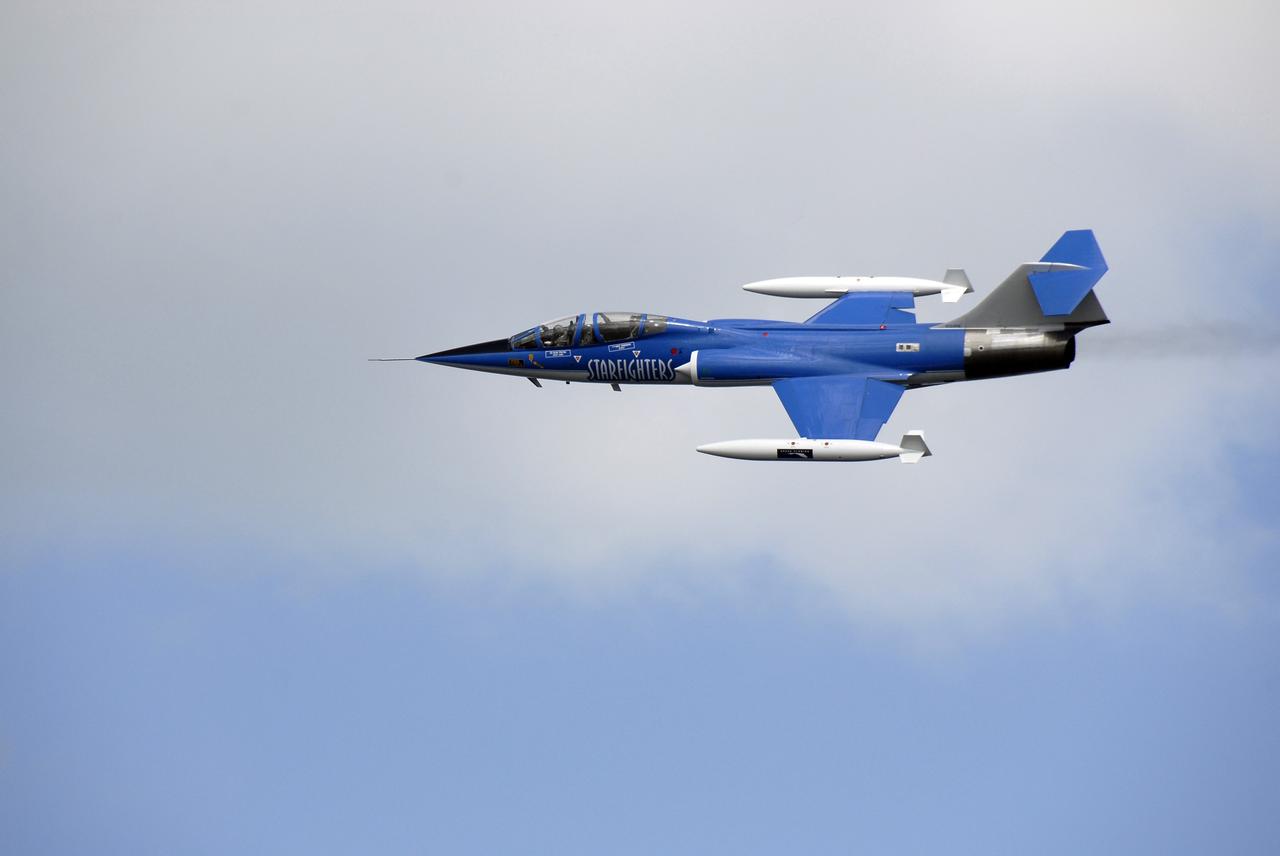
CAPE CANAVERAL, Fla. – An F-104G Starfighter races through the sky over NASA's Kennedy Space Center in Florida during the Kennedy Space Center Visitor Complex Space and Air Show Nov. 8-9. This year’s show brought together the best in military aircraft, such as the F/A-18 Super Hornet and F-16 Fighting Falcon, coupled with precision pilots and veteran astronauts to celebrate spaceflight and aviation. The event included a water rescue demonstration by the 920th Rescue Wing. Photo credit: NASA/Kim Shiflett
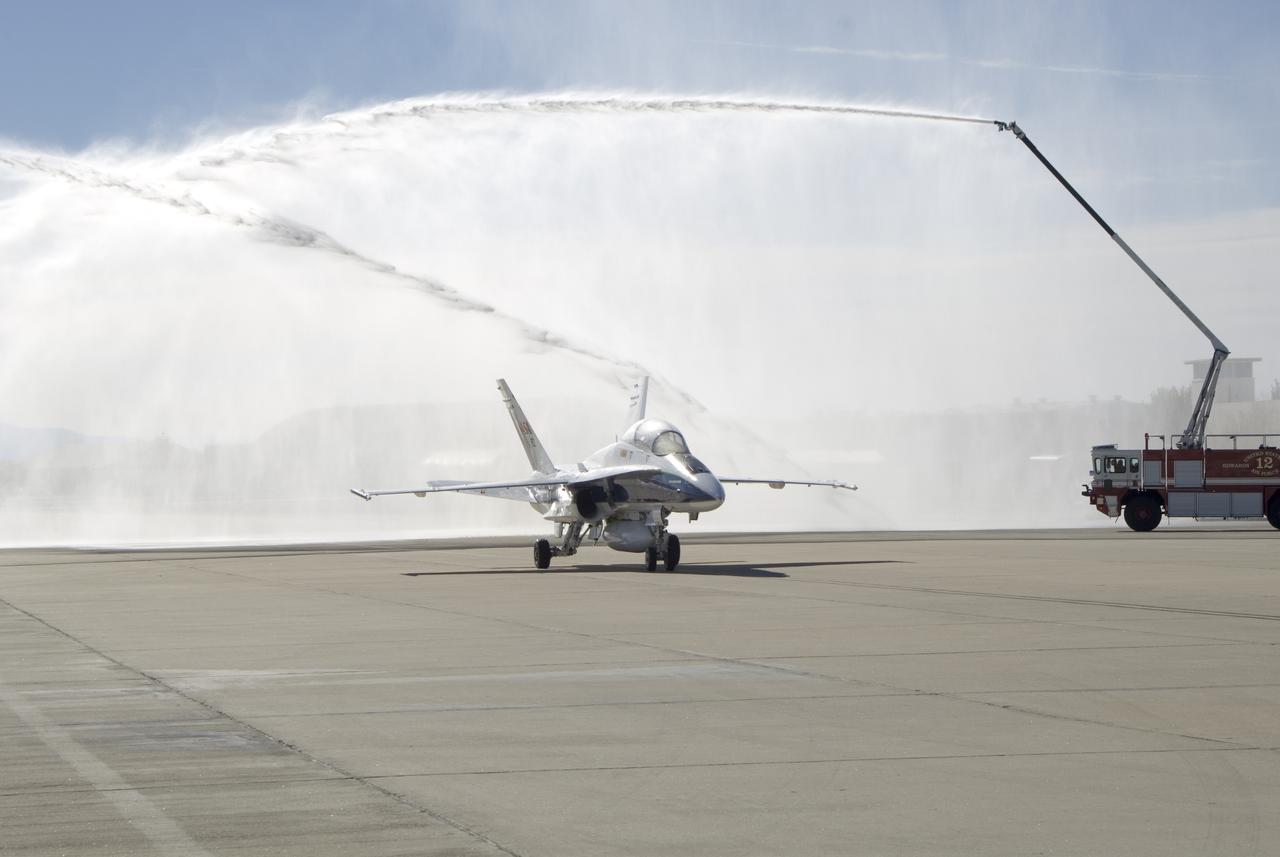
Long-time NASA Dryden research pilot and former astronaut C. Gordon Fullerton capped an almost 50-year flying career, including more than 38 years with NASA, with a final flight in a NASA F/A-18 on Dec. 21, 2007. Fullerton and Dryden research pilot Jim Smolka flew a 90-minute pilot proficiency formation aerobatics flight with another Dryden F/A-18 and a Dryden T-38 before concluding with two low-level formation flyovers of Dryden before landing. Fullerton was honored with a water-cannon spray arch provided by two fire trucks from the Edwards Air Force Base fire department as he taxied the F/A-18 up to the Dryden ramp, and was then greeted by his wife Marie and several hundred Dryden staff after his final flight. Fullerton began his flying career with the U.S. Air Force in 1958 after earning bachelor's and master's degrees in mechanical engineering from the California Institute of Technology. Initially trained as a fighter pilot, he later transitioned to multi-engine bombers and became a bomber operations test pilot after attending the Air Force Aerospace Research Pilot School at Edwards Air Force Base, Calif. He then was assigned to the flight crew for the planned Air Force Manned Orbital Laboratory in 1966. Upon cancellation of that program, the Air Force assigned Fullerton to NASA's astronaut corps in 1969. He served on the support crews for the Apollo 14, 15, 16 and 17 lunar missions, and was later assigned to one of the two flight crews that piloted the space shuttle prototype Enterprise during the Approach and Landing Test program at Dryden. He then logged some 382 hours in space when he flew on two early space shuttle missions, STS-3 on Columbia in 1982 and STS-51F on Challenger in 1985. He joined the flight crew branch at NASA Dryden after leaving the astronaut corps in 1986. During his 21 years at Dryden, Fullerton was project pilot on a number of high-profile research efforts, including the Propulsion Controlled Aircraft, the high-speed landing tests of
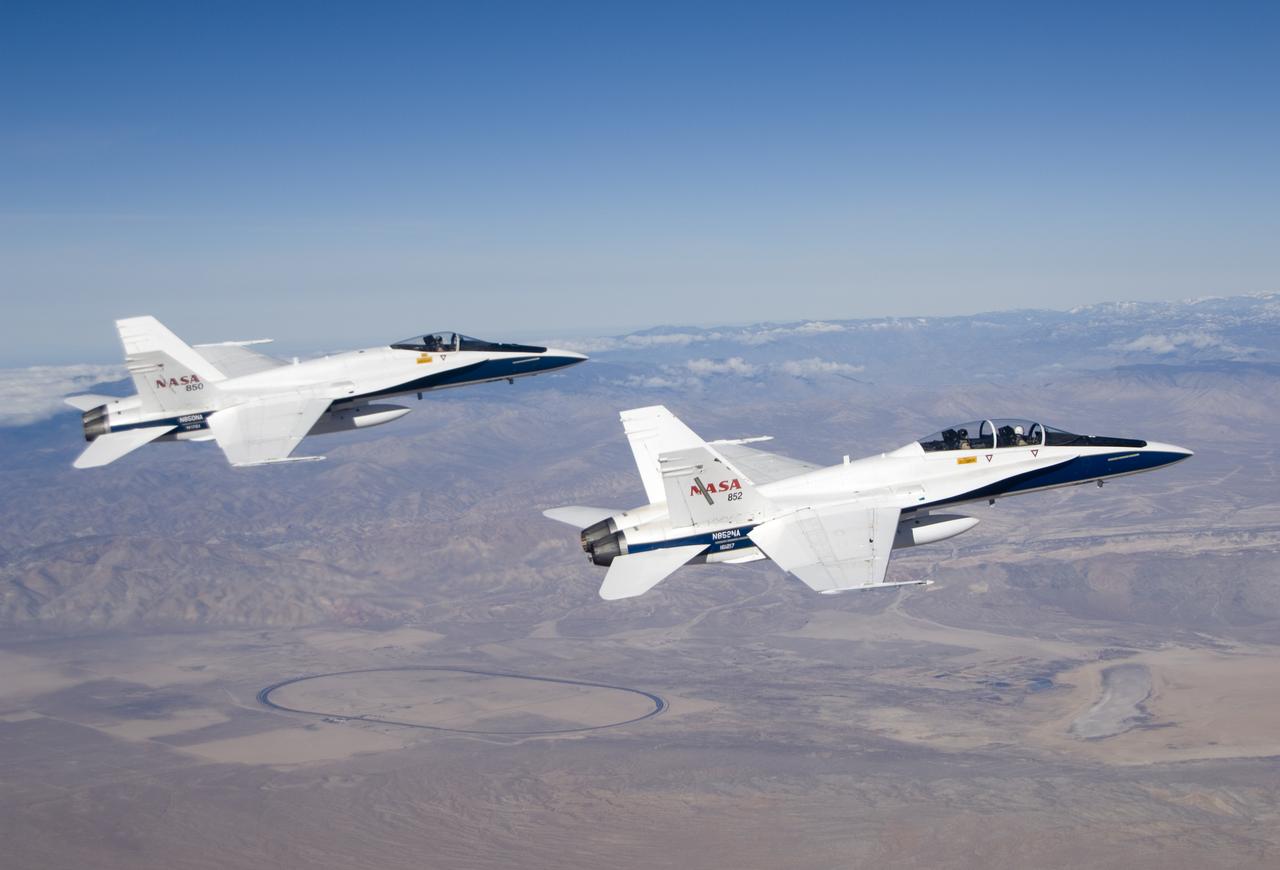
Long-time NASA Dryden research pilot and former astronaut C. Gordon Fullerton capped an almost 50-year flying career, including more than 38 years with NASA, with a final flight in a NASA F/A-18 on Dec. 21, 2007. Fullerton and Dryden research pilot Jim Smolka flew a 90-minute pilot proficiency formation aerobatics flight with another Dryden F/A-18 and a Dryden T-38 before concluding with two low-level formation flyovers of Dryden before landing. Fullerton was honored with a water-cannon spray arch provided by two fire trucks from the Edwards Air Force Base fire department as he taxied the F/A-18 up to the Dryden ramp, and was then greeted by his wife Marie and several hundred Dryden staff after his final flight. Fullerton began his flying career with the U.S. Air Force in 1958 after earning bachelor's and master's degrees in mechanical engineering from the California Institute of Technology. Initially trained as a fighter pilot, he later transitioned to multi-engine bombers and became a bomber operations test pilot after attending the Air Force Aerospace Research Pilot School at Edwards Air Force Base, Calif. He then was assigned to the flight crew for the planned Air Force Manned Orbital Laboratory in 1966. Upon cancellation of that program, the Air Force assigned Fullerton to NASA's astronaut corps in 1969. He served on the support crews for the Apollo 14, 15, 16 and 17 lunar missions, and was later assigned to one of the two flight crews that piloted the space shuttle prototype Enterprise during the Approach and Landing Test program at Dryden. He then logged some 382 hours in space when he flew on two early space shuttle missions, STS-3 on Columbia in 1982 and STS-51F on Challenger in 1985. He joined the flight crew branch at NASA Dryden after leaving the astronaut corps in 1986. During his 21 years at Dryden, Fullerton was project pilot on a number of high-profile research efforts, including the Propulsion Controlled Aircraft, the high-speed landing tests of sp
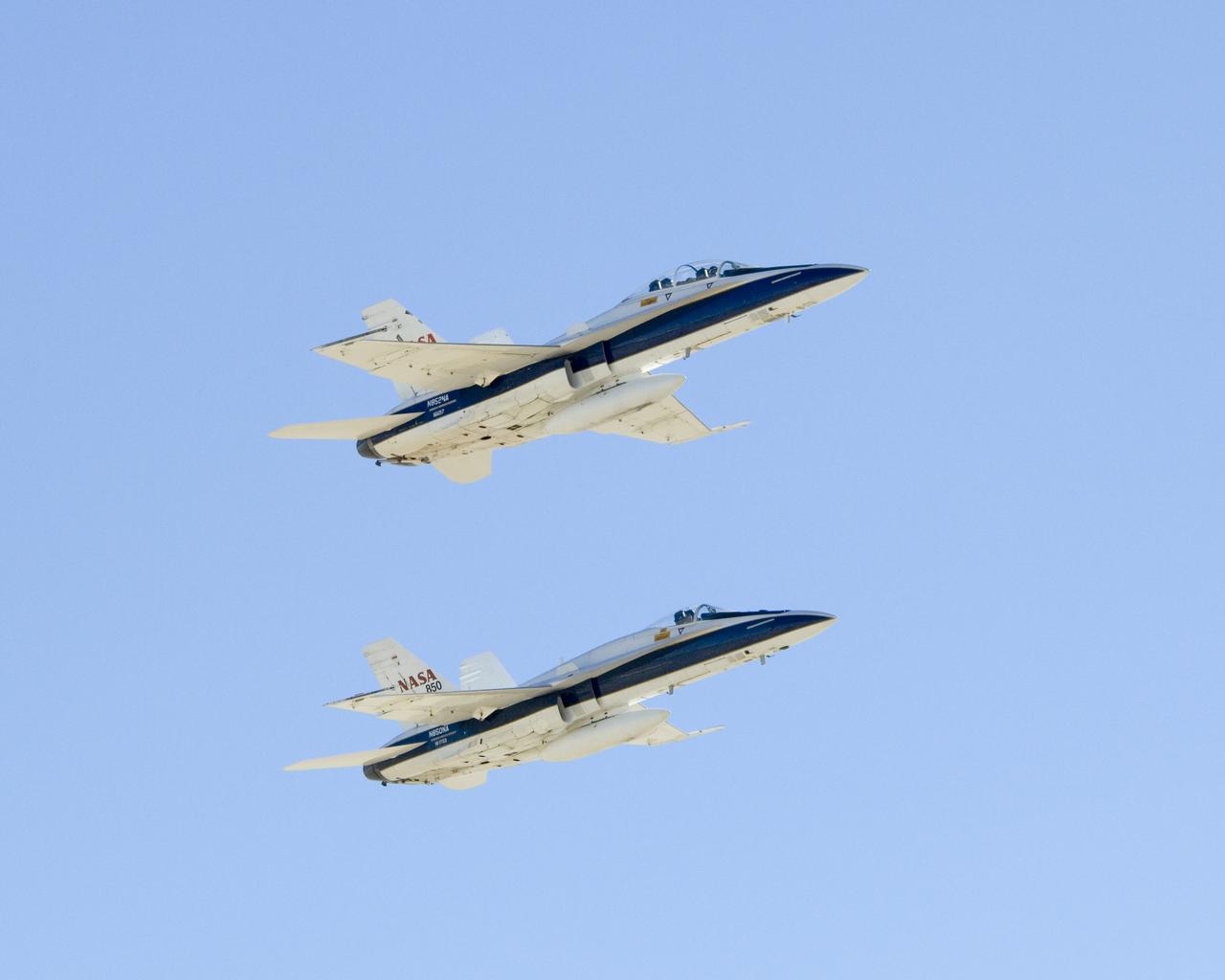
Long-time NASA Dryden research pilot and former astronaut C. Gordon Fullerton capped an almost 50-year flying career, including more than 38 years with NASA, with a final flight in a NASA F/A-18 on Dec. 21, 2007. Fullerton and Dryden research pilot Jim Smolka flew a 90-minute pilot proficiency formation aerobatics flight with another Dryden F/A-18 and a Dryden T-38 before concluding with two low-level formation flyovers of Dryden before landing. Fullerton was honored with a water-cannon spray arch provided by two fire trucks from the Edwards Air Force Base fire department as he taxied the F/A-18 up to the Dryden ramp, and was then greeted by his wife Marie and several hundred Dryden staff after his final flight. Fullerton began his flying career with the U.S. Air Force in 1958 after earning bachelor's and master's degrees in mechanical engineering from the California Institute of Technology. Initially trained as a fighter pilot, he later transitioned to multi-engine bombers and became a bomber operations test pilot after attending the Air Force Aerospace Research Pilot School at Edwards Air Force Base, Calif. He then was assigned to the flight crew for the planned Air Force Manned Orbital Laboratory in 1966. Upon cancellation of that program, the Air Force assigned Fullerton to NASA's astronaut corps in 1969. He served on the support crews for the Apollo 14, 15, 16 and 17 lunar missions, and was later assigned to one of the two flight crews that piloted the space shuttle prototype Enterprise during the Approach and Landing Test program at Dryden. He then logged some 382 hours in space when he flew on two early space shuttle missions, STS-3 on Columbia in 1982 and STS-51F on Challenger in 1985. He joined the flight crew branch at NASA Dryden after leaving the astronaut corps in 1986. During his 21 years at Dryden, Fullerton was project pilot on a number of high-profile research efforts, including the Propulsion Controlled Aircraft, the high-speed landing tests of
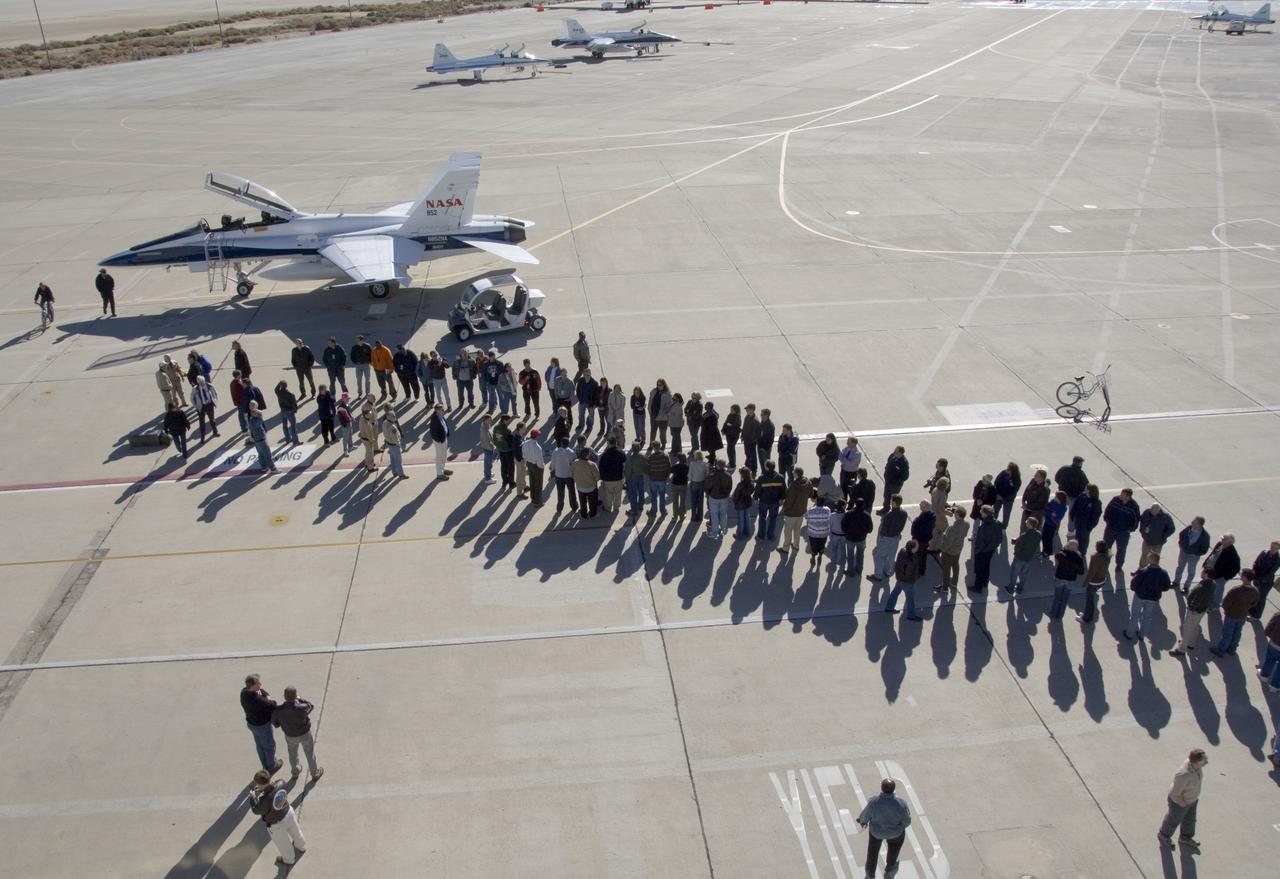
Long-time NASA Dryden research pilot and former astronaut C. Gordon Fullerton capped an almost 50-year flying career, including more than 38 years with NASA, with a final flight in a NASA F/A-18 on Dec. 21, 2007. Fullerton and Dryden research pilot Jim Smolka flew a 90-minute pilot proficiency formation aerobatics flight with another Dryden F/A-18 and a Dryden T-38 before concluding with two low-level formation flyovers of Dryden before landing. Fullerton was honored with a water-cannon spray arch provided by two fire trucks from the Edwards Air Force Base fire department as he taxied the F/A-18 up to the Dryden ramp, and was then greeted by his wife Marie and several hundred Dryden staff after his final flight. Fullerton began his flying career with the U.S. Air Force in 1958 after earning bachelor's and master's degrees in mechanical engineering from the California Institute of Technology. Initially trained as a fighter pilot, he later transitioned to multi-engine bombers and became a bomber operations test pilot after attending the Air Force Aerospace Research Pilot School at Edwards Air Force Base, Calif. He then was assigned to the flight crew for the planned Air Force Manned Orbital Laboratory in 1966. Upon cancellation of that program, the Air Force assigned Fullerton to NASA's astronaut corps in 1969. He served on the support crews for the Apollo 14, 15, 16 and 17 lunar missions, and was later assigned to one of the two flight crews that piloted the space shuttle prototype Enterprise during the Approach and Landing Test program at Dryden. He then logged some 382 hours in space when he flew on two early space shuttle missions, STS-3 on Columbia in 1982 and STS-51F on Challenger in 1985. He joined the flight crew branch at NASA Dryden after leaving the astronaut corps in 1986. During his 21 years at Dryden, Fullerton was project pilot on a number of high-profile research efforts, including the Propulsion Controlled Aircraft, the high-speed landing tests of
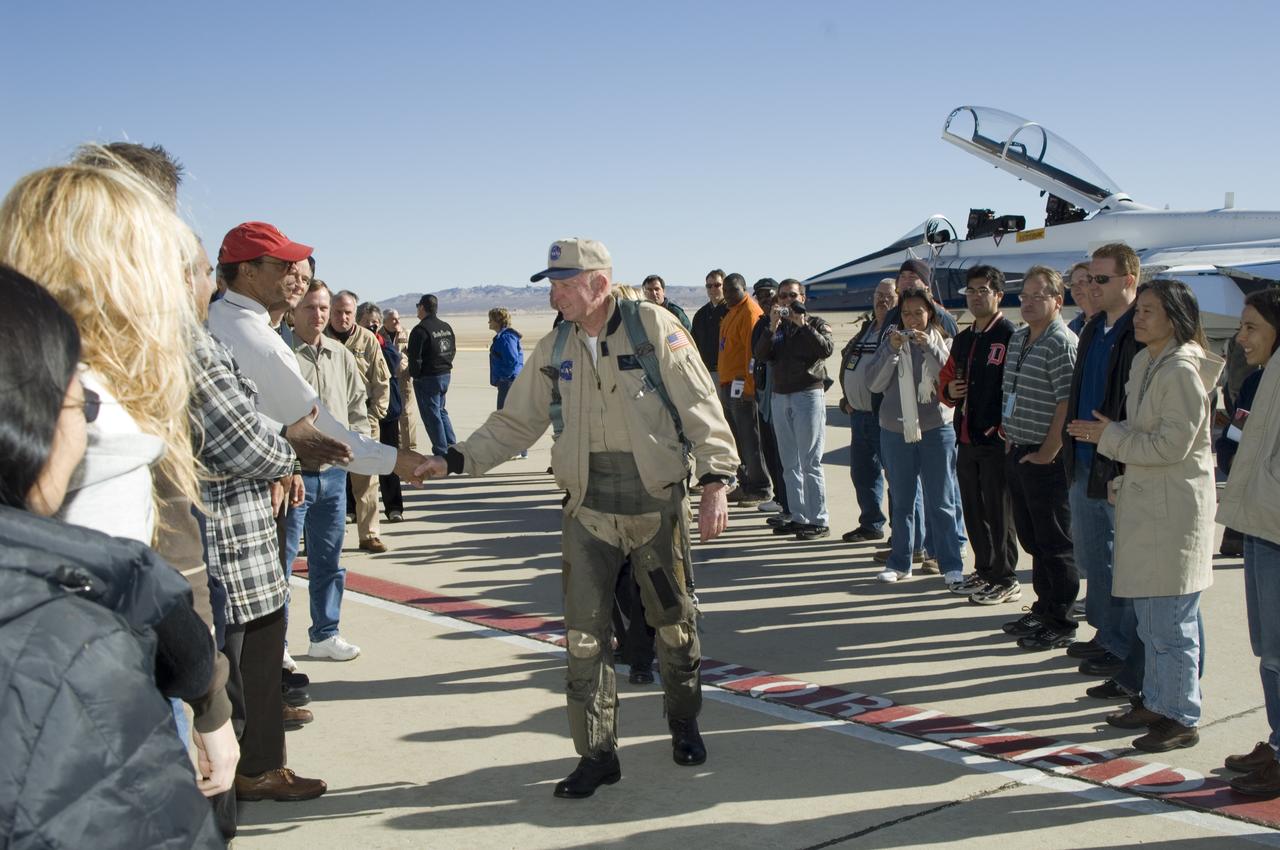
Long-time NASA Dryden research pilot and former astronaut C. Gordon Fullerton capped an almost 50-year flying career, including more than 38 years with NASA, with a final flight in a NASA F/A-18 on Dec. 21, 2007. Fullerton and Dryden research pilot Jim Smolka flew a 90-minute pilot proficiency formation aerobatics flight with another Dryden F/A-18 and a Dryden T-38 before concluding with two low-level formation flyovers of Dryden before landing. Fullerton was honored with a water-cannon spray arch provided by two fire trucks from the Edwards Air Force Base fire department as he taxied the F/A-18 up to the Dryden ramp, and was then greeted by his wife Marie and several hundred Dryden staff after his final flight. Fullerton began his flying career with the U.S. Air Force in 1958 after earning bachelor's and master's degrees in mechanical engineering from the California Institute of Technology. Initially trained as a fighter pilot, he later transitioned to multi-engine bombers and became a bomber operations test pilot after attending the Air Force Aerospace Research Pilot School at Edwards Air Force Base, Calif. He then was assigned to the flight crew for the planned Air Force Manned Orbital Laboratory in 1966. Upon cancellation of that program, the Air Force assigned Fullerton to NASA's astronaut corps in 1969. He served on the support crews for the Apollo 14, 15, 16 and 17 lunar missions, and was later assigned to one of the two flight crews that piloted the space shuttle prototype Enterprise during the Approach and Landing Test program at Dryden. He then logged some 382 hours in space when he flew on two early space shuttle missions, STS-3 on Columbia in 1982 and STS-51F on Challenger in 1985. He joined the flight crew branch at NASA Dryden after leaving the astronaut corps in 1986. During his 21 years at Dryden, Fullerton was project pilot on a number of high-profile research efforts, including the Propulsion Controlled Aircraft, the high-speed landing tests of
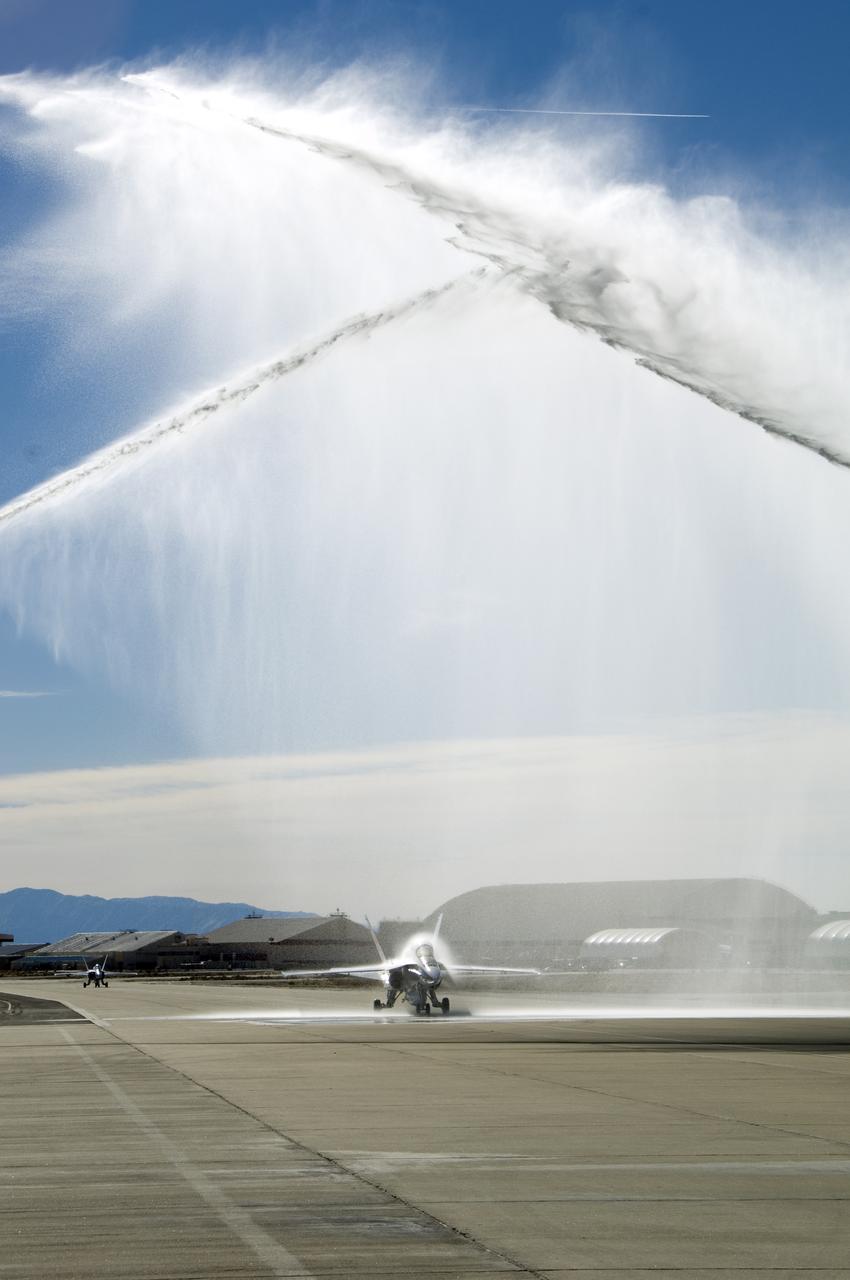
Long-time NASA Dryden research pilot and former astronaut C. Gordon Fullerton capped an almost 50-year flying career, including more than 38 years with NASA, with a final flight in a NASA F/A-18 on Dec. 21, 2007. Fullerton and Dryden research pilot Jim Smolka flew a 90-minute pilot proficiency formation aerobatics flight with another Dryden F/A-18 and a Dryden T-38 before concluding with two low-level formation flyovers of Dryden before landing. Fullerton was honored with a water-cannon spray arch provided by two fire trucks from the Edwards Air Force Base fire department as he taxied the F/A-18 up to the Dryden ramp, and was then greeted by his wife Marie and several hundred Dryden staff after his final flight. Fullerton began his flying career with the U.S. Air Force in 1958 after earning bachelor's and master's degrees in mechanical engineering from the California Institute of Technology. Initially trained as a fighter pilot, he later transitioned to multi-engine bombers and became a bomber operations test pilot after attending the Air Force Aerospace Research Pilot School at Edwards Air Force Base, Calif. He then was assigned to the flight crew for the planned Air Force Manned Orbital Laboratory in 1966. Upon cancellation of that program, the Air Force assigned Fullerton to NASA's astronaut corps in 1969. He served on the support crews for the Apollo 14, 15, 16 and 17 lunar missions, and was later assigned to one of the two flight crews that piloted the space shuttle prototype Enterprise during the Approach and Landing Test program at Dryden. He then logged some 382 hours in space when he flew on two early space shuttle missions, STS-3 on Columbia in 1982 and STS-51F on Challenger in 1985. He joined the flight crew branch at NASA Dryden after leaving the astronaut corps in 1986. During his 21 years at Dryden, Fullerton was project pilot on a number of high-profile research efforts, including the Propulsion Controlled Aircraft, the high-speed landing tests of
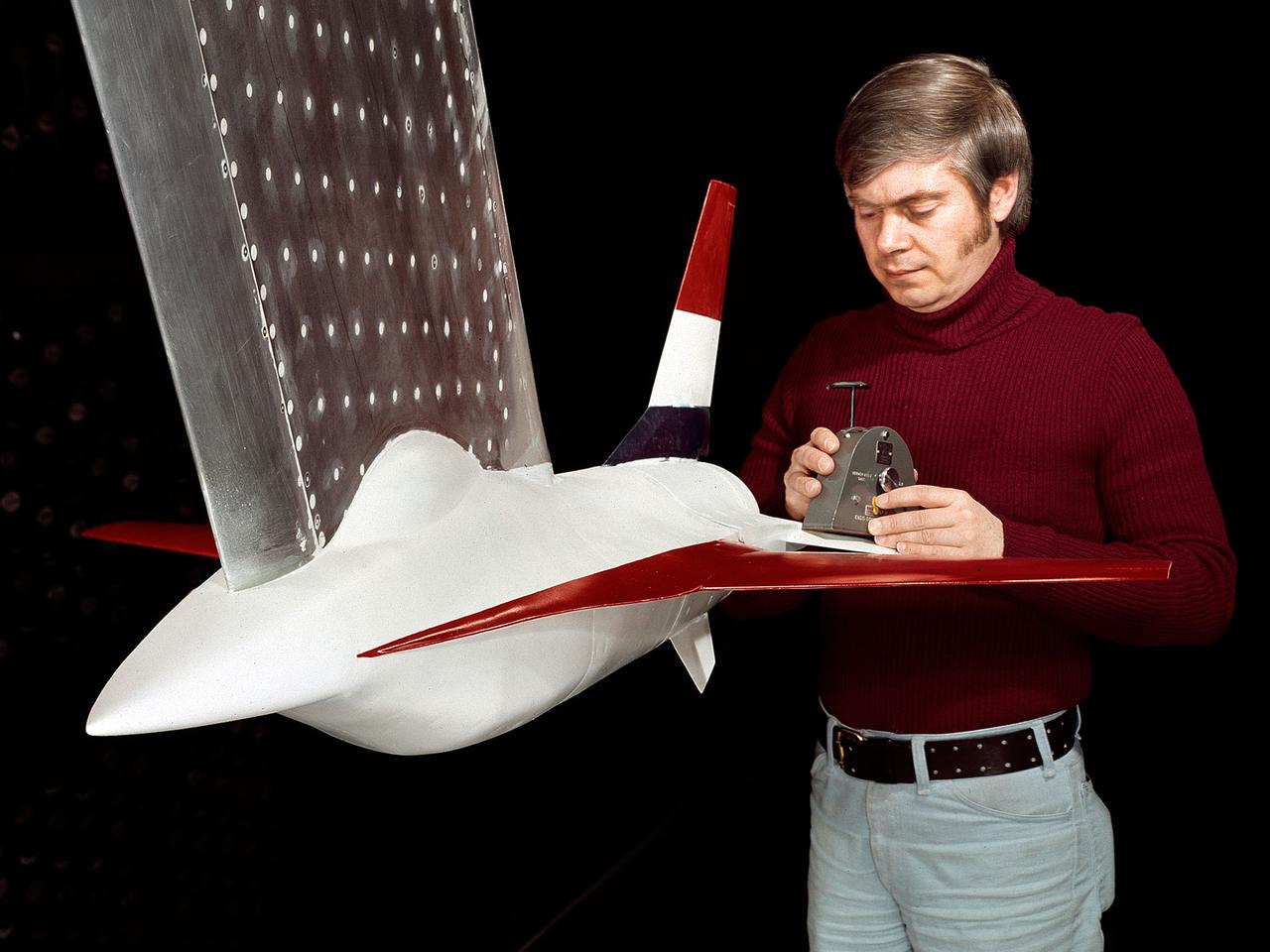
A model of the General Dynamics YF-16 Fighting Falcon in the test section of the 8- by 6-Foot Supersonic Wind Tunnel at the National Aeronautics and Space Administration (NASA) Lewis Research Center. The YF-16 was General Dynamics response to the military’s 1972 request for proposals to design a new 20,000-pound fighter jet with exceptional acceleration, turn rate, and range. The aircraft included innovative design elements to help pilots survive turns up to 9Gs, a new frameless bubble canopy, and a Pratt and Whitney 24,000-pound thrust F-100 engine. The YF-16 made its initial flight in February 1974, just six weeks before this photograph, at Edwards Air Force Base. Less than a year later, the Air Force ordered 650 of the aircraft, designated as F-16 Fighting Falcons. The March and April 1974 tests in the 8- by 6-foot tunnel analyzed the aircraft’s fixed-shroud ejector nozzle. The fixed-nozzle area limited drag, but also limited the nozzle’s internal performance. NASA researchers identified and assessed aerodynamic and aerodynamic-propulsion interaction uncertainties associated the prototype concept. YF-16 models were also tested extensively in the 11- by 11-Foot Transonic Wind Tunnel and 9- by 7-Foot Supersonic Wind Tunnel at Ames Research Center and the 12-Foot Pressure Wind Tunnel at Langley Research Center.
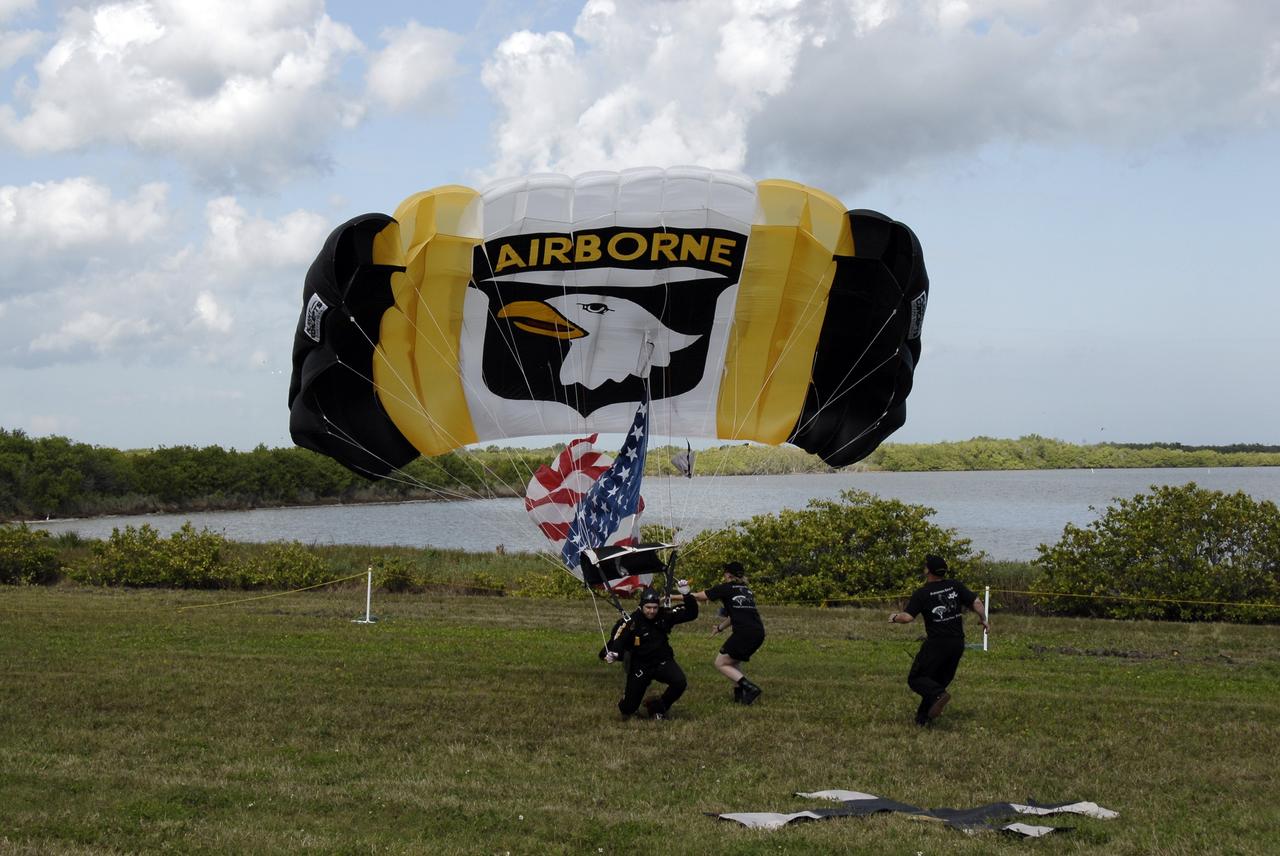
CAPE CANAVERAL, Fla. – A member of the 101st Airborne parachute demonstration team lands at NASA's Kennedy Space Center in Florida. The team performed at the Kennedy Space Center Visitor Complex Space and Air Show Nov. 8-9. This year’s show brought together the best in military aircraft, such as the F/A-18 Super Hornet and F-16 Fighting Falcon, coupled with precision pilots and veteran astronauts to celebrate spaceflight and aviation. The event included a water rescue demonstration by the 920th Rescue Wing. Photo credit: NASA/Kim Shiflett
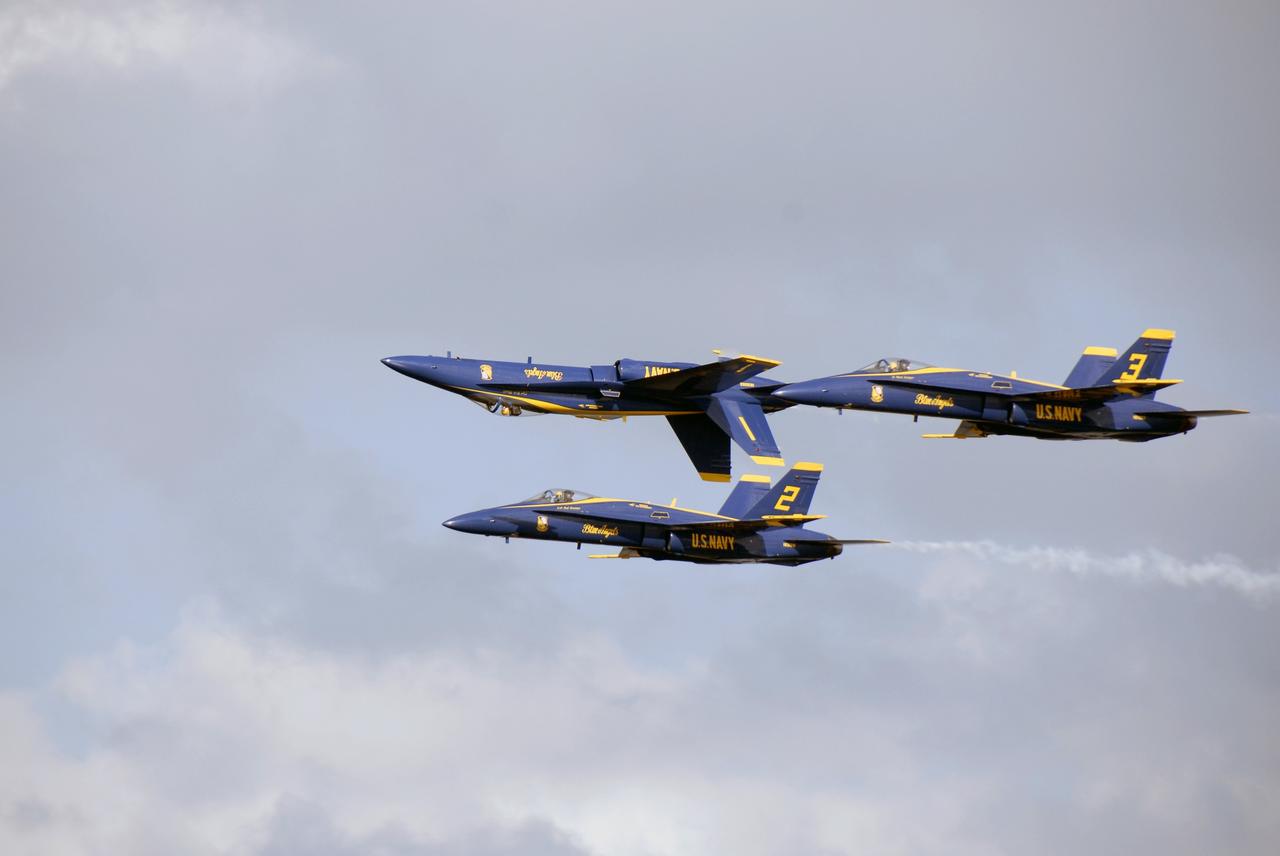
CAPE CANAVERAL, Fla. – The U.S. Navy's Blue Angels perform their tight maneuvers over NASA's Kennedy Space Center in Florida during the Kennedy Space Center Visitor Complex Space and Air Show Nov. 8-9. This year’s show brought together the best in military aircraft, such as the F/A-18 Super Hornet and F-16 Fighting Falcon, coupled with precision pilots and veteran astronauts to celebrate spaceflight and aviation. The event included a water rescue demonstration by the 920th Rescue Wing. Photo credit: NASA/Kim Shiflett
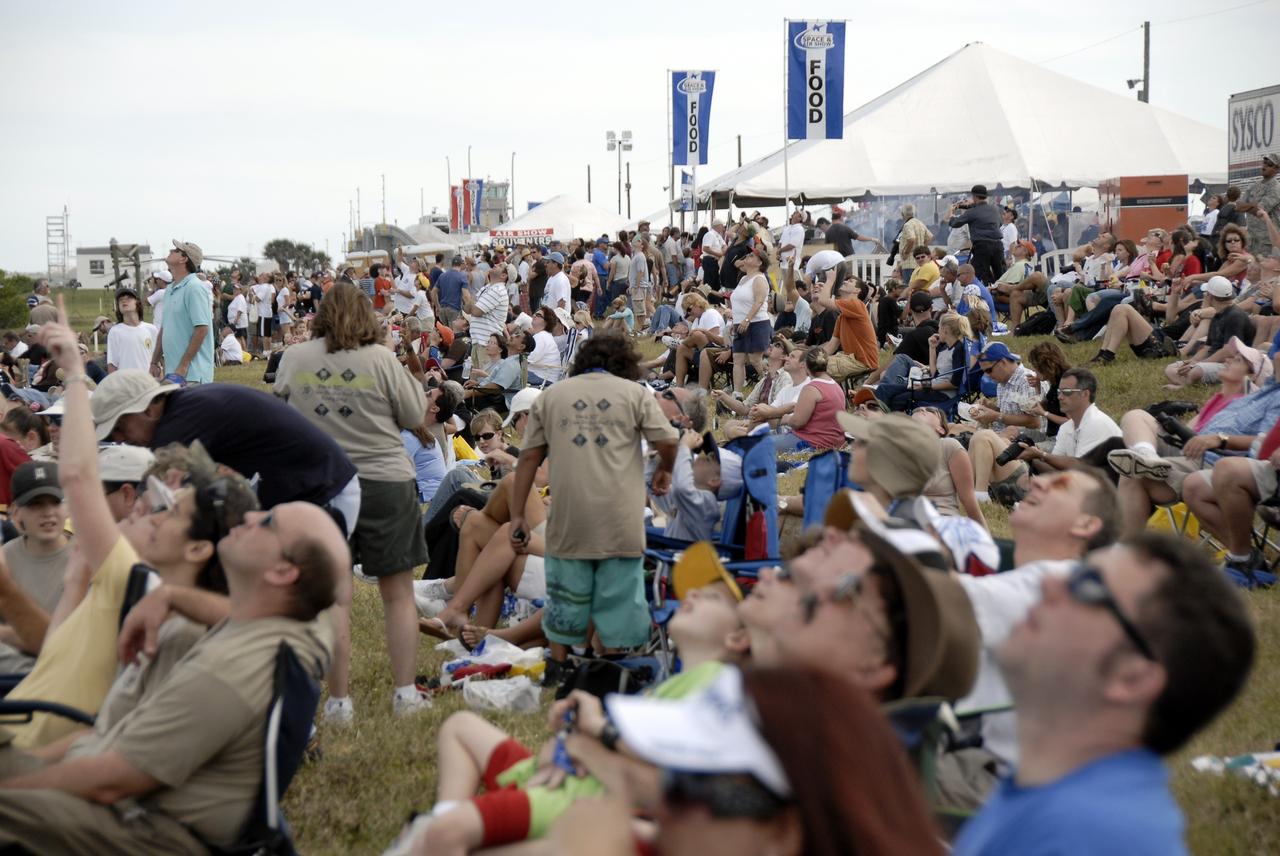
CAPE CANAVERAL, Fla. – Eyes and hands of the crowd of visitors are pointed toward the sky at NASA's Kennedy Space Center in Florida during the Kennedy Space Center Visitor Complex Space and Air Show Nov. 8-9. This year’s show brought together the best in military aircraft, such as the F/A-18 Super Hornet and F-16 Fighting Falcon, coupled with precision pilots and veteran astronauts to celebrate spaceflight and aviation. The event included a water rescue demonstration by the 920th Rescue Wing. Photo credit: NASA/Kim Shiflett
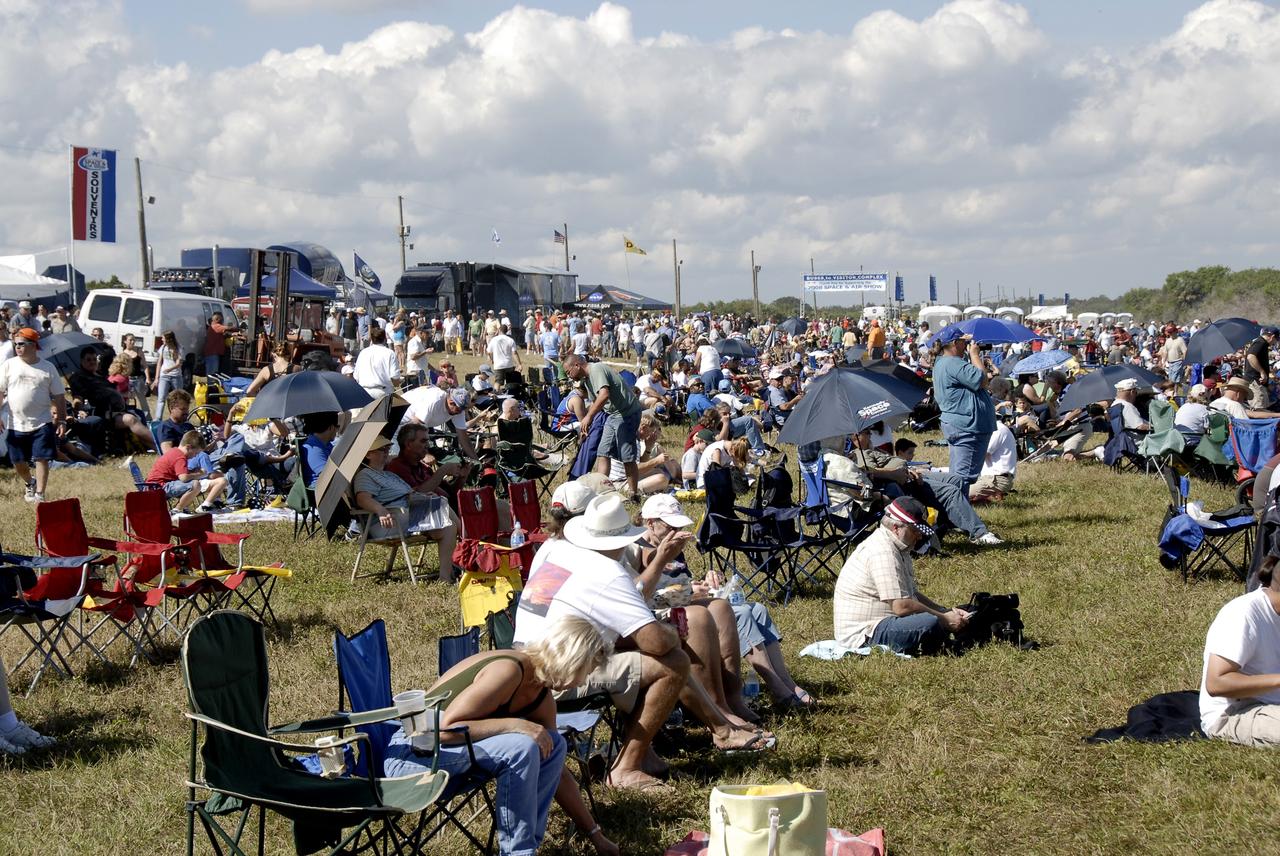
CAPE CANAVERAL, Fla. – Crowds are gathered at NASA's Kennedy Space Center in Florida to watch the U.S. Navy's Blue Angels perform at the Kennedy Space Center Visitor Complex Space and Air Show Nov. 8-9. This year’s show brought together the best in military aircraft, such as the F/A-18 Super Hornet and F-16 Fighting Falcon, coupled with precision pilots and veteran astronauts to celebrate spaceflight and aviation. The event included a water rescue demonstration by the 920th Rescue Wing. Photo credit: NASA/Kim Shiflett
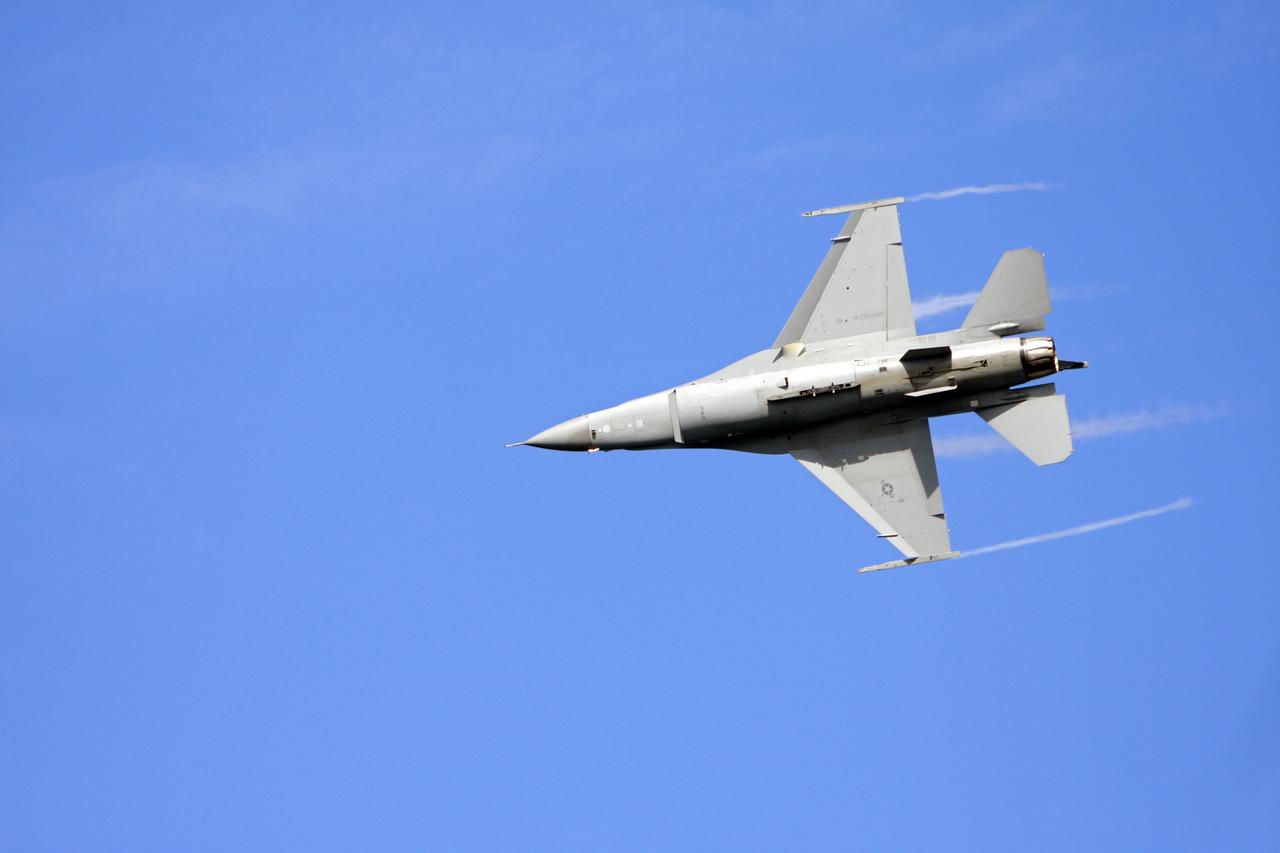
CAPE CANAVERAL, Fla. – During the Kennedy Space Center Visitor Complex Space and Air Show held Nov. 8-9 at NASA's Kennedy Space Center in Florida, this F/A-18 Super Hornet demonstrates its flying capabilities. This year’s show brought together the best in military aircraft, such as the F/A-18 Super Hornet and F-16 Fighting Falcon, coupled with precision pilots and veteran astronauts to celebrate spaceflight and aviation. The event included a water rescue demonstration by the 920th Rescue Wing. Photo credit: NASA/Troy Cryder
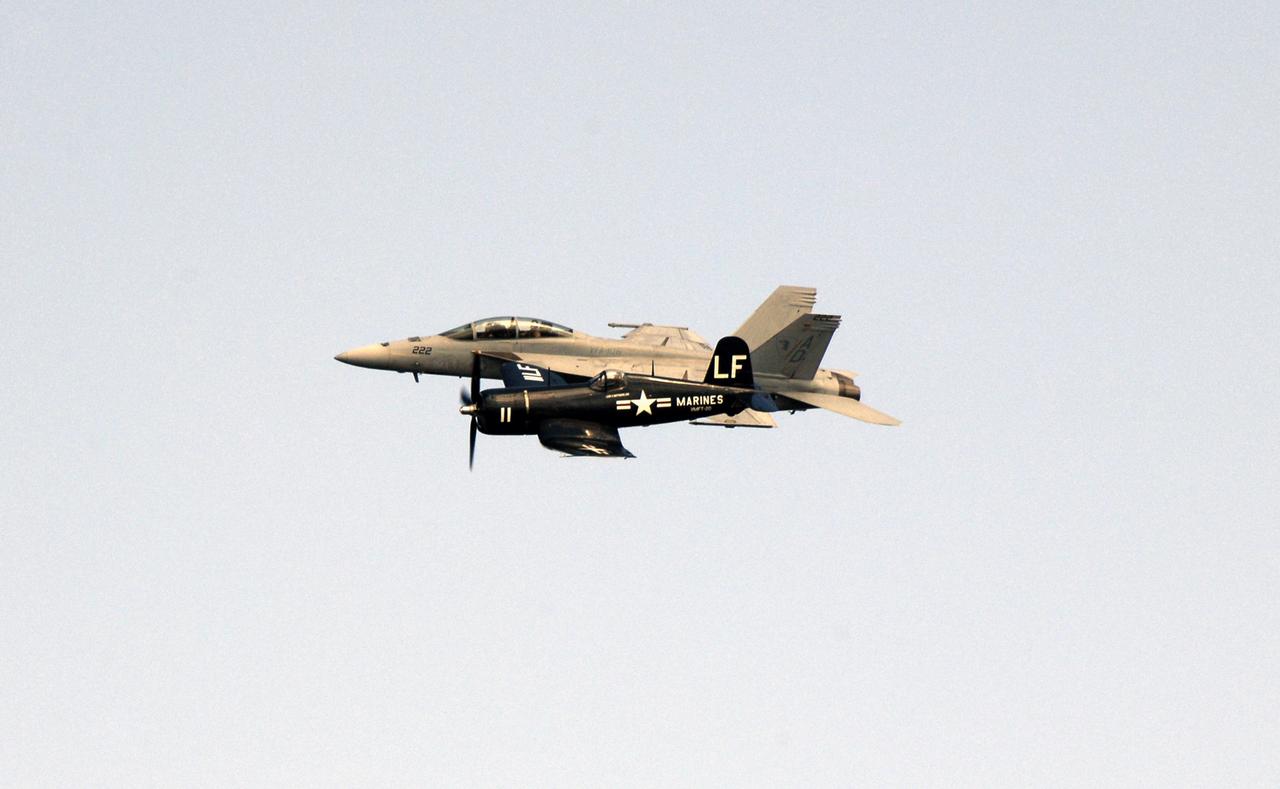
CAPE CANAVERAL, Fla. – A contrast in speed and design, the F/A-18 Super Hornet jet (behind) flies alongside a World War II Vought F4U Corsair during the Kennedy Space Center Visitor Complex Space and Air Show Nov. 8-9 at NASA's Kennedy Space Center in Florida. This year’s show brought together the best in military aircraft, such as the F/A-18 Super Hornet and F-16 Fighting Falcon, coupled with precision pilots and veteran astronauts to celebrate spaceflight and aviation. The event included a water rescue demonstration by the 920th Rescue Wing. Photo credit: NASA/Kim Shiflett
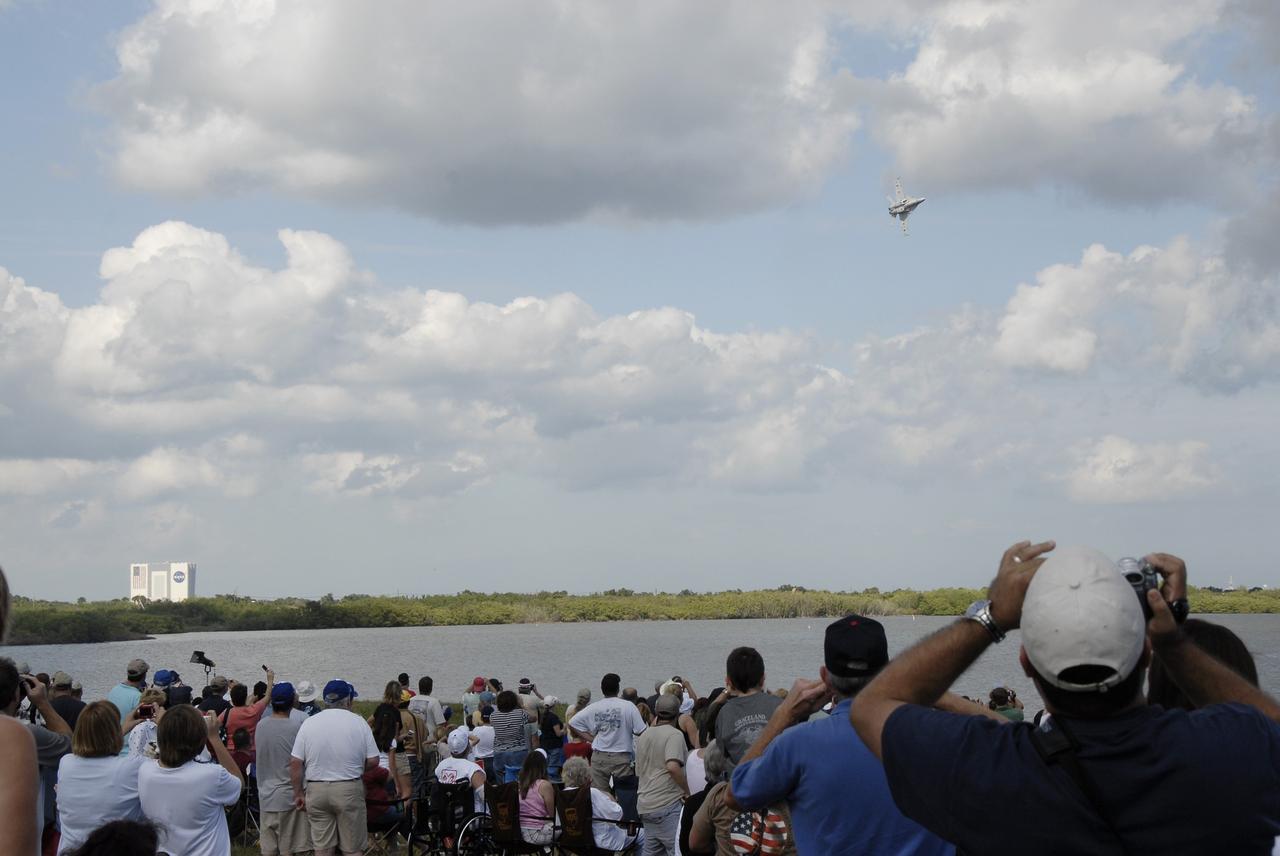
CAPE CANAVERAL, Fla. – Crowds on the banks of the Banana River at NASA's Kennedy Space Center in Florida watch as an F/A-18 Super Hornet jet shows its maneuvers. The Super Hornet was part of the Kennedy Space Center Visitor Complex Space and Air Show Nov. 8-9. This year’s show brought together the best in military aircraft, such as the F/A-18 Super Hornet and F-16 Fighting Falcon, coupled with precision pilots and veteran astronauts to celebrate spaceflight and aviation. The event included a water rescue demonstration by the 920th Rescue Wing. Photo credit: NASA/Kim Shiflett
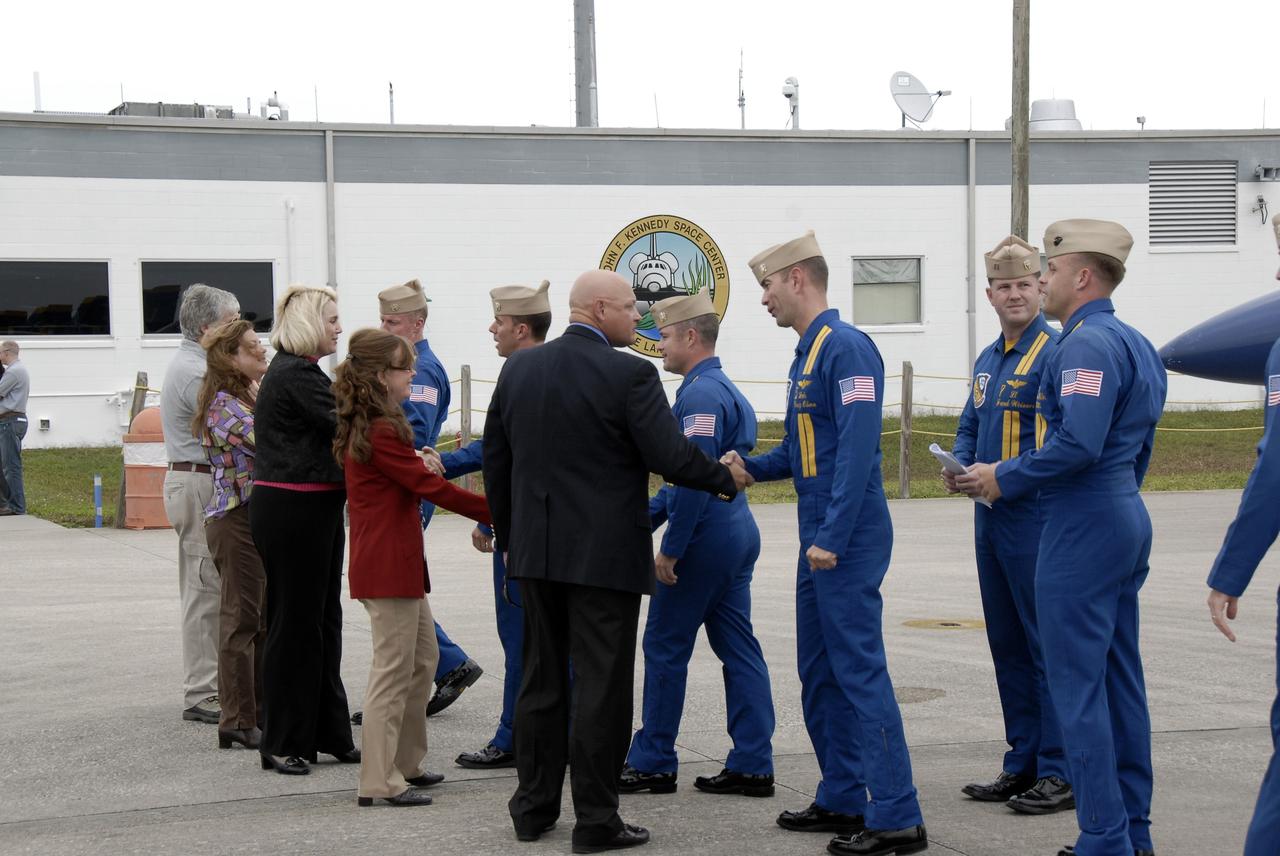
CAPE CANAVERAL, Fla. – At the Shuttle Landing Facility at NASA's Kennedy Space Center in Florida, the U.S. Navy's Blue Angel pilots and support team are greeted by (from right) Special Operations Director Joe Dowdy, External Relations Director Lisa Malone, External Relations Acting Deputy Director Cheryl Hurst and Pam Steele, chief of the Public Services Division at Kennedy. The Blue Angels will perform at the Kennedy Space Center Visitor Complex Space and Air Show Nov. 8-9. The Navy's elite flight demonstration squadron will take to the skies in military aircraft demonstrations by the F-16 Fighting Falcon and F/A-18 Super Hornet jets for the second annual Space & Air Show at Kennedy. This year’s show brings together the best in military aircraft, coupled with precision pilots and veteran astronauts to celebrate spaceflight and aviation. The event includes military aircraft demonstrations by the F-16 Fighting Falcon and a water rescue demonstration by the 920th Rescue Wing. Photo credit: NASA/Kim Shiflett
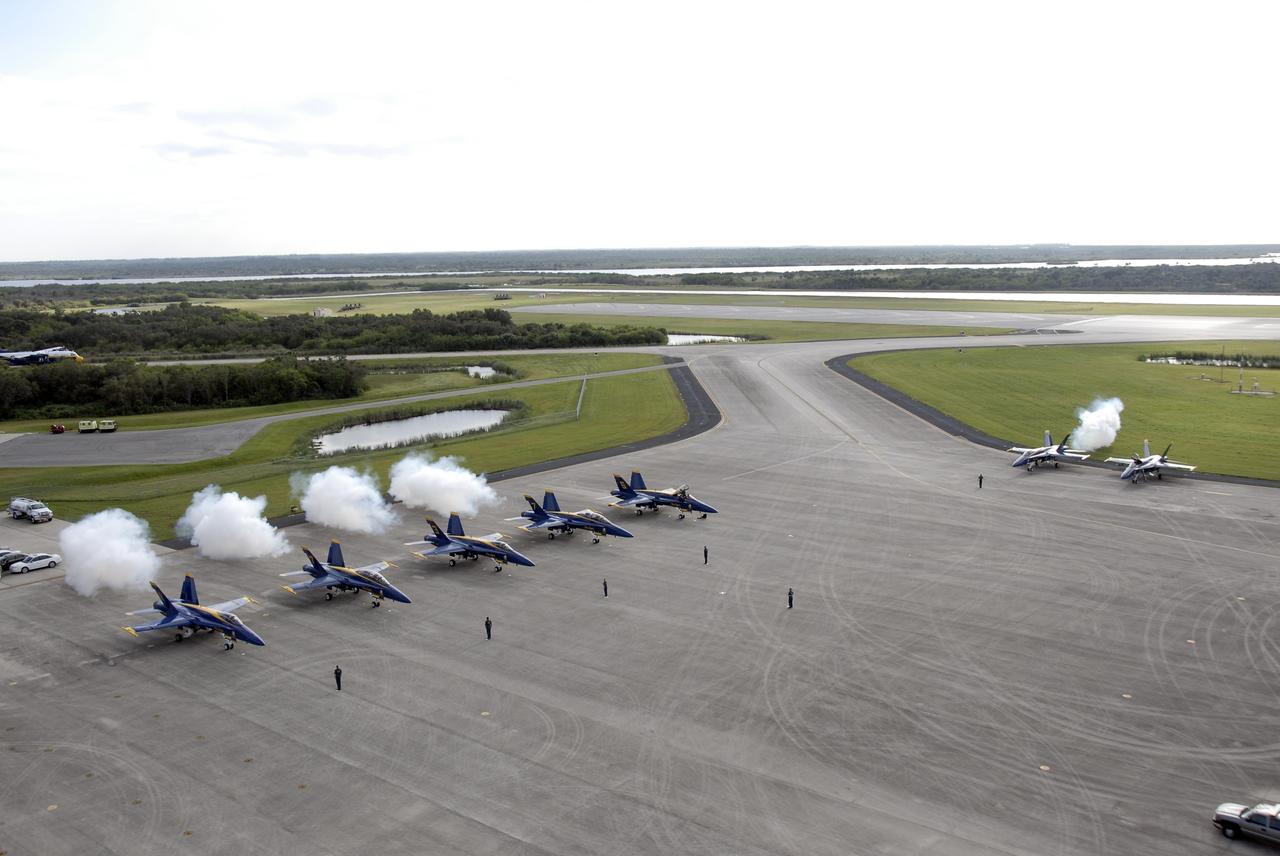
CAPE CANAVERAL, Fla. – The U.S. Navy's F/A-18 Blue Angels (left) and other military aircraft fire their engines on the Shuttle Landing Facility at NASA's Kennedy Space Center in Florida before taking off. They will be rehearsing their demonstrations for the Kennedy Space Center Visitor Complex Space and Air Show Nov. 8-9. The Navy's elite flight demonstration squadron will take to the skies in military aircraft demonstrations for the second annual Space & Air Show at Kennedy. This year’s show brings together the best in military aircraft, coupled with precision pilots and veteran astronauts to celebrate spaceflight and aviation. The event also includes demonstrations by the F-16 Fighting Falcon and a water rescue demonstration by the 920th Rescue Wing. Photo credit: NASA/Kim Shiflett
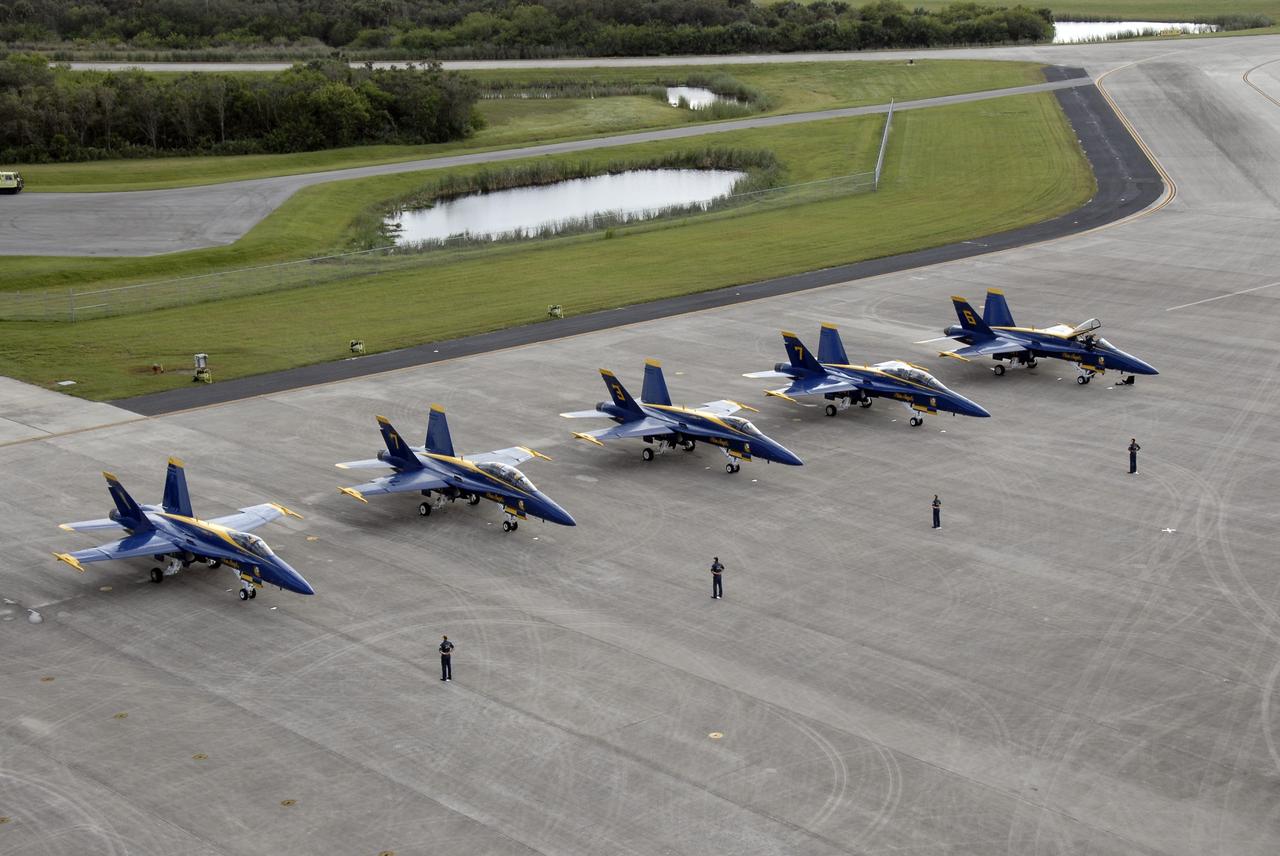
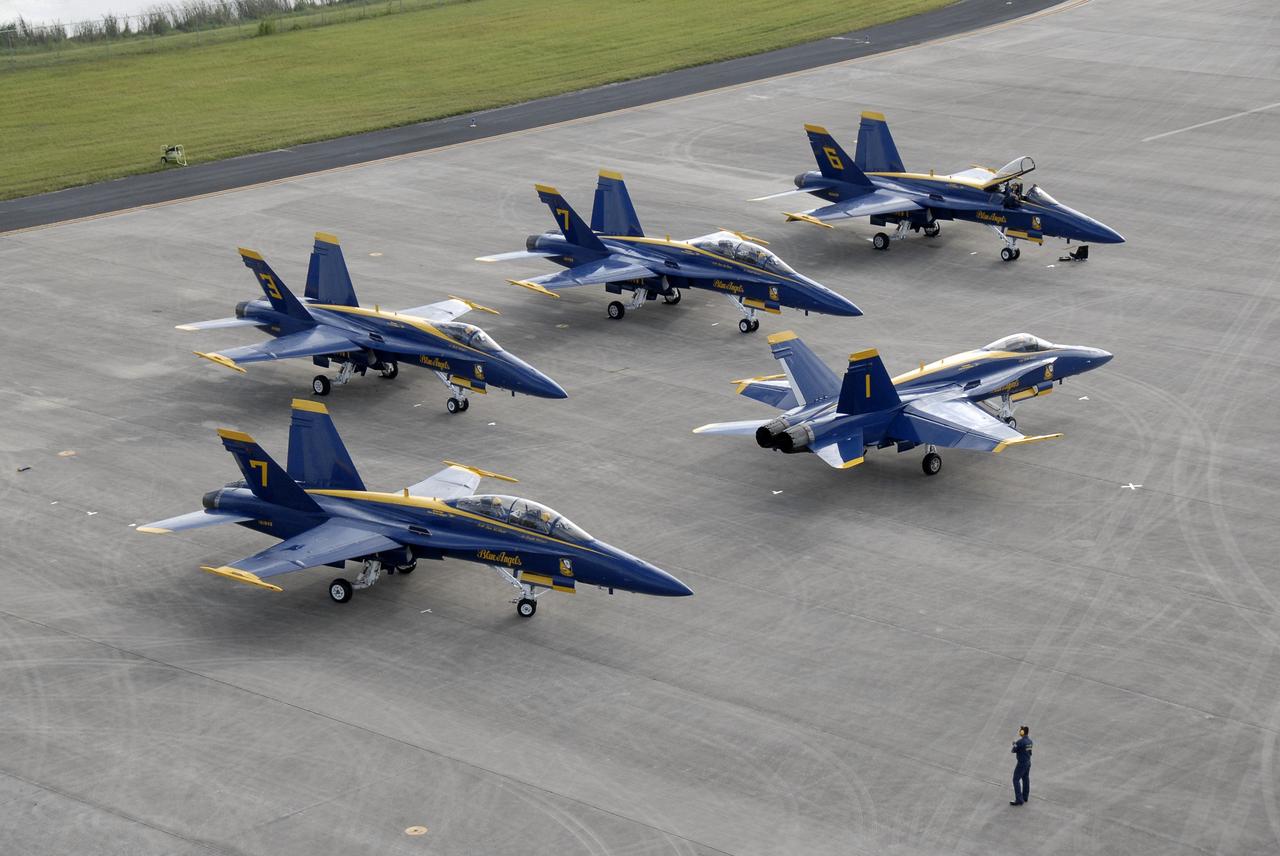
CAPE CANAVERAL, Fla. – The U.S. Navy's F/A-18 Blue Angels are lined up on the Shuttle Landing Facility at NASA's Kennedy Space Center in Florida. The Blue Angels and other aircraft are at Kennedy for demonstrations at the Kennedy Space Center Visitor Complex Space and Air Show Nov. 8-9. The Navy's elite flight demonstration squadron will take to the skies in military aircraft demonstrations for the second annual Space & Air Show at Kennedy. This year’s show brings together the best in military aircraft, coupled with precision pilots and veteran astronauts to celebrate spaceflight and aviation. The event also includes demonstrations by the F-16 Fighting Falcon and a water rescue demonstration by the 920th Rescue Wing. Photo credit: NASA/Kim Shiflett
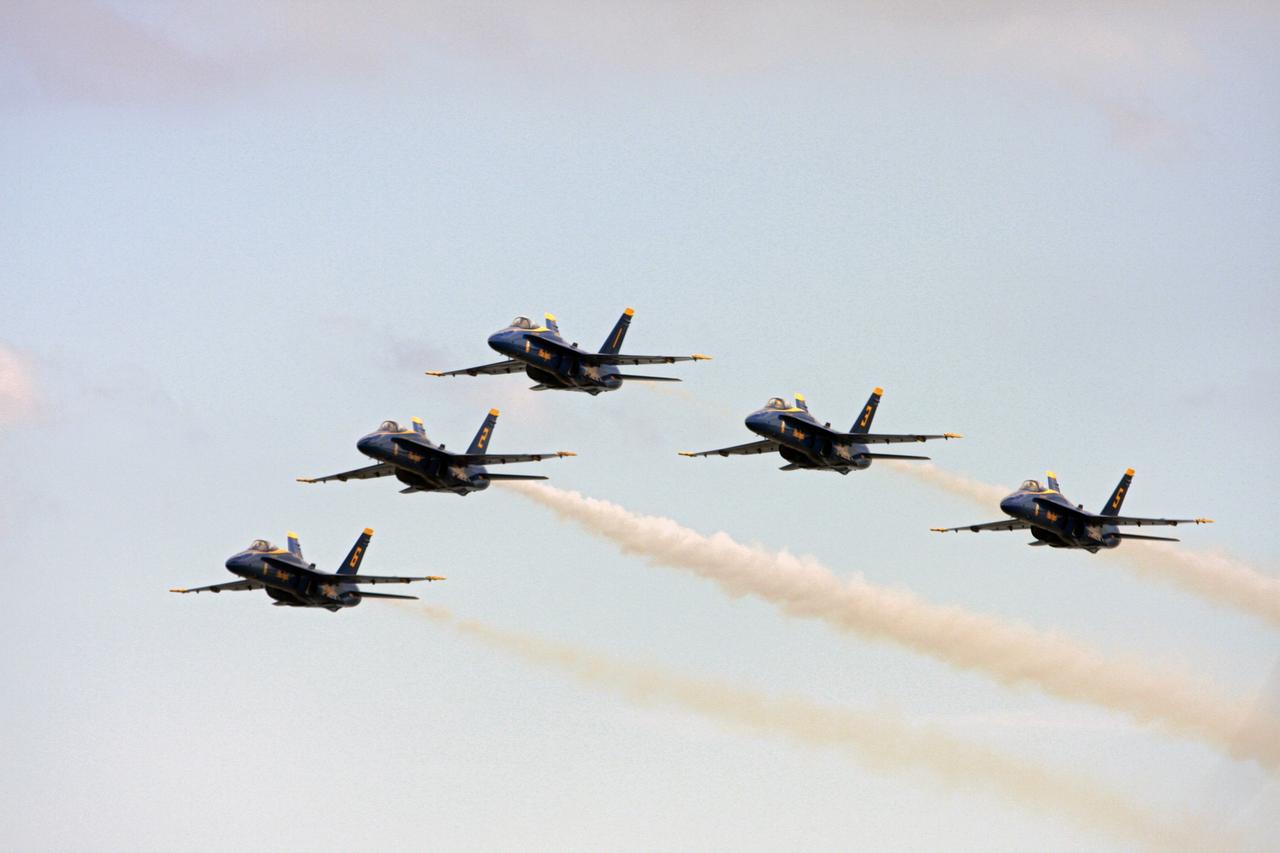
CAPE CANAVERAL, Fla. – The U.S. Navy's Blue Angels perform their tight maneuvers over NASA's Kennedy Space Center in Florida during the Kennedy Space Center Visitor Complex Space and Air Show held Nov. 8-9. This year’s show brought together the best in military aircraft, such as the F/A-18 Super Hornet and F-16 Fighting Falcon, coupled with precision pilots and veteran astronauts to celebrate spaceflight and aviation. The event included a water rescue demonstration by the 920th Rescue Wing. Photo credit: NASA/Troy Cryder
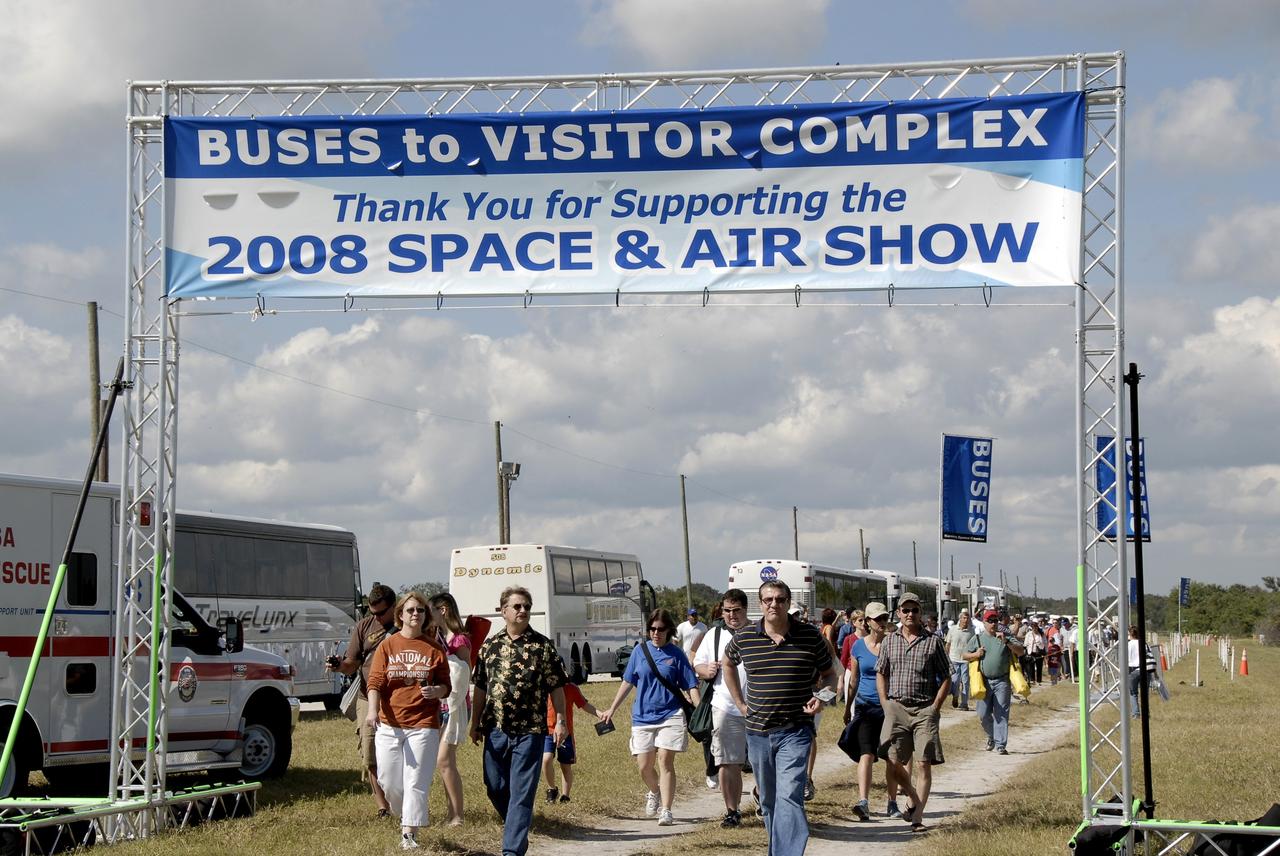
CAPE CANAVERAL, Fla. – Crowds head for the best viewing sites they can find at NASA's Kennedy Space Center in Florida to watch the U.S. Navy's Blue Angels perform at the Kennedy Space Center Visitor Complex Space and Air Show Nov. 8-9. This year’s show brought together the best in military aircraft, such as the F/A-18 Super Hornet and F-16 Fighting Falcon, coupled with precision pilots and veteran astronauts to celebrate spaceflight and aviation. The event included a water rescue demonstration by the 920th Rescue Wing. Photo credit: NASA/Kim Shiflett
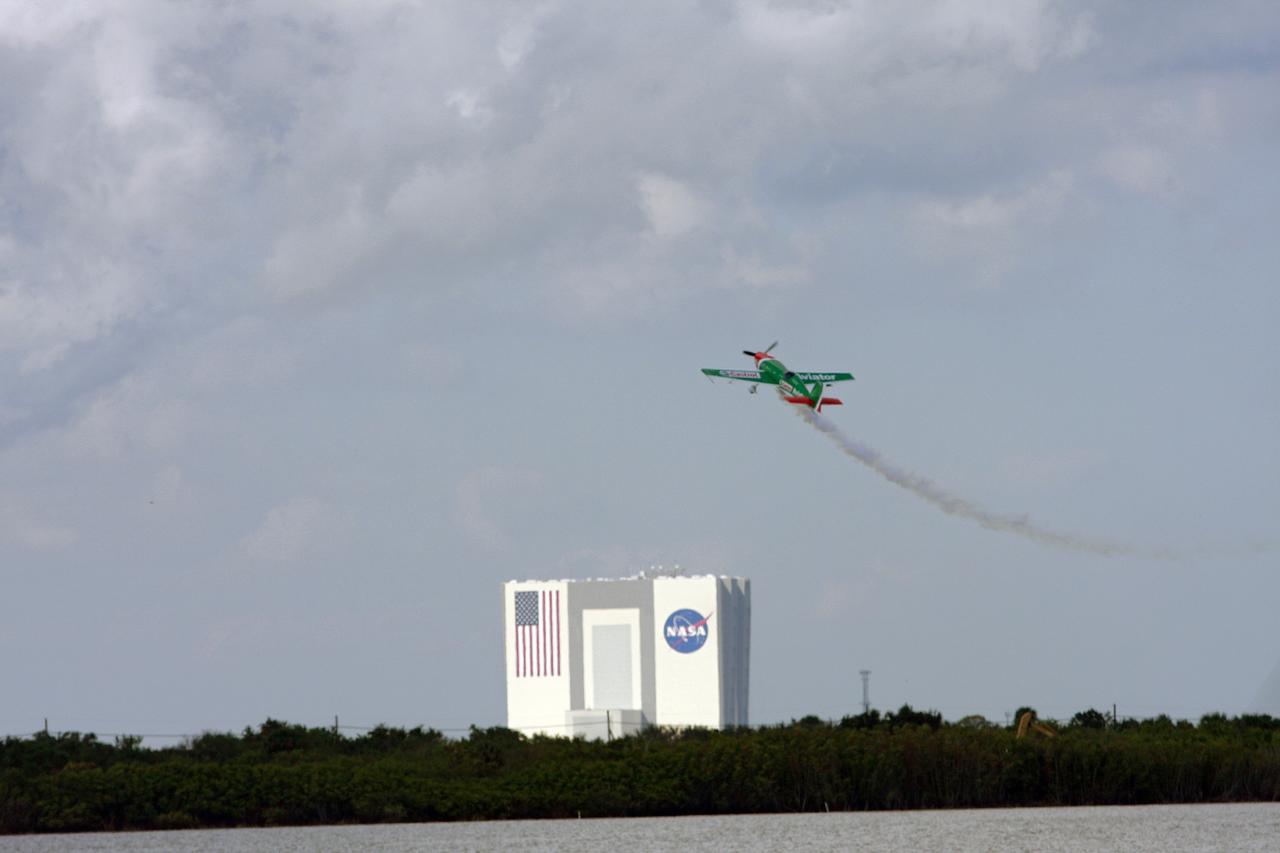
CAPE CANAVERAL, Fla. – With the Vehicle Assembly Building at NASA's Kennedy Space Center in Florida as a backdrop, this Castrol Aviator EXTRA 300SHP stunt plane, an unlimited-level aerobatic two-seat monoplane, performs aerobatic maneuvers during the Kennedy Space Center Visitor Complex Space and Air Show held Nov. 8-9. This year’s show brought together the best in military aircraft, such as the F/A-18 Super Hornet and F-16 Fighting Falcon, coupled with precision pilots and veteran astronauts to celebrate spaceflight and aviation. The event included a water rescue demonstration by the 920th Rescue Wing. Photo credit: NASA/Troy Cryder
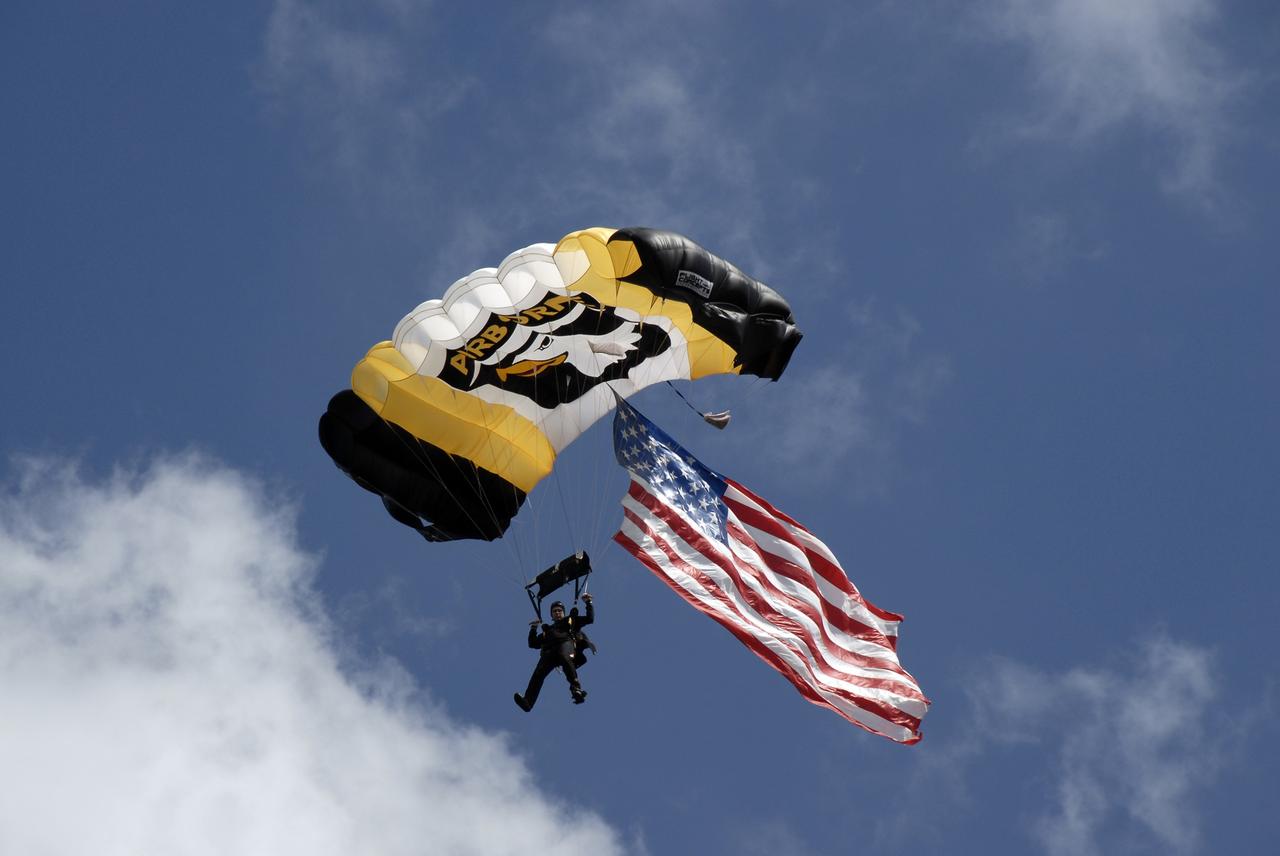
CAPE CANAVERAL, Fla. – A member of the 101st Airborne parachute demonstration team heads for landing at NASA's Kennedy Space Center in Florida. The team performed at the Kennedy Space Center Visitor Complex Space and Air Show Nov. 8-9. This year’s show brought together the best in military aircraft, such as the F/A-18 Super Hornet and F-16 Fighting Falcon, coupled with precision pilots and veteran astronauts to celebrate spaceflight and aviation. The event included a water rescue demonstration by the 920th Rescue Wing. Photo credit: NASA/Kim Shiflett
CAPE CANAVERAL, Fla. – The U.S. Navy's F/A-18 Blue Angels begin taxiing toward the runway at the Shuttle Landing Facility at NASA's Kennedy Space Center in Florida. They will taking off to begin rehearsing their demonstrations for the Kennedy Space Center Visitor Complex Space and Air Show Nov. 8-9. The Navy's elite flight demonstration squadron will take to the skies in military aircraft demonstrations for the second annual Space & Air Show at Kennedy. This year’s show brings together the best in military aircraft, coupled with precision pilots and veteran astronauts to celebrate spaceflight and aviation. The event also includes demonstrations by the F-16 Fighting Falcon and a water rescue demonstration by the 920th Rescue Wing. Photo credit: NASA/Kim Shiflett
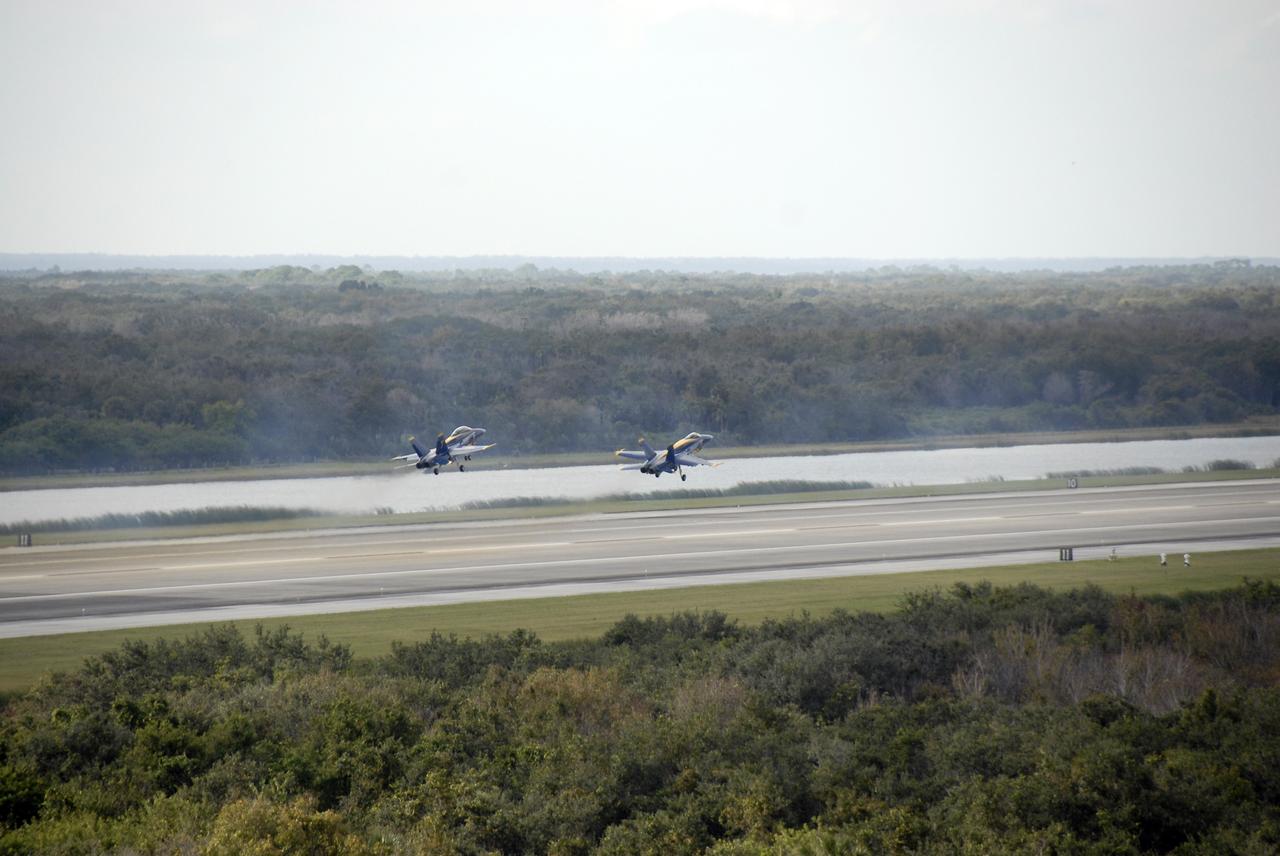
CAPE CANAVERAL, Fla. – The U.S. Navy's F/A-18 Blue Angels take off from the runway at the Shuttle Landing Facility at NASA's Kennedy Space Center in Florida to begin rehearsing their demonstrations for the Kennedy Space Center Visitor Complex Space and Air Show Nov. 8-9. The Navy's elite flight demonstration squadron will take to the skies in military aircraft demonstrations for the second annual Space & Air Show at Kennedy. This year’s show brings together the best in military aircraft, coupled with precision pilots and veteran astronauts to celebrate spaceflight and aviation. The event also includes demonstrations by the F-16 Fighting Falcon and a water rescue demonstration by the 920th Rescue Wing. Photo credit: NASA/Kim Shiflett
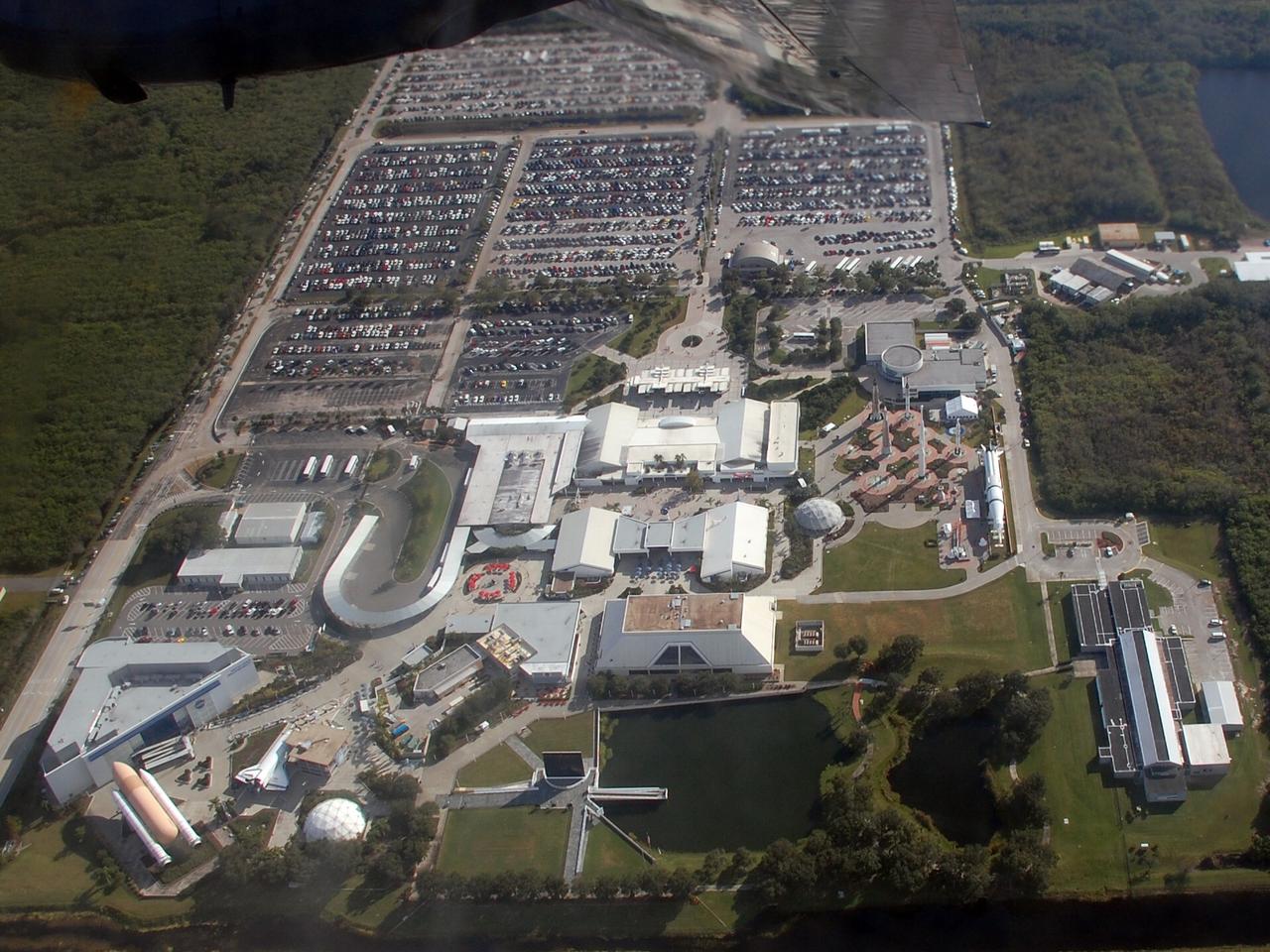
CAPE CANAVERAL, Fla. – During a flight aboard the U.S. Navy Blue Angel's support aircraft, a C-130T Hercules known as "Fat Albert," the photographer was able to capture the entire Kennedy Space Center Visitor Complex. Well-known structures are the genuine, full-size solid rocket boosters and external tank at left, Astronaut Memorial Mirror at center in the foreground, and the Rocket Garden at center right. The Blue Angels performed during the Kennedy Space Center Visitor Complex Space and Air Show held Nov. 8-9. This year’s show brought together the best in military aircraft, such as the F/A-18 Super Hornet and F-16 Fighting Falcon, coupled with precision pilots and veteran astronauts to celebrate spaceflight and aviation. The event included a water rescue demonstration by the 920th Rescue Wing. Photo credit: NASA/Ben Smegelsky
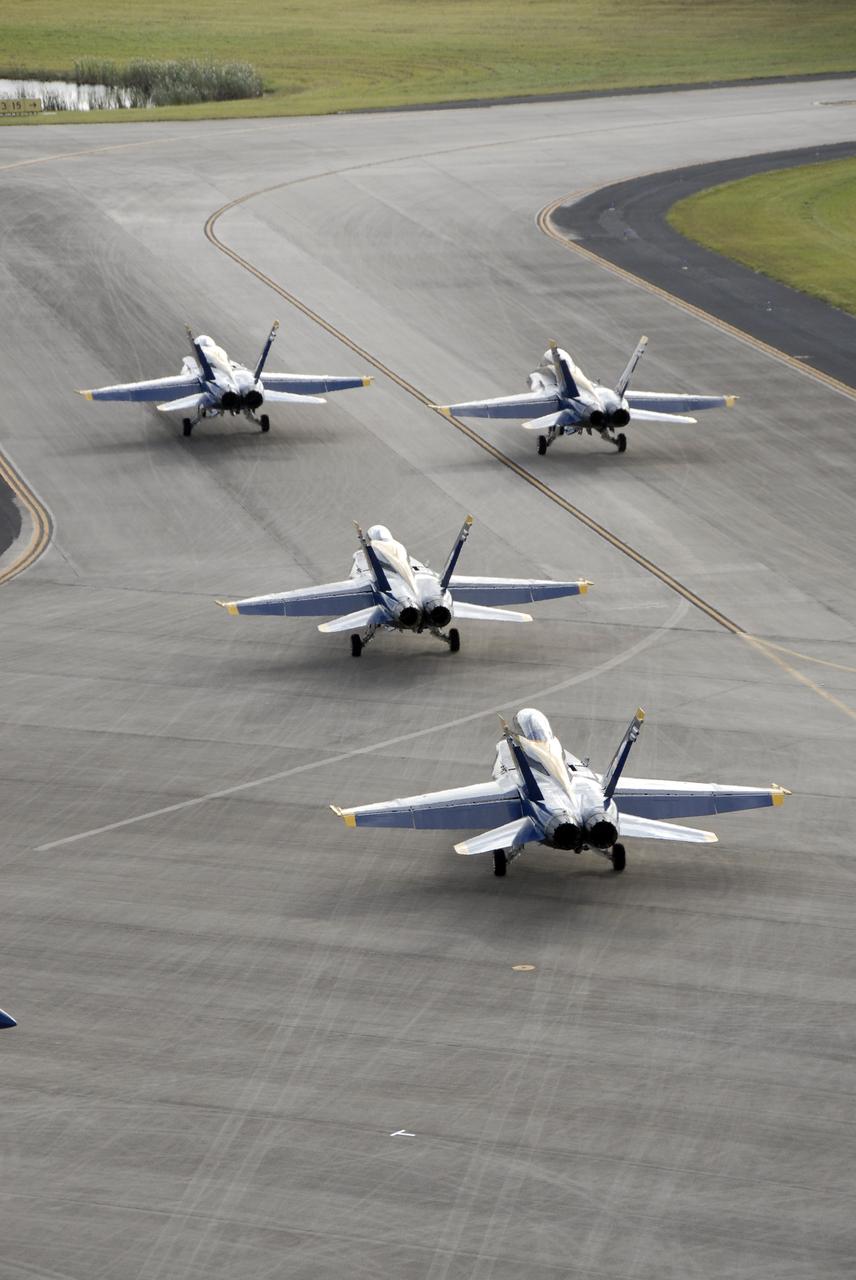
CAPE CANAVERAL, Fla. – The U.S. Navy's F/A-18 Blue Angels taxi toward the runway at the Shuttle Landing Facility at NASA's Kennedy Space Center in Florida. They will taking off to begin rehearsing their demonstrations for the Kennedy Space Center Visitor Complex Space and Air Show Nov. 8-9. The Navy's elite flight demonstration squadron will take to the skies in military aircraft demonstrations for the second annual Space & Air Show at Kennedy. This year’s show brings together the best in military aircraft, coupled with precision pilots and veteran astronauts to celebrate spaceflight and aviation. The event also includes demonstrations by the F-16 Fighting Falcon and a water rescue demonstration by the 920th Rescue Wing. Photo credit: NASA/Kim Shiflett
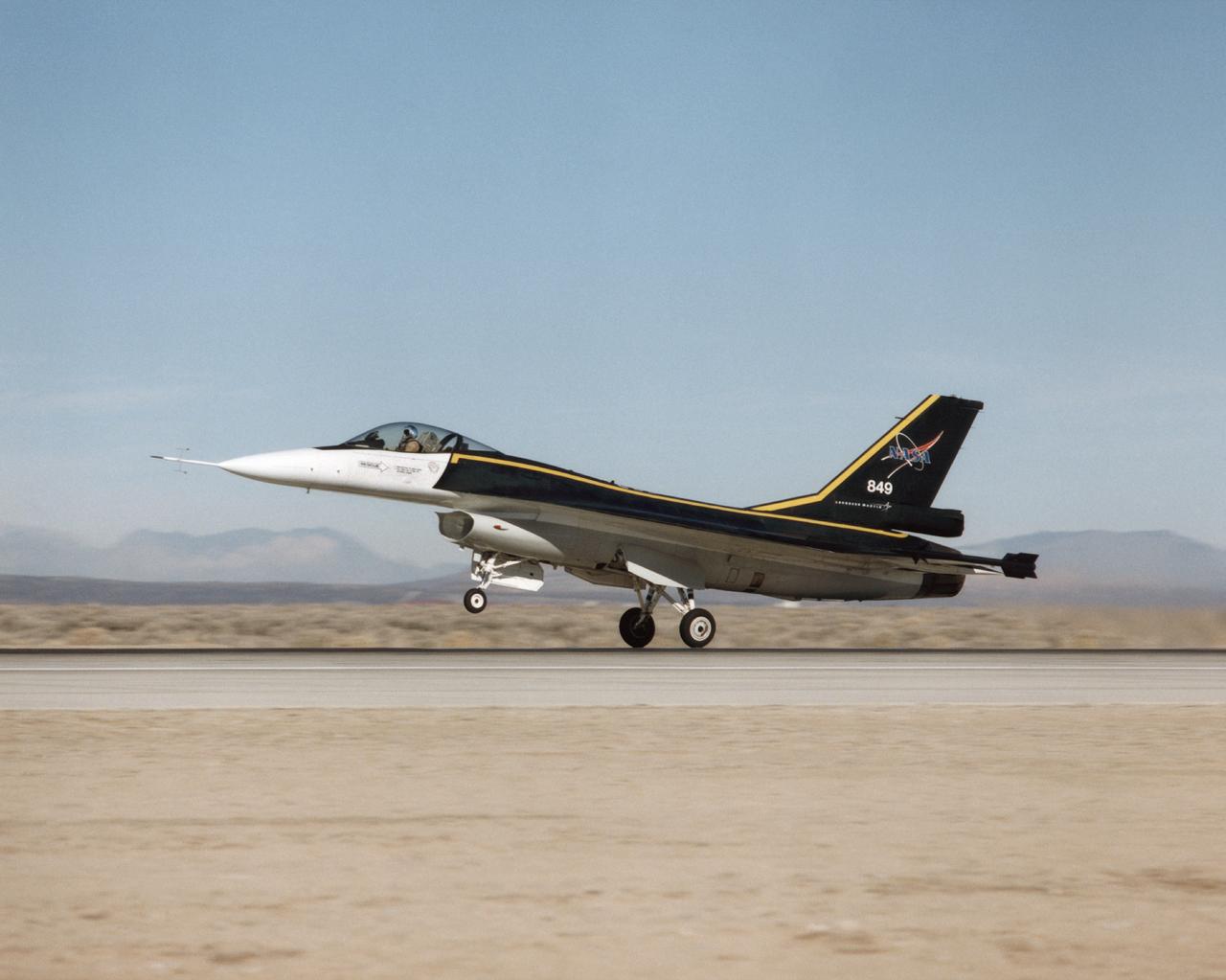
The F-16XL #1 (NASA 849) takes off for the first flight of the Digital Flight Control System (DFCS) on December 16, 1997. Like most first flight, the DFCS required months of preparations. During July 1997, crews worked on the engine, cockpit, canopy, seat, and instrumentation. By late August, the aircraft began combined systems tests and a flight readiness review. Although the Air Force Safety Review Board (AFSRB)- a group that provided double checks on all flight operations - approved the program in late November 1997, a problem with the aircraft flight computer delayed the functional check flight until mid-December.
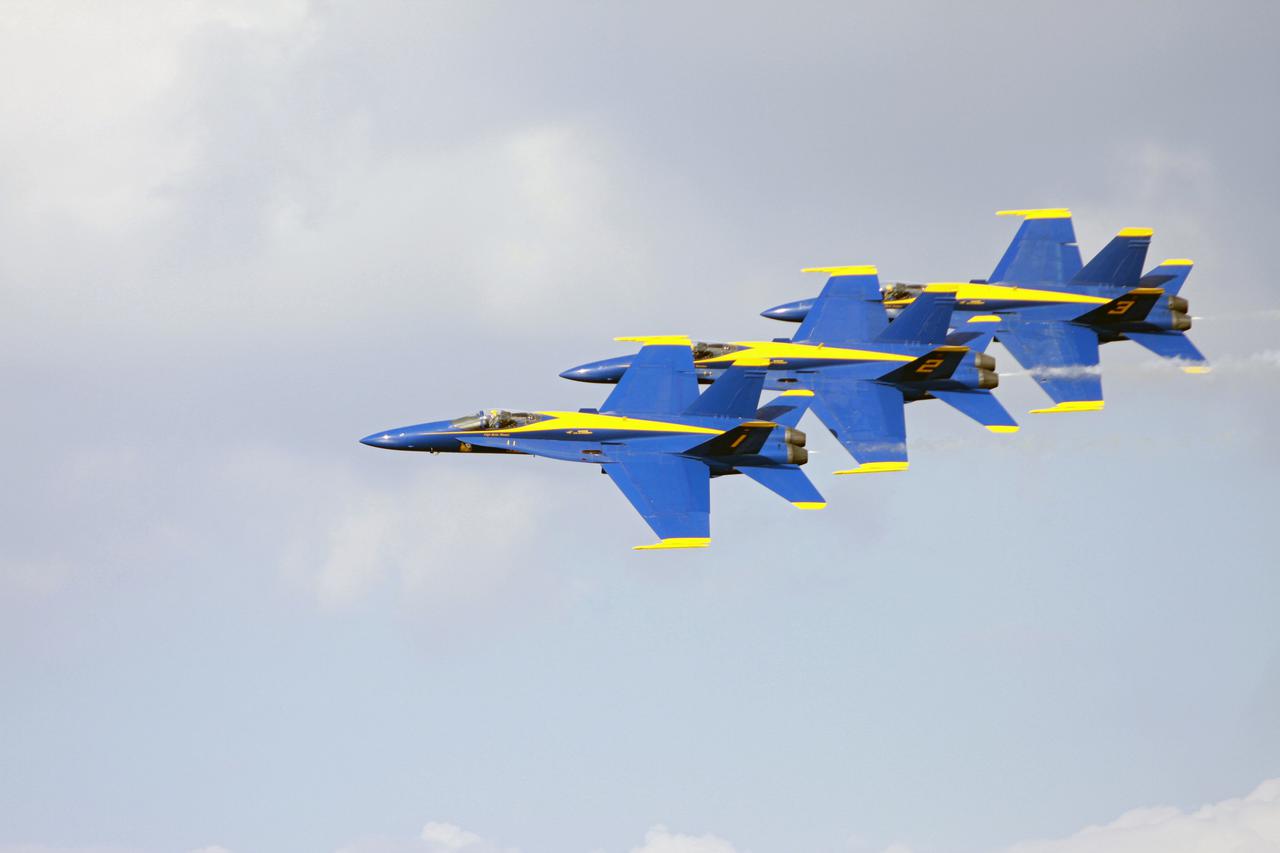
CAPE CANAVERAL, Fla. – The U.S. Navy's Blue Angels perform their tight maneuvers over NASA's Kennedy Space Center in Florida during the Kennedy Space Center Visitor Complex Space and Air Show held Nov. 8-9. This year’s show brought together the best in military aircraft, such as the F_A-18 Super Hornet and F-16 Fighting Falcon, coupled with precision pilots and veteran astronauts to celebrate spaceflight and aviation. The event included a water rescue demonstration by the 920th Rescue Wing. Photo credit: NASA_Troy Cryder
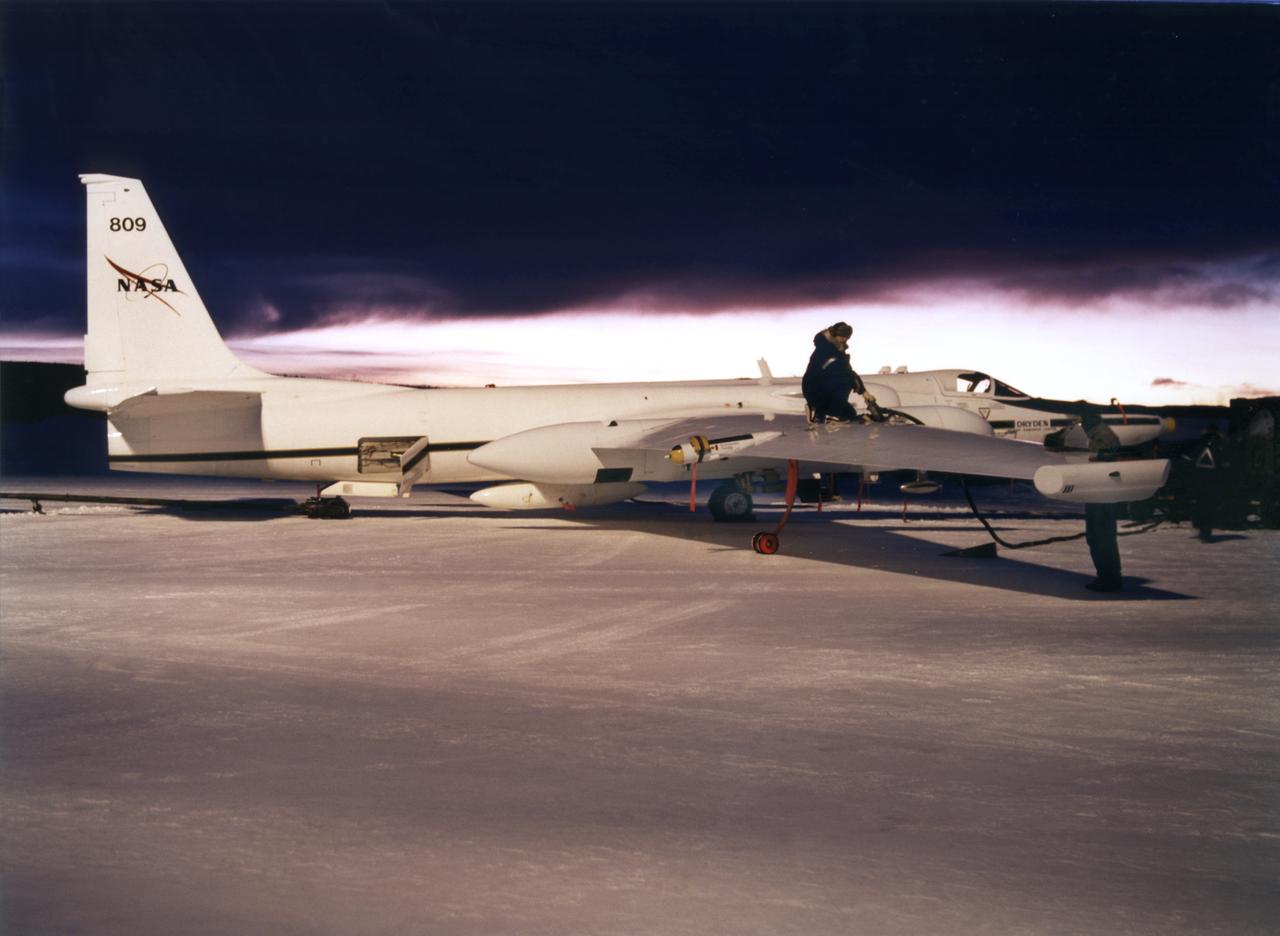
ER-2s bearing tail numbers 806 and 809 are used as airborne science platforms by NASA's Dryden Flight Research Center. The aircraft are platforms for a variety of high-altitude science missions flown over various parts of the world. They are also used for earth science and atmospheric sensor research and development, satellite calibration and data validation. The ER-2s are capable of carrying a maximum payload of 2,600 pounds of experiments in a nose bay, the main equipment bay behind the cockpit, two wing-mounted superpods and small underbody and trailing edges. Most ER-2 missions last about six hours with ranges of about 2,200 nautical miles. The aircraft typically fly at altitudes above 65,000 feet. On November 19, 1998, an ER-2 set a world record for medium weight aircraft reaching an altitude of 68,700 feet. The aircraft is 63 feet long, with a wingspan of 104 feet. The top of the vertical tail is 16 feet above ground when the aircraft is on the bicycle-type landing gear. Cruising speeds are 410 knots, or 467 miles per hour, at altitude. A single General Electric F-118 turbofan engine rated at 17,000 pounds thrust powers the ER-2.

ER-2 tail number 806, is one of two Airborne Science ER-2s used as science platforms by Dryden. The aircraft are platforms for a variety of high-altitude science missions flown over various parts of the world. They are also used for earth science and atmospheric sensor research and development, satellite calibration and data validation. The ER-2s are capable of carrying a maximum payload of 2,600 pounds of experiments in a nose bay, the main equipment bay behind the cockpit, two wing-mounted superpods and small underbody and trailing edges. Most ER-2 missions last about six hours with ranges of about 2,200 nautical miles. The aircraft typically fly at altitudes above 65,000 feet. On November 19, 1998, the ER-2 set a world record for medium weight aircraft reaching an altitude of 68,700 feet. The aircraft is 63 feet long, with a wingspan of 104 feet. The top of the vertical tail is 16 feet above ground when the aircraft is on the bicycle-type landing gear. Cruising speeds are 410 knots, or 467 miles per hour, at altitude. A single General Electric F-118 turbofan engine rated at 17,000 pounds thrust powers the ER-2.

ER-2 tail number 806, is one of two Airborne Science ER-2s used as science platforms by Dryden. The aircraft are platforms for a variety of high-altitude science missions flown over various parts of the world. They are also used for earth science and atmospheric sensor research and development, satellite calibration and data validation. The ER-2s are capable of carrying a maximum payload of 2,600 pounds of experiments in a nose bay, the main equipment bay behind the cockpit, two wing-mounted superpods and small underbody and trailing edges. Most ER-2 missions last about six hours with ranges of about 2,200 nautical miles. The aircraft typically fly at altitudes above 65,000 feet. On November 19, 1998, the ER-2 set a world record for medium weight aircraft reaching an altitude of 68,700 feet. The aircraft is 63 feet long, with a wingspan of 104 feet. The top of the vertical tail is 16 feet above ground when the aircraft is on the bicycle-type landing gear. Cruising speeds are 410 knots, or 467 miles per hour, at altitude. A single General Electric F-118 turbofan engine rated at 17,000 pounds thrust powers the ER-2.
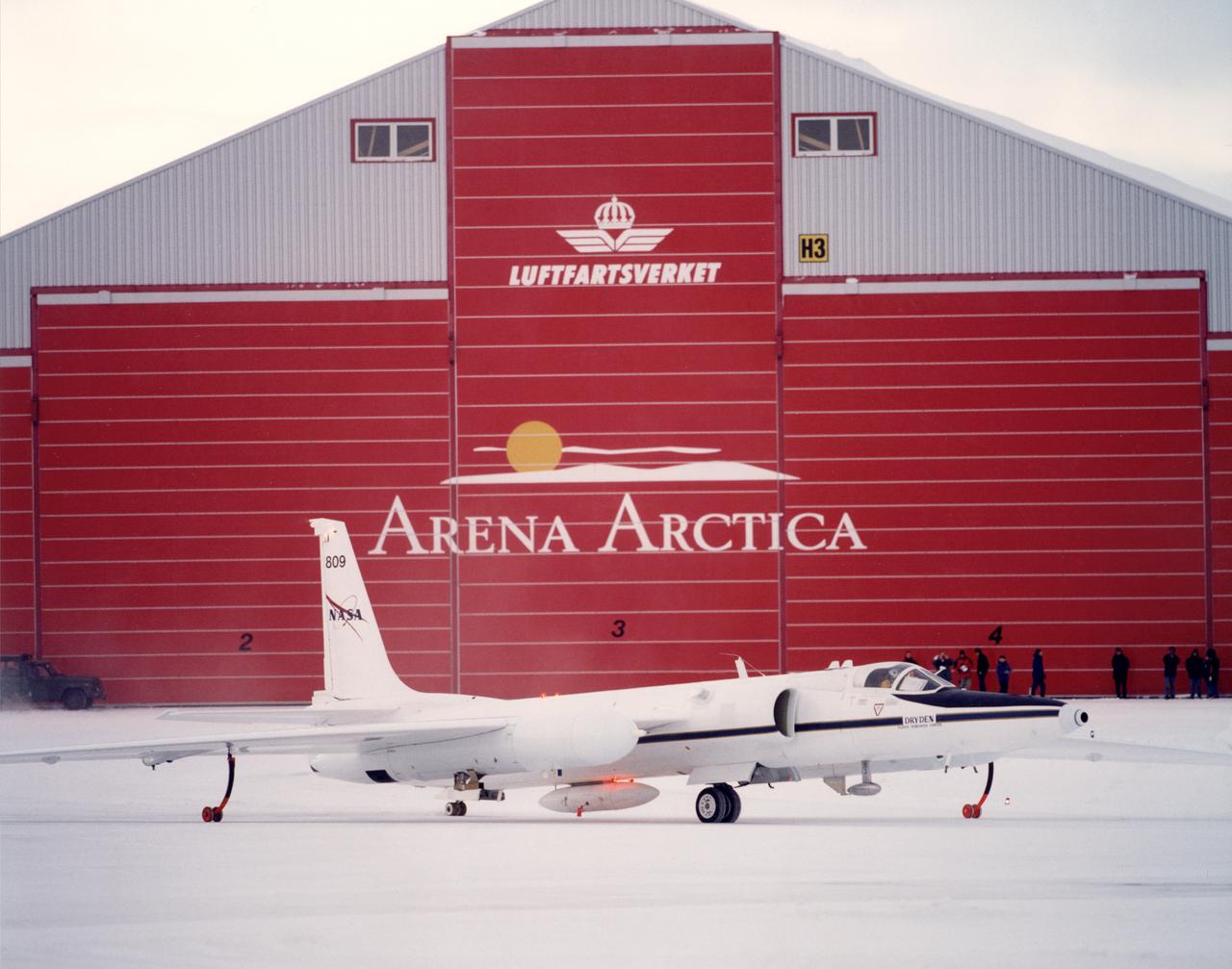
ER-2s bearing tail numbers 806 and 809 are used as airborne science platforms by NASA's Dryden Flight Research Center. The aircraft are platforms for a variety of high-altitude science missions flown over various parts of the world. They are also used for earth science and atmospheric sensor research and development, satellite calibration and data validation. The ER-2s are capable of carrying a maximum payload of 2,600 pounds of experiments in a nose bay, the main equipment bay behind the cockpit, two wing-mounted superpods and small underbody and trailing edges. Most ER-2 missions last about six hours with ranges of about 2,200 nautical miles. The aircraft typically fly at altitudes above 65,000 feet. On November 19, 1998, an ER-2 set a world record for medium weight aircraft reaching an altitude of 68,700 feet. The aircraft is 63 feet long, with a wingspan of 104 feet. The top of the vertical tail is 16 feet above ground when the aircraft is on the bicycle-type landing gear. Cruising speeds are 410 knots, or 467 miles per hour, at altitude. A single General Electric F-118 turbofan engine rated at 17,000 pounds thrust powers the ER-2.

ER-2s bearing tail numbers 806 and 809 are used as airborne science platforms by NASA's Dryden Flight Research Center. The aircraft are platforms for a variety of high-altitude science missions flown over various parts of the world. They are also used for earth science and atmospheric sensor research and development, satellite calibration and data validation. The ER-2s are capable of carrying a maximum payload of 2,600 pounds of experiments in a nose bay, the main equipment bay behind the cockpit, two wing-mounted superpods and small underbody and trailing edges. Most ER-2 missions last about six hours with ranges of about 2,200 nautical miles. The aircraft typically fly at altitudes above 65,000 feet. On November 19, 1998, an ER-2 set a world record for medium weight aircraft reaching an altitude of 68,700 feet. The aircraft is 63 feet long, with a wingspan of 104 feet. The top of the vertical tail is 16 feet above ground when the aircraft is on the bicycle-type landing gear. Cruising speeds are 410 knots, or 467 miles per hour, at altitude. A single General Electric F-118 turbofan engine rated at 17,000 pounds thrust powers the ER-2.
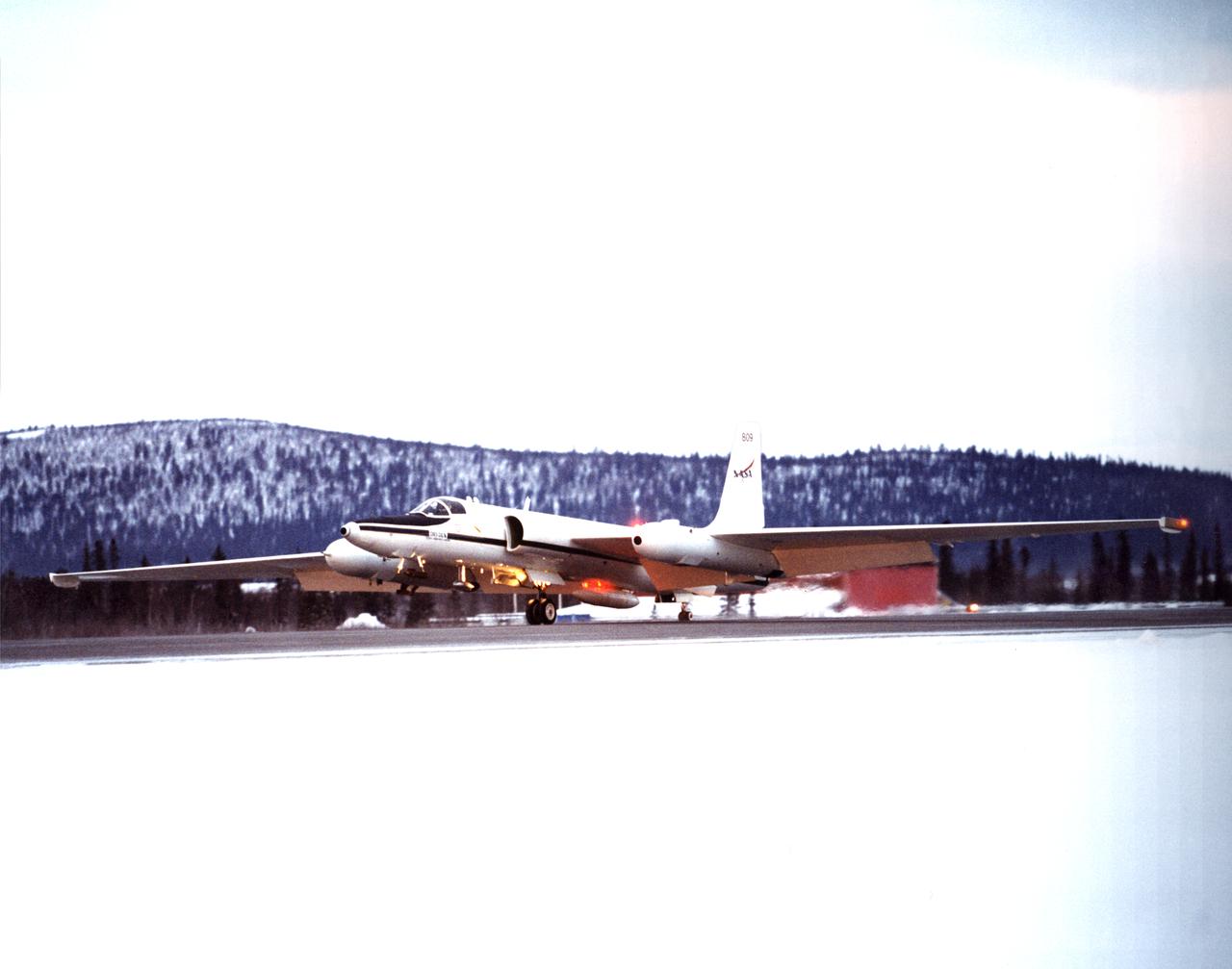
ER-2s bearing tail numbers 806 and 809 are used as airborne science platforms by NASA's Dryden Flight Research Center. The aircraft are platforms for a variety of high-altitude science missions flown over various parts of the world. They are also used for earth science and atmospheric sensor research and development, satellite calibration and data validation. The ER-2s are capable of carrying a maximum payload of 2,600 pounds of experiments in a nose bay, the main equipment bay behind the cockpit, two wing-mounted superpods and small underbody and trailing edges. Most ER-2 missions last about six hours with ranges of about 2,200 nautical miles. The aircraft typically fly at altitudes above 65,000 feet. On November 19, 1998, an ER-2 set a world record for medium weight aircraft reaching an altitude of 68,700 feet. The aircraft is 63 feet long, with a wingspan of 104 feet. The top of the vertical tail is 16 feet above ground when the aircraft is on the bicycle-type landing gear. Cruising speeds are 410 knots, or 467 miles per hour, at altitude. A single General Electric F-118 turbofan engine rated at 17,000 pounds thrust powers the ER-2.
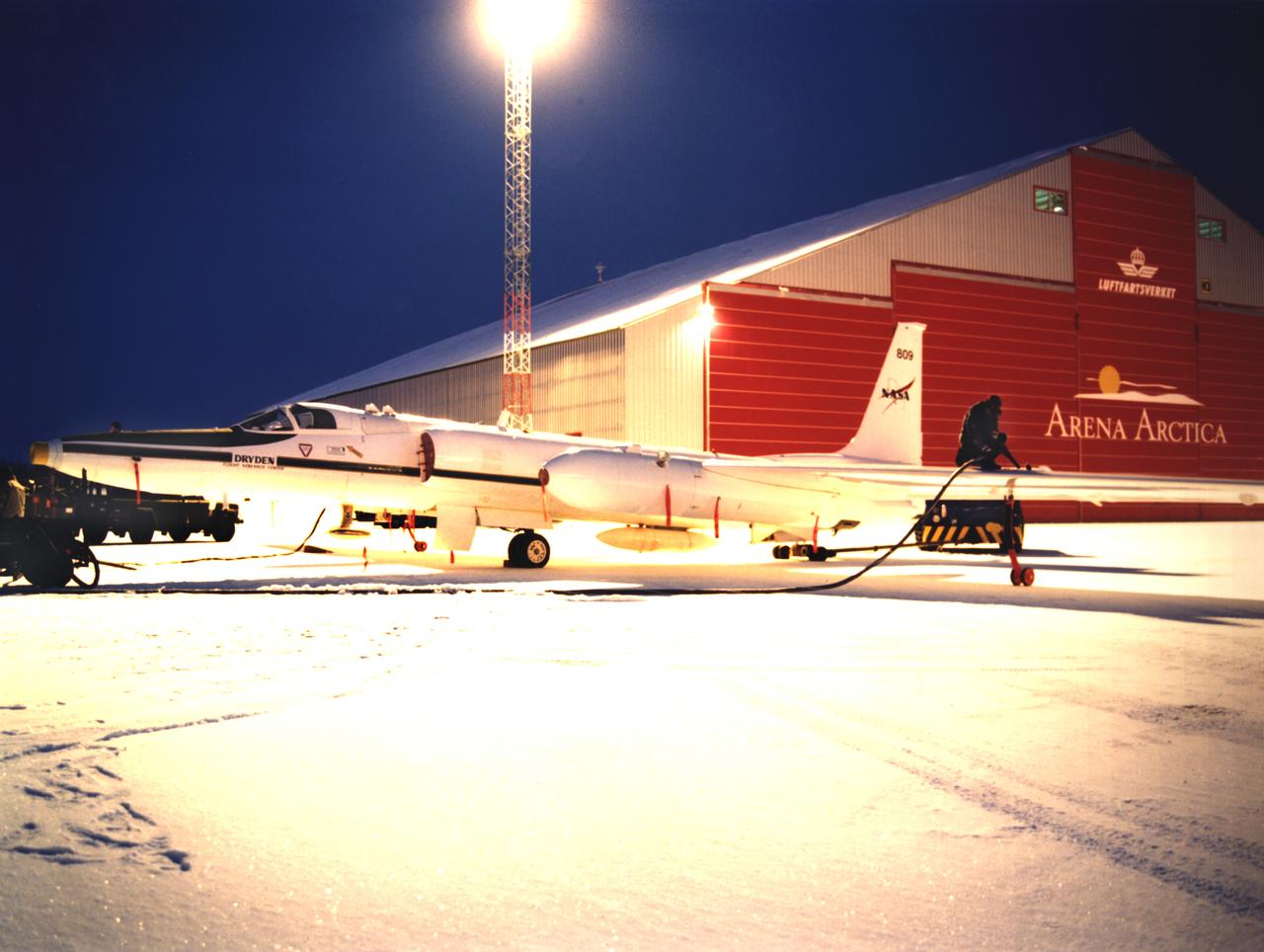
ER-2s bearing tail numbers 806 and 809 are used as airborne science platforms by NASA's Dryden Flight Research Center. The aircraft are platforms for a variety of high-altitude science missions flown over various parts of the world. They are also used for earth science and atmospheric sensor research and development, satellite calibration and data validation. The ER-2s are capable of carrying a maximum payload of 2,600 pounds of experiments in a nose bay, the main equipment bay behind the cockpit, two wing-mounted superpods and small underbody and trailing edges. Most ER-2 missions last about six hours with ranges of about 2,200 nautical miles. The aircraft typically fly at altitudes above 65,000 feet. On November 19, 1998, an ER-2 set a world record for medium weight aircraft reaching an altitude of 68,700 feet. The aircraft is 63 feet long, with a wingspan of 104 feet. The top of the vertical tail is 16 feet above ground when the aircraft is on the bicycle-type landing gear. Cruising speeds are 410 knots, or 467 miles per hour, at altitude. A single General Electric F-118 turbofan engine rated at 17,000 pounds thrust powers the ER-2.
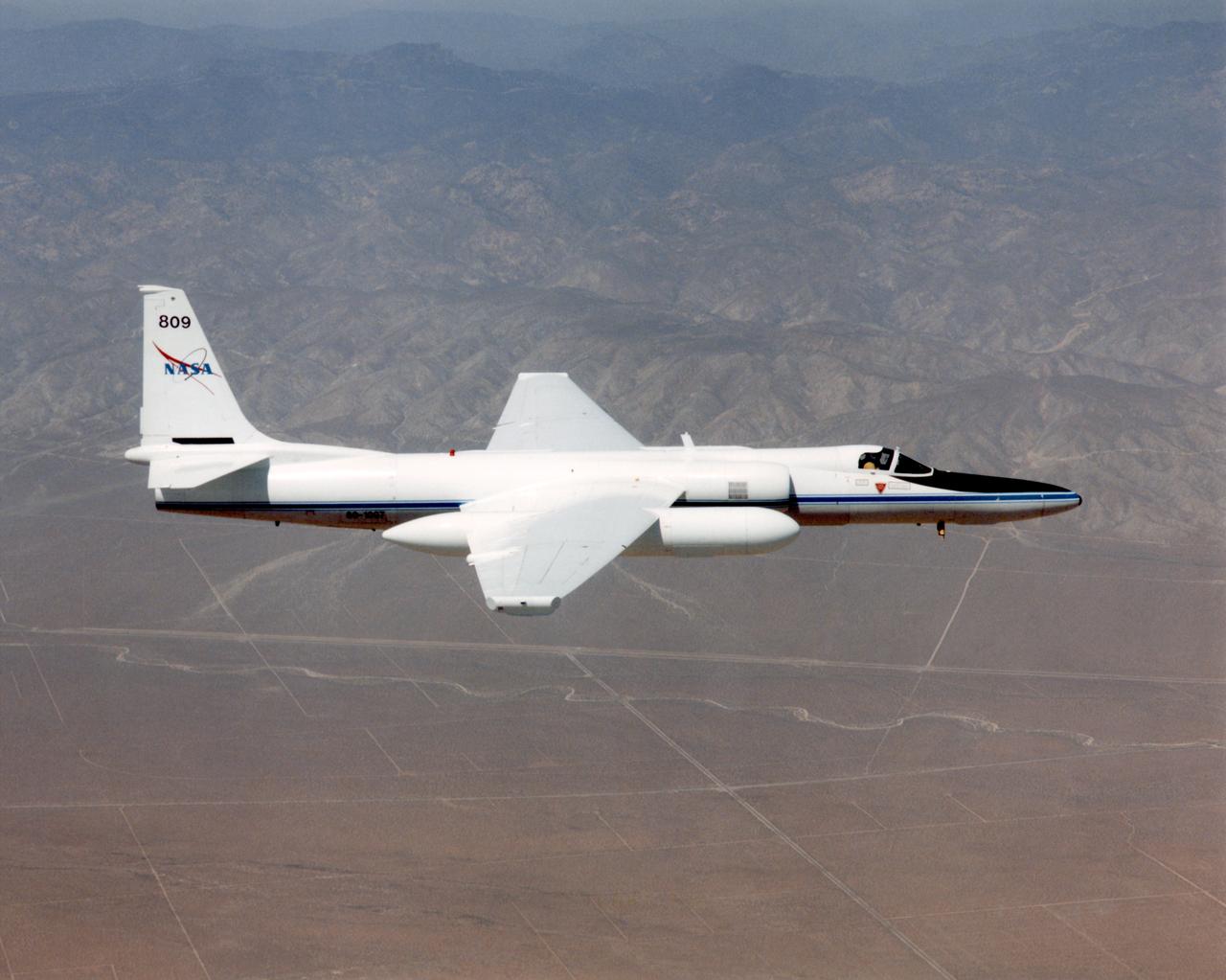
ER-2C tail number 809, was one of two Airborne Science ER-2Cs used as science platforms by Dryden. The aircraft were platforms for a variety of high-altitude science missions flown over various parts of the world. They were also used for earth science and atmospheric sensor research and development, satellite calibration and data validation. The ER-2Cs were capable of carrying a maximum payload of 2,600 pounds of experiments in a nose bay, the main equipment bay behind the cockpit, two wing-mounted superpods and small underbody and trailing edges. Most ER-2C missions lasted about six hours with ranges of about 2,200 nautical miles. The aircraft typically flew at altitudes above 65,000 feet. On November 19, 1998, the ER-2C set a world record for medium weight aircraft reaching an altitude of 68,700 feet. The aircraft was 63 feet long, with a wingspan of 104 feet. The top of the vertical tail was 16 feet above ground when the aircraft was on the bicycle-type landing gear. Cruising speeds were 410 knots, or 467 miles per hour, at altitude. A single General Electric F-118 turbofan engine rated at 17,000 pounds thrust powers the ER-2C.

ER-2 tail number 806, is one of two Airborne Science ER-2s used as science platforms by Dryden. The aircraft are platforms for a variety of high-altitude science missions flown over various parts of the world. They are also used for earth science and atmospheric sensor research and development, satellite calibration and data validation. The ER-2s are capable of carrying a maximum payload of 2,600 pounds of experiments in a nose bay, the main equipment bay behind the cockpit, two wing-mounted superpods and small underbody and trailing edges. Most ER-2 missions last about six hours with ranges of about 2,200 nautical miles. The aircraft typically fly at altitudes above 65,000 feet. On November 19, 1998, the ER-2 set a world record for medium weight aircraft reaching an altitude of 68,700 feet. The aircraft is 63 feet long, with a wingspan of 104 feet. The top of the vertical tail is 16 feet above ground when the aircraft is on the bicycle-type landing gear. Cruising speeds are 410 knots, or 467 miles per hour, at altitude. A single General Electric F-118 turbofan engine rated at 17,000 pounds thrust powers the ER-2.
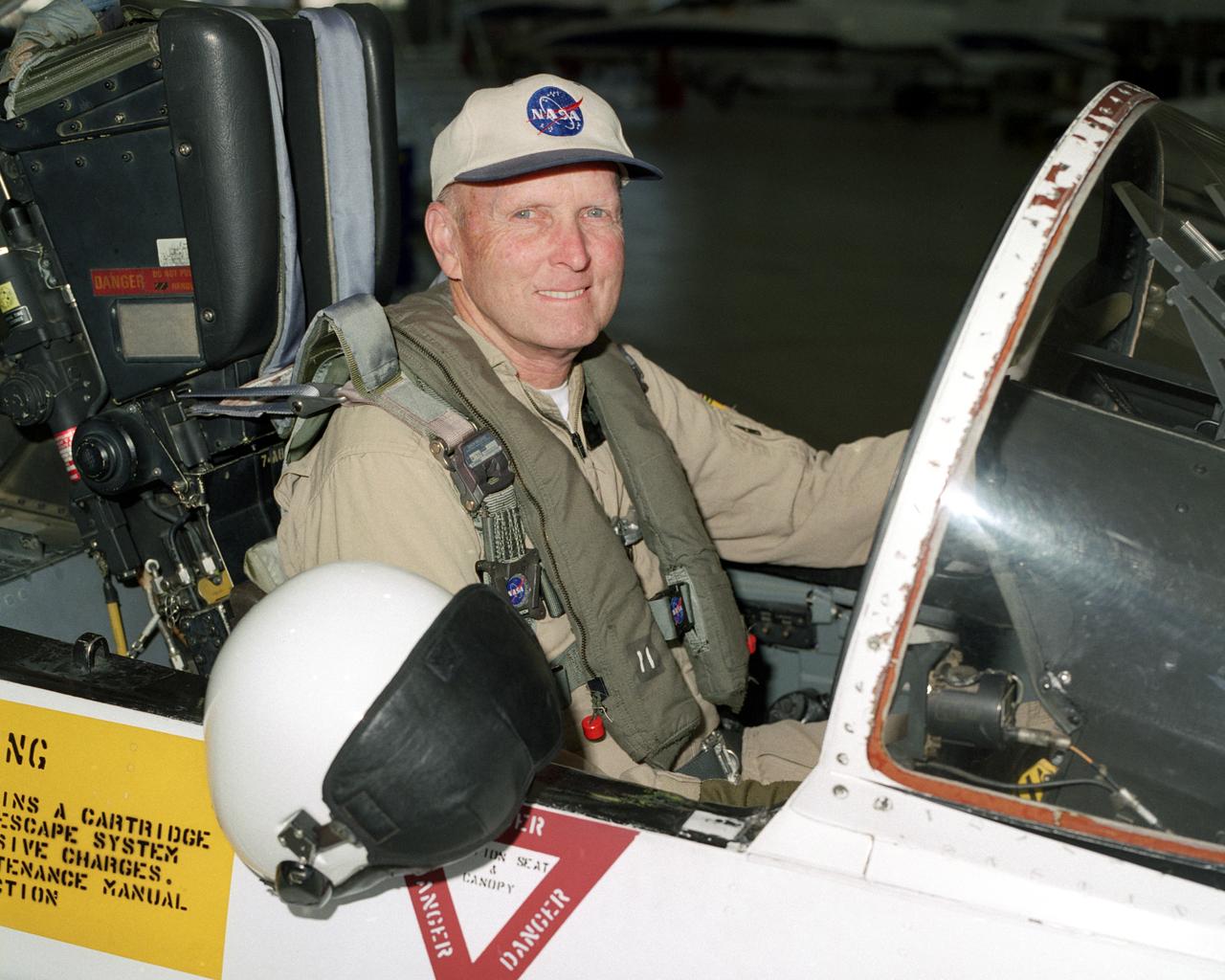
Former NASA astronaut C. Gordon Fullerton, seated in the cockpit of an F/A-18, is a research pilot at NASA's Dryden Flight Research Center, Edwards, Calif. Since transferring to Dryden in 1986, his assignments have included a variety of flight research and support activities piloting NASA's B-52 launch aircraft, the 747 Shuttle Carrier Aircraft (SCA), and other multi-engine and high performance aircraft. He flew a series of development air launches of the X-38 prototype Crew Return Vehicle and in the launches for the X-43A Hyper-X project. Fullerton also flies Dryden's DC-8 Airborne Science aircraft in support a variety of atmospheric physics, ground mapping and meteorology studies. Fullerton also was project pilot on the Propulsion Controlled Aircraft program, during which he successfully landed both a modified F-15 and an MD-11 transport with all control surfaces neutralized, using only engine thrust modulation for control. Fullerton also evaluated the flying qualities of the Russian Tu-144 supersonic transport during two flights in 1998, one of only two non-Russian pilots to fly that aircraft. With more than 15,000 hours of flying time, Fullerton has piloted 135 different types of aircraft in his career. As an astronaut, Fullerton served on the support crews for the Apollo 14, 15, 16, and 17 lunar missions. In 1977, Fullerton was on one of the two flight crews that piloted the Space Shuttle prototype Enterprise during the Approach and Landing Test Program at Dryden. Fullerton was the pilot on the STS-3 Space Shuttle orbital flight test mission in 1982, and commanded the STS-51F Spacelab 2 mission in 1985. He has logged 382 hours in space flight. In July 1988, he completed a 30-year career with the U.S. Air Force and retired as a colonel.
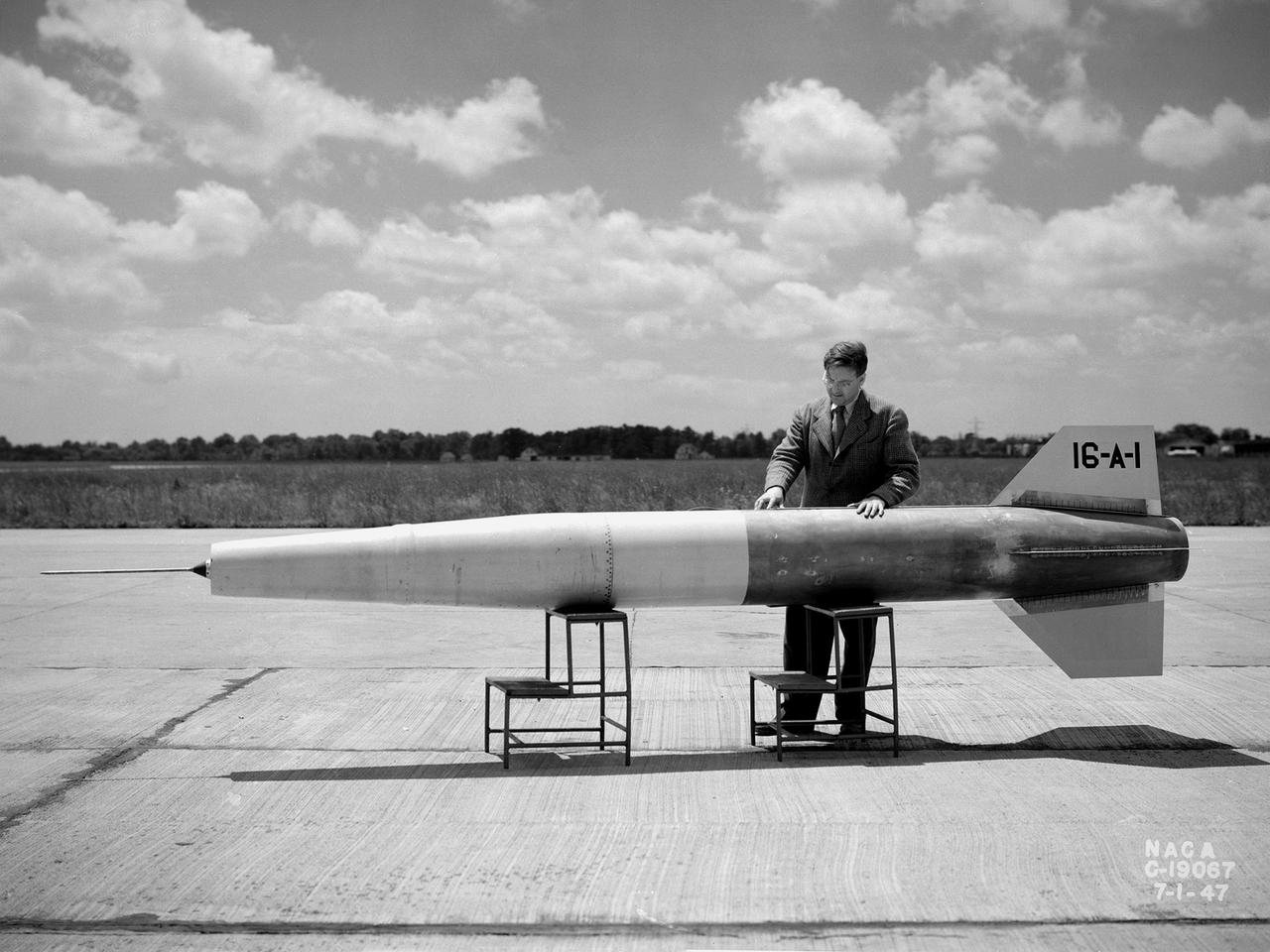
A NACA researcher prepares a 16-inch diameter and 16-foot long ramjet for a launch over Wallops Island in July 1947. The Lewis Flight Propulsion Laboratory conducted a wide variety of studies on ramjets in the 1940s and 1960s to determine the basic operational data necessary to design missiles. Although wind tunnel and test stand investigations were important first steps in determining these factors, actual flight tests were required. Lewis possessed several aircraft for the ramjet studies, including North American F-82 Mustangs, a Northrup P-61 Black Widow, and a Boeing B-29 Superfortress, which was used for this particular ramjet. This was Lewis’ first flight at over the experimental testing ground at Wallops Island. The NACA’s Langley laboratory established the station on the Virginia coast in 1945 to conduct early missile tests. This ramjet-powered missile was affixed underneath the B-29’s left wing and flown up to 29,000 feet. The ramjet was ignited as the aircraft reached Mach 0.5 and released. The flight went well, but a problem with the data recording prevented a successful mission. Nonetheless additional flights in November 1947 provided researchers with data on the engine’s combustion efficiency at different levels of fuel-air ratios, thrust coefficients, temperatures, and drag. Transonic flight data such as the rapid acceleration through varying flight conditions could not be easily captured in wind tunnels.
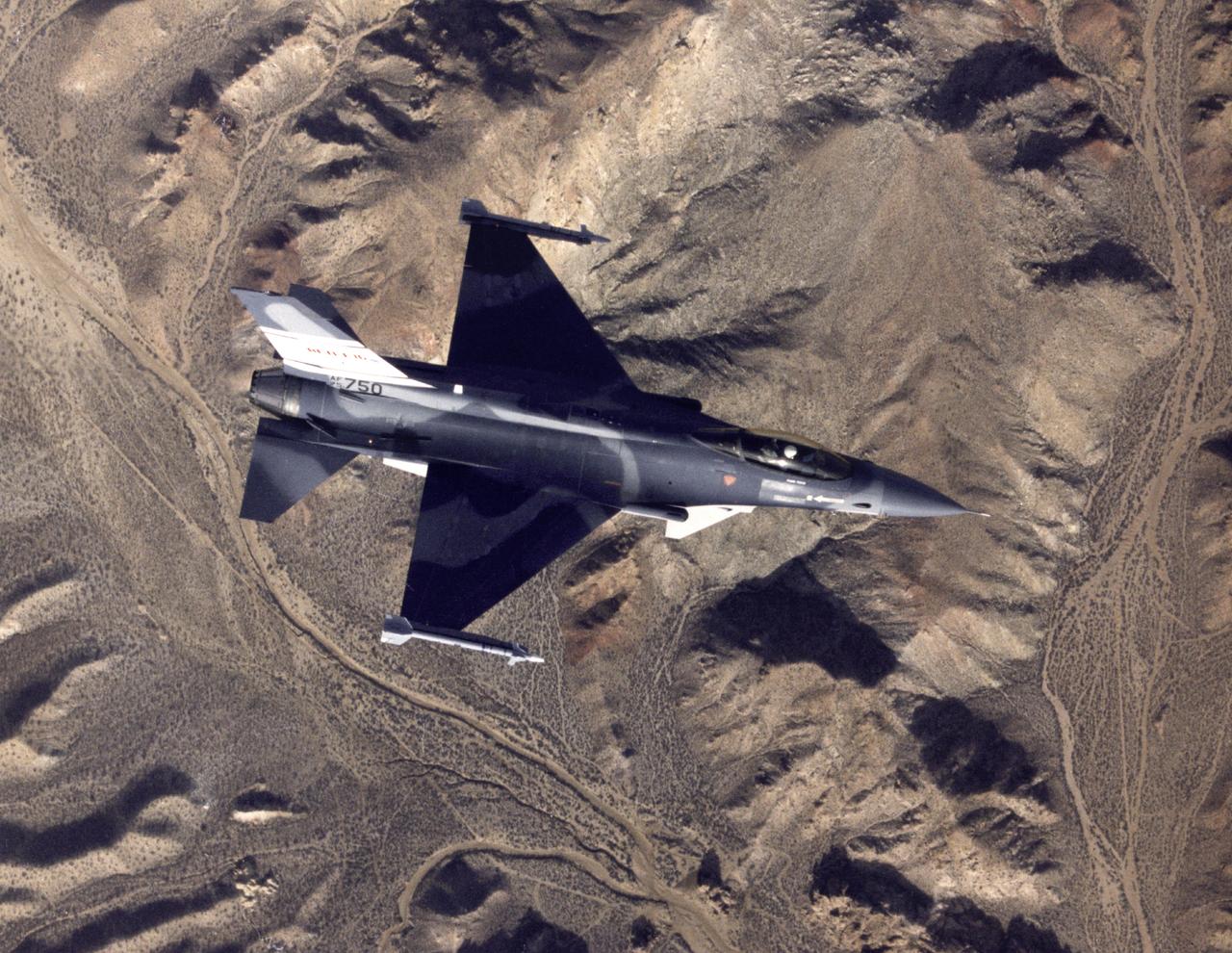
Overhead photograph of the AFTI F-16 painted in a non-standard gray finish, taken during a research flight in 1989. The two sensor pods are visible on the fuselage just forward of the wings and one of the two chin canards can be seen as a light-colored triangle ahead of one of the pods. A Sidewinder air-to-air missile is mounted on each wing tip.
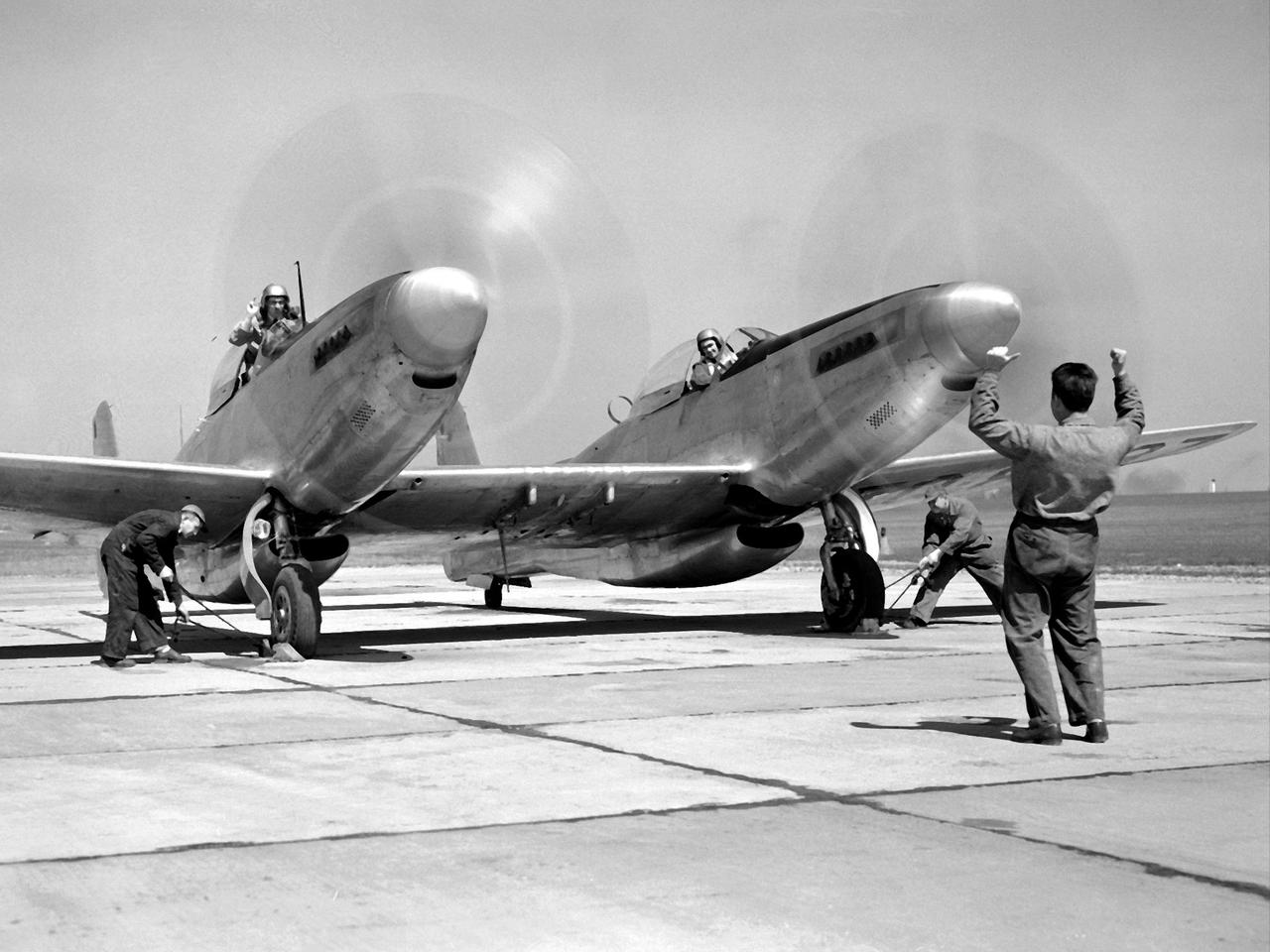
Pilot William Swann, right cockpit, prepares the North American XF-82 Twin Mustang for flight at the National Advisory Committee for Aeronautics (NACA) Lewis Flight Propulsion Laboratory. The aircraft was one of only two prototypes built by North American in October 1945 and powered by Packard Merlin V-1650 piston engines. Over 270 of the F-82 long-distance pursuit fighters were produced during the 1940s. The Mustang’s unique two-pilot configuration allowed one pilot to rest during the long missions and thus be ready for action upon arrival. The NACA took possession of this XF-82 in October 1947. NACA Lewis used the XF-82 as a test bed for ramjet flight tests. Ramjets are continually burning tubes that use the compressed atmospheric air to produce thrust. Ramjets are extremely efficient at high speeds, but rely on some sort of booster to attain that high speed. NACA Lewis undertook an extensive ramjet program in the 1940s that included combustion studies in the Altitude Wind Tunnel, a number of flight tests, and missile drops from aircraft. The 16-inch diameter ramjet missile was fixed to the XF-82 Mustang’s wing and dropped from high altitudes off of Wallops Island. The tests determined the ramjet’s performance and operational characteristics in the transonic range.
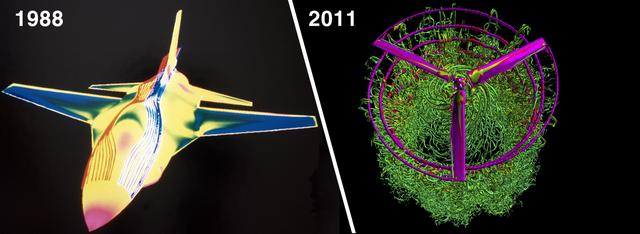
Then and Now: These images illustrate the dramatic improvement in NASA computing power over the last 23 years, and its effect on the number of grid points used for flow simulations. At left, an image from the first full-body Navier-Stokes simulation (1988) of an F-16 fighter jet showing pressure on the aircraft body, and fore-body streamlines at Mach 0.90. This steady-state solution took 25 hours using a single Cray X-MP processor to solve the 500,000 grid-point problem. Investigator: Neal Chaderjian, NASA Ames Research Center At right, a 2011 snapshot from a Navier-Stokes simulation of a V-22 Osprey rotorcraft in hover. The blade vortices interact with the smaller turbulent structures. This very detailed simulation used 660 million grid points, and ran on 1536 processors on the Pleiades supercomputer for 180 hours. Investigator: Neal Chaderjian, NASA Ames Research Center; Image: Tim Sandstrom, NASA Ames Research Center
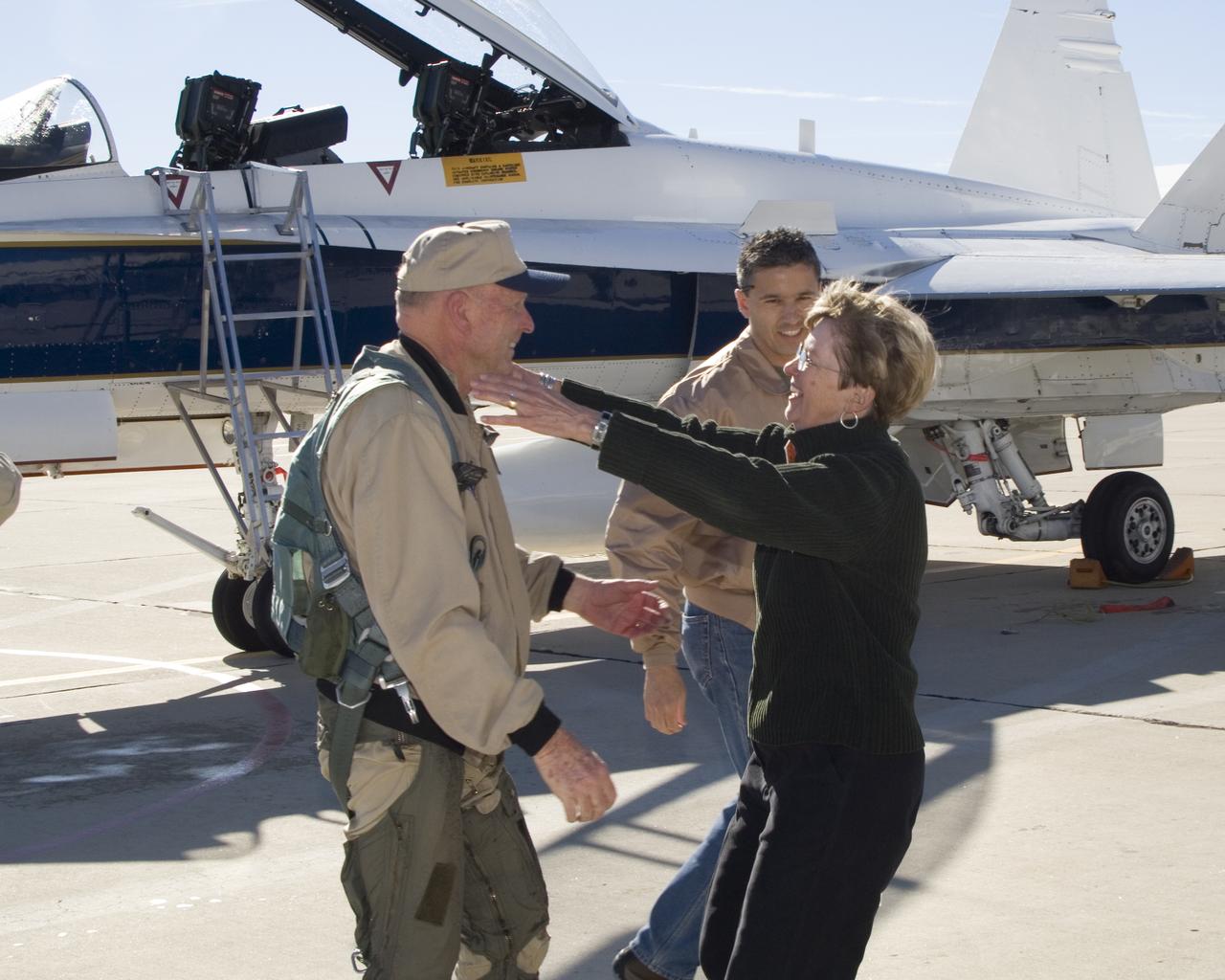
NASA Dryden research pilot Gordon Fullerton is greeted by his wife Marie on the Dryden ramp after his final flight in a NASA F/A-18 on Dec. 21, 2007.
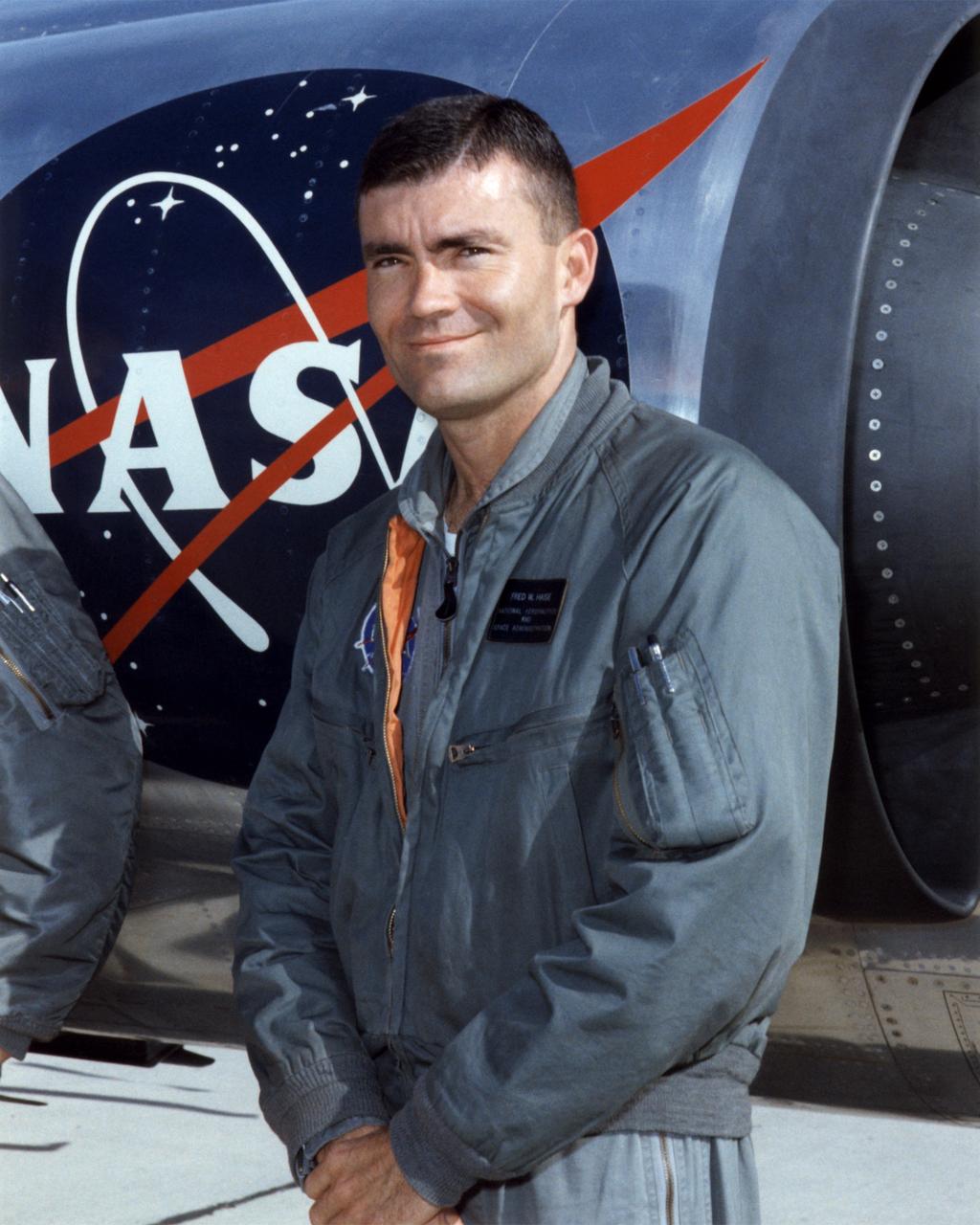
Fred W. Haise Jr. was a research pilot and an astronaut for the National Aeronautics and Space Administration from 1959 to 1979. He began flying at the Lewis Research Center in Cleveland, Ohio (today the Glenn Research Center), in 1959. He became a research pilot at the NASA Flight Research Center (FRC), Edwards, Calif., in 1963, serving NASA in that position for three years until being selected to be an astronaut in 1966 His best-known assignment at the FRC (later redesignated the Dryden Flight Research Center) was as a lifting body pilot. Shortly after flying the M2-F1 on a car tow to about 25 feet on April 22, 1966, he was assigned as an astronaut to the Johnson Space Center in Houston, Texas. While at the FRC he had also flown a variety of other research and support aircraft, including the variable-stability T-33A to simulate the M2-F2 heavyweight lifting body, some light aircraft including the Piper PA-30 to evaluate their handling qualities, the Apache helicopter, the Aero Commander, the Cessna 310, the Douglas F5D, the Lockheed F-104 and T-33, the Cessna T-37, and the Douglas C-47. After becoming an astronaut, Haise served as a backup crewmember for the Apollo 8, 11, and 16 missions. He flew on the aborted Apollo 13 lunar mission in 1970, spending 142 hours and 54 minutes in space before returning safely to Earth. In 1977, he was the commander of three free flights of the Space Shuttle prototype Enterprise when it flew its Approach and Landing Tests at Edwards Air Force Base, Calif. Meanwhile, from April 1973 to January 1976, Haise served as the Technical Assistant to the Manager of the Space Shuttle Orbiter Project. In 1979, he left NASA to become the Vice President for Space Programs with the Grumman Aerospace Corporation. He then served as President of Grumman Technical Services, an operating division of Northrop Grumman Corporation, from January 1992 until his retirement. Haise was born in Biloxi, Miss., on November 14, 1933. He underwent flight traini