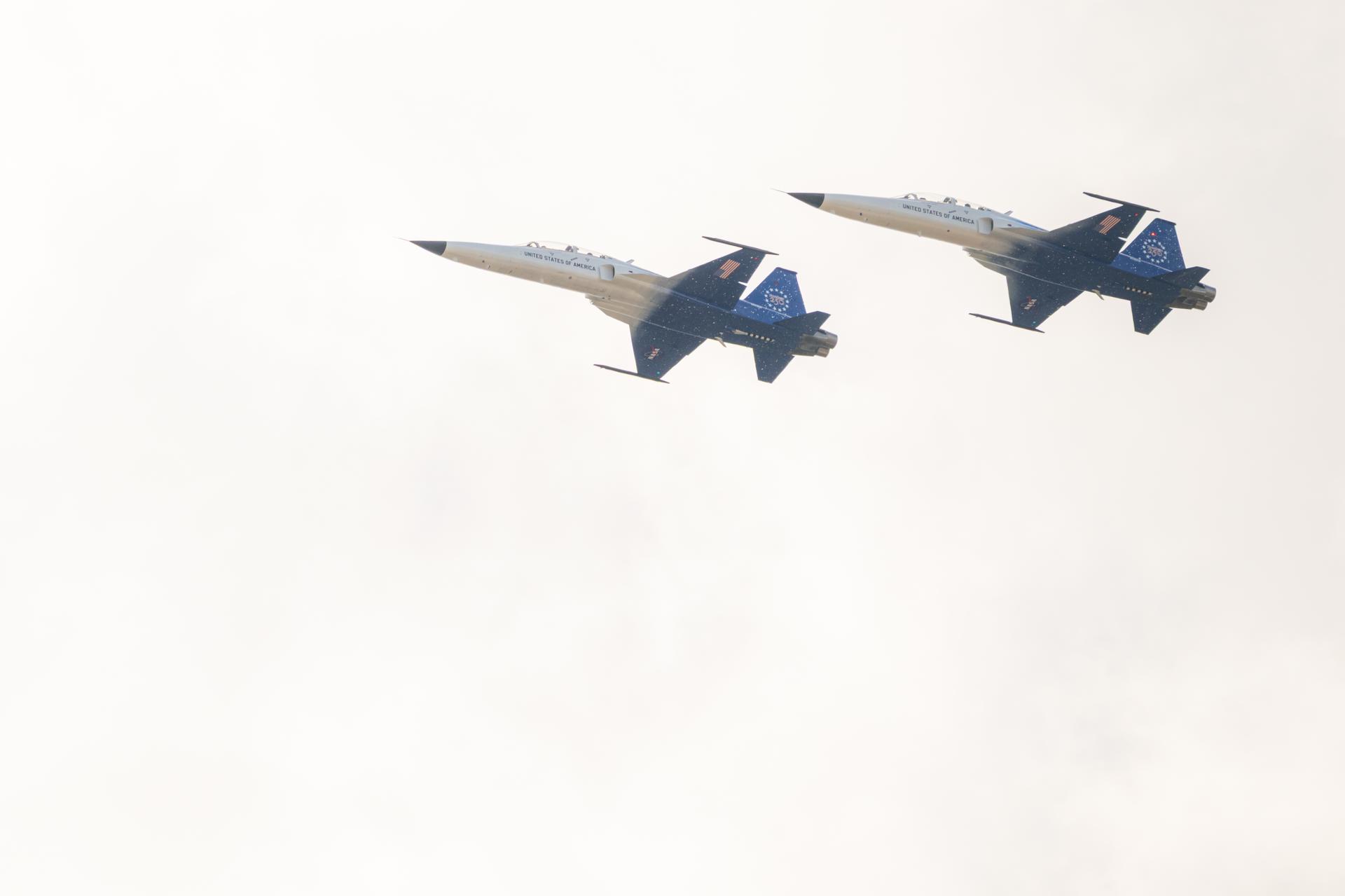
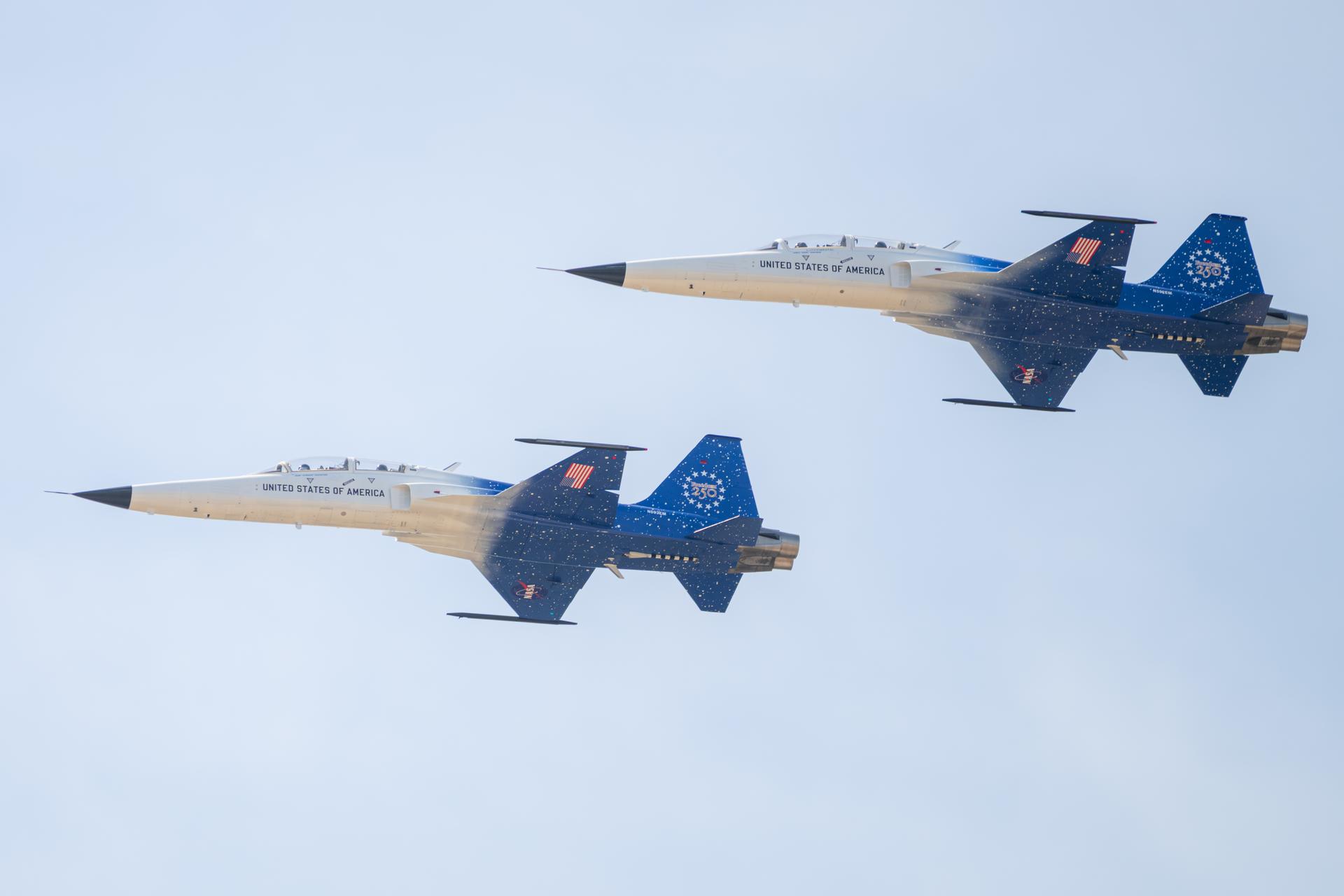
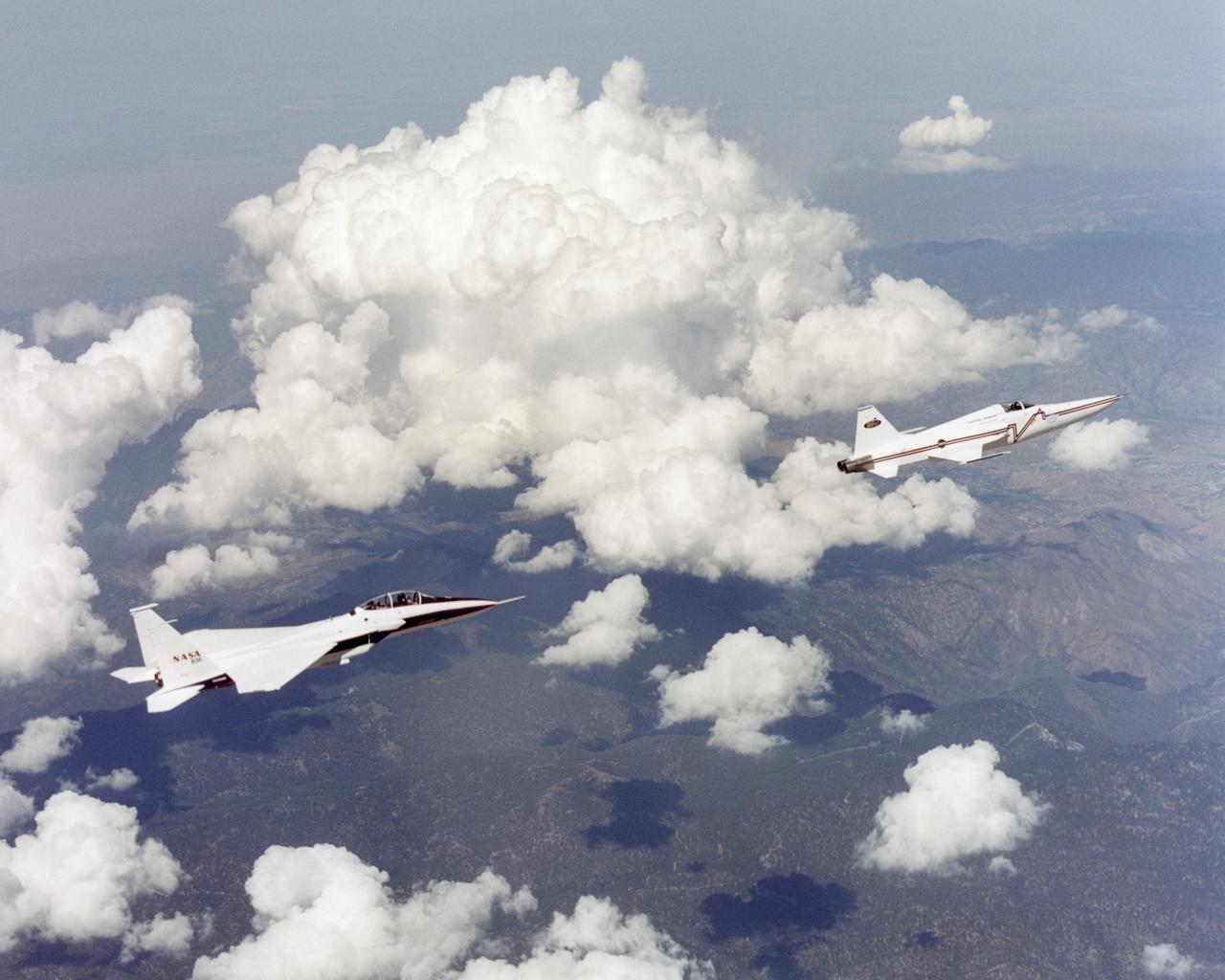
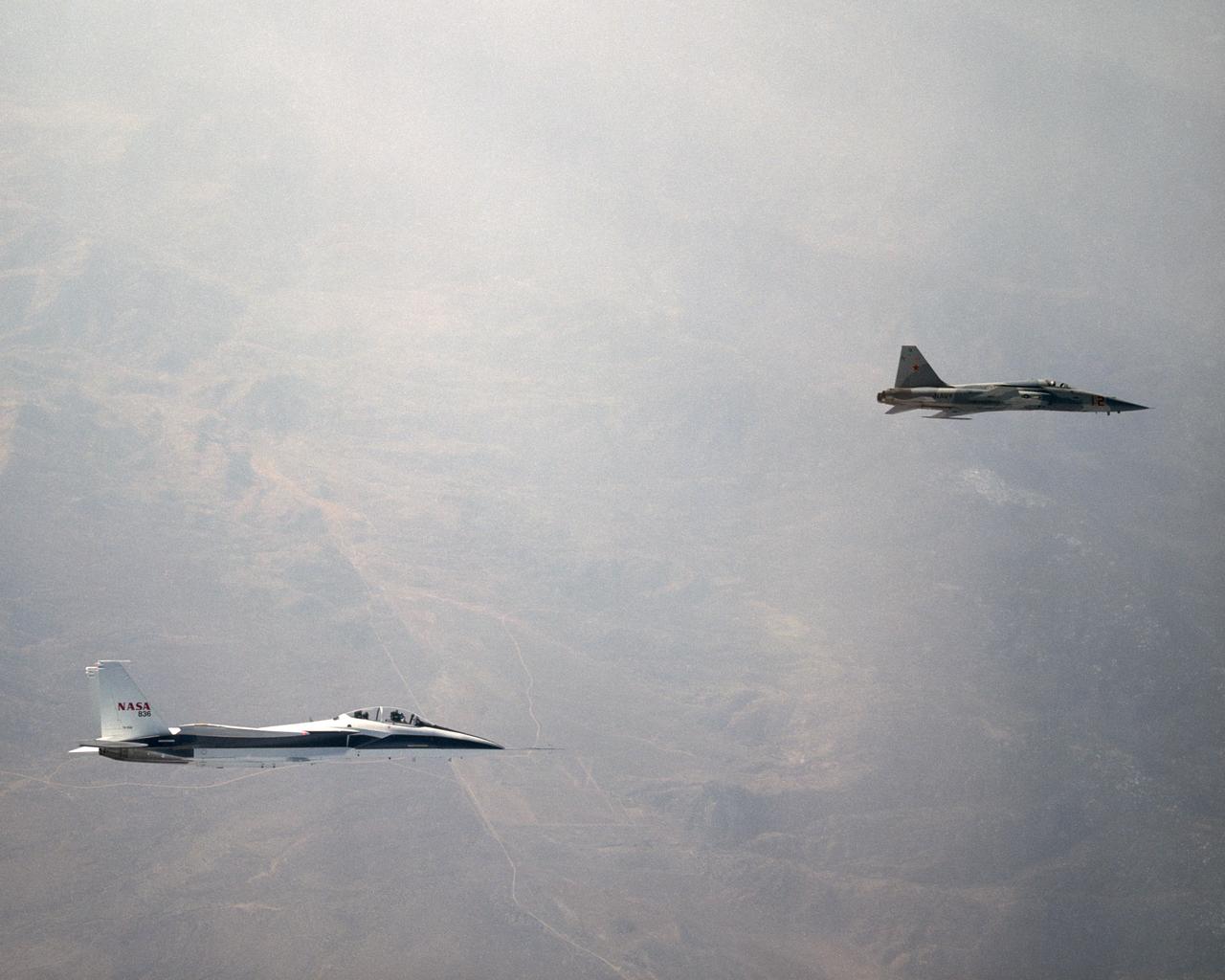
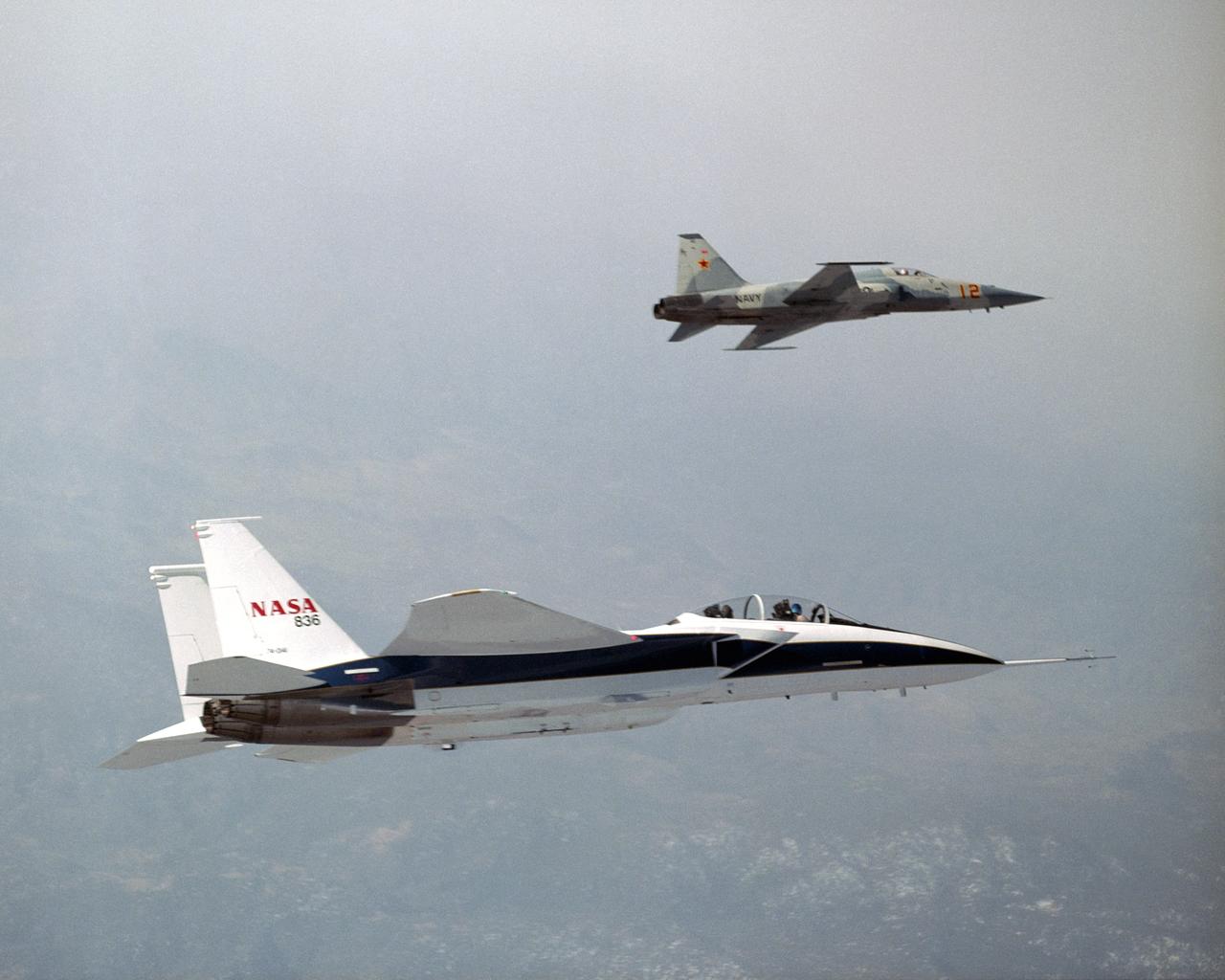
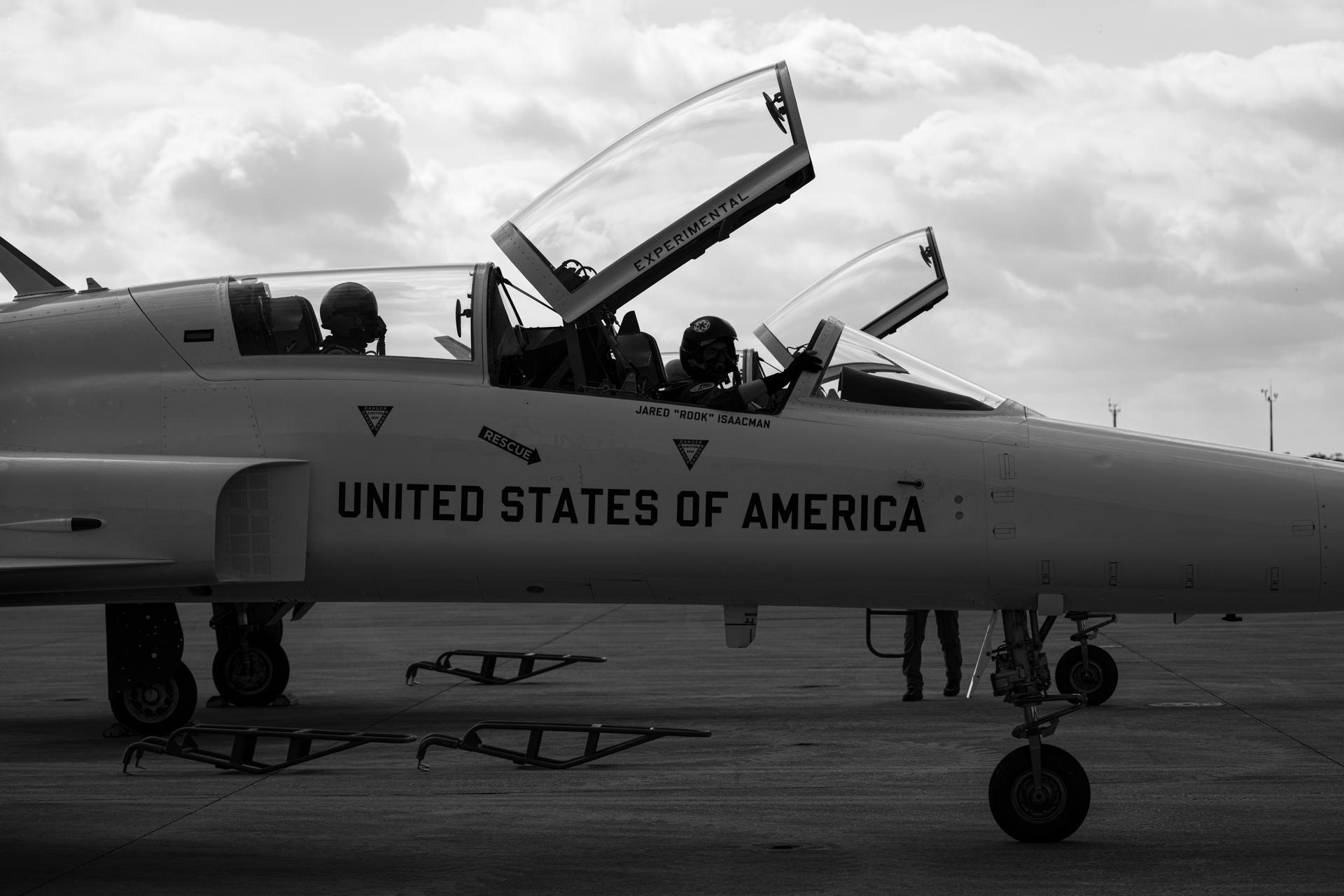
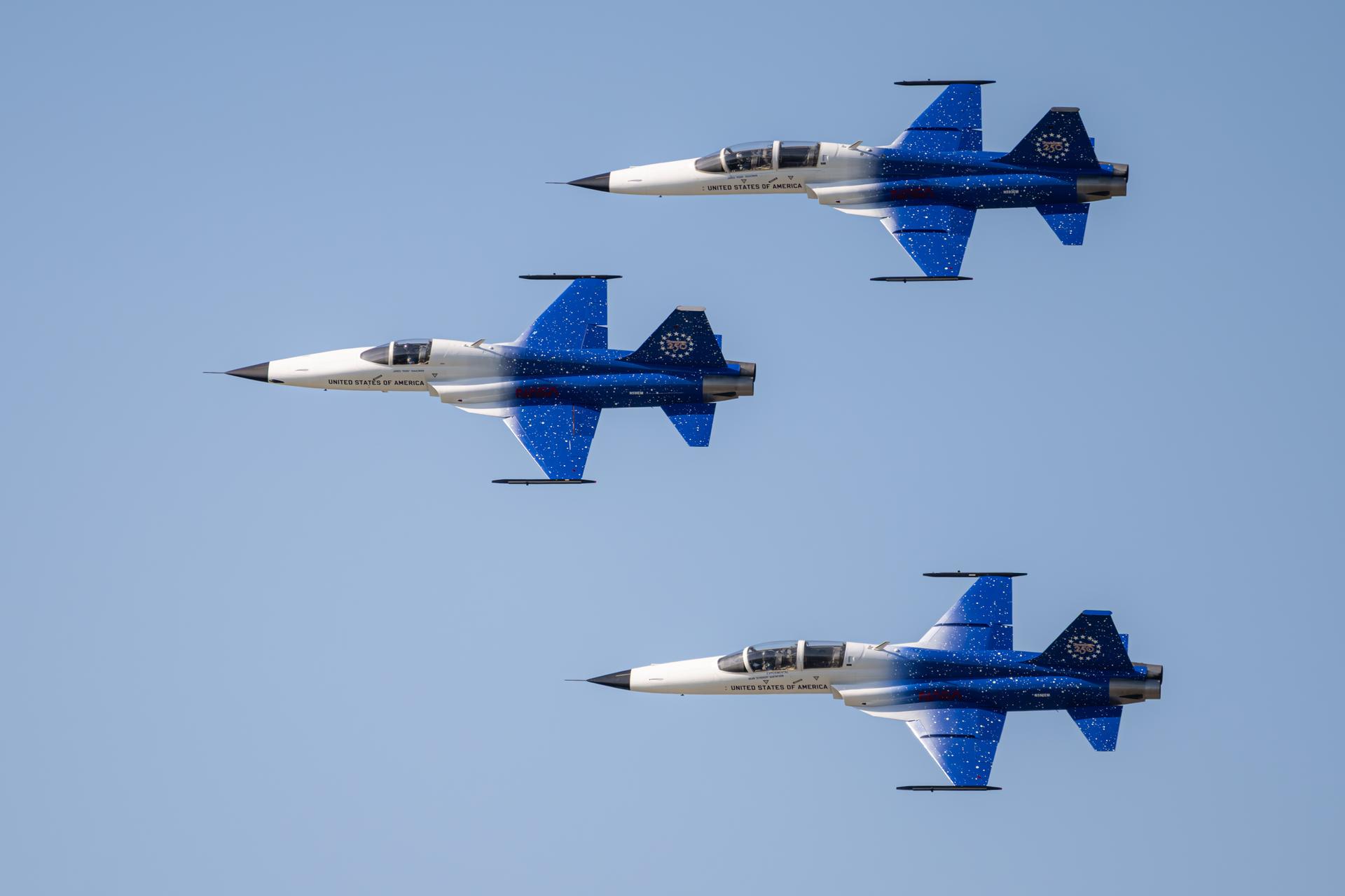
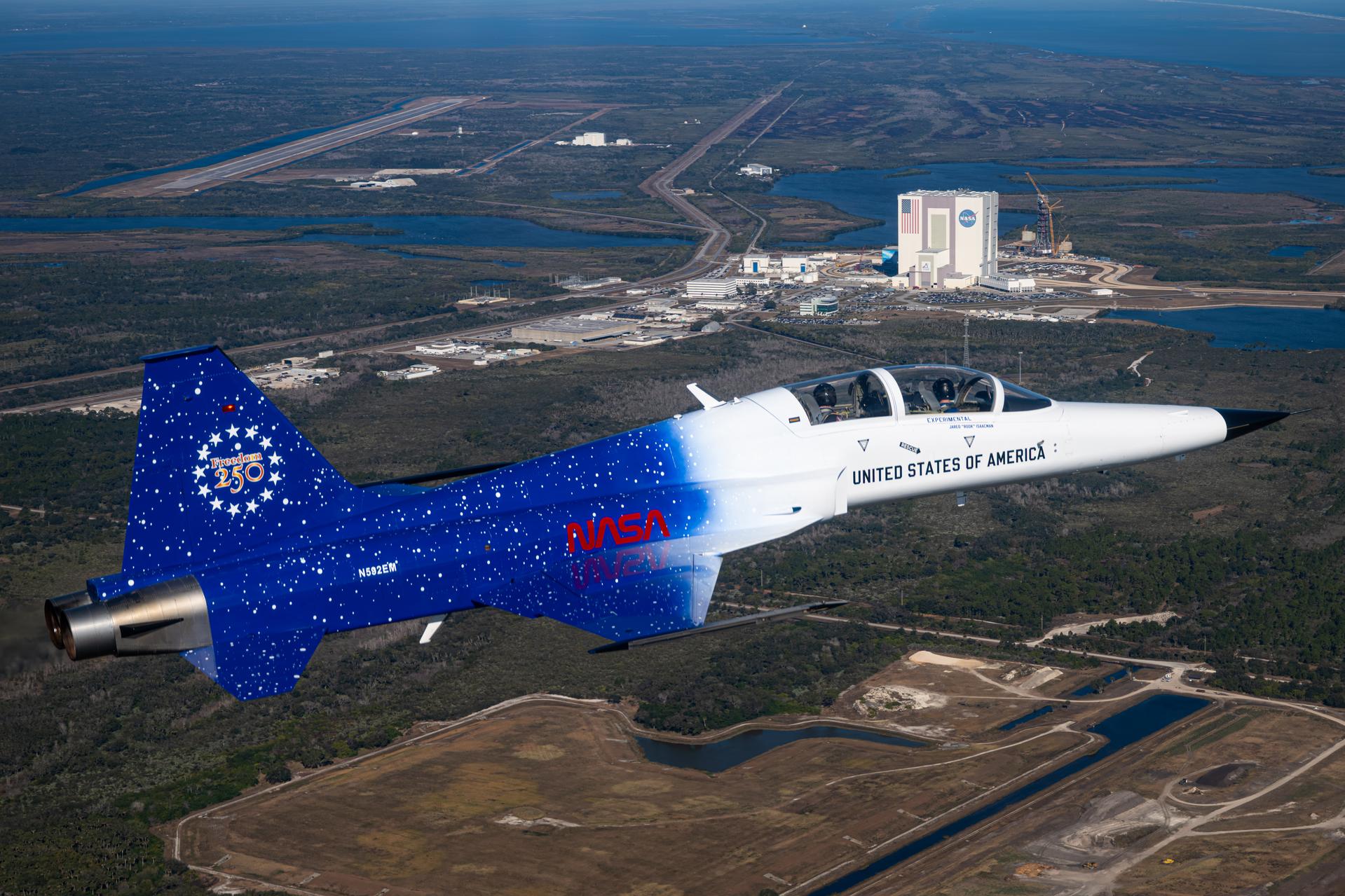
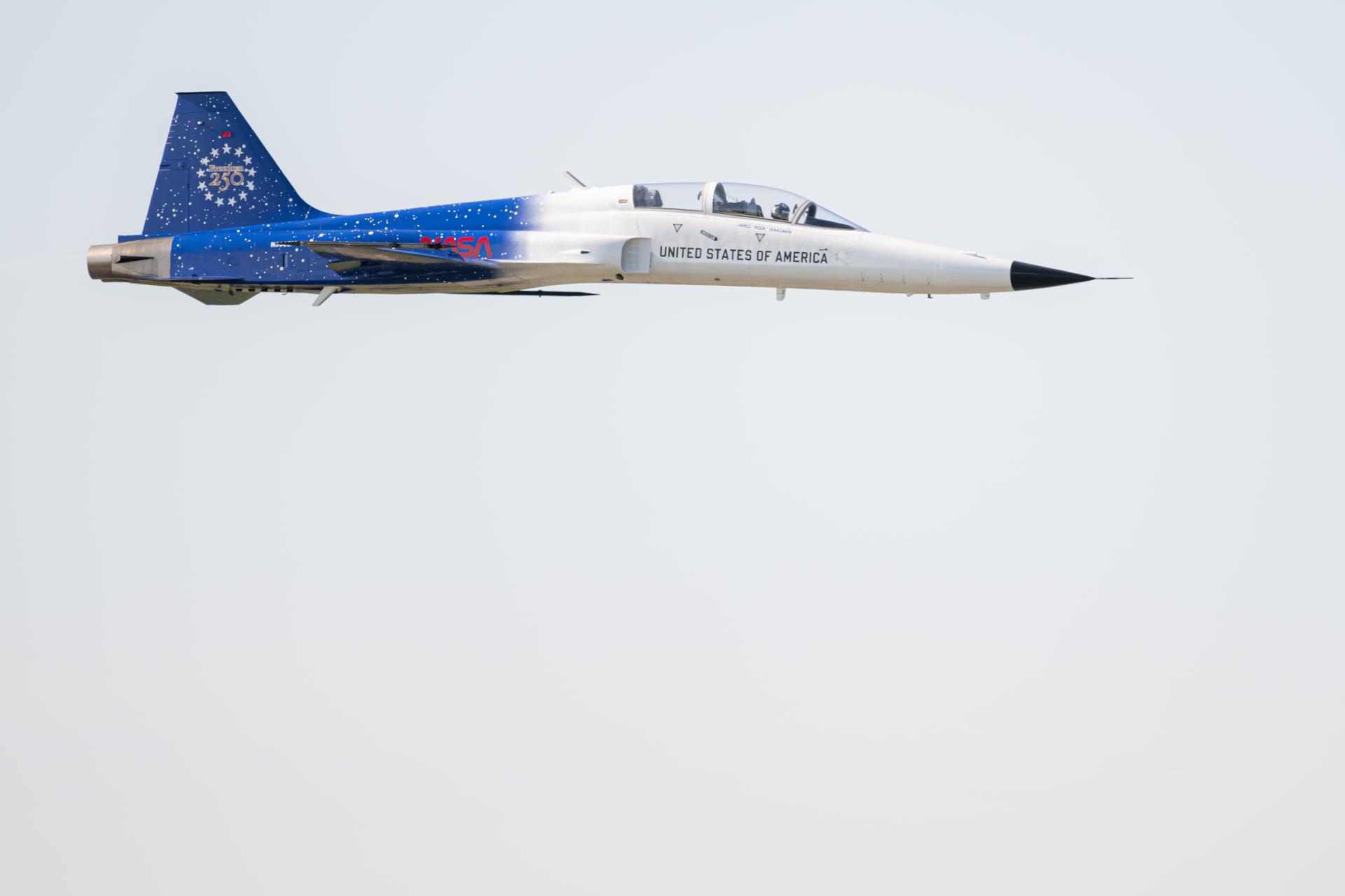
NASA's F-15B research testbed jet from NASA's Dryden Flight Research Center flew in the supersonic shockwave of a Northrop Grumman Corp. modified U.S. Navy F-5E jet in support of the Shaped Sonic Boom Demonstration (SSBD) project, which is part of the DARPA's Quiet Supersonic Platform (QSP) program. On Aug. 27, 2003, the F-5 SSBD aircraft demonstrated a method to reduce the intensity of sonic booms.
NASA's F-15B from the Dryden Flight Research Center flew in the supersonic shockwave of a modified U.S. Navy F-5E jet in support of the Shaped Sonic Boom Demonstration (SSBD) project. On Aug. 27, 2003, the F-5 SSBD aircraft demonstrated a method to reduce
NASA's F-15B Research Testbed aircraft recently flew in the supersonic shock wave of a U.S. Navy F-5E in support of the F-5 Shaped Sonic Boom Demonstration (SSBD) project, part of the Defense Advanced Research Projects Agency's (DARPA) Quiet Supersonic Platform (QSP) program.  The flights originated from the NASA Dryden Flight Research Center at Edwards, California. Four flights were flown in order to measure the F-5E's near-field (close-up) sonic boom signature at Mach 1.4, during which more than 50 shockwave patterns were measured at distances as close as 100 feet below the F-5E.
NASA's F-15B Research Testbed aircraft flies in the supersonic shock wave of a U.S. Navy F-5E as part of the F-5 Shaped Sonic Boom Demonstration (SSBD) project.
NASA's F-15B Research Testbed aircraft recently flew in the supersonic shock wave of a U.S. Navy F-5E in support of the F-5 Shaped Sonic Boom Demonstration (SSBD) project, part of the Defense Advanced Research Projects Agency's (DARPA) Quiet Supersonic Platform (QSP) program.  The flights originated from the NASA Dryden Flight Research Center at Edwards, California. Four flights were flown in order to measure the F-5E's near-field (close-up) sonic boom signature at Mach 1.4, during which more than 50 shockwave patterns were measured at distances as close as 100 feet below the F-5E.
NASA's F-15B Research Testbed aircraft flies in the supersonic shock wave of a U.S. Navy F-5E as part of the F-5 Shaped Sonic Boom Demonstration (SSBD) project.
The Bell X-5 swings its wings in this multiple exposure photograph. Variable-sweep wing technology later appeared on the F-111, F-14 and B-1.
Bell X-5 Wings Sweep
In a lighter mood, Ed Schneider gives a "thumbs-up" after his last flight at the Dryden Flight Research Center on September 19, 2000. Schneider arrived at the NASA Ames-Dryden Flight Research Facility on July 5, 1982, as a Navy Liaison Officer, becoming a NASA research pilot one year later. He has been project pilot for the F-18 High Angle-of-Attack program (HARV), the F-15 aeronautical research aircraft, the NASA B-52 launch aircraft, and the SR-71 "Blackbird" aircraft. He also participated in such programs as the F-8 Digital Fly-By-Wire, the FAA/NASA 720 Controlled Impact Demonstration, the F-14 Automatic Rudder Interconnect and Laminar Flow, and the F-104 Aeronautical Research and Microgravity projects.
Ed Schneider gives a "thumbs-up" after his last flight at the Dryden Flight Research Center
The crew assigned to the STS-51F mission included (kneeling left to right) Gordon Fullerton, commander; and Roy D. Bridges, pilot. Standing, left to right, are mission specialists Anthony W. England, Karl J. Henize, and F. Story Musgrave; and payload specialists Loren W. Acton, and John-David F. Bartoe. Launched aboard the Space Shuttle Challenger on July 29, 1985 at 5:00:00 pm (EDT), the STS-51F mission’s primary payload was the Spacelab-2.
Space Shuttle Projects
From December 10, 1966, until his retirement on February 27, 1976, Stanley P. Butchart served as Chief (later, Director) of Flight Operations at NASA's Flight Research Center (renamed on March 26, 1976, the Hugh L. Dryden Flight Research Center). Initially, his responsibilities in this position included the Research Pilots Branch, a Maintenance and Manufacturing Branch, and an Operations Engineering Branch, the last of which not only included propulsion and electrical/electronic sections but project engineers for the X-15 and lifting bodies. During his tenure, however, the responsibilities of his directorate came to include not only Flight Test Engineering Support but Flight Systems and Loads laboratories. Before becoming Chief of Flight Operations, Butchart had served since June of 1966 as head of the Research Pilots Branch (Chief Pilot) and then as acting chief of Flight Operations. He had joined the Center (then known as the National Advisory Committee for Aeronautics' High-Speed Flight Research Station) as a research pilot on May 10, 1951.  During his career as a research pilot, he flew a great variety of research and air-launch aircraft including the D-558-I, D-558-II, B-29 (plus its Navy version, the P2B), X-4, X-5, KC-135, CV-880, CV-990, B-47, B-52, B-747, F-100A, F-101, F-102, F-104, PA-30 Twin Comanche, JetStar, F-111, R4D, B-720, and B-47. Although previously a single-engine pilot, he became the Center's principal multi-engine pilot during a period of air-launches in which the pilot of the air-launch aircraft (B-29 or P2B) basically directed the operations. It was he who called for the chase planes before each drop, directed the positioning of fire rescue vehicles, and released the experimental aircraft after ensuring that all was ready for the drop.  As pilot of the B-29 and P2B, Butchart launched the X-1A once, the X-1B 13 times, the X-1E 22 times, and the D-558-II 102 times. In addition, he towed the M2-F1 lightweight lifting body 14 times behind an R4
Stan Butchart climbing into B-47
S68-42343 (5 Aug. 1968) --- The prime crew of the first manned Apollo space mission, Apollo 7, stands on the deck of the NASA Motor Vessel Retriever after suiting up for water egress training in the Gulf of Mexico. Left to right, are astronauts Walter Cunningham, Donn F. Eisele, and Walter M. Schirra Jr.
Helicopter - Aircraft
STS061-104-007 (5 Dec 1993) --- Astronaut F. Story Musgrave, holding to one of many strategically placed handrails on the Hubble Space Telescope (HST), is photographed during the first of five extravehicular activity?s (EVA) on the HST-servicing mission, aboard the Space Shuttle Endeavour.
Astronaut Story Musgrave during first of five Hubble Space Telescope EVAs
S66-44497 (23 July 1966) --- Astronauts Charles Conrad Jr. (left) and Richard F. Gordon Jr. (right), prime crew for the Gemini-11 spaceflight, practice water egress procedures in the Gulf of Mexico. Static Article 5 was used in the training exercise. A MSC swimmer is in the water assisting in the training. Photo credit: NASA
GORDON, RICHARD F., ASTRONAUT - TRAINING - GEMINI-TITAN (GT)-11 - WATER EGRESS - GULF
NASA 916, a T-38 jet aircraft, carrying astronauts Vance D. Brand (front         station) and Robert F. Overmyer, heads for Kennedy Space Center in Florida.                 1.  STS-5 - PREFLIGHT              KSC, FL              Also available in 4x5 CN
STS-5 crew in T-38 enroute to Kennedy Space Center
S82-36286 (15 Aug. 1982) --- These four men will be aboard the space shuttle Columbia for NASA's first operational Space Transportation System (STS) mission. They are astronauts Vance D. Brand (second left), STS-5 commander; Robert F. Overmyer (second right), pilot; and Joseph P. Allen (left) and William B. Lenoir, both mission specialists. They pose with a space shuttle model and the official insignia for STS-5. Their flight is scheduled for November of this year. Photo credit: NASA
OFFICIAL PORTRAIT - STS-5 MISSION CREW - JSC
Northrop Grumman Corporation's modified U.S. Navy F-5E Shaped Sonic Boom Demonstration (SSBD) aircraft flies over the company's Palmdale, California facilities on Aug. 2, 2003. NASA Dryden provided range, air and ground data-gathering support for the SSBD project, which is part of DARPA's Quiet Supersonic Platform (QSP) program.
Northrop Grumman Corporation's modified U.S. Navy F-5E Shaped Sonic Boom Demonstration (SSBD) aircraft flies over the company's Palmdale, Calif. facilities on Aug. 2, 2003
NASA's F-15B research testbed jet from the NASA Dryden Flight Research Center flew in the supersonic shockwave of a Northrop Grumman Corp. modified F-5E in support of the Shaped Sonic Boom Demonstration (SSBD) project, which is part of the DARPA's Quiet Supersonic Platform (QSP) program.
NASA's F-15B research testbed jet from the NASA Dryden Flight Research Center flew in the supersonic shockwave of a Northrop Grumman Corp. modified F-5E in support of the Shaped Sonic Boom Demonstration (SSBD) project, which is part of DARPA's Quiet Supers
Northrop-Grumman Corporation's modified U.S. Navy F-5E Shaped Sonic Boom Demonstration (SSBD) aircraft.
Northrop-Grumman Corporation's modified U.S. Navy F-5E Shaped Sonic Boom Demonstration (SSBD) aircraft
Northrop Grumman Corporation's modified U.S. Navy F-5E Shaped Sonic Boom Demonstration (SSBD) aircraft flies over Lake Isabella, California on Aug. 4, 2003. NASA Dryden provided range, air and ground data-gathering support for the SSBD project, which is part of DARPA's Quiet Supersonic Platform (QSP) program.
Northrop Grumman Corporation's modified U.S. Navy F-5E Shaped Sonic Boom Demonstration (SSBD) aircraft flies over Lake Isabella, Calif., on Aug. 4, 2003
In a role-reversal, Northrop Grumman Corp.'s modified F-5E Shaped Sonic Boom Demonstration (SSBD) aircraft flies off the wing of NASA's F-15B Research testbed aircraft. The F-15B, from NASA's Dryden Flight Research Center, flew in the supersonic shockwave of the F-5E as part of the SSBD project. Following the two aircraft is an unmodified U.S. Navy F-5E used for baseline sonic boom measurements.
Northrop Grumman Corp.'s modified F-5E Shaped Sonic Boom Demonstration (SSBD) aircraft flies off the wing of NASA's F-15B Research testbed aircraft.
NASA's F-15B research testbed jet from NASA's Dryden Flight Research Center flew in the supersonic shockwave of a Northrop Grumman Corp. modified U.S. Navy F-5E jet in support of the Shaped Sonic Boom Demonstration (SSBD) project, which is part of the DARPA's Quiet Supersonic Platform (QSP) program.  The project is an effort to lessen sonic booms.  During the recent demonstration, the F-15B flew behind the modified F-5E sonic boom demonstrator aircraft in order to measure the aircraft's sonic boom characteristics.  Flying behind and below the F-5E, and using its specially-instrumented nose boom, the F-15B recorded many shockwave patterns from the F-5E at various distances and orientations from the aircraft.
NASA's F-15B research testbed jet flew in the supersonic shockwave of a Northrop Grumman Corp. - modified U.S. Navy F-5E jet in support of the Shaped Sonic Boom Demonstration project.
NASA's F-15B research testbed jet from NASA's Dryden Flight Research Center flew in the supersonic shockwave of a Northrop Grumman Corp. modified U.S. Navy F-5E jet in support of the Shaped Sonic Boom Demonstration (SSBD) project, which is part of the DARPA's Quiet Supersonic Platform (QSP) program.  The project is an effort to lessen sonic booms.  During the recent demonstration, the F-15B flew behind the modified F-5E sonic boom demonstrator aircraft in order to measure the aircraft's sonic boom characteristics.  Flying behind and below the F-5E, and using its specially-instrumented nose boom, the F-15B recorded many shockwave patterns from the F-5E at various distances and orientations from the aircraft.
NASA's F-15B research testbed jet flew in the supersonic shockwave of a Northrop Grumman Corp. - modified U.S. Navy F-5E jet in support of the Shaped Sonic Boom Demonstration project.
When NASA-NOAA's Suomi NPP satellite passed over Patricia on October 23 at 5:20 a.m. EDT the VIIRS instrument that flies aboard Suomi NPP looked at the storm in infrared light. Cloud top temperatures of thunderstorms around the eyewall were between 180K (-135.7F/ -93.1C) and 190 Kelvin (-117.7F/ -83.1C). Credit: UW/CIMSS/William Straka III Read more: <a href="http://www.nasa.gov/f…/goddard/patricia-eastern-pacific-2015" rel="nofollow">www.nasa.gov/f…/goddard/patricia-eastern-pacific-2015</a>
NASA Analyzes Record-Breaking Hurricane Patricia
In this 1962 artist's concept , a proposed Nova rocket, shown at right, is compared to a Saturn C-1, left, and a Saturn C-5, center. The Marshall Space Flight Center directed studies of Nova configuration from 1960 to 1962 as a means of achieving a marned lunar landing with a direct flight to the Moon. Various configurations of the vehicle were examined, the largest being a five-stage vehicle using eight F-1 engines in the first stage. Although the program was effectively cancelled in 1962 when NASA planners selected the lunar-orbital rendezvous mode, the proposed F-1 engine was eventually used to propel the first stage of the Saturn V launch vehicle in the Apollo Program.
Early Program Development
A relentless heat wave has blanketed India and Pakistan since mid-March 2022, causing dozens of deaths, fires, increased air pollution, and reduced crop yields. NASA's Ecosystem Spaceborne Thermal Radiometer Experiment on Space Station instrument (ECOSTRESS) has been measuring these temperatures from space, at the highest spatial resolution of any satellite instrument.  This image, taken shortly before local midnight on May 5, shows urban areas and agricultural lands northwest of Delhi that are home to about 28 million people. The image covers about 4,800 square miles (12,350 square kilometers).  Cities are usually markedly warmer than the surrounding countryside due to human activities and the materials used in the built environment. The image clearly delineates these urban "heat islands." Nighttime temperatures in Delhi and several smaller villages were above 95 degrees Fahrenheit (35 degrees Celsius), peaking at about 102 degrees F (39 degrees C), while the rural fields nearby had cooled to around 60 degrees F (15 degrees C). This data suggests that city dwellers are experiencing considerably higher temperatures than the average temperatures reported for their regions.  ECOSTRESS measures the temperature of the ground itself, which is very similar to air temperature at night (though the ground may be warmer than the air in daylight hours). The instrument launched to the space station in 2018. Its primary mission is to identify plants' thresholds for water use and water stress, giving insight into their ability to adapt to a warming climate. However, ECOSTRESS also records other heat-related phenomena like this heat wave. Its high-resolution images, with a pixel size of about 225 feet (70 meters) by 125 feet (38 meters), are a powerful tool for understanding aspects of the weather event that might be overlooked by traditional observation networks.  https://photojournal.jpl.nasa.gov/catalog/PIA24987
ECOSTRESS Detects Heat Islands in Indian Heat Wave
STS005-06-210 (16 Nov. 1982) --- Astronaut Vance D. Brand (in dark blue shirt), STS-5 commander; Robert F. Overmyer (left), pilot; and William B. Lenoir, mission specialist, conduct microgravity experiments with food containers and meal tray assemblies in front of middeck port side wall and side hatch. Brand prepares to eat as meal tray assembly floats above his chest and Overmeyer and Lenoir look on. Sign on port side wall is labeled STS-5 message board. Photo credit: NASA
STS-5 crewmembers with meal tray assembly on middeck
Famed astronaut Neil A. Armstrong, the first man to set foot on the moon during the historic Apollo 11 space mission in July 1969, served for seven years as a research pilot at the NACA-NASA High-Speed Flight Station, now the Dryden Flight Research Center, at Edwards, California, before he entered the space program.  Armstrong joined the National Advisory Committee for Aeronautics (NACA) at the Lewis Flight Propulsion Laboratory (later NASA's Lewis Research Center, Cleveland, Ohio, and today the Glenn Research Center) in 1955. Later that year, he transferred to the High-Speed Flight Station at Edwards as an aeronautical research scientist and then as a pilot, a position he held until becoming an astronaut in 1962. He was one of nine NASA astronauts in the second class to be chosen.  As a research pilot Armstrong served as project pilot on the F-100A and F-100C aircraft, F-101, and the F-104A. He also flew the X-1B, X-5, F-105, F-106, B-47, KC-135, and Paresev. He left Dryden with a total of over 2450 flying hours. He was a member of the USAF-NASA Dyna-Soar Pilot Consultant Group before the Dyna-Soar project was cancelled, and studied X-20 Dyna-Soar approaches and abort maneuvers through use of the F-102A and F5D jet aircraft.  Armstrong was actively engaged in both piloting and engineering aspects of the X-15 program from its inception. He completed the first flight in the aircraft equipped with a new flow-direction sensor (ball nose) and the initial flight in an X-15 equipped with a self-adaptive flight control system. He worked closely with designers and engineers in development of the adaptive system, and made seven flights in the rocket plane from December 1960 until July 1962. During those fights he reached a peak altitude of 207,500 feet in the X-15-3, and a speed of 3,989 mph (Mach 5.74) in the X-15-1.  Armstrong has a total of 8 days and 14 hours in space, including 2 hours and 48 minutes walking on the Moon. In March 1966 he was commander of the Gemini 8 or
E56-2607
Deputy Director Colleen Hartman  from NASA Goddard Space Flight Center looks on as Kamal Amiral, 5, of Arlington, Va., looks at the moon through a telescope  during a stargazing event at Hoffman-Boston Elementary School in Arlington, Va. on Thursday, Nov. 7, 2013. NASA Administrator Charles F. Bolden is also pictured. Photo Credit: (NASA/Jay Westcott)
Star Party
Acting NASA Administrator Robert Lightfoot listens to remarks by panelists during the National Space Council's first meeting, Thursday, Oct. 5, 2017 at the Smithsonian National Air and Space Museum's Steven F. Udvar-Hazy Center in Chantilly, Va. The National Space Council, chaired by Vice President Mike Pence heard testimony from representatives from civil space, commercial space, and national security space industry representatives.  Photo Credit: (NASA/Joel Kowsky)
National Space Council Meeting
Members of the National Space Council are seen during the council's first meeting, Thursday, Oct. 5, 2017 at the Smithsonian National Air and Space Museum's Steven F. Udvar-Hazy Center in Chantilly, Va. The National Space Council, chaired by Vice President Mike Pence heard testimony from representatives from civil space, commercial space, and national security space industry representatives.  Photo Credit: (NASA/Joel Kowsky)
National Space Council Meeting
On November 22, 1989, at 7:23:30pm (EST), 5 astronauts were launched into space aboard the Space Shuttle Orbiter Discovery for the 5th Department of Defense mission, STS-33. Photographed from left to right are Kathryn C. Thornton, mission specialist 3; Manley L. (Sonny) Carter, mission specialist 2; Frederick D. Gregory, commander; John E. Blaha, pilot; and F. Story Musgrave, mission specialist 1.
Space Shuttle Projects
STS79-E-5180 (20 September 1996) --- The entire crews of STS-79 and Mir-22 are shown during a gift exchange ceremony aboard Russia's Mir Space Station's Base Block, during Flight Day 5.  Front row, from the left, John E. Blaha, Jerome (Jay) Apt, Carl E. Walz, Thomas D. Akers, Shannon W. Lucid, William F. Readdy and Valeri G. Korzun.  Back row: Terrence W. Wilcutt and Aleksandr Y. Kaleri.
STS-79 and Mir 22 gift exchange ceremony
Vice President Mike Pence delivers opening remarks during the National Space Council's first meeting, Thursday, Oct. 5, 2017 at the Smithsonian National Air and Space Museum's Steven F. Udvar-Hazy Center in Chantilly, Va. The National Space Council, chaired by Vice President Mike Pence heard testimony from representatives from civil space, commercial space, and national security space industry representatives.  Photo Credit: (NASA/Joel Kowsky)
National Space Council Meeting
Acting NASA Administrator Robert Lightfoot answers questions from reporters following the National Space Council's first meeting, Thursday, Oct. 5, 2017 at the Smithsonian National Air and Space Museum's Steven F. Udvar-Hazy Center in Chantilly, Va. The National Space Council, chaired by Vice President Mike Pence heard testimony from representatives from civil space, commercial space, and national security space industry representatives.  Photo Credit: (NASA/Joel Kowsky)
National Space Council Meeting
S85-40173 (5 Sept. 1985) --- In Johnson Space Center’s (JSC) Astronaut Office, astronaut F. Richard (Dick) Scobee, STS-51L mission commander, takes a break from training for his upcoming space mission.    EDITOR’S NOTE: The STS-51L crew members lost their lives in the space shuttle Challenger accident moments after launch on Jan. 28, 1986 from the Kennedy Space Center (KSC). Photo credit: NASA
CREW TRAINING - STS-33/51-L
NASA Administrator Charles F. Bolden, center, stands with two unidentified students as he performs a demonstration to illustrate how far the International Space Station is from the Earth in comparison with the Moon, during an event where students spoke via downlink to astronauts on the ISS, Thursday, Nov. 5, 2009, at the U.S. Department of Education in Washington. Photo Credit: (NASA/Paul E. Alers)
Department of Education ISS Link
51I-102-048 (4-5 Sept 1985) --- A 35mm frame showing astronaut William F. Fisher standing on the edge of Discovery's cargo bay (in foot restraint) during the second day of a two-day effort to capture, repair and re-release the Syncom IV-3 communications satellite.  Astronaut James D. van Hoften, standing on the Discovery's RMS arm, exposed the frame.
Astronaut William Fisher anchored to foot restraint on Discovery
During super-close flybys of Saturn's rings, NASA's Cassini spacecraft inspected the mini-moons Pan and Daphnis in the A ring; Atlas at the edge of the A ring; Pandora at the edge of the F ring; and Epimetheus, which is bathed in material that fans out from the moon Enceladus. The mini-moons' diameter ranges from 5 miles (8 kilometers) for Daphnis to 72 miles (116 kilometers) for Epimetheus.  The rings and the moons depicted in this illustration are not to scale.  https://photojournal.jpl.nasa.gov/catalog/PIA22772
Cassini Moons Flybys
Vice President Mike Pence is seen during the National Space Council's first meeting, Thursday, Oct. 5, 2017 at the Smithsonian National Air and Space Museum's Steven F. Udvar-Hazy Center in Chantilly, Va. The National Space Council, chaired by Vice President Mike Pence heard testimony from representatives from civil space, commercial space, and national security space industry representatives.  Photo Credit: (NASA/Joel Kowsky)
National Space Council Meeting
S68-42197 (5 Aug. 1968) --- The prime crew of the first manned Apollo space mission, Apollo 7, participates in water egress training in the Gulf of Mexico. In hatch of the Apollo egress trainer (command module) is astronaut Walter M. Schirra Jr. Sitting in life raft are astronauts Walter Cunningham (on left) and Donn F. Eisele. A team of MSC swimmers assisted with the training exercise. The inflated bags were used to upright the trainer prior to egress.
Apollo 7 prime crew during water egress training in Gulf of Mexico
STS005-06-230 (11-16 Nov. 1982) --- On middeck, astronaut Robert F. Overmyer, STS-5 pilot, drying his face with a towel from forward single tray personal item stowage locker, completes personal hygiene activities (shaving) and demonstrates use of intravehicular activity (IVA) foot restraint on floor. Photo credit: NASA
Pilot Overmyer completes hygiene activities / demostrates IVA foot restraint
S68-46604 (5 Aug. 1968) --- The prime crew of the first manned Apollo mission (Spacecraft 101/Saturn 205) is seen in Apollo Command Module Boilerplate 1102 during water egress training in the Gulf of Mexico. In foreground is astronaut Walter M. Schirra Jr., in center is astronaut Donn F. Eisele, and in background is astronaut Walter Cunningham.
Apollo 7 prime crew during water egress training in Gulf of Mexico
NASA Administrator Bill Nelson, right, and Jeannie Schulz, widow of Peanuts gang creator Charles M. Schulz, left, are seen, Wednesday, April 5, 2023, Our Blue Planet concert at the John F. Kennedy Center for the Performing Arts in Washington. Snoopy rode along as the zero gravity indicator on NASA’s Artemis I mission as part of a partnership with the agency and continues to help NASA inspire kids of all ages to follow along with Artemis missions. Photo Credit: (NASA/Joel Kowsky)
Our Blue Planet Concert at the Kennedy Center
Members of the National Space Council are seen reflected in display case at the Smithsonian National Air and Space Museum's Steven F. Udvar-Hazy Center, during the council's first meeting, Thursday, Oct. 5, 2017 in Chantilly, Va. The National Space Council, chaired by Vice President Mike Pence heard testimony from representatives from civil space, commercial space, and national security space industry representatives.  Photo Credit: (NASA/Joel Kowsky)
National Space Council Meeting
Acting NASA Administrator Robert Lightfoot is seen during the National Space Council's first meeting, Thursday, Oct. 5, 2017 at the Smithsonian National Air and Space Museum's Steven F. Udvar-Hazy Center in Chantilly, Va. The National Space Council, chaired by Vice President Mike Pence heard testimony from representatives from civil space, commercial space, and national security space industry representatives.  Photo Credit: (NASA/Joel Kowsky)
National Space Council Meeting
NASA Administrator Bill Nelson, right, presents Jeannie Schulz, widow of Peanuts gang creator Charles M. Schulz, with a NASA Exceptional Achievement Medal, Wednesday, April 5, 2023, at the “Our Blue Planet” concert at the John F. Kennedy Center for the Performing Arts in Washington. Snoopy rode along as the zero gravity indicator on NASA’s Artemis I mission as part of a partnership with the agency and continues to help NASA inspire kids of all ages to follow along with Artemis missions.  Photo Credit: (NASA/Joel Kowsky)
Our Blue Planet Concert at the Kennedy Center
S68-46605 (5 Aug. 1968) --- The prime crew of the first manned Apollo mission (Spacecraft 101/Saturn 205) participates in water egress training in the Gulf of Mexico. Left to right, are astronauts Walter M. Schirra Jr. (stepping into life raft), Donn F. Eisele, and Walter Cunningham. They have just egressed Apollo Command Module Boilerplate 1102, and are awaiting helicopter pickup. Inflated bags were used to upright the boilerplate. MSC swimmers assisted in the training exercise.
Apollo 7 prime crew during water egress training in Gulf of Mexico
STS61-S-093 (5 Dec 1993) --- Flight controller Kevin McCluney monitors the televised activity of astronauts F. Story Musgrave and Jeffrey A. Hoffman.  The veteran astronauts were performing the first extravehicular activity (EVA-1) of the STS-61 Hubble Space Telescope (HST) servicing mission.  McCluney's duties deal with maintenance, mechanical, arm and crew systems, meaning that he and his colleagues will be exceptionally busy for the next five days.  Four astronauts in alternating pairs will perform a variety of tasks on the giant telescope during that period.
Flight controller Kevin McCluney monitors STS-61 astronauts during EVA
S86-28751 (5 March 1986) --- Two NASA officials talk with members of the Presidential Commission on the Space Shuttle Challenger Accident in the Executive Conference Room of JSC’s Project Management Building. Left to right are JSC Deputy Director Robert C. Goetz; Richard H. Kohrs, Deputy Manager, National Space Transportation Systems Office; and commission members Dr. Arthur B.C. Walker Jr., Robert W. Rummel and Joseph F. Sutter. Photo credit: NASA
Presidential commission investigating Challenger accident at JSC
A small, but complex mass of plasma gyrated and spun about over the course of 40 hours above the surface of the Sun (Sept. 1-3, 2015). It was stretched and pulled back and forth by powerful magnetic forces but not ripped apart in this sequence. The temperature of the ionized iron particles observed in this extreme ultraviolet wavelength of light was about 2.8 million degrees C. (or 5 million degrees F.)   http://photojournal.jpl.nasa.gov/catalog/PIA19878
Tangled up in Blue
NASA Administrator Charles F. Bolden, left, speaks during an event where students spoke via downlink to astronauts on the International Space Station (ISS), Thursday, Nov. 5, 2009, at the U.S. Department of Education in Washington. Bolden and Secretary of Education Arne Duncan hosted Washington area middle and high school students Thursday for a live discussion with astronauts aboard the International Space Station. The event was part of the 10th annual celebration of International Education Week. Photo Credit: (NASA/Paul E. Alers)
Department of Education ISS Link
Vice President Mike Pence delivers opening remarks during the National Space Council's first meeting, Thursday, Oct. 5, 2017 at the Smithsonian National Air and Space Museum's Steven F. Udvar-Hazy Center in Chantilly, Va. The National Space Council, chaired by Vice President Mike Pence heard testimony from representatives from civil space, commercial space, and national security space industry representatives.  Photo Credit: (NASA/Joel Kowsky)
National Space Council Meeting
Space shuttle Discovery is seen behind Vice President Mike Pence as he delivers opening remarks during the National Space Council's first meeting, Thursday, Oct. 5, 2017 at the Smithsonian National Air and Space Museum's Steven F. Udvar-Hazy Center in Chantilly, Va. The National Space Council, chaired by Vice President Mike Pence heard testimony from representatives from civil space, commercial space, and national security space industry representatives.  Photo Credit: (NASA/Joel Kowsky)
National Space Council Meeting
S84-36954 (5 July 1984) --- Astronaut Kathryn D.Sullivan, 41-G mission specialist, gets some   help with her extravehicular mobility unit (EMU) prior to participating in an underwater simultion of an extrvehicular activity (EVA) scheduled for her flight aboard the Columbia later this year. Dr. Sullivan and David C. Leestma (out of frame) participated in the rehearsal in NASA's weightless environment training facility (WET-F) at the Johnson Space Center.
CREW TRAINING (EXTRAVEHICULAR ACTIVITY [EVA]) - STS-41G - JSC
S93-30237 (5 Mar 1993) --- Wearing training versions of Space Shuttle Extravehicular Mobility Units (EMU), astronauts Thomas D. Akers (red stripe) and Kathryn C. Thornton use the spacious pool of the Johnson Space Center's (JSC) Weightless Environment Training Facility (WET-F) to rehearse for the Hubble Space Telescope (HST) servicing mission.  They are working with part of a full-scale mockup of HST.
STS-61 crewmembers in the WETF rehearsing for HST repair mission
Acting NASA Administrator Robert Lightfoot asks a questions of panelists during the National Space Council's first meeting, Thursday, Oct. 5, 2017 at the Smithsonian National Air and Space Museum's Steven F. Udvar-Hazy Center in Chantilly, Va. The National Space Council, chaired by Vice President Mike Pence heard testimony from representatives from civil space, commercial space, and national security space industry representatives.  Photo Credit: (NASA/Joel Kowsky)
National Space Council Meeting
Vice President Mike Pence delivers opening remarks during the National Space Council's first meeting, Thursday, Oct. 5, 2017 at the Smithsonian National Air and Space Museum's Steven F. Udvar-Hazy Center in Chantilly, Va. The National Space Council, chaired by Vice President Mike Pence heard testimony from representatives from civil space, commercial space, and national security space industry representatives.  Photo Credit: (NASA/Joel Kowsky)
National Space Council Meeting
S65-28734 (24 Aug. 1965) --- Rear Admiral W.C. Abhau (left), who will take over command of Task Force 140 for Gemini-6, is shown in the Mission Control Center being briefed on recovery operations for Gemini by Robert F. Thompson (center), NASA recovery coordinator; and Christopher C. Kraft Jr., flight director for Gemini-5.
MISSION CONTROL CENTER (MCC) - RECOVERY BRIEFING - MSC
S84-36960 (5 July 1984) --- Astronauts Kathryn D. Sullivan, left, and David C. Leestma, Mission 41-G crewmembers, simulate the transfer of cryogenics in space during an Earth-bound underwater session in the Johnson Space Center's weightless environment training facility (WET-F).  The two mission specialists will be joined by three NASA astronauts and two payload specialists for a flight aboard the Columbia later this year.  The photograph was taken by Otis Imboden.
CREW TRAINING (EXTRAVEHICULAR ACTIVITY [EVA]) - STS-41G - JSC
STS005-14-514 (11-16 Nov. 1982) --- This 35mm frame, taken against sunglint, shows clouds over the Pacific Ocean. A Nikon F-3 35mm modified camera and Type 5017, medium speed Ektachrome film were used to record the frame. Approximately 20 frames of 35mm and several dozen frames of 70mm photography of Earth were exposed on the week-long mission aboard the space shuttle Columbia (STS-5). Photo credit: NASA
Earth Observation of sun-glinted ocean and clouds
NASA Administrator Bill Nelson, right, and Jeannie Schulz, widow of Peanuts gang creator Charles M. Schulz, left, are seen, Wednesday, April 5, 2023, Our Blue Planet concert at the John F. Kennedy Center for the Performing Arts in Washington. Snoopy rode along as the zero gravity indicator on NASA’s Artemis I mission as part of a partnership with the agency and continues to help NASA inspire kids of all ages to follow along with Artemis missions. Photo Credit: (NASA/Joel Kowsky)
Our Blue Planet Concert at the Kennedy Center
S83-31046 (4 April 1983) --- Astronaut Sally K. Ride, mission specialist for STS-7, scheduled for June 1983, records some of the prelaunch activity for STS-6 on 35mm film at the Kennedy Space Center (KSC). Astronaut William B. Lenoir, STS-5 mission specialist, is at left. Others pictured include Richard W. Nygren (center), chief of the vehicle integration section of the operations division at JSC; and astronaut William F. Fisher, second right. Photo credit: NASA
PREFLIGHT - STS-6 - KSC, FL AND EAFB, TX
S86-28750 (5 March 1986) --- Two JSC officials and two members of the Presidential Commission on the Space Shuttle Challenger Accident meet in the Executive Conference Room of JSC’s Project Management Building. Left to right are JSC Deputy Director Robert C. Goetz; Richard H. Kohrs, Deputy Manager for National Space Transportation Systems Program Office; and commission members Joseph F. Sutter and Dr. Arthur B.C. Walker Jr. Photo credit: NASA
Presidential commission investigating Challenger accident at JSC
S93-30238 (5 Mar 1993) --- Wearing training versions of Space Shuttle Extravehicular Mobility Units (EMU), astronauts Thomas D. Akers (red stripe) and Kathryn C. Thornton use the spacious pool of the Johnson Space Center's (JSC) Weightless Environment Training Facility (WET-F) to rehearse for the Hubble Space Telescope (HST) repair mission.  They are working with a full scale mockup of a solar array fixture.
Astronauts Thomas D. Akers and Kathryn C. Thornton during WETF training
S86-28749 (5 March 1986) --- Two JSC officials chat prior to a meeting with members of the Presidential Commission on the Space Shuttle Challenger Accident, while one of the commissioners studies his notes. Pictured left to right in the foreground are Richard H. Kohrs, Deputy Manager of the National Space Transportation Systems Program Office; JSC Deputy Director Robert C. Goetz and Joseph F. Sutter. Photo credit: NASA
Presidential commission investigating Challenger accident at JSC
NASA Administrator Charles F. Bolden speaks during an event where students spoke via downlink to astronauts on the ISS, Thursday, Nov. 5, 2009, at the U.S. Department of Education in Washington. Bolden and Secretary of Education Arne Duncan are hosted Washington area middle and high school students Thursday for a live discussion with astronauts aboard the International Space Station. The event was part of the 10th annual celebration of International Education Week. Photo Credit: (NASA/Paul E. Alers)
Department of Education ISS Link
STS061-87-046 (5 Dec 1993) --- Astronauts Jeffrey A. Hoffman (right) and F. Story Musgrave work near the base of the Hubble Space Telescope (HST) on the first of five spacewalks.  Their particular mission here is to replace failed Rate Sensor Units (RSU) inside the telescope's housing.  Hoffman is anchored to a foot restraint, mounted on the end of the Space Shuttle Endeavour's Remote Manipulator System (RMS) arm, while Musgrave is standing on a foot restraint attached to a support structure in the cargo bay.
Astronauts Musgrave and Hoffman during first STS-61 EVA
S93-33101 (5 Apr 1993) --- Wearing a training version of Space Shuttle Extravehicular Mobility Unit (EMU), astronaut Kathryn C. Thornton uses the giant pool of the Johnson Space Center's (JSC) Weightless Environment Training Facility (WET-F) to rehearse for the Hubble Space Telescope (HST) repair mission.  Standing on a mobile foot restraint connected to the Shuttle's robot arm, Thornton grasps a large structure which attaches to the Wide Field/Planetary Camera (WF/PC).  The current WF/PC on the HST will be replaced with WF/PC-2.  Out of frame is astronaut Thomas D. Akers, who will join Thornton in STS-61 EVA.  A SCUBA-equipped diver can be seen in the background.  A number of divers are on hand for all training sessions in the WET-F.  A total of five extravehicular activity (EVA) sessions will be conducted during the scheduled December mission of the Endeavour.
STS-61 crewmembers in the WETF rehearsing for HST repair mission
At its founding, the Marshall Space Flight Center (MSFC) inherited the Army’s Jupiter and Redstone test stands, but much larger facilities were needed for the giant stages of the Saturn V. From 1960 to 1964, the existing stands were remodeled and a sizable new test area was developed. The new comprehensive test complex for propulsion and structural dynamics was unique within the nation and the free world, and they remain so today because they were constructed with foresight to meet the future as well as on going needs. Construction of the S-IC Static test stand complex began in 1961 in the west test area of MSFC, and was completed in 1964. The S-IC static test stand was designed to develop and test the 138-ft long and 33-ft diameter Saturn V S-IC first stage, or booster stage, weighing in at 280,000 pounds. Required to hold down the brute force of a 7,500,000-pound thrust produced by 5 F-1 engines, the S-IC static test stand was designed and constructed with the strength of hundreds of tons of steel and 12,000,000 pounds of cement, planted down to bedrock 40 feet below ground level. The foundation walls, constructed with concrete and steel, are 4 feet thick. The base structure consists of four towers with 40-foot-thick walls extending upward 144 feet above ground level. The structure was topped by a crane with a 135-foot boom. With the boom in the upright position, the stand was given an overall height of 405 feet, placing it among the highest structures in Alabama at the time. North of the massive S-IC test stand, the F-1 Engine test stand was built. Designed to assist in the development of the F-1 Engine, the F-1 test stand is a vertical engine firing test stand, 239 feet in elevation and 4,600 square feet in area at the base. Capability was provided for static firing of 1.5 million pounds of thrust using liquid oxygen and kerosene. Like the S-IC stand, the foundation of the F-1 stand is keyed into the bedrock approximately 40 feet below grade. This photo, taken April 4, 1963 depicts the construction of the F-1 test stand foundation walls.
Around Marshall
At its founding, the Marshall Space Flight Center (MSFC) inherited the Army’s Jupiter and Redstone test stands, but much larger facilities were needed for the giant stages of the Saturn V. From 1960 to 1964, the existing stands were remodeled and a sizable new test area was developed. The new comprehensive test complex for propulsion and structural dynamics was unique within the nation and the free world, and they remain so today because they were constructed with foresight to meet the future as well as on going needs. Construction of the S-IC Static test stand complex began in 1961 in the west test area of MSFC, and was completed in 1964. The S-IC static test stand was designed to develop and test the 138-ft long and 33-ft diameter Saturn V S-IC first stage, or booster stage, weighing in at 280,000 pounds. Required to hold down the brute force of a 7,500,000-pound thrust produced by 5 F-1 engines, the S-IC static test stand was designed and constructed with the strength of hundreds of tons of steel and 12,000,000 pounds of cement, planted down to bedrock 40 feet below ground level. The foundation walls, constructed with concrete and steel, are 4 feet thick. The base structure consists of four towers with 40-foot-thick walls extending upward 144 feet above ground level. The structure was topped by a crane with a 135-foot boom. With the boom in the upright position, the stand was given an overall height of 405 feet, placing it among the highest structures in Alabama at the time. North of the massive S-IC test stand, the F-1 Engine test stand was built. Designed to assist in the development of the F-1 Engine, the F-1 test stand is a vertical engine firing test stand, 239 feet in elevation and 4,600 square feet in area at the base. Capability was provided for static firing of 1.5 million pounds of thrust using liquid oxygen and kerosene. Like the S-IC stand, the foundation of the F-1 stand is keyed into the bedrock approximately 40 feet below grade. This photo shows the progress of the F-1 Test Stand as of November 20, 1963.
Around Marshall
At its founding, the Marshall Space Flight Center (MSFC) inherited the Army’s Jupiter and Redstone test stands, but much larger facilities were needed for the giant stages of the Saturn V. From 1960 to 1964, the existing stands were remodeled and a sizable new test area was developed. The new comprehensive test complex for propulsion and structural dynamics was unique within the nation and the free world, and they remain so today because they were constructed with foresight to meet the future as well as on going needs. Construction of the S-IC Static test stand complex began in 1961 in the west test area of MSFC, and was completed in 1964. The S-IC static test stand was designed to develop and test the 138-ft long and 33-ft diameter Saturn V S-IC first stage, or booster stage, weighing in at 280,000 pounds. Required to hold down the brute force of a 7,500,000-pound thrust produced by 5 F-1 engines, the S-IC static test stand was designed and constructed with the strength of hundreds of tons of steel and 12,000,000 pounds of cement, planted down to bedrock 40 feet below ground level. The foundation walls, constructed with concrete and steel, are 4 feet thick. The base structure consists of four towers with 40-foot-thick walls extending upward 144 feet above ground level. The structure was topped by a crane with a 135-foot boom. With the boom in the upright position, the stand was given an overall height of 405 feet, placing it among the highest structures in Alabama at the time. North of the massive S-IC test stand, the F-1 Engine test stand was built. Designed to assist in the development of the F-1 Engine, the F-1 test stand is a vertical engine firing test stand, 239 feet in elevation and 4,600 square feet in area at the base. Capability was provided for static firing of 1.5 million pounds of thrust using liquid oxygen and kerosene. Like the S-IC stand, the foundation of the F-1 stand is keyed into the bedrock approximately 40 feet below grade. This photo, taken April 17, 1963 depicts the construction of the F-1 test stand foundation walls.
Around Marshall
At its founding, the Marshall Space Flight Center (MSFC) inherited the Army’s Jupiter and Redstone test stands, but much larger facilities were needed for the giant stages of the Saturn V. From 1960 to 1964, the existing stands were remodeled and a sizable new test area was developed. The new comprehensive test complex for propulsion and structural dynamics was unique within the nation and the free world, and they remain so today because they were constructed with foresight to meet the future as well as on going needs. Construction of the S-IC Static test stand complex began in 1961 in the west test area of MSFC, and was completed in 1964. The S-IC static test stand was designed to develop and test the 138-ft long and 33-ft diameter Saturn V S-IC first stage, or booster stage, weighing in at 280,000 pounds. Required to hold down the brute force of a 7,500,000-pound thrust produced by 5 F-1 engines, the S-IC static test stand was designed and constructed with the strength of hundreds of tons of steel and 12,000,000 pounds of cement, planted down to bedrock 40 feet below ground level. The foundation walls, constructed with concrete and steel, are 4 feet thick. The base structure consists of four towers with 40-foot-thick walls extending upward 144 feet above ground level. The structure was topped by a crane with a 135-foot boom. With the boom in the upright position, the stand was given an overall height of 405 feet, placing it among the highest structures in Alabama at the time. North of the massive S-IC test stand, the F-1 Engine test stand was built. Designed to assist in the development of the F-1 Engine, the F-1 test stand is a vertical engine firing test stand, 239 feet in elevation and 4,600 square feet in area at the base. Capability was provided for static firing of 1.5 million pounds of thrust using liquid oxygen and kerosene. Like the S-IC stand, the foundation of the F-1 stand is keyed into the bedrock approximately 40 feet below grade. This photo, taken April 4, 1963 depicts the construction of the F-1 test stand foundation walls.
Around Marshall
At its founding, the Marshall Space Flight Center (MSFC) inherited the Army’s Jupiter and Redstone test stands, but much larger facilities were needed for the giant stages of the Saturn V. From 1960 to 1964, the existing stands were remodeled and a sizable new test area was developed. The new comprehensive test complex for propulsion and structural dynamics was unique within the nation and the free world, and they remain so today because they were constructed with foresight to meet the future as well as on going needs. Construction of the S-IC Static test stand complex began in 1961 in the west test area of MSFC, and was completed in 1964. The S-IC static test stand was designed to develop and test the 138-ft long and 33-ft diameter Saturn V S-IC first stage, or booster stage, weighing in at 280,000 pounds. Required to hold down the brute force of a 7,500,000-pound thrust produced by 5 F-1 engines, the S-IC static test stand was designed and constructed with the strength of hundreds of tons of steel and 12,000,000 pounds of cement, planted down to bedrock 40 feet below ground level. The foundation walls, constructed with concrete and steel, are 4 feet thick. The base structure consists of four towers with 40-foot-thick walls extending upward 144 feet above ground level. The structure was topped by a crane with a 135-foot boom. With the boom in the upright position, the stand was given an overall height of 405 feet, placing it among the highest structures in Alabama at the time. In addition to the stand itself, related facilities were constructed during this time. North of the massive S-IC test stand, the F-1 Engine test stand was built. Designed to assist in the development of the F-1 Engine, the F-1 test stand is a vertical engine firing test stand, 239 feet in elevation and 4,600 square feet in area at the base. Capability was provided for static firing of 1.5 million pounds of thrust using liquid oxygen and kerosene. Like the S-IC stand, the foundation of the F-1 stand is keyed into the bedrock approximately 40 feet below grade. This photo depicts the construction of the F-1 test stand as of September 5, 1963.
Around Marshall
STS089-S-012 (31 Jan. 1998) --- The drag chute on the space shuttle Endeavour is deployed as the spacecraft rolls down Runway 15 of the Shuttle Landing Facility (SLF) to successfully complete an almost-nine-day mission in Earth orbit. Main gear touchdown was at 5:35:09 p.m. (EST) Jan. 31, 1998.  Complete wheel stop occurred at 5:36:19 p.m., making a total mission elapsed time of eight days, 19 hours, 48 minutes and four seconds. The 89th space shuttle mission marked the 42nd (and 13th consecutive) landing of a shuttle at Kennedy Space Center (KSC). Onboard were astronauts Terrence W. Wilcutt, Joe F. Edwards Jr., Bonnie J. Dunbar, David A. Wolf, James F. Reilly and Michael P. Anderson; and the Russian Space Agency's (RSA) cosmonaut Salizhan S. Sharipov. Andrew S. W. Thomas had earlier gone into space aboard the Endeavour to replace Wolf aboard Russia's Mir Space Station. The ninth and final shuttle/Mir docking mission in the spring of this year will retrieve Thomas from the Mir complex. Photo credit: NASA
STS-89 landing view
STS089-S-016 (31 Jan. 1998) --- The space shuttle Endeavour is just about to touch down on Runway 15 of the Shuttle Landing Facility (SLF), at Kennedy Space Center (KSC), to successfully complete an almost-nine-day mission in Earth orbit. Main gear touchdown was at 5:35:09 p.m. (EST) Jan. 31, 1998. Complete wheel stop occurred at 5:36:19 p.m., making a total mission elapsed time of eight days, 19 hours, 48 minutes and four seconds. The 89th space shuttle mission marked the 42nd (and 13th consecutive) landing of a space shuttle at KSC. Onboard were astronauts Terrence W. Wilcutt, Joe F. Edwards Jr., Bonnie J. Dunbar, David A. Wolf, James F. Reilly and Michael P. Anderson and the Russian Space Agency's (RSA) cosmonaut Salizhan S. Sharipov.  Andrew S. W. Thomas had earlier gone into space aboard the Endeavour to replace Wolf aboard Russia's Mir Space Station. The ninth and final shuttle/Mir docking mission in the spring of this year will retrieve Thomas from the Mir complex. Photo credit: NASA
STS-89 landing views
STS089-S-013 (31 Jan. 1998) --- Interesting vortices at the wingtips of the space shuttle Endeavour tell-tale the spacecraft's landing on Runway 15 of the Shuttle Landing Facility (SLF), at the Kennedy Space Center (KSC).  Main gear touchdown for the almost nine-day flight was at 5:35:09 p.m. (EST) Jan. 31, 1998.  Complete wheel stop occurred at 5:36:19 p.m., making a total mission elapsed time of eight days, 19 hours, 48 minutes and four seconds. The 89th space shuttle mission marked the 42nd (and 13th consecutive) landing of a space shuttle at KSC. Onboard were astronauts Terrence W. Wilcutt, Joe F. Edwards Jr., Bonnie J. Dunbar, David A. Wolf, James F. Reilly and Michael P. Anderson; and the Russian Space Agency's (RSA) cosmonaut Salizhan S. Sharipov. Andrew S. W. Thomas had earlier gone into space aboard the Endeavour to replace Wolf aboard Russia's Mir Space Station. The ninth and final shuttle/Mir docking mission in the spring of this year will retrieve Thomas from the Mir complex. Photo credit: NASA
STS-89 landing views
S82-35627 (20 Aug. 1982) --- This is the official crew patch for the fifth (note five points of the star) NASA Space Transportation System (STS-5) flight, scheduled for November of this year. The STS-5 flight following four successful test flights. It will call for the Columbia to be manned by four astronauts ? a space agency first. Crew members for the flights are Vance D. Brand, commander; Robert F. Overmyer, pilot; and William B. Lenoir and Joseph P. Allen, mission specialists.     The NASA insignia design for space shuttle flights is reserved for use by the astronauts and for other official use as the NASA Administrator may authorize. Public availability has been approved only in the forms of illustrations by the various news media. When and if there is any change in this policy, which is not anticipated, the change will be publicly announced. Photo credit: NASA
OFFICIAL STS-5 CREW PATCH/INSIGNIA
Joseph A. Walker was a Chief Research Pilot at the NASA Dryden Flight Research Center during the mid-1960s. He joined the NACA in March 1945, and served as project pilot at the Edwards flight research facility on such pioneering research projects as the D-558-1, D-558-2, X-1, X-3, X-4, X-5, and the X-15. He also flew programs involving the F-100, F-101, F-102, F-104, and the B-47. Walker made the first NASA X-15 flight on March 25, 1960. He flew the research aircraft 24 times and achieved its fastest speed and highest altitude. He attained a speed of 4,104 mph (Mach 5.92) during a flight on June 27, 1962, and reached an altitude of 354,300 feet on August 22, 1963 (his last X-15 flight).  He was the first man to pilot the Lunar Landing Research Vehicle (LLRV) that was used to develop piloting and operational techniques for lunar landings.  Walker was born February 20, 1921, in Washington, Pa. He lived there until graduating from Washington and Jefferson College in 1942, with a B.A. degree in Physics. During World War II he flew P-38 fighters for the Air Force, earning the Distinguished Flying Cross and the Air Medal with Seven Oak Clusters.  Walker was the recipient of many awards during his 21 years as a research pilot. These include the 1961 Robert J. Collier Trophy, 1961 Harmon International Trophy for Aviators, the 1961 Kincheloe Award and 1961 Octave Chanute Award. He received an honorary Doctor of Aeronautical Sciences degree from his alma mater in June of 1962. Walker was named Pilot of the Year in 1963 by the National Pilots Association.  He was a charter member of the Society of Experimental Test Pilots, and one of the first to be designated a Fellow. He was fatally injured on June 8, 1966, in a mid-air collision between an F-104 he was piloting and the XB-70.
Joseph A. Walker after X-15 flight #2-14-28
STS005-04-124 (14 Nov. 1982) --- Three members of the four-man STS-5 crew demonstrate the zero-gravity environment aboard the Earth-orbiting space shuttle Columbia. Astronaut Vance D. Brand, mission commander, holds a fairly typical Earth-bound pose, but crewmates, astronauts Robert F. Overmyer (center), pilot, and Dr. William B. Lenoir, mission specialist, perform body movements that could only be accomplished in zero-gravity. Dr. Joseph P. Allen IV, the flight’s other mission specialist, exposed this frame with a 35mm handheld camera. The four astronauts were in the middeck area of their reusable spacecraft when this photograph was made. Photo credit: NASA
Crew members on middeck
ADVISORY COMMITTEE: The Federal Women’ s Program Advisory Committee has been established to assist in the implementation of the Federal Women’ s Program at the Center. In an effort to define the specific problems of women employees at Langley, the committee is preparing a self-evaluation and discrimination questionnaire which will soon be distributed to all female employees. Members of the committee are (from left): Lorraine F. Satchell, Carmen, E. Batten, Patricia D. Hurt, Jane s. Hess, Chairman, Sallie M. Harvey, Eloise McGeehee, Mary W. Jackson, and Eunice G. Smith. Absent when the photograph was taken was Jeanette W. George. Photo published in the Langley Researcher, May 11,1973 page 5.
Federal Woman's council
Hans F. Wuenscher, assistant director for Advanced Space Projects Engineering Laboratory at Marshall Space Flight Center (MSFC), examined the facility to be used by Skylab astronauts in performing a number of experiments in material science and manufacturing in space.  The equipment shown here is a duplicate of the M512 Experiment hardware flown in the Multiple Docking Adapter section of the Sky lab.  This equipment, itself an experiment, was be used for conducting 5 other experiments in the round vacuum chamber.  Inside was a cavity which held the M518 Multipurpose Electric Furnace, a facility which was used for conducting other experiments.  In all, a total of 17 experiments were conducted using this facility and furnace.
Skylab
STS-31 Pilot Charles F. Bolden, left, and Commander Loren J. Shriver prepare to enter the orbiter Discovery from the 195-foot level at Launch Pad 39B during the culmination of the two-day Terminal Countdown Demonstration Test (TCDT).  The TCDT, conducted March 19-20, is a dress rehearsal for launch, simulating final countdown from the T-24 hour mark up to T-5 seconds.  Space shuttle mission STS-31 is set to lift off on April 12, carrying a five-member crew and the Hubble Space Telescope.  Photo credit: NASA
KSC-90PC-0468
Launched aboard the Space Shuttle Columbia on June 5, 1991 at 9:24; am (EDT), the STS-40 mission was the fifth dedicated Spacelab Mission, Spacelab Life Sciences-1 (SLS-1), and the first mission dedicated solely to life sciences. The STS-40 crew included 7 astronauts: Bryan D. O’Connor, commander; Sidney M. Gutierrez, pilot; F. Drew Gaffney, payload specialist 1; Milli-Hughes Fulford, payload specialist 2;  James P. Bagian, mission specialist 1; Tamara E. Jernigan, mission specialist 2; and M. Rhea Seddon, mission specialist 3.
Spacelab
 A hot jet research facility, used extensively in the design and development of the reentry heat shield on the Project Mercury spacecraft. The electrically-heated arc jet simulates the friction heating encountered by a space vehicle as it returns to the earth's atmosphere at high velocities. The arc jet was located in Langley's Structures Research Laboratory. It was capable of heating the air stream to about 9,000 degrees F. -- Published in Taken from an October 5, 1961 press release entitled:  Hot Jet Research Facility used in Reentry Studies will be demonstrated at NASA Open House, October 7.
Arc Furnace Mercury Capsule
STS086-S-015 (6 Oct 1997) --- The main landing gear of the Space Shuttle Atlantis touches down on the Kennedy Space Center?s (KSC) Shuttle Landing Facility to complete the STS-86 mission.  Touchdown occurred at 5:55:09 p.m. (EDT), October 6, 1997.  Onboard were astronauts James D. Wetherbee, Michael J. Bloomfield, Wendy B. Lawrence, Scott F. Parazynski, Vladimir G. Titov, C. Michael Foale and Jean-Loup J. M. Chretien.  Chretien and Titov represent the French Space Agency (CNES) and the Russian Space Agency (RSA), respectively.
View of the STS-86 orbiter Atlantis landing at KSC
Various views of STS-6 MOCR activities during Day-5 with Vice-Pres. George Bush, Cap Communicator Bridges, JSC Director Gerald Griffin, Eugene F. Kranz, NASA Admin. James M. Beggs, Cap Com Astronaut O'Connor, Flight Directors Jay H. Greene, Gary E. Coen, and Harold Draughon.                   1.  BUSH, GEORGE, VICE-PRES. - STS-6 MOCR         2.  DIR. GRIFFIN, GERALD D. - STS-6 MOCR         3.  ADMIN. BEGGS, JAMES M. - STS-6 MOCR         4.  FLT. DIRECTORS - STS-6                  JSC, HOUSTON, TX                  Also available in 35 CN
STS-6 MISSION OPERATIONS CONTROL ROOM (MOCR) ACTIVITIES - DAY 5 - JSC
STS061-86-048 (5 Dec 1993) --- Astronauts F. Story Musgrave (foreground) and Jeffrey A. Hoffman are pictured near the end of the first of five extravehicular activity?s (EVA).  Musgrave works at the Solar Array Carrier (SAC) in the Space Shuttle Endeavour's cargo bay.  Hoffman, anchored to a foot restraint mounted on the end of the Space Shuttle Endeavour's Remote Manipulator System (RMS) arm, waits to be maneuvered to the forward payload bay.  The original solar array panels are partially visible at top, while their replacements remain stowed in foreground.  The crew's second pair of space walkers -- astronauts Kathryn C. Thornton and Thomas D. Akers -- later changed the solar arrays on the mission's second EVA.
Astronauts Musgrave and Hoffman during first STS-61 EVA
STS040-605-009 (5-14 June 1991) --- The seven crew members for STS-40 pose for an in-space portrait on the Space Shuttle Columbia's mid-deck.  Left to right, in front are F. Andrew Gaffney, Sidney M. Gutierrez, Rhea Seddon and James P. Bagian; in back, Bryan D. O'Connor, Tamara E. Jernigan and Millie Hughes-Fulford.  The five astronauts and two payload specialists are spending nine days in space in support of the Spacelab Life Sciences (SLS-1) mission.  The image was one of 25 visuals used by the STS-40 crew at its Post Flight Press Conference (PFPC) on June 28, 1991.
STS-40 crewmembers pose for onboard (in space) portrait on OV-102's middeck
Launched aboard the Space Shuttle Columbia on June 5, 1991 at 9:24; am (EDT), the STS-40 mission was the fifth dedicated Spacelab Mission, Spacelab Life Sciences-1 (SLS-1), and the first mission dedicated solely to life sciences. The STS-40 crew included 7 astronauts: Bryan D. O’Connor, commander; Sidney M. Gutierrez, pilot; F. Drew Gaffney, payload specialist 1; Milli-Hughes Fulford, payload specialist 2;  James P. Bagian, mission specialist 1; Tamara E. Jernigan, mission specialist 2; and M. Rhea Seddon, mission specialist 3.
Spacelab
S82-39532 (11 Nov. 1982) --- Having completed its four-mission test program, the space shuttle Columbia begins a new era of operational flights as it clears the launch tower and heads for Earth orbit. Launch occurred at 7:19 a.m. (EST), November 11, 1982. Aboard the orbiter, mated here to its two solid rocket boosters and external fuel tank, were astronauts Vance D. Brand, STS-5 commander; Robert F. Overmyer, pilot; William B. Lenoir, mission specialist; and Joseph P. Allen, mission specialist. Photo credit: NASA
LAUNCH - STS-5 - KSC
STS005-07-235 (11-16 Nov. 1982) --- Astronaut William B. Lenoir, mission specialist for STS-5, uses scissors and a brush to trim the sideburns of astronaut Robert F. Overmyer, pilot, in the middeck area of the Earth-orbiting space shuttle Columbia. An opened kit with hygiene supplies inside can be seen attached to one of the stowage locker doors at upper right. Other crew member are astronauts Vance D. Brand, commander, and Joseph P. Allen IV, the flight?s other mission specialist. Photo credit: NASA
Mission Specialist (MS) Lenoir cuts Pilot Overmyer's hair on middeck
STS005-07-267 (12 Nov. 1982) --- A pre-set 35mm camera?s exposure of all four STS-5 astronaut crew members reveals a bit of their humorous side. The sign held by astronaut Vance D. Brand, crew commander, refers to the successful deployment of two commercial communications satellites on the flight's first two days. Brand is surrounded by, clockwise, left to right, astronauts William B. Lenoir, mission specialist, Robert F. Overmyer, pilot, and Joseph O. Allen IV, mission specialist, in the middeck area of the Earth-orbiting space shuttle Columbia. Photo credit: NASA
STS-5 crew onboard portrait on port side middeck
S82-39790 (11-15 Nov. 1982) --- Astronaut Joseph P. Allen IV, STS-5 mission specialist, lets a spot-meter float freely for a moment during a period devoted to out-the-window photographs of Earth from orbiting space shuttle Columbia. Dr. Allen is on the flight deck of the reusable space vehicle and positioned behind the pilot?s station. Also onboard for NASA?s first operational Space Transportation System (STS) flight are astronauts Vance D. Brand, commander; Robert F. Overmyer, pilot; and William B. Lenoir, mission specialist. Photo credit: NASA
PAYLOADS - SHUTTLE (SBS & ANIK )
Howard University’s Afro Blue perform, Wednesday, April 5, 2023, during the “Our Blue Planet” concert at the John F. Kennedy Center for the Performing Arts in Washington. Jeannie Schulz, widow of Peanuts gang creator Charles M. Schulz, was awarded a NASA Exceptional Achievement Medal by NASA Administrator Bill Nelson at the concert. Snoopy rode along as the zero gravity indicator on NASA’s Artemis I mission as part of a partnership with the agency and continues to help NASA inspire kids of all ages to follow along with Artemis missions.  Photo Credit: (NASA/Joel Kowsky)
Our Blue Planet Concert at the Kennedy Center
S89-28112 (3 Feb 1989) --- The Space Shuttle Discovery, atop a mobile launch platform, is rolled toward Kennedy Space Center's Launch Pad 39-B in the early morning hours of Feb. 3, l989.  It rolled through the doors of the huge vehicle assembly building (VAB) at 6 a.m.  The trip to the pad takes approximately 5 and 1/2 hours. Onboard the spacecraft in  mid-March for a five-day mission, on which will be deployed a third tracking and data relay satellite (TDRS-D), will be Astronauts Michael L. Coats, John E. Blaha, James F. Buchli, James P. Bagian and Robert C. Springer.
STS-29 Discovery, Orbiter Vehicle (OV) 103, roll out to KSC LC Pad 39B
KENNEDY SPACE CENTER, Fla. -- The STS-104 crew finish their final meal of the day before launch. Seated from left are Mission Specialists Michael L. Gernhardt and Janet Lynn Kavandi, Commander Steven W. Lindsey, Pilot Charles O. Hobaugh and Mission Specialist James F. Reilly. The launch of Space Shuttle Atlantis on mission STS-104 is targeted for 5:04 a.m., July 12, from Launch Pad 39B. The primary payload on the mission is the joint airlock module, which will be added to the International Space Station. The airlock will be the primary path for Space Station spacewalk entry and departure for U.S. spacesuits, and will also support the Russian Orlan spacesuit for EVA activity
KSC-01pp1277
Acting NASA Administrator Robert Lightfoot, center, along with Deputy Chief Technology Officer of the United States Michael Kratsios, left, and Director of National Intelligence Daniel Coats, right, listen to remarks by panelists during the National Space Council's first meeting, Thursday, Oct. 5, 2017 at the Smithsonian National Air and Space Museum's Steven F. Udvar-Hazy Center in Chantilly, Va. The National Space Council, chaired by Vice President Mike Pence heard testimony from representatives from civil space, commercial space, and national security space industry representatives.  Photo Credit: (NASA/Joel Kowsky)
National Space Council Meeting
STS086-S-014 (6 Oct 1997) --- The main landing gear of the Space Shuttle Atlantis is about to touch down on the Kennedy Space Center's (KSC) Shuttle Landing Facility to complete the STS-86 mission.  Touchdown occurred at 5:55:09 p.m. (EDT), October 6, 1997.  Onboard were astronauts James D. Wetherbee, Michael J. Bloomfield, Wendy B. Lawrence, Scott F. Parazynski, Vladimir G. Titov, C. Michael Foale and Jean-Loup J. M. Chretien.  Chretien and Titov represent the French Space Agency (CNES) and the Russian Space Agency (RSA), respectively.
Various views of the STS-86 orbiter Atlantis landing at KSC
Jeannie Schulz, widow of Peanuts gang creator Charles M. Schulz, left, speaks after being presented with a NASA Exceptional Achievement Medal by NASA Administrator Bill Nelson, Wednesday, April 5, 2023, at the “Our Blue Planet” concert at the John F. Kennedy Center for the Performing Arts in Washington. Snoopy rode along as the zero gravity indicator on NASA’s Artemis I mission as part of a partnership with the agency and continues to help NASA inspire kids of all ages to follow along with Artemis missions.  Photo Credit: (NASA/Joel Kowsky)
Our Blue Planet Concert at the Kennedy Center
STS086-S-013 (6 Oct 1997) --- The main landing gear of the Space Shuttle Atlantis is about to touch down on the Kennedy Space Center?s (KSC) Shuttle Landing Facility to complete the STS-86 mission.  Touchdown occurred at 5:55:09 p.m. (EDT), October 6, 1997.  Onboard were astronauts James D. Wetherbee, Michael J. Bloomfield, Wendy B. Lawrence, Scott F. Parazynski, Vladimir G. Titov, C. Michael Foale and Jean-Loup J. M. Chretien.  Chretien and Titov represent the French Space Agency (CNES) and the Russian Space Agency (RSA), respectively.
Various views of the STS-86 orbiter Atlantis landing at KSC
STS061-S-102 (5 Dec. 1993) --- Flight controllers Harry Black (left foreground) and Kevin McCluney (right foreground) monitor the televised activity of two space walkers during the first STS-61 extravehicular activity (EVA). Astronauts F. Story Musgrave and Jeffrey A. Hoffman were performing a variety of equipment replacements. At the Integrated Communications Officer Console (INCO) Black plays a roill in controlling the TV while McLuney's duties deal with maintenance, mechanical, arm and crew systems, meaning that they and their colleagues will be busy for the next five days. Four astronauts in alternating pairs will perform a variety of tasks on the giant telescope during that period.
Mission control activity during STS-61 EVA-1
STS005-10-381 (16 Nov. 1982) --- Half of the four-member astronaut crew for the Earth-orbiting space shuttle Columbia’s STS-5 mission is pictured on the flight deck of the reusable vehicle. Astronaut Vance D. Brand, commander, holds down the commander’s station at left, while astronaut Robert F. Overmyer, pilot, points to data on one of three cathode ray tubes (CRT) on the forward flight deck. The photograph was made by astronaut Joseph P. Allen IV, one of two mission specialists on the flight. Not pictured are Dr. Allen and astronaut William B. Lenoir, the other mission specialist for this flight. Photo credit: NASA
Commander Brand and Pilot Overmyer operate controls on forward flight deck
S89-28110 (3 Feb 1989) ---The Space Shuttle Discovery, atop a mobile launch platform, is rolled toward Kennedy Space Center's Launch Pad 39-B on Feb. 3, l989.  It rolled through the doors of the huge vehicle assembly building (VAB) at 6 a.m.,several hours ago.  The Launch Complex is in view here.  The trip to the pad takes approximately 5 and 1/2 hours. Onboard the spacecraft in mid-March for a five-day mission, on which will be deployed a third tracking and data relay satellite (TDRS-D), will be Astronauts Michael L. Coats, John E. Blaha, James F. Buchli, James P. Bagian and Robert C. Springer.
STS-29 Discovery, Orbiter Vehicle (OV) 103, roll out to KSC LC Pad 39B