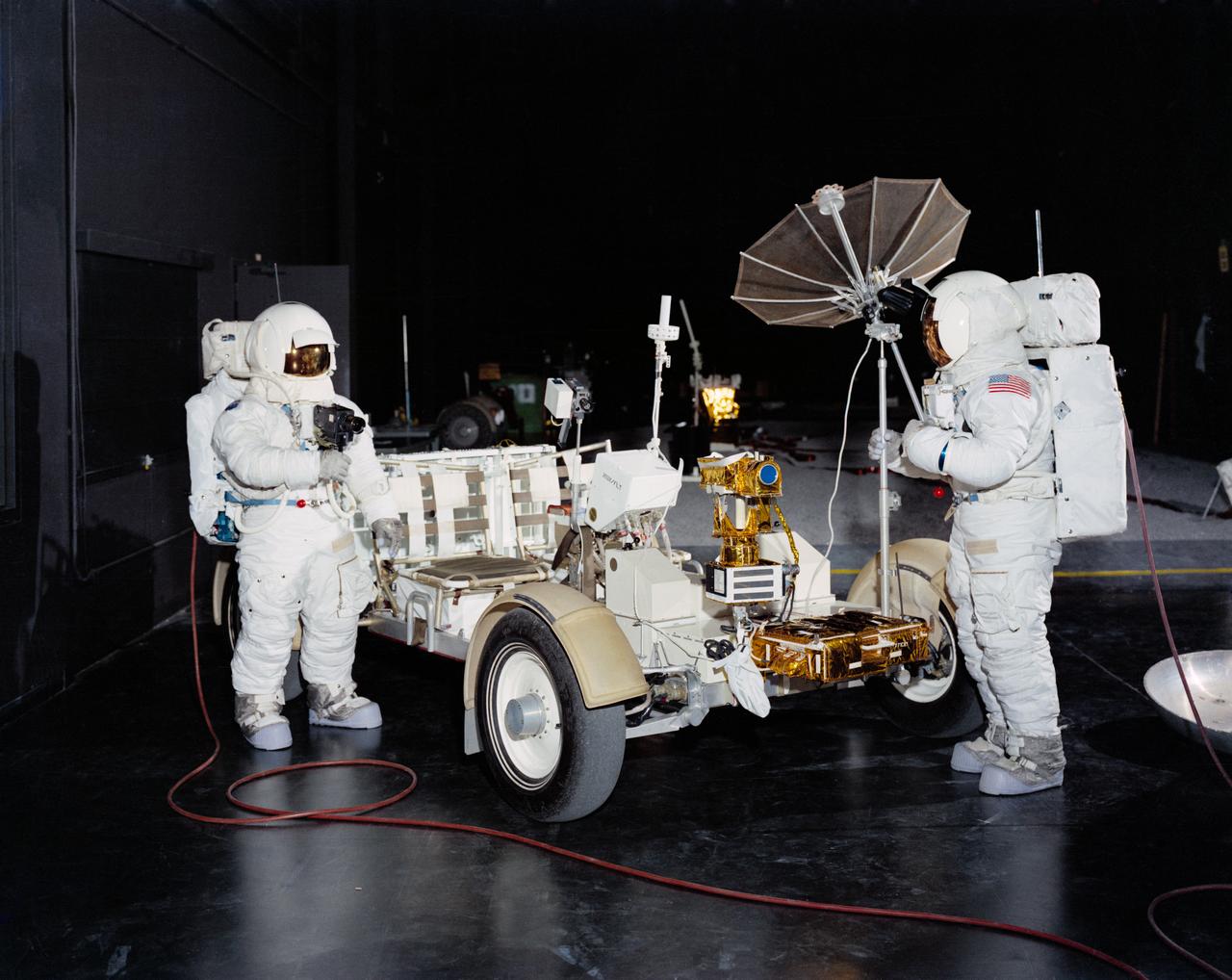
S71-16722 (January 1971) --- Two members of the prime crew of the Apollo 15 lunar landing mission are shown with the Lunar Roving Vehicle "one G" trainer in Building 5, Mission Simulation and Training Facility, Manned Spacecraft Center. Astronaut David R. Scott (on right) is the Apollo 15 commander; and astronaut James B. Irwin is the lunar module pilot. A Lunar Roving Vehicle similar to this trainer will be used by Scott and Irwin during their Apollo 15 lunar surface extravehicular activity.
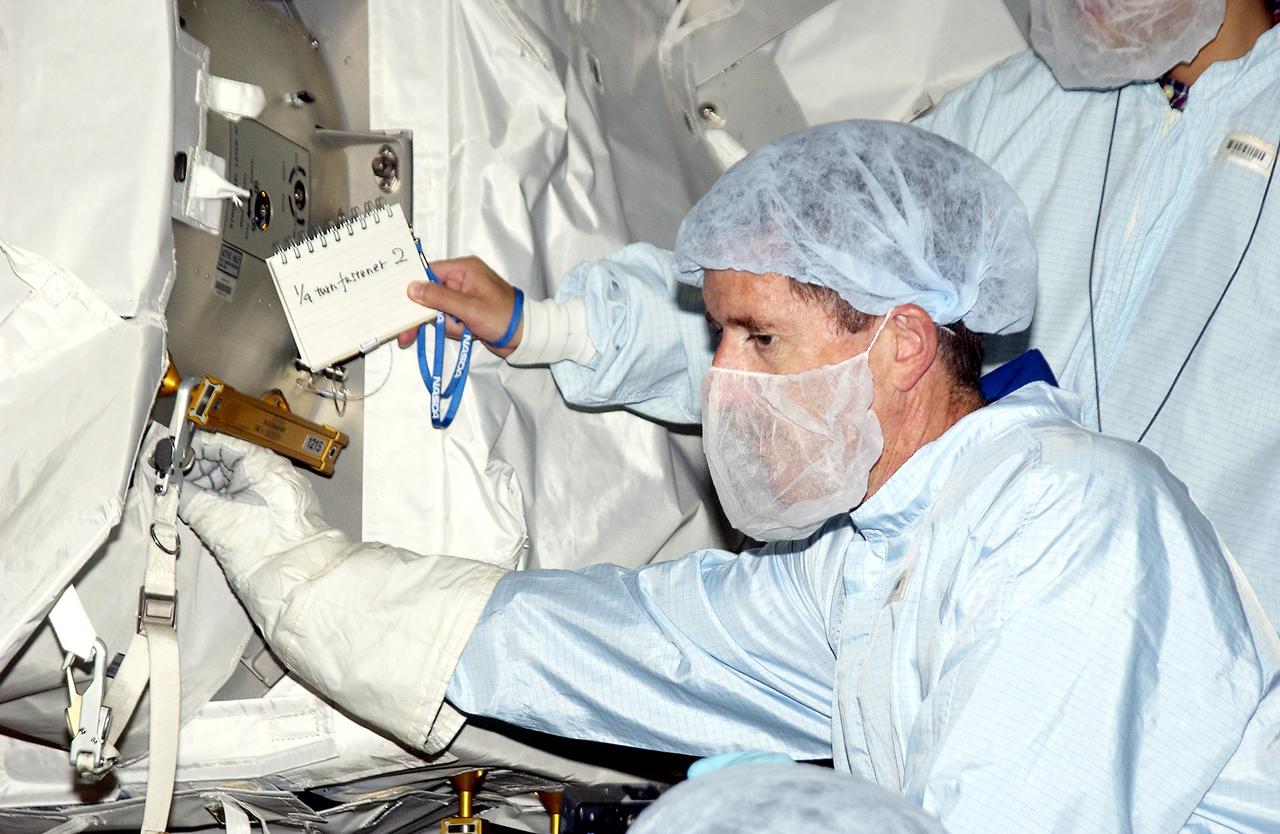
KENNEDY SPACE CENTER, FLA. - In the Space Station Processing Facility, STS-117 Mission Specialist James Reilly works with equipment in the Japanese Experiment Module (JEM) as part of training for ExtraVehicular Activity (EVA). Equipment familiarization is a routine part of astronaut training and launch preparations.
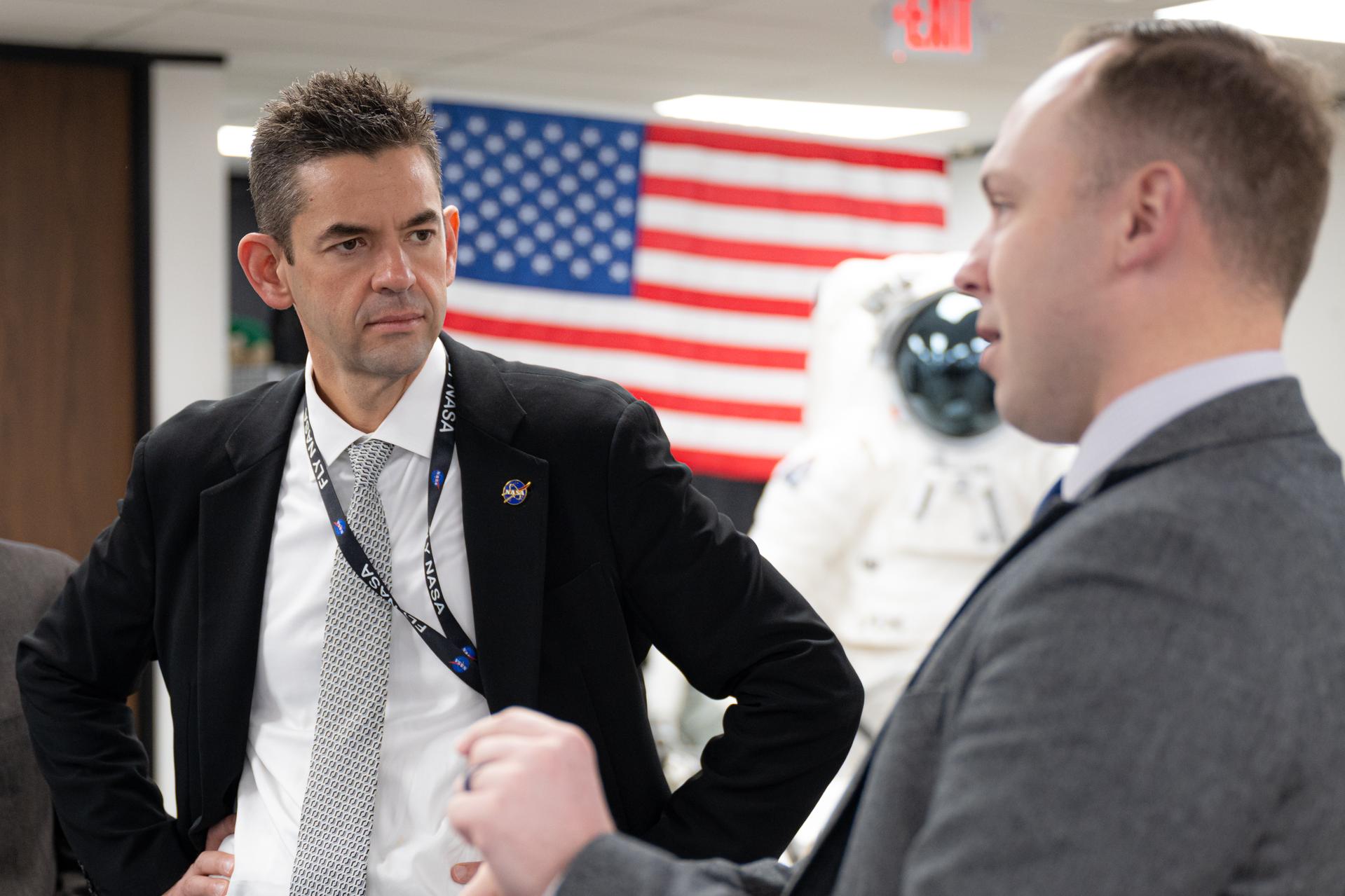
NASA Administrator Jared Isaacman, left, listens to Russell Ralston, senior vice president and general manager of extravehicular activity at Axiom Space, right, during a tour of the company’s extravehicular activity and spacesuit facility, Friday, Jan. 23, 2026, in Houston, Texas. Photo Credit: (NASA/John Kraus)
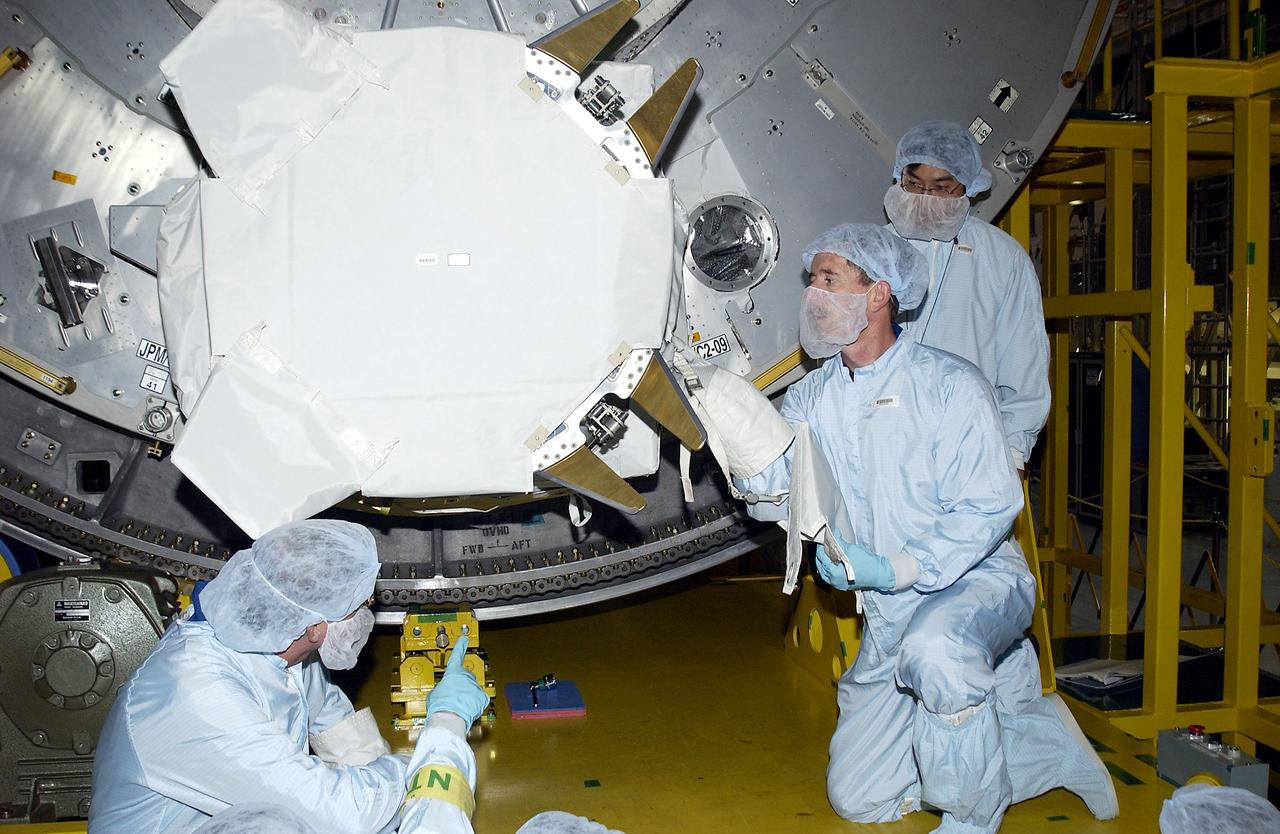
KENNEDY SPACE CENTER, FLA. - In the Space Station Processing Facility, STS-117 Mission Specialist James Reilly (right, in front) works with equipment in the Japanese Experiment Module (JEM) as part of training for ExtraVehicular Activity (EVA). At left is STS-115 Mission Specialist Joseph Tanner. Equipment familiarization is a routine part of astronaut training and launch preparations.
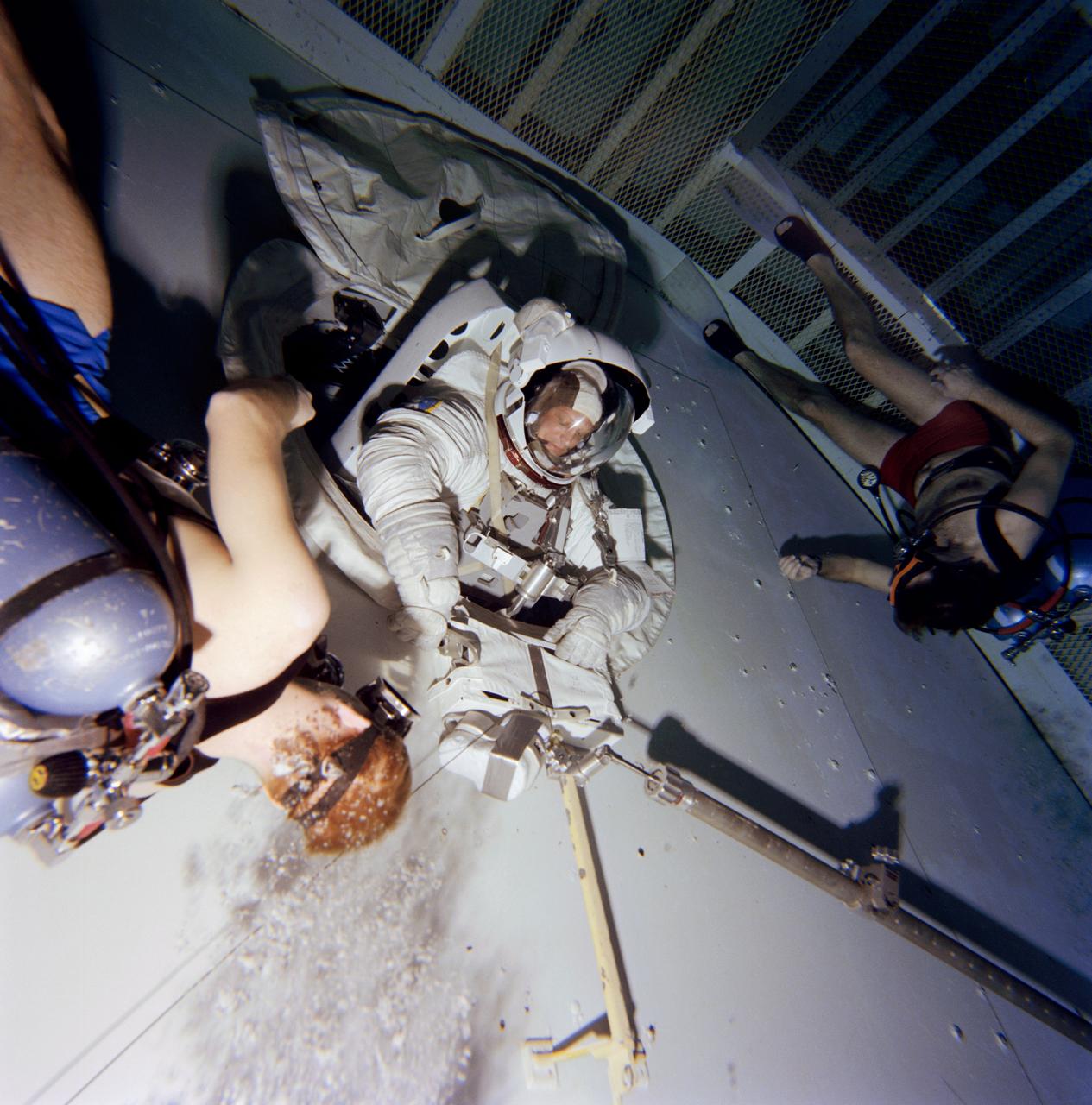
Dr. Norman E. Thagard, mission specialist for STS-7, moves through the hatchway of the mockup of the Space Shuttle orbiter which is part of JSC's weightless environment training facility (WETF). Thagard is wearing an extravehicular mobility unit and is practicing procedures used when performing an extravehicular activity (EVA) during a flight.
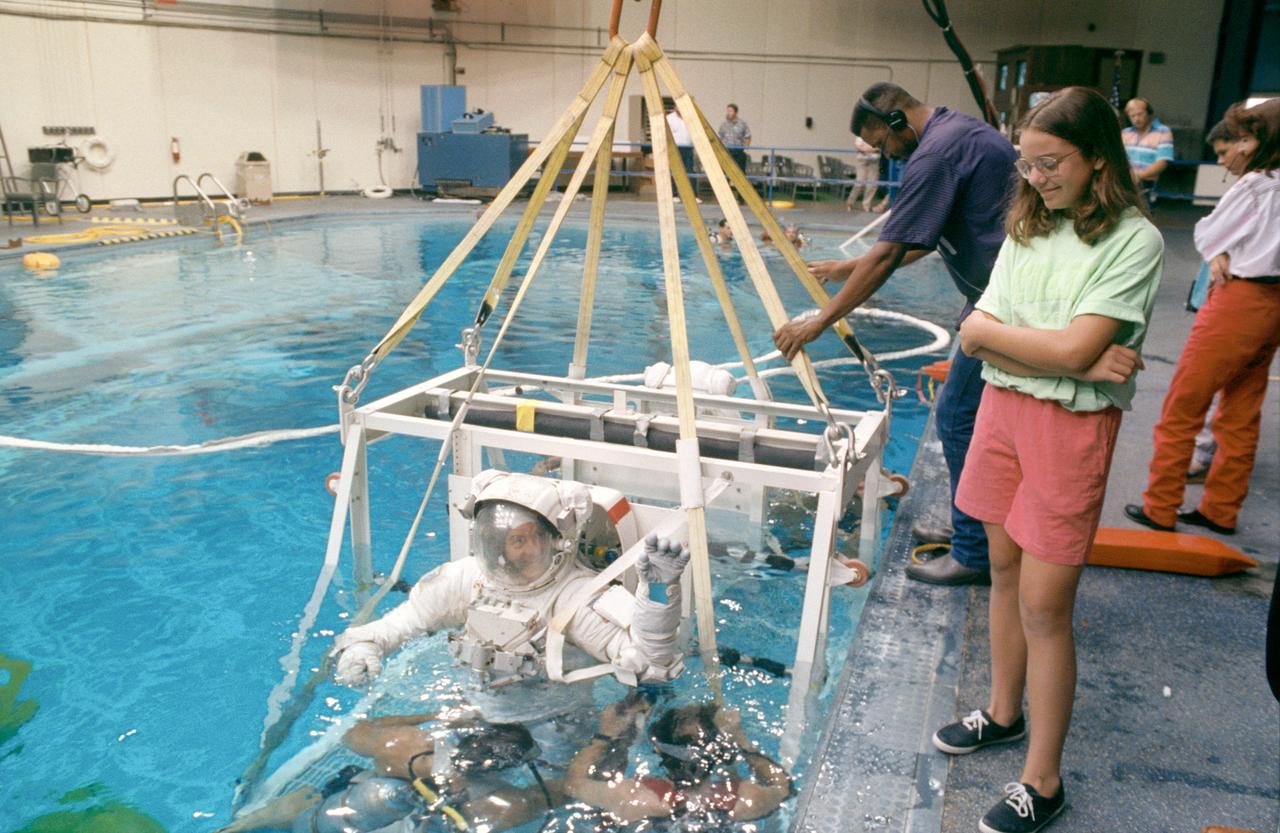
S92-43335 (28 July 1992) --- STS-53 Discovery, Orbiter Vehicle (OV) 103, Mission Specialist James S. Voss, wearing extravehicular mobility unit (EMU), is lowered into JSC?s Weightless Environment Training Facility (WETF) Bldg. 29 pool. Voss waves to his daughter standing on the poolside as the platform he is positioned in is submerged in the pool. Technicians on the poolside and scuba equipped divers in the water monitor activities. Once underwater, Voss will participate in contingency extravehicular activity (EVA) procedures.
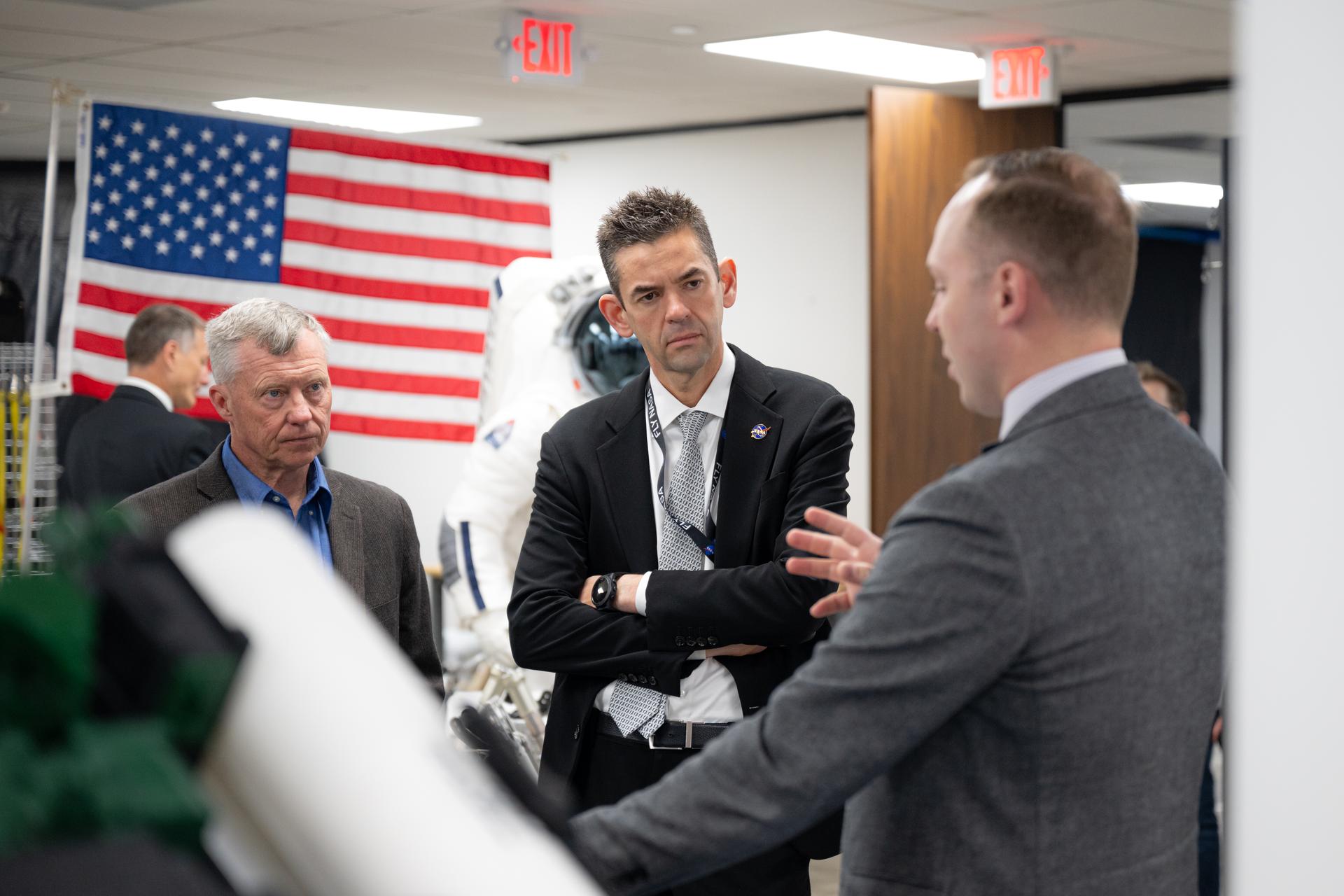
NASA Administrator Jared Isaacman, center; Todd Ericson, senior advisor to the administrator, left; and Russell Ralston, senior vice president and general manager of extravehicular activity at Axiom Space, right, are seen during a tour of the company’s extravehicular activity and spacesuit facility, Friday, Jan. 23, 2026, in Houston, Texas. Photo Credit: (NASA/John Kraus)
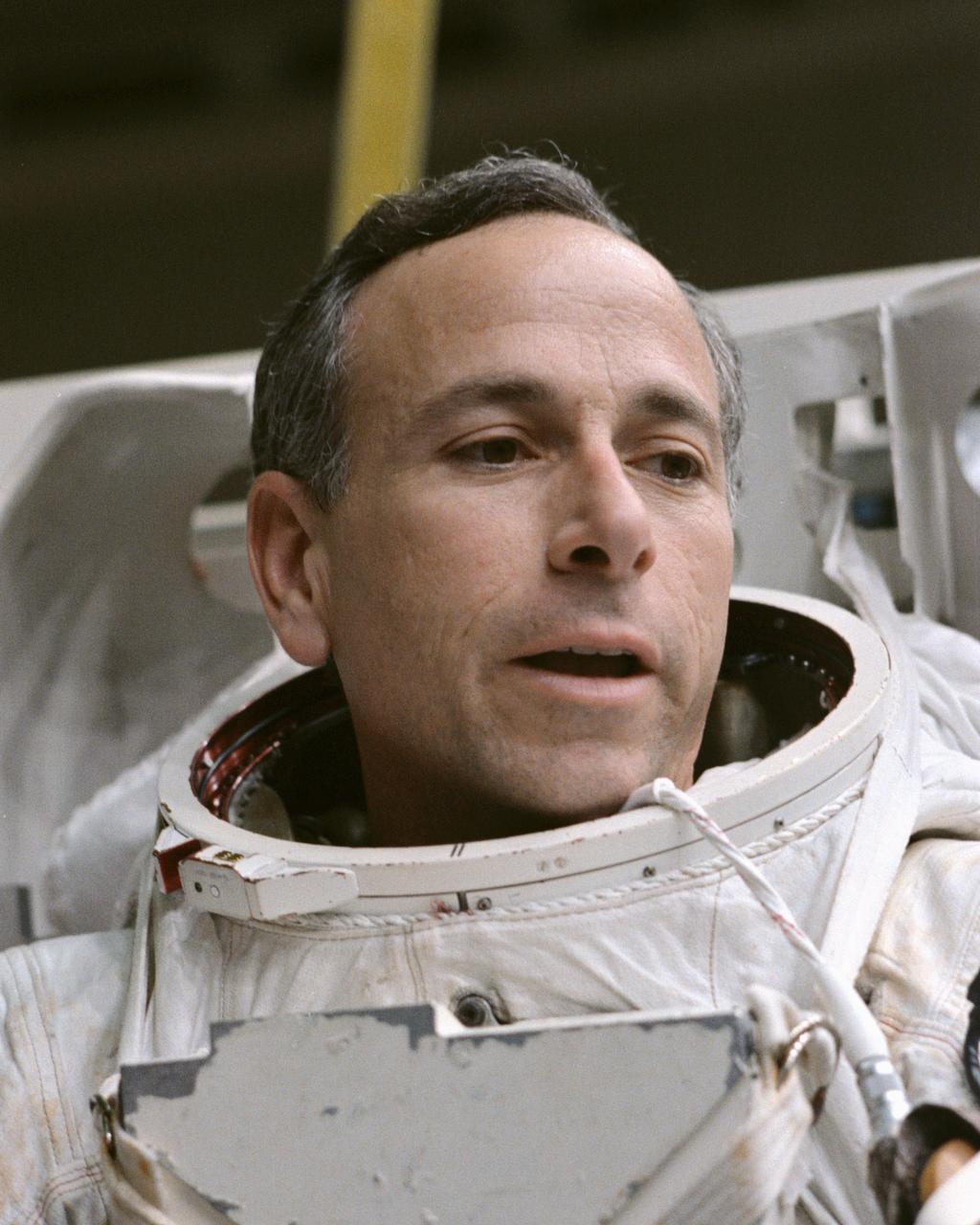
STS-38 Mission Specialist (MS) Carl J. Meade, wearing extravehicular mobility unit (EMU) upper torso, takes a breather from suit donning activities in JSC's Weightless Environment Training Facility (WETF) Bldg 29. Meade is preparing for an underwater extravehicular activity (EVA) simulation. During the training exercise, Meade will rehearse contingency EVA procedures for the STS-38 mission aboard Atlantis, Orbiter Vehicle (OV) 104.
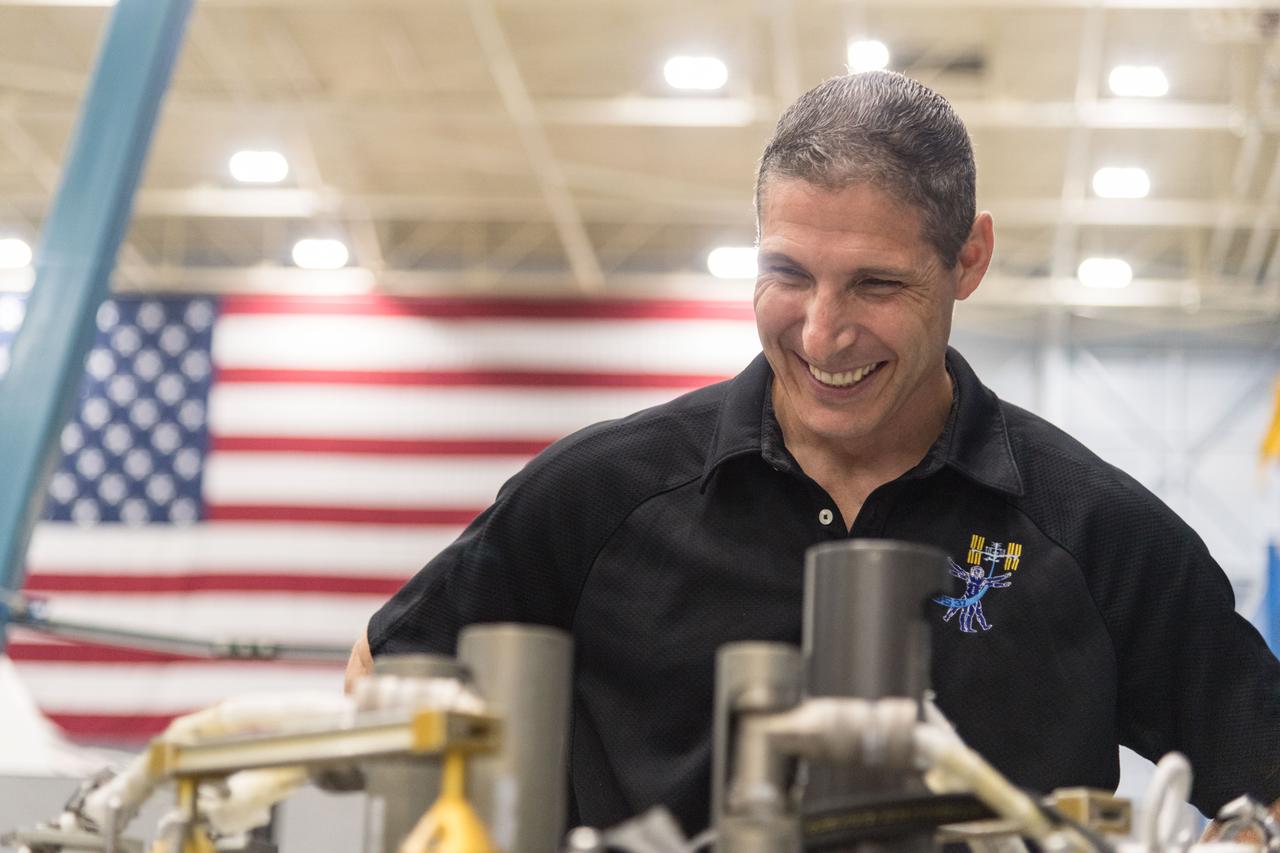
NASA commercial crew astronaut Mike Hopkins trains with Extravehicular Activity (EVA) tools and hardware in Johnson Space Center’s Space Vehicle Mockup Facility in Houston. Hopkins is assigned to the second crewed flight of SpaceX’s Crew Dragon.
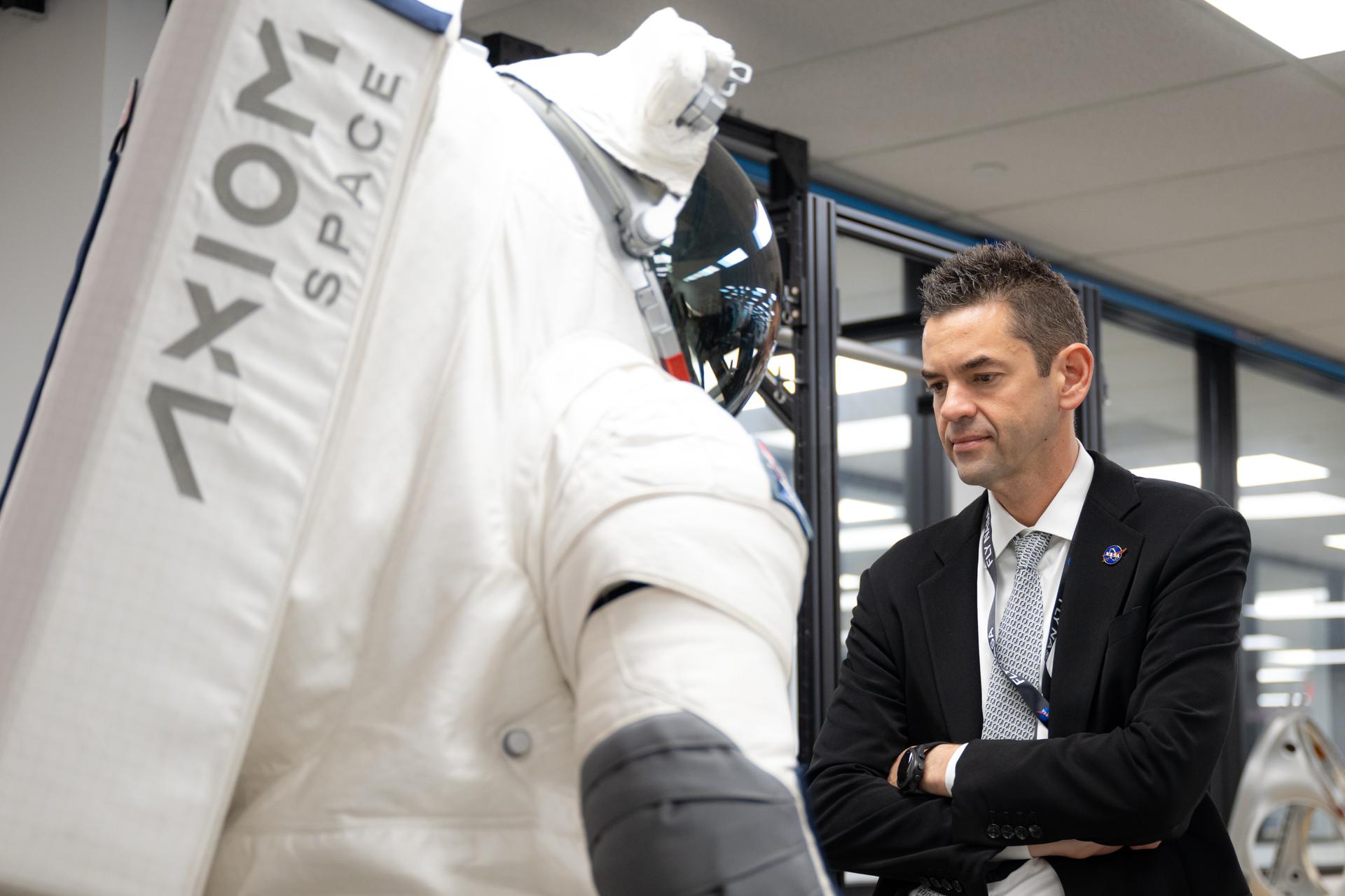
NASA Administrator Jared Isaacman tours Axiom Space's extravehicular activity and spacesuit facility, Friday, Jan. 23, 2026, in Houston, Texas. Photo Credit: (NASA/John Kraus)
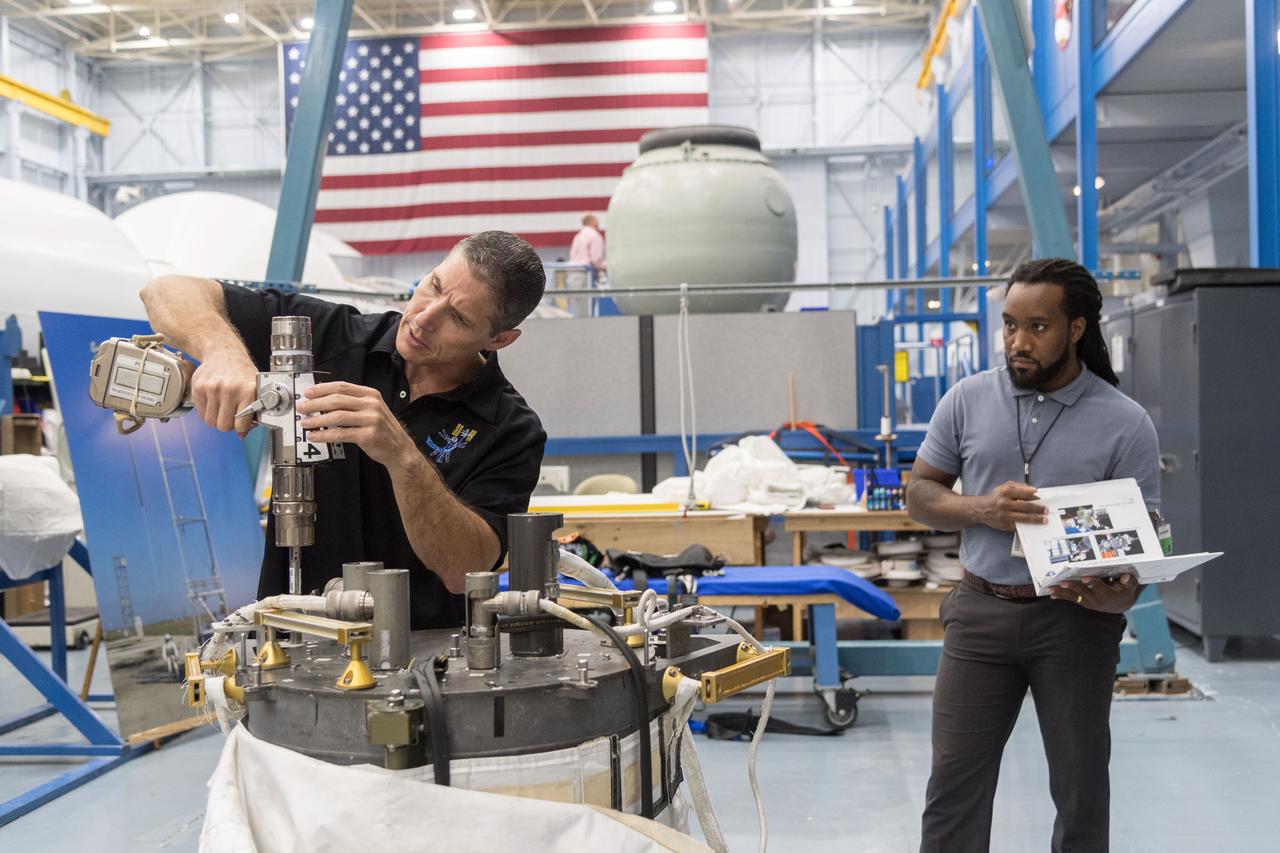
NASA commercial crew astronaut Mike Hopkins trains with Extravehicular Activity (EVA) tools and hardware in Johnson Space Center’s Space Vehicle Mockup Facility in Houston. Hopkins is assigned to the second crewed flight of SpaceX’s Crew Dragon.
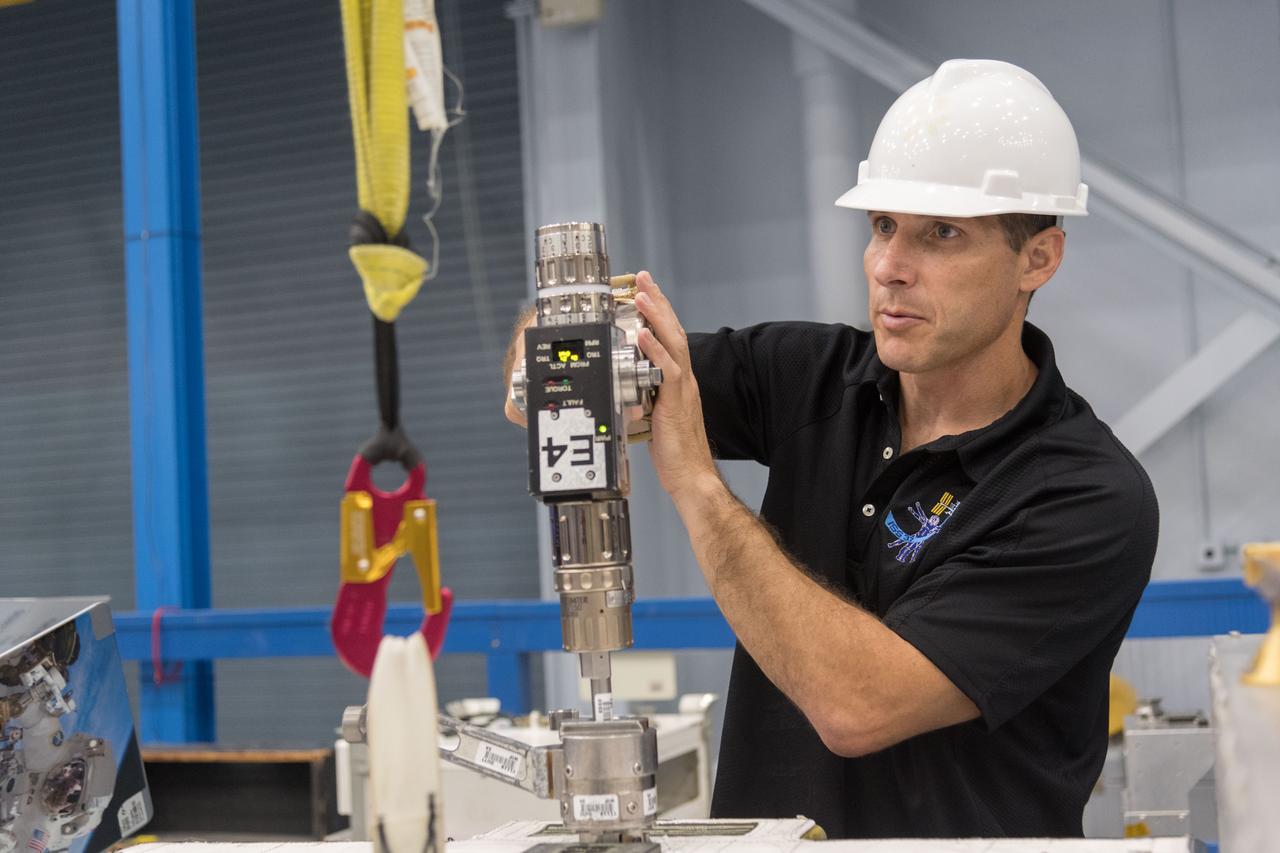
NASA commercial crew astronaut Mike Hopkins trains with Extravehicular Activity (EVA) tools and hardware in Johnson Space Center’s Space Vehicle Mockup Facility in Houston. Hopkins is assigned to the second crewed flight of SpaceX’s Crew Dragon.
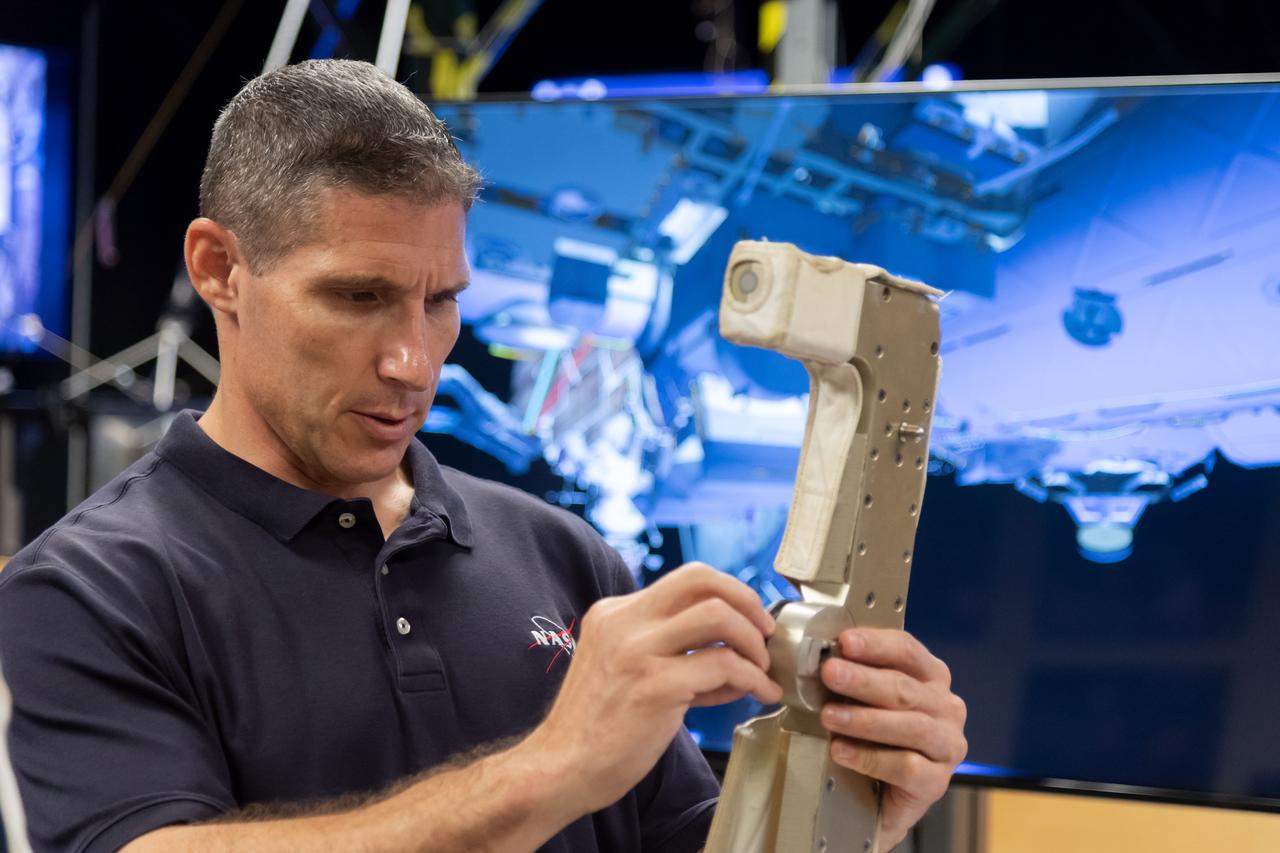
NASA commercial crew astronaut Mike Hopkins trains with Extravehicular Activity (EVA) tools and hardware in Johnson Space Center’s Space Vehicle Mockup Facility in Houston. Hopkins is assigned to the second crewed flight of SpaceX’s Crew Dragon.
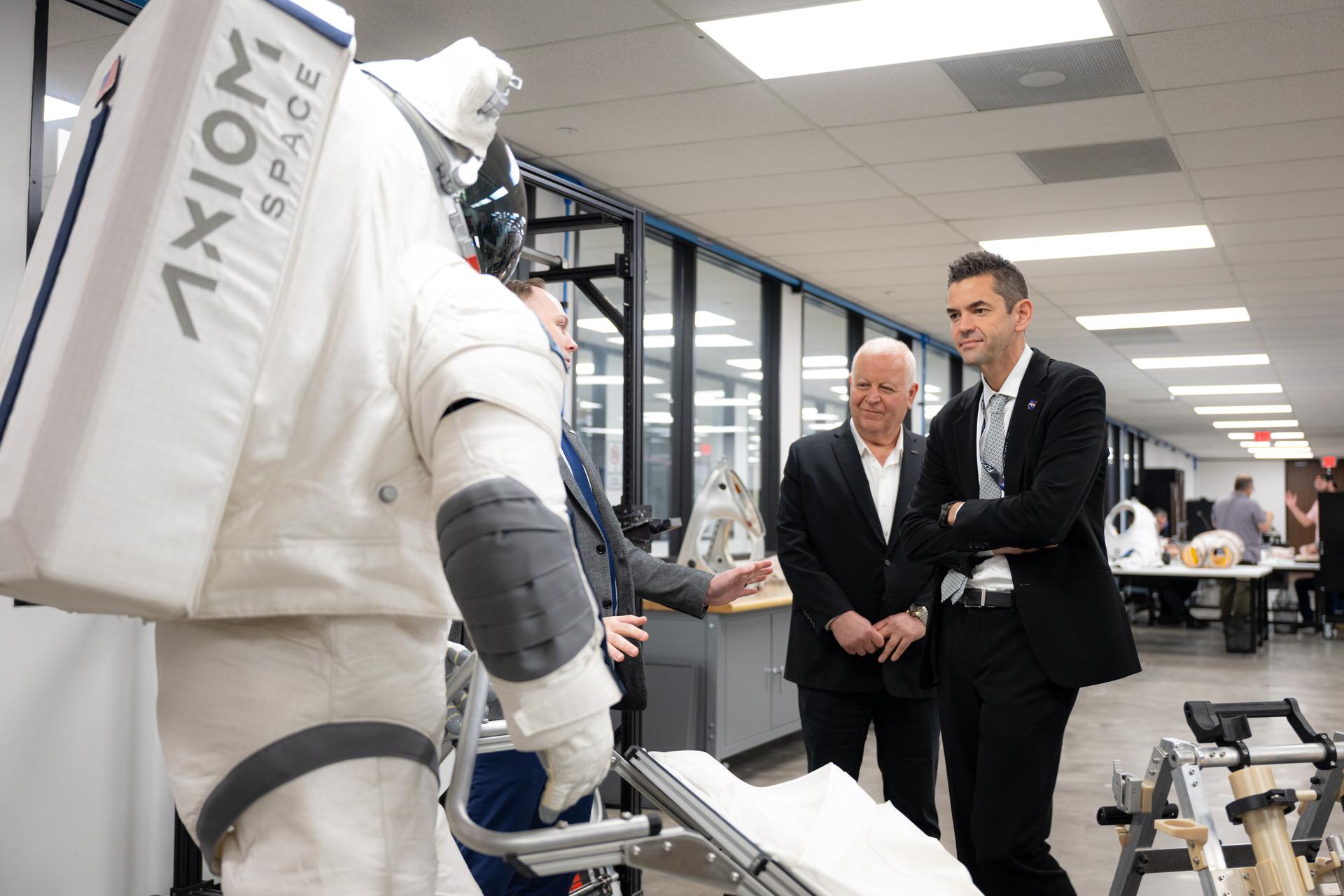
NASA Administrator Jared Isaacman, right, and Axiom Space leadership tour the company's extravehicular activity and spacesuit facility, Friday, Jan. 23, 2026, in Houston, Texas. Photo Credit: (NASA/John Kraus)
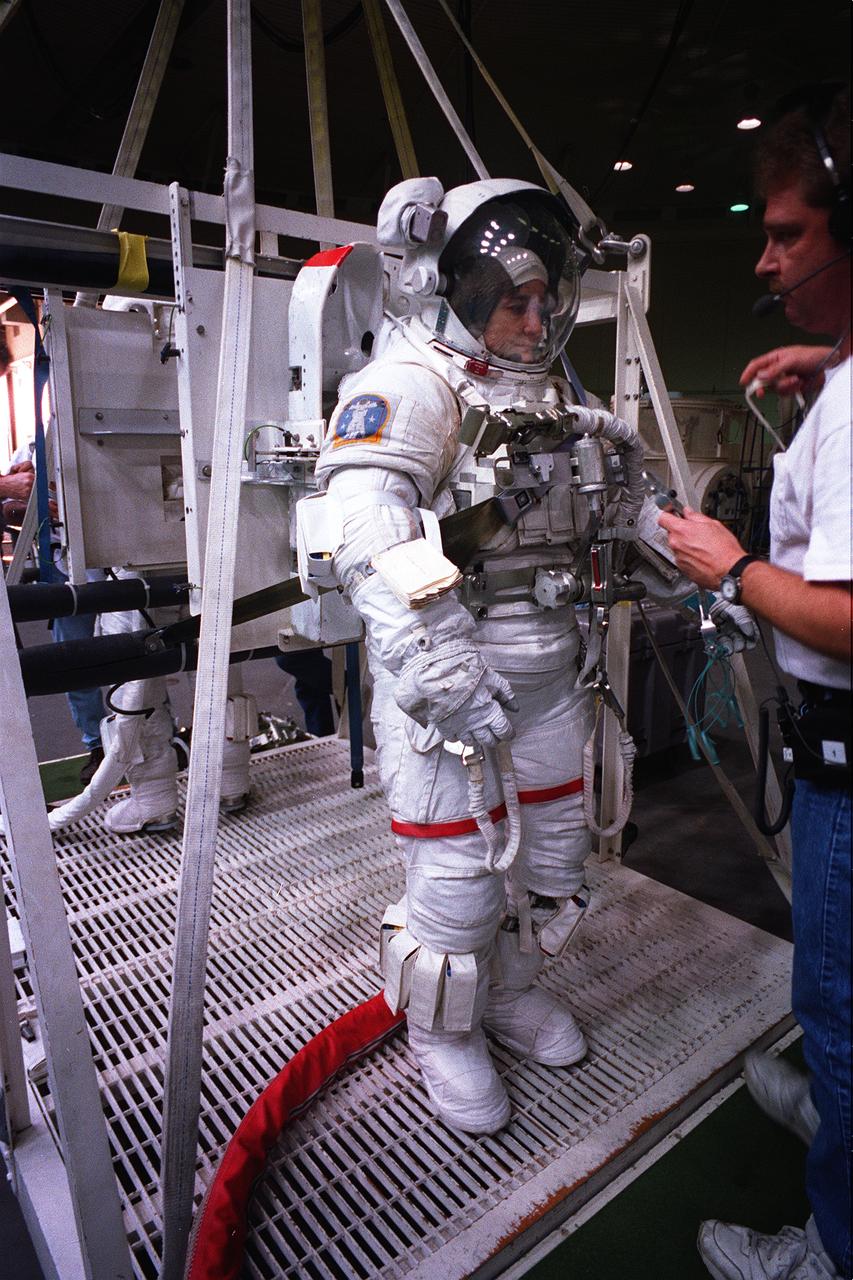
Astronaut and mission specialist, Linda Godwin, makes a final check of her respiration system before submersion into a 25 ft deep pool at the Johnson Space Center’s (JSC) Weightless Environment Training Facility (WET-F). Wearing a high fidelity training version of the Extravehicular Mobility Unit (EMU) space suit, Godwin simulated STS-76 Extravehicular Activity (EVA) chores in the pool. Launched aboard the Space Shuttle Atlantis in March of 1996, STS-76 marked the third U.S. Shuttle-Mir docking during which Godwin, along with astronaut and mission specialist Michael R. (Rich) Clifford, performed the first Extravehicular Activity (EVA) during Mir-Shuttle docked operations.
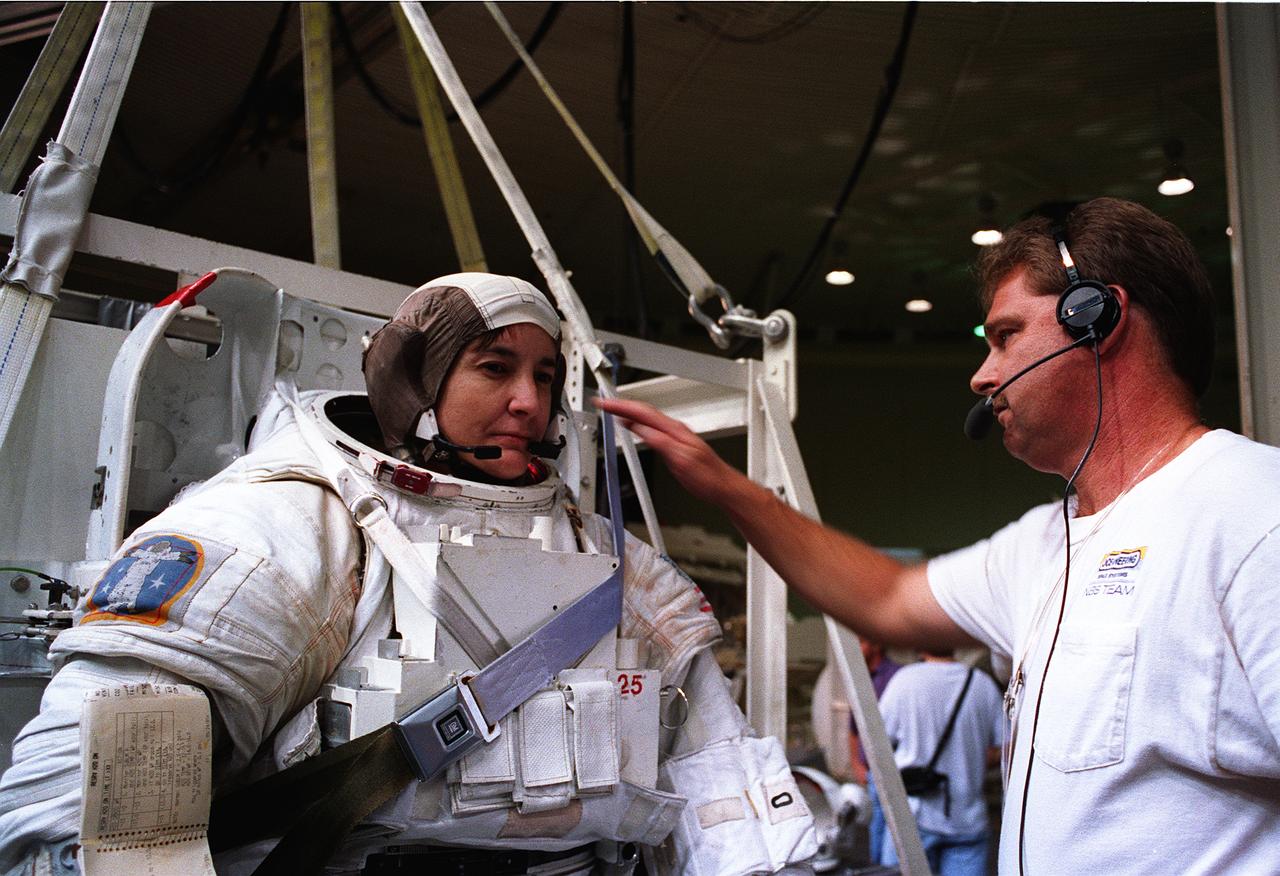
Astronaut and mission specialist, Linda Godwin, checks communications systems before submersion into a 25 ft deep pool at the Johnson Space Center’s (JSC) Weightless Environment Training Facility (WET-F). Wearing a high fidelity training version of the Extravehicular Mobility Unit (EMU) space suit, Godwin simulated STS-76 Extravehicular Activity (EVA) chores in the pool. Launched aboard the Space Shuttle Atlantis in March of 1996, STS-76 marked the third U.S. Shuttle-Mir docking during which Godwin, along with astronaut and mission specialist Michael R. ( Rich) Clifford, performed the first Extravehicular Activity (EVA) during Mir-Shuttle docked operations.
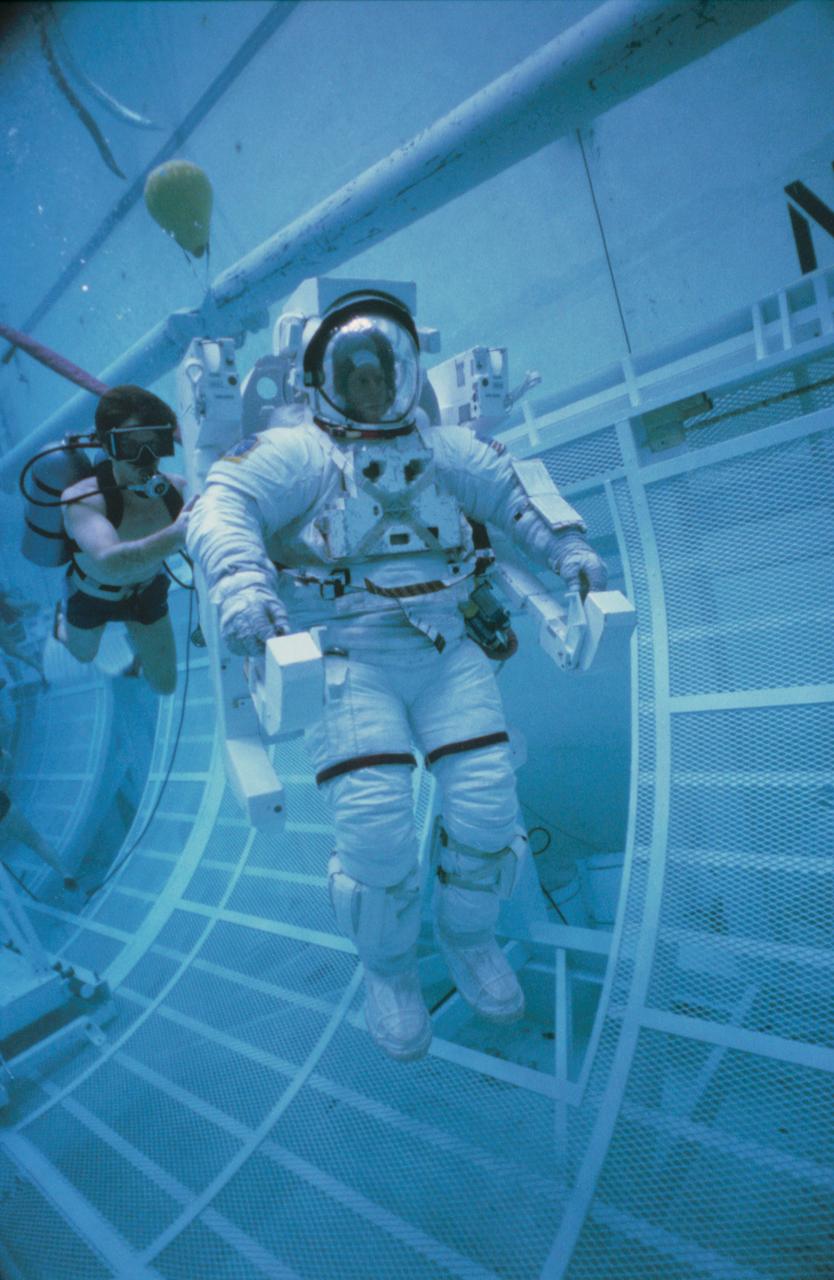
Underwater extravehicular activity (EVA) training in the weightless environment training facility (WETF) with astronauts George Nelson and James van Hoften. They are using tools to assemble material in the facility while surrounded by divers (428895); View of George Nelson in full extravehicular mobility unit (EMU) floating inside the space shuttle payload bay mockup with a diver behind him (42896).
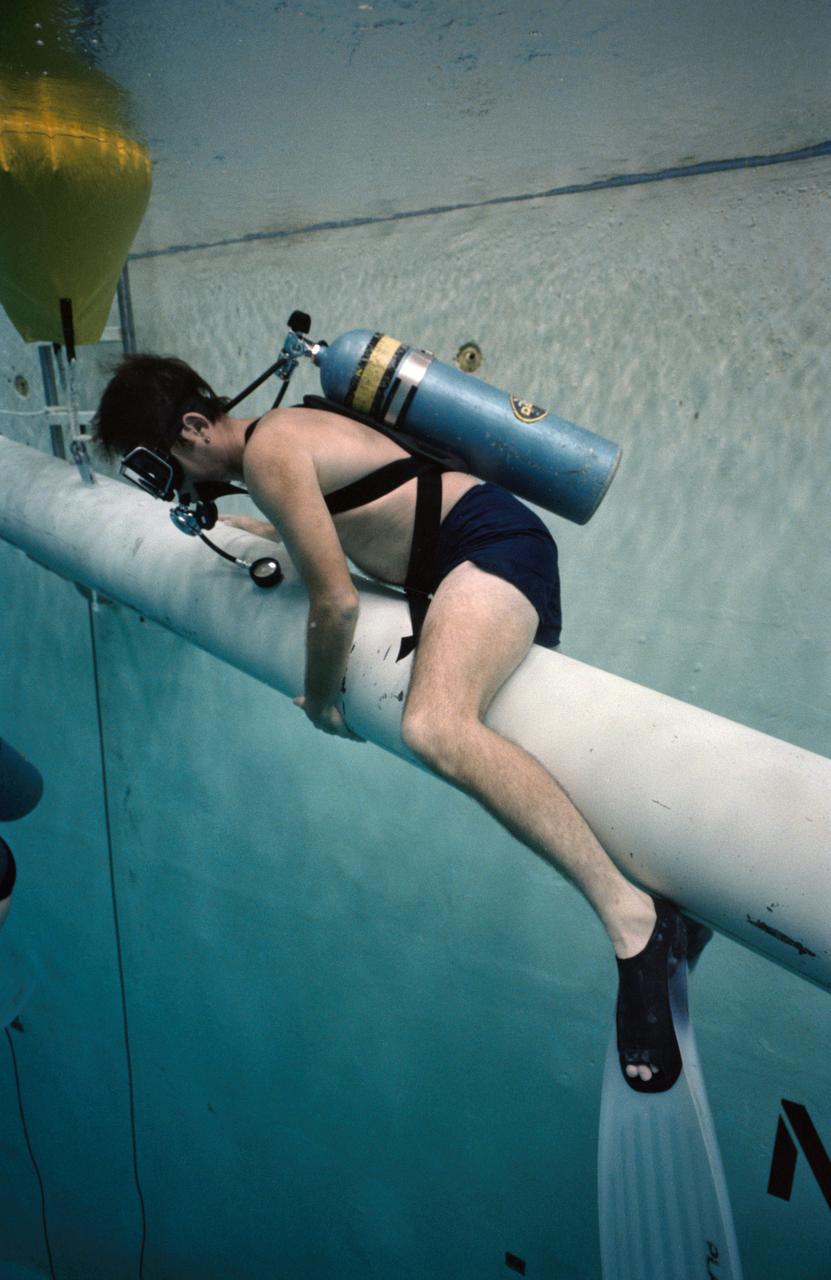
S84-36958 (29 June 1984) --- Astronaut Robert L. Crippen, 41-G crew commander, perches nearby an underwater simulation scene in the Johnson Space Center's weightless environment training facility (WET-F). Purpose of the rehearsal was to train two of the 41-G crew's mission specialists for a scheduled extravehicular activity (EVA). Out of frame are Astronauts Kathryn D. Sullivan, Jon A. McBride and David Leestma. Dr. Sullivan and Leestma donned extravehicular mobility units (EMU) for the simulation while Crippen and McBride monitored the activity. This photograph was taken by Otis Imboden.

S90-46492 (16 Aug 1990) --- Astronaut Tamara E. Jernigan, STS-40 mission specialist, is pictured in a training version of the extravehicular mobility unit (EMU) spacesuit. Dr. Jernigan was about to be submerged in the Johnson Space Center's 25-ft. deep weightless environment training facility (WET-F) pool to simulate a contingency extravehicular activity (EVA). There is no EVA scheduled for STS-40, the Spacelab Life Sciences (SLS-1) mission.
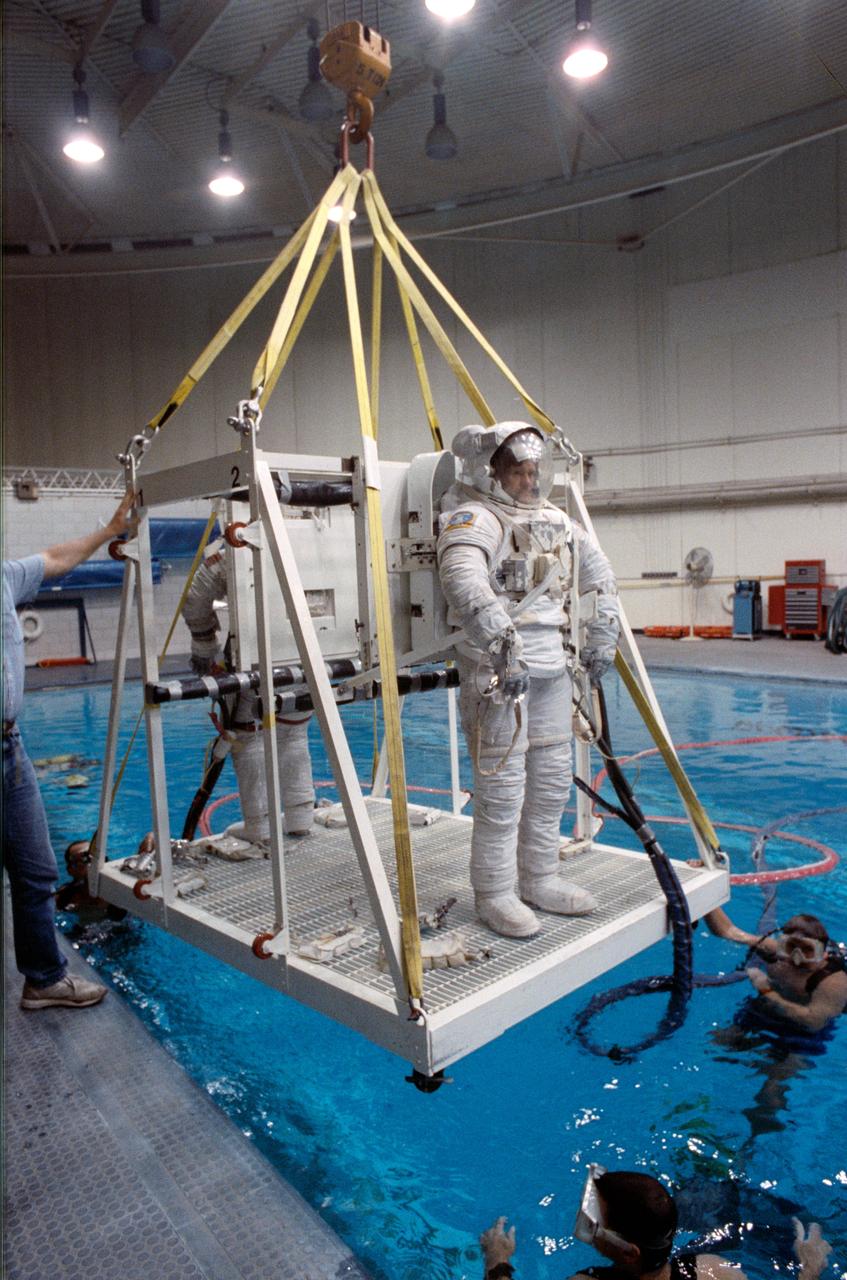
S90-46030 (Aug 1990) --- Astronaut Donald R. McMonagle (foreground) wears an extravehicular mobility unit (EMU) spacesuit as he prepares to be lowered into a 25-ft. deep pool at the Johnson Space Center's weightless environment training facility (WET-F). Astronaut Gregory J. Harbaugh, a fellow STS 39 mission specialist, shares the moveable platform with McMonagle and prepares to join him in the simulation of a contingency extravehicular activity (EVA) for the mission, scheduled for Discovery in the spring of 1991. A number of SCUBA-equipped divers assist in the training session.

S96-12948 (14 February 1996) --- Astronaut Robert L. Curbeam, Jr. stands on a platform connected to a hoist that will lower him and astronaut Stephen L. Robinson (out of frame) into Johnson Space Center's (JSC) Weightless Environment Test Facility (WET-F) pool. The two, attired in training versions of the Extravehicular Mobility Unit (EMU), were about to participate in an underwater simulation of contingency Extravehicular Activity (EVA) for the scheduled 11-day August 1997 STS-85 mission.
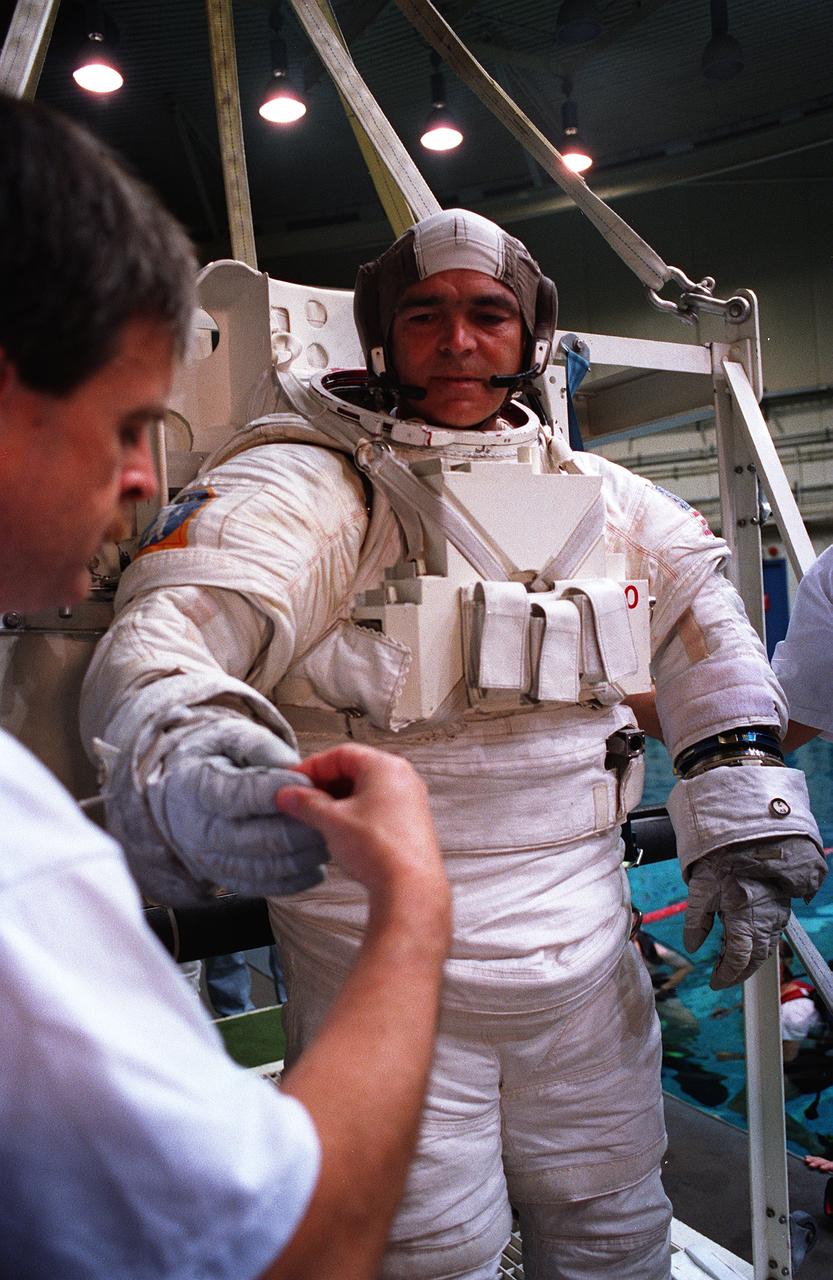
S95-21279 (September 1995) --- Astronaut Michael R. (Rich) Clifford, mission specialist, checks his gloves before being submerged in a 25-feet deep pool at the Johnson Space Center's (JSC) Weightless Environment Training Facility (WET-F). Wearing high fidelity training versions of the Extravehicular Mobility Unit (EMU) spacesuit, both Clifford and Linda M. Godwin were later simulating Extravehicular Activity (EVA) chores in the pool. Launch aboard the Space Shuttle Atlantis is scheduled for March of 1996.
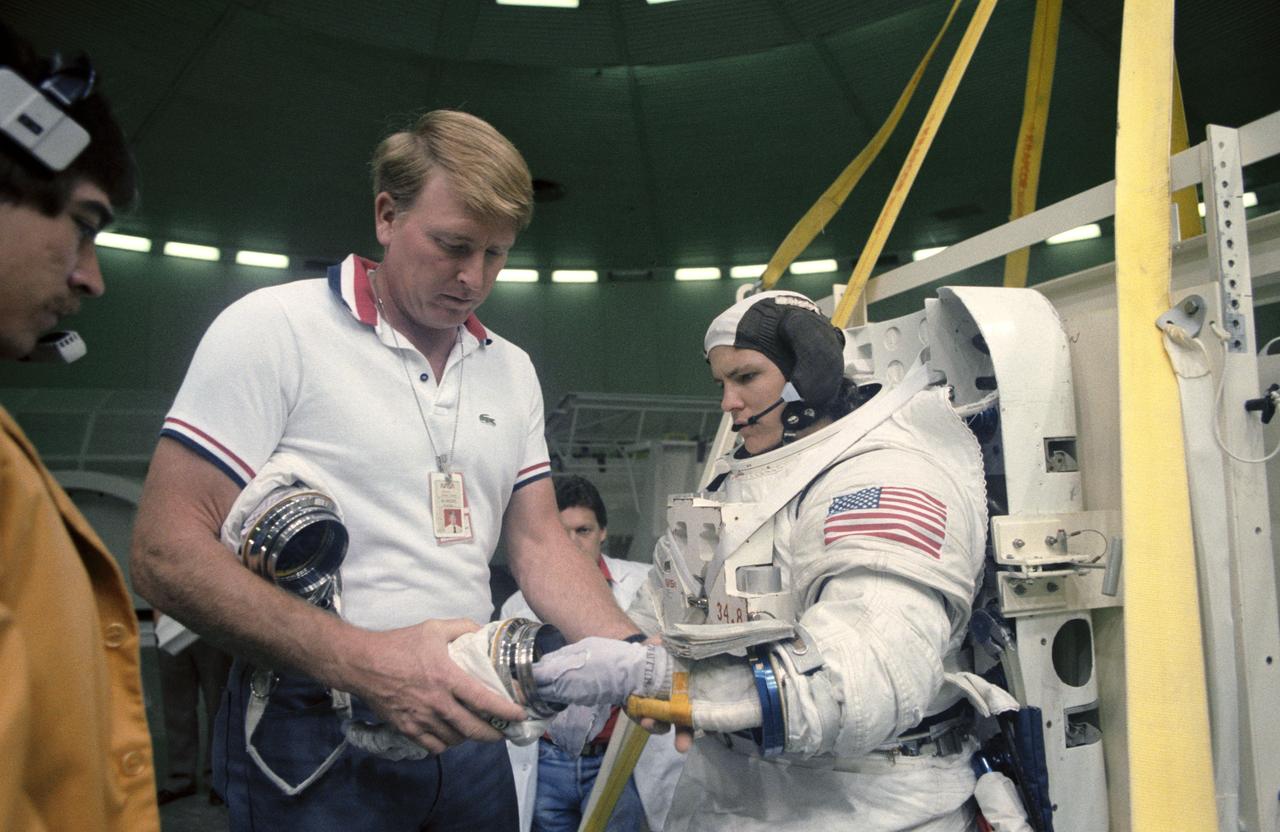
S84-33898 (21 May 1984) --- Astronaut Jon A. McBride, 41-G pilot, assists his crewmate, Astronaut Kathryn D. Sullivan with the glove portion of her extravehicular mobility unit (EMU) prior to Dr. Sullivan's underwater session in the Johnson Space Center's weightless environment training facility (WET-F). Mission specialists Sullivan and David C. Leestma are scheduled for extravehicular activity (EVA) on the Columbia for NASA's 17th scheduled flight.
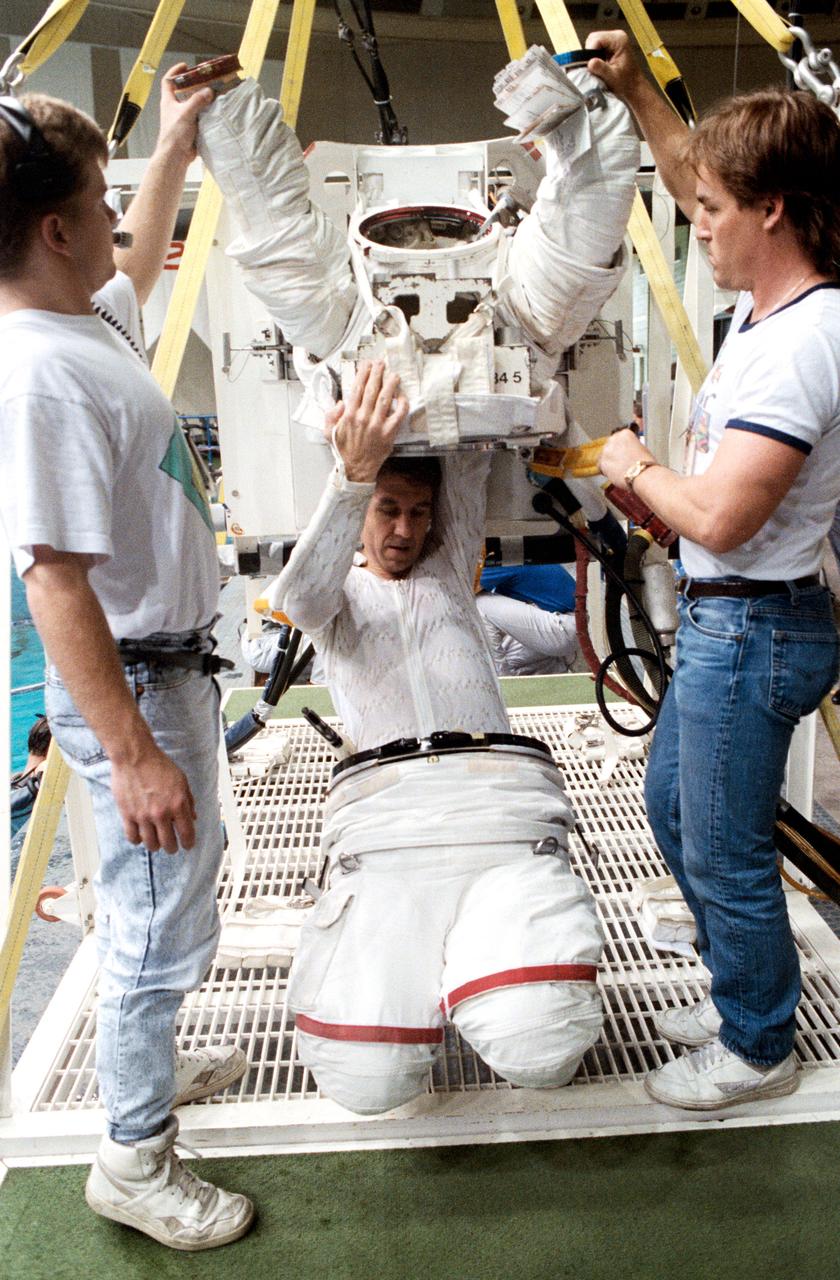
STS-38 Mission Specialist (MS) Robert C. Springer dons extravehicular mobility unit (EMU) upper torso with technicians' assistance in JSC's Weightless Environment Training Facility (WETF) Bldg 29. Positioned on the WETF platform at pool side, Springer is preparing for an underwater extravehicular activity (EVA) simulation. During the training session, Springer will rehearse contingency EVA procedures for the STS-38 mission aboard Atlantis, Orbiter Vehicle (OV) 104.
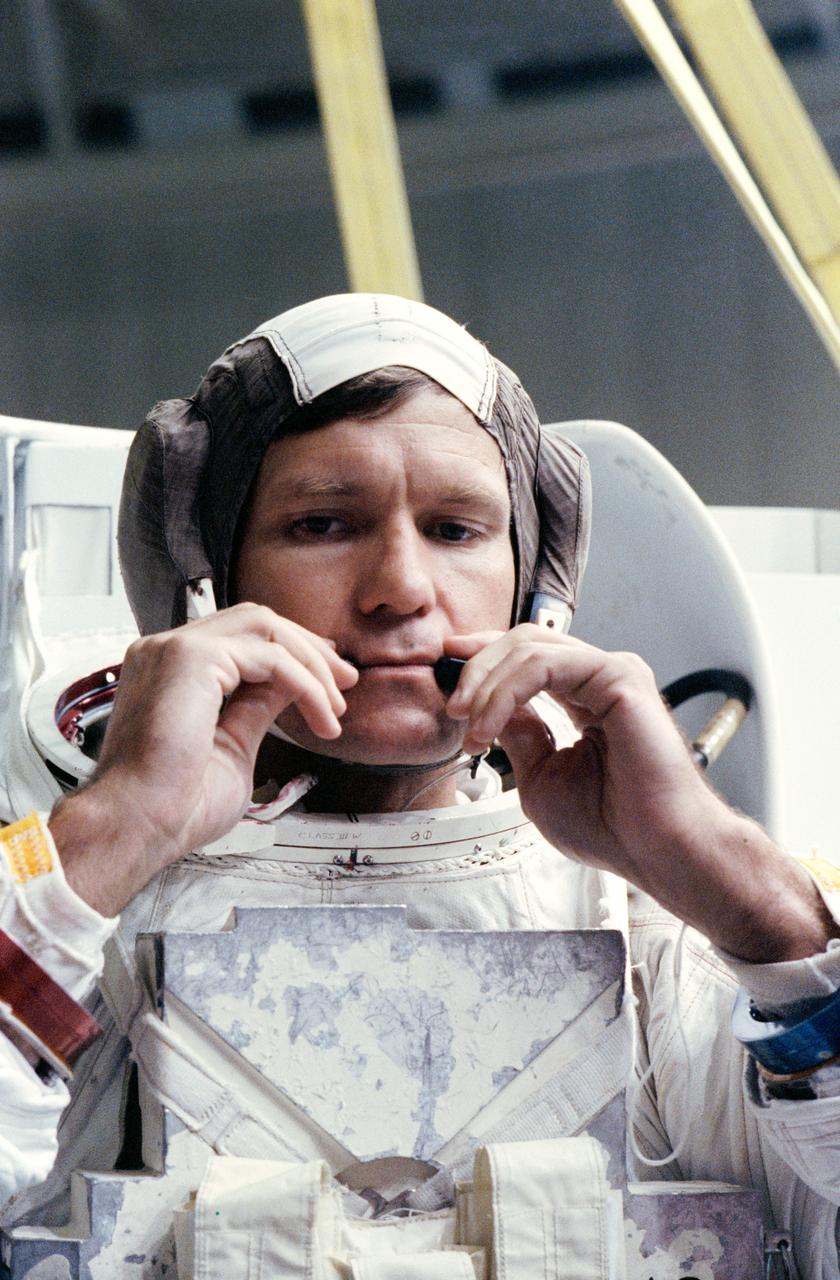
S90-41500 (Aug 1990) --- Astronaut Donald R. McMonagle checks communication gear on his extravehicular mobility unit (EMU) spacesuit as he prepares to be lowered into a 25-ft. deep pool at the Johnson Space Center's weightless environment training facility (WET-F). McMonagle was preparing to participate in the simulation of a contingency extravehicular activity (EVA) for the mission, scheduled for Discovery in the spring of 1991.

STS-48 Mission Specialist (MS) James F. Buchli, wearing an extravehicular mobility unit (EMU), is watched by SCUBA-equipped divers as the platform he is standing on is lowered into JSC's Weightless Environment Training Facility (WETF) Bldg 29 pool. When completely underwater, Buchli will be released from the platform and will perform contingency extravehicular activity (EVA) operations. This underwater simulation of a spacewalk is part of the training required for Buchli's upcoming mission aboard Discovery, Orbiter Vehicle (OV) 103.
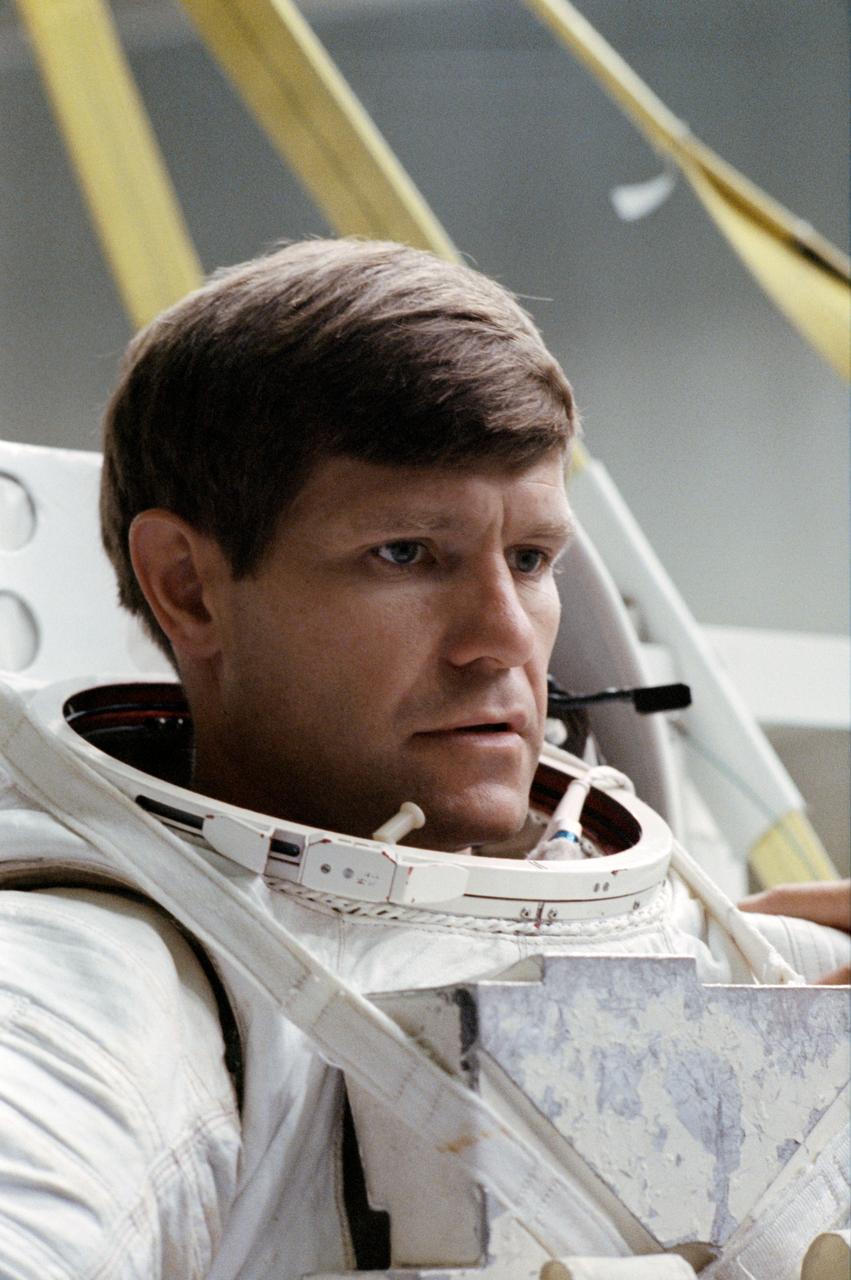
S90-46036 (Aug 1990) --- Astronaut Donald R. McMonagle awaits arrival of helmet gear for his extravehicular mobility unit (EMU) spacesuit as he prepares to be lowered into a 25-ft. deep pool at the Johnson Space Center's weightless environment training facility (WET-F). McMonagle was preparing to participate in the simulation of a contingency extravehicular activity (EVA) for the mission, scheduled for Discovery in the spring of 1991.
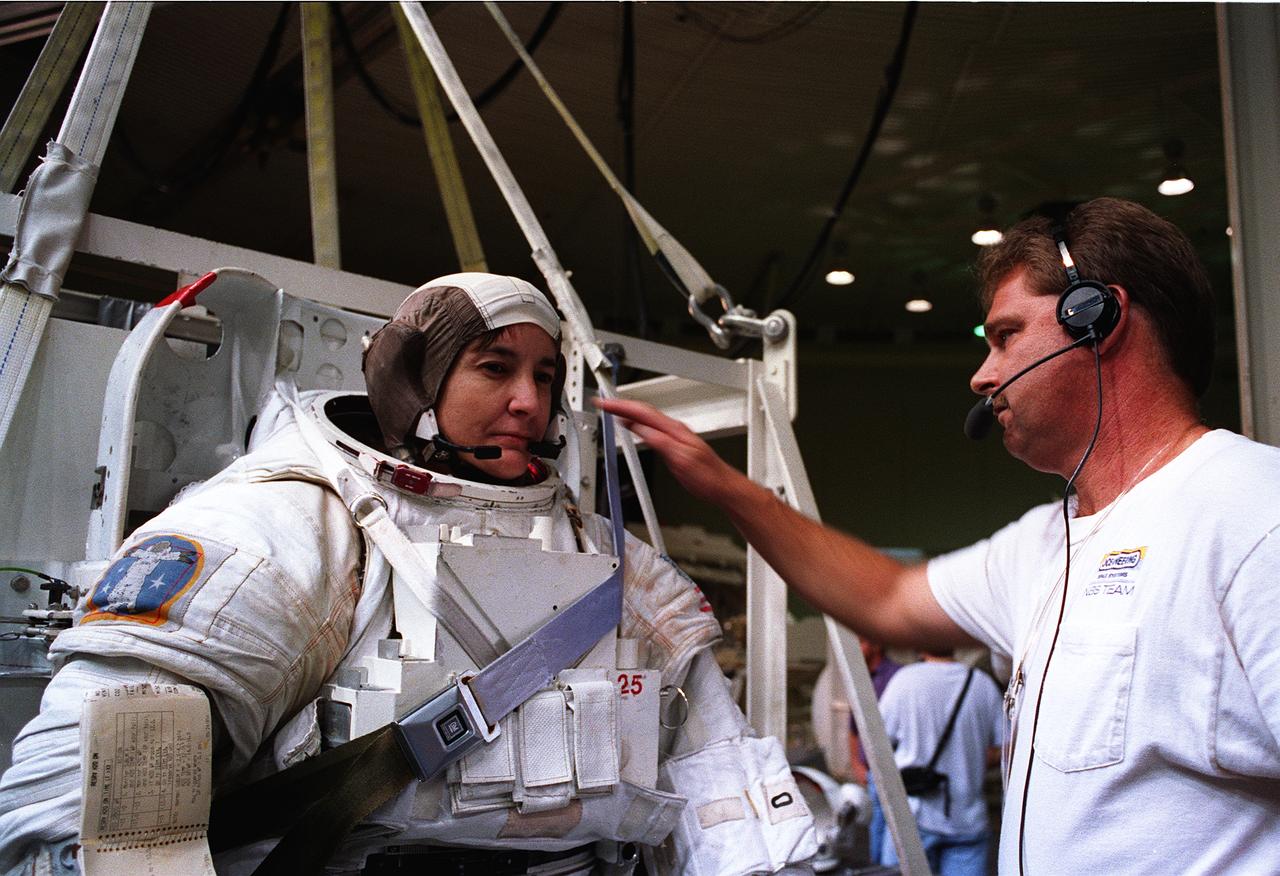
S95-21280 (September 1995) --- Astronaut Linda M. Godwin, mission specialist, checks communications systems before being submerged in a 25-feet deep pool at the Johnson Space Center's (JSC) Weightless Environment Training Facility (WET-F). Wearing high fidelity training versions of the Extravehicular Mobility Unit (EMU) spacesuit, both Godwin and Michael R. (Rich) Clifford were later simulating Extravehicular Activity (EVA) chores in the pool. Launch aboard the Space Shuttle Atlantis is scheduled for March of 1996.
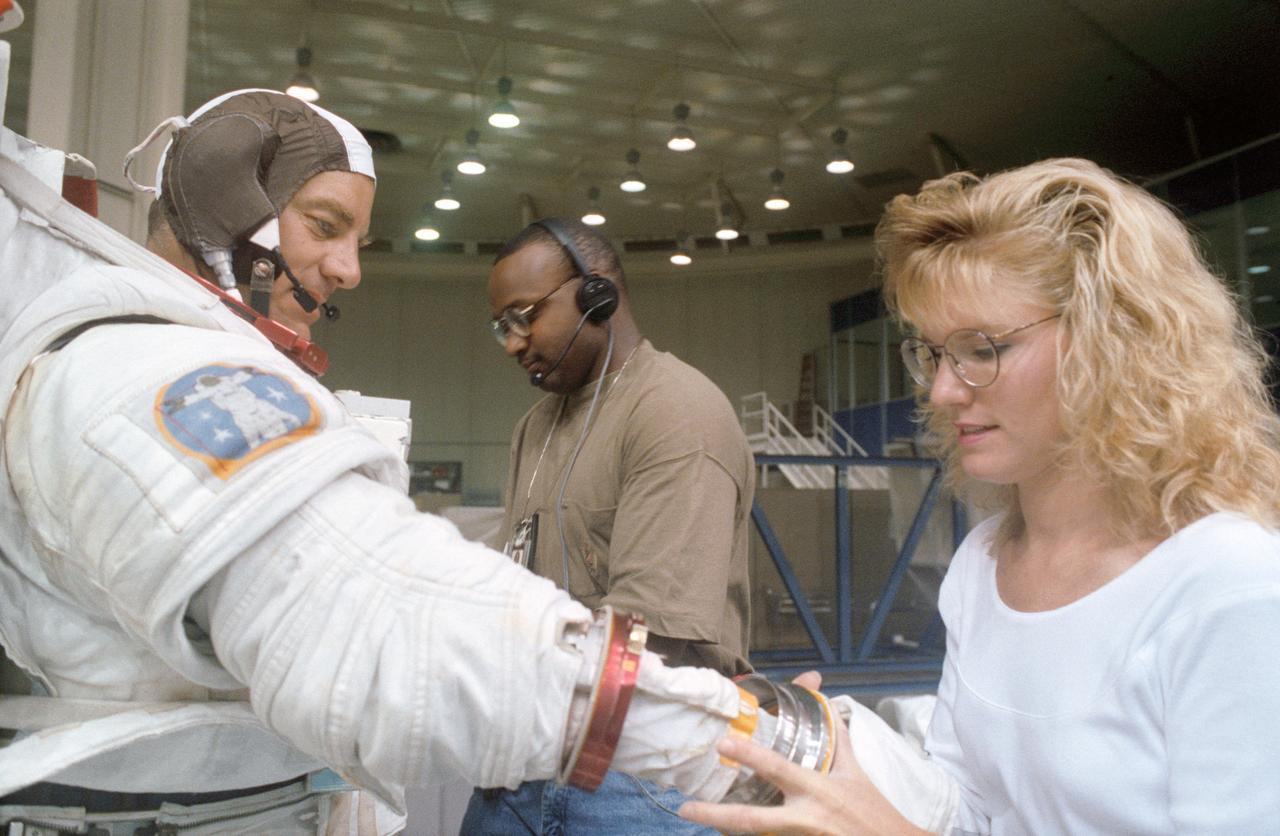
S92-42679 (28 July 1992) --- STS-53 Discovery, Orbiter Vehicle (OV) 103, Mission Specialist James S. Voss, wearing extravehicular mobility unit (EMU) and communications carrier assembly (CCA), dons his gloves with assistance from two technicians. Voss is preparing for an underwater contingency extravehicular activity (EVA) simulation in JSC?s Weightless Environment Training Facility (WETF) Bldg.29 pool.
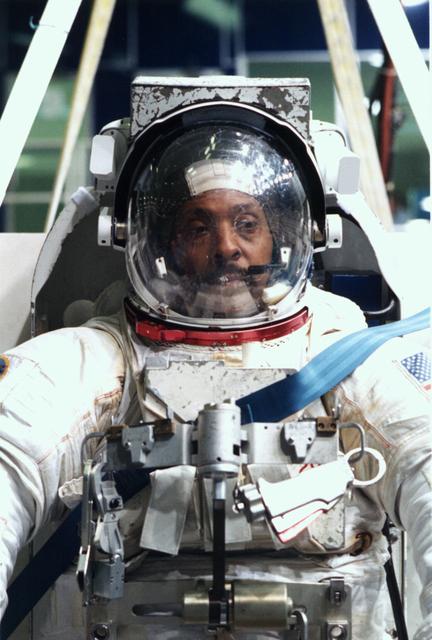
S95-04113 (24 February 1995) --- Wearing a training version of the Space Shuttle Extravehicular Mobility Unit (EMU), astronaut Winston E. Scott, mission specialist, prepares to go underwater for a Extravehicular Activity (EVA) simulation at Johnson Space Center's (JSC) Weightless Environment Training Facility (WET-F). In less than a year from now, Scott is scheduled to perform an EVA in the cargo bay of the Space Shuttle Endeavour in support of the STS-72 mission.
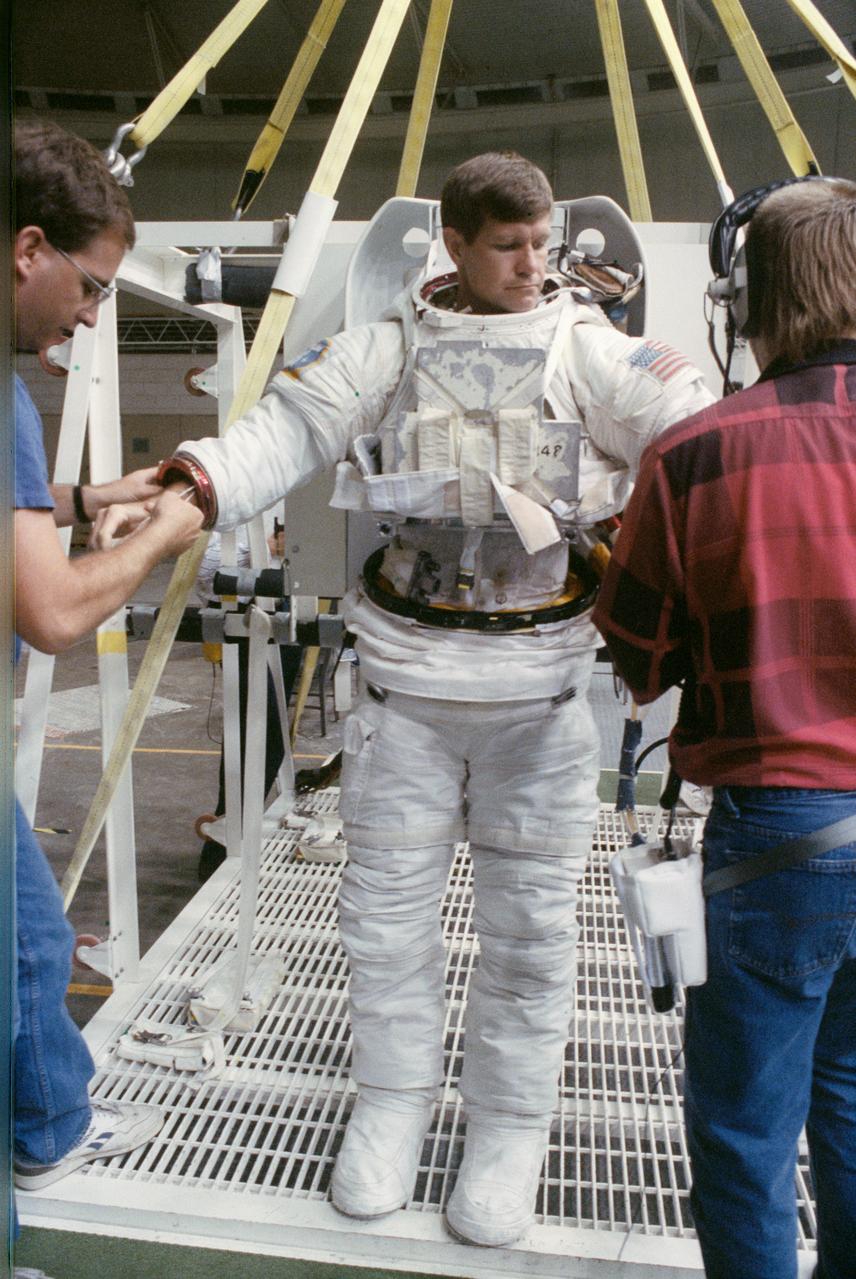
S90-41498 (Aug 1990) --- Astronaut Donald R. McMonagle is about to don gloves for his extravehicular mobility unit (EMU) spacesuit as he prepares to be lowered into a 25-ft. deep pool at the Johnson Space Center's (JSC)weightless environment training facility (WET-F). McMonagle was preparing to participate in the simulation of a contingency extravehicular activity (EVA) for the mission, scheduled for Discovery in the spring of 1991.
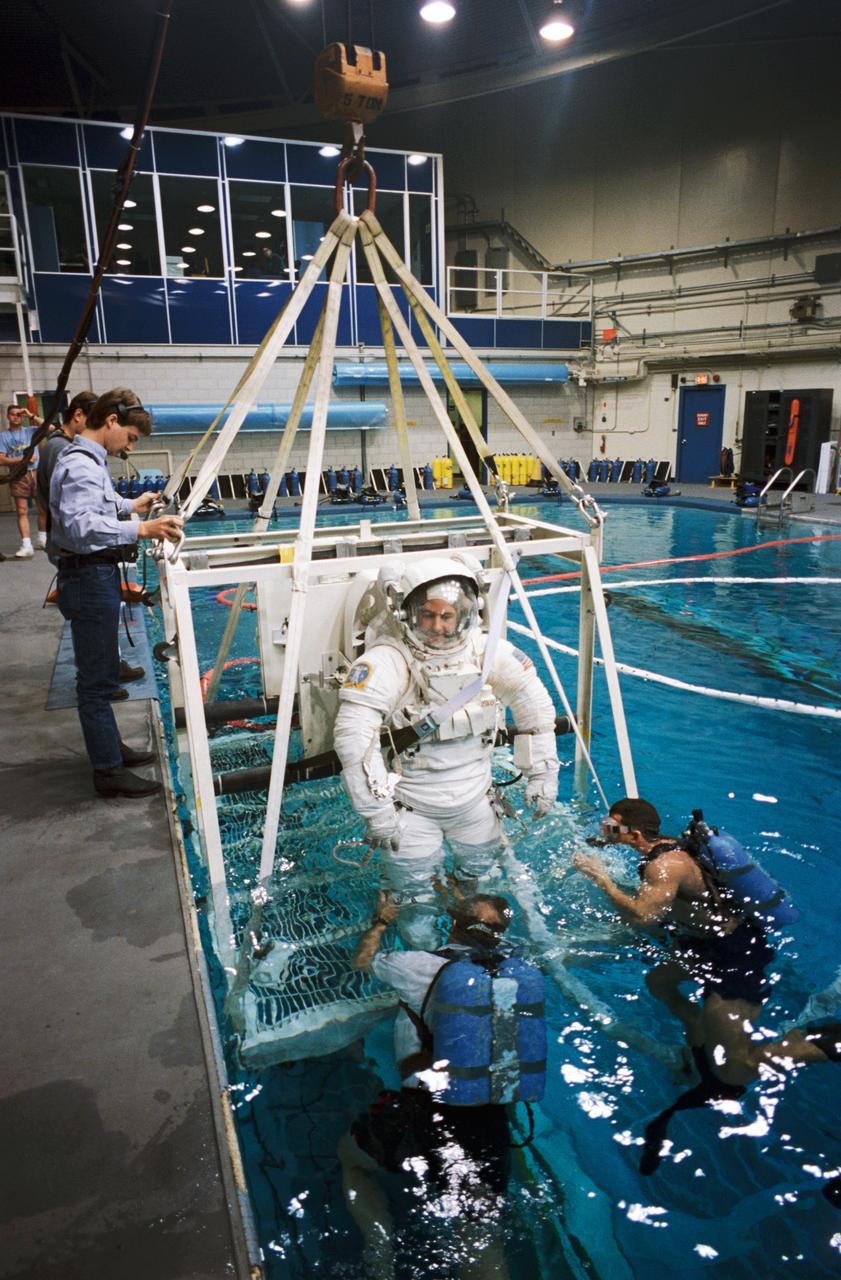
S96-12935 (14 Feb. 1996) --- Attired in a training version of the Extravehicular Mobility Unit (EMU), astronaut Stephen K. Robinson is lowered into Johnson Space Center's (JSC) Weightless Environment Test Facility (WET-F) pool. Astronauts Robinson and Robert L. Curbeam were about to participate in an underwater simulation of contingency extravehicular activity (EVA) that might be needed to support the scheduled 11-day August 1997 STS-85 mission.
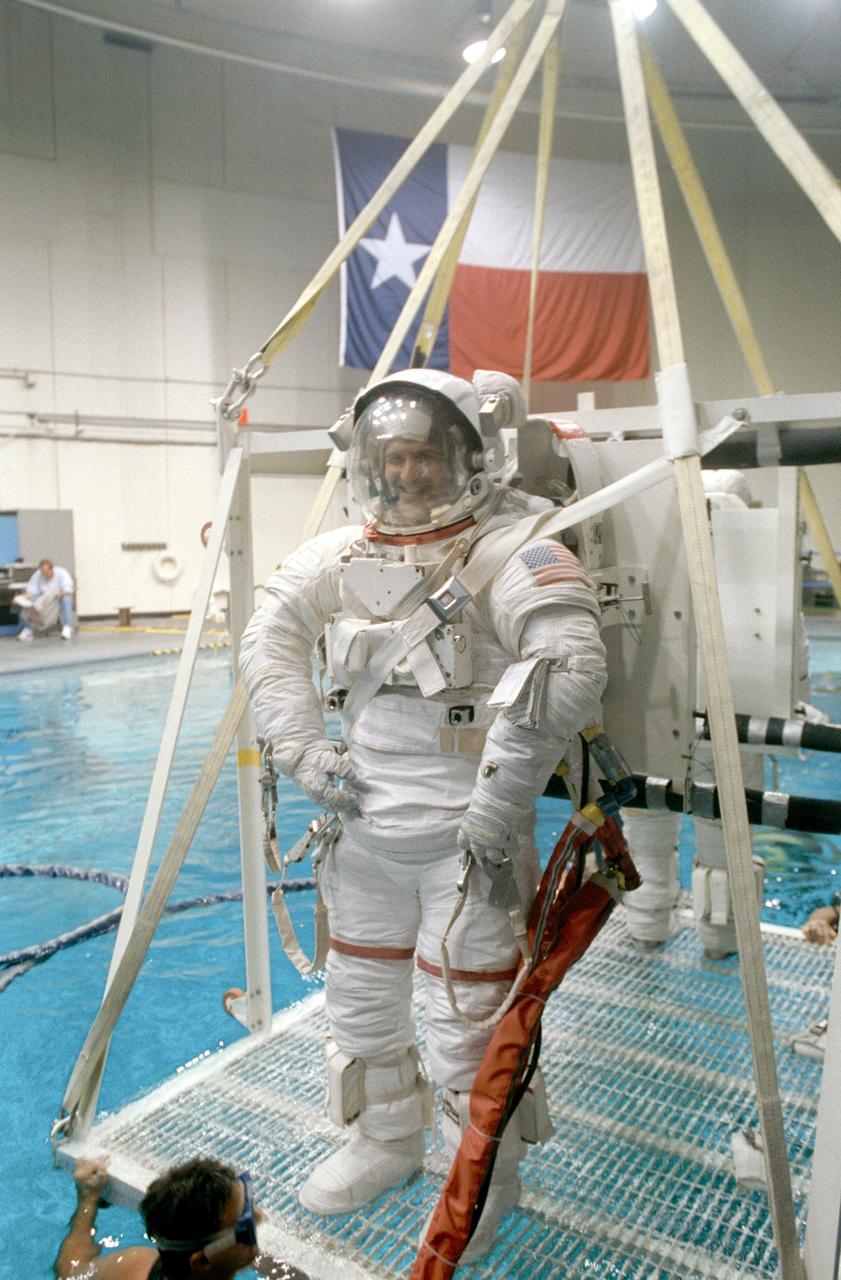
S92-40378 (1 July 1992) --- Astronaut Peter J.K. Wisoff, STS-57 mission specialist, fully suited in an extravehicular mobility unit (EMU) and helmet and standing on a platform, is lowered into the 25 foot deep pool of Johnson Space Center?s (JSC) Weightless Environment Training Facility (WETF) Bldg 29. Once underwater, Wisoff will participate in an underwater extravehicular activity (EVA) simulation. A scuba-equipped diver already in the pool guides the platform into the water.
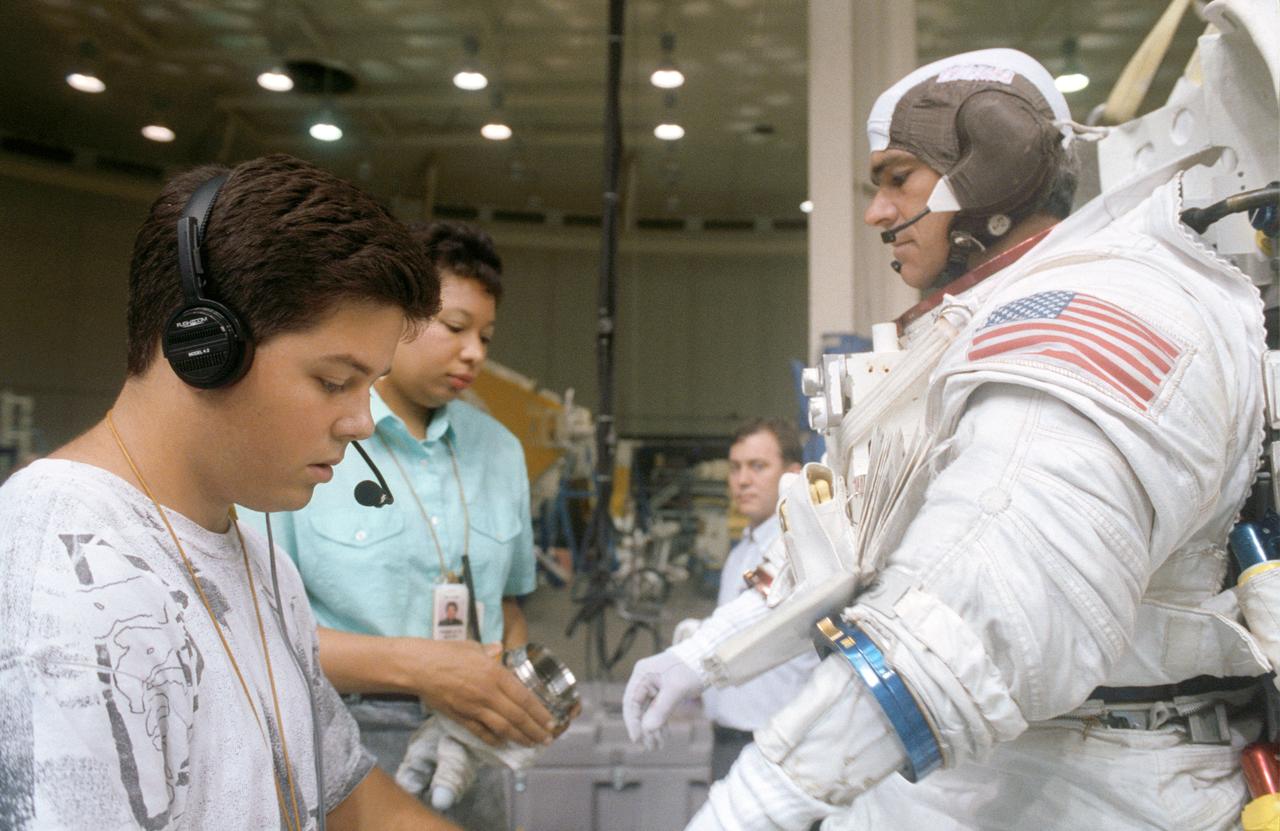
S92-42681 (28 July 1992) --- STS-53 Discovery, Orbiter Vehicle (OV) 103, Mission Specialist (MS) Michael R.U. Clifford, wearing extravehicular mobility unit (EMU) and communications carrier assembly (CCA), dons gloves with assistance from two technicians. Clifford is preparing for an underwater contingency extravehicular activity (EVA) simulation in JSC's Weightless Environment Training Facility (WETF) Bldg 29 pool.
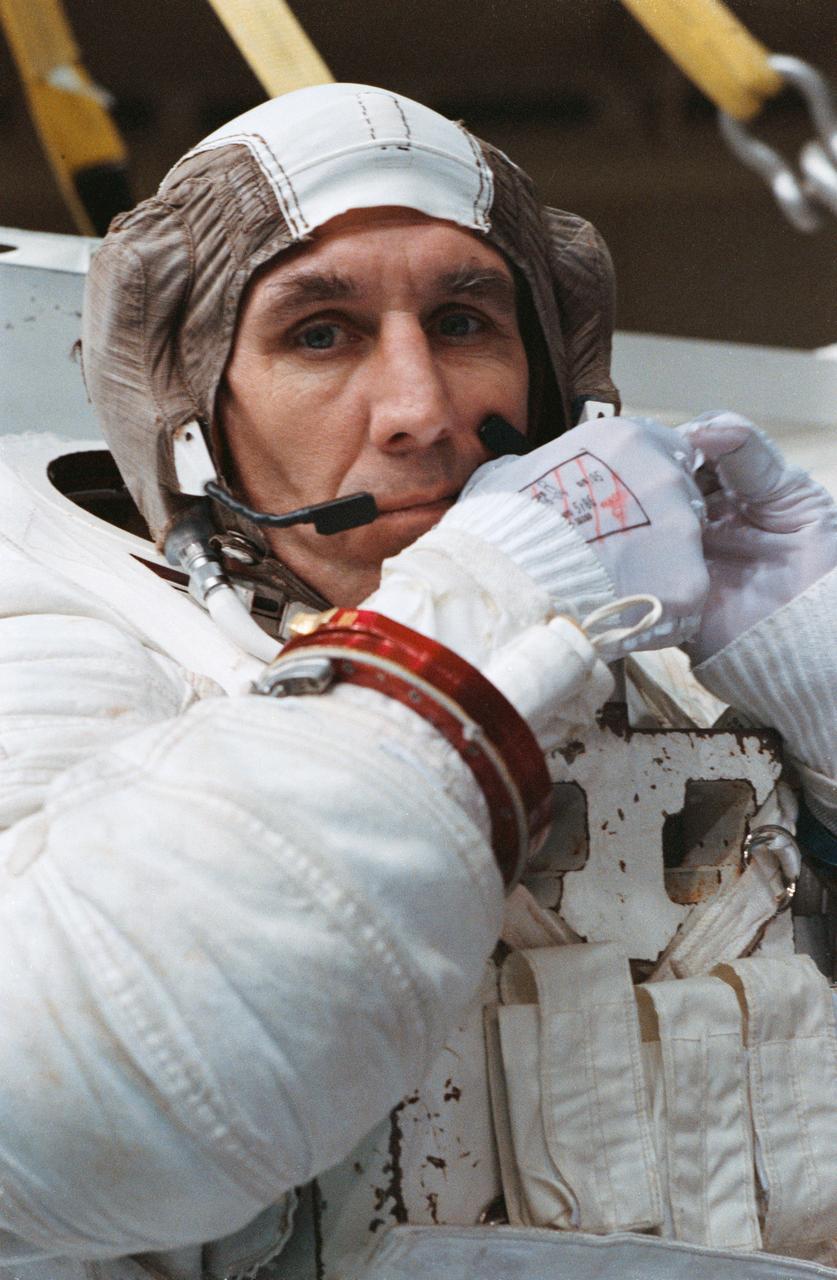
STS-38 Mission Specialist (MS) Robert C. Springer, wearing extravehicular mobility unit (EMU), fastens the strap on his communications carrier assembly (CCA) cap during suit donning in JSC's Weightless Environment Training Facility (WETF) Bldg 29. Positioned on the WETF platform at pool side, Springer is preparing for an underwater extravehicular activity (EVA) simulation. During the training exercise, Springer will rehearse contingency EVA procedures for the STS-38 mission aboard Atlantis, Orbiter Vehicle (OV) 104.
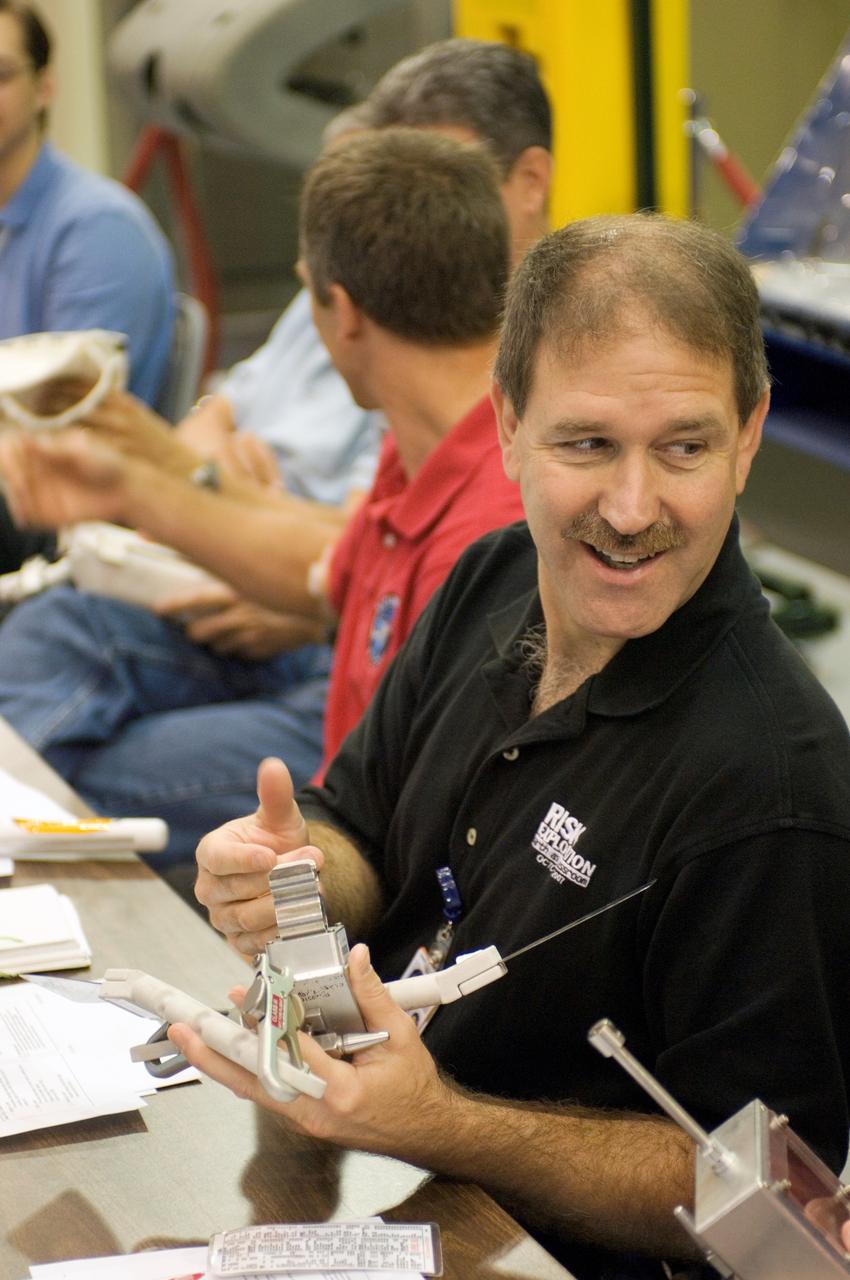
JSC2008-E-031807 (2 April 2008) --- Astronaut John M. Grunsfeld, STS-125 mission specialist, participates in an extravehicular activity (EVA) hardware training session in the Space Vehicle Mockup Facility at NASA's Johnson Space Center.
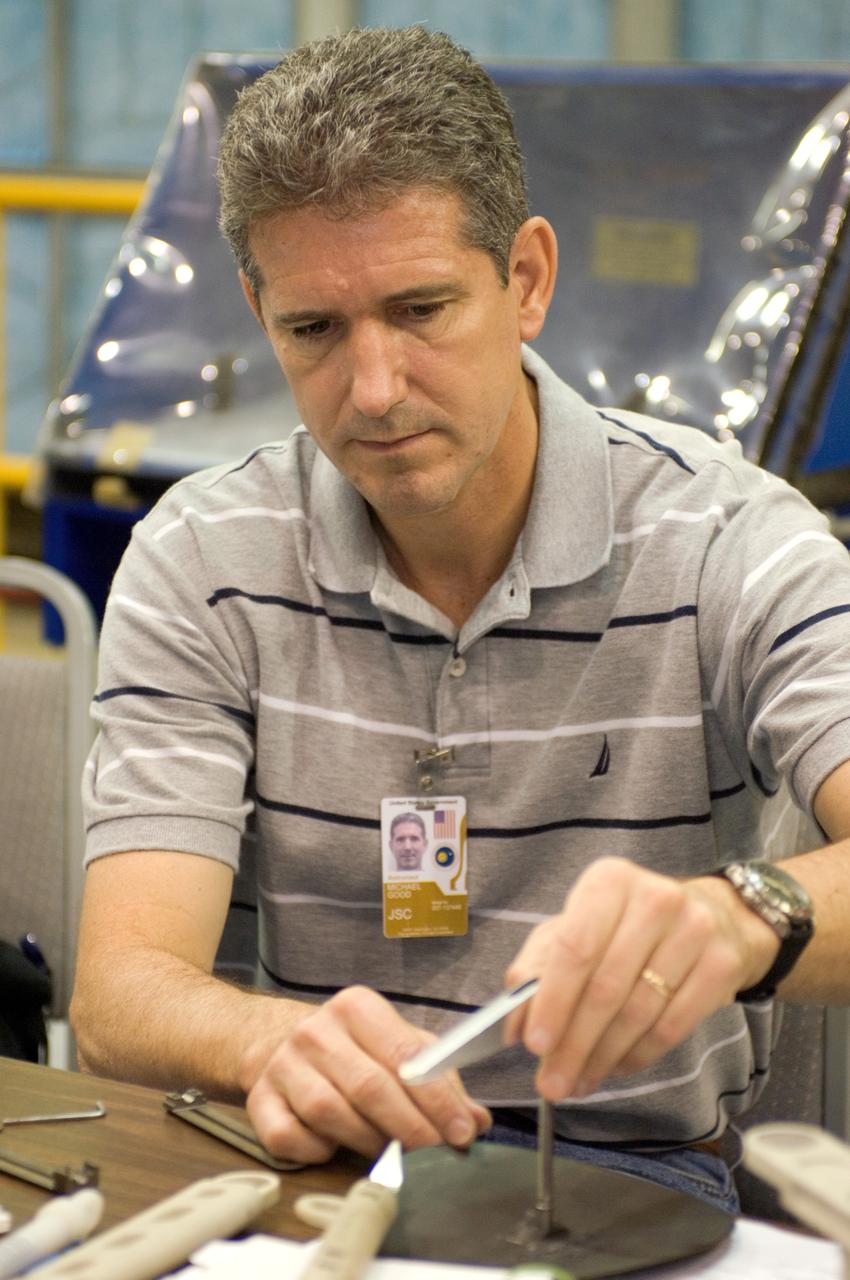
JSC2008-E-031811 (2 April 2008) --- Astronaut Michael T. Good, STS-125 mission specialist, participates in an extravehicular activity (EVA) hardware training session in the Space Vehicle Mockup Facility at NASA's Johnson Space Center.
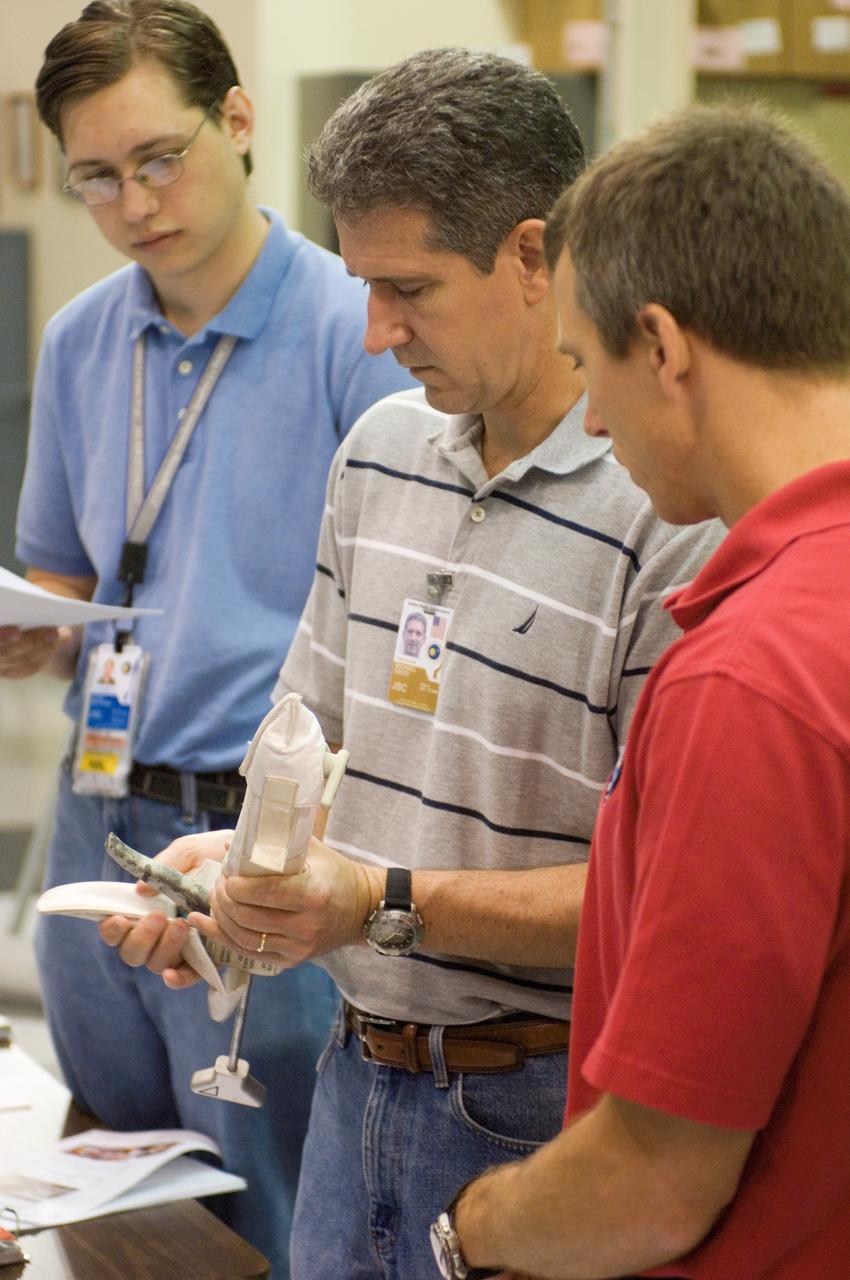
JSC2008-E-031809 (2 April 2008) --- Astronauts Andrew J. Feustel (right) and Michael T. Good, both STS-125 mission specialists, participate in an extravehicular activity (EVA) hardware training session in the Space Vehicle Mockup Facility at NASA's Johnson Space Center.
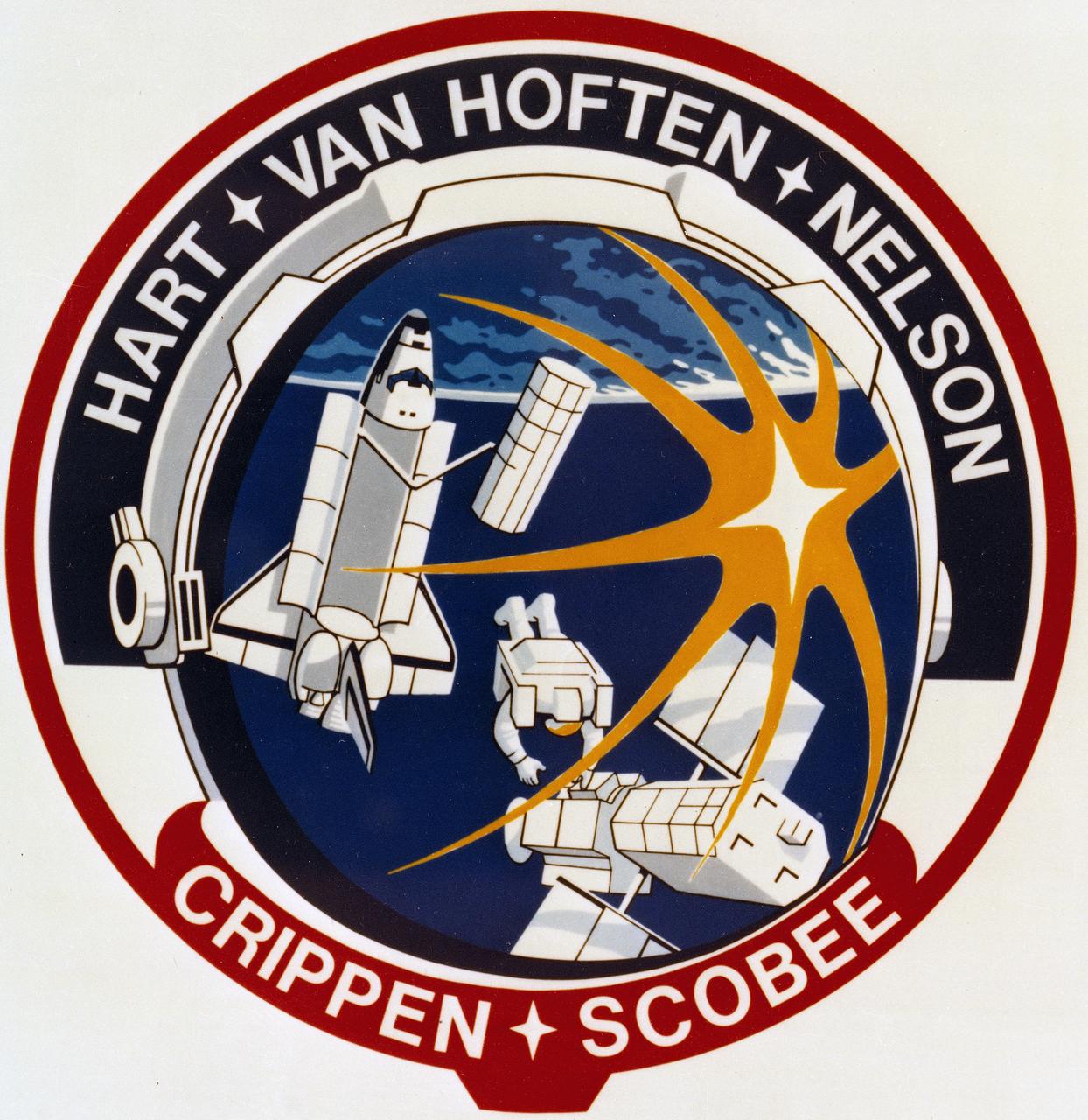
The patch features a helmet visor of an astronaut performing an extravehicular activity. In the visor are reflected the sun's rays, the Challenger and its remote manipulator system (RMS) deploying the long duration exposure facility (LDEF), the Earth and blue sky, and another astronaut working at the damaged Solar Maximum Satellite (SMS). The scene is encircled by the surnames of the crewmembers.
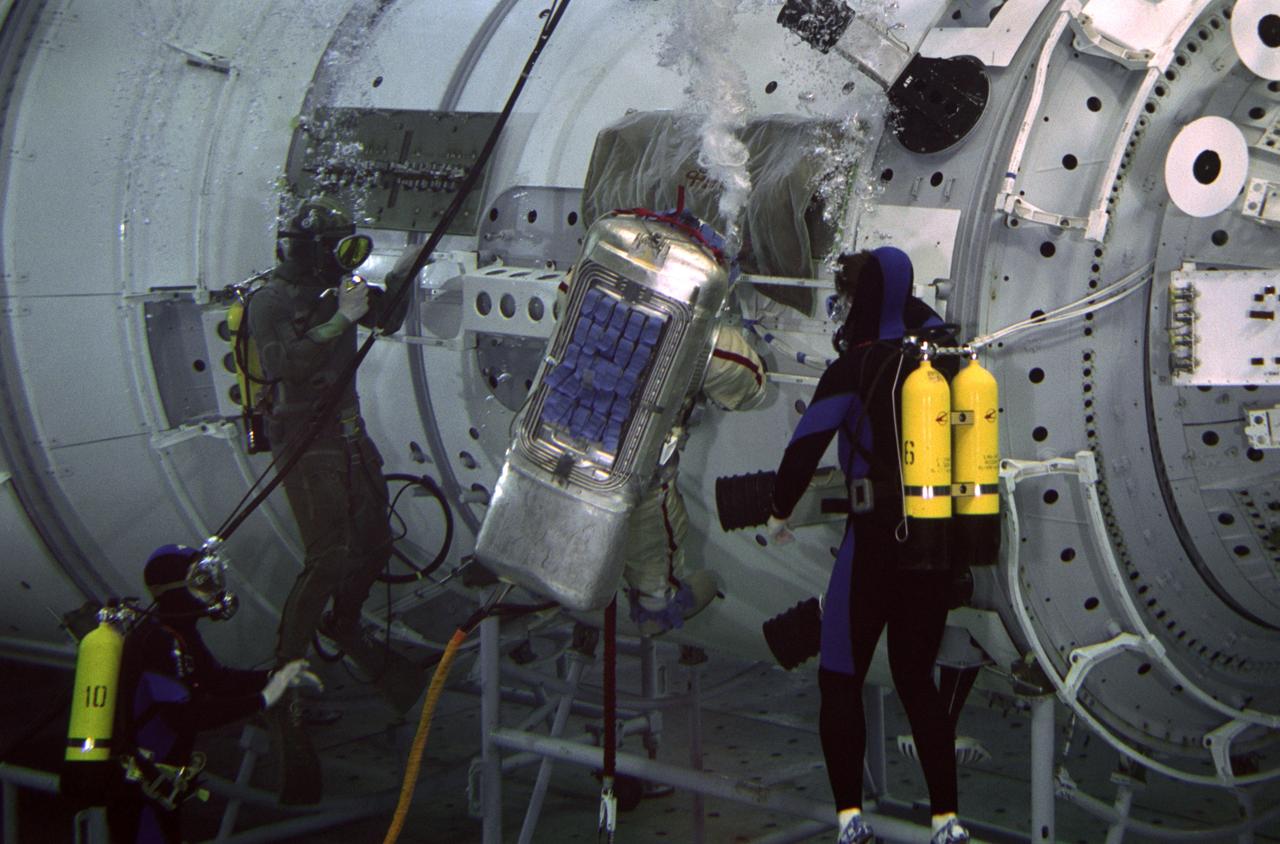
JSC2000-05367 (7 June 2000) --- Astronaut William Shepherd, ISS Expedition One commander, rehearses an extravehicular activity (EVA) with a full scale training model of the Zvezda Service Module in the Hydrolab facility at the Gagarin Cosmonaut Training Center in Russia. SCUBA-equipped divers assist in the spacewalk rehearsal.
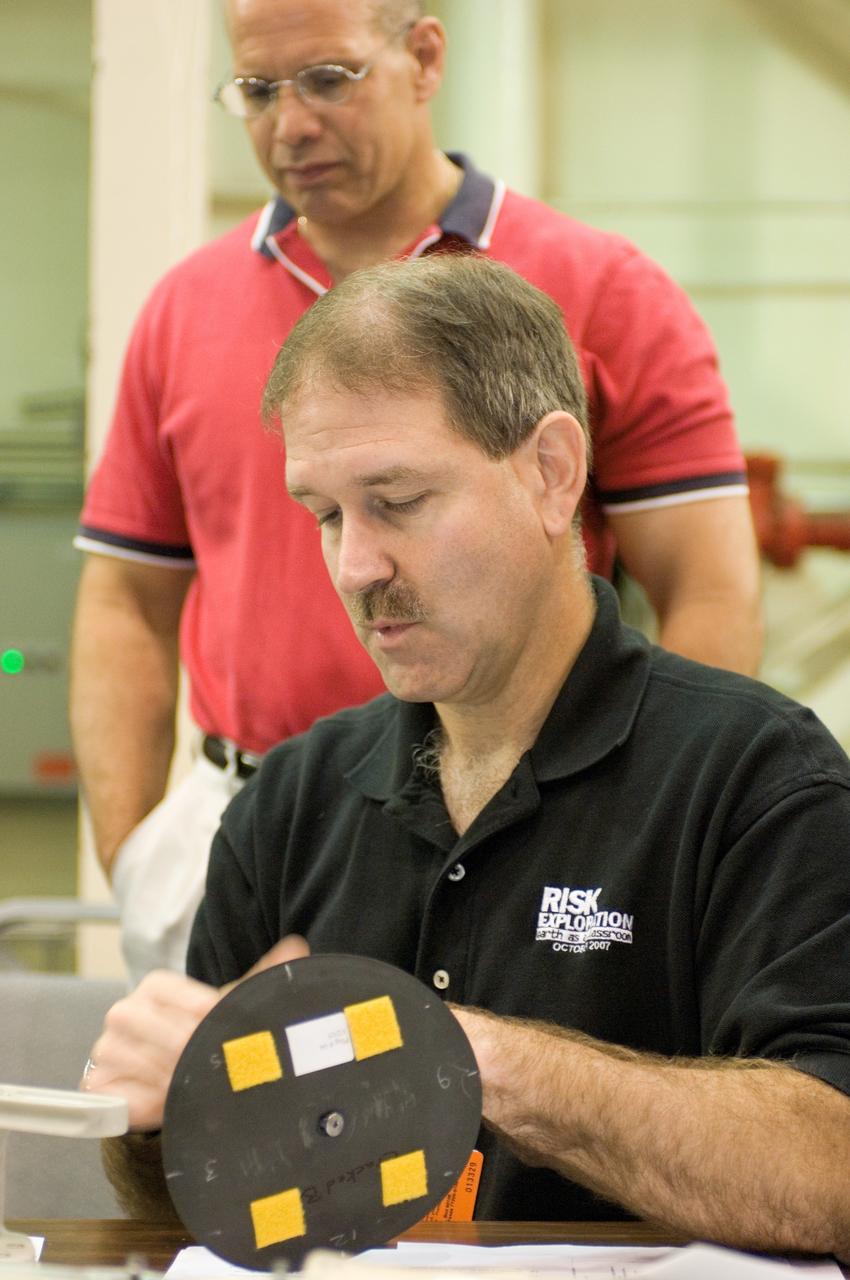
JSC2008-E-031810 (2 April 2008) --- Astronauts John M. Grunsfeld, STS-125 mission specialist, participates in an extravehicular activity (EVA) hardware training session in the Space Vehicle Mockup Facility at NASA's Johnson Space Center. Flight director Tony Ceccacci looks on.
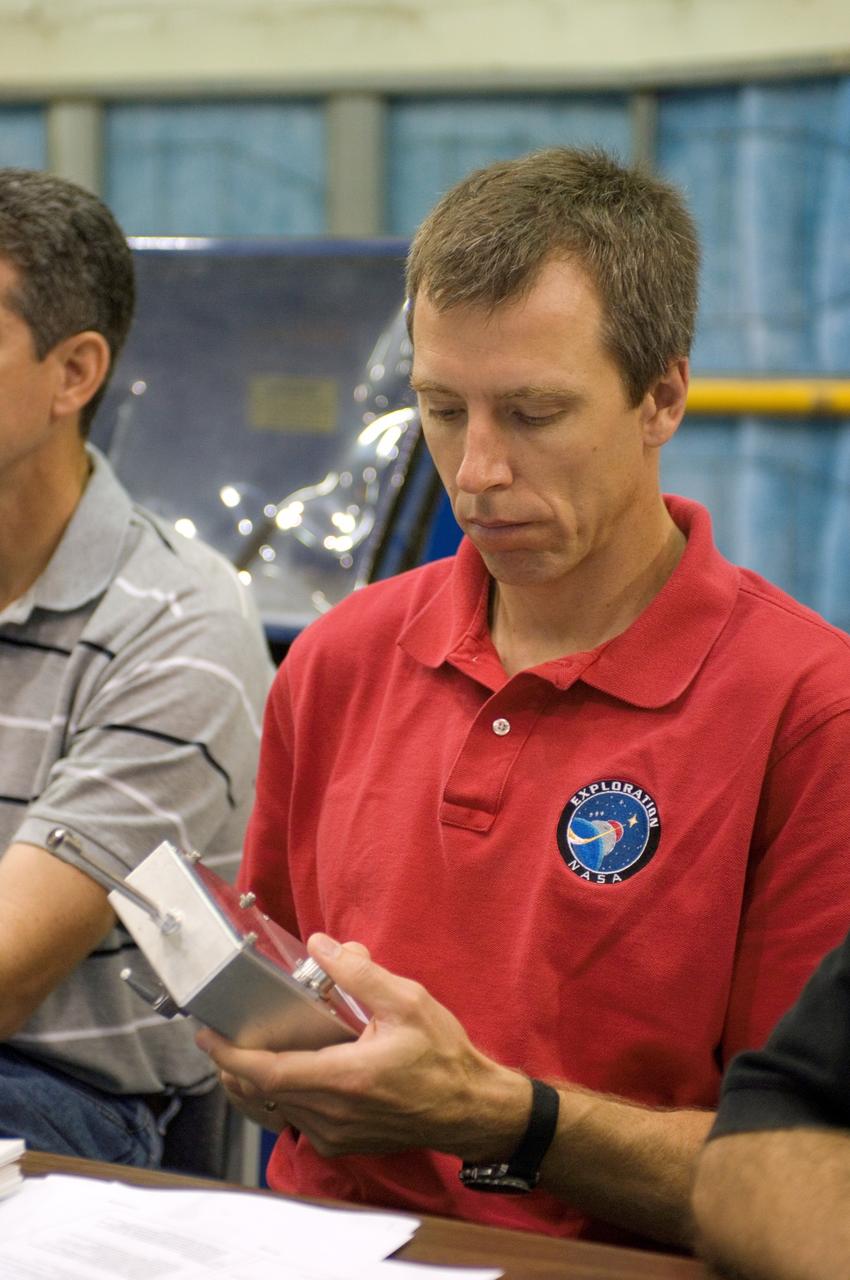
JSC2008-E-031806 (2 April 2008) --- Astronaut Andrew J. Feustel, STS-125 mission specialist, participates in an extravehicular activity (EVA) hardware training session in the Space Vehicle Mockup Facility at NASA's Johnson Space Center.
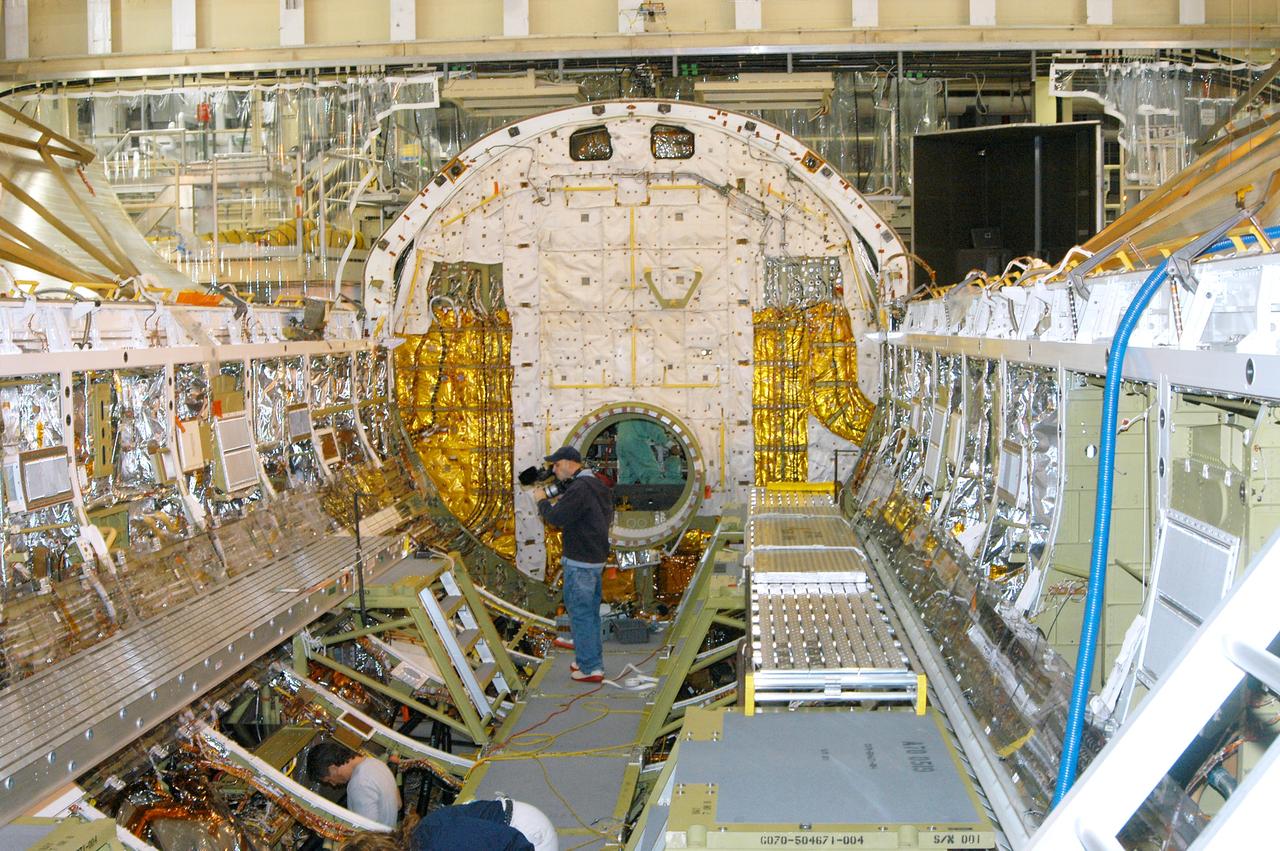
KENNEDY SPACE CENTER, FLA. - In the Orbiter Processing Facility, a cameraman films part of Discovery’s payload bay for a special feature on the KSC Web. In the background is the open hatch of the airlock, located inside the middeck of the spacecraft’s pressurized crew cabin. The airlock is sized to accommodate two fully suited flight crew members simultaneously. Support functions include airlock depressurization and repressurization, extravehicular activity equipment recharge, liquid-cooled garment water cooling, EVA equipment checkout, donning and communications. The outer hatch isolates the airlock from the unpressurized payload bay when closed and permits the EVA crew members to exit from the airlock to the payload bay when open.

KENNEDY SPACE CENTER, FLA. - In the Orbiter Processing Facility, a worker checks out part of the equipment in the airlock, at one end of Discovery’s payload bay. The airlock is sized to accommodate two fully suited flight crew members simultaneously. Support functions include airlock depressurization and repressurization, extravehicular activity equipment recharge, liquid-cooled garment water cooling, EVA equipment checkout, donning and communications. The outer hatch isolates the airlock from the unpressurized payload bay when closed and permits the EVA crew members to exit from the airlock to the payload bay when open.
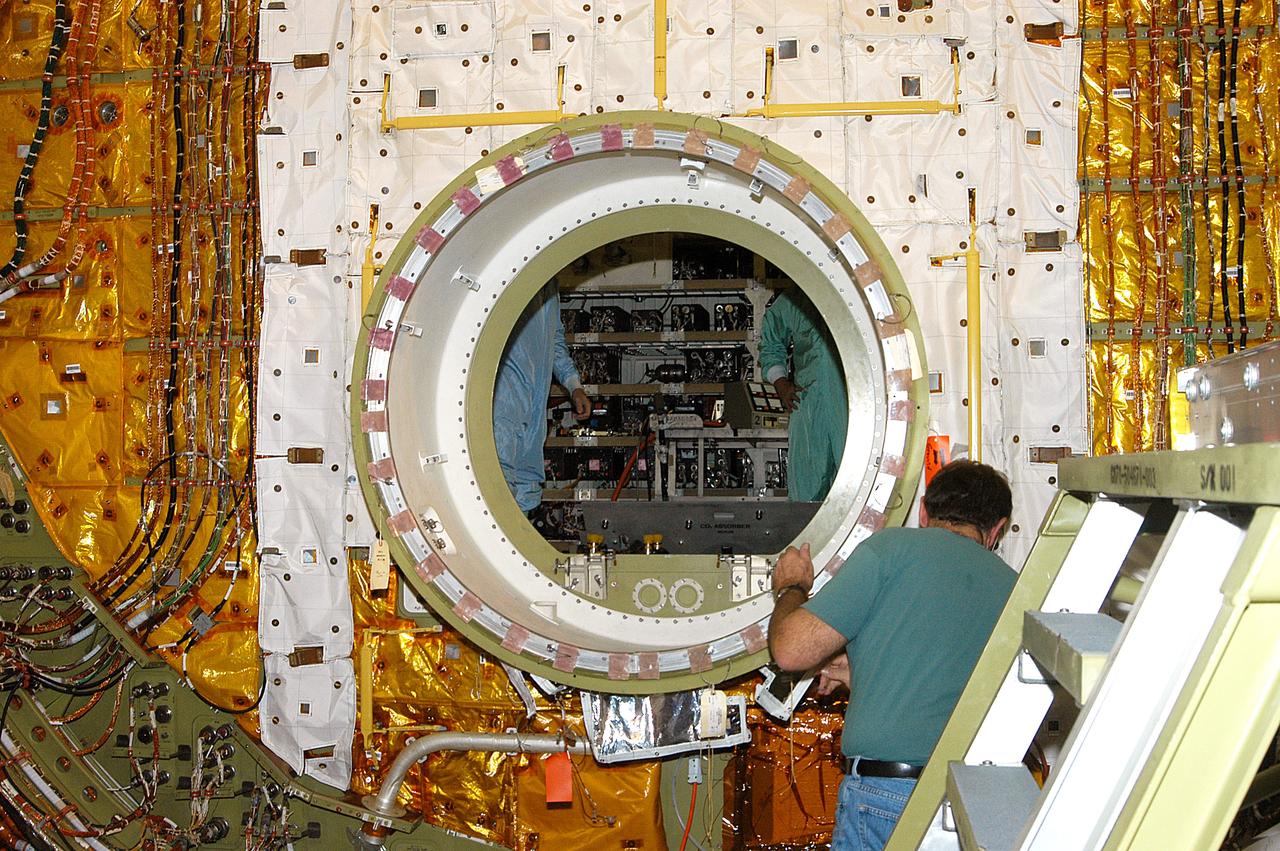
KENNEDY SPACE CENTER, FLA. - A worker in the Orbiter Processing Facility checks the open hatch of the airlock in Discovery’s payload bay. The airlock is normally located inside the middeck of the spacecraft’s pressurized crew cabin. The airlock is sized to accommodate two fully suited flight crew members simultaneously. Support functions include airlock depressurization and repressurization, extravehicular activity equipment recharge, liquid-cooled garment water cooling, EVA equipment checkout, donning and communications. The outer hatch isolates the airlock from the unpressurized payload bay when closed and permits the EVA crew members to exit from the airlock to the payload bay when open.
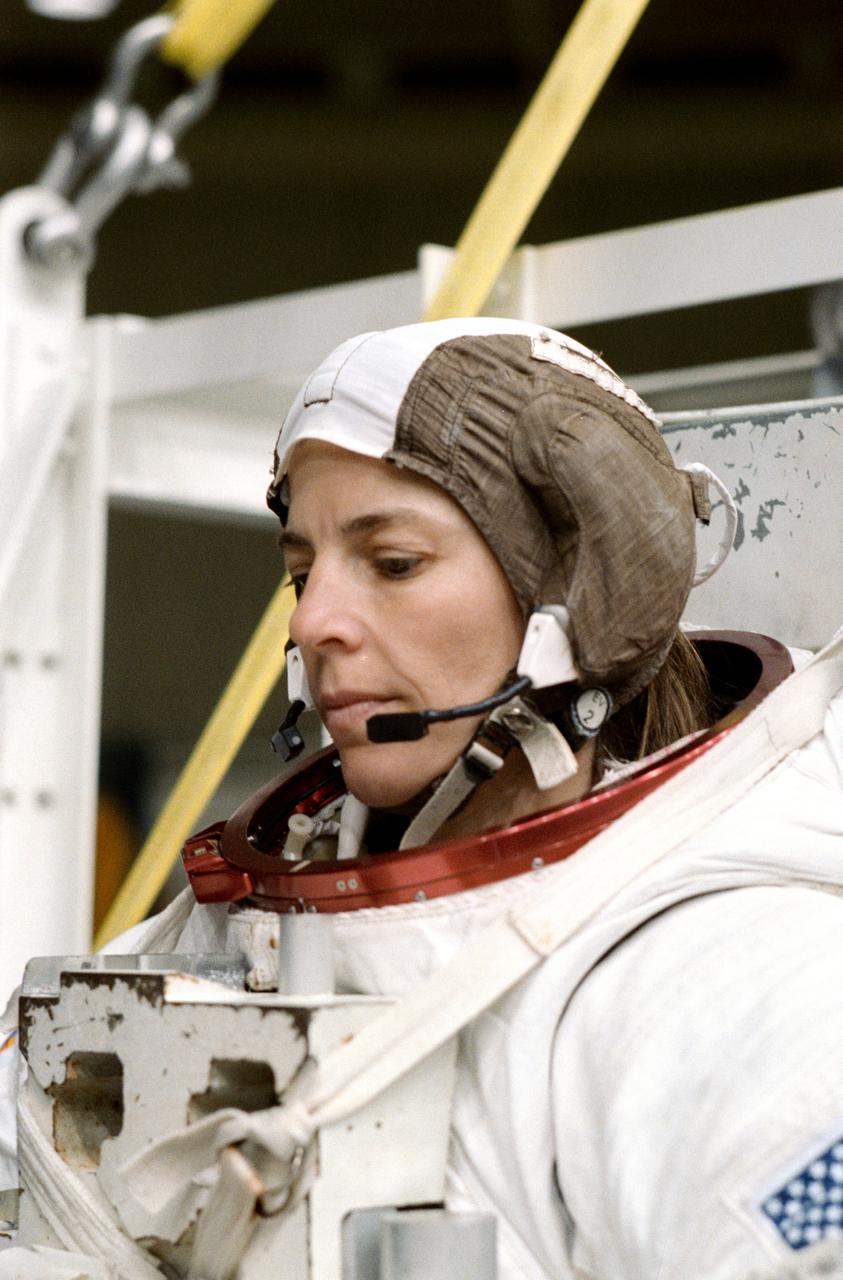
S89-41600 (Nov 1989) --- Astronaut Bonnie J. Dunbar, wearing an extravehicular mobility unit (EMU) spacesuit, prepares to don a helmet and be lowered by a hoist device for a session of underwater training in the Johnson Space Center's weightless environment training facility (WET-F). Minutes later, Astronauts Dunbar and G. David Low, mission specialists, were neutrally buoyant in the nearby 25-ft. deep pool simulating a contingency extravehicular activity (EVA) for the scheduled December 1989 STS-32 mission. There are no scheduled EVAs for the crew, whose main missions are to retrieve the Long Duration Exposure Facility (LDEF) and to deploy a Syncom satellite.
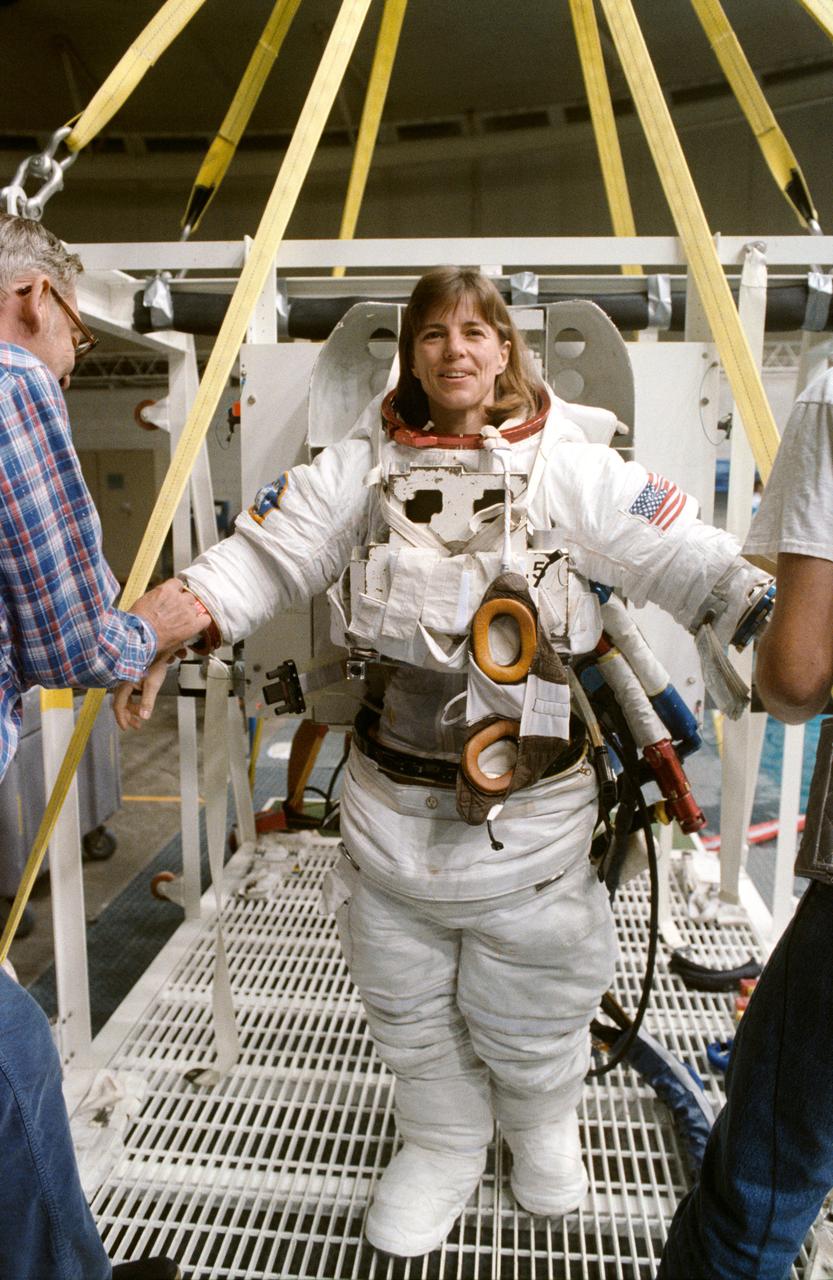
S89-41597 (Nov 1989) --- Astronaut Bonnie J. Dunbar, wearing an extravehicular mobility unit (EMU) spacesuit, prepares to don gloves and subsequently a helmet and to be lowered by a hoist device for a session of underwater training in the Johnson Space Center's weightless environment training facility (WET-F). Minutes later, Astronauts Dunbar and G. David Low, mission specialists, were neutrally buoyant in the nearby 25-ft. deep pool simulating a contingency extravehicular activity (EVA) for the scheduled December 1989 STS-32 mission. There are no scheduled EVAs for the crew, whose main missions are to retrieve the Long Duration Exposure Facility (LDEF) and to deploy a Syncom satellite.
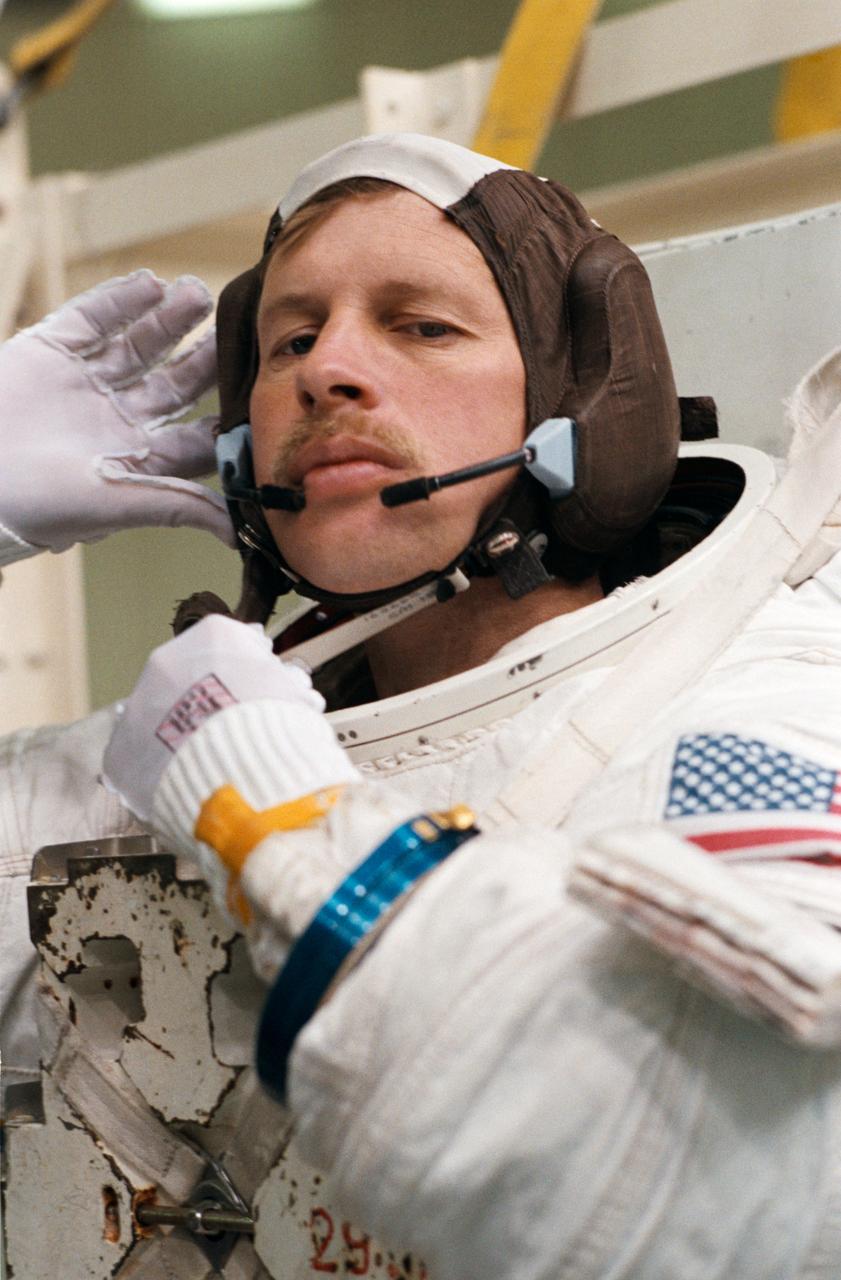
Astronaut Sherwood Springer prepares for an underwater test at Weightless Environment Training Facility (WETF) in response to the discovery of problems with the 04/13 deployed Syncom IV (LEASAT) communications satellite. Activities, Bldg. 29, WETF for the STS-23/51D Extravehicular Activity (EVA) Simulation for Syncom IV, 04/14/1985. 1. Shuttle - Simulation (SYNCOM IV) 2. Astronaut Jerry L. Ross - Simulation (SYNCOM) 3. Astronaut Sherwood C. Spring - Simulation (SYNCOM IV) JSC, Houston, TX
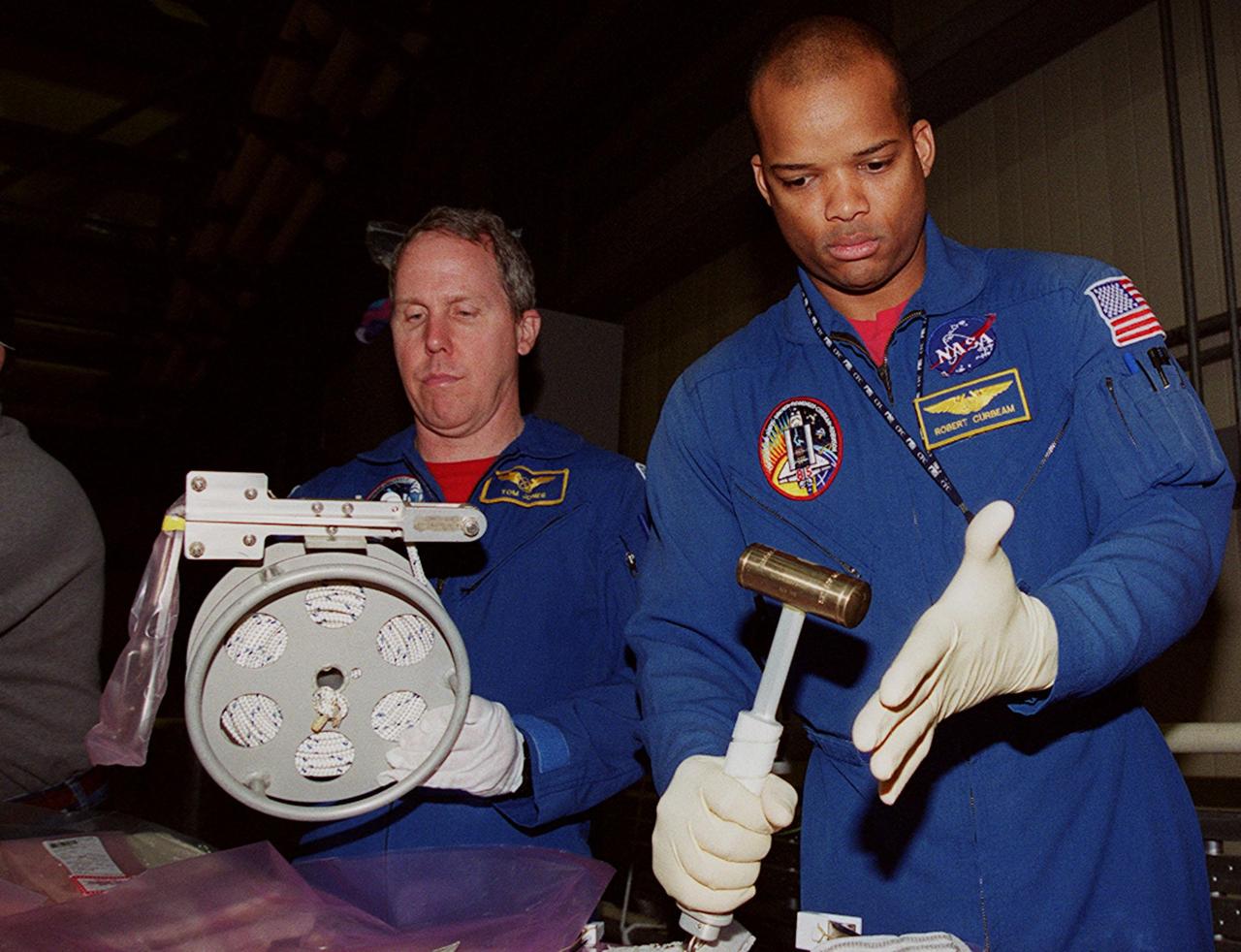
KENNEDY SPACE CENTER, FLA. -- In Orbiter Processing Facility bay 3, STS-98 Mission Specialists Tom Jones and Robert Curbeam test tools that will be used during extravehicular activities (EVA) on their mission. Scheduled for launch Jan. 18, 2001, STS-98 will be transporting the U.S. Lab, Destiny, to the International Space Station with five system racks already installed inside of the module. After delivery of electronics in the lab, electrically powered attitude control for Control Moment Gyroscopes will be activated
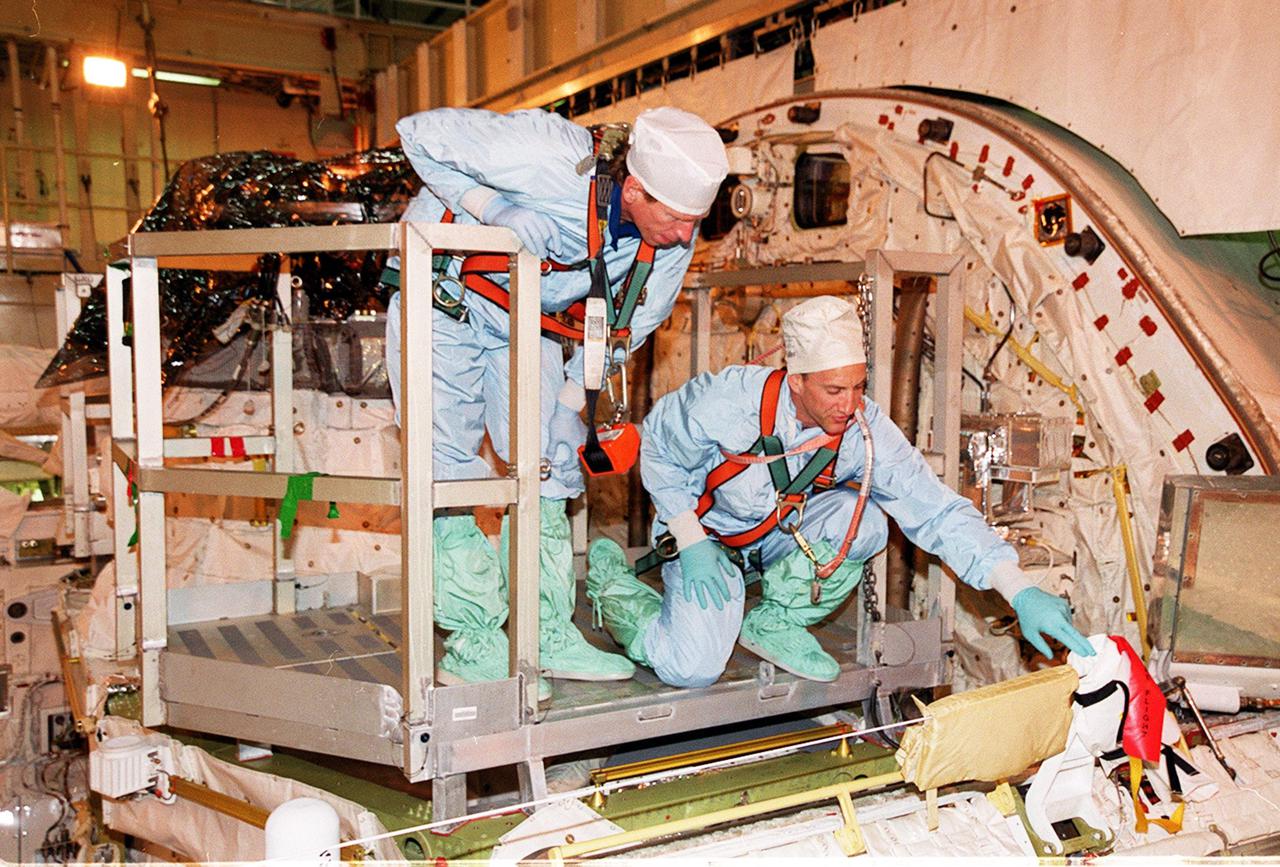
KENNEDY SPACE CENTER, FLA. -- In the Orbiter Processing Facility, STS-104 Mission Specialist Michael Gernhardt (left) and Pilot Charles Hobaugh (right) check out the slidewire used during extravehicular activities to keep the astronauts tethered to the orbiter. The STS-104 crew is at KSC to continue Crew Equipment Interface Test activities such as payload familiarization. The Joint Airlock Module is the primary payload on their mission, scheduled to launch no earlier than June 14, 2001, from Launch Pad 39B
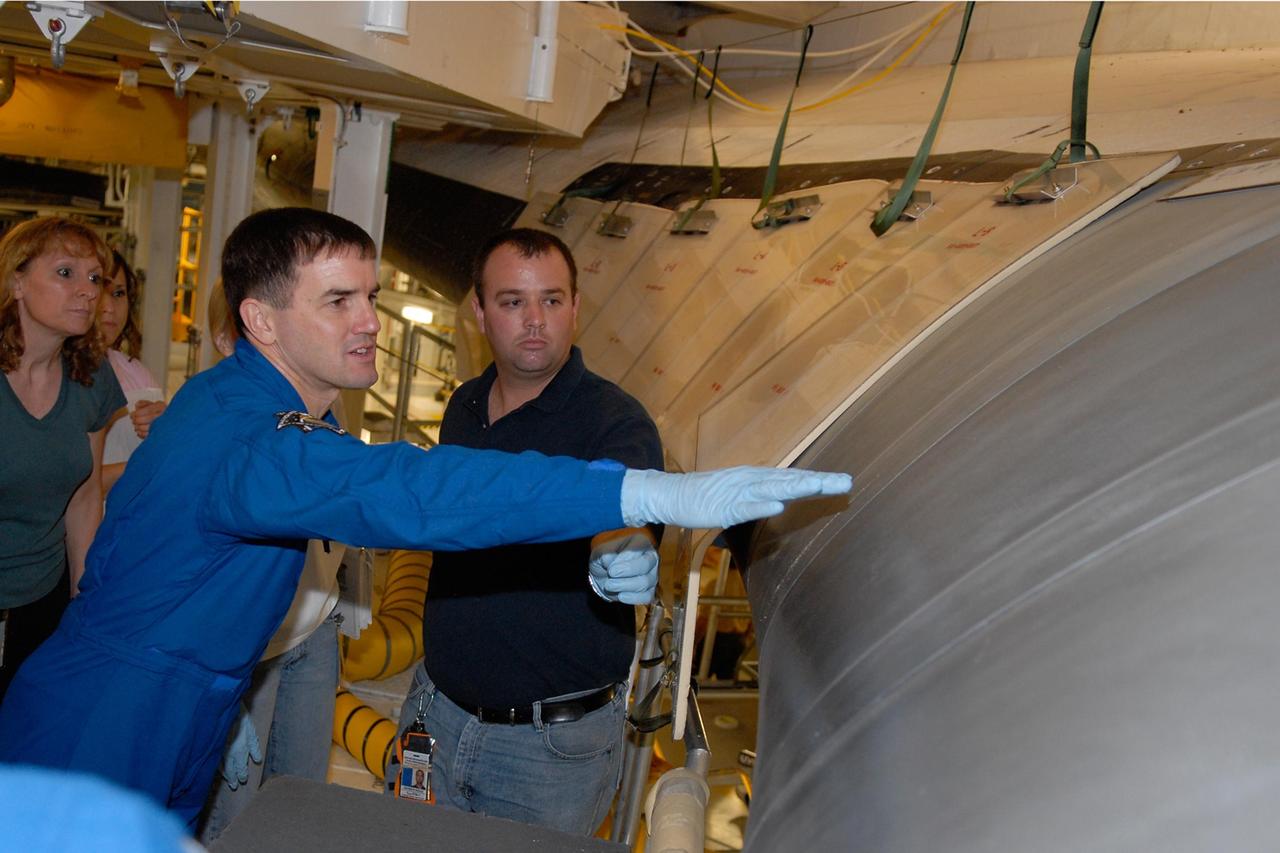
KENNEDY SPACE CENTER, FLA. -- In the Orbiter Processing Facility, STS-122 Mission Specialist Rex Walheim reaches toward the wing of space shuttle Atlantis. The crew is at Kennedy to take part in a crew equipment interface test, or CEIT, which helps familiarize them with equipment and payloads for the mission. Among the activities standard to a CEIT are harness training, inspection of the thermal protection system and camera operation for planned extravehicular activities, or EVAs. STS-122 is targeted for launch in December. Photo credit: NASA/Kim Shiflett
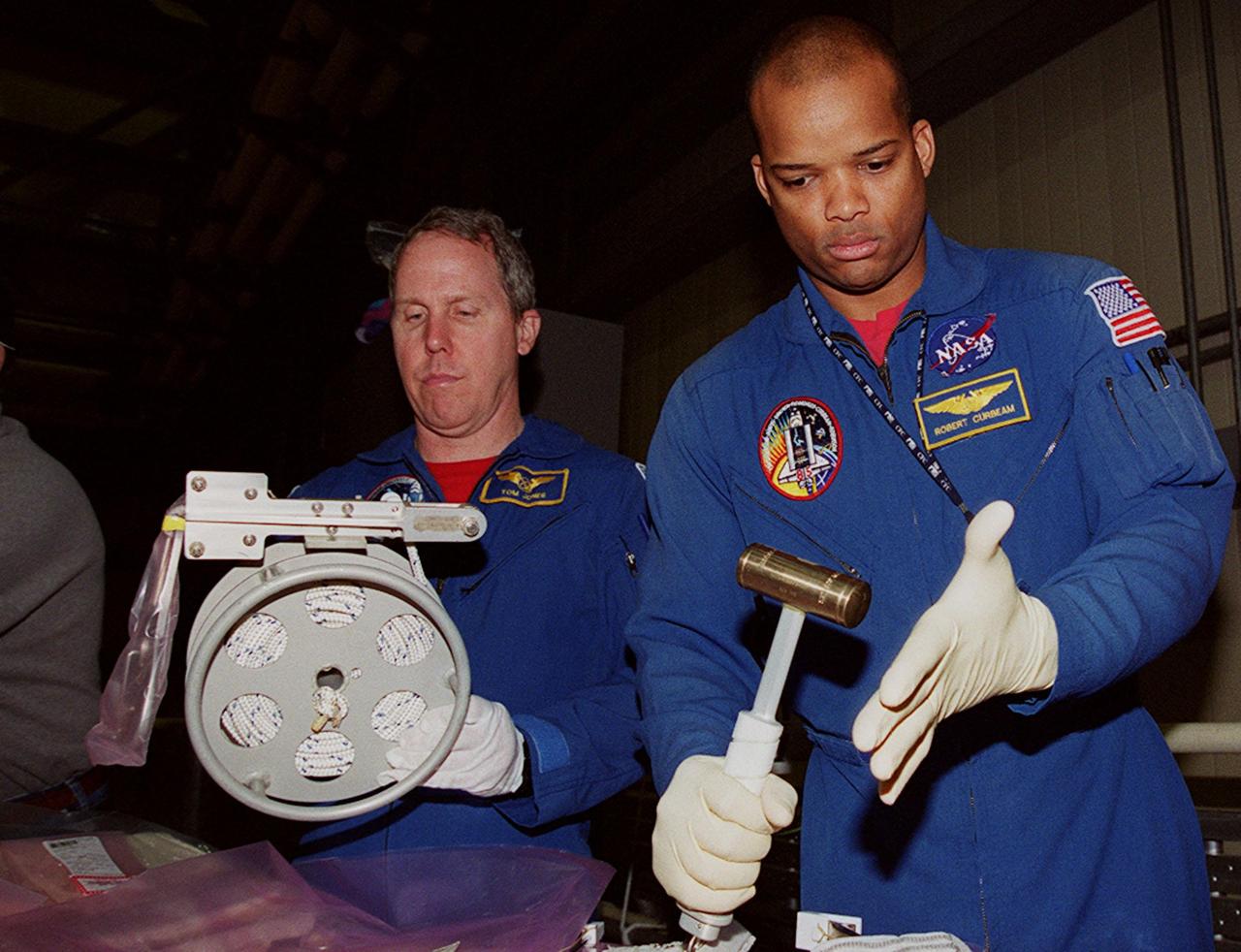
KENNEDY SPACE CENTER, FLA. -- In Orbiter Processing Facility bay 3, STS-98 Mission Specialists Tom Jones and Robert Curbeam test tools that will be used during extravehicular activities (EVA) on their mission. Scheduled for launch Jan. 18, 2001, STS-98 will be transporting the U.S. Lab, Destiny, to the International Space Station with five system racks already installed inside of the module. After delivery of electronics in the lab, electrically powered attitude control for Control Moment Gyroscopes will be activated
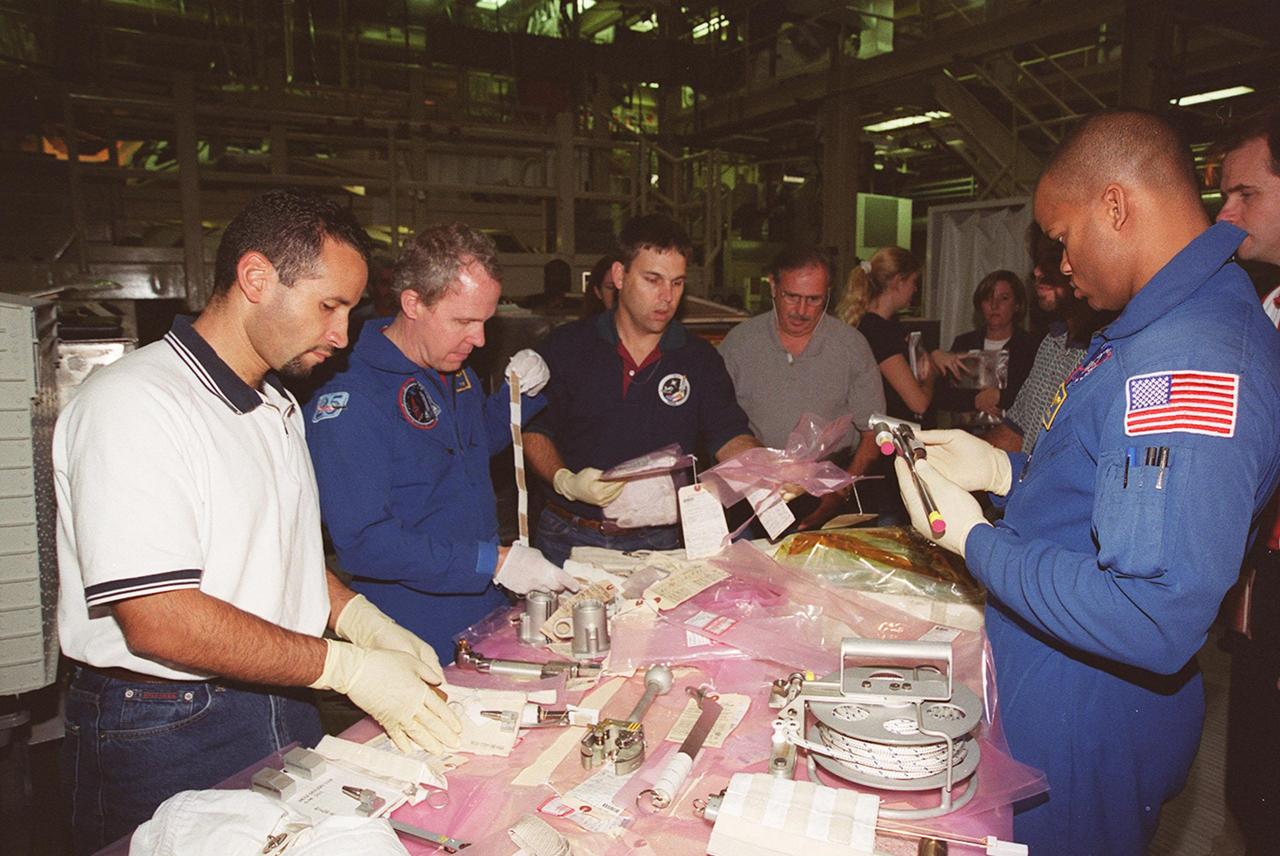
KENNEDY SPACE CENTER, FLA. -- In Orbiter Processing Facility bay 3, STS-98 Mission Specialists Tom Jones (second from left) and Robert Curbeam (right) test tools that will be used during extravehicular activities (EVA) on their mission. Scheduled for launch Jan. 18, 2001, STS-98 will be transporting the U.S. Lab, Destiny, to the International Space Station with five system racks already installed inside of the module. After delivery of electronics in the lab, electrically powered attitude control for Control Moment Gyroscopes will be activated
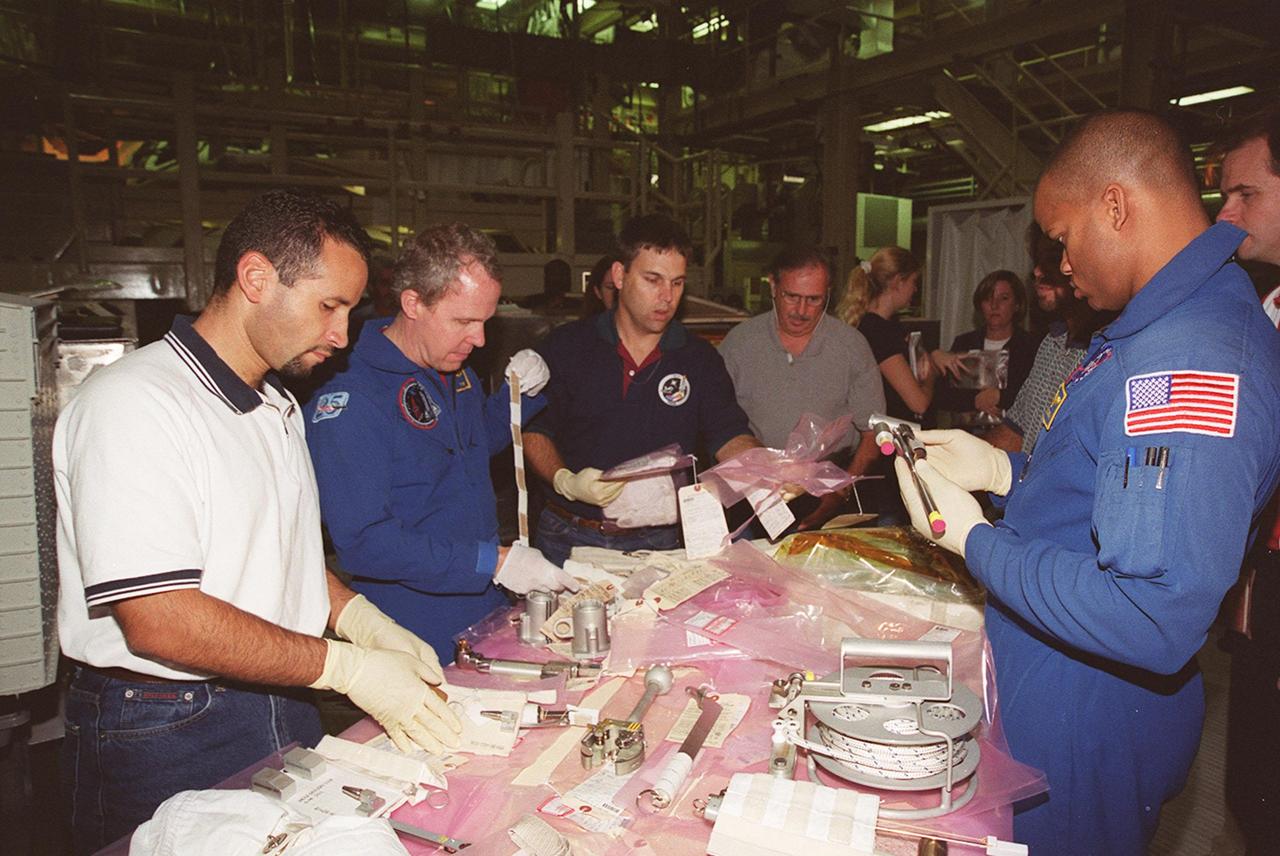
KENNEDY SPACE CENTER, FLA. -- In Orbiter Processing Facility bay 3, STS-98 Mission Specialists Tom Jones (second from left) and Robert Curbeam (right) test tools that will be used during extravehicular activities (EVA) on their mission. Scheduled for launch Jan. 18, 2001, STS-98 will be transporting the U.S. Lab, Destiny, to the International Space Station with five system racks already installed inside of the module. After delivery of electronics in the lab, electrically powered attitude control for Control Moment Gyroscopes will be activated
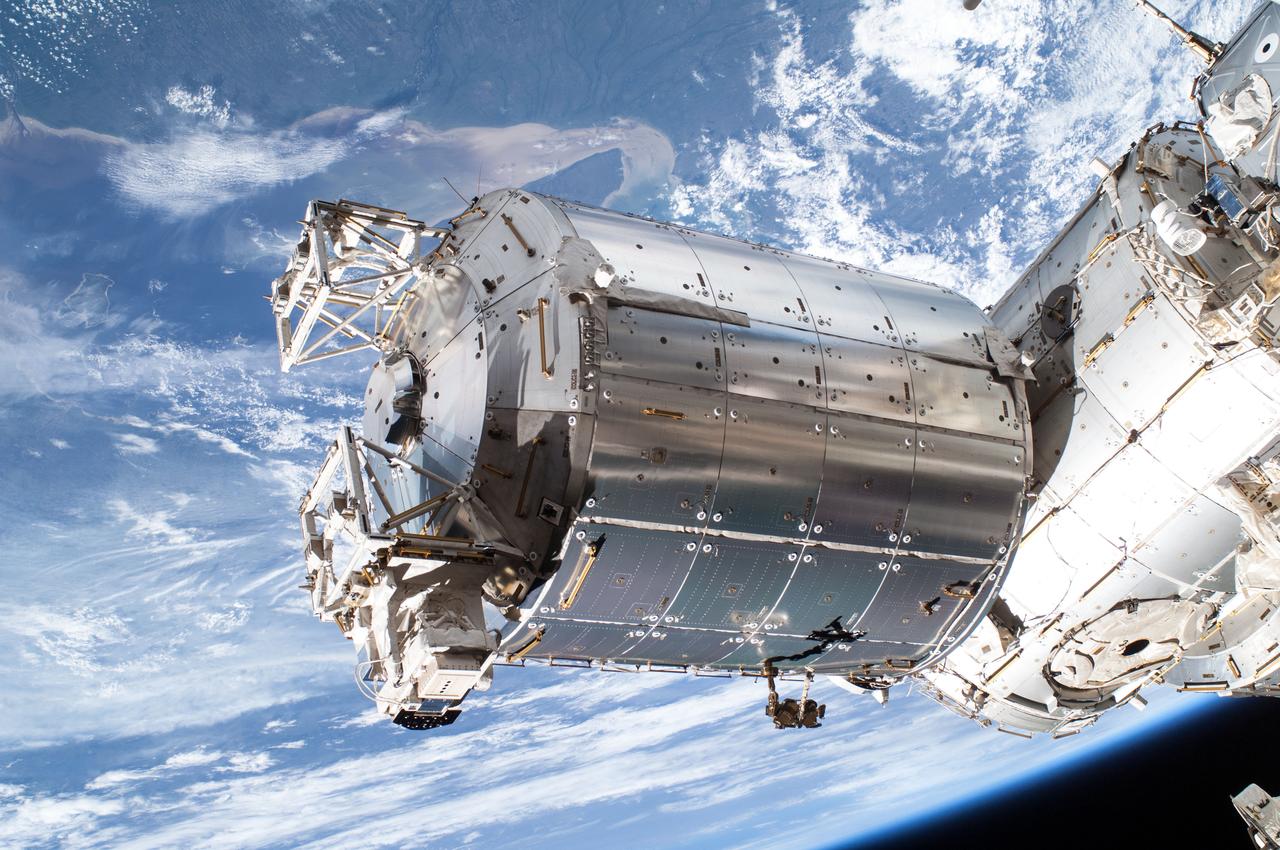
iss036e016840 (7/9/2013) --- Close-up view of the COLUMBUS External Platform Facility (CEPF) and the Solar facility taken during extravehicular activity (EVA) 22 on the International Space Station. The Sun Monitoring on the External Payload Facility of Columbus (Solar) is a monitoring observatory that will measure the solar spectral irradiance, which is of great importance for atmospheric modeling, atmospheric chemistry and climatology.
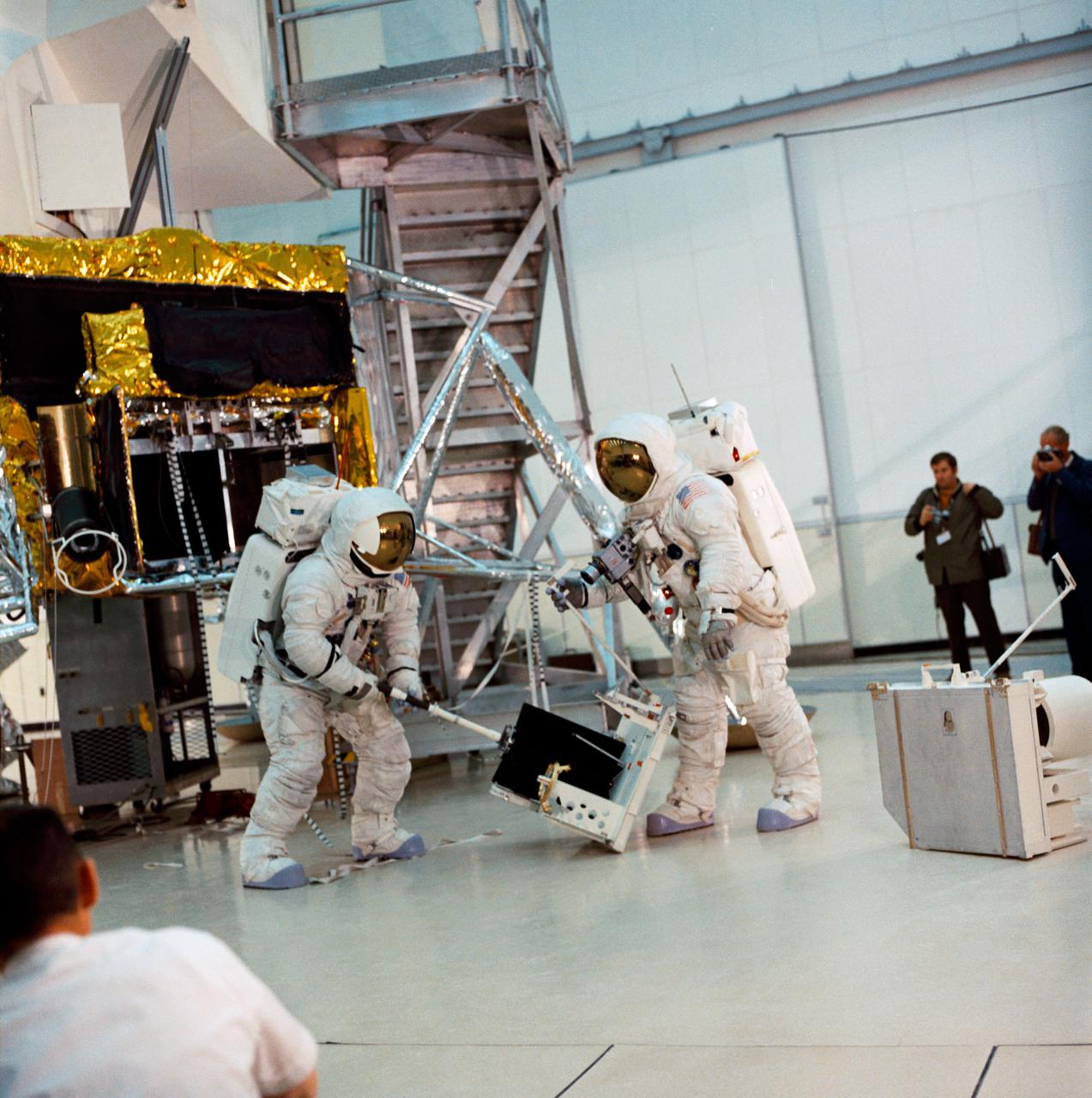
S70-27036 (4 Feb. 1970) --- Two crew men of the Apollo 13 lunar landing mission simulate lunar surface extravehicular activity (EVA) during training exercises in the Kennedy Space Center's (KSC) Flight Crew Training Building. They are astronauts James A. Lovell Jr. commander; and Fred W. Haise Jr., lunar module pilot.
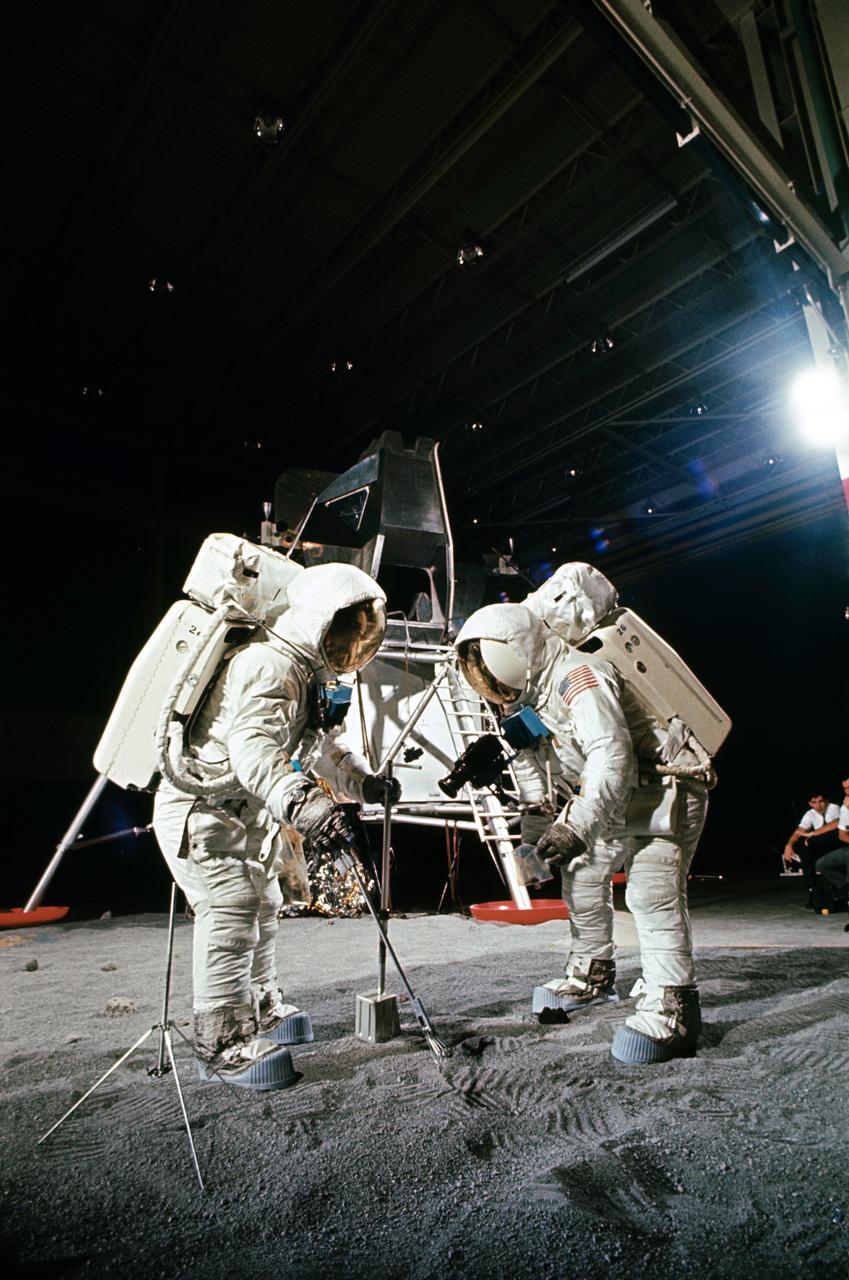
Two members of the Apollo 11 lunar landing mission participate in a simulation of deploying and using lunar tools on the surface of the moon during a training exercise in bldg 9 on April 22, 1969. Astronaut Edwin E. Aldrin Jr. (on left), lunar module pilot, uses scoop and tongs to pick up sample. Astronaut Neil A. Armstrong, Apollo 11 commander, holds bag to receive sample. In the background is a Lunar Module mockup. Both men are wearing Extravehicular Mobility Units (EMU).
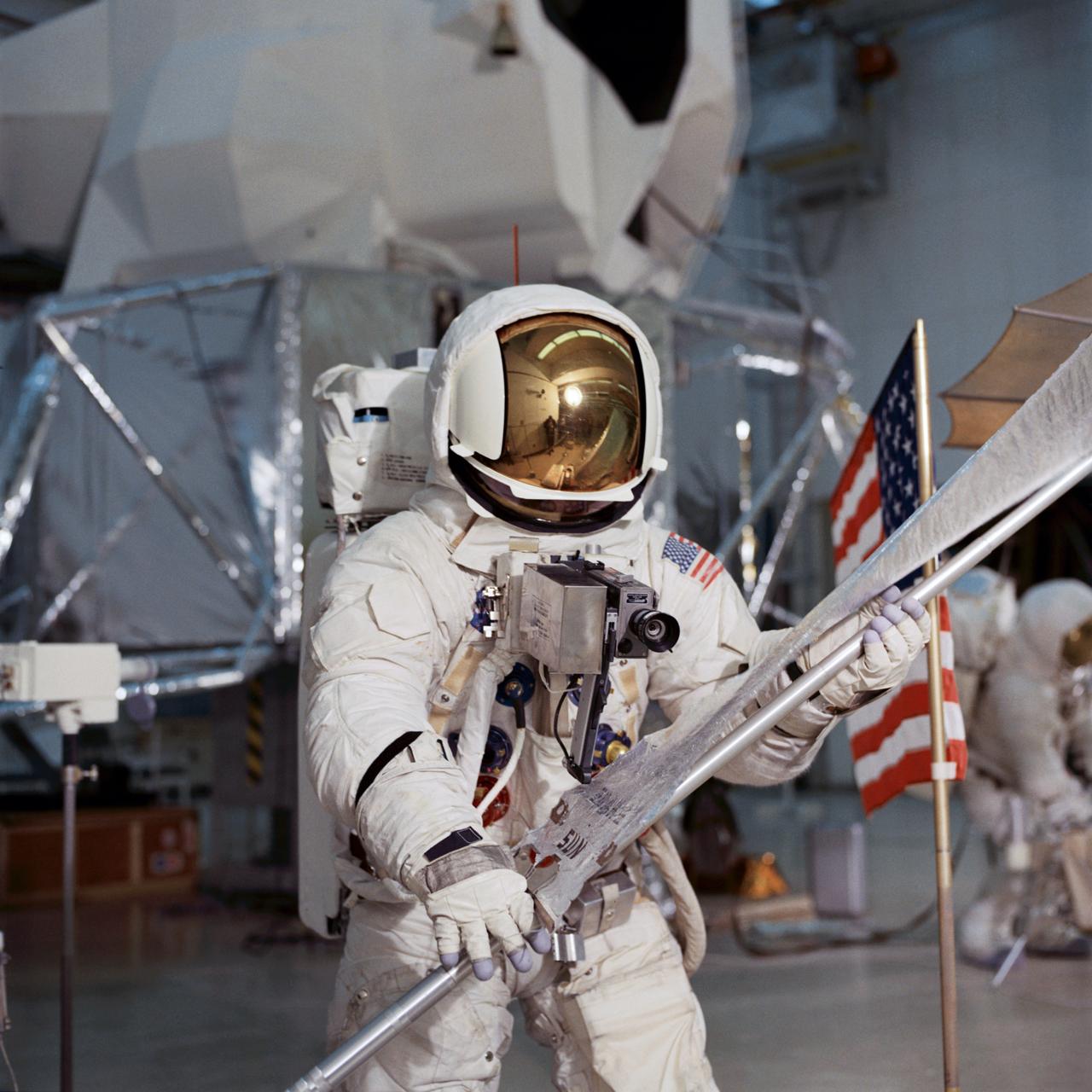
S70-27034 (4 Feb. 1970) --- Astronaut Fred W. Haise Jr., lunar module pilot of the Apollo 13 lunar landing mission, simulates lunar surface extravehicular activity (EVA) during training exercises in the Kennedy Space Center's (KSC) Flight Crew Training Building (FCTB). Haise, wearing an Extravehicular Mobility Unit (EMU), is holding a Solar Wind Composition (SWC) experiment.
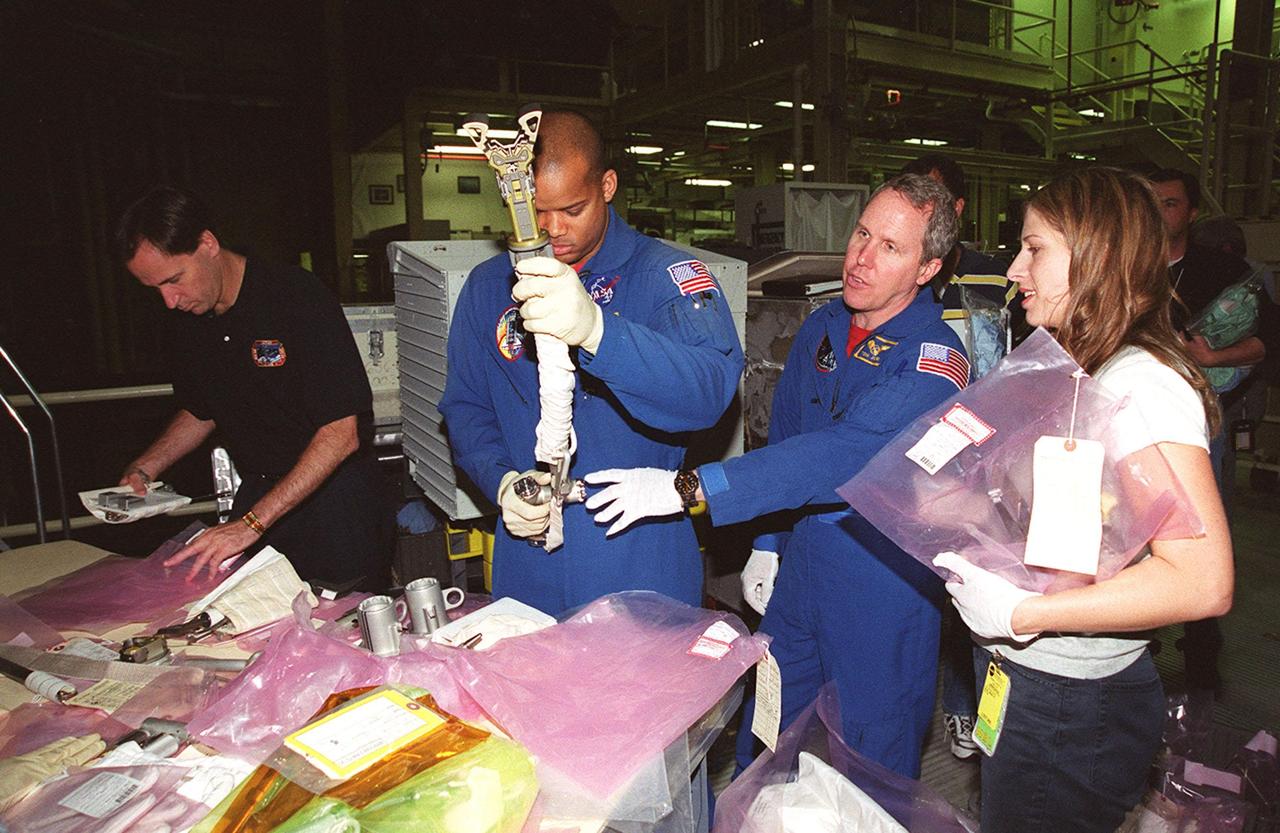
KENNEDY SPACE CENTER, FLA. -- In the Orbiter Processing Facility, STS-98 Mission Specialists Robert Curbeam (center left) and Tom Jones (center right) practice with tools that will be used on extravehicular activities on their mission. The STS-98 crew is at KSC for Crew Equipment Interface Test activities. Launch on mission STS-98 is scheduled for Jan. 18, 2001. It will be transporting the U.S. Lab, Destiny, to the International Space Station with five system racks already installed inside of the module. After delivery of electronics in the lab, electrically powered attitude control for Control Moment Gyroscopes will be activated
KENNEDY SPACE CENTER, FLA. -- In the Orbiter Processing Facility, STS-98 Mission Specialists Robert Curbeam (center left) and Tom Jones (center right) practice with tools that will be used on extravehicular activities on their mission. The STS-98 crew is at KSC for Crew Equipment Interface Test activities. Launch on mission STS-98 is scheduled for Jan. 18, 2001. It will be transporting the U.S. Lab, Destiny, to the International Space Station with five system racks already installed inside of the module. After delivery of electronics in the lab, electrically powered attitude control for Control Moment Gyroscopes will be activated
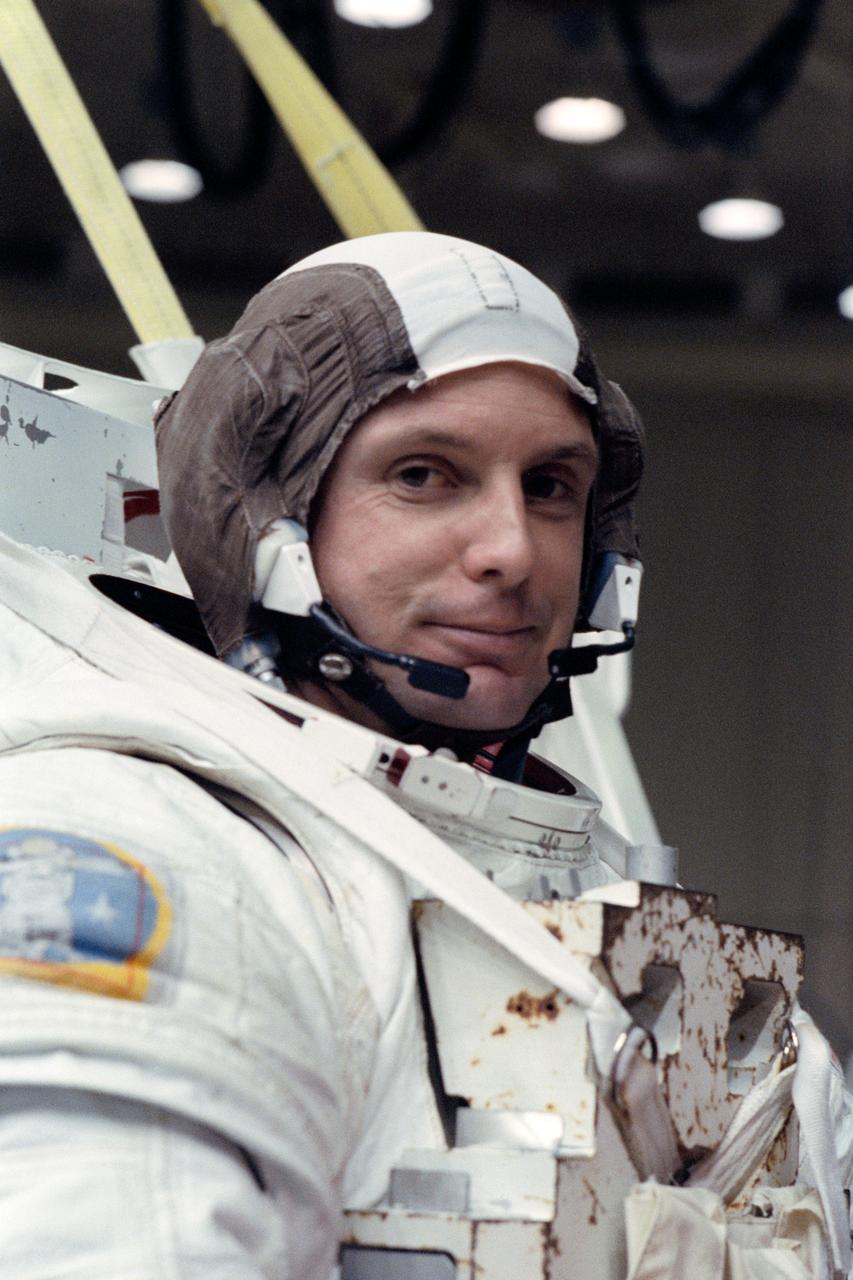
S90-41497 (Aug 1990) --- Astronaut Gregory J. Harbaugh, STS-39 mission specialist, completes suiting up process for a training exercise in the weightless environment training facility (WET-F) at the Johnson Space Center (JSC). Harbaugh and fellow crewmembers are using JSC's WET-F facility to participate in simulations of contingency extravehicular activity (EVA) for the flight.
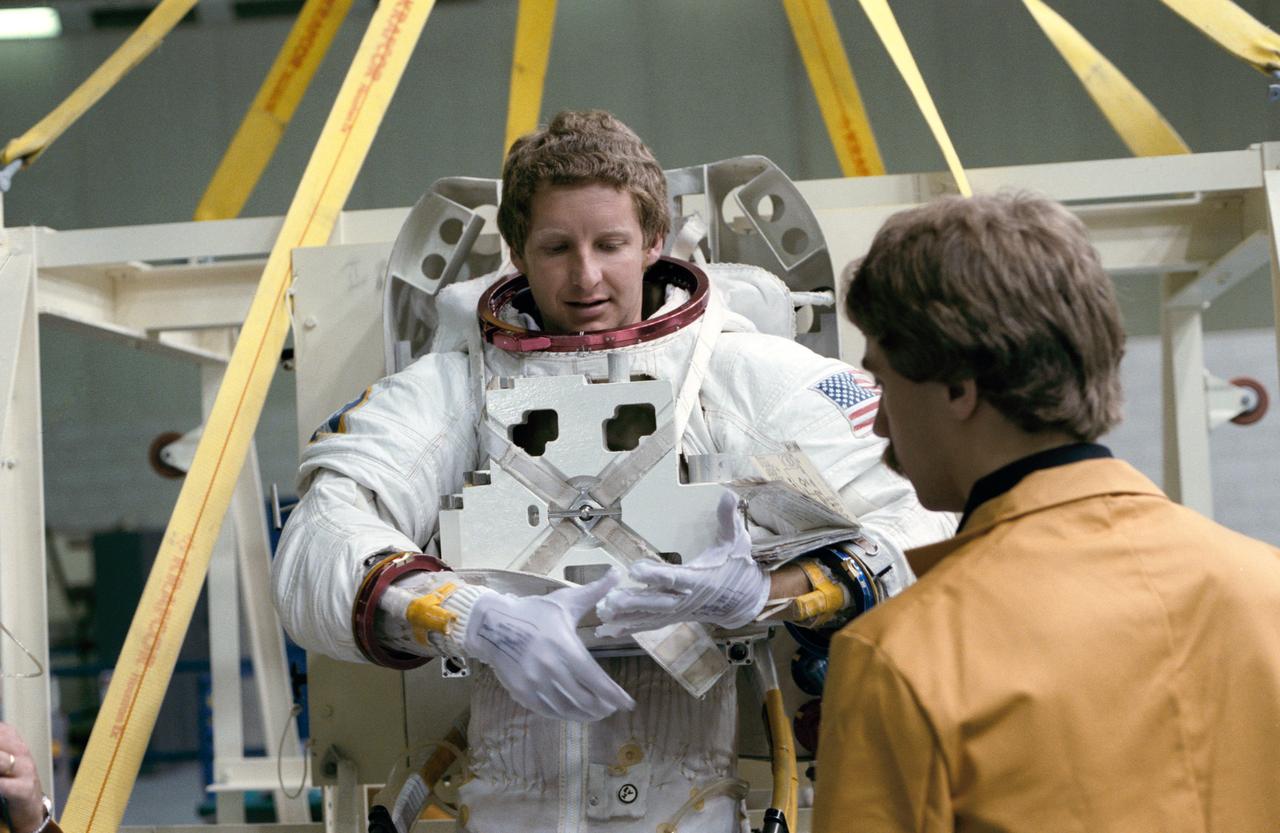
S84-28203 (24 Feb 1984) --- Astronaut Steven A. Hawley, 41-D mission specialists, completes suiting up procedures before being submerged in the Johnson Space Center's (JSC) 25 ft. deep weightless environment training facility (WET-F). Obscured behind Dr. Hawley is astronaut Richard M. (Mike) Mullane, 41-D mission specialist. later the pair were lowered into the facility for an underwater simulation of a contingent extravehicular activity for the week-long flight.
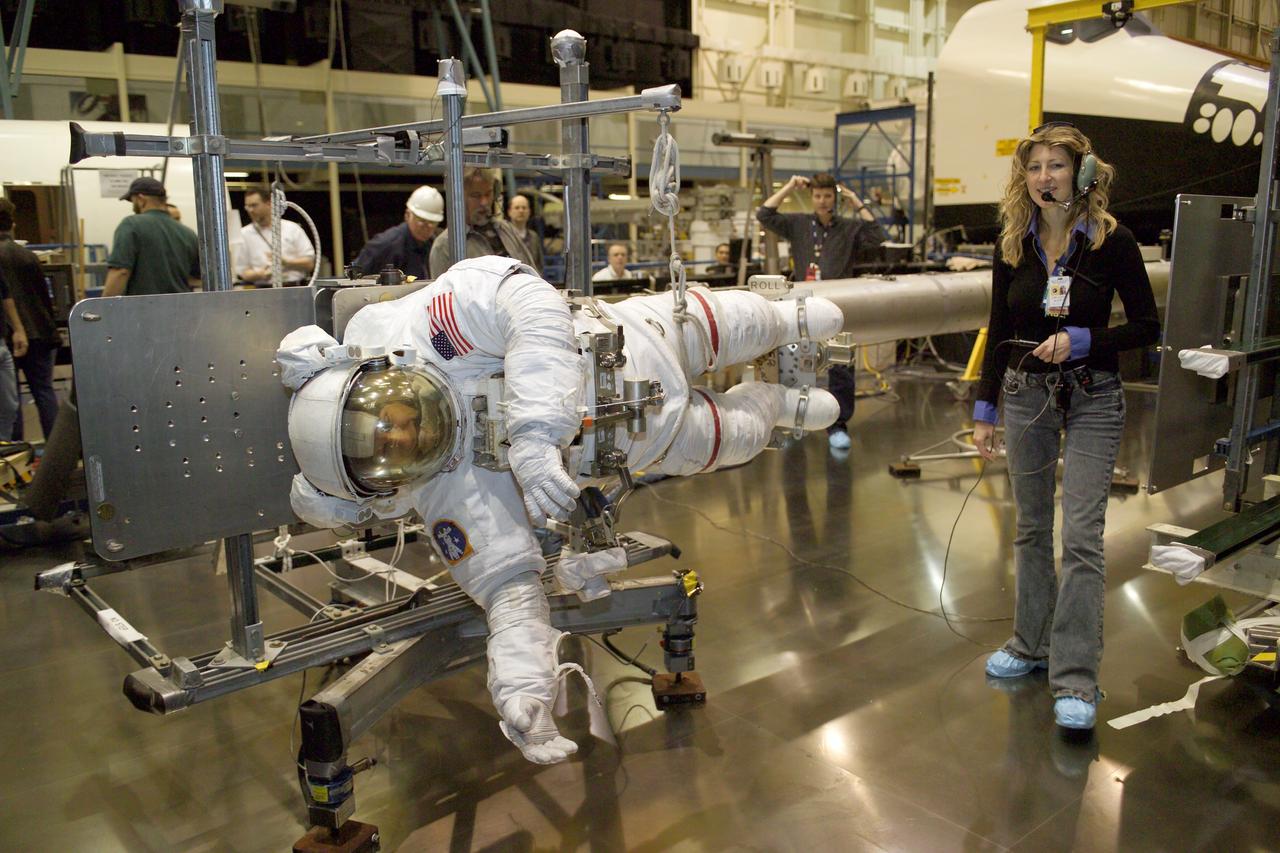
JSC2005-E-08196 (25 February 2005) --- Astronaut Piers J. Sellers, STS-121 mission specialist, wearing a training version of the Extravehicular Mobility Unit (EMU) space suit, participates in an extravehicular activity (EVA) simulation while anchored on the end of the training version of the space shuttle Remote Manipulator System (RMS) robotic arm in the Space Vehicle Mockup Facility at Johnson Space Center. The RMS has a 50-foot boom, called the Orbiter Boom Sensor System (OBSS), extension attached which would be used to reach underneath the orbiter to access tiles. Lora Bailey (right), Manager, JSC Engineering Tile Repair, assisted Sellers.
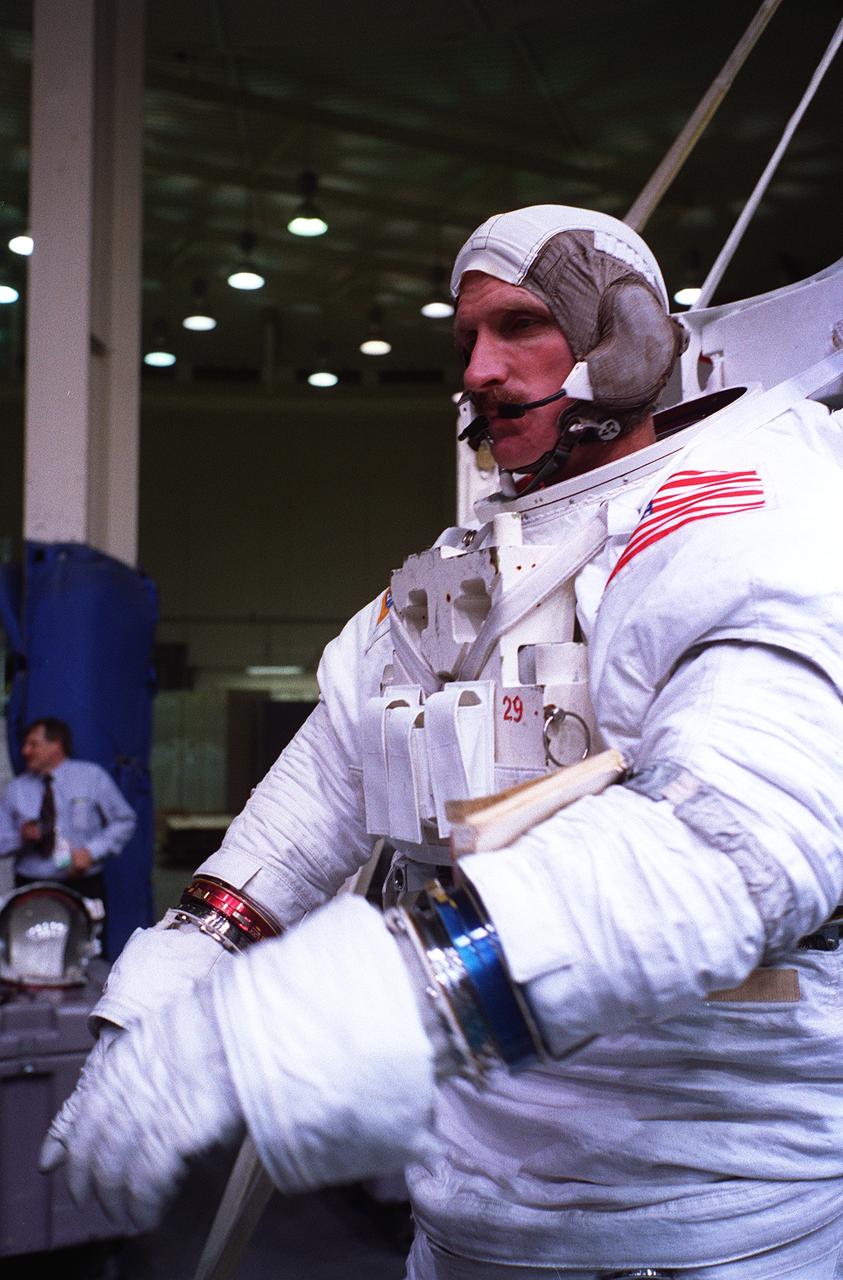
S96-12830 (10 June 1996) --- Astronaut Joseph R. Tanner, STS-82 mission specialist assigned to extravehicular activity (EVA) involved with the servicing of the Hubble Space Telescope (HST), dons the gloves for his extravehicular mobility unit (EMU) space suit. He is about to be submerged in a 25-ft. deep pool at the Johnson Space Center's weightless environment training facility (WET-F) to participate in simulations for some of the EVA work. Out of frame, astronaut Gregory J. Harbaugh was on the other side of the platform, waiting to join Tanner in the spacewalk rehearsal.
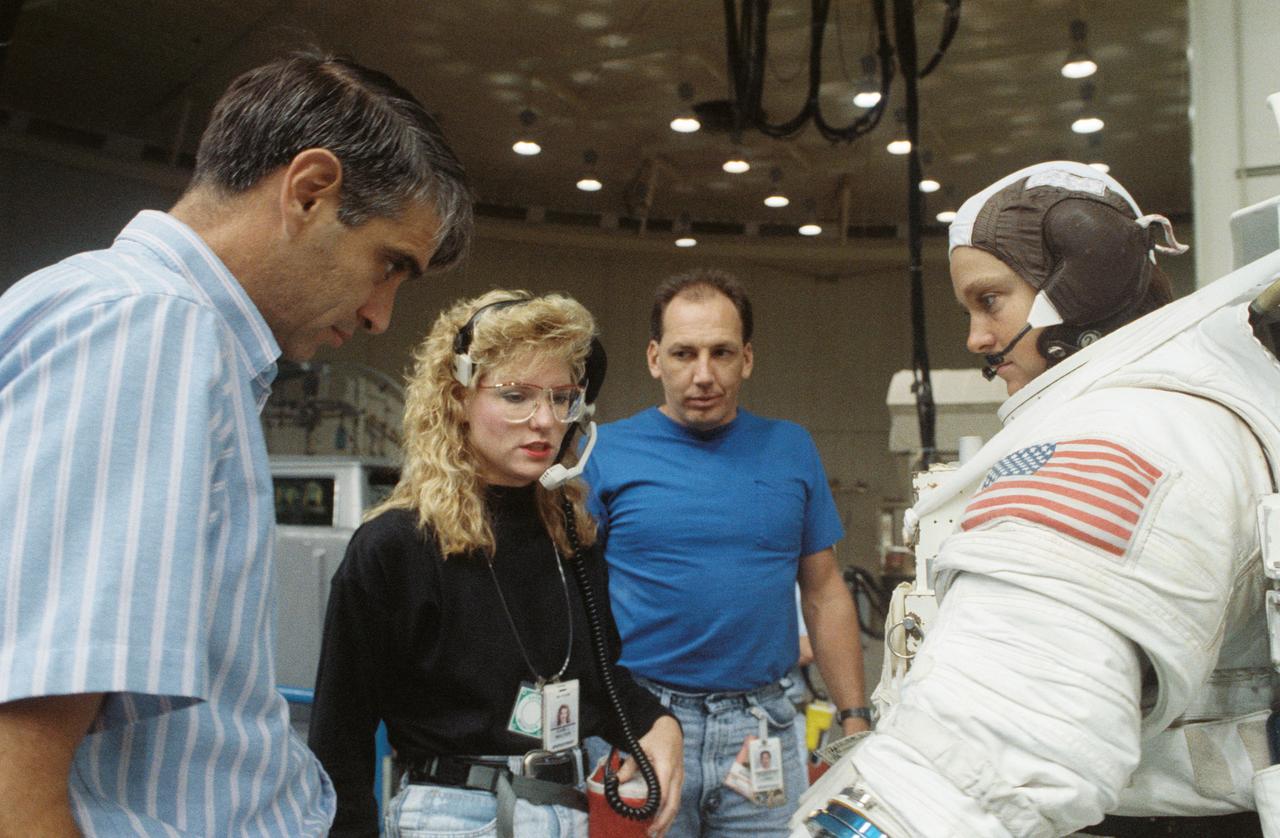
S90-45785 (16 Aug 1990) --- Astronaut Tamara E. Jernigan, STS-40 mission specialist, is pictured in a training version of the extravehicular mobility unit (EMU) spacesuit talking with a fellow crewmember and members of the crew training staff. At left is astronaut Sidney M. Gutierrez, pilot for the flight. Dr. Jernigan was about to be submerged in the Johnson Space Center's 25-ft. deep weightless environment training facility (WET-F) pool to simulate a contingency extravehicular activity (EVA). There is no EVA scheduled for STS-40, the Spacelab Life Sciences (SLS-1) mission.
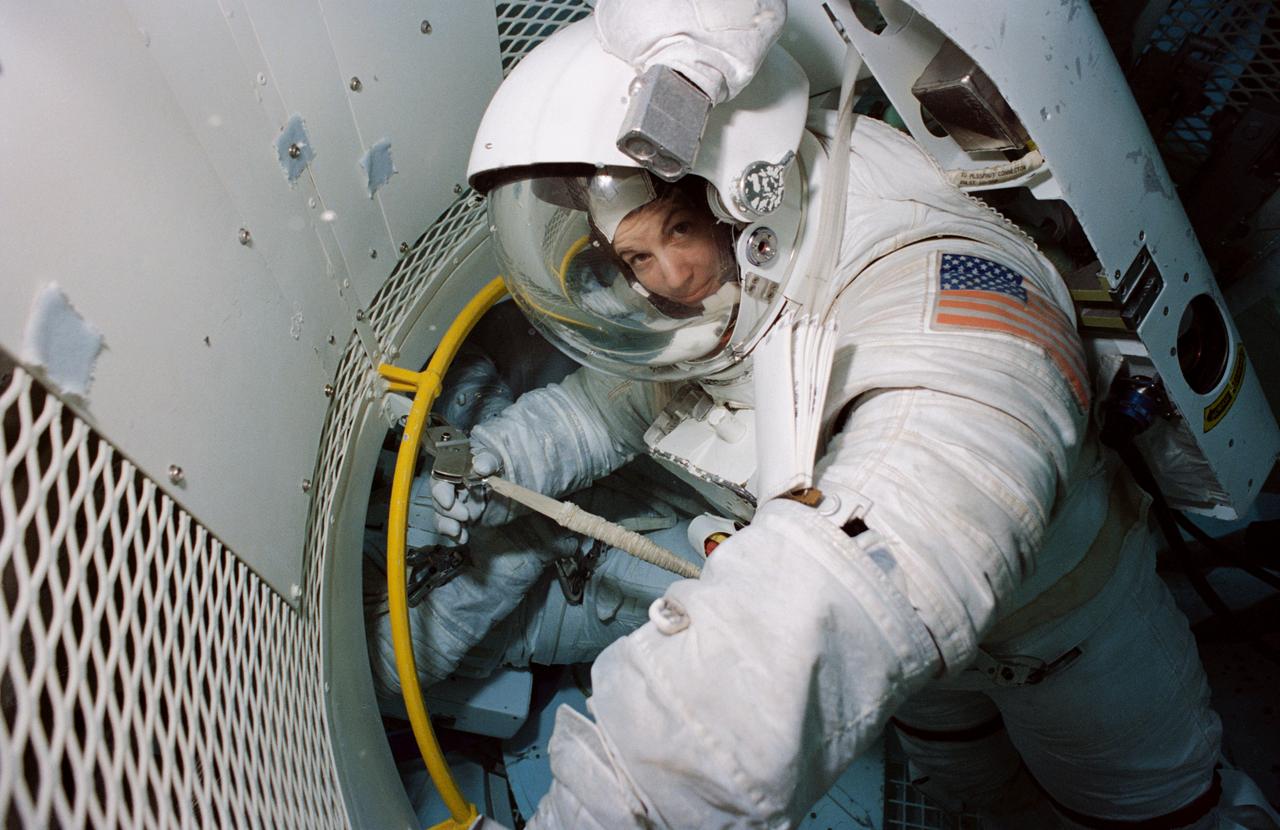
S94-25956 (April 1994) --- Astronaut Catherine G. Coleman, mission specialist, wearing a high-fidelity training version of an Extravehicular Mobility Unit (EMU), trains for a contingency space walk at the Johnson Space Center?s (JSC) Weightless Environment Training Facility (WET-F). Coleman has recently been named as one of seven crew members for the U.S. Microgravity Laboratory (USML-2) mission. The 25-feet deep pool is used to train astronauts for mission specific space walk chores as well as for contingency Extravehicular Activity (EVA) tasks.
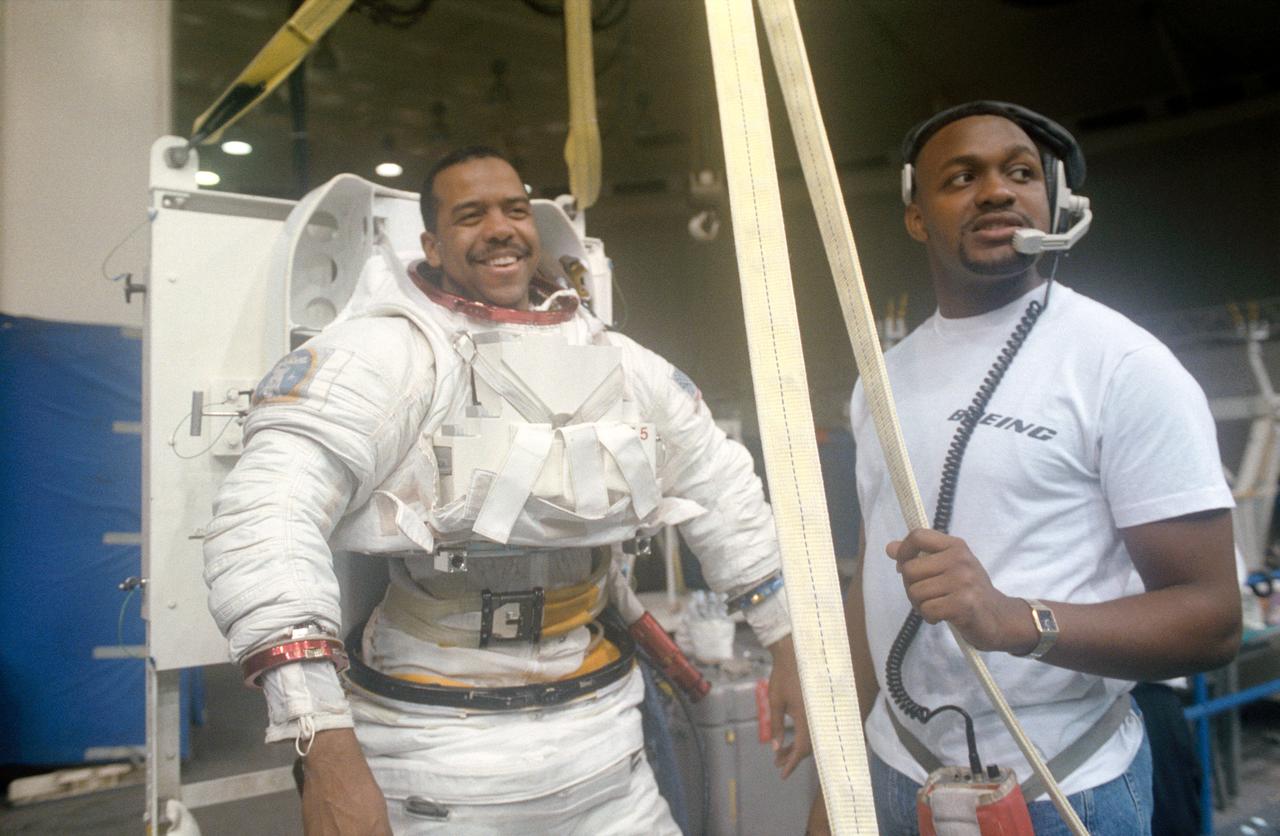
S91-51063 (Dec 1991) --- Partially attired in a special training version of the Extravehicular Mobility Unit (EMU) spacesuit, astronaut Bernard J. Harris Jr. is pictured before a training session at the Johnson Space Center's (JSC) Weightless Environment Training Facility (WET-F). Harris, STS-55 mission specialist, is assisted by Laney Lee. Minutes later, Harris was in a 25-feet deep pool, simulating a contingency extravehicular activity (EVA). There is no scheduled EVA for the 1993 flight but each spaceflight crew includes astronauts trained for a variety of contingency tasks that could require exiting the shirt-sleeve environment of a Shuttle's cabin.
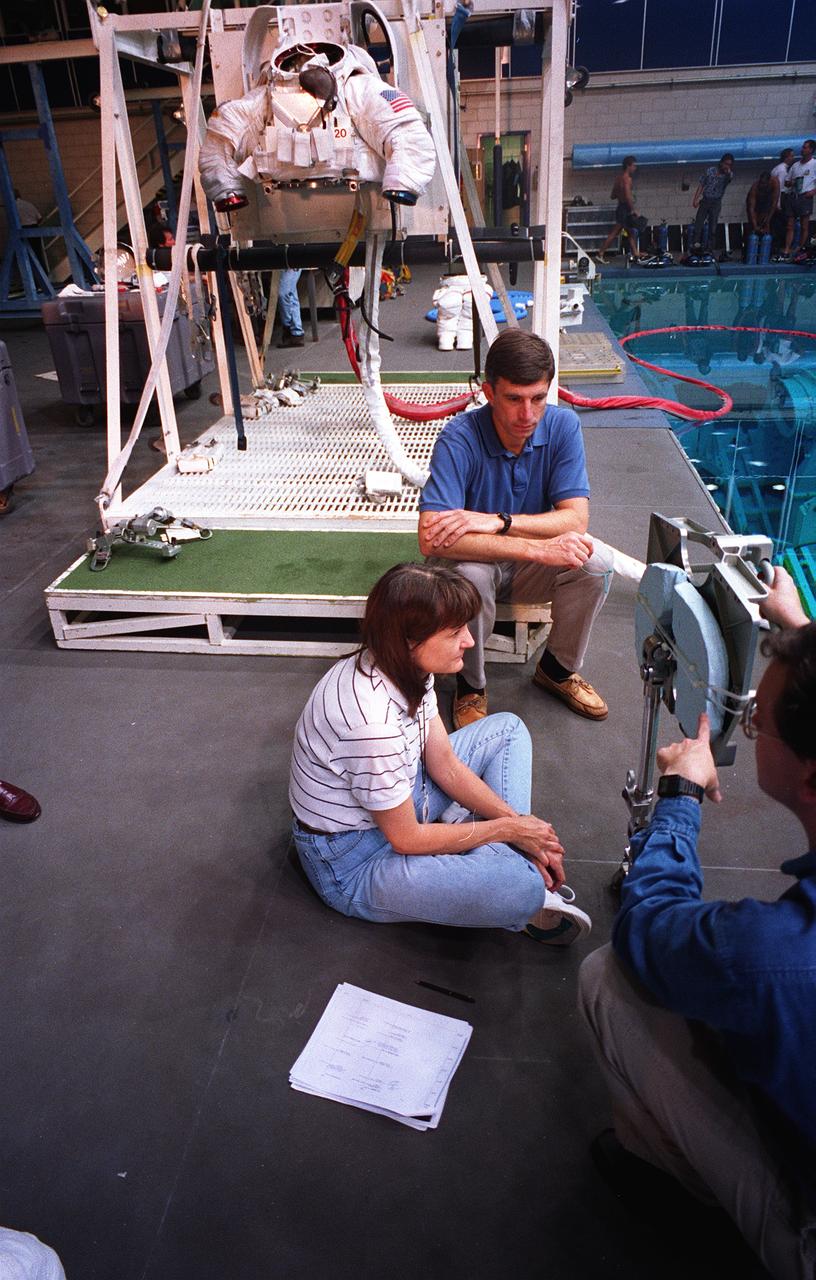
S95-21276 (September 1995) --- Astronaut Linda M. Godwin, mission specialist, is briefed on the Mobile Foot Restraint (MFR) to be used in a scheduled Extravehicular Activity (EVA) during the March mission. Astronaut Ronald M. Sega, mission specialist, looks on. Astronaut Michael R. (Rich) Clifford, mission specialist, who will join Godwin on the EVA, is out of frame. Godwin and Clifford checked out the hardware before donning training versions of the Extravehicular Mobility Unit (EMU) spacesuit (see torso piece in background) in preparation for being submerged in a 25-feet deep pool at the Johnson Space Center's (JSC) Weightless Environment Training Facility (WET-F).
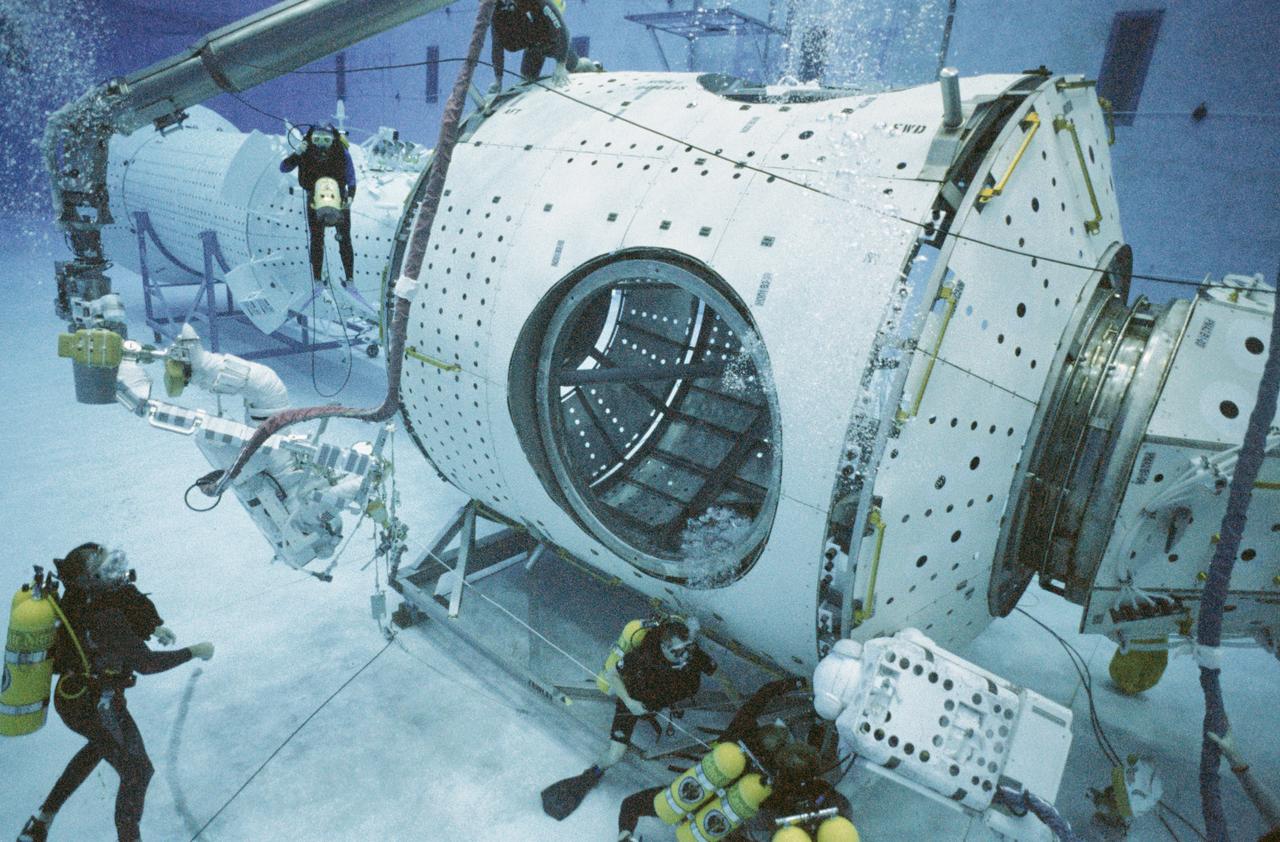
S97-11949 (8 Sept 1997) --- Wearing training versions of the Shuttle Extravehicular Mobility Unit (EMU) space suit, astronauts Jerry L. Ross (left), and James Newman perform the first training session in the Neutral Buoyancy Laboratory (NBL) of the Sonny Carter Training Facility. The training was actually a dress rehearsal of three Extravehicular Activity?s (EVA) the pair will conduct during the July 1998 flight (STS-88) -- the first International Space Station (ISS) assembly mission. During the six-hour training session, the crew practiced hooking up power and data cables between full-scale mockups of the Functional Cargo Block and the United States-built Node 1 (foreground).
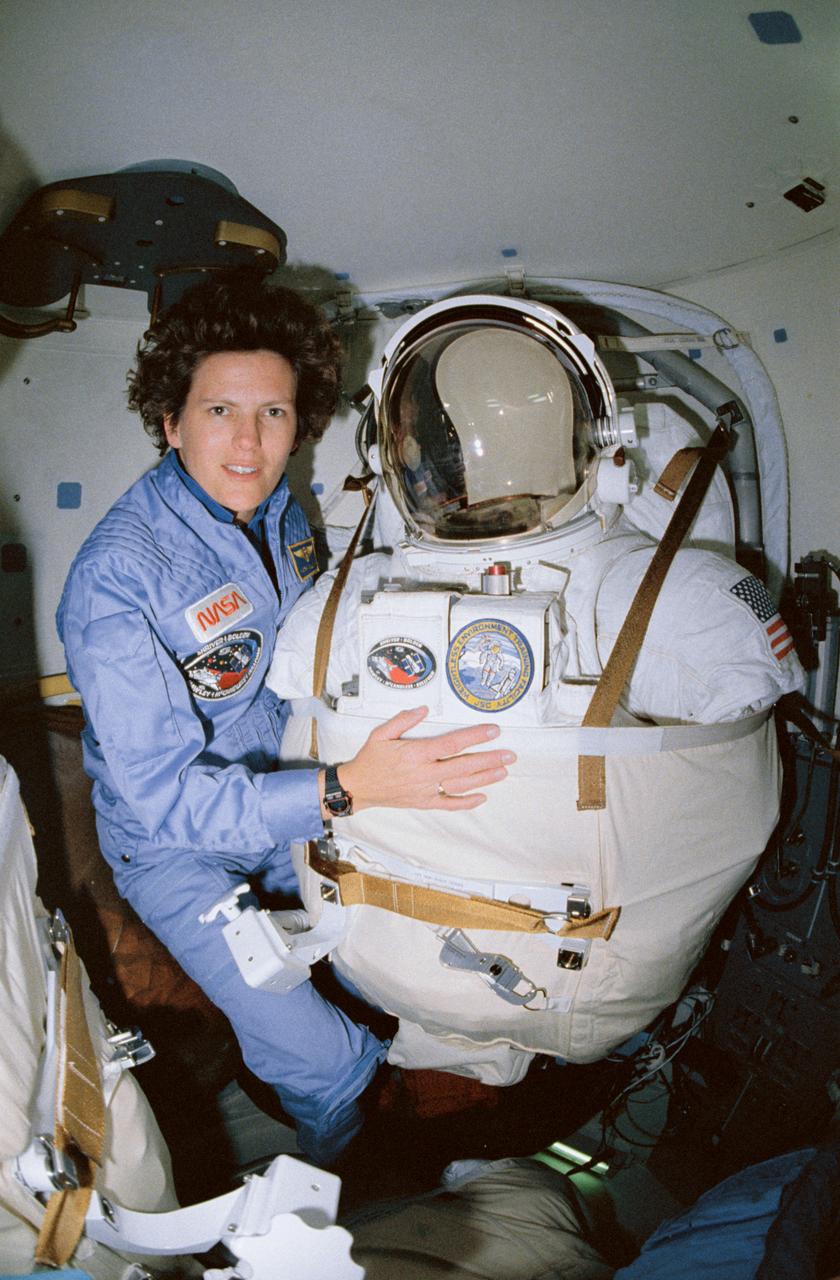
STS-31 Mission Specialist (MS) Kathryn D. Sullivan poses for a picture before beginning extravehicular mobility unit (EMU) donning procedures in the airlock of Discovery, Orbiter Vehicle (OV) 103. Sullivan will remove the lower torso restraint and don EMU which is supported on an airlock adapter plate (AAP). When suited, Sullivan will be ready for contingency extravehicular activity (EVA) in the event that problems arise with the Hubble Space Telescope (HST) deployment. Displayed on the front of the EMU are the STS-31 mission insignia and the JSC Weightless Environment Training Facility (WETF) insignia.
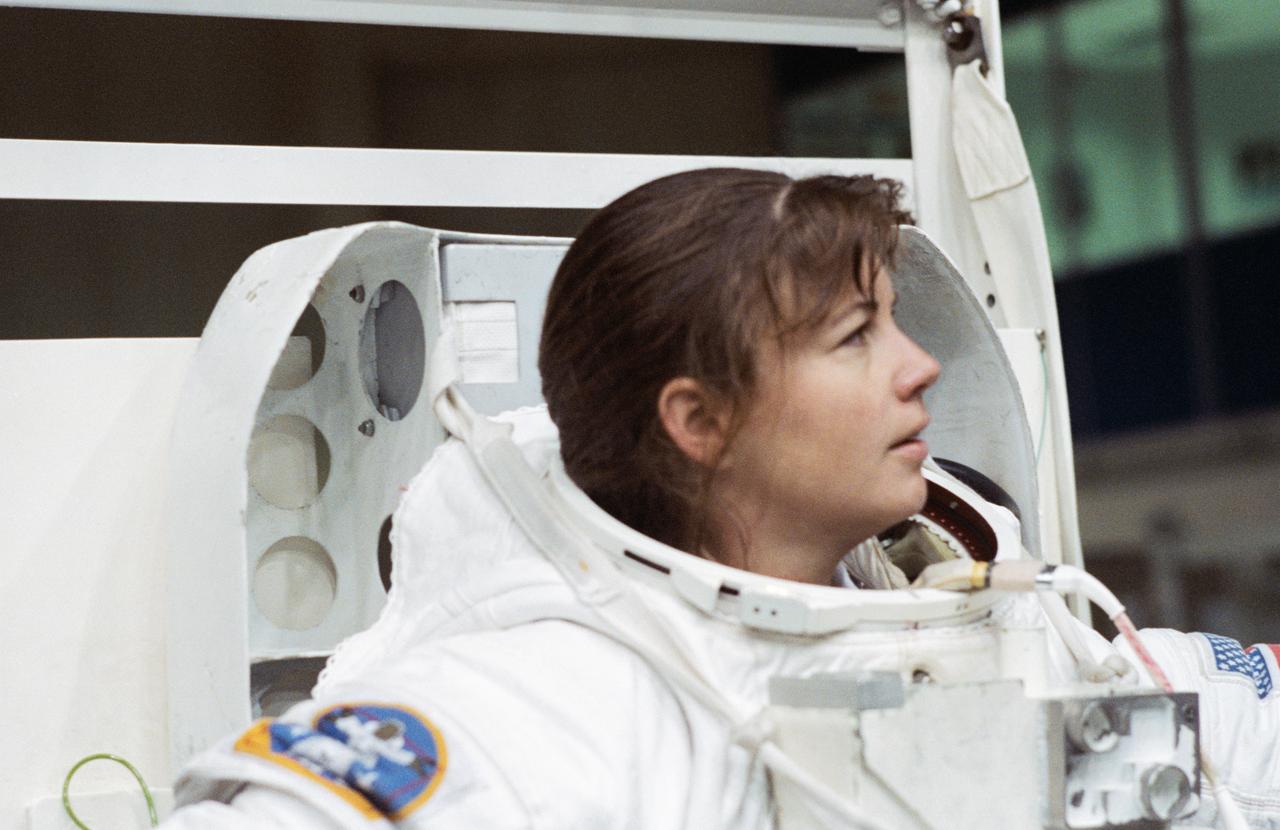
S93-42453 (September 1993) --- Astronaut Catherine G. Coleman, mission specialist for STS-73, is about to don the helmet portion of a high-fidelity training version of an Extravehicular Mobility Unit (EMU) space suit at the Johnson Space Center?s (JSC) Weightless Environment Training Facility (WET-F). Coleman, who has recently been named as one of seven crew members for the U.S. Microgravity Laboratory (USML-2) mission, was about to go underwater in a 25-feet deep pool. The pool is used to train astronauts for mission specific space walk chores as well as for contingency Extravehicular Activity (EVA) tasks. There is no space walk planned for STS-73.
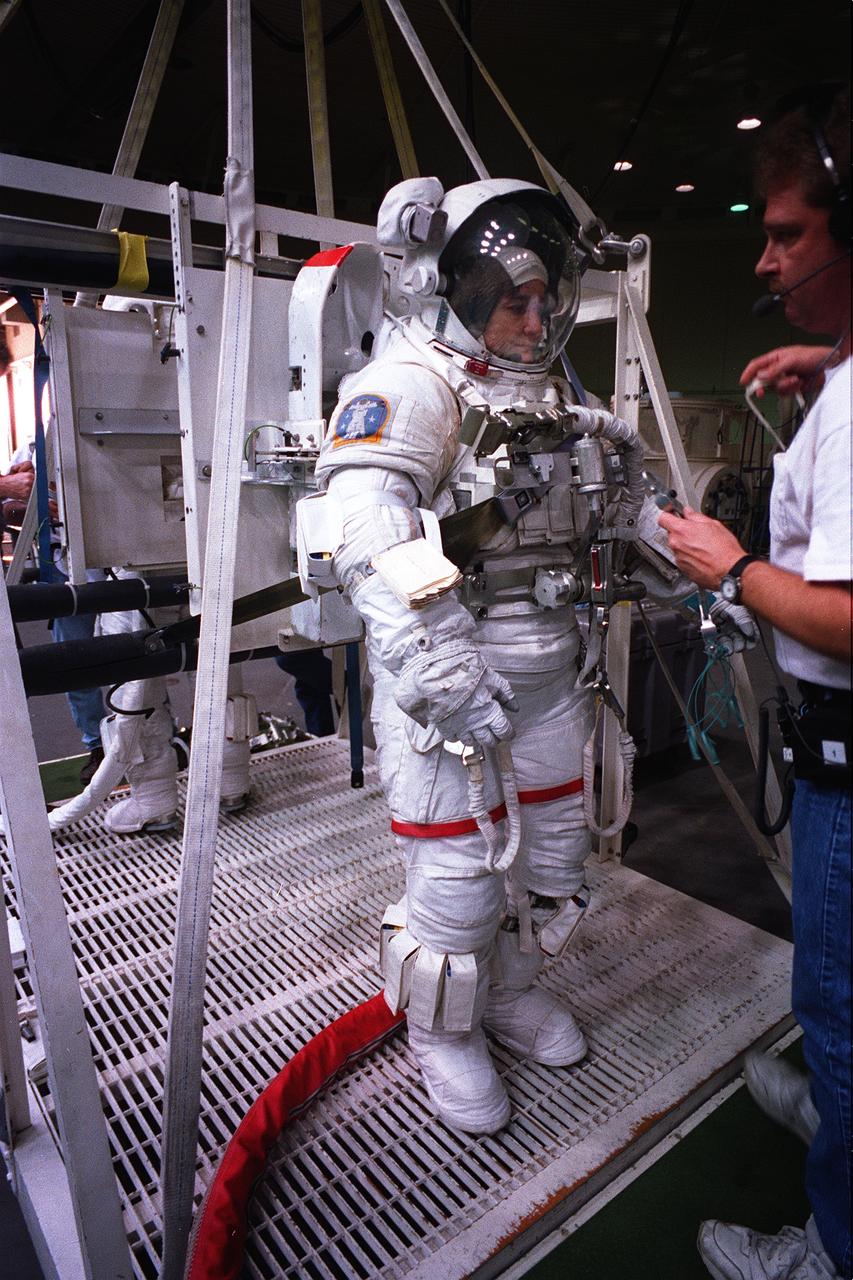
S95-21281 (September 1995) --- Astronaut Linda M. Godwin, mission specialist, makes a final check of her respiration system before being submerged in a 25-feet deep pool at the Johnson Space Center's (JSC) Weightless Environment Training Facility (WET-F). Wearing high fidelity training versions of the Extravehicular Mobility Unit (EMU) spacesuit, both Godwin and Michael R. (Rich) Clifford were later simulating Extravehicular Activity (EVA) chores in the pool. Launch aboard the Space Shuttle Atlantis is scheduled for March of 1996.
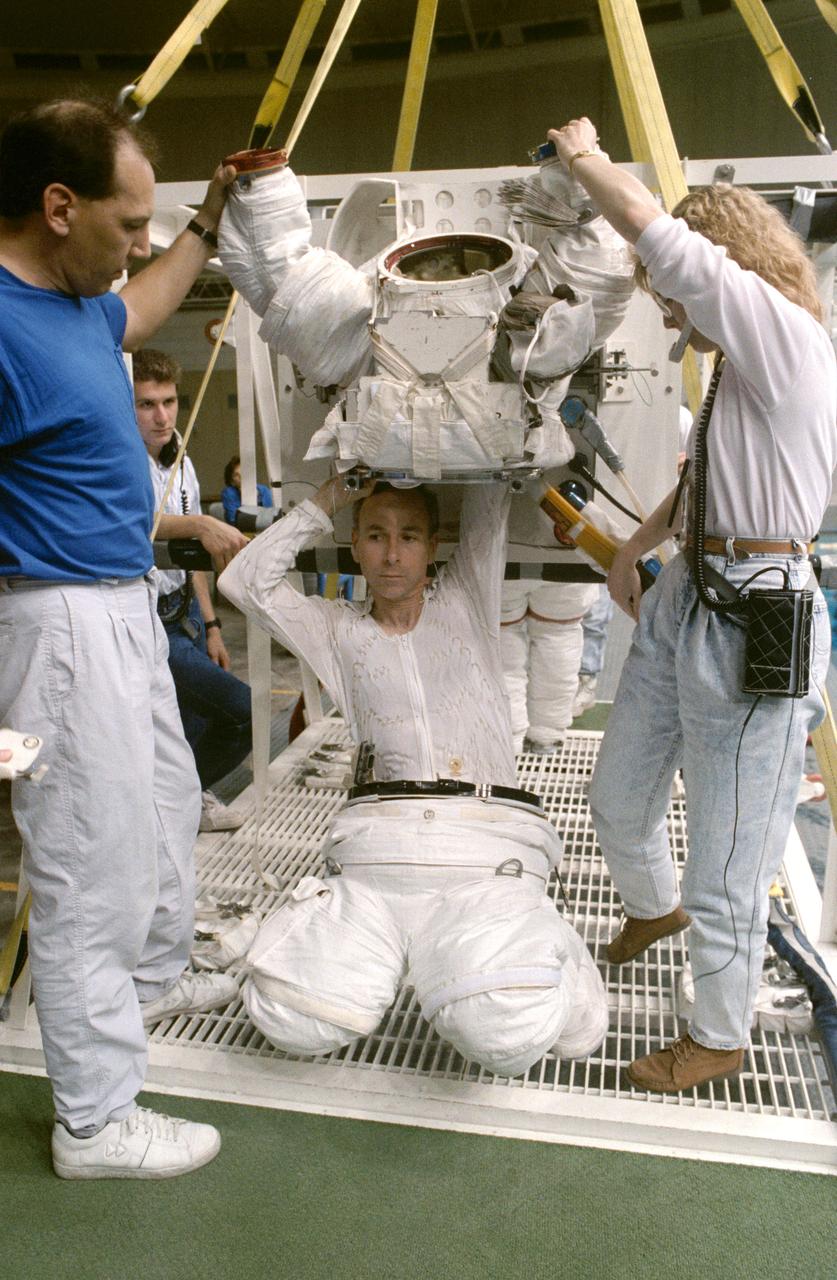
STS-38 Mission Specialist (MS) Carl J. Meade, wearing liquid cooling and ventilation garment (LCVG) and extravehicular mobility unit (EMU) lower torso, crouches under EMU upper torso. Technicians extend the EMU sleeves as Meade reaches into upper torso during suit donning in JSC's Weightless Environment Training Facility (WETF) Bldg 29. Positioned on the WETF platform at pool side, Meade is preparing for an underwater extravehicular activity (EVA) simulation. During the training exercise, Meade will rehearse contingency EVA procedures for the STS-38 mission aboard Atlantis, Orbiter Vehicle (OV) 104.
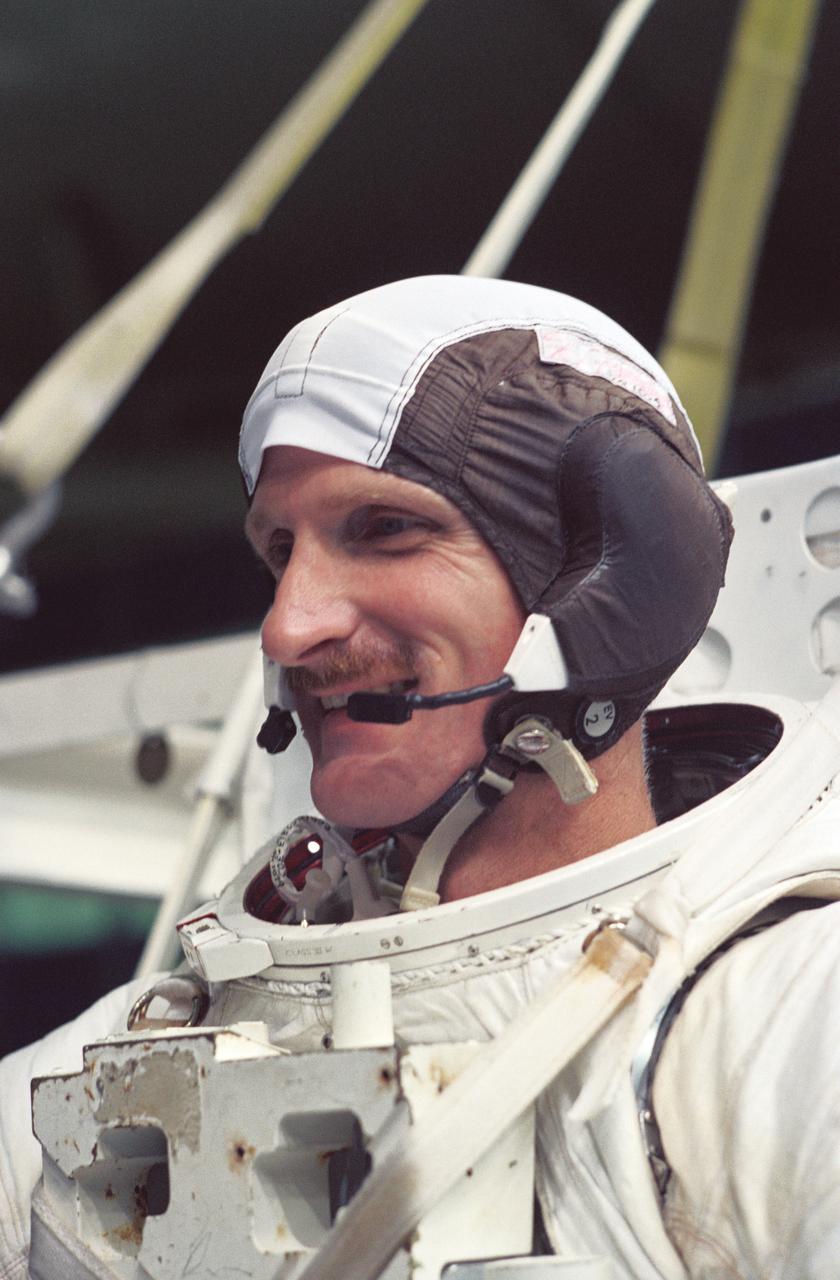
S94-40049 (1 August 1994) --- Attired in a training version of the Extravehicular Mobility Unit (EMU), astronaut Joseph R. Tanner, mission specialist, prepares to be submerged in a 25-feet deep pool at the Johnson Space Center's (JSC) Weightless Environment Training Facility (WET-F). Though no extravehicular activity (EVA) is planned for the mission, at least two astronauts are trained to perform tasks that would require a space walk in the event of failure of remote systems. In November, Tanner will join four other NASA astronauts and a European mission specialist for a week and a half in space aboard the Space Shuttle Atlantis. The flight will support the Atmospheric Laboratory for Applications and Science (ATLAS-3) mission.
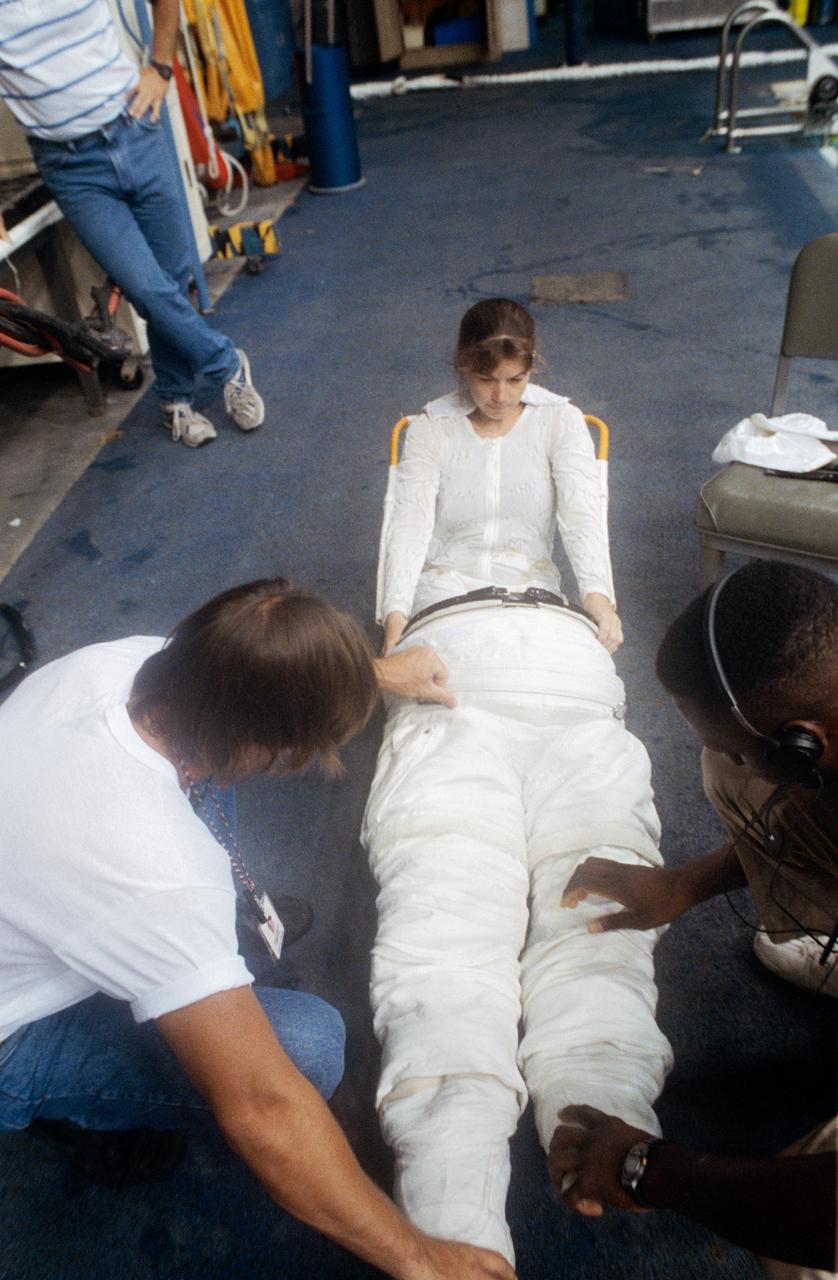
S93-42464 (September 1993) --- Astronaut Catherine G. Coleman, mission specialist for STS-73, dons a high-fidelity training version of an Extravehicular Mobility Unit (EMU) spacesuit at the Johnson Space Center?s (JSC) Weightless Environment Training Facility (WET-F). Coleman, who has recently been named as one of seven crew members for the U.S. Microgravity Laboratory (USML-2) mission, was about to go underwater in a 25-feet deep pool. The pool is used to train astronauts for mission specific space walk chores as well as for contingency extravehicular activity (EVA) tasks.
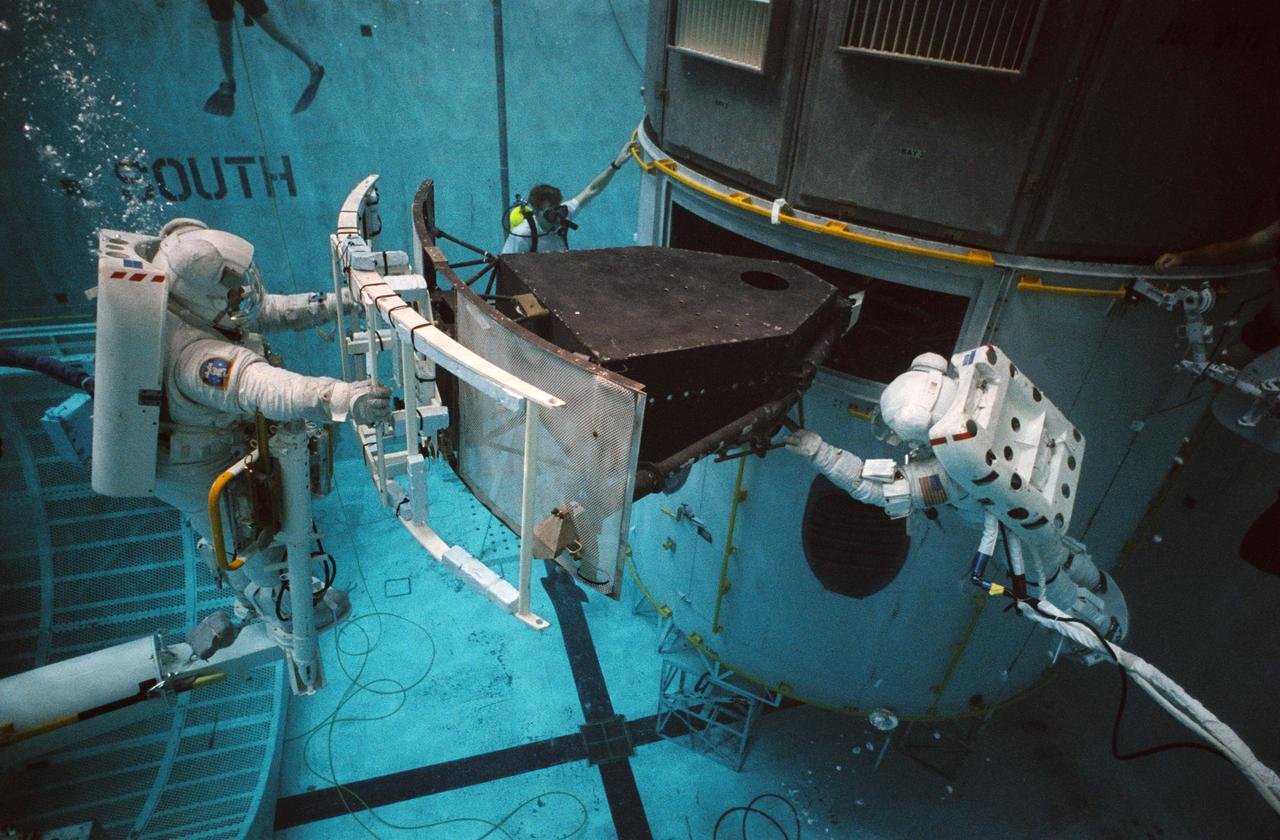
S93-33103 (2 Apr 1993) --- Wearing training versions of Space Shuttle Extravehicular Mobility Units (EMU), astronauts F. Story Musgrave and Jeffrey A. Hoffman use the giant pool of the Johnson Space Center's (JSC) Weightless Environment Training Facility (WET-F) to rehearse for the Hubble Space Telescope (HST) repair mission. The two are working with a full-scale training version of the Wide Field/Planetary Camera (WF/PC). The current WF/PC will be replaced with WF/PC-2. A total of five extravehicular activity (EVA) sessions will be conducted during the scheduled December mission of the Endeavour.
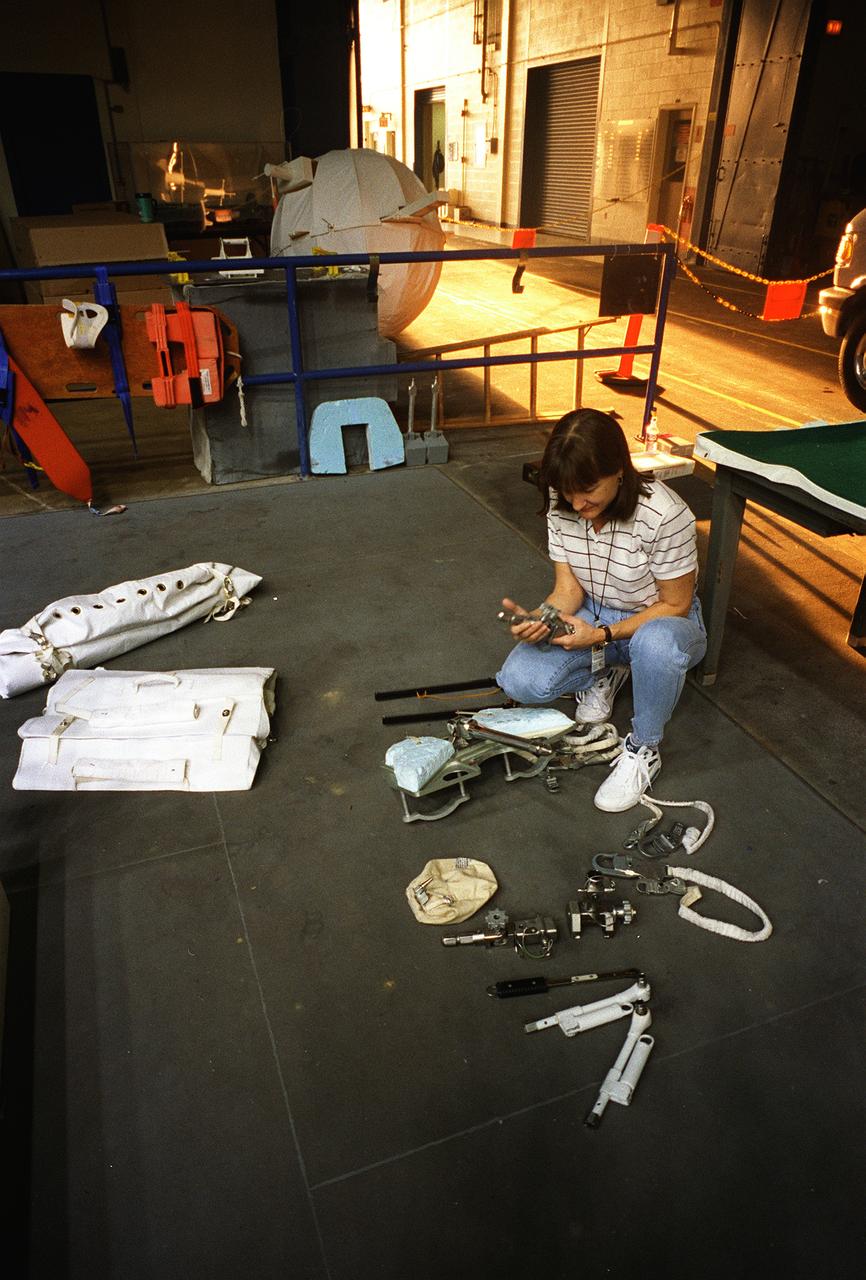
S95-21275 (September 1995) --- Astronaut Linda M. Godwin, mission specialist, checks training versions of tools to be used in a scheduled Extravehicular Activity (EVA) during the March mission. Astronaut Michael R. (Rich) Clifford, mission specialist, who will join Godwin on the EVA, is out of frame. The two checked out the hardware before donning training versions of the Extravehicular Mobility Unit (EMU) spacesuit in preparation for being submerged in a 25-feet deep pool at the Johnson Space Center's (JSC) Weightless Environment Training Facility (WET-F).
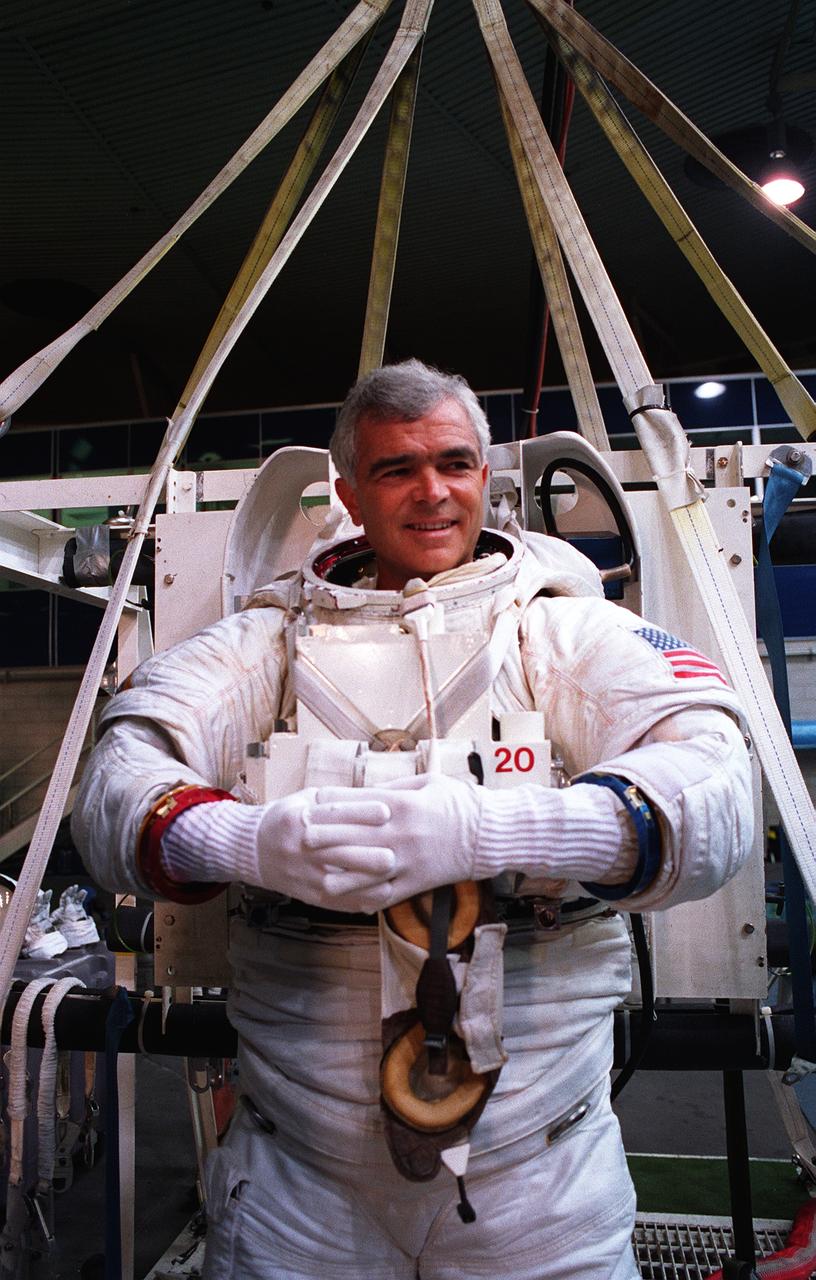
S95-21277 (September 1995) --- Astronaut Michael R. (Rich) Clifford, mission specialist, pauses before donning full suit gear in preparation for being submerged in a 25-feet deep pool at the Johnson Space Center's (JSC) Weightless Environment Training Facility (WET-F). Wearing high fidelity training versions of the Extravehicular Mobility Unit (EMU) spacesuit, both Clifford and Linda M. Godwin were later simulating Extravehicular Activity (EVA) chores in the pool. Launch aboard the Space Shuttle Atlantis is scheduled for March of 1996.
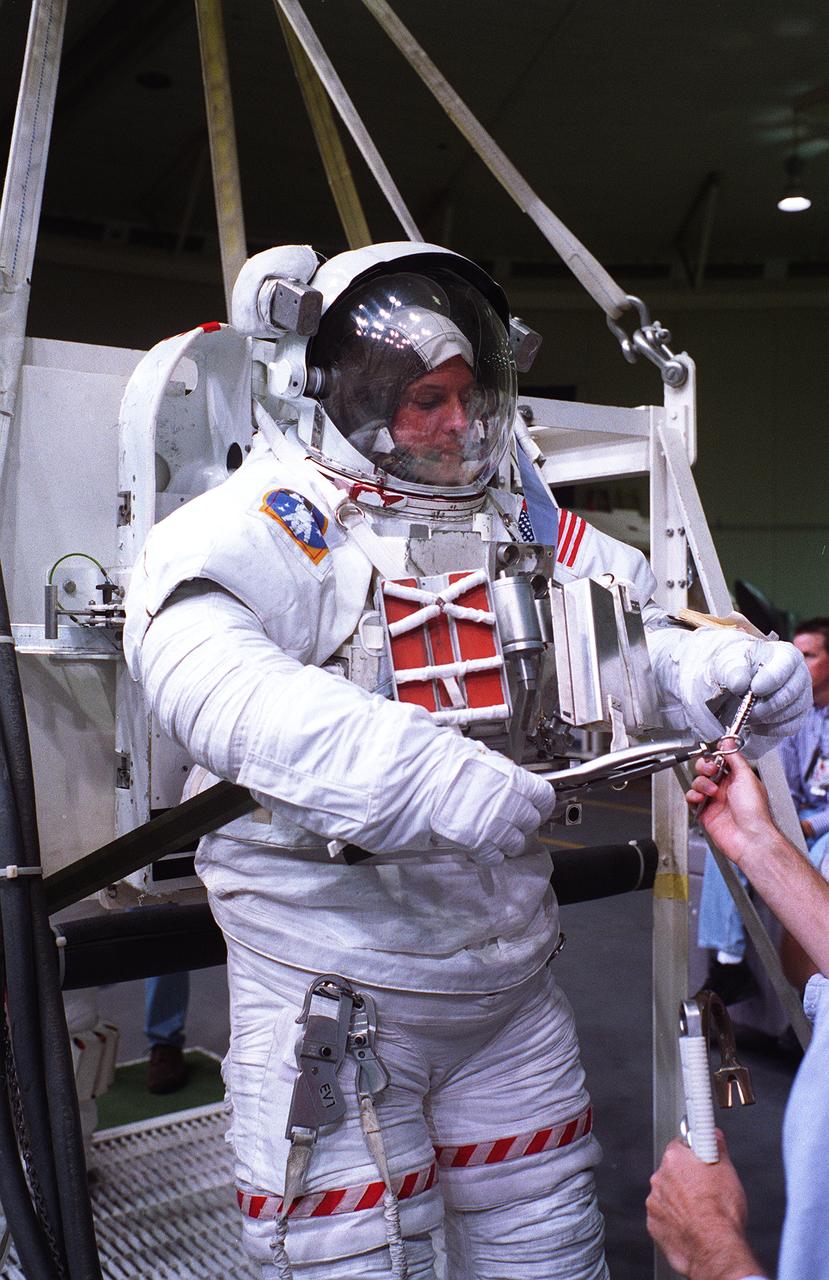
S96-12819 (10 June 1996) --- Astronaut Gregory J. Harbaugh, STS-82 mission specialist assigned to extravehicular activity (EVA) involved with the servicing of the Hubble Space Telescope (HST), dons the gloves for his extravehicular mobility unit (EMU) space suit. He is about to be submerged in a 25-ft. deep pool at the Johnson Space Center's weightless environment training facility (WET-F) to participate in simulations for some of the EVA work. Out of frame, astronaut Joseph Tanner was on the other side of the platform, waiting to join Harbaugh in the spacewalk rehearsal.
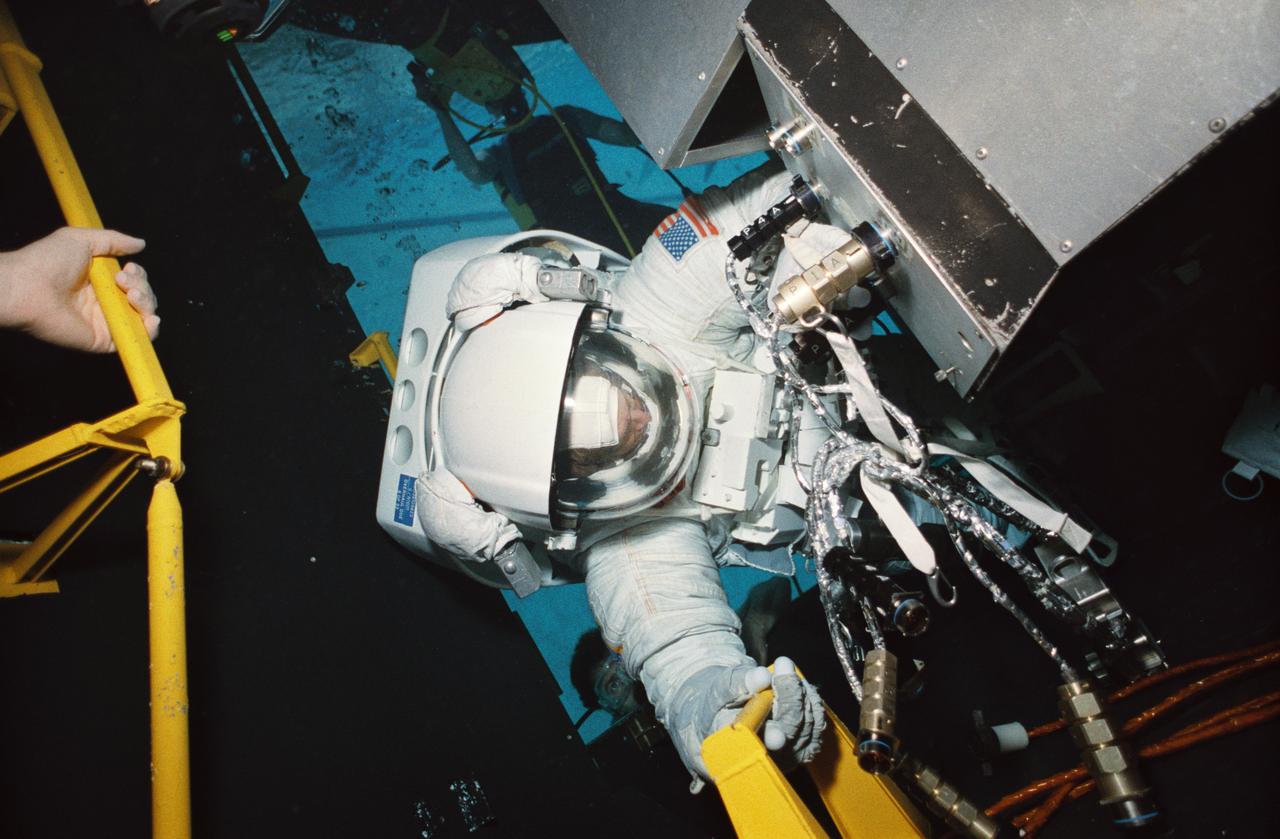
S93-33104 (7 Apr 1993) --- Wearing a training version of Space Shuttle Extravehicular Mobility Unit (EMU), astronaut Jeffrey A. Hoffman uses the giant pool of the Johnson Space Center's (JSC) Weightless Environment Training Facility (WET-F) to rehearse for the Hubble Space Telescope (HST) repair mission. Out of frame is astronaut F. Story Musgrave, who will join Hoffman in STS-61 EVA. The hand at top frame belongs to a SCUBA-equipped diver. A number of divers are on hand for all training sessions in the WET-F. A total of five extravehicular activity (EVA) sessions will be conducted during the scheduled December mission of the Endeavour.
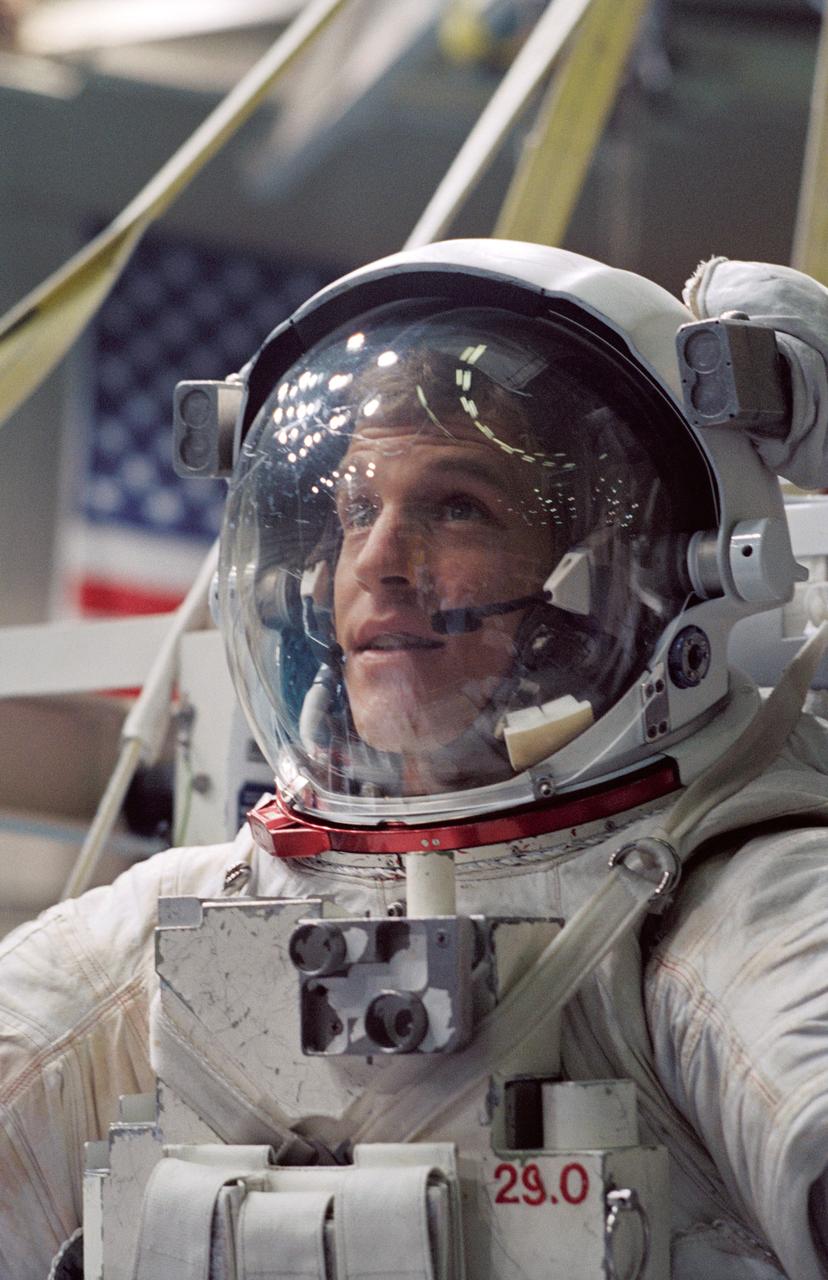
S94-40051 (1 August 1994) --- Attired in a training version of the Extravehicular Mobility Unit (EMU), astronaut Scott E. Parazynski, mission specialist, prepares to be submerged in a 25-feet deep pool at the Johnson Space Center's (JSC) Weightless Environment Training Facility (WET-F). Though no extravehicular activity (EVA) is planned for the mission, at least two astronauts are trained to perform tasks that would require a space walk in the event of failure of remote systems. In November, Parazynski will join four other NASA astronauts and a European mission specialist for a week and a half in space aboard the Space Shuttle Atlantis. The flight will support the Atmospheric Laboratory for Applications and Science (ATLAS-3) mission.
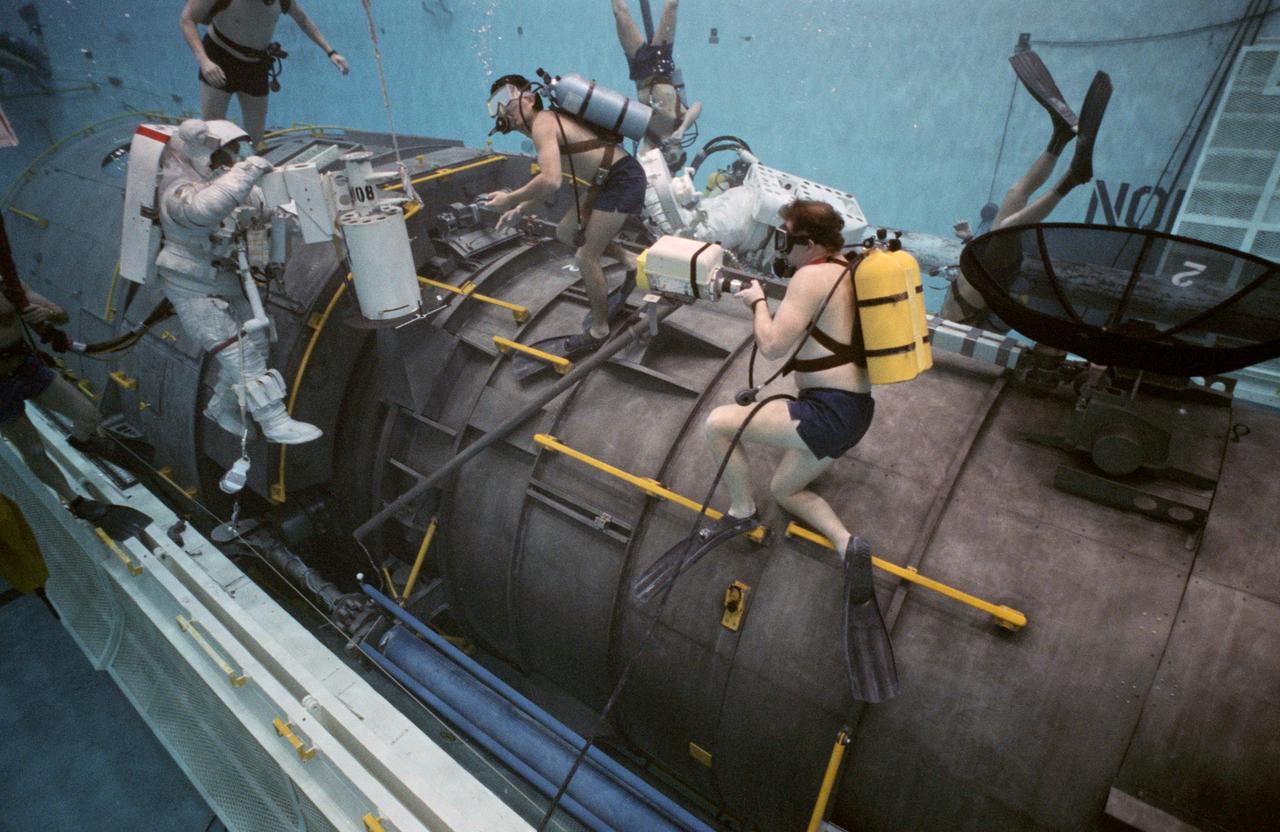
STS-31 Mission Specialist (MS) Bruce McCandless II (left), wearing an extravehicular mobility unit (EMU), maneuvers his way around a mockup of the remote manipulator system (RMS) end effector during an underwater simulation in JSC's Weightless Environment Training Facility (WETF) Bldg 29 pool. The end effector is attached to a grapple fixture on the Hubble Space Telescope (HST) mockup. As McCandless performs contingency extravehicular activity (EVA) procedures, fellow crewmember MS Kathryn D. Sullivan, in EMU, works on the opposite side of the HST mockup, and SCUBA-equipped divers monitor the activity. Though no EVA is planned for STS-31, the two crewmembers train for contingencies that would necessitate leaving the shirt sleeve environment of Discovery's, Orbiter Vehicle (OV) 103's, crew cabin and performing chores with the HST payload or related hardware in the payload bay (PLB).
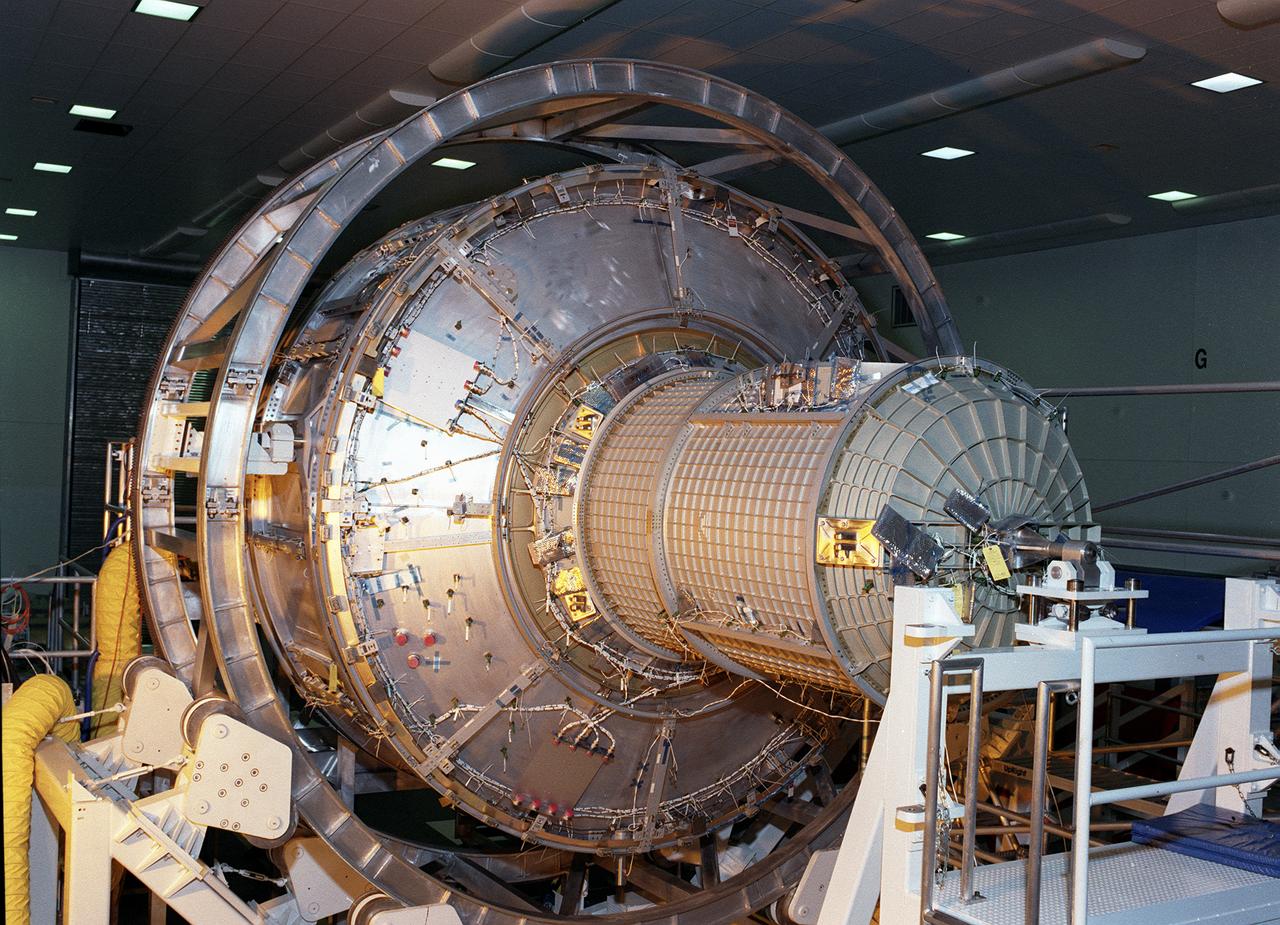
The Joint Airlock Module for the International Space Station (ISS) awaits shipment to the Kennedy Space Center in the Space Station manufacturing facility at the Marshall Space Flight Center in Huntsville, Alabama. The Airlock includes two sections. The larger equipment lock on the left is where crews will change into and out of their spacesuits for extravehicular activities, and store spacesuits, batteries, power tools, and other supplies. The narrower crewlock from which the astronauts will exit into space for extravehicular activities, is on the right. The airlock is 18 feet long and has a mass of about 13,500 pounds. It was launched to the station aboard the Space Shuttle orbiter Atlantis (STS-104 mission) on July 12, 2001. The MSFC is playing a primary role in NASA's development, manufacturing, and operations of the ISS.
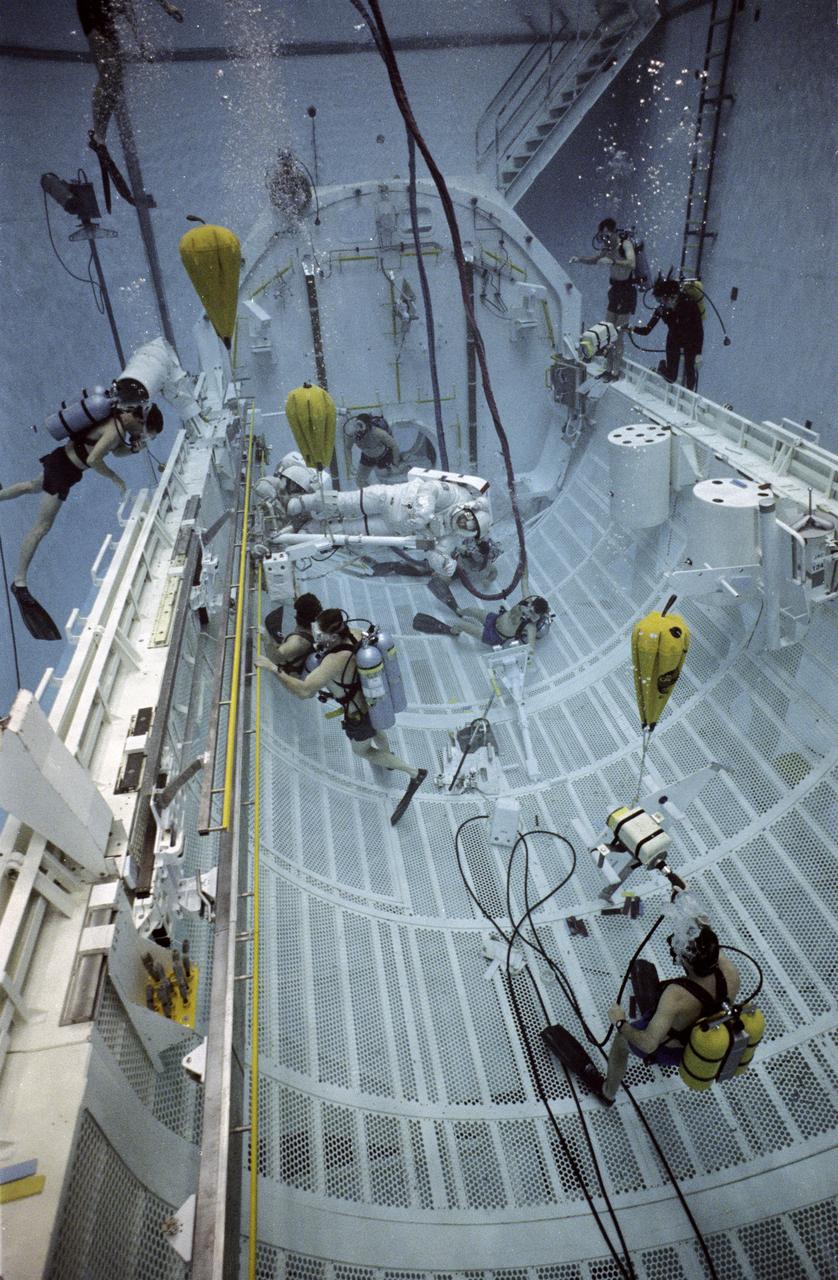
STS-37 Atlantis, Orbiter Vehicle (OV) 104, Mission Specialist (MS) Jerry L. Ross generates electrical power using hand pedals to move crew and equipment translation aid (CETA) cart along a rail during underwater session in JSC's Weightless Environment Training Facility (WETF) Bldg 29. Wearing an extravehicular mobility unit (EMU), Ross operates CETA electrical cart as MS Jerome Apt holds onto the back of the cart. The two crewmembers are practicing a extravehicular activity (EVA) spacewalk they will perform in OV-104's payload bay during STS-37. CETA is a type of railroad hand cart planned as a spacewalker's transportation system along the truss of Space Station Freedom (SSF). SCUBA divers monitor astronauts' underwater activity.
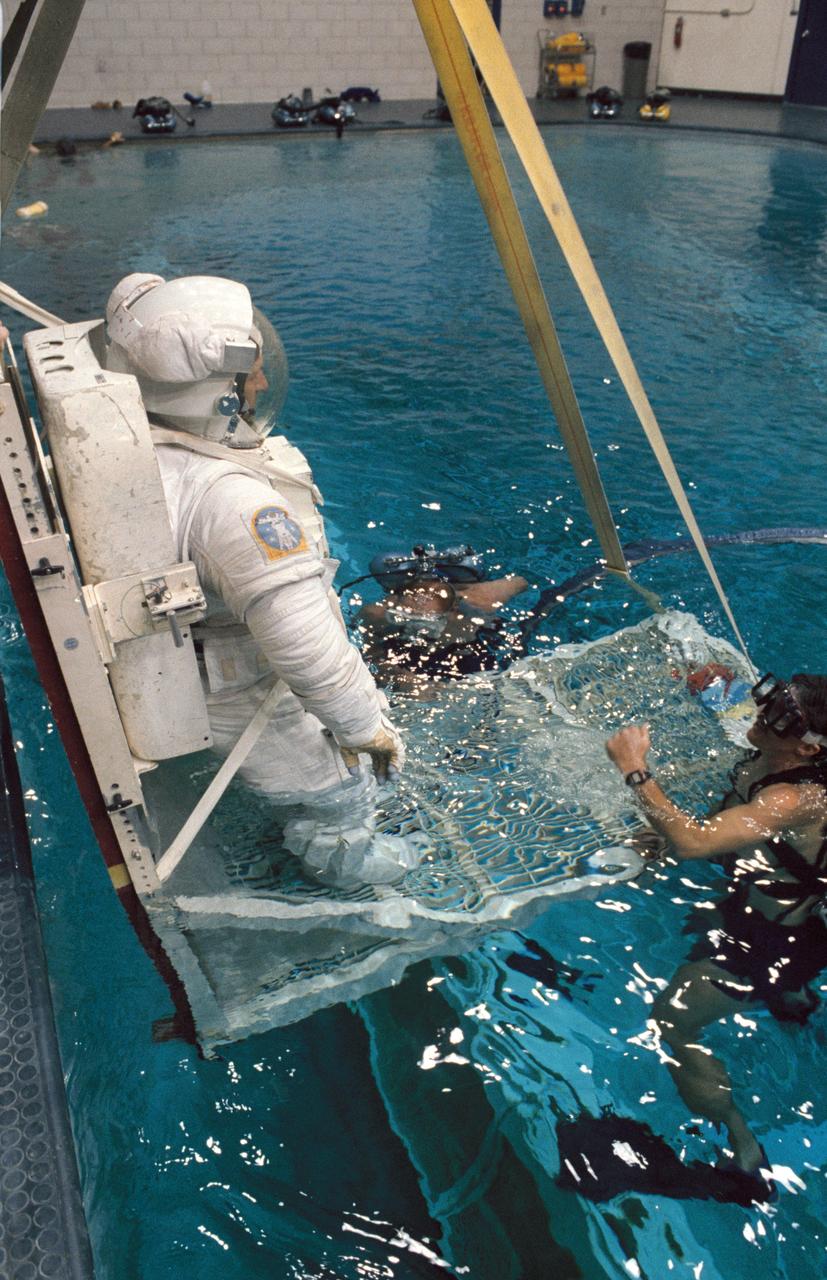
S87-44061 (25 Sept 1987) --- Dr. Claude Nicollier, equipped with a pressurized extravehicular mobility unit (EMU), is in the process of being submerged in the 25-ft. deep pool of JSC's weightless environment training facility (WET-F) for a familiarization session. Dr. Nicollier's suit is weighted to facilitate a neutrally buoyant condition. He is assisted by two SCUBA-equipped divers. Dr. Nicollier, a Swiss scientist assigned to the STS-46 mission as a payload specialist, first came to the Johnson Space Center in July 1980. Along with Dr. Wubbo Ockels, another European Scientist, Dr. Nicollier underwent survival training and other basic astronaut-type training alongside the 1980 class of astronaut candidates. Some photos in this series show Dr. Nicollier in an extravehicular mobility unit (EMU). This is for familiarization purposes only as the scientist is not scheduled for any extravehicular activity.
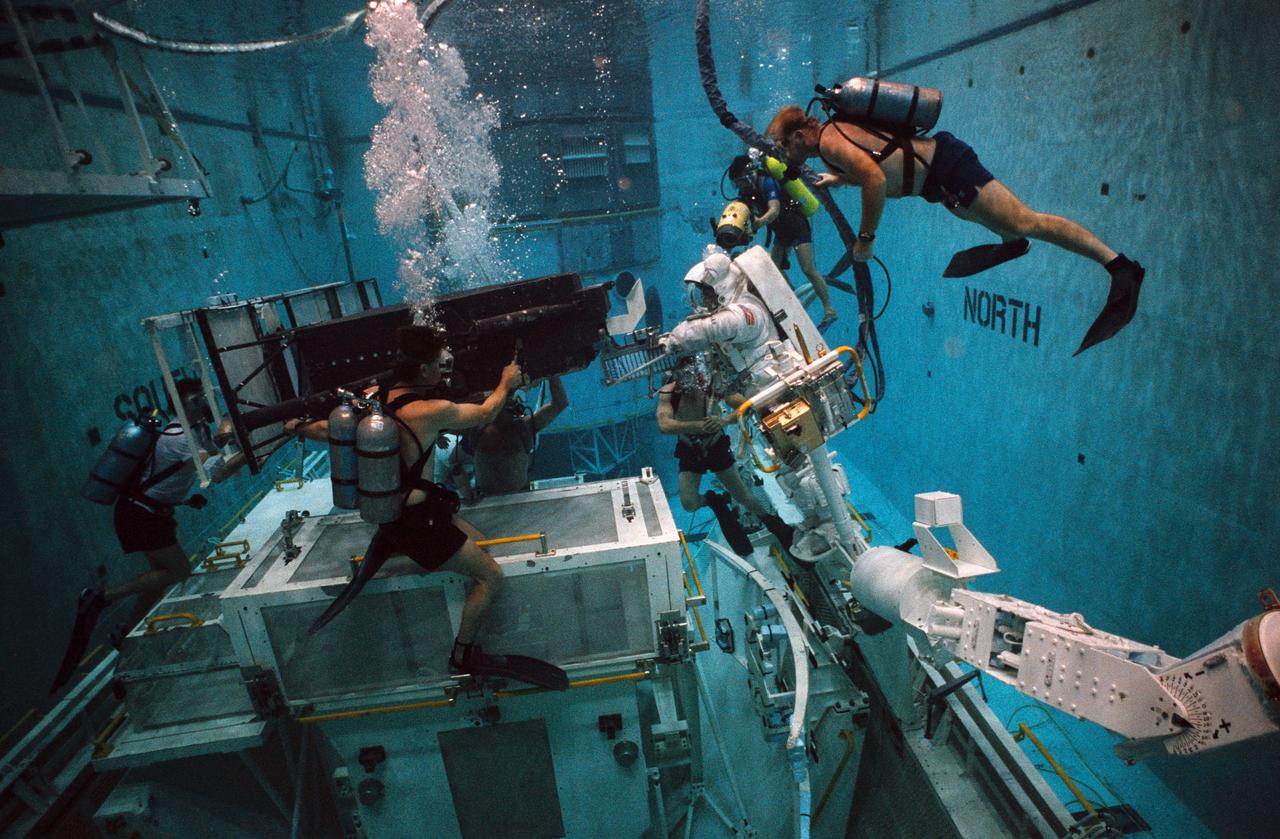
S93-33102 (5 Apr 1993) --- Wearing a training version of Space Shuttle Extravehicular Mobility Unit (EMU), astronaut Thomas D. Akers uses the giant pool of the Johnson Space Center's (JSC) Weightless Environment Training Facility (WET-F) to rehearse for the Hubble Space Telescope (HST) repair mission. Standing on a mobile foot restraint connected to the Shuttle's robot arm, Akers works with a full-scale training version of the Wide Field/Planetary Camera (WF/PC). The current WF/PC on the HST will be replaced with WF/PC-2. The giant box is a stowage area for both WF/PC facilities. Out of frame is astronaut Kathryn C. Thornton, who will join Akers in STS-61 EVA. Several SCUBA-equipped divers assist in the rehearsal. A total of five extravehicular activity (EVA) sessions will be conducted during the scheduled December mission of the Endeavour.
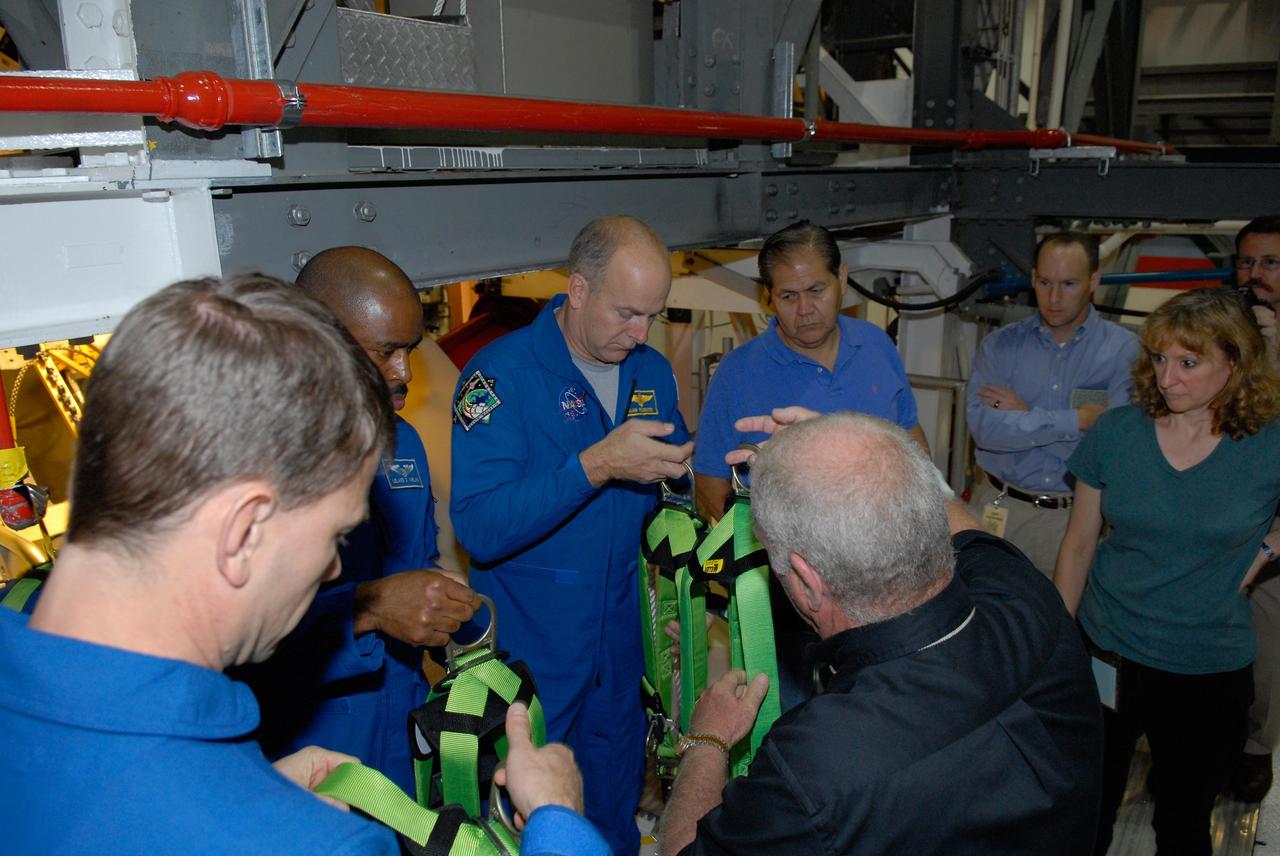
KENNEDY SPACE CENTER, FLA. -- Members of the STS-122 crew take part in harness training in the Orbiter Processing Facility at NASA's Kennedy Space Center. Seen from left are Mission Specialists Stanley Love and Leland Melvin and Pilot Alan Poindexter. The crew is at Kennedy to take part in a crew equipment interface test, or CEIT, which helps familiarize them with equipment and payloads for the mission. Among the activities standard to a CEIT are harness training, inspection of the thermal protection system and camera operation for planned extravehicular activities, or EVAs. STS-122 is targeted for launch in December. Photo credit: NASA/Kim Shiflett
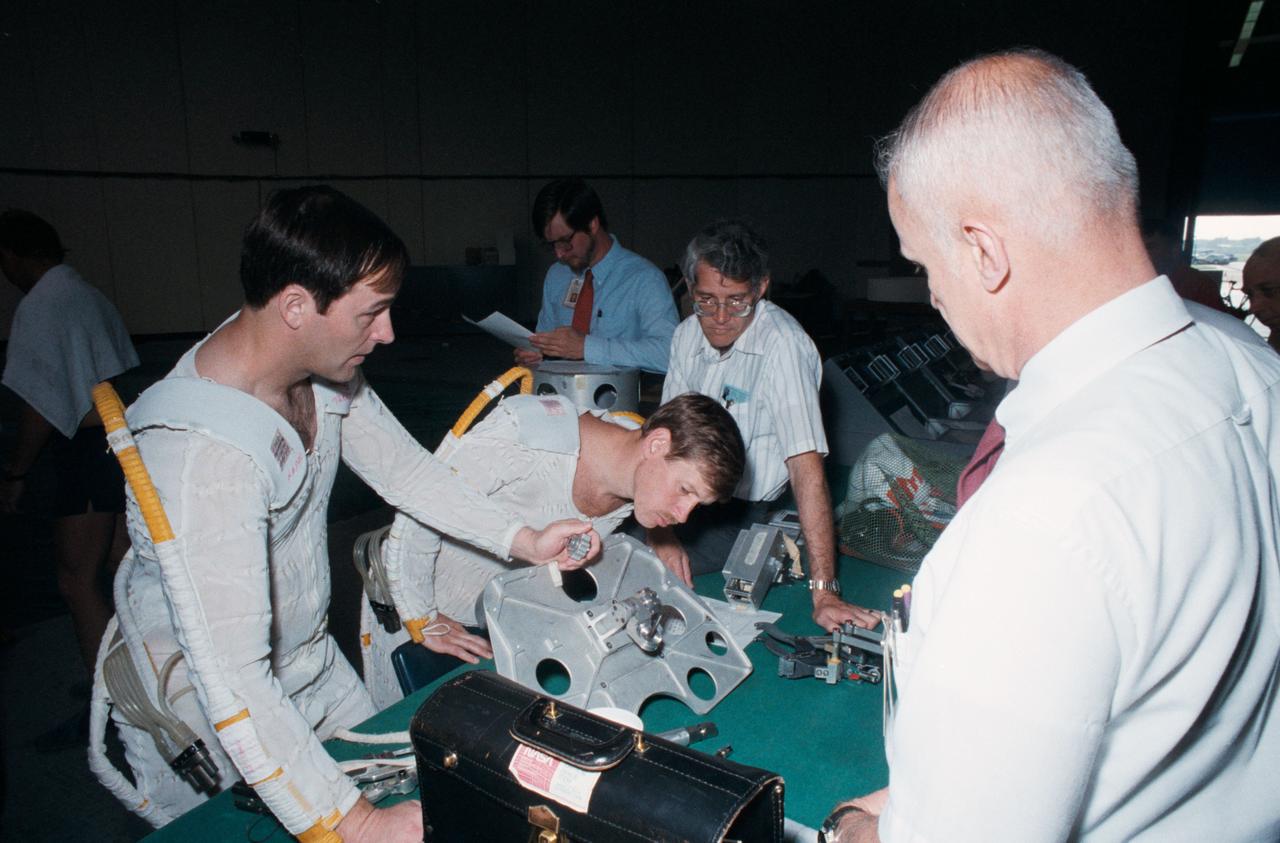
Astronauts Jerry L. Ross (left) and Sherwood Springer (center), look over a foot restraint like that on the currently orbiting Shuttle Discovery. At right is Astronaut Bruce McCandless II. Activities, Bldg. 29, Weightless Environment Training Facility (WETF) for the STS-23/51D Extravehicular Activity (EVA) Simulation for Syncom IV, 04/14/1985. 1. SHUTTLE - SIMULATION (SYNCOM IV) 2. ASTRONAUT ROSS, JERRY L. - SIMULATION (SYNCOM) 3. ASTRONAUT SPRING, SHERWOOD C. - SIMULATION (SYNCOM IV) JSC, HOUSTON, TX

KENNEDY SPACE CENTER, FLA. -- In the Orbiter Processing Facility, STS-122 crew members are introduced to part of the LESS. From left are Mission Specialists Stanley Love, Hans Schlegel and Rex Walheim. The crew is at Kennedy to take part in a crew equipment interface test, or CEIT, which helps familiarize them with equipment and payloads for the mission. Among the activities standard to a CEIT are harness training, inspection of the thermal protection system and camera operation for planned extravehicular activities, or EVAs. STS-122 is targeted for launch in December. Photo credit: NASA/Kim Shiflett

KENNEDY SPACE CENTER, FLA. -- In the Orbiter Processing Facility, STS-122 crew members are introduced to part of the LESS. From left are Mission Specialists Hans Schlegel, Rex Walheim and European Space Agency astronaut Leopold Eyharts, Commander Stephen Frick, Mission Specialist Leland Melvin and Pilot Alan Poindexter. The crew is at Kennedy to take part in a crew equipment interface test, or CEIT, which helps familiarize them with equipment and payloads for the mission. Among the activities standard to a CEIT are harness training, inspection of the thermal protection system and camera operation for planned extravehicular activities, or EVAs. STS-122 is targeted for launch in December. Photo credit: NASA/Kim Shiflett
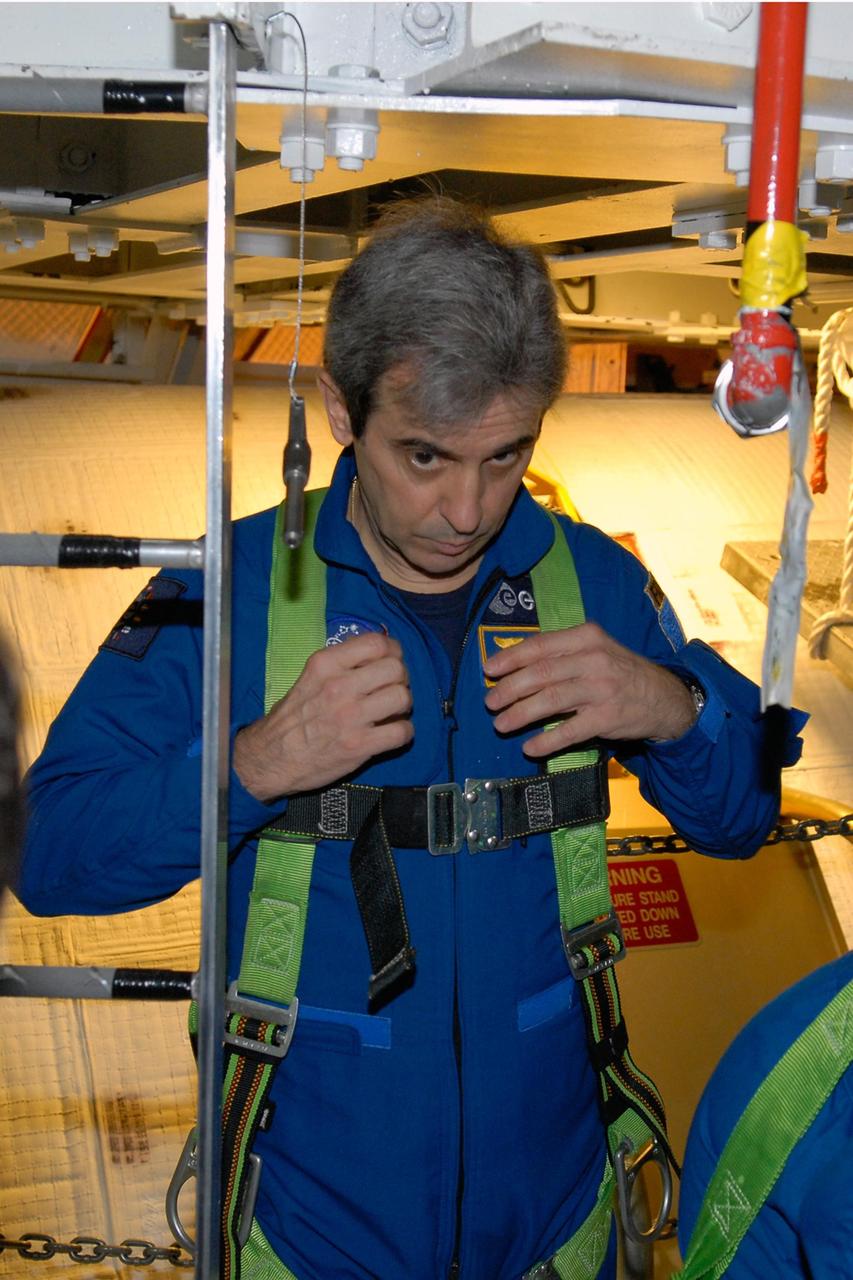
KENNEDY SPACE CENTER, FLA. -- Astronaut Leopold Eyharts, who represents the European Space Agency, tries on a harness in the Orbiter Processing Facility. Eyharts will be traveling to the International Space Station to join the Expedition 16 crew as a flight engineer. The crew is at Kennedy to take part in a crew equipment interface test, or CEIT, which helps familiarize them with equipment and payloads for the mission. Among the activities standard to a CEIT are harness training, inspection of the thermal protection system and camera operation for planned extravehicular activities, or EVAs. STS-122 is targeted for launch in December. Photo credit: NASA/Kim Shiflett
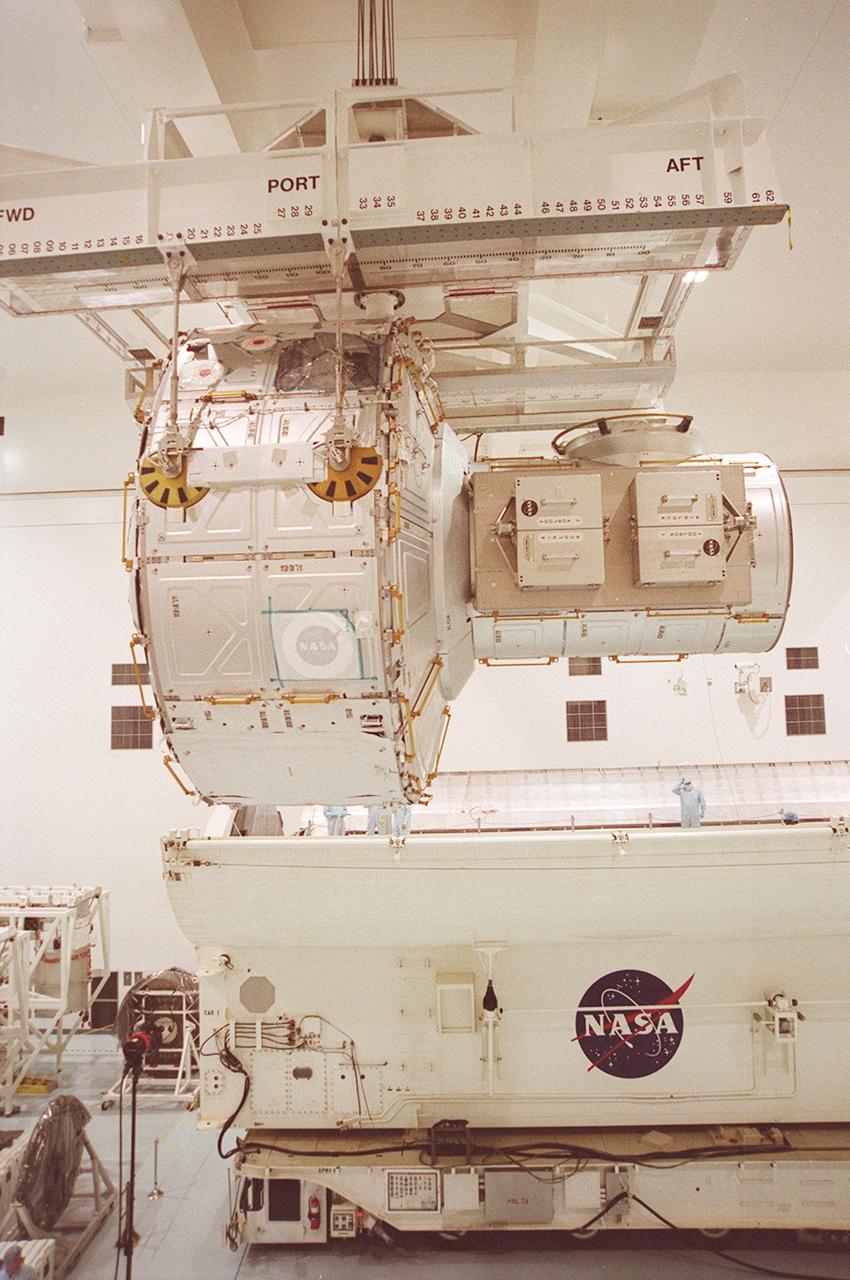
KENNEDY SPACE CENTER, FLA. -- In the Space Station Processing Facility, the Joint Airlock Module is moved closer to the payload canister. The airlock will be installed in the payload bay of Atlantis for mission STS-104 to the International Space Station. The airlock is a pressurized flight element consisting of two cylindrical chambers attached end-to-end by a connecting bulkhead and hatch. Once installed and activated, the Airlock becomes the primary path for spacewalk entry to and departure from the Space Station for U.S. spacesuits, which are known as Extravehicular Mobility Units, or EMUs. In addition, the Joint Airlock is designed to support the Russian Orlan spacesuit for EVA activity. STS-104 is scheduled for launch June 14 from Launch Pad 39B
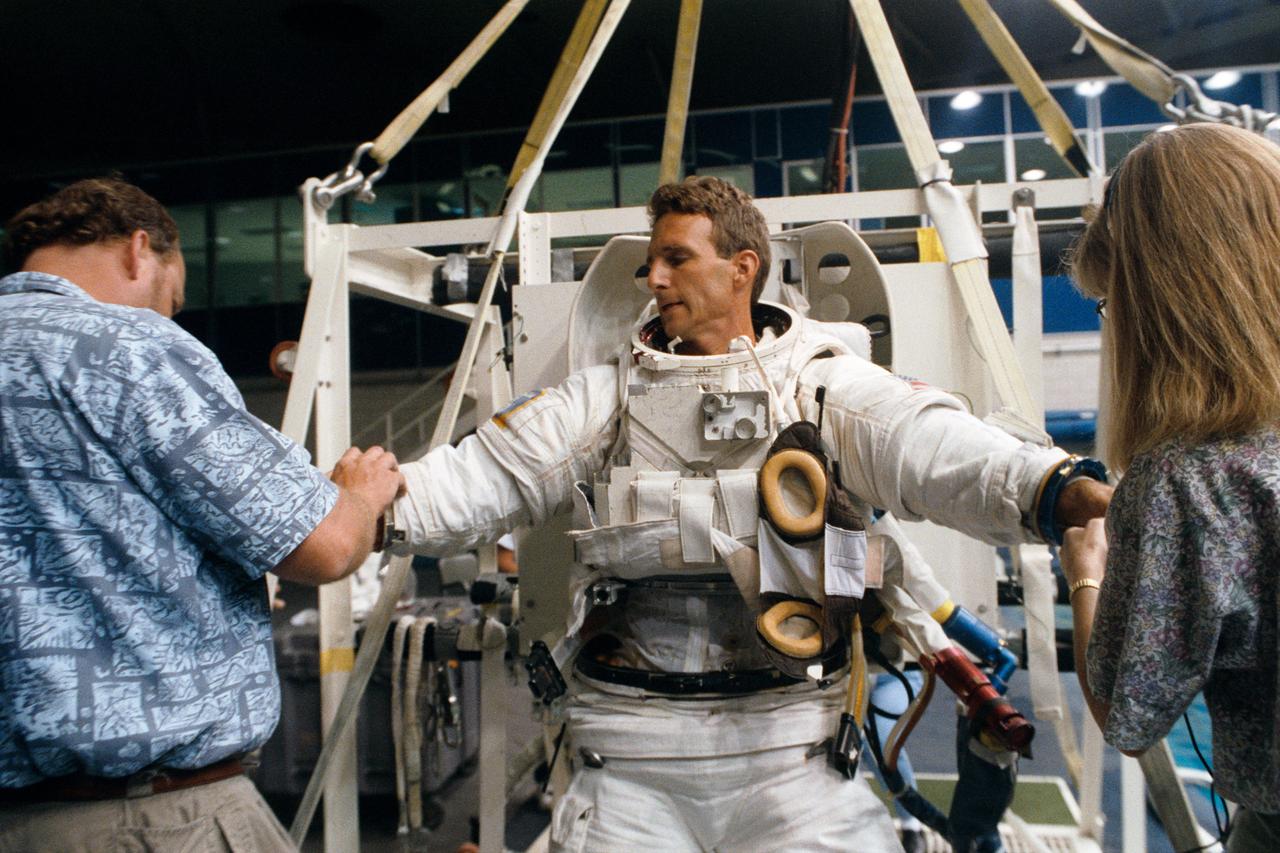
S93-37899 (October 1993) --- Astronaut Jerry M. Linenger, STS-64 mission specialist, is assisted by Steve Voyles and Kari Rueter of Boeing Aerospace prior to participating in a rehearsal for a contingency extravehicular activity (EVA). Minutes later, Linenger was submerged in the 25-feet-deep pool in the Johnson Space Center's (JSC) Weightless Environment Training Facility (WET-F). Photo credit: NASA or National Aeronautics and Space Administration

JSC2007-E-14579 (21 March 2007) --- Attired in a Mark III advanced space suit technology demonstrator, Brian Daniel participates in an extravehicular activity (EVA) systems engineering and integration (SE&I) test in the Space Vehicle Mockup Facility at Johnson Space Center. Data collected in the test will be used in development of the next generation of space suits that are being designed for use in the Constellation Program.
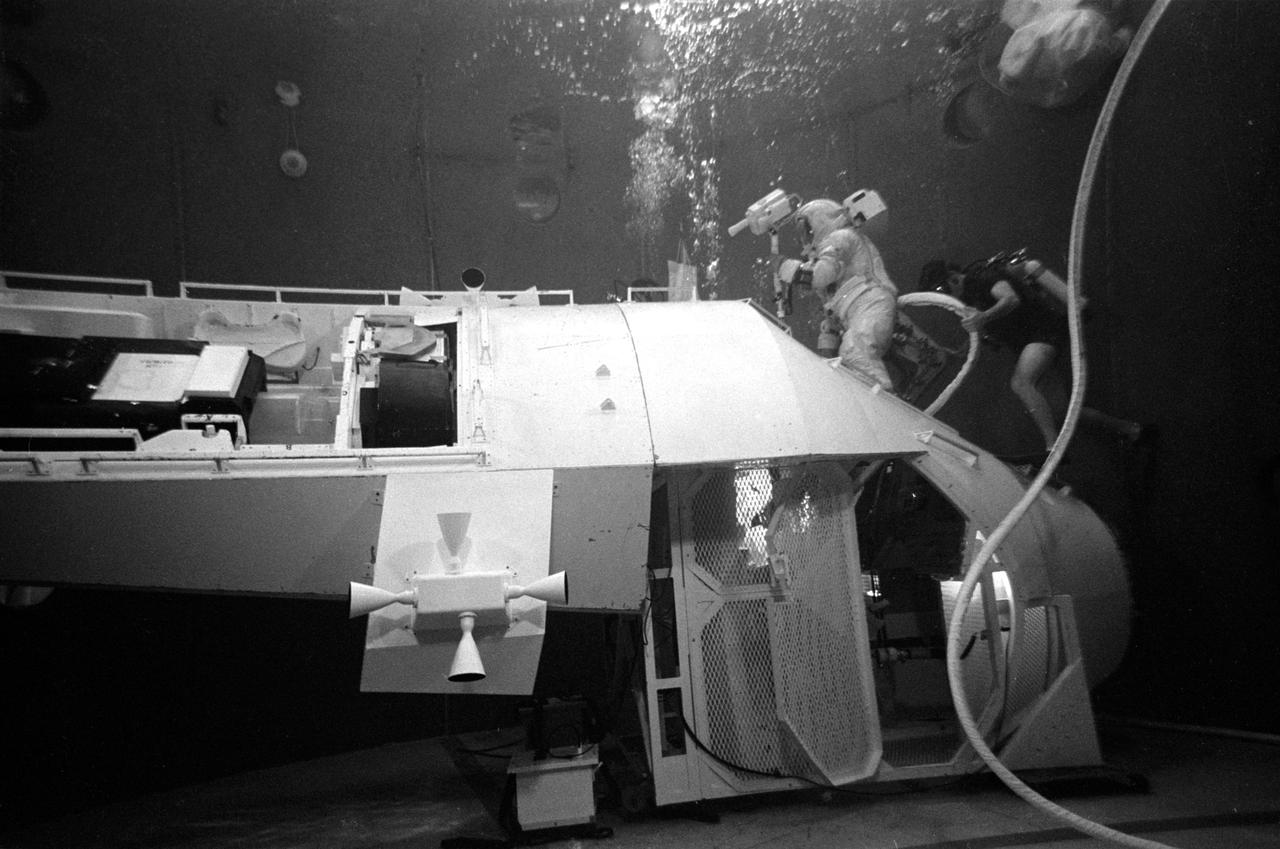
S71-58148 (1 Dec. 1971) --- Astronaut Thomas K. Mattingly II, command module pilot of the planned Apollo 16 lunar landing mission, participates in extravehicular activity (EVA) simulations in the water facility tank in Building 5 at the Manned Spacecraft Center (MSC), Houston, Texas, during training preparations for the forthcoming mission. Mattingly is scheduled to perform EVA during the trans-Earth journey of the Apollo 16 mission.
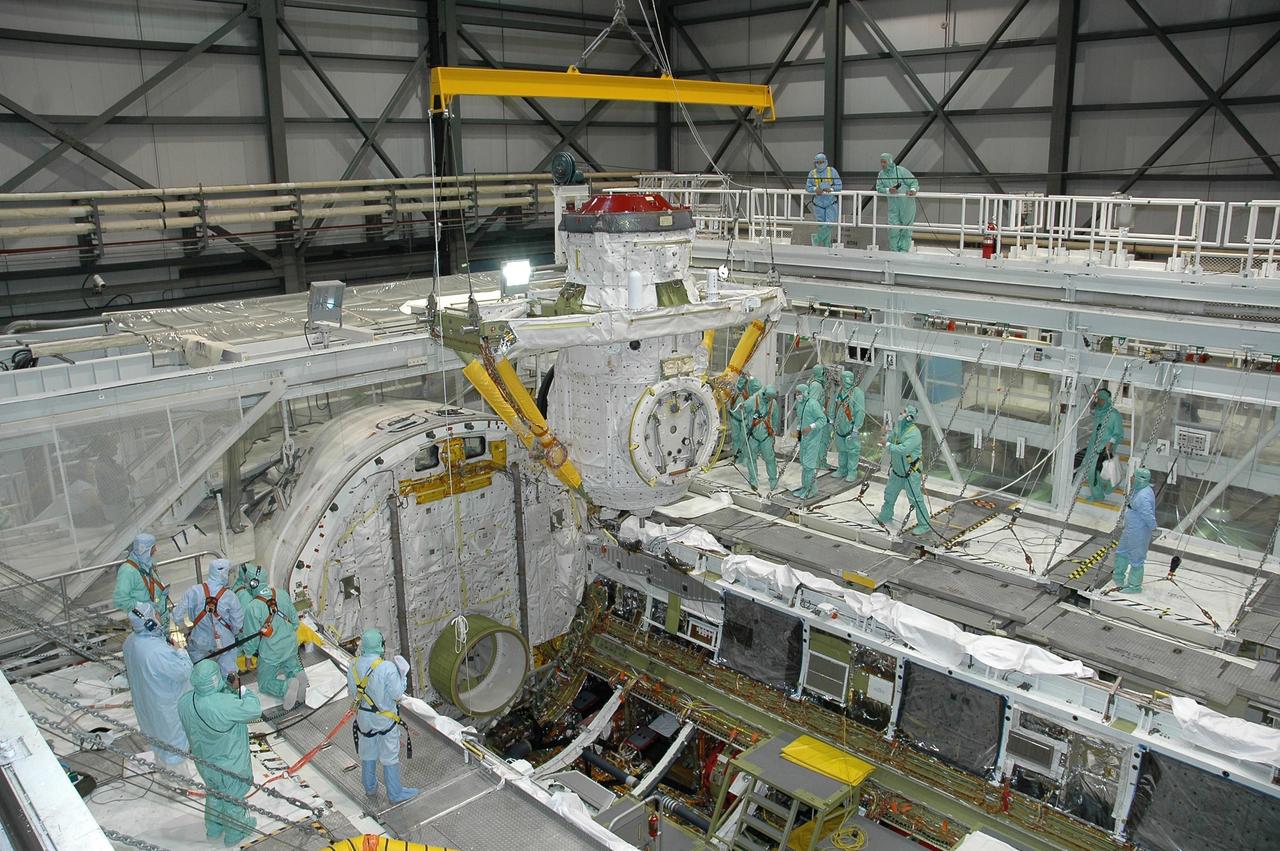
KENNEDY SPACE CENTER, FLA. - In Orbiter Processing Facility bay 2 at NASA's Kennedy Space Center, the airlock is lowered by an overhead crane into Endeavour's payload bay for installation. The airlock is located in the middeck. The airlock and airlock hatches permit flight crew members to transfer from the middeck crew compartment into the payload bay for extravehicular activities in their space suits without depressurizing the orbiter crew cabin. The airlock is sized to accommodate two fully suited flight crew members simultaneously. Photo credit: NASA/Jim Grossmann
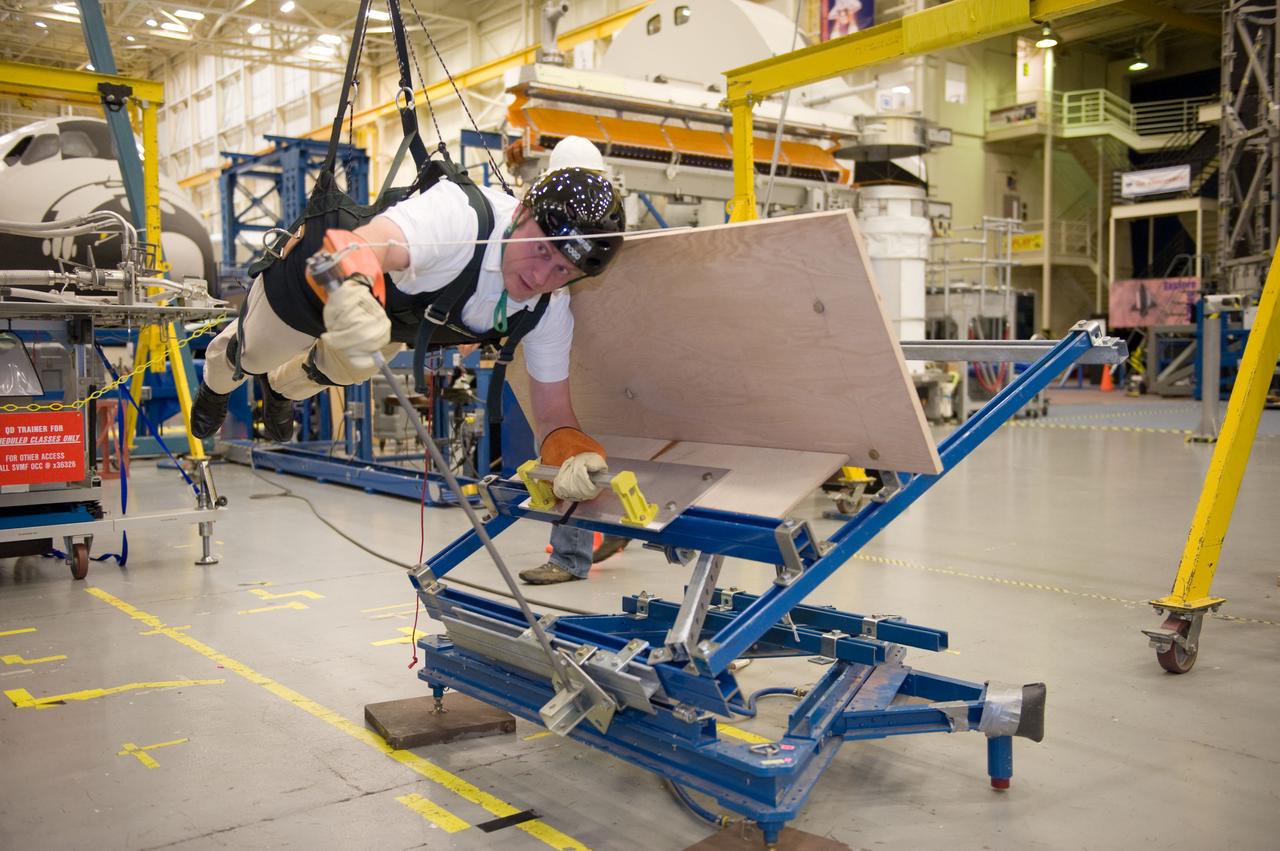
JSC2010-E-193872 (1 Dec. 2010) --- NASA astronaut Michael Fincke, STS-134 mission specialist, participates in an extravehicular activity (EVA) training session in the Partial Gravity Simulator (POGO) test area in the Space Vehicle Mock-up Facility at NASA?s Johnson Space Center. Photo credit: NASA or National Aeronautics and Space Administration
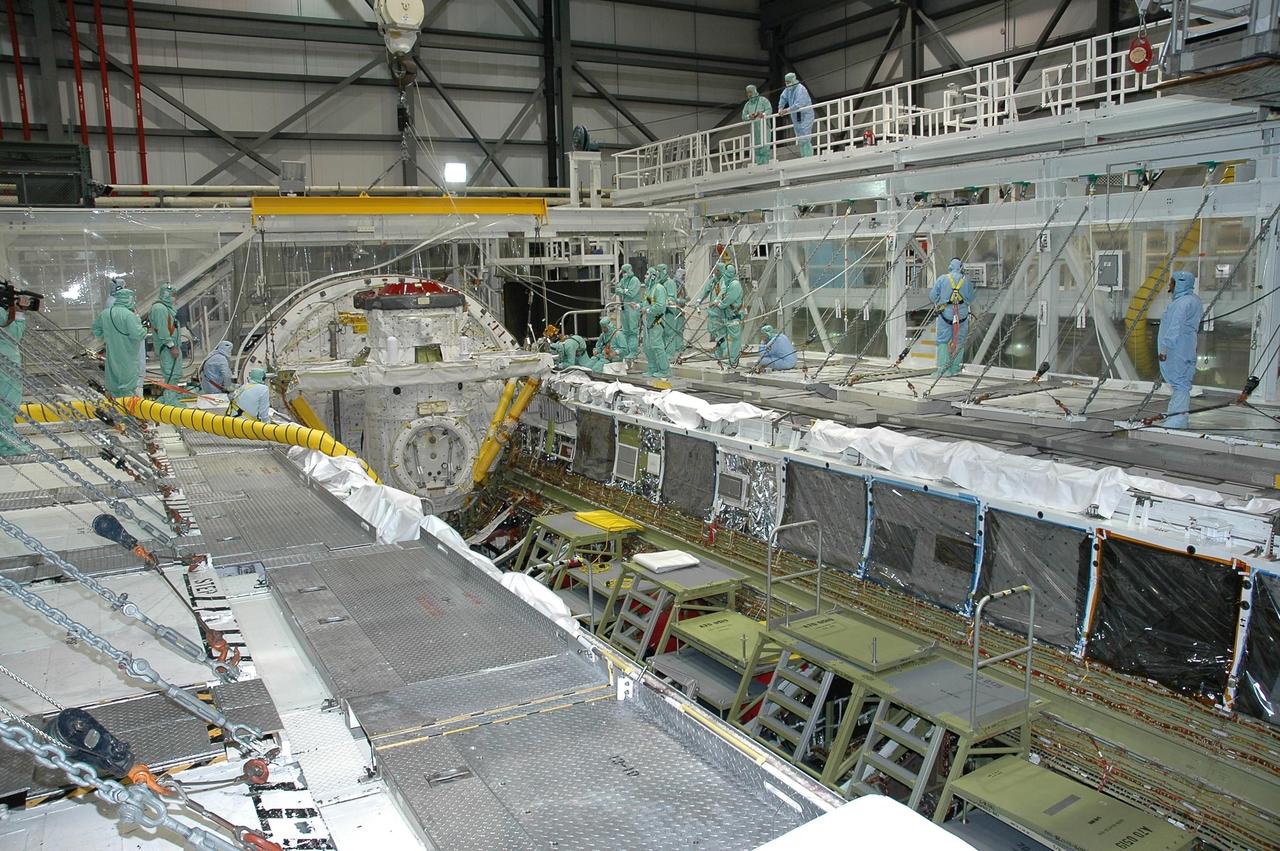
KENNEDY SPACE CENTER, FLA. - In Orbiter Processing Facility bay 2 at NASA's Kennedy Space Center, the airlock has been lowered into place for installation into Endeavour's payload bay. The airlock is located in the middeck. The airlock and airlock hatches permit flight crew members to transfer from the middeck crew compartment into the payload bay for extravehicular activities in their space suits without depressurizing the orbiter crew cabin. The airlock is sized to accommodate two fully suited flight crew members simultaneously. Photo credit: NASA/Jim Grossmann

S96-12924 (14 February 1996) --- astronaut Stephen K. Robinson stands on a platform connected to a hoist that will lower him and astronaut Robert L. Curbeam, Jr. (view obscured, other side of platform) into Johnson Space Center's (JSC) Weightless Environment Test Facility (WET-F) pool. The two were about to participate in an underwater simulation of contingency Extravehicular Activity (EVA) that might be needed to support the scheduled 11-day August 1997 STS-85 mission.
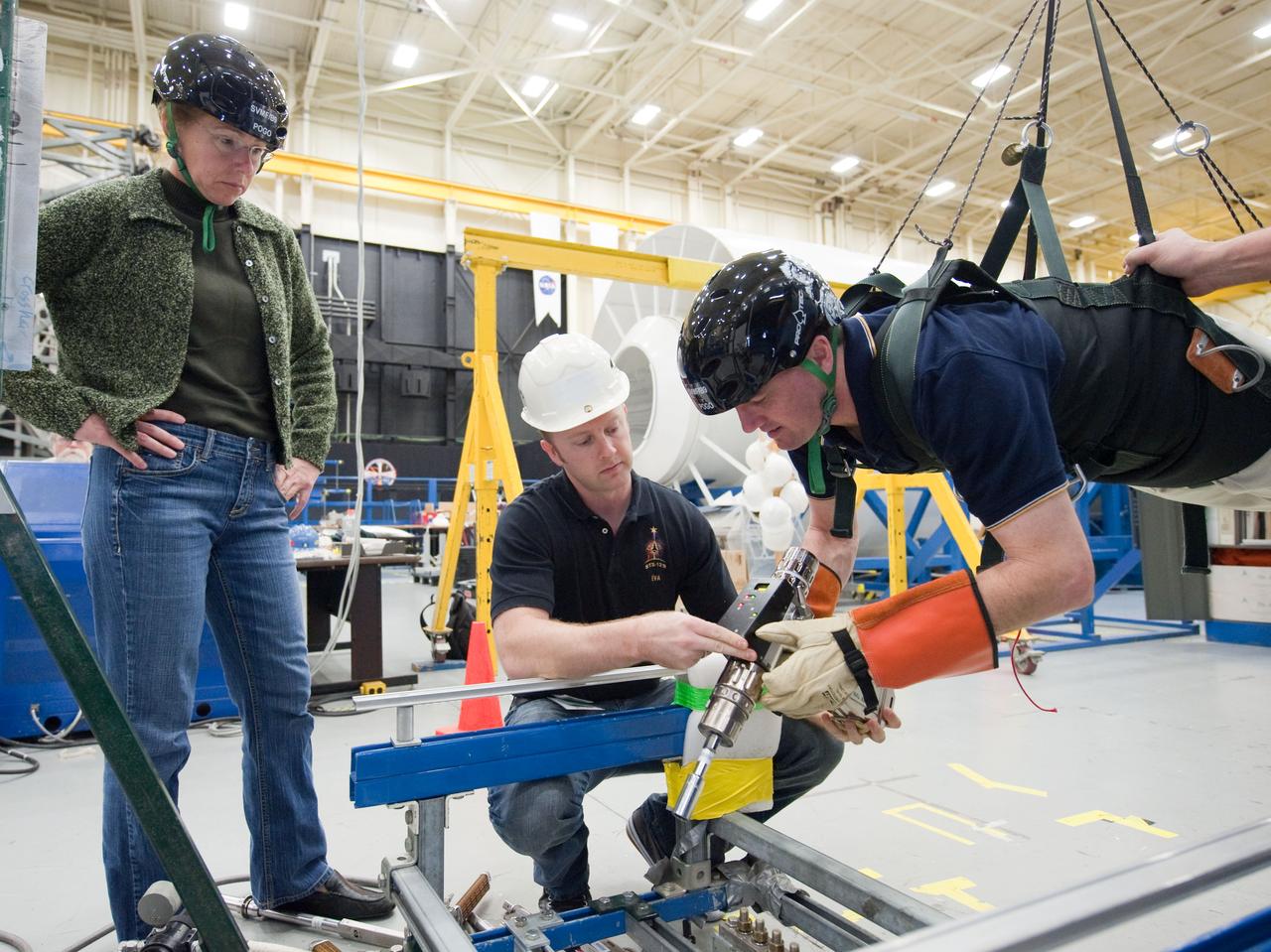
JSC2011-E-017413 (16 Feb. 2011) --- NASA astronaut Rex Walheim, STS-135 mission specialist, participates in an extravehicular activity (EVA) training session in the Partial Gravity Simulator (POGO) test area in the Space Vehicle Mock-up Facility at NASA's Johnson Space Center. NASA astronaut Sandy Magnus, mission specialist, looks on. Photo credit: NASA or National Aeronautics and Space Administration