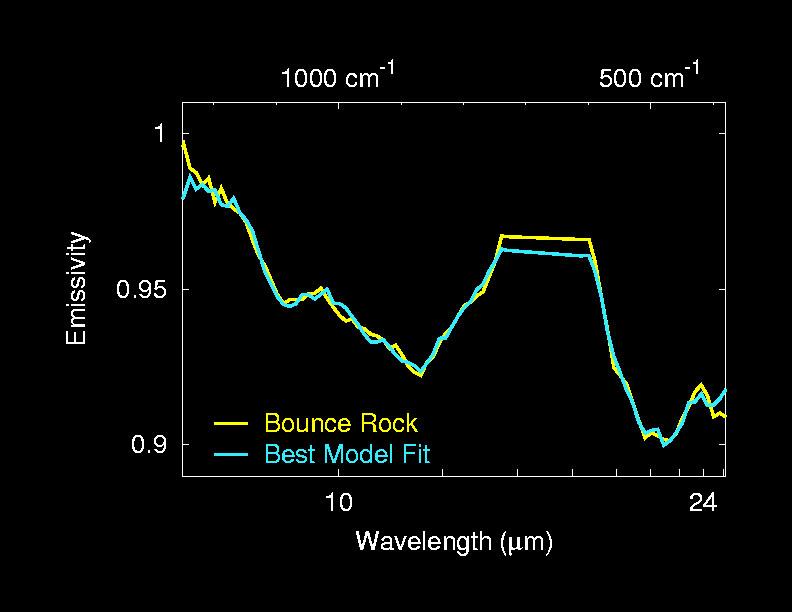
Best Fit for Bounce

Here is an image of the X-59’s 13-foot General Electric F414 engine as the team prepares for a fit check. Making sure components, like the aircraft’s hydraulic lines, which help control functions like brakes or landing gear, and wiring of the engine, fit properly is essential to the aircraft’s safety. Once complete, the X-59 aircraft will demonstrate the ability to fly supersonic while reducing the loud sonic boom to a quiet sonic thump and help enable commercial supersonic air travel over land.
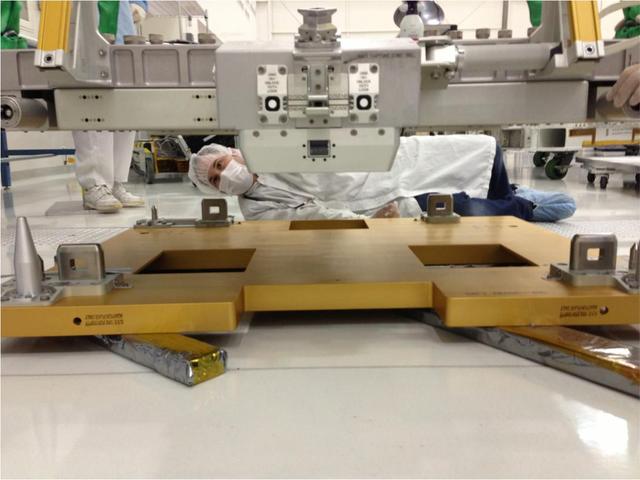
An engineer from NASA Jet Propulsion Laboratory oversees a fit check during the integration & testing of the Optical PAyload for Lasercomm Science OPALS.
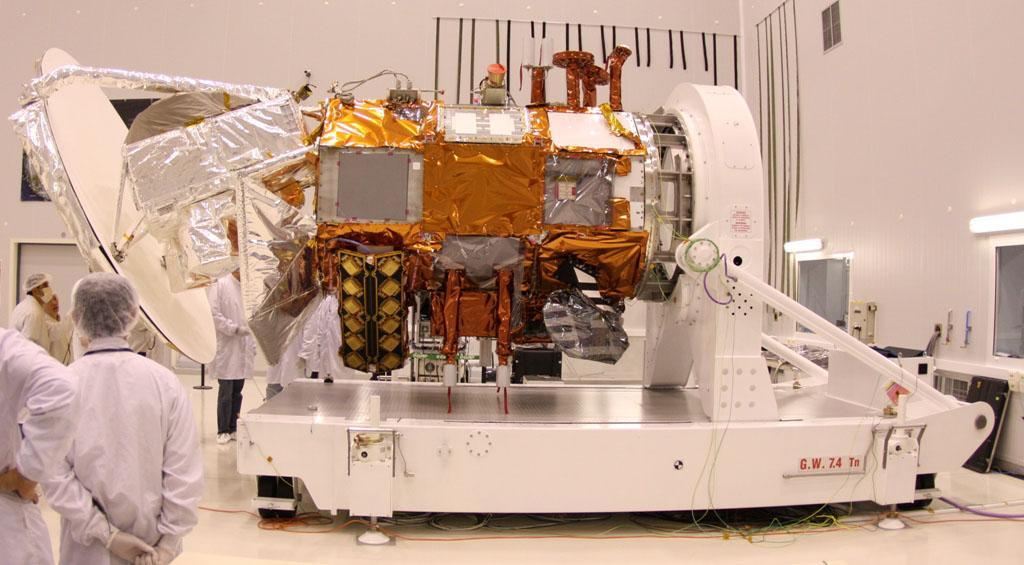
A fit check of half the sunshade is completed to verify the clearance of NASA Aquarius ground lug as well as the blanket interface with the service platform top deck.
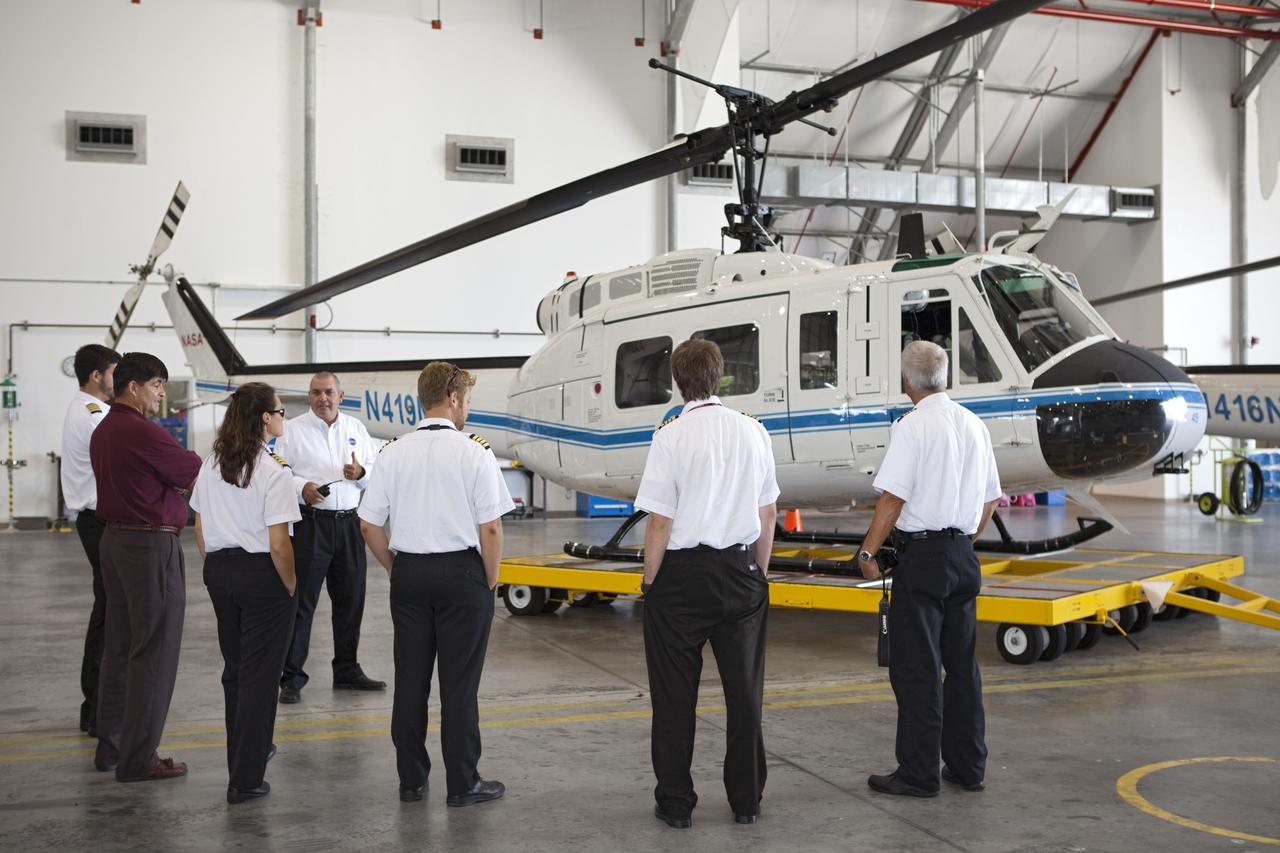
CAPE CANAVERAL, Fla. – Inside the RLV Hangar near NASA Kennedy Space Center’s Shuttle Landing Facility, or SLF, in Florida, flight instructors from Florida Tech, FIT, in Melbourne, listen to NASA Aviation Safety Officer Joe Torsani and view a NASA Huey helicopter. At left, in the red shirt is Glenn Vera, director of FIT Aviation. The flight instructors and their students arrived at the SLF in Cherokee Warrior and Cessna 172S lightweight aircraft. The middle and high school students are participating in FIT’s Av/Aero summer camp experience. They and their flight instructors toured the SLF midfield control tower, viewed F104 Starfighters and NASA Huey helicopters in the RLV Hangar, viewed the runway plaques marking wheels stop for each of the three space shuttles, and toured the Vehicle Assembly Building where space shuttle Atlantis currently is stored. Photo credit: NASA/Kim Shiflett
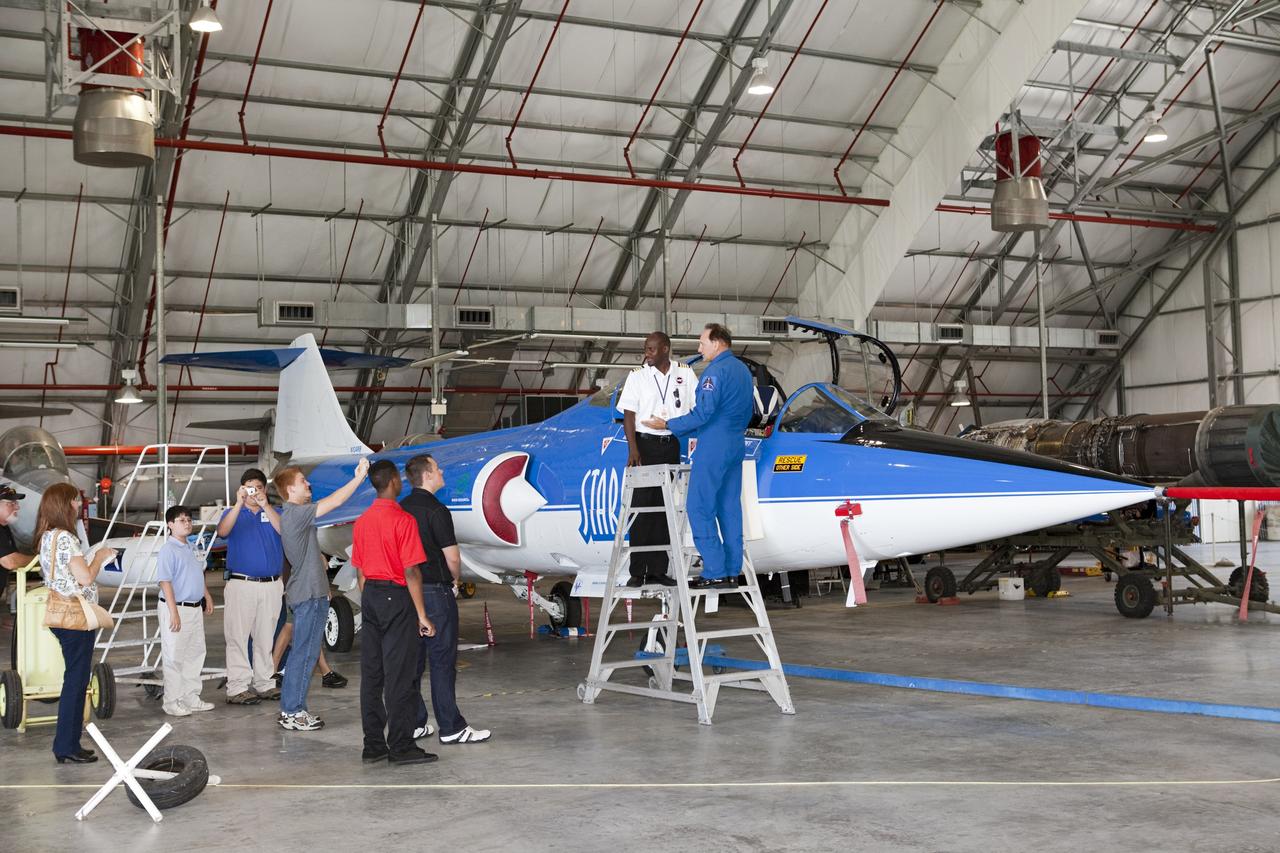
CAPE CANAVERAL, Fla. – Inside the RLV Hangar near NASA Kennedy Space Center’s Shuttle Landing Facility, or SLF, in Florida, Florida Tech, or FIT, Aviation Program Supervisor Tennesse Garvey, at left on the ladder, and several students view an F104 Starfighter. At right, on the ladder is Starfighter Director Rick Svetkoff. The FIT aviation instructors and their students arrived at the SLF in Cherokee Warrior and Cessna 172S lightweight aircraft. The middle and high school students are participating in FIT’s Av/Aero summer camp experience. They and their flight instructors toured the SLF midfield control tower, viewed F104 Starfighters and NASA Huey helicopters in the RLV Hangar, viewed the runway plaques marking wheels stop for each of the three space shuttles, and toured the Vehicle Assembly Building where space shuttle Atlantis currently is stored. Photo credit: NASA/Kim Shiflett
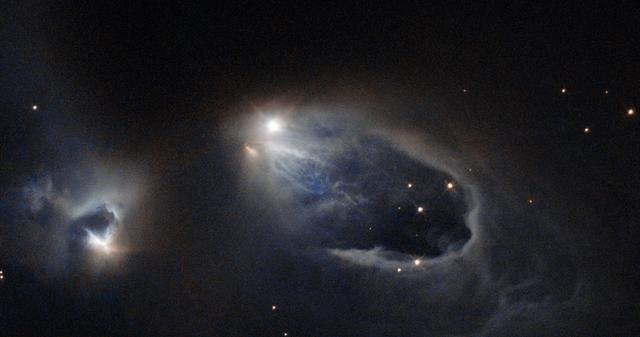
Look at the bright star in the middle of this image. It appears as if it just sneezed. This sight will only last for a few thousand years — a blink of an eye in the young star's life. If you could carry on watching for a few years you would realize it's not just one sneeze, but a sneezing fit. This young star is firing off rapid releases of super-hot, super-fast gas, like multiple sneezes, before it finally exhausts itself. These bursts of gas have shaped the turbulent surroundings, creating structures known as Herbig-Haro objects. These objects are formed from the star's energetic "sneezes." Launched due to magnetic fields around the forming star, these energetic releases can contain as much mass as our home planet, and cannon into nearby clouds of gas at hundreds of kilometers/miles per second. Shock waves form, such as the U-shape below this star. Unlike most other astronomical phenomena, as the waves crash outwards, they can be seen moving across human timescales of years. Soon, this star will stop sneezing, and mature to become a star like our sun. This region is actually home to several interesting objects. The star at the center of the frame is a variable star named V633 Cassiopeiae, with Herbig-Haro objects HH 161 and HH 164 forming parts of the horseshoe-shaped loop emanating from it. The slightly shrouded star just to the left is known as V376 Cassiopeiae, another variable star that has succumbed to its neighbor's infectious sneezing fits; this star is also sneezing, creating yet another Herbig-Haro object — HH 162. Both stars are very young and are still surrounded by dusty material left over from their formation, which spans the gap between the two. Credit: ESA/Hubble & NASA, Acknowledgement: Gilles Chapdelaine <b><a href="http://www.nasa.gov/audience/formedia/features/MP_Photo_Guidelines.html" rel="nofollow">NASA image use policy.</a></b> <b><a href="http://www.nasa.gov/centers/goddard/home/index.html" rel="nofollow">NASA Goddard Space Flight Center</a></b> enables NASA’s mission through four scientific endeavors: Earth Science, Heliophysics, Solar System Exploration, and Astrophysics. Goddard plays a leading role in NASA’s accomplishments by contributing compelling scientific knowledge to advance the Agency’s mission. <b>Follow us on <a href="http://twitter.com/NASA_GoddardPix" rel="nofollow">Twitter</a></b> <b>Like us on <a href="http://www.facebook.com/pages/Greenbelt-MD/NASA-Goddard/395013845897?ref=tsd" rel="nofollow">Facebook</a></b> <b>Find us on <a href="http://instagram.com/nasagoddard?vm=grid" rel="nofollow">Instagram</a></b>
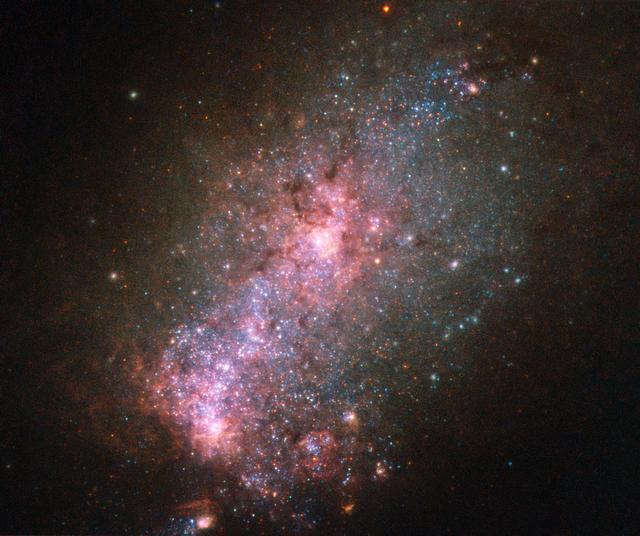
This NASA/ESA Hubble Space Telescope image reveals the vibrant core of the galaxy NGC 3125. Discovered by John Herschel in 1835, NGC 3125 is a great example of a starburst galaxy — a galaxy in which unusually high numbers of new stars are forming, springing to life within intensely hot clouds of gas. Located approximately 50 million light-years away in the constellation of Antlia (The Air Pump), NGC 3125 is similar to, but unfathomably brighter and more energetic than, one of the Magellanic Clouds. Spanning 15,000 light-years, the galaxy displays massive and violent bursts of star formation, as shown by the hot, young, and blue stars scattered throughout the galaxy’s rose-tinted core. Some of these clumps of stars are notable — one of the most extreme Wolf–Rayet star clusters in the local Universe, NGC 3125-A1, resides within NGC 3125. Despite their appearance, the fuzzy white blobs dotted around the edge of this galaxy are not stars, but globular clusters. Found within a galaxy’s halo, globular clusters are ancient collections of hundreds of thousands of stars. They orbit around galactic centers like satellites — the Milky Way, for example, hosts over 150 of them. Image credit: ESA/Hubble & NASA, Acknowledgement: Judy Schmidt <b><a href="http://www.nasa.gov/audience/formedia/features/MP_Photo_Guidelines.html" rel="nofollow">NASA image use policy.</a></b> <b><a href="http://www.nasa.gov/centers/goddard/home/index.html" rel="nofollow">NASA Goddard Space Flight Center</a></b> enables NASA’s mission through four scientific endeavors: Earth Science, Heliophysics, Solar System Exploration, and Astrophysics. Goddard plays a leading role in NASA’s accomplishments by contributing compelling scientific knowledge to advance the Agency’s mission. <b>Follow us on <a href="http://twitter.com/NASAGoddardPix" rel="nofollow">Twitter</a></b> <b>Like us on <a href="http://www.facebook.com/pages/Greenbelt-MD/NASA-Goddard/395013845897?ref=tsd" rel="nofollow">Facebook</a></b> <b>Find us on <a href="http://instagrid.me/nasagoddard/?vm=grid" rel="nofollow">Instagram</a></b>
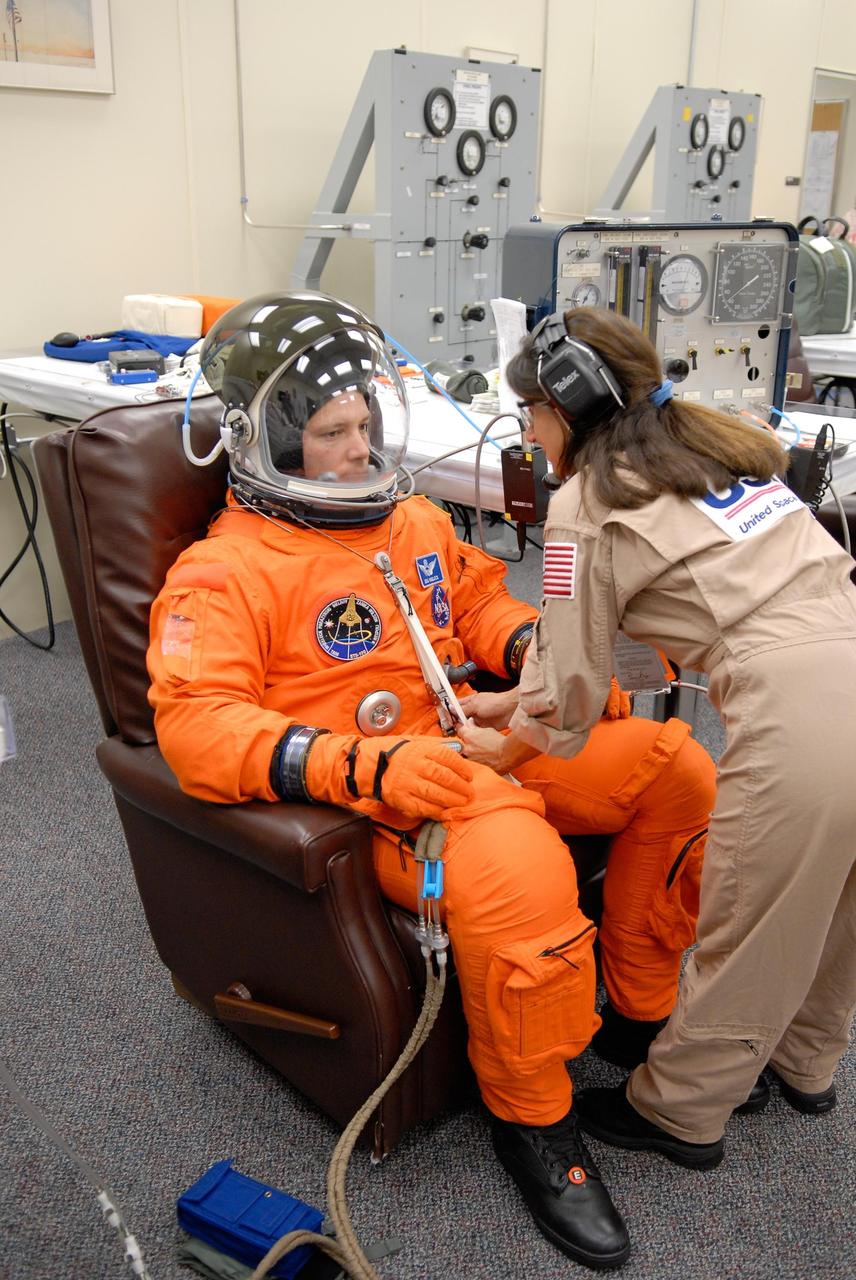
KENNEDY SPACE CENTER, FLA. -- STS-120 Mission Specialist Doug Wheelock has his helmet fitted on his launch and entry suit, preparing for launch. The fitting is part of terminal countdown demonstration test, or TCDT, activities the crew is undertaking at NASA's Kennedy Space Center. The TCDT also includes emergency egress procedures, equipment familiarization and a simulated launch countdown. Mission STS-120, which will carry the Italian-built U.S. Node 2 to the International Space Station, is targeted for launch on Oct. 23. Photo credit: NASA/Kim Shiflett
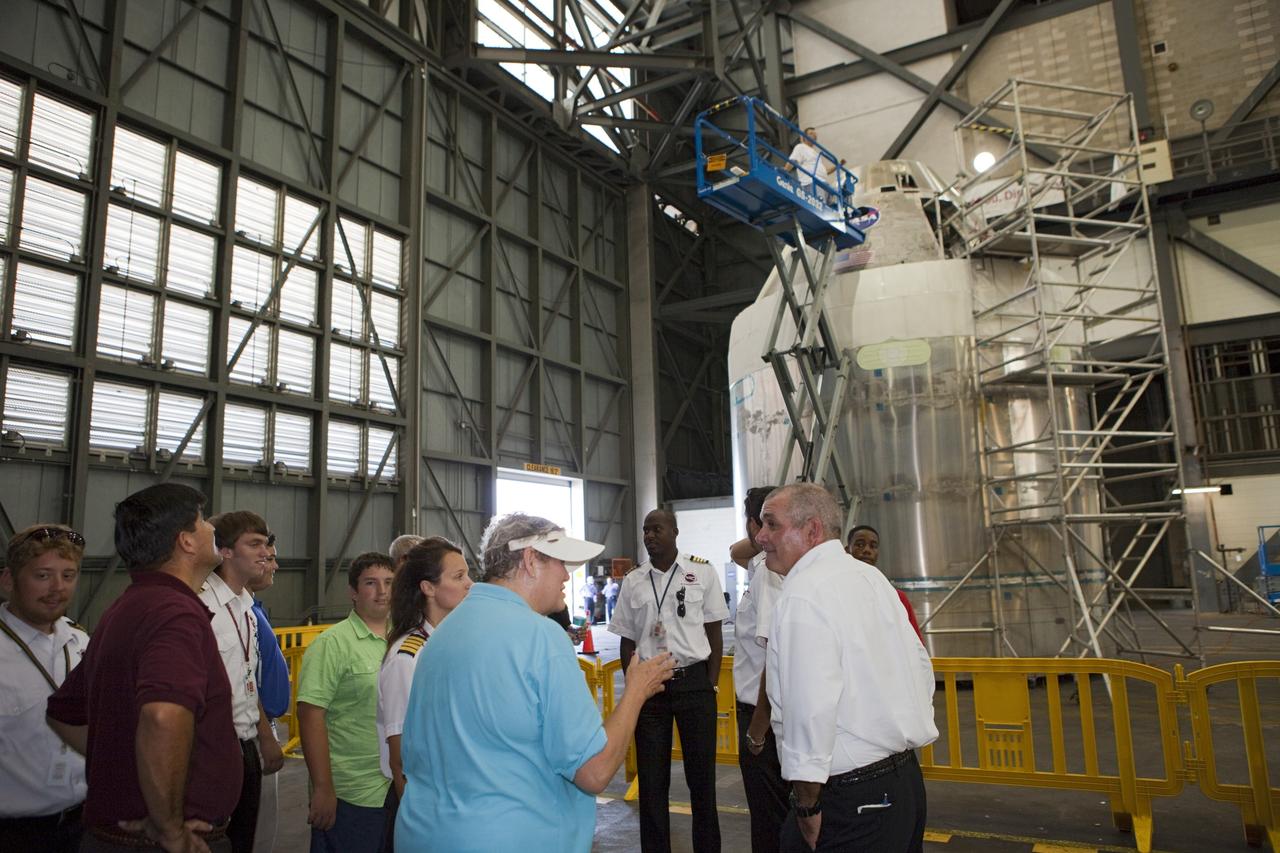
CAPE CANAVERAL, Fla. – Students and their flight instructors from Florida Tech, or FIT, in Melbourne, tour the Vehicle Assembly Building and view space shuttle Atlantis at NASA’s Kennedy Space Center in Florida. The instructors and their students arrived at the Shuttle Landing Facility, or SLF, in Cherokee Warrior and Cessna 172S lightweight aircraft. The middle and high school students are participating in FIT’s Av/Aero summer camp experience. They and their flight instructors also toured the SLF midfield control tower, viewed F104 Starfighters and NASA Huey helicopters in the RLV Hangar, and viewed the runway plaques marking wheels stop for each of the three space shuttles. Photo credit: NASA/Kim Shiflett
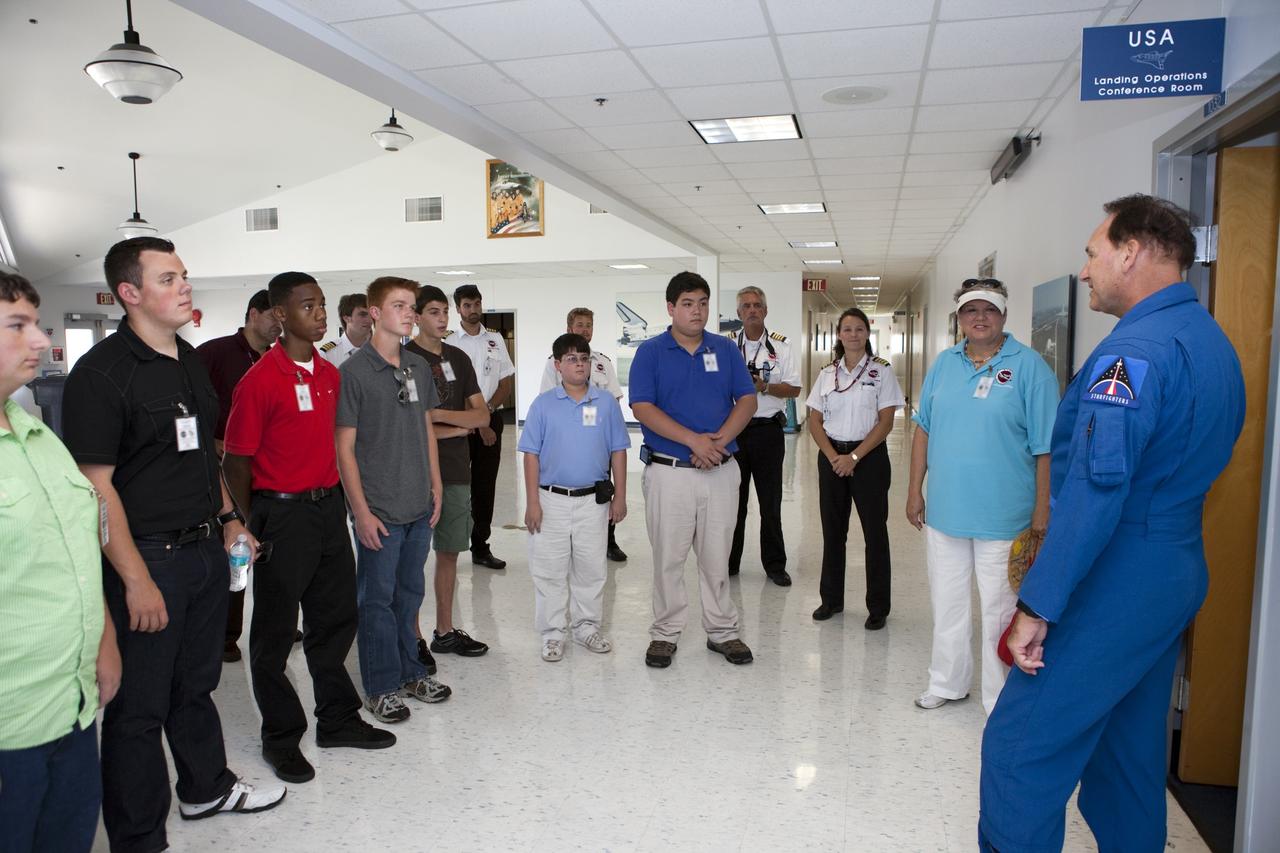
CAPE CANAVERAL, Fla. – In a support building near NASA Kennedy Space Center’s Shuttle Landing Facility, or SLF, in Florida, students and their flight instructors from Florida Tech, FIT, in Melbourne listen to F104 Starfighters Director Rick Svetkoff. The middle and high school students are participating in FIT’s Av/Aero summer camp experience. They and their flight instructors toured the SLF midfield control tower, viewed F104 Starfighters and NASA Huey helicopters in the RLV Hangar, viewed the runway plaques marking wheels stop for each of the three space shuttles, and toured the Vehicle Assembly Building where space shuttle Atlantis currently is stored. Photo credit: NASA/Kim Shiflett
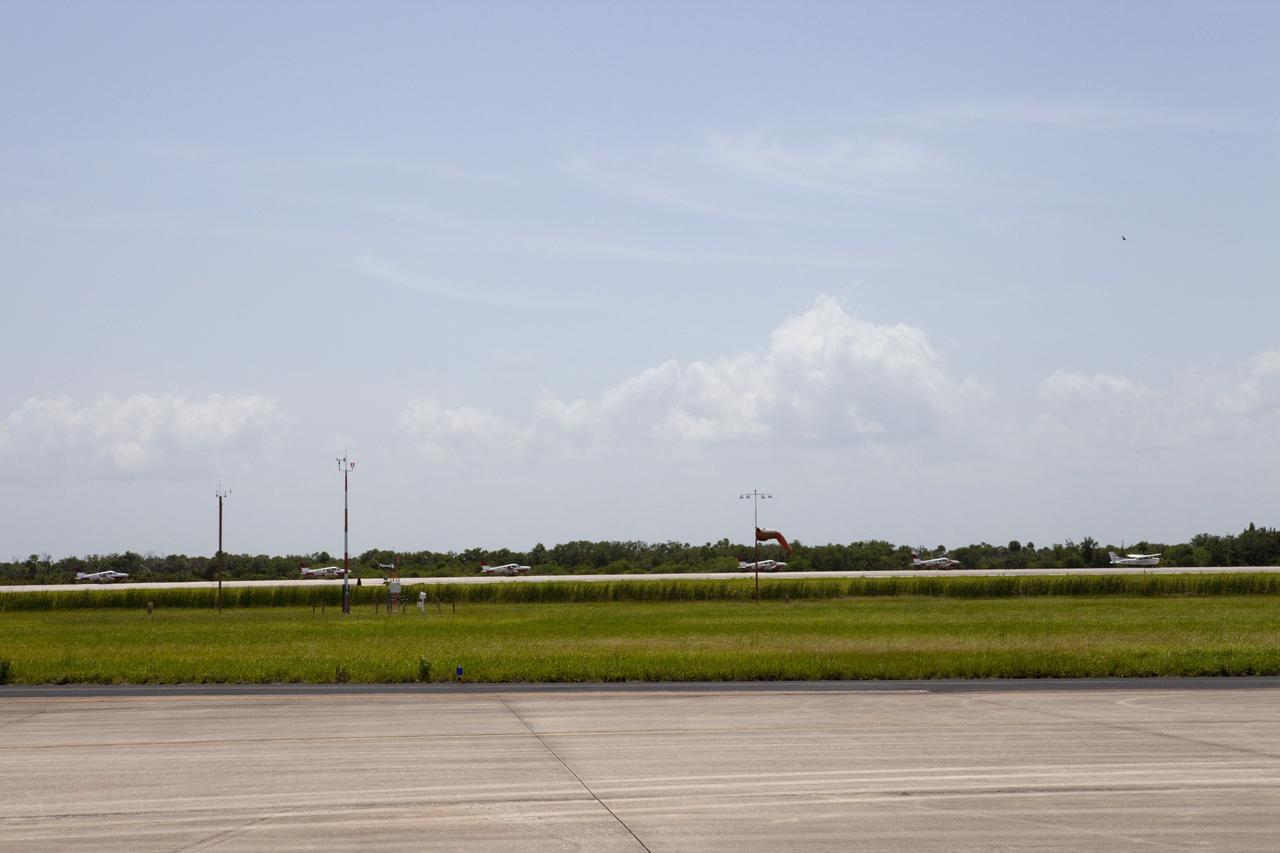
CAPE CANAVERAL, Fla. – At NASA Kennedy Space Center in Florida, flight instructors and their students from Florida Tech, or FIT, in Melbourne prepare to depart the Shuttle Landing Facility, or SLF, in Cherokee Warrior and Cessna 172S lightweight aircraft. The middle and high school students are participating in FIT’s Av/Aero summer camp experience. They and their flight instructors toured the SLF midfield control tower, viewed F104 Starfighters and NASA Huey helicopters in the RLV Hangar, viewed the runway plaques marking wheels stop for each of the three space shuttles, and toured the Vehicle Assembly Building where space shuttle Atlantis currently is stored. Photo credit: NASA/Kim Shiflett
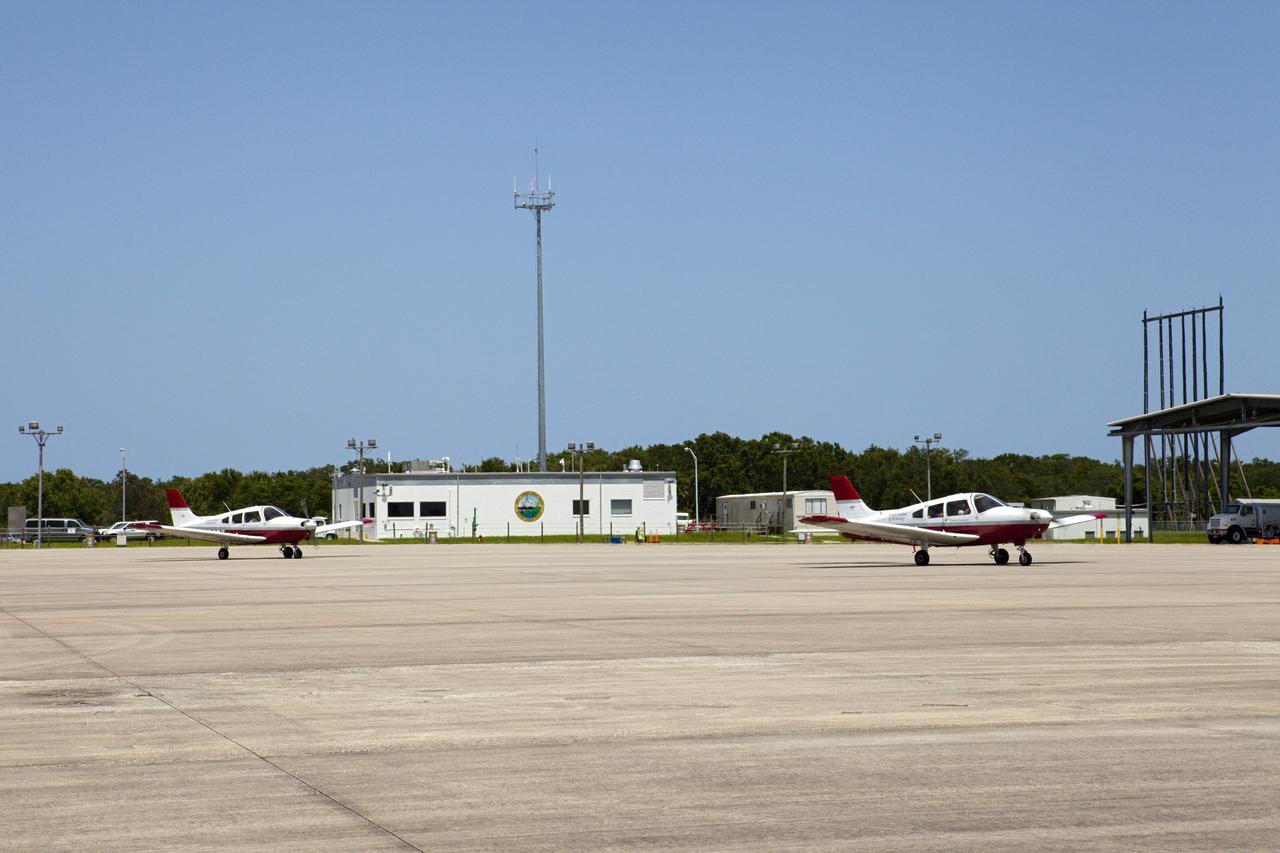
CAPE CANAVERAL, Fla. – At NASA Kennedy Space Center in Florida, flight instructors and their students from Florida Tech, or FIT, in Melbourne prepare to depart the Shuttle Landing Facility, or SLF, in Cherokee Warrior and Cessna 172S lightweight aircraft. The middle and high school students are participating in FIT’s Av/Aero summer camp experience. They and their flight instructors toured the SLF midfield control tower, viewed F104 Starfighters and NASA Huey helicopters in the RLV Hangar, viewed the runway plaques marking wheels stop for each of the three space shuttles, and toured the Vehicle Assembly Building where space shuttle Atlantis currently is stored. Photo credit: NASA/Kim Shiflett
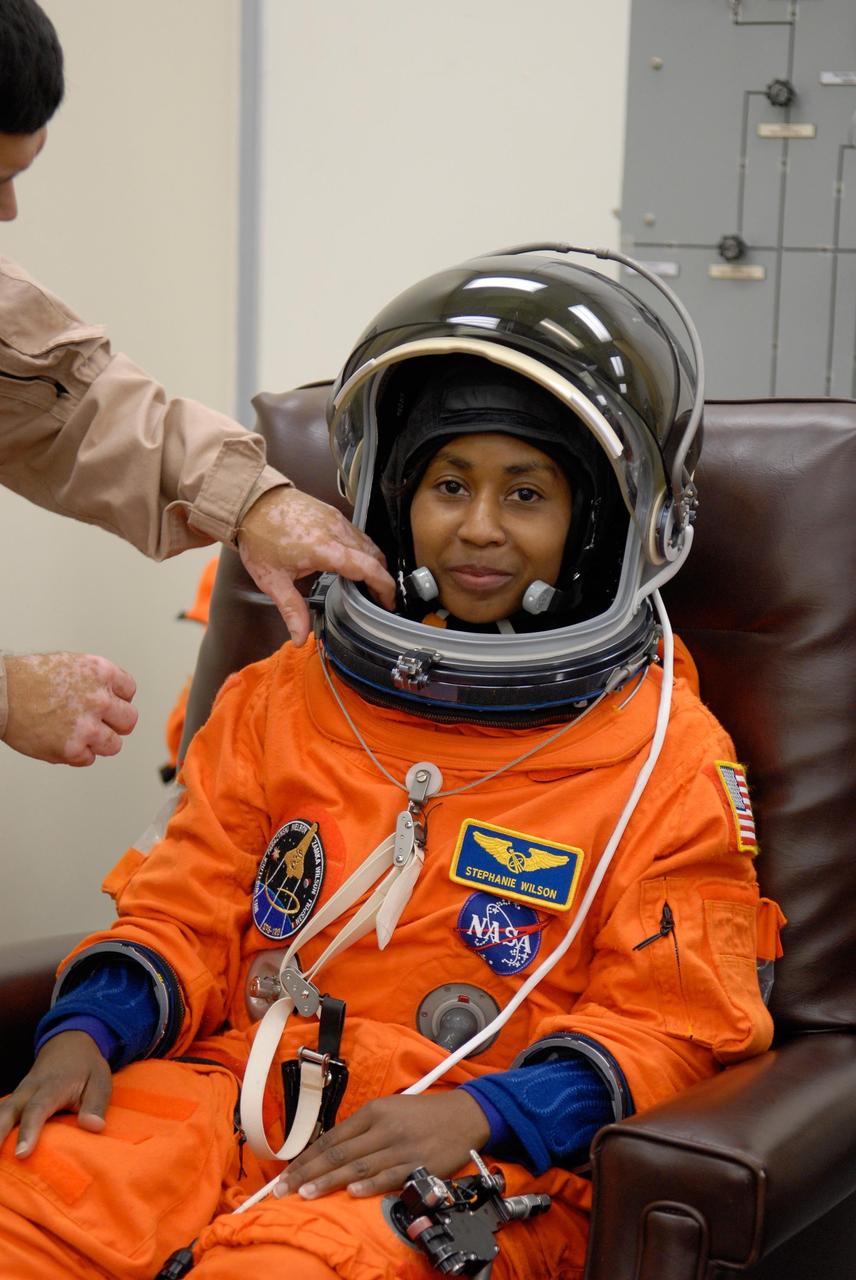
KENNEDY SPACE CENTER, FLA. -- STS-120 Mission Specialist Stephanie Wilson has her helmet adjusted during fitting of her launch and entry suit. The fitting is part of terminal countdown demonstration test, or TCDT, activities the crew is undertaking at NASA's Kennedy Space Center. The TCDT also includes emergency egress procedures, equipment familiarization and a simulated launch countdown. Mission STS-120, which will carry the Italian-built U.S. Node 2 to the International Space Station, is targeted for launch on Oct. 23. Photo credit: NASA/Kim Shiflett
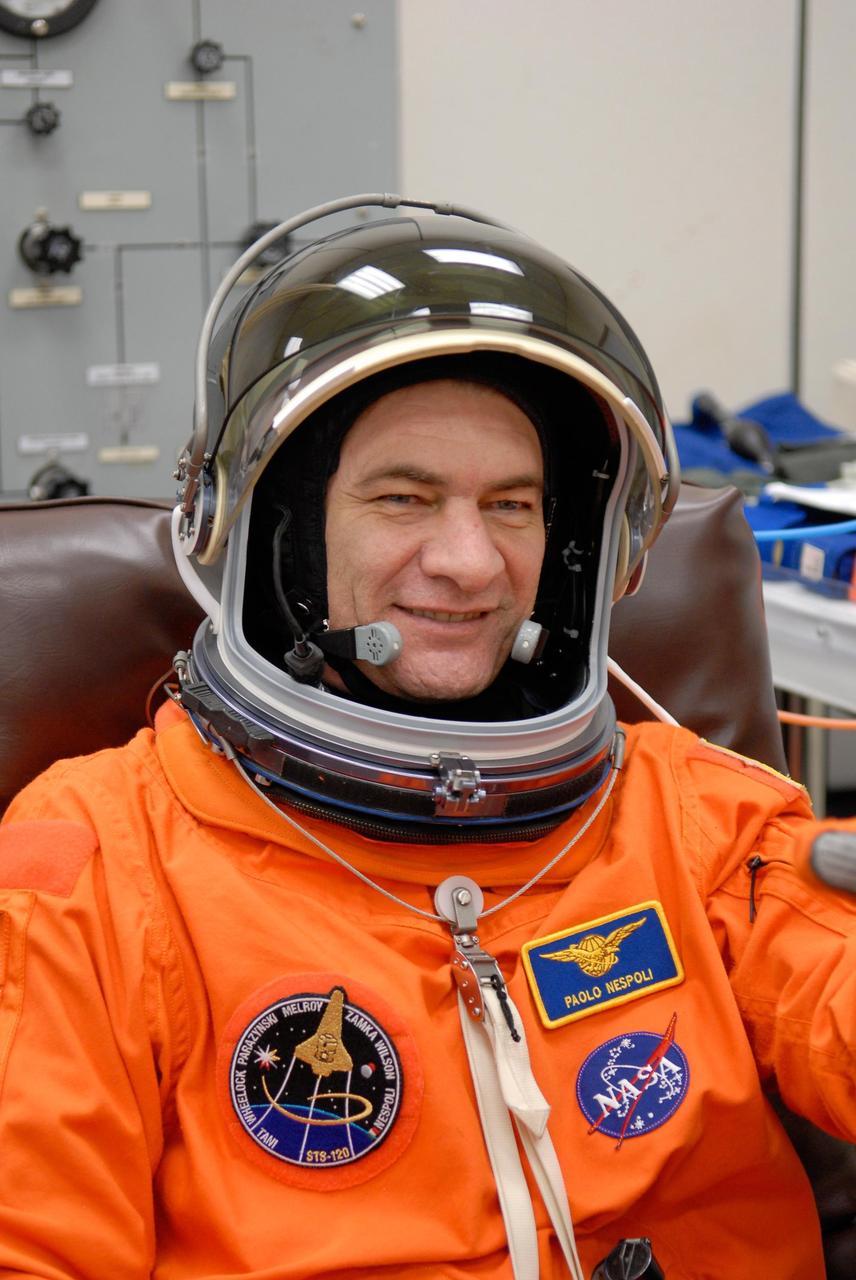
KENNEDY SPACE CENTER, FLA. -- STS-120 Mission Specialist Paolo Nespoli has his helmet fitted on his launch and entry suit, preparing for launch. The fitting is part of terminal countdown demonstration test, or TCDT, activities the crew is undertaking at NASA's Kennedy Space Center. The TCDT also includes emergency egress procedures, equipment familiarization and a simulated launch countdown. Mission STS-120, which will carry the Italian-built U.S. Node 2 to the International Space Station, is targeted for launch on Oct. 23. Photo credit: NASA/Kim Shiflett
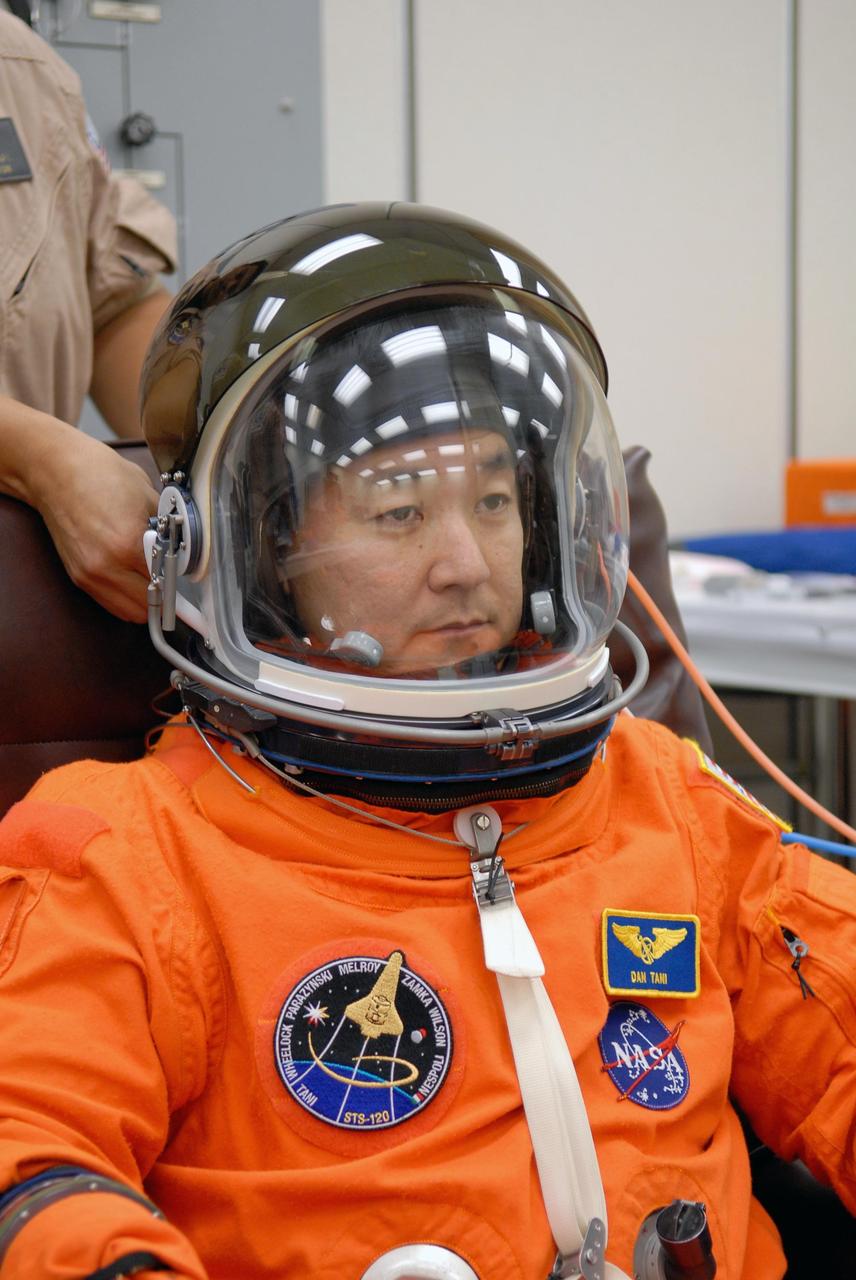
KENNEDY SPACE CENTER, FLA. -- STS-120 Mission Specialist Daniel Tani has his helmet adjusted during fitting of his launch and entry suit. The fitting is part of terminal countdown demonstration test, or TCDT, activities the crew is undertaking at NASA's Kennedy Space Center. The TCDT also includes emergency egress procedures, equipment familiarization and a simulated launch countdown. Mission STS-120, which will carry the Italian-built U.S. Node 2 to the International Space Station, is targeted for launch on Oct. 23. Photo credit: NASA/Kim Shiflett

CAPE CANAVERAL, Fla. – Students and their flight instructors from Florida Tech, or FIT, in Melbourne, tour the Vehicle Assembly Building and view space shuttle Atlantis at NASA’s Kennedy Space Center in Florida. The instructors and their students arrived at the Shuttle Landing Facility, or SLF, in Cherokee Warrior and Cessna 172S lightweight aircraft. The middle and high school students are participating in FIT’s Av/Aero summer camp experience. They and their flight instructors also toured the SLF midfield control tower, viewed F104 Starfighters and NASA Huey helicopters in the RLV Hangar, and viewed the runway plaques marking wheels stop for each of the three space shuttles. Photo credit: NASA/Kim Shiflett
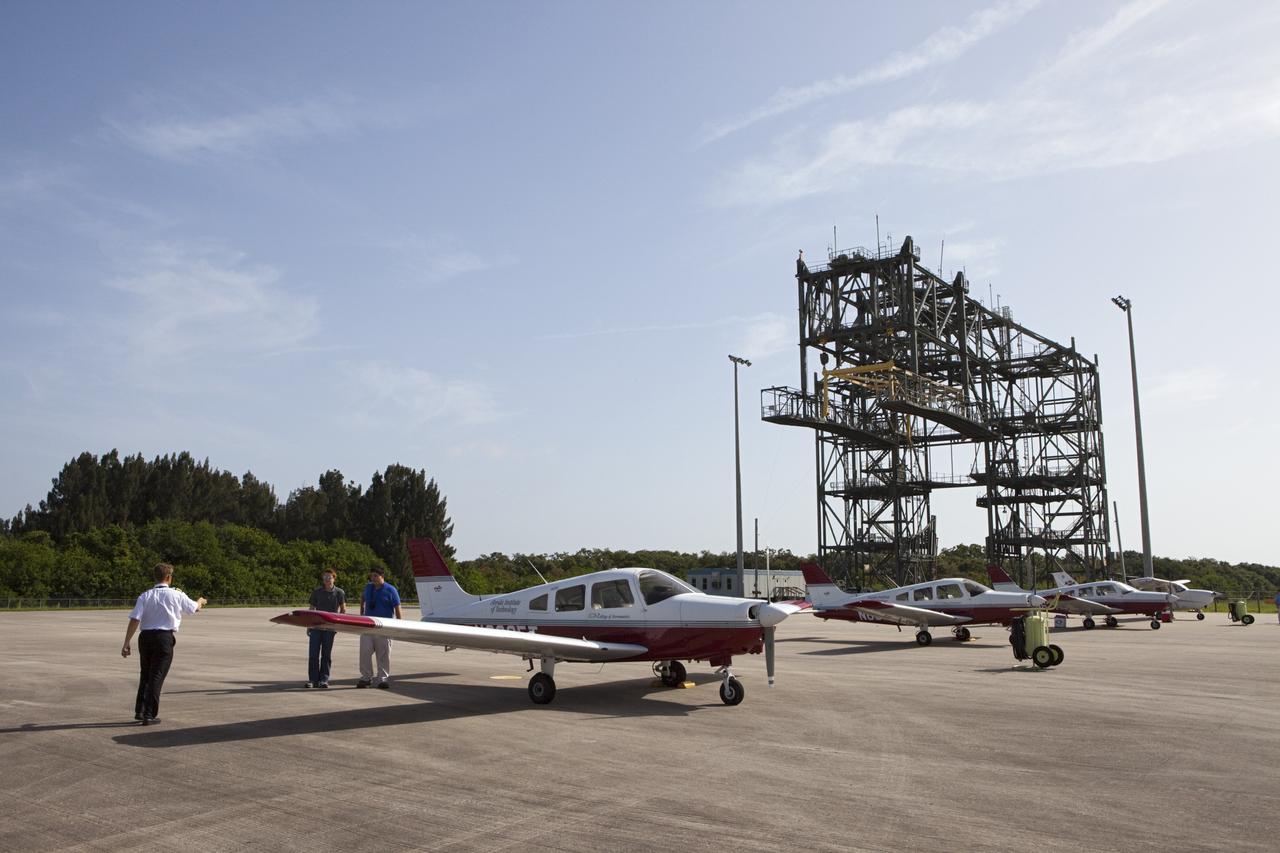
CAPE CANAVERAL, Fla. – Students and their flight instructors arrive at NASA Kennedy Space Center’s Shuttle Landing Facility, or SLF, in Florida in Cherokee Warrior and Cessna 172S lightweight aircraft from Florida Tech, or FIT, in Melbourne. The middle and high school students are participating in FIT’s Av/Aero summer camp experience. They and their flight instructors toured the SLF midfield control tower, viewed F104 Starfighters and NASA Huey helicopters in the RLV Hangar, viewed the runway plaques marking wheels stop for each of the three space shuttles, and toured the Vehicle Assembly Building where space shuttle Atlantis currently is stored. Photo credit: NASA/Kim Shiflett
A fit check of the Orion Crew and Service Module Horizontal Transporter (CHT) with NASA's Super Guppy aircraft is underway March 13, 2019, at NASA Kennedy Space Center’s Shuttle Landing Facility in Florida, operated by Space Florida. In this photo, the CHT, secured on the U.S. Air Force aircraft loader, is moved inside the aircraft’s payload bay. The fit check is being performed to confirm loading operations, ensure that the CHT fits inside the Super Guppy and test the electrical interface to aircraft power. The Orion crew and service modules will be readied for a trip to NASA’s Plum Brook Station in Sandusky, Ohio, for full thermal vacuum testing. In this unique facility, the crew and service modules will be put through extensive testing to ensure they can survive the rigors of launch, space travel, re-entry and splashdown. The Orion spacecraft will launch atop the agency's Space Launch System rocket on Exploration Mission-1.
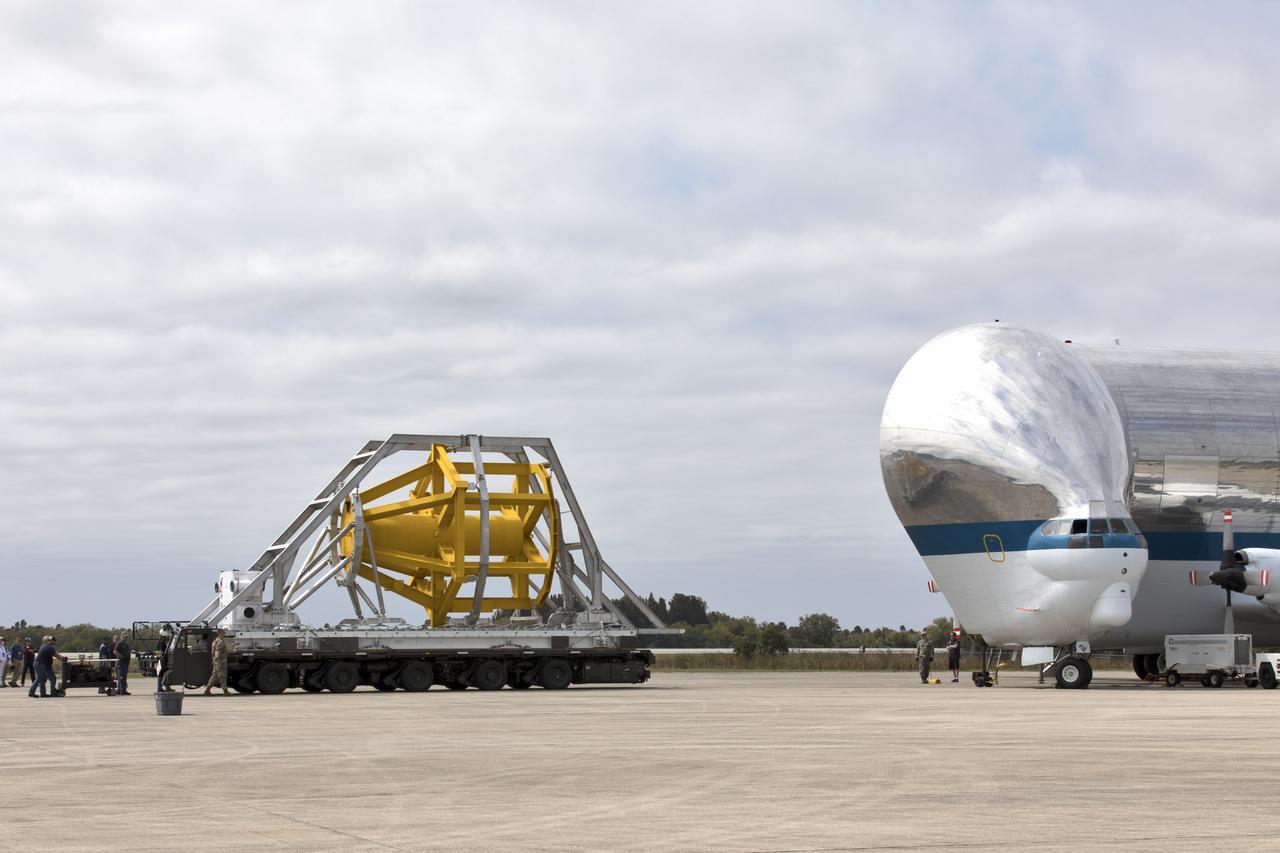
A fit check of the Orion Crew and Service Module Horizontal Transporter (CHT) with NASA's Super Guppy aircraft began March 12, 2019, at NASA Kennedy Space Center’s Shuttle Landing Facility in Florida, operated by Space Florida. In this photo, the U.S. Air Force aircraft loader with the CHT is moved toward the Super Guppy. The fit check is being performed to confirm loading operations, ensure that the CHT fits inside the Super Guppy and test the electrical interface to aircraft power. The Orion crew and service modules will be readied for a trip to NASA’s Plum Brook Station in Sandusky, Ohio, for full thermal vacuum testing. In this unique facility, the crew and service modules will be put through extensive testing to ensure they can survive the rigors of launch, space travel, re-entry and splashdown. The Orion spacecraft will launch atop the agency's Space Launch System rocket on Exploration Mission-1.

A fit check of the Orion Crew and Service Module Horizontal Transporter (CHT) with NASA's Super Guppy aircraft began March 12, 2019, at NASA Kennedy Space Center’s Shuttle Landing Facility in Florida, operated by Space Florida. In this photo, the CHT is secured on the U.S. Air Force aircraft loader. The fit check is being performed to confirm loading operations, ensure that the CHT fits inside the Super Guppy and test the electrical interface to aircraft power. The Orion crew and service modules will be readied for a trip to NASA’s Plum Brook Station in Sandusky, Ohio, for full thermal vacuum testing. In this unique facility, the crew and service modules will be put through extensive testing to ensure they can survive the rigors of launch, space travel, re-entry and splashdown. The Orion spacecraft will launch atop the agency's Space Launch System rocket on Exploration Mission-1.
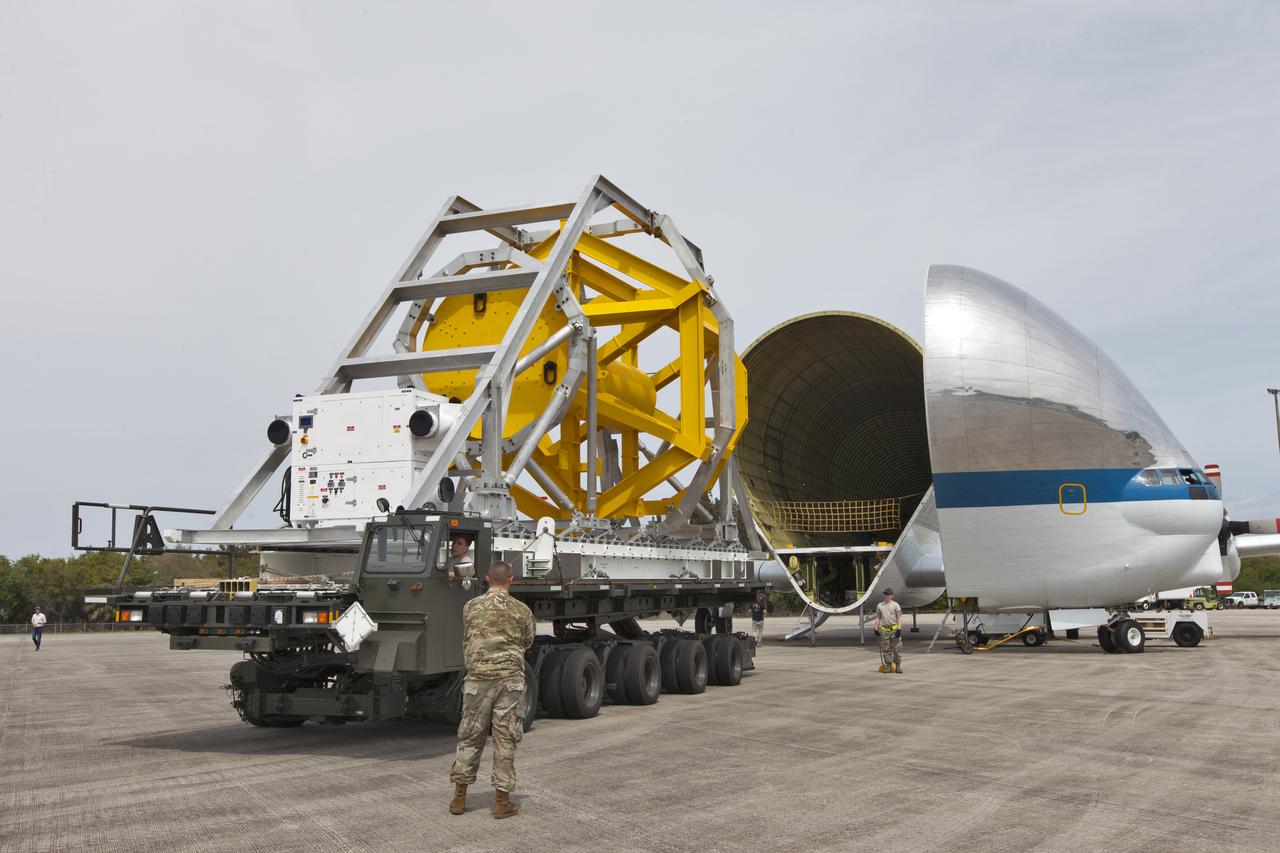
A fit check of the Orion Crew and Service Module Horizontal Transporter (CHT) with NASA's Super Guppy aircraft is underway March 13, 2019, at NASA Kennedy Space Center’s Shuttle Landing Facility in Florida, operated by Space Florida. In this photo, the CHT, secured on the U.S. Air Force aircraft loader, is moved toward the Super Guppy’s open payload bay. The fit check is being performed to confirm loading operations, ensure that the CHT fits inside the Super Guppy and test the electrical interface to aircraft power. The Orion crew and service modules will be readied for a trip to NASA’s Plum Brook Station in Sandusky, Ohio, for full thermal vacuum testing. In this unique facility, the crew and service modules will be put through extensive testing to ensure they can survive the rigors of launch, space travel, re-entry and splashdown. The Orion spacecraft will launch atop the agency's Space Launch System rocket on Exploration Mission-1.
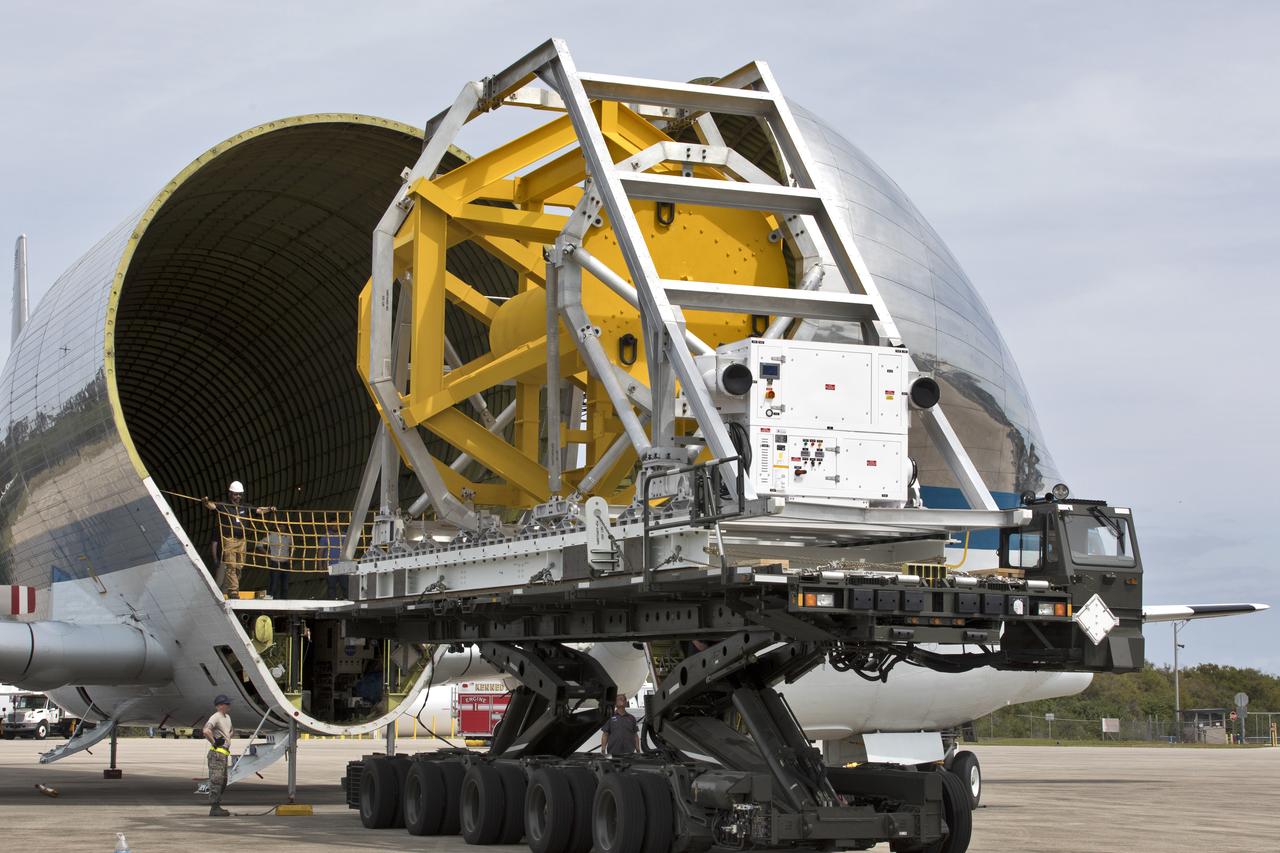
A fit check of the Orion Crew and Service Module Horizontal Transporter (CHT) with NASA's Super Guppy aircraft is underway March 13, 2019, at NASA Kennedy Space Center’s Shuttle Landing Facility in Florida, operated by Space Florida. In this photo, the Super Guppy’s payload bay has been opened and the CHT, secured on the U.S. Air Force aircraft loader, is moved inside the aircraft’s payload bay. The fit check is being performed to confirm loading operations, ensure that the CHT fits inside the Super Guppy and test the electrical interface to aircraft power. The Orion crew and service modules will be readied for a trip to NASA’s Plum Brook Station in Sandusky, Ohio, for full thermal vacuum testing. In this unique facility, the crew and service modules will be put through extensive testing to ensure they can survive the rigors of launch, space travel, re-entry and splashdown. The Orion spacecraft will launch atop the agency's Space Launch System rocket on Exploration Mission-1.
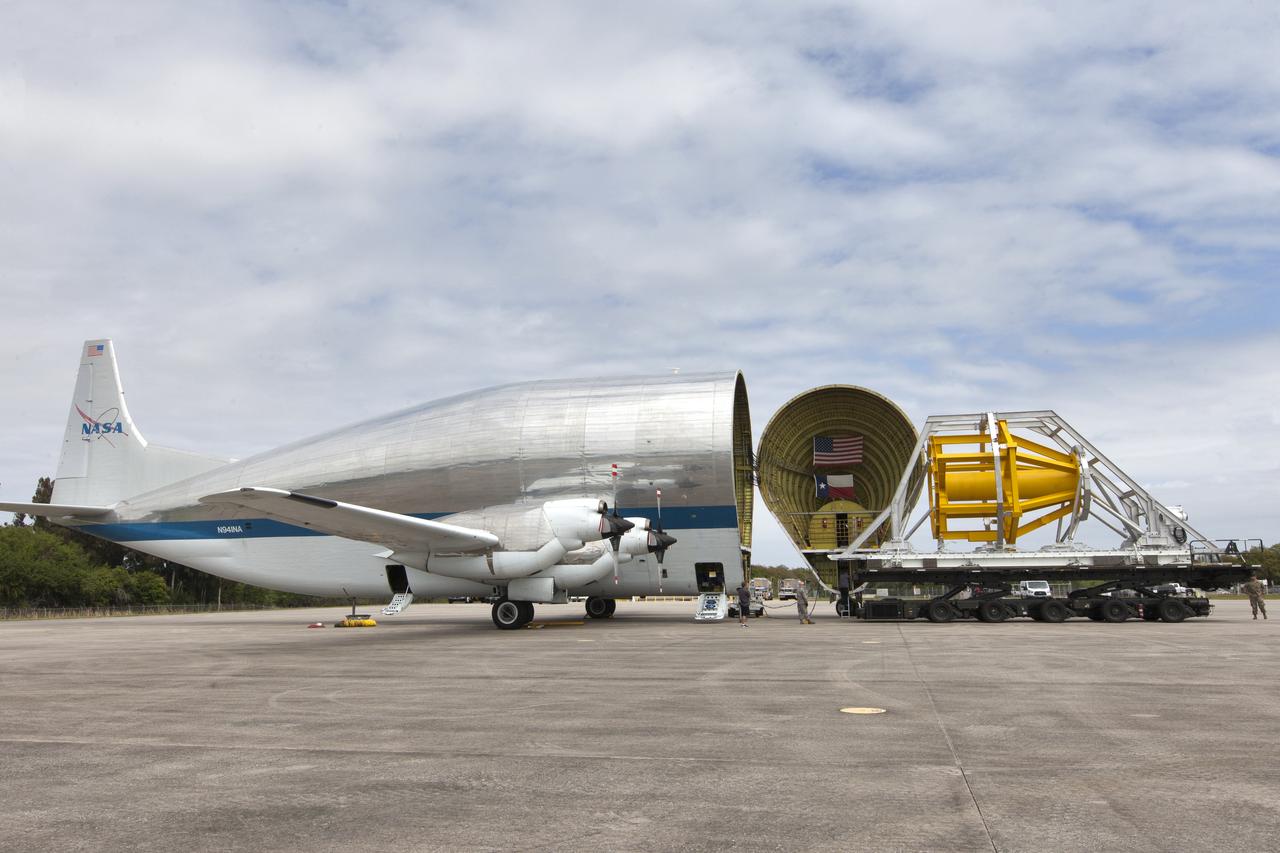
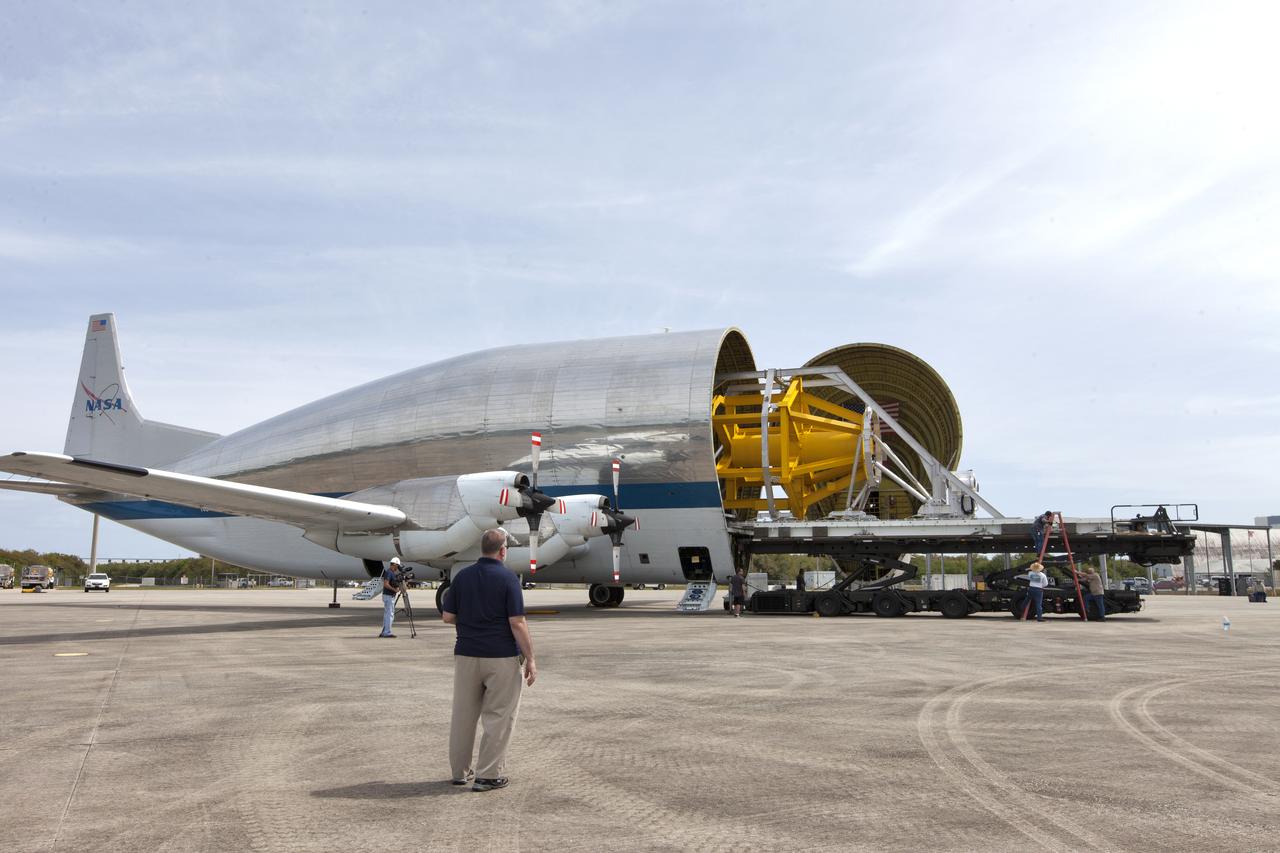
A fit check of the Orion Crew and Service Module Horizontal Transporter (CHT) with NASA's Super Guppy aircraft began March 12, 2019, at NASA Kennedy Space Center’s Shuttle Landing Facility in Florida, operated by Space Florida. In this photo, the Super Guppy’s payload bay is opened as the CHT, secured on the U.S. Air Force aircraft loader, is moved toward the aircraft. The fit check is being performed to confirm loading operations, ensure that the CHT fits inside the Super Guppy and test the electrical interface to aircraft power. The Orion crew and service modules will be readied for a trip to NASA’s Plum Brook Station in Sandusky, Ohio, for full thermal vacuum testing. In this unique facility, the crew and service modules will be put through extensive testing to ensure they can survive the rigors of launch, space travel, re-entry and splashdown. The Orion spacecraft will launch atop the agency's Space Launch System rocket on Exploration Mission-1.
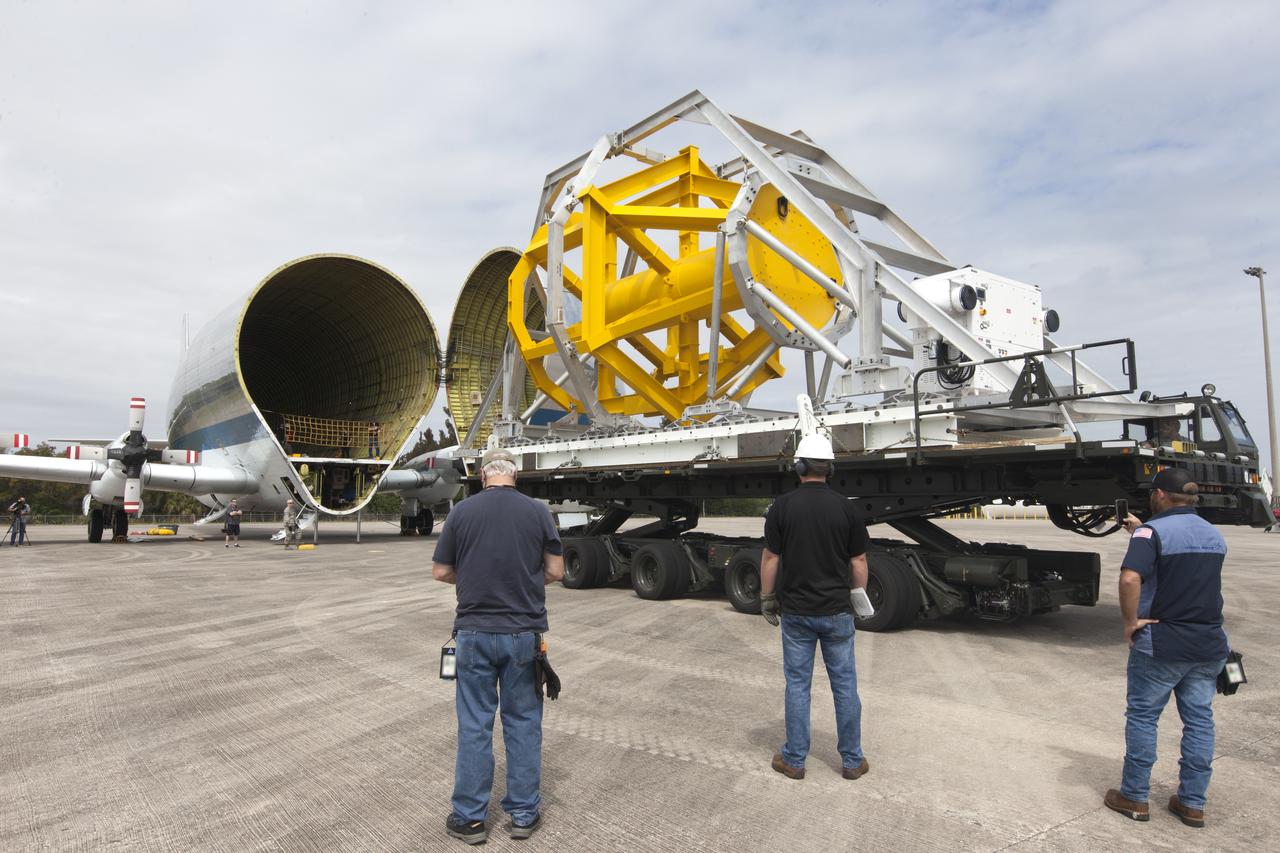
A fit check of the Orion Crew and Service Module Horizontal Transporter (CHT) with NASA's Super Guppy aircraft began March 12, 2019, at NASA Kennedy Space Center’s Shuttle Landing Facility in Florida, operated by Space Florida. In this photo, the Super Guppy’s payload bay is opened as the CHT, secured on the U.S. Air Force aircraft loader, is moved toward the aircraft. The fit check is being performed to confirm loading operations, ensure that the CHT fits inside the Super Guppy and test the electrical interface to aircraft power. The Orion crew and service modules will be readied for a trip to NASA’s Plum Brook Station in Sandusky, Ohio, for full thermal vacuum testing. In this unique facility, the crew and service modules will be put through extensive testing to ensure they can survive the rigors of launch, space travel, re-entry and splashdown. The Orion spacecraft will launch atop the agency's Space Launch System rocket on Exploration Mission-1.

A fit check of the Orion Crew and Service Module Horizontal Transporter (CHT) with NASA's Super Guppy aircraft began March 12, 2019, at NASA Kennedy Space Center’s Shuttle Landing Facility in Florida, operated by Space Florida. In this photo, the Super Guppy’s payload bay is opened as the CHT, secured on the U.S. Air Force aircraft loader, is moved inside the aircraft’s payload bay. The fit check is being performed to confirm loading operations, ensure that the CHT fits inside the Super Guppy and test the electrical interface to aircraft power. The Orion crew and service modules will be readied for a trip to NASA’s Plum Brook Station in Sandusky, Ohio, for full thermal vacuum testing. In this unique facility, the crew and service modules will be put through extensive testing to ensure they can survive the rigors of launch, space travel, re-entry and splashdown. The Orion spacecraft will launch atop the agency's Space Launch System rocket on Exploration Mission-1.

A fit check of the Orion Crew and Service Module Horizontal Transporter (CHT) with NASA's Super Guppy aircraft is underway March 13, 2019, at NASA Kennedy Space Center’s Shuttle Landing Facility in Florida, operated by Space Florida. In this photo, the CHT, secured on the U.S. Air Force aircraft loader, is moved inside the aircraft’s payload bay. The fit check is being performed to confirm loading operations, ensure that the CHT fits inside the Super Guppy and test the electrical interface to aircraft power. The Orion crew and service modules will be readied for a trip to NASA’s Plum Brook Station in Sandusky, Ohio, for full thermal vacuum testing. In this unique facility, the crew and service modules will be put through extensive testing to ensure they can survive the rigors of launch, space travel, re-entry and splashdown. The Orion spacecraft will launch atop the agency's Space Launch System rocket on Exploration Mission-1.
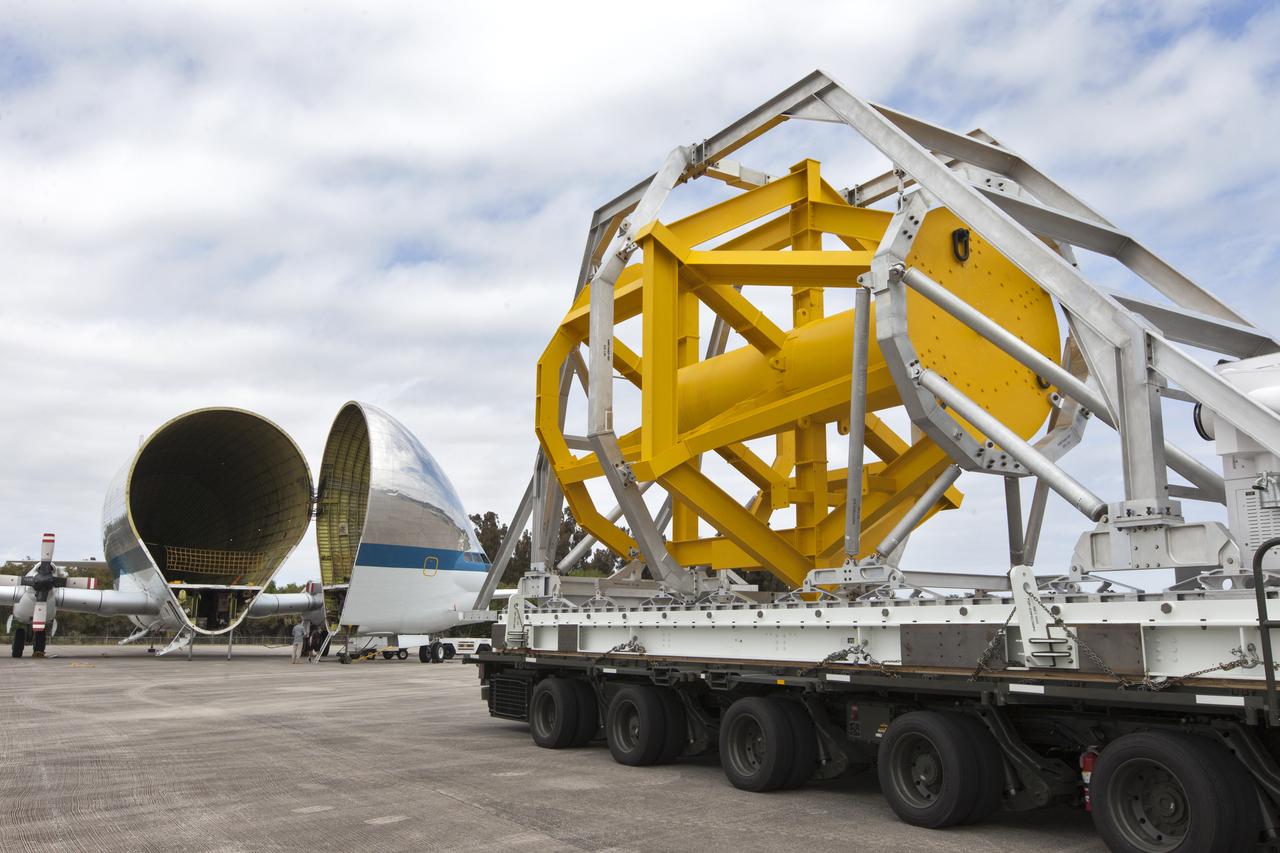
A fit check of the Orion Crew and Service Module Horizontal Transporter (CHT) with NASA's Super Guppy aircraft began March 12, 2019, at NASA Kennedy Space Center’s Shuttle Landing Facility in Florida, operated by Space Florida. In this photo, the Super Guppy’s payload bay is opened as the CHT, secured on the U.S. Air Force aircraft loader, is moved toward the aircraft. The fit check is being performed to confirm loading operations, ensure that the CHT fits inside the Super Guppy and test the electrical interface to aircraft power. The Orion crew and service modules will be readied for a trip to NASA’s Plum Brook Station in Sandusky, Ohio, for full thermal vacuum testing. In this unique facility, the crew and service modules will be put through extensive testing to ensure they can survive the rigors of launch, space travel, re-entry and splashdown. The Orion spacecraft will launch atop the agency's Space Launch System rocket on Exploration Mission-1.
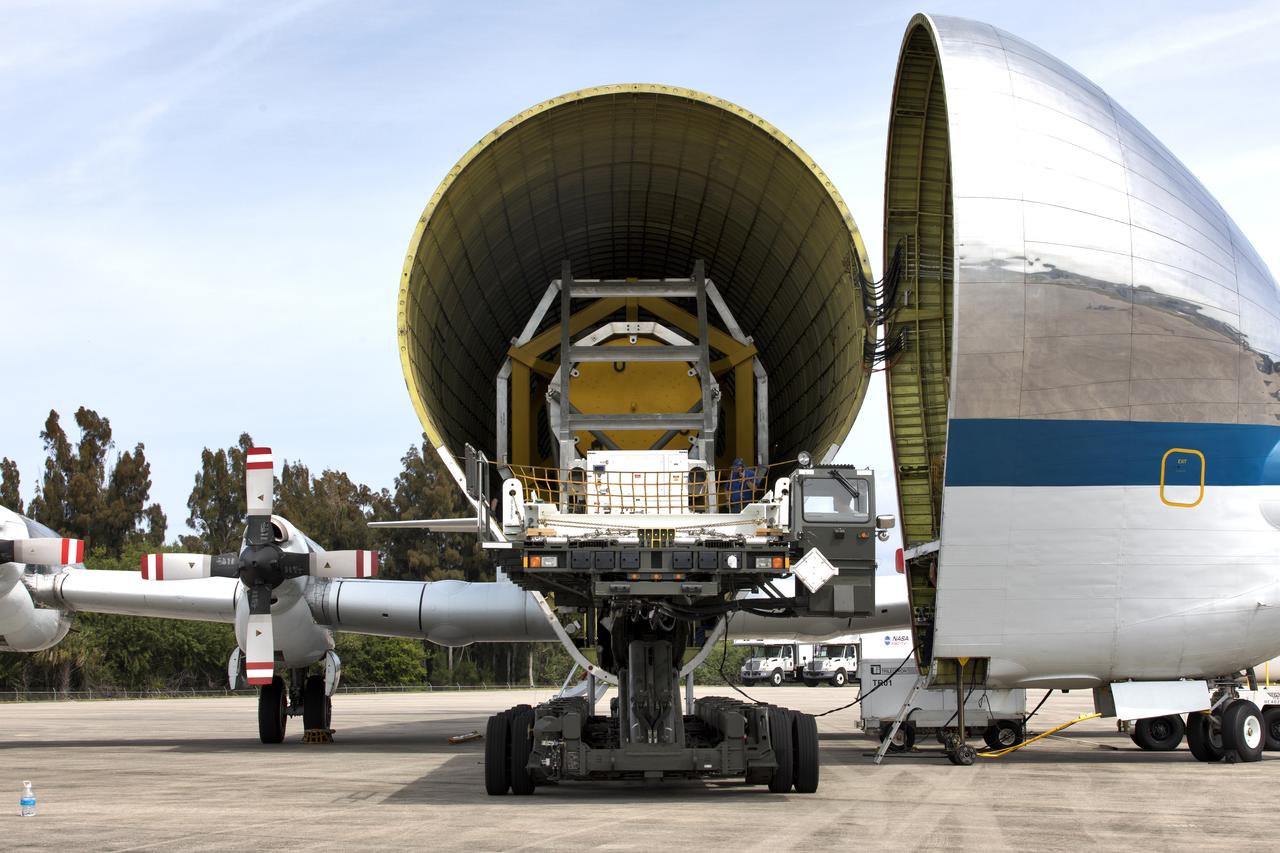
A fit check of the Orion Crew and Service Module Horizontal Transporter (CHT) with NASA's Super Guppy aircraft is underway March 13, 2019, at NASA Kennedy Space Center’s Shuttle Landing Facility in Florida, operated by Space Florida. In this photo, the CHT, secured on the U.S. Air Force aircraft loader, is moved inside the aircraft’s payload bay. The fit check is being performed to confirm loading operations, ensure that the CHT fits inside the Super Guppy and test the electrical interface to aircraft power. The Orion crew and service modules will be readied for a trip to NASA’s Plum Brook Station in Sandusky, Ohio, for full thermal vacuum testing. In this unique facility, the crew and service modules will be put through extensive testing to ensure they can survive the rigors of launch, space travel, re-entry and splashdown. The Orion spacecraft will launch atop the agency's Space Launch System rocket on Exploration Mission-1.
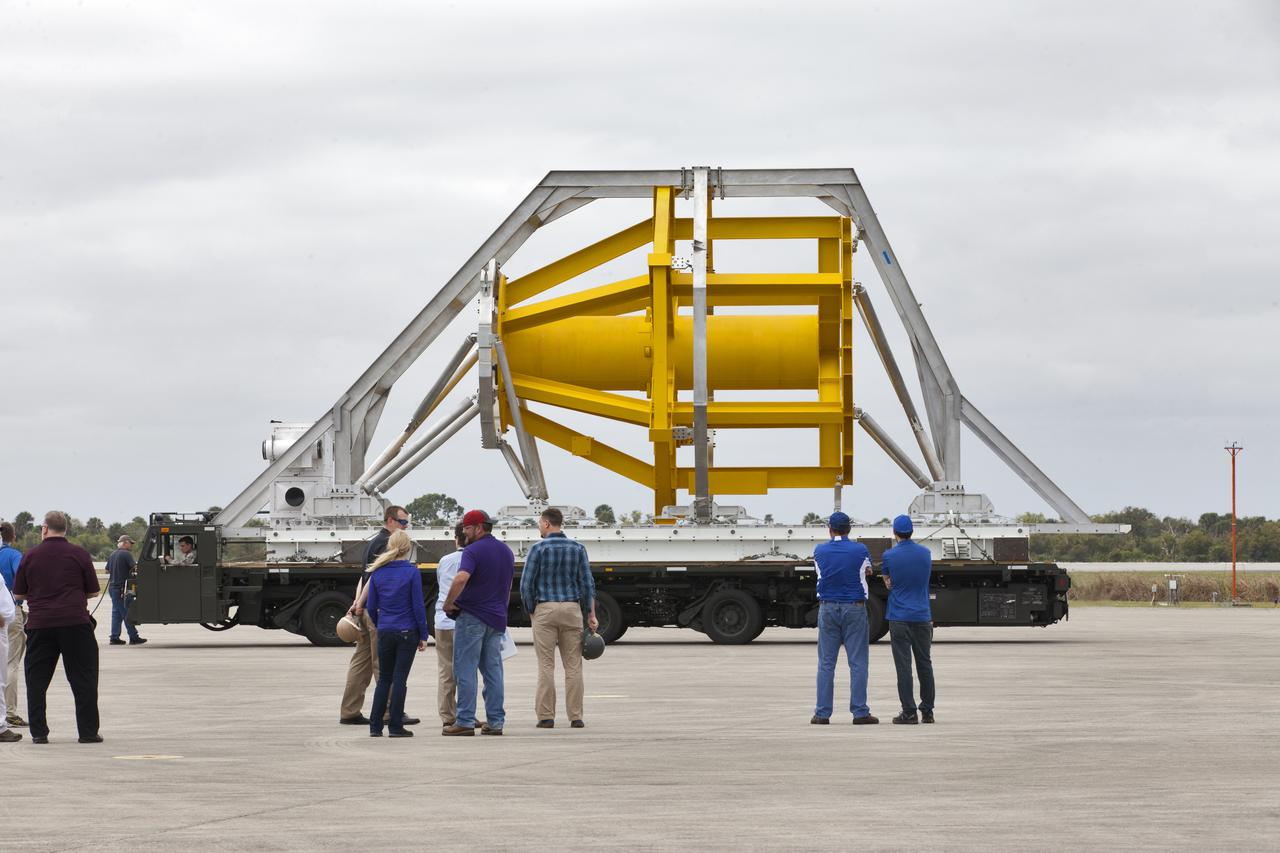
A fit check of the Orion Crew and Service Module Horizontal Transporter (CHT) with NASA's Super Guppy aircraft began March 12, 2019, at NASA Kennedy Space Center’s Shuttle Landing Facility in Florida, operated by Space Florida. In this photo, the CHT is secured on the U.S. Air Force aircraft loader. The fit check is being performed to confirm loading operations, ensure that the CHT fits inside the Super Guppy and test the electrical interface to aircraft power. The Orion crew and service modules will be readied for a trip to NASA’s Plum Brook Station in Sandusky, Ohio, for full thermal vacuum testing. In this unique facility, the crew and service modules will be put through extensive testing to ensure they can survive the rigors of launch, space travel, re-entry and splashdown. The Orion spacecraft will launch atop the agency's Space Launch System rocket on Exploration Mission-1.
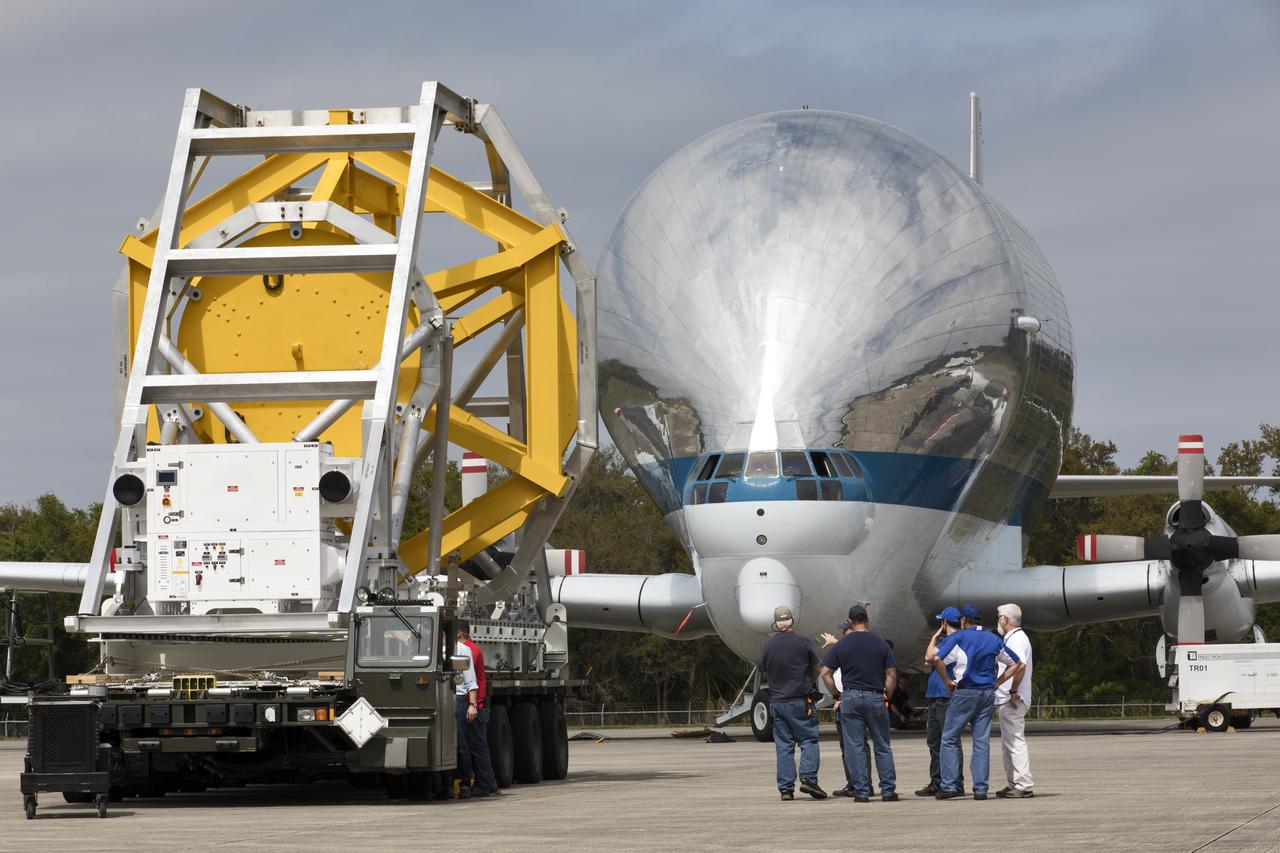
A fit check of the Orion Crew and Service Module Horizontal Transporter (CHT) with NASA's Super Guppy aircraft began March 12, 2019, at NASA Kennedy Space Center’s Shuttle Landing Facility in Florida, operated by Space Florida. In this photo, the CHT is secured on the U.S. Air Force aircraft loader and is moved toward the Super Guppy. The fit check is being performed to confirm loading operations, ensure that the CHT fits inside the Super Guppy and test the electrical interface to aircraft power. The Orion crew and service modules will be readied for a trip to NASA’s Plum Brook Station in Sandusky, Ohio, for full thermal vacuum testing. In this unique facility, the crew and service modules will be put through extensive testing to ensure they can survive the rigors of launch, space travel, re-entry and splashdown. The Orion spacecraft will launch atop the agency's Space Launch System rocket on Exploration Mission-1.
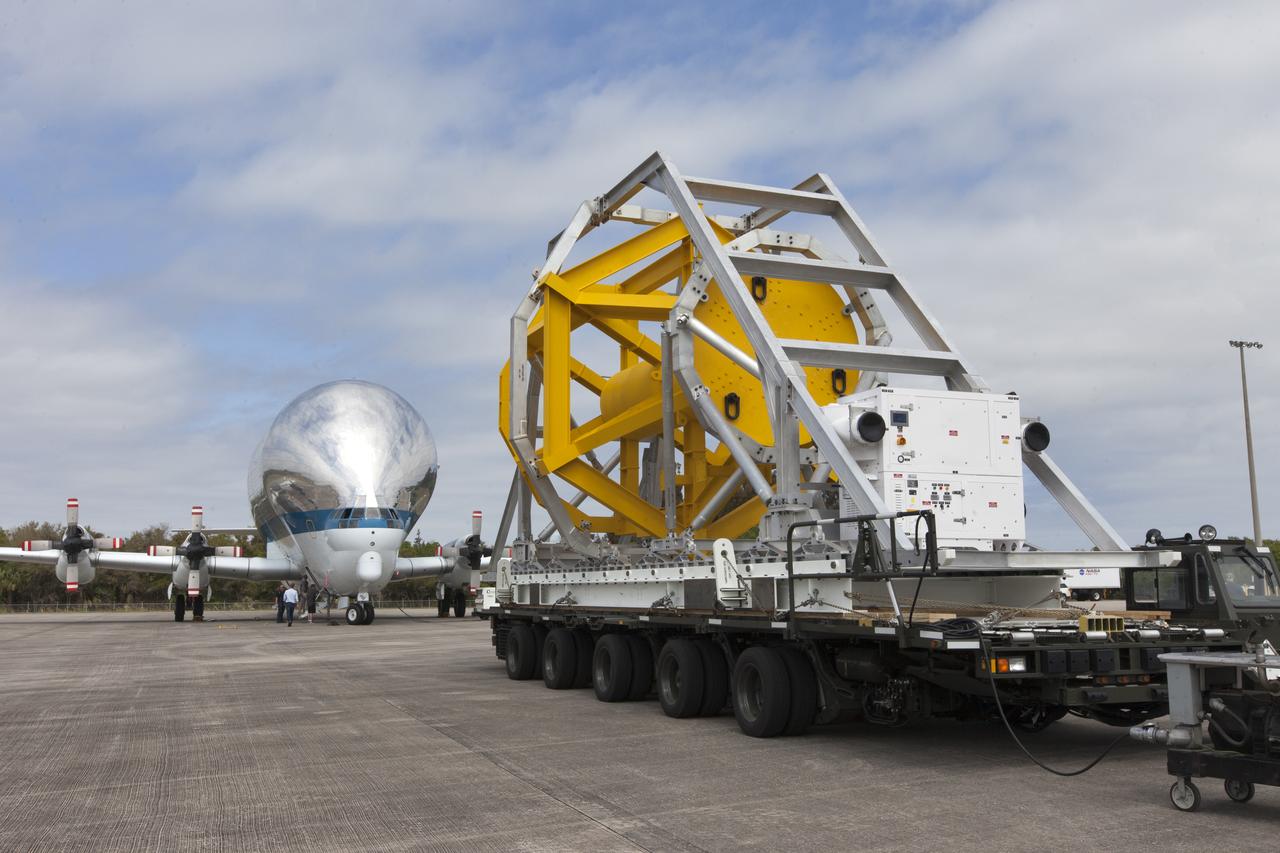
A fit check of the Orion Crew and Service Module Horizontal Transporter (CHT) with NASA's Super Guppy aircraft began March 12, 2019, at NASA Kennedy Space Center’s Shuttle Landing Facility in Florida, operated by Space Florida. In this photo, the CHT is secured on the U.S. Air Force aircraft loader. The fit check is being performed to confirm loading operations, ensure that the CHT fits inside the Super Guppy and test the electrical interface to aircraft power. The Orion crew and service modules will be readied for a trip to NASA’s Plum Brook Station in Sandusky, Ohio, for full thermal vacuum testing. In this unique facility, the crew and service modules will be put through extensive testing to ensure they can survive the rigors of launch, space travel, re-entry and splashdown. The Orion spacecraft will launch atop the agency's Space Launch System rocket on Exploration Mission-1.
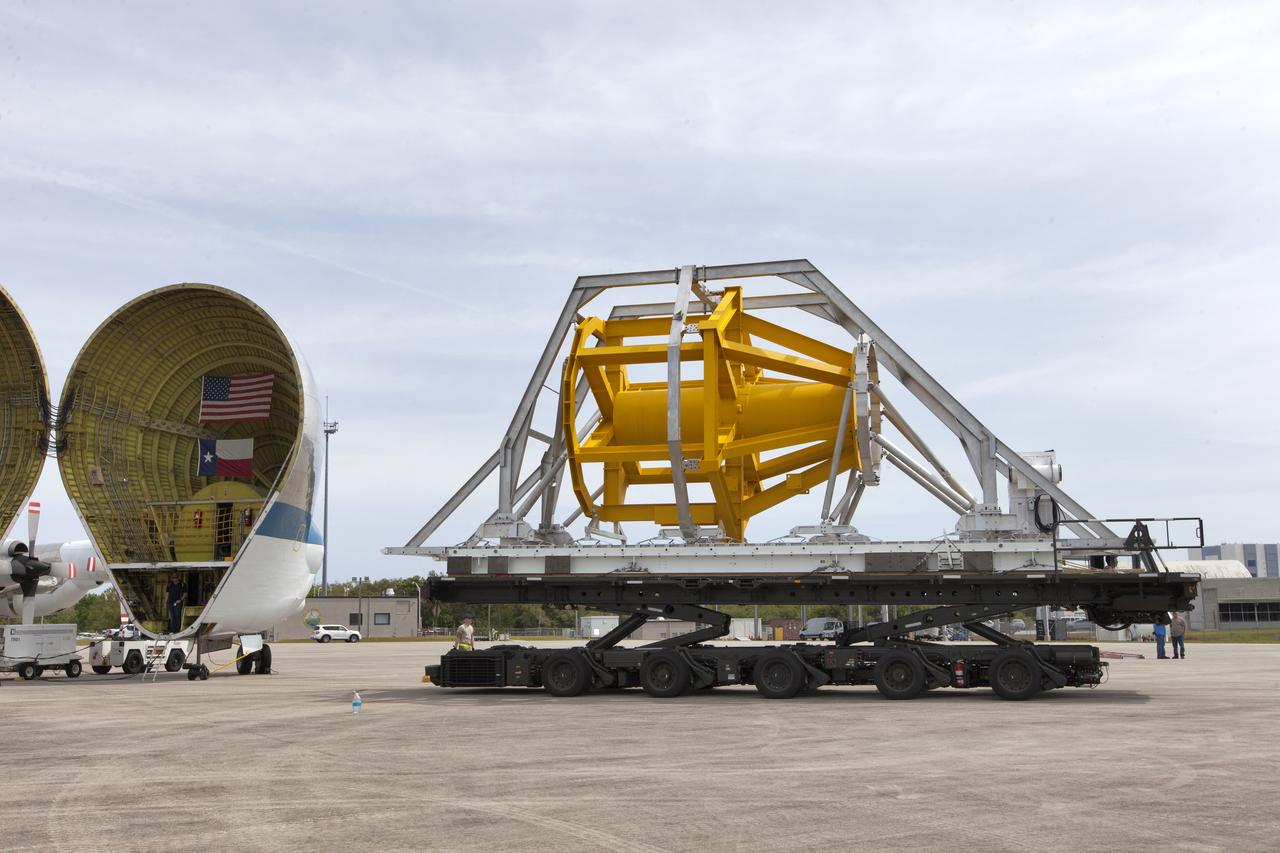
A fit check of the Orion Crew and Service Module Horizontal Transporter (CHT) with NASA's Super Guppy aircraft is underway March 13, 2019, at NASA Kennedy Space Center’s Shuttle Landing Facility in Florida, operated by Space Florida. In this photo, the CHT is secured on the U.S. Air Force aircraft loader and is being moved toward the Super Guppy. The fit check is being performed to confirm loading operations, ensure that the CHT fits inside the Super Guppy and test the electrical interface to aircraft power. The Orion crew and service modules will be readied for a trip to NASA’s Plum Brook Station in Sandusky, Ohio, for full thermal vacuum testing. In this unique facility, the crew and service modules will be put through extensive testing to ensure they can survive the rigors of launch, space travel, re-entry and splashdown. The Orion spacecraft will launch atop the agency's Space Launch System rocket on Exploration Mission-1.
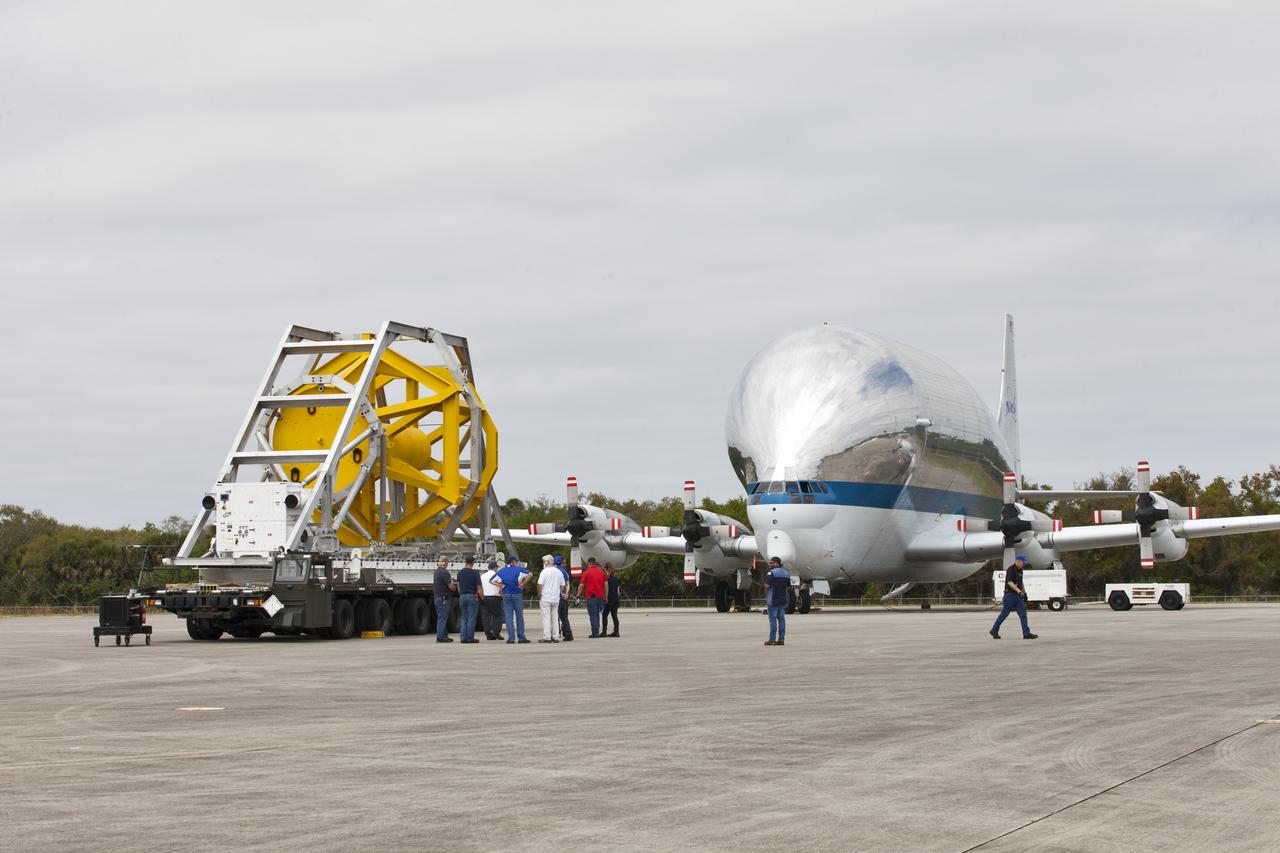
A fit check of the Orion Crew and Service Module Horizontal Transporter (CHT) with NASA's Super Guppy aircraft began March 12, 2019, at NASA Kennedy Space Center’s Shuttle Landing Facility in Florida, operated by Space Florida. In this photo, the CHT is secured on the U.S. Air Force aircraft loader. The fit check is being performed to confirm loading operations, ensure that the CHT fits inside the Super Guppy and test the electrical interface to aircraft power. The Orion crew and service modules will be readied for a trip to NASA’s Plum Brook Station in Sandusky, Ohio, for full thermal vacuum testing. In this unique facility, the crew and service modules will be put through extensive testing to ensure they can survive the rigors of launch, space travel, re-entry and splashdown. The Orion spacecraft will launch atop the agency's Space Launch System rocket on Exploration Mission-1.
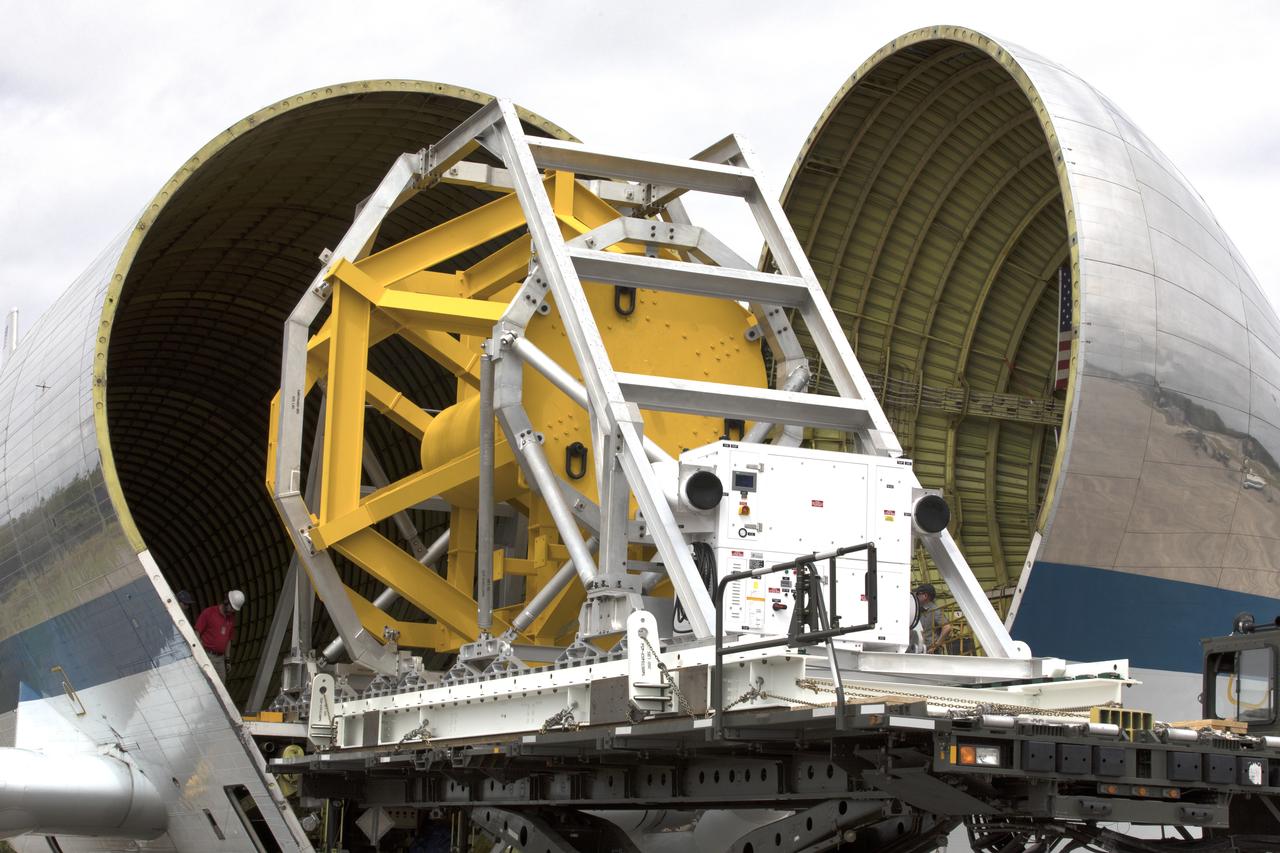
A fit check of the Orion Crew and Service Module Horizontal Transporter (CHT) with NASA's Super Guppy aircraft began March 12, 2019, at NASA Kennedy Space Center’s Shuttle Landing Facility in Florida, operated by Space Florida. In this photo, the Super Guppy’s payload bay is opened as the CHT, secured on the U.S. Air Force aircraft loader, is moved inside the aircraft’s payload bay. The fit check is being performed to confirm loading operations, ensure that the CHT fits inside the Super Guppy and test the electrical interface to aircraft power. The Orion crew and service modules will be readied for a trip to NASA’s Plum Brook Station in Sandusky, Ohio, for full thermal vacuum testing. In this unique facility, the crew and service modules will be put through extensive testing to ensure they can survive the rigors of launch, space travel, re-entry and splashdown. The Orion spacecraft will launch atop the agency's Space Launch System rocket on Exploration Mission-1.
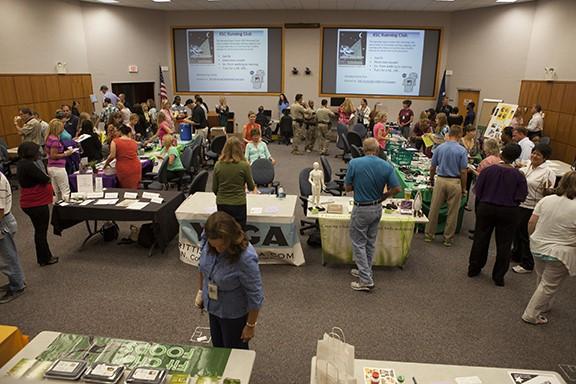
CAPE CANAVERAL, Fla. – The National Employee Health and Fitness Day event takes place in the Operations and Checkout Building's Mission Briefing Room. The expo showcased Kennedy Space Center’s Employee Wellness Programs and local businesses and organizations throughout Florida that contribute to the health and well-being of the community. Photo credit: NASA/Daniel Casper
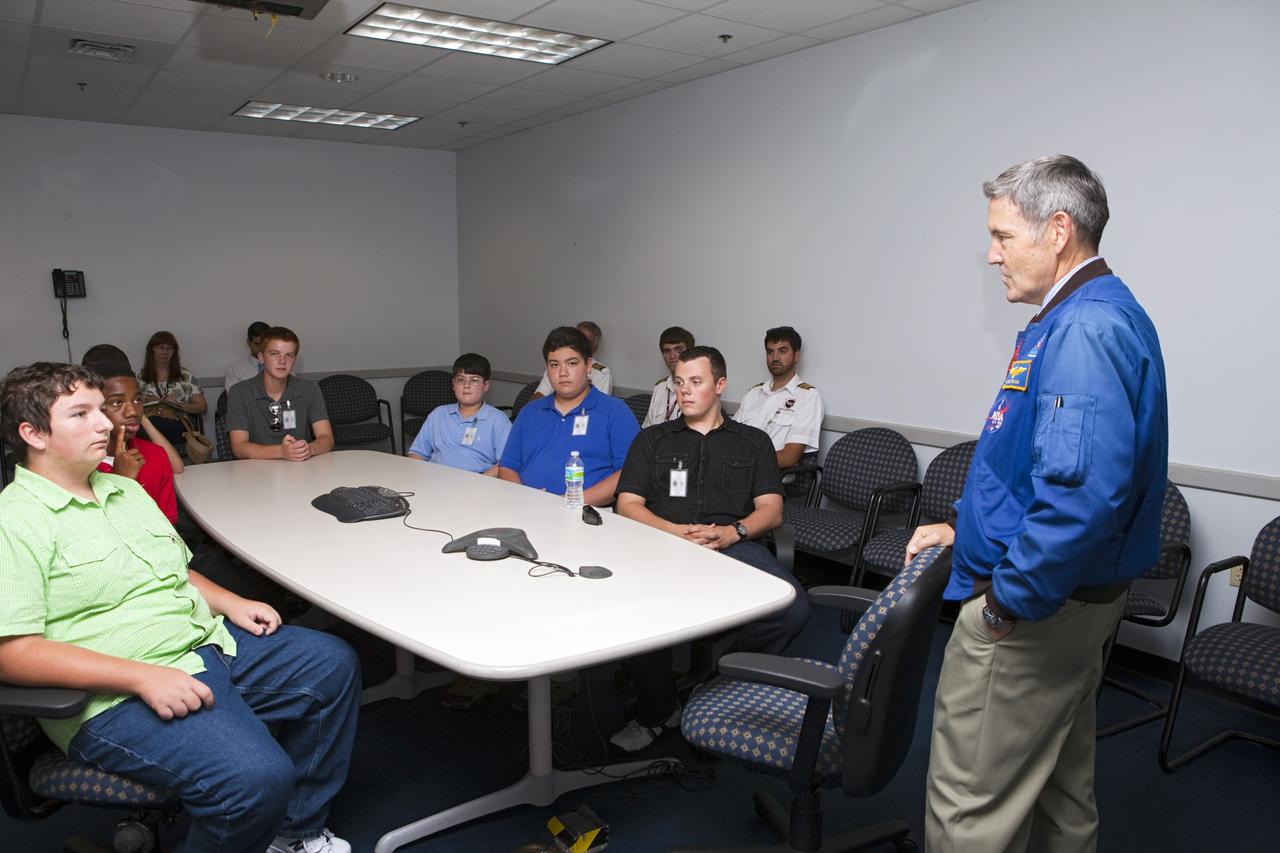
CAPE CANAVERAL, Fla. – In a support building near NASA Kennedy Space Center’s Shuttle Landing Facility, or SLF, in Florida, Center Director Bob Cabana speaks to students and their flight instructors from Florida Tech, or FIT, in Melbourne. The group arrived at the SLF in Cherokee Warrior and Cessna 172S lightweight aircraft. The middle and high school students are participating in FIT’s Av/Aero summer camp experience. They and their flight instructors toured the SLF midfield control tower, viewed F104 Starfighters and NASA Huey helicopters in the RLV Hangar, viewed the runway plaques marking wheels stop for each of the three space shuttles, and toured the Vehicle Assembly Building where space shuttle Atlantis currently is stored. Photo credit: NASA/Kim Shiflett
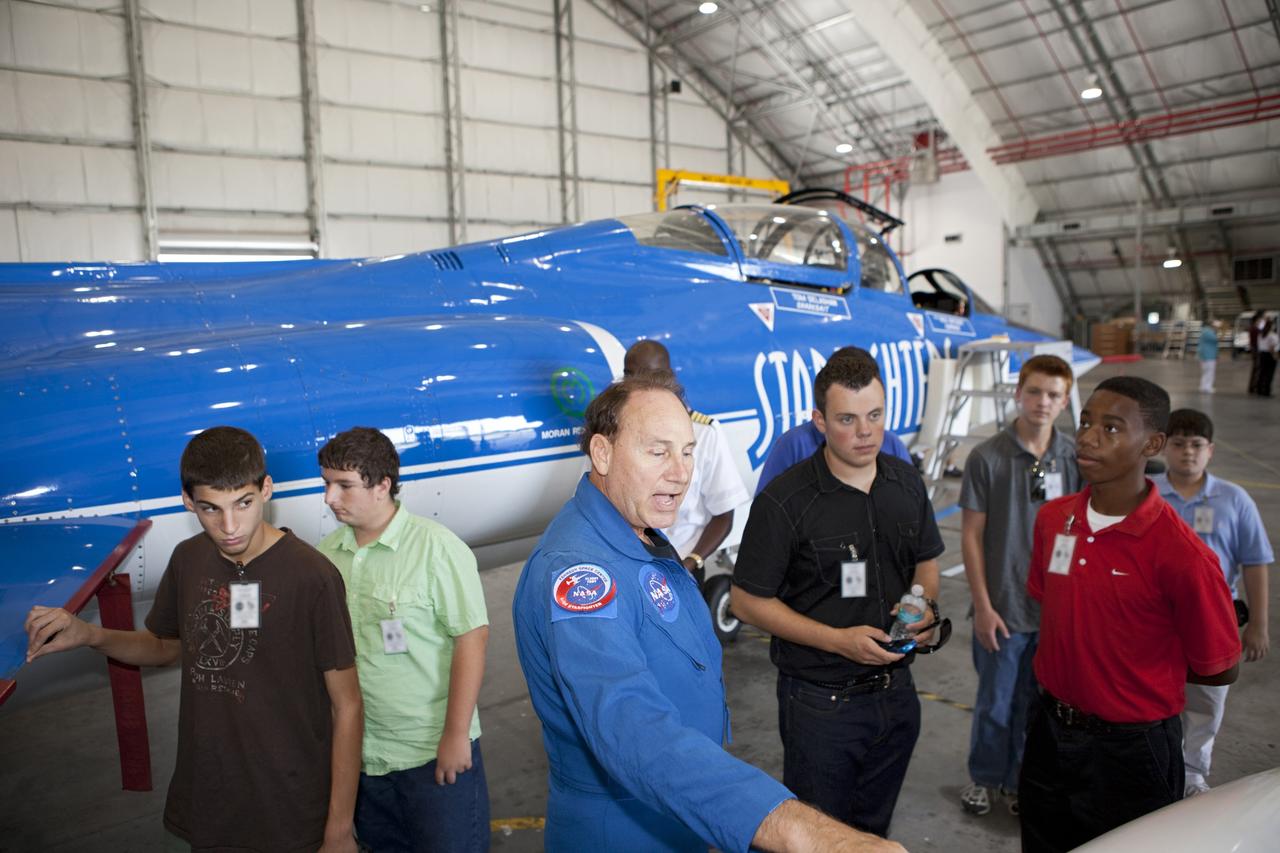
CAPE CANAVERAL, Fla. – Inside the RLV Hangar near NASA Kennedy Space Center’s Shuttle Landing Facility, or SLF, in Florida, students and their flight instructors from Florida Tech, FIT, in Melbourne, view F104 Starfighter aircraft and listen to Starfighter Director Rick Svetkoff. The flight instructors and their students arrived at the SLF in Cherokee Warrior and Cessna 172S lightweight aircraft. The middle and high school students are participating in FIT’s Av/Aero summer camp experience. They and their flight instructors toured the SLF midfield control tower, viewed F104 Starfighters and NASA Huey helicopters in the RLV Hangar, viewed the runway plaques marking wheels stop for each of the three space shuttles, and toured the Vehicle Assembly Building where space shuttle Atlantis currently is stored. Photo credit: NASA/Kim Shiflett
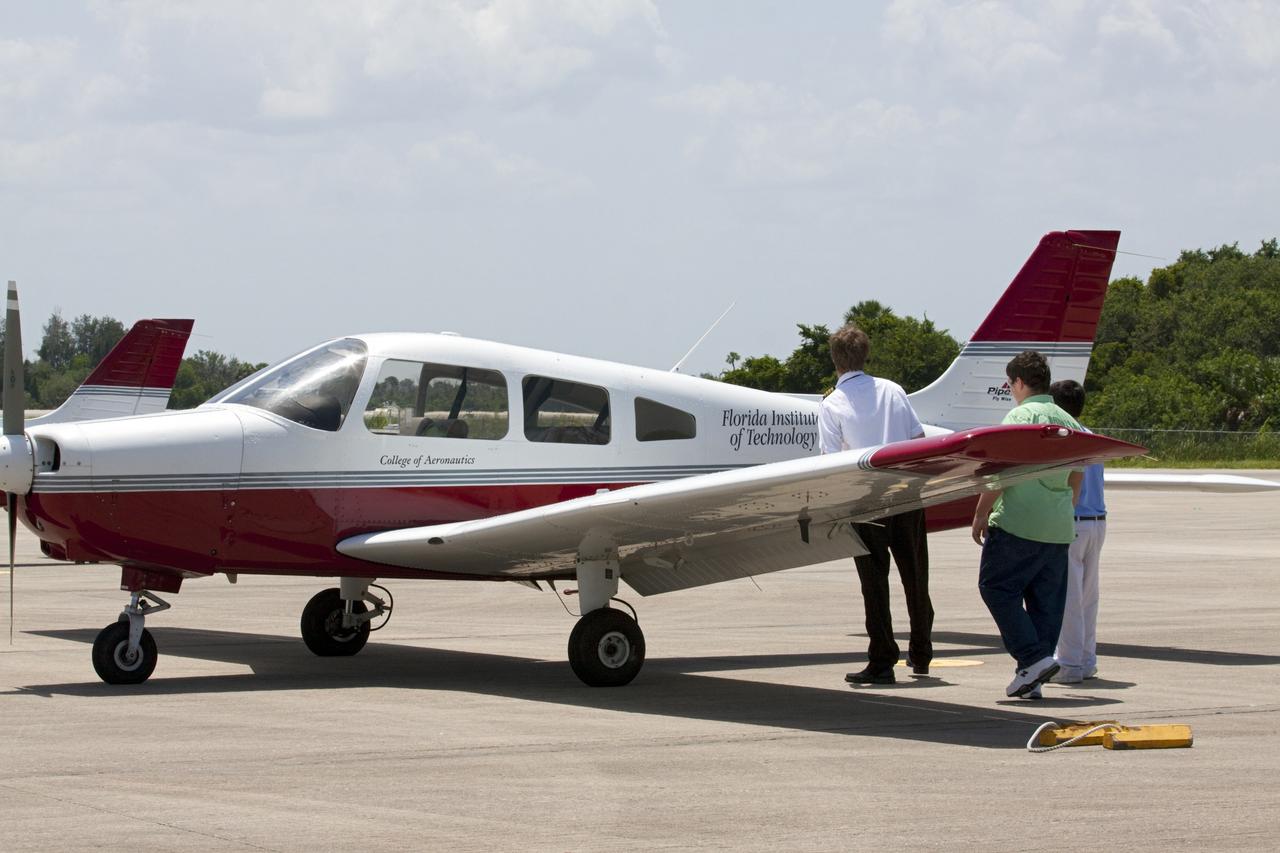
CAPE CANAVERAL, Fla. – At NASA Kennedy Space Center’s Shuttle Landing Facility, or SLF, in Florida, a flight instructor and his students inspect the lightweight aircraft they flew in earlier in the day from Florida Tech, or FIT, in Melbourne. Several instructors and their students arrived at the SLF in Cherokee Warrior and Cessna 172S lightweight aircraft. The middle and high school students are participating in FIT’s Av/Aero summer camp experience. They and their flight instructors toured the SLF midfield control tower, viewed F104 Starfighters and NASA Huey helicopters in the RLV Hangar, viewed the runway plaques marking wheels stop for each of the three space shuttles, and toured the Vehicle Assembly Building where space shuttle Atlantis currently is stored. Photo credit: NASA/Kim Shiflett
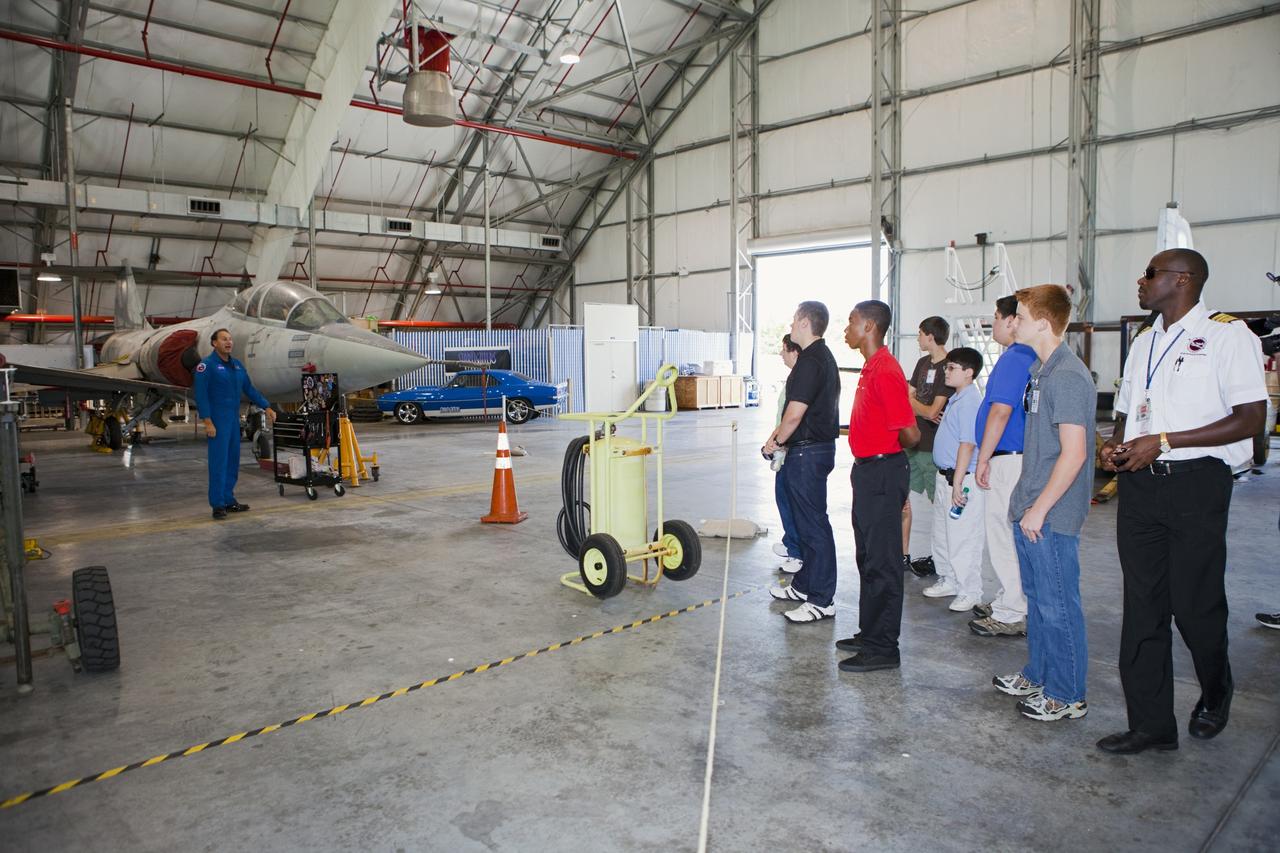
CAPE CANAVERAL, Fla. – Inside the RLV Hangar near NASA Kennedy Space Center’s Shuttle Landing Facility, or SLF, in Florida, students and their flight instructors from Florida Tech, FIT, in Melbourne view F104 Starfighter aircraft and hear a presentation from Starfighter Director Rick Svetkoff. The group arrived at the SLF in Cherokee Warrior and Cessna 172S lightweight aircraft. The middle and high school students are participating in FIT’s Av/Aero summer camp experience. They and their flight instructors toured the SLF midfield control tower, viewed F104 Starfighters and NASA Huey helicopters in the RLV Hangar, viewed the runway plaques marking wheels stop for each of the three space shuttles, and toured the Vehicle Assembly Building where space shuttle Atlantis currently is stored. Photo credit: NASA/Kim Shiflett
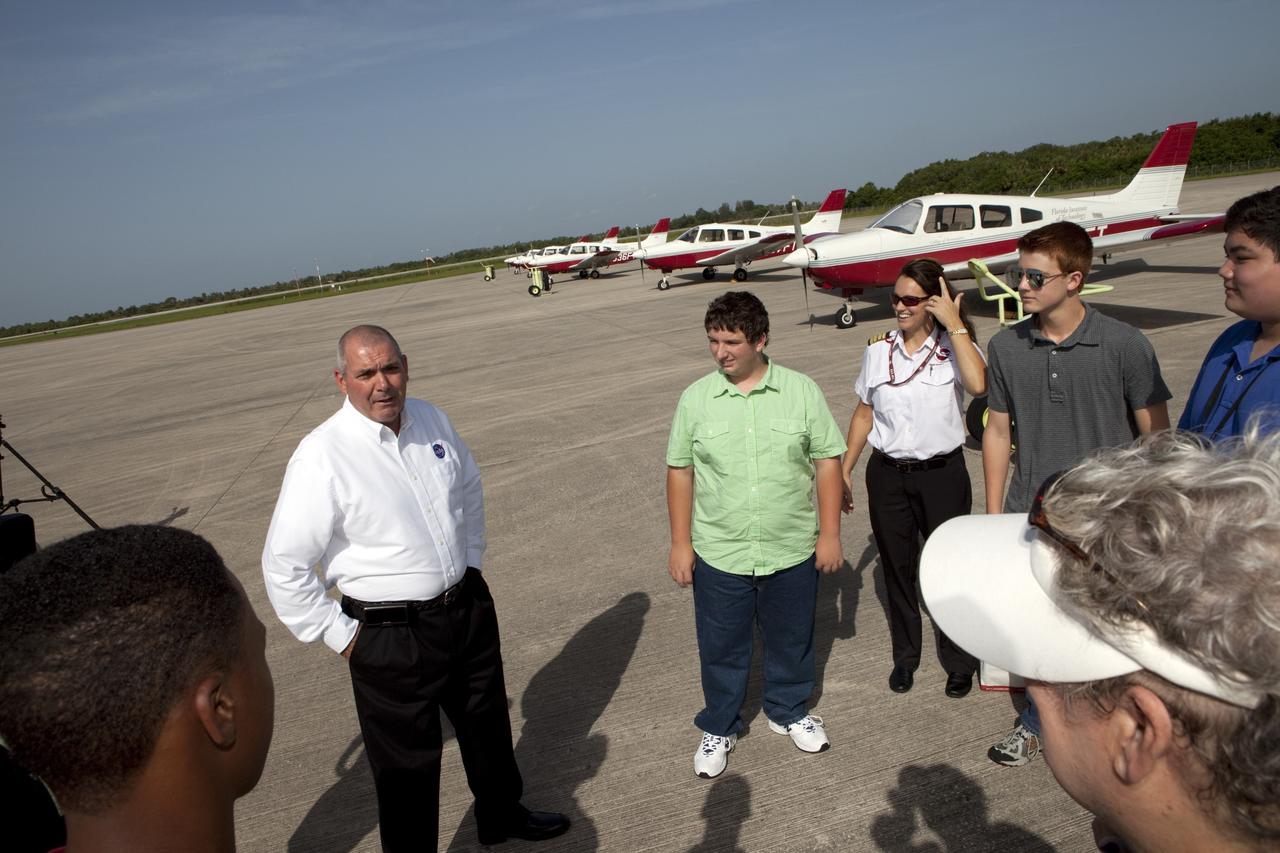
CAPE CANAVERAL, Fla. – At NASA Kennedy Space Center’s Shuttle Landing Facility, or SLF, in Florida, NASA Aviation Safety Officer Joe Torsani, at left, speaks with students and their flight instructors after they arrived in Cherokee Warrior and Cessna 172S lightweight aircraft from Florida Tech, FIT, in Melbourne. The middle and high school students are participating in FIT’s Av/Aero summer camp experience. They and their flight instructors toured the SLF midfield control tower, viewed F104 Starfighters and NASA Huey helicopters in the RLV Hangar, viewed the runway plaques marking wheels stop for each of the three space shuttles, and toured the Vehicle Assembly Building where space shuttle Atlantis currently is stored. Photo credit: NASA/Kim Shiflett
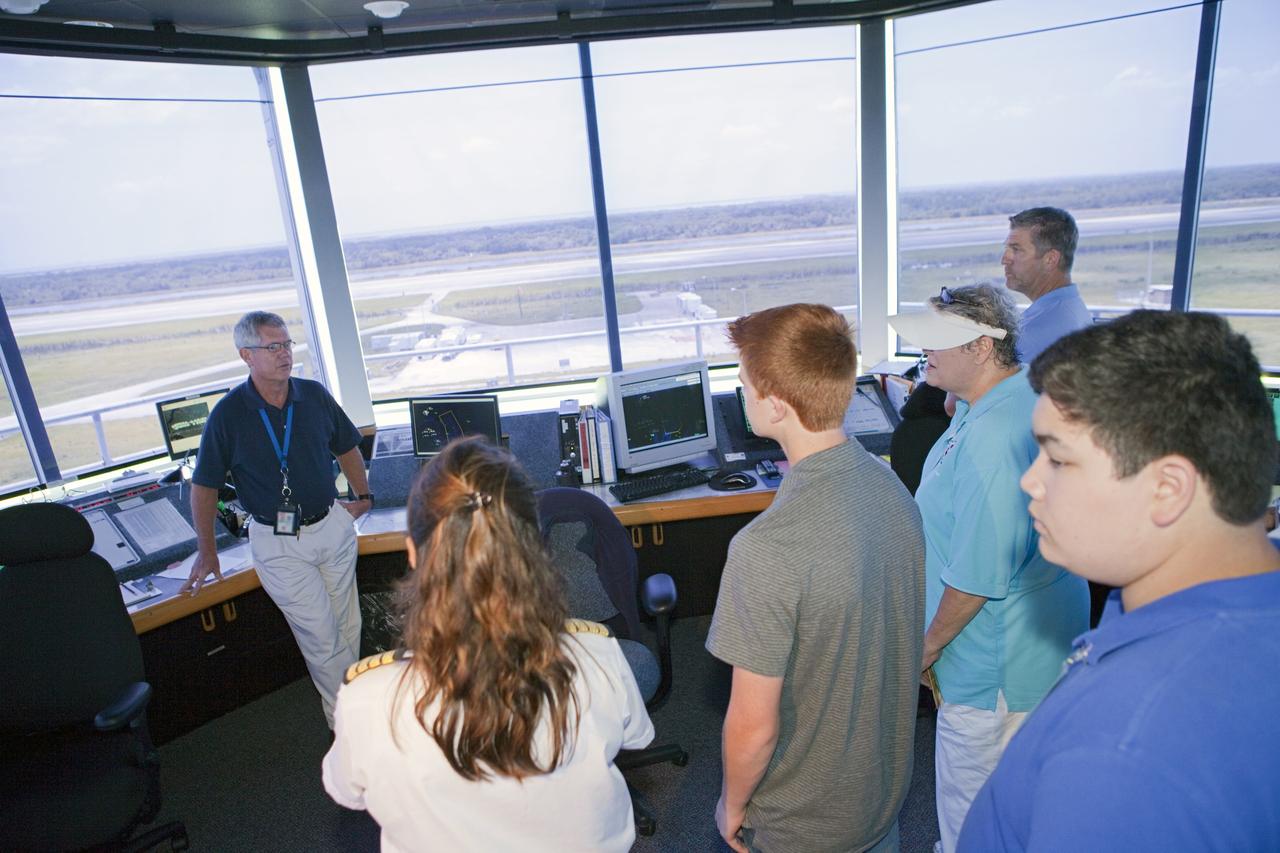
CAPE CANAVERAL, Fla. – At the Shuttle Landing Facility at NASA’s Kennedy Space Center in Florida, students and their flight instructors from Florida Tech, or FIT, in Melbourne, tour the midfield Air Traffic Control Tower. The instructors and their students arrived at the SLF in Cherokee Warrior and Cessna 172S lightweight aircraft. The middle and high school students are participating in FIT’s Av/Aero summer camp experience. They and their flight instructors toured the SLF midfield control tower, viewed F104 Starfighters and NASA Huey helicopters in the RLV Hangar, viewed the runway plaques marking wheels stop for each of the three space shuttles, and toured the Vehicle Assembly Building where space shuttle Atlantis currently is stored. Photo credit: NASA/Kim Shiflett
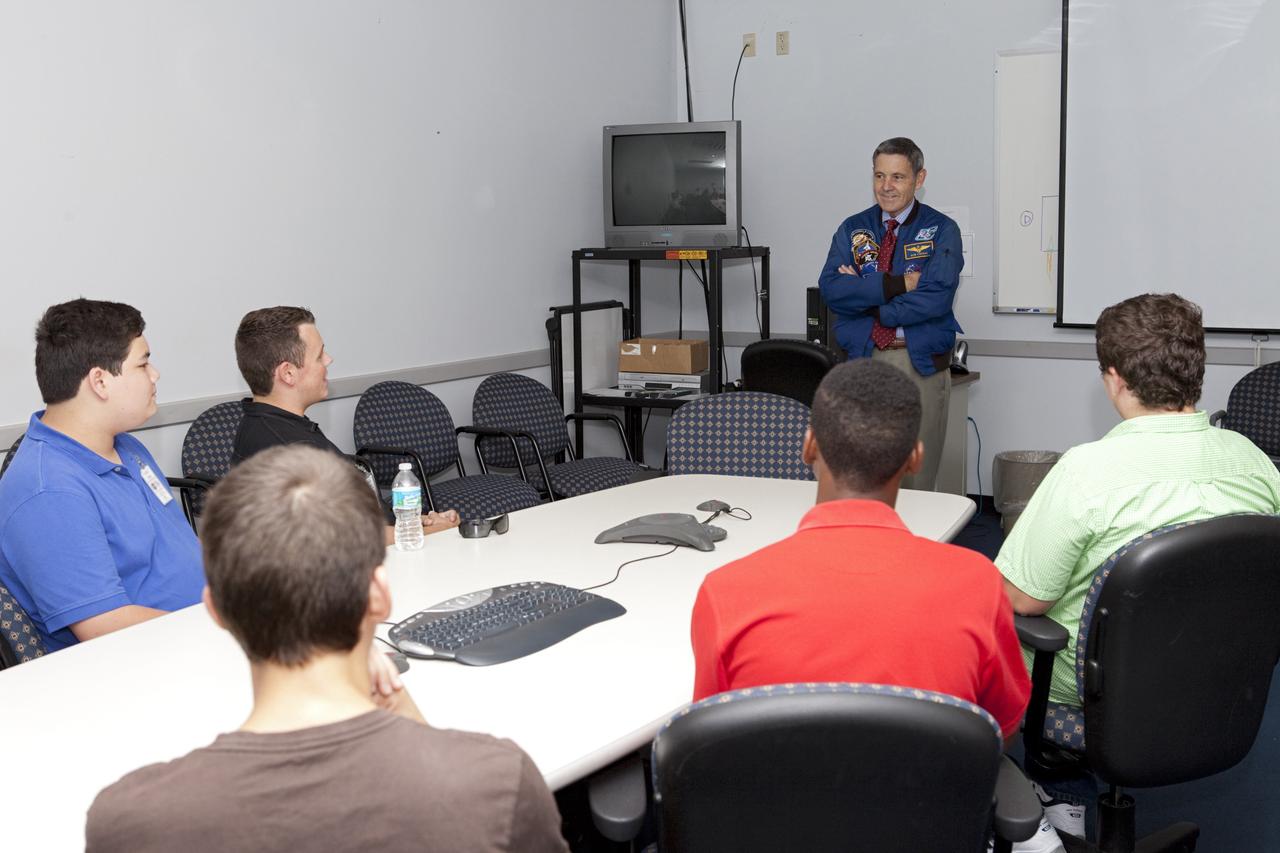
CAPE CANAVERAL, Fla. – In a support building near NASA Kennedy Space Center’s Shuttle Landing Facility, or SLF, in Florida, Center Director Bob Cabana speaks to students and their flight instructors from Florida Tech, or FIT, in Melbourne. The group arrived at the SLF in Cherokee Warrior and Cessna 172S lightweight aircraft.. The middle and high school students are participating in FIT’s Av/Aero summer camp experience. They and their flight instructors toured the SLF midfield control tower, viewed F104 Starfighters and NASA Huey helicopters in the RLV Hangar, viewed the runway plaques marking wheels stop for each of the three space shuttles, and toured the Vehicle Assembly Building where space shuttle Atlantis currently is stored. Photo credit: NASA/Kim Shiflett
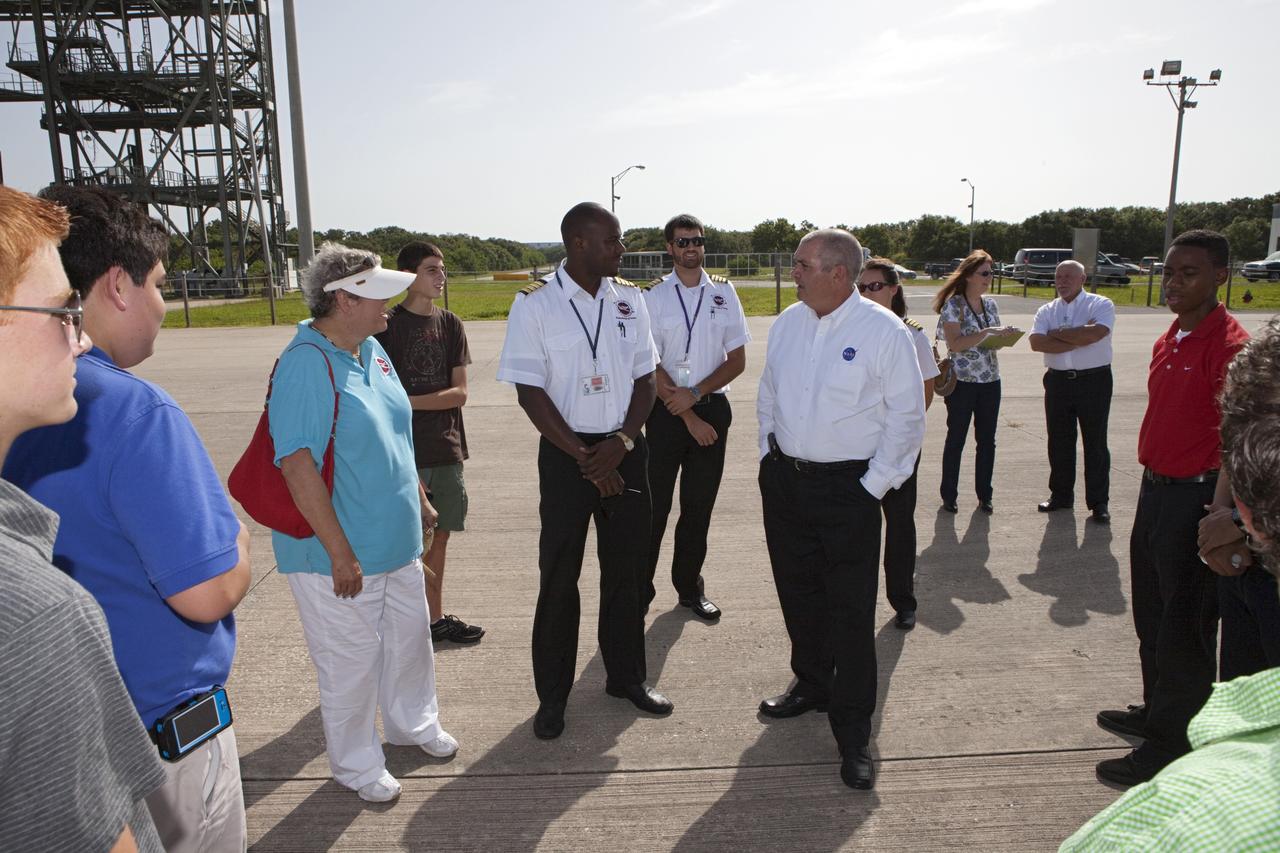
CAPE CANAVERAL, Fla. – At NASA Kennedy Space Center’s Shuttle Landing Facility, or SLF, in Florida, NASA Aviation Safety Officer Joe Torsani, at right, speaks with students and their flight instructors after they arrived in Cherokee Warrior and Cessna 172S lightweight aircraft from Florida Tech, or FIT, in Melbourne. The middle and high school students are participating in FIT’s Av/Aero summer camp experience. They and their flight instructors toured the SLF midfield control tower, viewed F104 Starfighters and NASA Huey helicopters in the RLV Hangar, viewed the runway plaques marking wheels stop for each of the three space shuttles, and toured the Vehicle Assembly Building where space shuttle Atlantis currently is stored. Photo credit: NASA/Kim Shiflett
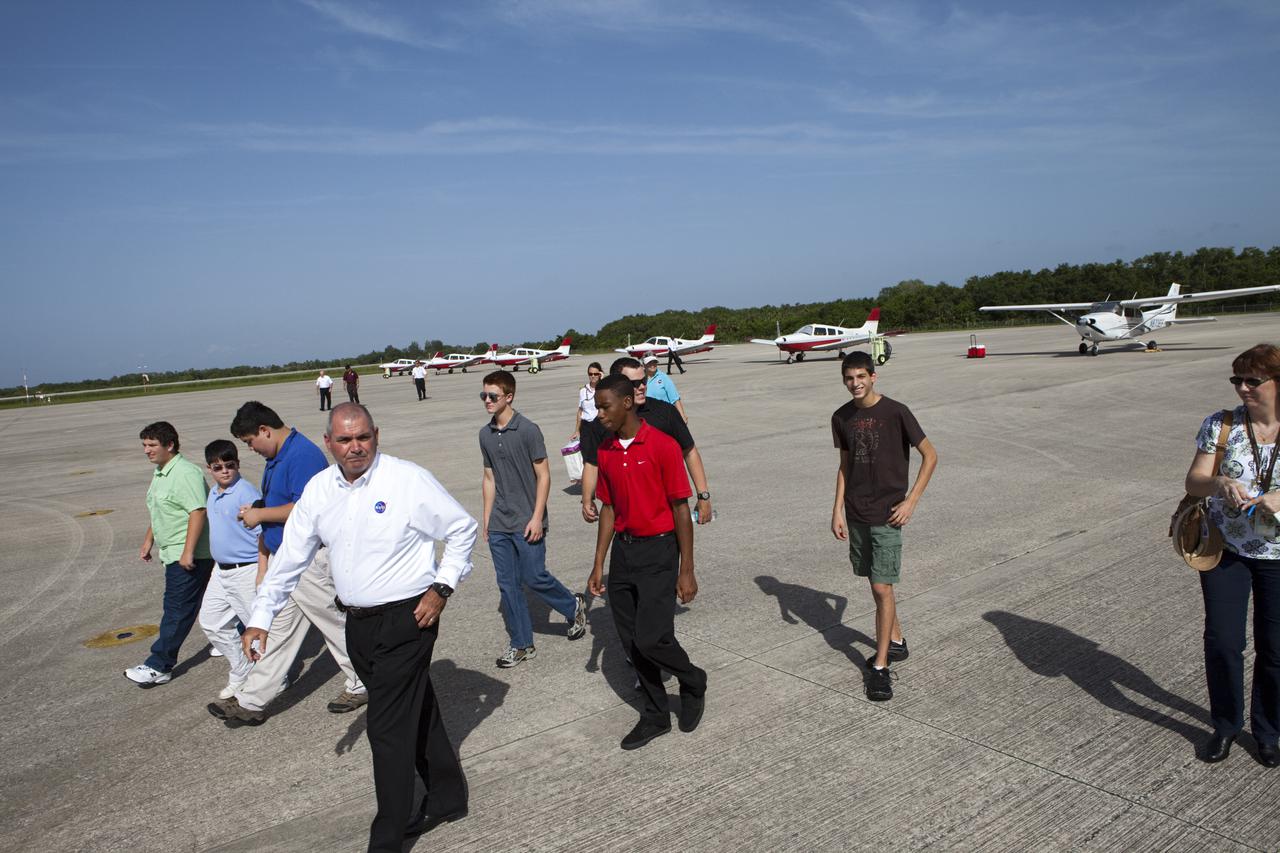
CAPE CANAVERAL, Fla. – At NASA Kennedy Space Center’s Shuttle Landing Facility, or SLF, in Florida, NASA Aviation Safety Officer Joe Torsani walks with students and their flight instructors after they arrived in Cherokee Warrior and Cessna 172S lightweight aircraft from Florida Tech, or FIT, in Melbourne. The middle and high school students are participating in FIT’s Av_Aero summer camp experience. They and their flight instructors toured the SLF midfield control tower, viewed F104 Starfighters and NASA Huey helicopters in the RLV Hangar, viewed the runway plaques marking wheels stop for each of the three space shuttles, and toured the Vehicle Assembly Building where space shuttle Atlantis currently is stored. Photo credit: NASA_Kim Shiflett
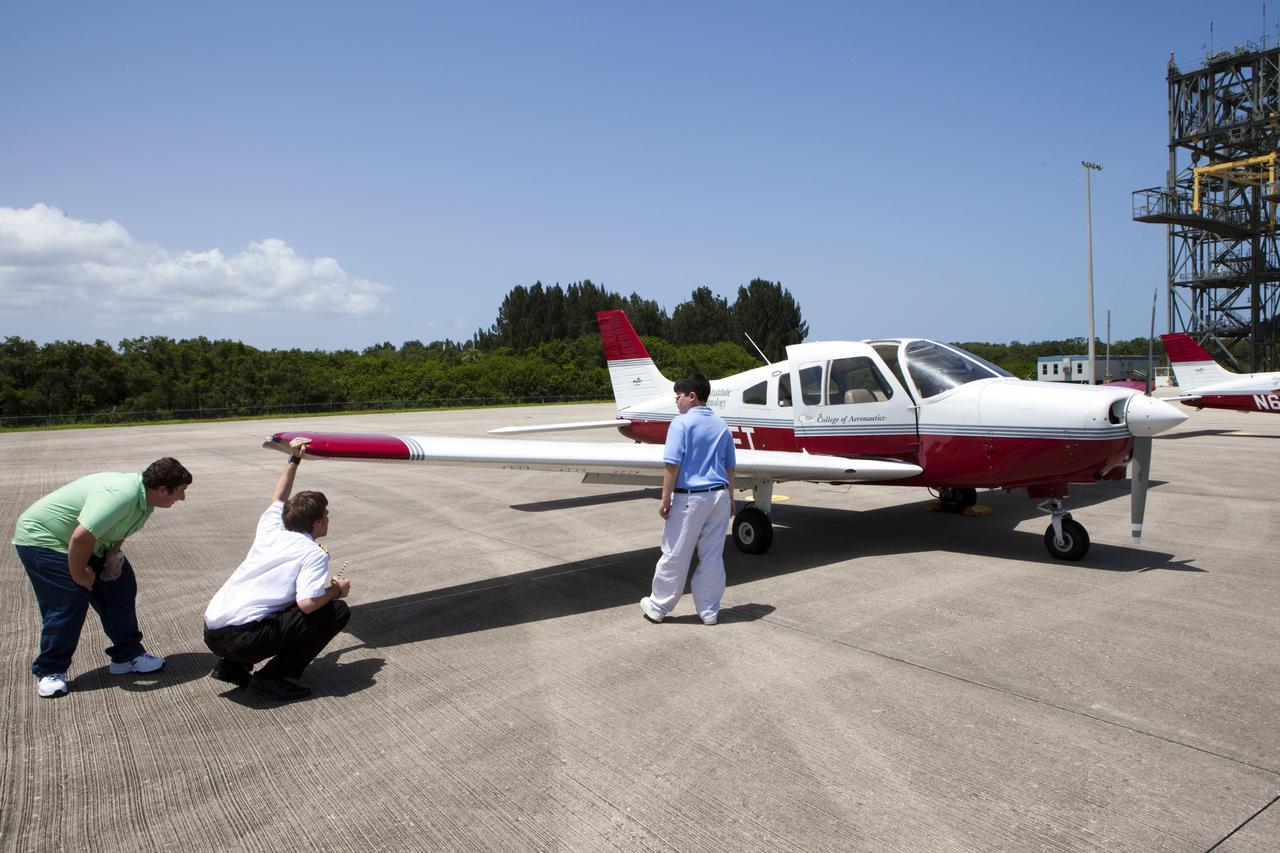
CAPE CANAVERAL, Fla. – At NASA Kennedy Space Center’s Shuttle Landing Facility, or SLF, in Florida, a flight instructor and his students inspect the lightweight aircraft they flew in earlier in the day from Florida Tech, or FIT, in Melbourne. Several instructors and their students arrived at the SLF in Cherokee Warrior and Cessna 172S lightweight aircraft. The middle and high school students are participating in FIT’s Av/Aero summer camp experience. They and their flight instructors toured the SLF midfield control tower, viewed F104 Starfighters and NASA Huey helicopters in the RLV Hangar, viewed the runway plaques marking wheels stop for each of the three space shuttles, and toured the Vehicle Assembly Building where space shuttle Atlantis currently is stored. Photo credit: NASA/Kim Shiflett
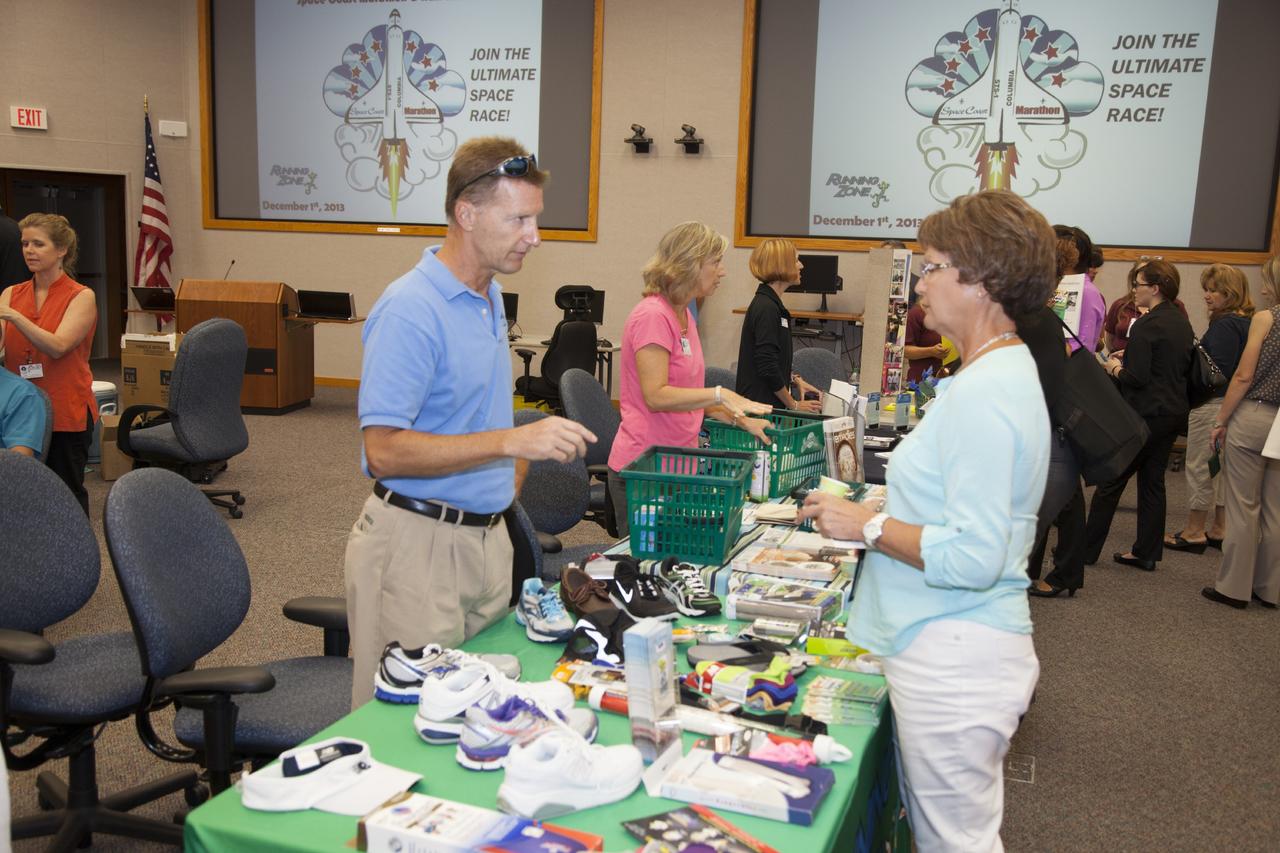
CAPE CANAVERAL, Fla. – Mark Hiebert, of the Running Zone, talks to a Kennedy worker during the National Employee Health and Fitness Day event in the Operations and Checkout Building's Mission Briefing Room. Employees also had the opportunity to be tested for diabetes, enter a raffle for prizes and get a five-minute massage. Other venders shown in the background are Sunseed Co-op’s Marcia Cooney, center, and Bridget Griffin from the YMCA of Titusville. Photo credit: NASA/Daniel Casper
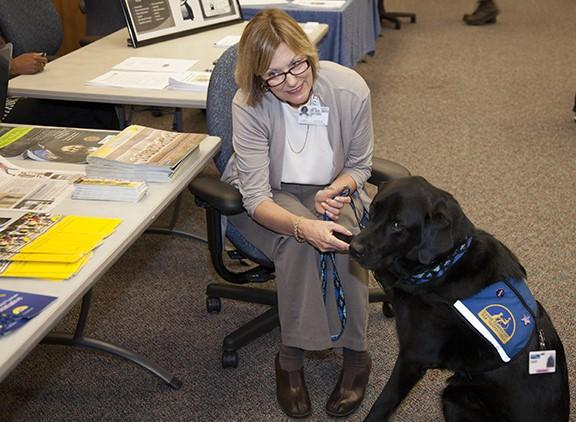
CAPE CANAVERAL, Fla. – Karen Herrsing, of Canine Companions for Independence, educates Kennedy Space Center workers on how Canine Companions for Independence can enhance the lives of others along with her furry friend, Dart, during the National Employee Health and Fitness Day event in the Operations and Checkout Building's Mission Briefing Room. Photo credit: NASA/Daniel Casper
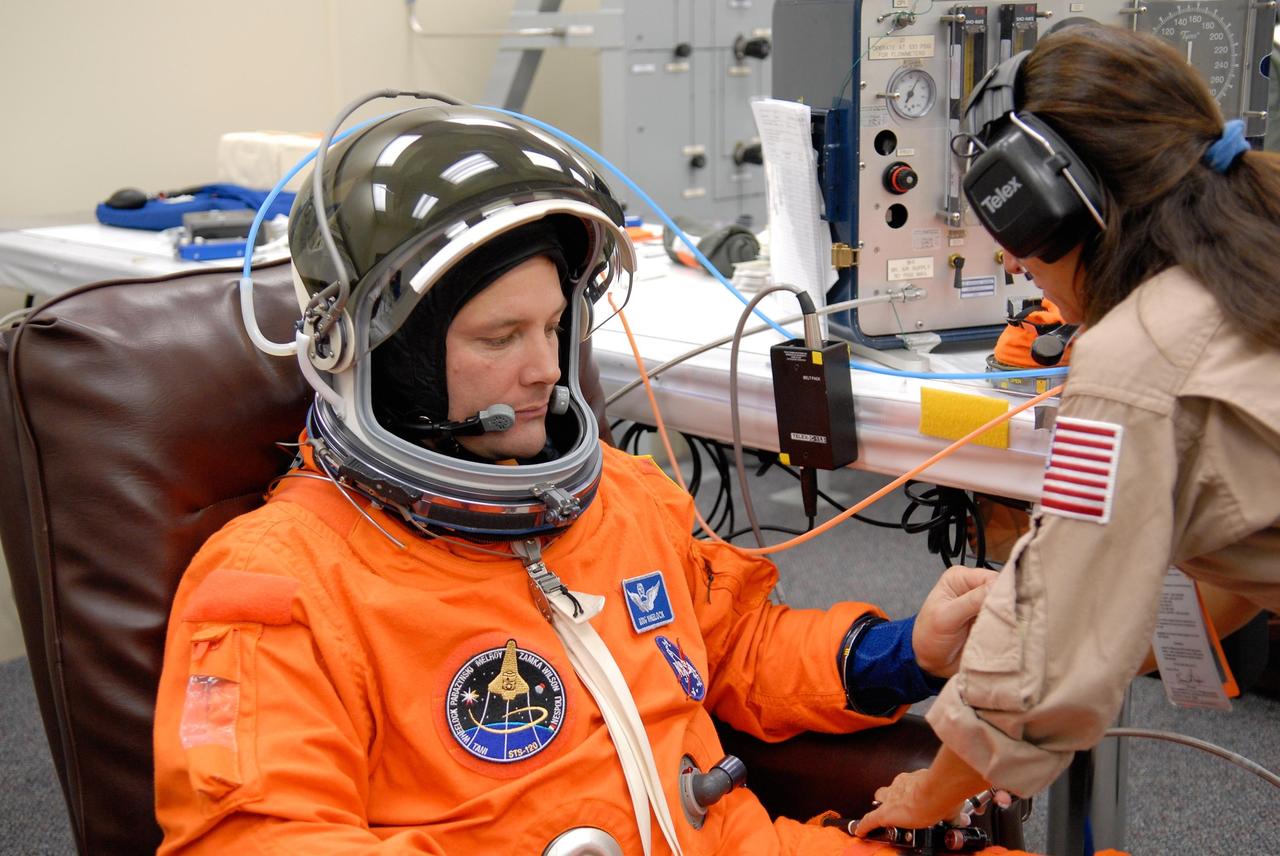
KENNEDY SPACE CENTER, FLA. -- STS-120 Mission Specialist Doug Wheelock tries on his launch and entry suit to prepare for launch. The fitting is part of terminal countdown demonstration test, or TCDT, activities the crew is undertaking at NASA's Kennedy Space Center. The TCDT also includes emergency egress procedures, equipment familiarization and a simulated launch countdown. Mission STS-120, which will carry the Italian-built U.S. Node 2 to the International Space Station, is targeted for launch on Oct. 23. Photo credit: NASA/Kim Shiflett
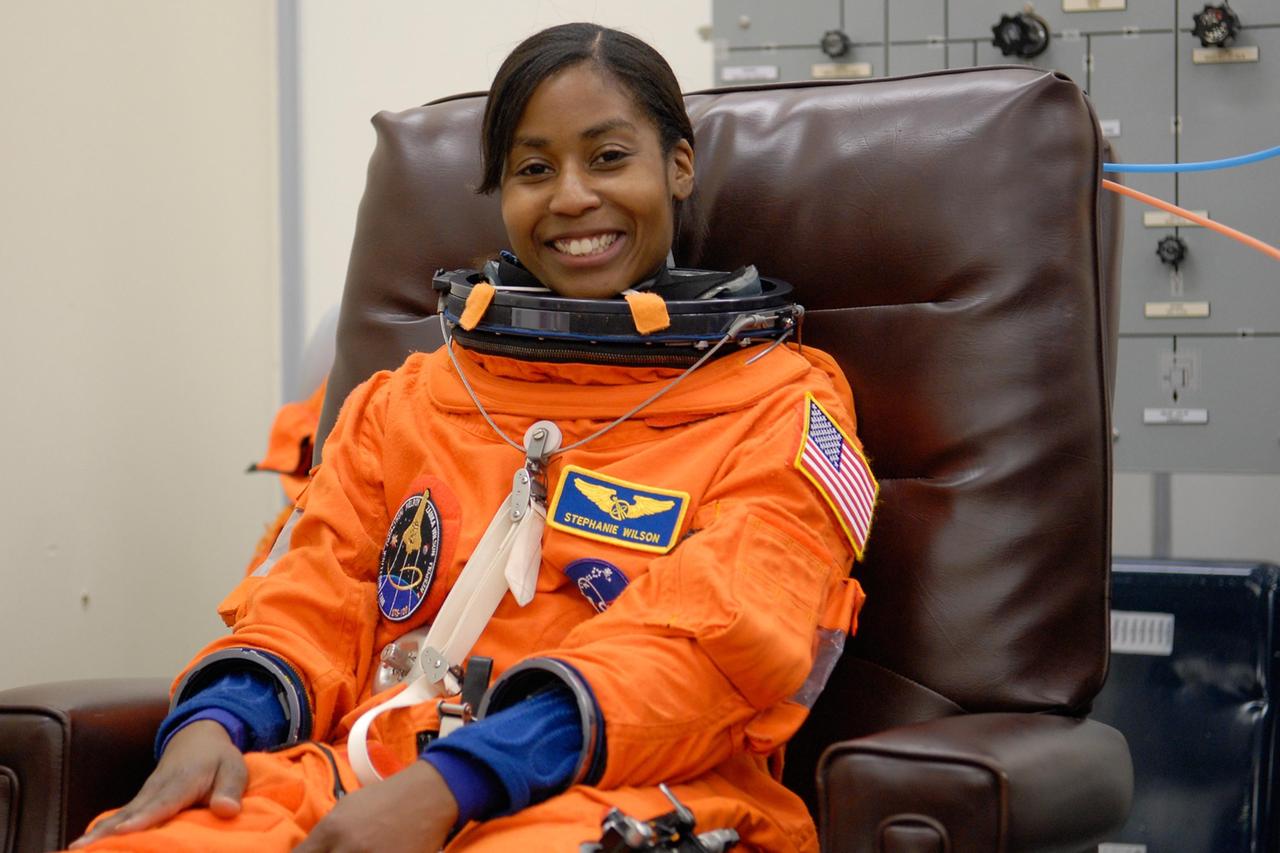
KENNEDY SPACE CENTER, FLA. -- STS-120 Mission Specialist Stephanie Wilson tries on her launch and entry suit, preparing for launch. The fitting is part of terminal countdown demonstration test, or TCDT, activities the crew is undertaking at NASA's Kennedy Space Center. The TCDT also includes emergency egress procedures, equipment familiarization and a simulated launch countdown. Mission STS-120, which will carry the Italian-built U.S. Node 2 to the International Space Station, is targeted for launch on Oct. 23. Photo credit: NASA/Kim Shiflett

CAPE CANAVERAL, Fla. – A Kennedy Space Center worker talks with Rikki Eloian, of Juice Plus, hidden behind the plant, during the National Employee Health and Fitness Day event in the Operations and Checkout Building's Mission Briefing Room. Other vendors represented at the event included the American Cancer Society, Running Zone and Parrish Medical Center Diabetes Program. Photo credit: NASA/Daniel Casper
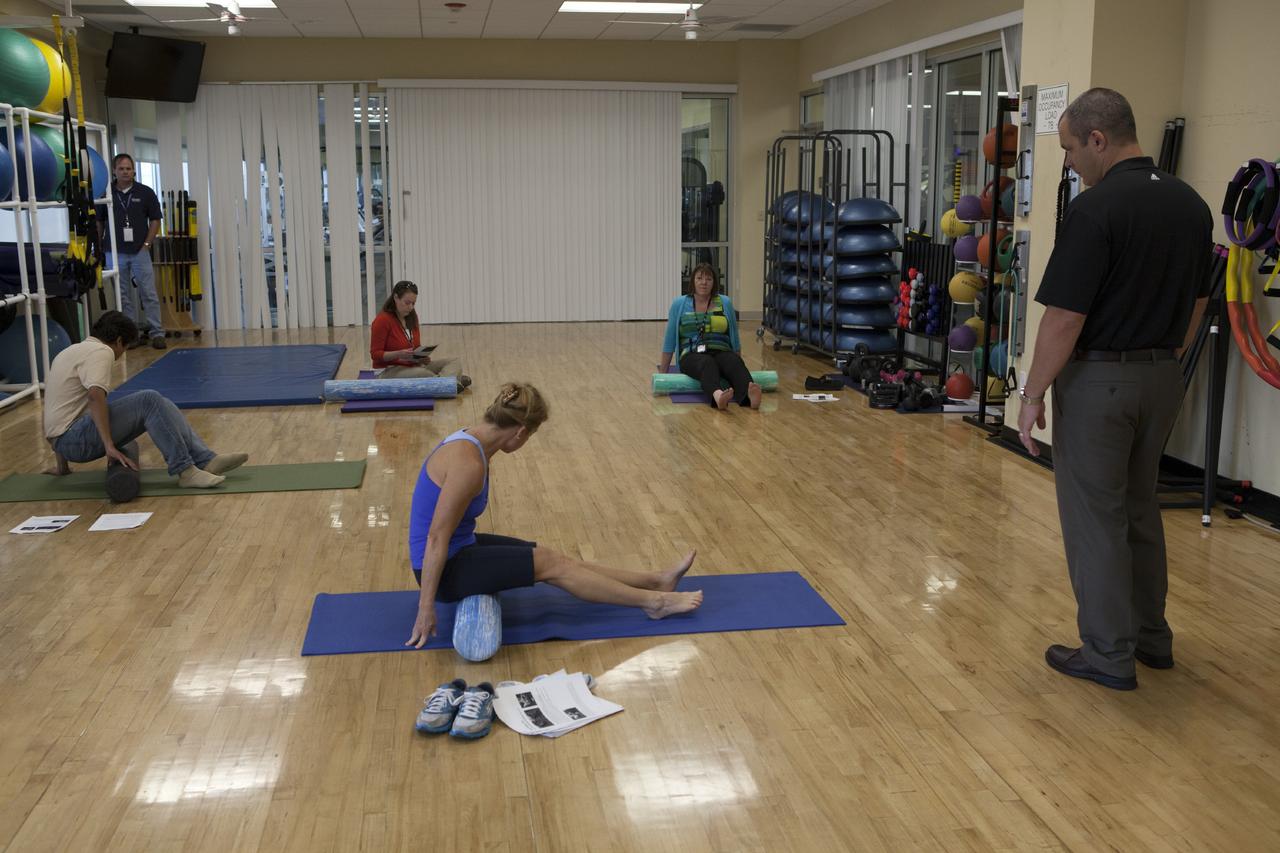
CAPE CANAVERAL, Fla. – Erik Nason, an athletic trainer with InoMedic Health/RehabWorks, instructs Kennedy Space Center workers during a foam rolling class. The class was part of the National Employee Health and Fitness Day event. Yoga, cardio dance, and boot camp classes were also offered throughout the day at the Operations and Checkout Building's Fitness Center. Photo credit: NASA/ Dimitri Gerondidakis
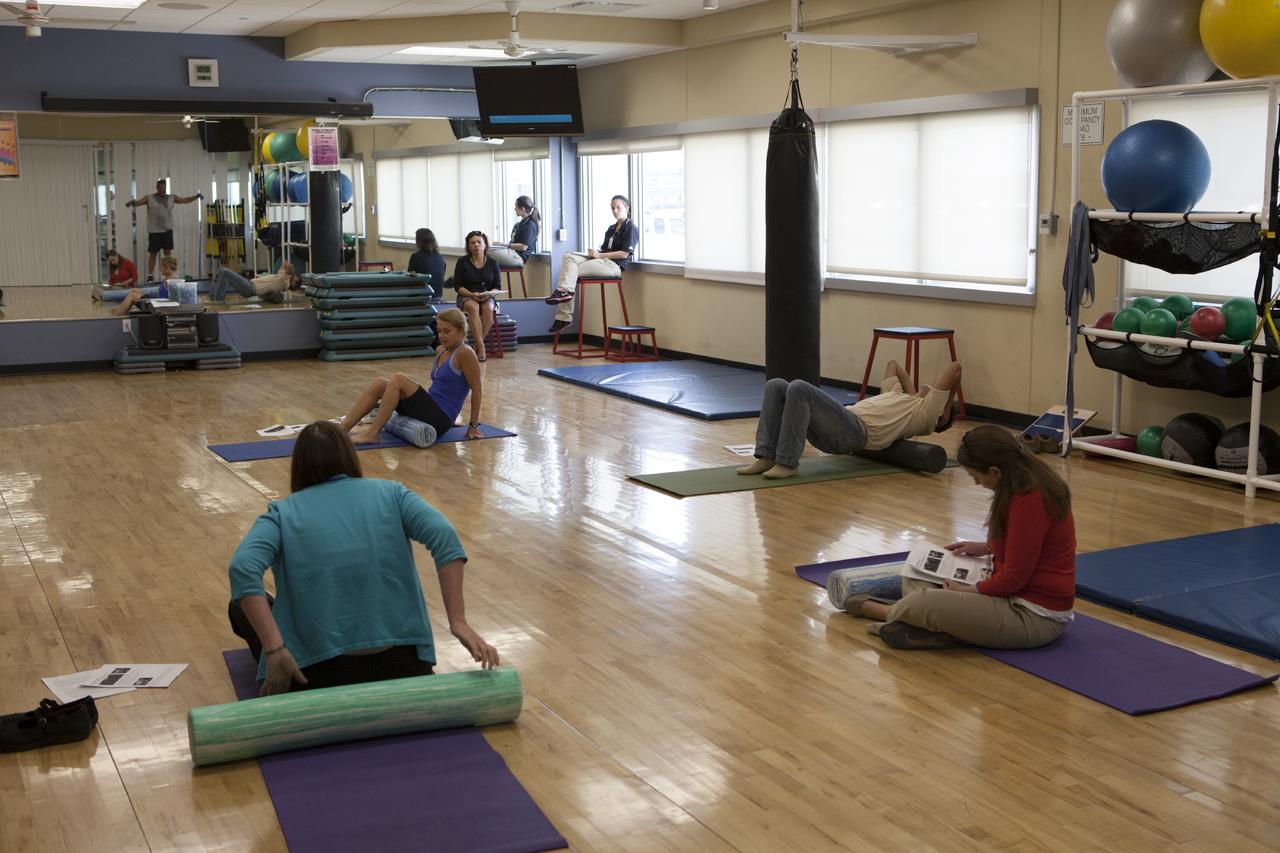
CAPE CANAVERAL, Fla. – Kennedy Space Center workers learn about the benefits of foam-rolling exercises and techniques to relieve the strain and pain of overused muscles and connective tissue. The class was part of the National Employee Health and Fitness Day event. Yoga, cardio dance, and boot camp classes were also offered throughout the day at the Operations and Checkout Building's Fitness Center. Photo credit: NASA/ Dimitri Gerondidakis
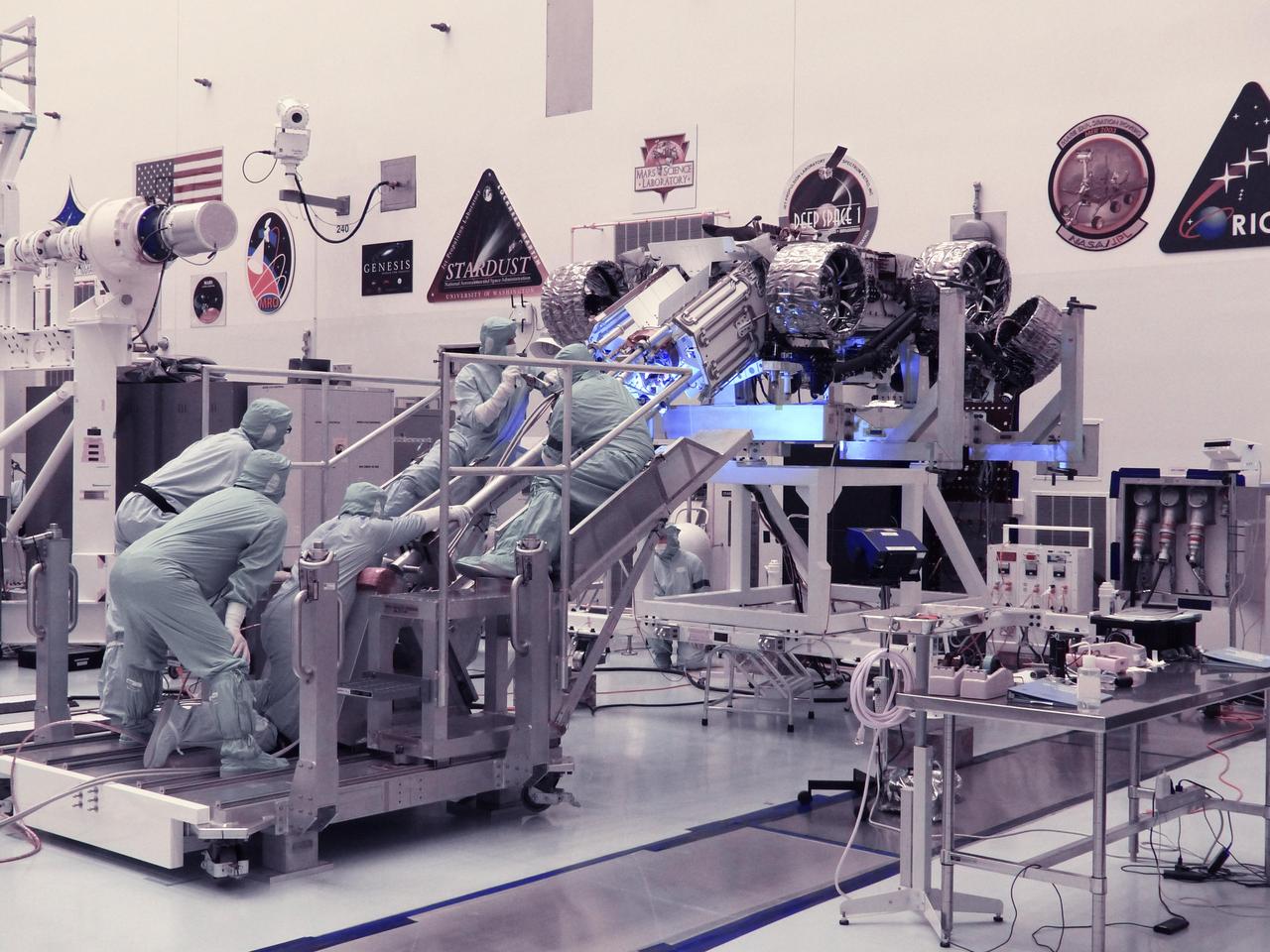
Technicians in the payload processing facility at NASA's Kennedy Space Center in Florida perform a fit check between NASA'S Mars 2020 Perseverance rover and its Multi-Mission Radioisotope Thermoelectric Generator on April 16-17, 2020. The Multi-Mission Radioisotope Thermoelectric Generator is designed and built by the U.S. Department of Energy, and provided to NASA as part of the space agency's Radioisotope Power Systems Program. It arrived at NASA KSC in April 2020 following its final assembly and transport from the Department of Energy's Idaho National Laboratory. The fit check is the first time that the fueled flight generator is connected to the rover. After the successful fit check, the Multi-Mission Radioisotope Thermoelectric Generator was disconnected; it will be connected to the rover for the final time on the launch pad atop the mission's Atlas V launch vehicle in July, before the planned launch of the Mars 2020 mission. The Multi-Mission Radioisotope Thermoelectric Generator is a space nuclear power system that produces about 110 watts of electrical power to run the rover's systems and science instruments, and extra heat to keep them warm during the frigid Martian nights and winter seasons. It converts the heat from the natural radioactive decay of plutonium dioxide into electricity using thermocouples with no moving parts. The choice of a Multi-Mission Radioisotope Thermoelectric Generator as the rover's power system gave mission planners significantly more flexibility in selecting the rover's landing site and in planning its surface operations. https://photojournal.jpl.nasa.gov/catalog/PIA23827
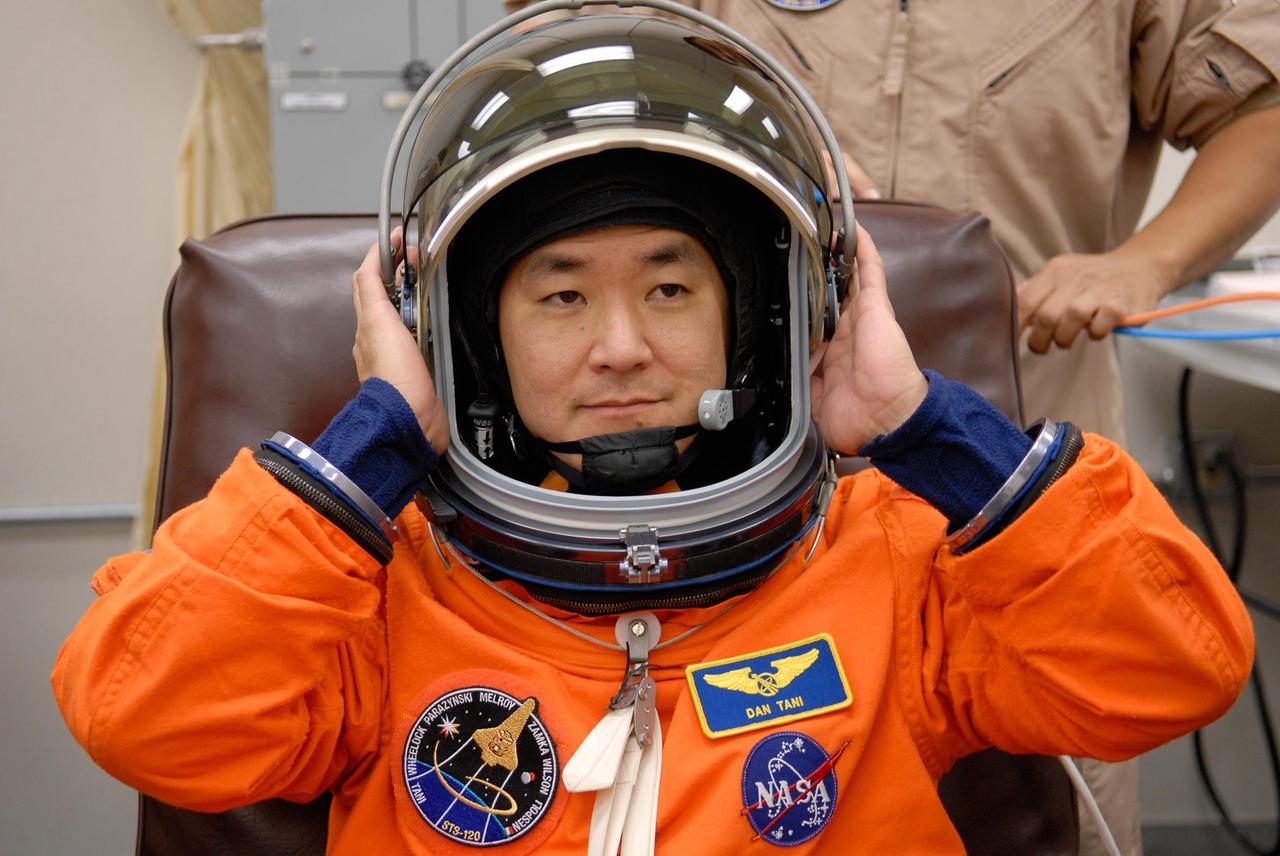
KENNEDY SPACE CENTER, FLA. -- STS-120 Mission Specialist Daniel Tani tries on his helmet with his launch and entry suit, preparing for launch. The fitting is part of terminal countdown demonstration test, or TCDT, activities the crew is undertaking at NASA's Kennedy Space Center. The TCDT also includes emergency egress procedures, equipment familiarization and a simulated launch countdown. Mission STS-120, which will carry the Italian-built U.S. Node 2 to the International Space Station, is targeted for launch on Oct. 23. Photo credit: NASA/Kim Shiflett
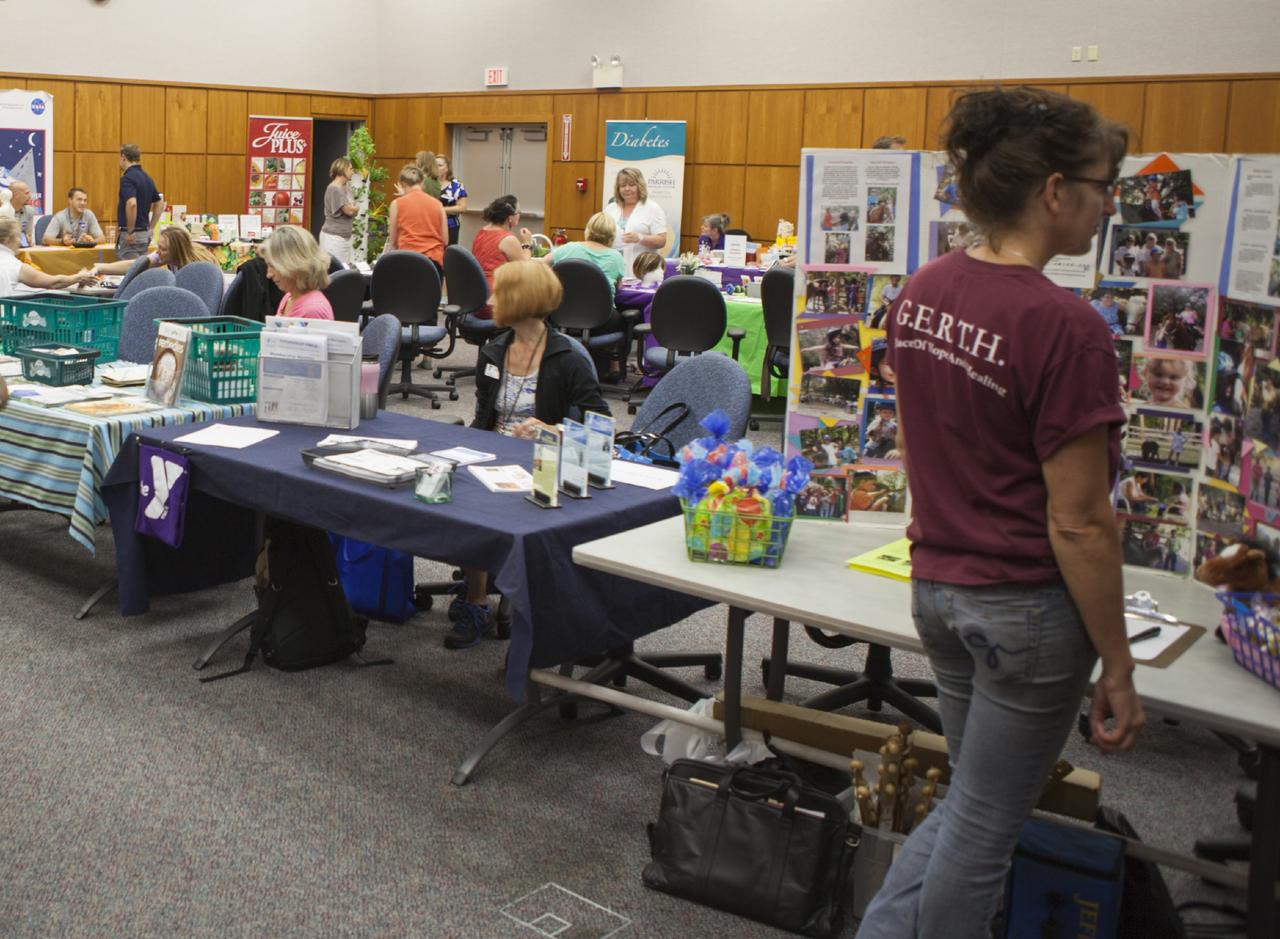
CAPE CANAVERAL, Fla. – Linnea Applegate, right, of Grace Equine Rescue and Therapy for Humans, or GERTH, organizes her booth during the National Employee Health and Fitness Day event in the Operations and Checkout Building's Mission Briefing Room. GERTH is a nonprofit organization in Cocoa, Fla., that brings horses, children and adults together in a safe, nurturing and healing environment to promote therapeutic healing. Other vendors shown in the background include Bridget Griffin of the YMCA of Titusville, center, and Sunseed Co-op’s Marcia Cooney, in pink. Photo credit: NASA/Daniel Casper
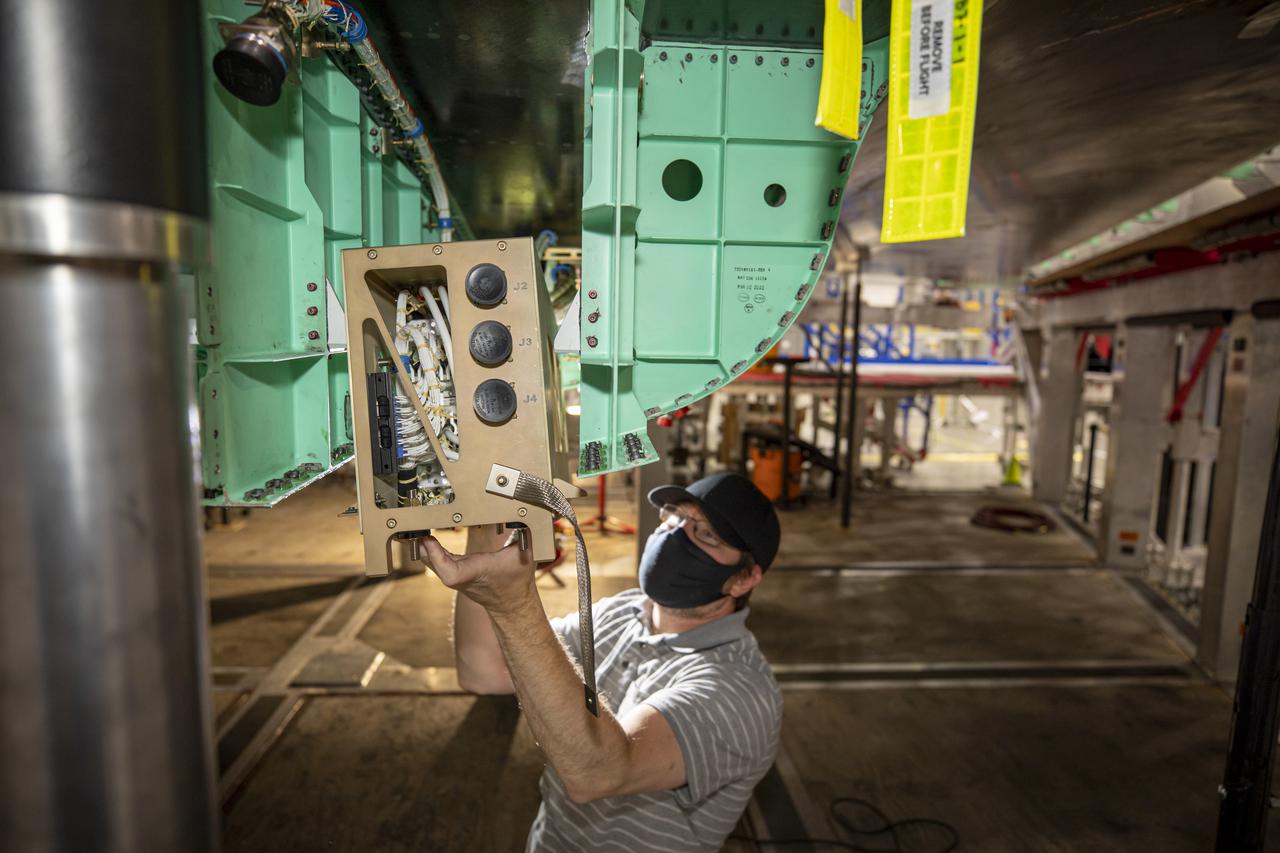
A technician works on the installation of the PDS Pallet (gold colored box that he is holding) on NASA’s X-59 Quiet SuperSonic Technology or QueSST aircraft. Lockheed Martin Photography By Garry Tice 1011 Lockheed Way, Palmdale, Ca. 93599 Event: SEG 450 Mid Bay - PDS Fit Check Date: 5/03/2021
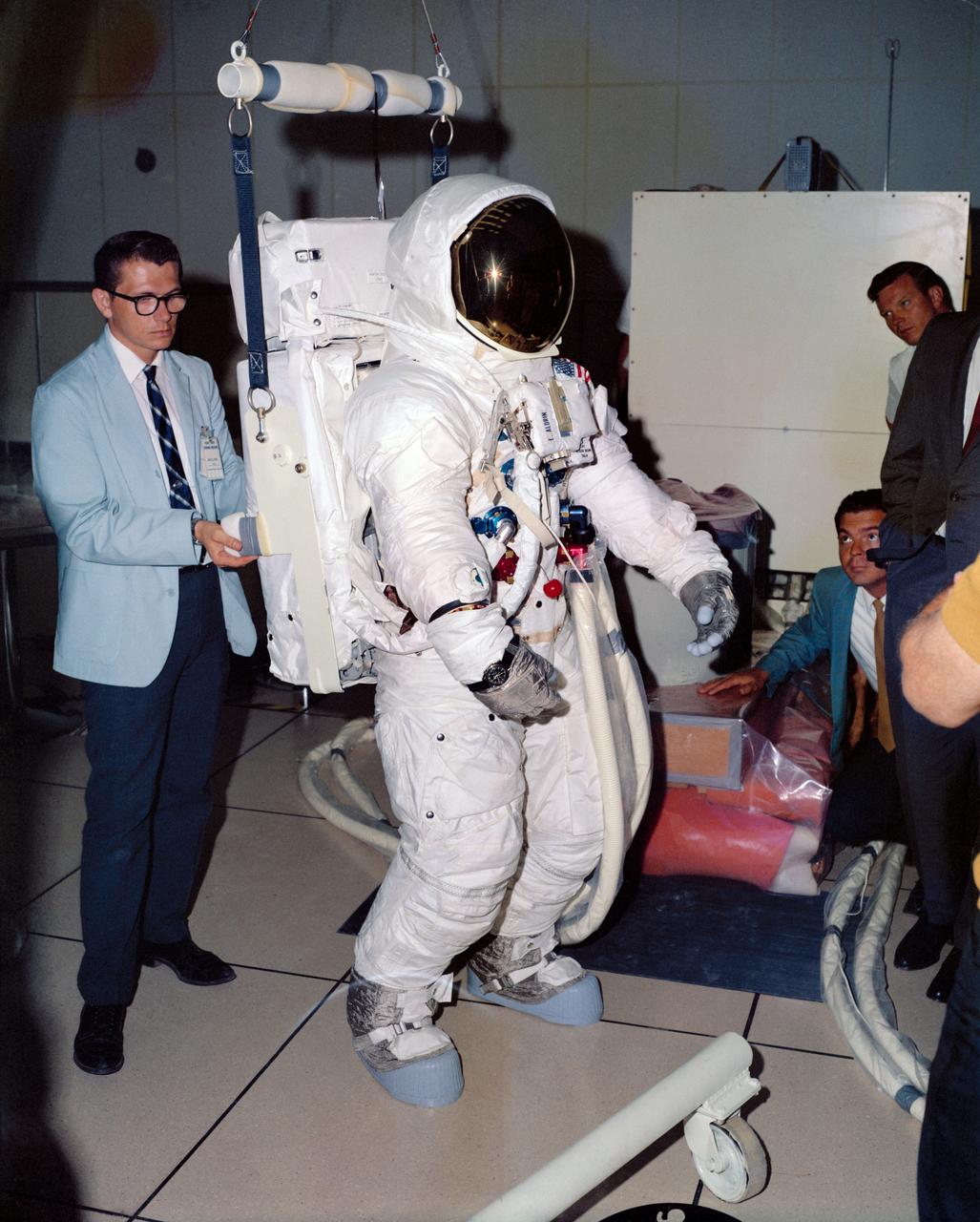
Astronaut Edwin E. Aldrin Jr., wearing an Extravehicular Mobility Unit (EMU), verifies fit of the Portable Life Support System (PLSS) strap length during lunar surface training at the Kennedy Space Center. Aldrin is the prime crew lunar module pilot of the Apollo 11 lunar landing mission. Aldrin's PLSS backpack is attached to a lunar weight simulator.
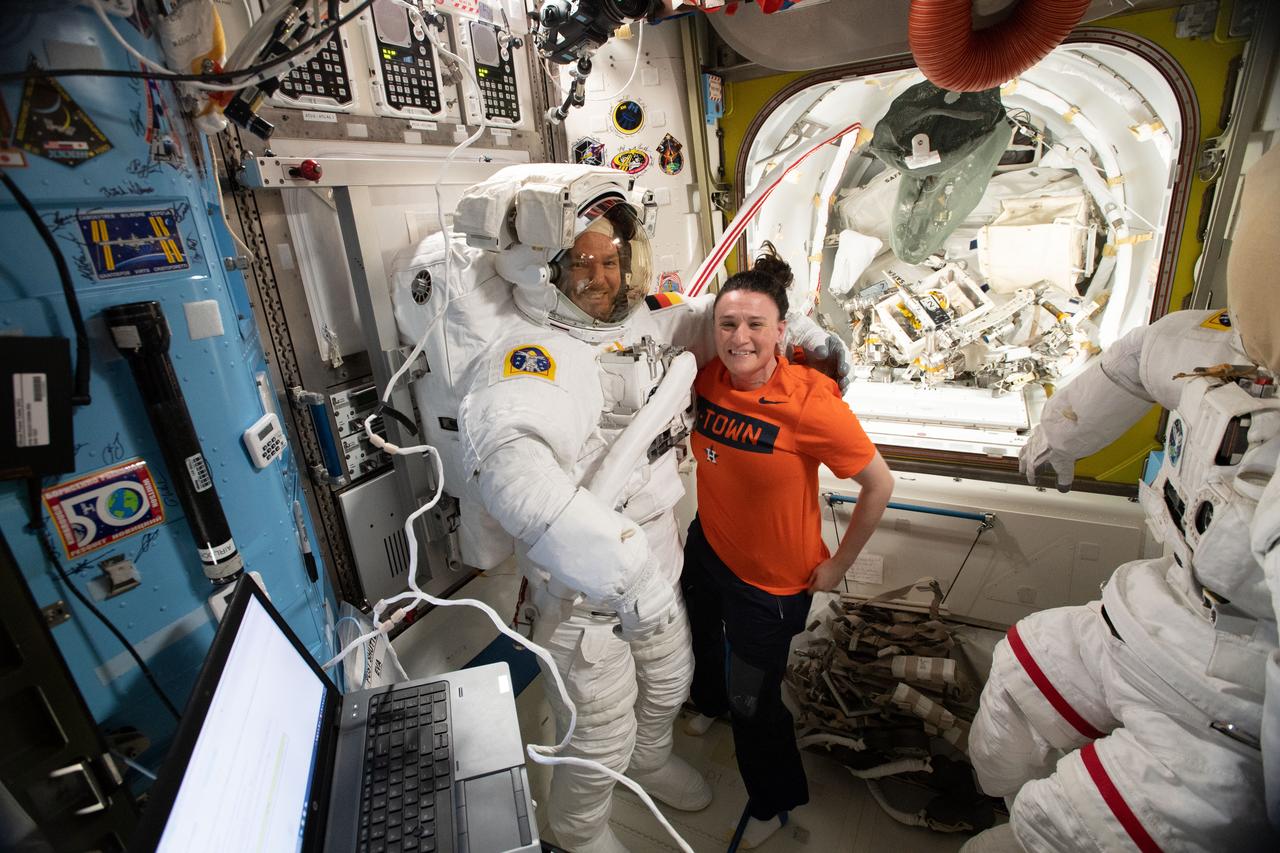
iss056e174070 (Sept. 17, 2018) --- NASA astronaut Serena Auñón-Chancellor assists ESA (European Space Agency) astronaut Alexander Gerst wearing a U.S. spacesuit during a fit check. The two Expedition 56 crew members are at work inside the U.S. Quest airlock where U.S. spacewalk are staged.

iss056e174037 (Sept. 17, 2018) --- ESA (European Space Agency) astronaut Alexander Gerst is pictured wearing a U.S. spacesuit during a fit check inside the U.S. Quest Airlock where U.S. spacewalks are staged. The patch on Gerst's left shoulder represents the flag of his home country of Germany.
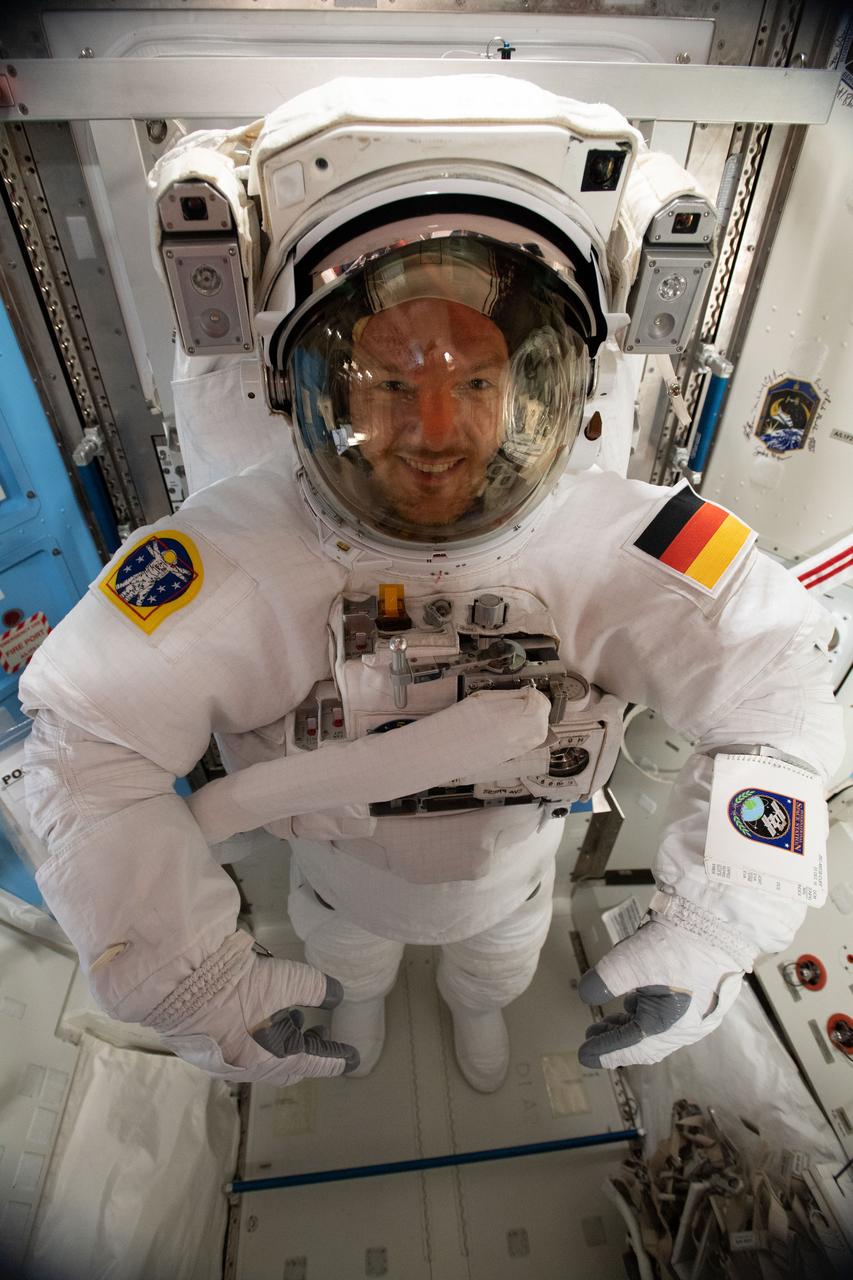
iss056e174066 (Sept. 17, 2018) --- ESA (European Space Agency) astronaut Alexander Gerst is pictured wearing a U.S. spacesuit during a fit check inside the U.S. Quest Airlock where U.S. spacewalks are staged. The patch on Gerst's left shoulder represents the flag of his home country of Germany.
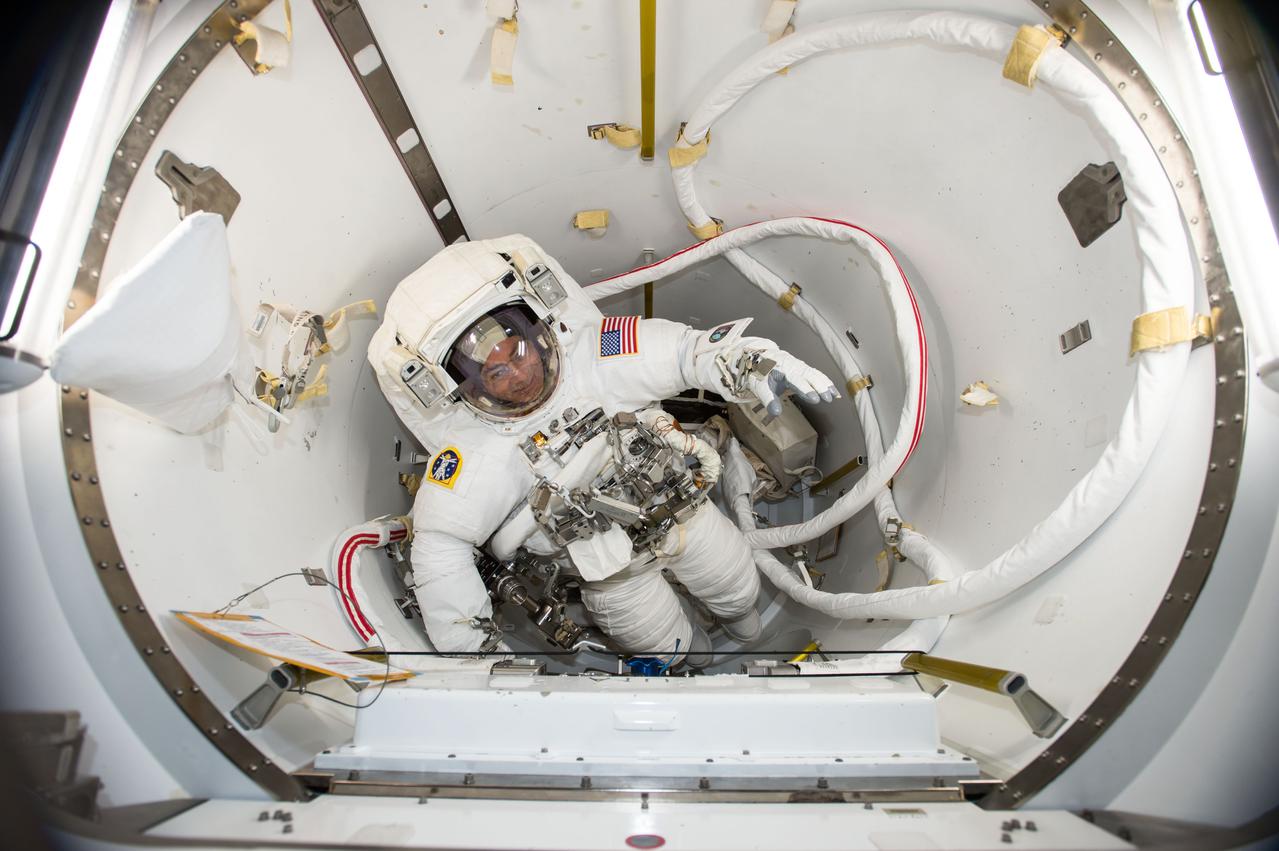
iss053e064252 (Sept. 29, 2017) --- NASA astronaut and Expedition 53 Flight Engineer Mark Vande Hei verifies his U.S. spacesuit fits while inside the International Space Station's U.S. Quest airlock.
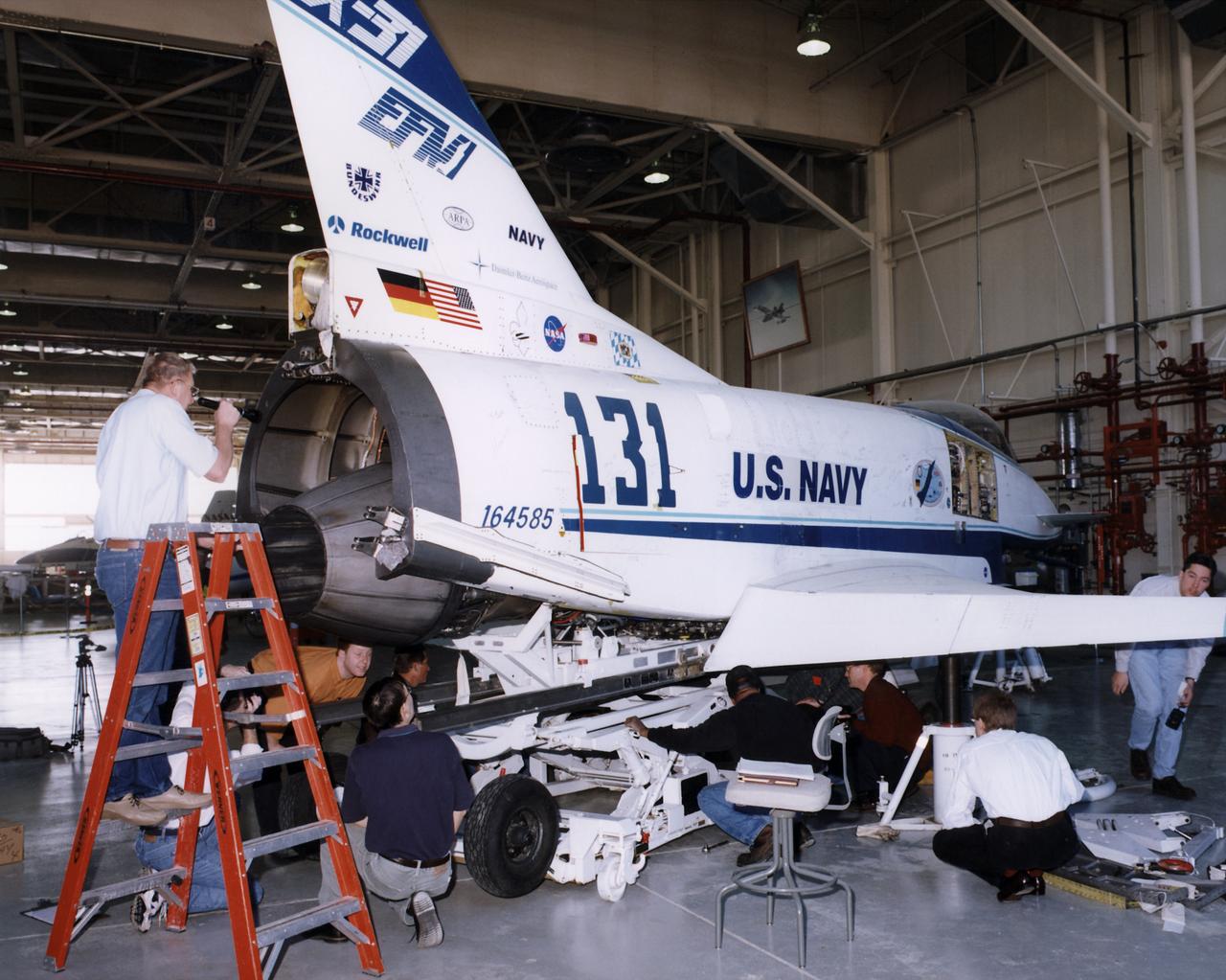
X-31 team members perform an engine fit check on the X-31 Enhanced Fighter Maneuverability demonstrator aircraft in a hangar at the Dryden Flight Research Center, Edwards, California.
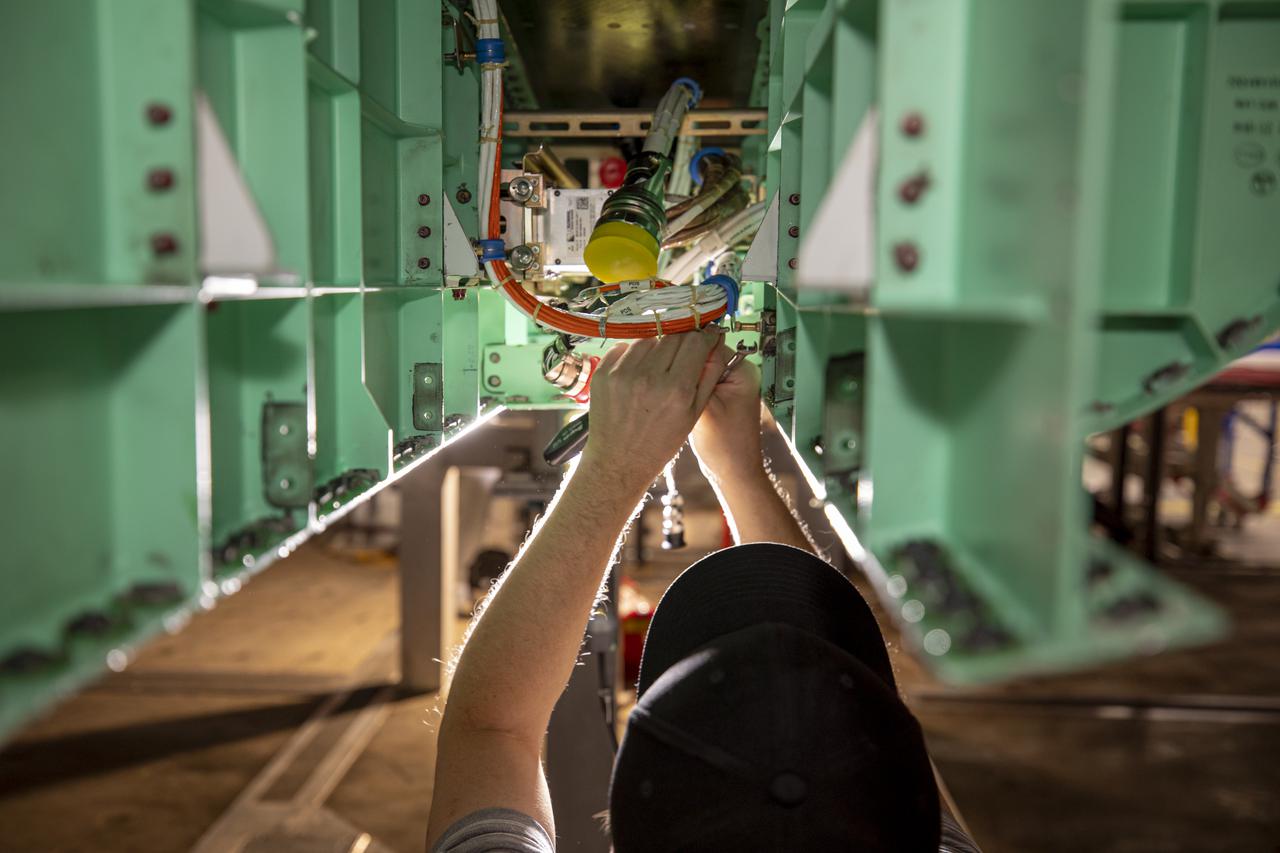
A technician is shown working on the underside of the X-59. The aircraft, under construction at Lockheed Martin Skunk Works in Palmdale, California, will fly to demonstrate the ability to fly supersonic while reducing the loud sonic boom to a quiet sonic thump. Lockheed Martin Photography By Garry Tice 1011 Lockheed Way, Palmdale, Ca. 93599 Event: SEG 450 Mid Bay - PDS Fit Check Date: 5/03/2021
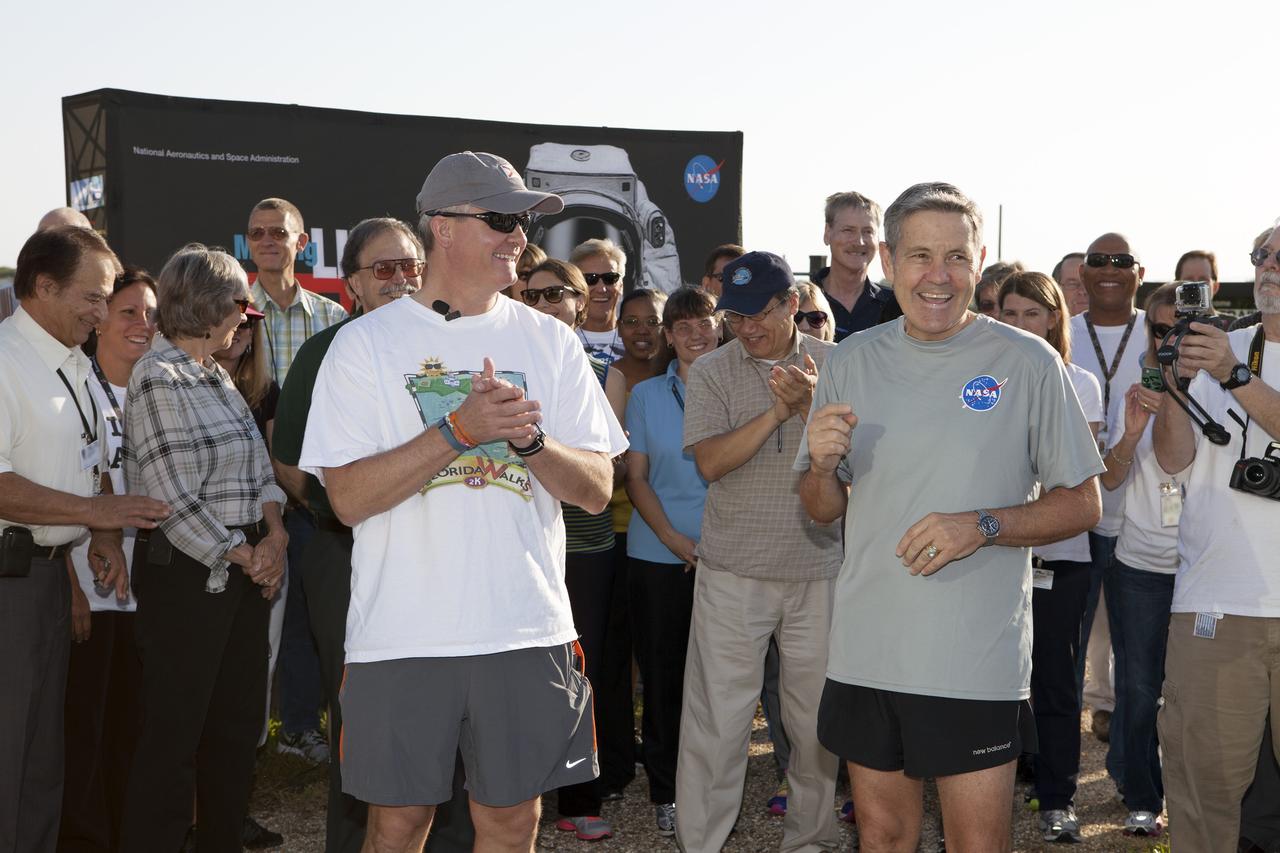
CAPE CANAVERAL, Fla. – Kennedy Space Center Director Bob Cabana, right, Florida State Surgeon General John Armstrong and other guests prepare for an early morning run at the center's Pathfinder Trail near the Operations and Support Building II at Kennedy Space Center in Florida, to officially kick off National Employee Health and Fitness Month with the NASA Moves! challenge. NASA Moves! challenged the workforce from each of the agency's field centers to engage in at least 20 minutes of activity, or 10,000 steps, each day from May 18-31. About 100 people participated in the kickoff event on the Pathfinder Trail in the heart of the center's Launch Complex 39. The one-third-mile-long gravel walkway traces the iconic shape of a space shuttle orbiter and features a set of exercise stations. The friendly contest is part of NASA's new Health4Life initiative, a Web-based health initiative designed to help employees track their health, fitness and nutrition. Health4Life also provides an array of resources geared toward increasing physical activity. Photo credit: NASA/Dimitri Gerondidakis
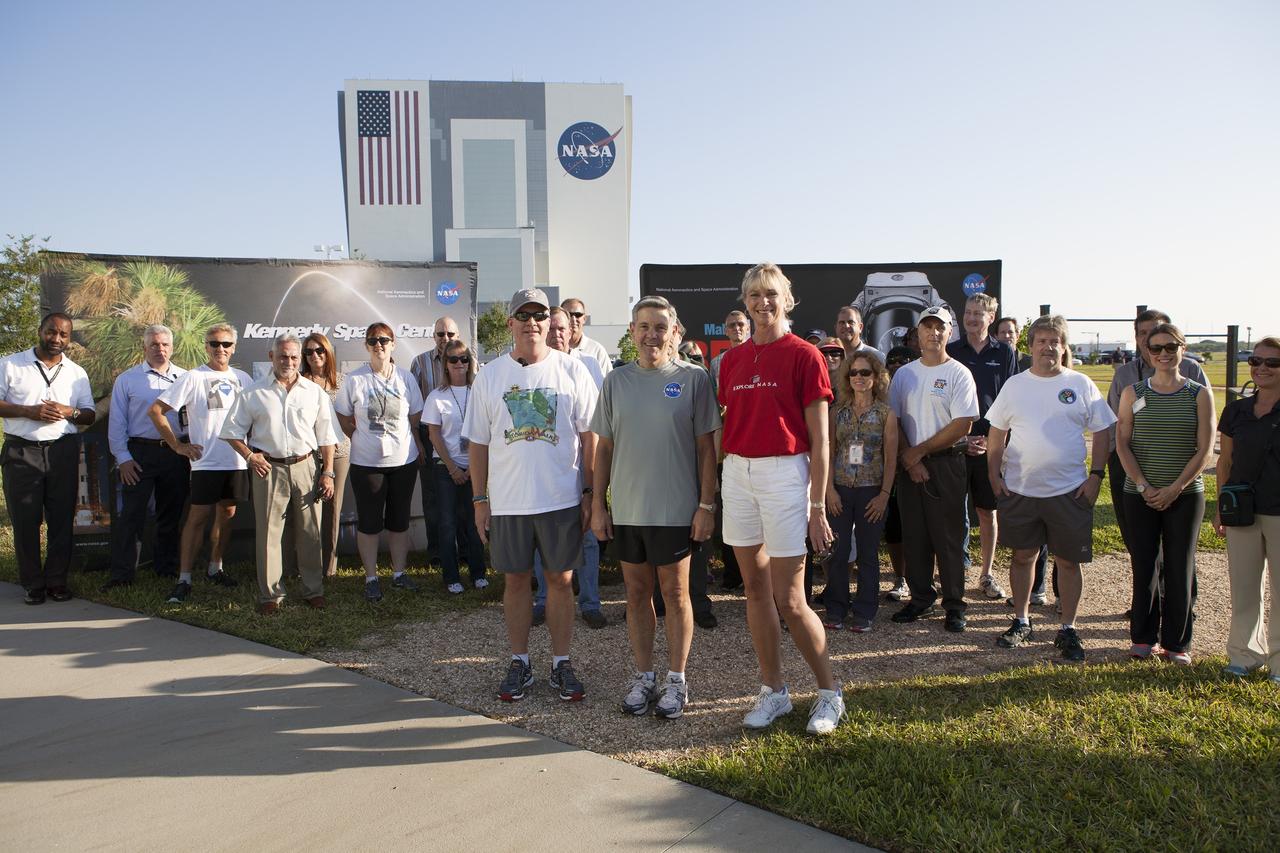
CAPE CANAVERAL, Fla. – From left, Florida State Surgeon General John Armstrong, Kennedy Space Center Director Bob Cabana, Center Operations Director Nancy Bray and Kennedy workers and guests prepare to take an early morning run along the center's Pathfinder Trail near the Operations and Support Building II at Kennedy Space Center in Florida, to officially kick off National Employee Health and Fitness Month with the NASA Moves! challenge. NASA Moves! challenged the workforce from each of the agency's field centers to engage in at least 20 minutes of activity, or 10,000 steps, each day from May 18-31. About 100 people participated in the kickoff event on the Pathfinder Trail in the heart of the center's Launch Complex 39. The one-third-mile-long gravel walkway traces the iconic shape of a space shuttle orbiter and features a set of exercise stations. The friendly contest is part of NASA's new Health4Life initiative, a Web-based health initiative designed to help employees track their health, fitness and nutrition. Health4Life also provides an array of resources geared toward increasing physical activity. Photo credit: NASA/Dimitri Gerondidakis

CAPE CANAVERAL, Fla. – Workers take an early morning walk along the Pathfinder Trail near the Operations and Support Building II at Kennedy Space Center in Florida, to officially kick off National Employee Health and Fitness Month with the NASA Moves! challenge. NASA Moves! challenged the workforce from each of the agency's field centers to engage in at least 20 minutes of activity, or 10,000 steps, each day from May 18-31. About 100 people participated in the kickoff event on the Pathfinder Trail in the heart of the center's Launch Complex 39. The one-third-mile-long gravel walkway traces the iconic shape of a space shuttle orbiter and features a set of exercise stations. The friendly contest is part of NASA's new Health4Life initiative, a Web-based health initiative designed to help employees track their health, fitness and nutrition. Health4Life also provides an array of resources geared toward increasing physical activity. Photo credit: NASA/Dimitri Gerondidakis
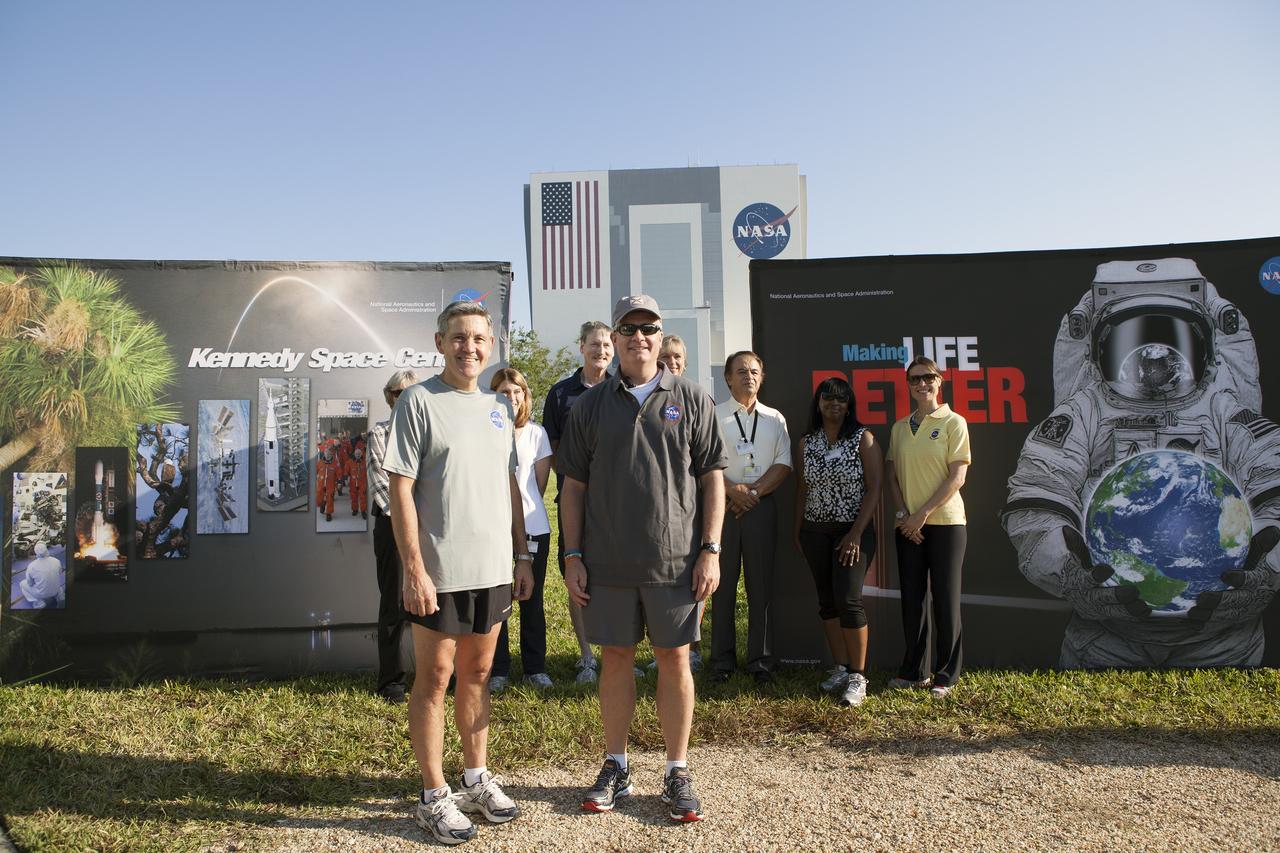
CAPE CANAVERAL, Fla. – Kennedy Space Center Director Bob Cabana, left, and Florida State Surgeon General John Armstrong complete an early morning run along the center's Pathfinder Trail near the Operations and Support Building II at Kennedy Space Center in Florida, to officially kick off National Employee Health and Fitness Month with the NASA Moves! challenge. NASA Moves! challenged the workforce from each of the agency's field centers to engage in at least 20 minutes of activity, or 10,000 steps, each day from May 18-31. About 100 people participated in the kickoff event on the Pathfinder Trail in the heart of the center's Launch Complex 39. The one-third-mile-long gravel walkway traces the iconic shape of a space shuttle orbiter and features a set of exercise stations. The friendly contest is part of NASA's new Health4Life initiative, a Web-based health initiative designed to help employees track their health, fitness and nutrition. Health4Life also provides an array of resources geared toward increasing physical activity. Photo credit: NASA/Dimitri Gerondidakis
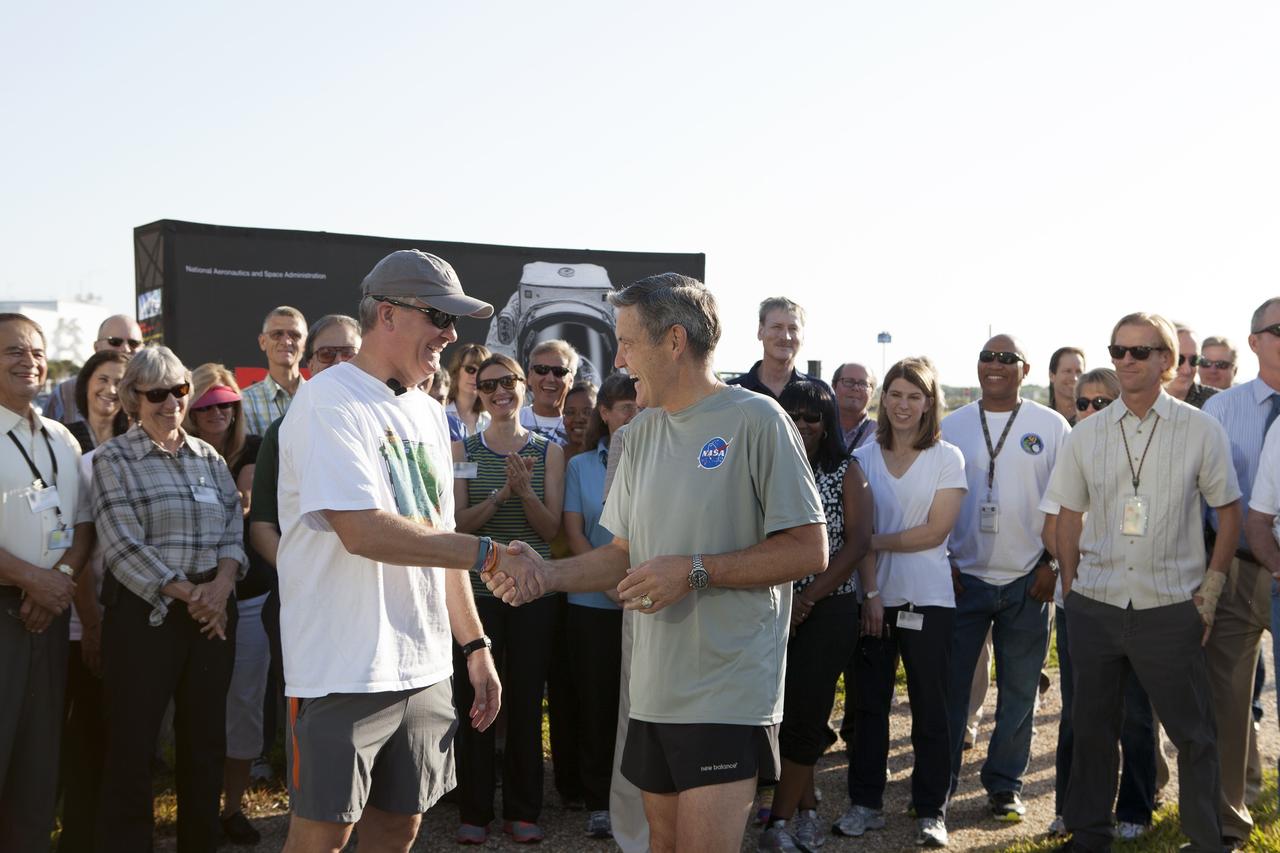
CAPE CANAVERAL, Fla. – Kennedy Space Center Director Bob Cabana, right, shakes hands with Florida State Surgeon General John Armstrong before an early morning run along the center's Pathfinder Trail near the Operations and Support Building II at Kennedy Space Center in Florida, to officially kick off National Employee Health and Fitness Month with the NASA Moves! challenge. NASA Moves! challenged the workforce from each of the agency's field centers to engage in at least 20 minutes of activity, or 10,000 steps, each day from May 18-31. About 100 people participated in the kickoff event on the Pathfinder Trail in the heart of the center's Launch Complex 39. The one-third-mile-long gravel walkway traces the iconic shape of a space shuttle orbiter and features a set of exercise stations. The friendly contest is part of NASA's new Health4Life initiative, a Web-based health initiative designed to help employees track their health, fitness and nutrition. Health4Life also provides an array of resources geared toward increasing physical activity. Photo credit: NASA/Dimitri Gerondidakis
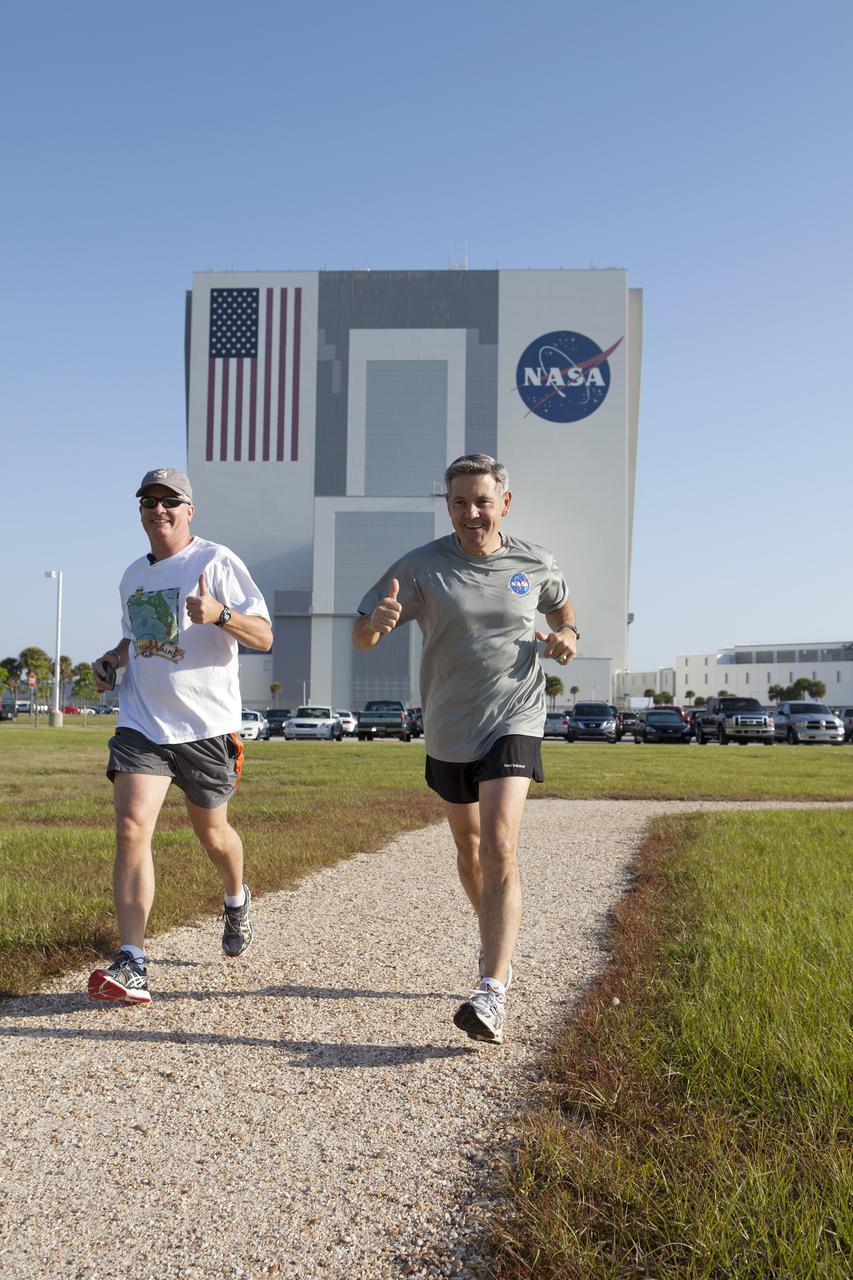
CAPE CANAVERAL, Fla. – Kennedy Space Center Director Bob Cabana, right, and Florida State Surgeon General John Armstrong take an early morning run along the center's Pathfinder Trail near the Operations and Support Building II at Kennedy Space Center in Florida, to officially kick off National Employee Health and Fitness Month with the NASA Moves! challenge. NASA Moves! challenged the workforce from each of the agency's field centers to engage in at least 20 minutes of activity, or 10,000 steps, each day from May 18-31. About 100 people participated in the kickoff event on the Pathfinder Trail in the heart of the center's Launch Complex 39. The one-third-mile-long gravel walkway traces the iconic shape of a space shuttle orbiter and features a set of exercise stations. The friendly contest is part of NASA's new Health4Life initiative, a Web-based health initiative designed to help employees track their health, fitness and nutrition. Health4Life also provides an array of resources geared toward increasing physical activity. Photo credit: NASA/Dimitri Gerondidakis
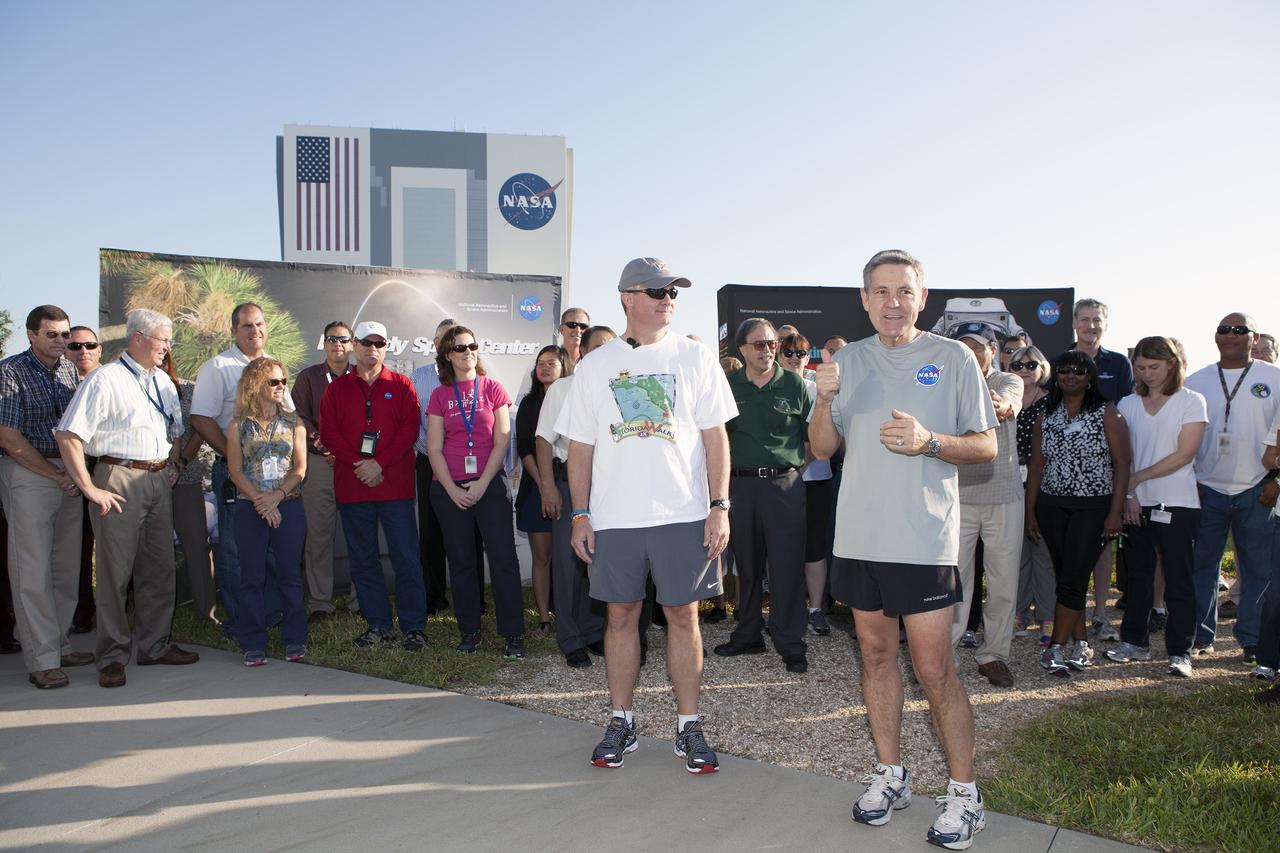
CAPE CANAVERAL, Fla. – Kennedy Space Center Director Bob Cabana, right, Florida State Surgeon General John Armstrong, other Kennedy managers and guests prepare for an early morning run at the center's Pathfinder Trail near the Operations and Support Building II at Kennedy Space Center in Florida, to officially kick off National Employee Health and Fitness Month with the NASA Moves! challenge. NASA Moves! challenged the workforce from each of the agency's field centers to engage in at least 20 minutes of activity, or 10,000 steps, each day from May 18-31. About 100 people participated in the kickoff event on the Pathfinder Trail in the heart of the center's Launch Complex 39. The one-third-mile-long gravel walkway traces the iconic shape of a space shuttle orbiter and features a set of exercise stations. The friendly contest is part of NASA's new Health4Life initiative, a Web-based health initiative designed to help employees track their health, fitness and nutrition. Health4Life also provides an array of resources geared toward increasing physical activity. Photo credit: NASA/Dimitri Gerondidakis

CAPE CANAVERAL, Fla. – Nancy Bray, right, Center Operations director at Kennedy Space Center, and Lori Hicks, Human Resources, take an early morning walk along the center's Pathfinder Trail near the Operations and Support Building II at Kennedy Space Center in Florida, to officially kick off National Employee Health and Fitness Month with the NASA Moves! challenge. NASA Moves! challenged the workforce from each of the agency's field centers to engage in at least 20 minutes of activity, or 10,000 steps, each day from May 18-31. About 100 people participated in the kickoff event on the Pathfinder Trail in the heart of the center's Launch Complex 39. The one-third-mile-long gravel walkway traces the iconic shape of a space shuttle orbiter and features a set of exercise stations. The friendly contest is part of NASA's new Health4Life initiative, a Web-based health initiative designed to help employees track their health, fitness and nutrition. Health4Life also provides an array of resources geared toward increasing physical activity. Photo credit: NASA/Dimitri Gerondidakis
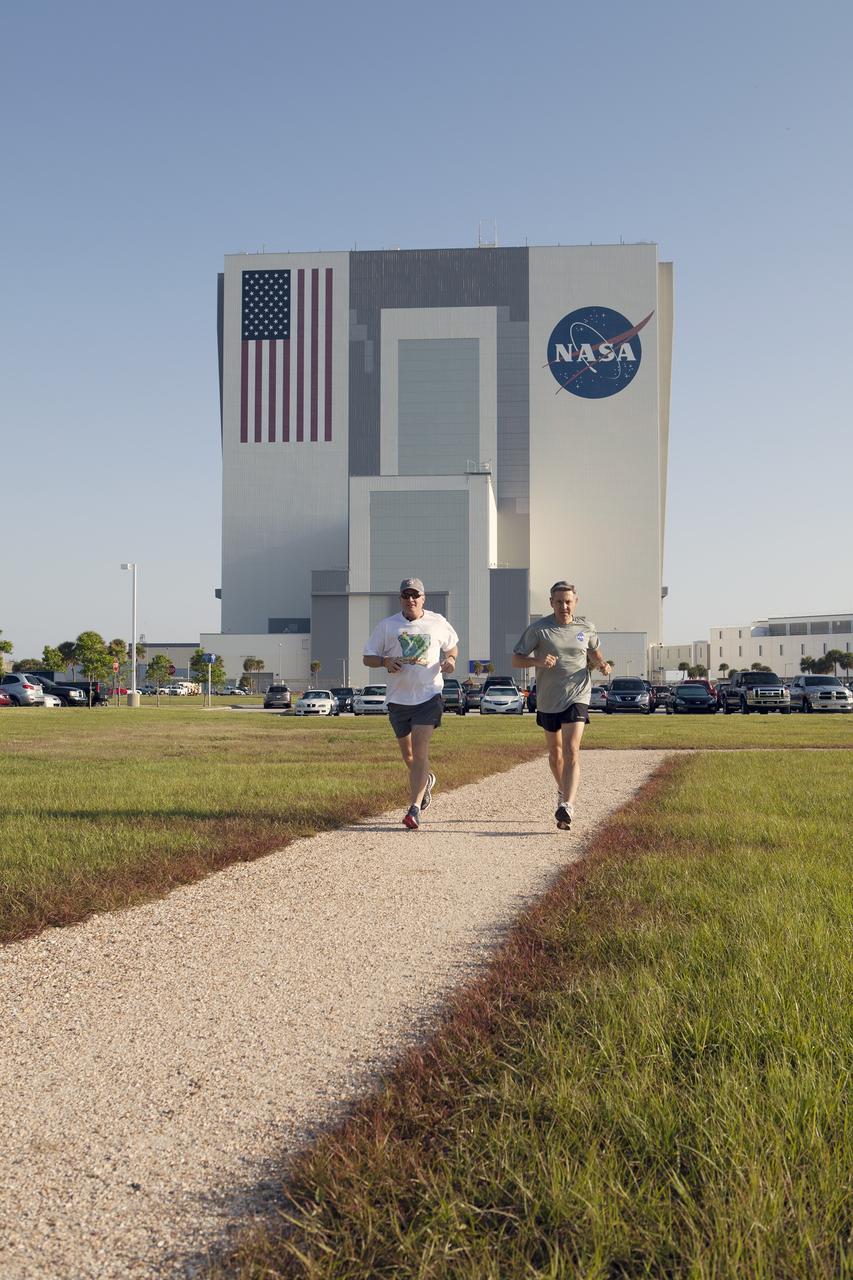
CAPE CANAVERAL, Fla. – Kennedy Space Center Director Bob Cabana, right, and Florida State Surgeon General John Armstrong begin an early morning run along the center's Pathfinder Trail near the Operations and Support Building II at Kennedy Space Center in Florida, to officially kick off National Employee Health and Fitness Month with the NASA Moves! challenge. NASA Moves! challenged the workforce from each of the agency's field centers to engage in at least 20 minutes of activity, or 10,000 steps, each day from May 18-31. About 100 people participated in the kickoff event on the Pathfinder Trail in the heart of the center's Launch Complex 39. The one-third-mile-long gravel walkway traces the iconic shape of a space shuttle orbiter and features a set of exercise stations. The friendly contest is part of NASA's new Health4Life initiative, a Web-based health initiative designed to help employees track their health, fitness and nutrition. Health4Life also provides an array of resources geared toward increasing physical activity. Photo credit: NASA/Dimitri Gerondidakis
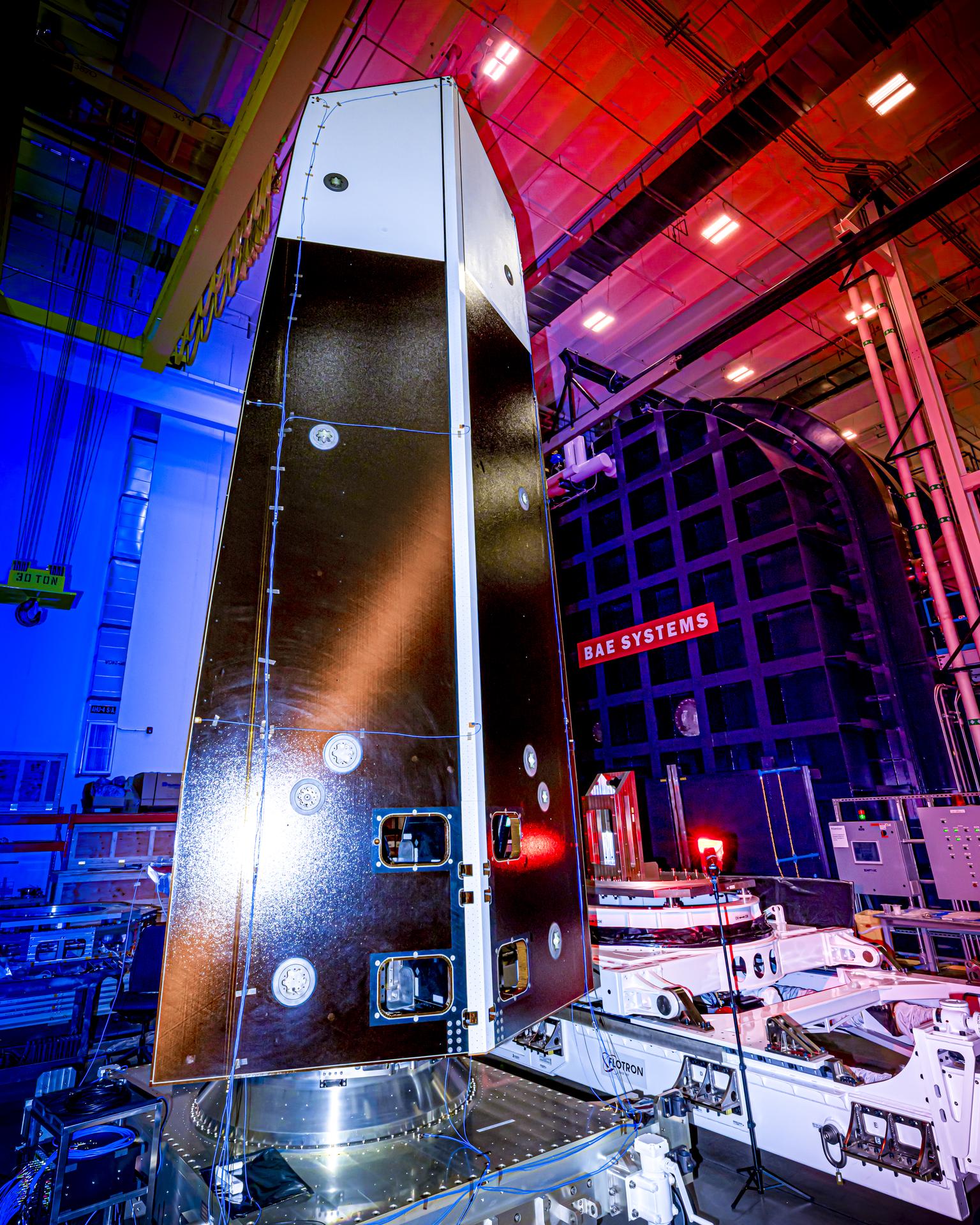
The bus structure for the Near-Earth Object (NEO) Surveyor spacecraft is installed to the sunshade during a “fit check” at BAE Systems Space & Mission Systems in Boulder, Colorado, in September 2025. This was the first time the two components were attached to one another. The sunshade is the largest component of the spacecraft, standing at over 20 feet (6 meters) high. The sunshade’s Sun-facing surface (visible here) will next be fitted with solar cells that will generate power for the spacecraft after launch. The spacecraft’s instrument enclosure, which houses the telescope and sensitive infrared cameras, will be located behind the sunshade, allowing the spacecraft to detect and track near-Earth objects that would otherwise be hidden by the Sun’s glare. Targeting launch in late 2027, the NEO Surveyor mission is led by Professor Amy Mainzer at the University of California, Los Angeles for NASA’s Planetary Defense Coordination Office and is being managed by the agency’s Jet Propulsion Laboratory in Southern California for the Planetary Missions Program Office at NASA’s Marshall Space Flight Center in Huntsville, Alabama. BAE Systems Space & Mission Systems and the Space Dynamics Laboratory in Logan, Utah, and Teledyne are among the companies that were contracted to build the spacecraft and its instrumentation. The Laboratory for Atmospheric and Space Physics at the University of Colorado Boulder will support operations, and IPAC at Caltech in Pasadena, California, is responsible for producing some of the mission’s data products. Caltech manages JPL for NASA. More information about NEO Surveyor is available at: https://science.nasa.gov/mission/neo-surveyor/
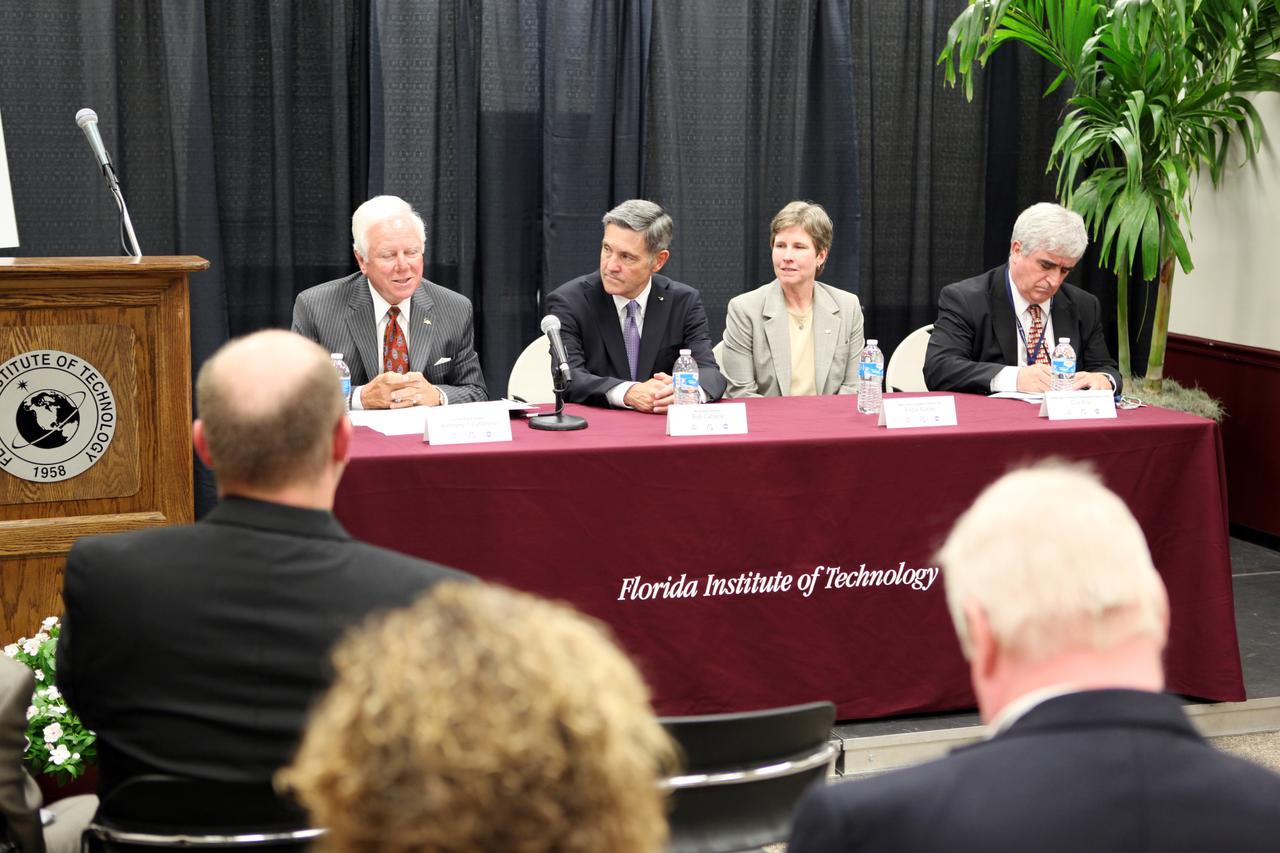
International Space University Opening Ceremony, with Lori Garver speech and Bob Cabana's Press Conference
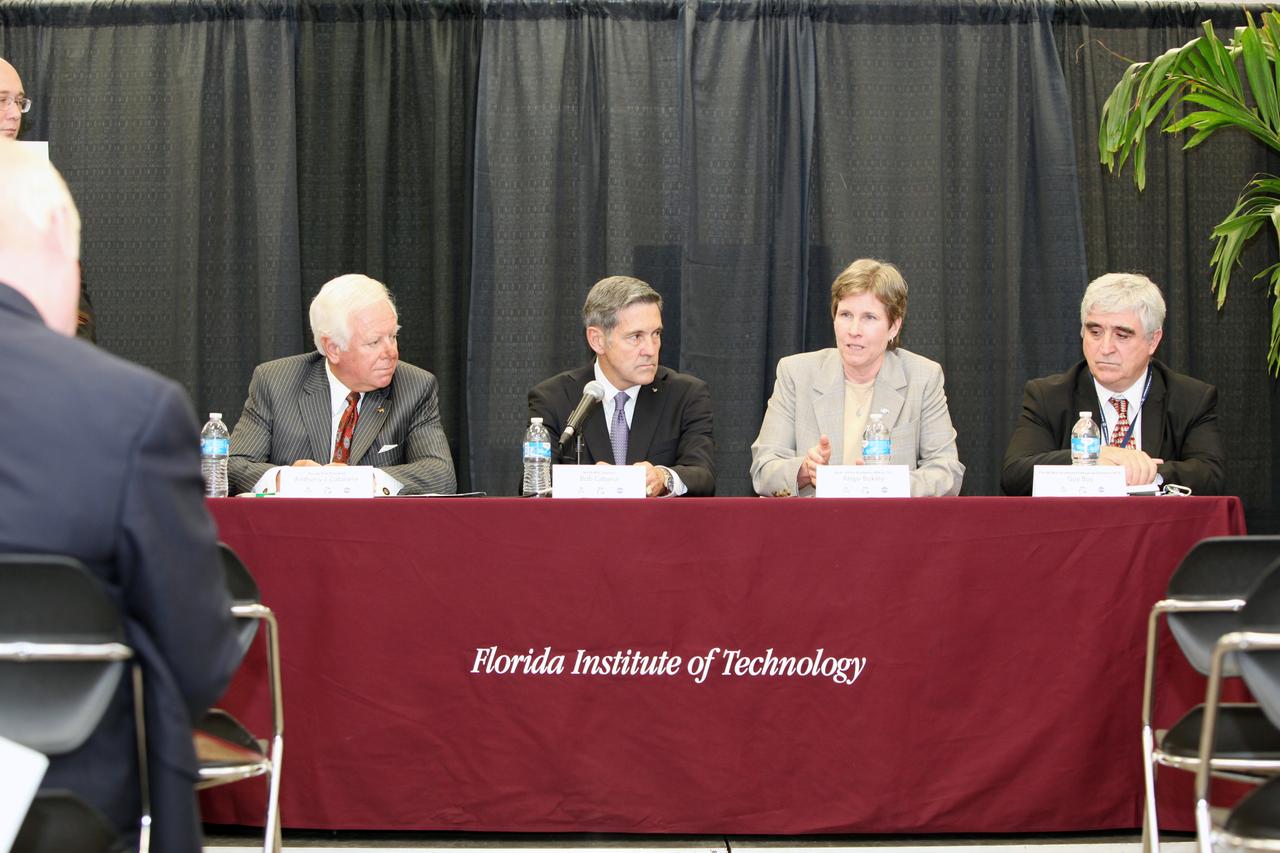
International Space University Opening Ceremony, with Lori Garver speech and Bob Cabana's Press Conference
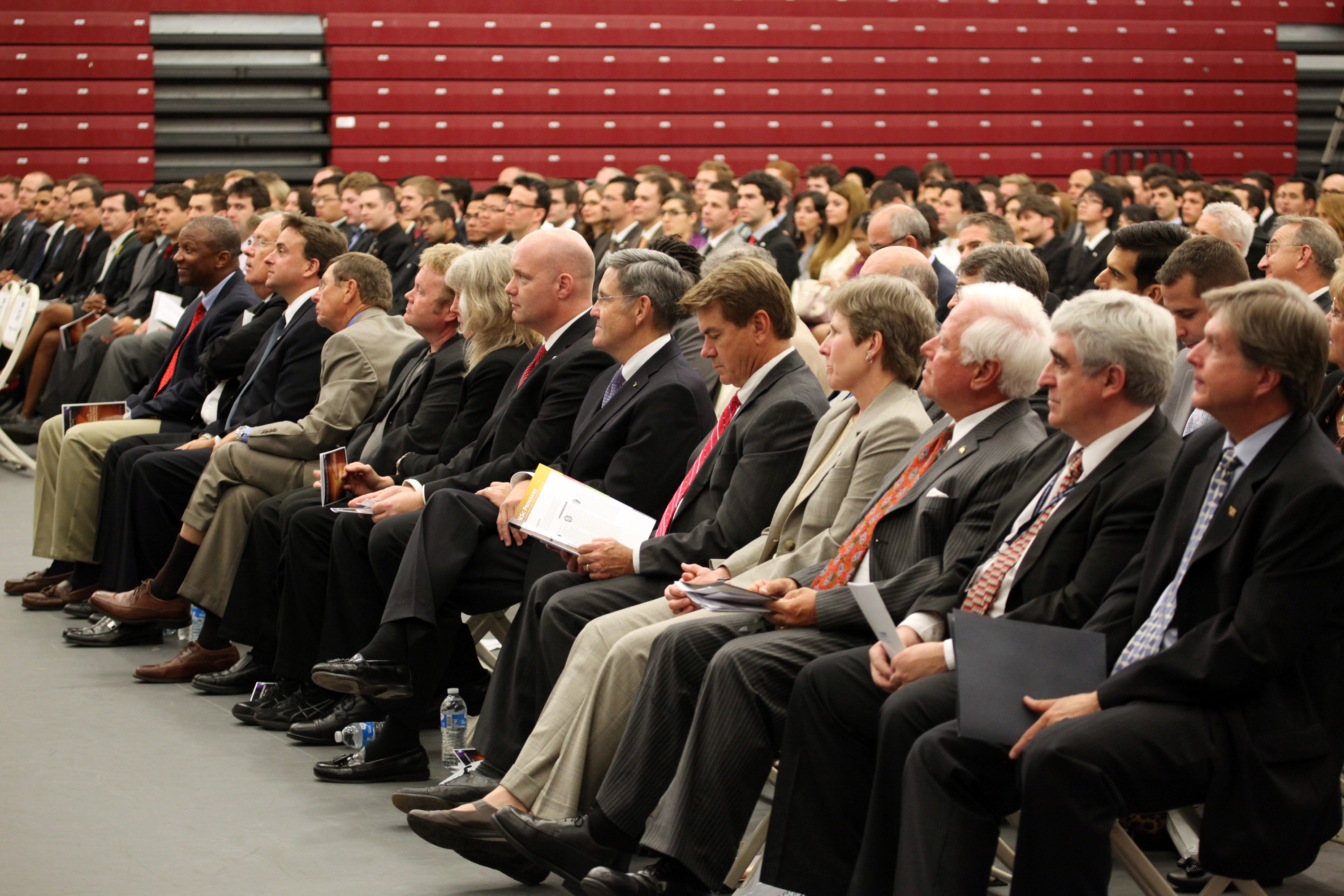
International Space University Opening Ceremony, with Lori Garver speech and Bob Cabana's Press Conference
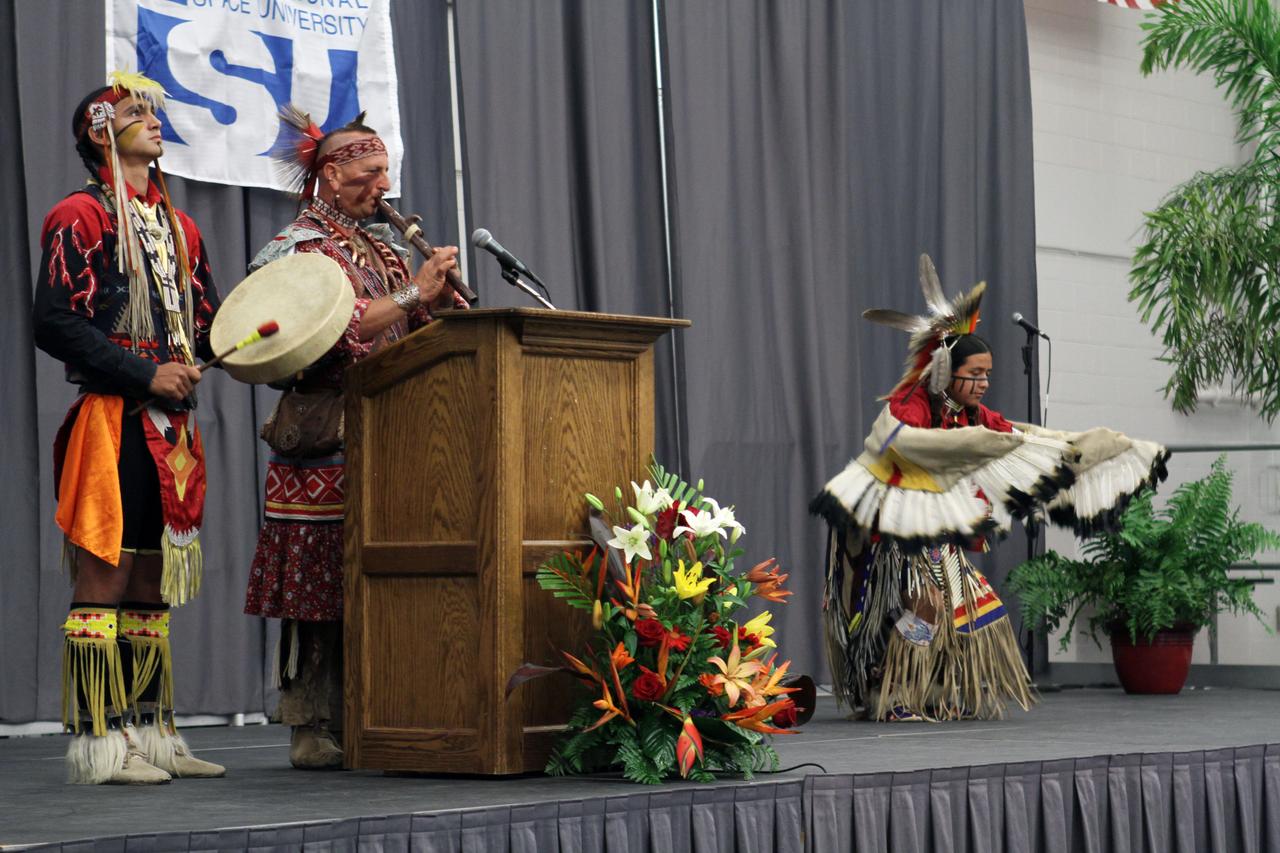
International Space University Opening Ceremony & Group Shot
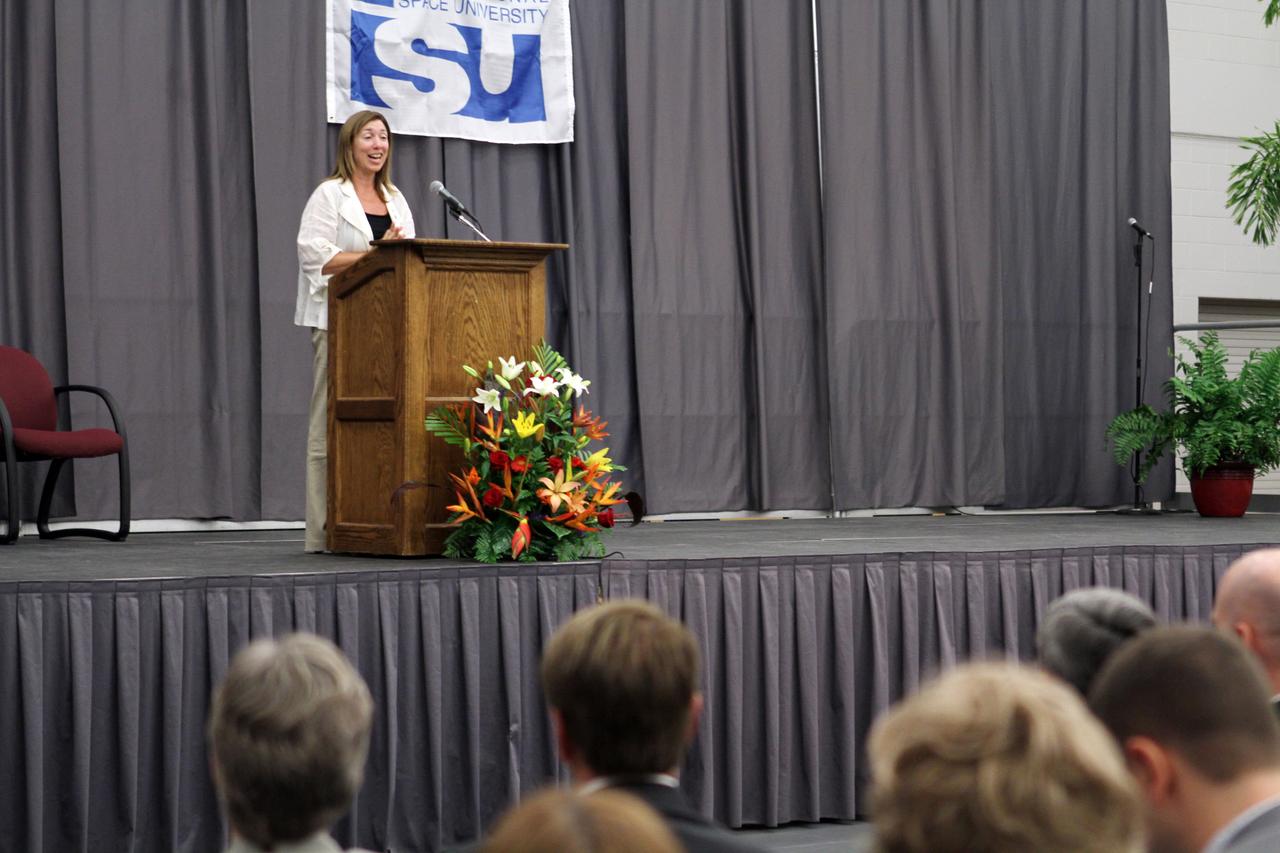
International Space University Opening Ceremony & Group Shot
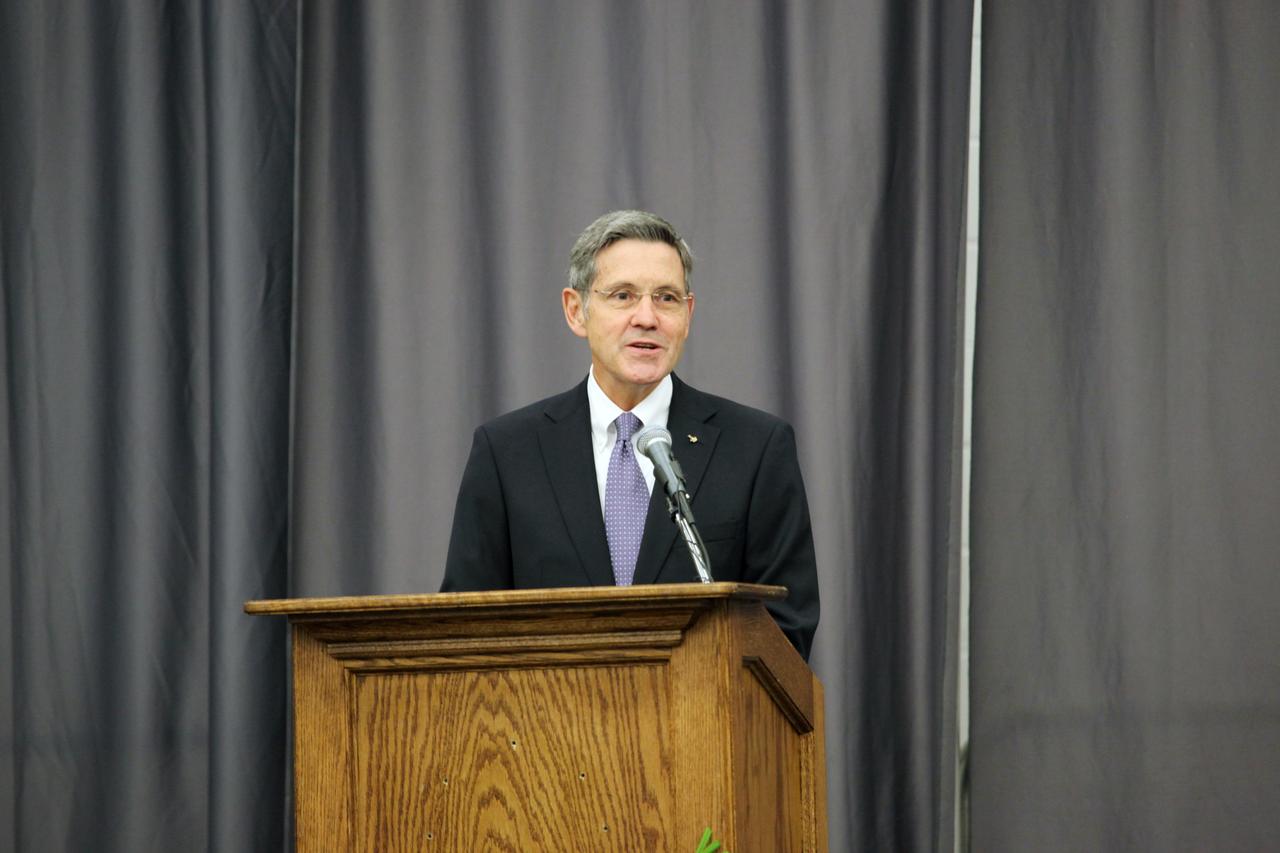
International Space University Opening Ceremony, with Lori Garver speech and Bob Cabana's Press Conference
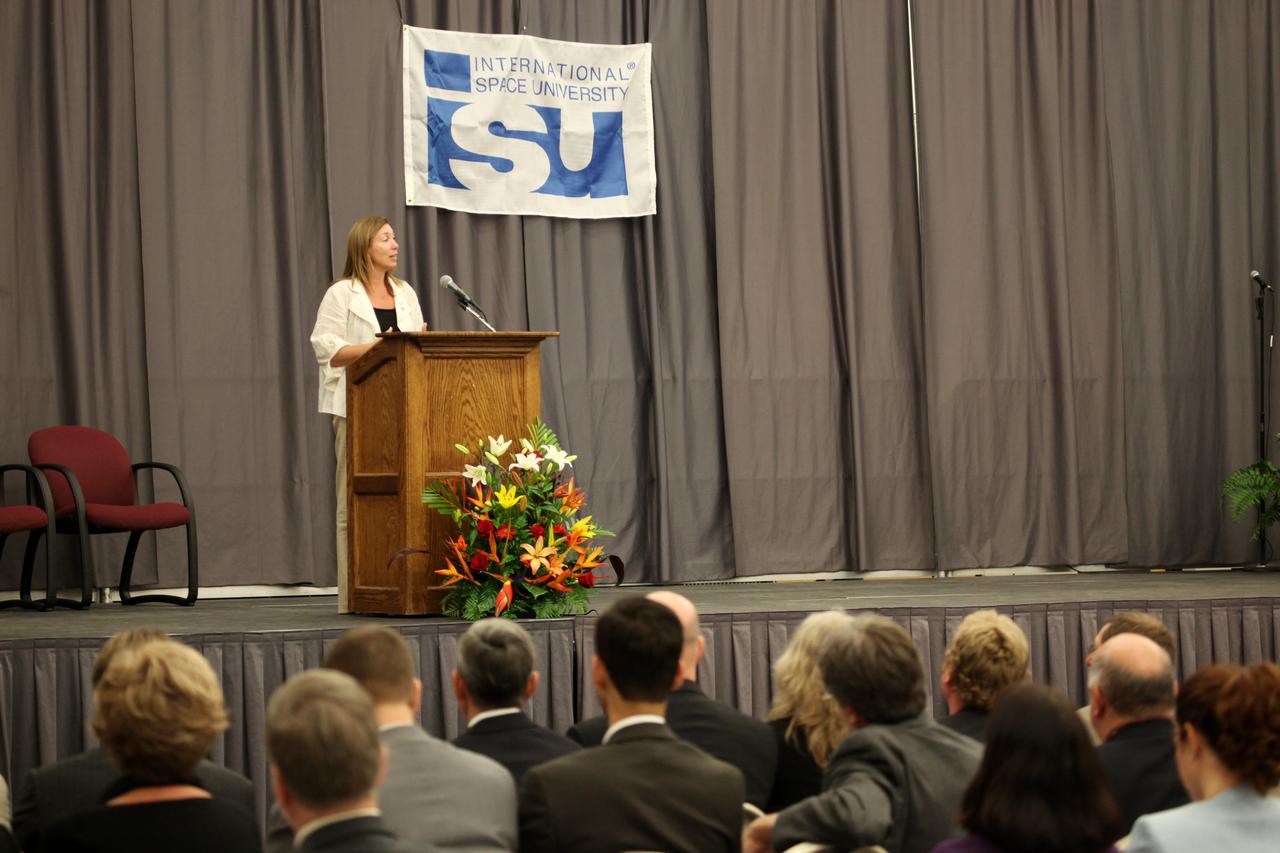
International Space University Opening Ceremony, with Lori Garver speech and Bob Cabana's Press Conference
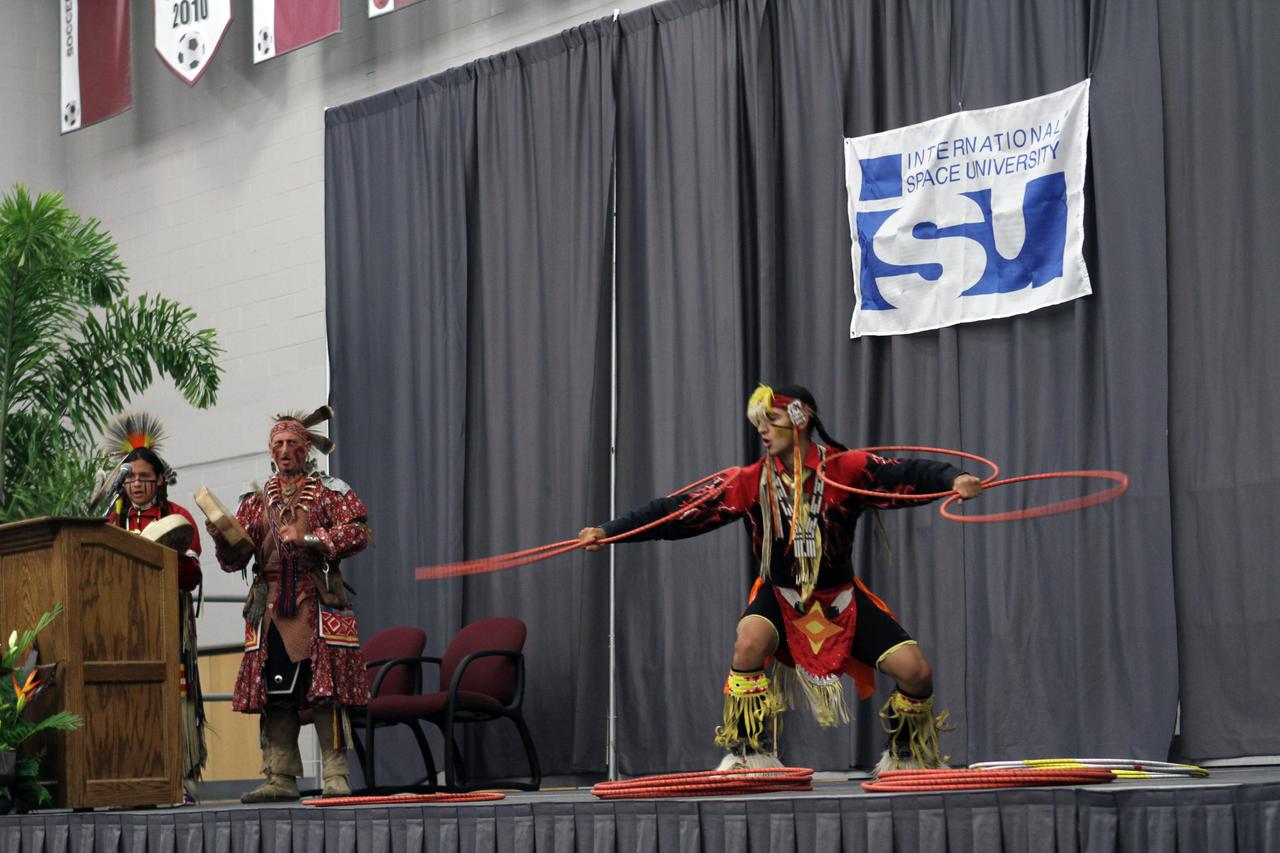
International Space University Opening Ceremony & Group Shot
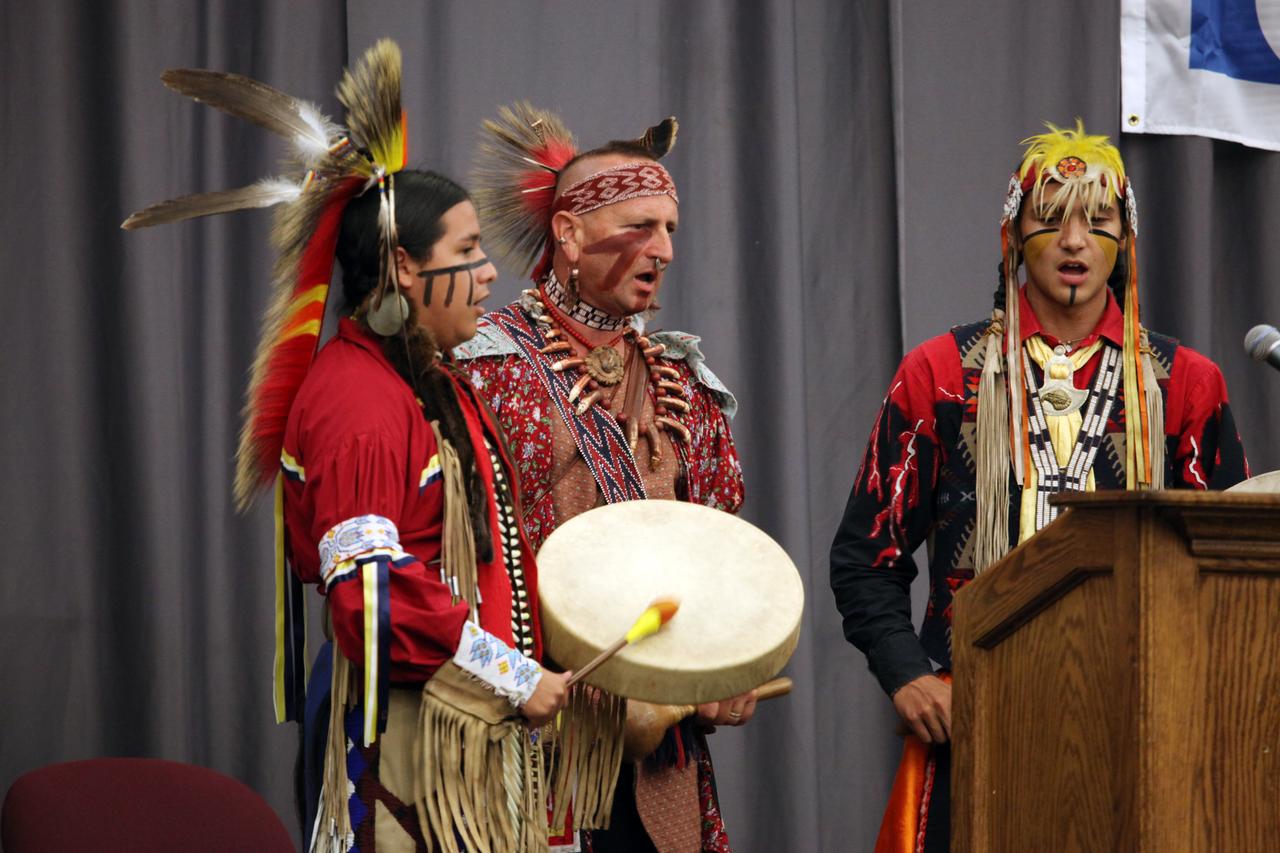
International Space University Opening Ceremony, with Lori Garver speech and Bob Cabana's Press Conference
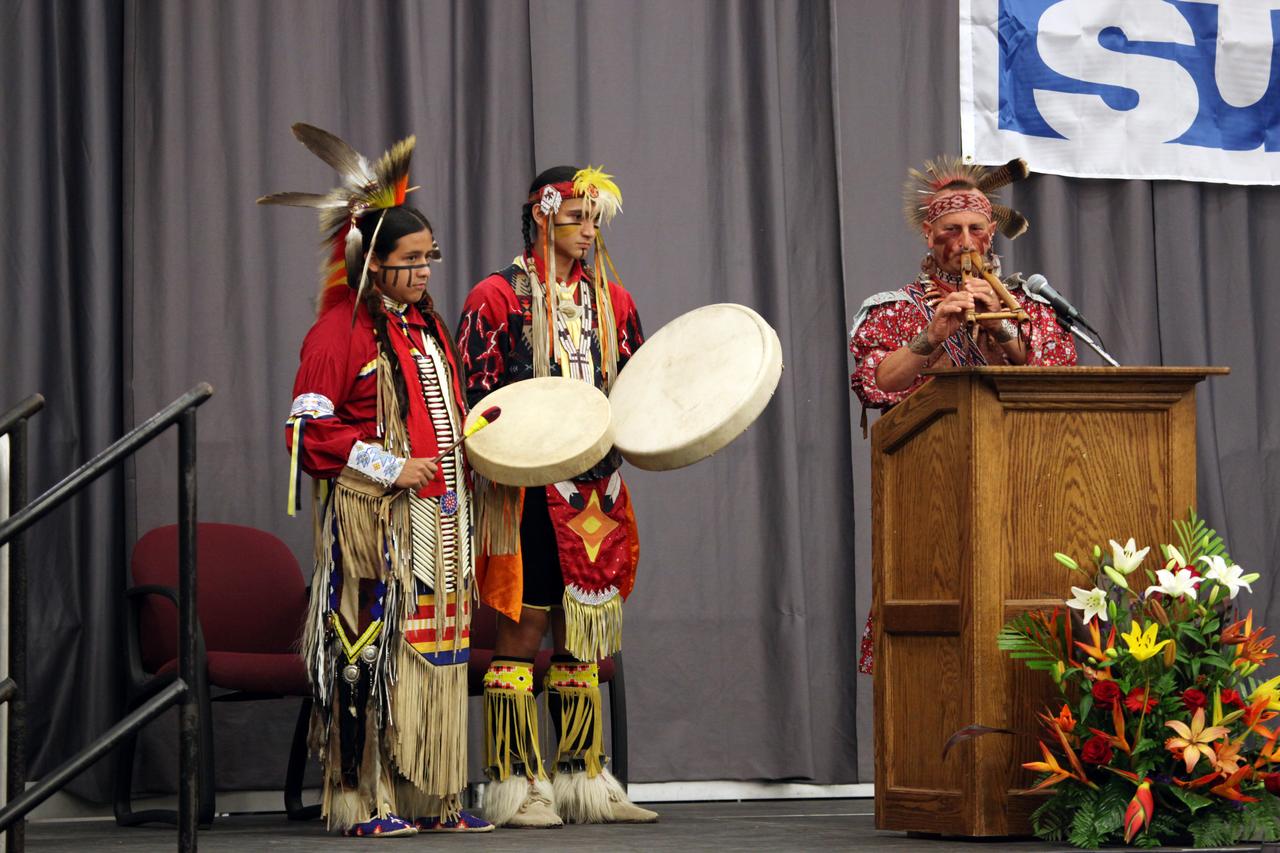
International Space University Opening Ceremony, with Lori Garver speech and Bob Cabana's Press Conference
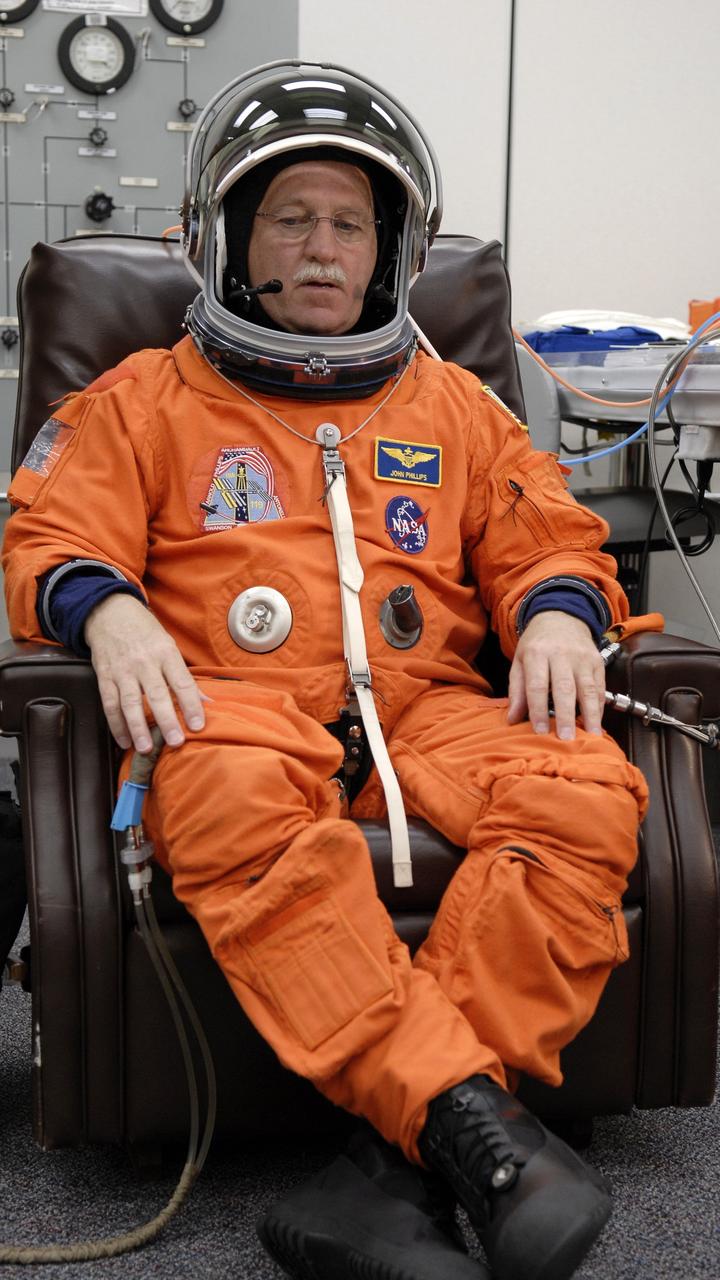
CAPE CANAVERAL, Fla. – In the Operations and Checkout Building at NASA's Kennedy Space Center in Florida, STS-119 Mission Specialist John Phillips has a final fitting of his launch and entry suit and the helmet. Phillips is making his third shuttle flight. The 14-day mission is the 28th to the International Space Station and the 125th space shuttle flight. Discovery will deliver the final pair of power-generating solar array wings and the S6 truss segment. Installation of S6 will signal the station's readiness to house a six-member crew for conducting increased science. Liftoff of Discovery is scheduled for 9:20 p.m. EDT on March 11. Photo credit: NASA/Kim Shiflett
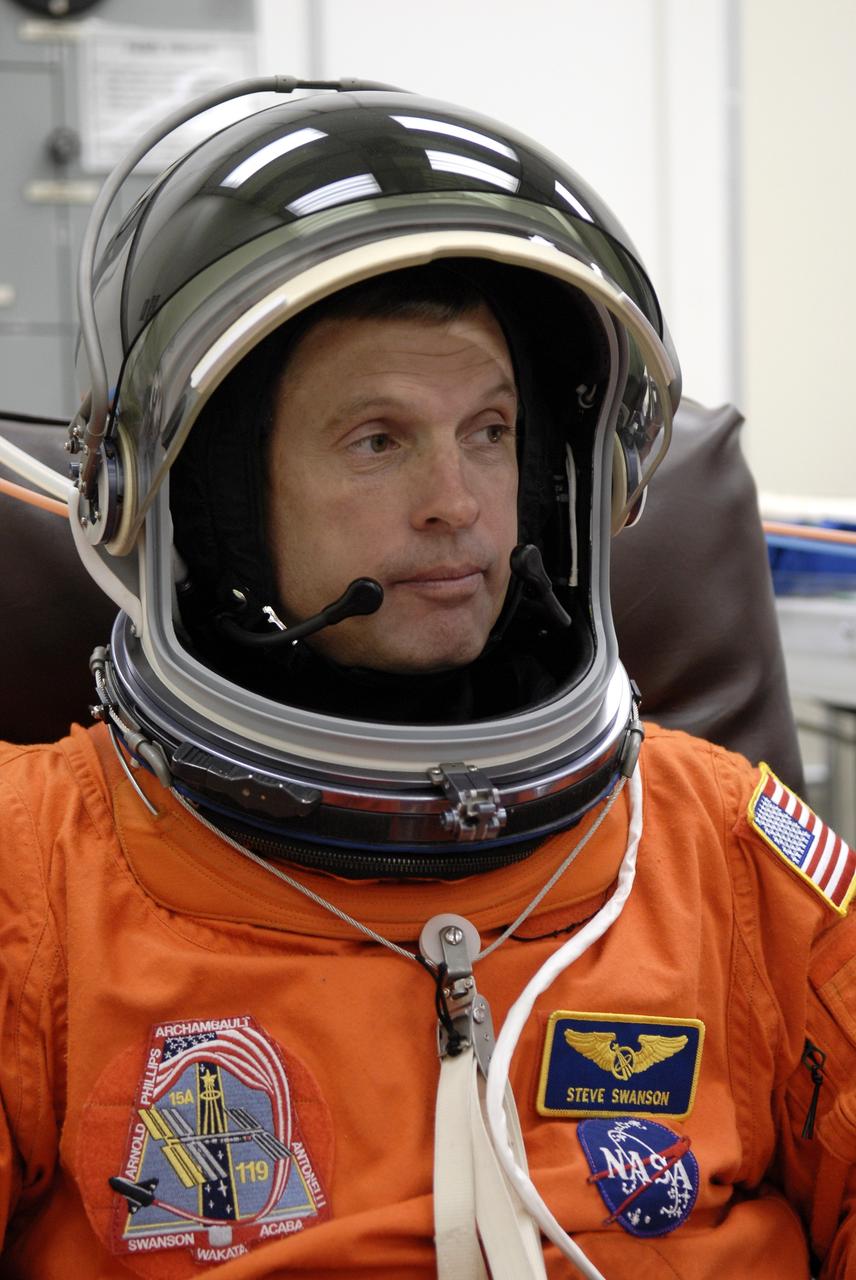
CAPE CANAVERAL, Fla. – In the Operations and Checkout Building at NASA's Kennedy Space Center in Florida, STS-119 Mission Specialist Steve Swanson has the final fitting of his launch and entry suit. Swanson is making his second shuttle flight. The 14-day mission is the 28th to the International Space Station and the 125th space shuttle flight. Discovery will deliver the final pair of power-generating solar array wings and the S6 truss segment. Installation of S6 will signal the station's readiness to house a six-member crew for conducting increased science. Liftoff of Discovery is scheduled for 9:20 p.m. EDT on March 11. Photo credit: NASA/Kim Shiflett
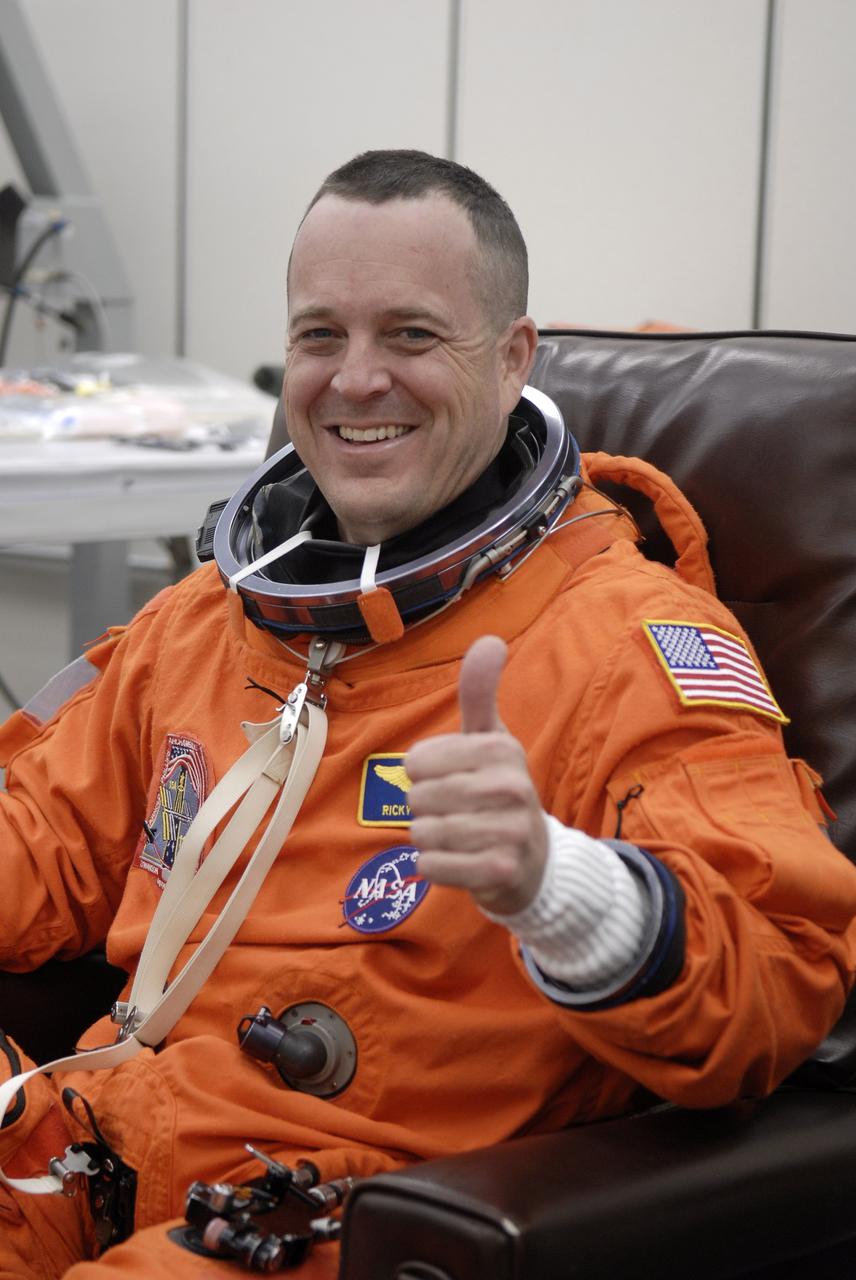
CAPE CANAVERAL, Fla. – In the Operations and Checkout Building at NASA's Kennedy Space Center in Florida, STS-119 Mission Specialist Richard Arnold signals he is ready for launch during the final fitting of his launch and entry suit. Arnold is making his first shuttle flight. The 14-day mission is the 28th to the International Space Station and the 125th space shuttle flight. Discovery will deliver the final pair of power-generating solar array wings and the S6 truss segment. Installation of S6 will signal the station's readiness to house a six-member crew for conducting increased science. Liftoff of Discovery is scheduled for 9:20 p.m. EDT on March 11. Photo credit: NASA/Kim Shiflett
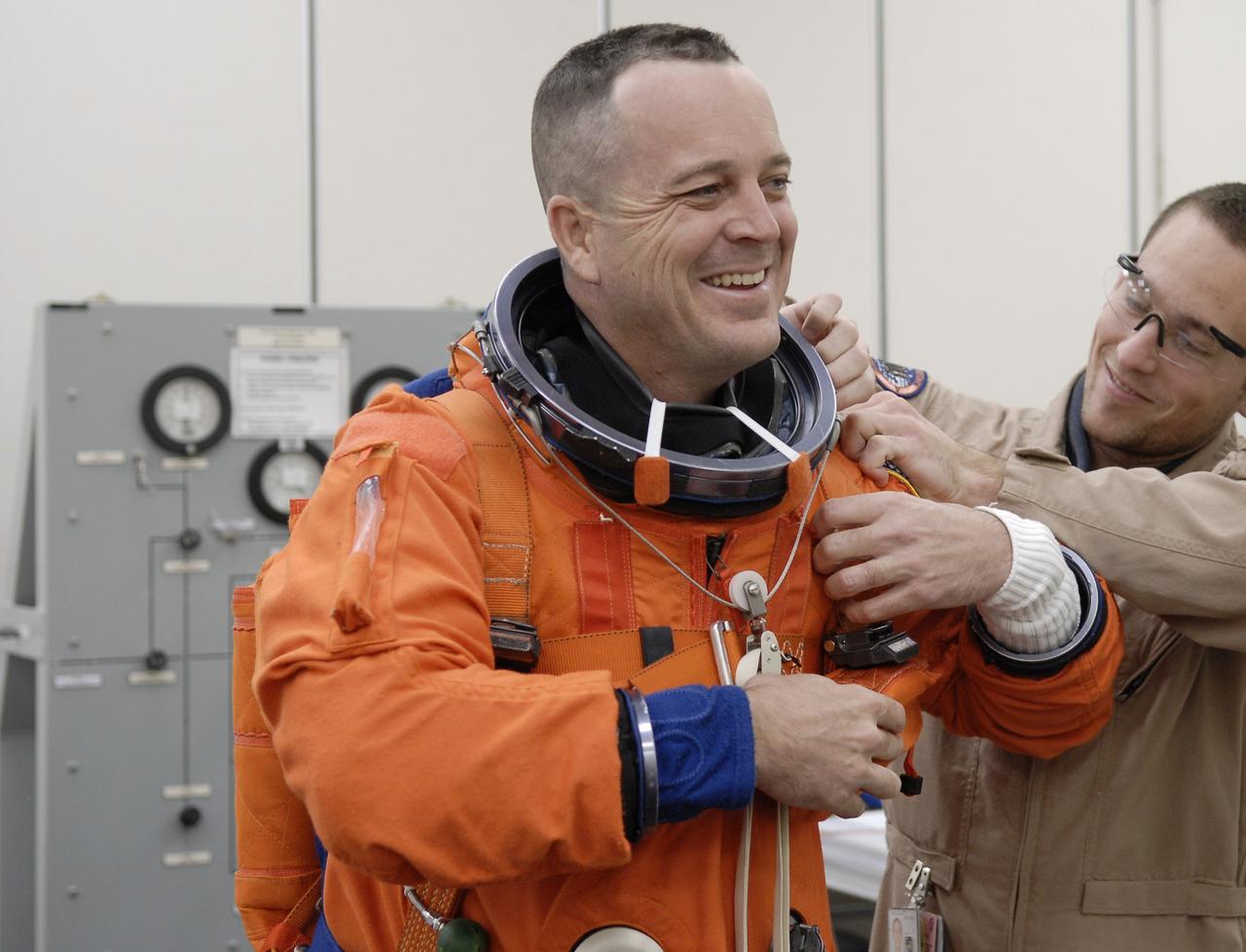
CAPE CANAVERAL, Fla. – In the Operations and Checkout Building at NASA's Kennedy Space Center in Florida, STS-119 Mission Specialist Richard Arnold gets help from a suit technician in the final fitting of his launch and entry suit. Arnold will be making his first shuttle flight. The 14-day mission is the 28th to the International Space Station and the 125th space shuttle flight. Discovery will deliver the final pair of power-generating solar array wings and the S6 truss segment. Installation of S6 will signal the station's readiness to house a six-member crew for conducting increased science. Liftoff of Discovery is scheduled for 9:20 p.m. EDT on March 11. Photo credit: NASA/Kim Shiflett
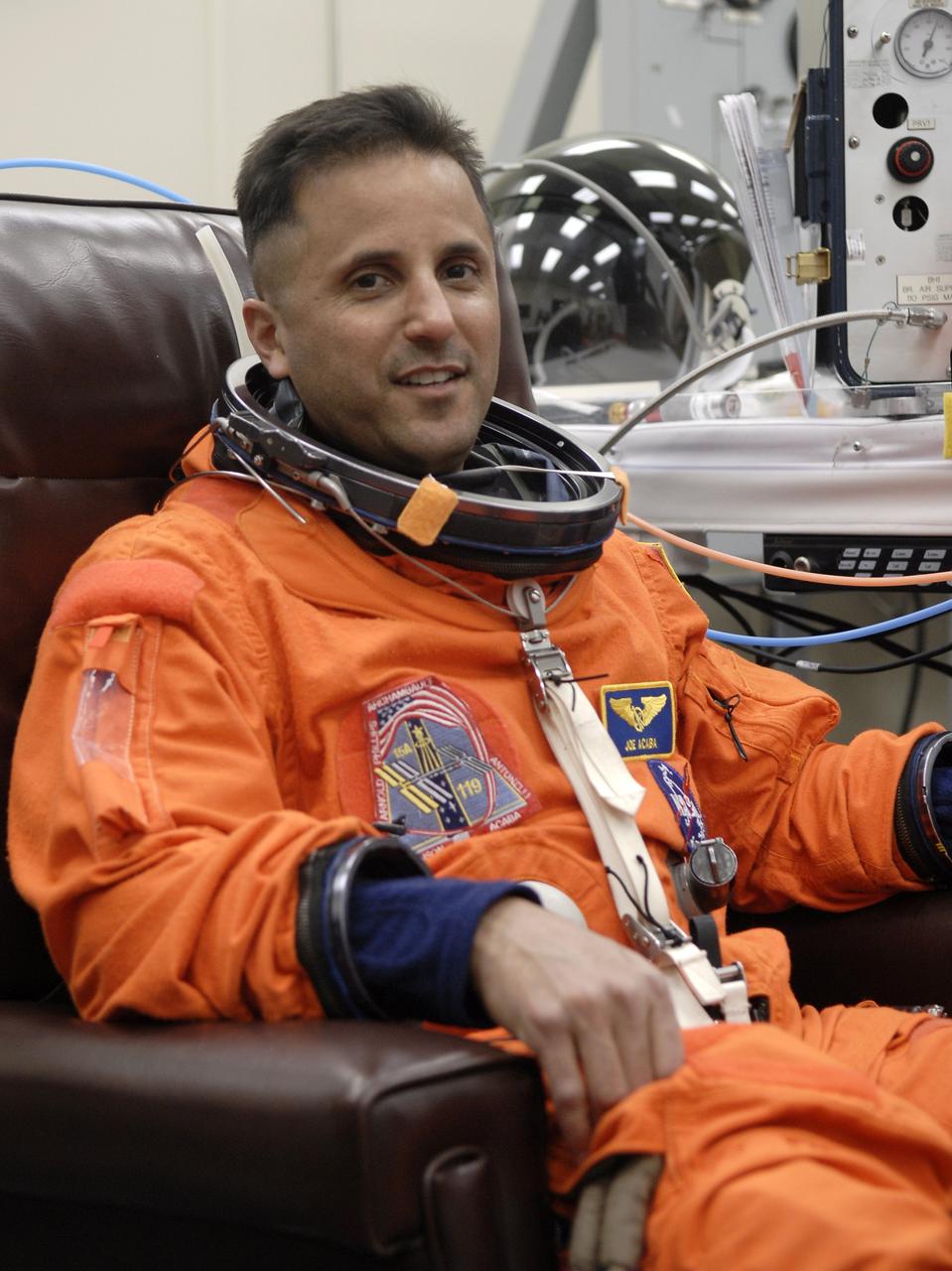
CAPE CANAVERAL, Fla. – – In the Operations and Checkout Building at NASA's Kennedy Space Center in Florida, STS-119 Mission Specialist Joseph Acaba has a final fitting of his launch and entry suit. Acaba is making his first shuttle flight. The 14-day mission is the 28th to the International Space Station and the 125th space shuttle flight. Discovery will deliver the final pair of power-generating solar array wings and the S6 truss segment. Installation of S6 will signal the station's readiness to house a six-member crew for conducting increased science. Liftoff of Discovery is scheduled for 9:20 p.m. EDT on March 11. Photo credit: NASA/Kim Shiflett
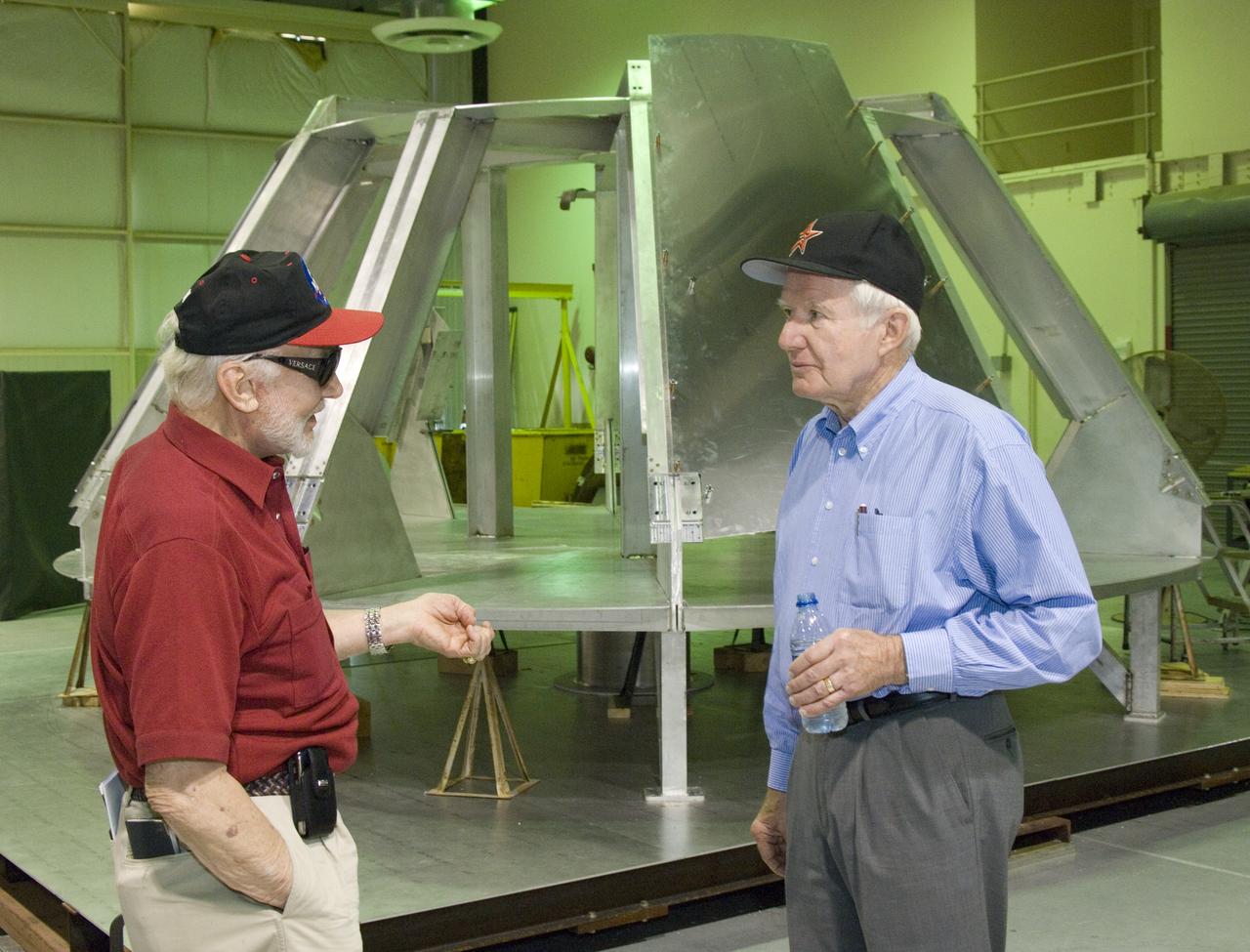
Apollo 11 astronaut Buzz Aldrin (left) and Apollo-Soyuz and space shuttle astronaut Vance Brand discuss Dryden's work on an Orion fit-check crew module mockup.
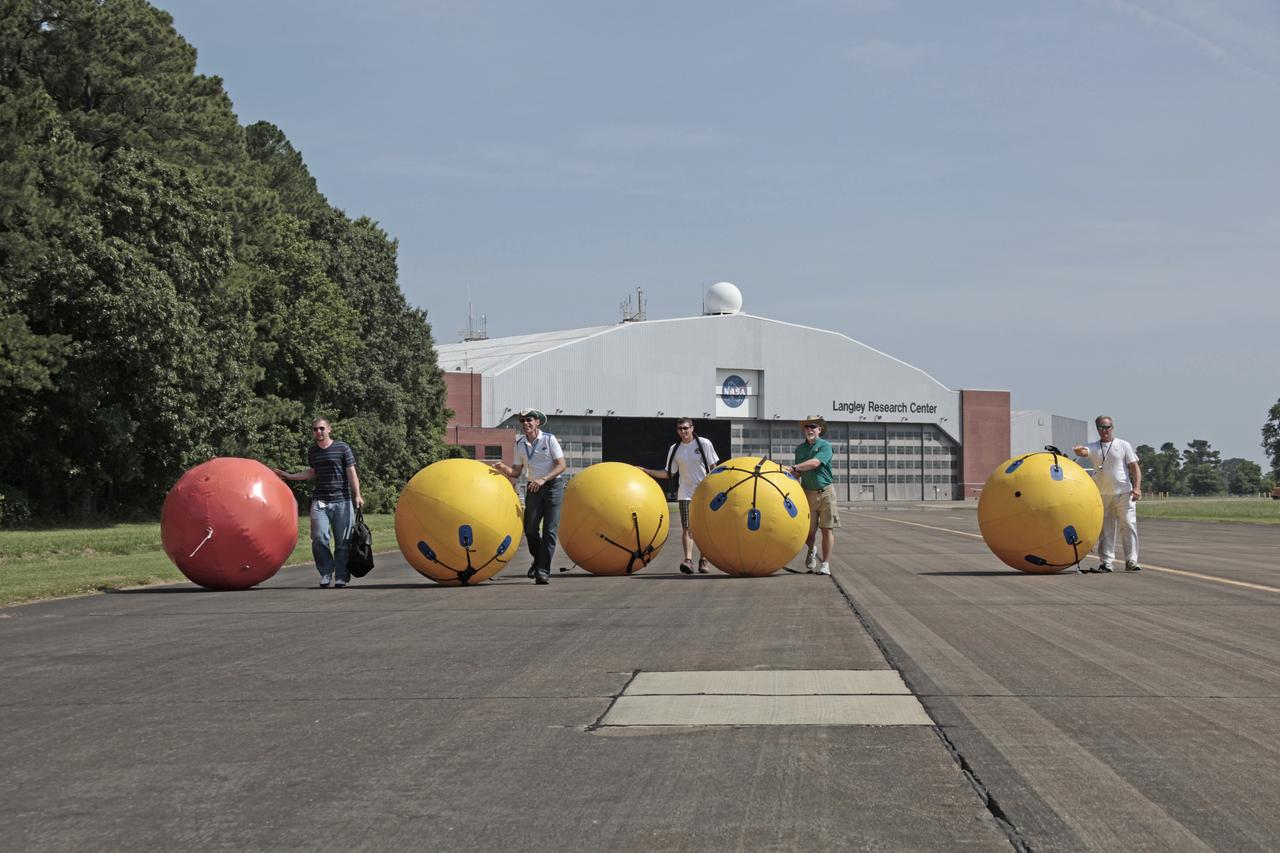
Engineers and technicians from NASA Langley Research Center in Virginia, Kennedy Space Center in Florida and Lockheed Martin in Colorado conduct a fit check on the Orion Crew Module at NASA Langley
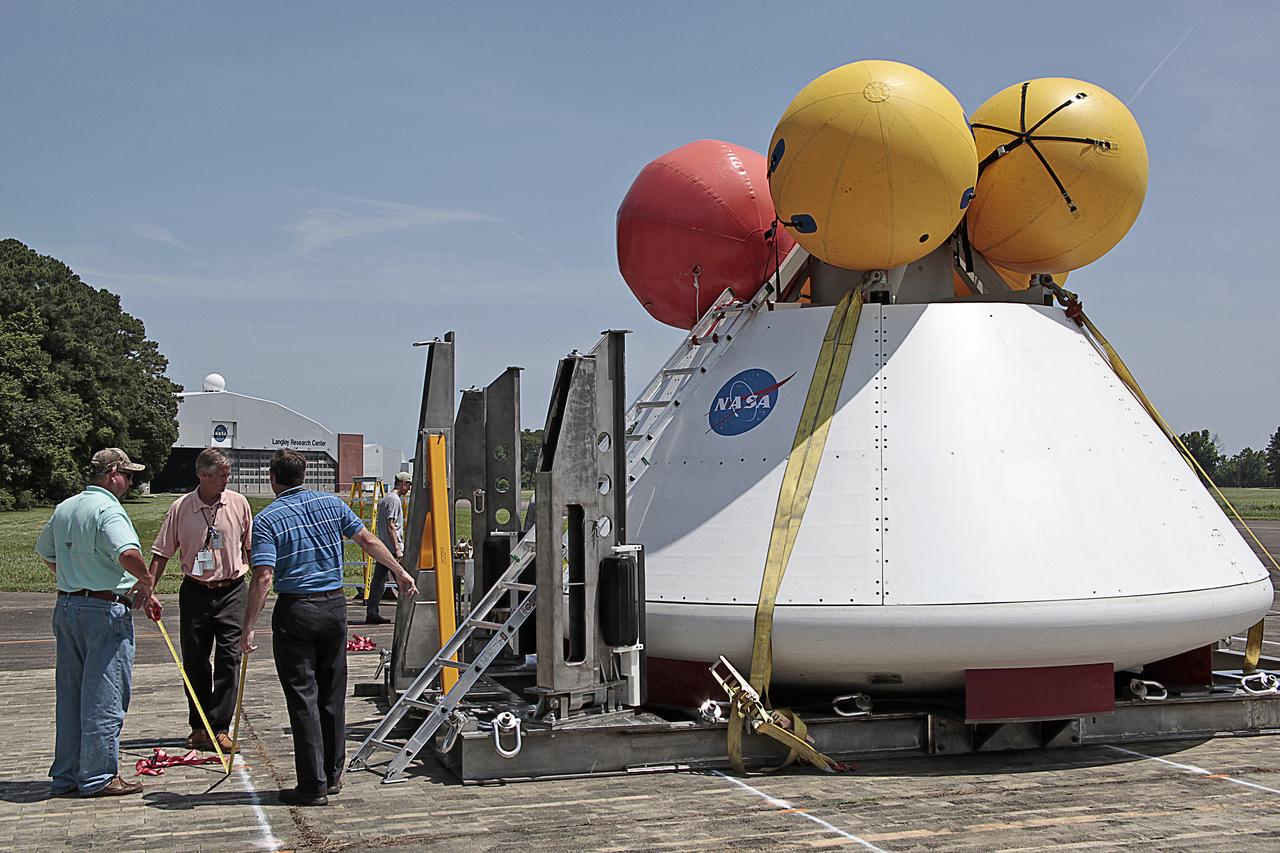
Engineers and technicians from NASA Langley Research Center in Virginia, Kennedy Space Center in Florida and Lockheed Martin in Colorado conduct a fit check on the Orion Crew Module at NASA Langley
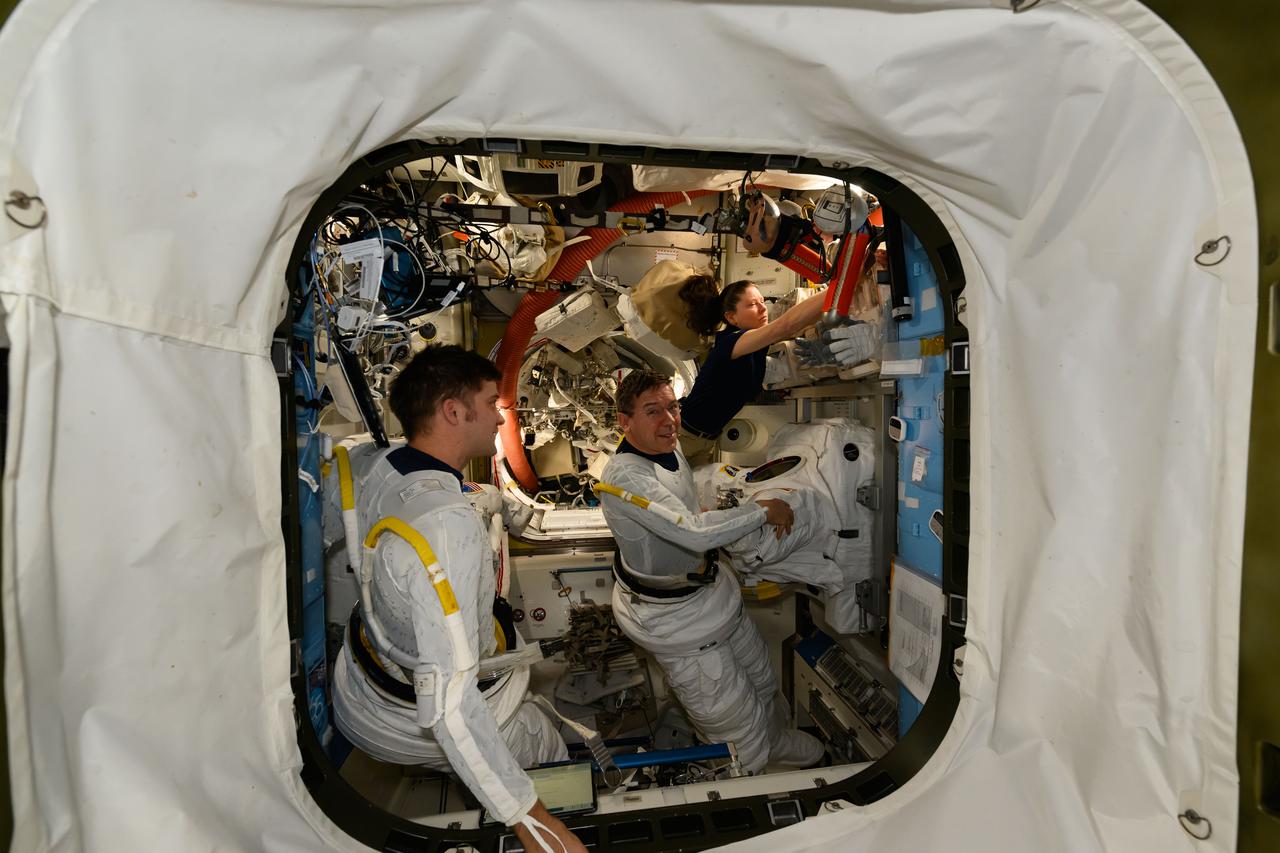
iss071e178108 (June 5, 2024) --- Expedition 71 Flight Engineers Matthew Dominick (left) and Mike Barratt (right), both NASA astronauts, prepare for a spacesuit fit check inside the International Space Station's Quest airlock.
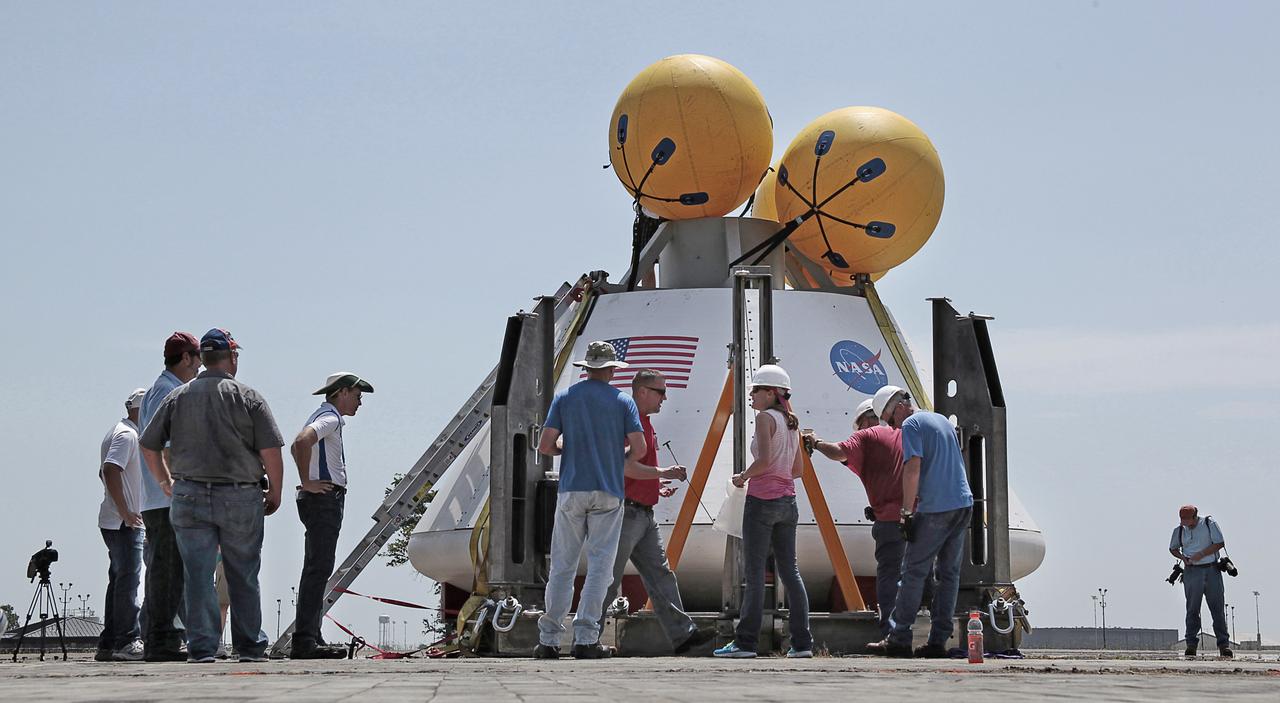
Engineers and technicians from NASA Langley Research Center in Virginia, Kennedy Space Center in Florida and Lockheed Martin in Colorado conduct a fit check on the Orion Crew Module at NASA Langley
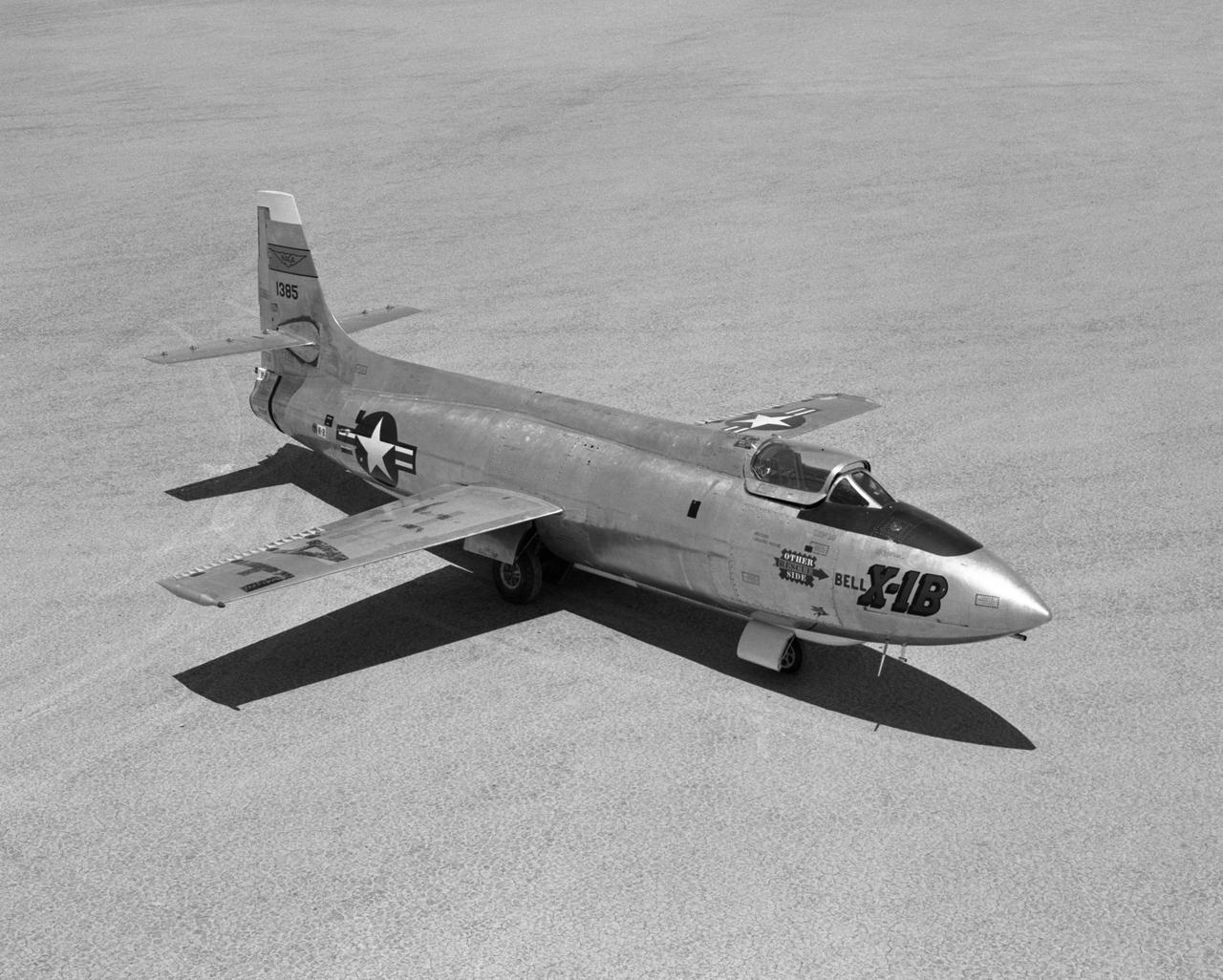
Bell X-1B fitted with a reaction control system on the lakebed
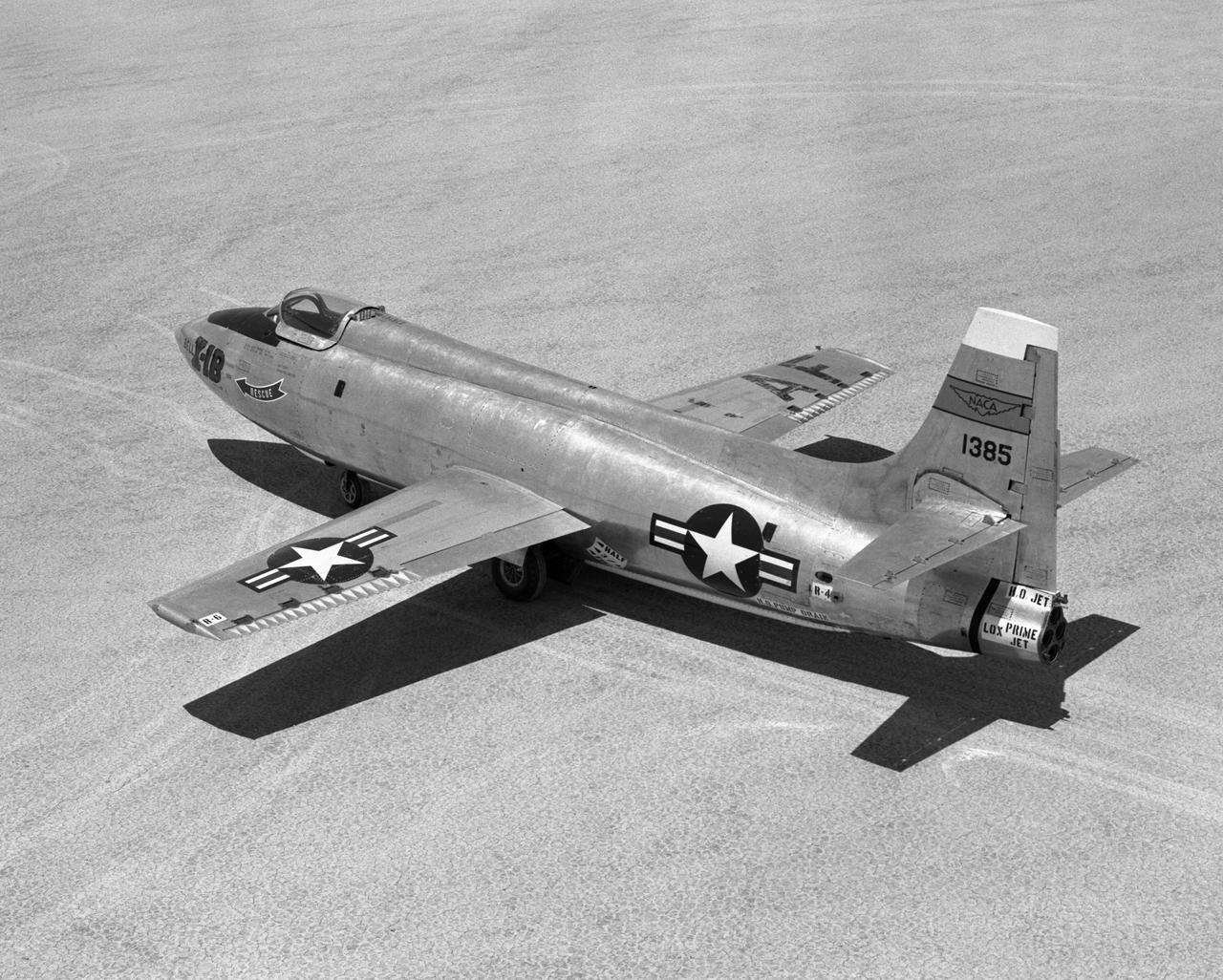
Bell X-1B fitted with a reaction control system on the lakebed.
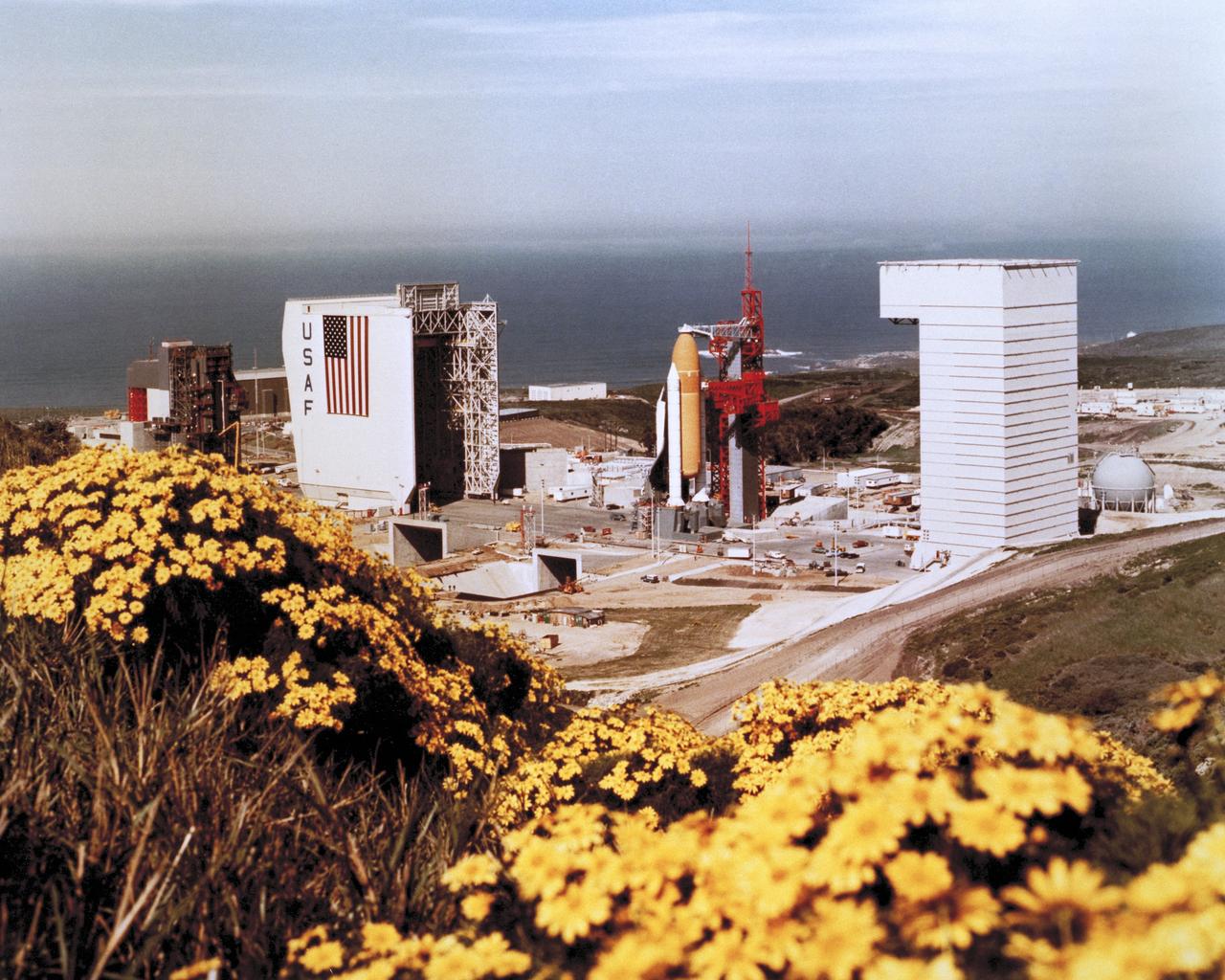
VANDENBERG AIR FORCE BASE, Calif. -- At Vandenberg Air Force Base in the early '80s, the Space Shuttle Enterprise undergoes Pathfinder fit checks at a tower. The Enterprise was built as a test vehicle and was not equipped for spaceflight. Enterprise eventually became the property of the Smithsonian Institution. Vandenberg AFB is located on the Central Coast of California about 150 miles northwest of Los Angeles. The property is comprised of parts of five Mexican land grants and a sixth grant that was transferred virtually intact to the Army. Vandenberg now is operated by the 30th Space Wing, and is the only military installation in the United States from which unmanned government and commercial satellites are launched into polar orbit. It is also the only site from which intercontinental ballistic missiles ICBMs are launched toward the Kwajalein Atoll to verify weapon systems performance. Vandenberg's military service dates back to 1941, when known as Camp Cooke it served as an Army training facility for armored and infantry troops. The main camp closed in June 1946 and was reactivated in August 1950 after the outbreak of the Korean War. The 13th and 20th Armored Divisions and the 40th, 44th, 86th, and 91st Infantry Divisions trained at Cooke. With the advent of the missile age in the 1950s, the Air Force persuaded Secretary of Defense Charles E. Wilson to direct the Army to transfer 64,000 acres of North Camp Cooke to the Air Force for use as a missile launch and training base. In 1958, Camp Cooke was renamed Vandenberg Air Force Base in honor of the late General Hoyt S. Vandenberg, second Air Force Chief of Staff of the United States Air Force and chief architect of today's modern Air Force. Photo Credit: NASA
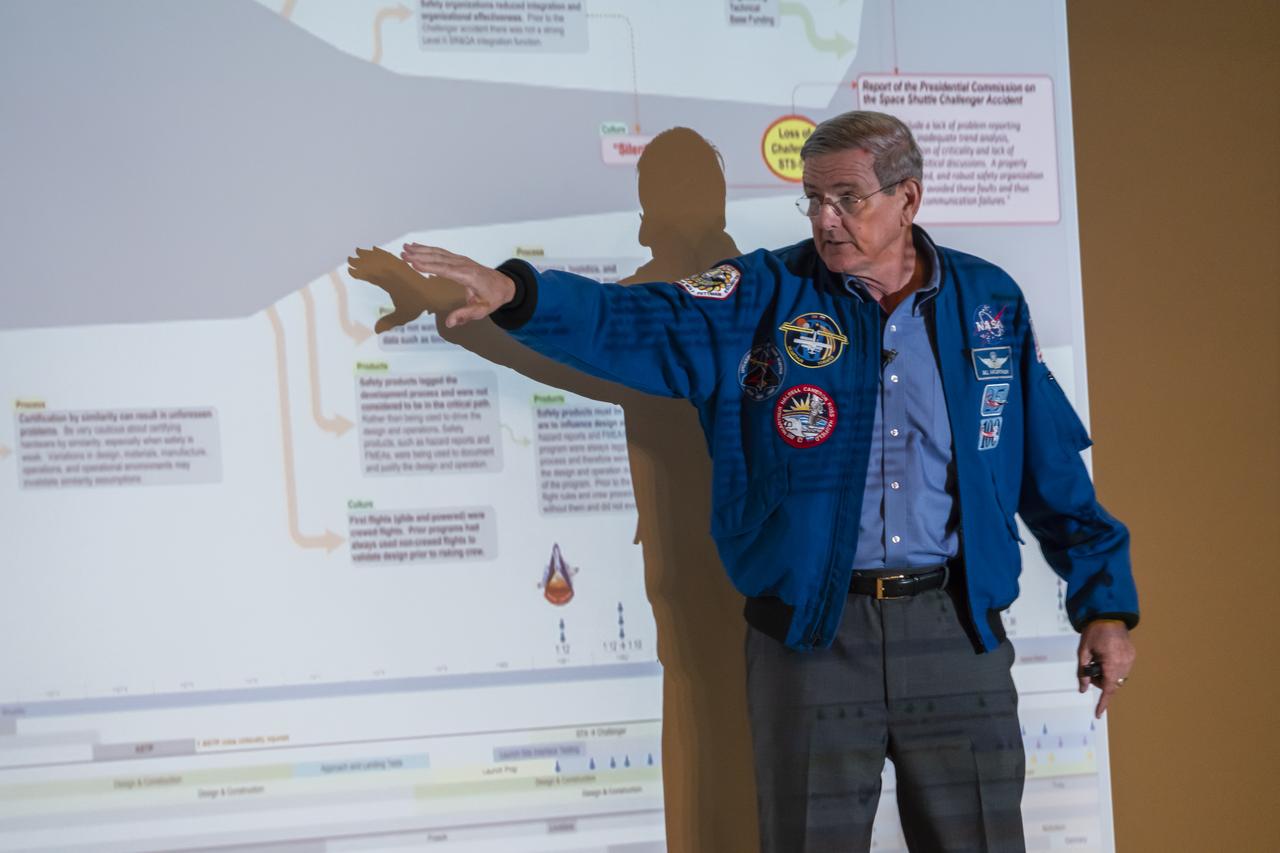
The 2018 Marshall Space Flight Center Safety Day event was held in buildings 4200, 4315, and 4316. MSFC employees enjoyed safety related panel discussions, vendor exhibits, fire safety demonstrations, and fitness classes in the fitness building. Former NASA astronaut Bill McArthur discusses safety in the workplace during his address to Marshall team members Oct. 31. McArthur was the keynote speaker at Marshall's 2018 Safety Day.
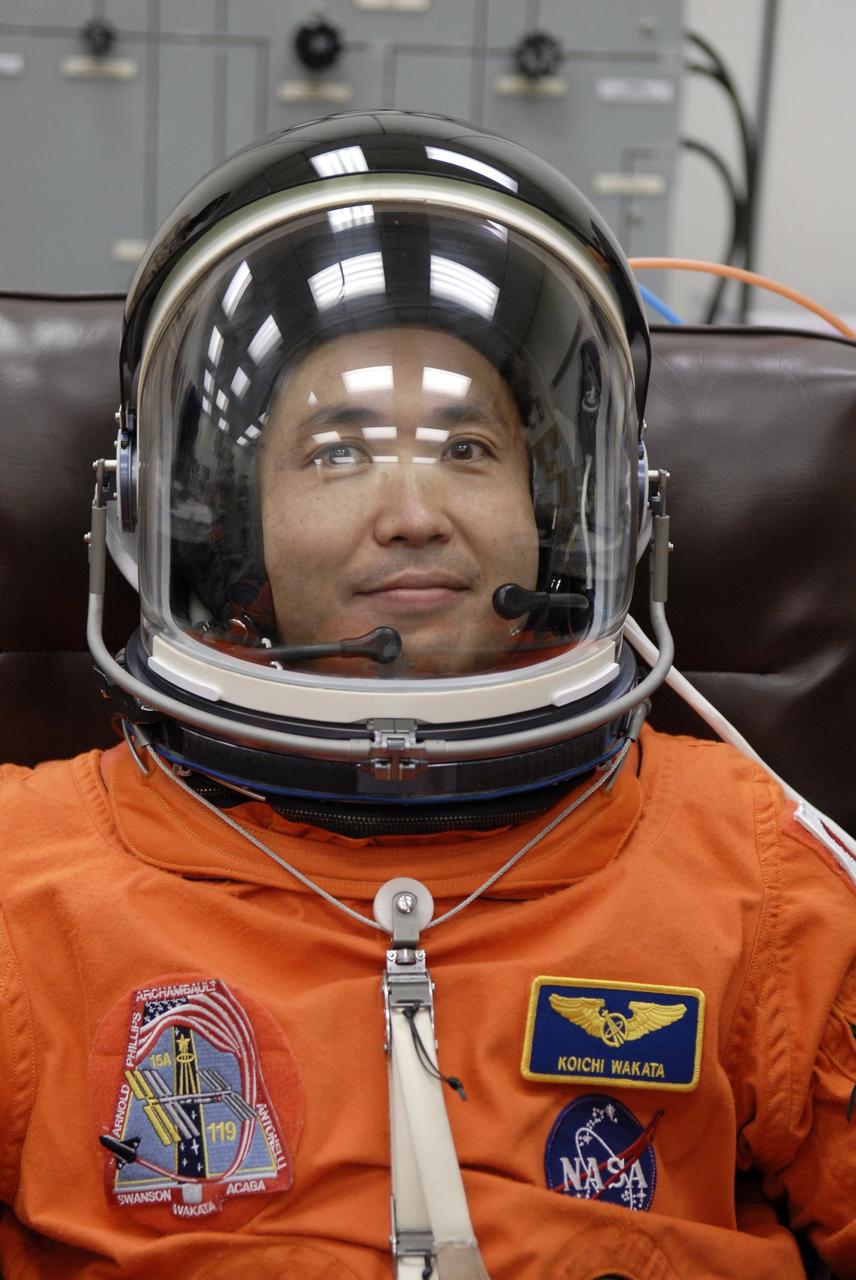
CAPE CANAVERAL, Fla. – In the Operations and Checkout Building at NASA's Kennedy Space Center in Florida, STS-119 Mission Specialist Koichi Wakata puts on his helmet as part of the final fitting of his launch and entry suit. Wakata is making his third shuttle flight. He will remain on the station, replacing Expedition 18 Flight Engineer Sandra Magnus, who returns to Earth with the STS-119 crew. The 14-day mission is the 28th to the International Space Station and the 125th space shuttle flight. Discovery will deliver the final pair of power-generating solar array wings and the S6 truss segment. Installation of S6 will signal the station's readiness to house a six-member crew for conducting increased science. Liftoff of Discovery is scheduled for 9:20 p.m. EDT on March 11. Photo credit: NASA/Kim Shiflett
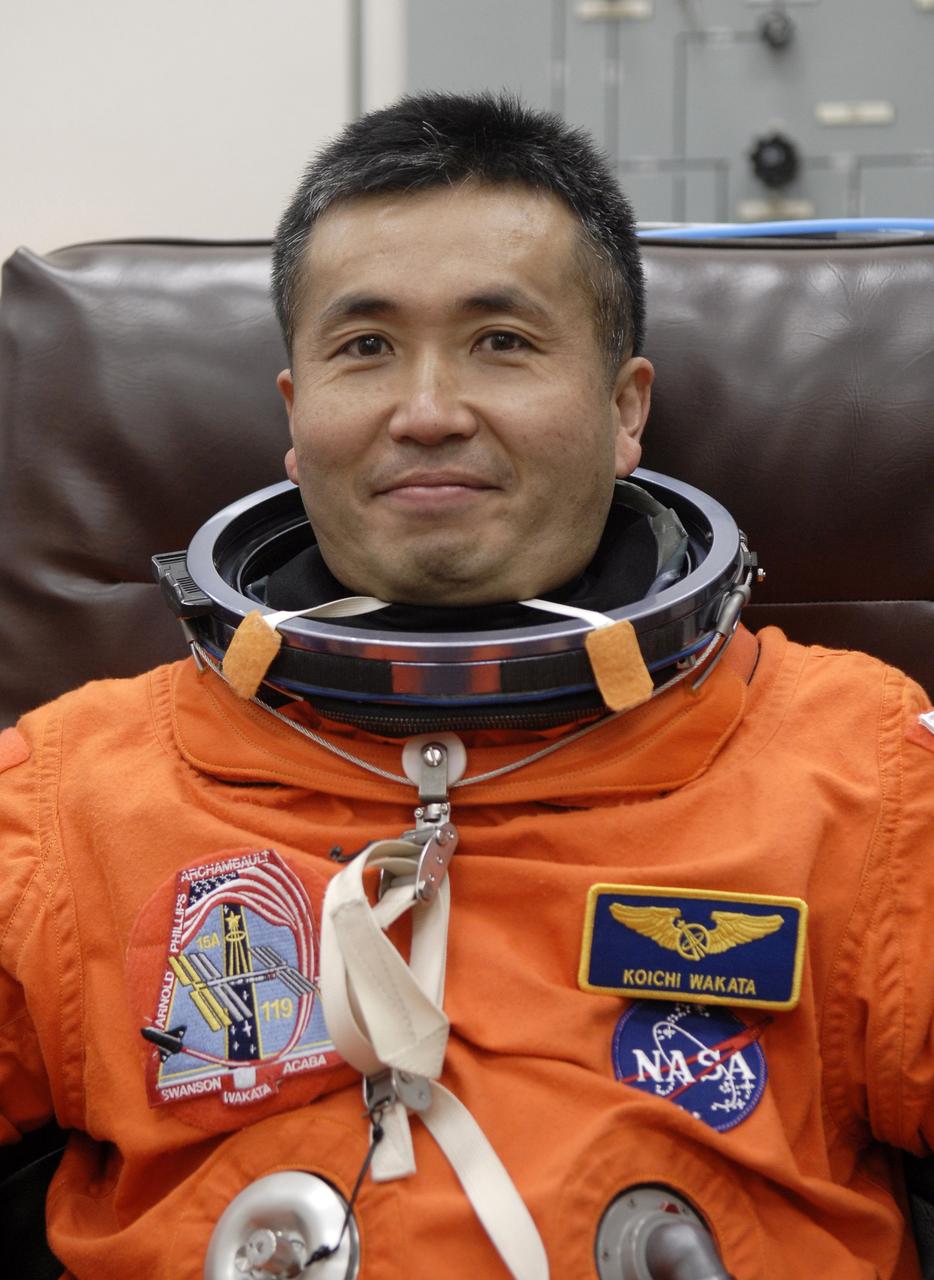
CAPE CANAVERAL, Fla. – In the Operations and Checkout Building at NASA's Kennedy Space Center in Florida, STS-119 Mission Specialist Koichi Wakata has a final fitting of his launch and entry suit. Wakata will remain on the station, replacing Expedition 18 Flight Engineer Sandra Magnus, who returns to Earth with the STS-119 crew. The 14-day mission is the 28th to the International Space Station and the 125th space shuttle flight. Discovery will deliver the final pair of power-generating solar array wings and the S6 truss segment. Installation of S6 will signal the station's readiness to house a six-member crew for conducting increased science. Liftoff of Discovery is scheduled for 9:20 p.m. EDT on March 11. Photo credit: NASA/Kim Shiflett