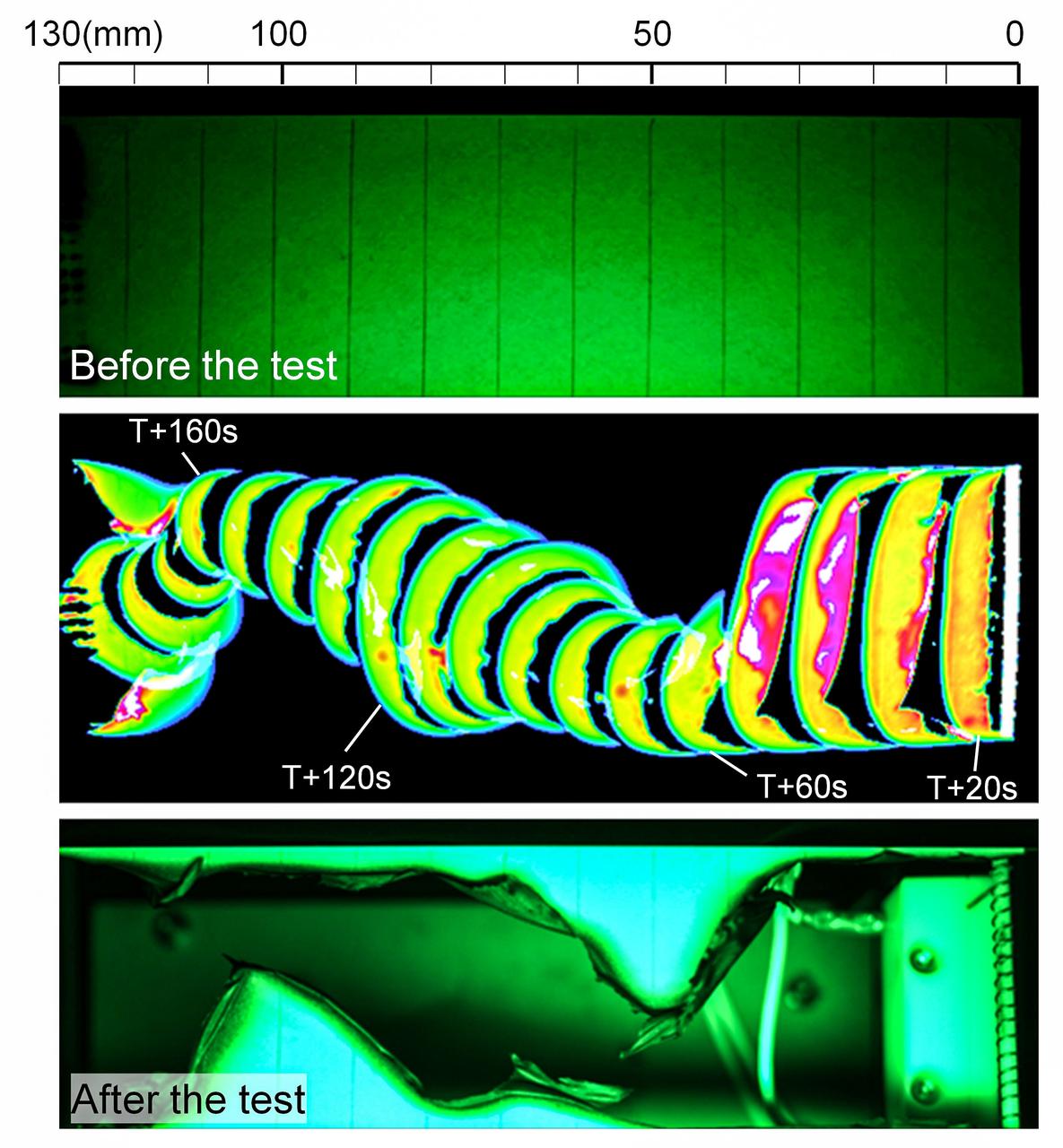
jsc2024e016237 (2/14/2024) --- A trace of the pyrolysis zone captured by an infrared camera at the near-flammability limit. The experiment reveals an initial linear flame spread which subsequently transitions to a swinging spread, taking a rounded shape. Fundamental Research on International Standard of Fire Safety in Space – Base for Safety of Future Manned Missions (FLARE), a Japan Aerospace Exploration Agency (JAXA) investigation, explores the flammability of materials in microgravity. Image courtesy of Hirosaki University, Gifu University, Hokkaido University, and JAXA (Japan Aerospace Exploration Agency).
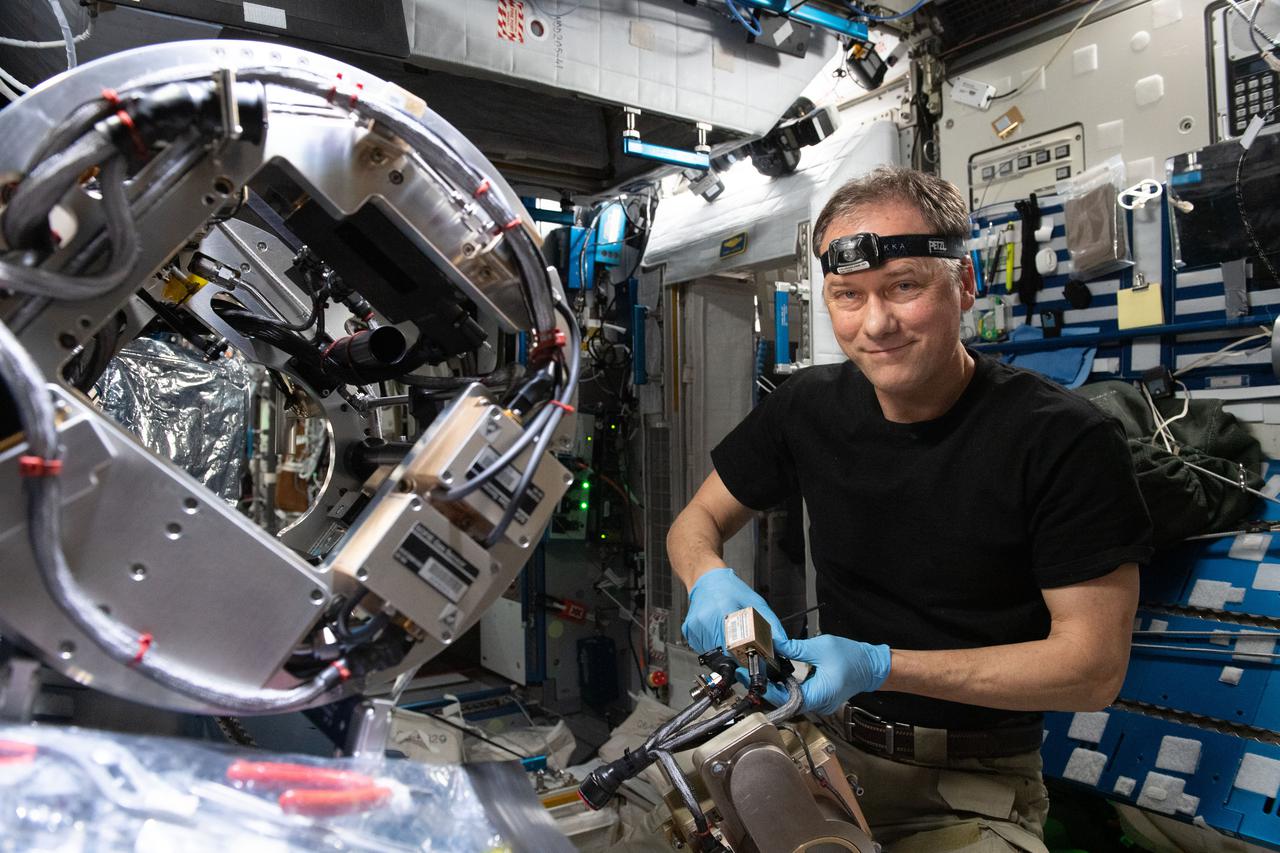
iss067e003895 (April 6, 2022) --- NASA astronaut and Expedition 67 Commander Thomas Marshburn configures the Combustion Integrated Rack's combustion chamber for the Solid Fuel Ignition and Extinction study to investigate material flammability and ways to improve fire safety in space.

iss071e609317 (Sept. 5, 2024) --- NASA astronaut and Expedition 71 Flight Engineer Jeanette Epps swaps research components and removes samples from inside the Combustion Integrated Rack for a series of experiments exploring space flammability and fire suppression in microgravity.
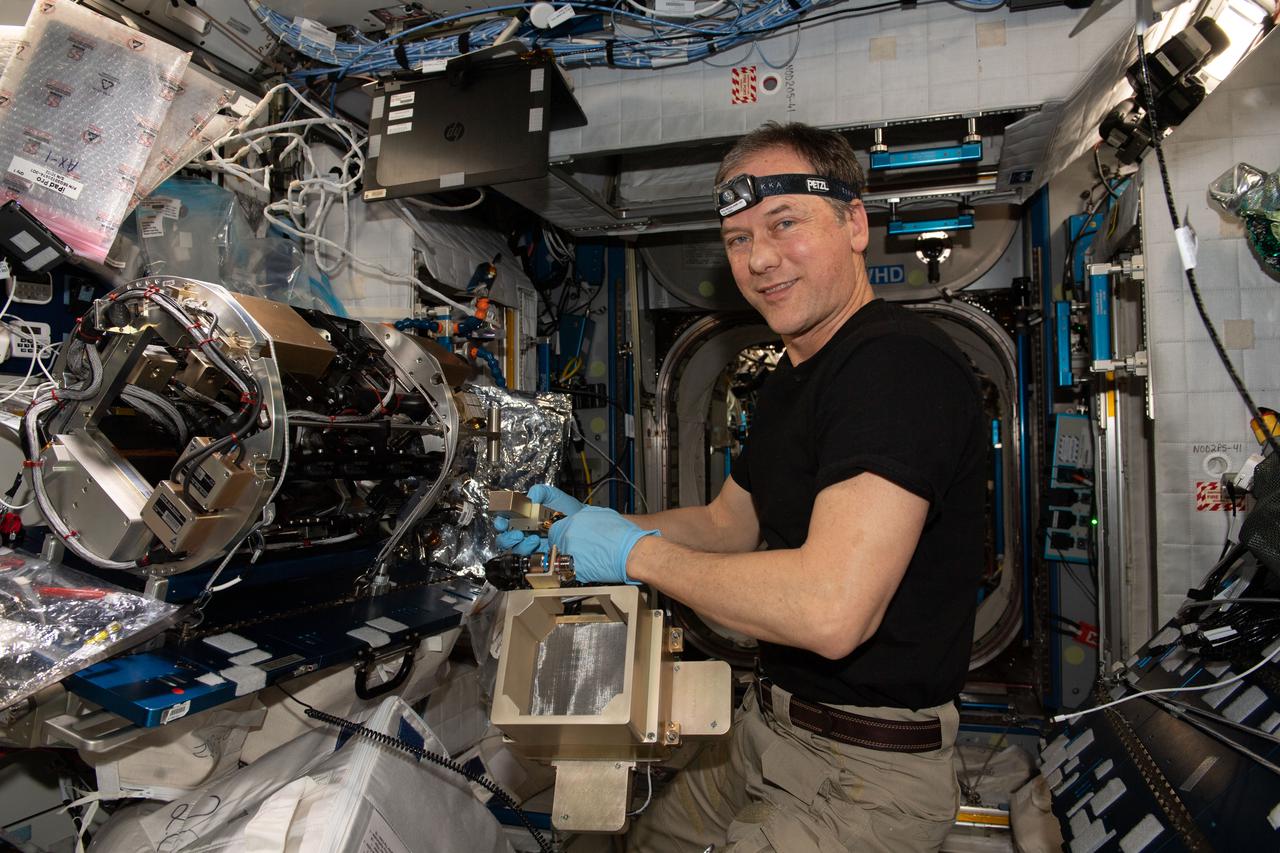
iss067e003872 (April 6, 2022) --- NASA astronaut and Expedition 67 Commander Thomas Marshburn configures the Combustion Integrated Rack's combustion chamber for the Solid Fuel Ignition and Extinction study to investigate material flammability and ways to improve fire safety in space.
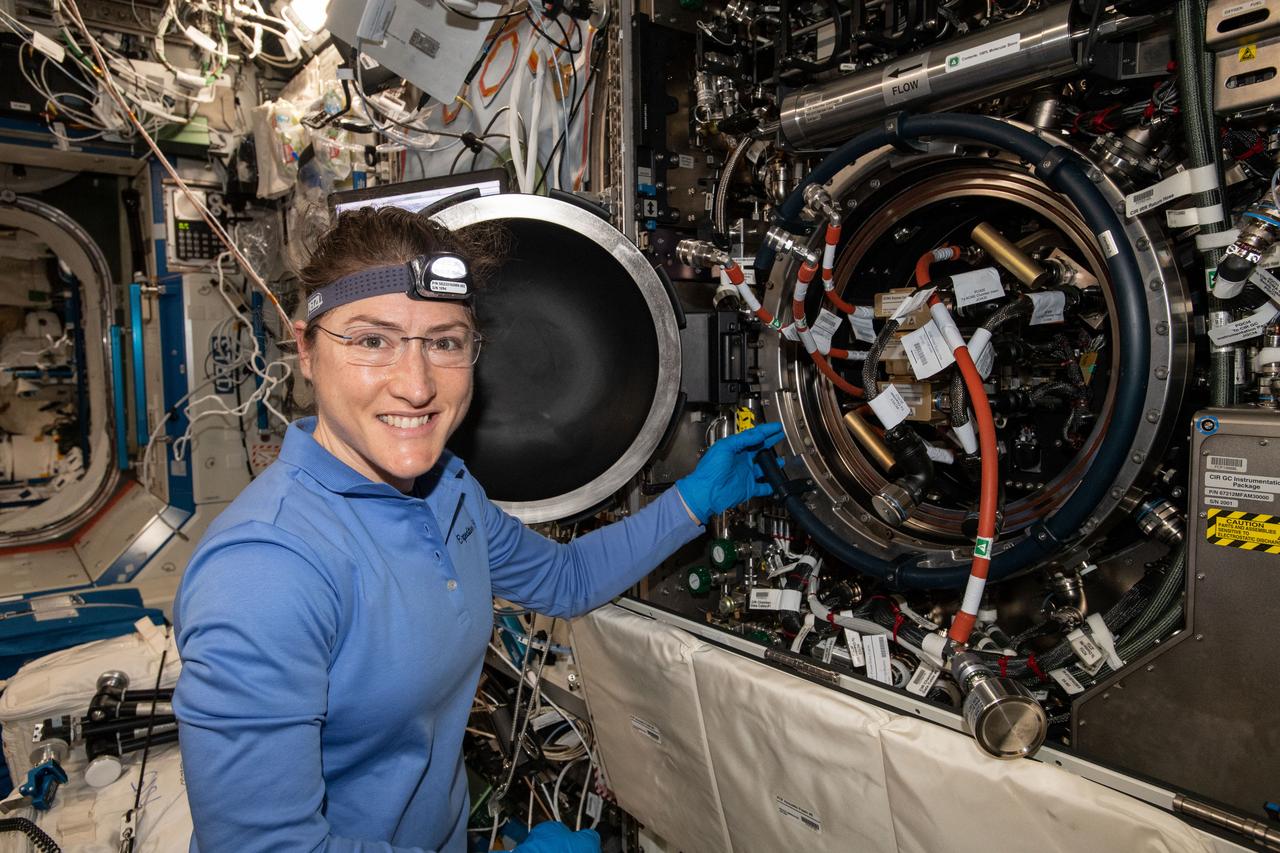
iss059e017127 (April 9, 2018) --- NASA astronaut and Expedition 59 Flight Engineer Christina Koch works inside the U.S. Destiny laboratory module's Combustion Integrated Rack. She was replacing hardware for a series of experiments collectively known as Advanced Combustion via Microgravity Experiments (ACME). ACME is a set of six independent studies researching improved fuel efficiency and reduced pollutant production in practical combustion on Earth, as well as spacecraft fire prevention through innovative research focused on materials flammability.
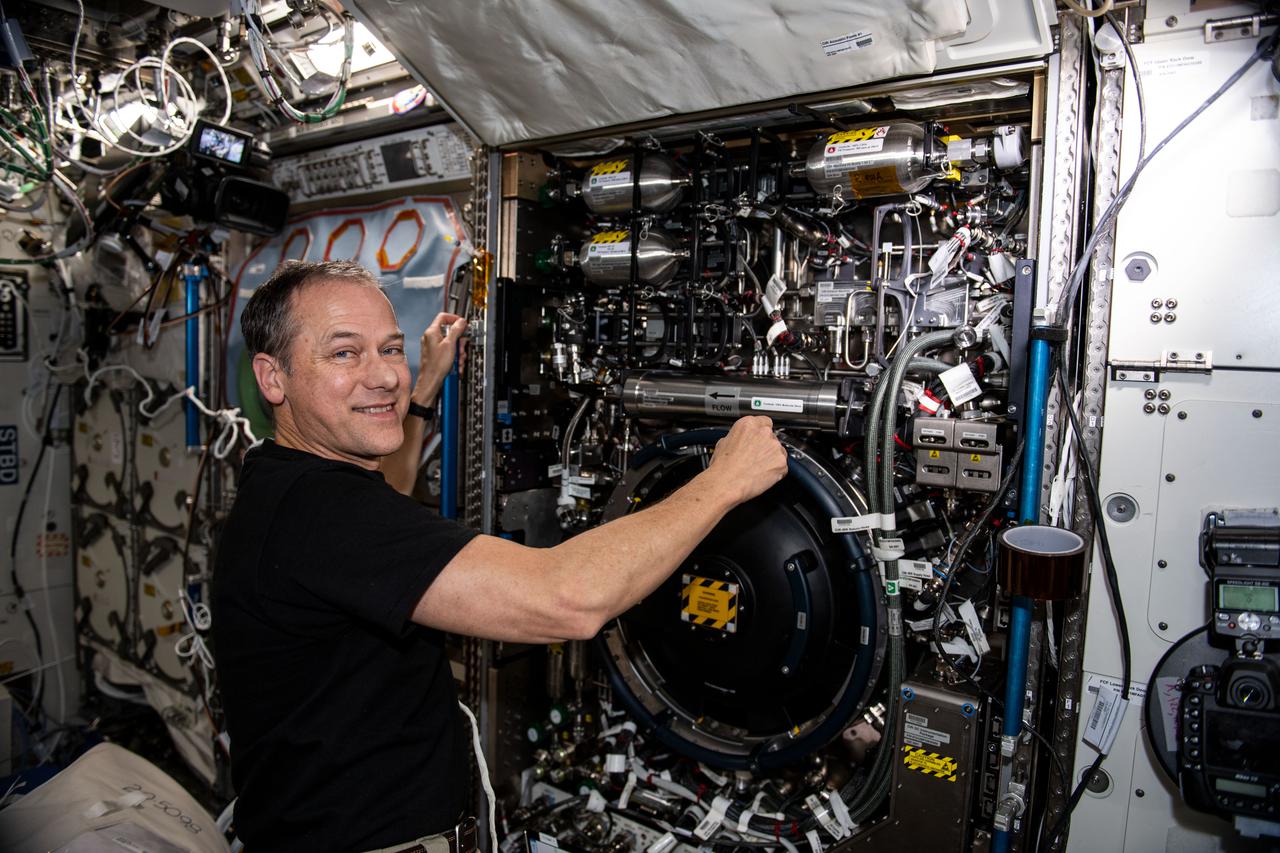
iss066e137090 (Feb. 8, 2022) --- NASA astronaut and Expedition 66 Flight Engineer Thomas Marshburn configures the Combustion Integrated Rack to begin operations for a pair of studies exploring fire growth in microgravity. The two SoFIE, or Solid Fuel Ignition and Extinction, studies explore safer, less flammable spacecraft materials as well as fire extinguishing and suppresion techniques in microgravity.
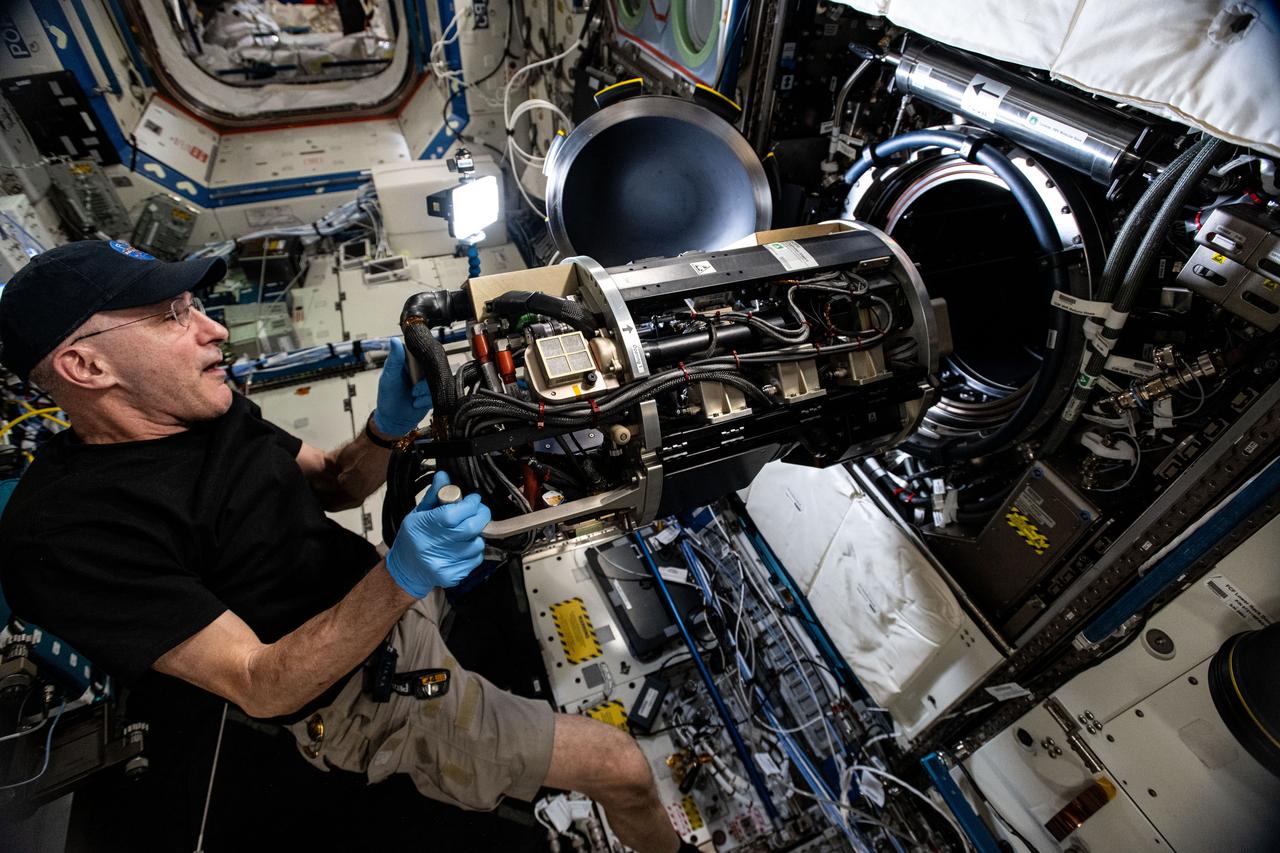
iss072e747154 (March 18, 2025) --- NASA astronaut and Expedition 72 Flight Engineer Don Pettit inserts research hardware into the Combustion Integrated Rack located inside the International Space Station's Destiny laboratory module. Pettit was configuring the SoFIE-MIST, or the Solid Fuel Ignition and Extinction - Material Ignition and Suppression Test, investigation that is exploring the flammability of materials in microgravity to improve spacecraft fire safety.
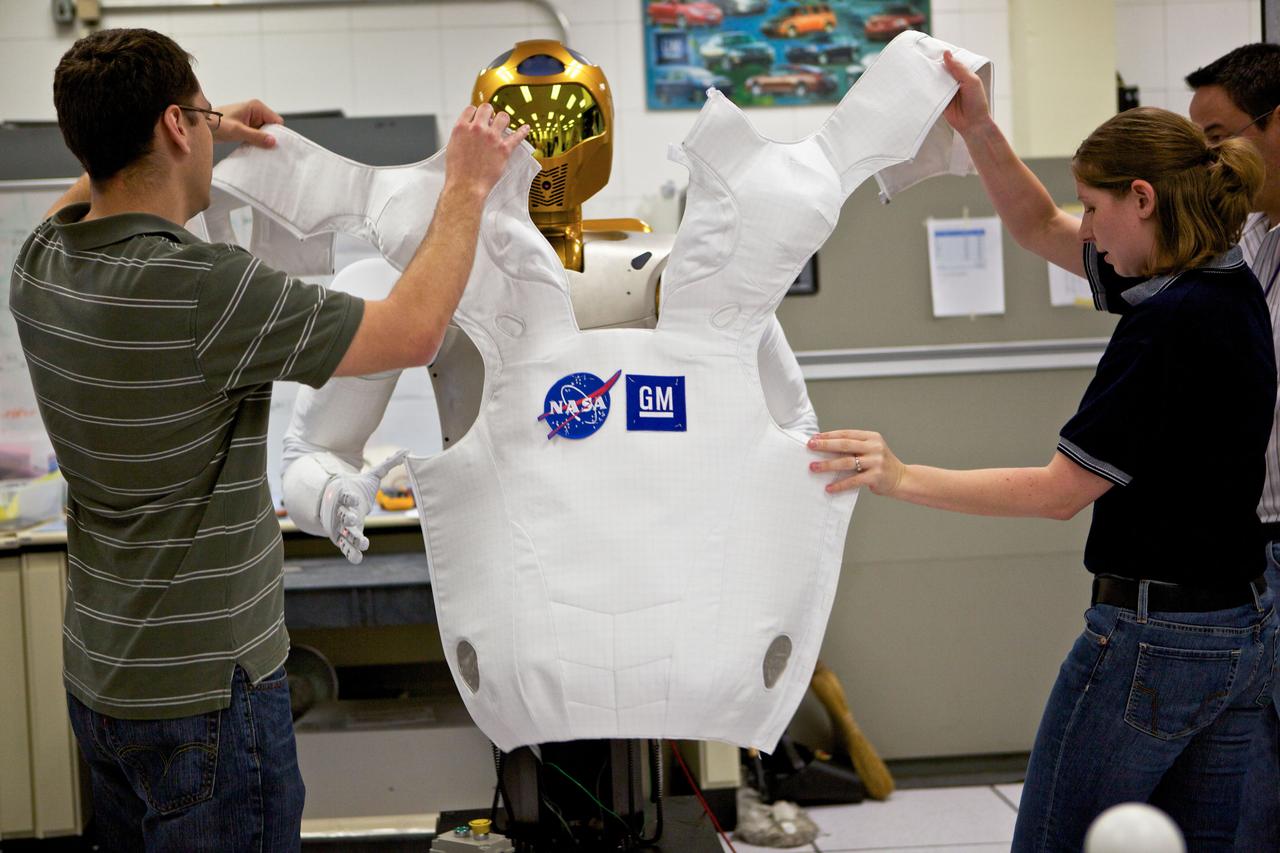
JSC2010-E-090928 (1 June 2010) --- Engineer Court Edmondson and soft goods designer Heather Bibby help Robonaut 2 try on its new flight suit. The materials in R2?s ?skin? were upgraded in preparation for the robot?s journey to the International Space Station due to the station?s stringent flammability requirements. R2 is scheduled to launch on board space shuttle Discovery as part of the STS-133 mission. Photo credit: NASA or National Aeronautics and Space Administration
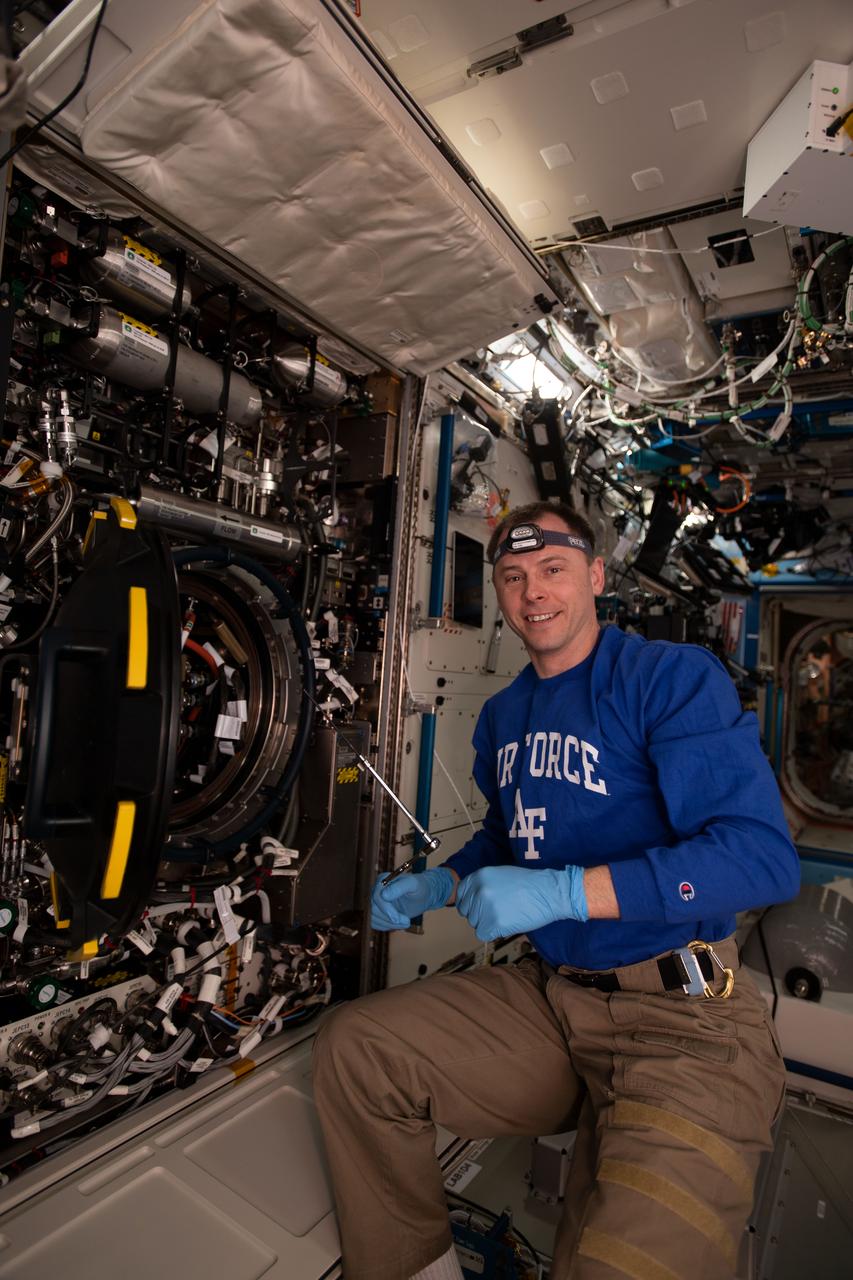
iss059e085880 (May 31, 2019) --- NASA astronaut Nick Hague replaces hardware inside the Combustion Integrated Rack supporting the Advanced Combustion via Microgravity Experiments (ACME). ACME is a set of five independent studies researching improved fuel efficiency and reduced pollutant production in practical combustion on Earth, as well as spacecraft fire prevention through innovative research focused on materials flammability.
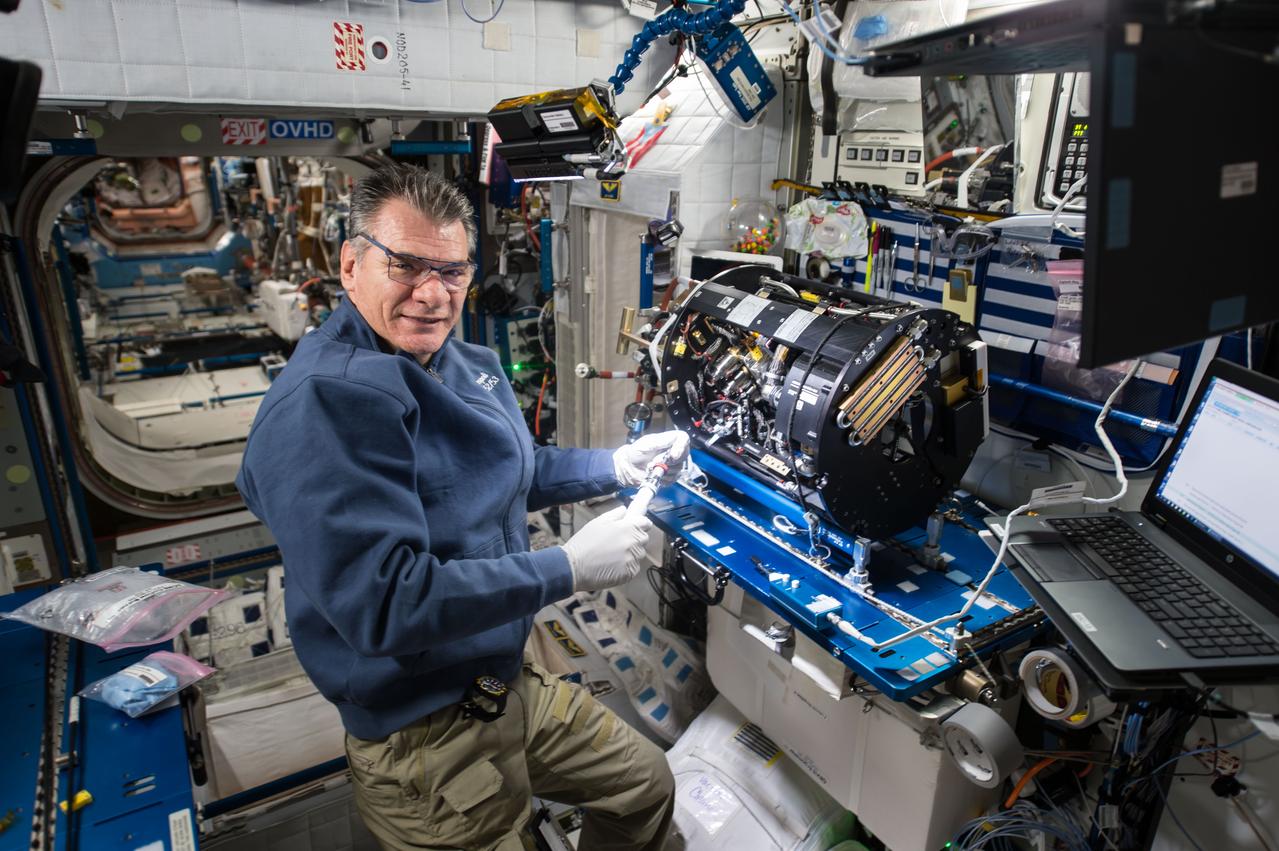
iss053e098185 (Oct. 12, 2017) --- Flight Engineer Paolo Nespoli works inside the Harmony module to configure the Combustion Integrated Rack and enable the Advanced Combustion Microgravity Experiment (ACME). The primary and secondary goals of ACME are the improved fuel efficiency and reduced pollutant production in practical combustion on Earth, and spacecraft fire prevention through innovative research focused on materials flammability.

Experimental study on material flammability and flame spreading in partial gravity aboard the DC-9 aircraft, based at GRC. Pictured in the center is John Yaniec, the DC-9 test director, who is coordinating reduced-gravity maneuver timing between the experimenters and the cockpit and ensuring safe behavior of the research cadre. Pictured on the left is crew member Jerry Auschuetz who is monitoring the experiment. Floating on the right is researcher Kurt Sacksteder.
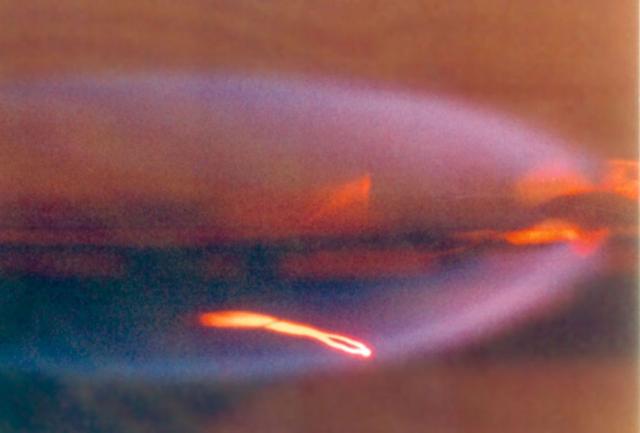
The Forced Flow Flame-Spreading Test was designed to study flame spreading over solid fuels when air is flowing at a low speed in the same direction as the flame spread. Previous research has shown that in low-speed concurrent airflows, some materials are more flammable in microgravity than earth. This image shows a 10-cm flame in microgravity that burns almost entirely blue on both sides of a thin sheet of paper. The glowing thermocouple in the lower half of the flame provides temperature measurements.
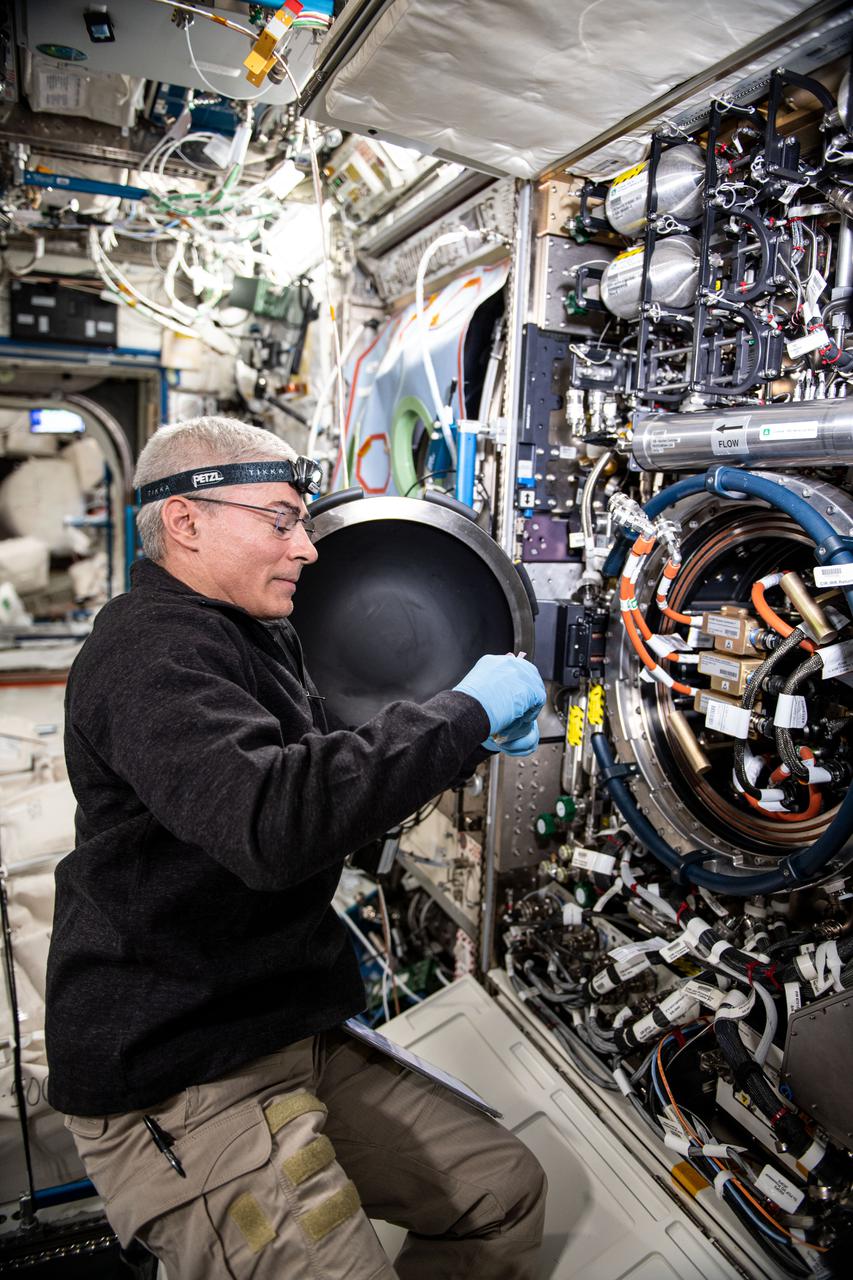
iss065e369687 (Sept. 8, 2021) ----NASA astronaut and Expedition 65 Flight Engineer Mark Vande Hei replaces an igniter inside the U.S. Destiny laboratory module's Combustion Integrated Rack for the ACME series of space combustion studies. ACME, or the Advanced Combustion via Microgravity Experiments, is a set of six independent studies of gaseous flames that seeks to improve fuel efficiency and reduce pollutants on Earth, and improve spacecraft fire prevention by focusing on decreasing the flammability of materials.
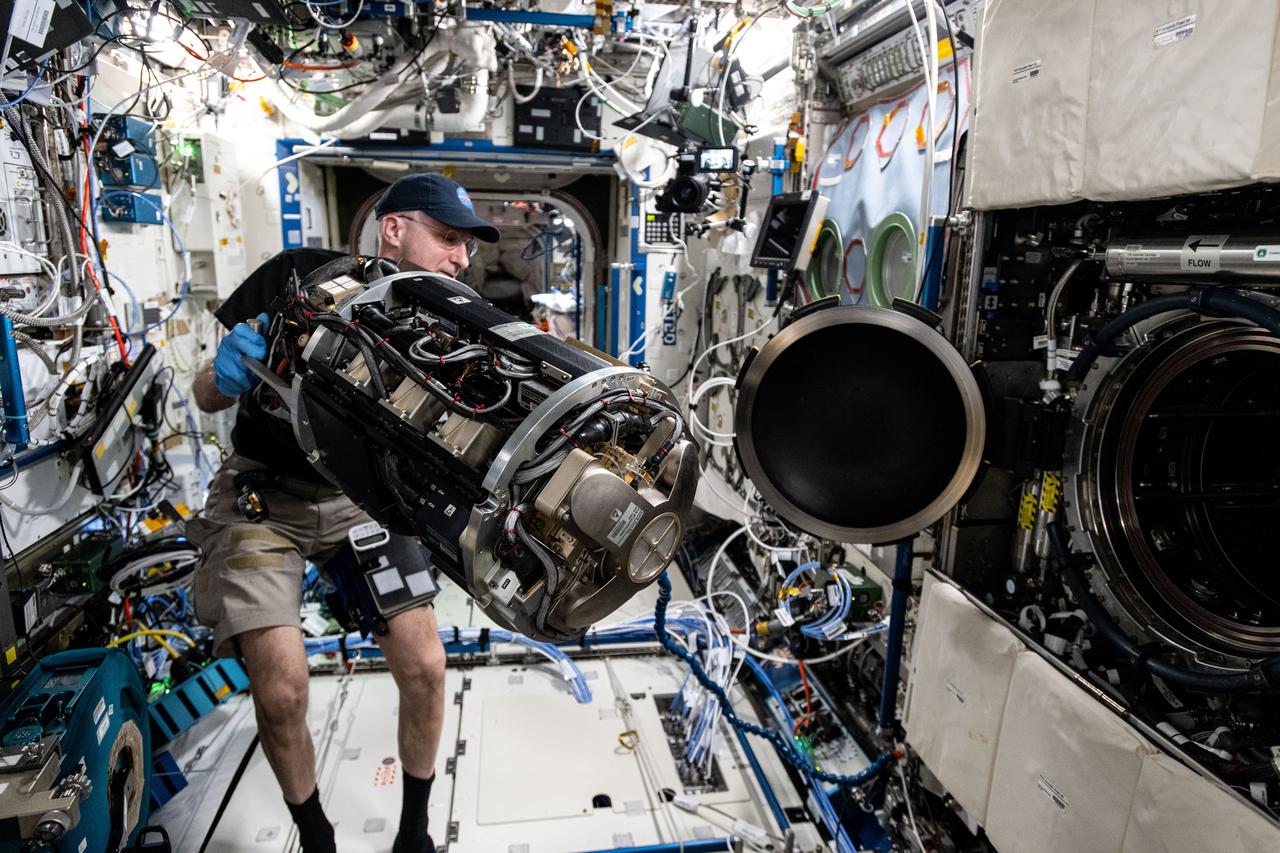
iss072e747148 (March 18, 2025) --- NASA astronaut and Expedition 72 Flight Engineer Don Pettit inserts research hardware into the Combustion Integrated Rack located inside the International Space Station's Destiny laboratory module. Pettit was configuring the SoFIE-MIST, or the Solid Fuel Ignition and Extinction - Material Ignition and Suppression Test, investigation that is exploring the flammability of materials in microgravity to improve spacecraft fire safety.
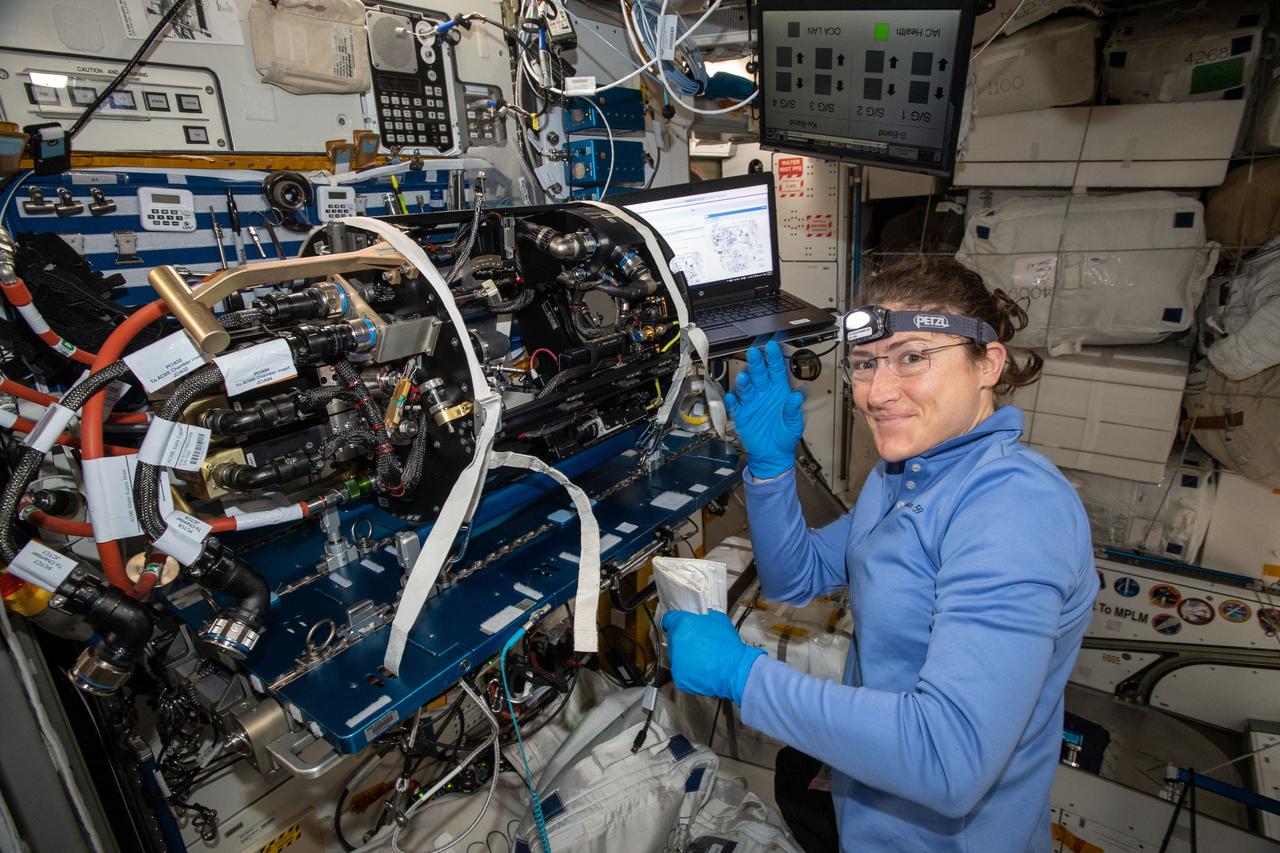
iss059e017072 (April 9, 2018) --- NASA astronaut and Expedition 59 Flight Engineer Christina Koch works on the Unity module's Maintenance Work Area where the Advanced Combustion via Microgravity Experiments (ACME) Chamber Insert was attached for hardware replacement. ACME is a set of five independent studies researching improved fuel efficiency and reduced pollutant production in practical combustion on Earth, as well as spacecraft fire prevention through innovative research focused on materials flammability.
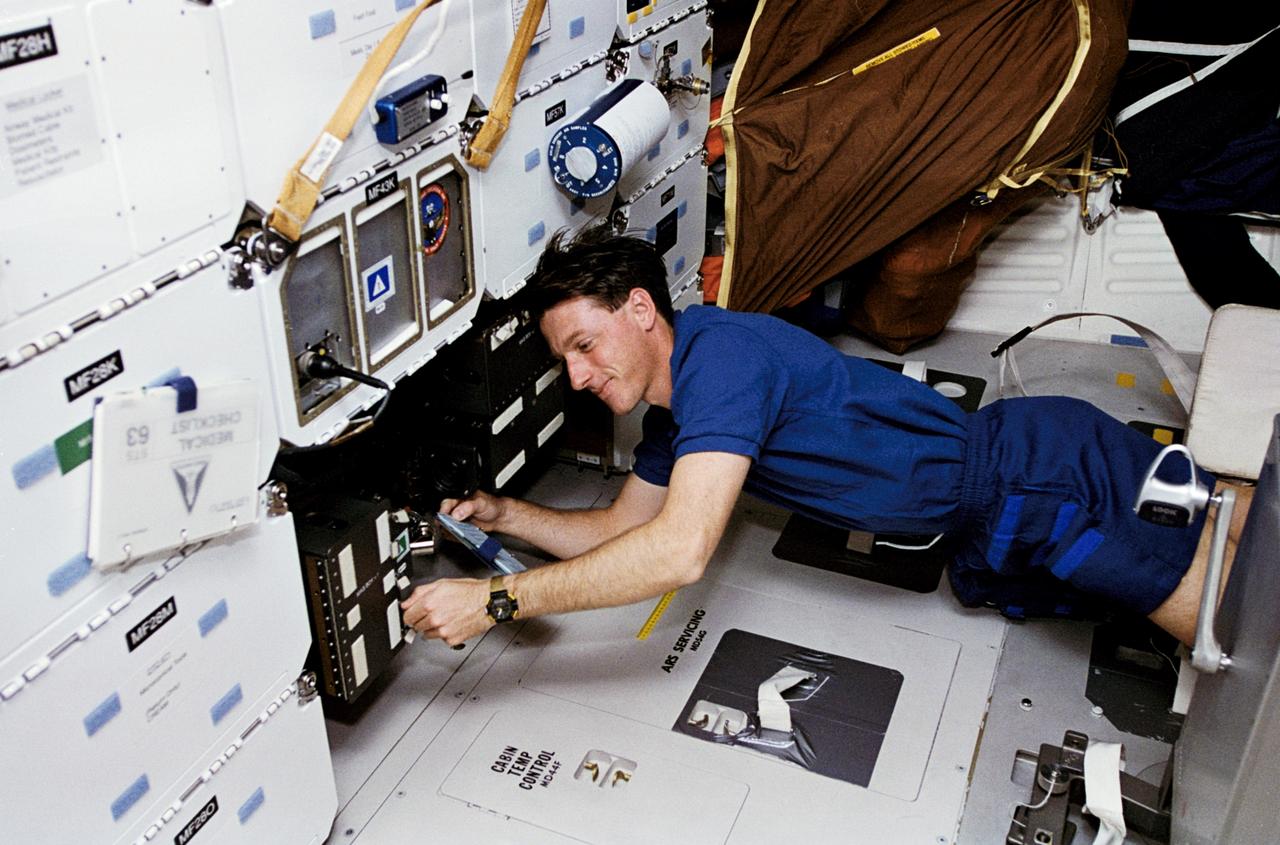
STS063-29-002 (3-11 Feb. 1995) --- On the Space Shuttle Discovery's middeck, astronaut C. Michael Foale, mission specialist, checks on the Solid Surface Combustion Experiment (SSCE). Foale was joined by four other NASA astronauts James D. Wetherbee, commander; Eileen M. Collins, pilot; Bernard A. Harris, Jr., payload commander; Janice E. Voss, mission specialist, and a Russian cosmonaut, Vladimir G. Titov; for eight days of research in Earth-orbit.

STS064-10-011 (12 Sept. 1994) --- The Solid Surface Combustion Experiment (SSCE), designed to supply information on flame spread over solid fuel surfaces in the reduced-gravity environment of space, is pictured during flight day four operations. The middeck experiment measured the rate of spreading, the solid-phase temperature, and the gas-phase temperature of flames spreading over rectangular fuel beds. STS-64 marked the seventh trip into space for the Lewis Research Center experiment. Photo credit: NASA or National Aeronautics and Space Administration
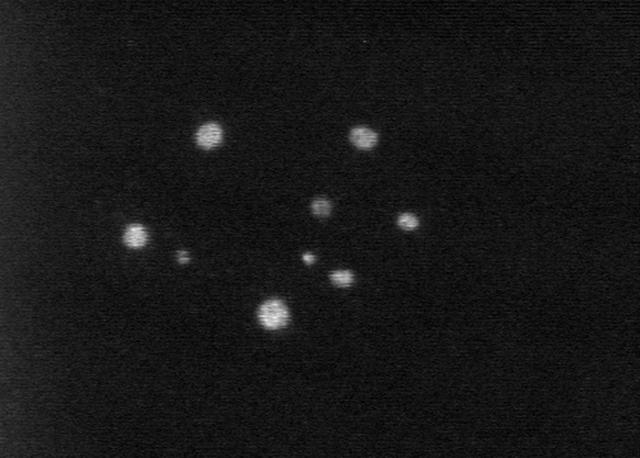
The potential for investigating combustion at the limits of flammability, and the implications for spacecraft fire safety, led to the Structures Of Flame Balls At Low Lewis-number (SOFBALL) experiment flown twice aboard the Space Shuttle in 1997. The success there led to reflight on STS-107 Research 1 mission plarned for 2002. This image is a video frame which shows MSL-1 flameballs which are intrinsically dim, thus requiring the use of image intensifiers on video cameras. The principal investigator is Dr. Paul Ronney of the University of Southern California, Los Angeles. Glenn Research in Cleveland, OH, manages the project.
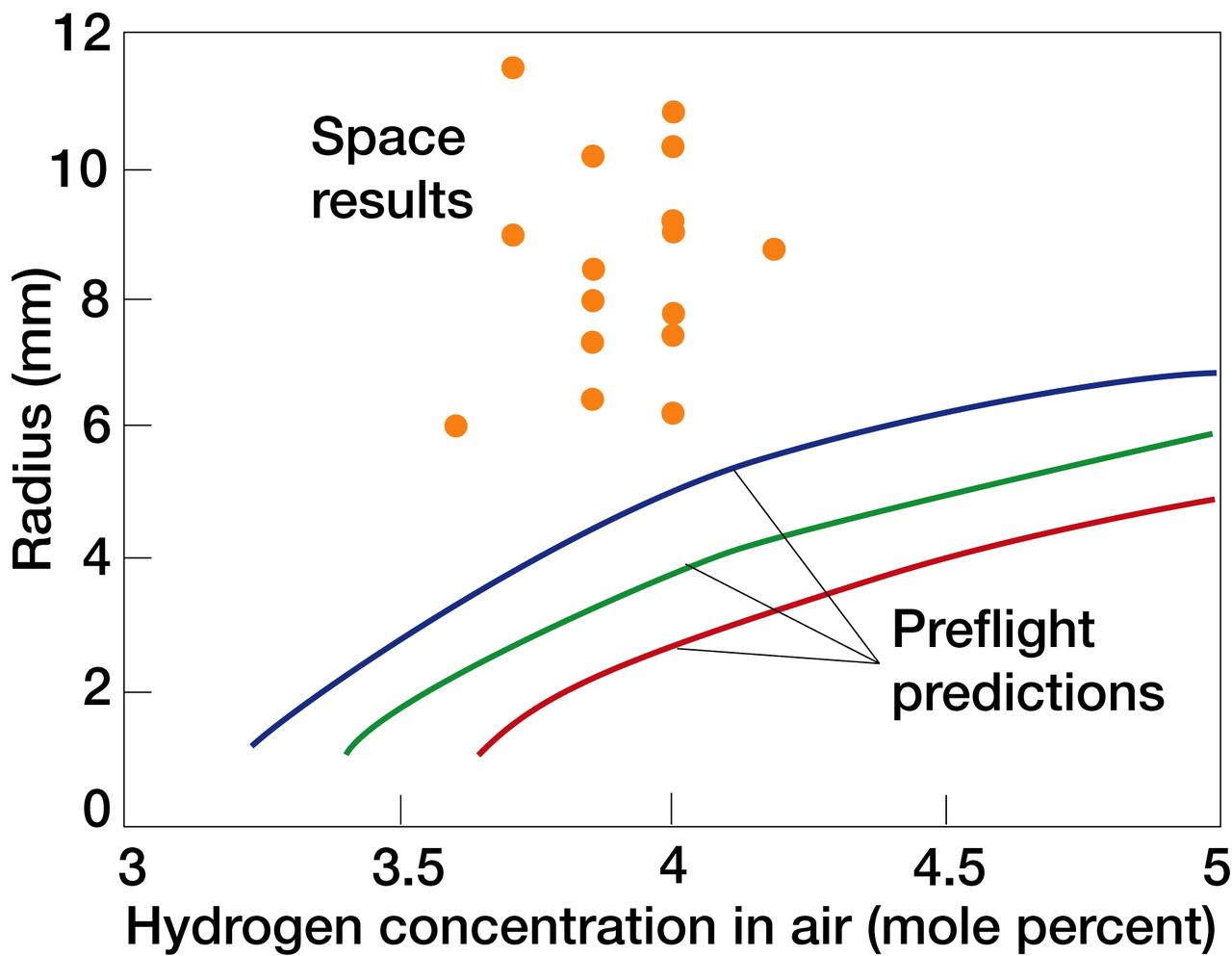
The potential for investigating combustion at the limits of flammability, and the implications for spacecraft fire safety, led to the Structures Of Flame Balls At Low Lewis-number (SOFBALL) experiment flown twice aboard the Space Shuttle in 1997. The success there led to reflight on STS-107 Research 1 mission plarned for 2002. Theory does not always predict behavior, thus the need for experiments. Three different published chemical reaction models (lines) for hydrogen-airflame balls proved to be quite different from what was observed (dots) during SOFBALL tests in space. The principal investigator is Dr. Paul Ronney of the University of Southern California, Los Angeles. Glenn Research in Cleveland, OH, manages the project.
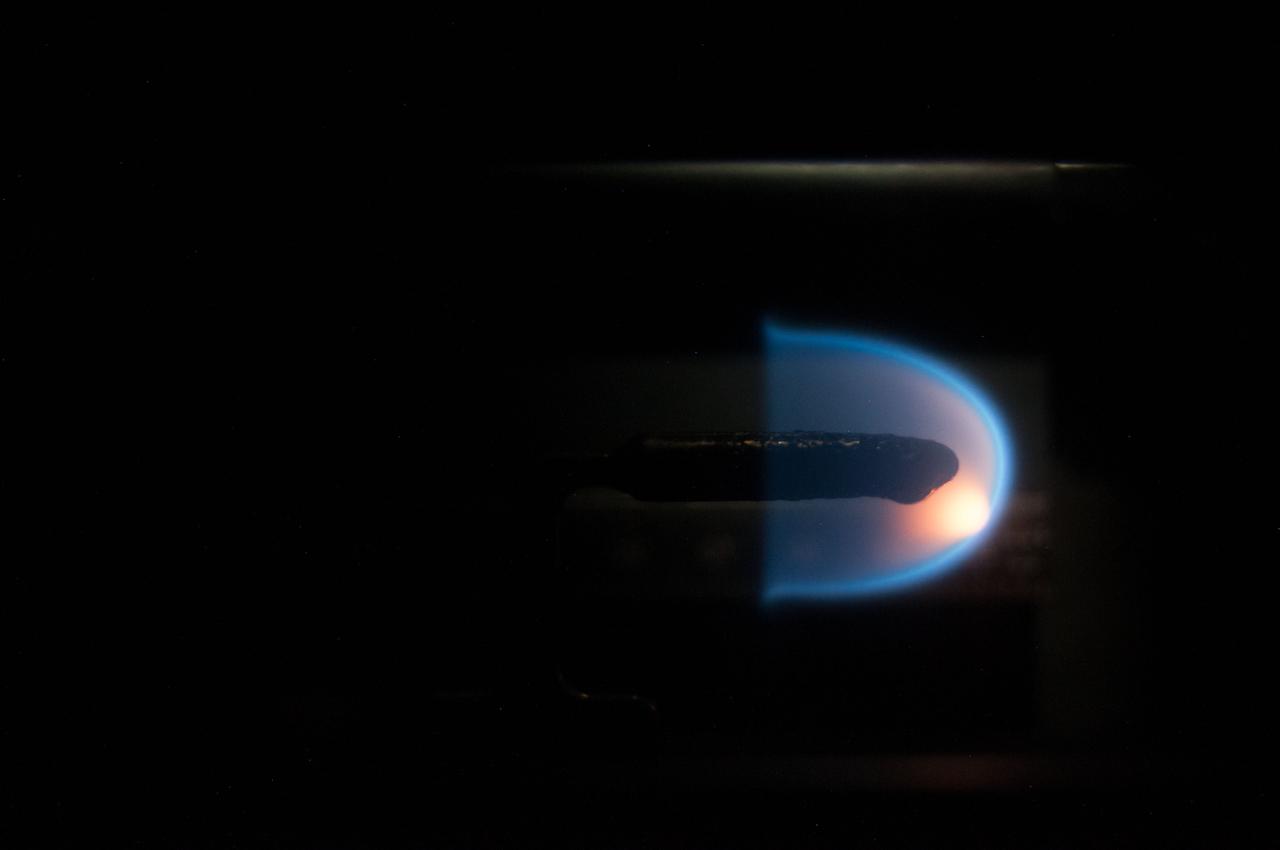
Image taken on card 8 during BASS-II flame test session with reduced O2 partial pressure. Session conducted on GMT 213. The Burning and Suppression of Solids - II (BASS-II) investigation examines the burning and extinction characteristics of a wide variety of fuel samples in microgravity. The BASS-II experiment will guide strategies for materials flammability screening for use in spacecraft as well as provide valuable data on solid fuel burning behavior in microgravity. BASS-II results contribute to the combustion computational models used in the design of fire detection and suppression systems in microgravity and on Earth.
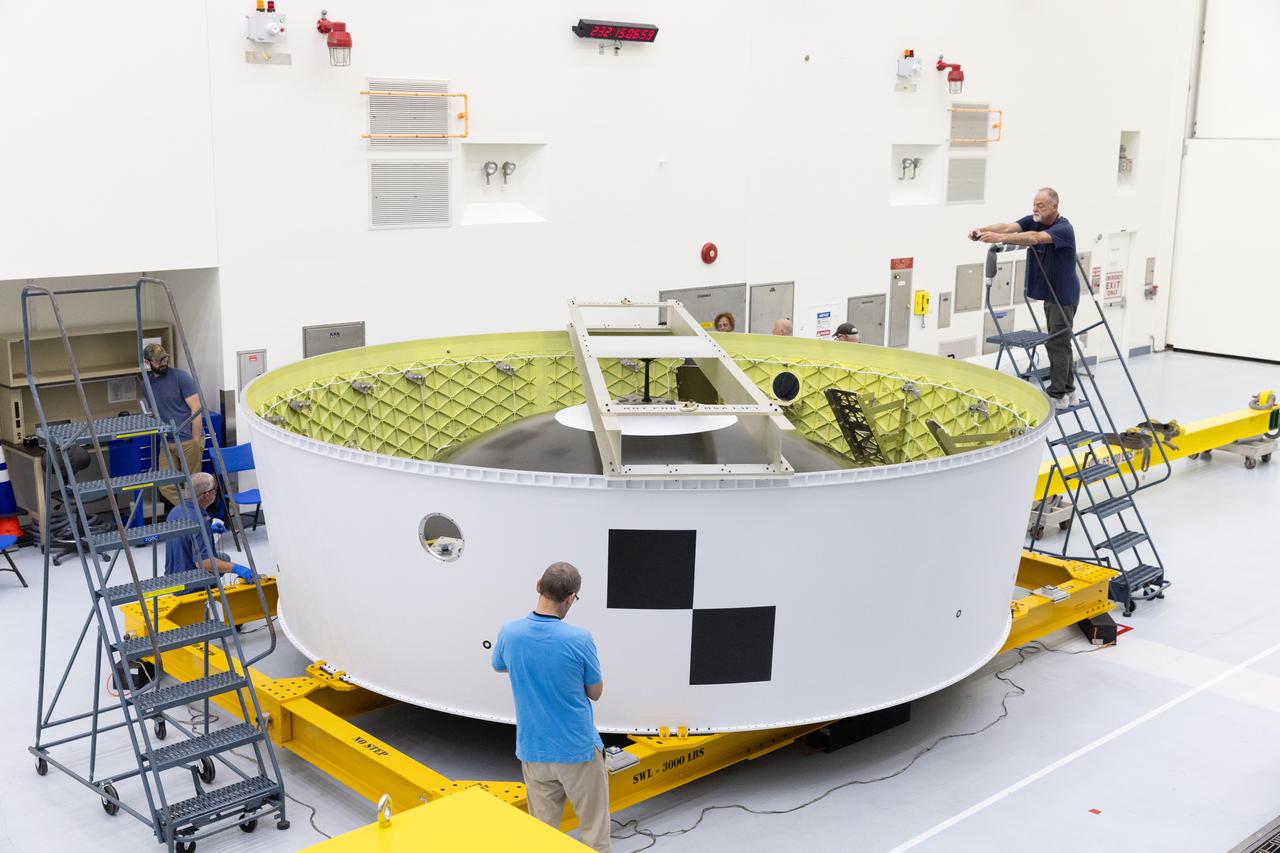
Technicians at NASA’s Kennedy Space Center in Florida complete routine inspections the Artemis II Orion stage adapter on Wednesday, Aug. 20, 2025, to the spaceport’s Multi-Payload Processing Facility to undergo CubeSat integration following its arrival from the agency’s Marshall Space Flight Center in Huntsville, Alabama. NASA Marshall built the Orion stage adapter which connects to the SLS (Space Launch System) rocket’s interim cryogenic propulsion stage to the Orion spacecraft and protects Orion from flammable gases generated during launch. The Artemis II test flight will take four astronauts around the Moon and return them back home in early 2026.
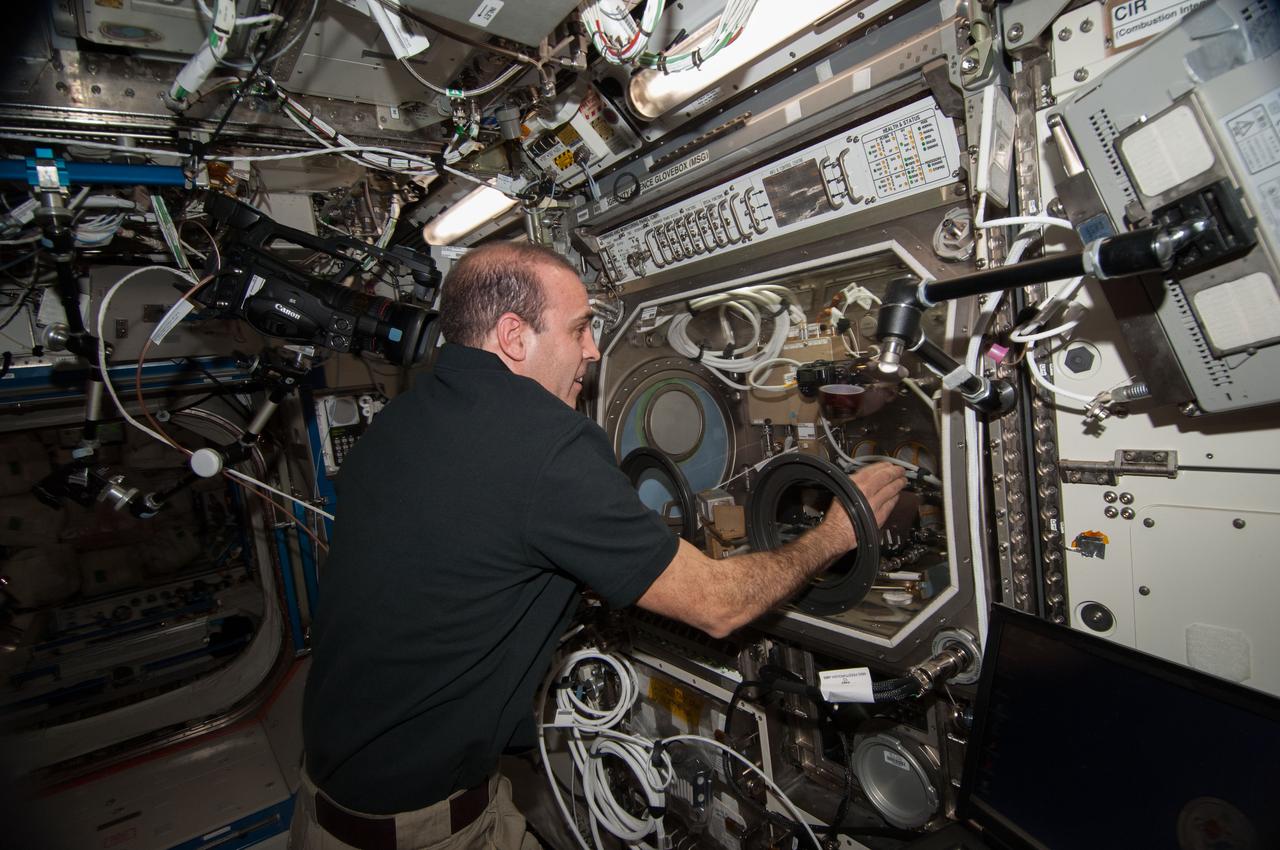
ISS039-E-005726 (27 March 2014) --- Expedition 39 Flight Engineer Rick Mastracchio performs inflight maintenance on an experiment called Burning and Suppression of Solids (BASS)-II. The investigation examines the burning and extinction characteristics of a wide variety of fuel samples in microgravity. The BASS-II experiment will guide strategies for materials flammability screening for use in spacecraft as well as provide valuable data on solid fuel burning behavior in microgravity. BASS-II results contribute to the combustion computational models used in the design of fire detection and suppression systems in microgravity and on Earth.
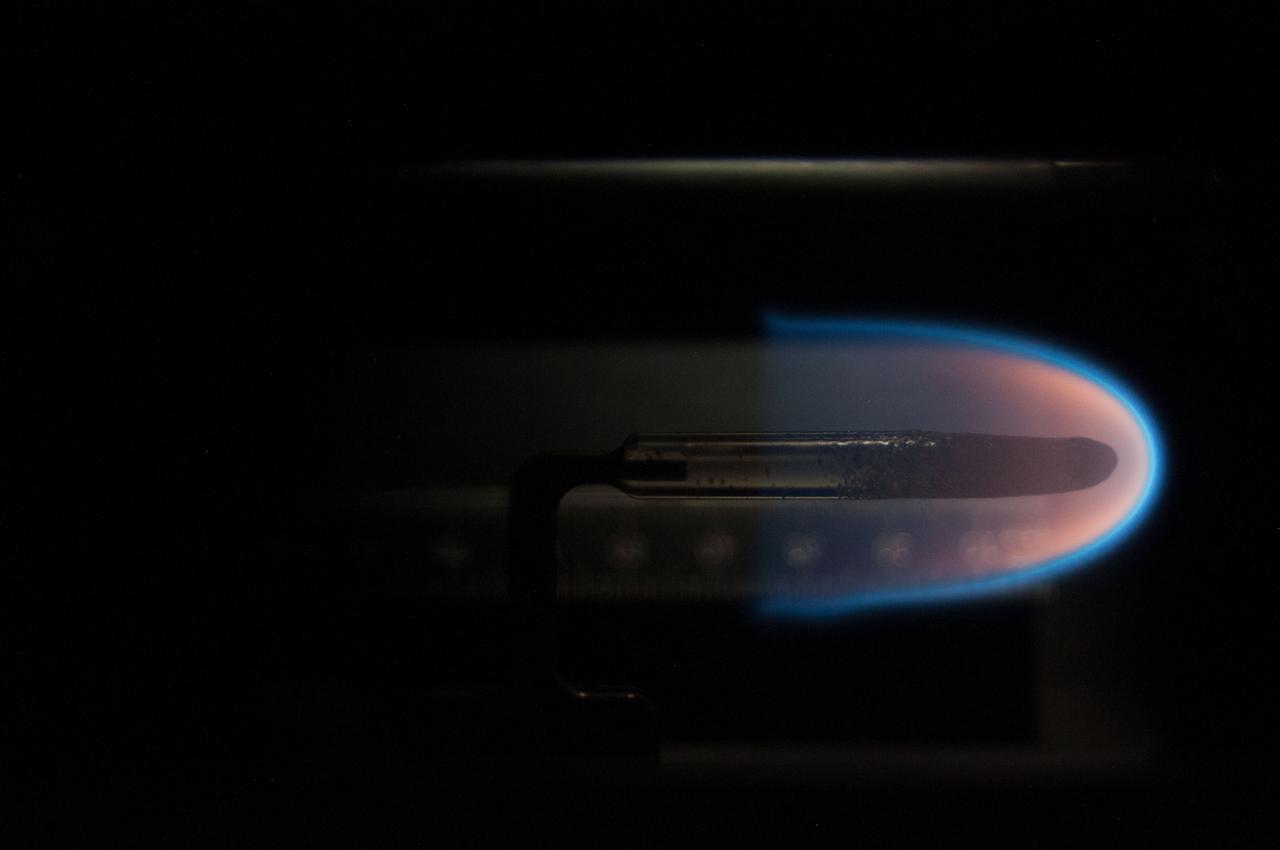
Image taken on card 15 during BASS-II flame test session with reduced O2 partial pressure. Session conducted on GMT 214. The Burning and Suppression of Solids - II (BASS-II) investigation examines the burning and extinction characteristics of a wide variety of fuel samples in microgravity. The BASS-II experiment will guide strategies for materials flammability screening for use in spacecraft as well as provide valuable data on solid fuel burning behavior in microgravity. BASS-II results contribute to the combustion computational models used in the design of fire detection and suppression systems in microgravity and on Earth.
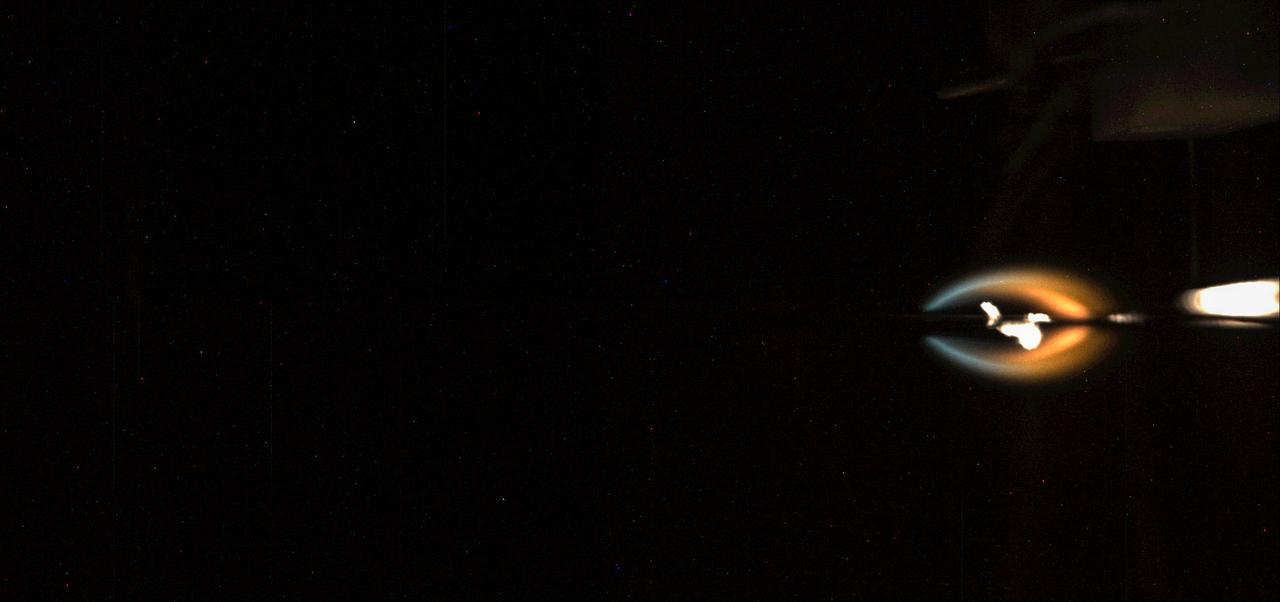
jsc2024e016236 (2/14/2024) --- Image of flame spreading over a filter paper in a moderate opposed flow within the Solid Combustion Experiment Module (SCEM) on the International Space Station. The blue leading edge and the orange flame body are distinctly captured. Fundamental Research on International Standard of Fire Safety in Space – Base for Safety of Future Manned Missions (FLARE), a Japan Aerospace Exploration Agency (JAXA) investigation, explores the flammability of materials in microgravity. Image courtesy of Hirosaki University, Gifu University, Hokkaido University, and JAXA (Japan Aerospace Exploration Agency).
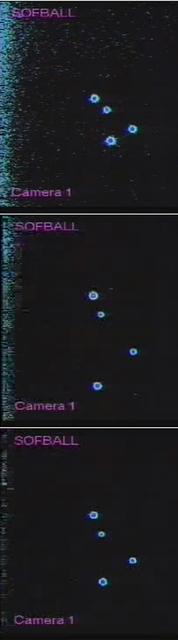
The potential for investigating combustion at the limits of flammability, and the implications for spacecraft fire safety, led to the Structures Of Flame Balls At Low Lewis-number (SOFBALL) experiment flown twice aboard the Space Shuttle in 1997. The success there led to on STS-107 Research 1 mission plarned for 2002. Shown here are video frames captured during the Microgravity Sciences Lab-1 mission in 1997. Flameballs are intrinsically dim, thus requiring the use of image intensifiers on video cameras. The principal investigator is Dr. Paul Ronney of the University of Southern California, Los Angeles. Glenn Research in Cleveland, OH, manages the project.
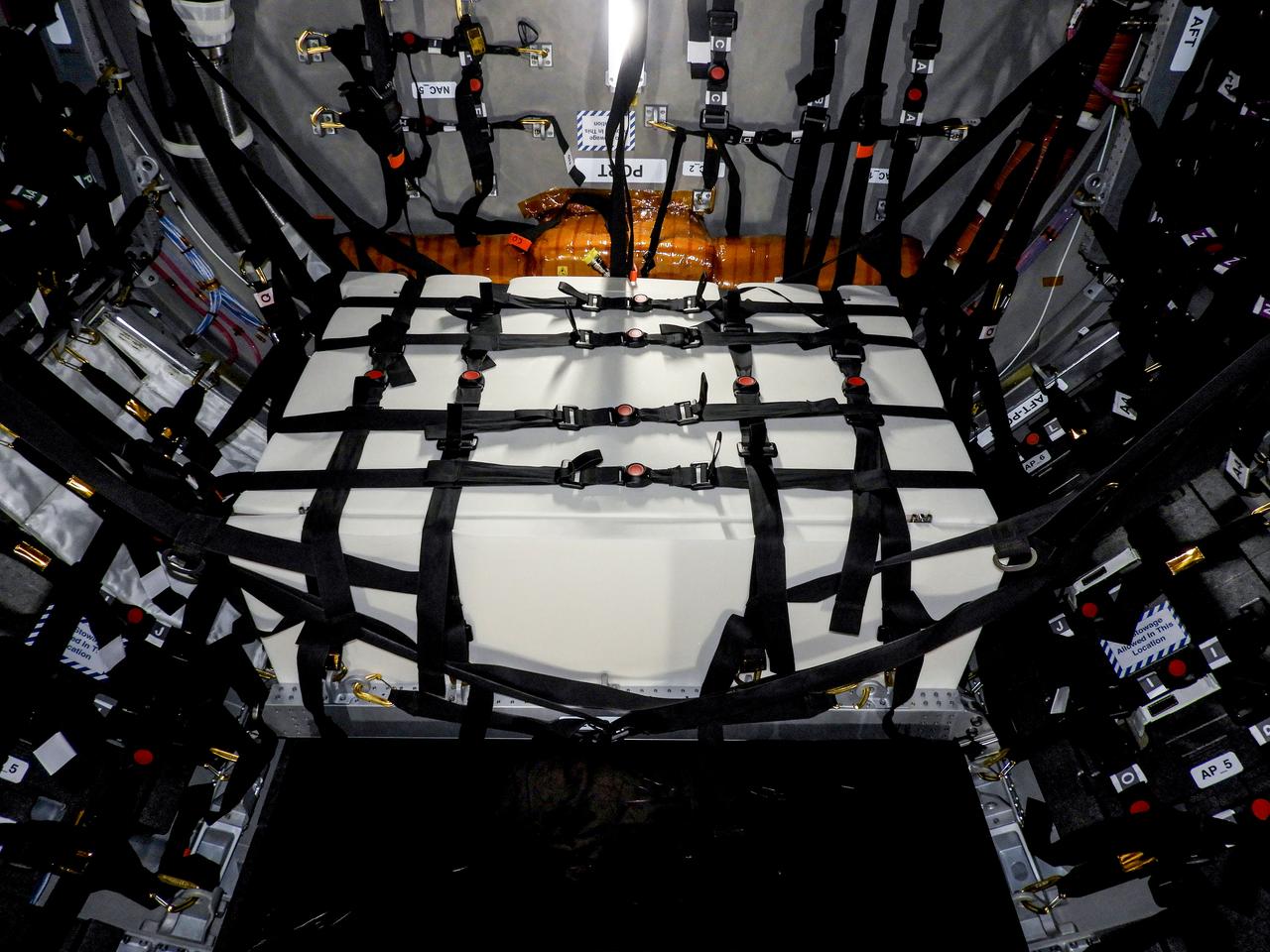
jsc2023e046377 (12/14/2019) --- A view of the Spacecraft Fire Safety Experiments (Saffire) VI experiment hardware, loaded inside the Northrop Grumman (NG) Cygnus cargo vehicle for the 19th NG resupply mission to the International Space Station. Saffire is a series of experiments to investigate how fire spreads on a variety of combustible materials in the microgravity environment. The experiments are ignited in the Cygnus cargo spacecraft after it departs the space station and before it reenters the Earth's atmosphere. Saffire-VI builds on prior results to test flammability at different oxygen levels and aims to further knowledge of realistic flame spread to aid the development of fire safety equipment and strategies for future spacecraft.
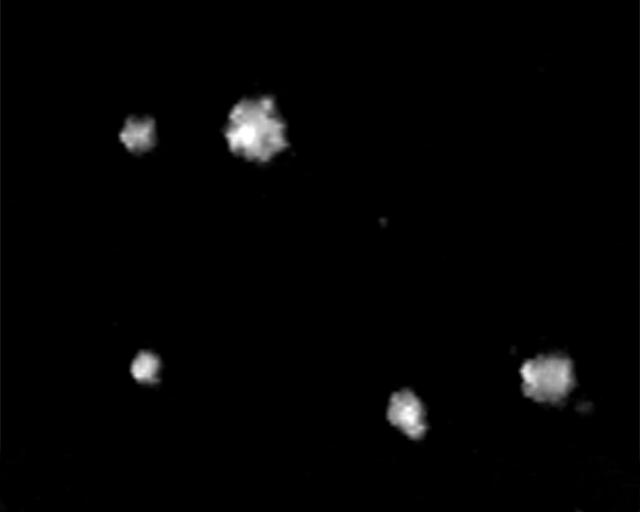
The potential for investigating combustion at the limits of flammability, and the implications for spacecraft fire safety, led to the Structures Of Flame Balls At Low Lewis-number (SOFBALL) experiment flown twice aboard the Space Shuttle in 1997. The success there led to reflight on STS-107 Research 1 mission plarned for 2002. This image is a video frame which shows MSL-1 flameballs which are intrinsically dim, thus requiring the use of image intensifiers on video cameras. The principal investigator is Dr. Paul Ronney of the University of Southern California, Los Angeles. Glenn Research in Cleveland, OH, manages the project.
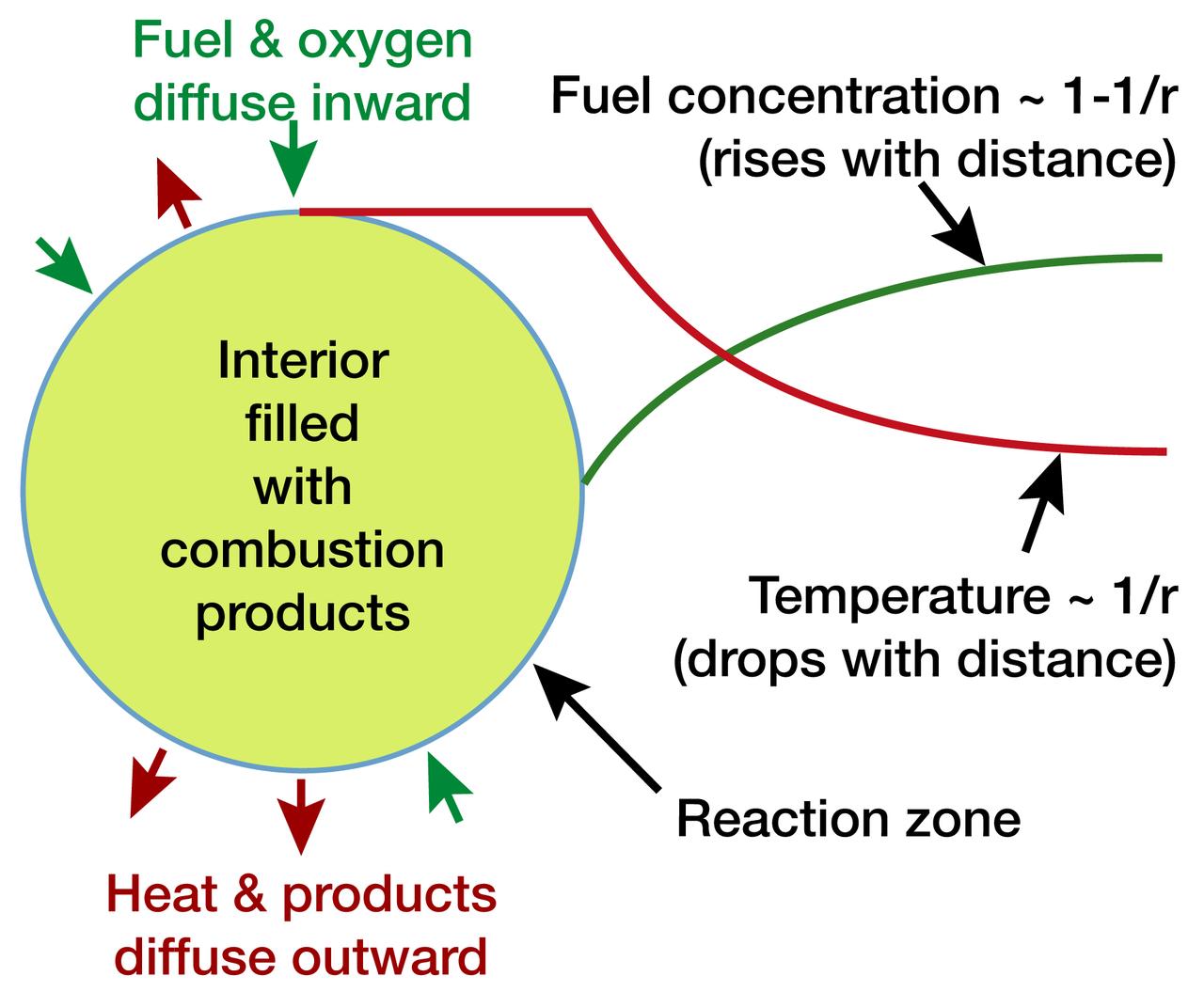
The potential for investigating combustion at the limits of flammability, and the implications for spacecraft fire safety, led to the Structures Of Flame Balls At Low Lewis-number (SOFBALL) experiment flown twice aboard the Space Shuttle in 1997. The success there led to reflight on STS-107 Research 1 mission plarned for 2002. All the combustion in a flame ball takes place in a razor-thin reaction zone that depends on diffusion to keep the ball alive. Such a fragile balance is impossible on Earth. The principal investigator is Dr. Paul Ronney of the University of Southern California, Los Angeles. Glenn Research in Cleveland, OH, manages the project.
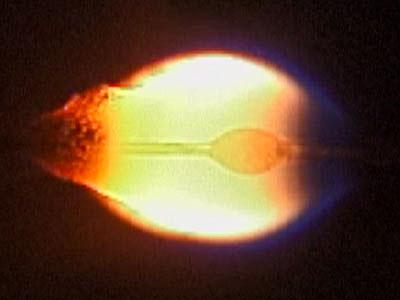
jsc2024e016238 (2/14/2024) --- Flame spreading over wire insulation in microgravity obtained by 10 s drop tower of the Japan Microgravity Center. Uniform low speed air flow is suppled from right to left. Molten PE ball is observed in the flame. Soot particles are continuously emitted at the rear of the flame. Fundamental Research on International Standard of Fire Safety in Space – Base for Safety of Future Manned Missions (FLARE), a Japan Aerospace Exploration Agency (JAXA) investigation, explores the flammability of materials in microgravity. Image courtesy of Hokkaido University.

Technicians at NASA’s Kennedy Space Center in Florida complete routine inspections the Artemis II Orion stage adapter on Wednesday, Aug. 20, 2025, to the spaceport’s Multi-Payload Processing Facility to undergo CubeSat integration following its arrival from the agency’s Marshall Flight Center in Huntsville, Alabama. NASA Marshall built the Orion stage adapter which connects to the SLS (Space Launch System) rocket’s interim cryogenic propulsion stage to the Orion spacecraft and protects Orion from flammable gases generated during launch. The Artemis II test flight will take four astronauts around the Moon and return them back home in early 2026.
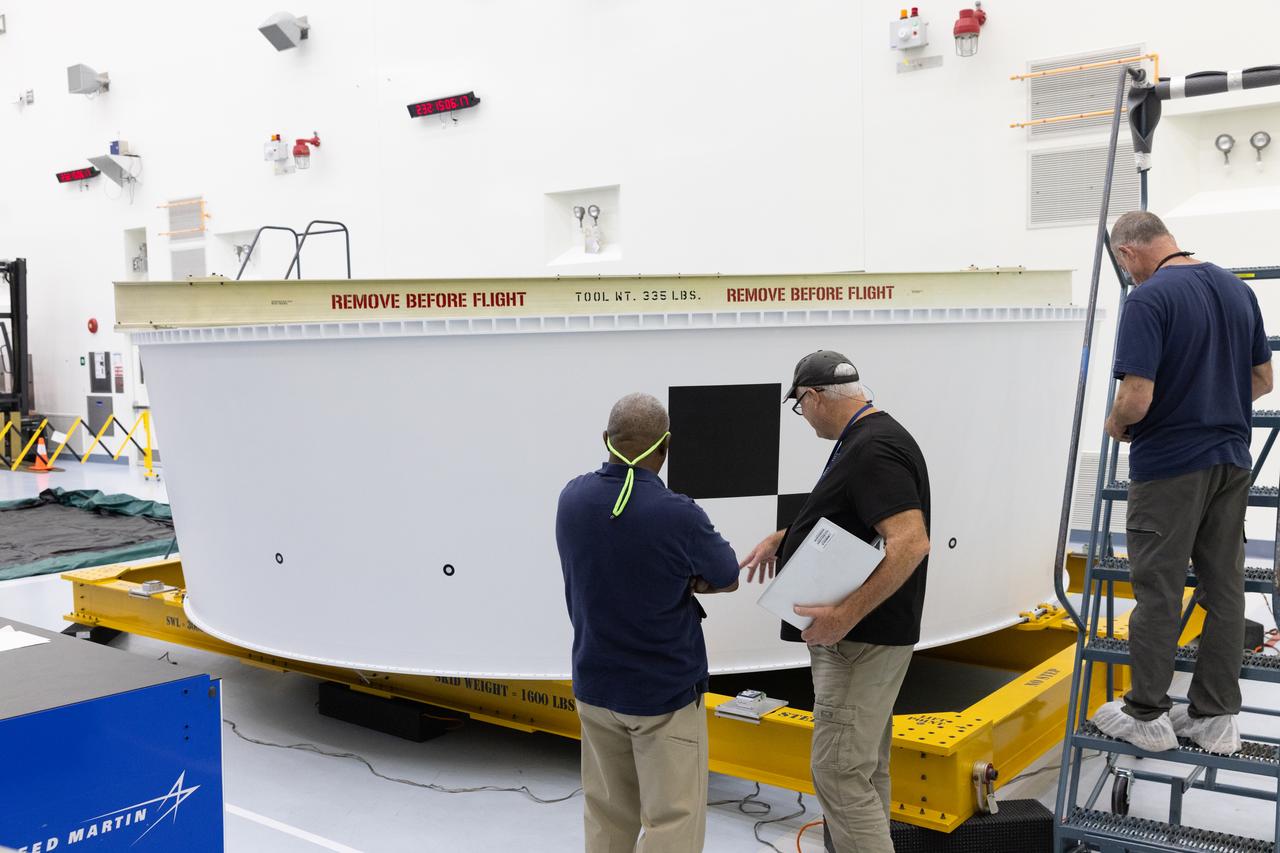
Technicians at NASA’s Kennedy Space Center in Florida complete routine inspections the Artemis II Orion stage adapter on Wednesday, Aug. 20, 2025, to the spaceport’s Multi-Payload Processing Facility to undergo CubeSat integration following its arrival from the agency’s Marshall Space Flight Center in Huntsville, Alabama. NASA Marshall built the Orion stage adapter which connects to the SLS (Space Launch System) rocket’s interim cryogenic propulsion stage to the Orion spacecraft and protects Orion from flammable gases generated during launch. The Artemis II test flight will take four astronauts around the Moon and return them back home in early 2026.
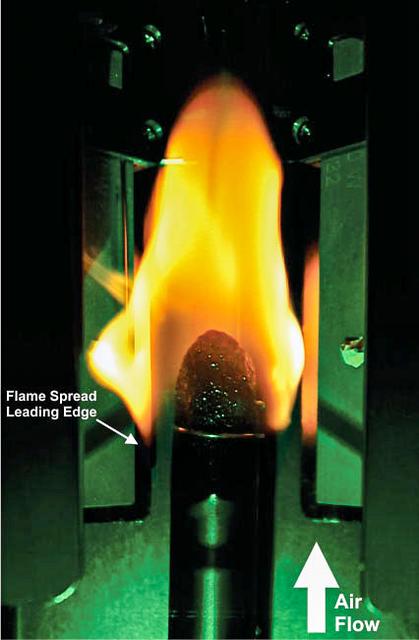
jsc2024e053517 (8/8/2024) --- A plexiglass rod burns in microgravity for the Solid Fuel Ignition and Extinction - Material Ignition and Suppression Test (SoFIE-MIST) investigation. Once each rod is ignited, the flame spreads upstream from the ignition end of the rod. As tests progress, the flame spreads along the rod, consuming oxygen. Once the oxygen concentration drops low enough, the flame extinguishes due to natural oxygen depletion. Data to measure the oxygen concentration, flow rate, and heat loss is obtained at the three test pressures. SoFIE-MIST aims to improve understanding of early fire growth behavior and validate models for material flammability, helping to inform the selection of safer materials for future space facilities and determine the best methods for extinguishing fires in space. .
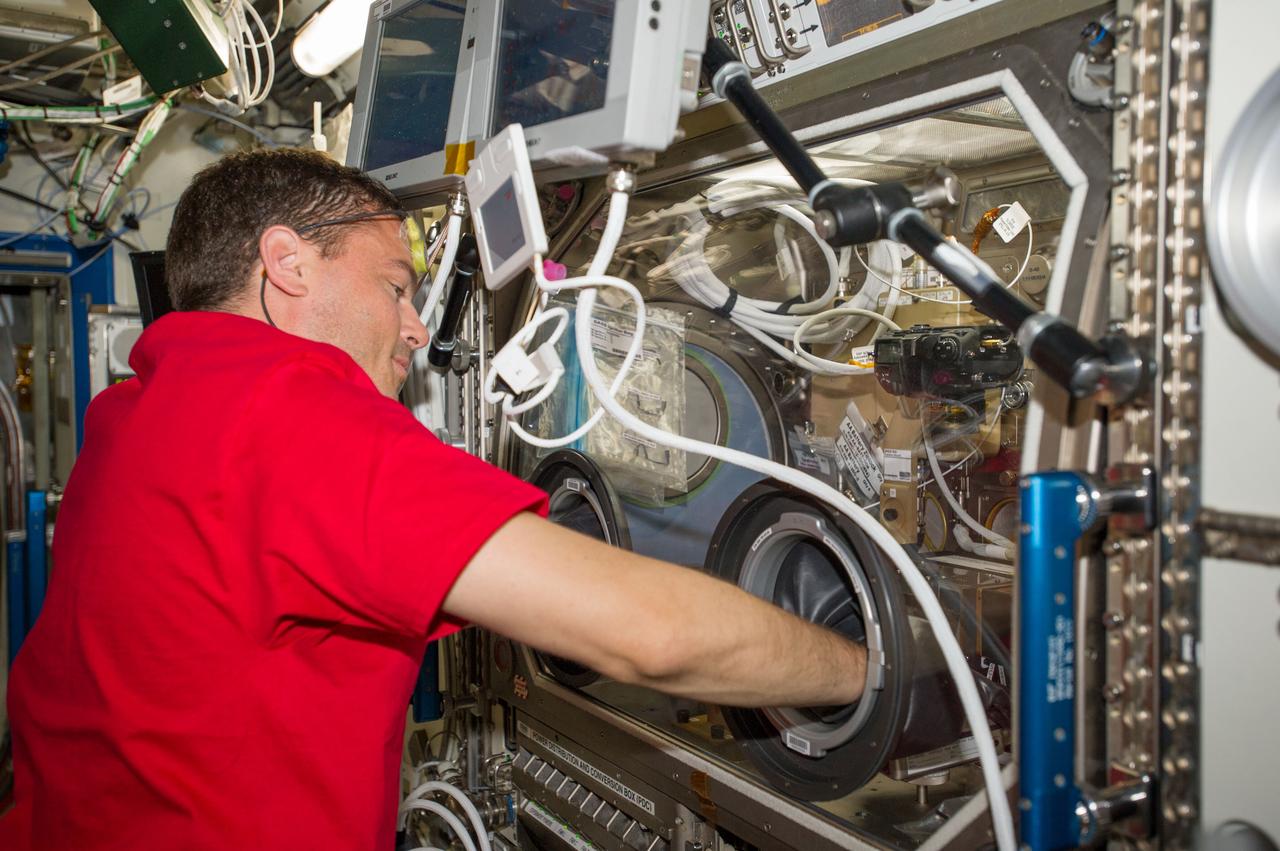
ISS040-E-021546 (26 June 2014) --- NASA astronaut Reid Wiseman, Expedition 40 flight engineer, conducts a combustion experiment known as the Burning and Suppression of Solids (BASS) inside the Microgravity Science Glovebox (MSG) located in the International Space Station?s Destiny laboratory. Without gravity, materials burn quite differently, with a spherical flame instead of the conical shape seen on Earth. BASS is studying the hypothesis that some materials may actually become more flammable in space. Results from BASS will help guide spacecraft materials selection and improve strategies for putting out accidental fires aboard spacecraft. The research also provides scientists with improved computational models that will aid in the design of fire detection and suppression systems here on Earth.
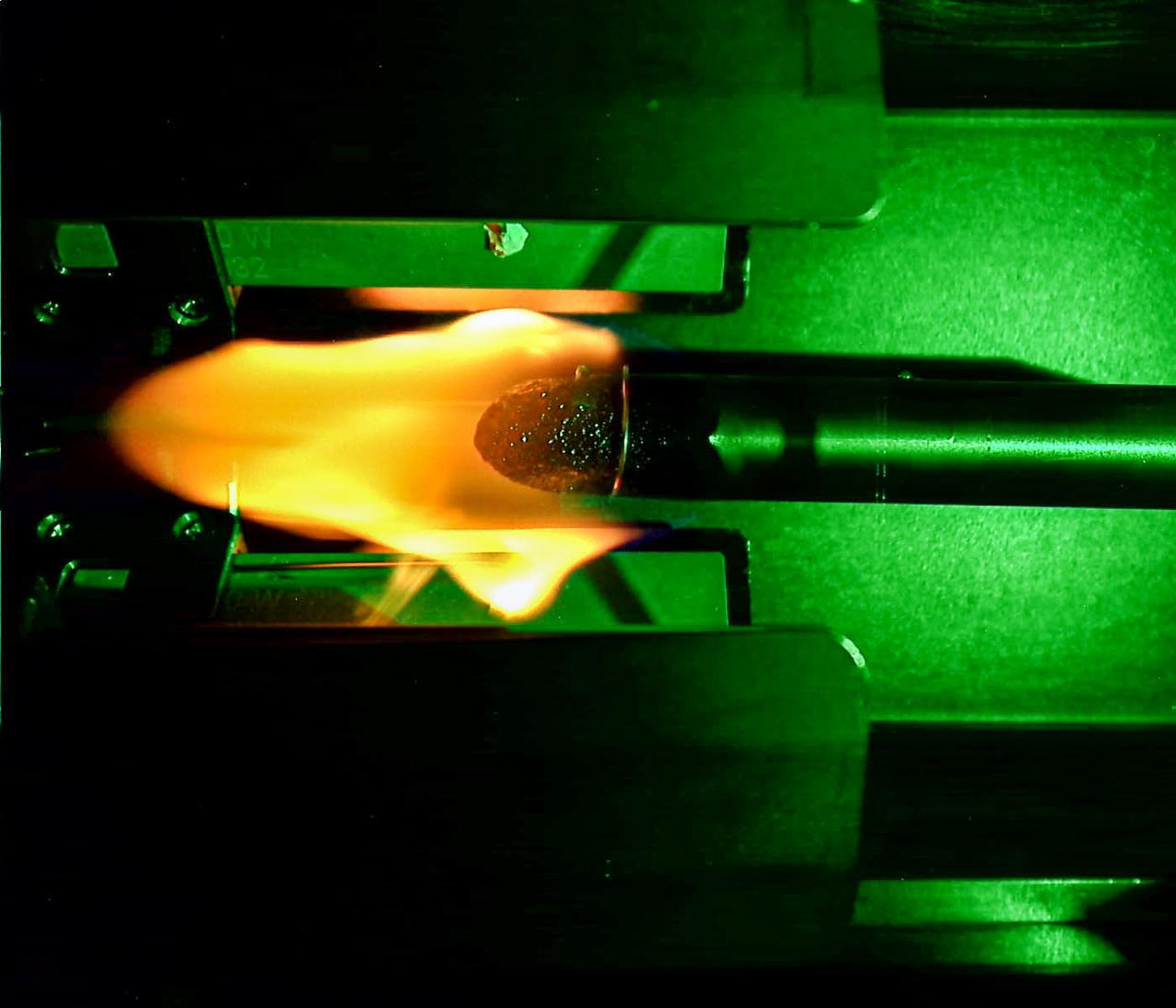
jsc2024e053516 (8/8/2024) --- A plexiglass rod burns in microgravity for the Solid Fuel Ignition and Extinction - Material Ignition and Suppression Test (SoFIE-MIST) investigation. Once each rod is ignited, the flame spreads upstream from the ignition end of the rod. As tests progress, the flame spreads along the rod, consuming oxygen. Once the oxygen concentration drops low enough, the flame extinguishes due to natural oxygen depletion. Data to measure the oxygen concentration, flow rate, and heat loss is obtained at the three test pressures. SoFIE-MIST aims to improve understanding of early fire growth behavior and validate models for material flammability, helping to inform the selection of safer materials for future space facilities and determine the best methods for extinguishing fires in space.
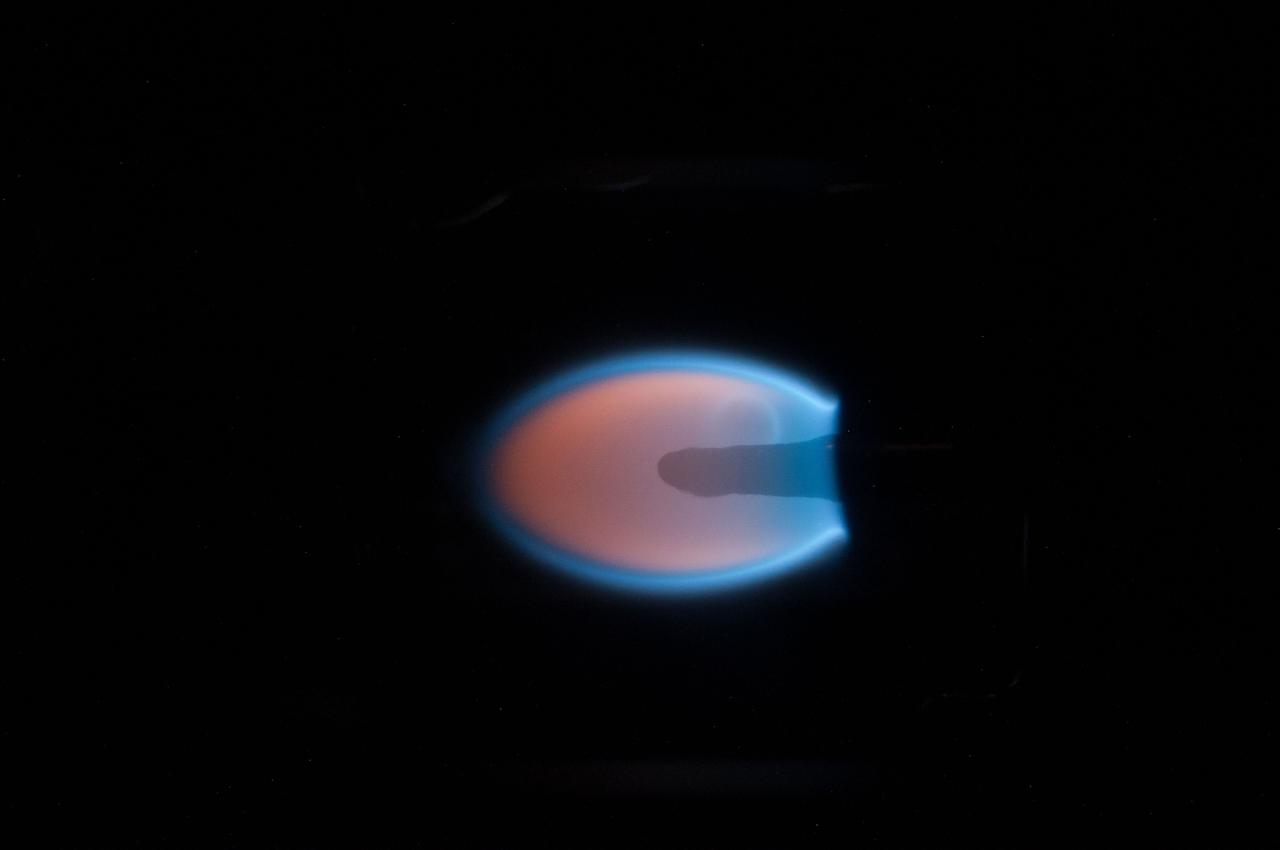
Image taken during BASS-II flame test session -card 2 - conducted on GMT 203. Burned a 4 mm thick, 1 cm wide acrylic slab at multiple velocities. At high flows, the flame was long and sooty. When the flow was reduced, the flame stabilized. The Burning and Suppression of Solids II (BASS-II) investigation examines the burning and extinction characteristics of a wide variety of fuel samples in microgravity. The BASS-II experiment will guide strategies for materials flammability screening for use in spacecraft as well as provide valuable data on solid fuel burning behavior in microgravity. BASS-II results contribute to the combustion computational models used in the design of fire detection and suppression systems in microgravity and on Earth.
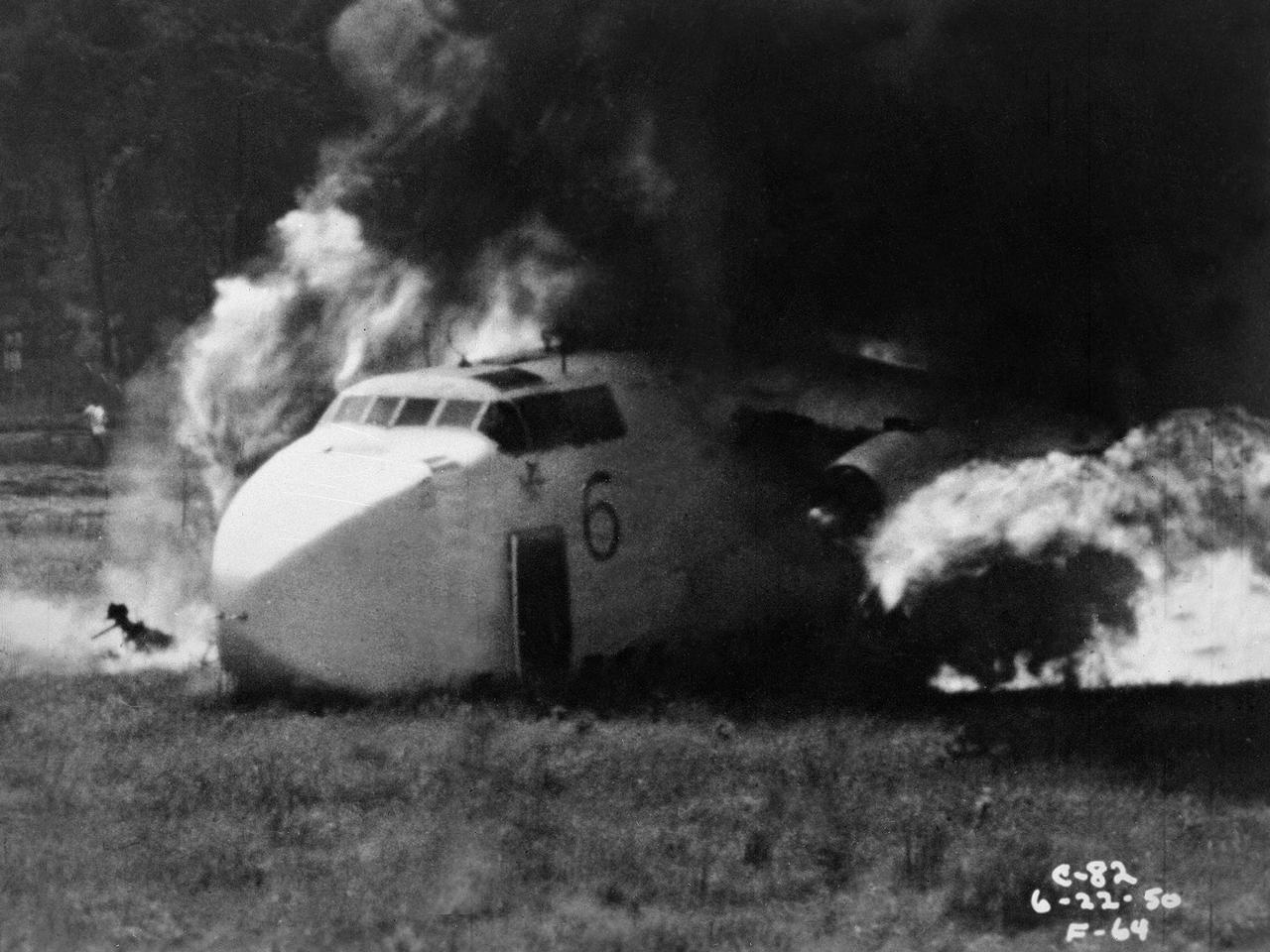
Researchers at the National Advisory Committee for Aeronautics (NACA) Lewis Flight Propulsion Laboratory purposely crash a Fairchild C-82 Packet aircraft to study flame propagation. A rash of passenger aircraft crashes in 1946 and 1947 spurred a White House call for an investigatory board staffed by members of the Civil Aeronautics Board, military, and the NACA. The group addressed fire segregation, extinguishment, and prevention. The NACA established a Subcommittee on Aircraft Fire Prevention in February 1948 to coordinate its efforts. The Lewis team simulated situations in which an aircraft failed to become airborne during takeoff resulting in crashes into embankments and other objects. The Lewis researchers initially used surplus C-46 and C-82 military transport planes. In these situations, the aircraft generally suffered damage to its fuel system and other components, but was structurally survivable. The aircraft were mounted to a rail that ran down a 1700-foot long test runway. The aircraft was secured at the starting point with an anchor pier so it could get its engines up to takeoff speed before launching down the track. Barriers at the end of the runway were designed to simulate a variety of different types of crashes. Telemetry and high-speed cameras were crucial elements in these studies. The preliminary testing phase identified potential ignition sources and analyzed the spread of flammable materials.
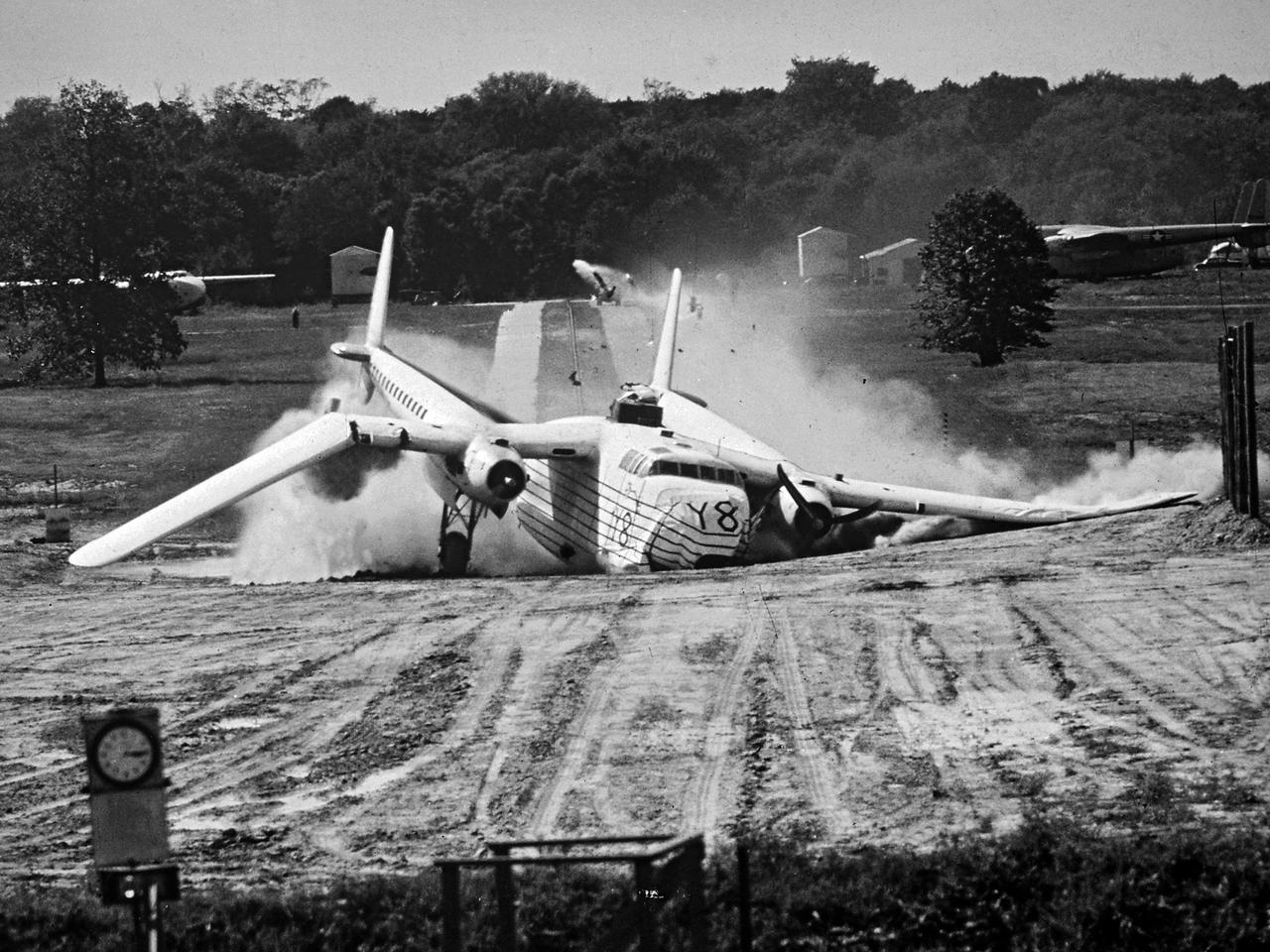
A Fairchild C-82 Packet is purposely destroyed by researchers at the National Advisory Committee for Aeronautics (NACA) Lewis Flight Propulsion Laboratory. In response to an escalating number of transport aircraft crashes in the mid-1940s, the NACA researchers undertook a decade-long investigation into a number of issues surrounding low-altitude aircraft crashes. The tests were conducted at the Ravenna Arsenal, approximately 60 miles south of the Lewis laboratory in Cleveland, Ohio. The aircraft were excess military transports from World War II. The aircraft was guided down the runway at speeds of 80 to 105 miles per hour. It came into contact with poles which tore open the 1500-gallon fuel tanks in the wings before reaching the barriers at the end of the runway. Fuel poured from the tanks and supply lines, resulting in the spread of both liquid fuel and a large cloud of spray. Solomon Weiss developed a method of dying the fuel red to improve its visibility during the crashes. This red fuel cloud trailed slightly behind the skidding aircraft, then rushed forward when the aircraft stopped. The nine-crash initial phase of testing used Lockheed C-56 Lodestar and C-82 transport aircraft to identify potential ignition sources and analyze the spread of flammable materials. The researchers were able to identify different classes of ignition sources, fuel disbursement patterns, the time when a particular ignition source might appear, rate of the fire spread, cabin survival times, and deceleration rates.