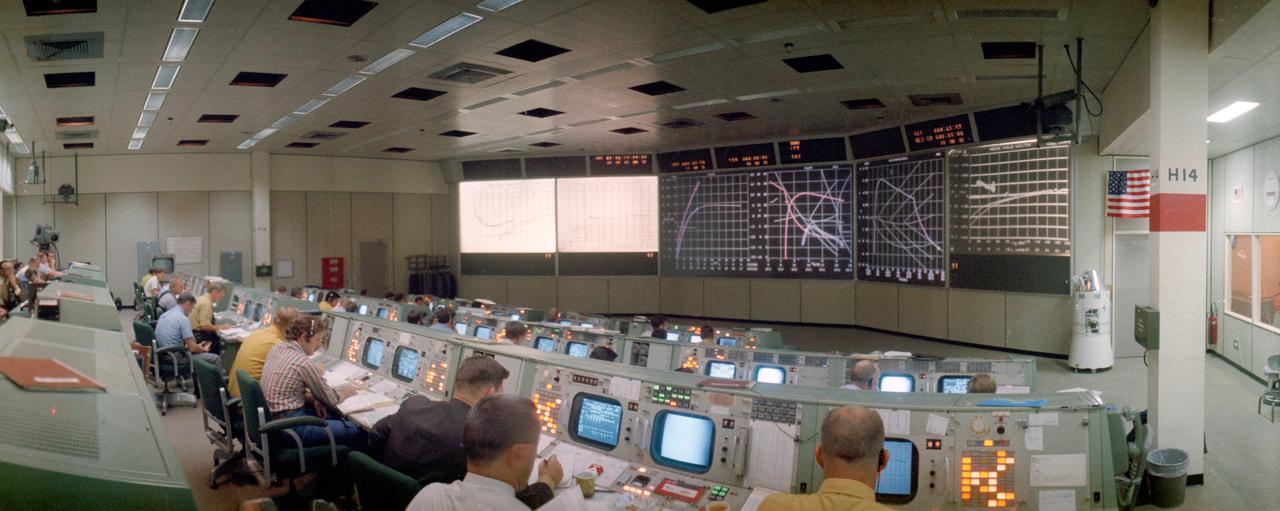
S71-41357 (26 July 1971) --- An overall, wide-angle lens view of activity in the Mission Operations Control Room in the Mission Control Center minutes after the launch of the Apollo 15 lunar landing mission. Ground elapsed time was 45 minutes and 42 seconds when this photograph was taken.
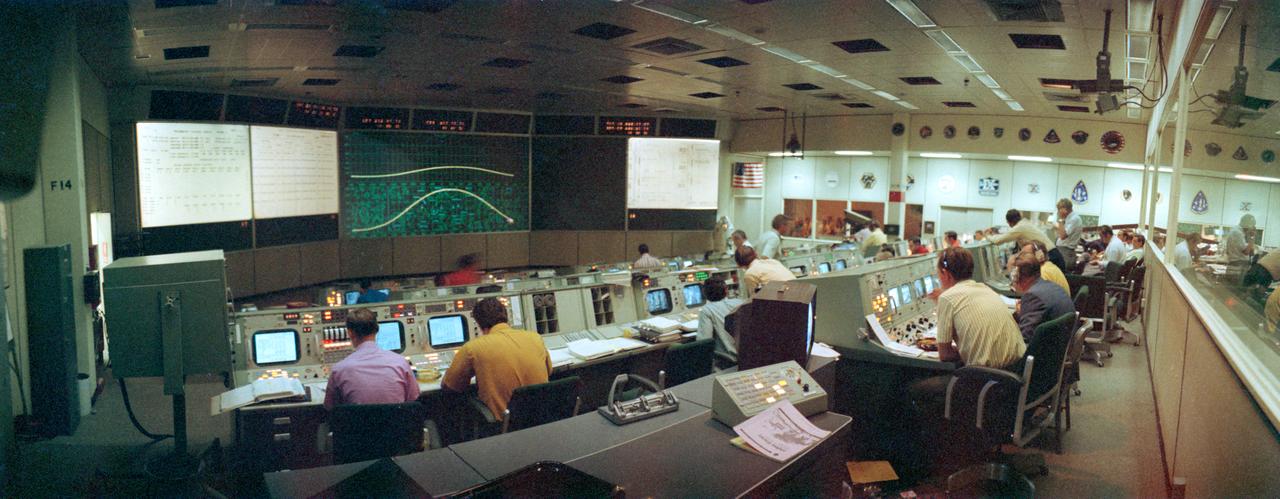
Overall wide-angle view of the MOCR in the Mission Control Center (MCC) during the touchdown of the Apollo XV LM at the Hadley-Apennine Moon site. MSC, Houston, TX
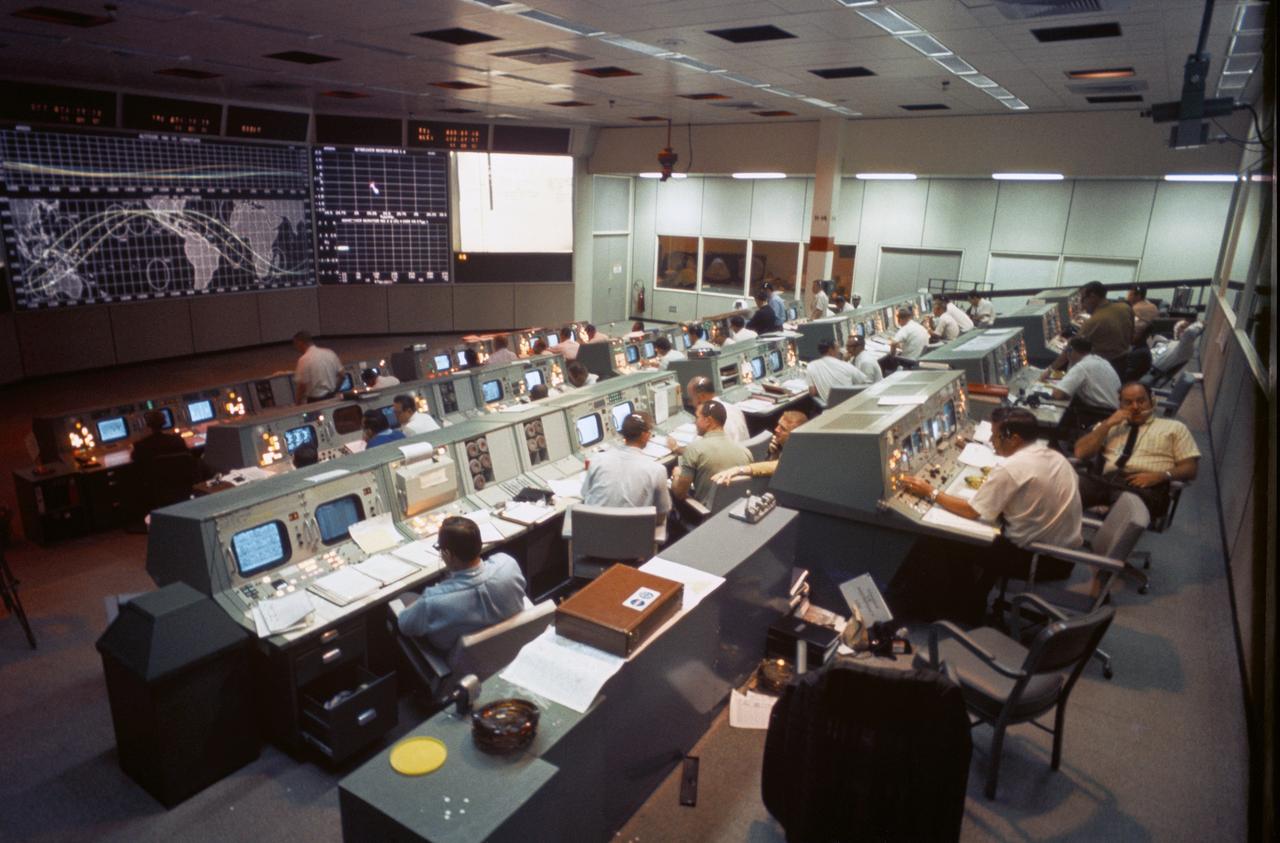
Overall view of activity in the Mission Operations Control Room in the Mission Control Center, Bldg 30, on the first day of the Apollo 7 space mission.
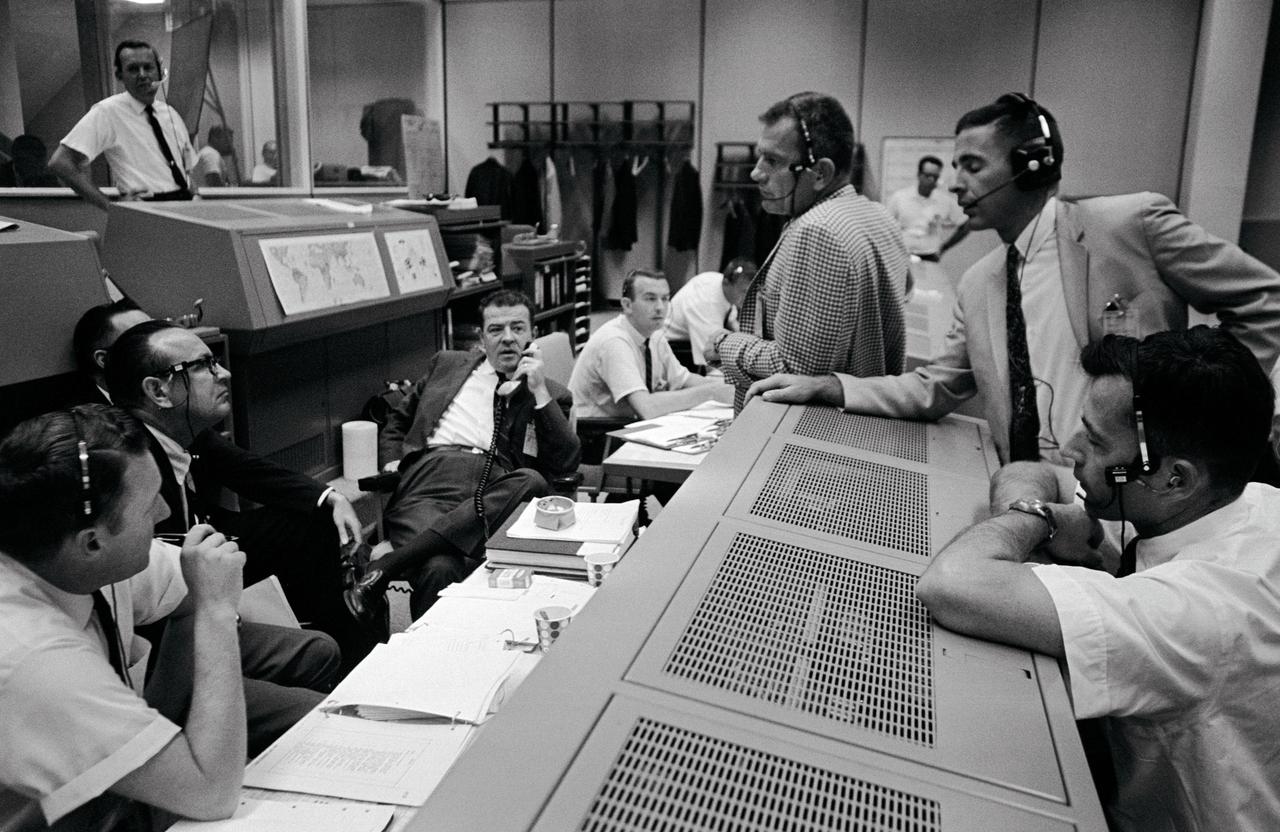
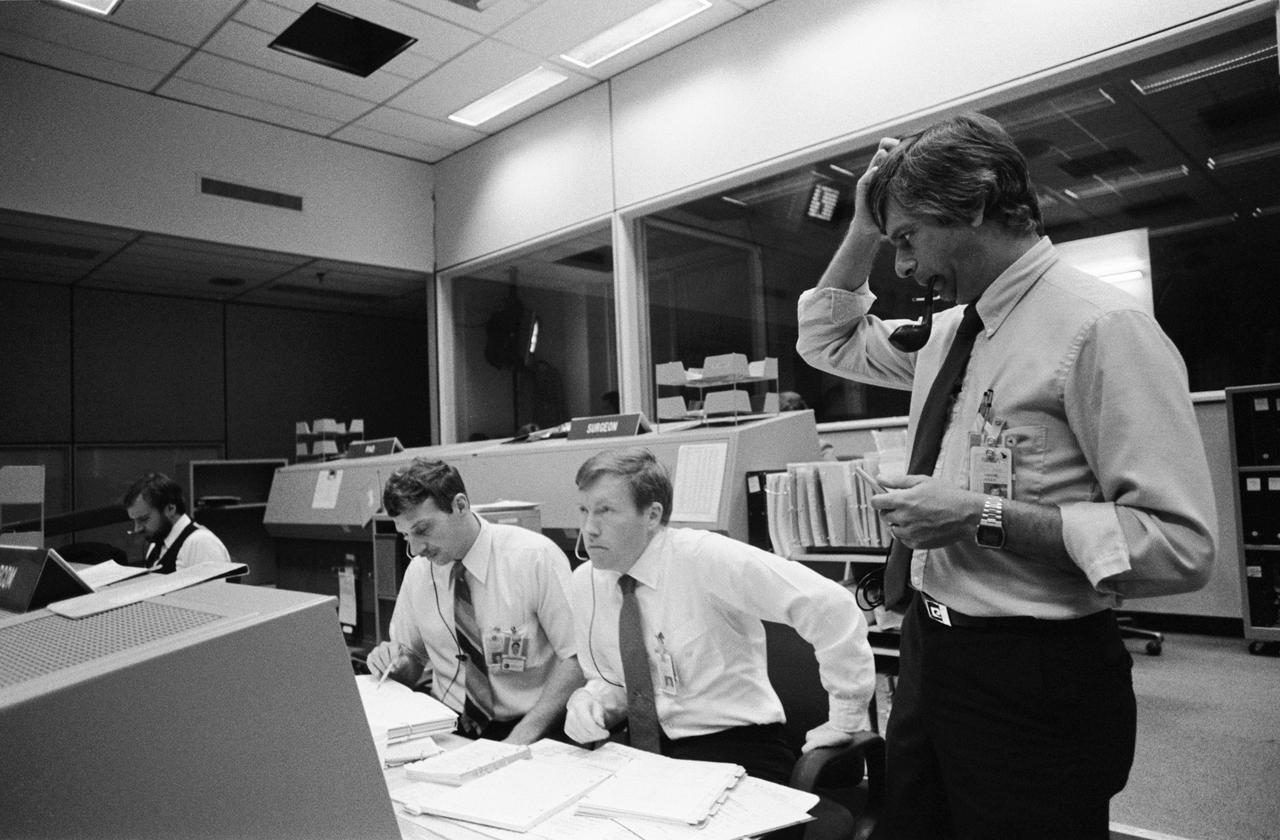
S66-52157 (12 Sept. 1966) --- Discussing the Gemini-11 spaceflight in the Mission Control Center are: (left to right) Christopher C. Kraft Jr., (wearing glasses), Director of Flight Operations; Charles W. Mathews (holding phone), Manager, Gemini Program Office; Dr. Donald K. Slayton (center, checked coat), Director of Flight Crew Operations; astronaut William A. Anders, and astronaut John W. Young. Photo credit: NASA
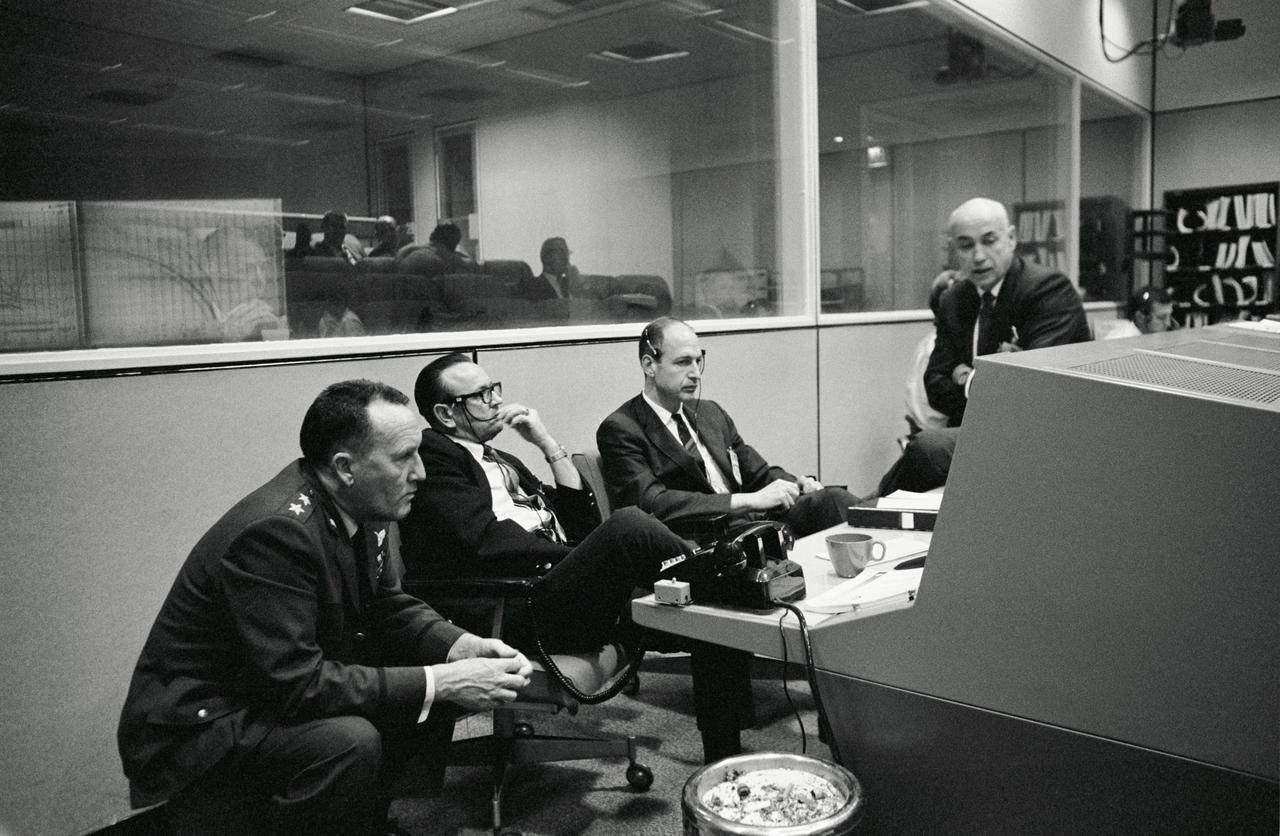
S68-20986 (4 April 1968) --- Scene at the flight operations director's console in the Mission Control Center, Building 30, during the Apollo 6 (Spacecraft 020/Saturn 520) unmanned space flight. Left to right, are Air Force Maj. Gen. Vincent G. Huston, DOD Manager, Manned Space Flight Operations, Andrews Air Force Base, Washington, D.C.; Dr. Christopher C. Kraft Jr., MSC director of flight operations; George M. Low, manager, MSC Apollo Spacecraft Program Office; and Dr. Robert R. Gilruth, MSC Director.
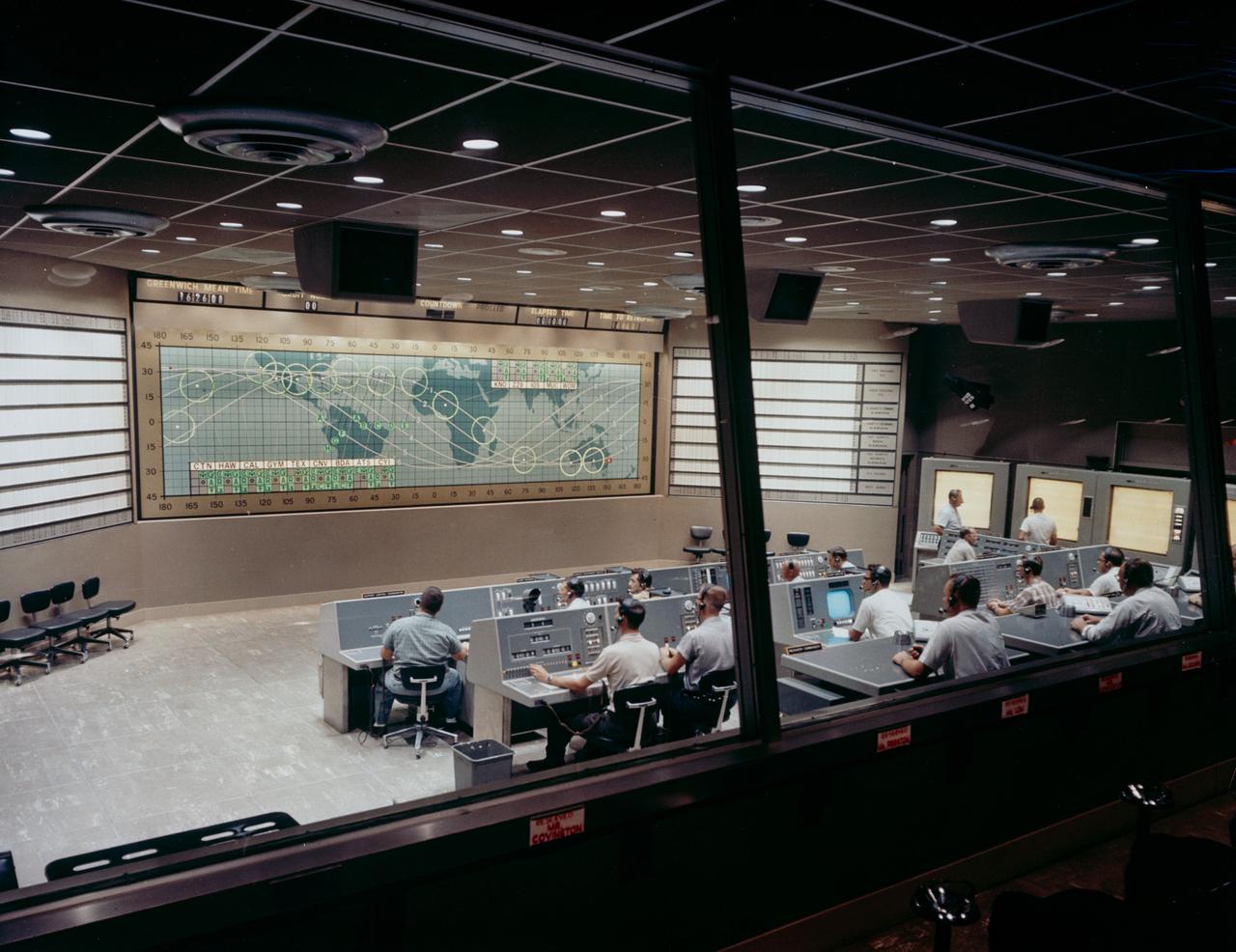
S62-05139 (1962) --- View of Mercury Control Center prior to the Mercury-Atlas 8 (MA-8) flight of the Sigma 7. Photo credit: NASA
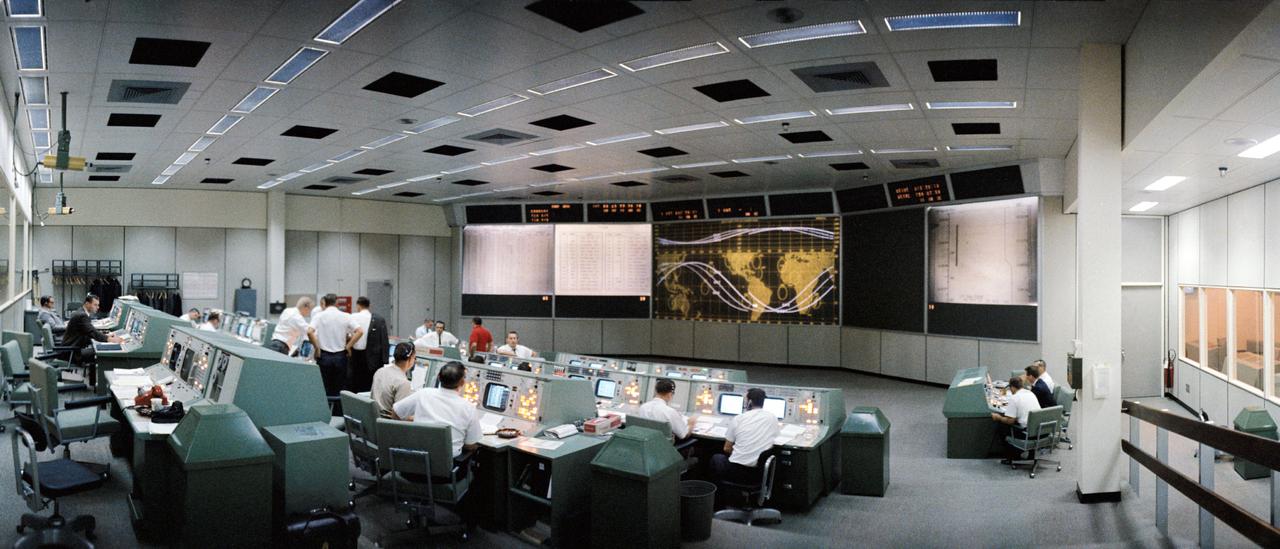
S65-45280 (21-29 Aug. 1965) --- Overall view of the Mission Control Center (MCC), Houston, Texas, during the Gemini-5 flight. Note the screen at the front of the MCC which is used to track the progress of the Gemini spacecraft.
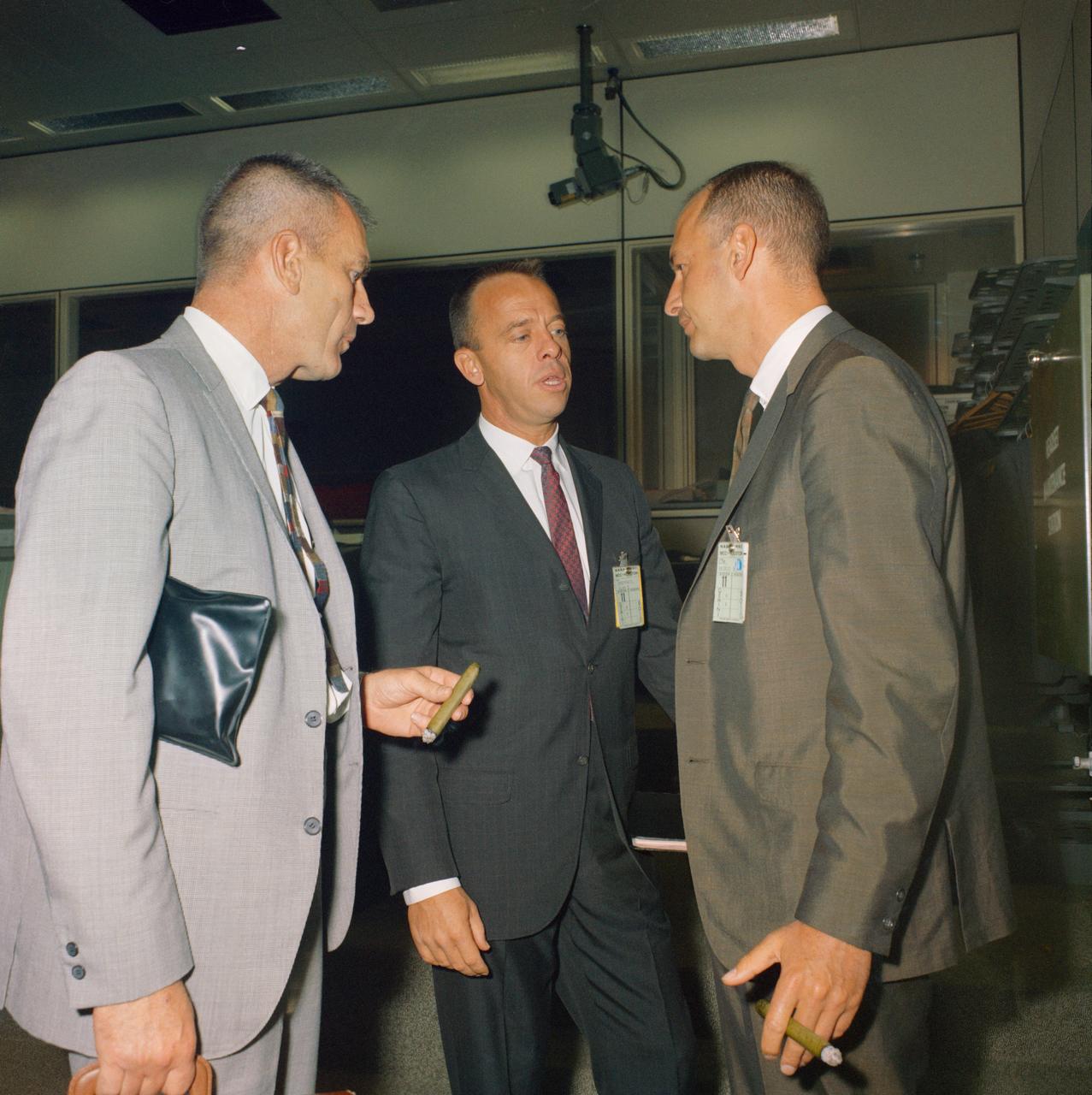
S66-52754 (12 Sept. 1966) --- Three key Manned Spacecraft Center (MSC) officials hold discussion in the Mission Control room during Gemini-11 activity. Left to right, are Donald K. Slayton, MSC Director of Flight Crew Operations; astronaut Alan B. Shepard Jr., Chief, MSC Astronaut Office; and George M. Low, MSC Deputy Director. Photo credit: NASA
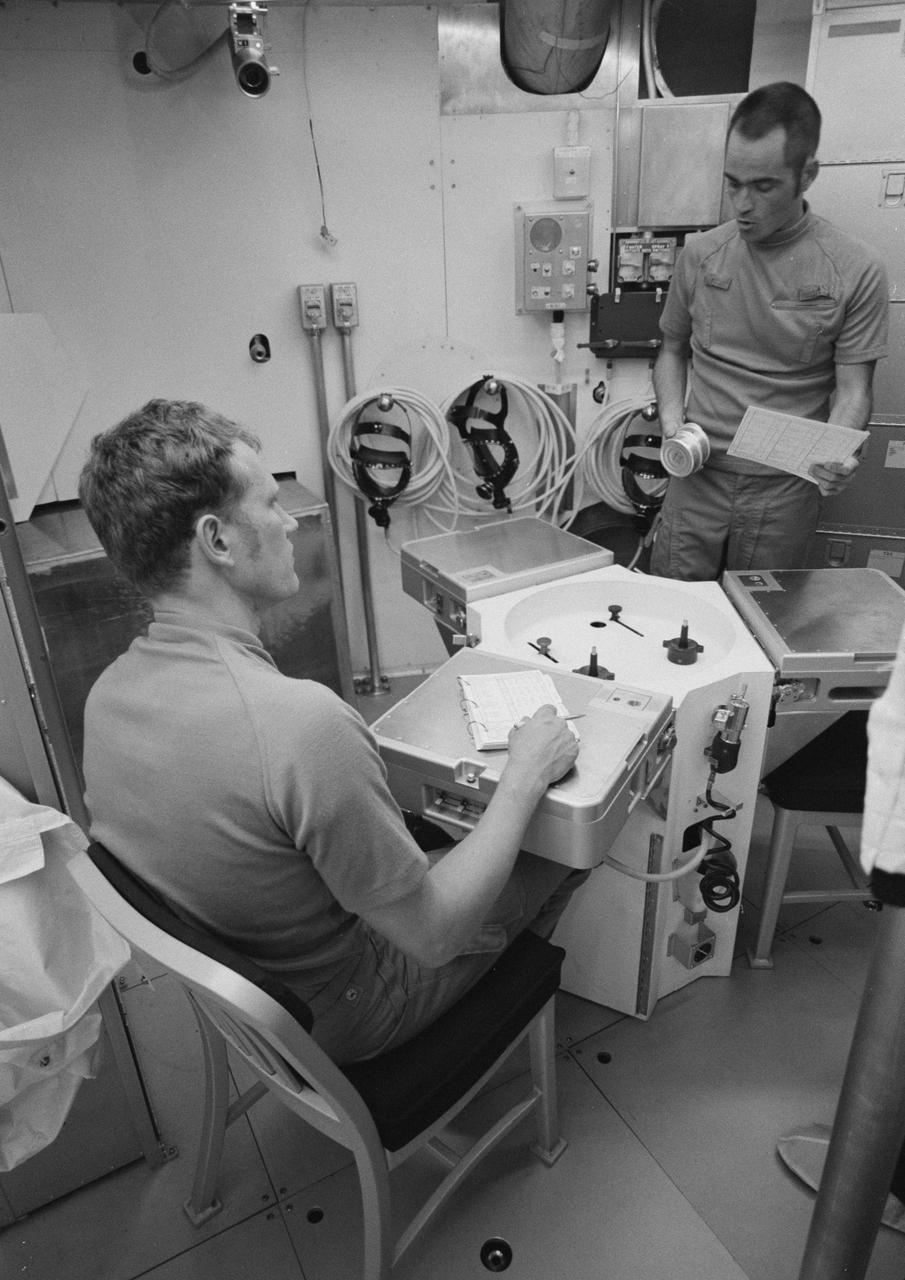
S72-41853 (15 June 1972) --- Two members of the three-man Skylab Medical Experiment Altitude Test (SMEAT) crew, that will spend up to 56 days in the Crew Systems Division's 20-foot altitude chamber at the Manned Spacecraft Center (MSC) beginning in mid-July, go over a menu in the food preparation area. Seated at the simulated wardroom food table is astronaut Karol J. Bobko, SMEAT pilot, and standing is astronaut Robert L. Crippen, SMEAT commander. Dr. William E. Thornton, SMEAT science pilot, the third crew member is not shown in this view. Photo credit: NASA

JSC2002-E-41161 (7 October 2002) --- Flight director John Shannon monitors data at his console in the shuttle flight control room (WFCR) in Houston’s Mission Control Center (MCC). At the time this photo was taken the Space Shuttle Atlantis was about to launch from the Kennedy Space Center, Florida. Atlantis lifted off at 2:46 p.m. (CDT) on October 7, 2002. Once the vehicle cleared the tower in Florida, the Houston-based team of flight controllers took over the ground control of the flight.
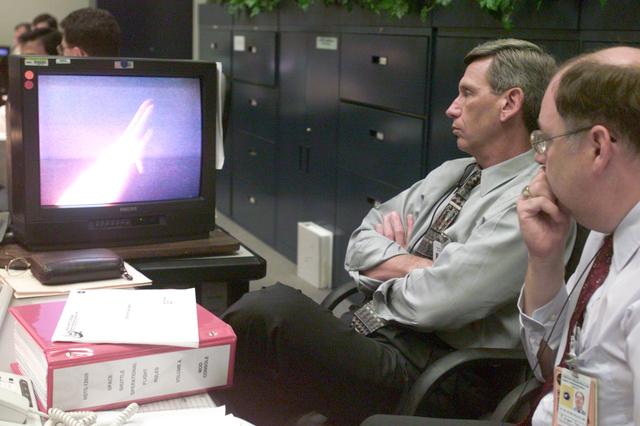
JSC2001-E-24999 (10 August 2001) --- Lawrence Bourgeois (left) and Wayne Hale watch the launch of the Space Shuttle Discovery at the Mission Operations Directorate (MOD) console in the shuttle flight control room (WFCR) in Houston's Mission Control Center (MCC). As soon as the vehicle cleared the tower in Florida, the Houston-based team of flight controllers took over the ground control of the flight.
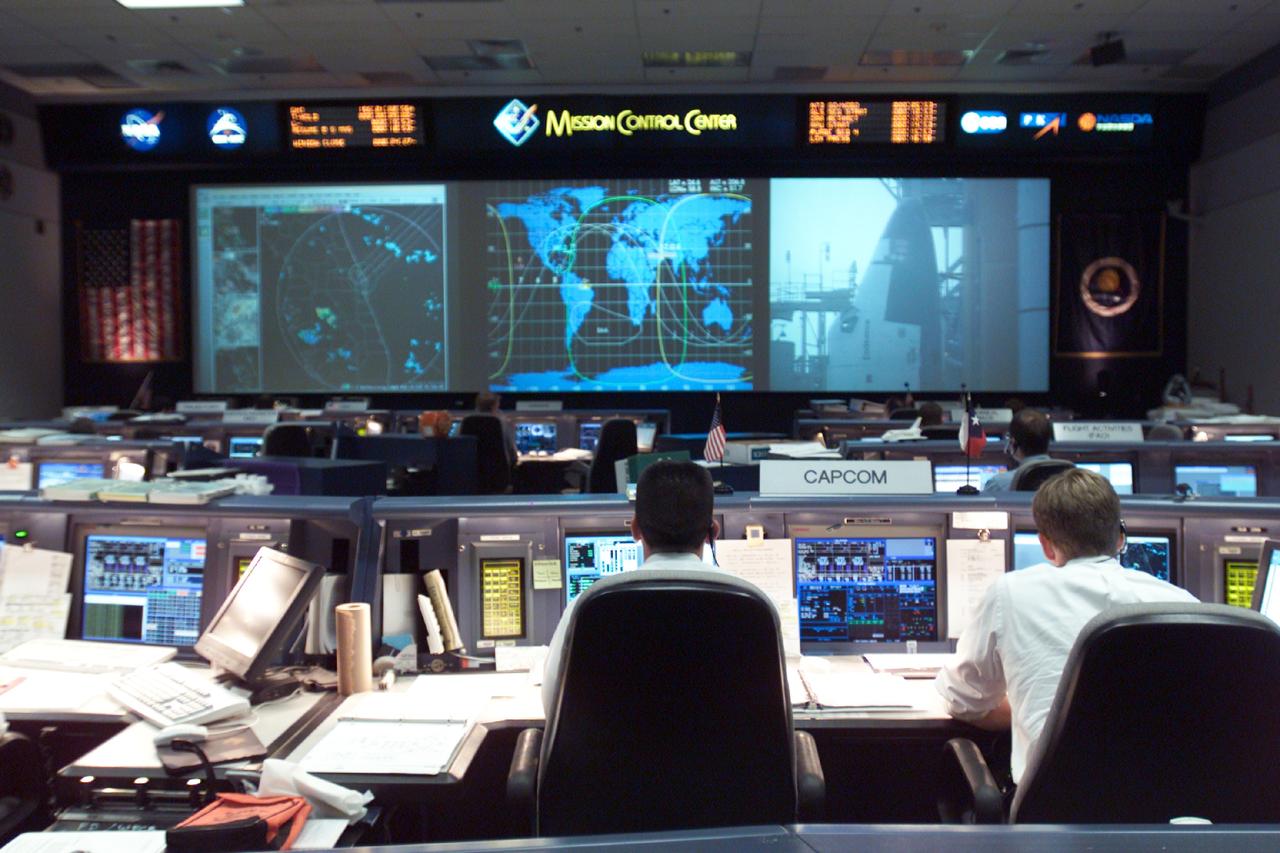
JSC2002-E-23113 (5 June 2002) --- The Space Shuttle Endeavour is shown on the big screen in this overall view of the shuttle flight control room (WFCR) in Houston’s Mission Control Center (MCC) as it is on the launch pad at Kennedy Space Center, Florida. Endeavour launched at 4:23 p.m. (CDT) on June 5, 2002. Once the vehicle cleared the tower in Florida, the Houston-based team of flight controllers took over the ground control of the flight.
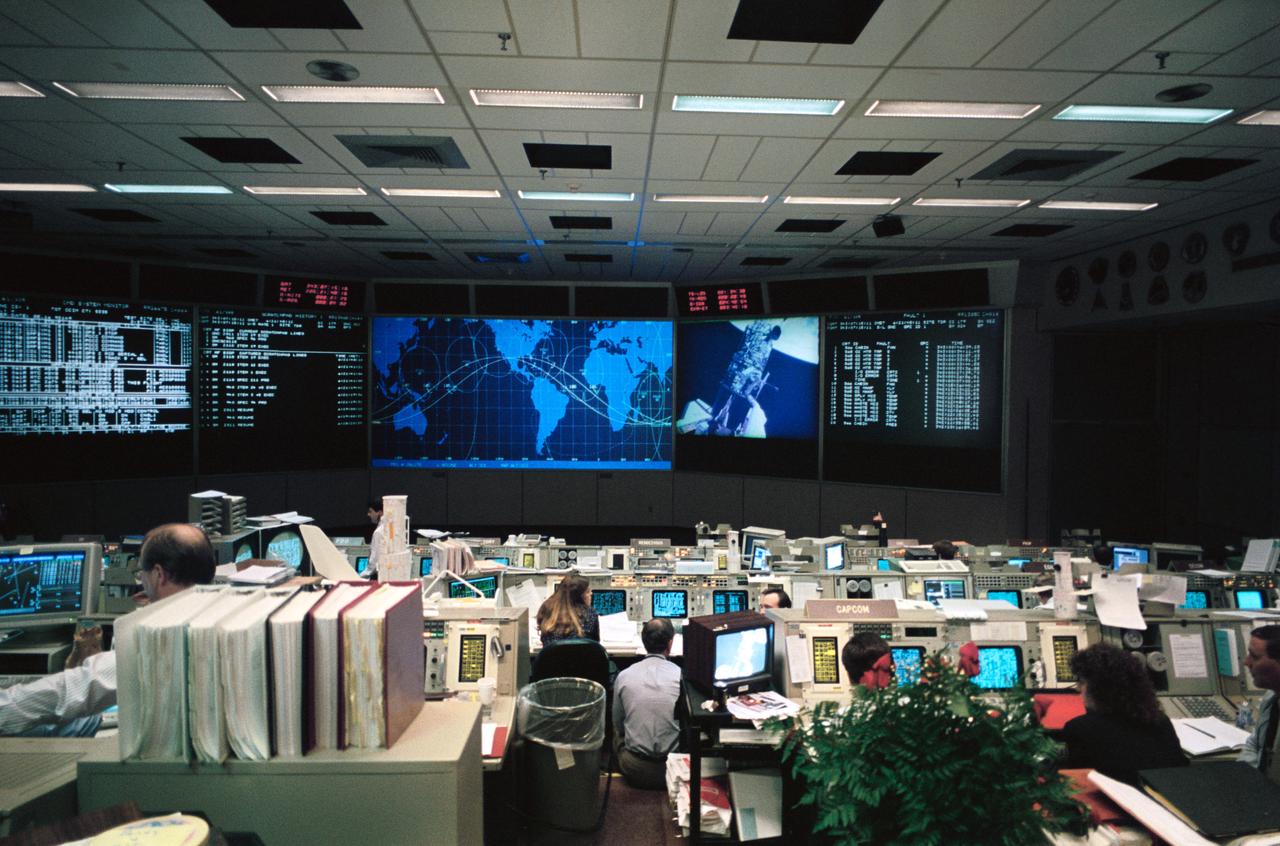
STS061-S-104 (2-13 DEC 1993) --- An overall view in the Johnson Space Center's (JSC) Mission Control Center (MCC) during one of the five space walks performed to service the Hubble Space Telescope (HST) temporarily berthed in the Space Shuttle Endeavour's cargo bay. STS-61 lead flight director Milt Heflin is at right edge of frame.
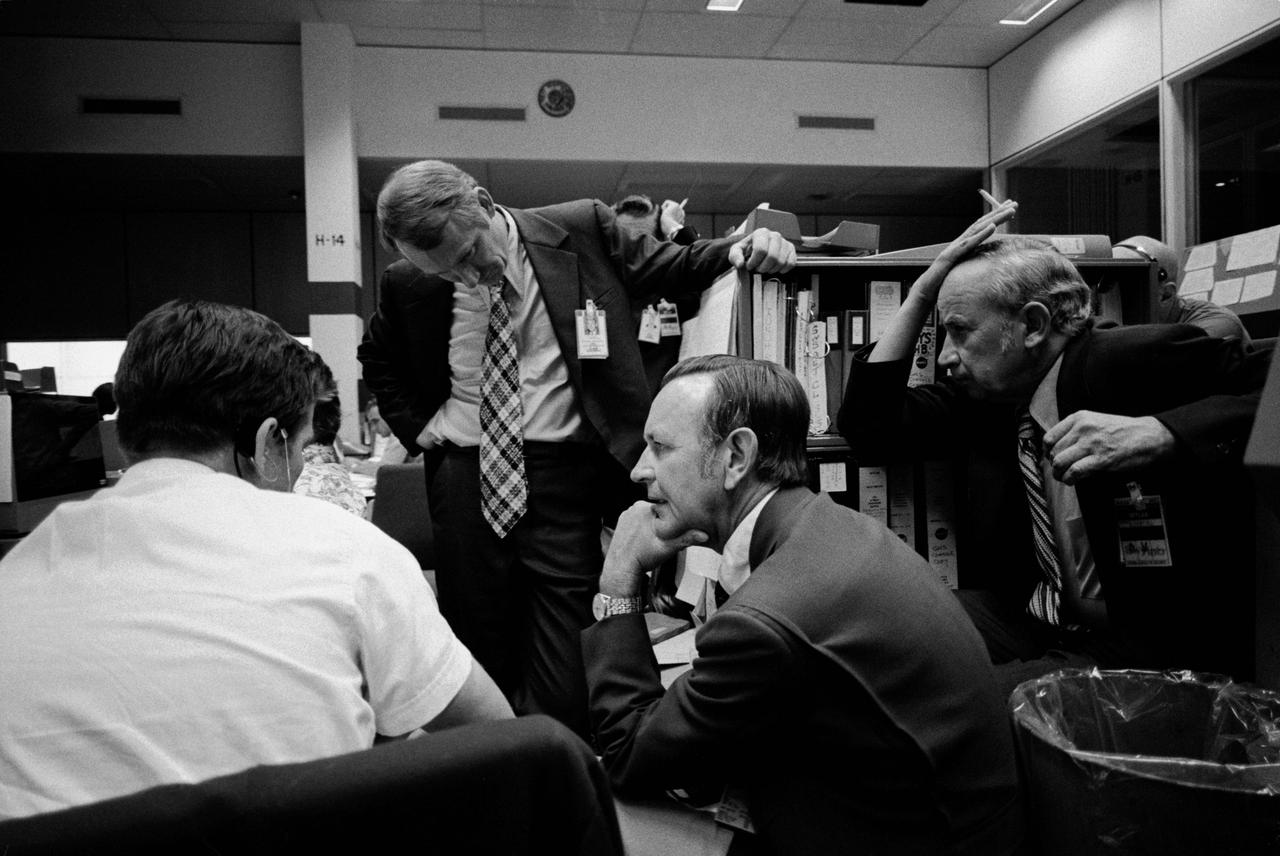
S73-31875 (2 Aug. 1973) --- After learning of a problem in the Command/Service Module which was used to transport the Skylab 3 crew to the orbiting Skylab space station cluster, NASA officials held various meetings to discuss the problem. Here, four men monitor the current status of the problem in the Mission Operations Control Room (MOCR) of the Mission Control Center (MCC) at the Johnson Space Center (JSC). From the left are Gary E. Coen, Guidance and Navigation System flight controller; Howard W. Tindall Jr., Director of Flight Operations at JSC; Dr. Christopher C. Kraft Jr., JSC Director; and Sigurd A. Sjoberg, JSC Deputy Director. Photo credit: NASA
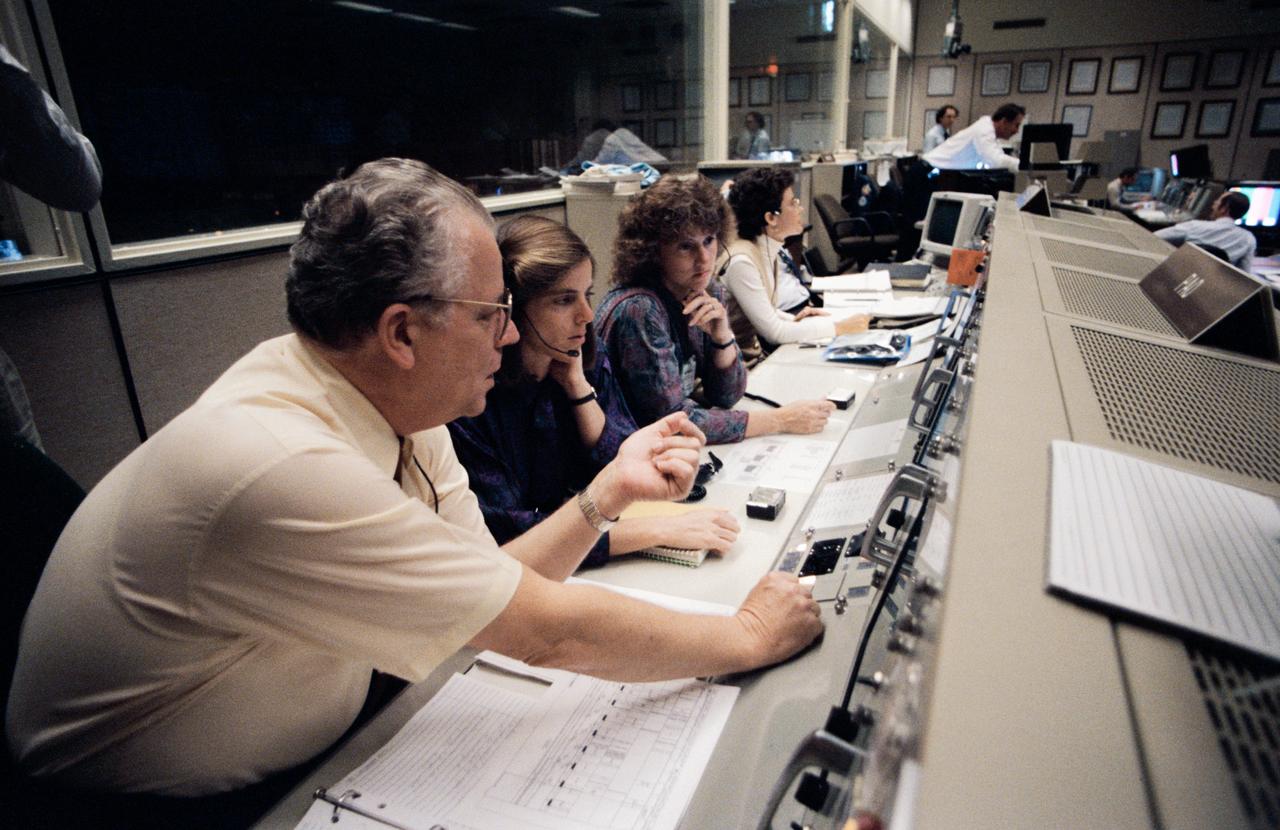
61A-S-135 (5 Nov 1985) --- Two school teachers in training at the Johnson Space Center got their first ?real time? exposure to a Space Shuttle mission as they monitor activity aboard the Spacelab D-1 science module from the mission control center. Sharon Christa McAuliffe (frame center) and Barbara R. Morgan are briefed by Terry White at the Public Affairs console during a television downlink from the Earth-orbiting Space Shuttle Challenger. McAuliffe is scheduled to fly as teacher/citizen observer on the STS 51-L mission early next year; and Morgan is in training as her backup.
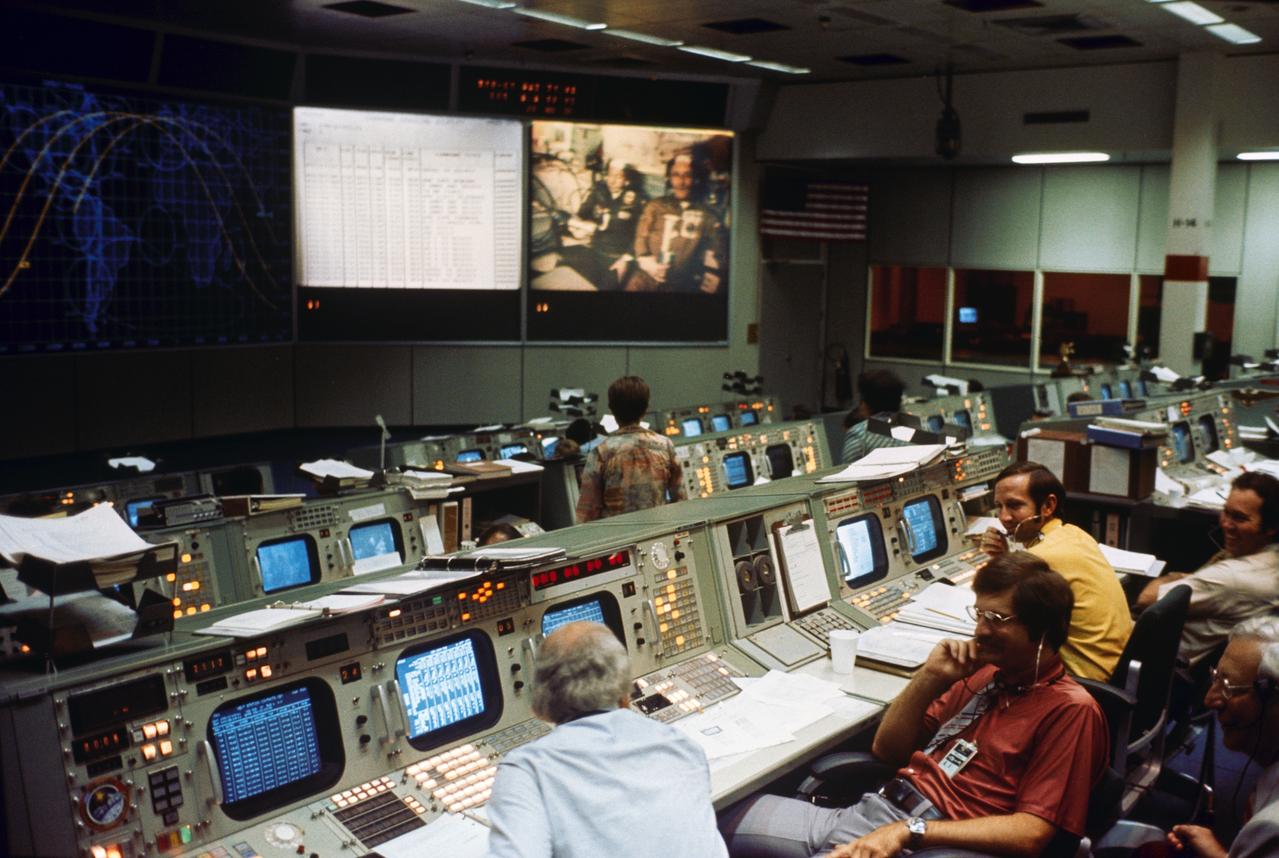
S75-28685 (17 July 1975) --- An overall view of activity in the Mission Operations Control Room in the Mission Control Center during joint U.S.-USSR Apollo Soyuz Test Project (ASTP) docking mission in Earth orbit. The large television monitor shows an interior view of the Soyuz Orbital Module with astronaut Thomas P. Stafford (in front) visiting with cosmonaut Aleksey A. Leonov. Neil B. Hutchinson (right hand to chin) is the flight director for this shift.
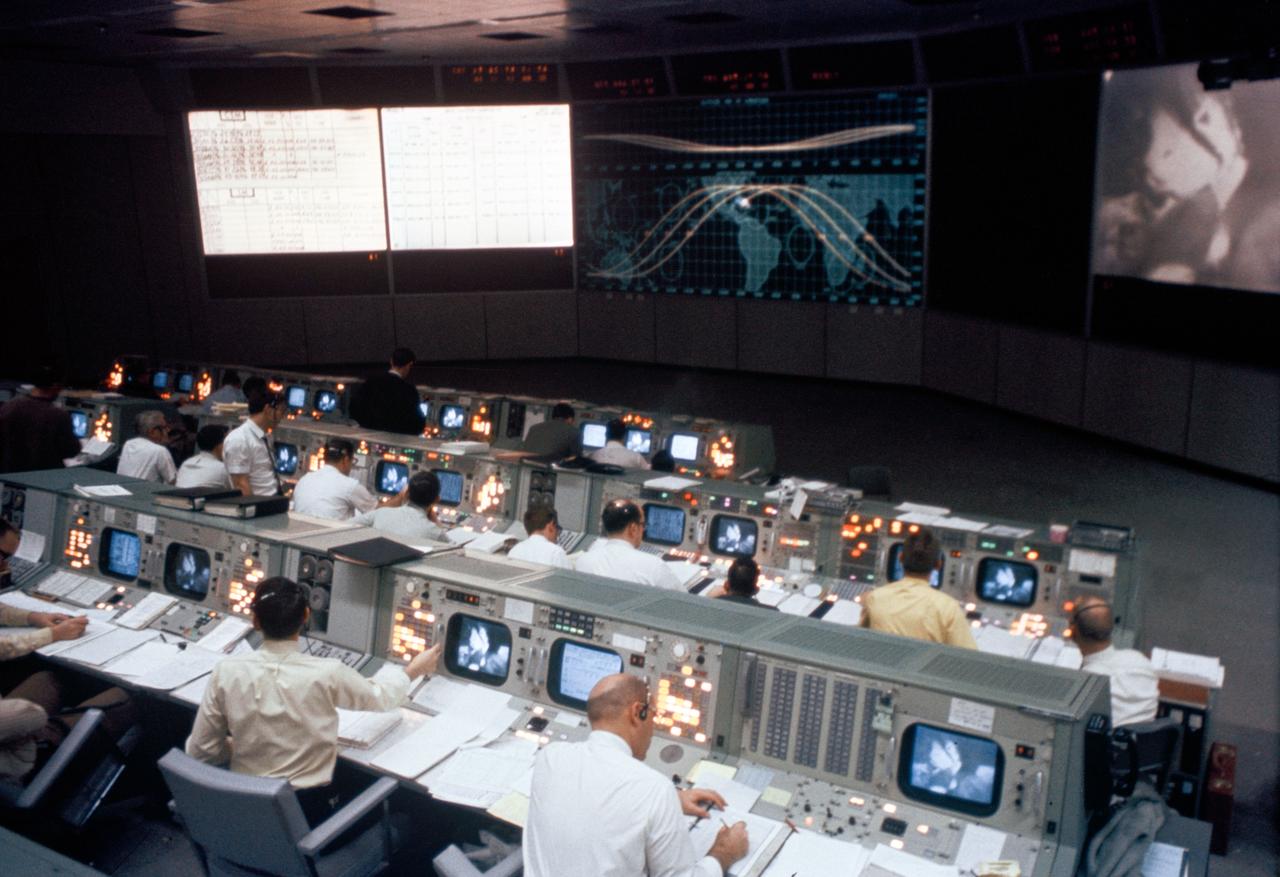
S69-26301 (March 1969) --- Overall view of the Mission Operations Control Room in the Mission Control Center, Building 30, during the Apollo 9 Earth-orbital mission. When this photograph was taken a live television transmission was being received from Apollo 9 as it orbited Earth.
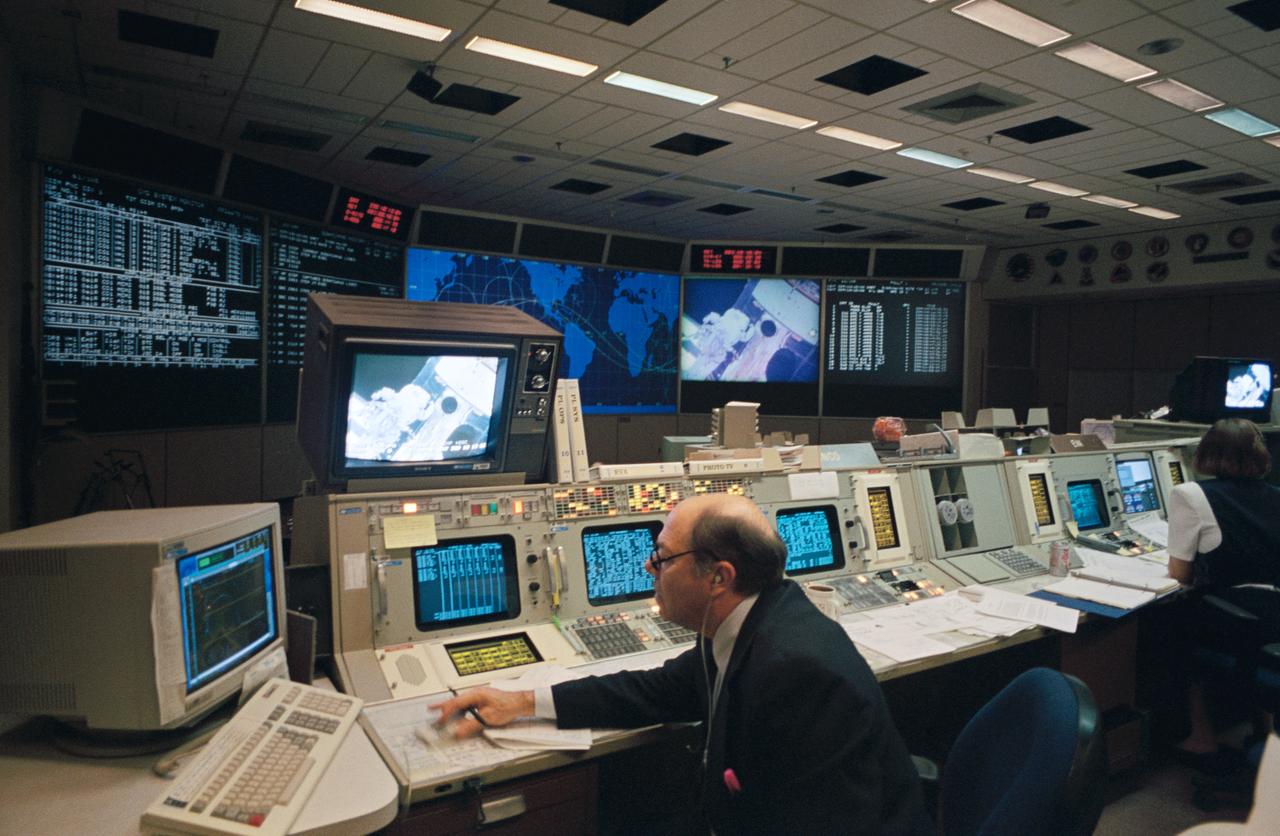
Joseph Fanelli, at the Integrated Communications Officer console, monitors the televised activity of Astronauts Story Musgrave and Jeffrey A. Hoffman. The vetern astronauts were performing the first extravehicular activity (EVA-1) of the STS-61 Hubble Space Telescope (HST) servicing mission.
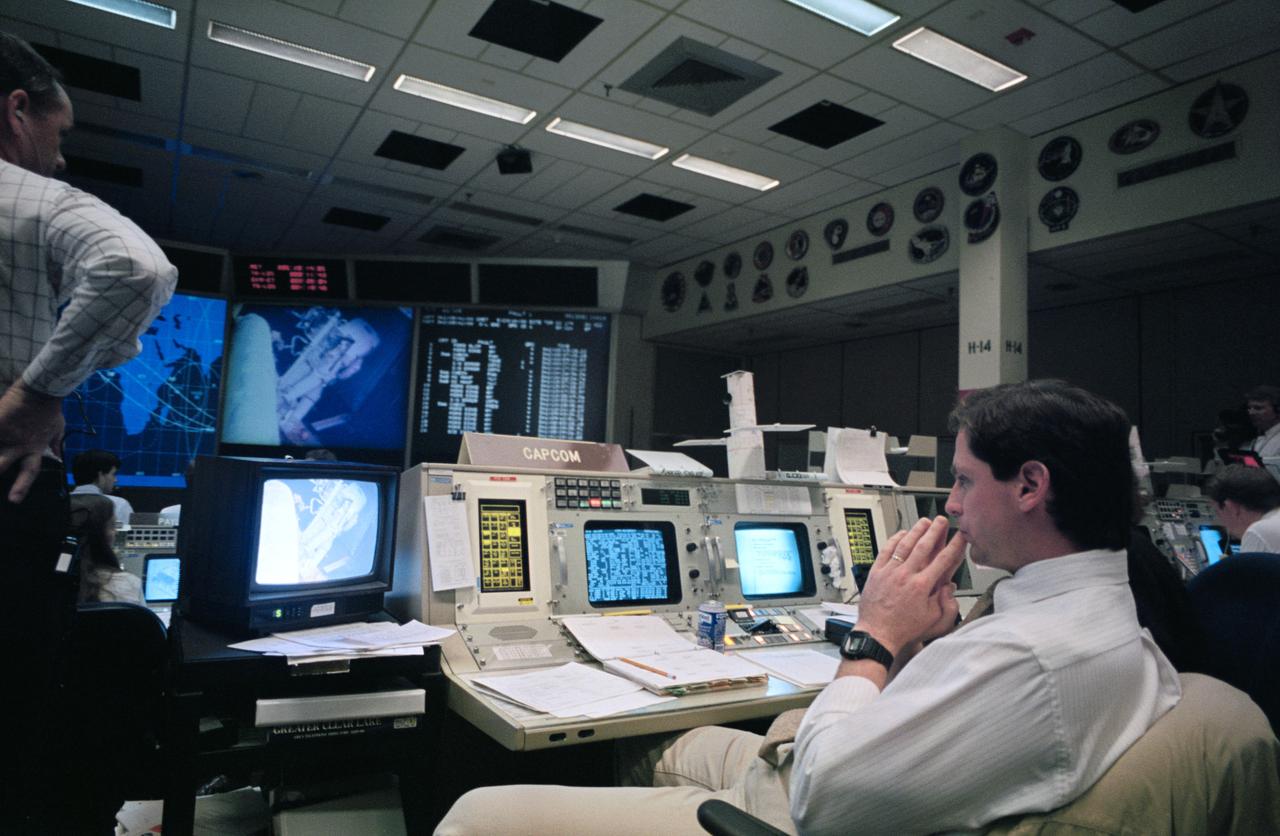
STS61-S-101 (8 Dec 1993) --- Astronaut Gregory J. Harbaugh, spacecraft communicator (CAPCOM), observes as two astronauts work through a lengthy period of extravehicular activity (EVA) in the cargo bay of the Earth-orbiting Space Shuttle Endeavour. Seen on the screen in the front of the flight control room, preparing to work with the Hubble Space Telescope's (HST) magnetometers, are astronauts F. Story Musgrave and Jeffrey A. Hoffman. Harbaugh stayed busy passing up flight controllers suggestions and directions during the record-breaking battery of in-space servicing sessions. Lead flight director Milt Heflin is partially visible at left edge of frame.
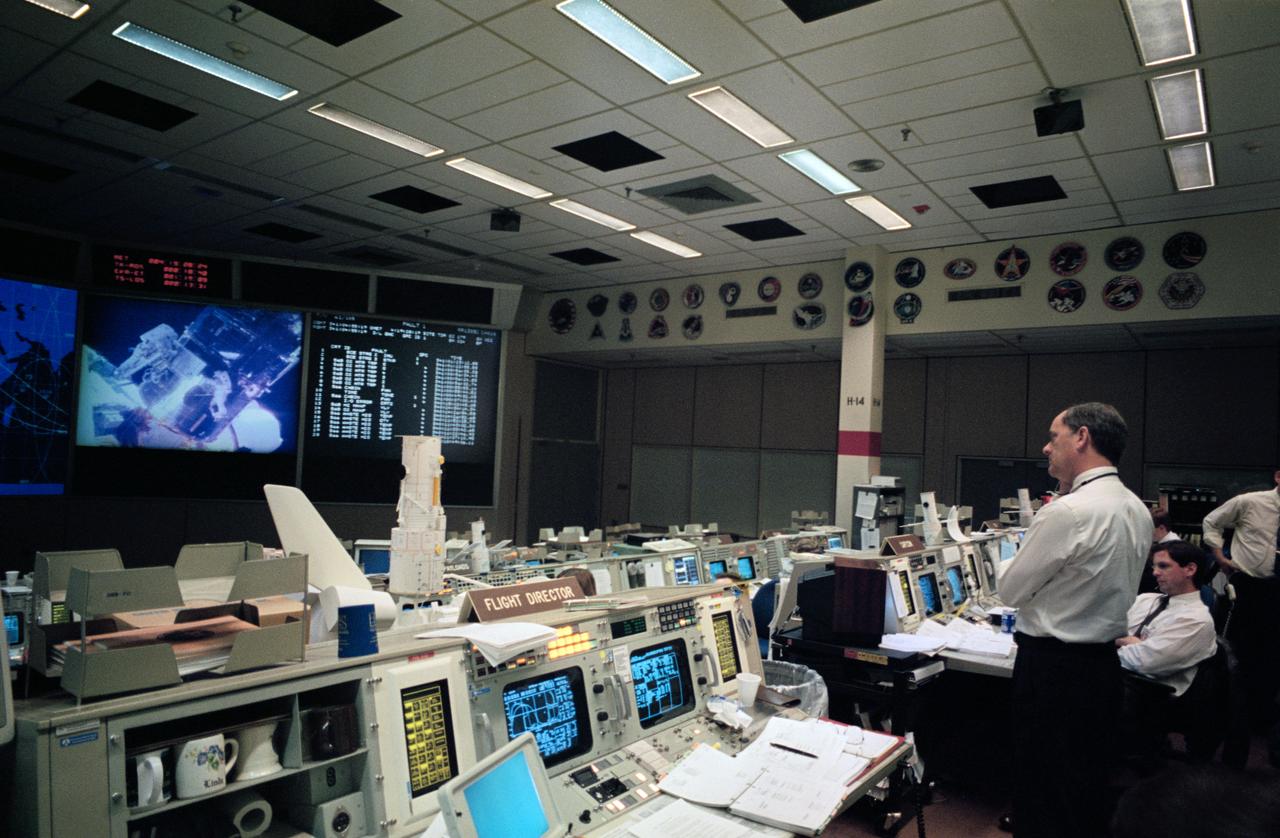
STS61-S-098 (6 DEC 1993) --- Flight director Milton Heflin monitors two space walkers as they change out the Wife Field/Planetary Camera (WFPC) on the Hubble Space Telescope (HST), temporarily berthed in the Space Shuttle Endeavour's cargo bay. Astronaut Gregory J. Harbaugh, spacecraft communicator (CAPCOM), is at right edge. Astronauts F. Story Musgrave and Jeffrey A. Hoffman can be seen with the large camera on the screen in the front of the flight control room.
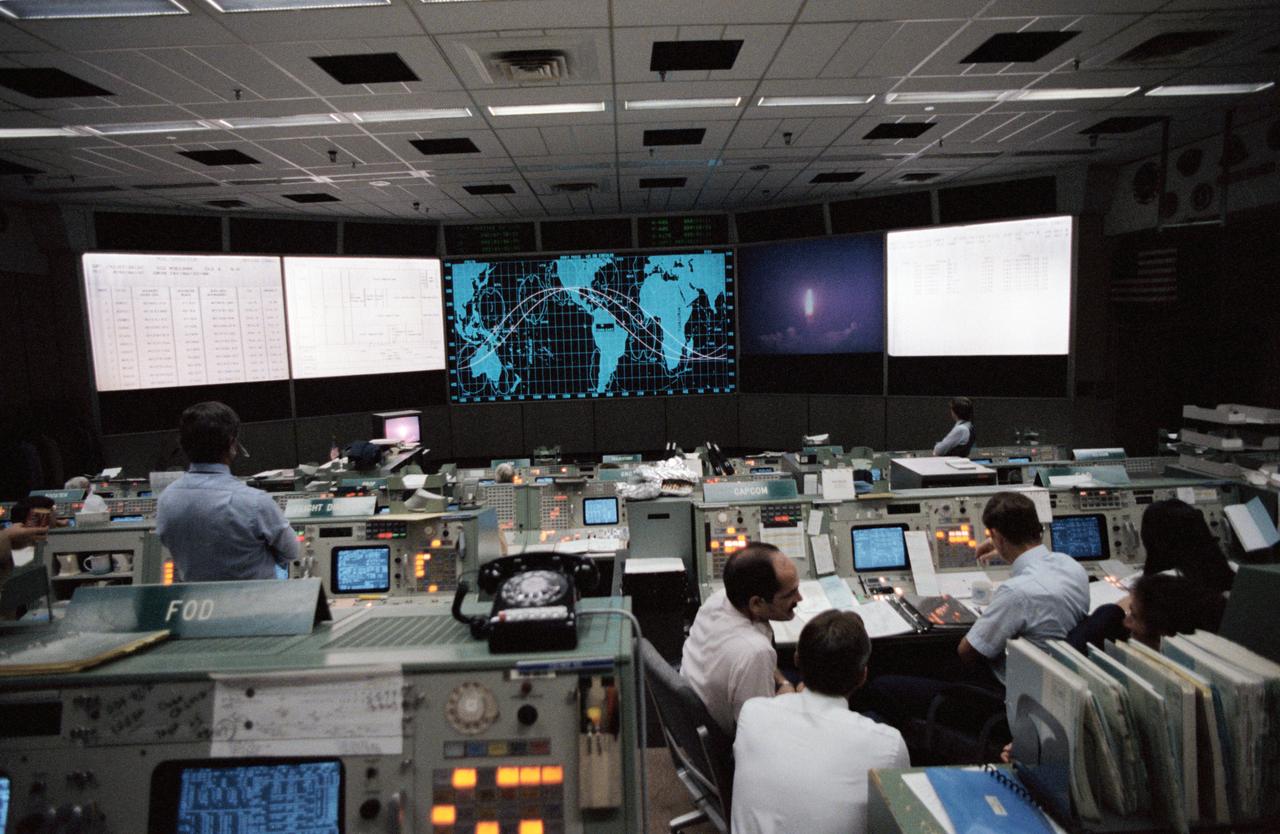
Serving as spacecraft communicators (CAPCOM) are Astronauts Guy S. Gardner (left), William F. Fisher (center), Bryan D. O'Connor (seated facing console), and Jeffrey A. Hoffman. Cheevon B. Lau is seated at the flight activities officer (FAO) console to the right of the CAPCOM console. The scene on the large screen in the mission operations control room (MOCR) is a replay of the launch of the Challenger (39264); Flight Director Jay H. Greene, left, watches a replay of the STS-8 launch on the large screen in the MOCR. He is joined by O'Connor, Jeffrey A. Hoffman, Gardner and Fisher. Lau works at the FAO console near the CAPCOM console (39265); Harold Black, integrated communications officer (INCO) for STS-8 mans the INCO console during the first TV downlink from the Challengers flight. The payload bay can be seen on the screen in the front of the MOCR (39266).
Jay H. Greene, right, ascent flight director for STS 51-A, monitors pre-launch activity at the Kennedy Space Center (KSC) via a screen at the spacecraft communicators console in the second floor flight control room (FCR) of JSC's mission control center. Astronauts David C. Hilmers, left, and Richard N. Richards are the on-duty spacecraft communicators.
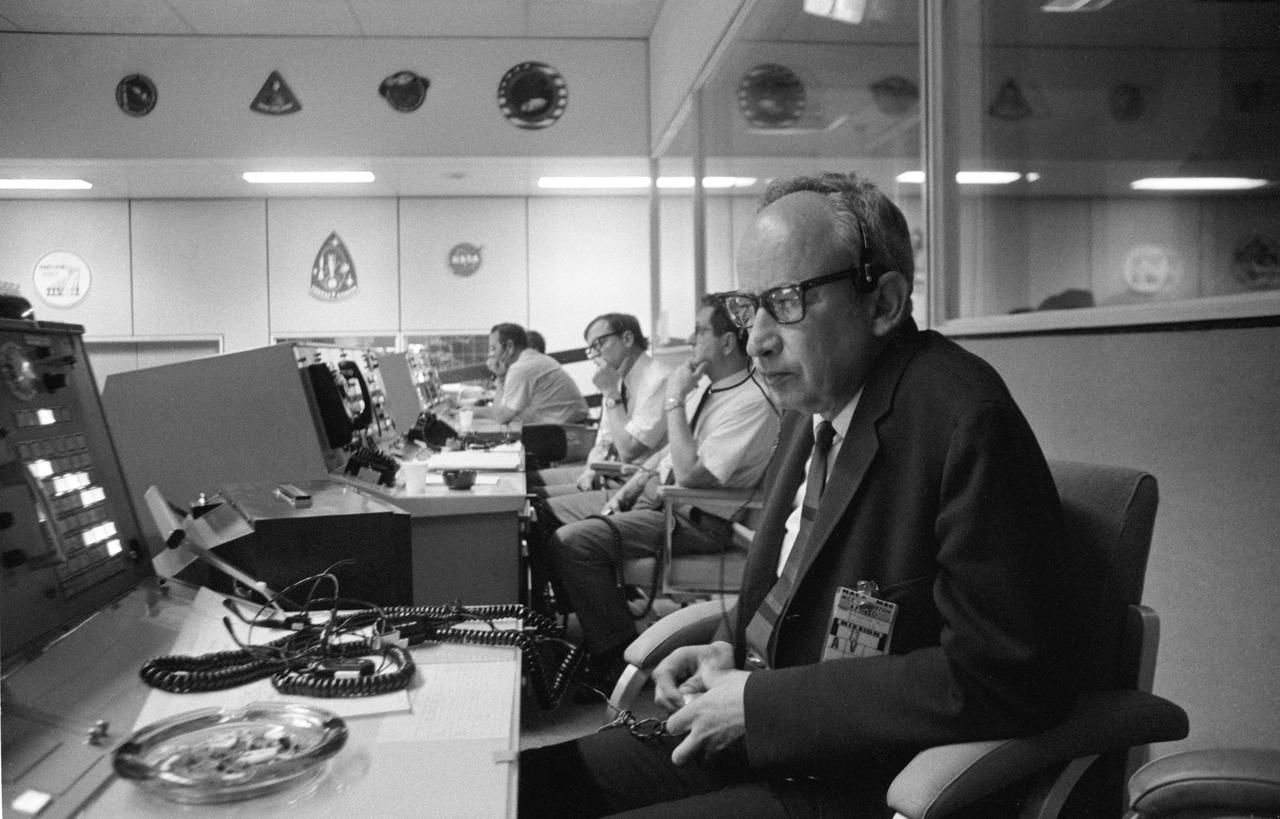
S70-34627 (11 April 1970) --- Sigurd A. Sjoberg, director of flight operations, at the Manned Spacecraft Center (MSC), views the Apollo 13 liftoff from a console in the MSC Mission Control Center (MCC), Building 30. Apollo 13 lifted off at 1:13 p.m. (CST) April 11, 1970. Photo credit: NASA
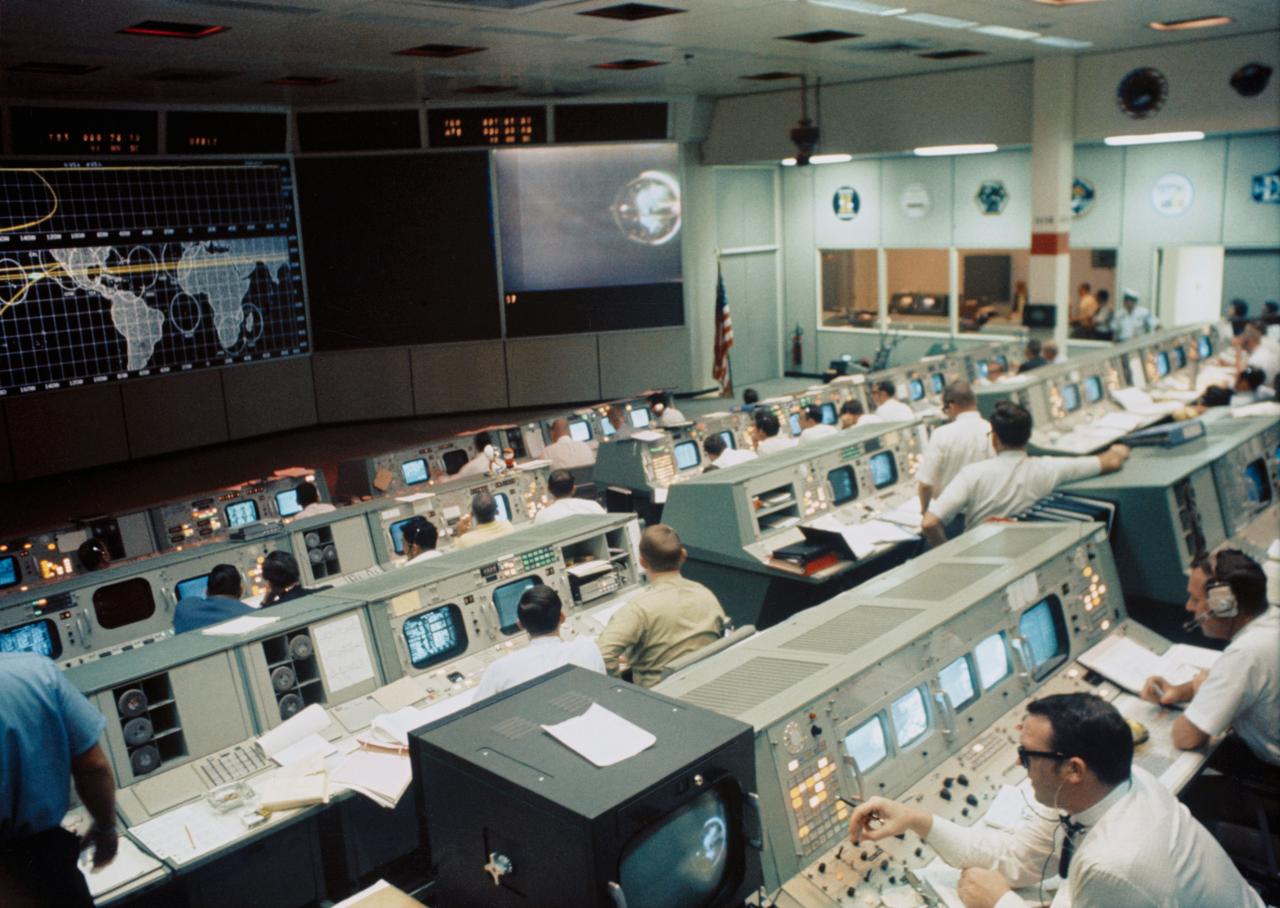
S69-34316 (18 May 1969) --- Overall view of the Mission Operations Control Room in the Mission Control Center, Building 30, on the first day of the Apollo 10 lunar orbit mission. A color television transmission was being received from Apollo 10. This picture was made following Command and Service Module/Lunar Module/Saturn IVB (CSM/LM-S-IVB) separation and prior to LM extraction from the S-IVB. The CSM were making the docking approach to the LM/S-IVB.
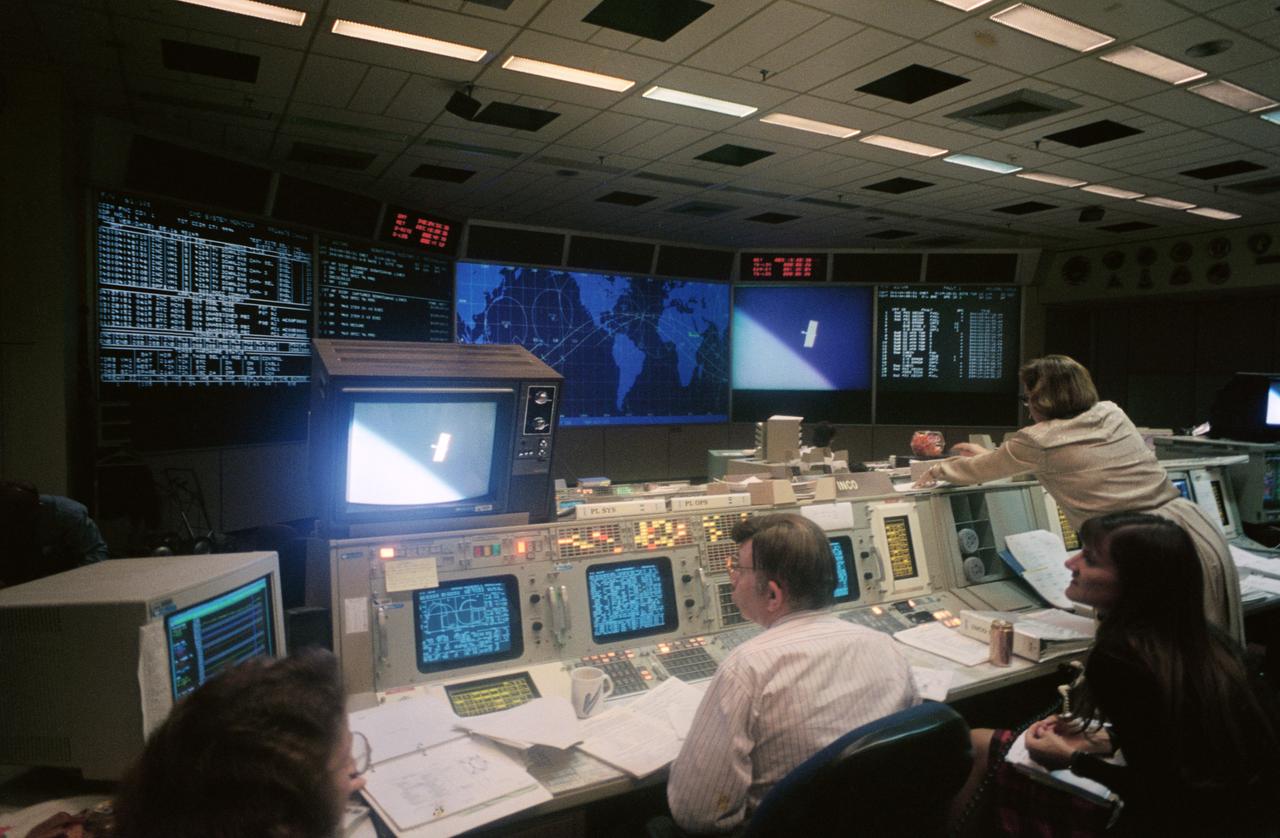
Harry Black, at the Integrated Communications Officer's console in the Mission Control Center (MCC), monitors the second extravehicular activity (EVA-2) of the STS-61 Hubble Space Telescope (HST) servicing mission. Others pictured, left to right, are Judy Alexander, Kathy Morrison and Linda Thomas. Note monitor scene of one of HST's original solar array panels floating in space moments after being tossed away by Astronaut Kathryn C. Thornton.
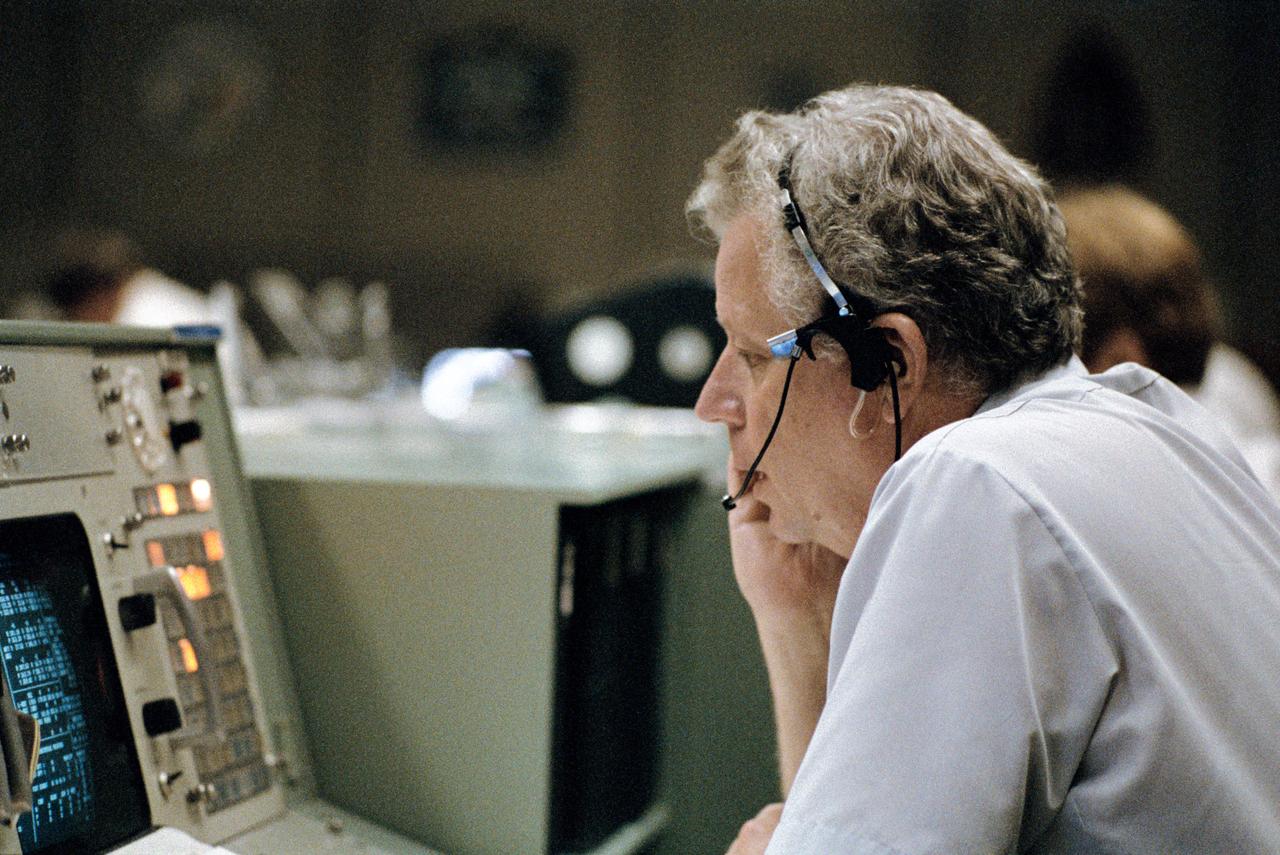
Terry White, serving as public affairs office commentator in the mission operations control room (MOCR) of JSC's mission control center, reads a status report on the STS-8 mission.
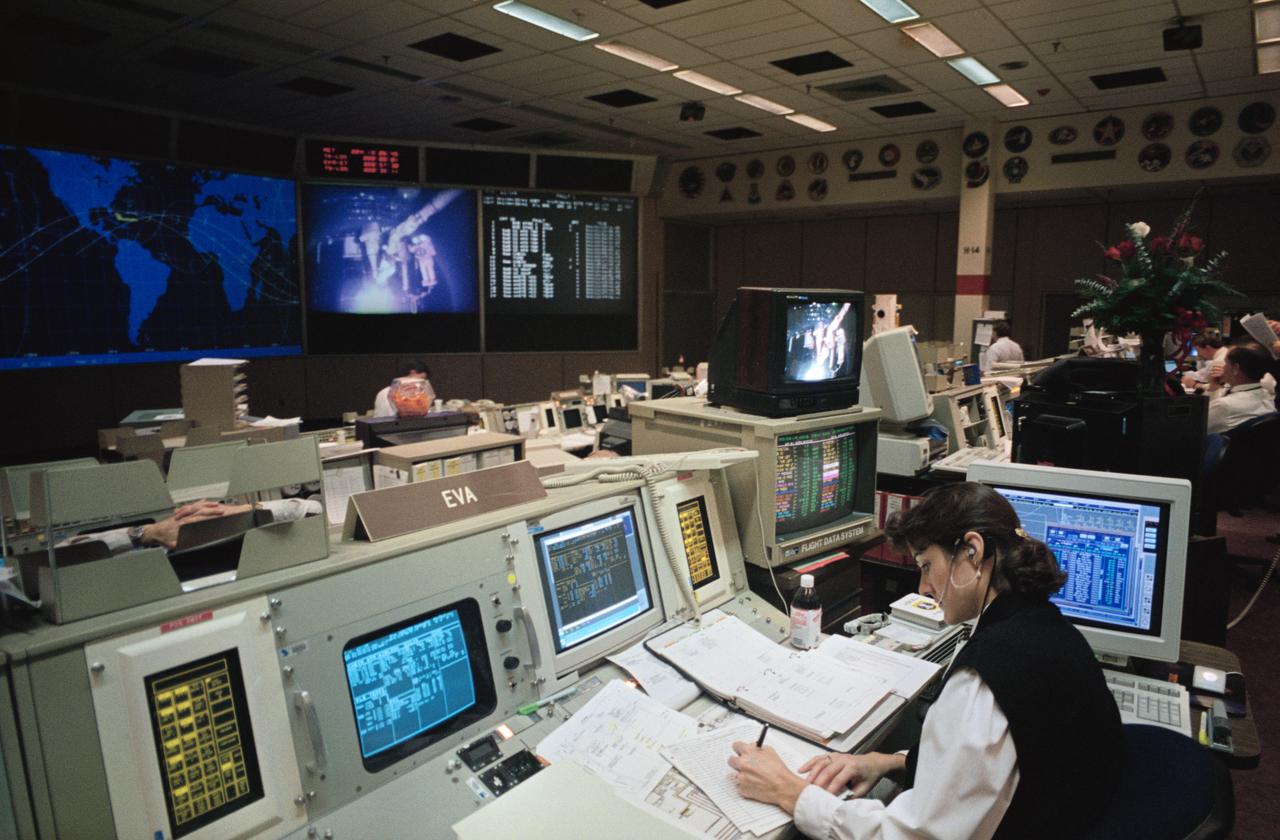
Flight controller Susan P. Rainwater observes as two astronauts work through a lengthy period of extravehicular activity (EVA) in the cargo bay of the Earth-looking Space Shuttle Endeavour. Rainwater's EVA console was one of Mission Control's busiest during this eleven-day Hubble Space Telescope (HST) servicing mission in Earth orbit.
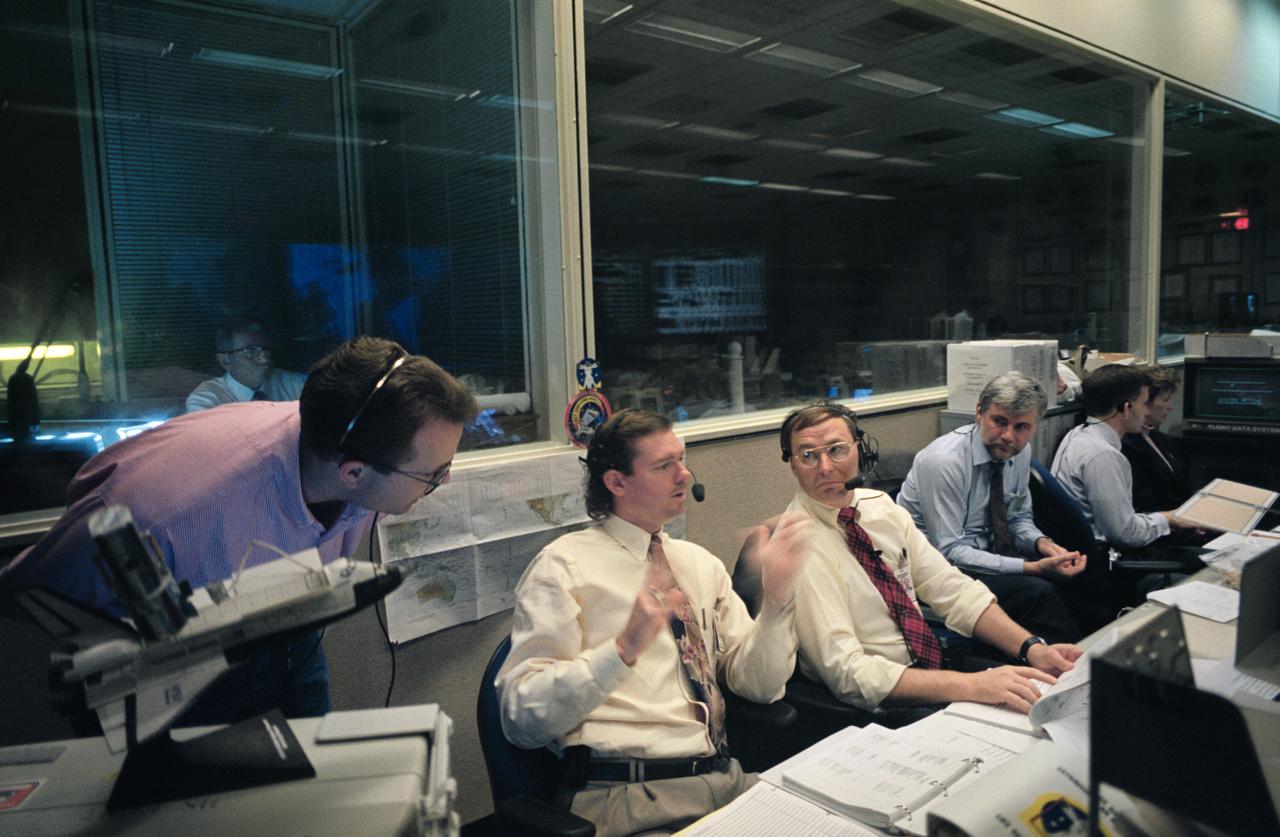
STS61-S-094 (5 Dec 1993) --- Kyle Herring, second left, illustrates a point during mission commentary for the second Extravehicular Activity (EVA-2) of the STS-61 Hubble Space Telescope (HST) servicing mission. Astronaut Jerry L. Ross (center), a space walker on two previous NASA shuttle missions, amplified Herring's explanations. At the flight surgeon's console is Dr. Klaus Lohn (third right) of the Institute for Flight Medicine in Koln, Germany.
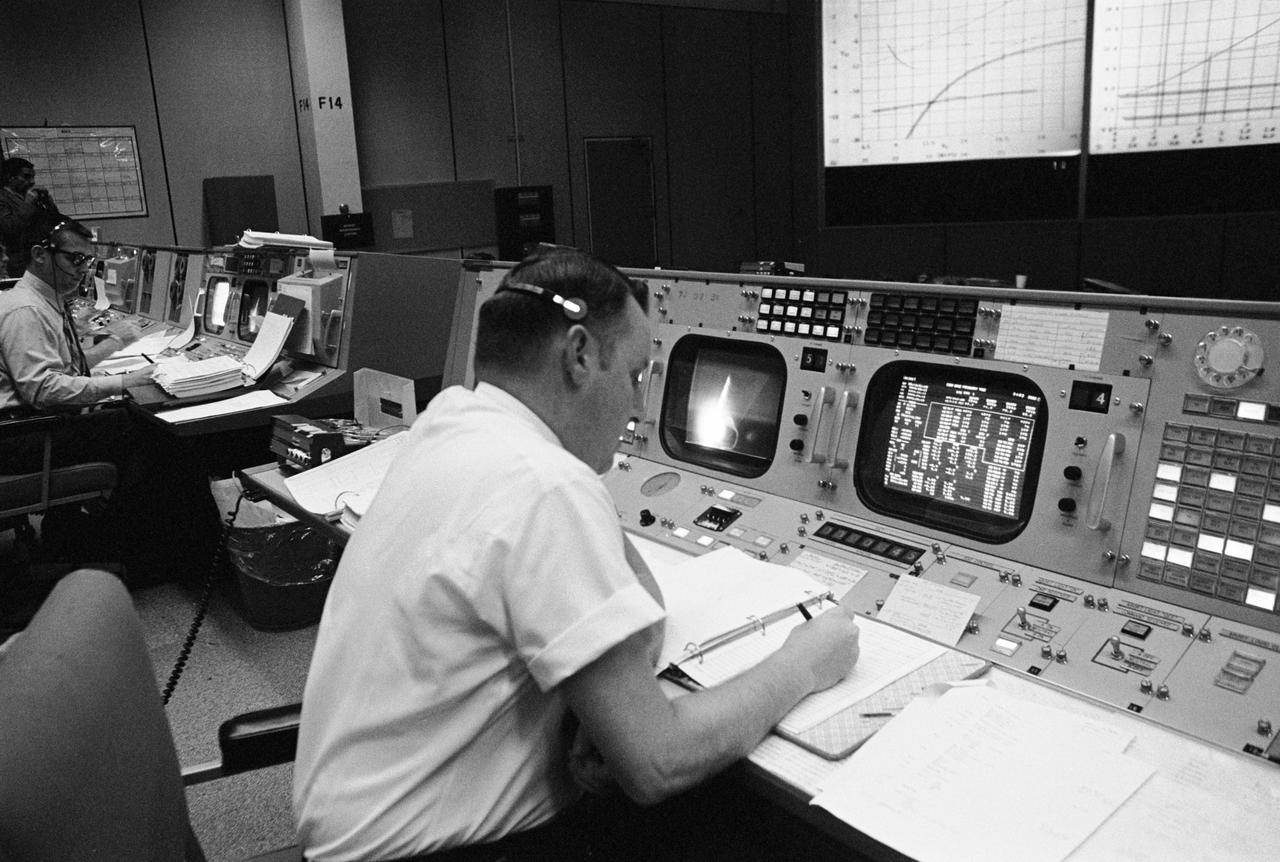
S68-55742 (21 Dec. 1968) --- Clifford E. Charlesworth, Apollo 8 "Green Team" flight director, is seated at his console in the Mission Operations Control Room in the Mission Control Center, Building 30, during the launch of the Apollo 8 (Spacecraft 103/Saturn 503) manned lunar orbit space mission.
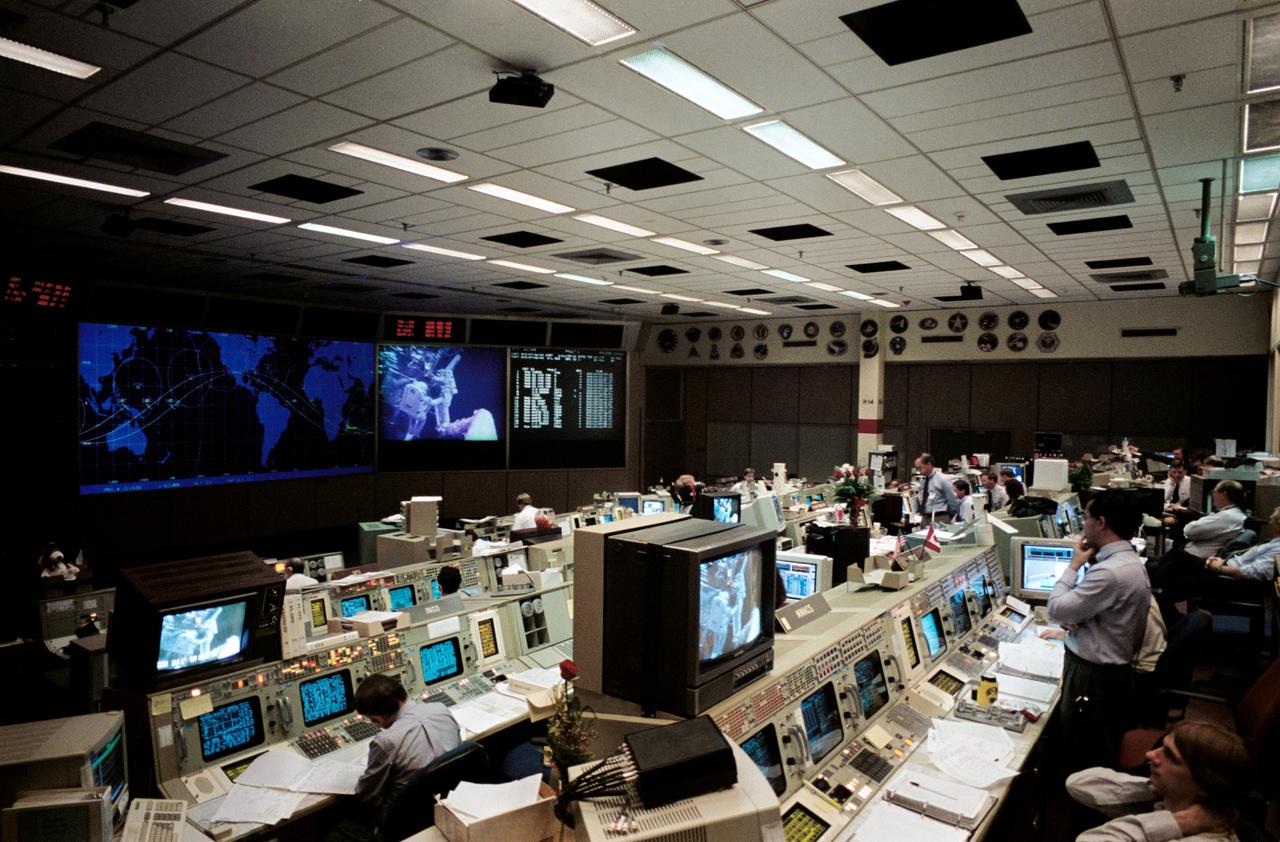
STS061-S-102 (5 Dec. 1993) --- Flight controllers Harry Black (left foreground) and Kevin McCluney (right foreground) monitor the televised activity of two space walkers during the first STS-61 extravehicular activity (EVA). Astronauts F. Story Musgrave and Jeffrey A. Hoffman were performing a variety of equipment replacements. At the Integrated Communications Officer Console (INCO) Black plays a roill in controlling the TV while McLuney's duties deal with maintenance, mechanical, arm and crew systems, meaning that they and their colleagues will be busy for the next five days. Four astronauts in alternating pairs will perform a variety of tasks on the giant telescope during that period.
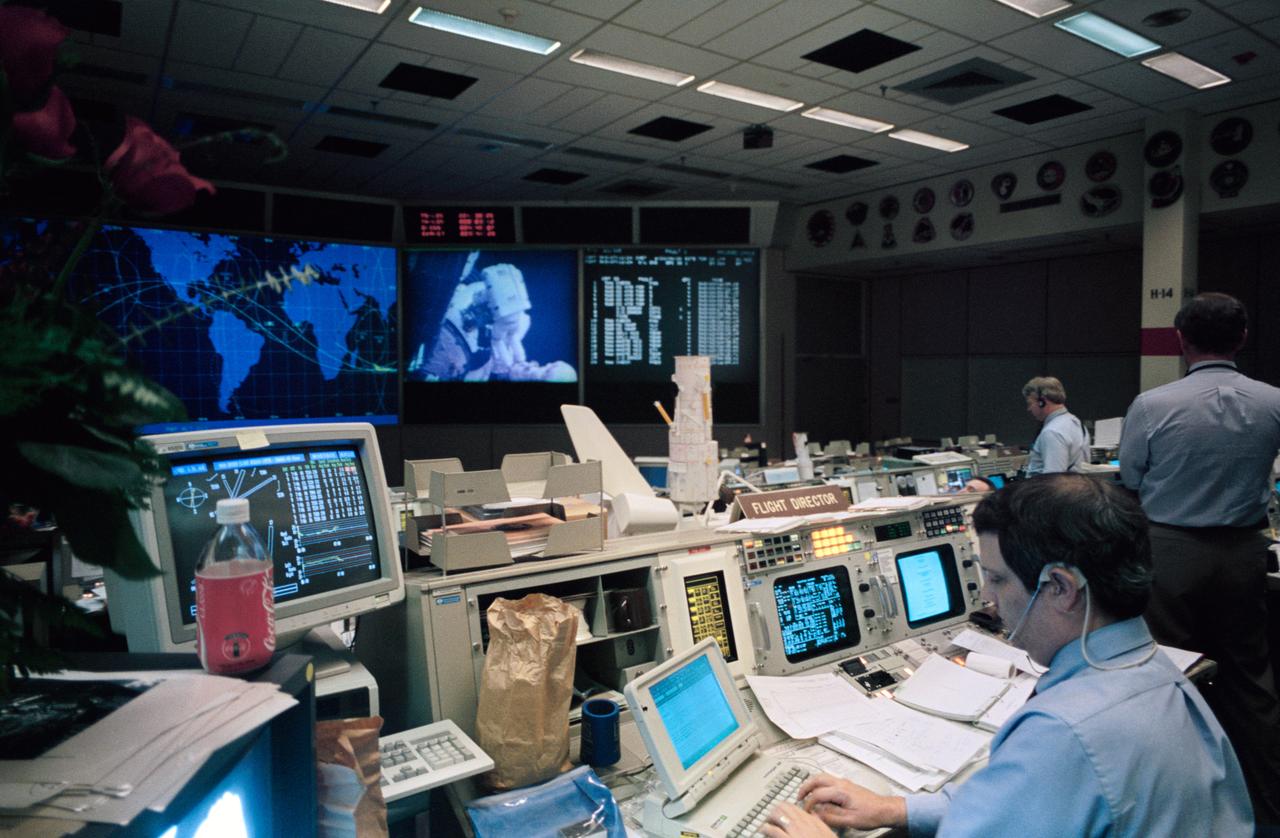
STS061-S-103 (2-13 DEC 1993) --- Flight director Robert E. Castle uses a lap top computer to aid his busy tasks during one of the five space walks performed to service the Hubble Space Telescope (HST) temporarily berthed in the Space Shuttle Endeavour's cargo bay. STS-61 lead flight director Milt Heflin is at right edge of frame.

JSC2001-E-21328 (12 July 2001) --- Flight director LeRoy Cain directs his attention to data related to the Space Shuttle Atlantis and its impending launch from the Kennedy Space Center (KSC) several hundred miles away from this Houston setting at the Johnson Space Center's Mission Control Center (MCC). As soon as the vehicle cleared the tower in Florida, the Houston-based team of flight controllers took over the ground control of the flight.
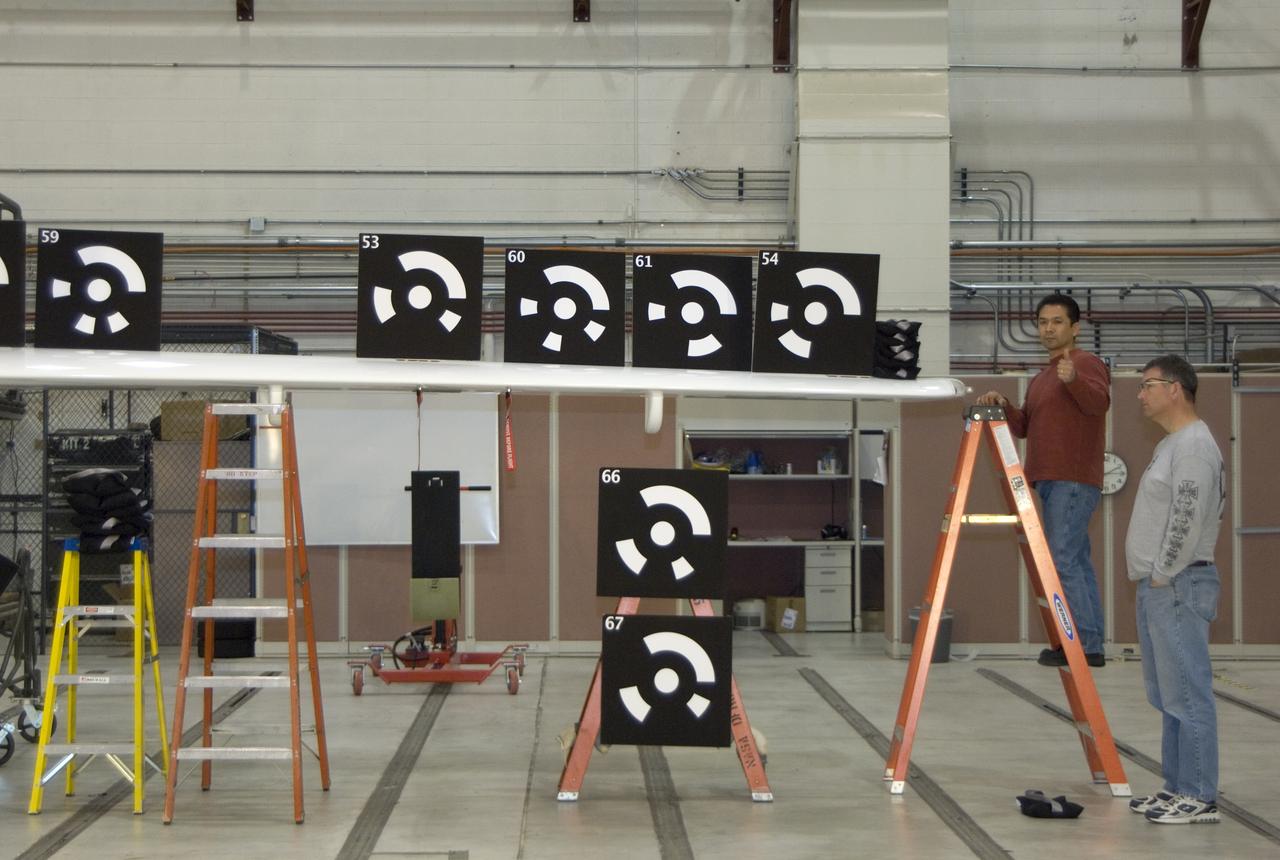
NASA engineer Larry Hudson and Ikhana ground crew member James Smith work on a ground validation test with new fiber optic sensors that led to validation flights on the Ikhana aircraft. NASA Dryden Flight Research Center is evaluating an advanced fiber optic-based sensing technology installed on the wings of NASA's Ikhana aircraft. The fiber optic system measures and displays the shape of the aircraft's wings in flight. There are other potential safety applications for the technology, such as vehicle structural health monitoring. If an aircraft structure can be monitored with sensors and a computer can manipulate flight control surfaces to compensate for stresses on the wings, structural control can be established to prevent situations that might otherwise result in a loss of control.

JSC2001-E-24998 (10 August 2001) --- Flight director John Shannon studies pre-flight data at his console in the shuttle flight control room (WFCR) in Houston's Mission Control Center (MCC) prior to the launch of Space Shuttle Discovery. Several hundred miles away in Florida, the STS-105 and Expedition Three crew members were awaiting countdown in the crew cabin of the Space Shuttle Discovery on the launch pad at the Kennedy Space Center (KSC). As soon as the vehicle cleared the tower in Florida, the Houston-based team of flight controllers took over the ground control of the flight.

JSC2001-E-24995 (10 August 2001) --- Astronaut James M. Kelly, STS-105 spacecraft communicator (CAPCOM) for weather issues, monitors pre-flight data at his console in the shuttle flight control room (WFCR) in Houston's Mission Control Center (MCC). Several hundred miles away in Florida, the STS-105 and Expedition Three crew members were awaiting countdown in the crew cabin of the Space Shuttle Discovery on the launch pad at the Kennedy Space Center (KSC). As soon as the vehicle cleared the tower in Florida, the Houston-based team of flight controllers took over the ground control of the flight.

JSC2001-E-24994 (10 August 2001) --- Flight director John Shannon finds a moment of levity while working at his console in the shuttle flight control room (WFCR) in Houston's Mission Control Center (MCC). Several hundred miles away in Florida, the STS-105 and Expedition Three crew members were awaiting countdown in the crew cabin of the Space Shuttle Discovery on the launch pad at the Kennedy Space Center (KSC). As soon as the vehicle cleared the tower in Florida, the Houston-based team of flight controllers took over the ground control of the flight.
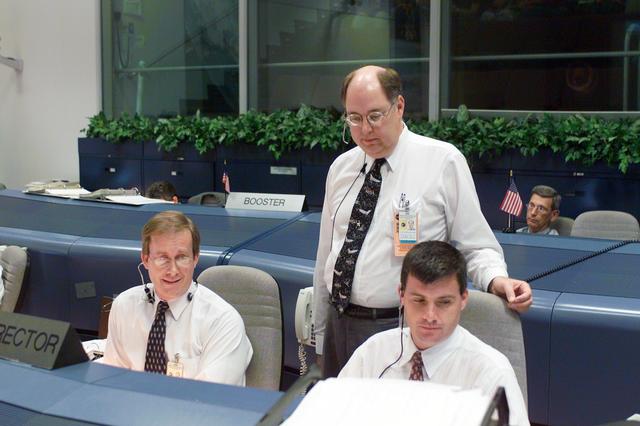
JSC2002-E-41150 (7 October 2002) --- Flight directors John Shannon (left) and Steve Stich monitor data at their consoles in the shuttle flight control room (WFCR) in Houston’s Mission Control Center (MCC). Wayne Hale (standing) of the Mission Operations Directorate (MOD) looks on. At the time this photo was taken the Space Shuttle Atlantis was about to launch from the Kennedy Space Center, Florida. Atlantis lifted off at 2:46 p.m. (CDT) on October 7, 2002. Once the vehicle cleared the tower in Florida, the Houston-based team of flight controllers took over the ground control of the flight.
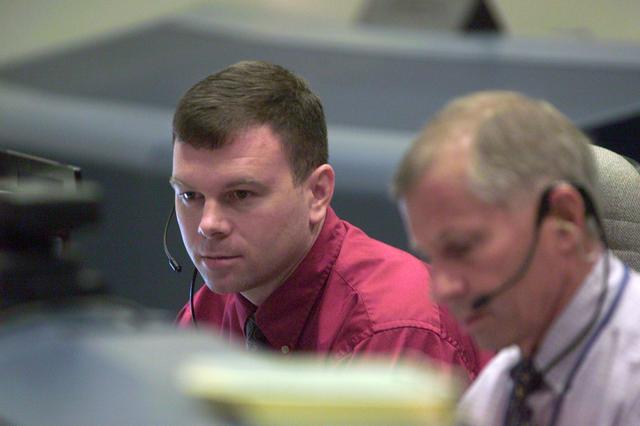
JSC2001-E-24997 (10 August 2001) --- Astronaut James M. Kelly, STS-105 spacecraft communicator (CAPCOM) for weather issues, monitors pre-flight data at his console in the shuttle flight control room (WFCR) in Houston's Mission Control Center (MCC). Several hundred miles away in Florida, the STS-105 and Expedition Three crew members were awaiting countdown in the crew cabin of the Space Shuttle Discovery on the launch pad at the Kennedy Space Center (KSC). As soon as the vehicle cleared the tower in Florida, the Houston-based team of flight controllers took over the ground control of the flight.
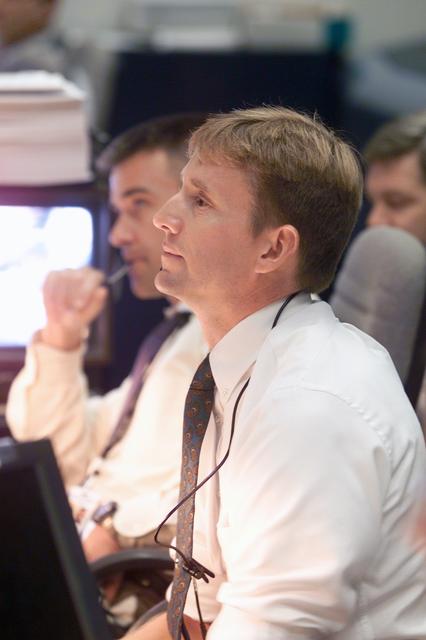
JSC2002-E-41160 (7 October 2002) --- Astronauts Kenneth T. Ham (foreground) and Duane G. Carey, spacecraft communicators (CAPCOM), watch the large screens from their consoles in the shuttle flight control room (WFCR) in Houston’s Mission Control Center (MCC). At the time this photo was taken the Space Shuttle Atlantis was about to launch from the Kennedy Space Center, Florida. Atlantis lifted off at 2:46 p.m. (CDT) on October 7, 2002. Once the vehicle cleared the tower in Florida, the Houston-based team of flight controllers took over the ground control of the flight.
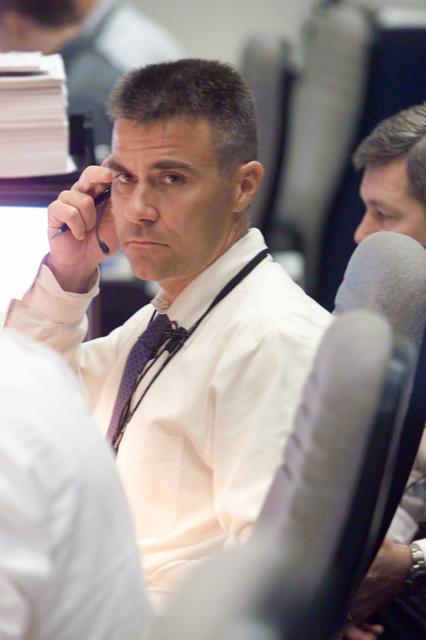
JSC2002-E-41164 (7 October 2002) --- Astronaut Duane G. Carey, spacecraft communicator (CAPCOM), is pictured at his console in the shuttle flight control room (WFCR) in Houston’s Mission Control Center (MCC). At the time this photo was taken the Space Shuttle Atlantis was about to launch from the Kennedy Space Center, Florida. Atlantis lifted off at 2:46 p.m. (CDT) on October 7, 2002. Once the vehicle cleared the tower in Florida, the Houston-based team of flight controllers took over the ground control of the flight.
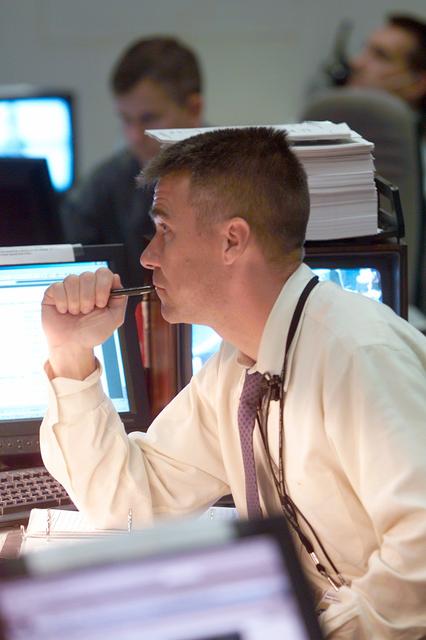
JSC2002-E-41151 (7 October 2002) --- Astronaut Duane G. Carey, spacecraft communicator (CAPCOM), watches the large screens from his console in the shuttle flight control room (WFCR) in Houston’s Mission Control Center (MCC). At the time this photo was taken the Space Shuttle Atlantis was about to launch from the Kennedy Space Center, Florida. Atlantis lifted off at 2:46 p.m. (CDT) on October 7, 2002. Once the vehicle cleared the tower in Florida, the Houston-based team of flight controllers took over the ground control of the flight.
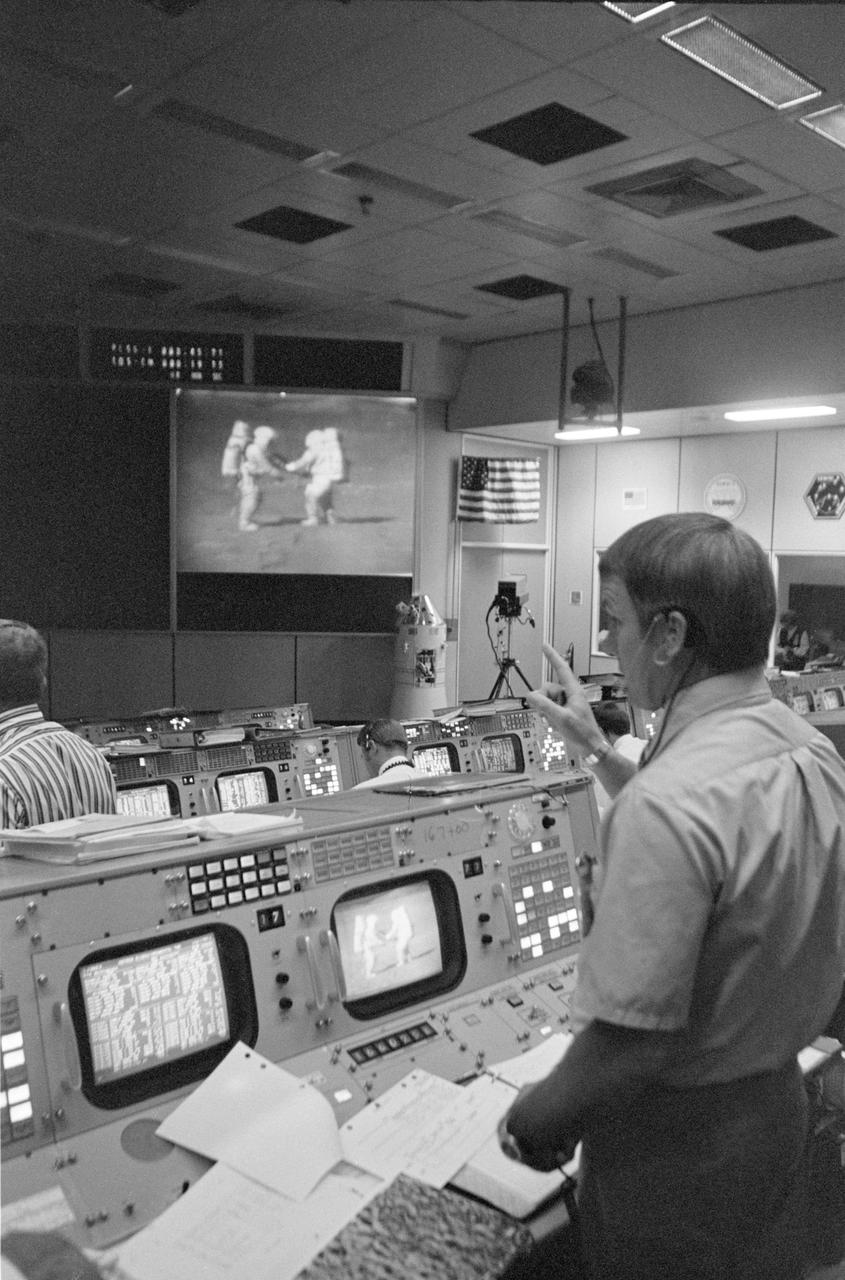
S71-41852 (2 Aug. 1971) --- Gerald D. Griffin, foreground, stands near his console in the Mission Operations Control Room (MOCR) during Apollo 15's third extravehicular activity (EVA) on the lunar surface. Griffin is Gold Team (Shift 1) flight director for the Apollo 15 mission. Astronauts David R. Scott and James B. Irwin can be seen on the large screen at the front of the MOCR as they participate in sample-gathering on the lunar surface.
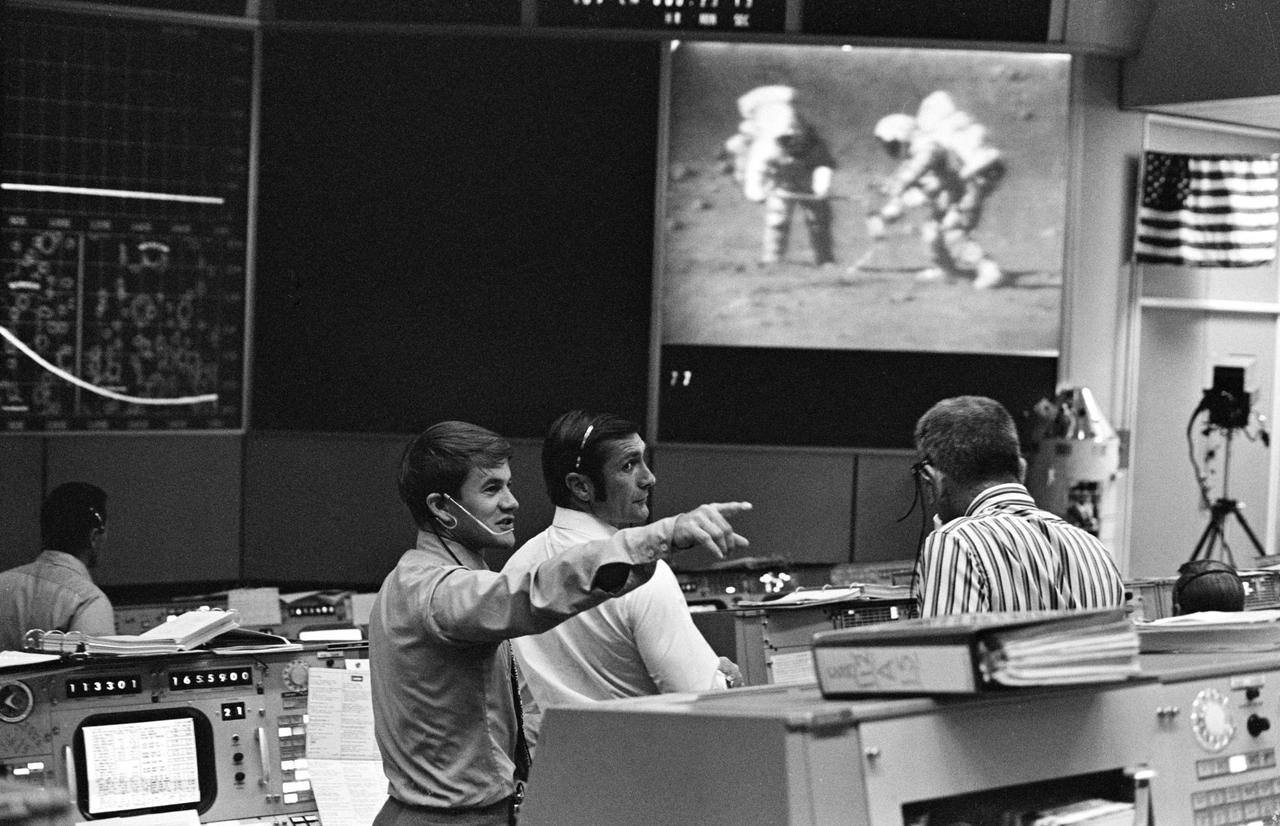
S71-41836 (2 Aug. 1971) --- Scientist-astronaut Joseph P. Allen, left, directs the attention of astronaut Richard F. Gordon Jr., to an occurrence out of view at right in the Mission Control Center's (MCC) Mission Operations Control Room (MOCR), while Dr. Donald K. (Deke) Slayton, on right with back to camera, views activity of Apollo 15 on a large screen at the front of the MOCR. Astronauts David R. Scott and James B. Irwin are seen on the screen performing tasks of the mission's third extravehicular activity (EVA), on Aug. 2, 1971. Dr. Slayton is director of Flight Crew Operations, NASA-MSC; Gordon is Apollo 15 backup commander; and Dr. Allen is an Apollo 15 spacecraft communicator.

S68-18733 (22 Jan. 1968) --- Dr. Robert R. Gilruth (right), MSC Director, sits with Dr. Christopher C. Kraft Jr., MSC director of flight operations, at his flight operations director console in the Mission Control Center, Building 30, during the Apollo 5 (LM-1/Saturn 204) unmanned space mission.
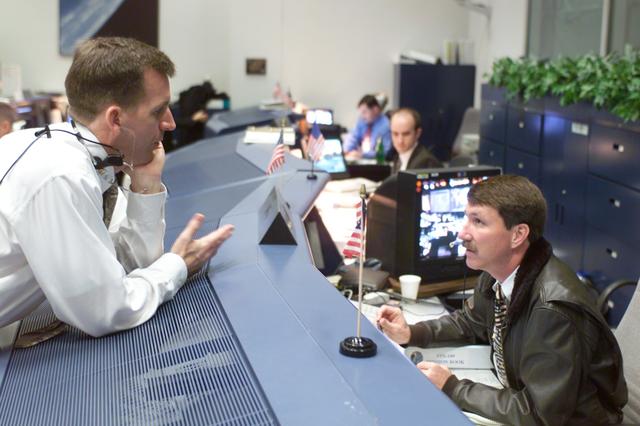
JSC2002-E-08157 (1 March 2002) --- Astronaut Kent V. Rominger (seated), and LeRoy Cain are photographed at the Mission Operation Directorate (MOD) console in the shuttle flight control room (WFCR) in Houston's Mission Control Center (MCC). Several hundred miles away in Florida, the STS-109 crewmembers were awaiting countdown in the crew cabin of the Space Shuttle Columbia on the launch pad at the Kennedy Space Center (KSC). As soon as the vehicle cleared the tower in Florida, the Houston-based team of flight controllers took over the ground control of the mission. Rominger is the Deputy Director of the Flight Crew Operations Directorate (FCOD) and was the STS-109 FCOD management representative in the MCC. Cain was the Weather Flight Director for the mission’s ascent phase, coordinating weather issues for lead Ascent Flight Director John Shannon (out of frame).
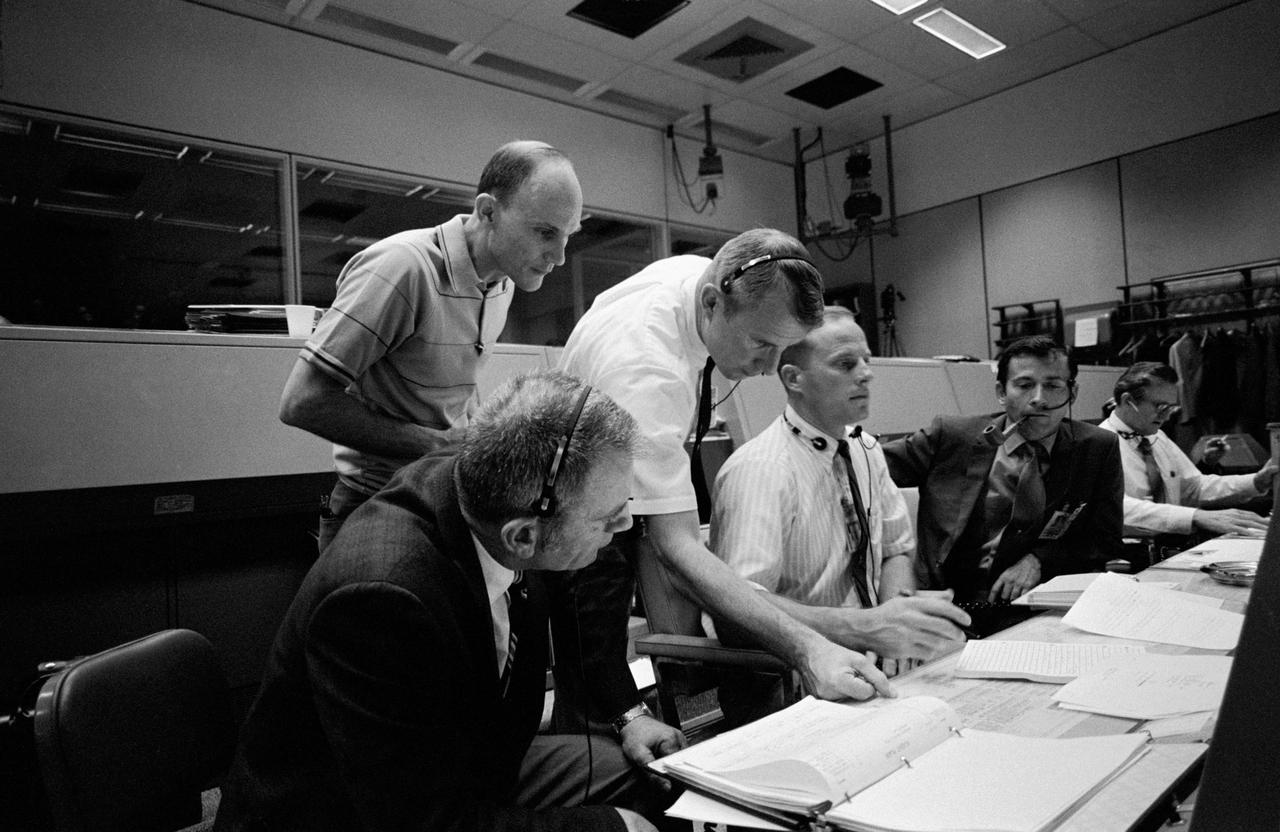
S70-34902 (14 April 1970) --- Several persons important to the Apollo 13 mission, at consoles in the Mission Operations Control Room (MOCR) of the Mission Control Center (MCC). Seated at consoles, from left to right, are astronauts Donald K. Slayton, director of flight crew operations; astronaut Jack R. Lousma, Shift 3 spacecraft communicator; and astronaut John W. Young, commander of the Apollo 13 backup crew. Standing, left to right, are astronaut Tom K. Mattingly II, who was replaced as Apollo 13 command module pilot after it was learned he may come down with measles, and astronaut Vance D. Brand, Shift 2 spacecraft communicator. Several hours earlier, in the late evening hours of April 13, crew members of the Apollo 13 mission reported to MCC that trouble had developed with an oxygen cell on their spacecraft.
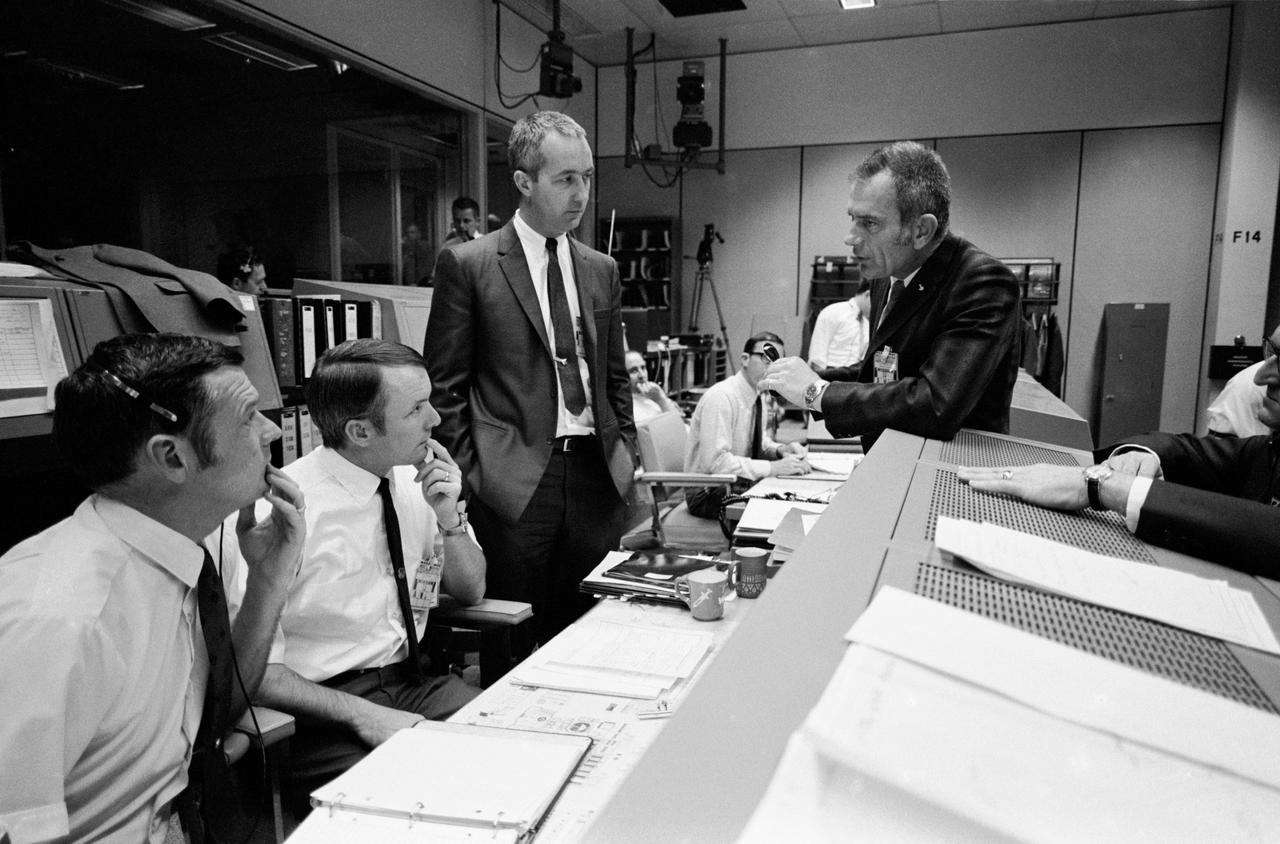
S70-35369 (16 April 1970) --- Discussion in the Mission Operations Control Room (MOCR) dealing with the Apollo 13 crewmen during their final day in space. From left to right are Glynn S. Lunney, Shift 4 flight director; Gerald D. Griffin, Shift 2 flight director; astronaut James A. McDivitt, manager, Apollo Spacecraft Program, MSC; Dr. Donald K. Slayton, director of Flight Crew Operations, MSC; and Dr. Willard R. Hawkins, M.D., Shift 1 flight surgeon.
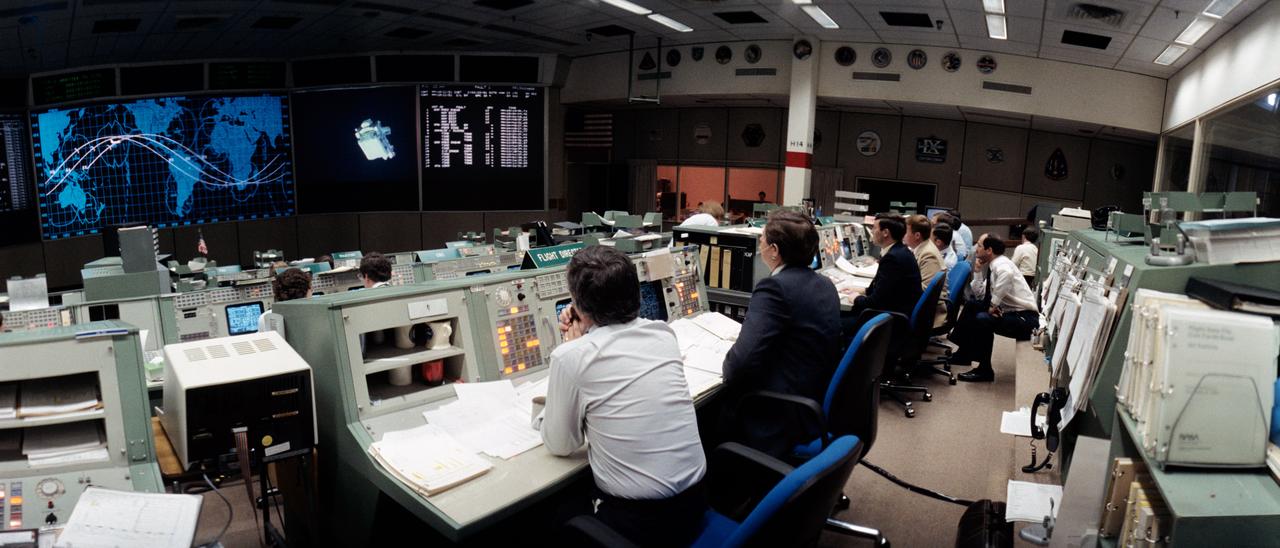
Astronaut George D. Nelson (see monitor at front of room) is viewed by flight controllers in the Mission Operations Control Room (MOCR) of JSC's Mission Control Center during 41-C extravehicular activity (EVA). In the foreground are Flight Directors Jay H. Greene and John T. Cox. Astronauts Jerry L. Ross and Richard H. Richards are seated at the CAPCOM or spacecraft communicators console at right background. Astronaut Guy S. Gardner is perched just behind them.
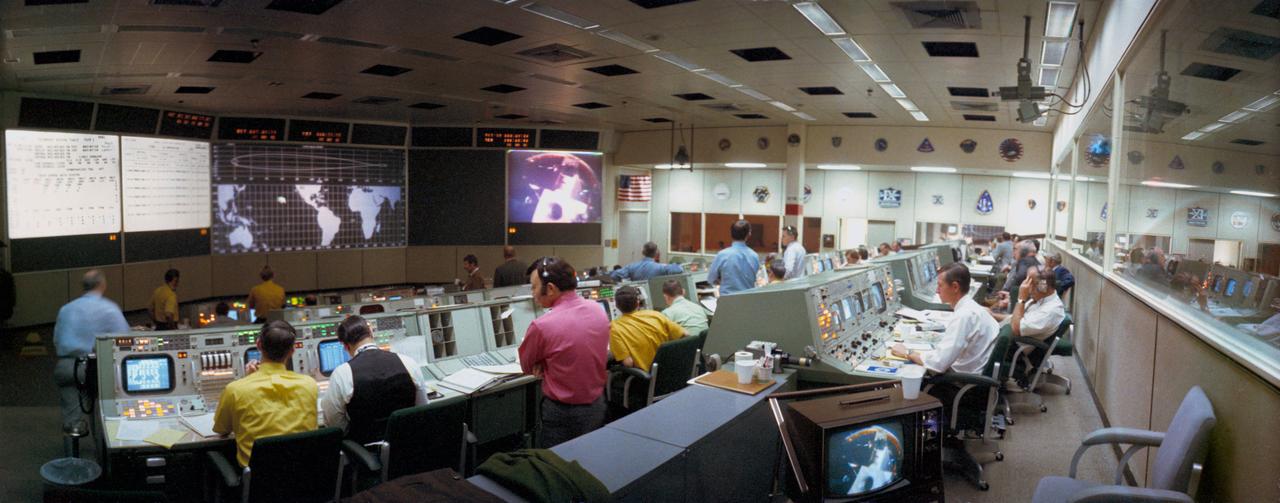
S71-17122 (31 Jan. 1971) --- A wide angle overall view of the Mission Operations Control Room (MOCR) in the Mission Control Center at the Manned spacecraft Center. This view was photographed during the first color television transmission from the Apollo 14 Command Module. Projected on the large screen at the right front of the MOCR is a view of the Apollo 14 Lunar Module, still attached to the Saturn IVB stage. The Command and Service Modules were approaching the LM/S-IVB during transposition and docking maneuvers.
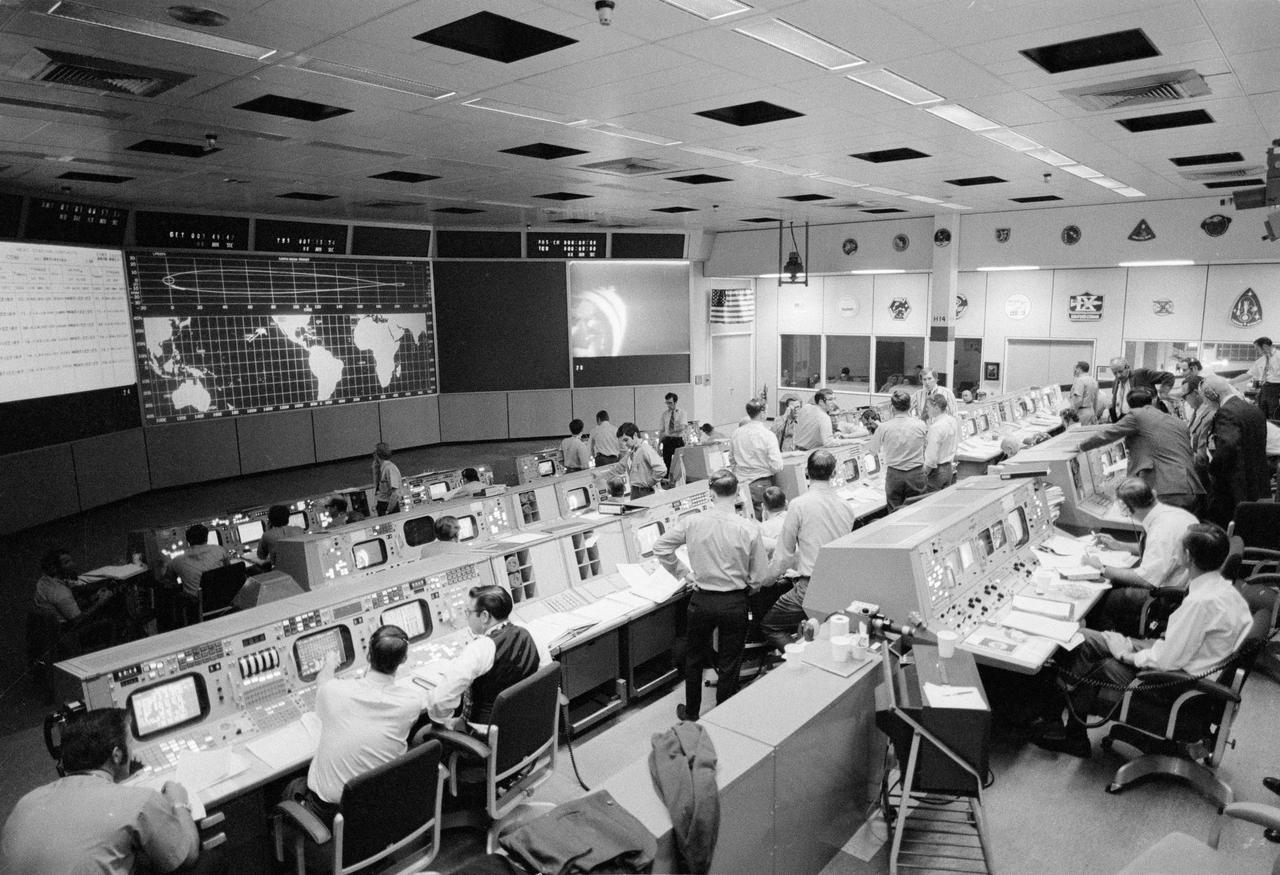
S71-16879 (31 Jan. 1971) --- Overall view of activity in the Mission Operations Control Room in the Mission Control Center during the Apollo 14 transposition and docking maneuvers. The Apollo 14 Lunar Module, still attached to the Saturn IVB stage, can be seen on the large television monitor. Due to difficulty with the docking mechanism six attempts were made before a successful "hard dock" of the Command Module with the Lunar Module was accomplished. Aboard the Command Module were astronauts Alan B. Shepard Jr., Stuart A. Roosa, and Edgar D. Mitchell.
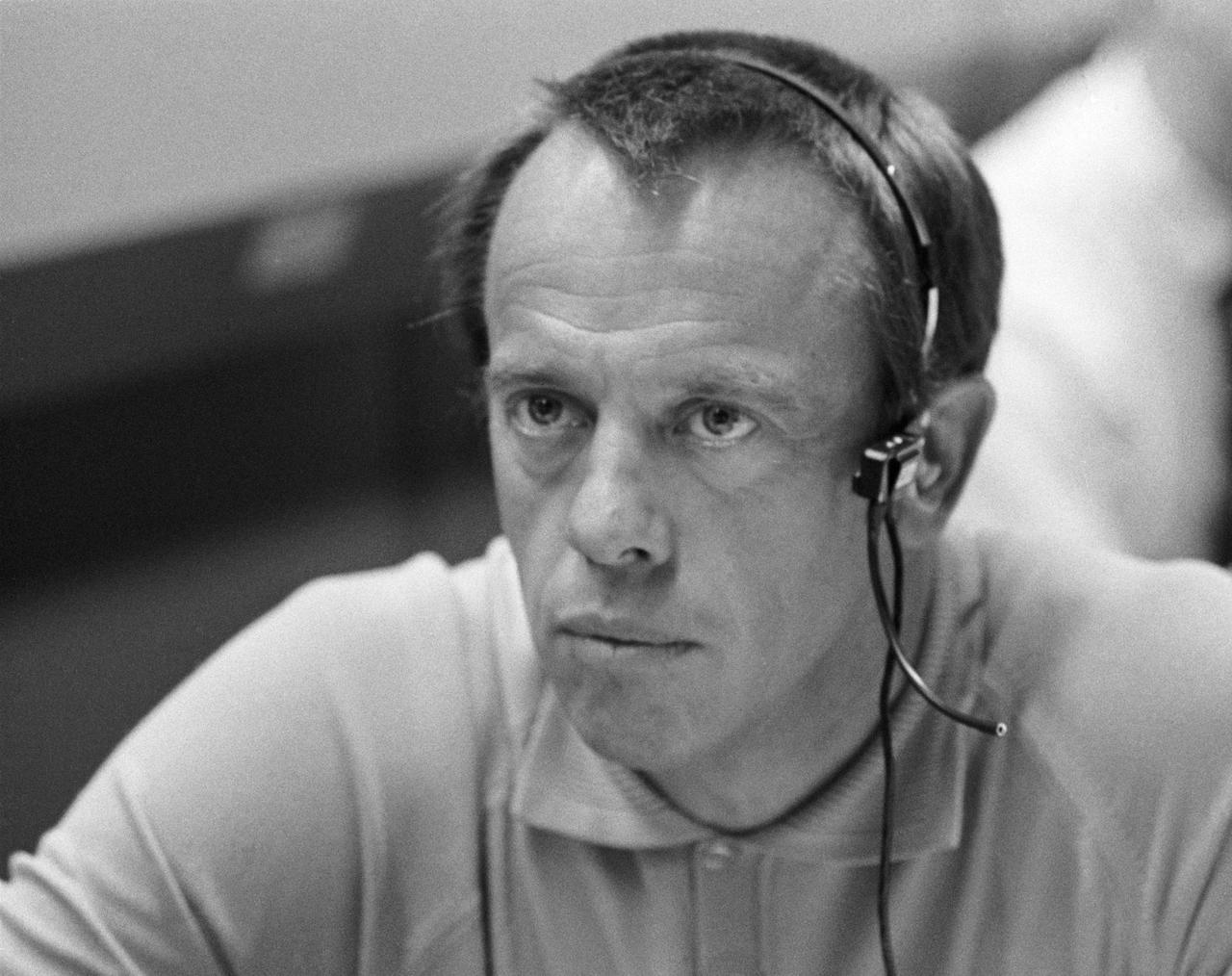
S70-34904 (14 April 1970) --- Astronaut Alan B. Shepard Jr., prime crew commander of the Apollo 14 mission, monitors communications between the Apollo 13 spacecraft and Mission Control Center. He is seated at a console in the Mission Operations Control Room of the MCC, Manned Spacecraft Center. The main concern of the moment was action taken by the three Apollo 13 crewmen - astronauts James A. Lovell Jr., John L. Swigert Jr. and Fred W. Haise Jr. - to make corrections inside the spacecraft following discovery of an oxygen cell failure several hours earlier.
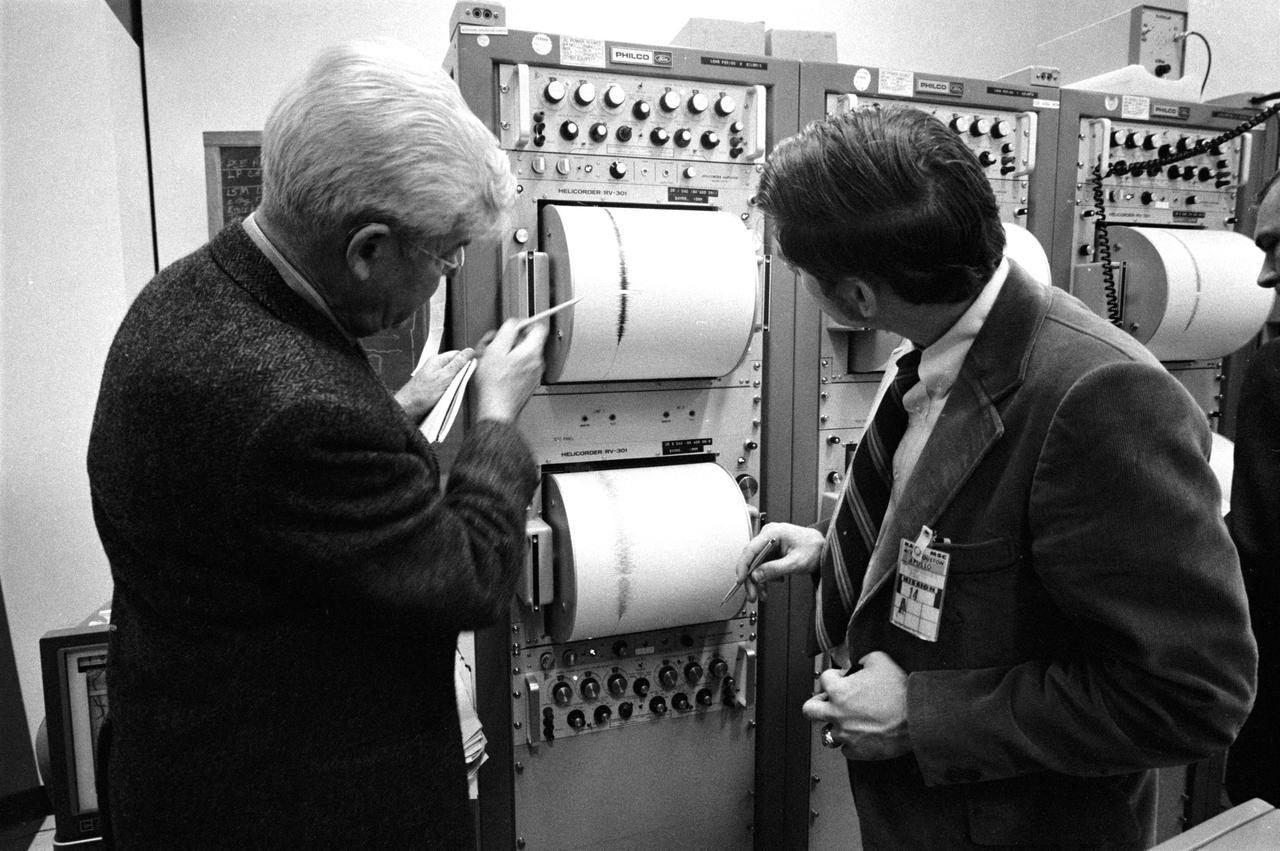
S71-17609 (4 Feb. 1971) --- These two individuals are examining a seismic reading in the Mission Control Center's ALSEP Room during the Apollo 14 S-IVB impact on the moon. Dr. Maurice Ewing (left) is the director of the Lamont-Doherty Geological Observatory at Columbia University. David Lammlein, a Columbia graduate student, is on the right. The Apollo 14 Saturn IVB stage impacted on the lunar surface at 1:40:54 a.m. (CST), Feb. 4, 1971, about 90 nautical miles south-southwest of the Apollo 12 passive seismometer. The energy release was comparable to 11 tons of TNT. Dr. Gary Latham of the Lamont-Doherty Geological Observatory is the principal investigator for the Passive Seismic Experiment, a component of the Apollo Lunar Surface Experiments Package.

S70-35368 (16 April 1970) --- Overall view showing some of the feverish activity in the Mission Operations Control Room (MOCR) of the Mission Control Center (MCC) during the final 24 hours of the problem-plagued Apollo 13 mission. Here, flight controllers and several NASA/MSC officials confer at the flight director's console. When this picture was made, the Apollo 13 lunar landing had already been canceled, and the Apollo 13 crewmembers were in trans-Earth trajectory attempting to bring their crippled spacecraft back home.
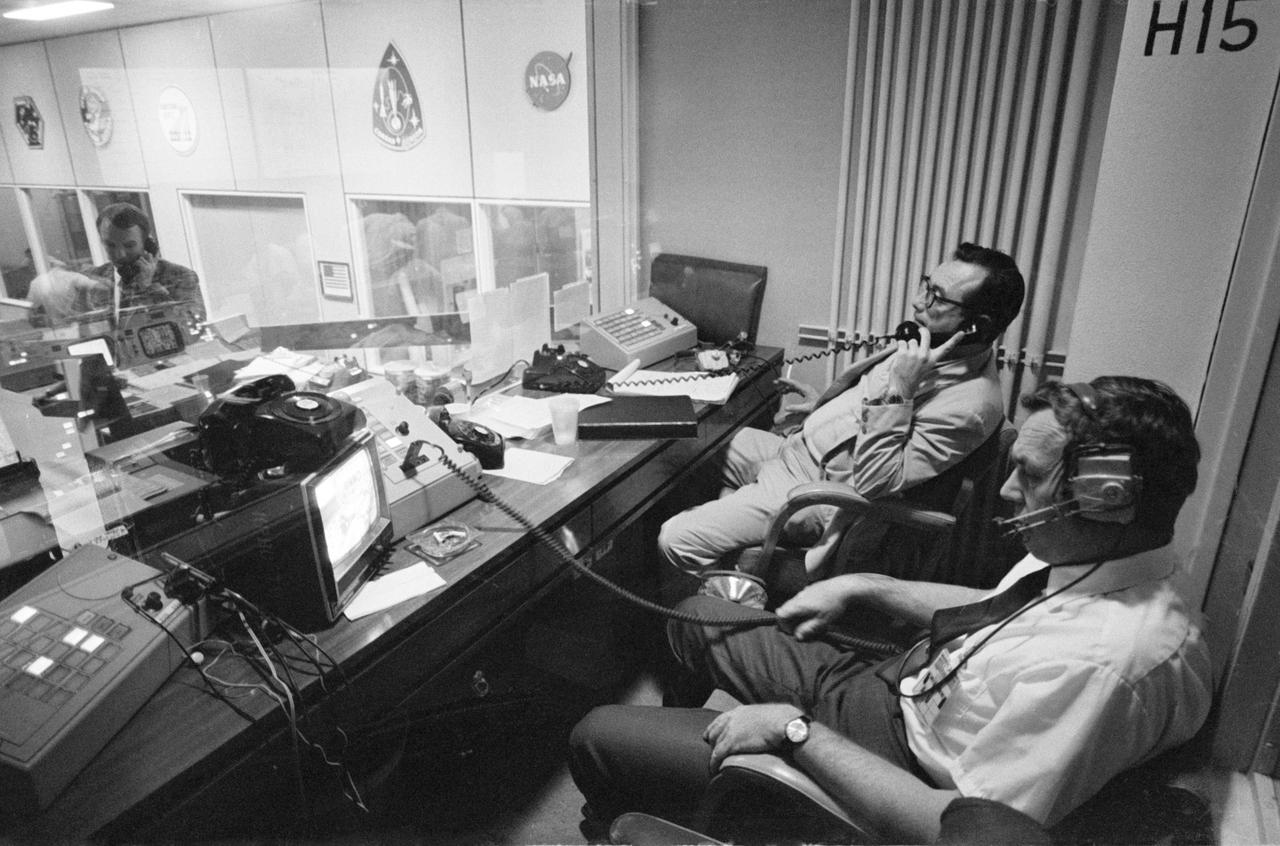
S70-35012 (15 April 1970) --- Two phases of busy activity during critical moments of the Apollo 13 mission are reflected in this view in the Mission Control Center, Building 30, Manned Spacecraft Center. In the foreground, Henry Simmons (left) of Newsweek magazine and John E. Riley, public information specialist, Public Affairs Office, MSC, man their positions in the Press Room. At extreme left of photo, Gerald D. Griffin, Shift 2 flight director, talks on telephone in Mission Operations Control Room. When this photograph was taken, the Apollo 13 lunar landing had been canceled, and the problem-plagued Apollo 13 crewmen were in trans-Earth trajectory attempting to bring their crippled spacecraft back home.
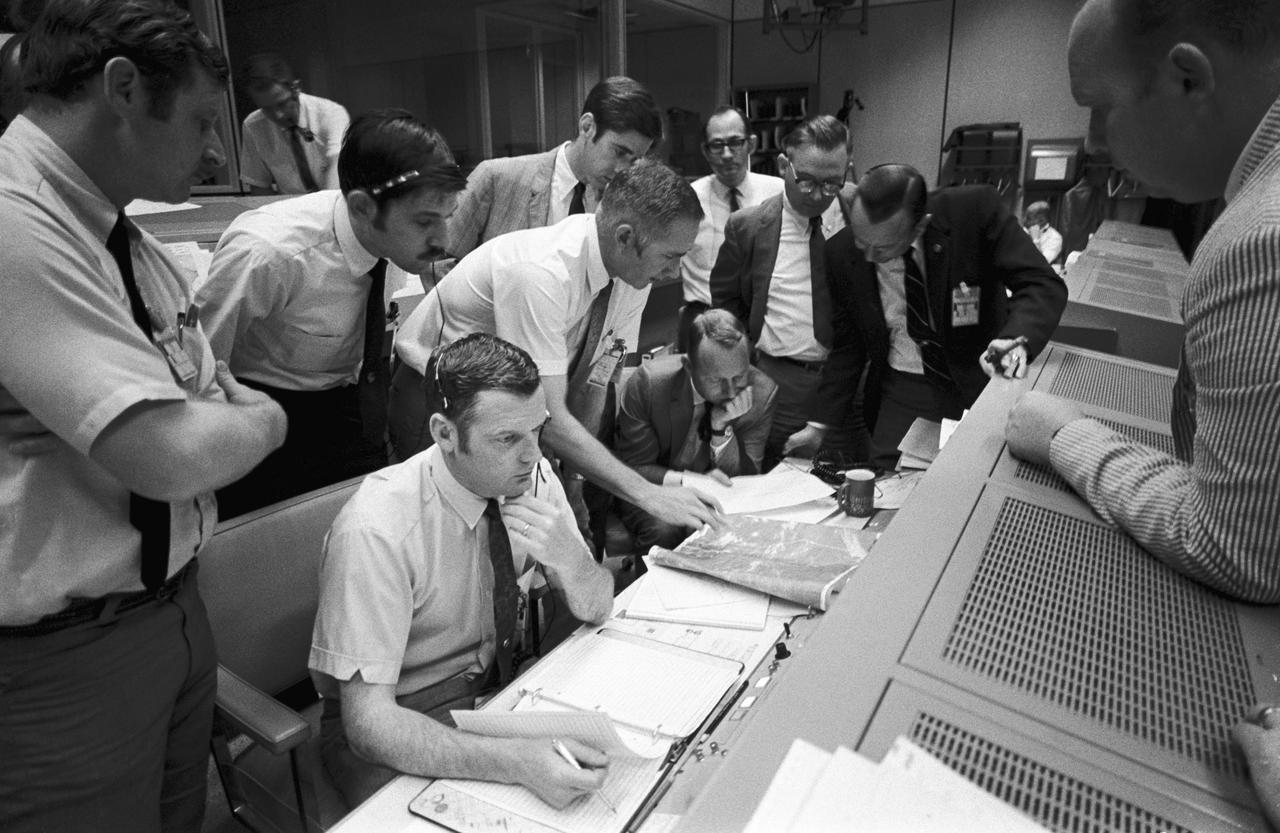
S70-35014 (15 April 1970) --- A group of flight controllers gathers around the console of Glenn S. Lunney (seated, nearest camera), Shift 4 flight director, in the Mission Operations Control Room (MOCR) of Mission Control Center (MCC), located in Building 30 at the Manned Spacecraft Center (MSC). Their attention is drawn to a weather map of the proposed landing site in the South Pacific Ocean. Among those looking on is Dr. Christopher C. Kraft, deputy director, MSC, standing in black suit, on right. When this photograph was taken, the Apollo 13 lunar landing mission had been canceled, and the problem-plagued Apollo 13 crew members were in trans-Earth trajectory attempting to bring their crippled spacecraft back home.
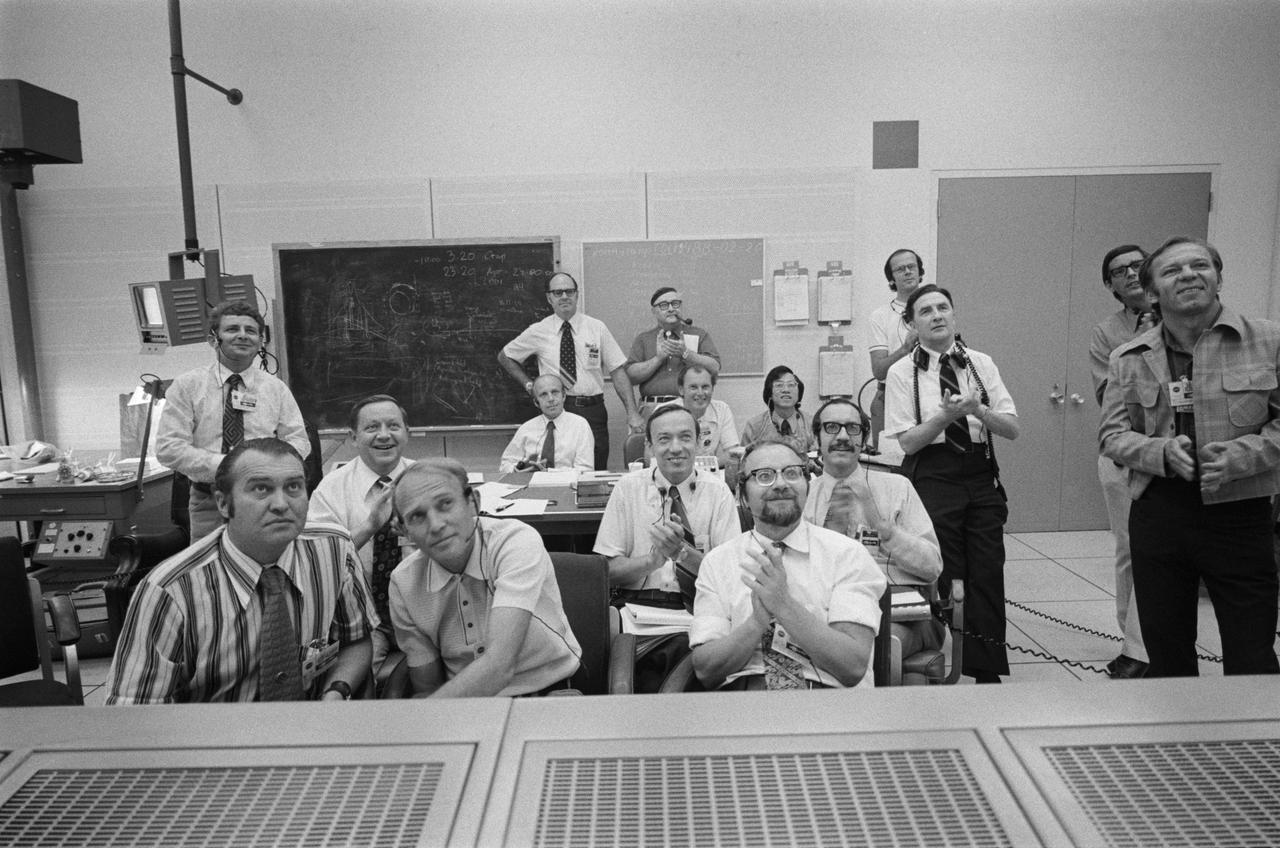
S75-28659 (21 July 1975) --- An overall view of the group of Soviet Union flight controllers who served at the Mission Control Center during the joint U.S.-USSR Apollo-Soyuz Test Project docking mission in Earth orbit. They are applauding the successful touchdown of the Soyuz spacecraft in Central Asia. The television monitor had just shown the land landing of the Soyuz descent vehicle.
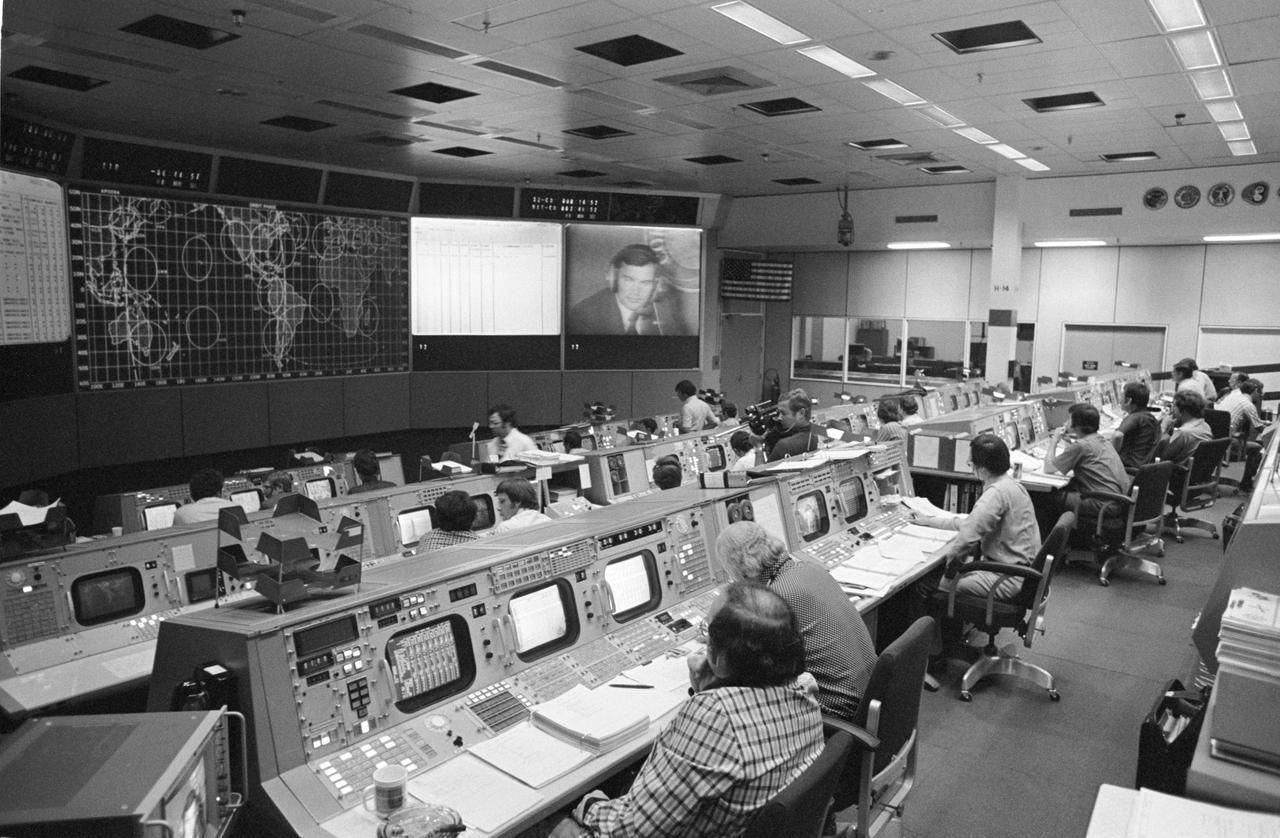
S75-28483 (15 July 1975) --- An overall view of the Mission Operations Control Room in the Mission Control Center on the first day of the Apollo-Soyuz Test Project docking mission in Earth orbit. The American ASTP flight controllers at NASA's Johnson Space Center were monitoring the progress of the Soviet ASTP launch when this photograph was taken. The television monitor shows cosmonaut Yuri V. Romanenko at his spacecraft communicator?s console in the ASTP mission control center in the Soviet Union. The American ASTP liftoff followed the Soviet ASTP launch by seven and one-half hours.
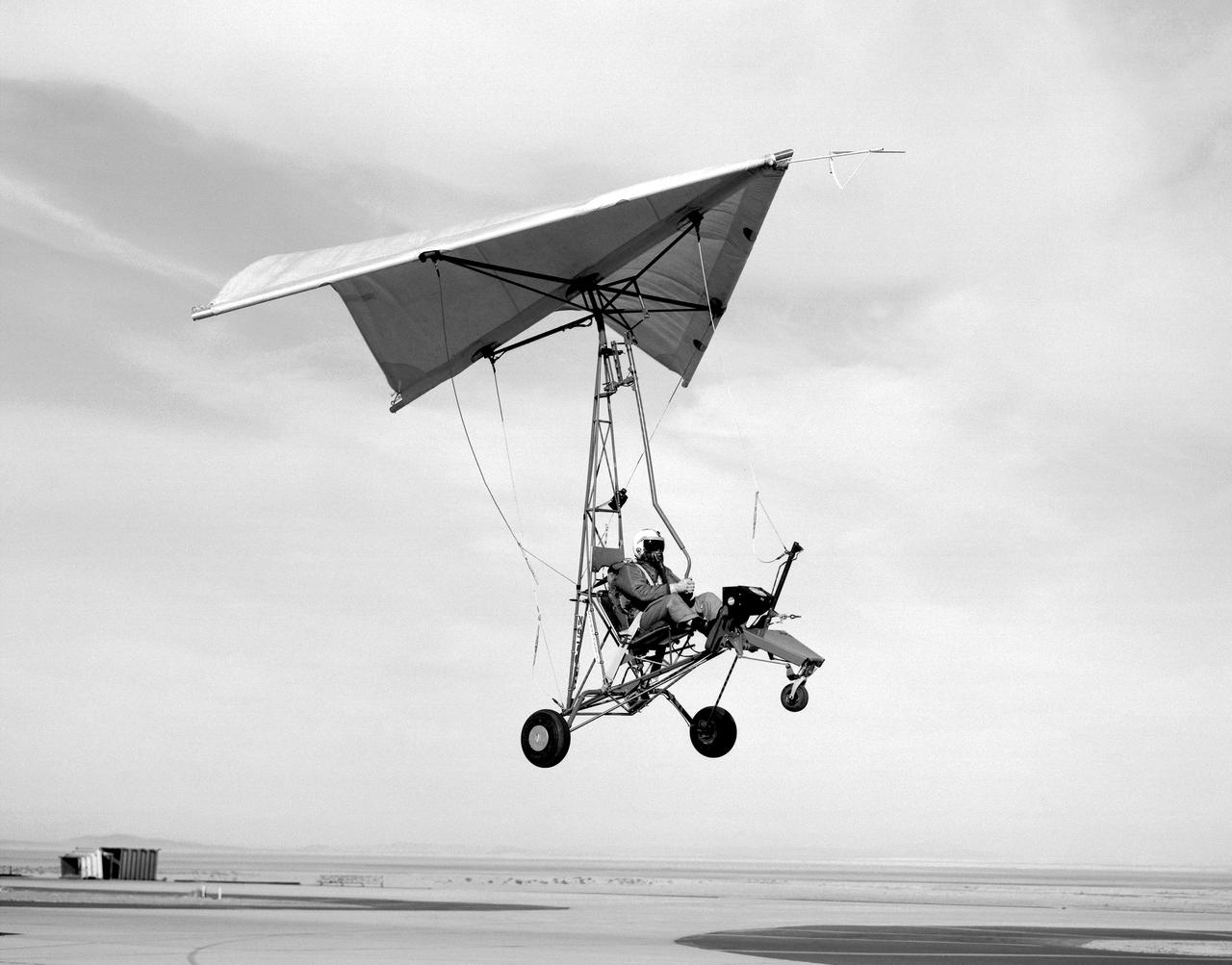
Pilot and Paresev 1 preparing for a landing on the Rogers dry lakebed in 1962 at Edwards Air Force Base, California. The flight program began with ground tow tests. Several tows were made before liftoff was attempted to check the control rigging and to familiarize the pilot with the vehicle’s ground stability. As the pilot’s confidence and experience increased, tow speeds were also increased until liftoff was attained. Liftoff was at about 40 knots indicated airspeed (kias).
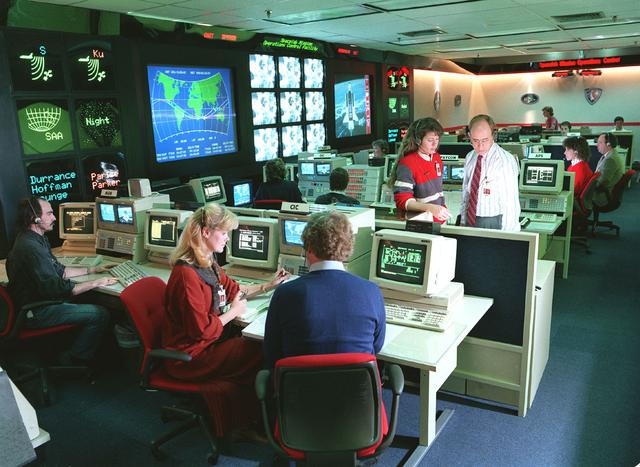
Activities in the Spacelab Mission Operations Control facility at the Marshall Space Flight Center (MSFC) are shown in this photograph. All NASA Spacelab science missions were controlled from and the science astronauts were supported by this facility during the missions. Teams of flight controllers and researchers at the MSFC Space Mission Operations Control Center directed all NASA science operations, sent commands directly to the crew of Spacelab, and received and analyzed data from experiments on board the Spacelab. The facility used the air/ground communications charnels between the astronauts and ground control teams during the Spacelab missions. Spacelab science operations were a cooperative effort between the science astronaut crew in orbit and their colleagues in the Space Mission Operations Control Center. Though the crew and the instrument science teams were separated by many miles, they interacted with one another to evaluate observations and solve problems in much the same way as they would when working side by side in a ground-based laboratory. Most of the action was centered in two work areas: The payload control area from which the overall payload was monitored and controlled and the science operations area where teams of scientists monitored their instruments and direct experiment activities. This facility is no longer operational since the last Spacelab mission, U.S. Microgravity Payload-4 in December 1997, and has become one of the historical sites at MSFC. The facility was reopened as the International Space Station Payload Operations Center in March 2001.
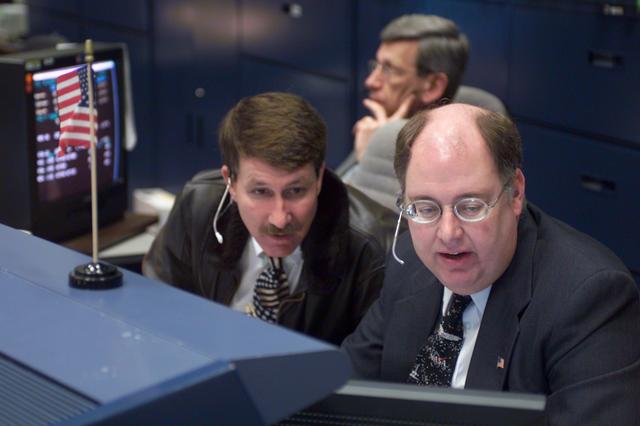
JSC2002-E-08147 (1 March 2002) --- Astronaut Kent V. Rominger (left), Wayne Hale, and Lawrence Bourgeois (background), monitor pre-flight data at the Mission Operation Directorate (MOD) console in the shuttle flight control room (WFCR) in Houston's Mission Control Center (MCC). Several hundred miles away in Florida, the STS-109 crewmembers were awaiting countdown in the crew cabin of the Space Shuttle Columbia on the launch pad at the Kennedy Space Center (KSC). As soon as the vehicle cleared the tower in Florida, the Houston-based team of flight controllers took over the ground control of the mission. Rominger is the Deputy Director of the Flight Crew Operations Directorate (FCOD) and was the FCOD management representative in the MCC. Hale, the Deputy Chief for Space Shuttle of the Flight Director’s Office, served as the MOD management representative. Bourgeois is the Mission Operations Director in the Flight Operations Department at United Space Alliance (USA), and was the USA management representative for STS-109.
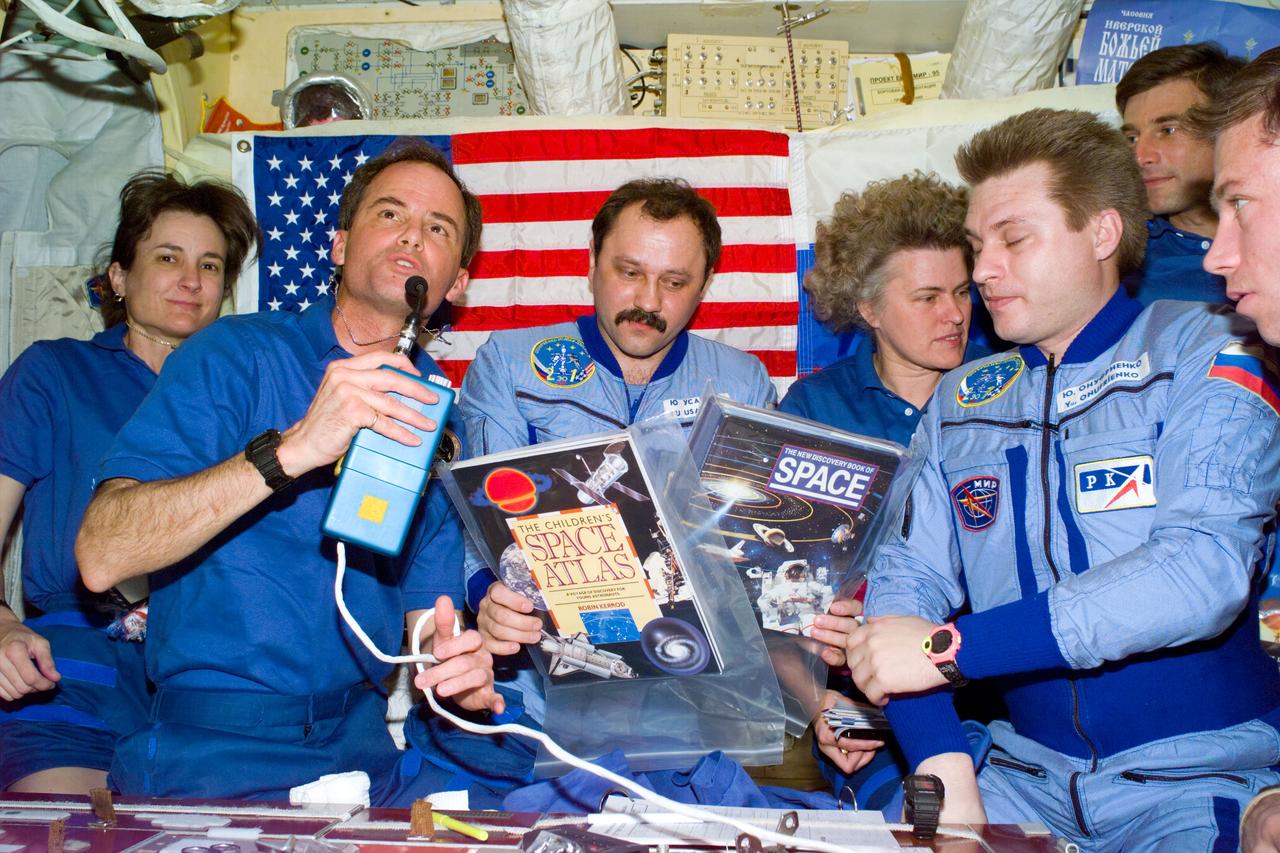
S76-E-5157 (24 March 1996) --- Two Russian cosmonauts and five of six NASA astronauts exchange gifts soon after reuniting in the Base Block Module of Russia's Mir Space Station. From the left are Linda M. Godwin, Kevin P. Chilton, Yury V. Usachev, Shannon W. Lucid, Yury I. Onufrienko, Ronald M. Sega and Richard A. Searfoss. Not pictured is astronaut Michael R. (Rich) Clifford. In a light moment around this time, ground controllers informed Chilton, the STS-76 mission commander, that Lucid, who will spend several months onboard Mir as a cosmonaut guest researcher, should now be considered a Mir-21 crew member, along with Onufrienko and Usachev, Mir-21 flight engineer. The image was recorded with a 35mm Electronic Still Camera (ESC) and downlinked at a later time to ground controllers in Houston, Texas.
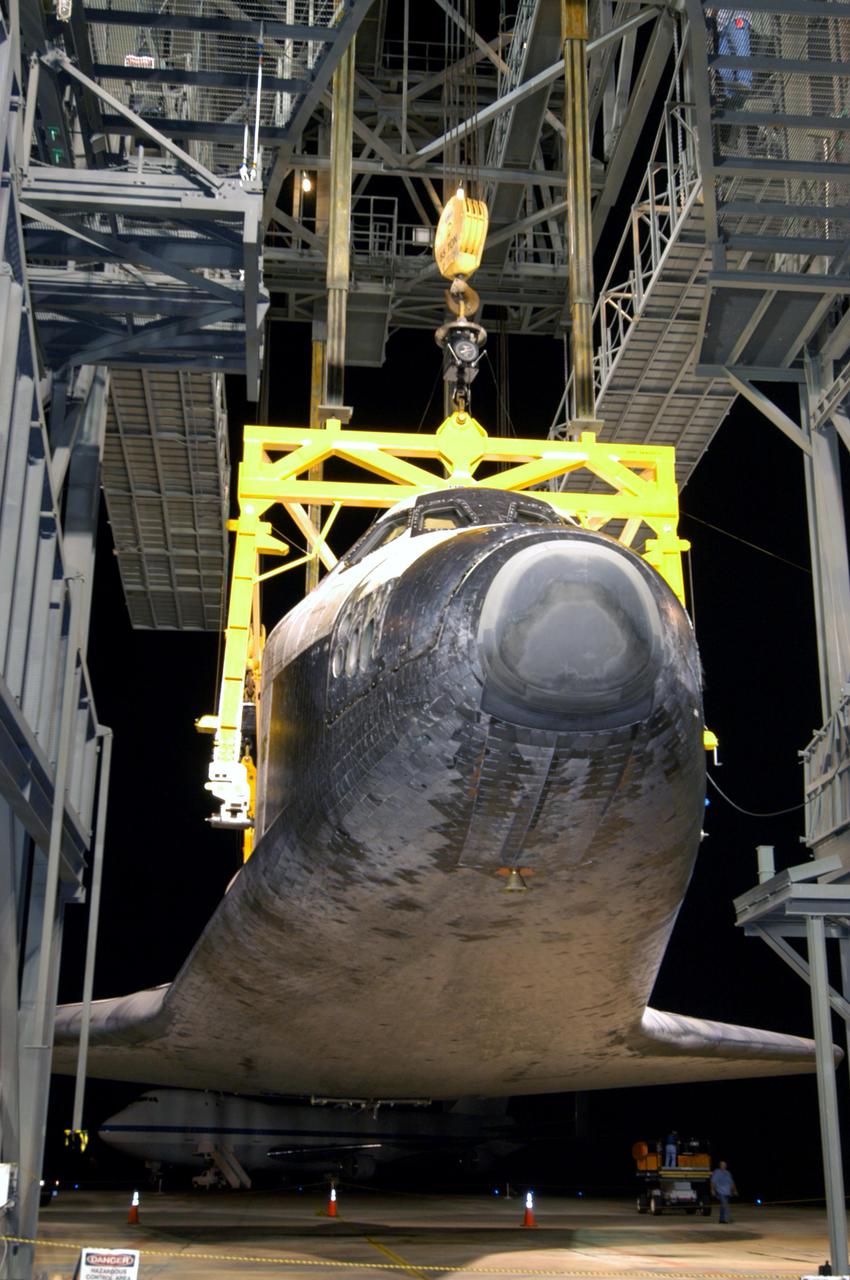
KENNEDY SPACE CENTER, FLA. - In the early morning hours at NASA Kennedy Space Center’s Shuttle Landing Facility, the orbiter Discovery is slowly lowered toward the ground from the mate_demate device. Visible on the orbiter is the tail cone that covers the main engines during the ferry flight. Discovery was returned to Kennedy Space Center on a ferry flight from Edwards Air Force Base in California, where it landed Aug. 9 after 13 days in space on mission STS-114. In the mate_demate device, a horizontal structure mounted at the 80-foot level between two towers controls and guides a large lift beam that attaches to the orbiter to raise and lower it. The orbiter will be lowered to the ground and then be towed to the Orbiter Processing Facility. Once inside the OPF, the payload bay doors will be opened and the MPLM Raffaello brought back from the International Space Station will be unloaded and transferred to the Space Station Processing Facility. This concludes mission STS-114.
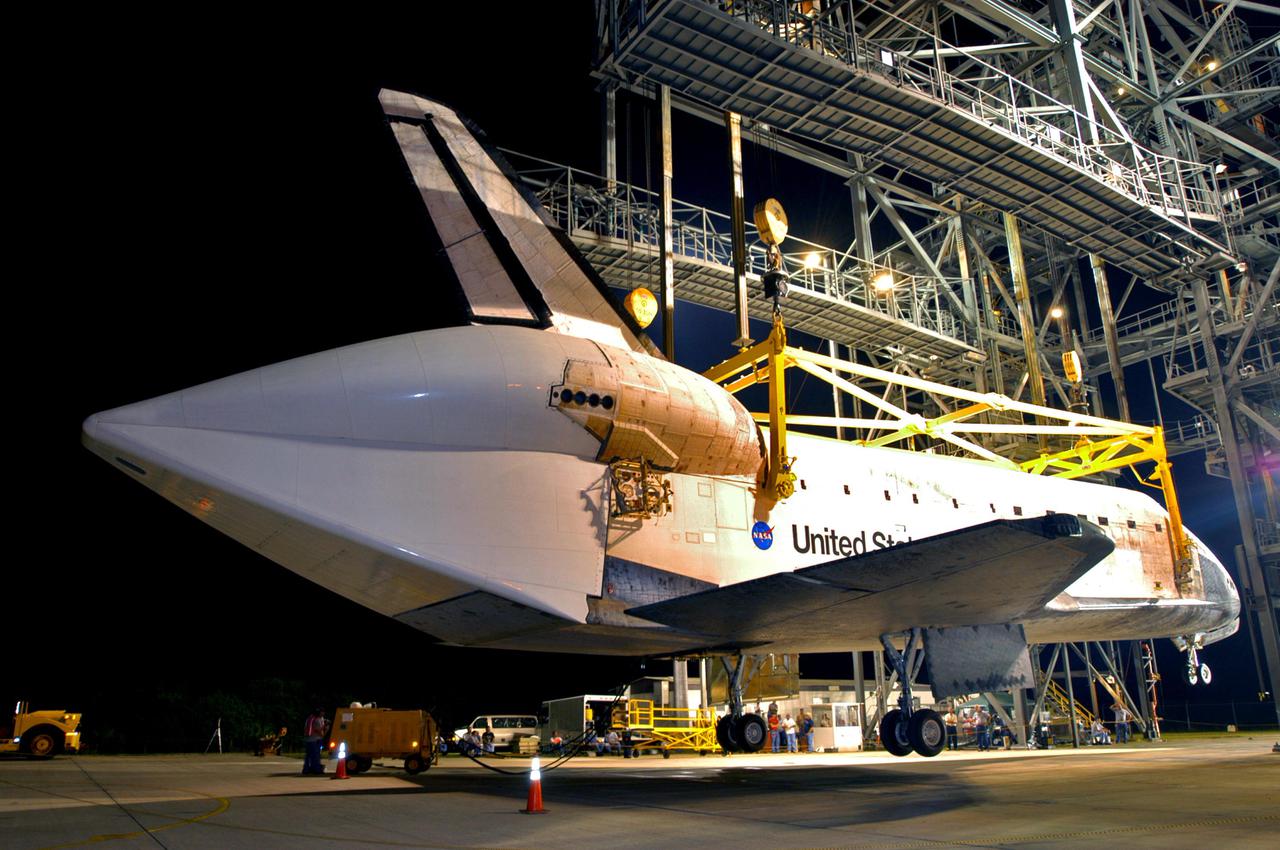
KENNEDY SPACE CENTER, FLA. - After being lowered close enough to the ground from the mate_demate device, Discovery’s wheels are lowered at NASA Kennedy Space Center’s Shuttle Landing Facility. Visible on the orbiter is the tail cone that covers the main engines during the ferry flight. Discovery was returned to Kennedy Space Center on a ferry flight from Edwards Air Force Base in California, where it landed Aug. 9 after 13 days in space on mission STS-114. In the mate_demate device, a horizontal structure mounted at the 80-foot level between two towers controls and guides a large lift beam that attaches to the orbiter to raise and lower it. The orbiter will be lowered to the ground and then be towed to the Orbiter Processing Facility. Once inside the OPF, the payload bay doors will be opened and the MPLM Raffaello brought back from the International Space Station will be unloaded and transferred to the Space Station Processing Facility. This concludes mission STS-114.
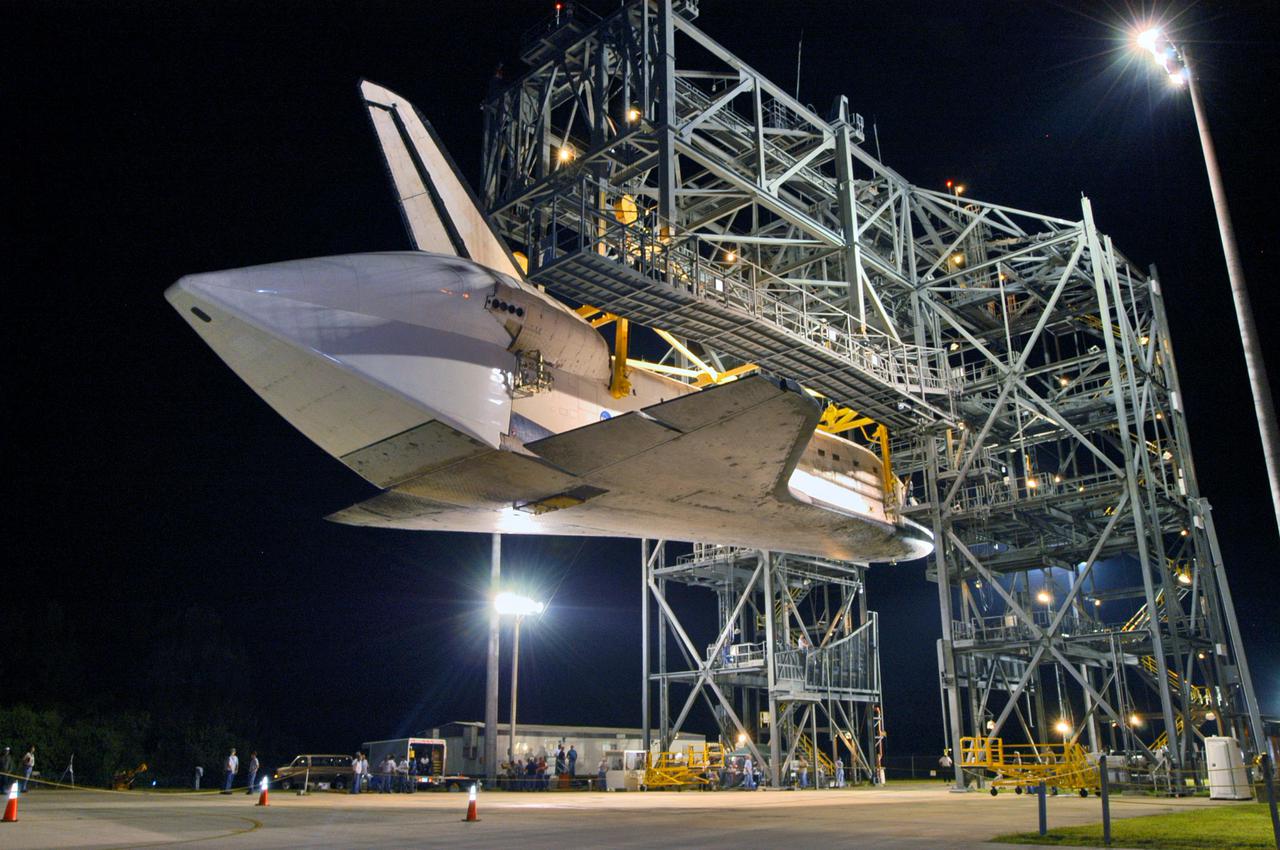
KENNEDY SPACE CENTER, FLA. - In the early morning hours at NASA Kennedy Space Center’s Shuttle Landing Facility, the orbiter Discovery is slowly lowered toward the ground from the mate_demate device. Visible on the orbiter is the tail cone that covers the main engines during the ferry flight. Discovery was returned to Kennedy Space Center on a ferry flight from Edwards Air Force Base in California, where it landed Aug. 9 after 13 days in space on mission STS-114. In the mate_demate device, a horizontal structure mounted at the 80-foot level between two towers controls and guides a large lift beam that attaches to the orbiter to raise and lower it. The orbiter will be lowered to the ground and then be towed to the Orbiter Processing Facility. Once inside the OPF, the payload bay doors will be opened and the MPLM Raffaello brought back from the International Space Station will be unloaded and transferred to the Space Station Processing Facility. This concludes mission STS-114.
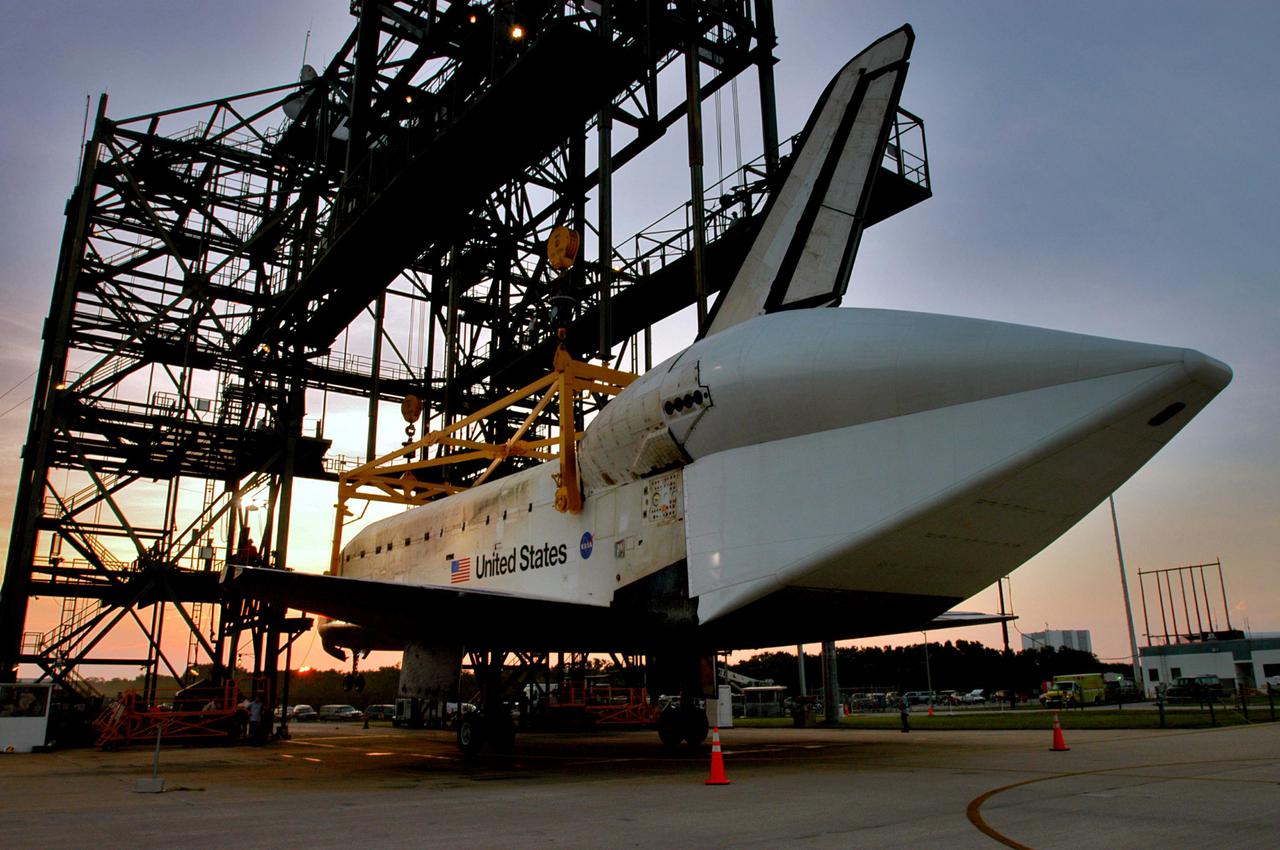
KENNEDY SPACE CENTER, FLA. - Just before sunrise, Discovery finally rests on its wheels on the ground at NASA Kennedy Space Center’s Shuttle Landing Facility. The orbiter was lowered overnight from the mate_demate device after the Shuttle Carrier Aircraft, a modified Boeing 747, was rolled away. Discovery was returned to Kennedy Space Center on a ferry flight from Edwards Air Force Base in California, where it landed Aug. 9 after 13 days in space on mission STS-114. In the mate_demate device, a horizontal structure mounted at the 80-foot level between two towers controls and guides a large lift beam that attaches to the orbiter to raise and lower it. The orbiter will be lowered to the ground and then be towed to the Orbiter Processing Facility. Once inside the OPF, the payload bay doors will be opened and the MPLM Raffaello brought back from the International Space Station will be unloaded and transferred to the Space Station Processing Facility. This concludes mission STS-114.
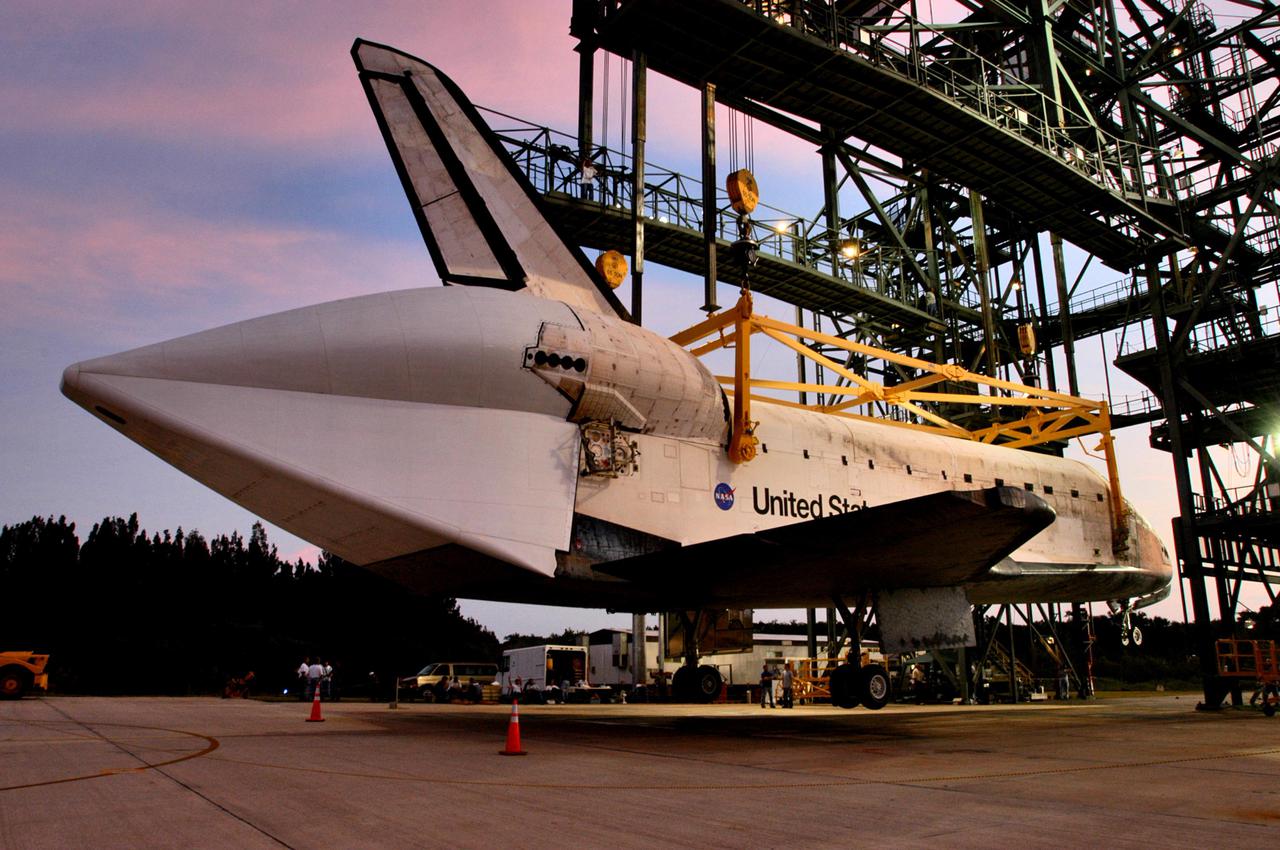
KENNEDY SPACE CENTER, FLA. - Just before sunrise, Discovery finally rests on its wheels on the ground at NASA Kennedy Space Center’s Shuttle Landing Facility. The orbiter was lowered overnight from the mate_demate device after the Shuttle Carrier Aircraft, a modified Boeing 747, was rolled away. Discovery was returned to Kennedy Space Center on a ferry flight from Edwards Air Force Base in California, where it landed Aug. 9 after 13 days in space on mission STS-114. In the mate_demate device, a horizontal structure mounted at the 80-foot level between two towers controls and guides a large lift beam that attaches to the orbiter to raise and lower it. The orbiter will be lowered to the ground and then be towed to the Orbiter Processing Facility. Once inside the OPF, the payload bay doors will be opened and the MPLM Raffaello brought back from the International Space Station will be unloaded and transferred to the Space Station Processing Facility. This concludes mission STS-114.
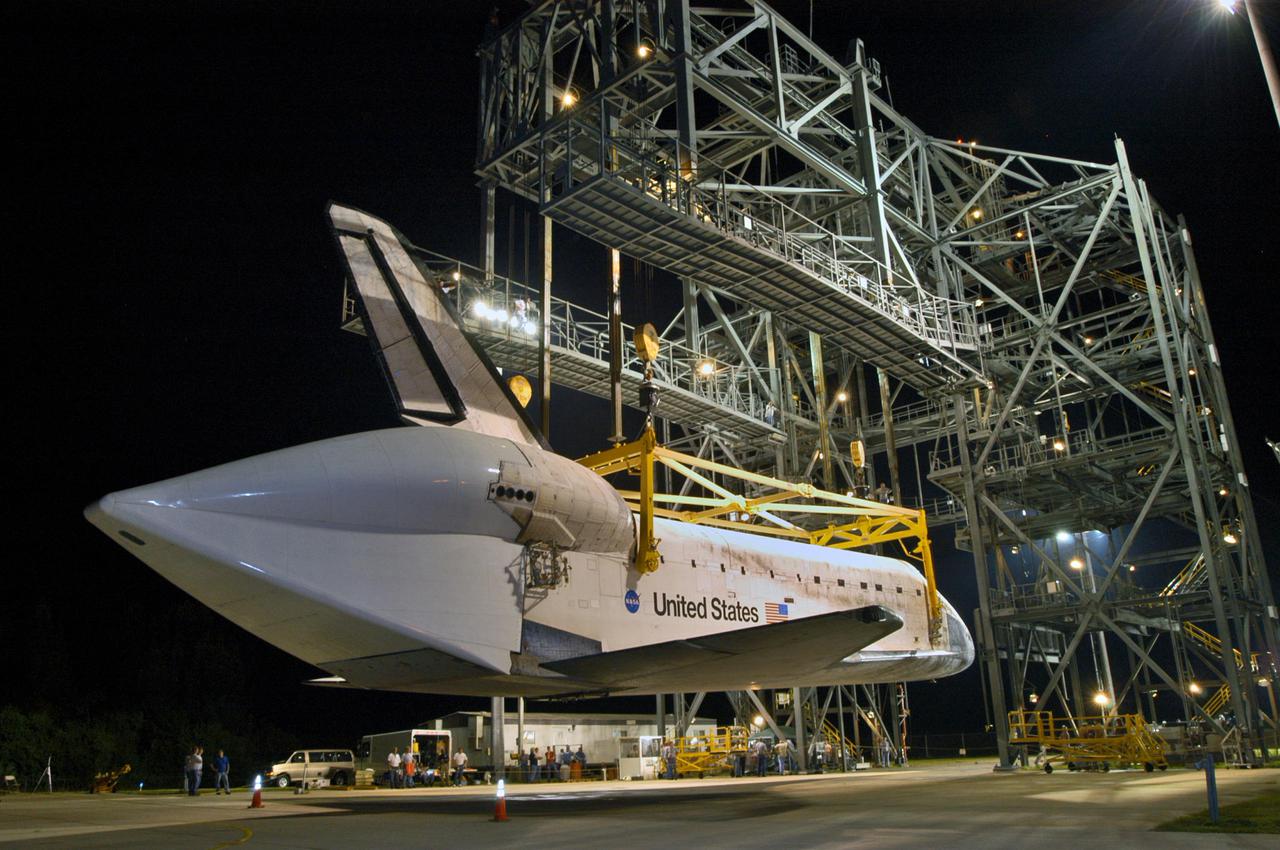
KENNEDY SPACE CENTER, FLA. - In the early morning hours at NASA Kennedy Space Center’s Shuttle Landing Facility, the orbiter Discovery is slowly lowered toward the ground from the mate_demate device. Discovery was returned to Kennedy Space Center on a ferry flight from Edwards Air Force Base in California, where it landed Aug. 9 after 13 days in space on mission STS-114. In the mate_demate device, a horizontal structure mounted at the 80-foot level between two towers controls and guides a large lift beam that attaches to the orbiter to raise and lower it. The orbiter will be lowered to the ground and then be towed to the Orbiter Processing Facility. Once inside the OPF, the payload bay doors will be opened and the MPLM Raffaello brought back from the International Space Station will be unloaded and transferred to the Space Station Processing Facility. This concludes mission STS-114.
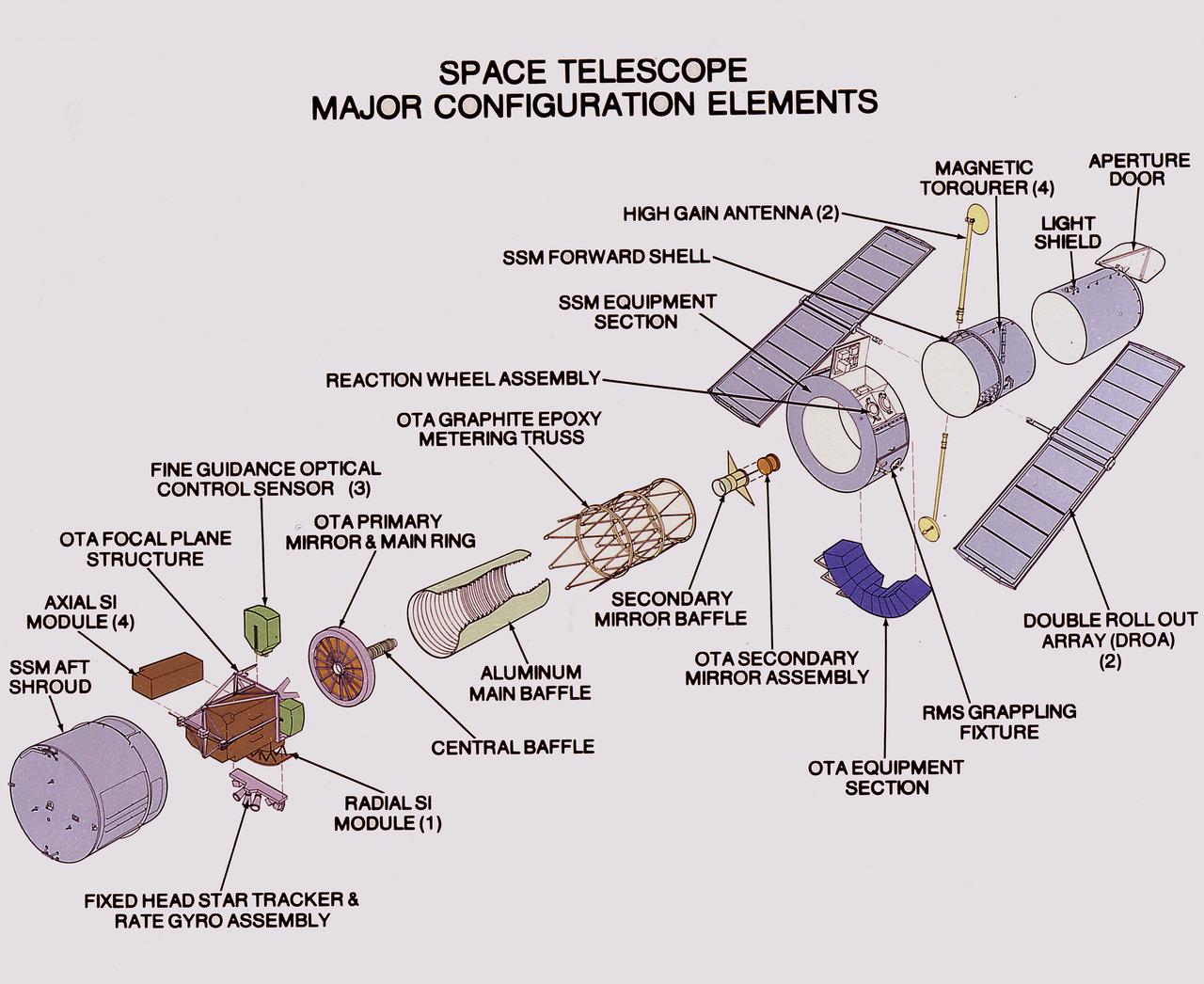
This illustration shows the Hubble Space Telescope's (HST's) major configuration elements. The spacecraft has three interacting systems: The Support System Module (SSM), an outer structure that houses the other systems and provides services such as power, communication, and control; The Optical Telescope Assembly (OTA), which collects and concentrates the incoming light in the focal plane for use by the Scientific Instruments (SI); and five SIs. The SI Control and Data Handling (CDH) unit controls the five SI's, four that are housed in an aft section focal plane structure and one that is placed along the circumference of the spacecraft. The purpose of the HST, the most complex and sensitive optical telescope ever made, is to study the cosmos from a low-Earth orbit. By placing the telescope in space, astronomers are able to collect data that is free of the Earth's atmosphere. The HST detects objects 25 times fainter than the dimmest objects seen from Earth and provides astronomers with an observable universe 250 times larger than visible from ground-based telescopes, perhaps as far away as 14 billion light-years. The HST views galaxies, stars, planets, comets, possibly other solar systems, and even unusual phenomena such as quasars, with 10 times the clarity of ground-based telescopes. The HST was deployed from the Space Shuttle Discovery (STS-31 mission) into Earth orbit in April 1990. The Marshall Space Flight Center had responsibility for design, development, and construction of the HST. The Perkin-Elmer Corporation, in Danbury, Cornecticut, developed the optical system and guidance sensors. The Lockheed Missile and Space Company of Sunnyvale, California produced the protective outer shroud and spacecraft systems, and assembled and tested the finished telescope.
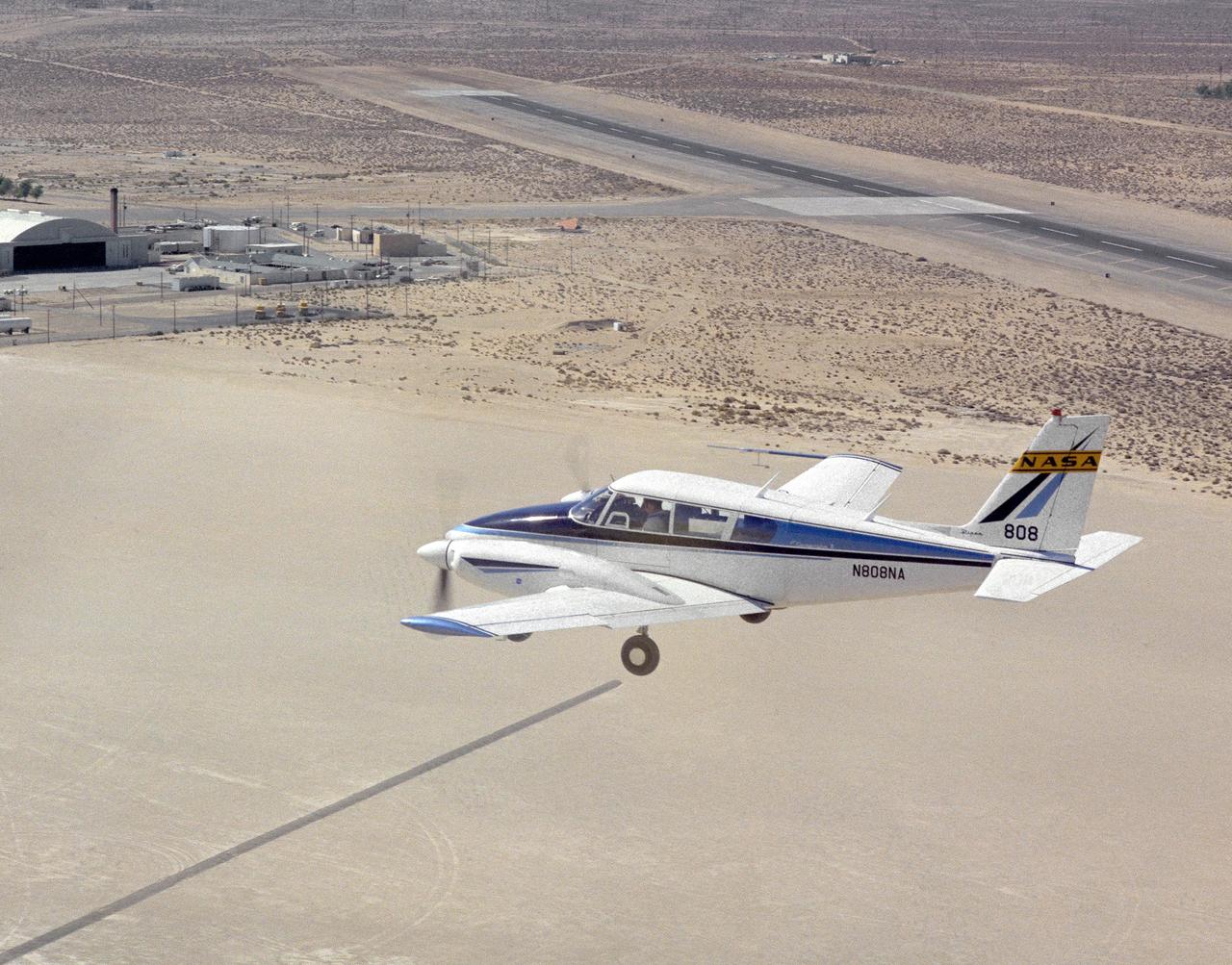
Dryden Flight Research Center's Piper PA-30 Twin Commanche, which helped validate the RPRV concept, descends to a remotely controlled landing on Rogers Dry Lake, unassisted by the onboard pilot. A Piper PA-30 Twin Commanche, known as NASA 808, was used at the NASA Dryden Flight Research Center as a rugged workhorse in a variety of research projects associated with both general aviation and military projects. In the early 1970s, the PA-30, serial number 301498, was used to test a flight technique used to fly Remotely Piloted Research Vehicles (RPRV's). The technique was first tested with the cockpit windows of the light aircraft blacked out while the pilot flew the aircraft utilizing a television monitor which gave him a "pilot's eye" view ahead of the aircraft. Later pilots flew the aircraft from a ground cockpit, a procedure used with all RPRV's. TV and two-way telemetry allow the pilot to be in constant control of the aircraft. The apparatus mounted over the cockpit is a special fish eye lens camera, used to obtain images that are transmitted to the ground based cockpit. This project paved the way for sophisticated, highly successful research programs involving high risk spin, stall, and flight control conditions, such as the HiMAT and the subscale F-15 remotely piloted vehicles. Over the years, NASA 808 has also been used for spin and stall research related to general aviation aircraft and also research to alleviate wake vortices behind large jetliners.
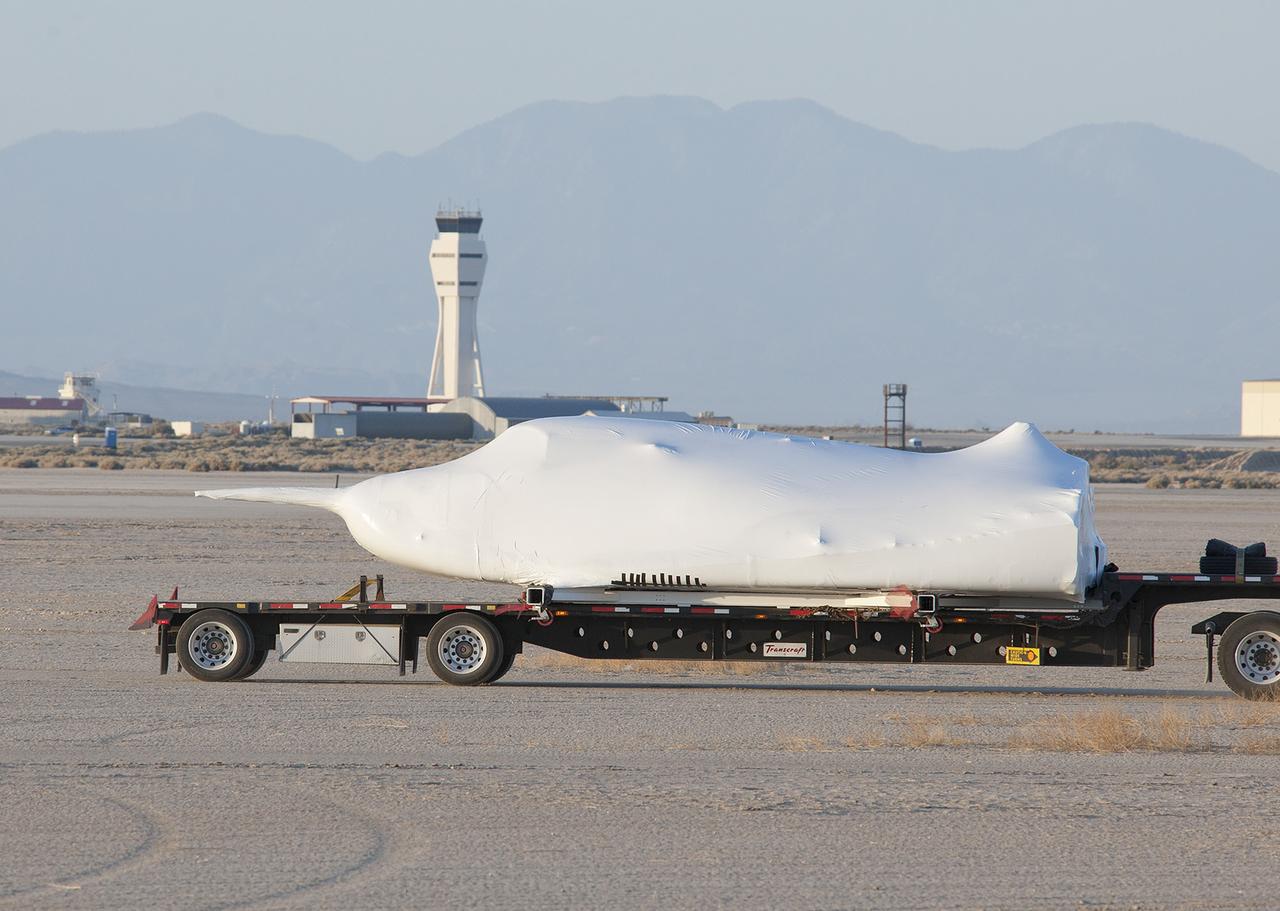
EDWARDS, Calif. – ED13-0142-03: Shrouded in plastic wrap with its wings and tail structure removed for ground transport, Sierra Nevada Corporation, or SNC, Space Systems' Dream Chaser engineering test article is hauled across the bed of Rogers Dry Lake in front of the control tower at Edwards Air Force Base, Calif., to NASA's Dryden Flight Research Center. The Dream Chaser will begin its flight test program in collaboration with NASA's Commercial Crew Program this summer. SNC is one of three companies working with NASA's Commercial Crew Program, or CCP, during the agency's Commercial Crew Integrated Capability, or CCiCap, initiative, which is intended to lead to the availability of commercial human spaceflight services for government and commercial customers. To learn more about CCP and its industry partners, visit www.nasa.gov/commercialcrew. Image credit: NASA/Tom Tschida
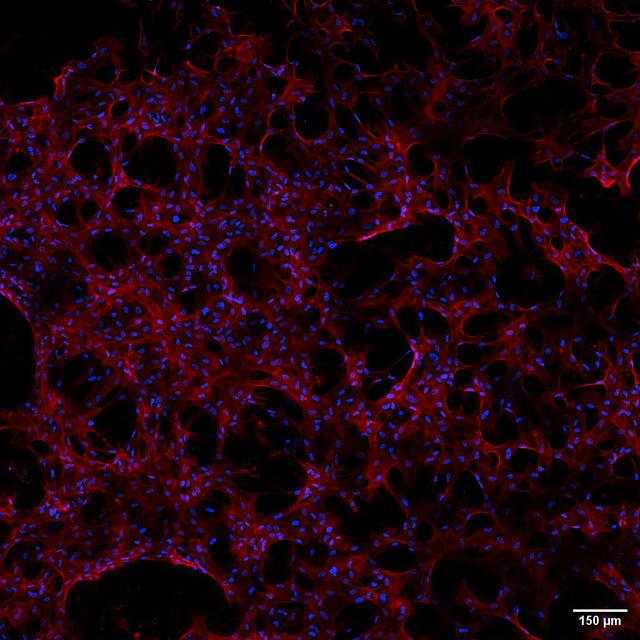
jsc2025e036190 (4/4/2025) --- Stem cells grown along the Janus Base Nanomaterial (JBNm) made aboard the International Space Station. After four hours, a significant increase in the number of these cells adhered to the scaffold, compared to the ground scaffold. This shows that structural improvements were obtained through in-space manufacturing and translated directly into biological improvements. The Flight JBNm is much better at stem cell recruitment, which could better stimulate cartilage regeneration. Biomimetic Fabrication of Multi-Functional DNA-Inspired Nanomaterials via Controlled Self-assembly in Space (DNA Nano Therapeutics-Mission 2) continues prior research on in-space manufacturing of nanomaterials that mimic DNA and have applications for vaccines and regenerative medicine. Image courtesy of University of Connecticut.
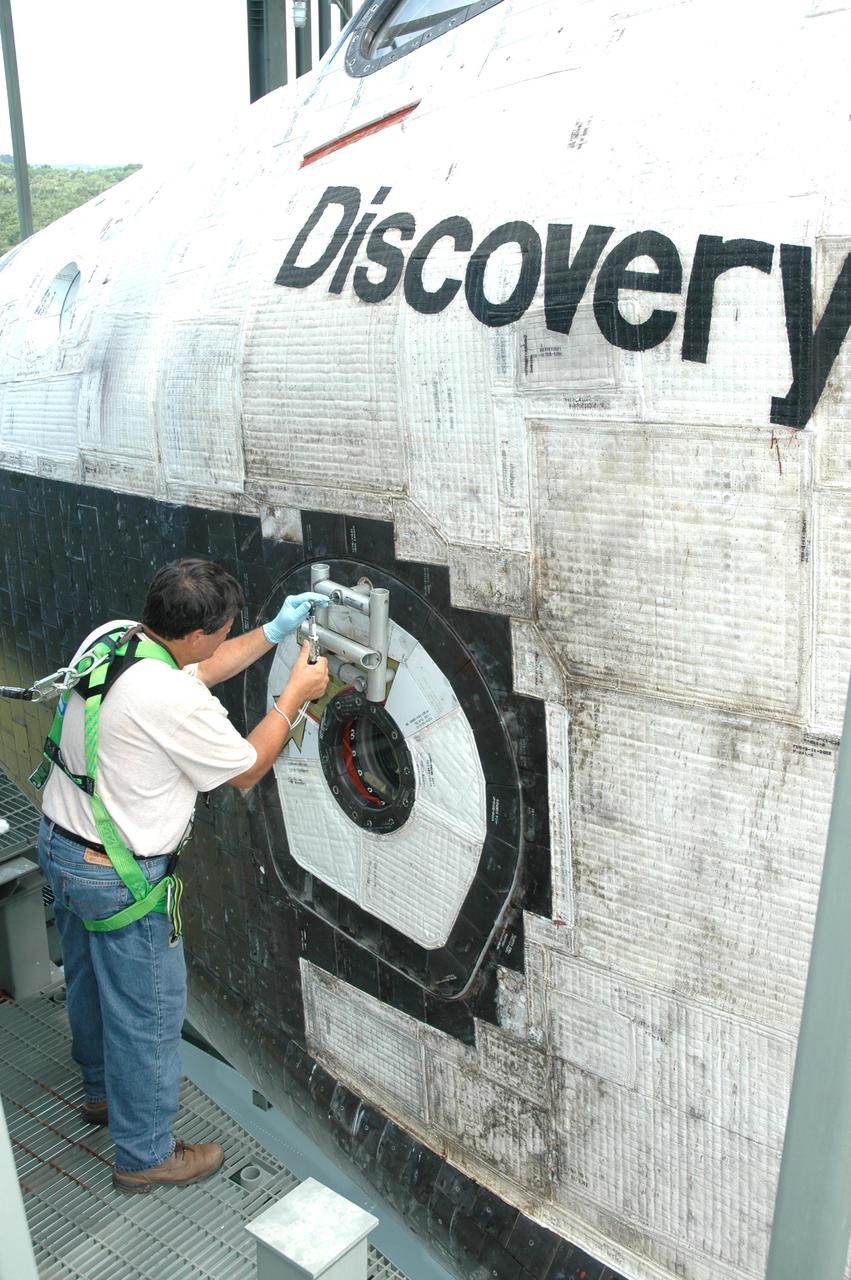
KENNEDY SPACE CENTER, FLA. - At NASA Kennedy Space Center’s Shuttle Landing Facility, a worker begins preparing the orbiter Discovery for demating. Discovery was returned to Kennedy Space Center on a ferry flight from Edwards Air Force Base in California, where it landed Aug. 9 after 13 days in space on mission STS-114. In the mate_demate device, a horizontal structure mounted at the 80-foot level between two towers controls and guides a large lift beam that attaches to the orbiter to raise and lower it. Once Discovery is lifted off the back of the SCA, the 747 can then roll away and the orbiter will be lowered to the ground. It will then be towed from the SLF to the Orbiter Processing Facility. Once inside the OPF, the payload bay doors will be opened and the MPLM Raffaello brought back from the International Space Station will be unloaded and transferred to the Space Station Processing Facility. This concludes mission STS-114.
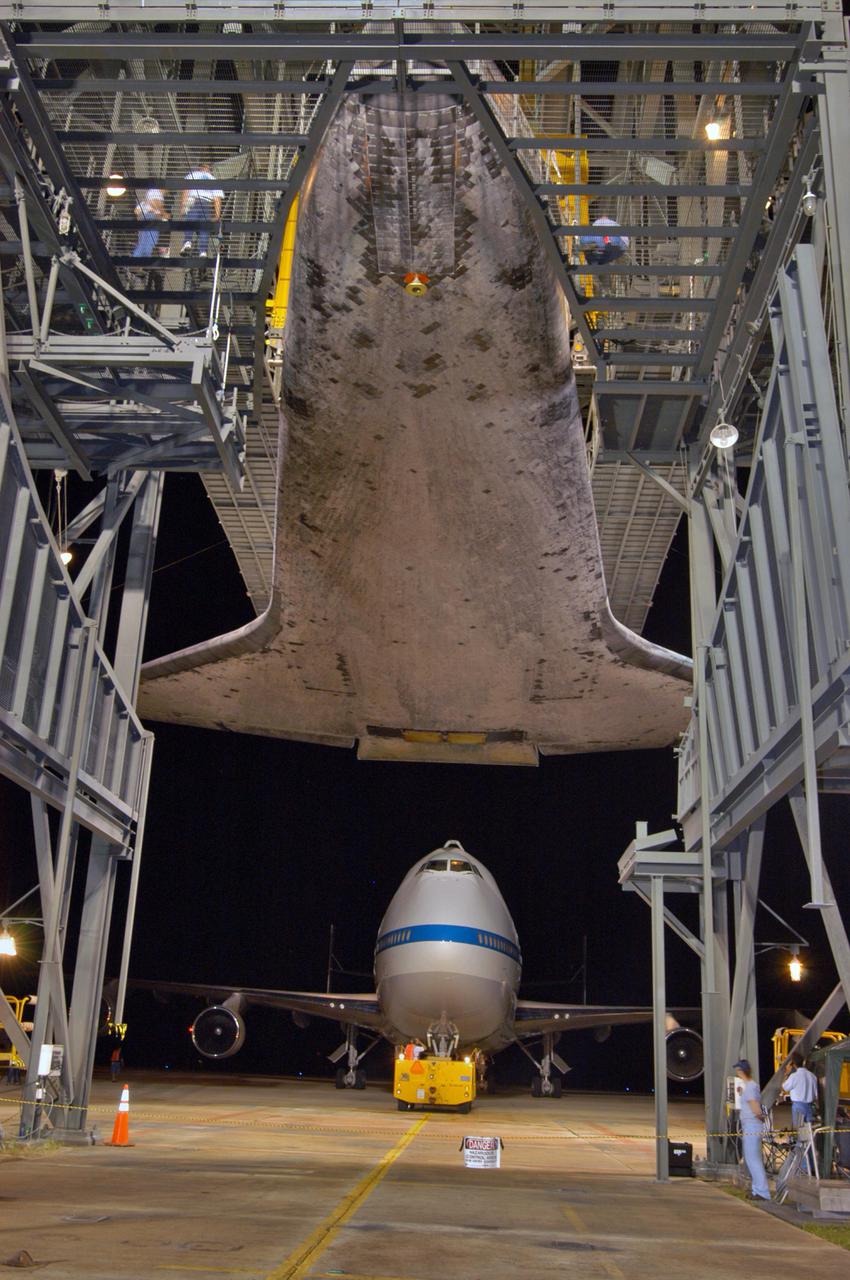
KENNEDY SPACE CENTER, FLA. - In the early morning hours at NASA Kennedy Space Center’s Shuttle Landing Facility, the orbiter Discovery is suspended within the mate_demate device after the Shuttle Carrier Aircraft, a modified Boeing 747, has rolled away from beneath it. Discovery was returned to Kennedy Space Center on a ferry flight from Edwards Air Force Base in California, where it landed Aug. 9 after 13 days in space on mission STS-114. In the mate_demate device, a horizontal structure mounted at the 80-foot level between two towers controls and guides a large lift beam that attaches to the orbiter to raise and lower it. The orbiter will be lowered to the ground and then be towed to the Orbiter Processing Facility. Once inside the OPF, the payload bay doors will be opened and the MPLM Raffaello brought back from the International Space Station will be unloaded and transferred to the Space Station Processing Facility. This concludes mission STS-114.
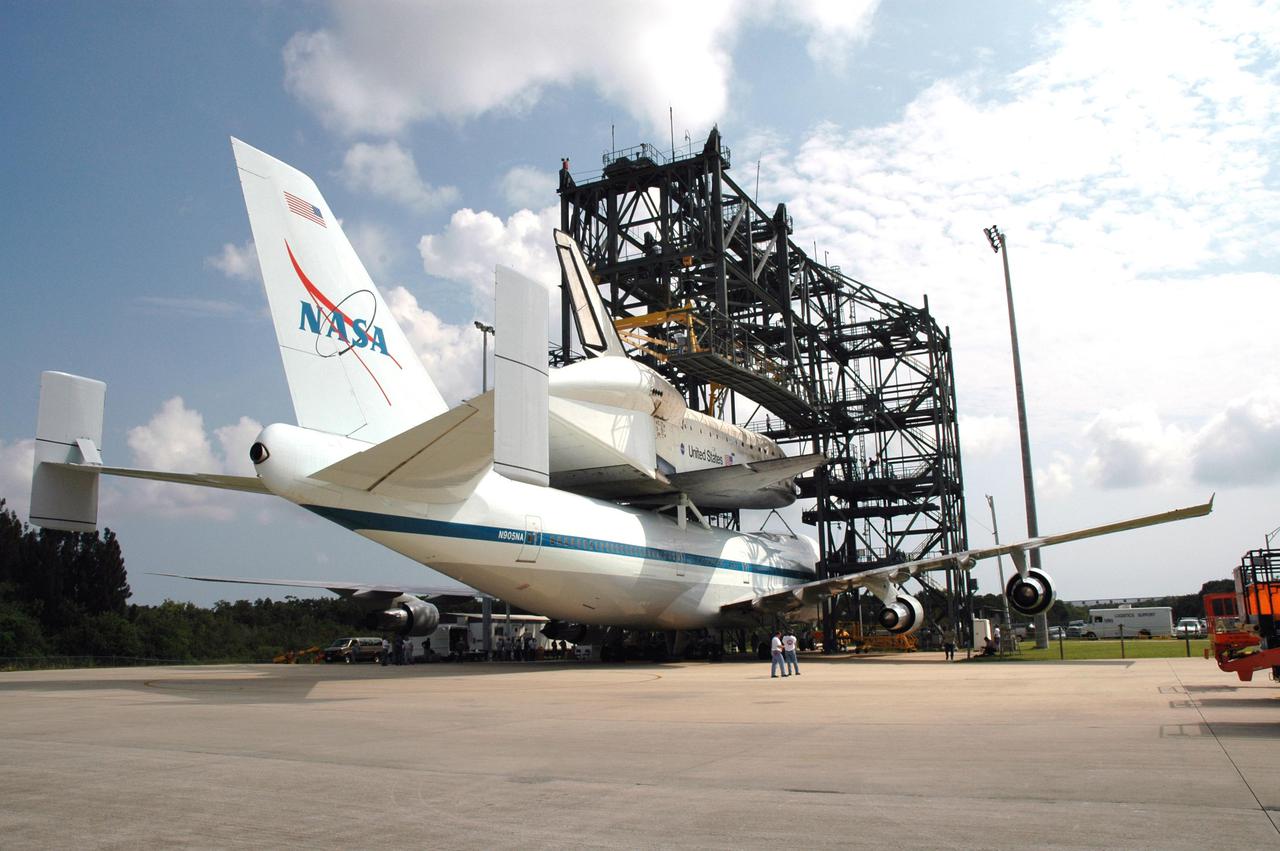
KENNEDY SPACE CENTER, FLA. - At sunrise, Discovery finally rests on its wheels on the ground at NASA Kennedy Space Center’s Shuttle Landing Facility. The orbiter was lowered overnight from the mate_demate device after the Shuttle Carrier Aircraft, a modified Boeing 747, was rolled away. Discovery was returned to Kennedy Space Center on a ferry flight from Edwards Air Force Base in California, where it landed Aug. 9 after 13 days in space on mission STS-114. In the mate_demate device, a horizontal structure mounted at the 80-foot level between two towers controls and guides a large lift beam that attaches to the orbiter to raise and lower it. The orbiter will be towed to the Orbiter Processing Facility. Once inside the OPF, the payload bay doors will be opened and the MPLM Raffaello brought back from the International Space Station will be unloaded and transferred to the Space Station Processing Facility. This concludes mission STS-114.
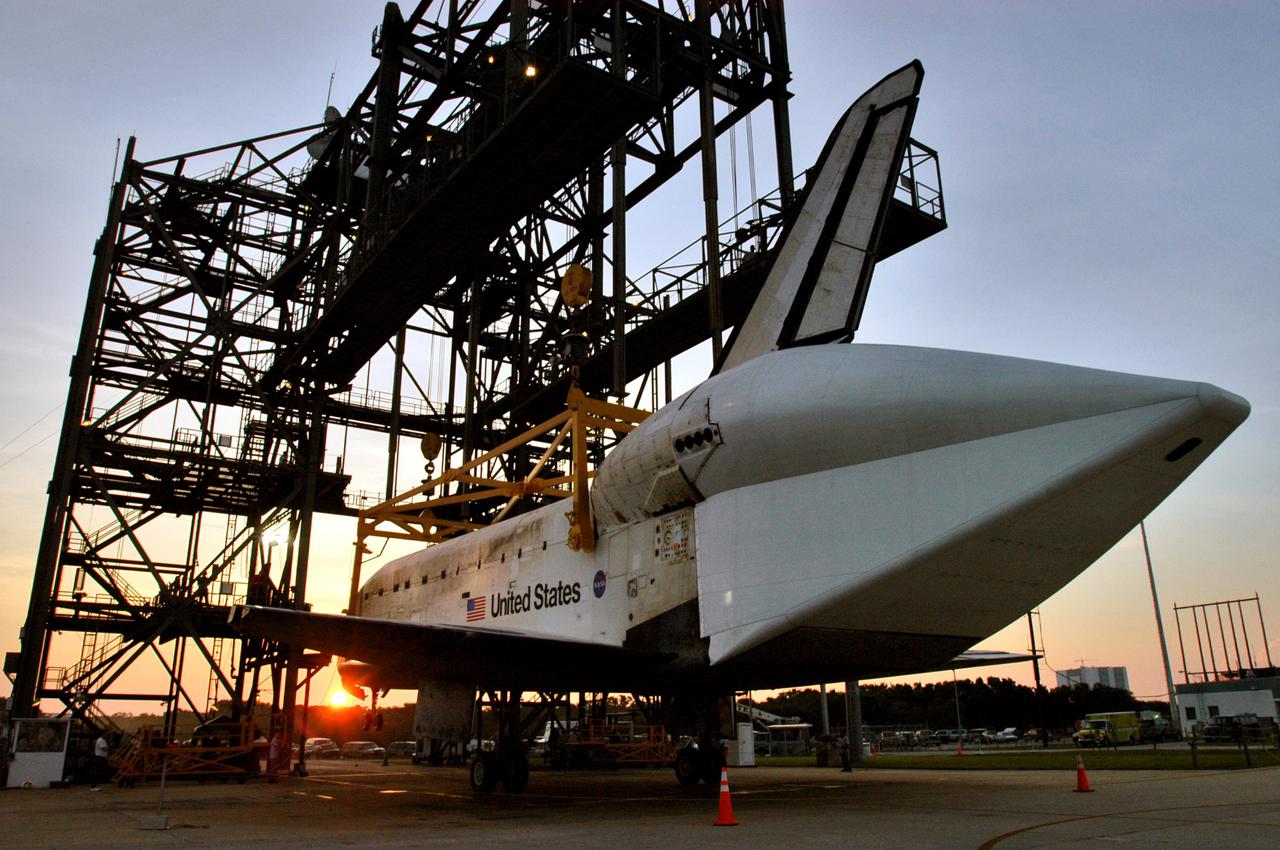
KENNEDY SPACE CENTER, FLA. - The orbiter Discovery on top of the Shuttle Carrier Aircraft, a modified Boeing 747, is towed into the mate_demate device at NASA Kennedy Space Center’s Shuttle Landing Facility. Discovery was returned to Kennedy Space Center on a ferry flight from Edwards Air Force Base in California, where it landed Aug. 9 after 13 days in space on mission STS-114. In the mate_demate device, a horizontal structure mounted at the 80-foot level between two towers controls and guides a large lift beam that attaches to the orbiter to raise and lower it. Once Discovery is lifted off the back of the SCA, the 747 can then roll away and the orbiter will be lowered to the ground. It will then be towed from the SLF to the Orbiter Processing Facility. Once inside the OPF, the payload bay doors will be opened and the MPLM Raffaello brought back from the International Space Station will be unloaded and transferred to the Space Station Processing Facility. This concludes mission STS-114.
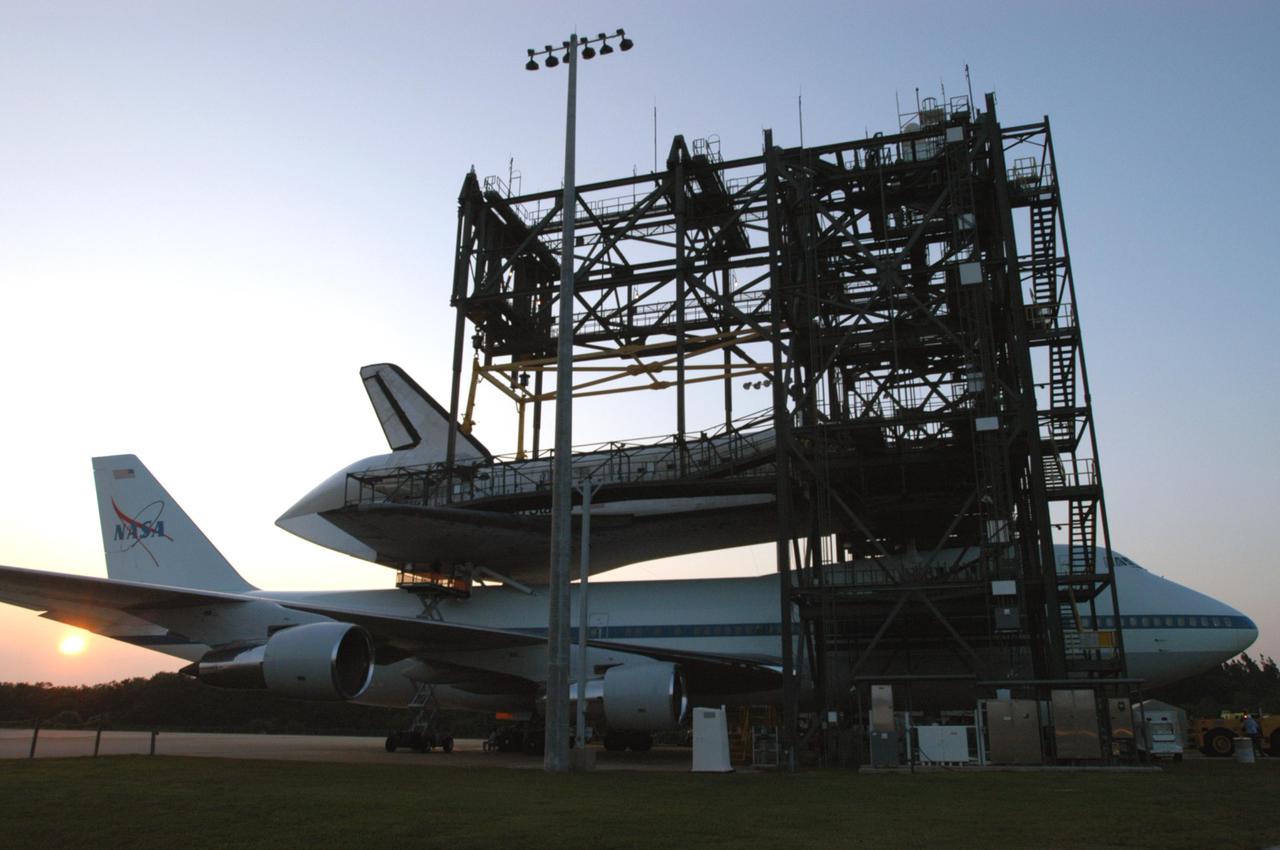
KENNEDY SPACE CENTER, FLA. - The sun is setting behind the tail of the Shuttle Carrier Aircraft, a modified Boeing 747, and orbiter Discovery where they are parked in the mate_demate device. Discovery was returned to Kennedy Space Center on a ferry flight from Edwards Air Force Base in California, where it landed Aug. 9 after 13 days in space on mission STS-114. In the mate_demate device, a horizontal structure mounted at the 80-foot level between two towers controls and guides a large lift beam that attaches to the orbiter to raise and lower it. Once Discovery is lifted off the back of the SCA, the 747 can then roll away and the orbiter will be lowered to the ground. It will then be towed from the SLF to the Orbiter Processing Facility. Once inside the OPF, the payload bay doors will be opened and the MPLM Raffaello brought back from the International Space Station will be unloaded and transferred to the Space Station Processing Facility. This concludes mission STS-114.
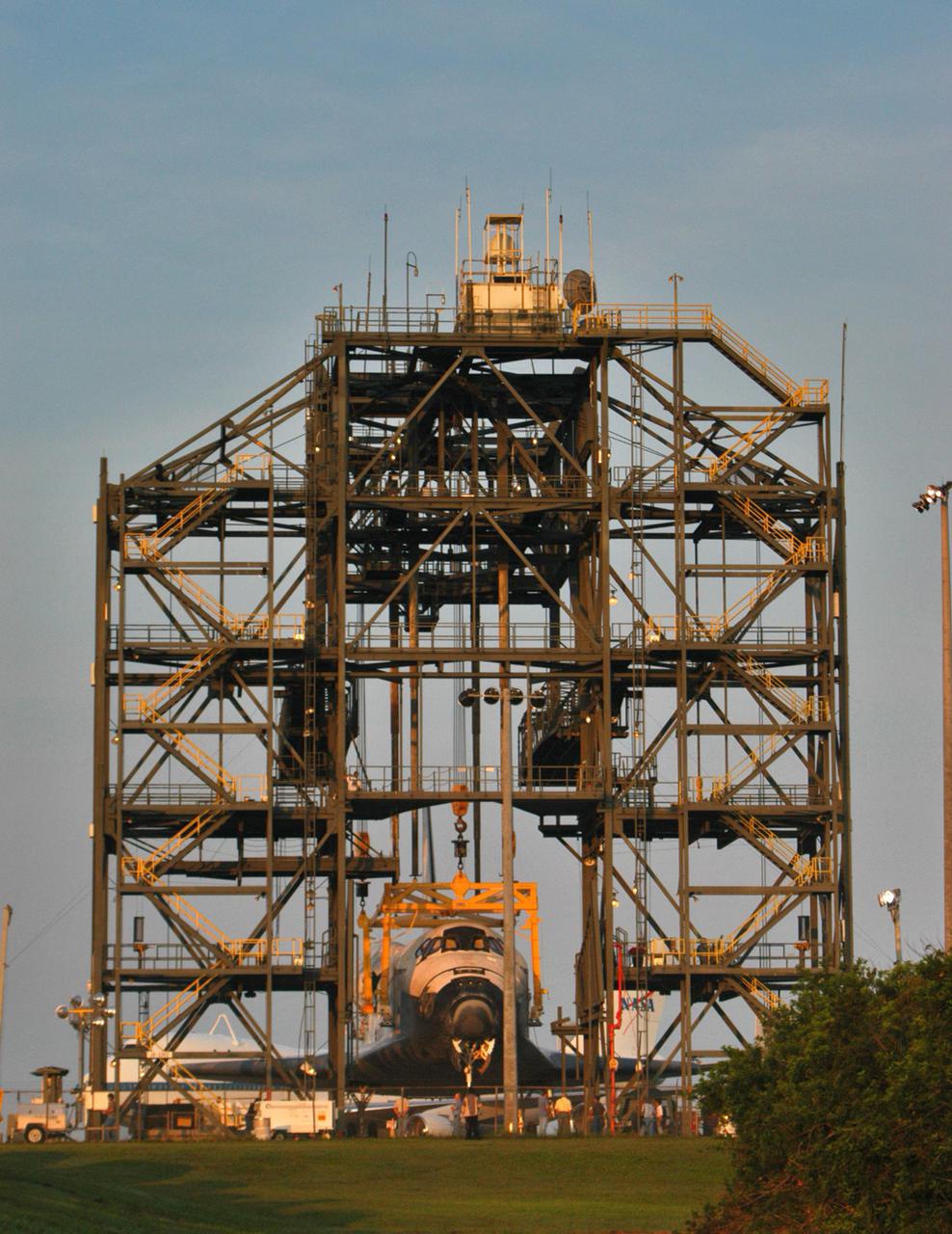
KENNEDY SPACE CENTER, FLA. - Discovery finally rests on its wheels on the ground at NASA Kennedy Space Center’s Shuttle Landing Facility. The orbiter was lowered overnight from the mate_demate device after the Shuttle Carrier Aircraft, a modified Boeing 747, was rolled away. Discovery was returned to Kennedy Space Center on a ferry flight from Edwards Air Force Base in California, where it landed Aug. 9 after 13 days in space on mission STS-114. In the mate_demate device, a horizontal structure mounted at the 80-foot level between two towers controls and guides a large lift beam that attaches to the orbiter to raise and lower it. The orbiter will be towed to the Orbiter Processing Facility. Once inside the OPF, the payload bay doors will be opened and the MPLM Raffaello brought back from the International Space Station will be unloaded and transferred to the Space Station Processing Facility. This concludes mission STS-114.
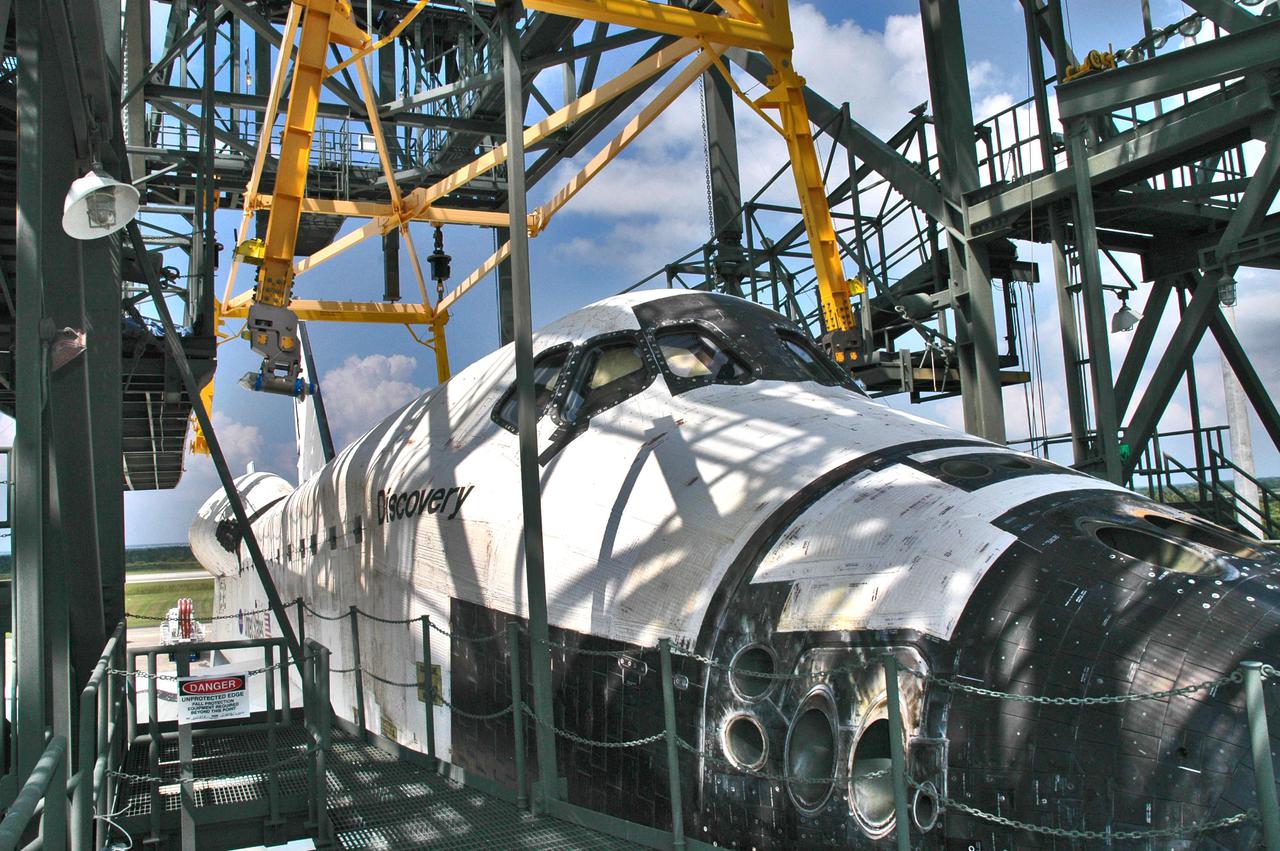
KENNEDY SPACE CENTER, FLA. - The orbiter Discovery on top of the Shuttle Carrier Aircraft, a modified Boeing 747, is in place under the mate_demate device at NASA Kennedy Space Center’s Shuttle Landing Facility. Discovery was returned to Kennedy Space Center on a ferry flight from Edwards Air Force Base in California, where it landed Aug. 9 after 13 days in space on mission STS-114. In the mate_demate device, a horizontal structure mounted at the 80-foot level between two towers controls and guides a large lift beam that attaches to the orbiter to raise and lower it. Once Discovery is lifted off the back of the SCA, the 747 can then roll away and the orbiter will be lowered to the ground. It will then be towed from the SLF to the Orbiter Processing Facility. Once inside the OPF, the payload bay doors will be opened and the MPLM Raffaello brought back from the International Space Station will be unloaded and transferred to the Space Station Processing Facility. This concludes mission STS-114.
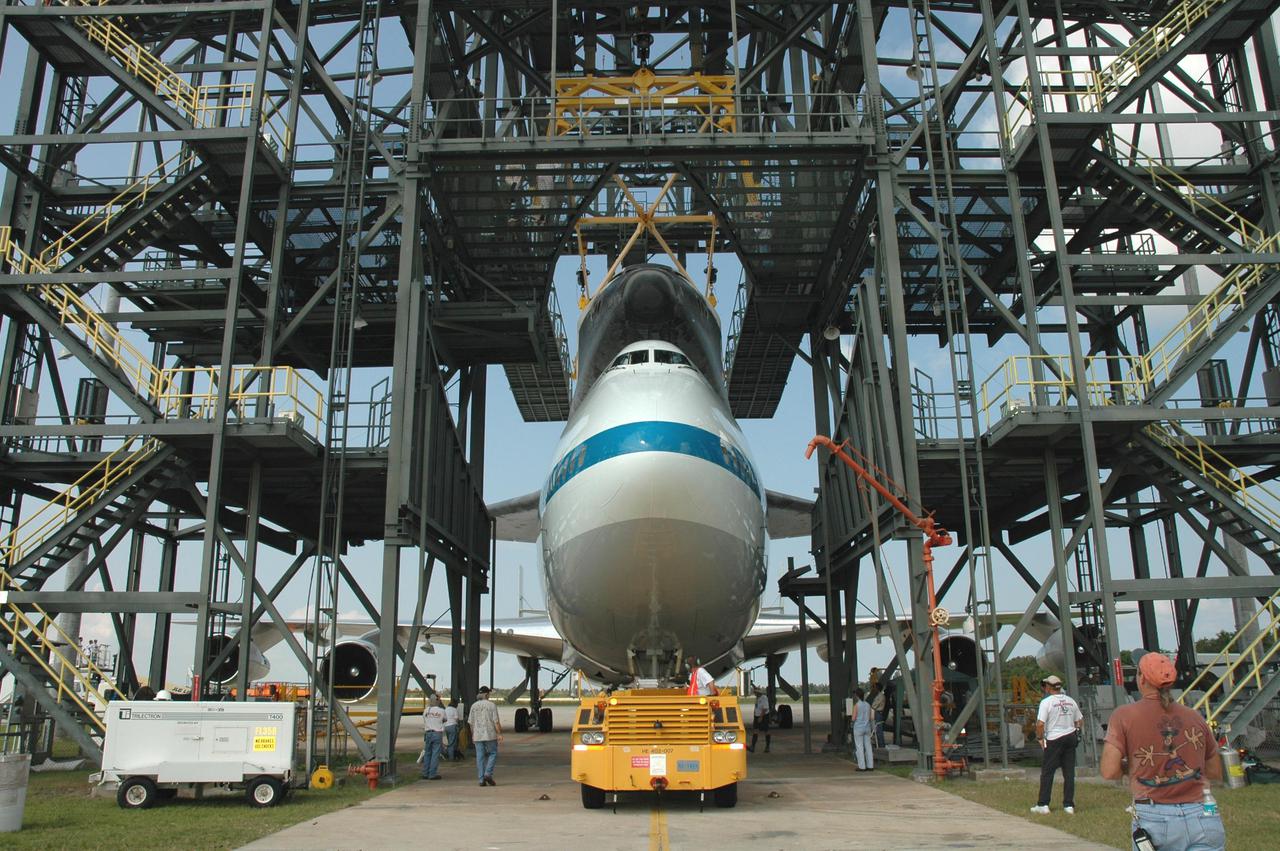
KENNEDY SPACE CENTER, FLA. - The Shuttle Carrier Aircraft, a modified Boeing 747, with the orbiter Discovery on top is towed into the mate_demate device at NASA Kennedy Space Center’s Shuttle Landing Facility. Discovery was returned to Kennedy Space Center on a ferry flight from Edwards Air Force Base in California, where it landed Aug. 9 after 13 days in space on mission STS-114. In the mate_demate device, a horizontal structure mounted at the 80-foot level between two towers controls and guides a large lift beam that attaches to the orbiter to raise and lower it. Once Discovery is lifted off the back of the SCA, the 747 can then roll away and the orbiter will be lowered to the ground. It will then be towed from the SLF to the Orbiter Processing Facility. Once inside the OPF, the payload bay doors will be opened and the MPLM Raffaello brought back from the International Space Station will be unloaded and transferred to the Space Station Processing Facility. This concludes mission STS-114.
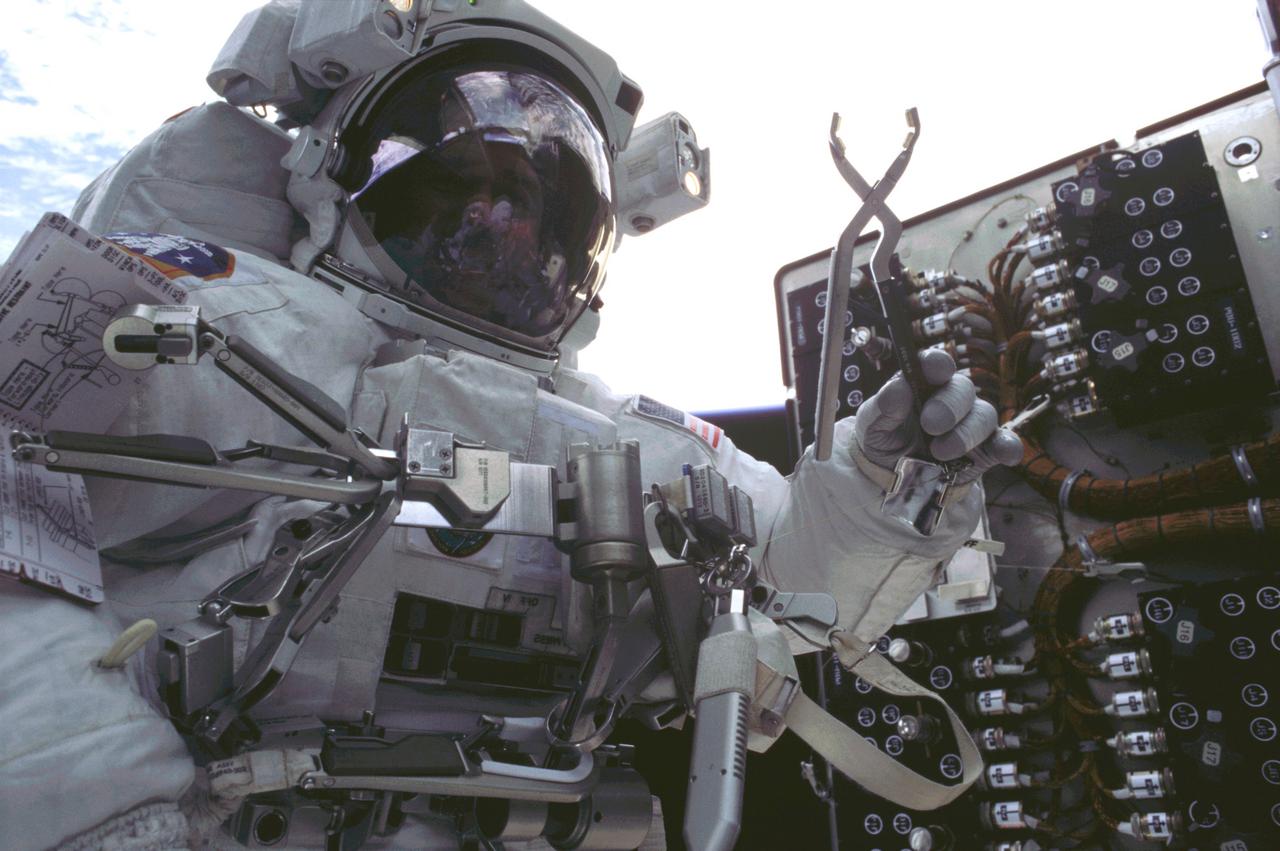
This is an onboard photo of Astronaut John M. Grunsfield, STS-109 payload commander, participating in the third of five spacewalks to perform work on the Hubble Space Telescope (HST). On this particular walk, Grunsfield, joined by Astronaut Richard M. Lirnehan, turned off the telescope in order to replace its power control unit (PCU), the heart of the HST's power system. The telescope was captured and secured on a work stand in Columbia's payload bay using Columbia's robotic arm, where crew members completed system upgrades to the HST. Included in those upgrades were: replacement of the solar array panels; replacement of the power control unit (PCU); replacement of the Faint Object Camera (FOC) with a new advanced camera for Surveys (ACS); and installation of the experimental cooling system for the Hubble's Near-Infrared Camera and Multi-object Spectrometer (NICMOS), which had been dormant since January 1999 when its original coolant ran out. The Marshall Space Flight Center had the responsibility for the design, development, and construction of the HST, which is the most complex and sensitive optical telescope ever made, to study the cosmos from a low-Earth orbit. The HST detects objects 25 times fainter than the dimmest objects seen from Earth and provides astronomers with an observable universe 250 times larger than is visible from ground-based telescopes, perhaps as far away as 14 billion light-years. The HST views galaxies, stars, planets, comets, possibly other solar systems, and even unusual phenomena such as quasars, with 10 times the clarity of ground-based telescopes. Launched March 1, 2002 the STS-109 HST servicing mission lasted 10 days, 22 hours, and 11 minutes. It was the 108th flight overall in NASA's Space Shuttle Program.
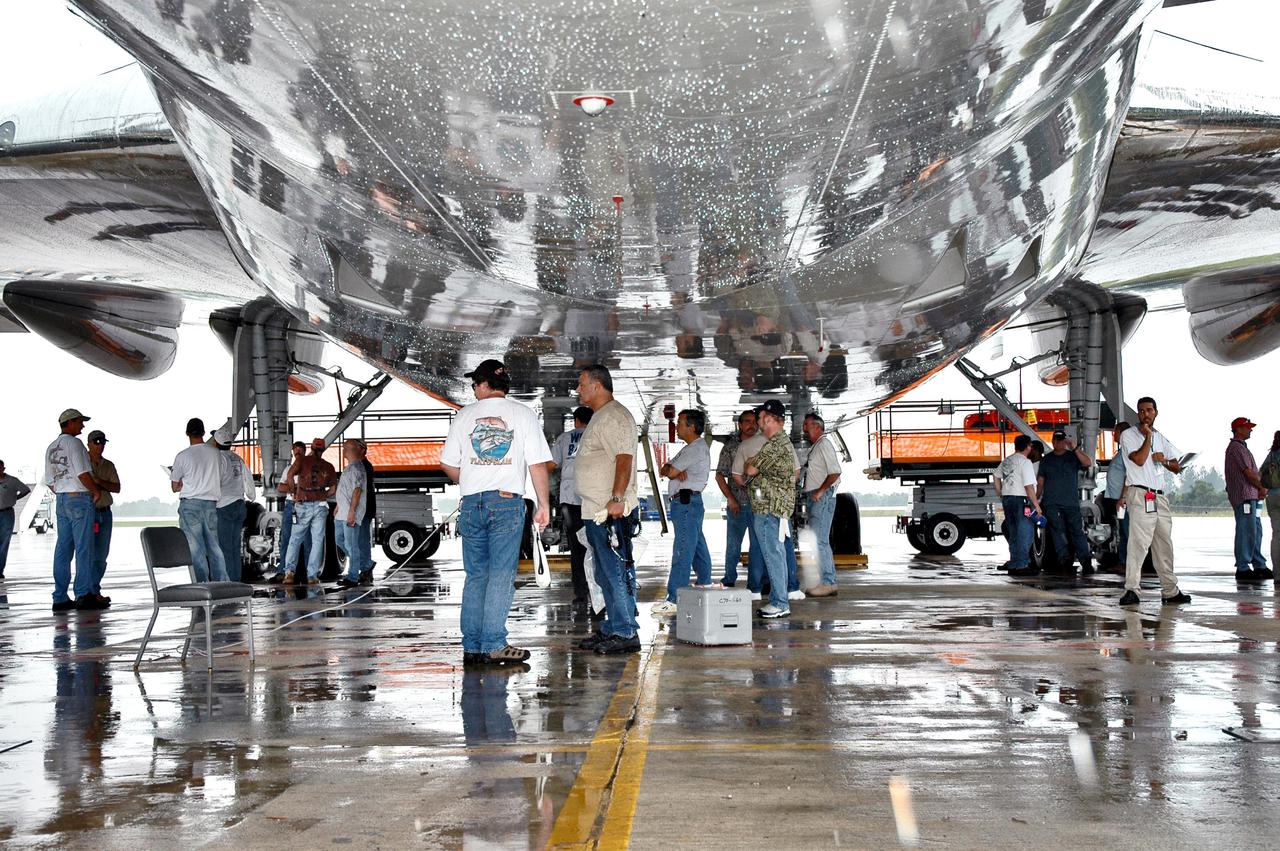
KENNEDY SPACE CENTER, FLA. - At NASA Kennedy Space Center’s Shuttle Landing Facility, workers secure the Shuttle Carrier Aircraft, a modified Boeing 747, on the ground under the mate_demate device. The orbiter Discovery is still on top of the aircraft. Discovery was returned to Kennedy Space Center on a ferry flight from Edwards Air Force Base in California, where it landed Aug. 9 after 13 days in space on mission STS-114. In the mate_demate device, a horizontal structure mounted at the 80-foot level between two towers controls and guides a large lift beam that attaches to the orbiter to raise and lower it. Once Discovery is lifted off the back of the SCA, the 747 can then roll away and the orbiter will be lowered to the ground. It will then be towed from the SLF to the Orbiter Processing Facility. Once inside the OPF, the payload bay doors will be opened and the MPLM Raffaello brought back from the International Space Station will be unloaded and transferred to the Space Station Processing Facility. This concludes mission STS-114.
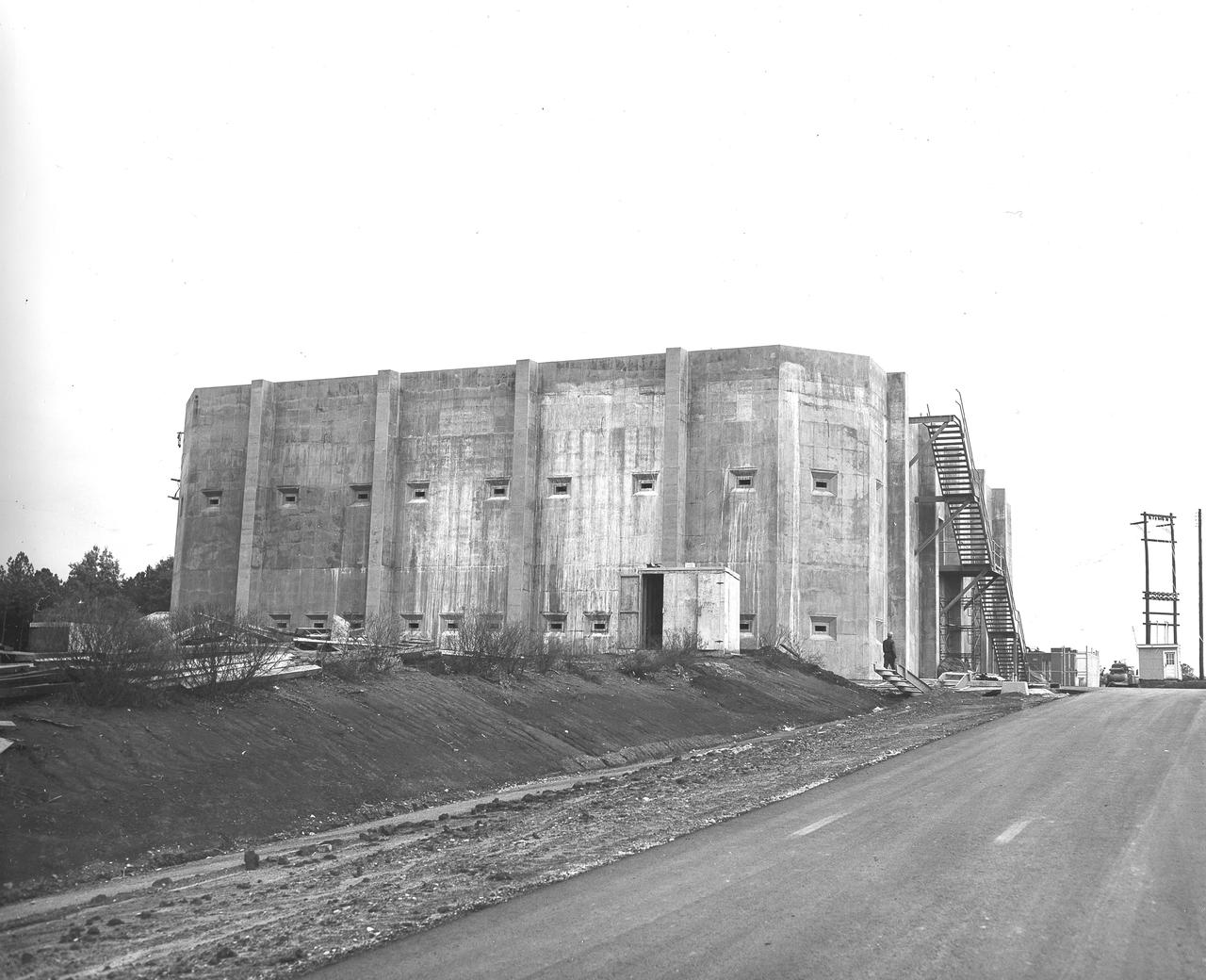
At its founding, the Marshall Space Flight Center (MSFC) inherited the Army’s Jupiter and Redstone test stands, but much larger facilities were needed for the giant stages of the Saturn V. From 1960 to 1964, the existing stands were remodeled and a sizable new test area was developed. The new comprehensive test complex for propulsion and structural dynamics was unique within the nation and the free world, and they remain so today because they were constructed with foresight to meet the future as well as on going needs. Construction of the S-IC Static test stand complex began in 1961 in the west test area of MSFC, and was completed in 1964. The S-IC static test stand was designed to develop and test the 138-ft long and 33-ft diameter Saturn V S-IC first stage, or booster stage, weighing in at 280,000 pounds. Required to hold down the brute force of a 7,500,000-pound thrust produced by 5 F-1 engines, the S-IC static test stand was designed and constructed with the strength of hundreds of tons of steel and 12,000,000 pounds of cement, planted down to bedrock 40 feet below ground level. The foundation walls, constructed with concrete and steel, are 4 feet thick. The base structure consists of four towers with 40-foot-thick walls extending upward 144 feet above ground level. The structure was topped by a crane with a 135-foot boom. With the boom in the upright position, the stand was given an overall height of 405 feet, placing it among the highest structures in Alabama at the time. In addition to the stand itself, related facilities were constructed during this time. Built directly east of the test stand was the Block House, which served as the control center for the test stand. The two were connected by a narrow access tunnel which housed the cables for the controls. This construction photo, taken November 15, 1962, depicts a view of the Block House.
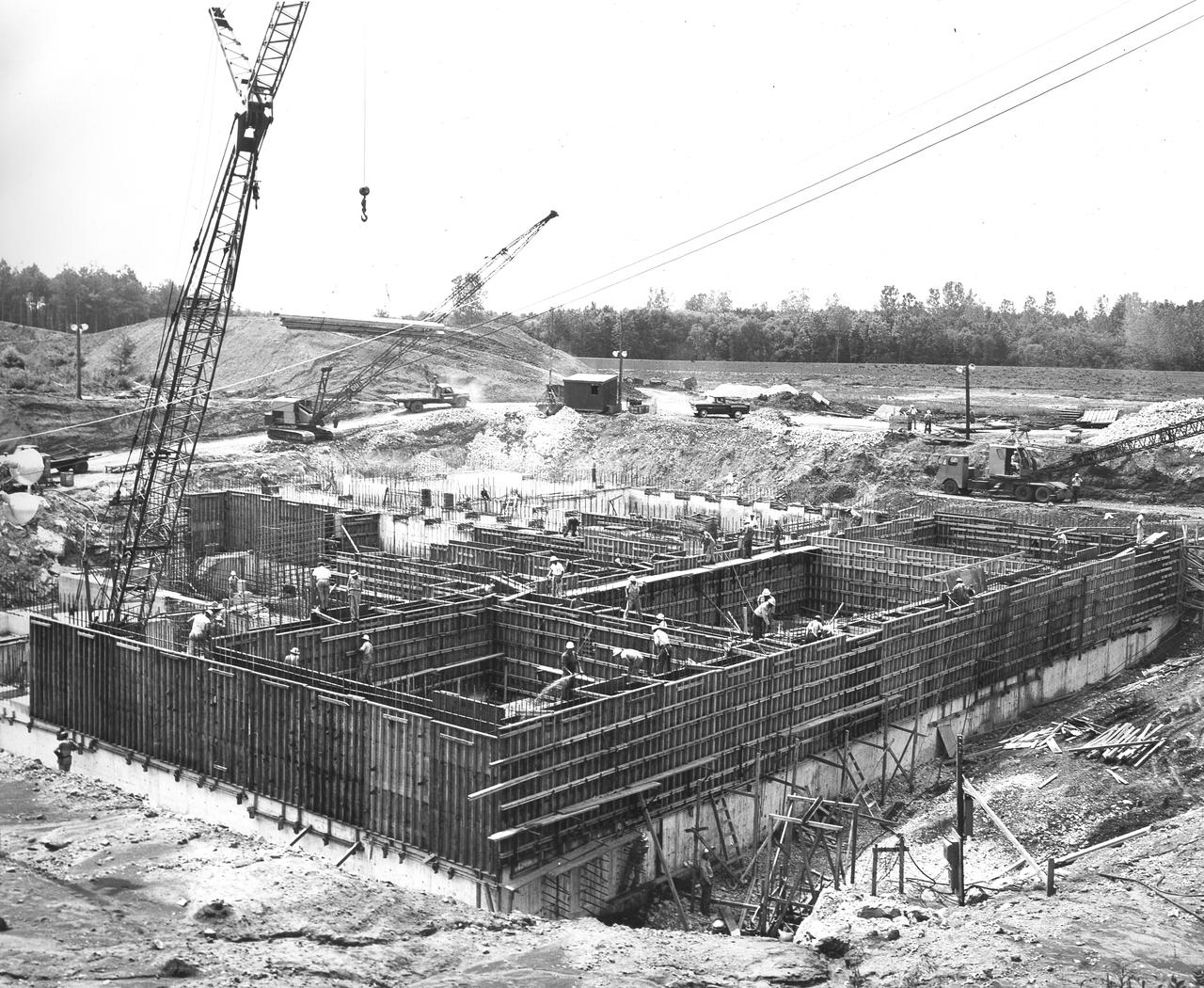
At its founding, the Marshall Space Flight Center (MSFC) inherited the Army’s Jupiter and Redstone test stands, but much larger facilities were needed for the giant stages of the Saturn V. From 1960 to 1964, the existing stands were remodeled and a sizable new test area was developed. The new comprehensive test complex for propulsion and structural dynamics was unique within the nation and the free world, and they remain so today because they were constructed with foresight to meet the future as well as on going needs. Construction of the S-IC Static test stand complex began in 1961 in the west test area of MSFC, and was completed in 1964. The S-IC static test stand was designed to develop and test the 138-ft long and 33-ft diameter Saturn V S-IC first stage, or booster stage, weighing in at 280,000 pounds. Required to hold down the brute force of a 7,500,000-pound thrust produced by 5 F-1 engines, the S-IC static test stand was designed and constructed with the strength of hundreds of tons of steel and 12,000,000 pounds of cement, planted down to bedrock 40 feet below ground level. The foundation walls, constructed with concrete and steel, are 4 feet thick. The base structure consists of four towers with 40-foot-thick walls extending upward 144 feet above ground level. The structure was topped by a crane with a 135-foot boom. With the boom in the upright position, the stand was given an overall height of 405 feet, placing it among the highest structures in Alabama at the time. In addition to the stand itself, related facilities were constructed during this time. Built directly east of the test stand was the Block House, which served as the control center for the test stand. The two were connected by a narrow access tunnel which housed the cables for the controls. This construction photo, taken July 3, 1962, depicts the Block House with a portion of its concrete walls poured and exposed while many are still in the forms stage.
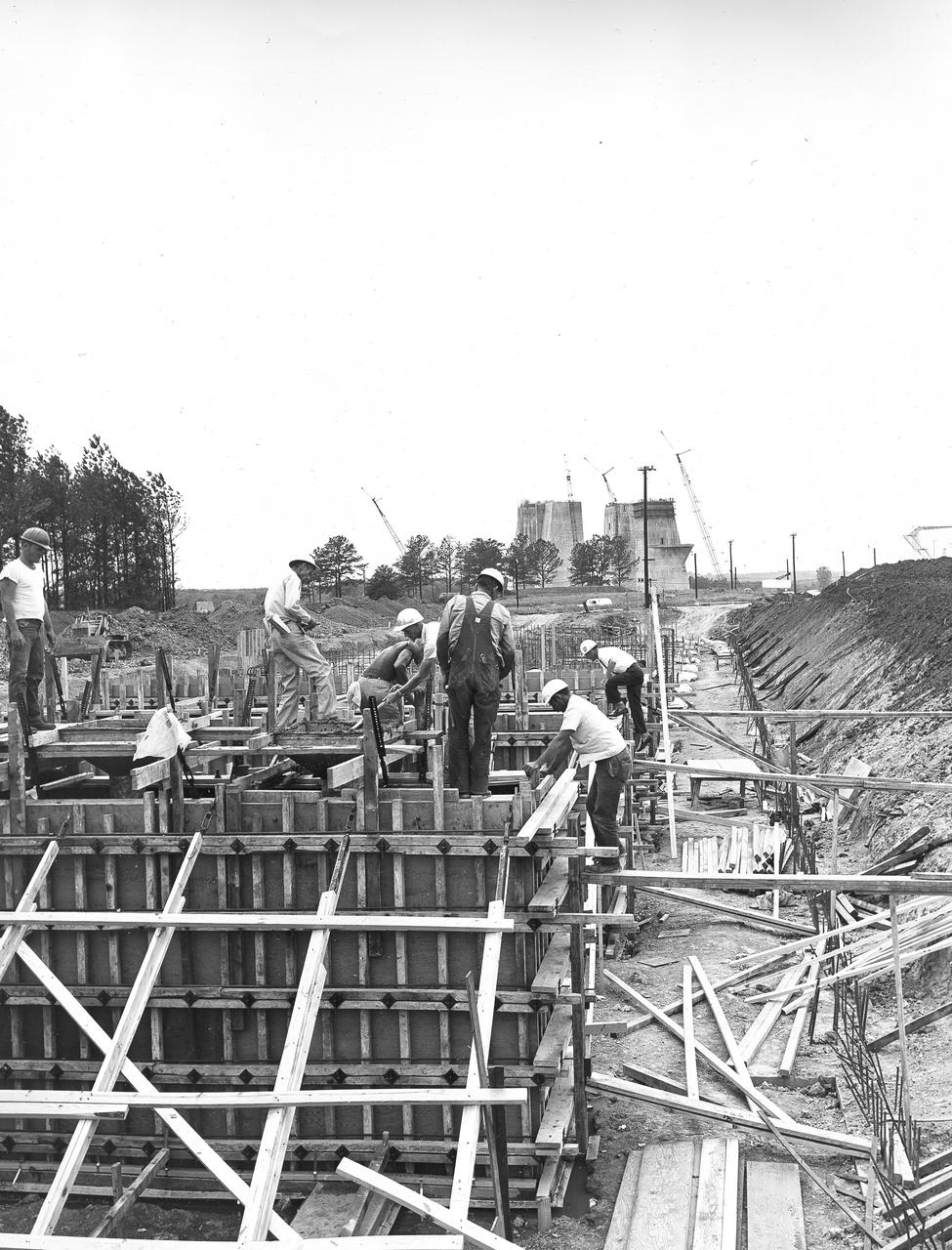
At its founding, the Marshall Space Flight Center (MSFC) inherited the Army’s Jupiter and Redstone test stands, but much larger facilities were needed for the giant stages of the Saturn V. From 1960 to 1964, the existing stands were remodeled and a sizable new test area was developed. The new comprehensive test complex for propulsion and structural dynamics was unique within the nation and the free world, and they remain so today because they were constructed with foresight to meet the future as well as on going needs. Construction of the S-IC Static test stand complex began in 1961 in the west test area of MSFC, and was completed in 1964. The S-IC static test stand was designed to develop and test the 138-ft long and 33-ft diameter Saturn V S-IC first stage, or booster stage, weighing in at 280,000 pounds. Required to hold down the brute force of a 7,500,000-pound thrust produced by 5 F-1 engines, the S-IC static test stand was designed and constructed with the strength of hundreds of tons of steel and 12,000,000 pounds of cement, planted down to bedrock 40 feet below ground level. The foundation walls, constructed with concrete and steel, are 4 feet thick. The base structure consists of four towers with 40-foot-thick walls extending upward 144 feet above ground level. The structure was topped by a crane with a 135-foot boom. With the boom in the upright position, the stand was given an overall height of 405 feet, placing it among the highest structures in Alabama at the time. In addition to the stand itself, related facilities were constructed during this time. Built directly east of the test stand was the Block House, which served as the control center for the test stand. The two were connected by a narrow access tunnel which housed the cables for the controls. Again to the east, just south of the Block House, was a newly constructed Pump House. Its function was to provide water to the stand to prevent melting damage during testing. The water was sprayed through small holes in the stand’s 1900 ton water deflector at the rate of 320,000 gallons per minute. In this photo, taken May 22, 1963, the Pump House is undergoing construction.
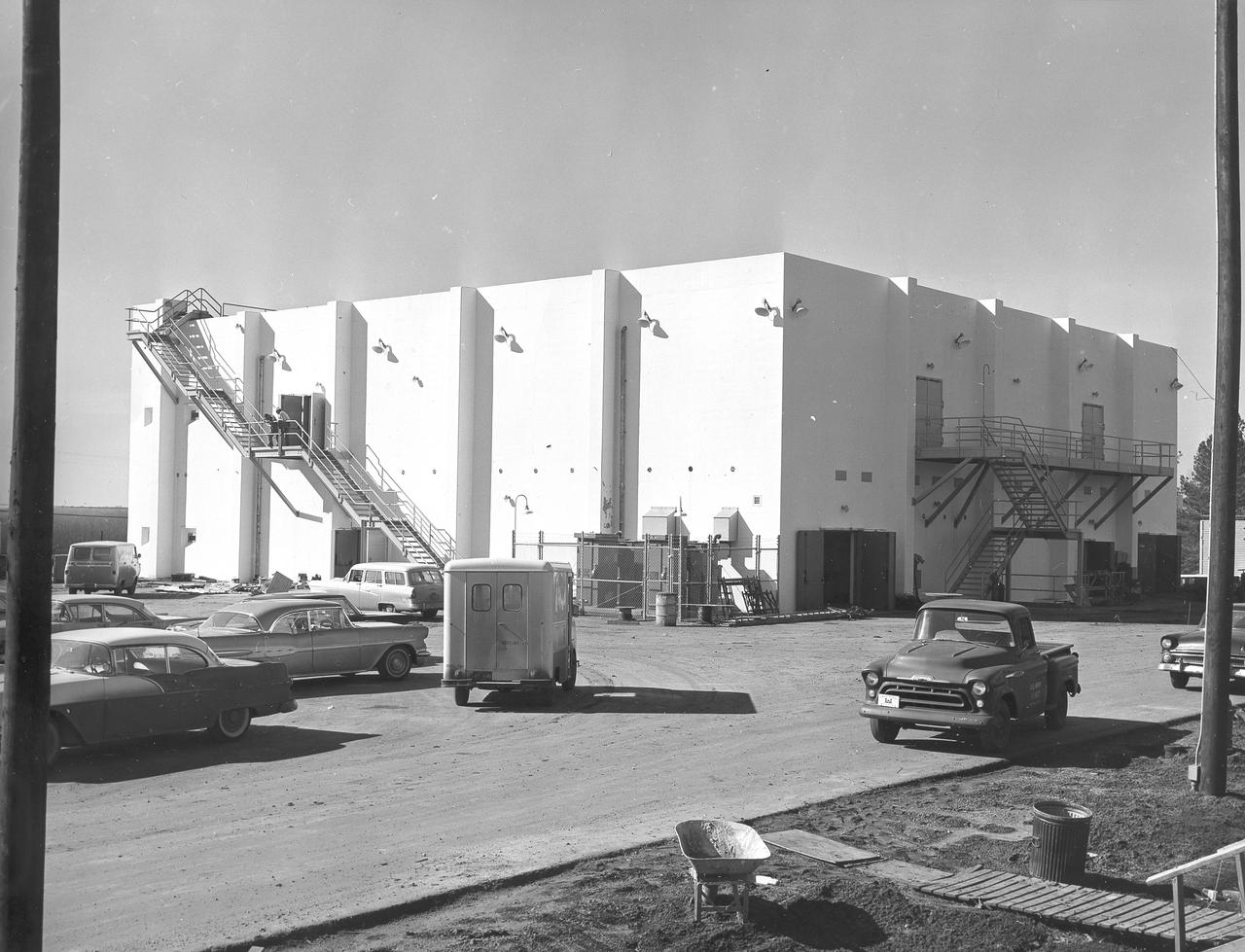
At its founding, the Marshall Space Flight Center (MSFC) inherited the Army’s Jupiter and Redstone test stands, but much larger facilities were needed for the giant stages of the Saturn V. From 1960 to 1964, the existing stands were remodeled and a sizable new test area was developed. The new comprehensive test complex for propulsion and structural dynamics was unique within the nation and the free world, and they remain so today because they were constructed with foresight to meet the future as well as on going needs. Construction of the S-IC Static test stand complex began in 1961 in the west test area of MSFC, and was completed in 1964. The S-IC static test stand was designed to develop and test the 138-ft long and 33-ft diameter Saturn V S-IC first stage, or booster stage, weighing in at 280,000 pounds. Required to hold down the brute force of a 7,500,000-pound thrust produced by 5 F-1 engines, the S-IC static test stand was designed and constructed with the strength of hundreds of tons of steel and 12,000,000 pounds of cement, planted down to bedrock 40 feet below ground level. The foundation walls, constructed with concrete and steel, are 4 feet thick. The base structure consists of four towers with 40-foot-thick walls extending upward 144 feet above ground level. The structure was topped by a crane with a 135-foot boom. With the boom in the upright position, the stand was given an overall height of 405 feet, placing it among the highest structures in Alabama at the time. In addition to the stand itself, related facilities were constructed during this time. Built directly east of the test stand was the Block House, which served as the control center for the test stand. The two were connected by a narrow access tunnel which housed the cables for the controls. In this photo taken February 4, 1963, the Block House exterior is complete.
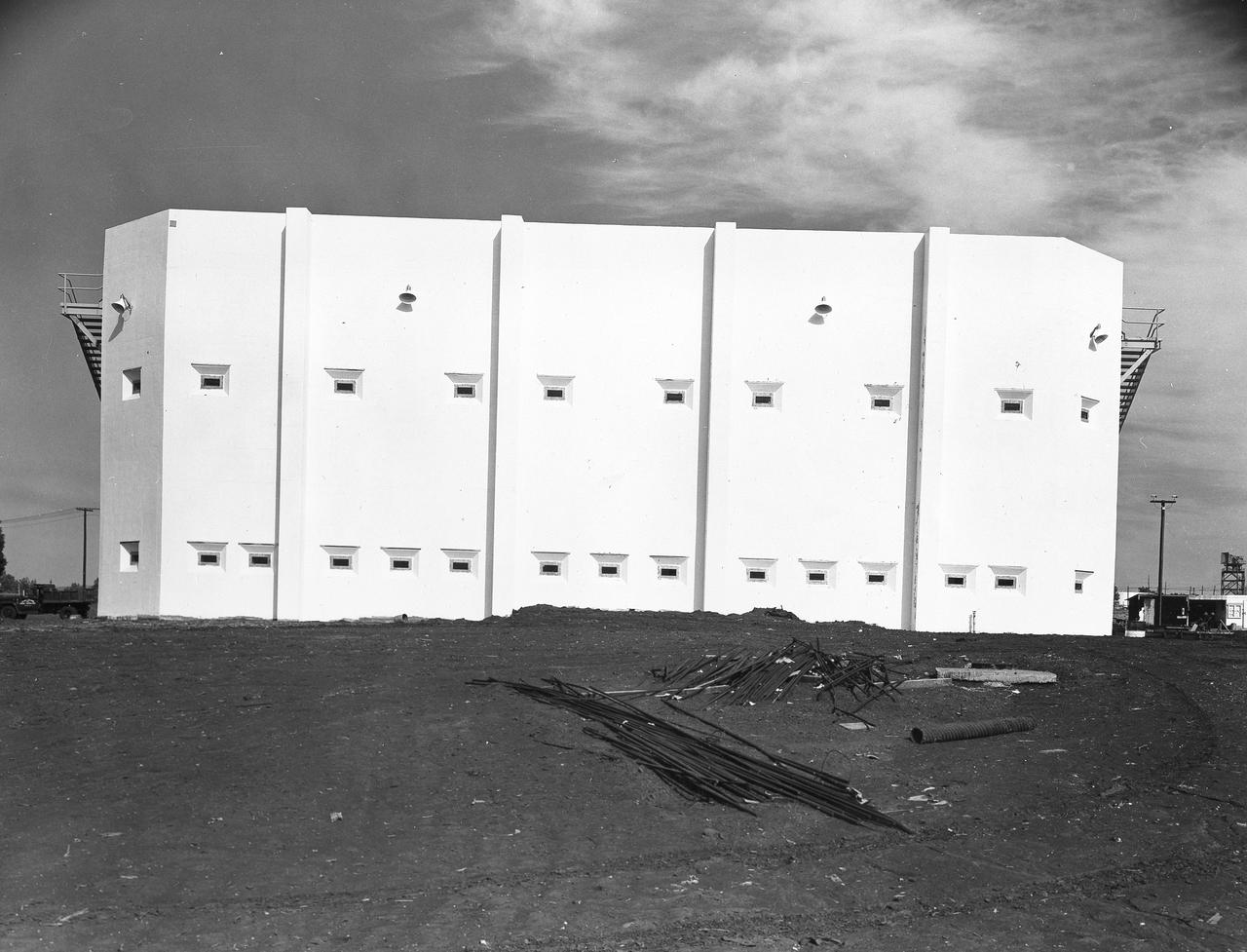
At its founding, the Marshall Space Flight Center (MSFC) inherited the Army’s Jupiter and Redstone test stands, but much larger facilities were needed for the giant stages of the Saturn V. From 1960 to 1964, the existing stands were remodeled and a sizable new test area was developed. The new comprehensive test complex for propulsion and structural dynamics was unique within the nation and the free world, and they remain so today because they were constructed with foresight to meet the future as well as on going needs. Construction of the S-IC Static test stand complex began in 1961 in the west test area of MSFC, and was completed in 1964. The S-IC static test stand was designed to develop and test the 138-ft long and 33-ft diameter Saturn V S-IC first stage, or booster stage, weighing in at 280,000 pounds. Required to hold down the brute force of a 7,500,000-pound thrust produced by 5 F-1 engines, the S-IC static test stand was designed and constructed with the strength of hundreds of tons of steel and 12,000,000 pounds of cement, planted down to bedrock 40 feet below ground level. The foundation walls, constructed with concrete and steel, are 4 feet thick. The base structure consists of four towers with 40-foot-thick walls extending upward 144 feet above ground level. The structure was topped by a crane with a 135-foot boom. With the boom in the upright position, the stand was given an overall height of 405 feet, placing it among the highest structures in Alabama at the time. In addition to the stand itself, related facilities were constructed during this time. Built directly east of the test stand was the Block House, which served as the control center for the test stand. The two were connected by a narrow access tunnel which housed the cables for the controls. This photograph, taken February 25, 1963, gives a close up look at the completed Block House. The side shown faces the S-IC Test Stand.
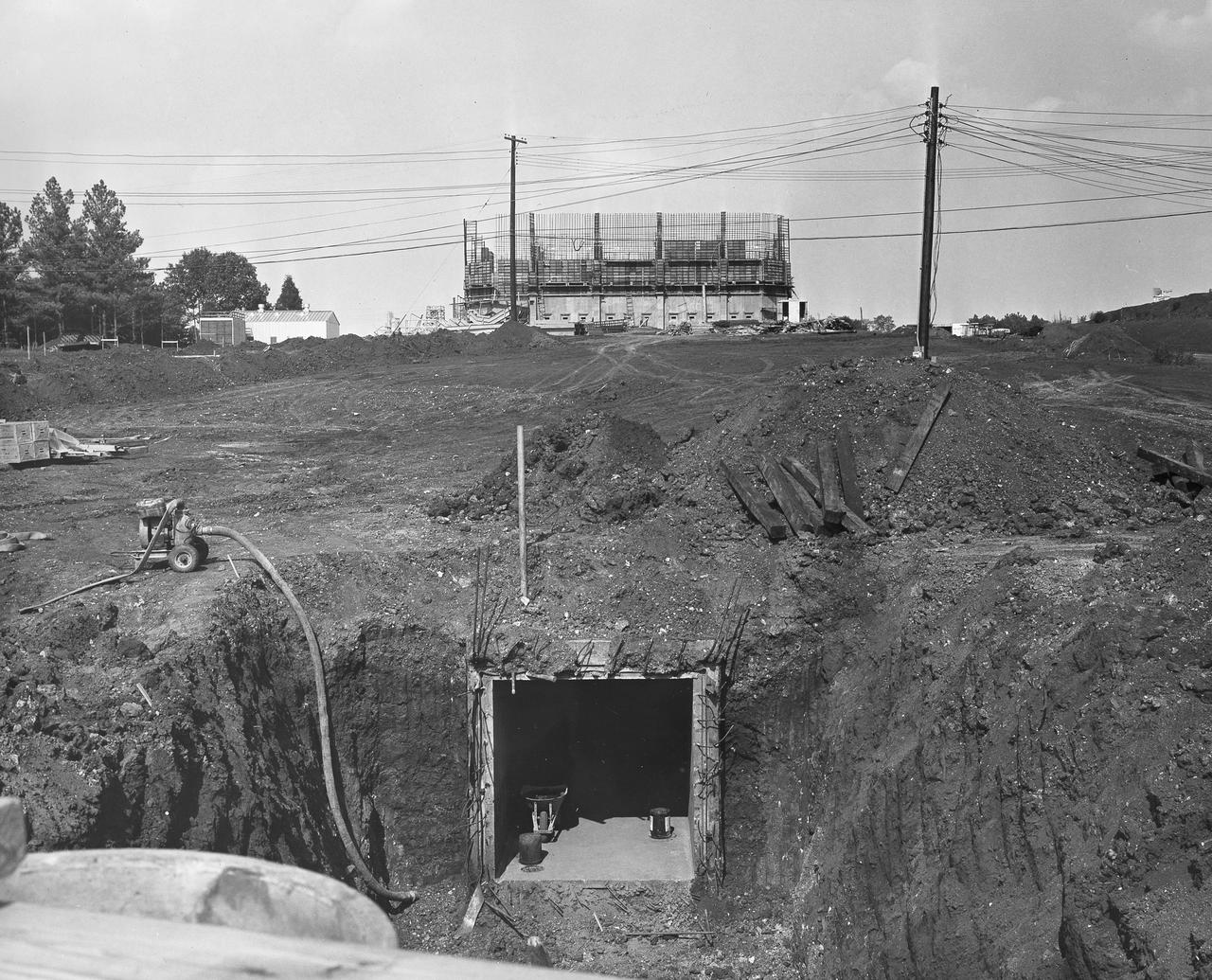
At its founding, the Marshall Space Flight Center (MSFC) inherited the Army’s Jupiter and Redstone test stands, but much larger facilities were needed for the giant stages of the Saturn V. From 1960 to 1964, the existing stands were remodeled and a sizable new test area was developed. The new comprehensive test complex for propulsion and structural dynamics was unique within the nation and the free world, and they remain so today because they were constructed with foresight to meet the future as well as on going needs. Construction of the S-IC Static test stand complex began in 1961 in the west test area of MSFC, and was completed in 1964. The S-IC static test stand was designed to develop and test the 138-ft long and 33-ft diameter Saturn V S-IC first stage, or booster stage, weighing in at 280,000 pounds. Required to hold down the brute force of a 7,500,000-pound thrust produced by 5 F-1 engines, the S-IC static test stand was designed and constructed with the strength of hundreds of tons of steel and 12,000,000 pounds of cement, planted down to bedrock 40 feet below ground level. The foundation walls, constructed with concrete and steel, are 4 feet thick. The base structure consists of four towers with 40-foot-thick walls extending upward 144 feet above ground level. The structure was topped by a crane with a 135-foot boom. With the boom in the upright position, the stand was given an overall height of 405 feet, placing it among the highest structures in Alabama at the time. In addition to the stand itself, related facilities were constructed during this time. Built directly east of the test stand was the Block House, which served as the control center for the test stand. The two were connected by a narrow access tunnel which housed the cables for the controls. This construction photo taken August 17, 1962 depicts a view of the Block House from the test stand site. The tunnel opening is visible in the forefront center of the photo.
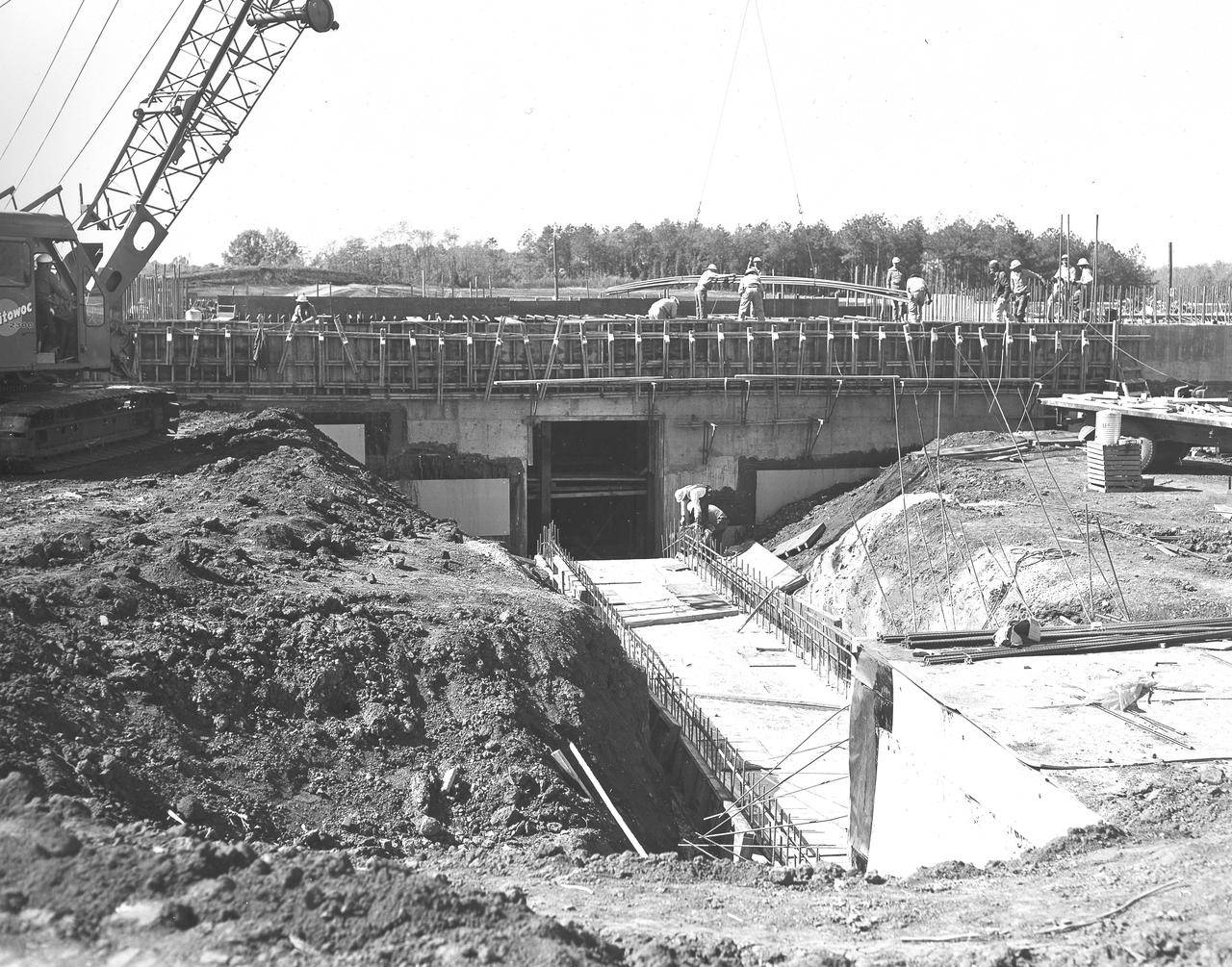
At its founding, the Marshall Space Flight Center (MSFC) inherited the Army’s Jupiter and Redstone test stands, but much larger facilities were needed for the giant stages of the Saturn V. From 1960 to 1964, the existing stands were remodeled and a sizable new test area was developed. The new comprehensive test complex for propulsion and structural dynamics was unique within the nation and the free world, and they remain so today because they were constructed with foresight to meet the future as well as on going needs. Construction of the S-IC Static test stand complex began in 1961 in the west test area of MSFC, and was completed in 1964. The S-IC static test stand was designed to develop and test the 138-ft long and 33-ft diameter Saturn V S-IC first stage, or booster stage, weighing in at 280,000 pounds. Required to hold down the brute force of a 7,500,000-pound thrust produced by 5 F-1 engines, the S-IC static test stand was designed and constructed with the strength of hundreds of tons of steel and 12,000,000 pounds of cement, planted down to bedrock 40 feet below ground level. The foundation walls, constructed with concrete and steel, are 4 feet thick. The base structure consists of four towers with 40-foot-thick walls extending upward 144 feet above ground level. The structure was topped by a crane with a 135-foot boom. With the boom in the upright position, the stand was given an overall height of 405 feet, placing it among the highest structures in Alabama at the time. In addition to the stand itself, related facilities were constructed during this time. Built directly east of the test stand was the Block House, which served as the control center for the test stand. The two were connected by a narrow access tunnel which housed the cables for the controls. This construction photo, taken October 26, 1962, depicts a view of the Block House tunnel opening.
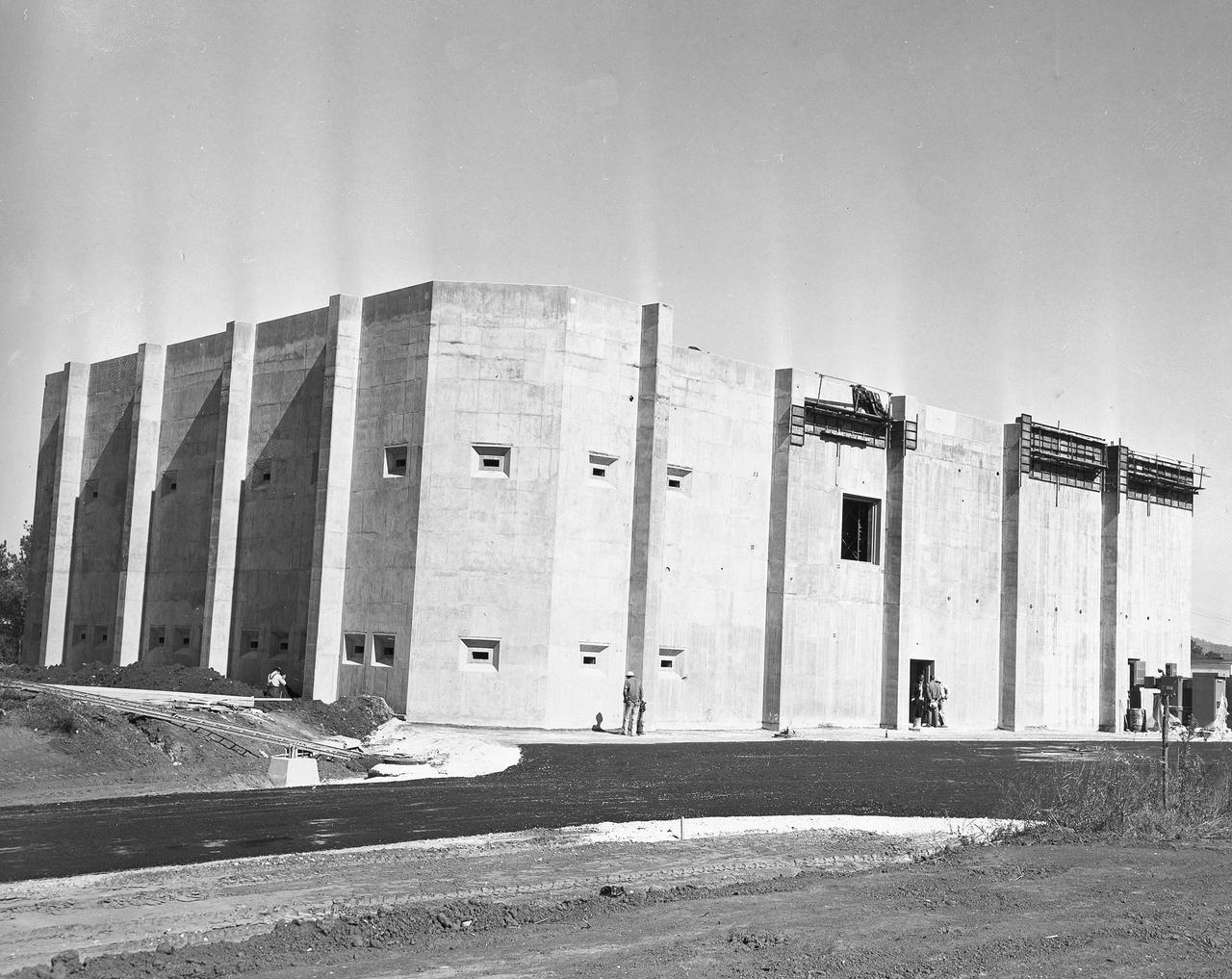
At its founding, the Marshall Space Flight Center (MSFC) inherited the Army’s Jupiter and Redstone test stands, but much larger facilities were needed for the giant stages of the Saturn V. From 1960 to 1964, the existing stands were remodeled and a sizable new test area was developed. The new comprehensive test complex for propulsion and structural dynamics was unique within the nation and the free world, and they remain so today because they were constructed with foresight to meet the future as well as on going needs. Construction of the S-IC Static test stand complex began in 1961 in the west test area of MSFC, and was completed in 1964. The S-IC static test stand was designed to develop and test the 138-ft long and 33-ft diameter Saturn V S-IC first stage, or booster stage, weighing in at 280,000 pounds. Required to hold down the brute force of a 7,500,000-pound thrust produced by 5 F-1 engines, the S-IC static test stand was designed and constructed with the strength of hundreds of tons of steel and 12,000,000 pounds of cement, planted down to bedrock 40 feet below ground level. The foundation walls, constructed with concrete and steel, are 4 feet thick. The base structure consists of four towers with 40-foot-thick walls extending upward 144 feet above ground level. The structure was topped by a crane with a 135-foot boom. With the boom in the upright position, the stand was given an overall height of 405 feet, placing it among the highest structures in Alabama at the time. In addition to the stand itself, related facilities were constructed during this time. Built directly east of the test stand was the Block House, which served as the control center for the test stand. The two were connected by a narrow access tunnel which housed the cables for the controls. This construction photo, taken October 26, 1962, depicts a nearly completed view of the Block House.
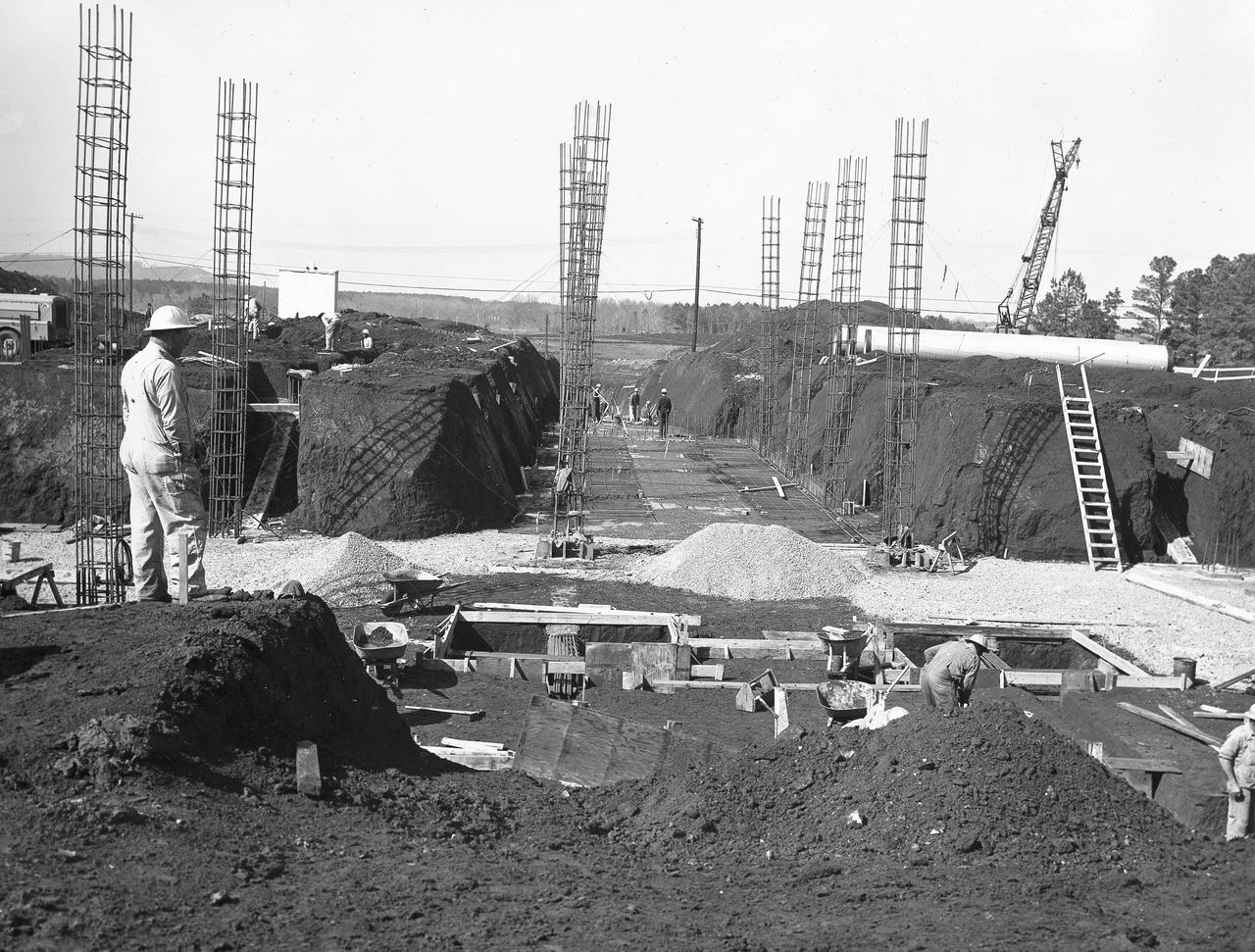
At its founding, the Marshall Space Flight Center (MSFC) inherited the Army’s Jupiter and Redstone test stands, but much larger facilities were needed for the giant stages of the Saturn V. From 1960 to 1964, the existing stands were remodeled and a sizable new test area was developed. The new comprehensive test complex for propulsion and structural dynamics was unique within the nation and the free world, and they remain so today because they were constructed with foresight to meet the future as well as on going needs. Construction of the S-IC Static test stand complex began in 1961 in the west test area of MSFC, and was completed in 1964. The S-IC static test stand was designed to develop and test the 138-ft long and 33-ft diameter Saturn V S-IC first stage, or booster stage, weighing in at 280,000 pounds. Required to hold down the brute force of a 7,500,000-pound thrust produced by 5 F-1 engines, the S-IC static test stand was designed and constructed with the strength of hundreds of tons of steel and 12,000,000 pounds of cement, planted down to bedrock 40 feet below ground level. The foundation walls, constructed with concrete and steel, are 4 feet thick. The base structure consists of four towers with 40-foot-thick walls extending upward 144 feet above ground level. The structure was topped by a crane with a 135-foot boom. With the boom in the upright position, the stand was given an overall height of 405 feet, placing it among the highest structures in Alabama at the time. In addition to the stand itself, related facilities were constructed during this time. Built directly east of the test stand was the Block House, which served as the control center for the test stand. The two were connected by a narrow tunnel which housed the cables for the controls. Again to the east, just south of the Block House, was a newly constructed Pump House. Its function was to provide water to the stand to prevent melting damage during testing. The water was sprayed through small holes in the stand’s 1900 ton water deflector at the rate of 320,000 gallons per minute. In this photo, taken March 20, 1962, construction of the Pump House area is well underway.
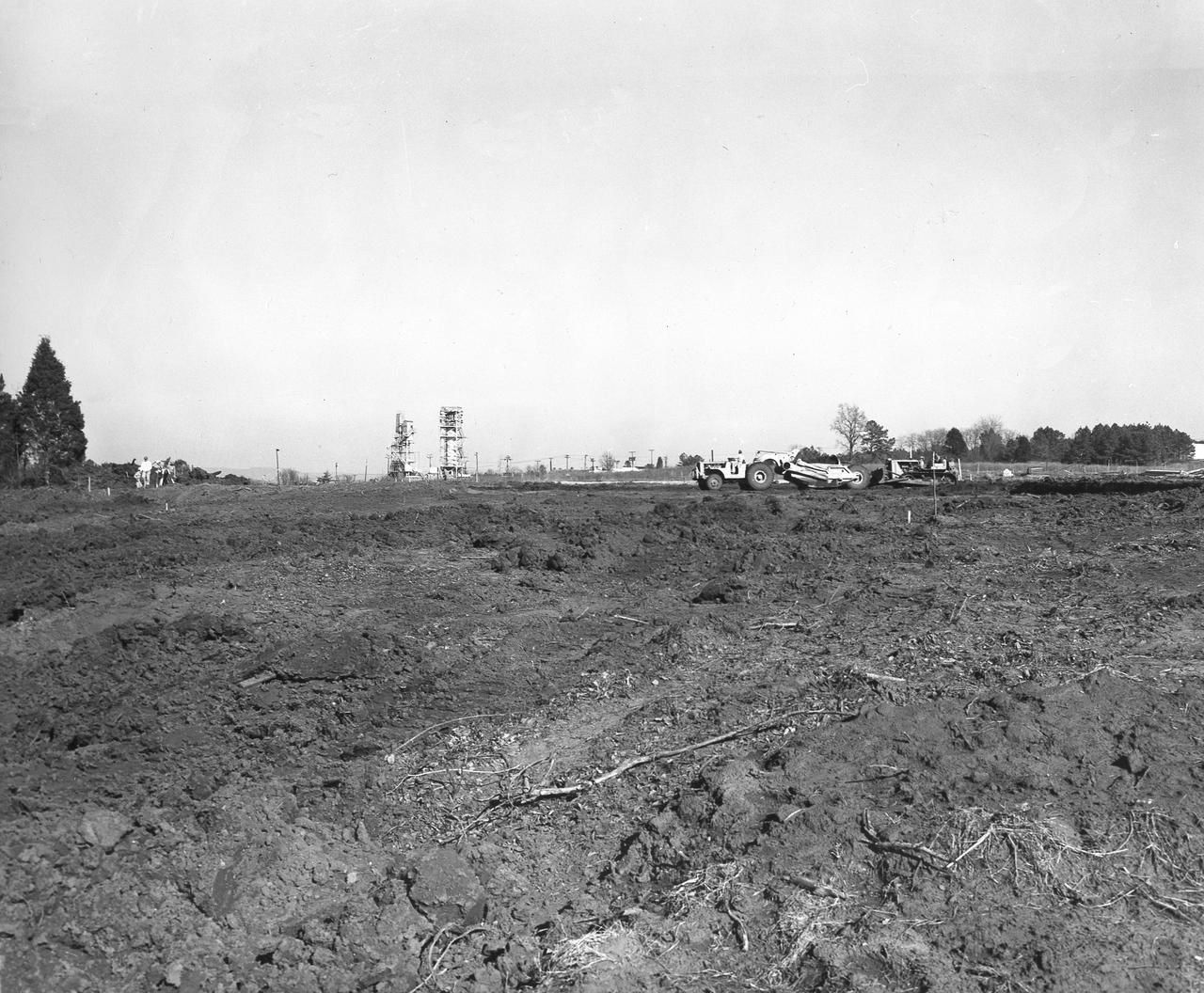
At its founding, the Marshall Space Flight Center (MSFC) inherited the Army’s Jupiter and Redstone test stands, but much larger facilities were needed for the giant stages of the Saturn V. From 1960 to 1964, the existing stands were remodeled and a sizable new test area was developed. The new comprehensive test complex for propulsion and structural dynamics was unique within the nation and the free world, and they remain so today because they were constructed with foresight to meet the future as well as on going needs. Construction of the S-IC Static test stand complex began in 1961 in the west test area of MSFC, and was completed in 1964. The S-IC static test stand was designed to develop and test the 138-ft long and 33-ft diameter Saturn V S-IC first stage, or booster stage, weighing in at 280,000 pounds. Required to hold down the brute force of a 7,500,000-pound thrust produced by 5 F-1 engines, the S-IC static test stand was designed and constructed with the strength of hundreds of tons of steel and 12,000,000 pounds of cement, planted down to bedrock 40 feet below ground level. The foundation walls, constructed with concrete and steel, are 4 feet thick. The base structure consists of four towers with 40-foot-thick walls extending upward 144 feet above ground level. The structure was topped by a crane with a 135-foot boom. With the boom in the upright position, the stand was given an overall height of 405 feet, placing it among the highest structures in Alabama at the time. In addition to the stand itself, related facilities were constructed during this time. Built directly east of the test stand was the Block House, which served as the control center for the test stand. The two were connected by a narrow access tunnel which housed the cables for the controls. This photo, taken February 2, 1962, shows the excavation of the Block House site.
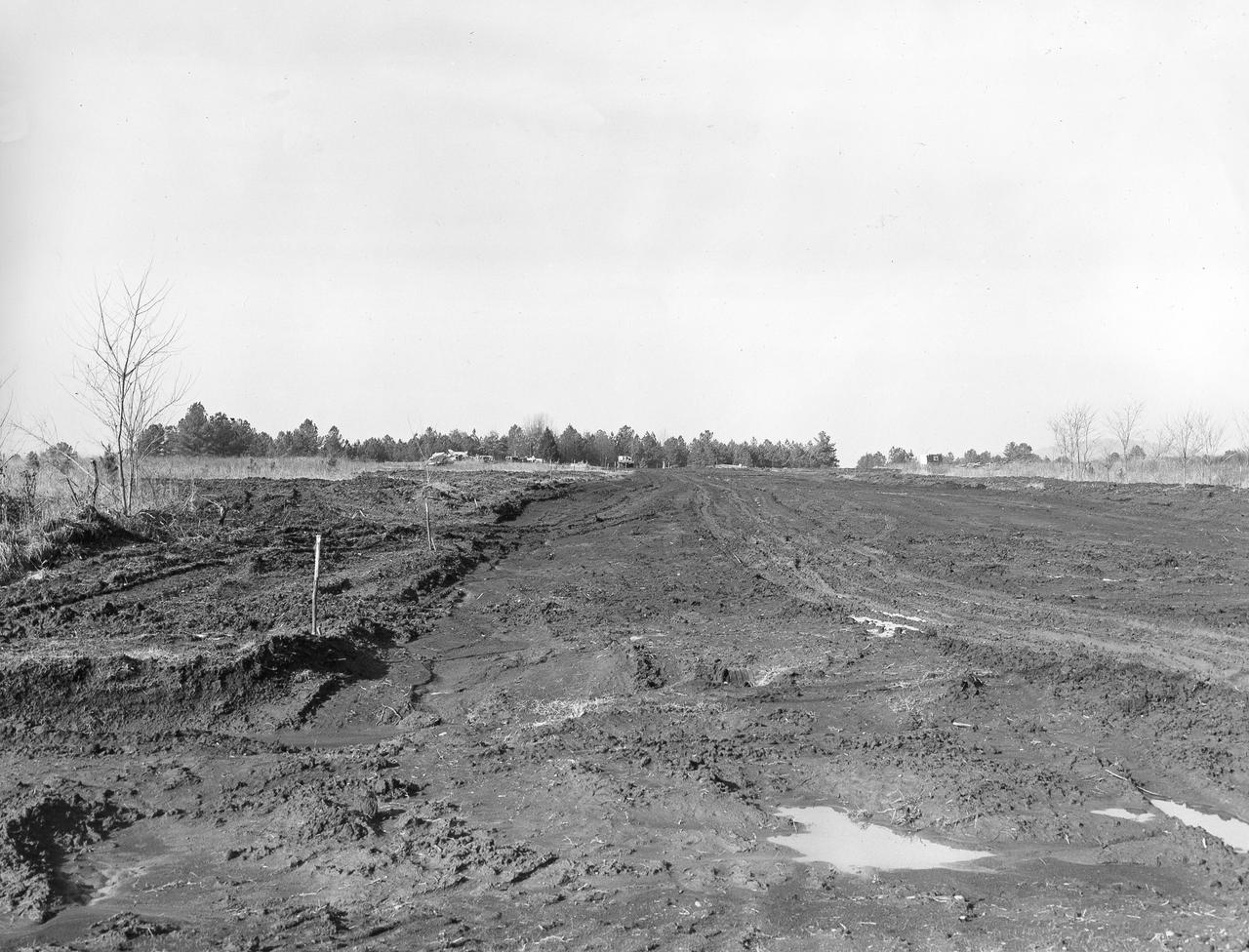
At its founding, the Marshall Space Flight Center (MSFC) inherited the Army’s Jupiter and Redstone test stands, but much larger facilities were needed for the giant stages of the Saturn V. From 1960 to 1964, the existing stands were remodeled and a sizable new test area was developed. The new comprehensive test complex for propulsion and structural dynamics was unique within the nation and the free world, and they remain so today because they were constructed with foresight to meet the future as well as on going needs. Construction of the S-IC Static test stand complex began in 1961 in the west test area of MSFC, and was completed in 1964. The S-IC static test stand was designed to develop and test the 138-ft long and 33-ft diameter Saturn V S-IC first stage, or booster stage, weighing in at 280,000 pounds. Required to hold down the brute force of a 7,500,000-pound thrust produced by 5 F-1 engines, the S-IC static test stand was designed and constructed with the strength of hundreds of tons of steel and 12,000,000 pounds of cement, planted down to bedrock 40 feet below ground level. The foundation walls, constructed with concrete and steel, are 4 feet thick. The base structure consists of four towers with 40-foot-thick walls extending upward 144 feet above ground level. The structure was topped by a crane with a 135-foot boom. With the boom in the upright position, the stand was given an overall height of 405 feet, placing it among the highest structures in Alabama at the time. In addition to the stand itself, related facilities were constructed during this time. Built directly east of the test stand was the Block House, which served as the control center for the test stand. The two were connected by a narrow access tunnel which housed the cables for the controls. This photo, taken January 23, 1962, shows the excavation of the Block House site.
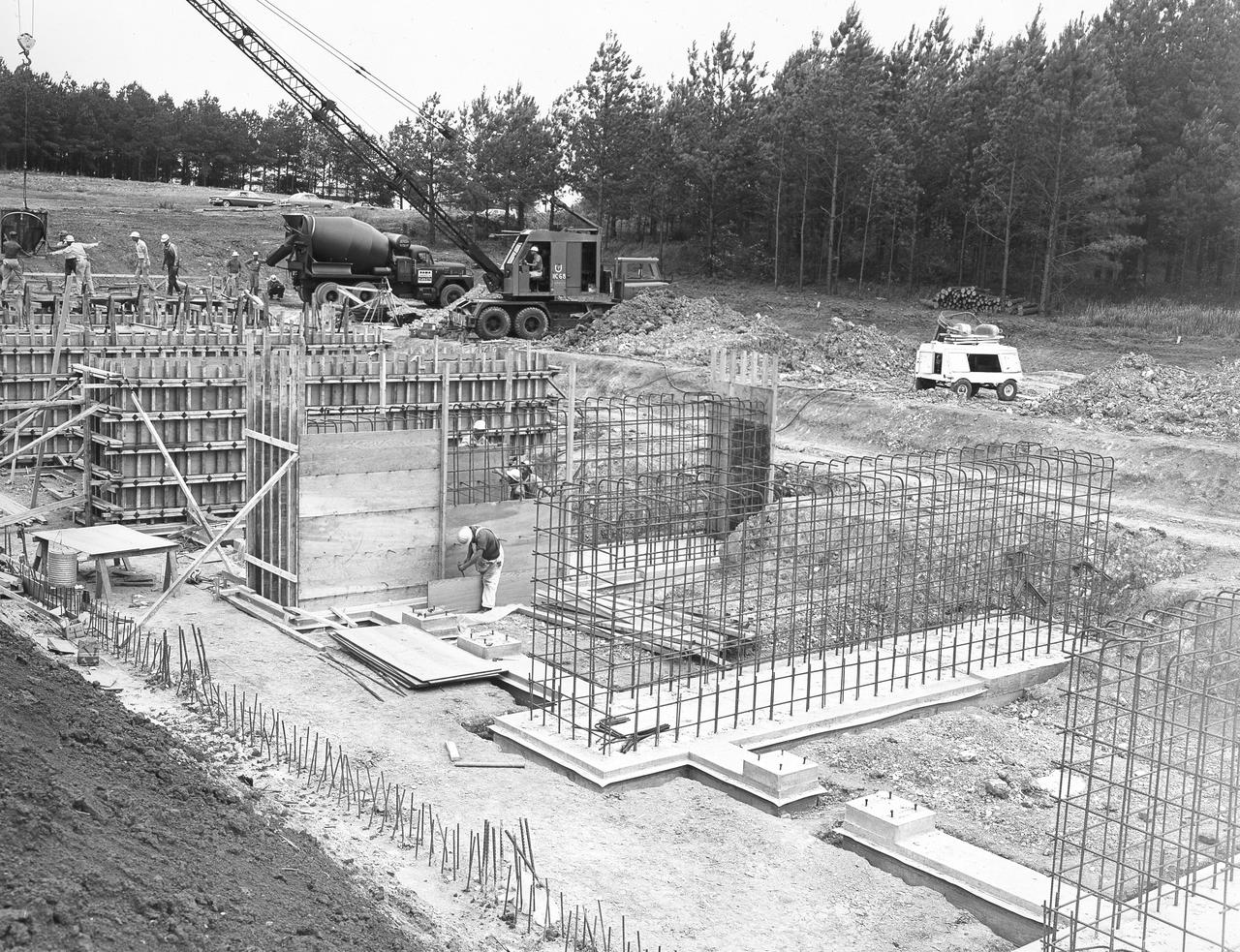
At its founding, the Marshall Space Flight Center (MSFC) inherited the Army’s Jupiter and Redstone test stands, but much larger facilities were needed for the giant stages of the Saturn V. From 1960 to 1964, the existing stands were remodeled and a sizable new test area was developed. The new comprehensive test complex for propulsion and structural dynamics was unique within the nation and the free world, and they remain so today because they were constructed with foresight to meet the future as well as on going needs. Construction of the S-IC Static test stand complex began in 1961 in the west test area of MSFC, and was completed in 1964. The S-IC static test stand was designed to develop and test the 138-ft long and 33-ft diameter Saturn V S-IC first stage, or booster stage, weighing in at 280,000 pounds. Required to hold down the brute force of a 7,500,000-pound thrust produced by 5 F-1 engines, the S-IC static test stand was designed and constructed with the strength of hundreds of tons of steel and 12,000,000 pounds of cement, planted down to bedrock 40 feet below ground level. The foundation walls, constructed with concrete and steel, are 4 feet thick. The base structure consists of four towers with 40-foot-thick walls extending upward 144 feet above ground level. The structure was topped by a crane with a 135-foot boom. With the boom in the upright position, the stand was given an overall height of 405 feet, placing it among the highest structures in Alabama at the time. In addition to the stand itself, related facilities were constructed during this time. Built directly east of the test stand was the Block House, which served as the control center for the test stand. The two were connected by a narrow access tunnel which housed the cables for the controls. Again to the east, just south of the Block House, was a newly constructed Pump House. Its function was to provide water to the stand to prevent melting damage during testing. The water was sprayed through small holes in the stand’s 1900 ton water deflector at the rate of 320,000 gallons per minute. In this photo, taken May 22, 1963, the Pump House is undergoing construction.
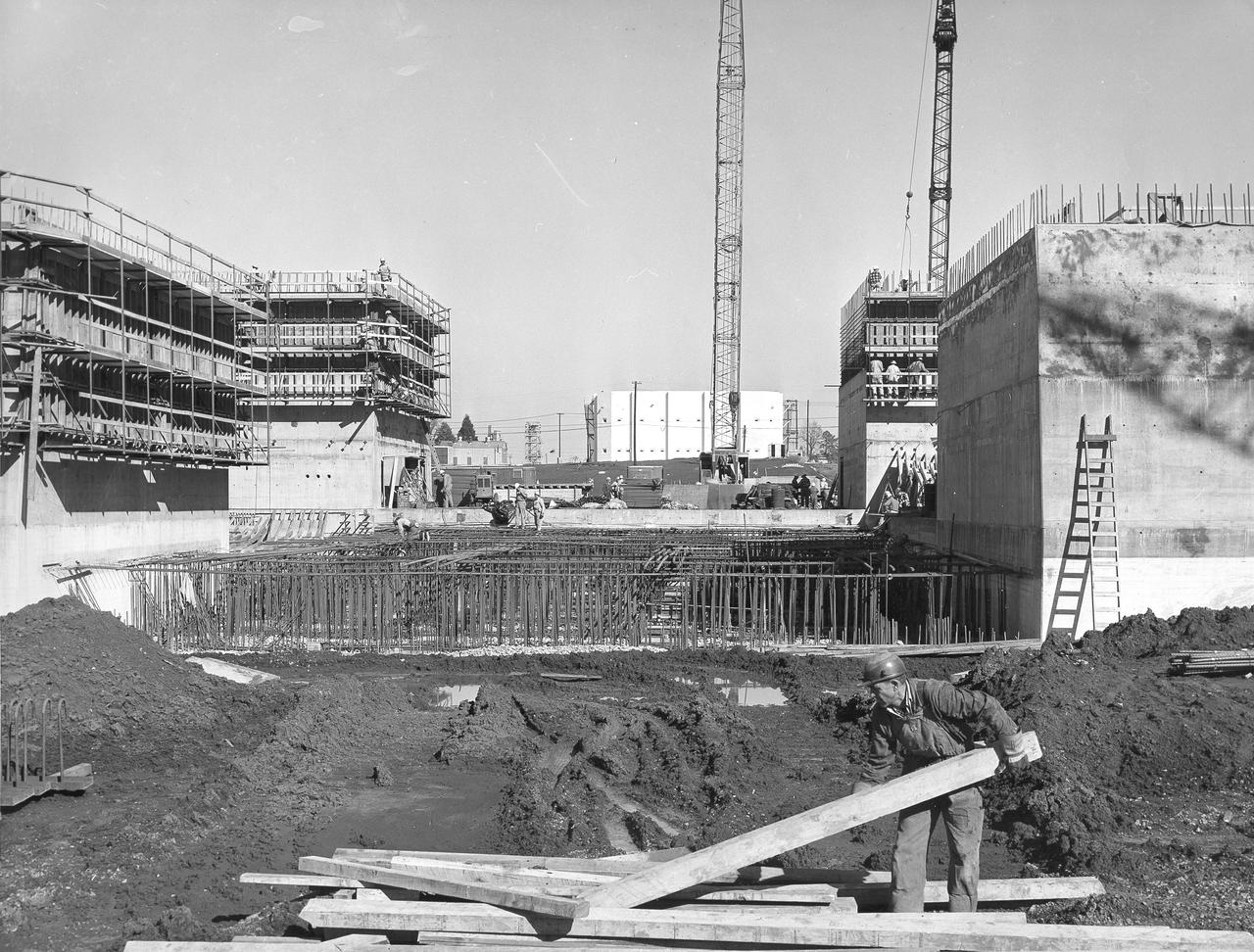
At its founding, the Marshall Space Flight Center (MSFC) inherited the Army’s Jupiter and Redstone test stands, but much larger facilities were needed for the giant stages of the Saturn V. From 1960 to 1964, the existing stands were remodeled and a sizable new test area was developed. The new comprehensive test complex for propulsion and structural dynamics was unique within the nation and the free world, and they remain so today because they were constructed with foresight to meet the future as well as on going needs. Construction of the S-IC Static test stand complex began in 1961 in the west test area of MSFC, and was completed in 1964. The S-IC static test stand was designed to develop and test the 138-ft long and 33-ft diameter Saturn V S-IC first stage, or booster stage, weighing in at 280,000 pounds. Required to hold down the brute force of a 7,500,000-pound thrust produced by 5 F-1 engines, the S-IC static test stand was designed and constructed with the strength of hundreds of tons of steel and 12,000,000 pounds of cement, planted down to bedrock 40 feet below ground level. The foundation walls, constructed with concrete and steel, are 4 feet thick. The base structure consists of four towers with 40-foot-thick walls extending upward 144 feet above ground level. The structure was topped by a crane with a 135-foot boom. With the boom in the upright position, the stand was given an overall height of 405 feet, placing it among the highest structures in Alabama at the time. In addition to the stand itself, related facilities were constructed during this time. Built directly east of the test stand was the Block House, which served as the control center for the test stand. The two were connected by a narrow access tunnel which housed the cables for the controls. This photograph taken February 4, 1963, gives an impressive look at the Block House looking directly through the ever-growing four towers of the S-IC Test Stand.
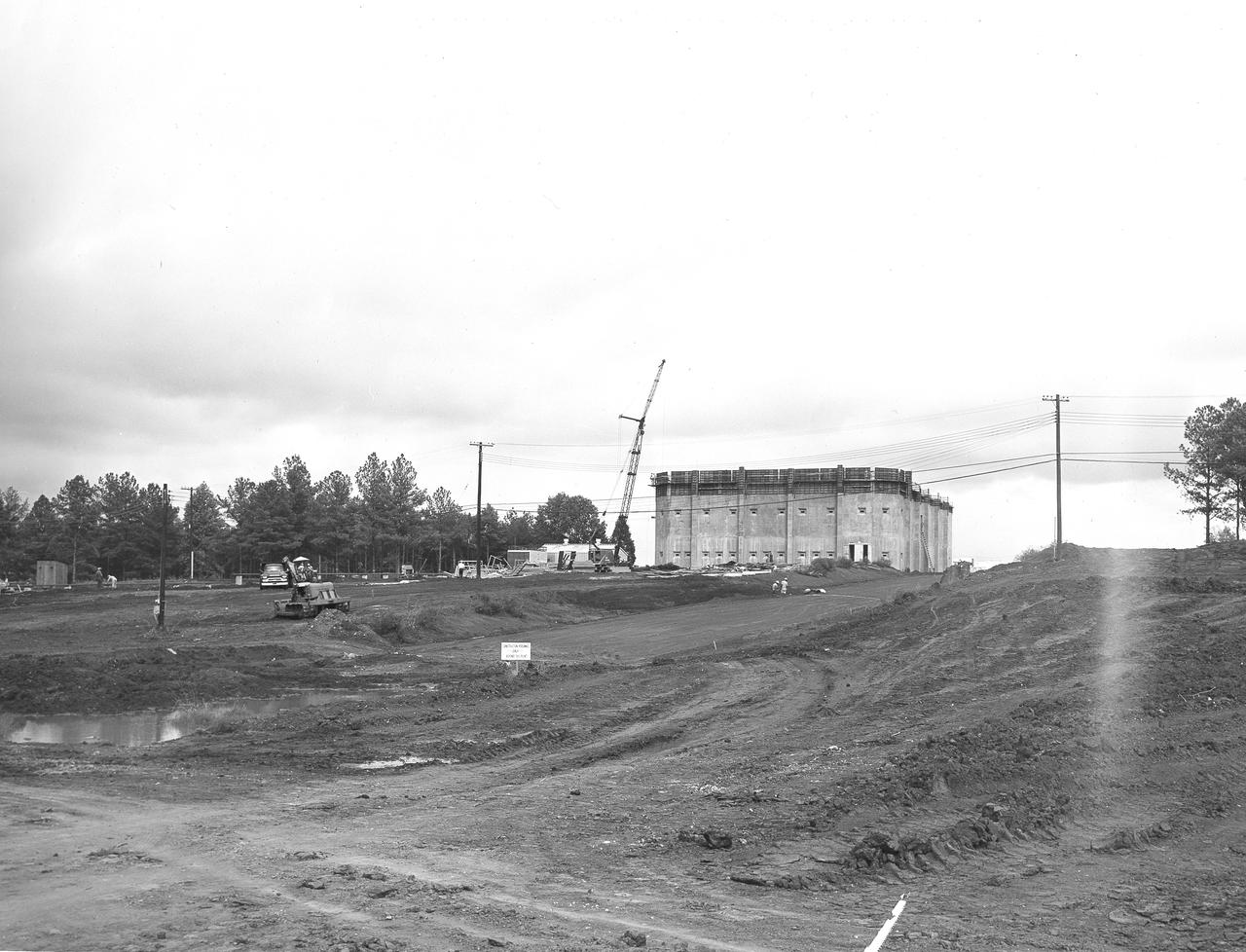
At its founding, the Marshall Space Flight Center (MSFC) inherited the Army’s Jupiter and Redstone test stands, but much larger facilities were needed for the giant stages of the Saturn V. From 1960 to 1964, the existing stands were remodeled and a sizable new test area was developed. The new comprehensive test complex for propulsion and structural dynamics was unique within the nation and the free world, and they remain so today because they were constructed with foresight to meet the future as well as on going needs. Construction of the S-IC Static test stand complex began in 1961 in the west test area of MSFC, and was completed in 1964. The S-IC static test stand was designed to develop and test the 138-ft long and 33-ft diameter Saturn V S-IC first stage, or booster stage, weighing in at 280,000 pounds. Required to hold down the brute force of a 7,500,000-pound thrust produced by 5 F-1 engines, the S-IC static test stand was designed and constructed with the strength of hundreds of tons of steel and 12,000,000 pounds of cement, planted down to bedrock 40 feet below ground level. The foundation walls, constructed with concrete and steel, are 4 feet thick. The base structure consists of four towers with 40-foot-thick walls extending upward 144 feet above ground level. The structure was topped by a crane with a 135-foot boom. With the boom in the upright position, the stand was given an overall height of 405 feet, placing it among the highest structures in Alabama at the time. Built directly east of the test stand was the Block House, which served as the control center for the test stand. The two were connected by a narrow access tunnel which housed the cables for the controls. This construction photo, taken October 8, 1962, depicts a front view of the Block House nearing completion.
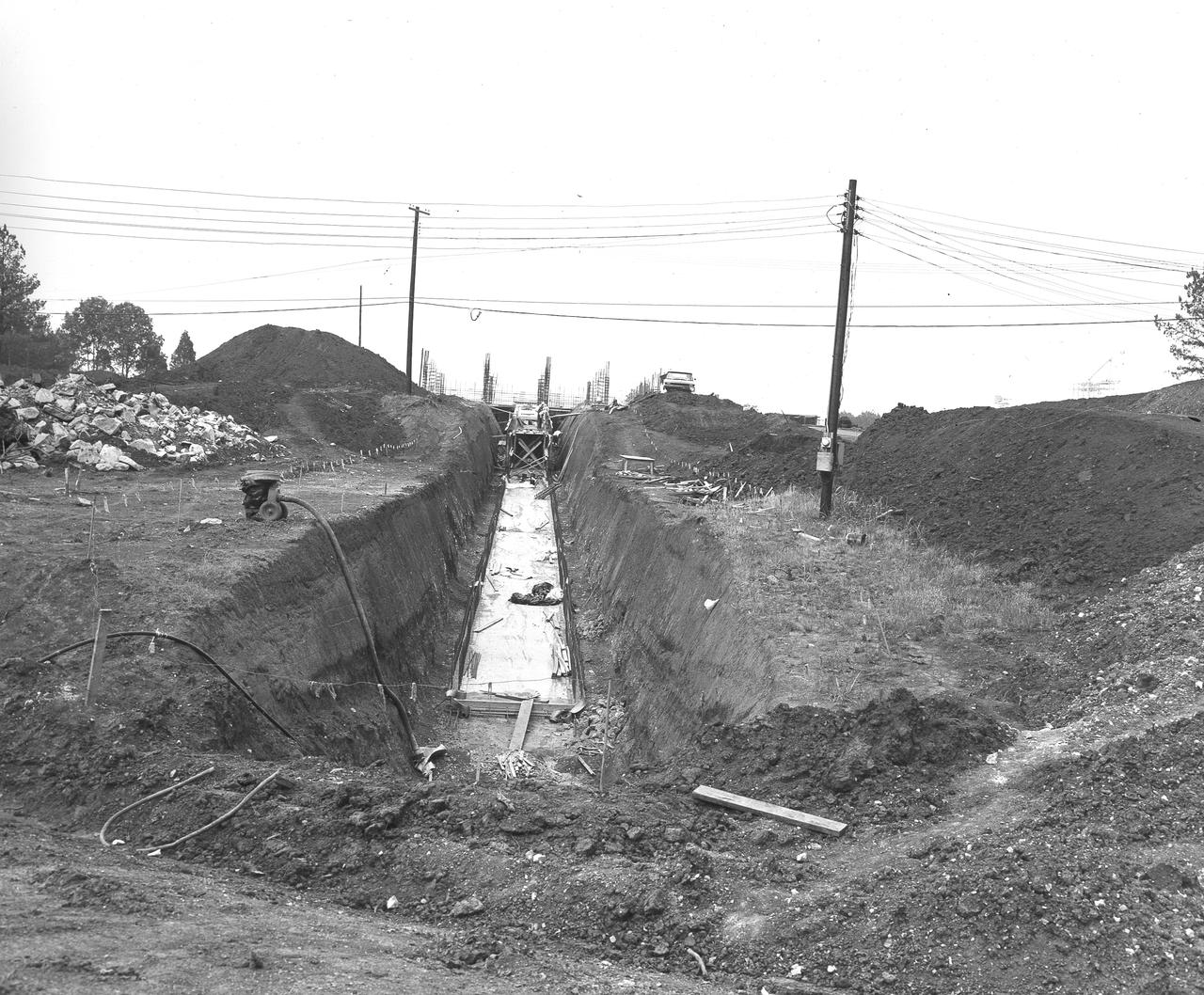
At its founding, the Marshall Space Flight Center (MSFC) inherited the Army’s Jupiter and Redstone test stands, but much larger facilities were needed for the giant stages of the Saturn V. From 1960 to 1964, the existing stands were remodeled and a sizable new test area was developed. The new comprehensive test complex for propulsion and structural dynamics was unique within the nation and the free world, and they remain so today because they were constructed with foresight to meet the future as well as on going needs. Construction of the S-IC Static test stand complex began in 1961 in the west test area of MSFC, and was completed in 1964. The S-IC static test stand was designed to develop and test the 138-ft long and 33-ft diameter Saturn V S-IC first stage, or booster stage, weighing in at 280,000 pounds. Required to hold down the brute force of a 7,500,000-pound thrust produced by 5 F-1 engines, the S-IC static test stand was designed and constructed with the strength of hundreds of tons of steel and 12,000,000 pounds of cement, planted down to bedrock 40 feet below ground level. The foundation walls, constructed with concrete and steel, are 4 feet thick. The base structure consists of four towers with 40-foot-thick walls extending upward 144 feet above ground level. The structure was topped by a crane with a 135-foot boom. With the boom in the upright position, the stand was given an overall height of 405 feet, placing it among the highest structures in Alabama at the time. In addition to the stand itself, related facilities were constructed during this time. Built directly east of the test stand was the Block House, which served as the control center for the test stand. The two were connected by a narrow tunnel which housed the cables for the controls. This photograph, taken on May 21, 1962 depicts the access tunnel construction.
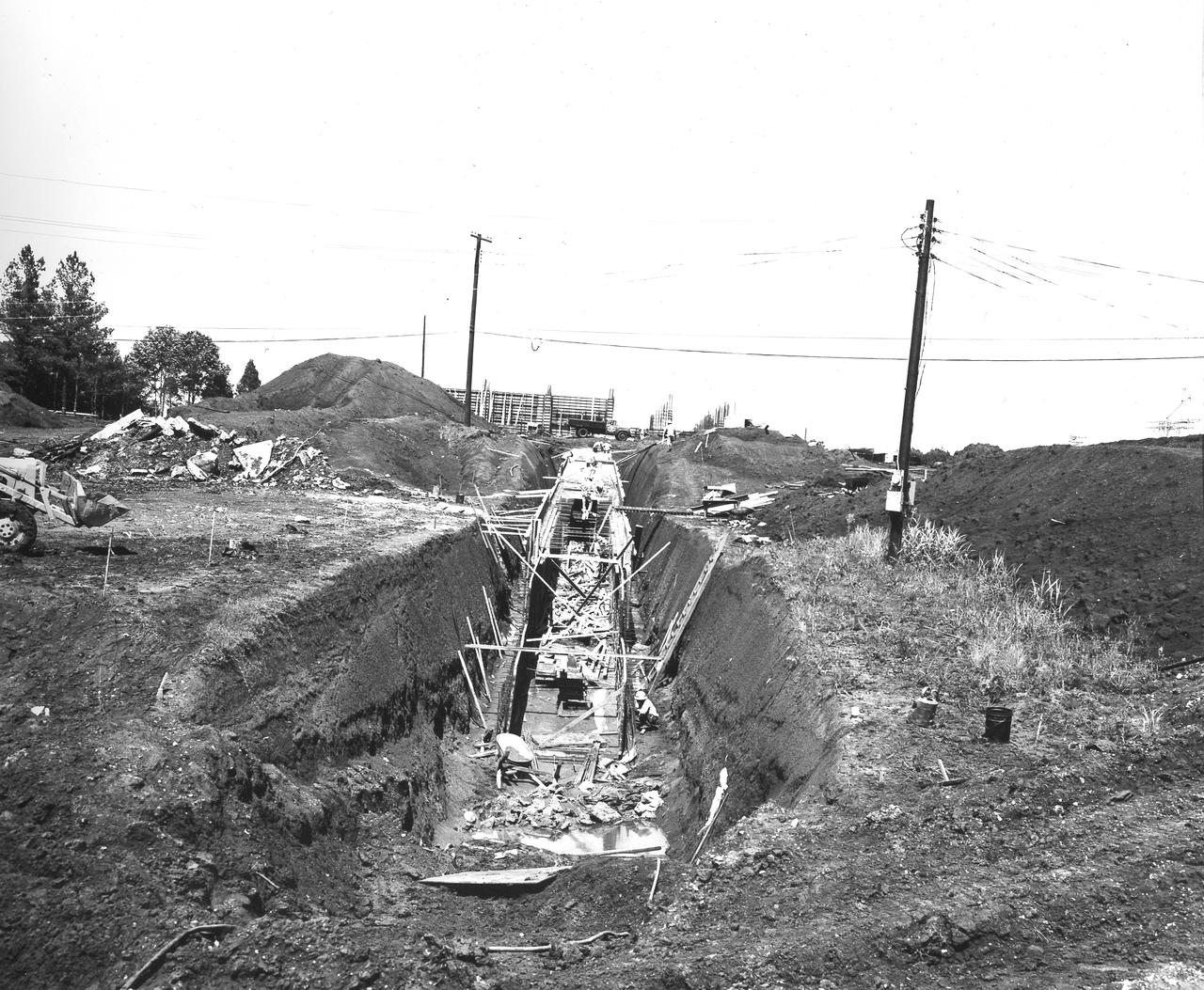
At its founding, the Marshall Space Flight Center (MSFC) inherited the Army’s Jupiter and Redstone test stands, but much larger facilities were needed for the giant stages of the Saturn V. From 1960 to 1964, the existing stands were remodeled and a sizable new test area was developed. The new comprehensive test complex for propulsion and structural dynamics was unique within the nation and the free world, and they remain so today because they were constructed with foresight to meet the future as well as on going needs. Construction of the S-IC Static test stand complex began in 1961 in the west test area of MSFC, and was completed in 1964. The S-IC static test stand was designed to develop and test the 138-ft long and 33-ft diameter Saturn V S-IC first stage, or booster stage, weighing in at 280,000 pounds. Required to hold down the brute force of a 7,500,000-pound thrust produced by 5 F-1 engines, the S-IC static test stand was designed and constructed with the strength of hundreds of tons of steel and 12,000,000 pounds of cement, planted down to bedrock 40 feet below ground level. The foundation walls, constructed with concrete and steel, are 4 feet thick. The base structure consists of four towers with 40-foot-thick walls extending upward 144 feet above ground level. The structure was topped by a crane with a 135-foot boom. With the boom in the upright position, the stand was given an overall height of 405 feet, placing it among the highest structures in Alabama at the time. In addition to the stand itself, related facilities were constructed during this time. Built directly east of the test stand was the Block House, which served as the control center for the test stand. The two were connected by a narrow access tunnel which housed the cables for the controls. Construction of the tunnel is depicted in this photo taken June 13, 1962.
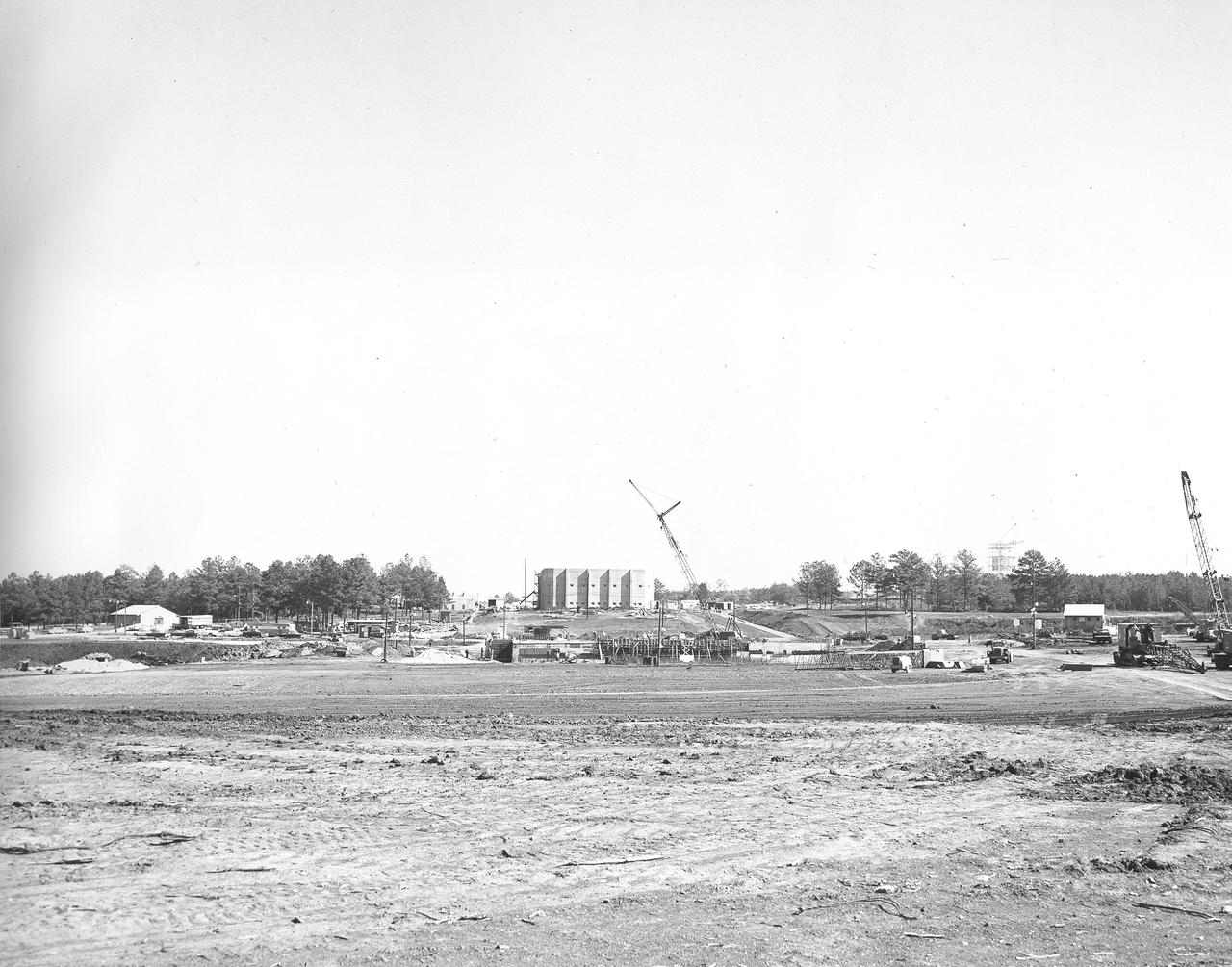
At its founding, the Marshall Space Flight Center (MSFC) inherited the Army’s Jupiter and Redstone test stands, but much larger facilities were needed for the giant stages of the Saturn V. From 1960 to 1964, the existing stands were remodeled and a sizable new test area was developed. The new comprehensive test complex for propulsion and structural dynamics was unique within the nation and the free world, and they remain so today because they were constructed with foresight to meet the future as well as on going needs. Construction of the S-IC Static test stand complex began in 1961 in the west test area of MSFC, and was completed in 1964. The S-IC static test stand was designed to develop and test the 138-ft long and 33-ft diameter Saturn V S-IC first stage, or booster stage, weighing in at 280,000 pounds. Required to hold down the brute force of a 7,500,000-pound thrust produced by 5 F-1 engines, the S-IC static test stand was designed and constructed with the strength of hundreds of tons of steel and 12,000,000 pounds of cement, planted down to bedrock 40 feet below ground level. The foundation walls, constructed with concrete and steel, are 4 feet thick. The base structure consists of four towers with 40-foot-thick walls extending upward 144 feet above ground level. The structure was topped by a crane with a 135-foot boom. With the boom in the upright position, the stand was given an overall height of 405 feet, placing it among the highest structures in Alabama at the time. In addition to the stand itself, related facilities were constructed during this time. Built directly east of the test stand was the Block House, which served as the control center for the test stand. The two were connected by a narrow access tunnel which housed the cables for the controls. This distant construction photo, taken October 26, 1962, depicts a view of the Block House and test stand site.
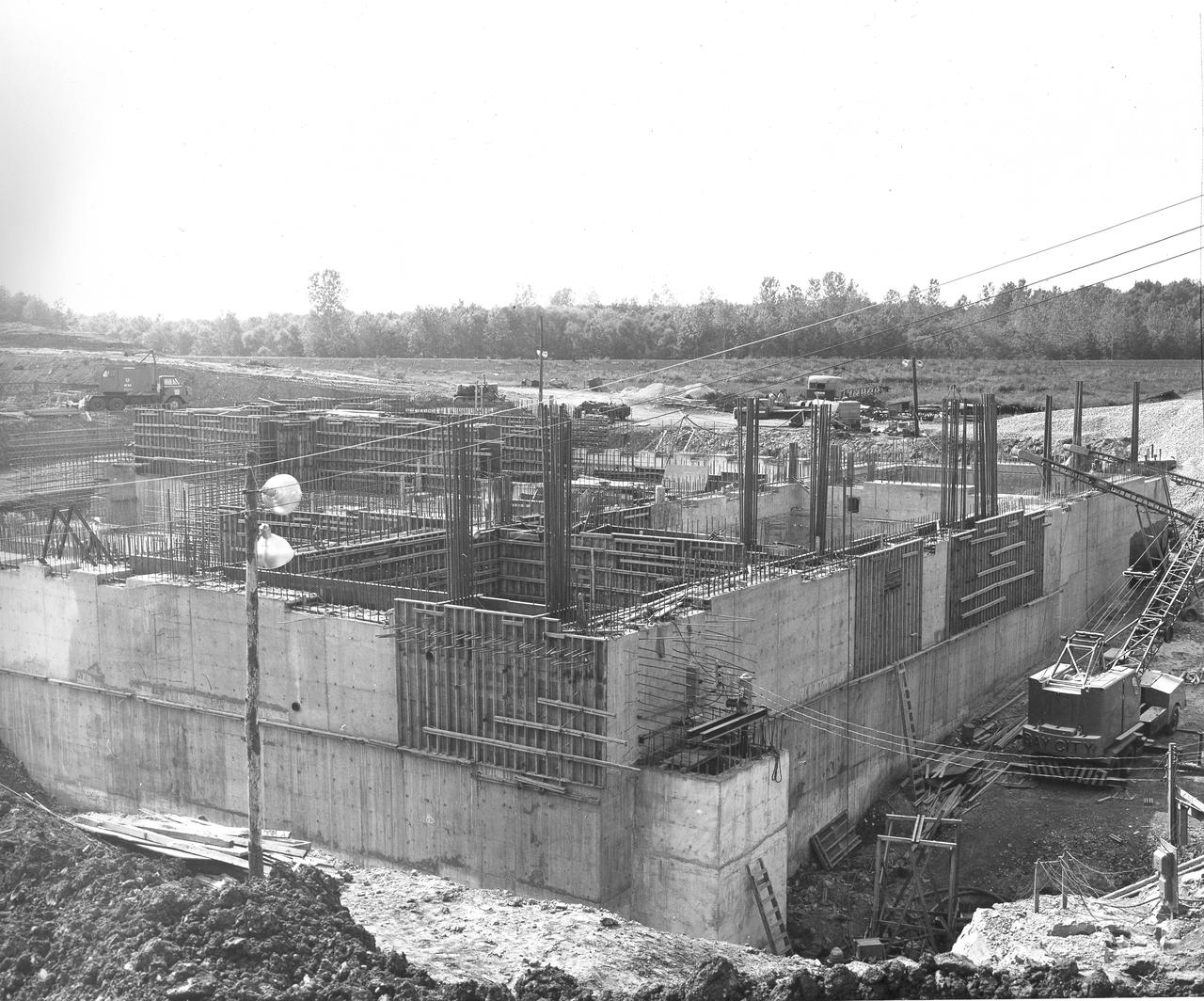
At its founding, the Marshall Space Flight Center (MSFC) inherited the Army’s Jupiter and Redstone test stands, but much larger facilities were needed for the giant stages of the Saturn V. From 1960 to 1964, the existing stands were remodeled and a sizable new test area was developed. The new comprehensive test complex for propulsion and structural dynamics was unique within the nation and the free world, and they remain so today because they were constructed with foresight to meet the future as well as on going needs. Construction of the S-IC Static test stand complex began in 1961 in the west test area of MSFC, and was completed in 1964. The S-IC static test stand was designed to develop and test the 138-ft long and 33-ft diameter Saturn V S-IC first stage, or booster stage, weighing in at 280,000 pounds. Required to hold down the brute force of a 7,500,000-pound thrust produced by 5 F-1 engines, the S-IC static test stand was designed and constructed with the strength of hundreds of tons of steel and 12,000,000 pounds of cement, planted down to bedrock 40 feet below ground level. The foundation walls, constructed with concrete and steel, are 4 feet thick. The base structure consists of four towers with 40-foot-thick walls extending upward 144 feet above ground level. The structure was topped by a crane with a 135-foot boom. With the boom in the upright position, the stand was given an overall height of 405 feet, placing it among the highest structures in Alabama at the time. In addition to the stand itself, related facilities were constructed during this time. Built directly east of the test stand was the Block House, which served as the control center for the test stand. The two were connected by a narrow access tunnel which housed the cables for the controls. This construction photo taken August 17, 1962 depicts a back side view of the Block House.
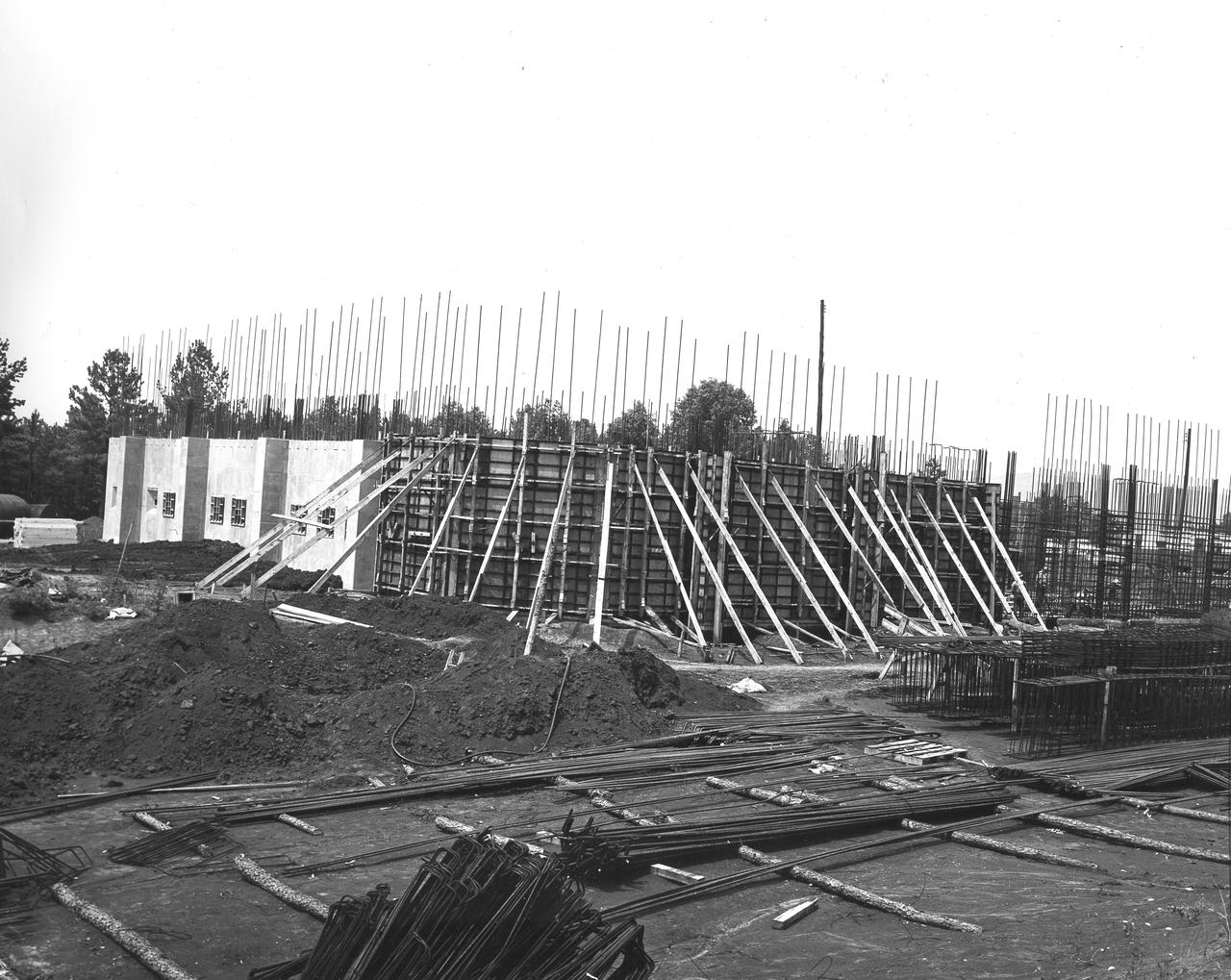
At its founding, the Marshall Space Flight Center (MSFC) inherited the Army’s Jupiter and Redstone test stands, but much larger facilities were needed for the giant stages of the Saturn V. From 1960 to 1964, the existing stands were remodeled and a sizable new test area was developed. The new comprehensive test complex for propulsion and structural dynamics was unique within the nation and the free world, and they remain so today because they were constructed with foresight to meet the future as well as on going needs. Construction of the S-IC Static test stand complex began in 1961 in the west test area of MSFC, and was completed in 1964. The S-IC static test stand was designed to develop and test the 138-ft long and 33-ft diameter Saturn V S-IC first stage, or booster stage, weighing in at 280,000 pounds. Required to hold down the brute force of a 7,500,000-pound thrust produced by 5 F-1 engines, the S-IC static test stand was designed and constructed with the strength of hundreds of tons of steel and 12,000,000 pounds of cement, planted down to bedrock 40 feet below ground level. The foundation walls, constructed with concrete and steel, are 4 feet thick. The base structure consists of four towers with 40-foot-thick walls extending upward 144 feet above ground level. The structure was topped by a crane with a 135-foot boom. With the boom in the upright position, the stand was given an overall height of 405 feet, placing it among the highest structures in Alabama at the time. In addition to the stand itself, related facilities were constructed during this time. Built directly east of the test stand was the Block House, which served as the control center for the test stand. The two were connected by a narrow access tunnel which housed the cables for the controls. This construction photo taken July 3, 1962 depicts the Block House with a portion of its concrete walls poured and exposed while many are still in the forms stage.