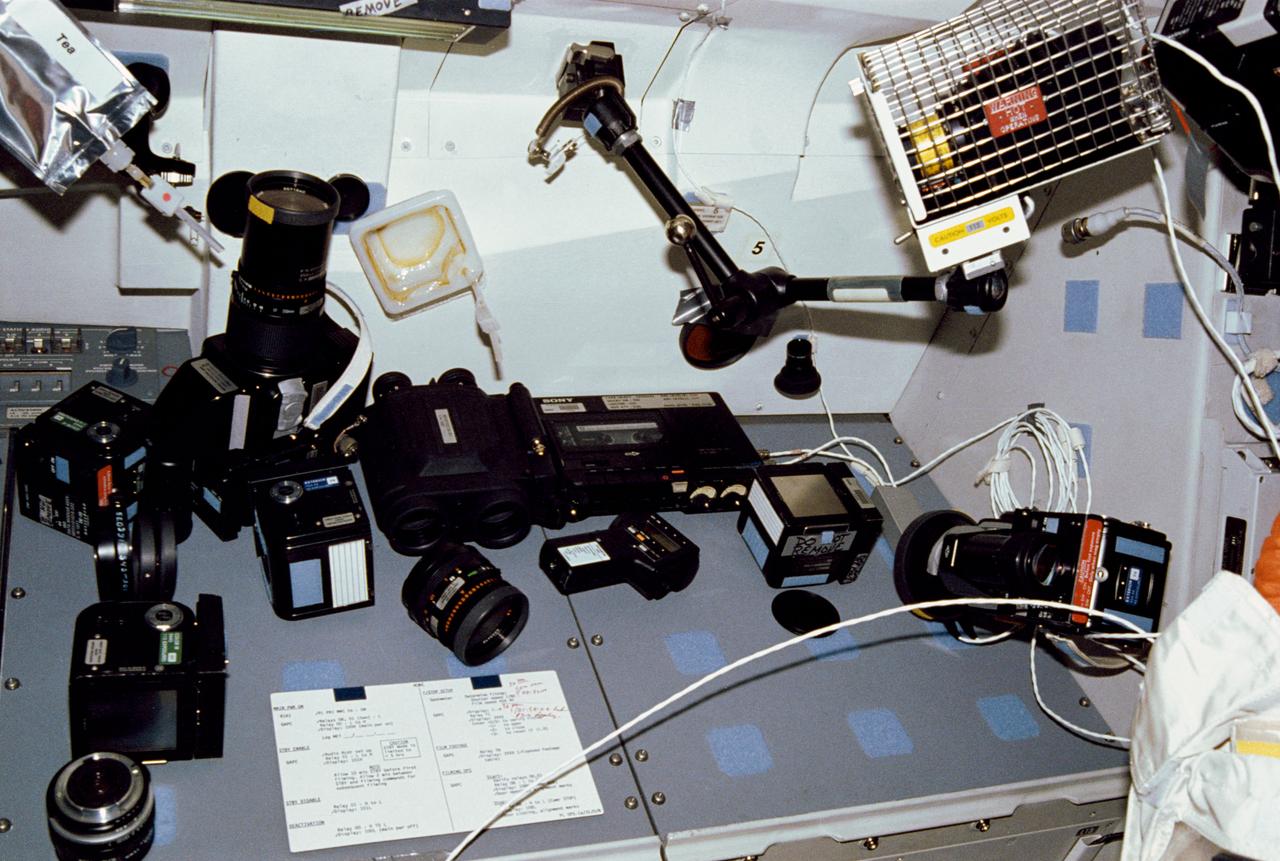
This array of photographic equipment, displayed on the aft flight deck payload station, represents just a part of the imaging and recording hardware which was carried aboard Discovery, Orbiter Vehicle (OV) 103, for STS-31's five day mission. Lenses, film magazines, cassettes, recorders, camera chassis, a pair of binoculars, spot meter, tape recorder, and a bracket-mounted light fixture are included among the array.
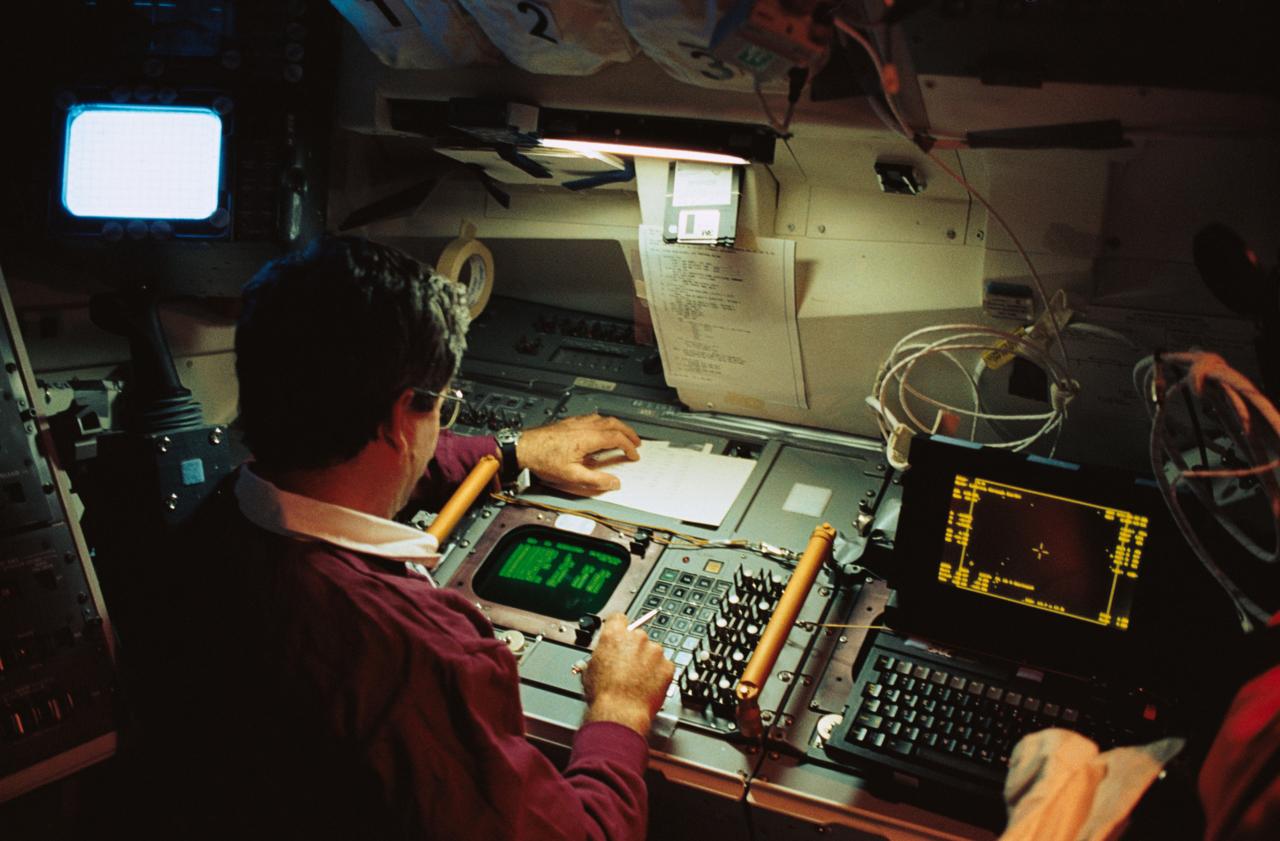
STS039-09-036 (28 April-6 May 1991) --- Astronaut Charles L. (Lacy) Veach monitors experiment data on the aft flight deck of the Earth-orbiting Discovery. The photograph was taken with a 35mm camera. Veach and six other NASA astronauts spent over eight days in space busily collecting data for this mission, dedicated to the Department of Defense.
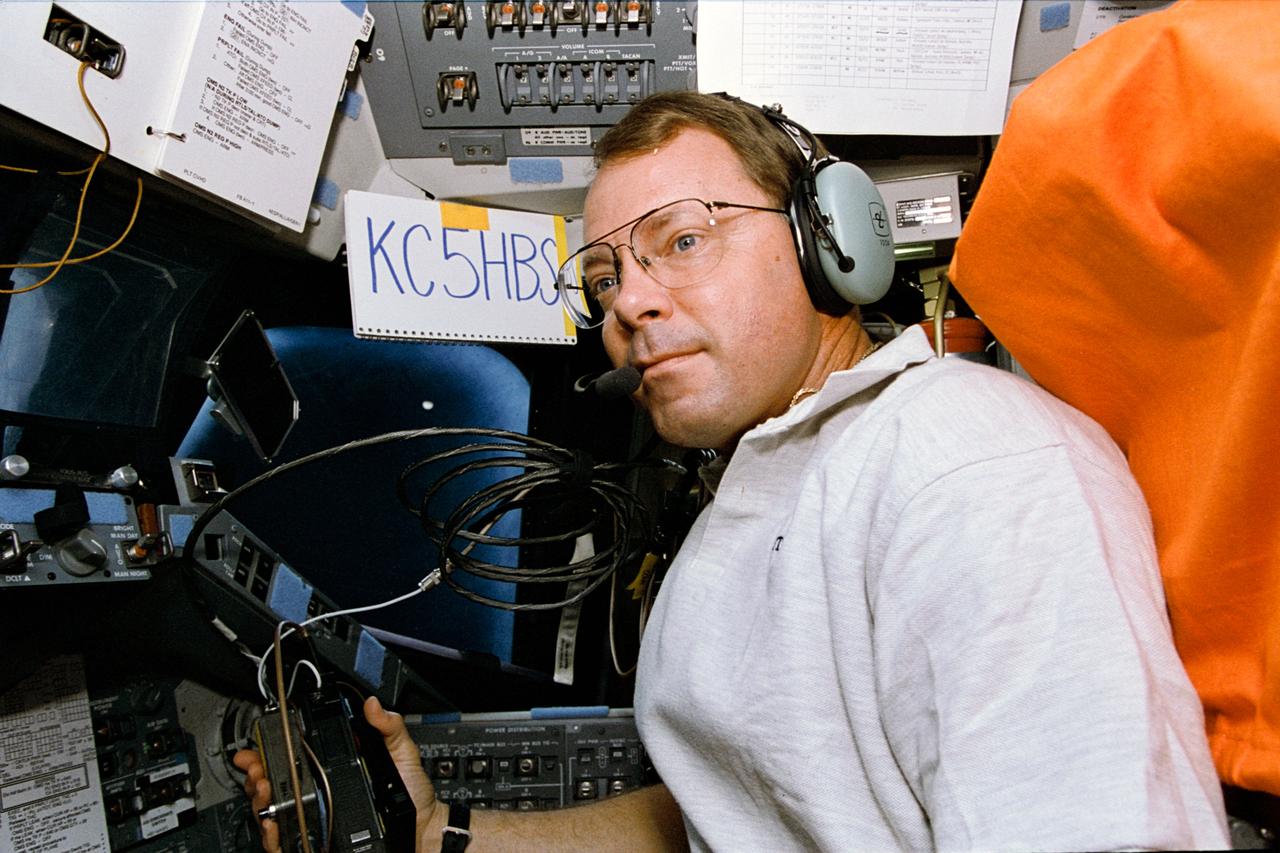
STS064-04-009 (9-20 Sept. 1994) --- Astronaut L. Blaine Hammond, STS-64 pilot, talks to students on Earth via the Shuttle Amateur Radio Experiment (SAREX) on the space shuttle Discovery's flight deck. The recently licensed "Ham" operator and several other crew members throughout the mission were connected with schools around the world with the aid of a number of amateur radio operators. Hammond joined five other NASA astronauts for almost 11 days in Earth orbit aboard Discovery. Photo credit: NASA or National Aeronautics and Space Administration
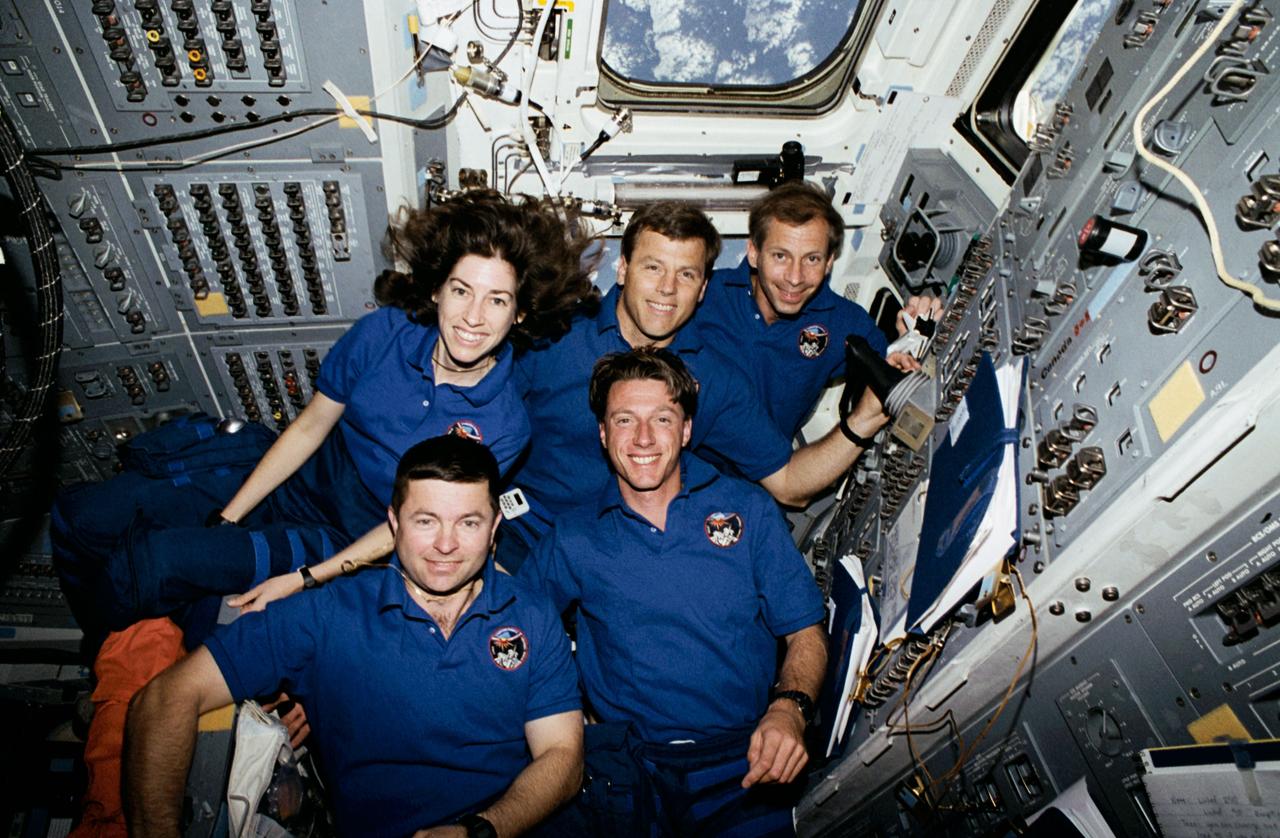
STS056-31-020 (8-17 April 1993) --- The five astronaut crew members assemble on the Space Shuttle Discovery's aft flight deck for the traditional inflight crew portrait. In front are astronauts Kenneth D. Cameron, mission commander; and C. Michael Foale, mission specialist. In back are (left to right) astronauts Ellen Ochoa, mission specialist; Stephen S. Oswald, pilot; and Kenneth D. Cockrell, mission specialist. The five went on to spend nine days in Earth-orbit in support of the Atlas-2 mission. A 35mm camera with a 20mm lens was used to expose this frame.
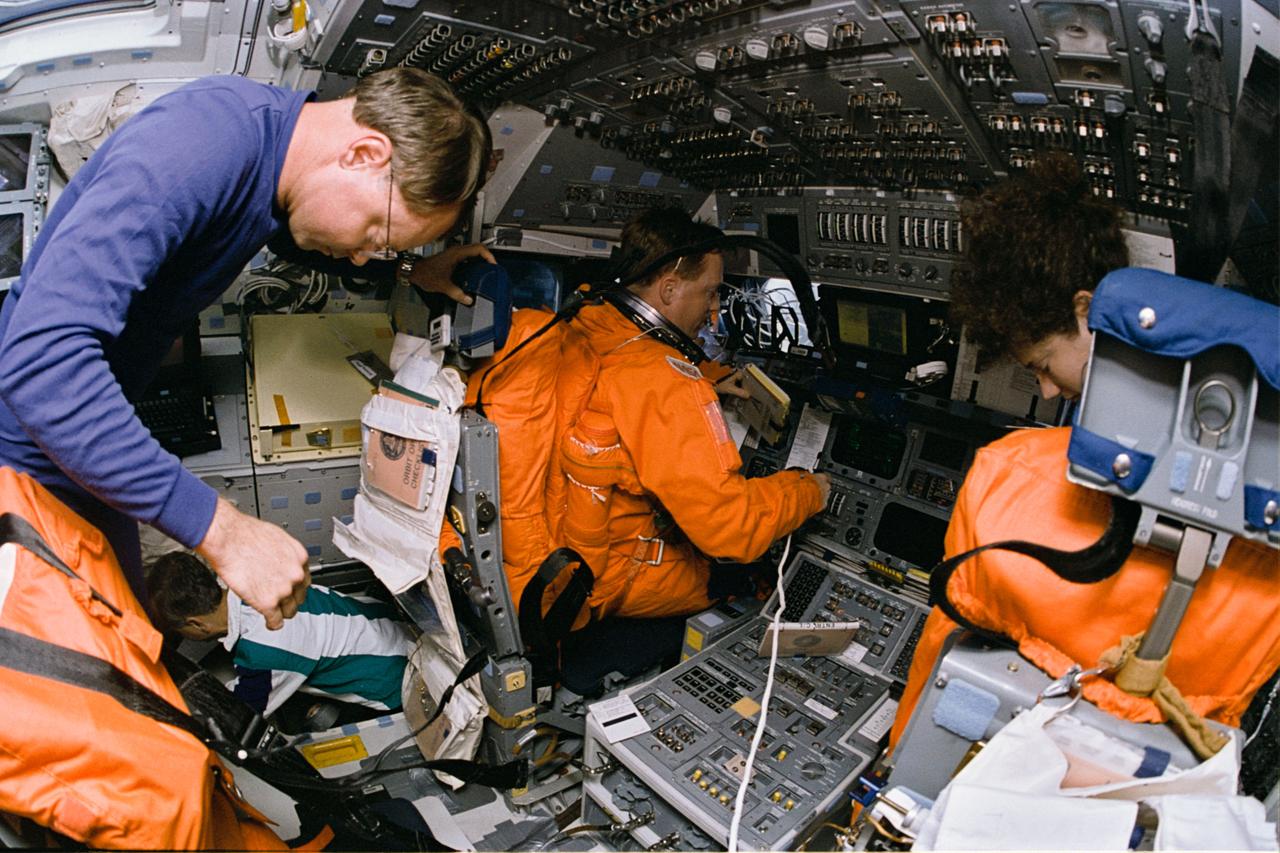
STS064-06-028 (9-20 Sept. 1994) --- On the space shuttle Discovery's flight deck, two thirds of the crew prepare for one of four hard efforts (in a two-day period) to de-orbit and complete the extended spaceflight. Manning the commander's station and wearing one of the launch and entry suits is astronaut Richard N. Richards, STS-64 mission commander. At the pilot's station is astronaut Susan J. Helms, mission specialist. Astronaut L. Blaine Hammond, pilot, is at left foreground, and astronaut Carl J. Meade, mission specialist, is at left background in the hatch leading to the middeck. Photo credit: NASA or National Aeronautics and Space Administration
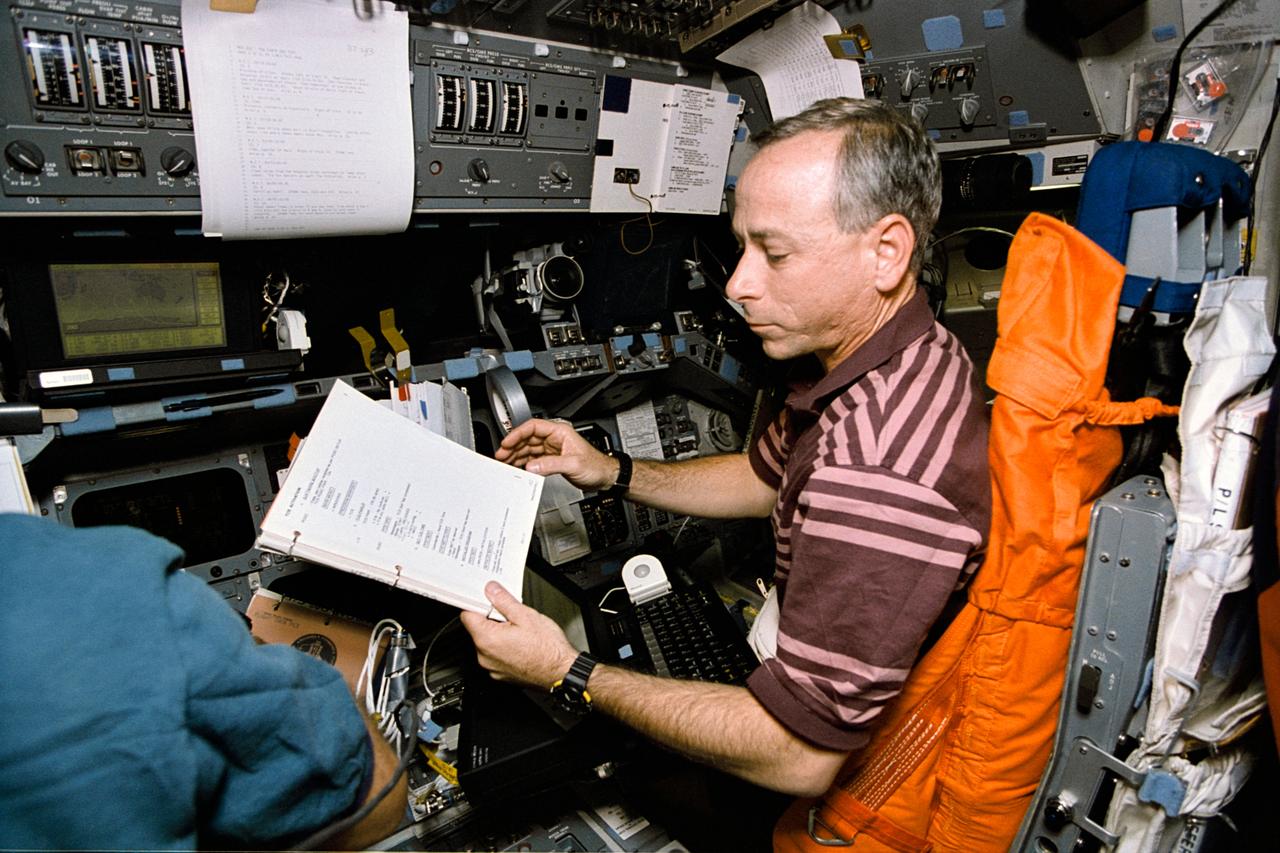
STS064-22-024 (9-20 Sept. 1994) --- With a manual and lap top computer in front of him, astronaut Carl J. Meade, STS-64 mission specialist, supports operations with the Trajectory Control Sensor (TCS) aboard the Earth-orbiting space shuttle Discovery. For this exercise, Meade temporarily mans the pilot's station on the forward flight deck. The TCS is the work of a team of workers at NASA's Johnson Space Center. Data gathered during this flight was expected to prove valuable in designing and developing a sensor for use during the rendezvous and mating phases of orbiter missions to the space station. For this demonstration, the Shuttle Pointed Autonomous Research Tool for Astronomy 201 (SPARTAN 201) was used as the target vehicle during release and retrieval operations. Photo credit: NASA or National Aeronautics and Space Administration
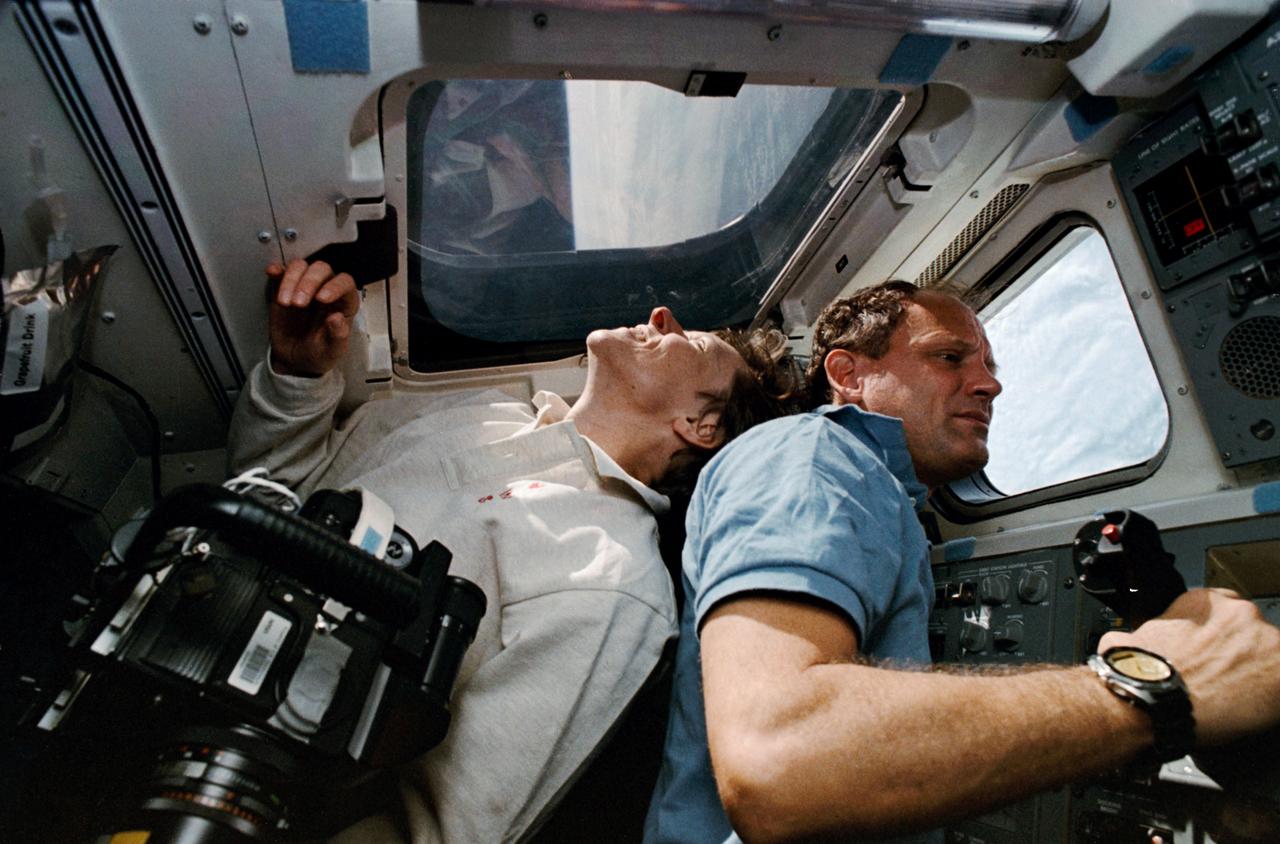
STS-42 Payload Specialist Roberta L. Bondar (light shirt) smiles as she looks out overhead window W7 while Mission Specialist (MS) and Payload Commander (PLC) Norman E. Thagard peers out aft viewing window W9. The two crewmembers are on the aft flight deck of Discovery, Orbiter Vehicle (OV) 103. In the foreground, a camera is ready to capture the Earth below.
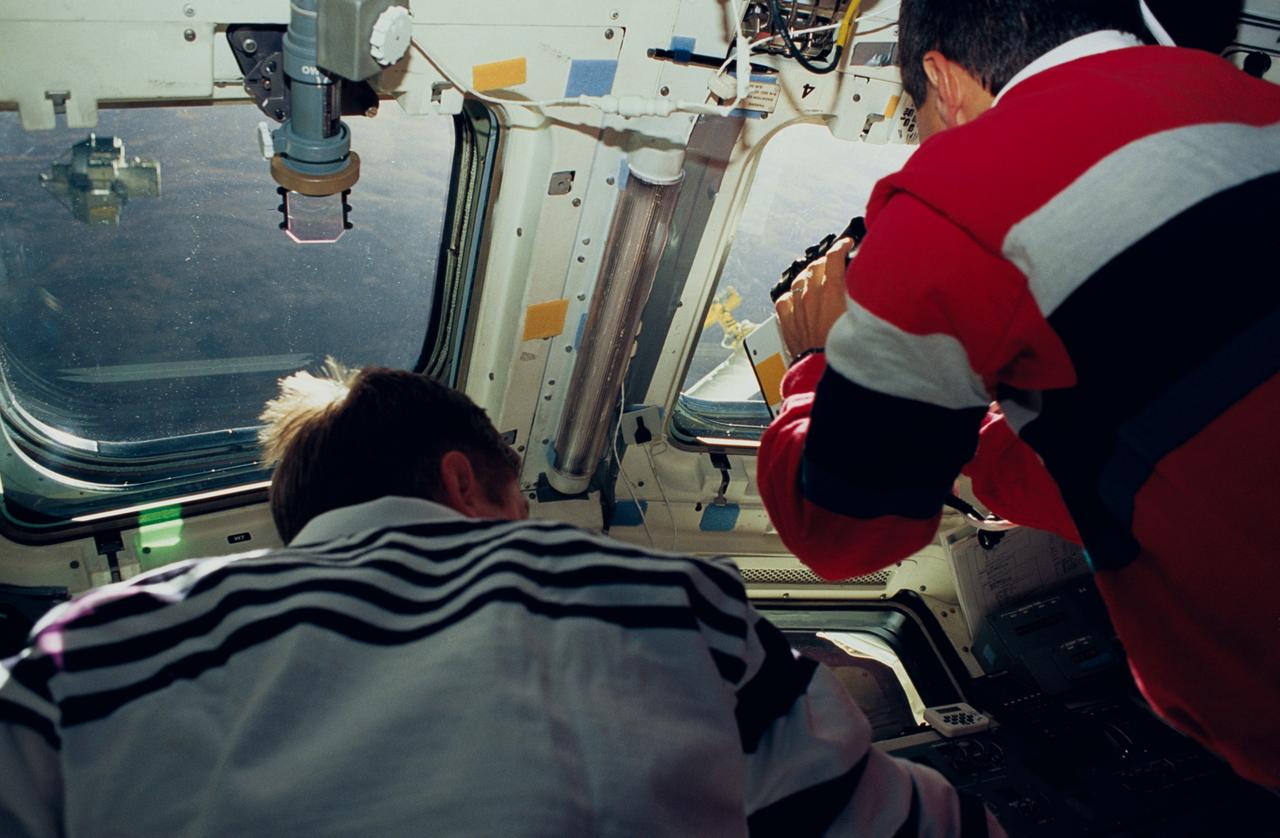
Astronauts Frank L. Culbertson Jr., STS-51 mission commander, and Daniel W. Bursch, mission specialist, are seen on Discovery's flight deck. The two were supporting operations free-flying Orbiting and Retrievable Far and Extreme Ultraviolet Spectrometer (ORFEUS) and its Shuttle Pallet Satellite (SPAS), pictured through the left window.

STS039-11-027 (28 April-6 May 1991) --- Astronaut Michael L. Coats, STS-39 mission commander, is seen in a close-up 35mm frame on the aft flight deck of the Earth-orbiting space shuttle Discovery. Out the overhead window, the SPAS-II hovers on the end of the remote manipulator system (RMS, out of frame). Inside the window, just above Coats' head is the Crewman Optical Alignment Sight (COAS), an optical device that aids in navigation. Photo credit: NASA
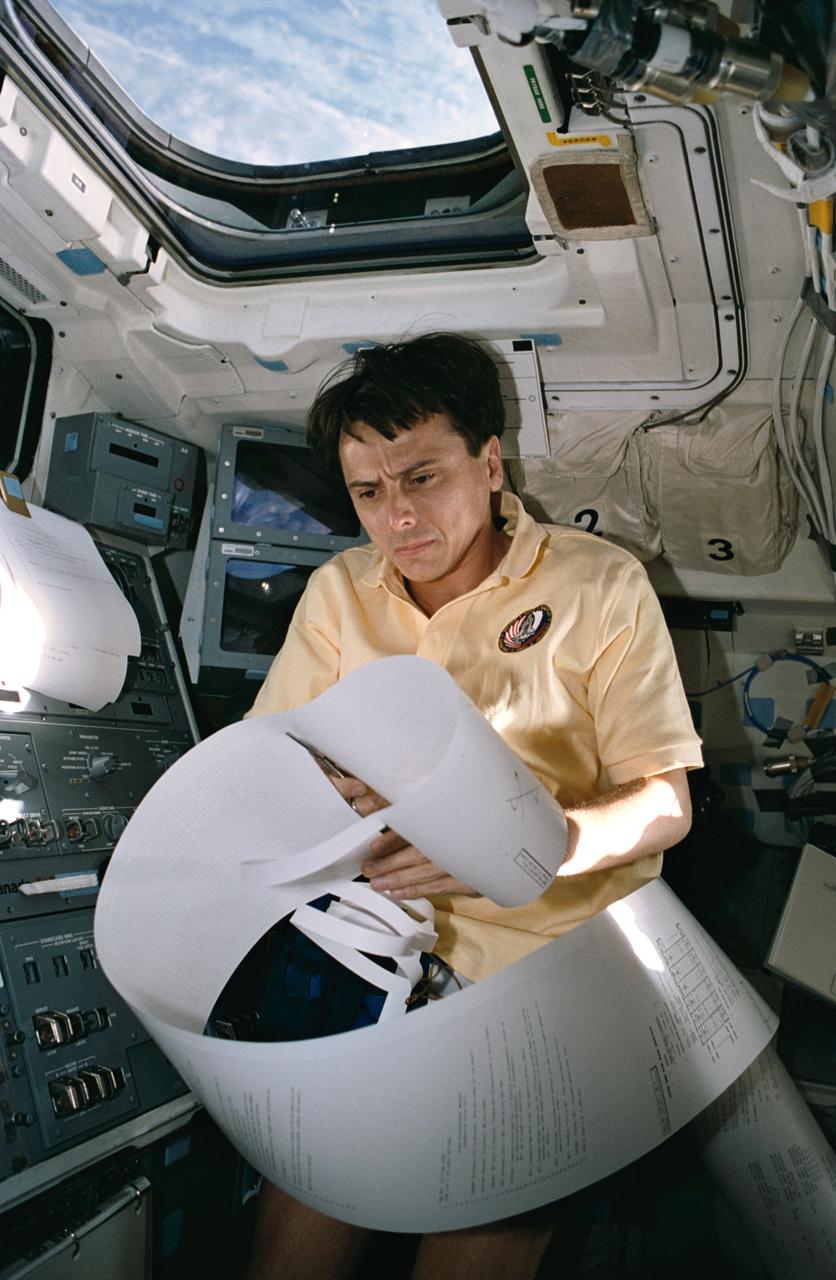
STS060-25-016 (6 Feb. 1994) --- On space shuttle Discovery?s aft flight deck, astronaut Franklin R. Chang-Diaz, STS-60 payload commander, begins to organize what was believed to be among the longest mail messages in shuttle history. Though early shuttle flights could brag of longer teleprinted messages, the Thermal Imaging Printing System?s day four correspondence, most of which is out of frame here, is record length for recent flights. Chang-Diaz joined four other NASA astronauts and a Russian cosmonaut for eight days aboard Discovery. Photo credit: NASA or National Aeronautics and Space Administration
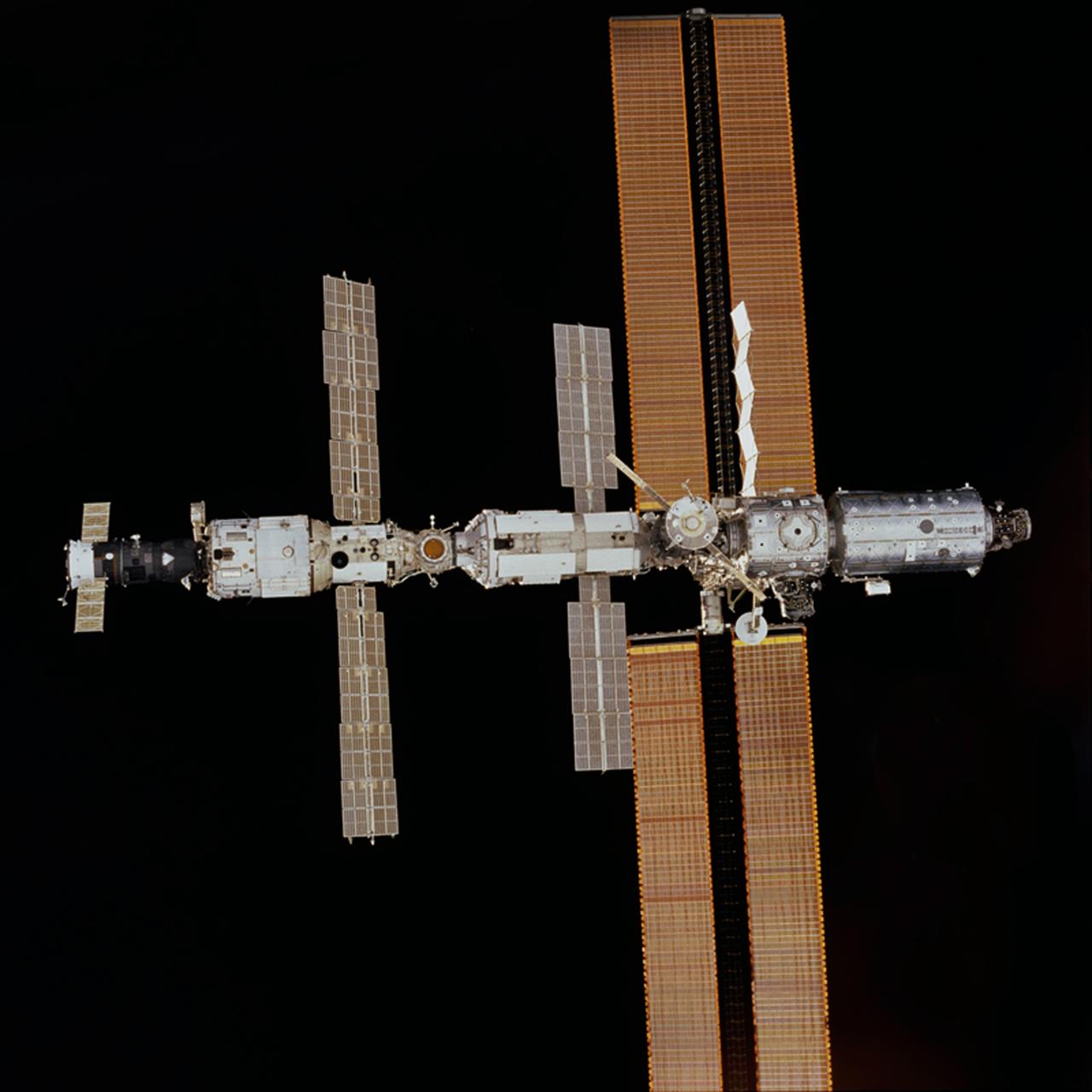
One of the astronauts aboard the Space Shuttle Discovery took this photograph, from the aft flight deck of the Discovery, of the International Space Station (ISS) in orbit. The photo was taken after separation of the orbiter Discovery from the ISS after several days of joint activities and an important crew exchange.
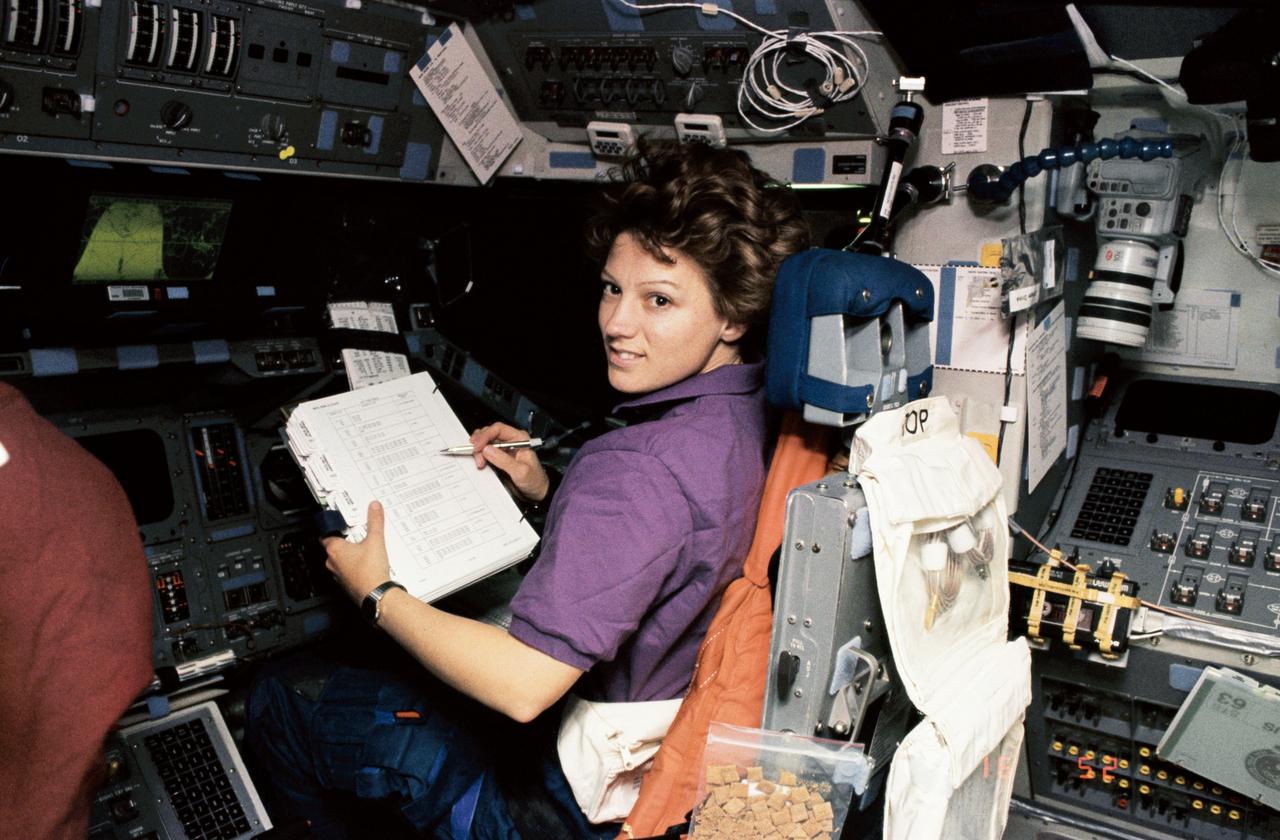
STS063-312-020 (3-11 Feb. 1995) --- Astronaut Eileen M. Collins, pilot, at the pilot's station during "hotfiring" procedure to clear leaking thruster prior to rendezvous with Russia's Mir Space Station. Others onboard the Space Shuttle Discovery were astronauts James D. Wetherbee, mission commander; Bernard A. Harris, Jr., payload commander; mission specialists C. Michael Foale and Janice E. Voss, and cosmonaut Vladimir G. Titov. This is one of 16 still photographs released by the NASA Johnson Space Center (JSC) Public Affairs Office (PAO) on February 14, 1995.
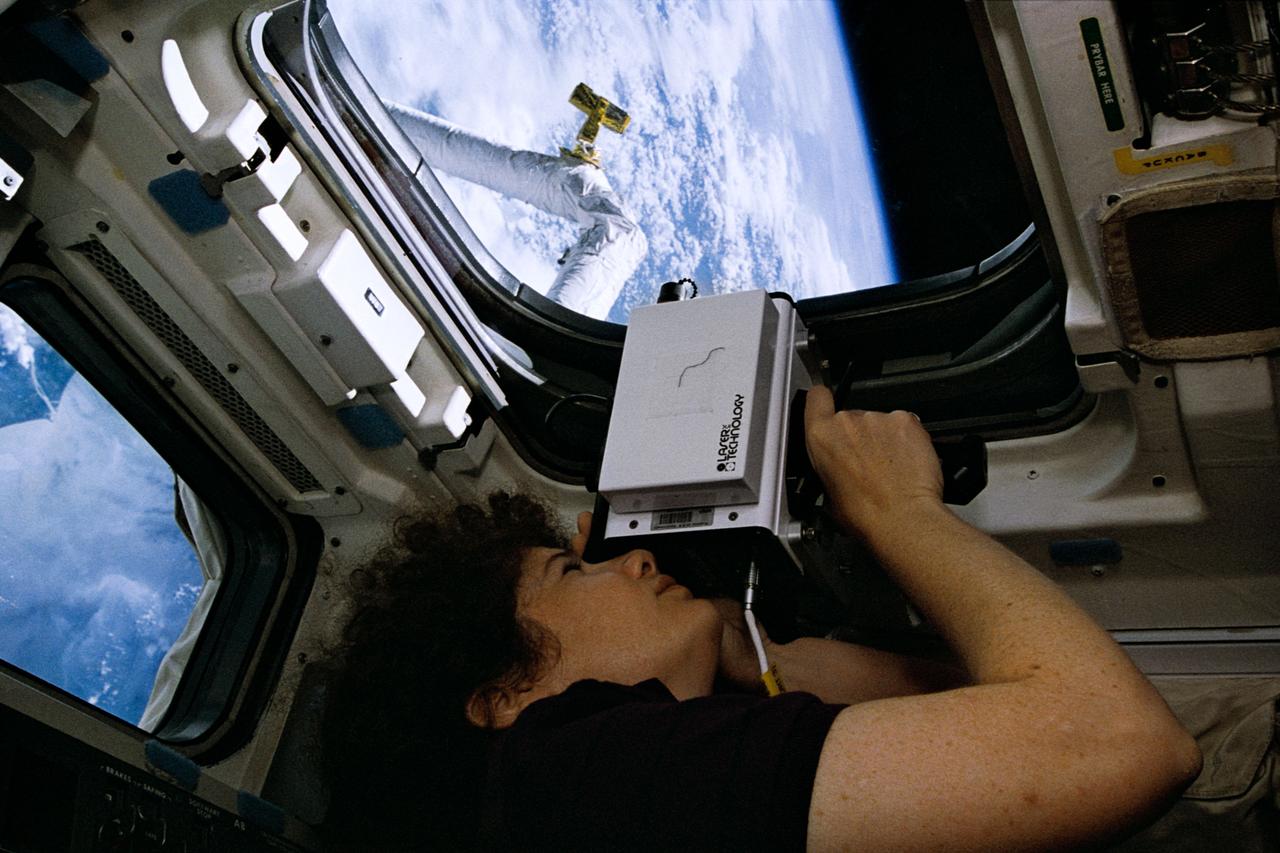
STS064-33-003 (9-20 Sept. 1994) --- Astronaut Susan J. Helms, STS-64 mission specialist, uses a laser instrument during operations with the Shuttle Pointed Autonomous Research Tool for Astronomy 201 (SPARTAN 201). Helms, who spent many mission hours at the controls of the Remote Manipulator System (RMS), joined five other NASA astronauts for almost 11 days in Earth orbit aboard the space shuttle Discovery. Photo credit: NASA or National Aeronautics and Space Administration
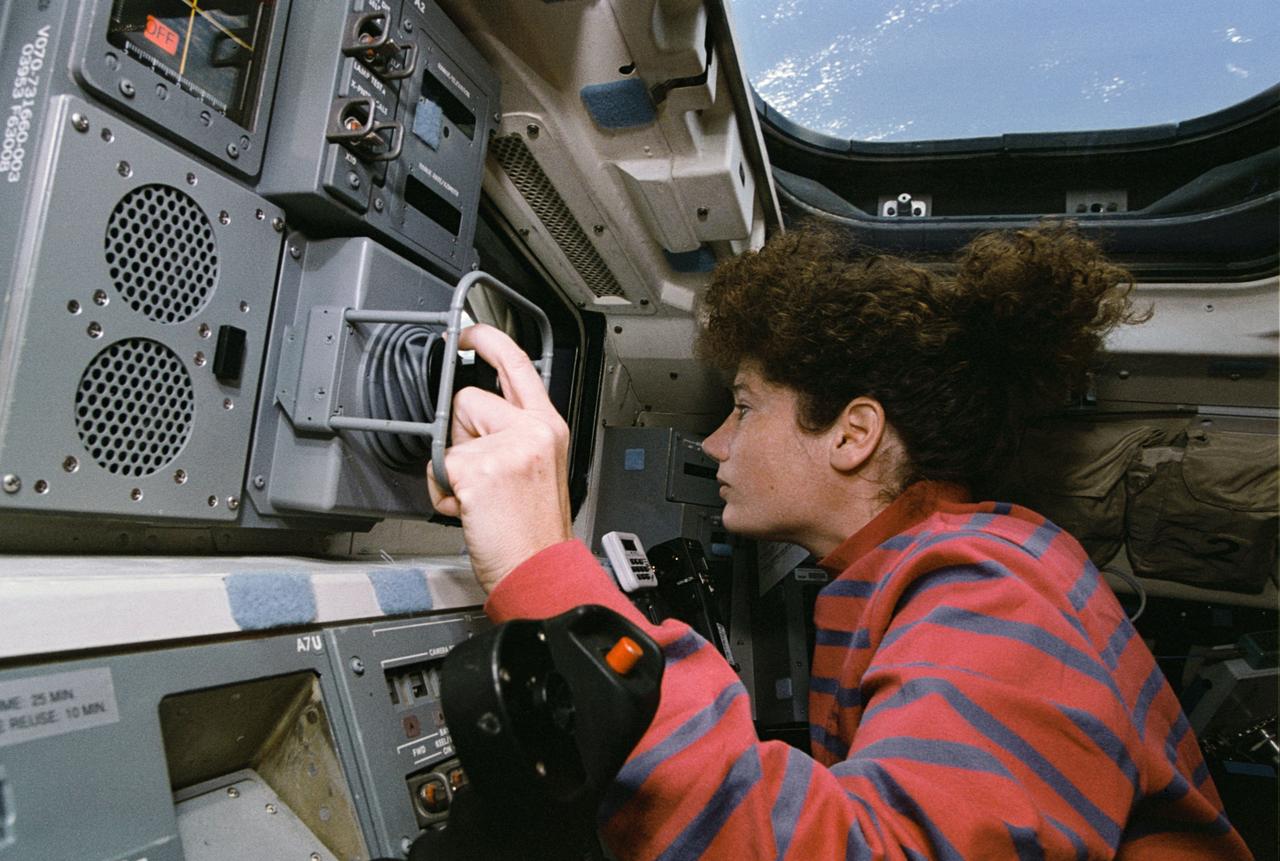
STS064-05-028 (9-20 Sept. 1994) --- On the space shuttle Discovery's aft flight deck, astronaut Susan J. Helms handles controls for the Remote Manipulator System (RMS). The robot arm operated by Helms, who remained inside the cabin, was used to support several tasks performed by the crew during the almost 11-day mission. Those tasks included the release and retrieval of the free-flying Shuttle Pointed Autonomous Research Tool For Astronomy 201 (SPARTAN 201), a six-hour spacewalk and the Shuttle Plume Impingement Flight Experiment (SPIFEX). Photo credit: NASA or National Aeronautics and Space Administration
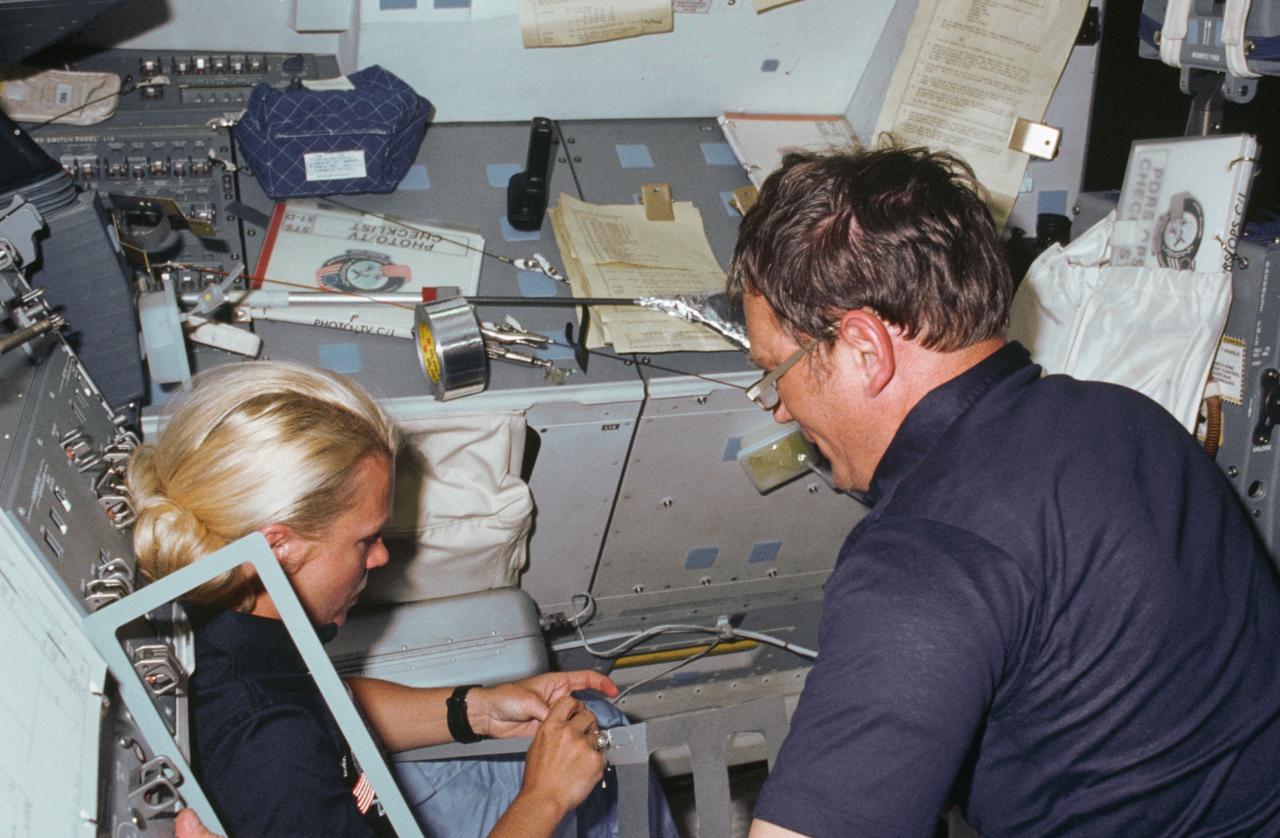
51D-04-015 (15 April 1985) --- Astronaut Rhea Seddon and Karol J. Bobko continue work on snag-type extension for the Remote Manipulator System (RMS) as part of an effort to activate a lever on a troubled communications satellite. Since the crew learned soon after deployment of the Syncom IV (LEASAT) spacecraft that it was not functioning properly plans were formulated for a rendezvous in space between the Discovery and the satellite. A fly swatter-like extension and another resembling a LaCrosse stick were fashioned from onboard supplies and furnishings. Stowage lockers nearby serve as a work bench for the two. At various times during the seven-day mission, the majority of the seven-member crew participated in the tool-making and preparations for an extravehicular activity (EVA) by the flights other two mission specialists -- Jeffrey A. Hoffman and S. David Griggs -- to connect the two tools to the RMS. Bobko is mission commander and Dr. Seddon, a mission specialist.
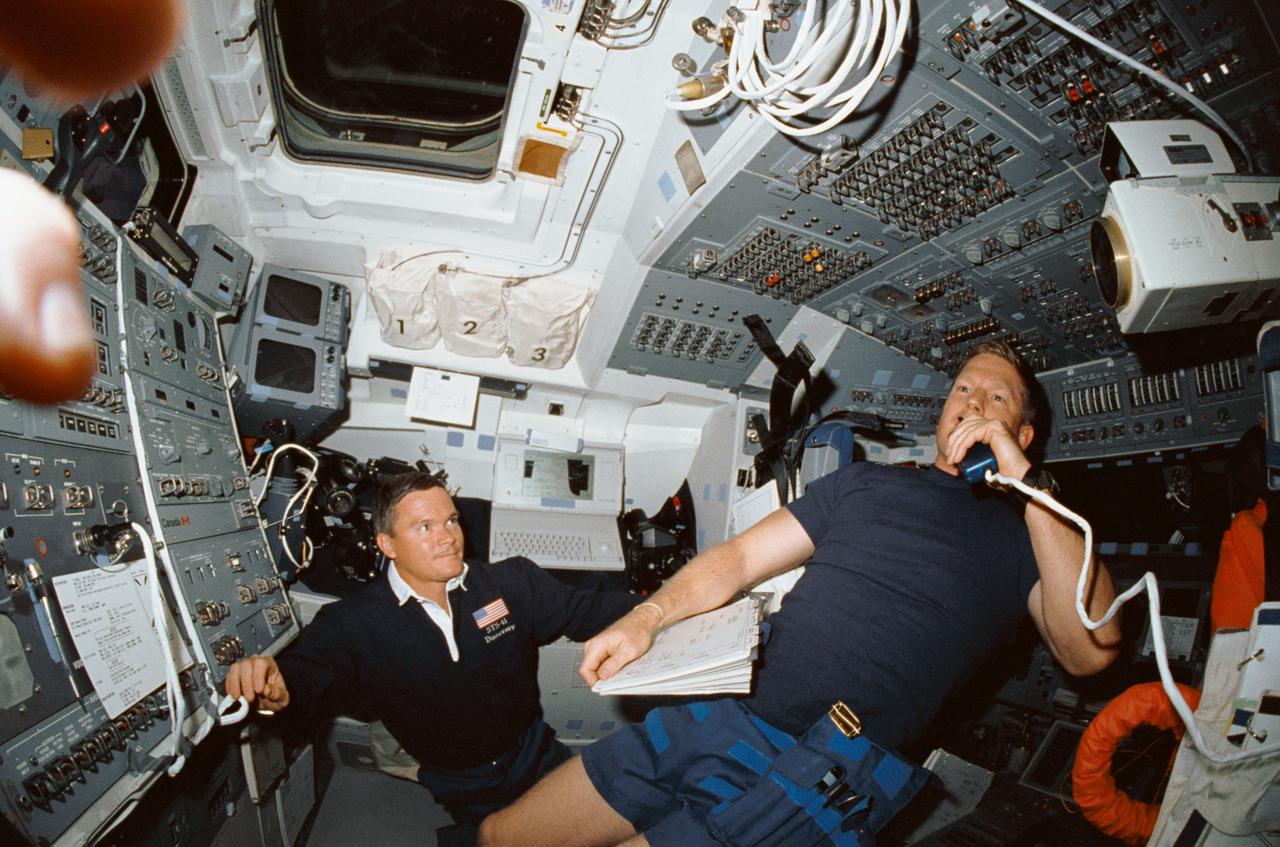
STS041-02-035 (6-10 Oct 1990) --- A fish-eye lens view shows two of STS-41's three mission specialists on the flight deck of Discovery. Astronaut William M. Shepherd, right, communicates with ground controllers as Astronaut Bruce E. Melnick looks on.
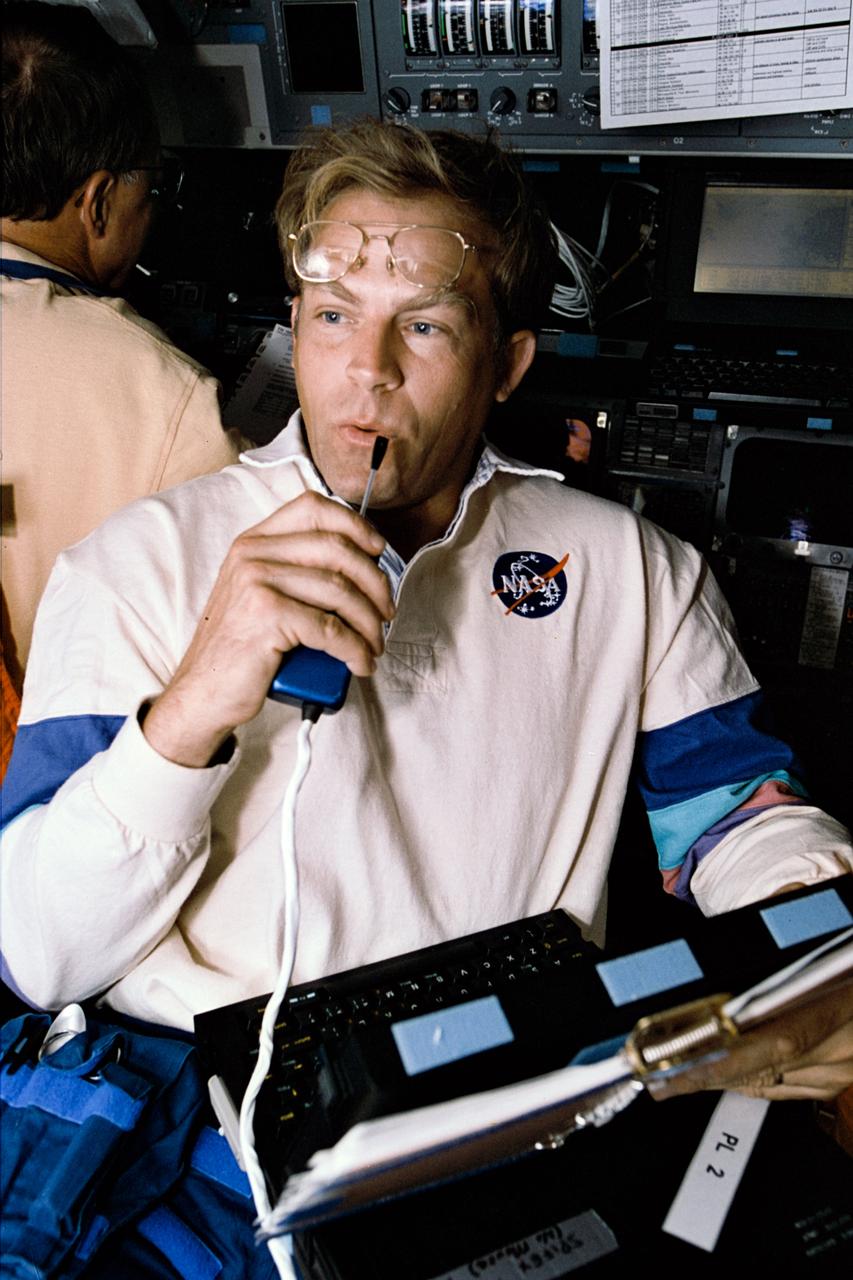
STS064-311-031 (10 Sept. 1994) --- Astronaut Mark C. Lee, STS-64 mission specialist, at a Payload General Support Computer (PGSC) on the space shuttle Discovery's flight deck, talks to ground controllers about the Shuttle Plume Impingement Flight Experiment (SPIFEX). Astronaut L. Blaine Hammond, pilot, is partially visible in the background. Photo credit: NASA or National Aeronautics and Space Administration
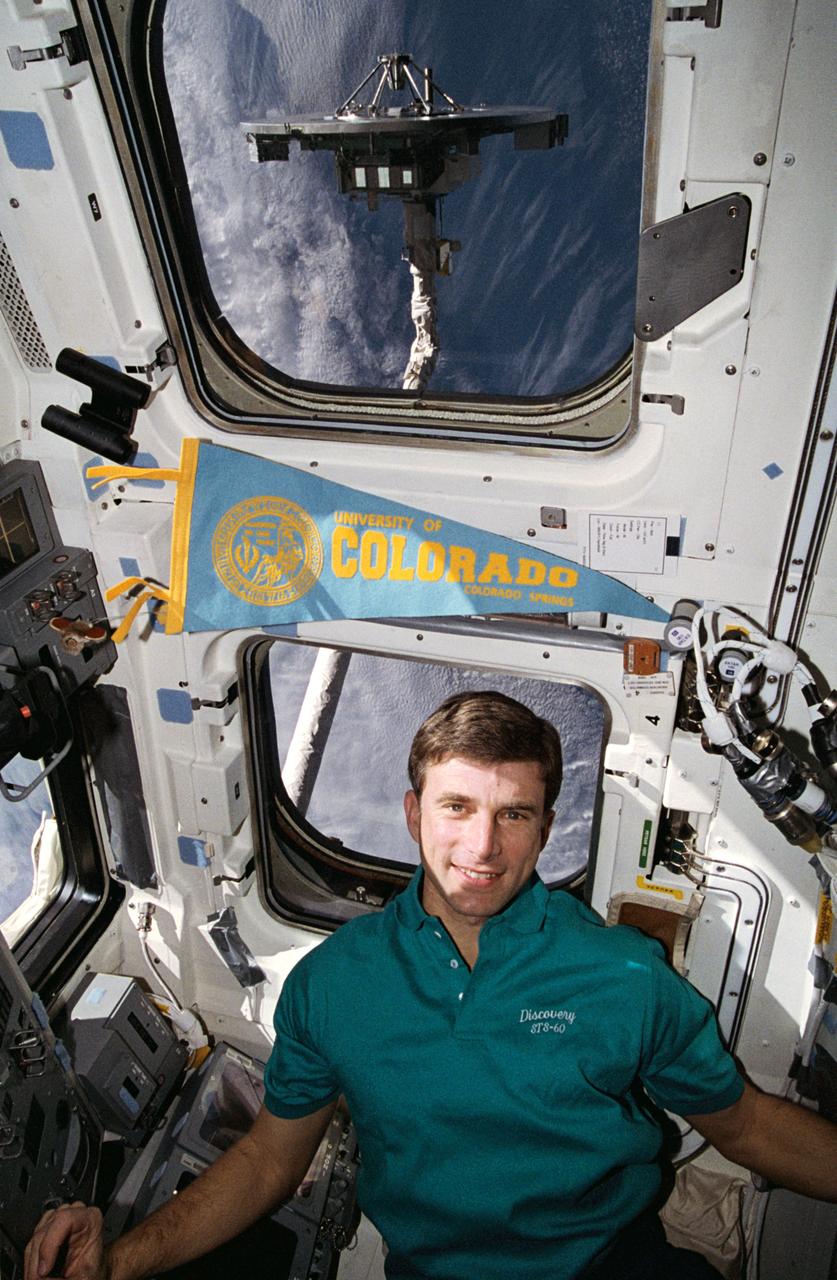
STS060-57-033 (3-11 Feb 1994) --- Astronaut Ronald M. Sega suspends himself in the weightlessness aboard the Space Shuttle Discovery's crew cabin, as the Remote Manipulator System (RMS) arm holds the Wake Shield Facility (WSF) aloft. The mission specialist is co-principal investigator on the WSF project.
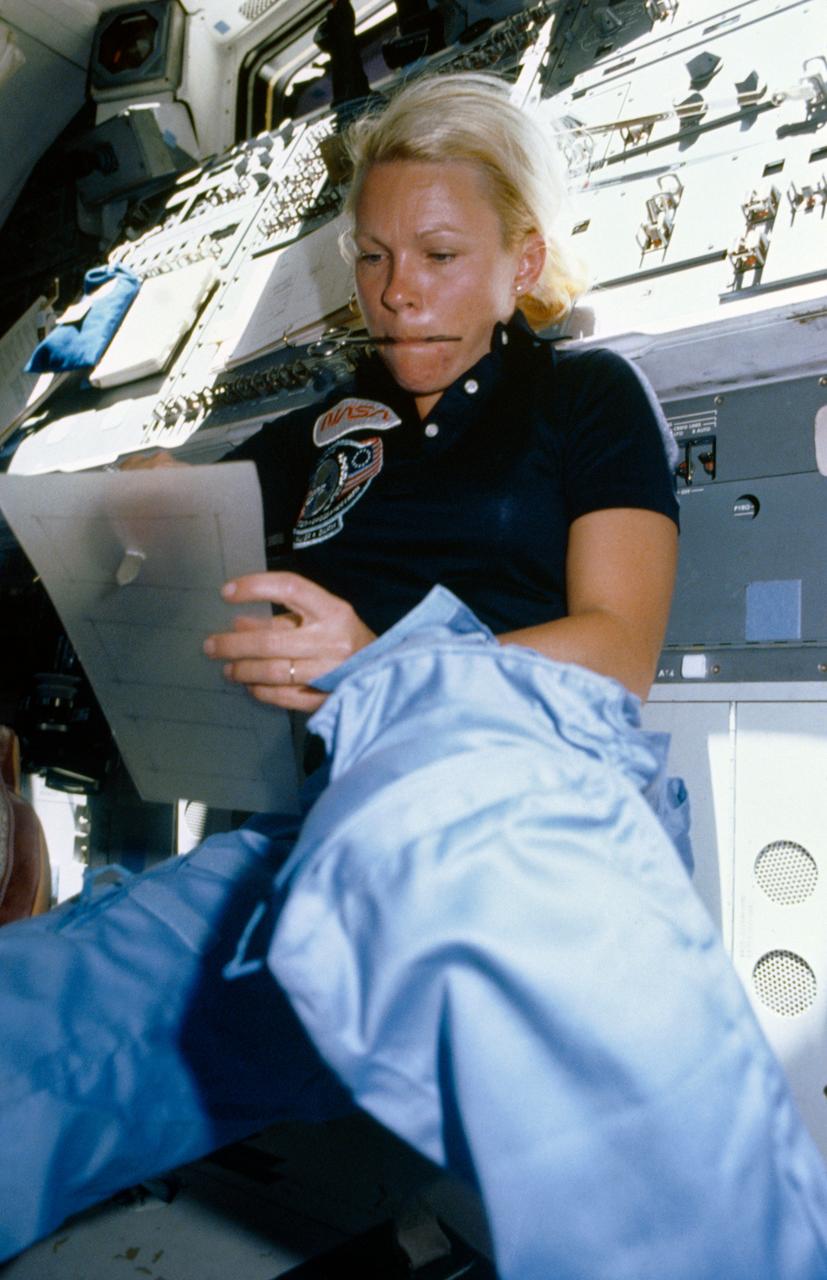
51D-07-003 (12-19 April 1985) --- Astronaut Rhea Seddon begins early work on a fly swatter-like snagging device to be used as an extension to the Remote Manipulator System (RMS) arm on Discovery for an April 17, 1985 attempt to trip a lever on the troubled Syncom-IV satellite.
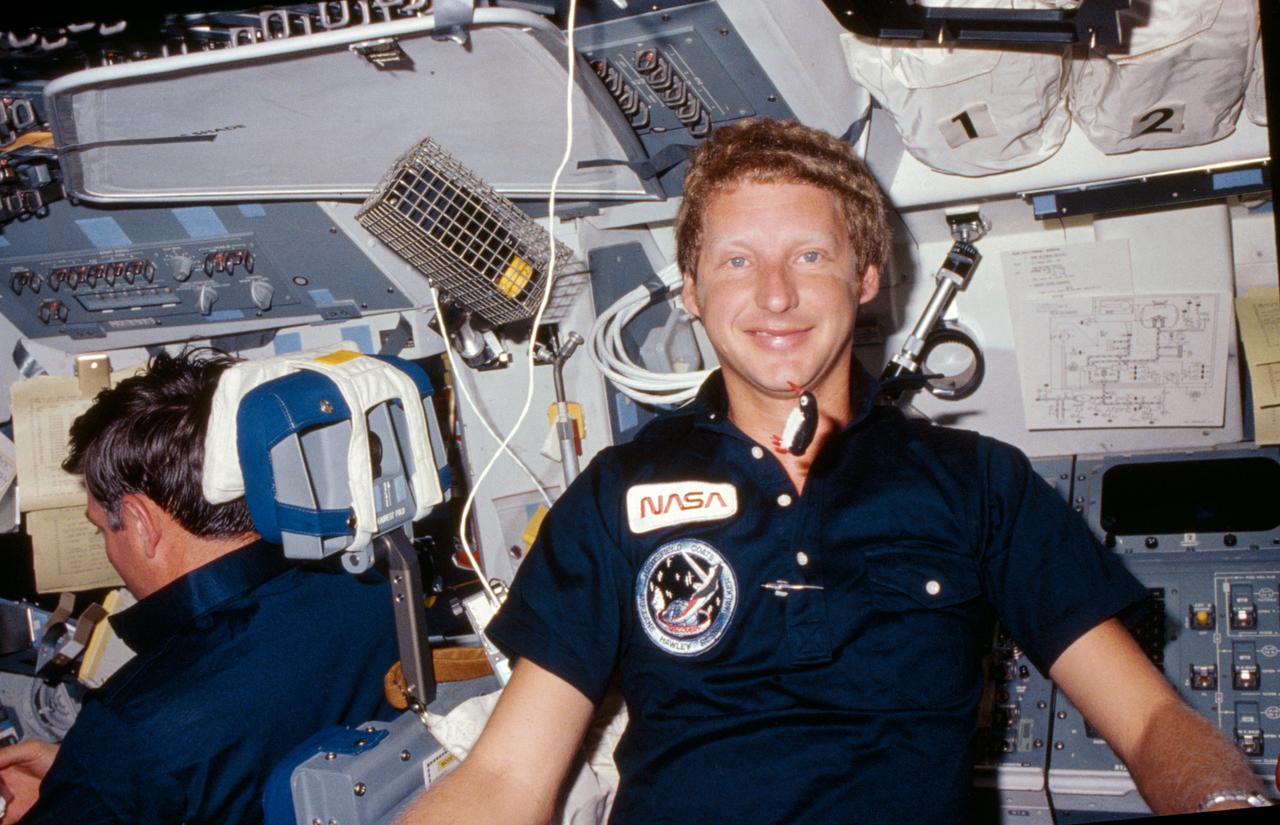
A tiny stuffed penguin floats in front of Mission specialist Steven Hawley as he sits at the mission specialists position behind the pilot on the flight deck.
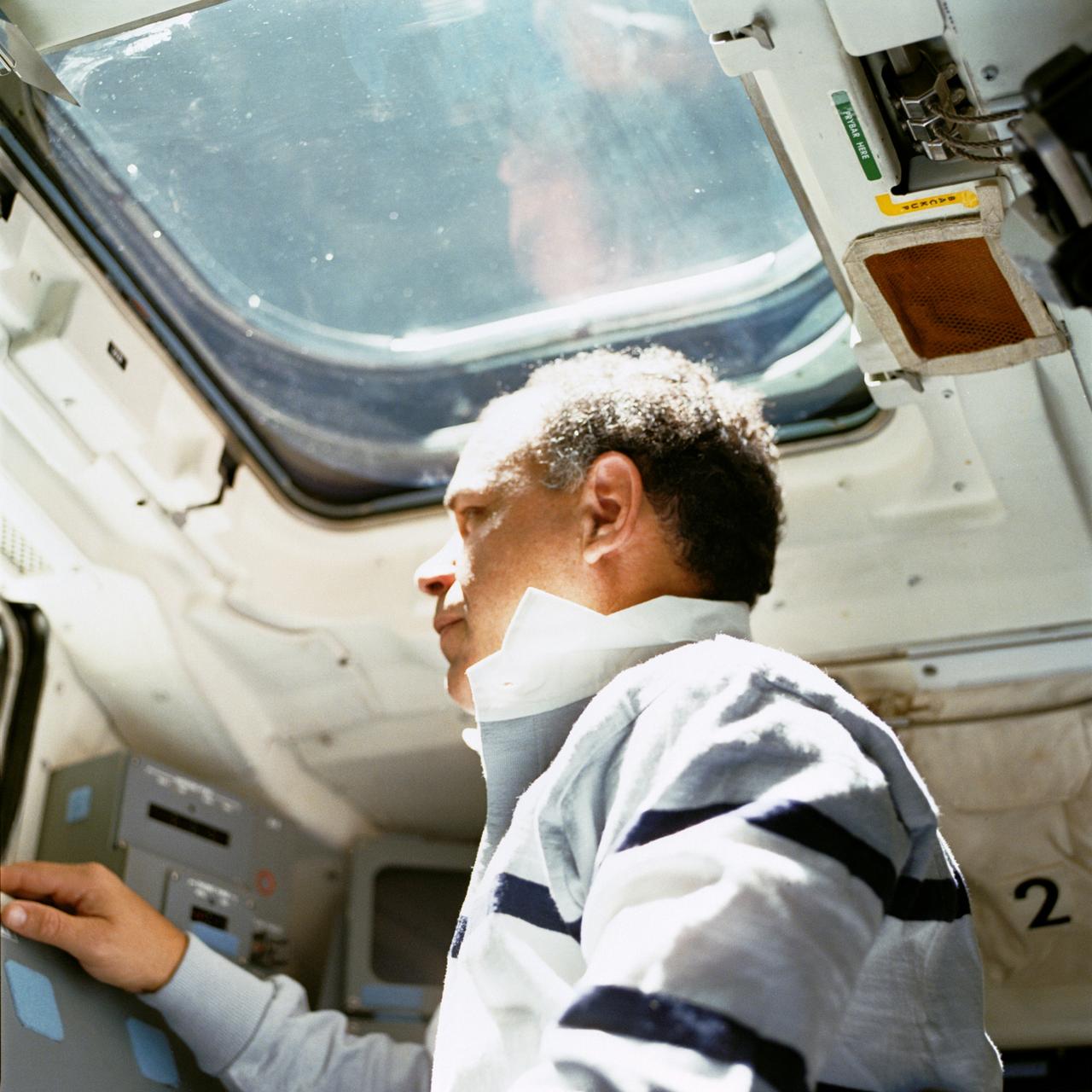
STS033-93-034 (22-27 Nov. 1989) --- Astronaut Frederick D. Gregory, STS-33 commander looks through aft flight deck viewing window while onboard the Space Shuttle Discovery.
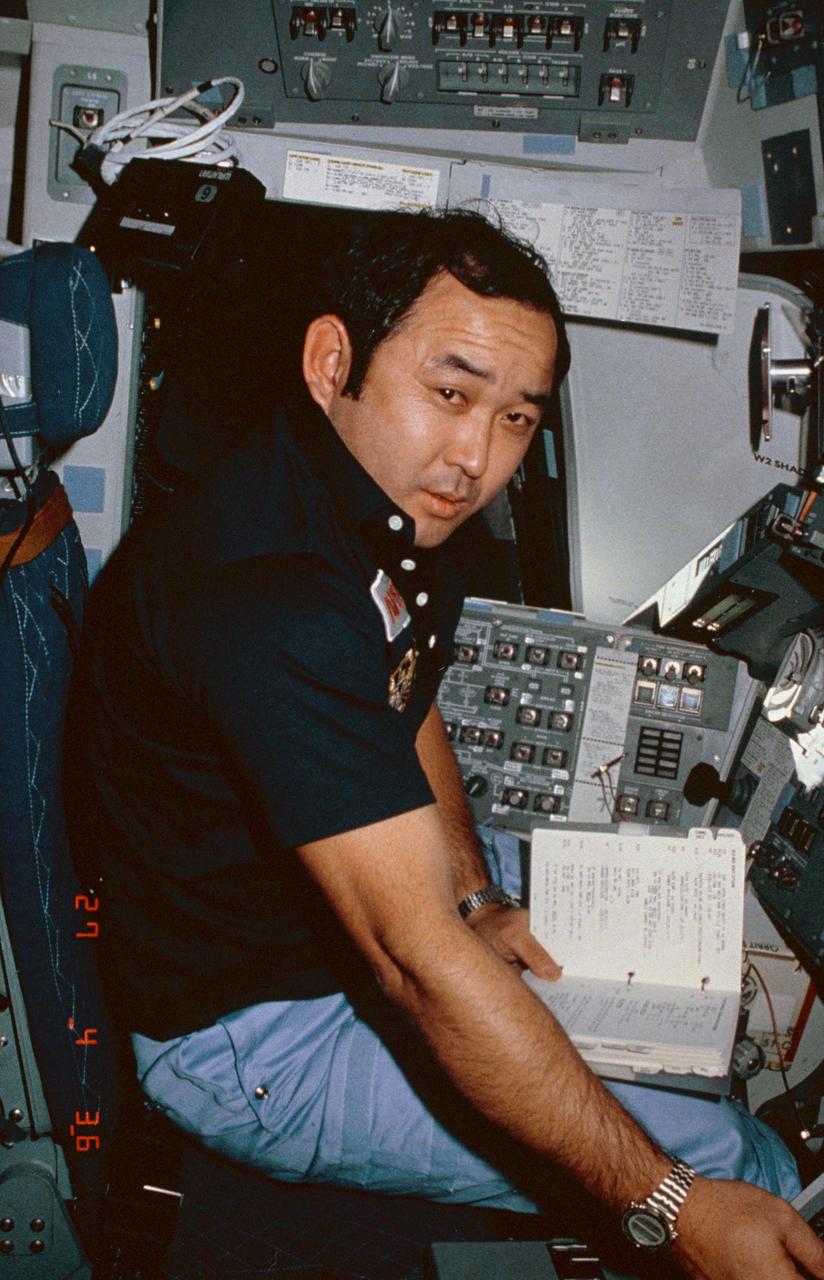
51C-06-025 (24-27 Jan 1985) --- Astronaut Ellison S. Onizuka, mission specialist, studies flight checklist on middeck of Space Shuttle Discovery.
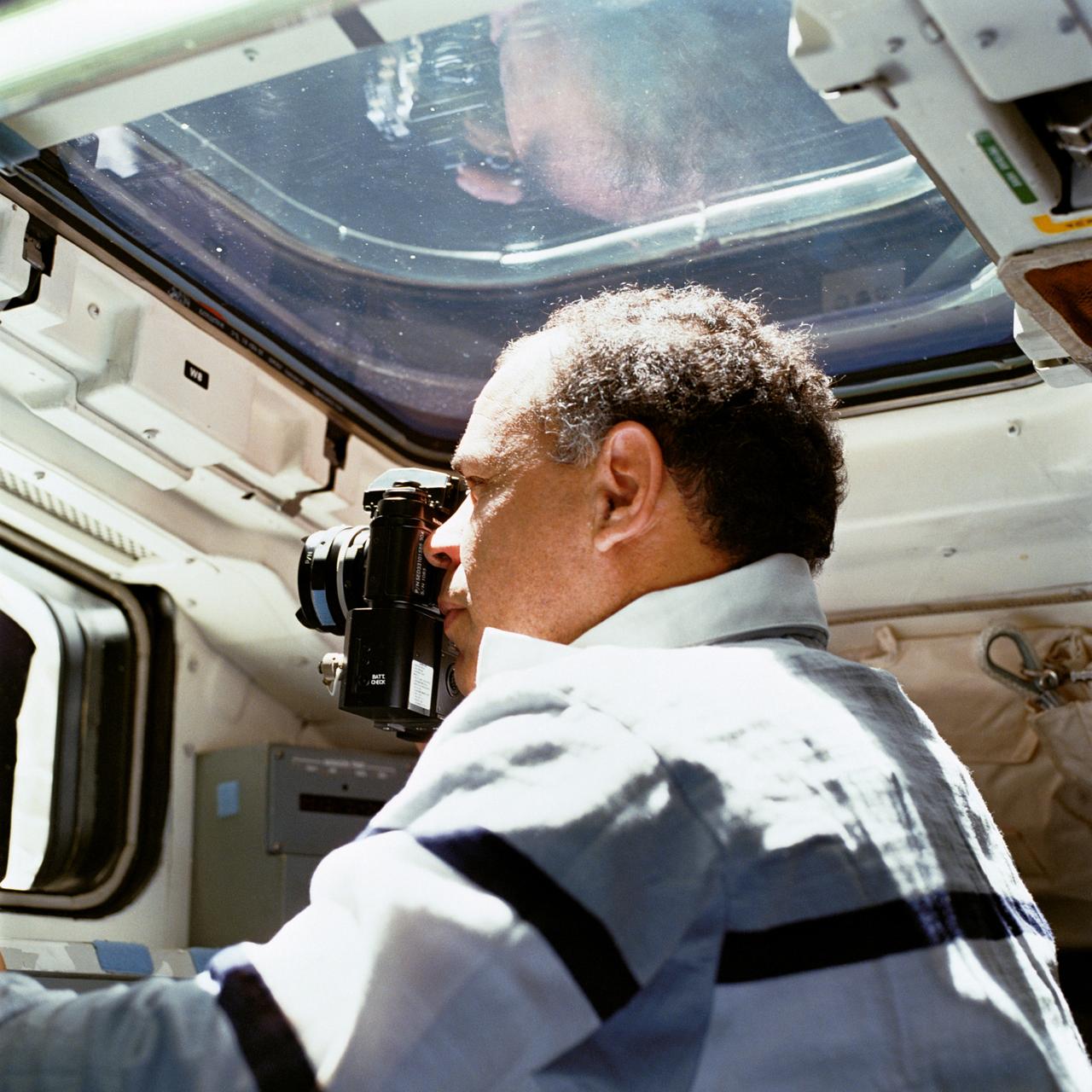
STS033-93-036 (22-27 Nov. 1989) --- Astronaut Frederick D. Gregory, STS-33 commander, aims a 35mm camera out an aft flight deck viewing window while onboard the Space Shuttle Discovery.
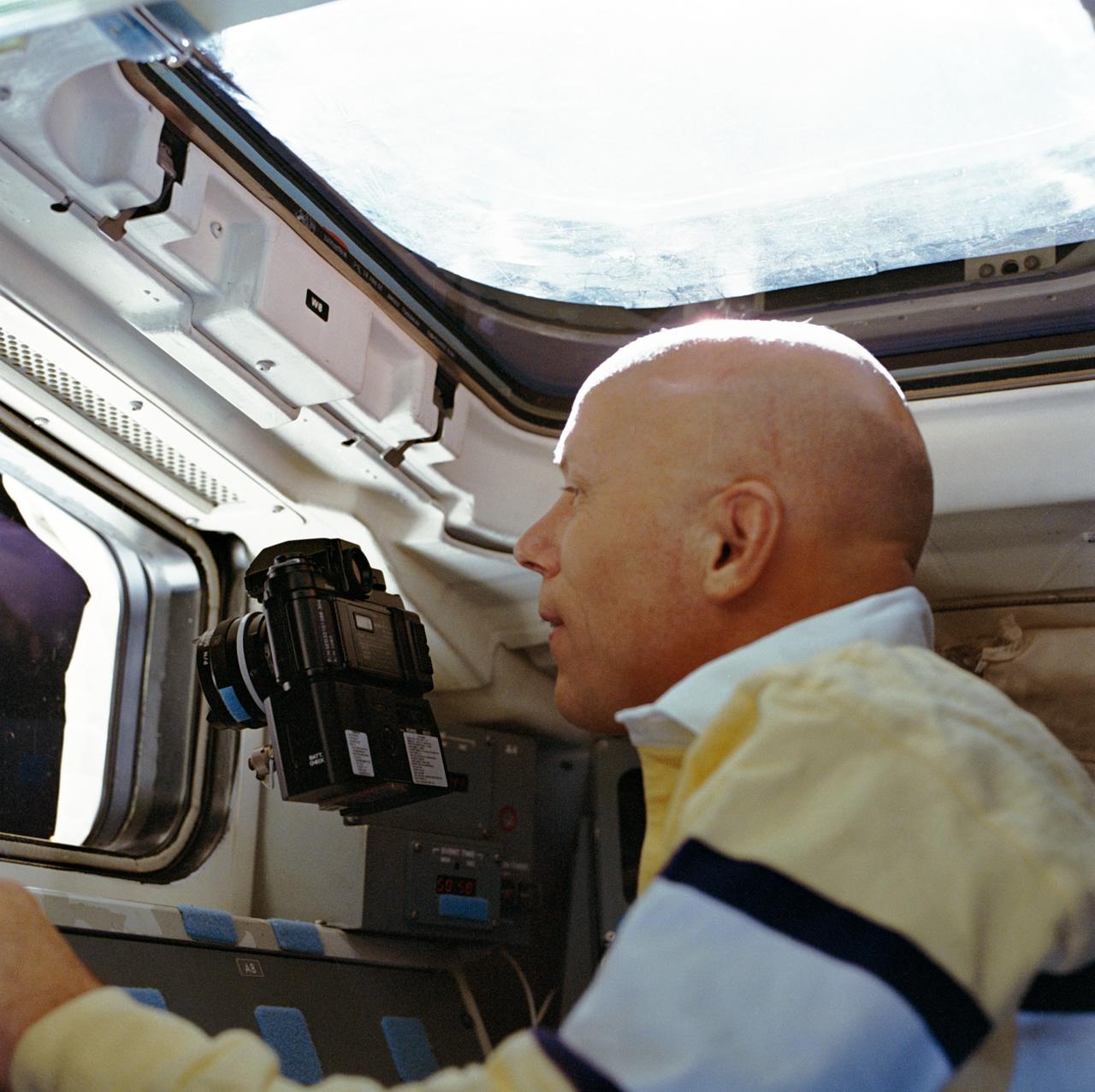
STS-33 Mission Specialist (MS) F. Story Musgrave views activity outside aft flight deck viewing window W10 as a 35mm camera freefloats in front of his face. Overhead window W8 appears above his head.

View of the Syncom-IV (LEASAT) satellite from the flight deck window taken by Astronaut S. David Griggs.
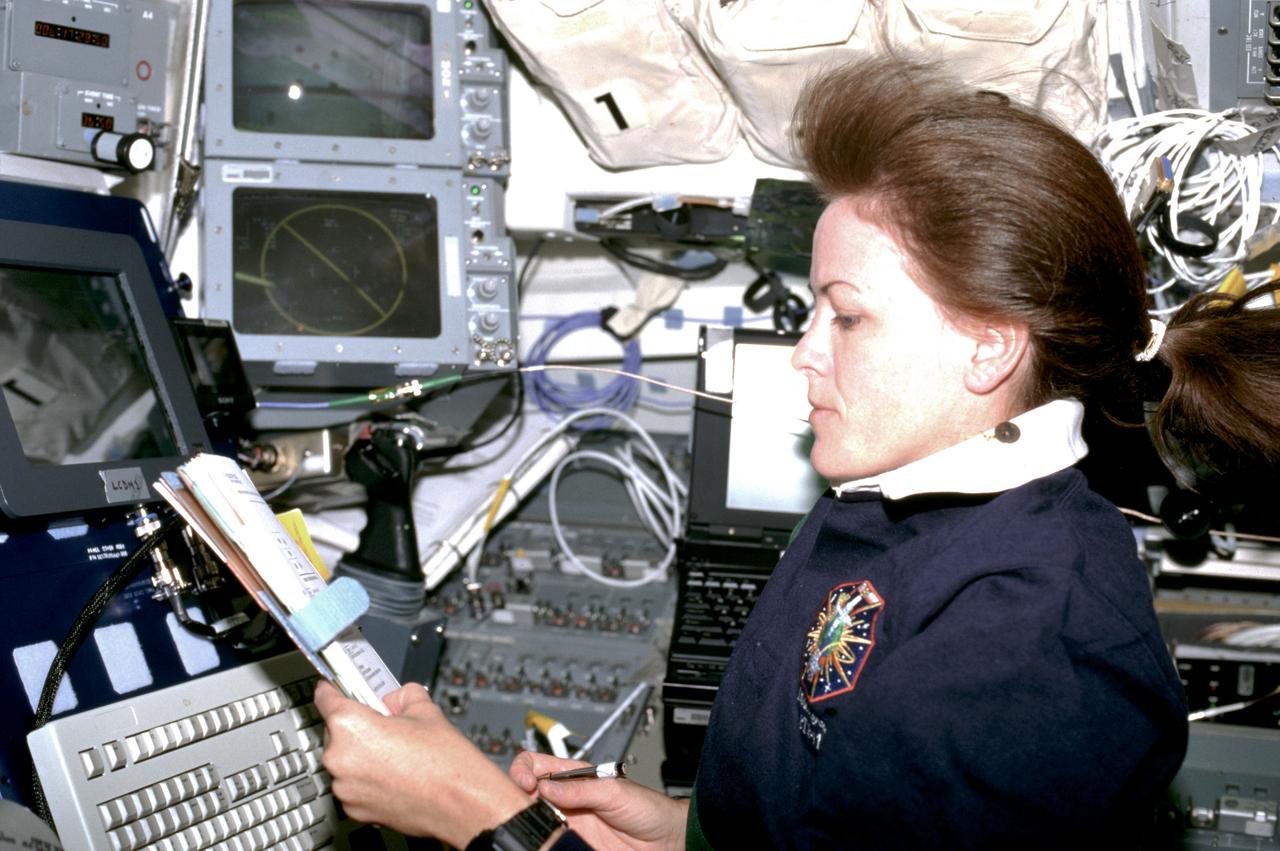
STS091-349-005 (2-12 June 1998) --- Astronaut Janet L. Kavandi, mission specialist, performs a check of the Orbiter Space Vision Systems (OSVS) on the flight deck of the Earth-orbiting Space Shuttle Discovery.
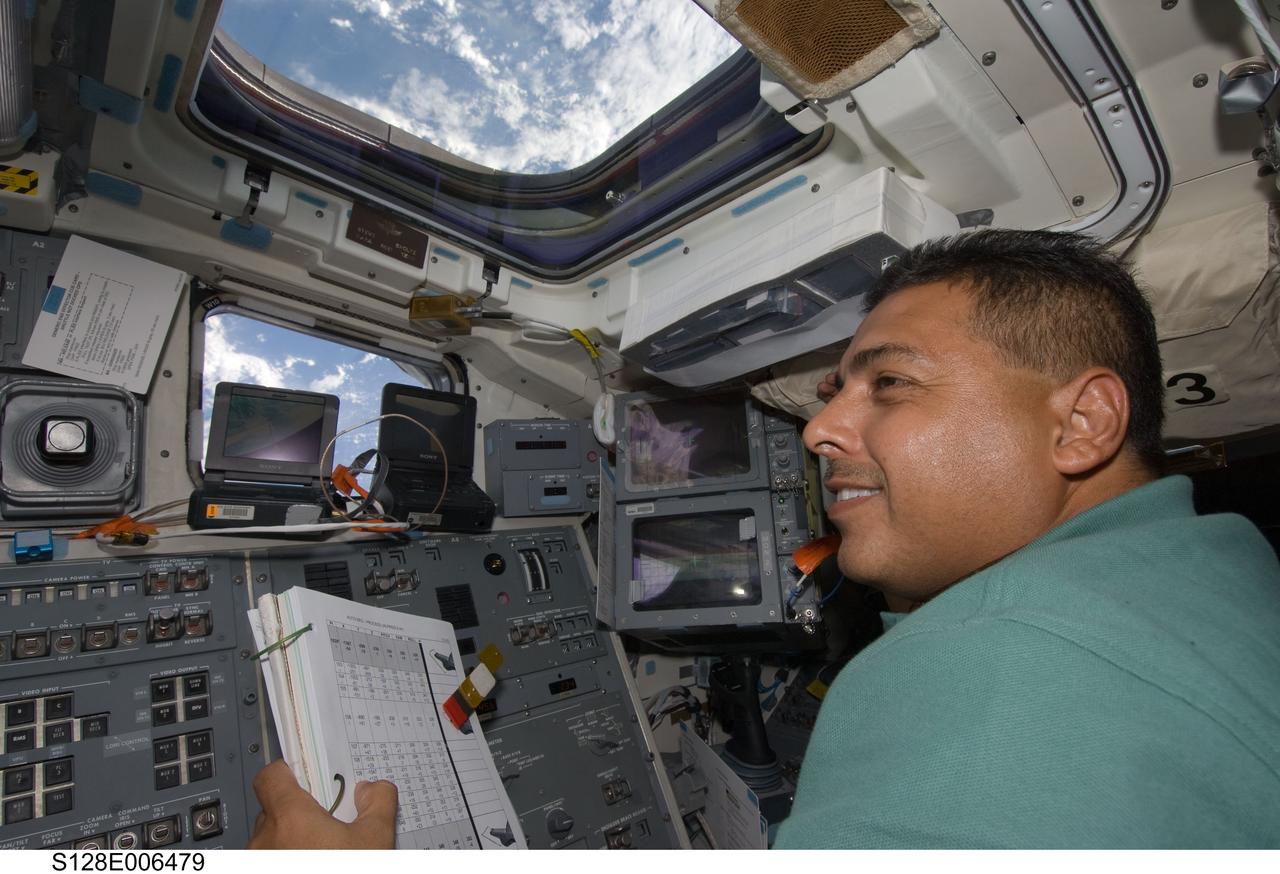
S128-E-006479 (29 Aug. 2009) --- Astronaut Jose Hernandez, STS-128 mission specialist, works on the aft flight deck of the Earth-orbiting Space Shuttle Discovery during flight day two activities.
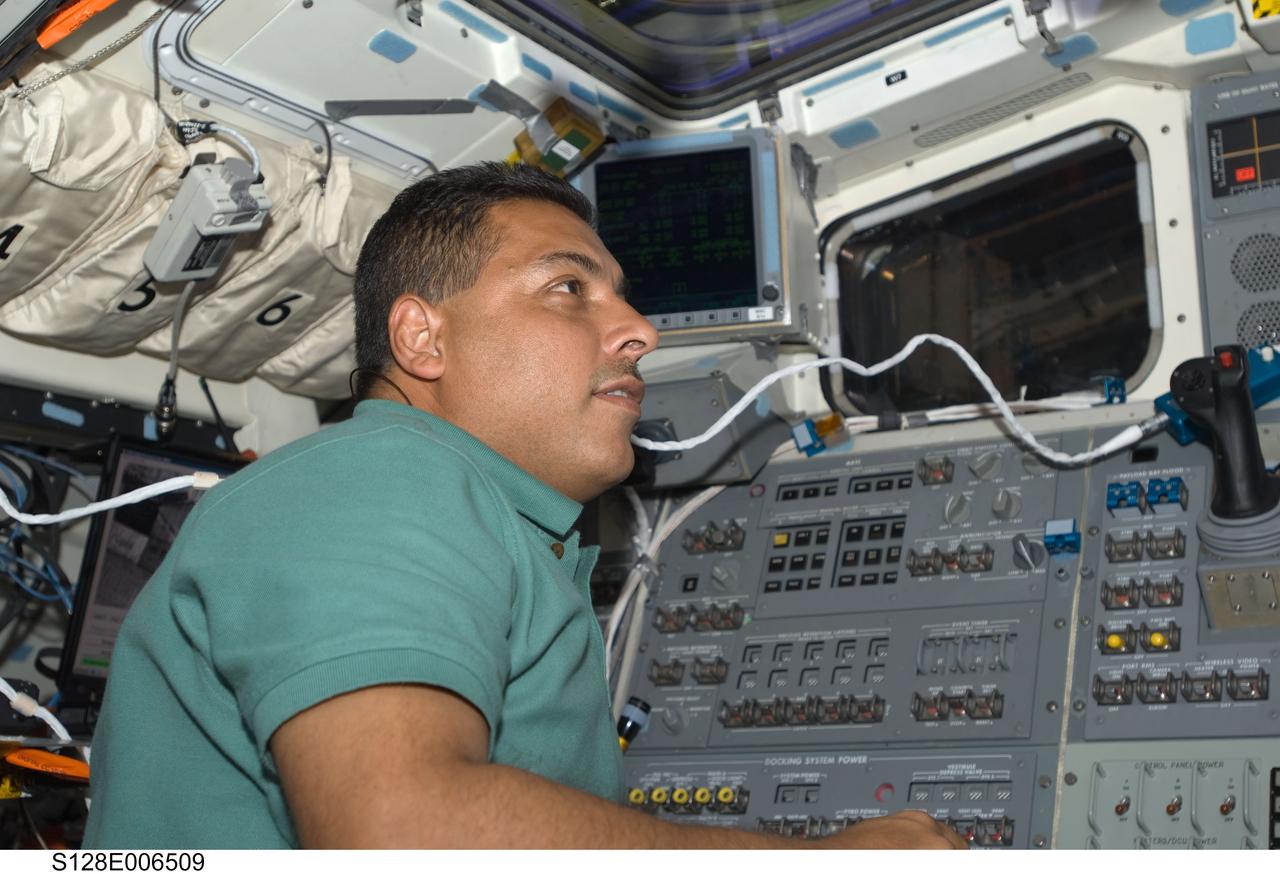
S128-E-006509 (29 Aug. 2009) --- Astronaut Jose Hernandez, STS-128 mission specialist, is pictured on the aft flight deck of the Earth-orbiting Space Shuttle Discovery during flight day two activities.
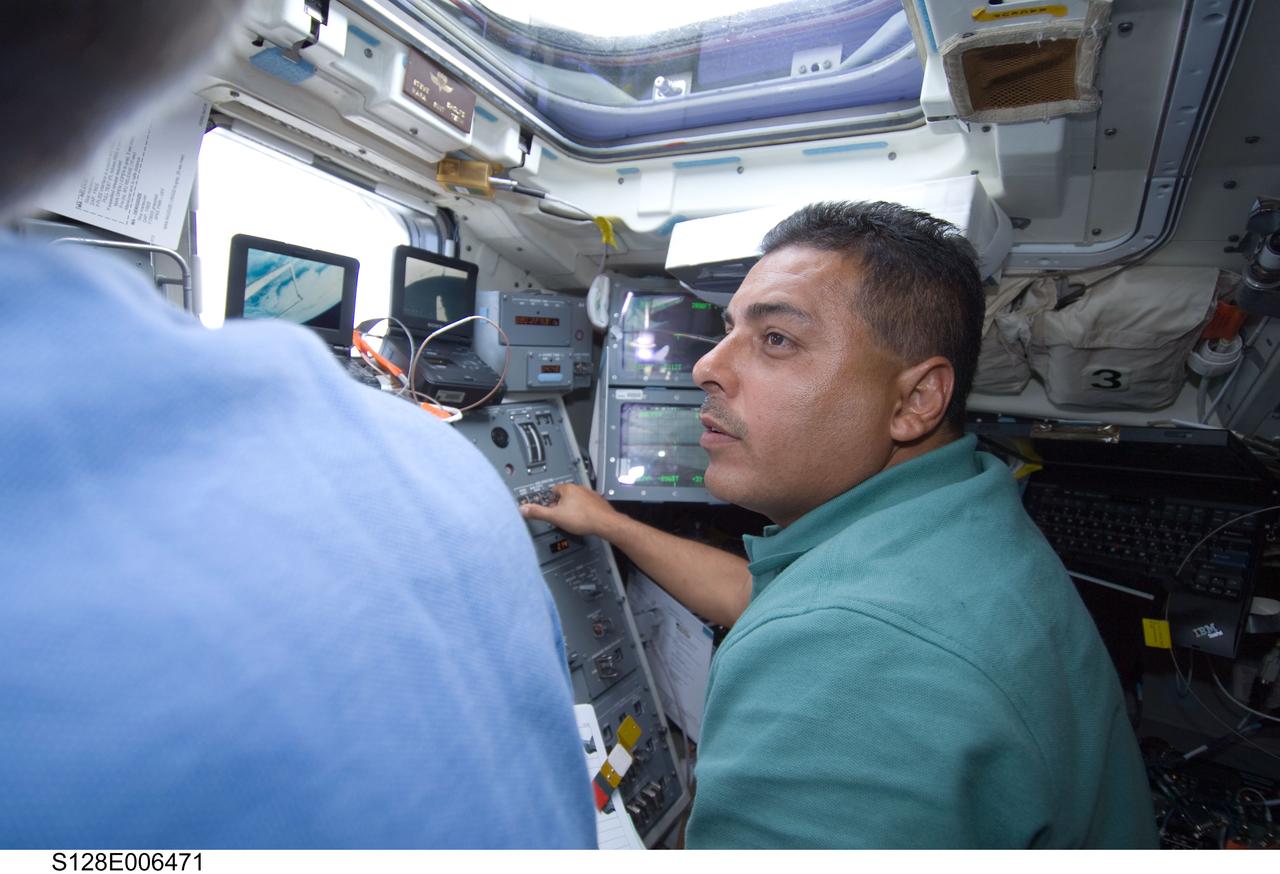
S128-E-006471 (29 Aug. 2009) --- Astronaut Jose Hernandez, STS-128 mission specialist, works controls on the aft flight deck of the Earth-orbiting Space Shuttle Discovery during flight day two activities.
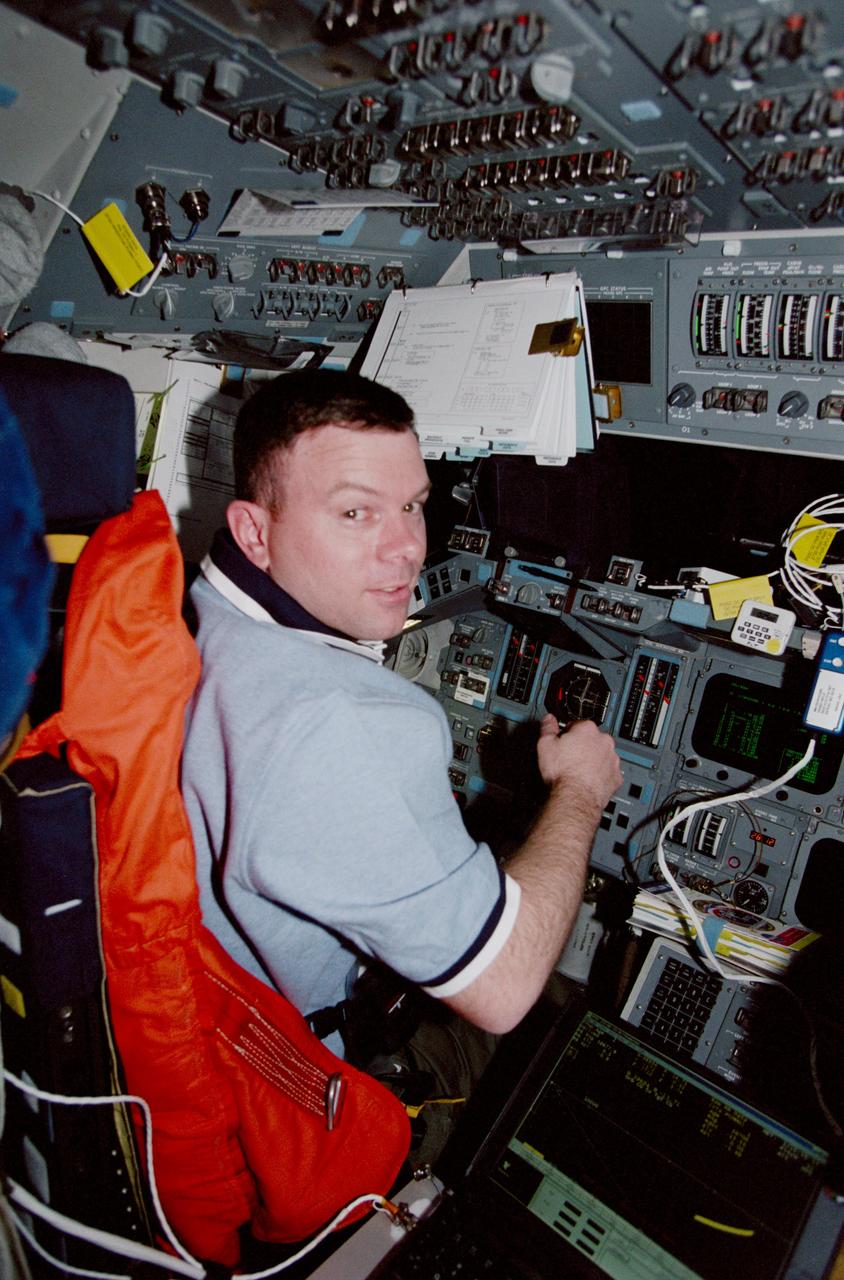
STS102-327-010 (8-21 March 2001) --- Astronaut James W. Kelly, STS-102 pilot, temporarily occupies the commander’s station on the forward flight deck of the Earth-orbiting Space Shuttle Discovery.
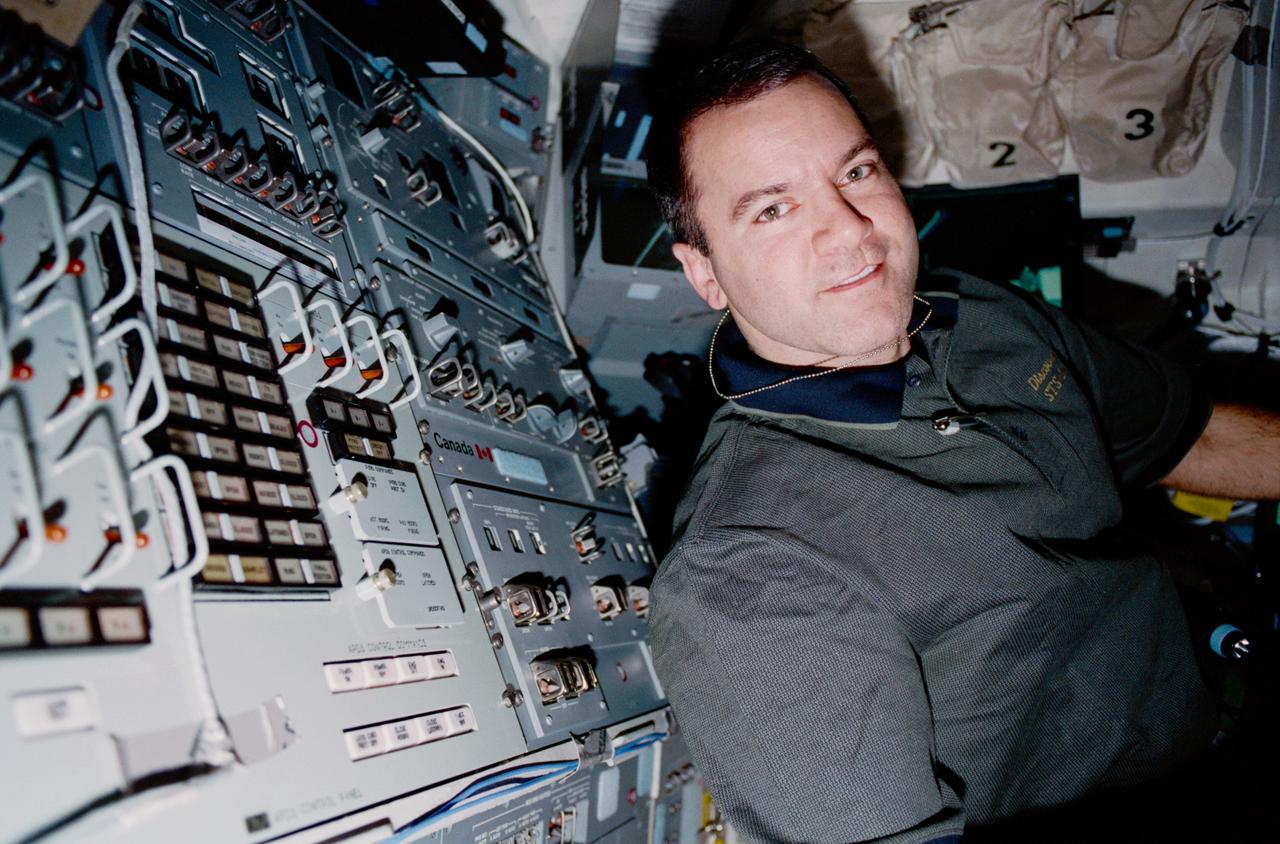
STS102-317-030 (8-21 March 2001)--- Astronaut Paul W. Richards, mission specialist, is photographed on the aft flight deck of the orbiting Space Shuttle Discovery during the STS-102 mission.
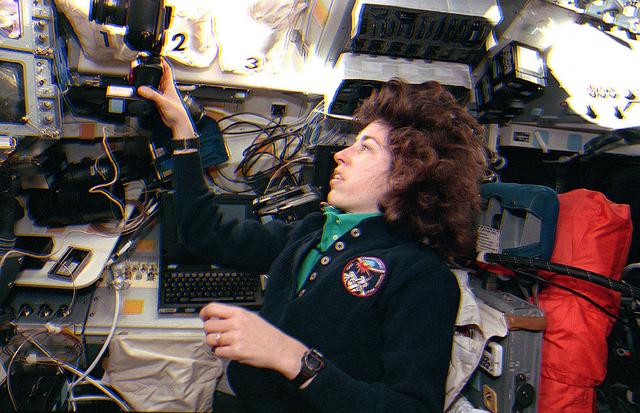
Space Shuttle Discovery (STS-56) Mission Specialist 3 (MS3) Ellen Ochoa handles a 35mm camera on the aft flight deck of the Orbiter. Ochoa is positioned next to the payload station and behind the commander's station.
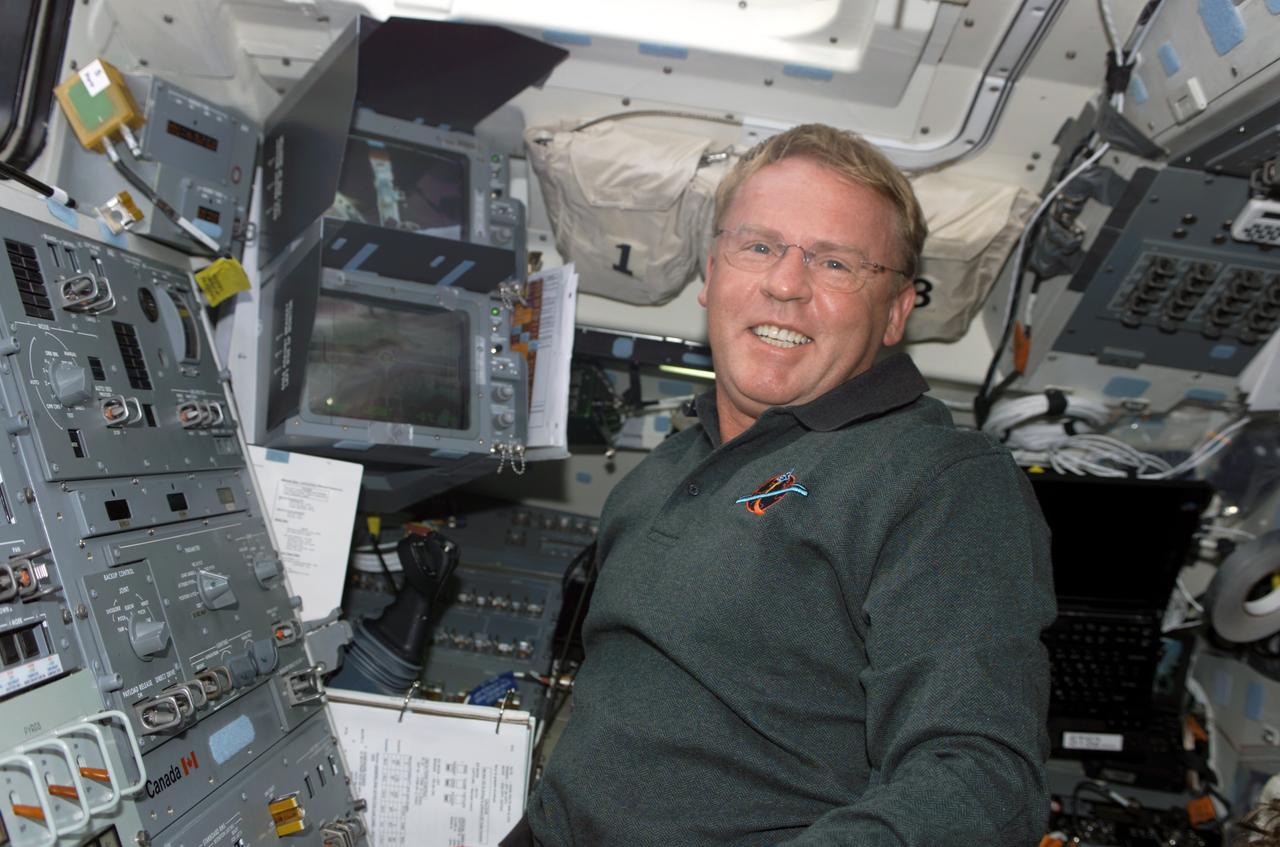
S114-E-5210 (27 July 2005) --- Astronaut Andrew S.W. Thomas, mission specialist, on Discovery's aft flight deck during the second day of orbital activities.
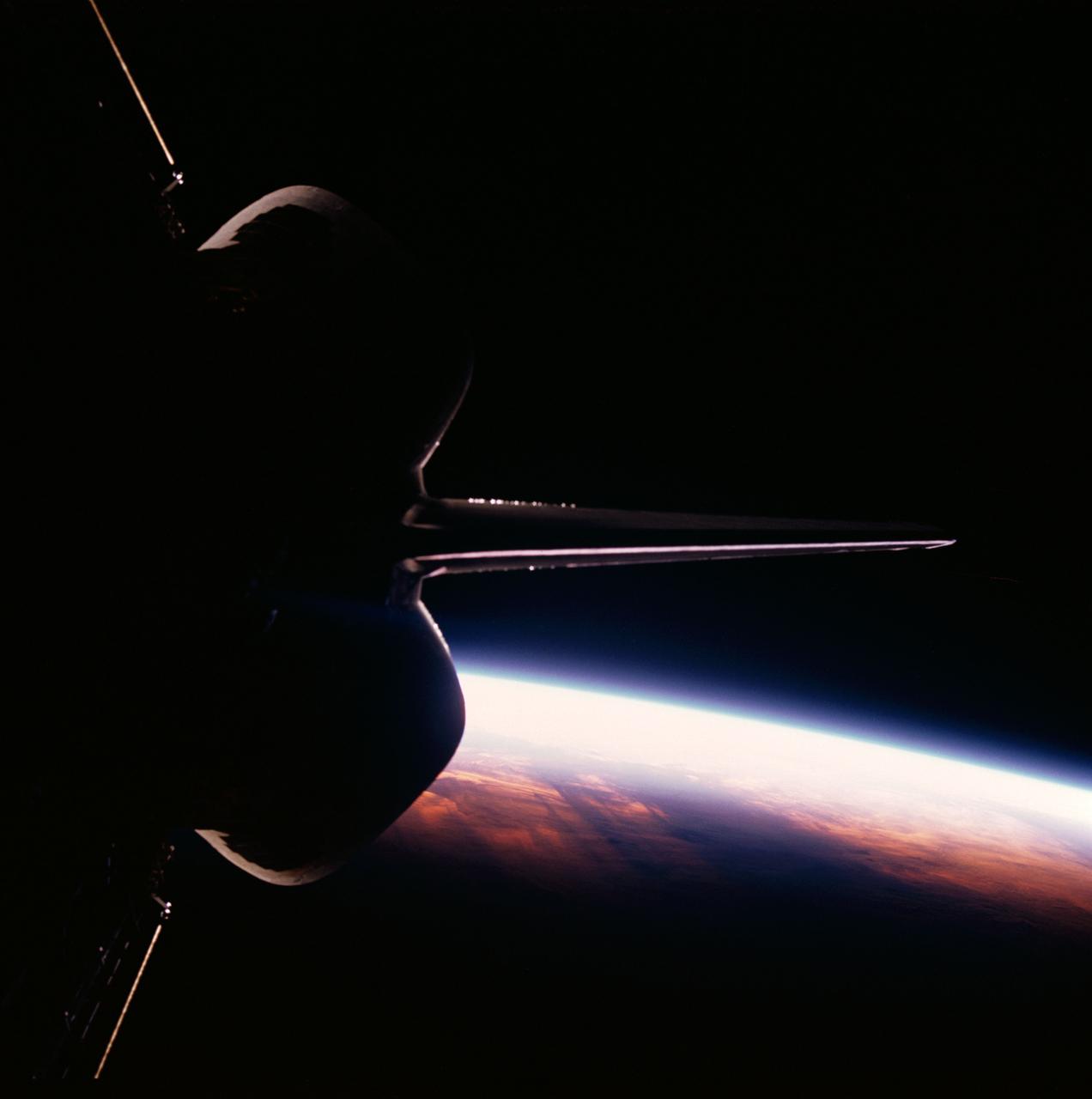
Discovery's, Orbiter Vehicle (OV) 103's, vertical stabilizer and orbital maneuvering system (OMS) pods are backdropped against the contrasted blackness of space illuminated by a colorful Earth / sunrise panorama. View was taken through the aft flight deck viewing windows during STS-26.
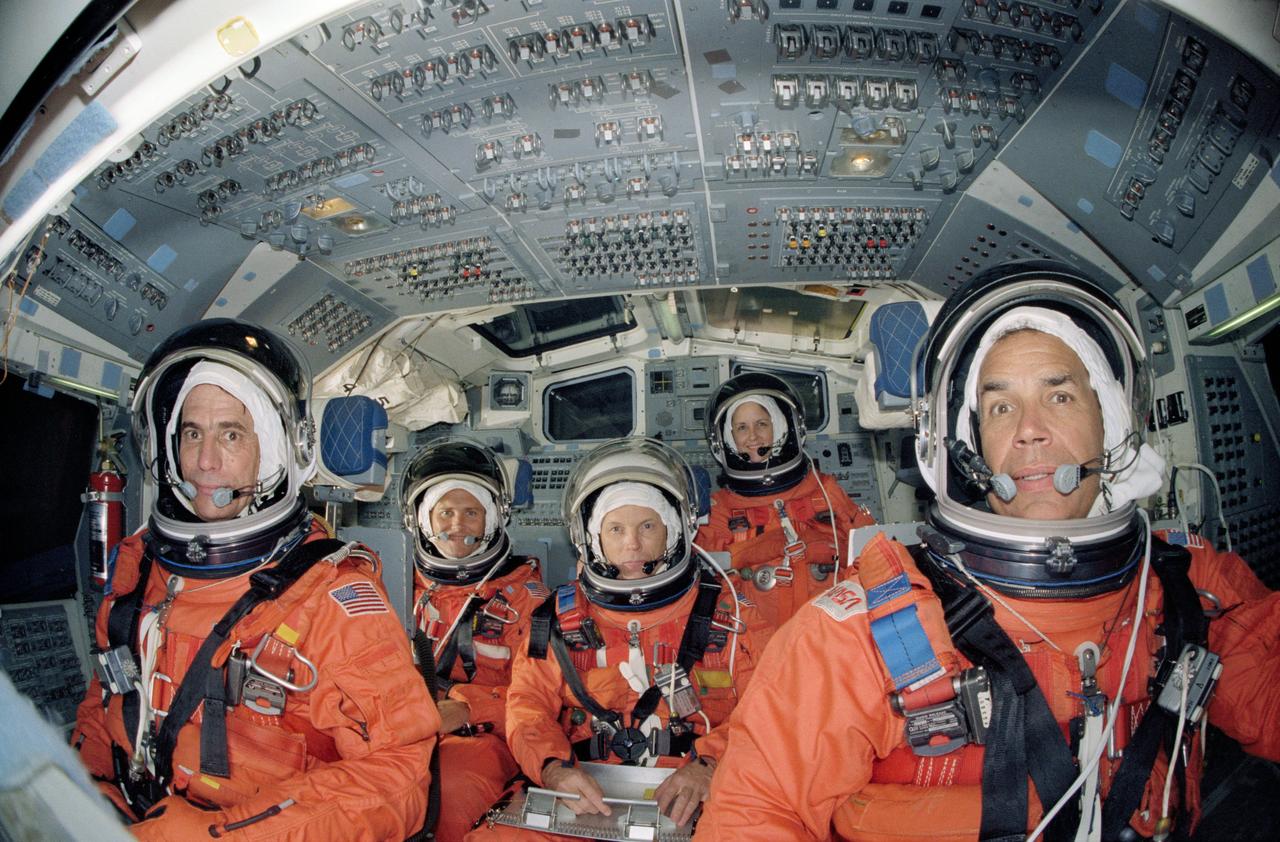
STS-33 Discovery, Orbiter Vehicle (OV) 103, crewmembers, wearing orange launch and entry suits (LESs) and launch and entry helmets (LEHs), are seated in their launch and entry positions on crew compartment trainer (CCT) flight deck during a training exercise in JSC Mockup and Integration Laboratory (MAIL) Bldg 9A. Commander Frederick D. Gregory (far right) is stationed at forward flight deck commanders controls, Pilot John E. Blaha (far left) at the pilots controls and on aft flight deck are mission specialists Manley L. Carter, Jr (left), MS F. Story Musgrave (center, holding clipboard), and MS Kathryn C. Thornton (standing). Overhead forward control panels are visible above the astronauts and aft flight deck onorbit station control panels and windows are visible in the background. Thornton is on the flight deck for this photo but during launch and entry will be seated on the middeck.
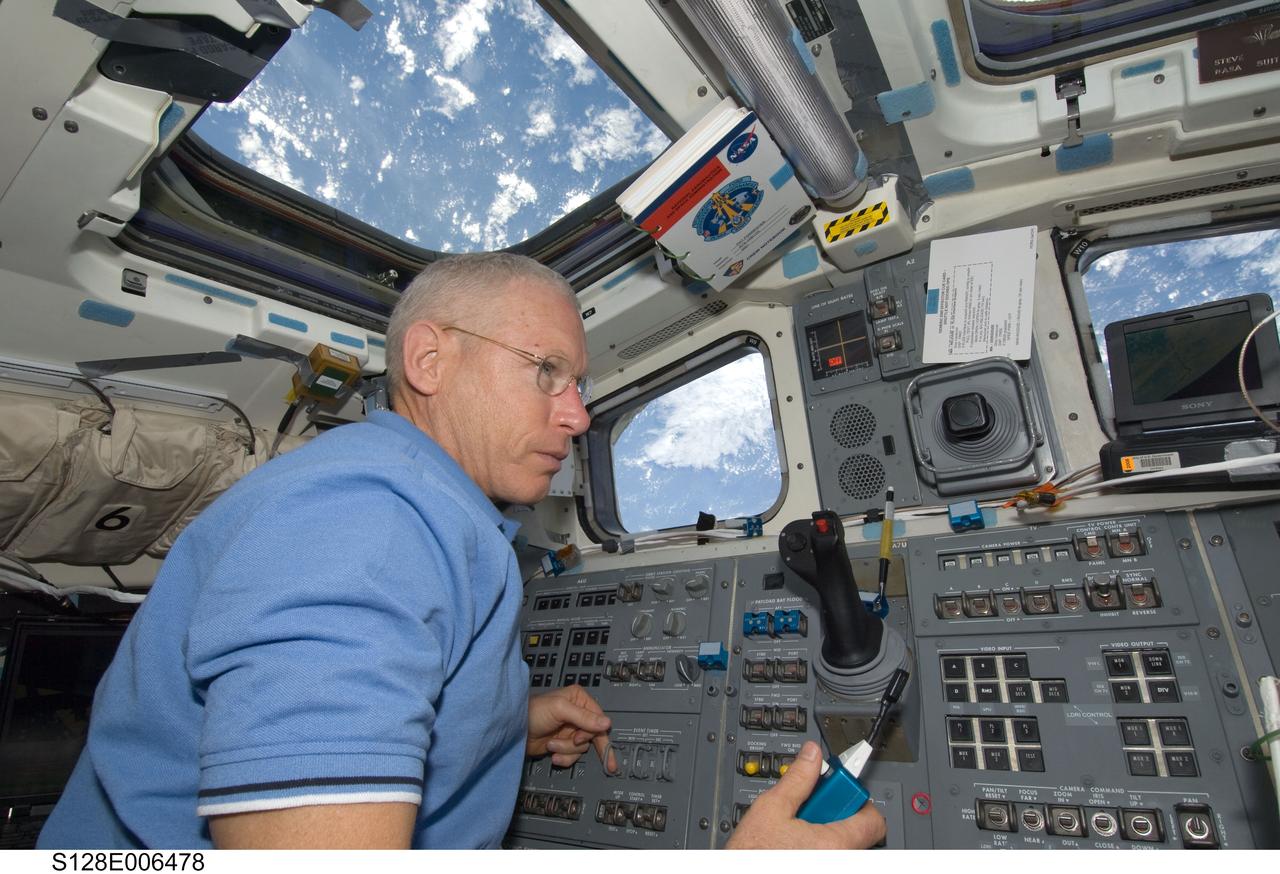
S128-E-006478 (29 Aug. 2009) --- Astronaut Patrick Forrester, STS-128 mission specialist, uses a communication system on the aft flight deck of the Earth-orbiting Space Shuttle Discovery during flight day two activities.
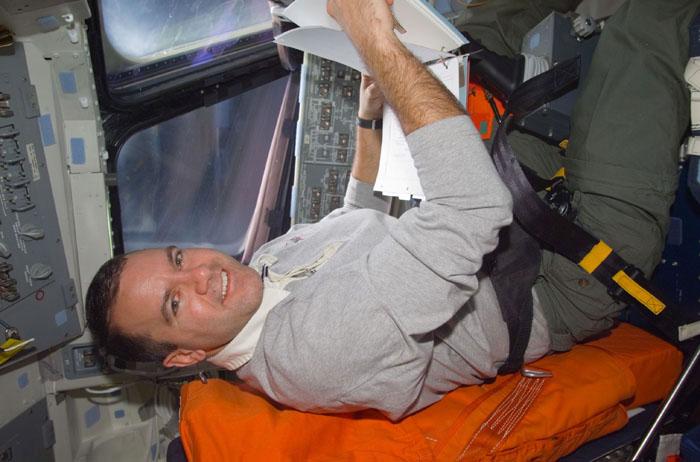
STS102-E-5010 (9 March 2001) --- Astronaut Paul W. Richards, mission specialist, temporarily occupies the commander's station on the forward flight deck of Earth-orbiting Space Shuttle Discovery during late Flight Day 1 activity.
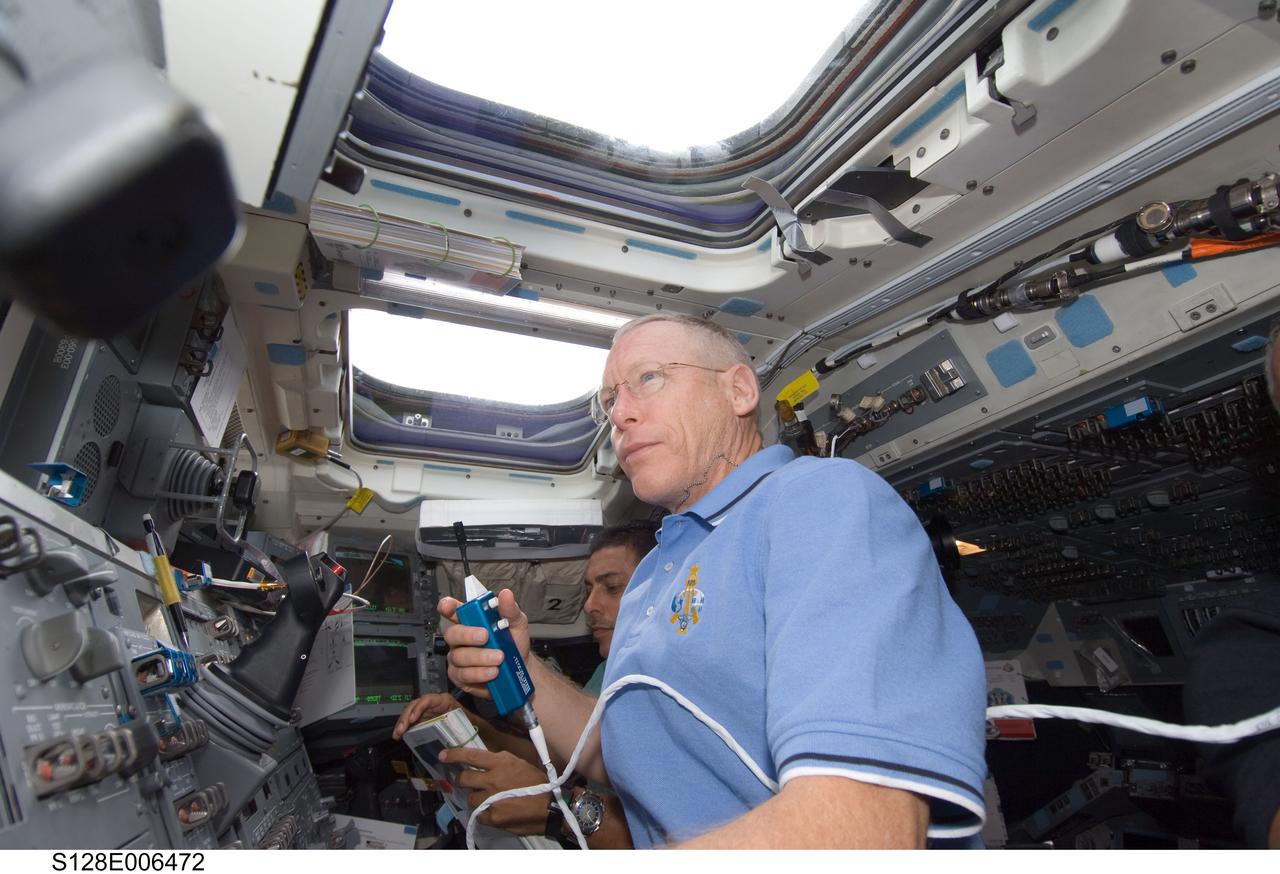
S128-E-006472 (29 Aug. 2009) --- Astronaut Patrick Forrester, STS-128 mission specialist, uses a communication system on the aft flight deck of the Earth-orbiting Space Shuttle Discovery during flight day two activities.
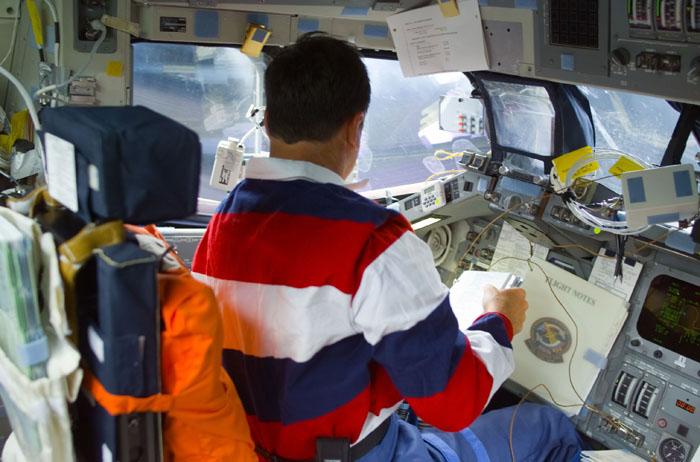
STS105-E-5001 (10 August 2001) --- Astronaut Scott J. Horowitz, STS-105 commander, checks flight notes at the commander's station on the flight deck of the Earth-orbiting Space Shuttle Discovery. The image was recorded with a digital still camera.
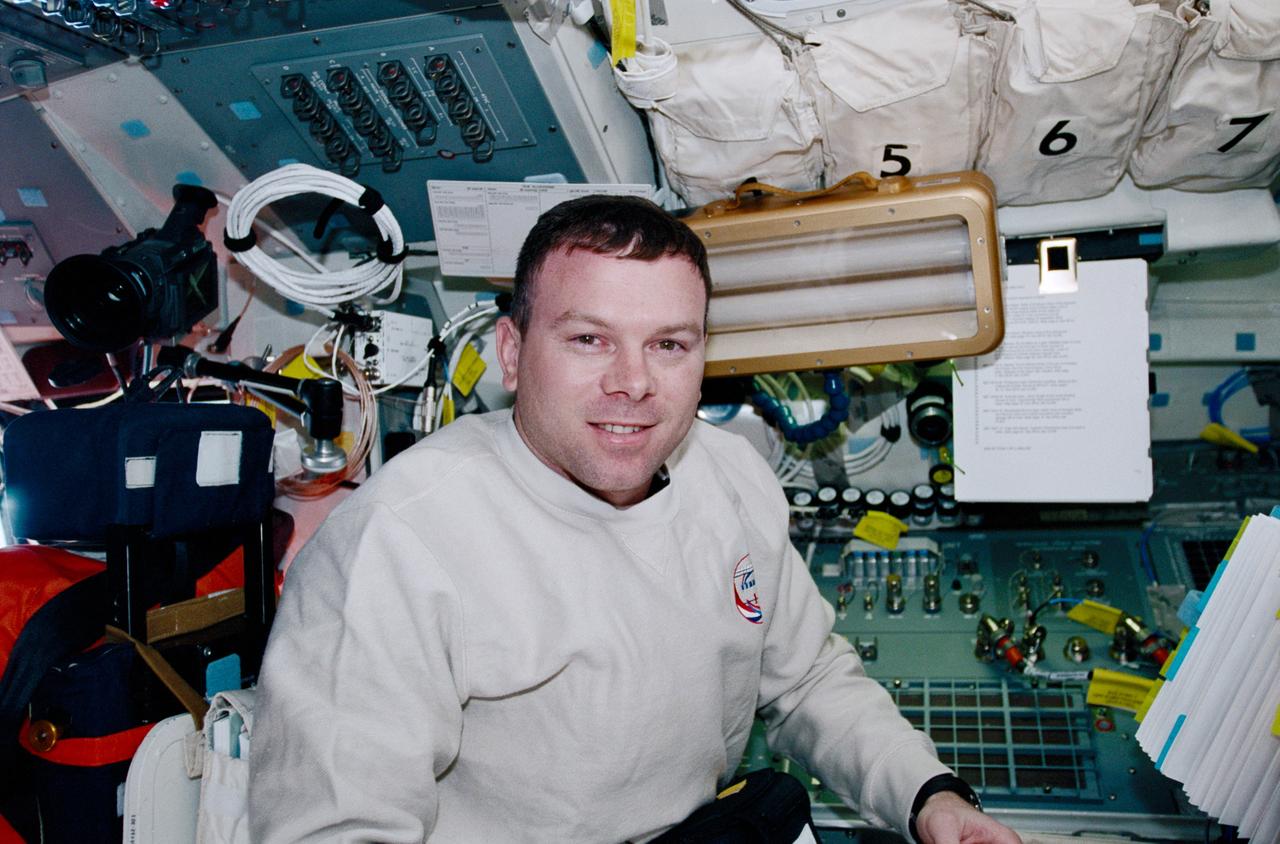
STS102-330-001 (8-21 March 2001) --- Astronaut James M. Kelly, STS-102 pilot, is photographed on the flight deck of the Earth-orbiting Space Shuttle Discovery. Kelly, an alumnus of the 1996 astronaut candidate class, is making his first flight in space.
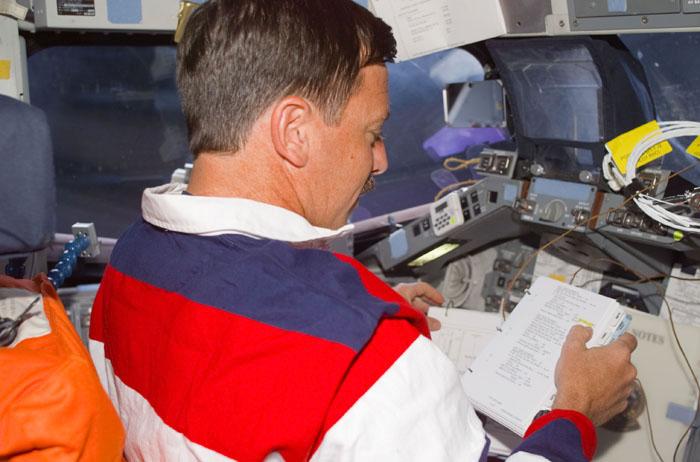
STS105-E-5002 (10 August 2001) --- Astronaut Scott J. Horowitz, STS-105 commander, checks flight notes at the commander's station on the flight deck of the Earth-orbiting Space Shuttle Discovery. The image was recorded with a digital still camera.
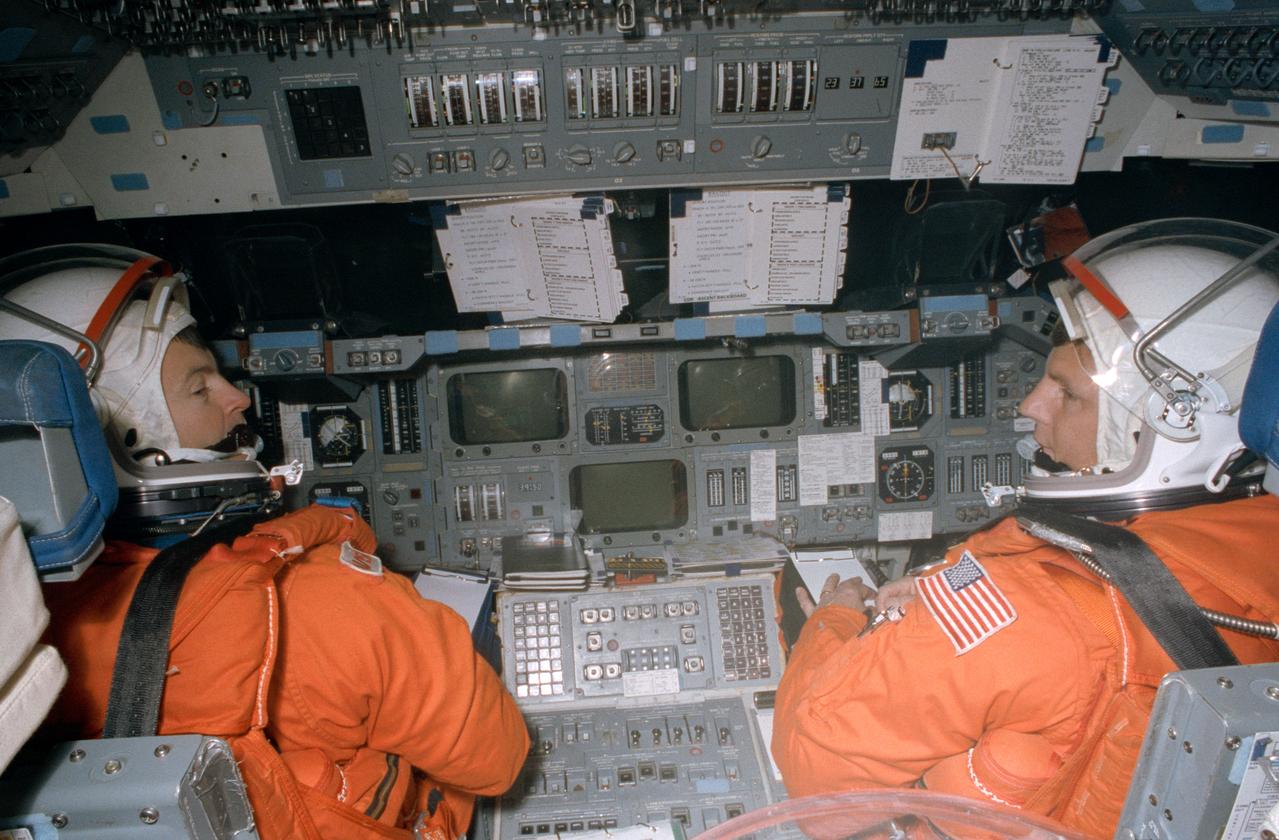
STS-56 Discovery, Orbiter Vehicle (OV) 103, Commander Kenneth Cameron, (left) and Pilot Stephen S. Oswald, wearing launch and entry suits (LESs) and launch and entry helmets (LEHs), are seated on the forward flight deck of the crew compartment trainer (CCT), a shuttle mockup. Cameron mans the commander station controls and Oswald the pilots station controls during an emergency egress (bailout) simulation. The view was taken from the aft flight deck looking forward and includes Cameron's and Oswald's profiles and the forward flight deck controls and checklists. The CCT is located in JSC's Mockup and Integration Laboratory (MAIL) Bldg 9NE.
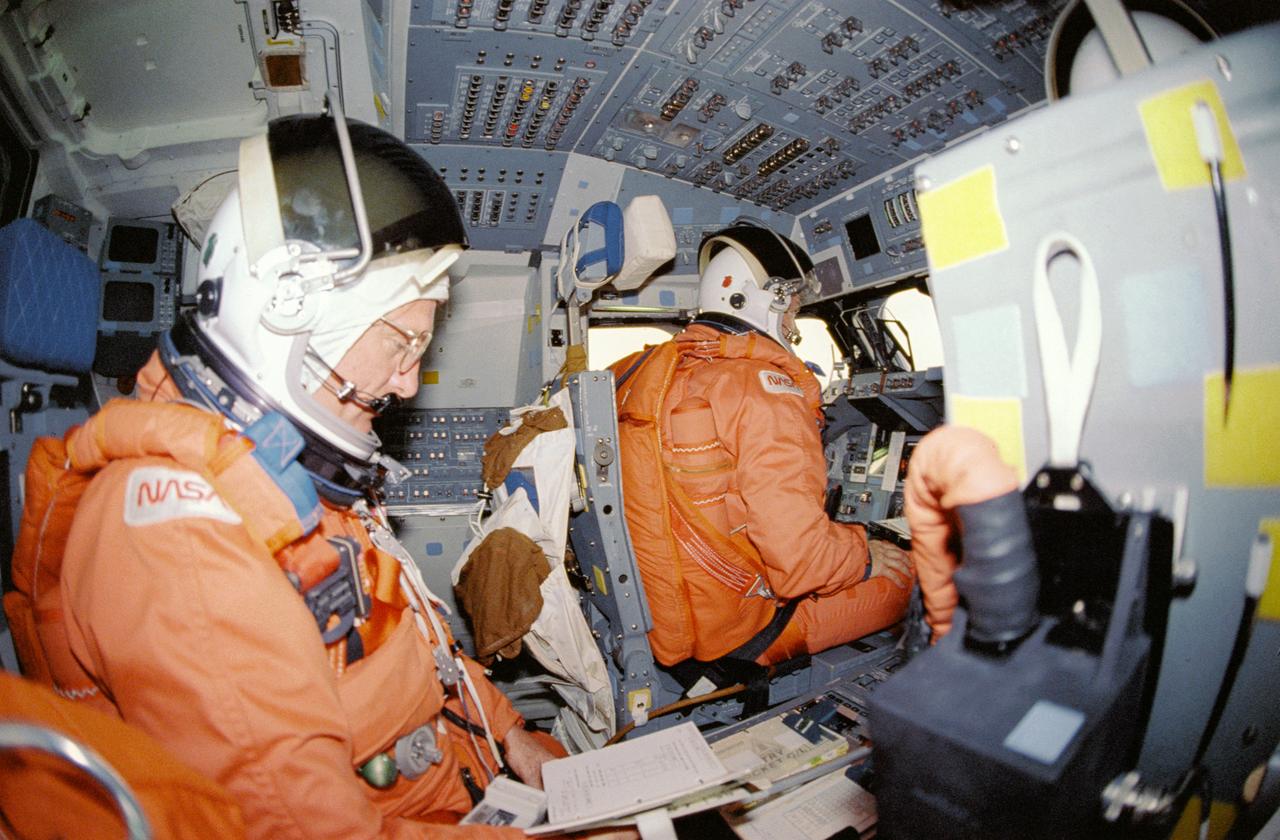
STS029-24-004 (18 March 1989) --- STS-29 crewmembers, wearing launch and entry suits (LESs) and launch and entry helmets (LEHs), review checklists on Discovery, Orbiter Vehicle (OV) 103, flight deck. Commander Michael L. Coats is seated at the forward flight deck commanders station with Mission Specialist (MS) James F. Buchli on aft flight deck strapped in mission specialist seat. OV-103 makes its return after five days in space. Note color in forward windows W1, W2, W3 caused by friction of entry through the Earth's atmosphere. Personal Egress Air Pack (PEAP) is visible on pilots seat back.

41D-12-020 (6 Sept 1984) --- Astronaut Judith A. Resnik, mission specialist, anchors herself on the flight deck (out of frame) to take a peek at mid-deck activity aboard the Earth-orbiting Space Shuttle Discovery. Among the many stationary and portable cameras onboard the flight are (left to right) TV camera, a data acquisition motion picture camera and the IMAX.
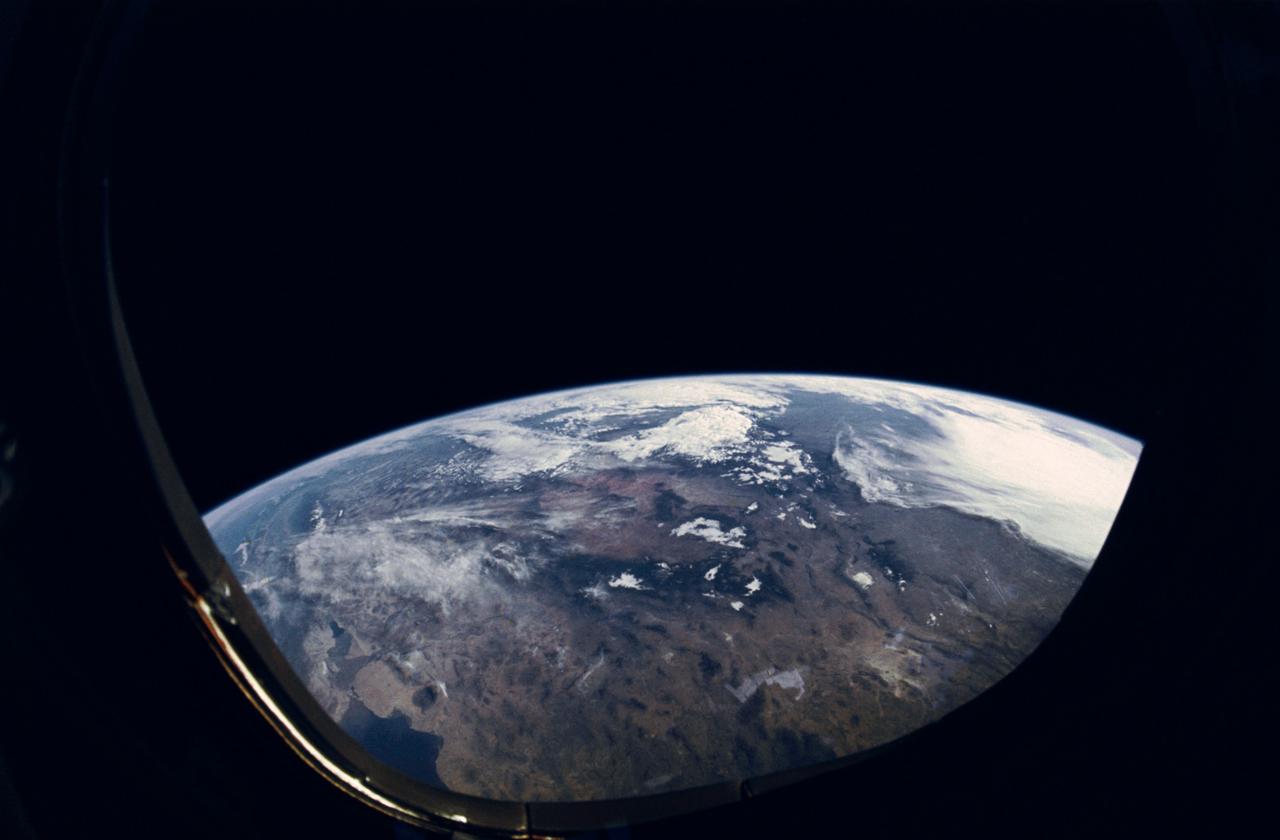
STS-31 Earth observation taken aboard Discovery, Orbiter Vehicle (OV) 103, is of the western United States with the Salton Sea and Imperial Valley area recognizable at the lower left. The view is framed in a flight deck window and was photographed using a fish-eye lens.
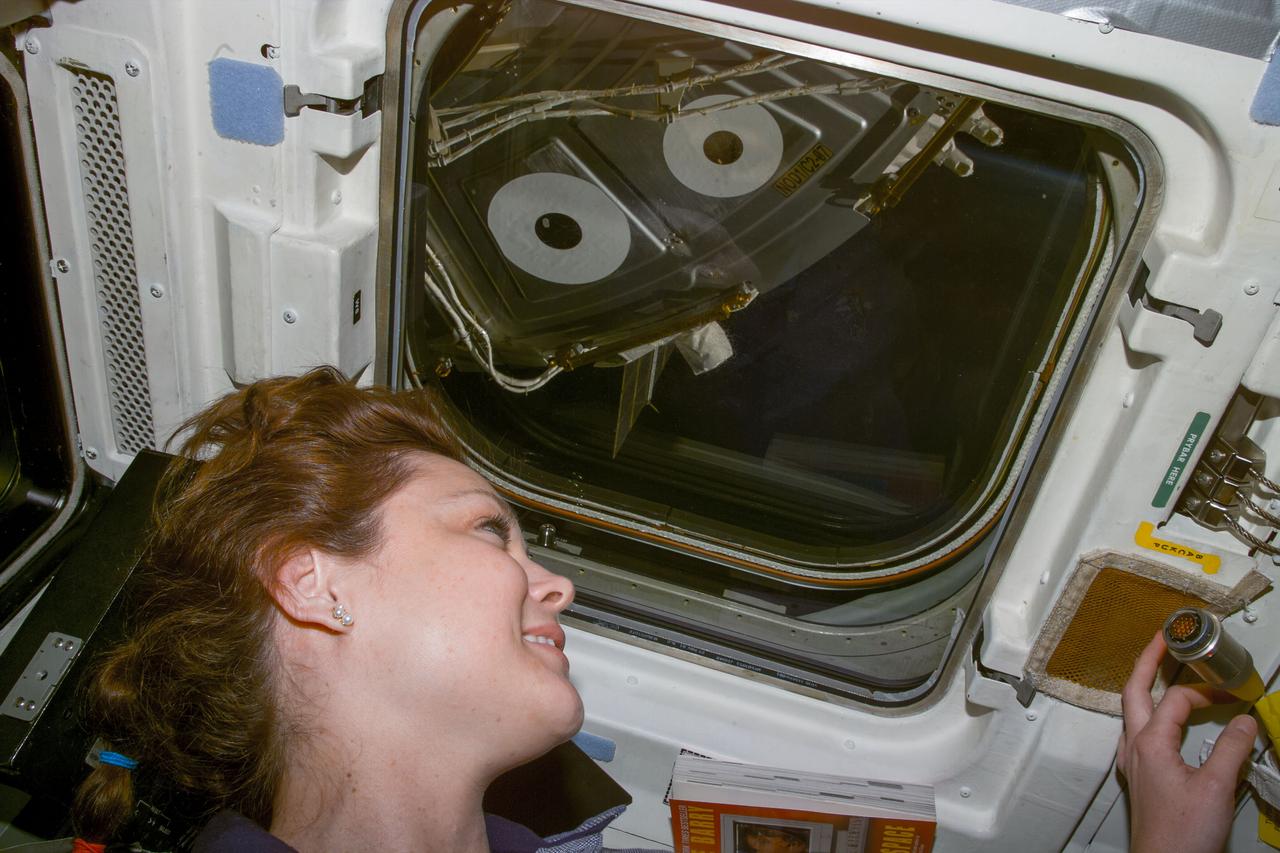
S96-E-5131 (1 June 1999) --- Astronaut Tamara Jernigan looks toward the docked International Space Station (ISS) from the aft flight deck of the Earth-orbiting Space Shuttle Discovery. The scene was recorded with an electronic still camera (ESC) at 11:29:21 GMT, June 1, 1999.
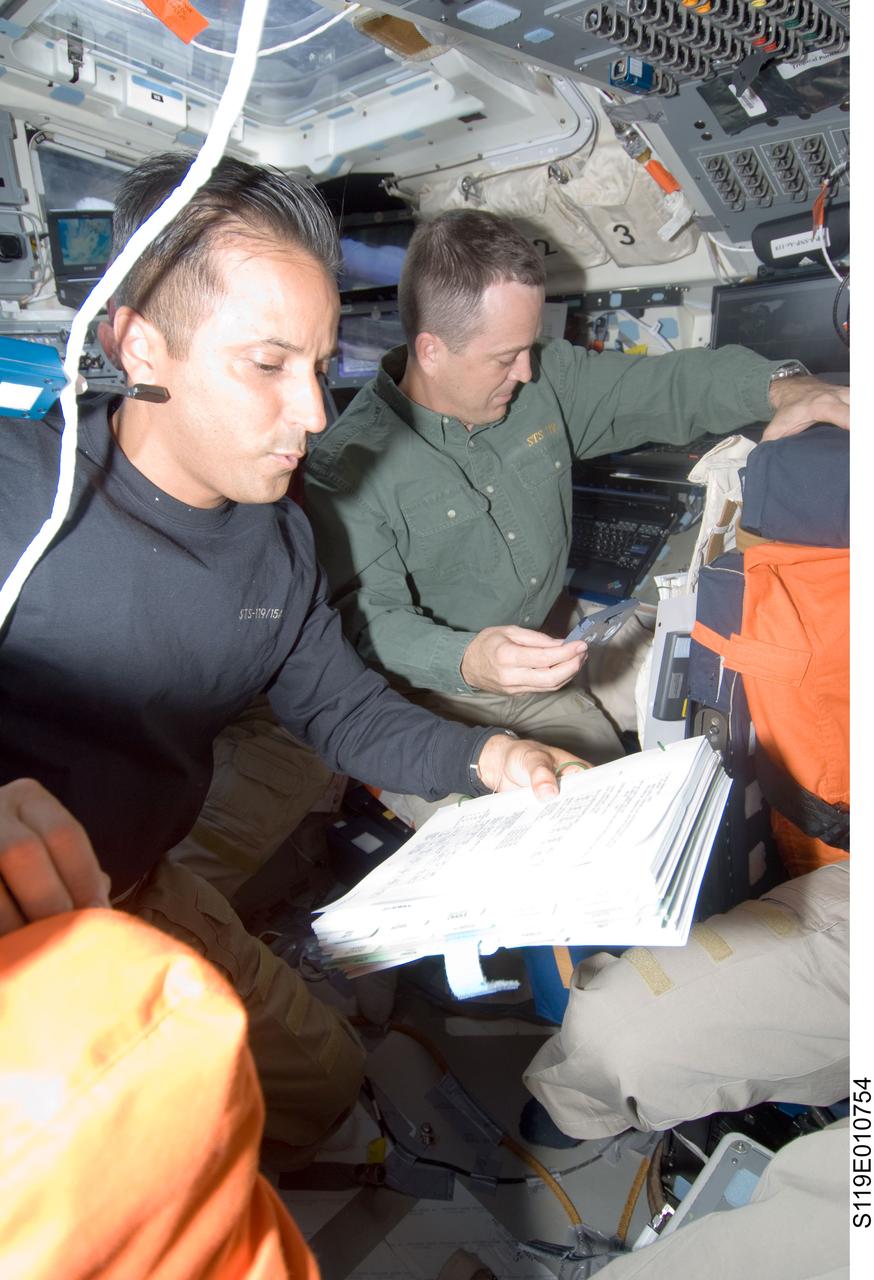
S119-E-010754 (27 March 2009) --- Astronauts Joseph Acaba, left, and Richard Arnold, mission specialist, go over procedures check lists on the flight deck of the Earth-orbiting Space Shuttle Discovery on the spacecraft's final full day in space for STS-119.
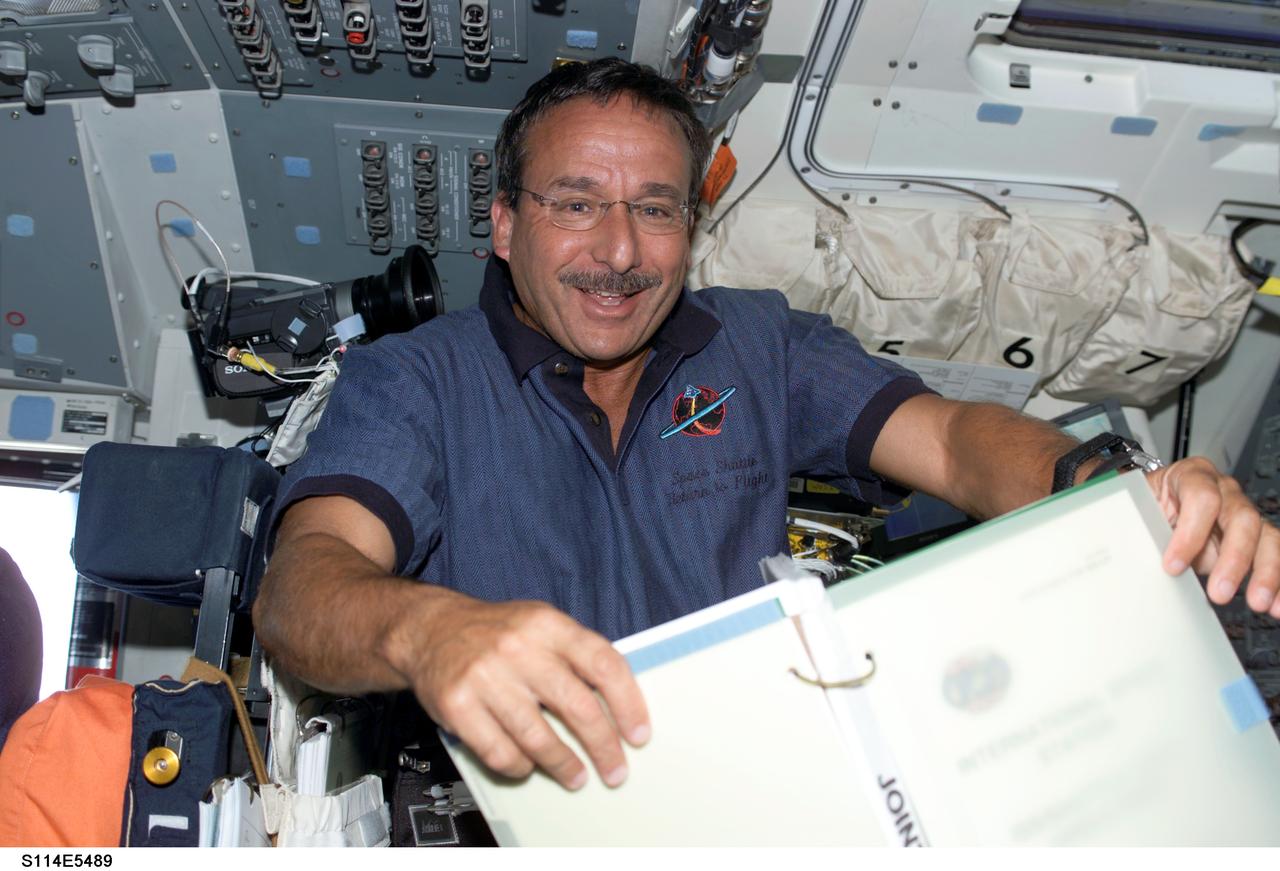
S114-E-5489 (28 July 2005) --- Astronaut Charles J. Camarda, STS-114 mission specialist, refers to a procedures checklist on Discovery's aft flight deck. This third day of on-orbit activities is dedicated primarily to rendezvous and docking activities and followup operations.
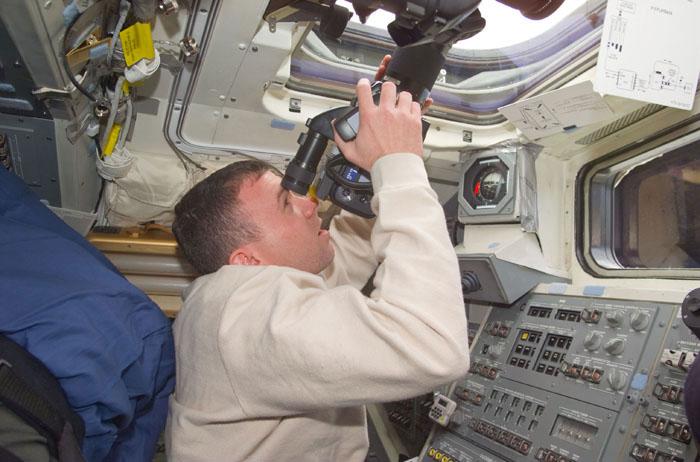
STS102-E-5008 (9 March 2001) --- Astronaut James M. Kelly, pilot, aims a camera through an overhead window on the aft flight deck of the Earth-orbiting Space Shuttle Discovery late on the initial day in space for the STS-102 crew.
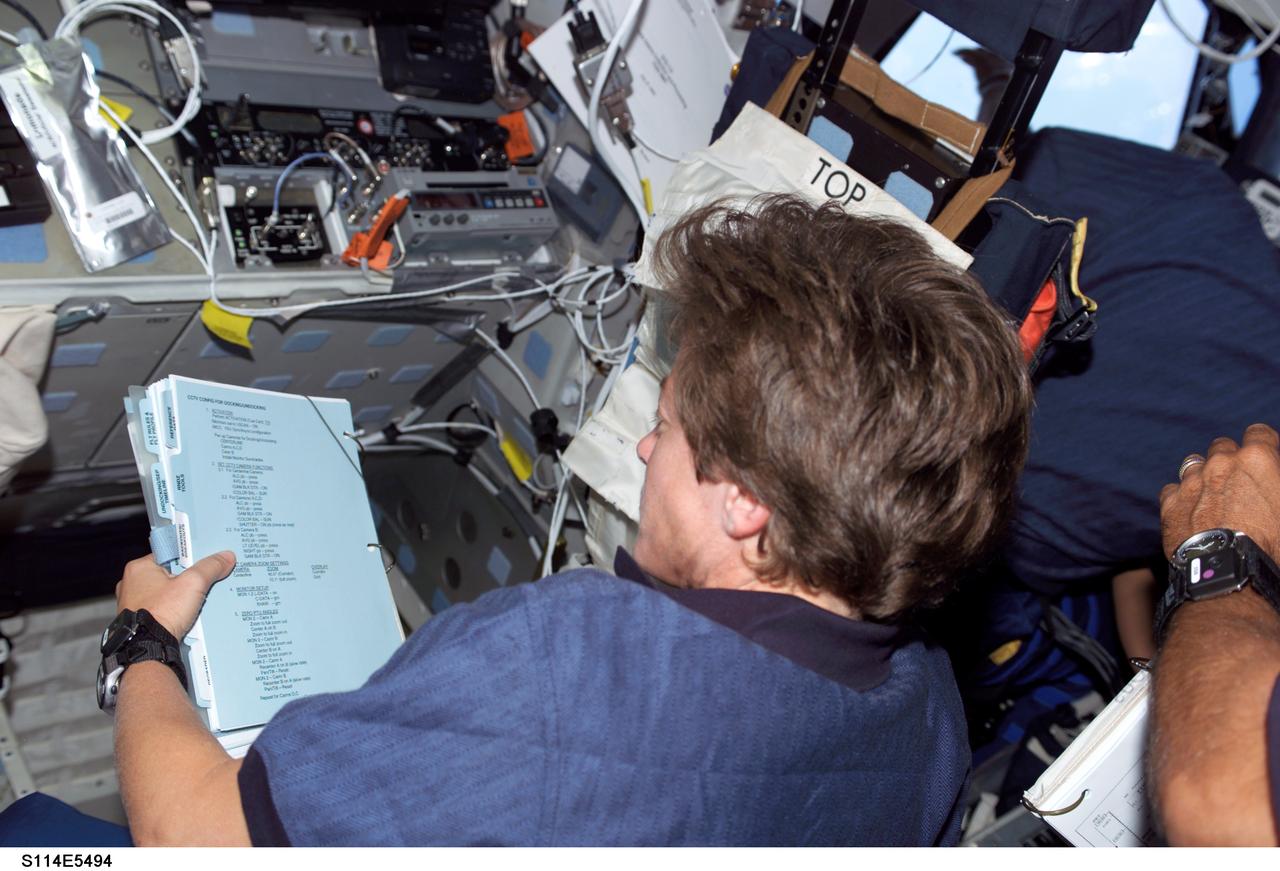
S114-E-5494 (28 July 2005) --- Astronaut Wendy Lawrence, STS-114 mission specialist, refers to a procedures checklist on Discovery's flight deck. This third day of on-orbit activities is dedicated primarily to rendezvous and docking activities and followup operations.
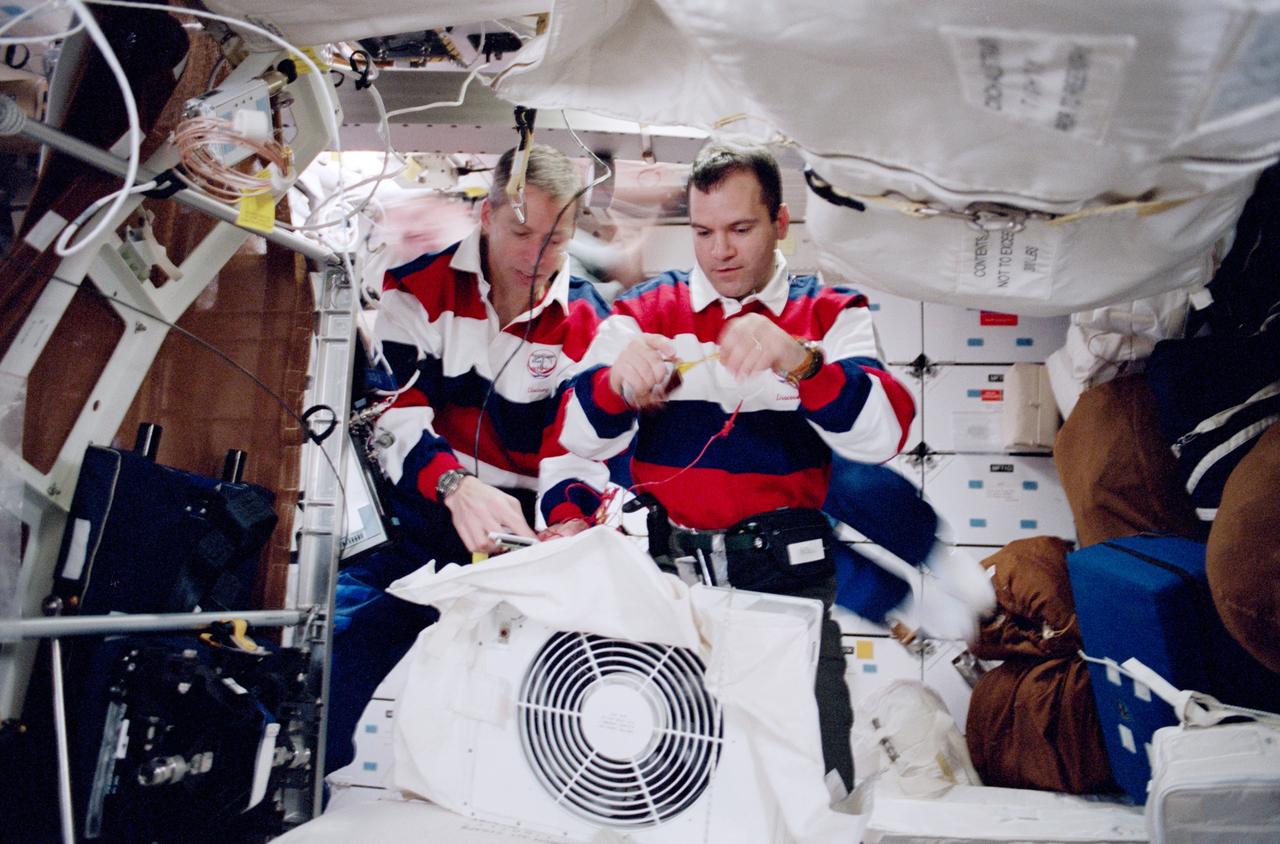
STS102-324-004 (8-21 March 2001) --- Onboard the mid deck of the Earth-orbiting Space Shuttle Discovery, astronauts James D. Wetherbee, STS-102 commander (left) and Paul W. Richards, mission specialist, are photographed performing in-flight maintenance on the cabin fan.
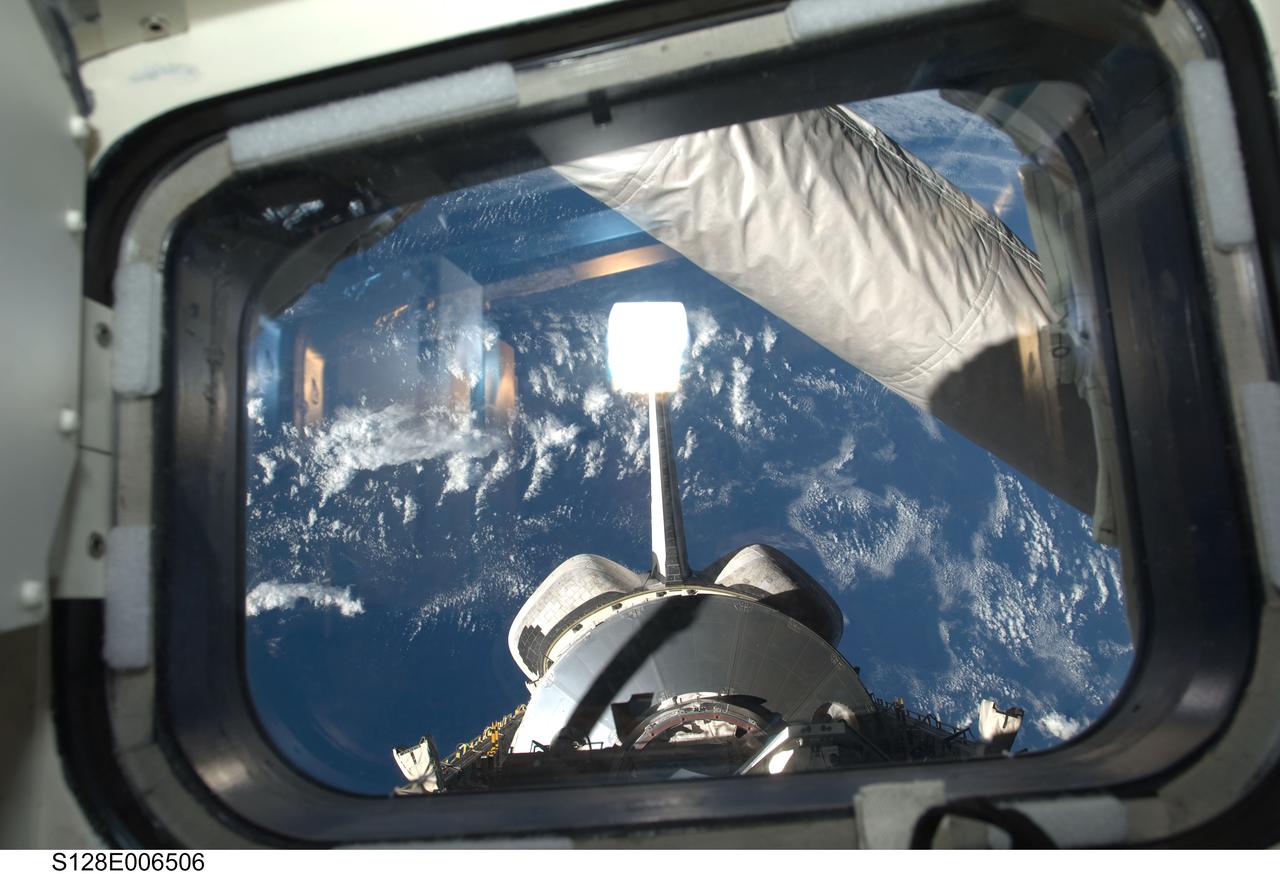
S128-E-006506 (29 Aug. 2009) --- Framed by an aft flight deck window, the Leonardo Multi-Purpose Logistics Module visible in Space Shuttle Discovery's payload bay, vertical stabilizer and orbital maneuvering system (OMS) pods are featured in this image photographed by a STS-128 crew member.

STS105-710-081 (10-22 August 2001) --- One of the astronauts on the aft flight deck of the Space Shuttle Discovery used a 70mm handheld camera to record this image of a thruster firing. The blackness of space surrounds this view of the orbital maneuvering system (OMS) pods during the OMS burn giving the tail of the shuttle a red glow.
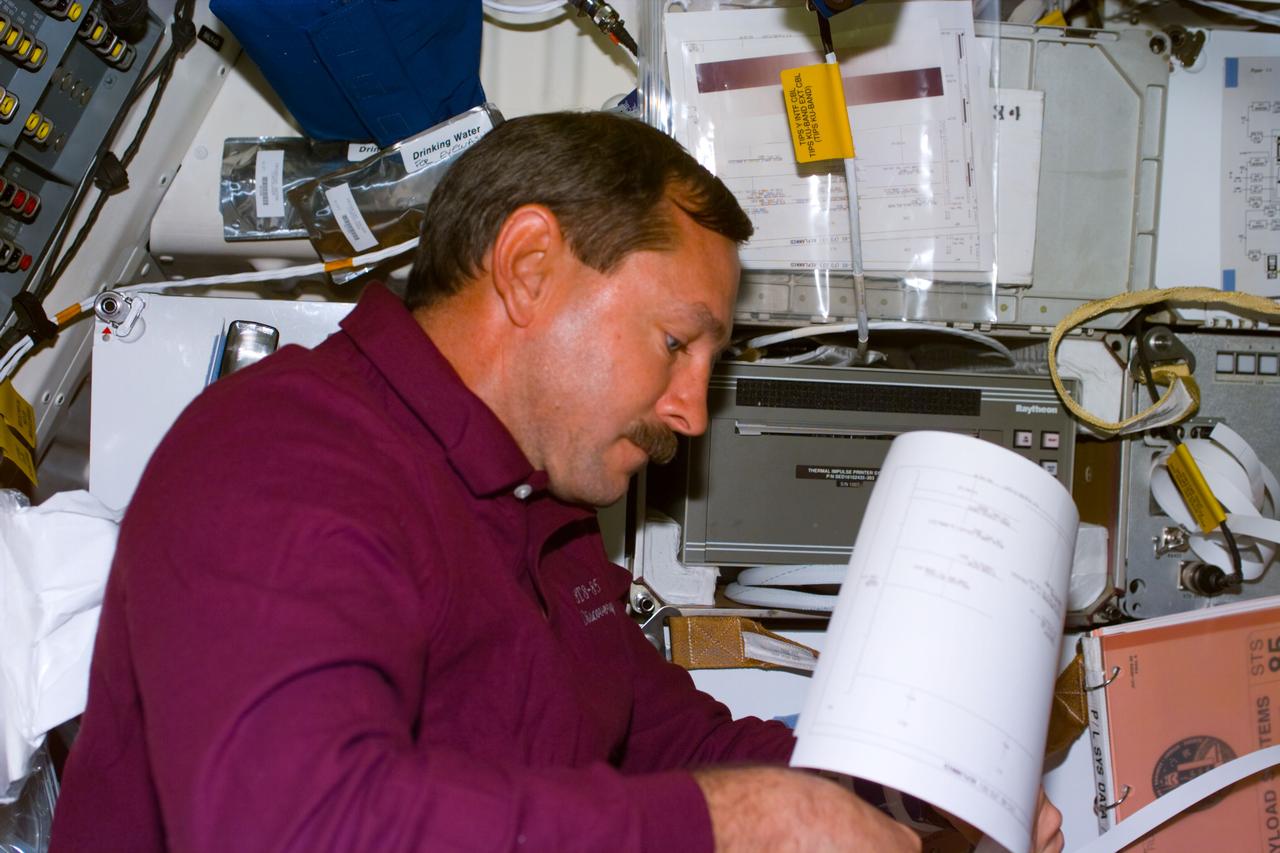
S85-E-5038 (11 August 1997) --- Astronaut Curtis L. Brown, Jr., commander, checks over the most recent send-up of mail from flight controllers in Houston, Texas. The Thermal Imaging Printing System (TIPS) station is on the mid-deck of the Earth-orbiting Space Shuttle Discovery.
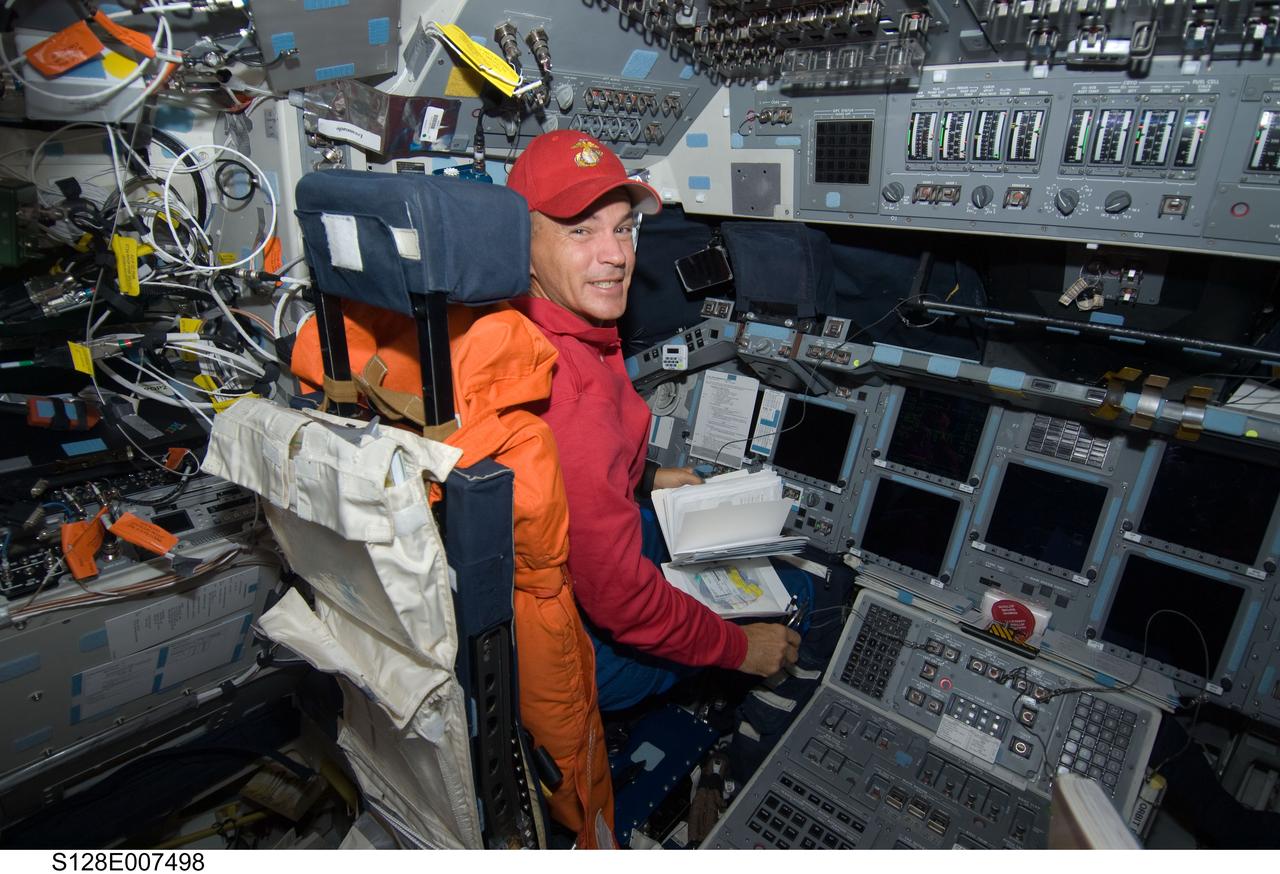
S128-E-007498 (4 Sept. 2009) ---- Astronaut Rick Sturckow, STS-128 commander, is pictured at the commander's station on the flight deck of the Space Shuttle Discovery. The shuttle is currently docked with the International Space Station while the STS-128 astronauts work with the Expedition 20 crewmembers aboard the orbital outpost.
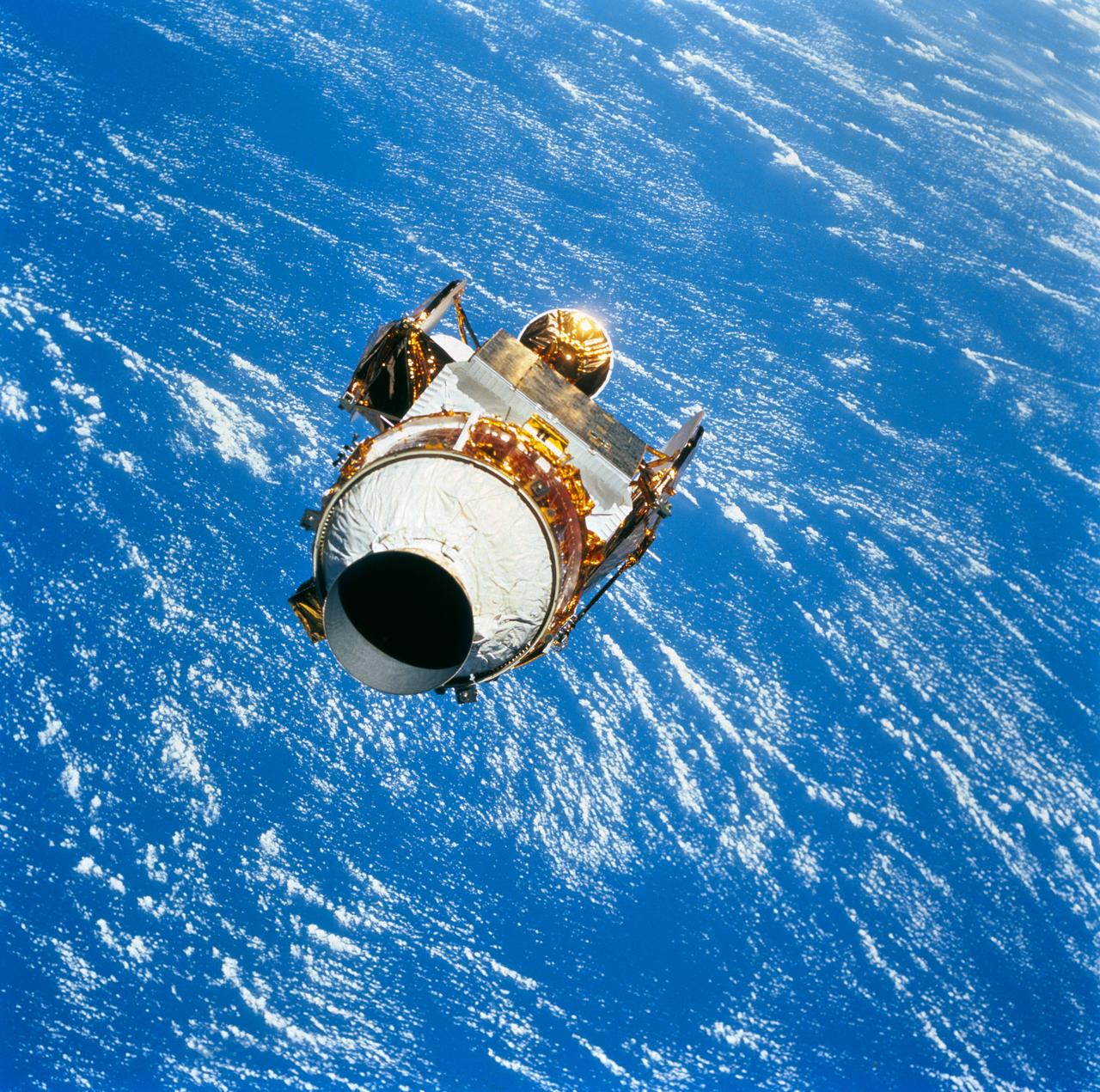
STS051-71-054 (12 Sept 1993) --- The Advanced Communications Technology Satellite (ACTS) with its Transfer Orbit Stage (TOS) is backdropped over the blue ocean following its release from the Earth-orbiting Space Shuttle Discovery. ACTS/TOS deploy was the first major task performed on the almost ten-day mission. The frame was exposed with a 70mm handheld Hasselblad camera from Discovery's flight deck.
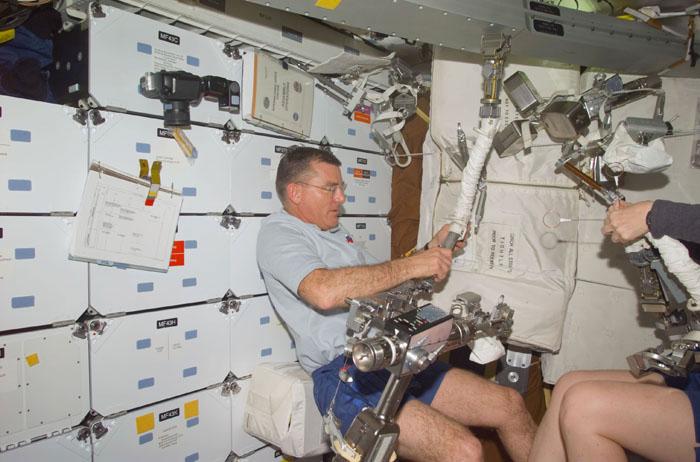
STS102-E-5032 (9 March 2001) --- On Discovery's mid deck, astronauts James S. Voss and Susan J. Helms (partially visible at right edge), STS-102 mission specialists, check gear associated with a scheduled space walk to perform work on the International Space Station (ISS). At the time this Flight Day 1 digital still camera image was exposed, the Discovery was on a time line to catch the orbital outpost and link with it during Flight Day 2.
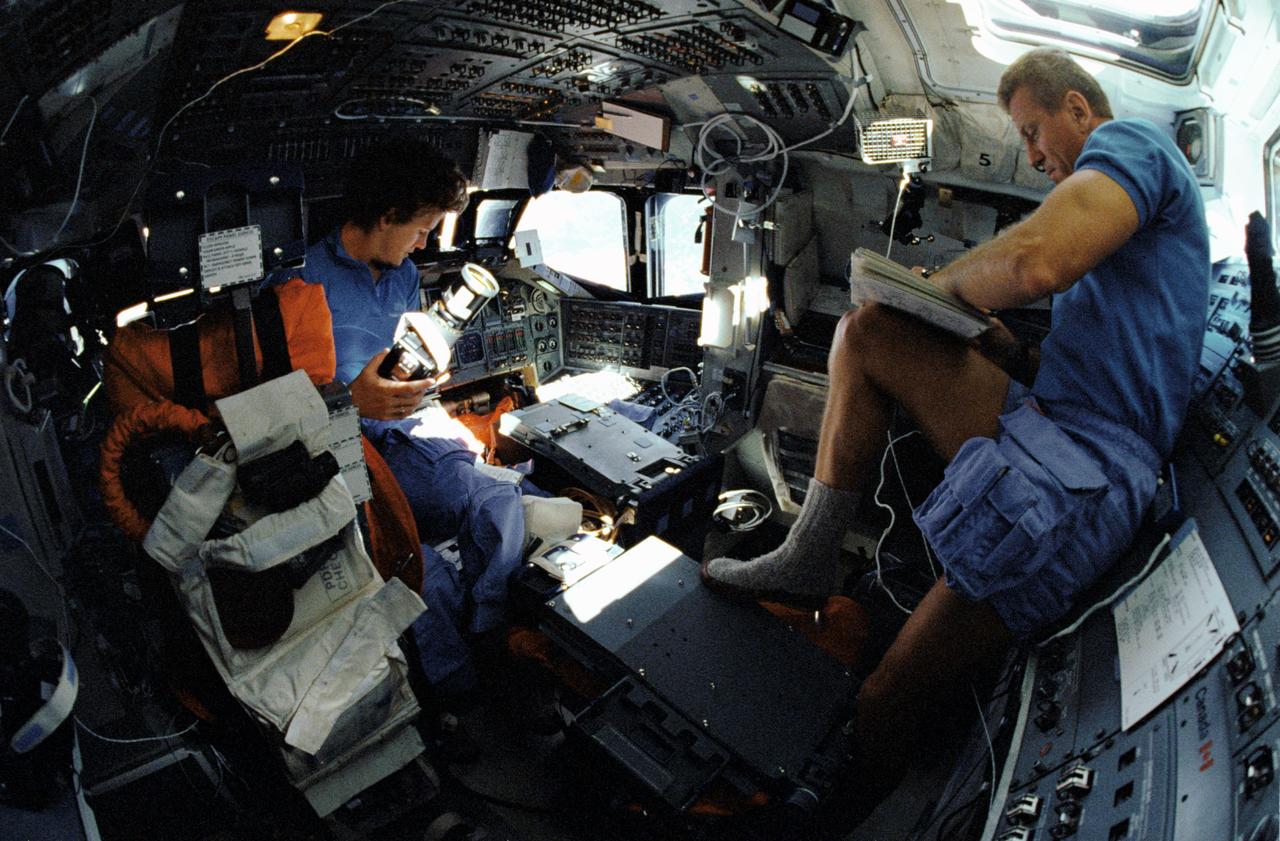
STS031-101-053 (24-29 April 199) --- A 35mm camera equipped with a "fish-eye" lens captured this view on Discovery's flight deck featuring astronaut Kathryn D. Sullivan with a Hasselblad camera on forward flight deck and astronaut Loren J. Shriver, pen in hand, amending flight data on aft flight deck.
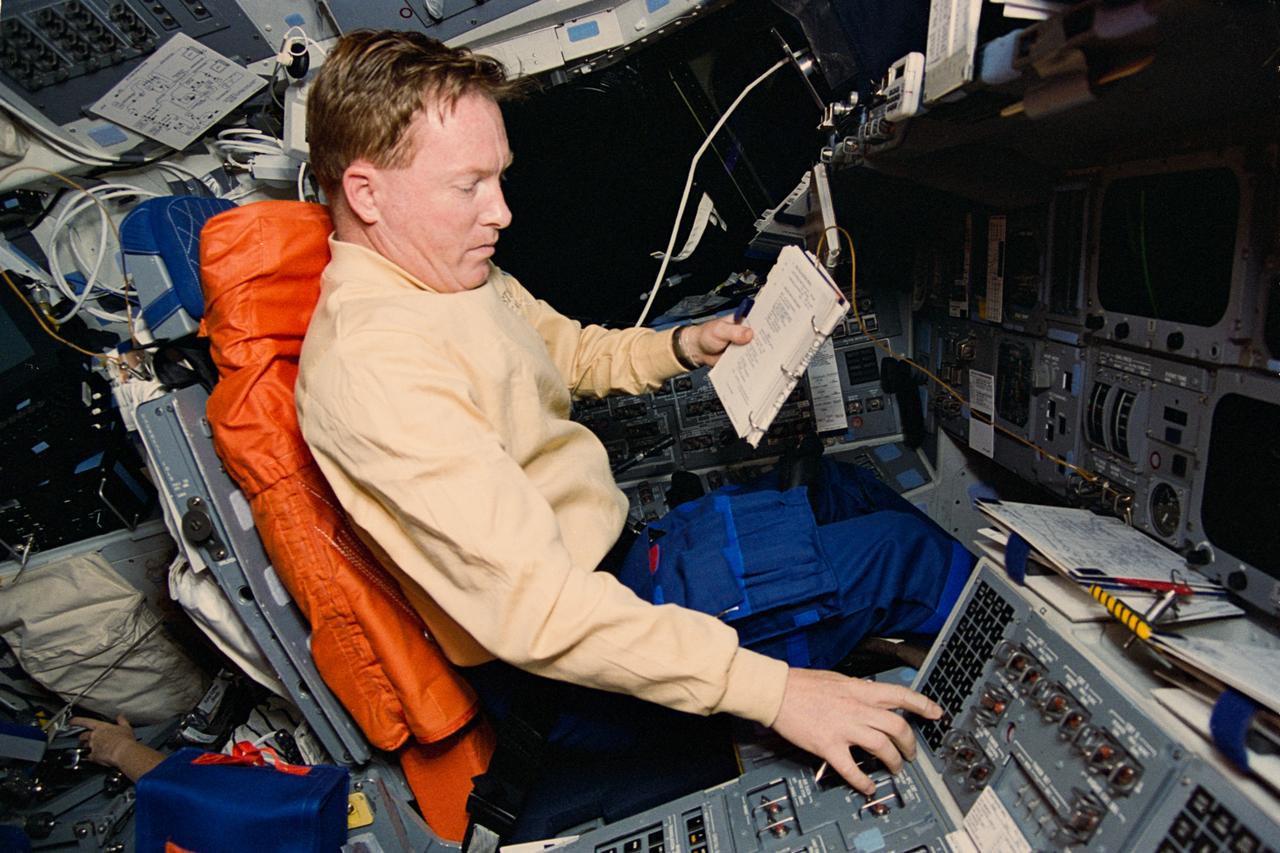
STS064-08-032 (10 Sept. 1994) --- At the commander's station on the space shuttle Discovery's forward flight deck, astronaut Richard N. Richards, STS-64 mission commander, initiates a thruster firing of the spacecraft during operations with the Shuttle Plume Impingement Flight Experiment (SPIFEX). Photo credit: NASA or National Aeronautics and Space Administration
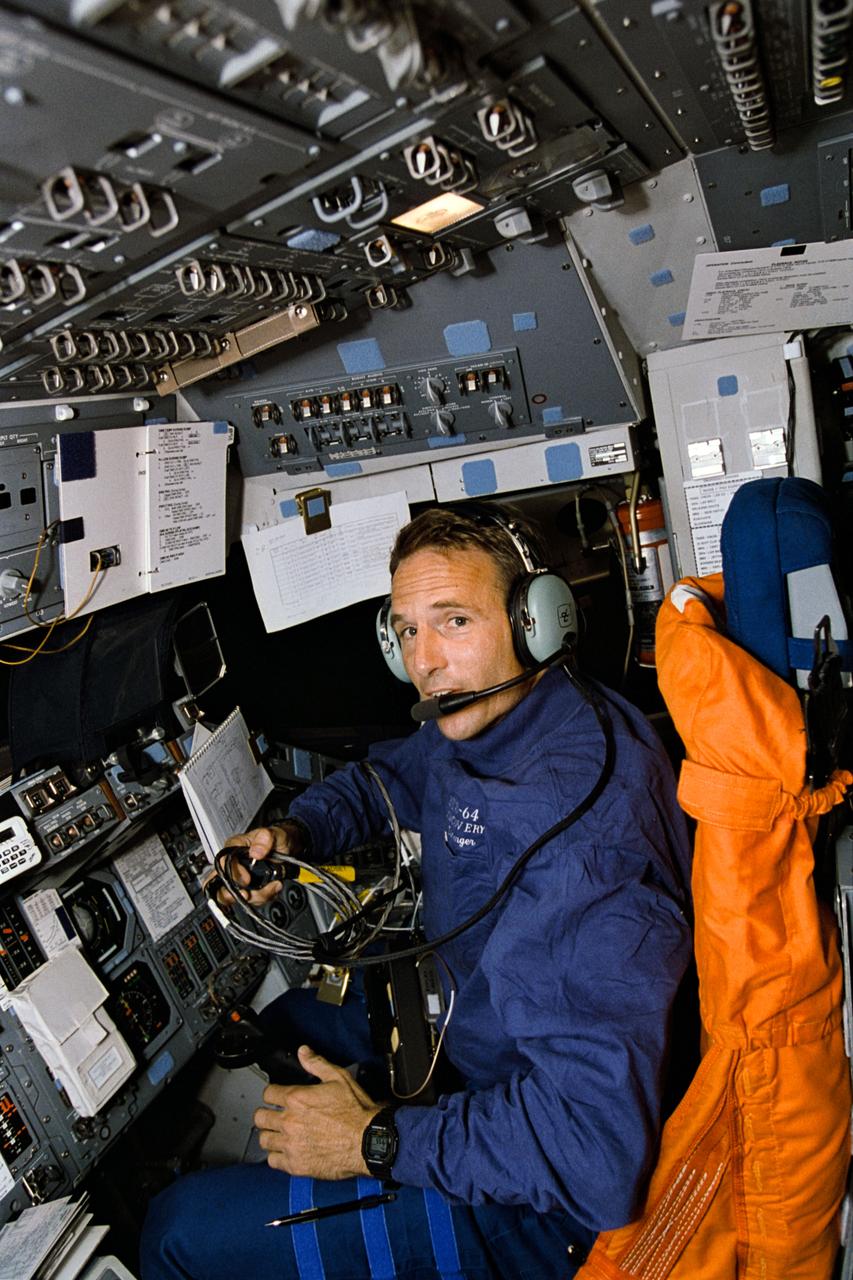
STS064-20-026 (9-20 Sept. 1994) --- Astronaut Jerry M. Linenger, STS-64 mission specialist, uses the Shuttle Amateur Radio Experiment (SAREX) to communicate with students on Earth. Various members of the crew made contact with a number of other "hams" around the world during the almost 11-day mission in Earth orbit. Photo credit: NASA or National Aeronautics and Space Administration
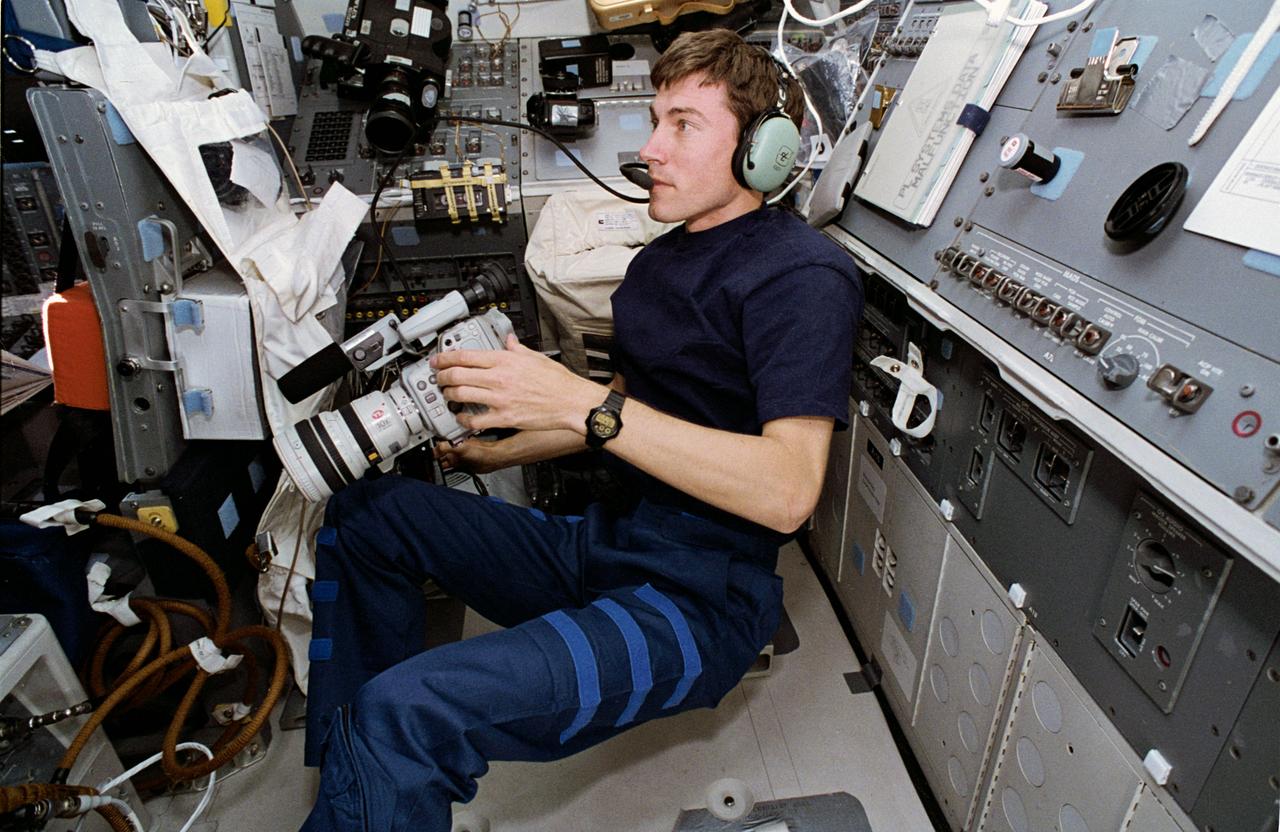
STS60-29-009 (10 Feb 1994) --- On the Space Shuttle Discovery's aft flight deck, Russian cosmonaut Sergei K. Krikalev prepares for one chore while performing another. Using the Shuttle Amateur Radio Experiment (SAREX) gear, the mission specialist was talking with students in Maine. He holds a camcorder, which was later called into action to record inflight activities. Krikalev joined five NASA astronauts for eight days in space aboard Discovery.
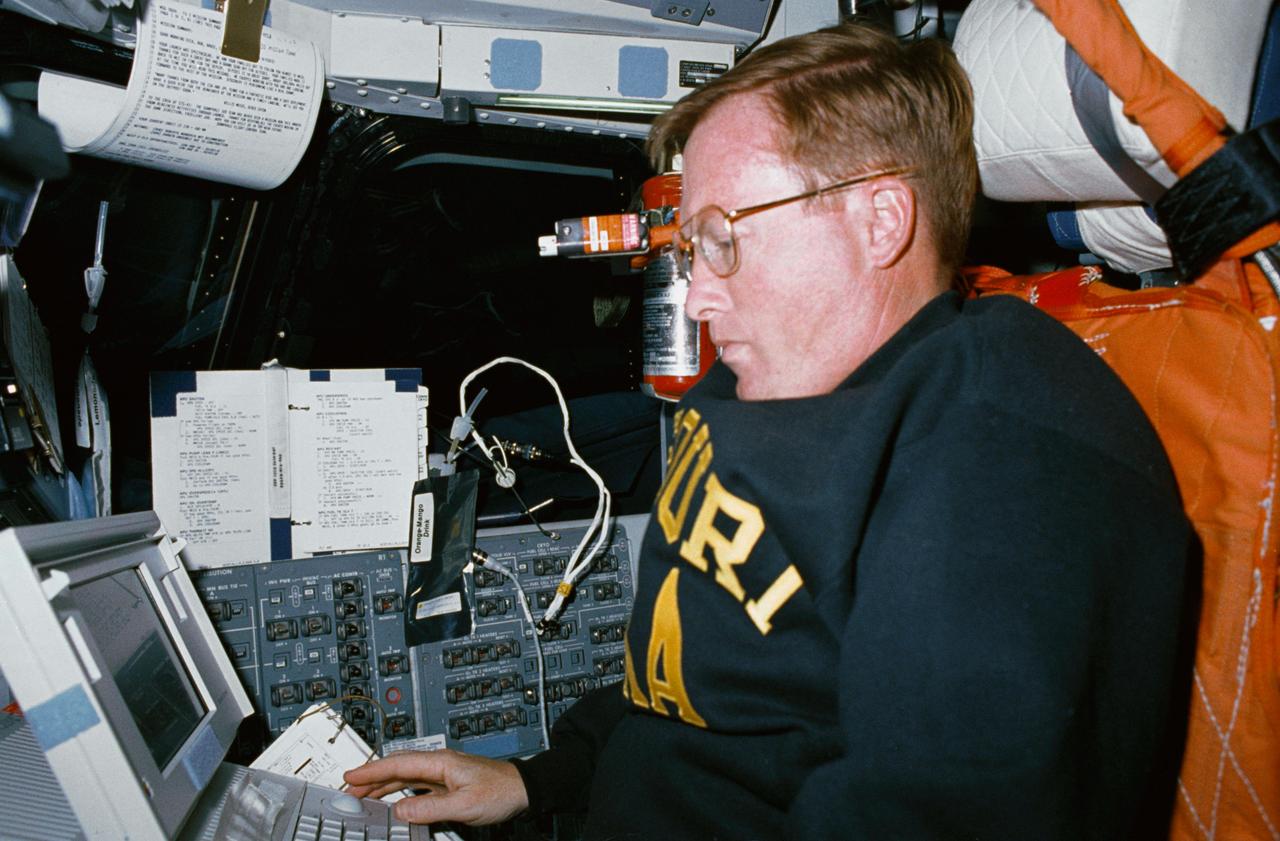
STS041-01-002 (6-10 Oct 1990) --- Astronaut Richard N. Richards, STS 41 mission commander, "borrows" the pilot's station to utilize a Shuttle portable onboard computer during the four-day flight. The photo was made with a 35mm camera.
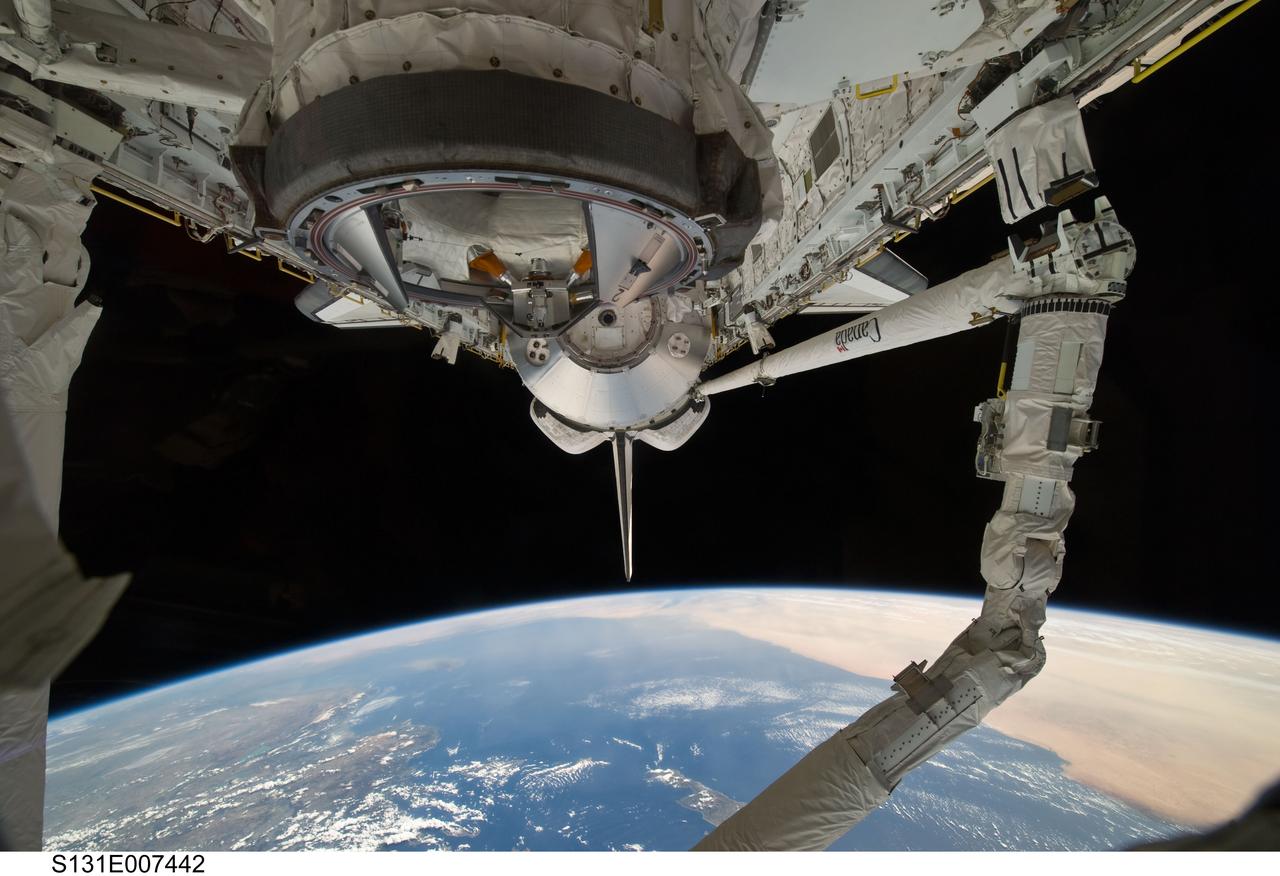
S131-E-007442 (6 April 2010) --- The Leonardo Multi-Purpose Logistics Module (MPLM) visible in space shuttle Discovery's payload bay, docking mechanism, vertical stabilizer, orbital maneuvering system (OMS) pods and Remote Manipulator System/Orbiter Boom Sensor System (RMS/OBSS) are featured in this image photographed by an STS-131 crew member from an aft flight deck window during flight day two activities. Earth?s horizon and the blackness of space provide the backdrop for the scene.
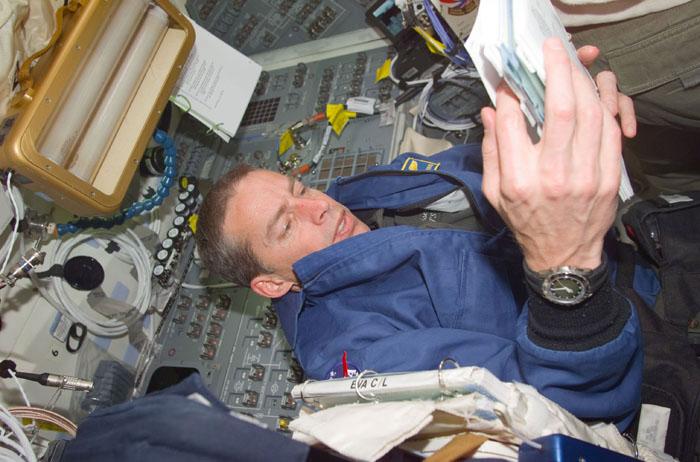
STS102-E-5012 (9 March 2001) --- Astronaut James D. Wetherbee, STS-102 mission commander, looks over a procedures manual on the flight deck of the Space Shuttle Discovery. The commander and his crew are preparing for a series of very busy days ahead. Once the Discovery links up with the International Space Station (ISS), work on the orbiting outpost, crew personnel exchanges, supply transfers and a number of other chores face the astronauts and cosmonauts.
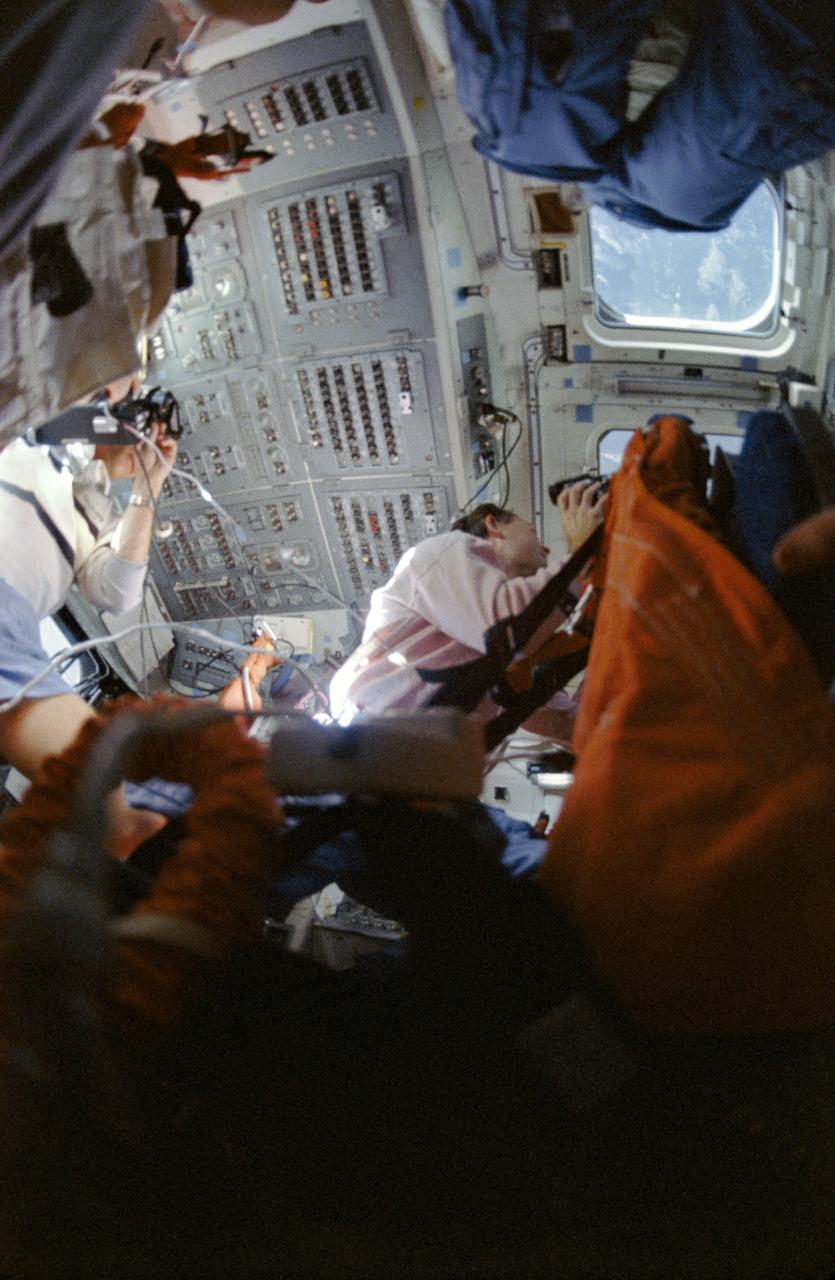
STS033-05-014A (22-27 Nov 1989) --- A low-angle view of STS-33's two astronaut medical doctors doubling as photographers and Earth observers on the flight deck of the Earth-orbiting Space Shuttle Discovery. Astronauts Story Musgrave, left, and Manley L. Carter and three other crewmembers shared five days aboard the Discovery for this DOD-devoted mission.
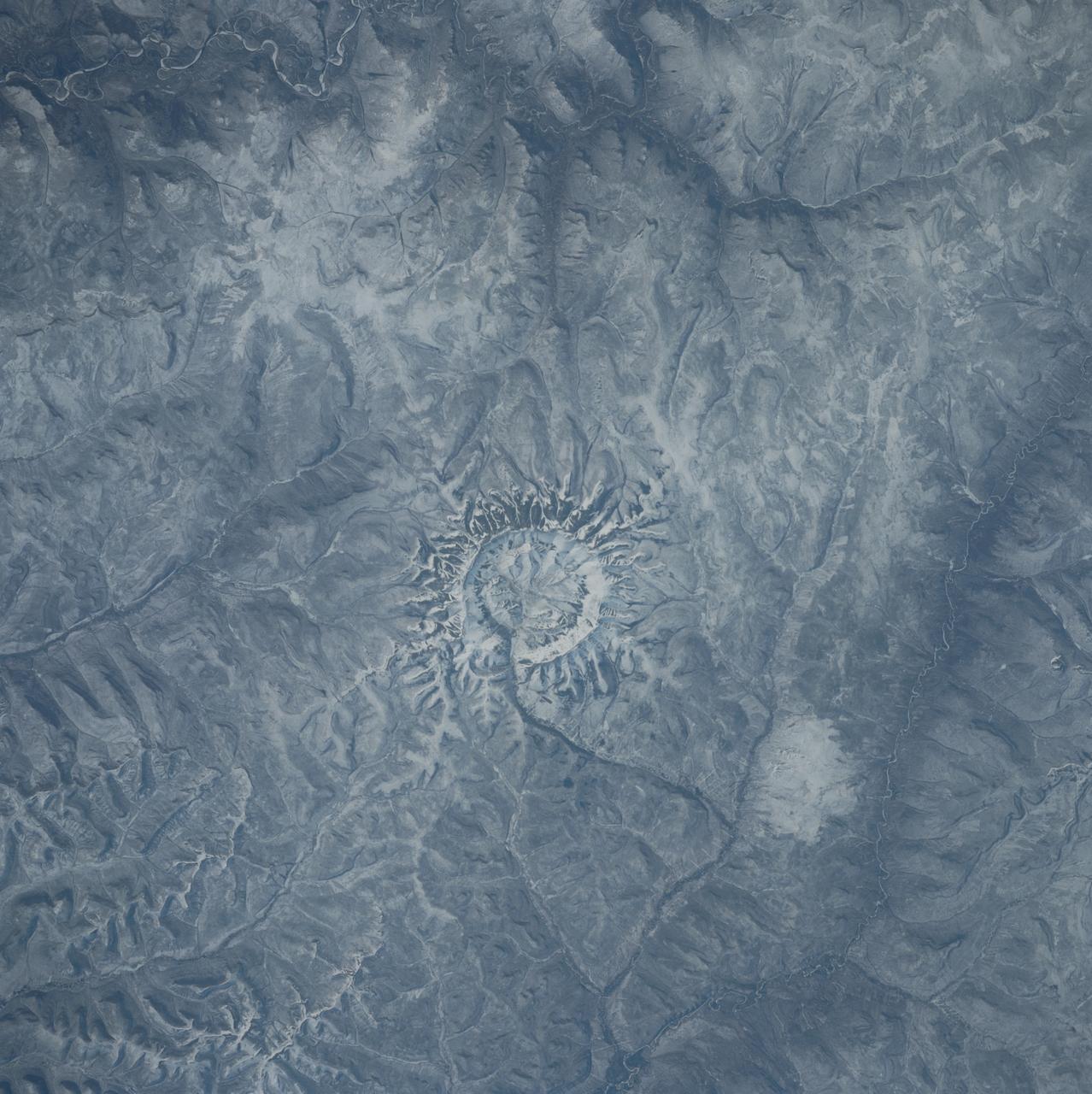
S39-84-29AE (28 April-6 May 1991) --- In the center of this 70mm frame, surrounded by mountainous terrain, is Gora Konder crater in the USSR. The 57-degree inclination of Discovery's orbit allowed photographs of seldom observed areas of Earth such as this. The picture was exposed with a 70mm handheld camera from overhead windows on Discovery's aft flight deck.

STS082-353-035 (11-21 Feb. 1997) --- Astronaut Steven A. Hawley, who spent many hours aboard Discovery controlling the shuttle's Remote Manipulator System (RMS), watches the Extravehicular Activity (EVA) of a two-man space walking team from Discovery's aft flight deck. Hawley had flown on the 1990 mission that was responsible for deploying the orbiting observatory.
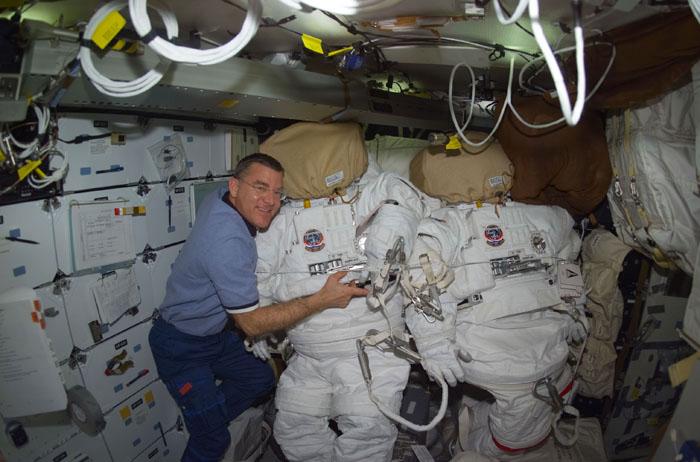
STS102-E-5070 (10 March 2001) --- Astronaut James S. Voss, STS-102 mission specialist, is pictured with both Extravehicular Mobility Unit (EMU) space suits designated for this flight's extravehicular activity (EVA). Voss is one of two astronauts assigned to space walk duties after the Space Shuttle Discovery and the International Space Station (ISS) link in Earth orbit. The photograph was recorded with a digital still camera on Discovery's mid deck.
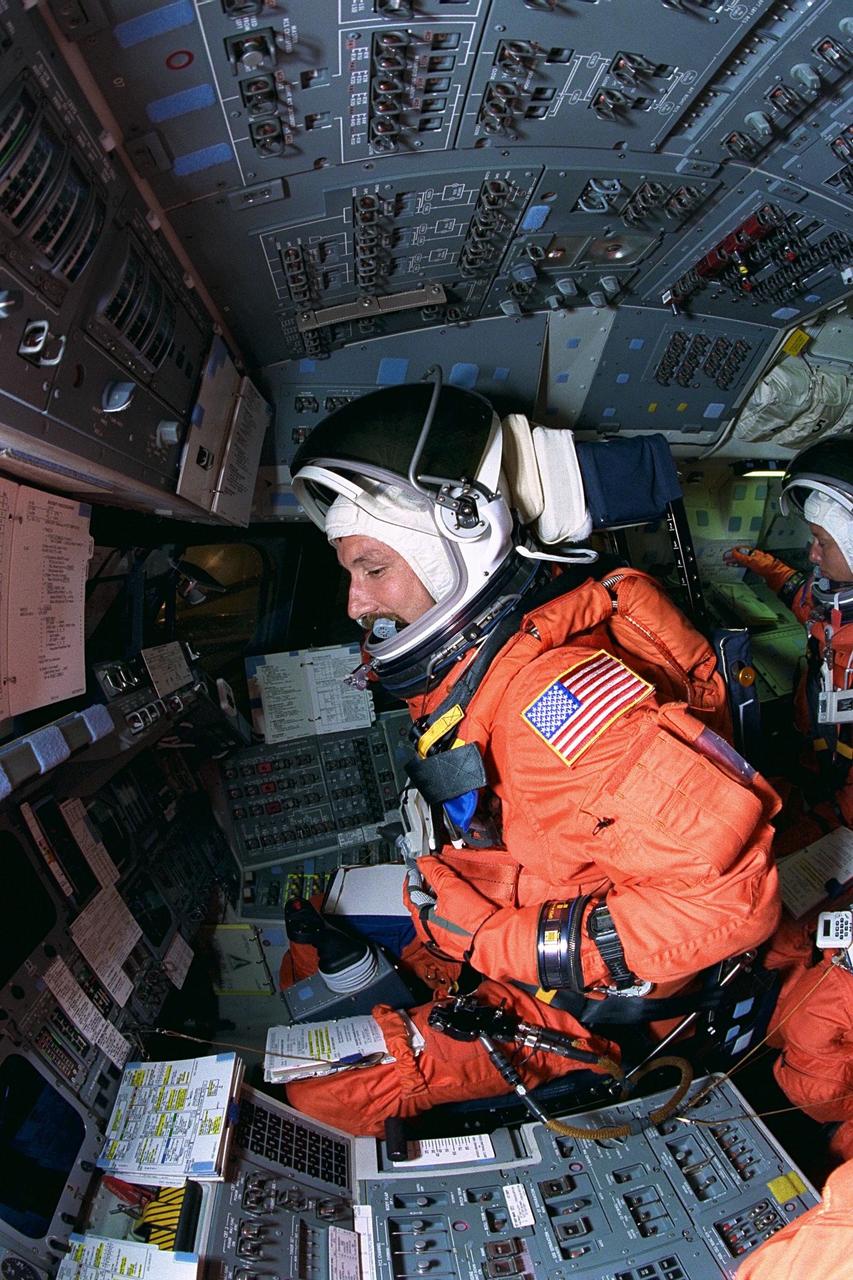
KENNEDY SPACE CENTER, FLA. -- STS-85 Pilot Kent V. Rominger goes through countdown procedures on the flight deck aboard the Space Shuttle orbiter Discovery during Terminal Countdown Demonstration Test (TCDT) activities for that mission. The TCDT includes a simulation of the final launch countdown. The primary payload aboard the Space Shuttle orbiter Discovery is the Cryogenic Infrared Spectrometers and Telescopes for the Atmosphere-2 (CRISTA-SPAS-2). Other STS-85 payloads include the Manipulator Flight Demonstration (MFD), and Technology Applications and Science-1 (TAS-1) and International Extreme Ultraviolet Hitchhiker-2 (IEH-2) experiments
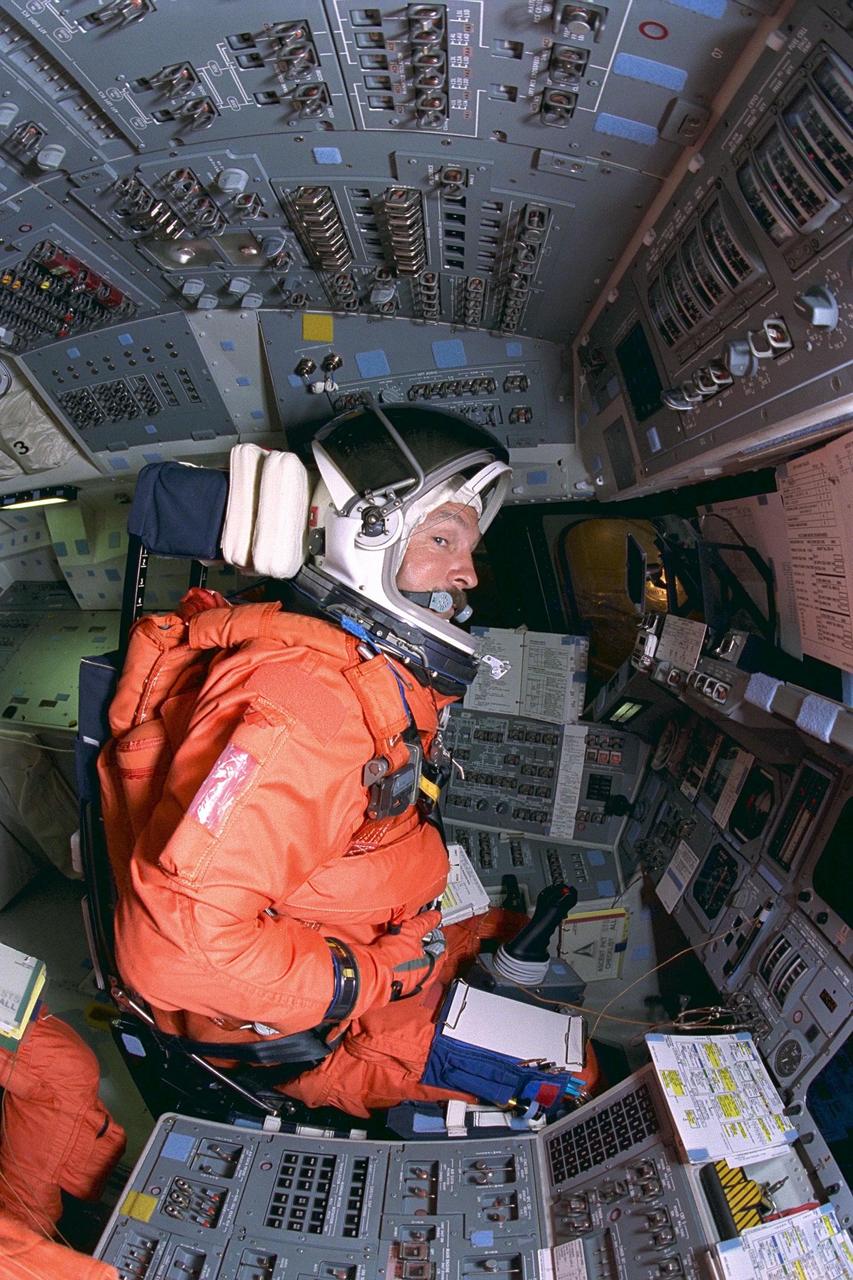
KENNEDY SPACE CENTER, FLA. -- STS-85 Commander Curtis L. Brown, Jr., goes through countdown procedures on the flight deck aboard the Space Shuttle orbiter Discovery during Terminal Countdown Demonstration Test (TCDT) activities for that mission. The TCDT includes a simulation of the final launch countdown. The primary payload aboard the Space Shuttle orbiter Discovery is the Cryogenic Infrared Spectrometers and Telescopes for the Atmosphere-2 (CRISTA-SPAS-2). Other STS-85 payloads include the Manipulator Flight Demonstration (MFD), and Technology Applications and Science-1 (TAS-1) and International Extreme Ultraviolet Hitchhiker-2 (IEH-2) experiments
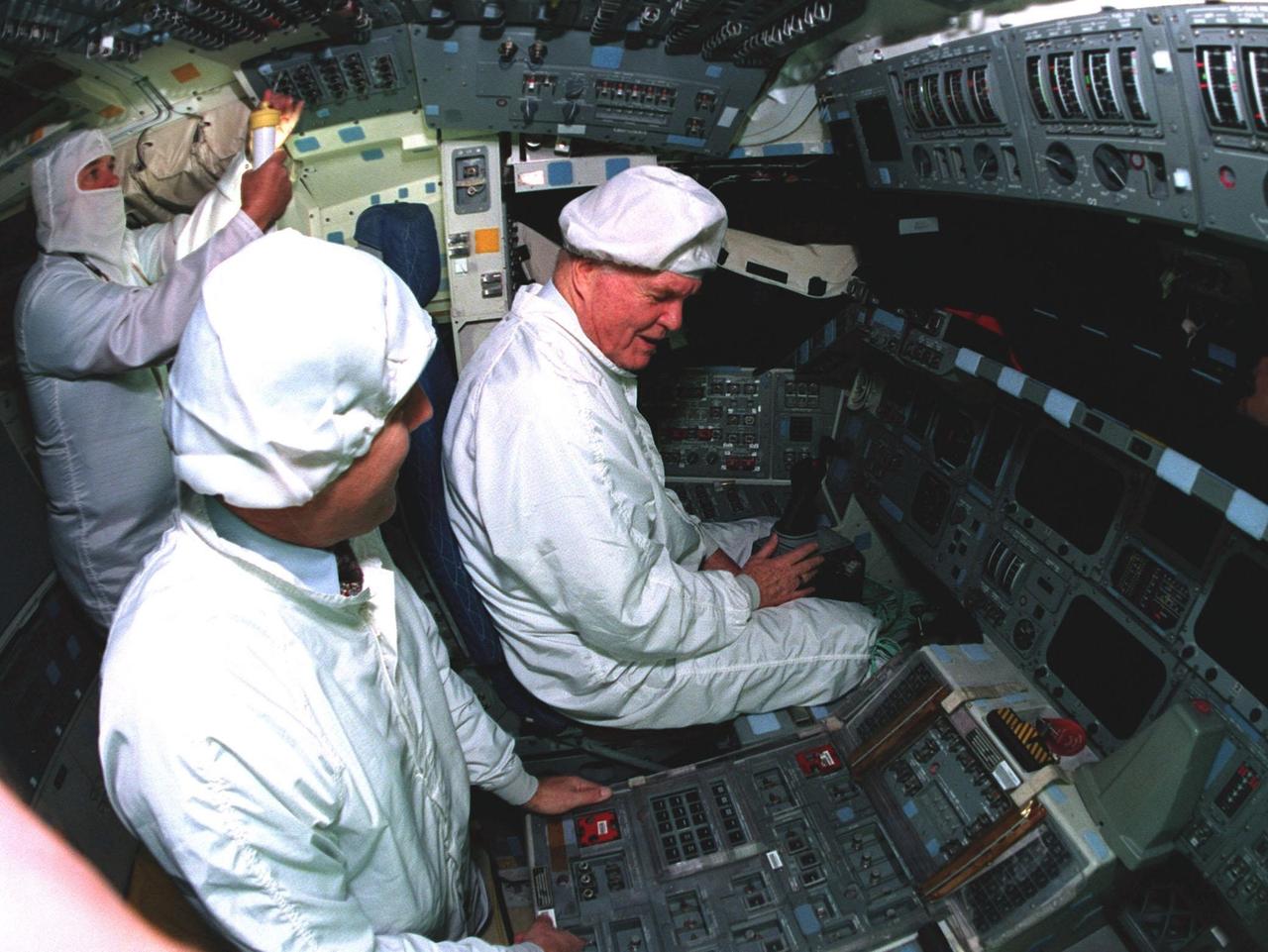
Ohio Senator John Glenn, at right, sits in the flight deck of the orbiter Columbia as astronaut Stephen Oswald listens to his questions regarding some of the flight equipment at the Orbiter Processing Facility 3 at Kennedy Space Center. Senator Glenn arrived at KSC on Jan. 20 to tour KSC operational areas and to view the launch of STS-89 later this week. Glenn, who made history in 1962 as the first American to orbit the Earth, completing three orbits in a five-hour flight aboard Friendship 7, will fly his second space mission aboard Space Shuttle Discovery this October. Glenn is retiring from the Senate at the end of this year and will be a payload specialist aboard STS-95
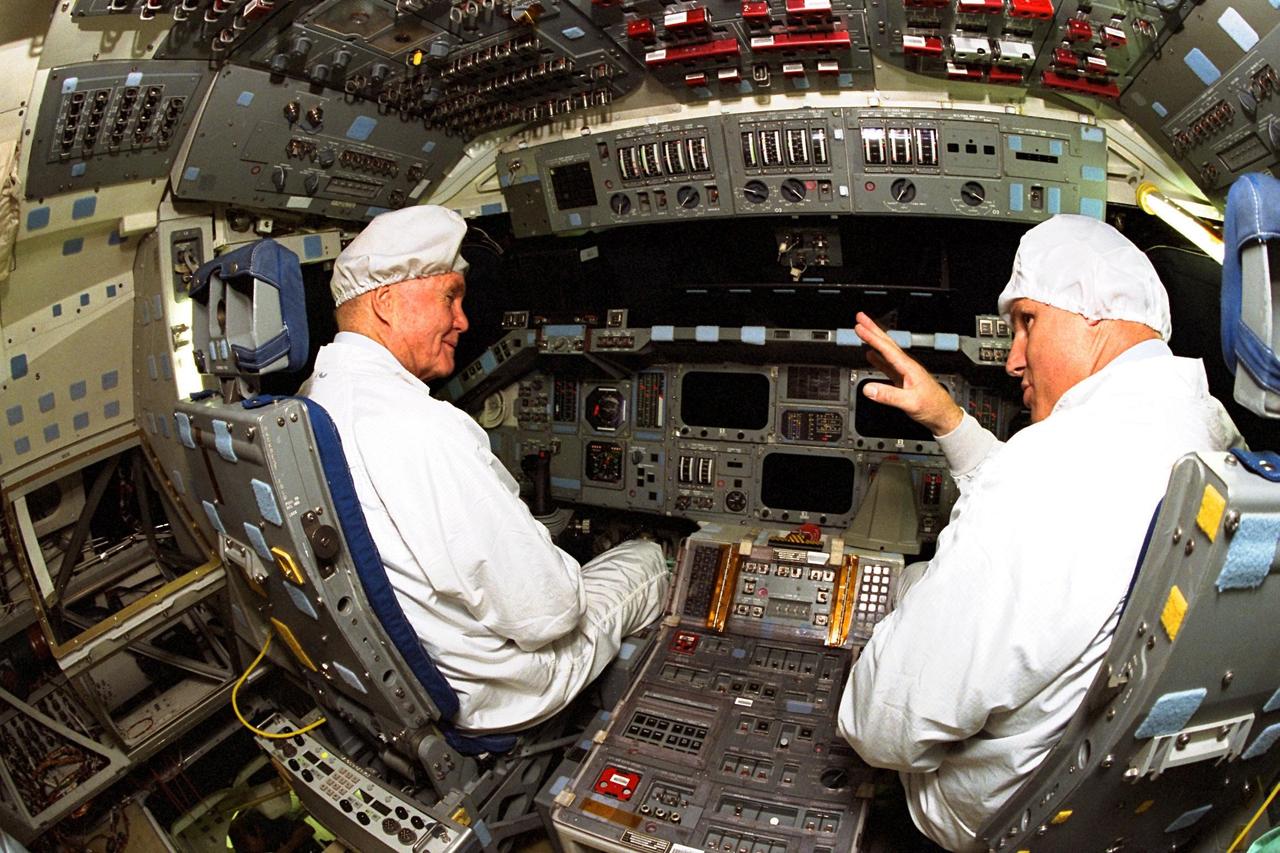
Ohio Senator John Glenn, at left, sits in the flight deck of the orbiter Columbia as astronaut Stephen Oswald explains some of the flight equipment to the senator at the Orbiter Processing Facility 3 at Kennedy Space Center. Senator Glenn arrived at KSC on Jan. 20 to tour KSC operational areas and to view the launch of STS-89 later this week. Glenn, who made history in 1962 as the first American to orbit the Earth, completing three orbits in a five-hour flight aboard Friendship 7, will fly his second space mission aboard Space Shuttle Discovery this October. Glenn is retiring from the Senate at the end of this year and will be a payload specialist aboard STS-95
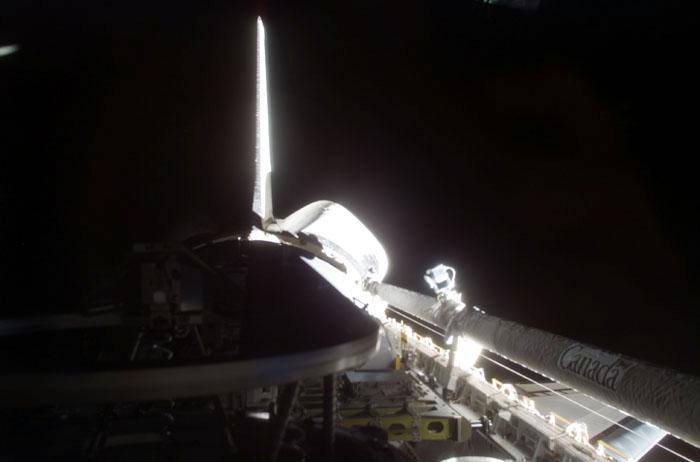
STS105-E-5037 (11 August 2001) --- One of the STS-105 crew members on the flight deck of the Earth-orbiting Space Shuttle Discovery used a digital still camera to record this image of the partially illuminated portside cargo bay and the silhouetted Orbiter Docking System's docking mechanism. The shuttle's Canadarm or Remote Manipulator System (RMS) arm is in its stowed position at right.
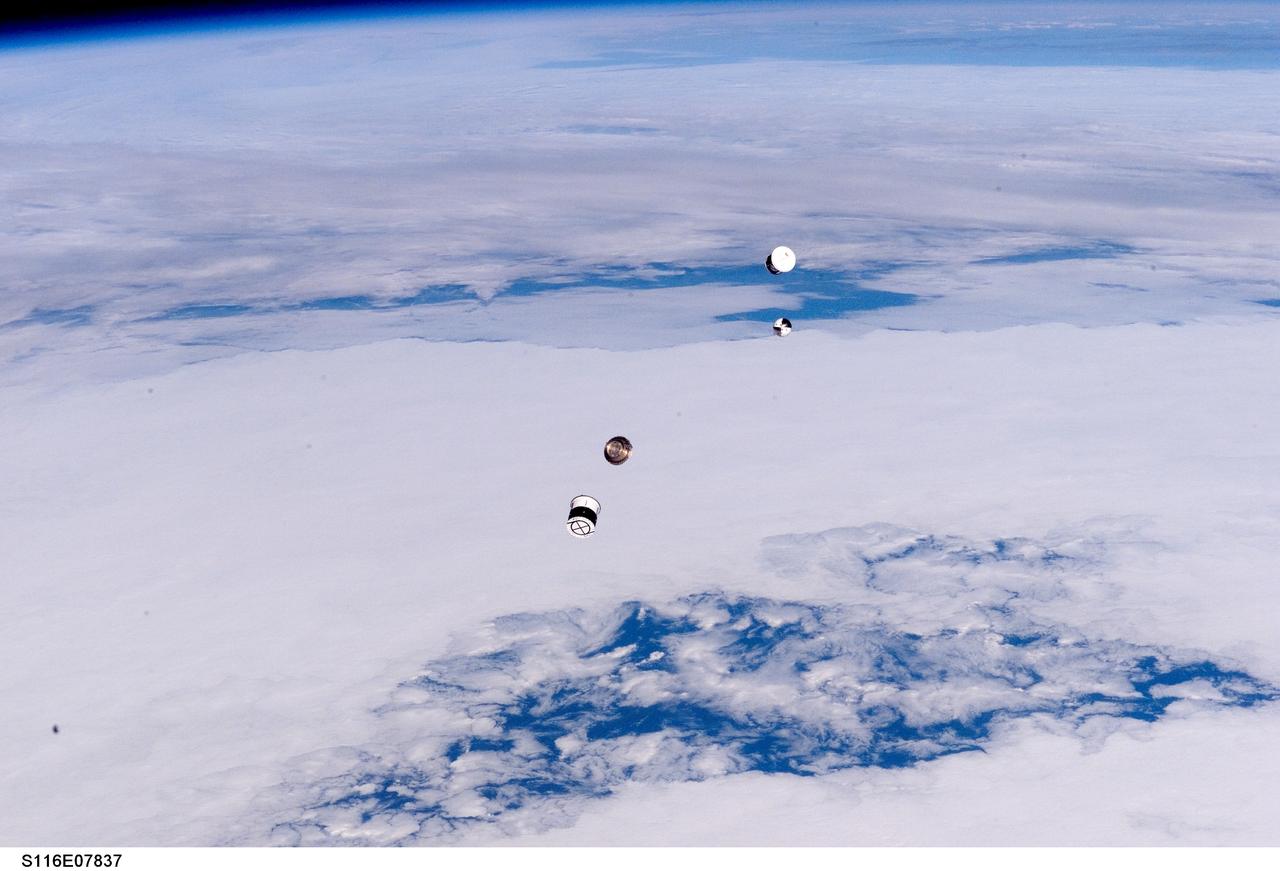
S116-E-07837 (21 Dec. 2006) --- As seen through windows on the aft flight deck of Space Shuttle Discovery, a Department of Defense pico-satellite known as Atmospheric Neutral Density Experiment (ANDE) is released from the shuttle's payload bay by STS-116 crewmembers. ANDE consists of two micro-satellites which will measure the density and composition of the low Earth orbit (LEO) atmosphere while being tracked from the ground. The data will be used to better predict the movement of objects in orbit.
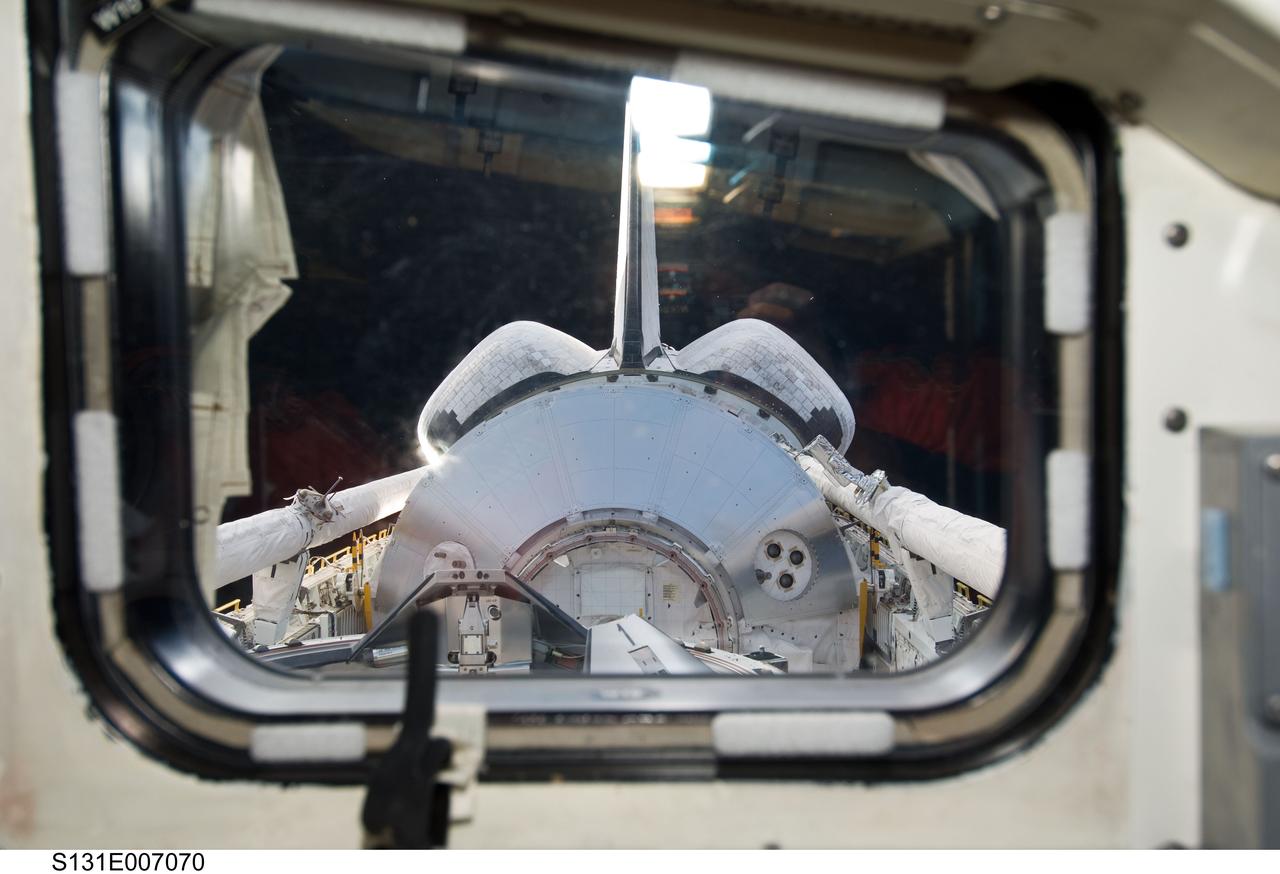
S131-E-007070 (5 April 2010) --- The Leonardo Multi-Purpose Logistics Module (MPLM) visible in space shuttle Discovery's payload bay, docking mechanism, vertical stabilizer, orbital maneuvering system (OMS) pods and Remote Manipulator System/Orbiter Boom Sensor System (RMS/OBSS) are featured in this image photographed by an STS-131 crew member from an aft flight deck window.
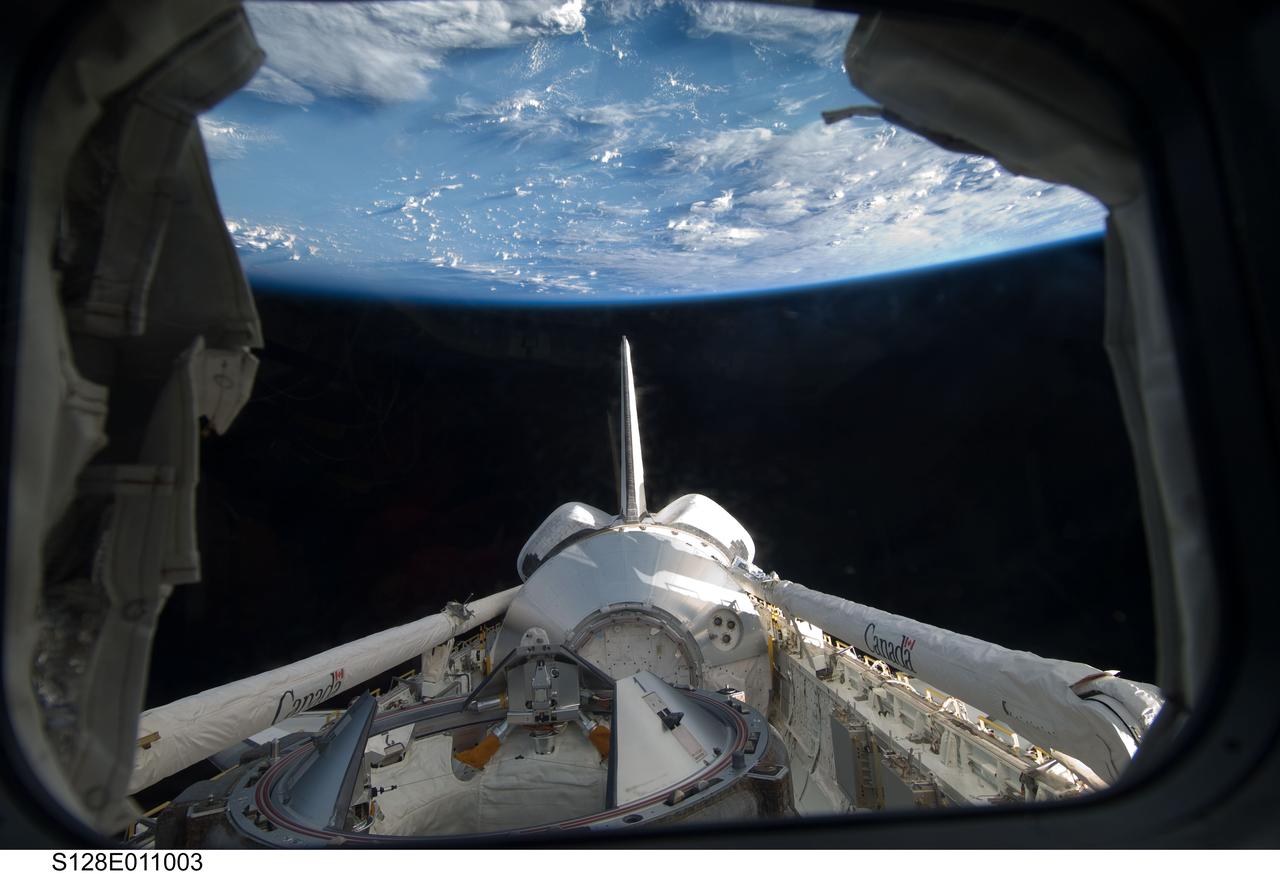
S128-E-011003 (9 Sept. 2009) --- Backdropped by Earth's horizon and the blackness of space, the Leonardo Multi-Purpose Logistics Module visible in Space Shuttle Discovery's payload bay, docking mechanism, vertical stabilizer, orbital maneuvering system (OMS) pods and Remote Manipulator System/Orbiter Boom Sensor System (RMS/OBSS) are featured in this image photographed by an STS-128 crew member from an aft flight deck window.
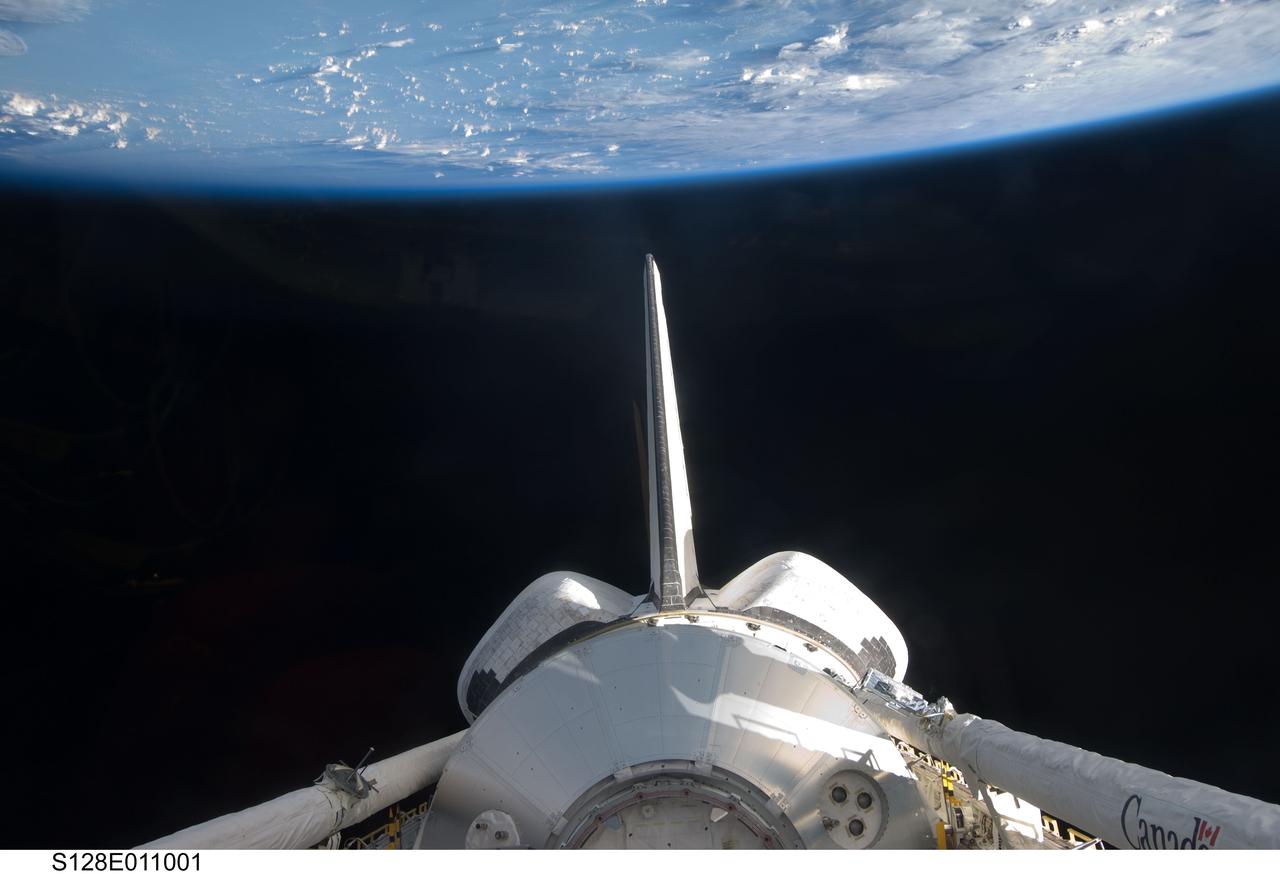
S128-E-011001 (9 Sept. 2009) --- Backdropped by Earth's horizon and the blackness of space, the Leonardo Multi-Purpose Logistics Module visible in Space Shuttle Discovery's payload bay, vertical stabilizer, orbital maneuvering system (OMS) pods and Remote Manipulator System/Orbiter Boom Sensor System (RMS/OBSS) are featured in this image photographed by an STS-128 crew member from an aft flight deck window.
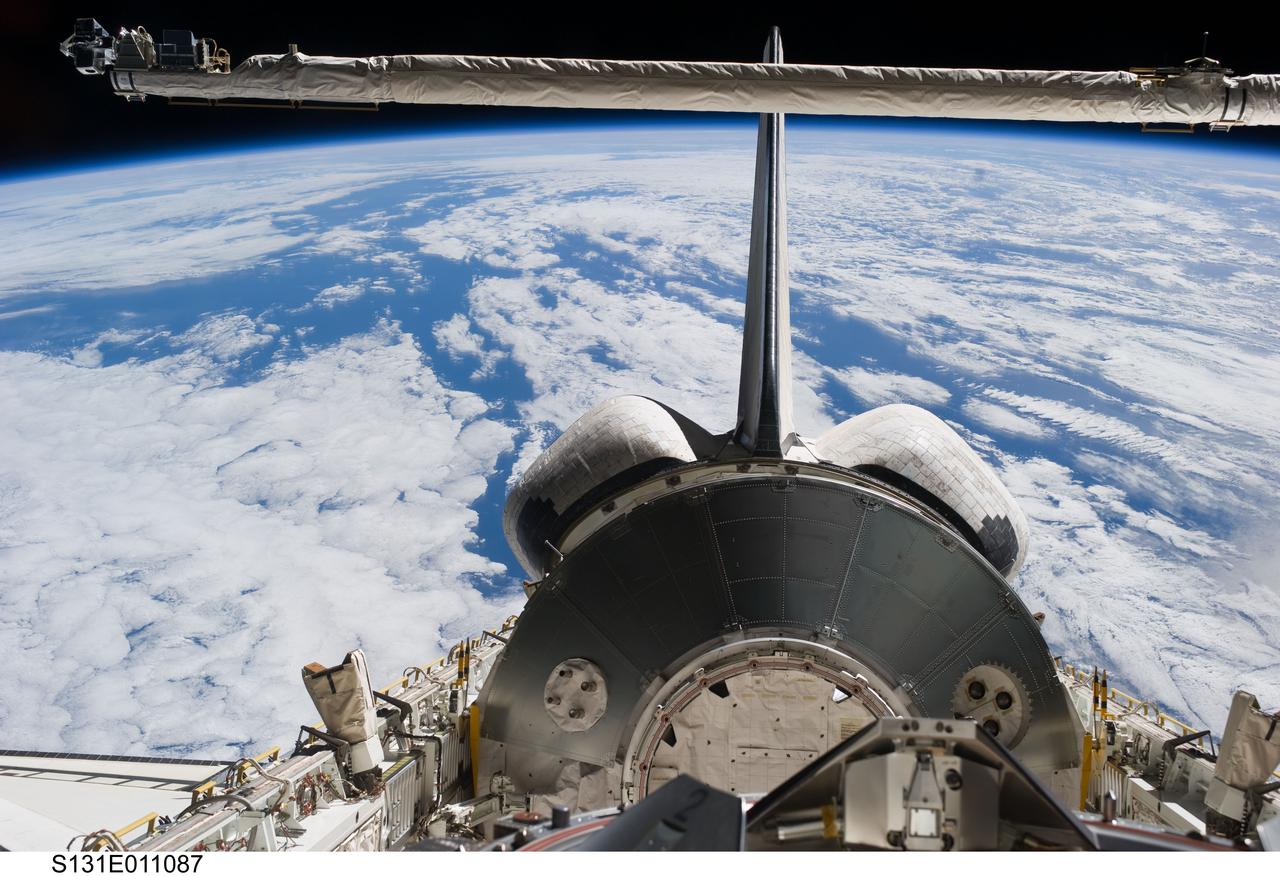
S131-E-011087 (17 April 2010) --- The Leonardo Multi-Purpose Logistics Module (MPLM) visible in space shuttle Discovery's payload bay, docking mechanism, vertical stabilizer, orbital maneuvering system (OMS) pods and Remote Manipulator System/Orbiter Boom Sensor System (RMS/OBSS) are featured in this image photographed by an STS-131 crew member from an aft flight deck window. A blue and white part of Earth provides the backdrop for the scene.
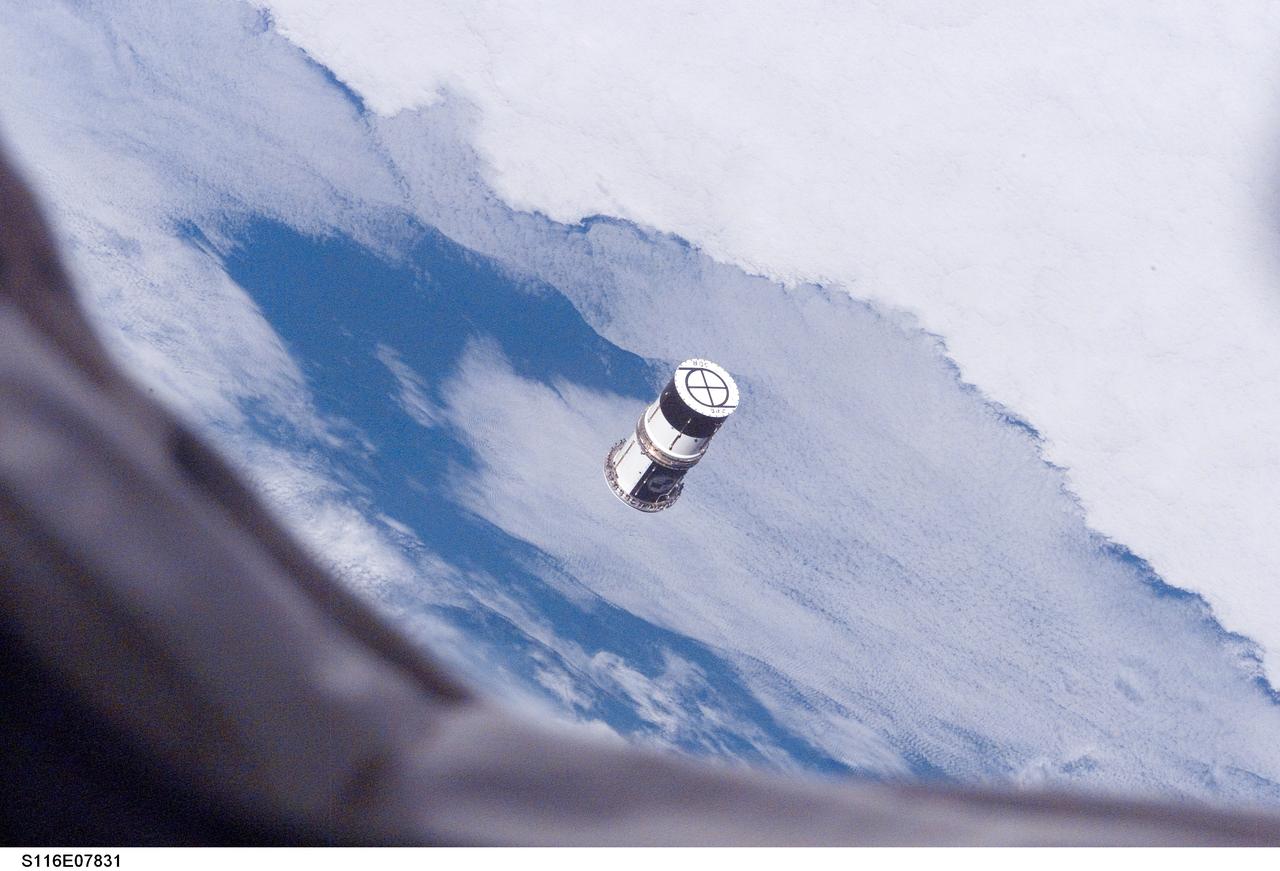
S116-E-07831 (21 Dec. 2006) --- As seen through windows on the aft flight deck of Space Shuttle Discovery, a Department of Defense pico-satellite known as Atmospheric Neutral Density Experiment (ANDE) is released from the shuttle's payload bay by STS-116 crewmembers. ANDE consists of two micro-satellites which will measure the density and composition of the low Earth orbit (LEO) atmosphere while being tracked from the ground. The data will be used to better predict the movement of objects in orbit.
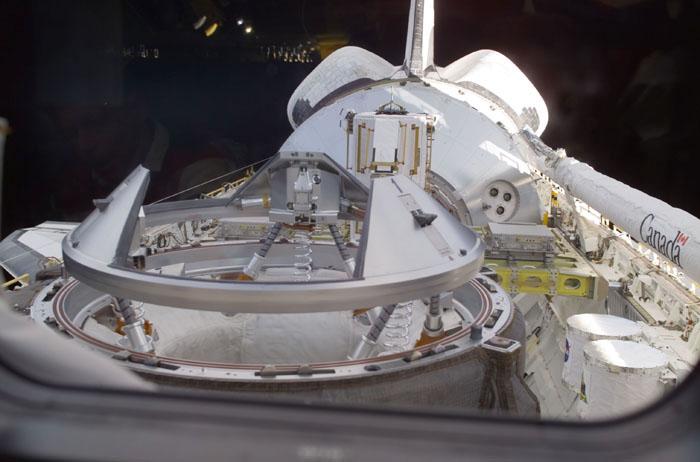
STS105-E-5018 (11 August 2001) --- One of the STS-105 crew members on the flight deck of the Earth-orbiting Space Shuttle Discovery used a digital still camera to record this image of the Orbiter Docking System's docking mechanism in the cargo bay. The shuttle's Canadarm or Remote Manipulator System (RMS) arm is in its stowed position on the port side.
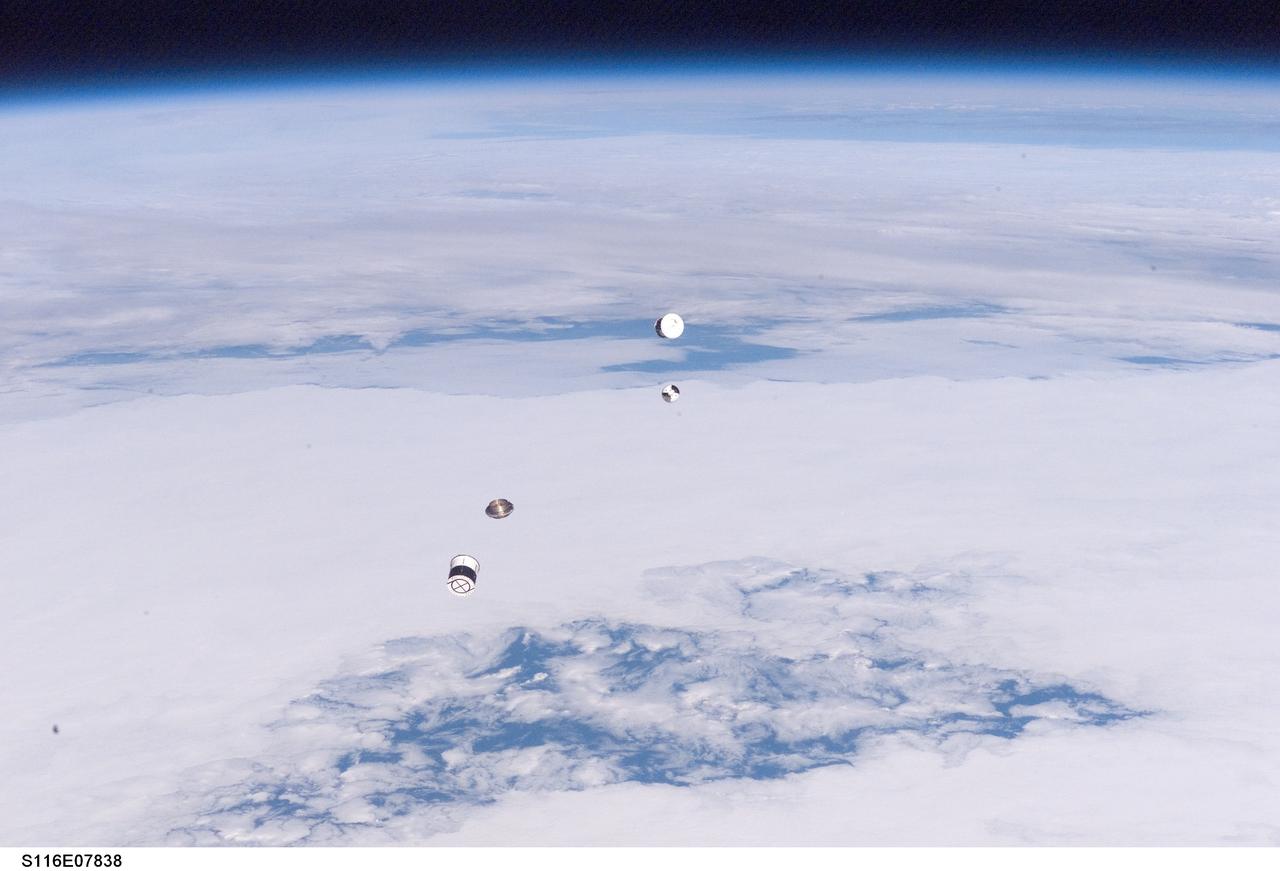
S116-E-07838 (21 Dec. 2006) --- As seen through windows on the aft flight deck of Space Shuttle Discovery, a Department of Defense pico-satellite known as Atmospheric Neutral Density Experiment (ANDE) is released from the shuttle's payload bay by STS-116 crewmembers. ANDE consists of two micro-satellites which will measure the density and composition of the low Earth orbit (LEO) atmosphere while being tracked from the ground. The data will be used to better predict the movement of objects in orbit.
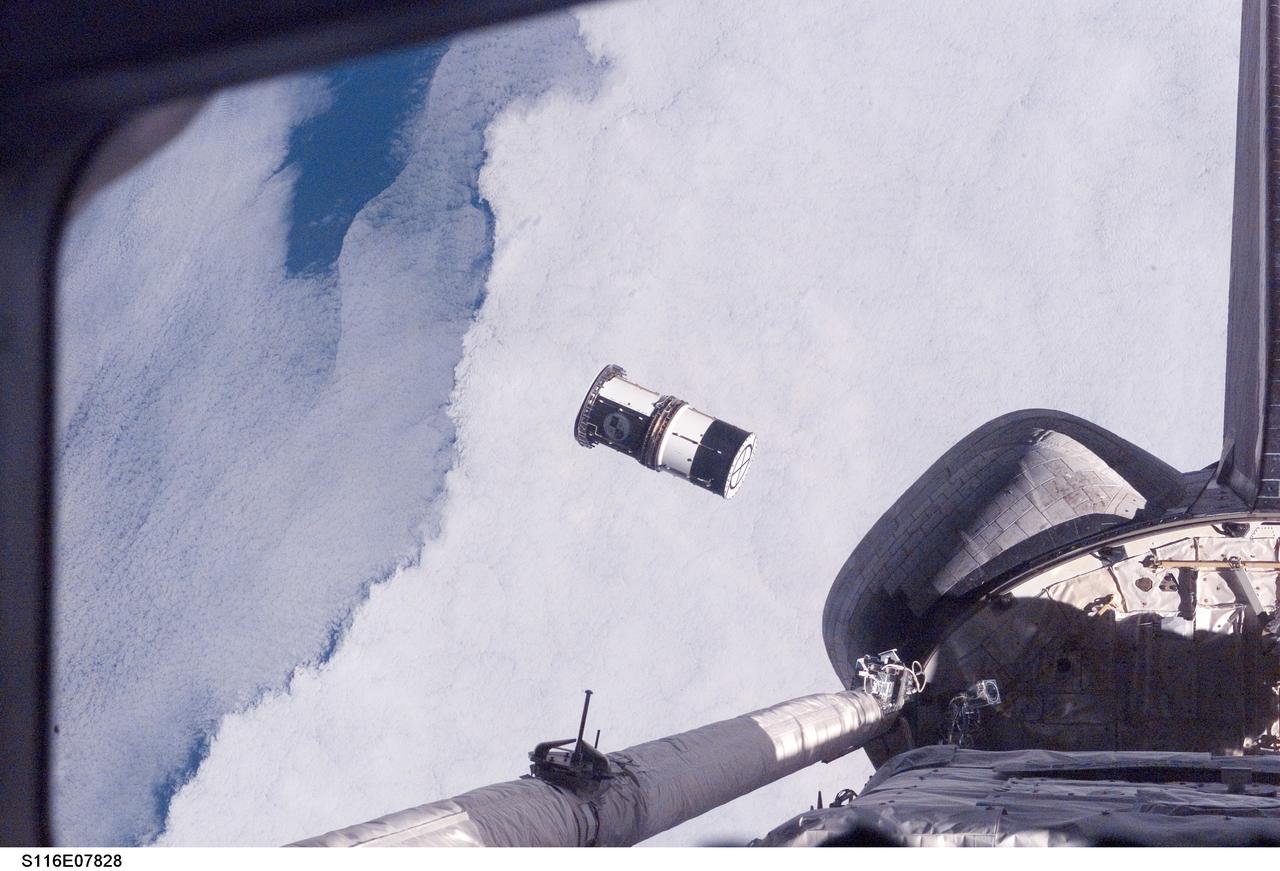
S116-E-07828 (21 Dec. 2006) --- As seen through windows on the aft flight deck of Space Shuttle Discovery, a Department of Defense pico-satellite known as Atmospheric Neutral Density Experiment (ANDE) is released from the shuttle's payload bay by STS-116 crewmembers. ANDE consists of two micro-satellites which will measure the density and composition of the low Earth orbit (LEO) atmosphere while being tracked from the ground. The data will be used to better predict the movement of objects in orbit.
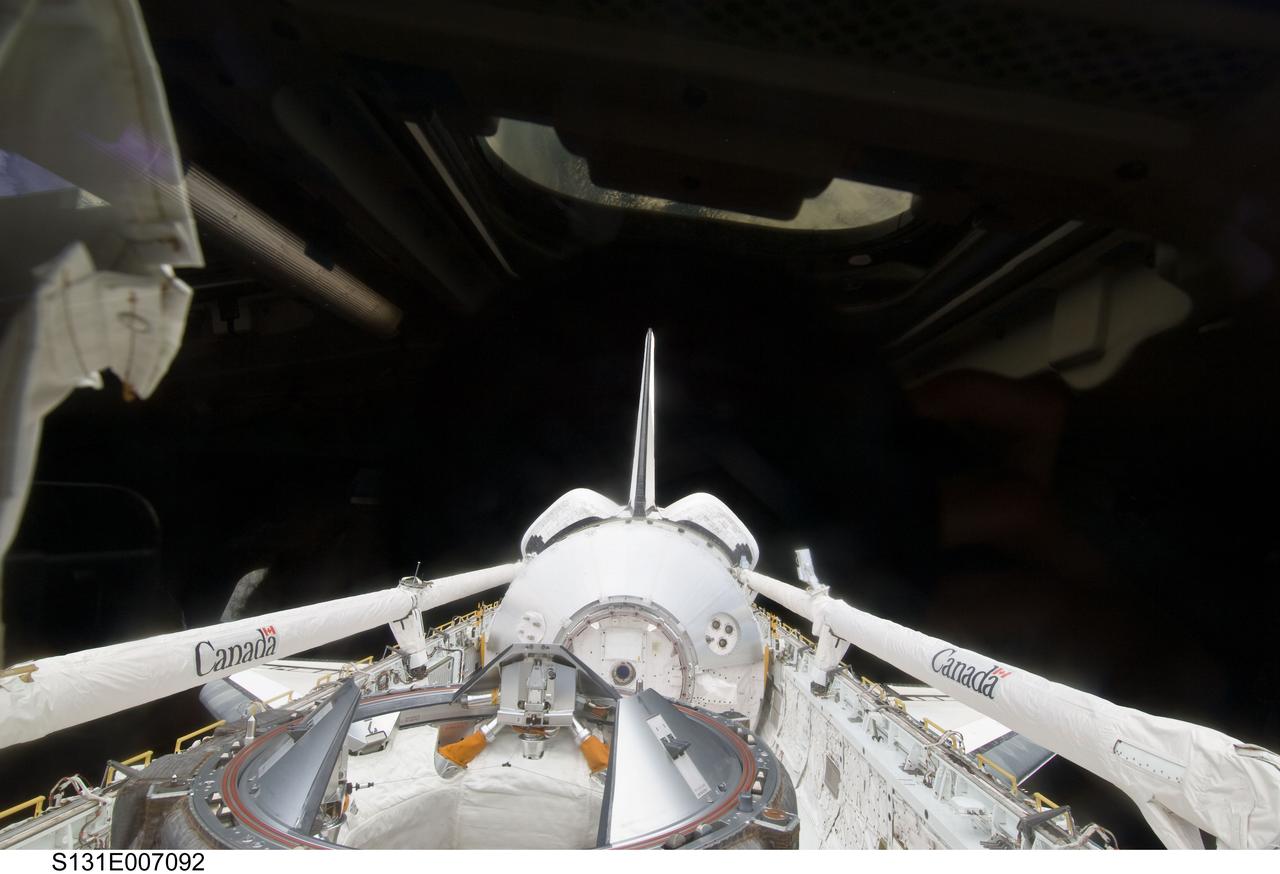
S131-E-007092 (5 April 2010) --- The Leonardo Multi-Purpose Logistics Module (MPLM) visible in space shuttle Discovery's payload bay, docking mechanism, vertical stabilizer, orbital maneuvering system (OMS) pods and Remote Manipulator System/Orbiter Boom Sensor System (RMS/OBSS) are featured in this image photographed by an STS-131 crew member from an aft flight deck window.
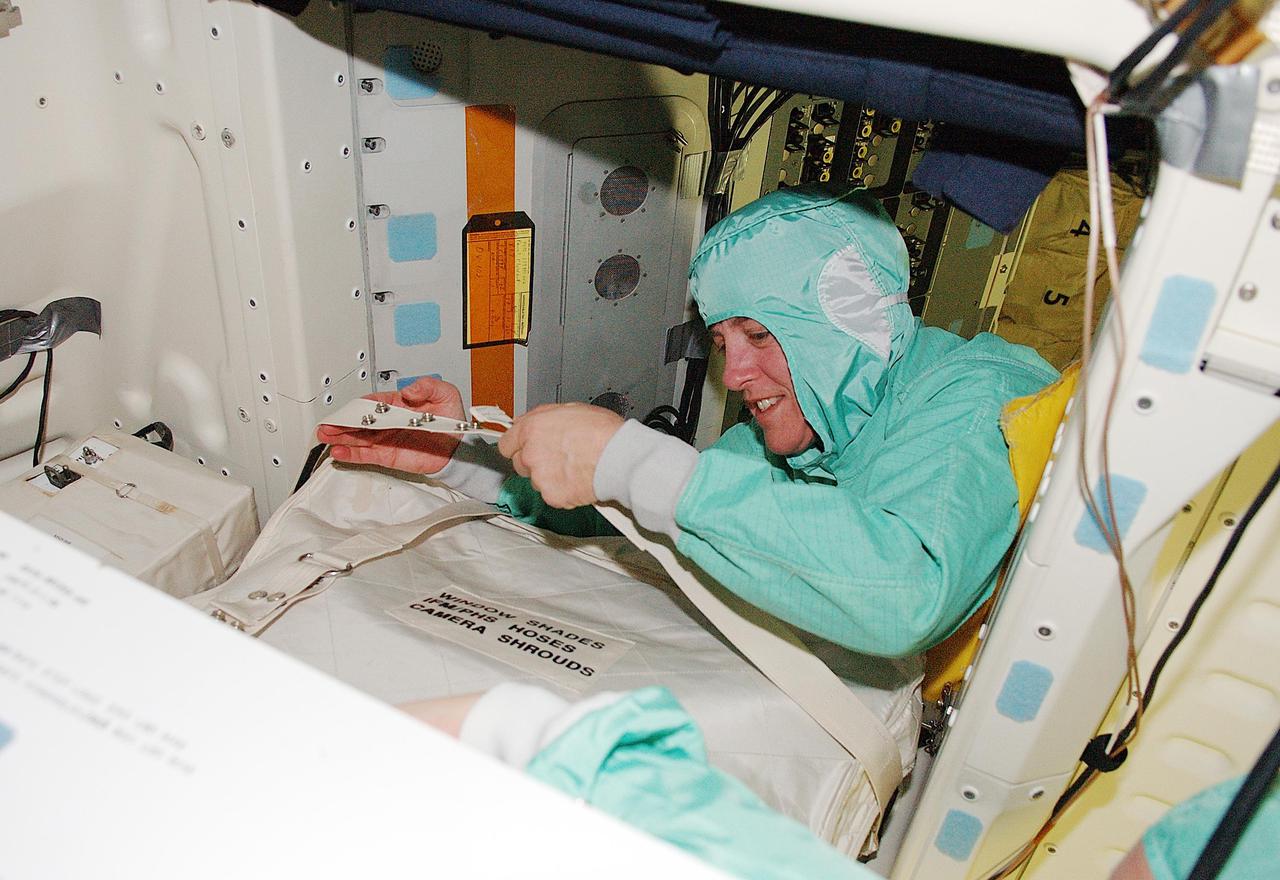
KENNEDY SPACE CENTER, FLA. - STS-114 Mission Specialist Wendy Lawrence grabs a storage container in orbiter Discovery. STS-114 crew members are familiarizing themselves with elements in the mid-body and upper deck of Discovery as part of Crew Equipment Interface Test (CEIT) activities. During CEIT, the crew has an opportunity to get a hands-on look at the orbiter and equipment they will be working with on the mission. Return to Flight Mission STS-114 will carry the Multi-Purpose Logistics Module Raffaello, filled with supplies for the International Space Station, and a replacement Control Moment Gyroscope. Launch of STS-114 has a launch window of May 12 to June 3.
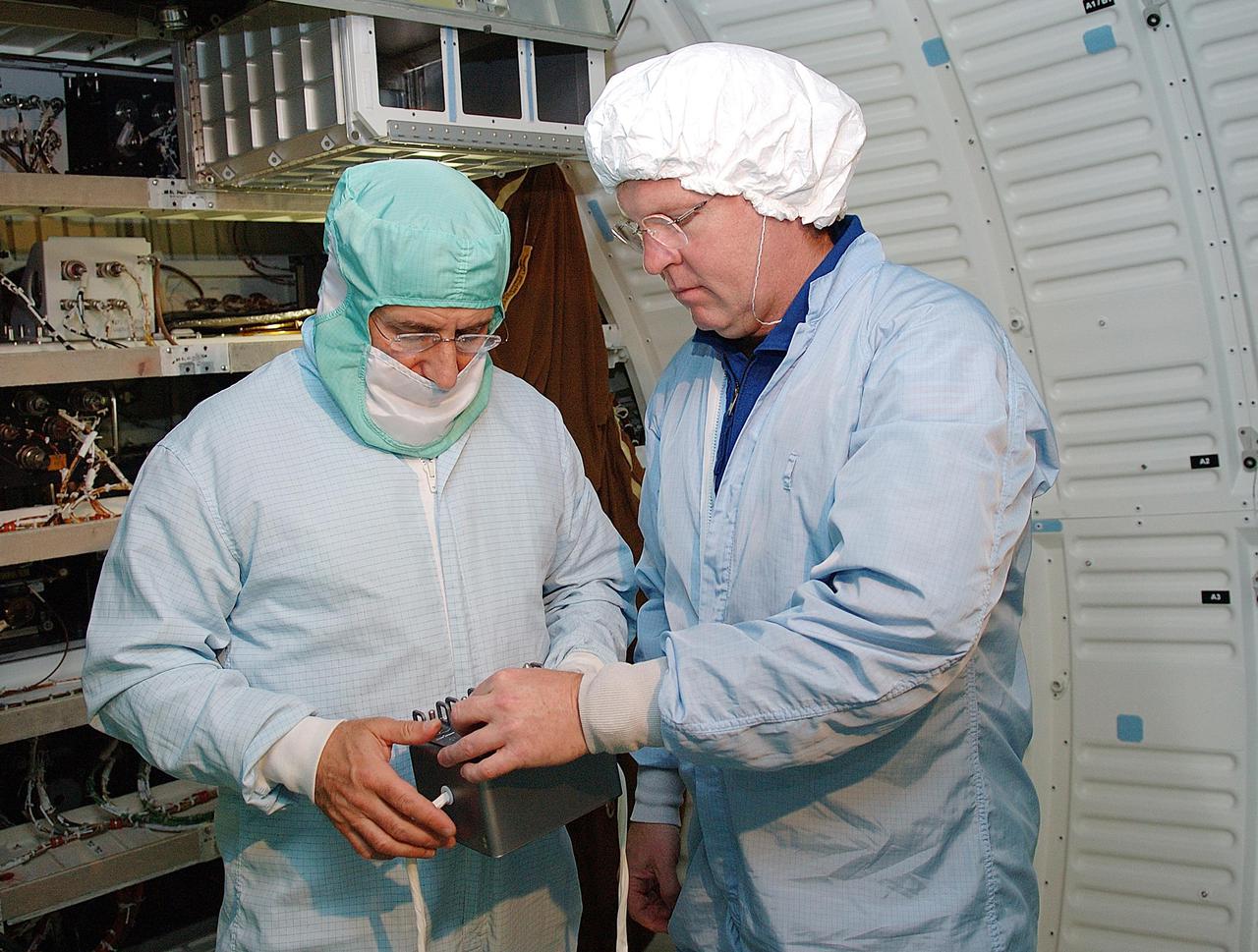
KENNEDY SPACE CENTER, FLA. - STS-114 Mission Specialists Charles Camarda and Andrew Thomas handle a piece of equipment inside the orbiter Discovery. STS-114 crew members are familiarizing themselves with elements in the mid-body and upper deck of Discovery as part of Crew Equipment Interface Test (CEIT) activities. During CEIT, the crew has an opportunity to get a hands-on look at the orbiter and equipment they will be working with on the mission. Return to Flight Mission STS-114 will carry the Multi-Purpose Logistics Module Raffaello, filled with supplies for the International Space Station, and a replacement Control Moment Gyroscope. Launch of STS-114 has a launch window of May 12 to June 3.
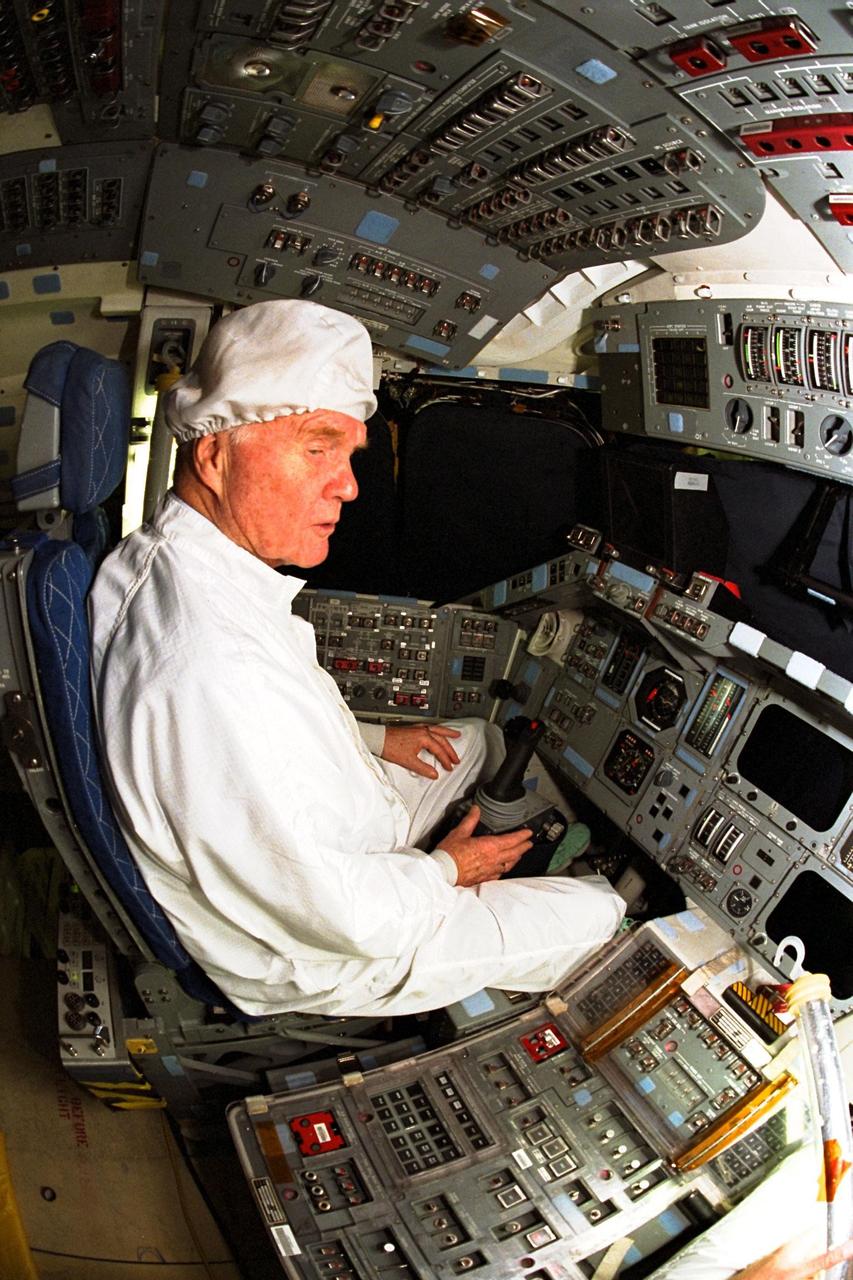
Ohio Senator John Glenn sits in the flight deck looking at equipment in the orbiter Columbia at the Orbiter Processing Facility 3 at Kennedy Space Center. Senator Glenn arrived at KSC on Jan. 20 to tour KSC operational areas and to view the launch of STS-89 later this week. Glenn, who made history in 1962 as the first American to orbit the Earth, completing three orbits in a five-hour flight aboard Friendship 7, will fly his second space mission aboard Space Shuttle Discovery this October. Glenn is retiring from the Senate at the end of this year and will be a payload specialist aboard STS-95
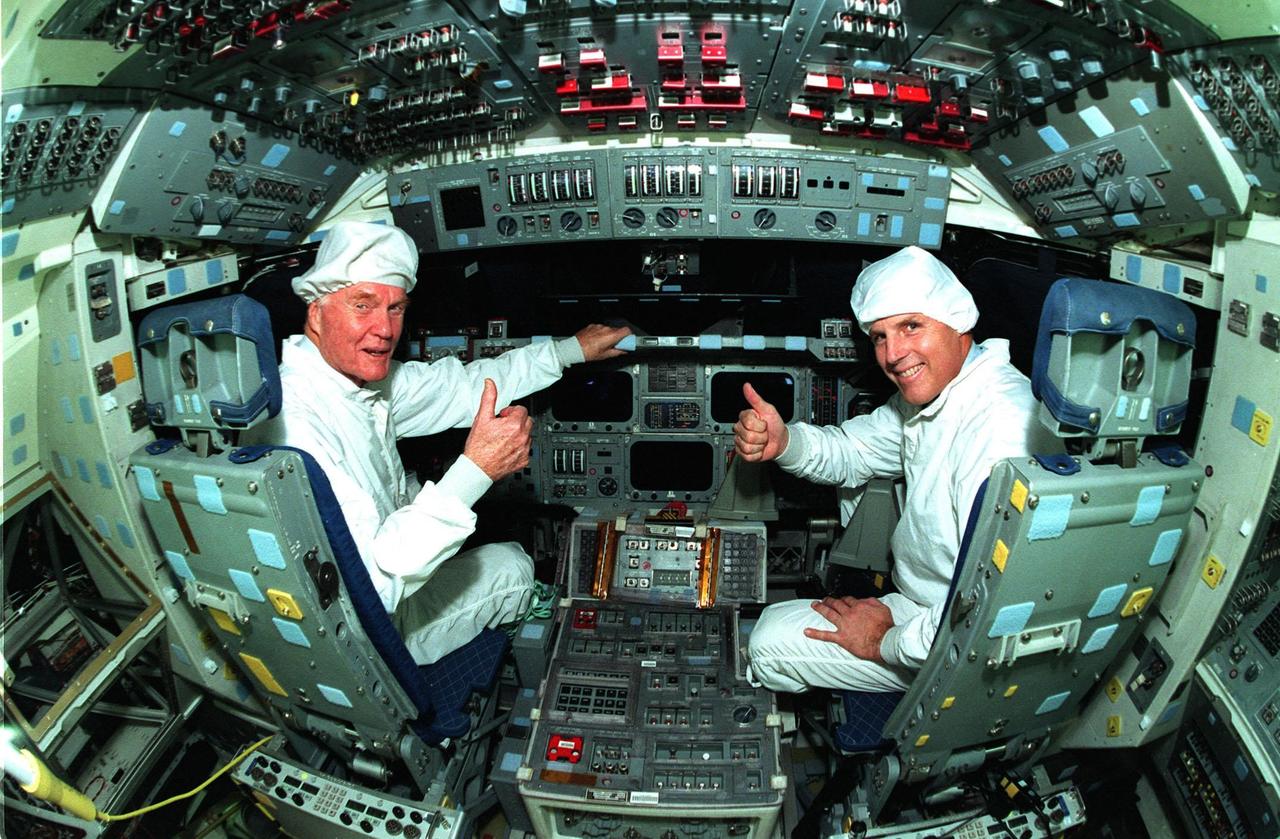
Ohio Senator John Glenn, at left, enjoys a tour of the flight deck in the orbiter Columbia with Astronaut Stephen Oswald at the Orbiter Processing Facility 3 at Kennedy Space Center. Senator Glenn arrived at KSC on Jan. 20 to tour KSC operational areas and to view the launch of STS-89 later this week. Glenn, who made history in 1962 as the first American to orbit the Earth, completing three orbits in a five-hour flight aboard Friendship 7, will fly his second space mission aboard Space Shuttle Discovery this October. Glenn is retiring from the Senate at the end of this year and will be a payload specialist aboard STS-95
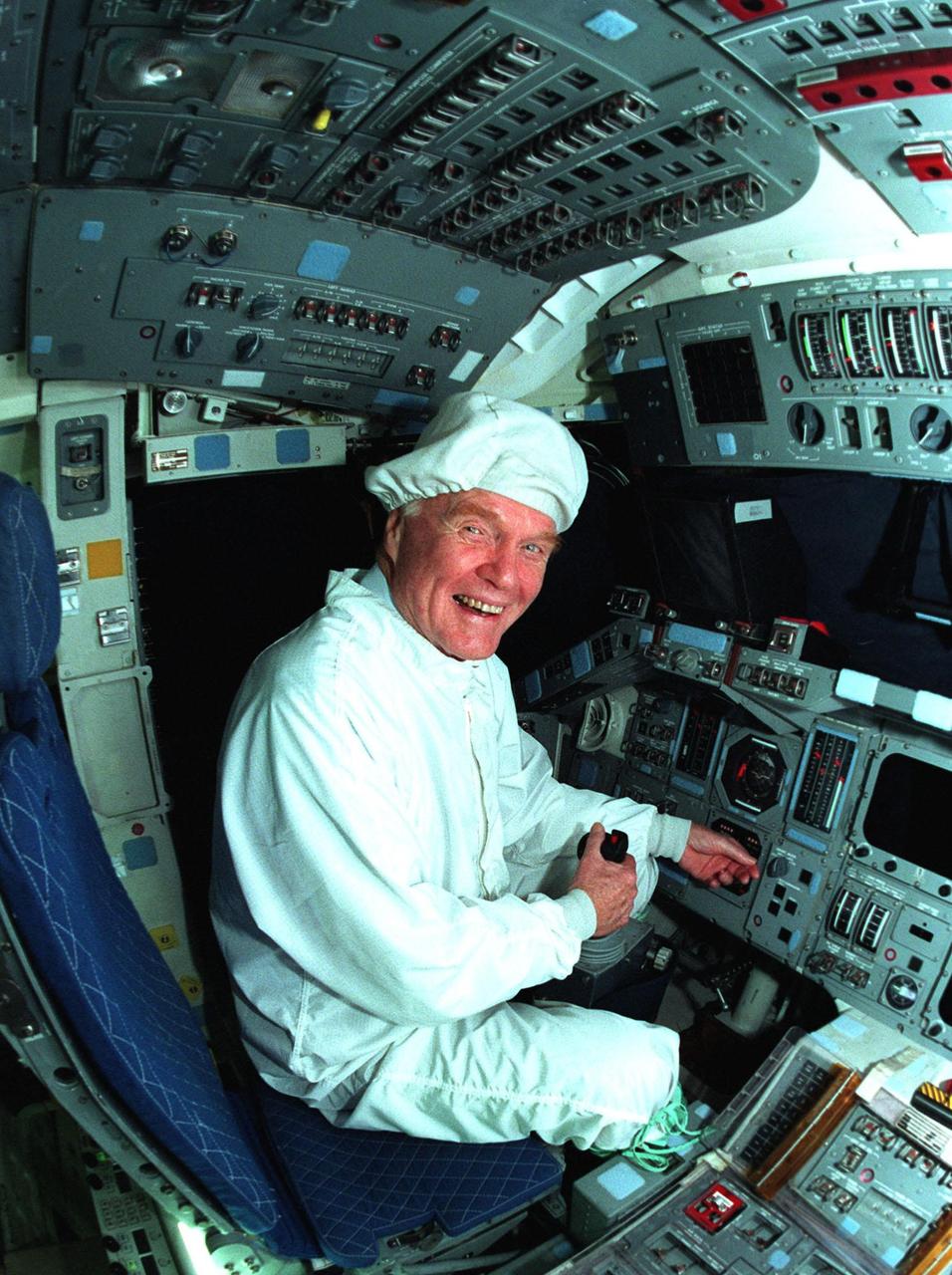
Ohio Senator John Glenn enjoys a tour of the flight deck in the orbiter Columbia at the Orbiter Processing Facility 3 at Kennedy Space Center. Senator Glenn arrived at KSC on Jan. 20 to tour KSC operational areas and to view the launch of STS-89 later this week. Glenn, who made history in 1962 as the first American to orbit the Earth, completing three orbits in a five-hour flight aboard Friendship 7, will fly his second space mission aboard Space Shuttle Discovery this October. Glenn is retiring from the Senate at the end of this year and will be a payload specialist aboard STS-95
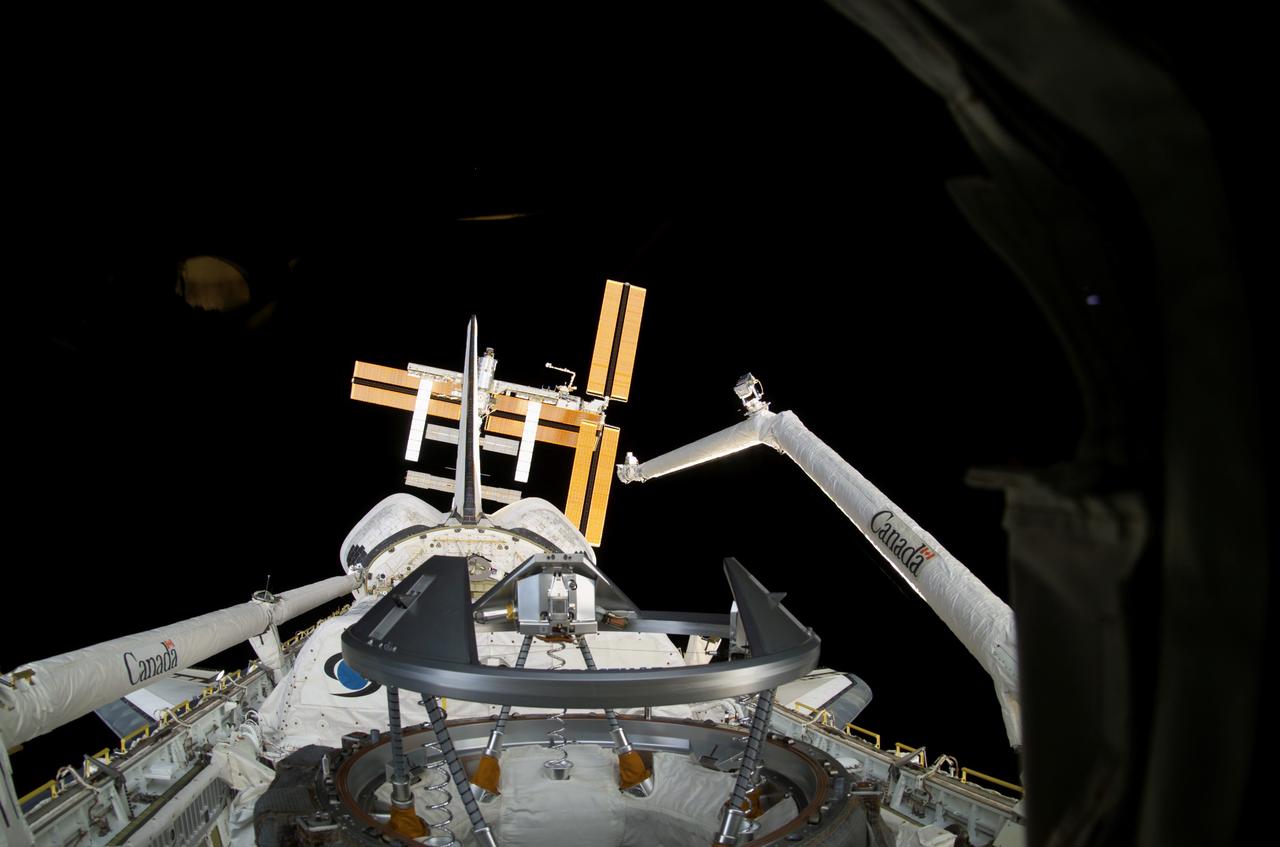
S116-E-05504 (11 Dec. 2006) --- As seen through windows on the aft flight deck of Space Shuttle Discovery, the shuttle's payload bay and the approaching International Space Station (background) are featured in this image photographed by a STS-116 crewmember during flight day three activities. Pictured in the payload bay are the shuttle's docking mechanism (foreground), Spacehab module (partially obscured), the Canadian-built Remote Manipulator System (RMS) robotic arm (right), and the Remote Manipulator System/Orbiter Boom Sensor System (left, in stowed position).

S133-E-006069 (25 Feb. 2011) --- Astronaut Alvin Drew, STS-133 mission specialist, on the flight deck inside Discovery's cabin, surveys the work of the Remote Manipulator System/Orbiter Boom Sensor System (RMS/OBSS). Equipped with special cameras, the system was aiding the crew to conduct thorough inspections of the shuttle’s thermal tile system on flight day 2. Astronaut Steve Lindsey, commander, is at controls just out of frame. Photo credit: NASA or National Aeronautics and Space Administration
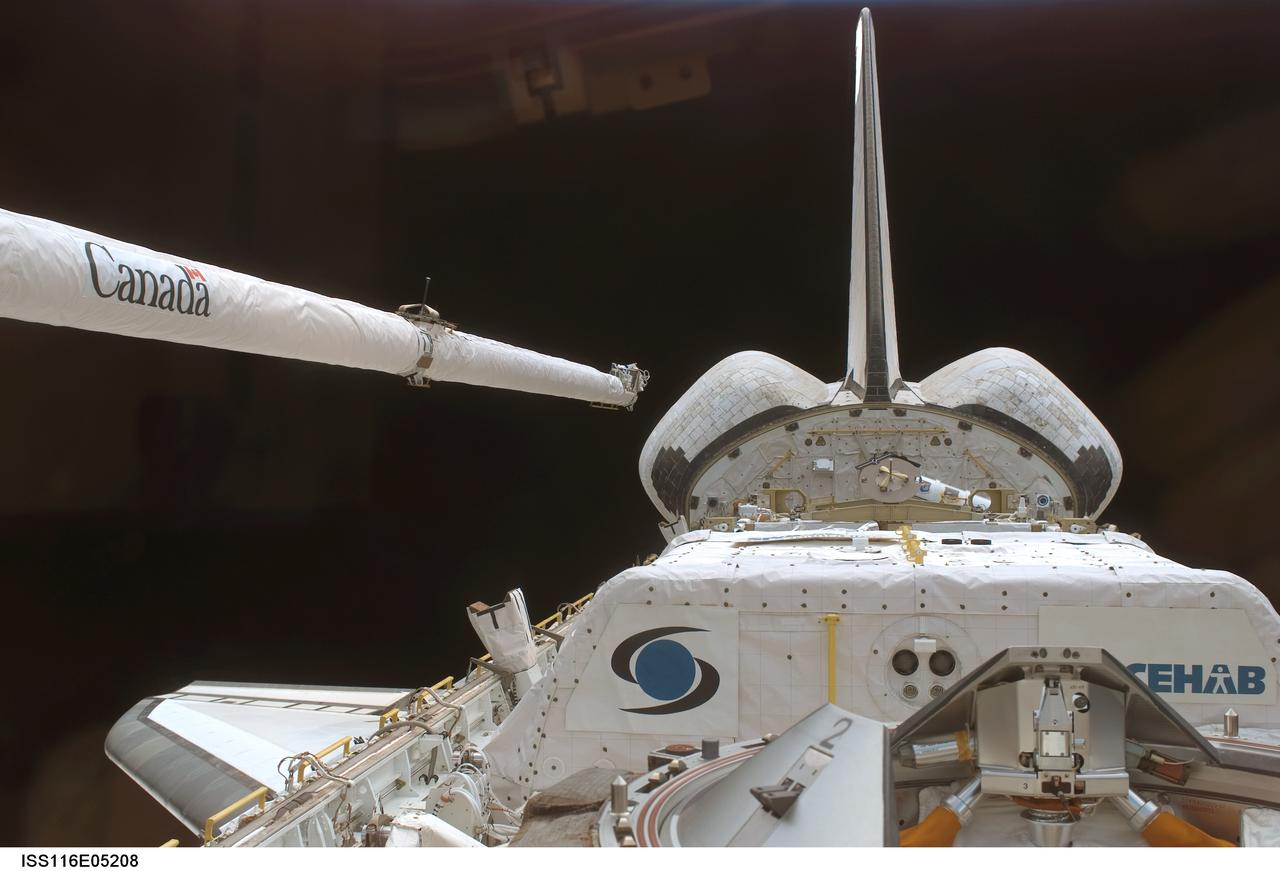
S116-E-05208 (10 Dec. 2006) --- As seen through windows on the aft flight deck of Space Shuttle Discovery, the payload bay is featured in this image photographed by a STS-116 crewmember during flight day two activities. Pictured in the payload bay is the Spacehab module and the Canadian-built Remote Manipulator System/Orbiter Boom Sensor System (RMS/OBSS) is at left. The shuttle's docking mechanism is visible in the foreground.
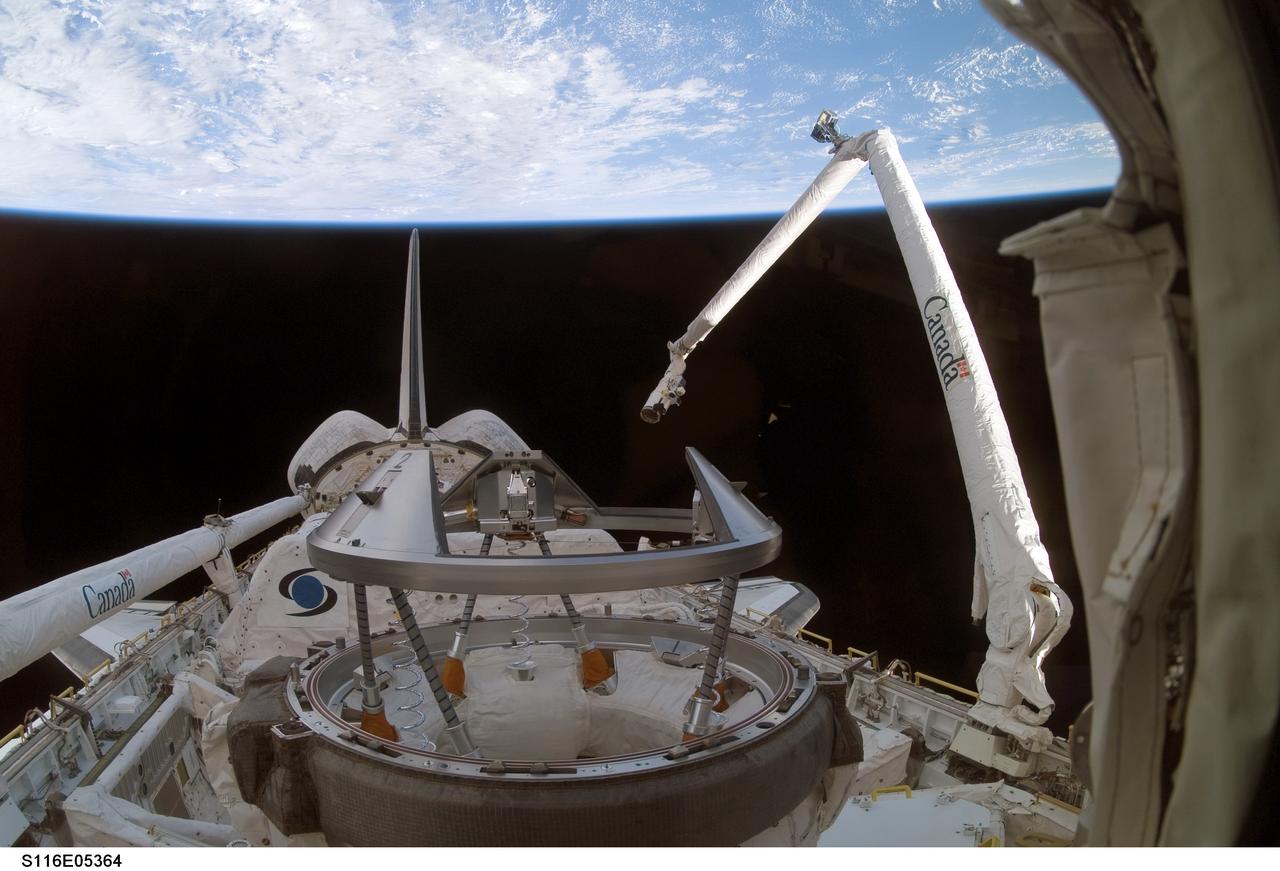
S116-E-05364 (11 Dec. 2006) --- As seen through windows on the aft flight deck of Space Shuttle Discovery, the payload bay is featured in this image photographed by a STS-116 crewmember during flight day three activities. Pictured in the payload bay is the shuttle's docking mechanism (foreground), Spacehab module (partially obscured), the Canadian-built Remote Manipulator System (RMS) robotic arm (right), and the Remote Manipulator System/Orbiter Boom Sensor System (left, in stowed position).
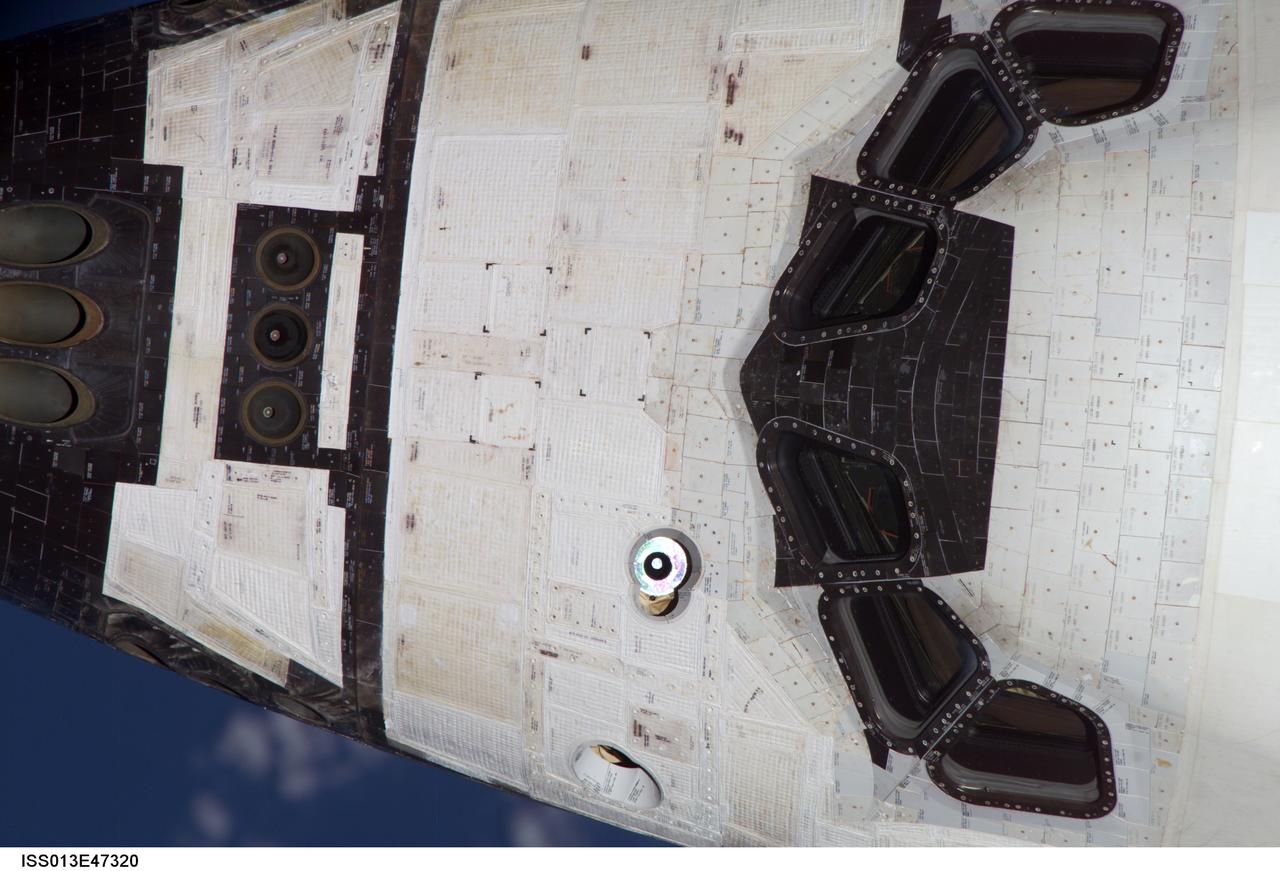
ISS013E47320 (06 July 2006) -- View of the Orbiter Discovery topside of the forward (FWD) flight deck as imaged during the mapping sequence performed by Expedition 13 NASA Space Station crew during STS-121 R-Bar Pitch Maneuver on Flight Day 3. This image was taken with the 800mm lens prior to rendezvous and docking operations.
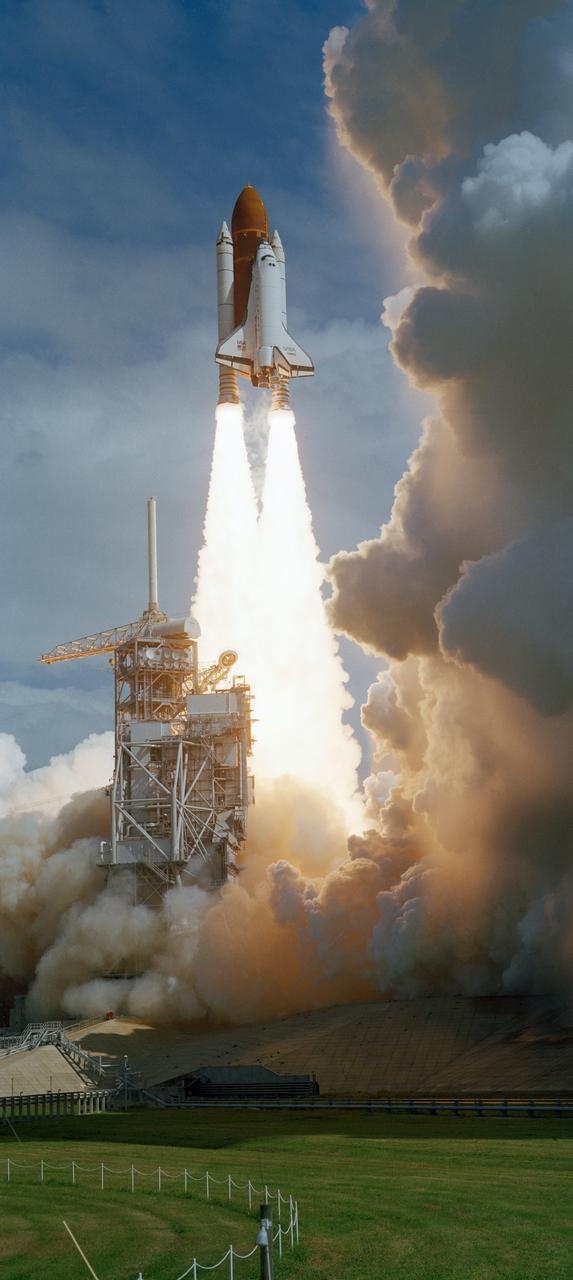
S26-S-032 (29 Sept. 1988) --- The STS-26 launch of space shuttle Discovery begins the first flight to be flown after the Challenger accident. The flight crew included astronauts Rick Hauck, commander; Dick Covey, pilot; and three mission specialists, Dave Hilmers, Mike Lounge, and George (Pinky) Nelson. During the four-day mission, the crew deployed the Tracking and Data Relay Satellite (TDRS-C) and operated eleven mid-deck experiments. Discovery completed 64 orbits of the earth before landing at Edwards Air Force Base, California, on October 3, 1988. Photo credit: NASA or National Aeronautics and Space Administration
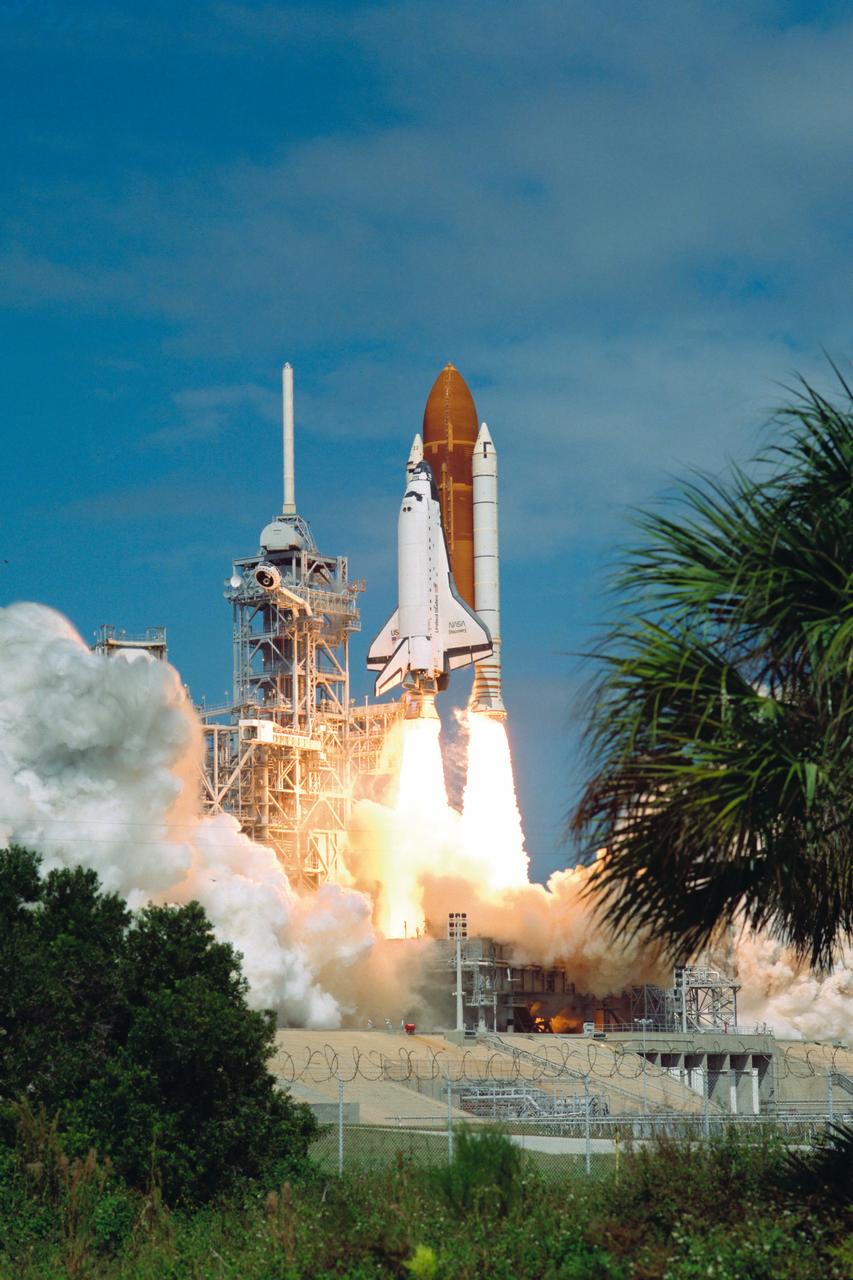
S26-S-187 (29 Sept. 1988) --- The STS-26 launch of space shuttle Discovery begins the first flight to be flown after the Challenger accident. The flight crew included astronauts Rick Hauck, commander; Dick Covey, pilot; and three mission specialists, Dave Hilmers, Mike Lounge, and George (Pinky) Nelson. During the four-day mission, the crew deployed the Tracking and Data Relay Satellite (TDRS-C) and operated eleven mid-deck experiments. Discovery completed 64 orbits of the earth before landing at Edwards Air Force Base, California, on October 3, 1988. Photo credit: NASA or National Aeronautics and Space Administration
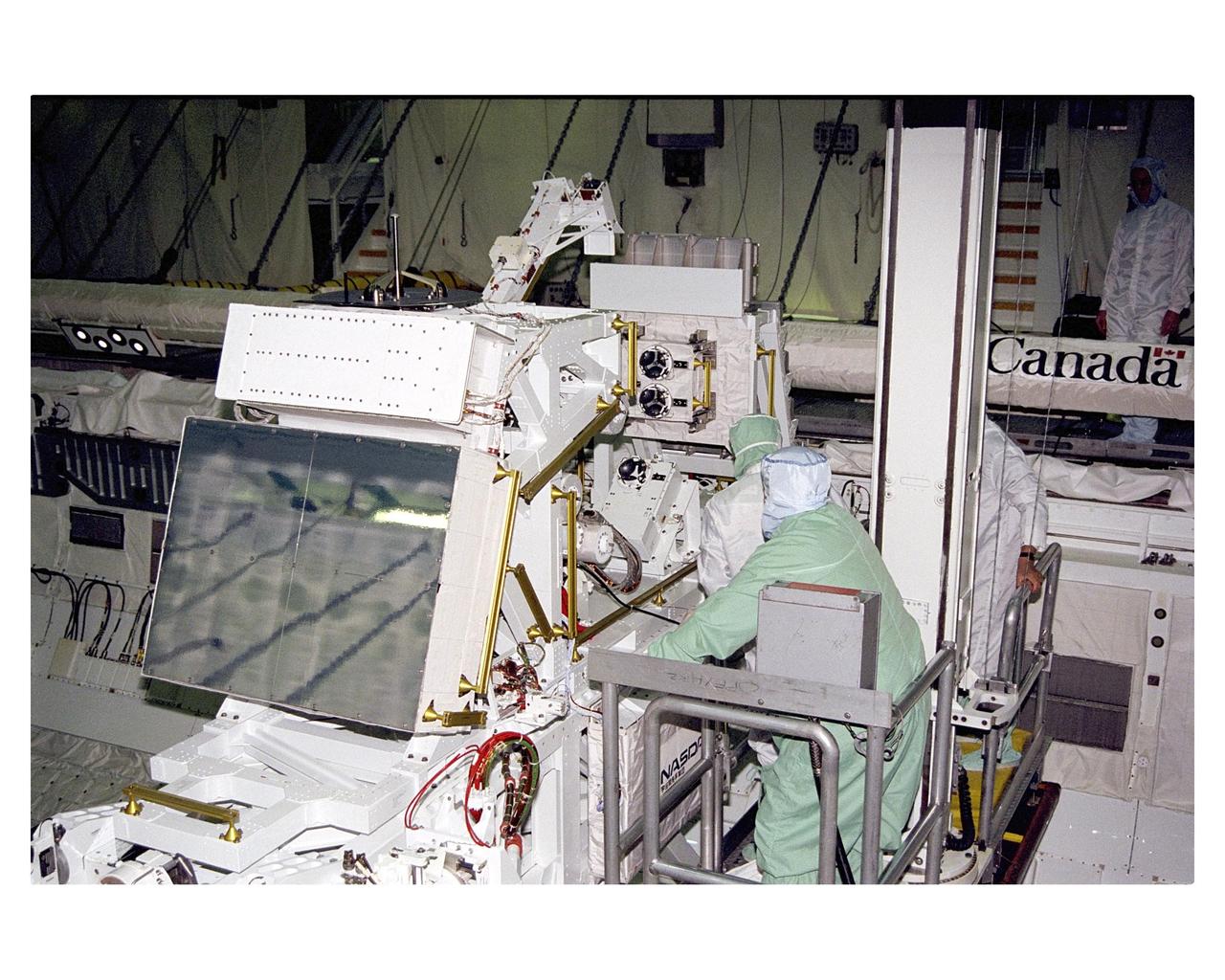
The Manipulator Flight Demonstration (MFD) payload is installed into the payload bay of the Space Shuttle Orbiter Discovery in Orbiter Processing Facility 2. The MFD is one of several payloads that will fly on the STS-85 mission. This payload is designed to test the operational capability of the Japanese Experiment Module Remote Manipulator System (JEM RMS) Small Fine Arm (SFA), which can be seen atop its Multi-Purpose Experiment Support Structure (MPESS) carrier that will serve as a platform in the payload bay for the robotic arm experiment. The arm, which will be a part of the JEM element of the International Space Station, will be operated from the orbiter’s aft flight deck during the 11-day mission. Other payloads that will be aboard Discovery on this space flight include the Cryogenic Infrared Spectrometers and Telescopes for the Atmosphere-Shuttle Pallet Satellite-2 (CRISTA- SPAS-2), Technology Applications and Science-1 (TAS-1) and International Extreme Ultraviolet Hitchhiker (IEH-2) experiments
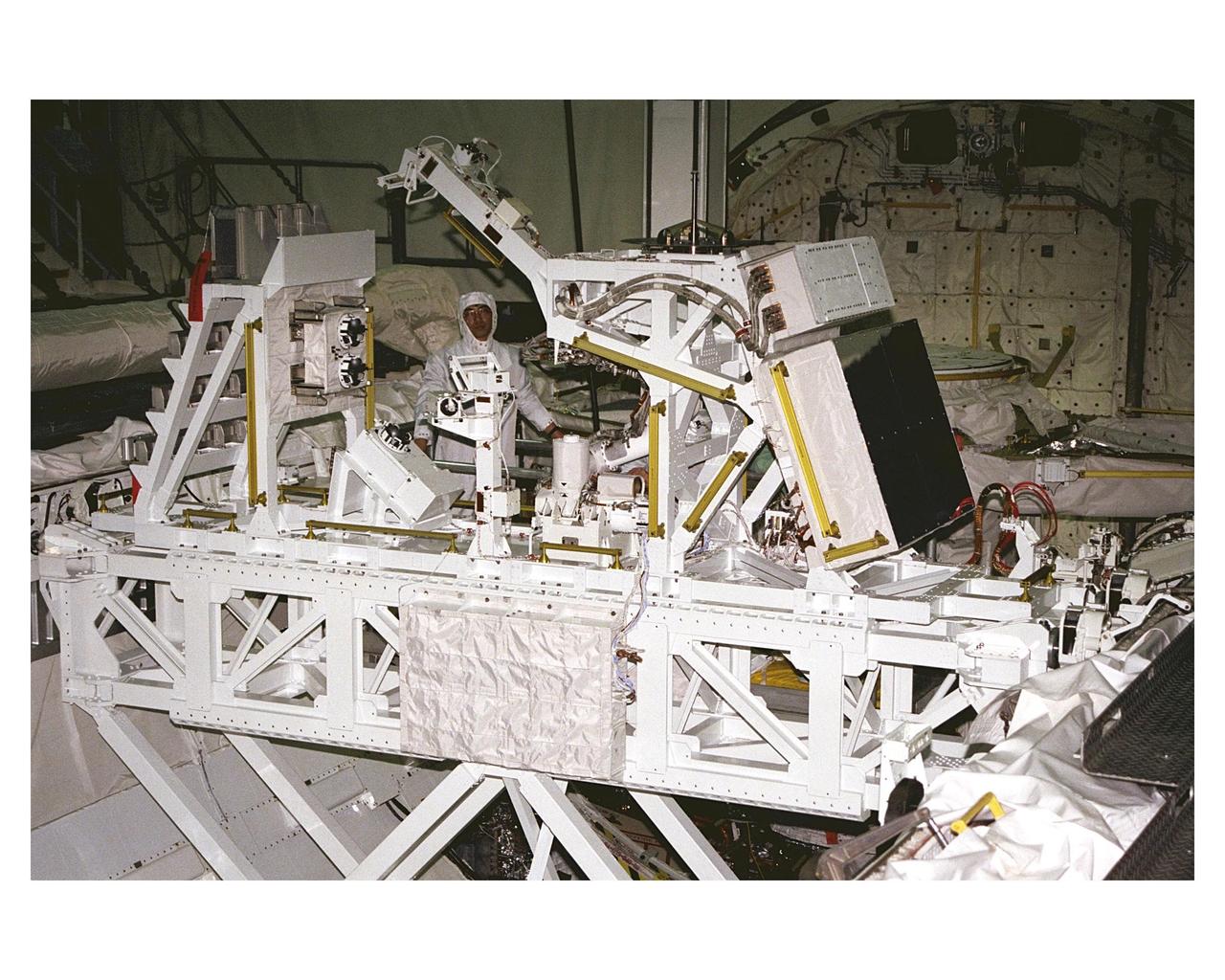
The Manipulator Flight Demonstration (MFD) payload is installed into the payload bay of the Space Shuttle Orbiter Discovery in Orbiter Processing Facility 2. The MFD is one of several payloads that will fly on the STS-85 mission. This payload is designed to test the operational capability of the Japanese Experiment Module Remote Manipulator System (JEM RMS) Small Fine Arm (SFA), which can be seen atop its Multi-Purpose Experiment Support Structure (MPESS) carrier that will serve as a platform in the payload bay for the robotic arm experiment. The arm, which will be a part of the JEM element of the International Space Station, will be operated from the orbiter’s aft flight deck during the 11-day mission. Other payloads that will be aboard Discovery on this space flight include the Cryogenic Infrared Spectrometers and Telescopes for the Atmosphere-Shuttle Pallet Satellite-2 (CRISTA- SPAS-2), Technology Applications and Science-1 (TAS-1) and International Extreme Ultraviolet Hitchhiker (IEH-2) experiments
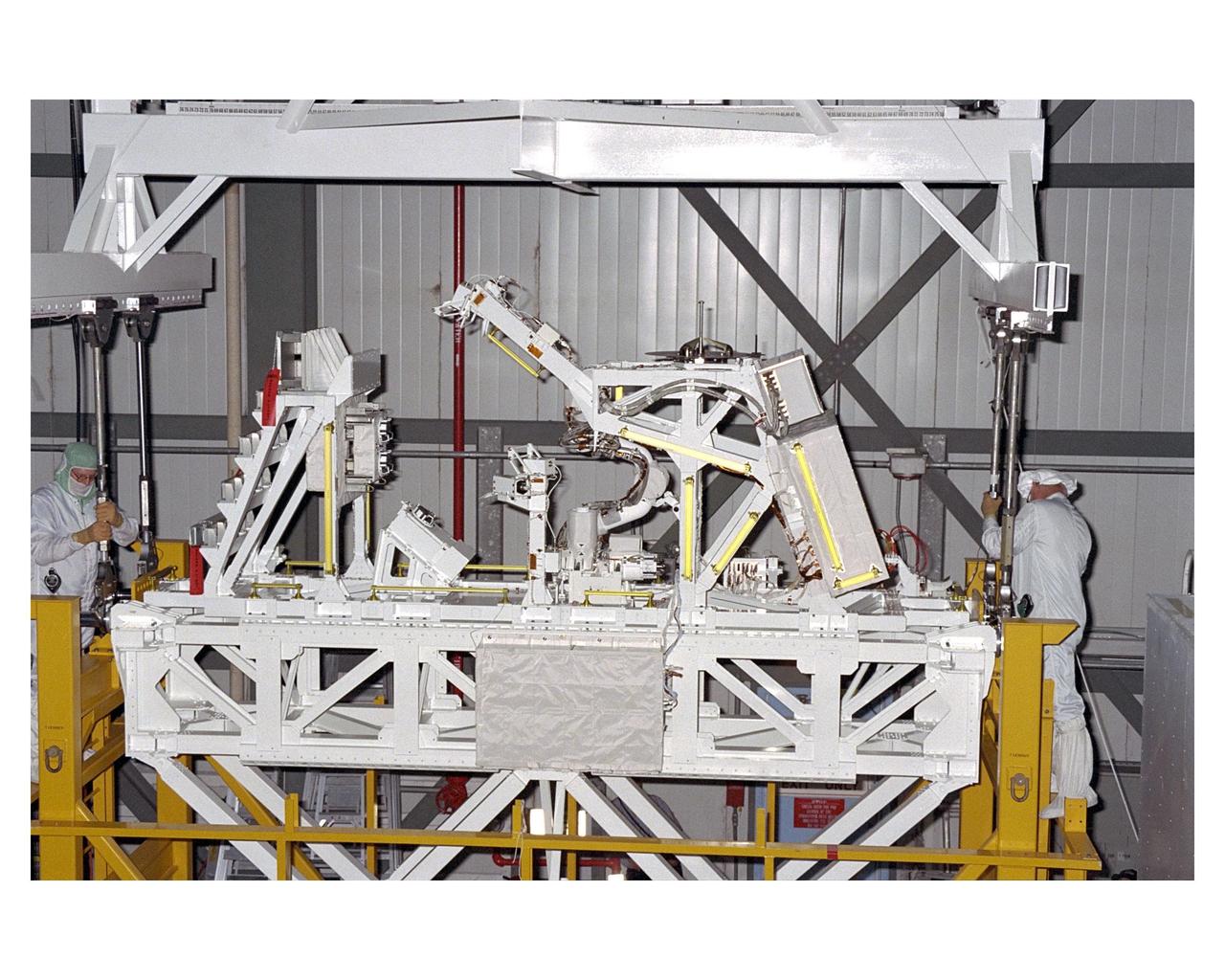
The Manipulator Flight Demonstration (MFD) payload is prepared for hoisting and installation into the payload bay of the Space Shuttle Orbiter Discovery in Orbiter Processing Facility 2. The MFD is one of several payloads that will fly on the STS-85 mission. This payload is designed to test the operational capability of the Japanese Experiment Module Remote Manipulator System (JEM RMS) Small Fine Arm (SFA), which can be seen atop its Multi-Purpose Experiment Support Structure (MPESS) carrier that will serve as a platform in the payload bay for the robotic arm experiment. The arm, which will be a part of the JEM element of the International Space Station, will be operated from the orbiter’s aft flight deck during the 11-day mission. Other payloads that will be aboard Discovery on this space flight include the Cryogenic Infrared Spectrometers and Telescopes for the Atmosphere-Shuttle Pallet Satellite-2 (CRISTA-SPAS-2), Technology Applications and Science-1 (TAS-1) and International Extreme Ultraviolet Hitchhiker (IEH-2) experiments
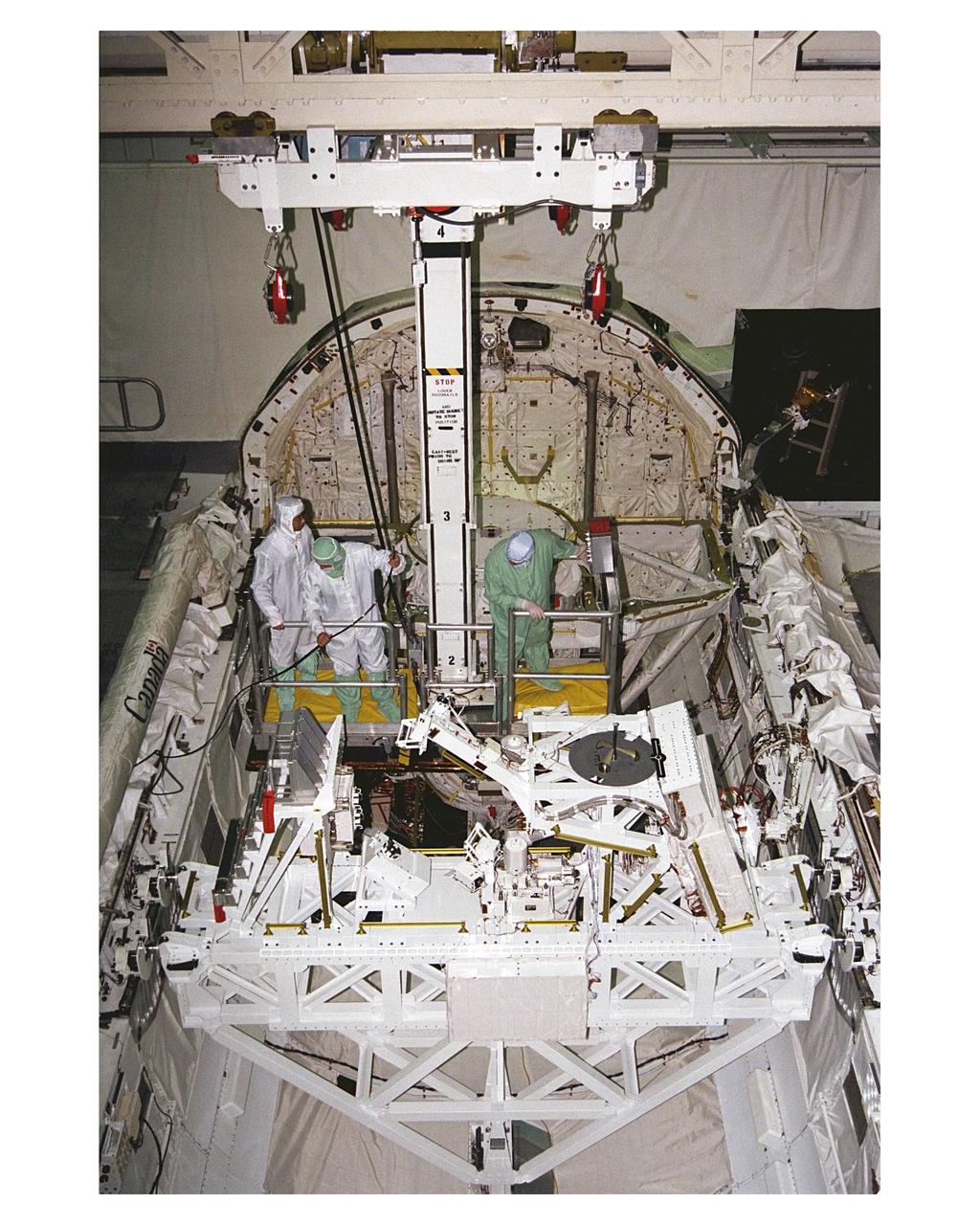
The Manipulator Flight Demonstration (MFD) payload is lowered into the payload bay of the Space Shuttle Orbiter Discovery in Orbiter Processing Facility 2. The MFD is one of several payloads that will fly on the STS-85 mission. This payload is designed to test the operational capability of the Japanese Experiment Module Remote Manipulator System (JEM RMS) Small Fine Arm (SFA), which can be seen atop its Multi-Purpose Experiment Support Structure (MPESS) carrier that will serve as a platform in the payload bay for the robotic arm experiment. The arm, which will be a part of the JEM element of the International Space Station, will be operated from the orbiter’s aft flight deck during the 11-day mission. Other payloads that will be aboard Discovery on this space flight include the Cryogenic Infrared Spectro-meters and Telescopes for the Atmosphere-Shuttle Pallet Satellite-2 (CRISTA-SPAS-2), Technology Applications and Science-1 (TAS-1) and International Extreme Ultraviolet Hitchhiker (IEH-2) experiments
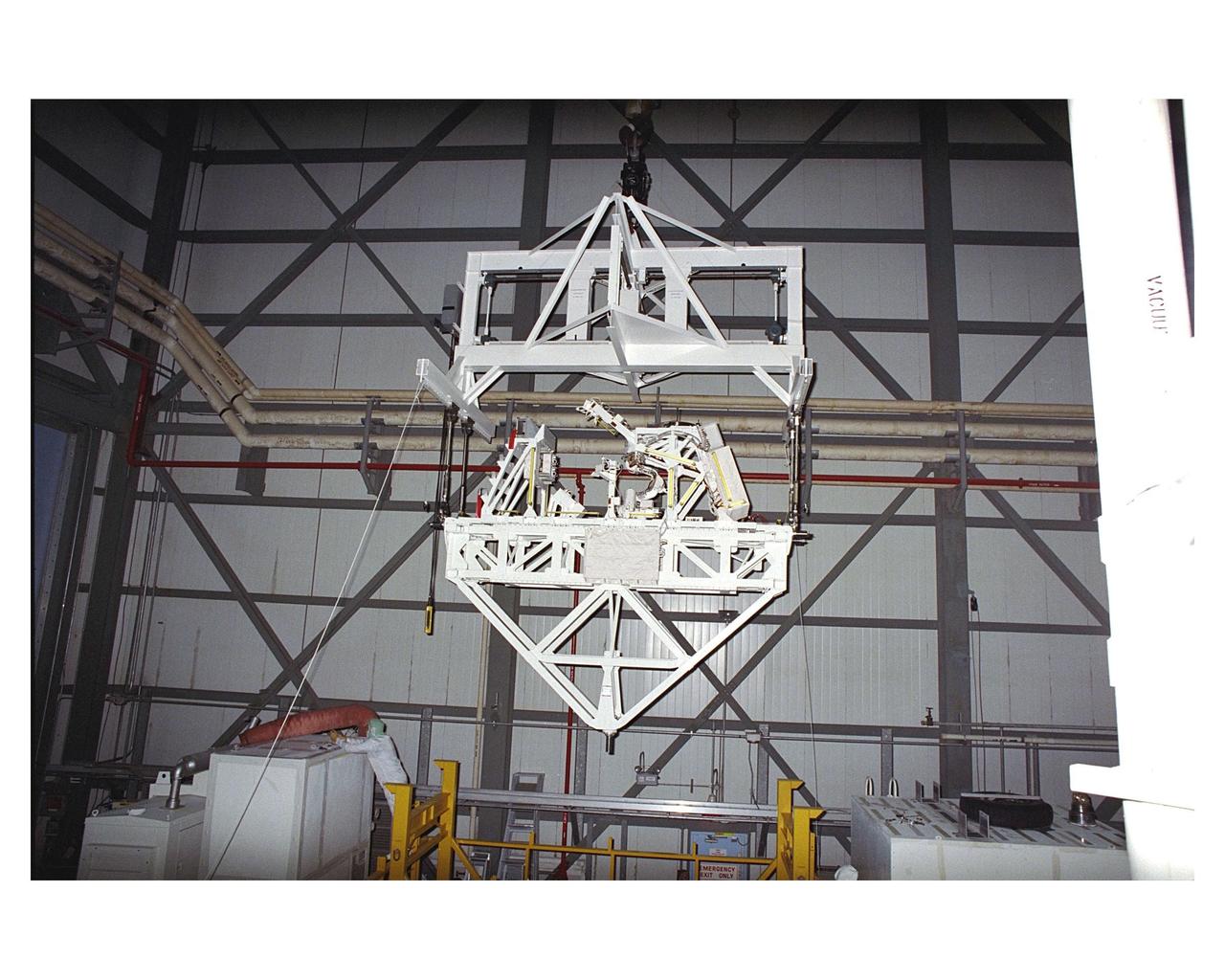
The Manipulator Flight Demonstration (MFD) payload is hoisted for installation into the payload bay of the Space Shuttle Orbiter Discovery in Orbiter Processing Facility 2. The MFD is one of several payloads that will fly on the STS-85 mission. This payload is designed to test the operational capability of the Japanese Experiment Module Remote Manipulator System (JEM RMS) Small Fine Arm (SFA), which can be seen atop its Multi-Purpose Experiment Support Structure (MPESS) carrier that will serve as a platform in the payload bay for the robotic arm experiment. The arm, which will be a part of the JEM element of the International Space Station, will be operated from the orbiter’s aft flight deck during the 11-day mission. Other payloads that will be aboard Discovery on this space flight include the Cryogenic Infrared Spectrometers and Telescopes for the Atmosphere-Shuttle Pallet Satellite-2 (CRISTA-SPAS-2), Technology Applications and Science-1 (TAS-1) and International Extreme Ultraviolet Hitchhiker (IEH-2) experiments