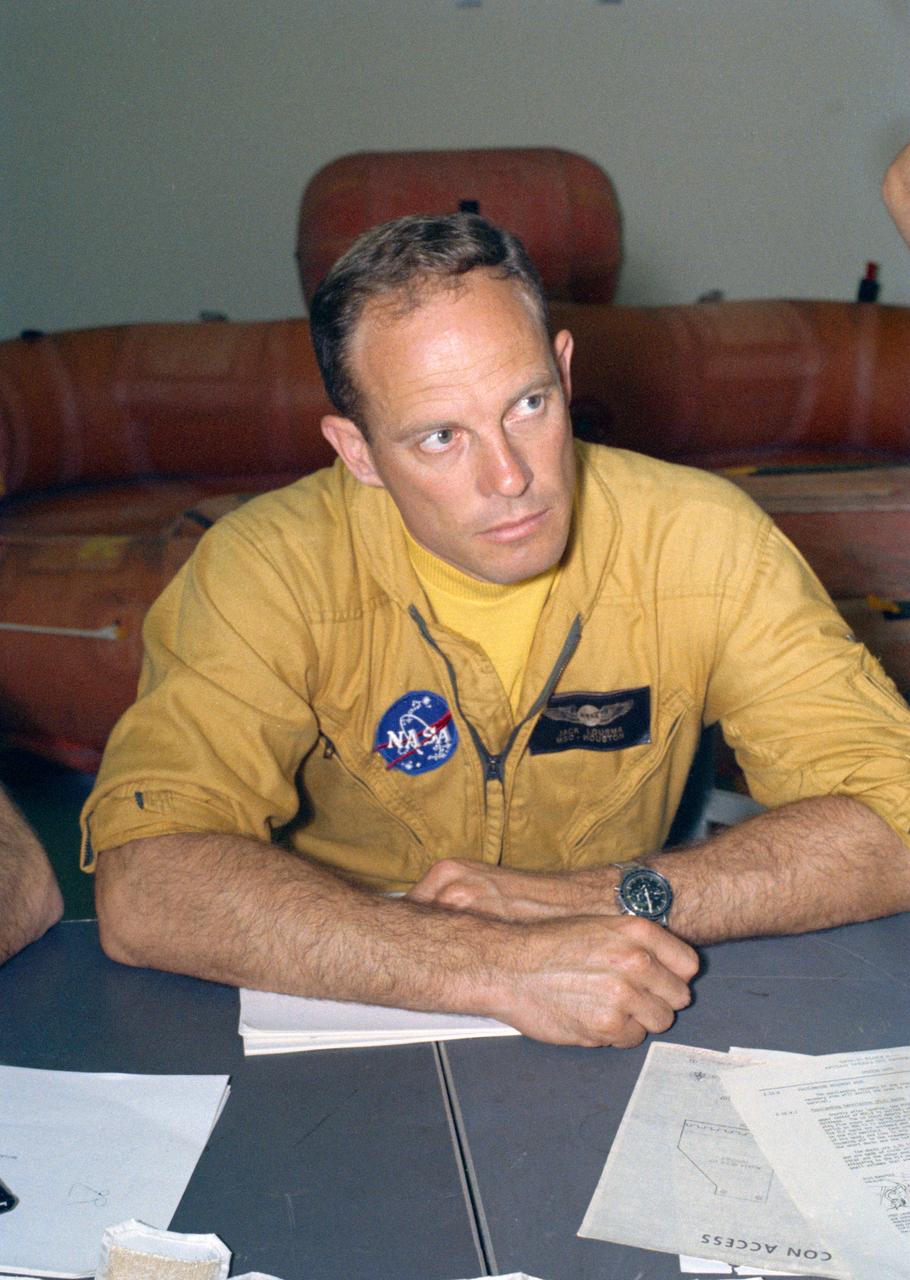
S73-27770 (1 May 1973) --- Astronaut Jack R. Lousma, Skylab 3 pilot, sits at a table with fellow crewmen and the flight surgeon prior to water egress training at the Johnson Space Center, Houston. Photo credit: NASA
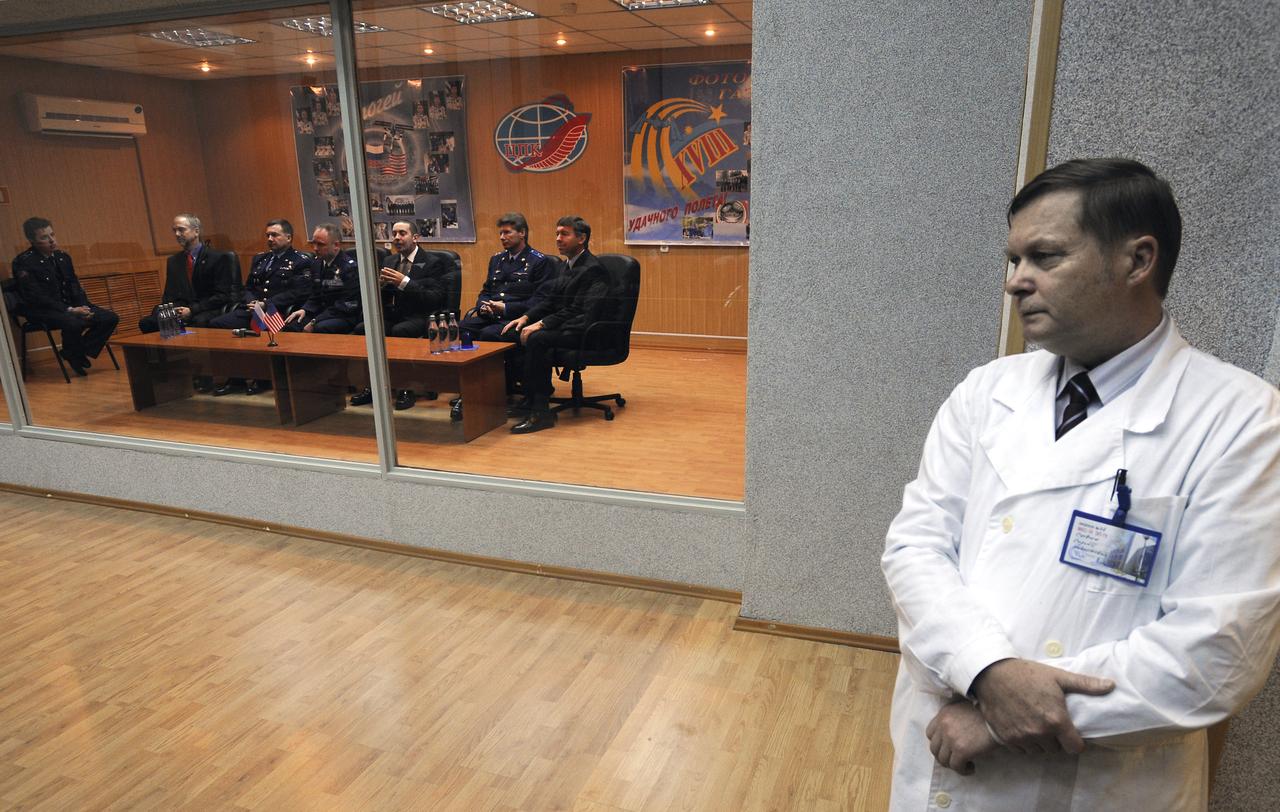
A Russian flight surgeon, right, along with the quarantined prime and backup crews listen to the State Commission give the final approval for the launch of the Soyuz TMA-13 spacecraft, Saturday, Oct. 11, 2008 in Baikonur, Kazakhstan. Expedition 18 Commander Michael Fincke, Flight Engineer Yuri V. Lonchakov and American spaceflight participant Richard Garriott are scheduled to launch Oct. 12 and dock with the International Space Station on Oct. 14. Fincke and Lonchakov will spend six months on the station, while Garriott will return to Earth Oct. 24 with two of the Expedition 17 crew members currently on the International Space Station. Photo Credit: (NASA/Bill Ingalls)

JSC2001-E-21556 (13 July 2001) --- Joseph Dervay, M.D., STS-104 flight surgeon, looks over medical data concerning the STS-104 crew at the Surgeon console in Houston's Mission Control Center (MCC).
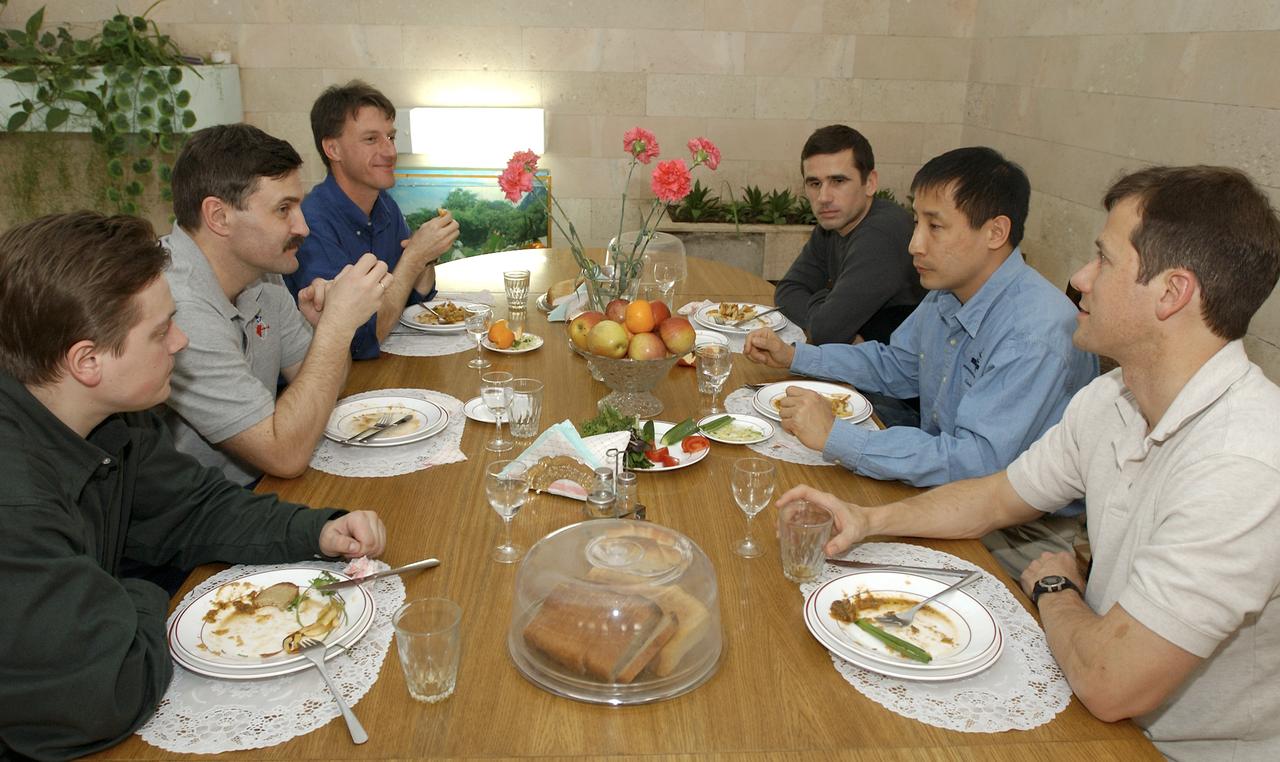
Clockwise from top right, Expedition 7 Commander, Yuri I. Malenchenko, NASA International Space Station Science Officer and Flight Engineer, Edward T. Lu and prime crew Flight Surgeon Tom Marshburn, unidentified Russian flight surgeon, along with cosmonaut Alexander Kaleri and astronaut Michael Foale, top left, eat dinner at the Cosmonaut Hotel in Baikonur, Kazakhstan, Wednesday, April 9, 2003. Photo Credit: (NASA/Bill Ingalls)
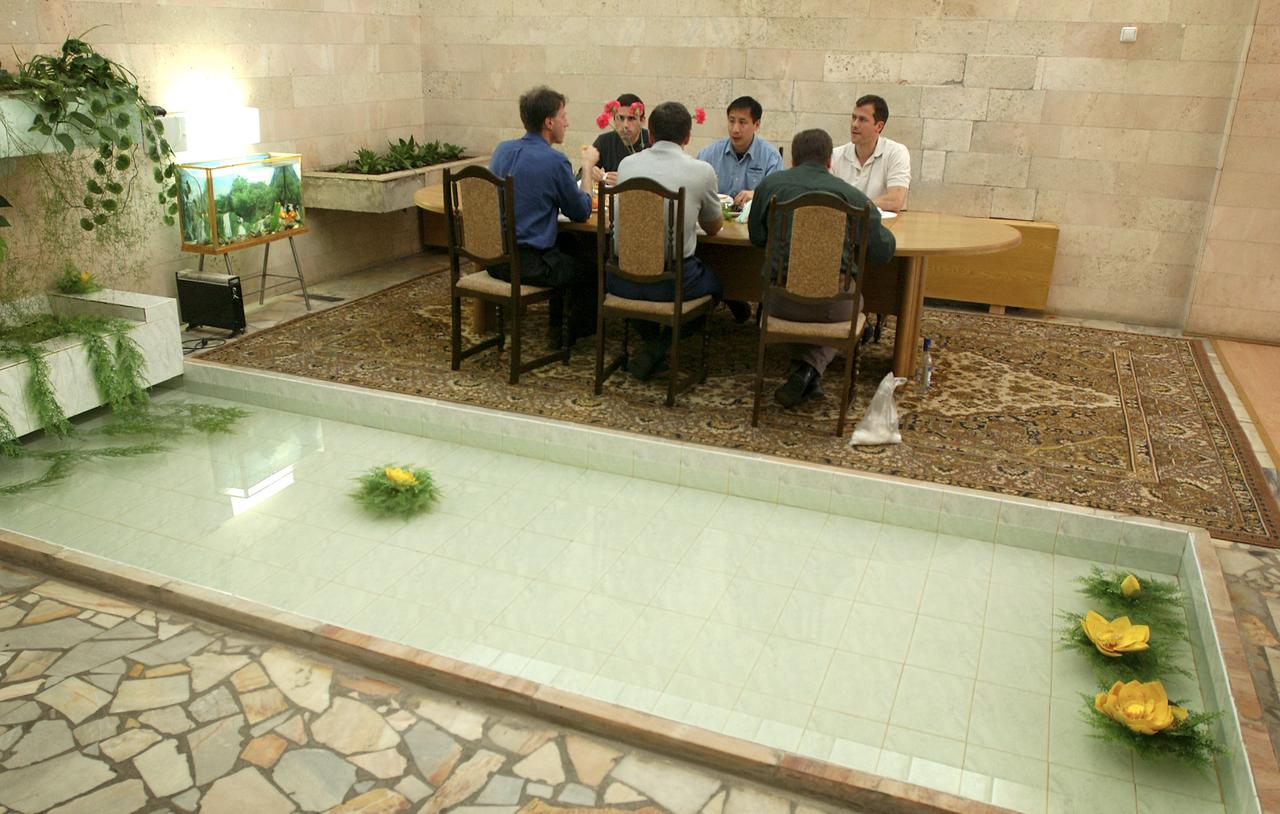
Expedition 7 Commander, Yuri I. Malenchenko, second from left, facing camera, NASA International Space Station Science Officer and Flight Engineer, Edward T. Lu, center, and prime crew Flight Surgeon Thomas Marshburn eat dinner at the Cosmonaut Hotel along with the backup crew members, astronaut Michael Foale, left, back to camera, cosmonaut Alexander Kaleri, center, back to camera, and an unidentified Russian flight surgeon in Baikonur, Kazakhstan, Wednesday, April 9, 2003. Photo Credit: (NASA/Bill Ingalls)
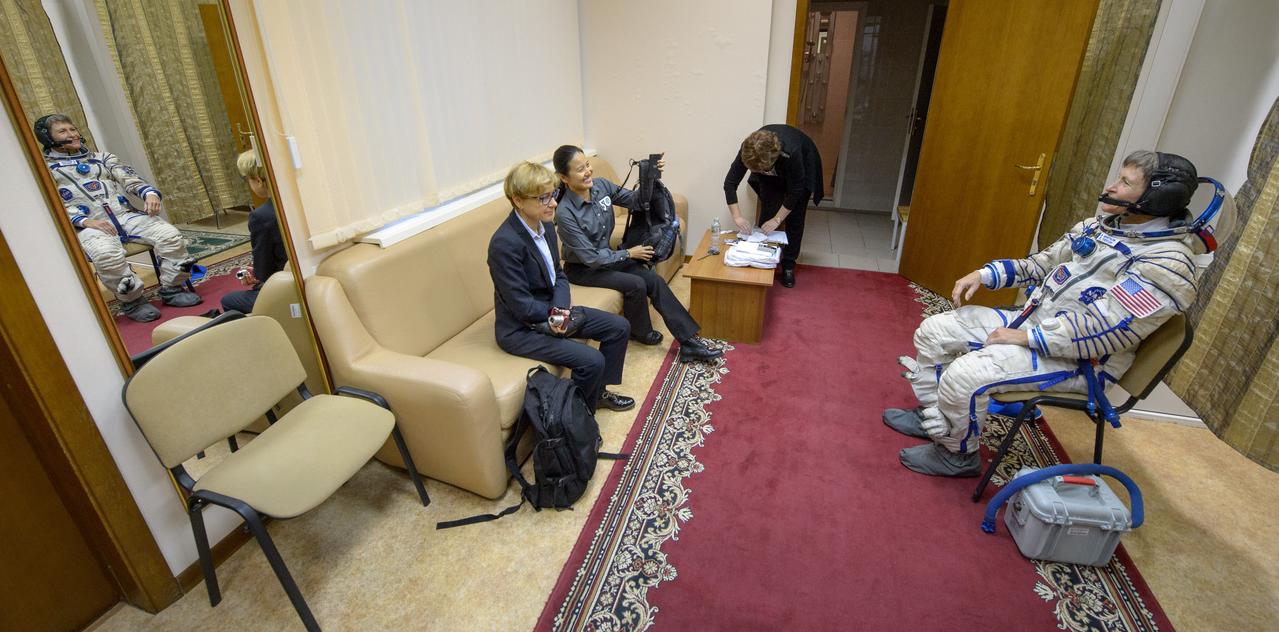
ESA Flight Surgeon Dr. Brigitte Godard, seated left, NASA Flight Surgeon Jennifer Law, center, talk with Expedition 50 NASA astronaut Peggy Whitson ahead of the final qualification exams with Whitson and her fellow crew mates Russian cosmonaut Oleg Novitskiy of Roscosmos and ESA astronaut Thomas Pesquet, Tuesday, Oct. 25, 2016, at the Gagarin Cosmonaut Training Center (GCTC) in Star City, Russia. Photo Credit: (NASA/Bill Ingalls)
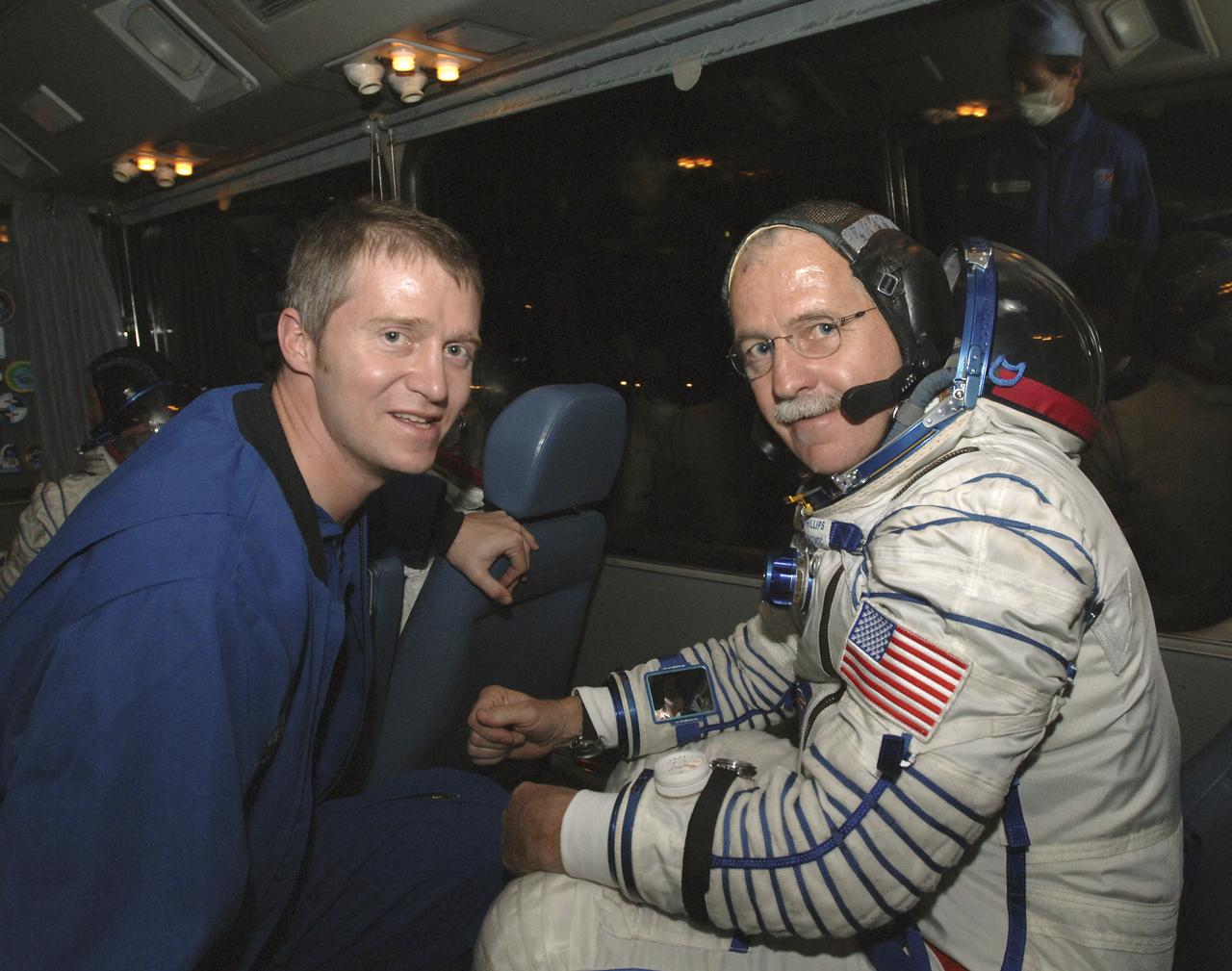
NASA Flight Surgeon Jim Locke is seen with Flight Engineer and NASA Science Officer John Phillips during a bus ride prior to launch, Friday, April 15, 2005 at the Baikonur Cosmodrome in Kazakhstan. Photo Credit: (NASA/Bill Ingalls)
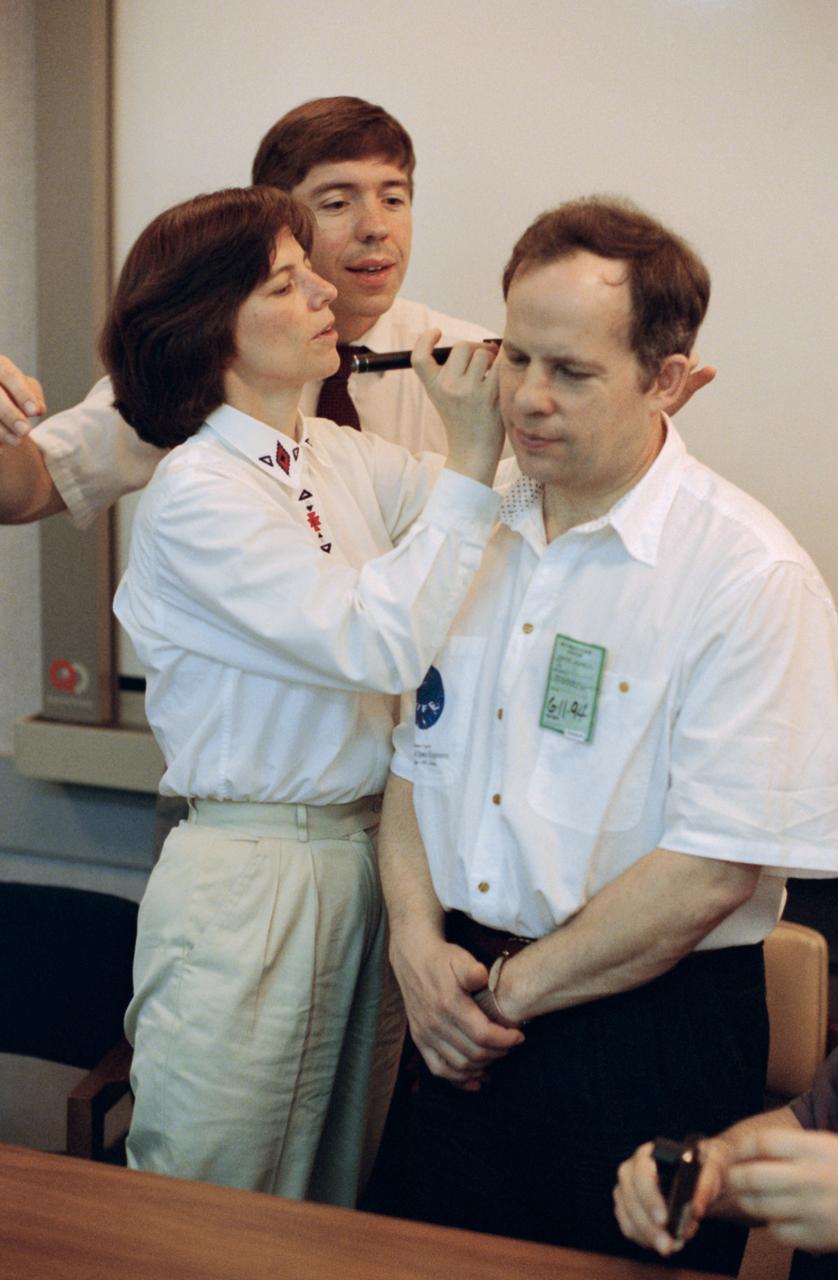
S94-35071 (17 June 1994) --- Flight surgeon Mike Barrett looks on as astronaut Bonnie J. Dunbar conducts a physical examination on cosmonaut Anatoly Solovyov. Crew members for the joint Space Shuttle/Mir missions are in the midst of three weeks' medical operations training for their cooperative flights.

S62-00330 (1962) --- Astronaut John H. Glenn Jr. (left), Dr. William Douglas, astronauts flight surgeon, and equipment specialist Joe Schmitt leave crew quarters prior to Mercury-Atlas 6 (MA-6) mission. Glenn is in his pressure suit and is carrying the portable ventilation unit. Photo credit: NASA
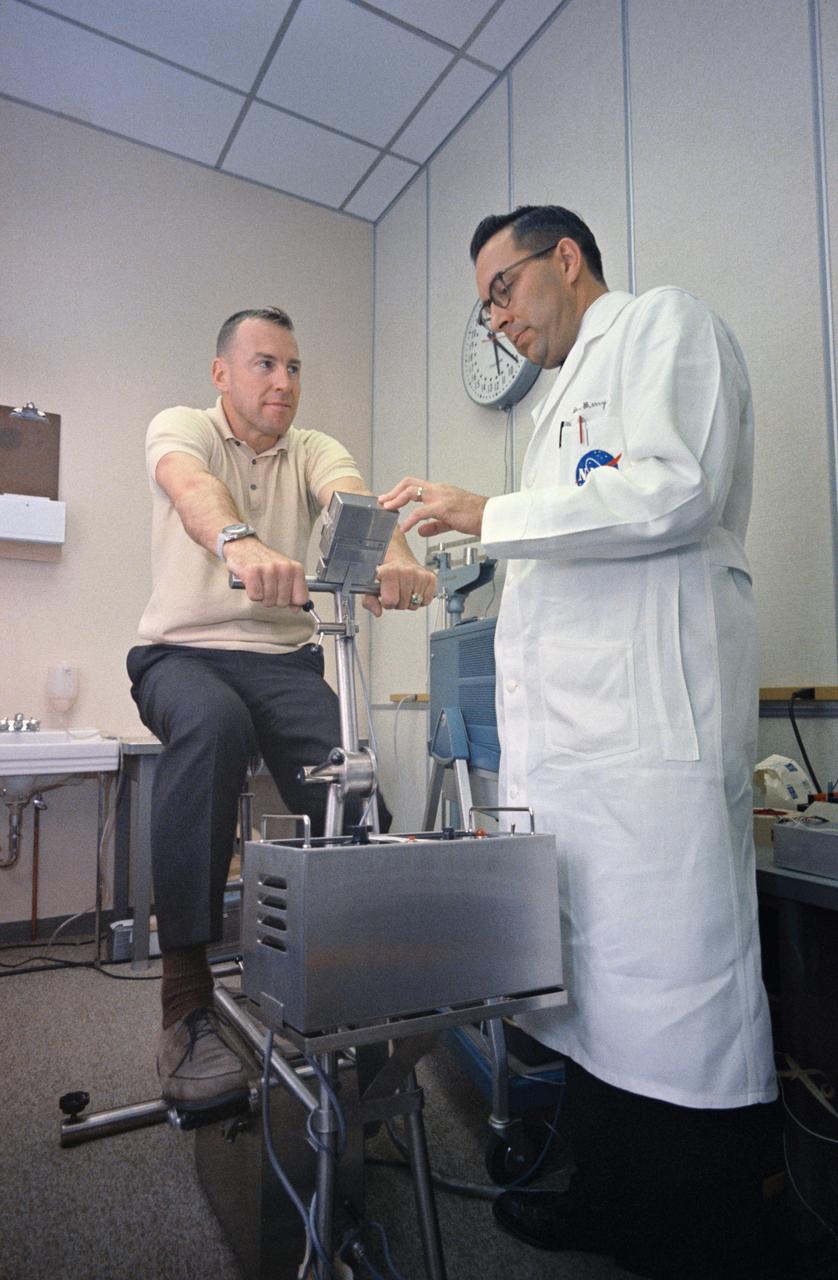
S65-60602 (2 Dec. 1965) --- Dr. Charles A. Berry checks astronaut James A. Lovell Jr., Gemini-7 prime crew pilot, following a workout on an exercise machine. Results will be compared with those obtained during spaceflight for evaluation. Lovell and astronaut Frank Borman (not pictured), command pilot, will pilot the Gemini-7 spacecraft on a planned 14-day mission. Dr. Berry is chief, MSC Center Medical Programs. Photo credit: NASA
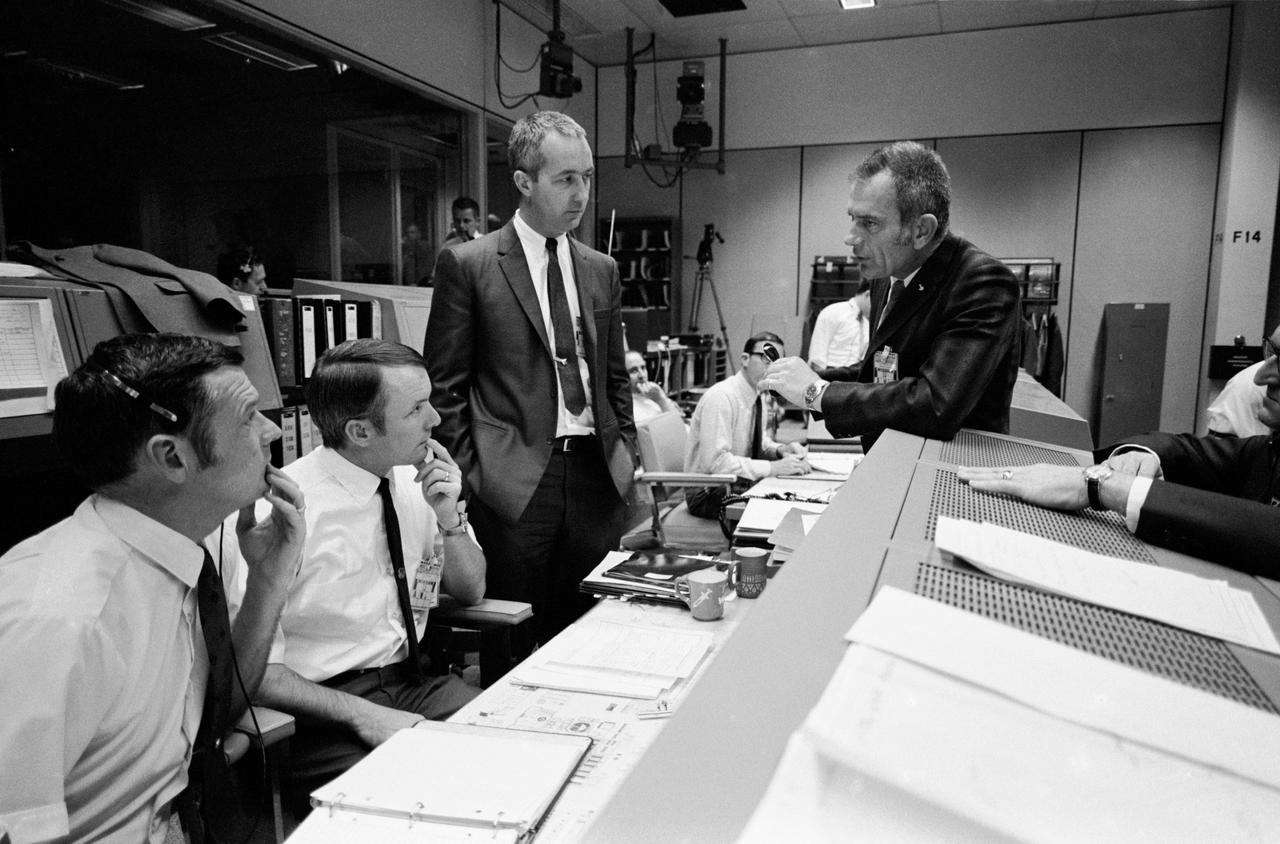
S70-35369 (16 April 1970) --- Discussion in the Mission Operations Control Room (MOCR) dealing with the Apollo 13 crewmen during their final day in space. From left to right are Glynn S. Lunney, Shift 4 flight director; Gerald D. Griffin, Shift 2 flight director; astronaut James A. McDivitt, manager, Apollo Spacecraft Program, MSC; Dr. Donald K. Slayton, director of Flight Crew Operations, MSC; and Dr. Willard R. Hawkins, M.D., Shift 1 flight surgeon.
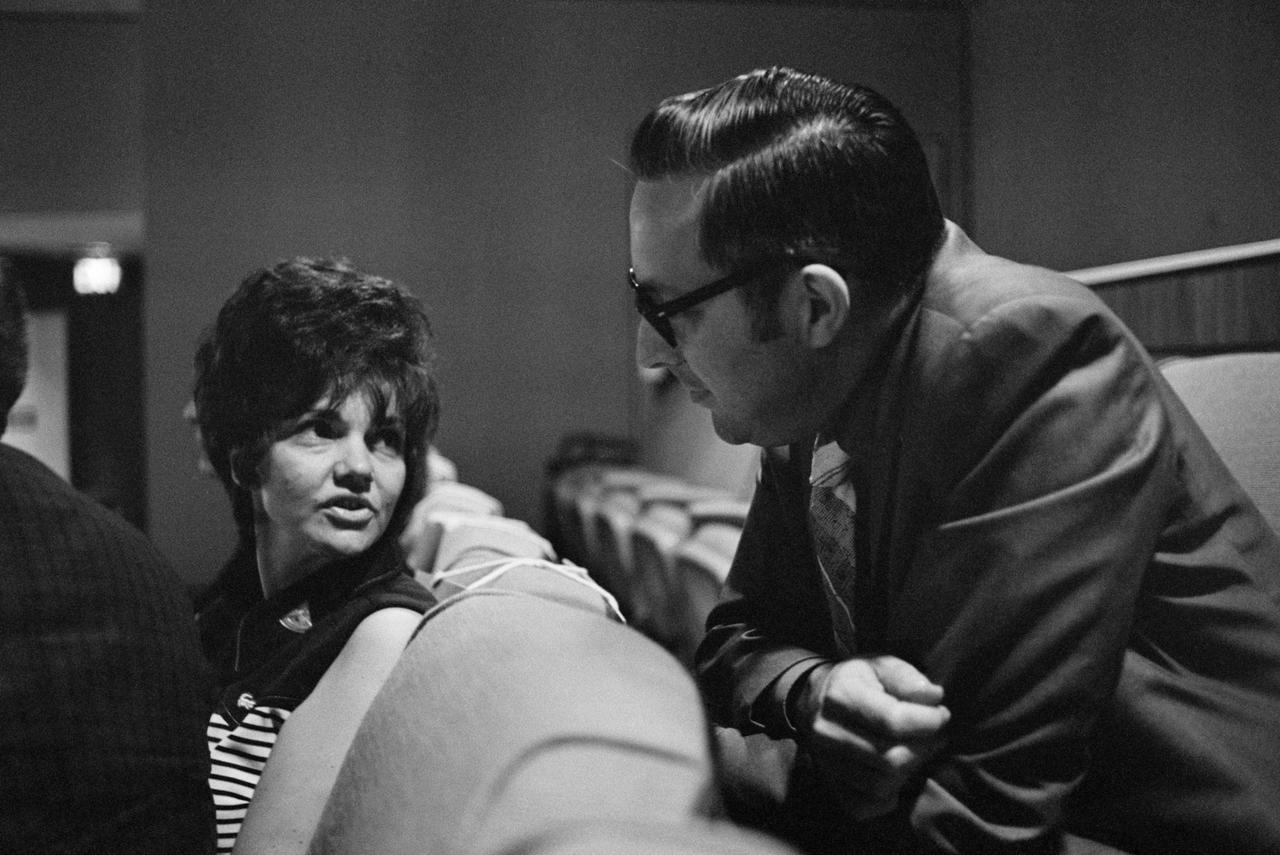
S70-34901 (14 April 1970) --- Mrs. Marilyn Lovell, wife of astronaut James A. Lovell, Apollo 13 mission commander, discusses the flight with Dr. Charles A. Berry, flight surgeon. The two are in a special viewing area overlooking the Flight Control Room (FCR), staffed with flight controllers who were supporting the planned lunar landing mission. EDITOR?S NOTE: After this picture was taken, an explosion occurred aboard the Service Module (SM), causing cancellation of the lunar landing phase of the mission.

S70-34901 (14 April 1970) --- Mrs. Marilyn Lovell, wife of astronaut James A. Lovell, Apollo 13 mission commander, discusses the flight with Dr. Charles A. Berry, flight surgeon. The two are in a special viewing area overlooking the Flight Control Room (FCR), staffed with flight controllers who were supporting the planned lunar landing mission. EDITOR?S NOTE: After this picture was taken, an explosion occurred aboard the Service Module (SM), causing cancellation of the lunar landing phase of the mission.
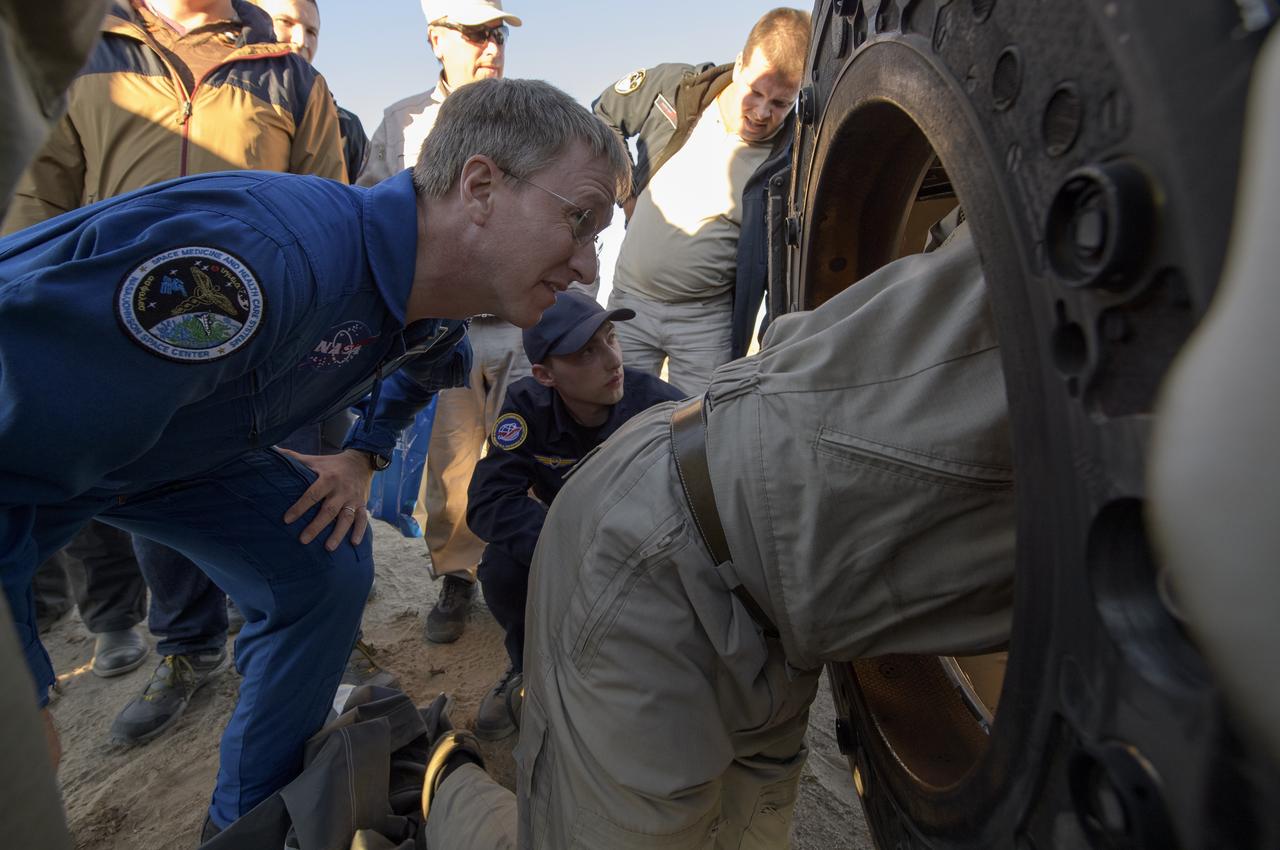
NASA Flight Surgeon Joe Schmid, left, looks inside the Soyuz MS-08 spacecraft to monitor Expedition 56 Commander Drew Feustel and Flight Engineer Ricky Arnold of NASA, along with Flight Engineer and Soyuz Commander Oleg Artemyev of Roscosmos near the town of Zhezkazgan, Kazakhstan on Thursday, Oct. 4, 2018. Feustel, Arnold, and Artemyev are returning after 197 days in space where they served as members of the Expedition 55 and 56 crews onboard the International Space Station. Photo Credit: (NASA/Bill Ingalls)
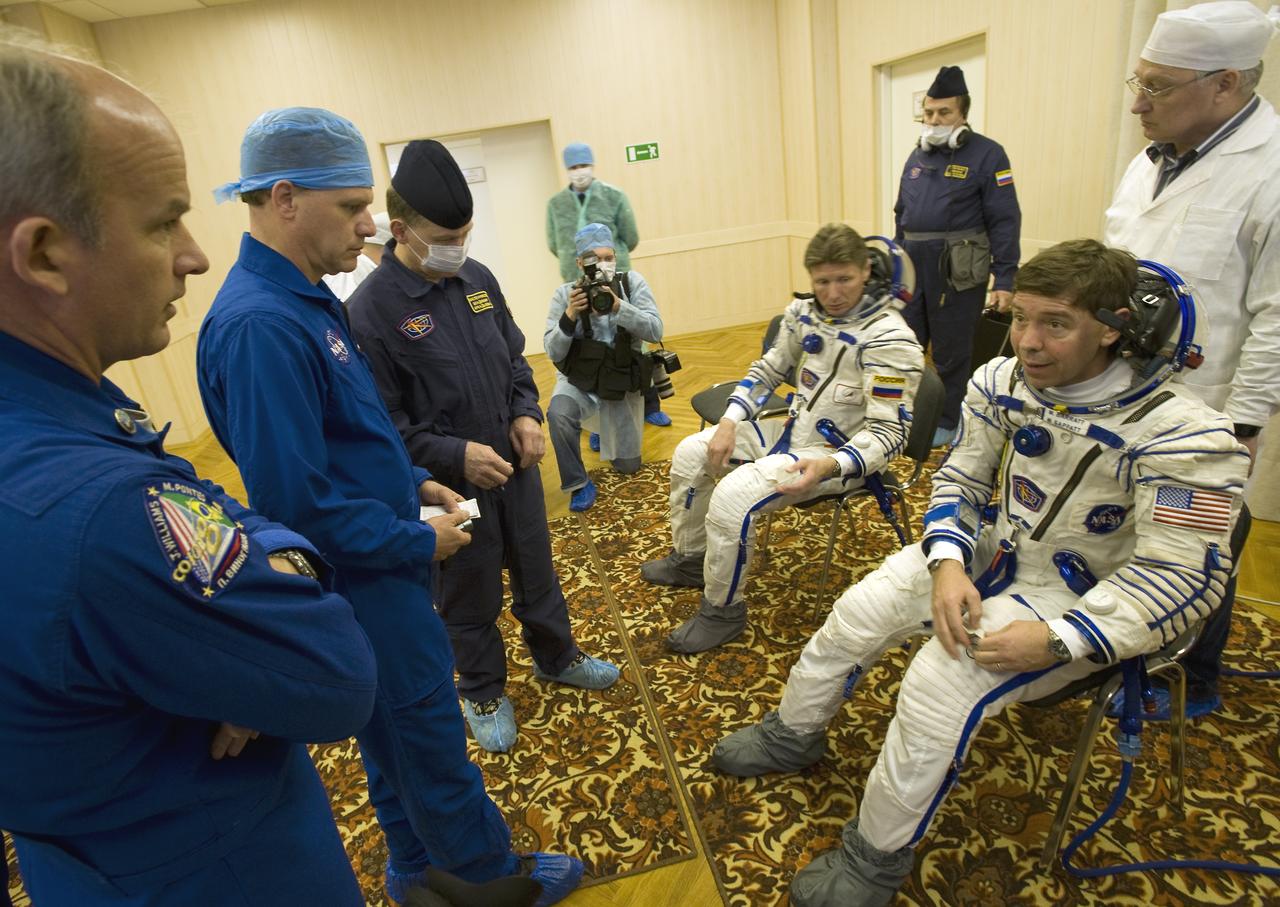
Expedition 19 backup commander Jeffrey Williams, left, NASA Flight Surgeon Ed Powers, M.D., 2nd from left, talk with Expedition 19 Flight Engineer Michael R. Barratt, far right, as he and fellow crew member Expedition 19 Commander Gennady I. Padalka don their Sokol flights suits in preparation for their Soyuz launch to the International Space Station with Spaceflight Participant Charles Simonyi on Thursday, March 26, 2009 in Baikonur, Kazakhstan. (Photo Credit: NASA/Bill Ingalls)
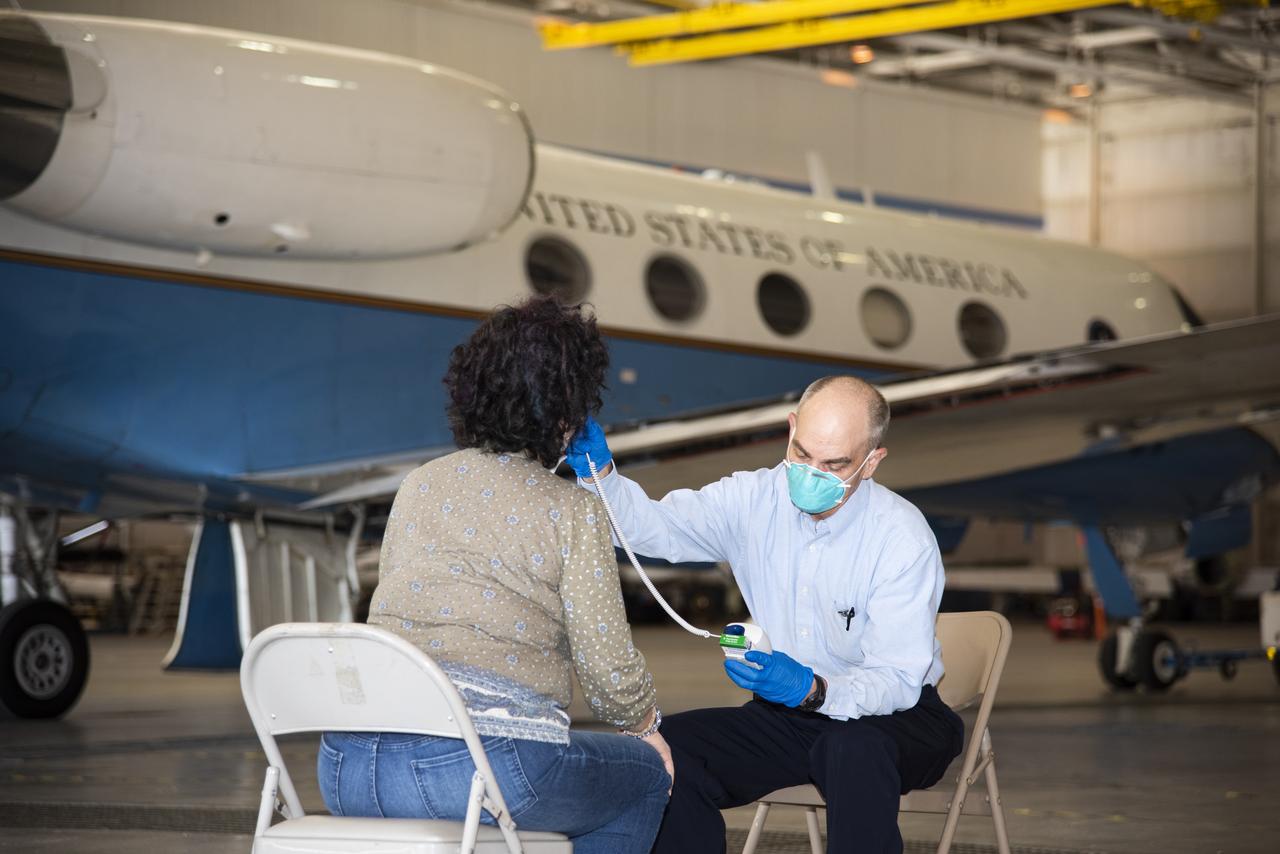
Dr. Dwight Peake, NASA’s Armstrong Flight Research Center chief medical officer and flight surgeon, confirms a NASA Jet Propulsion Laboratory (JPL) staff member is ready for flight. The two California NASA centers are working together to fly JPL staff on an Armstrong G-III aircraft from California to NASA’s Kennedy Space Center in Florida. JPL staff are completing critical work to ensure NASA’s Mars 2020 mission is ready on time.
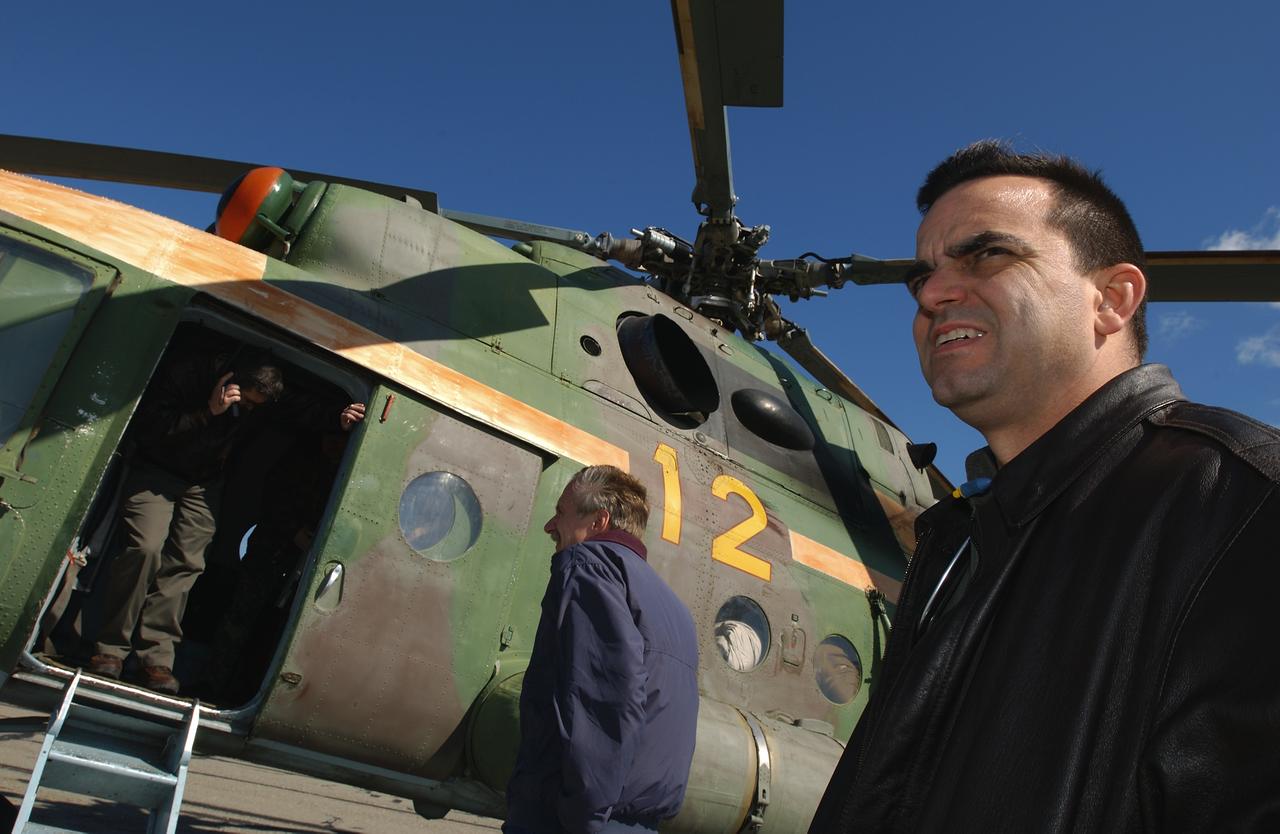
Director of Flight Crew Operations Bob Cabana, upper left, talks with NASA colleagues on the satellite phone from a Russian helicopter while International Space Station Program Manager, William Gerstenmaier and J.D. Polk, Expedition 6 Flight Surgeon, right, wait to get word if they will be continuing on to the landing site after a refueling stop, Tuesday, May 4, 2003 in Kazakhstan. Photo Credit: (NASA/Bill Ingalls)
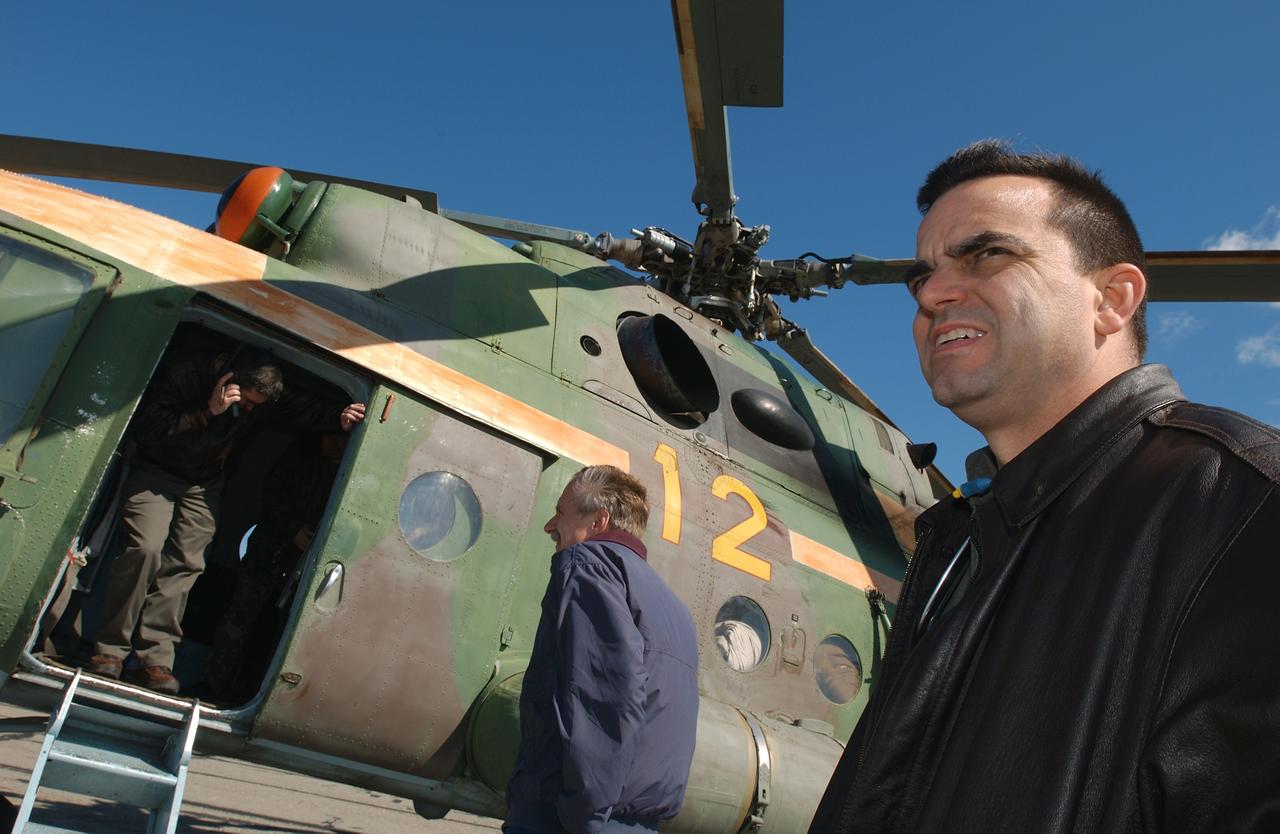
May 4, 2003, Kazakhstan. Bob Cabana (L in door), Director of Flight Crew Operations talks with NASA colleagues on the satellite phone from a Russian helicopter while Bill Gerstenmaier (center), I.S.S. Program Manager and J.D. Polk (R), Expedition Six Flight Surgeon wait to get word if they will be continuing on to the landing site after a refueling stop. Photo Credit: "NASA/Bill Ingalls"
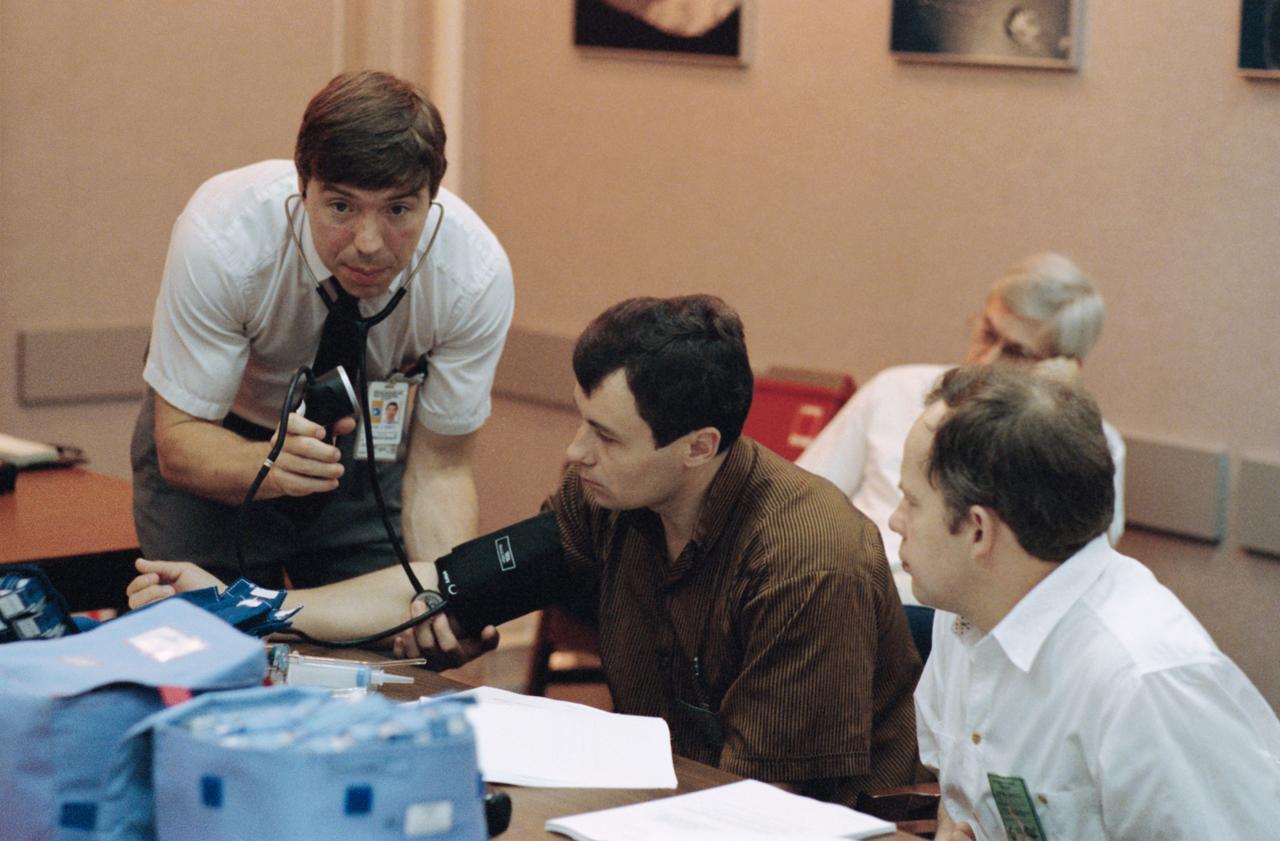
Cosmonaut Vladimir N. Dezhurov (center), Mir 18 mission commander, gets his blood pressure taken by Dr. Michael J. Barrett, flight surgeon. Cosmonaut Anatoliy Y. Solovyev (right), Mir 19 mission commander, looks on. Solovyev, Dezhurov, along with their respective flight engineers and a number of other cosmonauts and astronauts participating in the joint program, were in Houston, Texas, to prepare for their upcoming missions.
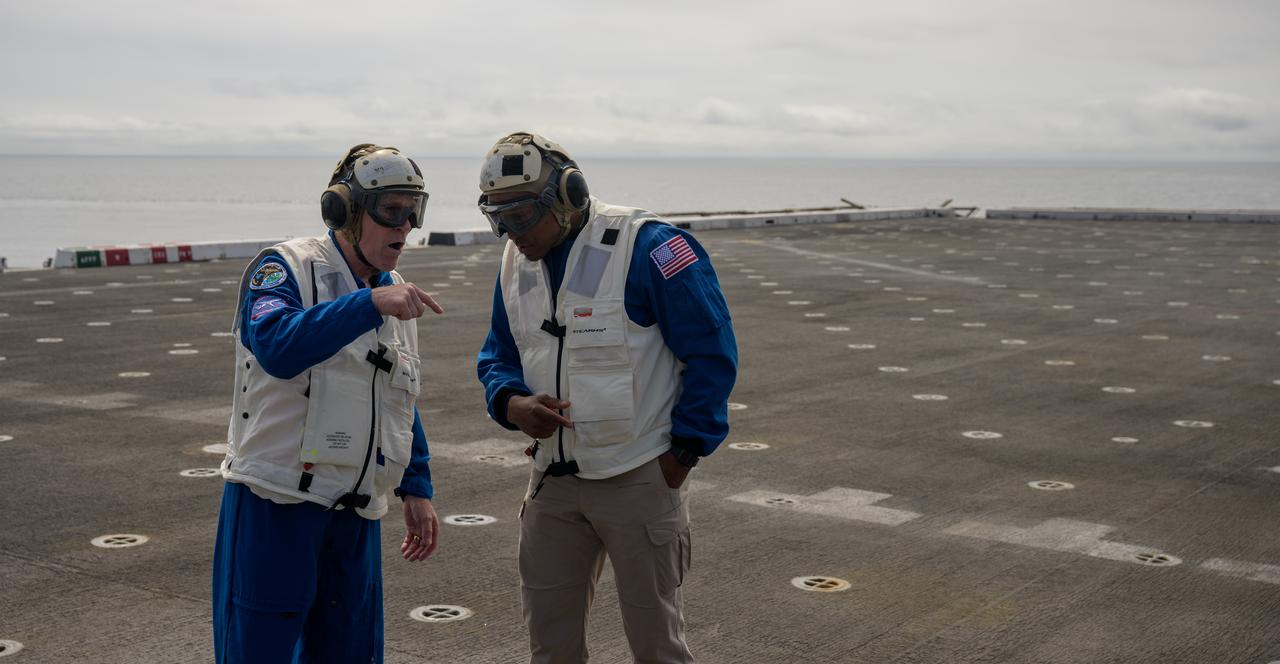
NASA astronaut Victor Glover, left, and NASA Flight Surgeon Richard Scheuring, are seen on the flight deck of USS Somerset during Underway Recovery Test-12 off the coast of California, Thursday, March 27, 2025. During the test, NASA and Department of Defense teams are practicing to ensure recovery procedures are validated as NASA plans to send Artemis II astronauts around the Moon and splashdown in the Pacific Ocean. Photo Credit: (NASA/Bill Ingalls)
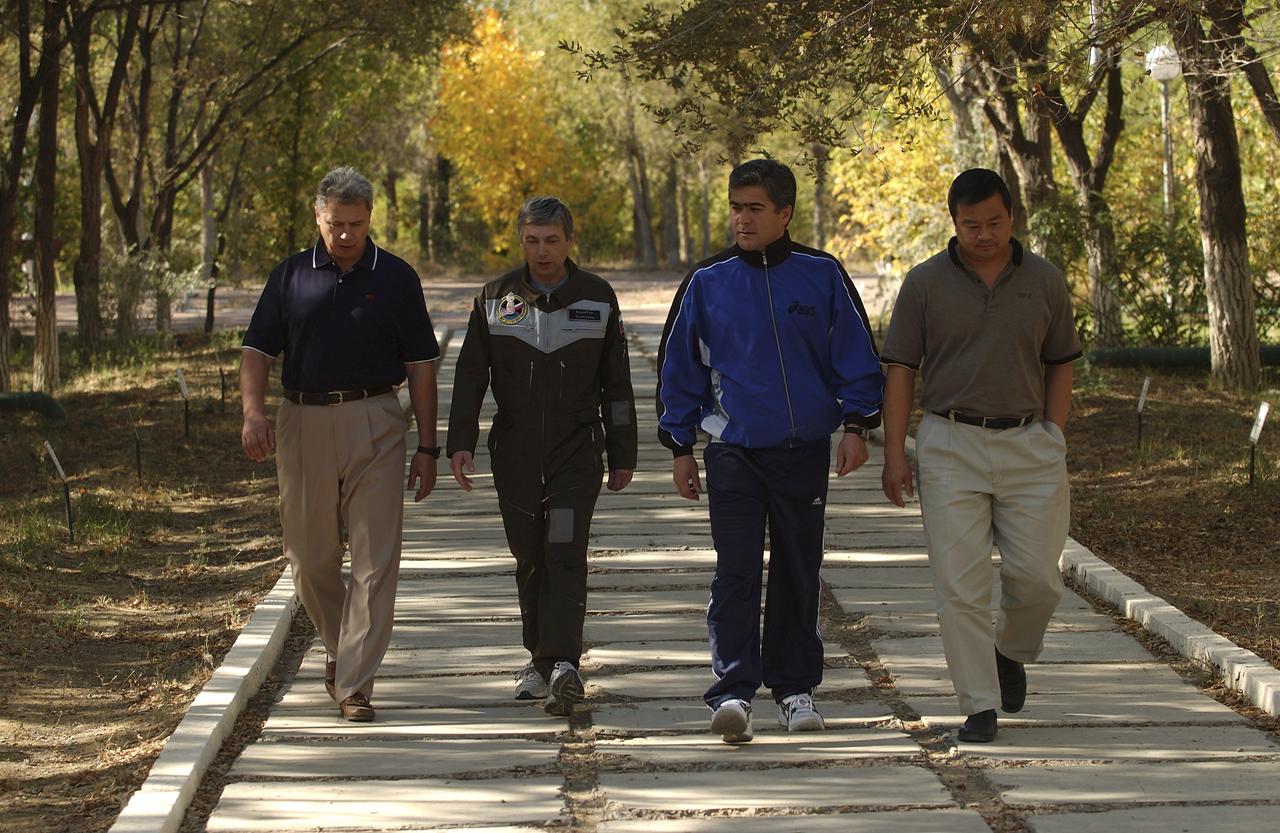
Expedition 10 Commander Leroy Chiao, right, Flight Engineer and Soyuz Commander Salizhan Sharipov, Russian Space Forces Cosmonaut Yuri Shargin, and the lead Russian Flight Surgeon, left, enjoy a middday stroll down the Walkway of Cosmonauts at their crew quarters in Baikonur, Kazakhstan, Friday, October 8, 2004 as they prepare for liftoff to the International Space Station October 14. Photo Credit: (NASA/Bill Ingalls)
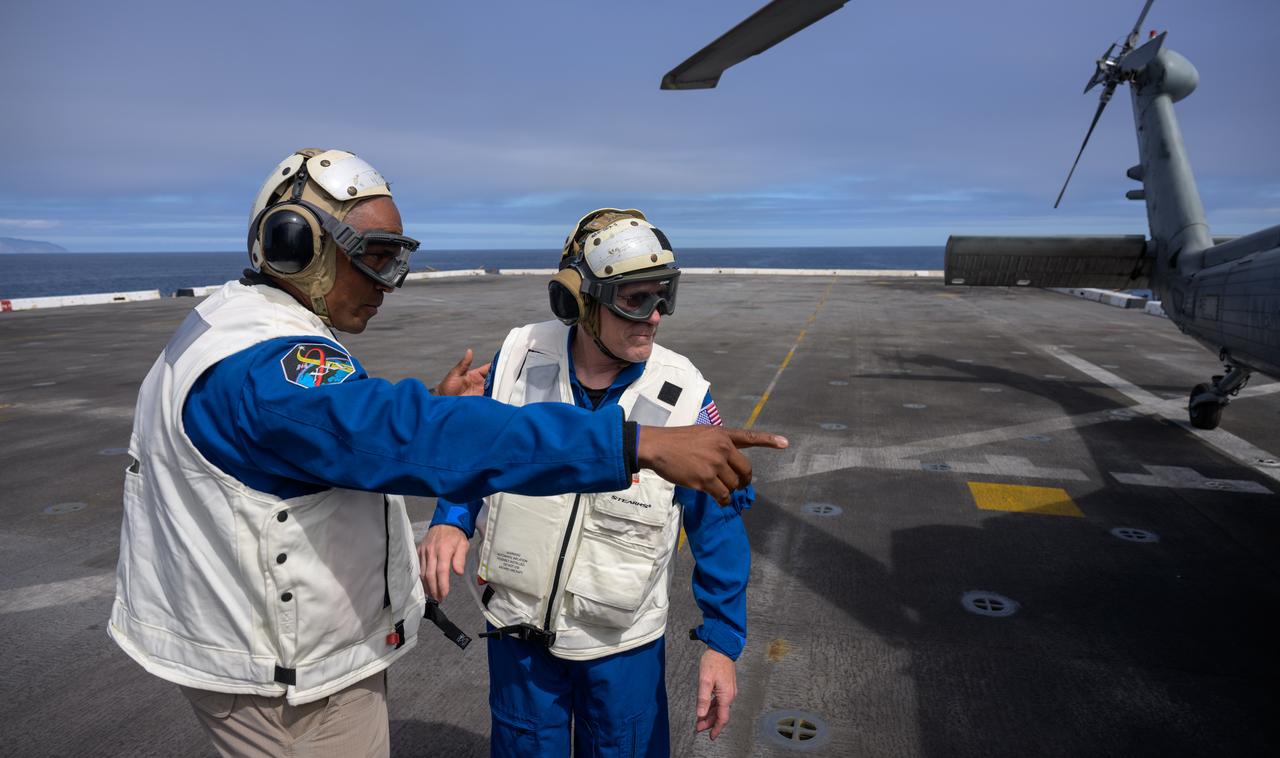
NASA astronaut Victor Glover, left, and NASA Flight Surgeon Richard Scheuring, are seen on the flight deck of USS Somerset during Underway Recovery Test-12 off the coast of California, Thursday, March 27, 2025. During the test, NASA and Department of Defense teams are practicing to ensure recovery procedures are validated as NASA plans to send Artemis II astronauts around the Moon and splashdown in the Pacific Ocean. Photo Credit: (NASA/Bill Ingalls)
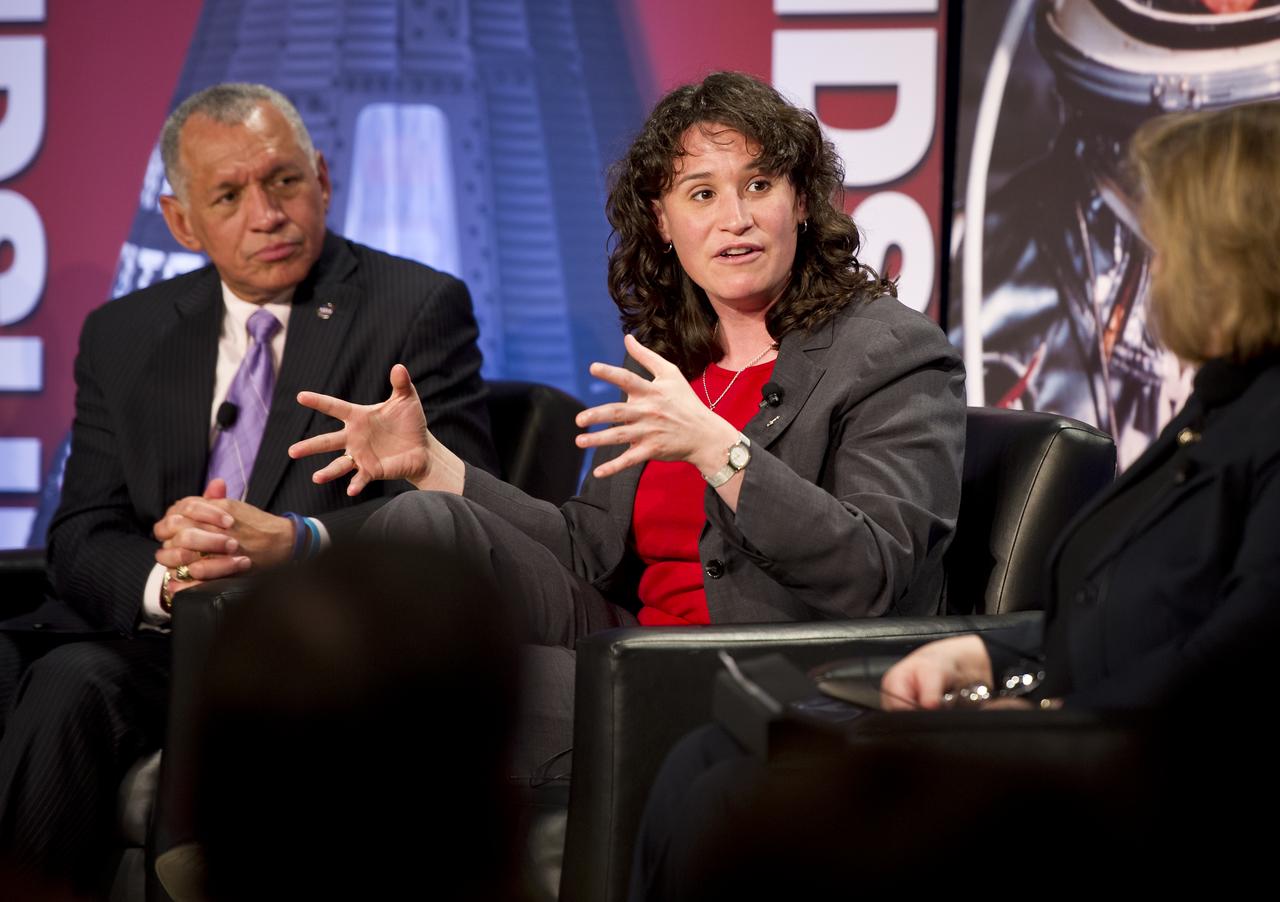
NASA 2009 Astronaut Candidate and Flight Surgeon Serena Auñón talks as NASA Administrator Charles Bolden looks on during a NASA Future Forum panel discussion at The Ohio State University on Monday, Feb. 20, 2012, in Columbus, Ohio. Monday marked the 50th anniversary of Glenn's historic flight as the first American to orbit Earth. Photo Credit: (NASA/Bill Ingalls)
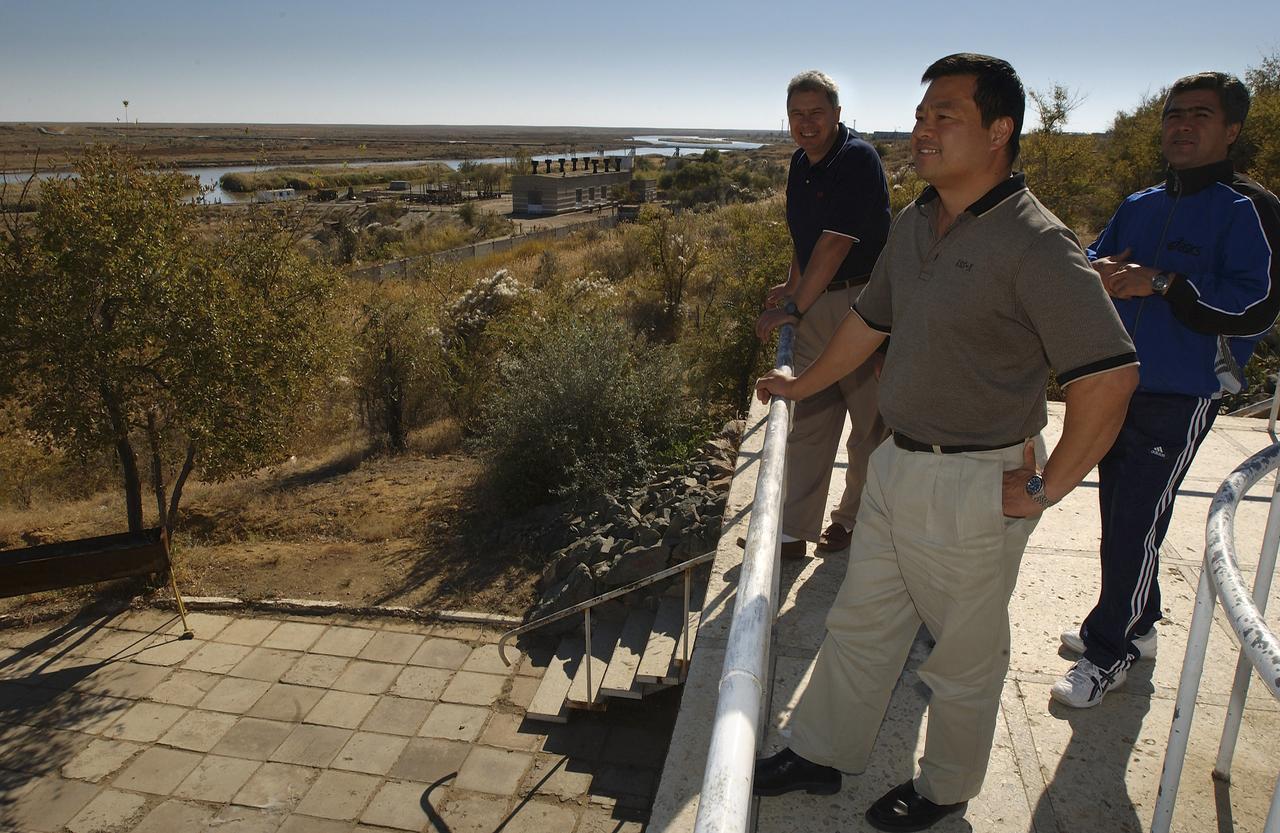
Flight Engineer and Soyuz Commander Salizhan Sharipov, right, Expedition 10 Commander Leroy Chiao and the lead Russian Flight Surgeon, left, enjoy a midday stroll down the Walkway of Cosmonauts at their crew quarters in Baikonur, Kazakhstan, Friday, October 8, 2004, as they prepare for liftoff to the International Space Station October 14. Photo Credit: (NASA/Bill Ingalls)
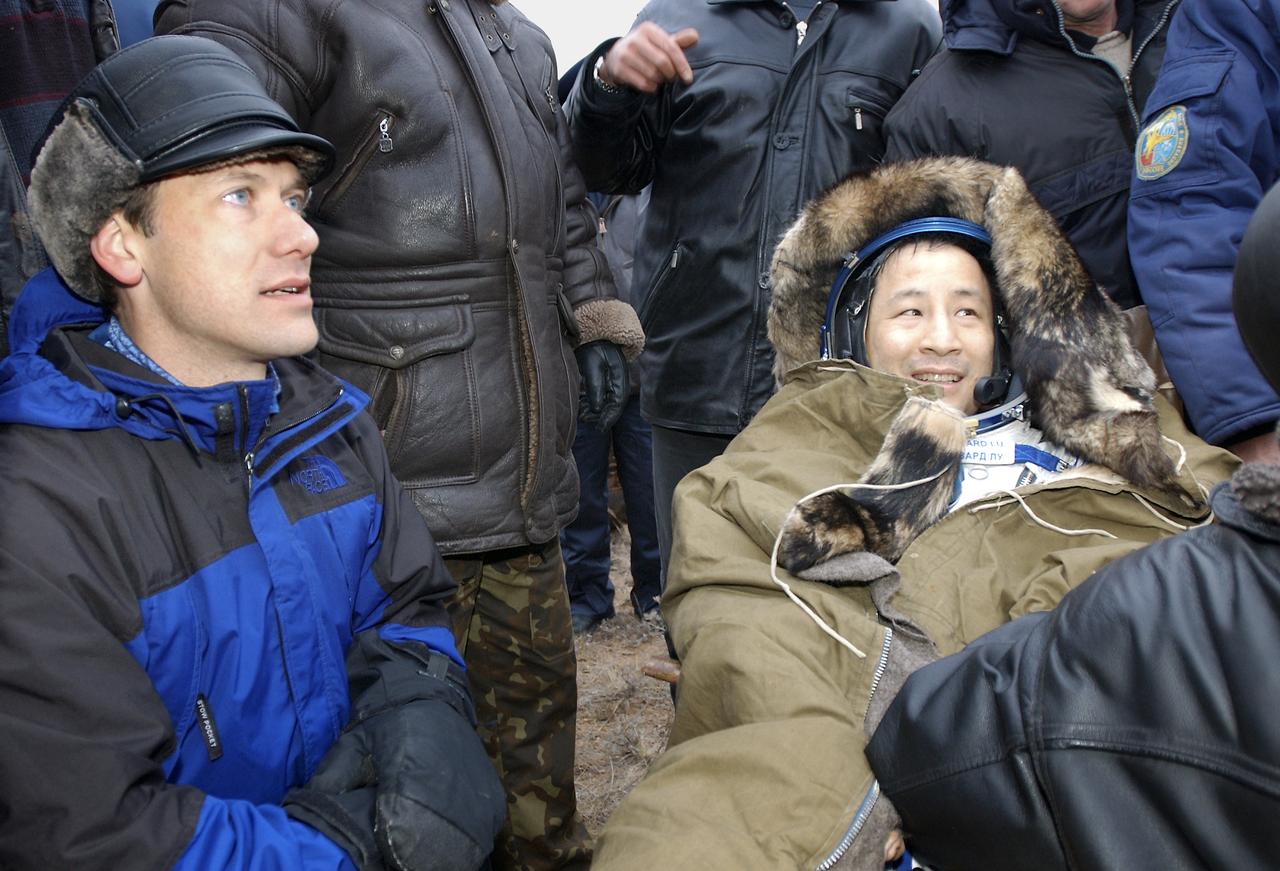
Astronaut Edward T. Lu, Expedition 7 NASA International Space Station Science Officer and Flight Engineer, rests in a chair after landing in the Soyuz TMA-2 spacecraft in Kazakhstan on Monday, October 27, 2003 at 9:41 p.m. (EST). On the left is NASA Flight Surgeon Dr. Thomas H. Marshburn. Photo Credit: (NASA/Bill Ingalls)
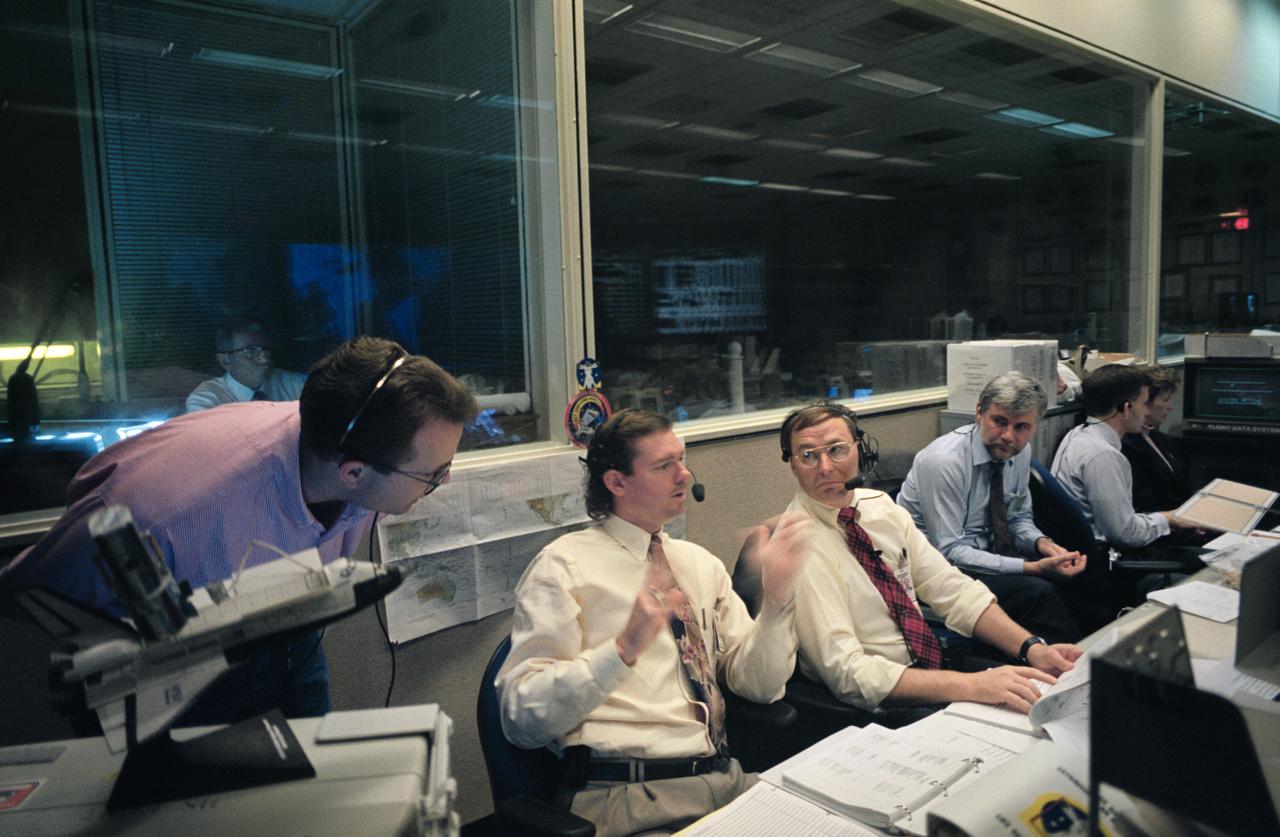
STS61-S-094 (5 Dec 1993) --- Kyle Herring, second left, illustrates a point during mission commentary for the second Extravehicular Activity (EVA-2) of the STS-61 Hubble Space Telescope (HST) servicing mission. Astronaut Jerry L. Ross (center), a space walker on two previous NASA shuttle missions, amplified Herring's explanations. At the flight surgeon's console is Dr. Klaus Lohn (third right) of the Institute for Flight Medicine in Koln, Germany.
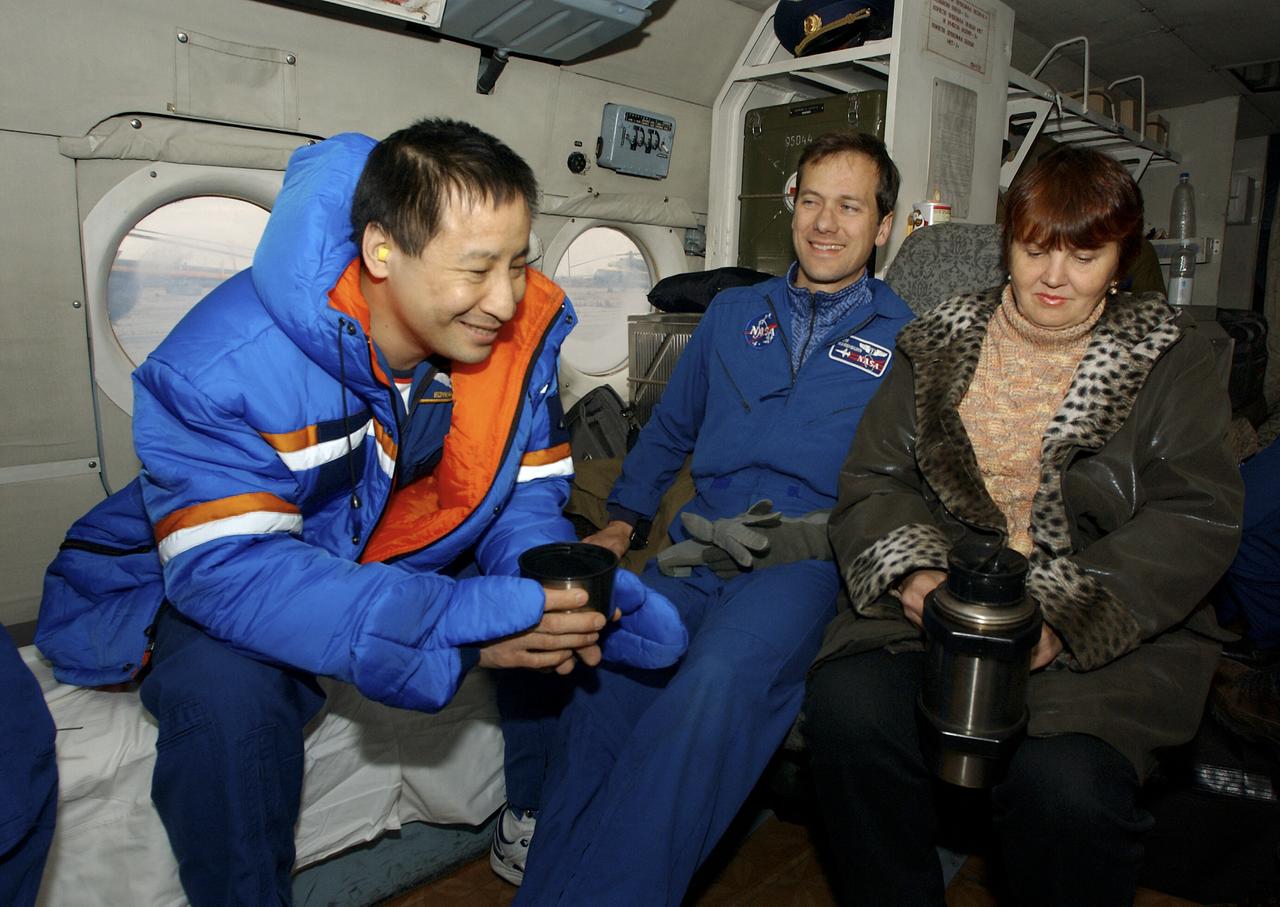
Astronaut Edward T. Lu, Expedition 7 NASA International Space Station Science Officer and Flight Engineer, left, enjoys some hot tea with NASA Flight Surgeon Dr. Thomas H. Marshburn, center, and a Russian Medical personnel onboard a Russian helicopter in Arqalyk, Kazakhstan, Monday, October 27, 2003. Photo Credit: (NASA/Bill Ingalls)

NASA astronaut Dr. Serena Auñón-Chancellor speaks about her experience on Expeditions 56 and 57 onboard the International Space Station (ISS) at Excel Academy Public Charter School, Monday, June 10, 2019 in Washington, DC. Auñón-Chancellor spent 197 days living and working onboard the ISS and contributed to hundreds of experiments in biology, biotechnology, physical science, and Earth science while there. She is also a doctor and started her career with NASA as a flight surgeon in 2006. Photo Credit: (NASA/Aubrey Gemignani)
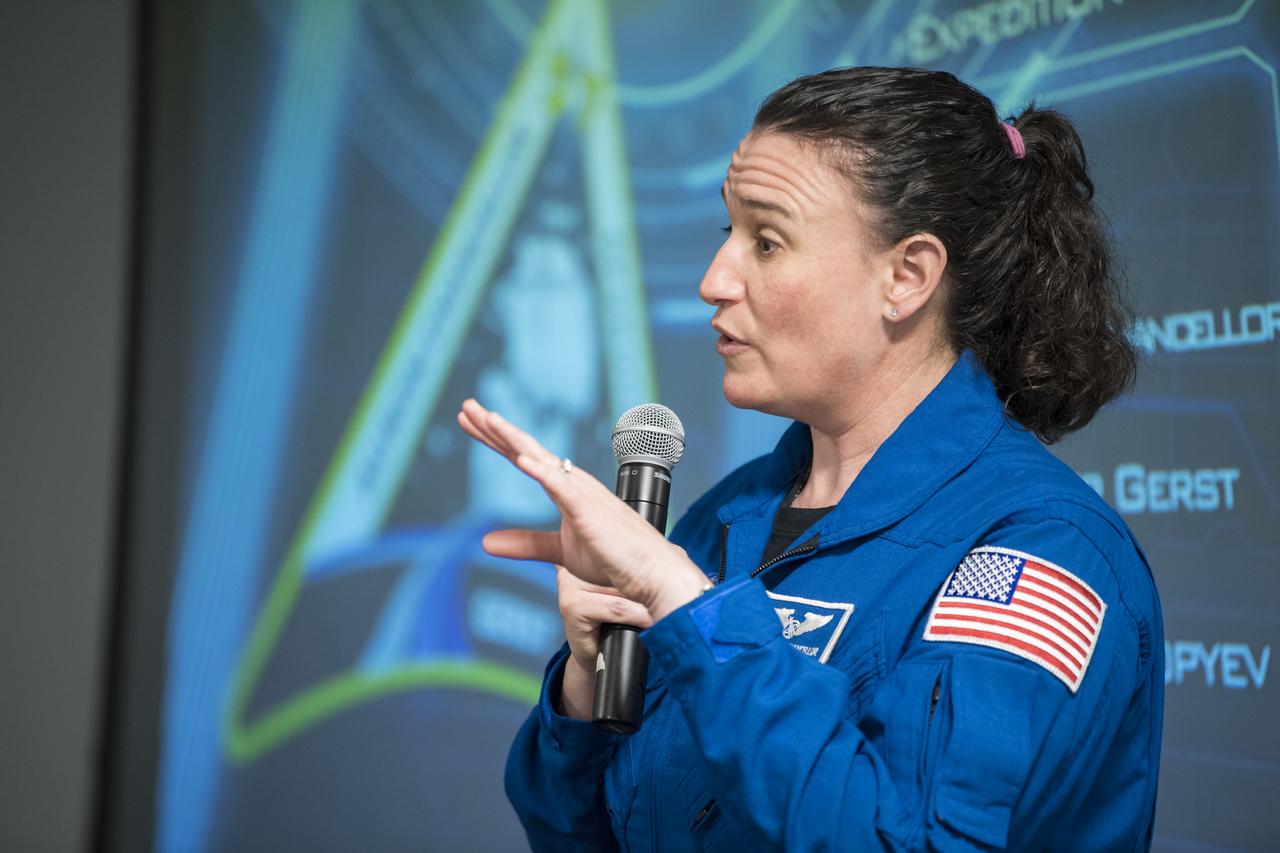
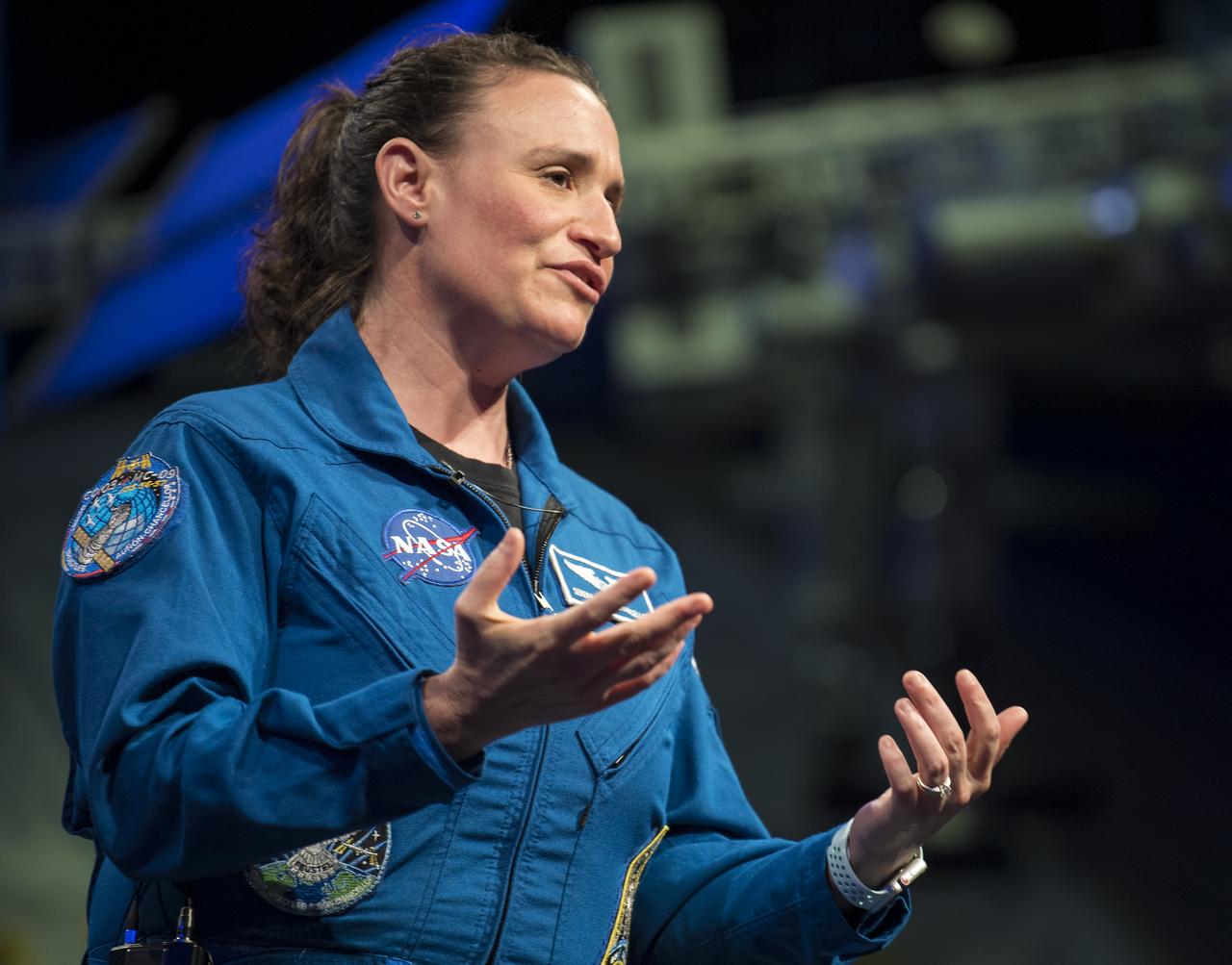
NASA astronaut Serena Auñón-Chancellor speaks about her experience on Expeditions 56 and 57 onboard the International Space Station at NASA Headquarters, Friday, June 14, 2019 in Washington. Auñón-Chancellor spent 197 days living and working onboard the orbital laboratory, contributing to hundreds of experiments in biology, biotechnology, physical science, and Earth science. She began her career at NASA as a flight surgeon before being selected as an astronaut in 2009. Photo Credit: (NASA/Aubrey Gemignani)

NASA astronaut Dr. Serena Auñón-Chancellor speaks about her experience on Expeditions 56 and 57 onboard the International Space Station (ISS) at Excel Academy Public Charter School, Monday, June 10, 2019 in Washington, DC. Auñón-Chancellor spent 197 days living and working onboard the ISS and contributed to hundreds of experiments in biology, biotechnology, physical science, and Earth science while there. She is also a doctor and started her career with NASA as a flight surgeon in 2006. Photo Credit: (NASA/Aubrey Gemignani)
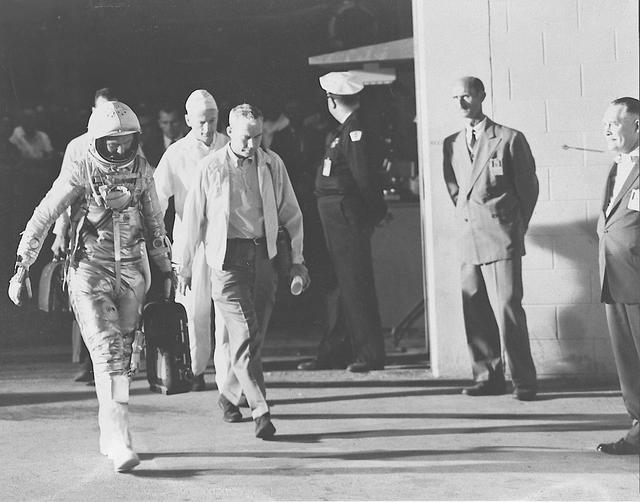
S62-00379 (20 Feb. 1962) --- View of astronaut John H. Glenn Jr., Dr. William Douglas, astronauts' flight surgeon, and equipment specialist Joe Schmitt leaving Operations and Checkout Building prior to the Mercury-Atlas 6 (MA-6) mission. Glenn is in his pressure suit and is carrying the portable ventilation unit. Photo credit: NASA
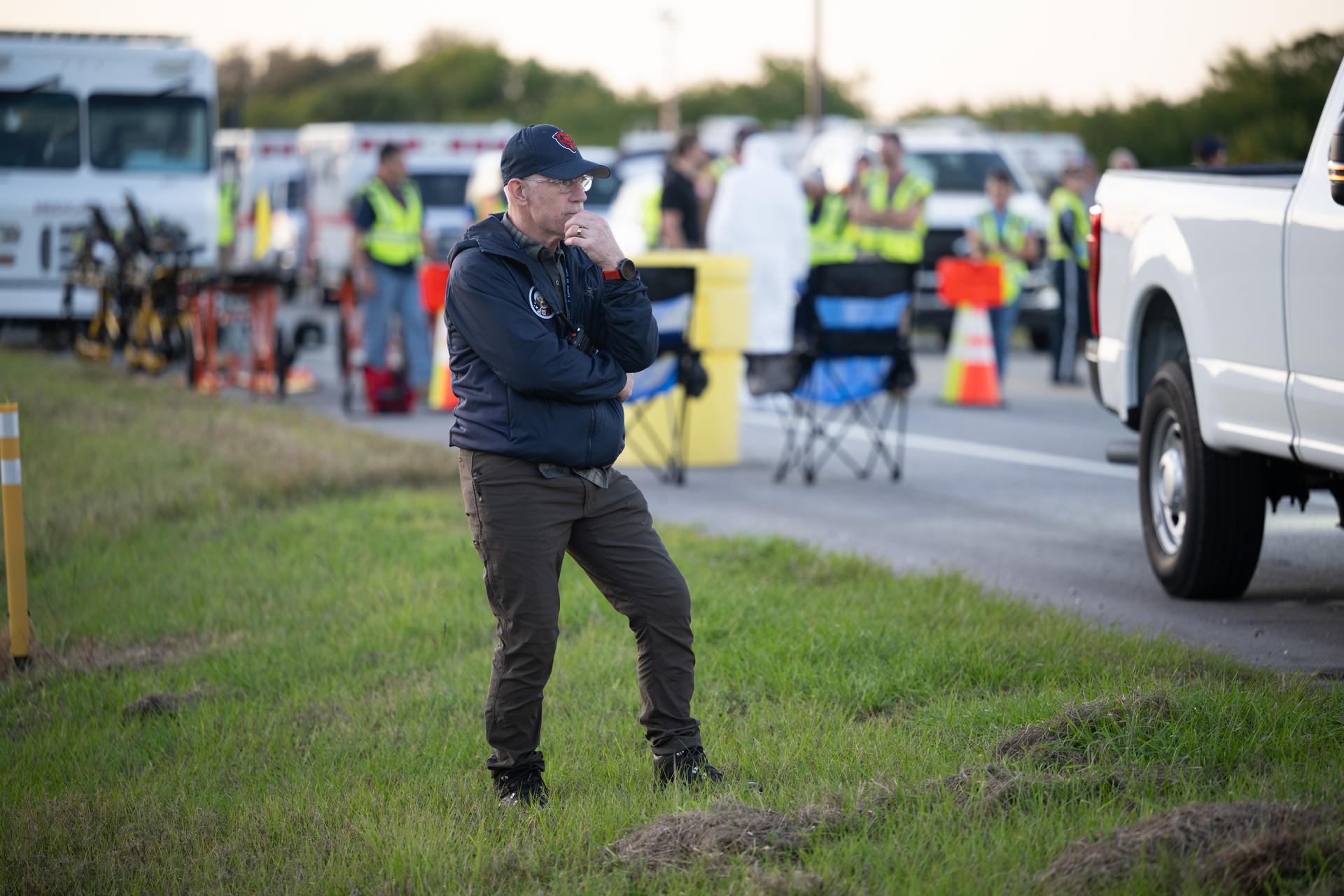
NASA Flight Surgeon Richard Scheuring watches as teams at NASA's Kennedy Space Center in Florida practiced various emergency rescue training scenarios with the Artemis II crew, Friday, Dec. 19, 2025, ahead of the Artemis II mission. In the unlikely event of an emergency during launch countdown at Launch Complex 39B, personnel will be transported in mine-resistant ambush protected vehicles, or MRAPS, from the pad and to one of the triage site locations at Kennedy. Photo Credit: (NASA/Joel Kowsky)
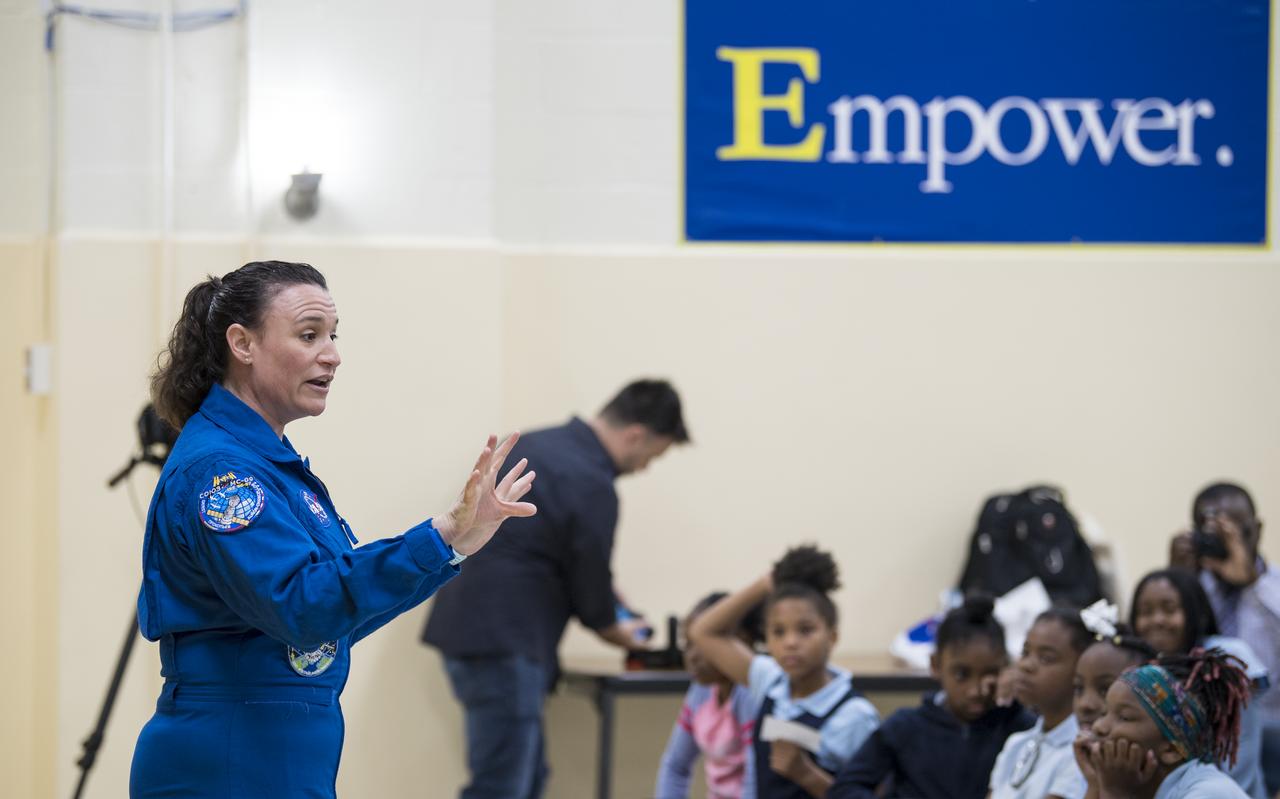
NASA astronaut Dr. Serena Auñón-Chancellor speaks about her experience on Expeditions 56 and 57 onboard the International Space Station (ISS) at Excel Academy Public Charter School, Monday, June 10, 2019 in Washington, DC. Auñón-Chancellor spent 197 days living and working onboard the ISS and contributed to hundreds of experiments in biology, biotechnology, physical science, and Earth science while there. She is also a doctor and started her career with NASA as a flight surgeon in 2006. Photo Credit: (NASA/Aubrey Gemignani)
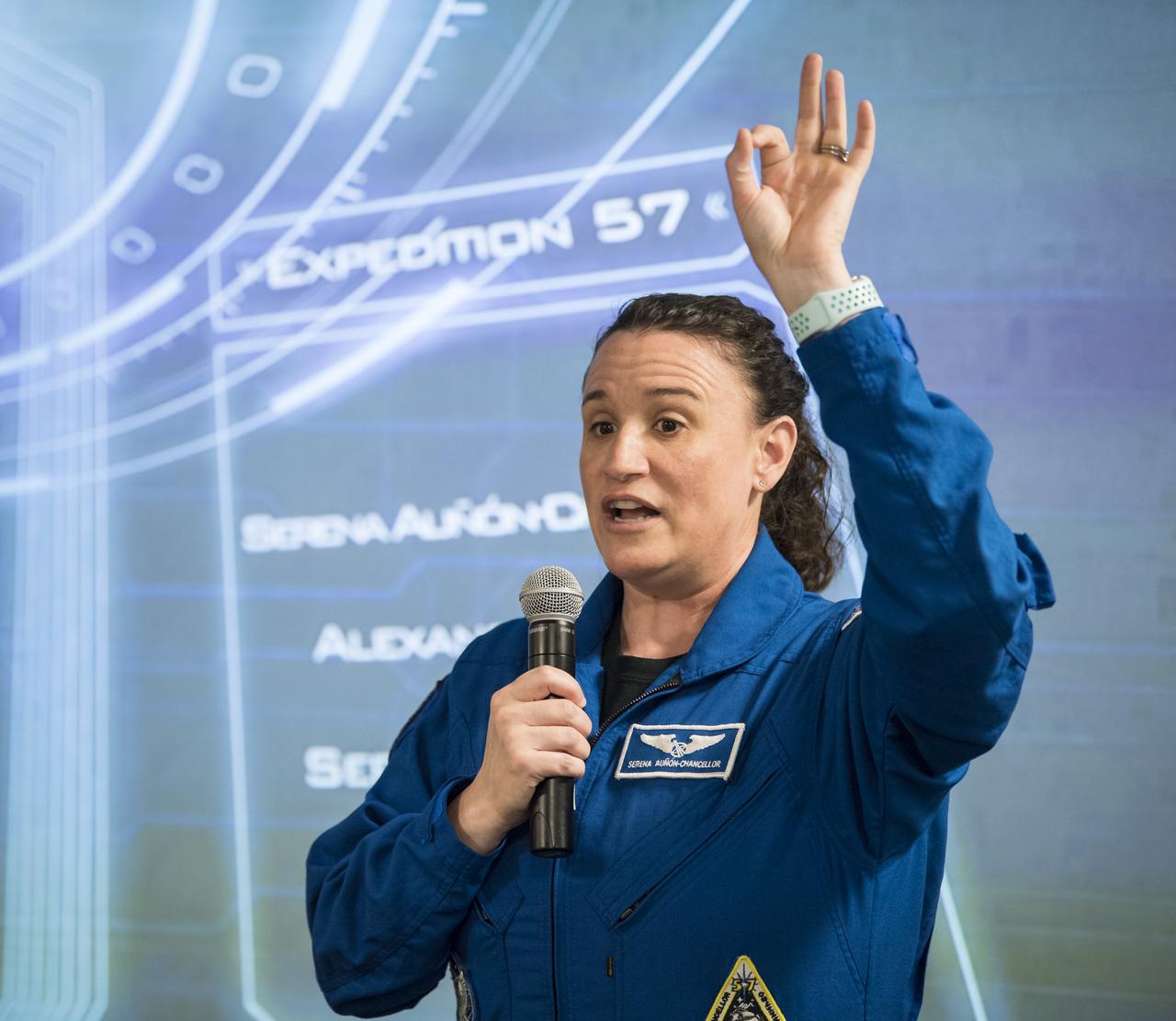
NASA astronaut Serena Auñón-Chancellor speaks about her experience on Expeditions 56 and 57 onboard the International Space Station at NASA Headquarters, Friday, June 14, 2019 in Washington. Auñón-Chancellor spent 197 days living and working onboard the orbital laboratory, contributing to hundreds of experiments in biology, biotechnology, physical science, and Earth science. She began her career at NASA as a flight surgeon before being selected as an astronaut in 2009. Photo Credit: (NASA/Aubrey Gemignani)
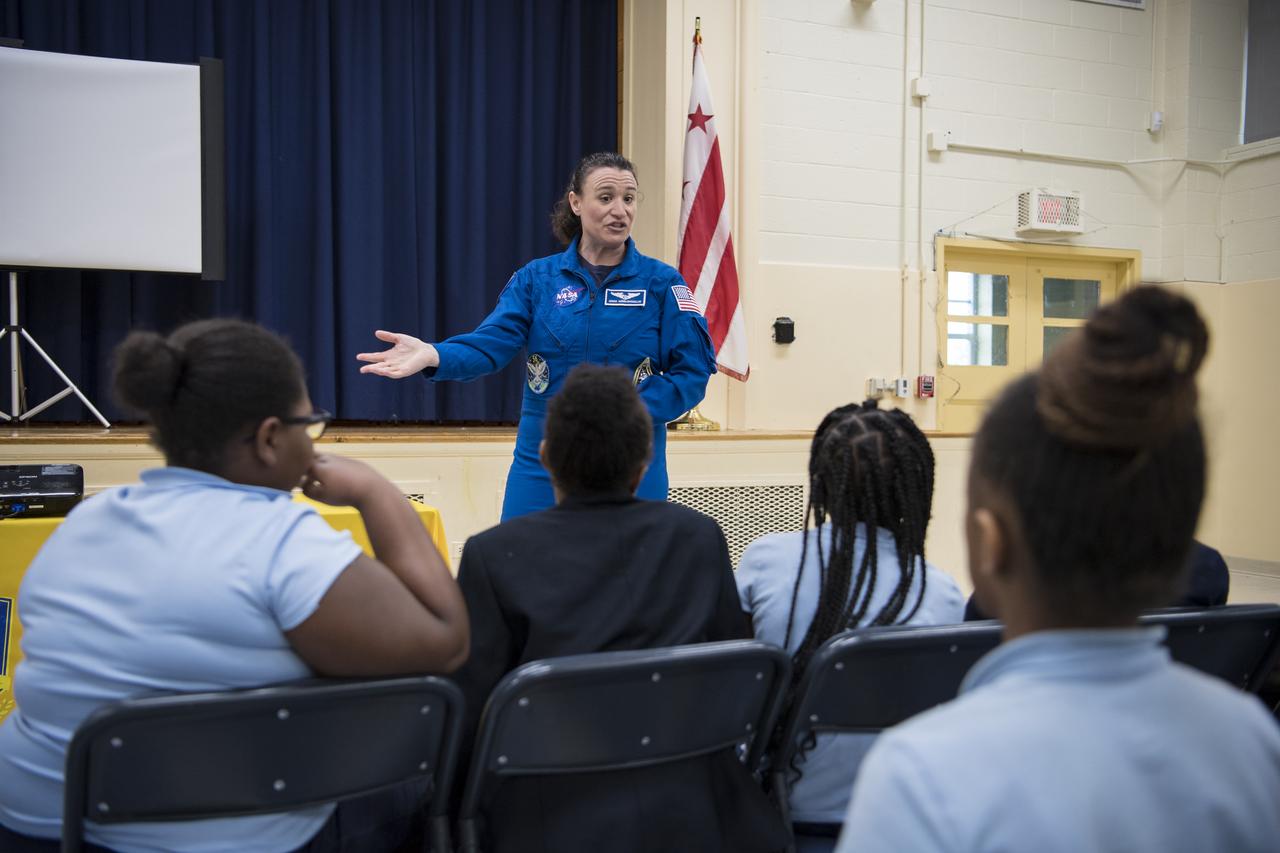
NASA astronaut Dr. Serena Auñón-Chancellor speaks about her experience on Expeditions 56 and 57 onboard the International Space Station (ISS) at Excel Academy Public Charter School, Monday, June 10, 2019 in Washington, DC. Auñón-Chancellor spent 197 days living and working onboard the ISS and contributed to hundreds of experiments in biology, biotechnology, physical science, and Earth science while there. She is also a doctor and started her career with NASA as a flight surgeon in 2006. Photo Credit: (NASA/Aubrey Gemignani)
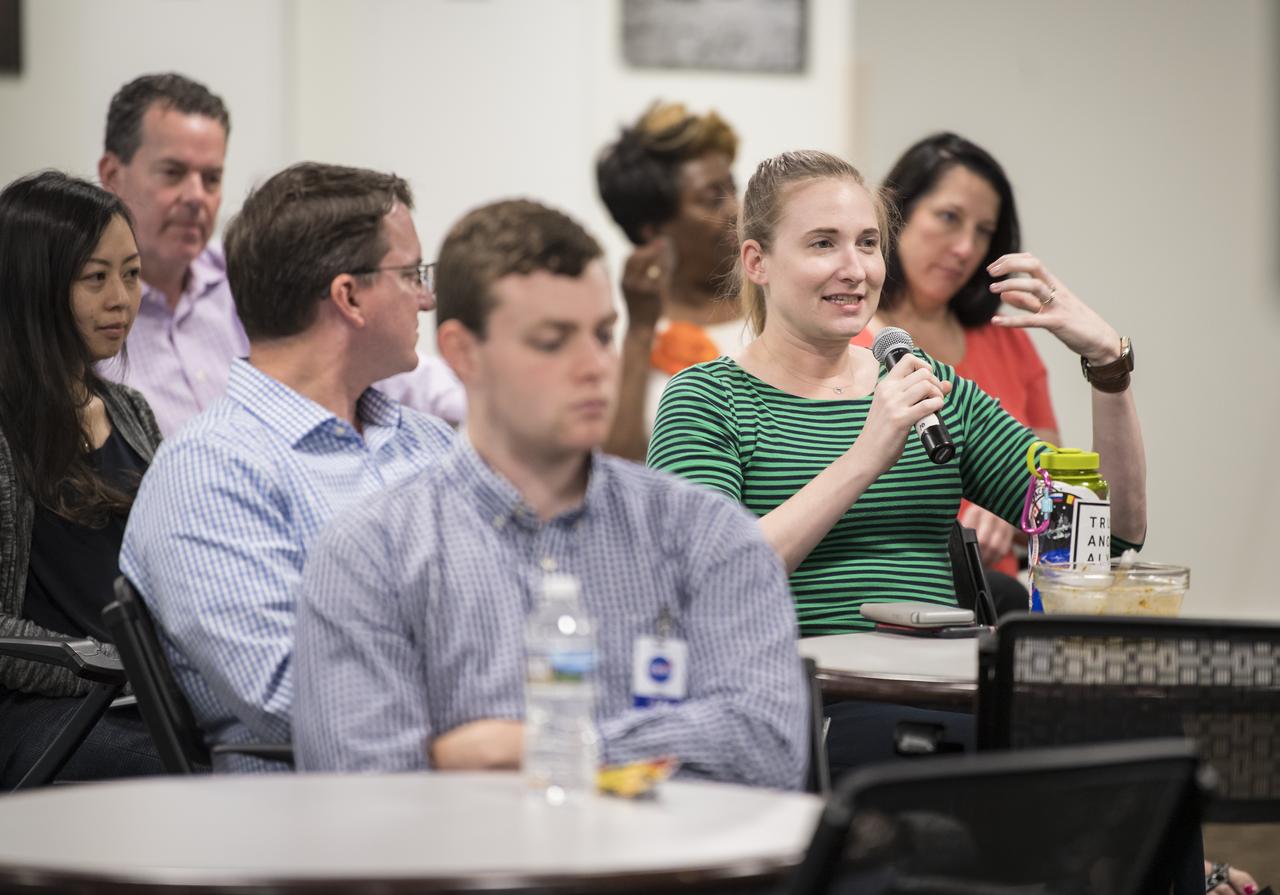
An audience member asks NASA astronaut Serena Auñón-Chancellor a question about her experience on Expeditions 56 and 57 onboard the International Space Station at NASA Headquarters, Friday, June 14, 2019 in Washington. Auñón-Chancellor spent 197 days living and working onboard the orbital laboratory, contributing to hundreds of experiments in biology, biotechnology, physical science, and Earth science. She began her career at NASA as a flight surgeon before being selected as an astronaut in 2009. Photo Credit: (NASA/Aubrey Gemignani)
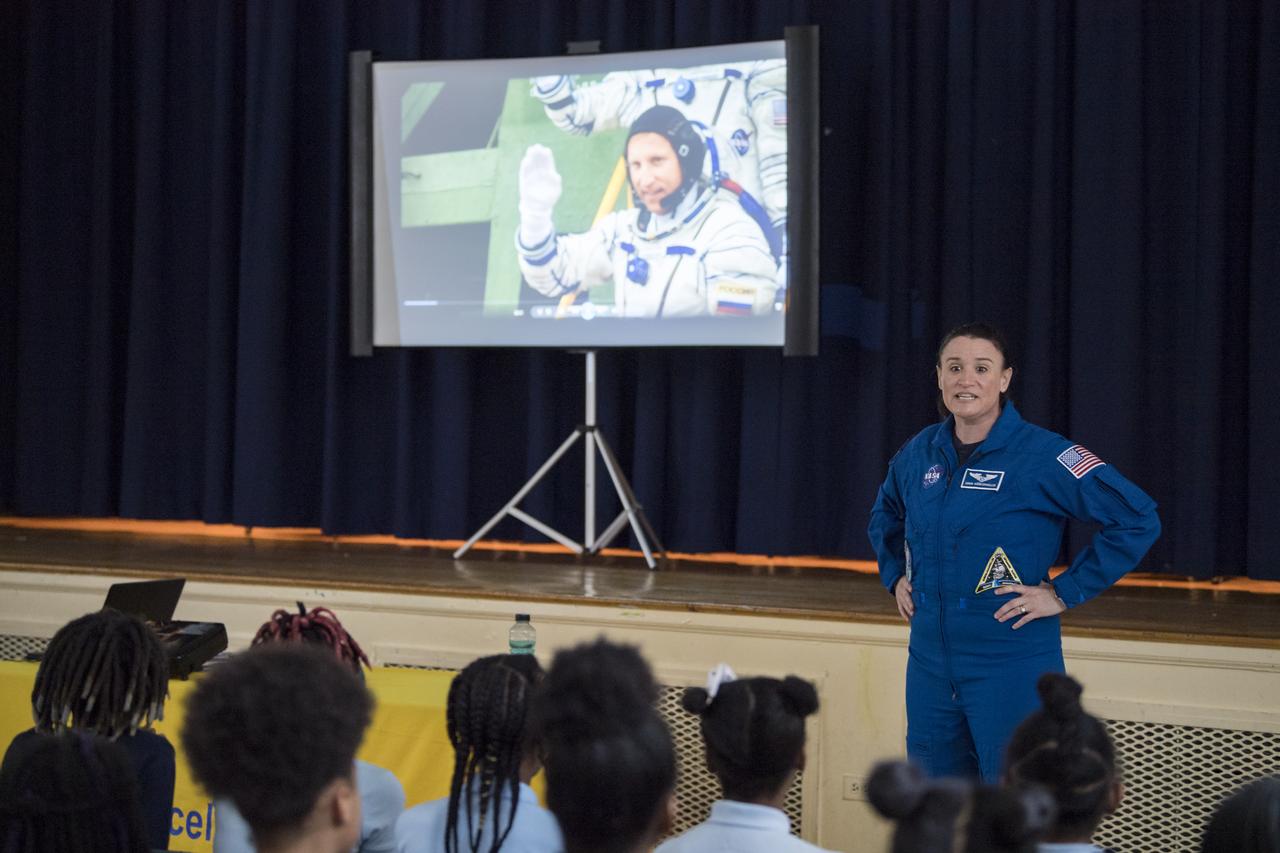
NASA astronaut Dr. Serena Auñón-Chancellor speaks about her experience on Expeditions 56 and 57 onboard the International Space Station (ISS) at Excel Academy Public Charter School, Monday, June 10, 2019 in Washington, DC. Auñón-Chancellor spent 197 days living and working onboard the ISS and contributed to hundreds of experiments in biology, biotechnology, physical science, and Earth science while there. She is also a doctor and started her career with NASA as a flight surgeon in 2006. Photo Credit: (NASA/Aubrey Gemignani)
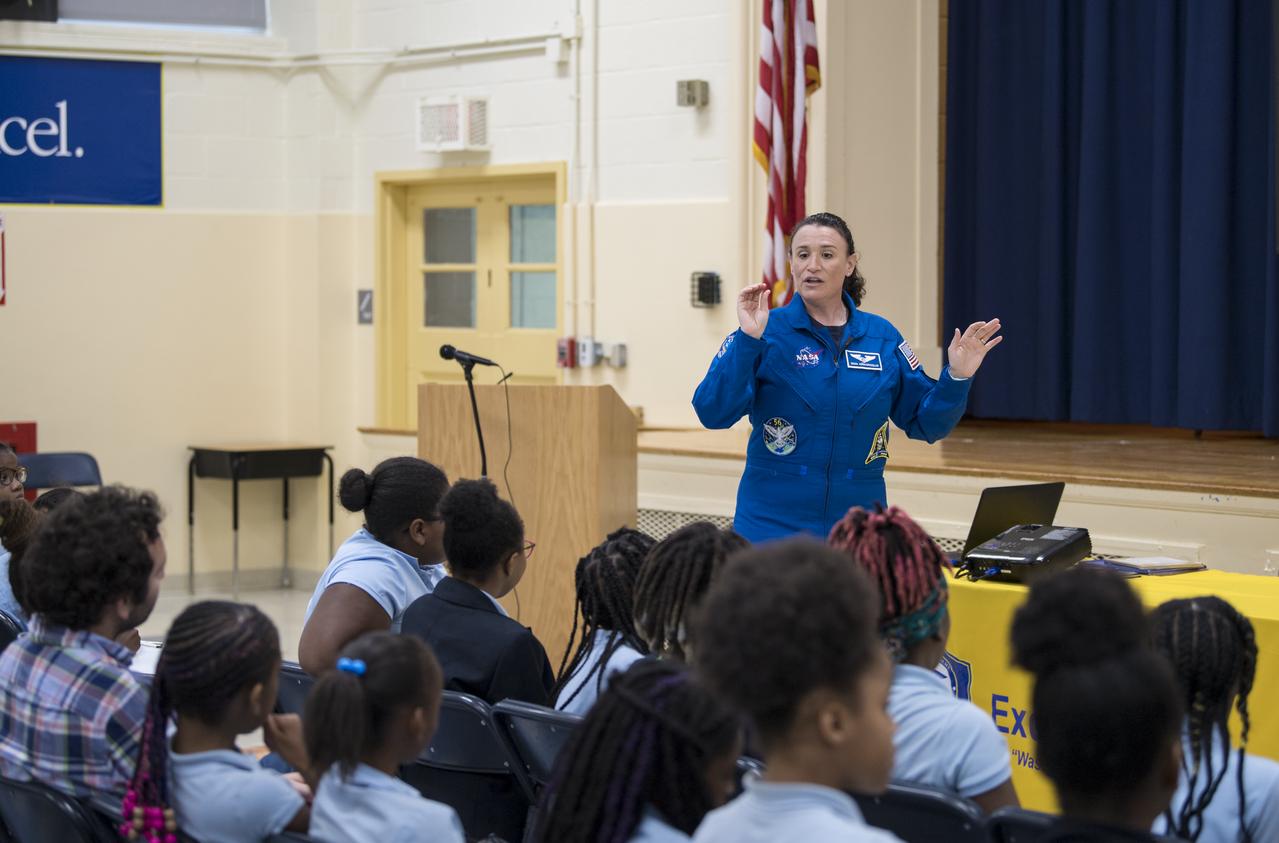
NASA astronaut Dr. Serena Auñón-Chancellor speaks about her experience on Expeditions 56 and 57 onboard the International Space Station (ISS) at Excel Academy Public Charter School, Monday, June 10, 2019 in Washington, DC. Auñón-Chancellor spent 197 days living and working onboard the ISS and contributed to hundreds of experiments in biology, biotechnology, physical science, and Earth science while there. She is also a doctor and started her career with NASA as a flight surgeon in 2006. Photo Credit: (NASA/Aubrey Gemignani)
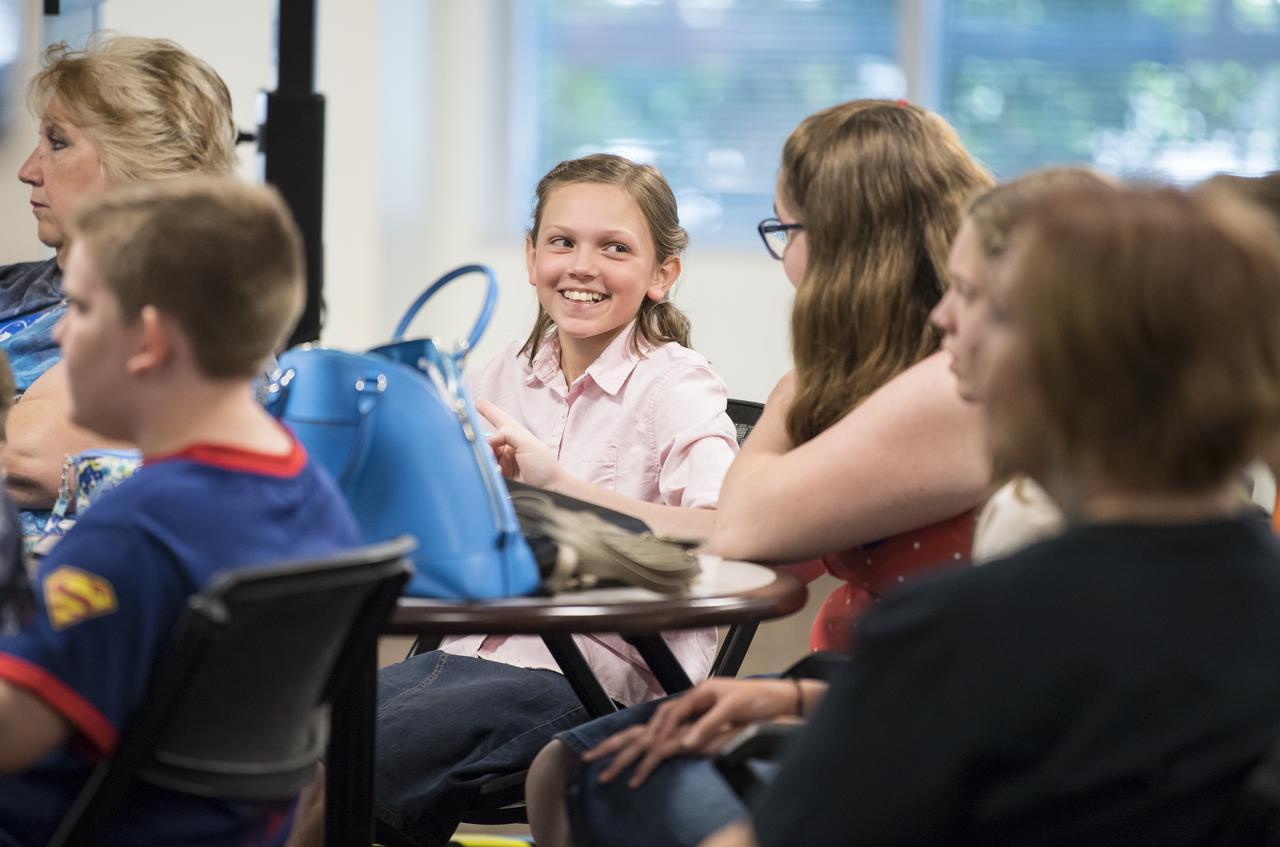
An audience member reacts as NASA astronaut Serena Auñón-Chancellor speaks about her experience on Expeditions 56 and 57 onboard the International Space Station at NASA Headquarters, Friday, June 14, 2019 in Washington. Auñón-Chancellor spent 197 days living and working onboard the orbital laboratory, contributing to hundreds of experiments in biology, biotechnology, physical science, and Earth science. She began her career at NASA as a flight surgeon before being selected as an astronaut in 2009. Photo Credit: (NASA/Aubrey Gemignani)
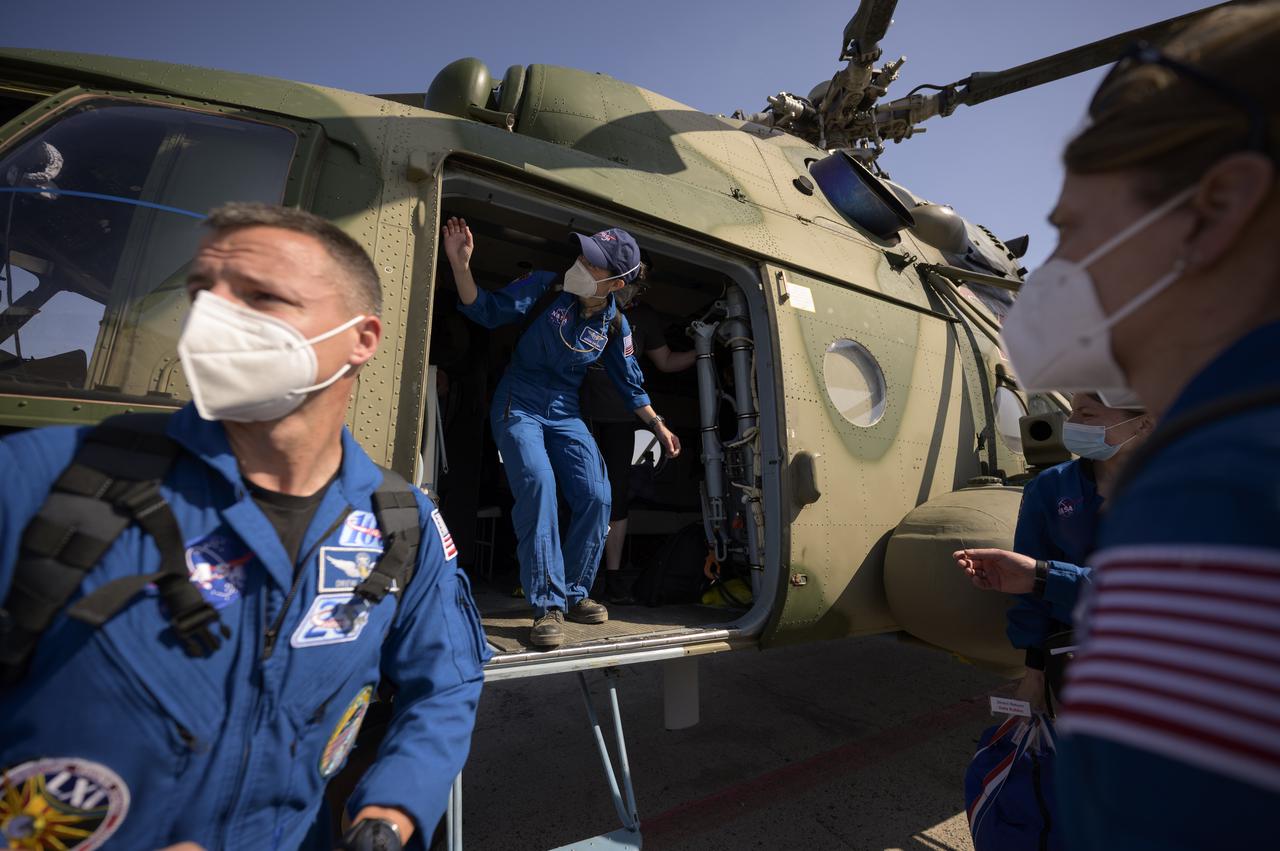
NASA Flight Surgeon Natacha Chough exits the Russian MI-8 helicopter in advance of NASA astronaut Kate Rubins, after Rubins, Roscosmos cosmonauts Sergey Ryzhikov and Sergey Kud-Sverchkov landed in their Soyuz MS-17 spacecraft in a remote area near the town of Zhezkazgan, Kazakhstan on Saturday, April 17, 2021. Rubins, Ryzhikov and Kud-Sverchkov returned after 185 days in space having served as Expedition 63-64 crew members onboard the International Space Station. Photo Credit: NASA/Bill Ingalls
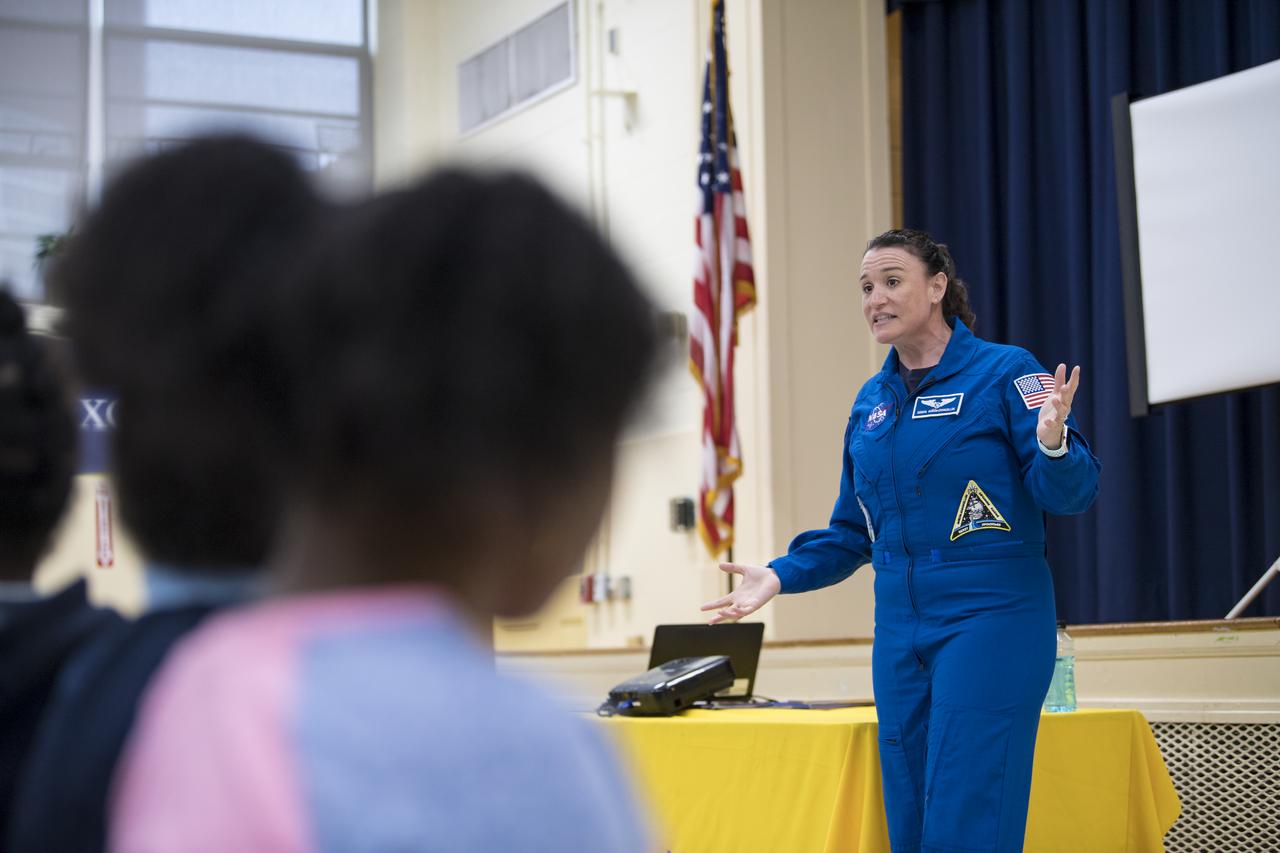
NASA astronaut Dr. Serena Auñón-Chancellor speaks about her experience on Expeditions 56 and 57 onboard the International Space Station (ISS) at Excel Academy Public Charter School, Monday, June 10, 2019 in Washington, DC. Auñón-Chancellor spent 197 days living and working onboard the ISS and contributed to hundreds of experiments in biology, biotechnology, physical science, and Earth science while there. She is also a doctor and started her career with NASA as a flight surgeon in 2006. Photo Credit: (NASA/Aubrey Gemignani)
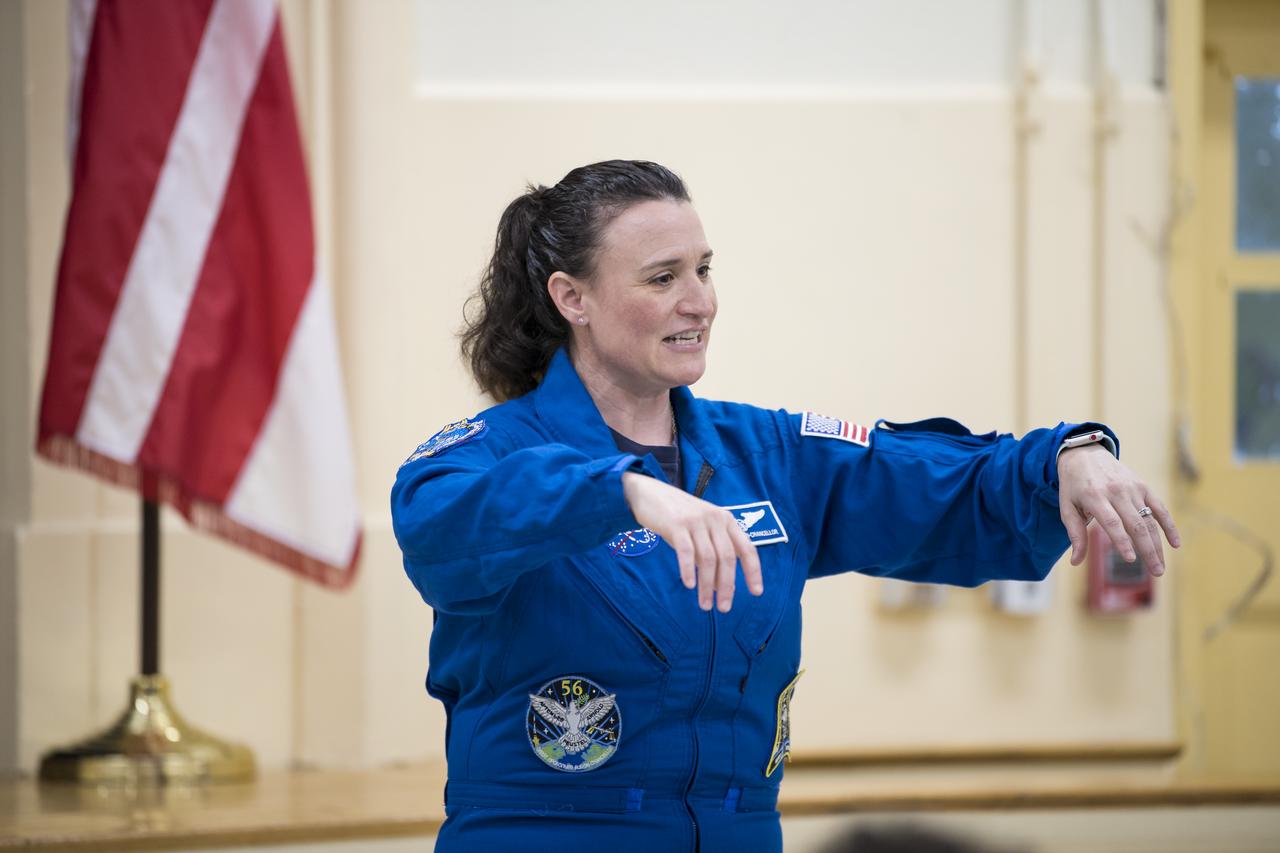
NASA astronaut Dr. Serena Auñón-Chancellor speaks about her experience on Expeditions 56 and 57 onboard the International Space Station (ISS) at Excel Academy Public Charter School, Monday, June 10, 2019 in Washington, DC. Auñón-Chancellor spent 197 days living and working onboard the ISS and contributed to hundreds of experiments in biology, biotechnology, physical science, and Earth science while there. She is also a doctor and started her career with NASA as a flight surgeon in 2006. Photo Credit: (NASA/Aubrey Gemignani)
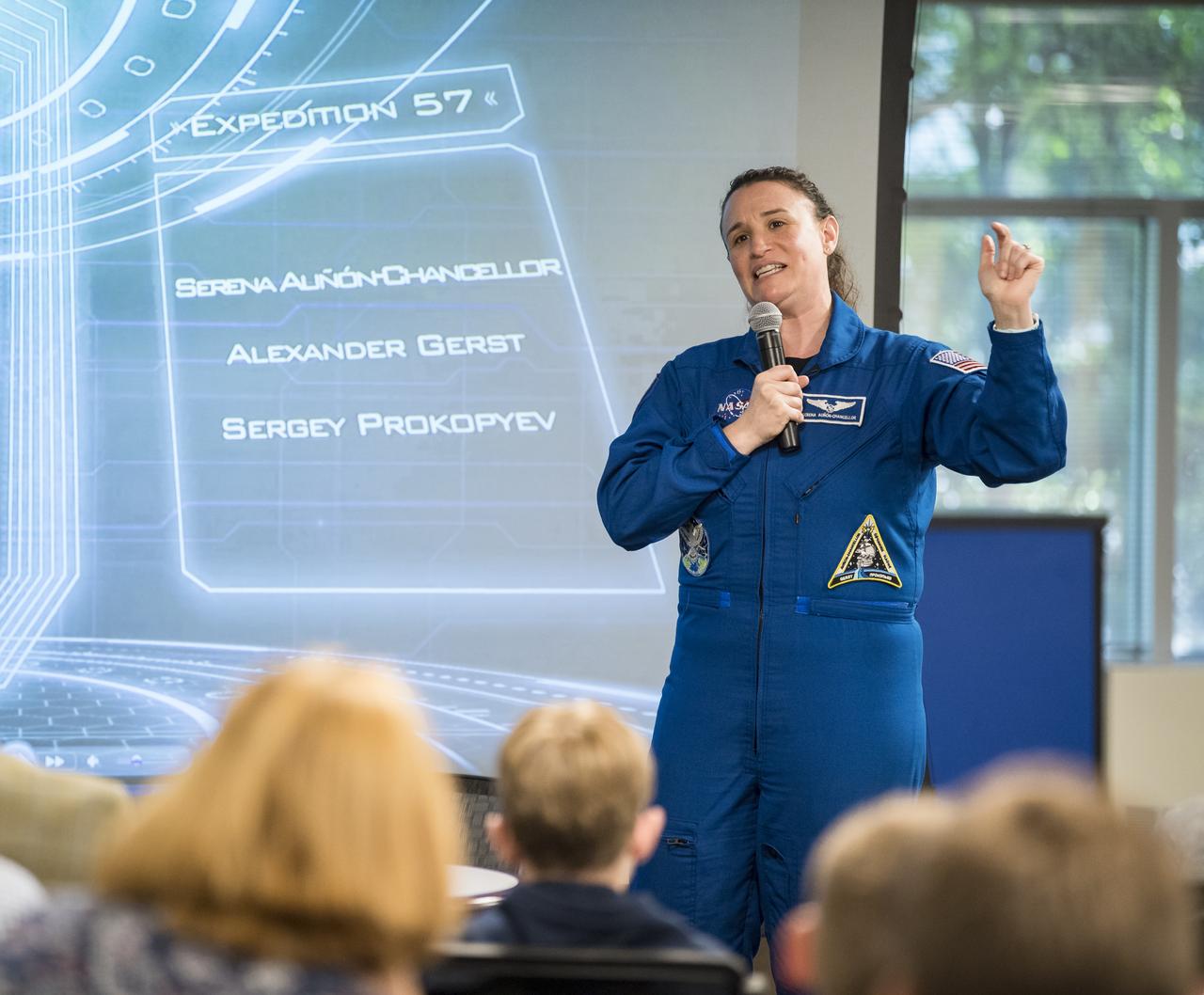
NASA astronaut Serena Auñón-Chancellor speaks about her experience on Expeditions 56 and 57 onboard the International Space Station at NASA Headquarters, Friday, June 14, 2019 in Washington. Auñón-Chancellor spent 197 days living and working onboard the orbital laboratory, contributing to hundreds of experiments in biology, biotechnology, physical science, and Earth science. She began her career at NASA as a flight surgeon before being selected as an astronaut in 2009. Photo Credit: (NASA/Aubrey Gemignani)
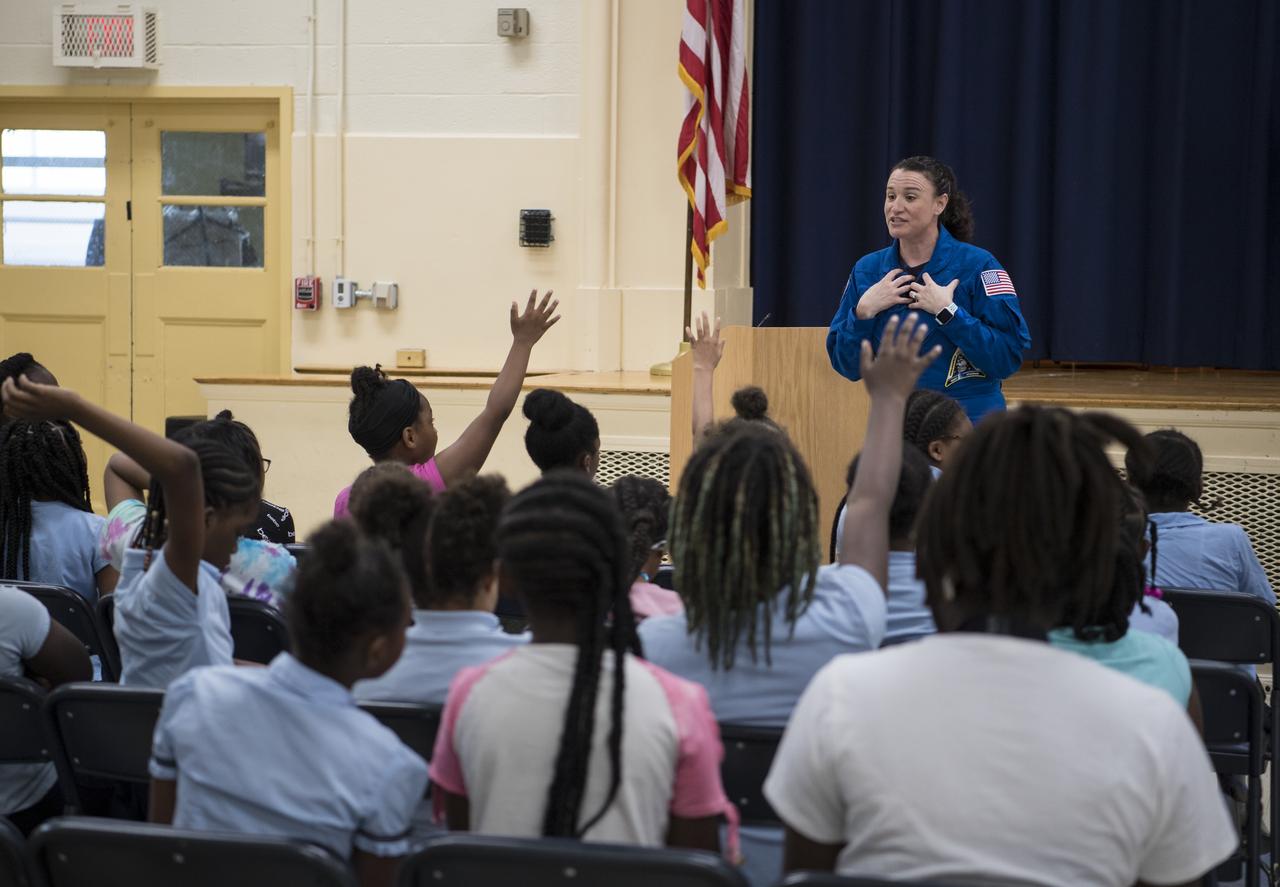
NASA astronaut Dr. Serena Auñón-Chancellor speaks about her experience on Expeditions 56 and 57 onboard the International Space Station (ISS) at Excel Academy Public Charter School, Monday, June 10, 2019 in Washington, DC. Auñón-Chancellor spent 197 days living and working onboard the ISS and contributed to hundreds of experiments in biology, biotechnology, physical science, and Earth science while there. She is also a doctor and started her career with NASA as a flight surgeon in 2006. Photo Credit: (NASA/Aubrey Gemignani)
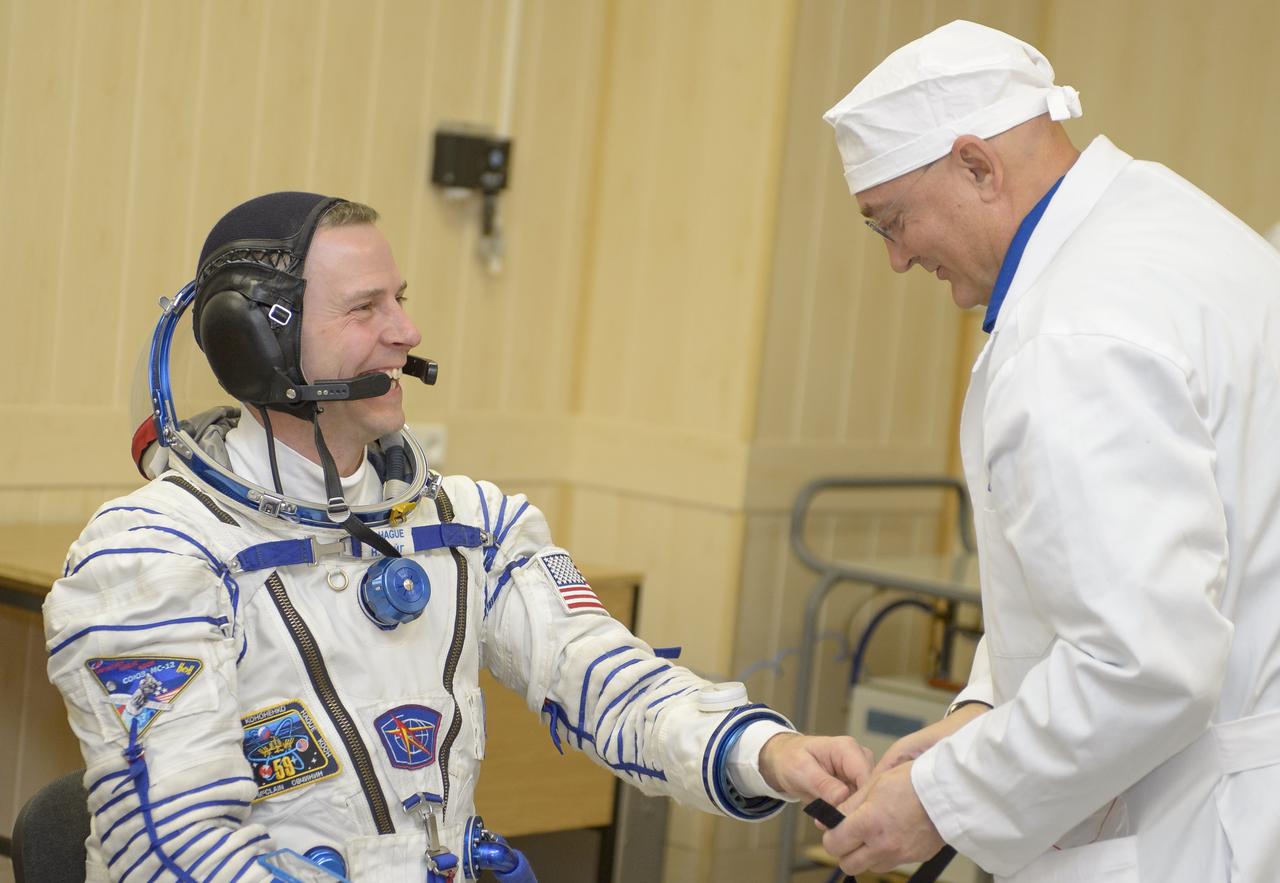
Expedition 59 astronaut Nick Hague of NASA laughs as he talks with NASA Flight Surgeon Blake Chamberlain prior to his launch on a Soyuz rocket with Christina Koch of NASA and Alexey Ovchinin of Roscosmos, Thursday, March 14, 2019 at the Baikonur Cosmodrome in Kazakhstan. Hague, Koch, and Ovchinin launched March 14, U.S. time, on the Soyuz MS-12 spacecraft from the Baikonur Cosmodrome for a six-and-a-half month mission on the International Space Station Photo Credit: (NASA/GCTC/Irina Spector)
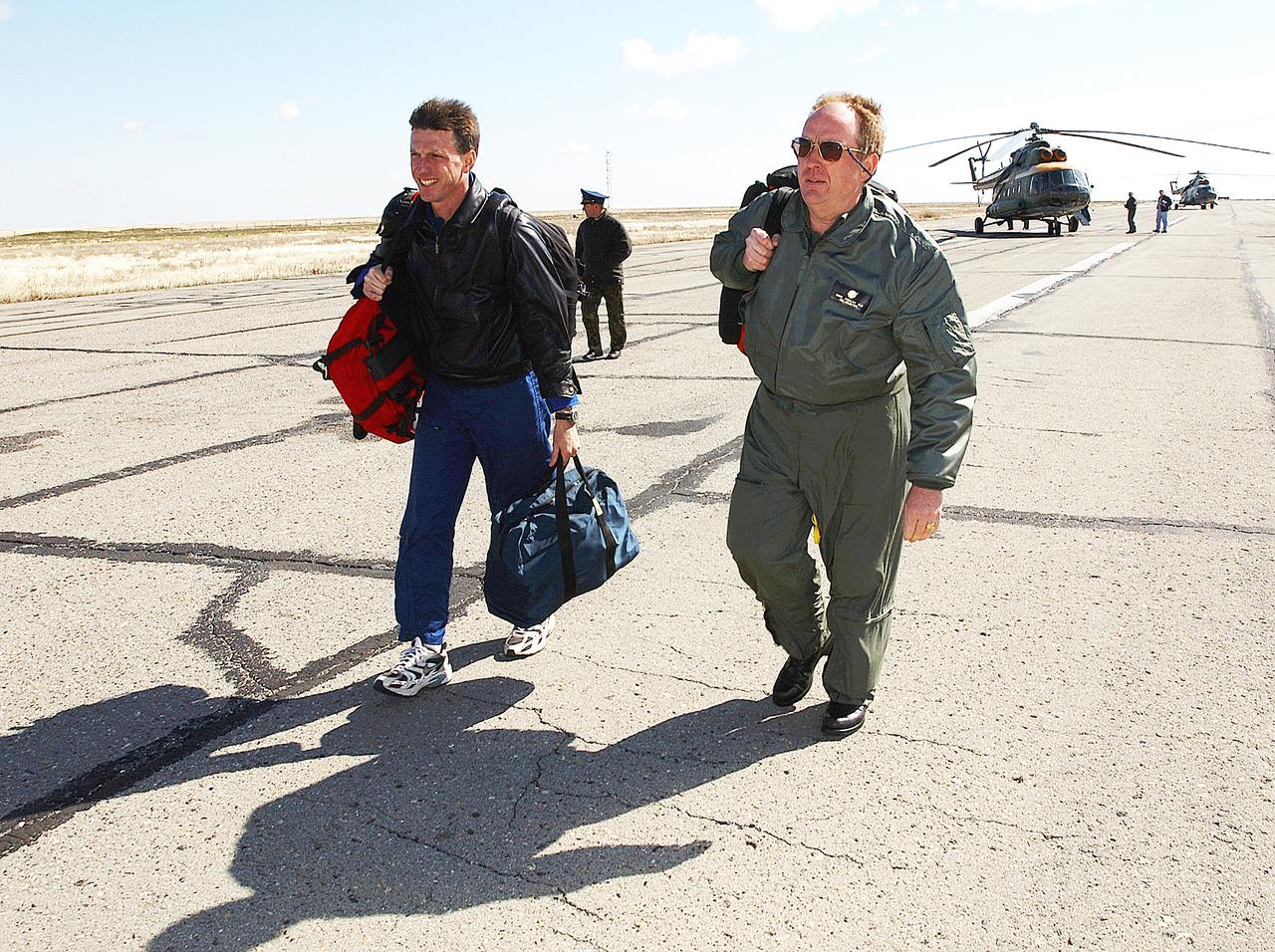
May 4, 2003, Kazakhstan. Astronaut Michael Foale (L) and Mike Duncan (R), Expedition Six Lead Flight Surgeon move to the lead helicopter after the landing team helicopters needed to return for refueling. Foale and Duncan went on from the refueling to meet the crew of Expedition Six at the landing site. Photo Credit: "NASA/Bill Ingalls"
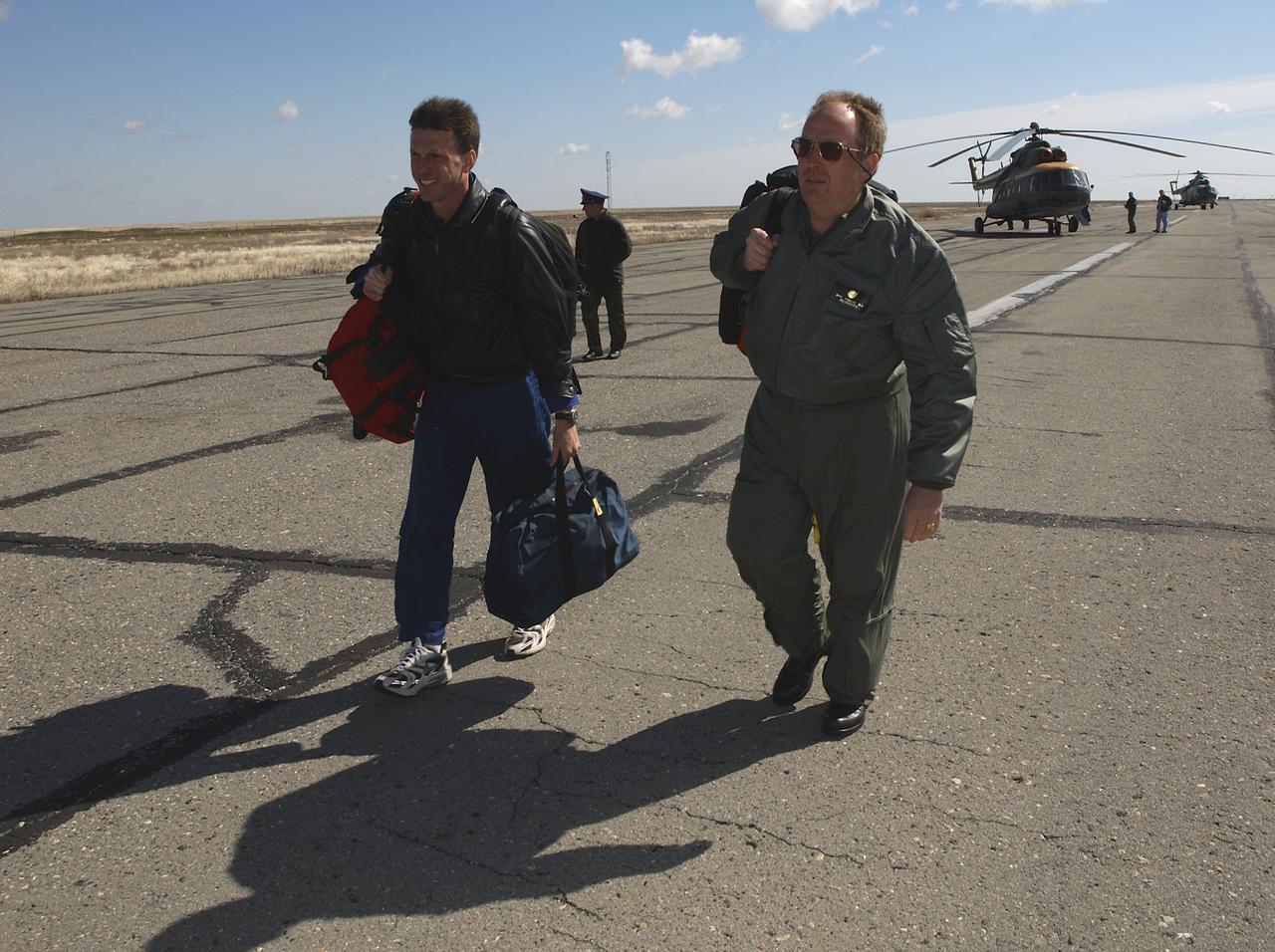
Astronaut Michael Foale, left, and Mike Duncan, Expedition 6 Lead Flight Surgeon, move to another helicopter after the landing team helicopters returned for refueling, Tuesday, May 4, 2003, in Kazakhstan. Foale and Duncan went on from the refueling to meet the crew of Expedition 6 at the landing site. Photo Credit: (NASA/Bill Ingalls)
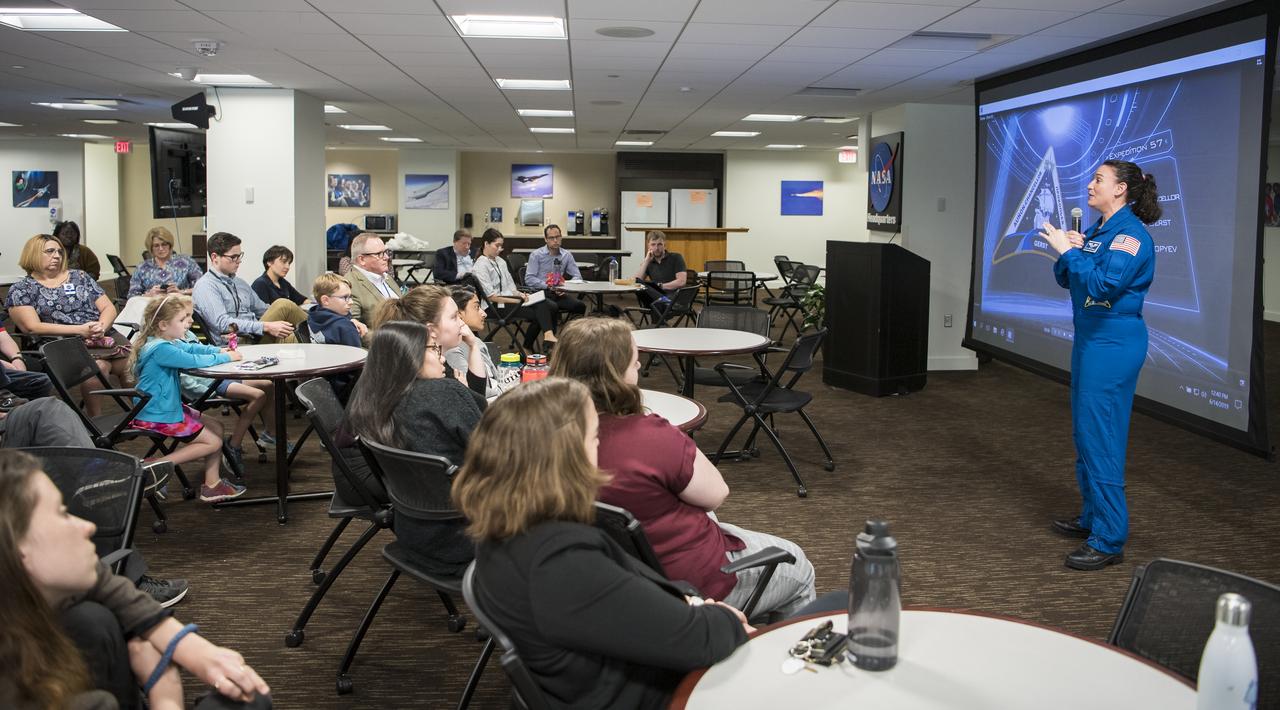
NASA astronaut Serena Auñón-Chancellor speaks about her experience on Expeditions 56 and 57 onboard the International Space Station at NASA Headquarters, Friday, June 14, 2019 in Washington. Auñón-Chancellor spent 197 days living and working onboard the orbital laboratory, contributing to hundreds of experiments in biology, biotechnology, physical science, and Earth science. She began her career at NASA as a flight surgeon before being selected as an astronaut in 2009. Photo Credit: (NASA/Aubrey Gemignani)
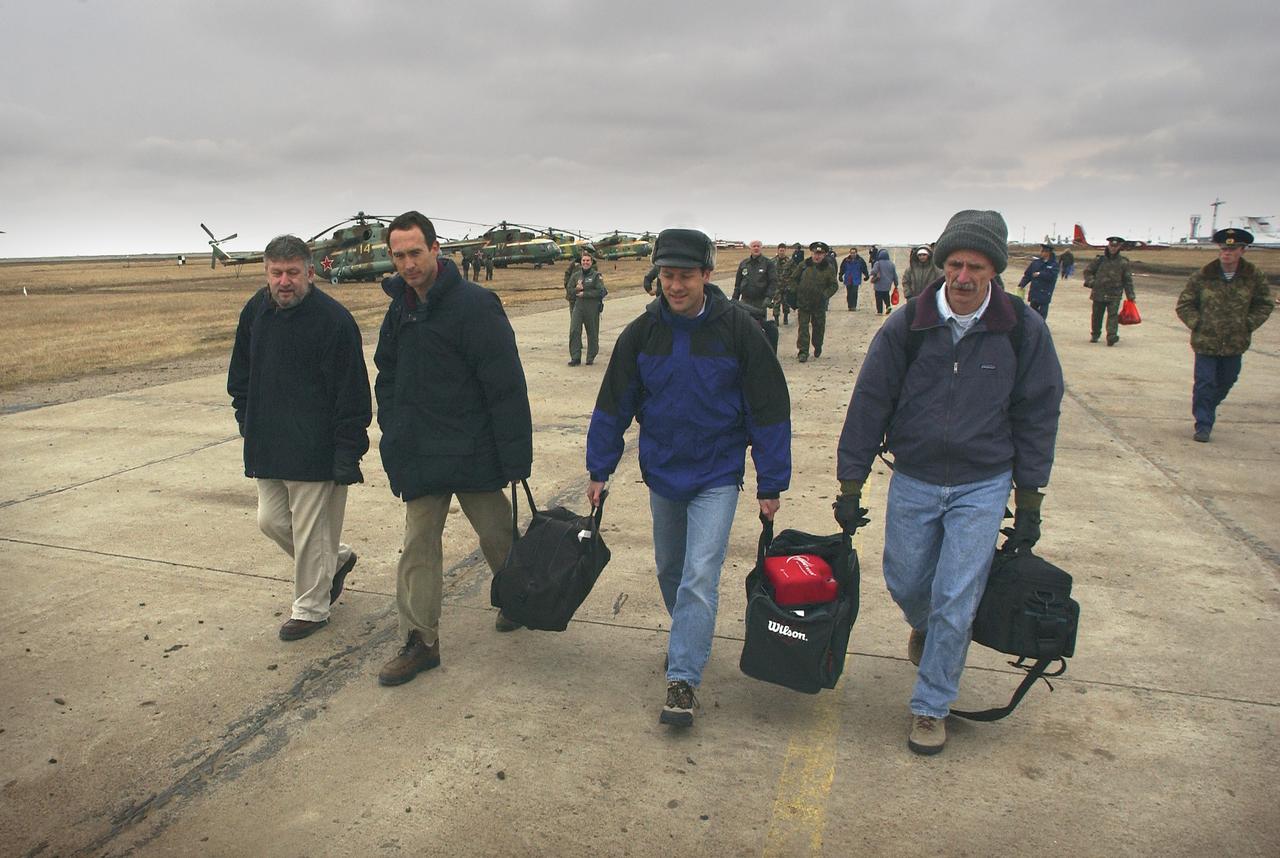
Dr. Thomas H. Marshburn, NASA Flight Surgeon, center, is helped to a Russian helicopter by interpreter Paul Kharmats, far left, astronaut James H. Newman and NASA International Space Station Program Manager William Gerstenmaier, right. Dr. Marshburn was on one of four helicopters that were advanced to Arkalyk, Kazakhstan a day prior to the Expedition 7 Soyuz landing, Monday, October 27, 2003. Photo Credit: (NASA/Bill Ingalls)
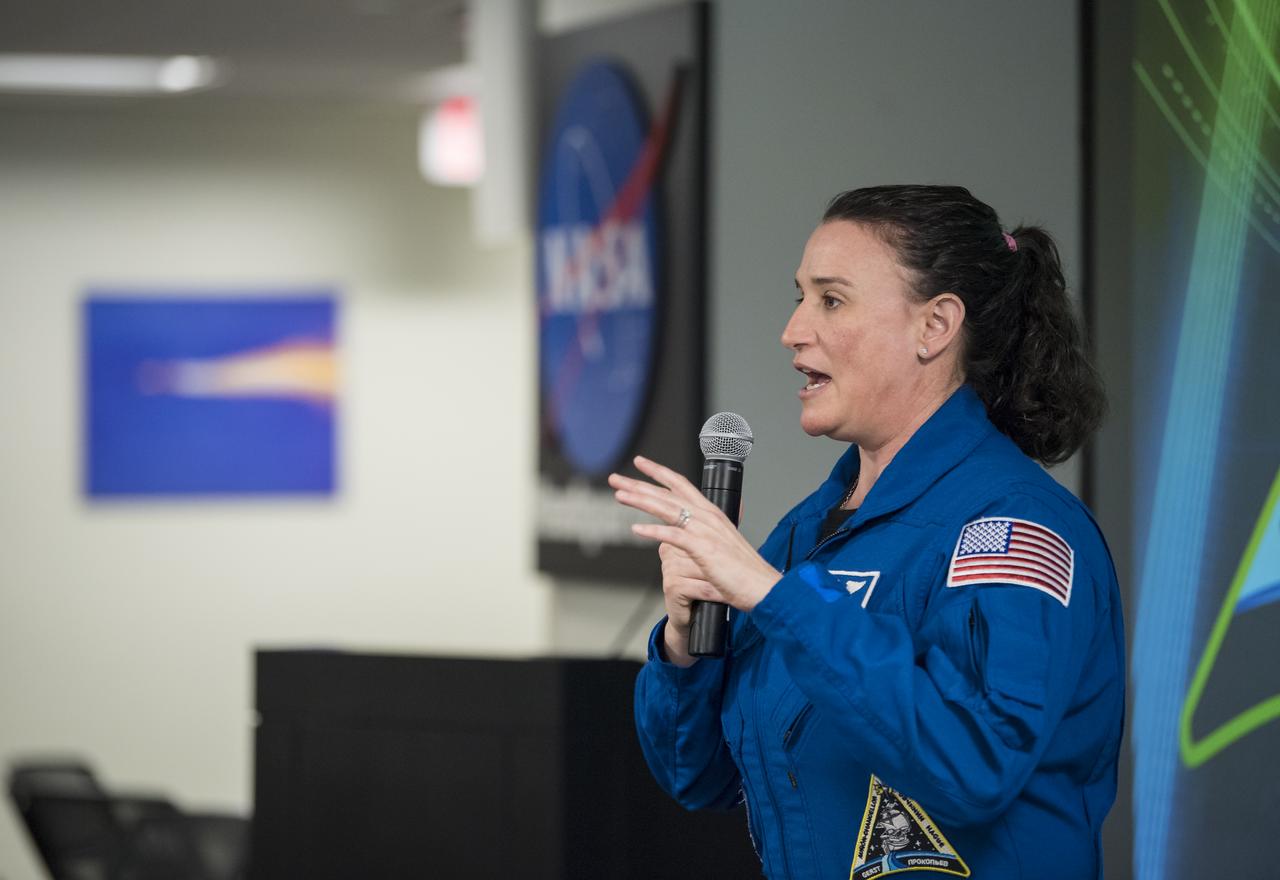
NASA astronaut Serena Auñón-Chancellor speaks about her experience on Expeditions 56 and 57 onboard the International Space Station at NASA Headquarters, Friday, June 14, 2019 in Washington. Auñón-Chancellor spent 197 days living and working onboard the orbital laboratory, contributing to hundreds of experiments in biology, biotechnology, physical science, and Earth science. She began her career at NASA as a flight surgeon before being selected as an astronaut in 2009. Photo Credit: (NASA/Aubrey Gemignani)
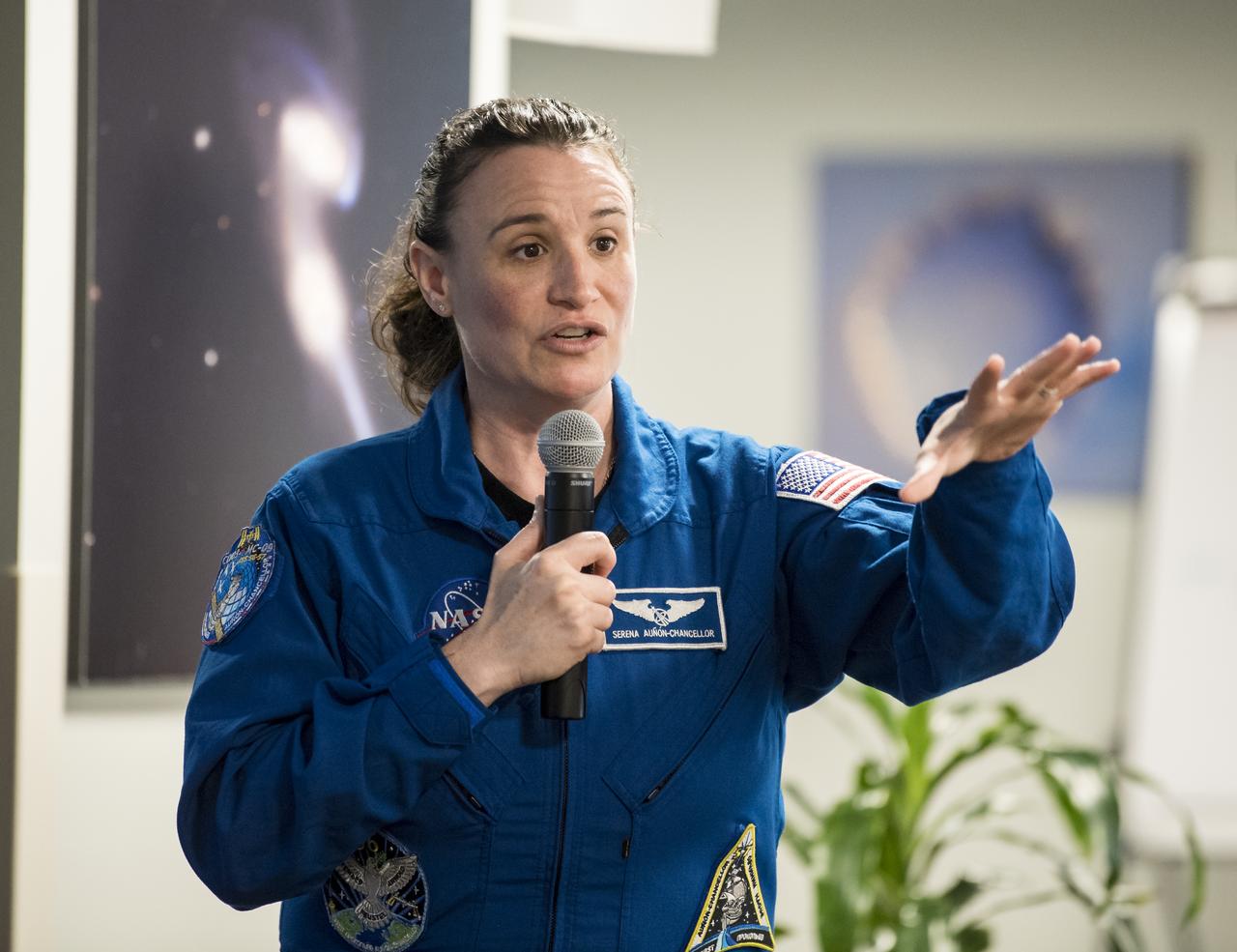
NASA astronaut Serena Auñón-Chancellor speaks about her experience on Expeditions 56 and 57 onboard the International Space Station at NASA Headquarters, Friday, June 14, 2019 in Washington. Auñón-Chancellor spent 197 days living and working onboard the orbital laboratory, contributing to hundreds of experiments in biology, biotechnology, physical science, and Earth science. She began her career at NASA as a flight surgeon before being selected as an astronaut in 2009. Photo Credit: (NASA/Aubrey Gemignani)
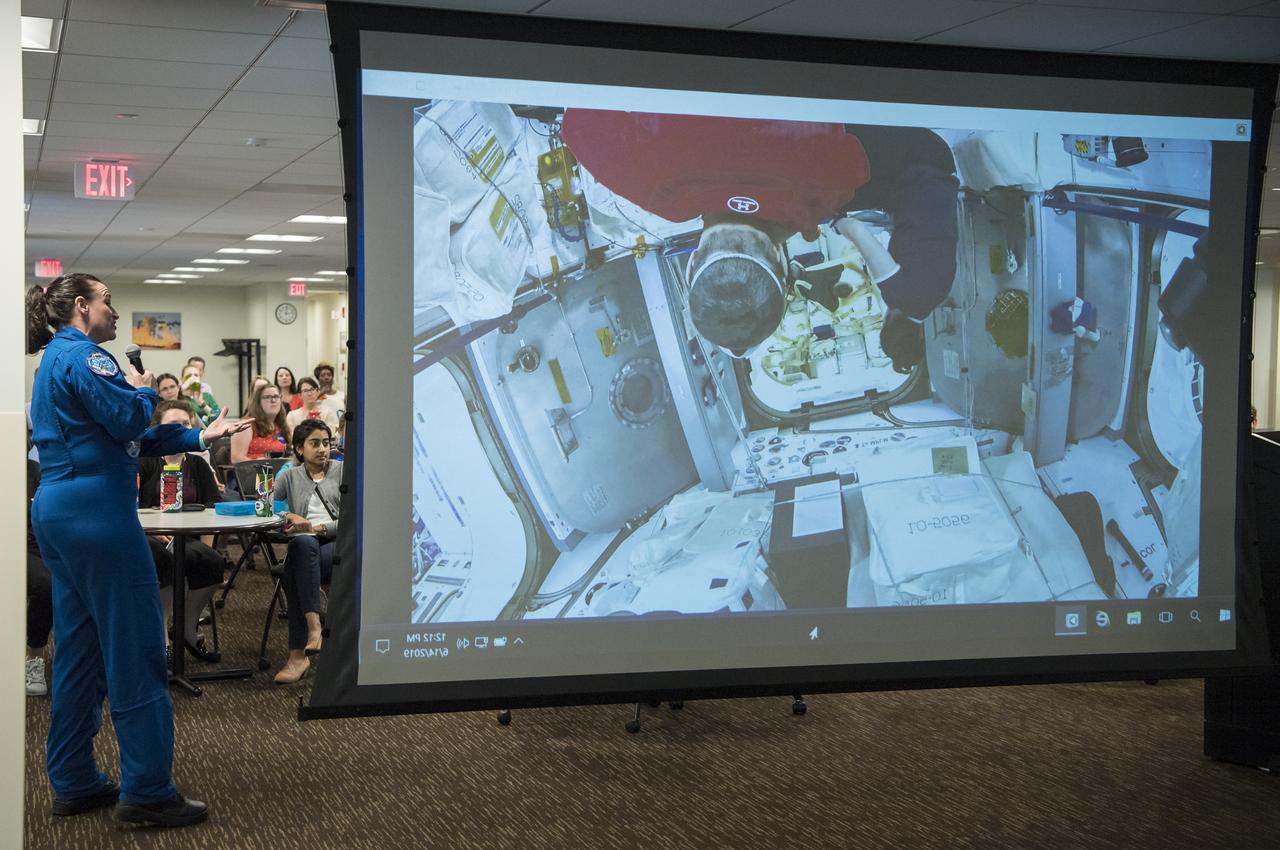
NASA astronaut Serena Auñón-Chancellor speaks about her experience on Expeditions 56 and 57 onboard the International Space Station at NASA Headquarters, Friday, June 14, 2019 in Washington. Auñón-Chancellor spent 197 days living and working onboard the orbital laboratory, contributing to hundreds of experiments in biology, biotechnology, physical science, and Earth science. She began her career at NASA as a flight surgeon before being selected as an astronaut in 2009. Photo Credit: (NASA/Aubrey Gemignani)
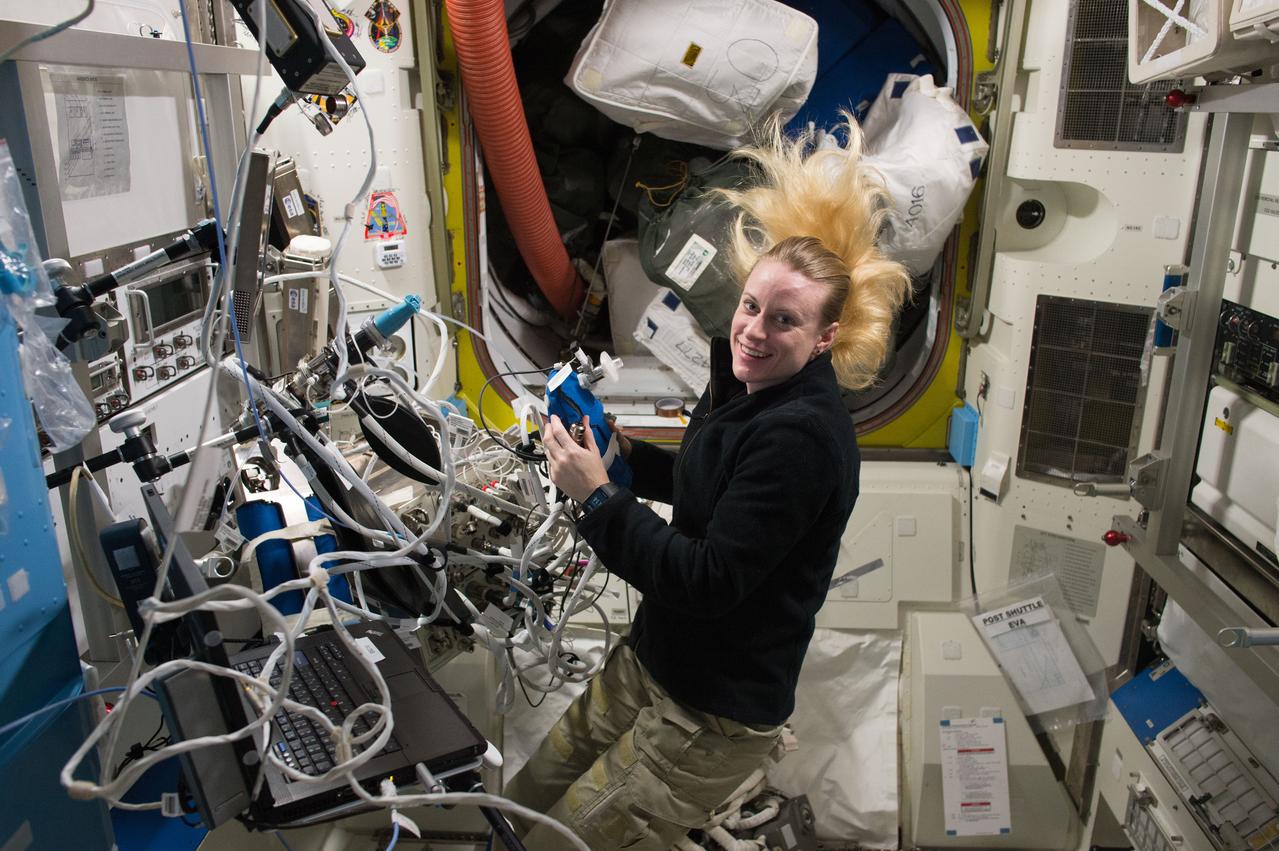
iss049e045997 (10/25/2016) --- NASA Astronaut Kate Rubins as she begans the measurement of the European Space Agency (ESA) Airway Monitoring experiment in the Quest airlock. The investigation studies the occurrence and indicators of airway inflammation in crew members to help flight surgeons plan safer, long-term missions to the moon, Mars and beyond. Results may also help doctors treat patients on Earth with asthma or other airway inflammatory diseases.
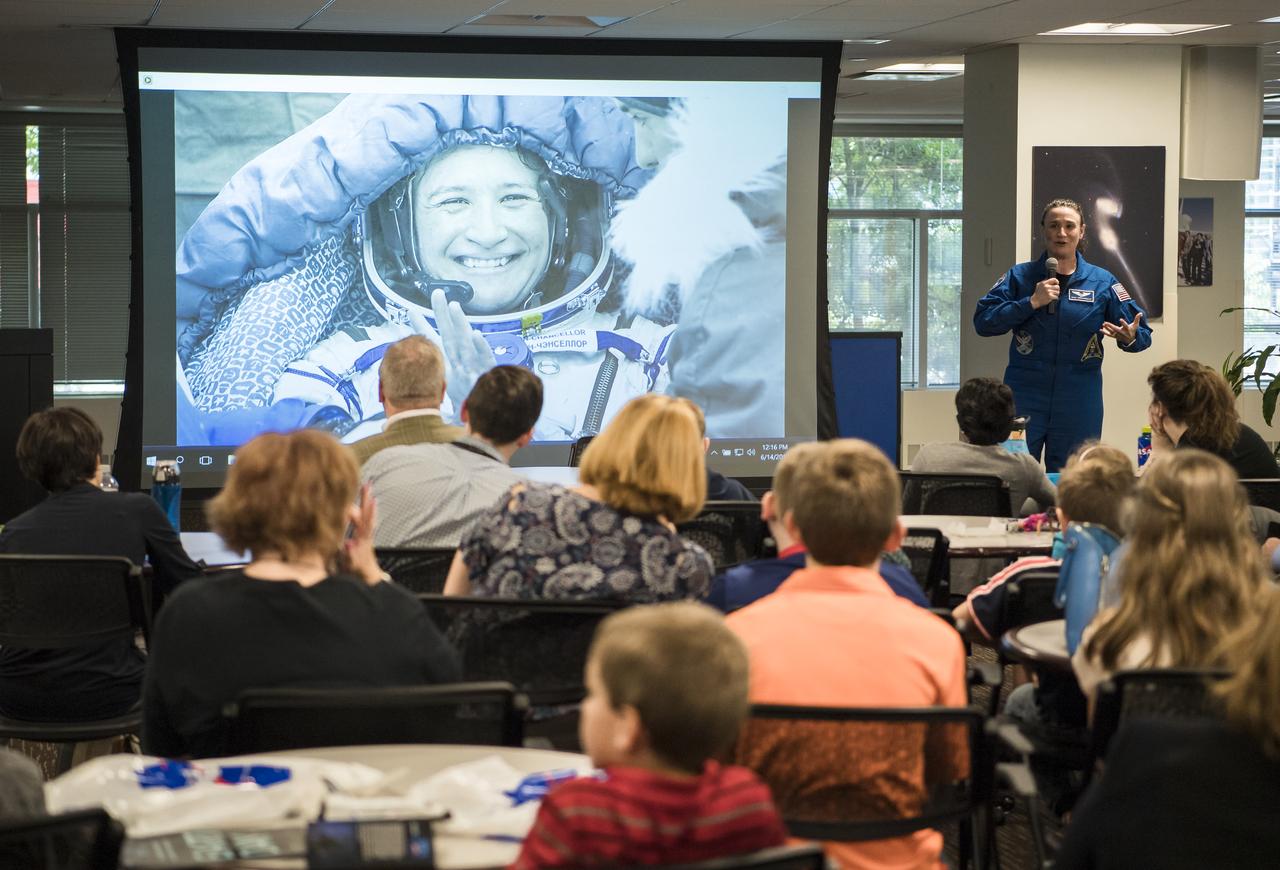
NASA astronaut Serena Auñón-Chancellor speaks about her experience on Expeditions 56 and 57 onboard the International Space Station at NASA Headquarters, Friday, June 14, 2019 in Washington. Auñón-Chancellor spent 197 days living and working onboard the orbital laboratory, contributing to hundreds of experiments in biology, biotechnology, physical science, and Earth science. She began her career at NASA as a flight surgeon before being selected as an astronaut in 2009. Photo Credit: (NASA/Aubrey Gemignani)
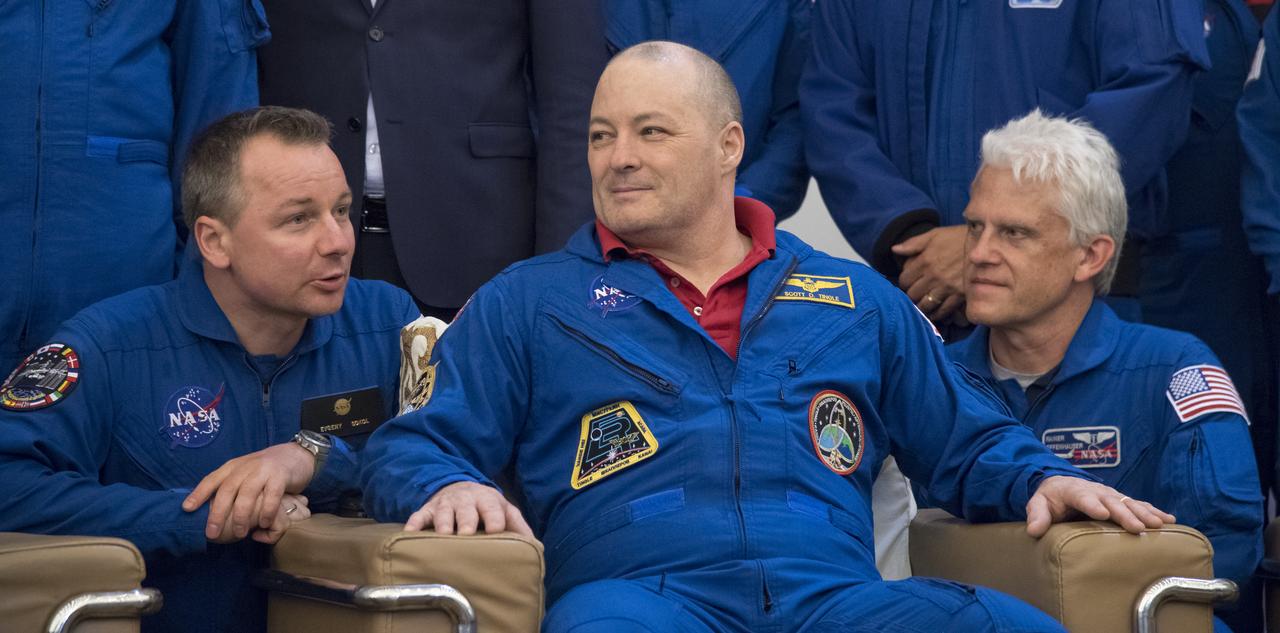
NASA astronaut Scott Tingle, center, listens, along with NASA Interpreter Evgeny Sokol, left, and NASA Flight Surgeon Rainer Effenhauser during a Karaganda Airport welcome ceremony in Kazakhstan on Sunday, June 3, 2018. Tingle, along with Roscosmos cosmonaut Anton Shkaplerov, and Japan Aerospace Exploration Agency (JAXA) Norishige Kanai are returning after 168 days in space where they served as members of the Expedition 54 and 55 crews onboard the International Space Station. Photo Credit: (NASA/Bill Ingalls)
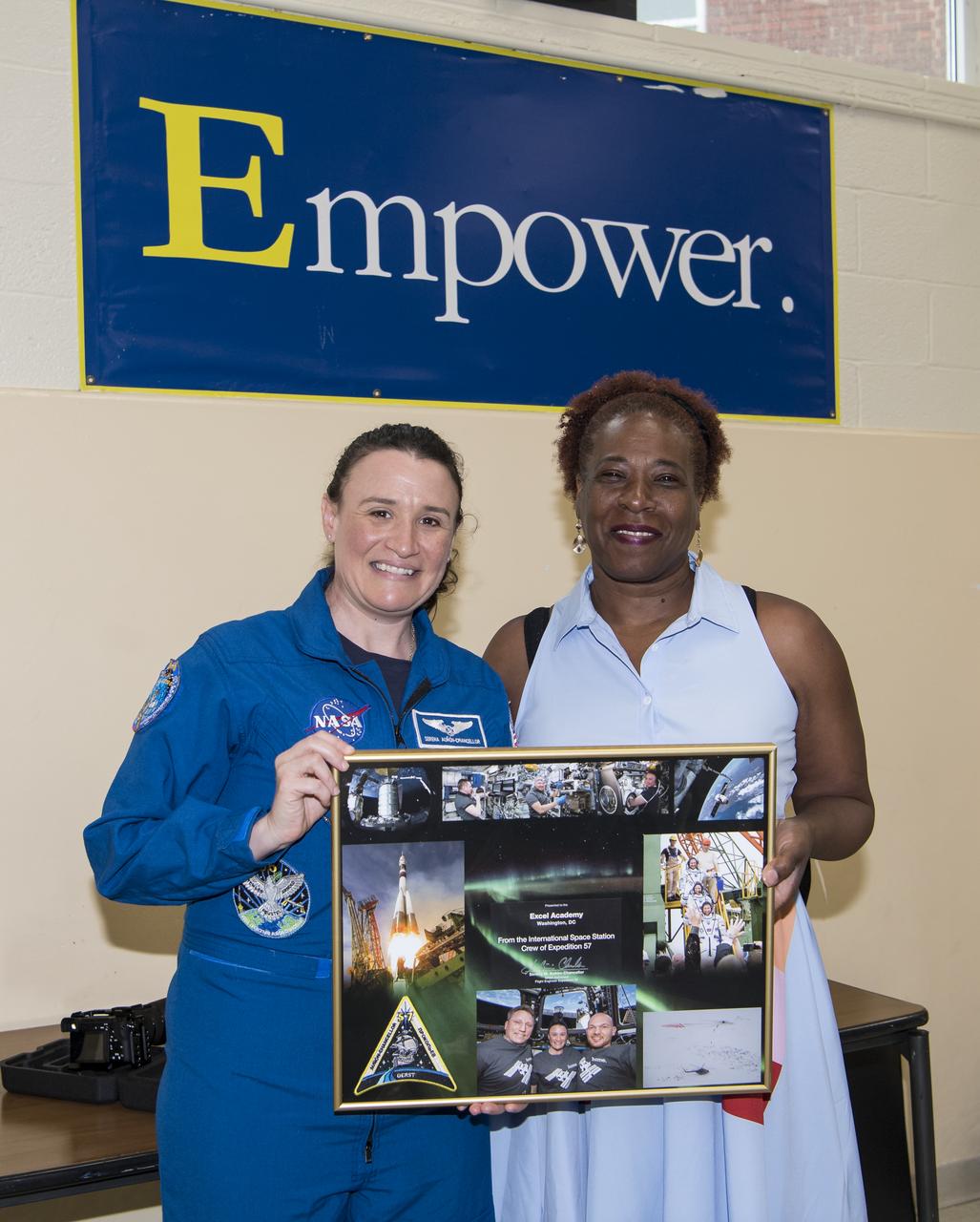
NASA astronaut Dr. Serena Auñón-Chancellor presents a montage from Expeditions 56 and 57 to Excel Academy Public Charter School, Monday, June 10, 2019 in Washington, DC. Auñón-Chancellor spent 197 days living and working onboard the ISS and contributed to hundreds of experiments in biology, biotechnology, physical science, and Earth science while there. She is also a doctor and started her career with NASA as a flight surgeon in 2006. Photo Credit: (NASA/Aubrey Gemignani)
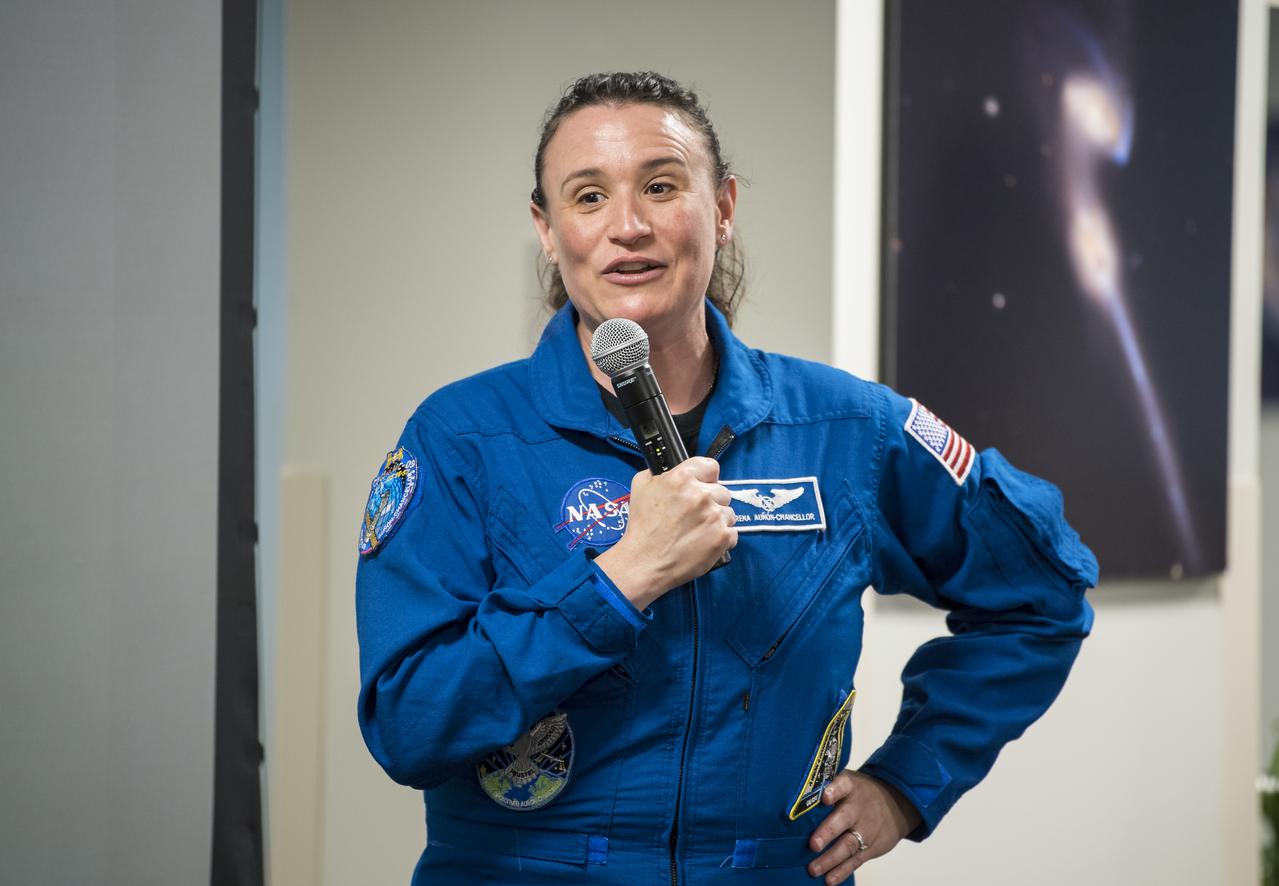
NASA astronaut Serena Auñón-Chancellor speaks about her experience on Expeditions 56 and 57 onboard the International Space Station at NASA Headquarters, Friday, June 14, 2019 in Washington. Auñón-Chancellor spent 197 days living and working onboard the orbital laboratory, contributing to hundreds of experiments in biology, biotechnology, physical science, and Earth science. She began her career at NASA as a flight surgeon before being selected as an astronaut in 2009. Photo Credit: (NASA/Aubrey Gemignani)
NASA astronaut Serena Auñón-Chancellor is seen during an interview, Friday, June 14, 2019 the Smithsonian's National Air and Space Museum in Washington, DC. Auñón-Chancellor spent 197 days living and working onboard the orbital laboratory as part of Expeditions 56 and 57, contributing to hundreds of experiments in biology, biotechnology, physical science, and Earth science while there. She began her career at NASA as a flight surgeon before being selected as an astronaut in 2009. Photo Credit: (NASA/Joel Kowsky)
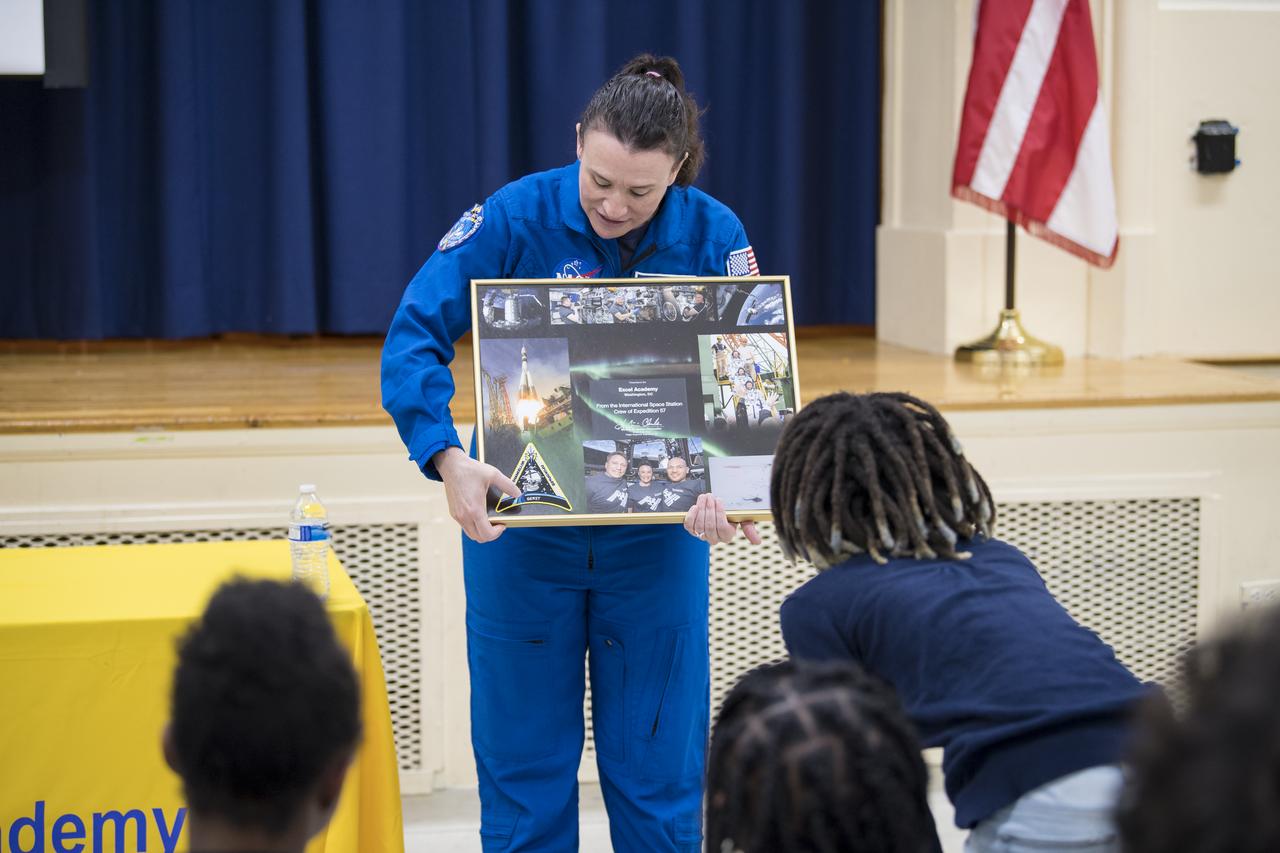
NASA astronaut Dr. Serena Auñón-Chancellor presents a montage from Expeditions 56 and 57 to the students of Excel Academy Public Charter School, Monday, June 10, 2019 in Washington, DC. Auñón-Chancellor spent 197 days living and working onboard the ISS and contributed to hundreds of experiments in biology, biotechnology, physical science, and Earth science while there. She is also a doctor and started her career with NASA as a flight surgeon in 2006. Photo Credit: (NASA/Aubrey Gemignani)
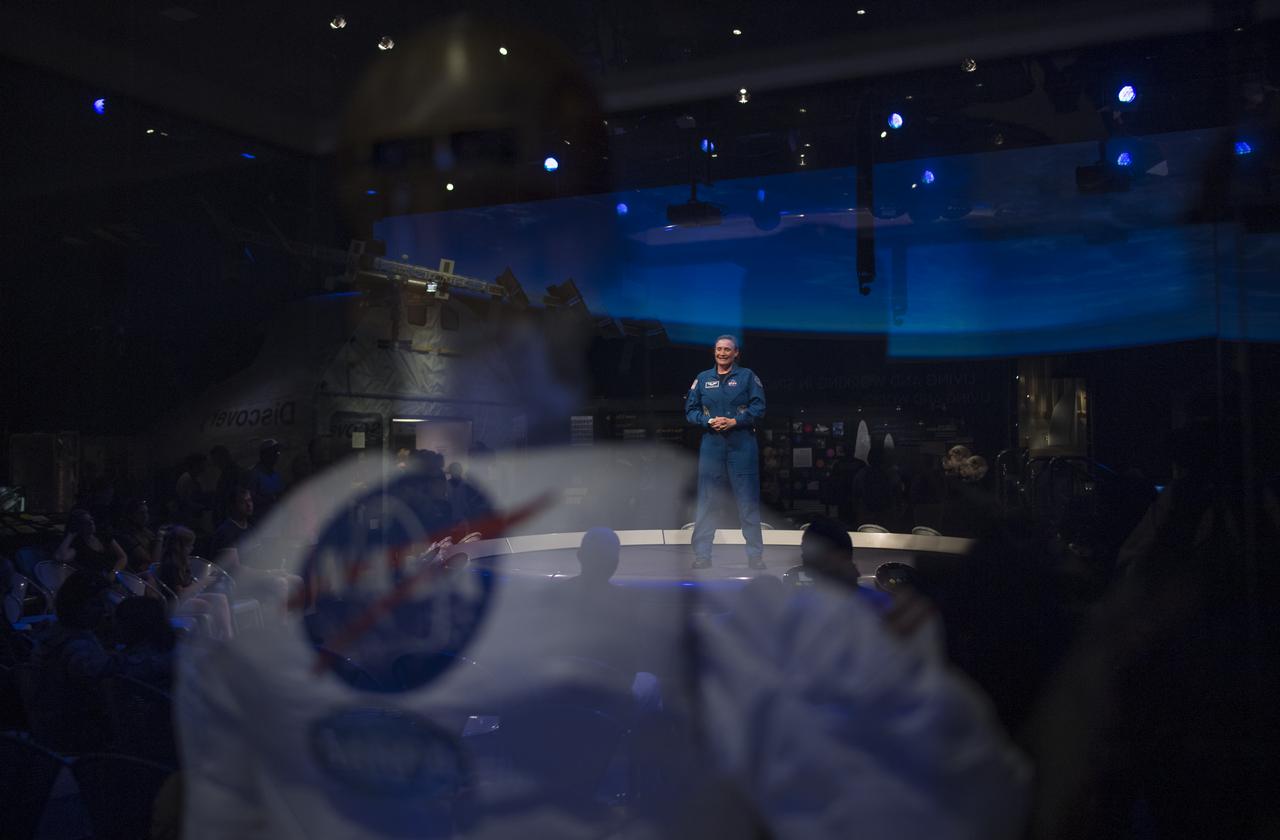
NASA astronaut Serena Auñón-Chancellor is seen reflected in a display case during an interview, Friday, June 14, 2019 the Smithsonian's National Air and Space Museum in Washington, DC. Auñón-Chancellor spent 197 days living and working onboard the orbital laboratory as part of Expeditions 56 and 57, contributing to hundreds of experiments in biology, biotechnology, physical science, and Earth science while there. She began her career at NASA as a flight surgeon before being selected as an astronaut in 2009. Photo Credit: (NASA/Joel Kowsky)
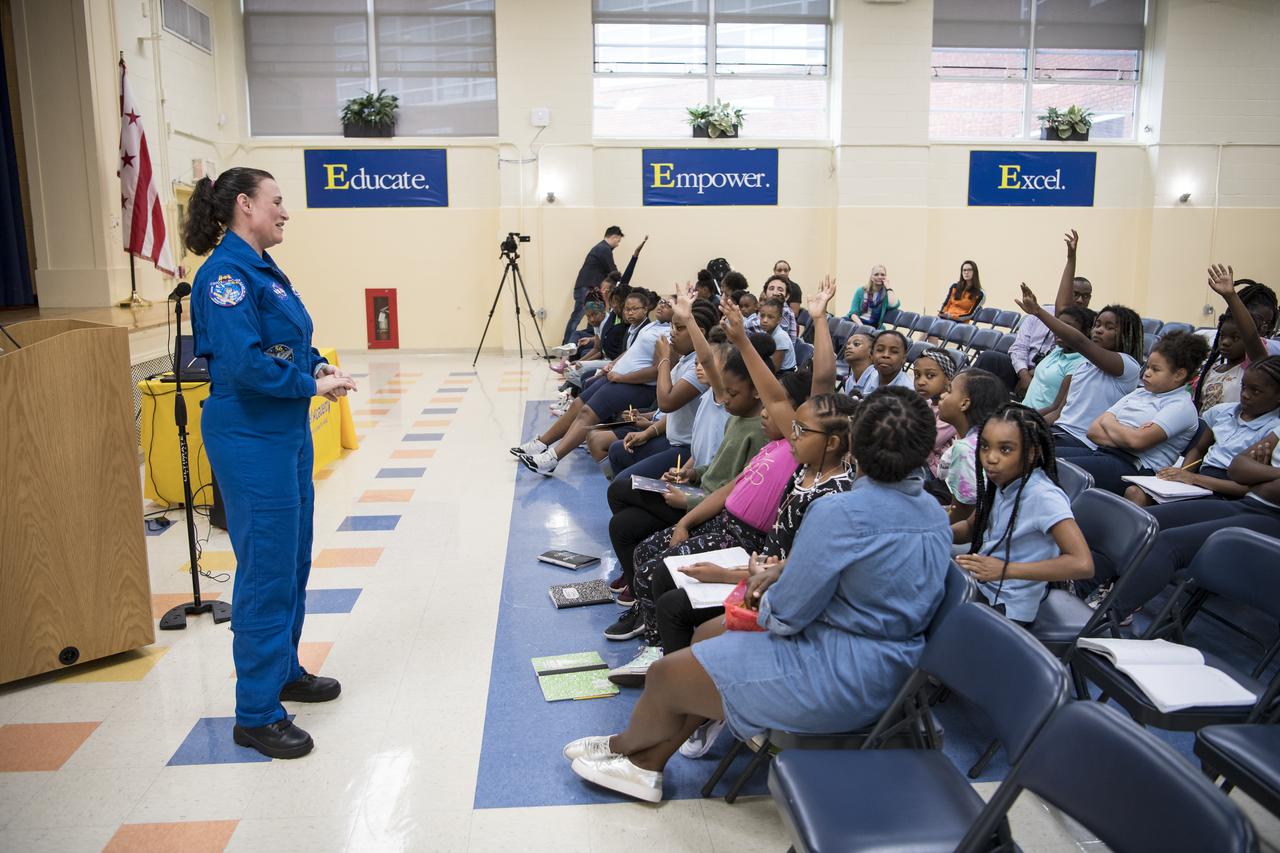
NASA astronaut Dr. Serena Auñón-Chancellor speaks about her experience on Expeditions 56 and 57 onboard the International Space Station (ISS) at Excel Academy Public Charter School, Monday, June 10, 2019 in Washington, DC. Auñón-Chancellor spent 197 days living and working onboard the ISS and contributed to hundreds of experiments in biology, biotechnology, physical science, and Earth science while there. She is also a doctor and started her career with NASA as a flight surgeon in 2006. Photo Credit: (NASA/Aubrey Gemignani)
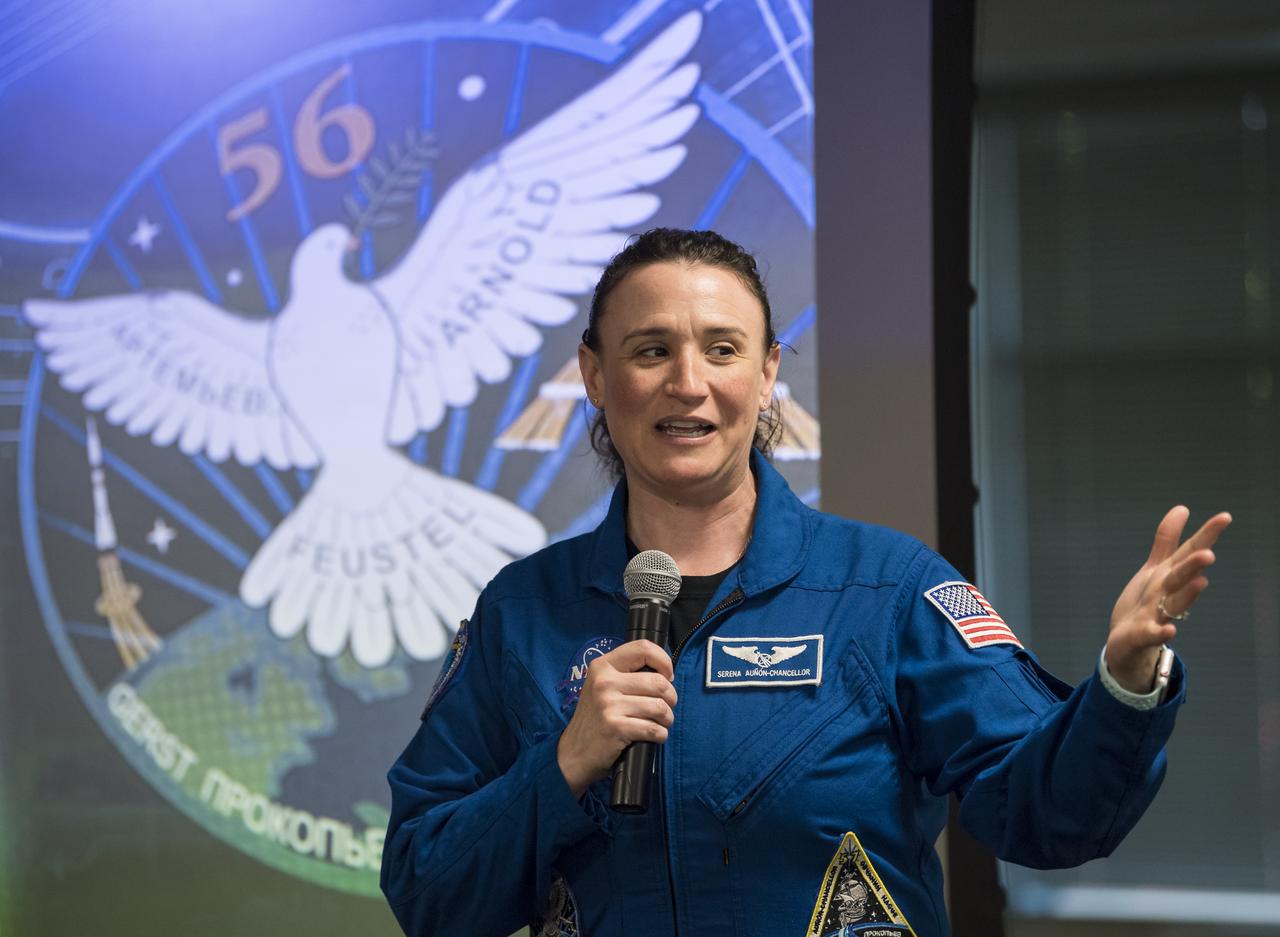
NASA astronaut Serena Auñón-Chancellor speaks about her experience on Expeditions 56 and 57 onboard the International Space Station at NASA Headquarters, Friday, June 14, 2019 in Washington. Auñón-Chancellor spent 197 days living and working onboard the orbital laboratory, contributing to hundreds of experiments in biology, biotechnology, physical science, and Earth science. She began her career at NASA as a flight surgeon before being selected as an astronaut in 2009. Photo Credit: (NASA/Aubrey Gemignani)
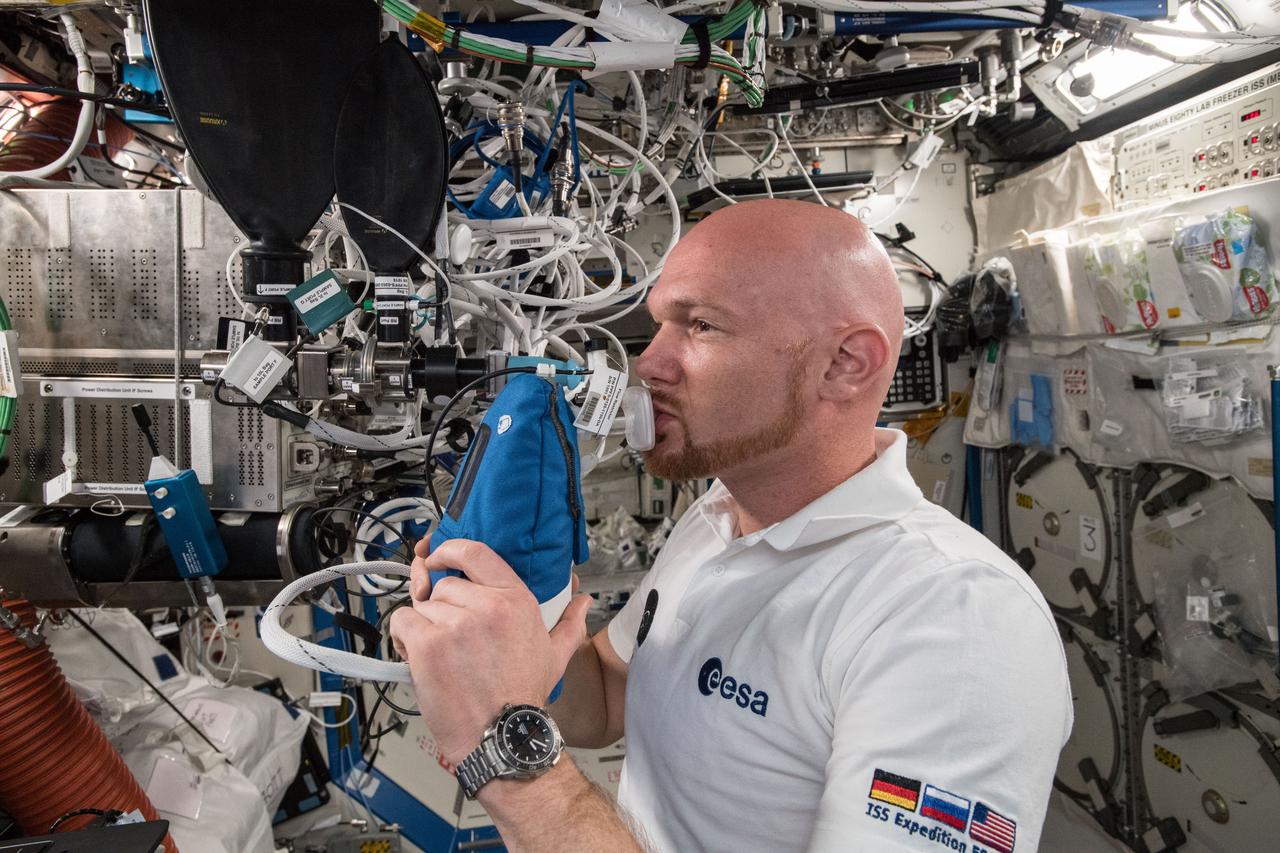
iss056e055604 (June 29, 2018) --- Astronaut Alexander Gerst of ESA (European Space Agency) exhales into an ultra-sensitive gas analyzer for the Airway Monitoring experiment. The experiment studies the occurrence and indicators of airway inflammation in crew members to help flight surgeons plan safer, long-term missions to the Moon, Mars and beyond. Results may also help doctors treat patients on Earth with asthma or other airway inflammatory diseases.
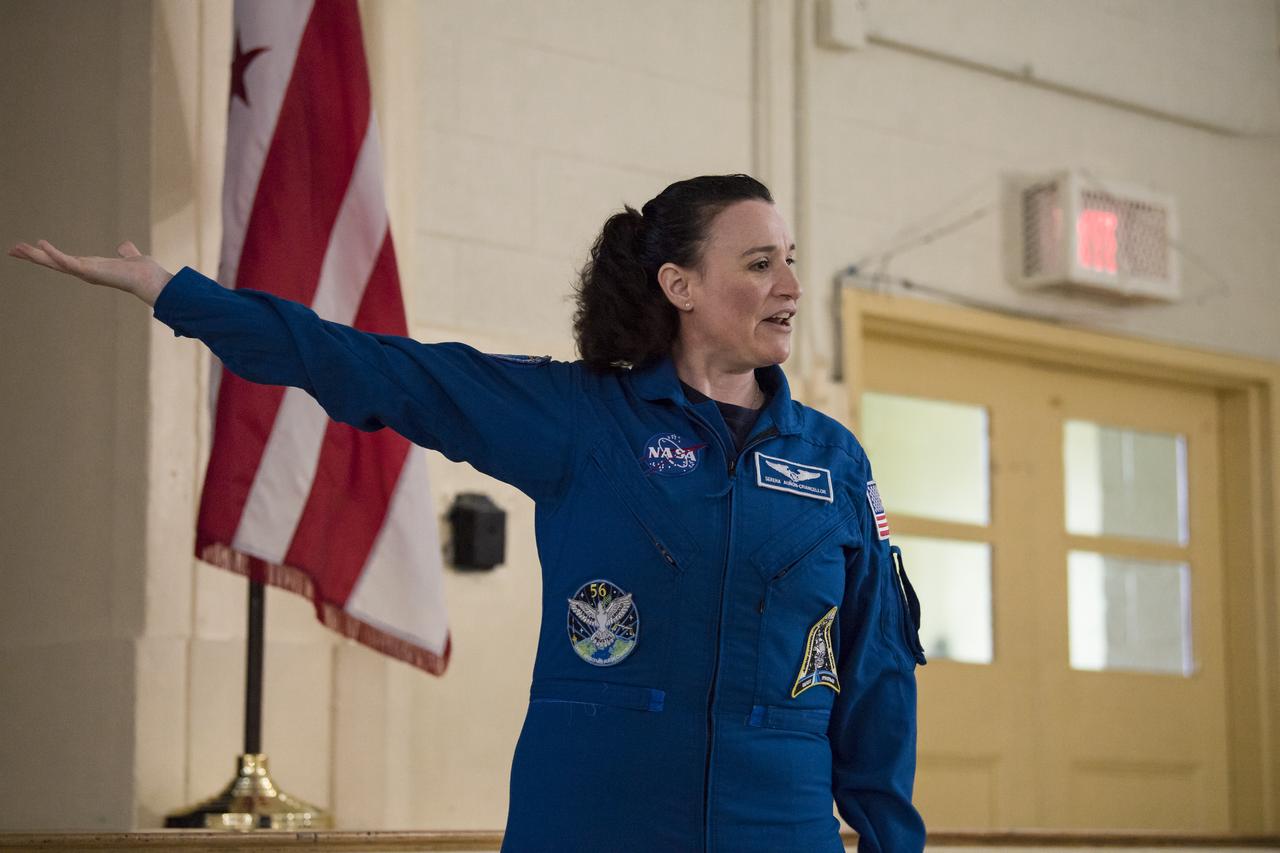
NASA astronaut Dr. Serena Auñón-Chancellor speaks about her experience on Expeditions 56 and 57 onboard the International Space Station (ISS) at Excel Academy Public Charter School, Monday, June 10, 2019 in Washington, DC. Auñón-Chancellor spent 197 days living and working onboard the ISS and contributed to hundreds of experiments in biology, biotechnology, physical science, and Earth science while there. She is also a doctor and started her career with NASA as a flight surgeon in 2006. Photo Credit: (NASA/Aubrey Gemignani)
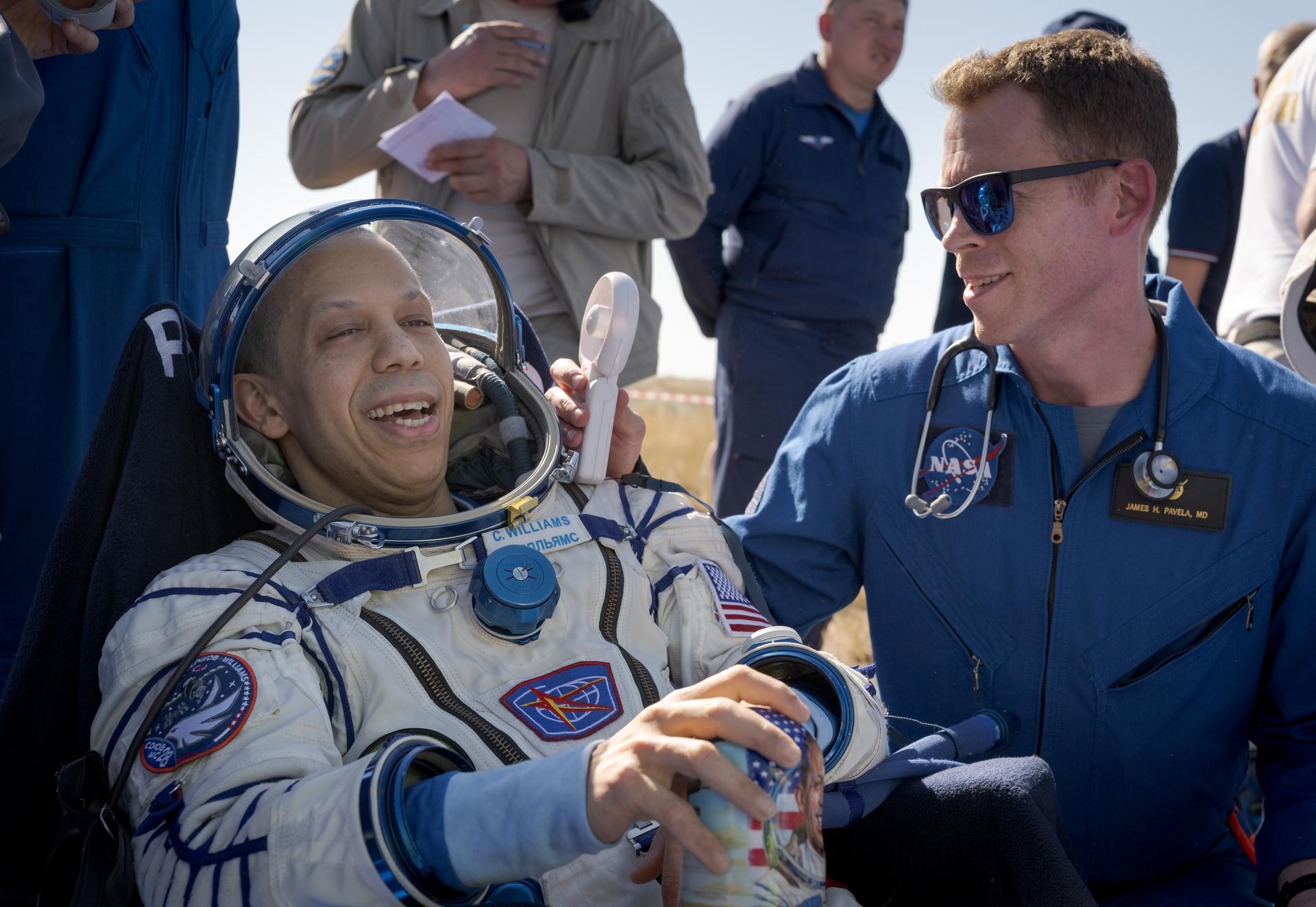
NASA astronaut Chris Williams, left, is looked after by NASA Flight Surgeon James Pavela, outside the Soyuz MS-28 spacecraft after he landed with Roscosmos cosmonauts Sergey Kud-Sverchkov, and Sergei Mikaev in a remote area near the town of Zhezkazgan, Kazakhstan on Sunday, July 26, 2026. The trio returned to Earth after logging 241 days in space as a members of Expeditions 73 and 74 aboard the International Space Station. Photo Credit: (NASA/Bill Ingalls)
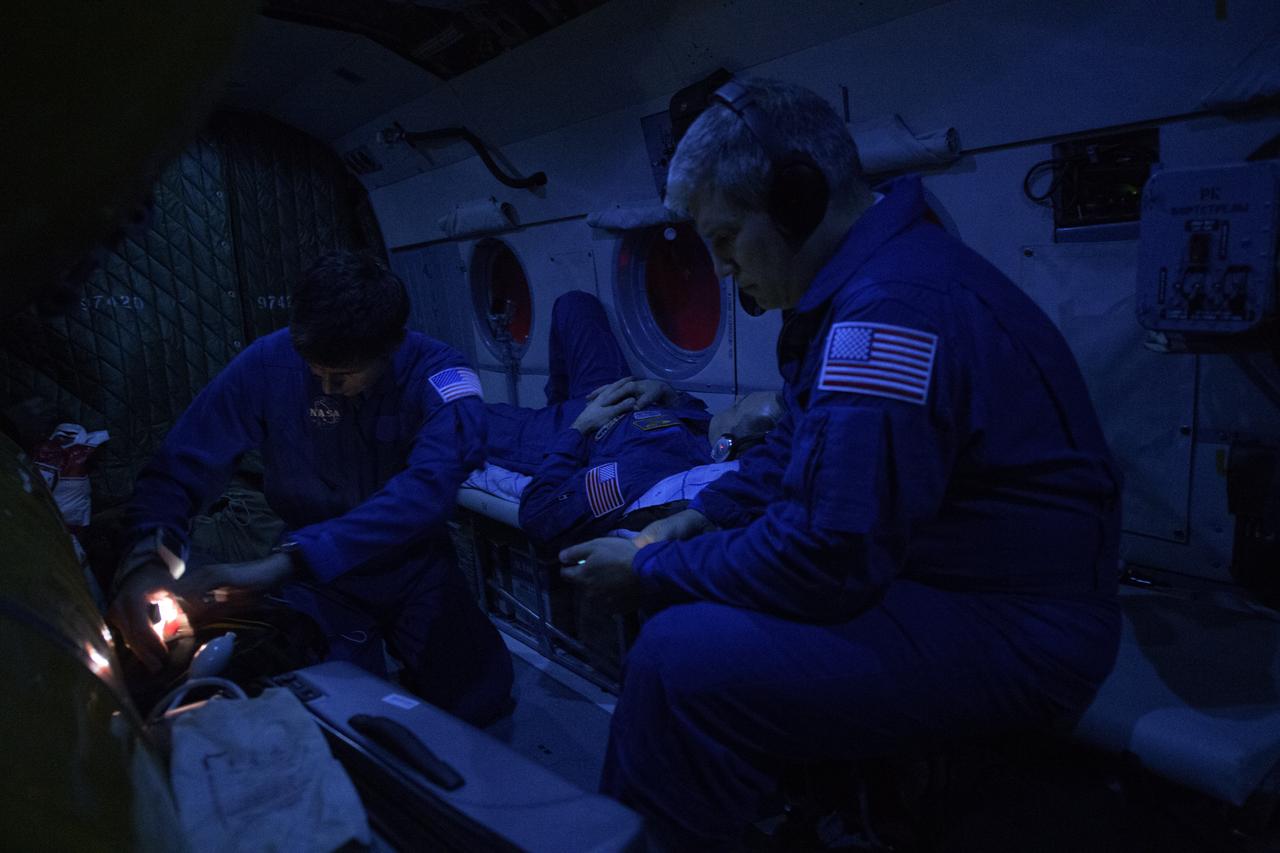
Expedition 56 Flight Engineer Ricky Arnold of NASA restss in a helicopter as Russian Nurse Artiom Kharchikov, left, and NASA Flight Surgeon Steven Piper, right look after him near the town of Zhezkazgan, Kazakhstan on Thursday, Oct. 4, 2018. Arnold, Expedition 56 Commander Drew Feustel of NASA and Expedition 56 Flight Engineer and Soyuz Commander Oleg Artemyev of Roscosmos returned to Earth after 197 days in space where they served as members of the Expedition 55 and 56 crews onboard the International Space Station. Photo Credit: (NASA/Bill Ingalls)
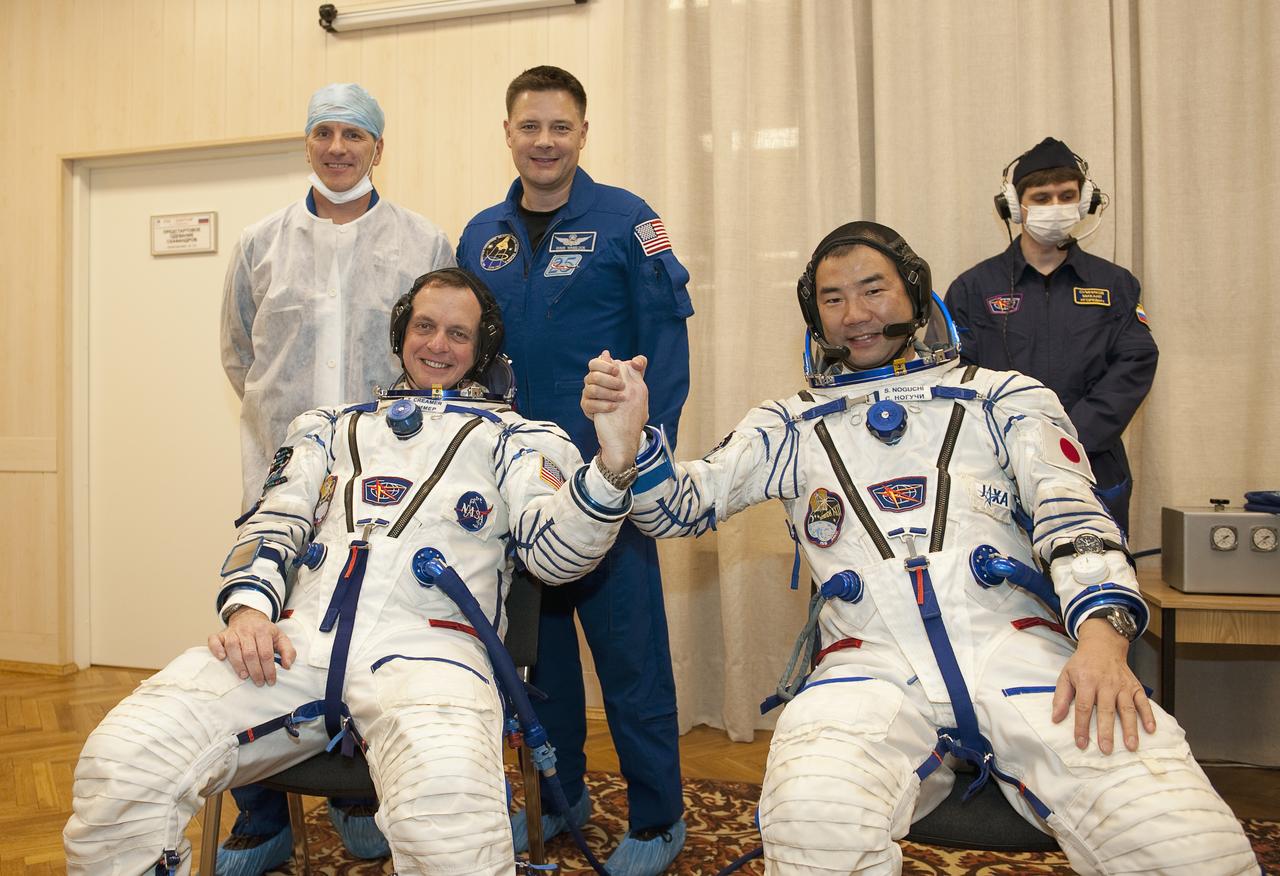
Expedition 22 NASA Flight Engineer Timothy J. Creamer of the U.S., left, and Flight Engineer Soichi Noguchi of Japan pose for a photograph with NASA Flight Surgeon Pete Bauer, standing left, and NASA Expedition 22 backup Astronaut Doug Wheelock at the Baikonur Cosmodrome in Baikonur, Kazakhstan, Sunday, Dec. 20, 2009. Creamer, Noguchi and fellow Expedition 22 crew member, Soyuz Commander Oleg Kotov of Russia, launched in their Soyuz TMA-17 rocket from the Baikonur Cosmodrome in Kazakhstan on Monday, Dec. 21, 2009. (Photo Credit: NASA/Bill Ingalls)
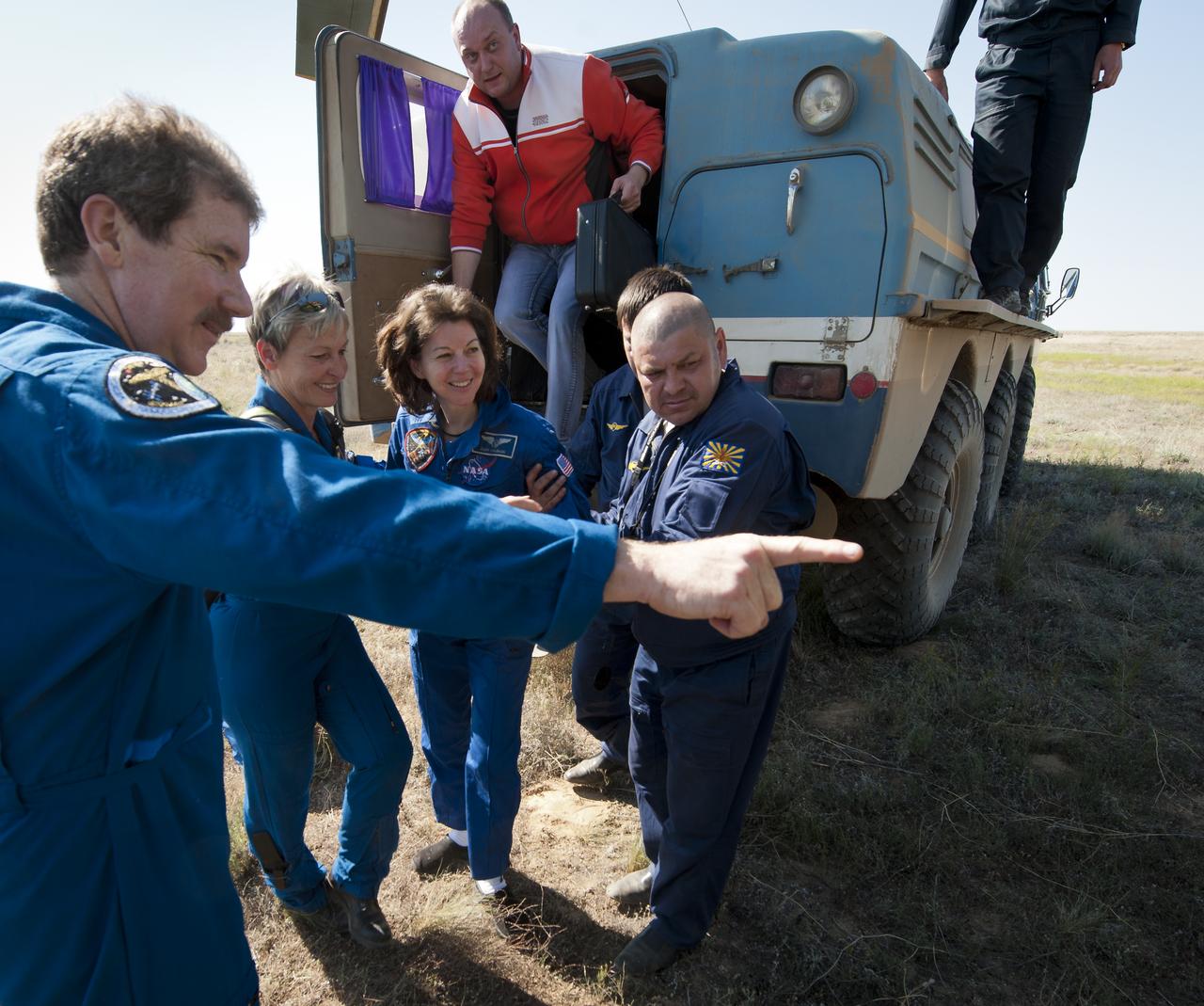
Expedition 27 Flight Engineer Cady Coleman, center, is helped out of a Russian all terrain vehicle (ATV) by NASA Chief of the Astronaut Office, Peggy Whitson and directed to the helicopter by NASA Flight Surgeon Steve Hart, left, shortly after she and Commander Dmitry Kondratyev and Flight Engineer Paolo Nespoli landed in their Soyuz TMA-20 southeast of the town of Zhezkazgan, Kazakhstan, on Tuesday, May 24, 2011. NASA Astronaut Coleman, Russian Cosmonaut Kondratyev and Italian Astronaut Nespoli are returning from more than five months onboard the International Space Station where they served as members of the Expedition 26 and 27 crews. Photo Credit: (NASA/Bill Ingalls)
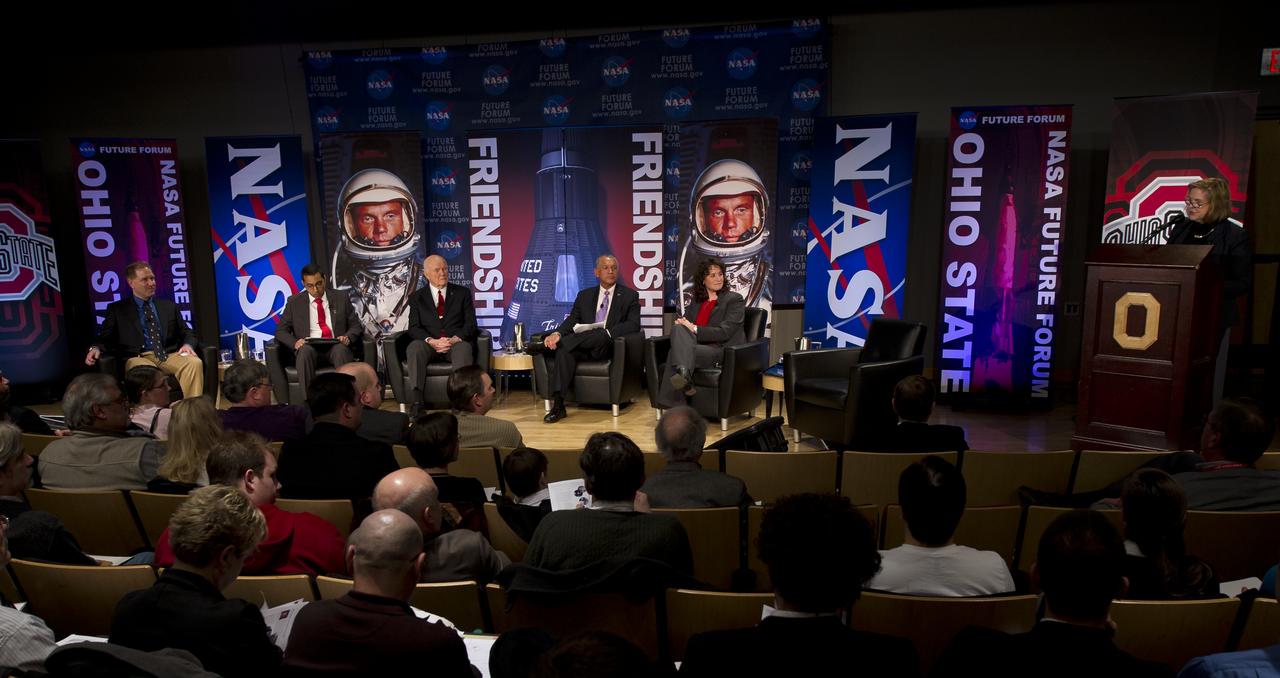
The Ohio State University Vice President for Research Dr. Caroline Whitacre, standing right, moderates the first panel discussion during NASA's Future Forum with NASA Associate Administrator for Science Mission Directorate John Grunsfeld, left, Ohio State University Graduate Research Associate Vijay Gadepally, Sen. John Glenn, NASA Administrator Charles Bolden, and NASA 2009 Astronaut Candidate and Flight Surgeon Serena Auñón, seated right, at The Ohio State University on Monday, Feb. 20, 2012, in Columbus, Ohio. Monday marked the 50th anniversary of Glenn's historic flight as the first American to orbit Earth. Photo Credit: (NASA/Bill Ingalls)
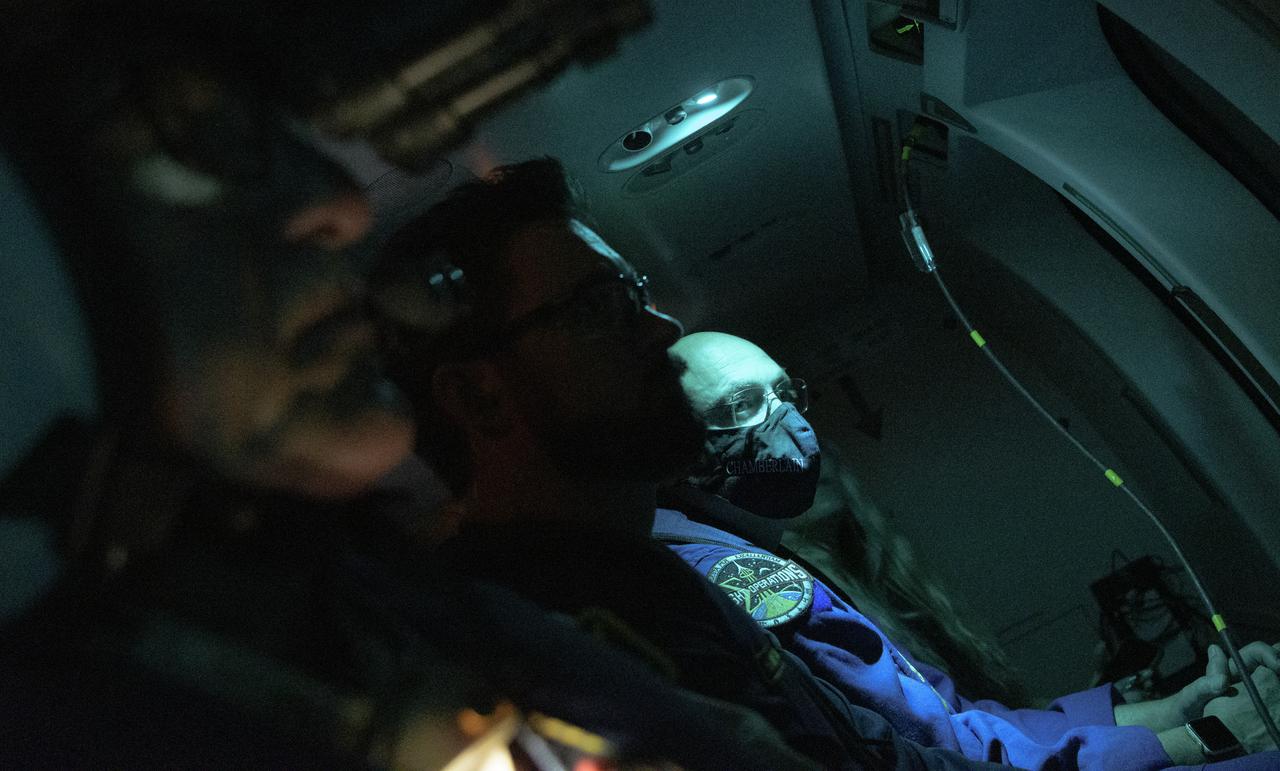
NASA Flight Surgeon Blake Chamberlain and other NASA and SpaceX support teams helicopter out to the SpaceX GO Navigator recovery ship to prepare for the landing of the SpaceX Crew Dragon Resilience spacecraft with NASA astronauts Mike Hopkins, Shannon Walker, and Victor Glover, and Japan Aerospace Exploration Agency (JAXA) astronaut Soichi Noguchi aboard in the Gulf of Mexico off the coast of Panama City, Florida, Saturday, May 1, 2021. NASA’s SpaceX Crew-1 mission is the first crew rotation flight of the SpaceX Crew Dragon spacecraft and Falcon 9 rocket with astronauts to the International Space Station as part of the agency’s Commercial Crew Program. Photo Credit: (NASA/Bill Ingalls)
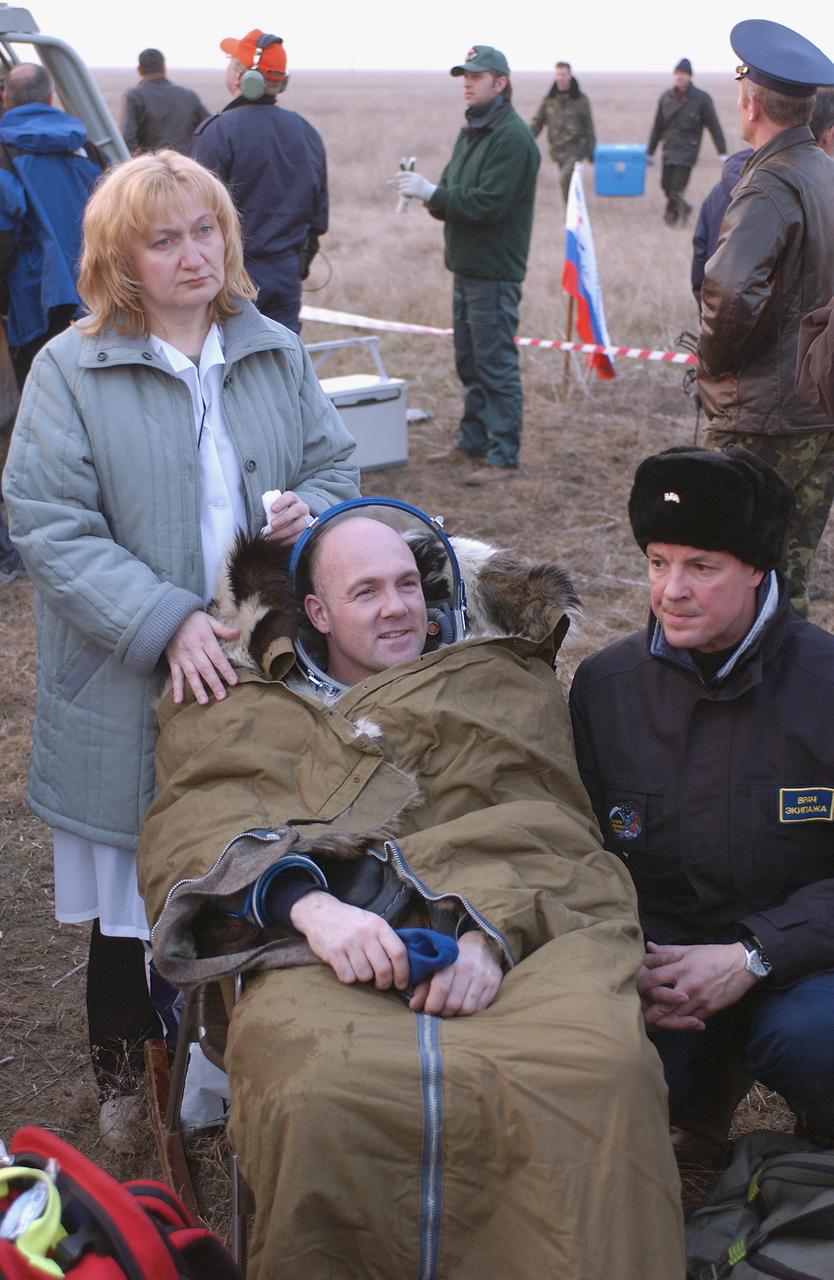
European Space Agency astronaut Andre Kuipers, of the Netherlands, is checked by his flight surgeon after he and Expedition 8 Commander Michael Foale and Soyuz Flight Engineer Alexander Kaleri landed in north central Kazakhstan, Friday, April 30, 2004, in their Soyuz TMA-3 capsule. Foale and Kaleri completed 195 days in space aboard the International Space Station, while Kuipers returned after an 11-day research mission as part of a commercial agreement between ESA and the Russian Federal Space Agency. Photo Credit: (NASA/Bill Ingalls)
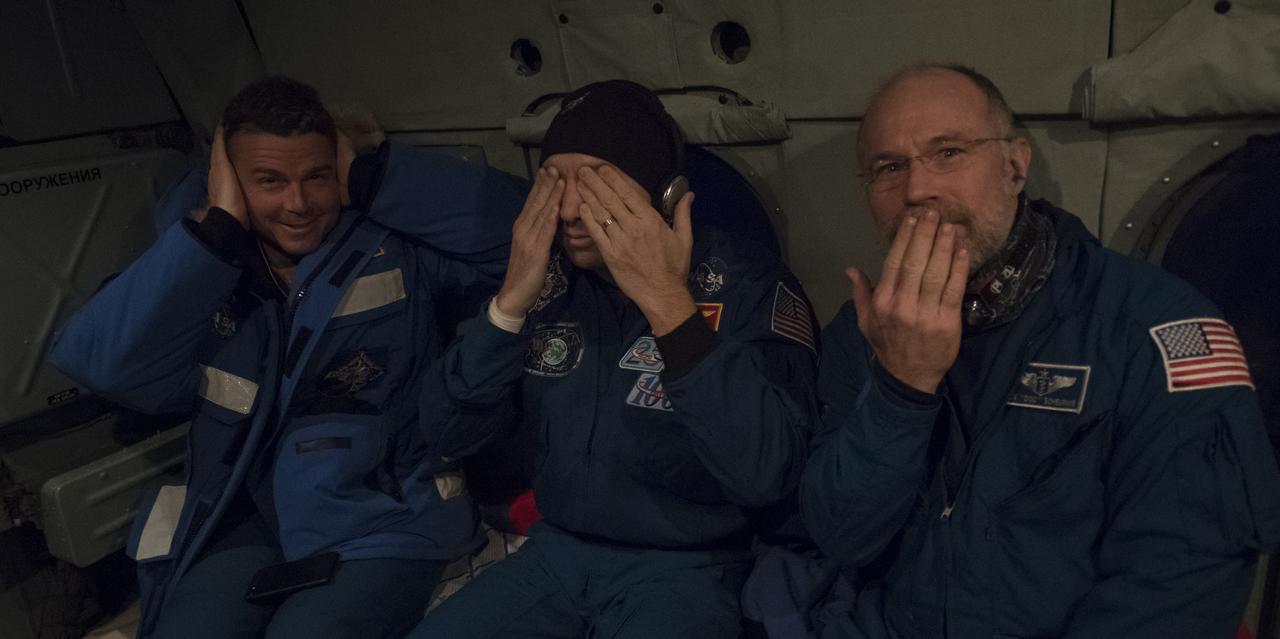
NASA astronaut Reid Wiseman, left, Expedition 53 Commander Randy Bresnik of NASA, center, and NASA Flight Surgeon Rick Scheuring joke with each other during the helicopter ride from the Expedition 53 landing zone to Zhezkazgan, Kazakhstan, Thursday, Dec. 14, 2017. Bresnik and Flight Engineers Paolo Nespoli of ESA (European Space Agency) and Sergey Ryazanskiy of the Russian space agency Roscosmos returned after 139 days in space where they served as members of the Expedition 52 and 53 crews onboard the International Space Station. Photo Credit: (NASA/Bill Ingalls)
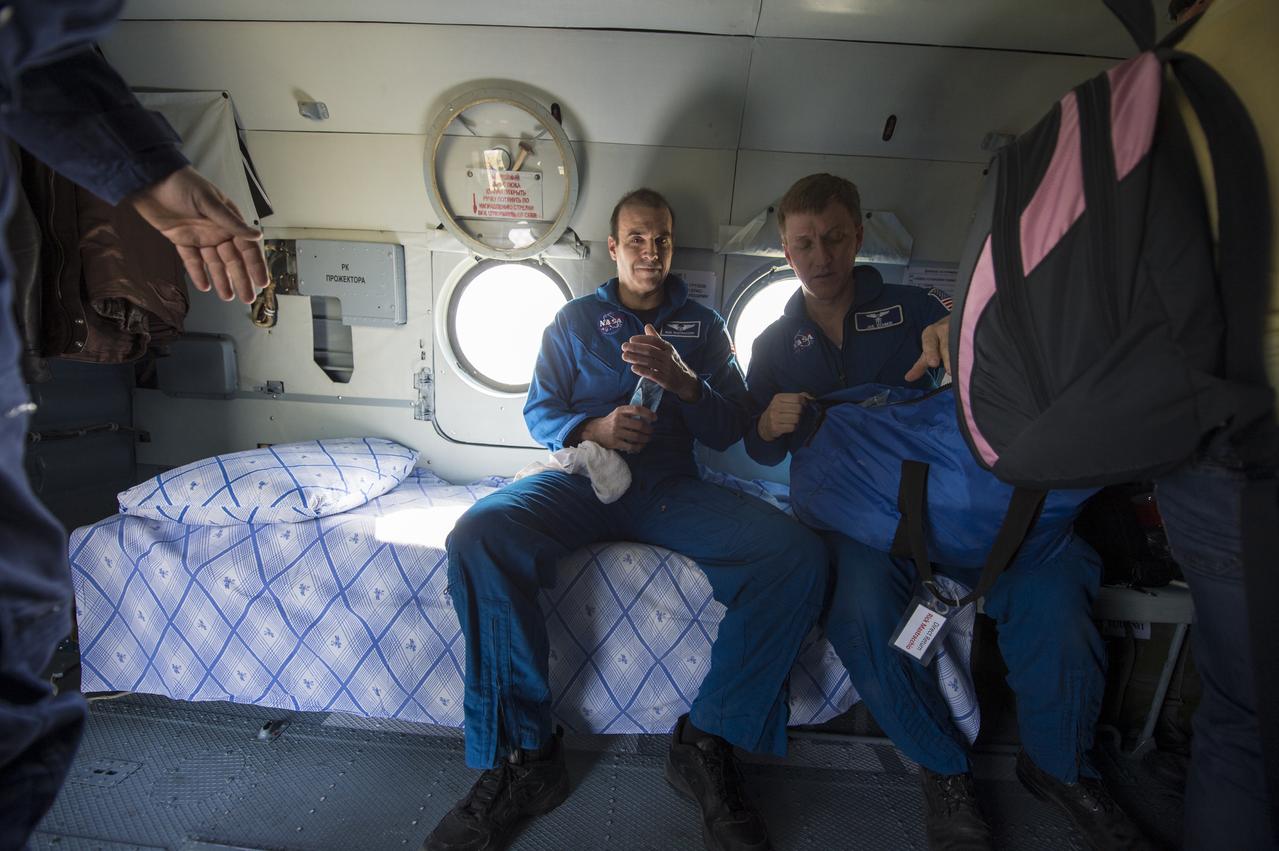
Expedition 39 Flight Engineer Rick Mastracchio of NASA, left, and NASA Flight Surgeon Joseph Schmid prepare to depart in a helicopter from the Soyuz landing site near the town of Zhezkazgan, Kazakhstan where Mastracchio and Expedition 39 Commander Koichi Wakata of the Japan Aerospace Exploration Agency (JAXA), and Soyuz Commander Mikhail Tyurin of Roscosmos landed in their Soyuz TMA-11M spacecraft, Wednesday, May 14, 2014. Wakata, Tyurin and Mastracchio returned to Earth after more than six months onboard the International Space Station where they served as members of the Expedition 38 and 39 crews. Photo Credit: (NASA/Bill Ingalls)
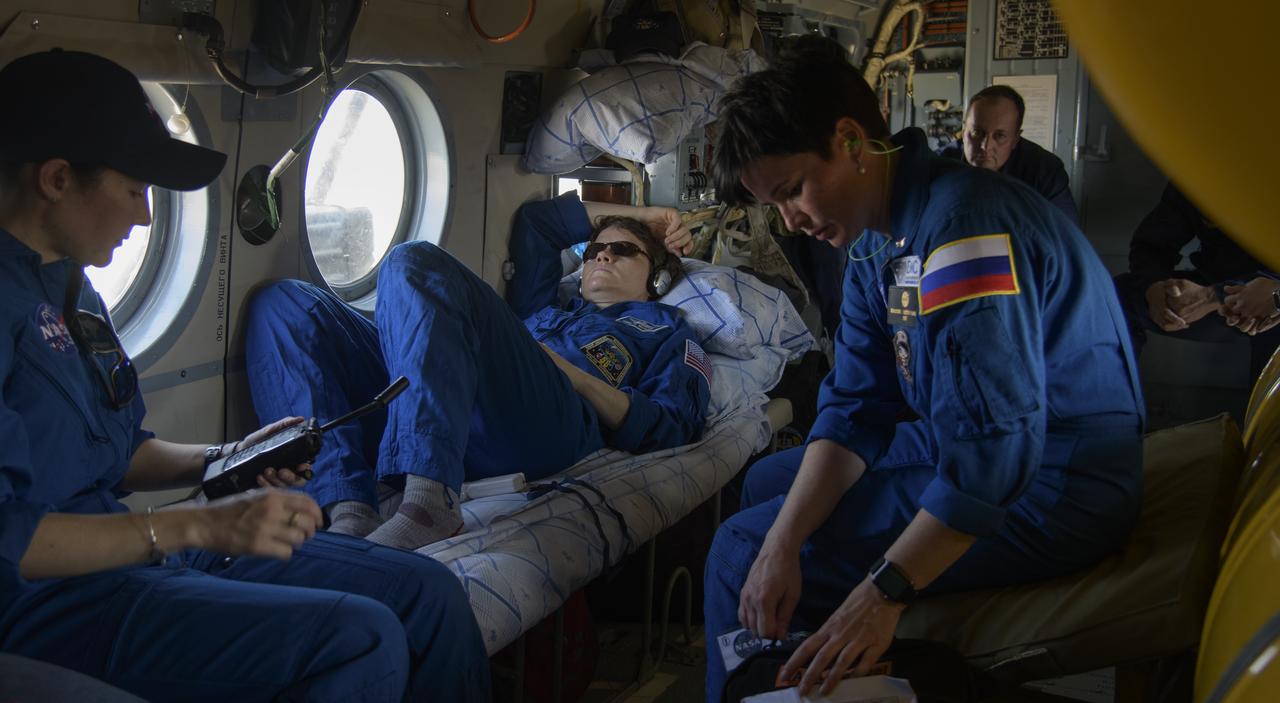
Expedition 59 NASA astronaut Anne McClain rests onboard a helicopter during a flight from the Soyuz MS-11 spacecraft landing site to Karaganda, Kazakhstan as NASA Flight Surgeon Natacha Chough, left, and Russian Nurse Raksana Batsmanova, right, look after her, Tuesday, June 25, 2019. McClain, Canadian Space Agency astronaut David Saint-Jacques, and Roscosmos cosmonaut Oleg Kononenko landed in their Soyuz MS-11 spacecraft in a remote area near Zhezkazgan, Kazakhstan after 204 days in space where they served as members of the Expedition 58 and 59 crews onboard the International Space Station. Photo Credit: (NASA/Bill Ingalls)
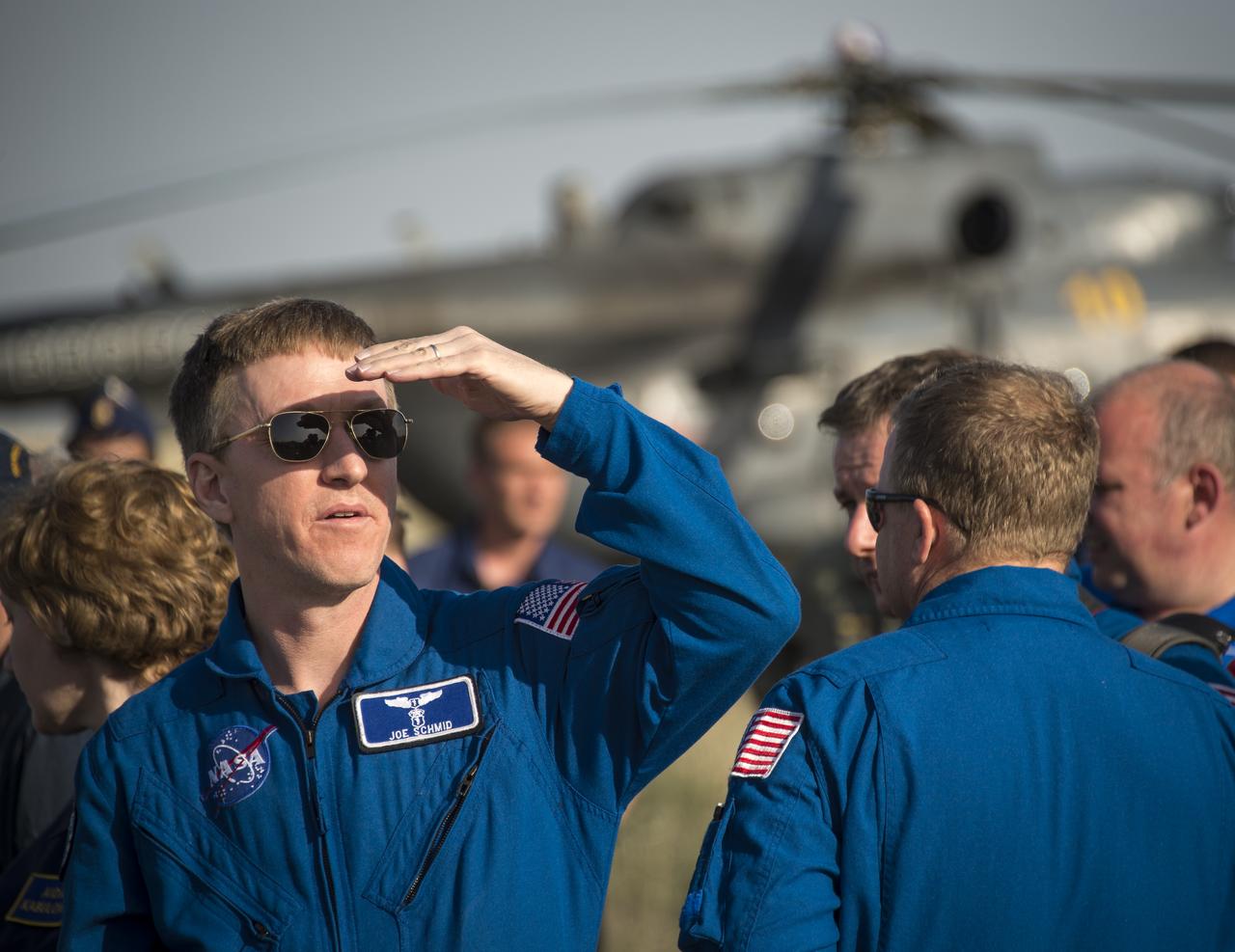
NASA Flight Surgeon Joseph Schmid waits for the Expedition 39 crew members to be extracted from the Soyuz TMA-11M spacecraft shortly after it landed with Expedition 39 Commander Koichi Wakata of the Japan Aerospace Exploration Agency (JAXA), Soyuz Commander Mikhail Tyurin of Roscosmos, and Flight Engineer Rick Mastracchio of NASA near the town of Zhezkazgan, Kazakhstan on Wednesday, May 14, 2014. Wakata, Tyurin and Mastracchio returned to Earth after more than six months onboard the International Space Station where they served as members of the Expedition 38 and 39 crews. Photo Credit: (NASA/Bill Ingalls)
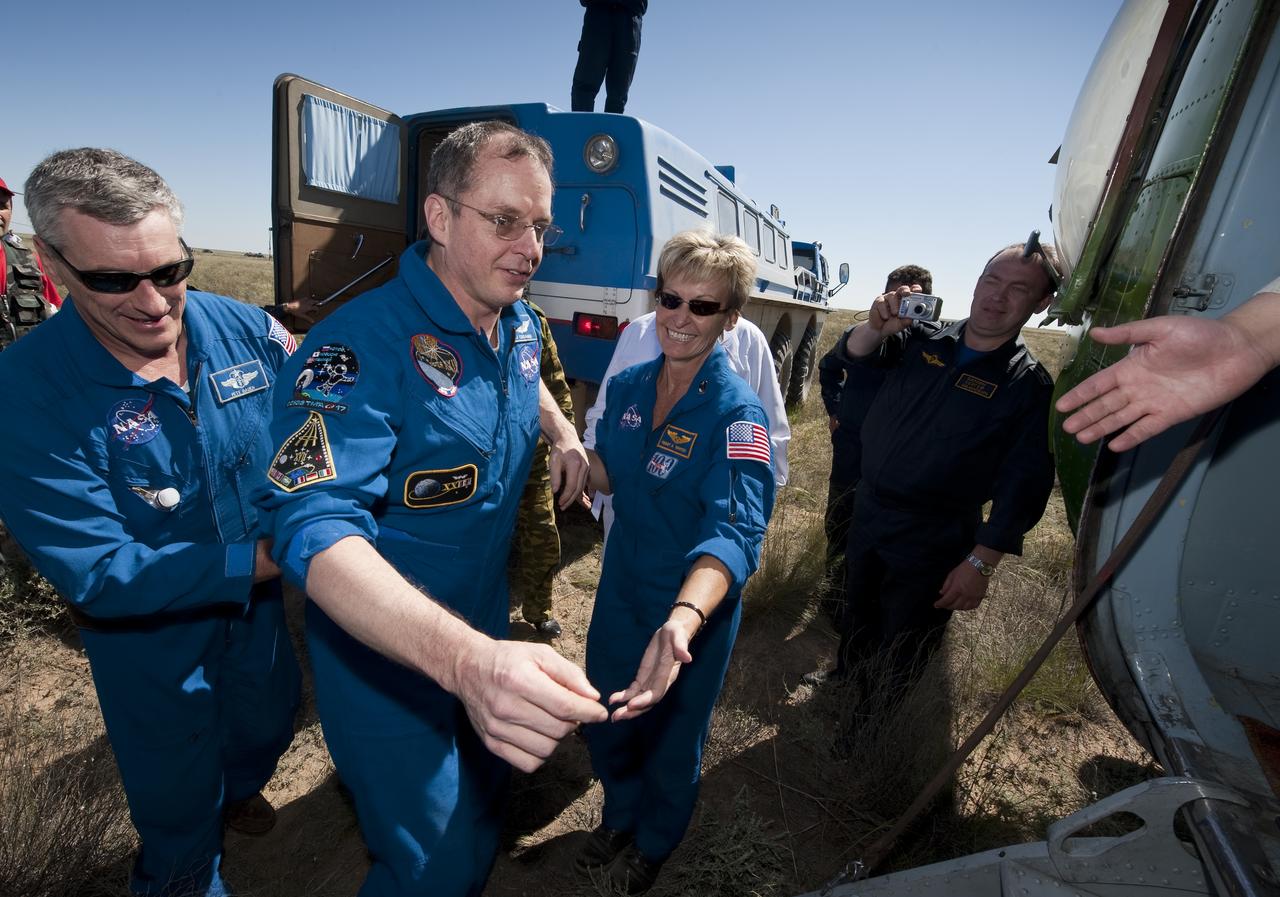
Expedition 23 Flight Engineer T.J. Creamer, center, is assisted by NASA Flight Surgeon Pete Bauer, left, and Chief NASA astronaut Peggy Whitson from a Russian Search and Recovery all terrain vehicle to his helicopter shortly after he and fellow crew members Soichi Noguchi and Commander Oleg Kotov landed in their Soyuz TMA-17 capsule near the town of Zhezkazgan, Kazakhstan on Wednesday, June 2, 2010. NASA Astronaut Creamer, Russian Cosmonaut Kotov and Japanese Astronaut Noguchi are returning from six months onboard the International Space Station where they served as members of the Expedition 22 and 23 crews. Photo Credit: (NASA/Bill Ingalls)
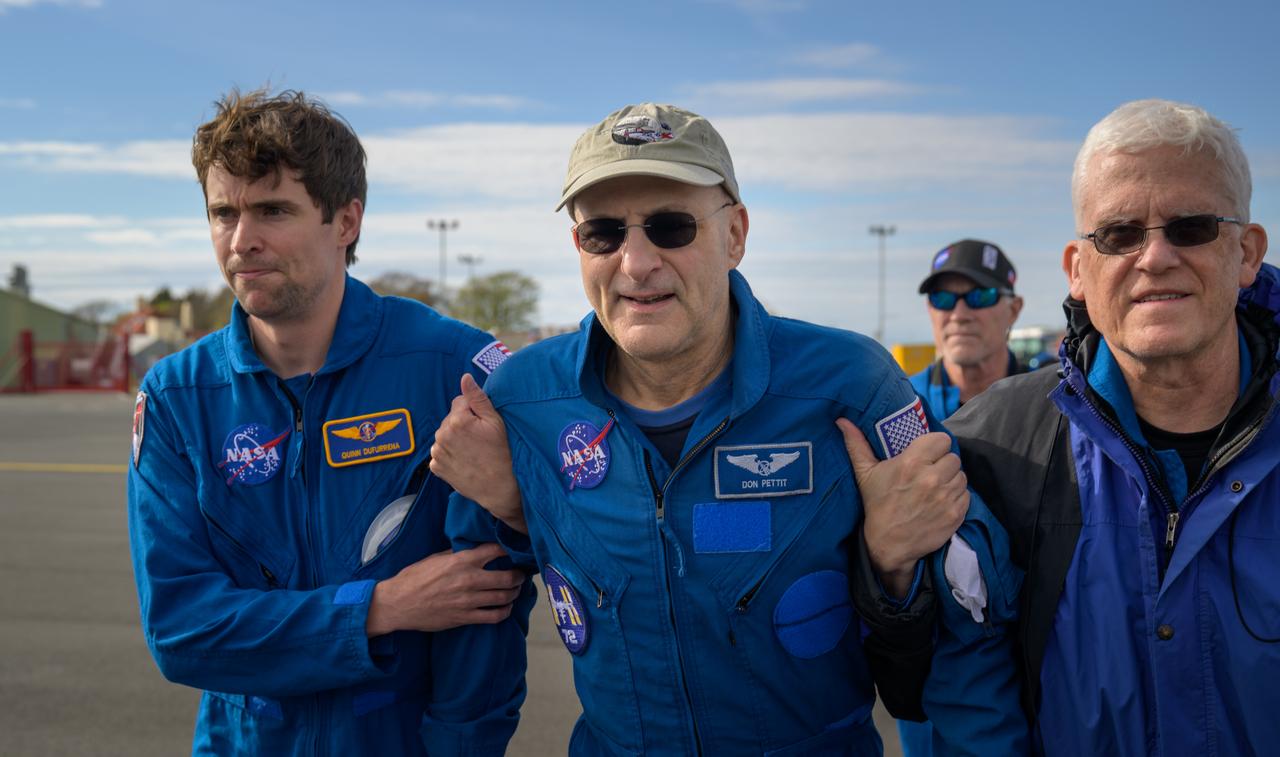
NASA astronaut Don Pettit, center, walks and smiles, while supported by NASA Flight Surgeons Quinn Dufurrena, left, Rainer Effenhauser, right, and Richard Scheuring, background, during a brief layover in Prestwick, Scotland during his return flight to Houston from Karaganda, Kazakhstan, Sunday, April 20, 2025. Pettit, along with Roscosmos cosmonauts Alexey Ovchinin, and Ivan Vagner, returned to Earth earlier in the day after logging 220 days in space as members of Expeditions 71 and 72 aboard the International Space Station. Photo Credit: (NASA/Bill Ingalls)
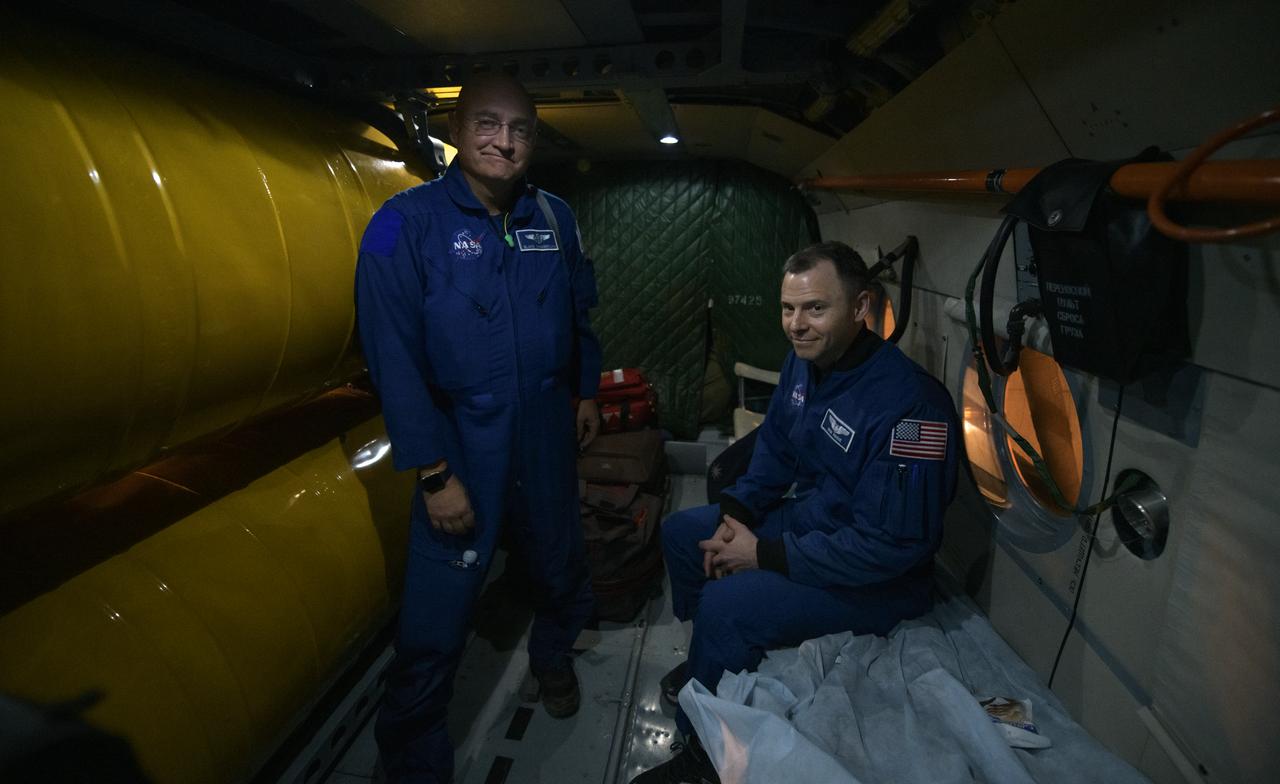
Expedition 60 NASA astronaut Nick Hague, left, and NASA Flight Surgeon Blake Chamberlain wait inside at Russian MI-8 helicopter after arriving at the Karaganda Airport in Kazakhstan from a remote area near the town of Zhezkazgan, Kazakhstan on Thursday, Oct. 3, 2019. Hague and fellow Expedition 60 crewmember Alexey Ovchinin are returning after 203 days in space where they served as members of the Expedition 59 and 60 crews onboard the International Space Station. Visiting astronaut Hazzaa Ali Almansoori of the United Arab Emirates also returned with the crew after logging 8 days in space during his first flight as an astronaut. Photo Credit: (NASA/Bill Ingalls)
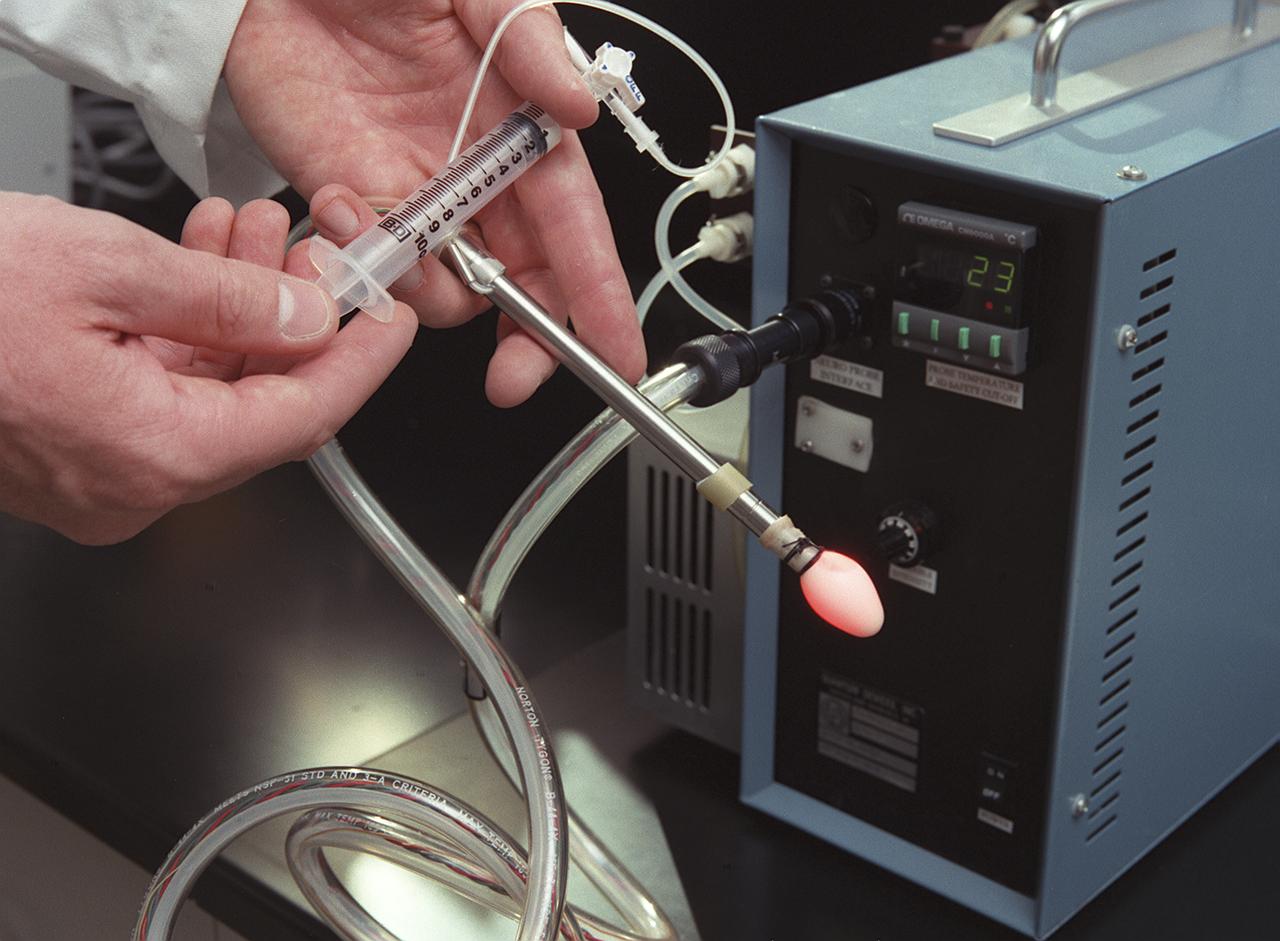
A special lighting technology was developed for space-based commercial plant growth research on NASA's Space Shuttle. Surgeons have used this technology to treat brain cancer on Earth, in two successful operations. The treatment technique called photodynamic therapy, requires the surgeon to use tiny pinhead-size Light Emitting Diodes (LEDs) (a source releasing long wavelengths of light) to activate light-sensitive, tumor-treating drugs. Laser light has been used for this type of surgery in the past, but the LED light illuminates through all nearby tissues, reaching parts of a tumor that shorter wavelengths of laser light carnot. The new probe is safer because the longer wavelengths of light are cooler than the shorter wavelengths of laser light, making the LED less likely to injure normal brain tissue near the tumor. It can also be used for hours at a time while still remaining cool to the touch. The LED probe consists of 144 tiny pinhead-size diodes, is 9-inches long, and about one-half-inch in diameter. The small balloon aids in even distribution of the light source. The LED light source is compact, about the size of a briefcase, and can be purchased for a fraction of the cost of a laser. The probe was developed for photodynamic cancer therapy by the Marshall Space Flight Center under a NASA Small Business Innovative Research program grant.
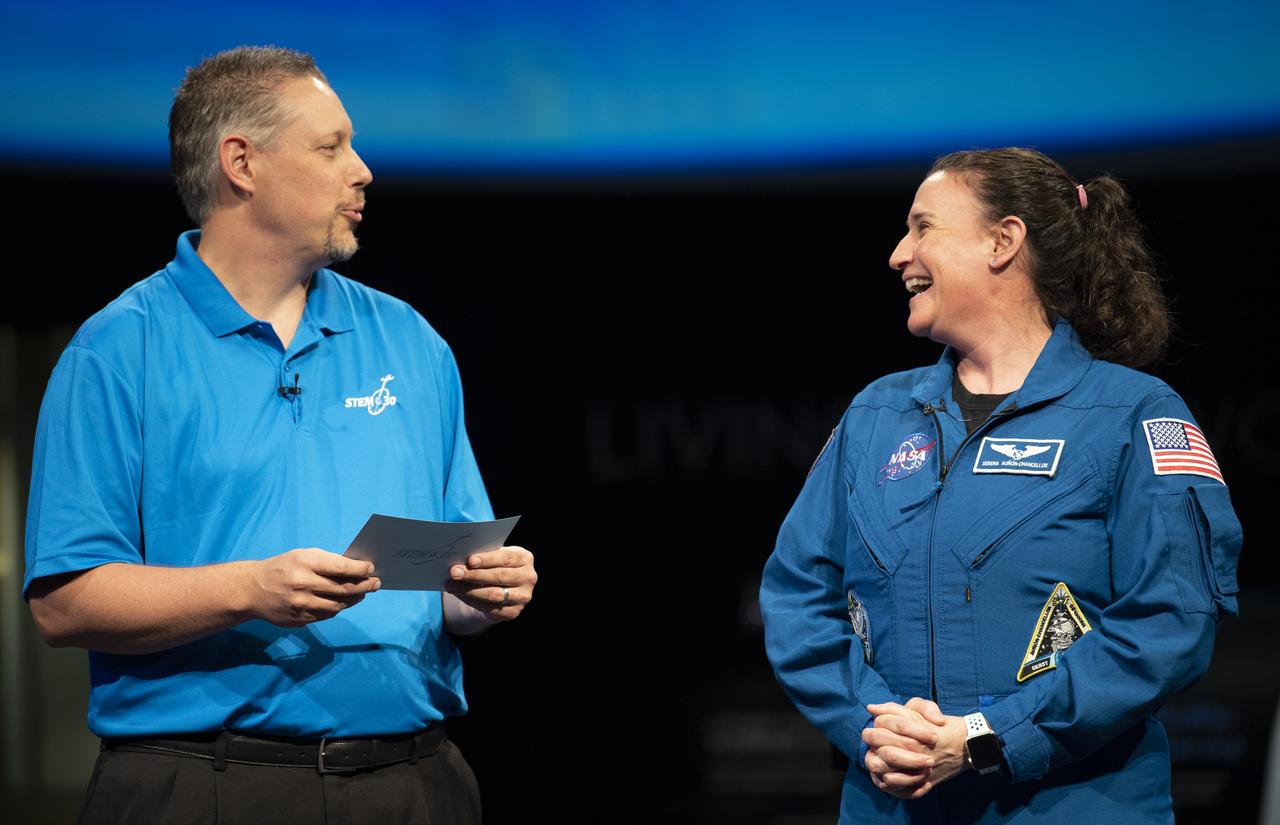
Marty Kelsey of the Smithsonian National Air and Space Museum asks NASA astronaut Serena Auñón-Chancellor questions about being in middle school for a short video, Friday, June 14, 2019 the Smithsonian's National Air and Space Museum in Washington, DC. Auñón-Chancellor spent 197 days living and working onboard the orbital laboratory as part of Expeditions 56 and 57, contributing to hundreds of experiments in biology, biotechnology, physical science, and Earth science while there. She began her career at NASA as a flight surgeon before being selected as an astronaut in 2009. Photo Credit: (NASA/Joel Kowsky)
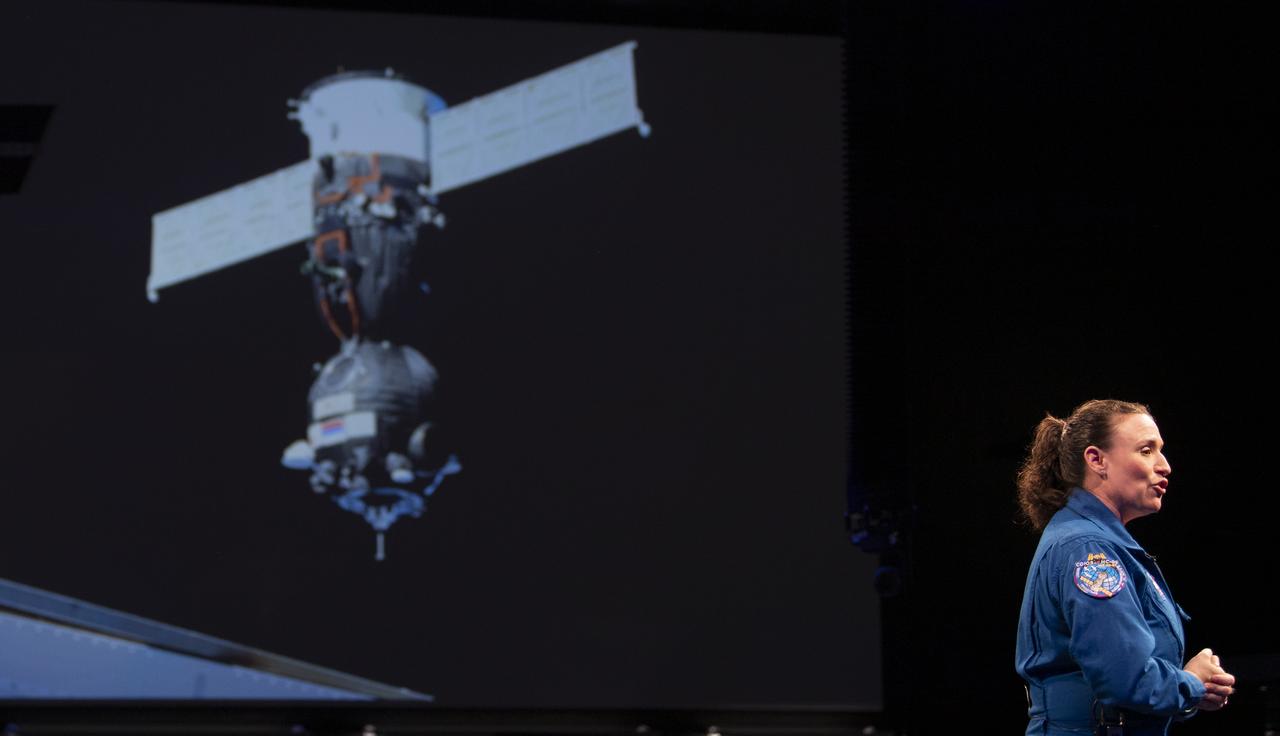
NASA astronaut Serena Auñón-Chancellor speaks about her time onboard the International Space Station during "What's New in Aerospace" Friday, June 14, 2019 the Smithsonian's National Air and Space Museum in Washington, DC. Auñón-Chancellor spent 197 days living and working onboard the orbital laboratory as part of Expeditions 56 and 57, contributing to hundreds of experiments in biology, biotechnology, physical science, and Earth science while there. She began her career at NASA as a flight surgeon before being selected as an astronaut in 2009. Photo Credit: (NASA/Joel Kowsky)
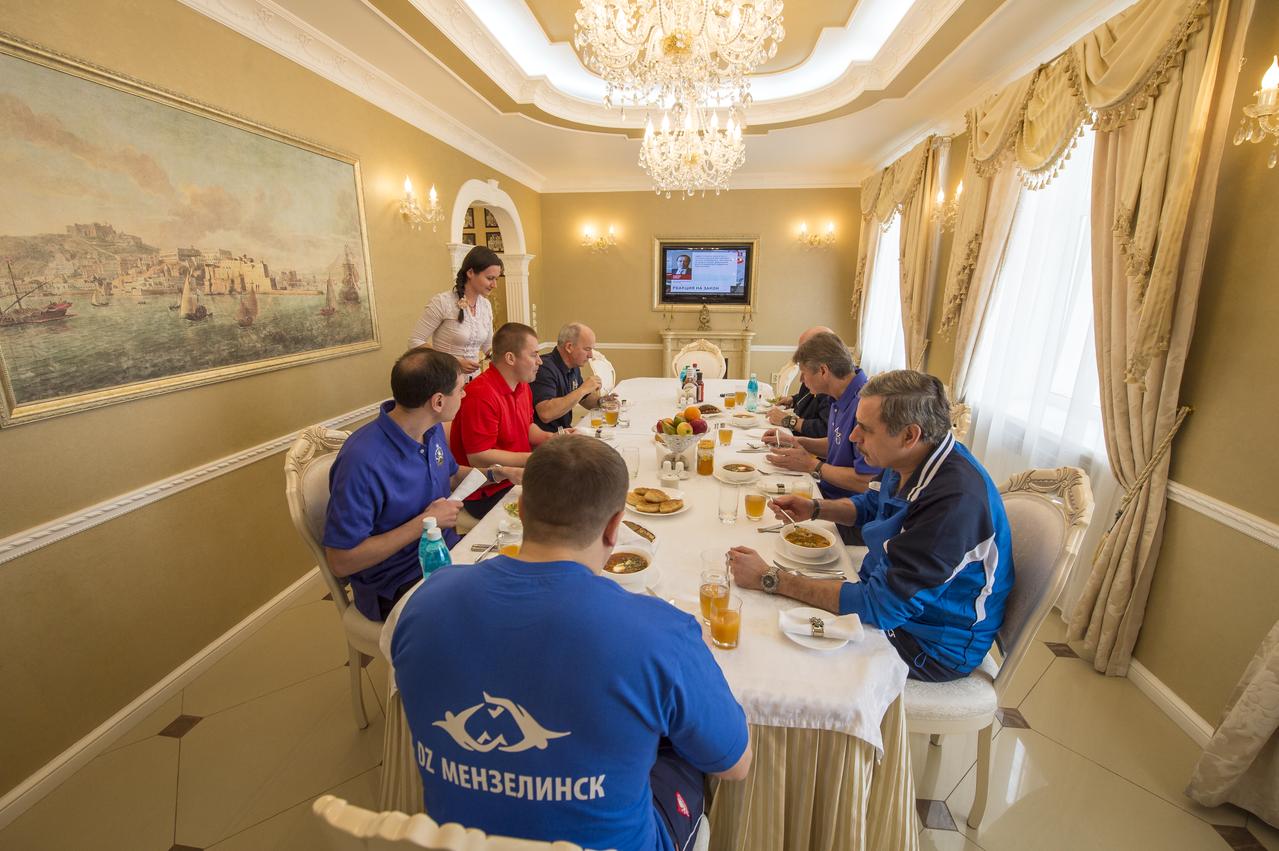
Expedition 43 prime and backup crews enjoy lunch with Gagarin Cosmonaut Training Center (GCTC) Flight Surgeon Alexey Grishin at the Zvjozdnyj Hotel, Thursday, March 19, 2015 in Baikonur, Kazakhstan. NASA Astronaut Scott Kelly, and Russian Cosmonauts Gennady Padalka, and Mikhail Kornienko of the Russian Federal Space Agency (Roscosmos) are preparing for launch to the International Space Station in their Soyuz TMA-16M spacecraft from the Baikonur Cosmodrome in Kazakhstan March 28, Kazakh time. As the one-year crew, Kelly and Kornienko will return to Earth on Soyuz TMA-18M in March 2016. Photo Credit: (NASA/Bill Ingalls)
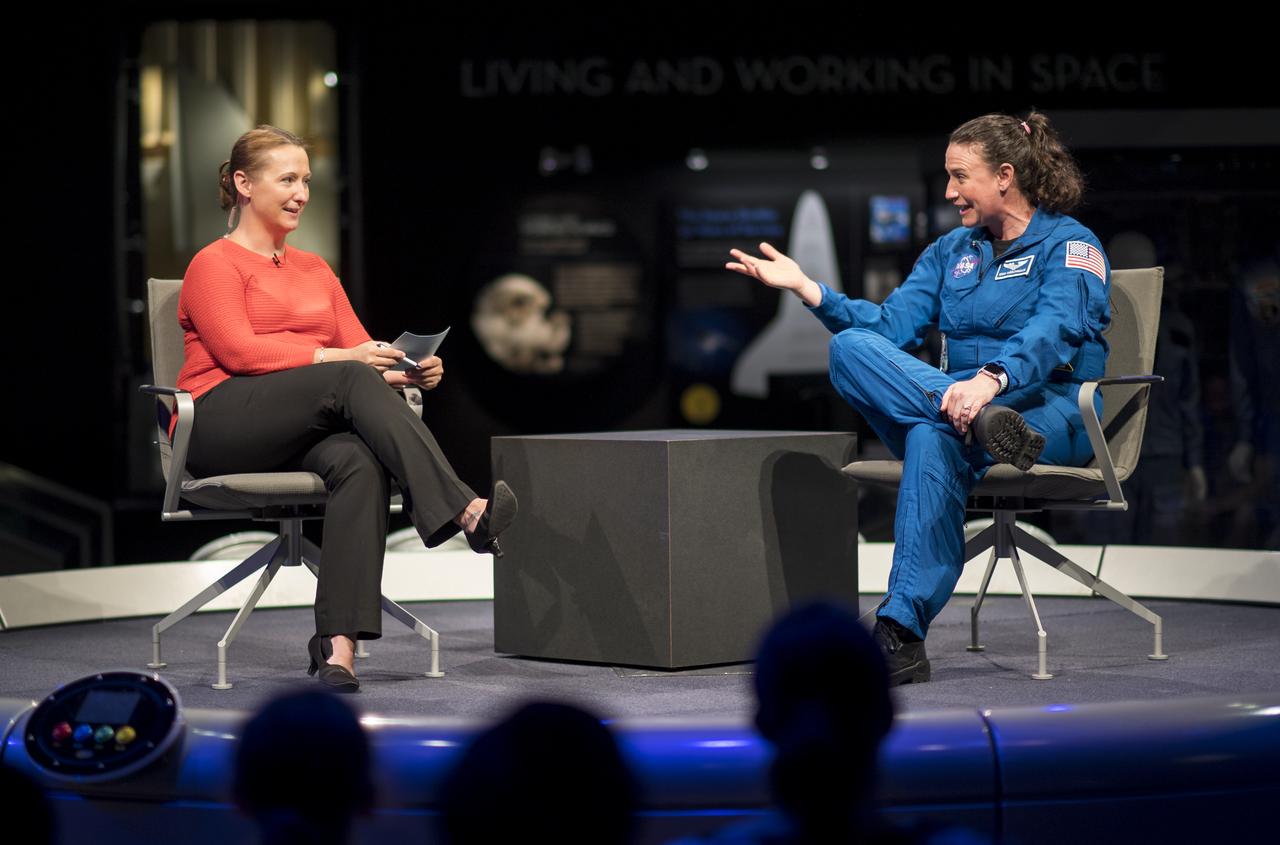
Smithsonian National Air and Space Museum curator Jennifer Levasseu speaks with NASA astronaut Serena Auñón-Chancellor about her time onboard the International Space Station during "What's New in Aerospace" Friday, June 14, 2019 the Smithsonian's National Air and Space Museum in Washington, DC. Auñón-Chancellor spent 197 days living and working onboard the orbital laboratory as part of Expeditions 56 and 57, contributing to hundreds of experiments in biology, biotechnology, physical science, and Earth science while there. She began her career at NASA as a flight surgeon before being selected as an astronaut in 2009. Photo Credit: (NASA/Joel Kowsky)
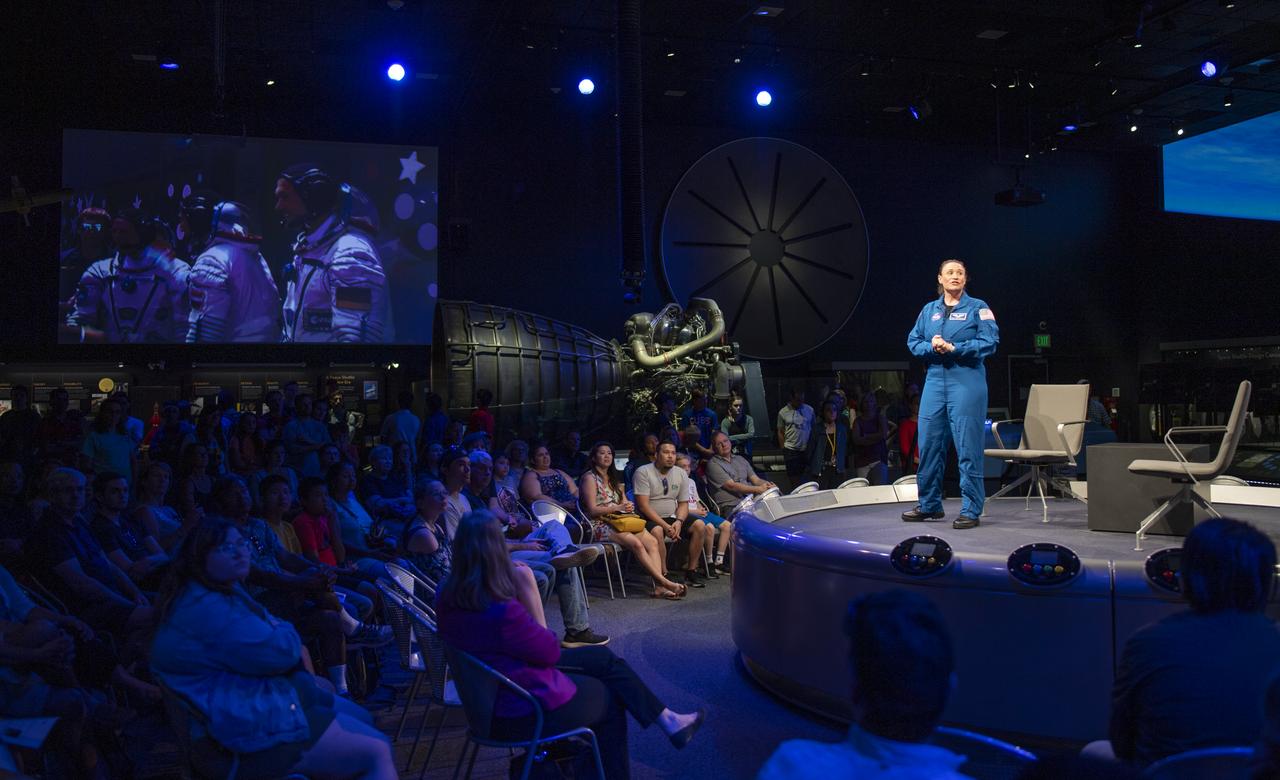
NASA astronaut Serena Auñón-Chancellor speaks about her time onboard the International Space Station during "What's New in Aerospace" Friday, June 14, 2019 the Smithsonian's National Air and Space Museum in Washington, DC. Auñón-Chancellor spent 197 days living and working onboard the orbital laboratory as part of Expeditions 56 and 57, contributing to hundreds of experiments in biology, biotechnology, physical science, and Earth science while there. She began her career at NASA as a flight surgeon before being selected as an astronaut in 2009. Photo Credit: (NASA/Joel Kowsky)
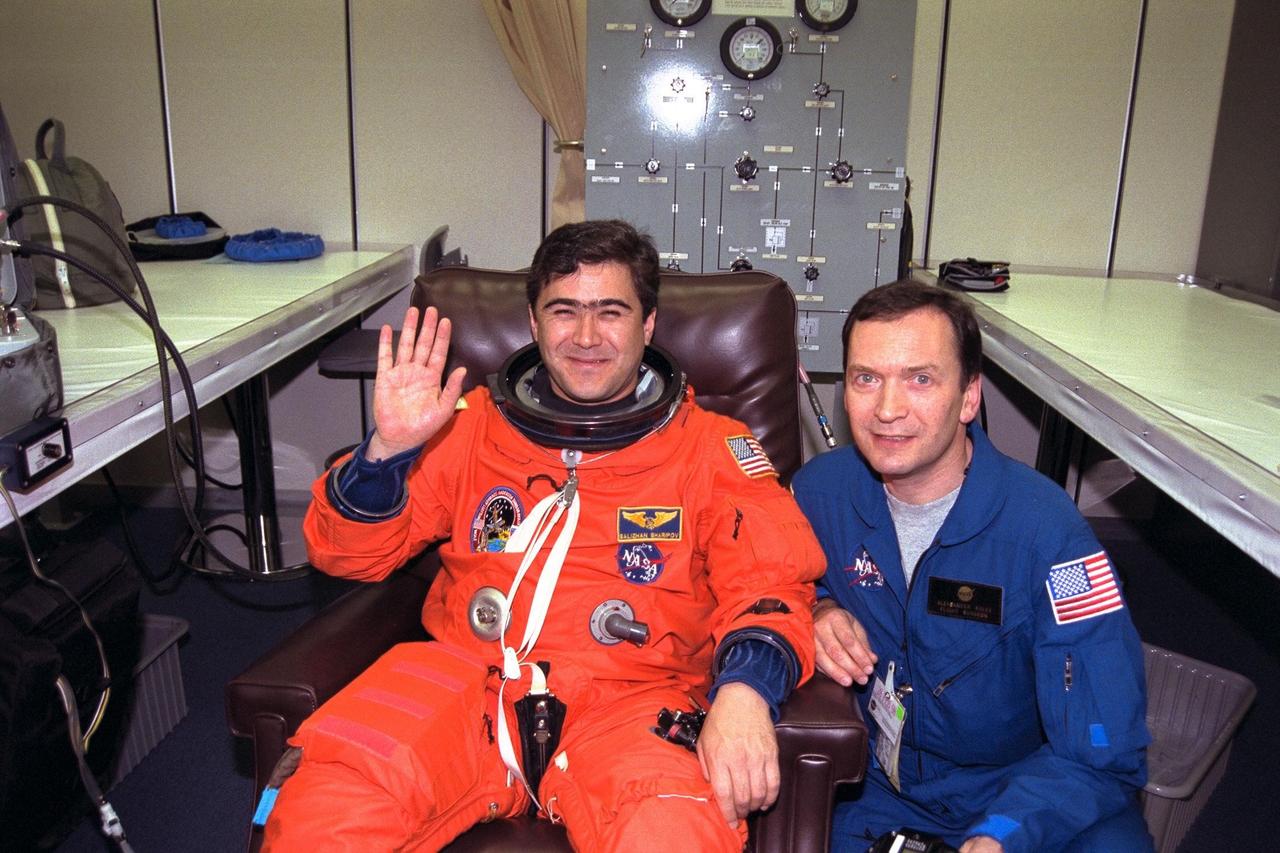
STS-89 Mission Specialist Salizhan Sharipov of the Russian Space Agency, at left, waves as he and his flight surgeon, Alexander Kulev, complete the donning of Sharipov’s launch/entry suit in the Operations and Checkout (O&C) Building. In 1994, Sharipov graduated from Moscow State University with a degree in cartography. He and six fellow crew members will soon depart the O&C and head for Launch Pad 39A, where the Space Shuttle Endeavour will lift off during a launch window that opens at 9:43 p.m. EST, Jan. 22. STS-89 is the eighth of nine planned missions to dock the Space Shuttle with Russia's Mir space station
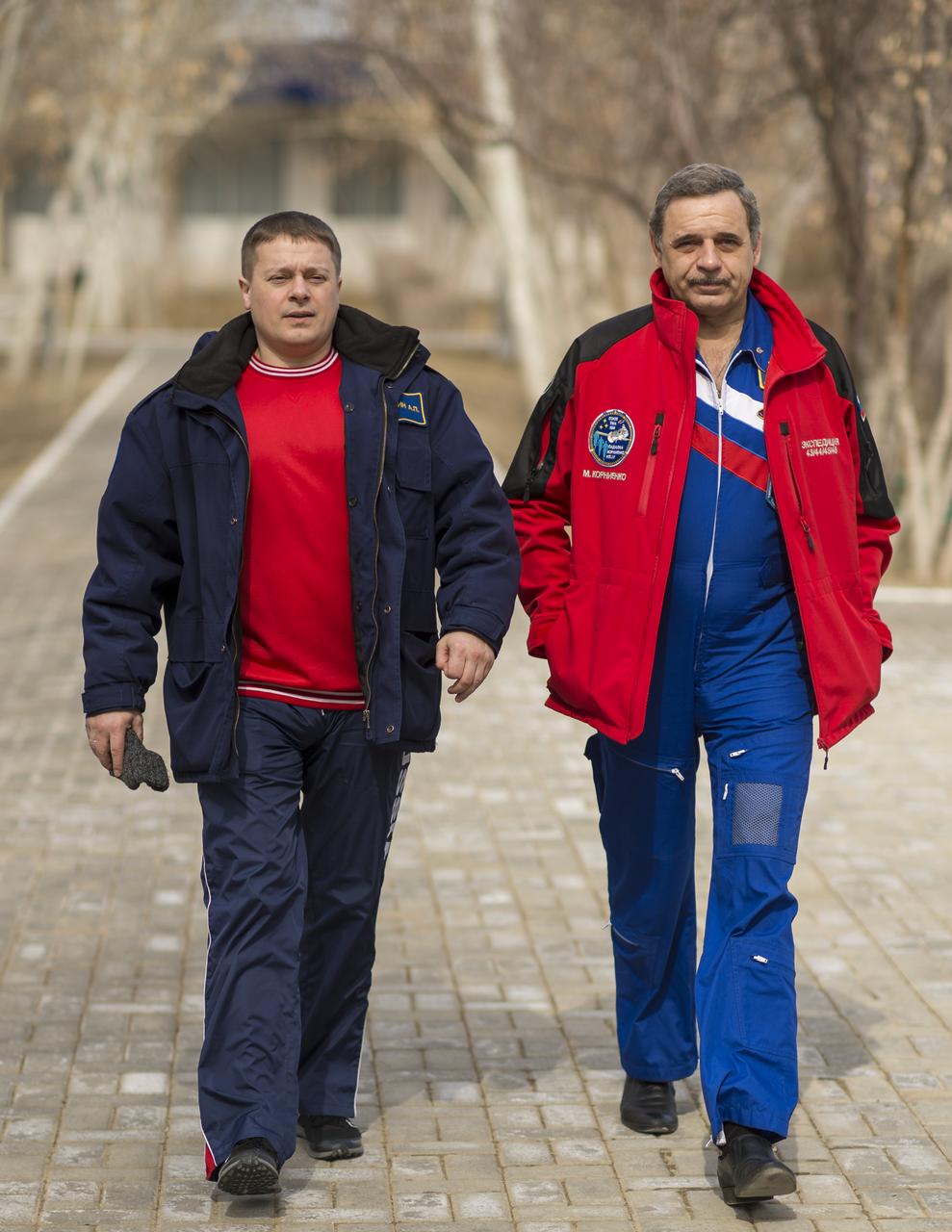
Gagarin Cosmonaut Training Center (GCTC) Flight Surgeon Alexey Grishin, left, and Expedition 43 Russian Cosmonaut Mikhail Kornienko of the Russian Federal Space Agency (Roscosmos) walk from morning classes at the Cosmonaut Hotel to the crew quarters at the Zvjozdnyj Hotel, Thursday, March 19, 2015 in Baikonur, Kazakhstan. Kornienko, Russian Cosmonaut Gennady Padalka of Roscosmos, and NASA Astoronaut Scott Kelly are preparing for launch to the International Space Station in their Soyuz TMA-16M spacecraft from the Baikonur Cosmodrome in Kazakhstan March 28, Kazakh time. As the one-year crew, Kelly and Kornienko will return to Earth on Soyuz TMA-18M in March 2016. Photo Credit: (NASA/Bill Ingalls)
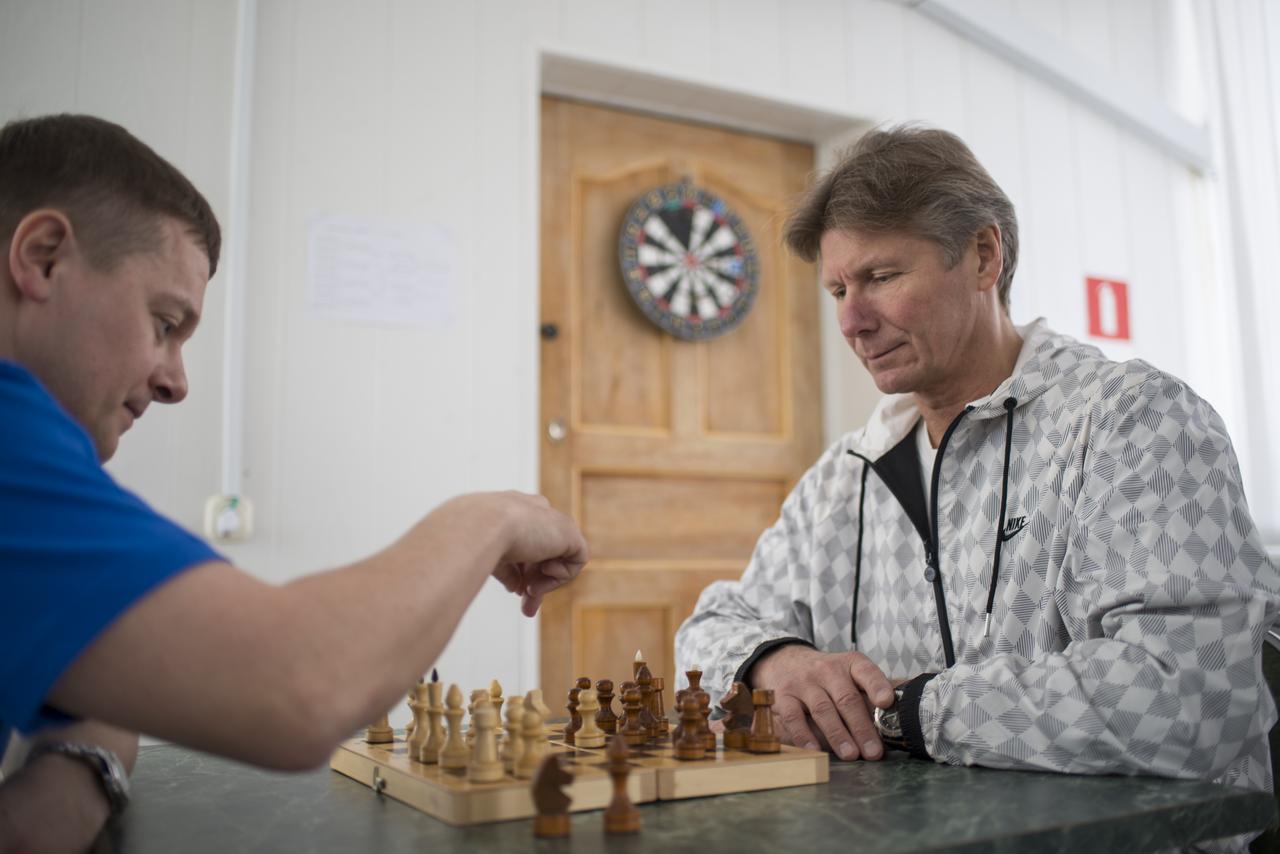
Gagarin Cosmonaut Training Center (GCTC) Flight Surgeon Alexey Grishin, left, and Russian Cosmonaut Gennady Padalka of the Russian Federal Space Agency (Roscosmos) play a game of chess during media day, Saturday, March 21, 2015, Baikonur, Kazakhstan. Padalka, fellow Russian Cosmonaut Mikhail Kornienko of Roscosmos, and NASA Astronaut Scott Kelly are scheduled to launch to the International Space Station in the Soyuz TMA-16M spacecraft from the Baikonur Cosmodrome in Kazakhstan March 28, Kazakh time (March 27 Eastern time.) As the one-year crew, Kelly and Kornienko will return to Earth on Soyuz TMA-18M in March 2016. Photo Credit: (NASA/Bill Ingalls)
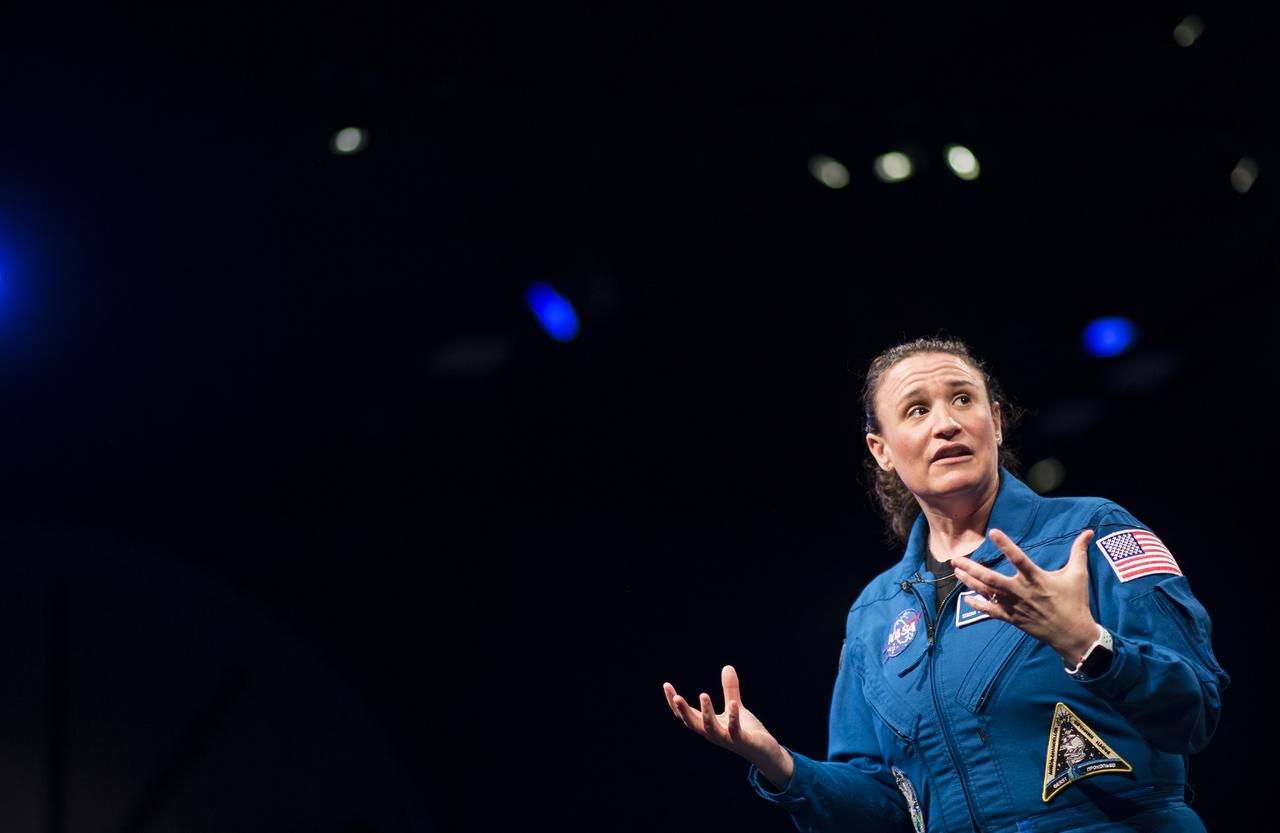
NASA astronaut Serena Auñón-Chancellor speaks about her time onboard the International Space Station during "What's New in Aerospace" Friday, June 14, 2019 the Smithsonian's National Air and Space Museum in Washington, DC. Auñón-Chancellor spent 197 days living and working onboard the orbital laboratory as part of Expeditions 56 and 57, contributing to hundreds of experiments in biology, biotechnology, physical science, and Earth science while there. She began her career at NASA as a flight surgeon before being selected as an astronaut in 2009. Photo Credit: (NASA/Joel Kowsky)
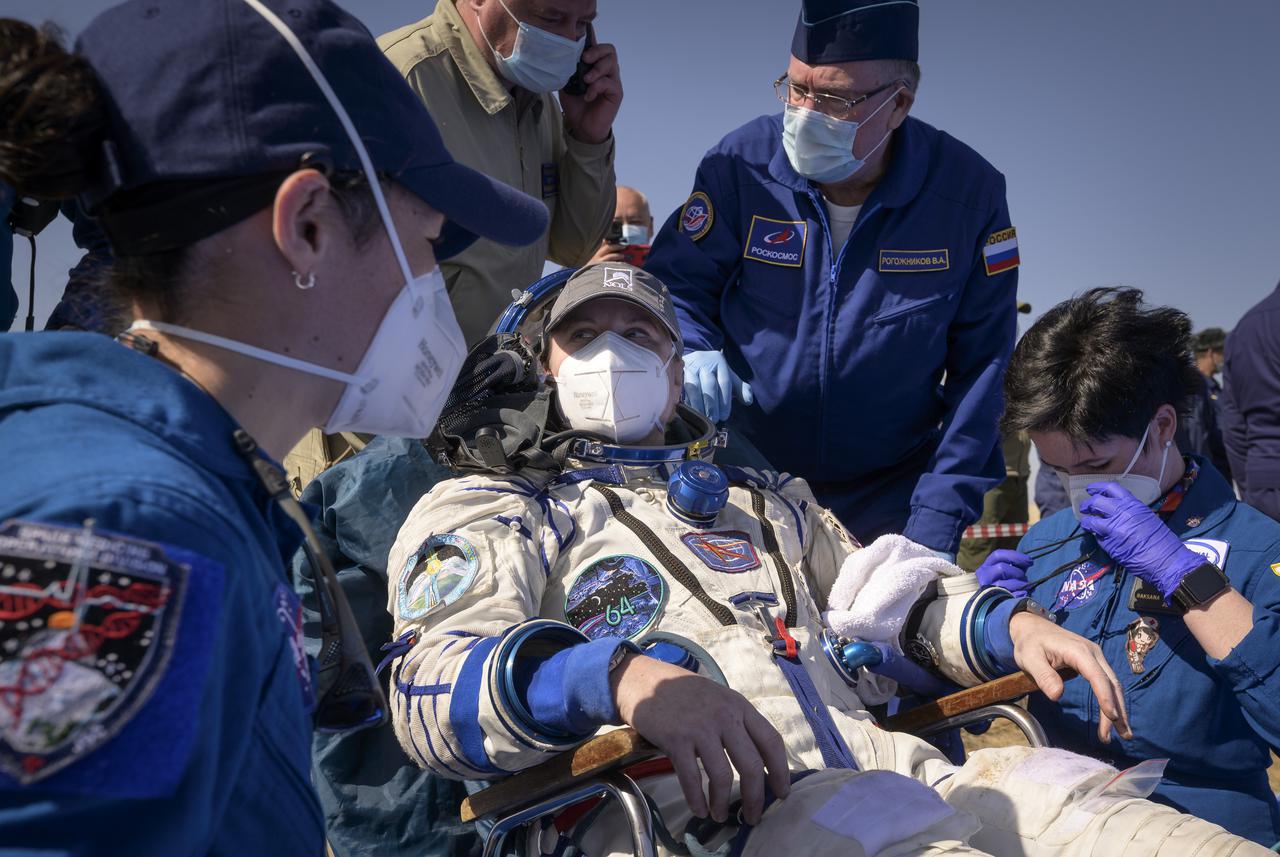
Expedition 64 NASA astronaut Kate Rubins rest as NASA Flight Surgeon Natacha Chough, left, and Russian Nurse Raksana Batsmanova, right, monitor her condition after she, and Roscosmos cosmonauts Sergey Ryzhikov and Sergey Kud-Sverchkov landed there Soyuz MS-17 spacecraft in a remote area near the town of Zhezkazgan, Kazakhstan on Saturday, April 17, 2021. Rubins, Ryzhikov and Kud-Sverchkov returned after 185 days in space having served as Expedition 63-64 crew members onboard the International Space Station. Photo Credit: NASA/Bill Ingalls
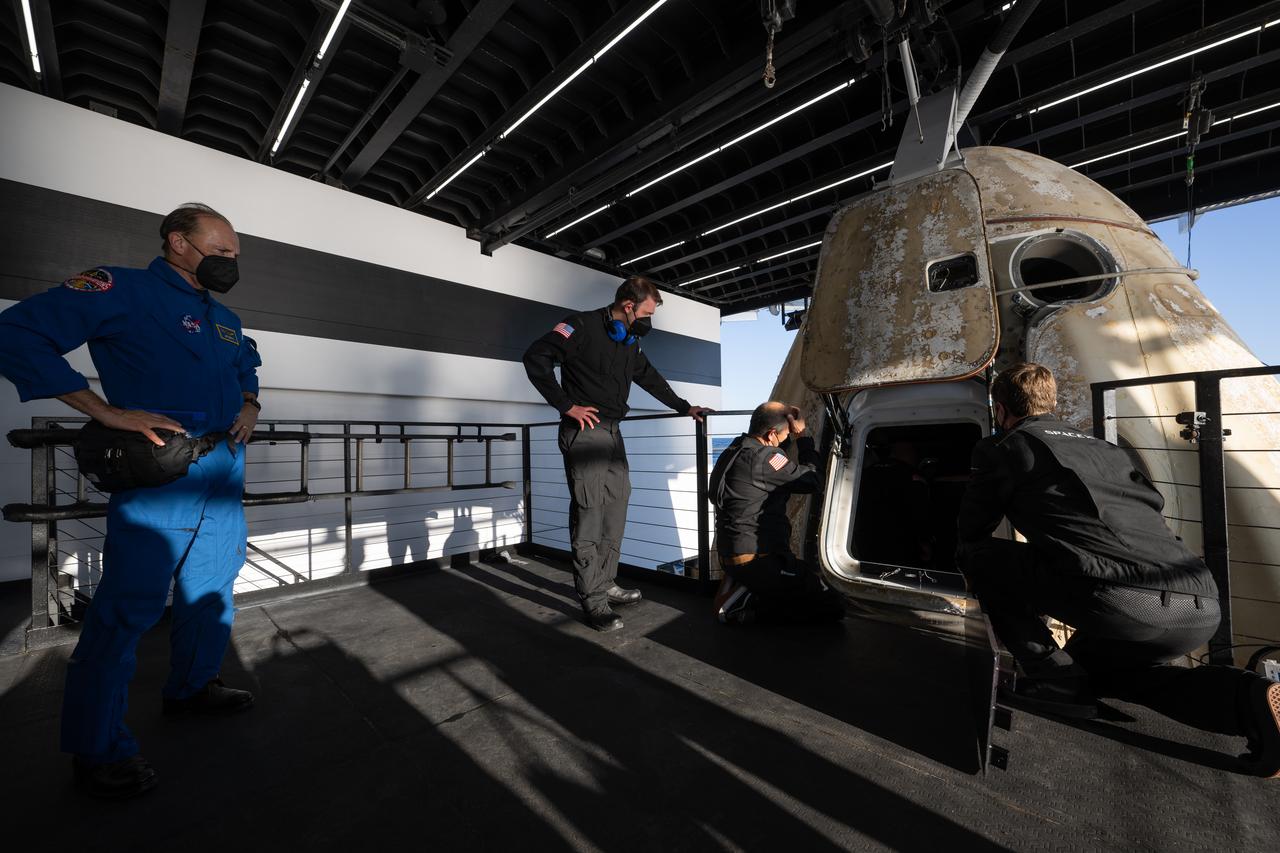
NASA Flight Surgeon Joe Dervay, left, watches as SpaceX teams help members of Crew-4 out of the SpaceX Crew Dragon Freedom spacecraft onboard the SpaceX recovery ship Megan in the Atlantic Ocean off the coast of Jacksonville, Florida, Friday, Oct. 14, 2022. NASA astronauts Kjell Lindgren, Robert Hines, Jessica Watkins, and ESA (European Space Agency) astronaut Samantha Cristoforetti are returning after 170 days in space as part of Expeditions 67 and 68 aboard the International Space Station. Photo Credit: (NASA/Bill Ingalls)
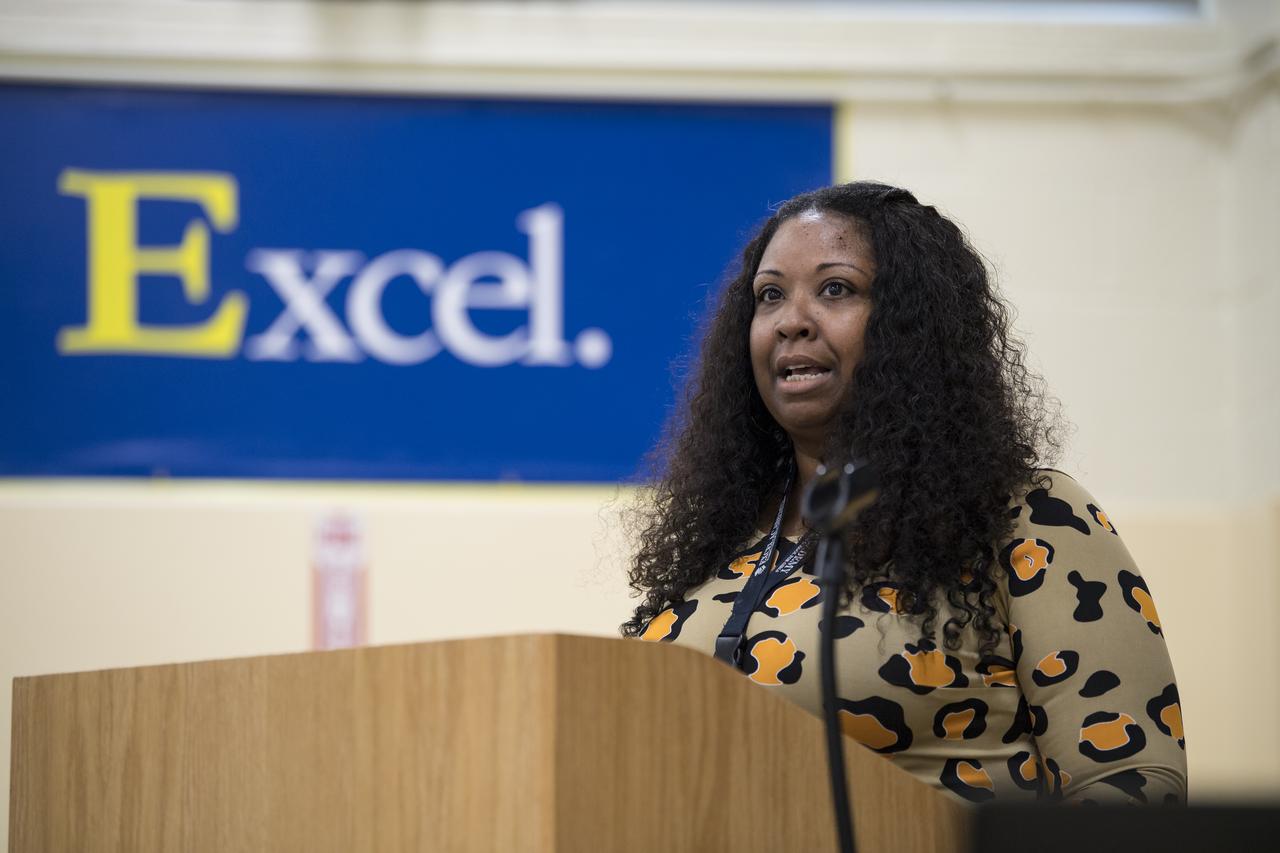
Excel Academy Principle, Tenia Pritchard, introduces NASA astronaut Dr. Serena Auñón-Chancellor to speak about her experience on Expeditions 56 and 57 onboard the International Space Station (ISS) at Excel Academy Public Charter School, Monday, June 10, 2019 in Washington, DC. Auñón-Chancellor spent 197 days living and working onboard the ISS and contributed to hundreds of experiments in biology, biotechnology, physical science, and Earth science while there. She is also a doctor and started her career with NASA as a flight surgeon in 2006. Photo Credit: (NASA/Aubrey Gemignani)
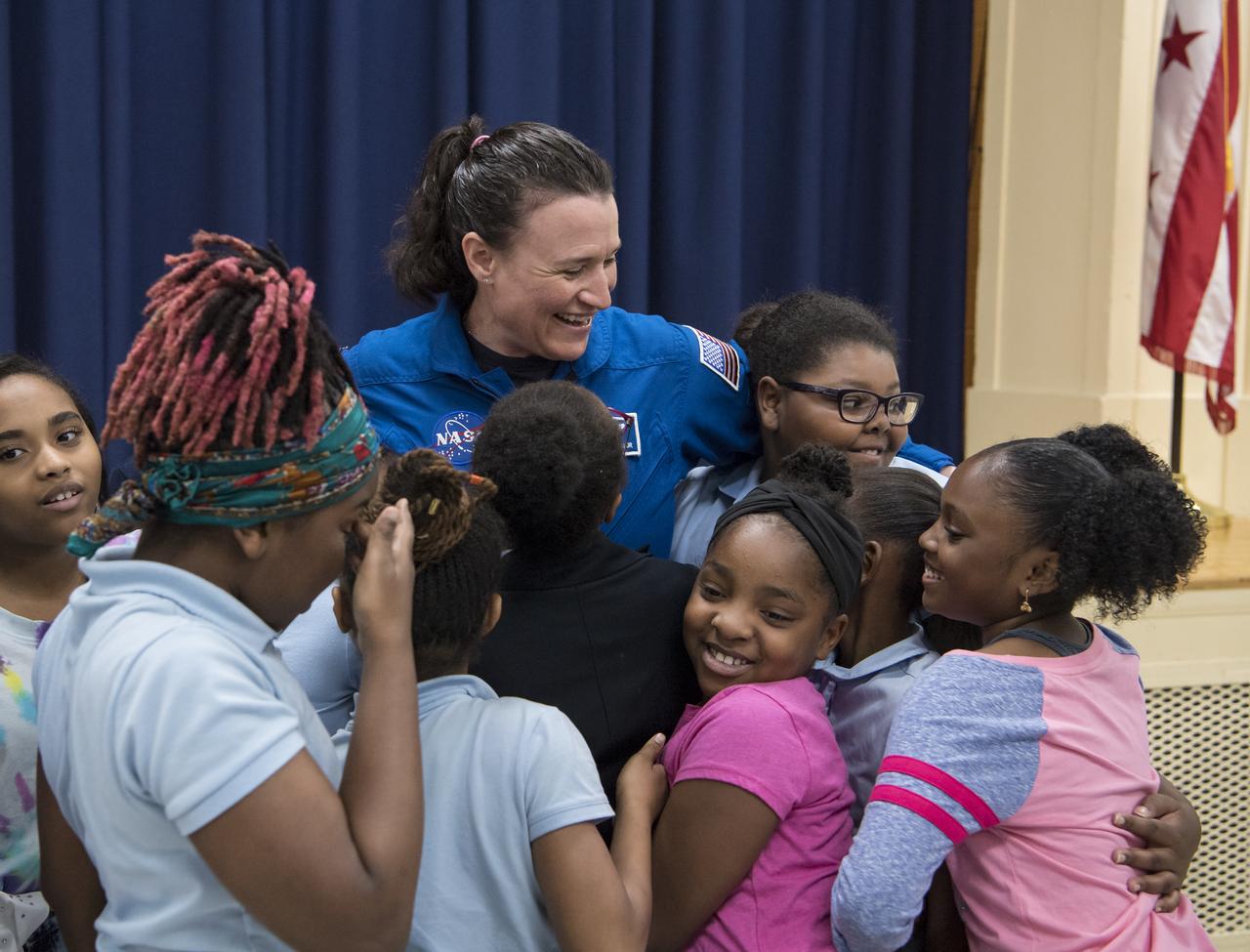
NASA astronaut Dr. Serena Auñón-Chancellor is hugged by students after a presentation about her experience on Expeditions 56 and 57 onboard the International Space Station (ISS) at Excel Academy Public Charter School, Monday, June 10, 2019 in Washington, DC. Auñón-Chancellor spent 197 days living and working onboard the ISS and contributed to hundreds of experiments in biology, biotechnology, physical science, and Earth science while there. She is also a doctor and started her career with NASA as a flight surgeon in 2006. Photo Credit: (NASA/Aubrey Gemignani)
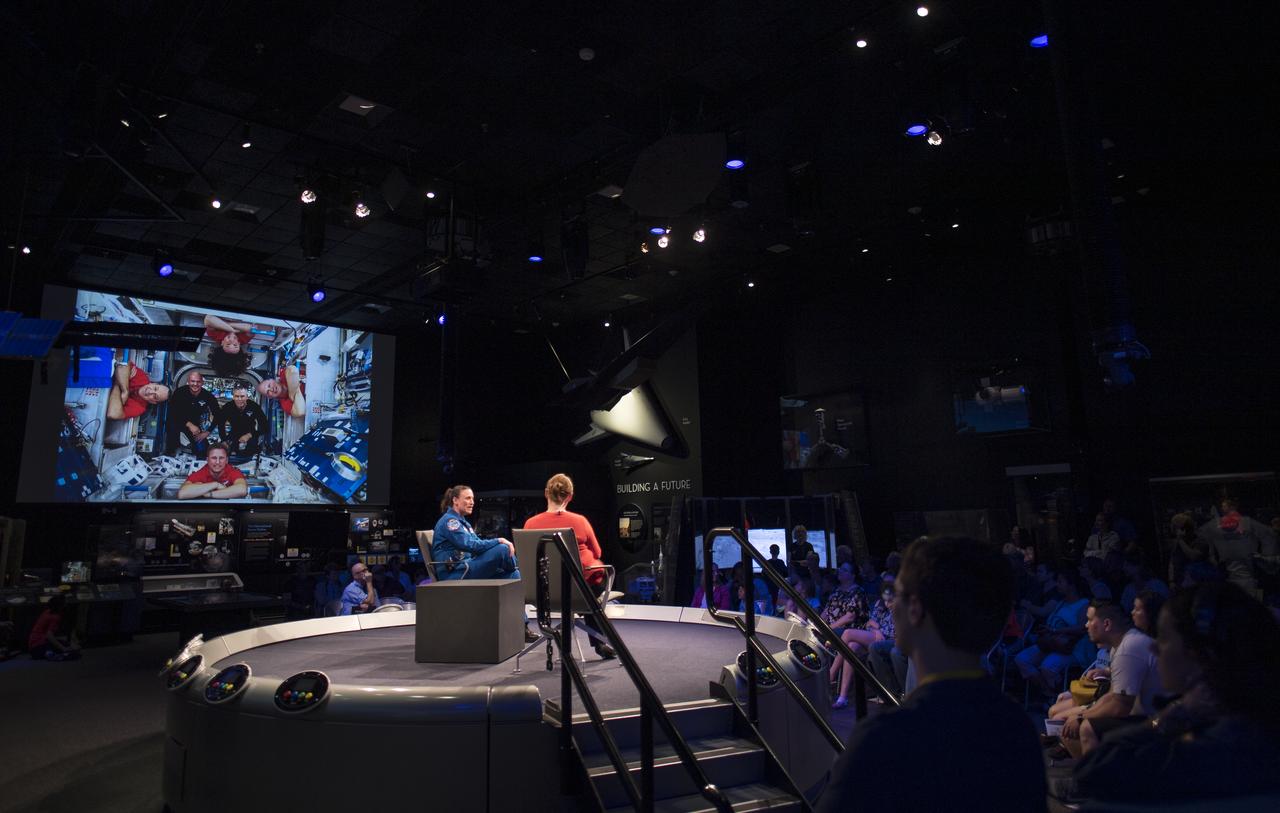
Smithsonian National Air and Space Museum curator Jennifer Levasseu speaks with NASA astronaut Serena Auñón-Chancellor about her time onboard the International Space Station during "What's New in Aerospace" Friday, June 14, 2019 the Smithsonian's National Air and Space Museum in Washington, DC. Auñón-Chancellor spent 197 days living and working onboard the orbital laboratory as part of Expeditions 56 and 57, contributing to hundreds of experiments in biology, biotechnology, physical science, and Earth science while there. She began her career at NASA as a flight surgeon before being selected as an astronaut in 2009. Photo Credit: (NASA/Joel Kowsky)
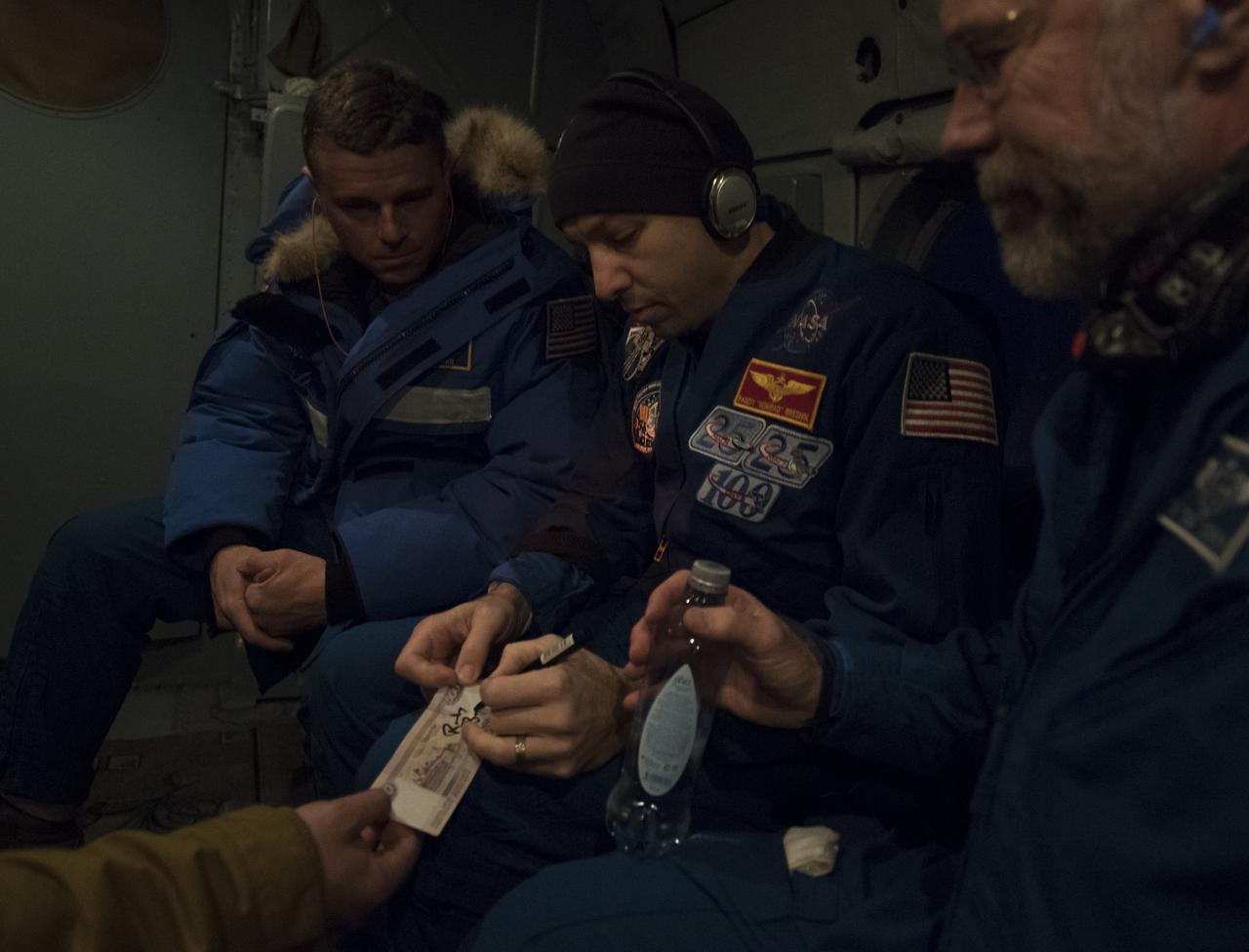
NASA astronaut Randy Bresnik, center, gives an autograph while onboard a helicopter shortly after he, ESA (European Space Agency) astronaut Paolo Nespoli, and Roscosmos cosmonaut Sergey Ryazanskiy landed in their Soyuz MS-05 spacecraft in a remote area near the town of Zhezkazgan, Kazakhstan on Thursday, Dec. 14, 2017. Looking on is NASA astronaut Reid Wiseman, left, and NASA Flight Surgeon Rick Scheuring. Bresnik, Nespoli and Ryazanskiy are returning after 139 days in space where they served as members of the Expedition 52 and 53 crews onboard the International Space Station. Photo Credit: (NASA/Bill Ingalls)
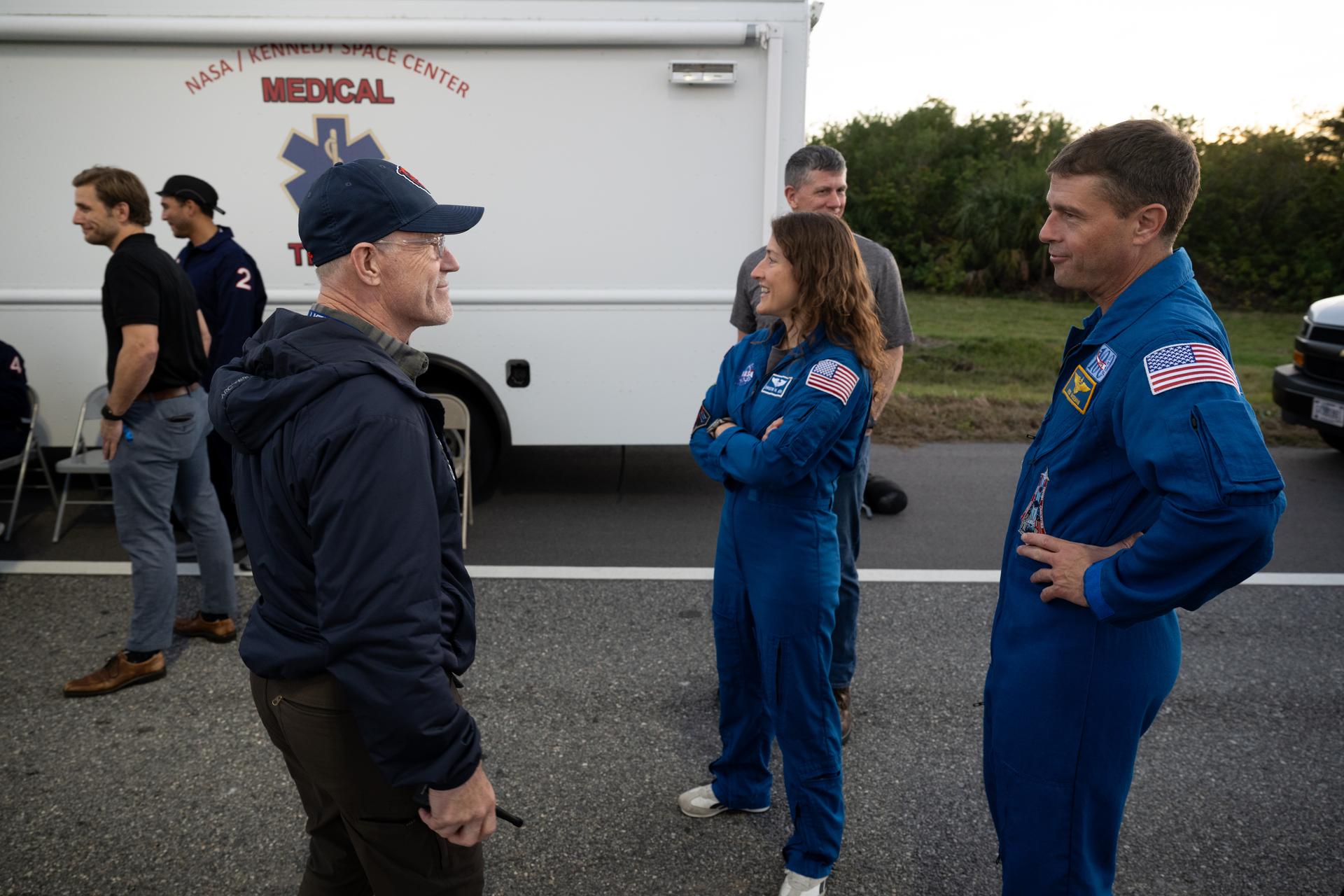
NASA Flight Surgeon Richard Scheuring, left, talks with NASA astronauts Reid Wiseman, Artemis II commander, right, and Christina Koch, Artemis II mission specialist, as teams at NASA's Kennedy Space Center in Florida practiced various emergency rescue training scenarios with the Artemis II crew, Friday, Dec. 19, 2025, ahead of the Artemis II mission. In the unlikely event of an emergency during launch countdown at Launch Complex 39B, personnel will be transported in mine-resistant ambush protected vehicles, or MRAPS, from the pad and to one of the triage site locations at Kennedy. Photo Credit: (NASA/Joel Kowsky)
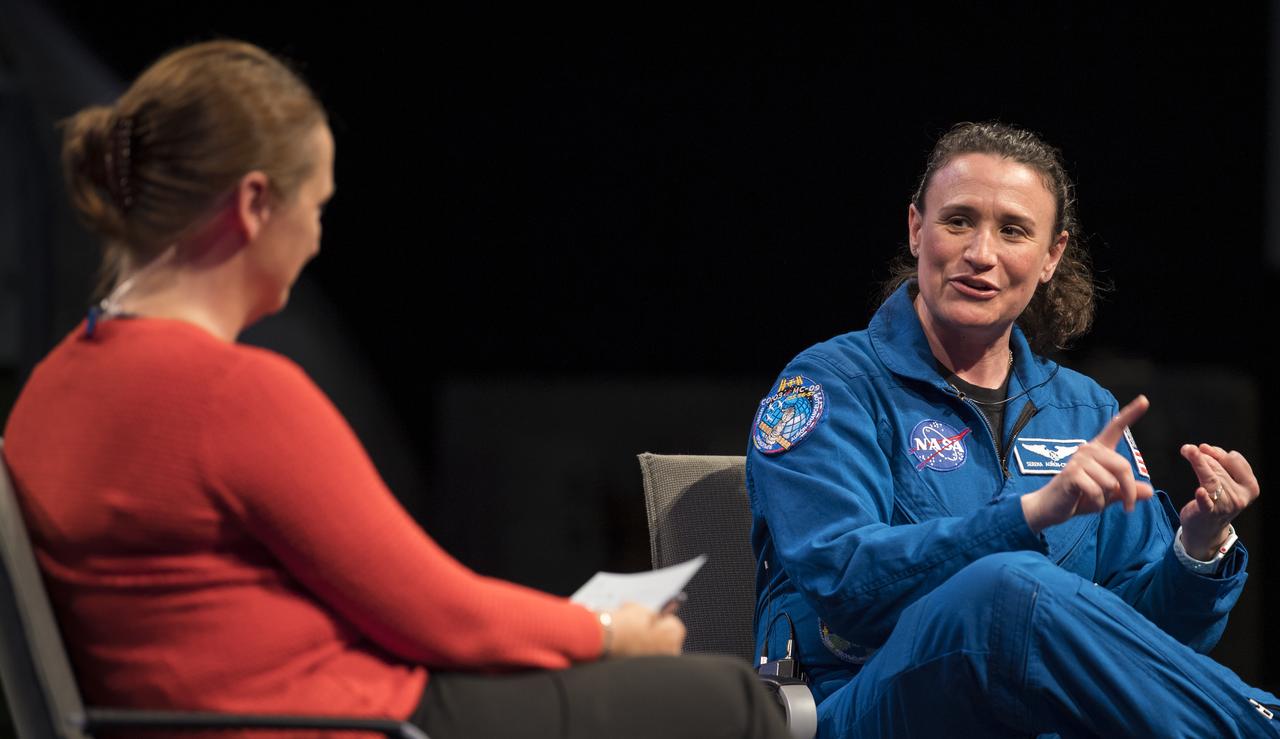
Smithsonian National Air and Space Museum curator Jennifer Levasseu speaks with NASA astronaut Serena Auñón-Chancellor about her time onboard the International Space Station during "What's New in Aerospace" Friday, June 14, 2019 the Smithsonian's National Air and Space Museum in Washington, DC. Auñón-Chancellor spent 197 days living and working onboard the orbital laboratory as part of Expeditions 56 and 57, contributing to hundreds of experiments in biology, biotechnology, physical science, and Earth science while there. She began her career at NASA as a flight surgeon before being selected as an astronaut in 2009. Photo Credit: (NASA/Joel Kowsky)
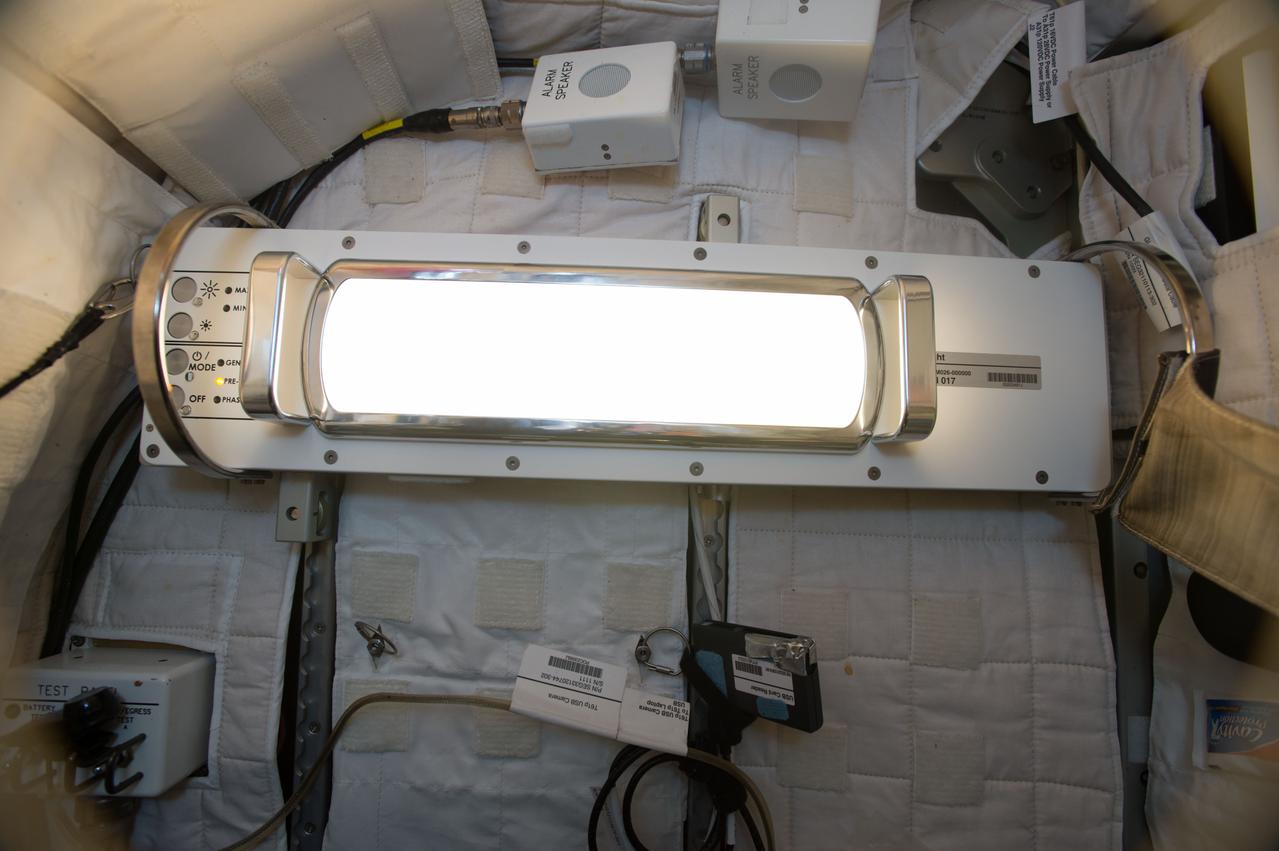
iss049e028948 (10/5/2016) --- Photographic documentation taken during Solid State Lighting Assembly (SSLA) Installation in the starboard Crew Quarters (CQ). The SSLAs were designed to replace General Luminaire Assemblies (GLAs) to improve visual acuity and to provide a crew health countermeasure for circadian rhythms, sleep, alertness and performance. Lighting Effects studies new light sources that can be adjusted for intensity and wavelength across the day, simulating a more regular schedule. Results are expected to provide new information for flight surgeons, psychologists, and crew members to better regulate circadian rhythms and improve sleep.
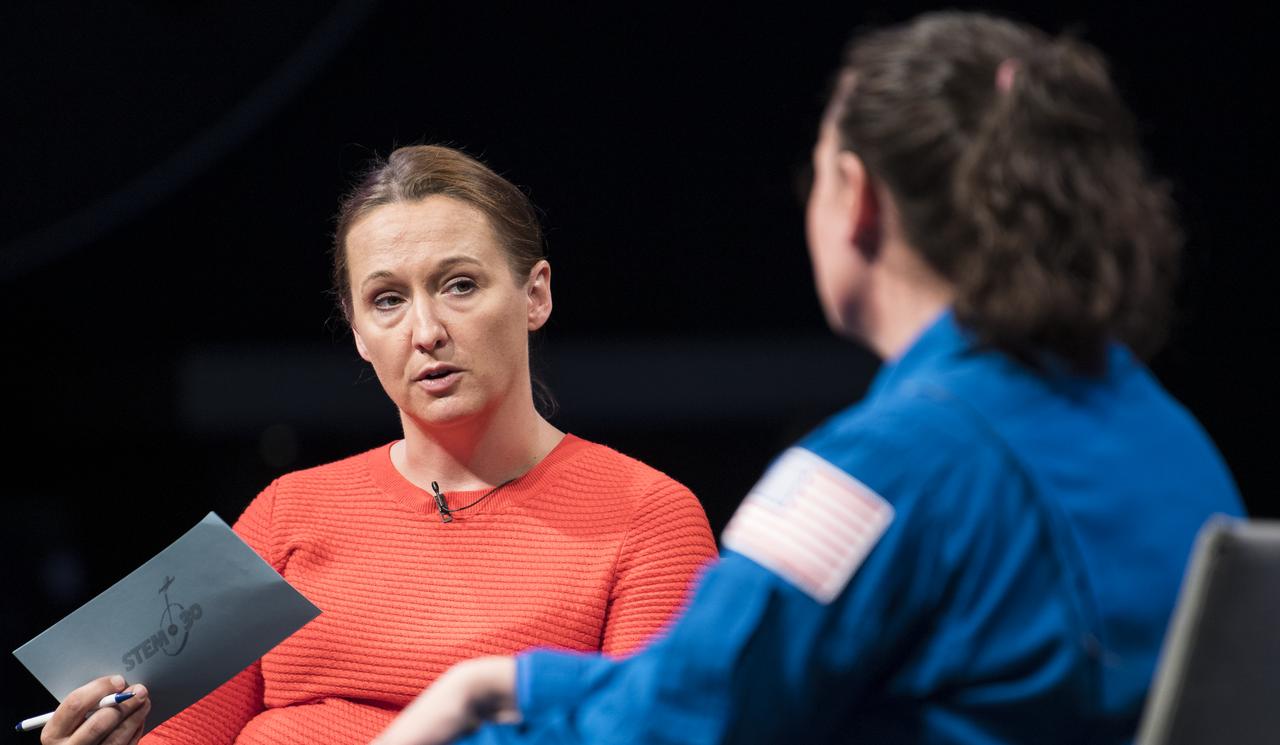
Smithsonian National Air and Space Museum curator Jennifer Levasseu speaks with NASA astronaut Serena Auñón-Chancellor about her time onboard the International Space Station during "What's New in Aerospace" Friday, June 14, 2019 the Smithsonian's National Air and Space Museum in Washington, DC. Auñón-Chancellor spent 197 days living and working onboard the orbital laboratory as part of Expeditions 56 and 57, contributing to hundreds of experiments in biology, biotechnology, physical science, and Earth science while there. She began her career at NASA as a flight surgeon before being selected as an astronaut in 2009. Photo Credit: (NASA/Joel Kowsky)
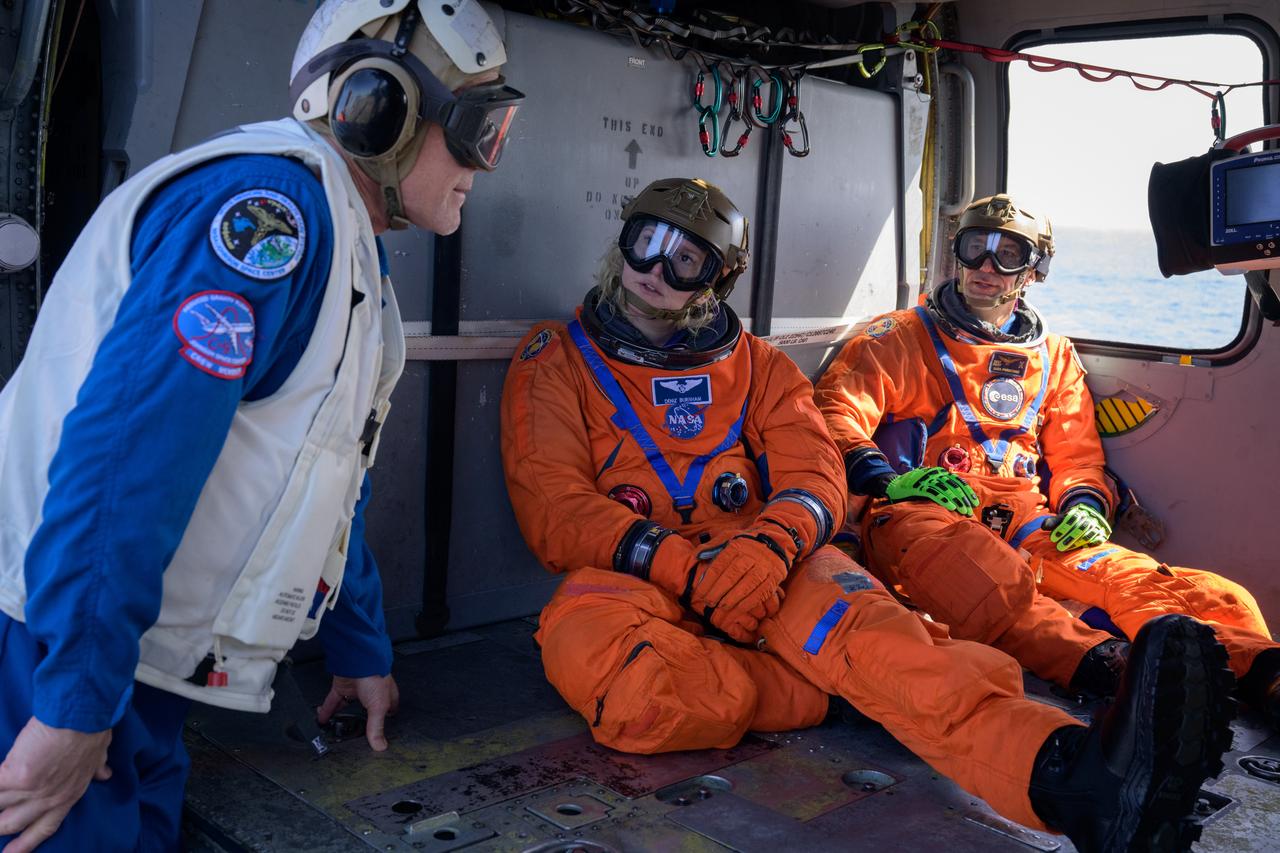
NASA astronaut Deniz Burnham, left, and ESA (European Space Agency) astronaut Luca Parmitano, are seen talking to NASA Flight Surgeon Richard Scheuring onboard a Navy helicopter after returning from the Crew Module Test Article (CMTA), a full scale mockup of the Orion spacecraft, during Underway Recovery Test-12 off the coast of California, Friday, March 28, 2025. During the test, NASA and Department of Defense teams are practicing to ensure recovery procedures are validated as NASA plans to send Artemis II astronauts around the Moon and splashdown in the Pacific Ocean. Photo Credit: (NASA/Bill Ingalls)
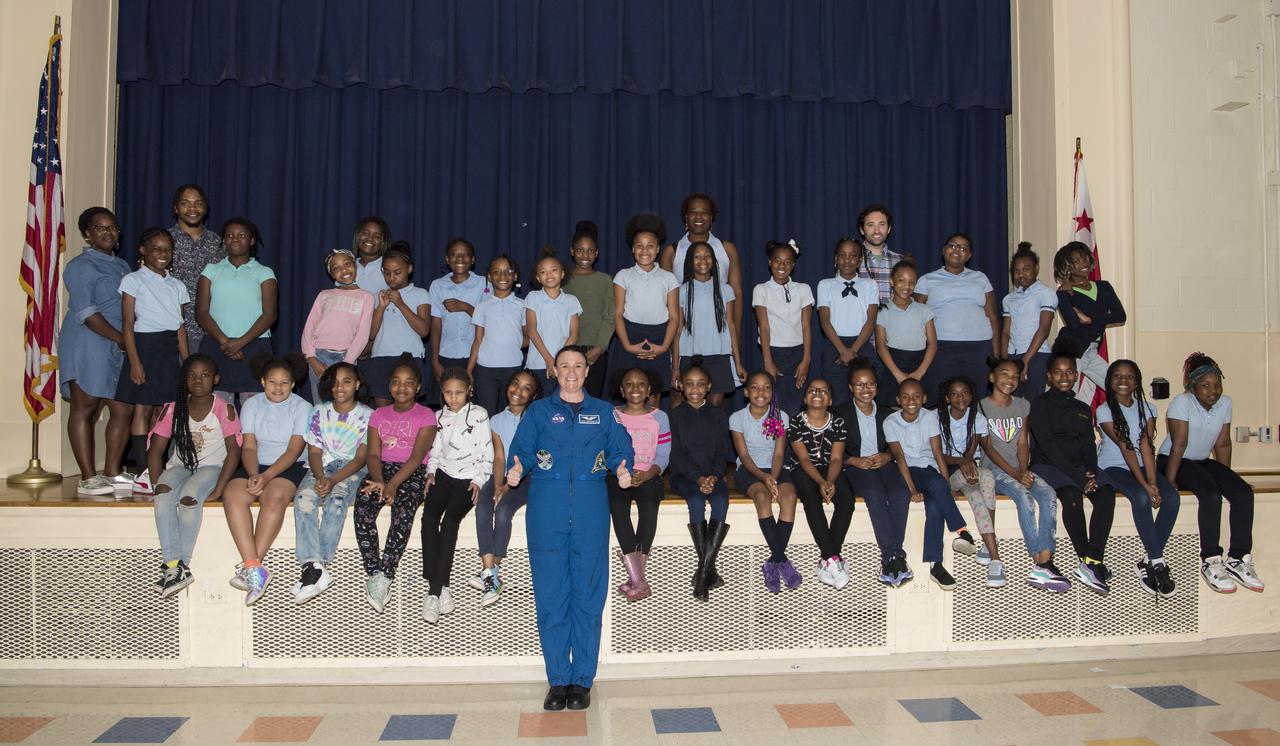
NASA astronaut Dr. Serena Auñón-Chancellor poses for a group photo after a presentation about her experience on Expeditions 56 and 57 onboard the International Space Station (ISS) at Excel Academy Public Charter School, Monday, June 10, 2019 in Washington, DC. Auñón-Chancellor spent 197 days living and working onboard the ISS and contributed to hundreds of experiments in biology, biotechnology, physical science, and Earth science while there. She is also a doctor and started her career with NASA as a flight surgeon in 2006. Photo Credit: (NASA/Aubrey Gemignani)