
S69-20086 (13 March 1969) --- The Apollo 9 Command Module (CM), with flotation collar still attached, is hoisted aboard the prime recovery ship, USS Guadalcanal, during recovery operations. The Apollo 9 crew, astronauts James A. McDivitt, David R. Scott, and Russell L. Schweickart, had already been picked up earlier by helicopter and flown to the dock of the carrier. Splashdown occurred at 12:00:53 p.m. (EST), March 13, 1969, only 4.5 nautical miles from the aircraft carrier, to conclude a successful 10-day Earth-orbital space mission.
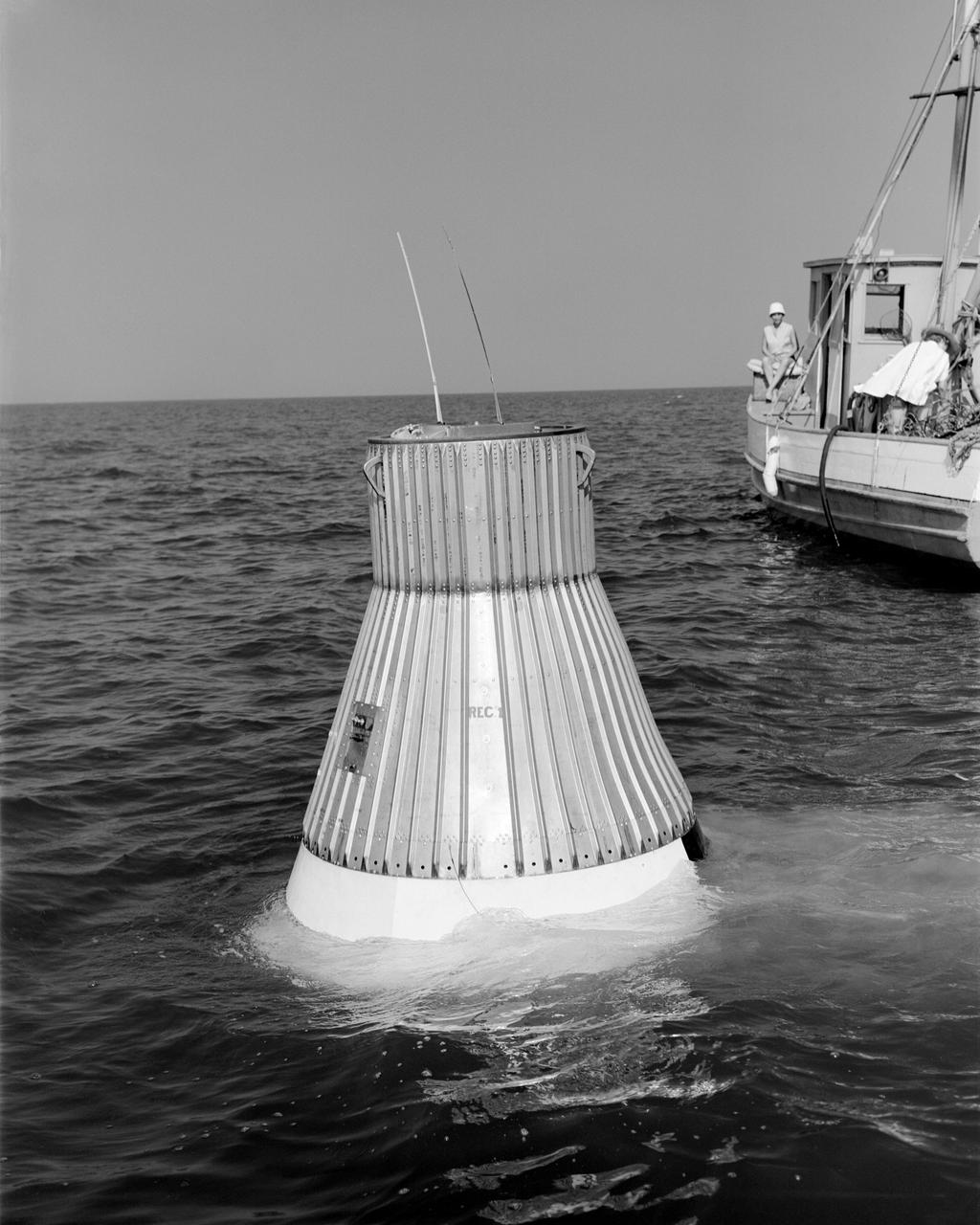
L59-4073 A model of the Mercury capsule undergoes flotation tests. -- Photograph published in Winds of Change, 75th Anniversary NASA publication (page 76), by James Schultz.
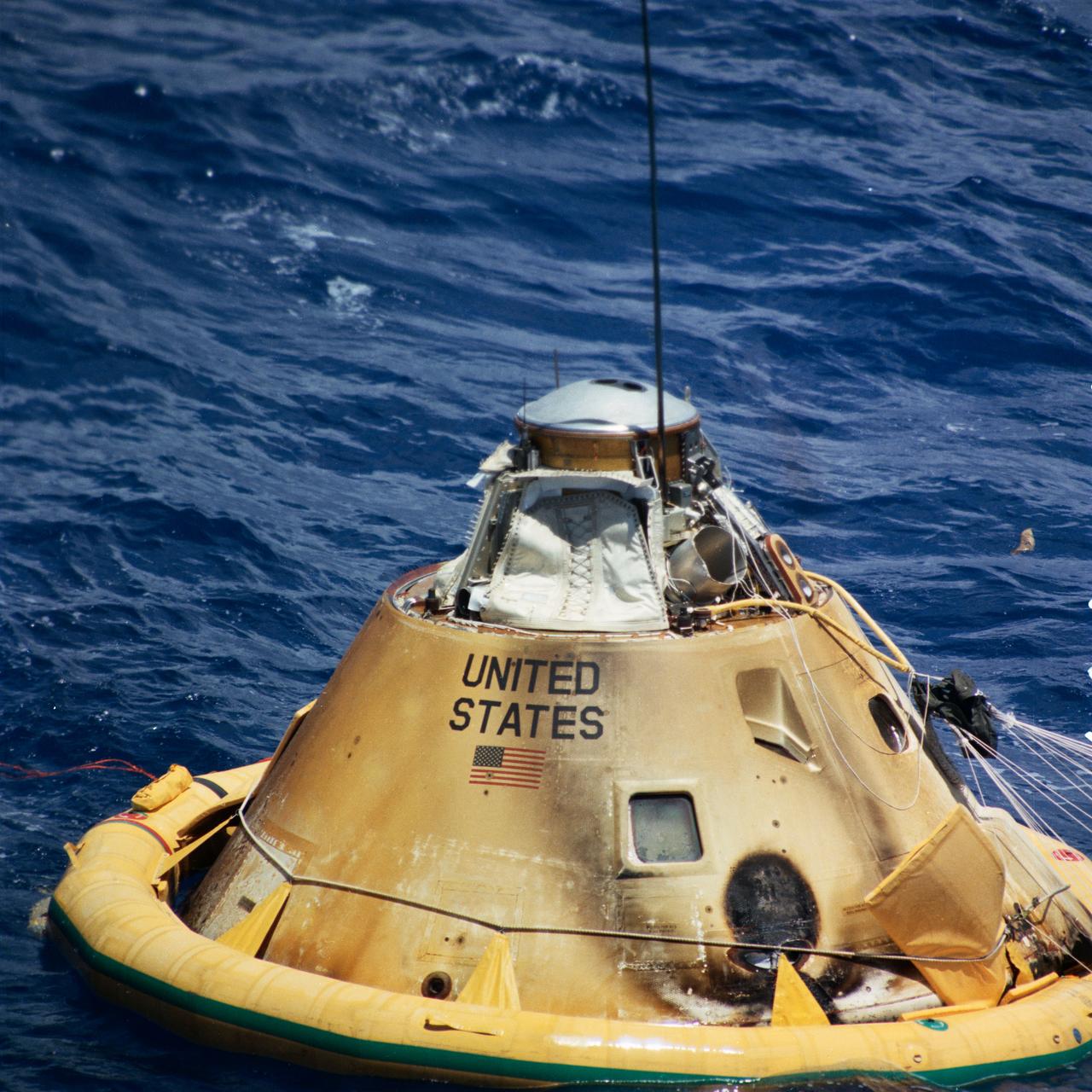
A/S 202 Command Module (C/M) attached to flotation collar. RECOVERY AREA, CENTRAL PACIFIC OCEAN
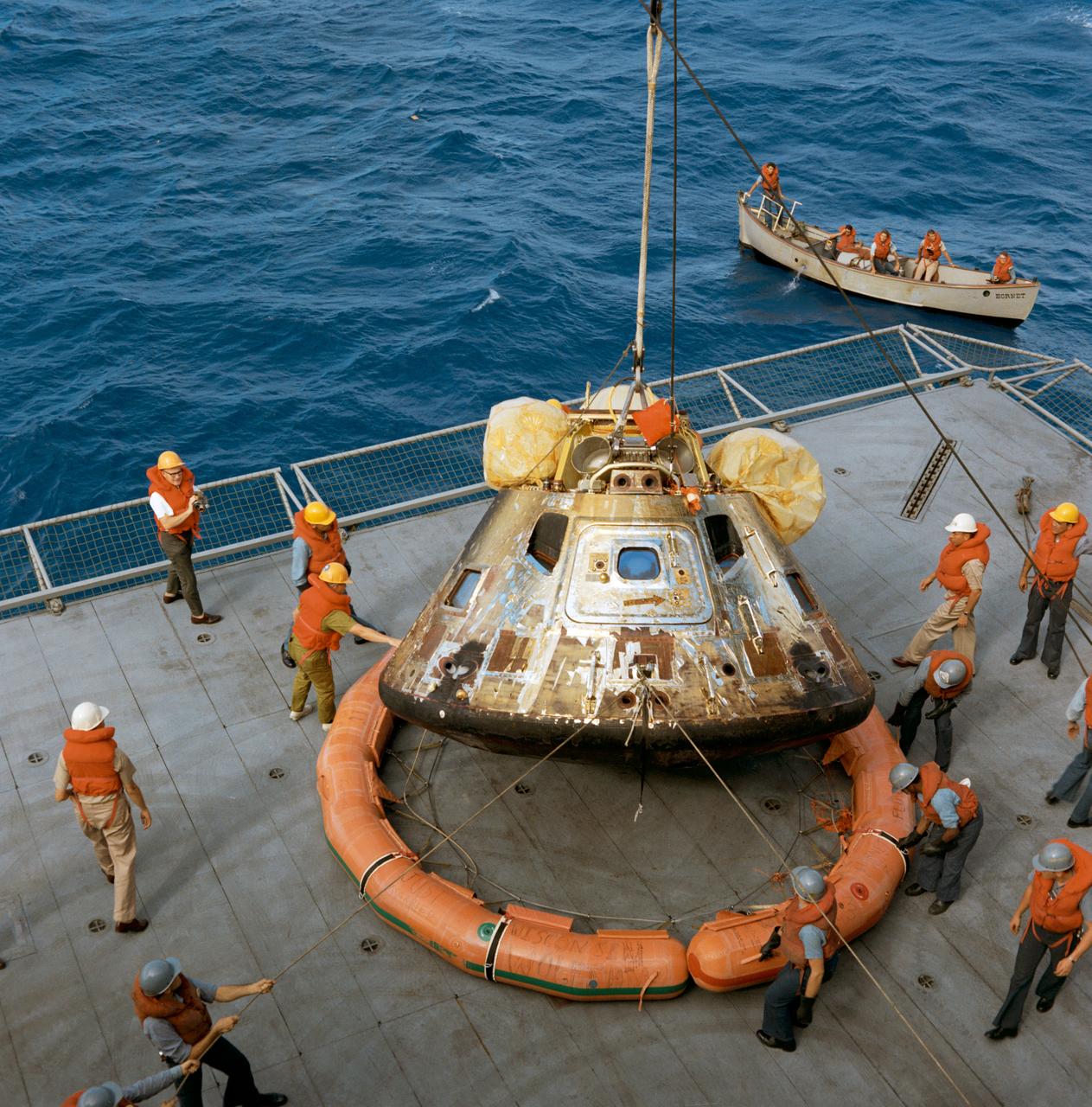
The Apollo 11 spacecraft Command Module is photographed being lowered to the deck of the U.S.S. Hornet, prime recovery ship for the historic lunar landing mission. Note the flotation ring attached by Navy divers has been removed from the capsule.
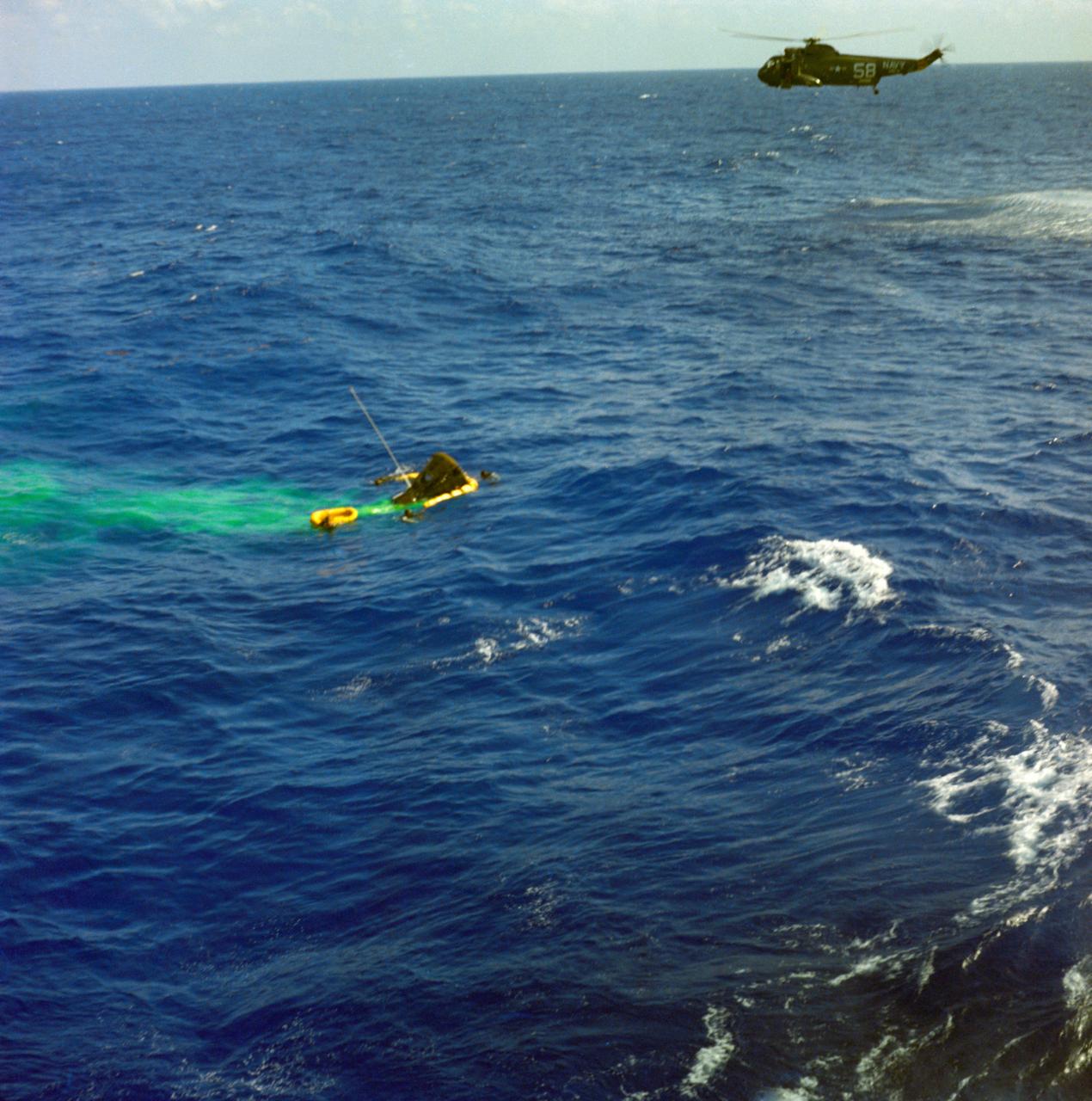
S65-18645 (23 March 1965) --- Navy swimmers are shown attaching a flotation collar to the Gemini-Titan 3 (GT-3) spacecraft during recovery operations following the successful flight. A helicopter hovers in the background. Astronauts Virgil I. Grissom and John W. Young are still in the spacecraft.
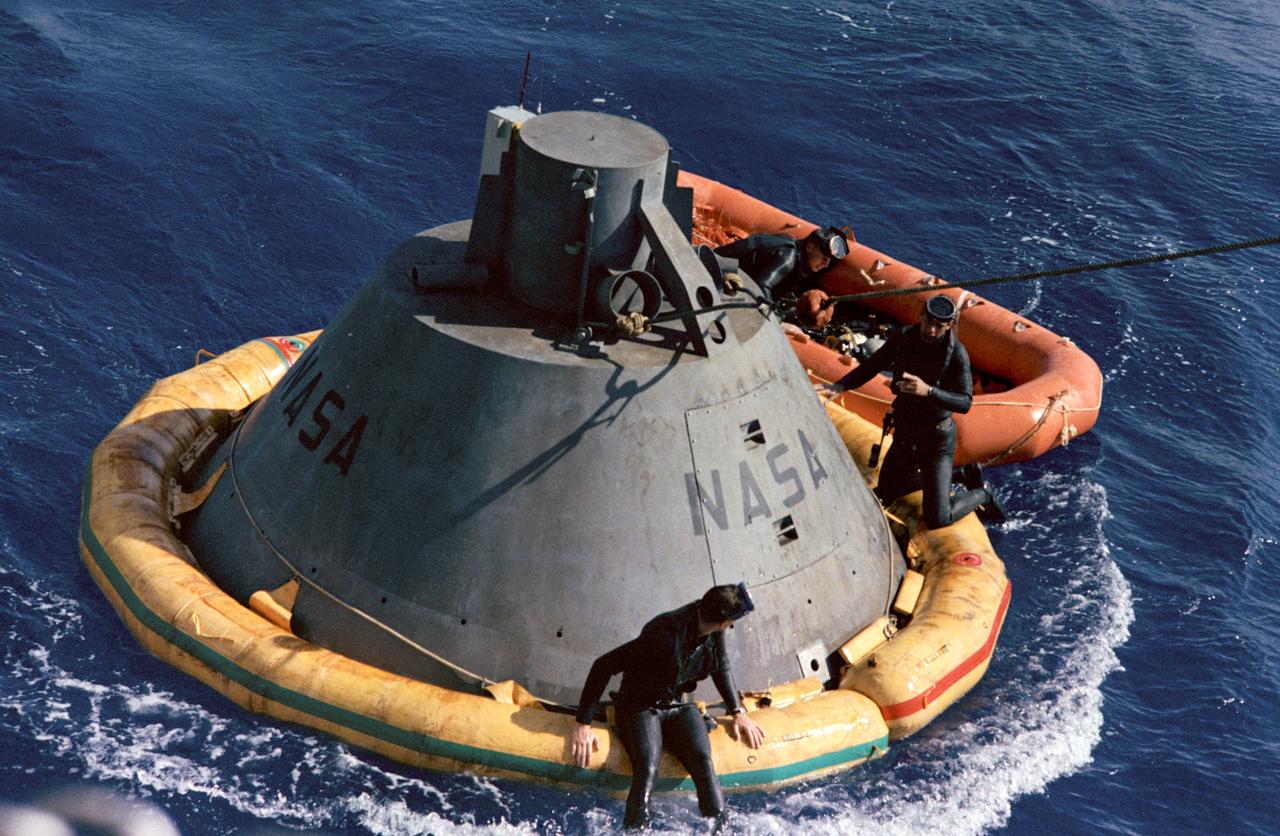
Apollo command module boilerplate floats in the Atlantic Ocean during a practice recovery exercise. Frogmen in a liferaft and on the flotation collar secure the command module boilerplate for hoisting onto a nearby recovery ship. The exercise was conducted in preparation for the forthcoming Apollo-Saturn 201 (AS-201) mission.
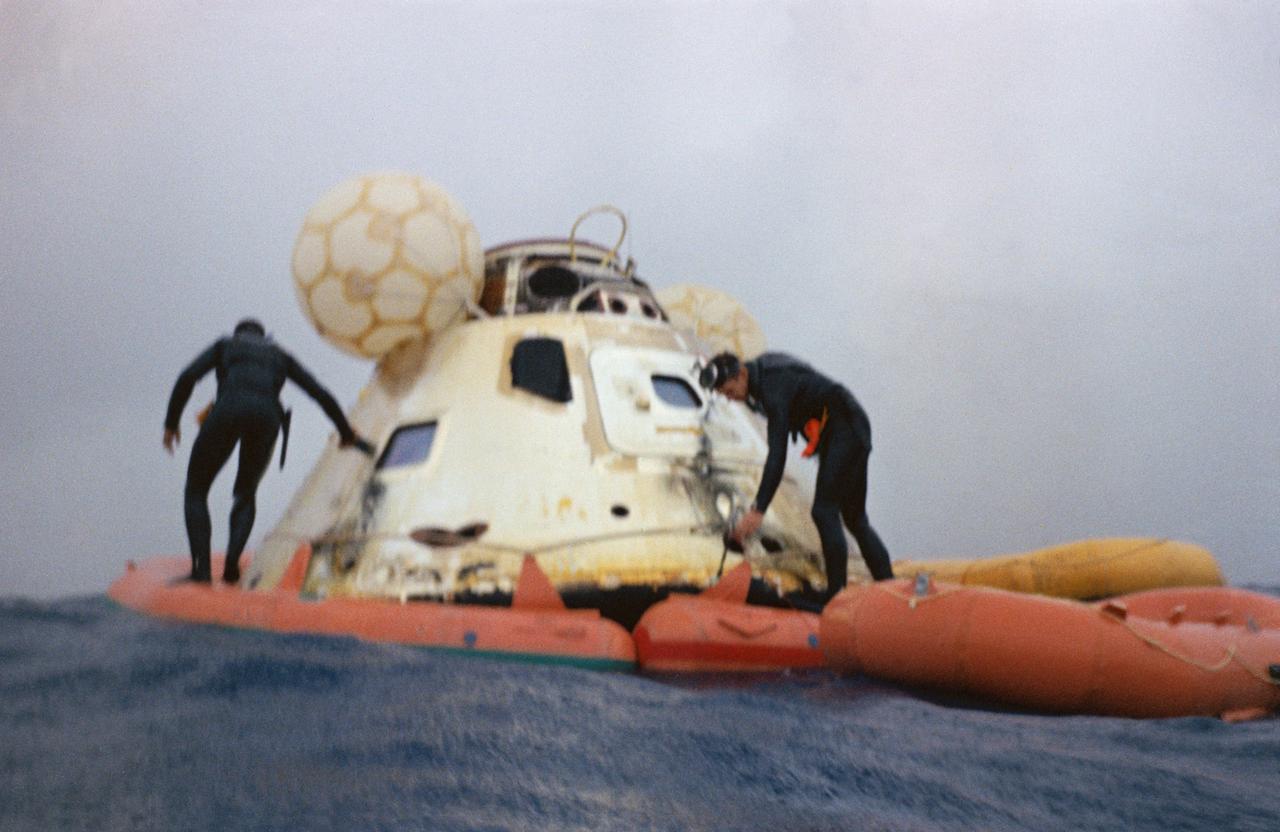
U.S. Navy frogmen attach a flotation collar to the Apollo 7 command module during recovery operations in the Atlantic. The Apollo 7 spacecraft splashed down at 7:11 a.m., October 22, 1968, approximately 200 nautical miles south-southwest of Bermuda.
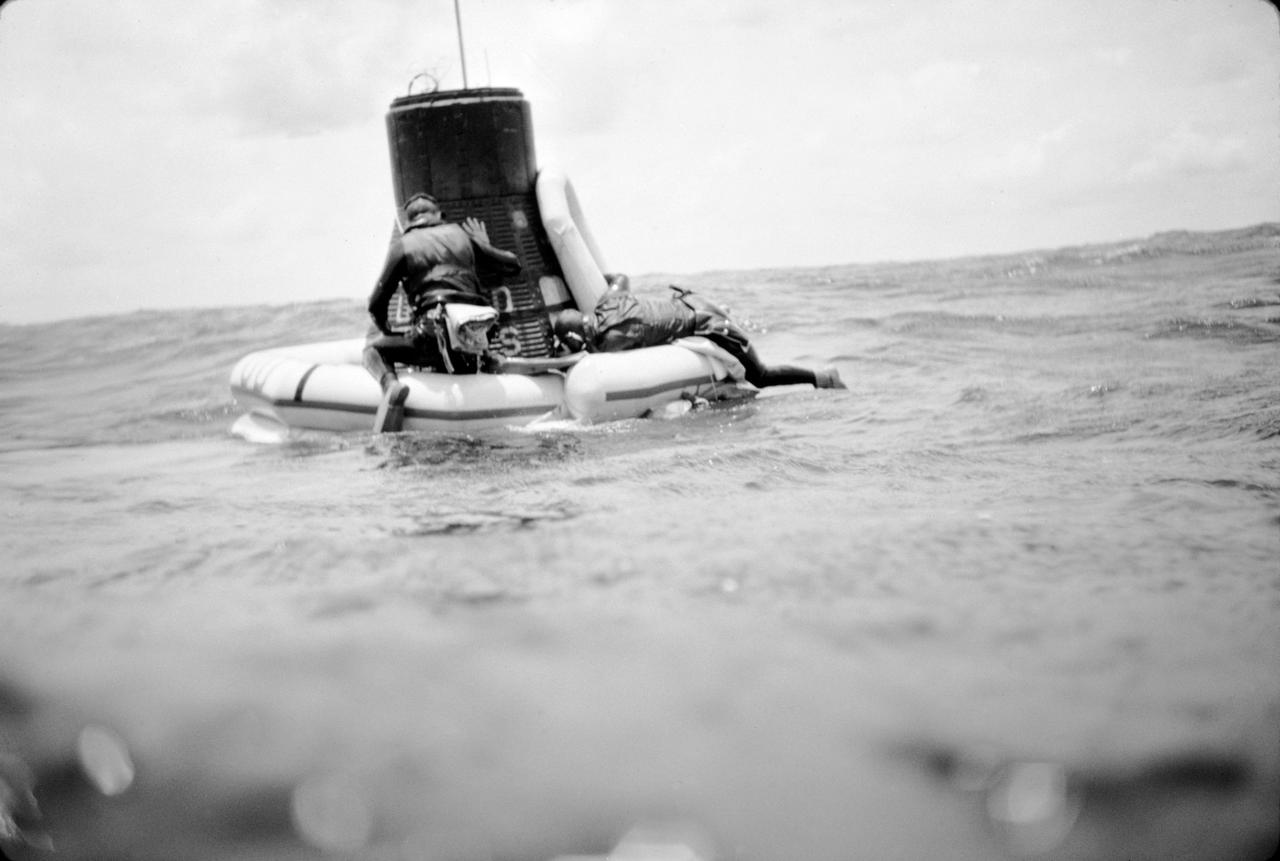
S63-07707 (16 May 1963) --- A U.S. Navy frogman team attaches a flotation collar to the Mercury-Atlas 9 (MA-9)"Faith 7" spacecraft during recovery operations in the central Pacific near Midway Island. The Mercury-Atlas spacecraft with astronaut L. Gordon Cooper Jr., pilot, still inside, was hoisted aboard the USS Kearnage. Photo credit: NASA
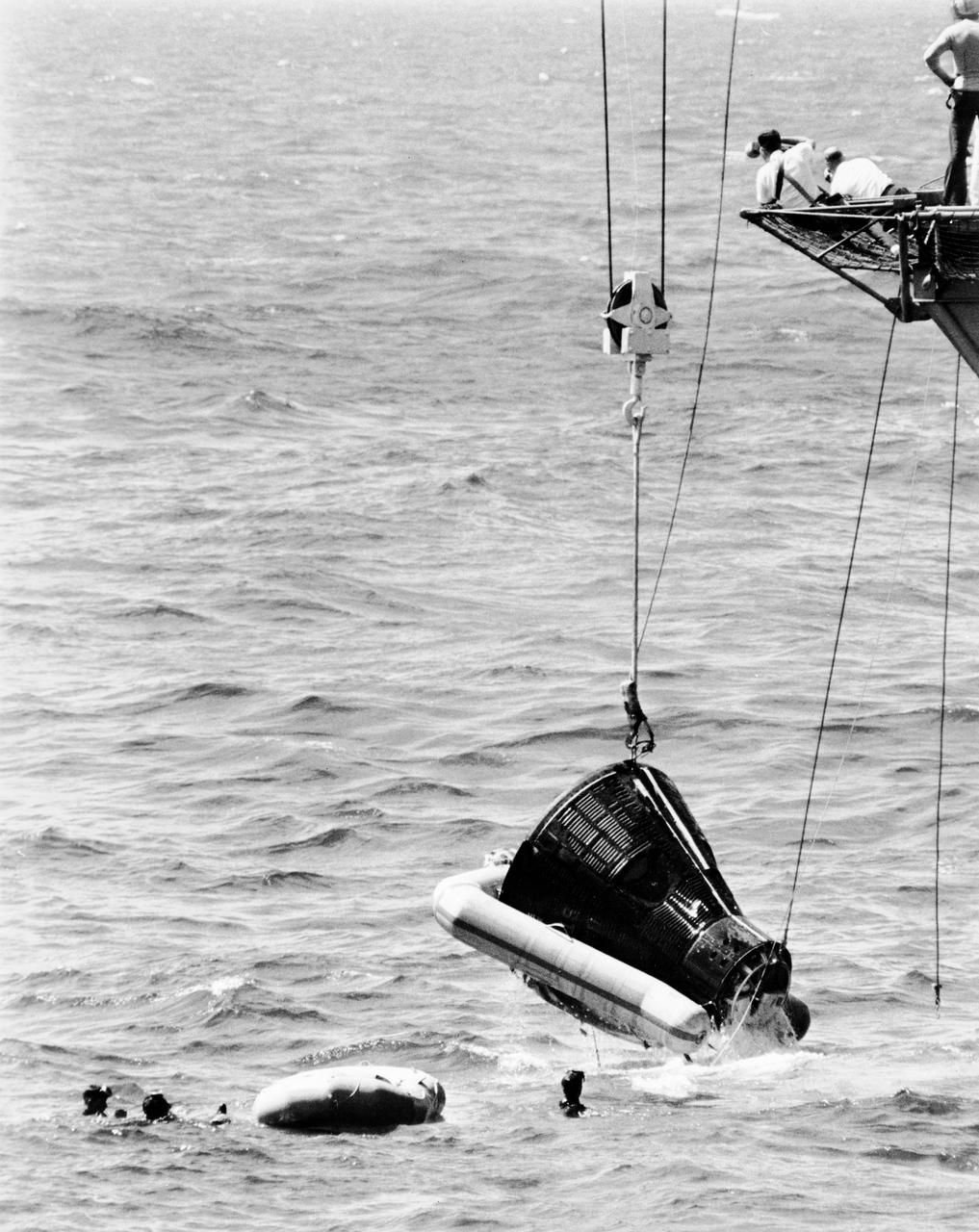
The Gemini-4 Astronauts is shown being hoisted aboard the Aircraft Carrier USS Wasp. The flotation collar is still attached to the spacecraft. DOWNRANGE RECOVERY AREA, ATLANTIC OCEAN B&W
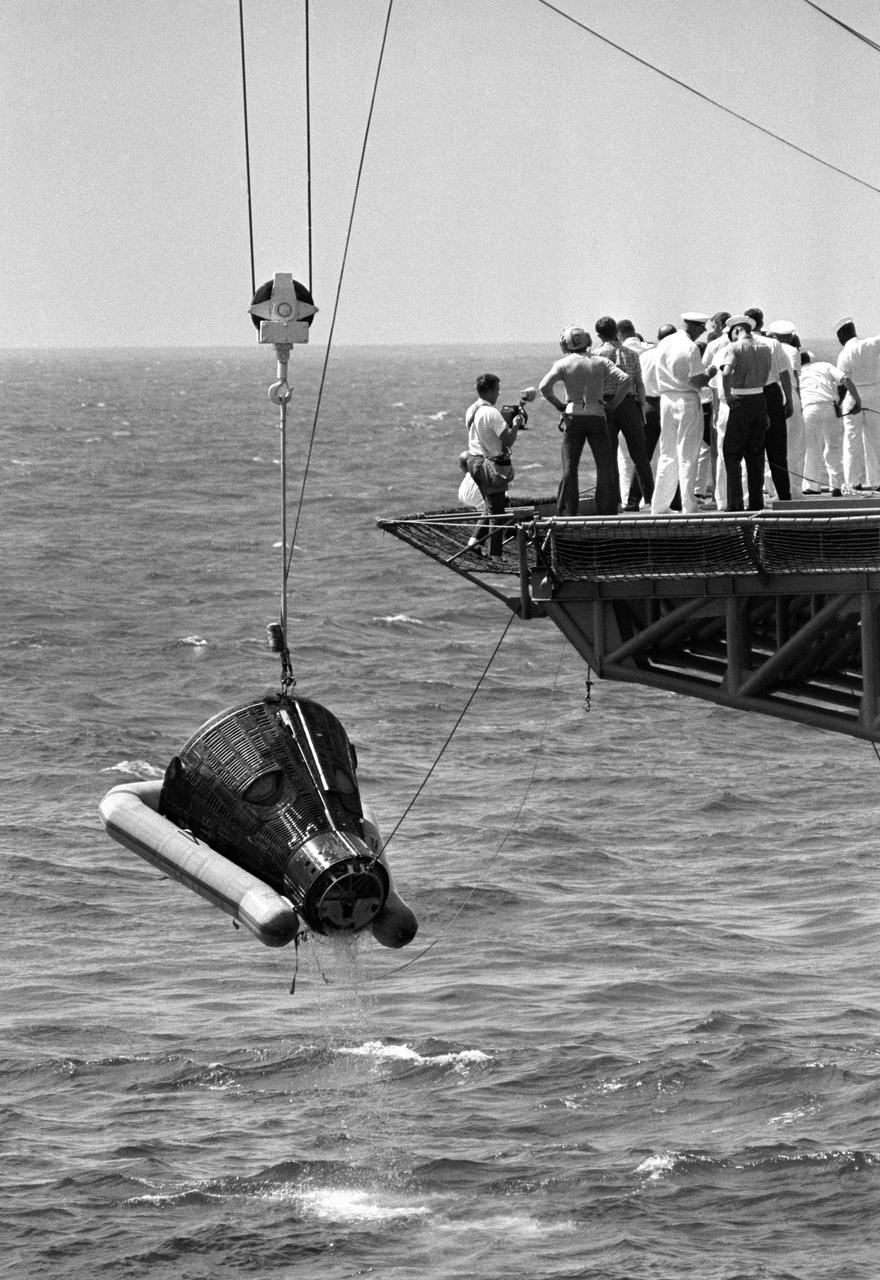
The Gemini-4 Astronauts is shown being hoisted aboard the aircraft carrier USS Wasp. The flotation collar is still attached to the spacecraft. DOWNRANGE RECOVERY AREA, ATLANTIC OCEAN B&W
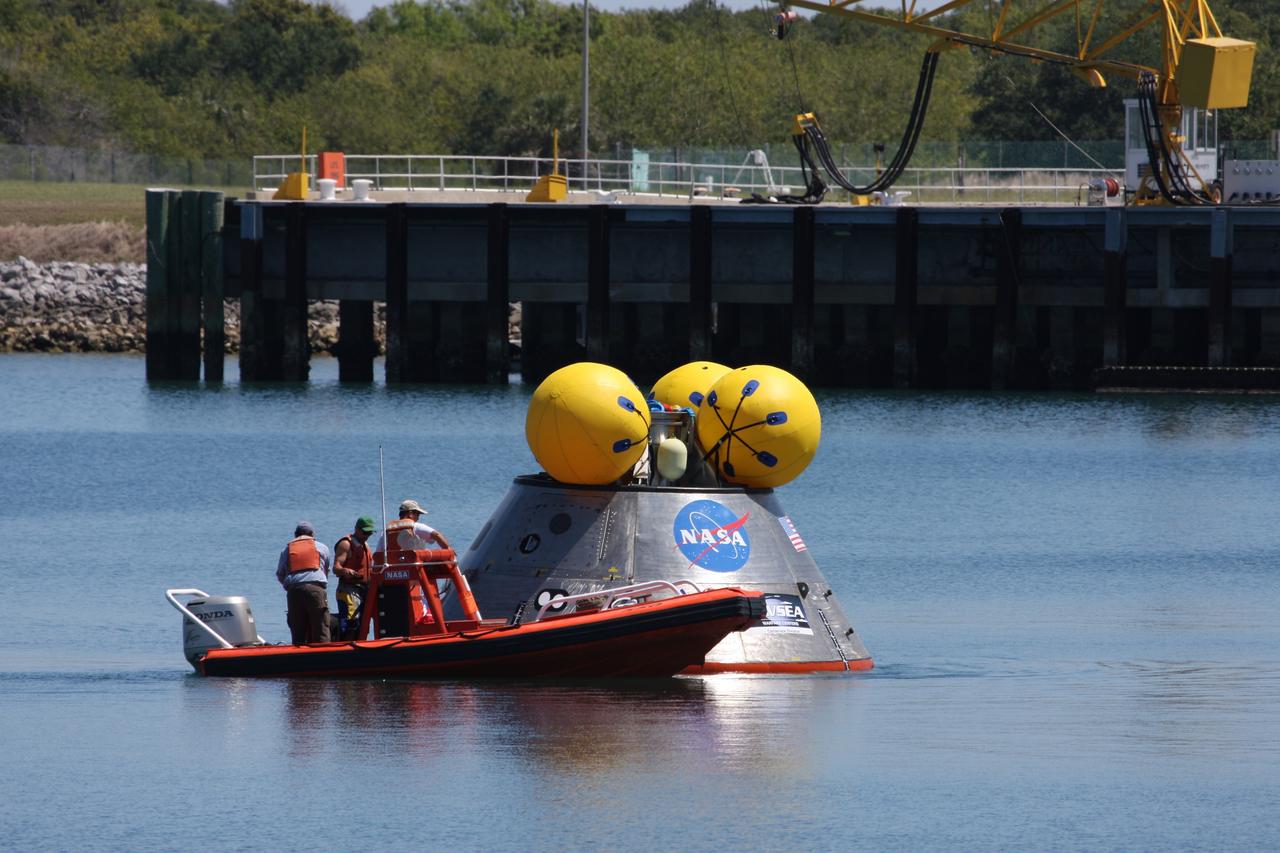
CAPE CANAVERAL, Fla. – Members of the 920th Rescue Wing get ready to release a flotation collar around the mockup Orion crew exploration vehicle at the Trident Basin at Port Canaveral, Fla. On top of Orion are additional flotation devices. The goal of the operation, dubbed the Post-landing Orion Recovery Test, or PORT, is to determine what kind of motion astronauts can expect after landing, as well as outside conditions for recovery teams. Orion is targeted to begin carrying humans to the International Space Station in 2015 and to the moon by 2020. Orion, along with the Ares I and V rockets and the Altair lunar lander, are part of the Constellation Program. Photo credit: NASA/Dimitri Gerondidakis
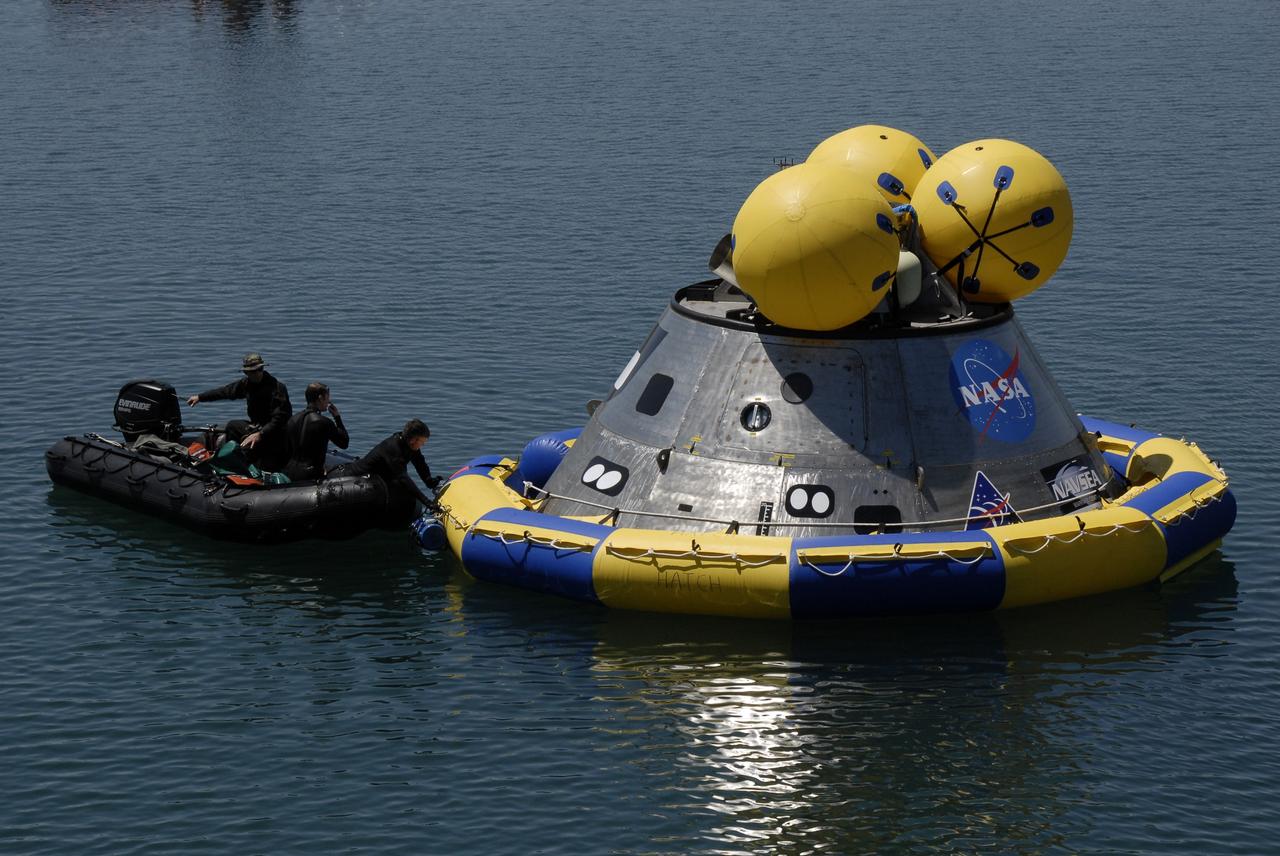
CAPE CANAVERAL, Fla. – Members of the 920th Rescue Wing secure a flotation collar around the mockup Orion crew exploration vehicle at the Trident Basin at Port Canaveral, Fla. On top of Orion are additional flotation devices. The mockup vehicle will undergo testing in open water. The goal of the operation, dubbed the Post-landing Orion Recovery Test, or PORT, is to determine what kind of motion astronauts can expect after landing, as well as outside conditions for recovery teams. Orion is targeted to begin carrying humans to the International Space Station in 2015 and to the moon by 2020. Orion, along with the Ares I and V rockets and the Altair lunar lander, are part of the Constellation Program. Photo credit: NASA/Kim Shiflett
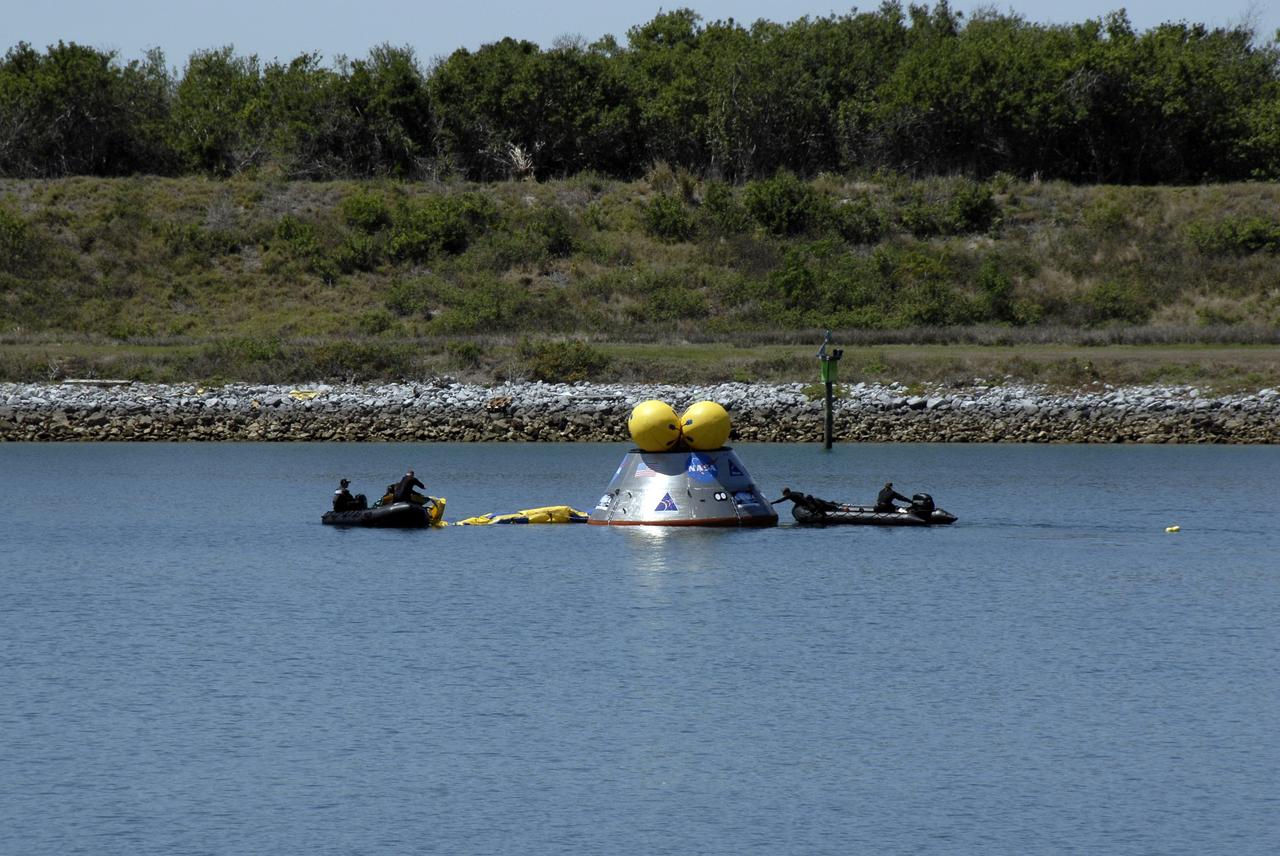
CAPE CANAVERAL, Fla. – Members of the 920th Rescue Wing release a flotation collar around the mockup Orion crew exploration vehicle at the Trident Basin at Port Canaveral, Fla. On top of Orion are additional flotation devices. The mockup vehicle will undergo testing in open water. The goal of the operation, dubbed the Post-landing Orion Recovery Test, or PORT, is to determine what kind of motion astronauts can expect after landing, as well as outside conditions for recovery teams. Orion is targeted to begin carrying humans to the International Space Station in 2015 and to the moon by 2020. Orion, along with the Ares I and V rockets and the Altair lunar lander, are part of the Constellation Program. Photo credit: NASA/Kim Shiflett
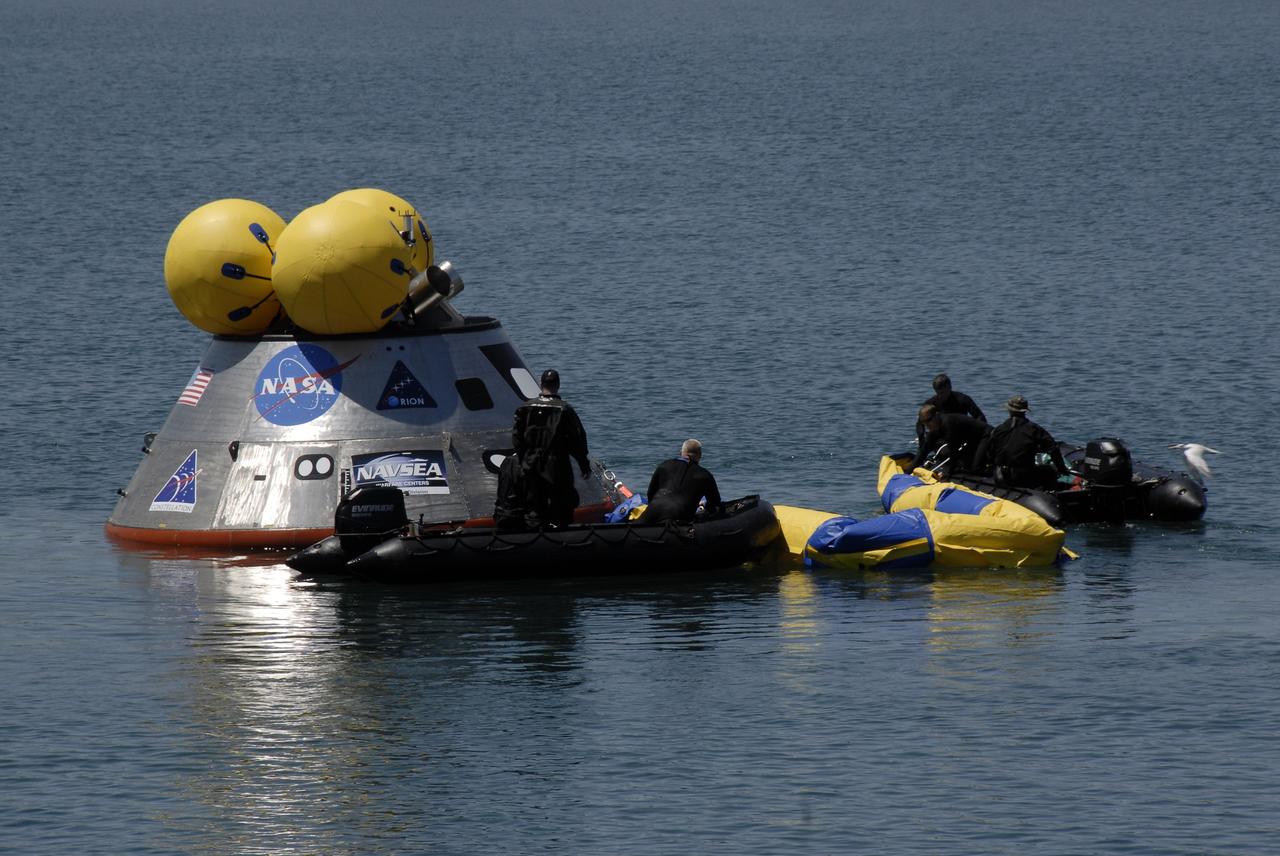
CAPE CANAVERAL, Fla. – Members of the 920th Rescue Wing release a flotation collar around the mockup Orion crew exploration vehicle at the Trident Basin at Port Canaveral, Fla. On top of Orion are additional flotation devices. The mockup vehicle will undergo testing in open water. The goal of the operation, dubbed the Post-landing Orion Recovery Test, or PORT, is to determine what kind of motion astronauts can expect after landing, as well as outside conditions for recovery teams. Orion is targeted to begin carrying humans to the International Space Station in 2015 and to the moon by 2020. Orion, along with the Ares I and V rockets and the Altair lunar lander, are part of the Constellation Program. Photo credit: NASA/Kim Shiflett
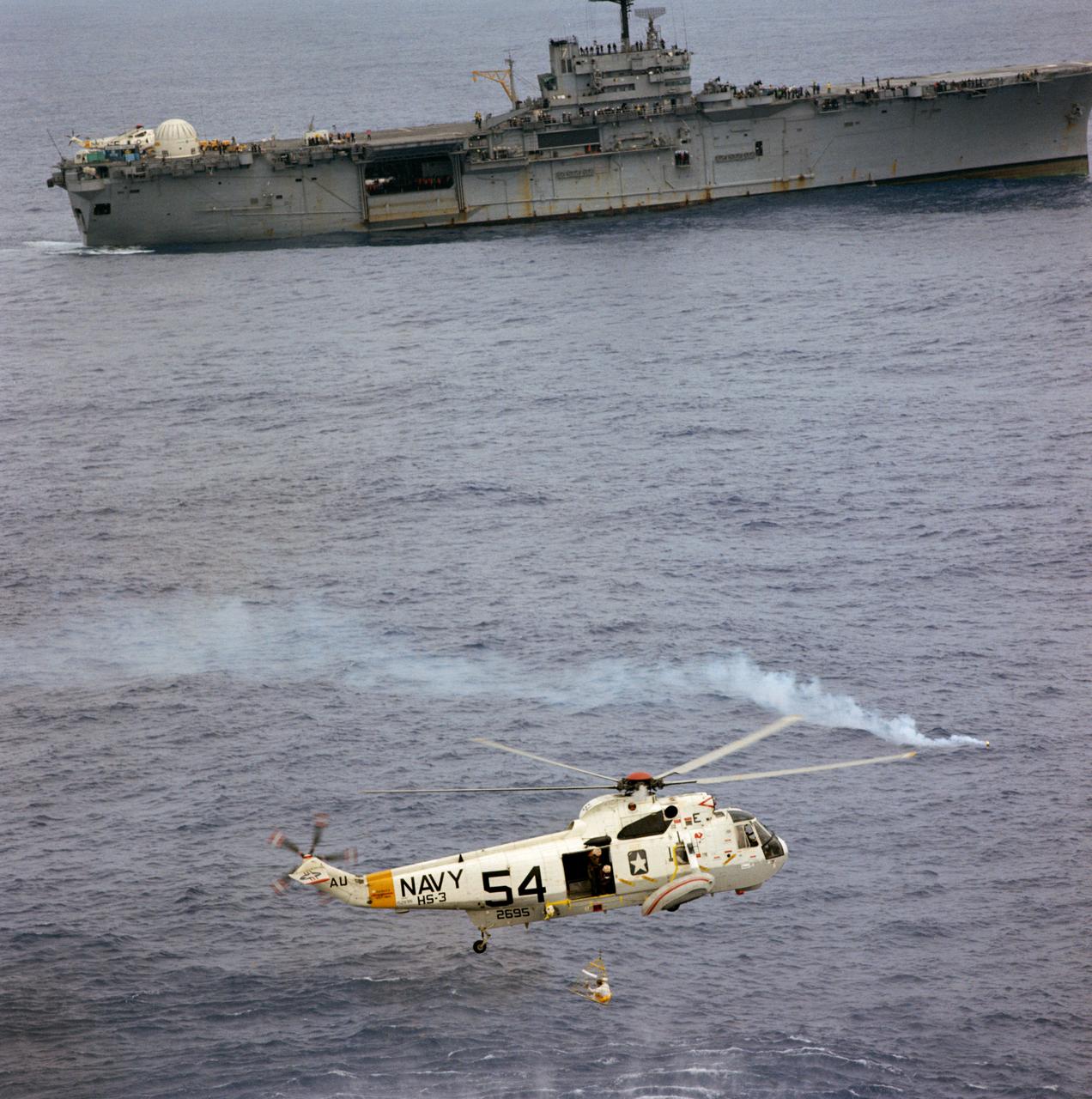
Aerial view of an Apollo 9 crewman in a new rescue net (a Billy Pugh net) being hoisted aboard a Navy helicopter after splashdown in the Atlantic recovery area and a successful ten-day, earth-orbital space mission. Navy divers have already attached a flotation collar to the command module and are assisting with recovery operations.
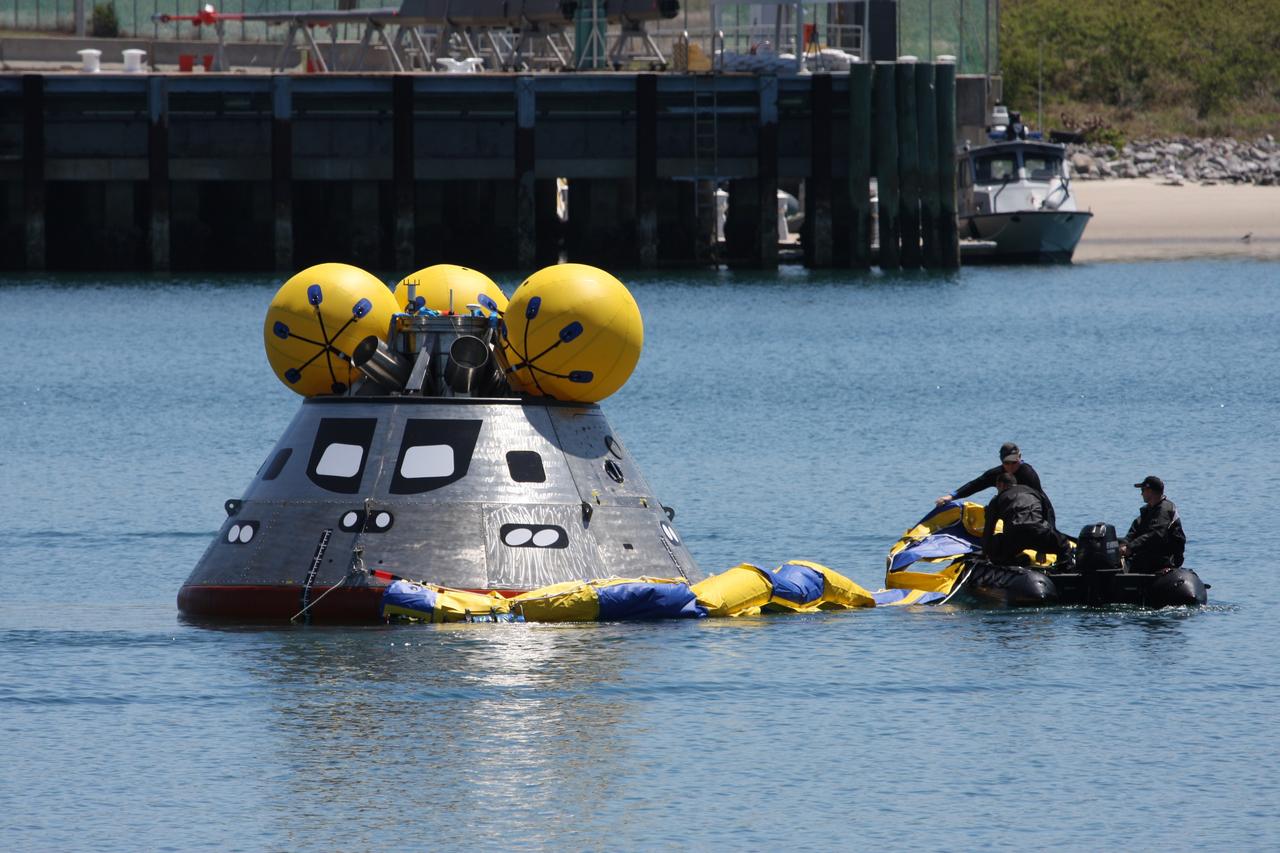
CAPE CANAVERAL, Fla. – Members of the 920th Rescue Wing release a flotation collar around the mockup Orion crew exploration vehicle at the Trident Basin at Port Canaveral, Fla. On top of Orion are additional flotation devices. The goal of the operation, dubbed the Post-landing Orion Recovery Test, or PORT, is to determine what kind of motion astronauts can expect after landing, as well as outside conditions for recovery teams. Orion is targeted to begin carrying humans to the International Space Station in 2015 and to the moon by 2020. Orion is targeted to begin carrying humans to the International Space Station in 2015 and to the moon by 2020. Orion, along with the Ares I and V rockets and the Altair lunar lander, are part of the Constellation Program. Photo credit: NASA/Dimitri Gerondidakis
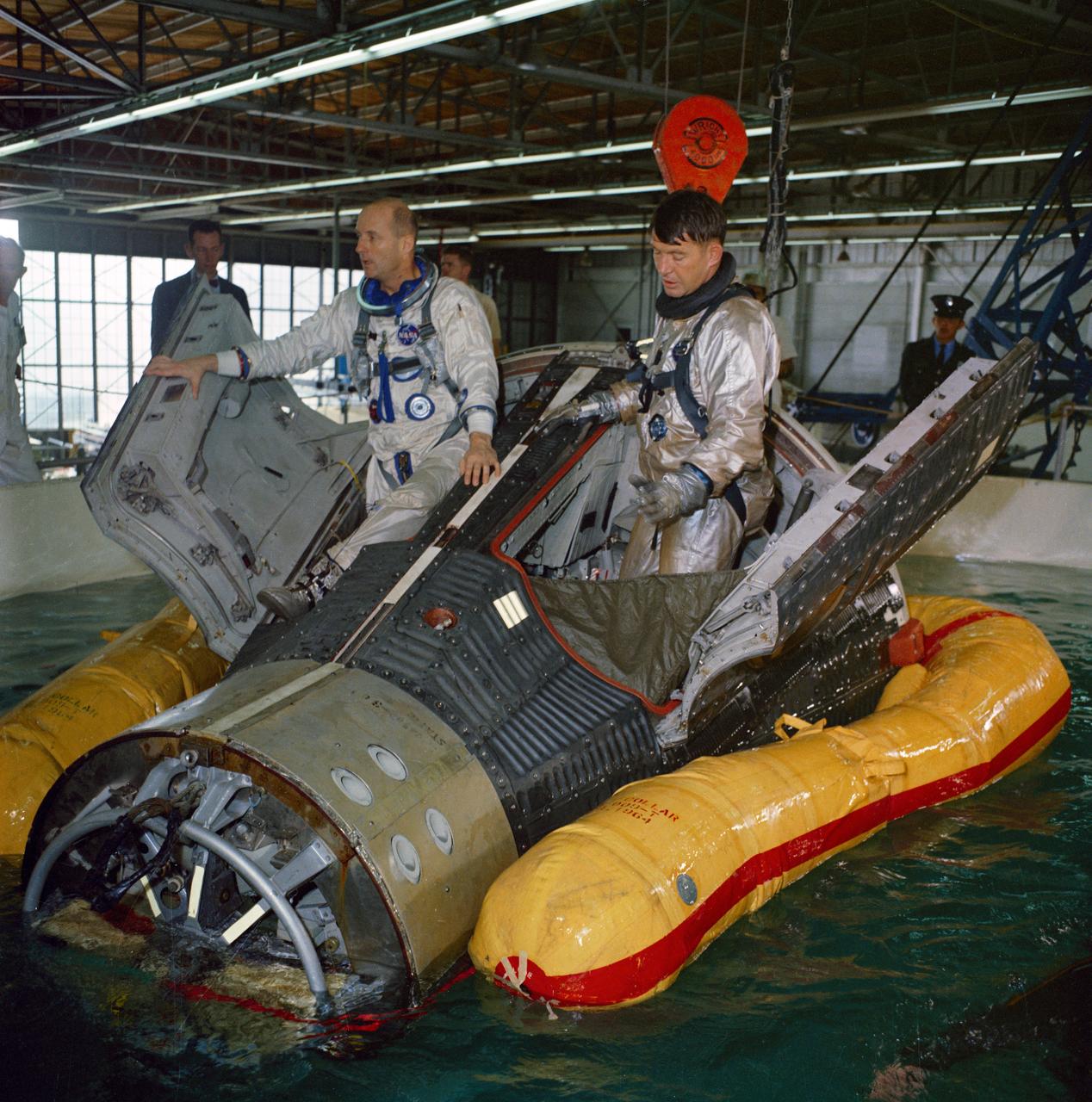
S65-10119 (1 Feb. 1965) --- The Gemini-6 prime crew, astronauts Thomas P. Stafford (left), pilot; and Walter M. Schirra Jr., command pilot, are pictured in a Gemini spacecraft, with flotation collar attached, during water egress training at Ellington Air Force Base, Texas. Photo credit: NASA or National Aeronautics and Space Administration

S66-18602 (16 March 1966) --- Astronauts Neil A. Armstrong and David R. Scott sit with their spacecraft hatches open while awaiting the arrival of the recovery ship, the USS Leonard F. Mason after the successful completion of their Gemini-8 mission. They are assisted by U.S. Navy divers. The overhead view shows the Gemini-8 spacecraft with the yellow flotation collar attached to stabilize the spacecraft in choppy seas. The green marker dye is highly visible from the air and is used as a locating aid. Photo credit: NASA
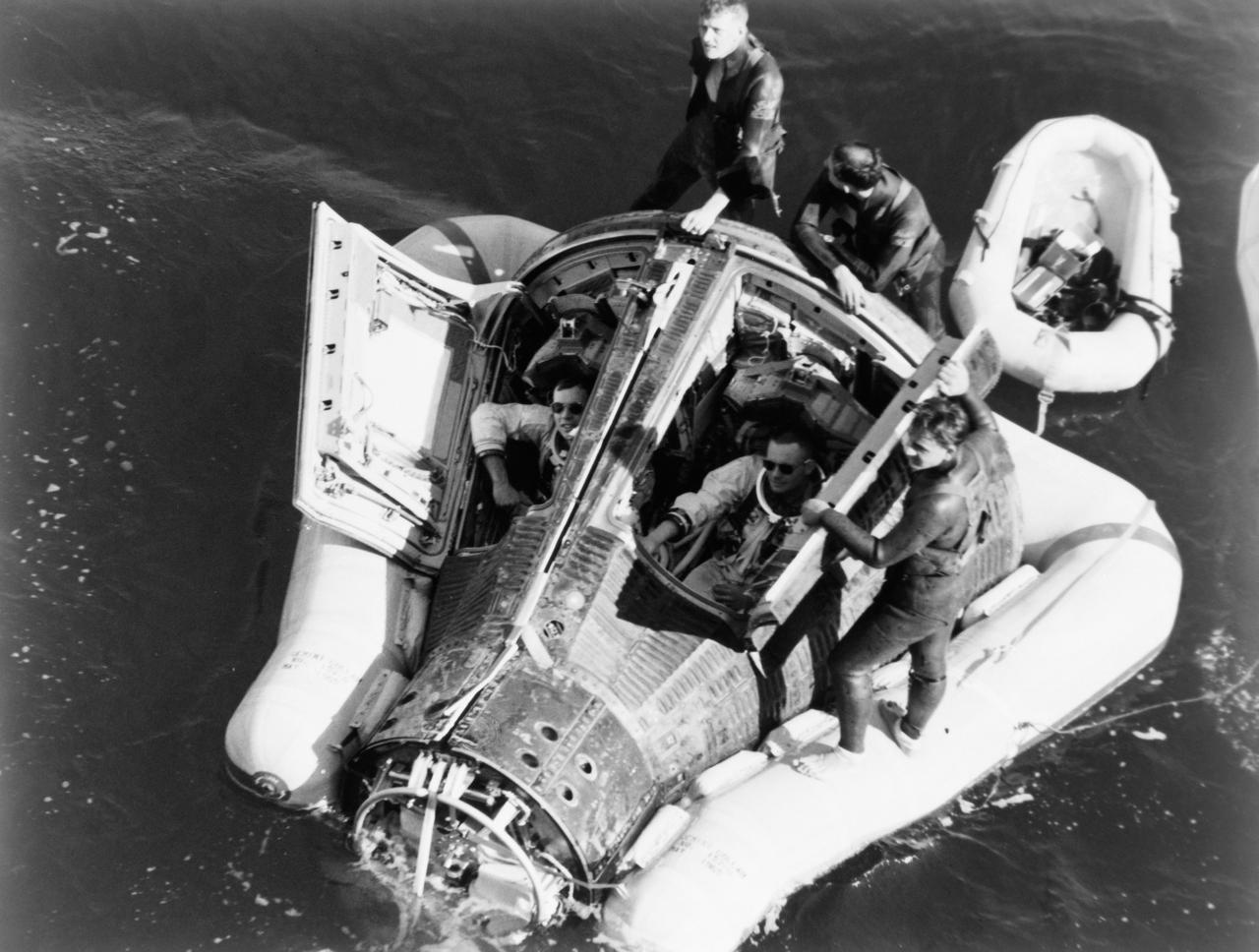
S66-18602_alt (16 March 1966) --- Astronauts Neil A. Armstrong and David R. Scott sit with their spacecraft hatches open while awaiting the arrival of the recovery ship, the USS Leonard F. Mason after the successful completion of their Gemini-8 mission. They are assisted by U.S. Navy divers. The overhead view shows the Gemini-8 spacecraft with the yellow flotation collar attached to stabilize the spacecraft in choppy seas. The green marker dye is highly visible from the air and is used as a locating aid. Photo credit: NASA
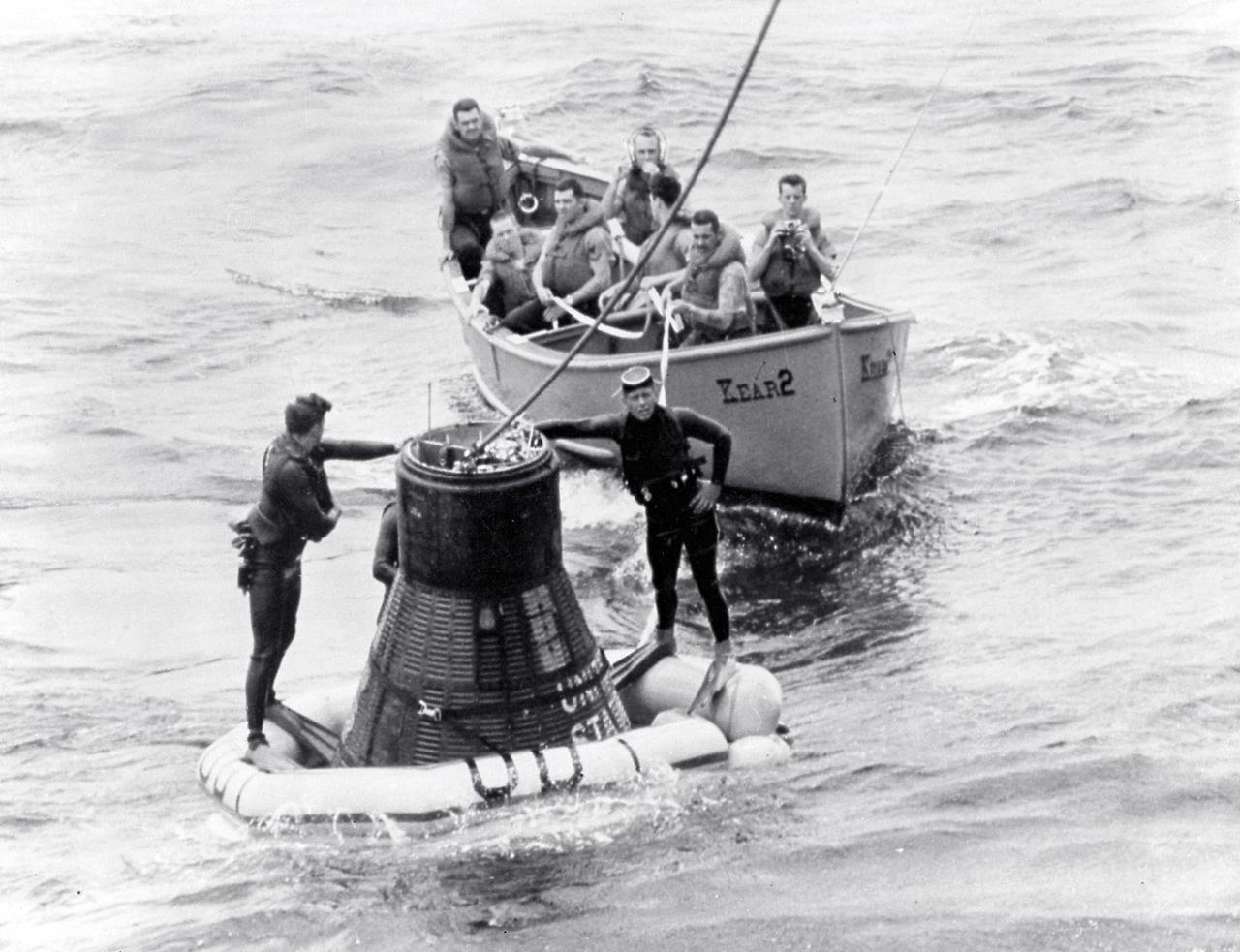
The recovery operation of the Faith 7 spacecraft after the completion of the 1-1/2 day orbital flight (MA-9 mission) with Astronaut Gordon Cooper. Navy frogmen attach the flotation collar to the spacecraft. The MA-9 mission was the last flight of the Mercury Project and launched on May 15, 1963 boosted by The Mercury-Atlas launch vehicle.
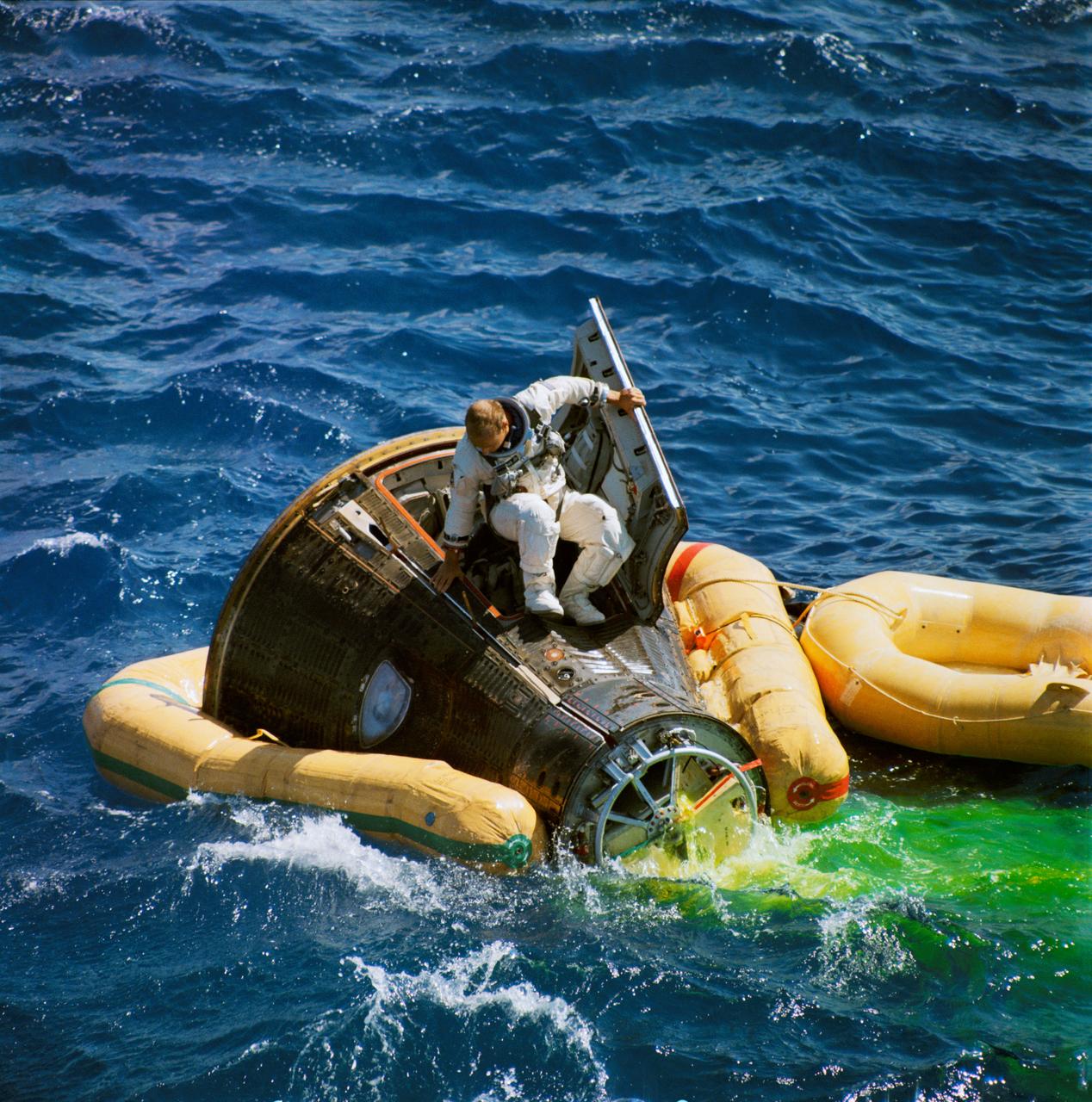
S66-50767 (15 Sept. 1966) --- Astronaut Charles Conrad Jr., command pilot of the Gemini-11 spaceflight, climbs from the spacecraft minutes after splashdown. Astronaut Richard F. Gordon Jr., pilot, still has his hatch closed. A U.S. Navy frogman team attached a flotation collar to the spacecraft. A recovery helicopter from the USS Guam picked up the two astronauts. Photo credit: NASA
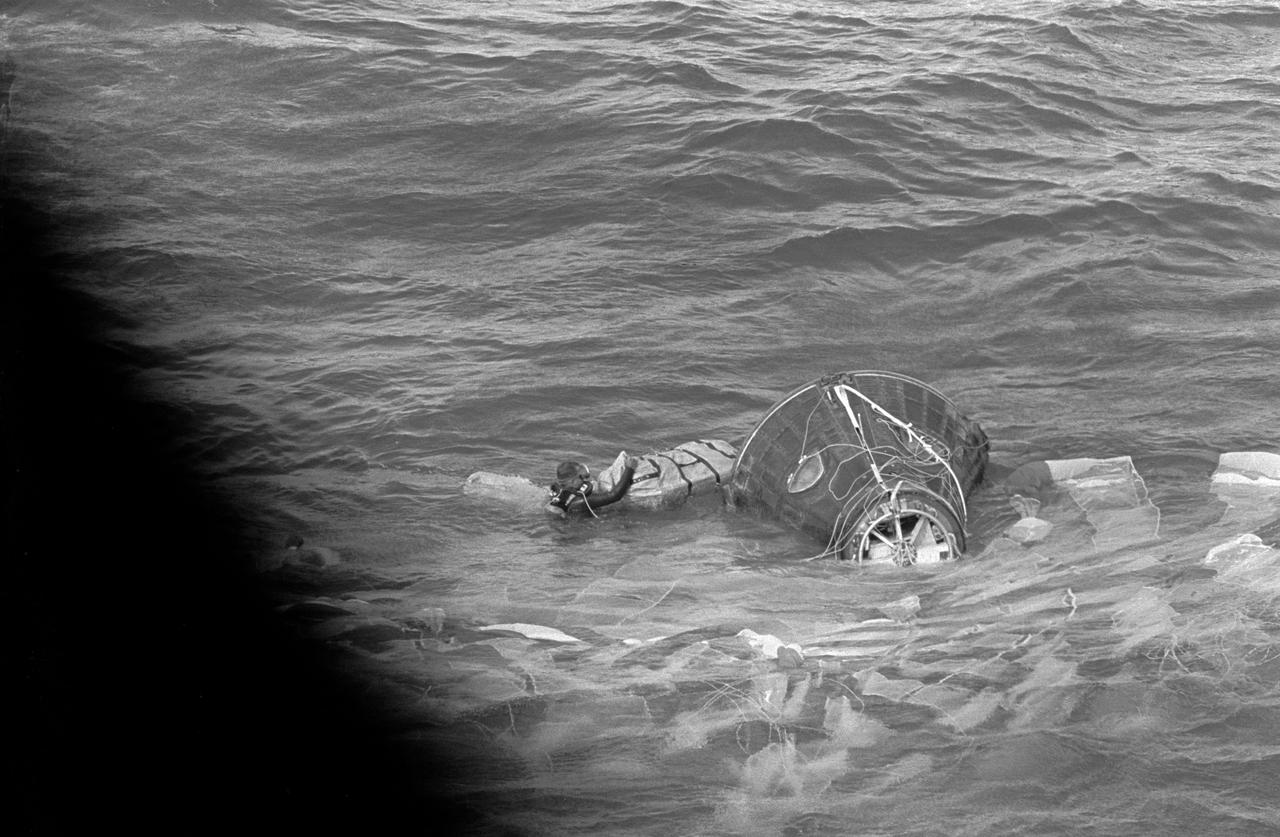
S66-42794 (21 July 1966) --- Navy frogmen prepare to attach a flotation collar to the Gemini-10 spacecraft as it bobs in the Atlantic Ocean following its successful splashdown. Inside the spacecraft are astronauts John W. Young, command pilot, and Michael Collins, pilot, waiting to egress the spacecraft for recovery by helicopter from the prime recovery ship, USS Guadalcanal. Photo credit: NASA
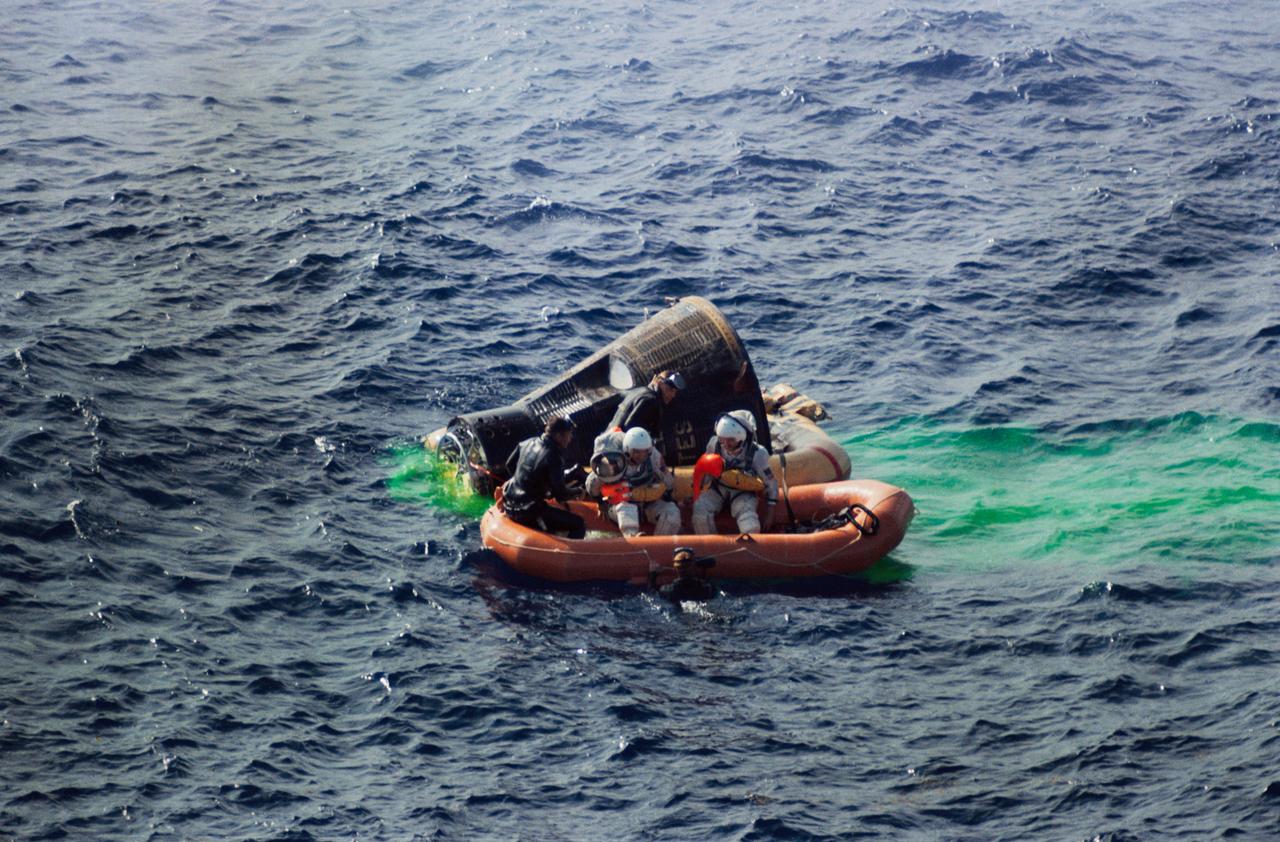
S65-63690 (18 Dec. 1965) --- Astronauts Frank Borman, command pilot, and James A. Lovell Jr., pilot, sit in life raft while awaiting pickup by a helicopter from the aircraft carrier USS Wasp. The three-man Navy frogman team attached the flotation collar to increase the Gemini-7 spacecraft's buoyancy prior to recovery. Photo credit: NASA

S67-49423 (9 Nov. 1967) --- The Apollo Spacecraft 017 Command Module, with flotation collar still attached, is hoisted aboard the USS Bennington, prime recovery ship for the Apollo 4 (Spacecraft 017/Saturn 501) unmanned, Earth-orbital space mission. The Command Module splashed down at 3:37 p.m. (EST), Nov. 9, 1967, 934 nautical miles northwest of Honolulu, Hawaii, in the mid-Pacific Ocean. Note charred heat shield caused by extreme heat of reentry.
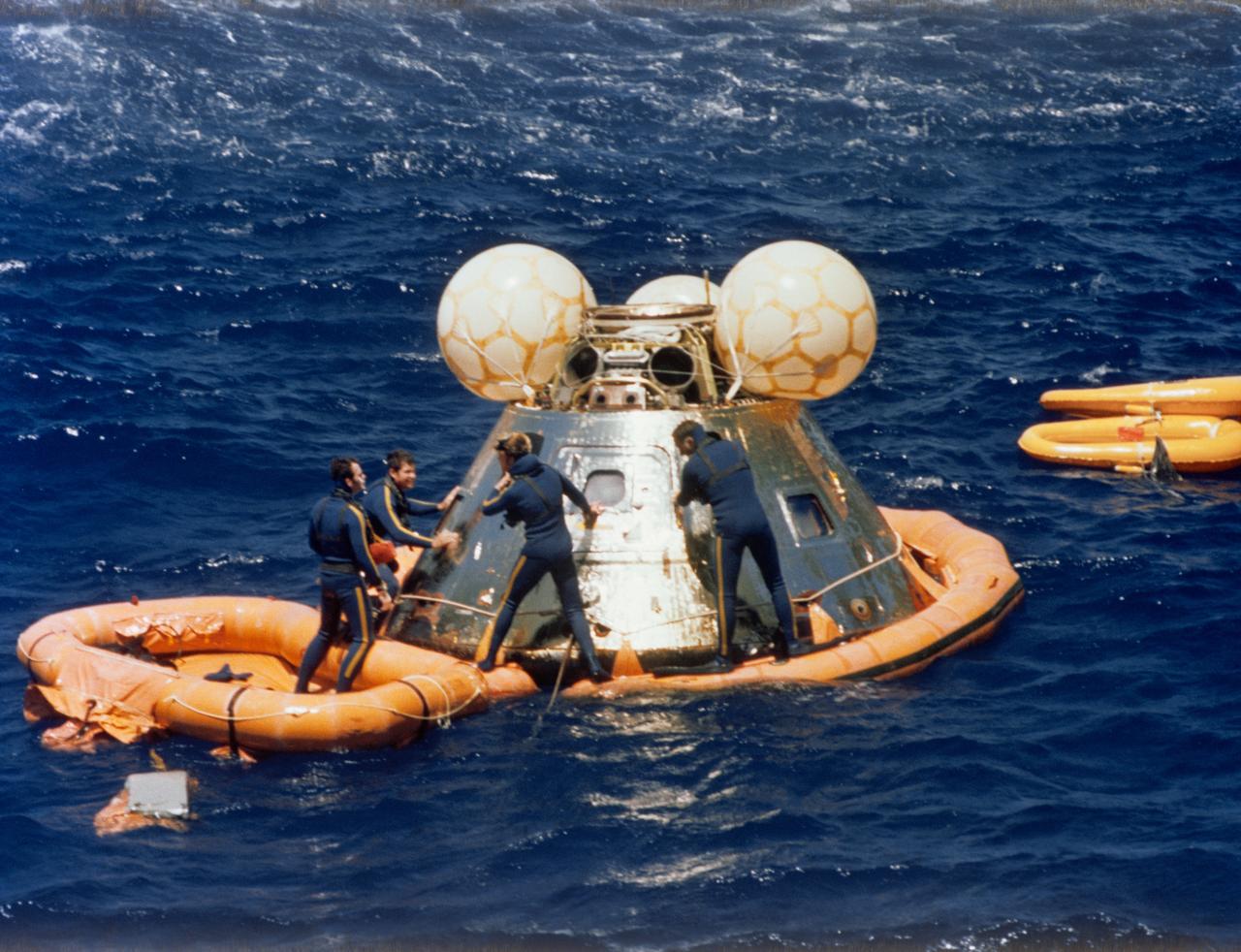
S75-29715 (24 July 1975) --- A team of U.S. Navy swimmers assists with the recovery of the ASTP Apollo Command Module following its splashdown in the Central Pacific Ocean to conclude the historic joint U.S.-USSR Apollo-Soyuz Test Project docking mission in Earth orbit. The swimmers have already attached a flotation collar to the spacecraft. The CM touched down in the Hawaiian Islands area at 4:18 p.m. (CDT), July 24, 1975. The crewmen, astronauts Thomas P. Stafford, Vance D. Brand and Donald K. Slayton, remained in the CM until it was hoisted aboard the prime recovery ship, the USS New Orleans.
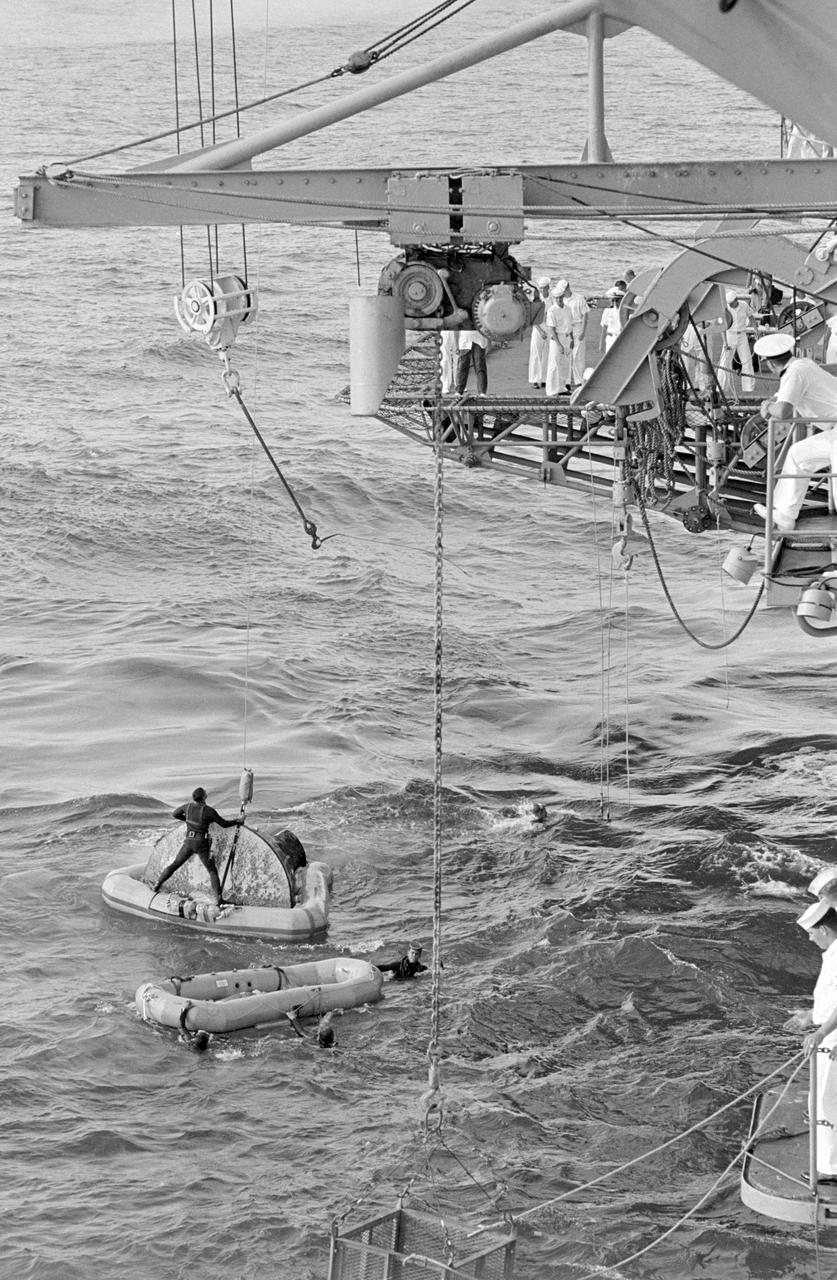
S66-42790 (21 July 1966) --- The Gemini-10 spacecraft, with flotation collar still attached, is prepared for hoisting aboard the prime recovery ship, USS Guadalcanal. Navy frogmen assist in the recovery operations. Astronauts John W. Young, command pilot, and Michael Collins, pilot, prime crew for the Gemini-10 spaceflight, had already been picked up by helicopter and flown to the Guadalcanal. Gemini-10 splashed down 460 nautical miles east of Cape Kennedy at 4:07 p.m. (EST), July 21, 1966, to conclude a three-day mission in space. Photo credit: NASA
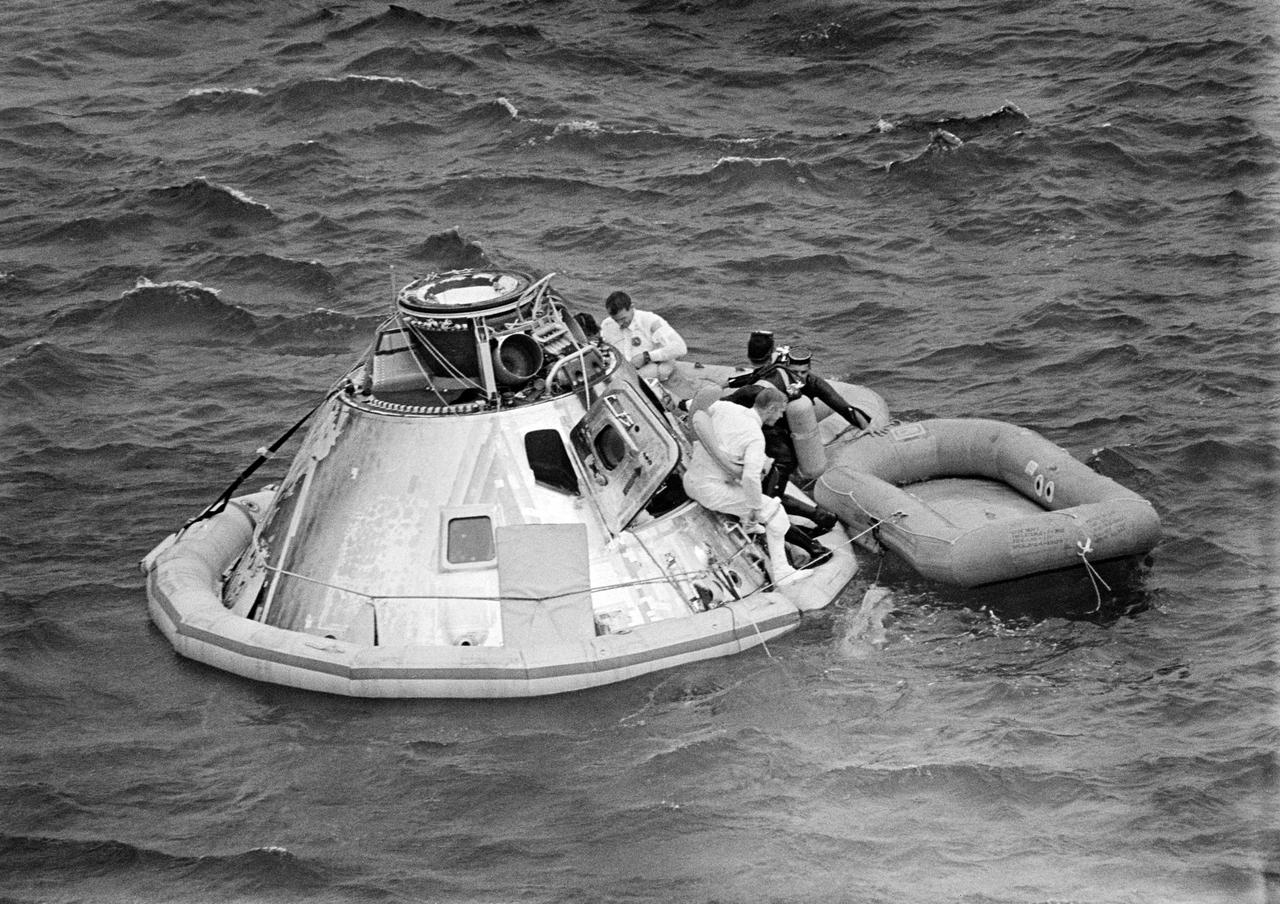
S69-27468 (13 March 1969) --- U.S. Navy underwater demolition team swimmers assist the Apollo 9 crew during recovery operations just after splashdown. They have already attached a flotation collar to the Command Module (CM). Astronaut Russell L. Schweickart, lunar module pilot, is about to climb into raft. In background is astronaut David R. Scott, command module pilot. Still inside the spacecraft is astronaut James A. McDivitt, commander. Splashdown occurred at 12:00:53 p.m. (EST), March 13, 1969, only 4.5 nautical miles from the prime recovery ship, USS Guadalcanal, to conclude a successful 10-day Earth-orbital mission in space.
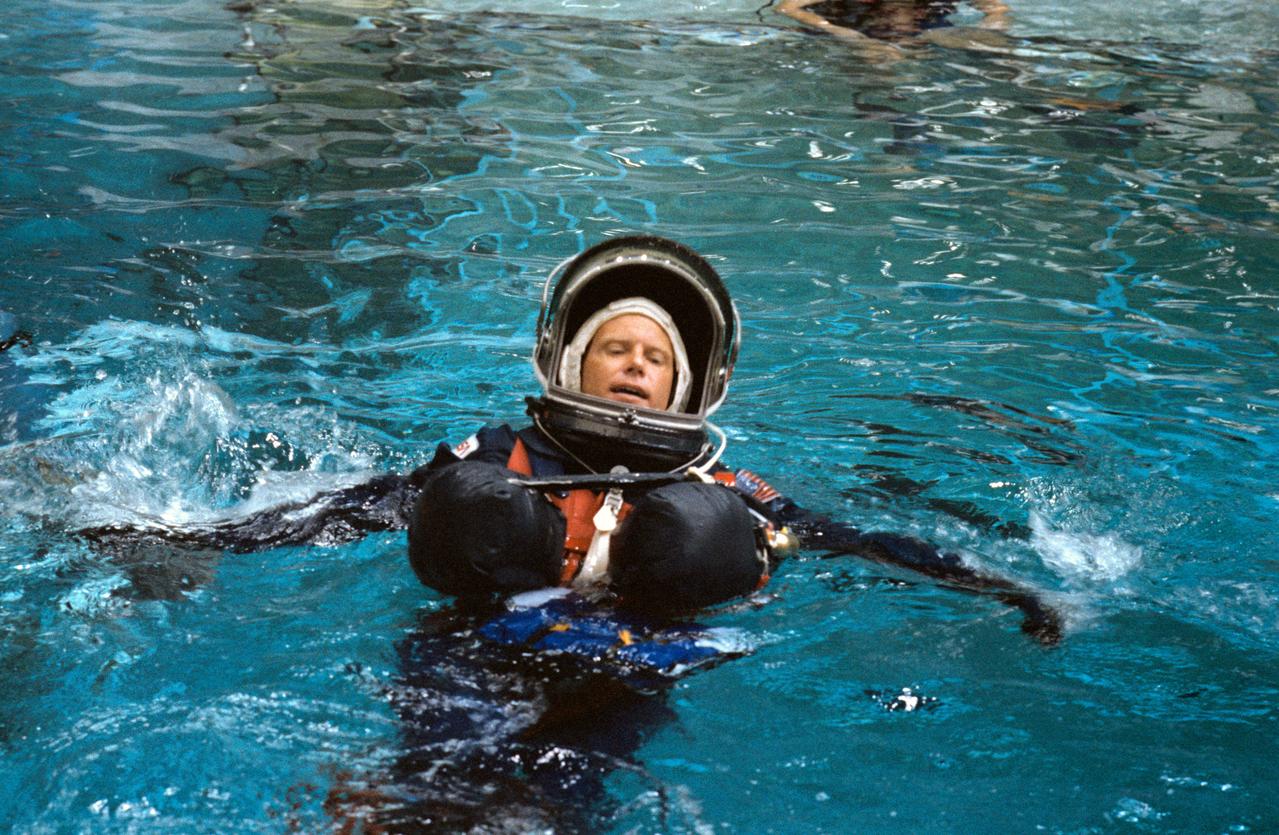
S88-42409 (20 July 1988) --- STS-26 Discovery, Orbiter Vehicle (OV) 103, Mission Specialist (MS) George D. Nelson participates in crew escape system (CES) testing in JSC Weightless Environment Training Facility (WETF) Bldg 29. Nelson, wearing the newly designed (navy blue) launch and entry suit (LES), floats in WETF pool with the aid of an underarm flotation device (modern version of Mas West floats). He awaits the assistance of SCUBA-equipped divers during a simulation of escape and rescue operations utilizing a new CES pole for emergency exit from the Space Shuttle.
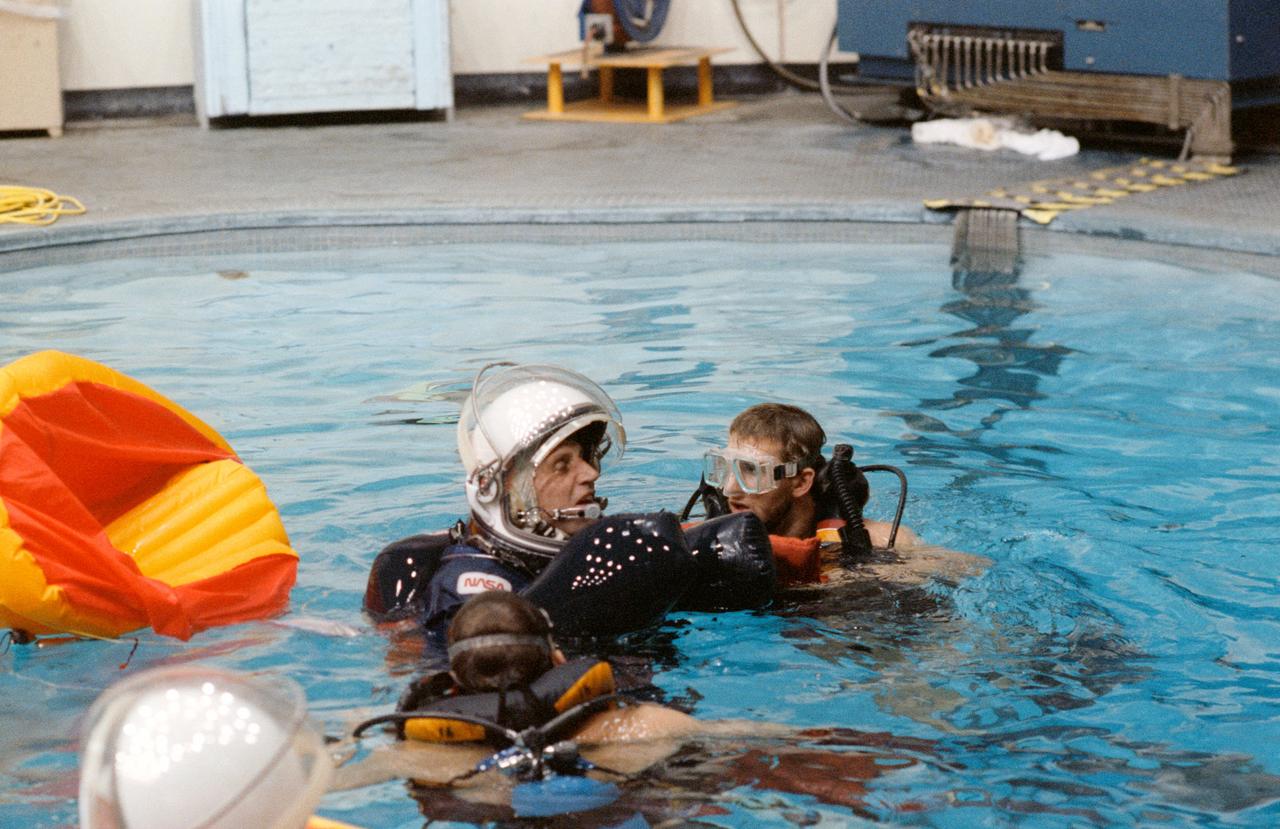
S91-51995 (26 Nov 1991) --- Astronaut David C. Hilmers, STS-42 mission specialist, wearing launch and entry suit (LES) and launch and entry helmet (LEH), floats in the water with the aid of an underarm flotation device as SCUBA-equipped divers look on. Behind Hilmers is his yellow and orange single person life raft. Hilmers is rehearsing launch emergency egress (bailout) procedures in the Johnson Space Center?s (JSC) Weightless Environment Training Facility (WETF) Bldg 29. The crewmembers would use this equipment in the event of an emergency bailout over water. The WETF's 25 ft deep pool is used to simulate the ocean.
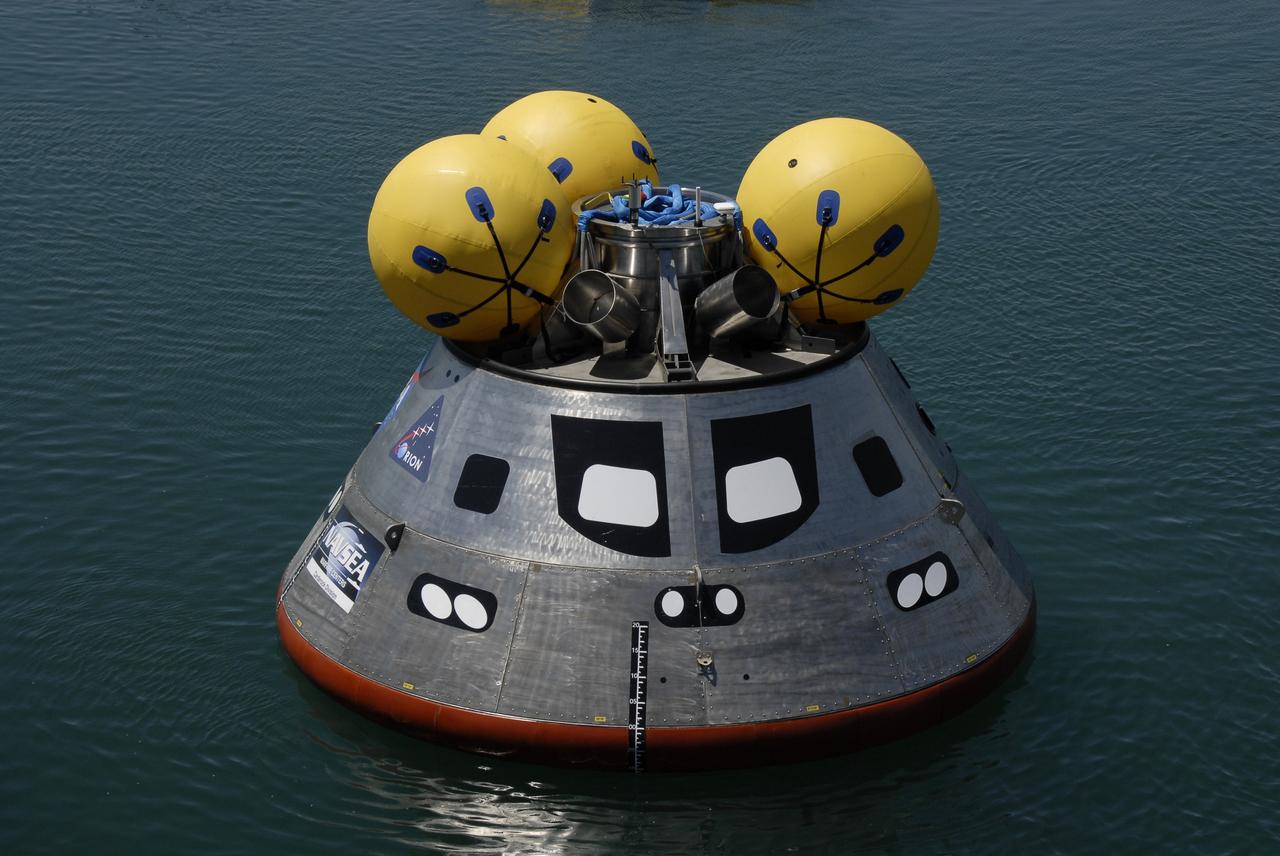
CAPE CANAVERAL, Fla. – The mockup Orion crew exploration vehicle floats in the water at the Trident Basin at Port Canaveral, Fla. On top of Orion are additional flotation devices. Orion is targeted to begin carrying humans to the International Space Station in 2015 and to the moon by 2020. The mockup vehicle is undergoing testing in open water. The goal of the operation, dubbed the Post-landing Orion Recovery Test, or PORT, is to determine what kind of motion astronauts can expect after landing, as well as outside conditions for recovery teams. Orion, along with the Ares I and V rockets and the Altair lunar lander, are part of the Constellation Program. Photo credit: NASA/Kim Shiflett
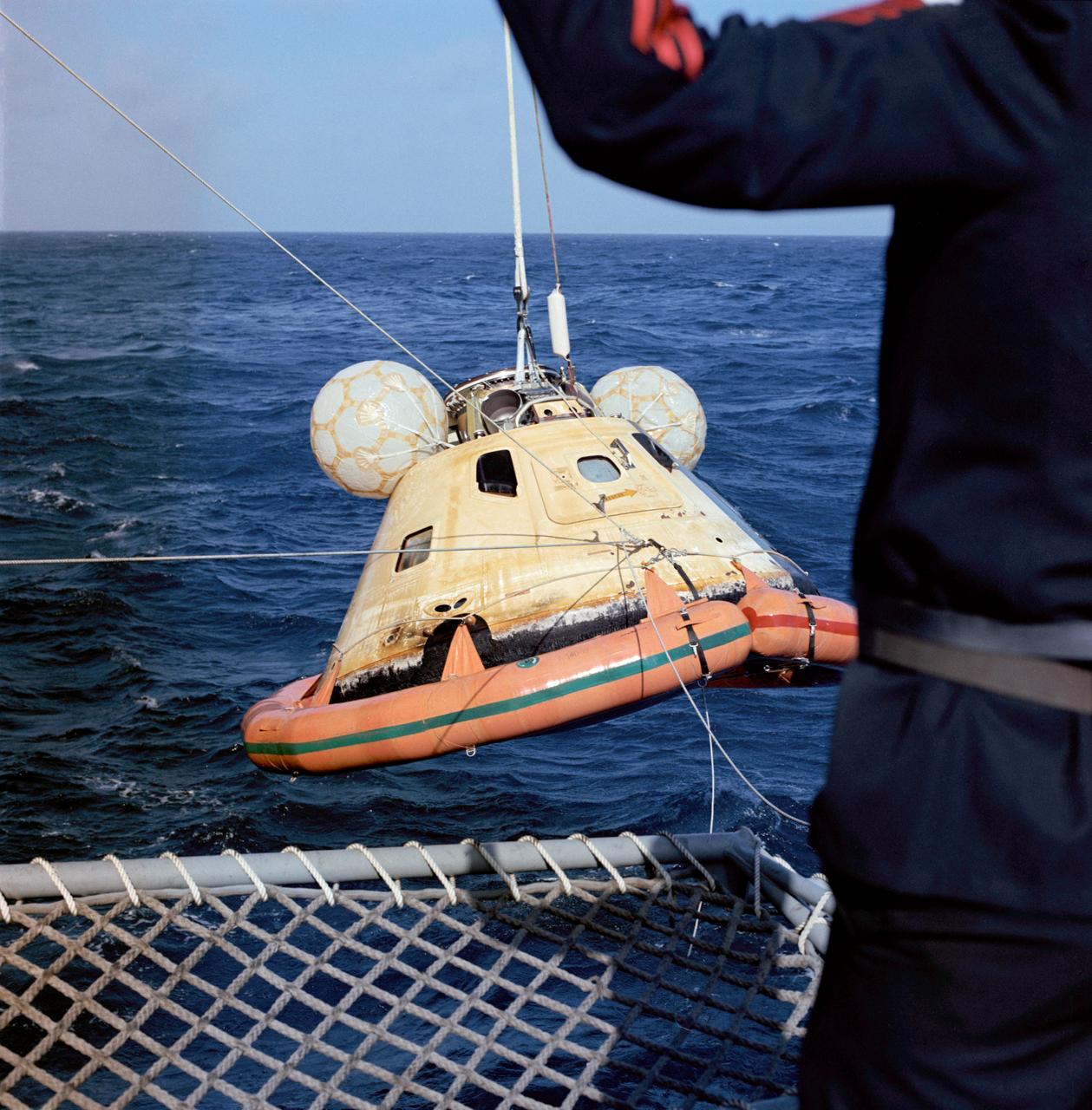
S73-36423 (25 Sept. 1973) --- The Skylab 3 Command Module, with astronauts Alan L. Bean, Owen K. Garriott and Jack R. Lousma still inside, is hoisted aboard the prime recovery ship, USS New Orleans, during recovery operations in the Pacific Ocean. The three crewmen had just completed a successful 59-day visit to the Skylab space station in Earth orbit. The Command Module splashed down in the Pacific about 230 miles southwest of San Diego, California. Earlier in the recovery operations a team of U.S. Navy swimmers attached the flotation collar to the spacecraft to improve its buoyancy. Photo credit: NASA
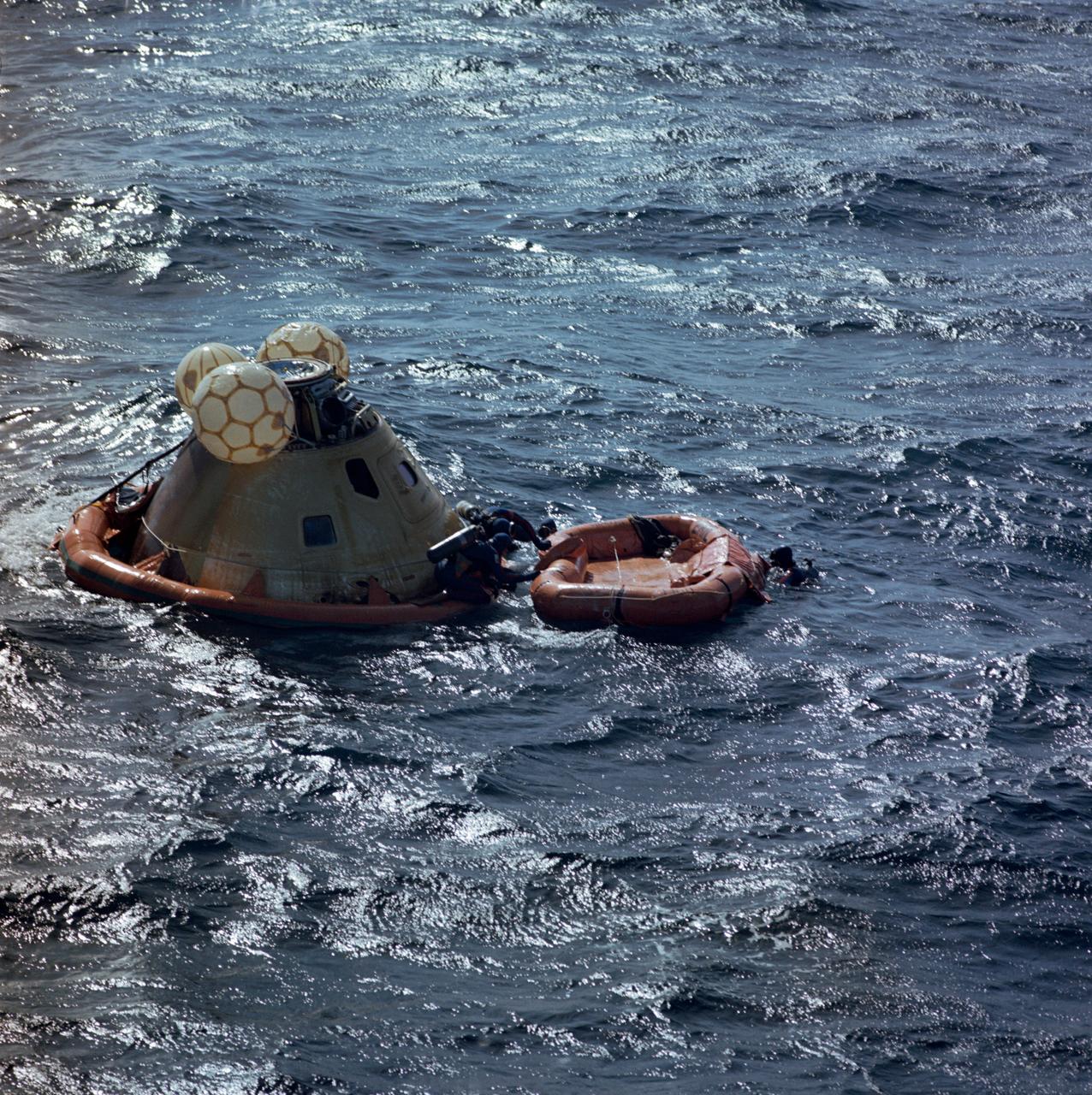
S73-36401 (25 Sept. 1973) --- A team of U.S. Navy swimmers assists with the recovery of the Skylab 3 Command Module following its splashdown in the Pacific Ocean about 230 miles southwest of San Diego, California. The swimmers had just attached a flotation collar to the spacecraft to improve its buoyancy. Aboard the Command Module were astronauts Alan L. Bean, Owen K. Garriott and Jack R. Lousma, who had just completed a successful 59-day visit to the Skylab space station in Earth orbit. Minutes later the Command Module with the three crewmen still inside was hoisted aboard the prime recovery ship, the USS New Orleans. Photo credit: NASA
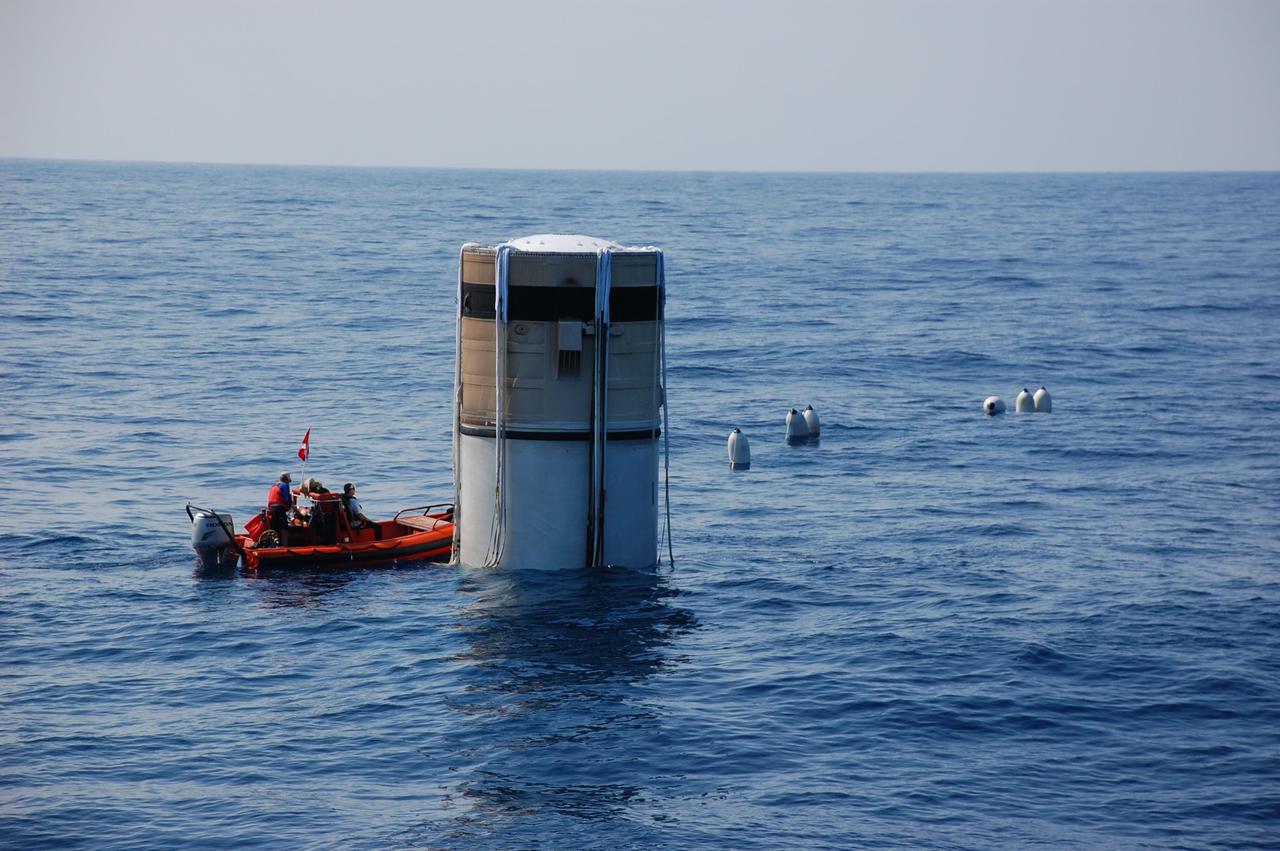
CAPE CANAVERAL, Fla. -- Crew members from Freedom Star, one of NASA's solid rocket booster retrieval ships, have attached a line, held up by flotation devices, between the left spent booster parachute and the ship. The shuttle’s two solid rocket booster casings and associated flight hardware are recovered in the Atlantic Ocean after every launch by Liberty Star and Freedom Star. The boosters impact the Atlantic about seven minutes after liftoff and the retrieval ships are stationed about 10 miles from the impact area at the time of splashdown. After the spent segments are processed, they will be transported to Utah, where they will be refurbished and stored, if needed. Photo credit: NASA/Ben Smegelsky
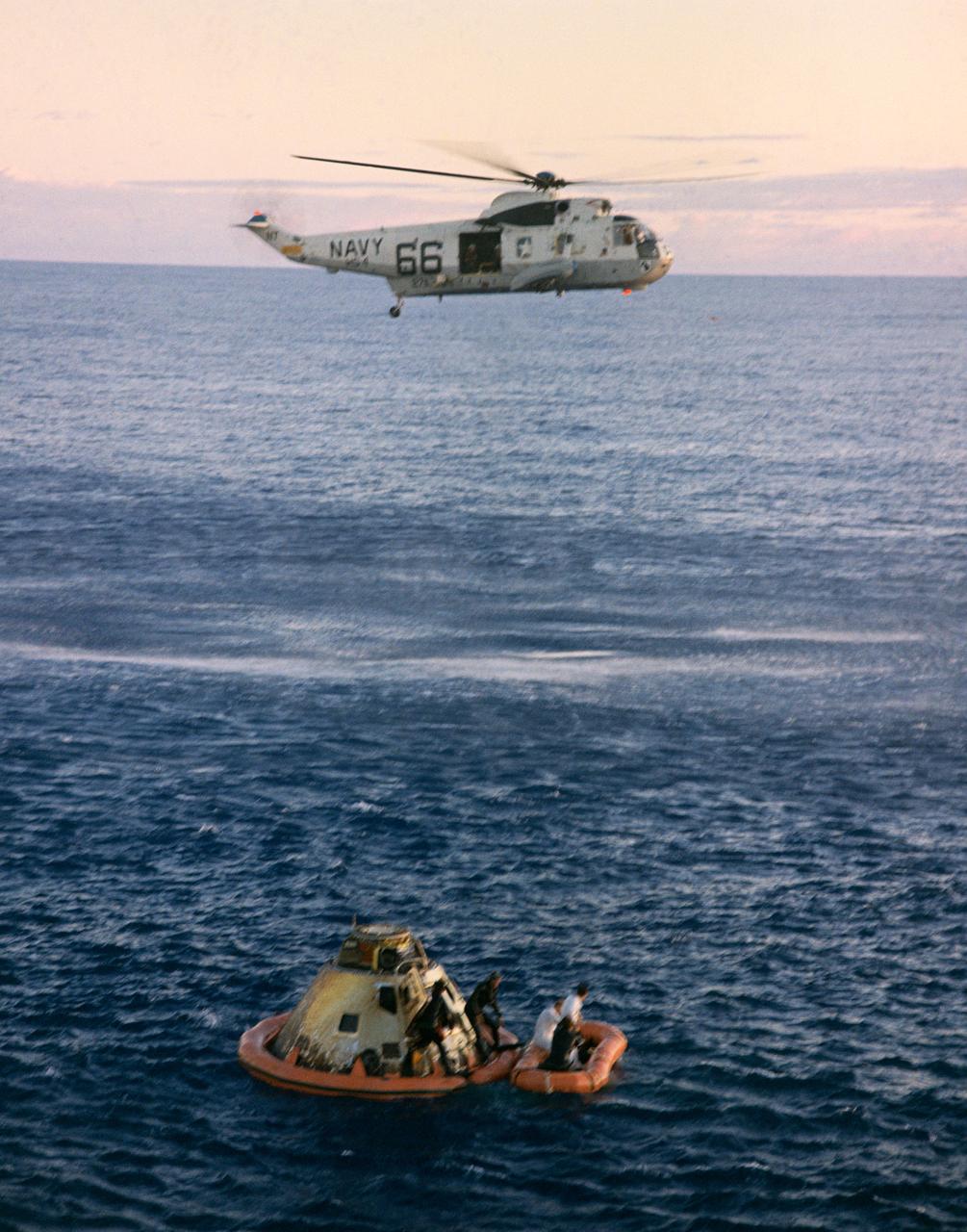
S69-21036 (26 May 1969) --- A Navy helicopter arrives to recover the Apollo 10 astronauts, seen entering a life raft, as their spacecraft floats in the South Pacific immediately after touchdown. U.S. Navy underwater demolition team swimmers assist in the recovery operations. Already in the life raft are astronauts Thomas P. Stafford (left), commander, and John W. Young (right), command module pilot. Splashdown occurred at 11:53 a.m., May 26, 1969, about 400 miles east of American Samoa and about four miles from the recovery ship to conclude a successful eight-day lunar orbit mission. Note that in this photo the divers have attached a flotation collar to the spacecraft.

S72-56147 (19 Dec. 1972) --- A water-level view of the Apollo 17 Command Module (CM) floating in the Pacific Ocean following splashdown and prior to recovery. The prime recovery ship, the USS Ticonderoga, is in the background. When this picture was taken, the three-man crew of astronauts Eugene A. Cernan, Ronald E. Evans and Harrison H. Schmitt, had already been picked up by helicopter and flown to the deck of the recovery ship. The spacecraft was later hoisted aboard the USS Ticonderoga. A United States Navy UDT swimmer stands on the flotation collar. Apollo 17 splashdown occurred at 1:24:59 p.m. (CST), Dec. 19, 1972, about 350 nautical miles southeast of Samoa.
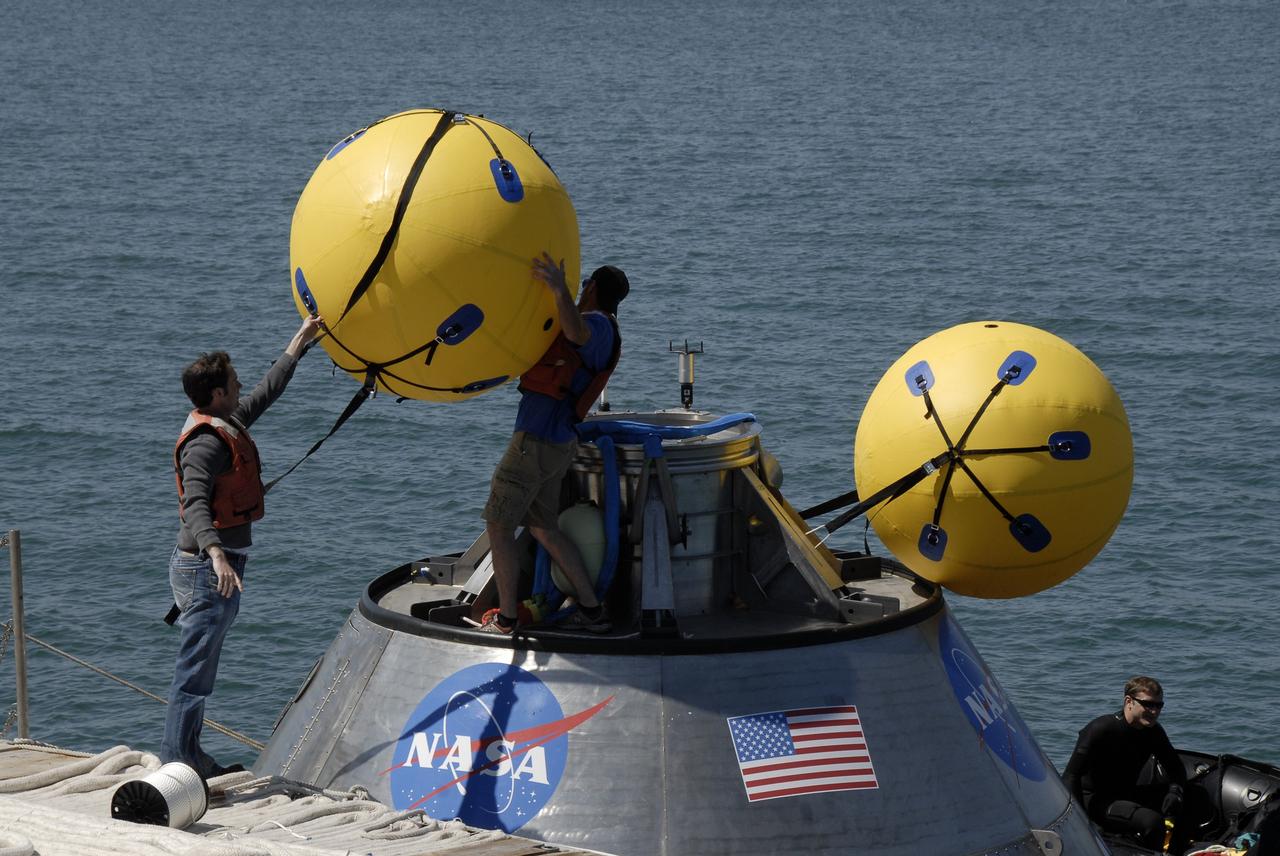
CAPE CANAVERAL, Fla. – Flotation devices are attached to the top of the mockup Orion crew exploration vehicle before the testing in the open water at the Trident Basin at Port Canaveral, Fla. The mockup vehicle will undergo testing in open water. The goal of the operation, dubbed the Post-landing Orion Recovery Test, or PORT, is to determine what kind of motion astronauts can expect after landing, as well as outside conditions for recovery teams. Orion is targeted to begin carrying humans to the International Space Station in 2015 and to the moon by 2020. Orion, along with the Ares I and V rockets and the Altair lunar lander, are part of the Constellation Program. Photo credit: NASA/Kim Shiflett

S68-26989 (4 April 1968) --- The Apollo 6 Spacecraft 020 Command Module is hoisted aboard the USS Okinawa.
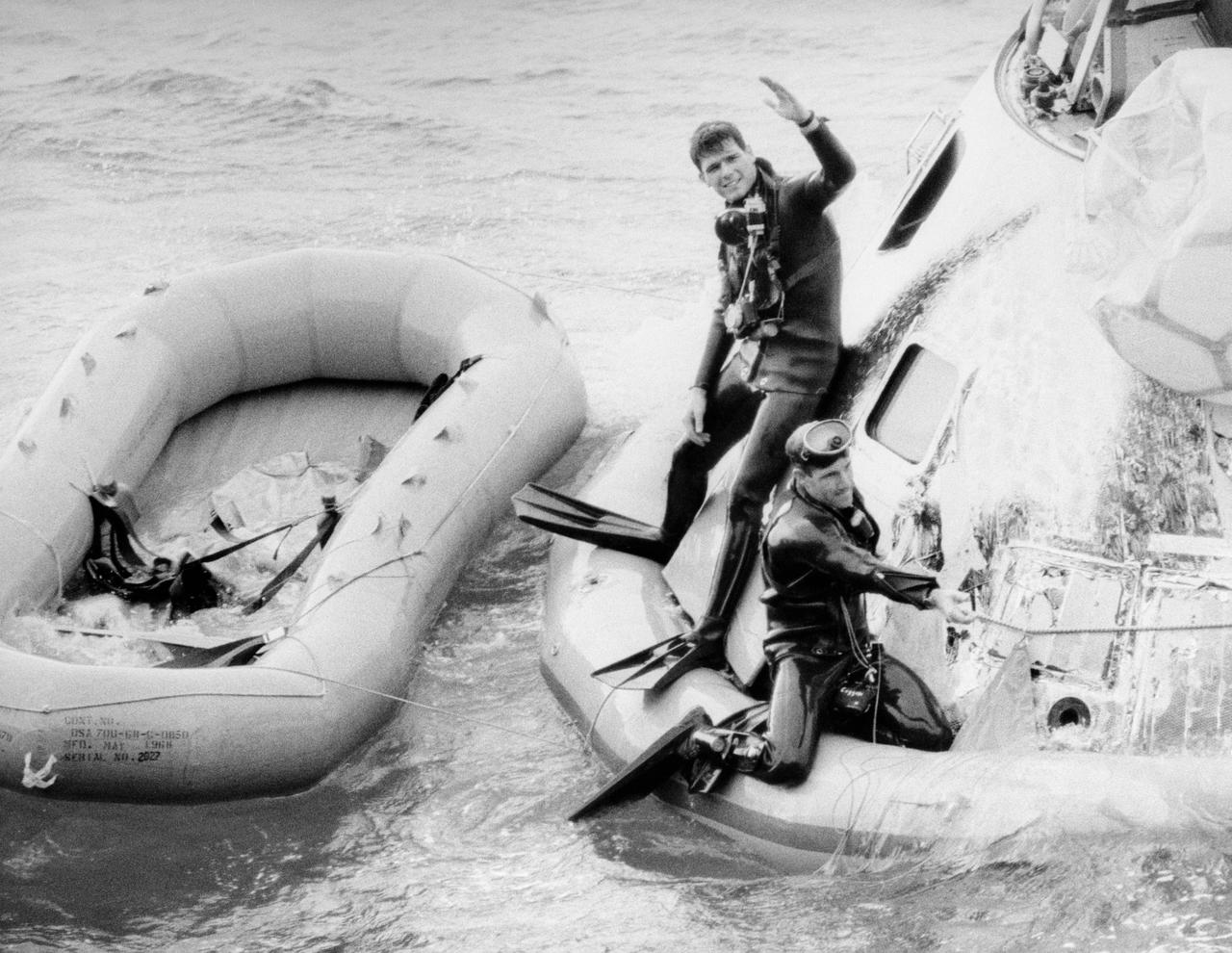
S69-15732 (27 Dec. 1968) --- A U.S. Navy frogman team participates in the Apollo 8 recovery operations. The Apollo crew, astronauts Frank Borman, James A. Lovell Jr., and William A. Anders, were recovered by helicopter and flown to the deck of the USS Yorktown, prime recovery ship for the historic Apollo 8 lunar orbit mission. Apollo 8 splashed down at 10:51 a.m. (EST), Dec. 27, 1968, about 1,000 miles south-southwest of Hawaii.

CAPE CANAVERAL, Fla. -- Crew members in a skiff from Freedom Star, one of NASA's solid rocket booster retrieval ships, attach flotation devices, or buoys, to the parachute lines from the left spent booster from space shuttle Discovery's STS-133 launch. The shuttle’s two solid rocket booster casings and associated flight hardware are recovered in the Atlantic Ocean after every launch by Liberty Star and Freedom Star. The boosters impact the Atlantic about seven minutes after liftoff and the retrieval ships are stationed about 10 miles from the impact area at the time of splashdown. After the spent segments are processed, they will be transported to Utah, where they will be refurbished and stored, if needed. Photo credit: NASA/Ben Smegelsky
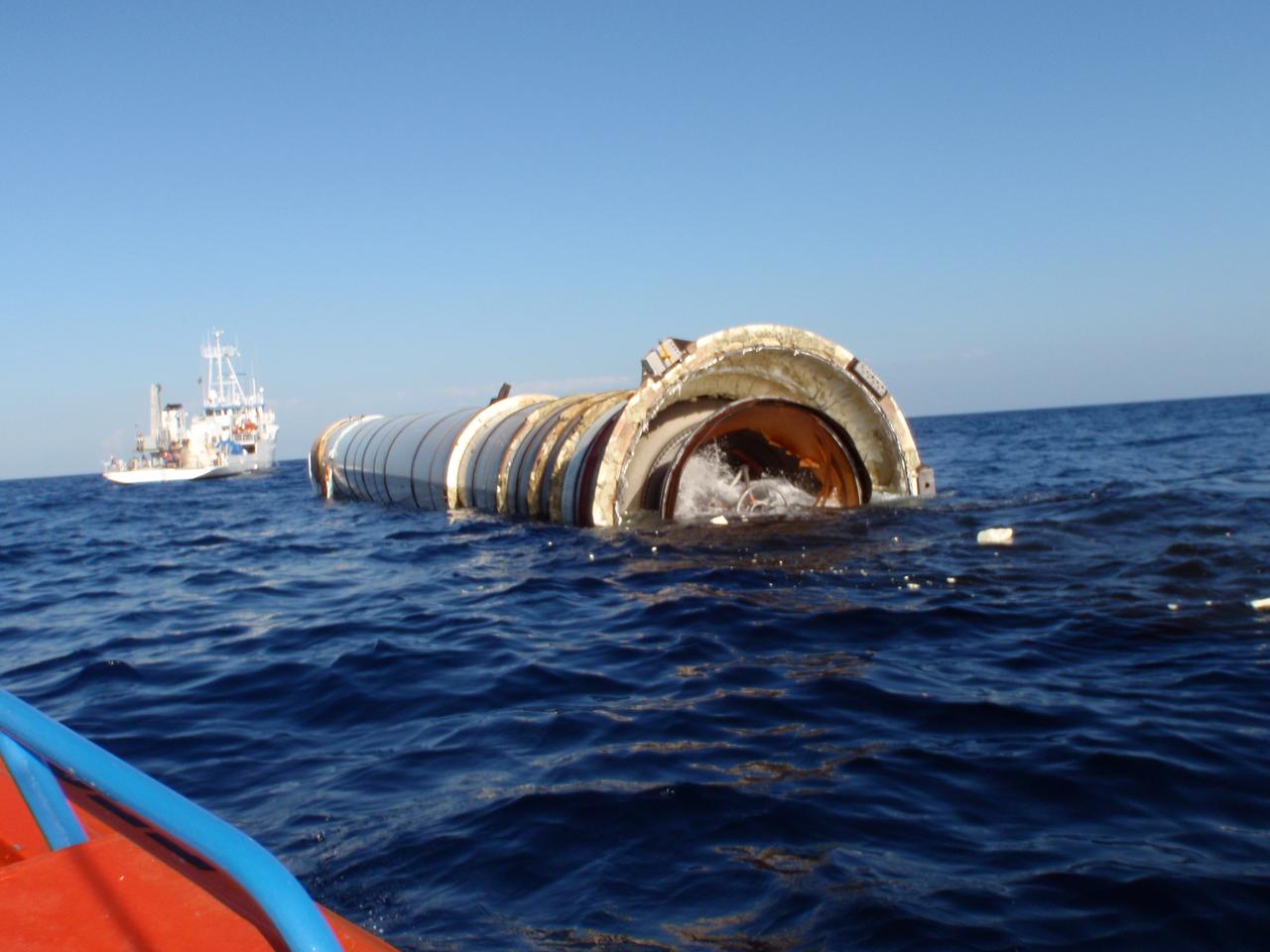
CAPE CANAVERAL, Fla. -- A spent solid rocket booster from Discovery's STS-133 launch bobbed in the Atlantis Ocean off the coast of Florida, before toppling over in a retrievable position. The booster is pumped with air to help maintain its flotation and horizontal position. Next, one of NASA's solid rocket booster retrieval ships, Liberty Star or Freedom Star, will tie up to the booster and transport it to Hangar AF at Cape Canaveral Air Force Station. The shuttle’s two solid rocket booster casings and associated flight hardware are recovered after every launch by the two ships. The boosters impact the Atlantic about seven minutes after liftoff and the retrieval ships are stationed about 10 miles from the impact area at the time of splashdown. After the spent segments are processed, they will be transported to Utah, where they will be refurbished and stored, if needed. Photo credit: NASA/Frank Michaux
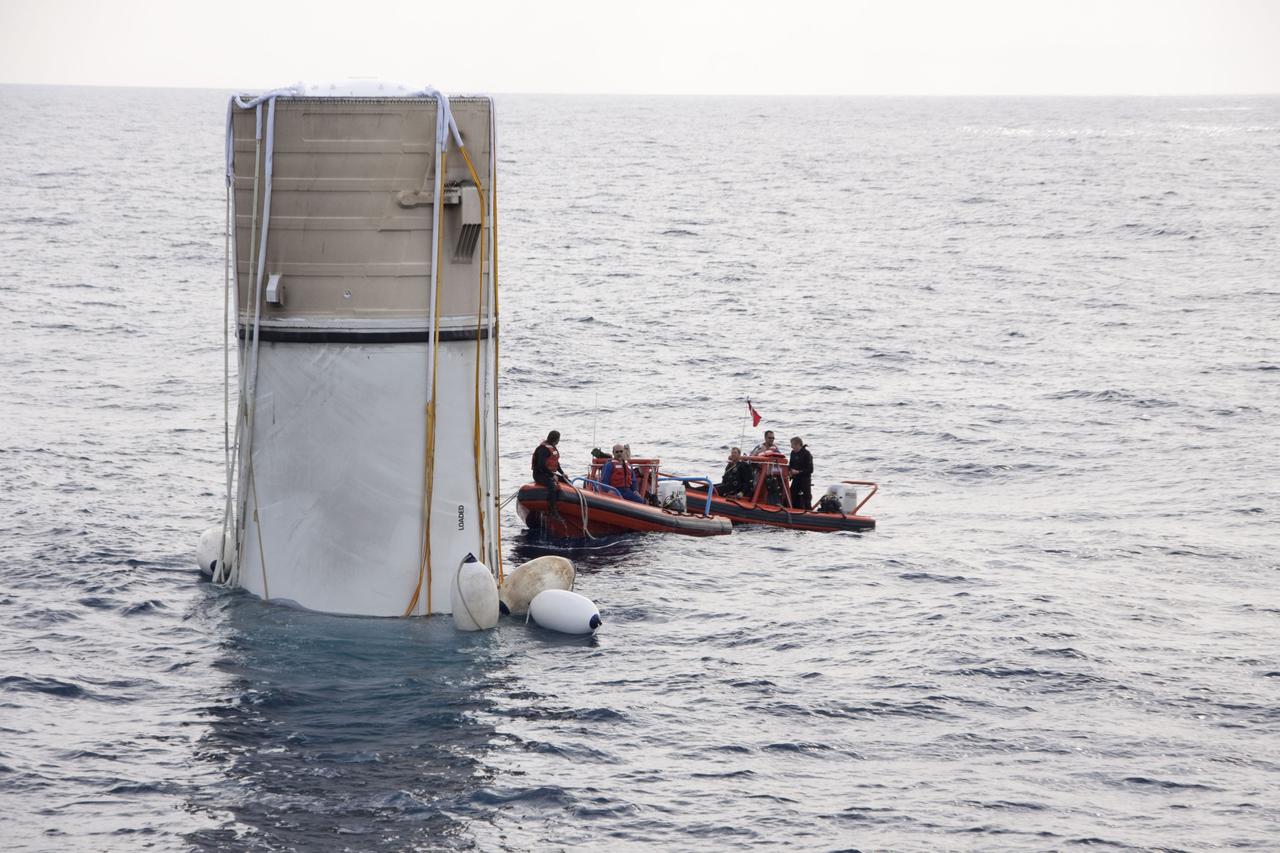
CAPE CANAVERAL, Fla. -- Crew members in a skiff from Liberty Star, one of NASA's solid rocket booster retrieval ships, attach flotation devices, or buoys, to the parachute lines from the right spent booster from space shuttle Discovery's final launch. The shuttle's two solid rocket booster casings and associated flight hardware are recovered in the Atlantic Ocean after every launch by Freedom Star and Liberty Star. The boosters impact the Atlantic about seven minutes after liftoff and the retrieval ships are stationed about 10 miles from the impact area at the time of splashdown. After the spent segments are processed, they will be transported to Utah, where they will be refurbished and stored, if needed. Photo credit: NASA/Frank Michaux
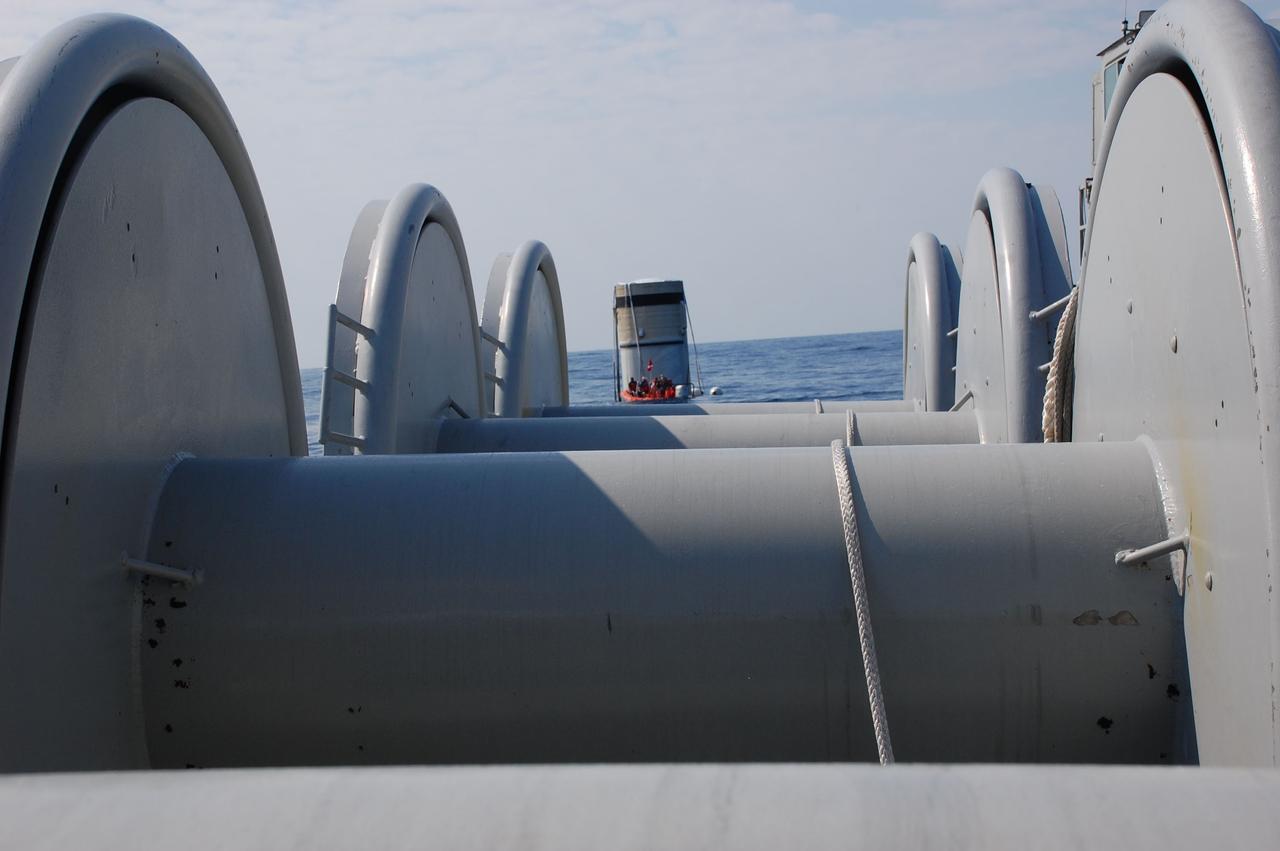
CAPE CANAVERAL, Fla. -- This image taken through a winding and storage device on Freedom Star, one of NASA's solid rocket booster retrieval ships, shows crew members in a skiff attaching flotation devices, or buoys to the parachute lines from the left spent booster after space shuttle Discovery's STS-133 launch. The shuttle’s two solid rocket booster casings and associated flight hardware are recovered in the Atlantic Ocean after every launch by Liberty Star and Freedom Star. The boosters impact the Atlantic about seven minutes after liftoff and the retrieval ships are stationed about 10 miles from the impact area at the time of splashdown. After the spent segments are processed, they will be transported to Utah, where they will be refurbished and stored, if needed. Photo credit: NASA/Ben Smegelsky
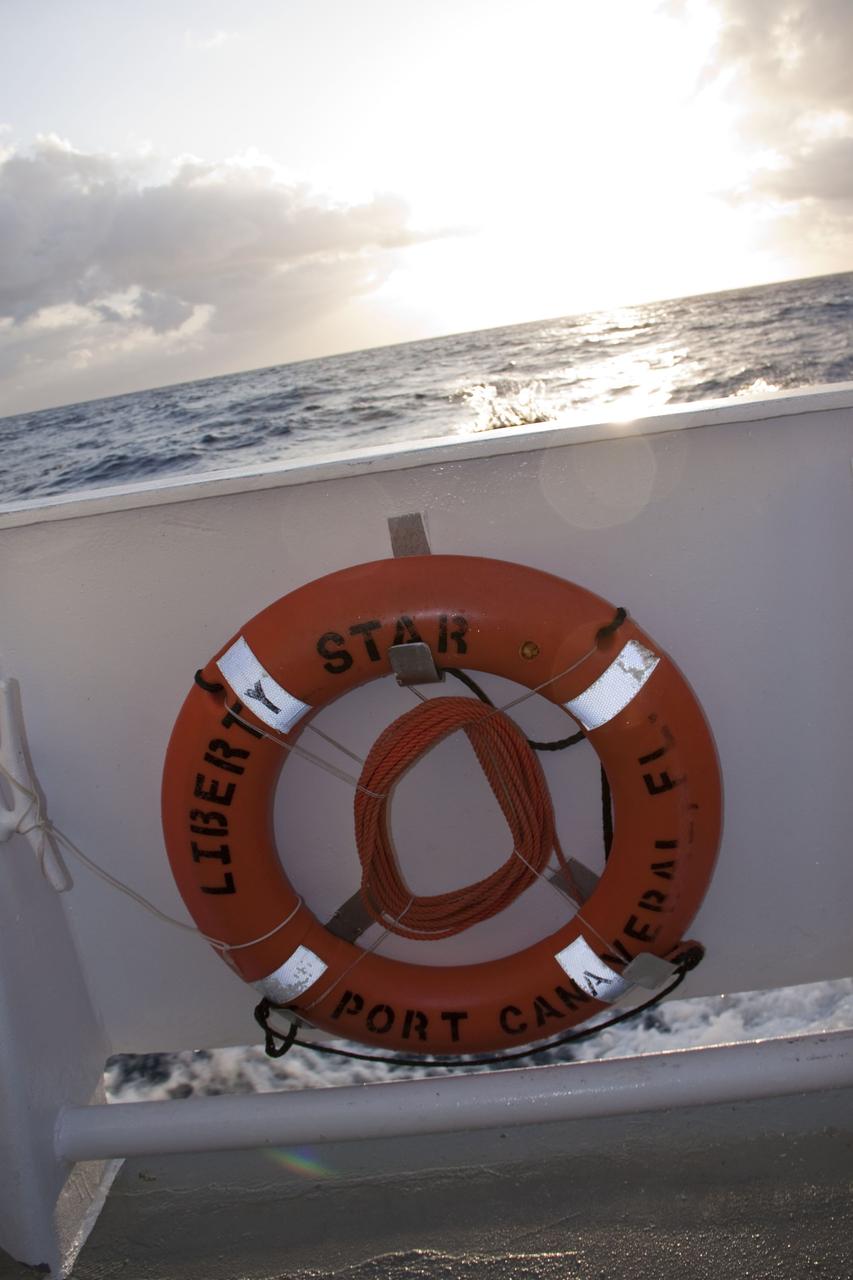
CAPE CANAVERAL, Fla. -- A flotation device is secured to the railing of Liberty Star, one of NASA's solid rocket booster retrieval ships. The ship has set sail to be in position in the Atlantic Ocean to recover the right spent booster that splashed down after space shuttle Discovery's final launch. The shuttle’s two solid rocket booster casings and associated flight hardware are recovered in the Atlantic Ocean after every launch by Freedom Star and Liberty Star. The boosters impact the Atlantic about seven minutes after liftoff and the retrieval ships are stationed about 10 miles from the impact area at the time of splashdown. After the spent segments are processed, they will be transported to Utah, where they will be refurbished and stored, if needed. Photo credit: NASA/Frank Michaux
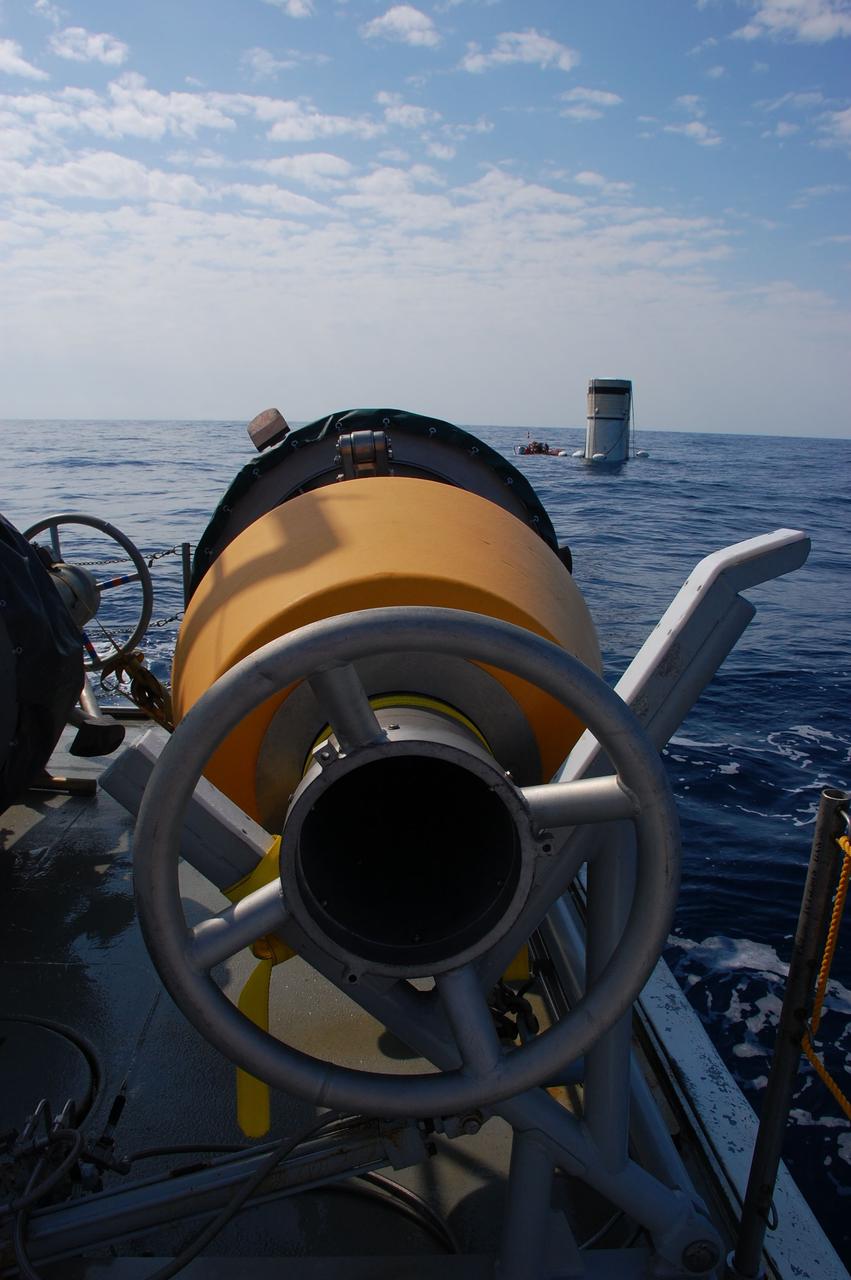
CAPE CANAVERAL, Fla. -- This image taken from the bow of Freedom Star, one of NASA's solid rocket booster retrieval ships, shows crew members in a skiff attaching flotation devices, or buoys, to the parachute lines from the left spent booster from space shuttle Discovery's STS-133 launch. The shuttle’s two solid rocket booster casings and associated flight hardware are recovered in the Atlantic Ocean after every launch by Liberty Star and Freedom Star. The boosters impact the Atlantic about seven minutes after liftoff and the retrieval ships are stationed about 10 miles from the impact area at the time of splashdown. After the spent segments are processed, they will be transported to Utah, where they will be refurbished and stored, if needed. Photo credit: NASA/Ben Smegelsky
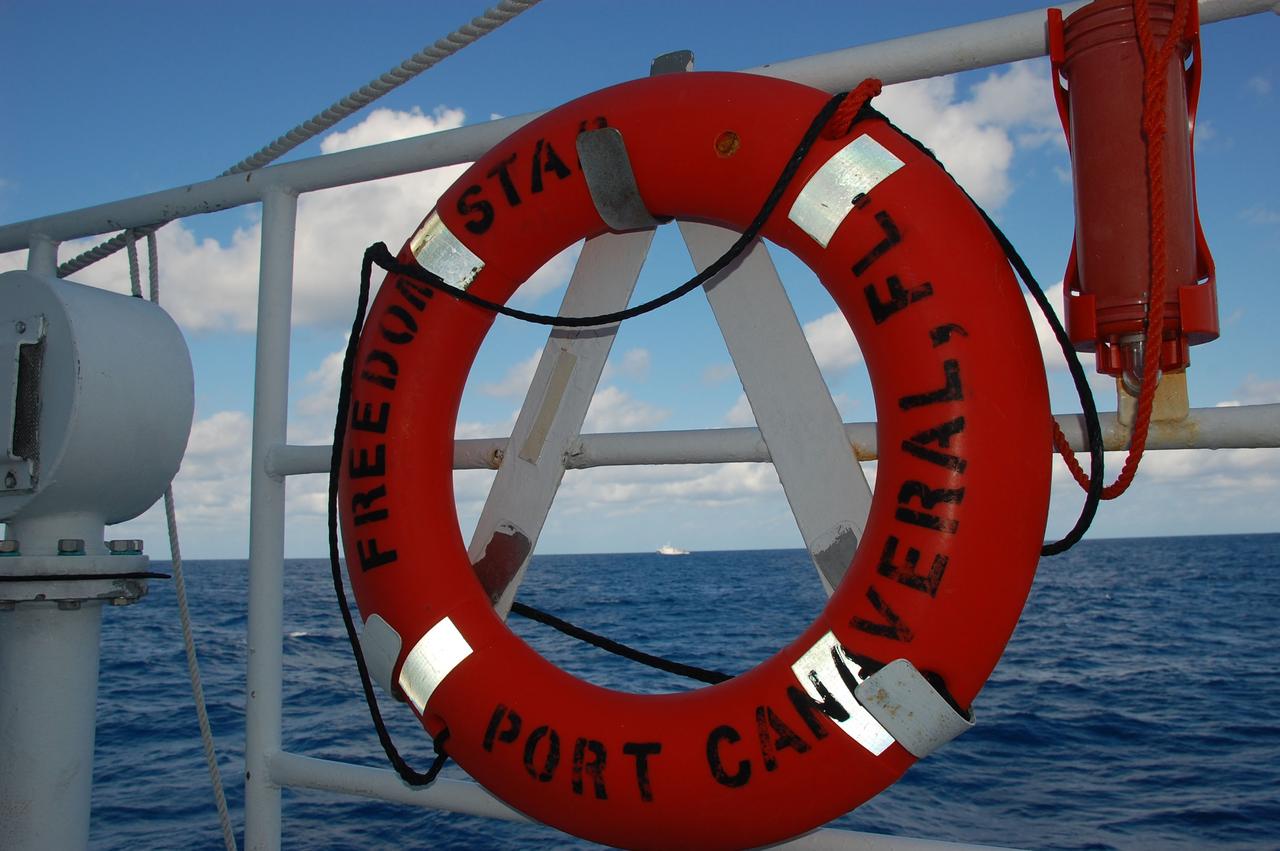
CAPE CANAVERAL, Fla. -- A flotation device is secured to the railing of Freedom Star, one of NASA's solid rocket booster retrieval ships. The ship has set sail to be in position in the Atlantic Ocean to recover the spent boosters after space shuttle Discovery's STS-133 launch. The shuttle’s two solid rocket booster casings and associated flight hardware are recovered in the Atlantic Ocean after every launch by Liberty Star and Freedom Star. The boosters impact the Atlantic about seven minutes after liftoff and the retrieval ships are stationed about 10 miles from the impact area at the time of splashdown. After the spent segments are processed, they will be transported to Utah, where they will be refurbished and stored, if needed. Photo credit: NASA/Ben Smegelsky
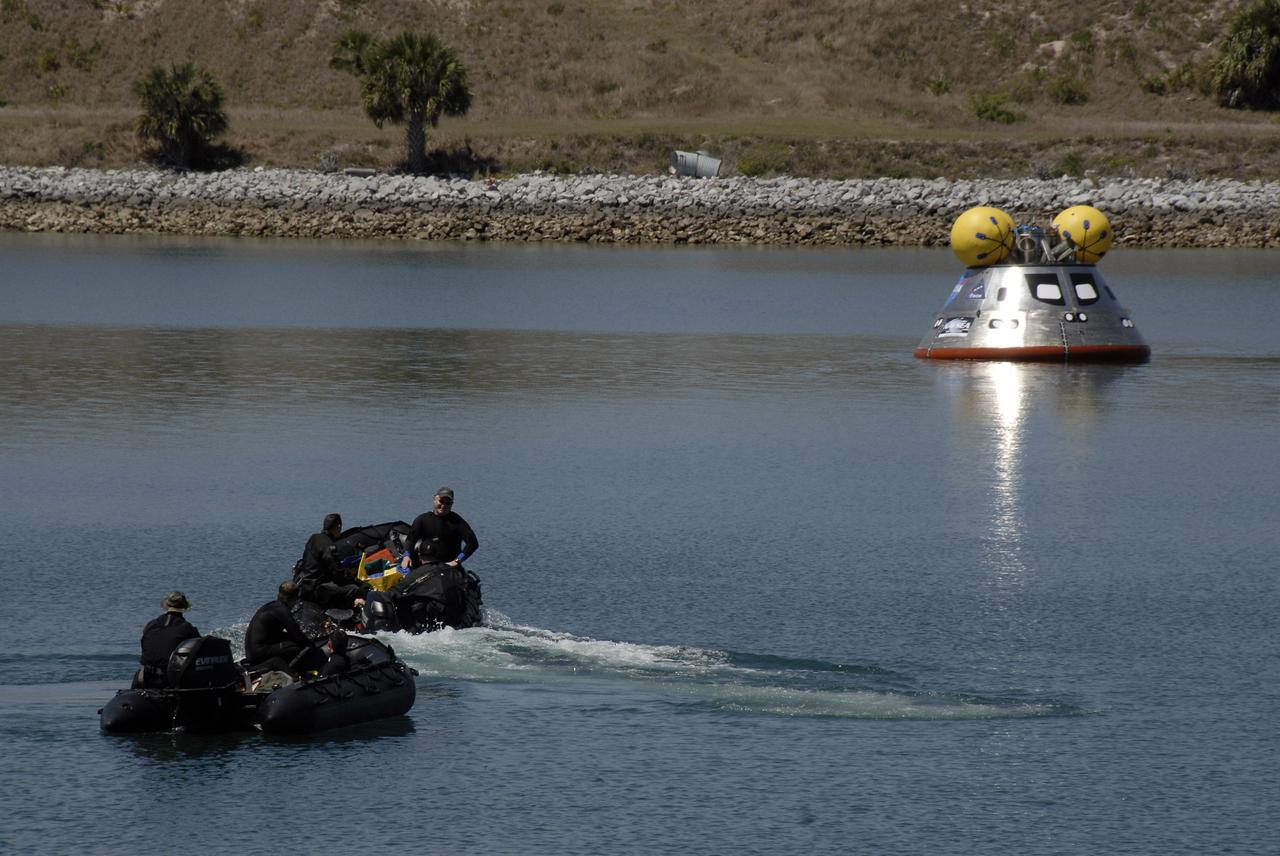
CAPE CANAVERAL, Fla. – Members of the 920th Rescue Wing make their way toward the mockup Orion crew exploration vehicle floating in the open water of the Trident Basin at Port Canaveral, Fla. They will place a flotation collar around the mockup vehicle. The mockup vehicle will undergo testing in open water. The goal of the operation, dubbed the Post-landing Orion Recovery Test, or PORT, is to determine what kind of motion astronauts can expect after landing, as well as outside conditions for recovery teams. Orion is targeted to begin carrying humans to the International Space Station in 2015 and to the moon by 2020. Orion, along with the Ares I and V rockets and the Altair lunar lander, are part of the Constellation Program. Photo credit: NASA/Kim Shiflett
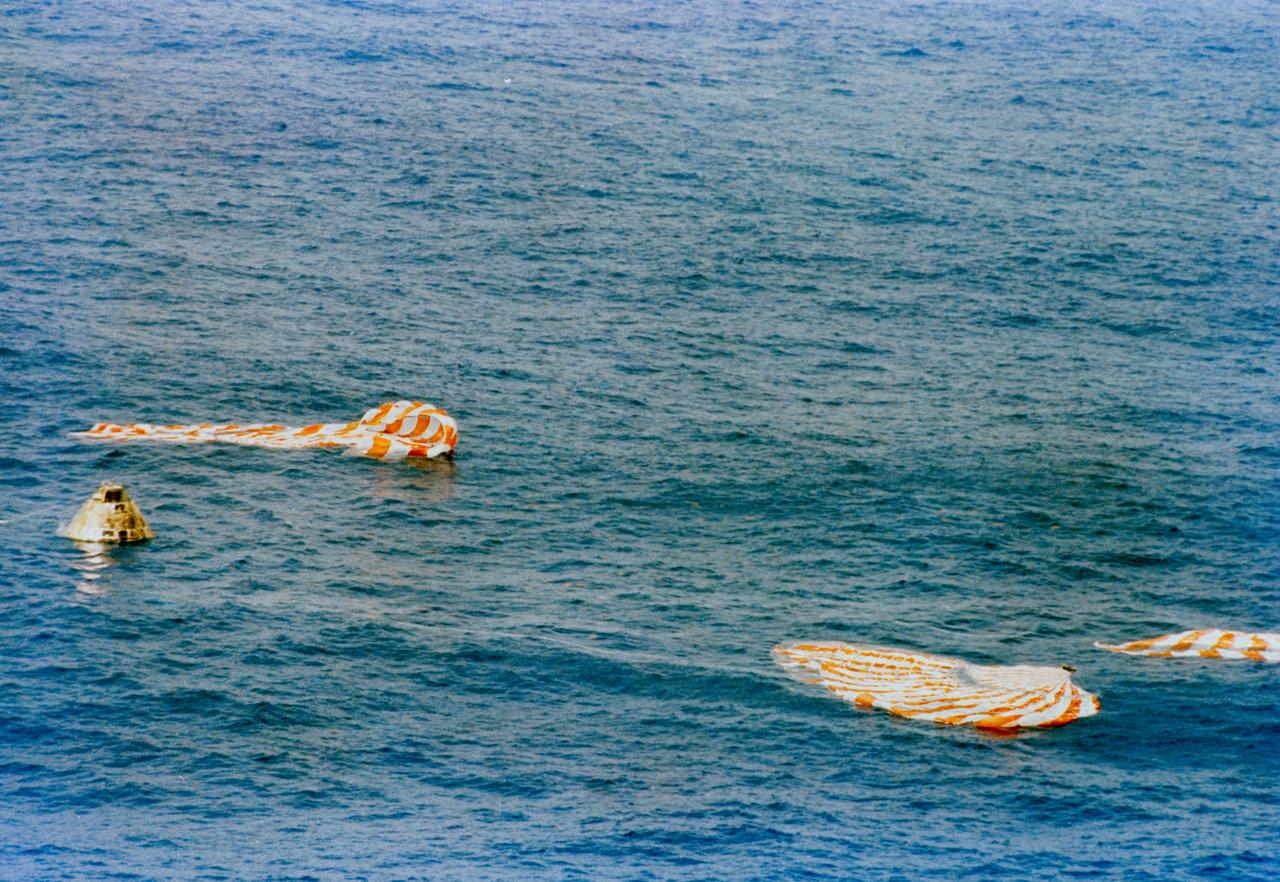
S69-27925 (13 March 1969) --- The Apollo 9 spacecraft, with astronauts James A. McDivitt, David R. Scott, and Russell L. Schweickart aboard, floats in the Atlantic immediately after splashdown. Moments later the three crewmen were picked up by a helicopter and flown to the deck of the USS Guadalcanal, prime recovery ship for the Apollo 9 10-day Earth-orbital space mission. Splashdown occurred at 12:00:53 p.m. (EST), March 13, 1969, only 4.5 nautical miles from the USS Guadalcanal. Just after this picture was taken U.S. Navy underwater demolition team swimmers were dropped into the water to assist in the recovery operations, including attaching a flotation collar to the spacecraft.
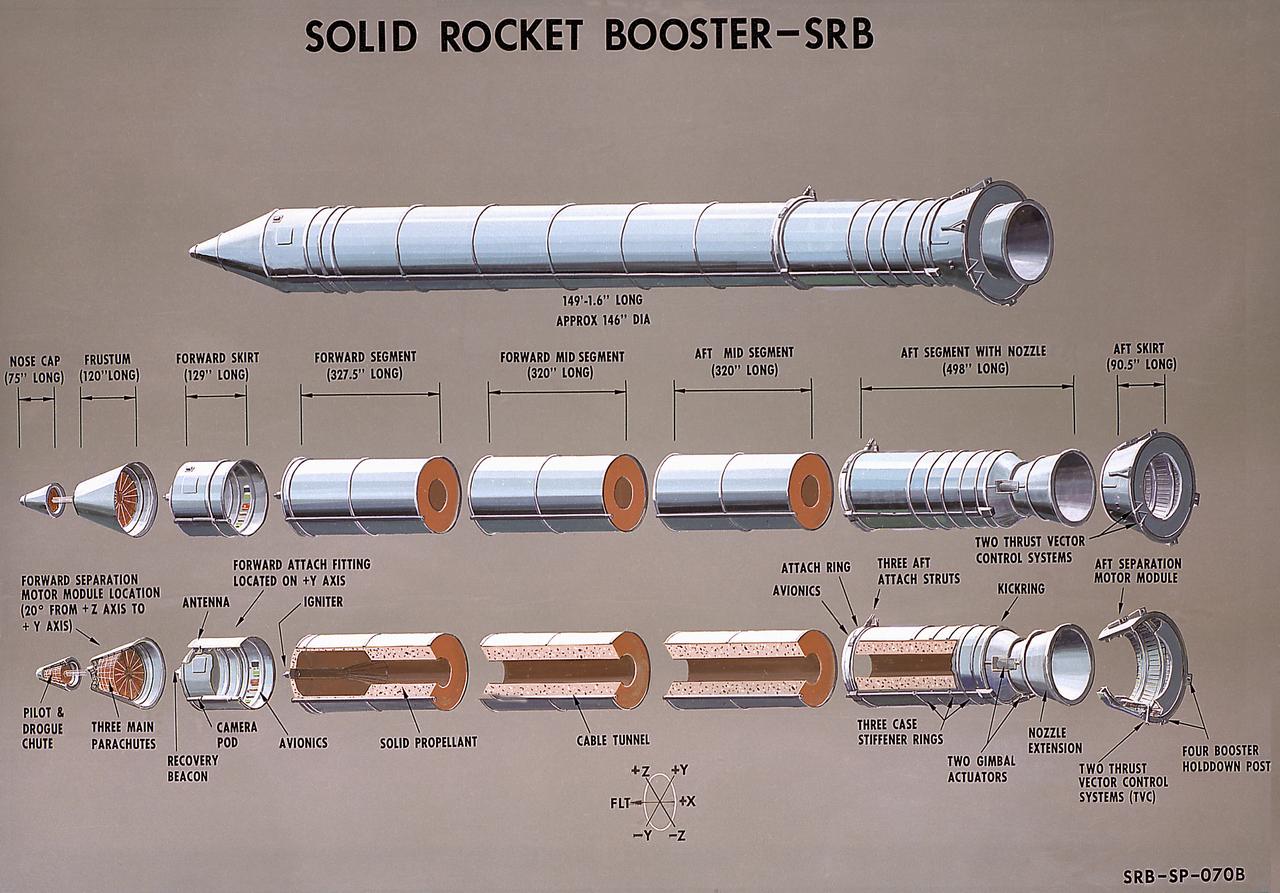
This illustration is a cutaway of the solid rocket booster (SRB) sections with callouts. The Shuttle's two SRB's are the largest solids ever built and the first designed for refurbishment and reuse. Standing nearly 150-feet high, the twin boosters provide the majority of thrust for the first two minutes of flight, about 5.8 million pounds, augmenting the Shuttle's main propulsion system during liftoff. The major design drivers for the solid rocket motors (SRM's) were high thrust and reuse. The desired thrust was achieved by using state-of-the-art solid propellant and by using a long cylindrical motor with a specific core design that allows the propellant to burn in a carefully controlled marner. At burnout, the boosters separate from the external tank and drop by parachute to the ocean for recovery and subsequent refurbishment. The boosters are designed to survive water impact at almost 60 miles per hour, maintain flotation with minimal damage, and preclude corrosion of the hardware exposed to the harsh seawater environment. Under the project management of the Marshall Space Flight Center, the SRB's are assembled and refurbished by the United Space Boosters. The SRM's are provided by the Morton Thiokol Corporation.
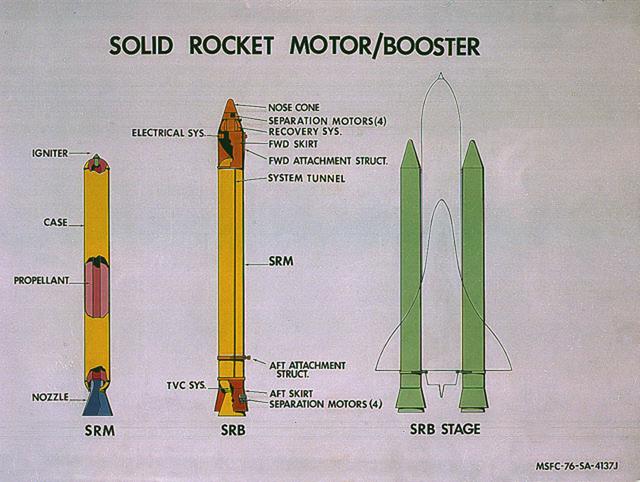
This image illustrates the solid rocket motor (SRM)/solid rocket booster (SRB) configuration. The Shuttle's two SRB's are the largest solids ever built and the first designed for refurbishment and reuse. Standing nearly 150-feet high, the twin boosters provide the majority of thrust for the first two minutes of flight, about 5.8 million pounds, augmenting the Shuttle's main propulsion system during liftoff. The major design drivers for the SRM's were high thrust and reuse. The desired thrust was achieved by using state-of-the-art solid propellant and by using a long cylindrical motor with a specific core design that allows the propellant to burn in a carefully controlled marner. At burnout, the boosters separate from the external tank and drop by parachute to the ocean for recovery and subsequent refurbishment. The boosters are designed to survive water impact at almost 60 miles per hour, maintain flotation with minimal damage, and preclude corrosion of the hardware exposed to the harsh seawater environment. Under the project management of the Marshall Space Flight Center, the SRB's are assembled and refurbished by the United Space Boosters. The SRM's are provided by the Morton Thiokol Corporation.
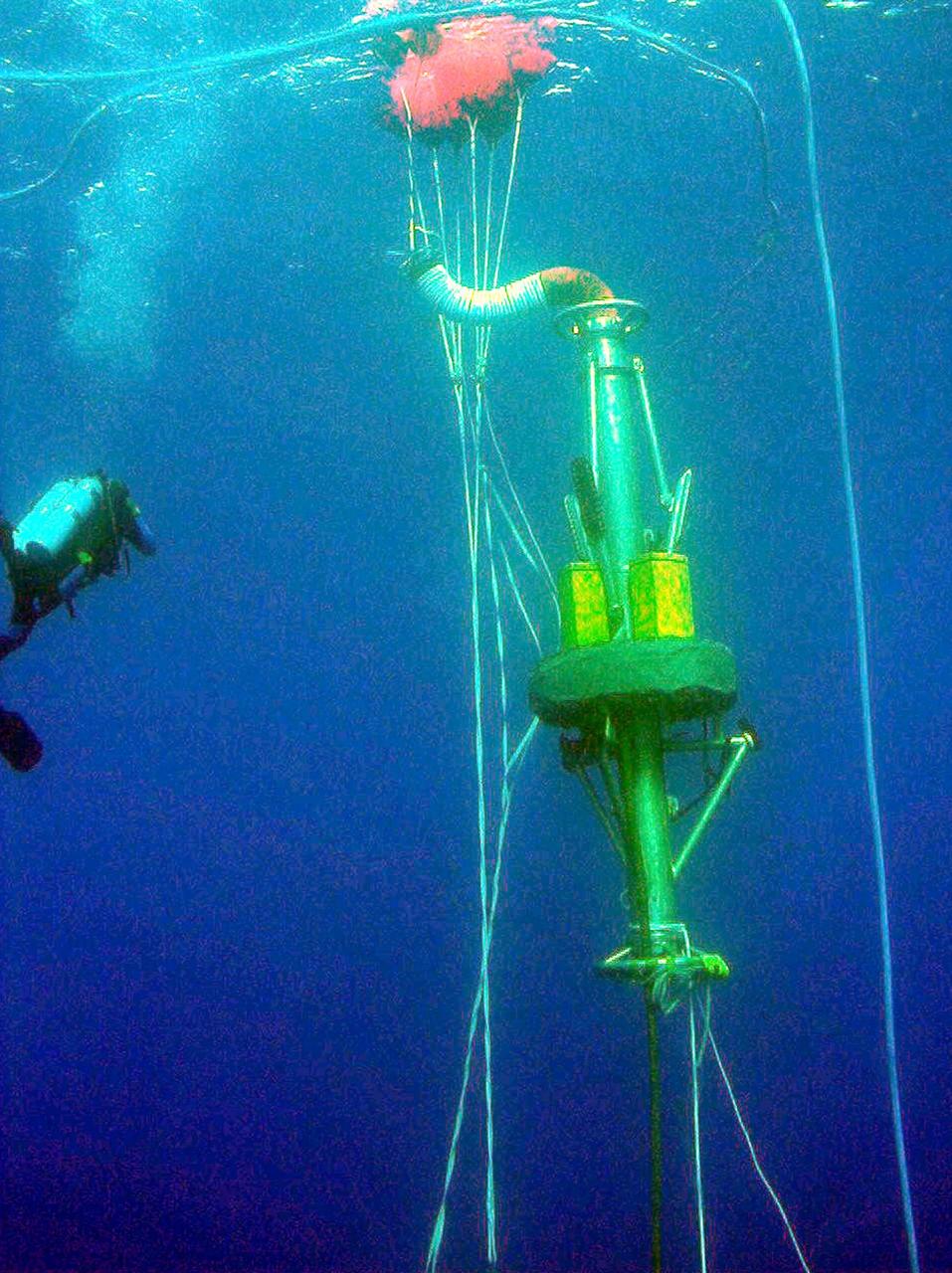
KENNEDY SPACE CENTER, FLA. -- A Diver Operator Plug (DOP) is being pulled down into the ocean by a newly designed one-man submarine known as DeepWorker 2000. The activity is part of an operation to attach the plug to a mockup of a solid rocket booster nozzle. DeepWorker 2000 is being tested on its ability to duplicate the sometimes hazardous job United Space Alliance (USA) divers perform to recover the expended boosters in the ocean after a launch. The boosters splash down in an impact area about 140 miles east of Jacksonville and after recovery are towed back to KSC for refurbishment by the specially rigged recovery ships. DeepWorker 2000 will be used in a demonstration during retrieval operations after the upcoming STS-101 launch. The submarine pilot will demonstrate capabilities to cut tangled parachute riser lines using a manipulator arm and attach the DOP to extract water and provide flotation for the booster. DeepWorker 2000 was built by Nuytco Research Ltd., North Vancouver, British Columbia. It is 8.25 feet long, 5.75 feet high, and weighs 3,800 pounds. USA is a prime contractor to NASA for the Space Shuttle program
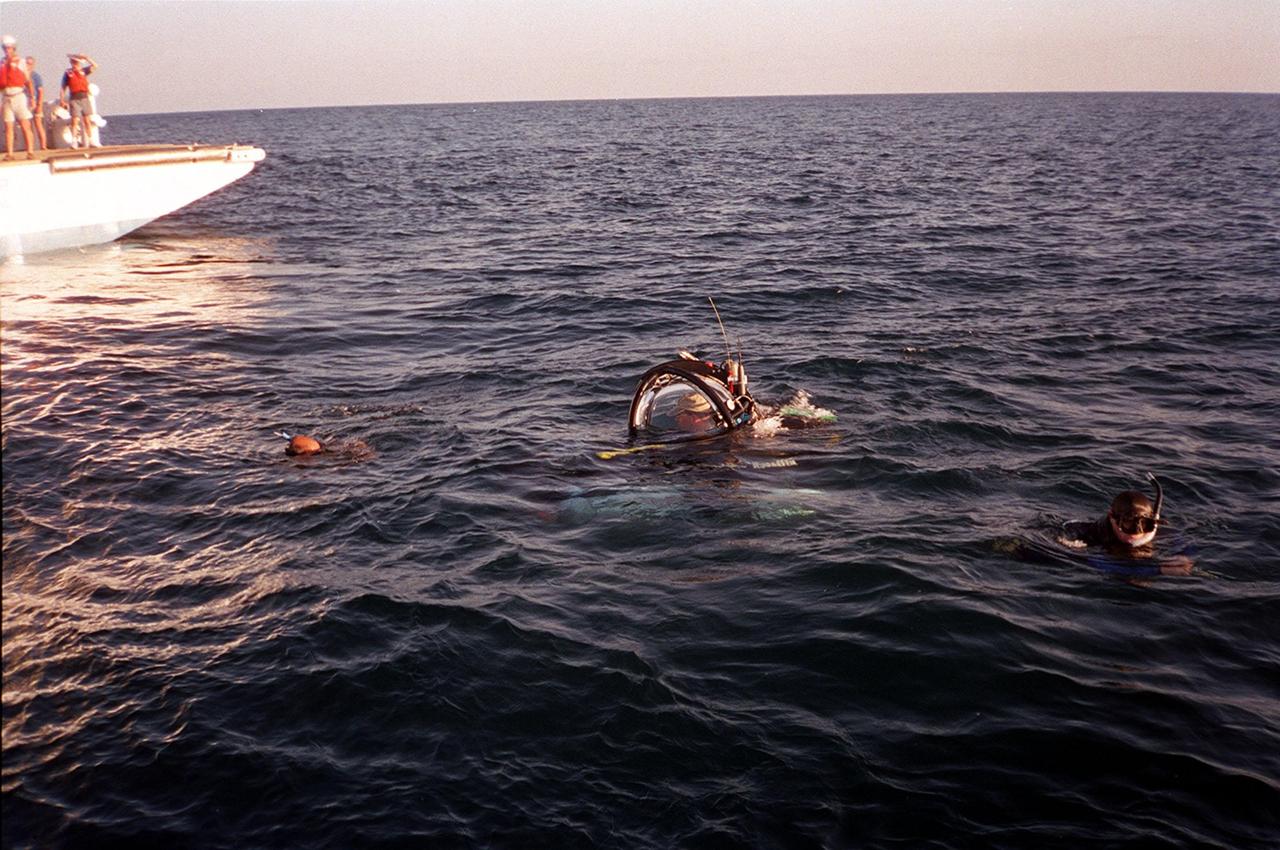
KENNEDY SPACE CENTER, FLA. -- The one-man submarine known as DeepWorker 2000 is tested in Atlantic waters near Cape Canaveral, Fla. Nearby are divers; inside the sub is the pilot, Anker Rasmussen. The sub is being tested on its ability to duplicate the sometimes hazardous job United Space Alliance (USA) divers perform to recover the expended boosters in the ocean after a launch. The boosters splash down in an impact area about 140 miles east of Jacksonville and after recovery are towed back to KSC for refurbishment by the specially rigged recovery ships. DeepWorker 2000 will be used in a demonstration during retrieval operations after the upcoming STS-101 launch. The submarine pilot will demonstrate capabilities to cut tangled parachute riser lines using a manipulator arm and attach a Diver Operator Plug to extract water and provide flotation for the booster. DeepWorker 2000 was built by Nuytco Research Ltd., North Vancouver, British Columbia. It is 8.25 feet long, 5.75 feet high, and weighs 3,800 pounds. USA is a prime contractor to NASA for the Space Shuttle program
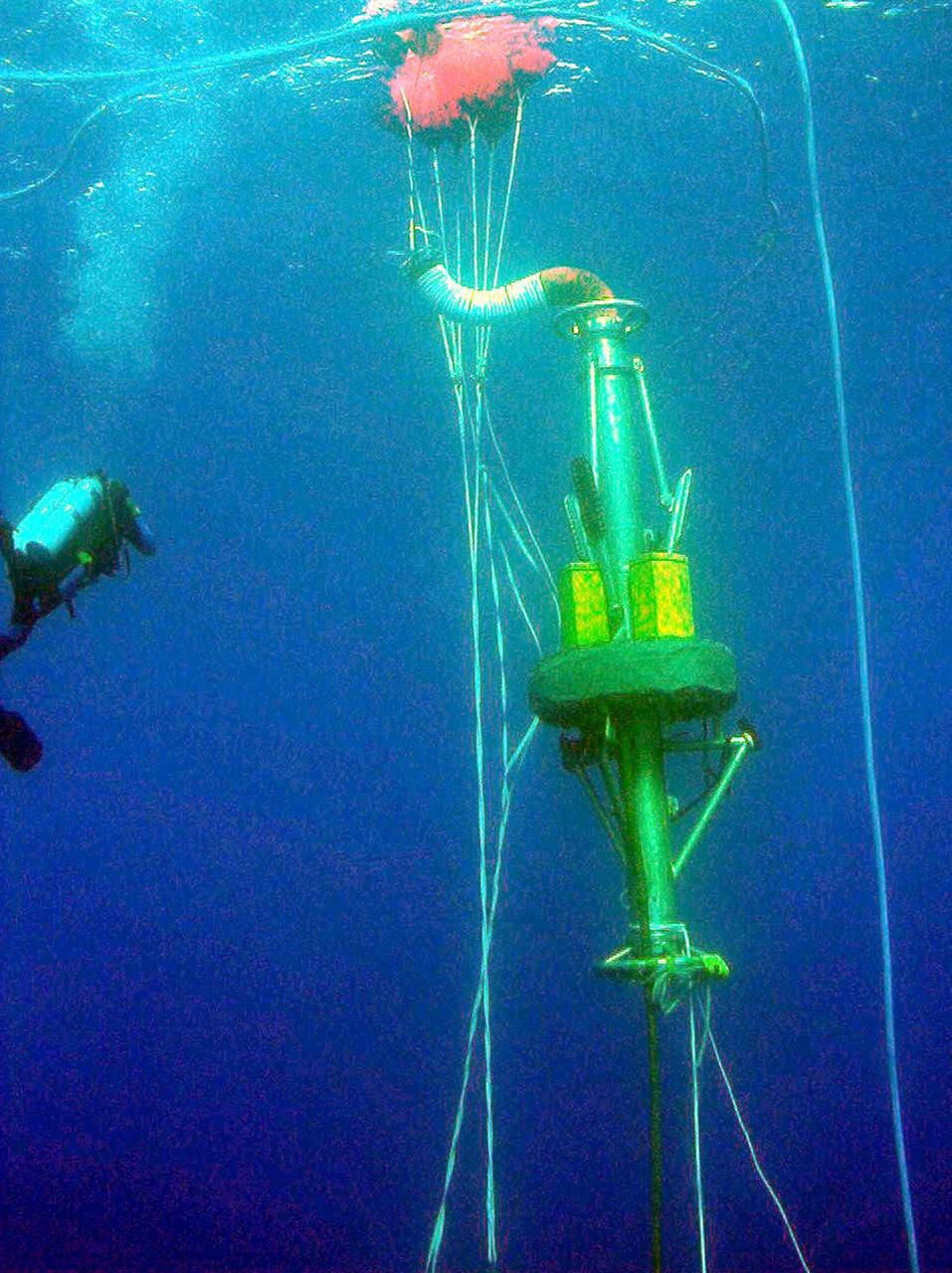
KENNEDY SPACE CENTER, FLA. -- A Diver Operator Plug (DOP) is being pulled down into the ocean by a newly designed one-man submarine known as DeepWorker 2000. The activity is part of an operation to attach the plug to a mockup of a solid rocket booster nozzle. DeepWorker 2000 is being tested on its ability to duplicate the sometimes hazardous job United Space Alliance (USA) divers perform to recover the expended boosters in the ocean after a launch. The boosters splash down in an impact area about 140 miles east of Jacksonville and after recovery are towed back to KSC for refurbishment by the specially rigged recovery ships. DeepWorker 2000 will be used in a demonstration during retrieval operations after the upcoming STS-101 launch. The submarine pilot will demonstrate capabilities to cut tangled parachute riser lines using a manipulator arm and attach the DOP to extract water and provide flotation for the booster. DeepWorker 2000 was built by Nuytco Research Ltd., North Vancouver, British Columbia. It is 8.25 feet long, 5.75 feet high, and weighs 3,800 pounds. USA is a prime contractor to NASA for the Space Shuttle program
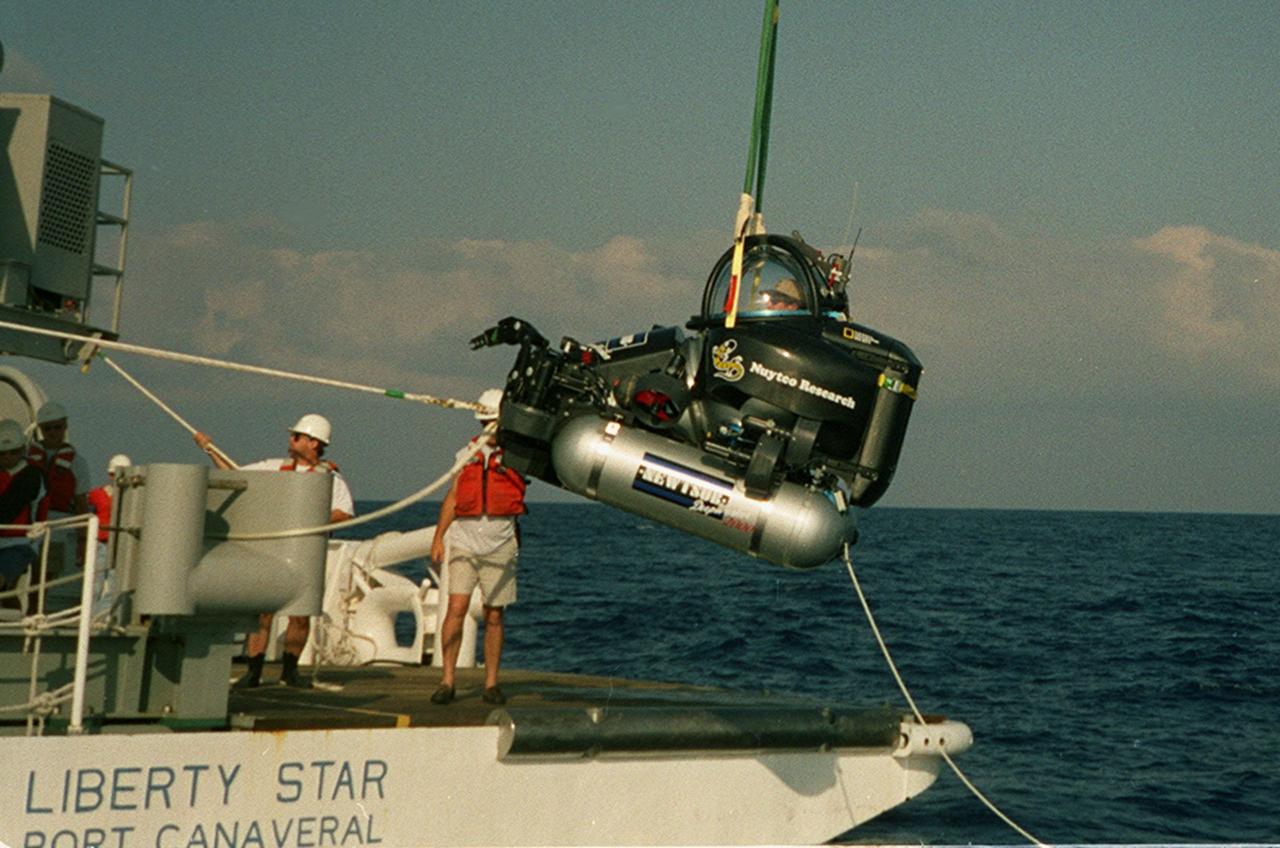
KENNEDY SPACE CENTER, FLA. -- After a successful dive, the one-man submarine known as DeepWorker 2000 is lifted from Atlantic waters near Cape Canaveral, Fla., onto the deck of the Liberty Star, one of two KSC solid rocket booster recovery ships. Inside the sub is the pilot, Anker Rasmussen. The sub is being tested on its ability to duplicate the sometimes hazardous job United Space Alliance (USA) divers perform to recover the expended boosters in the ocean after a launch. The boosters splash down in an impact area about 140 miles east of Jacksonville and after recovery are towed back to KSC for refurbishment by the specially rigged recovery ships. DeepWorker 2000 will be used in a demonstration during retrieval operations after the upcoming STS-101 launch. The submarine pilot will demonstrate capabilities to cut tangled parachute riser lines using a manipulator arm and attach a Diver Operator Plug to extract water and provide flotation for the booster. DeepWorker 2000 was built by Nuytco Research Ltd., North Vancouver, British Columbia. It is 8.25 feet long, 5.75 feet high, and weighs 3,800 pounds. USA is a prime contractor to NASA for the Space Shuttle program
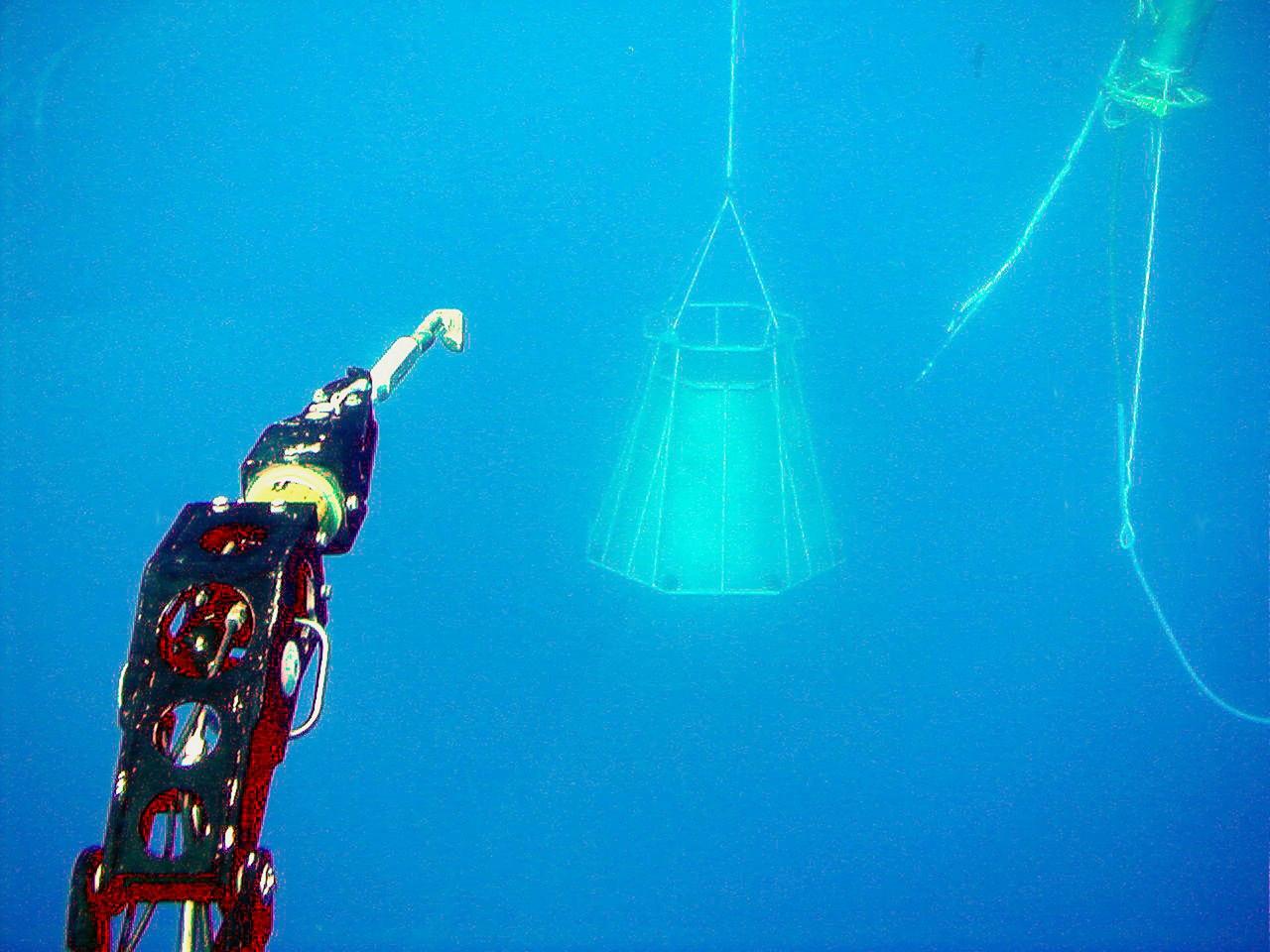
KENNEDY SPACE CENTER, FLA. -- At left, a manipulator arm on a one-man submarine demonstrates its ability to cut tangled parachute riser lines and place a Diver Operator Plug (top right) inside a mock solid rocket booster nozzle (center). Known as DeepWorker 2000, the sub is being tested on its ability to duplicate the sometimes hazardous job United Space Alliance (USA) divers perform to recover the expended boosters in the ocean after a launch. The boosters splash down in an impact area about 140 miles east of Jacksonville and after recovery are towed back to KSC for refurbishment by the specially rigged recovery ships. DeepWorker 2000 will be used in a demonstration during retrieval operations after the upcoming STS-101 launch. The submarine pilot will demonstrate capabilities to cut tangled parachute riser lines using a manipulator arm and attach the DOP to extract water and provide flotation for the booster. DeepWorker 2000 was built by Nuytco Research Ltd., North Vancouver, British Columbia. It is 8.25 feet long, 5.75 feet high, and weighs 3,800 pounds. USA is a prime contractor to NASA for the Space Shuttle program
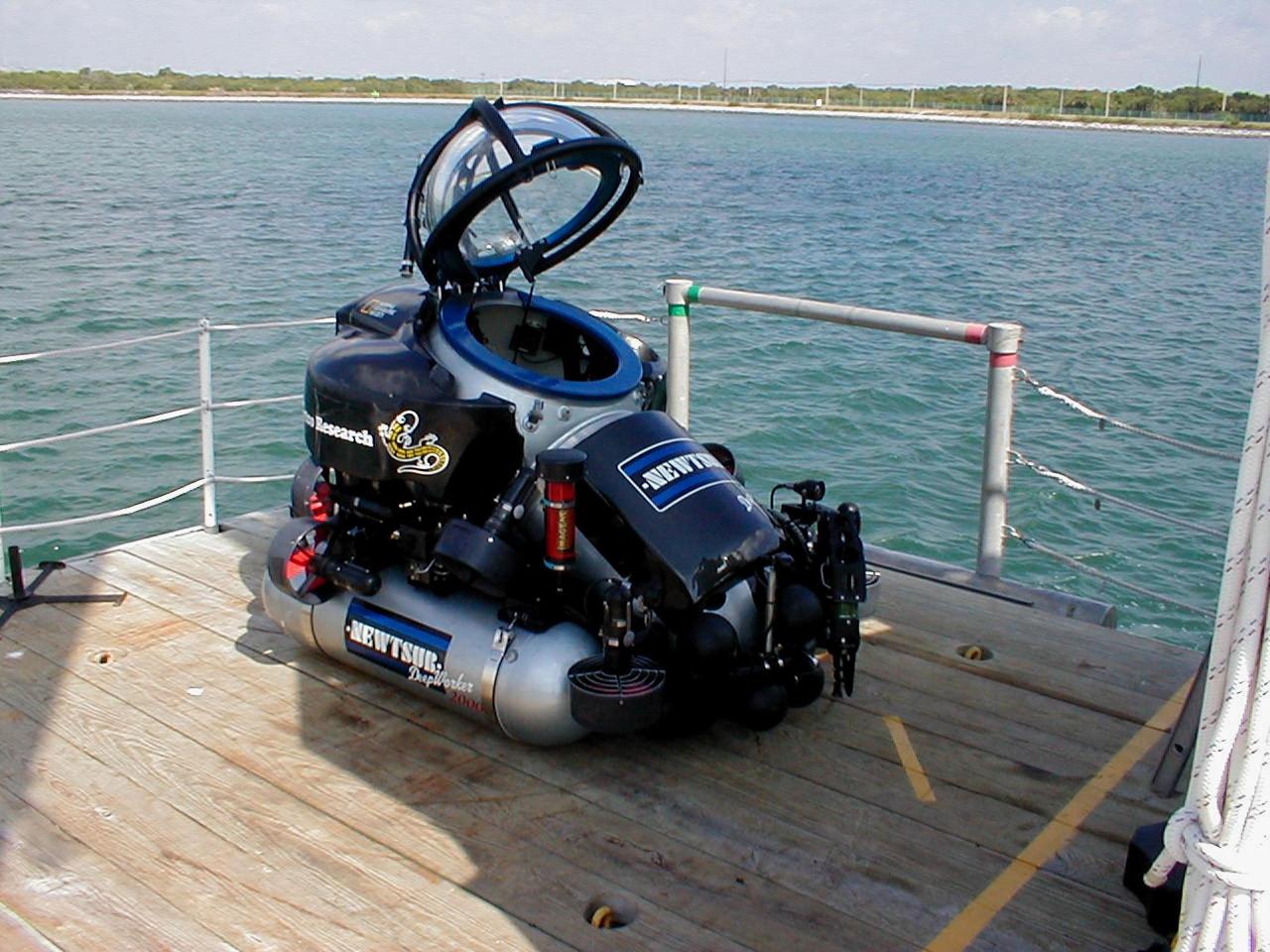
KENNEDY SPACE CENTER, FLA. -- The one-man submarine dubbed DeepWorker 2000 sits on the deck of Liberty Star, one of two KSC solid rocket booster recovery ships. The sub is being tested on its ability to duplicate the sometimes hazardous job United Space Alliance (USA) divers perform to recover the expended boosters in the ocean after a launch. The boosters splash down in an impact area about 140 miles east of Jacksonville and after recovery are towed back to KSC for refurbishment by the specially rigged recovery ships. DeepWorker 2000 will be used in a demonstration during retrieval operations after the upcoming STS-101 launch. The submarine pilot will demonstrate capabilities to cut tangled parachute riser lines using a manipulator arm and attach a Diver Operator Plug to extract water and provide flotation for the booster. DeepWorker 2000 was built by Nuytco Research Ltd., North Vancouver, British Columbia. It is 8.25 feet long, 5.75 feet high, and weighs 3,800 pounds. USA is a prime contractor to NASA for the Space Shuttle program
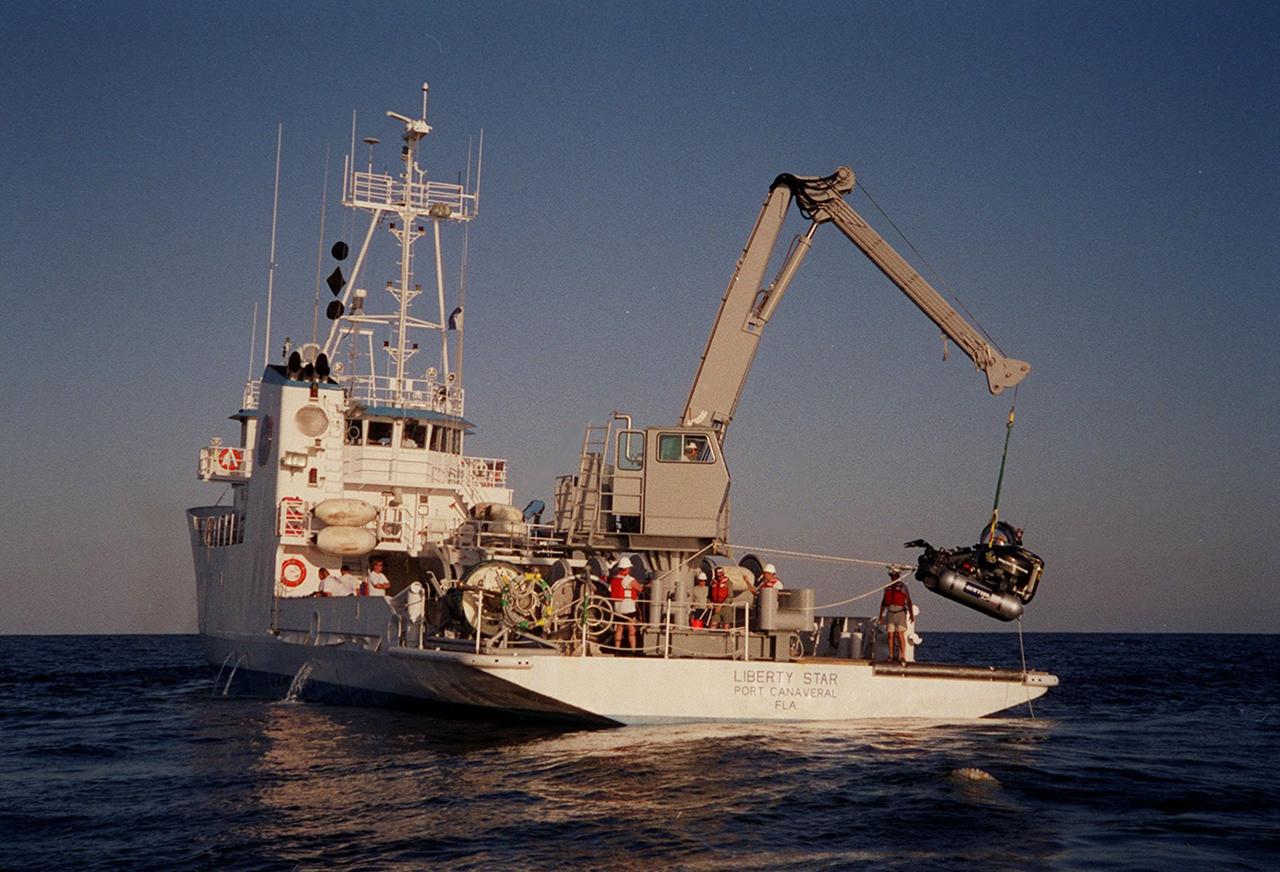
KENNEDY SPACE CENTER, FLA. -- From the deck of Liberty Star, one of two KSC solid rocket booster recovery ships, a crane lowers a one-man submarine into the ocean near Cape Canaveral, Fla. Called DeepWorker 2000, the sub is being tested on its ability to duplicate the sometimes hazardous job United Space Alliance (USA) divers perform to recover the expended boosters in the ocean after a launch. The boosters splash down in an impact area about 140 miles east of Jacksonville and after recovery are towed back to KSC for refurbishment by the specially rigged recovery ships. DeepWorker 2000 will be used in a demonstration during retrieval operations after the upcoming STS-101 launch. The submarine pilot will demonstrate capabilities to cut tangled parachute riser lines using a manipulator arm and attach a Diver Operator Plug to extract water and provide flotation for the booster. DeepWorker 2000 was built by Nuytco Research Ltd., North Vancouver, British Columbia. It is 8.25 feet long, 5.75 feet high, and weighs 3,800 pounds. USA is a prime contractor to NASA for the Space Shuttle program
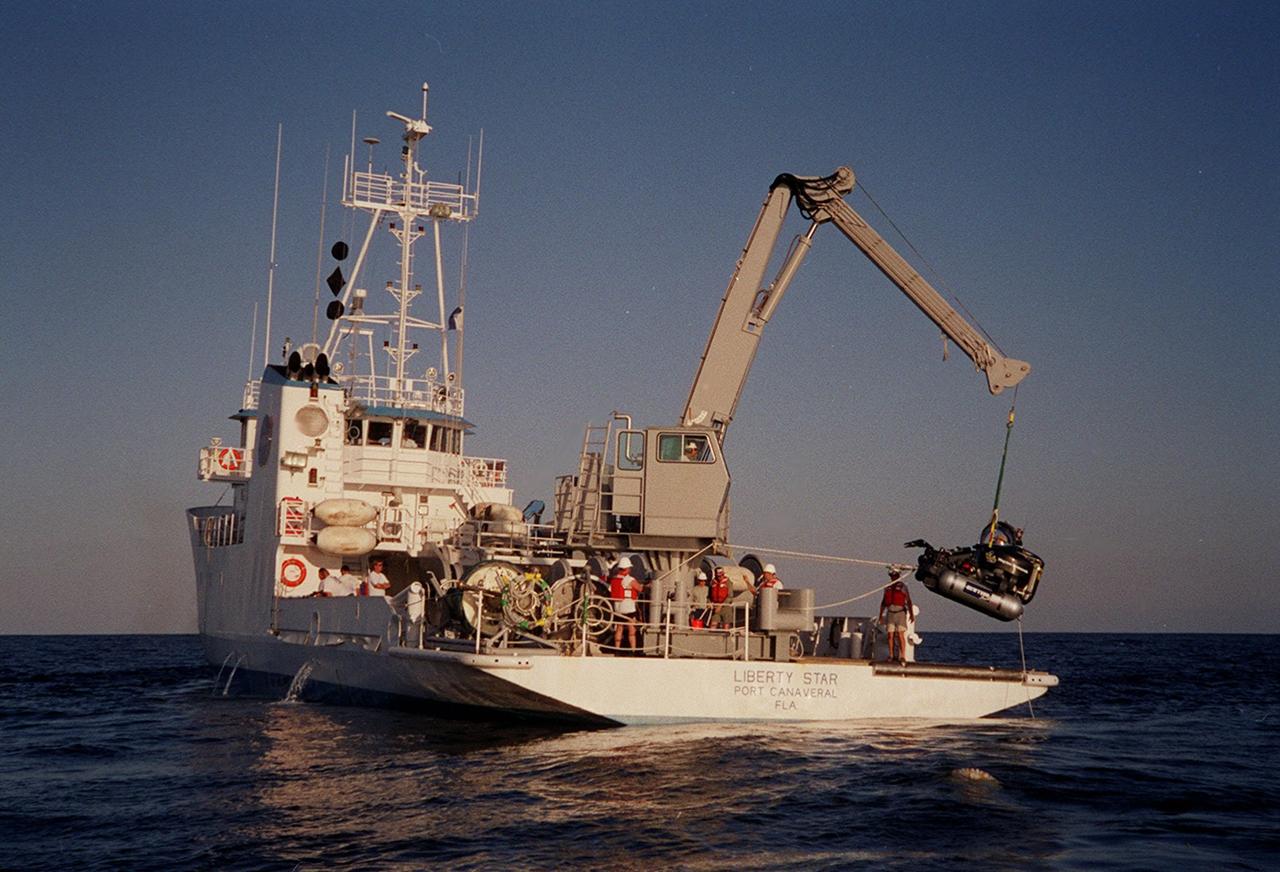
KENNEDY SPACE CENTER, FLA. -- From the deck of Liberty Star, one of two KSC solid rocket booster recovery ships, a crane lowers a one-man submarine into the ocean near Cape Canaveral, Fla. Called DeepWorker 2000, the sub is being tested on its ability to duplicate the sometimes hazardous job United Space Alliance (USA) divers perform to recover the expended boosters in the ocean after a launch. The boosters splash down in an impact area about 140 miles east of Jacksonville and after recovery are towed back to KSC for refurbishment by the specially rigged recovery ships. DeepWorker 2000 will be used in a demonstration during retrieval operations after the upcoming STS-101 launch. The submarine pilot will demonstrate capabilities to cut tangled parachute riser lines using a manipulator arm and attach a Diver Operator Plug to extract water and provide flotation for the booster. DeepWorker 2000 was built by Nuytco Research Ltd., North Vancouver, British Columbia. It is 8.25 feet long, 5.75 feet high, and weighs 3,800 pounds. USA is a prime contractor to NASA for the Space Shuttle program
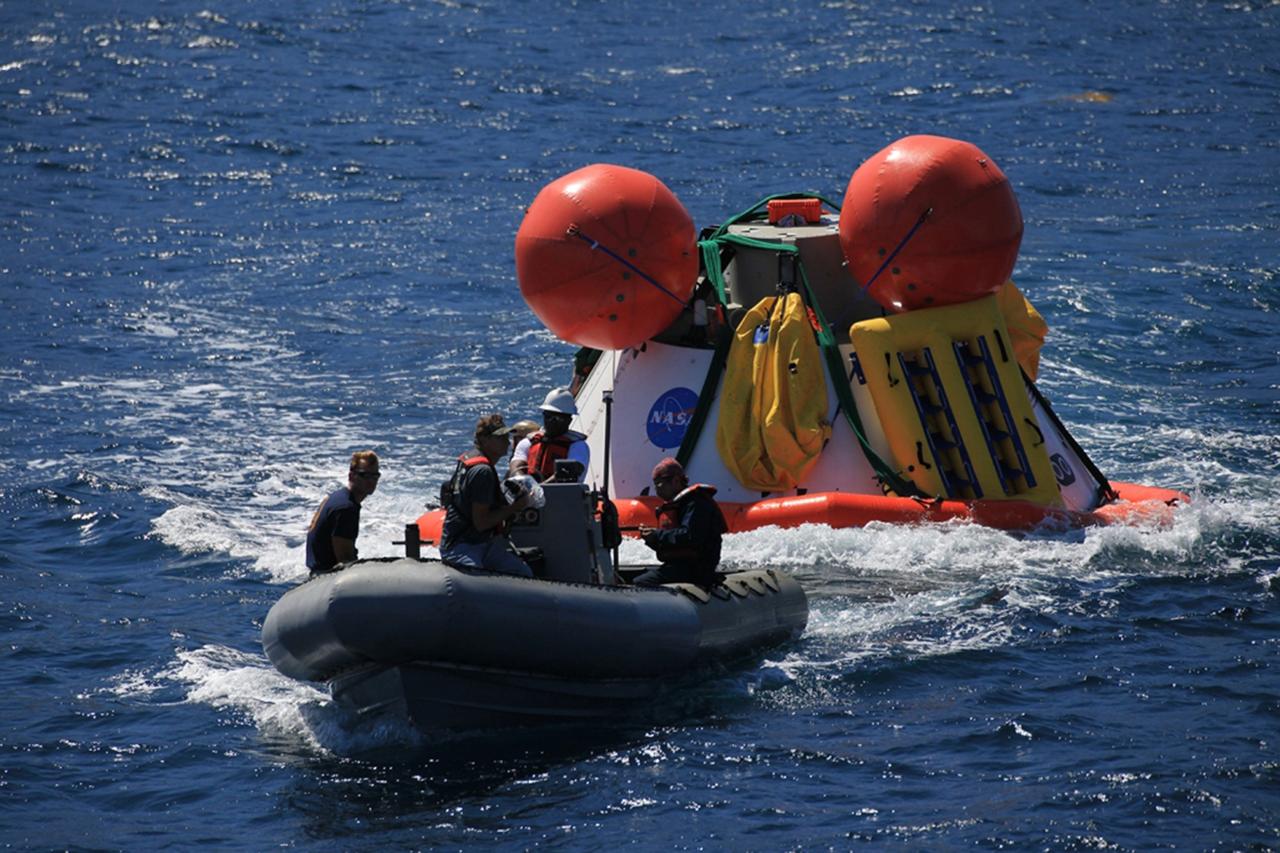
SAN DIEGO, Calif. – The Orion boilerplate test vehicle floats in the Pacific Ocean during Underway Recovery Test 4A. Orion was lowered into the water with a stationary crane from the USS Salvor, a safeguard-class rescue and salvage ship. Nearby, U.S. Navy personnel in a Zodiac boat have attached a flotation collar and tether lines to Orion to bring the test vehicle closer to the ship. NASA, Lockheed Martin and the U.S. Navy are conducting crane recovery tests to prepare for recovery of the Orion crew module on its return from a deep space mission. The underway recovery test will allow the teams to demonstrate and evaluate the recovery processes, procedures, new hardware and personnel in open waters. The Ground Systems Development and Operations Program is conducting the underway recovery test. Orion is the exploration spacecraft designed to carry astronauts to destinations not yet explored by humans, including an asteroid and Mars. It will have emergency abort capability, sustain the crew during space travel and provide safe re-entry from deep space return velocities. The first unpiloted test flight of the Orion is scheduled to launch in December 2014 atop a United Launch Alliance Delta IV Heavy rocket and in 2018 on NASA’s Space Launch System rocket. For more information, visit http://www.nasa.gov/orion. Photo credit: Kim Shiflett
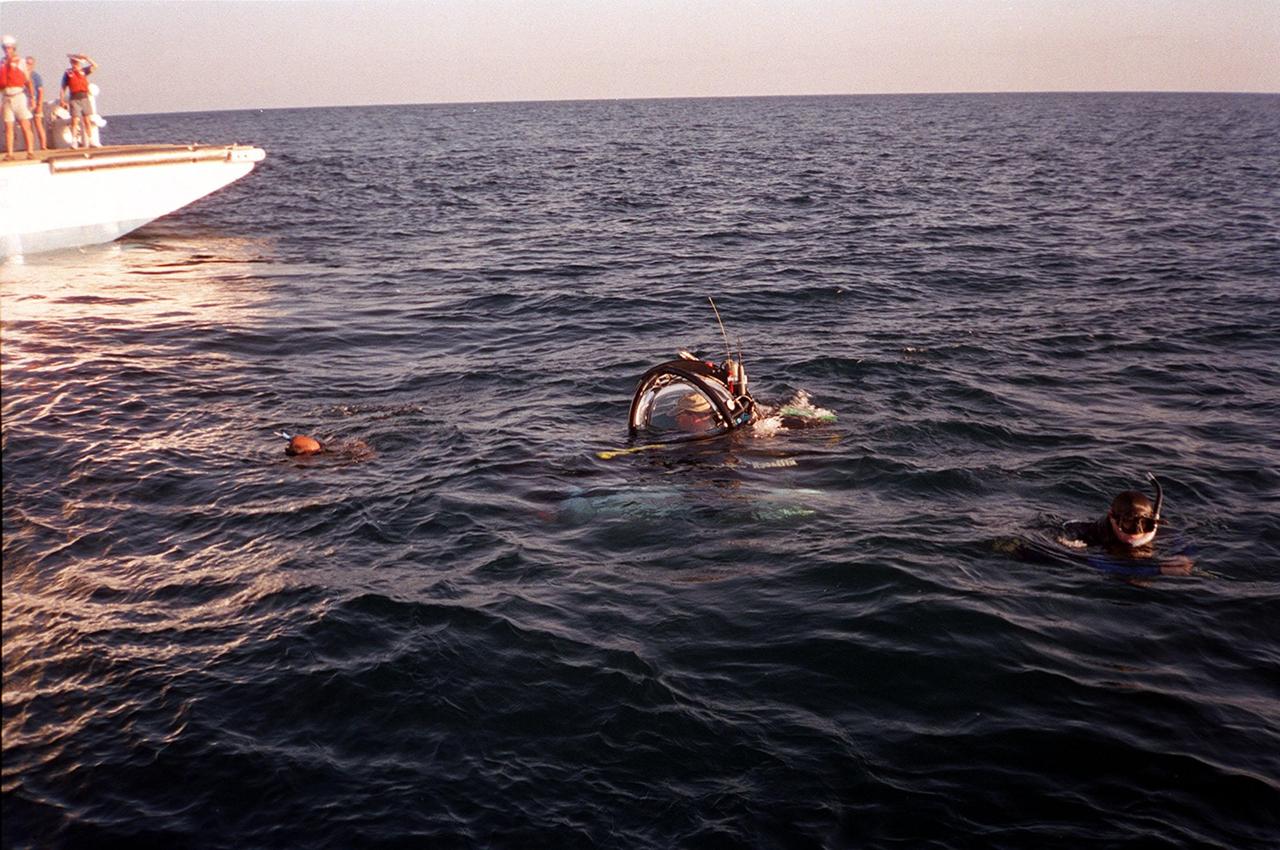
KENNEDY SPACE CENTER, FLA. -- The one-man submarine known as DeepWorker 2000 is tested in Atlantic waters near Cape Canaveral, Fla. Nearby are divers; inside the sub is the pilot, Anker Rasmussen. The sub is being tested on its ability to duplicate the sometimes hazardous job United Space Alliance (USA) divers perform to recover the expended boosters in the ocean after a launch. The boosters splash down in an impact area about 140 miles east of Jacksonville and after recovery are towed back to KSC for refurbishment by the specially rigged recovery ships. DeepWorker 2000 will be used in a demonstration during retrieval operations after the upcoming STS-101 launch. The submarine pilot will demonstrate capabilities to cut tangled parachute riser lines using a manipulator arm and attach a Diver Operator Plug to extract water and provide flotation for the booster. DeepWorker 2000 was built by Nuytco Research Ltd., North Vancouver, British Columbia. It is 8.25 feet long, 5.75 feet high, and weighs 3,800 pounds. USA is a prime contractor to NASA for the Space Shuttle program
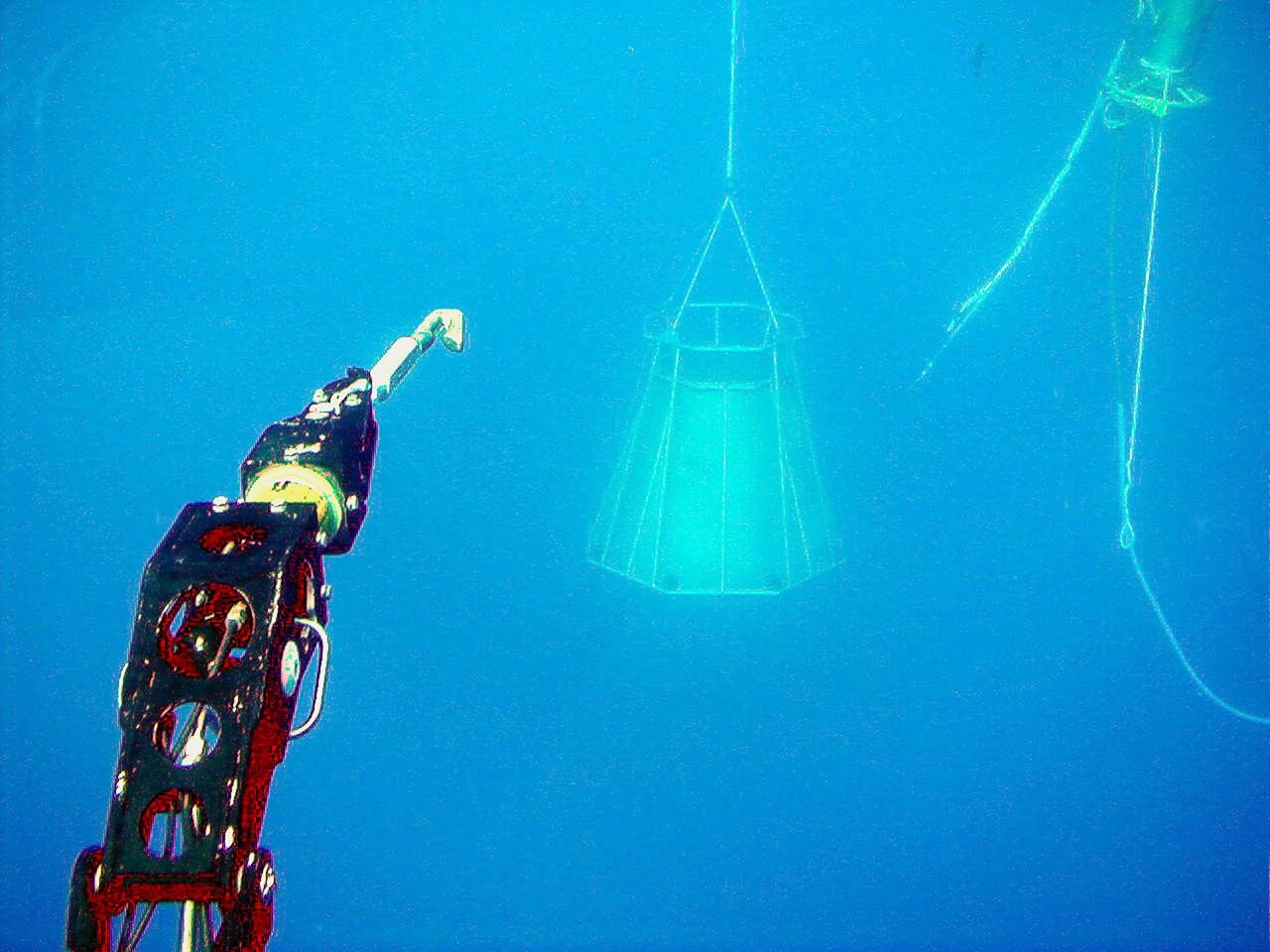
KENNEDY SPACE CENTER, FLA. -- At left, a manipulator arm on a one-man submarine demonstrates its ability to cut tangled parachute riser lines and place a Diver Operator Plug (top right) inside a mock solid rocket booster nozzle (center). Known as DeepWorker 2000, the sub is being tested on its ability to duplicate the sometimes hazardous job United Space Alliance (USA) divers perform to recover the expended boosters in the ocean after a launch. The boosters splash down in an impact area about 140 miles east of Jacksonville and after recovery are towed back to KSC for refurbishment by the specially rigged recovery ships. DeepWorker 2000 will be used in a demonstration during retrieval operations after the upcoming STS-101 launch. The submarine pilot will demonstrate capabilities to cut tangled parachute riser lines using a manipulator arm and attach the DOP to extract water and provide flotation for the booster. DeepWorker 2000 was built by Nuytco Research Ltd., North Vancouver, British Columbia. It is 8.25 feet long, 5.75 feet high, and weighs 3,800 pounds. USA is a prime contractor to NASA for the Space Shuttle program
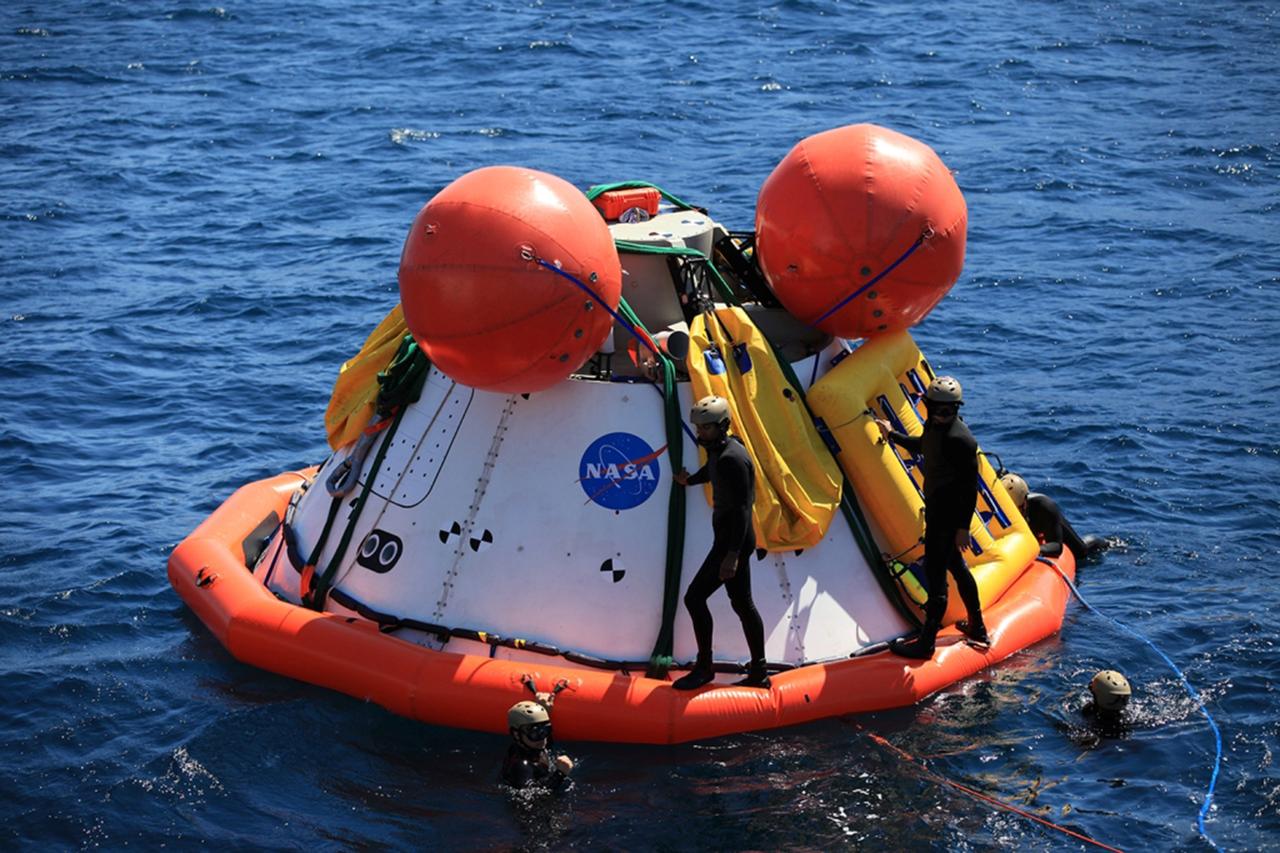
SAN DIEGO, Calif. – The Orion boilerplate test vehicle floats in the Pacific Ocean during Underway Recovery Test 4A. Orion was lowered into the water with a stationary crane from the USS Salvor, a safeguard-class rescue and salvage ship. U.S. Navy divers have attached a flotation collar and tether lines to Orion to prepare for recovery. NASA, Lockheed Martin and the U.S. Navy are conducting crane recovery tests to prepare for recovery of the Orion crew module on its return from a deep space mission. The underway recovery test will allow the teams to demonstrate and evaluate the recovery processes, procedures, new hardware and personnel in open waters. The Ground Systems Development and Operations Program is conducting the underway recovery test. Orion is the exploration spacecraft designed to carry astronauts to destinations not yet explored by humans, including an asteroid and Mars. It will have emergency abort capability, sustain the crew during space travel and provide safe re-entry from deep space return velocities. The first unpiloted test flight of the Orion is scheduled to launch in December 2014 atop a United Launch Alliance Delta IV Heavy rocket and in 2018 on NASA’s Space Launch System rocket. For more information, visit http://www.nasa.gov/orion. Photo credit: Kim Shiflett
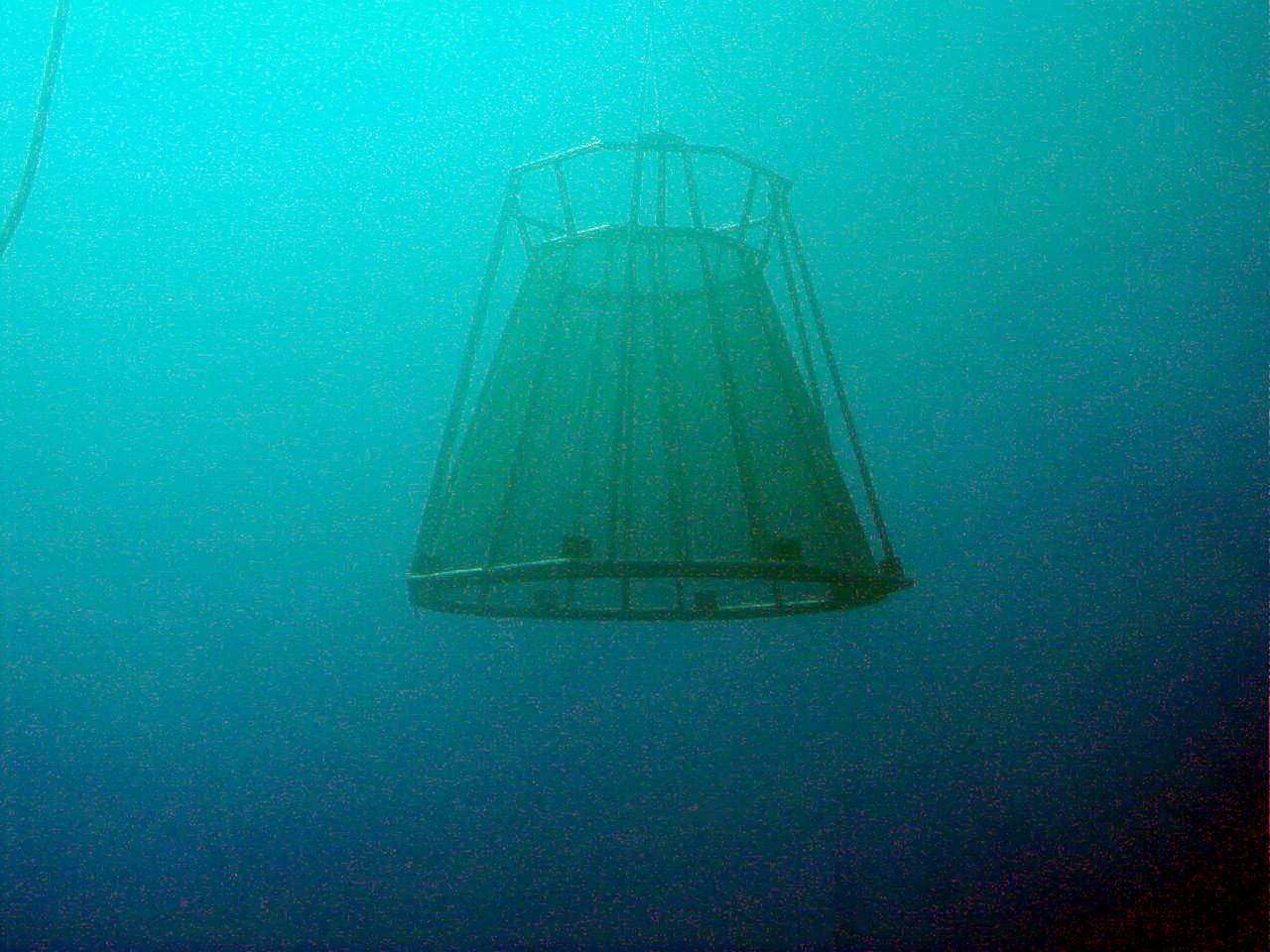
KENNEDY SPACE CENTER, FLA. -- A mockup of a solid rocket booster nozzle is lowered into the waters of the Atlantic during a test of a new booster retrieval method. A one-man submarine known as DeepWorker 2000 is being tested on its ability to duplicate the sometimes hazardous job United Space Alliance (USA) divers perform to recover the expended boosters in the ocean after a launch. The boosters splash down in an impact area about 140 miles east of Jacksonville and after recovery are towed back to KSC for refurbishment by the specially rigged recovery ships. DeepWorker 2000 will be used in a demonstration during retrieval operations after the upcoming STS-101 launch. The submarine pilot will demonstrate capabilities to cut tangled parachute riser lines using a manipulator arm and attach a Diver Operator Plug to extract water and provide flotation for the booster. DeepWorker 2000 was built by Nuytco Research Ltd., North Vancouver, British Columbia. It is 8.25 feet long, 5.75 feet high, and weighs 3,800 pounds. USA is a prime contractor to NASA for the Space Shuttle program
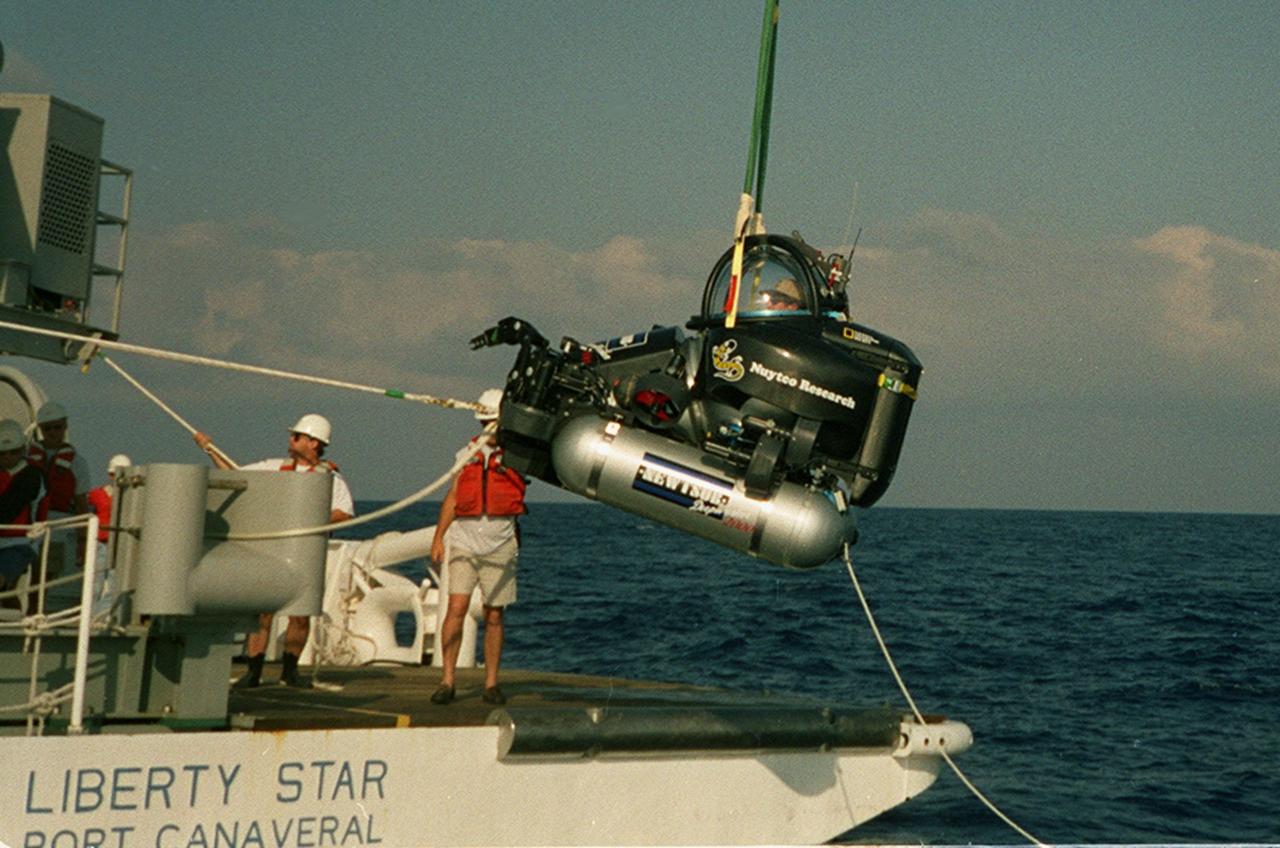
KENNEDY SPACE CENTER, FLA. -- After a successful dive, the one-man submarine known as DeepWorker 2000 is lifted from Atlantic waters near Cape Canaveral, Fla., onto the deck of the Liberty Star, one of two KSC solid rocket booster recovery ships. Inside the sub is the pilot, Anker Rasmussen. The sub is being tested on its ability to duplicate the sometimes hazardous job United Space Alliance (USA) divers perform to recover the expended boosters in the ocean after a launch. The boosters splash down in an impact area about 140 miles east of Jacksonville and after recovery are towed back to KSC for refurbishment by the specially rigged recovery ships. DeepWorker 2000 will be used in a demonstration during retrieval operations after the upcoming STS-101 launch. The submarine pilot will demonstrate capabilities to cut tangled parachute riser lines using a manipulator arm and attach a Diver Operator Plug to extract water and provide flotation for the booster. DeepWorker 2000 was built by Nuytco Research Ltd., North Vancouver, British Columbia. It is 8.25 feet long, 5.75 feet high, and weighs 3,800 pounds. USA is a prime contractor to NASA for the Space Shuttle program
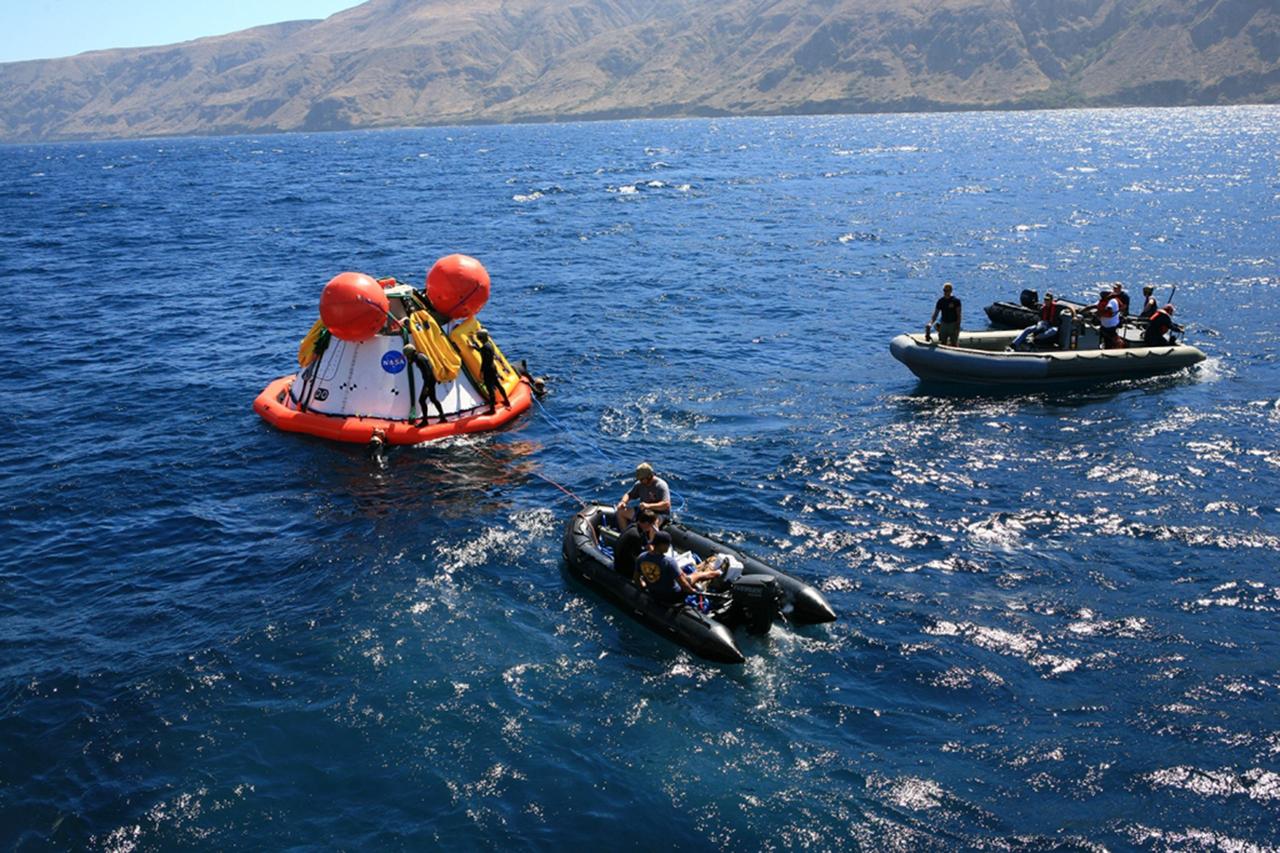
SAN DIEGO, Calif. – The Orion boilerplate test vehicle floats in the Pacific Ocean during Underway Recovery Test 4A. Orion was lowered into the water with a stationary crane from the USS Salvor, a safeguard-class rescue and salvage ship. Nearby, U.S. Navy personnel in a Zodiac boat, left, and a rigid hull inflatable boat practice procedures to tether and retrieve the test vehicle. U.S. Navy divers are standing on the flotation collar that has been placed around the test vehicle. NASA, Lockheed Martin and the U.S. Navy are conducting crane recovery tests to prepare for recovery of the Orion crew module on its return from a deep space mission. The underway recovery test will allow the teams to demonstrate and evaluate the recovery processes, procedures, new hardware and personnel in open waters. The Ground Systems Development and Operations Program is conducting the underway recovery test. Orion is the exploration spacecraft designed to carry astronauts to destinations not yet explored by humans, including an asteroid and Mars. It will have emergency abort capability, sustain the crew during space travel and provide safe re-entry from deep space return velocities. The first unpiloted test flight of the Orion is scheduled to launch in December 2014 atop a United Launch Alliance Delta IV Heavy rocket and in 2018 on NASA’s Space Launch System rocket. For more information, visit http://www.nasa.gov/orion. Photo credit: Kim Shiflett
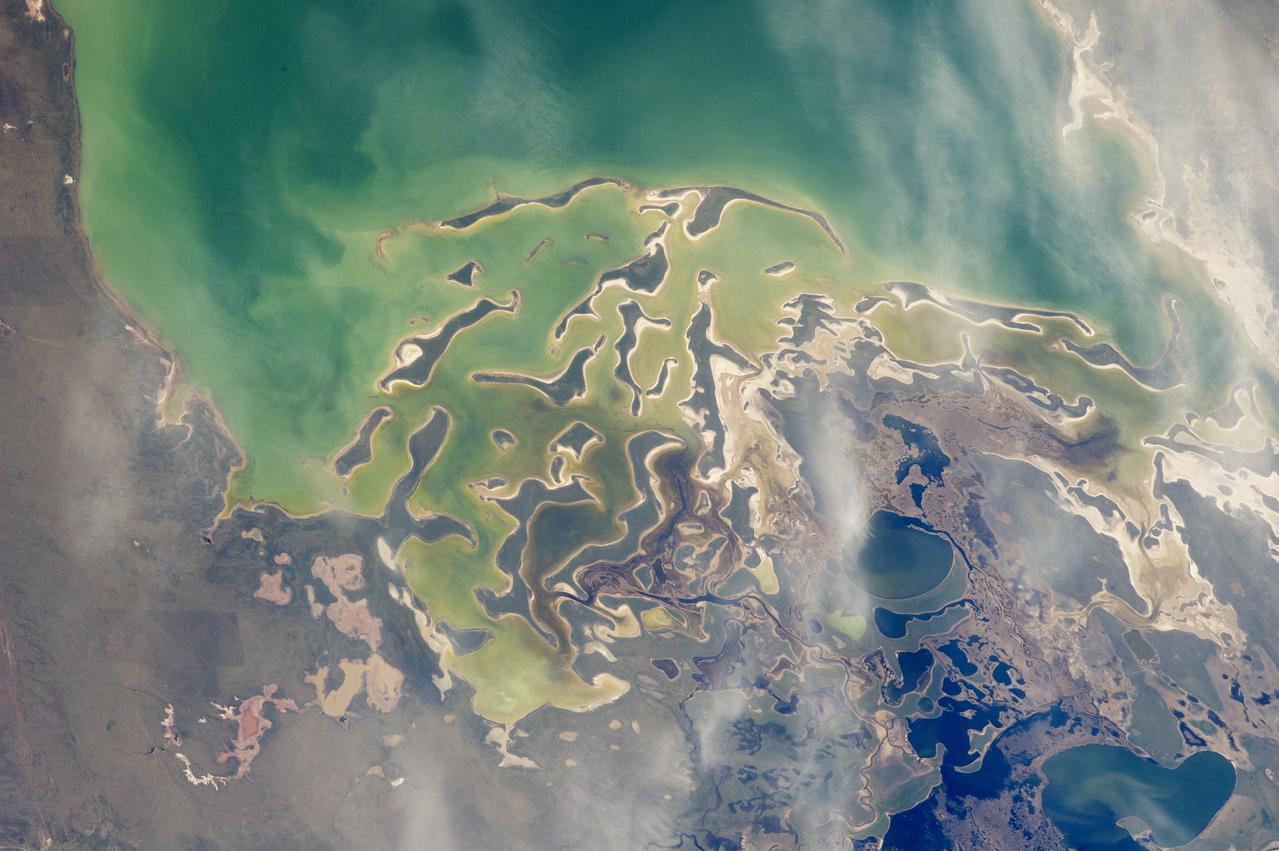
In orbit above the semi-desert grasslands in Kazakhstan, an astronaut aboard the International Space Station spotted one of the few features that stand out. Lake Tengiz is the only large lake (1590 square kilometers, 615 square miles) in northern Kazakhstan. Through white wisps of cloud, the crew member photographed the 50 kilometer-long eastern shore of the lake, with its thin, winding islands and white beaches. The islands and intervening waterways make a rich habitat for birds in this part of Asia. At least 318 species of birds have been identified at the lake; 22 of them are endangered. It is the northernmost habitat of the pink flamingo. The lake system is Kazakhstan’s first UNESCO World Heritage Site, and it has been declared a RAMSAR wetland site of international importance. Part of the richness of area is its complex hydrology. Fresh water enters the system via the Kulanutpes River, so there are small lakes (lower right) full of fresh water. But in this closed basin, the water in the main lake (top) slowly evaporates, becoming salty. Winds stir up bigger waves on the main lake, dispersing sediment and salt and making the water a cloudier and lighter blue-green. (Another astronaut photograph shows the entire lake system, while this story provides more information.) The strange shape of the islands is not easy to interpret. They may be drowned remnants of delta distributaries of the Kulanutpes River. Westerly winds probably have had a smoothing effect on the shorelines, especially in a shallow lake like Tengiz, which is only about 6 meters (20 feet) deep. The lake has an exciting history for people who follow space exploration. In 1976, a Soyuz spacecraft landed in the lake near the north shore (top right). The capsule crashed through the ice and sank during an October snowstorm when temperatures were -22°C (-8°F). Because of low power, the capsule was unheated and the crew was feared lost. It was many hours before the airtight capsule was located and divers could attach flotation tanks to get the capsule to the surface. It was then dragged ashore across the ice by helicopter. The rescue effort took nine hours before the crew was able to safely exit the capsule. Credit: <b><a href="http://www.earthobservatory.nasa.gov/" rel="nofollow"> NASA Earth Observatory</a></b> <b><a href="http://www.nasa.gov/audience/formedia/features/MP_Photo_Guidelines.html" rel="nofollow">NASA image use policy.</a></b> <b><a href="http://www.nasa.gov/centers/goddard/home/index.html" rel="nofollow">NASA Goddard Space Flight Center</a></b> enables NASA’s mission through four scientific endeavors: Earth Science, Heliophysics, Solar System Exploration, and Astrophysics. Goddard plays a leading role in NASA’s accomplishments by contributing compelling scientific knowledge to advance the Agency’s mission. <b>Follow us on <a href="http://twitter.com/NASAGoddardPix" rel="nofollow">Twitter</a></b> <b>Like us on <a href="http://www.facebook.com/pages/Greenbelt-MD/NASA-Goddard/395013845897?ref=tsd" rel="nofollow">Facebook</a></b> <b>Find us on <a href="http://instagrid.me/nasagoddard/?vm=grid" rel="nofollow">Instagram</a></b>