Fluid Flow
Mars Volcanism: Large, Fluid Lava Flows
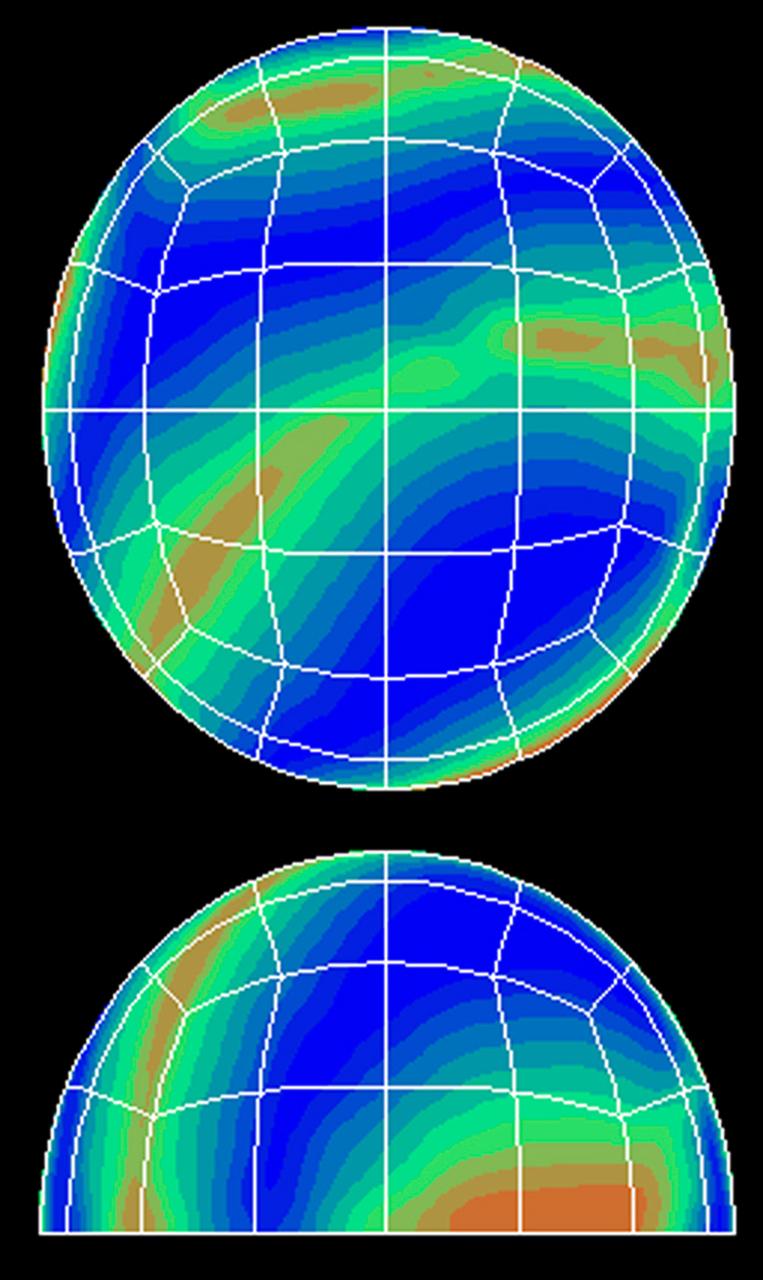
Computer simulation of atmospheric flow corresponds well to imges taken during the second Geophysical Fluid Flow Cell (BFFC) mission. The top shows a view from the pole, while the bottom shows a view from the equator. Red corresponds to hot fluid rising while blue shows cold fluid falling. This simulation was developed by Anil Deane of the University of Maryland, College Park and Paul Fischer of Argorne National Laboratory. Credit: NASA/Goddard Space Flight Center
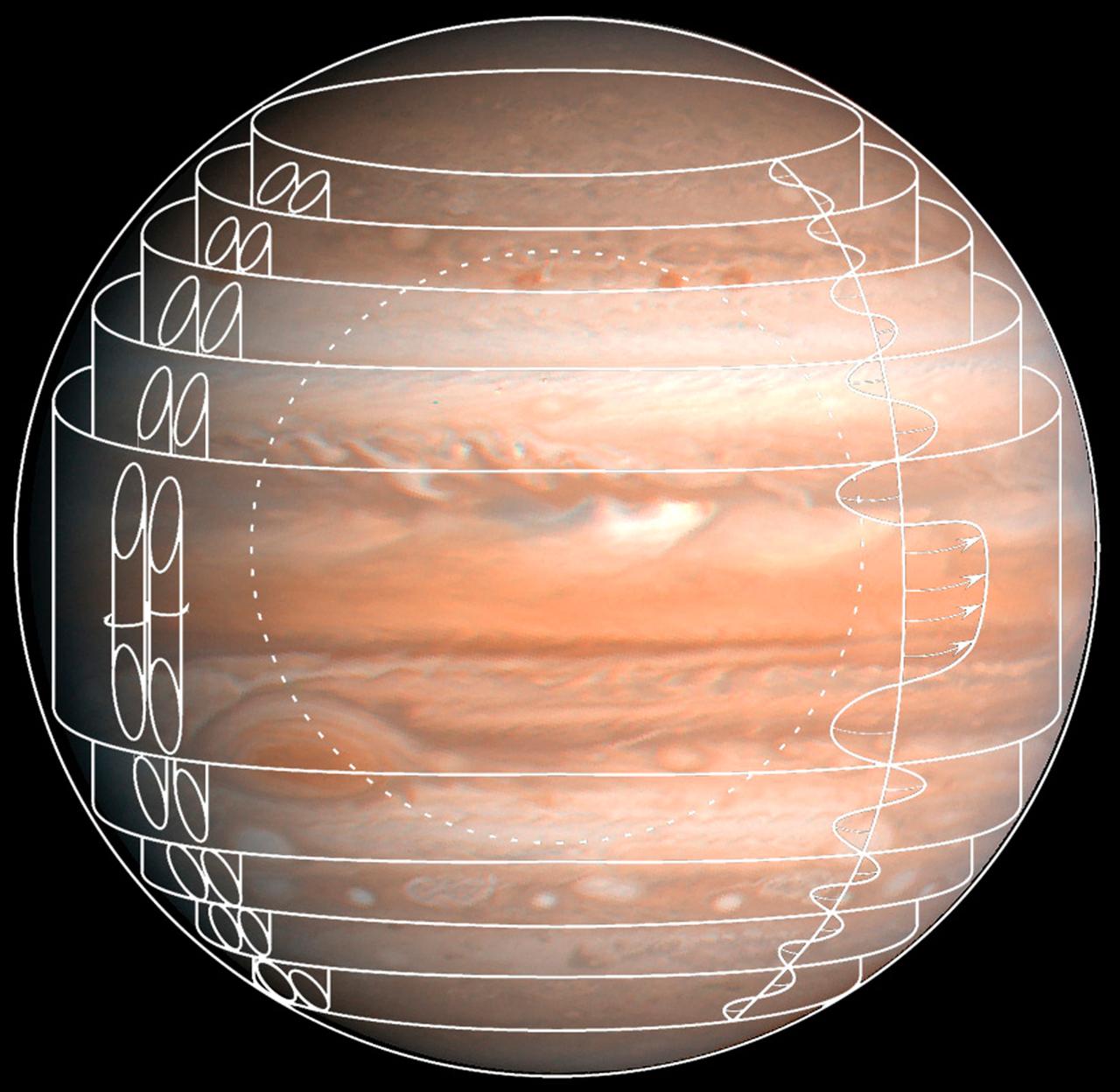
This composite image depicts one set of flow patterns simulated in the Geophysical Fluid Flow Cell (GFFC) that flew on two Spacelab missions. Silicone oil served as the atmosphere around a rotating steel hemisphere (dotted circle) and an electrostatic field pulled the oil inward to mimic gravity's effects during the experiments. The GFFC thus produced flow patterns that simulated conditions inside the atmospheres of Jupiter and the Sun and other stars. GFFC flew on Spacelab-3 in 1985 and U.S. Microgravity Laboratory-2 in 1995. The principal investigator was John Hart of the University of Colorado at Boulder. It was managed by NASA's Marshall Space Flight Center. (Credit: NASA/Marshall Space Flight Center)
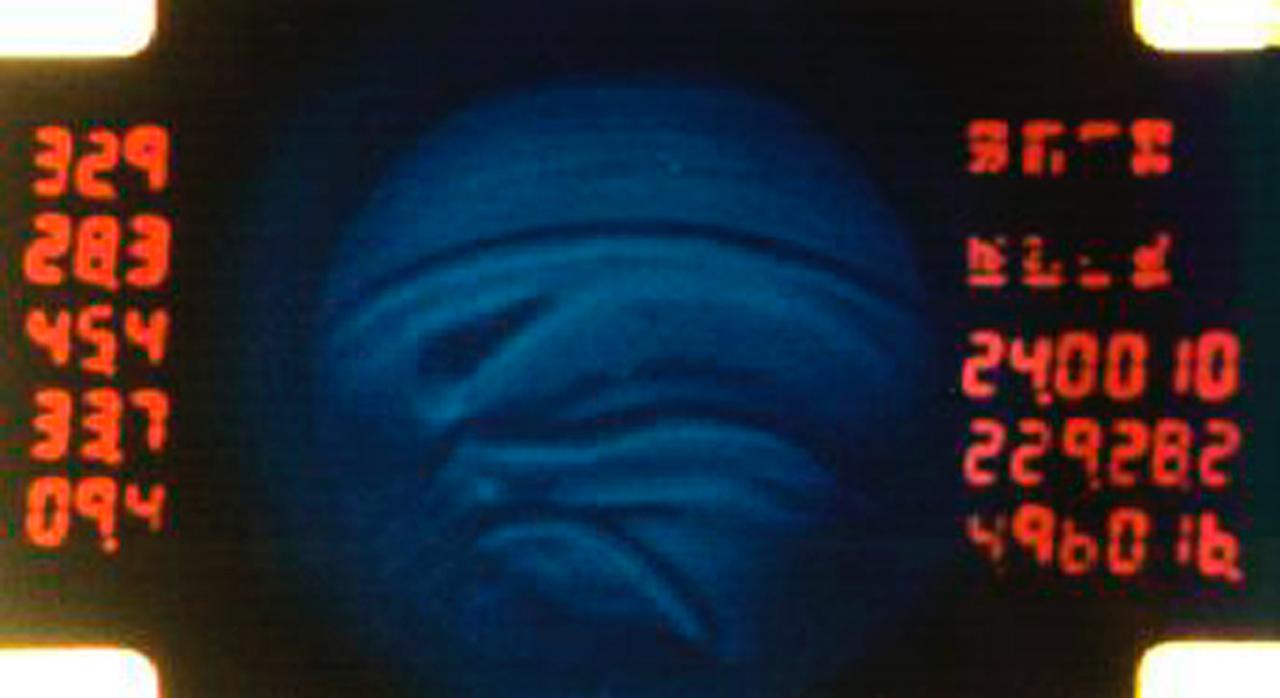
A 16mm film frame shows convective regions inside silicone oil playing the part of a stellar atmosphere in the Geophysical Fluid Flow Cell (GFFC). An electrostatic field pulled the oil inward to mimic gravity's effects during the experiments. The GFFC thus produced flow patterns that simulated conditions inside the atmospheres of Jupiter and the Sun and other stars. Numbers of the frame indicate temperatures and other conditions. This image is from the Spacelab-3 flight in 1985. GFFC was reflown on U.S. Microgravity Laboratory-2 in 1995. The principal investigator was John Hart of the University of Colorado at Boulder. It was managed by NASA's Marshall Space Flight Center. (Credit: NASA/Marshall Space Flight Center)
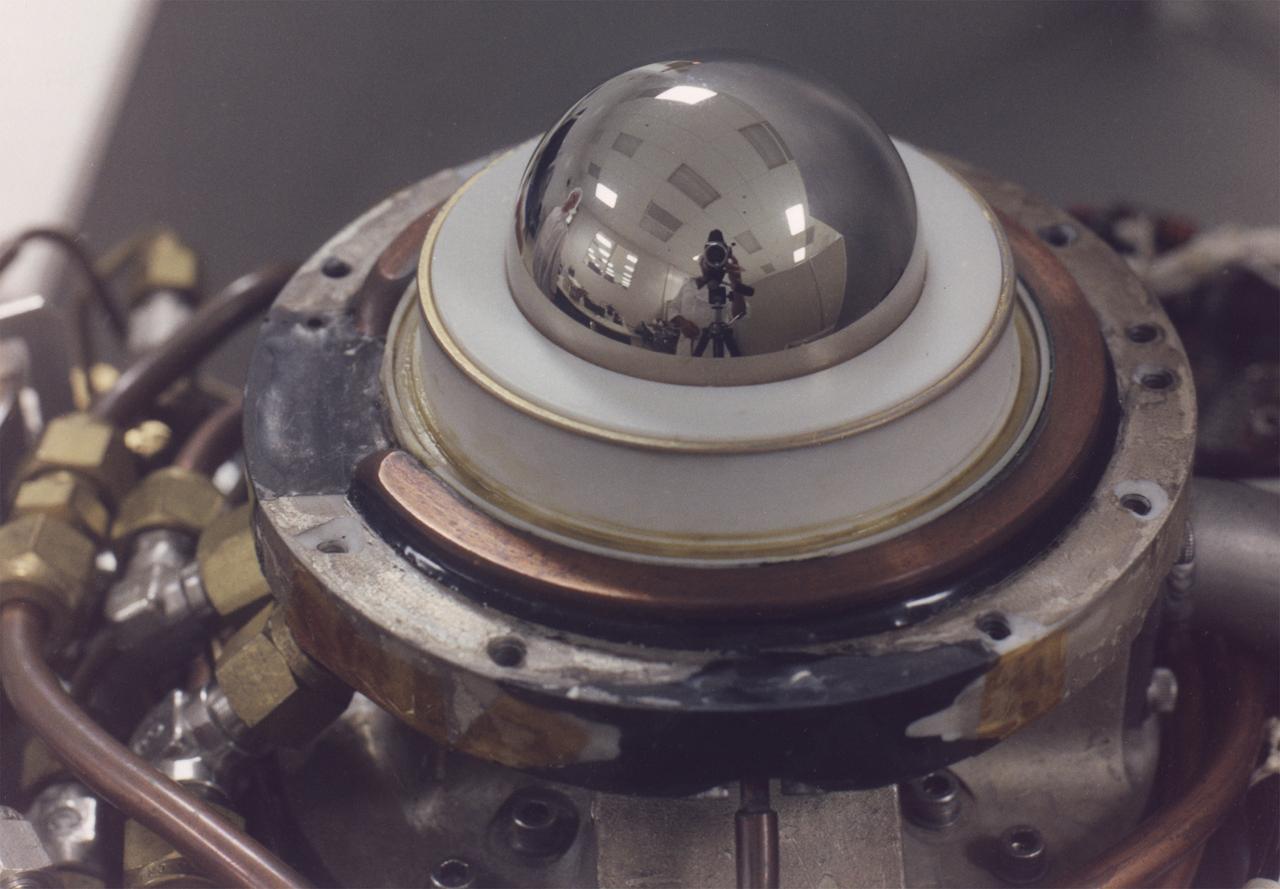
A steel hemisphere was at the core of the Geophysical Fluid Flow Cell (GFFC) that flew on two Spacelab missions. It was capped by a sapphire dome. Silicone oil between the two played the part of a steller atmosphere. An electrostatic field pulled the oil inward to mimic gravity's effects during the experiments. The GFFC thus produced flow patterns that simulated conditions inside the atmospheres of Jupiter and the Sun and other stars. GFFC flew on Spacelab-3 in 1985 and U.S. Microgravity Laboratory-2 in 1995. The principal investigator was John Hart of the University of Colorado at Boulder. It was managed by NASA's Marshall Space Flight Center. (Credit: NASA/Marshall Space Flight Center)
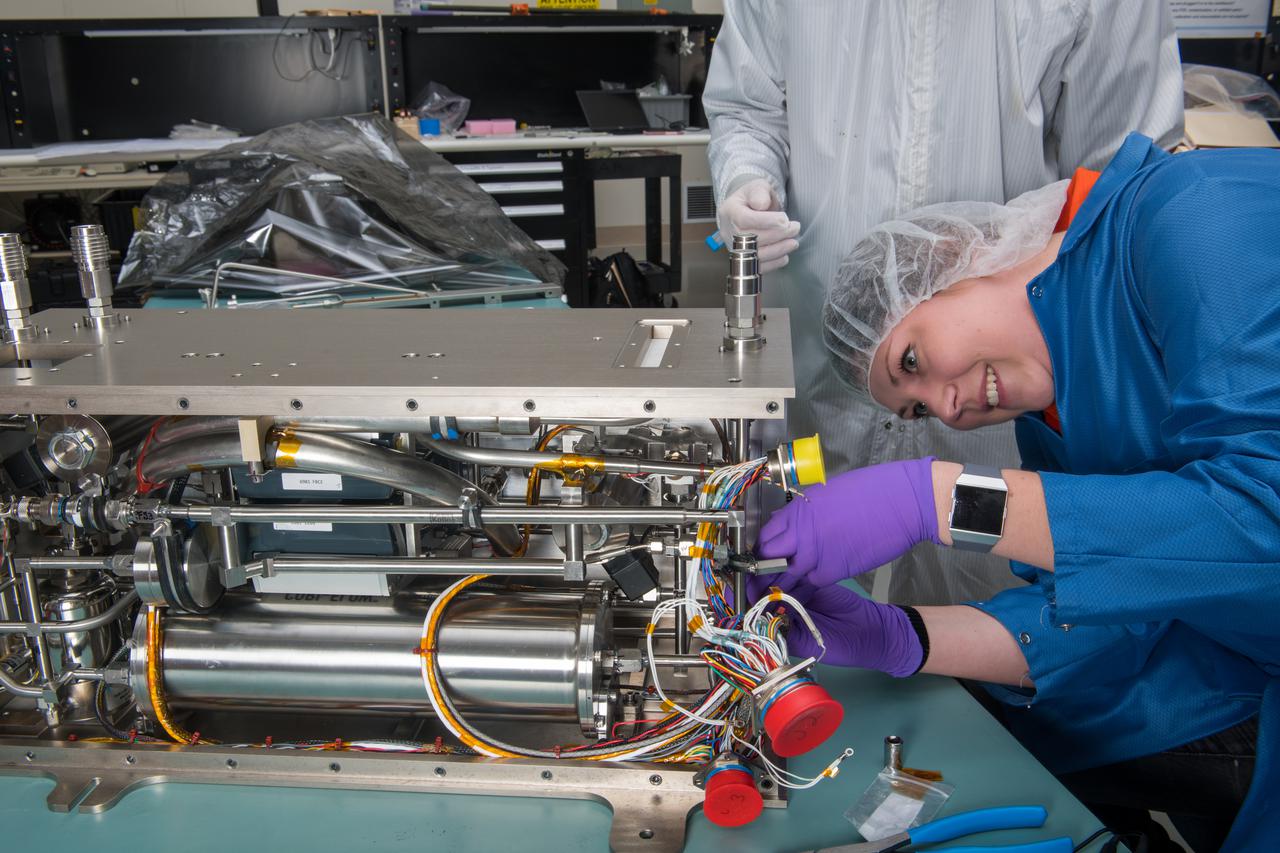
Flow Boiling and Condensation Experiment (FBCE) hardware. Project personnel perform engineering checks on the Fluid Module 1 prior to final hardware assembly.
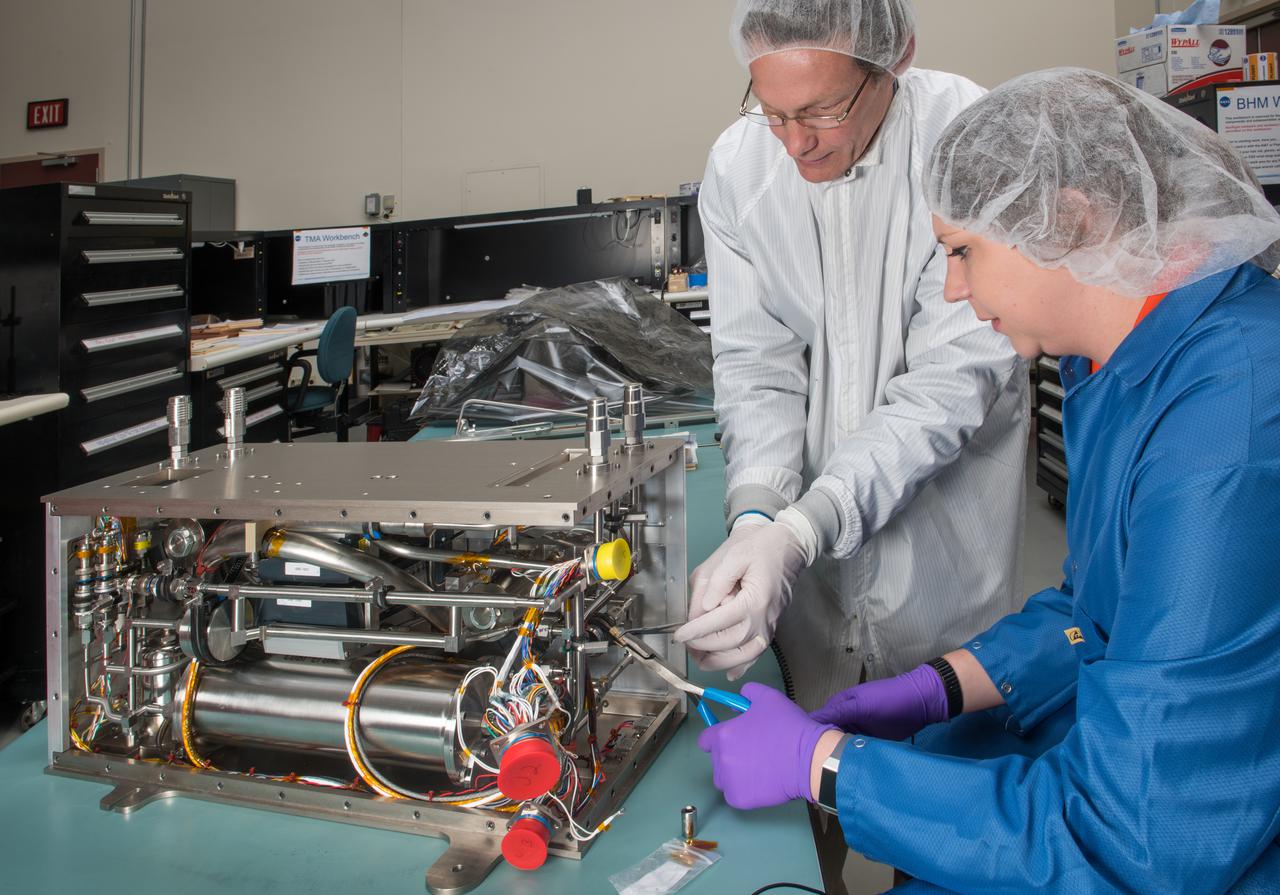
Flow Boiling and Condensation Experiment (FBCE) hardware. Project personnel perform engineering checks on the Fluid Module 1 prior to final hardware assembly.
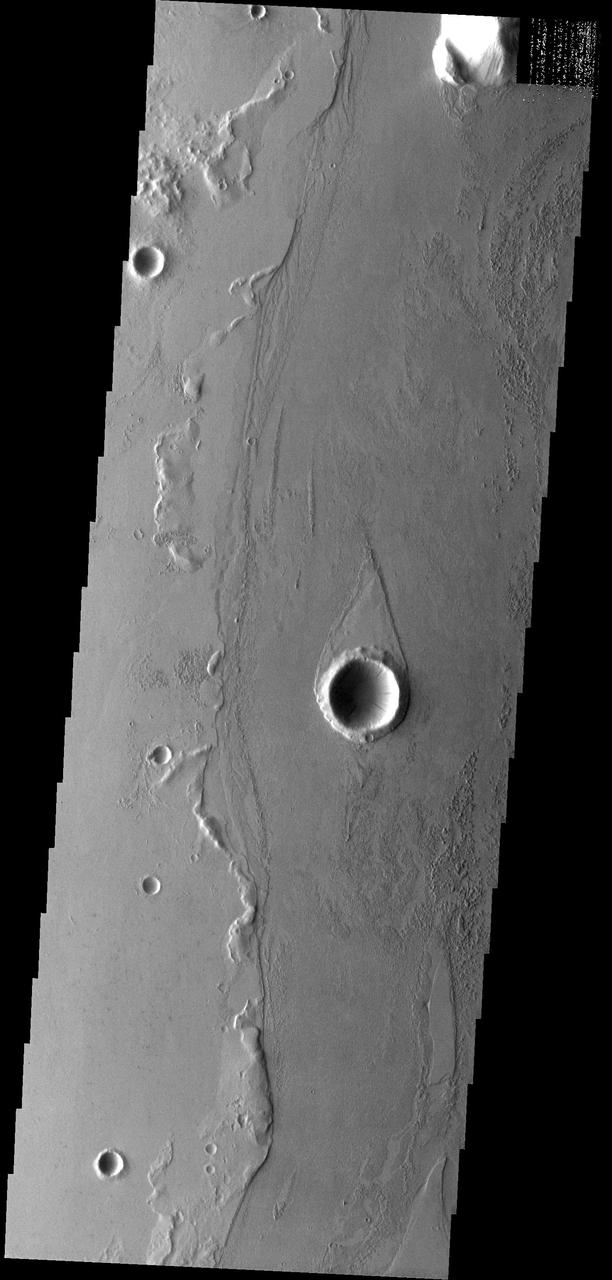
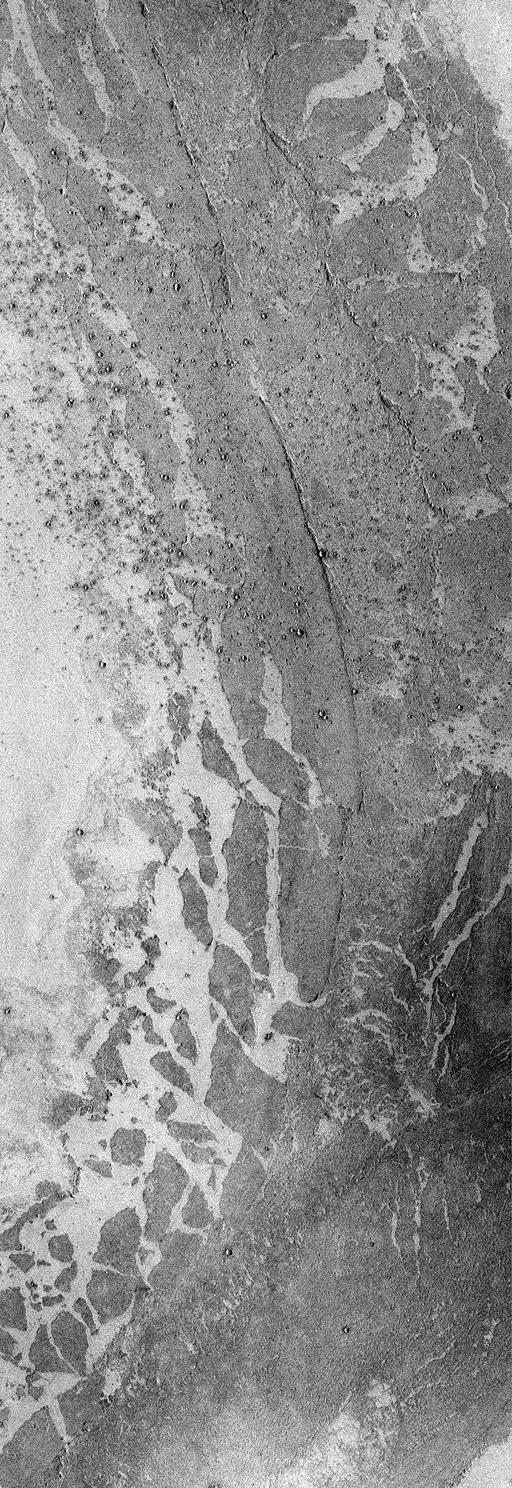
The teardrop-shaped island in this image was formed by the flow of fluid lava rather than liquid water
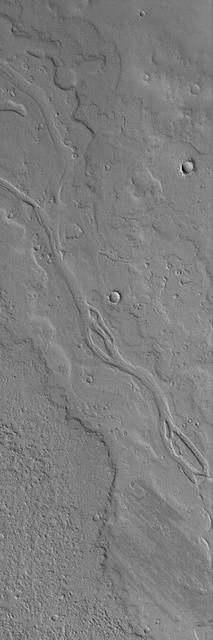
This MOC image shows a portion of a dust-covered plain northwest of Jovis Tholus which is host to several overlapping, ancient lava flows and a channel containing streamlined features indicative of fluid flow
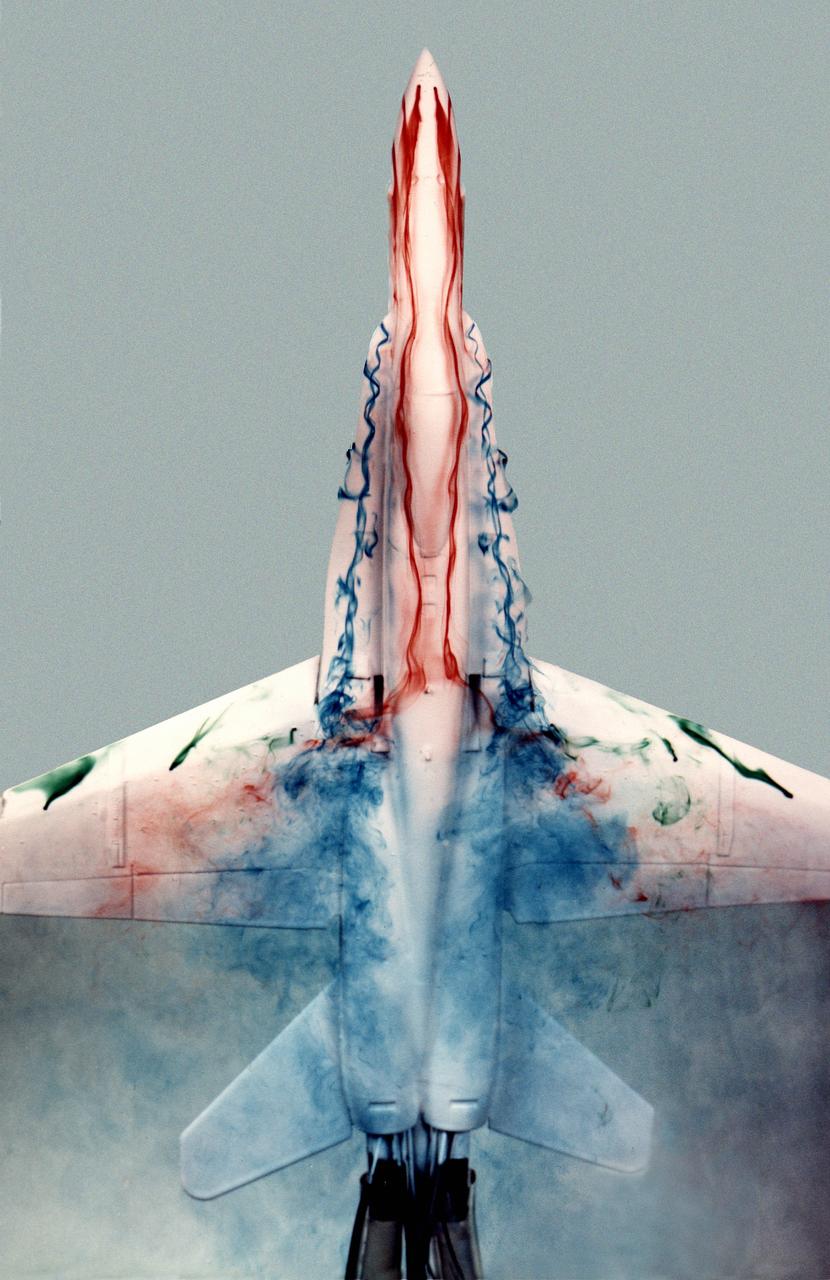
This image shows a plastic 1/48-scale model of an F-18 aircraft inside the "Water Tunnel" more formally known as the NASA Dryden Flow Visualization Facility. Water is pumped through the tunnel in the direction of normal airflow over the aircraft; then, colored dyes are pumped through tubes with needle valves. The dyes flow back along the airframe and over the airfoils highlighting their aerodynamic characteristics. The aircraft can also be moved through its pitch axis to observe airflow disruptions while simulating actual flight at high angles of attack. The Water Tunnel at NASA's Dryden Flight Research Center, Edwards, CA, became operational in 1983 when Dryden was a Flight Research Facility under the management of the Ames Research Center in Mountain View, CA. As a medium for visualizing fluid flow, water has played a significant role. Its use dates back to Leonardo da Vinci (1452-1519), the Renaissance Italian engineer, architect, painter, and sculptor. In more recent times, water tunnels have assisted the study of complex flows and flow-field interactions on aircraft shapes that generate strong vortex flows. Flow visualization in water tunnels assists in determining the strength of vortices, their location, and possible methods of controlling them. The design of the Dryden Water Tunnel imitated that of the Northrop Corporation's tunnel in Hawthorne, CA. Called the Flow Visualization Facility, the Dryden tunnel was built to assist researchers in understanding the aerodynamics of aircraft configured in such a way that they create strong vortex flows, particularly at high angles of attack. The tunnel provides results that compare well with data from aircraft in actual flight in another fluid-air. Other uses of the tunnel have included study of how such flight hardware as antennas, probes, pylons, parachutes, and experimental fixtures affect airflow. The facility has also been helpful in finding the best locations for emitting smoke from flight vehicles for flow vi
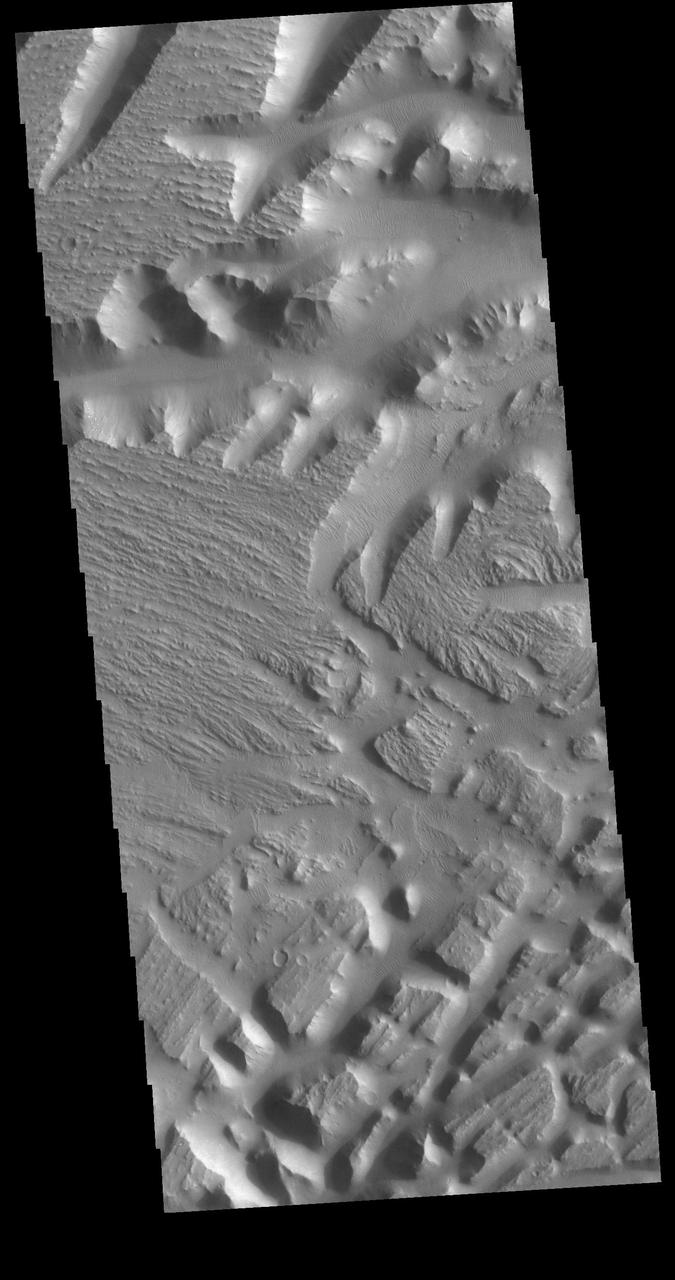
This VIS image covers part of Nilus Mensae. Located in the region where the northward flowing channel from Valles Marineris becomes the eastward flowing Kasei Valles, Nilus Mensae is a complex region of tectonic faulting and fluid flow features. In addition to the scoured surface, sand dunes are visible in depressions throughout the image. Orbit Number: 78517 Latitude: 21.6368 Longitude: 286.455 Instrument: VIS Captured: 2019-08-27 09:50 https://photojournal.jpl.nasa.gov/catalog/PIA23486
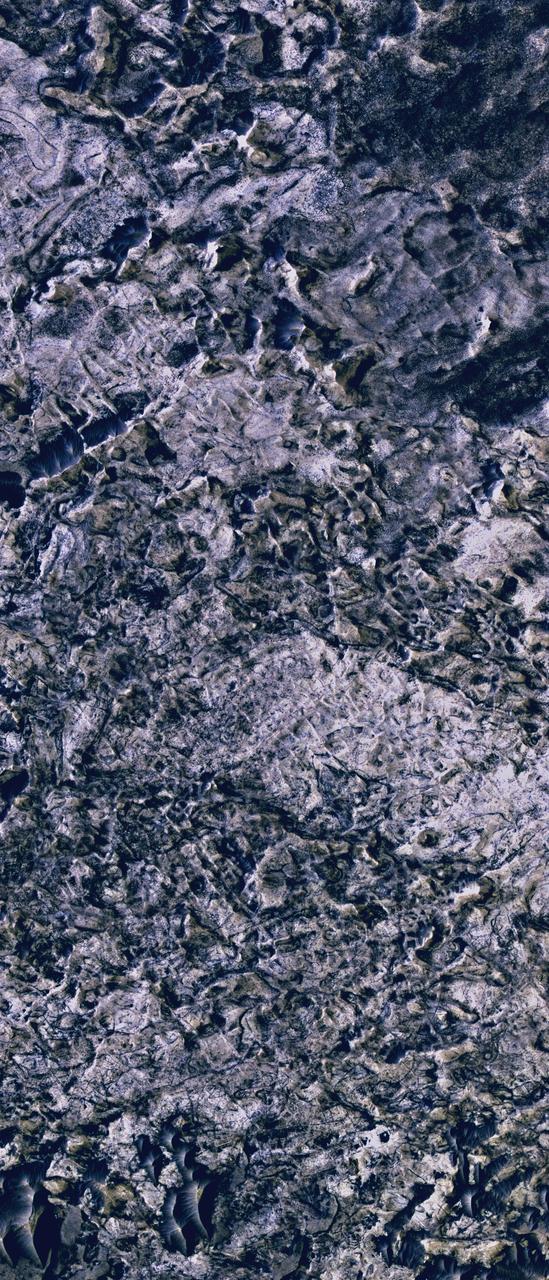
This image from the High Resolution Imaging Science Experiment camera on NASA Mars Reconnaissance Orbiter shows evidence for ancient fluid flow along fractures in Mars Meridiani Planum region
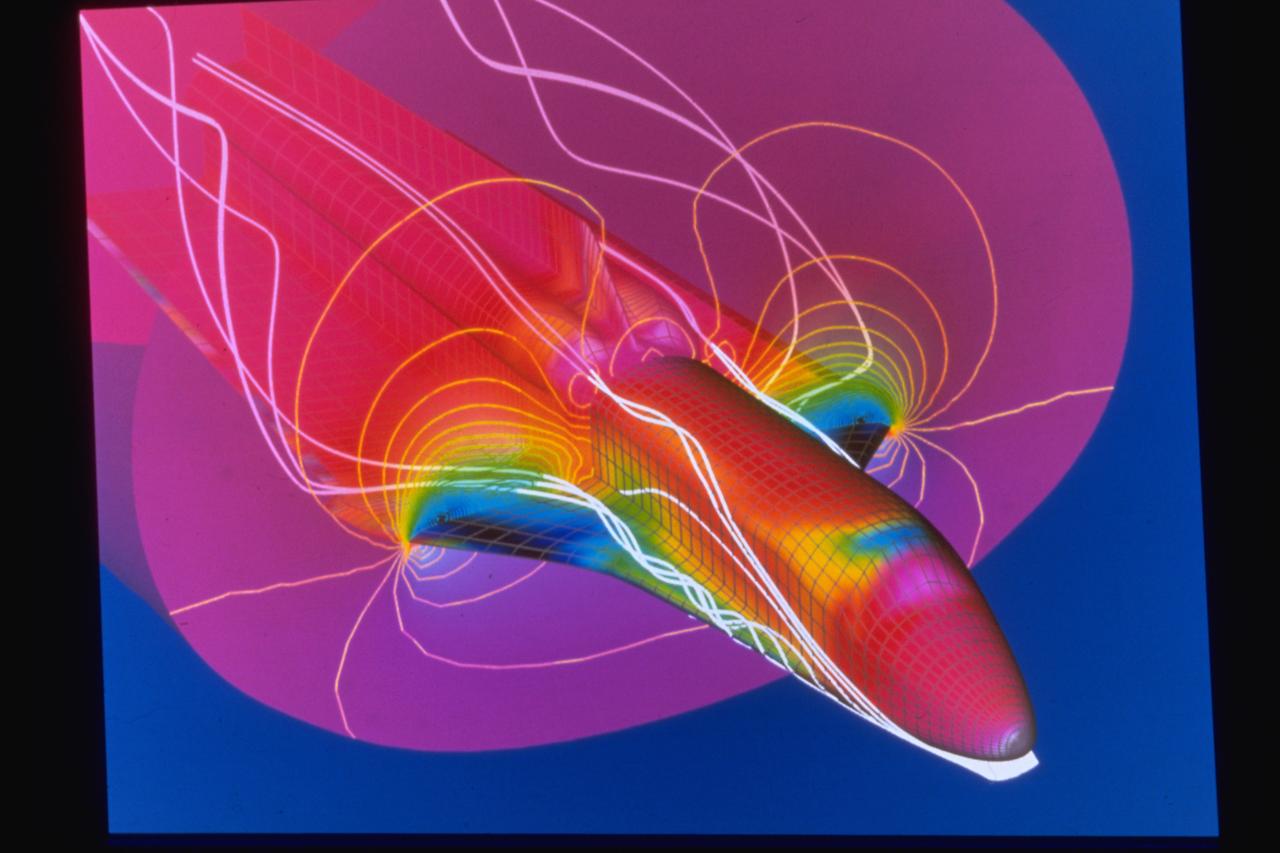
Computational Fluid Dynamics look at Space Shuttle flow
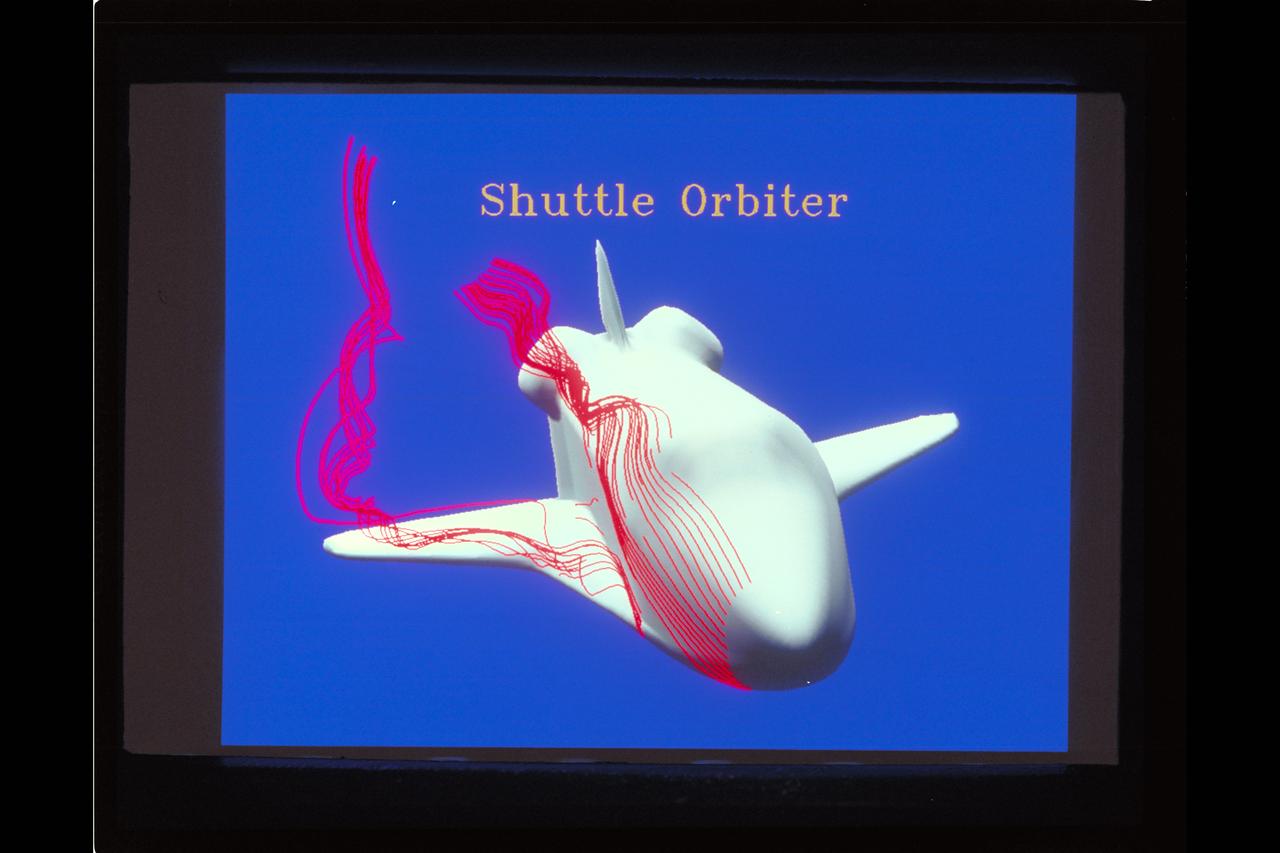
Computational Fluid Dynamics (CFD) Space Shuttle flow field
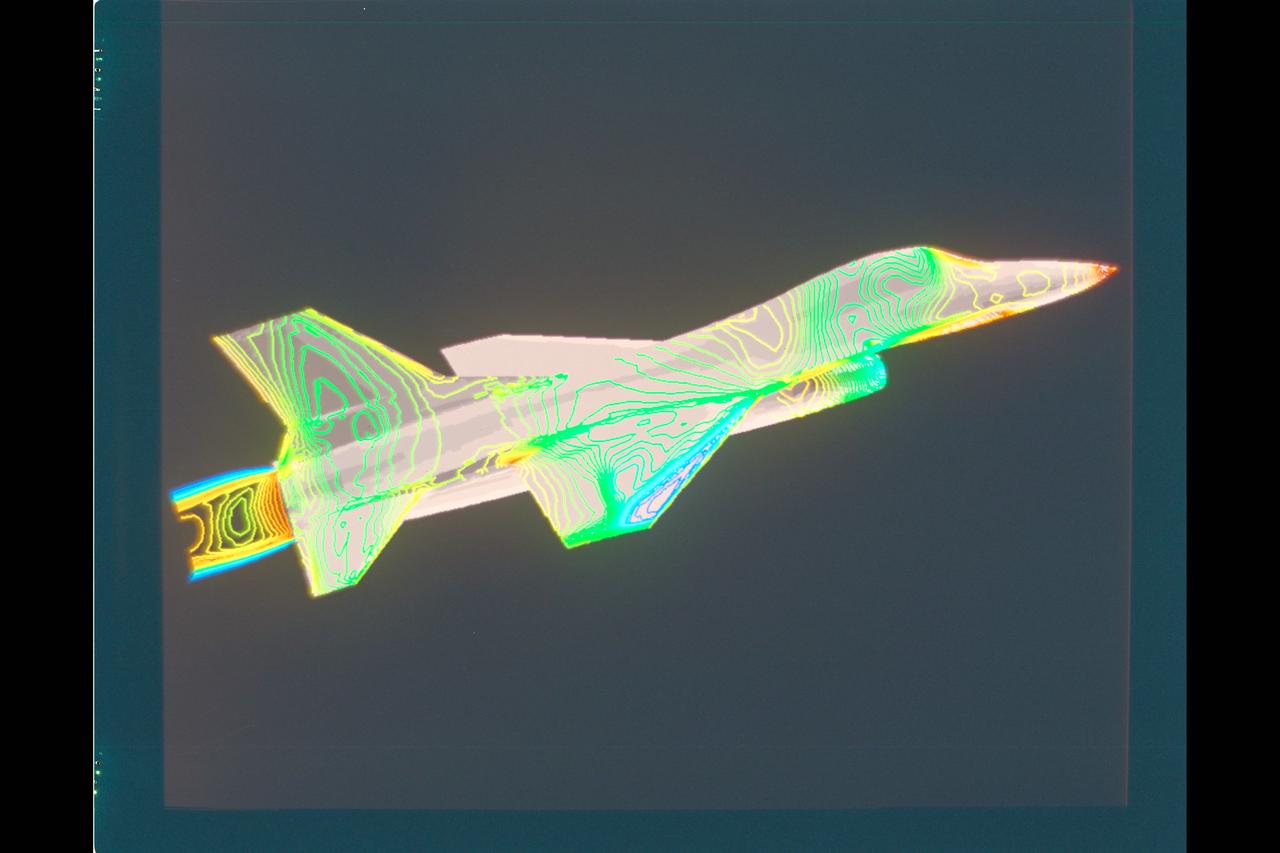
Computational Fluid Dynamics (CFD) F-16A flow field grid
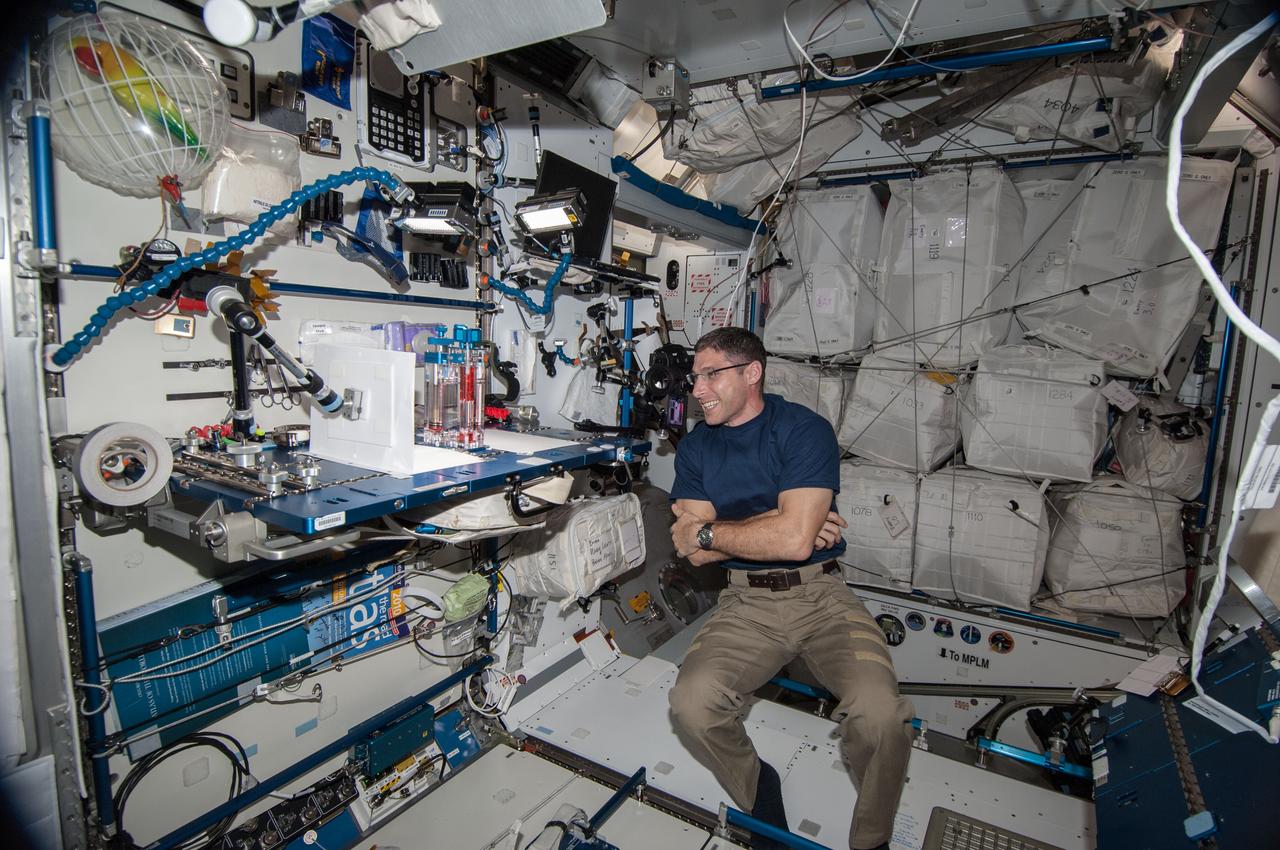
ISS038-E-005962 (19 Nov. 2013) --- NASA astronaut Michael Hopkins, Expedition 38 flight engineer, conducts a session with the Capillary Flow Experiment (CFE-2) in the Harmony node of the International Space Station. CFE is a suite of fluid physics experiments that investigate how fluids behave in microgravity which could benefit water and fuel delivery systems on future spacecraft. Scientists designed the Capillary Flow Experiment-2 to study properties of fluids and bubbles inside containers with a specific 3-D geometry.
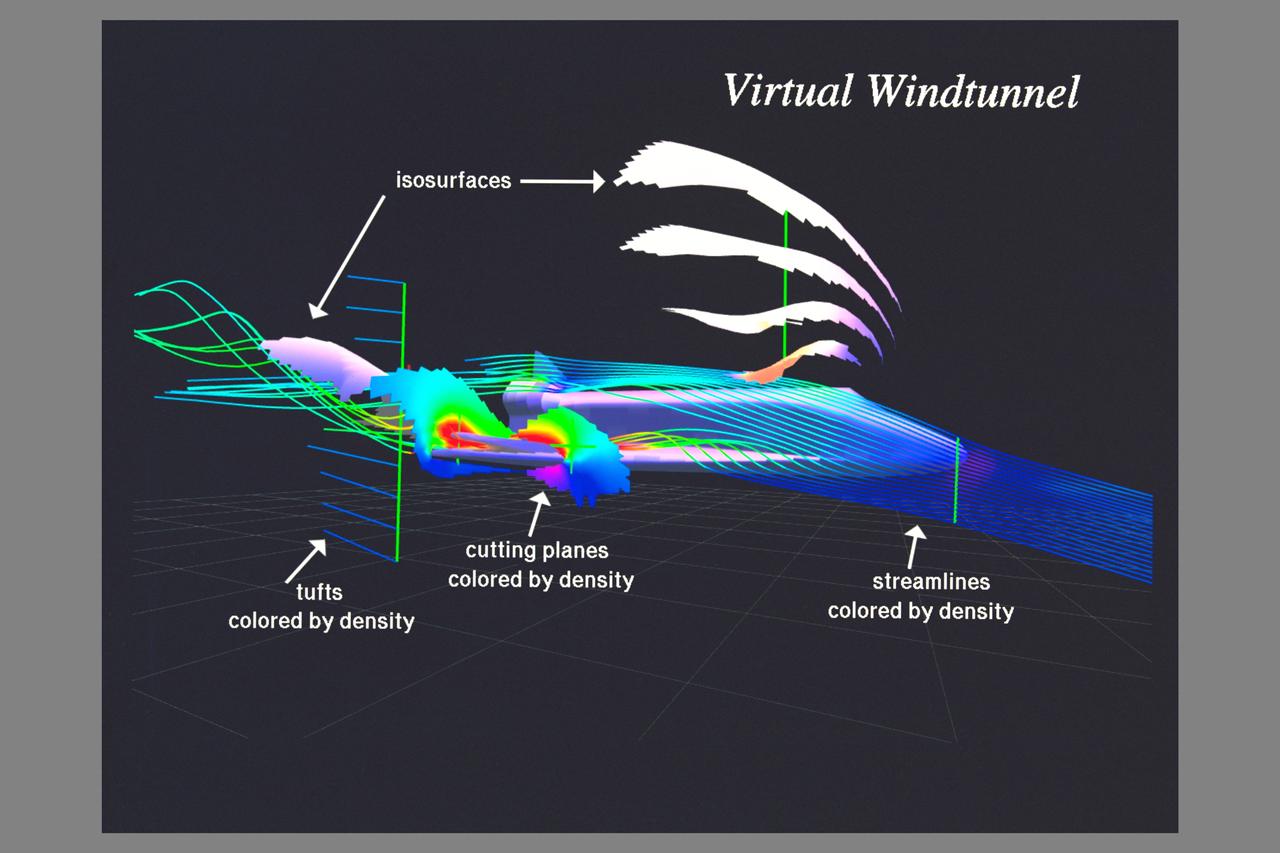
Computational Fluid Dynamics (CFD) image of Space Shuttle Pressure Flow using Virtual Wind Tunnel
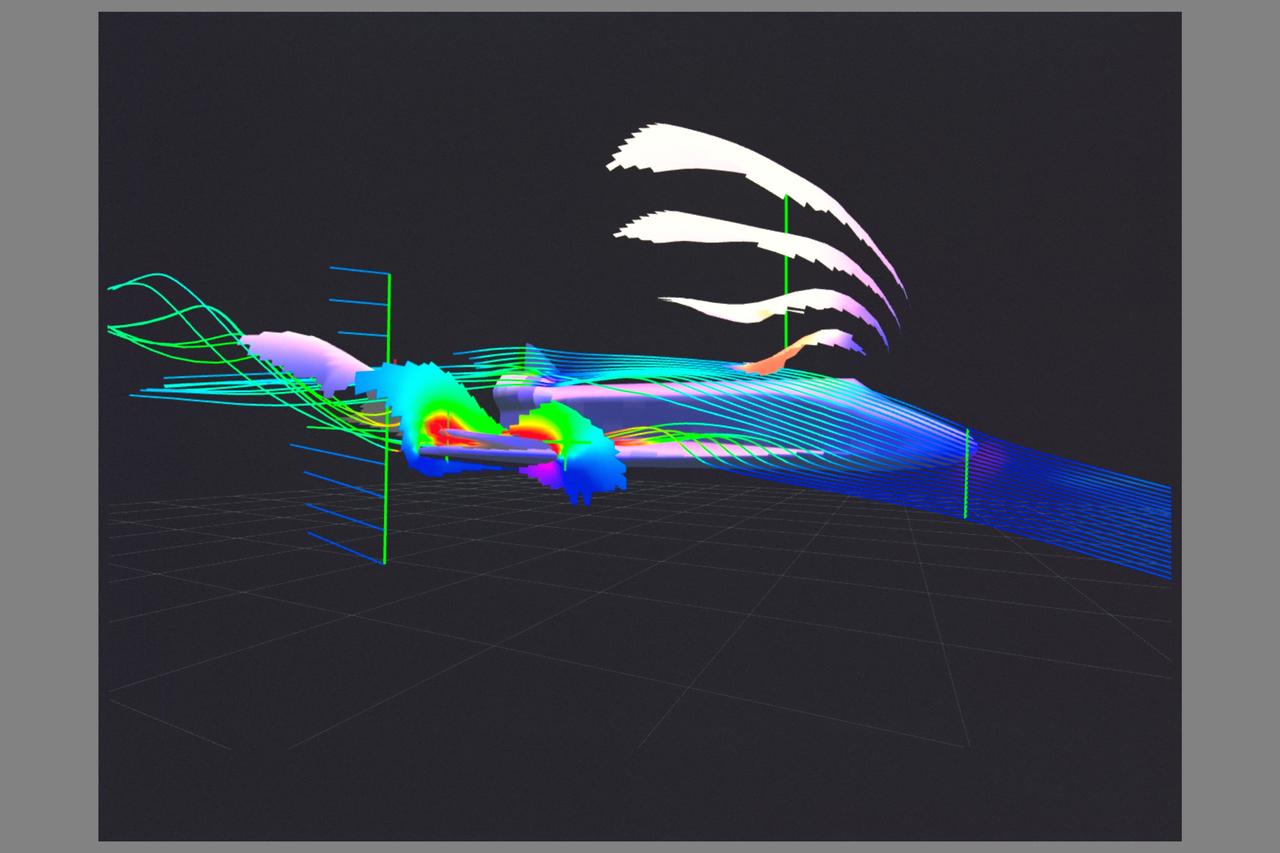
Computational Fluid Dynamics (CFD) image of Space Shuttle Pressure Flow using Virtual Wind Tunnel

Towards the top of this image from NASA 2001 Mars Odyssey spacecraft is a T shaped depression and two sections of narrow channel located on the northeast part of the Elysium Mons volcanic complex. Fluids like water, or lava flow downhill.
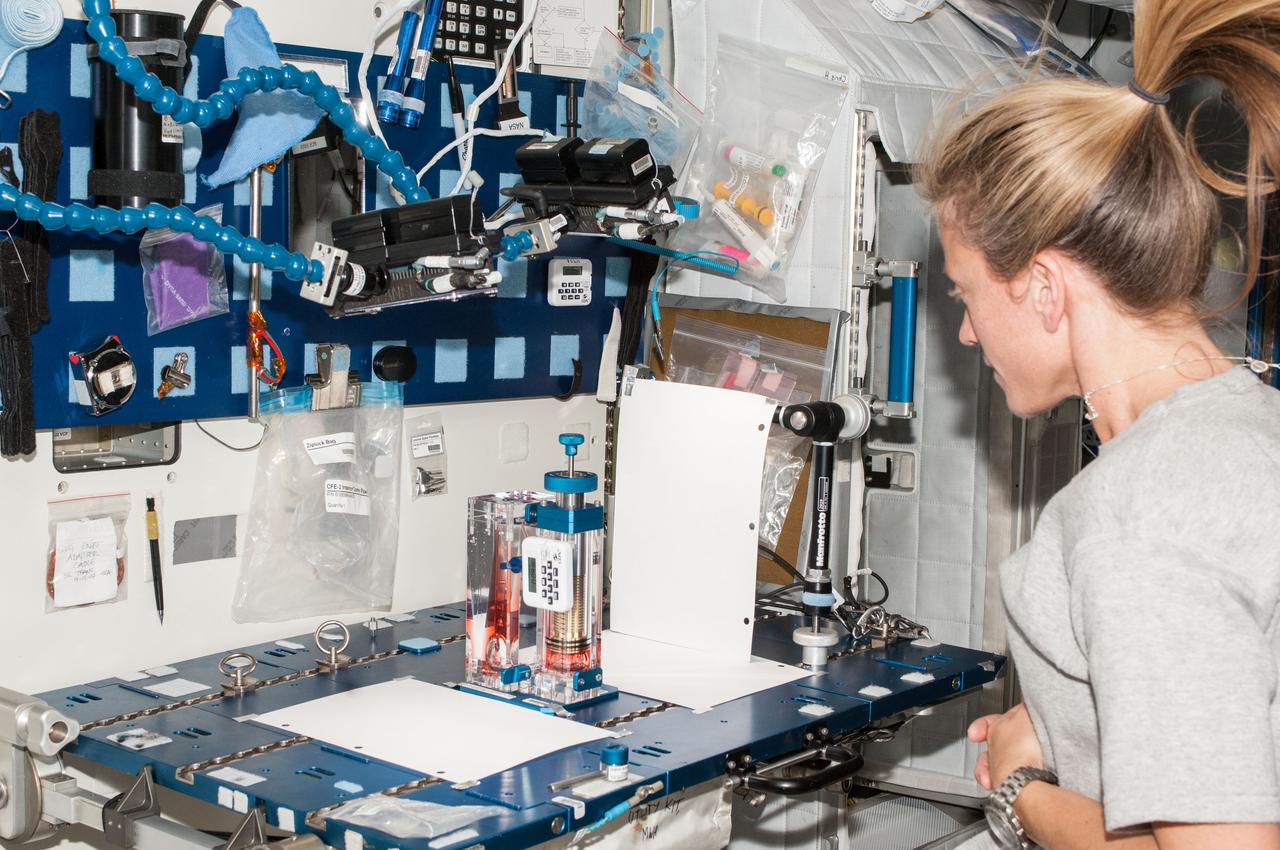
ISS036-E-008191 (15 June 2013) --- NASA astronaut Karen Nyberg, Expedition 36 flight engineer, conducts a session with the Capillary Flow Experiment (CFE) Interior Corner Flow 9 (ICF-9) in the Harmony node of the International Space Station. CFE observes the flow of fluid, in particular capillary phenomena, in microgravity.

ISS036-E-008213 (15 June 2013) --- NASA astronaut Karen Nyberg, Expedition 36 flight engineer, conducts a session with the Capillary Flow Experiment (CFE) Interior Corner Flow 9 (ICF-9) in the Harmony node of the International Space Station. CFE observes the flow of fluid, in particular capillary phenomena, in microgravity.
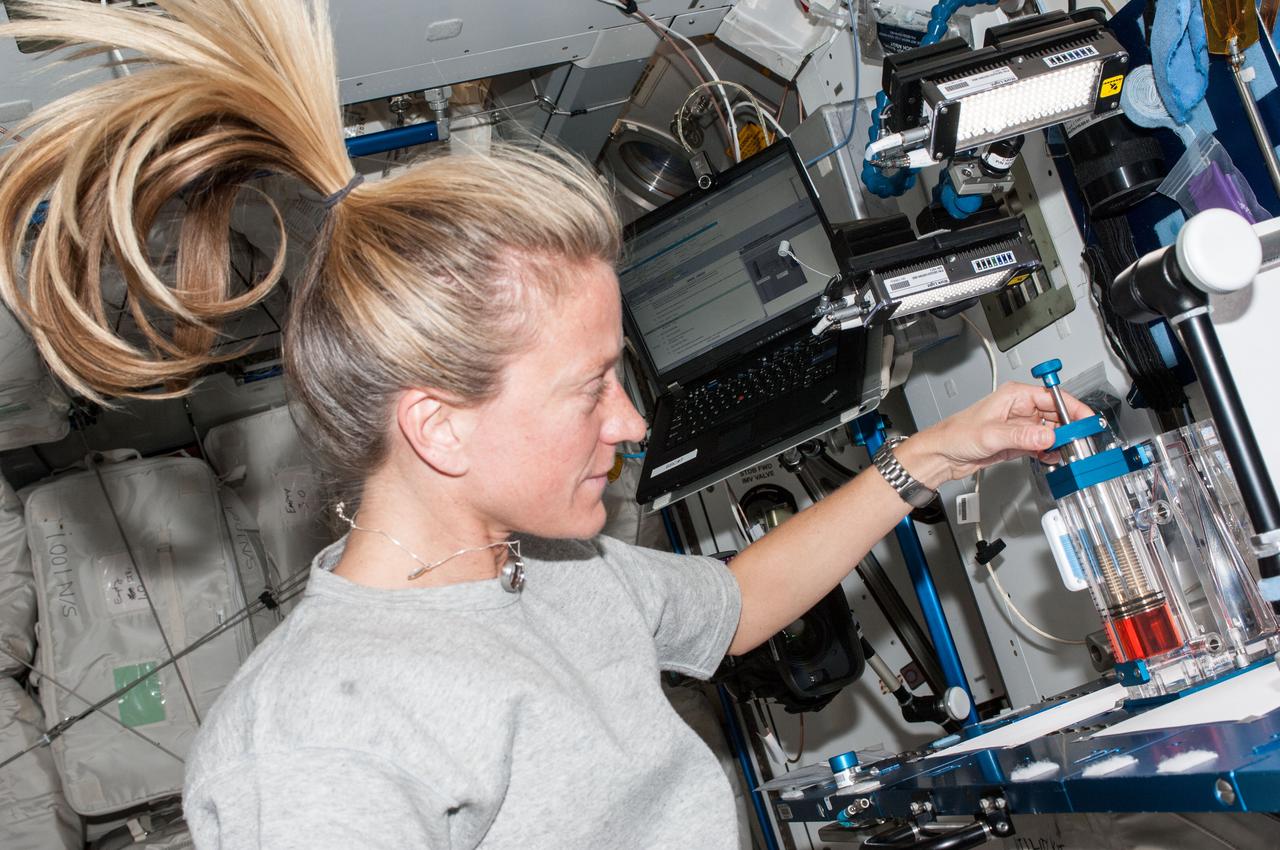
ISS036-E-008215 (15 June 2013) --- NASA astronaut Karen Nyberg, Expedition 36 flight engineer, conducts a session with the Capillary Flow Experiment (CFE) Interior Corner Flow 9 (ICF-9) in the Harmony node of the International Space Station. CFE observes the flow of fluid, in particular capillary phenomena, in microgravity.
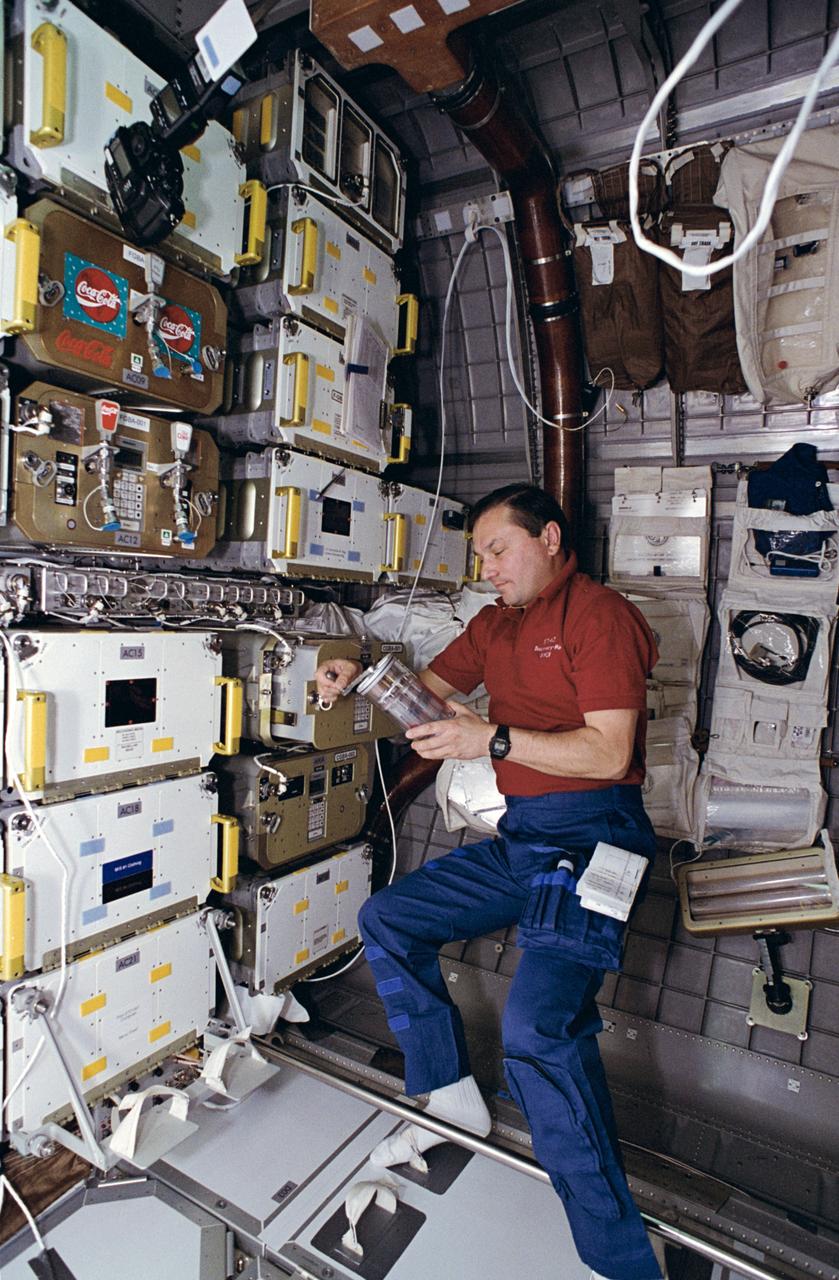
STS063-68-018 (3-11 Feb 1995) --- Russian cosmonaut Vladimir G. Titov, mission specialist, handles vials of samples for the Commercial Generic Bioprocessing Apparatus (CGBA) experiment in SpaceHab 3 Module onboard the Earth-orbiting Space Shuttle Discovery. Titov joined five NASA astronauts for eight days of research in Earth-orbit.
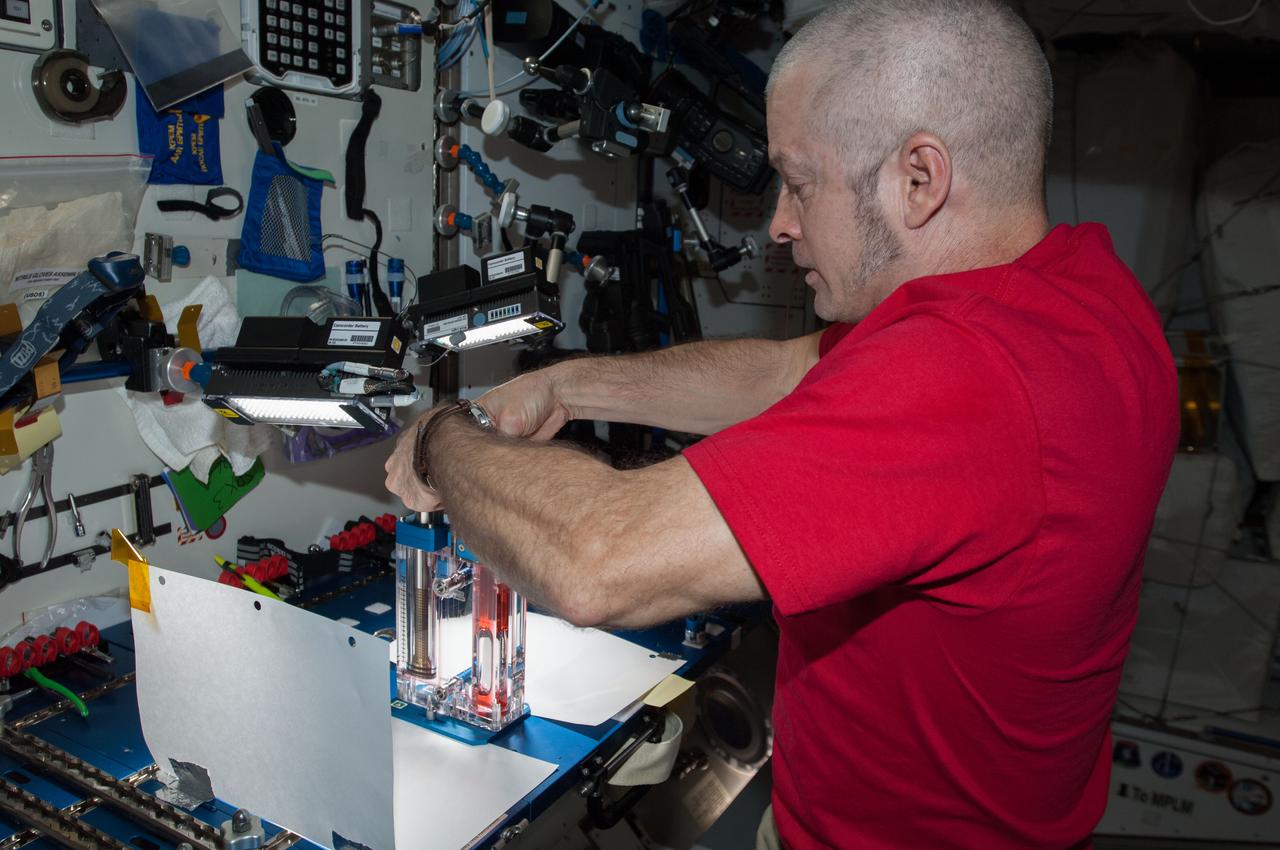
ISS040-E-032820 (3 July 2014) --- NASA astronaut Steve Swanson, Expedition 40 commander, conducts a session with the Capillary Flow Experiment (CFE) in the Harmony node of the International Space Station. CFE is a suite of fluid physics experiments that investigate how fluids move up surfaces in microgravity. The results aim to improve current computer models that are used by designers of low gravity fluid systems and may improve fluid transfer systems for water on future spacecraft.
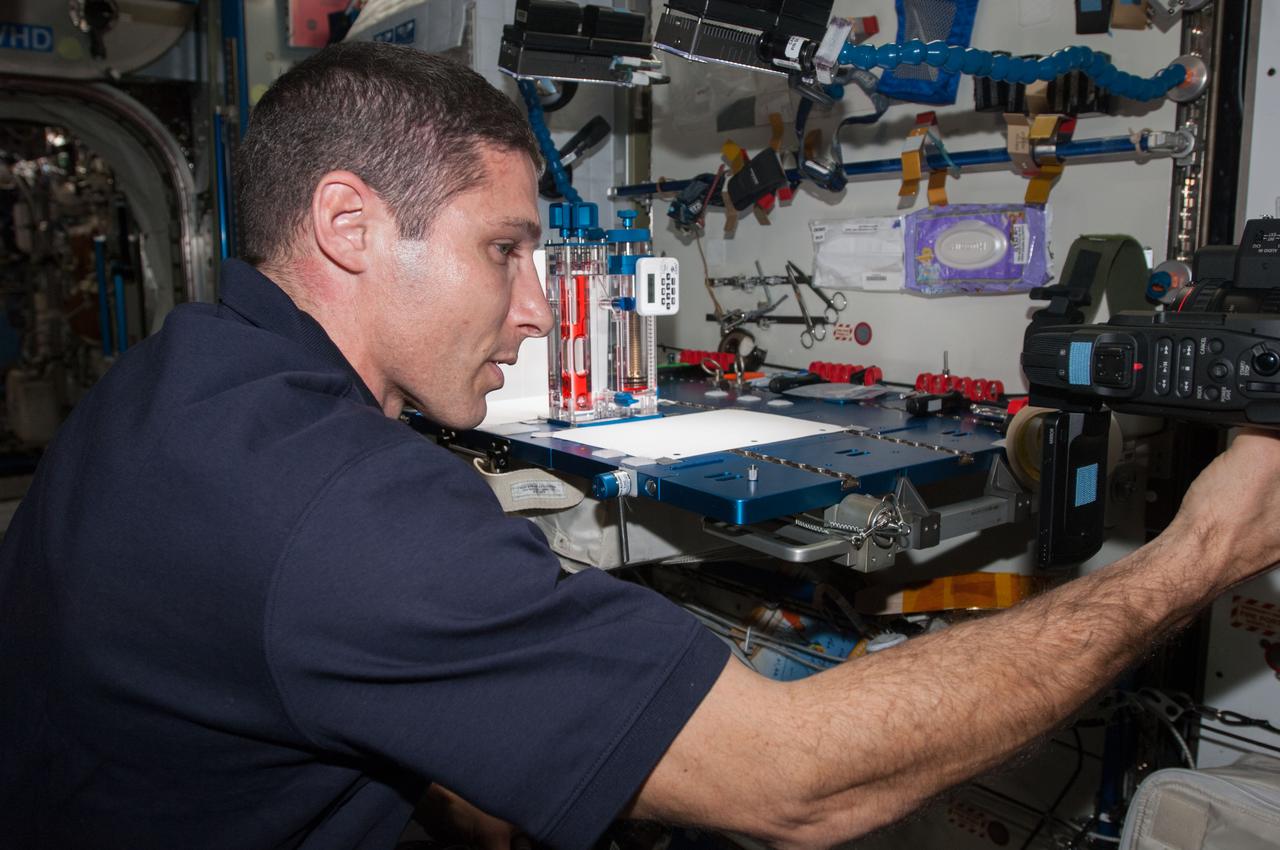
ISS038-E-000269 (11 Nov. 2013) --- NASA astronaut Michael Hopkins, Expedition 38 flight engineer, conducts a session with the Capillary Flow Experiment (CFE) in the Harmony node of the International Space Station. CFE is a suite of fluid physics experiments that investigate how fluids move up surfaces in microgravity. The results aim to improve current computer models that are used by designers of low gravity fluid systems and may improve fluid transfer systems for water on future spacecraft.
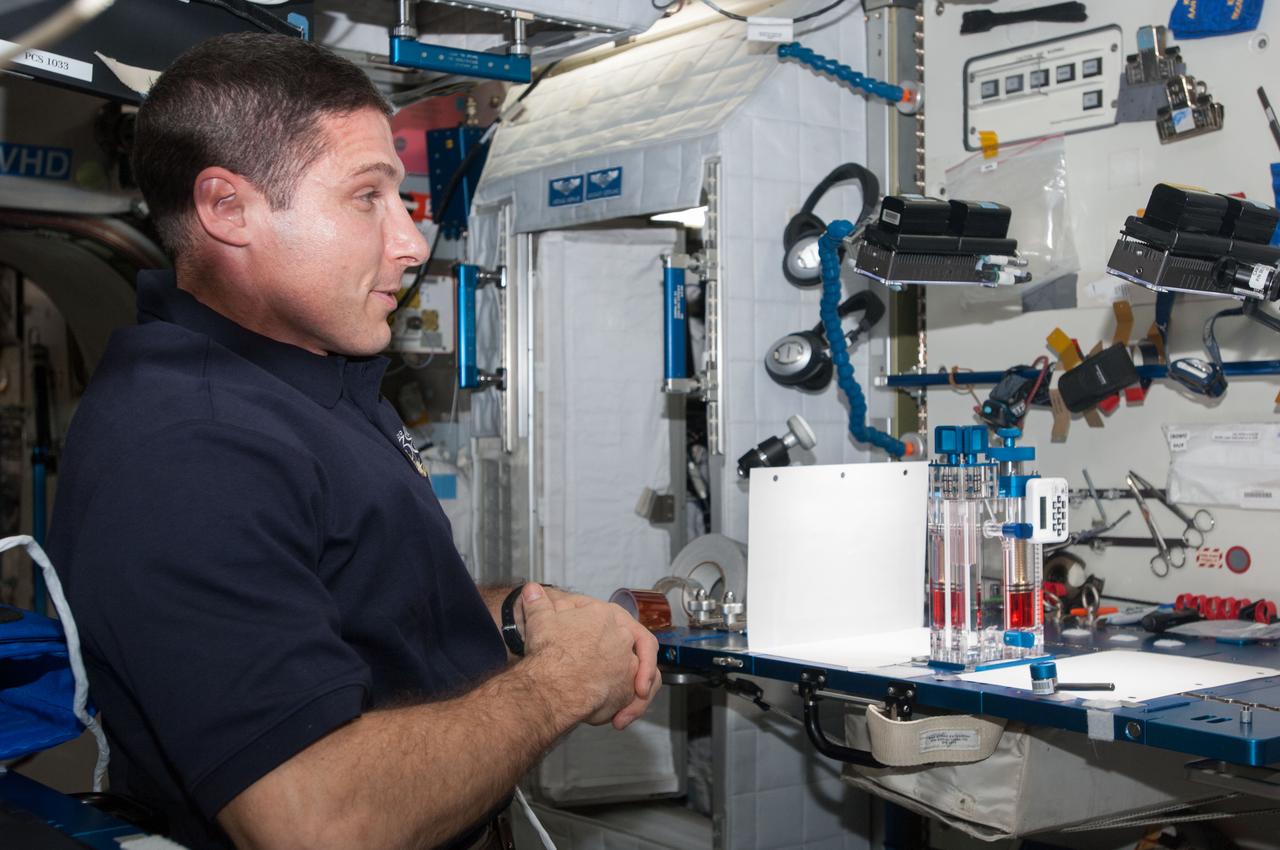
ISS038-E-000263 (11 Nov. 2013) --- NASA astronaut Michael Hopkins, Expedition 38 flight engineer, conducts a session with the Capillary Flow Experiment (CFE) in the Harmony node of the International Space Station. CFE is a suite of fluid physics experiments that investigate how fluids move up surfaces in microgravity. The results aim to improve current computer models that are used by designers of low gravity fluid systems and may improve fluid transfer systems for water on future spacecraft.
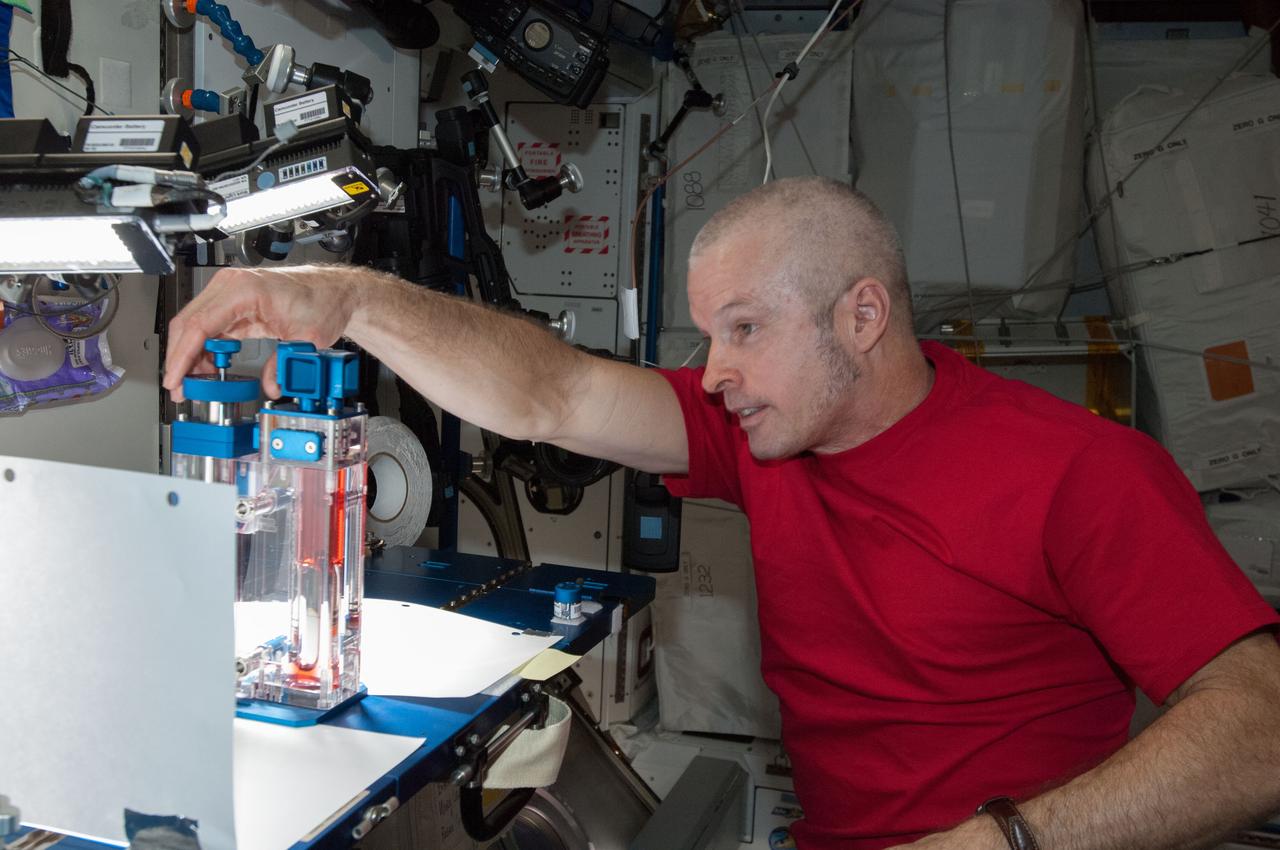
ISS040-E-032825 (3 July 2014) --- NASA astronaut Steve Swanson, Expedition 40 commander, conducts a session with the Capillary Flow Experiment (CFE) in the Harmony node of the International Space Station. CFE is a suite of fluid physics experiments that investigate how fluids move up surfaces in microgravity. The results aim to improve current computer models that are used by designers of low gravity fluid systems and may improve fluid transfer systems for water on future spacecraft.
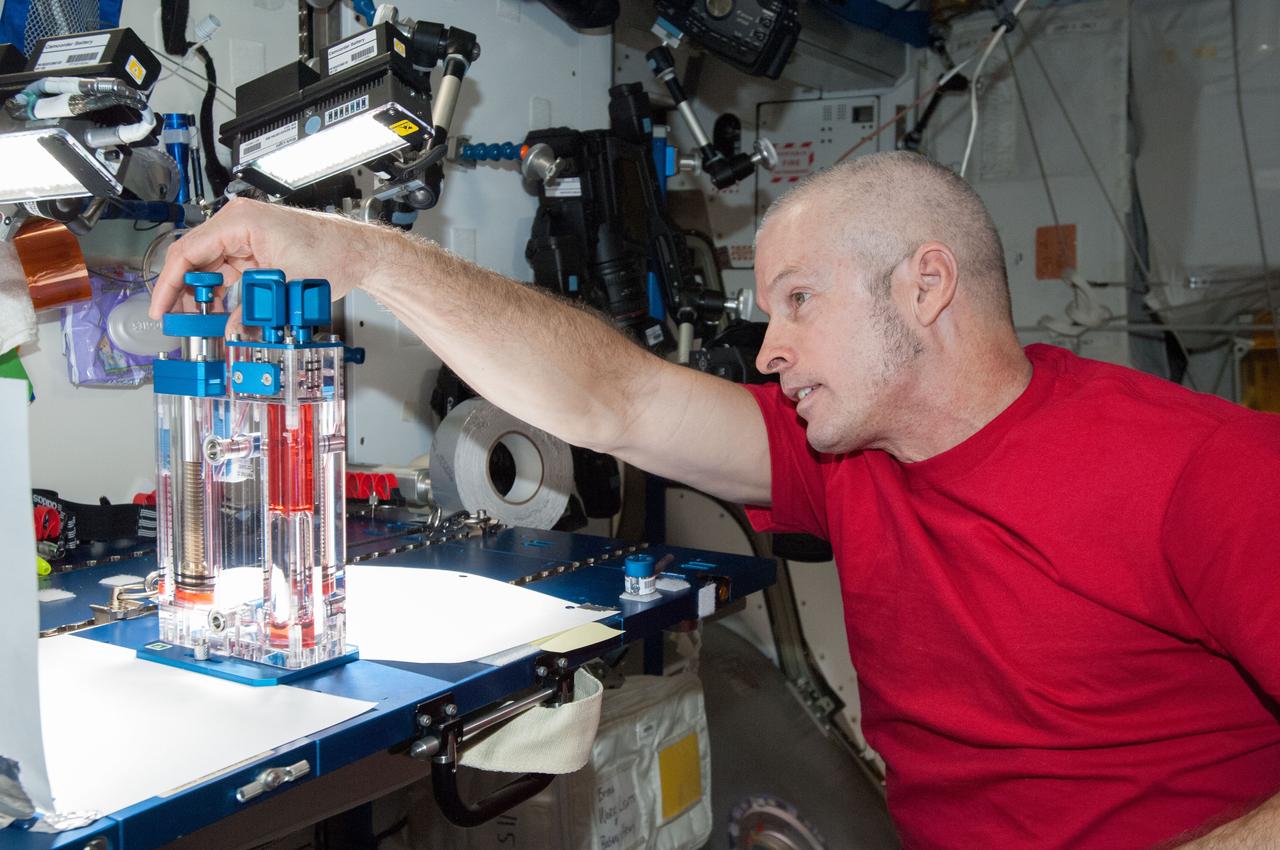
ISS040-E-032827 (3 July 2014) --- NASA astronaut Steve Swanson, Expedition 40 commander, conducts a session with the Capillary Flow Experiment (CFE) in the Harmony node of the International Space Station. CFE is a suite of fluid physics experiments that investigate how fluids move up surfaces in microgravity. The results aim to improve current computer models that are used by designers of low gravity fluid systems and may improve fluid transfer systems for water on future spacecraft.
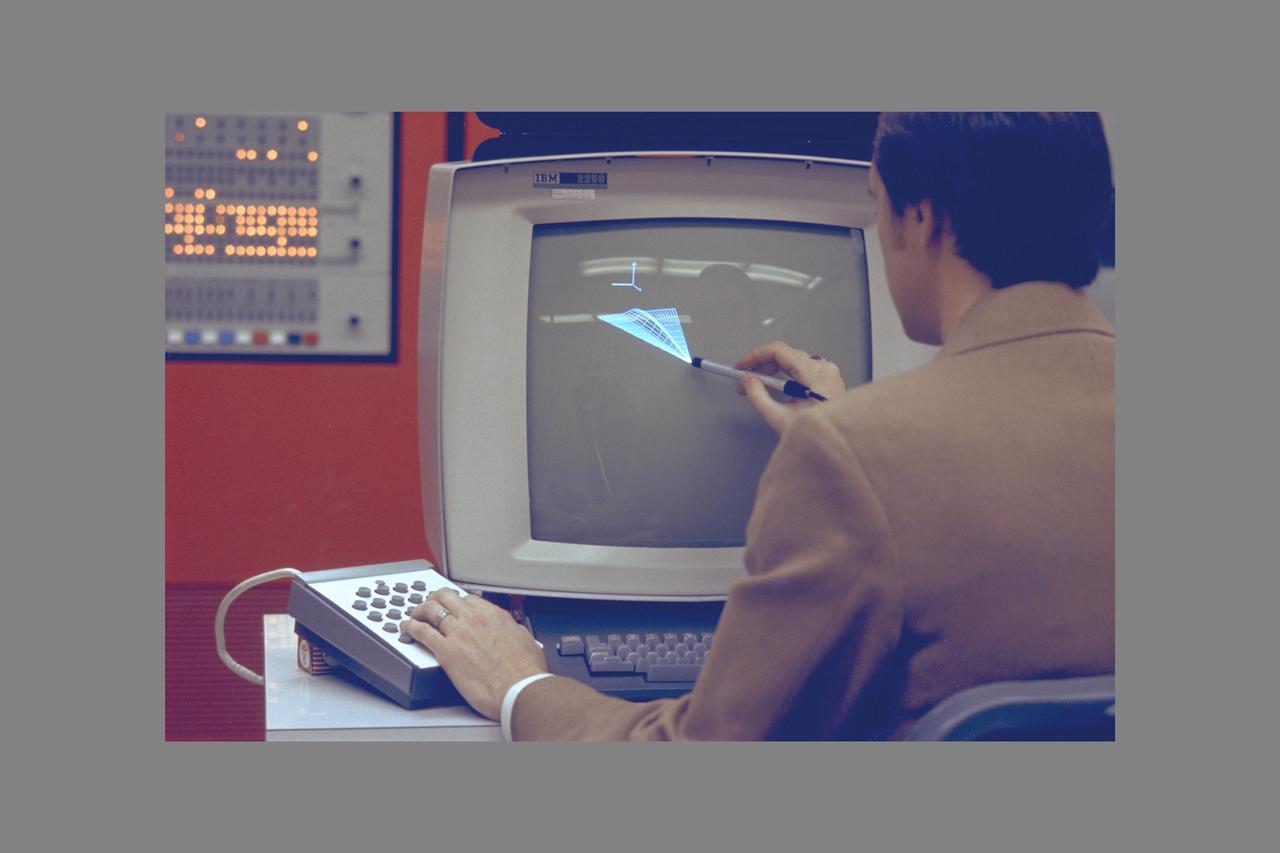
Dr. Paul Kutler, Computational Fluid Dynamics, at IBM terminal - developing ways to better predict the flow of air at high speeds around aerodynamic bodies.
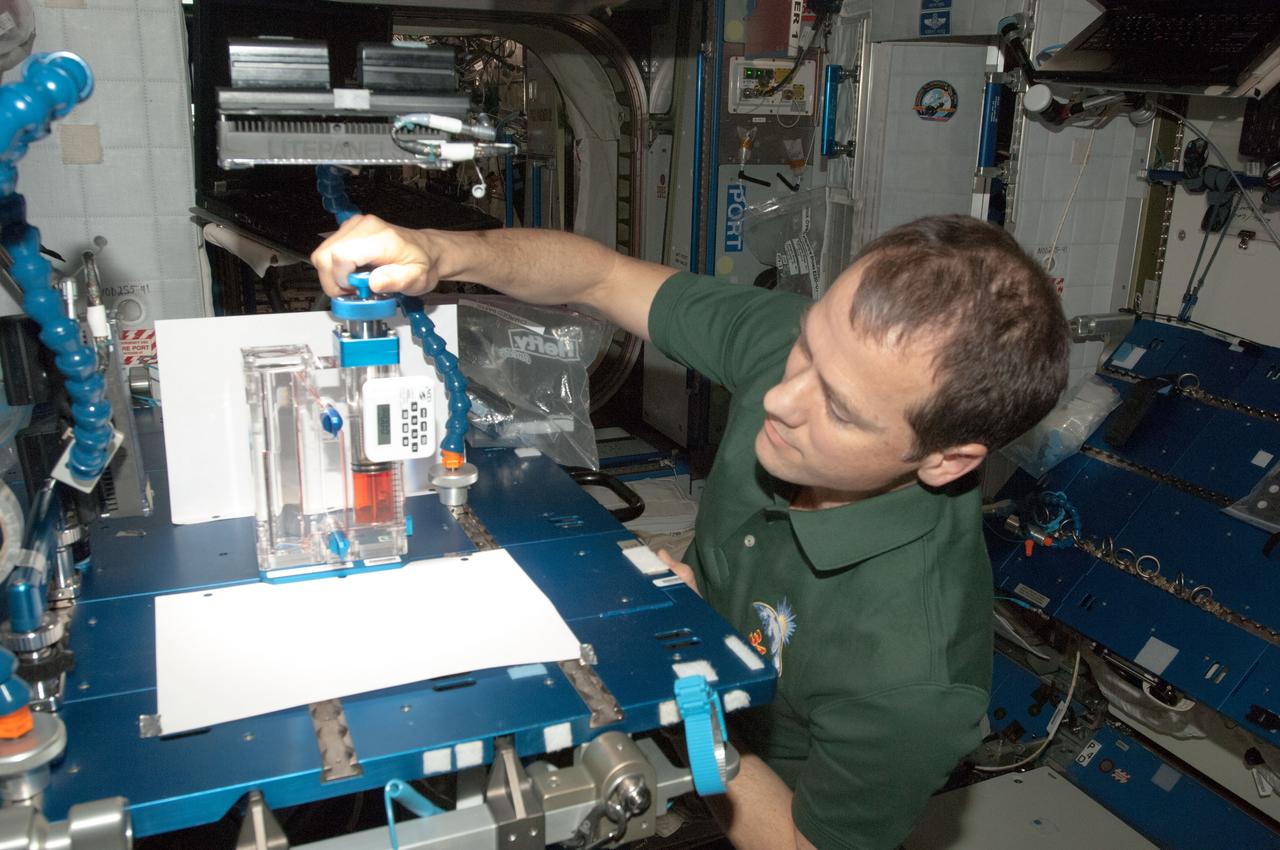
ISS034-E-036844 (29 Jan. 2013) --- In the International Space Station’s Harmony node, NASA astronaut Tom Marshburn, Expedition 34 flight engineer, works with the Capillary Flow Experiment-3, which investigates how fluids flow across surfaces in a weightless environment. Results from this experiment will improve computer models used to design fluid transfer systems and fuel tanks on future spacecraft.
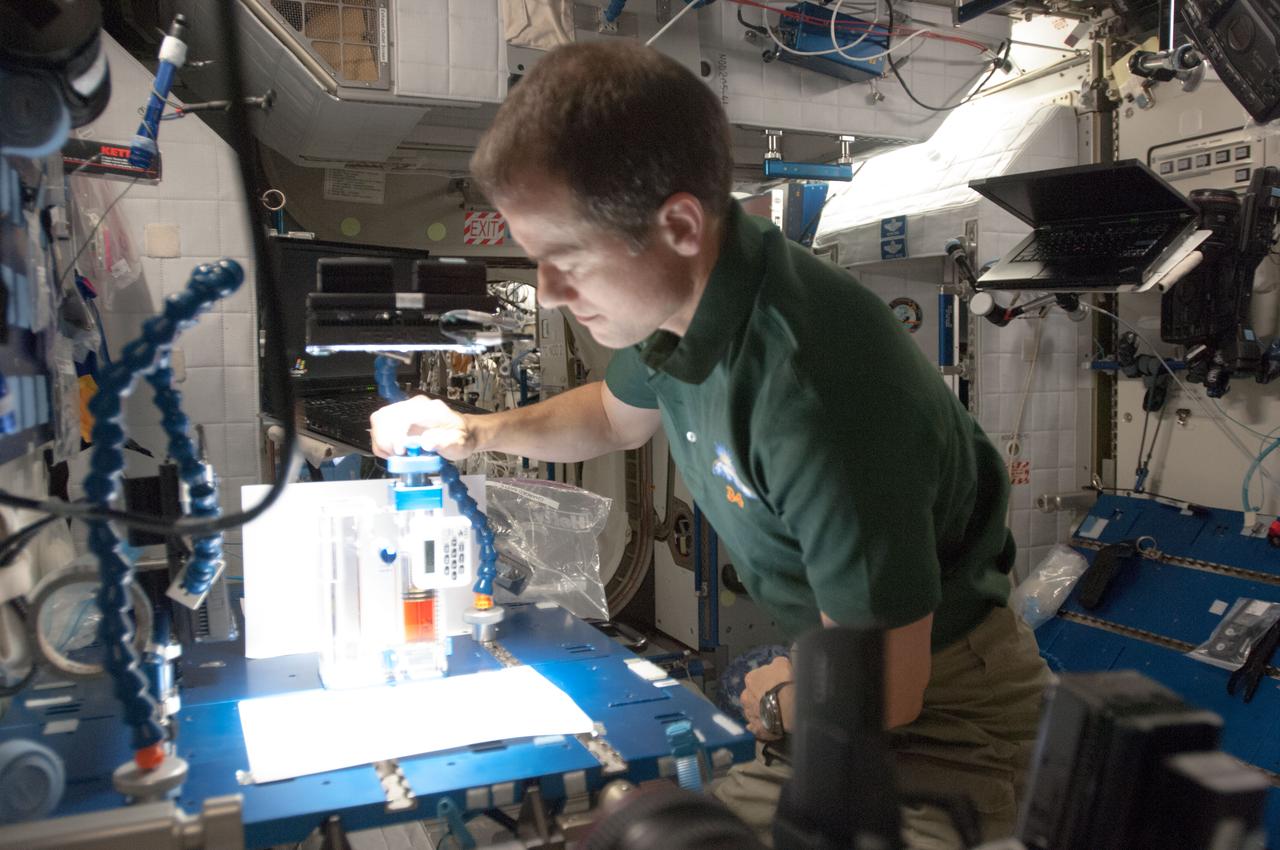
ISS034-E-036841 (29 Jan. 2013) --- In the International Space Station’s Harmony node, NASA astronaut Tom Marshburn, Expedition 34 flight engineer, works with the Capillary Flow Experiment-3, which investigates how fluids flow across surfaces in a weightless environment. Results from this experiment will improve computer models used to design fluid transfer systems and fuel tanks on future spacecraft.
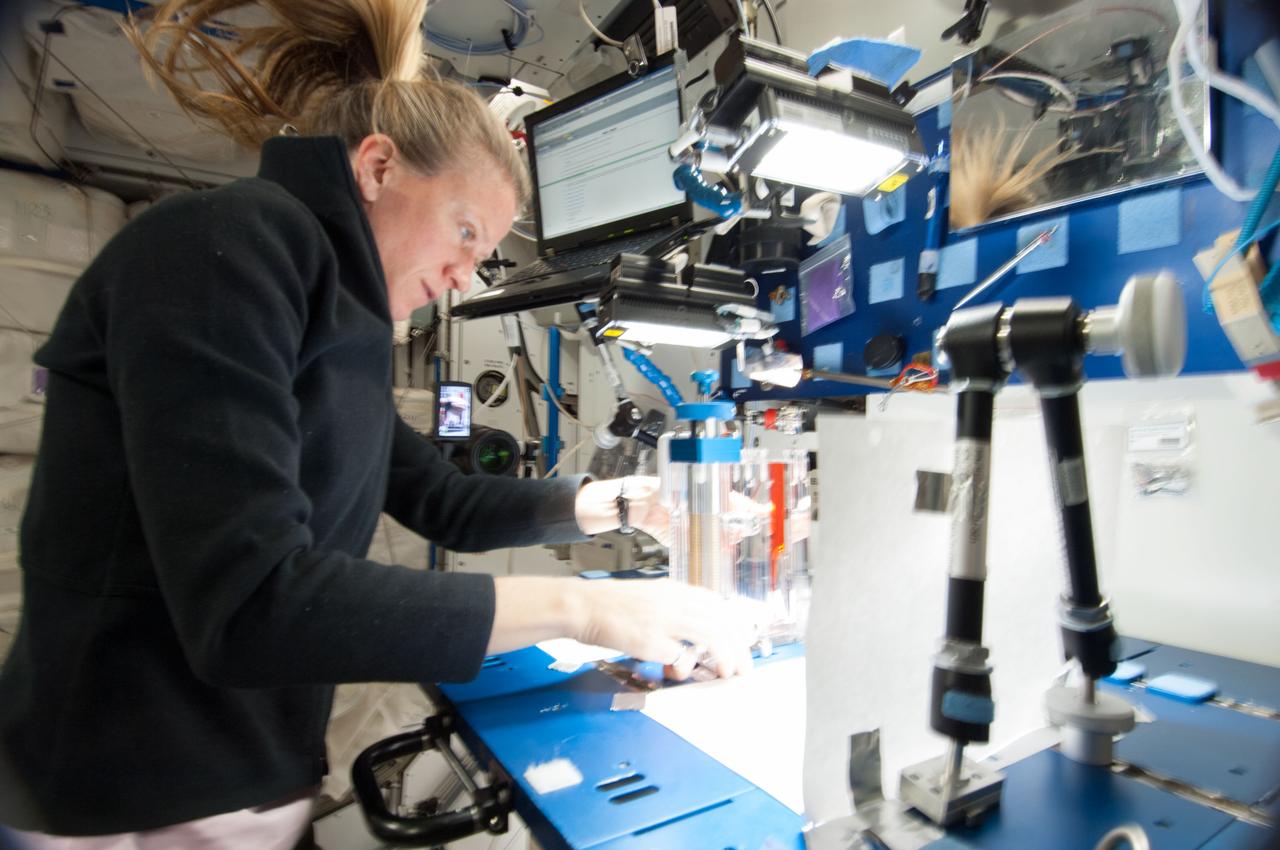
ISS036-E-029767 (8 Aug. 2013) --- NASA astronaut Karen Nyberg, Expedition 36 flight engineer, conducts a session with the Capillary Flow Experiment (CFE) in the Harmony node of the International Space Station. CFE observes the flow of fluid, in particular capillary phenomena, in microgravity. The data from this experiment will improve computer models used to design fluid transfer systems and fuel tanks on future spacecraft.
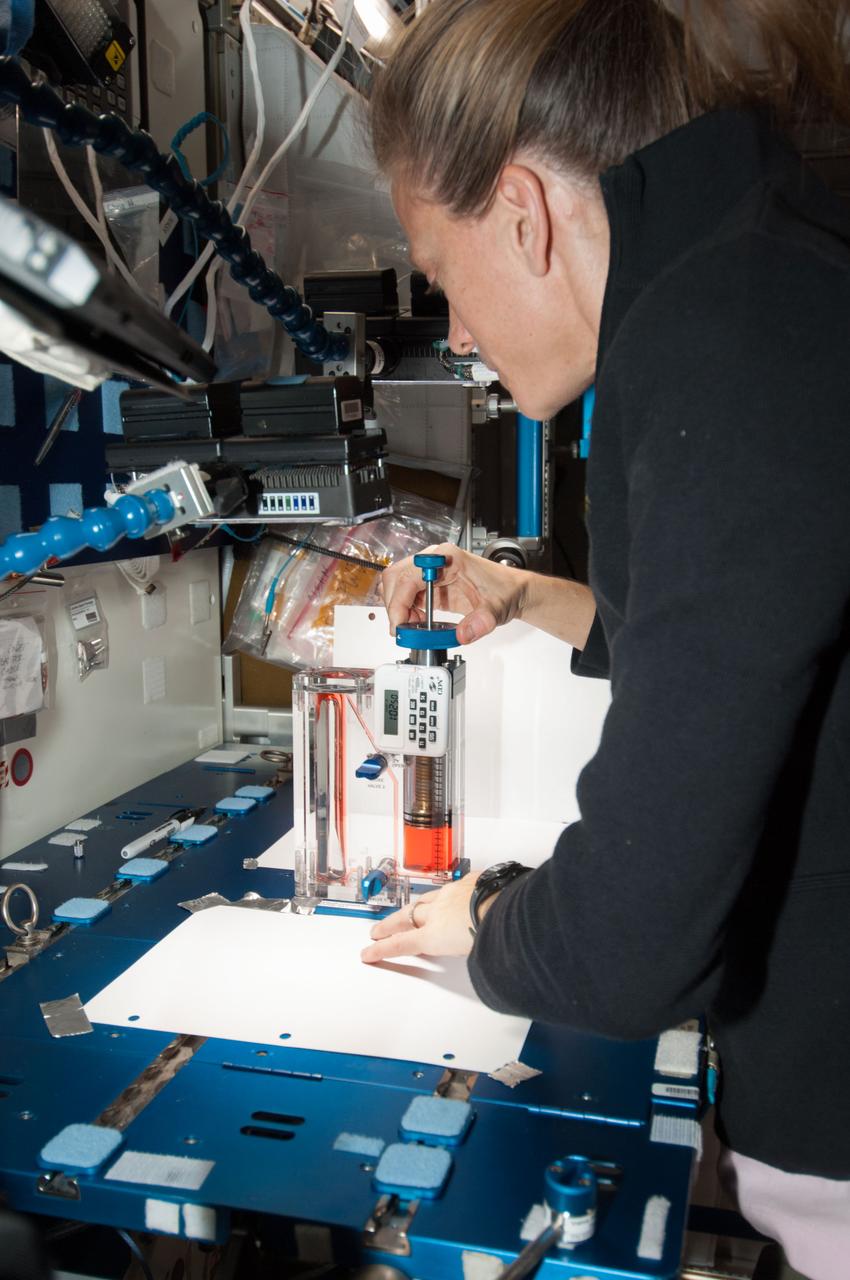
ISS036-E-029773 (8 Aug. 2013) --- NASA astronaut Karen Nyberg, Expedition 36 flight engineer, conducts a session with the Capillary Flow Experiment (CFE) in the Harmony node of the International Space Station. CFE observes the flow of fluid, in particular capillary phenomena, in microgravity. The data from this experiment will improve computer models used to design fluid transfer systems and fuel tanks on future spacecraft.
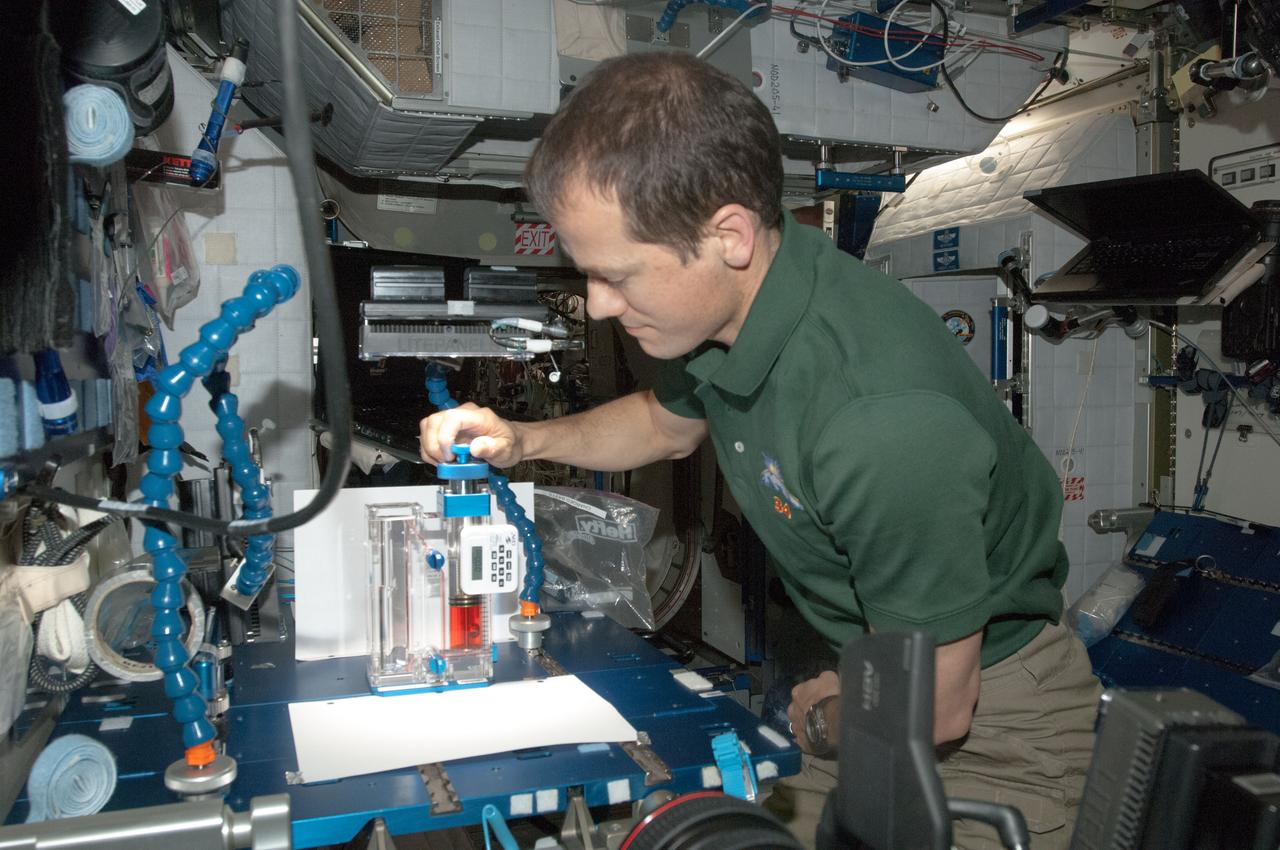
ISS034-E-036840 (29 Jan. 2013) --- In the International Space Station?s Harmony node, NASA astronaut Tom Marshburn, Expedition 34 flight engineer, works with the Capillary Flow Experiment-3, which investigates how fluids flow across surfaces in a weightless environment. Results from this experiment will improve computer models used to design fluid transfer systems and fuel tanks on future spacecraft.
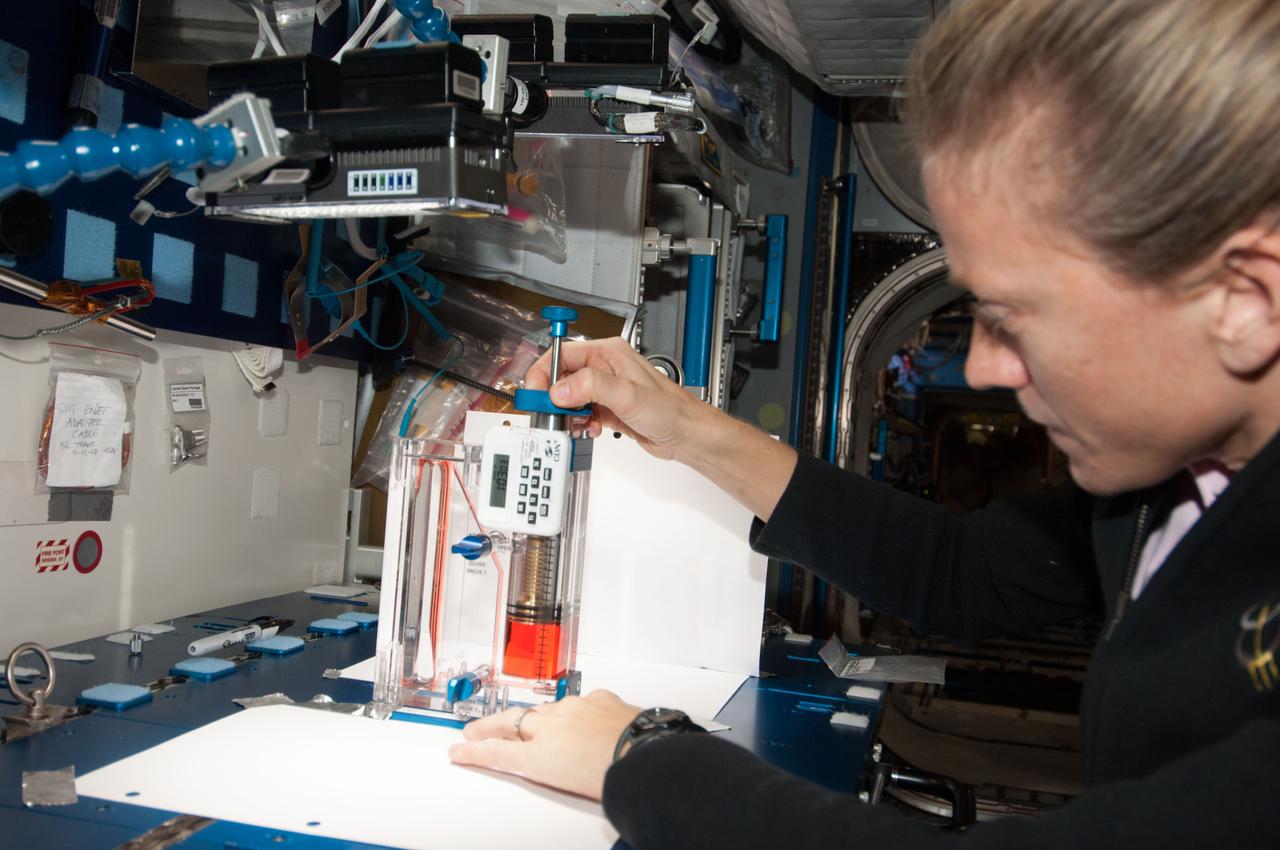
ISS036-E-029774 (8 Aug. 2013) --- NASA astronaut Karen Nyberg, Expedition 36 flight engineer, conducts a session with the Capillary Flow Experiment (CFE) in the Harmony node of the International Space Station. CFE observes the flow of fluid, in particular capillary phenomena, in microgravity. The data from this experiment will improve computer models used to design fluid transfer systems and fuel tanks on future spacecraft.
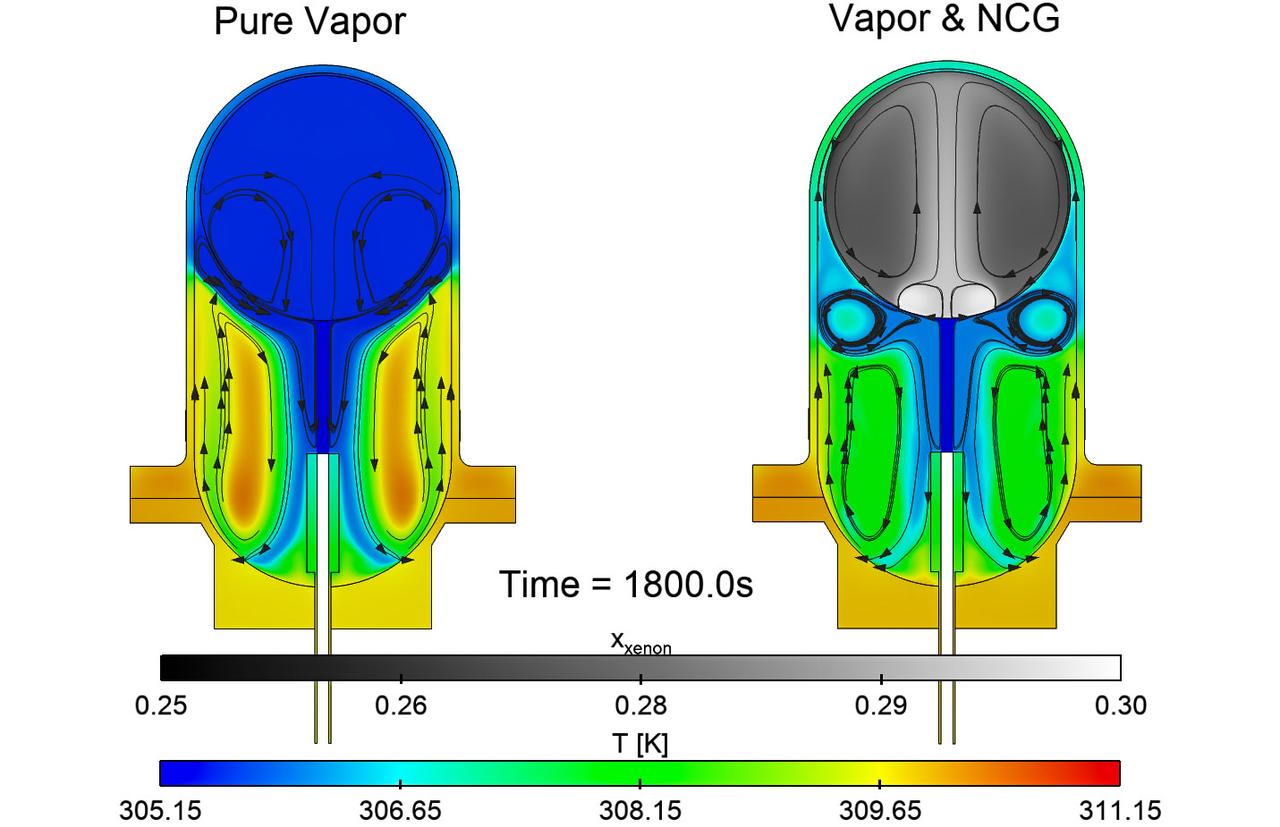
jsc2025e067420 (8/5/2025) --- Simulations of the effects of noncondensable gas on the flow and thermal structures that develop in a fuel tank in microgravity for the ZBOT-NC investigation. On the left, simulation of a tank with pure fluid and on the right, one with a fluid and gas. Credit: Case Western Reserve University
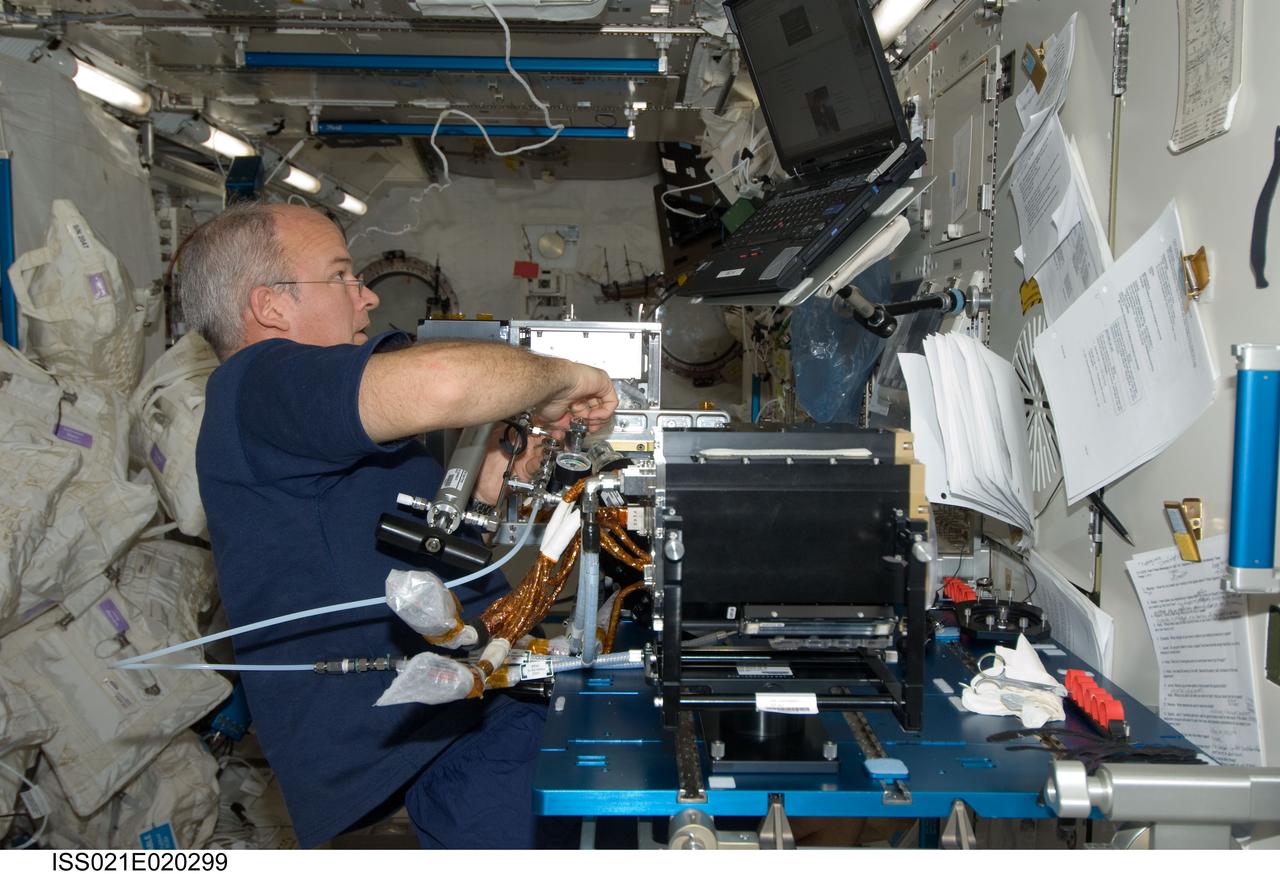
ISS021-E-020299 (5 Nov. 2009) --- NASA astronaut Jeffrey Williams, Expedition 21 flight engineer, works with Fluid Physics Experiment Facility/Marangoni Surface (FPEF MS) Core hardware in the Kibo laboratory of the International Space Station. The Marangoni convection experiment in the FPEF examines fluid tension flow in micro-G.
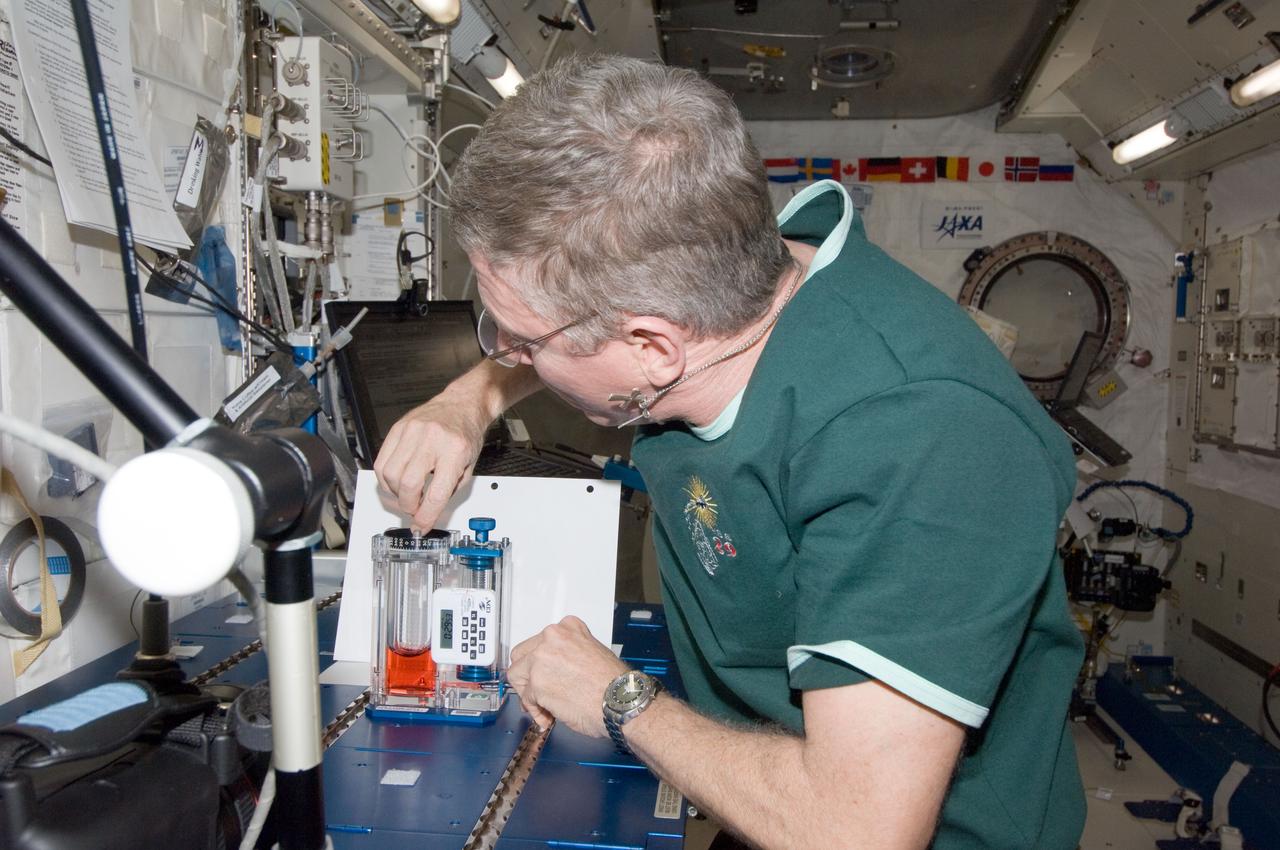
ISS029-E-015116 (30 Sept. 2011) --- NASA astronaut Mike Fossum, Expedition 29 commander, conducts a session with the Capillary Flow Experiment (CFE) Vane Gap-2 (VG2) in the Kibo laboratory of the International Space Station. CFE observes the flow of fluid, in particular capillary phenomena, in microgravity.
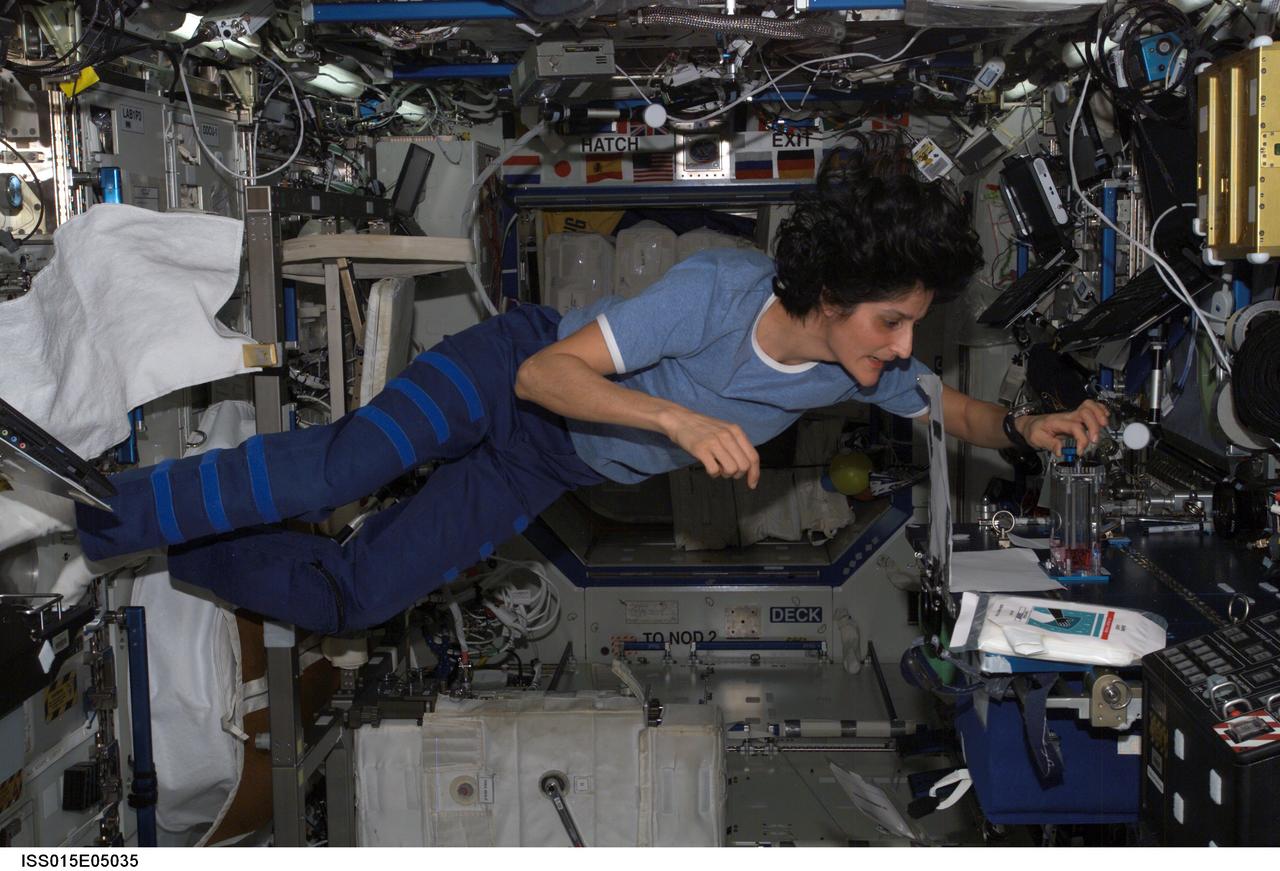
ISS015-E-05035 (23 April 2007) --- Astronaut Sunita L. Williams, Expedition 15 flight engineer, performs one of multiple tests of the Capillary Flow Experiment (CFE) investigation in the Destiny laboratory of the International Space Station. CFE observes the flow of fluid, in particular capillary phenomena, in microgravity.
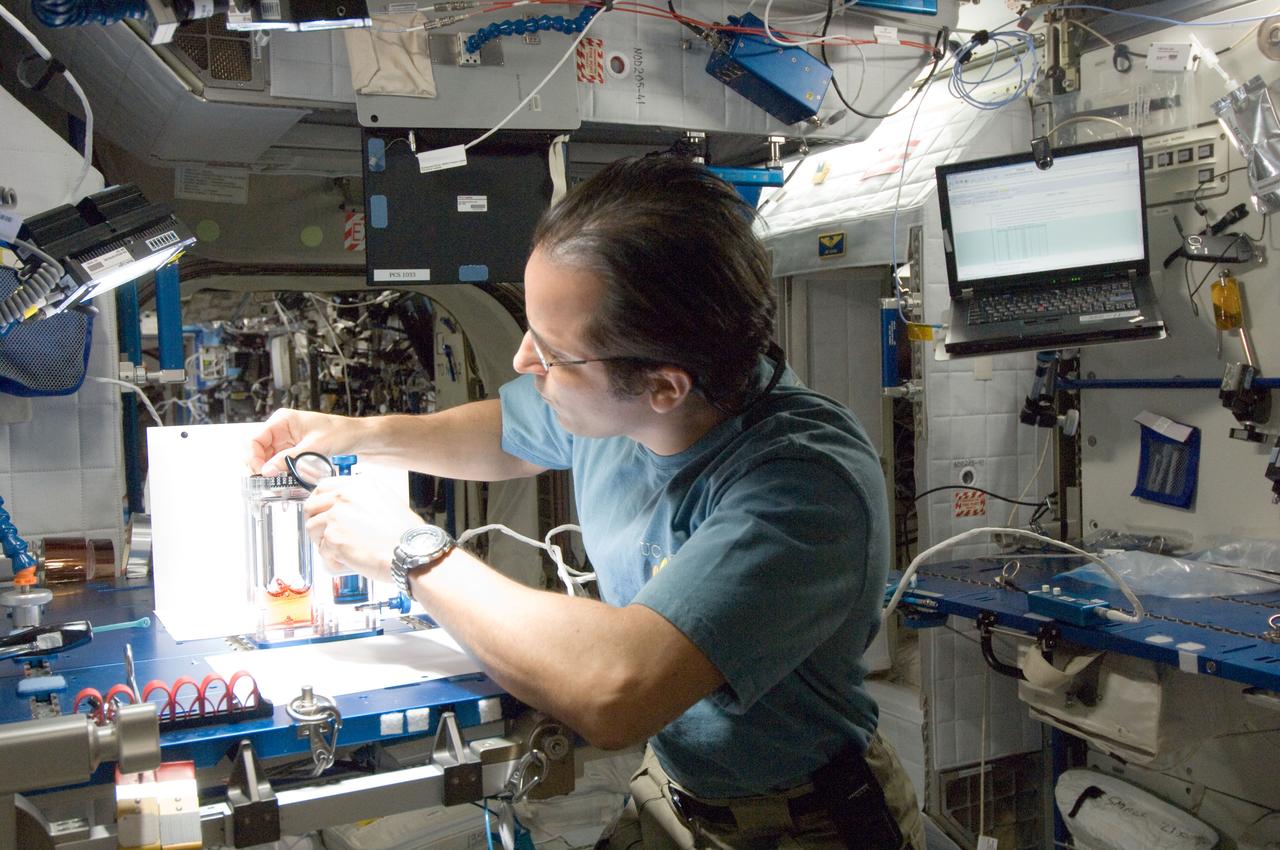
ISS032-E-016961 (10 Aug. 2012) --- NASA astronaut Joe Acaba, Expedition 32 flight engineer, conducts a session with the Capillary Flow Experiment (CFE) Vane Gap-2 (VG2) in the Harmony node of the International Space Station. CFE observes the flow of fluid, in particular capillary phenomena, in microgravity.
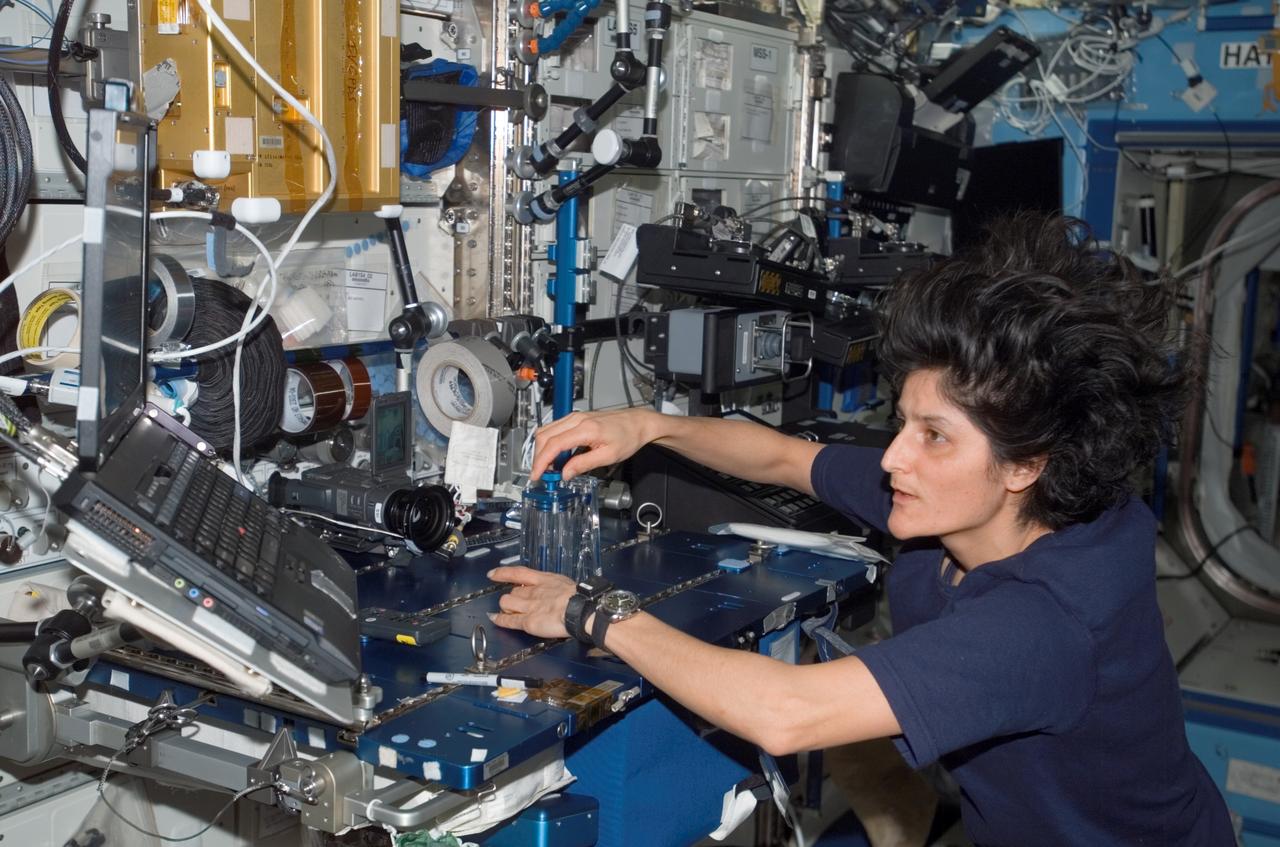
ISS015-E-05594 (29 April 2007) --- Astronaut Sunita L. Williams, Expedition 15 flight engineer, works on the hardware setup for the Capillary Flow Experiment (CFE) Vane Gap-2 (VG) in the Destiny laboratory of the International Space Station. CFE observes the flow of fluid, in particular capillary phenomena, in microgravity.
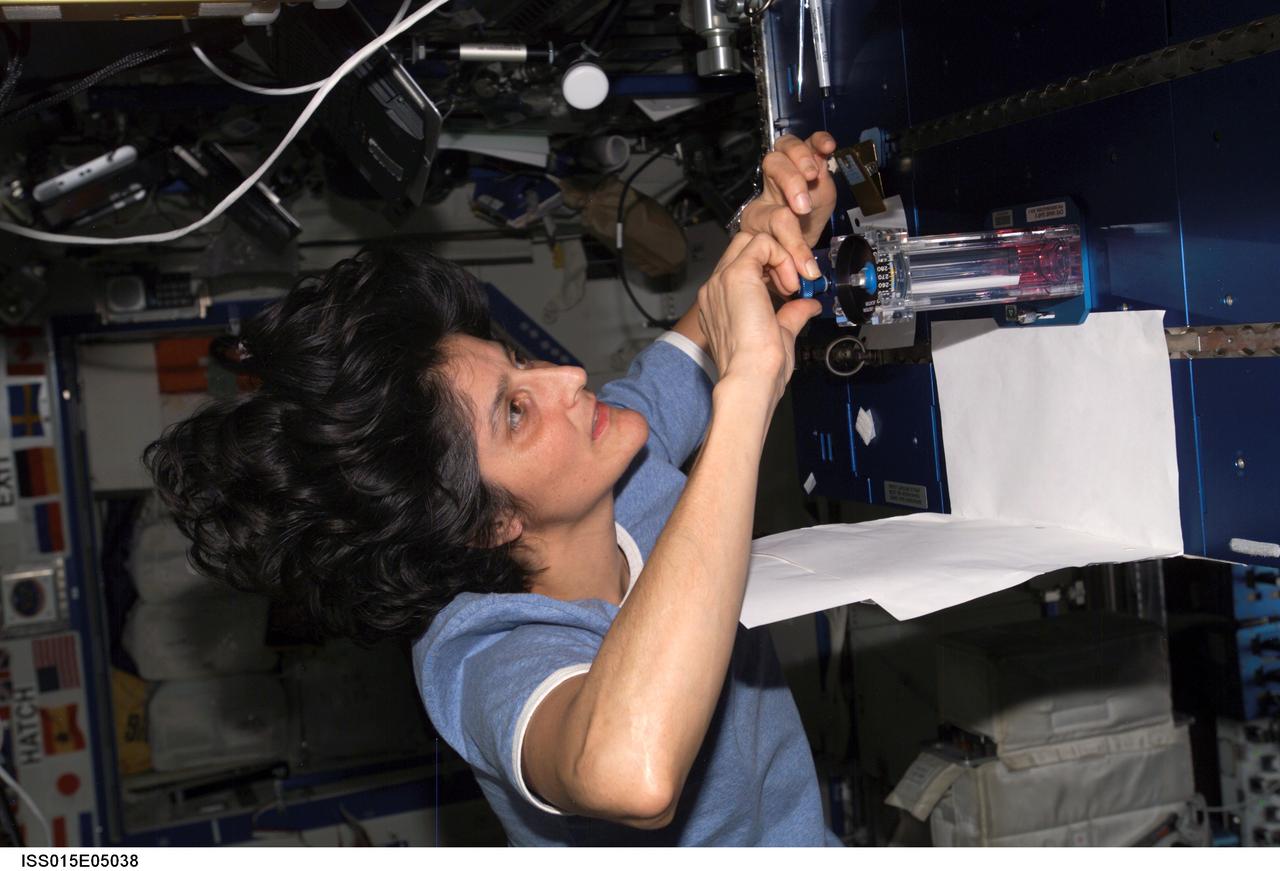
ISS015-E-05038 (23 April 2007) --- Astronaut Sunita L. Williams, Expedition 15 flight engineer, performs one of multiple tests of the Capillary Flow Experiment (CFE) investigation in the Destiny laboratory of the International Space Station. CFE observes the flow of fluid, in particular capillary phenomena, in microgravity.
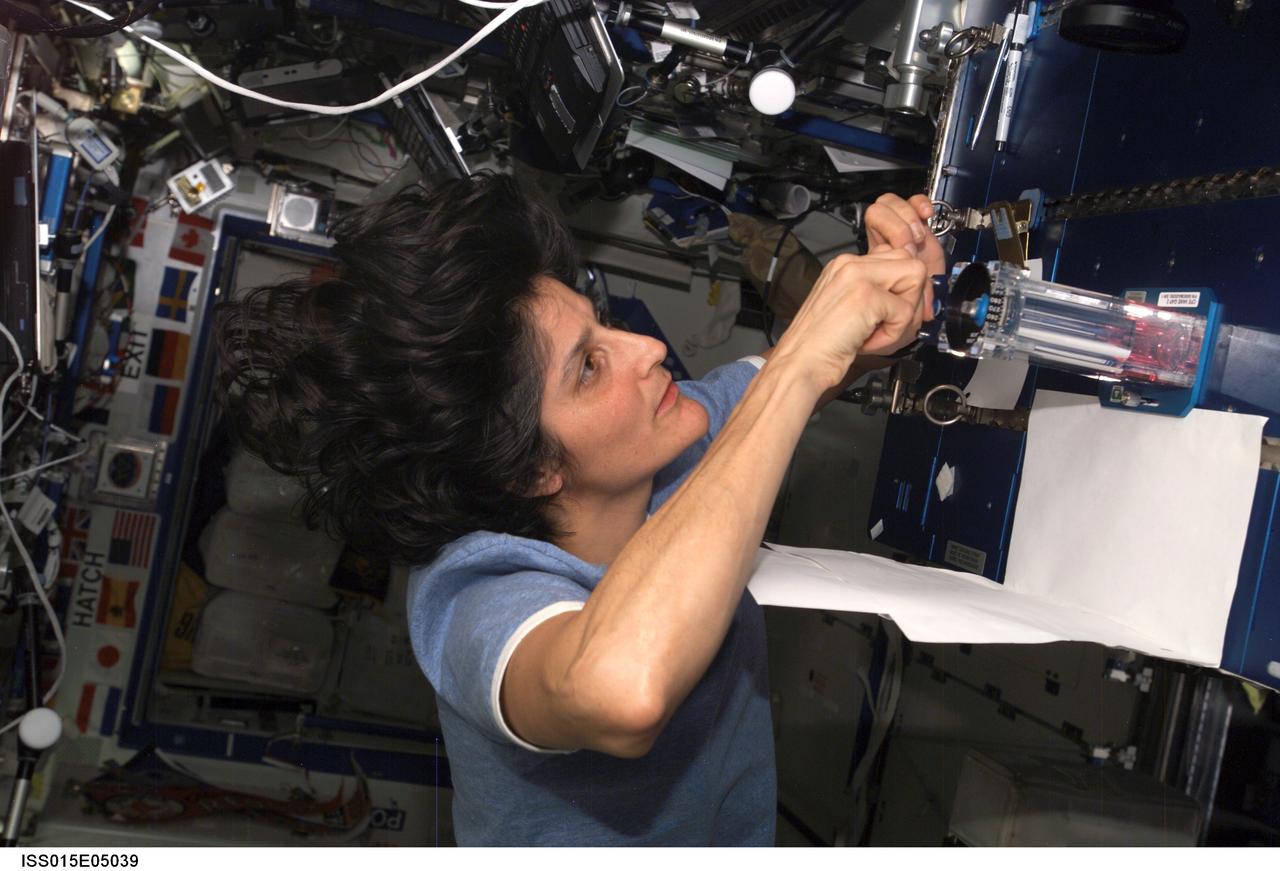
ISS015-E-05039 (23 April 2007) --- Astronaut Sunita L. Williams, Expedition 15 flight engineer, performs one of multiple tests of the Capillary Flow Experiment (CFE) investigation in the Destiny laboratory of the International Space Station. CFE observes the flow of fluid, in particular capillary phenomena, in microgravity.
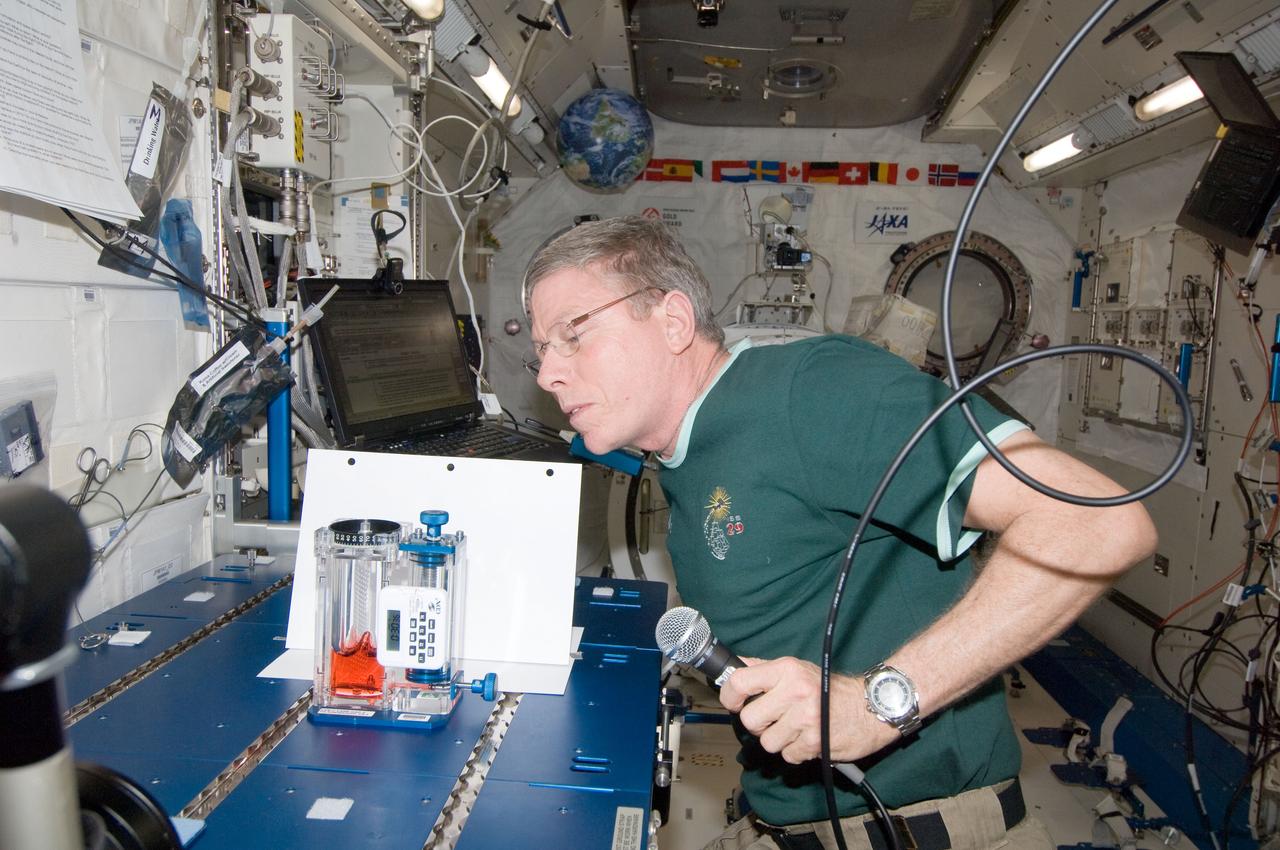
ISS029-E-015119 (30 Sept. 2011) --- NASA astronaut Mike Fossum, Expedition 29 commander, conducts a session with the Capillary Flow Experiment (CFE) Vane Gap-2 (VG2) in the Kibo laboratory of the International Space Station. CFE observes the flow of fluid, in particular capillary phenomena, in microgravity.
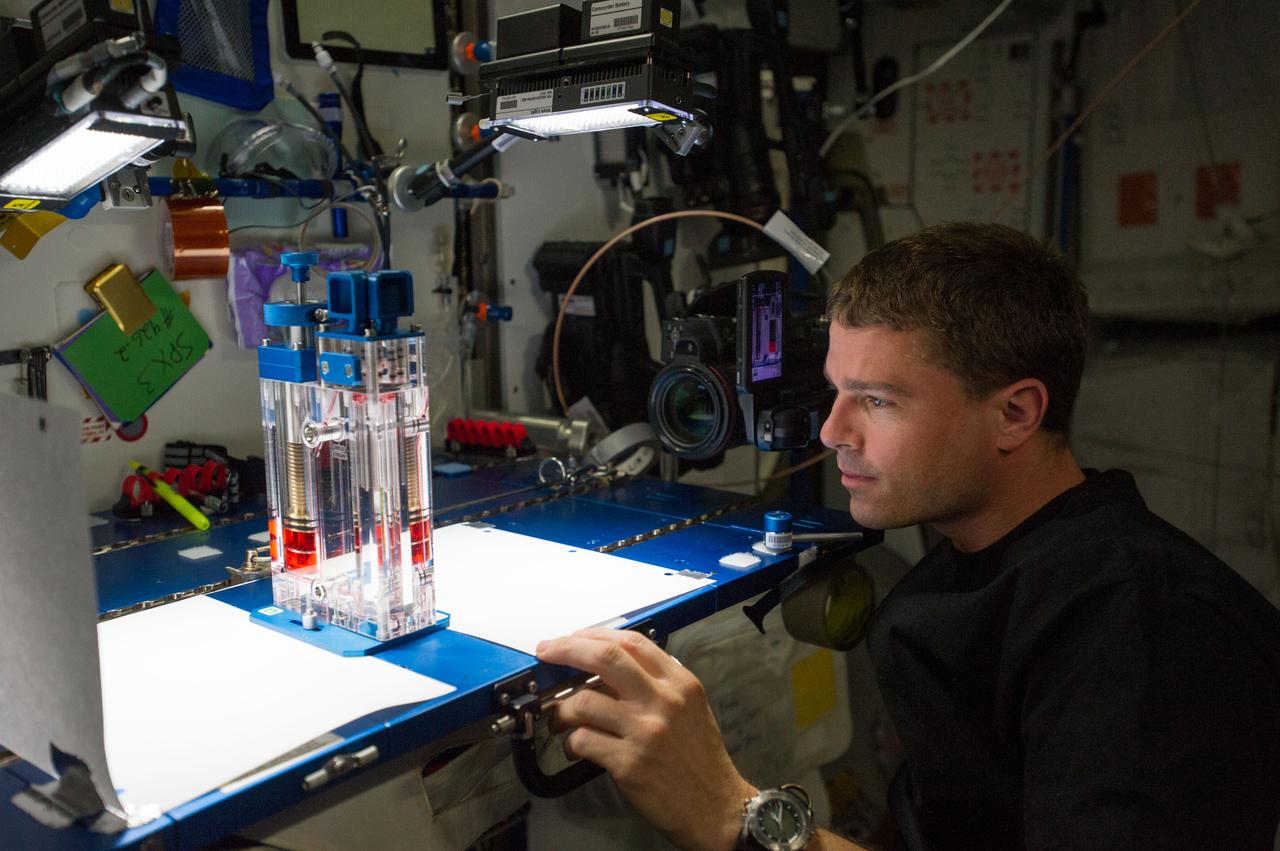
ISS040-E-015539 (19 June 2014) --- NASA astronaut Reid Wiseman, Expedition 40 flight engineer, conducts a session with the Capillary Flow Experiment (CFE-2) in the Harmony node of the International Space Station. CFE is a suite of fluid physics experiments that investigate how fluids behave in microgravity which could benefit water and fuel delivery systems on future spacecraft. Scientists designed the CFE-2 to study properties of fluids and bubbles inside containers with a specific 3-D geometry.
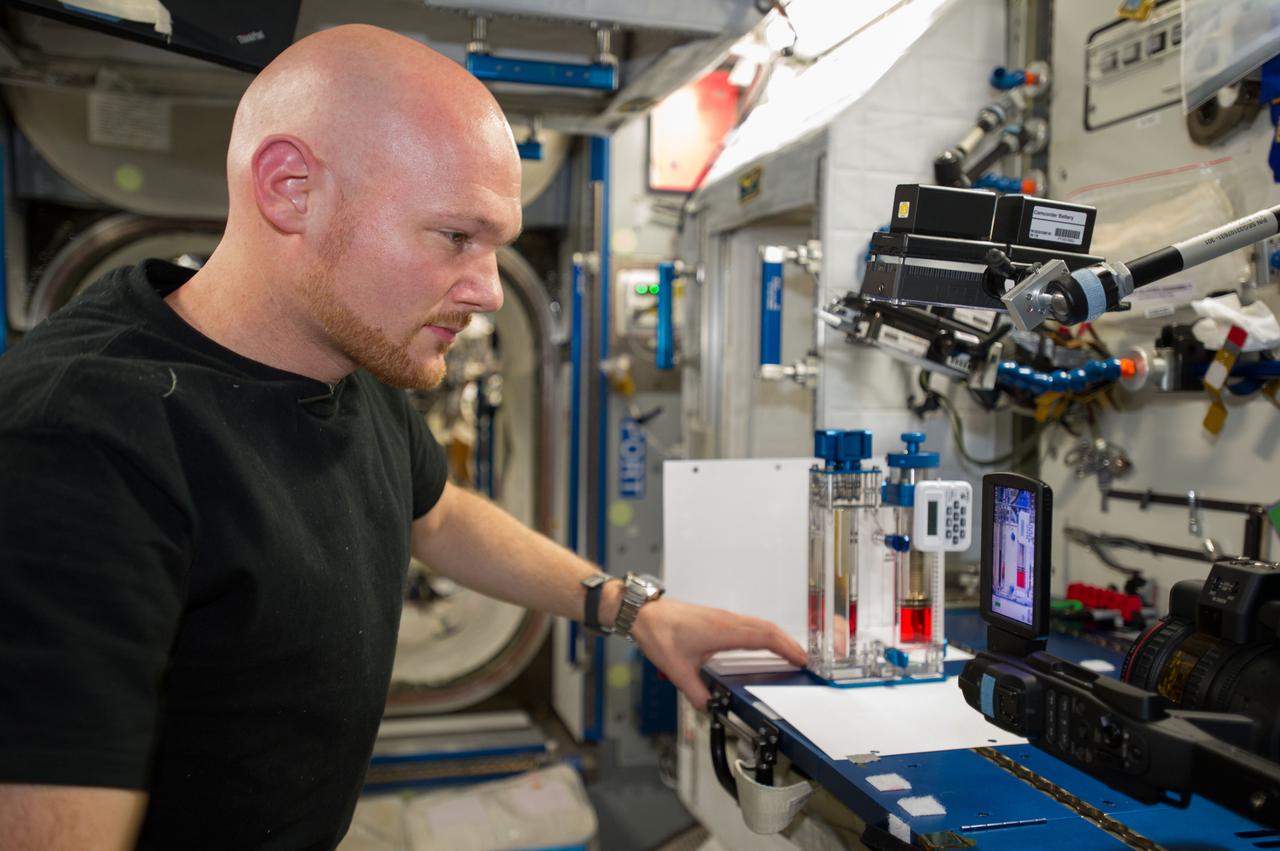
ISS040-E-015523 (19 June 2014) --- European Space Agency astronaut Alexander Gerst, Expedition 40 flight engineer, conducts a session with the Capillary Flow Experiment (CFE-2) in the Harmony node of the International Space Station. CFE is a suite of fluid physics experiments that investigate how fluids behave in microgravity which could benefit water and fuel delivery systems on future spacecraft. Scientists designed the CFE-2 to study properties of fluids and bubbles inside containers with a specific 3-D geometry.
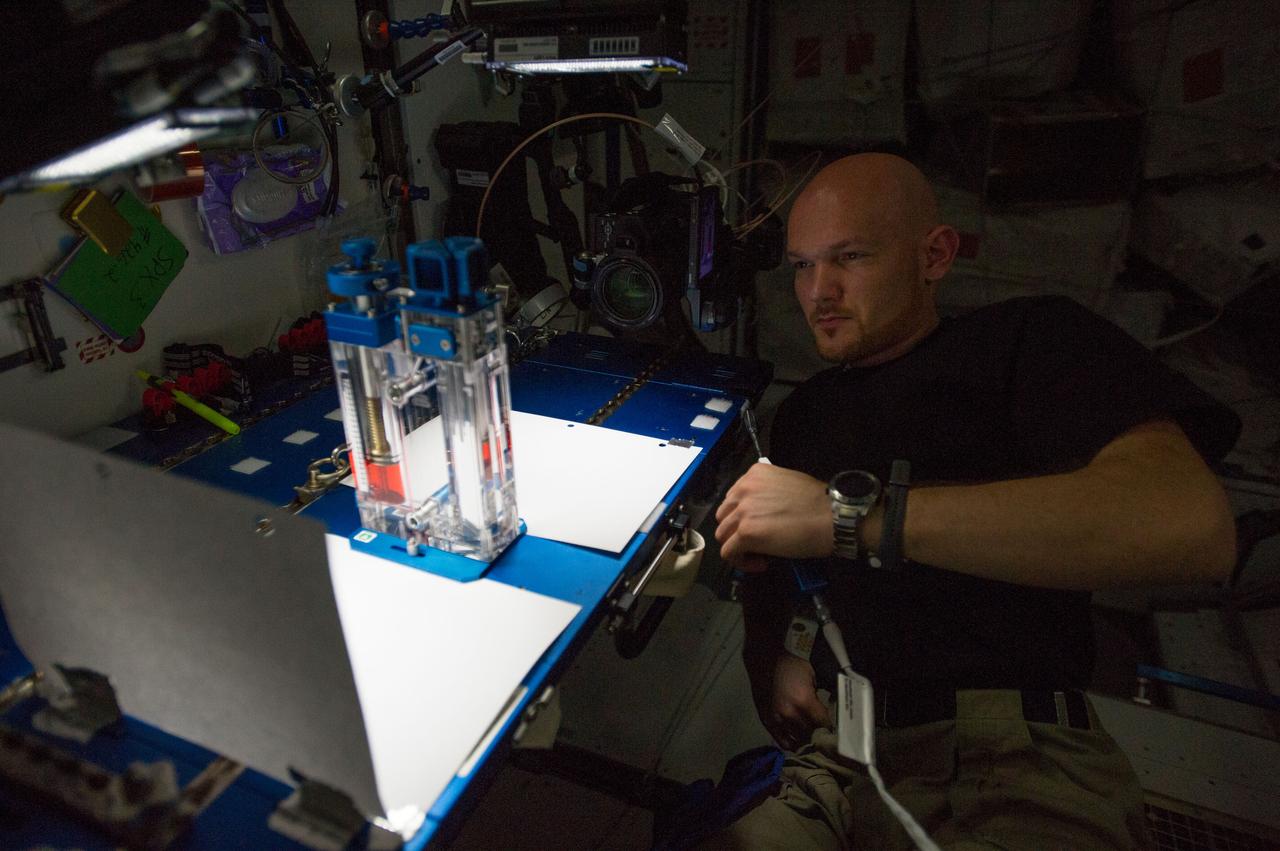
ISS040-E-015532 (19 June 2014) --- European Space Agency astronaut Alexander Gerst, Expedition 40 flight engineer, conducts a session with the Capillary Flow Experiment (CFE-2) in the Harmony node of the International Space Station. CFE is a suite of fluid physics experiments that investigate how fluids behave in microgravity which could benefit water and fuel delivery systems on future spacecraft. Scientists designed the CFE-2 to study properties of fluids and bubbles inside containers with a specific 3-D geometry.
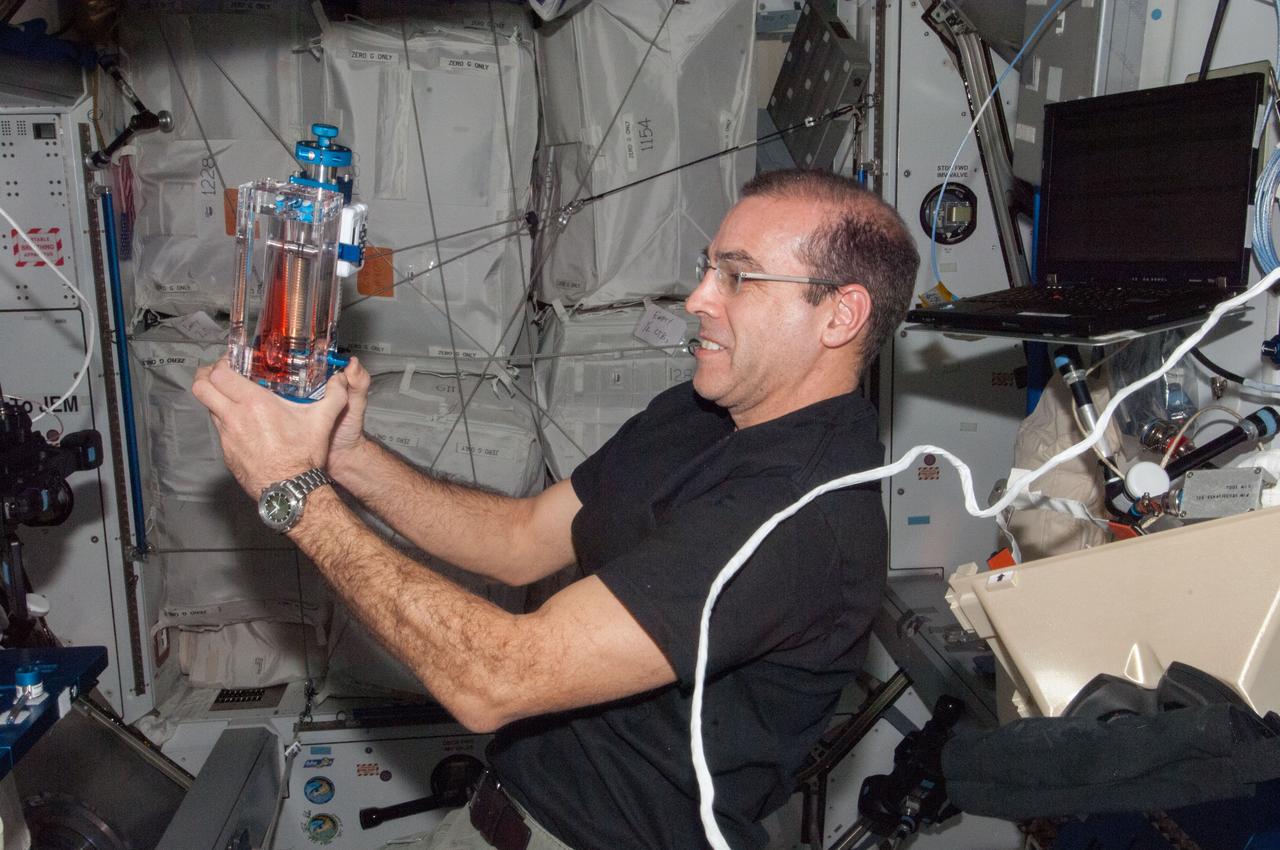
ISS038-E-025016 (3 Jan. 2014) --- NASA astronaut Rick Mastracchio, Expedition 38 flight engineer, conducts a session with the Capillary Flow Experiment (CFE-2) in the Harmony node of the International Space Station. CFE is a suite of fluid physics experiments that investigate how fluids behave in microgravity which could benefit water and fuel delivery systems on future spacecraft. Scientists designed the CFE-2 to study properties of fluids and bubbles inside containers with a specific 3-D geometry.
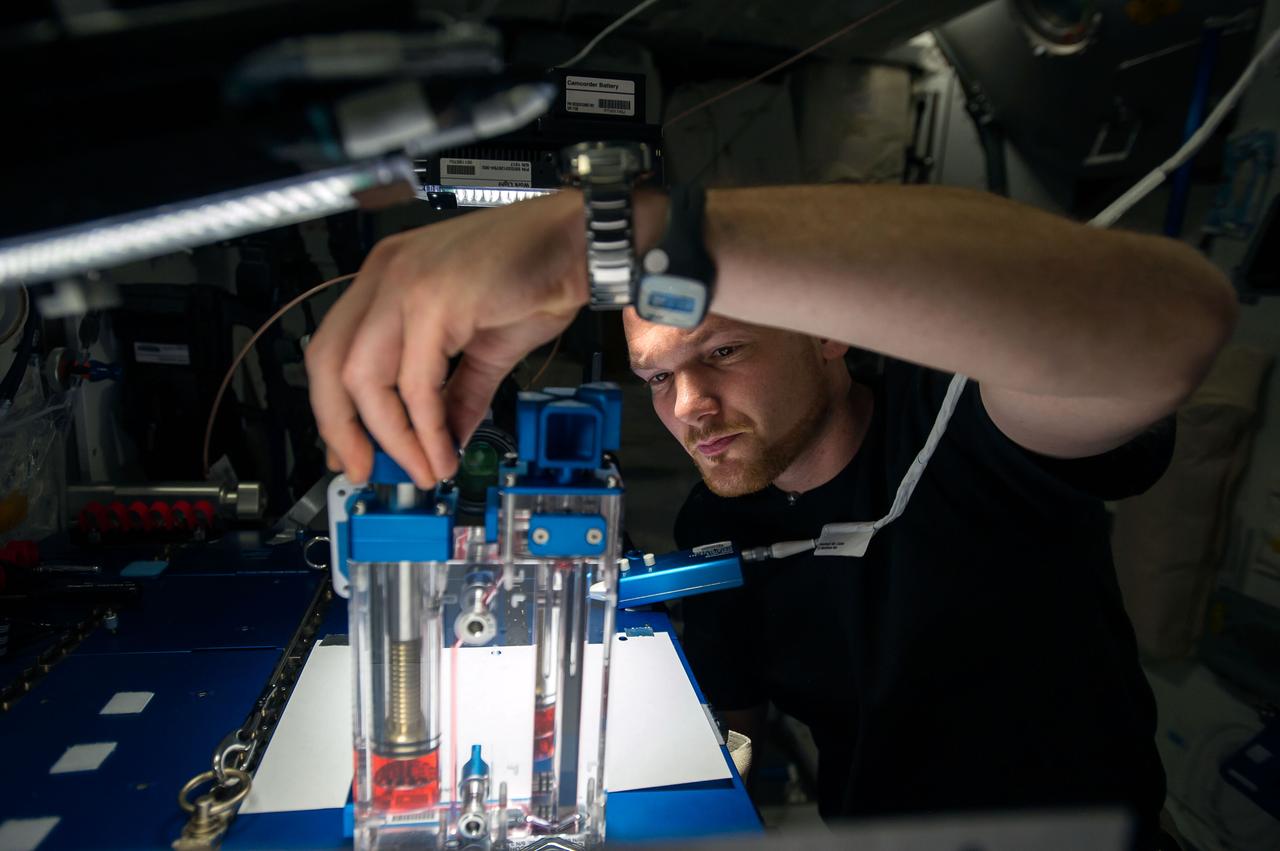
ISS040-E-015536 (19 June 2014) --- European Space Agency astronaut Alexander Gerst, Expedition 40 flight engineer, conducts a session with the Capillary Flow Experiment (CFE-2) in the Harmony node of the International Space Station. CFE is a suite of fluid physics experiments that investigate how fluids behave in microgravity which could benefit water and fuel delivery systems on future spacecraft. Scientists designed the CFE-2 to study properties of fluids and bubbles inside containers with a specific 3-D geometry.
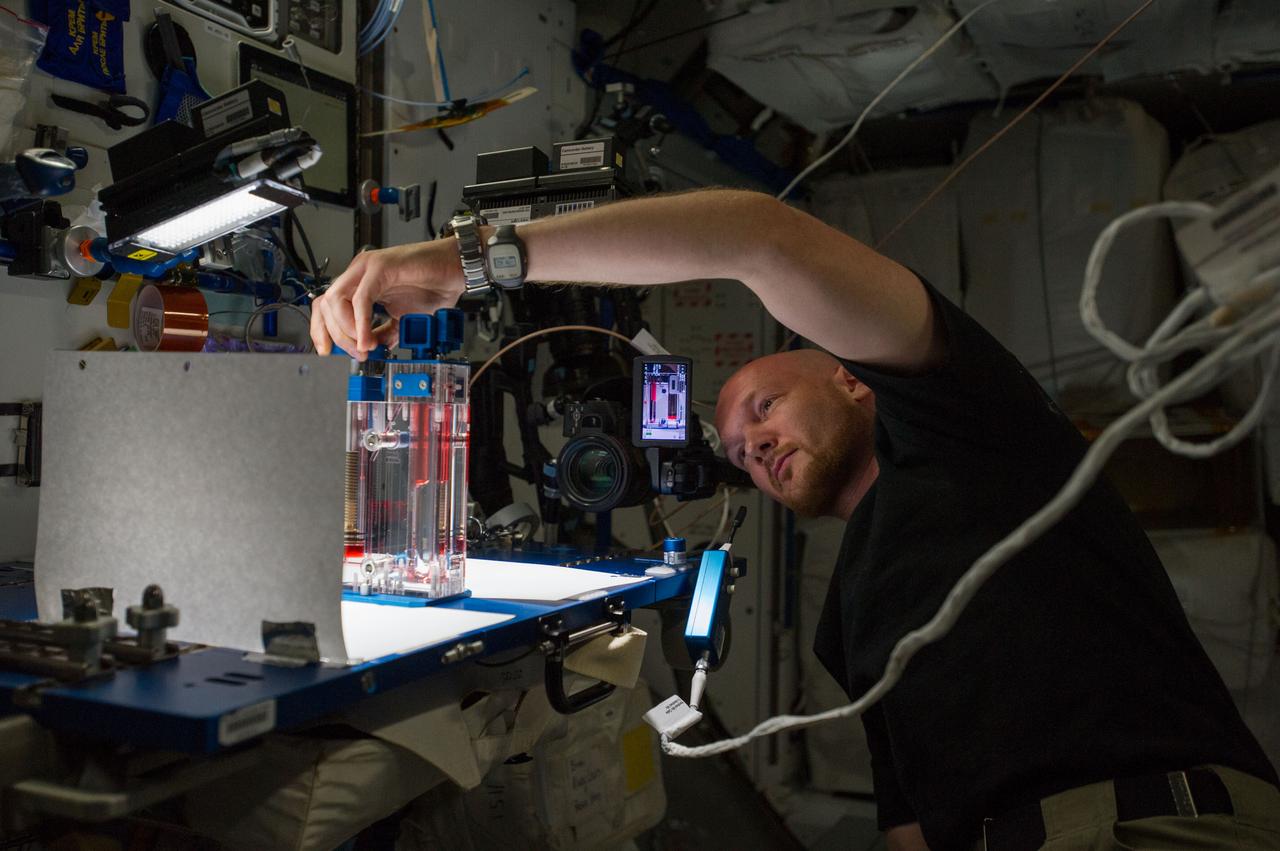
ISS040-E-015545 (19 June 2014) --- European Space Agency astronaut Alexander Gerst, Expedition 40 flight engineer, conducts a session with the Capillary Flow Experiment (CFE-2) in the Harmony node of the International Space Station. CFE is a suite of fluid physics experiments that investigate how fluids behave in microgravity which could benefit water and fuel delivery systems on future spacecraft. Scientists designed the CFE-2 to study properties of fluids and bubbles inside containers with a specific 3-D geometry.
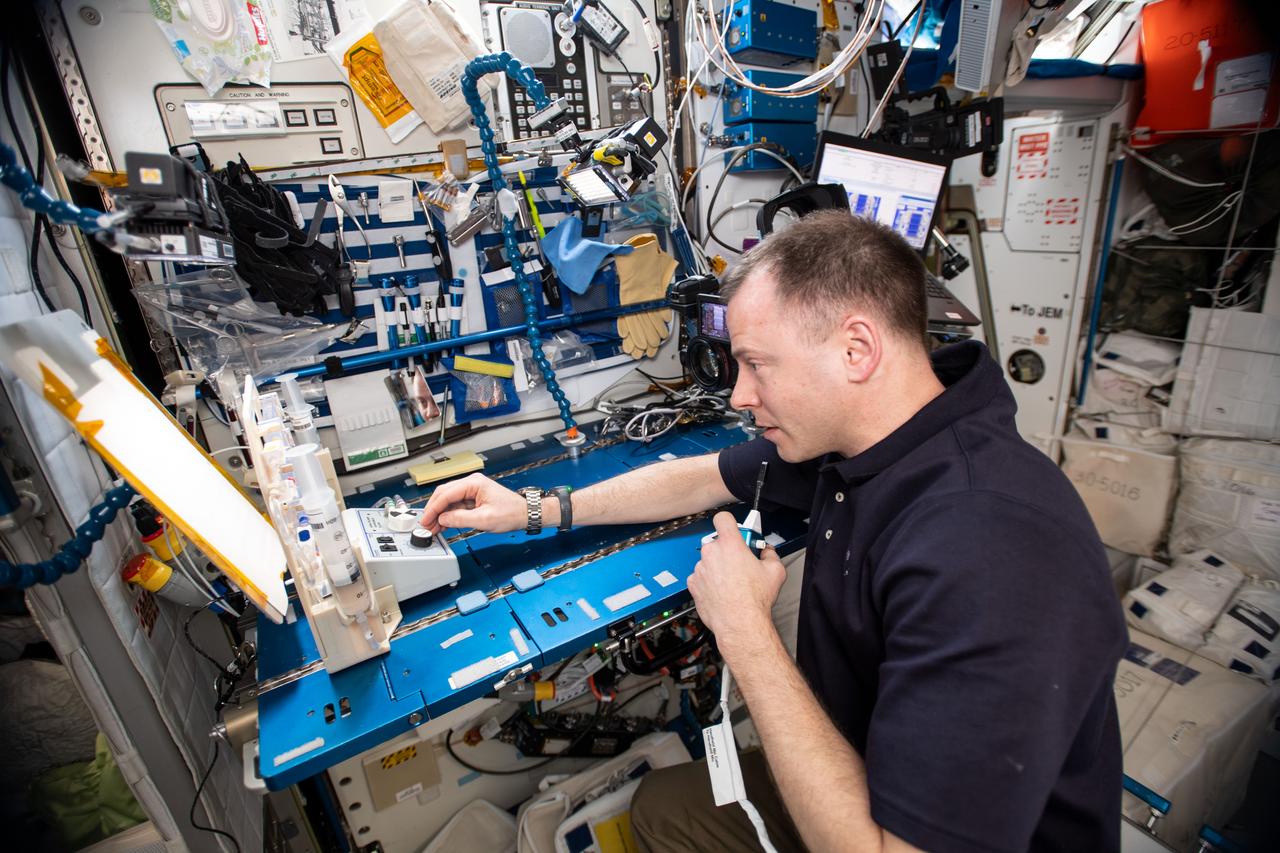
iss059e112425 (June 18, 2019) --- Flight Engineer Nick Hague is supporting research for the Capillary Structures experiment that uses specialized hardware to demonstrate the flow of fluid and gas mixtures using surface tension and fluid dynamics. The fluid physics study is helping NASA evaluate technologies for a lightweight, advanced life support system that can recover water and remove carbon dioxide in space.
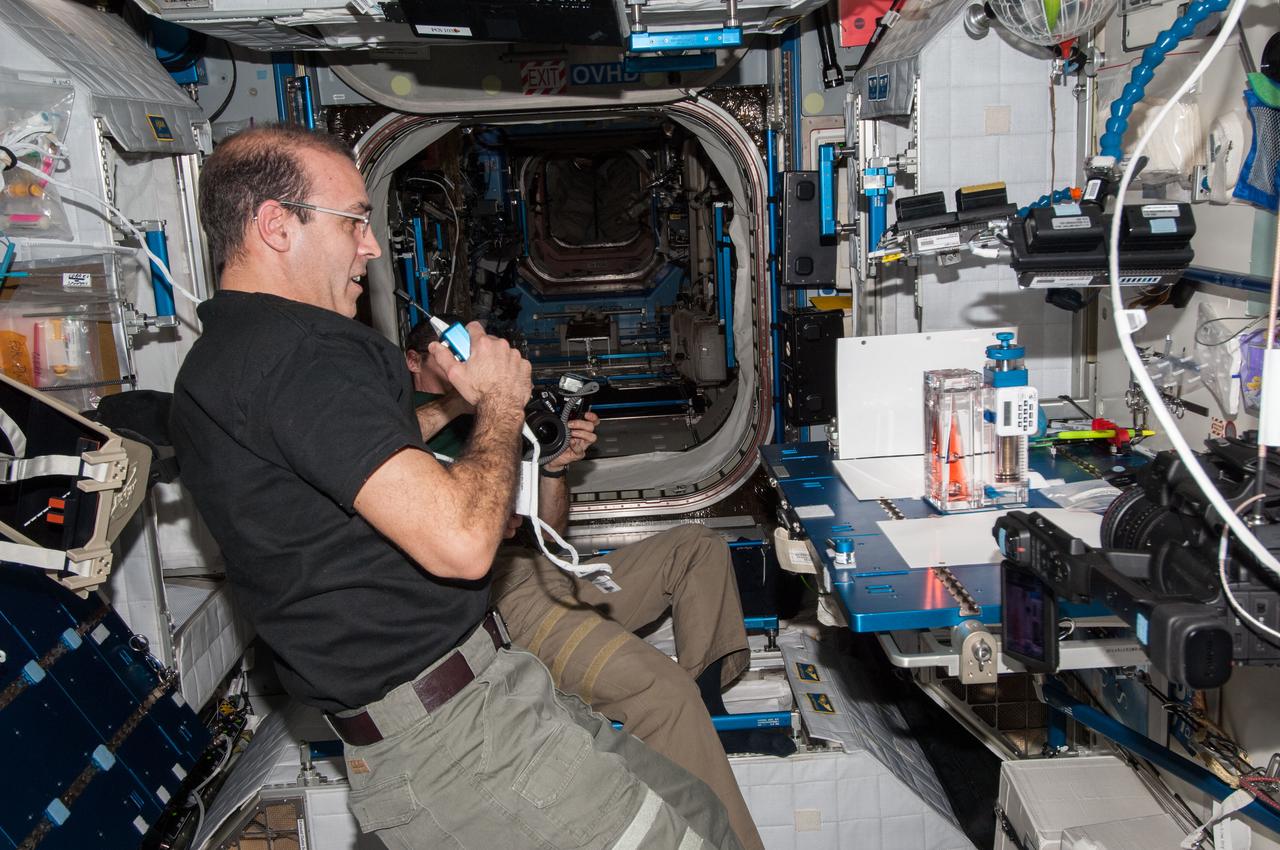
ISS038-E-025000 (3 Jan. 2014) --- NASA astronaut Rick Mastracchio, Expedition 38 flight engineer, speaks in a microphone while conducting a session with the Capillary Flow Experiment (CFE-2) in the Harmony node of the International Space Station. CFE is a suite of fluid physics experiments that investigate how fluids behave in microgravity which could benefit water and fuel delivery systems on future spacecraft. Scientists designed the CFE-2 to study properties of fluids and bubbles inside containers with a specific 3-D geometry.
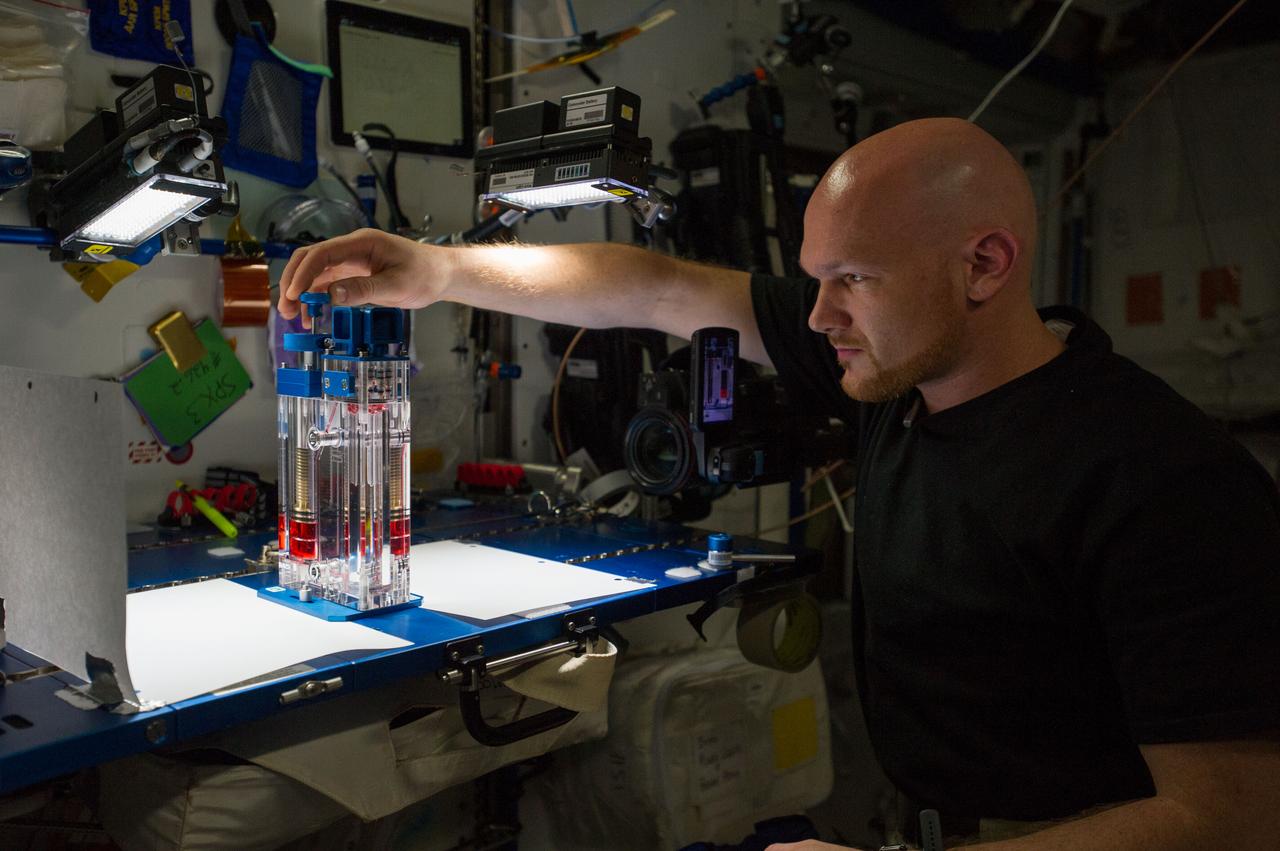
ISS040-E-015543 (19 June 2014) --- European Space Agency astronaut Alexander Gerst, Expedition 40 flight engineer, conducts a session with the Capillary Flow Experiment (CFE-2) in the Harmony node of the International Space Station. CFE is a suite of fluid physics experiments that investigate how fluids behave in microgravity which could benefit water and fuel delivery systems on future spacecraft. Scientists designed the CFE-2 to study properties of fluids and bubbles inside containers with a specific 3-D geometry.
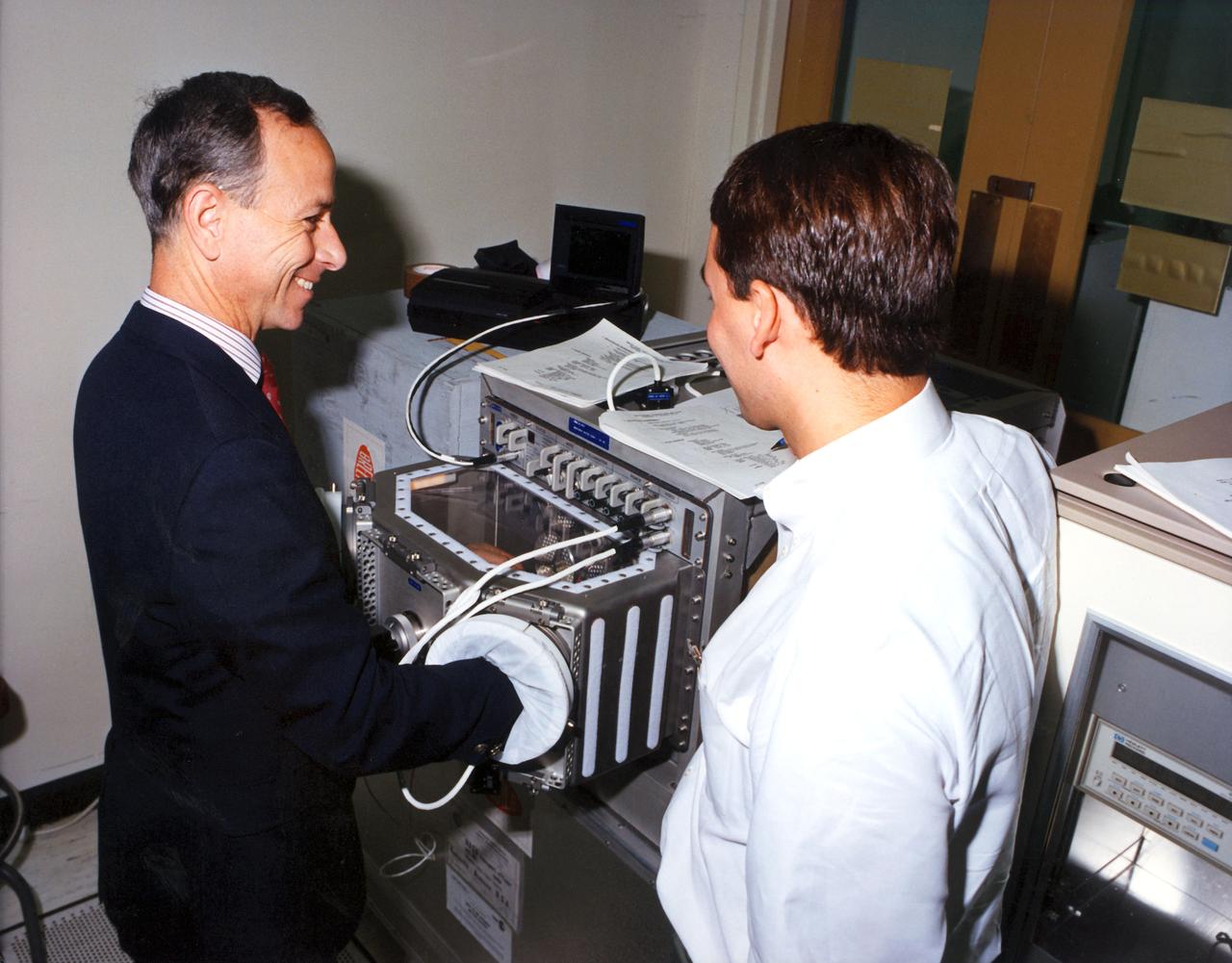
Oscillatory Thermocapillary Flow Experiment (OTFE); by using silicone oil for a study on the characteristics of themocapillary flow during the onset of oscillations with particular attention to parameters; the experiment will use submerged heaters to provide a constant temperature source in open cylindrical containers to cause thermocapillary flows. Thermocouples located in the heaters, the container walls, and the fluid will monitor the temperatures in the apparatus. Tracer particles will be added to the silicone oil sample to allow observation of the flow.
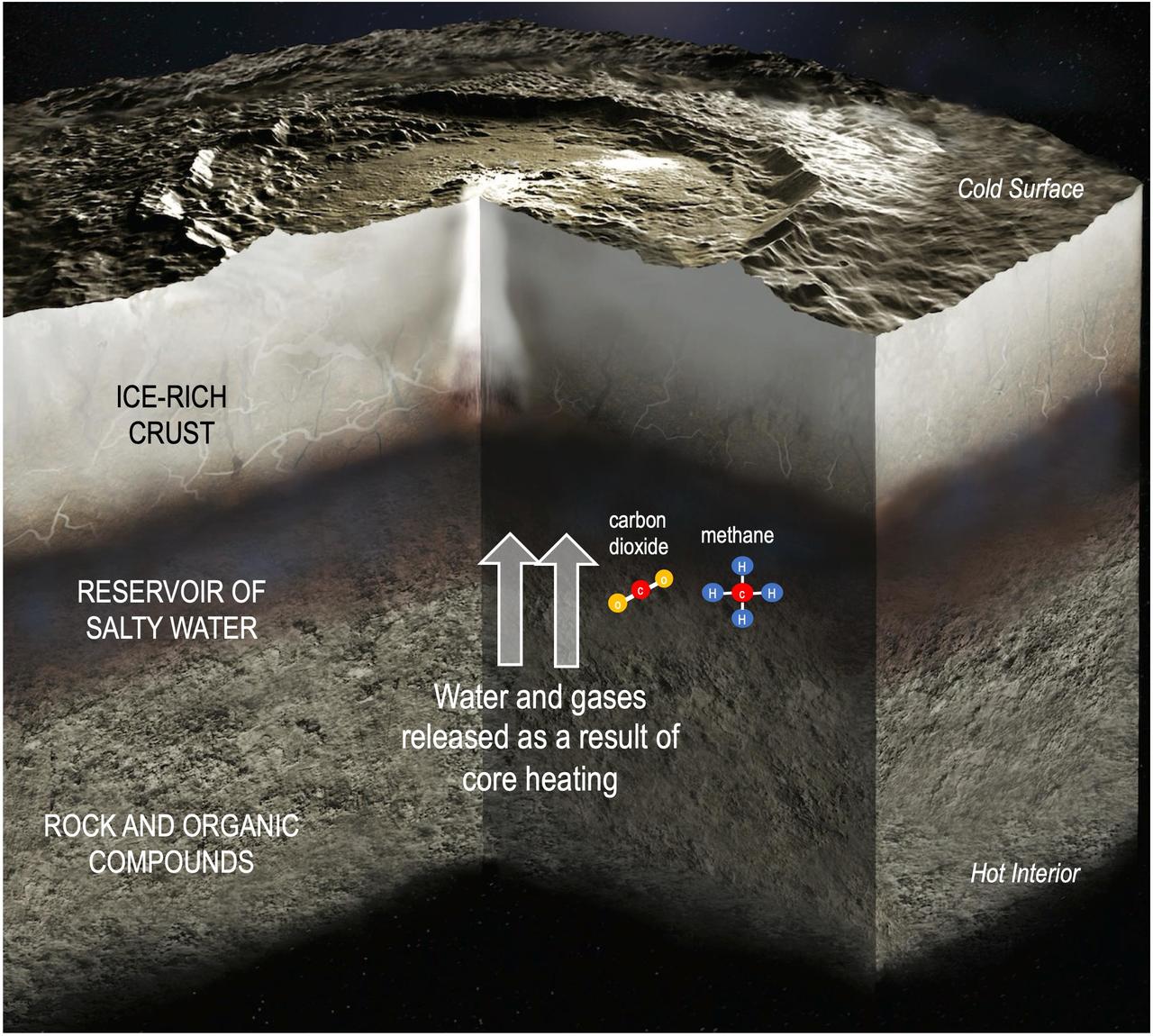
This illustration depicts the interior of dwarf planet Ceres, including the transfer of water and gases from the rocky core to a reservoir of salty water as a consequence of internal heating. A couple examples of molecules carrying chemical energy – carbon dioxide and methane – are included in the illustration. Research published in Science Advances on Aug. 20, 2025, relies on data from NASA's Dawn mission to find that chemical energy inside Ceres may have lasted long enough to fuel microbial metabolisms. Although there is no evidence that microorganisms ever existed on Ceres, the finding supports theories that this intriguing dwarf planet, which is the largest body in the main asteroid belt between Mars and Jupiter, may have once had conditions suitable to support single-celled lifeforms. https://photojournal.jpl.nasa.gov/catalog/PIA26570
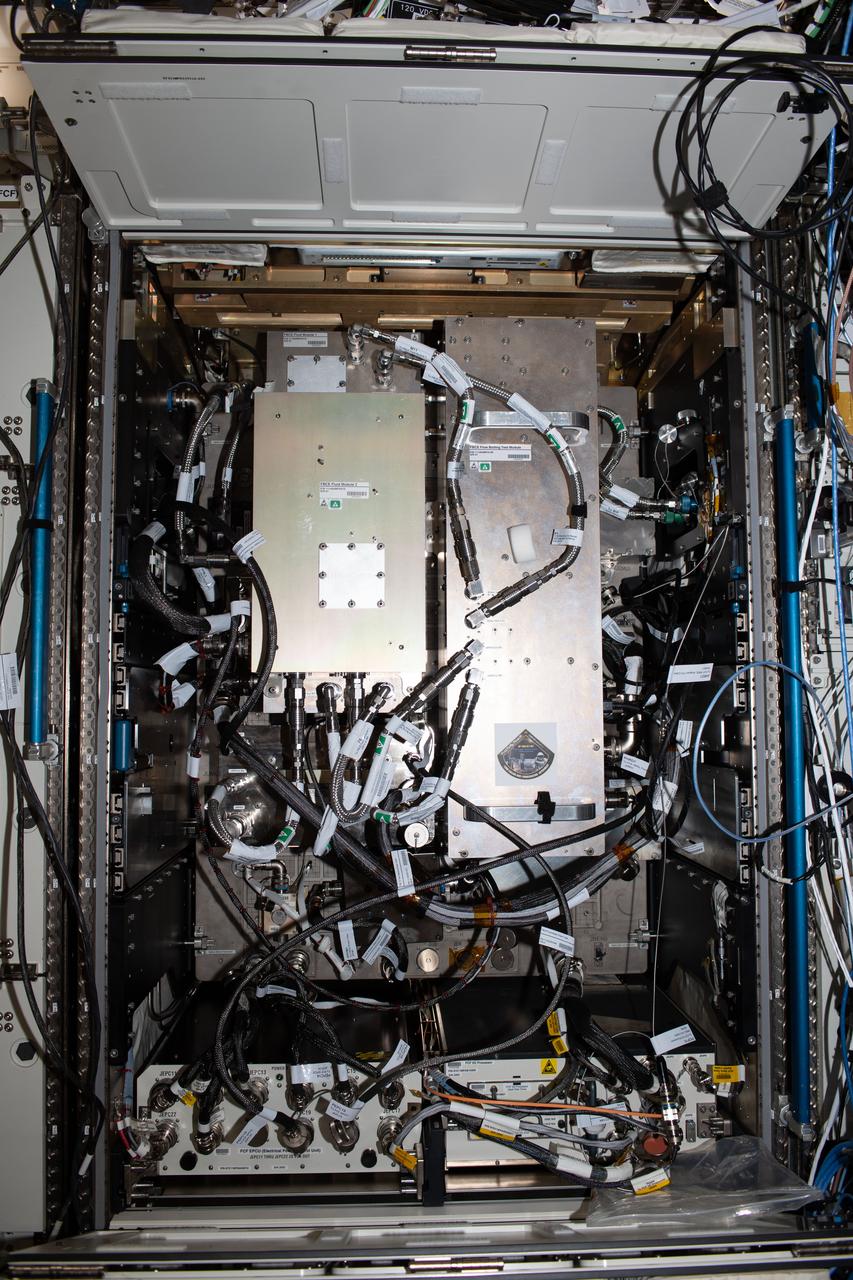
iss066e087939 (12/9/2021) --- A view of the Fluids and Combustion Facility (FCF), used for the Flow Boiling and Condensation Experiment (FBCE) during Expedition 66. The study may improve thermal systems for Earth and other planetary environments.
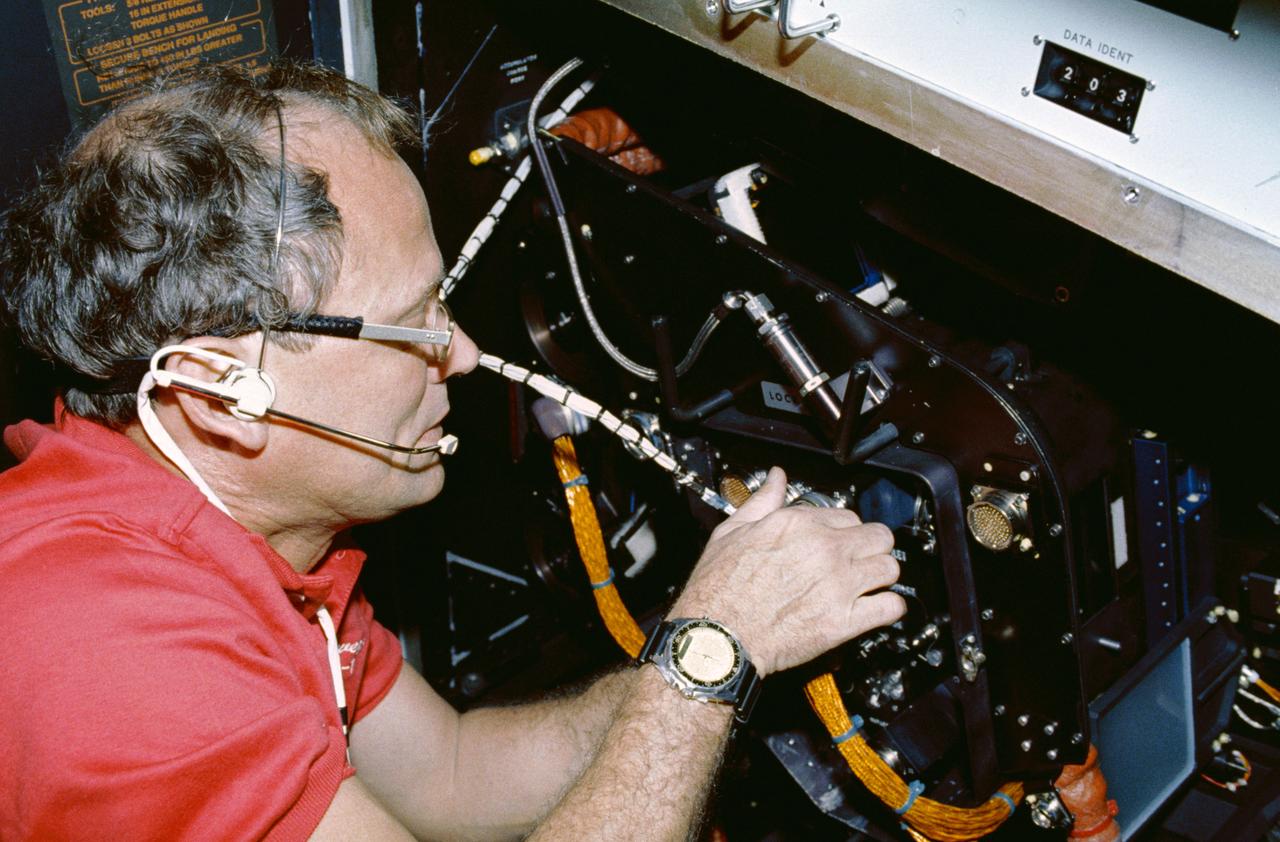
STS042-05-006 (22-30 Jan 1992) --- Astronaut Norman E. Thagard, payload commander, performs the Fluids Experiment System (FES) in the International Microgravity Laboratory (IML-1) science module. The FES is a NASA-developed facility that produces optical images of fluid flows during the processing of materials in space. The system's sophisticated optics consist of a laser to make holograms of samples and a video camera to record images of flows in and around samples. Thagard was joined by six fellow crewmembers for eight days of scientific research aboard Discovery in Earth-orbit. Most of their on-duty time was spent in this IML-1 science module, positioned in the cargo bay and attached via a tunnel to Discovery's airlock.
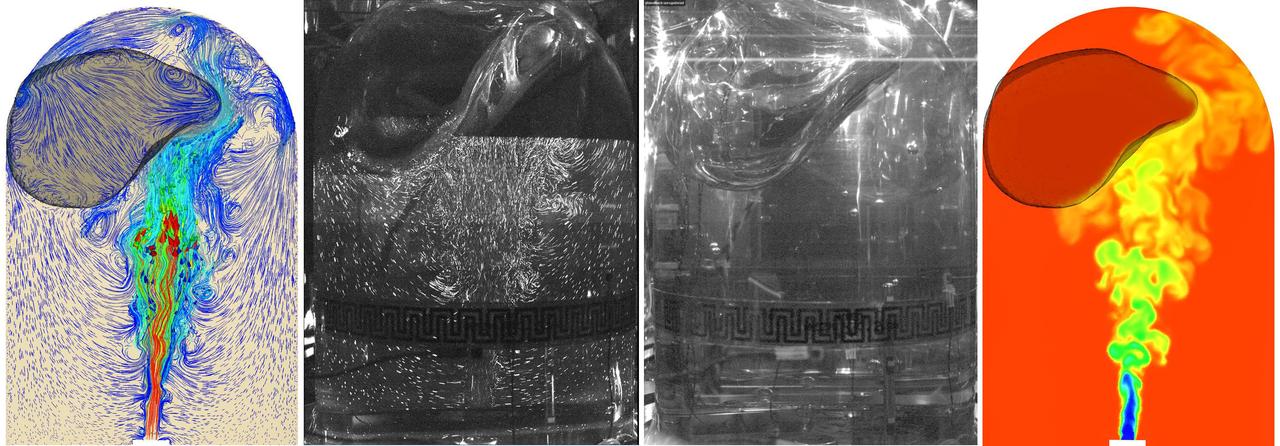
jsc2025e067419 (8/5/2025) --- Validation of model predictions of fluid flow in a spherical tank in microgravity for the ZBOT-1 experiment. On the left, a model of the position of unfilled space and deformation and flow of the liquid structures (colored image) and an image of the actual flow. On the right, a captured image of deformation of the unfilled space and a colored model of temperature contours during mixing. Credit: Case Western Reserve University
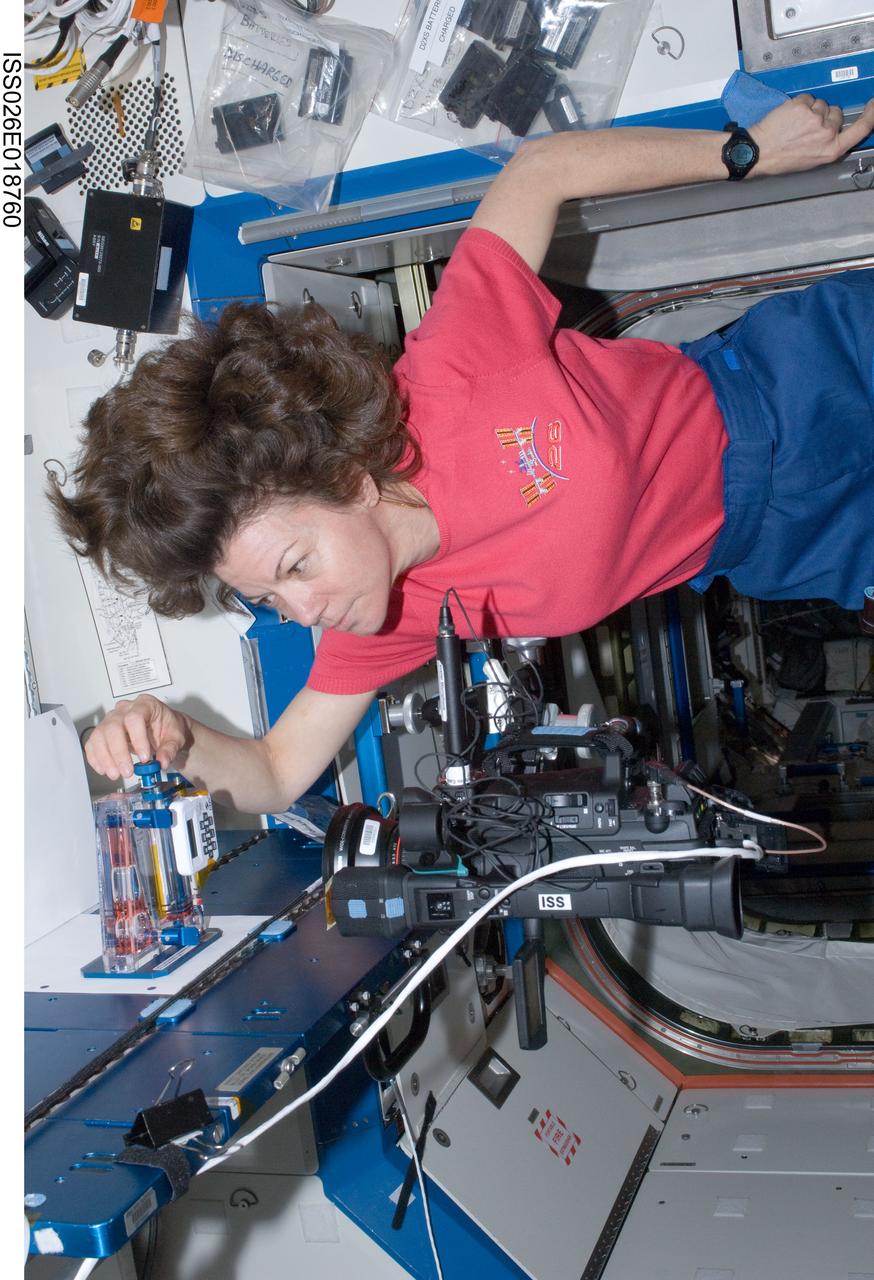
ISS026-E-018760 (18 Jan. 2011) --- NASA astronaut Catherine (Cady) Coleman, Expedition 26 flight engineer, performs a Capillary Flow Experiment (CFE) Interior Corner Flow 2 (ICF-2) test. The CFE is positioned on a Maintenance Work Area in the Destiny laboratory of the International Space Station. CFE observes the flow of fluid, in particular capillary phenomena, in microgravity.

ISS024-E-014158 (9 Sept. 2010) --- NASA astronaut Shannon Walker, Expedition 24 flight engineer, works with the Interior Corner Flow 1 (ICF-1) hardware during video recording of the Capillary Flow Experiment (CFE-1) in the Kibo laboratory of the International Space Station. CFE observes the flow of fluid, in particular capillary phenomena, in microgravity.
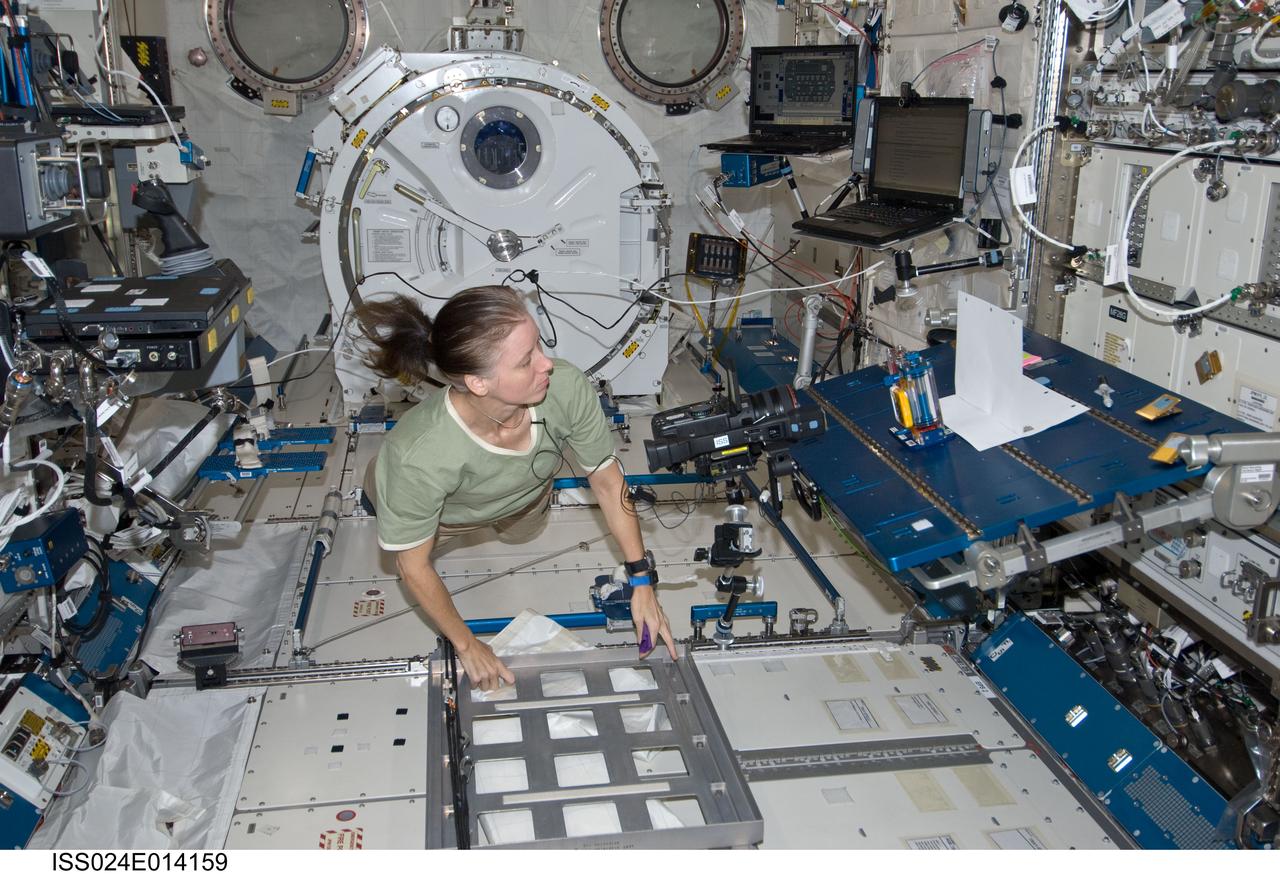
ISS024-E-014159 (9 Sept. 2010) --- NASA astronaut Shannon Walker, Expedition 24 flight engineer, works with the Interior Corner Flow 1 (ICF-1) hardware during video recording of the Capillary Flow Experiment (CFE-1) in the Kibo laboratory of the International Space Station. CFE observes the flow of fluid, in particular capillary phenomena, in microgravity.
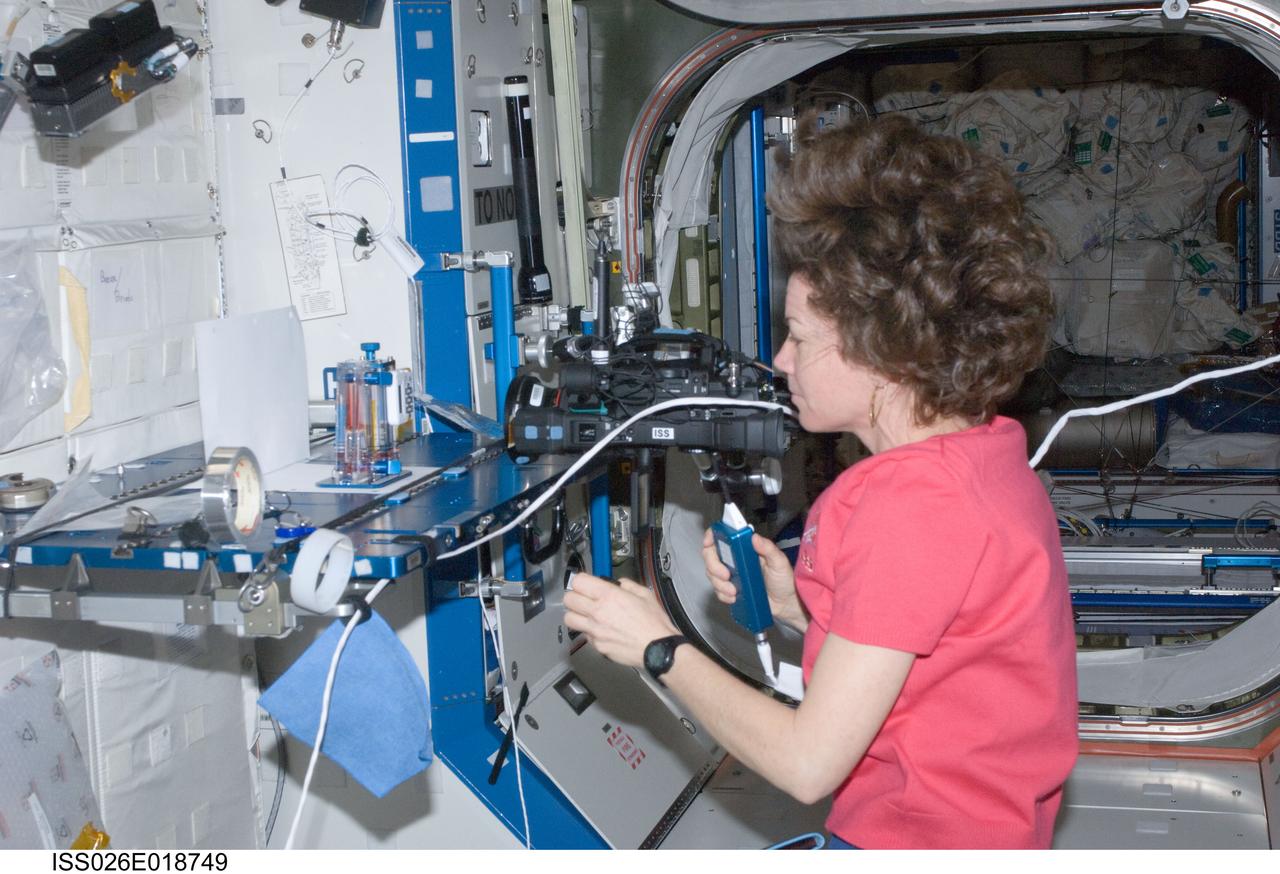
ISS026-E-018749 (18 Jan. 2011) --- NASA astronaut Catherine (Cady) Coleman, Expedition 26 flight engineer, performs a Capillary Flow Experiment (CFE) Interior Corner Flow 2 (ICF-2) test. The CFE is positioned on a Maintenance Work Area in the Destiny laboratory of the International Space Station. CFE observes the flow of fluid, in particular capillary phenomena, in microgravity.
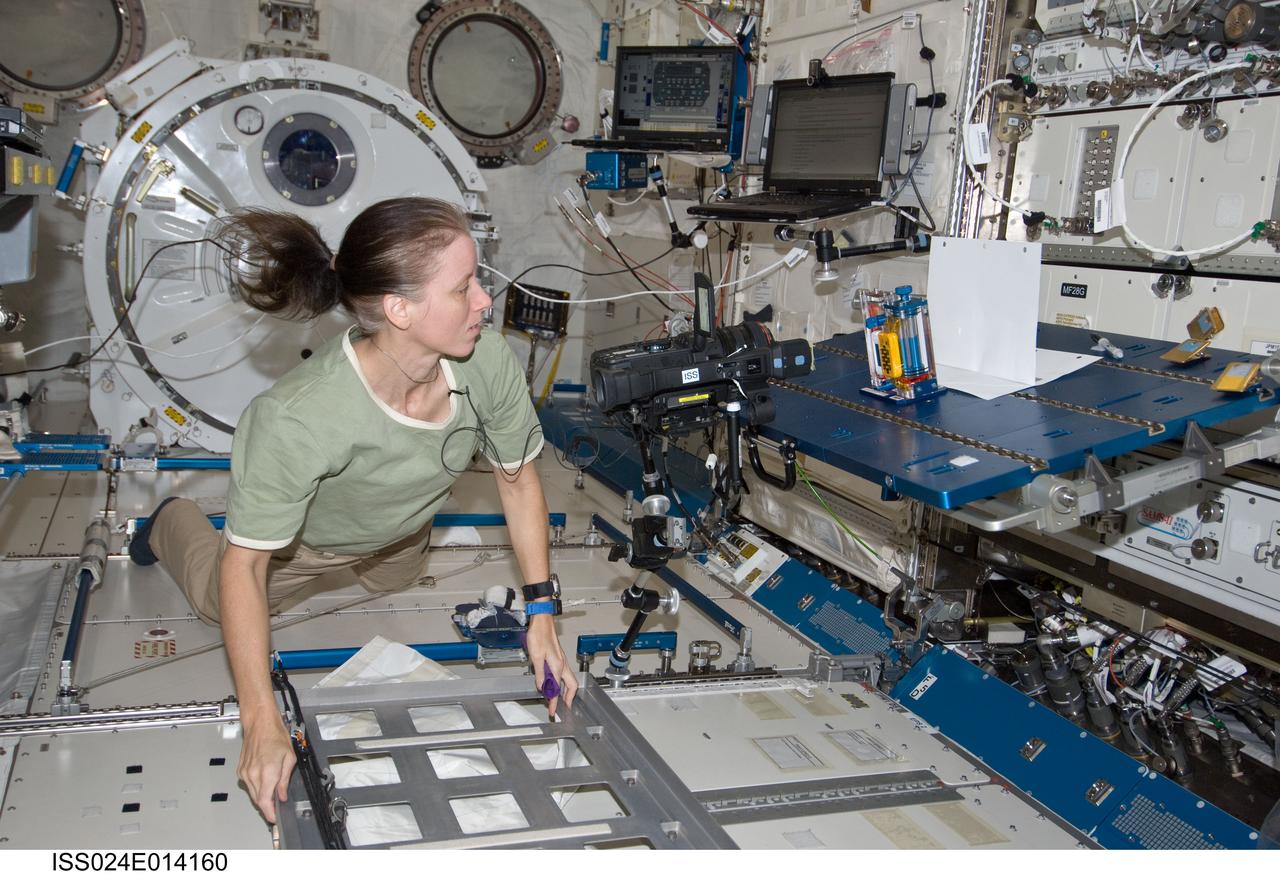
ISS024-E-014160 (9 Sept. 2010) --- NASA astronaut Shannon Walker, Expedition 24 flight engineer, works with the Interior Corner Flow 1 (ICF-1) hardware during video recording of the Capillary Flow Experiment (CFE-1) in the Kibo laboratory of the International Space Station. CFE observes the flow of fluid, in particular capillary phenomena, in microgravity.
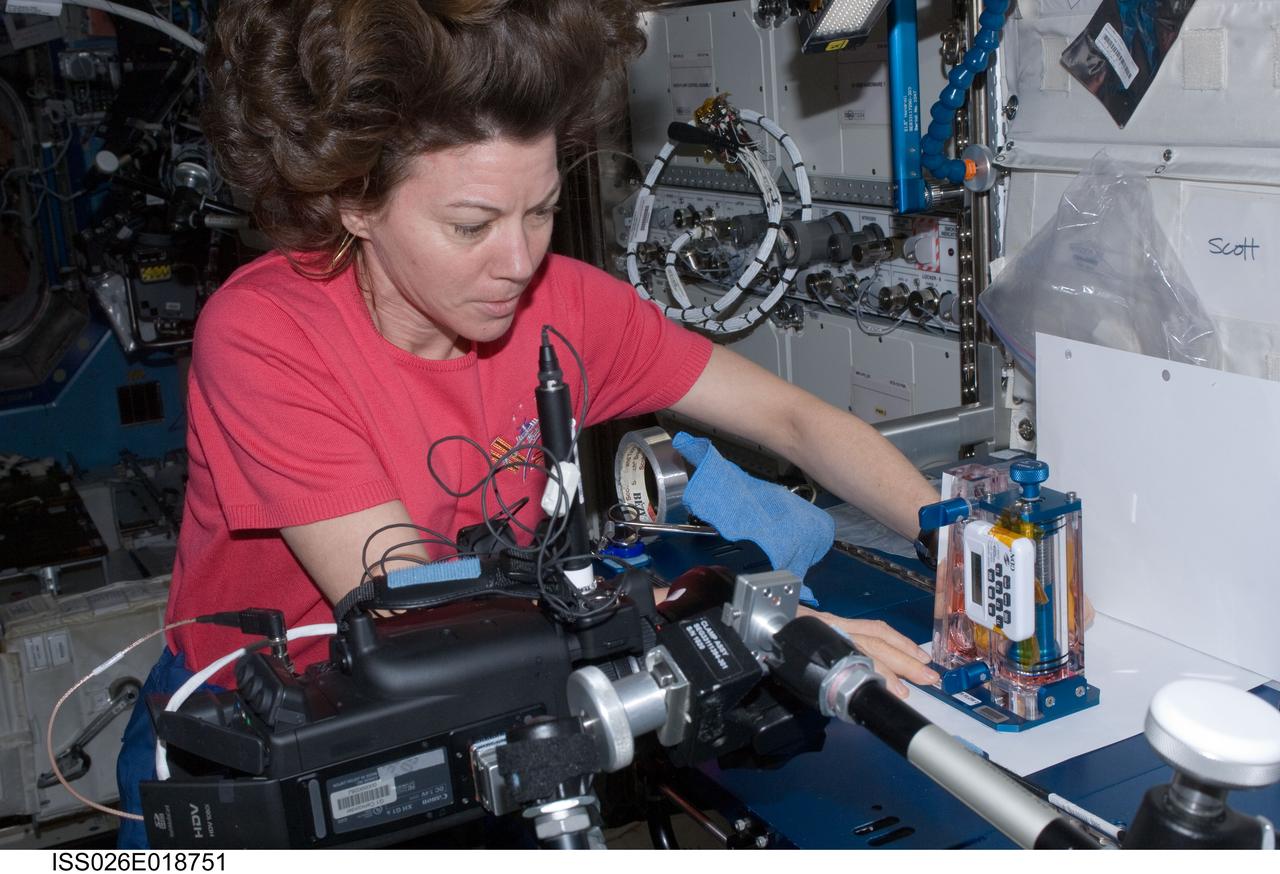
ISS026-E-018751 (18 Jan. 2011) --- NASA astronaut Catherine (Cady) Coleman, Expedition 26 flight engineer, performs a Capillary Flow Experiment (CFE) Interior Corner Flow 2 (ICF-2) test. The CFE is positioned on a Maintenance Work Area in the Destiny laboratory of the International Space Station. CFE observes the flow of fluid, in particular capillary phenomena, in microgravity.
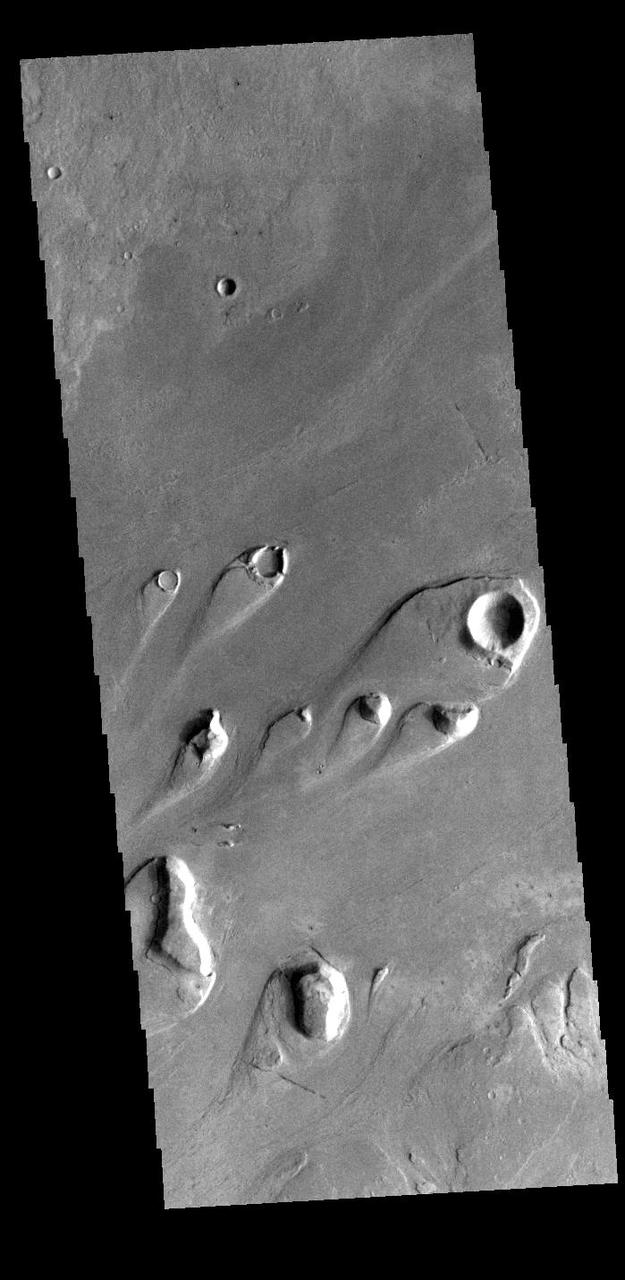
Today's VIS image shows part of Athabasca Valles. Multiple streamlined islands are seen in this image. The teardrop shaped features were formed by liquid flow deflected around features such as craters and hills. The 'tail' of the island points downstream. The source of the fluid was likely an outburst of groundwater, perhaps related to the Elysium volcanic complex located to the northwest of this image. Arising from Cerberus Fossae, the formation mode of this channel is still being debated. While the channel features are similar to water flow, other features are similar to lava flows, and yet other features have an appearance of slabs of material that floated on an underlying fluid. It is thought that Athabasca Valles is the youngest outflow channel system on Mars. Athabasca Valles is just one of the complex channel formations in the Elysium Planitia region. Orbit Number: 89977 Latitude: 9.44823 Longitude: 156.138 Instrument: VIS Captured: 2022-03-28 00:21 https://photojournal.jpl.nasa.gov/catalog/PIA25466
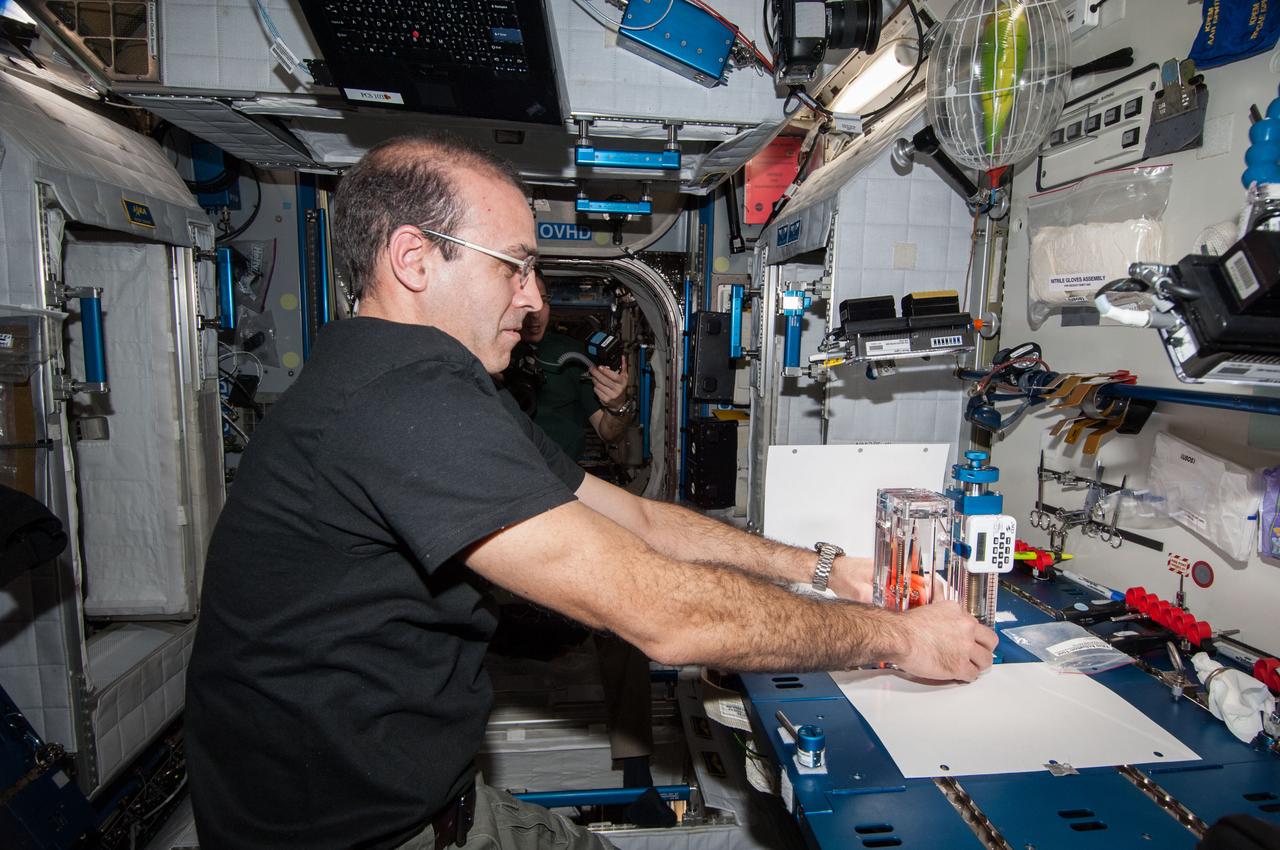
ISS038-E-025002 (3 Jan. 2014) --- NASA astronaut Rick Mastracchio, Expedition 38 flight engineer, conducts a session with the Capillary Flow Experiment (CFE-2) in the Harmony node of the International Space Station. CFE is a suite of fluid physics experiments that investigate how fluids behave in microgravity which could benefit water and fuel delivery systems on future spacecraft. Scientists designed the CFE-2 to study properties of fluids and bubbles inside containers with a specific 3-D geometry. NASA astronaut Mike Hopkins (mostly obscured in the background), flight engineer, uses a still camera to photograph the session.
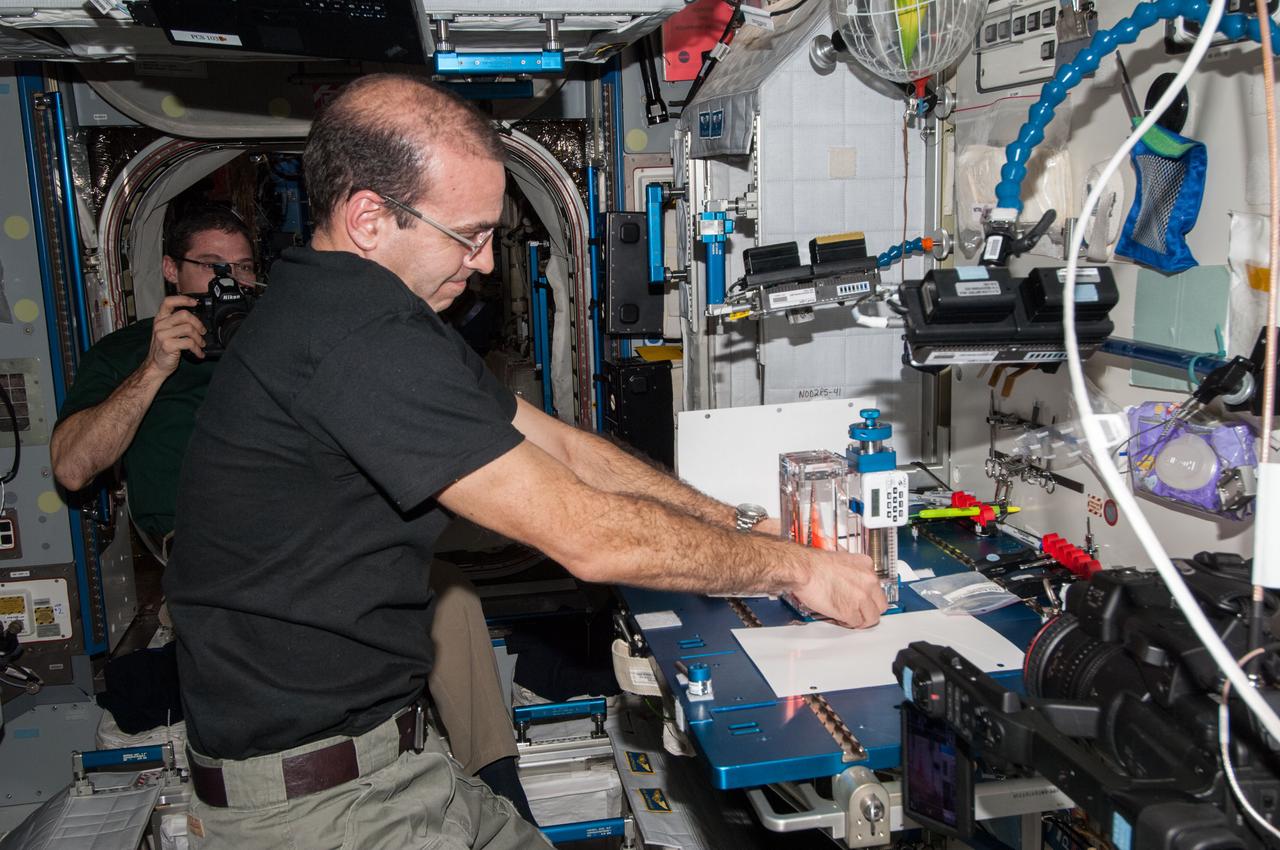
ISS038-E-025002 (3 Jan. 2014) --- NASA astronaut Rick Mastracchio, Expedition 38 flight engineer, conducts a session with the Capillary Flow Experiment (CFE-2) in the Harmony node of the International Space Station. CFE is a suite of fluid physics experiments that investigate how fluids behave in microgravity which could benefit water and fuel delivery systems on future spacecraft. Scientists designed the CFE-2 to study properties of fluids and bubbles inside containers with a specific 3-D geometry. NASA astronaut Mike Hopkins (mostly obscured in the background), flight engineer, uses a still camera to photograph the session.

ISS028-E-048923 (13 Sept. 2011) --- Japan Aerospace Exploration Agency astronaut Satoshi Furukawa, Expedition 28 flight engineer, works with the Fluid Physics Experiment Facility/Marangoni Surface (FPEF MS) Core hardware in the Kibo laboratory of the International Space Station. The Marangoni convection experiment in the FPEF examines fluid tension flow in micro-G.
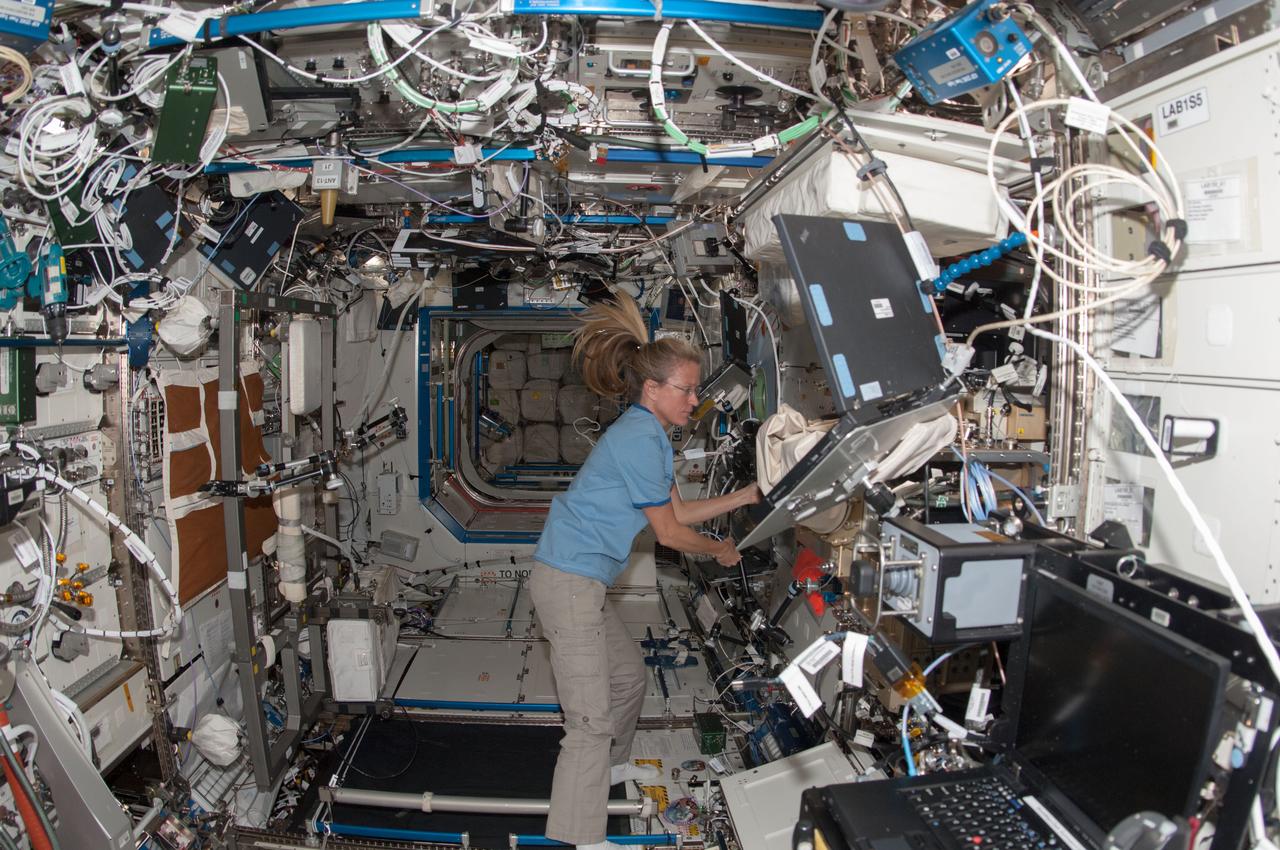
In the International Space Stations Destiny laboratory,NASA astronaut Karen Nyberg,Expedition 36 flight engineer,speaks into a microphone while conducting a session with the Advanced Colloids Experiment (ACE)-1 sample preparation at the Light Microscopy Module (LMM) in the Fluids Integrated Rack / Fluids Combustion Facility (FIR/FCF). ACE-1 is a series of microscopic imaging investigations that uses the microgravity environment to examine flow characteristics and the evolution and ordering effects within a group of colloidal materials.
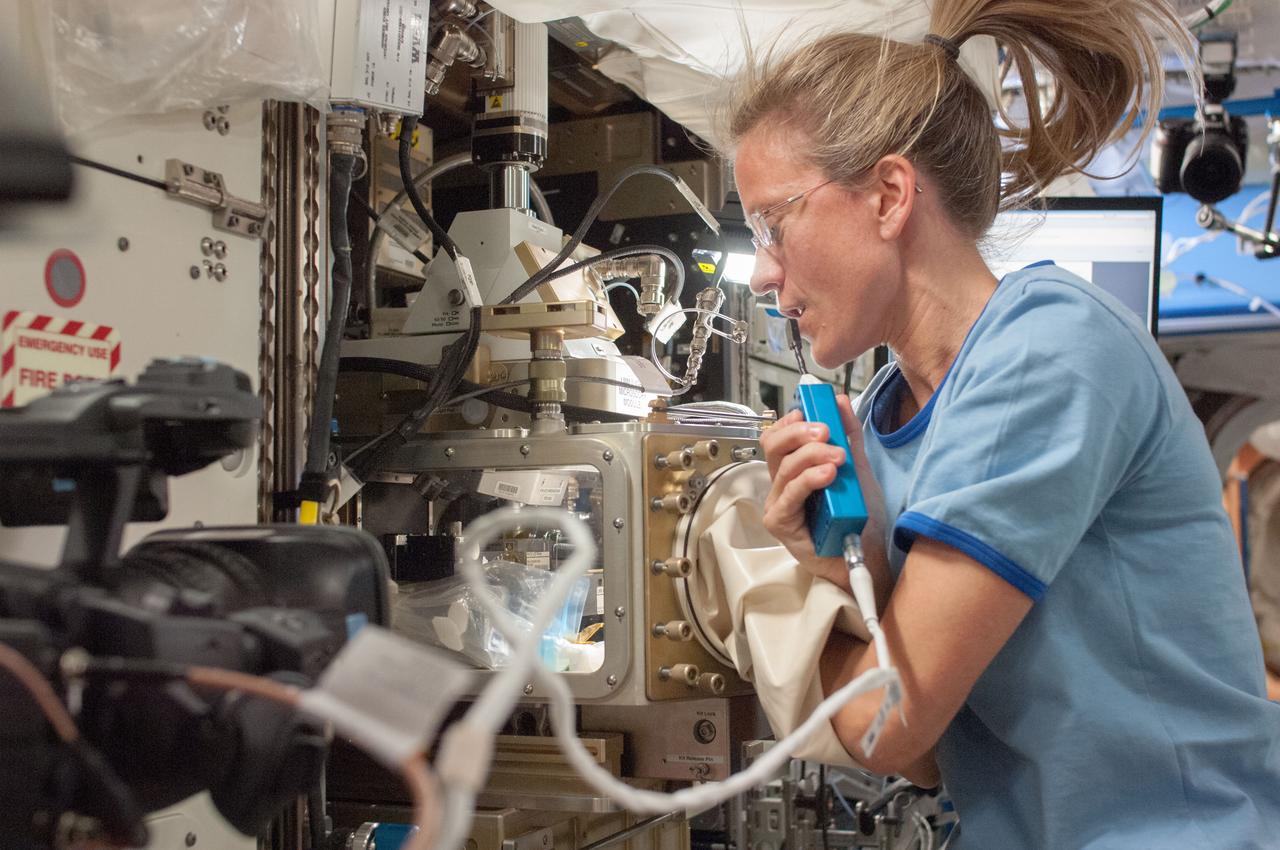
ISS036-E-019830 (24 June 2013) --- In the International Space Station’s Destiny laboratory, NASA astronaut Karen Nyberg, Expedition 36 flight engineer, speaks into a microphone while conducting a session with the Advanced Colloids Experiment (ACE)-1 sample preparation at the Light Microscopy Module (LMM) in the Fluids Integrated Rack / Fluids Combustion Facility (FIR/FCF). ACE-1 is a series of microscopic imaging investigations that uses the microgravity environment to examine flow characteristics and the evolution and ordering effects within a group of colloidal materials.
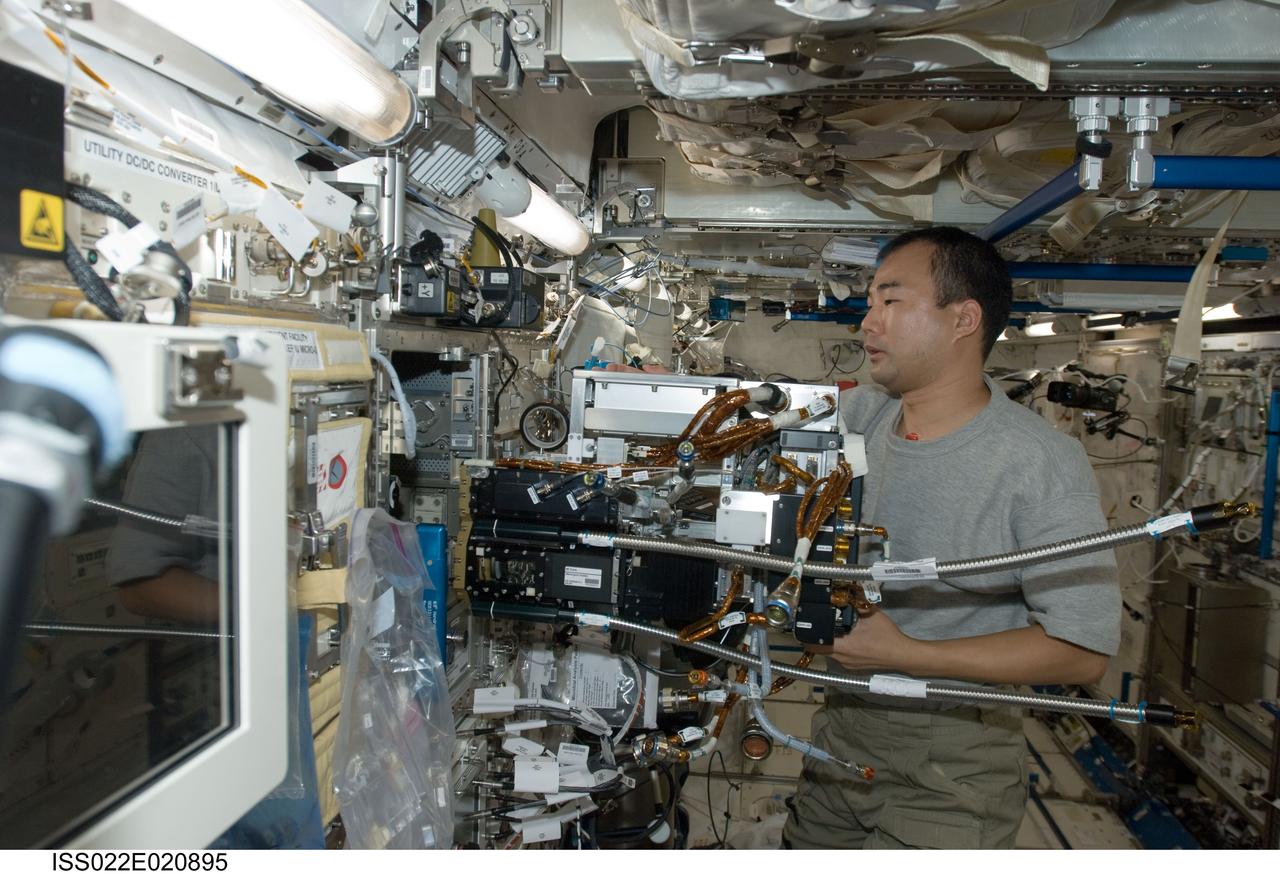
ISS022-E-020895 (11 Jan. 2010) --- Japan Aerospace Exploration Agency (JAXA) astronaut Soichi Noguchi, Expedition 22 flight engineer, works with Fluid Physics Experiment Facility/Marangoni Surface (FPEF MS) Core hardware in the Kibo laboratory of the International Space Station. The Marangoni convection experiment in the FPEF examines fluid tension flow in micro-G.
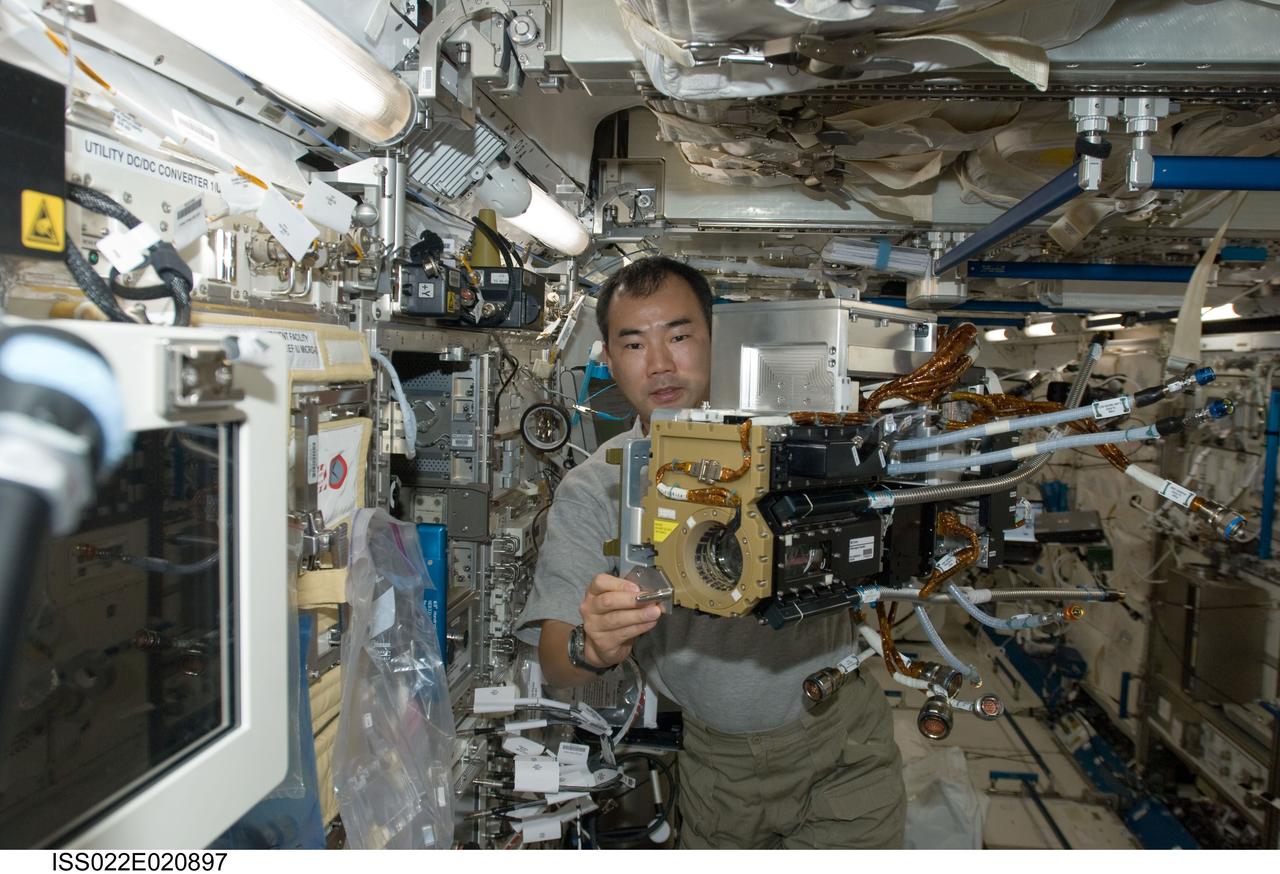
ISS022-E-020897 (11 Jan. 2010) --- Japan Aerospace Exploration Agency (JAXA) astronaut Soichi Noguchi, Expedition 22 flight engineer, works with Fluid Physics Experiment Facility/Marangoni Surface (FPEF MS) Core hardware in the Kibo laboratory of the International Space Station. The Marangoni convection experiment in the FPEF examines fluid tension flow in micro-G.
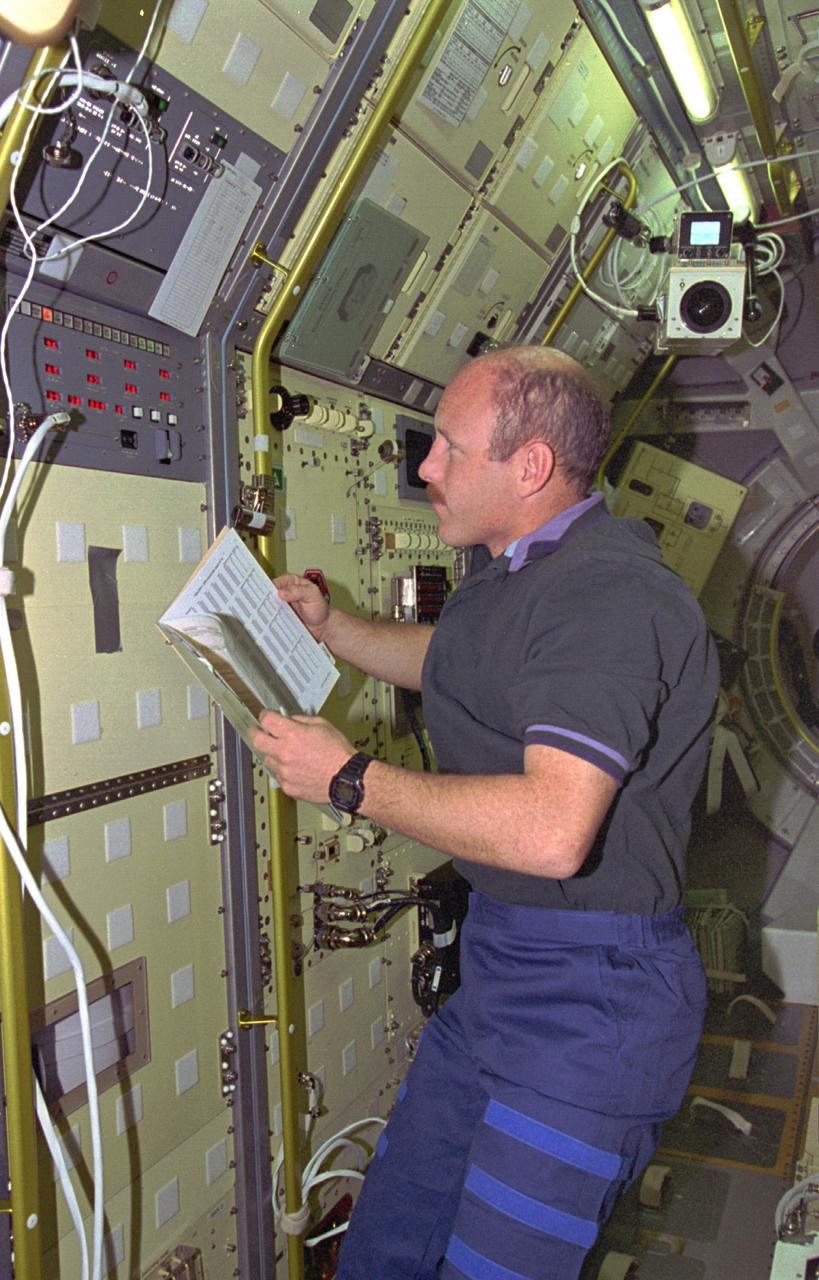
STS073-363-032 (20 October - 5 November 1995) --- Astronaut Kenneth D. Bowersox, STS-73 mission commander, studies the movement of fluids in microgravity at the Geophysical Fluid Flow Cell (GFFC) workstation in the science module of the Earth-orbiting Space Shuttle Columbia. Bowersox was joined by four other NASA astronauts and two guest researchers for almost 16-days of Earth-orbit research in support of the U.S. Microgravity Laboratory (USML-2) mission.
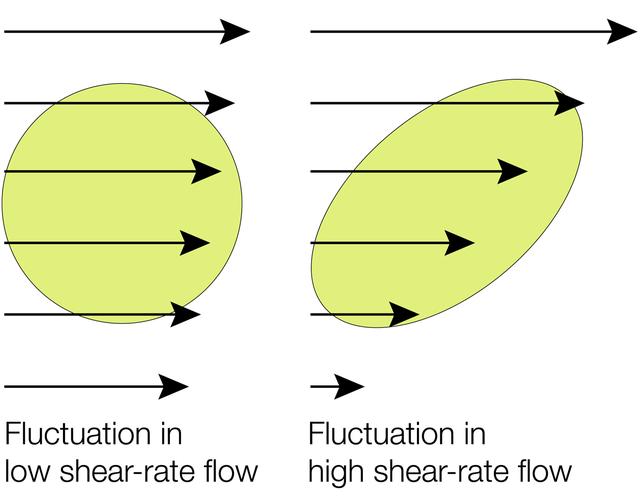
The Critical Viscosity of Xenon Experiment (CVX-2) on the STS-107 Research 1 mission in 2002 will measure the viscous behavior of xenon, a heavy inert gas used in flash lamps and ion rocket engines, at its critical point. Shear thirning will cause a normally viscous fluid -- such as pie filling or whipped cream -- to deform and flow more readily under high shear conditions. In shear thinning, a pocket of fluid will deform and move one edge forward, as depicted here.
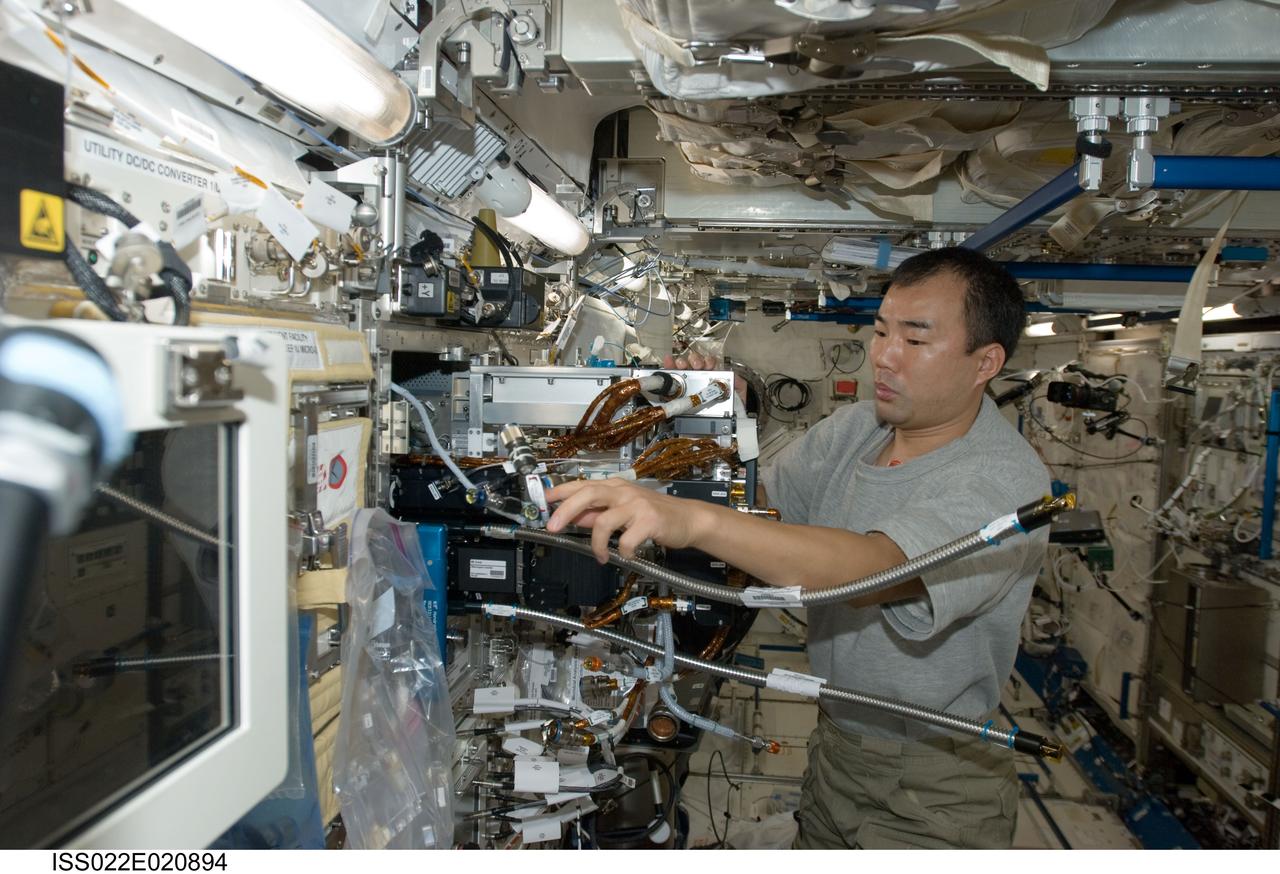
ISS022-E-020894 (11 Jan. 2010) --- Japan Aerospace Exploration Agency (JAXA) astronaut Soichi Noguchi, Expedition 22 flight engineer, works with Fluid Physics Experiment Facility/Marangoni Surface (FPEF MS) Core hardware in the Kibo laboratory of the International Space Station. The Marangoni convection experiment in the FPEF examines fluid tension flow in micro-G.
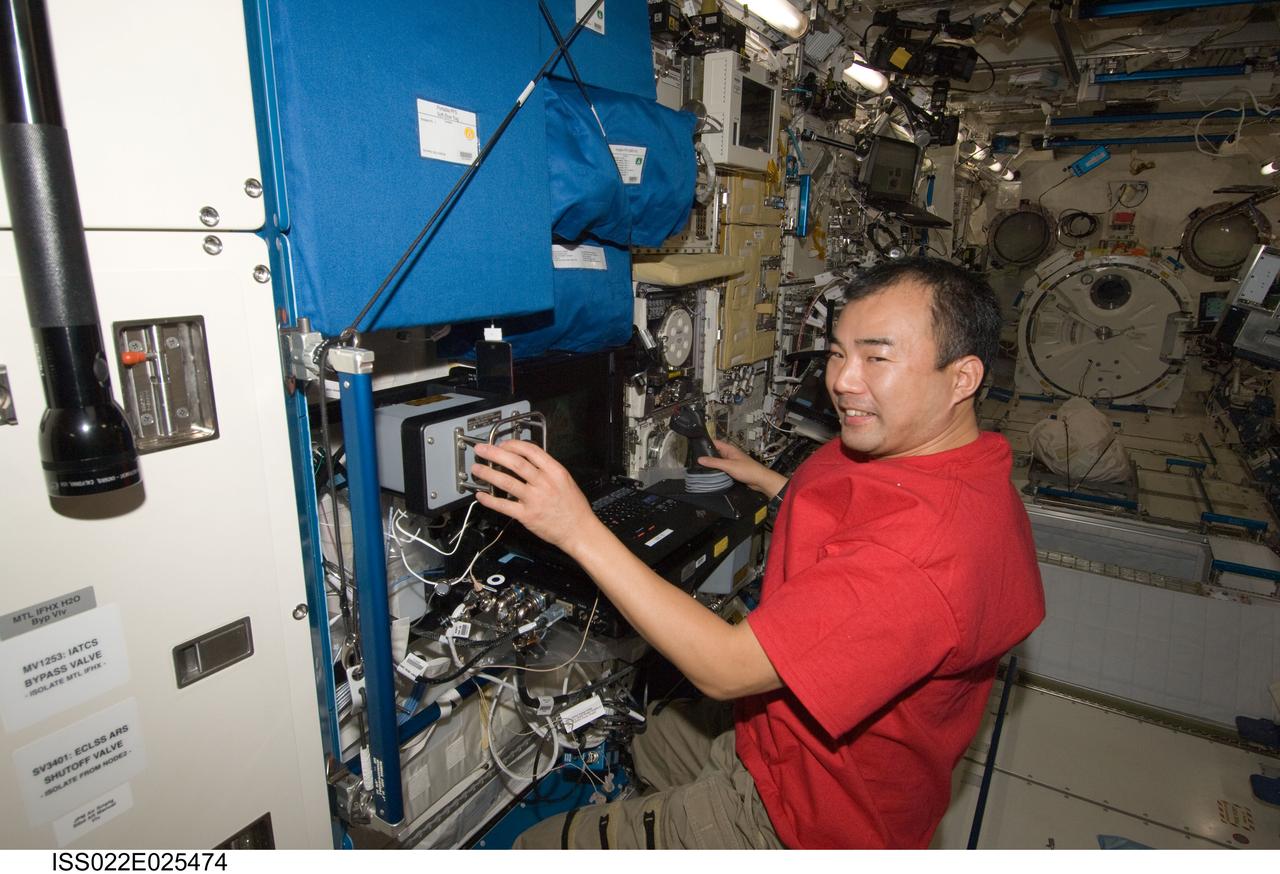
ISS022-E-025474 (14 Jan. 2010) --- Japan Aerospace Exploration Agency (JAXA) astronaut Soichi Noguchi, Expedition 22 flight engineer, services the Fluid Physics Experiment Facility/Marangoni Surface (FPEF MS) Core hardware in the Kibo laboratory of the International Space Station. The Marangoni convection experiment in the FPEF examines fluid tension flow in micro-G.
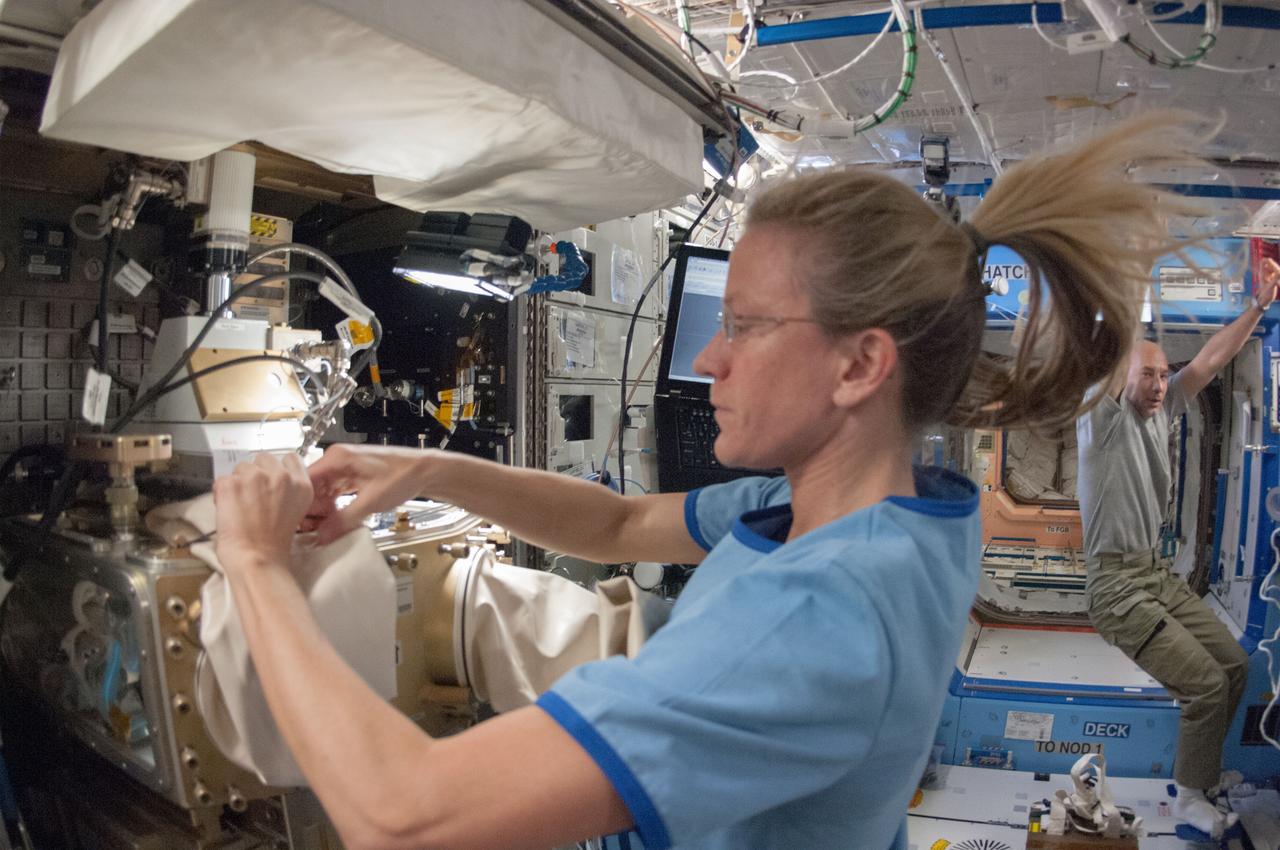
ISS036-E-019760 (24 June 2013) --- In the International Space Station’s Destiny laboratory, NASA astronaut Karen Nyberg, Expedition 36 flight engineer, conducts a session with the Advanced Colloids Experiment (ACE)-1 sample preparation at the Light Microscopy Module (LMM) in the Fluids Integrated Rack / Fluids Combustion Facility (FIR/FCF). ACE-1 is a series of microscopic imaging investigations that uses the microgravity environment to examine flow characteristics and the evolution and ordering effects within a group of colloidal materials.
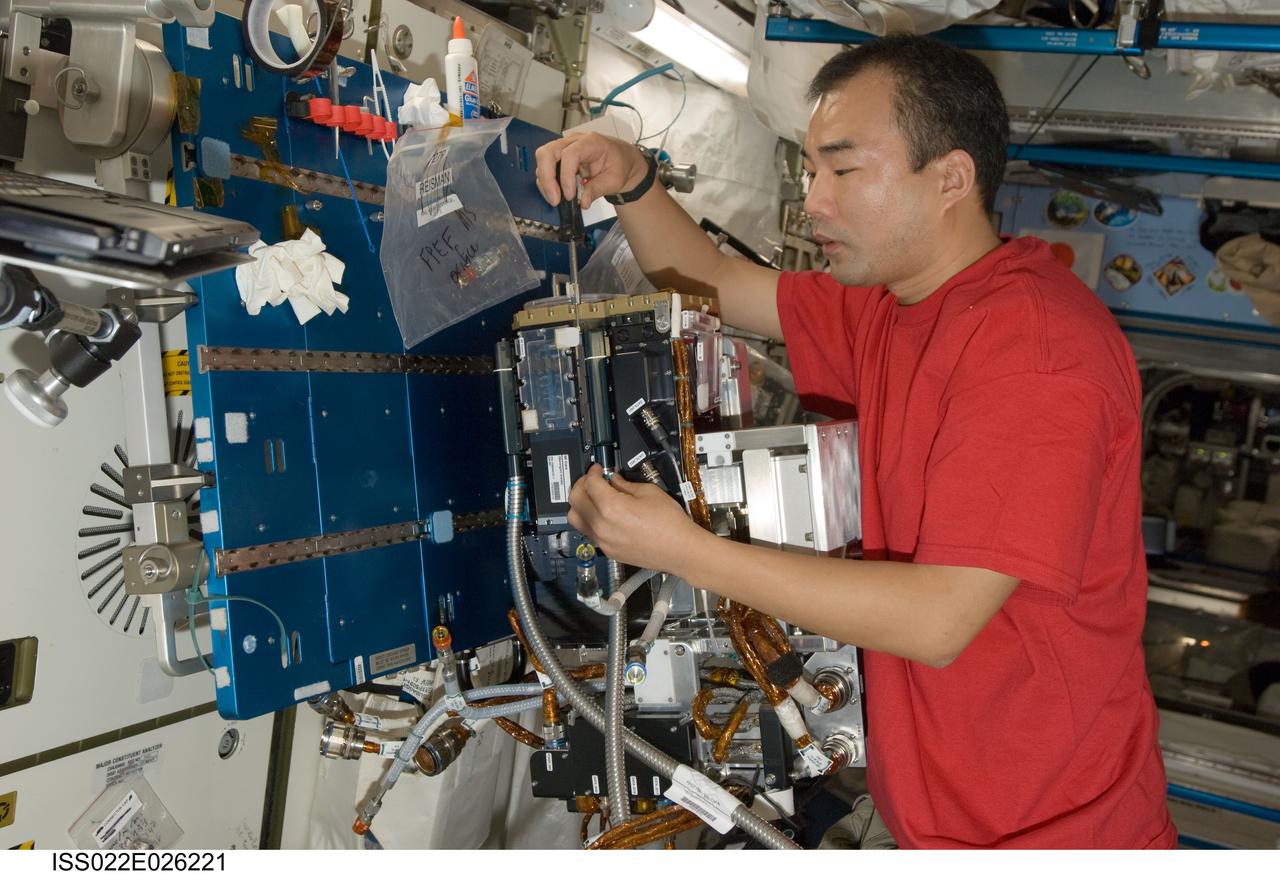
ISS022-E-026221 (15 Jan. 2010) --- Japan Aerospace Exploration Agency (JAXA) astronaut Soichi Noguchi, Expedition 22 flight engineer, services the Fluid Physics Experiment Facility/Marangoni Surface (FPEF MS) Core hardware in the Kibo laboratory of the International Space Station. The Marangoni convection experiment in the FPEF examines fluid tension flow in micro-G.
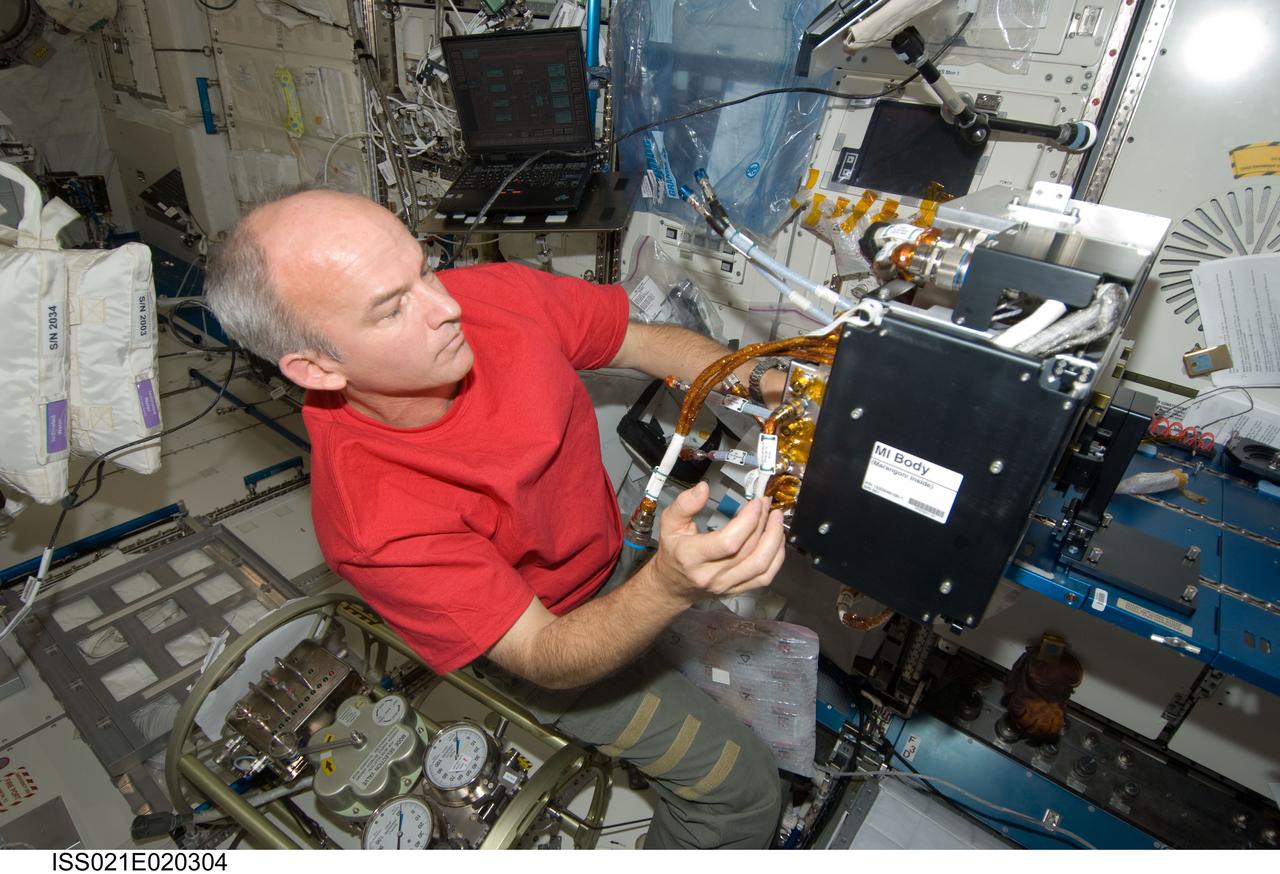
ISS021-E-020304 (5 Nov. 2009) --- NASA astronaut Jeffrey Williams, Expedition 21 flight engineer, works with Fluid Physics Experiment Facility/Marangoni Surface (FPEF MS) Core hardware in the Kibo laboratory of the International Space Station. Williams first inserted the Marangoni Inside (MI) cassette in the MI Core for a leak check, and then installed the MI Core into the FPEF MI Body. The Marangoni convection experiment in the FPEF examines fluid tension flow in micro-G.
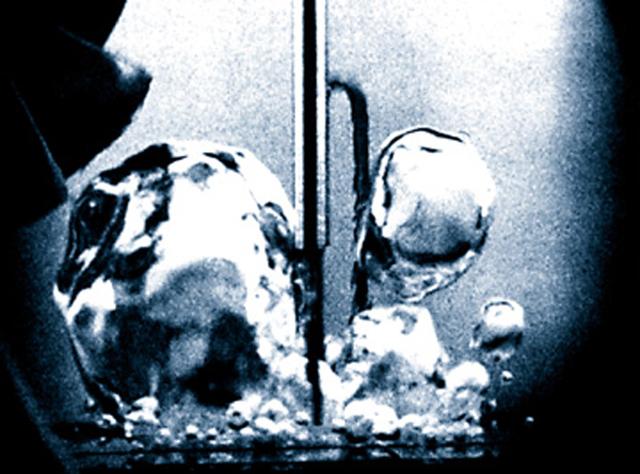
Fluid Physics is study of the motion of fluids and the effects of such motion. When a liquid is heated from the bottom to the boiling point in Earth's microgravity, small bubbles of heated gas form near the bottom of the container and are carried to the top of the liquid by gravity-driven convective flows. In the same setup in microgravity, the lack of convection and buoyancy allows the heated gas bubbles to grow larger and remain attached to the container's bottom for a significantly longer period.
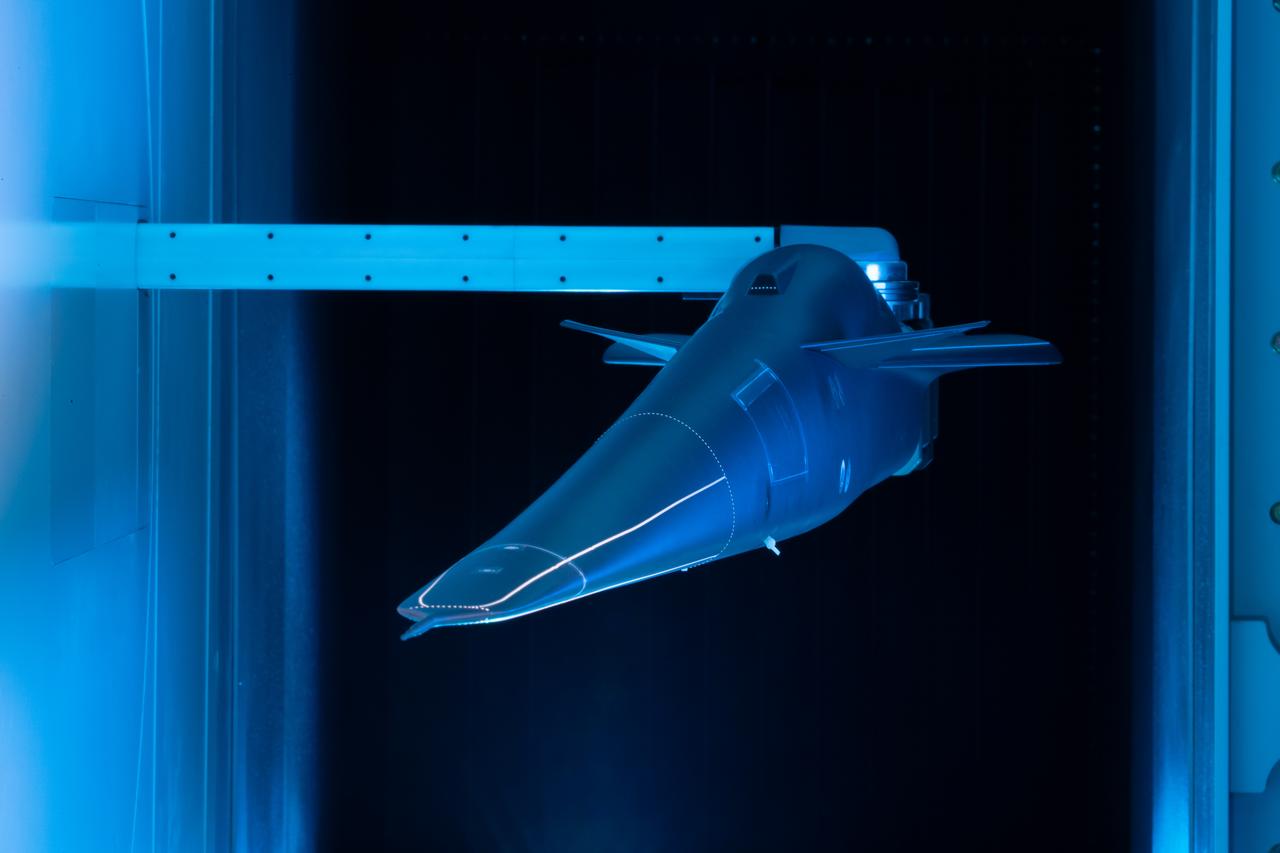
Event: Forebody and Nose - Windtunnel Testing A model of the X-59 forebody is shown in the Lockheed Martin Skunk Works’ wind tunnel in Palmdale, California. These tests gave the team measurements of wind flow angle around the aircraft’s nose and confirmed computer predictions made using computational fluid dynamics (CFD) software tools. The data will be fed into the aircraft flight control system to tell the pilot the aircraft’s altitude, speed and angle. This is part of NASA’s Quesst mission which plans to help enable supersonic air travel over land.
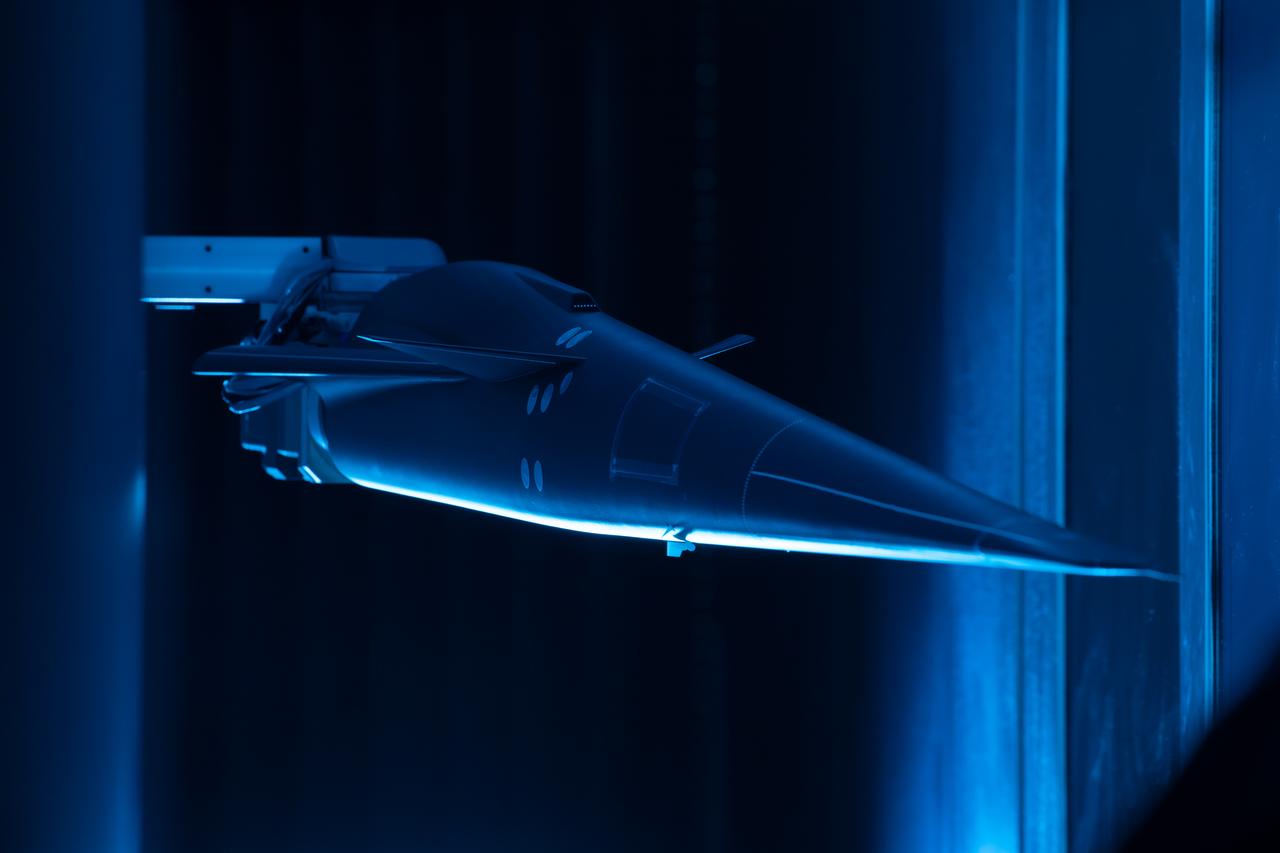
Event: Forebody and Nose - Windtunnel Testing A model of the X-59 forebody is shown in the Lockheed Martin Skunk Works’ wind tunnel in Palmdale, California. These tests gave the team measurements of wind flow angle around the aircraft’s nose and confirmed computer predictions made using computational fluid dynamics (CFD) software tools. The data will be fed into the aircraft flight control system to tell the pilot the aircraft’s altitude, speed and angle. This is part of NASA’s Quesst mission which plans to help enable supersonic air travel over land.
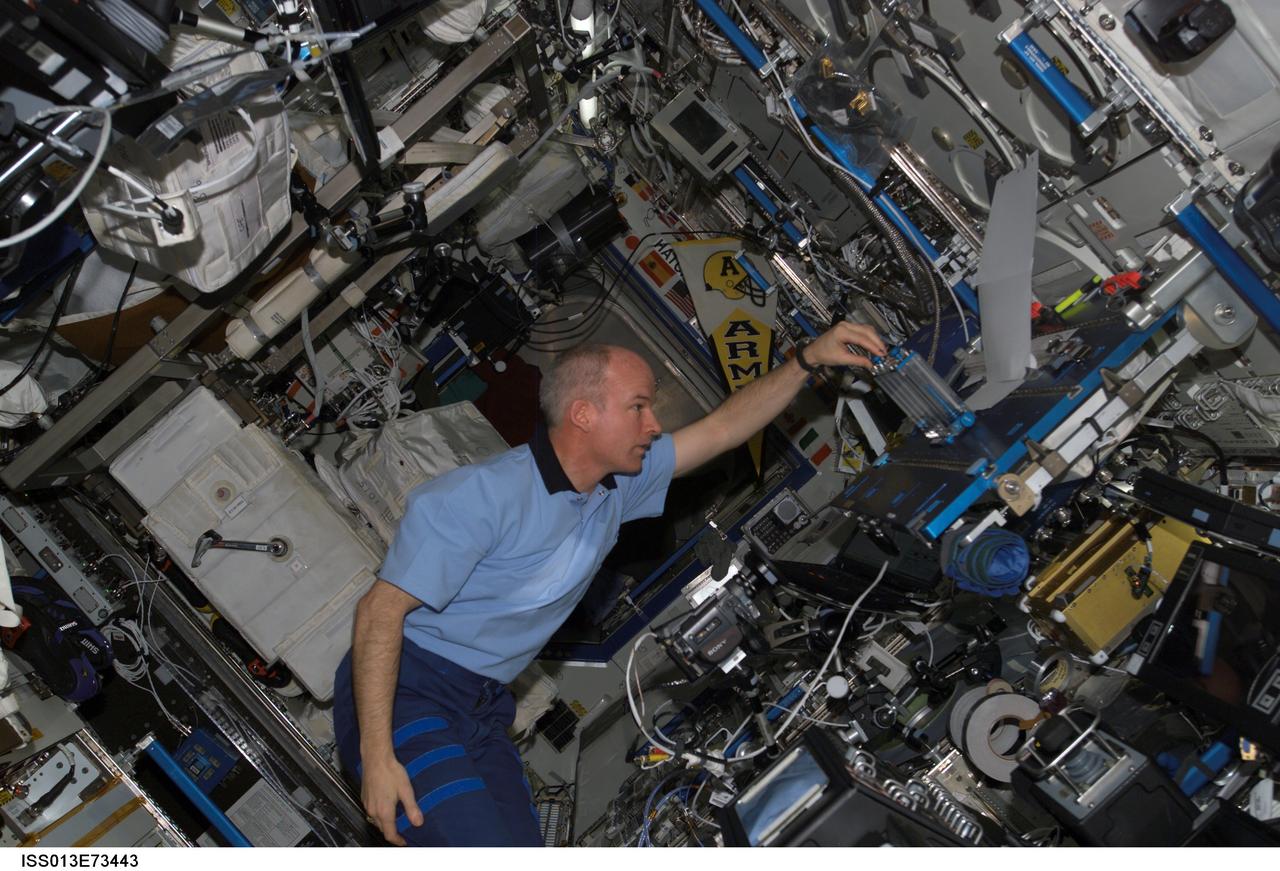
ISS013-E-73443 (30 Aug. 2006) --- Astronaut Jeffrey N. Williams, Expedition 13 NASA space station science officer and flight engineer, performs one of multiple tests of the Capillary Flow Experiment (CFE) investigation in the Destiny laboratory of the International Space Station. CFE observes the flow of fluid, in particular capillary phenomena, in microgravity.
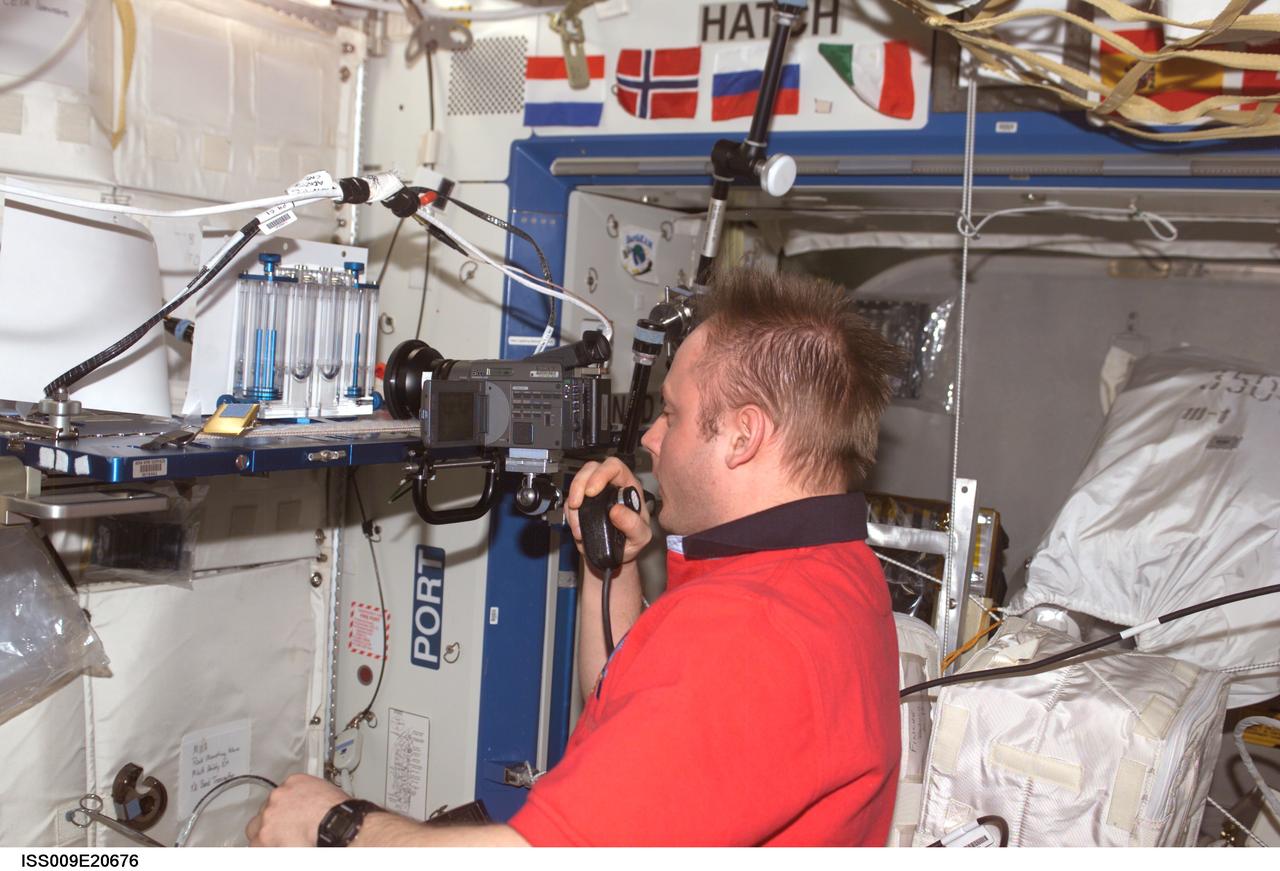
ISS009-E-20676 (28 August 2004) --- Astronaut Edward M. (Mike) Fincke, Expedition 9 NASA ISS science officer and flight engineer, performs one of multiple tests of the Capillary Flow Experiment (CFE) investigation in the Destiny laboratory of the International Space Station (ISS). CFE observes the flow of fluid, in particular capillary phenomena, in micro-G.
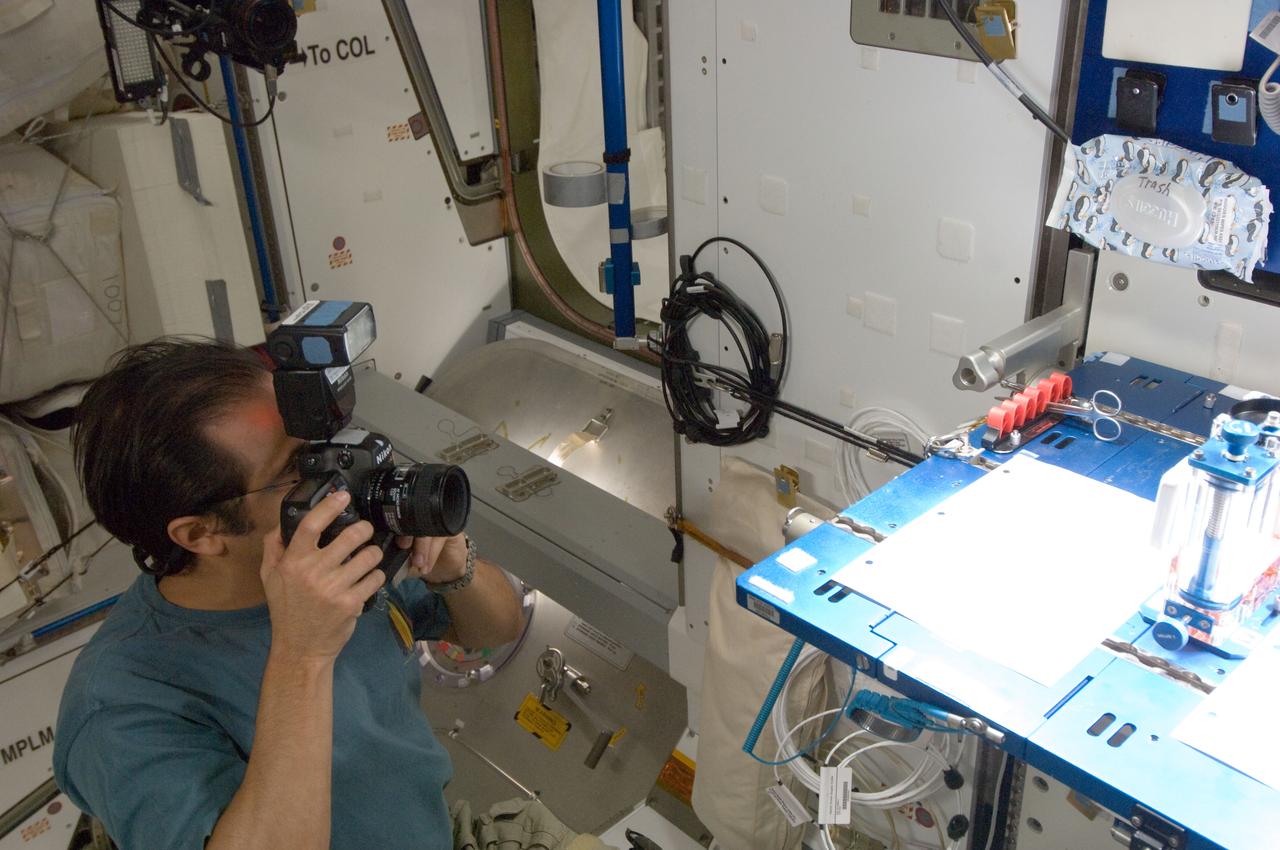
ISS032-E-016967 (10 Aug. 2012) --- NASA astronaut Joe Acaba, Expedition 32 flight engineer, uses a still camera while conducting a session with the Capillary Flow Experiment (CFE) Vane Gap-2 (VG2) in the Harmony node of the International Space Station. CFE observes the flow of fluid, in particular capillary phenomena, in microgravity.
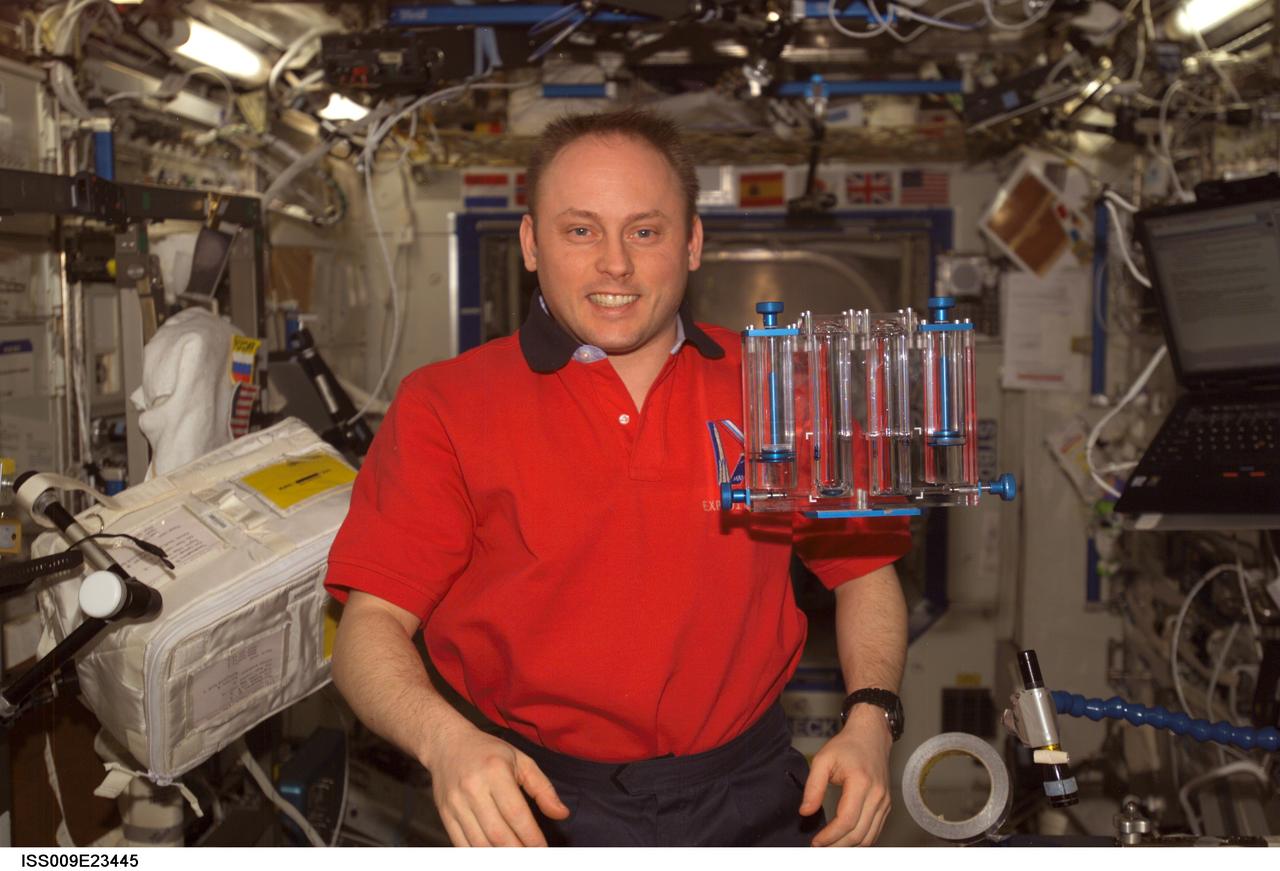
ISS009-E-23445 (18 September 2004) --- Astronaut Edward M. (Mike) Fincke, Expedition 9 NASA ISS science officer and flight engineer, is pictured in the Destiny laboratory of the International Space Station (ISS). The Capillary Flow Experiment (CFE), which observes the flow of fluid, in particular capillary phenomena, in micro-G, floats freely in the foreground.
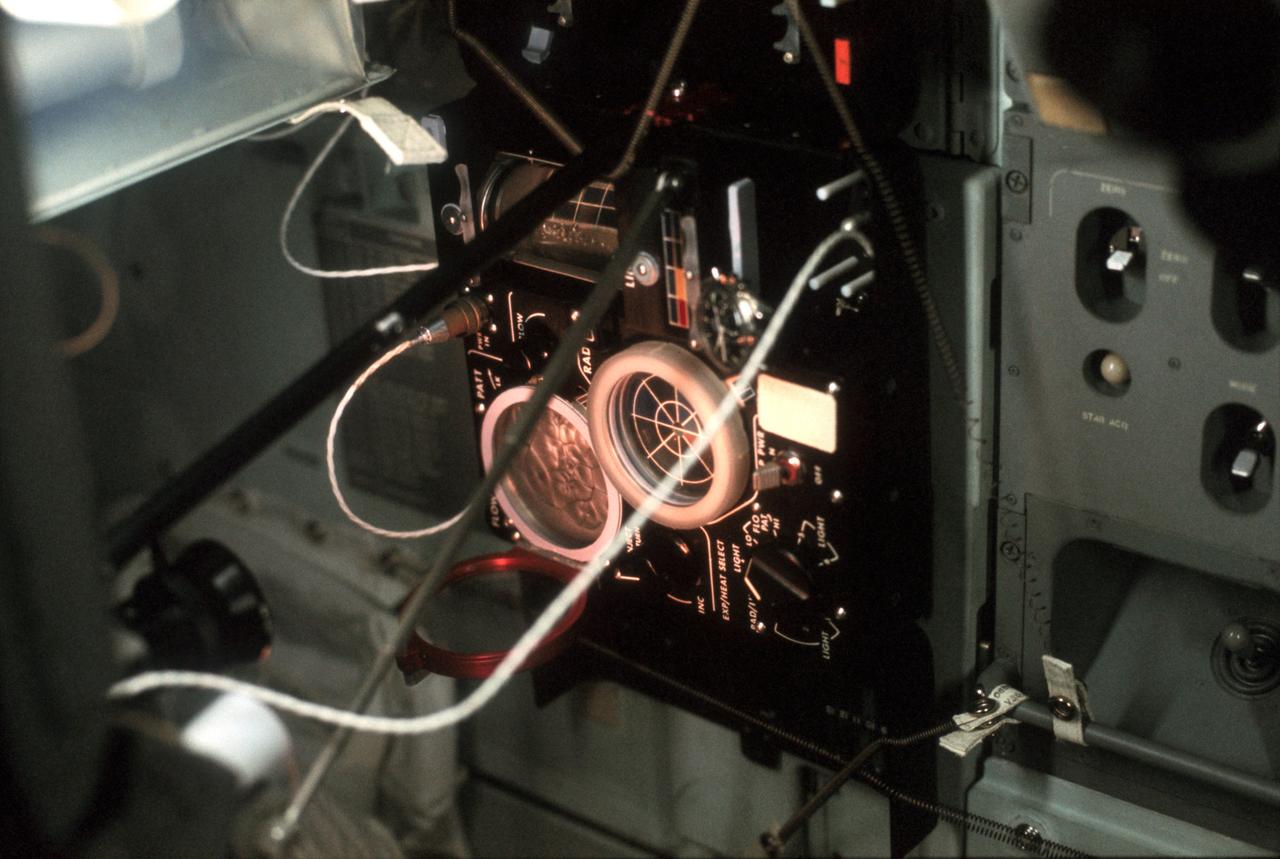
AS17-162-24063 (7-19 Dec. 1972) --- A close-up view of the equipment used for the Heat Flow and Convection Experiment, an engineering and operational test and demonstration carried out aboard the Apollo 17 command module during the final lunar landing mission in NASA's Apollo program. Three test cells were used in the demonstration for measuring and observing fluid flow behavior in the absence of gravity in space flight. Data obtained from such demonstrations will be valuable in the design of future science experiments and for manufacturing processes in space.
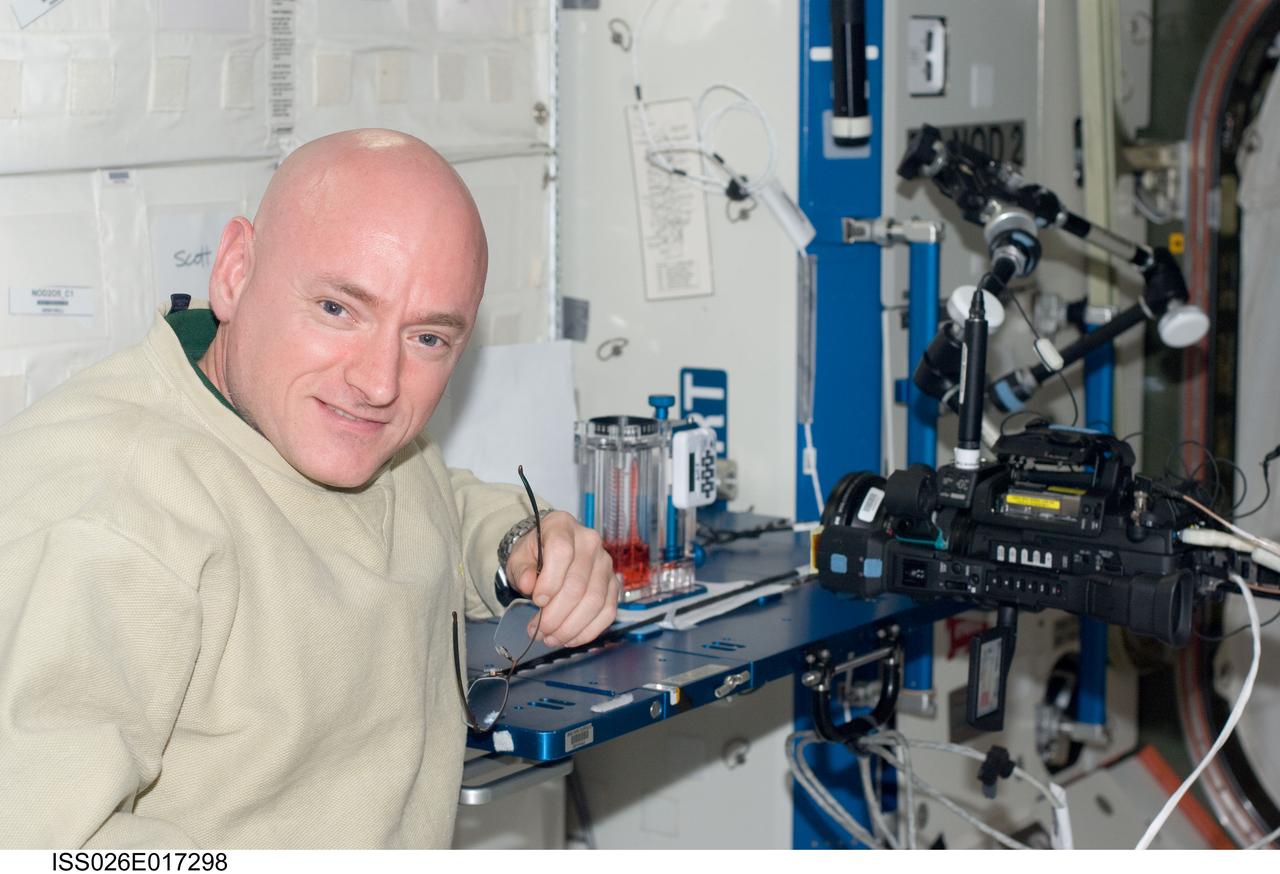
ISS026-E-017298 (11 Jan. 2011) --- NASA astronaut Scott Kelly, Expedition 26 commander, is pictured near a Capillary Flow Experiment (CFE) Vane Gap-1 experiment. The CFE is positioned on the Maintenance Work Area in the Destiny laboratory of the International Space Station. CFE observes the flow of fluid, in particular capillary phenomena, in microgravity.
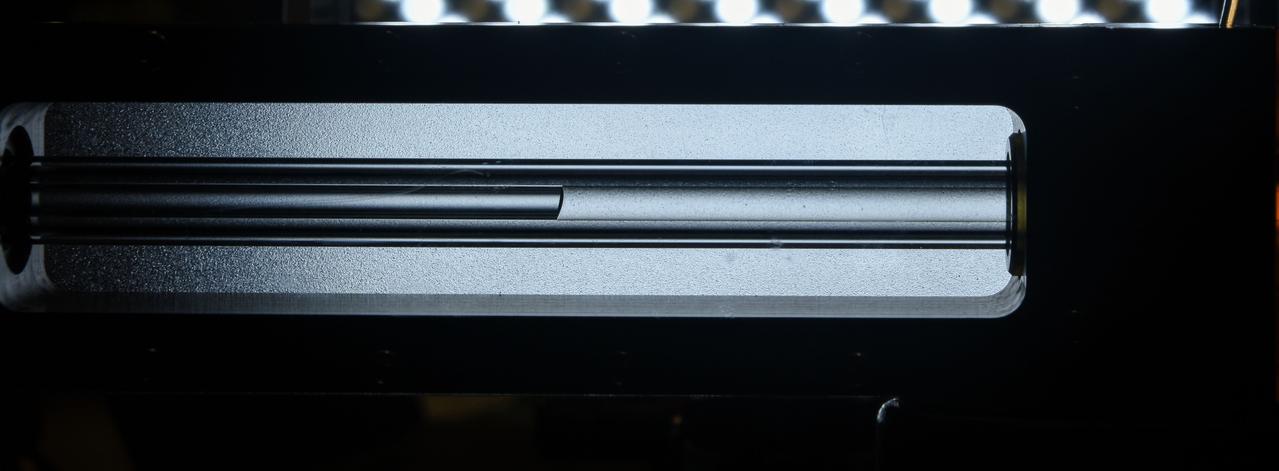
jsc2023e055882 10/5/2023) --- Oil flows into a glass tube during the imbibition phase of the experiment. The oil is initially stored in a reservoir on the right side of the tube (not visible). When the reservoir is open, the oil spontaneously flows into the tube, driven by interfacial/capillary action. The Wicking in Gel-Coated Tubes (Gaucho Lung) investigation studies fluid transport within gel-coated tubes to learn more about treatment programs for respiratory distress syndrome and develop new contamination control strategies. Image courtesy of University of California, Santa Barbara.
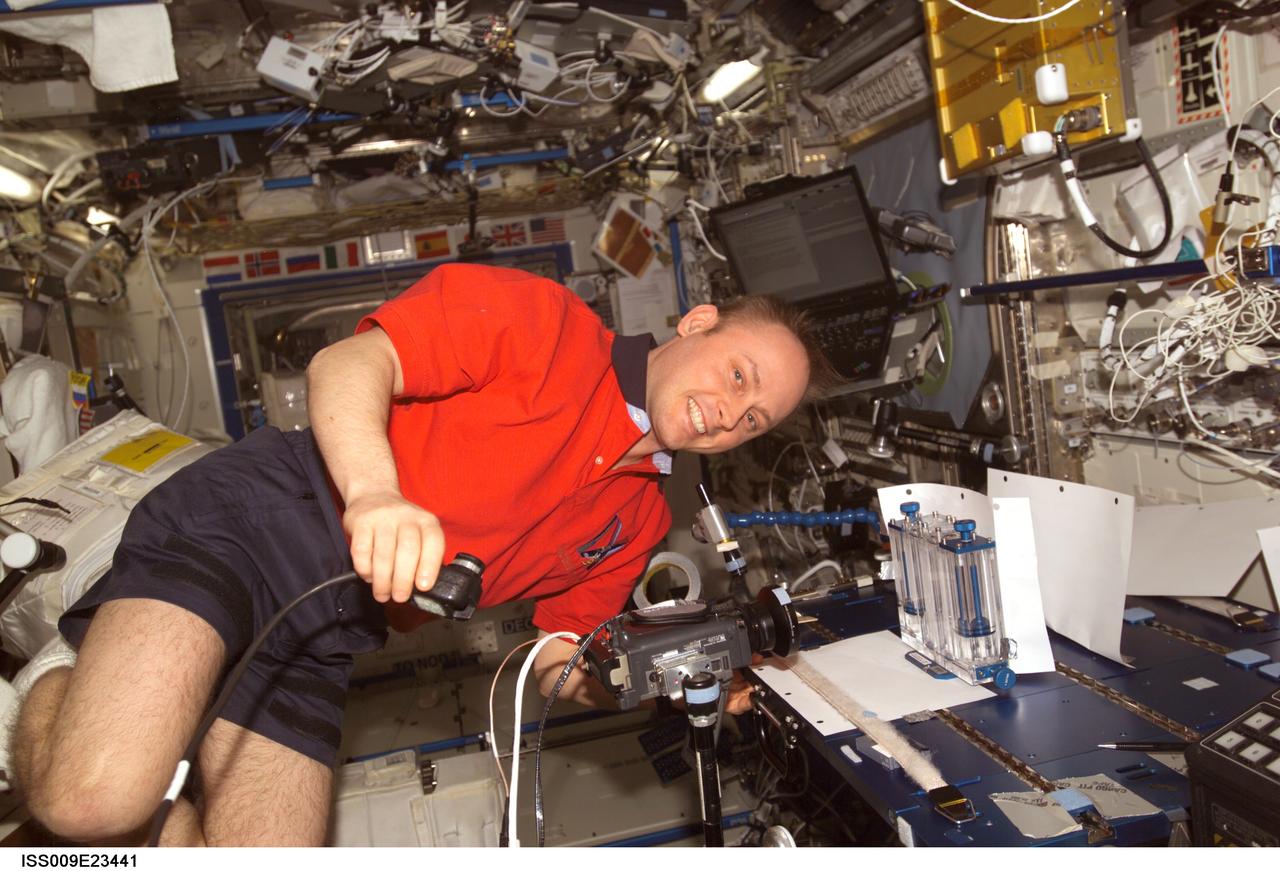
ISS009-E-23441 (18 September 2004) --- Astronaut Edward M. (Mike) Fincke, Expedition 9 NASA ISS science officer and flight engineer, performs one of multiple tests of the Capillary Flow Experiment (CFE) investigation in the Destiny laboratory of the International Space Station (ISS). CFE observes the flow of fluid, in particular capillary phenomena, in micro-G.
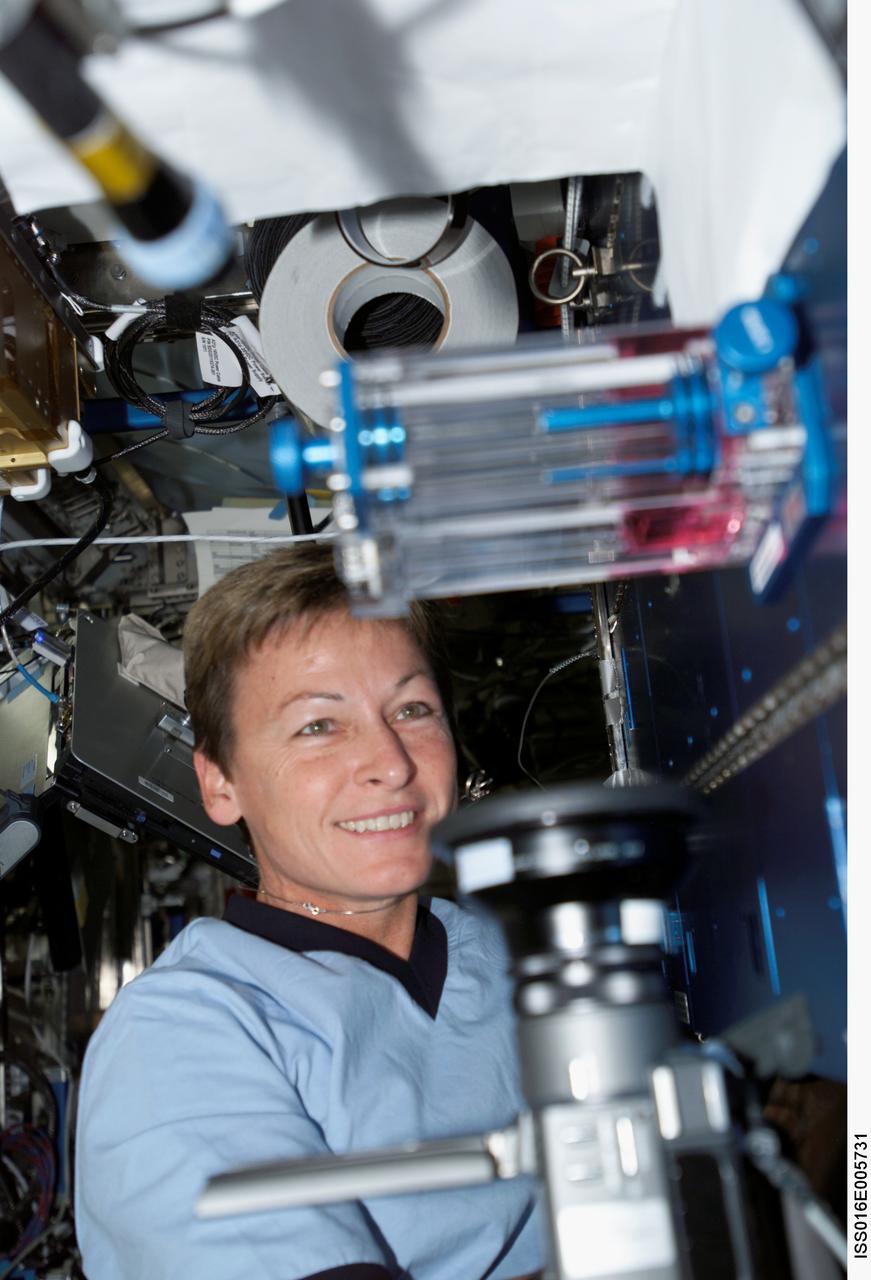
ISS016-E-005731 (22 Oct. 2007) --- NASA astronaut Peggy A. Whitson, Expedition 16 commander, prepares the Capillary Flow Experiment (CFE) Vane Gap-1 for video documentation. The CFE is positioned on the Maintenance Work Area in the Destiny laboratory of the International Space Station. CFE observes the flow of fluid, in particular capillary phenomena, in microgravity.
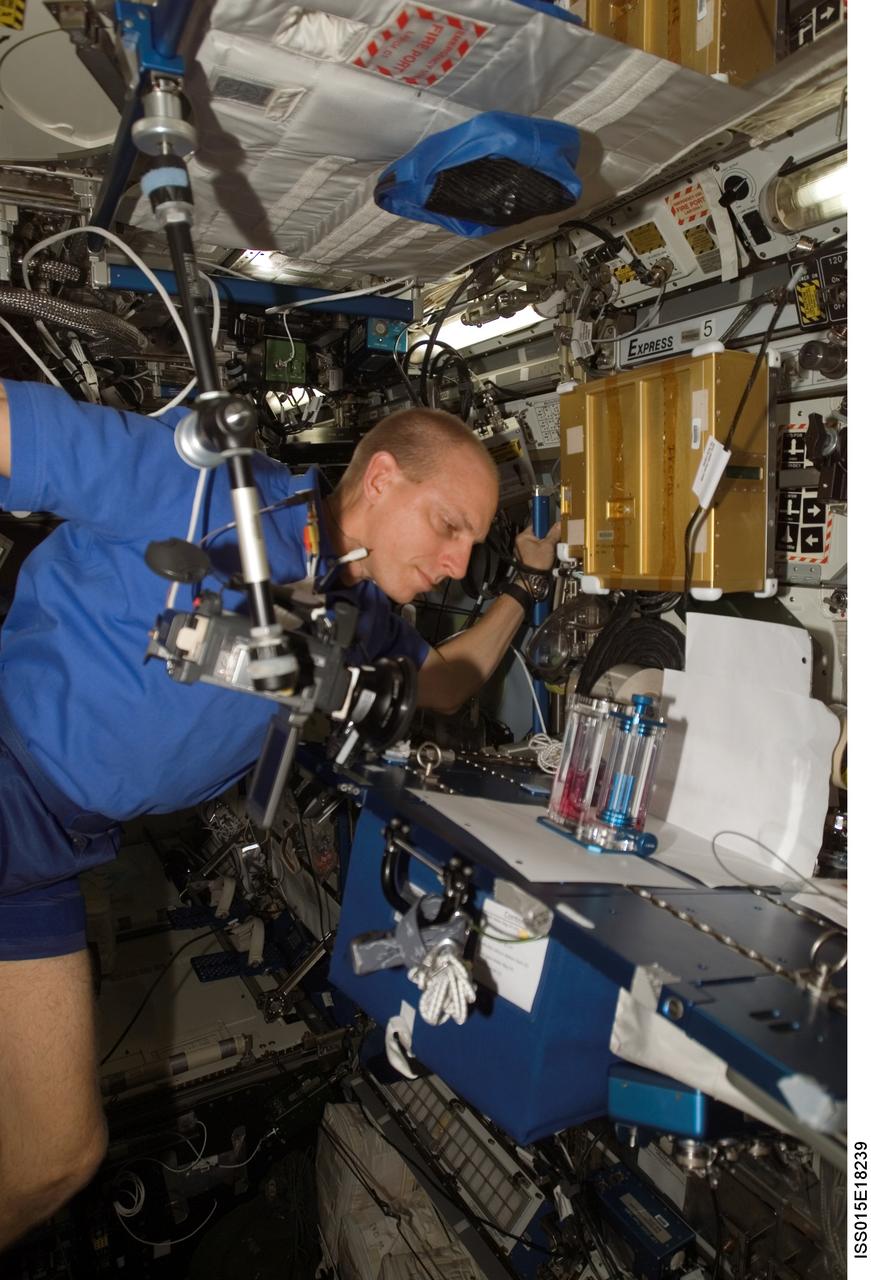
ISS015-E-18239 (14 July 2007) --- Astronaut Clay Anderson, Expedition 15 flight engineer, prepares the Capillary Flow Experiment (CFE) Vane Gap-1 for video documentation. The CFE is positioned on the Maintenance Work Area in the Destiny laboratory of the International Space Station. CFE observes the flow of fluid, in particular capillary phenomena, in microgravity.
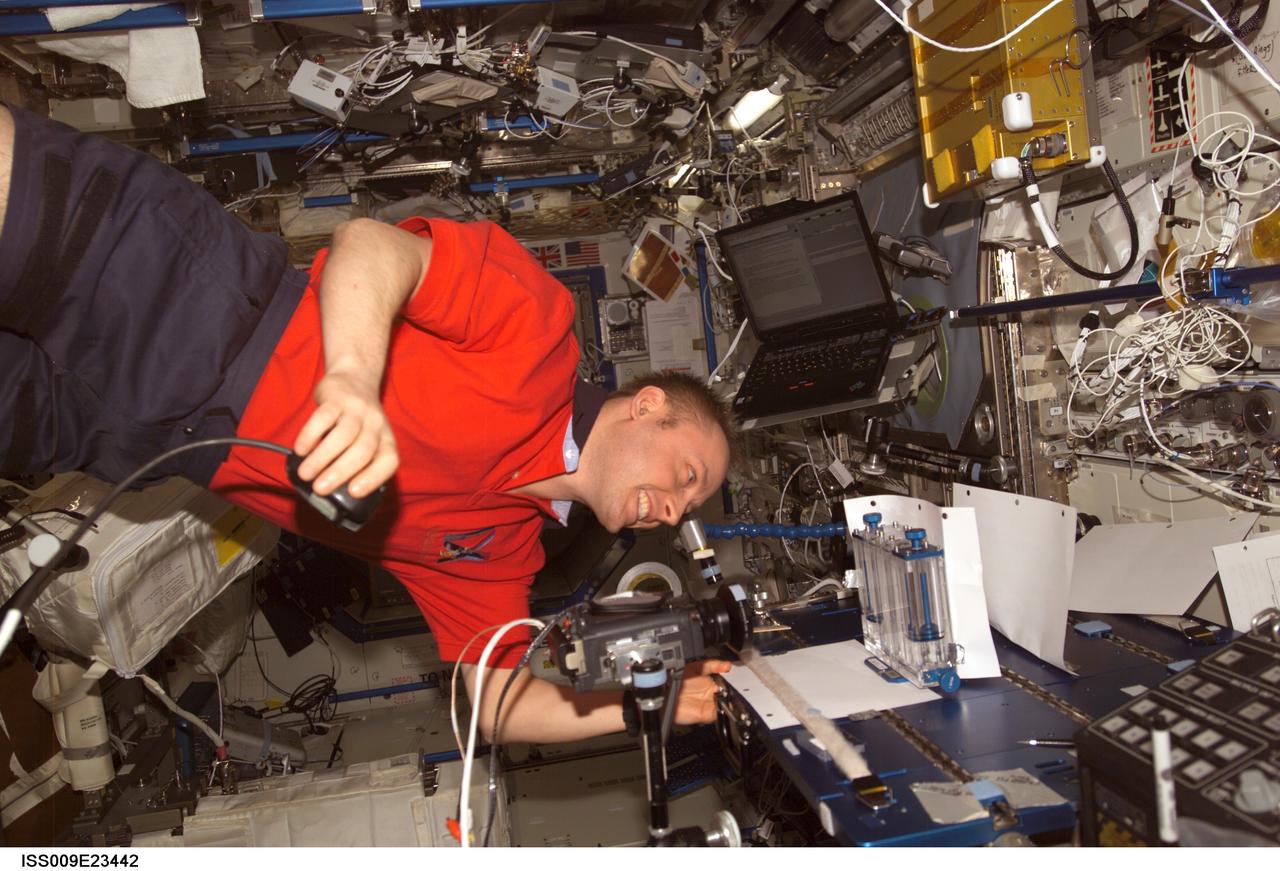
ISS009-E-23442 (18 September 2004) --- Astronaut Edward M. (Mike) Fincke, Expedition 9 NASA ISS science officer and flight engineer, performs one of multiple tests of the Capillary Flow Experiment (CFE) investigation in the Destiny laboratory of the International Space Station (ISS). CFE observes the flow of fluid, in particular capillary phenomena, in micro-G.
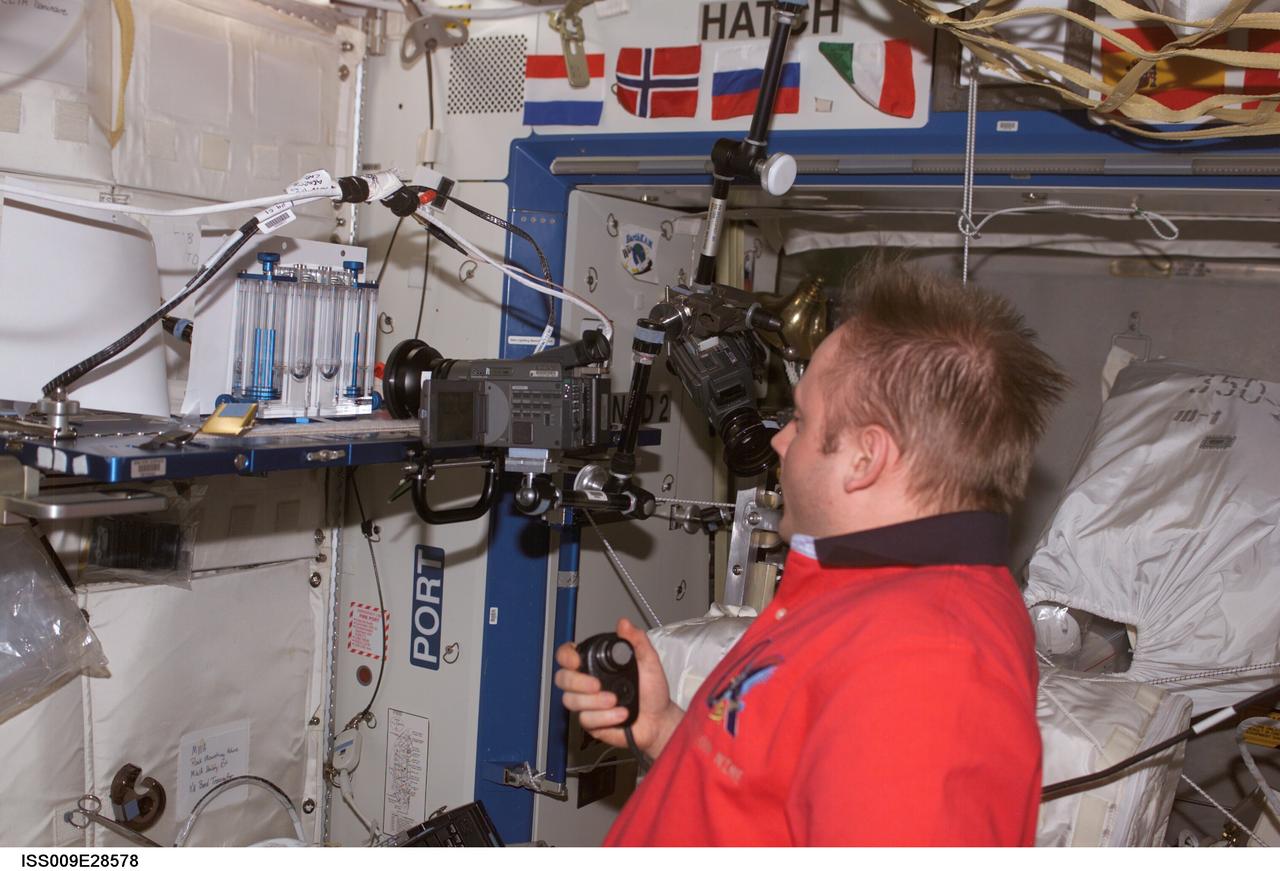
ISS009-E-28578 (28 August 2004) --- Astronaut Edward M. (Mike) Fincke, Expedition 9 NASA ISS science officer and flight engineer, performs one of multiple tests of the Capillary Flow Experiment (CFE) investigation in the Destiny laboratory of the International Space Station (ISS). CFE observes the flow of fluid, in particular capillary phenomena, in micro-G.
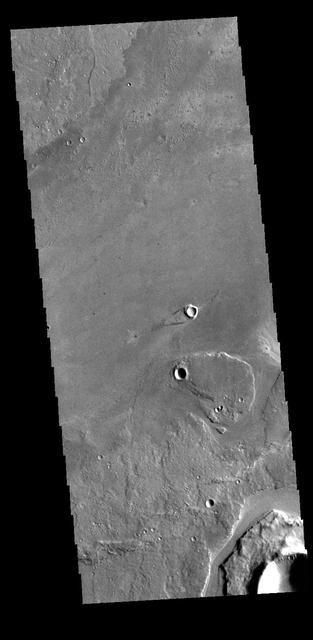
This VIS image shows part of Athabasca Valles. Arising from Cerberus Fossae, the formation mode of this channel is still being debated. While the channel features are similar to water flow, other features are similar to lava flows, and then other features have an appearance of slabs of material that floated on a underlying fluid. This is just one of the complex channel formations in the Elysium Planitia region. Orbit Number: 78297 Latitude: 8.93976 Longitude: 155.611 Instrument: VIS Captured: 2019-08-09 06:58 https://photojournal.jpl.nasa.gov/catalog/PIA23472
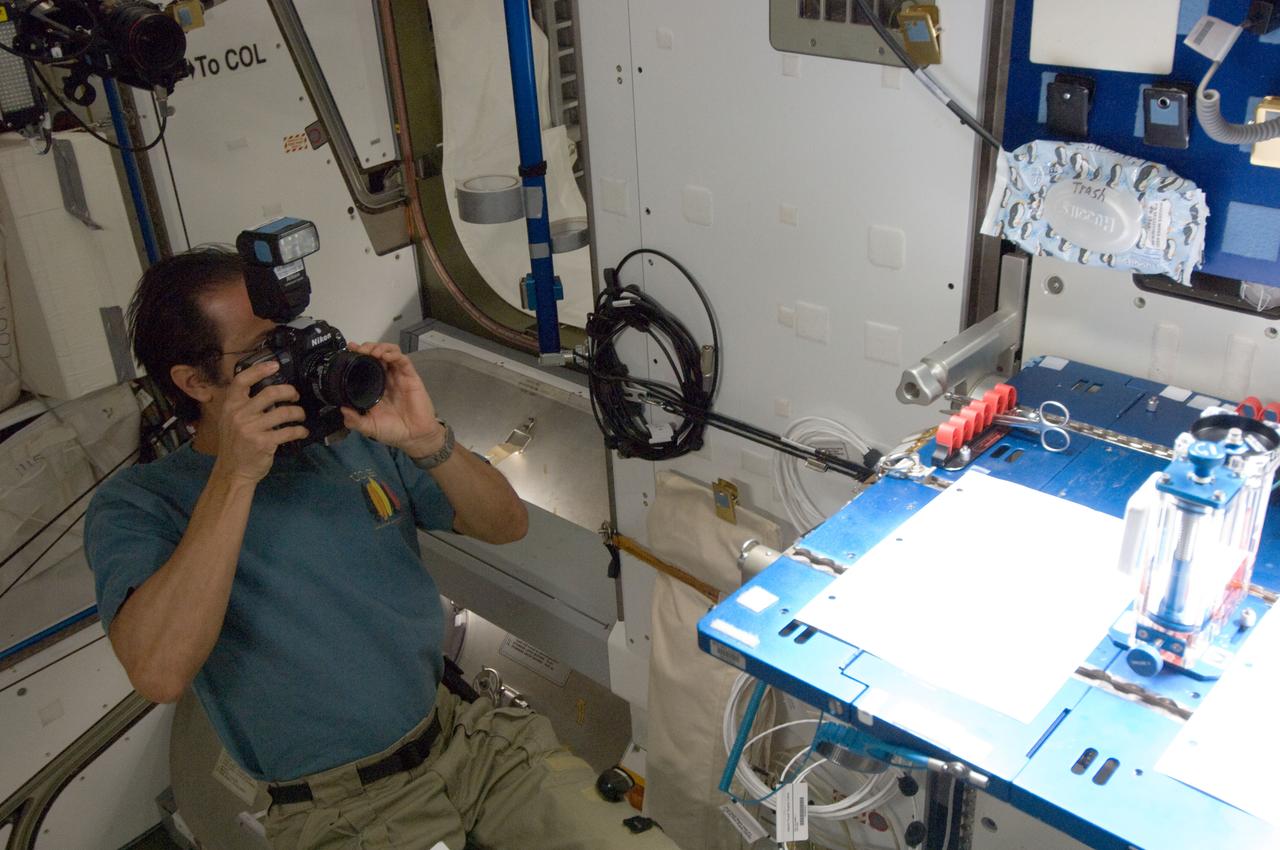
ISS032-E-016966 (10 Aug. 2012) --- NASA astronaut Joe Acaba, Expedition 32 flight engineer, uses a still camera while conducting a session with the Capillary Flow Experiment (CFE) Vane Gap-2 (VG2) in the Harmony node of the International Space Station. CFE observes the flow of fluid, in particular capillary phenomena, in microgravity.

ISS016-E-005730 (22 Oct. 2007) --- NASA astronaut Peggy A. Whitson, Expedition 16 commander, prepares the Capillary Flow Experiment (CFE) Vane Gap-1 for video documentation. The CFE is positioned on the Maintenance Work Area in the Destiny laboratory of the International Space Station. CFE observes the flow of fluid, in particular capillary phenomena, in microgravity.
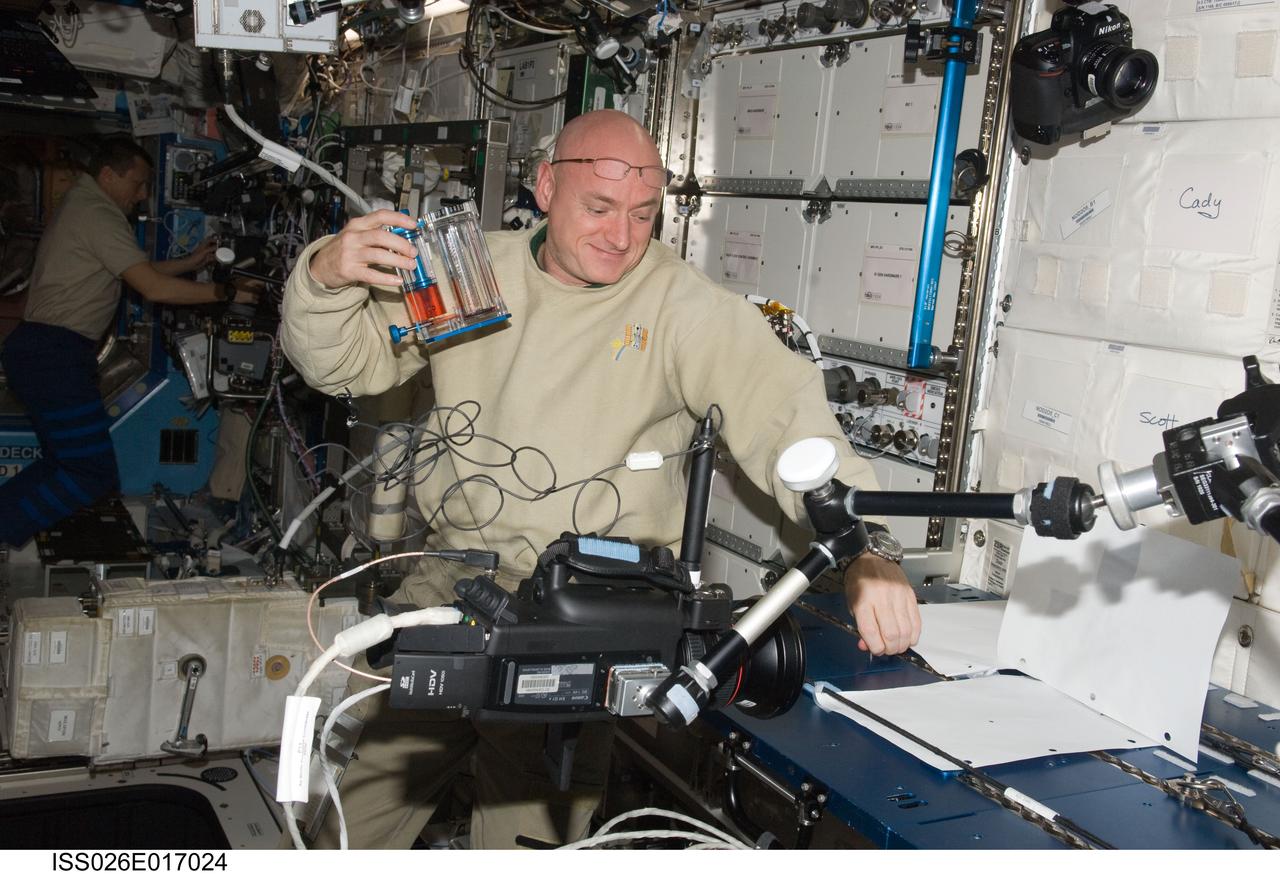
ISS026-E-017024 (11 Jan. 2011) --- NASA astronaut Scott Kelly, Expedition 26 commander, works on the hardware setup for a Capillary Flow Experiment (CFE) Vane Gap-1 experiment. The CFE is positioned on the Maintenance Work Area in the Destiny laboratory of the International Space Station. CFE observes the flow of fluid, in particular capillary phenomena, in microgravity.
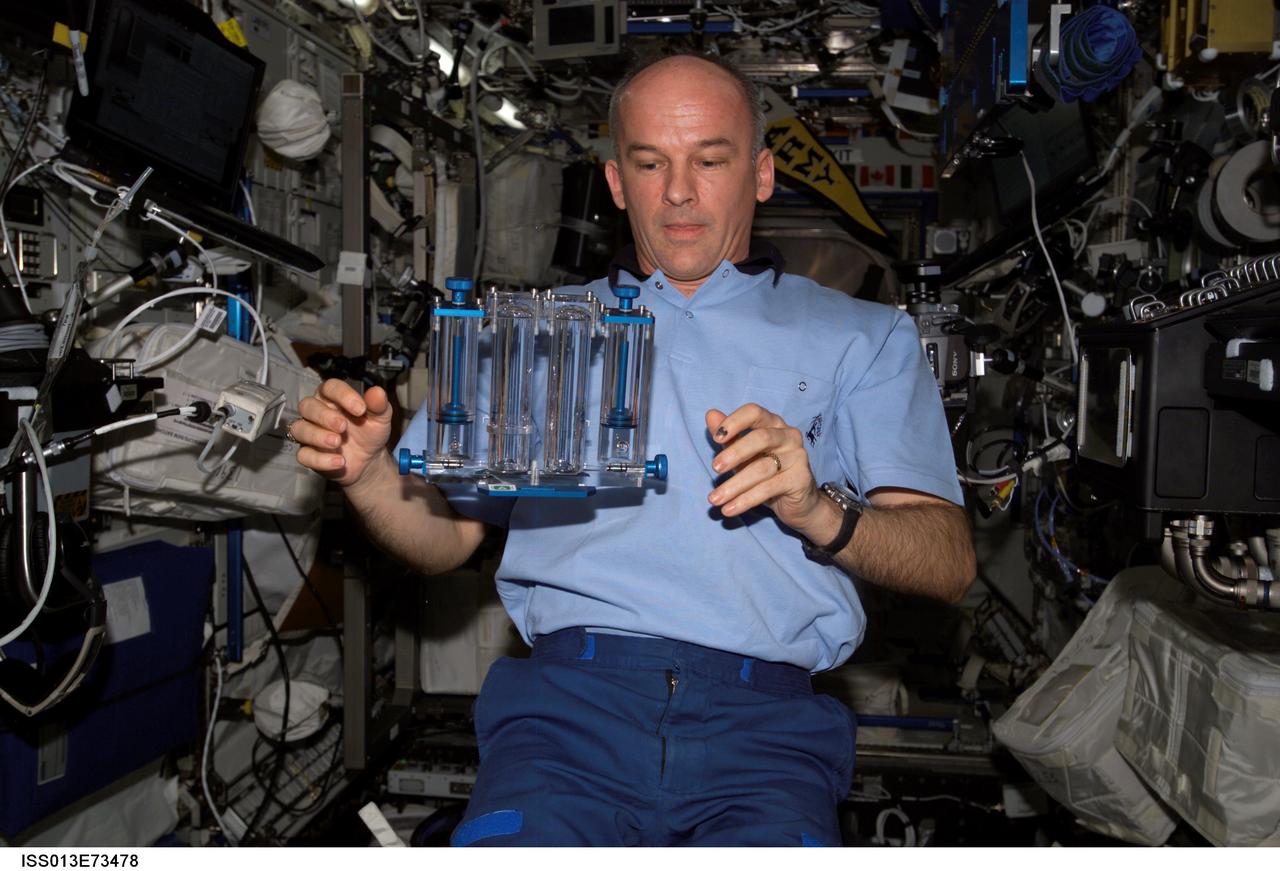
ISS013-E-73478 (30 Aug. 2006) --- Astronaut Jeffrey N. Williams, Expedition 13 NASA space station science officer and flight engineer, performs one of multiple tests of the Capillary Flow Experiment (CFE) investigation in the Destiny laboratory of the International Space Station. CFE observes the flow of fluid, in particular capillary phenomena, in microgravity.