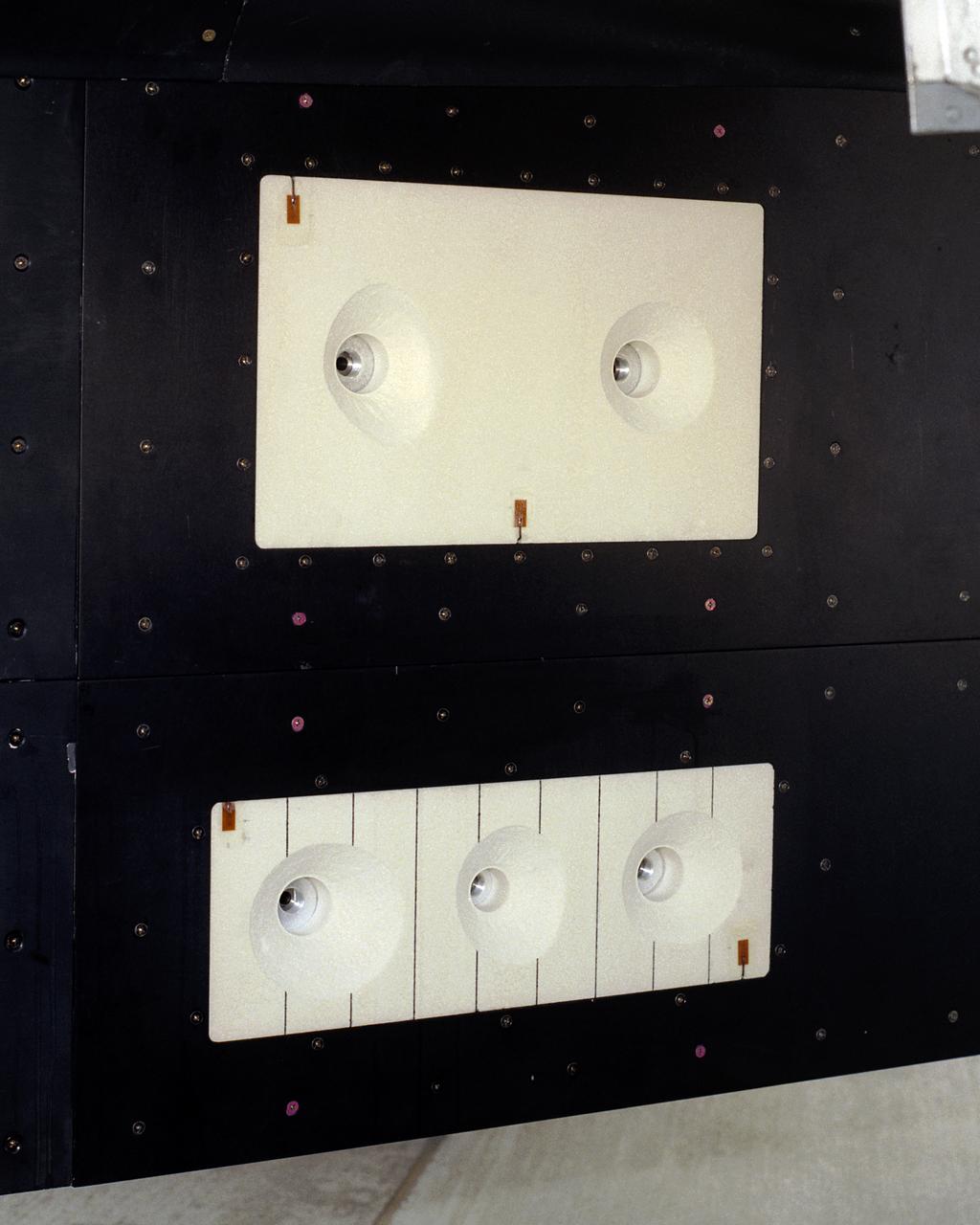
A close-up of the panels on the F-15B's flight test fixture shows five divots of TPS foam were successfully ejected during the LIFT experiment flight #2, the first flight with TPS foam.
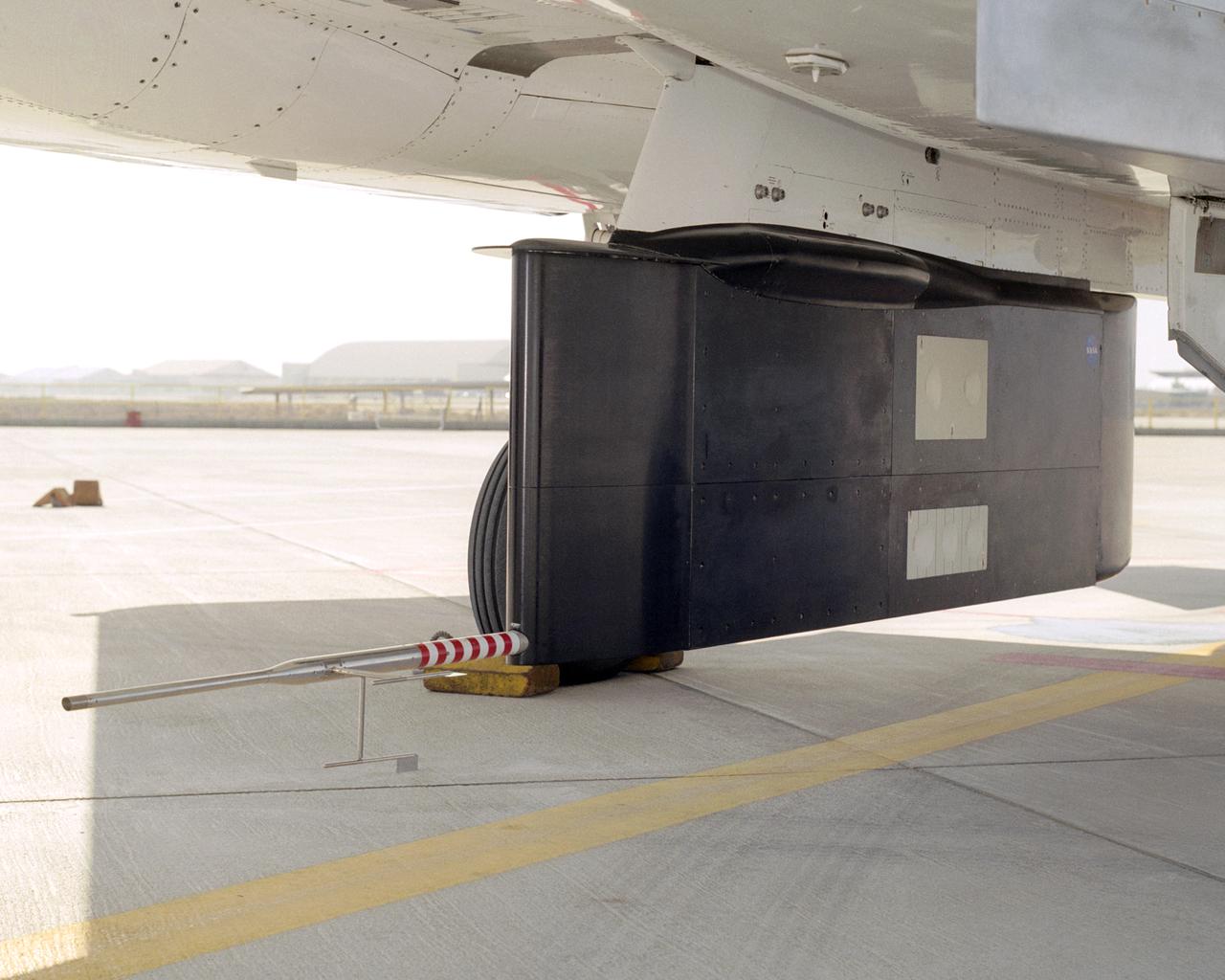
A post-flight inspection of the panels on the F-15B's flight test fixture shows five divots of TPS foam were successfully ejected during the LIFT experiment flight #2, the first flight with TPS foam.
jsc2021e063282 (12/10/2021) --- The logo of the Eco Pack project. The Packaging and Protecting Using Edible Products (Edible Foam) project tests a packaging foam using edible products. © CNES/GRARD Emmanuel, 2021
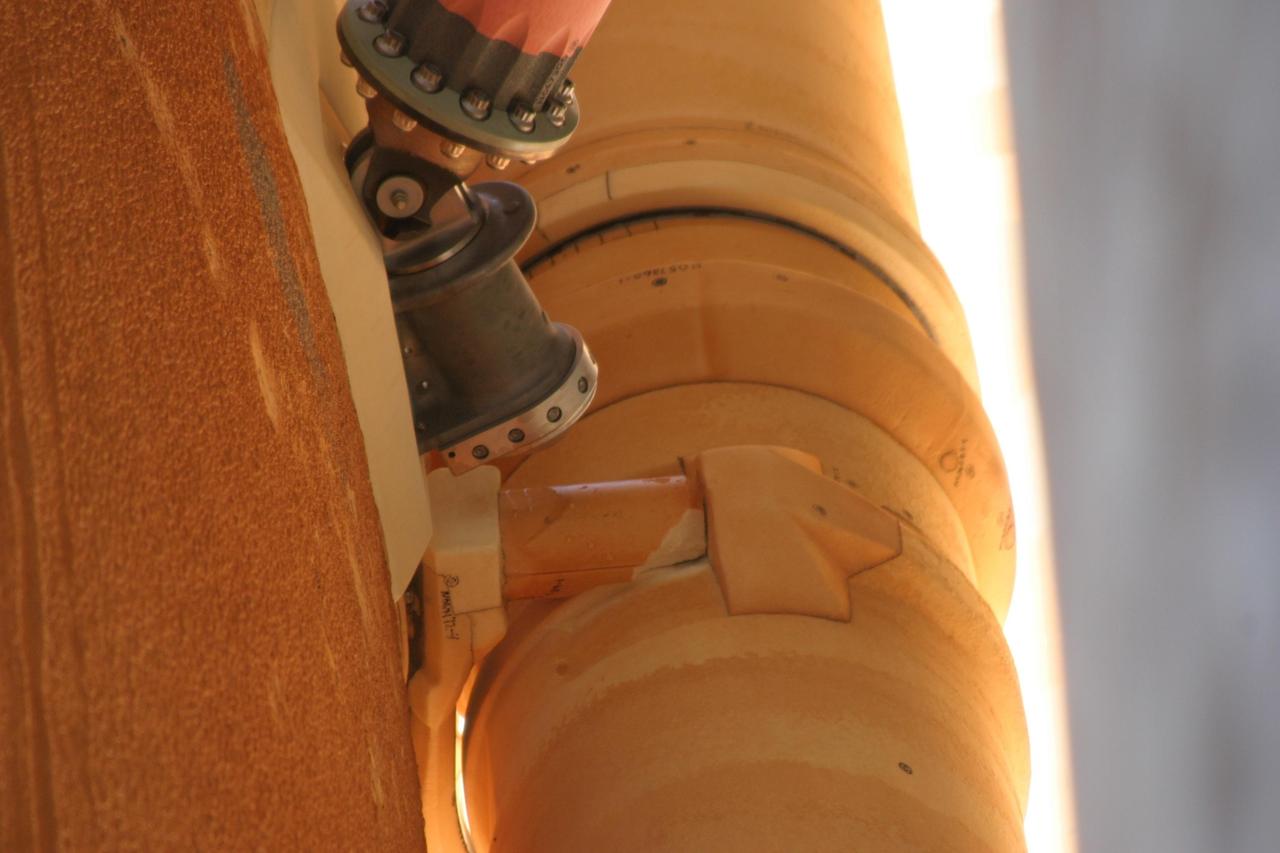
KENNEDY SPACE CENTER, FLA. - A piece of insulation was liberated from a strut that attaches the liquid oxygen feedline to External Tank-119, being used to launch space shuttle mission STS-121. This piece of foam, weighing approximately 0.0057 pounds, is three inches long and one-eighth to one-quarter inch wide and was recovered by the Ice Team from the mobile launch platform at Pad 39B. It is believed that the rain experienced during yesterday’s launch attempt of Discovery caused water to run down the feedline and form ice near the strut next to the feedline bracket. As the tank warmed and expanded, the ice that formed most likely pinched the foam on the top of the strut, causing a crack and eventual loss of the small piece of foam. Photo credit: NASA
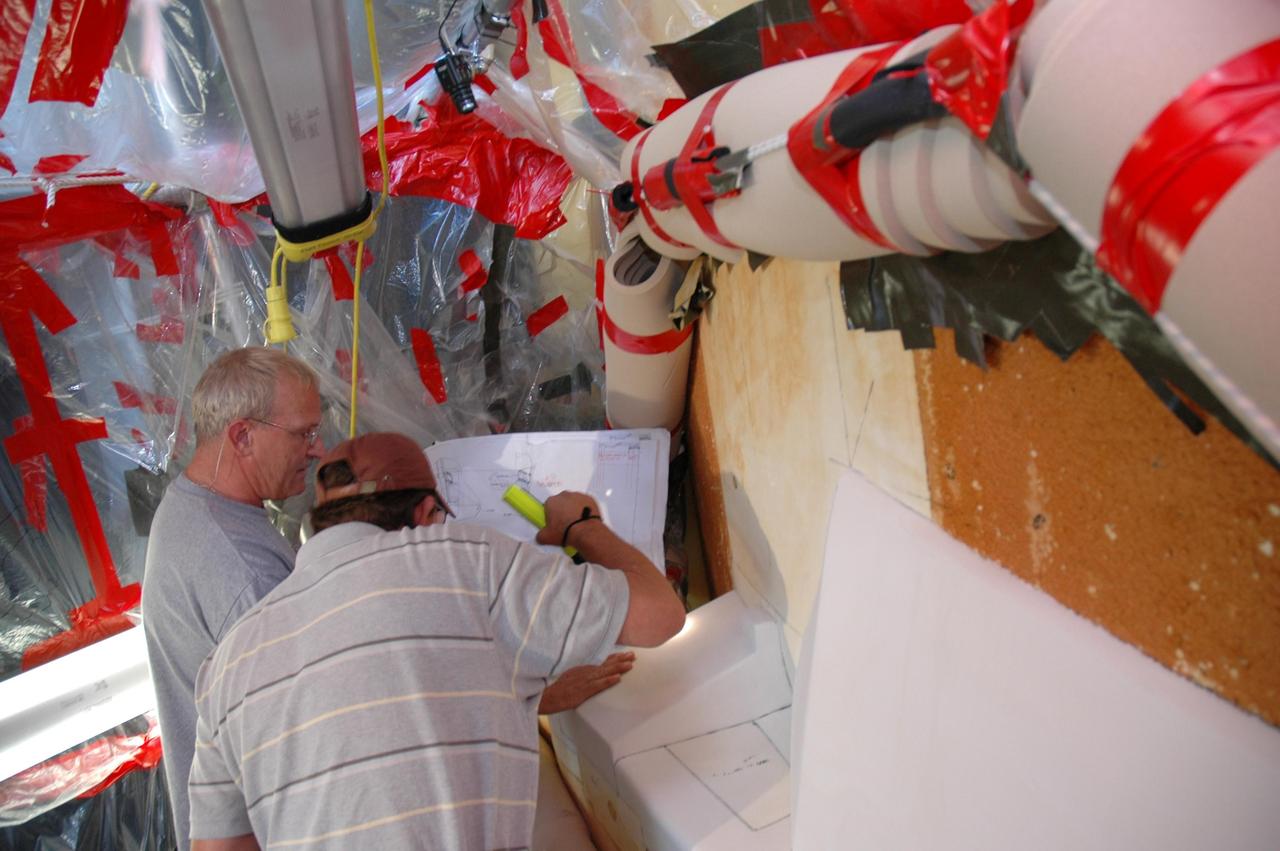
KENNEDY SPACE CENTER, FLA. -- Quality inspectors with NASA and Lockheed Martin examine a red-line drawing of foam placement on space shuttle Atlantis's external tank (in front of them) to verify the foam insulation that was reapplied. The foam covers the feed-through engine cut-off, or ECO, sensor connector. The foam was removed to enable engineers to remove and replace the ECO sensor connector on the tank. The feed-through connector passes the wires from the inside of the tank to the outside. Results of a tanking test on Dec. 18 pointed to an open circuit in the feed-through connector wiring, which is located at the base of the tank. The pins in the replacement connector were precisely soldered to create a connection that allows sensors inside the tank to send signals to the computers onboard Atlantis. The repair work was done on Atlantis while the shuttle has been on Launch Pad 39A at NASA's Kennedy Space Center. The launch date for the shuttle's STS-122 mission has now been targeted for Feb. 7. Photo credit: NASA/Cory Husten
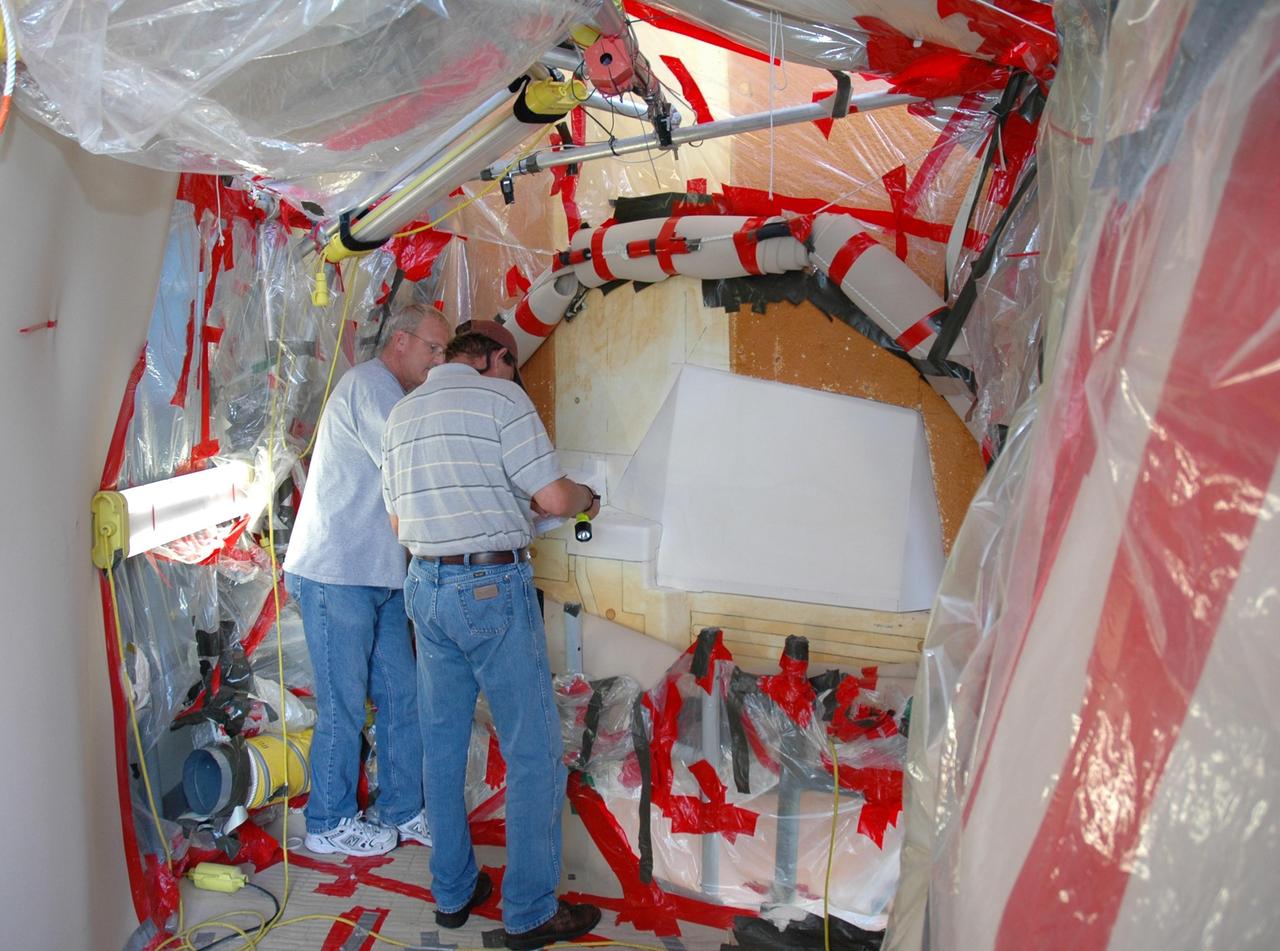
KENNEDY SPACE CENTER, FLA. -- Quality inspectors with NASA and Lockheed Martin examine a red-line drawing of foam placement on space shuttle Atlantis's external tank (in front of them) to verify the foam insulation that was reapplied. The foam covers the feed-through engine cut-off, or ECO, sensor connector. The foam was removed to enable engineers to remove and replace the ECO sensor connector on the tank. The feed-through connector passes the wires from the inside of the tank to the outside. Results of a tanking test on Dec. 18 pointed to an open circuit in the feed-through connector wiring, which is located at the base of the tank. The pins in the replacement connector were precisely soldered to create a connection that allows sensors inside the tank to send signals to the computers onboard Atlantis. The repair work was done on Atlantis while the shuttle has been on Launch Pad 39A at NASA's Kennedy Space Center. The launch date for the shuttle's STS-122 mission has now been targeted for Feb. 7. Photo credit: NASA/Cory Husten
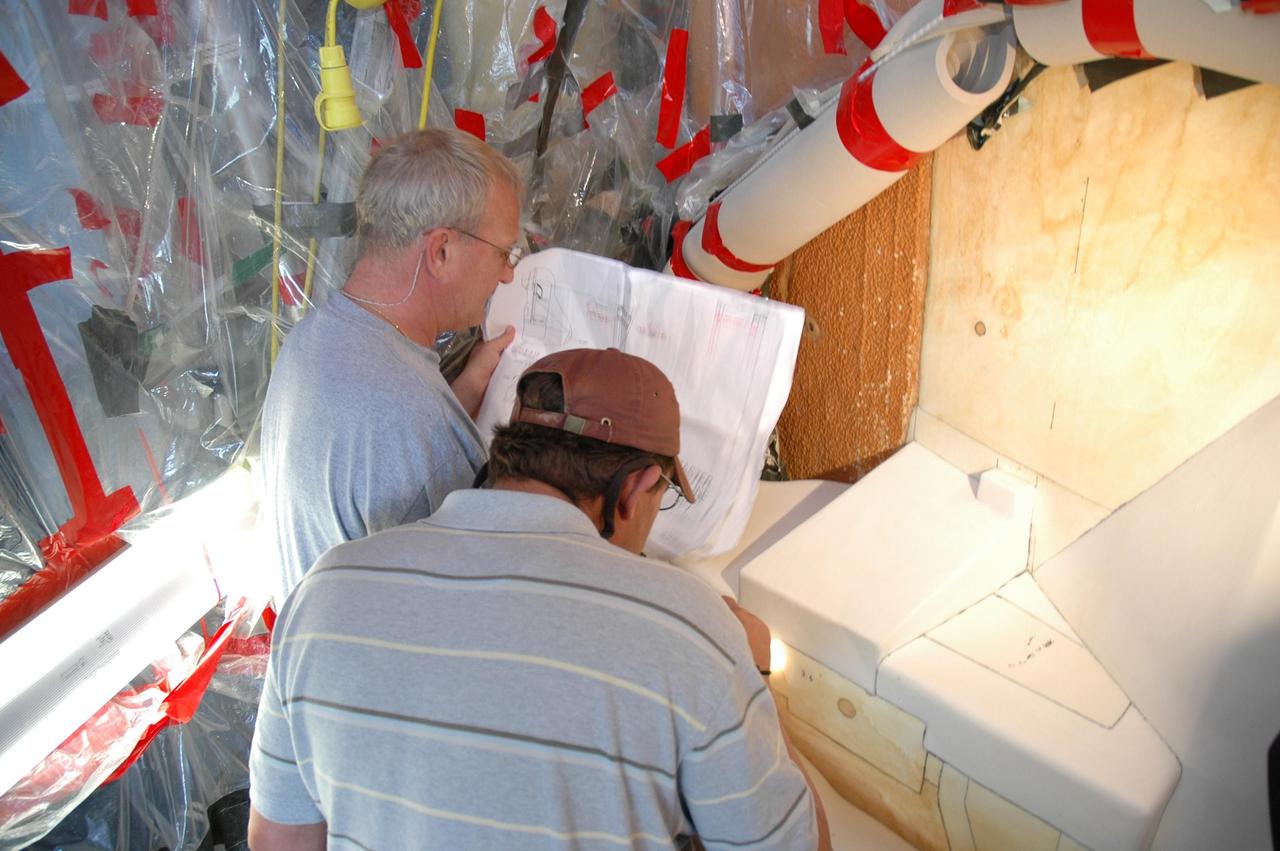
KENNEDY SPACE CENTER, FLA. -- Quality inspectors with NASA and Lockheed Martin examine a red-line drawing of foam placement on space shuttle Atlantis's external tank (in front of them) to verify the foam insulation that was reapplied. The foam covers the feed-through engine cut-off, or ECO, sensor connector. The foam was removed to enable engineers to remove and replace the ECO sensor connector on the tank. The feed-through connector passes the wires from the inside of the tank to the outside. Results of a tanking test on Dec. 18 pointed to an open circuit in the feed-through connector wiring, which is located at the base of the tank. The pins in the replacement connector were precisely soldered to create a connection that allows sensors inside the tank to send signals to the computers onboard Atlantis. The repair work was done on Atlantis while the shuttle has been on Launch Pad 39A at NASA's Kennedy Space Center. The launch date for the shuttle's STS-122 mission has now been targeted for Feb. 7. Photo credit: NASA/Cory Husten
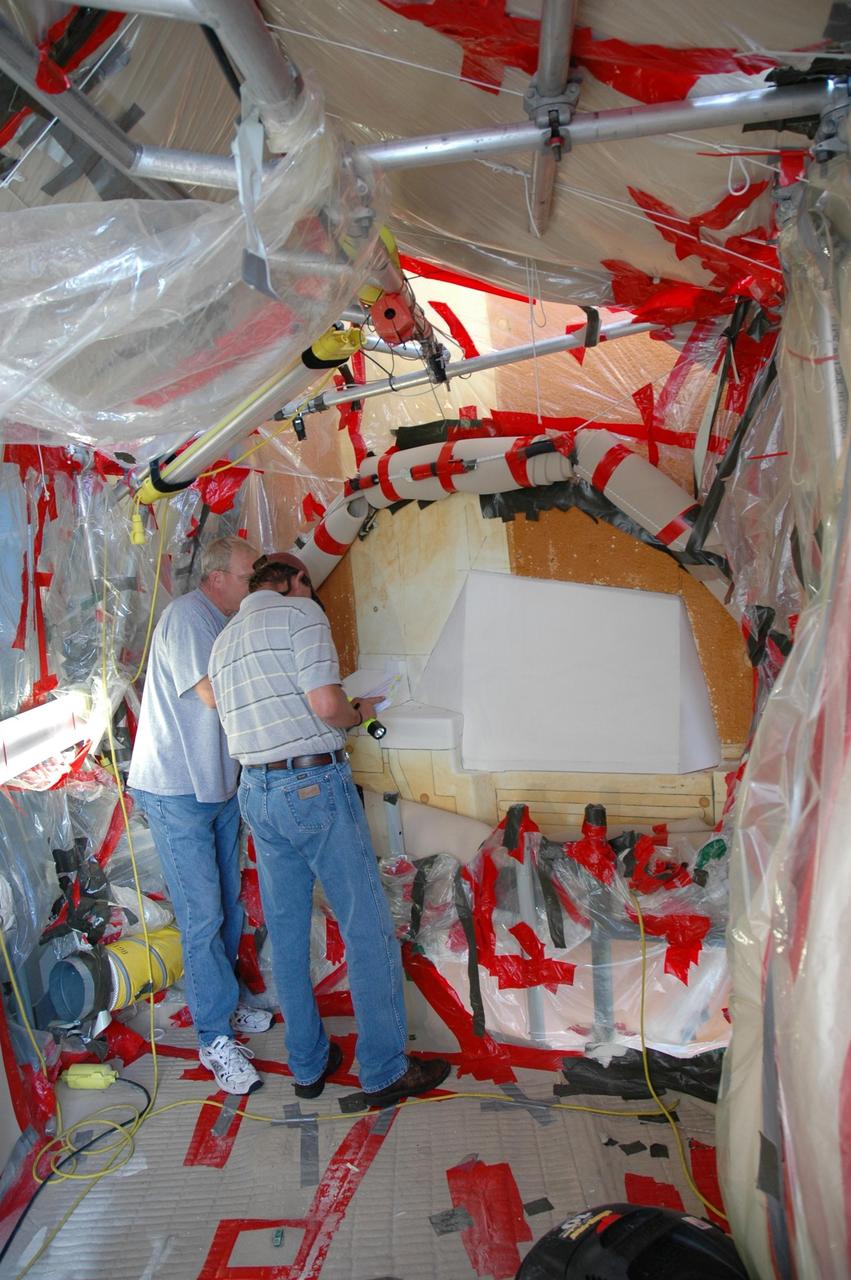
KENNEDY SPACE CENTER, FLA. -- Quality inspectors with NASA and Lockheed Martin examine a red-line drawing of foam placement on space shuttle Atlantis's external tank (in front of them) to verify the foam insulation that was reapplied. The foam covers the feed-through engine cut-off, or ECO, sensor connector. The foam was removed to enable engineers to remove and replace the ECO sensor connector on the tank. The feed-through connector passes the wires from the inside of the tank to the outside. Results of a tanking test on Dec. 18 pointed to an open circuit in the feed-through connector wiring, which is located at the base of the tank. The pins in the replacement connector were precisely soldered to create a connection that allows sensors inside the tank to send signals to the computers onboard Atlantis. The repair work was done on Atlantis while the shuttle has been on Launch Pad 39A at NASA's Kennedy Space Center. The launch date for the shuttle's STS-122 mission has now been targeted for Feb. 7. Photo credit: NASA/Cory Husten
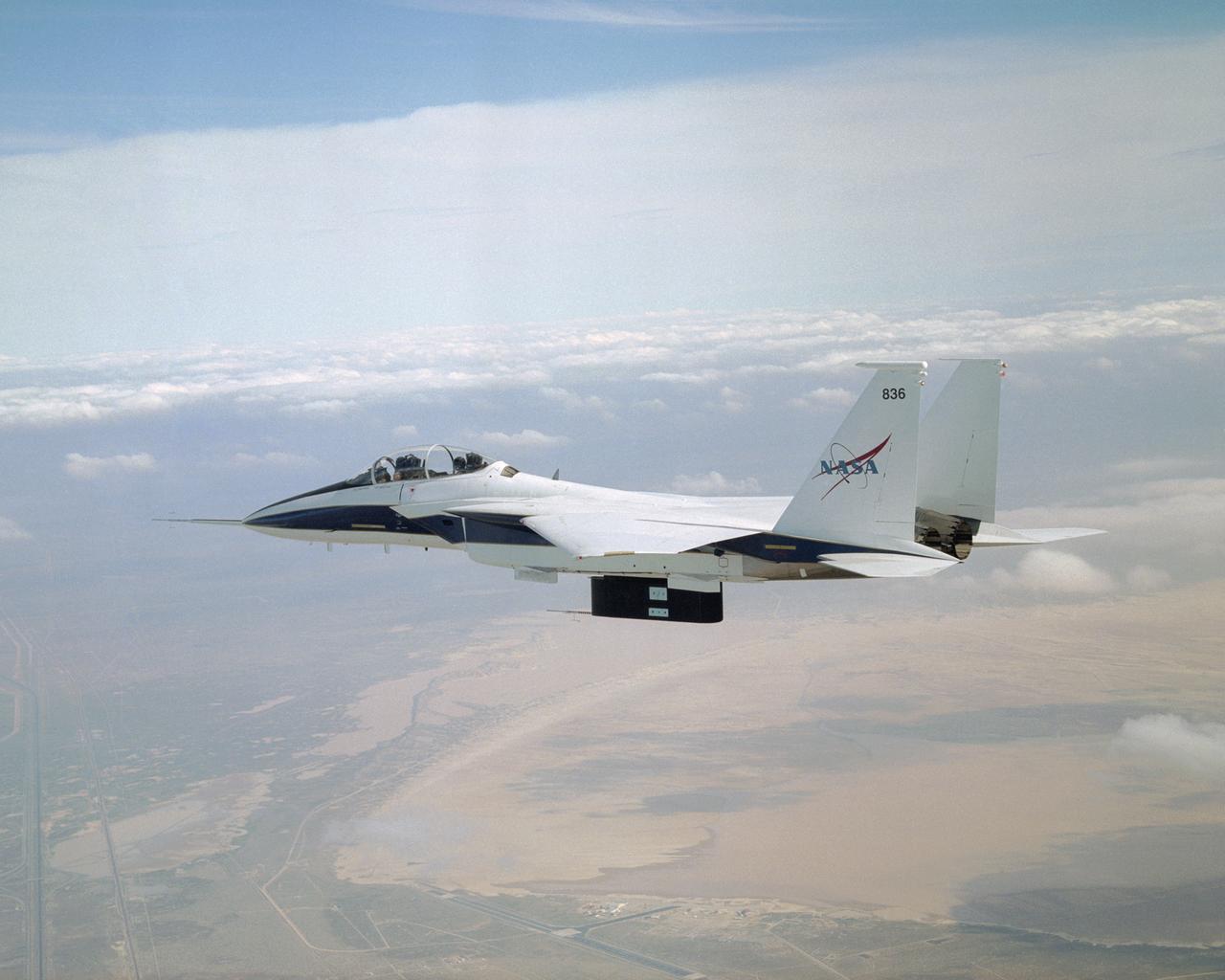
All six divots of thermal insulation foam have been ejected from the flight test fixture on NASA's F-15B testbed as it returns from a LIFT experiment flight.
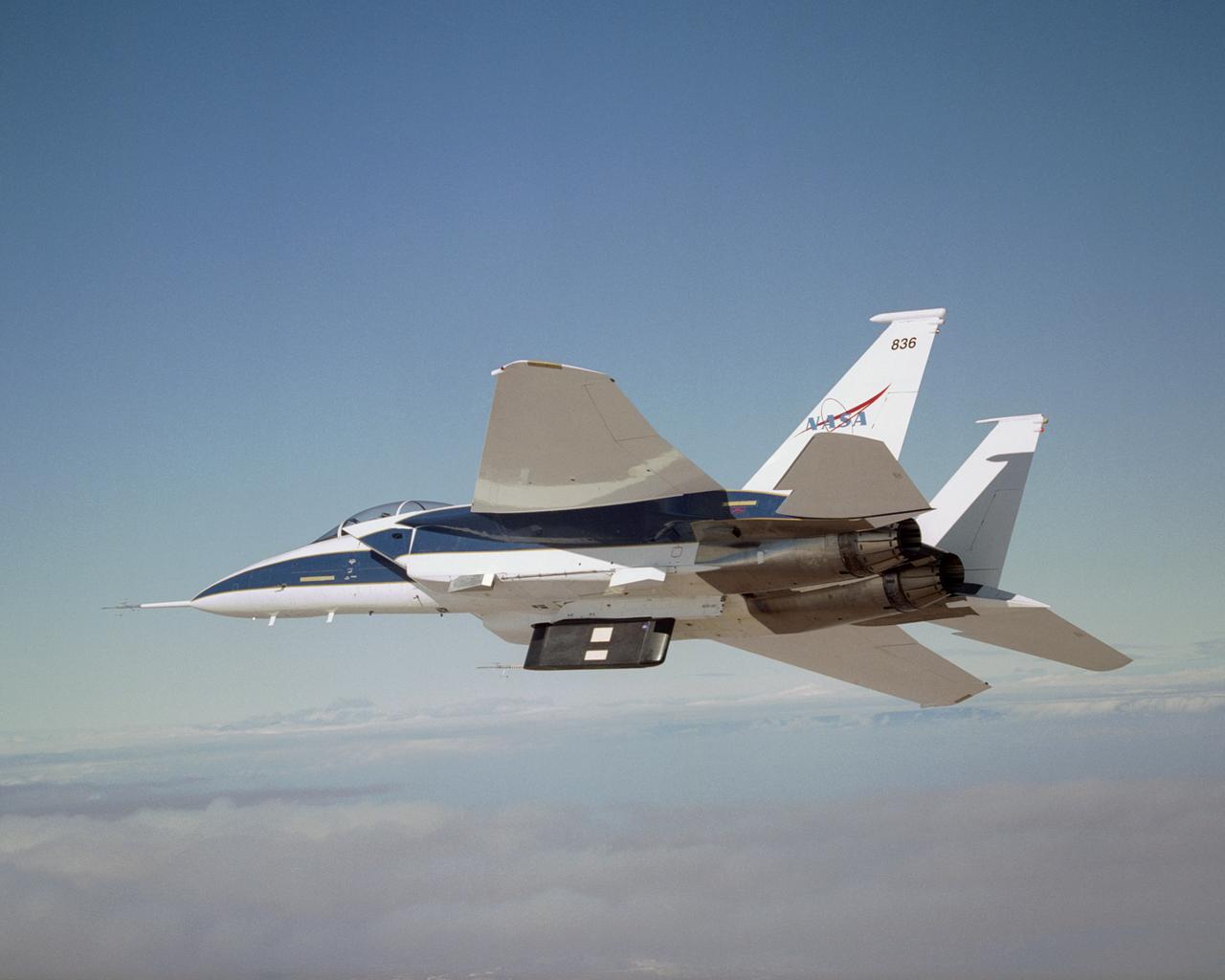
Two panels of Space Shuttle TPS insulation were mounted on the flight test fixture underneath NASA's F-15B during the Lifting Foam Trajectory flight test series.
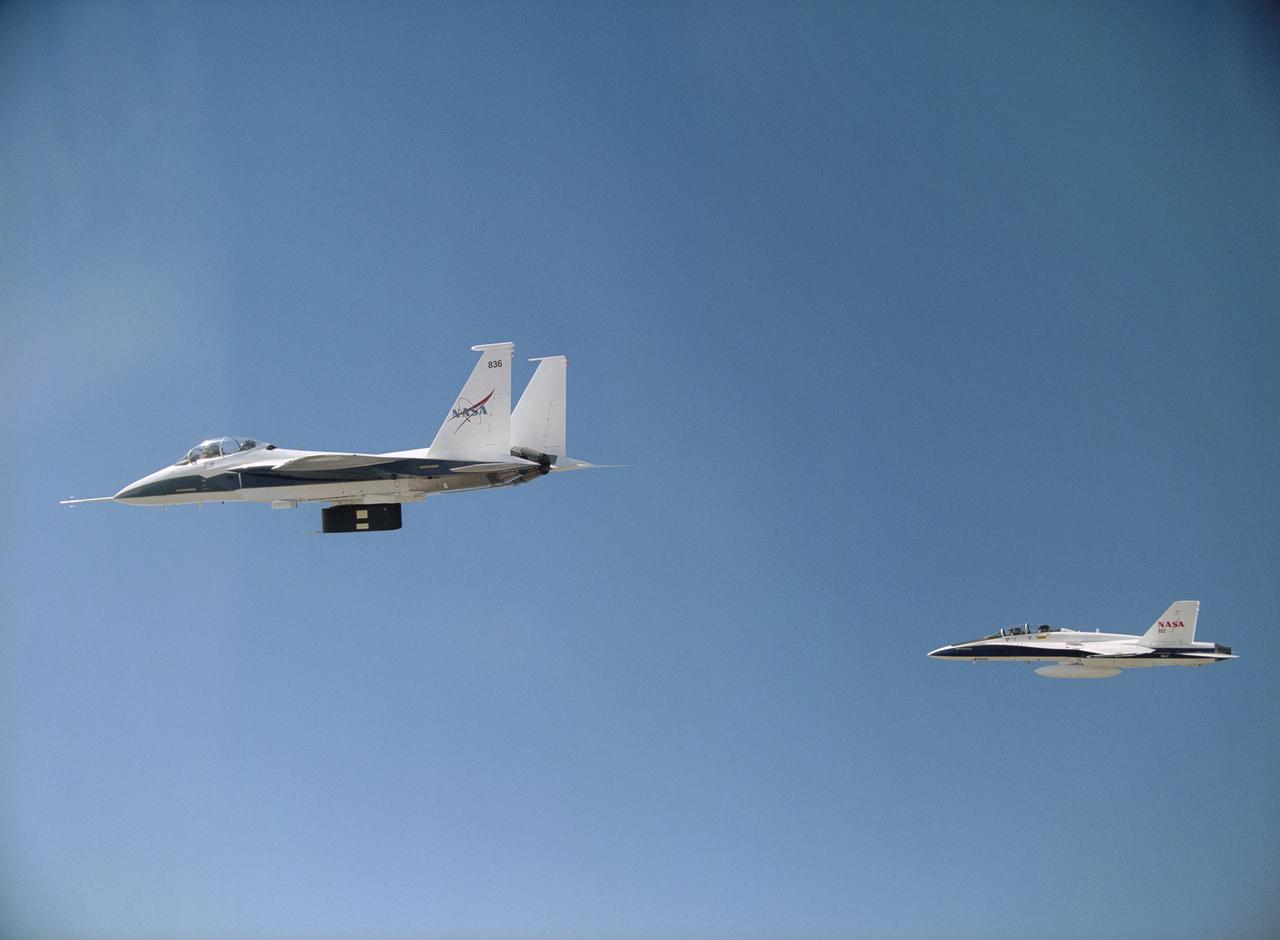
NASA's F-15B carrying thermal insulation foam on its flight test fixture is shadowed by a NASA F-18B chase aircraft during a LIFT experiment research flight.
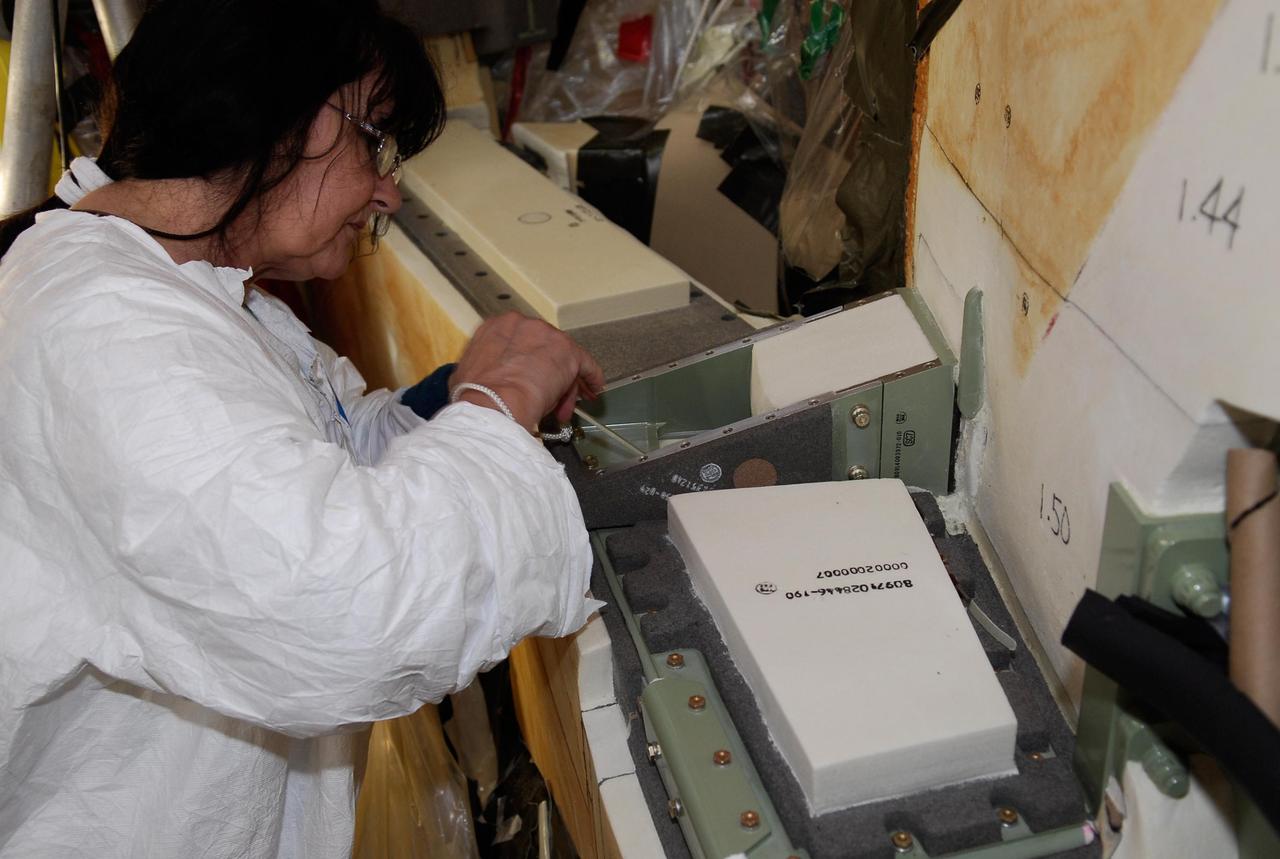
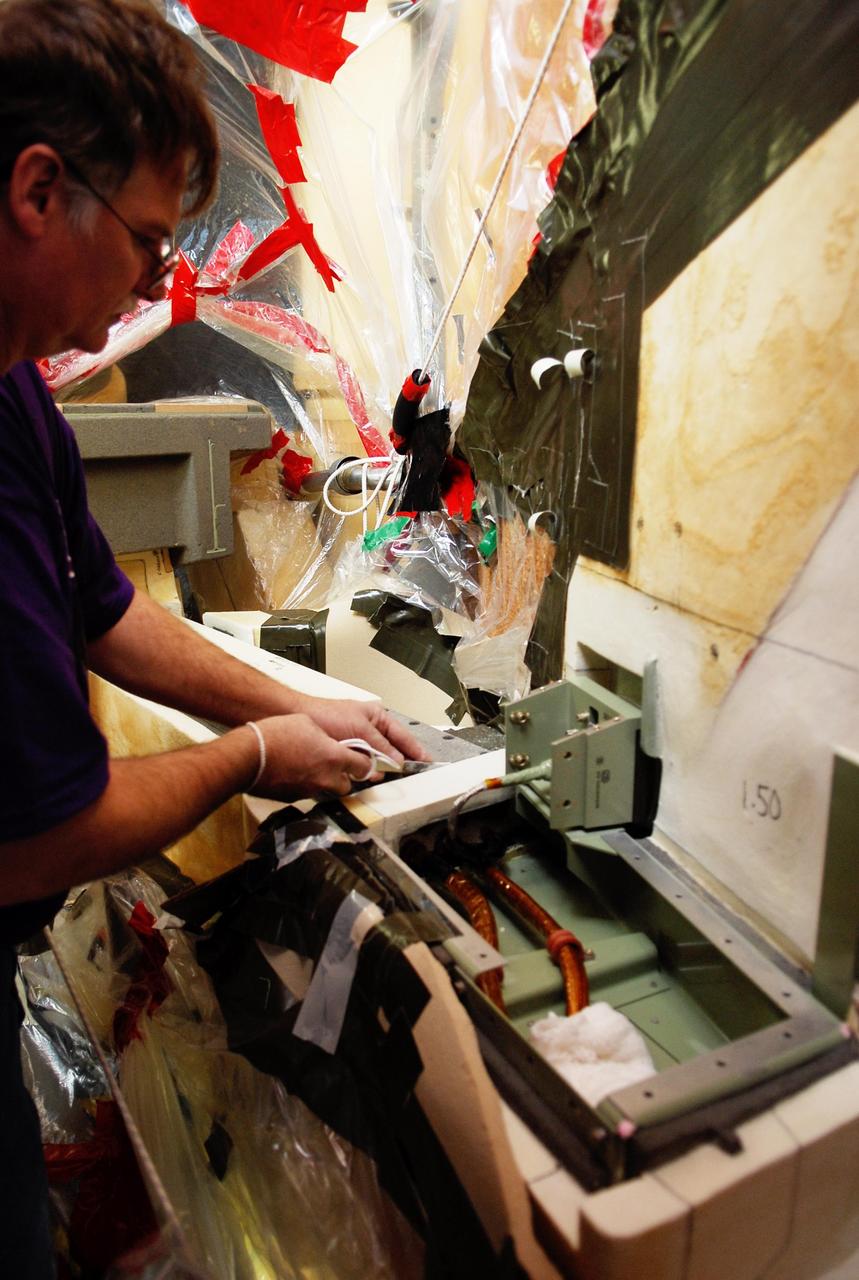
KENNEDY SPACE CENTER, FLA. -- On Launch Pad 39A at NASA's Kennedy Space Center, a technician trims foam placed around the engine cutoff, or ECO, sensor system connector and wiring on space shuttle Atlantis' external tank. The foam was removed to enable engineers to remove and replace a feed-through ECO sensor connector on the tank. The feed-through connector passes the wires from the inside of the tank to the outside. Results of a tanking test on Dec. 18 pointed to an open circuit in the feed-through connector wiring, which is located at the base of the tank. The pins in the replacement connector were precisely soldered to create a connection that allows sensors inside the tank to send signals to the computers onboard Atlantis. The launch date for the shuttle's STS-122 mission has now been targeted for Feb. 7. Photo credit: NASA/Kim Shiflett

KENNEDY SPACE CENTER, FLA. -- On Launch Pad 39A at NASA's Kennedy Space Center, foam is being replaced around the engine cutoff, or ECO, sensor system connector and wiring on space shuttle Atlantis' external tank. The foam was removed to enable engineers to remove and replace a feed-through ECO sensor connector on the tank. The feed-through connector passes the wires from the inside of the tank to the outside. Results of a tanking test on Dec. 18 pointed to an open circuit in the feed-through connector wiring, which is located at the base of the tank. The pins in the replacement connector were precisely soldered to create a connection that allows sensors inside the tank to send signals to the computers onboard Atlantis. The launch date for the shuttle's STS-122 mission has now been targeted for Feb. 7. Photo credit: NASA/Kim Shiflett
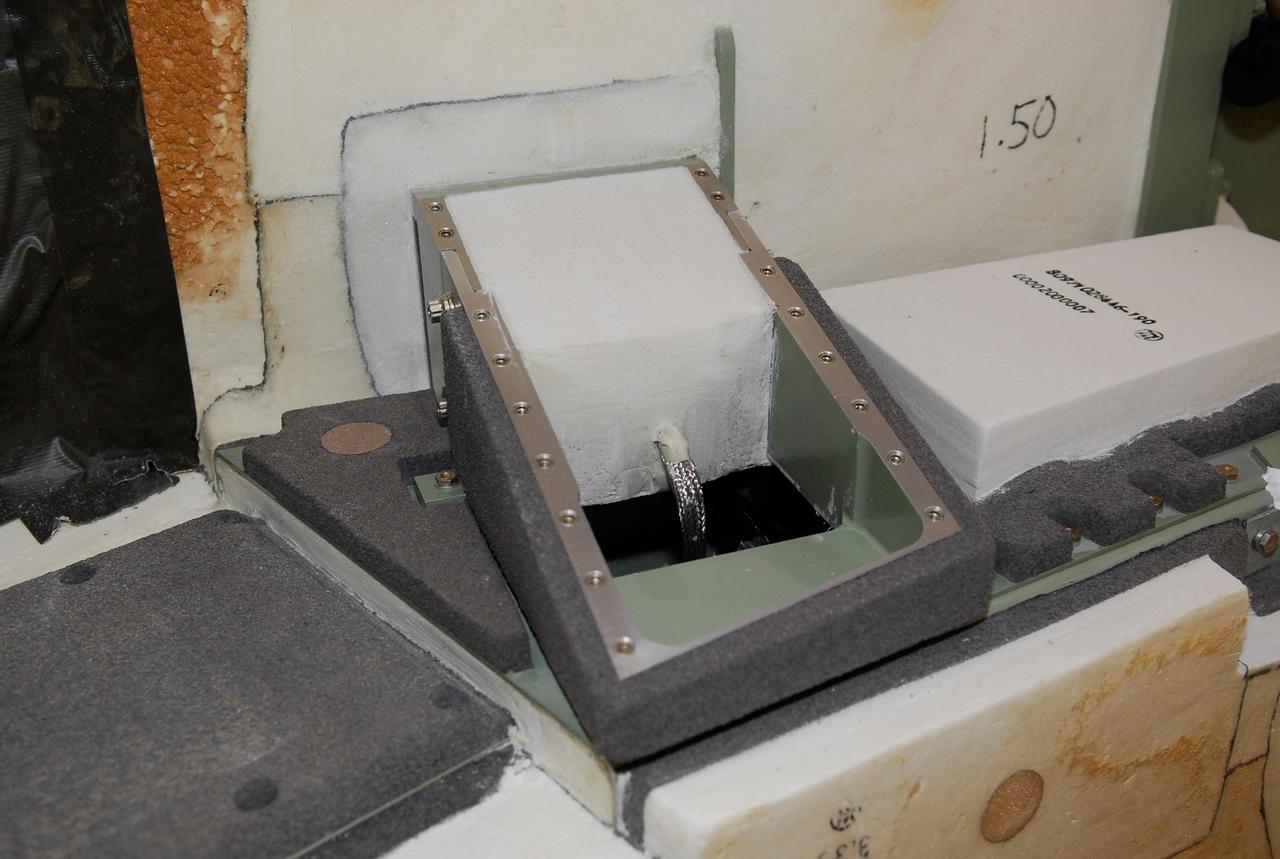
KENNEDY SPACE CENTER, FLA. -- On Launch Pad 39A at NASA's Kennedy Space Center, foam is being replaced around the engine cutoff, or ECO, sensor system connector and wiring on space shuttle Atlantis' external tank. The foam was removed to enable engineers to remove and replace a feed-through ECO sensor connector on the tank. The feed-through connector passes the wires from the inside of the tank to the outside. Results of a tanking test on Dec. 18 pointed to an open circuit in the feed-through connector wiring, which is located at the base of the tank. The pins in the replacement connector were precisely soldered to create a connection that allows sensors inside the tank to send signals to the computers onboard Atlantis. The launch date for the shuttle's STS-122 mission has now been targeted for Feb. 7. Photo credit: NASA/Kim Shiflett
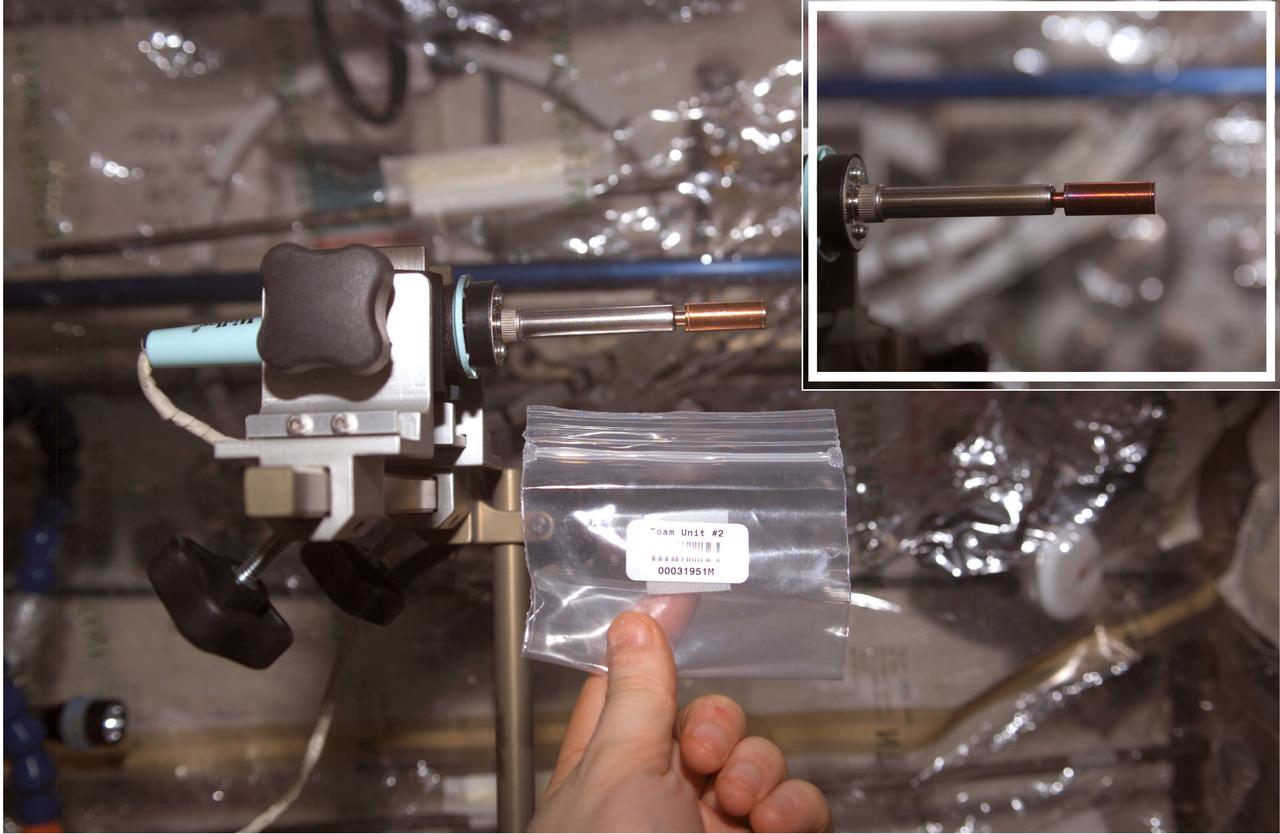
This soldering iron has an evacuated copper capsule at the tip that contains a pellet of Bulk Metallic Glass (BMG) aboard the International Space Station (ISS). Prior to flight, researchers sealed a pellet of bulk metallic glass mixed with microscopic gas-generating particles into the copper ampoule under vacuum. Once heated in space, such as in this photograph, the particles generated gas and the BMG becomes a viscous liquid. The released gas made the sample foam within the capsule where each microscopic particle formed a gas-filled pore within the foam. The inset image shows the oxidation of the sample after several minutes of applying heat. Although hidden within the brass sleeve, the sample retained the foam shape when cooled, because the viscosity increased during cooling until it was solid.
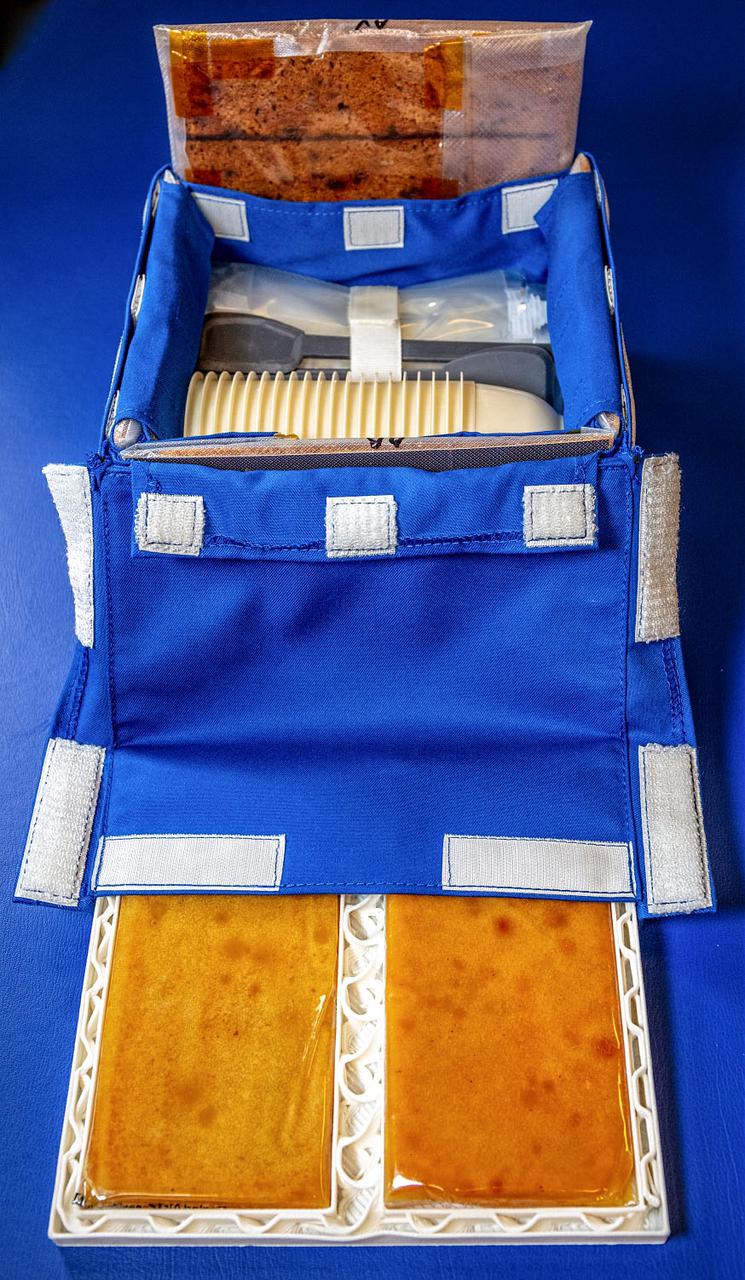
jsc2021e063281 (12/9/20210 --- Preflight image of the Food Processor consumables Kit which uses Edible prodcuts and Renewable pad as new protection Foam. © CNES/DE PRADA Thierry, 2020

The Space Shuttle External Tank 120 is shown here in its vertical position in NASA’s Michoud Assembly Facility in New Orleans. Slated for launch on the Orbiter Discovery scheduled for next Spring, the tank is in position for its new foam application process on the liquid hydrogen tank-to-inter tank flange area, a tank structural connection point. The foam will be applied with an enhanced finishing procedure that requires two technicians, one for a new mold-injection procedure to the intertank’s ribbing and one for real-time videotaped surveillance of the process. Marshall Space Flight Center played a significant role in the development of the new application process designed to replace the possible debris shedding source previously used.

The Space Shuttle External Tank 120 is shown here during transfer in NASA’s Michoud Assembly Facility in New Orleans. Slated for launch on the Orbiter Discovery scheduled for next Spring, the tank will be erected vertically in preparation for its new foam application process on the liquid hydrogen tank-to-inter tank flange area, a tank structural connection point. The foam will be applied with an enhanced finishing procedure that requires two technicians, one for a new mold-injection procedure to the intertank’s ribbing and one for real-time videotaped surveillance of the process. Marshall Space Flight Center played a significant role in the development of the new application process designed to replace the possible debris shedding source previously used.
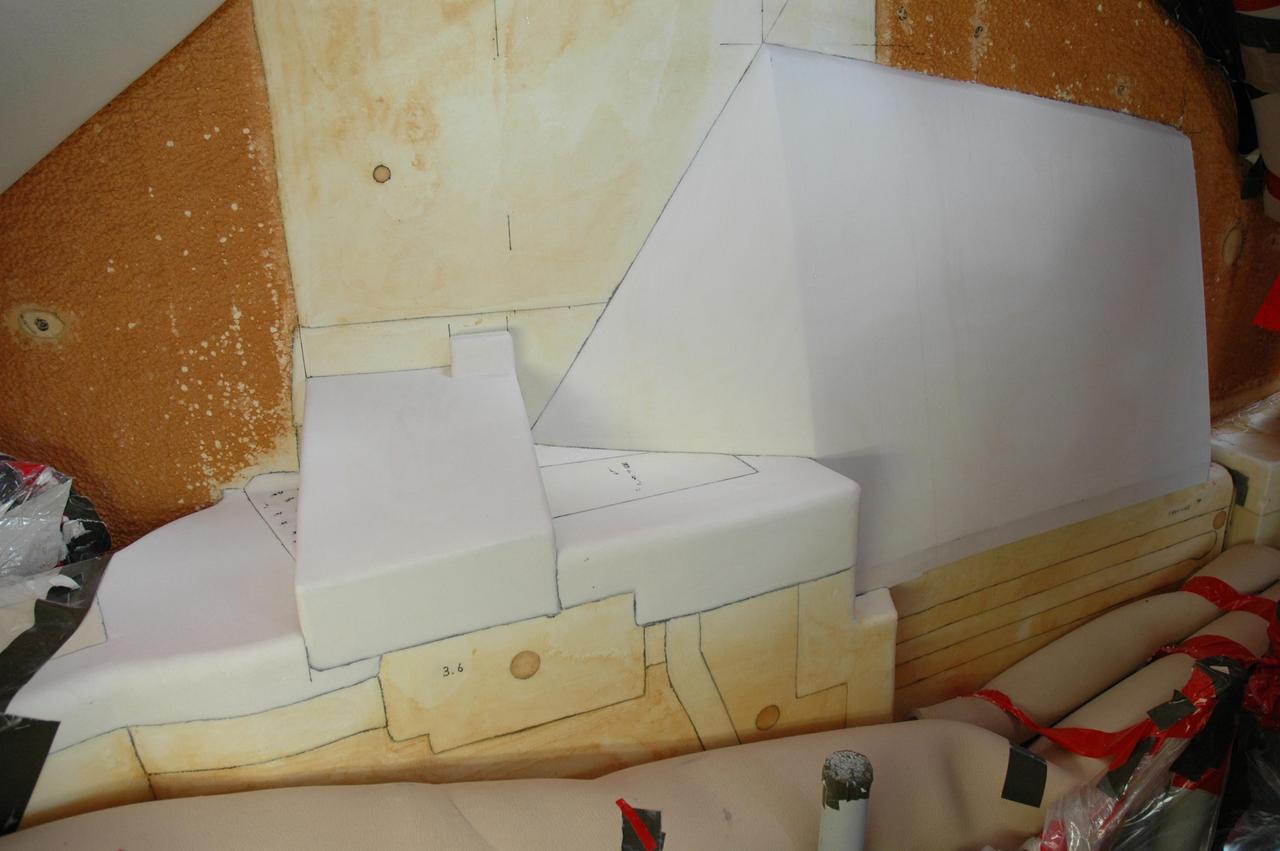
KENNEDY SPACE CENTER, FLA. -- The white foam insulation freshly reapplied to space shuttle Atlantis's external tank completes the work to remove and replace the feed-through connector on the engine cut-off, or ECO, sensor connector. The repair work was done on Atlantis while the shuttle has been on Launch Pad 39A at NASA's Kennedy Space Center. The foam was removed to enable engineers to remove and replace the ECO sensor connector on the tank. The feed-through connector passes the wires from the inside of the tank to the outside. Results of a tanking test on Dec. 18 pointed to an open circuit in the feed-through connector wiring, which is located at the base of the tank. The pins in the replacement connector were precisely soldered to create a connection that allows sensors inside the tank to send signals to the computers onboard Atlantis. The repair work was done on Atlantis while the shuttle has been on Launch Pad 39A at NASA's Kennedy Space Center. The launch date for the shuttle's STS-122 mission has now been targeted for Feb. 7. Photo credit: NASA/Cory Husten
KENNEDY SPACE CENTER, FLA. -- The white foam insulation freshly reapplied to space shuttle Atlantis's external tank completes the work to remove and replace the feed-through connector on the engine cut-off, or ECO, sensor connector. The repair work was done on Atlantis while the shuttle has been on Launch Pad 39A at NASA's Kennedy Space Center. The foam was removed to enable engineers to remove and replace the ECO sensor connector on the tank. The feed-through connector passes the wires from the inside of the tank to the outside. Results of a tanking test on Dec. 18 pointed to an open circuit in the feed-through connector wiring, which is located at the base of the tank. The pins in the replacement connector were precisely soldered to create a connection that allows sensors inside the tank to send signals to the computers onboard Atlantis. The repair work was done on Atlantis while the shuttle has been on Launch Pad 39A at NASA's Kennedy Space Center. The launch date for the shuttle's STS-122 mission has now been targeted for Feb. 7. Photo credit: NASA/Cory Husten
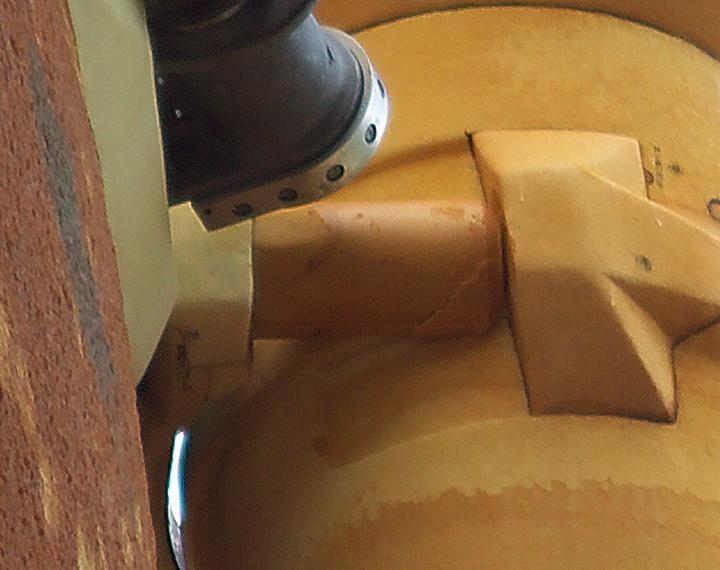
KENNEDY SPACE CENTER, FLA. - A crack formed on a piece of insulation on a strut that attaches the liquid oxygen feedline to External Tank-119, being used to launch space shuttle mission STS-121. This piece of foam, weighing approximately 0.0057 pounds, is three inches long and one-eighth to one-quarter inch wide. It fell from the tank and was recovered by the Ice Team from the mobile launch platform at Pad 39B. It is believed that the rain experienced during yesterday’s launch attempt of Discovery caused water to run down the feedline and form ice near the strut next to the feedline bracket. As the tank warmed and expanded, the ice that formed most likely pinched the foam on the top of the strut, causing a crack and eventual loss of the small piece of foam. Photo credit: NASA
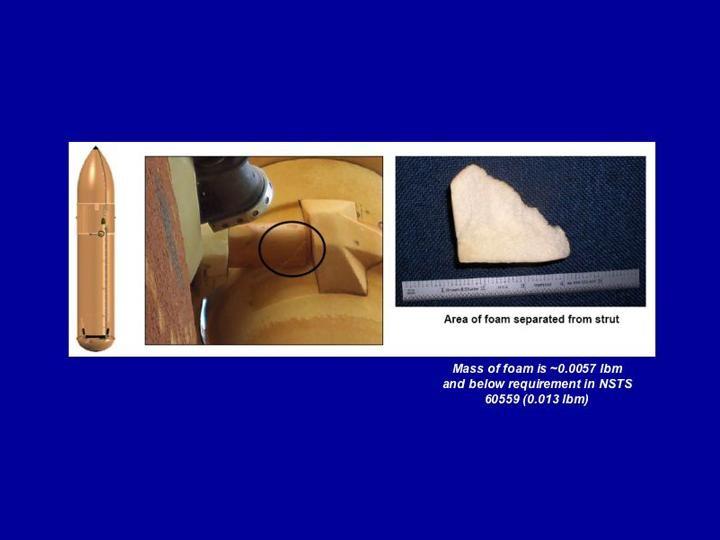
KENNEDY SPACE CENTER, FLA. - A composite image illustrates the size and location of a piece of insulation that was liberated from a strut that attaches the liquid oxygen feedline to External Tank-119. The tank is being used to launch space shuttle mission STS-121. This piece of foam, weighing approximately 0.0057 pounds, is three inches long and one-eighth to one-quarter inch wide and was recovered by the Ice Team from the mobile launch platform at Pad 39B. It is believed that the rain experienced during yesterday’s launch attempt of Discovery caused water to run down the feedline and form ice near the strut next to the feedline bracket. As the tank warmed and expanded, the ice that formed most likely pinched the foam on the top of the strut, causing a crack and eventual loss of the small piece of foam. Photo credit: NASA

KENNEDY SPACE CENTER, FLA. -- On Launch Pad 39A at NASA's Kennedy Space Center, foam insulation is being trimmed for placement around the engine cutoff, or ECO, sensor system connector and wiring on space shuttle Atlantis' external tank. The foam was removed to enable engineers to remove and replace a feed-through ECO sensor connector on the tank. The feed-through connector passes the wires from the inside of the tank to the outside. Results of a tanking test on Dec. 18 pointed to an open circuit in the feed-through connector wiring, which is located at the base of the tank. The pins in the replacement connector were precisely soldered to create a connection that allows sensors inside the tank to send signals to the computers onboard Atlantis. The launch date for the shuttle's STS-122 mission has now been targeted for Feb. 7. Photo credit: NASA/Kim Shiflett
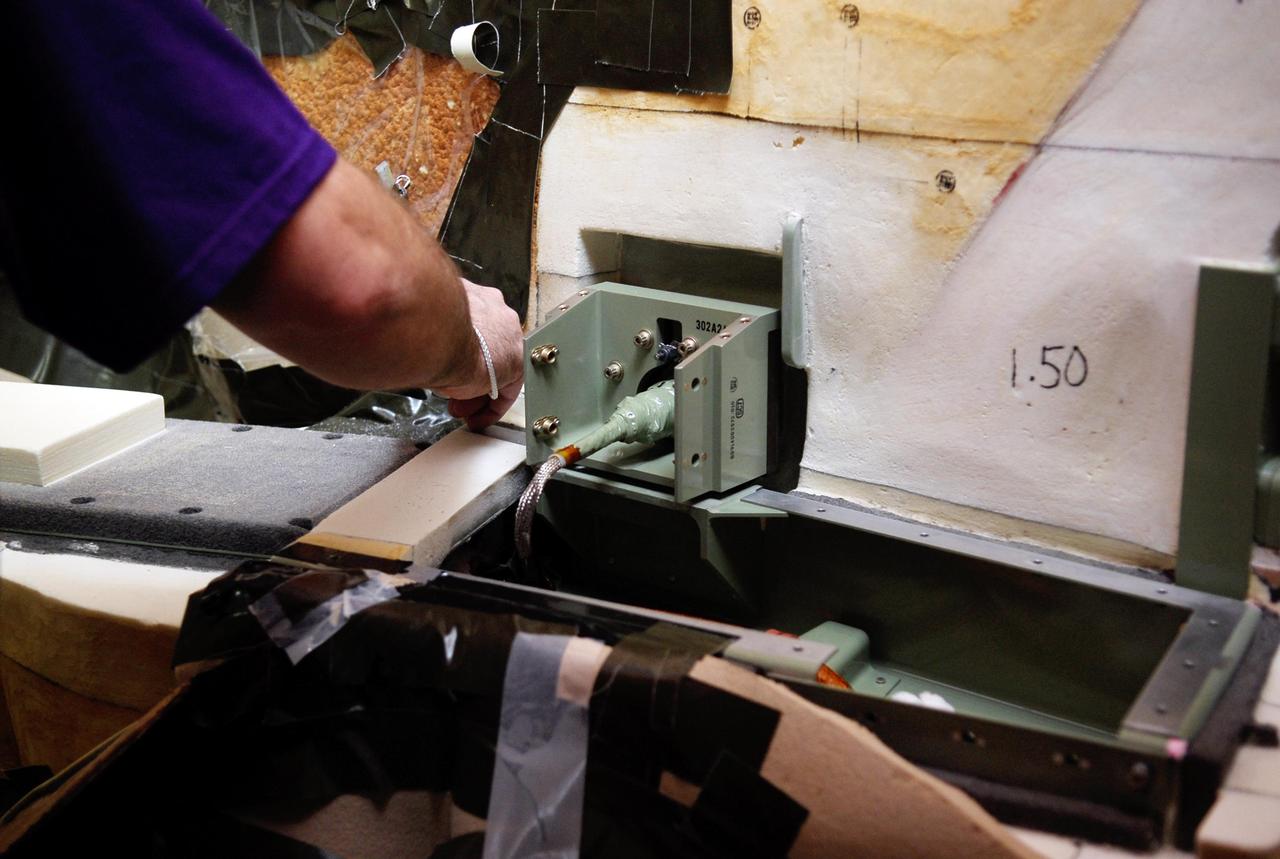
KENNEDY SPACE CENTER, FLA. -- On Launch Pad 39A at NASA's Kennedy Space Center, foam insulation is being trimmed for placement around the engine cutoff, or ECO, sensor system connector and wiring on space shuttle Atlantis' external tank. The foam was removed to enable engineers to remove and replace a feed-through ECO sensor connector on the tank. The feed-through connector passes the wires from the inside of the tank to the outside. Results of a tanking test on Dec. 18 pointed to an open circuit in the feed-through connector wiring, which is located at the base of the tank. The pins in the replacement connector were precisely soldered to create a connection that allows sensors inside the tank to send signals to the computers onboard Atlantis. The launch date for the shuttle's STS-122 mission has now been targeted for Feb. 7. Photo credit: NASA/Kim Shiflett
KENNEDY SPACE CENTER, FLA. -- On Launch Pad 39A at NASA's Kennedy Space Center, foam insulation is being trimmed for placement around the engine cutoff, or ECO, sensor system connector and wiring on space shuttle Atlantis' external tank. The foam was removed to enable engineers to remove and replace a feed-through ECO sensor connector on the tank. The feed-through connector passes the wires from the inside of the tank to the outside. Results of a tanking test on Dec. 18 pointed to an open circuit in the feed-through connector wiring, which is located at the base of the tank. The pins in the replacement connector were precisely soldered to create a connection that allows sensors inside the tank to send signals to the computers onboard Atlantis. The launch date for the shuttle's STS-122 mission has now been targeted for Feb. 7. Photo credit: NASA/Kim Shiflett
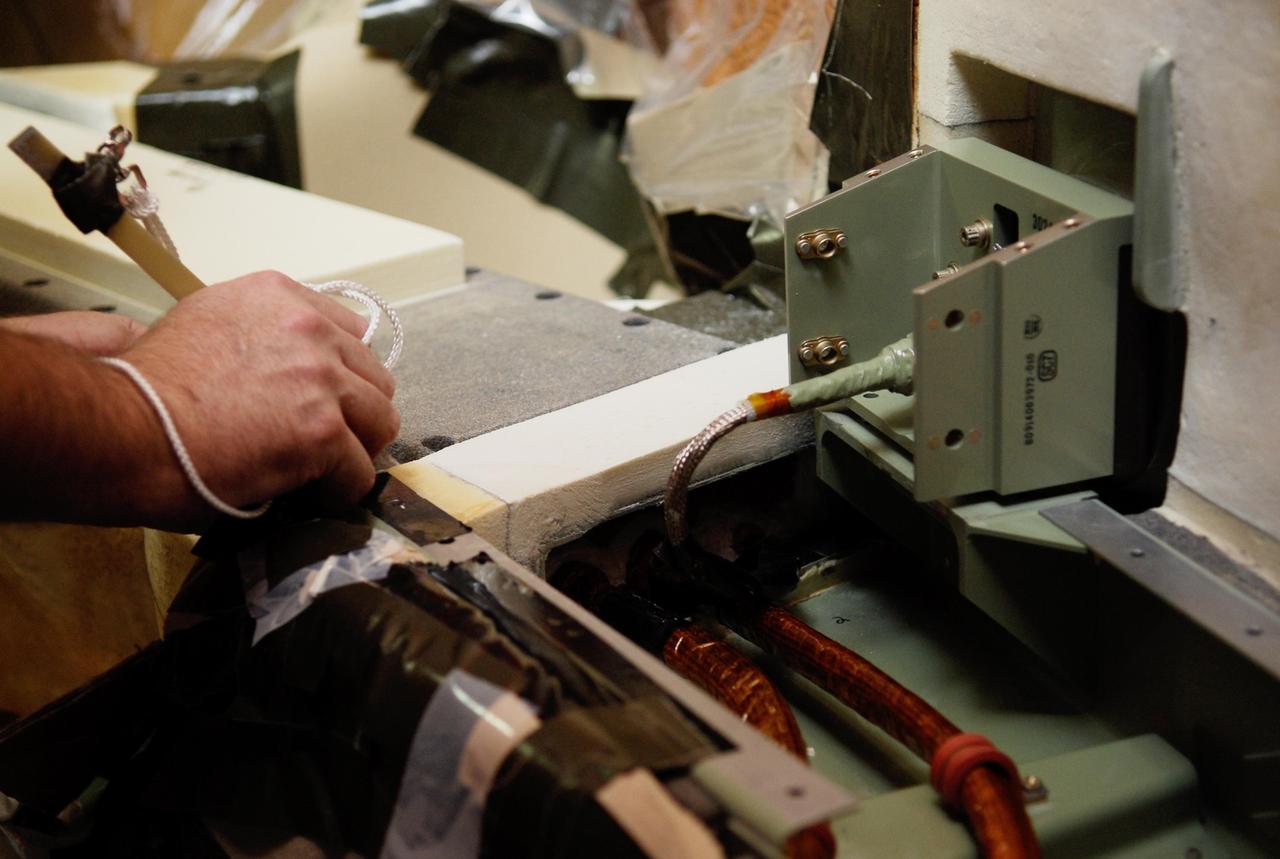
KENNEDY SPACE CENTER, FLA. -- On Launch Pad 39A at NASA's Kennedy Space Center, foam insulation is being trimmed for placement around the engine cutoff, or ECO, sensor system connector and wiring on space shuttle Atlantis' external tank. The foam was removed to enable engineers to remove and replace a feed-through ECO sensor connector on the tank. The feed-through connector passes the wires from the inside of the tank to the outside. Results of a tanking test on Dec. 18 pointed to an open circuit in the feed-through connector wiring, which is located at the base of the tank. The pins in the replacement connector were precisely soldered to create a connection that allows sensors inside the tank to send signals to the computers onboard Atlantis. The launch date for the shuttle's STS-122 mission has now been targeted for Feb. 7. Photo credit: NASA/Kim Shiflett
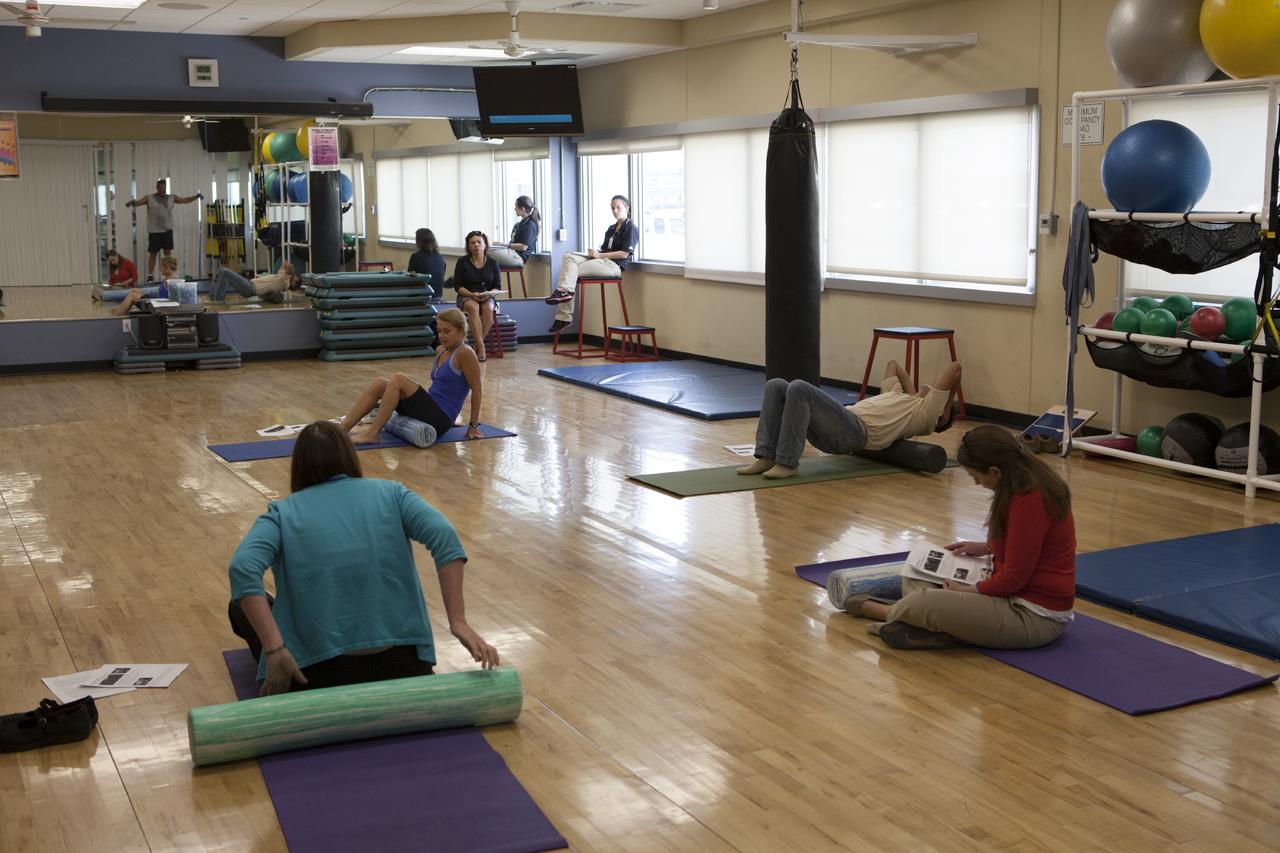
CAPE CANAVERAL, Fla. – Kennedy Space Center workers learn about the benefits of foam-rolling exercises and techniques to relieve the strain and pain of overused muscles and connective tissue. The class was part of the National Employee Health and Fitness Day event. Yoga, cardio dance, and boot camp classes were also offered throughout the day at the Operations and Checkout Building's Fitness Center. Photo credit: NASA/ Dimitri Gerondidakis
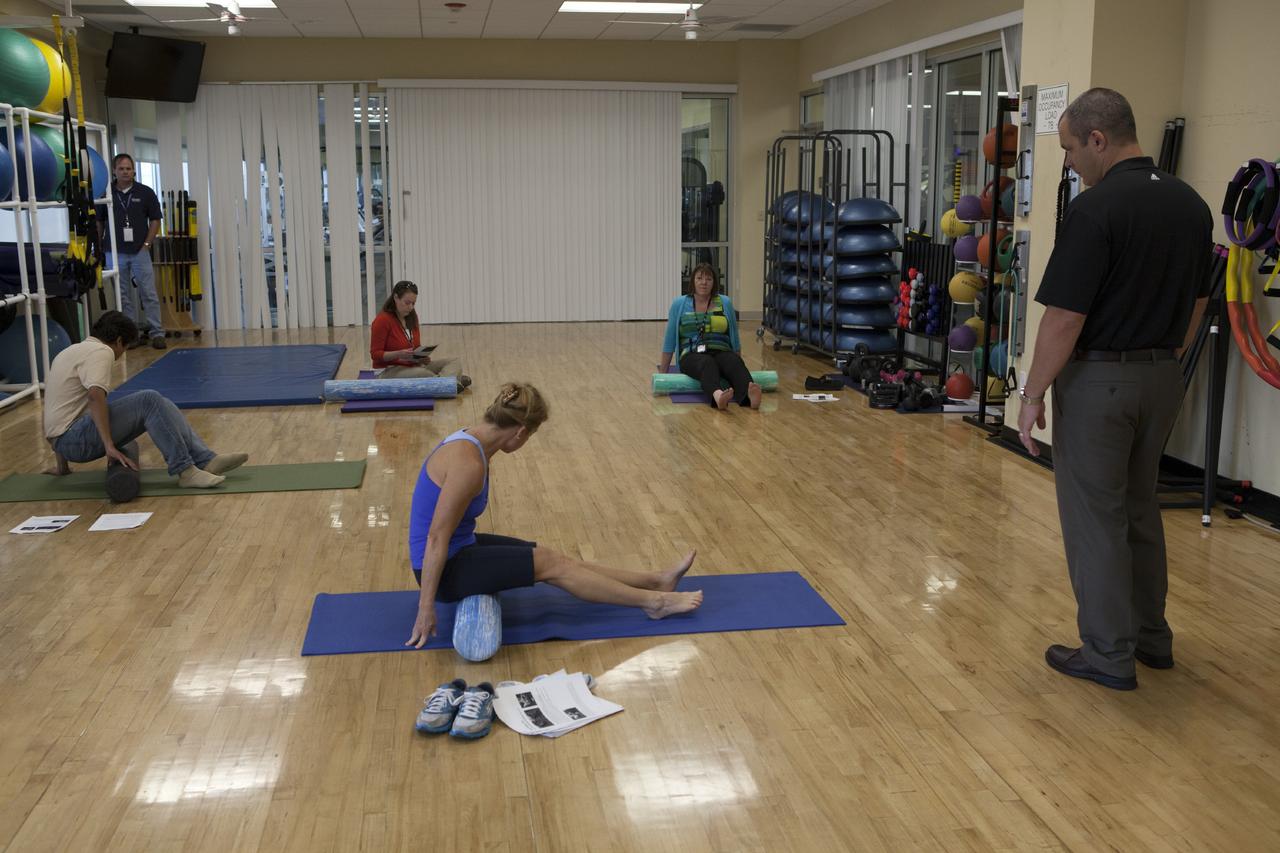
CAPE CANAVERAL, Fla. – Erik Nason, an athletic trainer with InoMedic Health/RehabWorks, instructs Kennedy Space Center workers during a foam rolling class. The class was part of the National Employee Health and Fitness Day event. Yoga, cardio dance, and boot camp classes were also offered throughout the day at the Operations and Checkout Building's Fitness Center. Photo credit: NASA/ Dimitri Gerondidakis

Technicians complete foaming around the area of Atlantis, Orbiter Vehicle (OV) 104, 17 inch diameter external tank (ET) feed line in preparation for the second liquid hydrogen tanking test at the Kennedy Space Center (KSC). An elaborate network of sensors, leak detectors, and baggies were set up on OV-104 by technicians. Engineers hope this extra instrumentation will help pinpoint the exact location of the leak. OV-104 is scheduled to be launched for the STS-38 mission, a classified Department of Defense (DOD) flight. View provided by KSC with alternate number KSC-90PC-988.
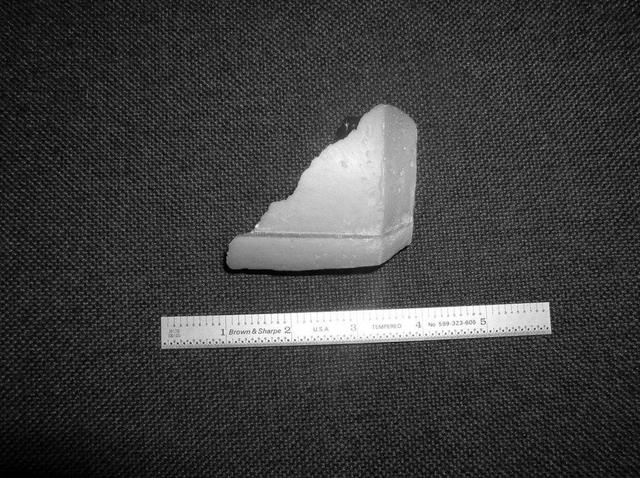
KENNEDY SPACE CENTER, FLA. - A piece of insulation - three inches long, one-eighth to one-quarter inch wide and weighing approximately 0.0057 pounds - was liberated from a strut that attaches the liquid oxygen feedline to External Tank-119. The tank is being used to launch space shuttle mission STS-121. It was recovered by the Ice Team from the mobile launch platform at Pad 39B. It is believed that the rain experienced during yesterday’s launch attempt of Discovery caused water to run down the feedline and form ice near the strut next to the feedline bracket. As the tank warmed and expanded, the ice that formed most likely pinched the foam on the top of the strut, causing a crack and eventual loss of the small piece of foam. Photo credit: NASA
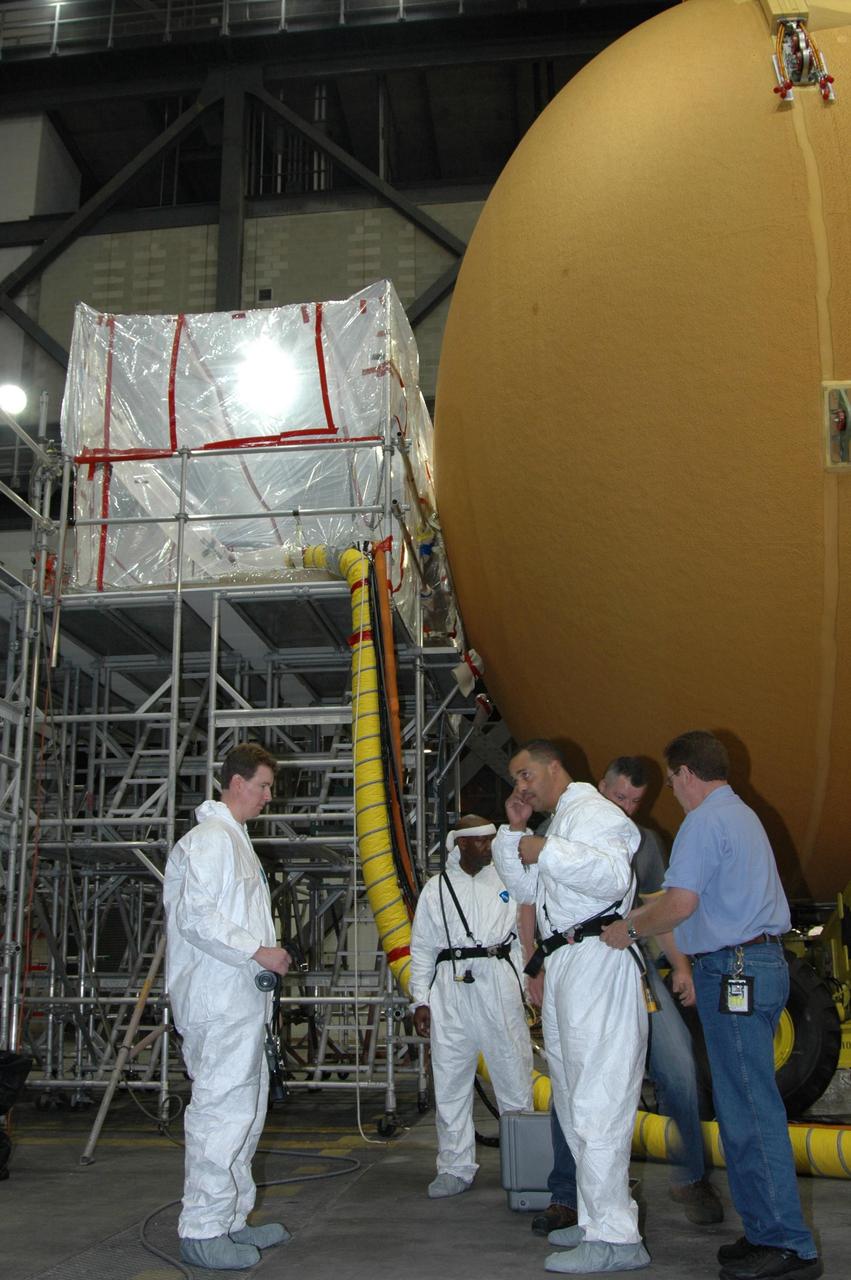
KENNEDY SPACE CENTER, FLA. -- Lockheed Martin technicians in the Vehicle Assembly Building at NASA's Kennedy Space Center prepare for the application of new foam over the manhole cover on the lower end of external tank No. 119. The manhole was removed to access the area where the tank's four liquid hydrogen engine cutoff sensors were replaced. Once reinstalled, the manhole required new foam to be applied. The tank is being prepared to launch Space Shuttle Discovery on mission STS-121 in July. Photo credit: NASA/Jim Grossmann
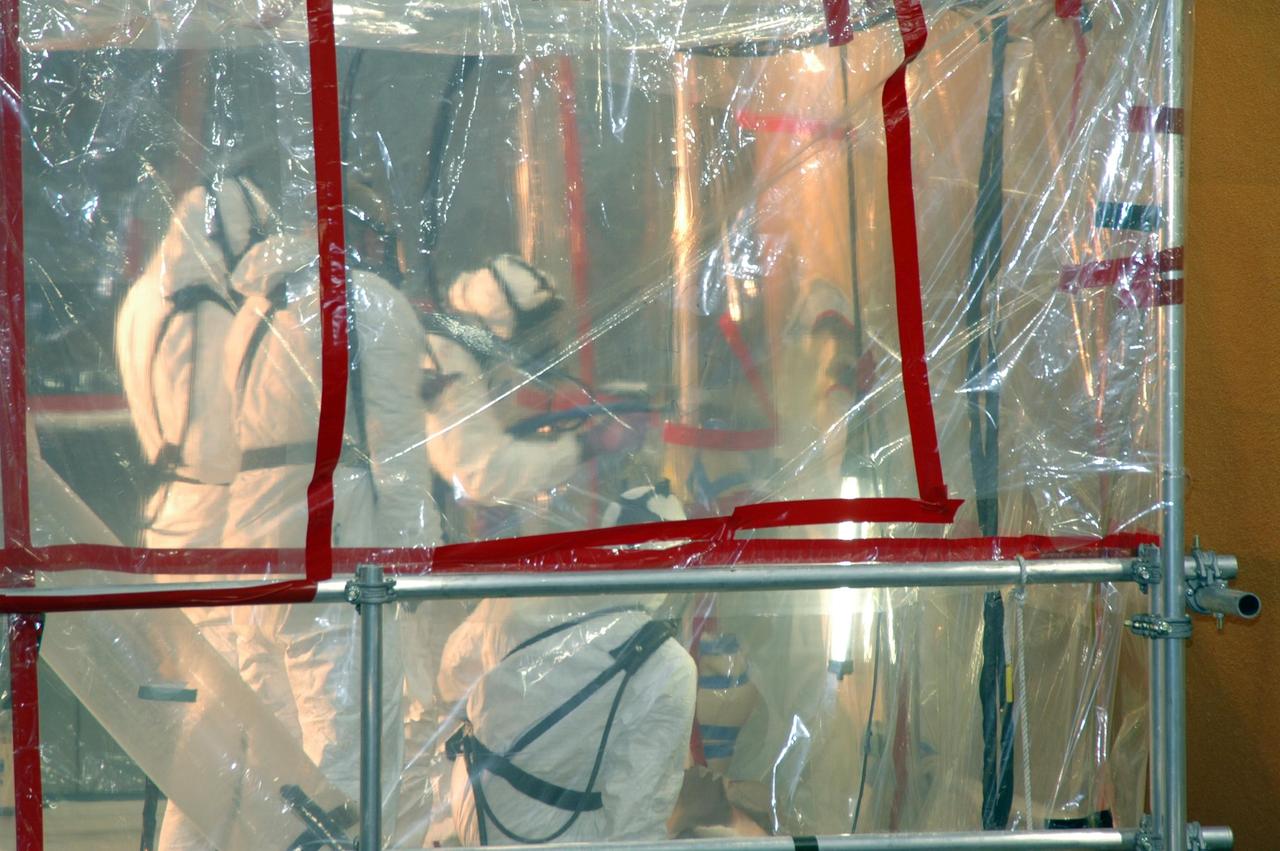
KENNEDY SPACE CENTER, FLA. -- Lockheed Martin technicians in the Vehicle Assembly Building at NASA's Kennedy Space Center apply new foam over the manhole cover on the lower end of external tank No. 119. The manhole was removed to access the area where the tank's four liquid hydrogen engine cutoff sensors were replaced. Once reinstalled, the manhole required new foam to be applied. The tank is being prepared to launch Space Shuttle Discovery on mission STS-121 in July. Photo credit: NASA/Jim Grossmann

KENNEDY SPACE CENTER, FLA. -- Lockheed Martin technicians in the Vehicle Assembly Building at NASA's Kennedy Space Center begin to apply new foam over the manhole cover on the lower end of external tank No. 119. The manhole was removed to access the area where the tank's four liquid hydrogen engine cutoff sensors were replaced. Once reinstalled, the manhole required new foam to be applied. The tank is being prepared to launch Space Shuttle Discovery on mission STS-121 in July. Photo credit: NASA/Jim Grossmann
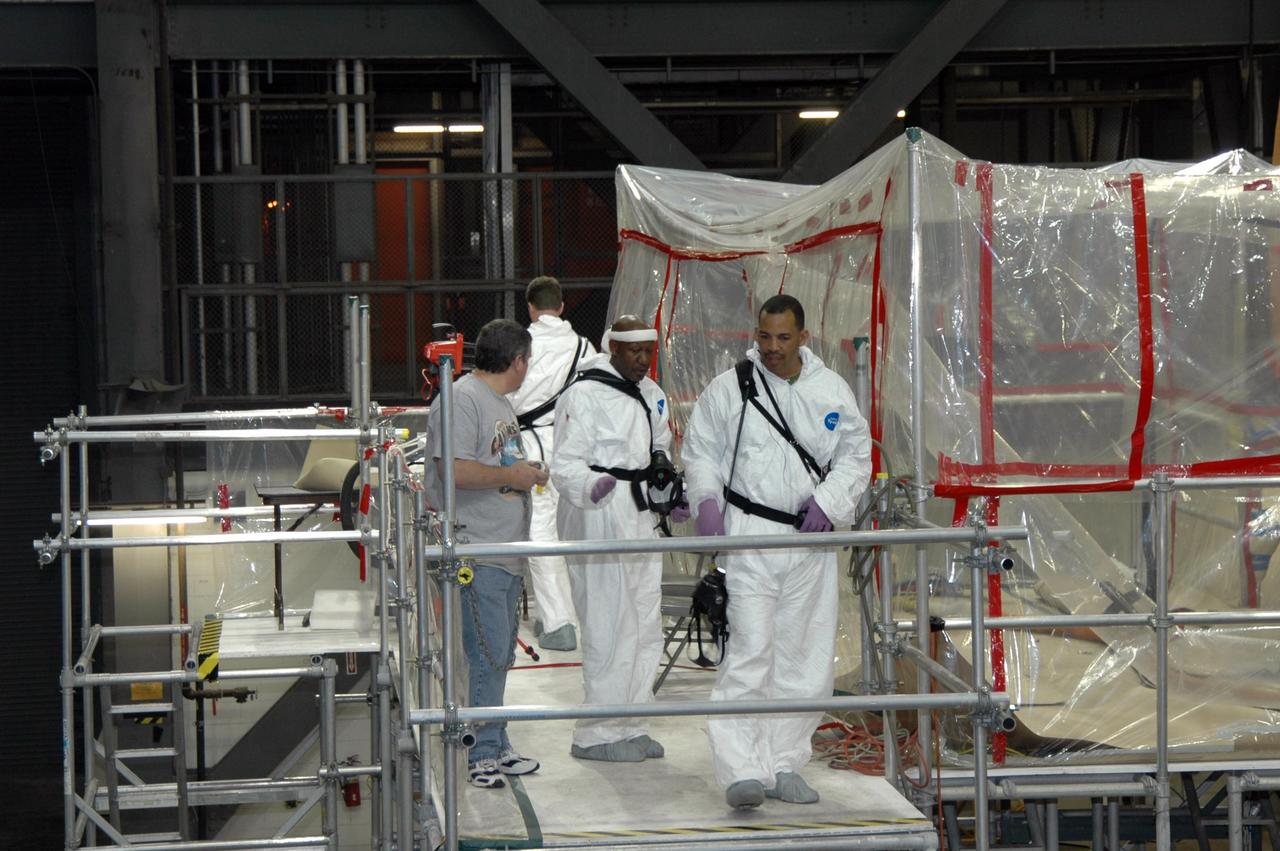
KENNEDY SPACE CENTER, FLA. -- Lockheed Martin technicians in the Vehicle Assembly Building at NASA's Kennedy Space Center prepare for the application of new foam over the manhole cover on the lower end of external tank No. 119. The manhole was removed to access the area where the tank's four liquid hydrogen engine cutoff sensors were replaced. Once reinstalled, the manhole required new foam to be applied. The tank is being prepared to launch Space Shuttle Discovery on mission STS-121 in July. Photo credit: NASA/Jim Grossmann
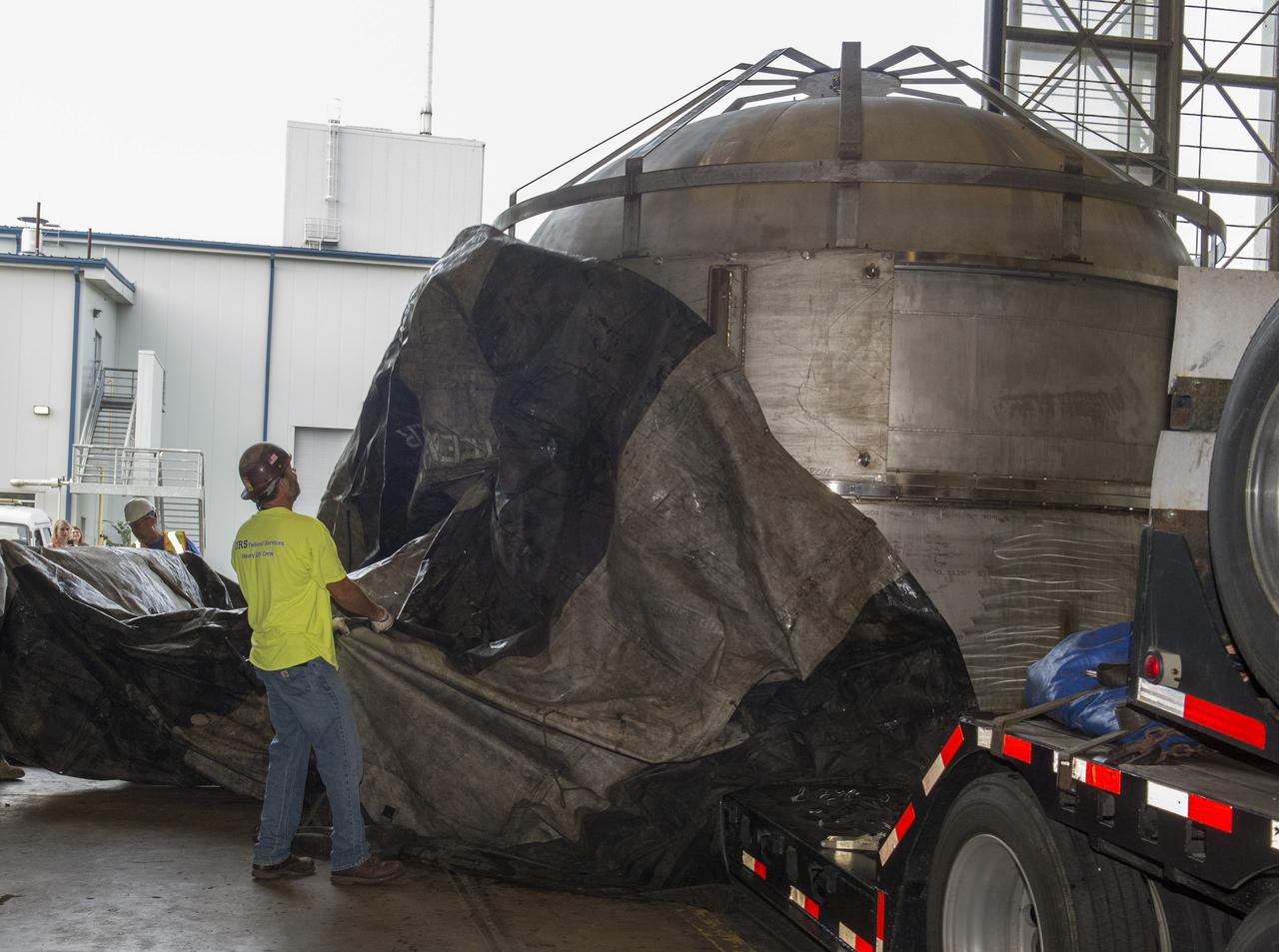
SHIIVER Tank Arrives at NASA’s Marshall Center for Spray-On Foam InsulationSHIIVER (Structural Heat Intercept Insulation Vibration Evaluation Rig) is a cryogenic test tank developed to evaluate heat intercept concepts. It arrived at Marshall Space Flight Center on August 10, 2017. The tank will receive heat sensors and spray-on foam insulation before making its way to Plum Brook station for further insulation and testing.

SHIIVER (Structural Heat Intercept Insulation Vibration Evaluation Rig) is a cryogenic test tank developed to evaluate heat intercept concepts. It arrived at Marshall Space Flight Center on August 10, 2017. The tank will receive heat sensors and spray-on foam insulation before making its way to Plum Brook station for further insulation and testing.SHIIVER Tank Arrives at NASA’s Marshall Center for Spray-On Foam Insulation
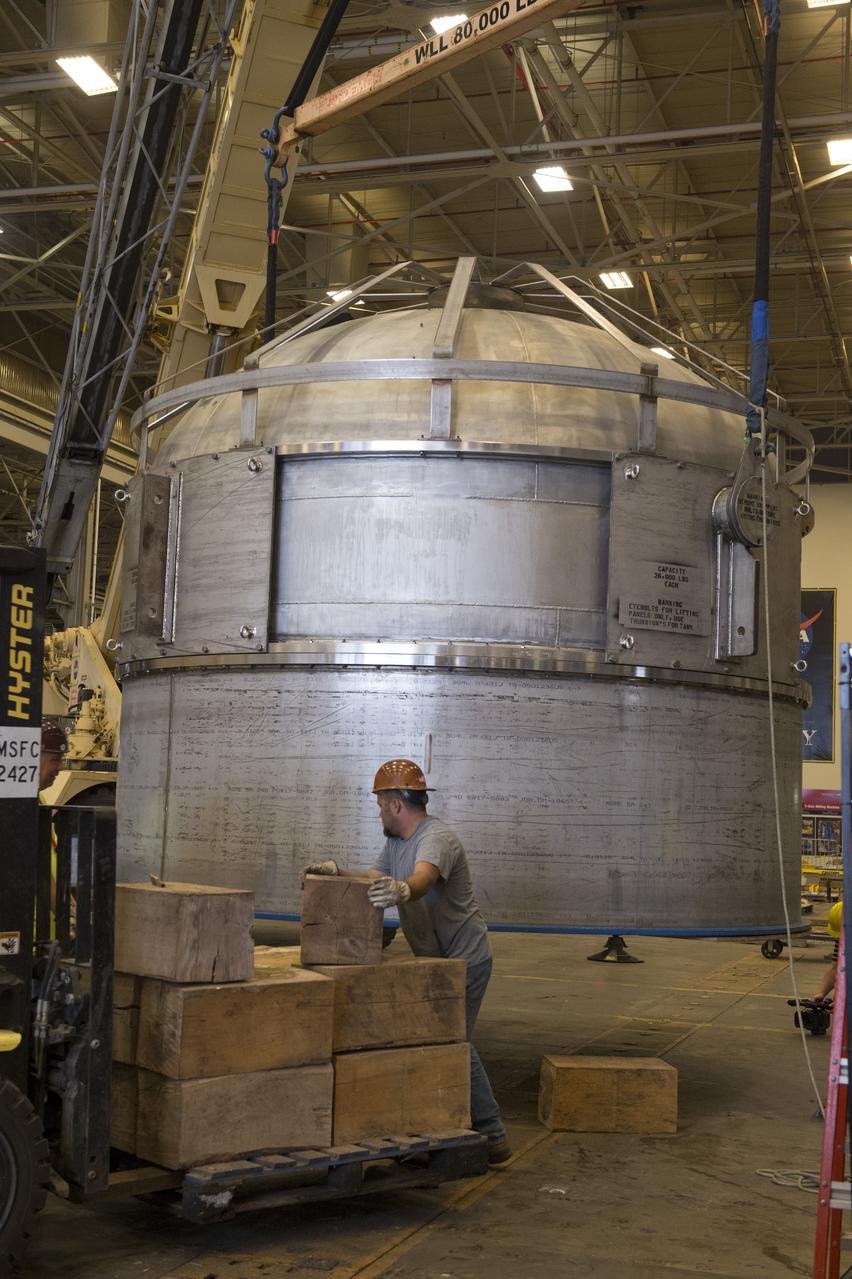
SHIIVER (Structural Heat Intercept Insulation Vibration Evaluation Rig) is a cryogenic test tank developed to evaluate heat intercept concepts. It arrived at Marshall Space Flight Center on August 10, 2017. The tank will receive heat sensors and spray-on foam insulation before making its way to Plum Brook station for further insulation and testing.
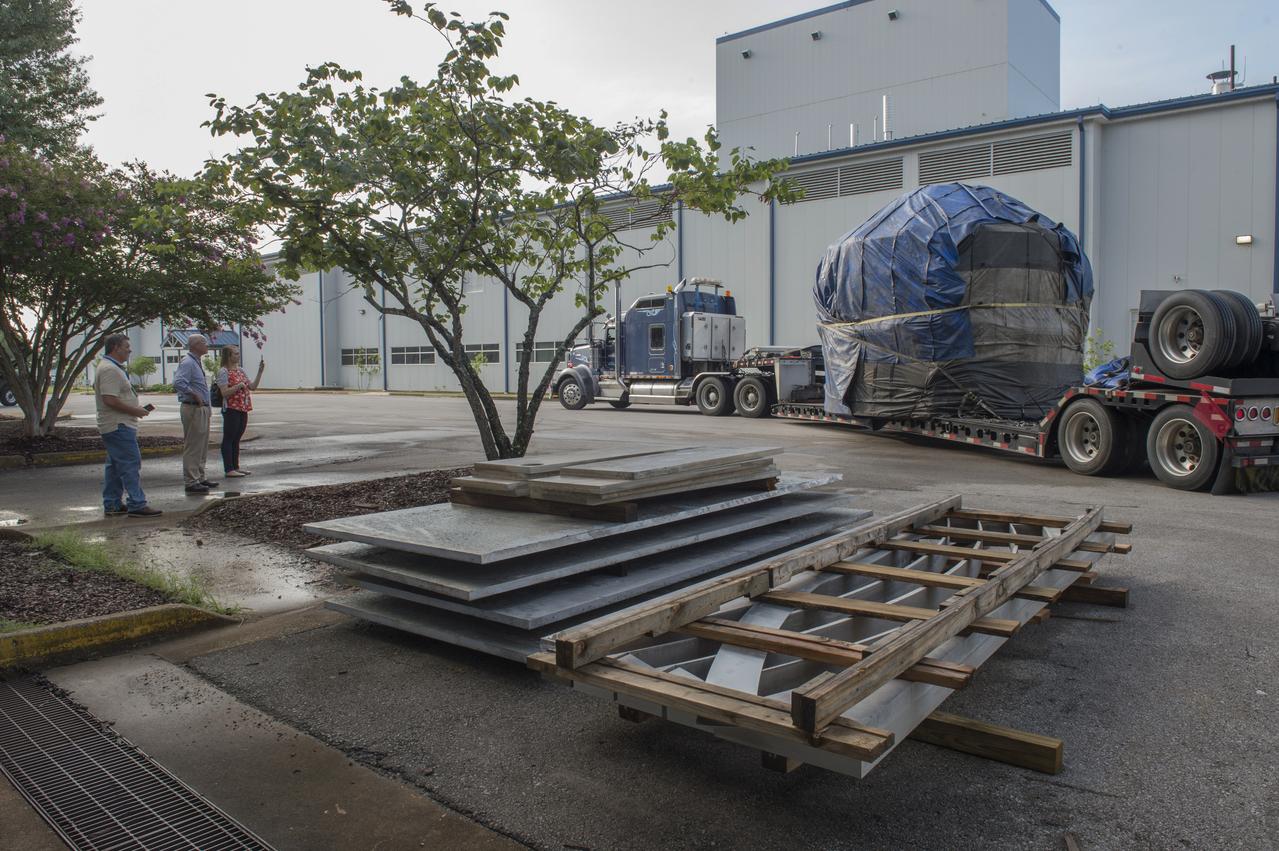
SHIIVER (Structural Heat Intercept Insulation Vibration Evaluation Rig) is a cryogenic test tank developed to evaluate heat intercept concepts. It arrived at Marshall Space Flight Center on August 10, 2017. The tank will receive heat sensors and spray-on foam insulation before making its way to Plum Brook station for further insulation and testing.
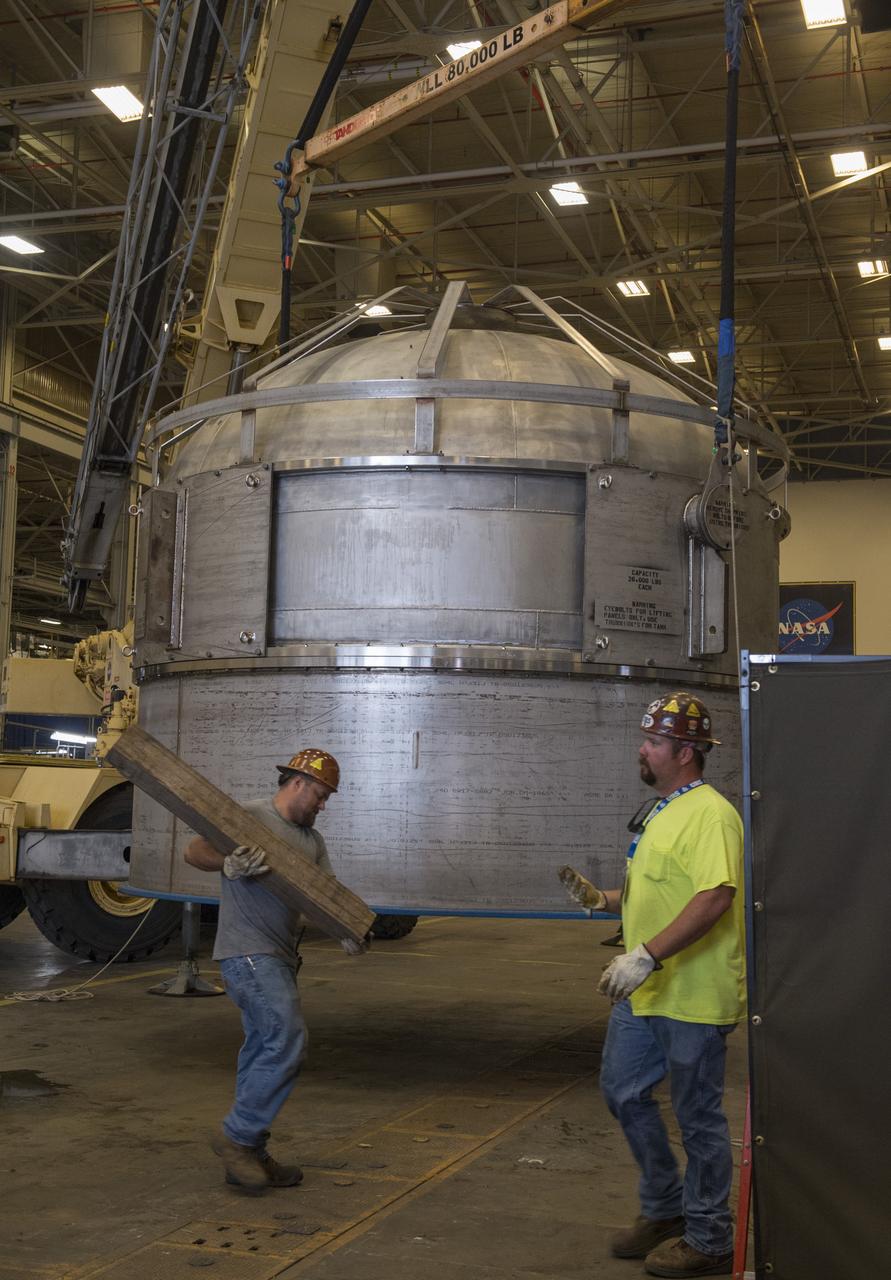
SHIIVER (Structural Heat Intercept Insulation Vibration Evaluation Rig) is a cryogenic test tank developed to evaluate heat intercept concepts. It arrived at Marshall Space Flight Center on August 10, 2017. The tank will receive heat sensors and spray-on foam insulation before making its way to Plum Brook station for further insulation and testing.
SHIIVER (Structural Heat Intercept Insulation Vibration Evaluation Rig) is a cryogenic test tank developed to evaluate heat intercept concepts. It arrived at Marshall Space Flight Center on August 10, 2017. The tank will receive heat sensors and spray-on foam insulation before making its way to Plum Brook station for further insulation and testing.
SHIIVER (Structural Heat Intercept Insulation Vibration Evaluation Rig) is a cryogenic test tank developed to evaluate heat intercept concepts. It arrived at Marshall Space Flight Center on August 10, 2017. The tank will receive heat sensors and spray-on foam insulation before making its way to Plum Brook station for further insulation and testing.
SHIIVER (Structural Heat Intercept Insulation Vibration Evaluation Rig) is a cryogenic test tank developed to evaluate heat intercept concepts. It arrived at Marshall Space Flight Center on August 10, 2017. The tank will receive heat sensors and spray-on foam insulation before making its way to Plum Brook station for further insulation and testing.
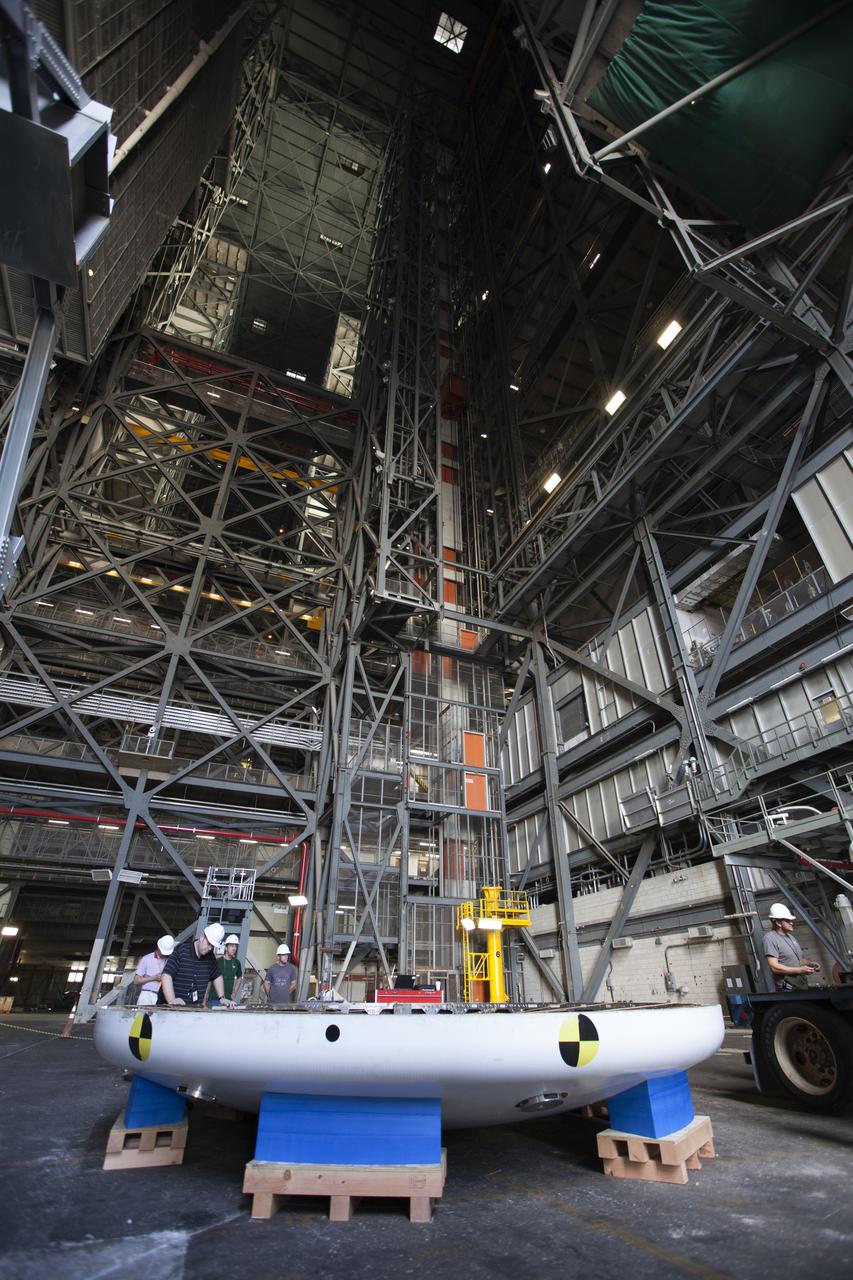
Inside High Bay 2 in the Vehicle Assembly Building (VAB) at NASA's Kennedy Space Center in Florida, the Orion heat shield from Exploration Flight Test-1 is secured on foam blocks. The heat shield is being transferred from the Orion Program to the Ground Systems Development and Operations Program, Landing and Recovery Operations. In the VAB, the heat shield will be integrated with the Orion ground test article and used for future underway recovery testing.
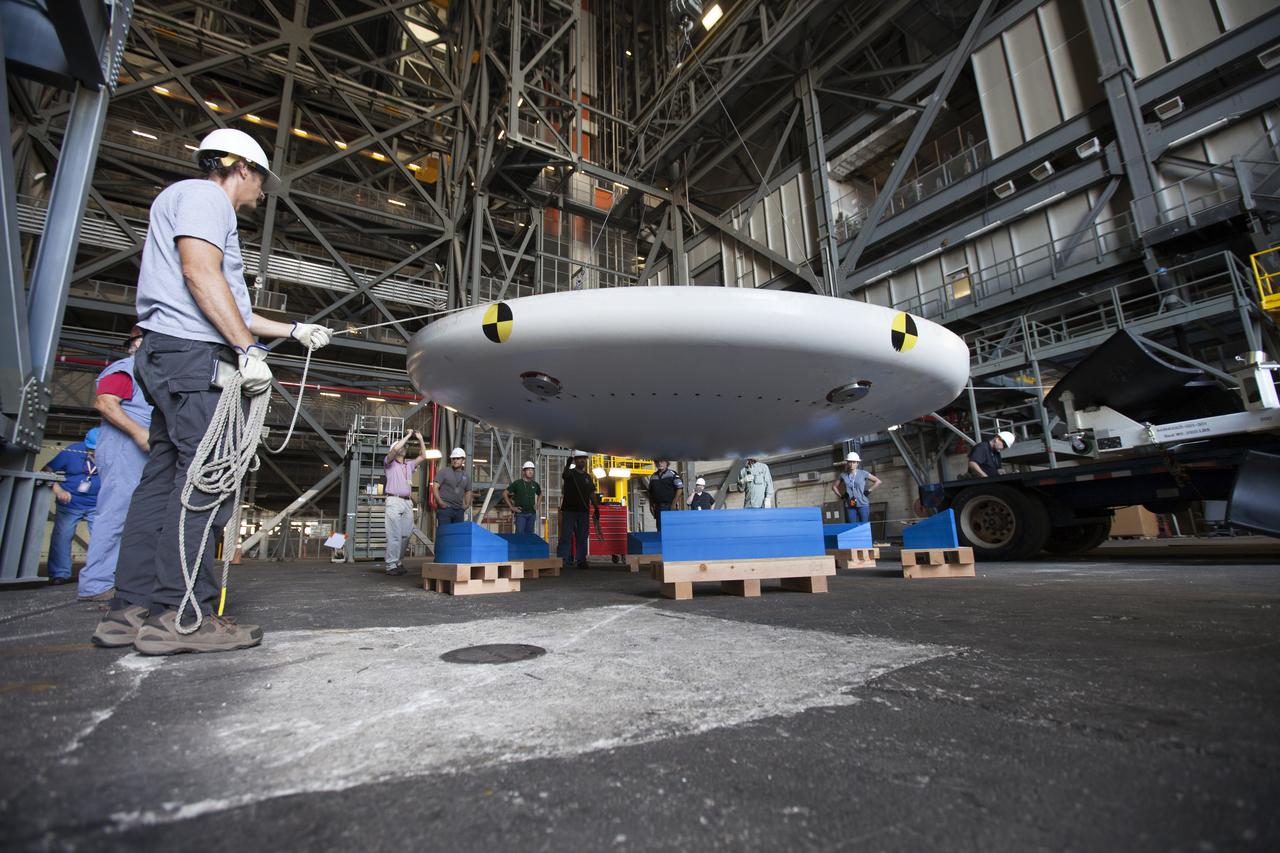
Inside High Bay 2 in the Vehicle Assembly Building (VAB) at NASA's Kennedy Space Center in Florida, workers monitor the progress as a crane lowers the Orion heat shield from Exploration Flight Test-1 onto foam blocks. The heat shield is being transferred from the Orion Program to the Ground Systems Development and Operations Program, Landing and Recovery Operations. In the VAB, the heat shield will be integrated with the Orion ground test article and used for future underway recovery testing.
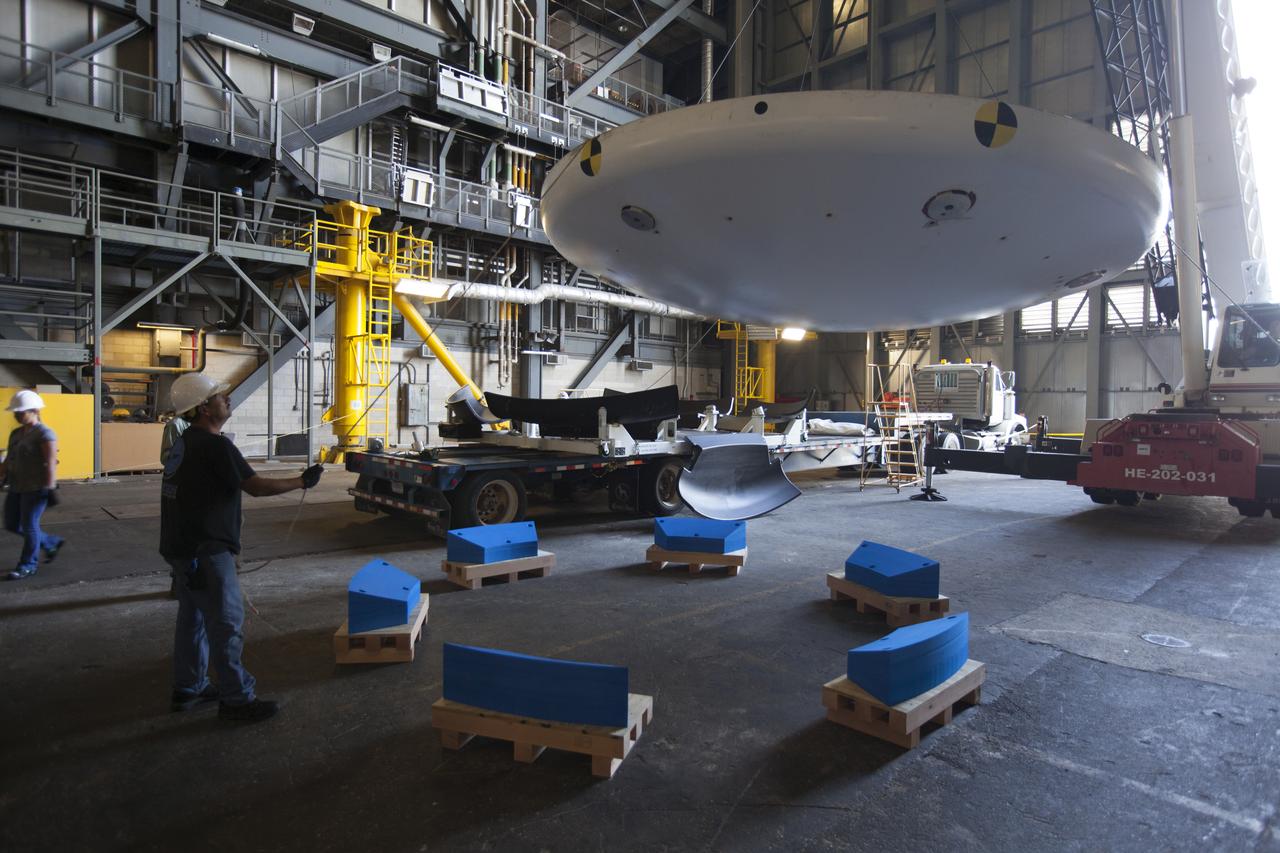
Inside High Bay 2 in the Vehicle Assembly Building (VAB) at NASA's Kennedy Space Center in Florida, a worker monitors the progress as a crane lowers the Orion heat shield from Exploration Flight Test-1 onto foam blocks. The heat shield is being transferred from the Orion Program to the Ground Systems Development and Operations Program, Landing and Recovery Operations. In the VAB, the heat shield will be integrated with the Orion ground test article and used for future underway recovery testing.
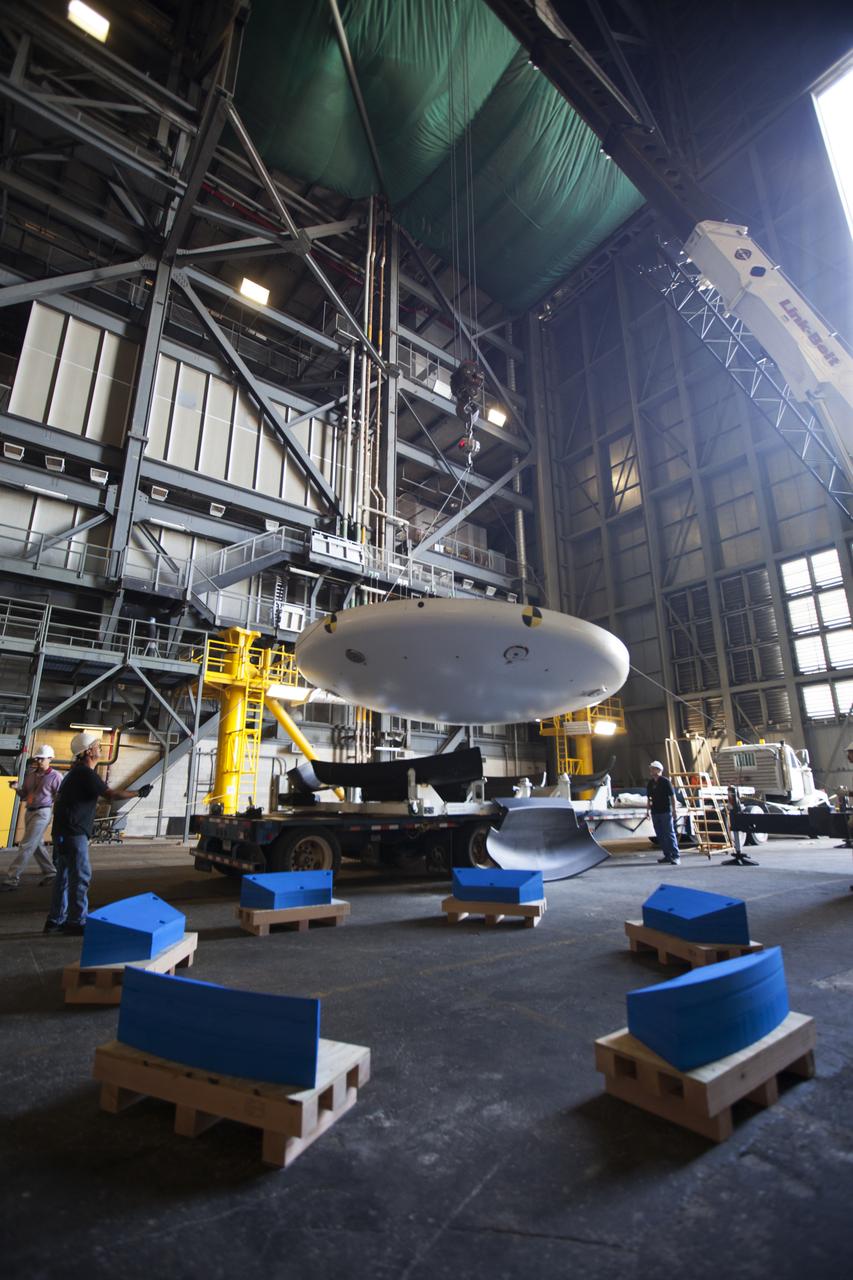
Inside High Bay 2 in the Vehicle Assembly Building (VAB) at NASA's Kennedy Space Center in Florida, a crane lifts the Orion heat shield from Exploration Flight Test-1 up off its transporter. It will be lowered onto foam blocks. The heat shield is being transferred from the Orion Program to the Ground Systems Development and Operations Program, Landing and Recovery Operations. In the VAB, the heat shield will be integrated with the Orion ground test article and used for future underway recovery testing.
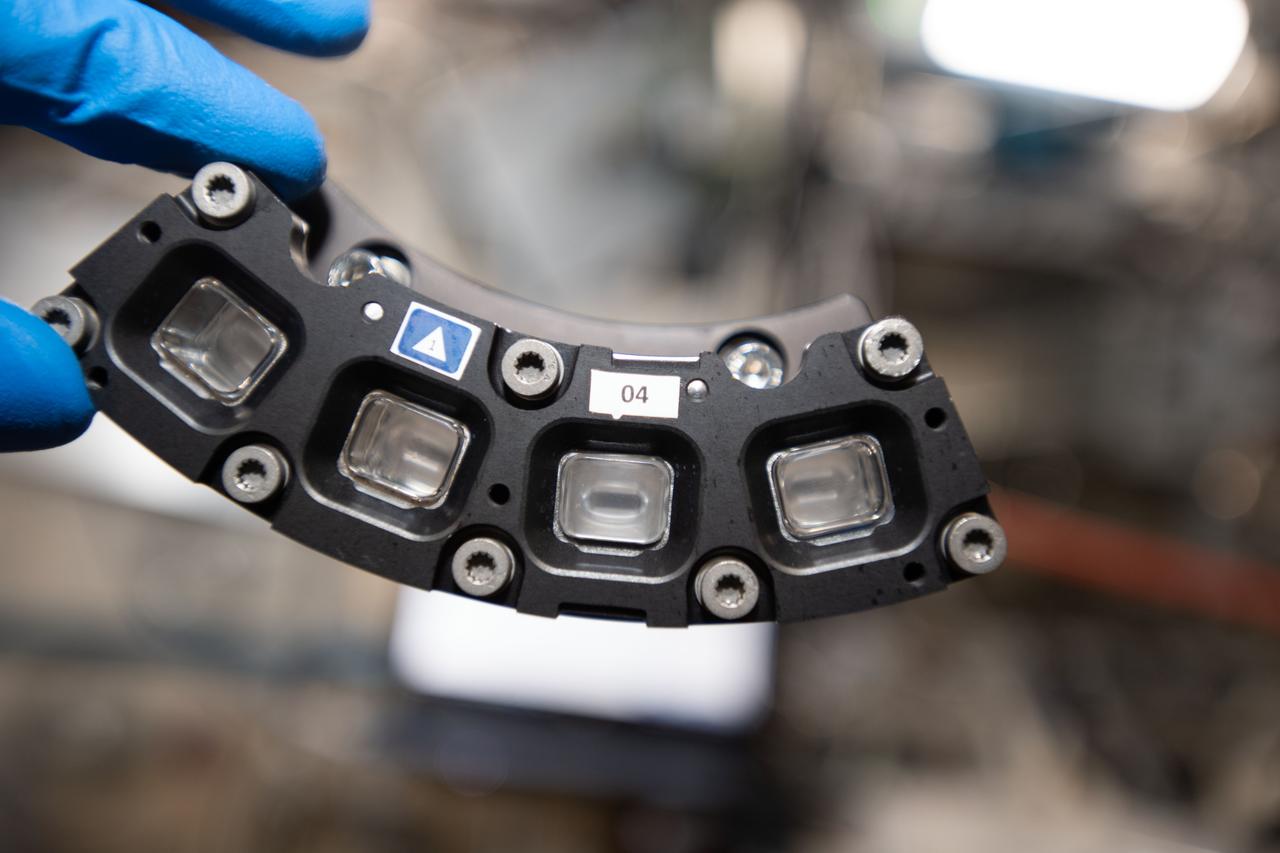
iss062e141213 (4/11/2020) --- A view of the FSL Soft Matter Dynamics - FOAM sample cell in the Columbus module aboard the International Space Station (ISS). FSL Soft Matter Dynamics - Hydrodynamics of Wet Foams (Foam Coarsening) aims to study aqueous and non-aqueous foams in the microgravity environment of the ISS.
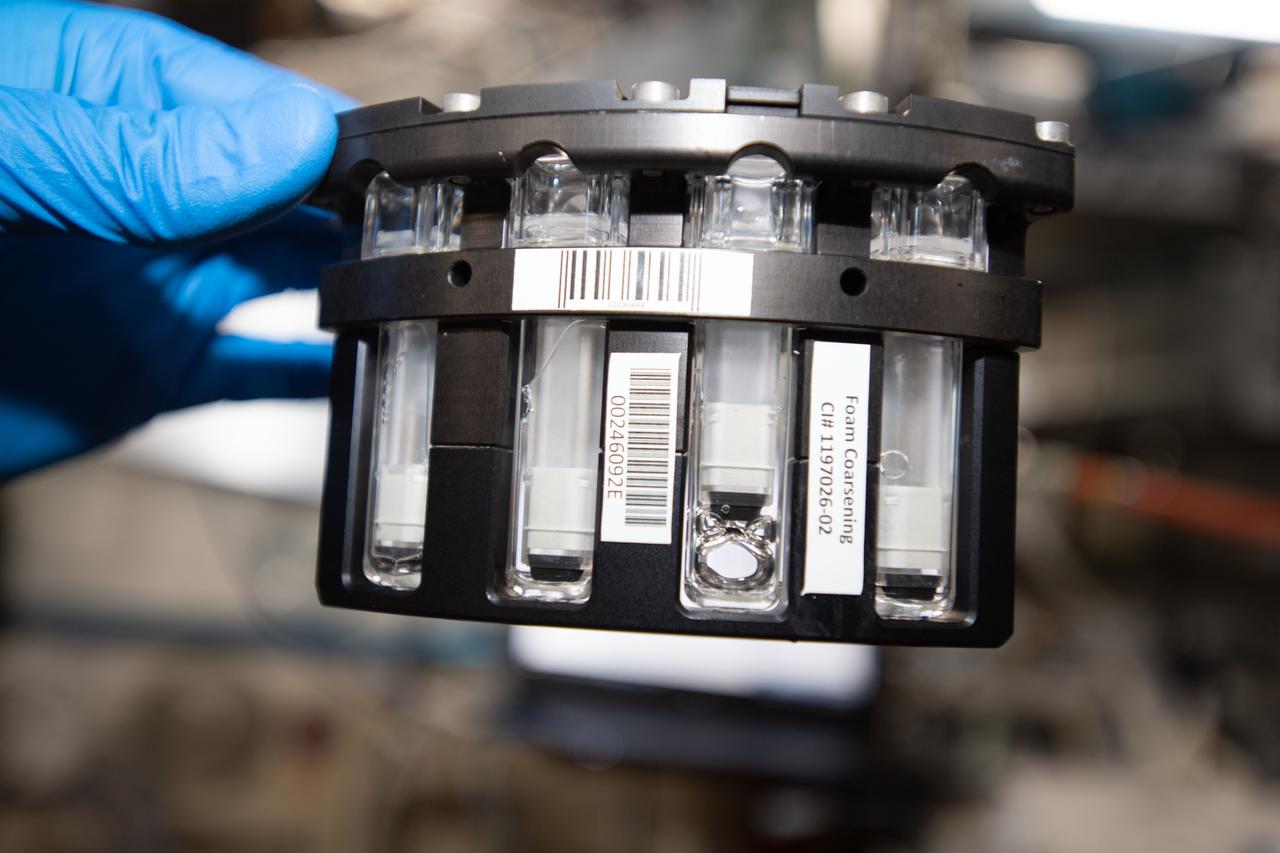
iss062e141209 (4/11/2020) --- A view of the FSL Soft Matter Dynamics - FOAM sample cell in the Columbus module aboard the International Space Station (ISS). FSL Soft Matter Dynamics - Hydrodynamics of Wet Foams (Foam Coarsening) aims to study aqueous and non-aqueous foams in the microgravity environment of the ISS.
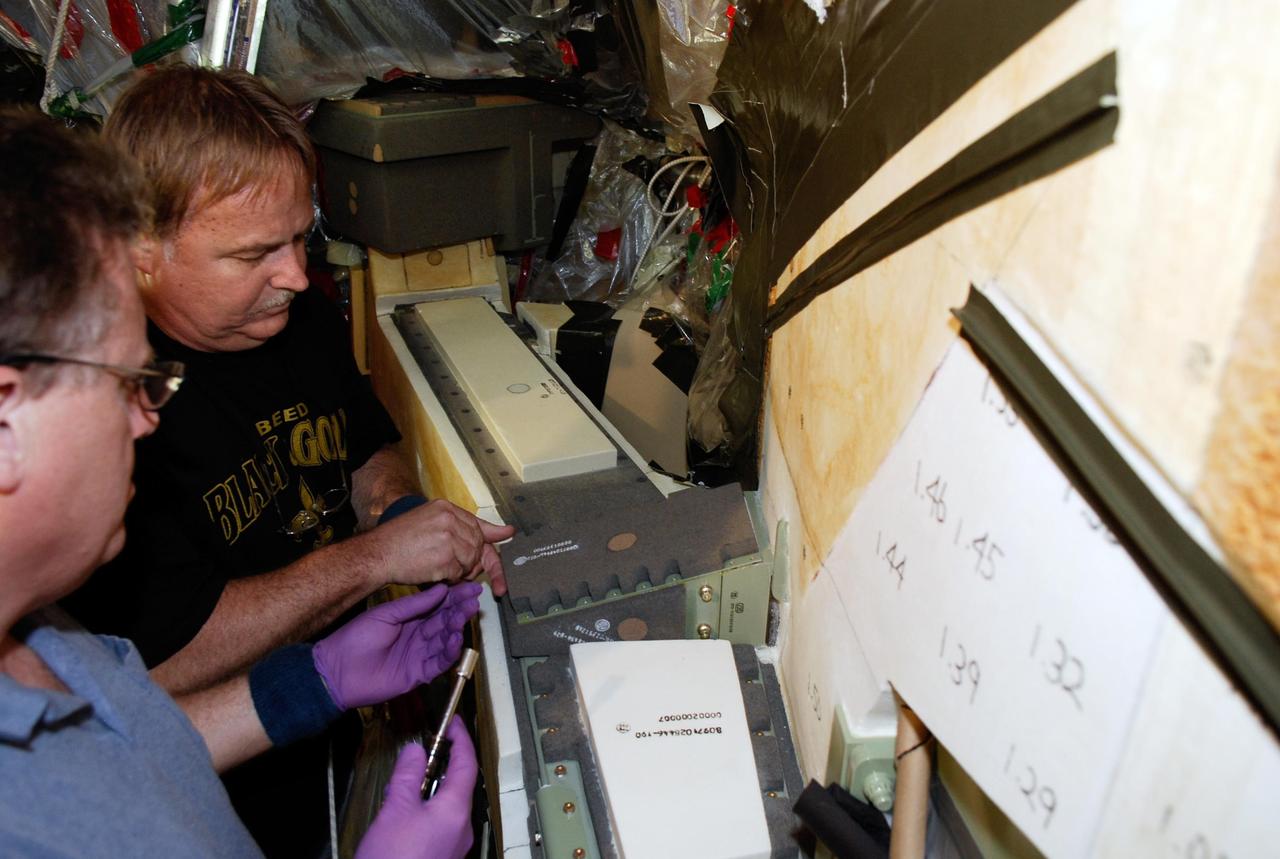
KENNEDY SPACE CENTER, FLA. -- On Launch Pad 39A at NASA's Kennedy Space Center, a technician begins attaching the cover over the engine cutoff, or ECO, sensor system connector and wiring on space shuttle Atlantis' external tank. The feed-through connector passes the wires from the inside of the tank to the outside. Results of a tanking test on Dec. 18 pointed to an open circuit in the feed-through connector wiring, which is located at the base of the tank. The pins in the replacement connector were precisely soldered to create a connection that allows sensors inside the tank to send signals to the computers onboard Atlantis. The launch date for the shuttle's STS-122 mission has now been targeted for Feb. 7. Photo credit: NASA/Kim Shiflett
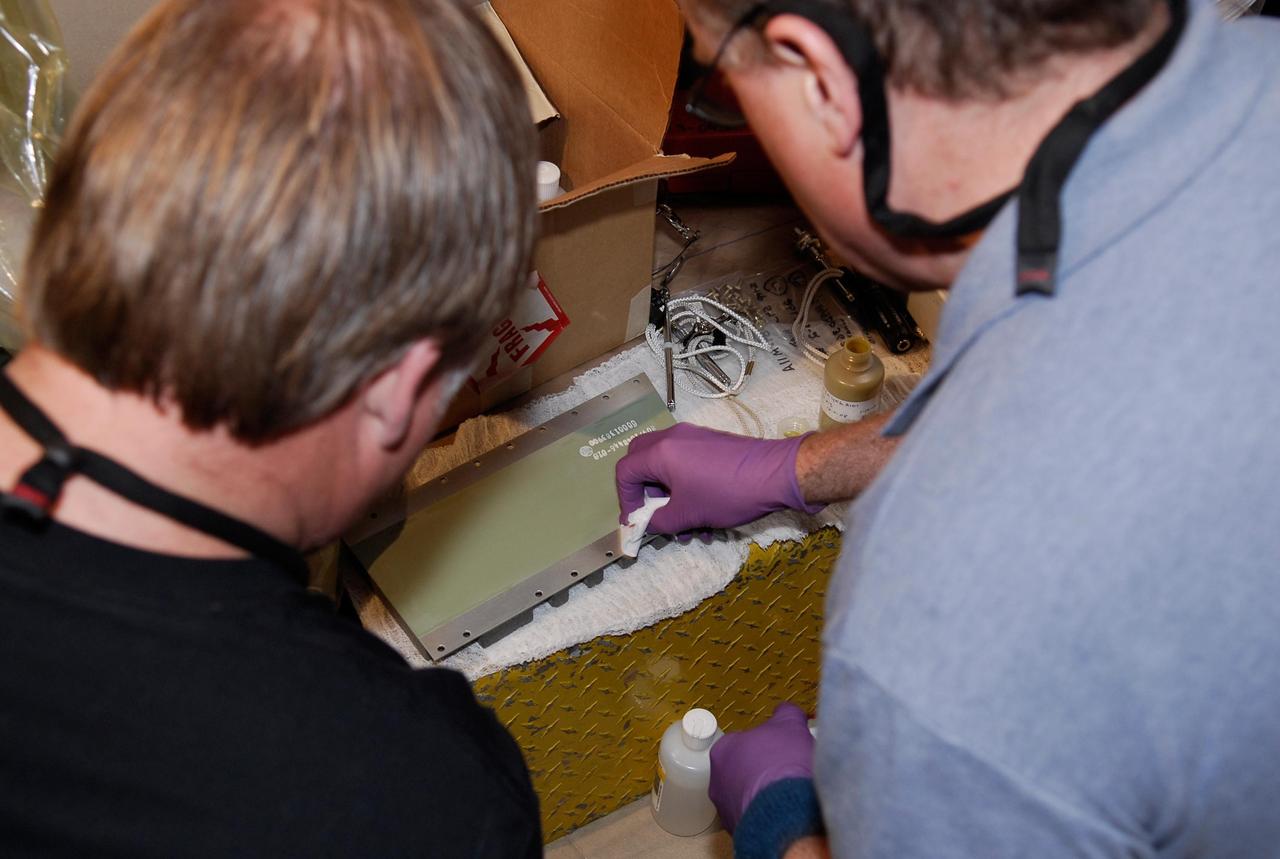
KENNEDY SPACE CENTER, FLA. -- On Launch Pad 39A at NASA's Kennedy Space Center, technicians prepare the cover to be installed over the engine cutoff, or ECO, sensor system connector and wiring on space shuttle Atlantis' external tank. The feed-through connector passes the wires from the inside of the tank to the outside. Results of a tanking test on Dec. 18 pointed to an open circuit in the feed-through connector wiring, which is located at the base of the tank. The pins in the replacement connector were precisely soldered to create a connection that allows sensors inside the tank to send signals to the computers onboard Atlantis. The launch date for the shuttle's STS-122 mission has now been targeted for Feb. 7. Photo credit: NASA/Kim Shiflett
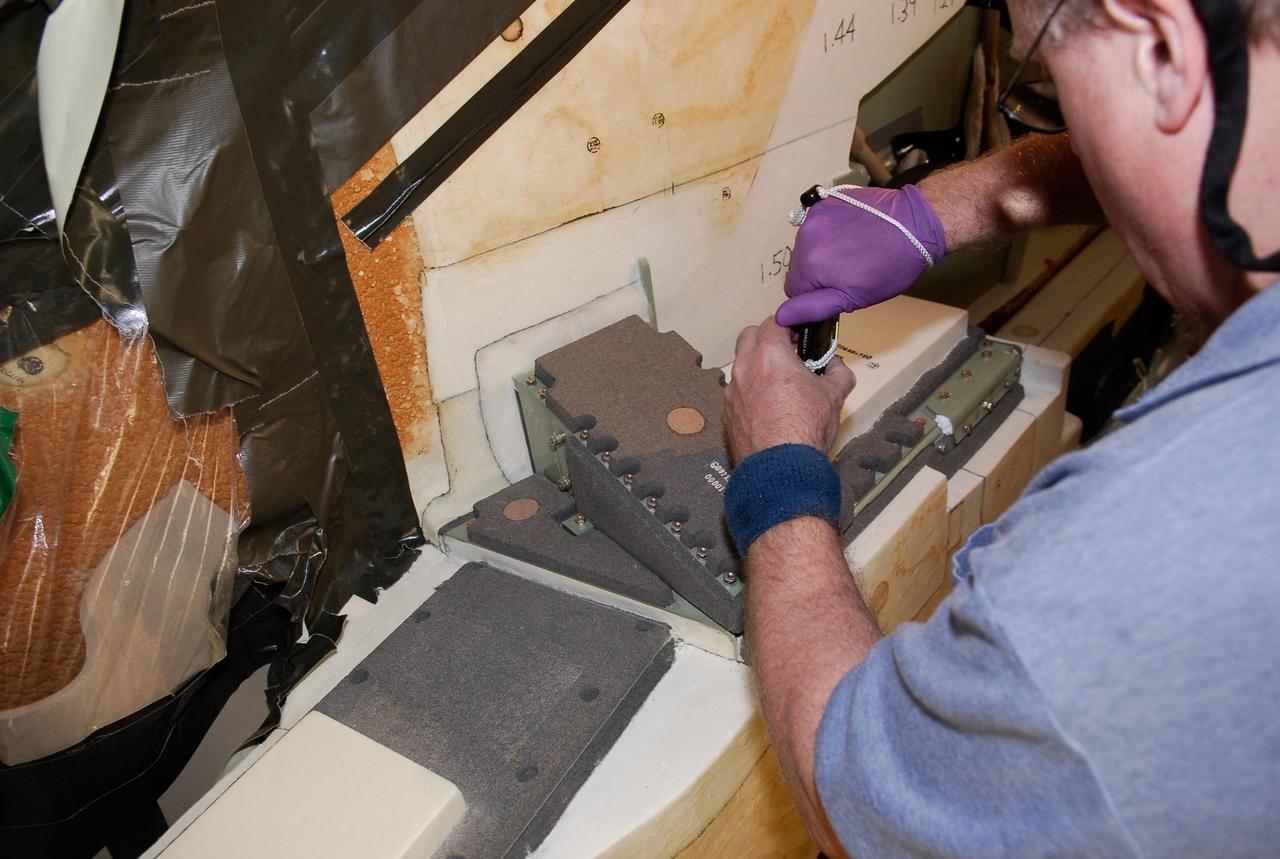
KENNEDY SPACE CENTER, FLA. -- On Launch Pad 39A at NASA's Kennedy Space Center, a technician completes installing the cover over the engine cutoff, or ECO, sensor system connector and wiring on space shuttle Atlantis' external tank. The feed-through connector passes the wires from the inside of the tank to the outside. Results of a tanking test on Dec. 18 pointed to an open circuit in the feed-through connector wiring, which is located at the base of the tank. The pins in the replacement connector were precisely soldered to create a connection that allows sensors inside the tank to send signals to the computers onboard Atlantis. The launch date for the shuttle's STS-122 mission has now been targeted for Feb. 7. Photo credit: NASA/Kim Shiflett
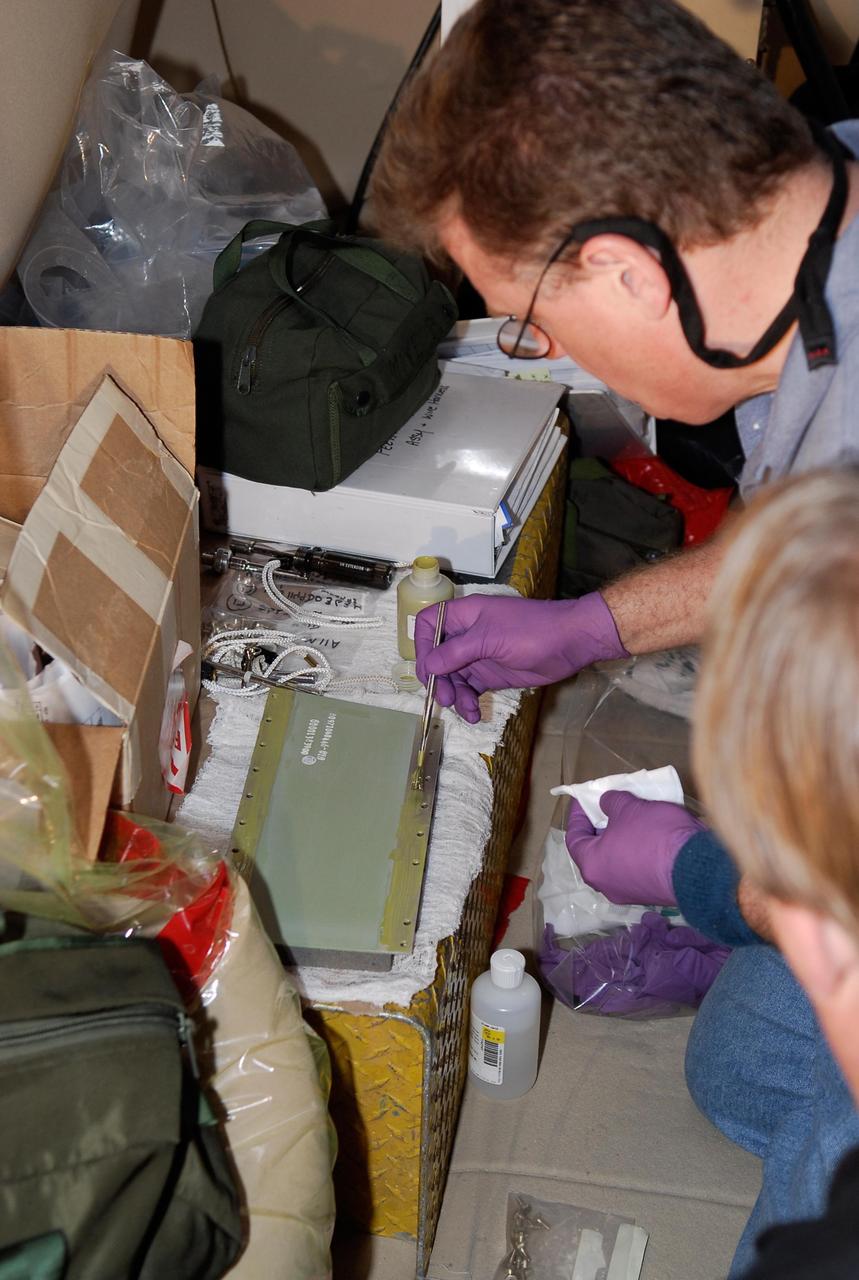
KENNEDY SPACE CENTER, FLA. -- On Launch Pad 39A at NASA's Kennedy Space Center, technicians prepare the cover to be installed over the engine cutoff, or ECO, sensor system connector and wiring on space shuttle space shuttle Atlantis' external tank. The feed-through connector passes the wires from the inside of the tank to the outside. Results of a tanking test on Dec. 18 pointed to an open circuit in the feed-through connector wiring, which is located at the base of the tank. The pins in the replacement connector were precisely soldered to create a connection that allows sensors inside the tank to send signals to the computers onboard Atlantis. The launch date for the shuttle's STS-122 mission has now been targeted for Feb. 7. Photo credit: NASA/Kim Shiflett
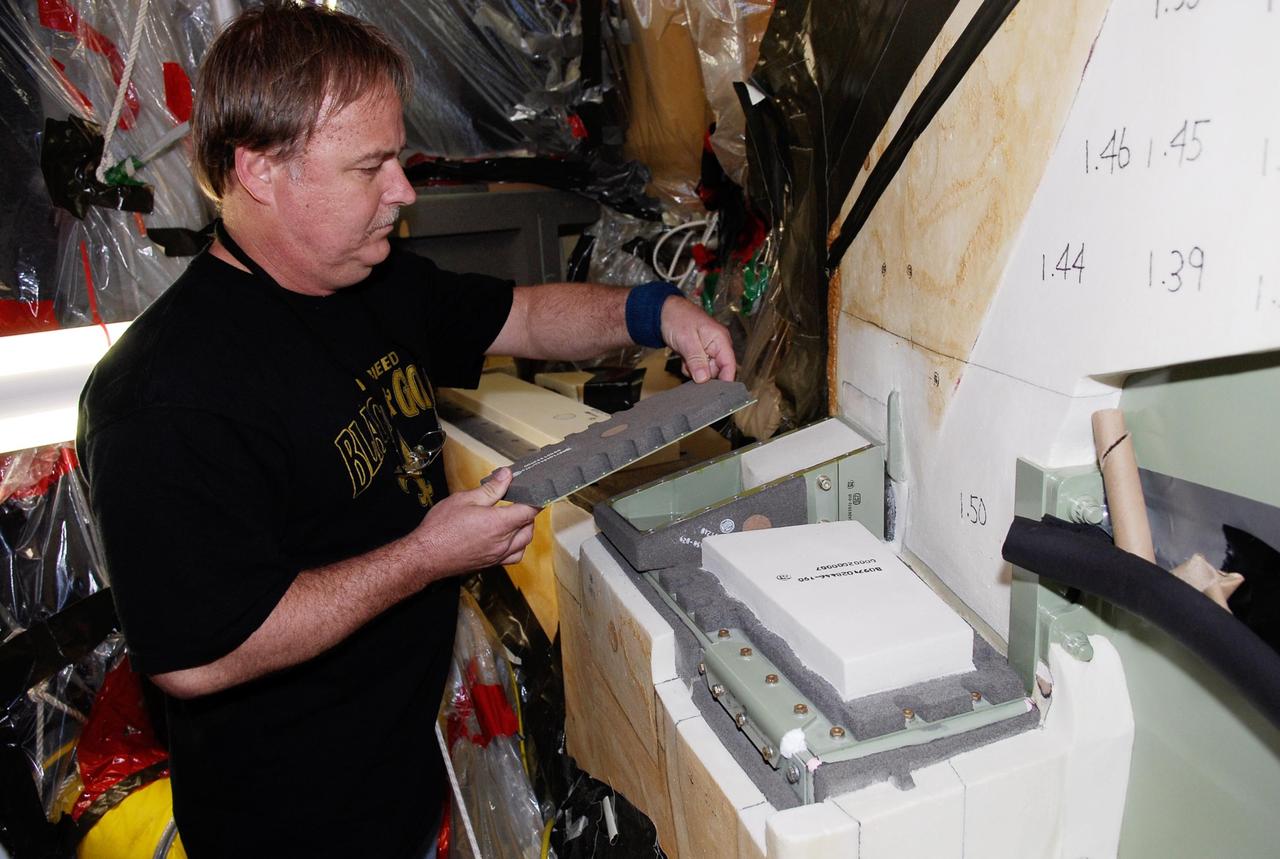
KENNEDY SPACE CENTER, FLA. -- On Launch Pad 39A at NASA's Kennedy Space Center, a technician gets ready to place the cover over the engine cutoff, or ECO, sensor system connector and wiring on space shuttle Atlantis' external tank. The feed-through connector passes the wires from the inside of the tank to the outside. Results of a tanking test on Dec. 18 pointed to an open circuit in the feed-through connector wiring, which is located at the base of the tank. The pins in the replacement connector were precisely soldered to create a connection that allows sensors inside the tank to send signals to the computers onboard Atlantis. The launch date for the shuttle's STS-122 mission has now been targeted for Feb. 7. Photo credit: NASA/Kim Shiflett
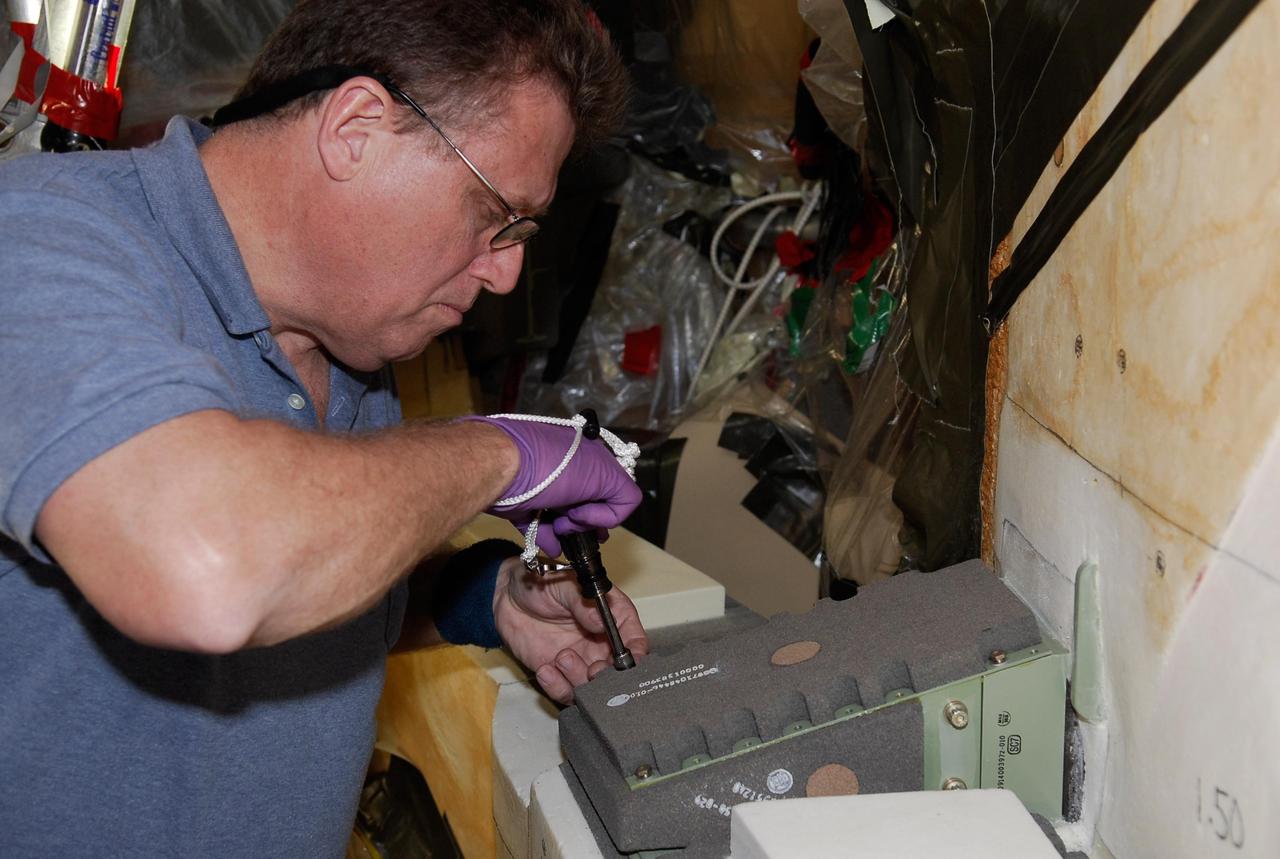
KENNEDY SPACE CENTER, FLA. -- On Launch Pad 39A at NASA's Kennedy Space Center, a technician attaches the cover over the engine cutoff, or ECO, sensor system connector and wiring on space shuttle Atlantis' external tank. The feed-through connector passes the wires from the inside of the tank to the outside. Results of a tanking test on Dec. 18 pointed to an open circuit in the feed-through connector wiring, which is located at the base of the tank. The pins in the replacement connector were precisely soldered to create a connection that allows sensors inside the tank to send signals to the computers onboard Atlantis. The launch date for the shuttle's STS-122 mission has now been targeted for Feb. 7. Photo credit: NASA/Kim Shiflett
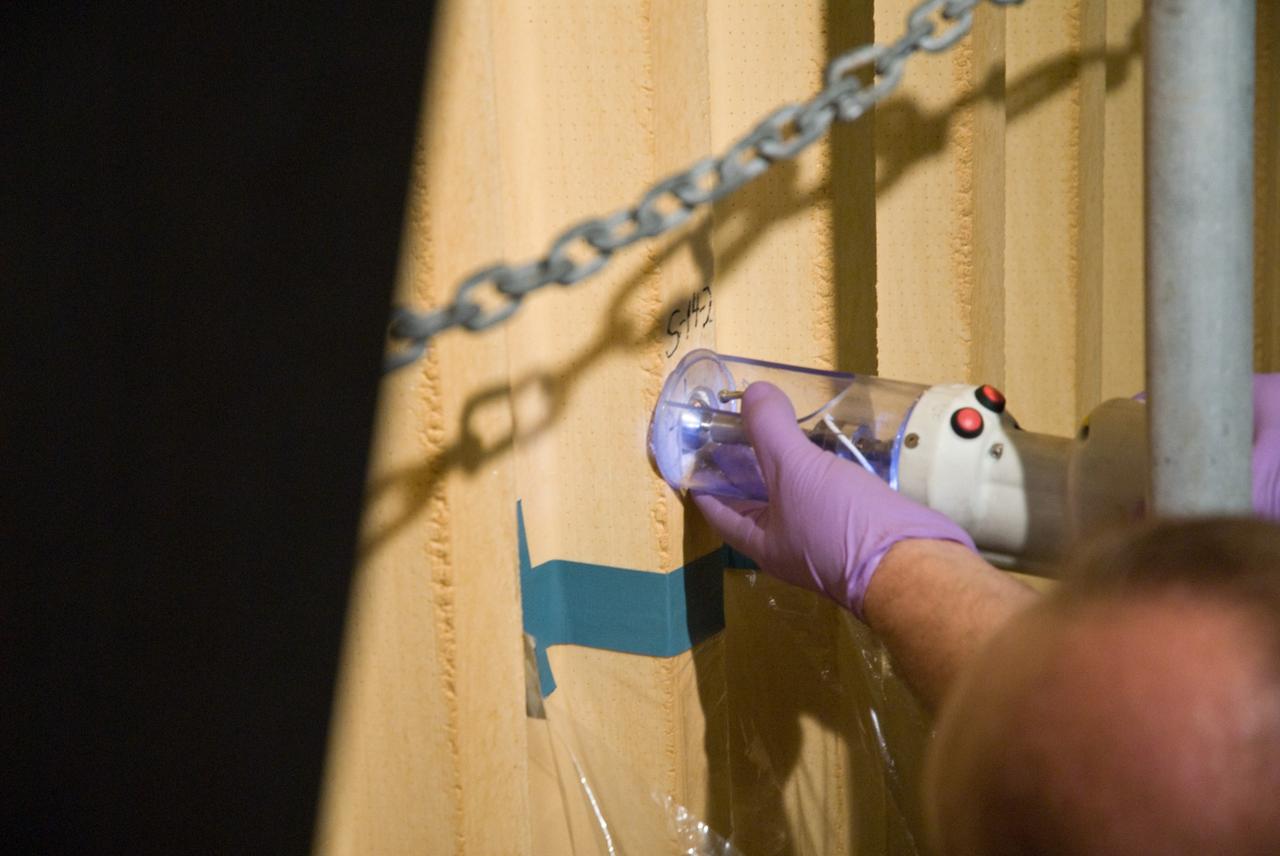
CAPE CANAVERAL, Fla. – In the Vehicle Assembly Building's High Bay 1 at NASA's Kennedy Space Center in Florida, foam adhesion is being tested on the intertank of space shuttle Discovery's external tank. Foam samples an inch-and-half in diameter are being collected for analysis to confirm the foam is bonded well to the metal primer underneath. The testing was prompted by the foam loss during launch of space shuttle Endeavour on the STS-127 mission July 15. Samples are being sent to Michoud for study. Photo credit: NASA/Tim Jacobs
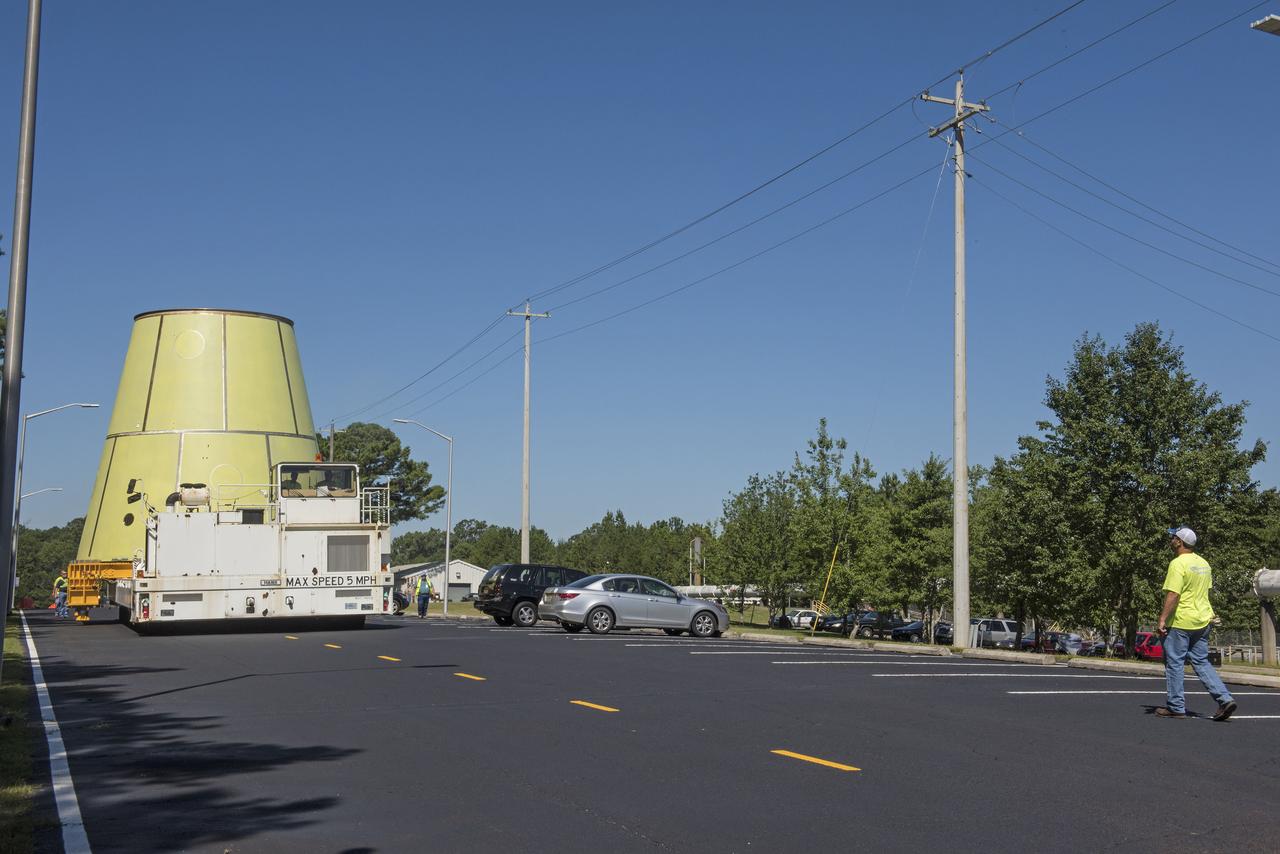
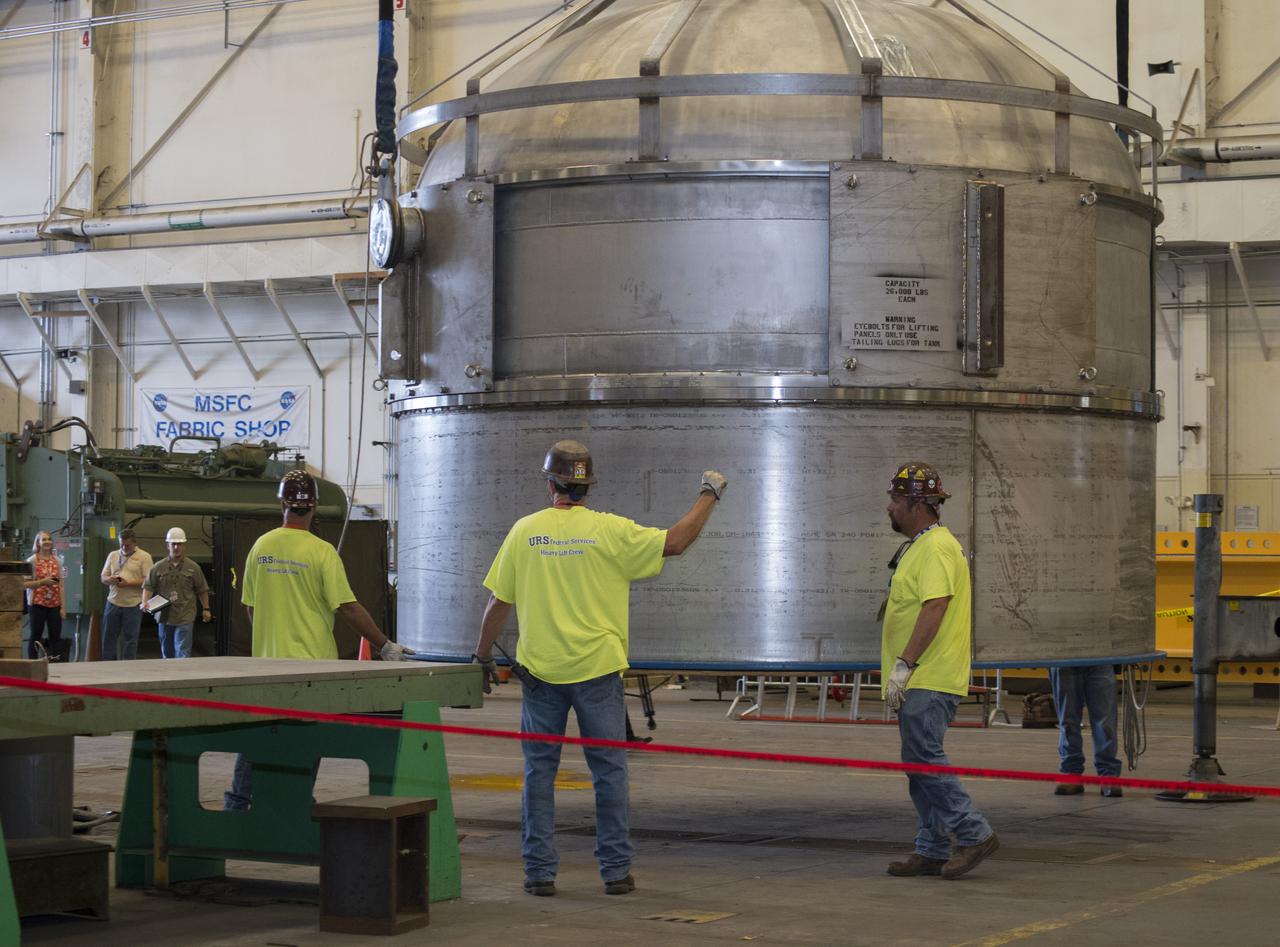
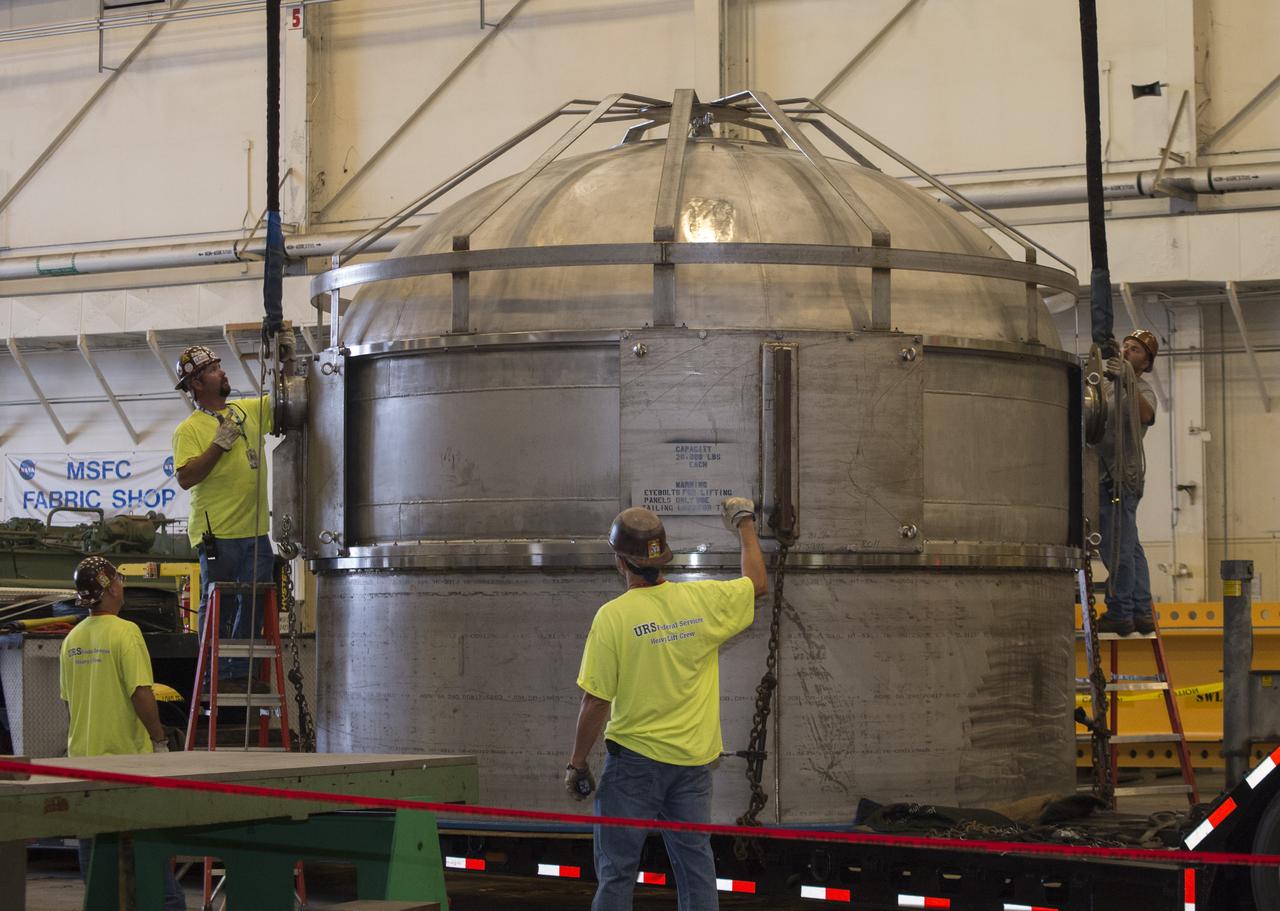
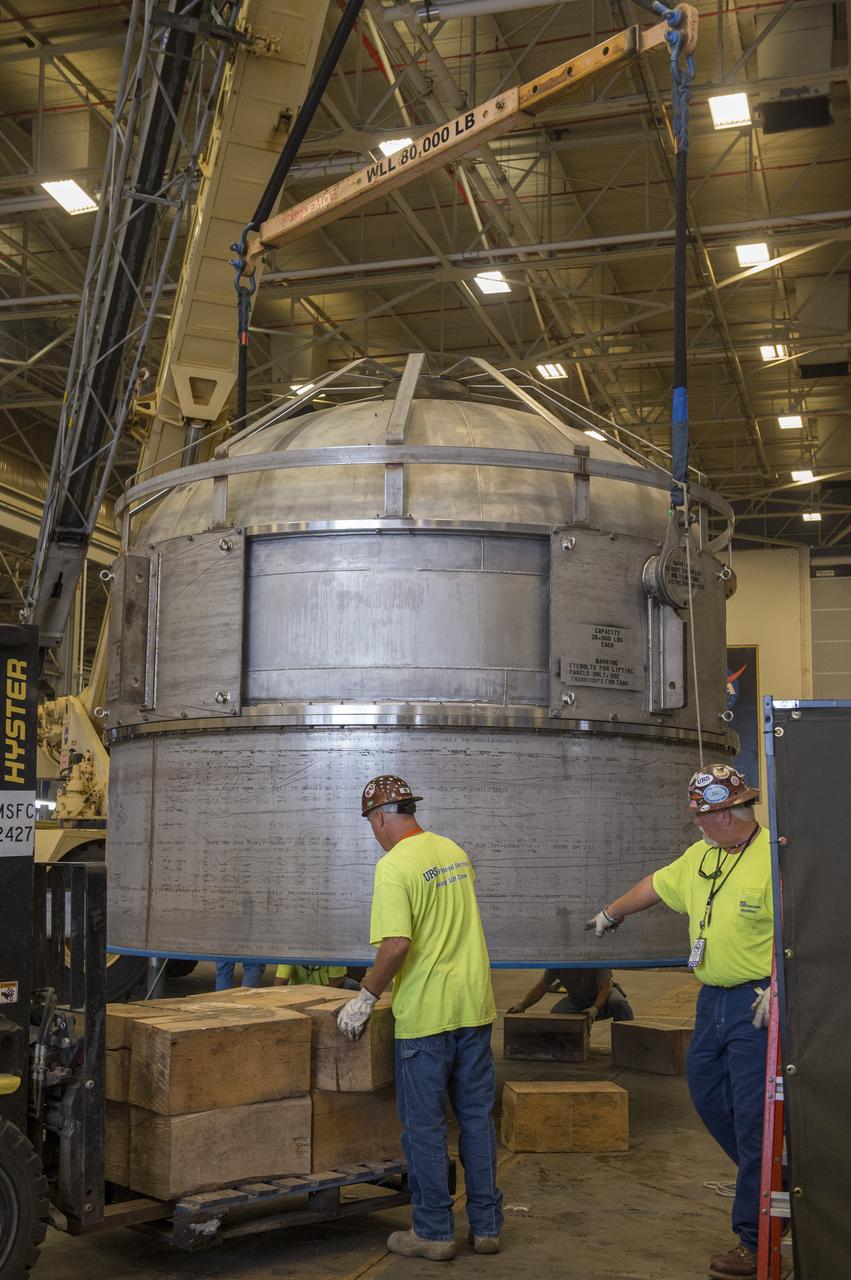
The SLS stage adapter being moved to it's new location from the MSFC Friction Stir Welding lab. This flight article will be sprayed with foam prior to shipment to its next location
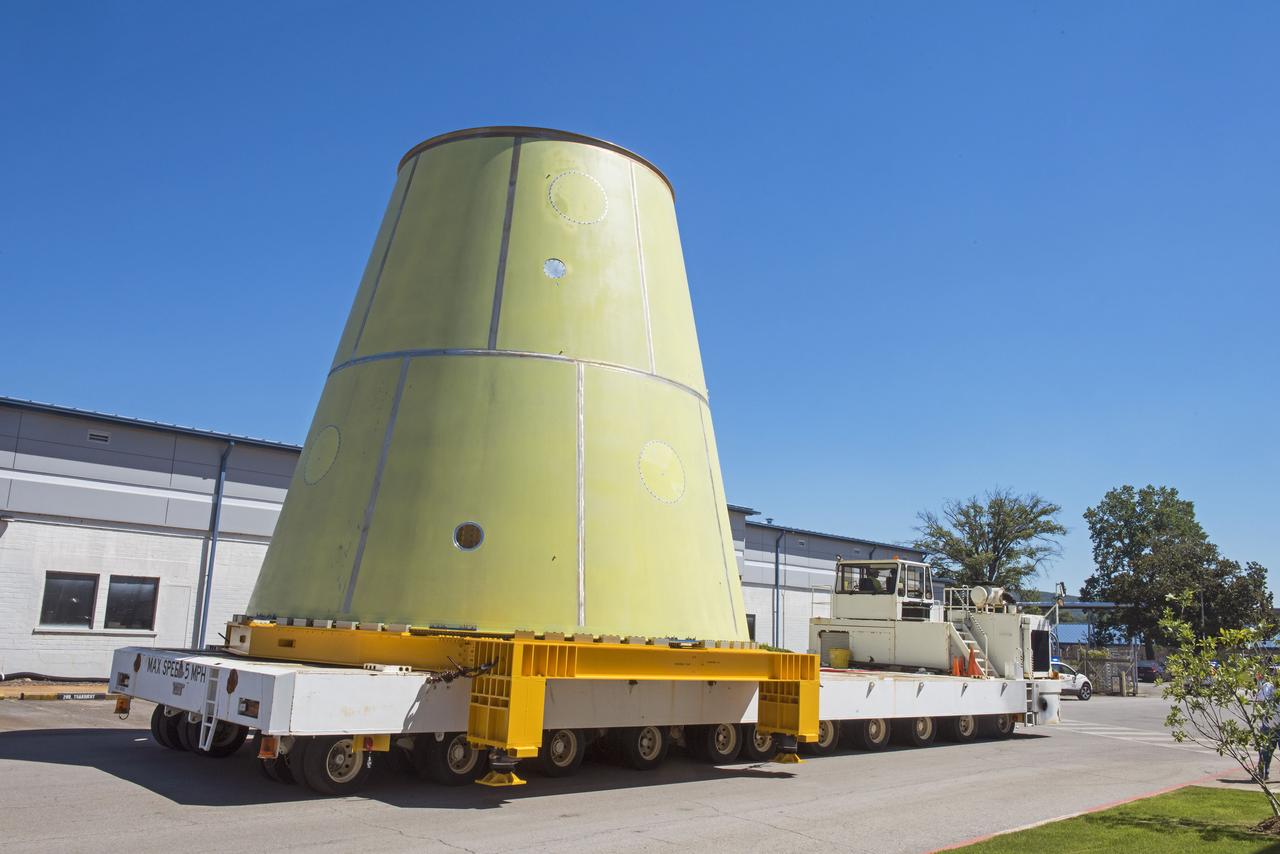
The SLS stage adapter being moved to it's new location from the MSFC Friction Stir Welding lab. This flight article will be sprayed with foam prior to shipment to its next location
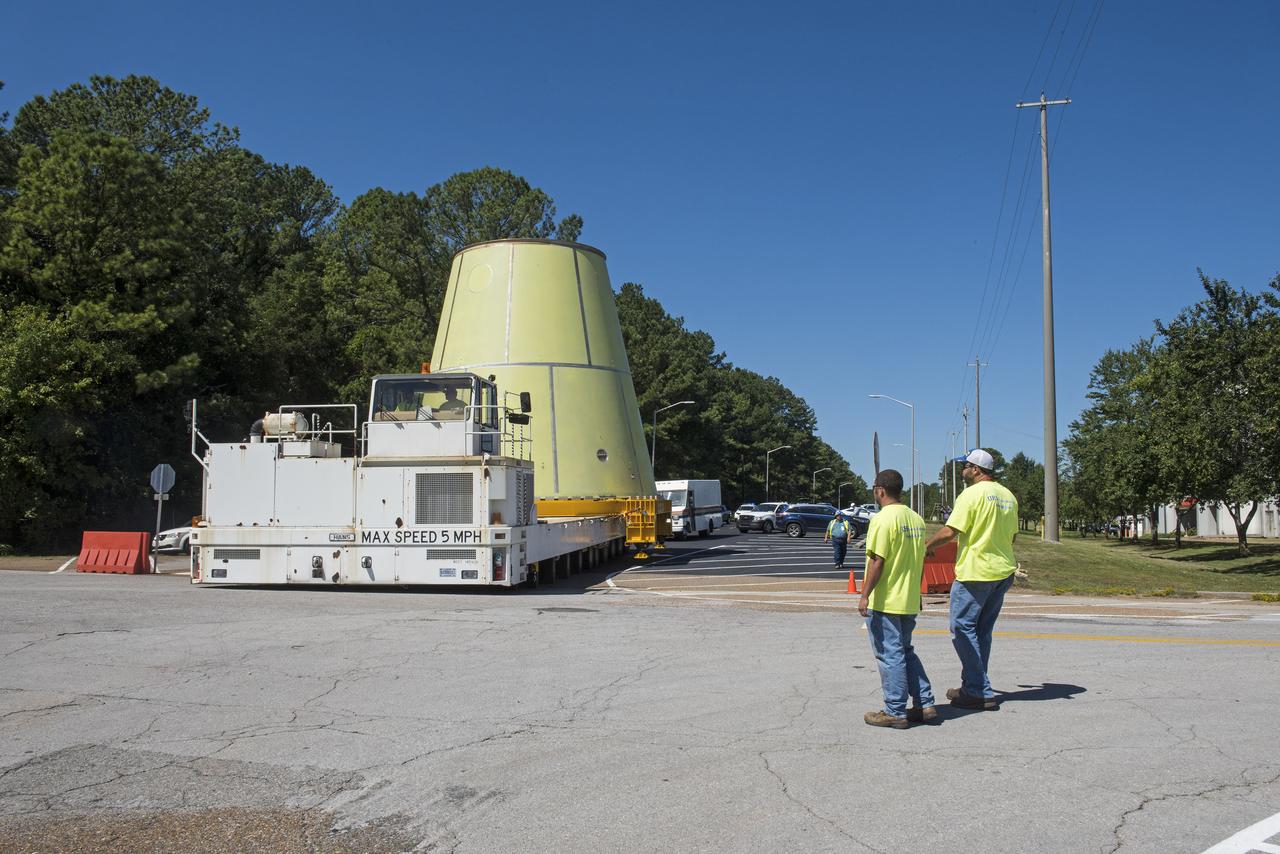
The SLS stage adapter being moved to it's new location from the MSFC Friction Stir Welding lab. This flight article will be sprayed with foam prior to shipment to its next location
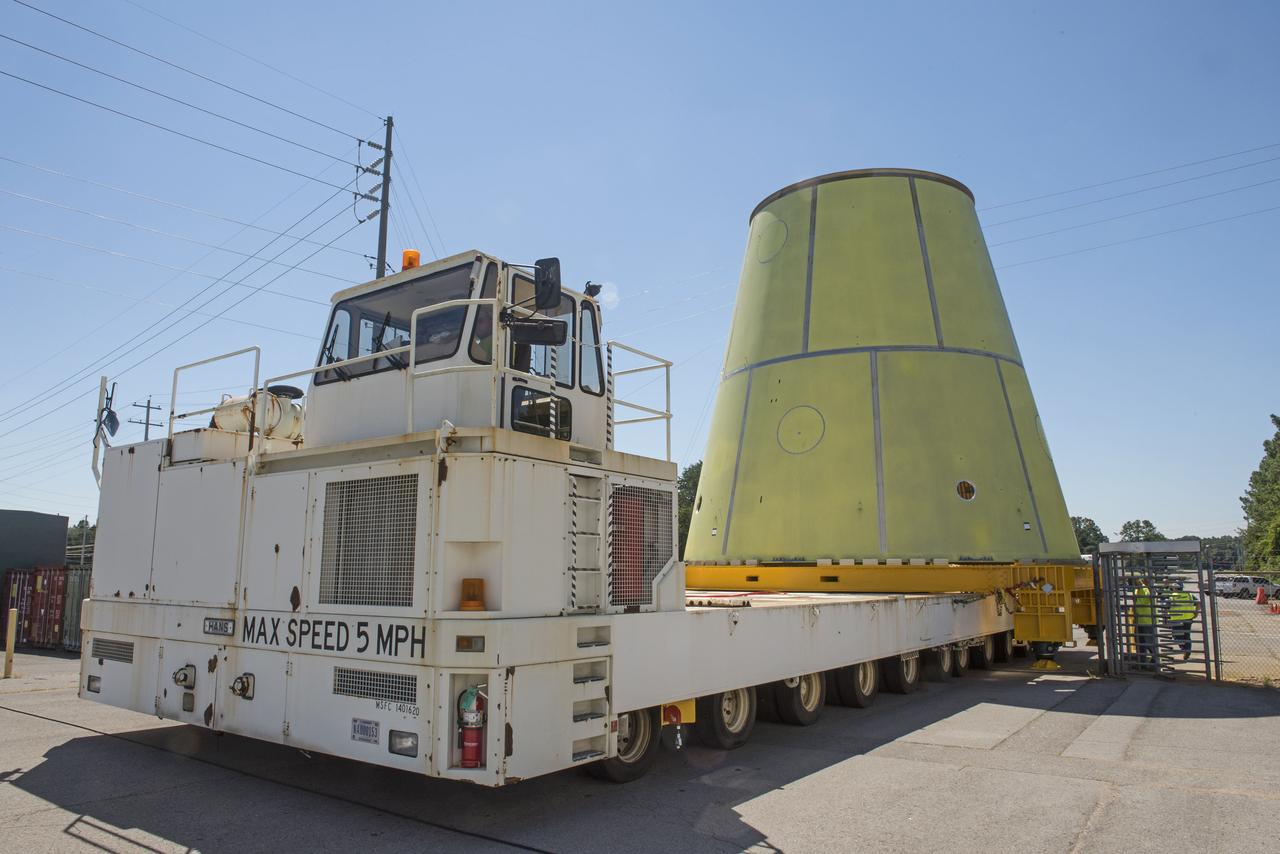
The SLS stage adapter being moved to it's new location from the MSFC Friction Stir Welding lab. This flight article will be sprayed with foam prior to shipment to its next location
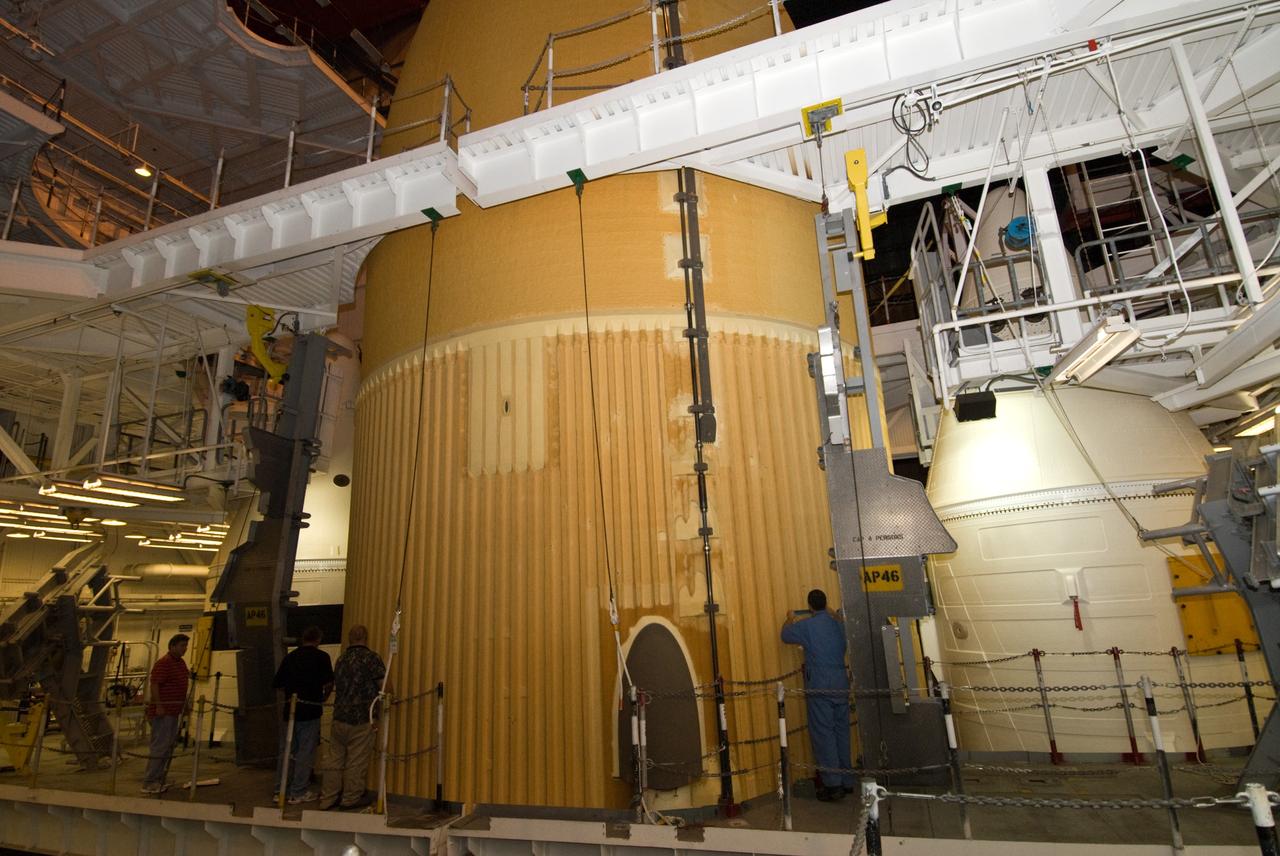
CAPE CANAVERAL, Fla. – In the Vehicle Assembly Building's High Bay 1 at NASA's Kennedy Space Center in Florida, workers begin "pull plug testing" on foam adhesion from the intertank of space shuttle Discovery's external tank. They are collecting 26 foam samples an inch-and-half in diameter for analysis to confirm the foam is bonded well to the metal primer underneath. The testing was prompted by the foam loss during launch of space shuttle Endeavour on the STS-127 mission July 15. Samples are being sent to Michoud for study. Photo credit: NASA/Tim Jacobs
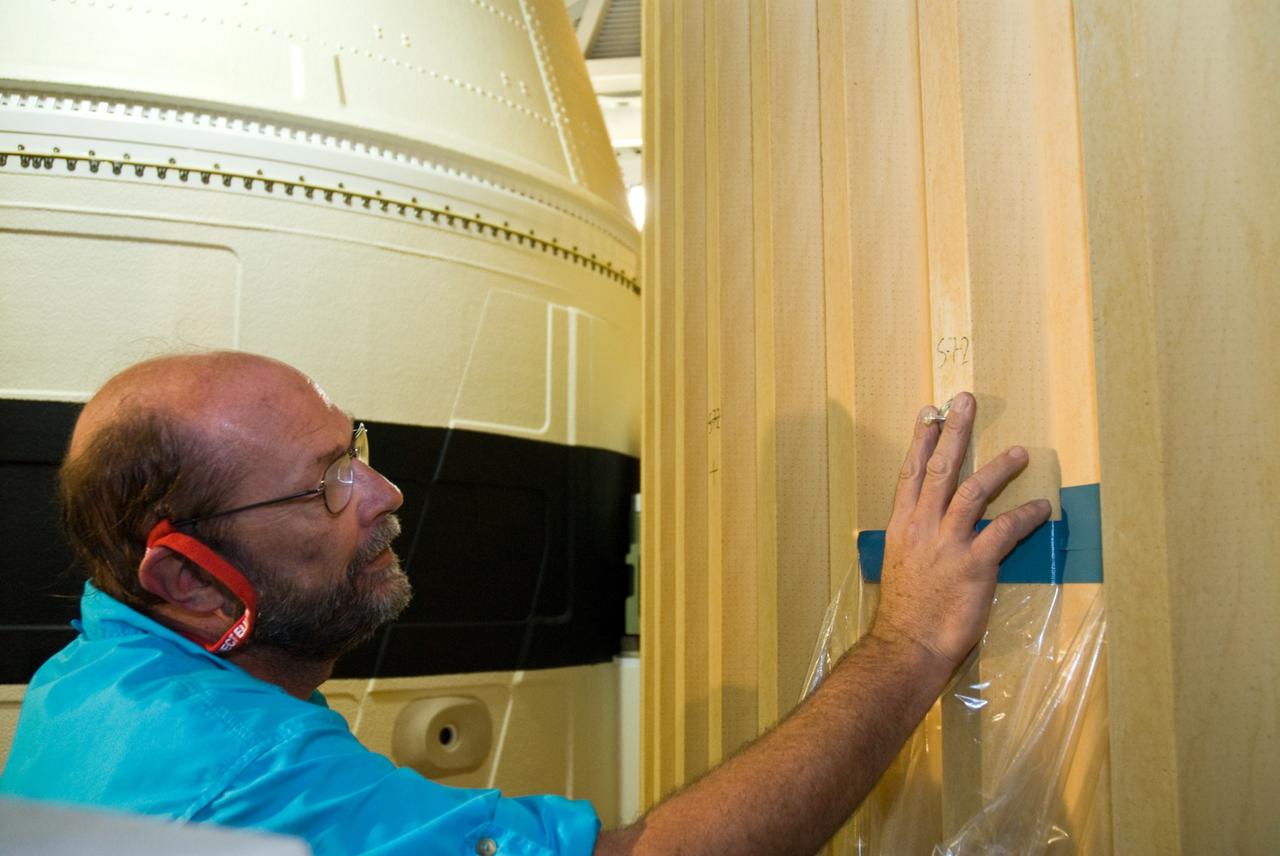
CAPE CANAVERAL, Fla. – In the Vehicle Assembly Building's High Bay 1 at NASA's Kennedy Space Center in Florida, David Buras, a Material and Process engineer from NASA's Michoud Assembly Facility near New Orleans where the fuel tanks are built, is testing foam adhesion on the intertank of space shuttle Discovery's external tank . He is collecting foam samples an inch-and-half in diameter for analysis to confirm the foam is bonded well to the metal primer underneath. The testing was prompted by the foam loss during launch of space shuttle Endeavour on the STS-127 mission July 15. Samples are being sent to Michoud for study. Photo credit: NASA/Tim Jacobs
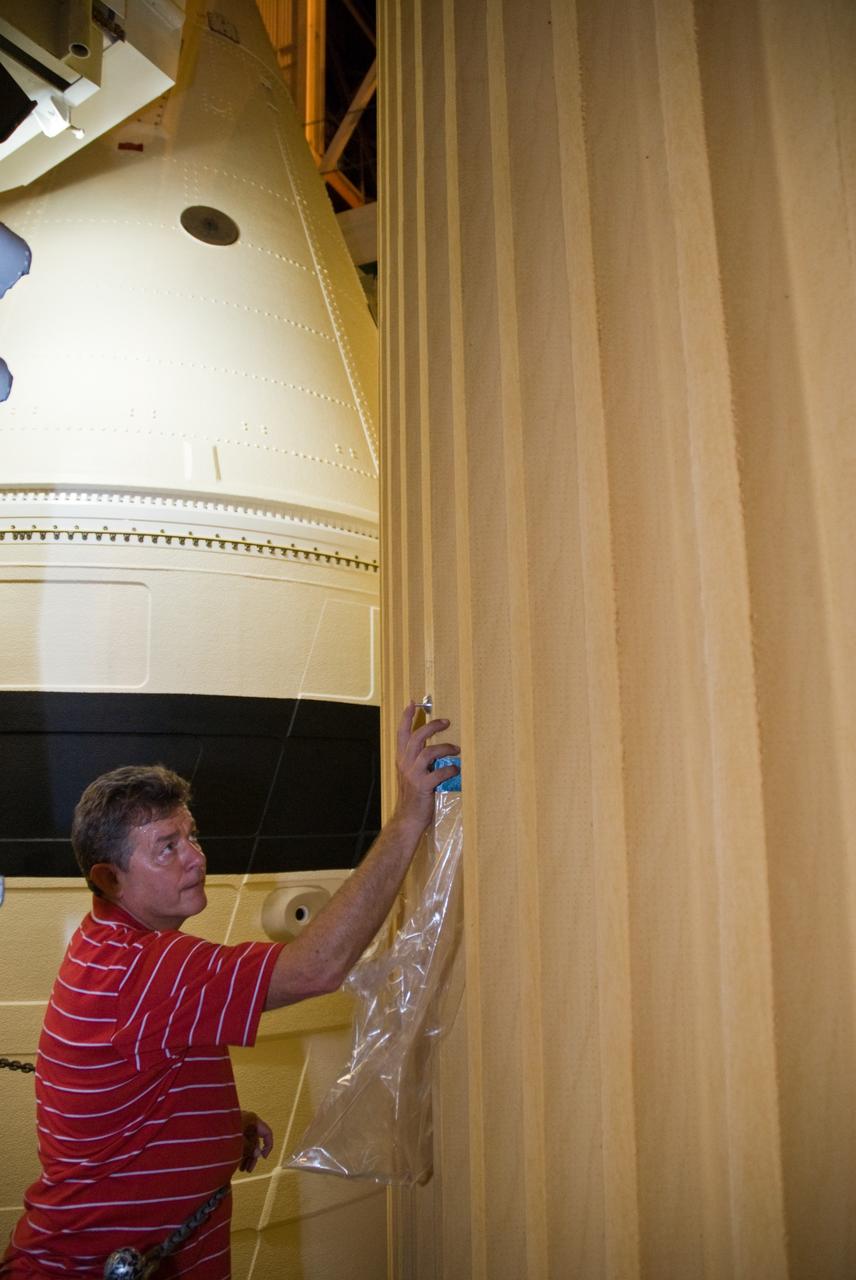
CAPE CANAVERAL, Fla. – In the Vehicle Assembly Building's High Bay 1 at NASA's Kennedy Space Center in Florida, Eugene Sweet, a principal liaison engineer from NASA's Michoud Assembly Facility near New Orleans where the external fuel tanks are built, is testing foam adhesion on the intertank of space shuttle Discovery's external tank. He is collecting foam samples an inch-and-half in diameter for analysis to confirm the foam is bonded well to the metal primer underneath. The testing was prompted by the foam loss during launch of space shuttle Endeavour on the STS-127 mission July 15. Samples are being sent to Michoud for study. Photo credit: NASA/Tim Jacobs
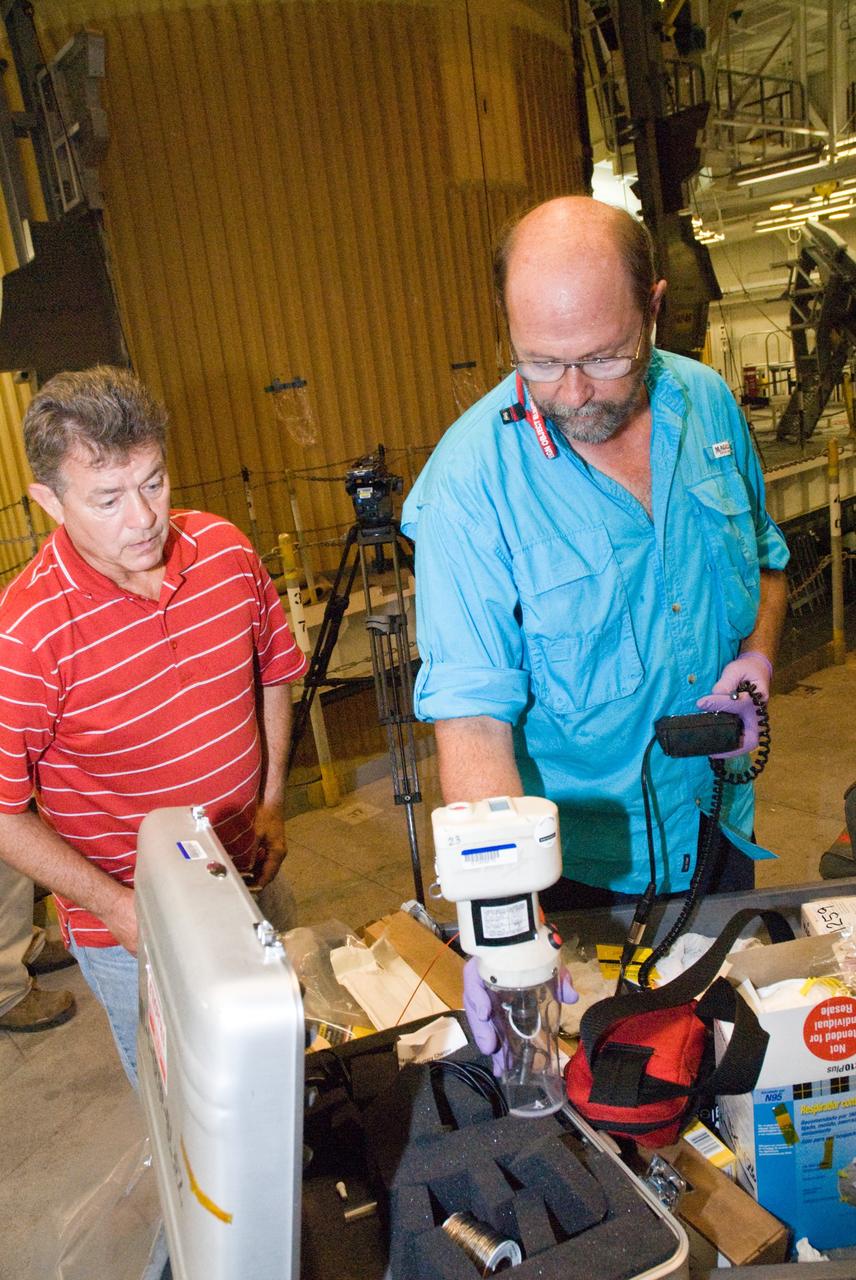
CAPE CANAVERAL, Fla. – In the Vehicle Assembly Building's High Bay 1 at NASA's Kennedy Space Center in Florida, Eugene Sweet (left), a principal liaison engineer, and David Buras, a Material and Process engineer from NASA's Michoud Assembly Facility near New Orleans where the fuel tanks are built, are testing foam samples taken from the intertank of space shuttle Discovery's external tank. They are collecting foam samples an inch-and-half in diameter for analysis to confirm the foam is bonded well to the metal primer underneath. The testing of foam adhesion was prompted by the foam loss during launch of space shuttle Endeavour on the STS-127 mission July 15. Samples are being sent to Michoud for study. Photo credit: NASA/Tim Jacobs
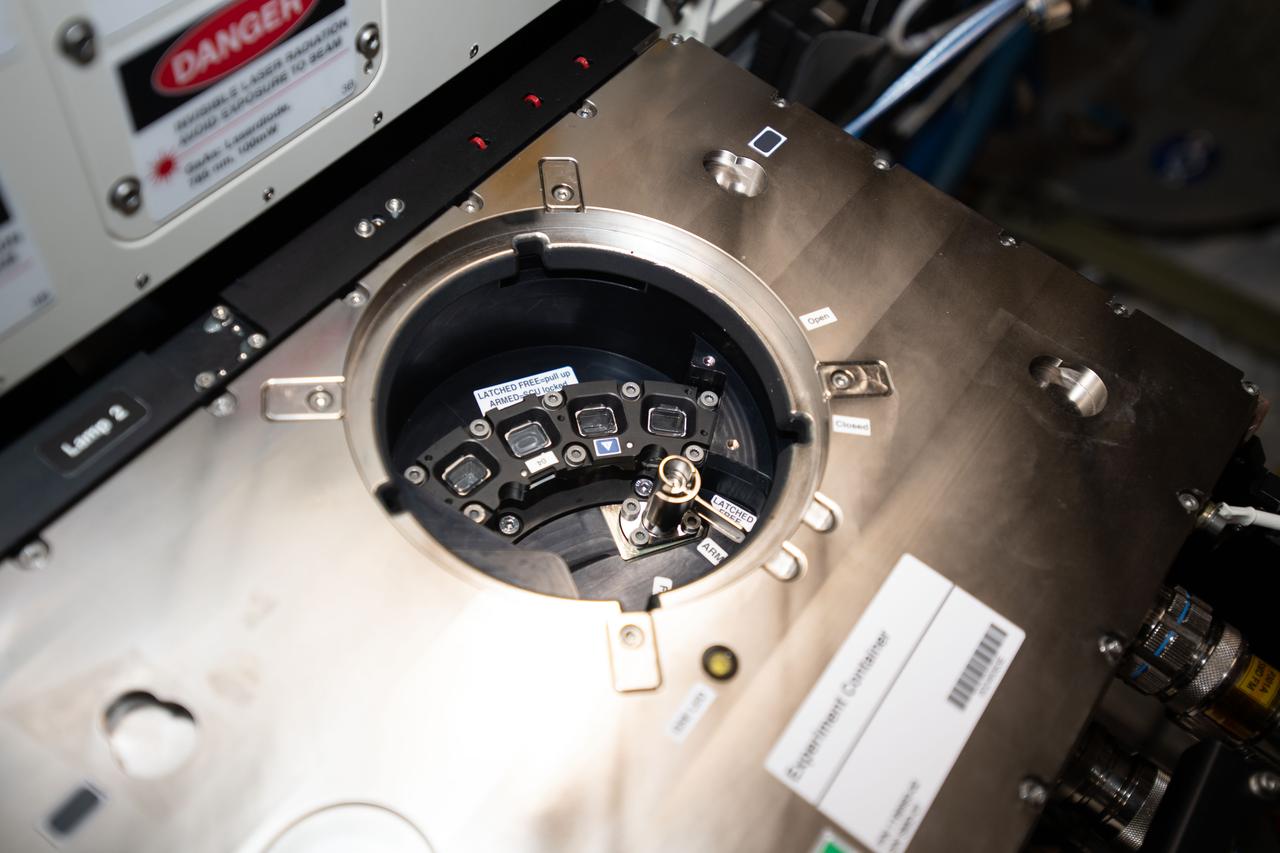
iss062e141221 (4/11/2020) --- A view of the sample cell inside the Soft Matter Dynamics (SMD) Experiment Container of the Fluid Science Laboratory (FSL) in the Columbus module aboard the International Space Station (ISS). FSL Soft Matter Dynamics - Hydrodynamics of Wet Foams (Foam Coarsening) aims to study aqueous and non-aqueous foams in the microgravity environment of the ISS.
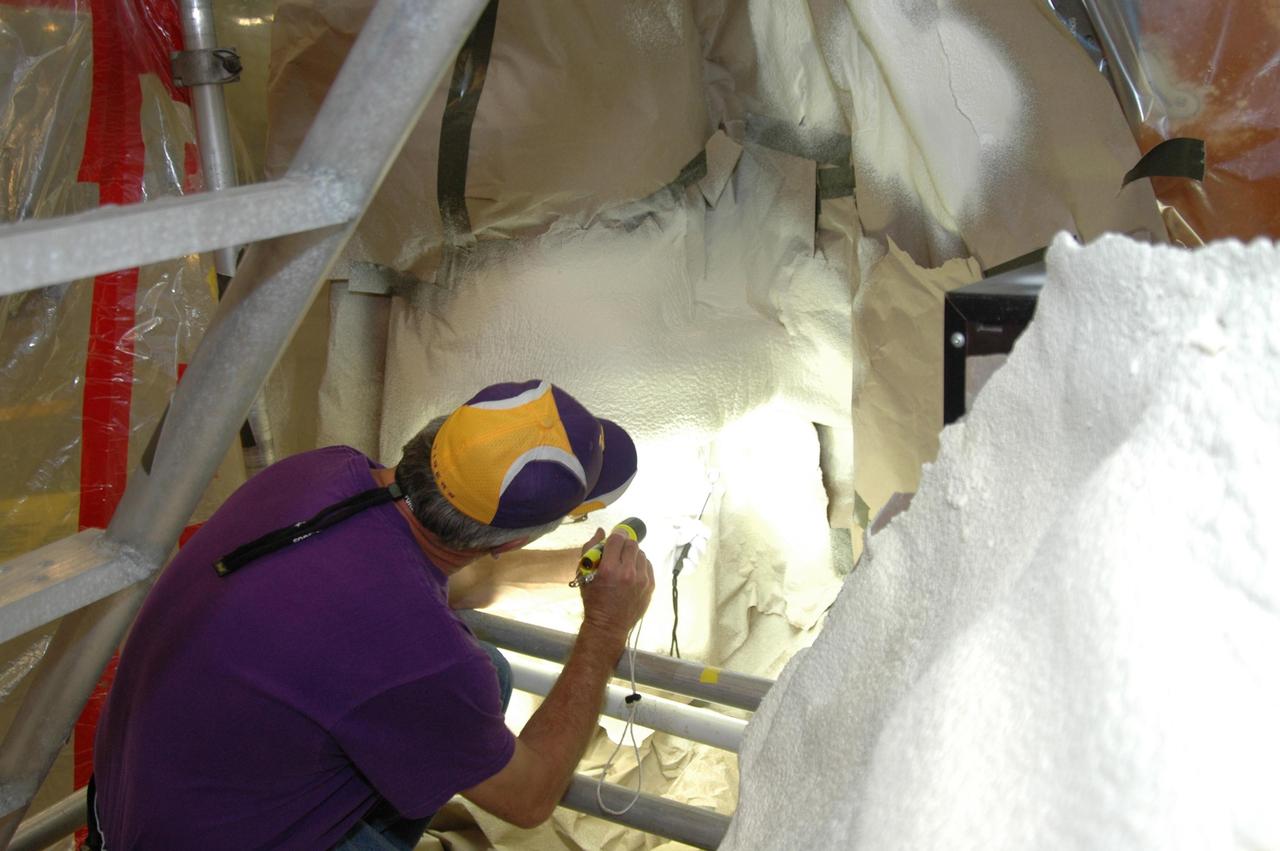
KENNEDY SPACE CENTER, FLA. -- A Lockheed Martin external tank technician from the Michoud Assembly Facility in New Orleans inspects the foam modification on external tank 120 in the Vehicle Assembly Building. The foam insulation and super lightweight ablator cork insulation were removed from the external tank and LO2 feed line bracket on Aug. 24 and replaced only with BX265 foam insulation. The tank is scheduled to fly on Space Shuttle Discovery in October 2007 on mission STS-120. Photo credit: NASA/Jim Grossmann
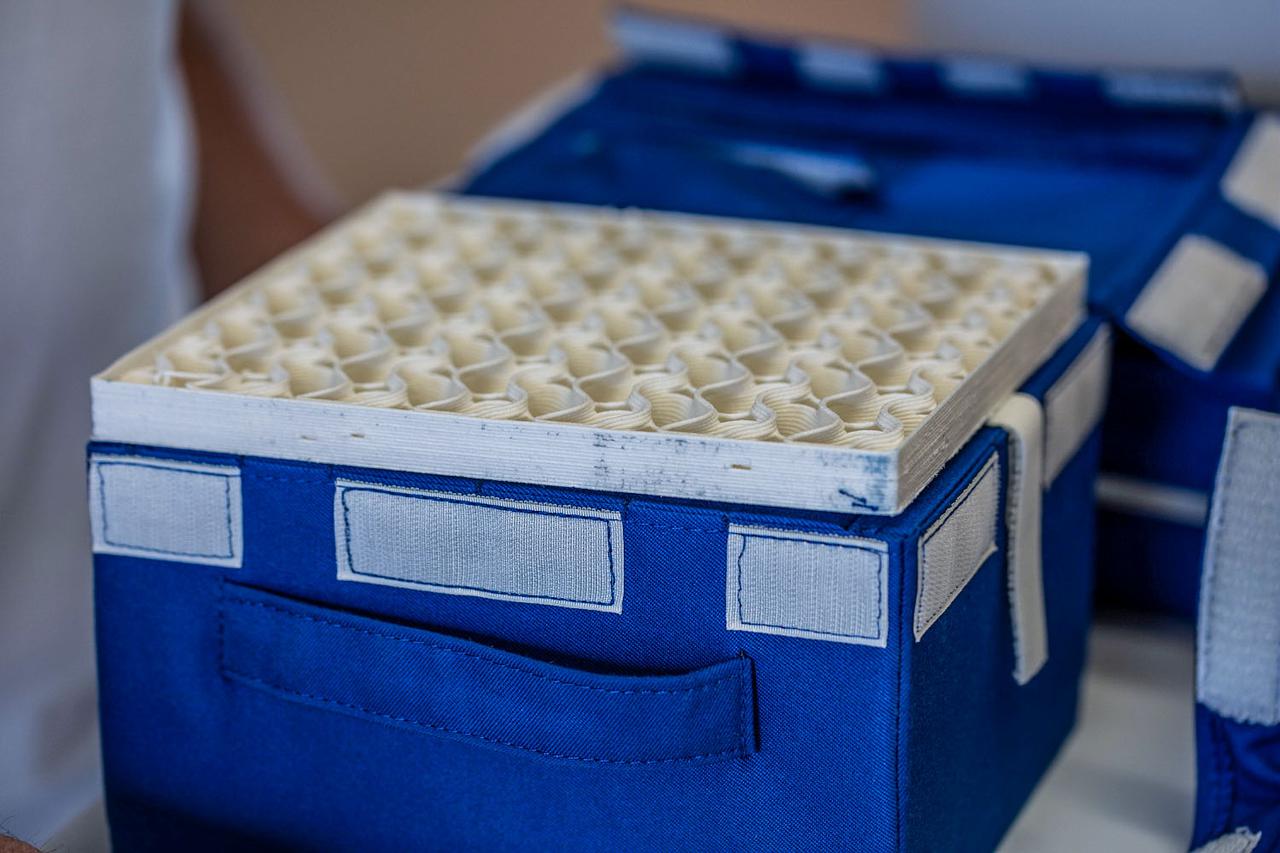
jsc2021e064352 (3/18/2021) --- Preflight imagery of the 3D printed pad with renewable foam used for side/top/bottom panels of the Dreams Kit. The Packaging and Protecting Using Renewable Products (Renewable Foam) project is intended to test foams using products manufactured with renewable resources (or eco-friendly). © CNES/DE PRADA Thierry, 2020
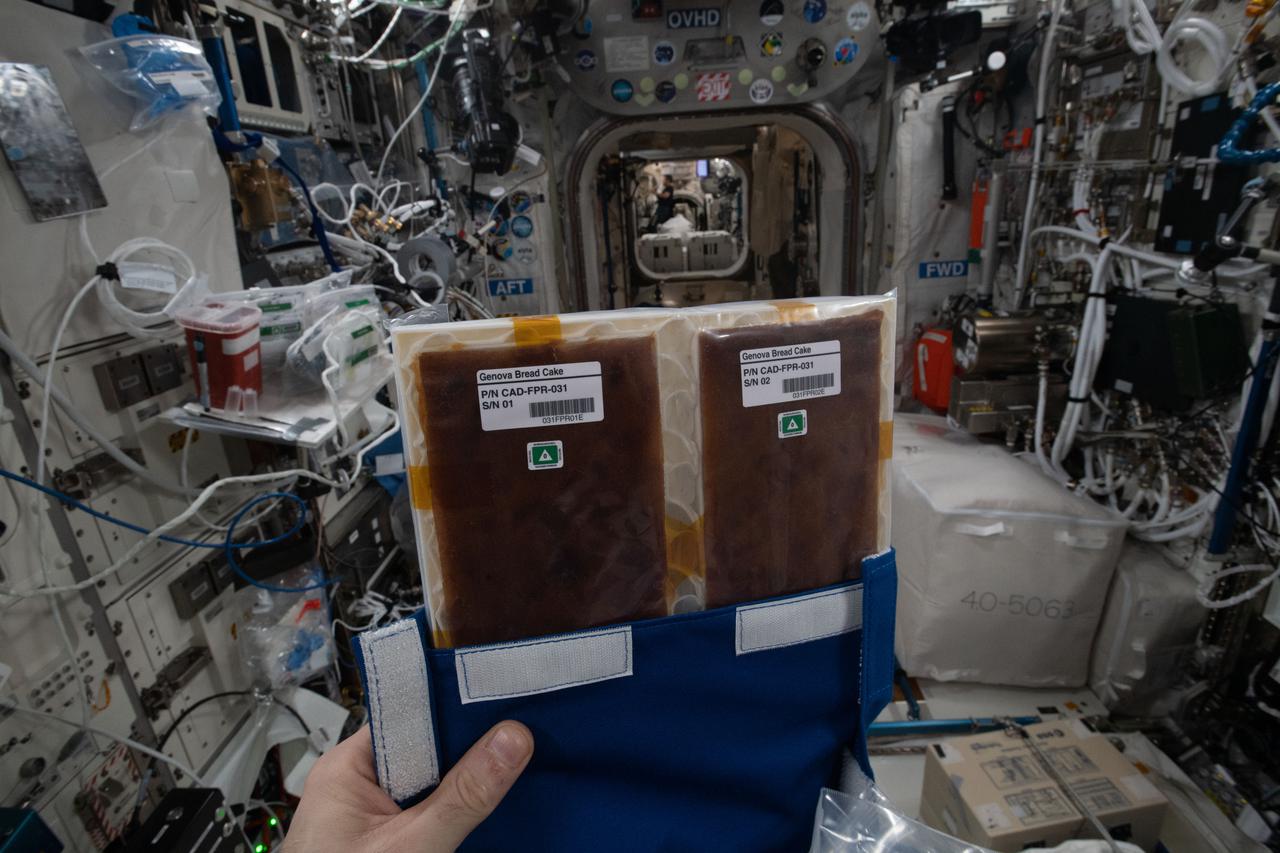
iss065e454878 (10/11/2021) --- A view of the Edible Foam in the Food Processor Consumables Kit aboard the International Space Station (ISS). Edible foam is made from PHA, a naturally occurring polymer synthesized by bacteria. It offers a high level of protection from isolated shocks and vibrations, which is particularly important during flights into space.
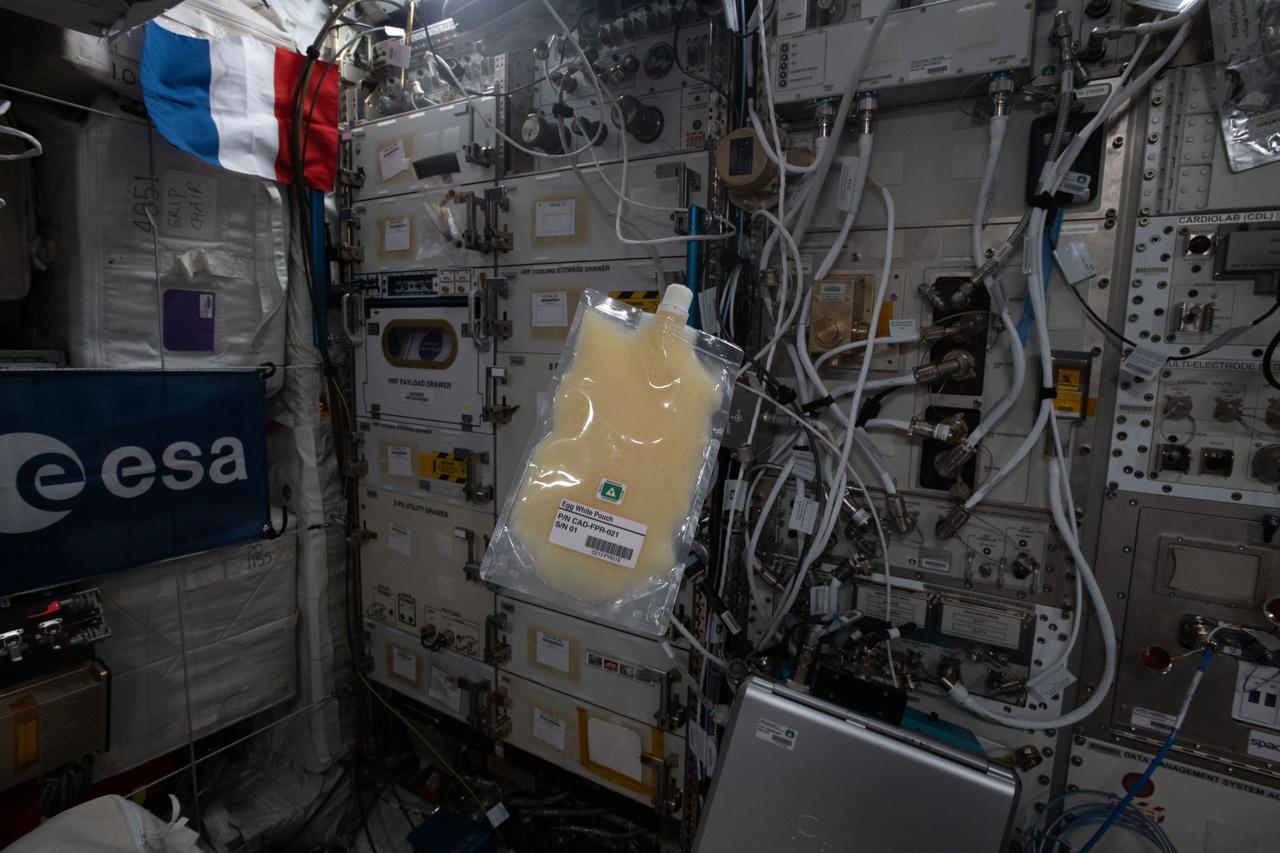
iss065e454868 (10/11/2021) --- A view of the Edible Foam in the Food Processor Consumables Kit aboard the International Space Station (ISS). Edible foam is made from PHA, a naturally occurring polymer synthesized by bacteria. It offers a high level of protection from isolated shocks and vibrations, which is particularly important during flights into space.

iss065e454862 (10/11/2021) --- A view of the Edible Foam in the Food Processor Consumables Kit aboard the International Space Station (ISS). Edible foam is made from PHA, a naturally occurring polymer synthesized by bacteria. It offers a high level of protection from isolated shocks and vibrations, which is particularly important during flights into space.

jsc2021e064351 912/10/2021) --- The logo of the Eco Pack project. The Packaging and Protecting Using Renewable Products (Renewable Foam) project is intended to test foams using products manufactured with renewable resources (or eco-friendly). © CNES/GRARD Emmanuel, 2021
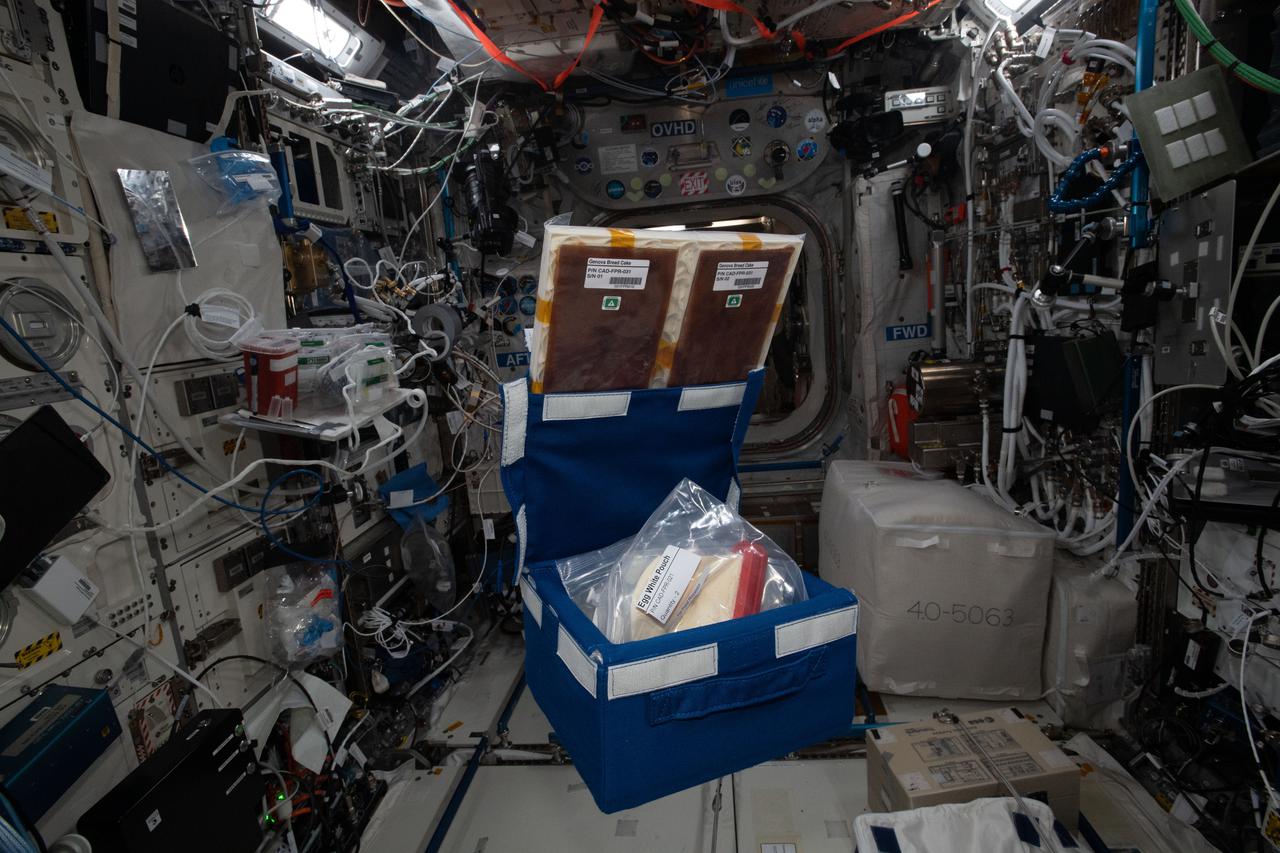
iss065e454902 (10/11/2021) --- A view of the Edible Foam in the Food Processor Consumables Kit aboard the International Space Station (ISS). Edible foam is made from PHA, a naturally occurring polymer synthesized by bacteria. It offers a high level of protection from isolated shocks and vibrations, which is particularly important during flights into space.
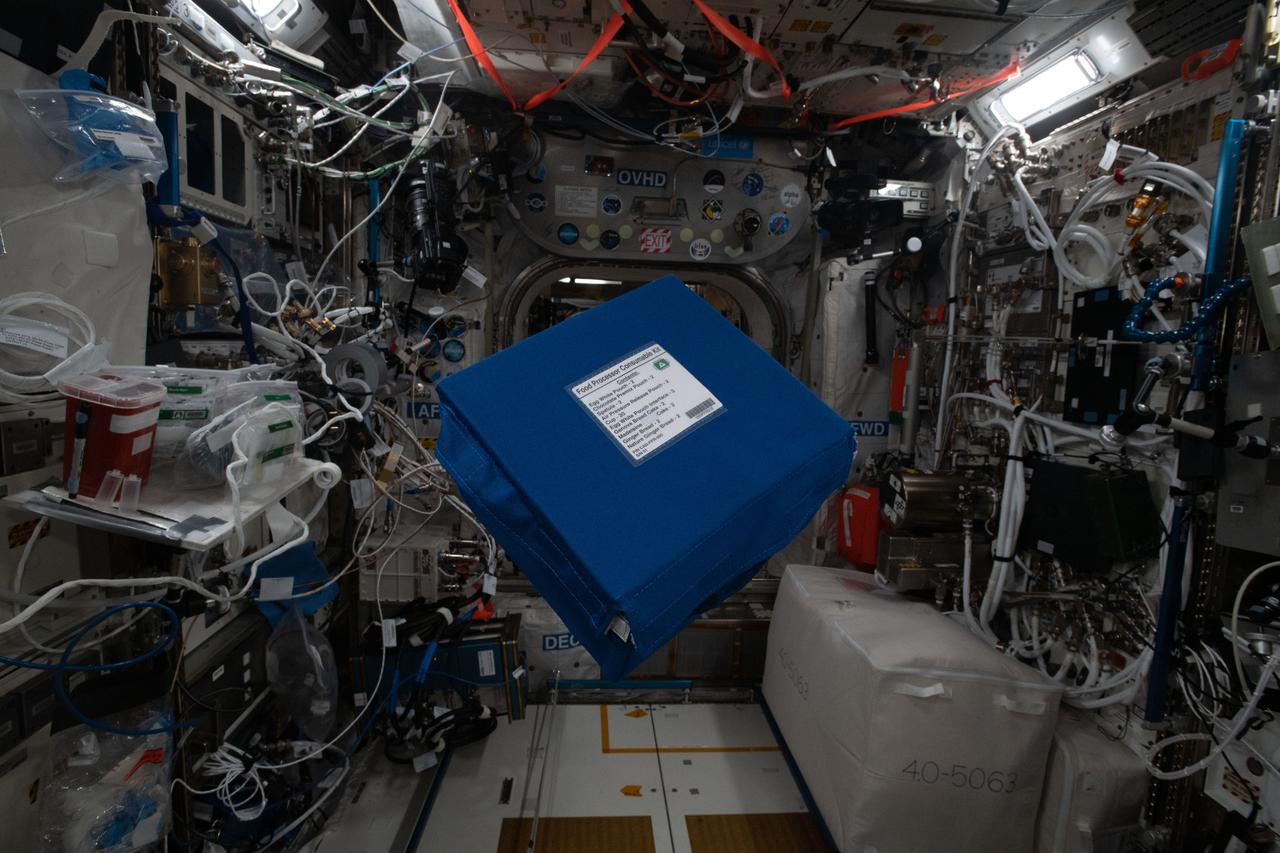
iss065e454849 (10/11/2021) --- A view of the Edible Foam in the Food Processor Consumables Kit aboard the International Space Station (ISS). Edible foam is made from PHA, a naturally occurring polymer synthesized by bacteria. It offers a high level of protection from isolated shocks and vibrations, which is particularly important during flights into space.
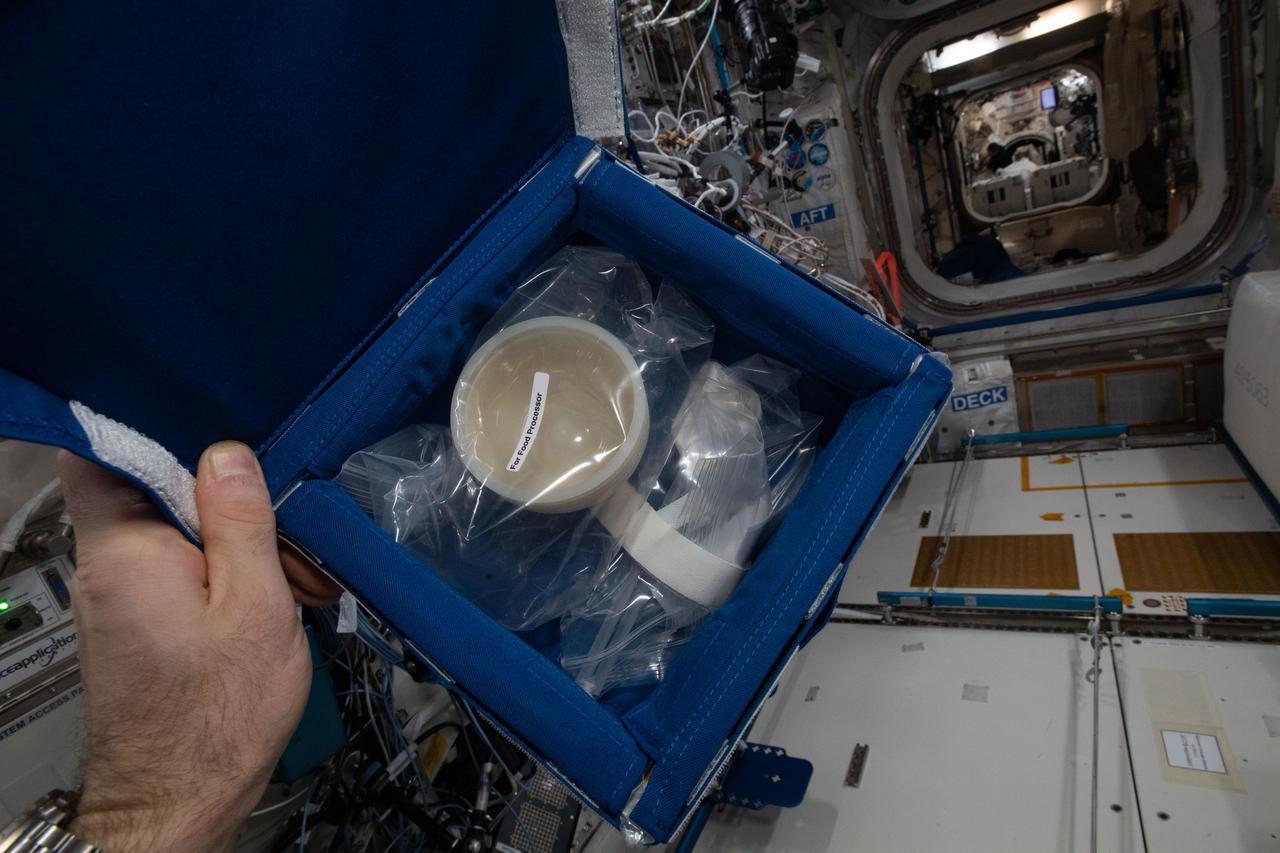
iss065e454910 (10/11/2021) --- A crewmember inspects the Edible Foam in the Food Processor Consumables Kit. Edible foam is made from PHA, a naturally occurring polymer synthesized by bacteria. It offers a high level of protection from isolated shocks and vibrations, which is particularly important during flights into space.
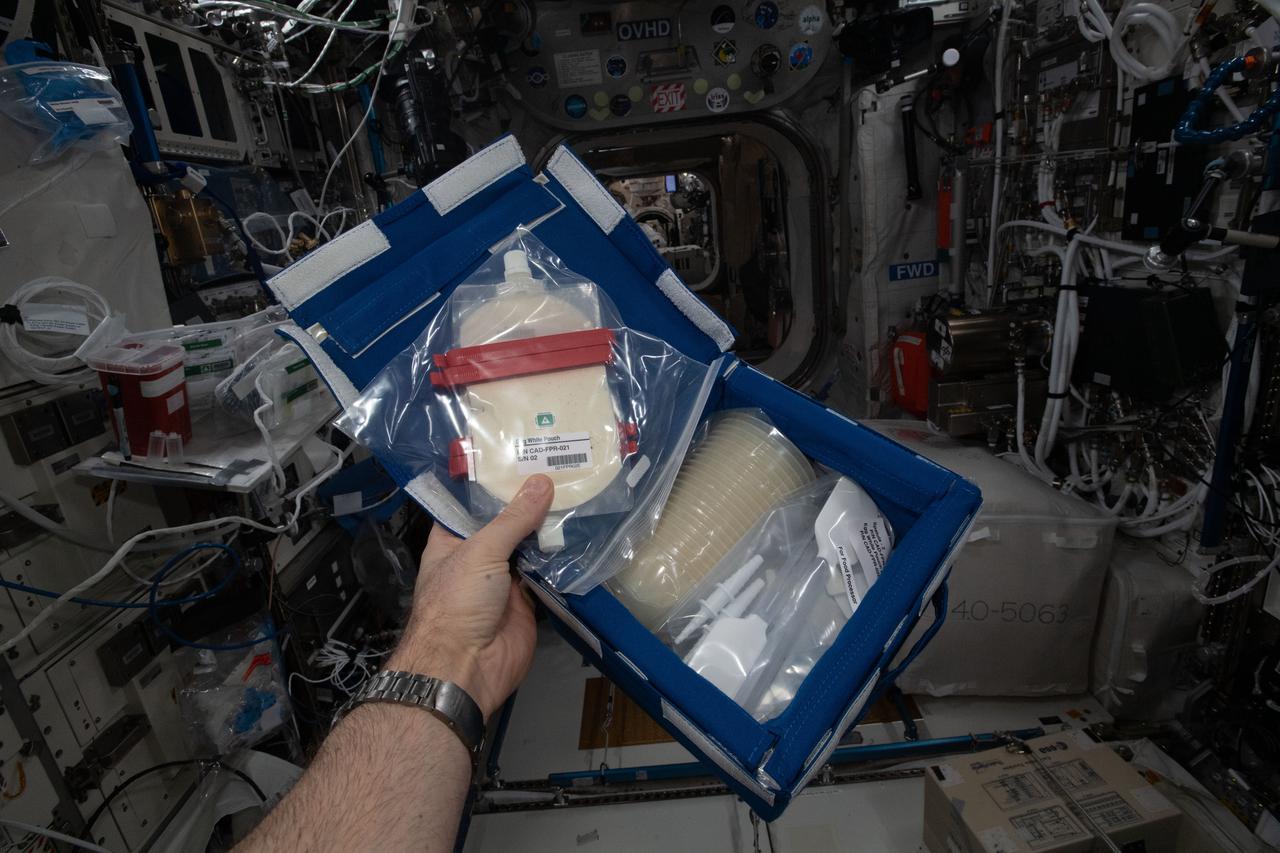
iss065e454854 (10/11/2021) --- A view of the Edible Foam in the Food Processor Consumables Kit aboard the International Space Station (ISS). Edible foam is made from PHA, a naturally occurring polymer synthesized by bacteria. It offers a high level of protection from isolated shocks and vibrations, which is particularly important during flights into space.
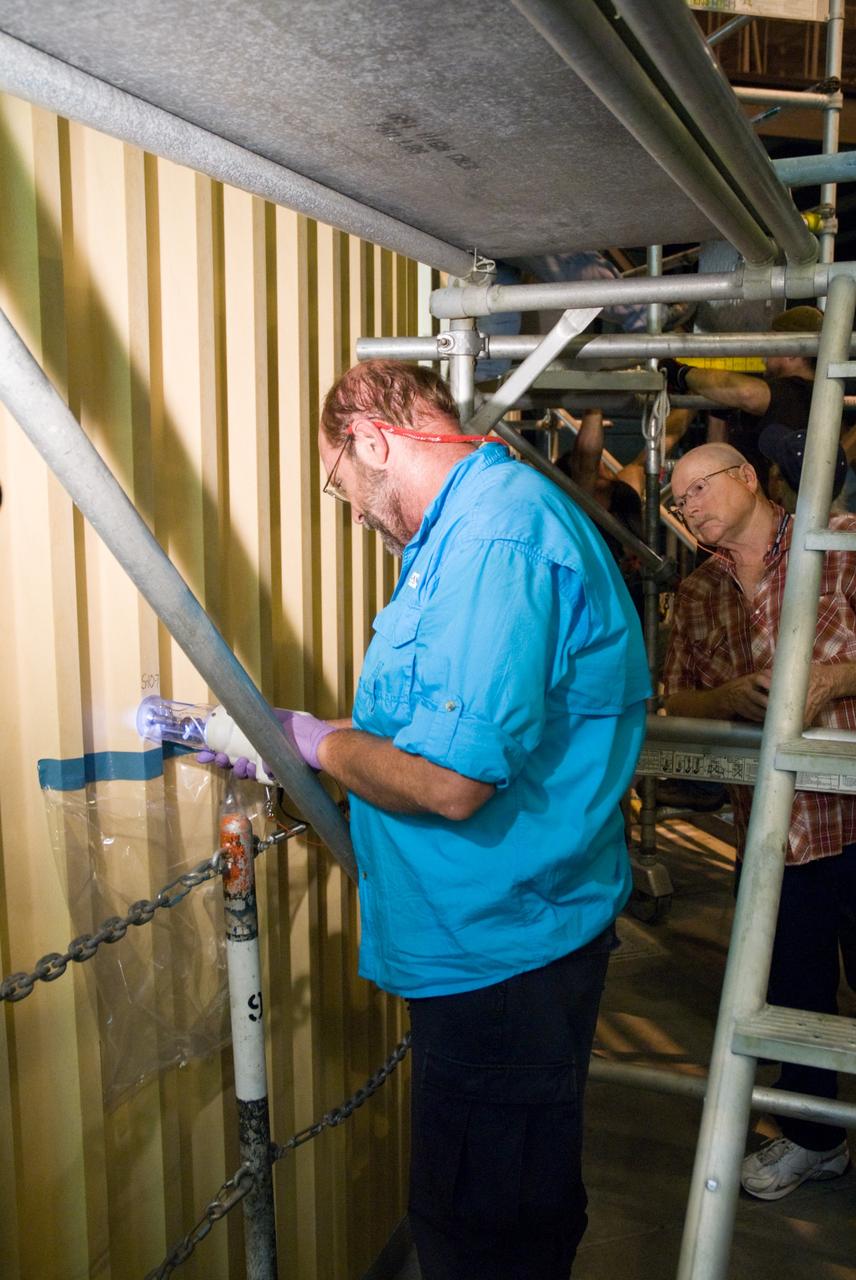
CAPE CANAVERAL, Fla. – In the Vehicle Assembly Building's High Bay 1 at NASA's Kennedy Space Center in Florida, David Buras, a Material and Process engineer from NASA's Michoud Assembly Facility near New Orleans where external fuel tanks are built, is testing foam adhesion on the intertank of space shuttle Discovery's external tank. He is collecting foam samples an inch-and-half in diameter for analysis to confirm the foam is bonded well to the metal primer underneath. At right is Jerrol Kinsey, a NASA quality inspector. The testing was prompted by the foam loss during launch of space shuttle Endeavour on the STS-127 mission July 15. Samples are being sent to Michoud for study. Photo credit: NASA/Tim Jacobs

In the Vehicle Assembly Building, markers show the hail damage being repaired on the external tank of Space Shuttle Atlantis. The white hole with a red circle around it is a hole prepared for molding and material application. The red material is sealant tape so the mold doesn't leak when the foam rises against the mold. The white/ translucent square mold is an area where the foam has been applied and the foam has risen and cured against the mold surface. The area will be de-molded and sanded flush the with adjacent area. In late February, Atlantis' external tank received hail damage during a severe thunderstorm that passed through the Kennedy Space Center Launch Complex 39 area. The hail caused visible divots in the giant tank's foam insulation as well as minor surface damage to about 26 heat shield tiles on the shuttle's left wing. The March launch was postponed and has not yet been rescheduled due to the repair process.
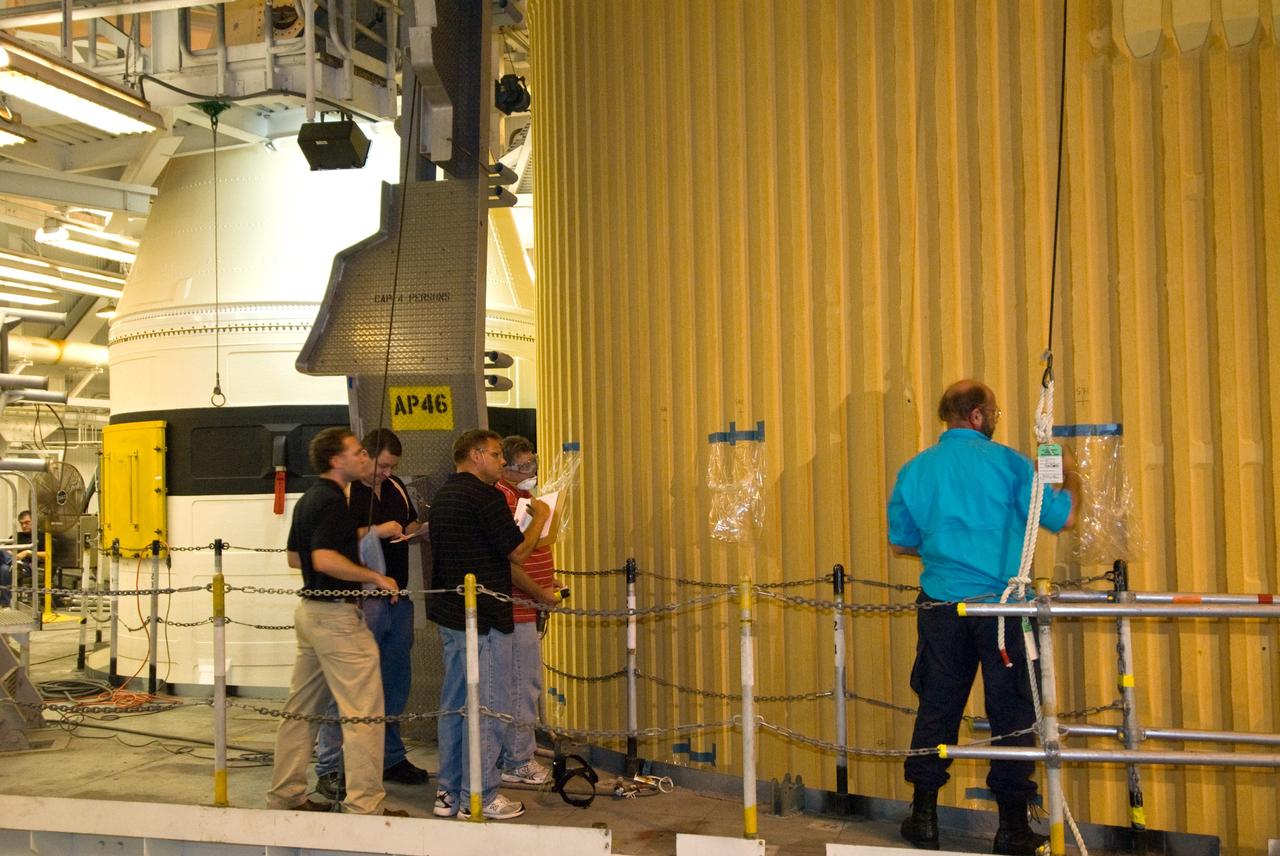
CAPE CANAVERAL, Fla. – In the Vehicle Assembly Building's High Bay 1 at NASA's Kennedy Space Center in Florida, workers are doing "pull plug testing" on foam adhesion from the intertank of space shuttle Discovery's external tank. At right is David Buras, a Material and Process engineer from NASA's Michoud Assembly Facility near New Orleans where the fuel tanks are built. They are collecting 26 foam samples an inch-and-half in diameter for analysis to confirm the foam is bonded well to the metal primer underneath. The testing was prompted by the foam loss during launch of space shuttle Endeavour on the STS-127 mission July 15. Samples are being sent to Michoud for study. Photo credit: NASA/Tim Jacobs

In the Vehicle Assembly Building, markers show the hail damage being repaired on the external tank of Space Shuttle Atlantis. The white hole with a red circle around it is a hole prepared for molding and material application. The red material is sealant tape so the mold doesn't leak when the foam rises against the mold. The white/ translucent square mold is an area where the foam has been applied and the foam has risen and cured against the mold surface. The area will be de-molded and sanded flush with the adjacent area. In late February, Atlantis' external tank received hail damage during a severe thunderstorm that passed through the Kennedy Space Center Launch Complex 39 area. The hail caused visible divots in the giant tank's foam insulation as well as minor surface damage to about 26 heat shield tiles on the shuttle's left wing. The launch now is targeted for June 8.
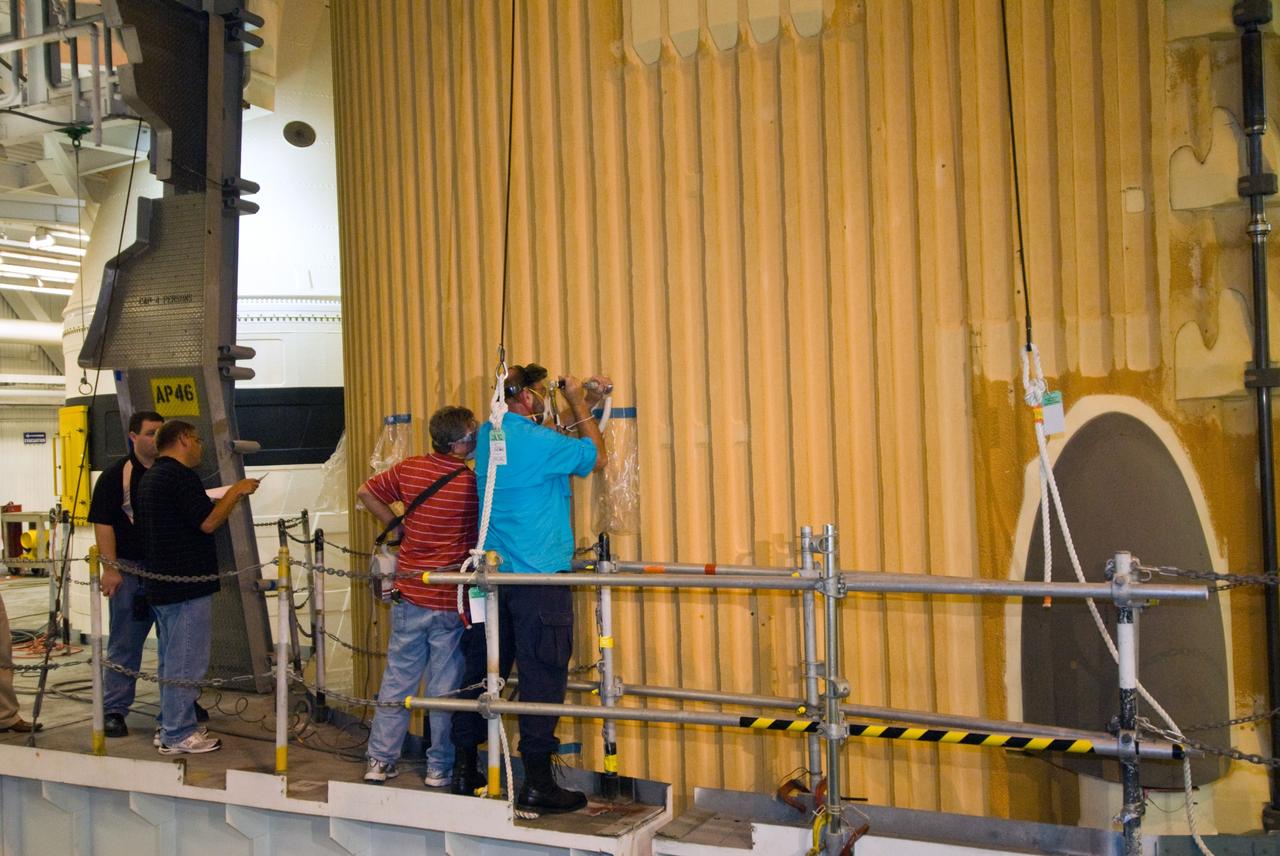
CAPE CANAVERAL, Fla. – In the Vehicle Assembly Building's High Bay 1 at NASA's Kennedy Space Center in Florida, workers are testing foam adhesion on the intertank of space shuttle Discovery's external tank. At right are Eugene Sweet (red shirt), principal liaison engineer, and David Buras, a Material and Process engineer from NASA's Michoud Assembly Facility near New Orleans where the fuel tanks are built. They are collecting 26 foam samples an inch-and-half in diameter for analysis to confirm the foam is bonded well to the metal primer underneath. The testing was prompted by the foam loss during launch of space shuttle Endeavour on the STS-127 mission July 15. Samples are being sent to Michoud for study. Photo credit: NASA/Tim Jacobs
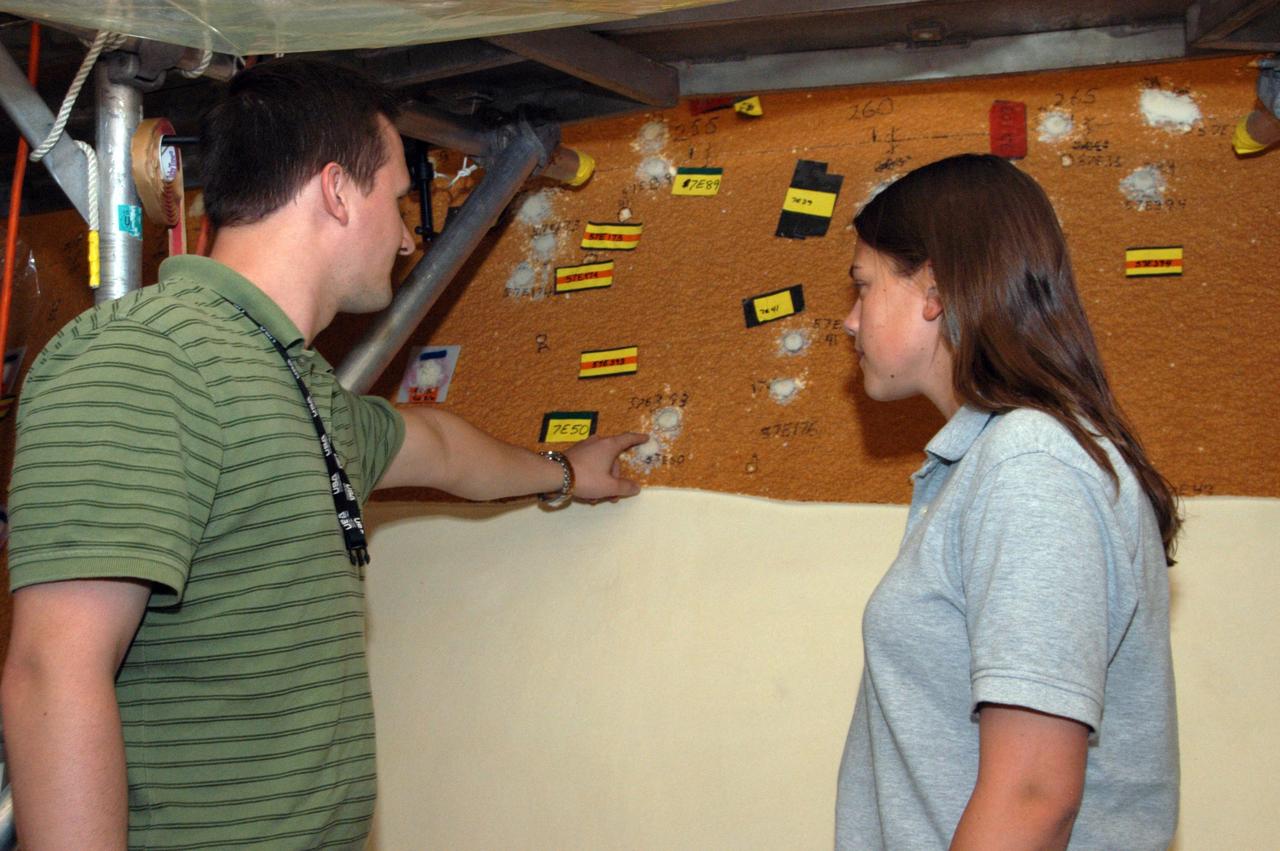
KENNEDY SPACE CENTER, FLA. -- In the Vehicle Assembly Building, Mike Ravenscroft, with United Space Alliance, points to some of the foam repair done on the external tank of Space Shuttle Atlantis. Holes filled with foam are sanded flush with the adjacent area. In late February, Atlantis' external tank received hail damage during a severe thunderstorm that passed through the Kennedy Space Center Launch Complex 39 area. The hail caused visible divots in the giant tank's foam insulation as well as minor surface damage to about 26 heat shield tiles on the shuttle's left wing. The launch now is targeted for June 8. Photo credit: NASA/George Shelton
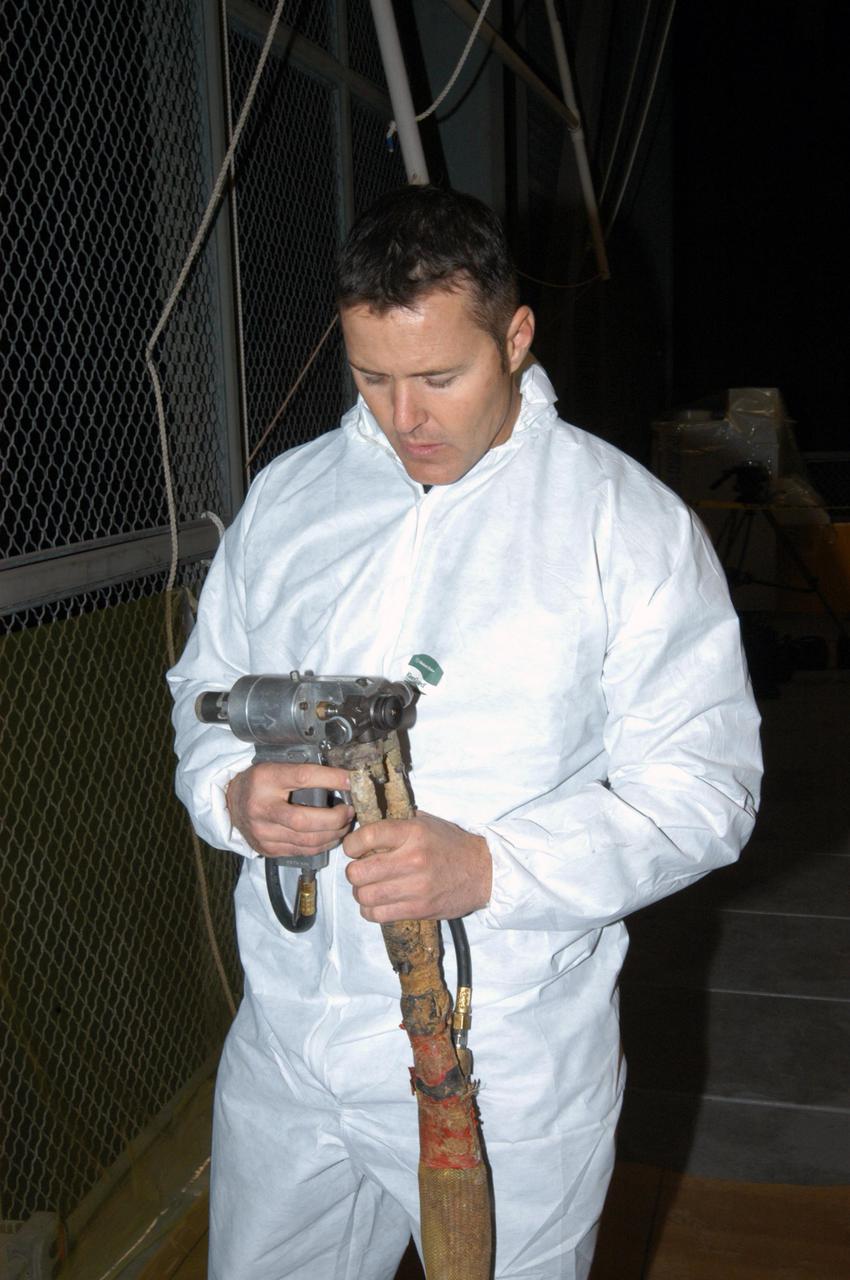
KENNEDY SPACE CENTER, FLA. - In the Vehicle Assembly Building, United Space Alliance technician Ed Carillion attaches the foam spray nozzle to the spray gun to be used for the aft hard-point closeout spray on the External Tank (ET). The spray is being applied on an area of the tank where the ET is mated to the transporter. Foam is not applied to that area at the Michoud Assembly Facility in Louisiana to avoid damage to the foam during travel. The ET, which arrived at KSC Jan. 5, is in the checkout cell for final processing. The tank is scheduled to fly on Space Shuttle Discovery on Return to Flight mission STS-114. The launch window is May 12 to June 3.
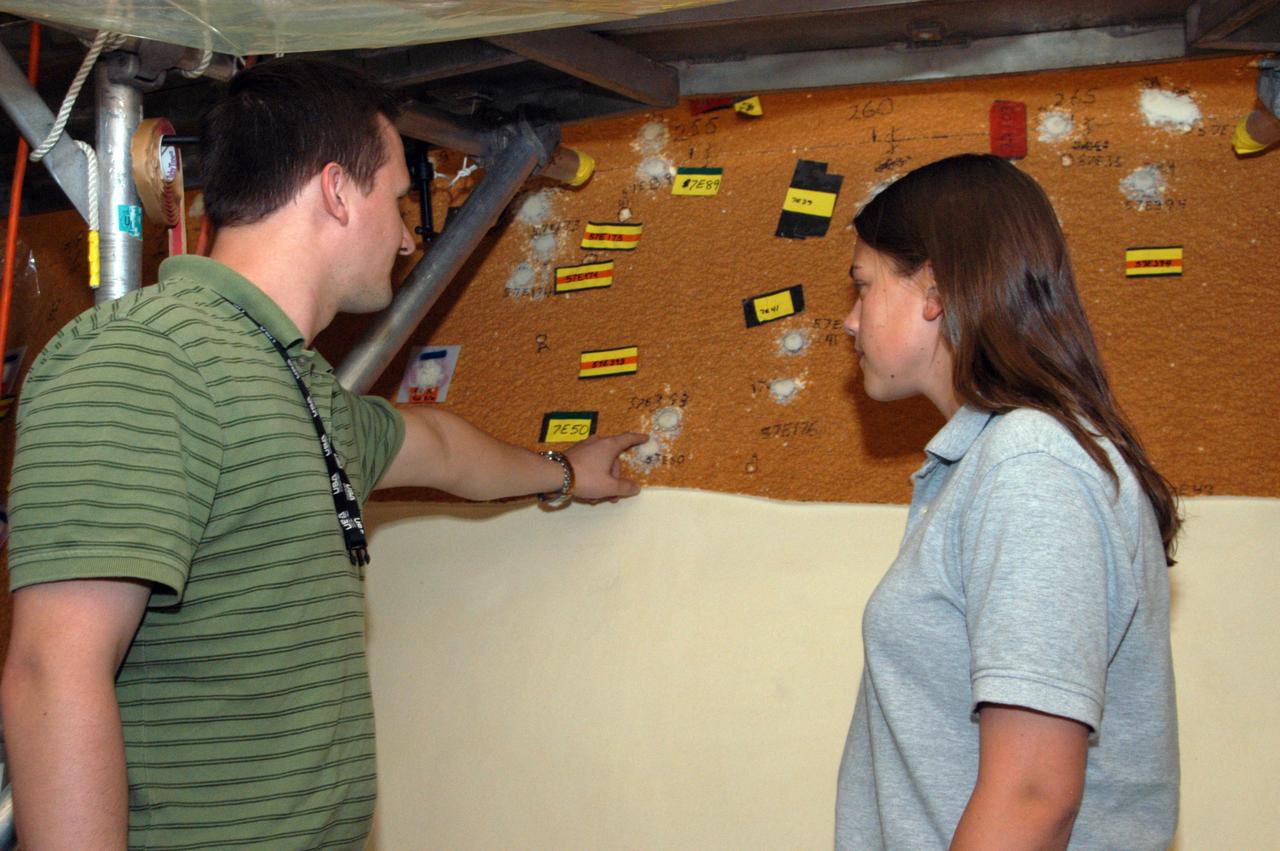
In the Vehicle Assembly Building, Mike Ravenscroft, with United Space Alliance, points to some of the foam repair done on the external tank of Space Shuttle Atlantis. Holes filled with foam are sanded flush with the adjacent area. In late February, Atlantis' external tank received hail damage during a severe thunderstorm that passed through the Kennedy Space Center Launch Complex 39 area. The hail caused visible divots in the giant tank's foam insulation as well as minor surface damage to about 26 heat shield tiles on the shuttle's left wing. The launch now is targeted for June 8.
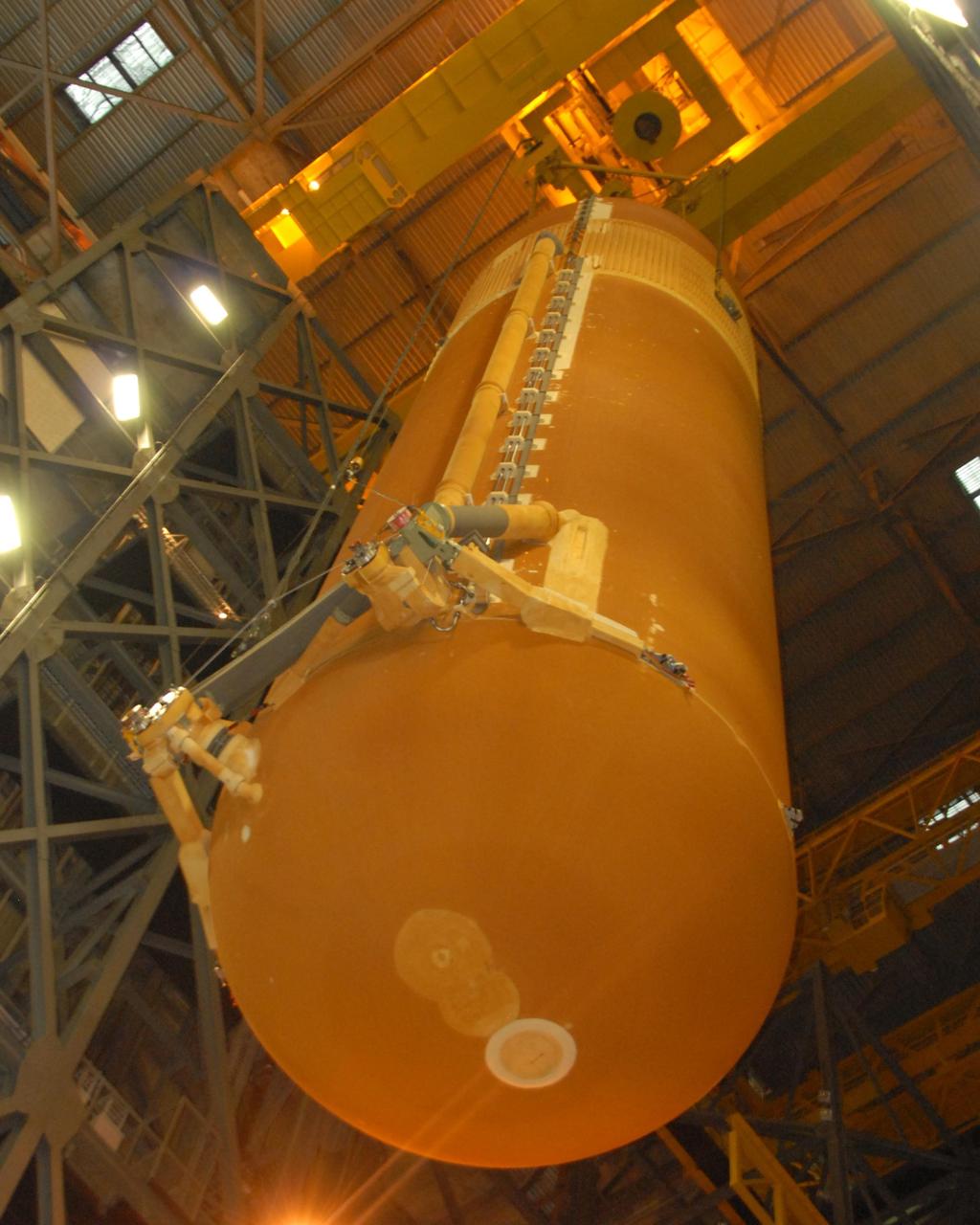
KENNEDY SPACE CENTER, FLA. -- In the Vehicle Assembly Building at NASA's Kennedy Space Center, external tank No. 120 is lowered into high bay 1 where it will be mated with the solid rocket boosters. Seen on the tank are the sites of modification to the foam where BX265 foam insulation and super lightweight ablator, cork insulation was removed and the BX265 foam insulation alone reapplied. The external tank-SRB stack is being prepared for the orbiter Discovery, which will be mated to the stack in the VAB in two weeks. Space Shuttle Discovery is targeted to launch Oct. 23 on mission STS-120 to the International Space Station. Photo credit: NASA/George Shelton
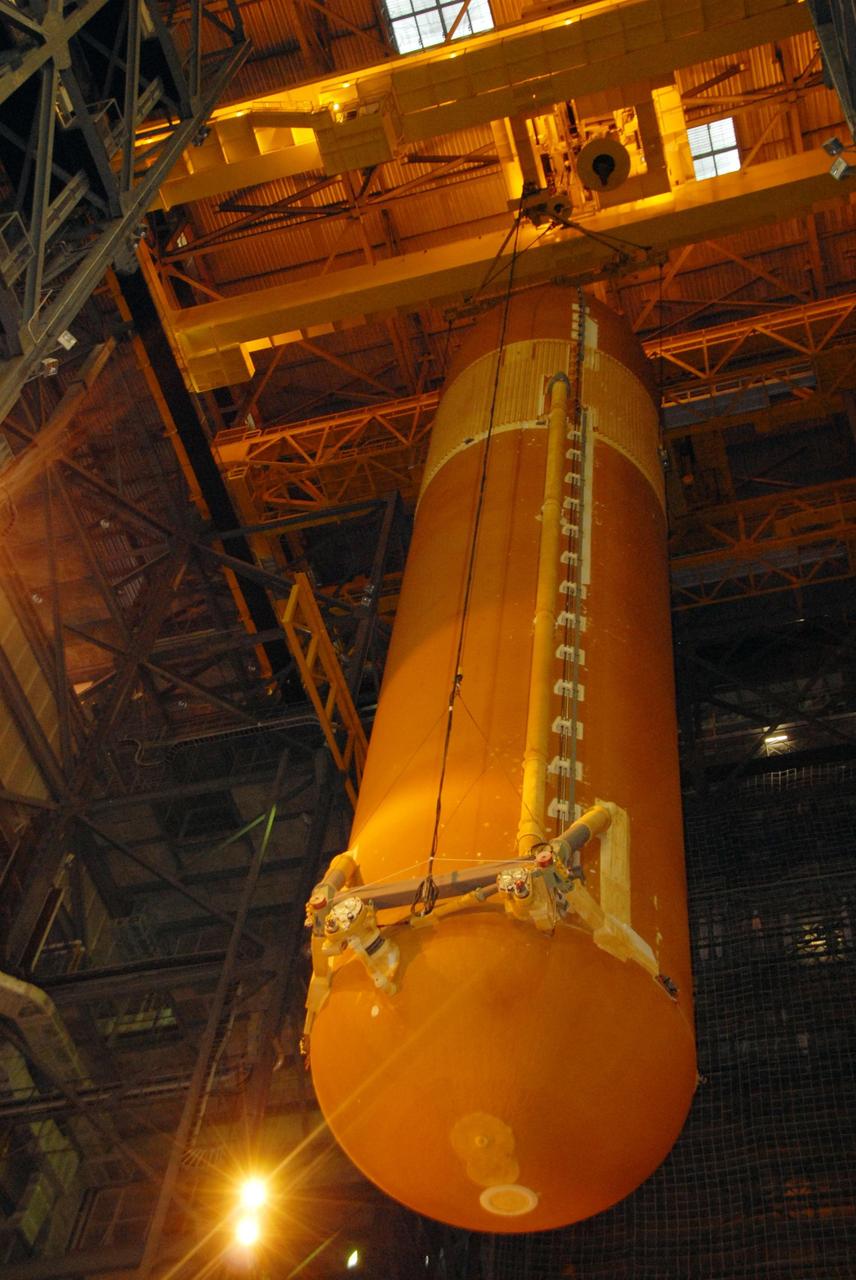
KENNEDY SPACE CENTER, FLA. -- In the Vehicle Assembly Building at NASA's Kennedy Space Center, external tank No. 120 is lowered into high bay 1 where it will be mated with the solid rocket boosters. Seen on the tank are the sites of modification to the foam where BX265 foam insulation and super lightweight ablator, cork insulation was removed and the BX265 foam insulation alone reapplied. The external tank-SRB stack is being prepared for the orbiter Discovery, which will be mated to the stack in the VAB in two weeks. Space Shuttle Discovery is targeted to launch Oct. 23 on mission STS-120 to the International Space Station. Photo credit: NASA/George Shelton
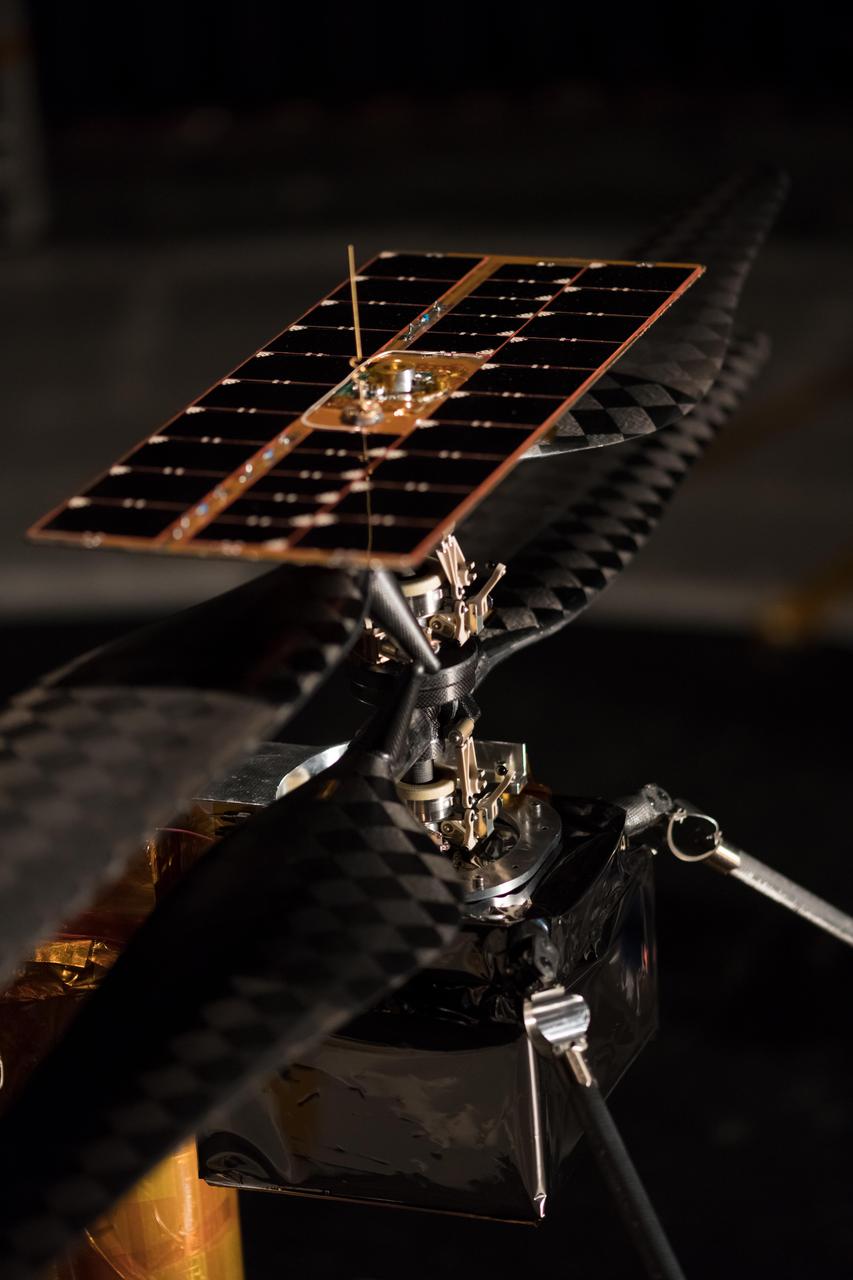
More than 1,500 individual pieces of carbon fiber, flight-grade aluminum, silicon, copper, foil and foam go into a Mars Helicopter. This image of the Flight Model (the actual vehicle going to the Red Planet), was taken on Feb. 1, 2019 when the helicopter was inside the Space Simulator, a 25-foot (7.62 meter) wide vacuum chamber at NASA's Jet Propulsion Laboratory in Pasadena, California. https://photojournal.jpl.nasa.gov/catalog/PIA23158
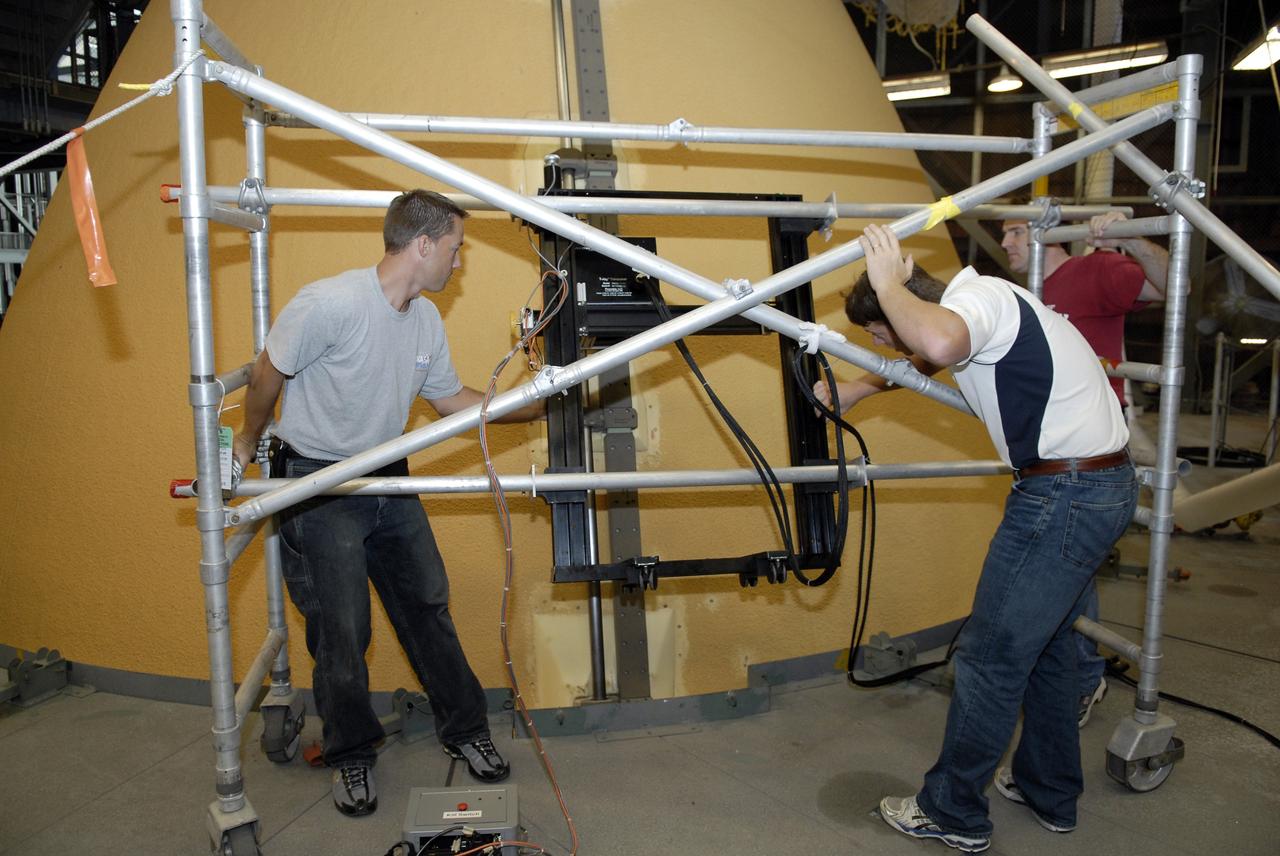
CAPE CANAVERAL, Fla. – In the Vehicle Assembly Building at NASA's Kennedy Space Center’s in Florida, technicians set up equipment that will be used to conduct terahertz scans of five ice frost ramps on the external fuel tank, designated ET-133, for space shuttle Atlantis’ STS-129 mission. The ice frost ramps are made from foam insulation and cover brackets that hold pressurization lines on the outside of the external tank. Terahertz scans are wave frequency analysis in the infrared band that can see through the foam insulation to help look for any voids or pockets where the foam is not bonded to the metal primer. The ramps being scanned were on the top part of the tank in the same area where foam came off during the last two shuttle launches. The data will be used to help assess whether foam on ET-132, the fuel tank attached to shuttle Discovery at Kennedy’s Launch Pad 39A, is fit for its flight on the STS-128 mission to the International Space Station. Photo credit: NASA/Kim Shiflett
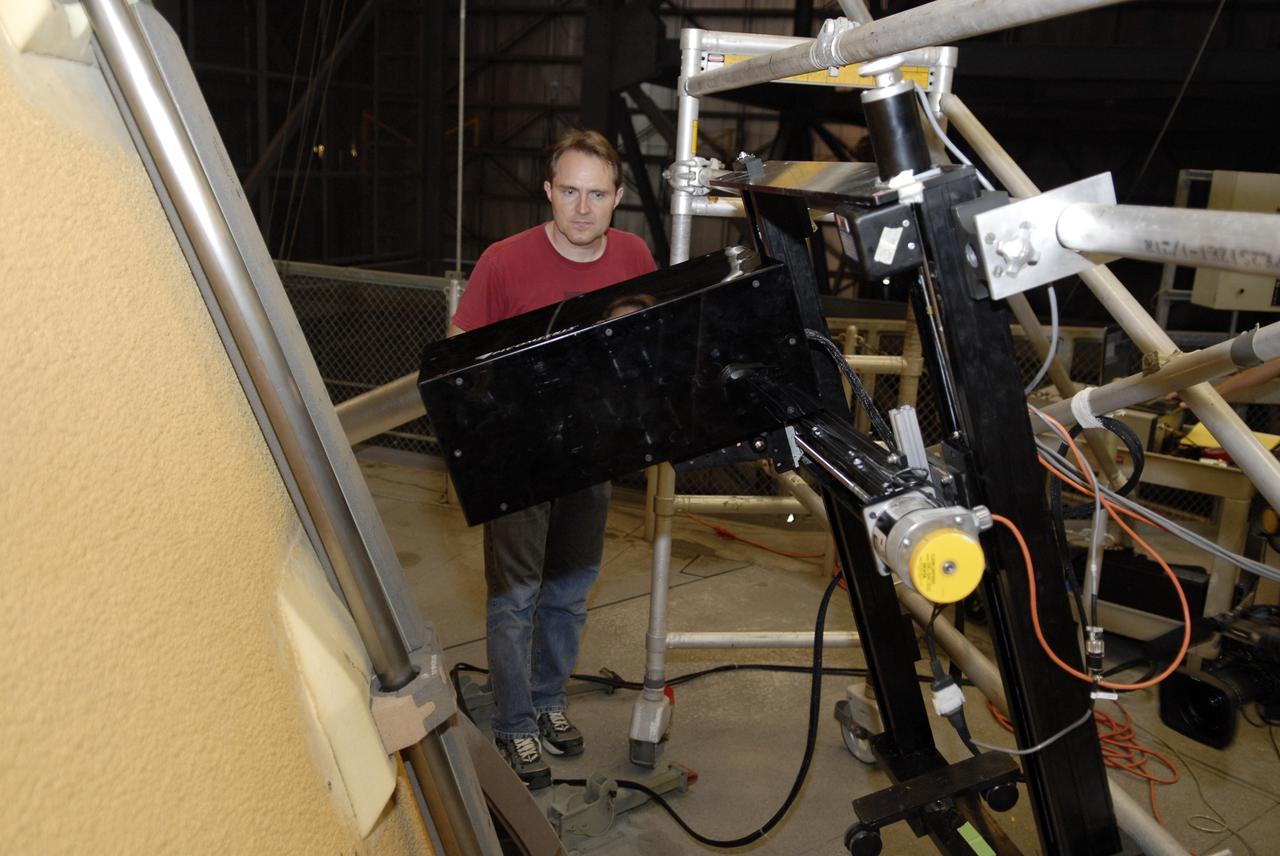
CAPE CANAVERAL, Fla. – In the Vehicle Assembly Building at NASA's Kennedy Space Center’s in Florida, a technician prepares to conduct terahertz scans of five ice frost ramps on the external fuel tank, designated ET-133, for space shuttle Atlantis’ STS-129 mission. The ice frost ramps are made from foam insulation and cover brackets that hold pressurization lines on the outside of the external tank. Terahertz scans are wave frequency analysis in the infrared band that can see through the foam insulation to help look for any voids or pockets where the foam is not bonded to the metal primer. The ramps being scanned were on the top part of the tank in the same area where foam came off during the last two shuttle launches. The data will be used to help assess whether foam on ET-132, the fuel tank attached to shuttle Discovery at Kennedy’s Launch Pad 39A, is fit for its flight on the STS-128 mission to the International Space Station. Photo credit: NASA/Kim Shiflett
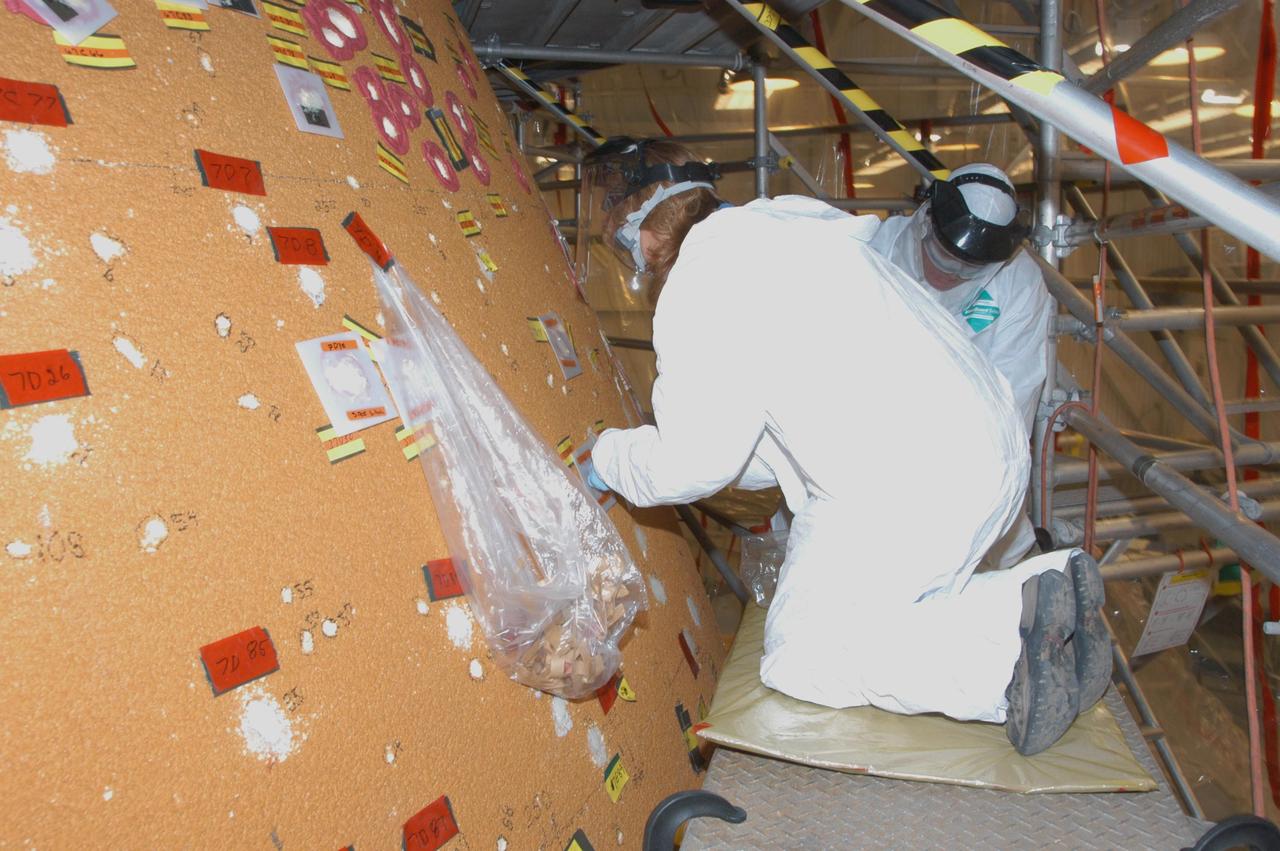
KENNEDY SPACE CENTER, FLA. -- In the Vehicle Assembly Building, United Space Alliance technicians Brenda Morris and Brian Williams are applying foam and molds on Space Shuttle Atlantis' external tank to areas damaged by hail. The white hole with a red circle around it (upper right) is a hole prepared for molding and material application. The red material is sealant tape so the mold doesn't leak when the foam rises against the mold. The white/translucent square mold is an area where the foam has been applied and the foam has risen and cured against the mold surface. In late February, Atlantis' external tank received hail damage during a severe thunderstorm that passed through the Kennedy Space Center Launch Complex 39 area. The hail caused visible divots in the giant tank's foam insulation as well as minor surface damage to about 26 heat shield tiles on the shuttle's left wing. The March launch was postponed and has not yet been rescheduled due to the repair process. Photo credit: NASA/George Shelton
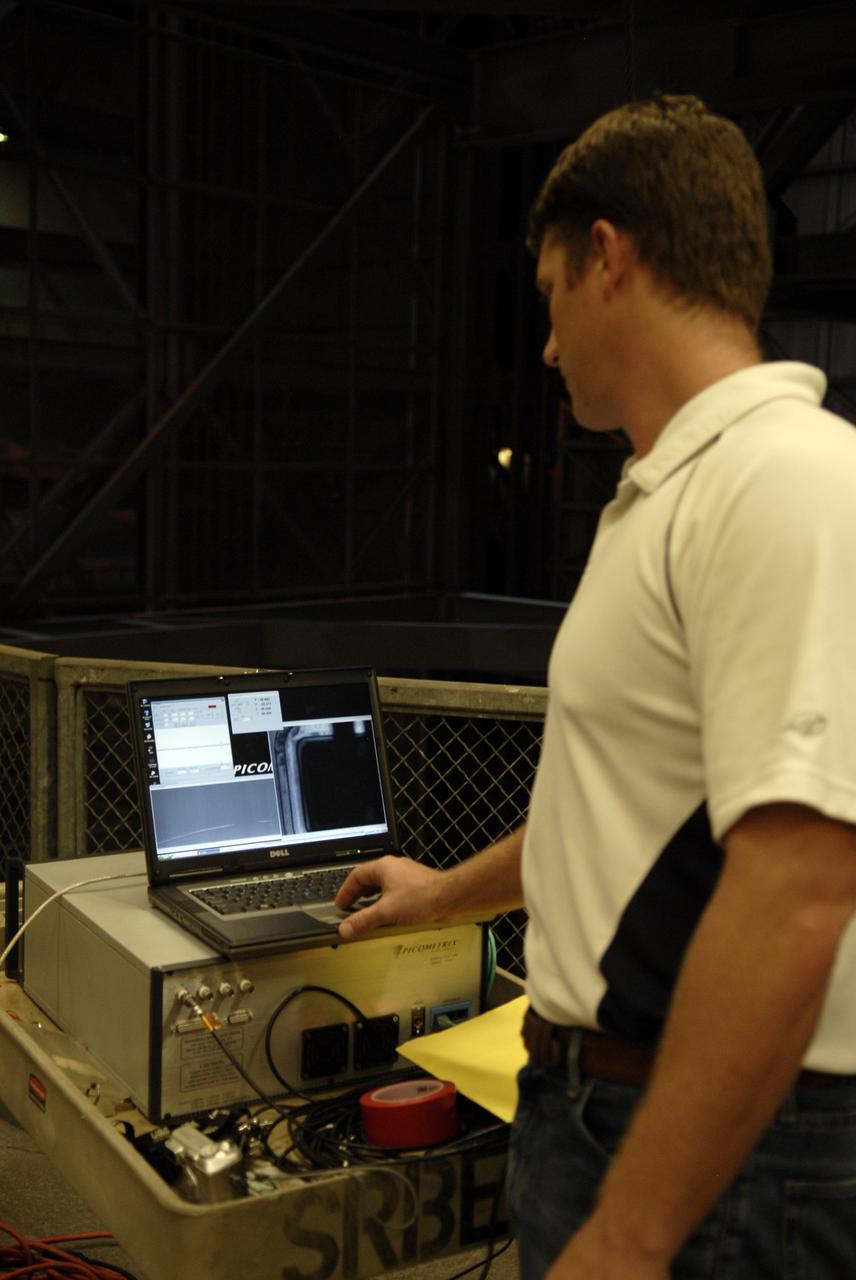
CAPE CANAVERAL, Fla. – In the Vehicle Assembly Building at NASA's Kennedy Space Center’s in Florida, a technician conducts terahertz scans of five ice frost ramps on the external fuel tank, designated ET-133, for space shuttle Atlantis’ STS-129 mission. The ice frost ramps are made from foam insulation and cover brackets that hold pressurization lines on the outside of the external tank. Terahertz scans are wave frequency analysis in the infrared band that can see through the foam insulation to help look for any voids or pockets where the foam is not bonded to the metal primer. The ramps being scanned were on the top part of the tank in the same area where foam came off during the last two shuttle launches. The data will be used to help assess whether foam on ET-132, the fuel tank attached to shuttle Discovery at Kennedy’s Launch Pad 39A, is fit for its flight on the STS-128 mission to the International Space Station. Photo credit: NASA/Kim Shiflett

CAPE CANAVERAL, Fla. – In the Vehicle Assembly Building at NASA's Kennedy Space Center’s in Florida, a technician sets up equipment to support terahertz scans of five ice frost ramps on the external fuel tank, designated ET-133, for space shuttle Atlantis’ STS-129 mission. The ice frost ramps are made from foam insulation and cover brackets that hold pressurization lines on the outside of the external tank. Terahertz scans are wave frequency analysis in the infrared band that can see through the foam insulation to help look for any voids or pockets where the foam is not bonded to the metal primer. The ramps being scanned were on the top part of the tank in the same area where foam came off during the last two shuttle launches. The data will be used to help assess whether foam on ET-132, the fuel tank attached to shuttle Discovery at Kennedy’s Launch Pad 39A, is fit for its flight on the STS-128 mission to the International Space Station. Photo credit: NASA/Kim Shiflett
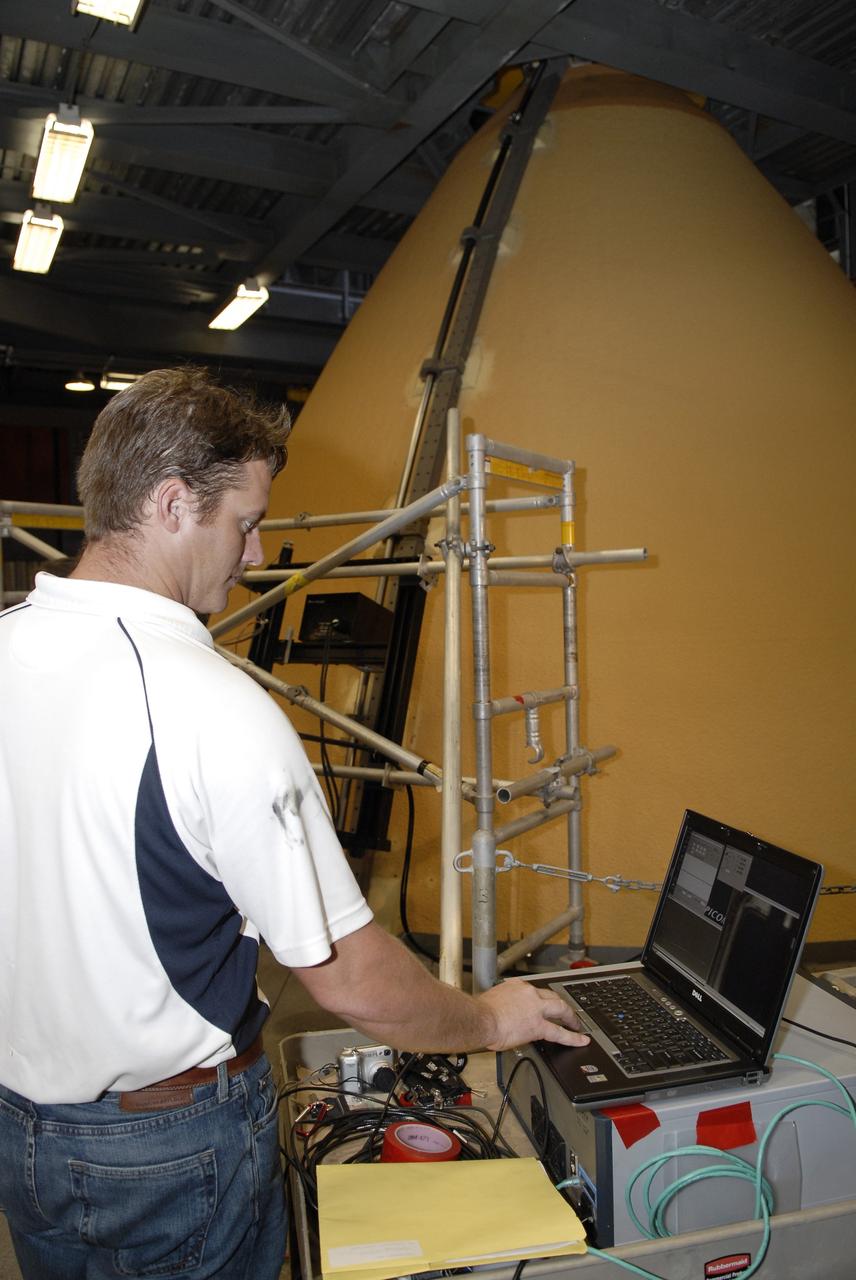
CAPE CANAVERAL, Fla. – In the Vehicle Assembly Building at NASA's Kennedy Space Center’s in Florida, a technician conducts terahertz scans of five ice frost ramps on the external fuel tank, designated ET-133, for space shuttle Atlantis’ STS-129 mission. The ice frost ramps are made from foam insulation and cover brackets that hold pressurization lines on the outside of the external tank. Terahertz scans are wave frequency analysis in the infrared band that can see through the foam insulation to help look for any voids or pockets where the foam is not bonded to the metal primer. The ramps being scanned were on the top part of the tank in the same area where foam came off during the last two shuttle launches. The data will be used to help assess whether foam on ET-132, the fuel tank attached to shuttle Discovery at Kennedy’s Launch Pad 39A, is fit for its flight on the STS-128 mission to the International Space Station. Photo credit: NASA/Kim Shiflett

In the Vehicle Assembly Building, United Space Alliance technicians Brenda Morris and Brian Williams are applying foam and molds on Space Shuttle Atlantis' external tank to areas damaged by hail. The white hole with a red circle around it (upper right) is a hole prepared for molding and material application. The red material is sealant tape so the mold doesn't leak when the foam rises against the mold. The white/ translucent square mold is an area where the foam has been applied and the foam has risen and cured against the mold surface. In late February, Atlantis' external tank received hail damage during a severe thunderstorm that passed through the Kennedy Space Center Launch Complex 39 area. The hail caused visible divots in the giant tank's foam insulation as well as minor surface damage to about 26 heat shield tiles on the shuttle's left wing. The March launch was postponed and has not yet been rescheduled due to the repair process.
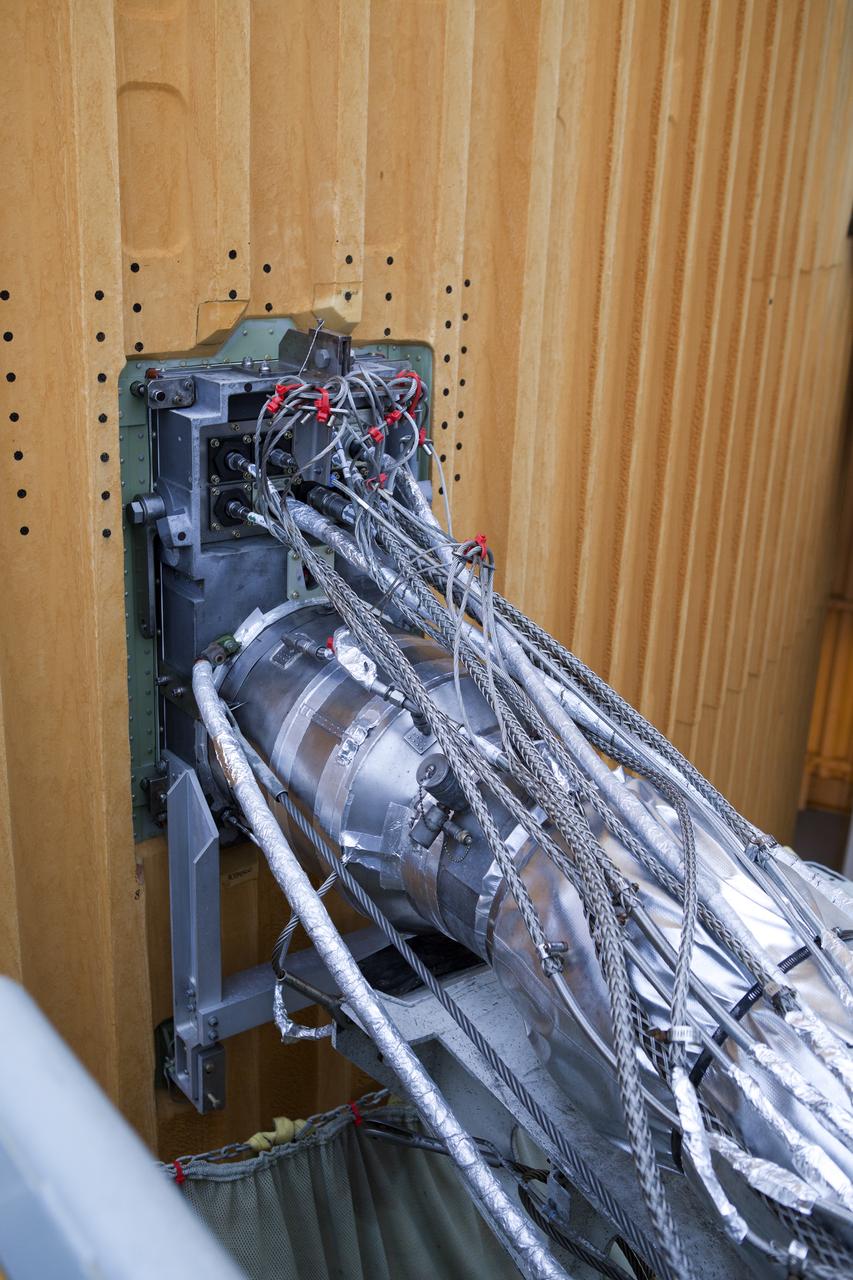
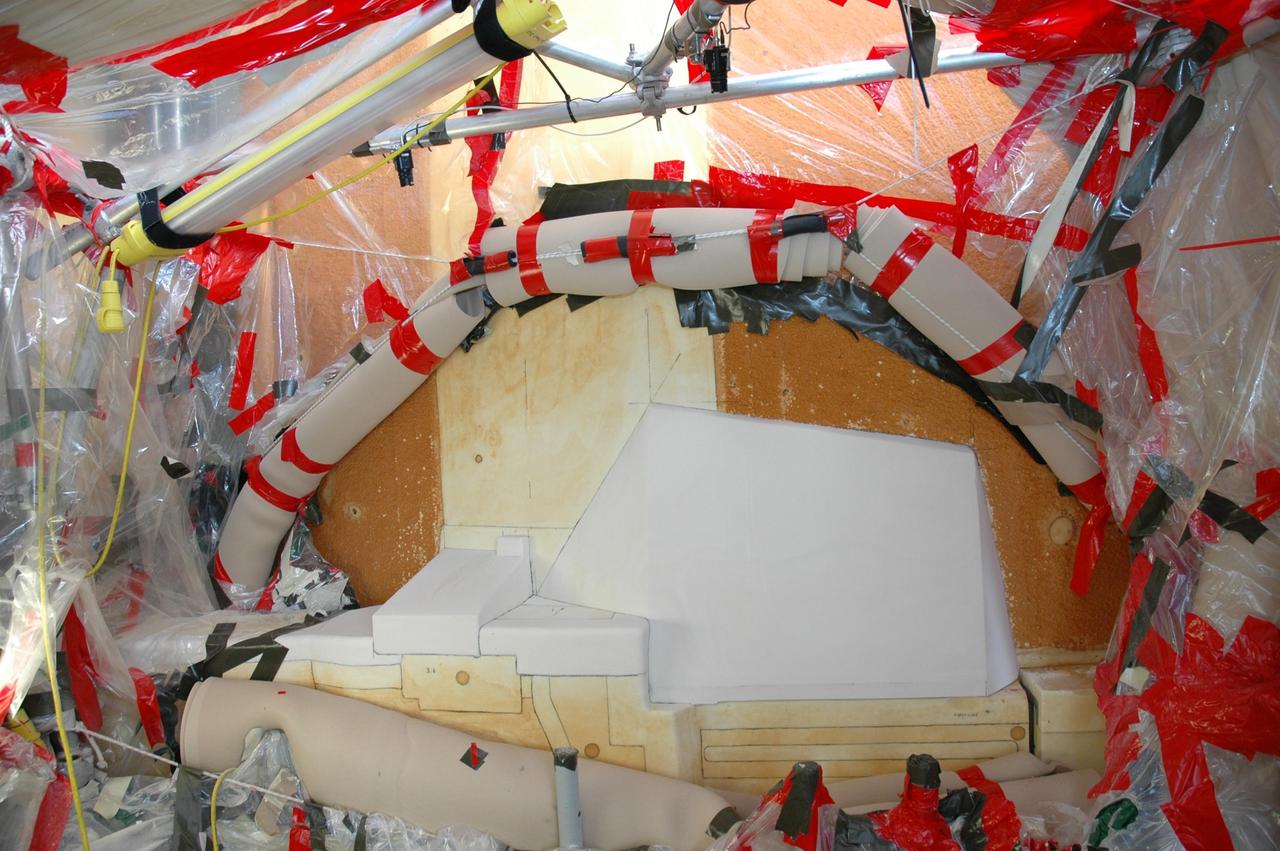
STS-133 DISCOVERY - HARDWARE REMOVAL FROM ORBITER IN WHITE ROOM - ET FOAM REPAIR PREPS WITH TENTS
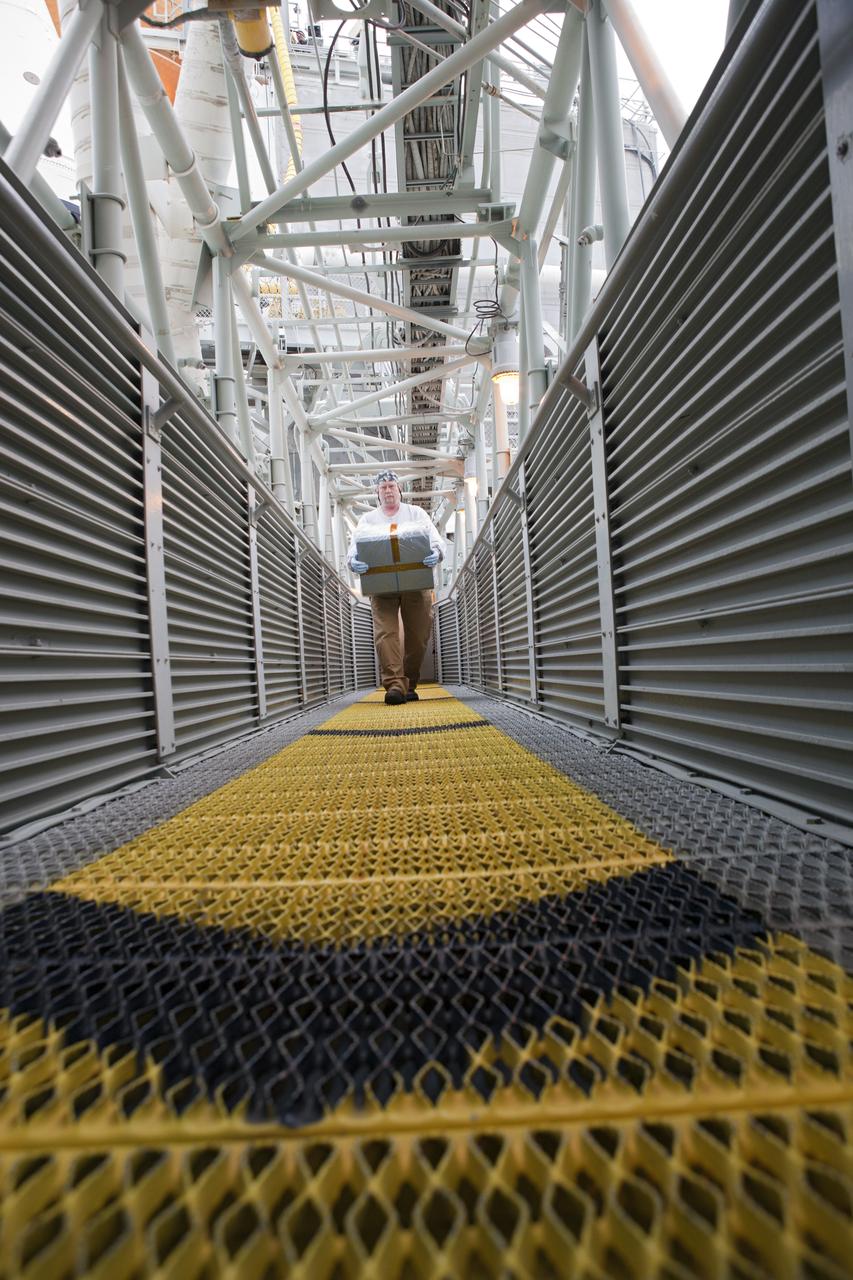
STS-133 DISCOVERY - HARDWARE REMOVAL FROM ORBITER IN WHITE ROOM - ET FOAM REPAIR PREPS WITH TENTS
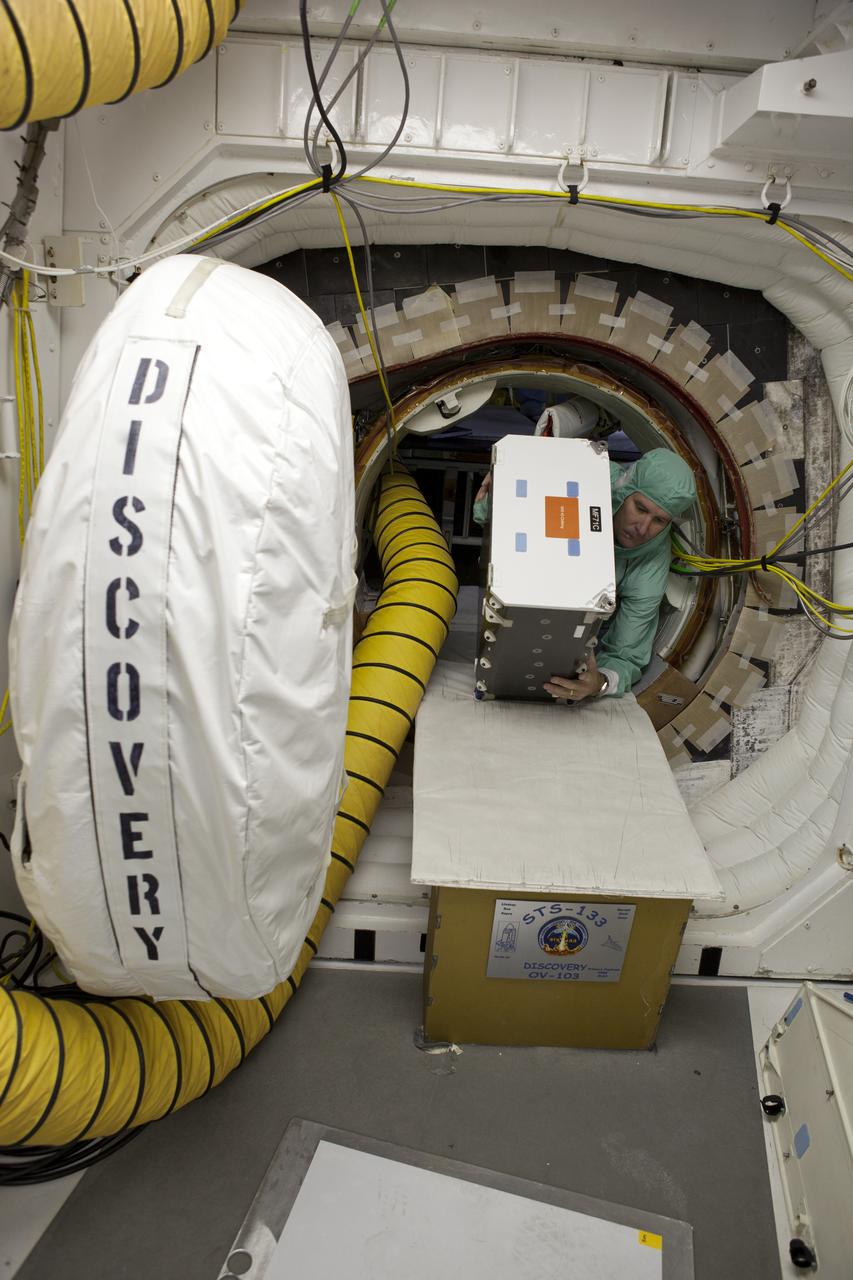
STS-133 DISCOVERY - HARDWARE REMOVAL FROM ORBITER IN WHITE ROOM - ET FOAM REPAIR PREPS WITH TENTS
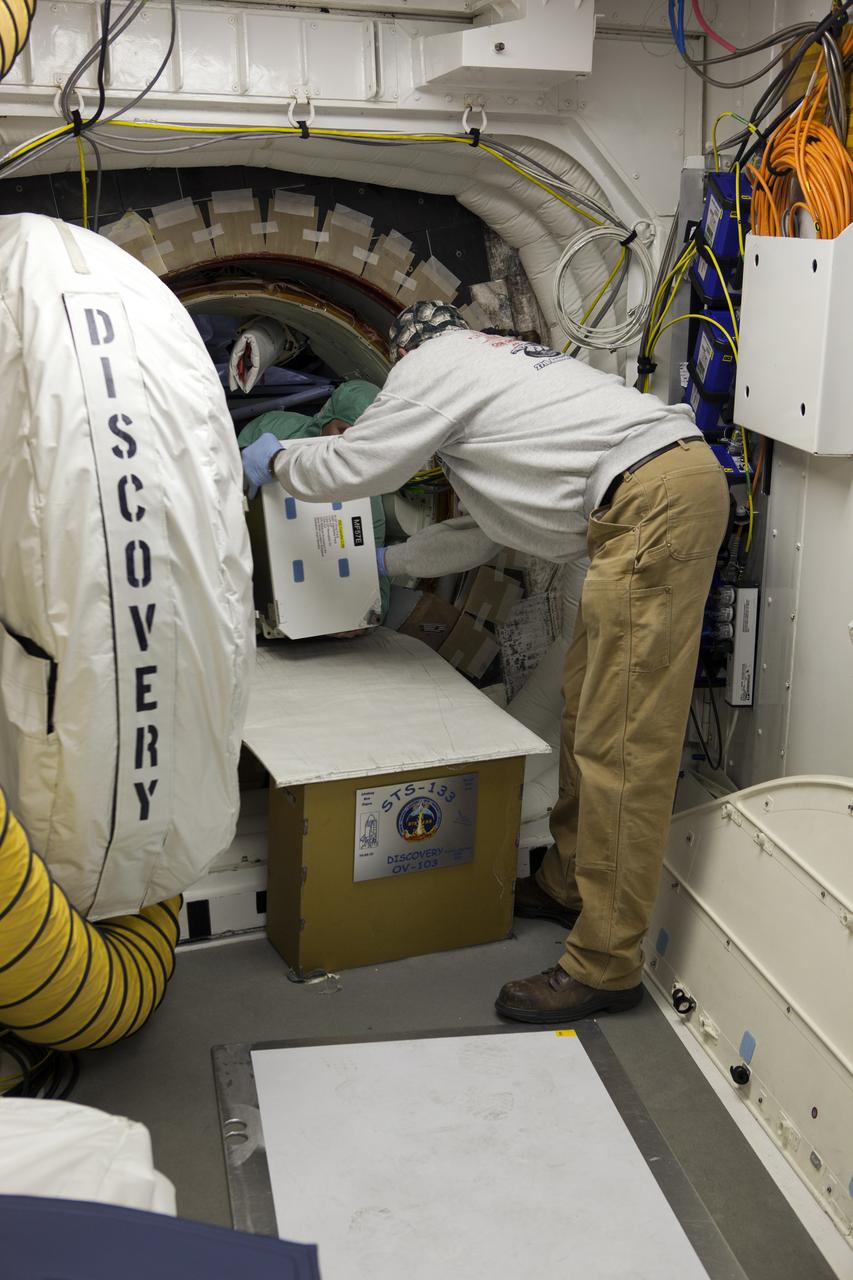
STS-133 DISCOVERY - HARDWARE REMOVAL FROM ORBITER IN WHITE ROOM - ET FOAM REPAIR PREPS WITH TENTS
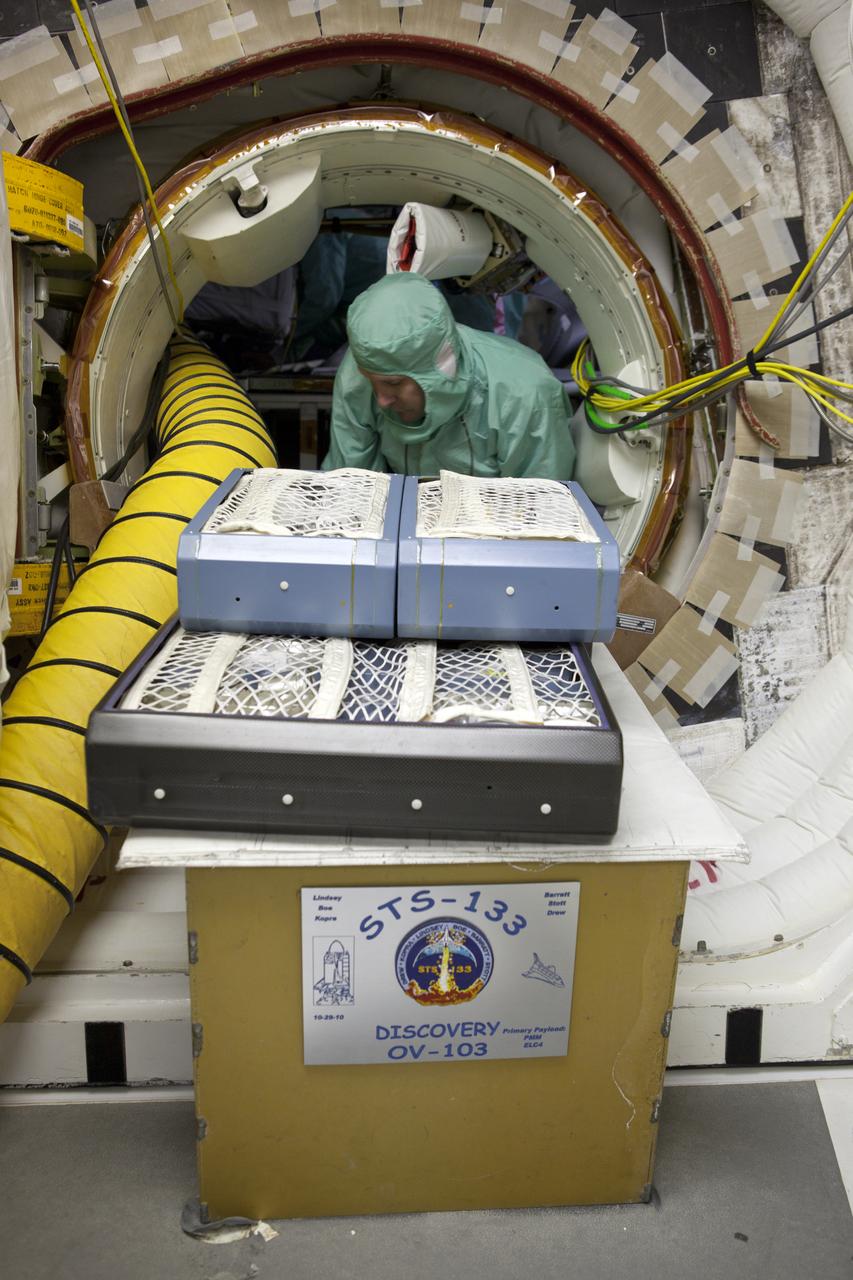
STS-133 DISCOVERY - HARDWARE REMOVAL FROM ORBITER IN WHITE ROOM - ET FOAM REPAIR PREPS WITH TENTS
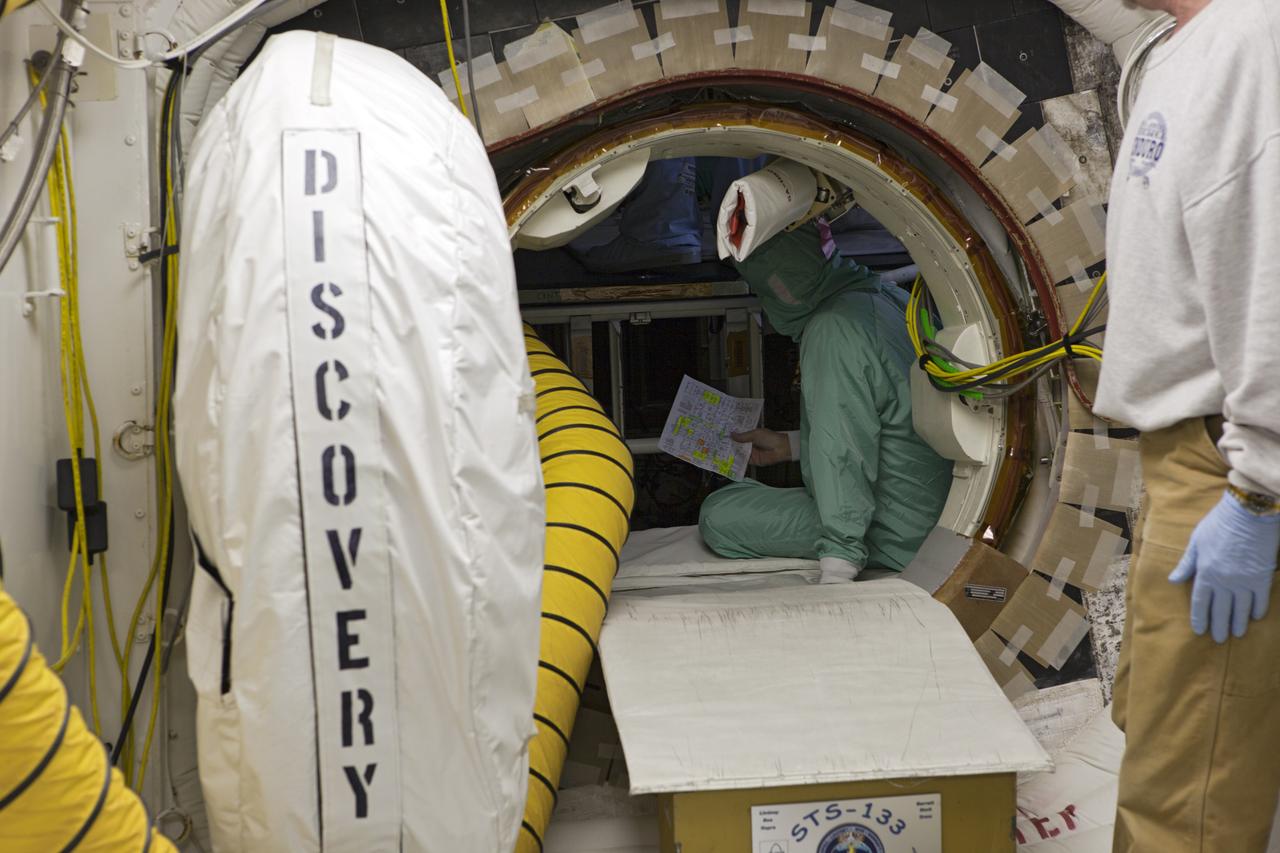
STS-133 DISCOVERY - HARDWARE REMOVAL FROM ORBITER IN WHITE ROOM - ET FOAM REPAIR PREPS WITH TENTS
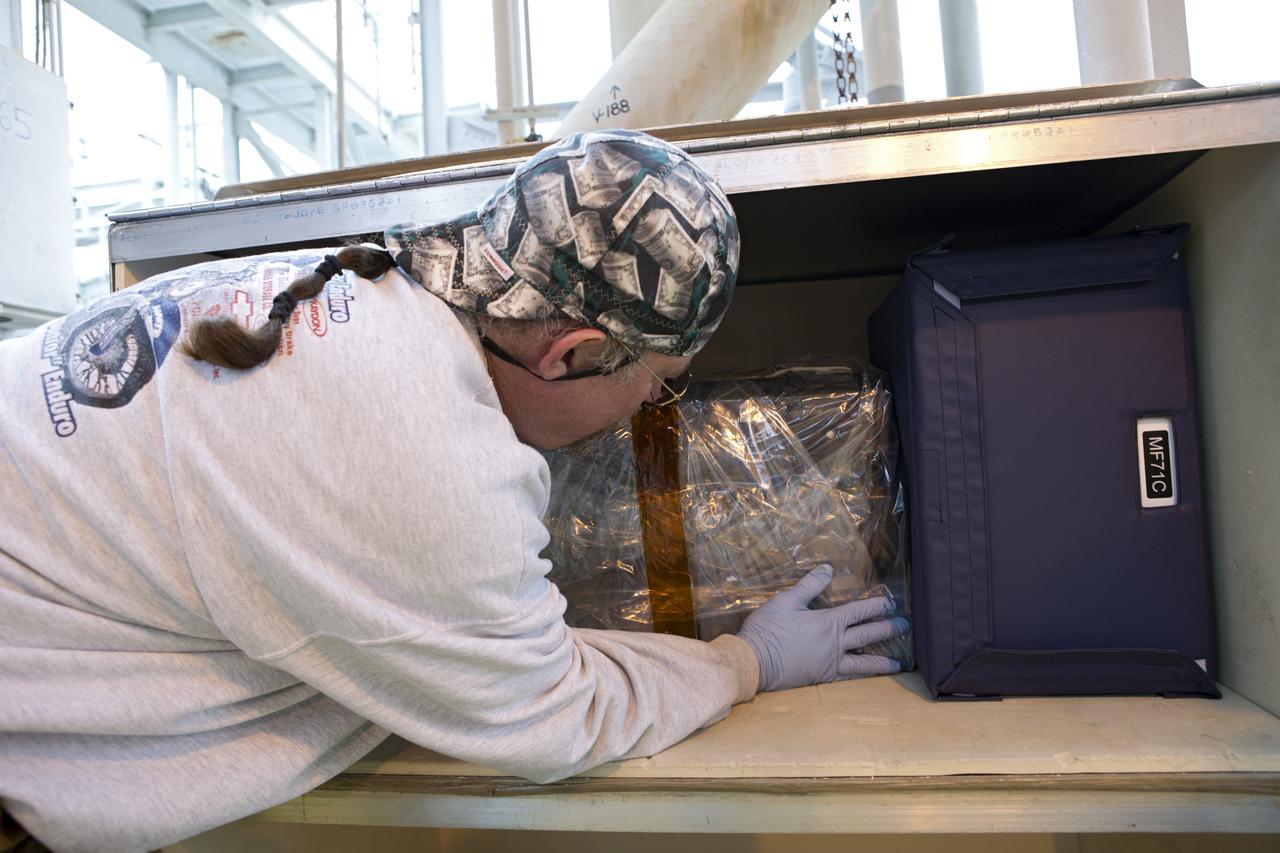
STS-133 DISCOVERY - HARDWARE REMOVAL FROM ORBITER IN WHITE ROOM - ET FOAM REPAIR PREPS WITH TENTS
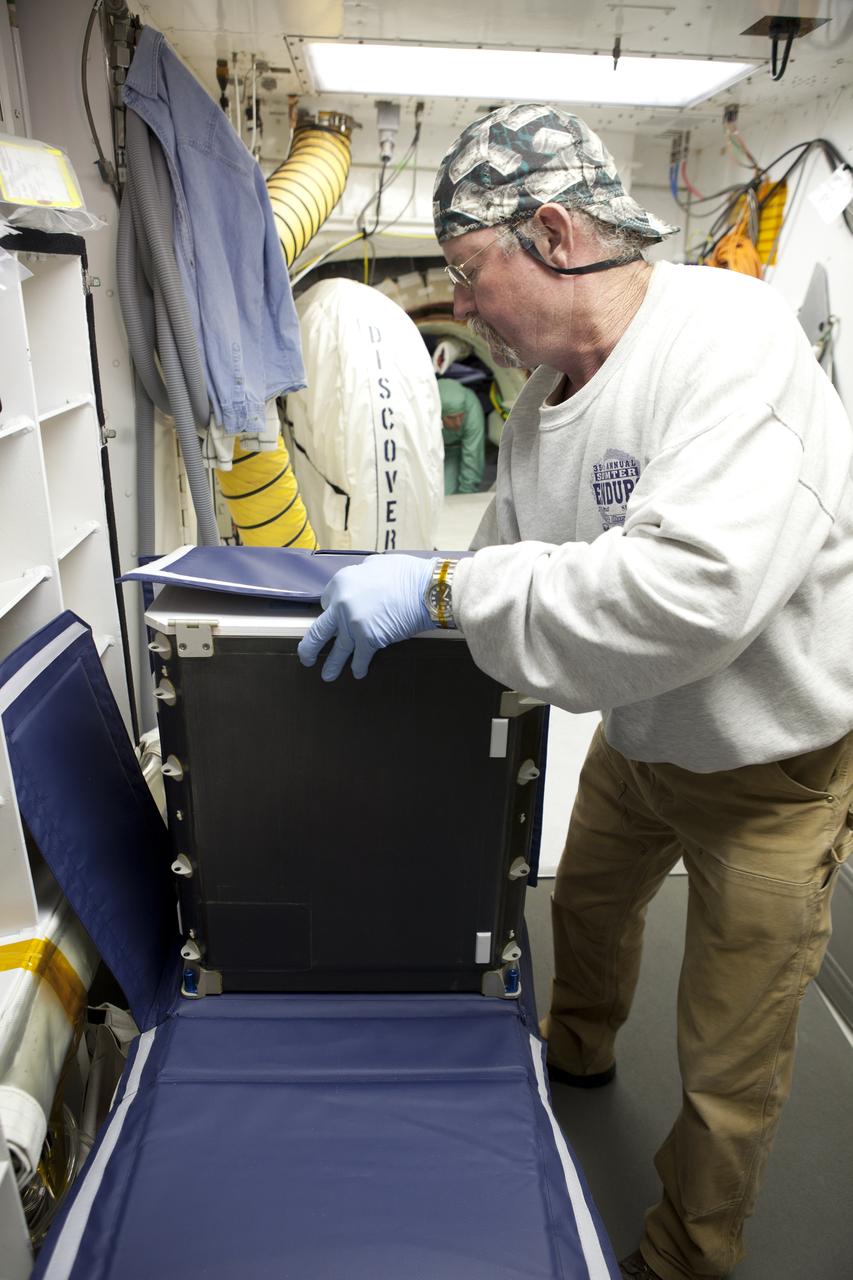
STS-133 DISCOVERY - HARDWARE REMOVAL FROM ORBITER IN WHITE ROOM - ET FOAM REPAIR PREPS WITH TENTS