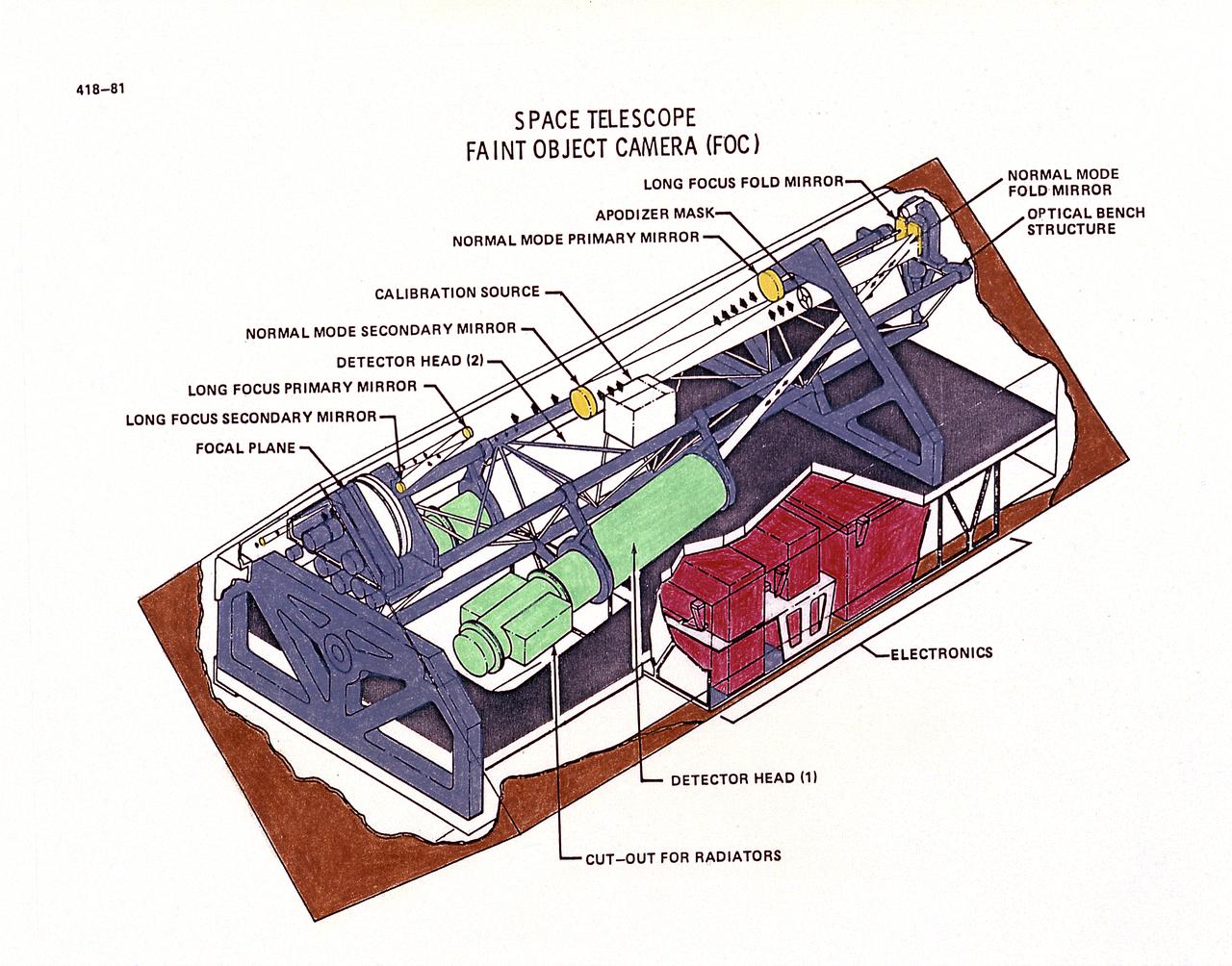
This drawing illustrates Hubble Space Telescope's (HST's), Faint Object Camera (FOC). The FOC reflects light down one of two optical pathways. The light enters a detector after passing through filters or through devices that can block out light from bright objects. Light from bright objects is blocked out to enable the FOC to see background images. The detector intensifies the image, then records it much like a television camera. For faint objects, images can be built up over long exposure times. The total image is translated into digital data, transmitted to Earth, and then reconstructed. The purpose of the HST, the most complex and sensitive optical telescope ever made, is to study the cosmos from a low-Earth orbit. By placing the telescope in space, astronomers are able to collect data that is free of the Earth's atmosphere. The HST detects objects 25 times fainter than the dimmest objects seen from Earth and provides astronomers with an observable universe 250 times larger than visible from ground-based telescopes, perhaps as far away as 14 billion light-years. The HST views galaxies, stars, planets, comets, possibly other solar systems, and even unusual phenomena such as quasars, with 10 times the clarity of ground-based telescopes. The HST was deployed from the Space Shuttle Discovery (STS-31 mission) into Earth orbit in April 1990. The Marshall Space Flight Center had responsibility for design, development, and construction of the HST. The Perkin-Elmer Corporation, in Danbury, Cornecticut, developed the optical system and guidance sensors.
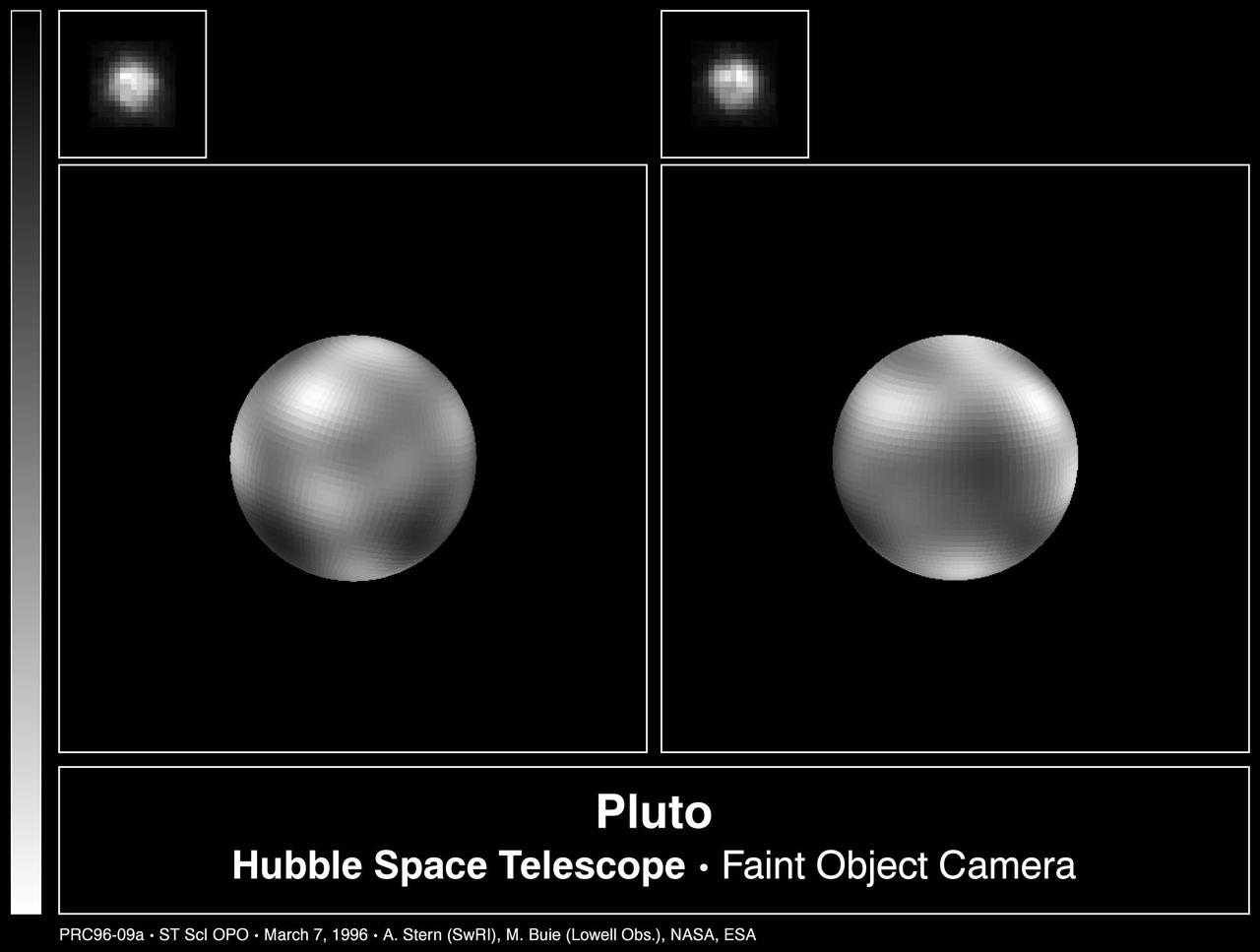
The never-before-seen surface of the distant planet Pluto is resolved in these NASA Hubble Space Telescope pictures, taken with the European Space Agency Faint Object Camera FOC aboard Hubble.
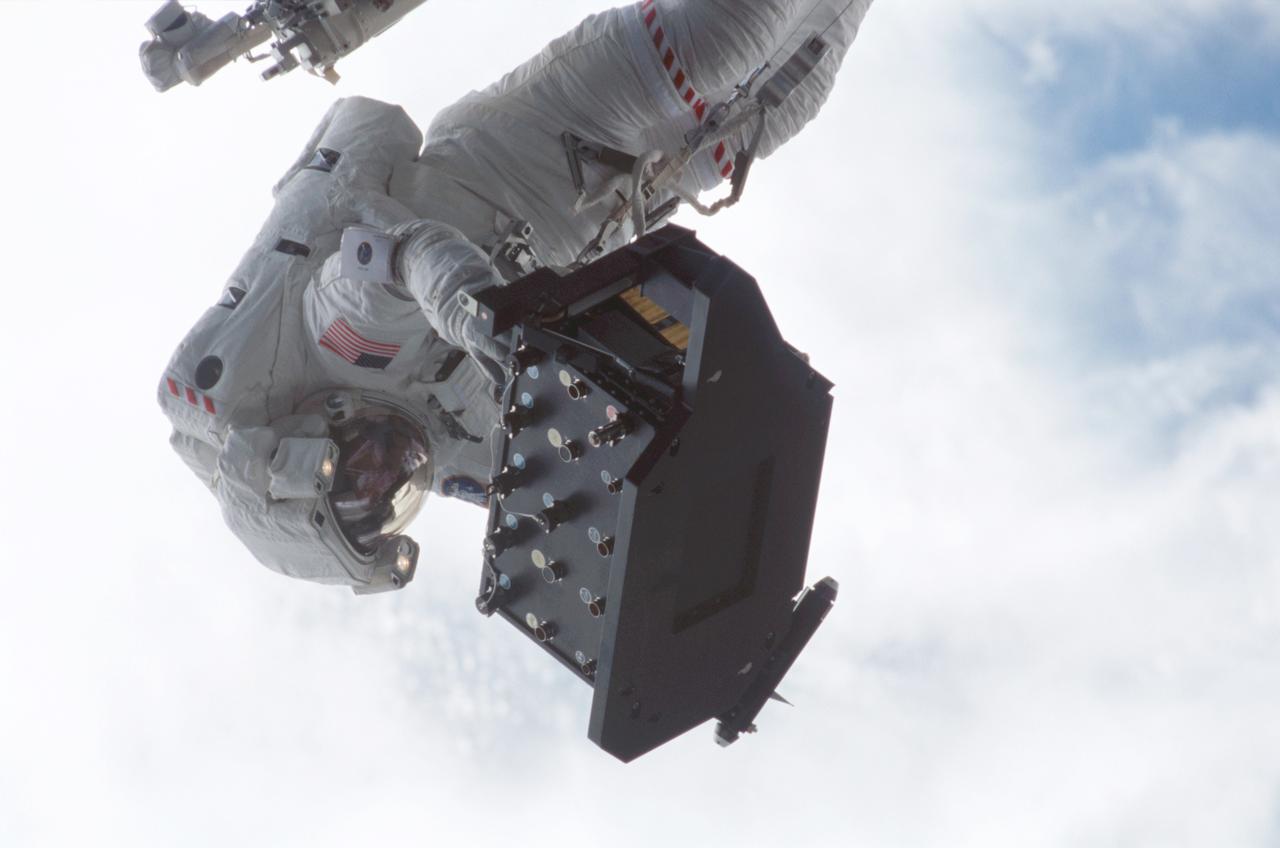
STS-109 Astronaut Michael J. Massimino, mission specialist, perched on the Shuttle's robotic arm, is preparing to install the Electronic Support Module (ESM) in the aft shroud of the Hubble Space telescope (HST), with the assistance of astronaut James H. Newman (out of frame). The module will support a new experimental cooling system to be installed during the next day's fifth and final space walk of the mission. That cooling system is designed to bring the telescope's Near-Infrared Camera and Multi Spectrometer (NICMOS) back to life the which had been dormant since January 1999 when its original coolant ran out. The Space Shuttle Columbia STS-109 mission lifted off March 1, 2002 with goals of repairing and upgrading the Hubble Space Telescope (HST). The Marshall Space Flight Center in Huntsville, Alabama had the responsibility for the design, development, and construction of the HST, which is the most powerful and sophisticated telescope ever built. In addition to the installation of the experimental cooling system for the Hubble's Near-Infrared Camera and NICMOS, STS-109 upgrades to the HST included replacement of the solar array panels, replacement of the power control unit (PCU), and replacement of the Faint Object Camera (FOC) with a new advanced camera for Surveys (ACS). Lasting 10 days, 22 hours, and 11 minutes, the STS-109 mission was the 108th flight overall in NASA's Space Shuttle Program.
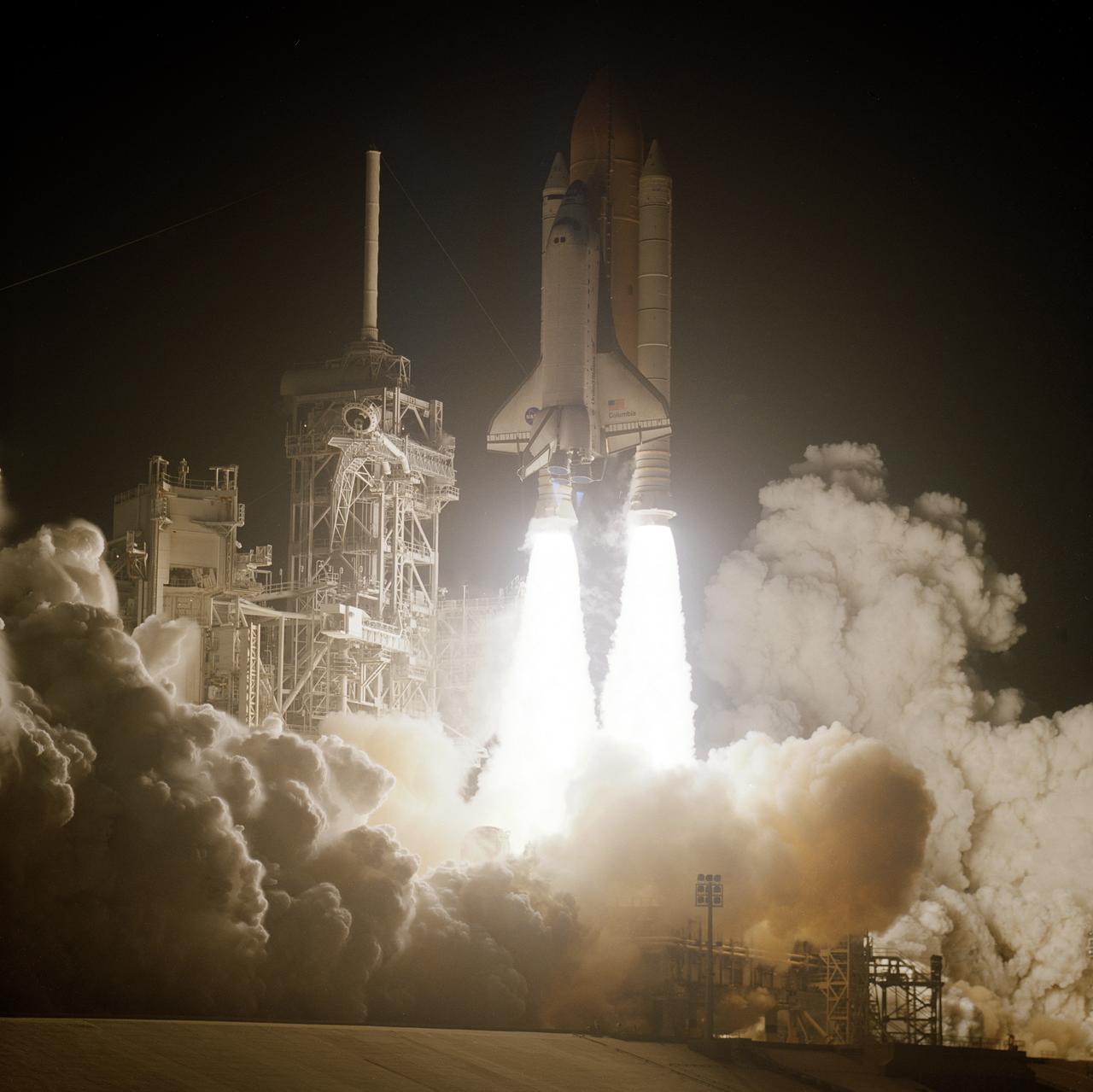
Carrying the STS-109 crew of seven, the Space Shuttle Orbiter Columbia blasted from its launch pad as it began its 27th flight and 108th flight overall in NASA's Space Shuttle Program. Launched March 1, 2002, the goal of the mission was the maintenance and upgrade of the Hubble Space Telescope (HST) which was developed, designed, and constructed by the Marshall Space Flight Center. Captured and secured on a work stand in Columbia's payload bay using Columbia's robotic arm, the HST received the following upgrades: replacement of the solar array panels; replacement of the power control unit (PCU); replacement of the Faint Object Camera (FOC) with a new advanced camera for Surveys (ACS); and installation of the experimental cooling system for the Hubble's Near-Infrared Camera and Multi-object Spectrometer (NICMOS), which had been dormant since January 1999 when it original coolant ran out. Four of the crewmembers performed 5 space walks in the 10 days, 22 hours, and 11 minutes of the the STS-109 mission.
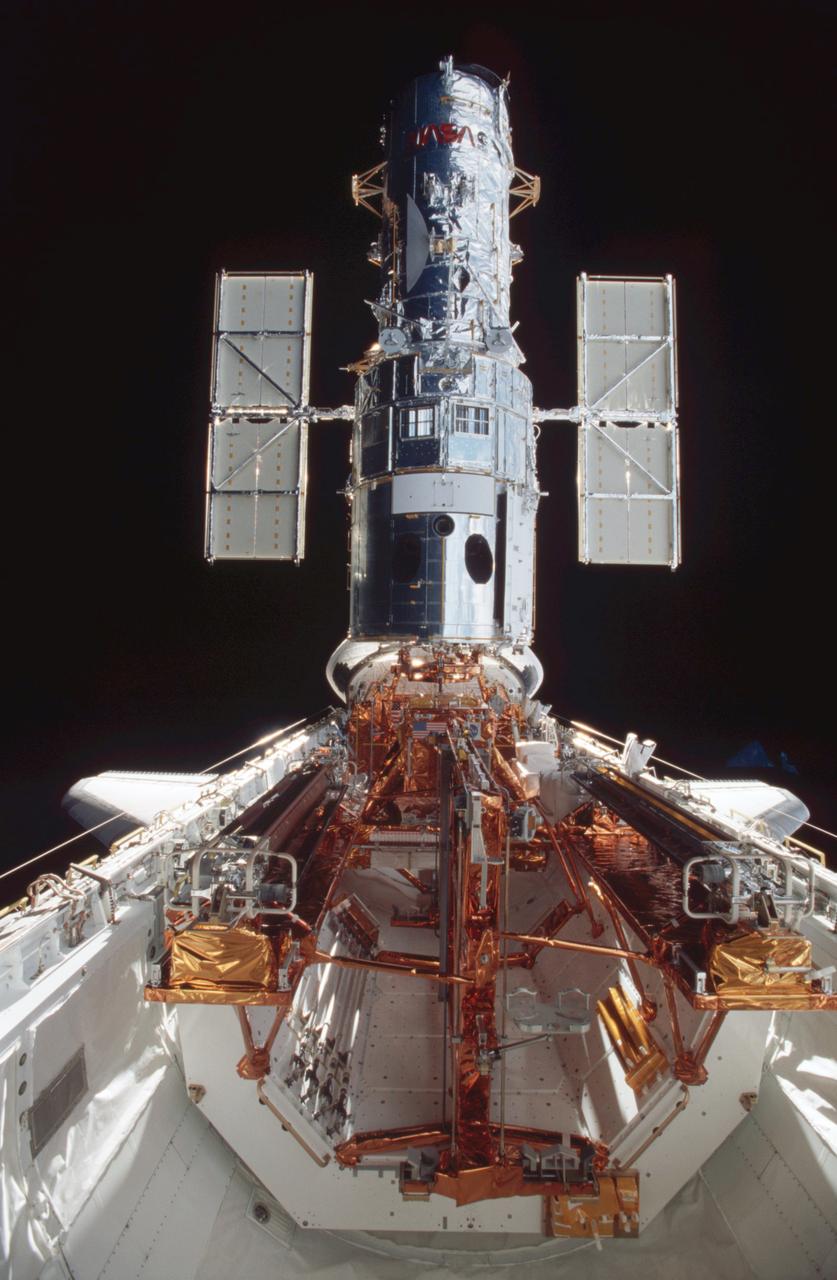
After five days of service and upgrade work on the Hubble Space Telescope (HST), the STS-109 crew photographed the giant telescope in the shuttle's cargo bay. The telescope was captured and secured on a work stand in Columbia's payload bay using Columbia's robotic arm, where 4 of the 7-member crew performed 5 space walks completing system upgrades to the HST. Included in those upgrades were: The replacement of the solar array panels; replacement of the power control unit (PCU); replacement of the Faint Object Camera (FOC) with a new advanced camera for Surveys (ACS); and installation of the experimental cooling system for the Hubble's Near-Infrared Camera and Multi-object Spectrometer (NICMOS), which had been dormant since January 1999 when its original coolant ran out. The Marshall Space Flight Center had the responsibility for the design, development, and construction of the the HST, which is the most complex and sensitive optical telescope ever made, to study the cosmos from a low-Earth orbit. Launched March 1, 2002, the STS-109 HST servicing mission lasted 10 days, 22 hours, and 11 minutes. It was the 108th flight overall in NASA's Space Shuttle Program.
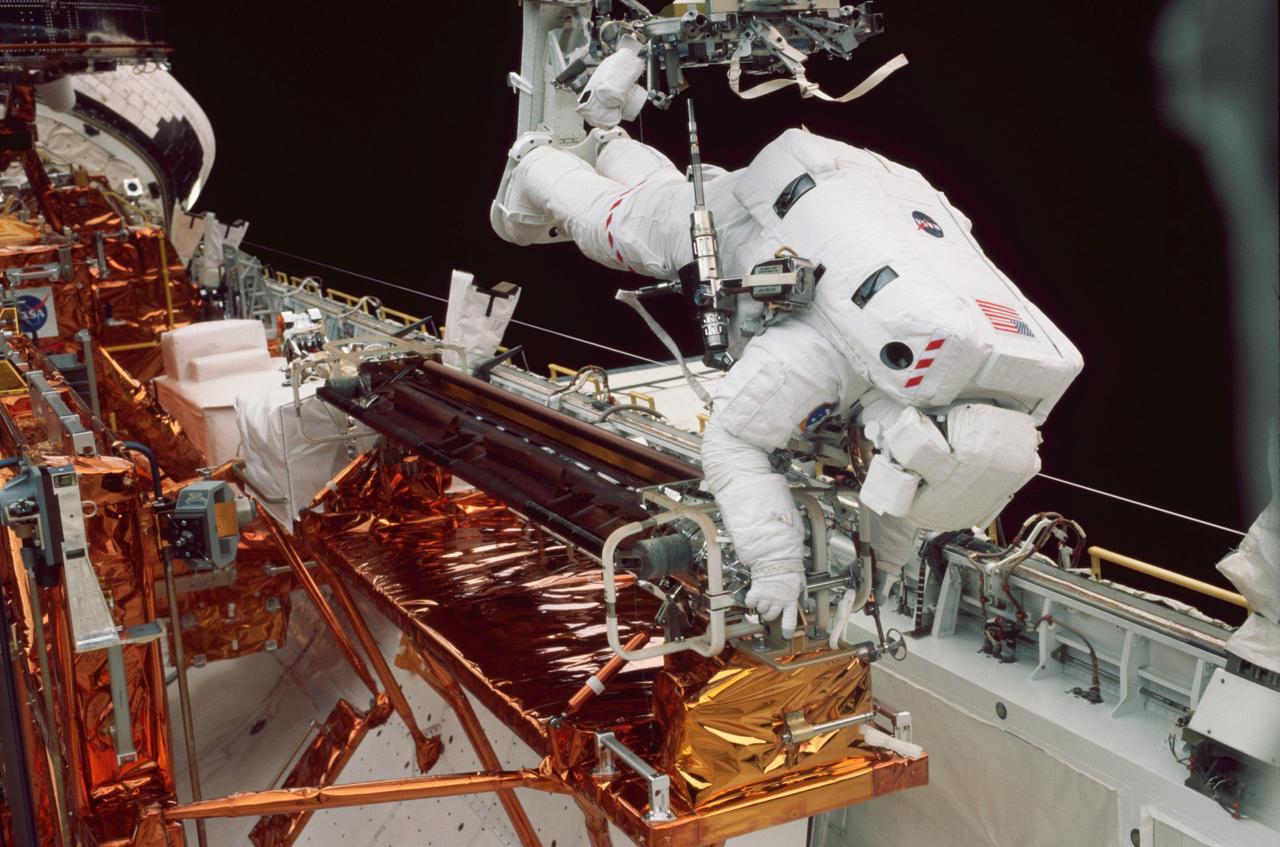
STS-109 Astronaut Michael J. Massimino, mission specialist, perched on the Shuttle's robotic arm is working at the stowage area for the Hubble Space Telescope's port side solar array. Working in tandem with James. H. Newman, Massimino removed the old port solar array and stored it in Columbia's payload bay for return to Earth. The two went on to install a third generation solar array and its associated electrical components. Two crew mates had accomplished the same feat with the starboard array on the previous day. In addition to the replacement of the solar arrays, the STS-109 crew also installed the experimental cooling system for the Hubble's Near-Infrared Camera (NICMOS), replaced the power control unit (PCU), and replaced the Faint Object Camera (FOC) with a new advanced camera for Surveys (ACS). The 108th flight overall in NASA's Space Shuttle Program, the Space Shuttle Columbia STS-109 mission lifted off March 1, 2002 for 10 days, 22 hours, and 11 minutes. Five space walks were conducted to complete the HST upgrades. The Marshall Space Flight Center in Huntsville, Alabama had the responsibility for the design, development, and construction of the HST, which is the most powerful and sophisticated telescope ever built.
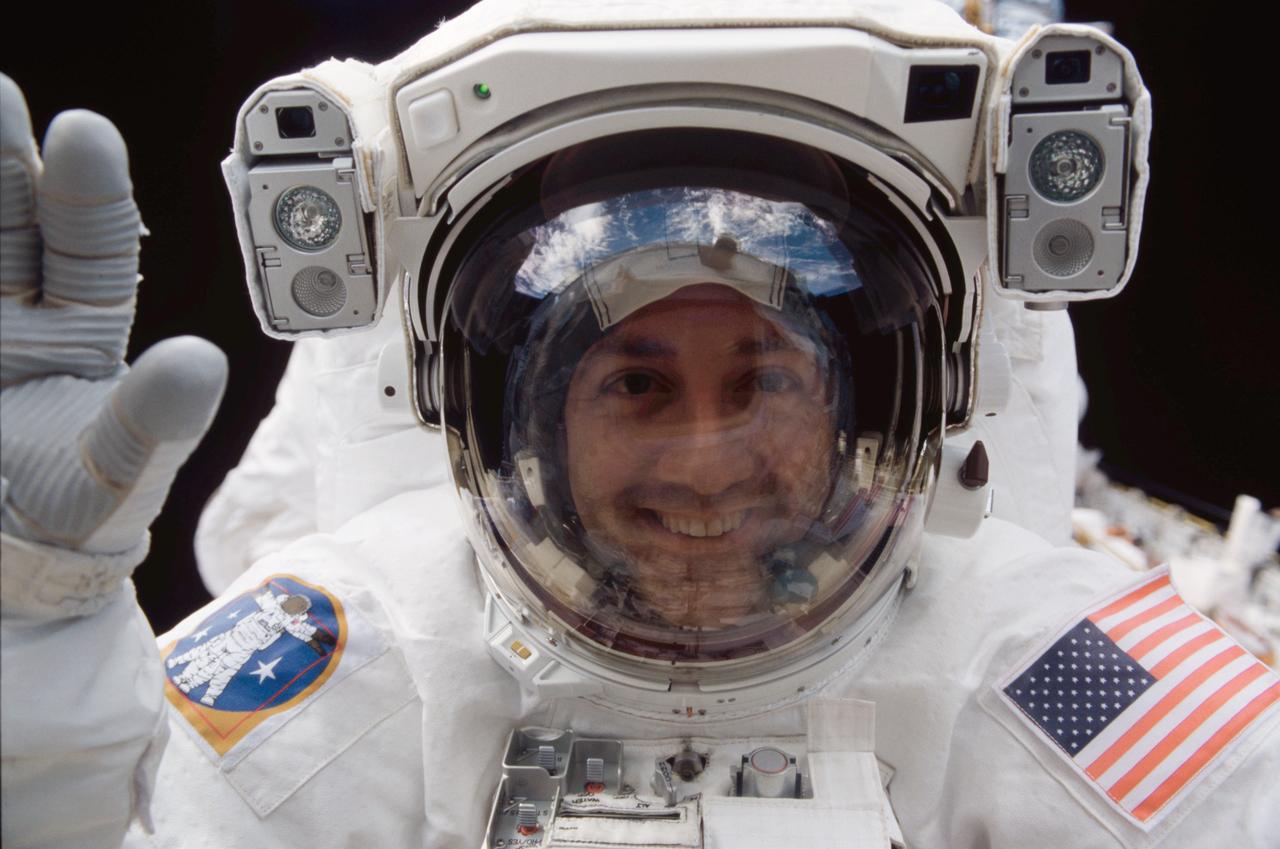
STS-109 Astronauts Michael J. Massimino and James H. Newman were making their second extravehicular activity (EVA) of their mission when astronaut Massimino, mission specialist, peered into Columbia's crew cabin during a brief break from work on the Hubble Space Telescope (HST). The HST is latched down just a few feet behind him in Columbia's cargo bay. The Space Shuttle Columbia STS-109 mission lifted off March 1, 2002 with goals of repairing and upgrading the Hubble Space Telescope (HST). STS-109 upgrades to the HST included: replacement of the solar array panels; replacement of the power control unit (PCU); replacement of the Faint Object Camera (FOC) with a new advanced camera for Surveys (ACS); and installation of the experimental cooling system for the Hubble's Near-Infrared Camera and Multi-object Spectrometer (NICMOS), which had been dormant since January 1999 when its original coolant ran out. The Marshall Space Flight Center in Huntsville, Alabama had the responsibility for the design, development, and construction of the HST, which is the most powerful and sophisticated telescope ever built. Lasting 10 days, 22 hours, and 11 minutes, the STS-109 mission was the 108th flight overall in NASA's Space Shuttle Program.
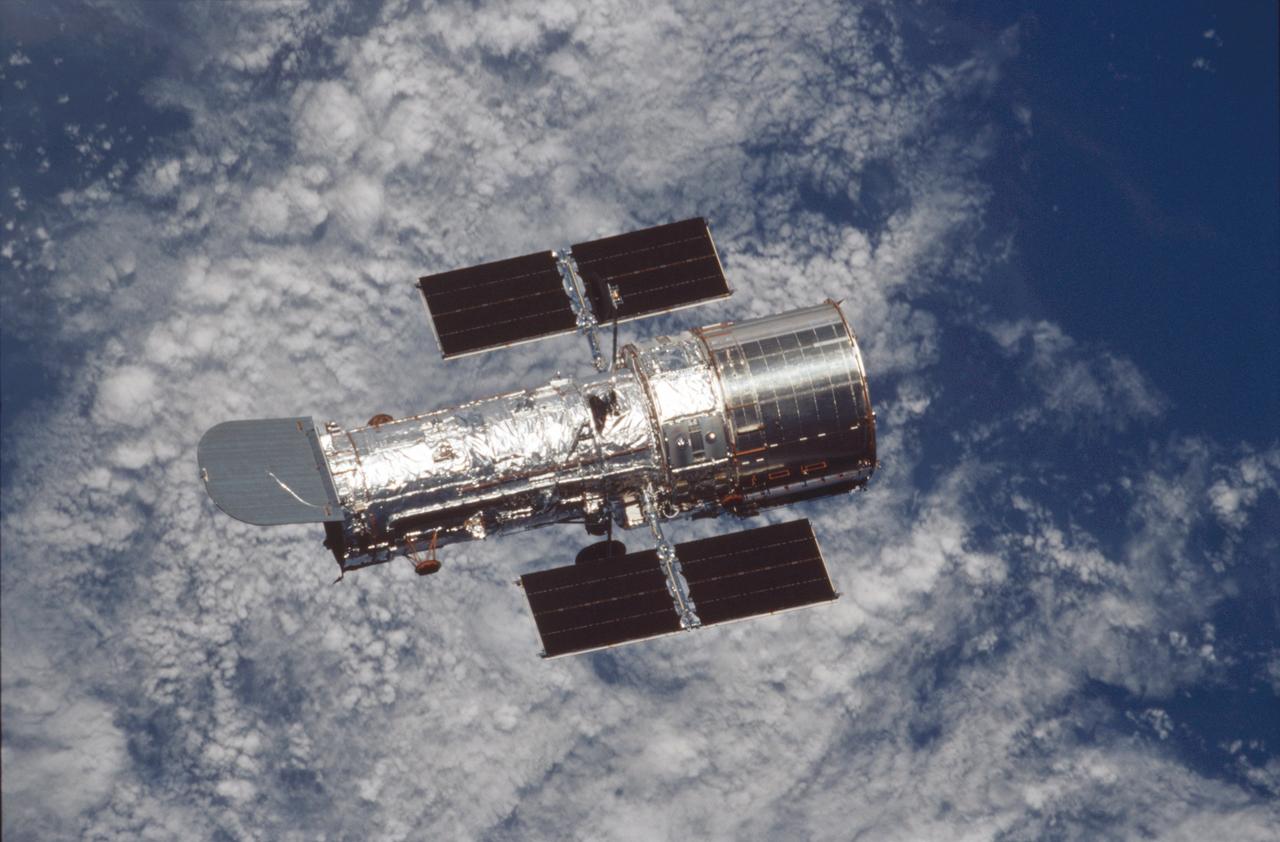
After five days of service and upgrade work on the Hubble Space Telescope (HST), the STS-109 crew photographed the giant telescope returning to its normal routine. The telescope was captured and secured on a work stand in Columbia's payload bay using Columbia's robotic arm, where 4 of the 7-member crew performed 5 space walks completing system upgrades to the HST. Included in those upgrades were: The replacement of the solar array panels; replacement of the power control unit (PCU); replacement of the Faint Object Camera (FOC) with a new advanced camera for Surveys (ACS); and installation of the experimental cooling system for the Hubble's Near- Infrared Camera and Multi-object Spectrometer (NICMOS), which had been dormant since January 1999 when its original coolant ran out. The Marshall Space Flight Center had the responsibility for the design, development, and construction of the the HST, which is the most complex and sensitive optical telescope ever made, to study the cosmos from a low-Earth orbit. Launched March 1, 2002, the STS-109 HST servicing mission lasted 10 days, 22 hours, and 11 minutes. It was the 108th flight overall in NASA's Space Shuttle Program.
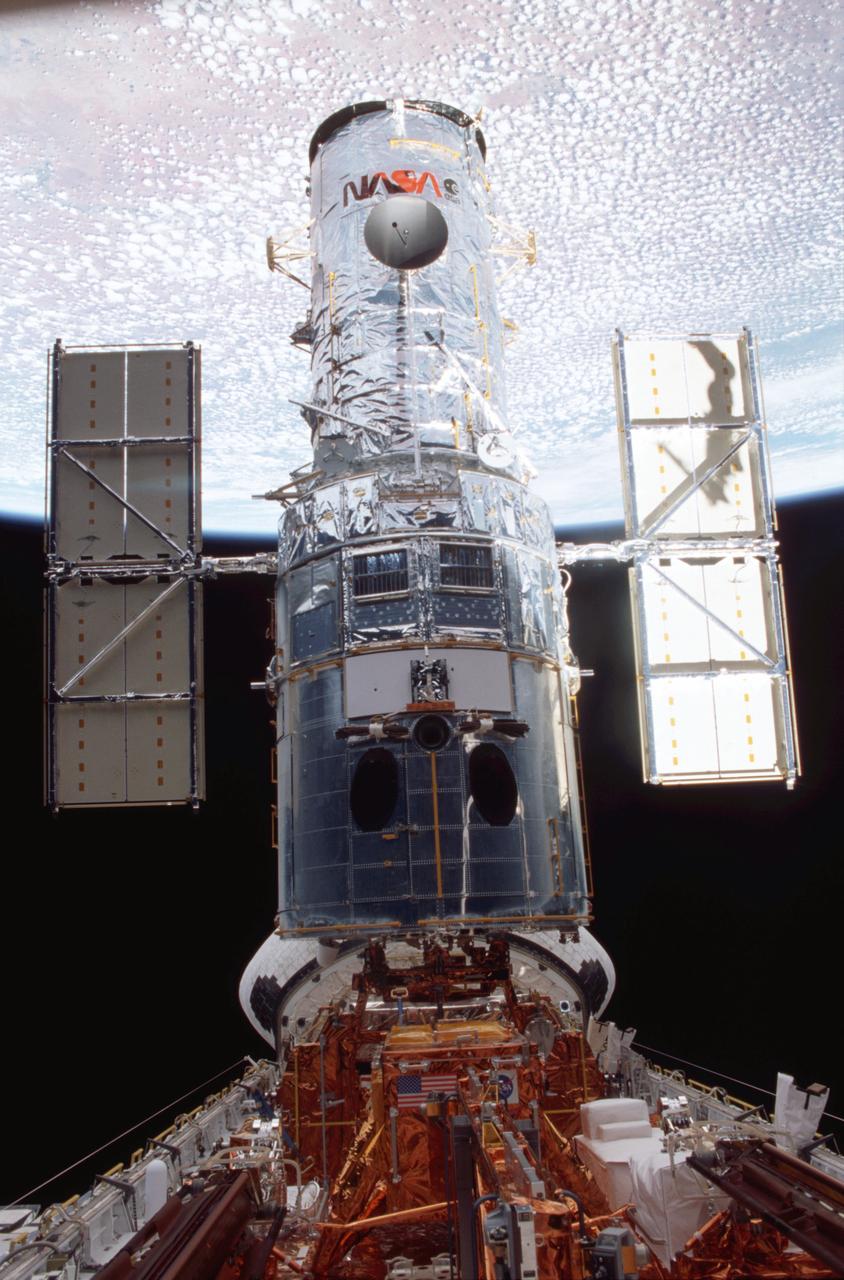
After five days of service and upgrade work on the Hubble Space Telescope (HST), the STS-109 crew photographed the giant telescope in the shuttle's cargo bay. The telescope was captured and secured on a work stand in Columbia's payload bay using Columbia's robotic arm, where 4 of the 7-member crew performed 5 space walks completing system upgrades to the HST. Included in those upgrades were: The replacement of the solar array panels; replacement of the power control unit (PCU); replacement of the Faint Object Camera (FOC) with a new advanced camera for Surveys (ACS); and installation of the experimental cooling system for the Hubble's Near-Infrared Camera and Multi-object Spectrometer (NICMOS), which had been dormant since January 1999 when its original coolant ran out. The Marshall Space Flight Center had the responsibility for the design, development, and construction of the the HST, which is the most complex and sensitive optical telescope ever made, to study the cosmos from a low-Earth orbit. Launched March 1, 2002, the STS-109 HST servicing mission lasted 10 days, 22 hours, and 11 minutes. It was the 108th flight overall in NASA's Space Shuttle Program.
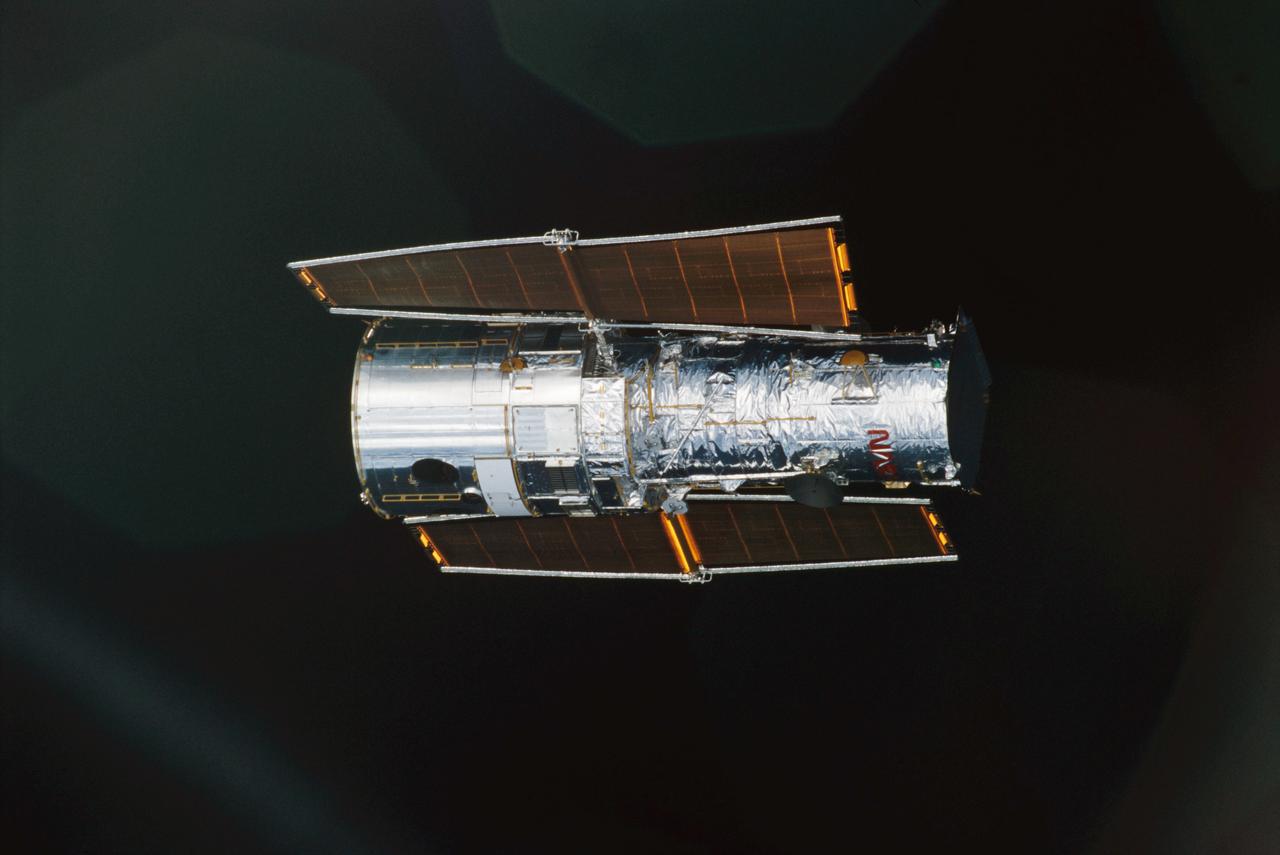
The Hubble Space Telescope (HST), with its normal routine temporarily interrupted, is about to be captured by the Space Shuttle Columbia prior to a week of servicing and upgrading by the STS-109 crew. The telescope was captured by the shuttle's Remote Manipulator System (RMS) robotic arm and secured on a work stand in Columbia's payload bay where 4 of the 7-member crew performed 5 space walks completing system upgrades to the HST. Included in those upgrades were: The replacement of the solar array panels; replacement of the power control unit (PCU); replacement of the Faint Object Camera (FOC) with a new advanced camera for Surveys (ACS); and installation of the experimental cooling system for the Hubble's Near-Infrared Camera and Multi-object Spectrometer (NICMOS), which had been dormant since January 1999 when its original coolant ran out. The Marshall Space Flight Center had the responsibility for the design, development, and construction of the the HST, which is the most complex and sensitive optical telescope ever made, to study the cosmos from a low-Earth orbit. Launched March 1, 2002, the STS-109 HST servicing mission lasted 10 days, 22 hours, and 11 minutes. It was the 108th flight overall in NASA's Space Shuttle Program.
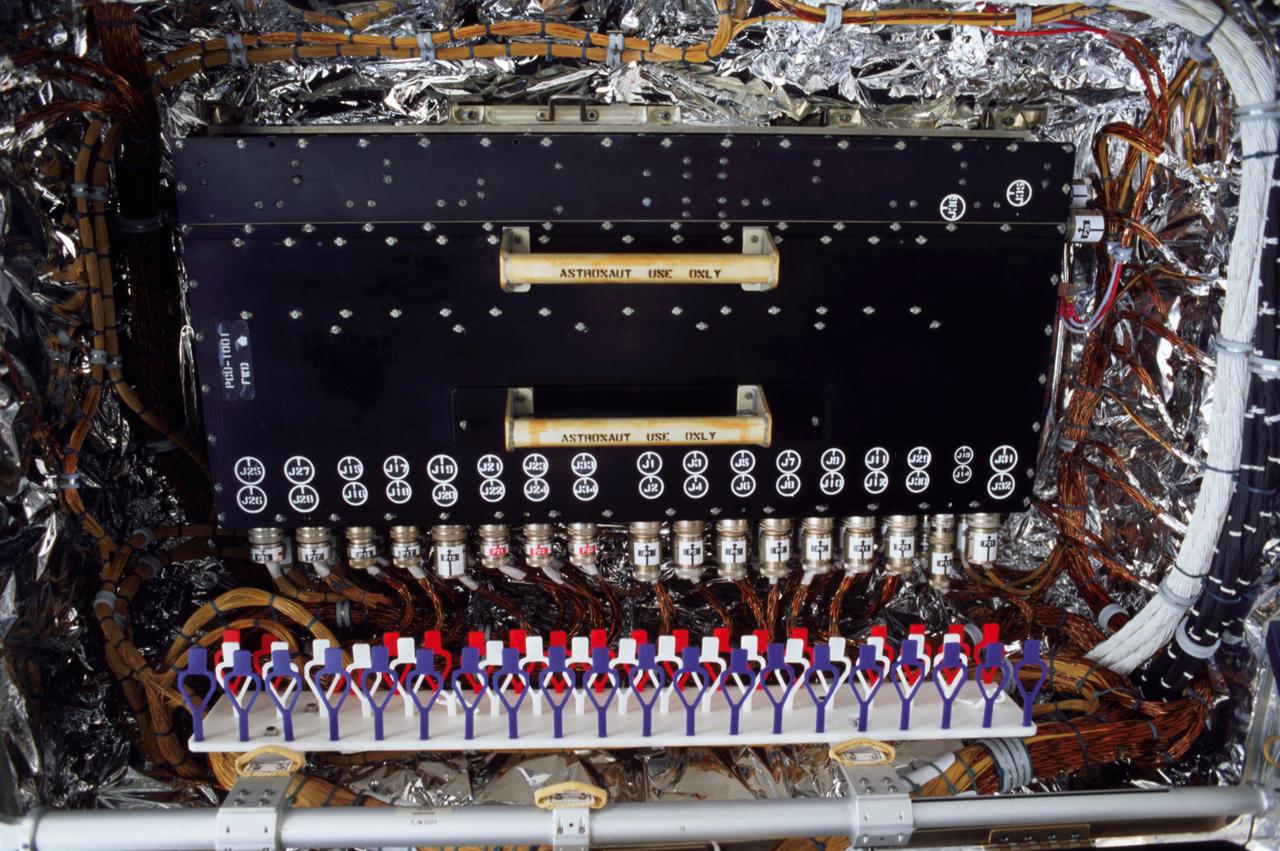
This is an onboard photo of the Hubble Space Telescope (HST) power control unit (PCU), the heart of the HST's power system. STS-109 payload commander John M. Grunsfeld, joined by Astronaut Richard M. Lirnehan, turned off the telescope in order to replace its PCU while participating in the third of five spacewalks dedicated to servicing and upgrading the HST. Other upgrades performed were: replacement of the solar array panels; replacement of the Faint Object Camera (FOC) with a new advanced camera for Surveys (ACS); and installation of the experimental cooling system for the Hubble's Near-Infrared Camera and Multi-Object Spectrometer (NICMOS), which had been dormant since January 1999 when its original coolant ran out. The telescope was captured and secured on a work stand in Columbia's payload bay using Columbia's robotic arm, where crew members completed the system upgrades. The Marshall Space Flight Center had the responsibility for the design, development, and construction of the HST, which is the most complex and sensitive optical telescope ever made, to study the cosmos from a low-Earth orbit. The HST detects objects 25 times fainter than the dimmest objects seen from Earth and provides astronomers with an observable universe 250 times larger than is visible from ground-based telescopes, perhaps as far away as 14 billion light-years. Launched March 1, 2002 the STS-109 HST servicing mission lasted 10 days, 22 hours, and 11 minutes. It was the 108th flight overall in NASA's Space Shuttle Program.
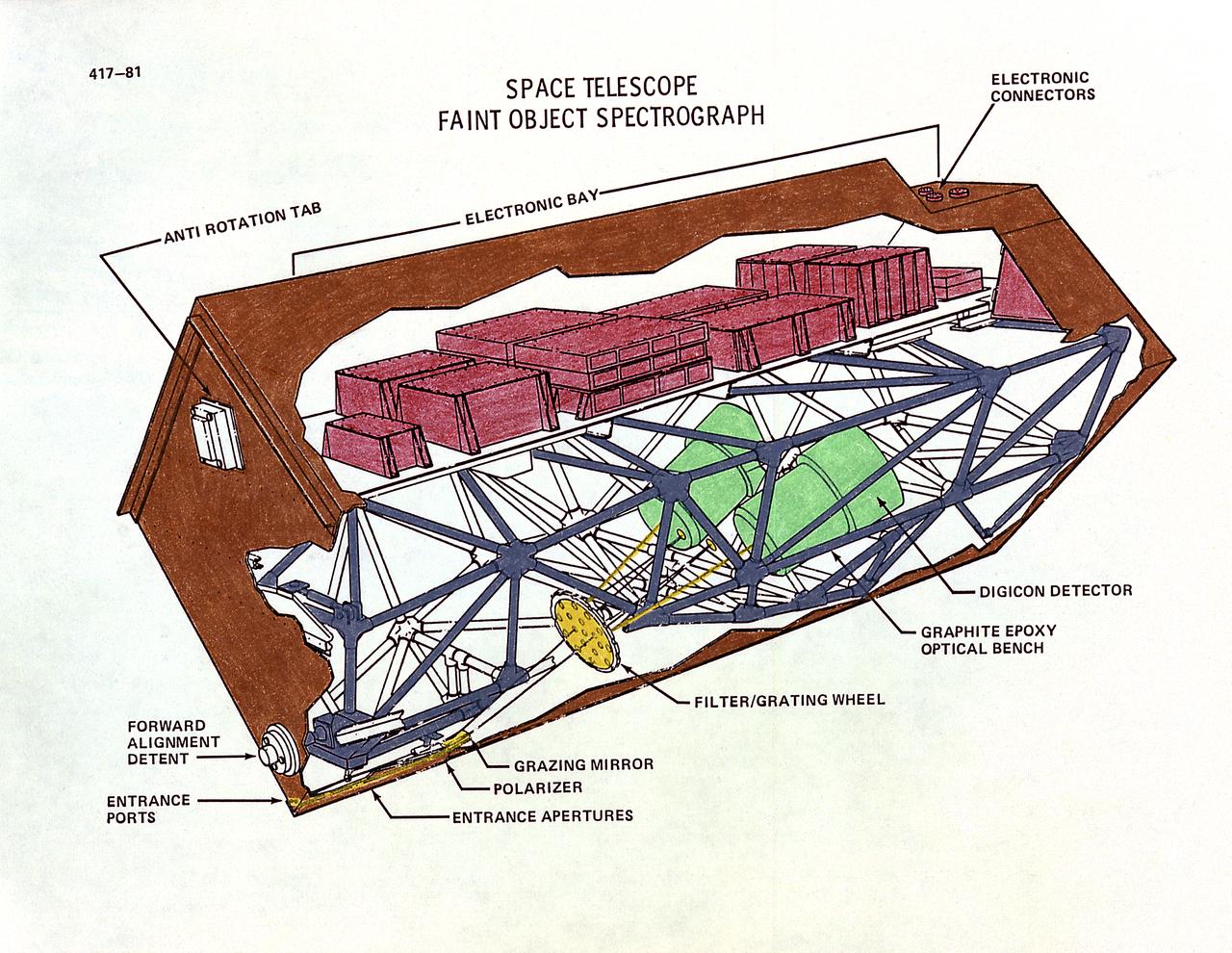
This drawing illustrates the Hubble Space Telescope's (HST's), Faint Object Spectrograph (FOS). The HST's two spectrographs, the Goddard High-Resolution Spectrograph and the FOS, can detect a broader range of wavelengths than is possible from the Earth because there is no atmosphere to absorb certain wavelengths. Scientists can determine the chemical composition, temperature, pressure, and turbulence of the stellar atmosphere producing the light, all from spectral data. The FOC can detect detail in very faint objects, such as those at great distances, and light ranging from ultraviolet to red spectral bands. Both spectrographs operate in essentially the same way. The incoming light passes through a small entrance aperture, then passes through filters and diffraction gratings, that work like prisms. The filter or grating used determines what range of wavelength will be examined and in what detail. Then the spectrograph detectors record the strength of each wavelength band and sends it back to Earth. The purpose of the HST, the most complex and sensitive optical telescope ever made, is to study the cosmos from a low-Earth orbit. By placing the telescope in space, astronomers are able to collect data that is free of the Earth's atmosphere. The HST views galaxies, stars, planets, comets, possibly other solar systems, and even unusual phenomena such as quasars, with 10 times the clarity of ground-based telescopes. The HST was deployed from the Space Shuttle Discovery (STS-31 mission) into Earth orbit in April 1990. The Marshall Space Flight Center had responsibility for design, development, and construction of the HST. The Perkin-Elmer Corporation, in Danbury, Cornecticut, developed the optical system and guidance sensors.
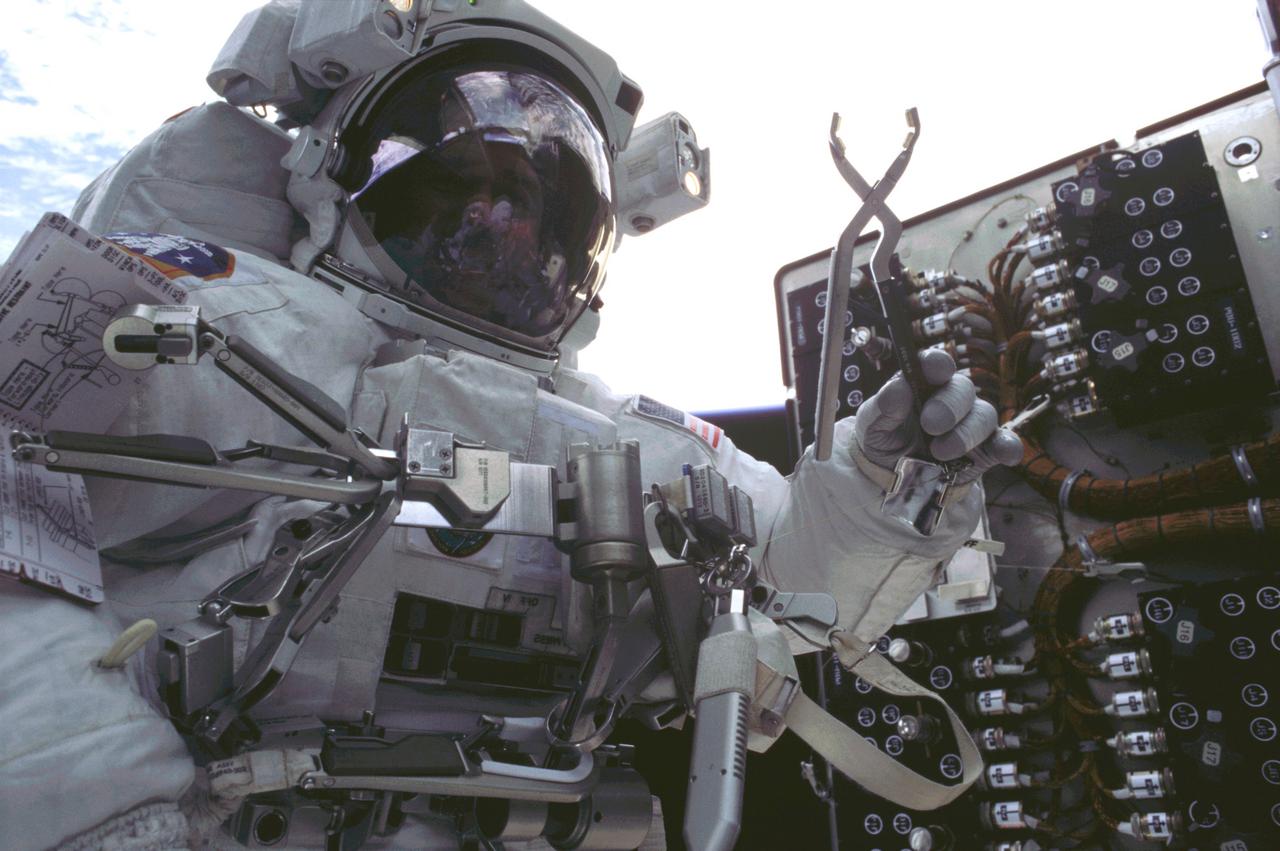
This is an onboard photo of Astronaut John M. Grunsfield, STS-109 payload commander, participating in the third of five spacewalks to perform work on the Hubble Space Telescope (HST). On this particular walk, Grunsfield, joined by Astronaut Richard M. Lirnehan, turned off the telescope in order to replace its power control unit (PCU), the heart of the HST's power system. The telescope was captured and secured on a work stand in Columbia's payload bay using Columbia's robotic arm, where crew members completed system upgrades to the HST. Included in those upgrades were: replacement of the solar array panels; replacement of the power control unit (PCU); replacement of the Faint Object Camera (FOC) with a new advanced camera for Surveys (ACS); and installation of the experimental cooling system for the Hubble's Near-Infrared Camera and Multi-object Spectrometer (NICMOS), which had been dormant since January 1999 when its original coolant ran out. The Marshall Space Flight Center had the responsibility for the design, development, and construction of the HST, which is the most complex and sensitive optical telescope ever made, to study the cosmos from a low-Earth orbit. The HST detects objects 25 times fainter than the dimmest objects seen from Earth and provides astronomers with an observable universe 250 times larger than is visible from ground-based telescopes, perhaps as far away as 14 billion light-years. The HST views galaxies, stars, planets, comets, possibly other solar systems, and even unusual phenomena such as quasars, with 10 times the clarity of ground-based telescopes. Launched March 1, 2002 the STS-109 HST servicing mission lasted 10 days, 22 hours, and 11 minutes. It was the 108th flight overall in NASA's Space Shuttle Program.
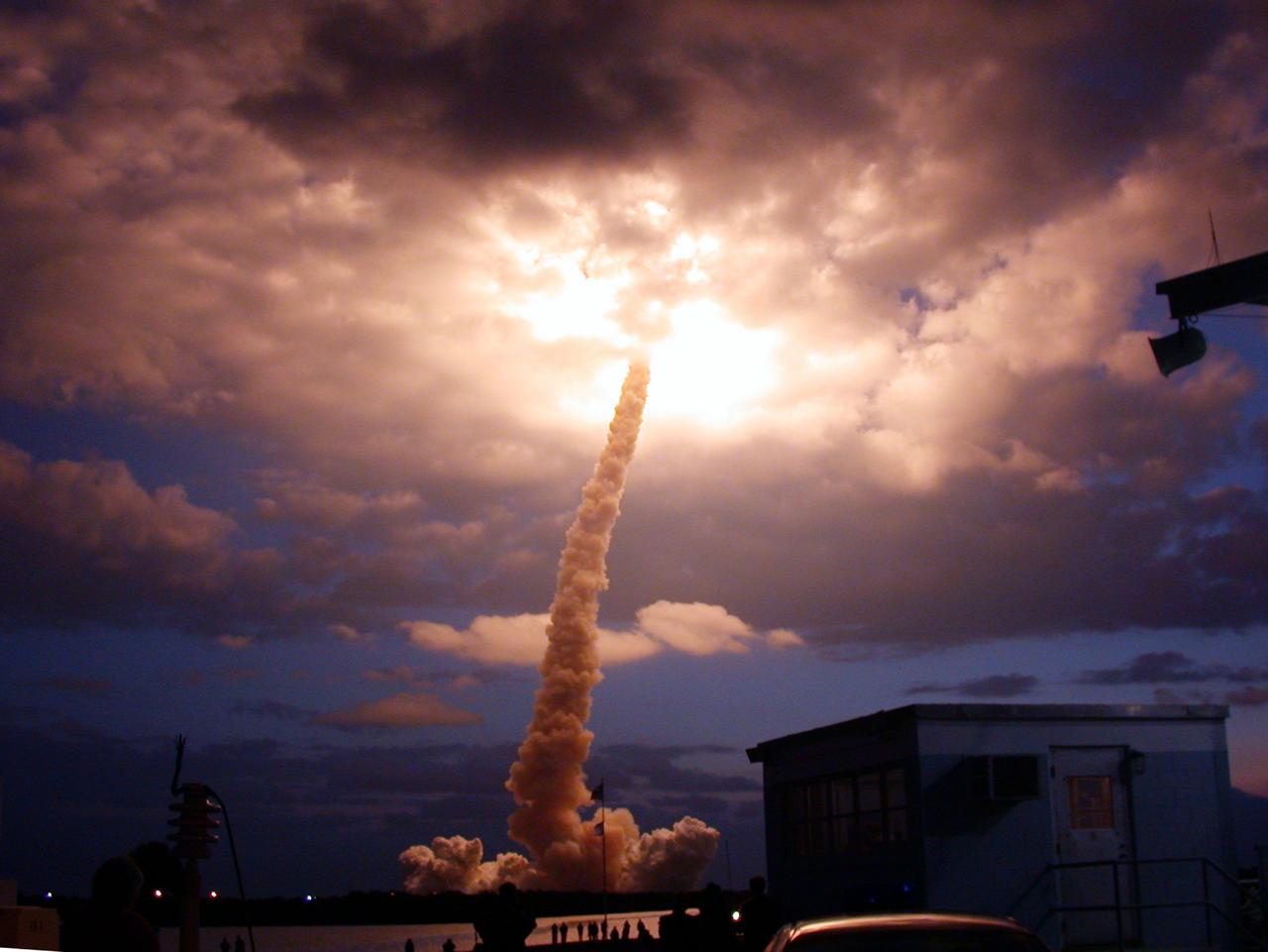
Carrying a crew of seven, the Space Shuttle Orbiter Columbia soared through some pre-dawn clouds into the sky as it began its 27th flight, STS-109. Launched March 1, 2002, the goal of the mission was the maintenance and upgrade of the Hubble Space Telescope (HST). The Marshall Space Flight Center had the responsibility for the design, development, and construction of the HST, which is the most complex and sensitive optical telescope ever made, to study the cosmos from a low-Earth orbit. The HST detects objects 25 times fainter than the dimmest objects seen from Earth and provides astronomers with an observable universe 250 times larger than is visible from ground-based telescopes, perhaps as far away as 14 billion light-years. The HST views galaxies, stars, planets, comets, possibly other solar systems, and even unusual phenomena such as quasars, with 10 times the clarity of ground-based telescopes. During the STS-109 mission, the telescope was captured and secured on a work stand in Columbia's payload bay using Columbia's robotic arm. Here four members of the crew performed five spacewalks completing system upgrades to the HST. Included in those upgrades were: replacement of the solar array panels; replacement of the power control unit (PCU); replacement of the Faint Object Camera (FOC) with a new advanced camera for Surveys (ACS); and installation of the experimental cooling system for the Hubble's Near-Infrared Camera and Multi-object Spectrometer (NICMOS), which had been dormant since January 1999 when it original coolant ran out. Lasting 10 days, 22 hours, and 11 minutes, the STS-109 mission was the 108th flight overall in NASA's Space Shuttle Program.
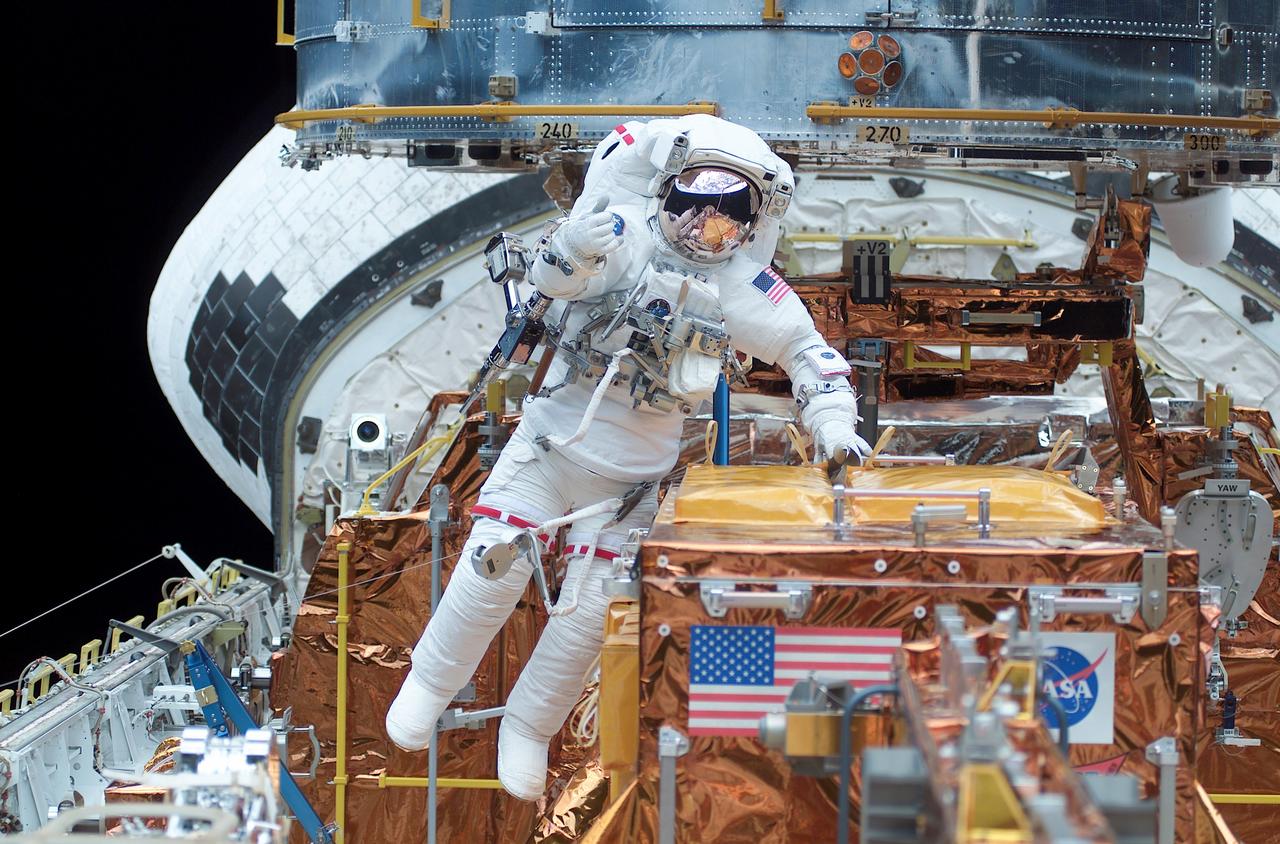
Astronaut James H. Newman, mission specialist, floats about in the Space Shuttle Columbia's cargo bay while working in tandem with astronaut Michael J. Massimino (out of frame),mission specialist, during the STS-109 mission's second day of extravehicular activity (EVA). Inside Columbia's cabin, astronaut Nancy J. Currie, mission specialist, controlled the Remote Manipulator System (RMS) to assist the two in their work on the Hubble Space Telescope (HST). The RMS was used to capture the telescope and secure it into Columbia's cargo bay.Part of the giant telescope's base, latched down in the payload bay, can be seen behind Newman. The Space Shuttle Columbia STS-109 mission lifted off March 1, 2002 with goals of repairing and upgrading the HST. The Marshall Space Flight Center in Huntsville, Alabama had responsibility for the design, development, and contruction of the HST, which is the most powerful and sophisticated telescope ever built. STS-109 upgrades to the HST included: replacement of the solar array panels; replacement of the power control unit (PCU); replacement of the Faint Object Camera (FOC) with a new advanced camera for Surveys (ACS); and installation of the experimental cooling system for the Hubble's Near-Infrared Camera and Multi-object Spectrometer (NICMOS), which had been dormant since January 1999 when its original coolant ran out. Lasting 10 days, 22 hours, and 11 minutes, the STS-109 mission was the 108th flight overall in NASA's Space Shuttle Program.
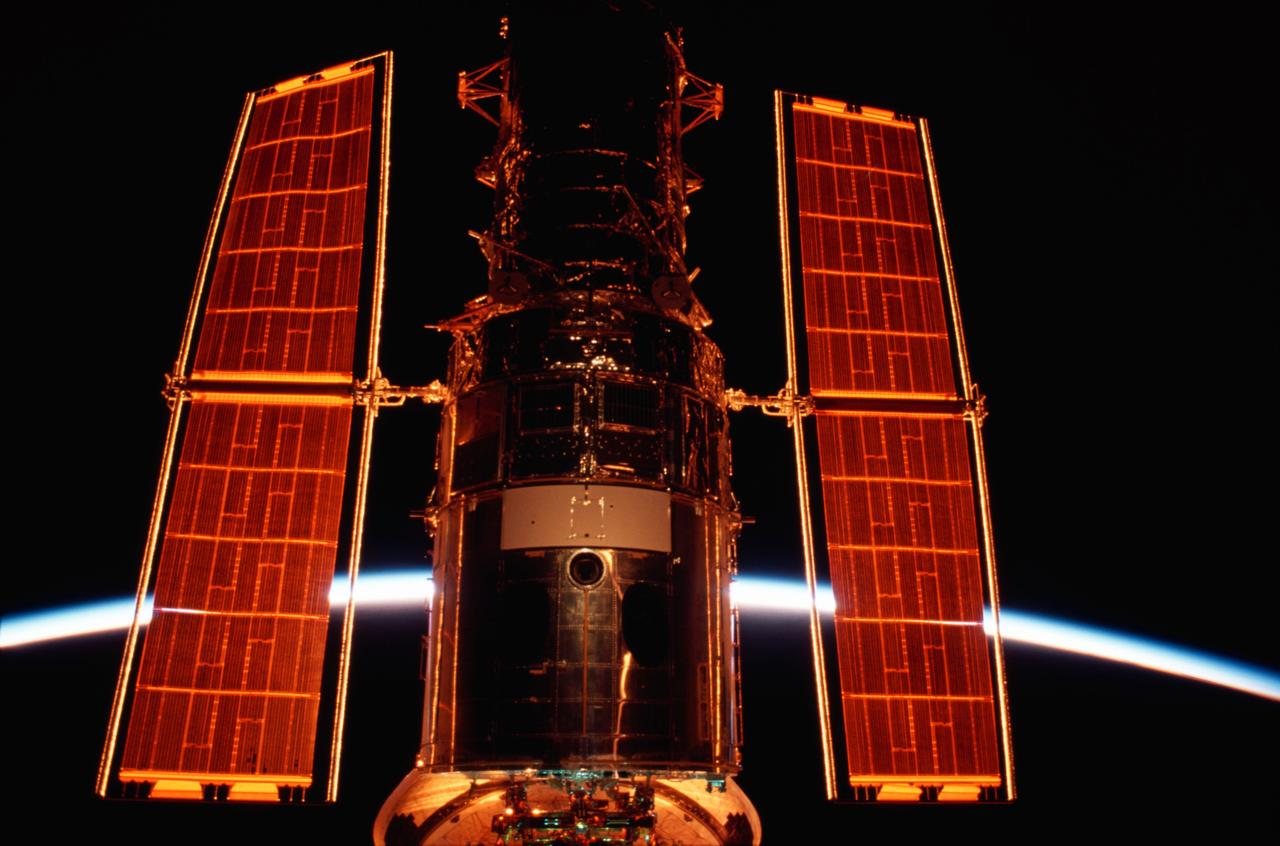
This is a photo of the Hubble Space Telescope (HST),in its origianl configuration, berthed in the cargo bay of the Space Shuttle Columbia during the STS-109 mission silhouetted against the airglow of the Earth's horizon. The telescope was captured and secured on a work stand in Columbia's payload bay using Columbia's robotic arm, where 4 of the 7-member crew performed 5 spacewalks completing system upgrades to the HST. Included in those upgrades were: replacement of the solar array panels; replacement of the power control unit (PCU); replacement of the Faint Object Camera (FOC) with a new advanced camera for Surveys (ACS); and installation of the experimental cooling system for the Hubble's Near-Infrared Camera and Multi-object Spectrometer (NICMOS), which had been dormant since January 1999 when its original coolant ran out. The Marshall Space Flight Center had the responsibility for the design, development, and construction of the the HST, which is the most complex and sensitive optical telescope ever made, to study the cosmos from a low-Earth orbit. The HST detects objects 25 times fainter than the dimmest objects seen from Earth and provides astronomers with an observable universe 250 times larger than is visible from ground-based telescopes, perhaps as far away as 14 billion light-years. The HST views galaxies, stars, planets, comets, possibly other solar systems, and even unusual phenomena such as quasars, with 10 times the clarity of ground-based telescopes. Launched March 1, 2002 the STS-109 HST servicing mission lasted 10 days, 22 hours, and 11 minutes. It was the 108th flight overall in NASA's Space Shuttle Program.
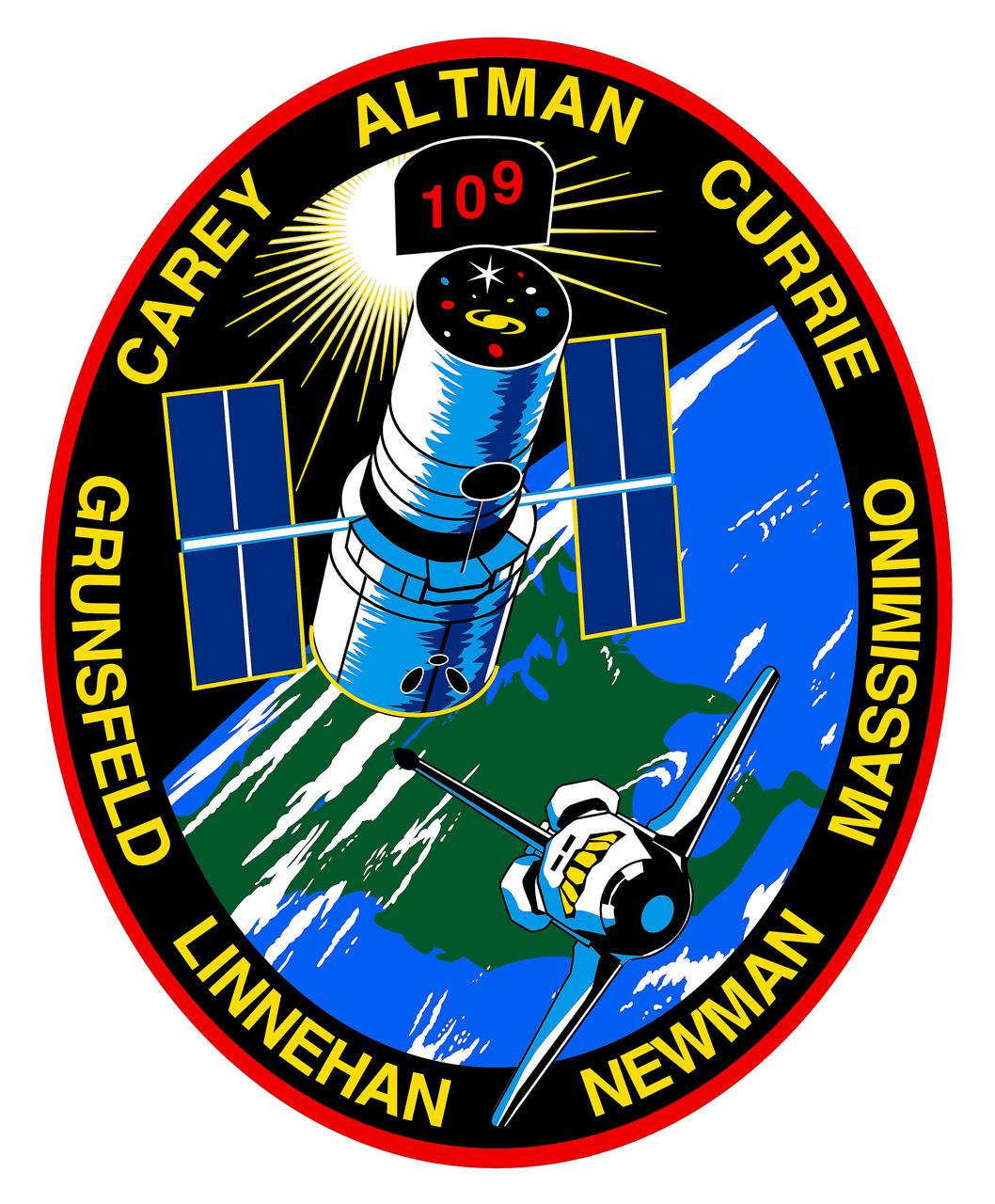
This is the insignia of the STS-109 Space Shuttle mission. Carrying a crew of seven, the Space Shuttle Orbiter Columbia was launched with goals of maintenance and upgrades to the Hubble Space Telescope (HST). The Marshall Space Flight Center had the responsibility for the design, development, and construction of the HST, which is the most complex and sensitive optical telescope ever made, to study the cosmos from a low-Earth orbit. The HST detects objects 25 times fainter than the dimmest objects seen from Earth and provides astronomers with an observable universe 250 times larger than is visible from ground-based telescopes, perhaps as far away as 14 billion light-years. The HST views galaxies, stars, planets, comets, possibly other solar systems, and even unusual phenomena such as quasars, with 10 times the clarity of ground-based telescopes. During the STS-109 mission, the telescope was captured and secured on a work stand in Columbia's payload bay using Columbia's robotic arm where four members of the crew performed five spacewalks completing system upgrades to the HST. Included in those upgrades were: The replacement of the solar array panels; replacement of the power control unit (PCU); replacement of the Faint Object Camera (FOC) with a new advanced camera for Surveys (ACS); and installation of the experimental cooling system for the Hubble's Near-Infrared Camera and Multi-object Spectrometer (NICMOS), which had been dormant since January 1999 when it original coolant ran out. Lasting 10 days, 22 hours, and 11 minutes, the STS-109 mission was the 27th flight of the Orbiter Columbia and the 108th flight overall in NASA's Space Shuttle Program.