
KENNEDY SPACE CENTER, FLA. - In the White Room on Launch Pad 39B, workers unload food containers to be stored in Space Shuttle Discovery for mission STS-121. The White Room, which extends from the fixed service structure, provides access into the orbiter on the pad. Astronauts are supplied with three balanced meals, plus snacks. Foods flown on space missions are researched and developed at the Space Food Systems Laboratory at the Johnson Space Center (JSC) in Houston, which is staffed by food scientists, dietitians and engineers. Each astronaut’s food stored aboard the space shuttle is identified by a colored dot affixed to each package. Launch of Space Shuttle Discovery on mission STS-121 is scheduled for July 1. Photo credit: NASA/Kim Shiflett
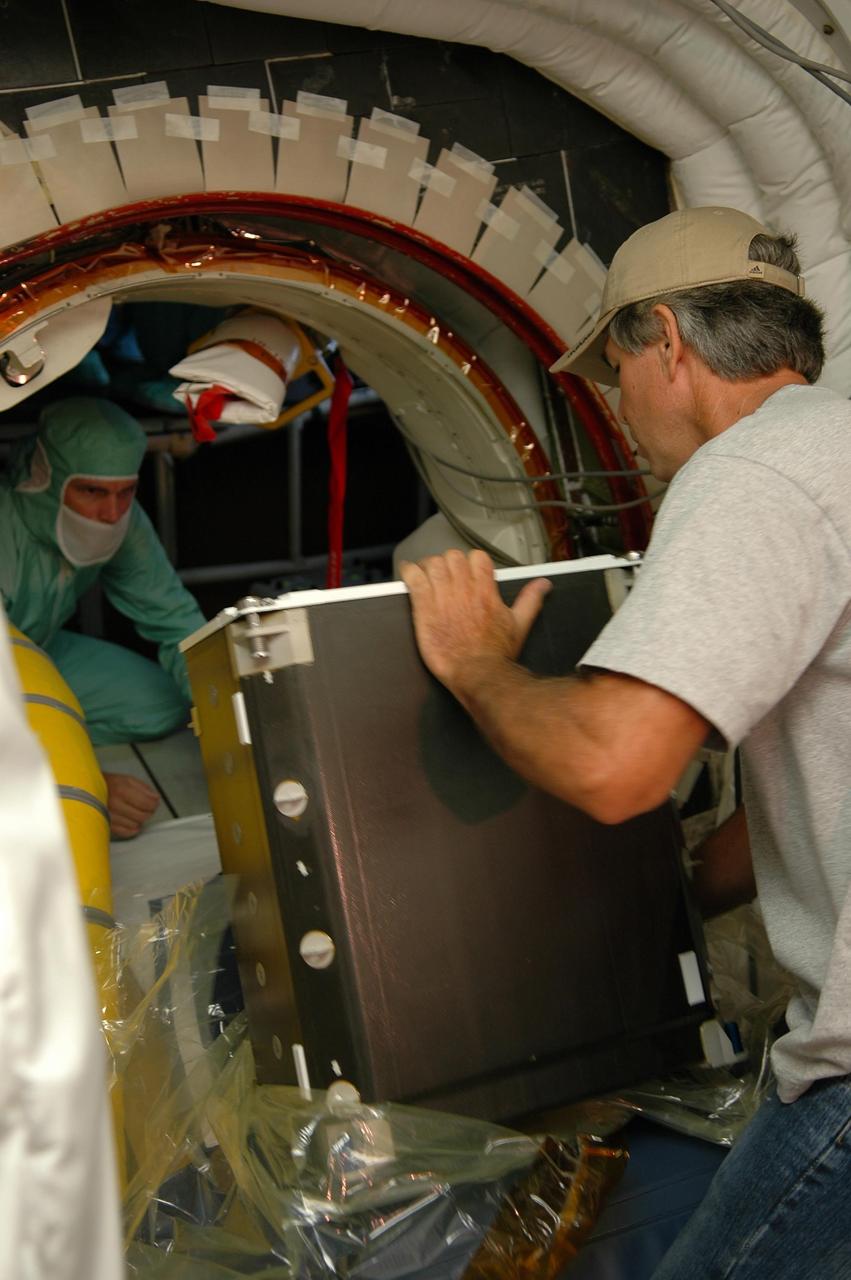
KENNEDY SPACE CENTER, FLA. - In the White Room on Launch Pad 39B, a worker hands off a food container to someone inside Space Shuttle Discovery to store it for mission STS-121. The White Room, which extends from the fixed service structure, provides access into the orbiter on the pad. Astronauts are supplied with three balanced meals, plus snacks. Foods flown on space missions are researched and developed at the Space Food Systems Laboratory at the Johnson Space Center (JSC) in Houston, which is staffed by food scientists, dietitians and engineers. Each astronaut’s food stored aboard the space shuttle is identified by a colored dot affixed to each package. Launch of Space Shuttle Discovery on mission STS-121 is scheduled for July 1. Photo credit: NASA/Kim Shiflett
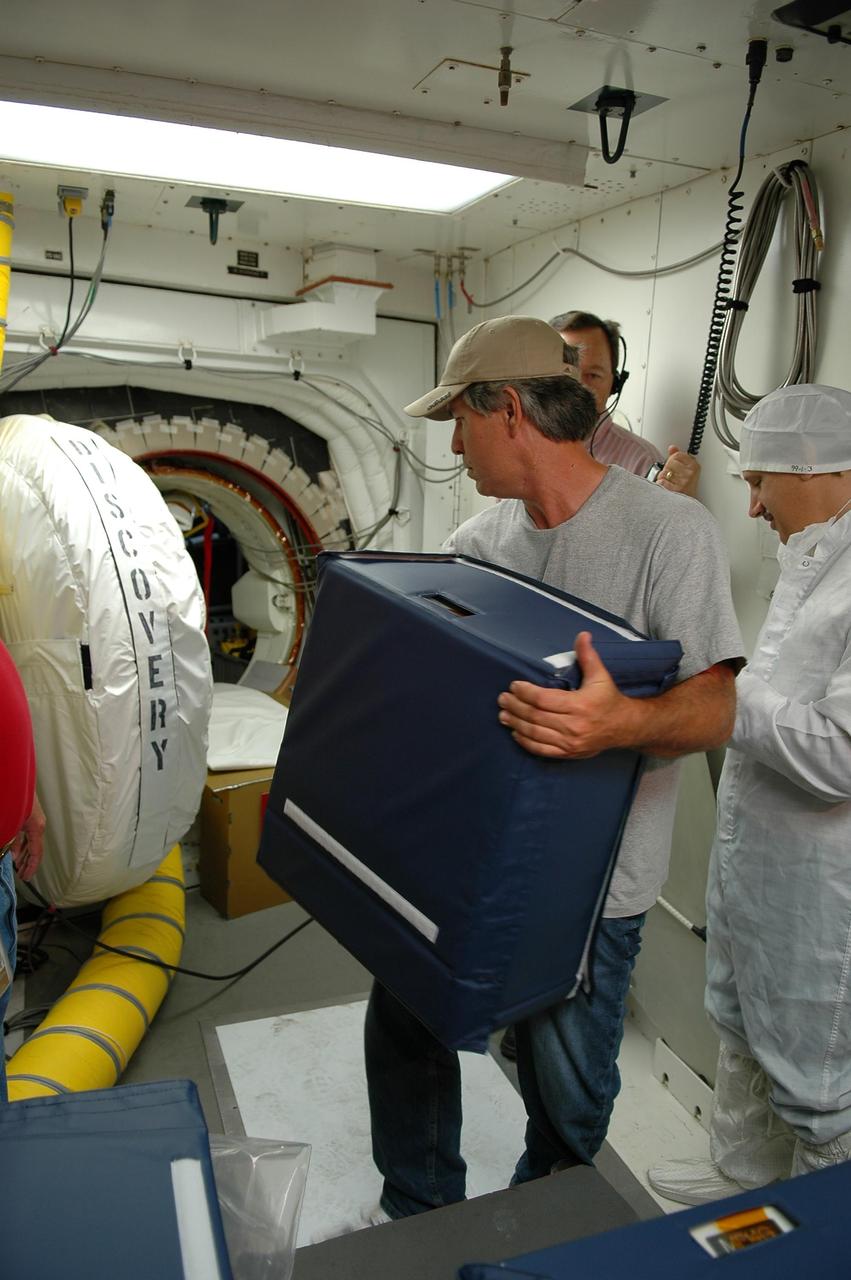
KENNEDY SPACE CENTER, FLA. - In the White Room on Launch Pad 39B, a worker carries a food container toward the hatch of Space Shuttle Discovery to be stored for mission STS-121. The White Room, which extends from the fixed service structure, provides access into the orbiter on the pad. Astronauts are supplied with three balanced meals, plus snacks. Foods flown on space missions are researched and developed at the Space Food Systems Laboratory at the Johnson Space Center (JSC) in Houston, which is staffed by food scientists, dietitians and engineers. Each astronaut’s food stored aboard the space shuttle is identified by a colored dot affixed to each package. Launch of Space Shuttle Discovery on mission STS-121 is scheduled for July 1. Photo credit: NASA/Kim Shiflett

41D-09-028 (30 Aug-5 Sept 1984) --- Astronaut Judith A. Resnik, mission specialist, rests in a Shuttle zip-up bag in the mid-deck of the Earth-orbiting Space Shuttle Discovery. A package of rehydratable food is fastened to a nearby stowage locker door.
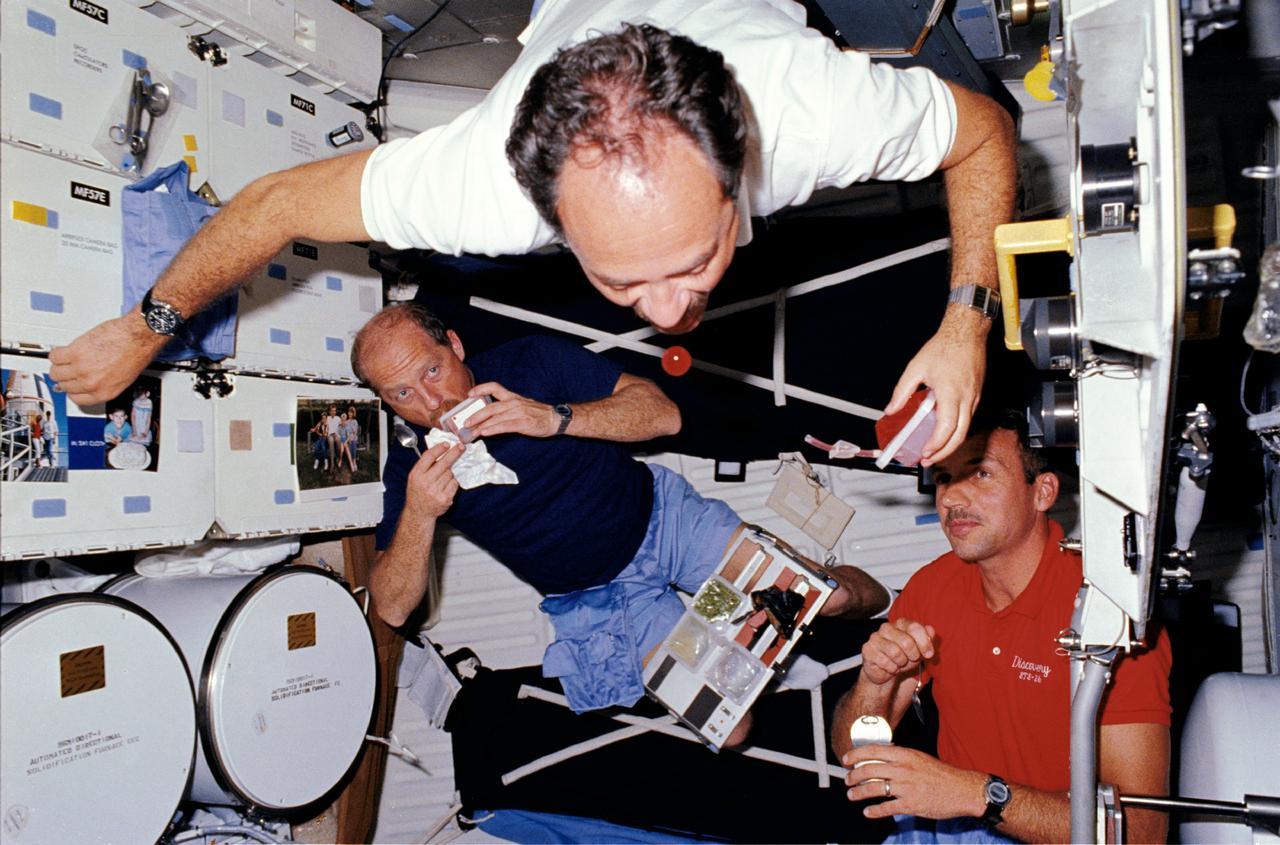
STS026-06-018 (29 Sept. - 3 Oct. 1988) --- Astronaut John M. Lounge, STS-26 mission specialist (MS), using a beverage container, experiments with microgravity as Commander Frederick H. Hauck (left) and MS David C. Hilmers (right) look on. Lounge freefloats as he closes in on a sphere of the red liquid drifting in front of his mouth. Hauck holds a spoon while sipping from a beverage container as he balances a meal tray assembly on his thighs. Hilmers, partially blocked by the open airlock hatch and holding a spoon and a can of food, pauses to watch the experiment. Automated Directional Solidification Furnace (ADSF) and forward middeck lockers appear on Lounge's right.
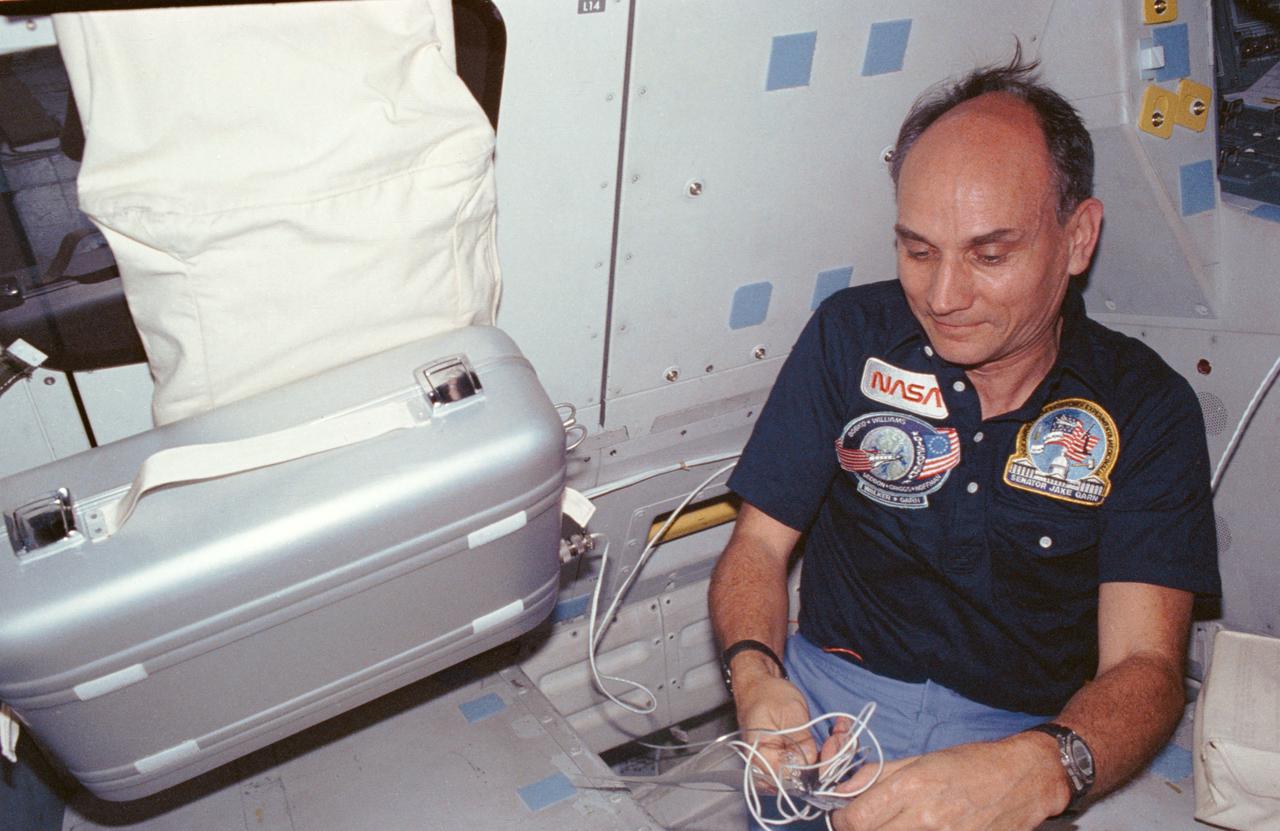
U. S. Senator E.J. (Jake) Garn, payload specialist, plugs in a food warmer in middeck area of the Shuttle Discovery.
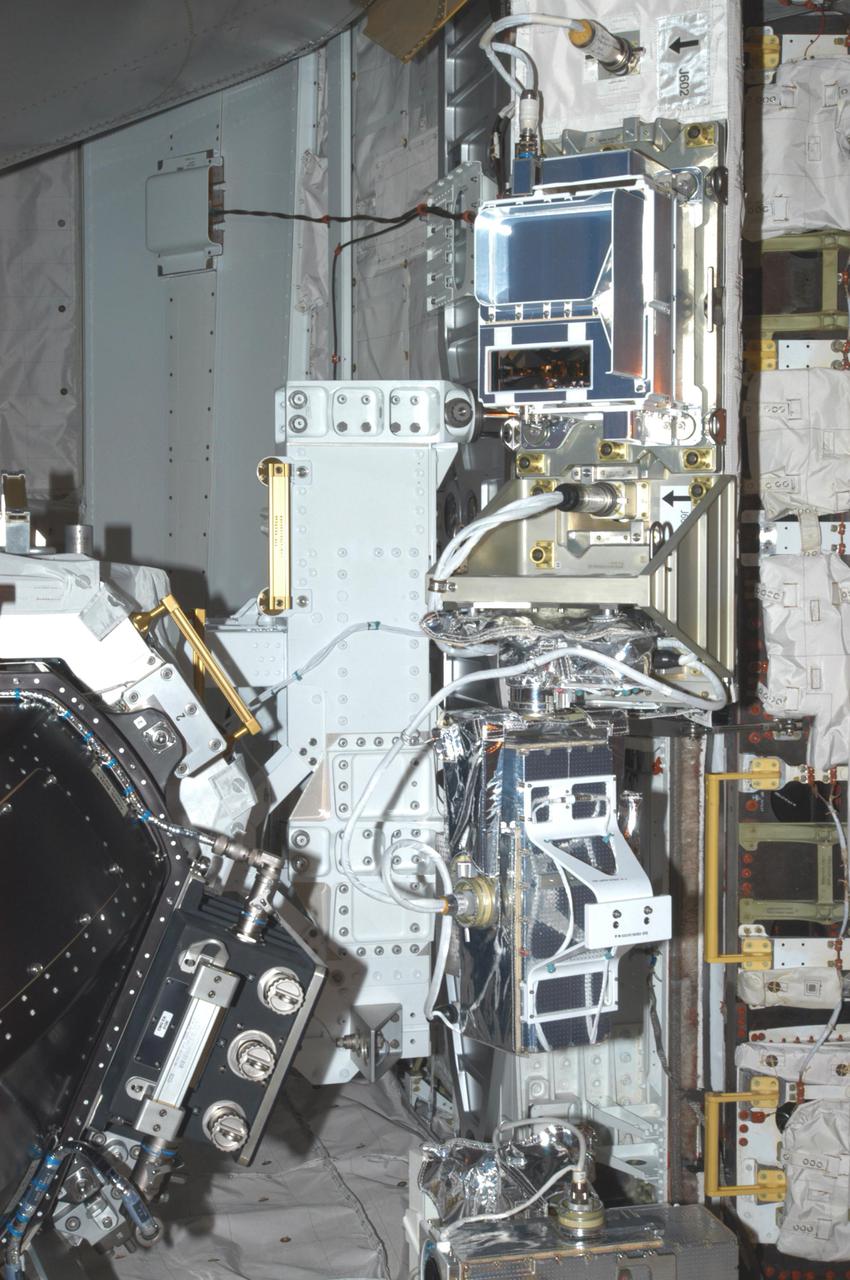
KENNEDY SPACE CENTER, FLA. - At Launch Pad 39B, the Orbiter Boom Sensor System (OBSS) sensor package is viewed before the orbiter's payload bay doors are closed for launch. Payload bay door closure is a significant milestone in the preparations of Discovery for the first Return to Flight mission, STS-114. This sensor package will provide surface area and depth defect inspection for all the surfaces of the orbiter. It includes an intensified television camera (ITVC) and a laser dynamic range imager, which are mounted on a pan and tilt unit, and a laser camera system (LCS) mounted on a stationary bracket. The package is part of the new safety measures added for all future Space Shuttle missions. During its 12-day mission, Discovery’s seven-person crew will test new hardware and techniques to improve Shuttle safety, as well as deliver supplies to the International Space Station. Discovery’s payloads include the Multi-Purpose Logistics Module Raffaello, the Lightweight Multi-Purpose Experiment Support Structure Carrier (LMC), and the External Stowage Platform-2 (ESP-2). Raffaello will deliver supplies to the International Space Station including food, clothing and research equipment. The LMC supports a replacement Control Moment Gyroscope and a tile repair sample box. The ESP-2 is outfitted with replacement parts. Launch of mission STS-114 was set for July 13 at the conclusion of the Flight Readiness Review yesterday.
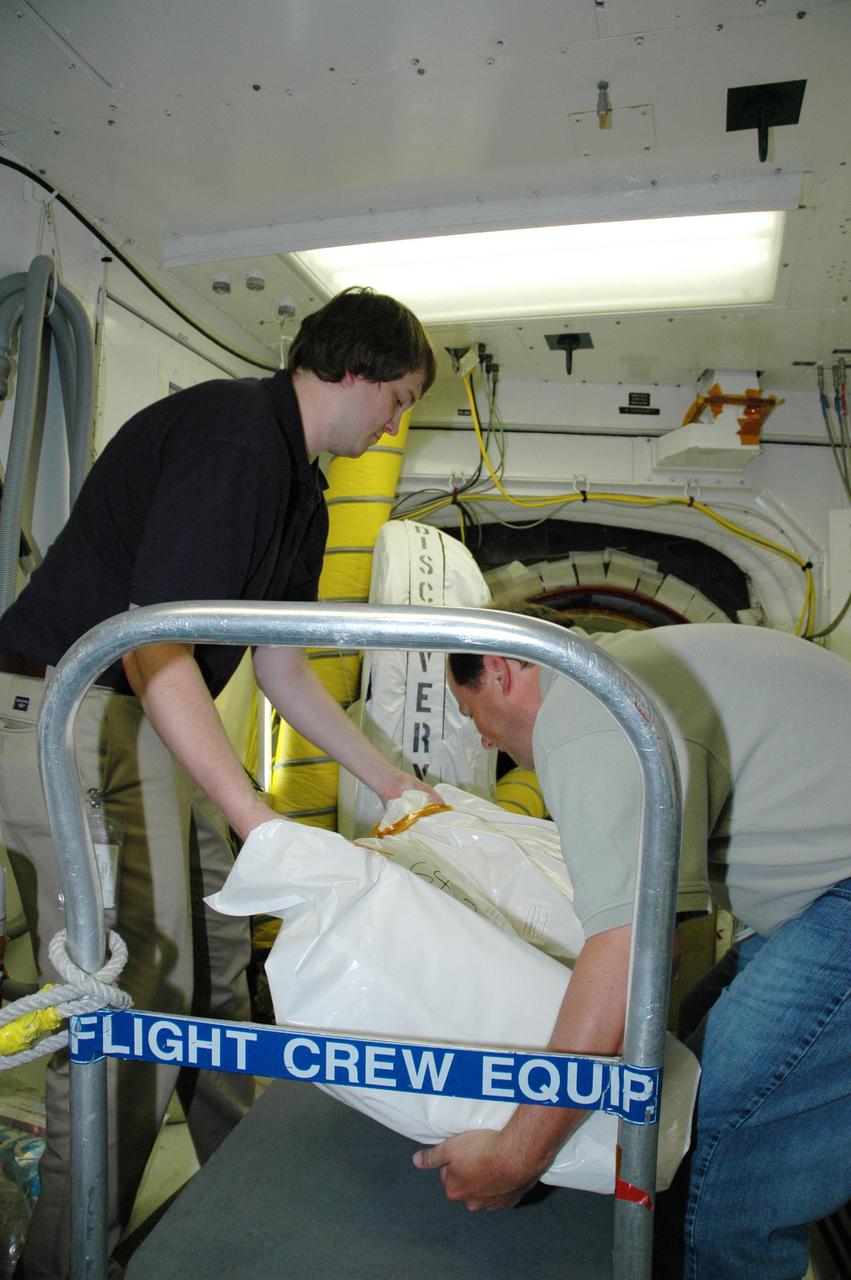
KENNEDY SPACE CENTER, FLA. - At Launch Pad 39B, NASA Flight Crew Systems engineers Ben Van Lear (left) and Brad Poffenberger hand a stowage container to a technician inside Space Shuttle Discovery for installation, a final step in launch preparations. Launch of Discovery on its Return to Flight mission STS-114 is set for July 13, just days away. The container holds consumables that will be unpacked by the crew once on orbit and will be used to return miscellaneous used products back to Earth. During its 12-day mission, Discovery’s seven-person crew will test new hardware and techniques to improve Shuttle safety, as well as deliver supplies to the International Space Station. Discovery’s payloads include the Multi-Purpose Logistics Module Raffaello, the Lightweight Multi-Purpose Experiment Support Structure Carrier (LMC), and the External Stowage Platform-2 (ESP-2). Raffaello will deliver supplies to the International Space Station including food, clothing and research equipment. The LMC will carry a replacement Control Moment Gyroscope and a tile repair sample box. The ESP-2 is outfitted with replacement parts.

Among the many discoveries by NASA's Mars Reconnaissance Orbiter since the mission was launched on Aug. 12, 2005, are seasonal flows on some steep slopes. These flows have a set of characteristics consistent with shallow seeps of salty water. This July 21, 2015, image from the orbiter's High Resolution Imaging Science Experiment (HiRISE) camera shows examples of these flows on a slope within Coprates Chasma, which is part of the grandest canyon system on Mars, Valles Marineris. The image covers an area of ground one-third of a mile (536 meters) wide. These flows are called recurring slope lineae because they fade and disappear during cold seasons and reappear in warm seasons, repeating this pattern every Martian year. The flows seen in this image are on a north-facing slope, so they are active in northern-hemisphere spring. The flows emanate from the relatively bright bedrock and flow onto sandy fans, where they are remarkably straight, following linear channels. Valles Marineris contains more of these flows than everywhere else on Mars combined. At any season, some are active, though on different slope aspects at different seasons. Future human explorers (and settlers?) will need water to drink, grow food, produce oxygen to breath, and make rocket fuel. Bringing all of that water from Earth would be extremely expensive, so using water on Mars is essential. Although there is plenty of water ice at high latitudes, surviving the cold winters would be difficult. An equatorial source of water would be preferable, so Valles Marineris may be the best destination. However, the chemistry of this water must be understood before betting any lives on it. http://photojournal.jpl.nasa.gov/catalog/PIA19805