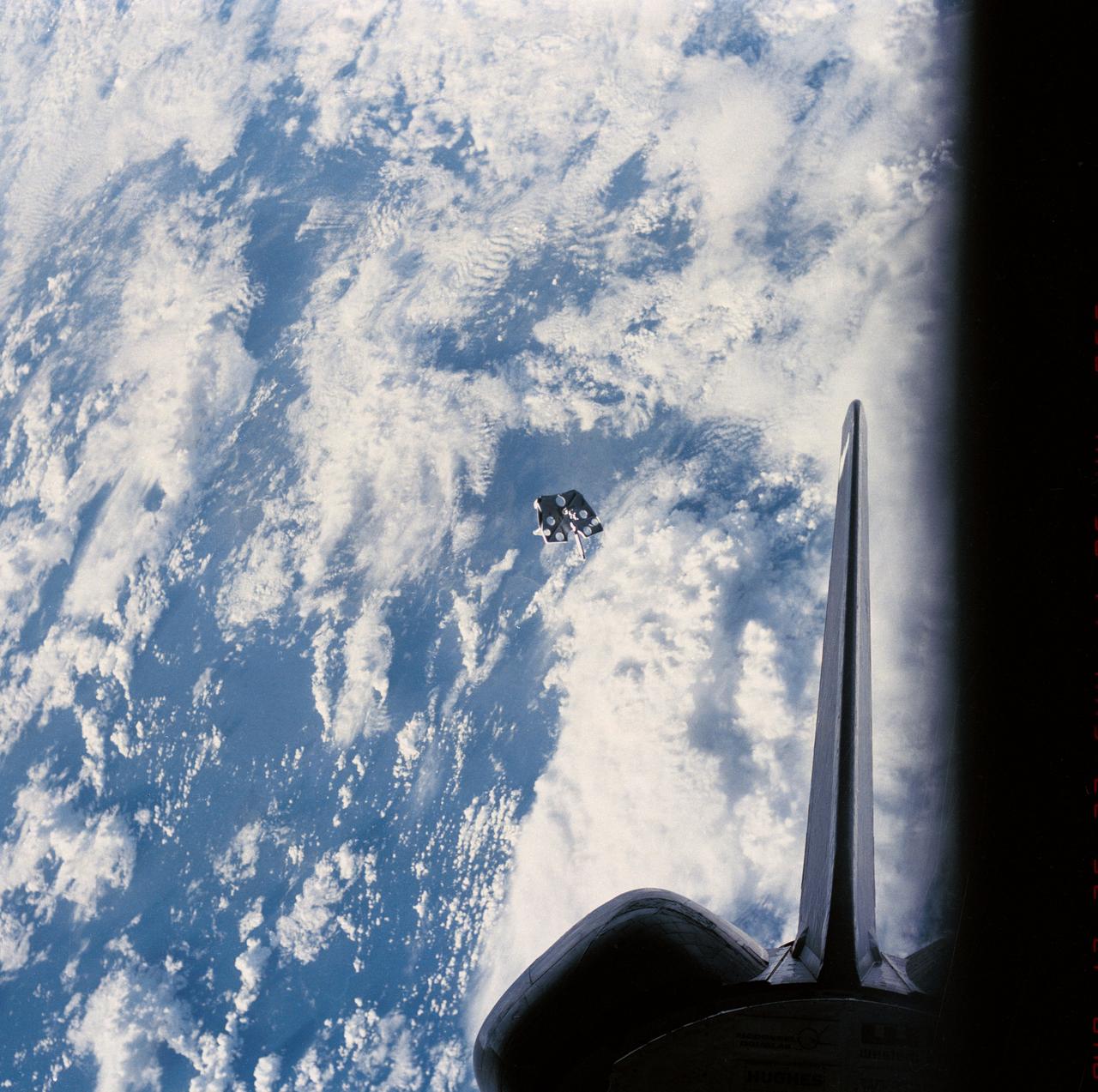
S84-27024 (7 Feb 1984) --- This 70mm frame centers on a foot restraint that strayed from the Earth-orbiting Space Shuttle Challenger during the February 9, 1984 extravehicular activity (EVA) session of astronauts Bruce McCandless II and Robert Stewart. As seen in JSC photograph frame number S84-27025, McCandless goes after the piece. Not pictured is Vance D. Brand, crew commander, who moved the spacecraft nearer the object.
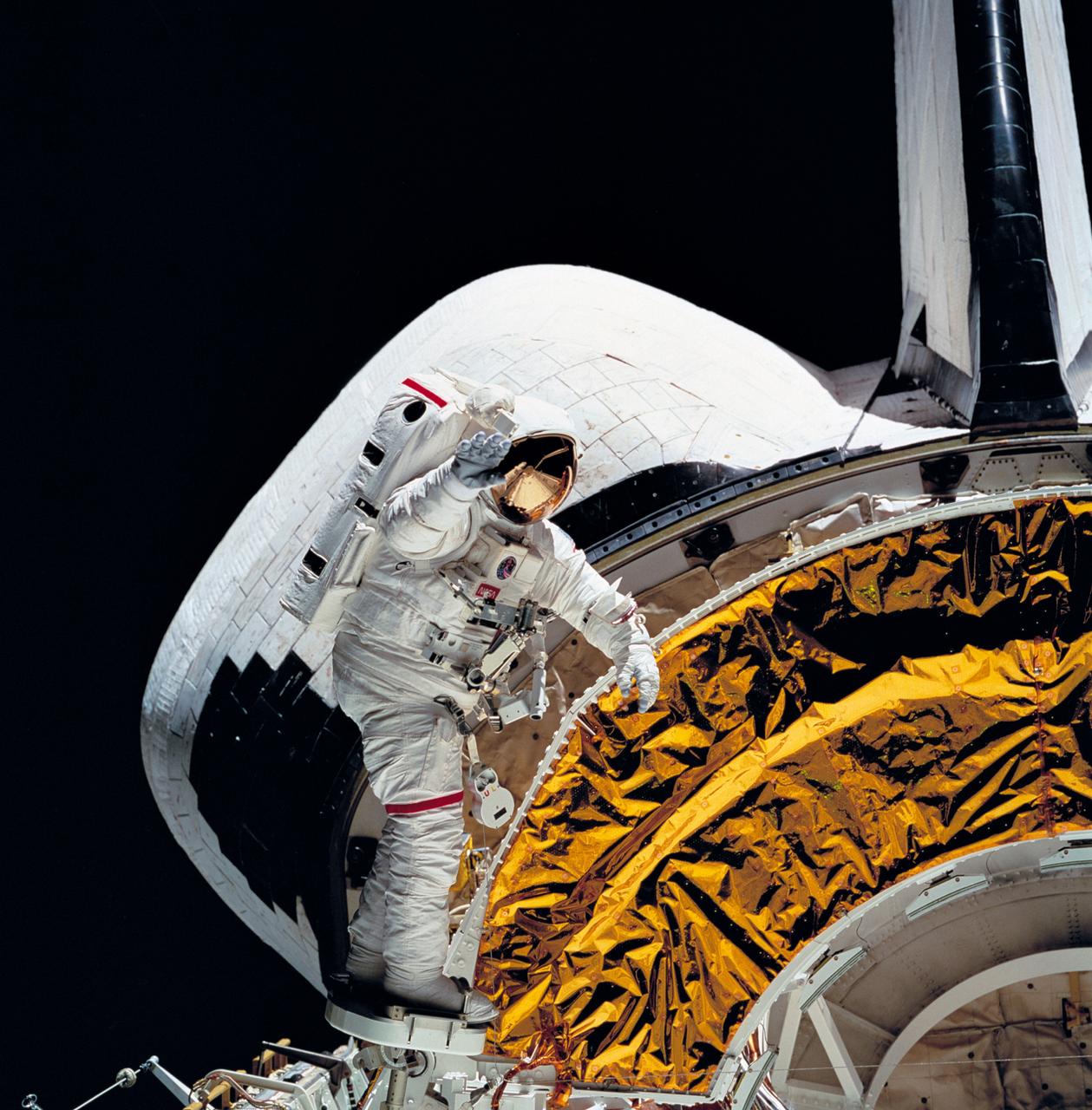
STS051-98-021 (16 Sept. 1993) --- In the Space Shuttle Discovery's aft cargo bay, astronaut Carl E. Walz gets his turn on the Portable Foot Restraint (PFR). Astronauts Walz, waving to his crew mates inside Discovery's cabin, and James H. Newman each put in some time evaluating the PFR, one of the pieces of gear to be used on the Hubble Space Telescope (HST) STS-61 servicing mission (scheduled later this year) and other Shuttle missions.
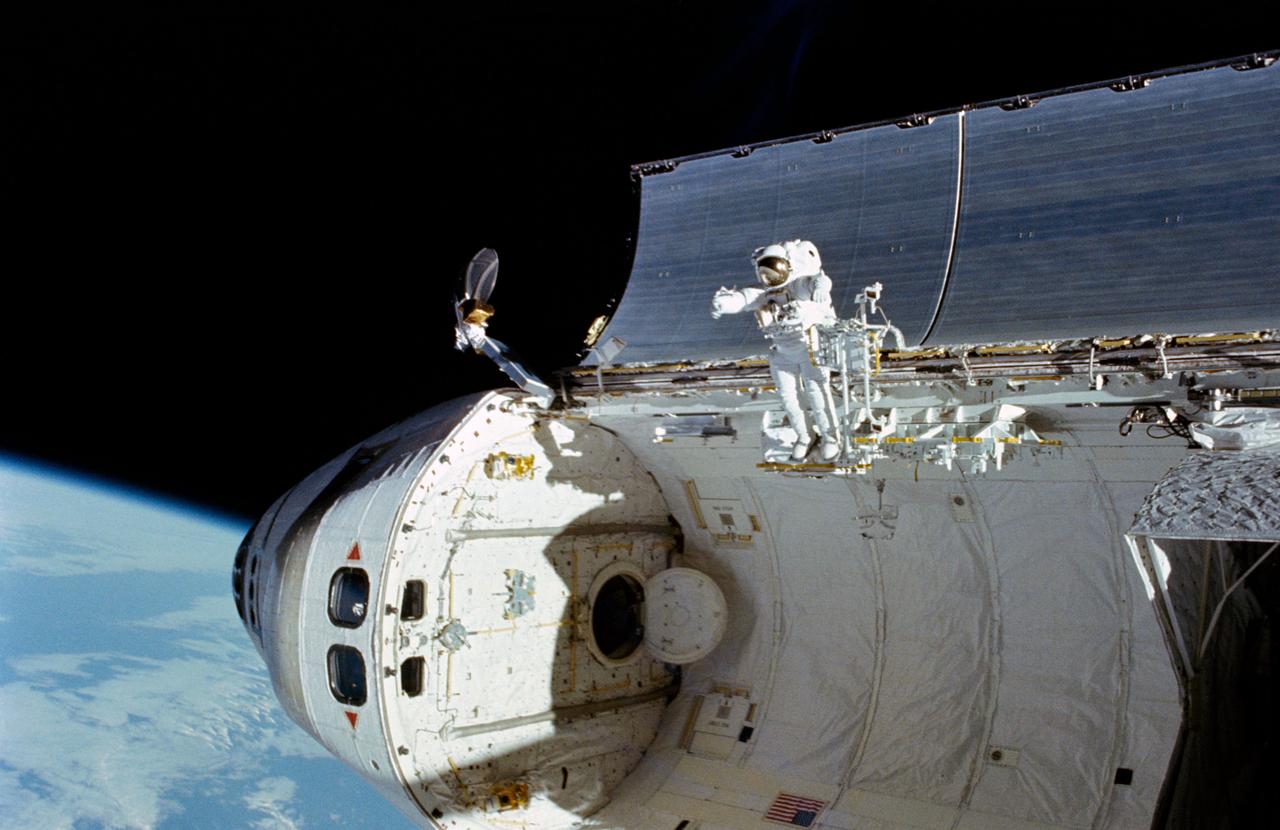
51I-102-048 (4-5 Sept 1985) --- A 35mm frame showing astronaut William F. Fisher standing on the edge of Discovery's cargo bay (in foot restraint) during the second day of a two-day effort to capture, repair and re-release the Syncom IV-3 communications satellite. Astronaut James D. van Hoften, standing on the Discovery's RMS arm, exposed the frame.
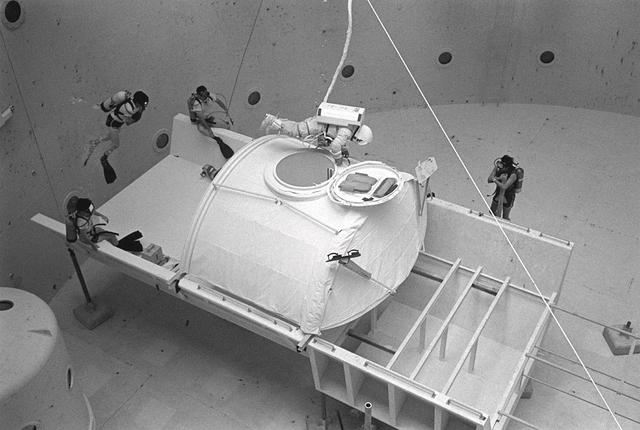
Once the United States' space program had progressed from Earth's orbit into outerspace, the prospect of building and maintaining a permanent presence in space was realized. To accomplish this feat, NASA launched a temporary workstation, Skylab, to discover the effects of low gravity and weightlessness on the human body, and also to develop tools and equipment that would be needed in the future to build and maintain a more permanent space station. The structures, techniques, and work schedules had to be carefully designed to fit this unique construction site. The components had to be lightweight for transport into orbit, yet durable. The station also had to be made with removable parts for easy servicing and repairs by astronauts. All of the tools necessary for service and repairs had to be designed for easy manipulation by a suited astronaut. Construction methods had to be efficient due to the limited time the astronauts could remain outside their controlled environment. In lieu of all the specific needs for this project, an environment on Earth had to be developed that could simulate a low gravity atmosphere. A Neutral Buoyancy Simulator (NBS) was constructed by NASA Marshall Space Flight Center (MSFC) in 1968. Since then, NASA scientists have used this facility to understand how humans work best in low gravity and also provide information about the different kinds of structures that can be built. With the help of the NBS, building a space station became more of a reality. Pictured is Astronaut Paul Weitz training on a mock-up of Spacelab's airlock-hatch cover. Training was also done on the use of foot restraints which had recently been developed to help astronauts maintain their positions during space walks rather than having their feet float out from underneath them while they tried to perform maintenance and repair operations. Every aspect of every space mission was researched and demonstrated in the NBS. Using the airlock hatch cover and foot restraints were just a small example of the preparation that went into each mission.
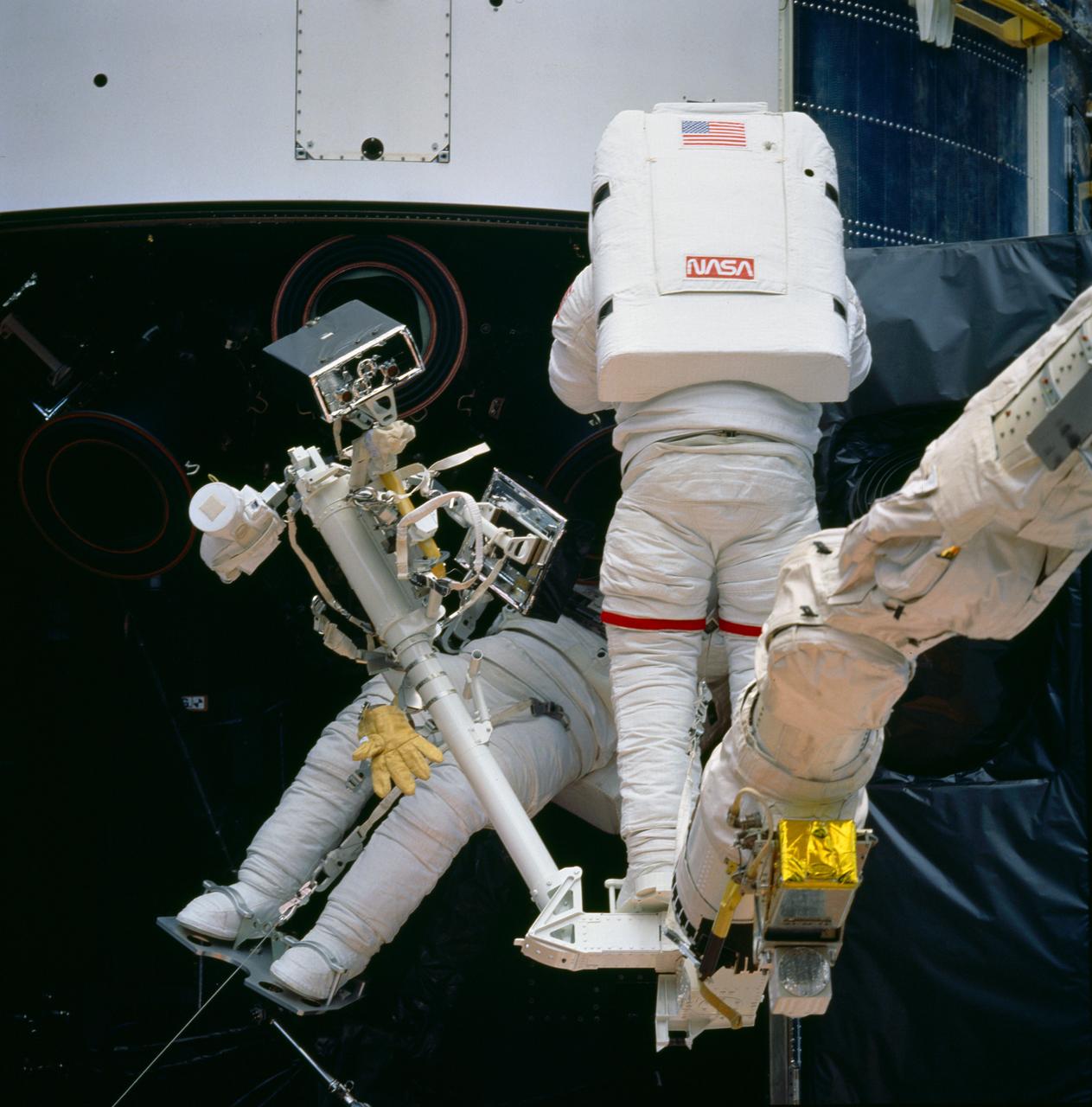
STS061-87-046 (5 Dec 1993) --- Astronauts Jeffrey A. Hoffman (right) and F. Story Musgrave work near the base of the Hubble Space Telescope (HST) on the first of five spacewalks. Their particular mission here is to replace failed Rate Sensor Units (RSU) inside the telescope's housing. Hoffman is anchored to a foot restraint, mounted on the end of the Space Shuttle Endeavour's Remote Manipulator System (RMS) arm, while Musgrave is standing on a foot restraint attached to a support structure in the cargo bay.
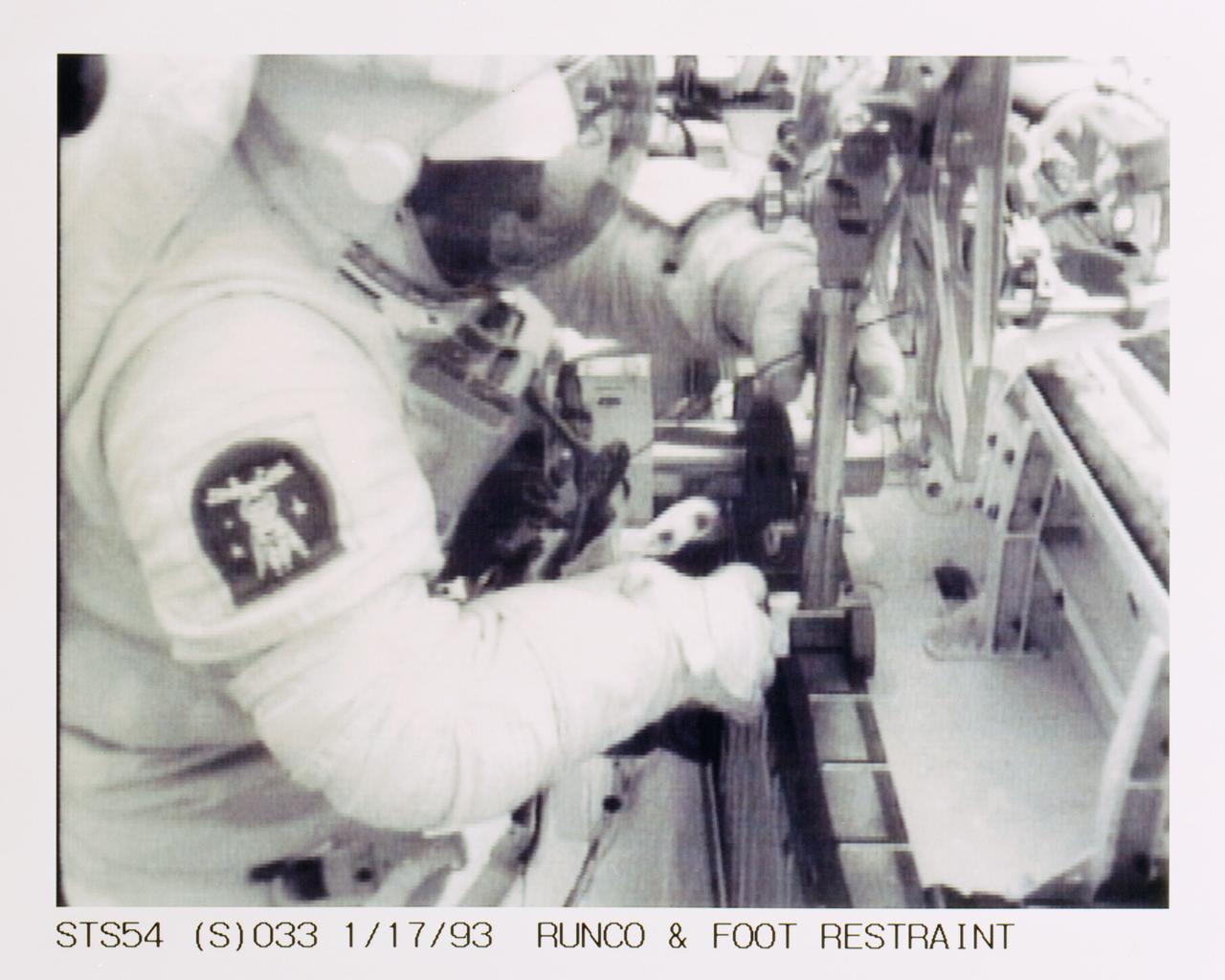
STS054-S-033 (17 Jan 1993) --- Runco works with a mobile foot restraint during extravehicular activity (EVA) in Endeavour's cargo bay. The scene was downlinked at 11:52:04:28 GMT, Jan. 17, 1993.
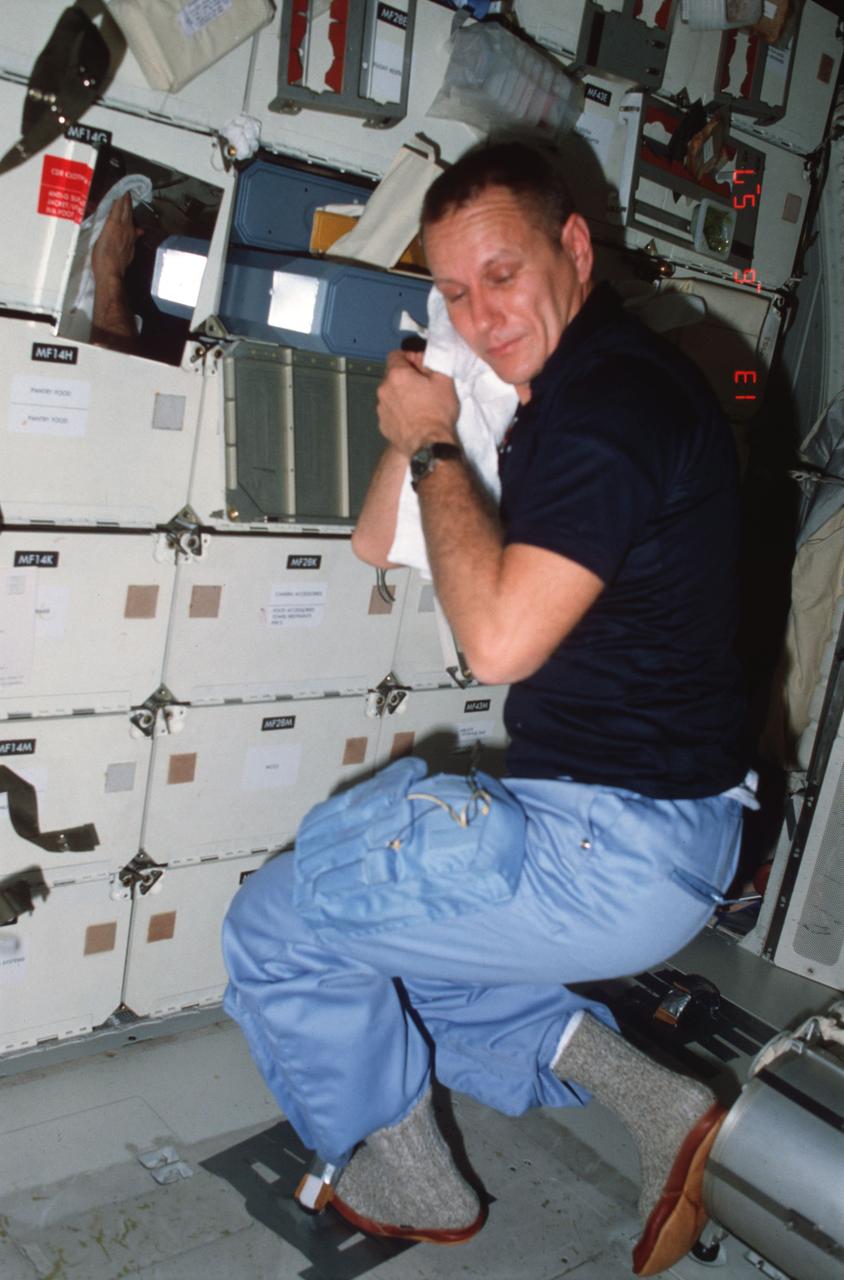
STS005-06-230 (11-16 Nov. 1982) --- On middeck, astronaut Robert F. Overmyer, STS-5 pilot, drying his face with a towel from forward single tray personal item stowage locker, completes personal hygiene activities (shaving) and demonstrates use of intravehicular activity (IVA) foot restraint on floor. Photo credit: NASA
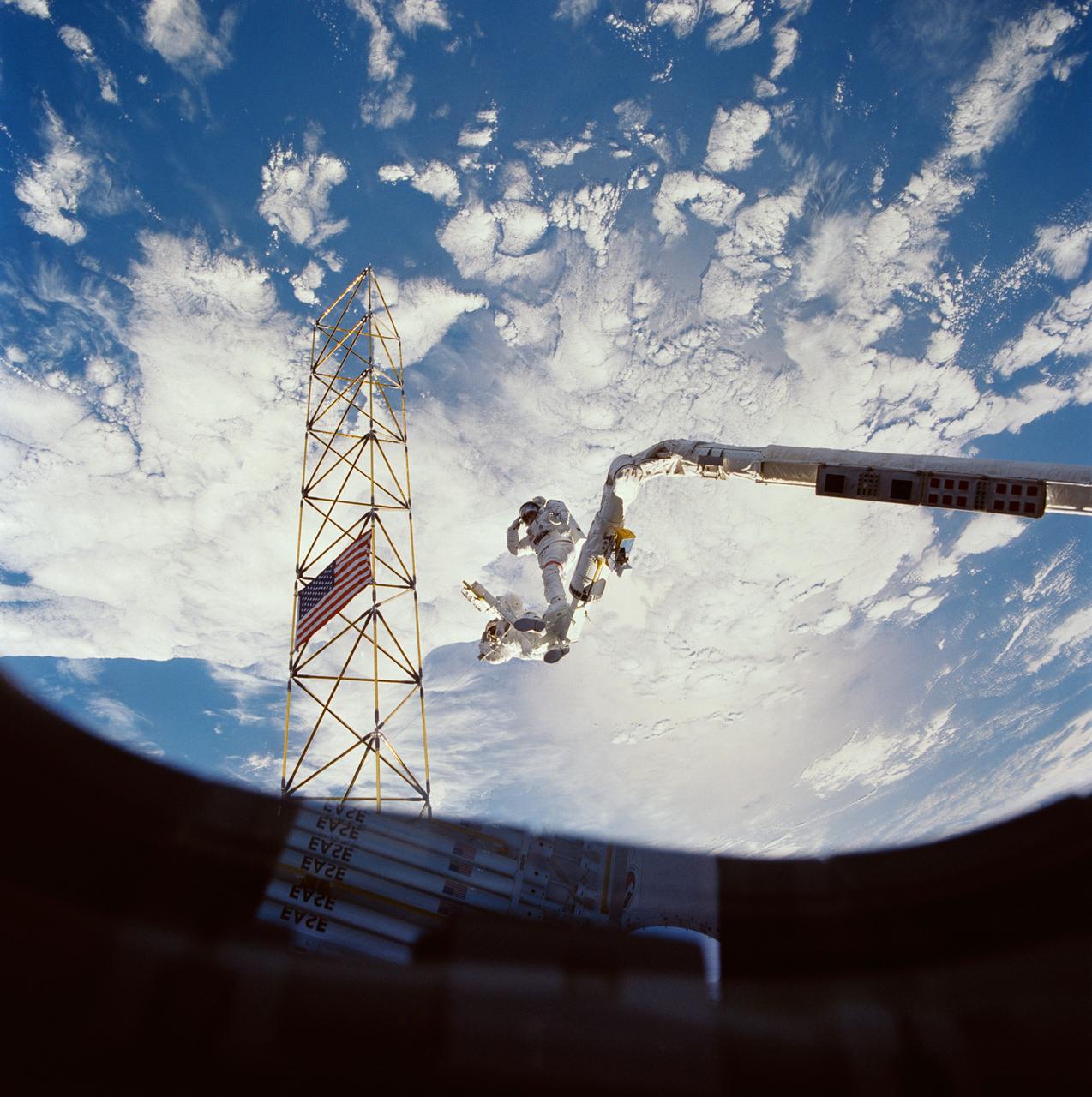
Astronauts Jerry L. Ross (right) and Sherwood C. (Woody) Spring (left) share a foot restraint as they survey the assembled ACCESS components after a lengthy extravehicular activity. Both men salute the American flag placed on the assembled ACCESS tower. Stowed EASE pieces are reflected in the window through which the photo was taken.
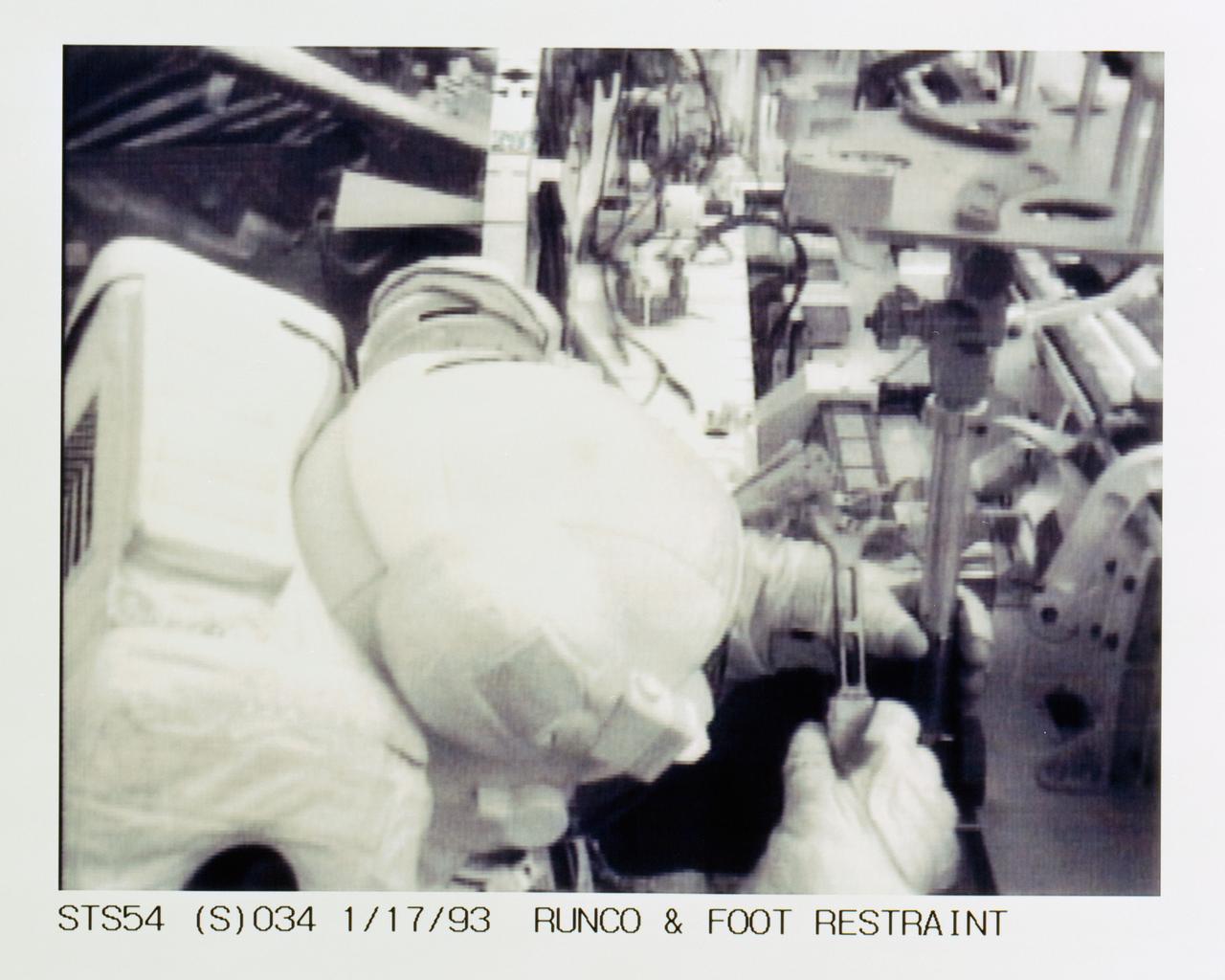
STS054-S-034 (17 Jan 1993) --- Closeup view of Runco as he works to install a mobile foot restraint during extravehicular activity (EVA) in Endeavour's cargo bay. The scene was downlinked at 11:55:07:24 GMT, Jan. 17, 1993.
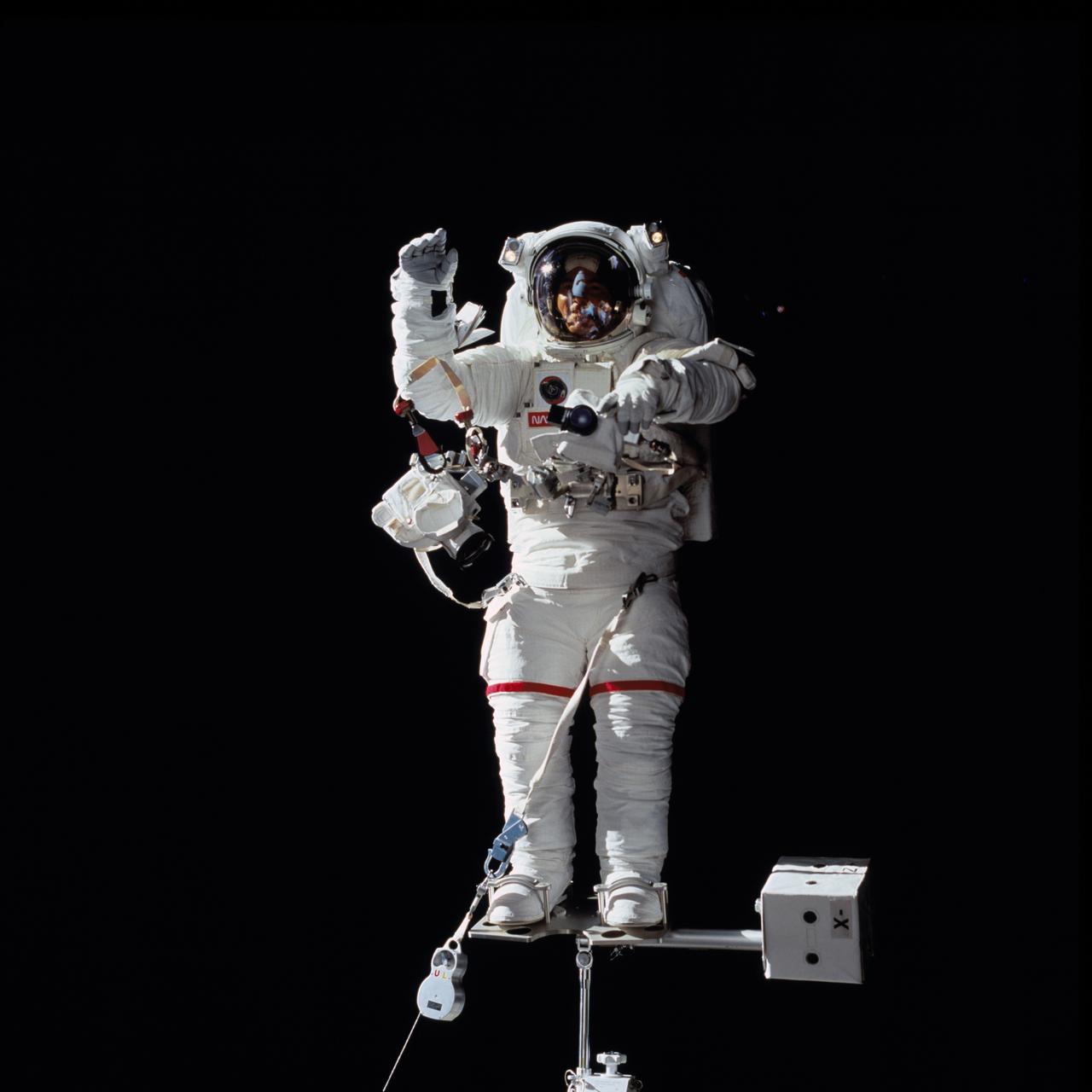
STS069-714-063 (16 September 1995) --- Astronaut James S. Voss, payload commander, is pictured during the September 16, 1995, Extravehicular Activity (EVA) which was conducted in and around Space Shuttle Endeavour's cargo bay. Voss, whose visor reflects Endeavour's forward section, was standing on a mobile foot restraint attached to the arm of the Remote Manipulator System (RMS). As evidenced by the thin white cable, Voss was tethered to the end of the RMS as well. Evaluations for Space Station-era tools and various elements of the space suits were performed by Voss and his space walking crewmate, astronaut Michael L. Gernhardt, mission specialist.

STS051-98-010 (16 Sept 1993) --- Astronaut James H. Newman, mission specialist, conducts an in-space evaluation of the Portable Foot Restraint (PFR) which will be used operationally on the first Hubble Space Telescope (HST) STS-61 servicing mission and future Shuttle missions. Astronauts Newman and Carl E. Walz spent part of their lengthy extravehicular activity (EVA) evaluating gear to be used on the STS-61 HST servicing mission. The frame was exposed with a 70mm handheld Hasselblad camera from the Space Shuttle Discovery's flight deck.
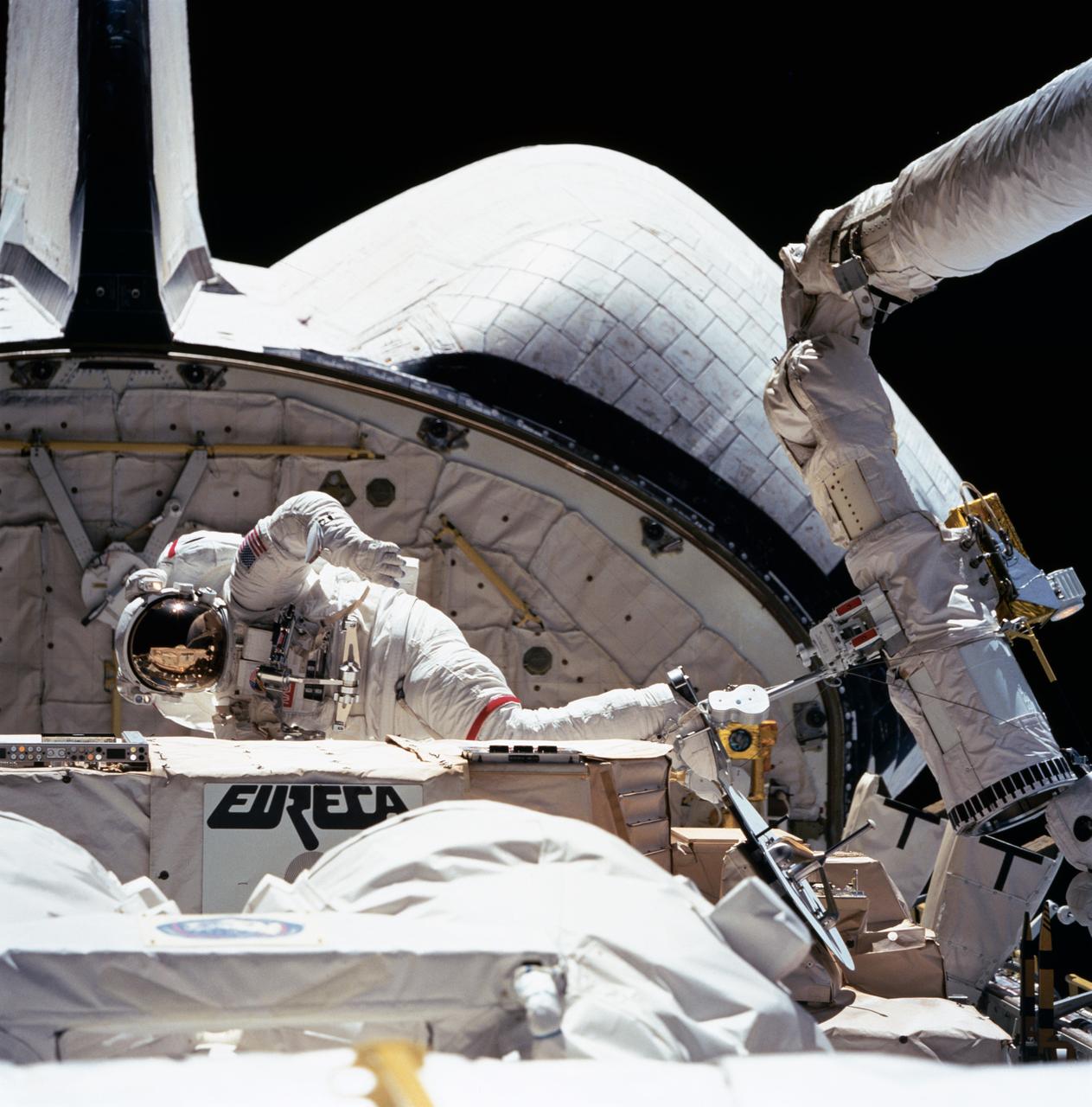
The darkness of space forms the backdrop for this extravehicular activity (EVA) scene captured by one of the STS-57 crewmembers in Endeavour's, Orbiter Vehicle (OV) 105's, crew cabin. Pictured near the recently "captured" European Retrievable Carrier (EURECA) at frame center is Mission Specialist (MS) and Payload Commander (PLC) G. David Low. Suited in an extravehicular mobility unit (EMU), Low, anchored to the remote manipulator system (RMS) via a portable foot restraint (PFR) (manipulator foot restraint (MFR)), is conducting Detailed Test Objective (DTO) 1210 procedures. Specifically, this activity will assist in refining several procedures being developed to service the Hubble Space Telescope (HST) on mission STS-61 in December 1993. The PFR is attached to the RMS end effector via a PFR attachment device (PAD). Partially visible in the foreground is the Superfluid Helium Onorbit Transfer (SHOOT) payload.
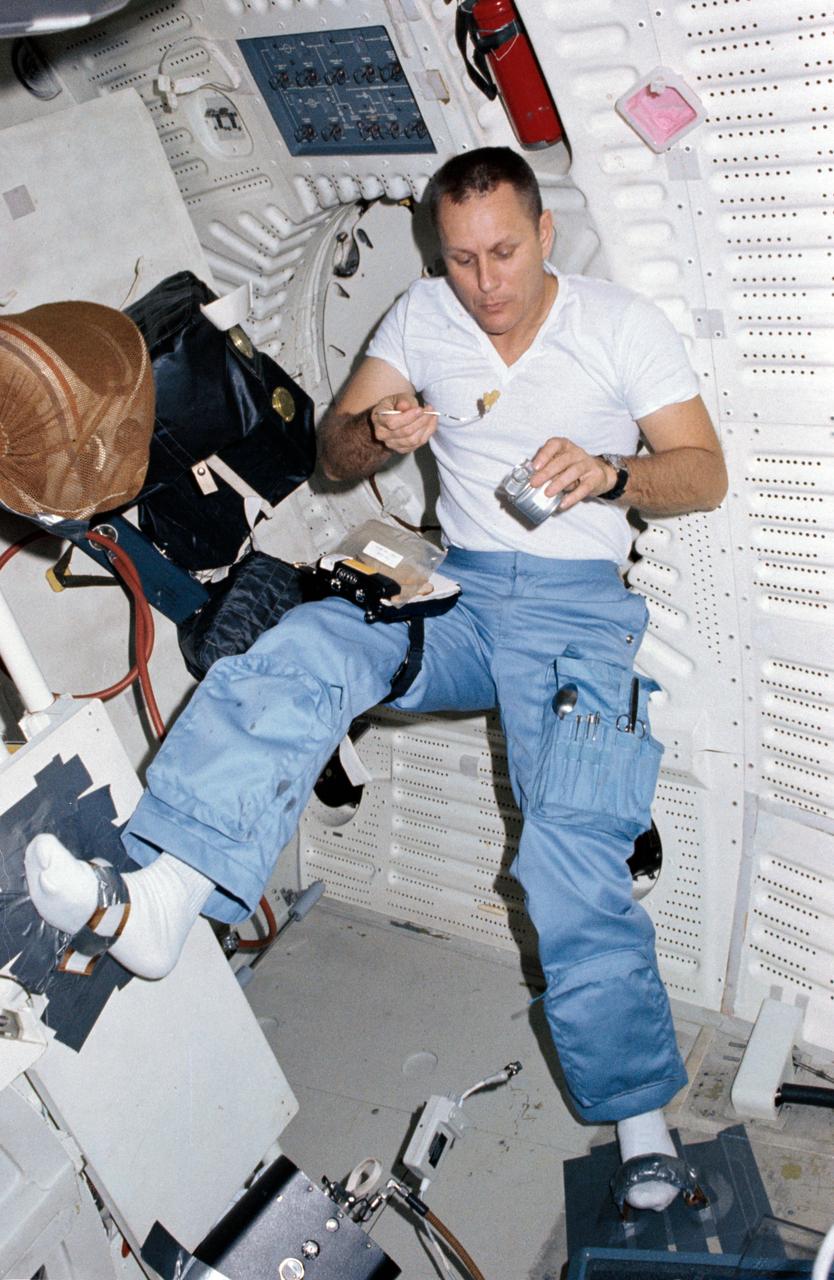
STS005-15-588 (13 Nov. 1982) --- Astronaut Robert F. Overmyer, STS-5 pilot, enjoys a meal from a jury-rigged set-up in the middeck area of the Earth-orbiting space shuttle Columbia. He wears a T-shirt and the trouser portion of a multi-piece constant wear garment. His feet are positioned in recently-rigged foot restraints to avoid involuntary movement in the micro-gravity environment of space. Behind Overmyer are components of the suit, including helmet, worn during landing and takeoff for shuttle flights. The trousers he is presently wearing are part of that attire. Photo credit: NASA
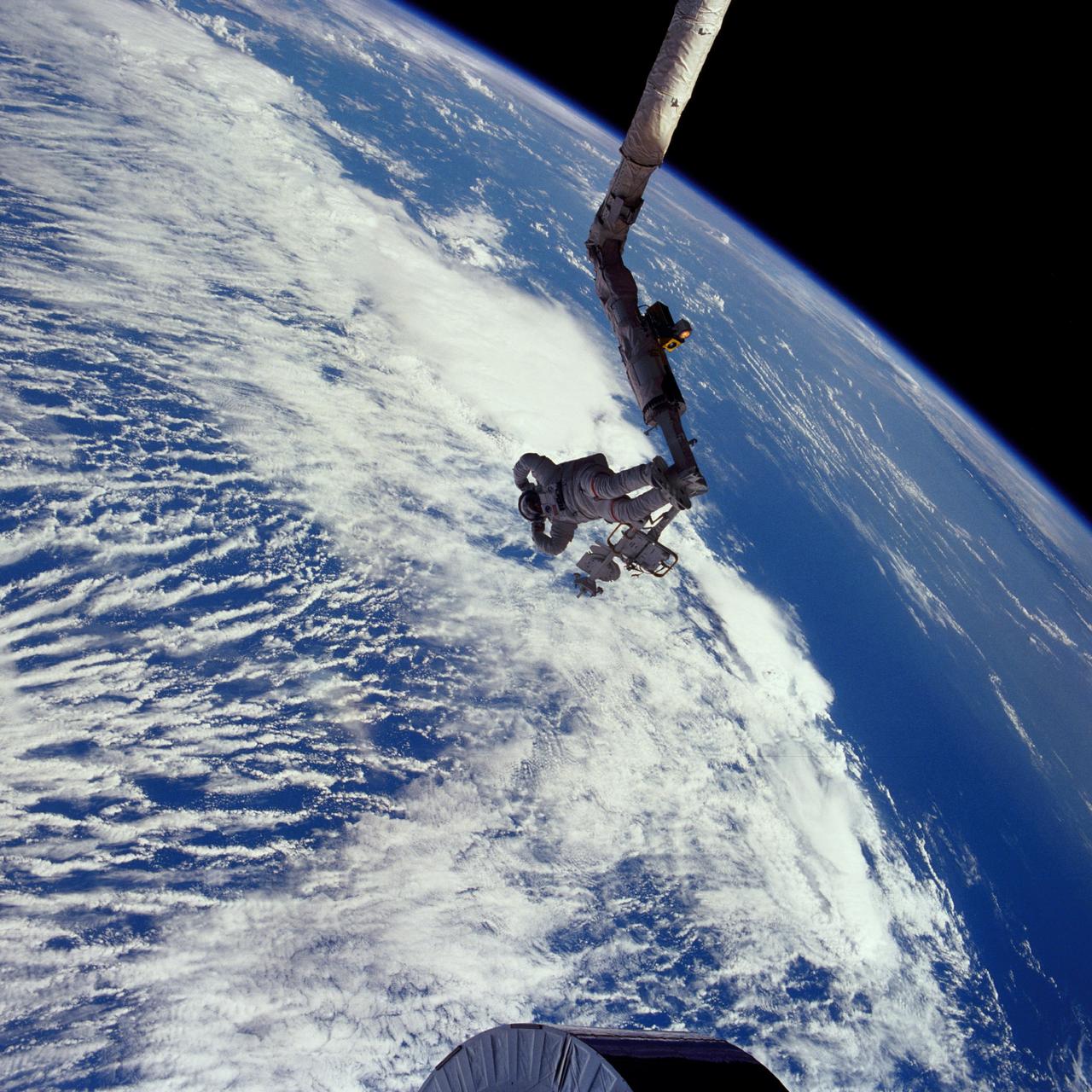
51I-41-086 (1 September 1985) --- Astronaut James D. van Hoften, mission specialist, flexes his muscles in celebration of a triumphant extravehicular task. Clouds over the ocean form the backdrop for this 70mm scene, toward the end of a two-day effort to capture, repair and release the previously errant Syncom IV-3 communications satellite. Van Hoften, anchored to a special foot restraint device on the end of Discovery's Remote Manipulator System (RMS), had just performed the final "shove" that started the relative separation of the Shuttle and the Syncom, which is not far out of frame. He had been joined by astronaut William F. Fisher for the busy two days of EVA.
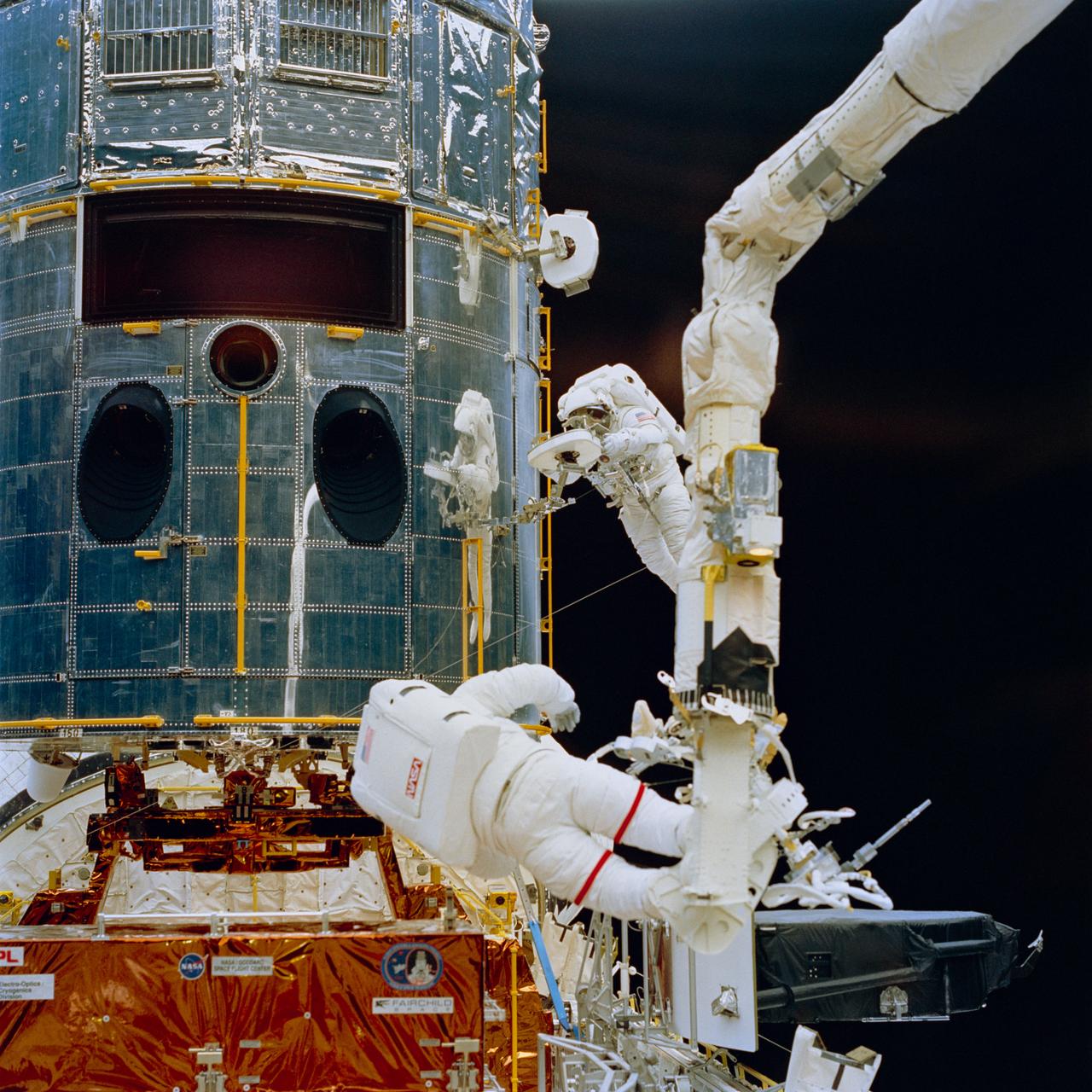
STS061-74-046 (7 Dec 1993) --- Anchored on the end of the Space Shuttle Endeavour's Remote Manipulator System (RMS) arm, astronaut Jeffrey A. Hoffman (foreground) prepares to install the new Wide Field\Planetary Camera (WFPC II) into the empty cavity (top left) on the Hubble Space Telescope (HST). WFPC I is seen temporarily stowed at bottom right. Astronaut F. Story Musgrave works with a Portable Foot Restraint (PFR) at frame center, as his image is reflected in the shiny surface of the telescope. Hoffman and Musgrave shared chores on three of the five extravehicular activity?s (EVA) during the mission.
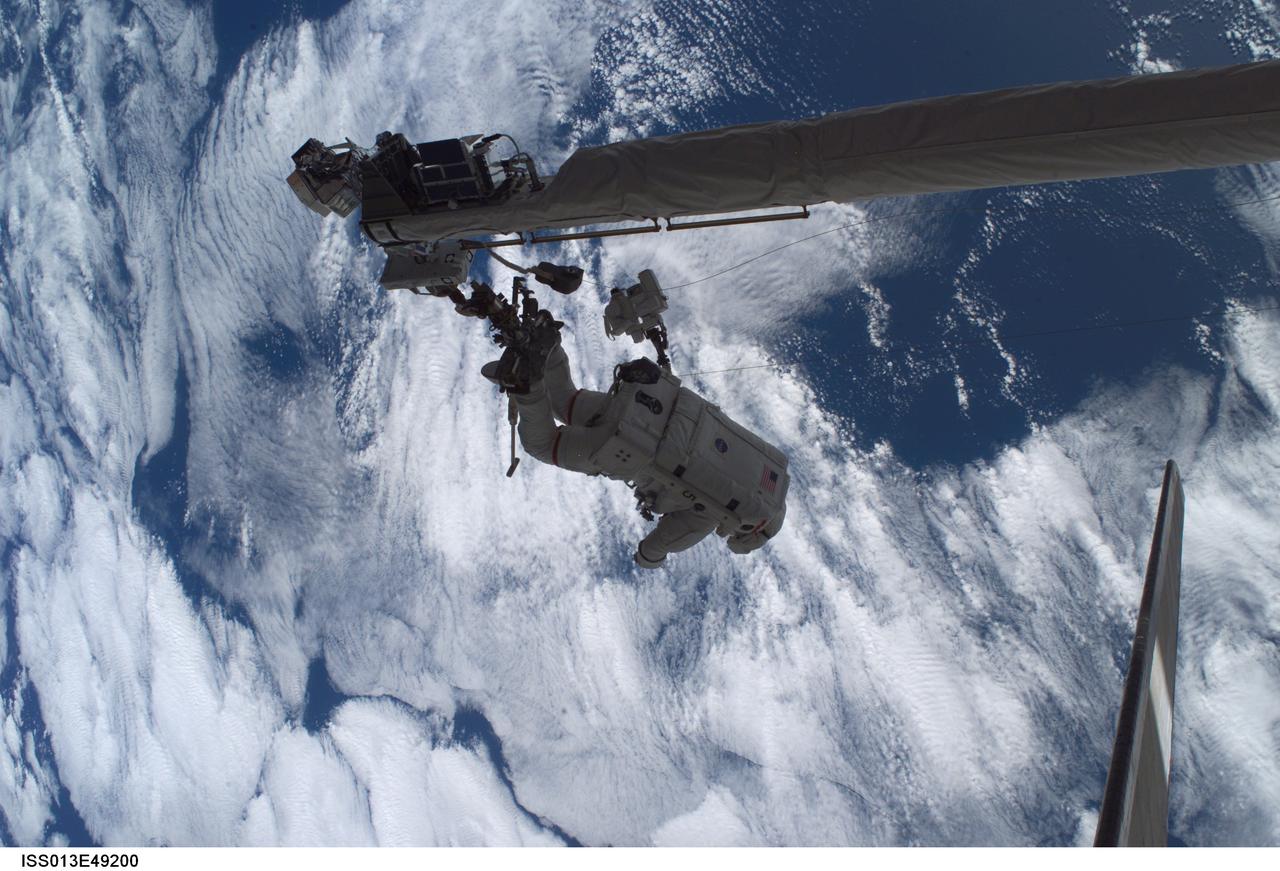
ISS013-E-49200 (8 July 2006) --- Anchored to the Space Shuttle Discovery's Remote Manipulator System/Orbiter Boom Sensor System (RMS/OBSS) foot restraint, astronaut Piers J. Sellers, STS-121 mission specialist, participates in the mission's first session of extravehicular activity (EVA) while the shuttle was docked with the International Space Station. Discovery's vertical stabilizer is at right. A cloud-covered Earth provides the backdrop for the scene.
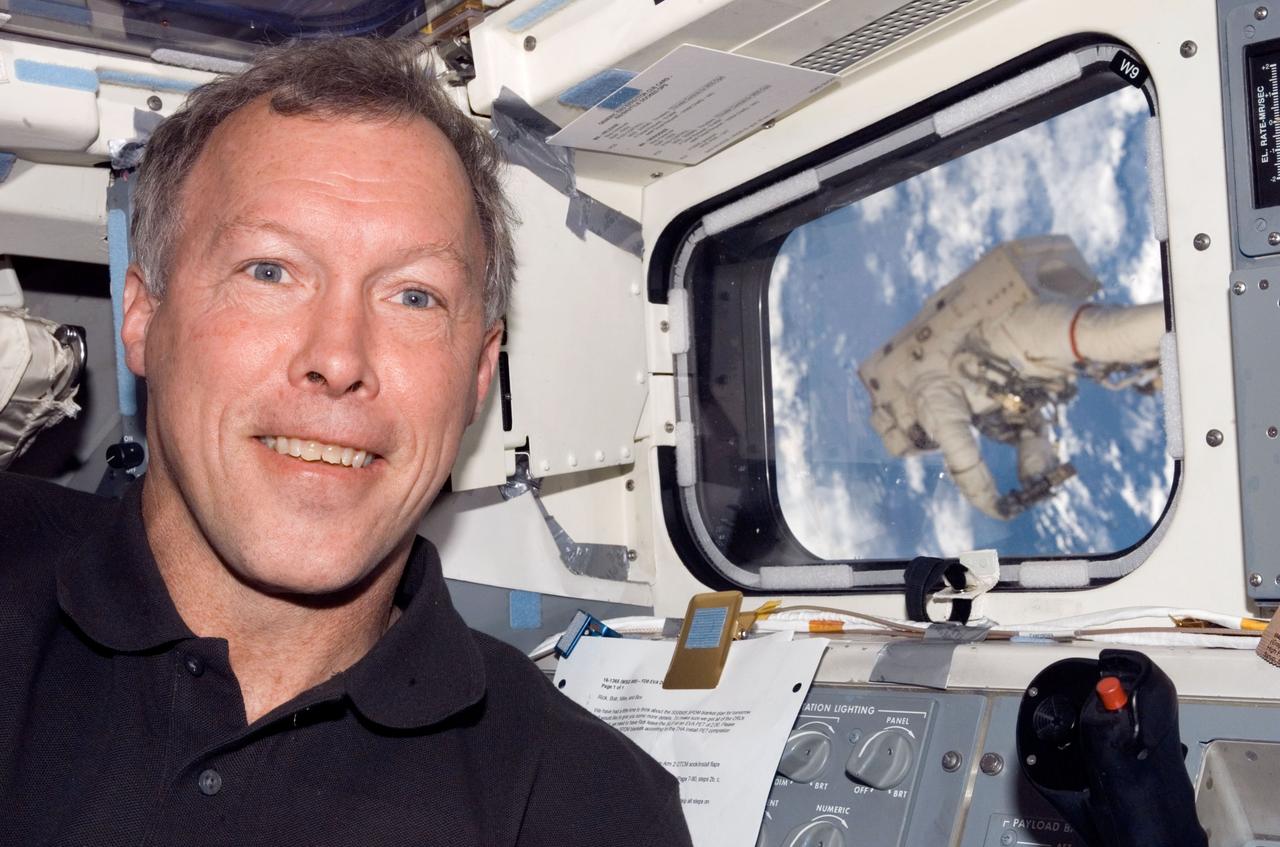
S123-E-006743 (17/18 March 2008) --- Astronaut Dominic Gorie, STS-123 commander, takes a brief moment for a photo on the aft flight deck of Space Shuttle Endeavour while docked with the International Space Station. Anchored to a Canadarm2 mobile foot restraint, astronaut Rick Linnehan (visible through a nearby window), mission specialist, participates in the mission's third session of extravehicular activity (EVA).
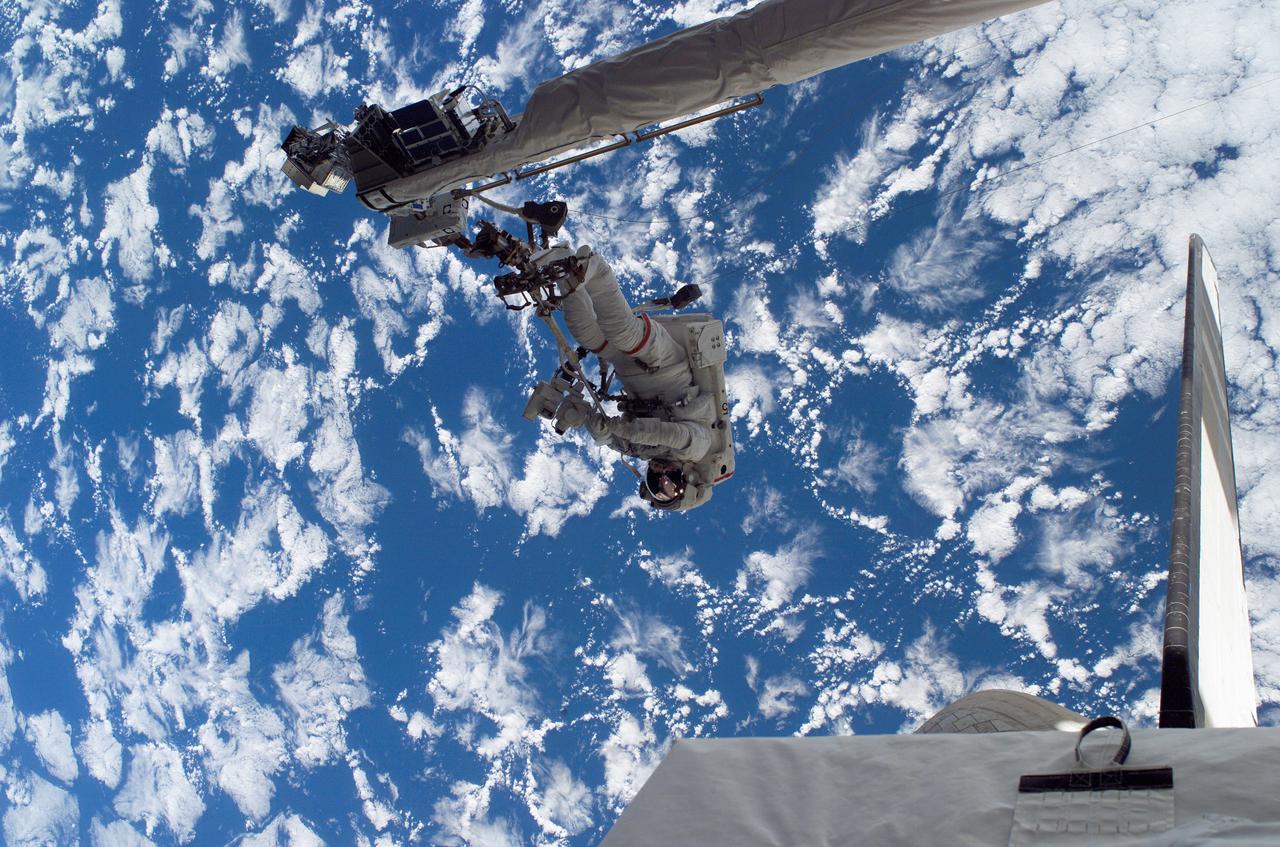
ISS013-E-49186 (8 July 2006) --- Anchored to the Space Shuttle Discovery's Remote Manipulator System/Orbiter Boom Sensor System (RMS/OBSS) foot restraint, astronaut Piers J. Sellers, STS-121 mission specialist, participates in the mission's first session of extravehicular activity (EVA) while the shuttle was docked with the International Space Station. Discovery's vertical stabilizer is at right. A blue and white Earth provides the backdrop for the scene.
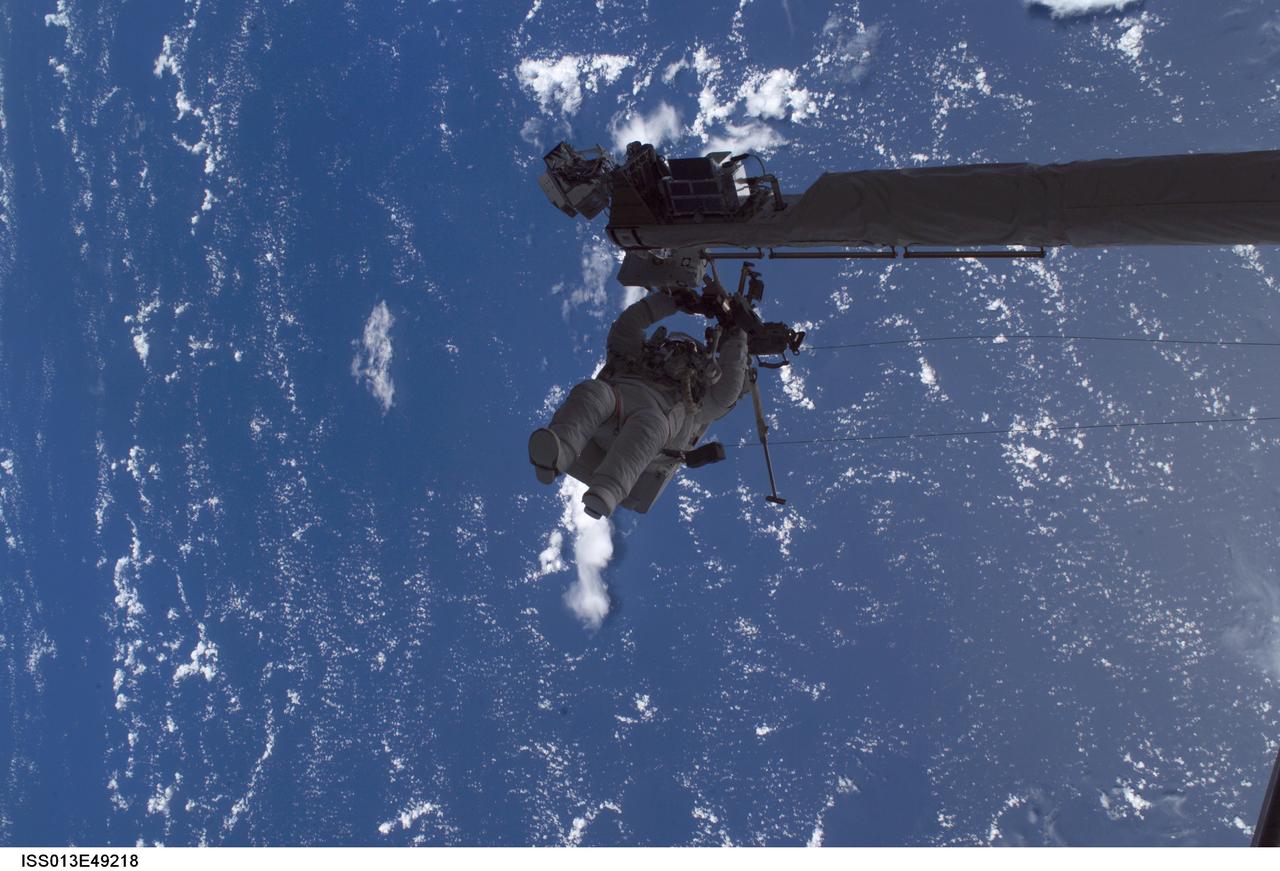
ISS013-E-49218 (8 July 2006) --- Anchored to the Space Shuttle Discovery's Remote Manipulator System/Orbiter Boom Sensor System (RMS/OBSS) foot restraint, astronaut Piers J. Sellers, STS-121 mission specialist, participates in the mission's first session of extravehicular activity (EVA) while the shuttle was docked with the International Space Station. A blue and white Earth provides the backdrop for the scene.

ISS013-E-49197 (8 July 2006) --- Anchored to the Space Shuttle Discovery's Remote Manipulator System/Orbiter Boom Sensor System (RMS/OBSS) foot restraint, astronaut Piers J. Sellers, STS-121 mission specialist, participates in the mission's first session of extravehicular activity (EVA) while the shuttle was docked with the International Space Station. Discovery's vertical stabilizer is at right. A cloud-covered Earth provides the backdrop for the scene.
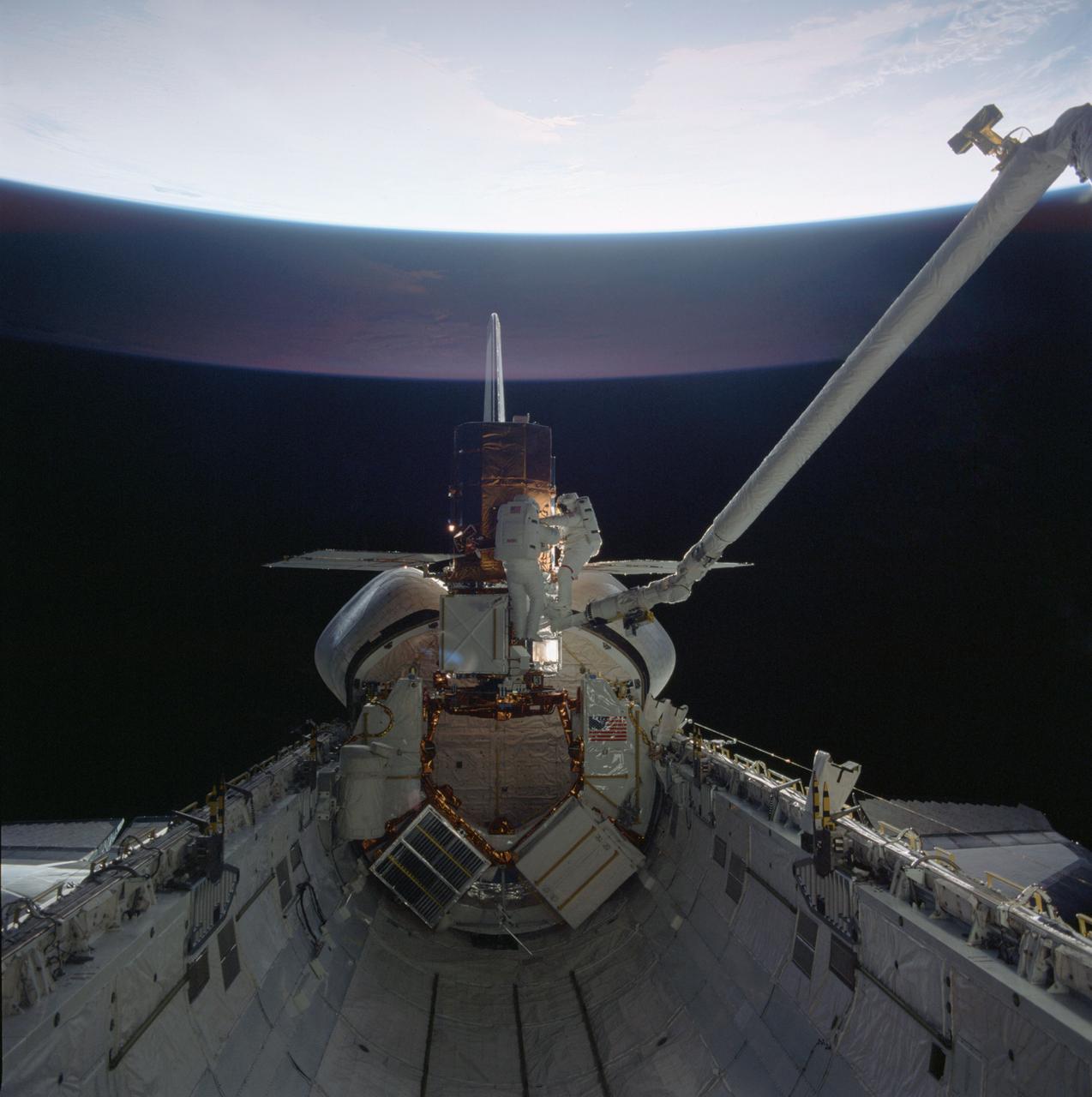
41C-37-1711 (11 April 1984) --- The two mission specialist-EVA participants of Flight 41-C share a repair task at the "captured" Solar Maximum Mission Satellite (SMMS) in the aft end of the Challenger's cargo bay. Astronauts George D. Nelson, right, and James D. van Hoften uses the mobile foot restraint and the Remote Manipulator System (RMS) as a "cherry picker" device for moving about. Later, the RMS lifted the SMMS into space once more.
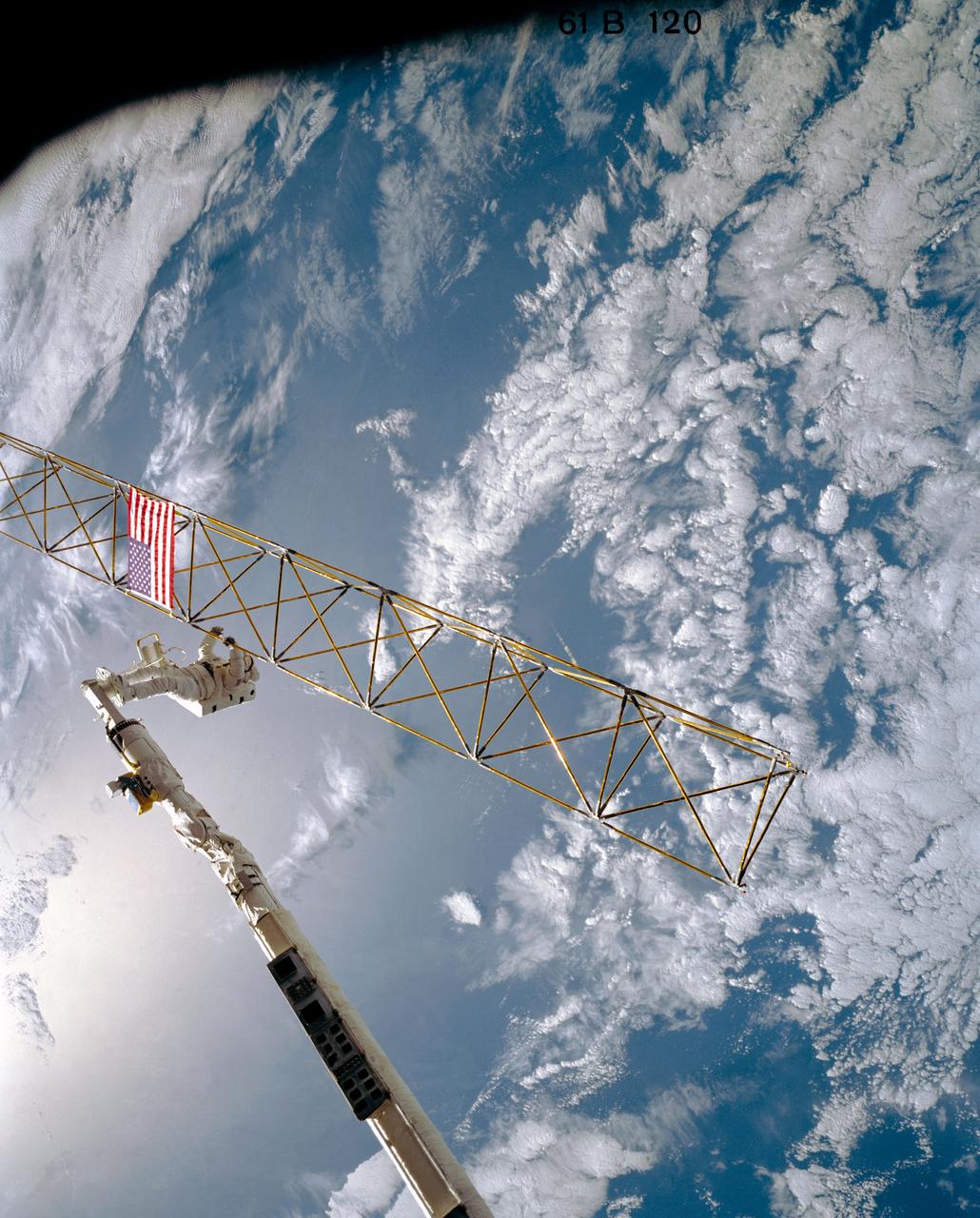
Astronaut Sherwood C. Spring, anchored to the foot restraint on the remote manipulator system (RMS) arm, checks joints on the tower-like Assembly Concept for Construction of Erectable Space Structures (ACCESS) device extending from the payload bay as the Atlantis flies over white clouds and blue ocean waters. The Gulf of Mexico waters form the backdrop for the scene.
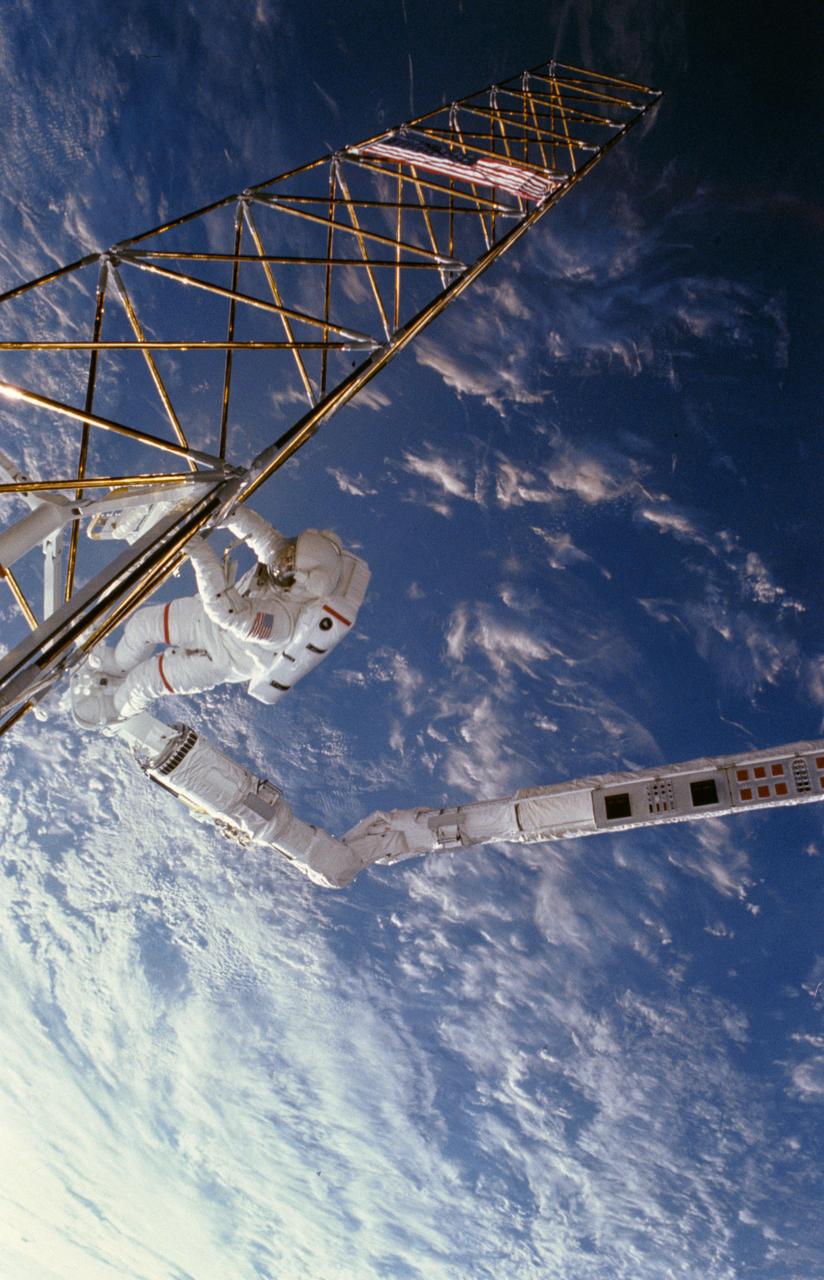
61B-102-022 (1 Dec 1985) --- Astronaut Jerry L. Ross, anchored to the foot restraint on the remote manipulator system (RMS), holds onto the tower-like Assembly Concept for Construction of Erectable Space Structures (ACCESS) device, as the Atlantis flies over white clouds and blue ocean waters. The frame was exposed with a negative-equipped camera held by Astronaut Sherwood C. Spring, who was also on the EVA-task.
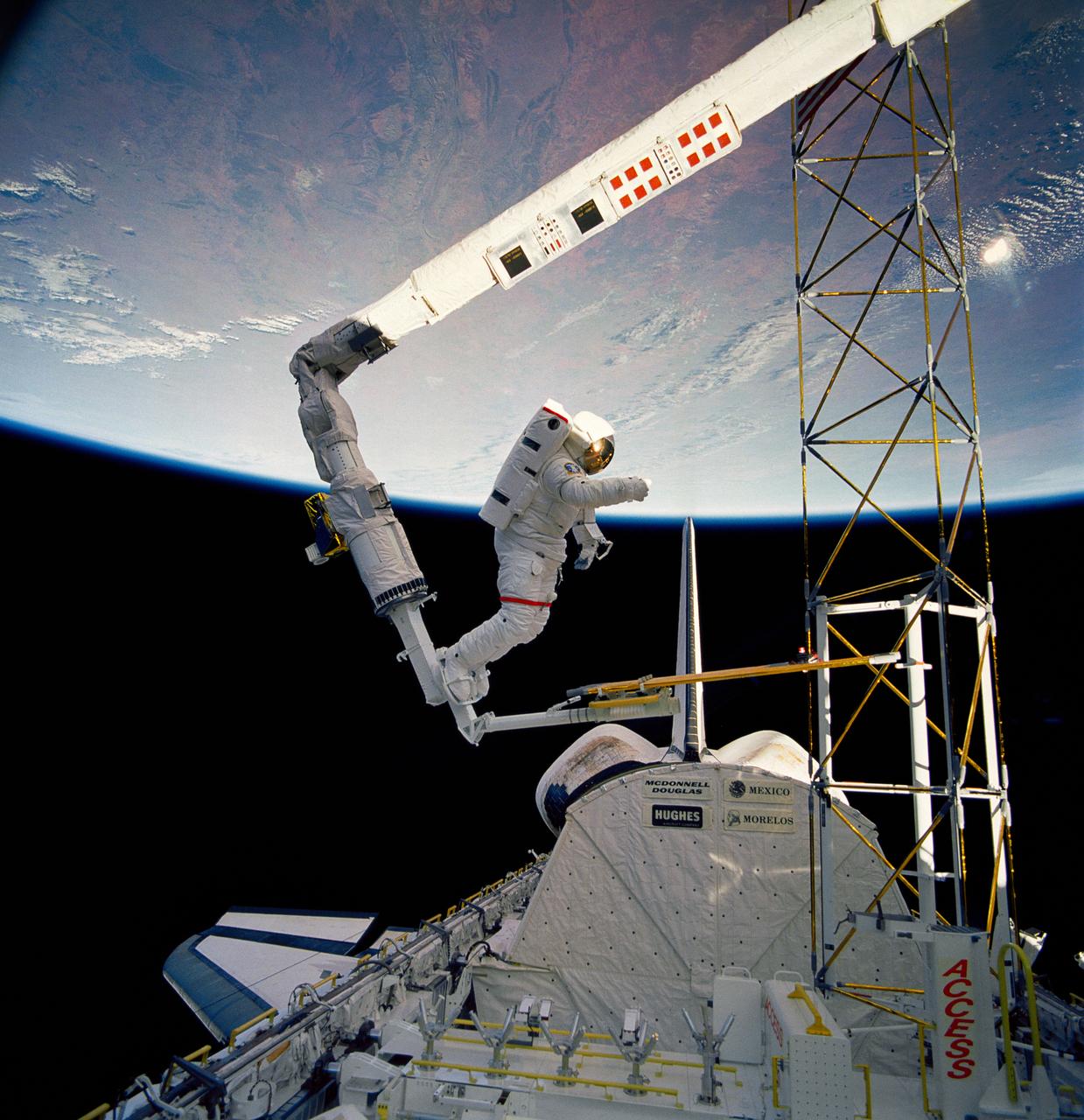
61B-41-019 (26 Nov. ? 3 Dec. 1985) --- Astronaut Jerry L. Ross, one of NASA flight 6l-B's mission specialists, approaches a tower device just erected by Ross and astronaut Sherwood (Woody) C. Spring during the second of two extravehicular activities. The tower was called Assembly Concept for Construction of Erectable Space Structures. Ross is secured on a foot restraint device connected to the Canadian-built remote manipulator system (RMS) arm aboard the Earth orbiting Atlantis.
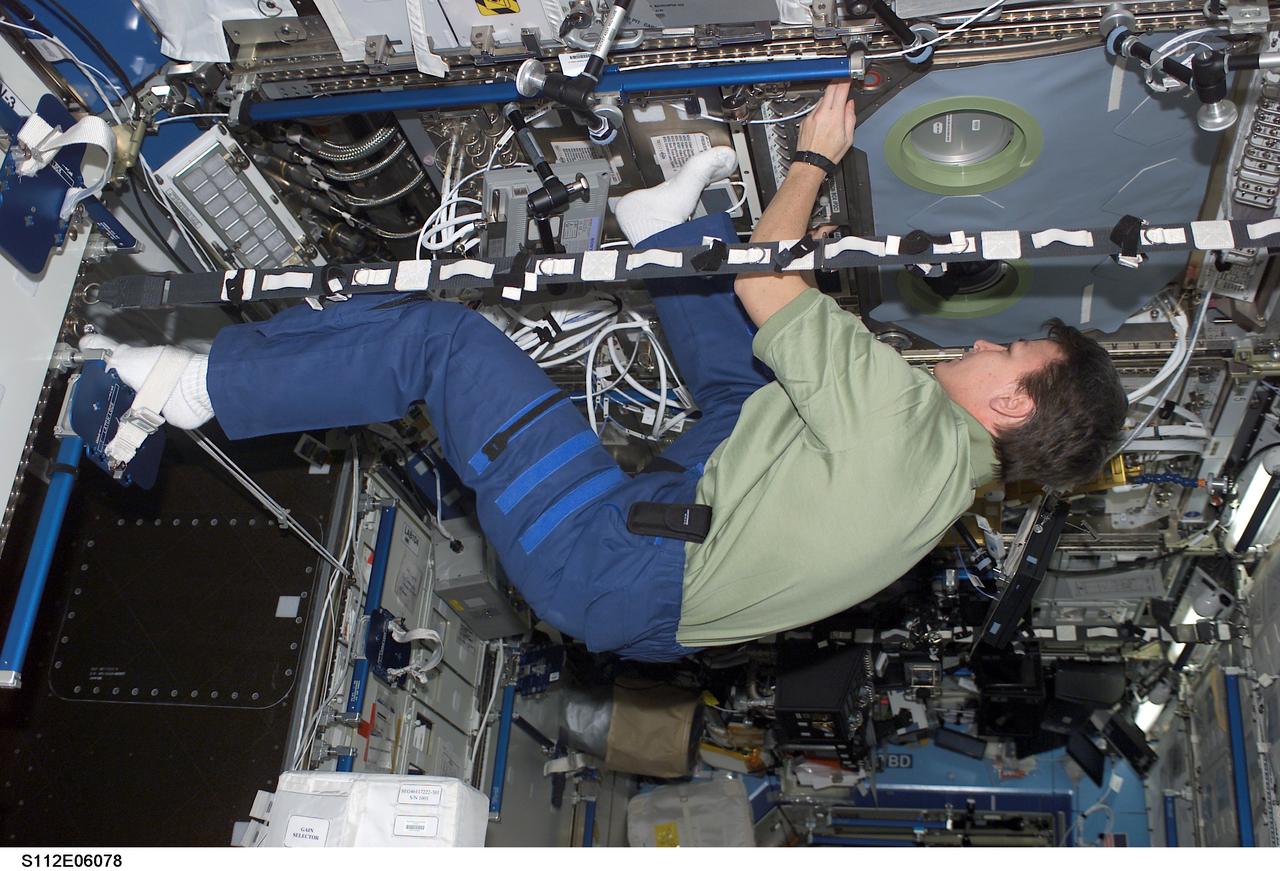
STS112-E-06078 (15 October 2002) --- Astronaut Peggy A. Whitson, Expedition Five flight engineer, works with the Microgravity Science Glovebox (MSG) in the Destiny laboratory on the International Space Station (ISS).
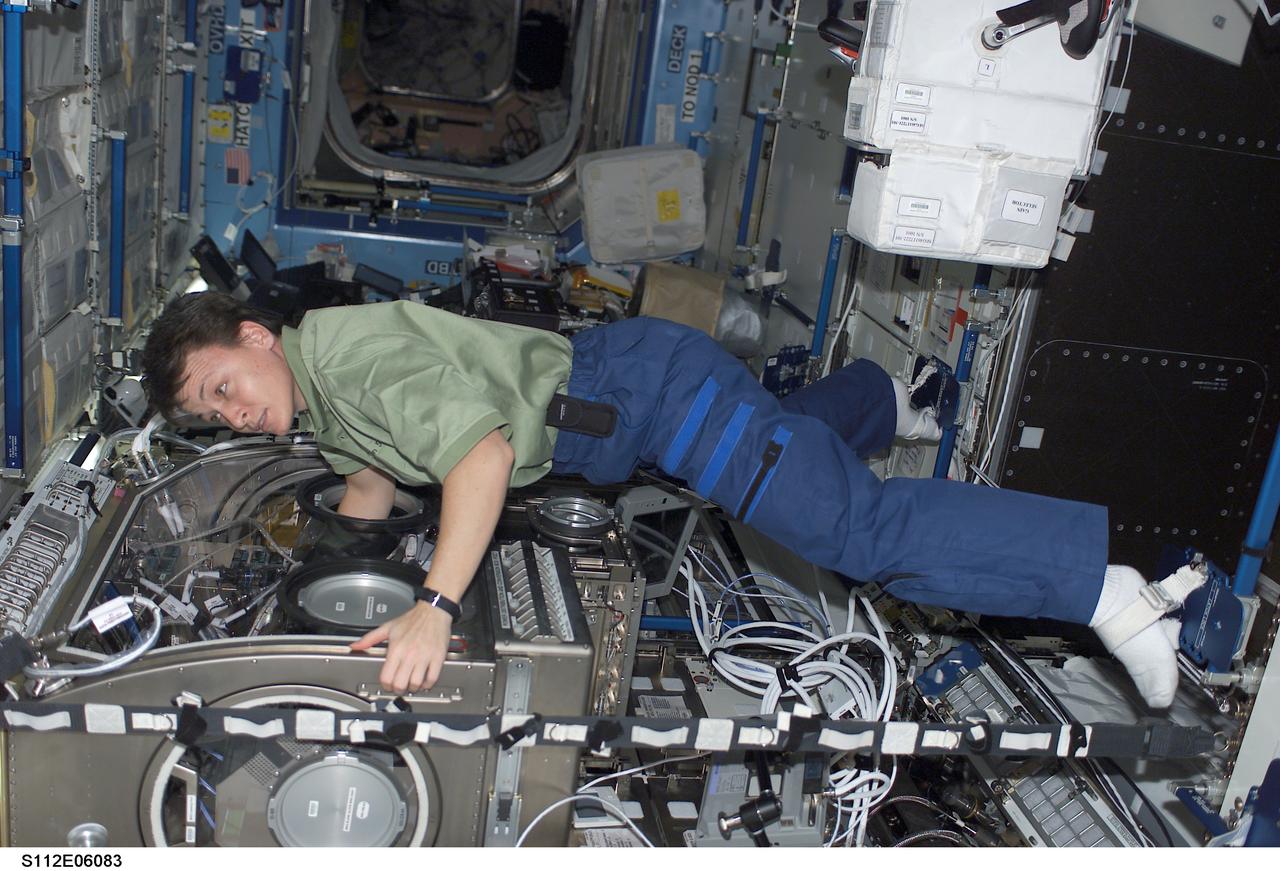
STS112-E-06083 (15 October 2002) --- Astronaut Peggy A. Whitson, Expedition Five flight engineer, works with the Microgravity Science Glovebox (MSG) in the Destiny laboratory on the International Space Station (ISS).
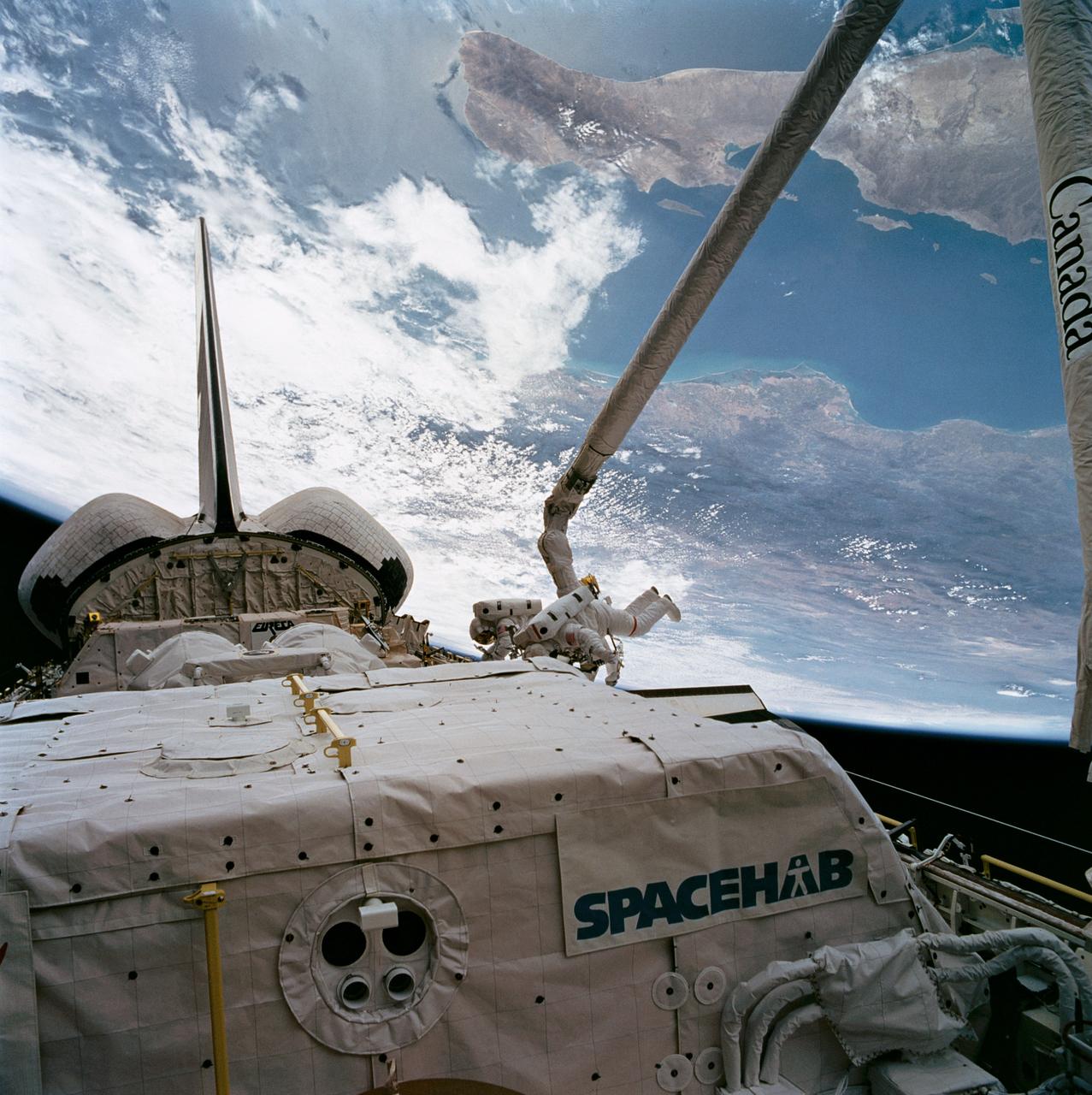
STS057-89-042 (24 June 1993) --- Baja California forms the backdrop for this extravehicular activity (EVA) scene captured on 70mm film by one of the STS-57 crew members in the Space Shuttle Endeavour's crew cabin. Working near the recently "captured" European Retrievable Carrier (EURECA) at frame center are astronauts G. David Low (nearest camera) and Peter J. K. (Jeff) Wisoff. Low is attached to a mobile foot restraint to the end of the Canadian-built Remote Manipulator System (RMS) arm. The SPACEHAB module is seen in the foreground and EURECA is partially visible near Endeavour's aft firewall.
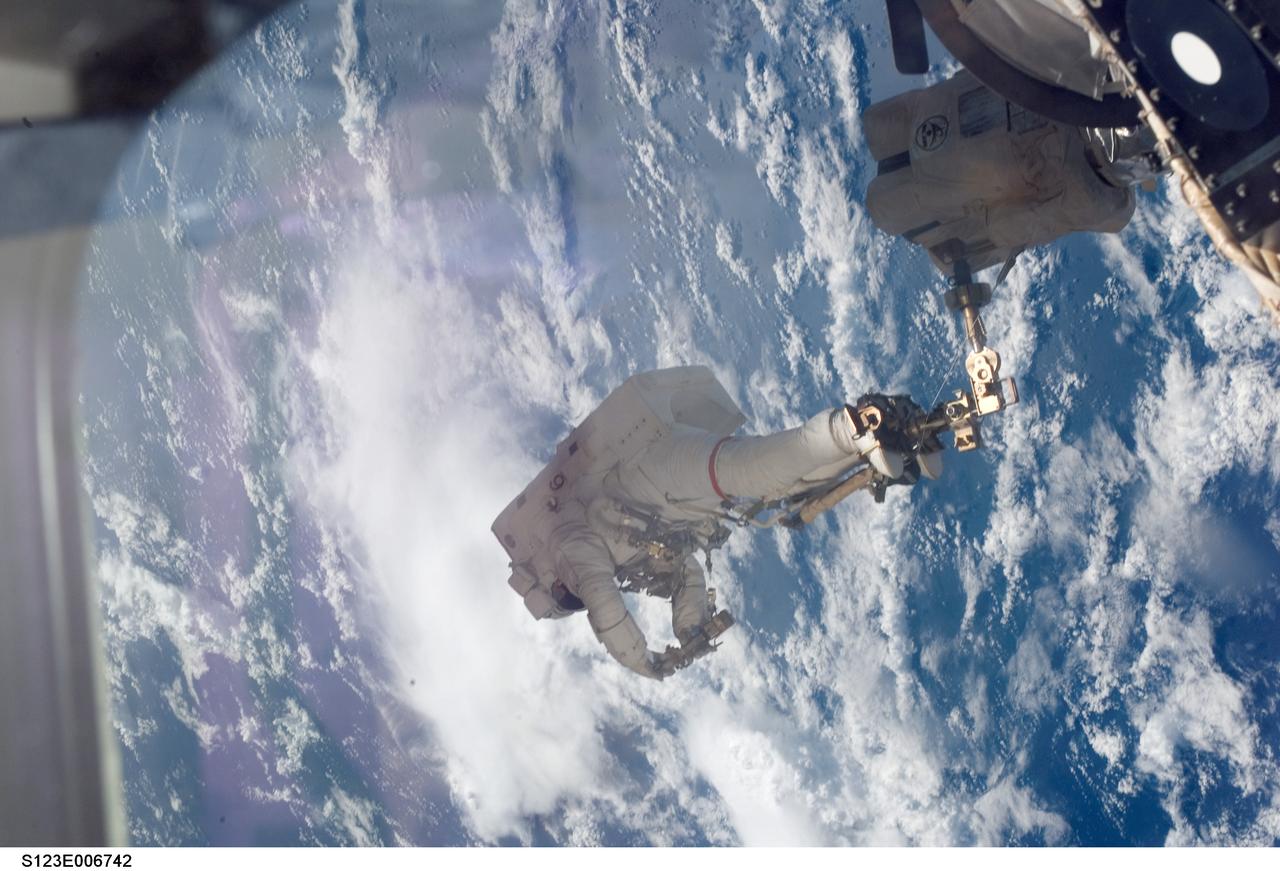
S123-E-006742 (17/18 March 2008) --- Anchored to a Canadarm2 mobile foot restraint, astronaut Rick Linnehan, STS-123 mission specialist, participates in the mission's third scheduled session of extravehicular activity (EVA) as construction and maintenance continue on the International Space Station. During the 6-hour, 53-minute spacewalk, Linnehan and astronaut Robert L. Behnken (out of frame), mission specialist, installed a spare-parts platform and tool-handling assembly for Dextre, also known as the Special Purpose Dextrous Manipulator (SPDM). Among other tasks, they also checked out and calibrated Dextre's end effector and attached critical spare parts to an external stowage platform. The new robotic system is scheduled to be activated on a power and data grapple fixture located on the Destiny laboratory on flight day nine.
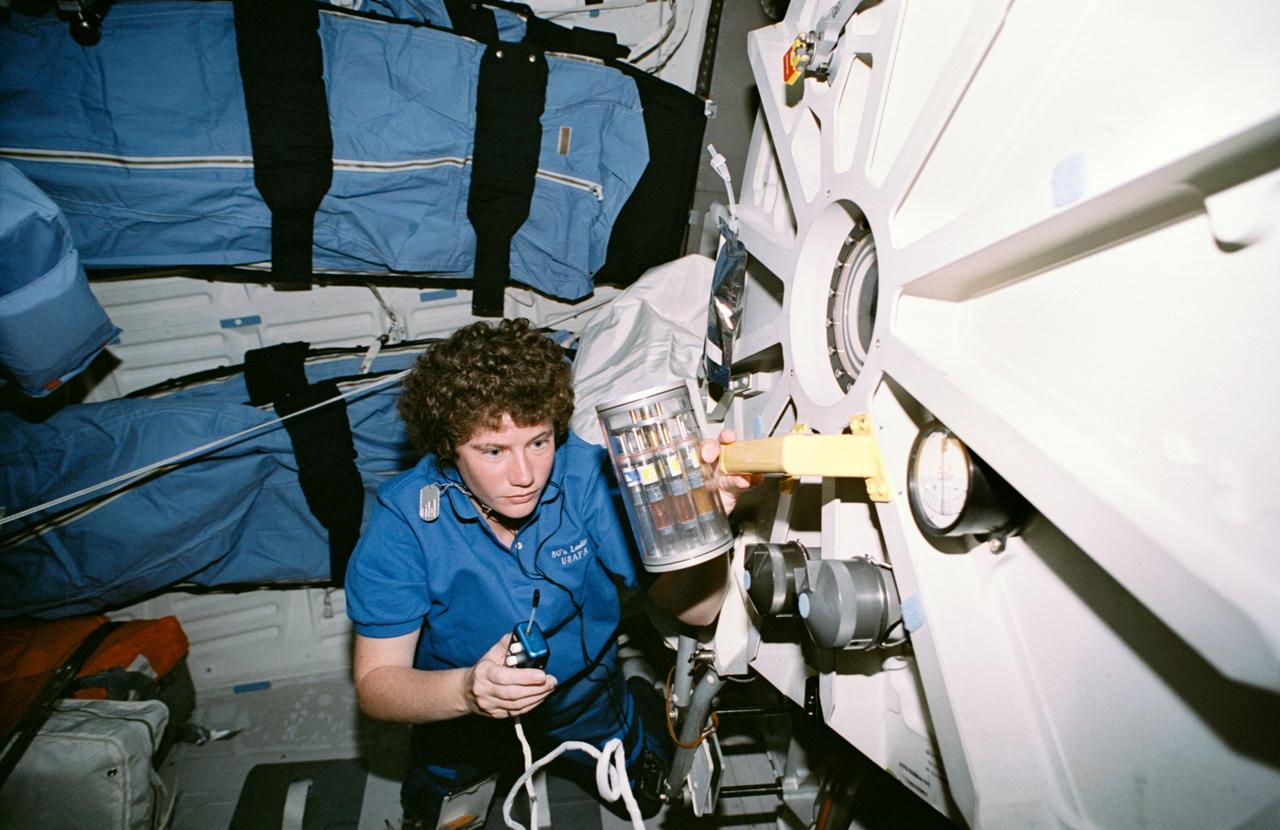
STS054-30-009 (13 Jan 1993) --- Astronaut Susan J. Helms communicates with ground controllers about the Commercial Generic Bioprocessing Apparatus (CGBA) on Endeavour's middeck. The mission specialist holds samples from the CGBA in her left hand. Sleep restraints can be seen in their temporary stow position in the left part of the frame, near the airlock hatch. Also onboard the spacecraft for the six-day mission were astronauts John H. Casper, Donald R. McMonagle, Gregory J. Harbaugh and Mario Runco Jr.
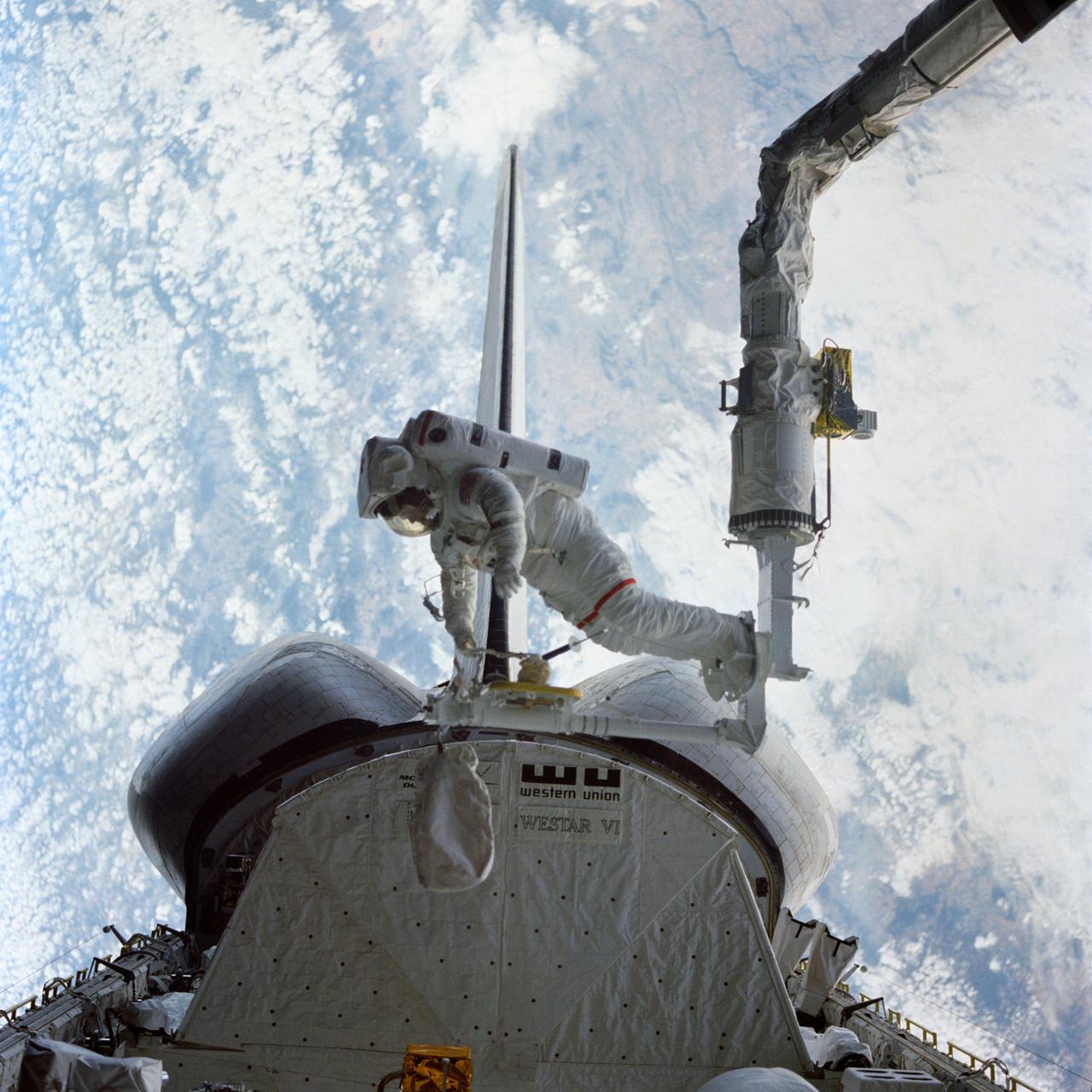
S84-27021 (7 Feb 1984) --- Astronaut Bruce McCandless II, 41B mission specialist tests a "cherry-picker" type device during February 7 historical Extravehicular Activity (EVA). The EVA, in which Astronauts McCandless and Robert L. Stewart, two of three STS-41B mission specialists, participated, marked two firsts--initial use of both the Mobile Foot Restraint (MFR) attached to the Remote Manipulator System (RMS) arm here, and the Manned Maneuvering Unit (MMU) backpack (not seen in this frame). The Challenger was flying with its aft end aimed toward the Earth. This photograph clearly shows where the MFR connects to the end effector of the Canadian-built RMS arm. The two spacewalkers were monitored and photographed by their fellow crewmembers, astronauts Vance D. Brand, commander; Robert L. Gibson, pilot; and Ronald E. McNair, mission specialist. The three remained in the cabin for another EVA session two days later. Photo Credit: NASA
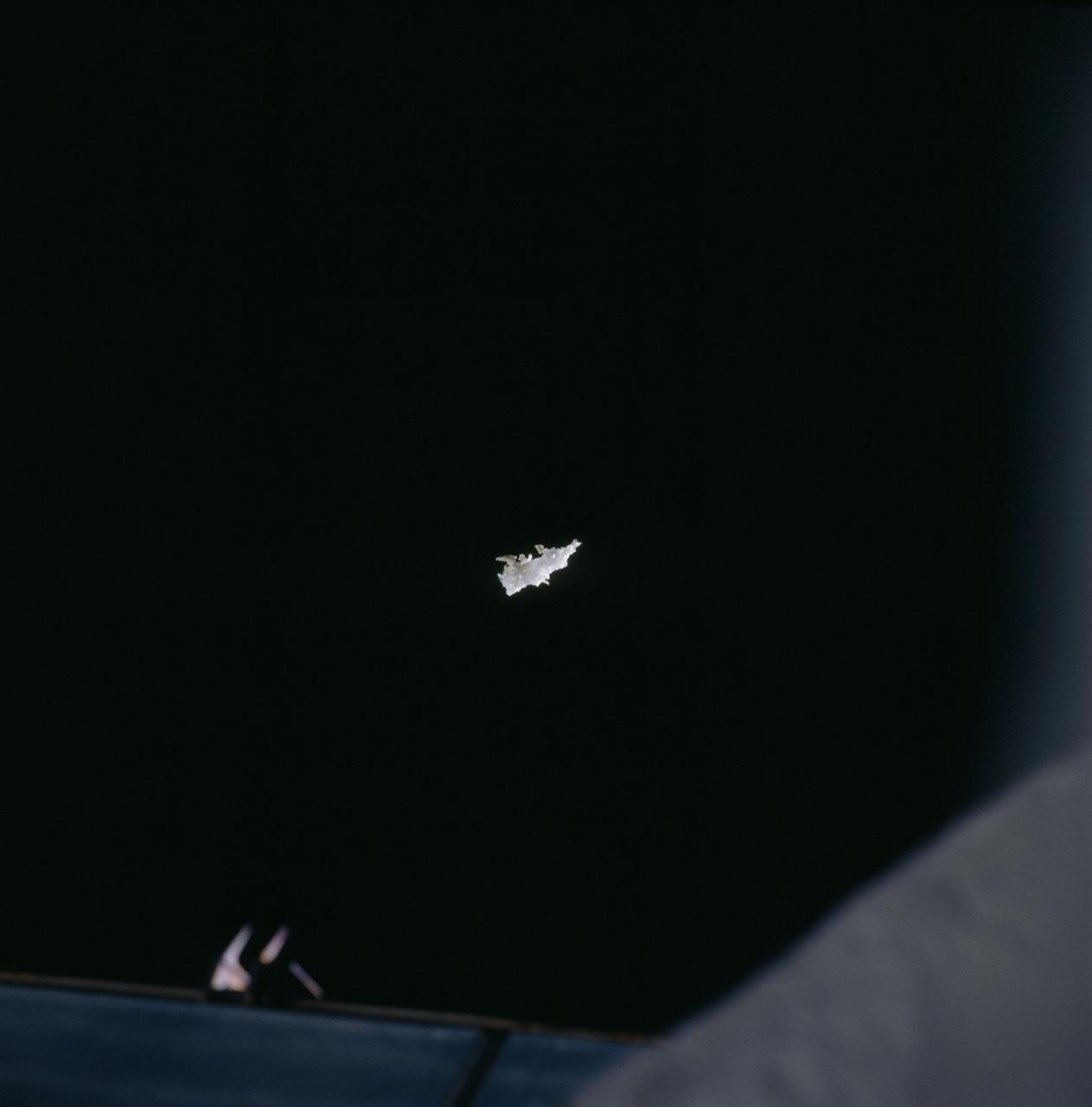
41D-33-071 (4 Sept. 1984) --- A collection of ice that developed around an external nozzle on Discovery’s port side mid fuselage sails by the spacecraft on Sept. 4, 1984, following a successful attempt to remove the troublesome buildup using the remote manipulator system (RMS) arm. A crew member on the flight deck alertly grabbed a 70-mm camera and recorded the final look at the chunk. Photo credit: NASA
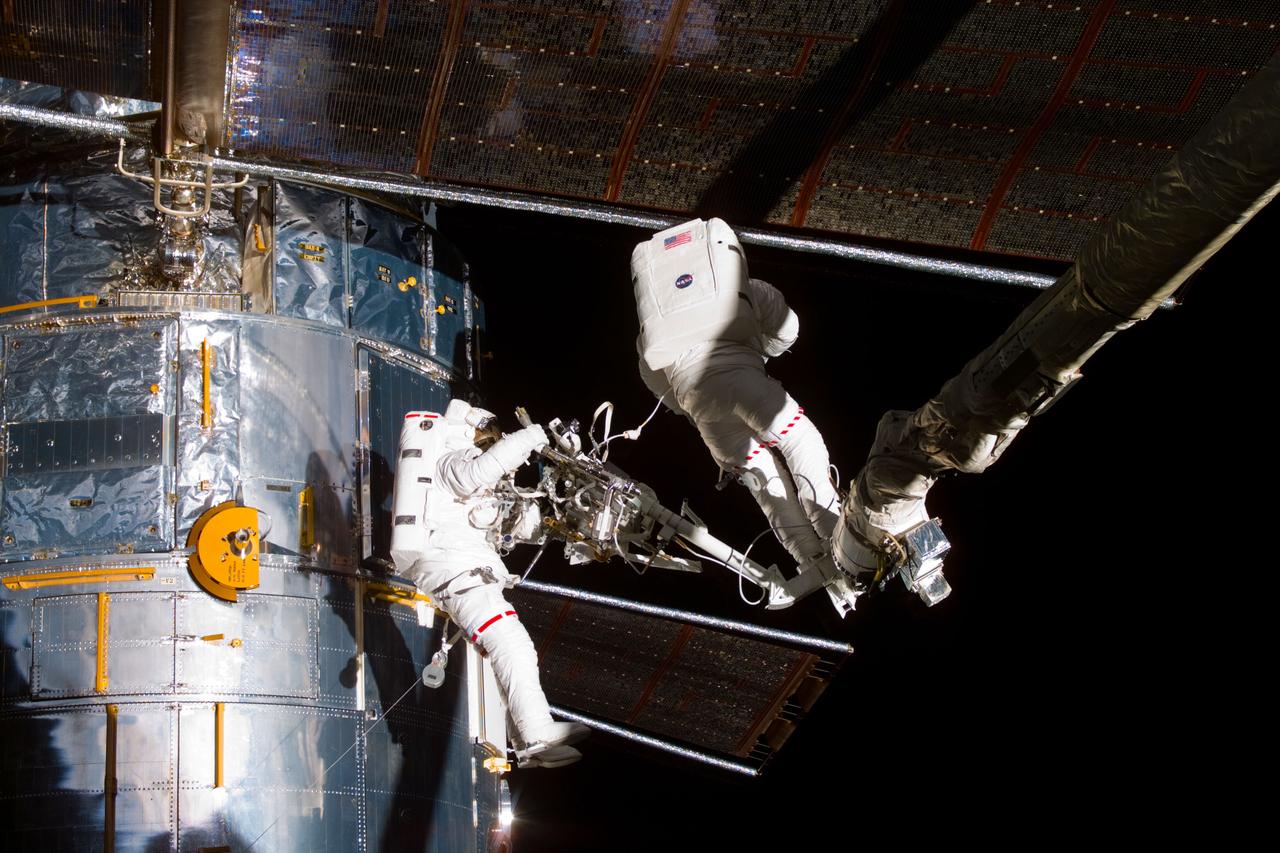
S82-E-5422 (15 Feb. 1997) --- Astronauts Gregory J. Harbaugh (left) and Joseph R. Tanner (right) during Mobile Foot Restraint (MFR) exchange. This view was taken with an Electronic Still Camera (ESC).
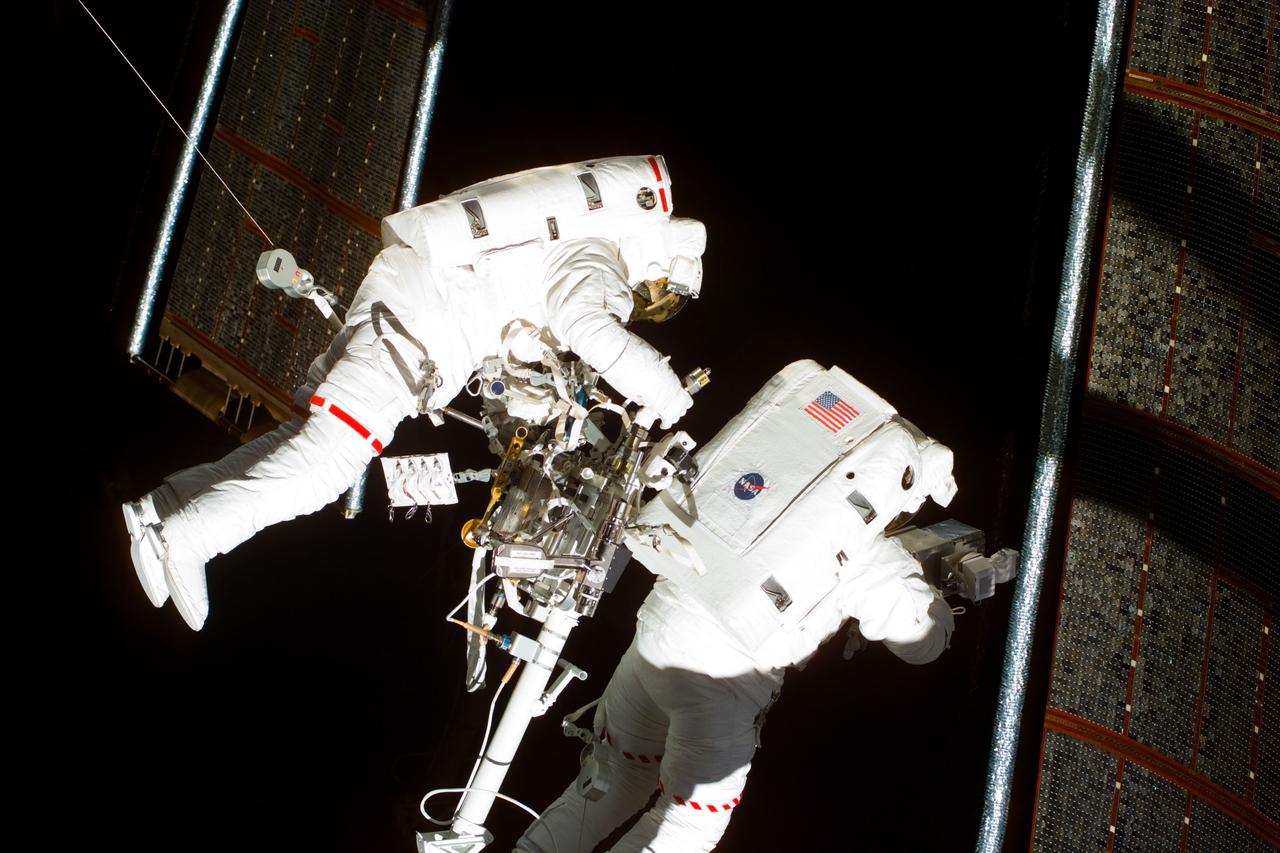
S82-E-5420 (15 Feb. 1997) --- Astronauts Gregory J. Harbaugh (left) and Joseph R. Tanner (right) during Mobile Foot Restraint (MFR) exchange. This view was taken with an Electronic Still Camera (ESC).
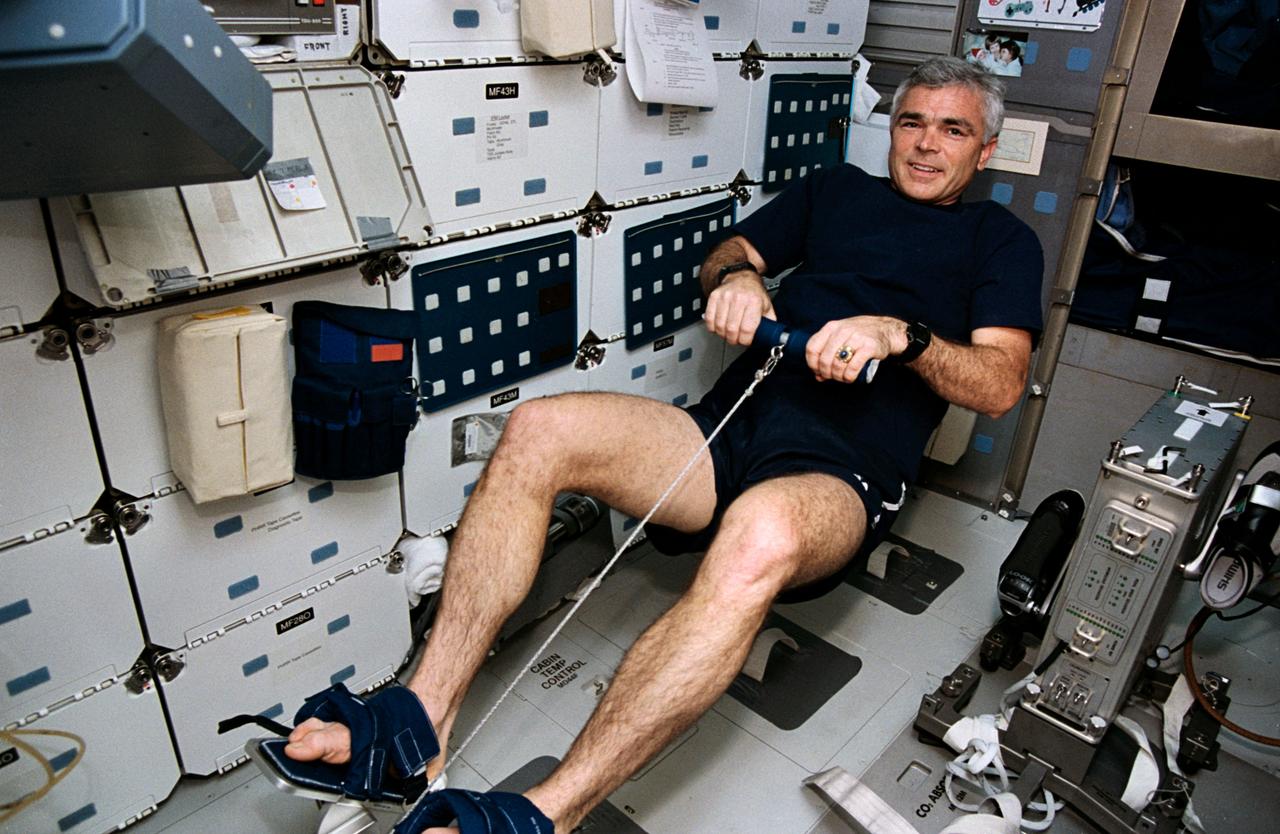
STS059-11-014 (9-20 April 1994) --- Astronaut Michael R. (Rich) Clifford, mission specialist, uses the rowing machine temporarily deployed on the Space Shuttle Endeavour's middeck. Many of the crew members put in time on the device during the week and a half mission.
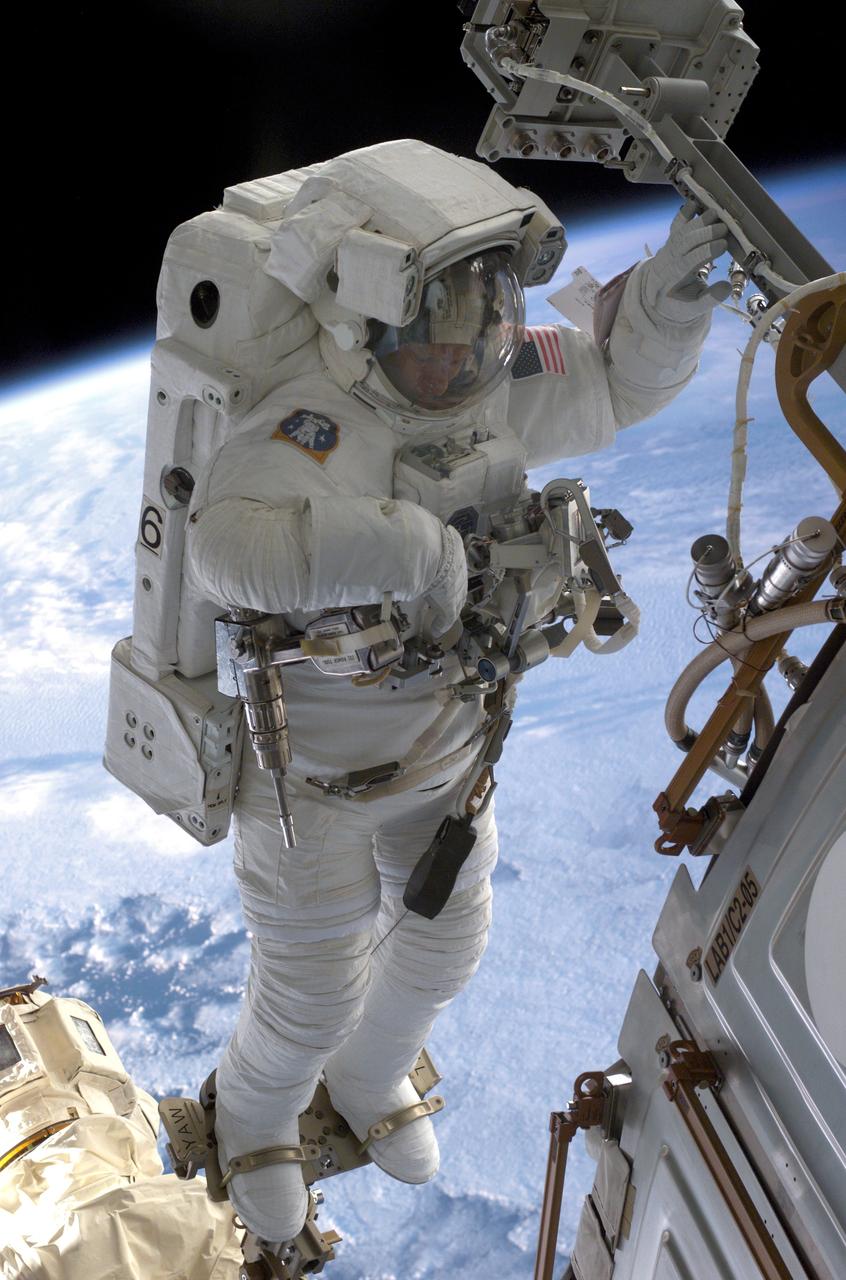
STS112-E-05311 (12 October 2002) --- Astronaut Piers J. Sellers uses both a handrail on the Destiny Laboratory and a foot restraint on the Space Station Remote Manipulator System or Canadarm2 to remain stationary while performing work at the end of the STS-112 mission's second spacewalk. A cloud-covered Earth provides the backdrop for the scene.
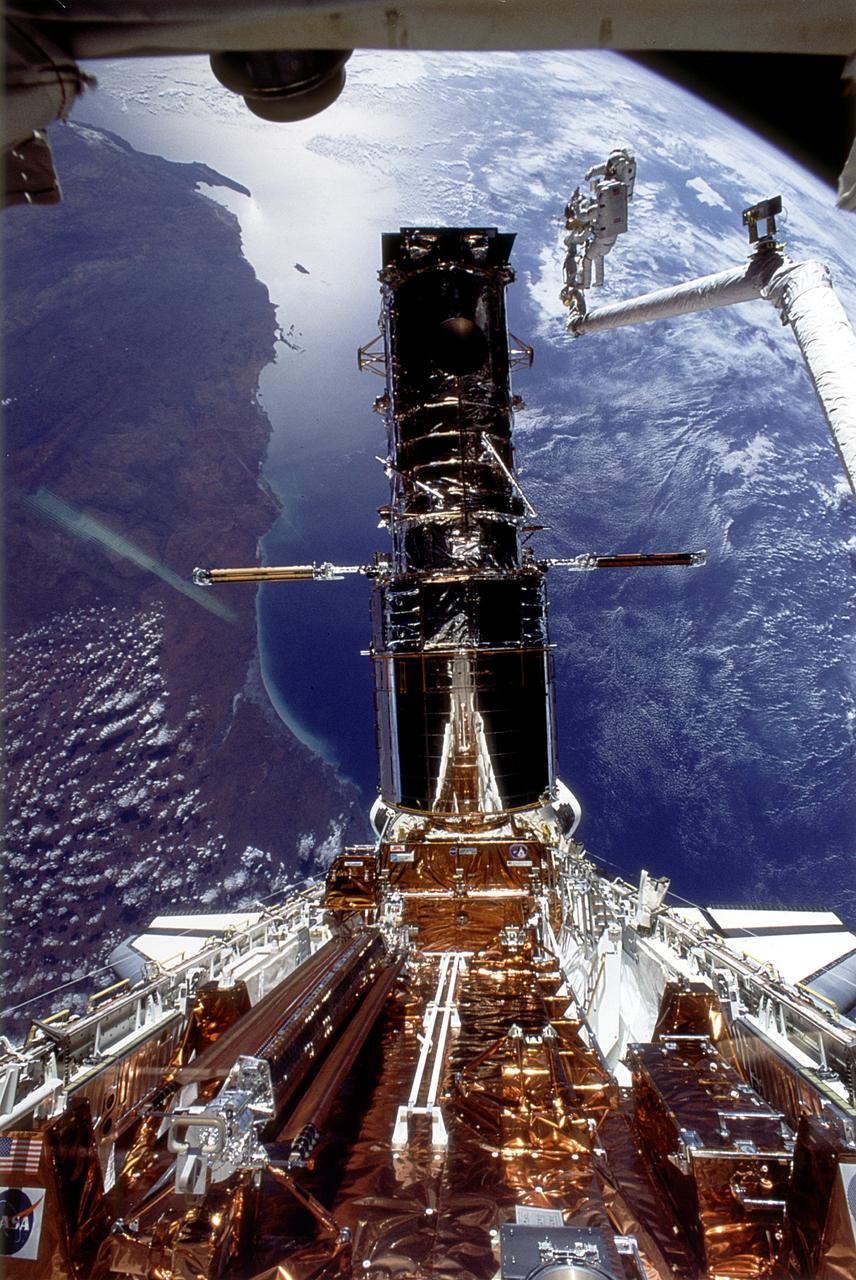
Repair of the Hubble Space Telescope (HST) - orbiting earth at an altitude of 325 nautical miles. Perched atop a foot restraint on shuttle Endeavour's remote manipulator system arm, astronauts Story Musgrave and Jeffrey Hoffman wrap up the final of five space walks.
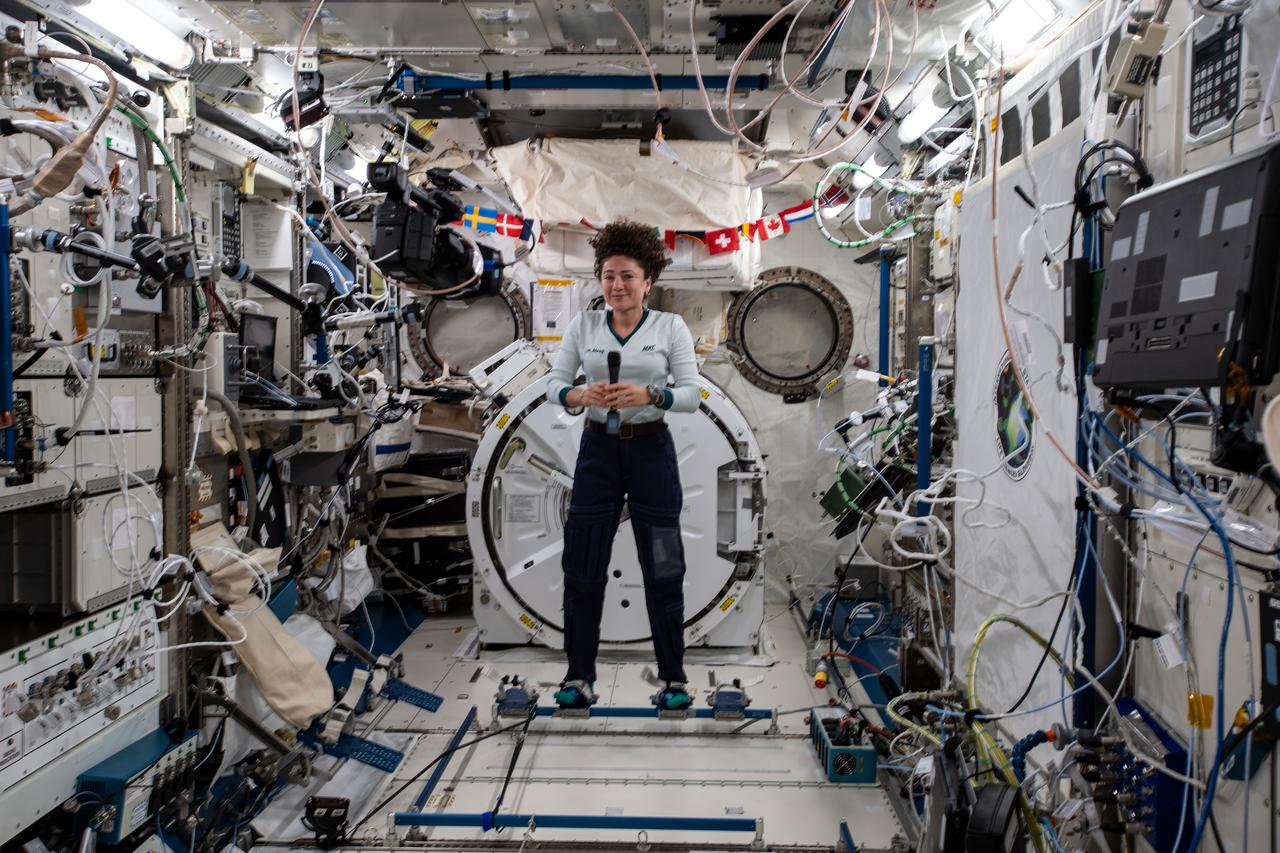
iss061e026260 (Nov. 1, 2019) --- NASA astronaut Jessica Meir, attached to foot restraints inside the Kibo laboratory module from JAXA (Japan Aerospace Exploration Agency), participates in interviews with journalists from Bangor, Maine and Boston, Massachusetts.

iss053e119676 (Oct. 20, 2017) --- Flight Engineer and astronaut Joe Acaba is attached to a portable foot restraint and tethered to the International Space Station's truss structure. Acaba was performing maintenance on the Canadarm2 robotic arm during the third of a series of spacewalks that took place during Expedition 53.
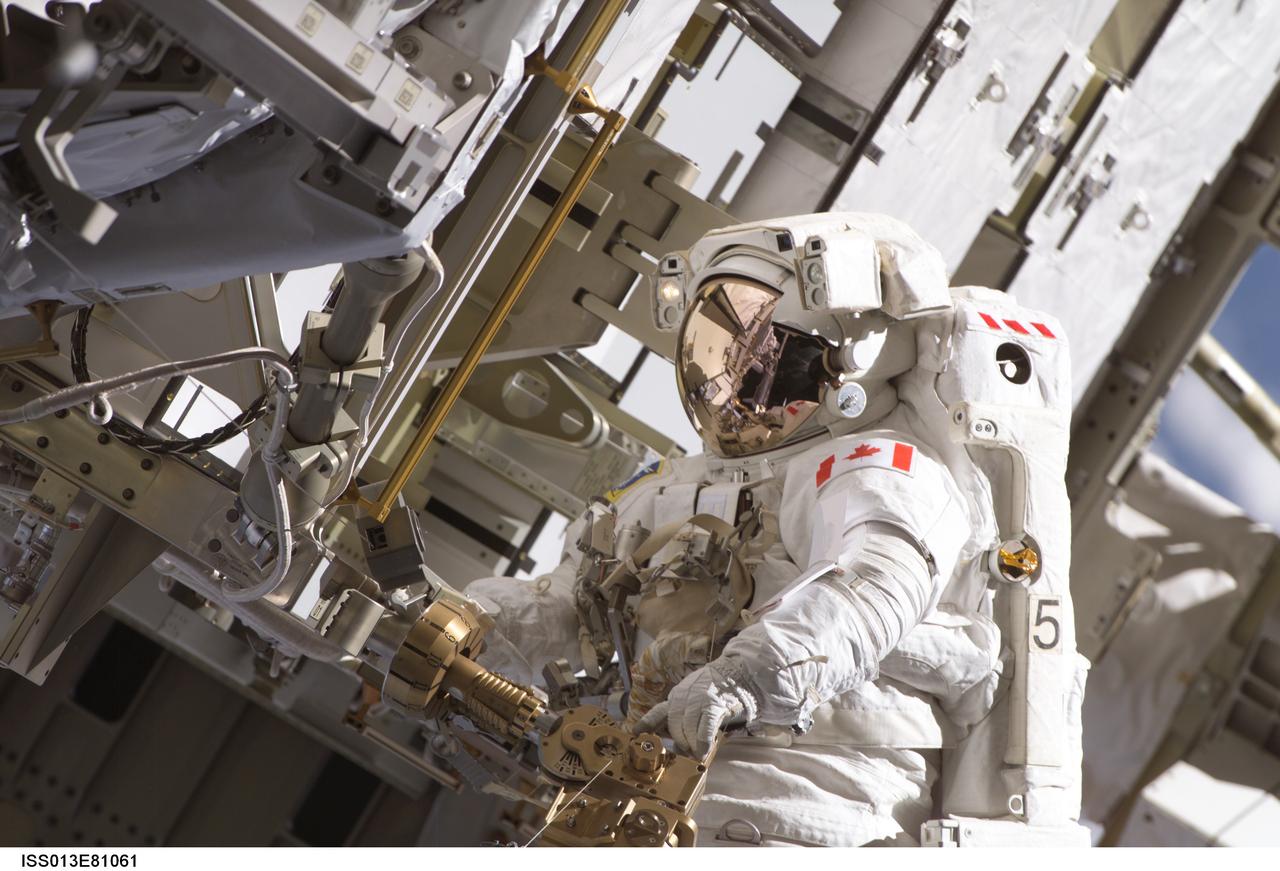
ISS013-E-81061 (13 Sept. 2006) --- Canadian Space Agency astronaut Steven G. MacLean, STS-115 mission specialist, performs a task to relocate articulating portable foot restraints (APFR) during the second of three scheduled spacewalks supported by the Atlantis astronauts and the crewmembers aboard the International Space Station.
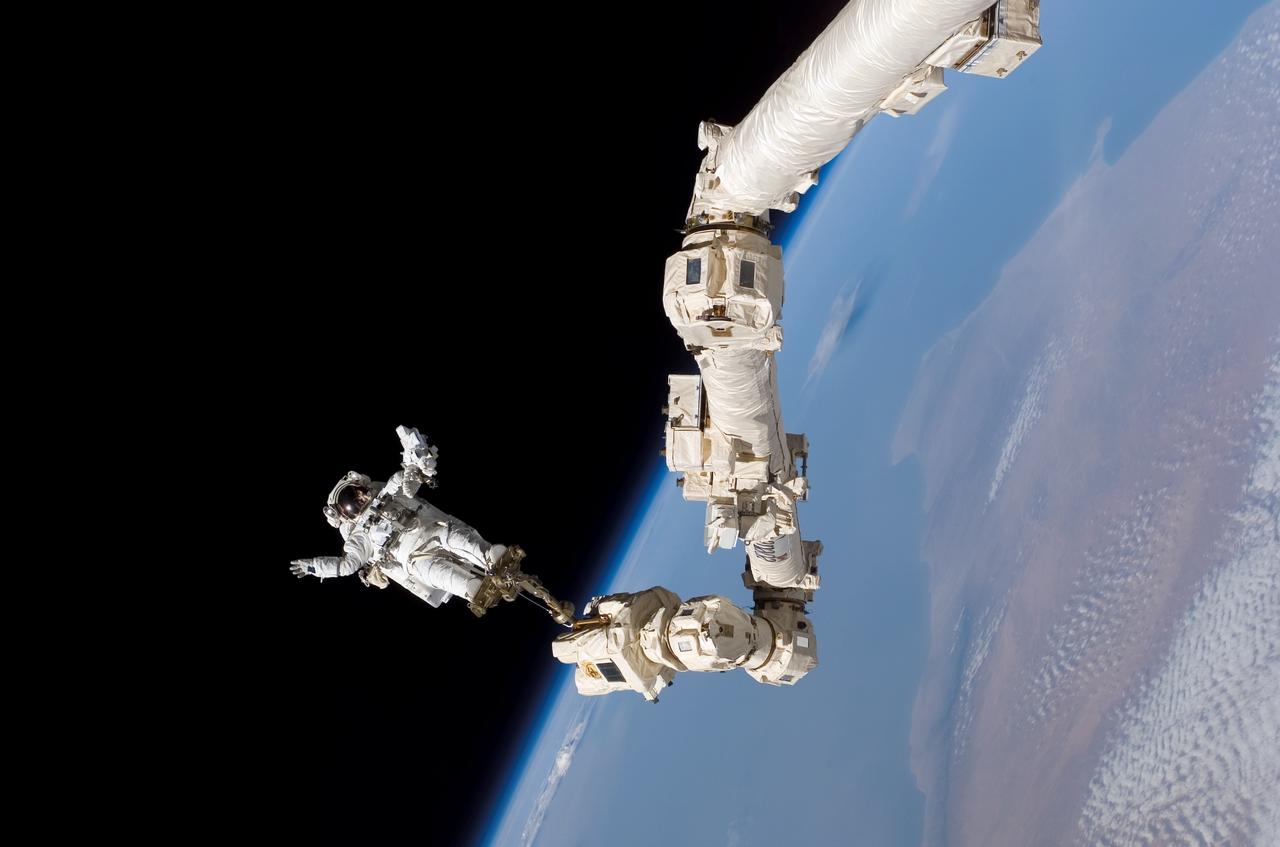
S114-E-6642 (3 Aug. 2005) --- Astronaut Stephen K. Robinson, STS-114 mission specialist, anchored to a foot restraint on the International Space Station’s Canadarm2, participates in the mission’s third session of extravehicular activity (EVA). The blackness of space and Earth’s horizon form the backdrop for the image.
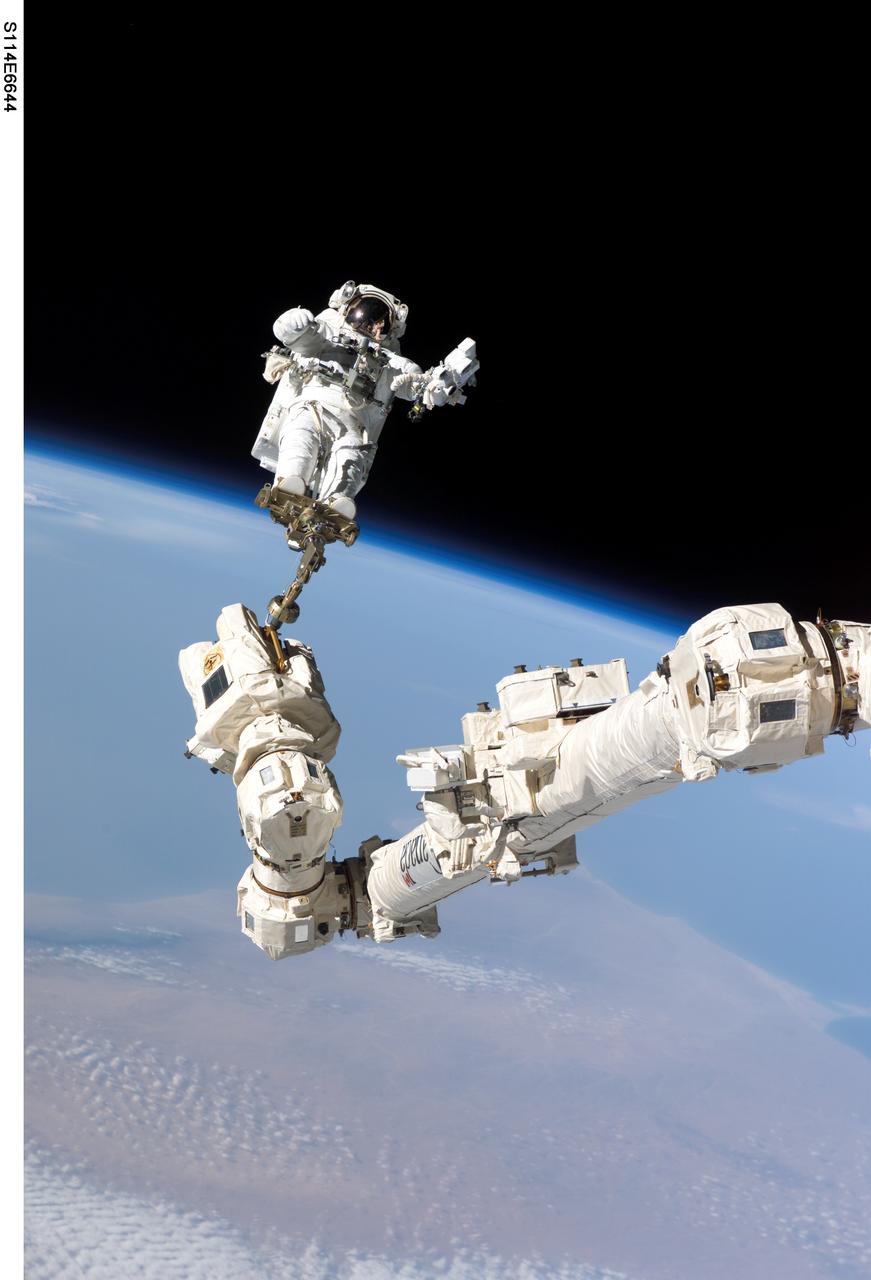
S114-E-6644 (3 August 2005) --- Astronaut Stephen K. Robinson, STS-114 mission specialist, anchored to a foot restraint on the International Space Station;s Canadarm2, participates in the mission;s third session of extravehicular activity (EVA). The blackness of space and Earth;s horizon form the backdrop for the image.
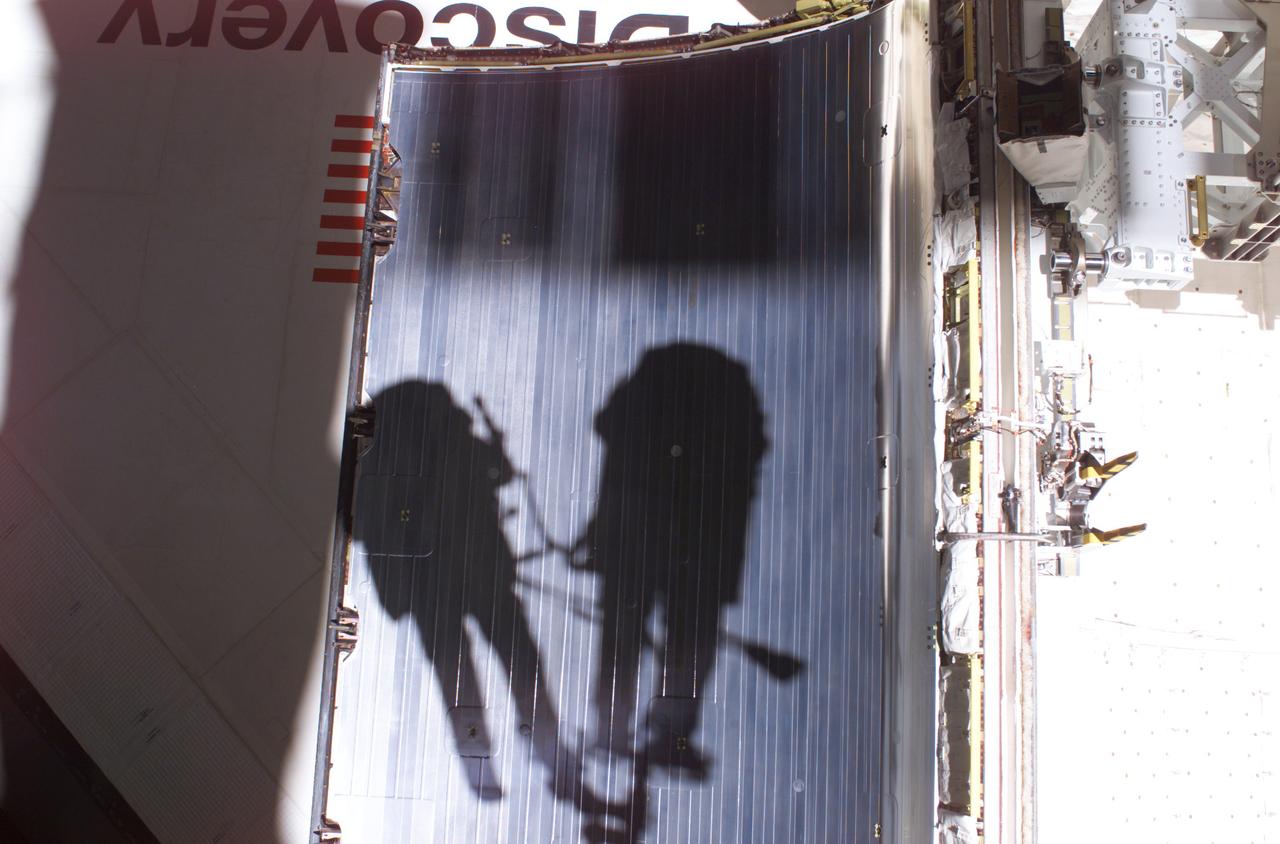
The shadows of astronauts Piers J. Sellers and Michael E. Fossum, STS-121 mission specialists, who are anchored to the Space Shuttle Discovery's Remote Manipulator System/Orbiter Boom Sensor System (RMS/OBSS) foot restraint, are visible against a shuttle's payload bay door during a session of extravehicular activity (EVA).

iss065e120644 (June 16, 2021) --- Expedition 65 Flight Engineer Thomas Pesquet of ESA (European Space Agency) is attached to an articulating portable foot restraint on the end of the Canadarm2 robotic arm carrying new roll out solar arrays towards the International Space Station's P-6 truss structure.
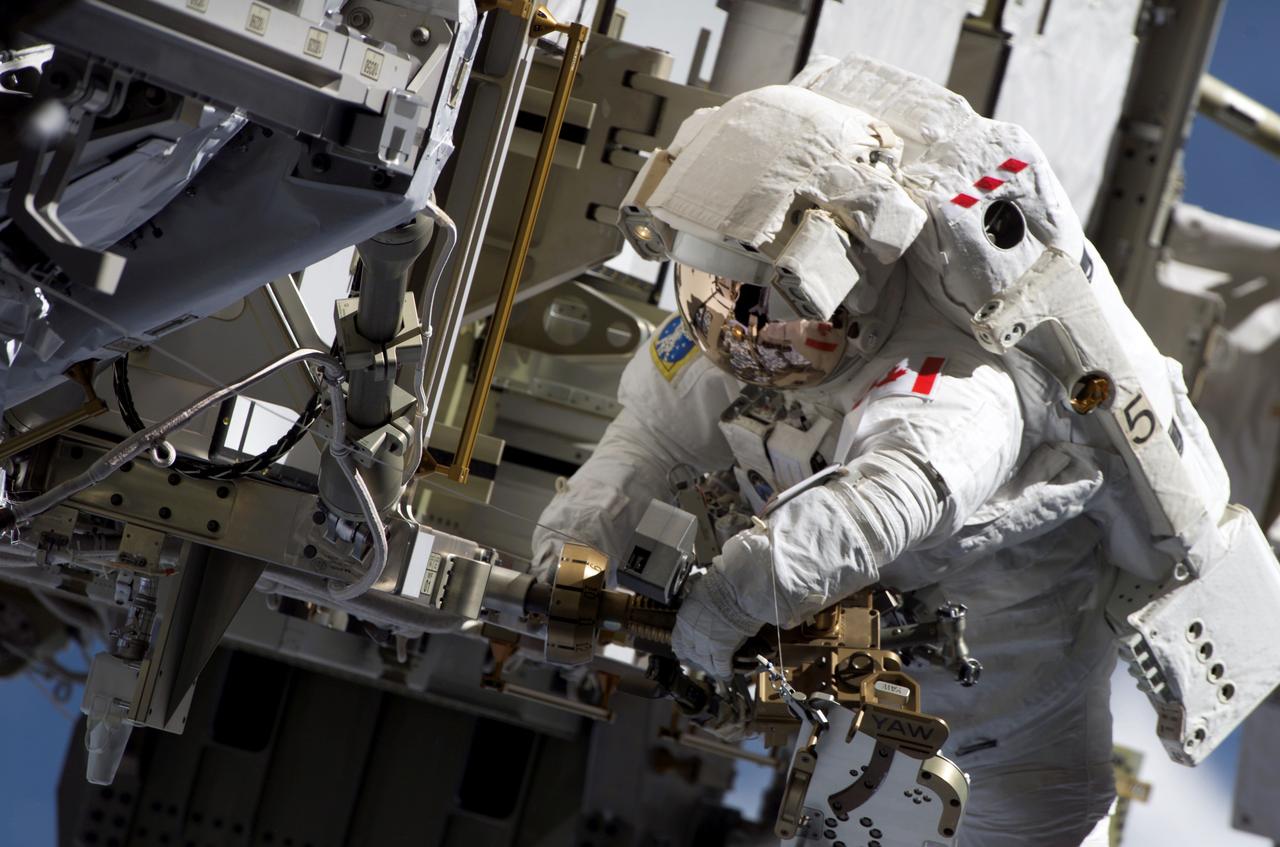
ISS013-E-81053 (13 Sept. 2006) --- Canadian Space Agency astronaut Steven G. MacLean, STS-115 mission specialist, performs a task to relocate articulating portable foot restraints (APFR) during the second of three scheduled spacewalks supported by the Space Shuttle Atlantis astronauts and the crewmembers aboard the International Space Station.
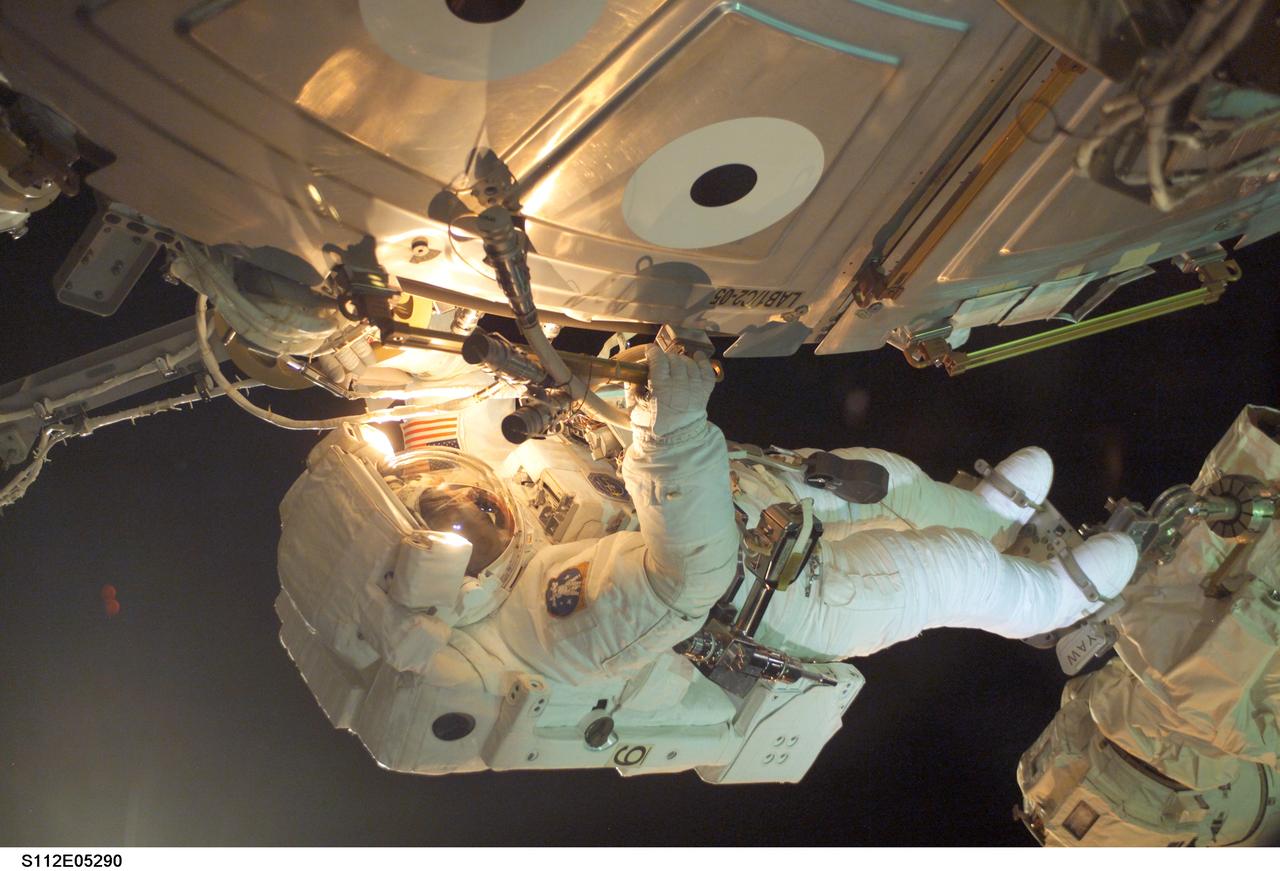
STS112-E-5290 (12 October 2002) --- With the aid of artificial lighting, astronaut Piers J. Sellers uses both a handrail on the Destiny Laboratory and a foot restraint on the Space Station Remote Manipulator System or Canadarm2 to remain stationary while performing work at the end of the STS-112 mission's second spacewalk.
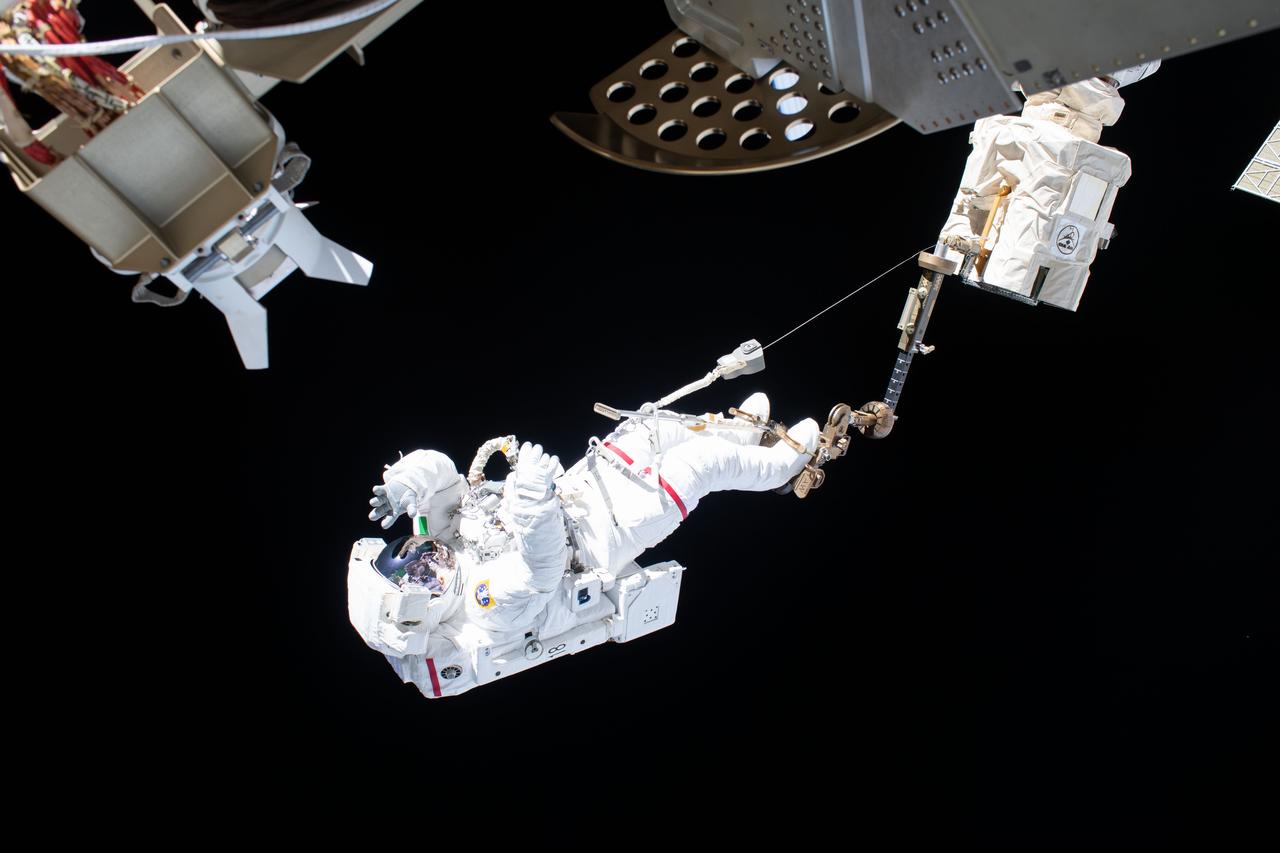
iss061e058498 (Nov. 22, 2019) --- Astronaut Luca Parmitano of ESA (European Space Agency) is attached to an articulating portable foot restraint at the end of the Canadarm2 robotic arm during the second spacewalk to repair the International Space Station's cosmic particle detector, the Alpha Magnetic Spectrometer.
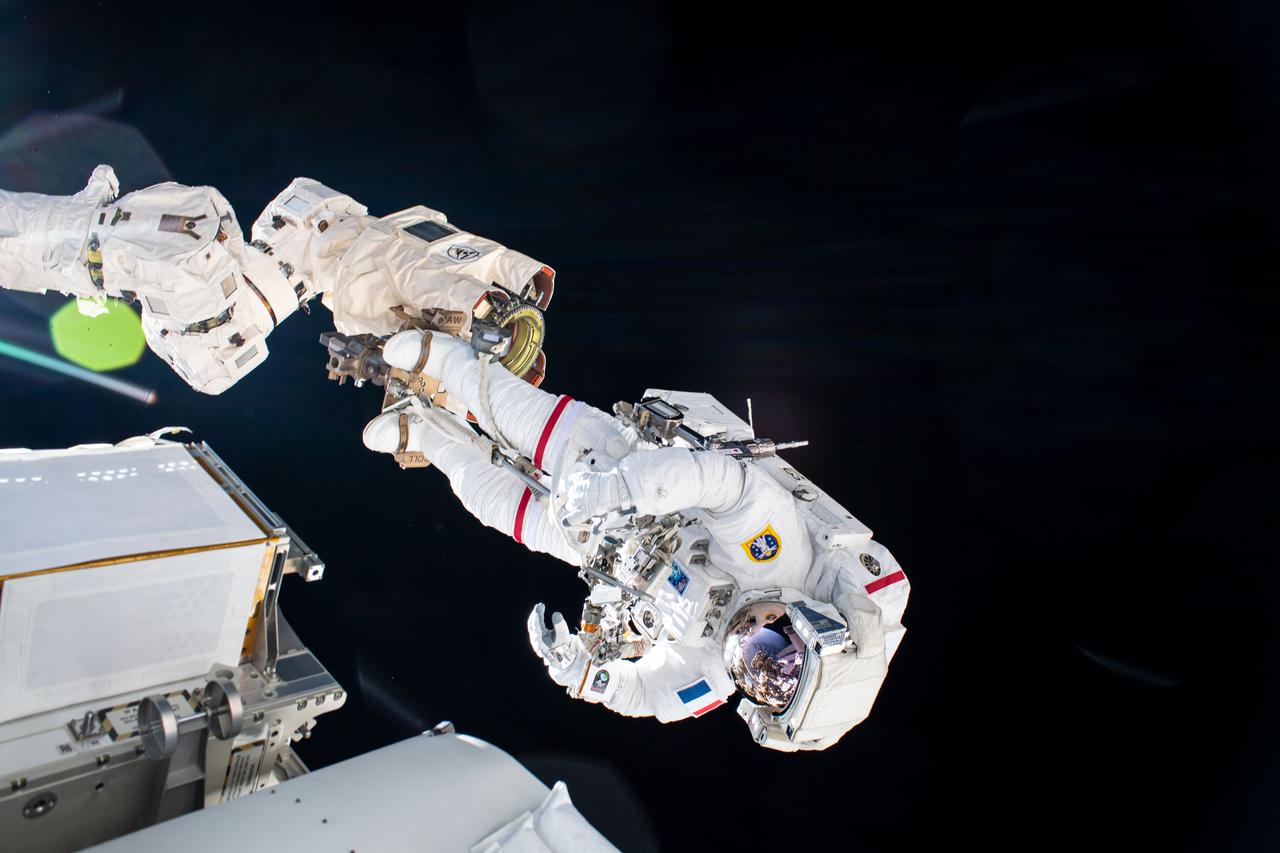
iss065e120762 (June 16, 2021) --- Expedition 65 Flight Engineer Thomas Pesquet of ESA (European Space Agency) is pictured attached to an articulating portable foot restraint on the end of the Canadarm2 robotic arm during a spacewalk to install new roll out solar arrays on the International Space Station's P-6 truss structure.
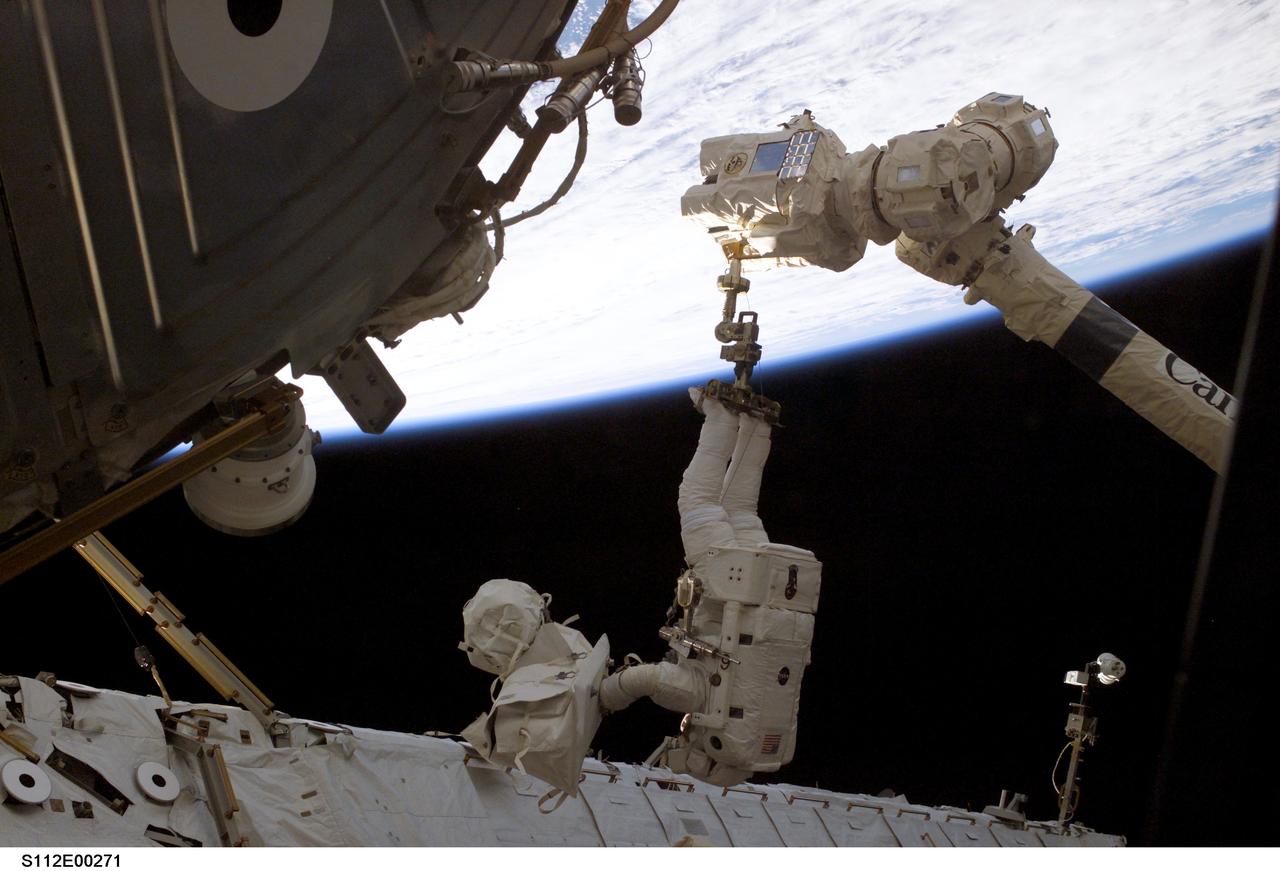
STS112-E-5271 (12 October 2002) --- Astronaut Piers J. Sellers, mission specialist, his feet anchored to a foot restraint on the Space Station Remote Manipulator System (SSRMS) or Canadarm2, participates in the six hour, four minute second spacewalk of the STS-112 mission.
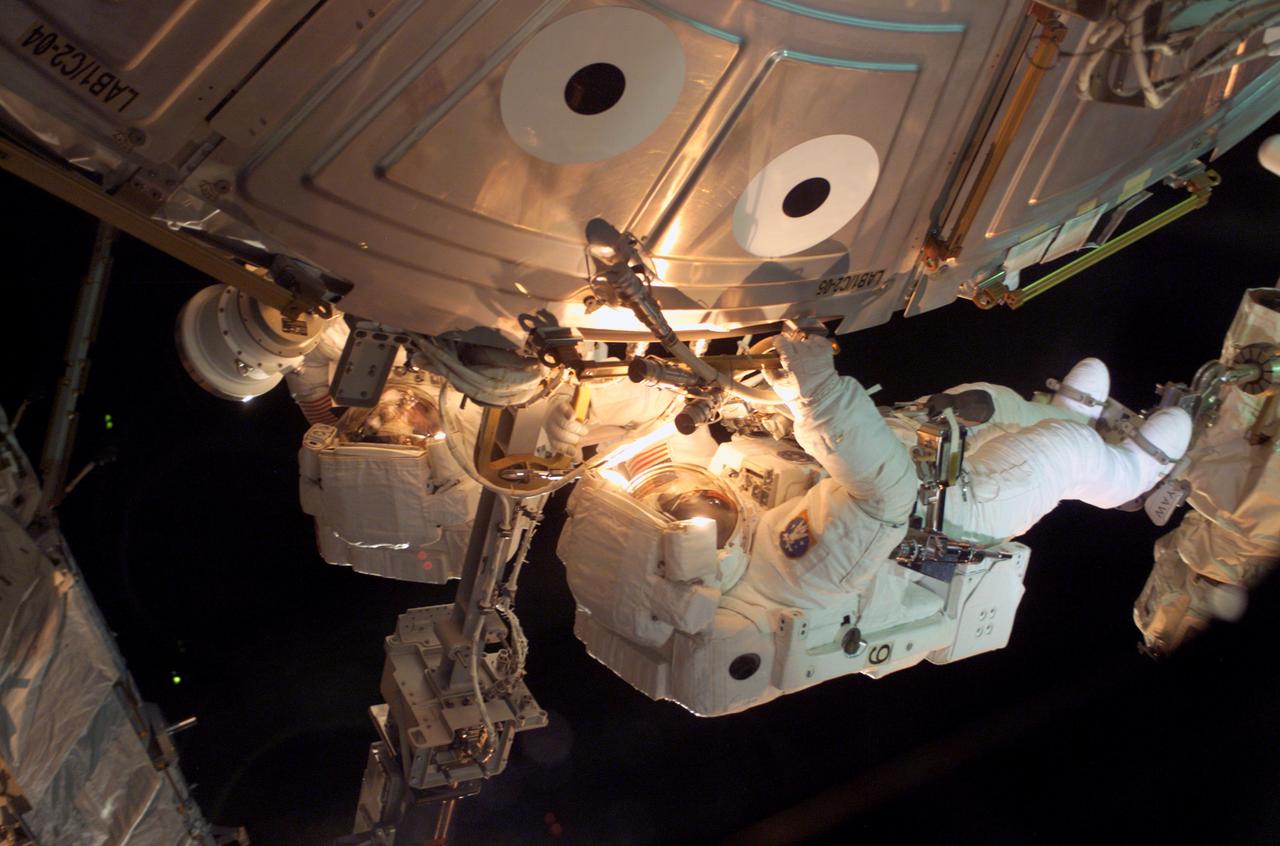
STS112-E-05295 (12 October 2002) --- Astronaut Piers J. Sellers uses both a handrail on the Destiny Laboratory and a foot restraint on the Space Station Remote Manipulator System or Canadarm2 to remain stationary while performing work at the end of the STS-112 mission's second spacewalk.
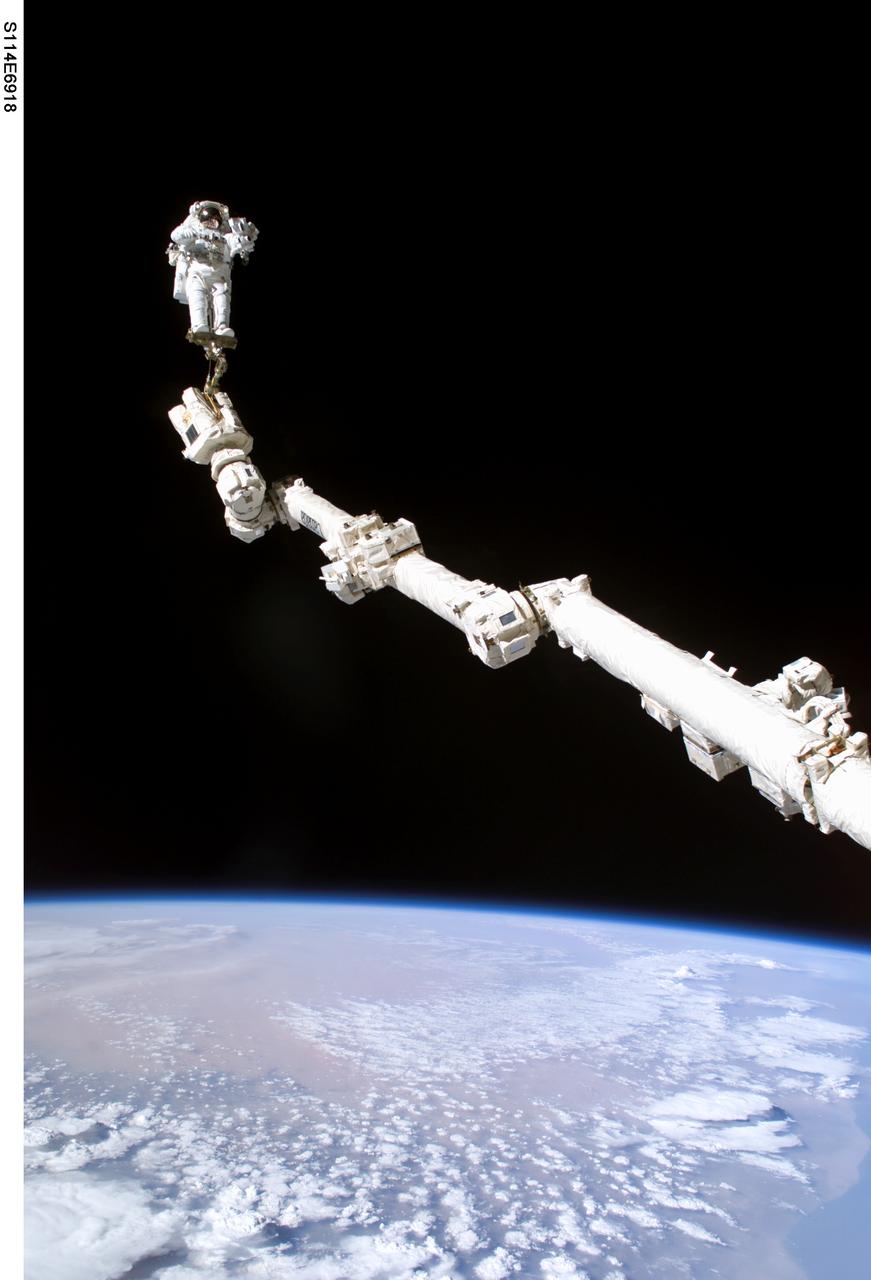
S114-E-6918 (3 August 2005) --- Astronaut Stephen K. Robinson, STS-114 mission specialist, anchored to a foot restraint on the extended International Space Station;s Canadarm2, participates in the mission;s third session of extravehicular activity (EVA). The blackness of space and Earth;s horizon form the backdrop for the image.
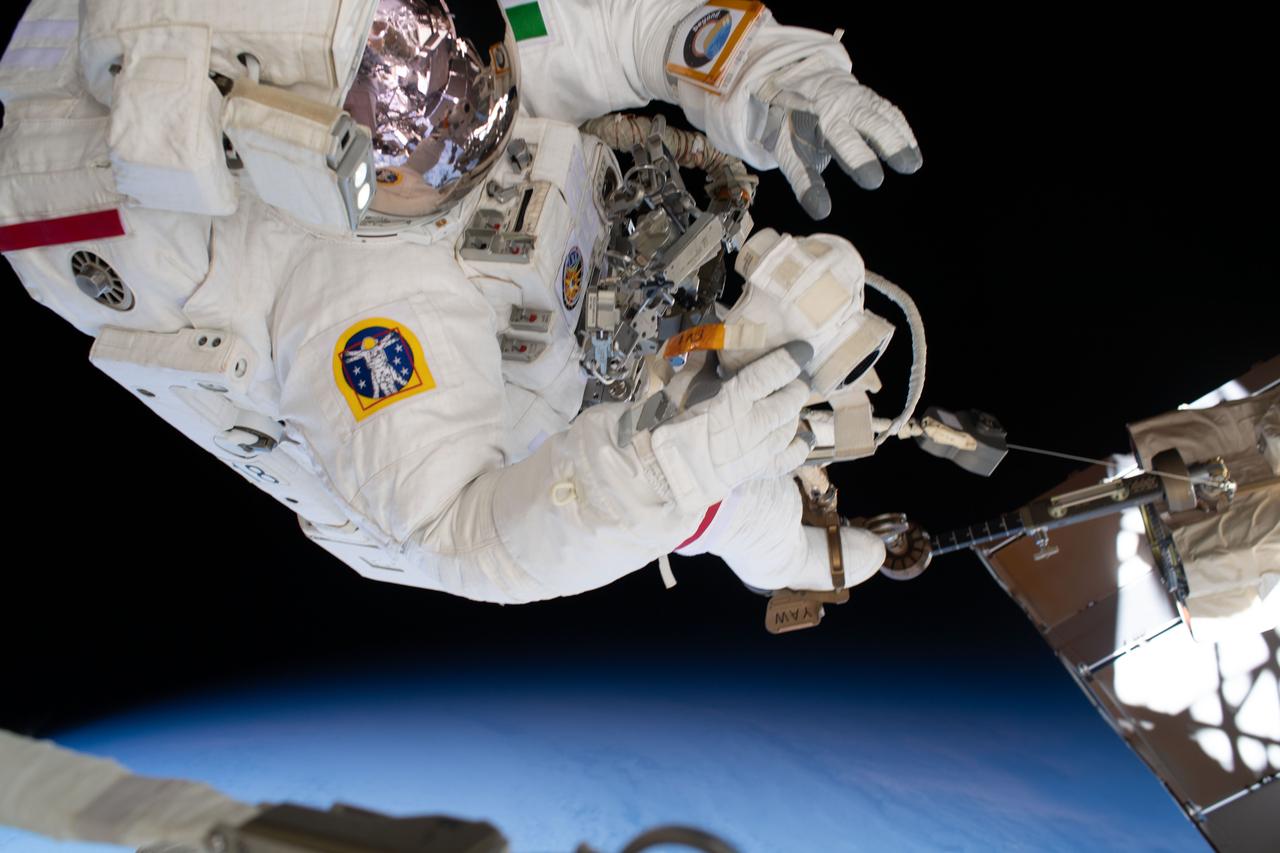
iss061e064936 (Dec. 2, 2019) --- ESA (European Space Agency) astronaut Luca Parmitano rides on the end of the Canadarm2 robotic arm attached to an articulating portable foot restraint during the third spacewalk to upgrade the Alpha Magnetic Spectrometer's thermal pump system.
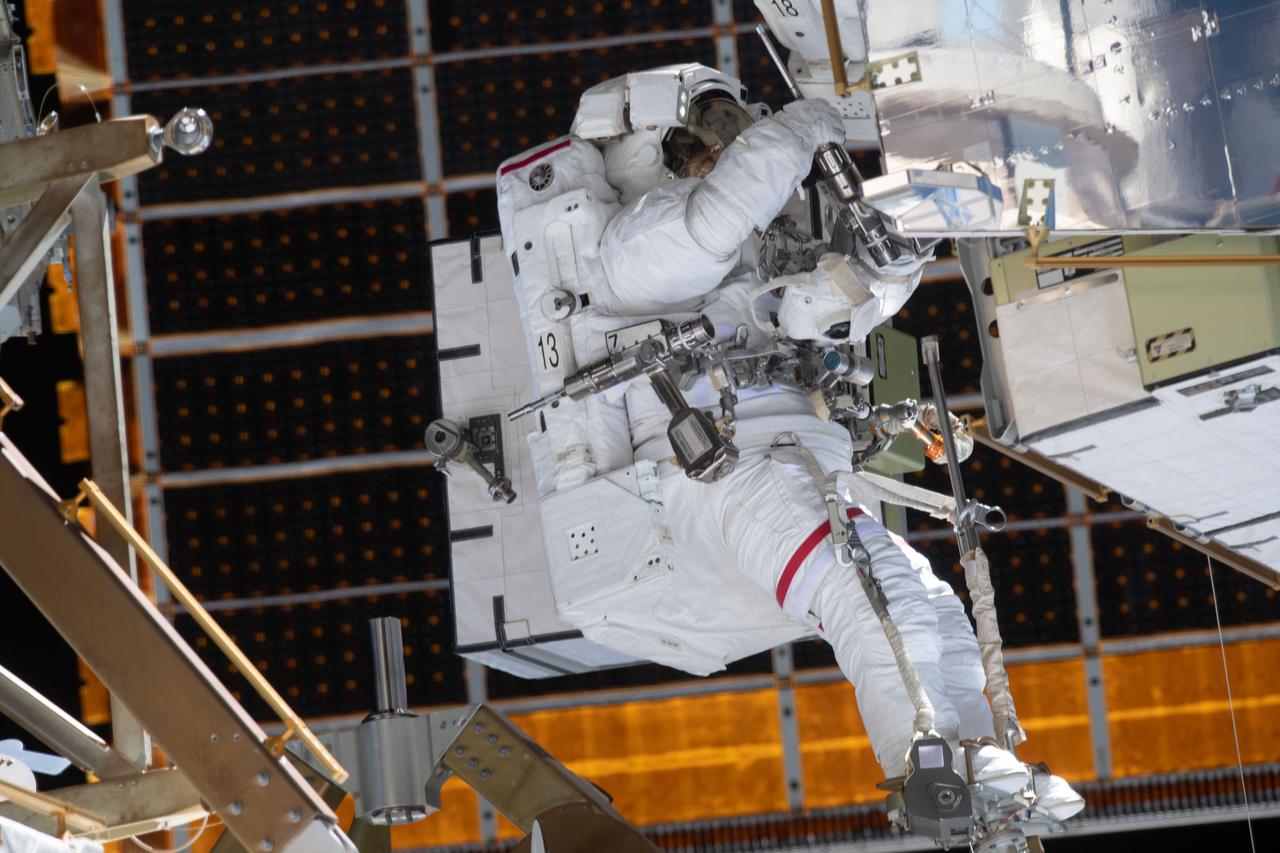
iss061e136274 (Jan. 20, 2020) --- NASA astronaut Jessica Meir is outfitted with pistol grip tools and attached to an articulating portable foot restraint during a spacewalk to finalize upgrading power systems on the International Space Station's Port-6 truss structure.
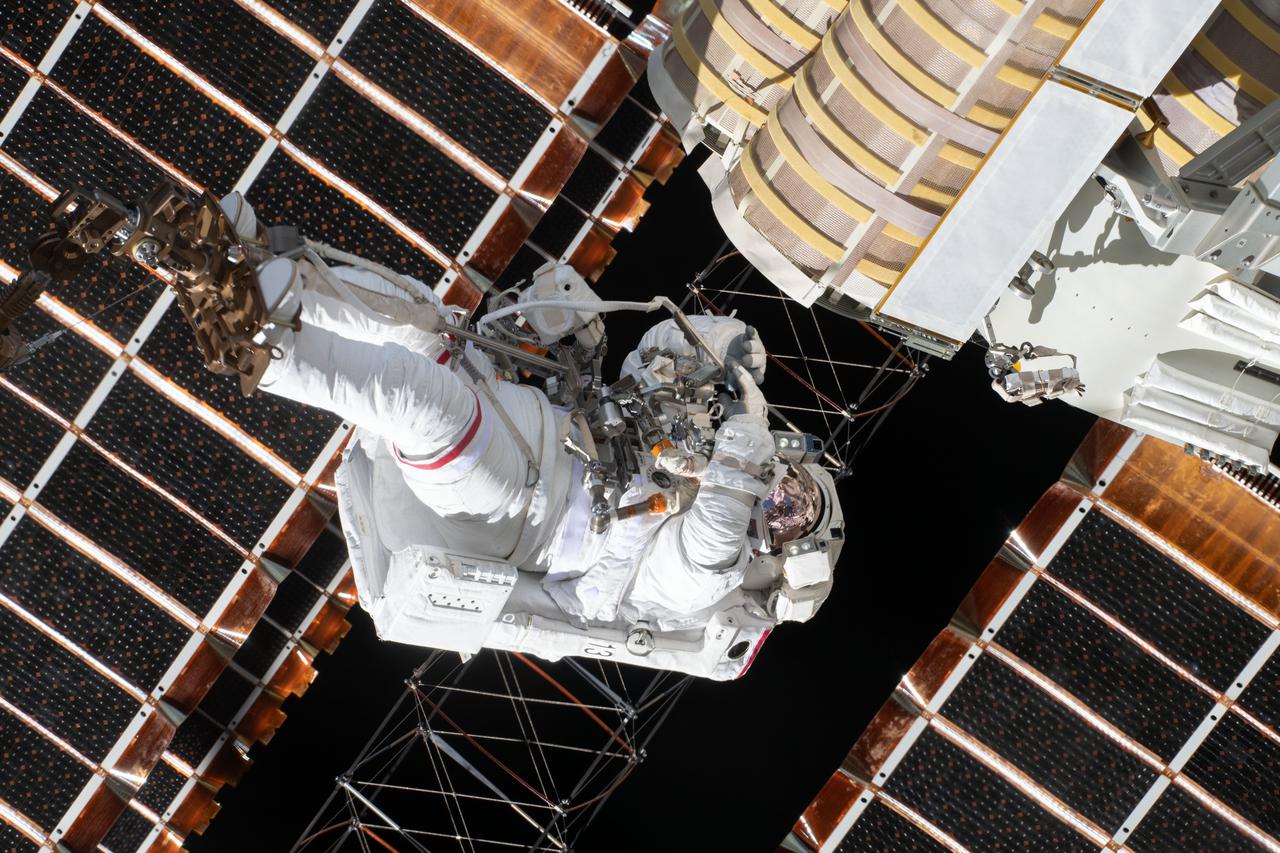
iss065e121232 (June 16, 2021) --- Expedition 65 Flight Engineer Thomas Pesquet of ESA (European Space Agency) is pictured attached to an articulating portable foot restraint on the end of the Canadarm2 robotic arm during a spacewalk to install new roll out solar arrays on the International Space Station's P-6 truss structure.
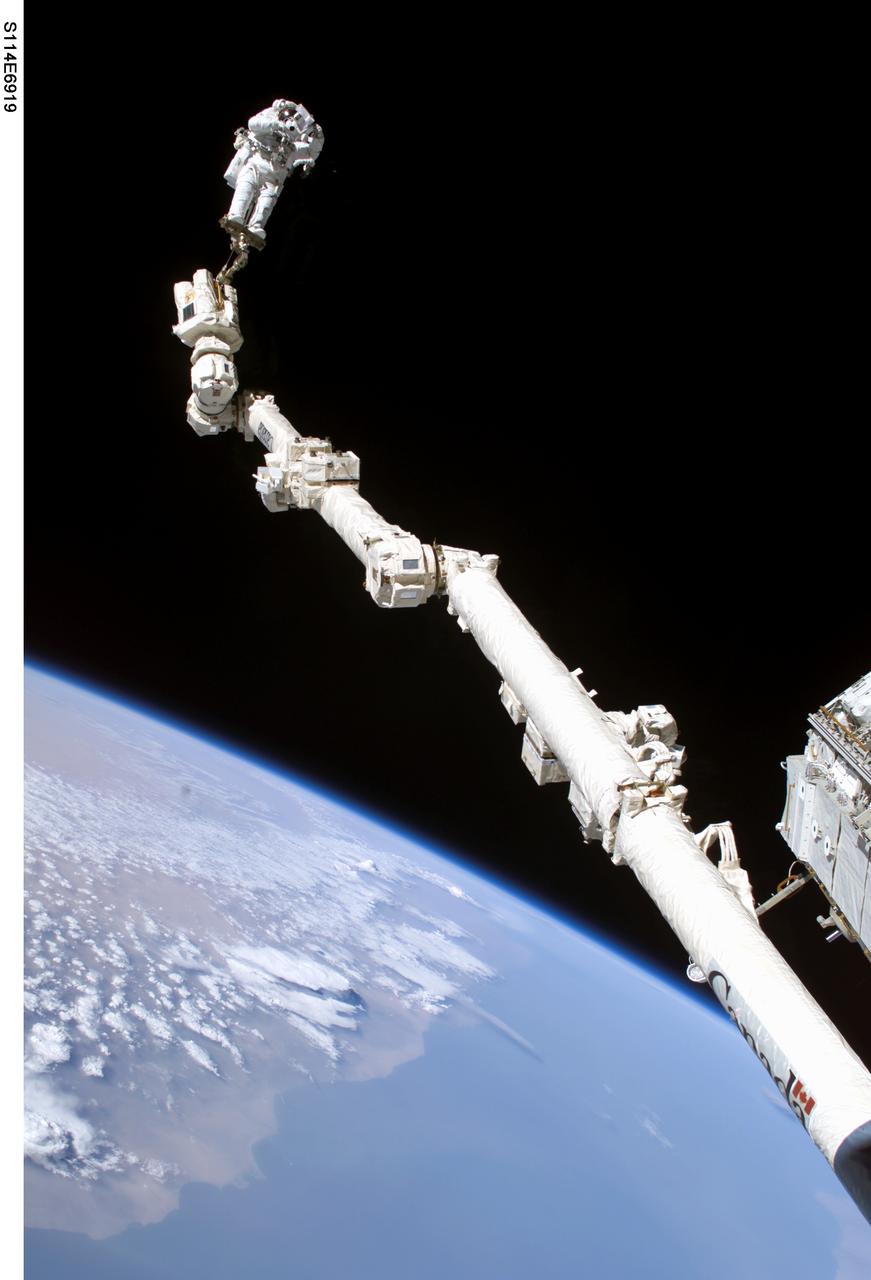
S114-E-06919 (3 Aug. 2005) --- Astronaut Stephen K. Robinson, STS-114 mission specialist, anchored to a foot restraint on the extended International Space Station;s Canadarm2, participates in the mission;s third session of extravehicular activity (EVA). The blackness of space and Earth;s horizon form the backdrop for the image.
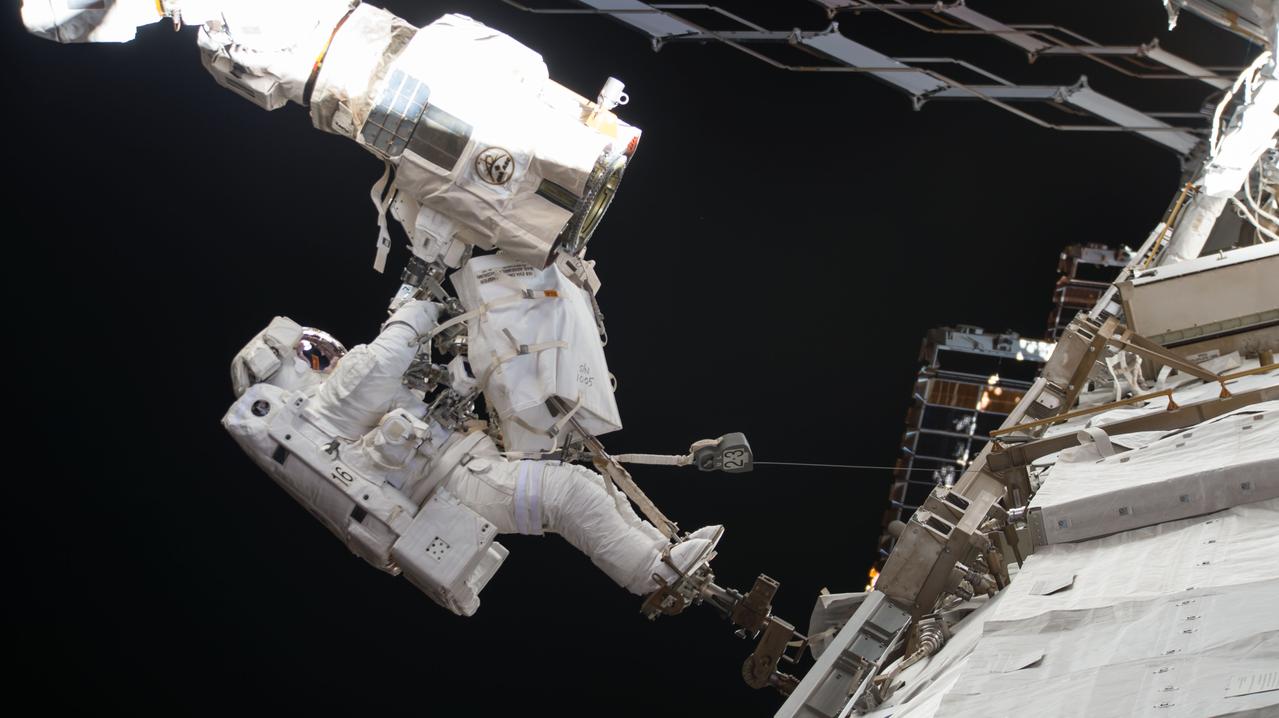
iss053e119678 (Oct. 20, 2017) --- Flight Engineer and astronaut Joe Acaba is attached to a portable foot restraint and tethered to the International Space Station's truss structure. Acaba was performing maintenance on the Canadarm2 robotic arm during the third of a series of spacewalks that took place during Expedition 53.
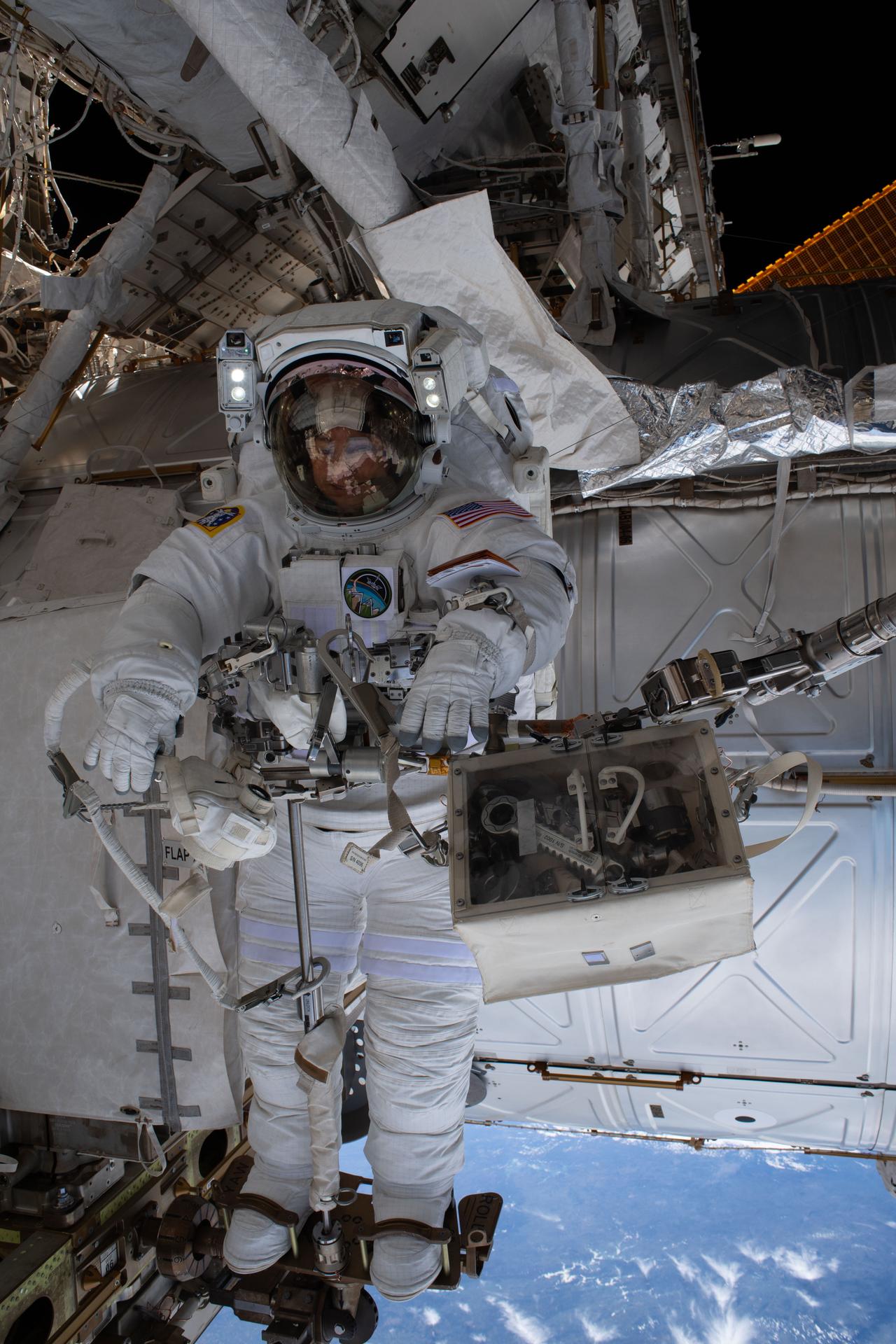
iss074e0789939 (June 30, 2026) --- NASA astronaut and Expedition 74 flight engineer Jessica Meir is pictured attached to an articulating portable foot restraint during a seven‑hour‑and‑20‑minute spacewalk to replace a malfunctioning wrist joint on the International Space Station’s Canadarm2 robotic arm. Credit: NASA/Chris Williams
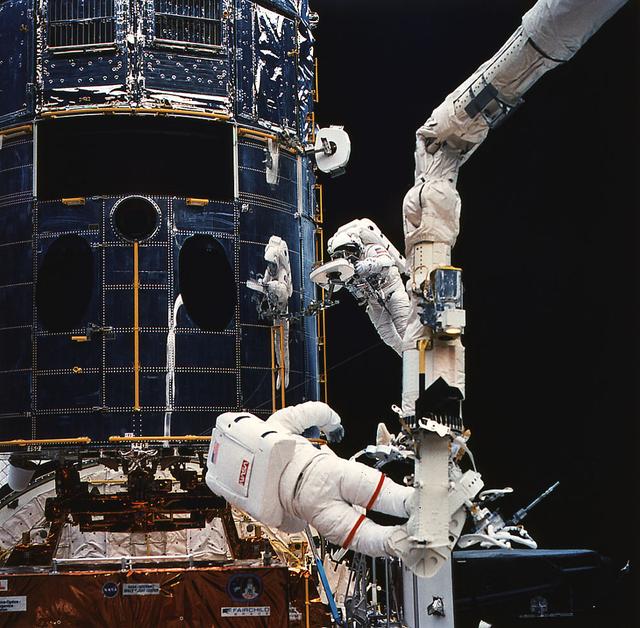
Anchored on the end of orbiter Endeavour's remote manipulator system arm, astronaut Jeffrey Hoffman (foreground) prepares to install the new wide field planetary camera into the empty cavity of the Hubble Space Telescope (HST). Astronaut Story Musgrave works with a portable foot restraint.

STS112-E-5291 (12 October 2002) --- Astronaut Piers J. Sellers uses both a handrail on the Destiny Laboratory and a foot restraint on the Space Station Remote Manipulator System or Canadarm2 to remain stationary while performing work at the end of the STS-112 mission's second spacewalk.
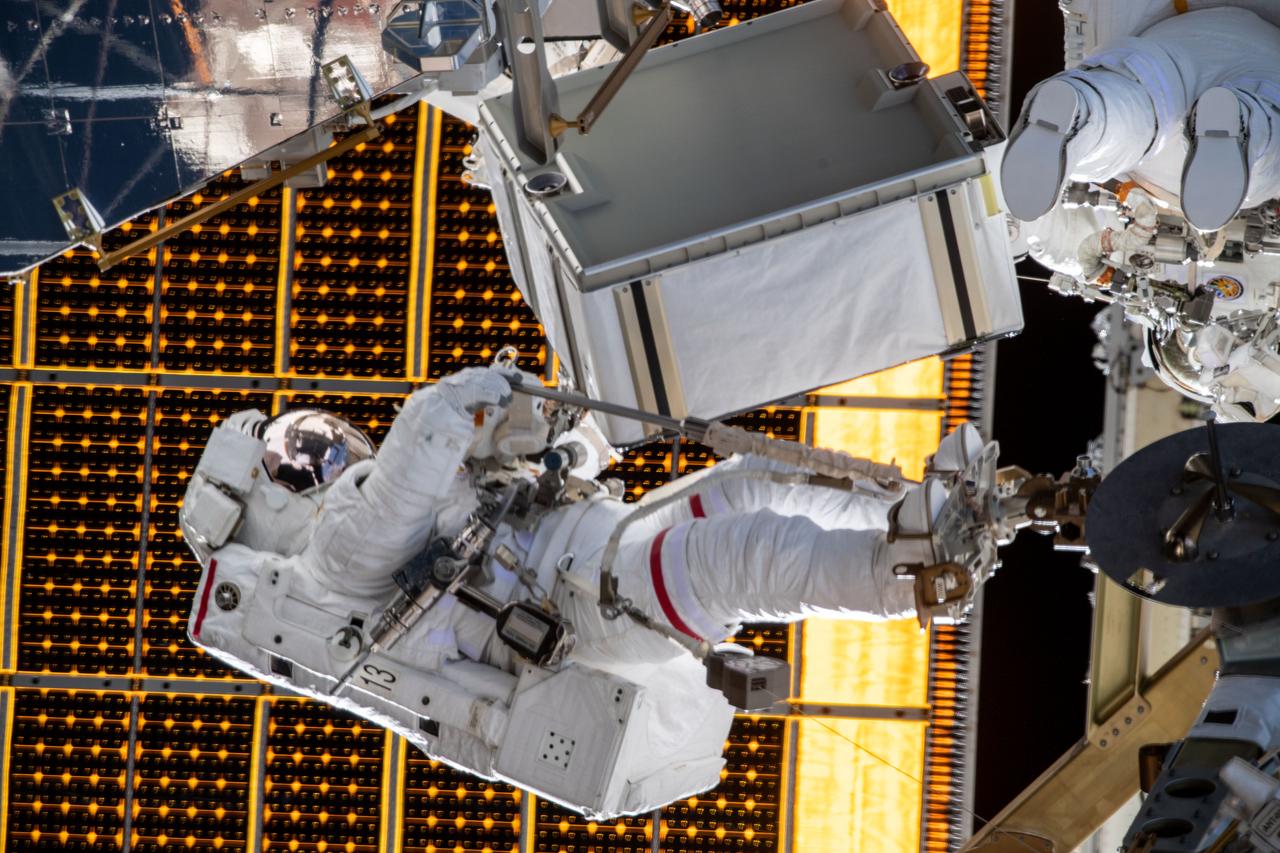
iss061e129592 (Jan. 20, 2020) --- NASA astronaut Jessica Meir is attached to an articulating portable foot restraint during a spacewalk with NASA astronaut Christina Koch (upper right) to finalize upgrading power systems on the International Space Station's Port-6 truss structure.
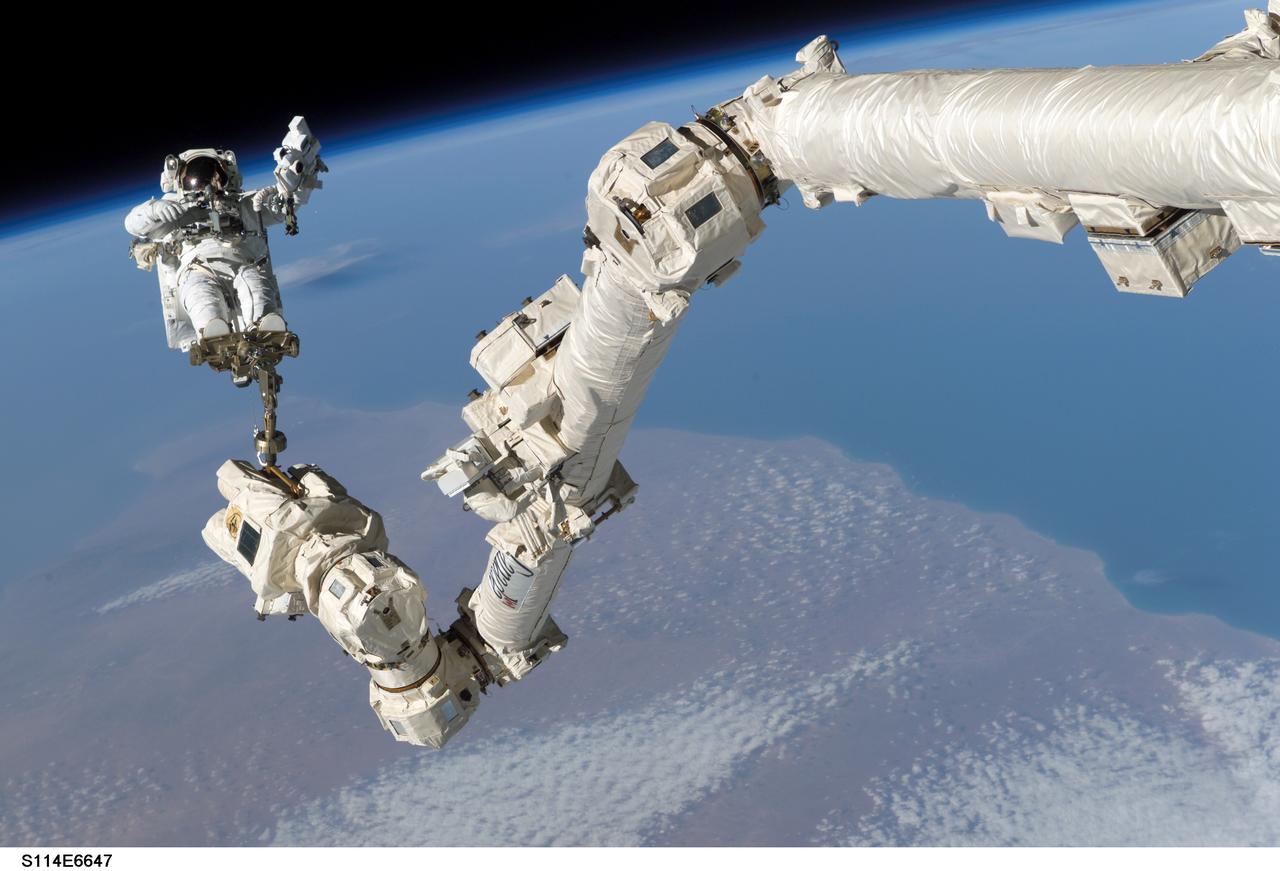
S114-E-6647 (3 August 2005) --- Astronaut Stephen K. Robinson, STS-114 mission specialist, anchored to a foot restraint on the International Space Station;s Canadarm2, participates in the mission;s third session of extravehicular activity (EVA). The blackness of space and Earth;s horizon form the backdrop for the image.
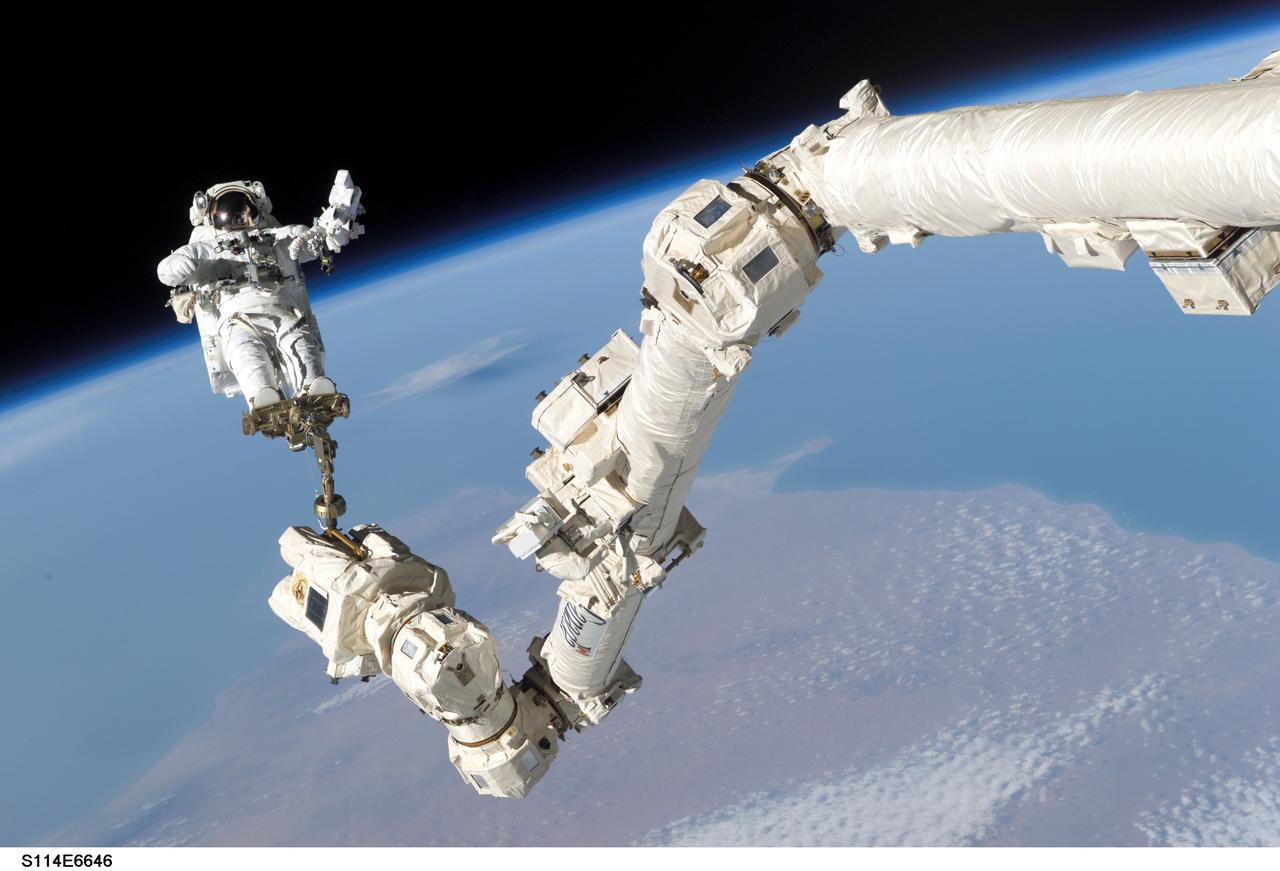
S114-E-6646 (3 August 2005) --- Astronaut Stephen K. Robinson, STS-114 mission specialist, anchored to a foot restraint on the International Space Station;s Canadarm2, participates in the mission;s third session of extravehicular activity (EVA). The blackness of space and Earth;s horizon form the backdrop for the image.
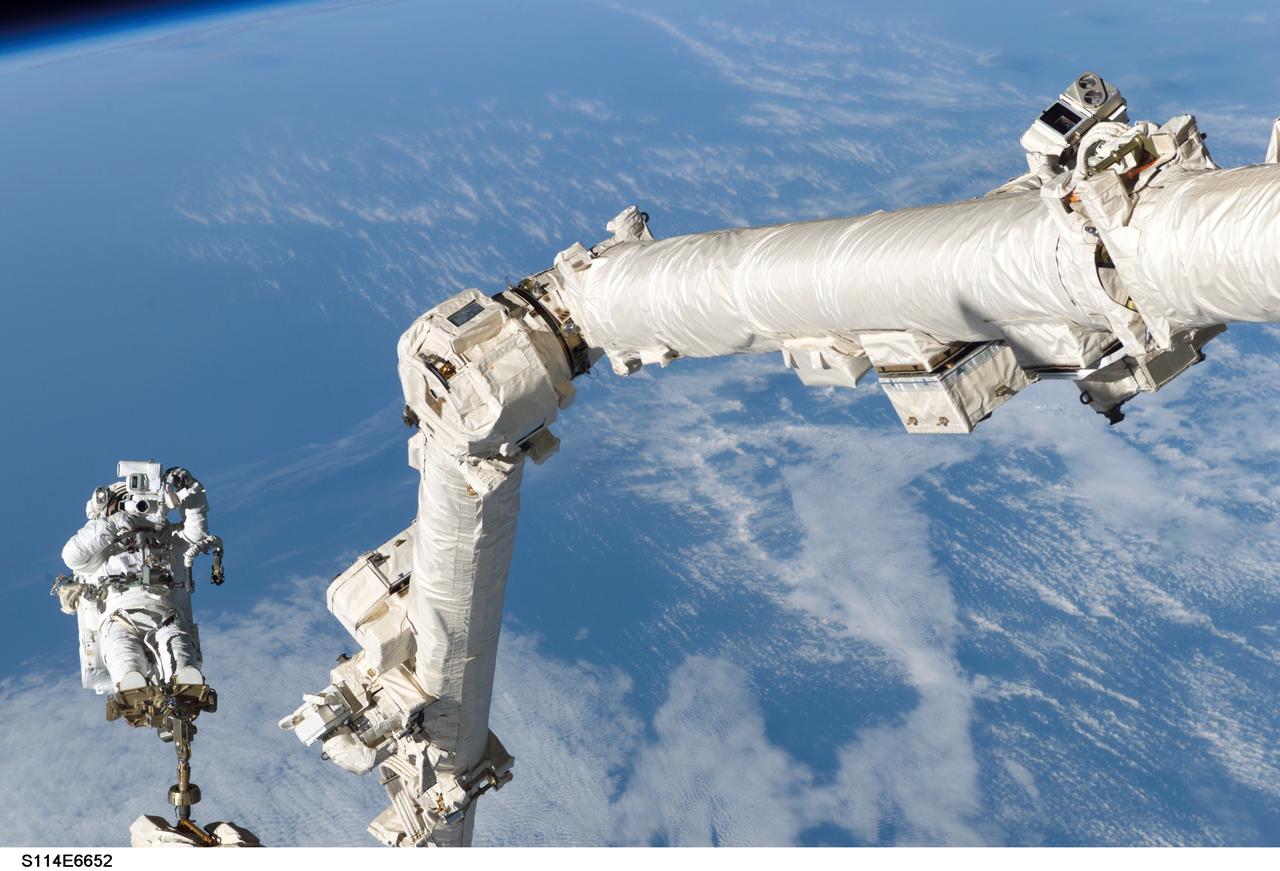
S114-E-6652 (3 August 2005) --- Astronaut Stephen K. Robinson, STS-114 mission specialist, anchored to a foot restraint on the International Space Station;s Canadarm2, participates in the mission;s third session of extravehicular activity (EVA). A blue and white Earth forms the backdrop for the image.
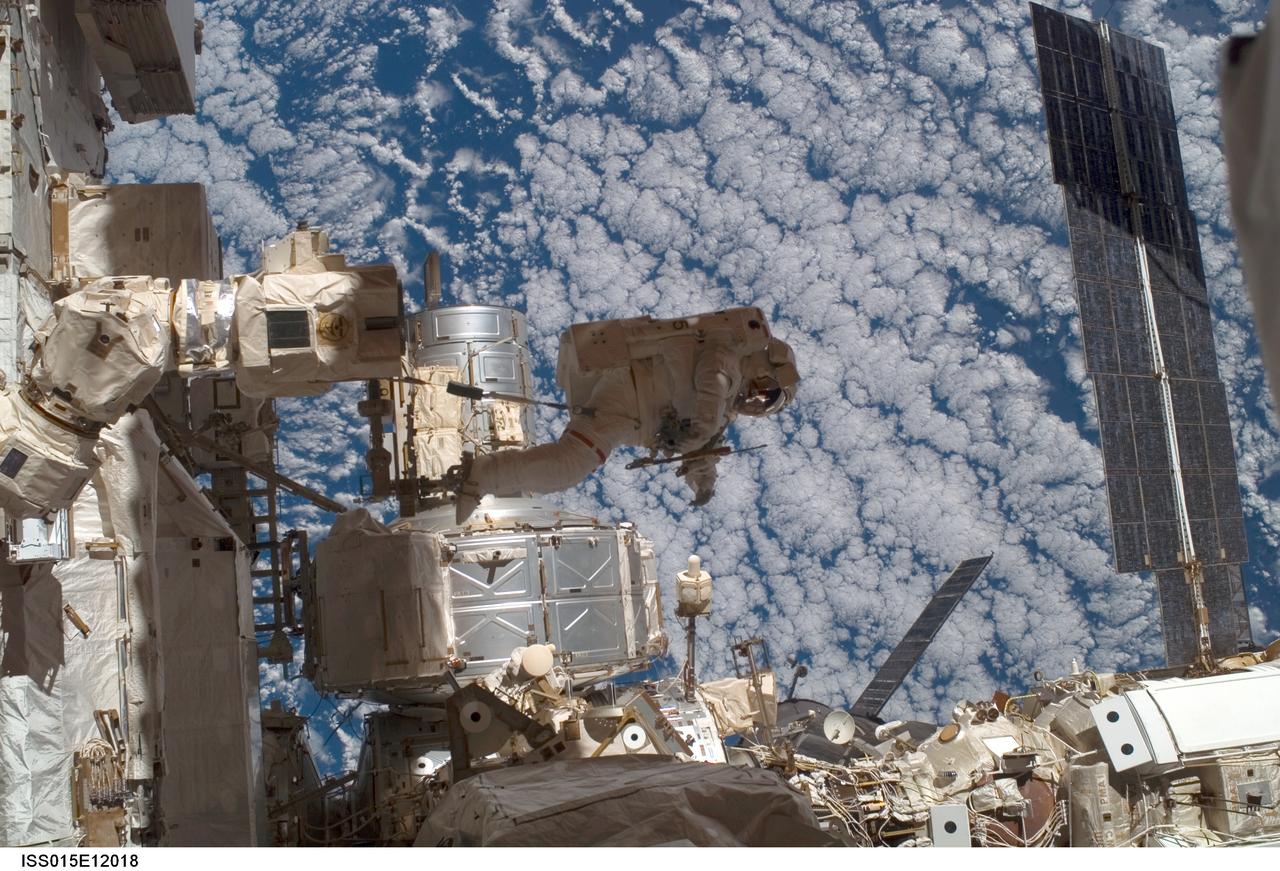
ISS015-E-12018 (13 June 2007) --- Anchored to a foot restraint on the Space Station Remote Manipulator System (SSRMS) or Canadarm2, astronaut Patrick Forrester, STS-117 mission specialist, participates in the mission's second planned session of extravehicular activity (EVA), as construction resumes on the International Space Station. Among other tasks, Forrester and astronaut Steven Swanson (out of frame), mission specialist, removed all of the launch locks holding the 10-foot-wide solar alpha rotary joint in place and began the solar array retraction.
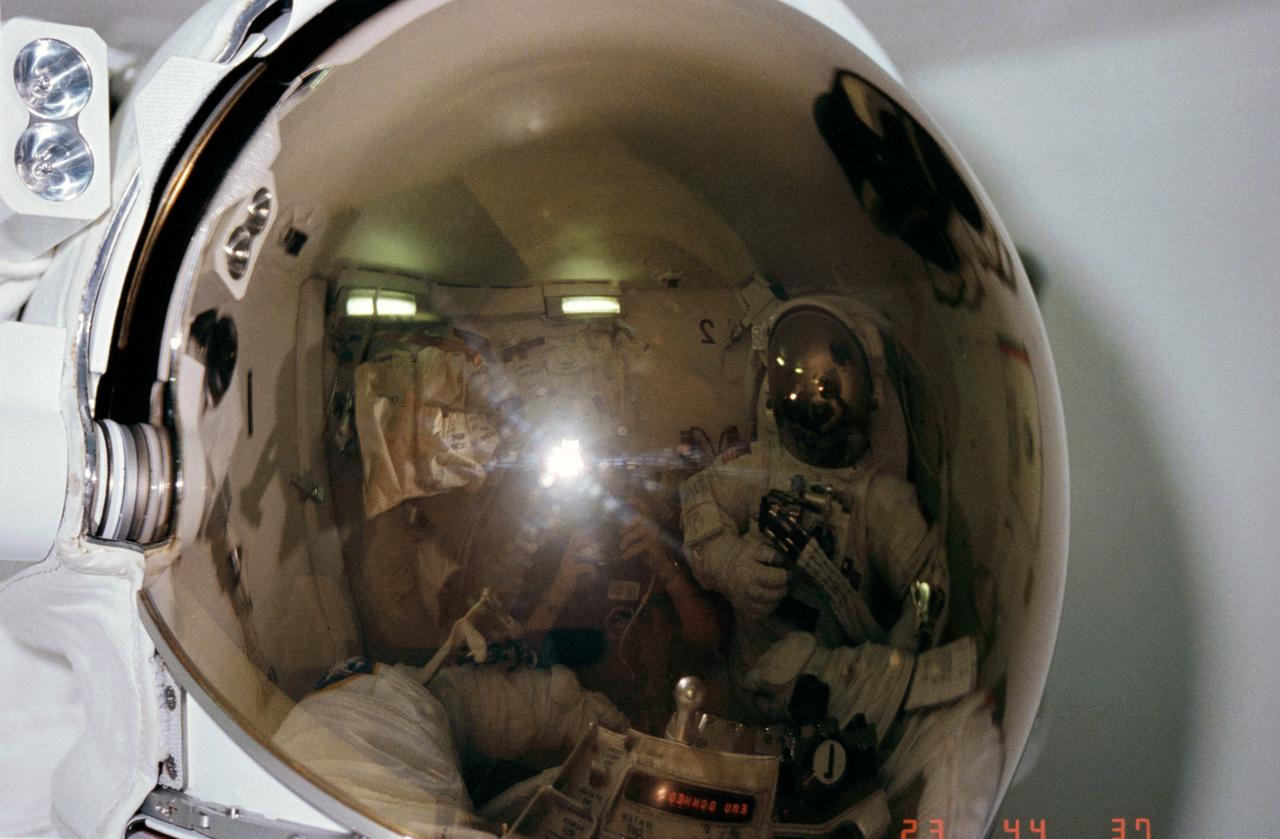
STS006-06-465 (7 April 1983) --- Three-fourths of the STS-6 astronaut crew appears in this unusual 35mm frame exposed in the airlock of the Earth-orbiting space shuttle Challenger. Astronaut F. Story Musgrave’s helmet visor encompasses all the action in the frame. Dr. Musgrave and astronaut Donald H. Peterson (reflected on right side of the visor) were fully suited in their Extravehicular Mobility Unit (EMU) spacesuits and were participating in EVA preparation exercises. Astronaut Karol J. Bobko, STS-6 pilot, wearing conventional onboard shuttle clothing, photographed the two during their procedures and appears at center of frame. The reversed number (1 and 2 in the mirrored image represent the EVA designations for the two mission specialists. Photo credit: NASA
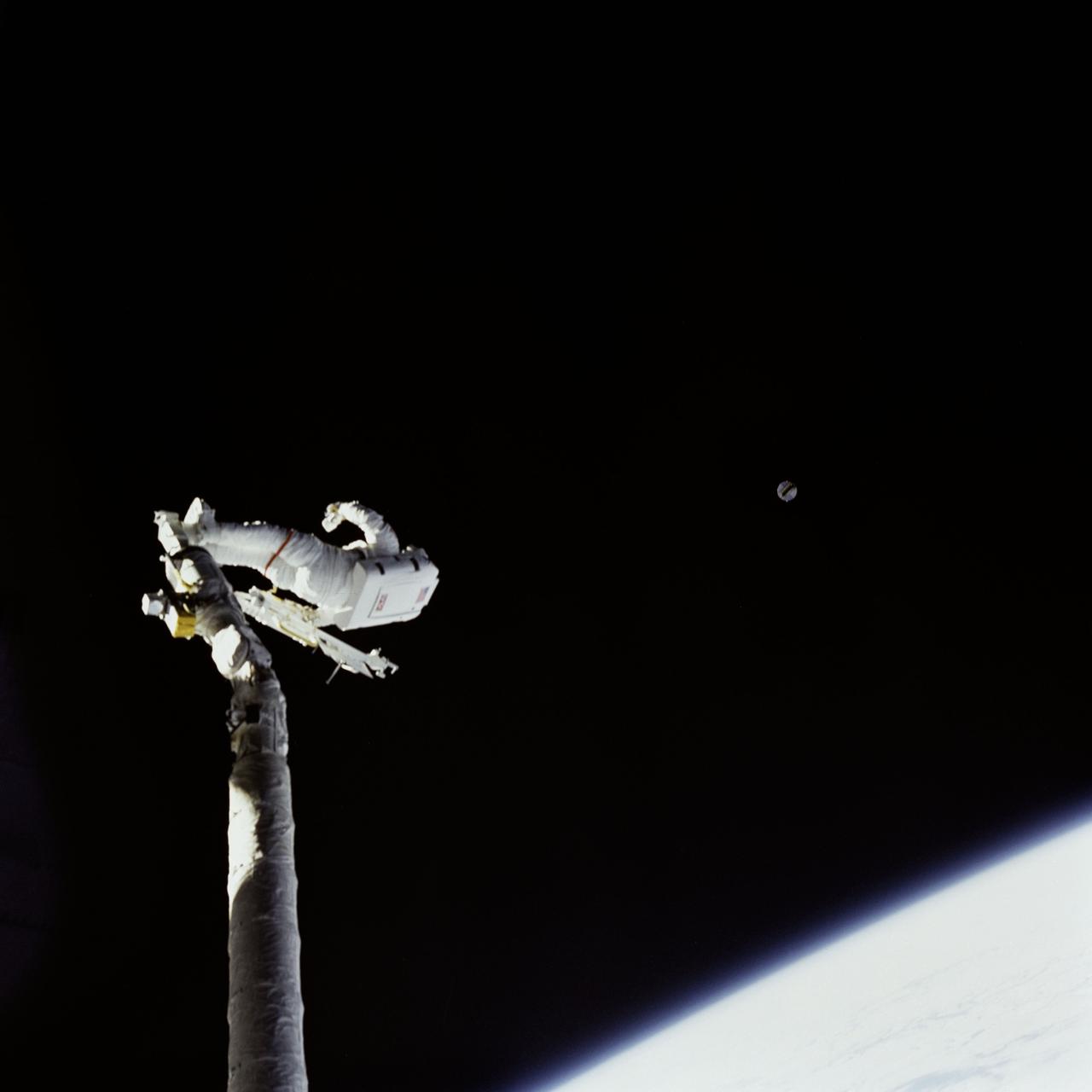
51I-44-081 (1 Sept 1985) --- Astronaut James D. van Hoften on the Discovery's remote manipulator system (RMS) arm visually tracks the distant Syncom IV-3 communications satellite after its second release, on Sept. 1, 1985.
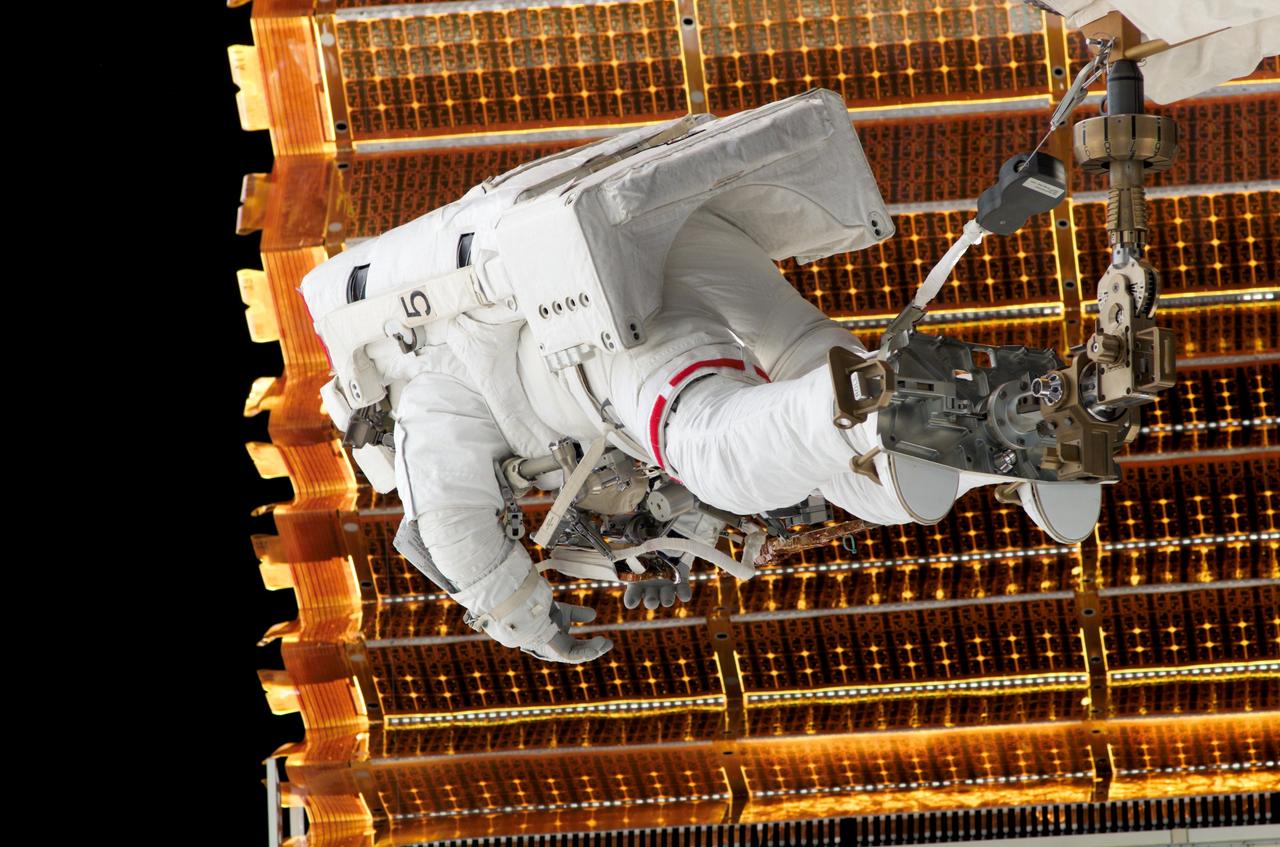
S117-E-07232 (13 June 2007) --- Astronauts Patrick Forrester and Steven Swanson (out of frame), both STS-117 mission specialists, participate in the mission's second planned session of extravehicular activity (EVA), as construction resumes on the International Space Station. Among other tasks, Forrester, seen here perched on the mobile foot restraint connected to the Canadian-built remote manipulator system (RMS), and Swanson removed all of the launch locks holding the 10-foot-wide solar alpha rotary joint in place and began the solar array retraction.
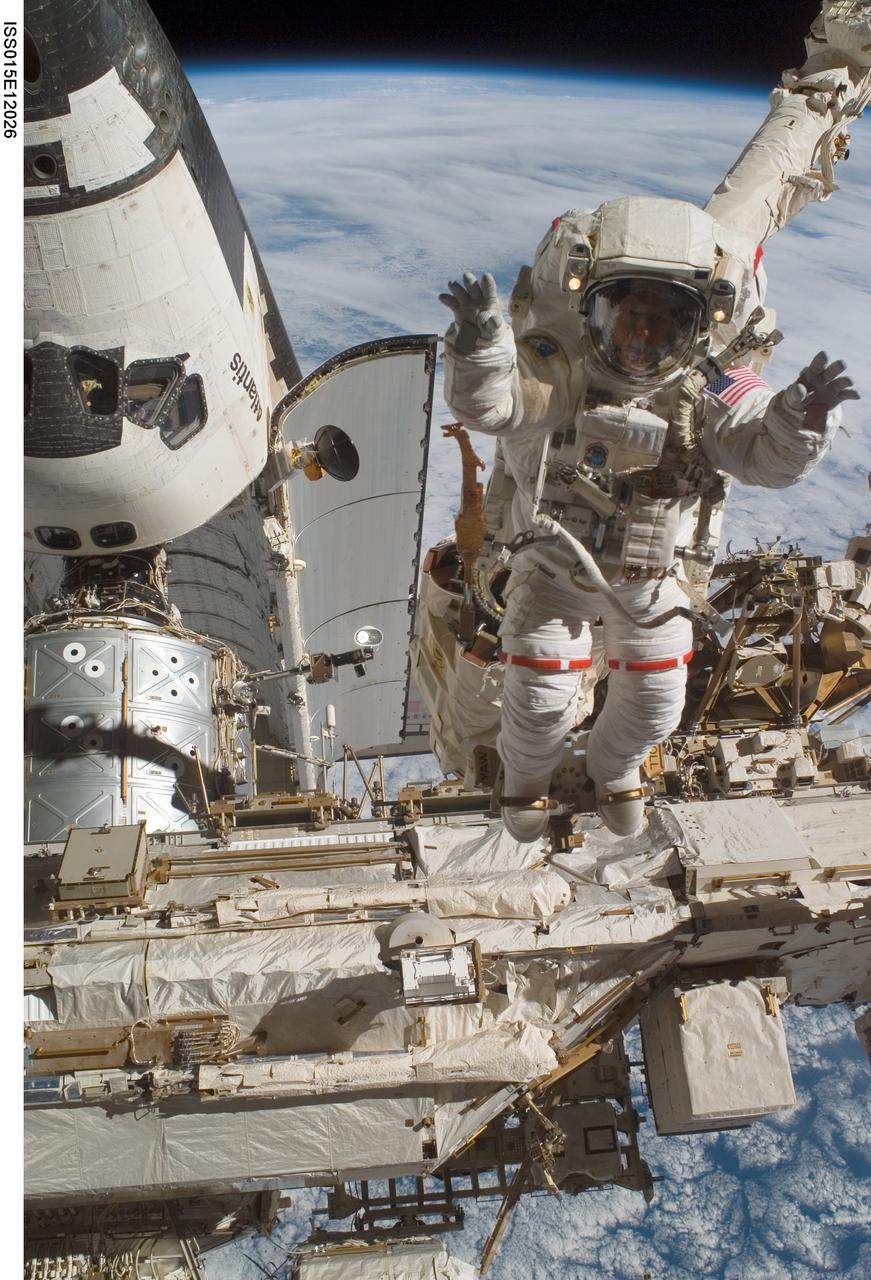
ISS015-E-12026 (13 June 2007) --- Anchored to a foot restraint on the Space Station Remote Manipulator System (SSRMS) or Canadarm2, astronaut Patrick Forrester, STS-117 mission specialist, participates in the mission's second planned session of extravehicular activity (EVA), as construction resumes on the International Space Station. Among other tasks, Forrester and astronaut Steven Swanson (out of frame), mission specialist, removed all of the launch locks holding the 10-foot-wide solar alpha rotary joint in place and began the solar array retraction. Space Shuttle Atlantis docked to the station is visible at left.
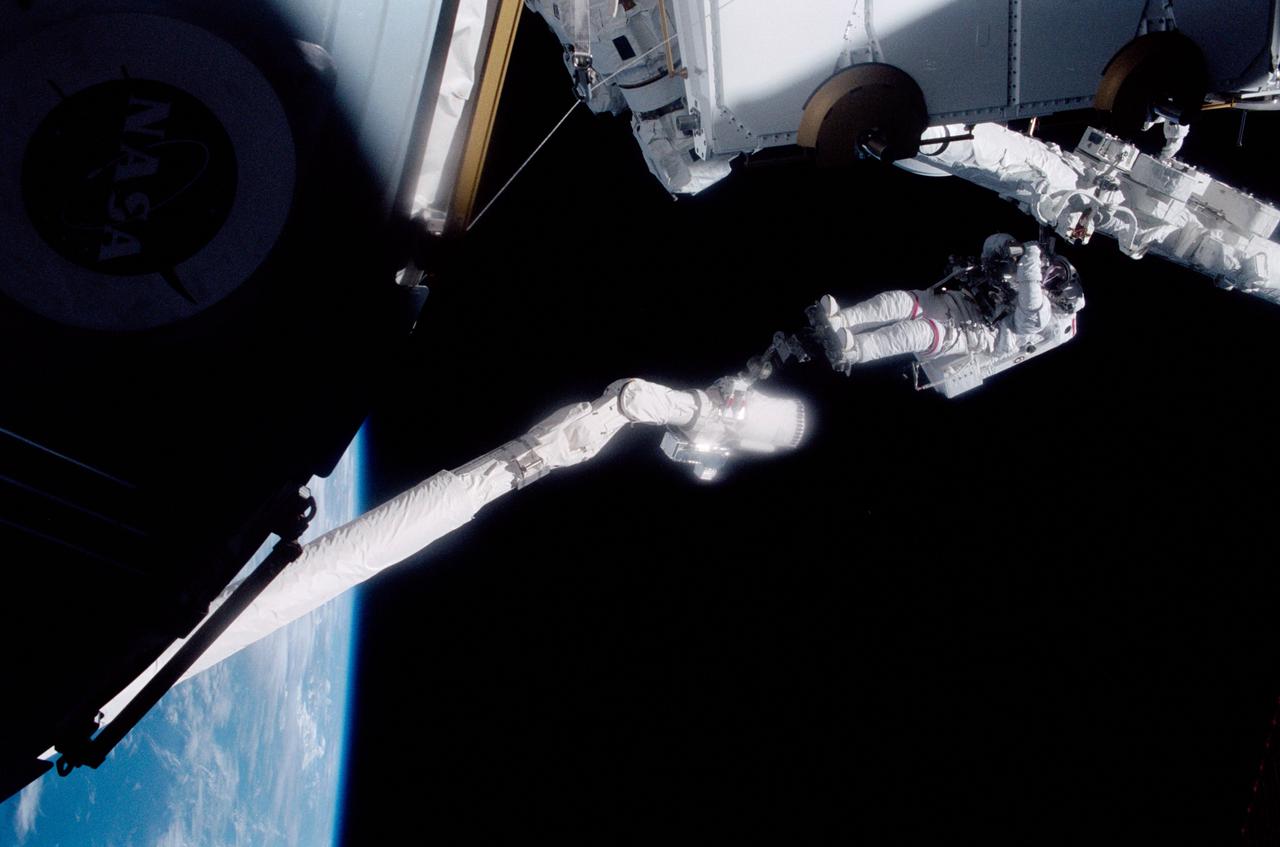
STS100-333-028 (19 April-1 May 2001) --- Astronaut Chris A. Hadfield, STS-100 mission specialist representing the Canadian Space Agency (CSA), stands on the portable foot restraint (PFR) connected to the Endeavour's remote manipulator system (RMS) robotic arm, using an International Space Station (ISS) pistol grip tool during one of two days of extravehicular activity (EVA).
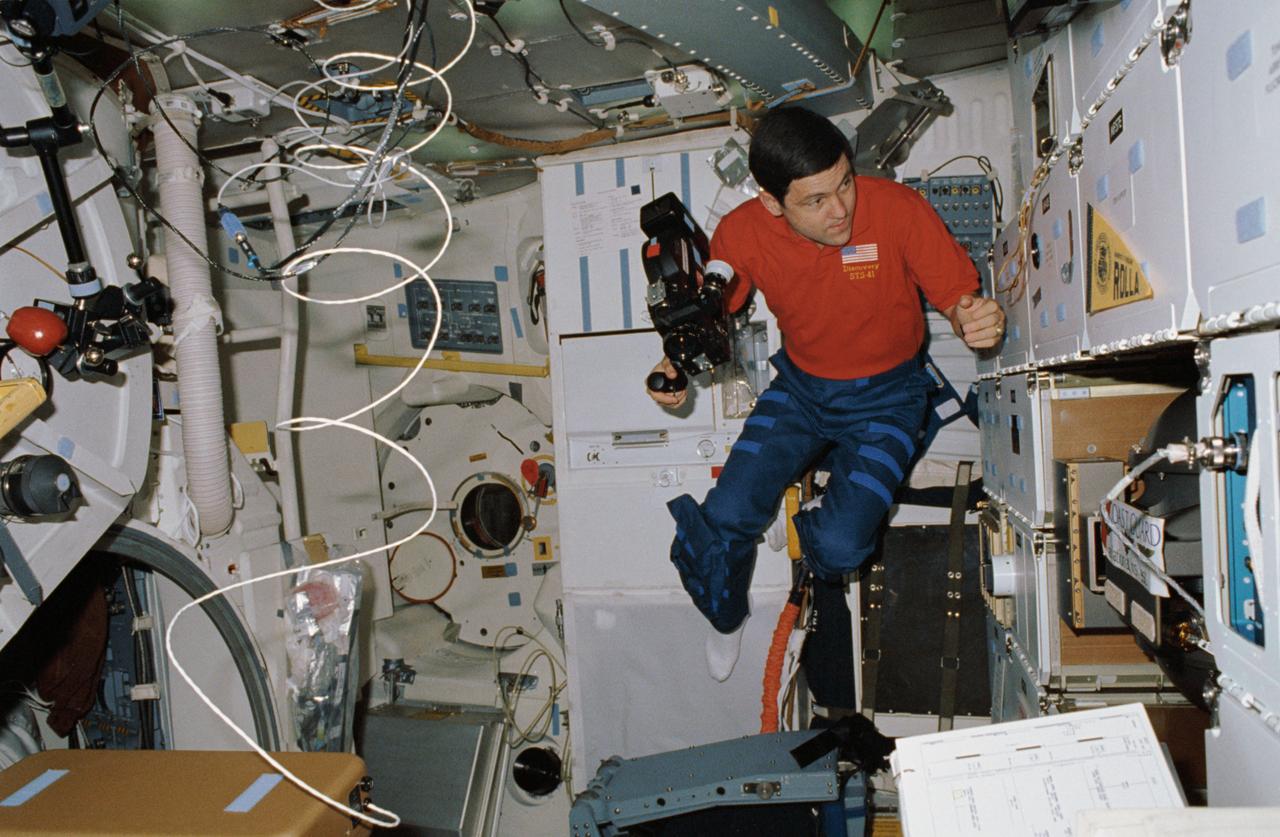
STS041-05-011 (6-10 Oct 1990) --- Astronaut Robert D. Cabana, STS-41 pilot, exhibits the weightlessness of space travel as he appears to "float" about on the middeck of Discovery. Careful inspection of the photo proves that, actually, his floating is limited, as he has anchored his left foot with a special restraint device. He apparently has chosen this vantage point to use the Arriflex motion picture camera in his right hand.
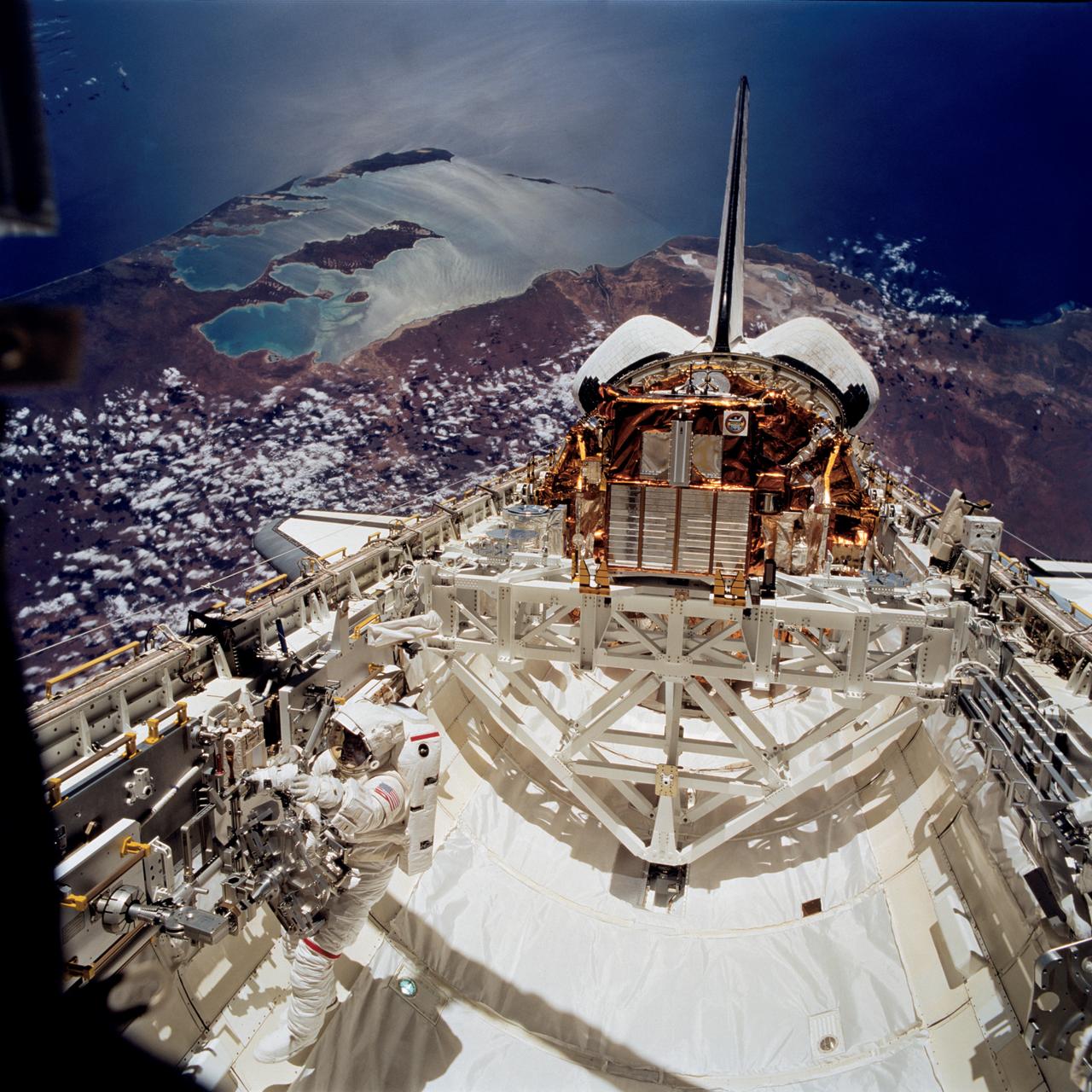
STS072-740-044 (17 Jan. 1996) --- Backdropped against Australia's Shark Bay, this panoramic scene of the Space Shuttle Endeavour in Earth-orbit was recorded during the mission's second Extravehicular Activity (EVA-2) on January 17, 1996. Astronaut Leroy Chiao works with a Mobile Foot Restraint (MFR) at bottom left. The Japanese Space Flyer Unit (SFU) satellite and the Office of Aeronautics and Space Technology (OAST) Flyer satellite are seen in their stowed positions in the aft cargo bay.
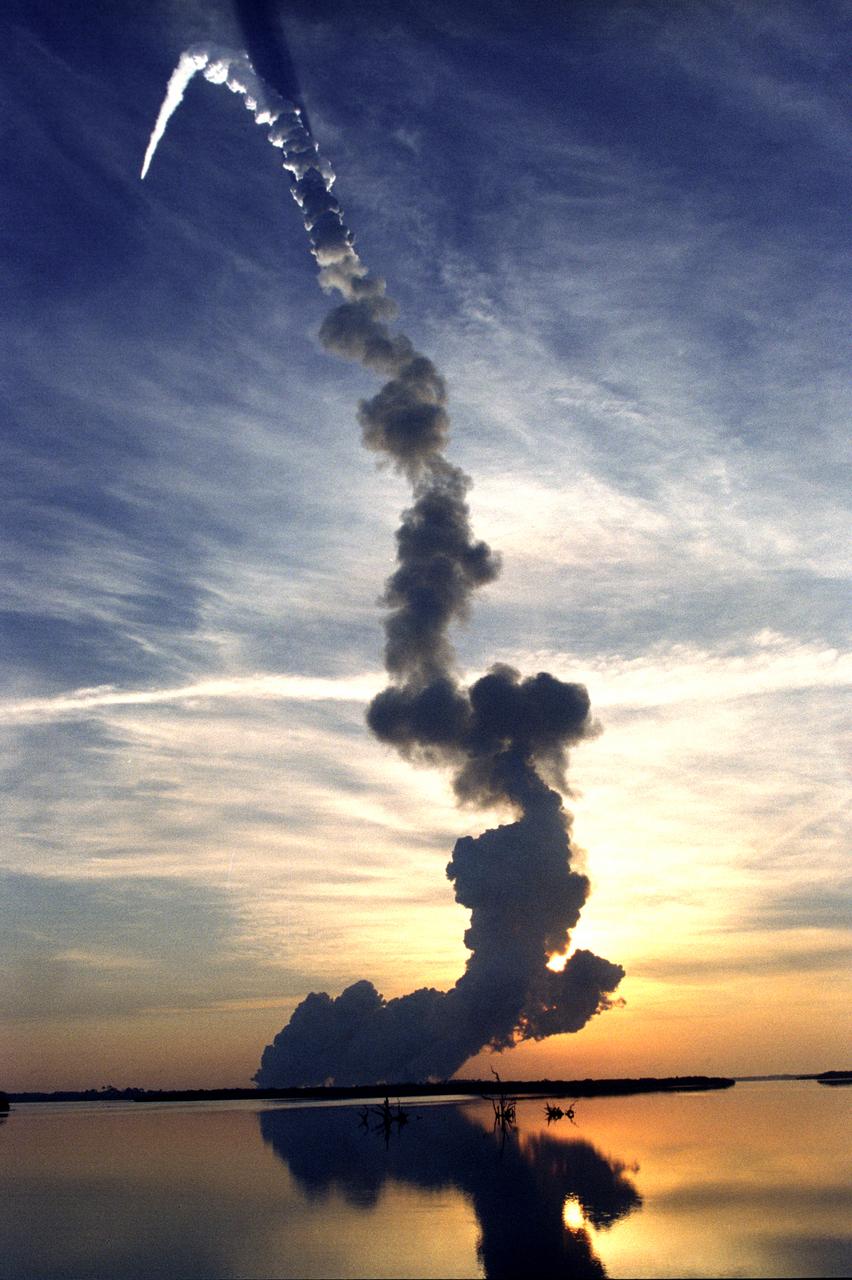
This spectacular photo is of the May 27, 1999 liftoff of the Orbiter Discovery (STS-96). The STS-96 mission, of almost 10 days, was the second International Space Station (ISS) assembly and resupply flight and the first flight to dock with the station. The crew installed foot restraints and the Russian built crane, STRELA. The Shuttle's SPACEHAB double module carried internal and resupply cargo for station outfitting and the Russian cargo crane was carried aboard the shuttle in the integrated Cargo Carrier (ICC).
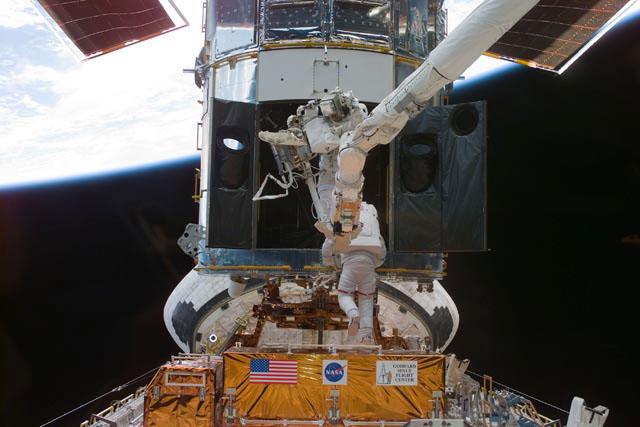
S103-E-5208 --- Astronauts Steven L. Smith (bottom), payload commander, and John M. Grunsfeld, mission specialist, perform servicing tasks on the temporarily-captured Hubble Space Telescope (HST). Grunsfeld is on a foot restraint connected to Discovery's remote manipulator system (RMS) robot arm. Smith, making his second servicing visit to HST, is using handrails on the telescope. The photo was taken with an electronic still camera (ESC).
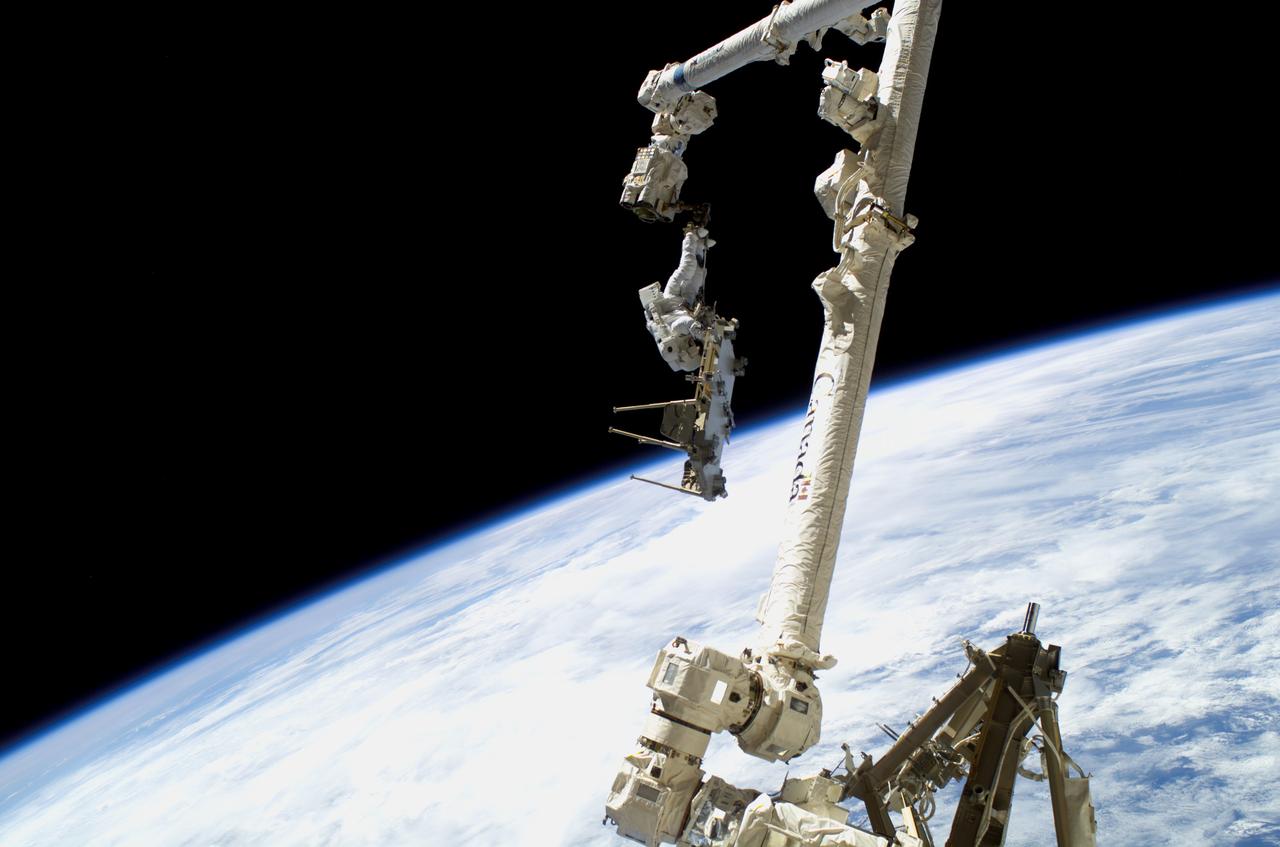
ISS014-E-09800 (14 Dec. 2006) --- Anchored to the International Space Station's Canadarm2 foot restraint, European Space Agency (ESA) astronaut Christer Fuglesang, STS-116 mission specialist, participates in the mission's second of three planned sessions of extravehicular activity (EVA) as construction resumes on the International Space Station. Astronaut Robert L. Curbeam, Jr. (out of frame), mission specialist, also participated in the spacewalk. The blackness of space and Earth's horizon provide the backdrop for the scene.

STS082-310-017 (15 Feb. 1997) --- This wide shot of the Hubble Space Telescope (HST) in Discovery's cargo bay, backdropped against Australia, was taken during the third STS-82 space walk to service the orbiting observatory. Astronaut Steven L. Smith (left of center)works near the foot restraint of the Remote Manipulator System (RMS). Astronaut Mark C. Lee, payload commander who shared space walk chores with Smith, was out of frame.
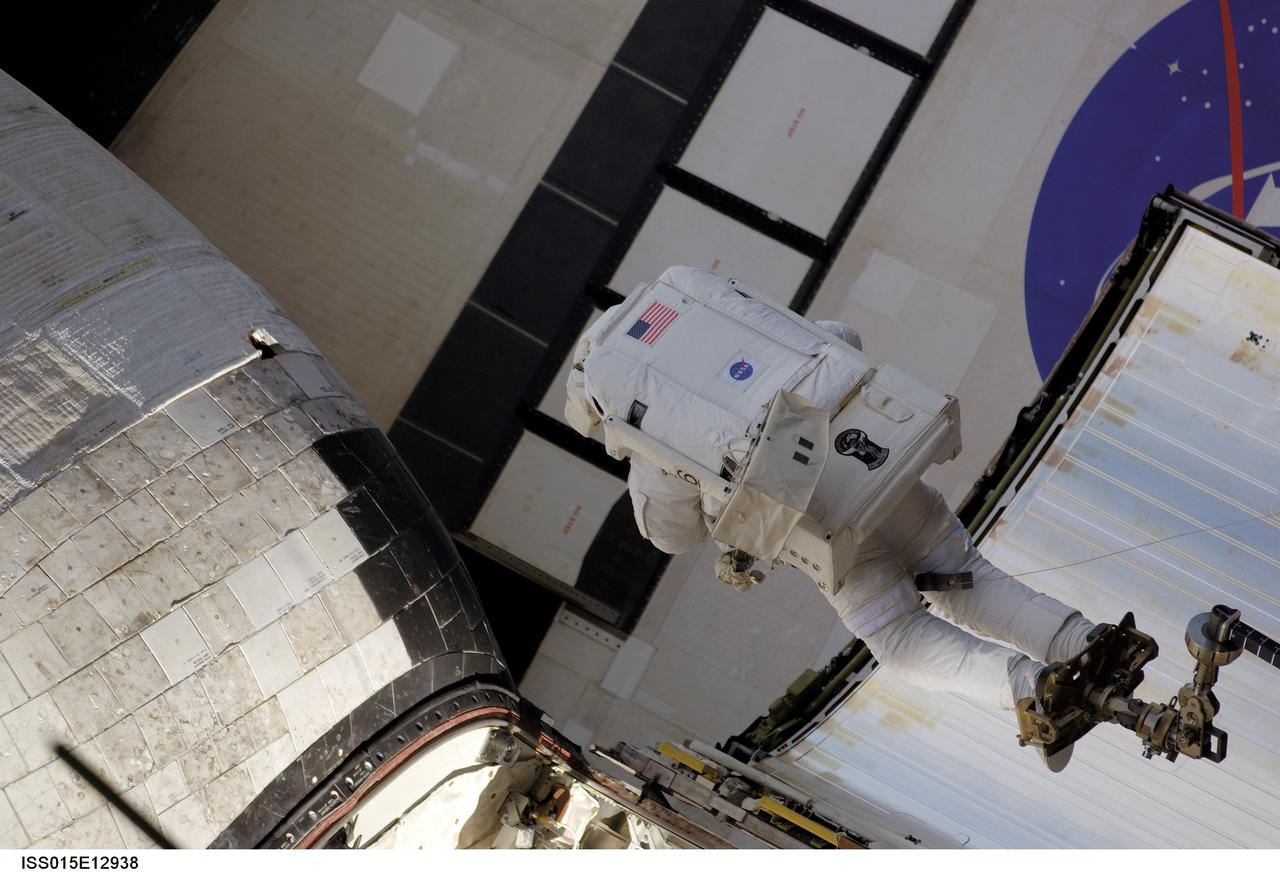
ISS015-E-12938 (15 June 2007) --- Anchored to a foot restraint on Space Shuttle Atlantis' remote manipulator system (RMS) robotic arm, astronaut John "Danny" Olivas, STS-117 mission specialist, moves toward Atlantis' port orbital maneuvering system (OMS) pod that was damaged during the shuttle's climb to orbit. During the repair, Olivas pushed the turned up portion of the thermal blanket back into position, used a medical stapler to secure the layers of the blanket, and pinned it in place against adjacent thermal tile.
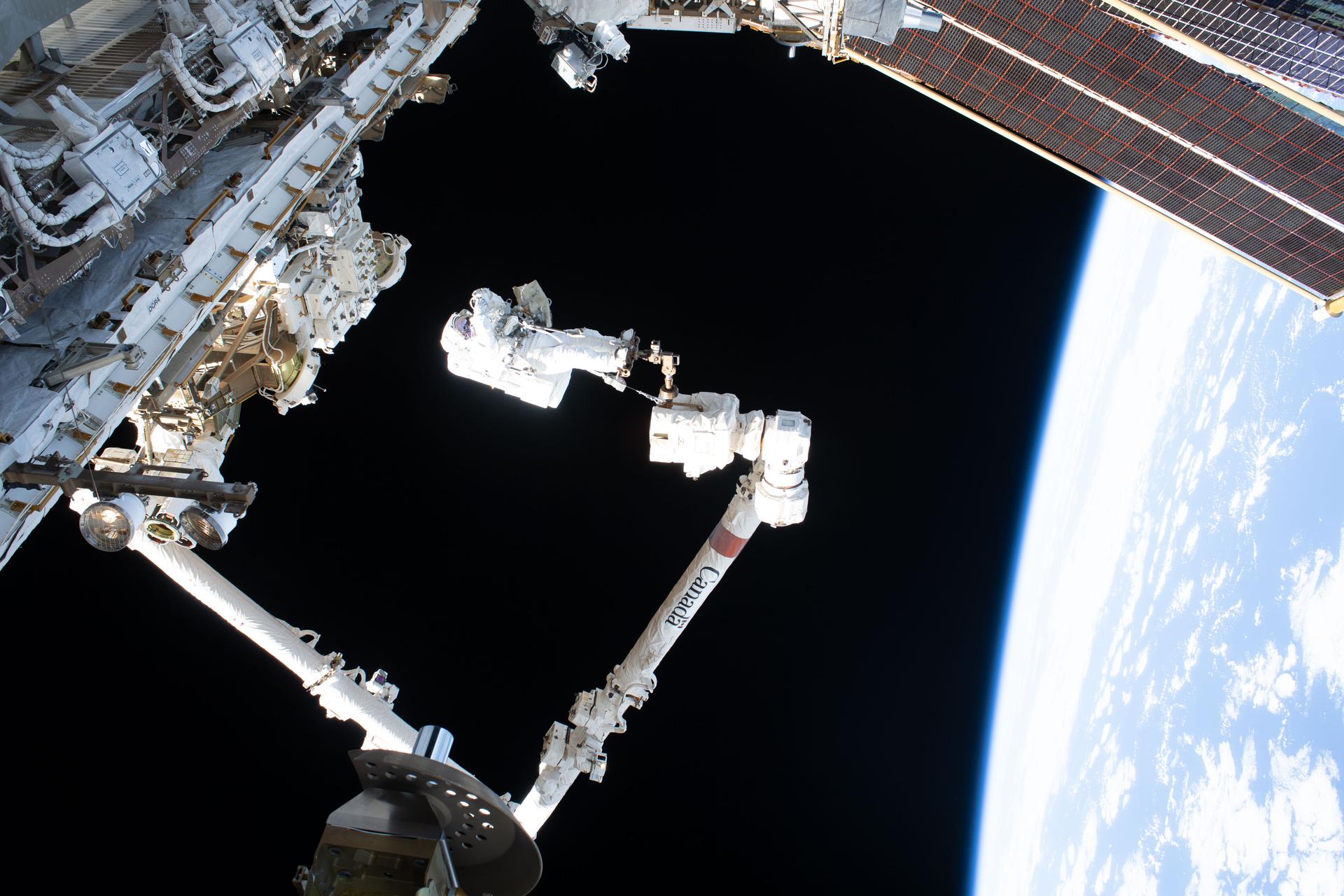
iss075e0086496 (Sept. 1, 2026) --- Expedition 75 commander Jessica Meir of NASA rides the Canadarm2 robotic arm during a spacewalk for navigation and science maintenance outside the International Space Station. Meir was attached to an articulating portable foot restraint installed on Canadarm2’s latching end effector. The orbital outpost was soaring 259 miles above the Pacific Ocean southwest of Mexico when this photograph was taken. Credit: NASA
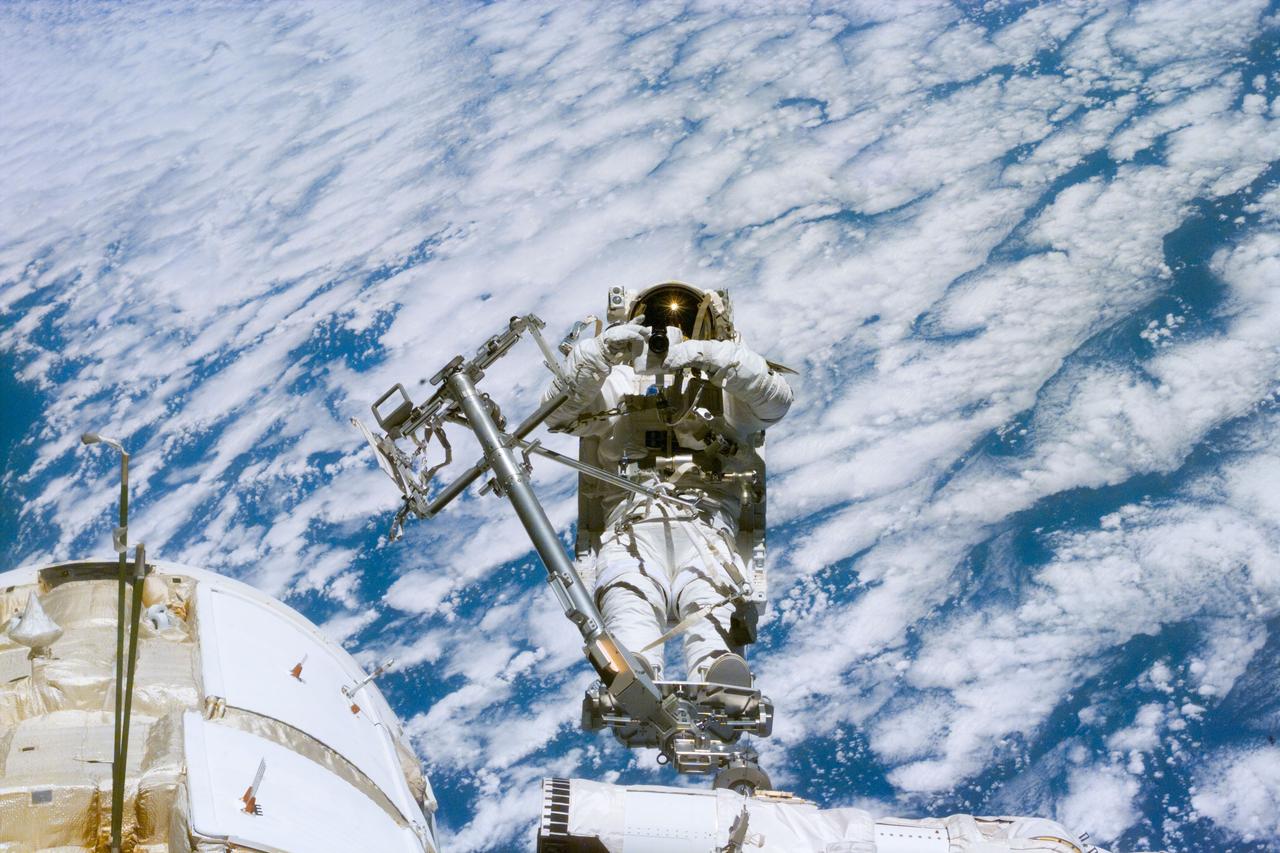
S88-E-5102 (12-10-98) --- Astronaut James H. Newman, mission specialist, is backdropped against a blue and white Earth while standing on a mobile foot restraint attached to Endeavour's remote manipulator system (RMS). Astronaut Jerry L. Ross, mission specialist, is out of frame at left. Part of Zarya is in the lower left corner. The photo was taken with an electronic still camera (ESC) at 02:23:47 GMT, Dec. 10
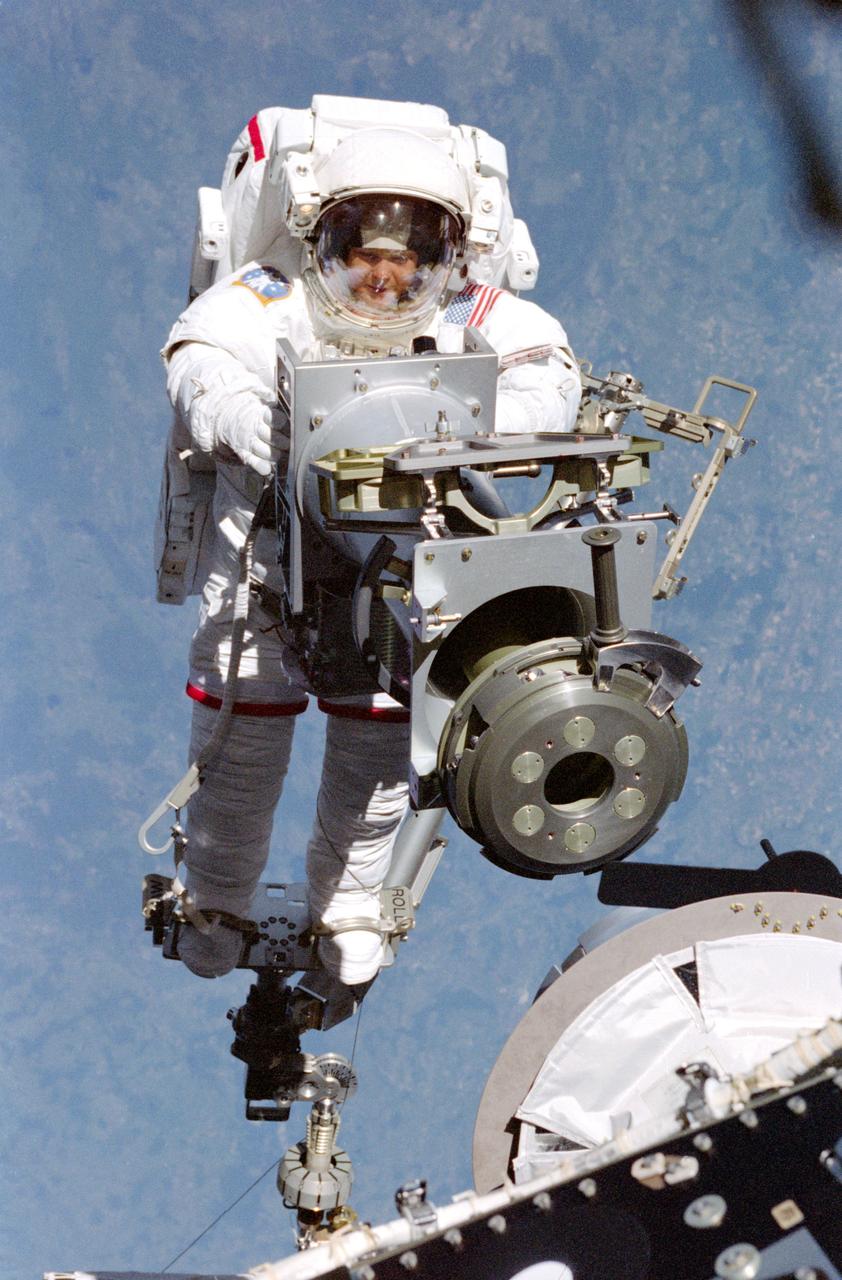
STS096-357-003 (30 May 1999) --- Astronaut Tamara E. Jernigan, backdropped against terrain some 173 nautical miles beneath Discovery, totes part of a Russian-built crane, called Strela (a Russian word meaning "arrow"). Jernigan's feet are anchored on a mobile foot restraint connected to the shuttle's remote manipulator system (RMS). Astronauts Jernigan and Daniel T. Barry eventually spent over seven hours on the space walk.
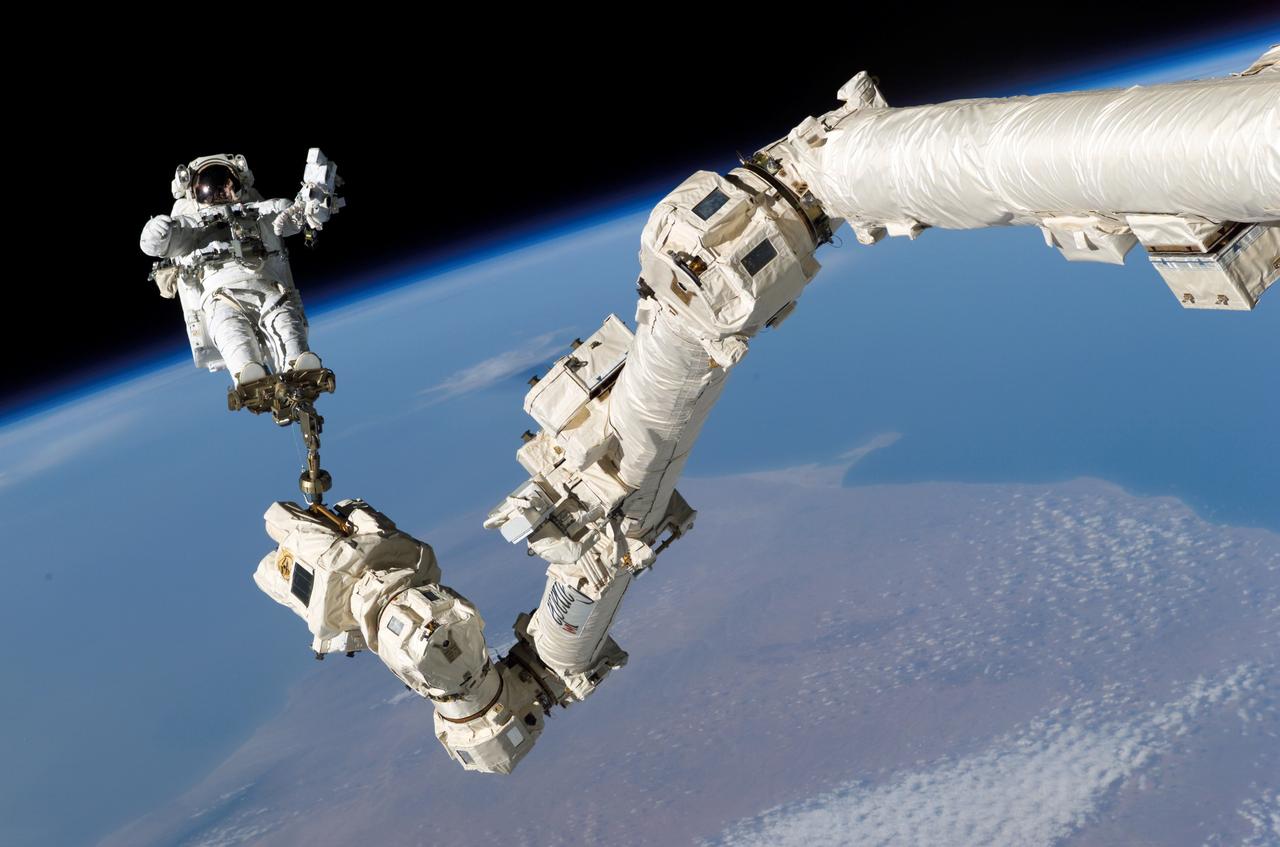
S114-E-6645 (3 August 2005) --- Discovery served as NASA's Return to Flight vehicle following the Columbia accident. Astronaut Stephen K. Robinson, STS-114 mission specialist, anchored to a foot restraint on the international space station’s Canadarm2, participates in the mission’s third session of extravehicular activity (EVA). The blackness of space and Earth’s horizon form the backdrop for the image. Photo credit: NASA or National Aeronautics and Space Administration
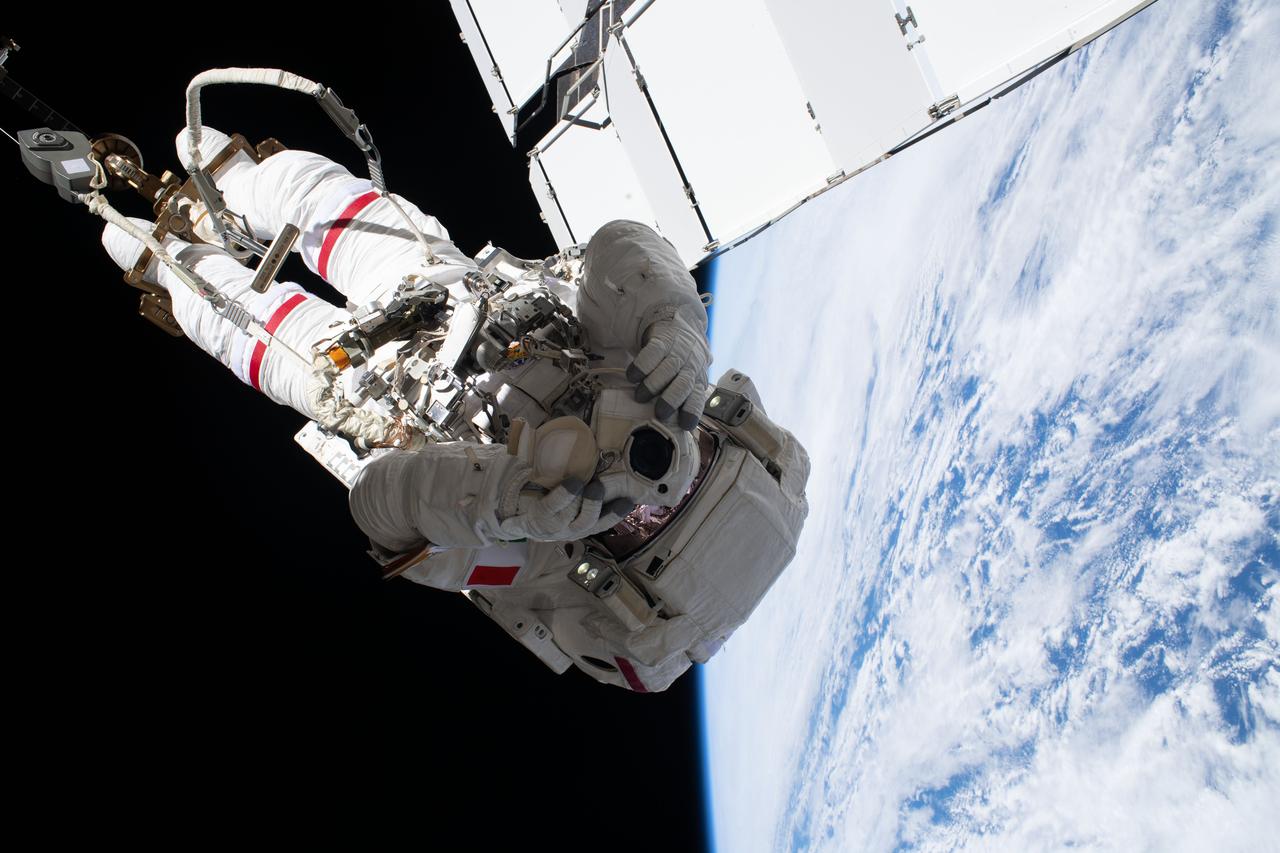
iss061e058522 (Nov. 22, 2019) --- Astronaut and spacewalker Luca Parmitano of ESA (European Space Agency) soars 250 miles above the Earth's surface attached to an articulated portable foot restraint, connected to the tip of the Canadarm2 robotic arm. He and fellow astronaut Andrew Morgan (out of frame) were conducting the second spacewalk to repair the International Space Station's cosmic particle detector, the Alpha Magnetic Spectrometer.
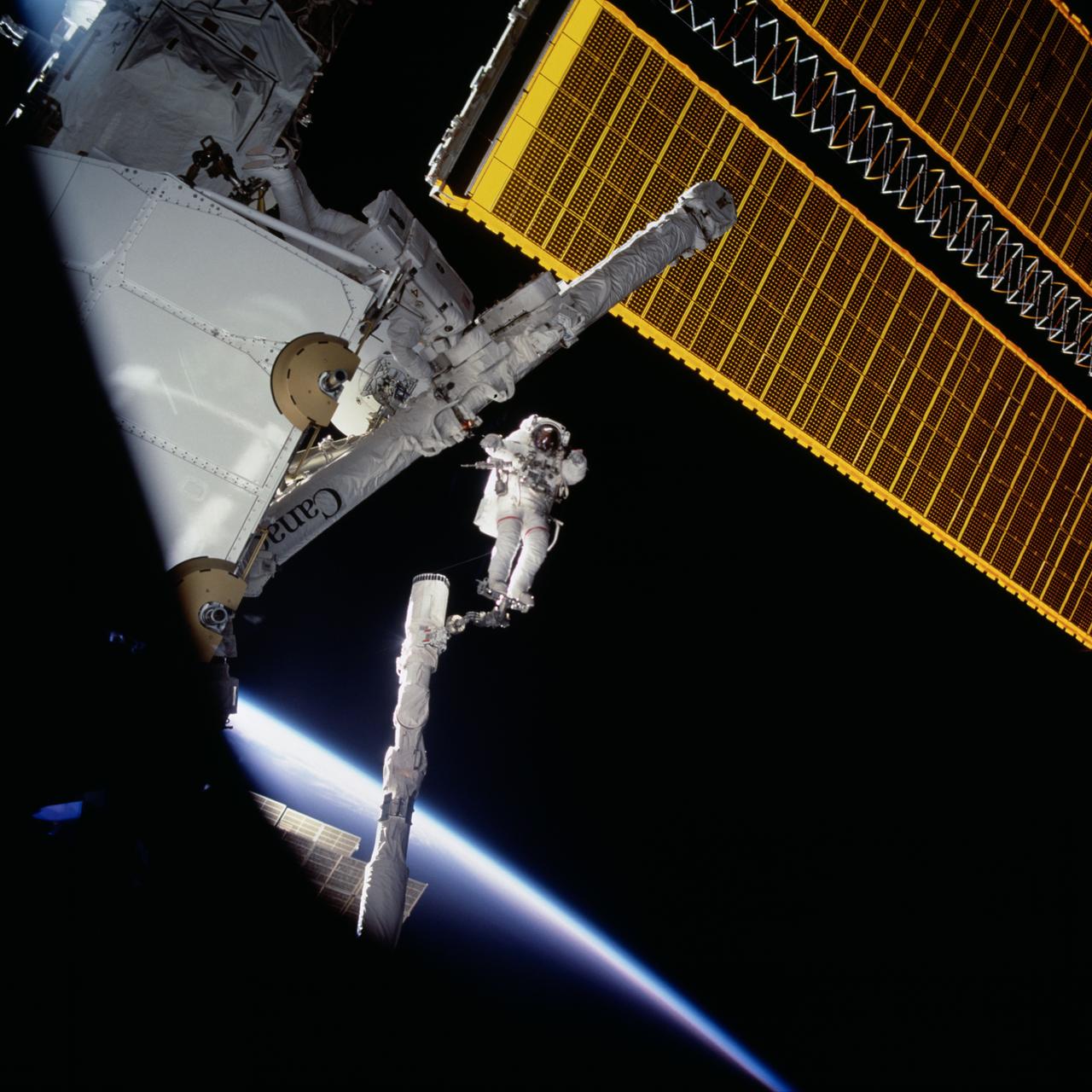
STS100-714-027 (19 April-1 May 2001) --- Astronaut Chris A. Hadfield, mission specialist representing the Canadian Space Agency (CSA), stands on the portable foot restraint (PFR) connected to the Endeavour's remote manipulator system (RMS) robotic arm, during one of the two days of extravehicular activity (EVA) on the STS-100 mission. Astronaut Scott E. Parazynski, mission specialist, is seen at left near the Spacelab pallet.
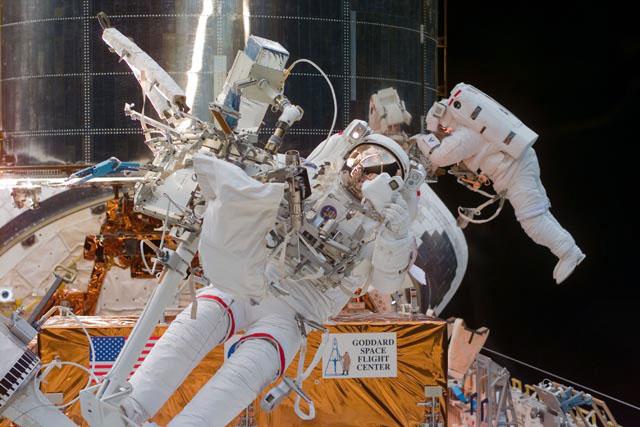
S103-E-5347 (24 December 1999) --- Astronaut Steven L. Smith, payload commander, prepares to use a 35mm camera during the final space walk of the STS-103 mission. Smith is standing on a foot restraint connected to the end of Discovery's remote manipulator system (RMS) robot arm. Astronaut John M. Grunsfeld, mission specialist, translates along a handrail system on the Hubble Space Telescope (HST) in the background.
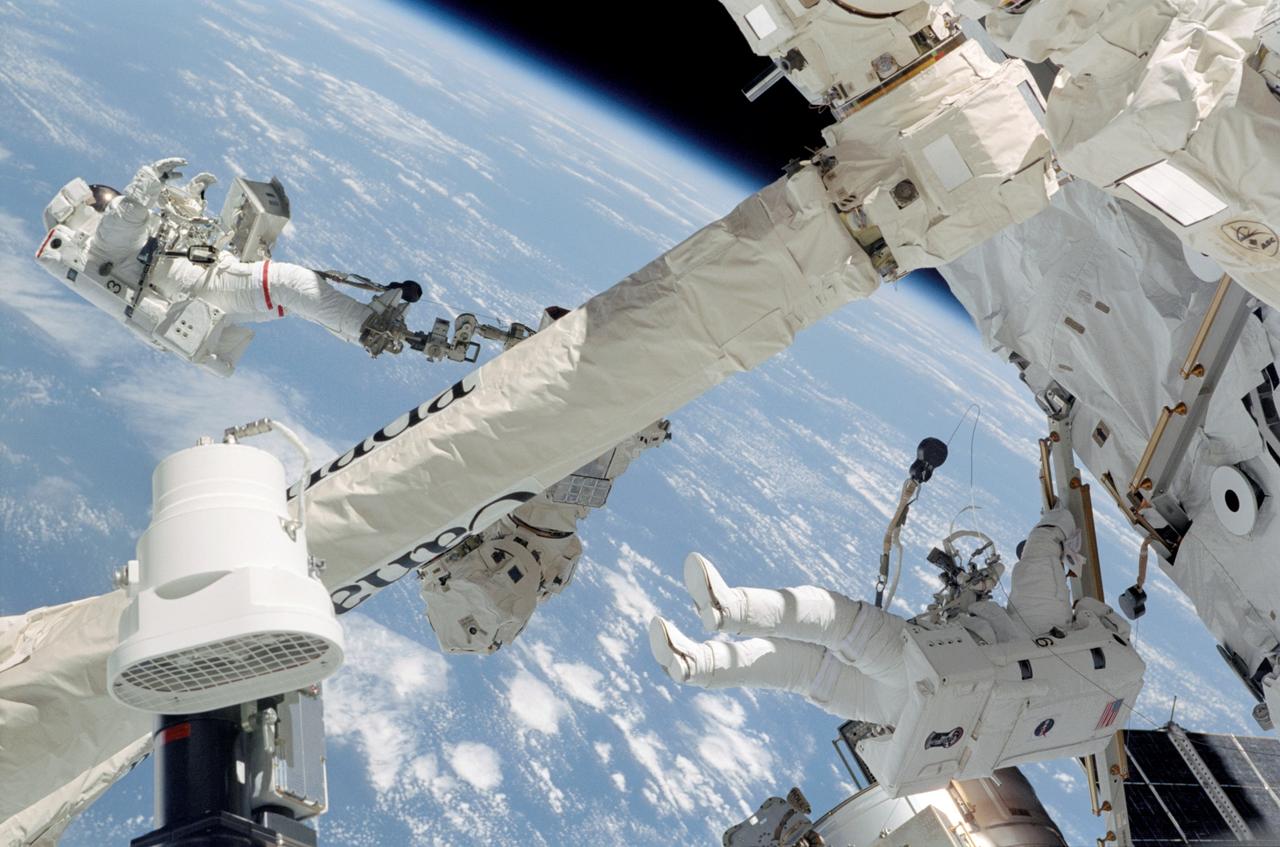
STS112-326-033 (12 October 2002) --- Astronauts David A. Wolf (left) and Piers J. Sellers, both STS-112 mission specialists, participate in the mission’s second session of extravehicular activity (EVA). Wolf is anchored to a foot restraint on the International Space Station’s (ISS) Canadarm2 while Sellers traverses along the airlock spur, a route used by spacewalkers to get from the Quest airlock on the station to the outpost's truss.
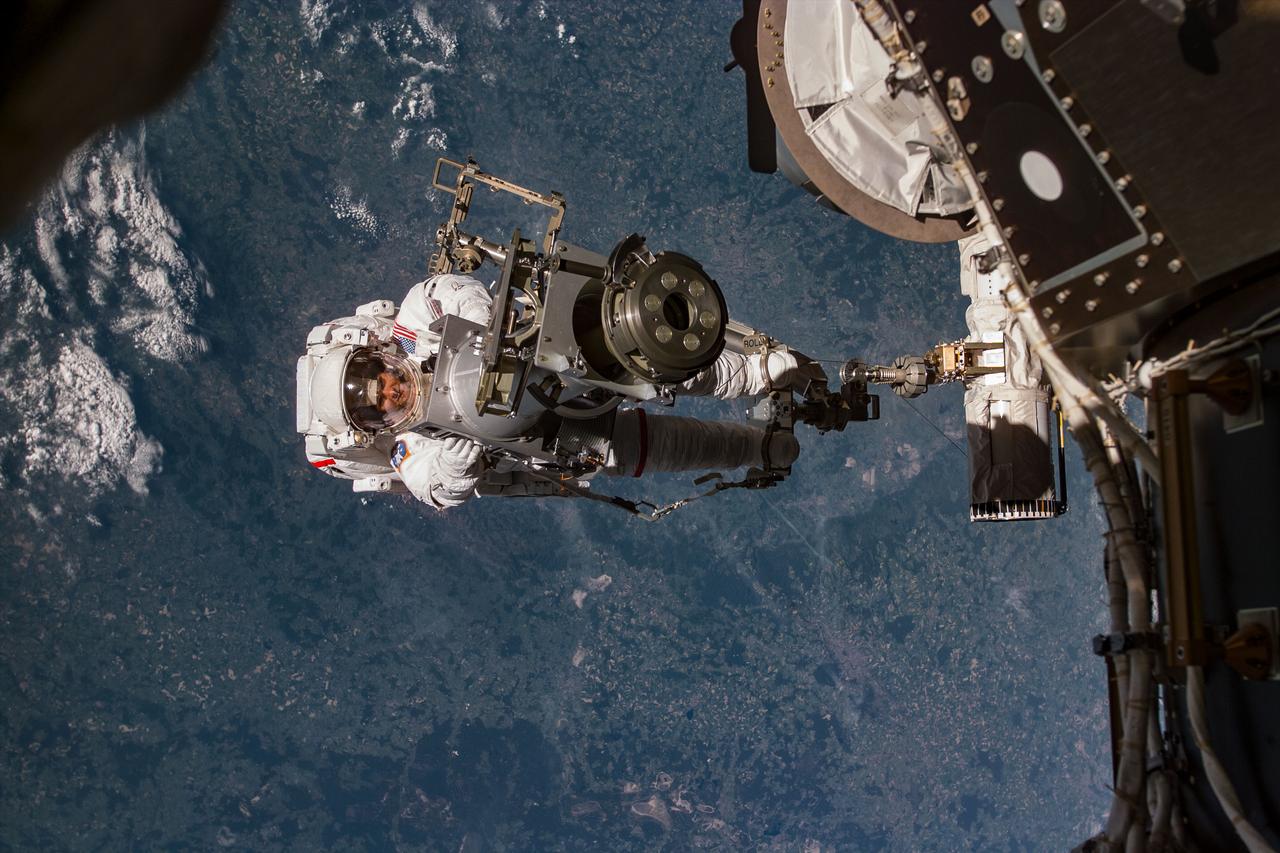
S96-E-5020 (30 May 1999) --- Astronaut Tamara Jernigan, backdropped against terrain, totes part of a Russian-built crane, called Strela (a Russian word meaning "arrow"). Jernigan's feet are anchored on a mobile foot restraint connected to Discovery's remote manipulator sytsem (RMS). Astronauts Jernigan and Daniel T. Barry went on to spend over seven hours on the space walk. The photo was recorded with an electronic still camera (ESC) at 06:36:22 GMT, May 30, 1999.
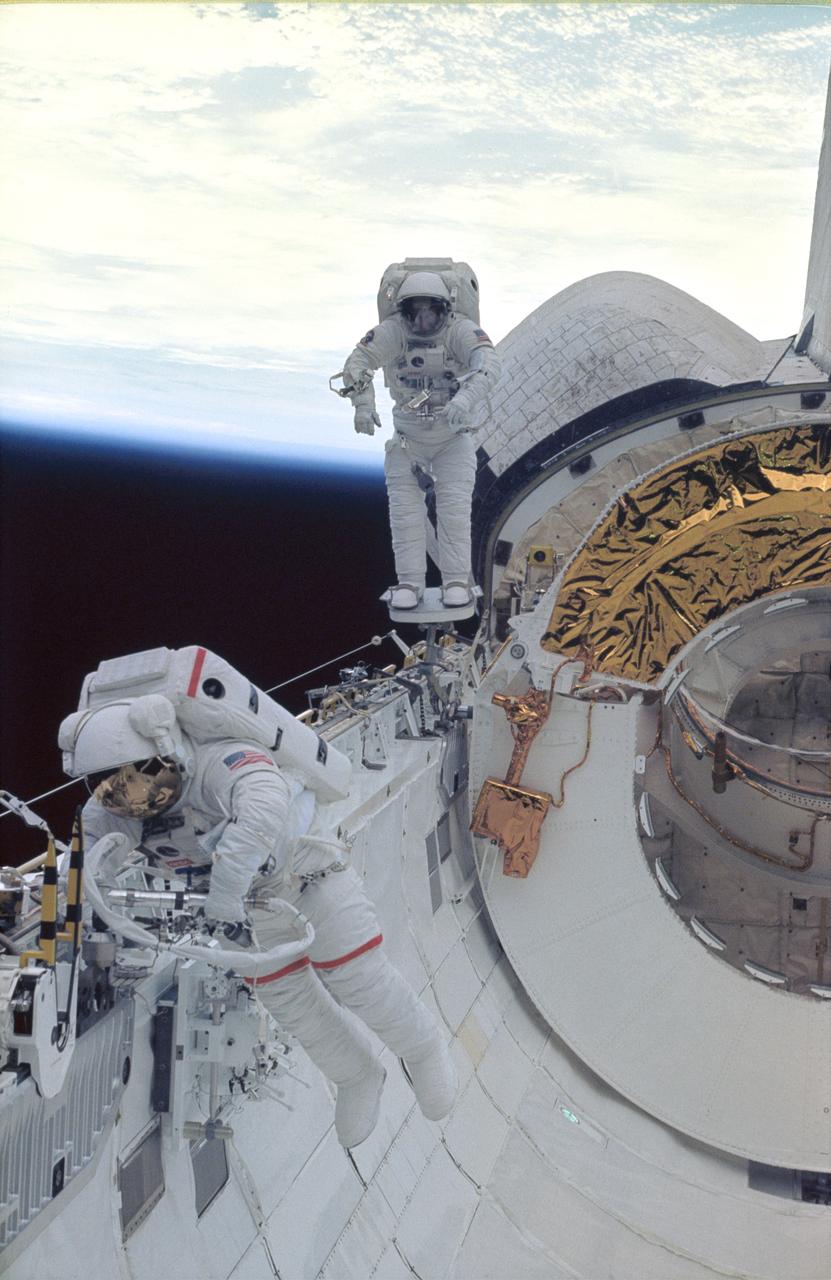
STS051-06-037 (16 Sept 1993) --- Astronauts Carl E. Walz (foreground) and James H. Newman evaluate some important gear. Walz reaches for the Power Ratchet Tool (PRT) while Newman checks out mobility on the Portable Foot Restraint (PFR) near the Space Shuttle Discovery's starboard Orbital Maneuvering System (OMS) pod. The tools and equipment will be instrumental on some of the five periods of extravehicular activity (EVA) scheduled for the Hubble Space Telescope (HST) STS-61 servicing mission later this year.
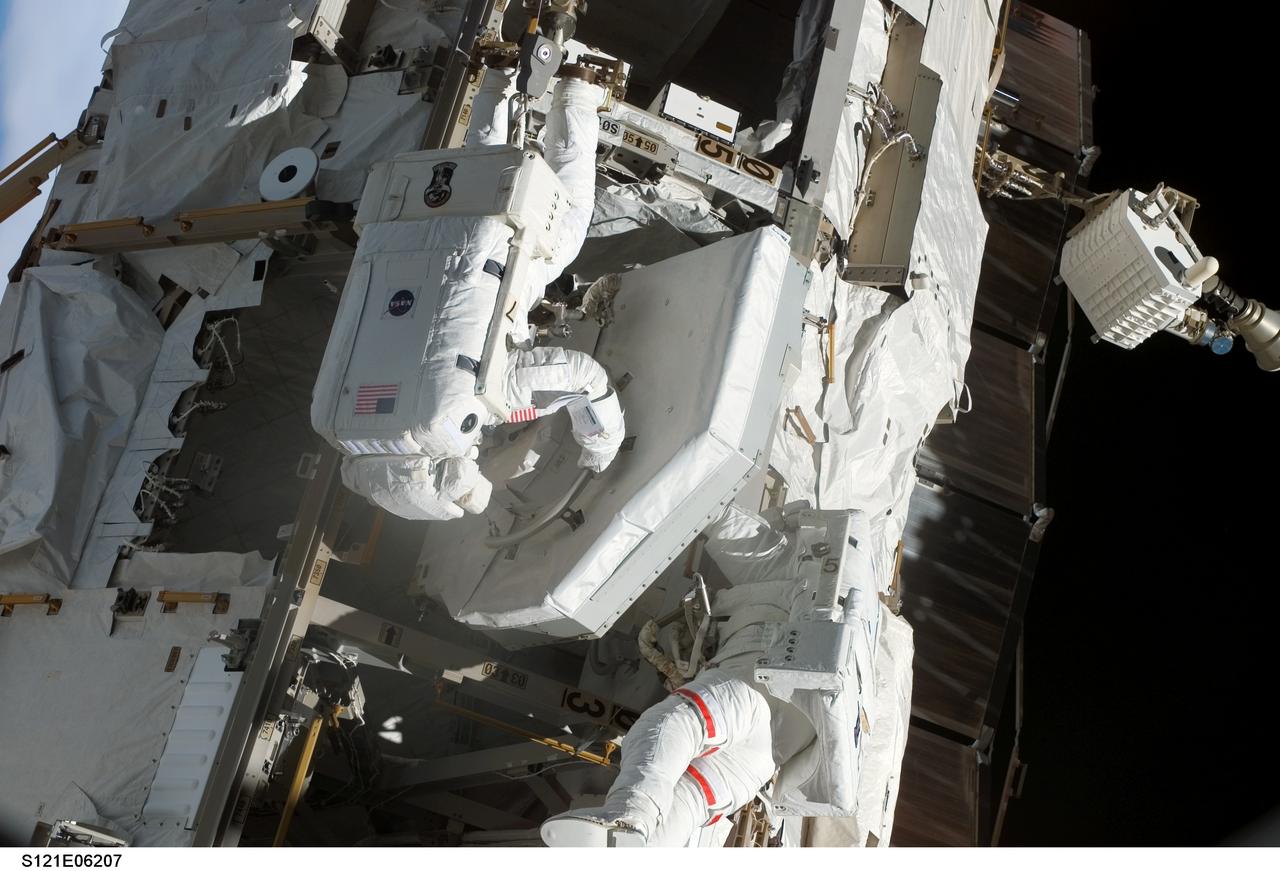
S121-E-06207 (10 July 2006) --- While anchored on the mobile foot restraint on the Canadarm2, astronaut Michael E. Fossum (left), STS-121 mission specialist, removes the trailing umbilical system-reel assembly (TUS-RA) from the S0 truss on the International Space Station during the mission's second session of extravehicular activity (EVA). Astronaut Piers J. Sellers, mission specialist, assisted Fossum by checking the clearance of the TUS-RA as it was lifted from the bay.
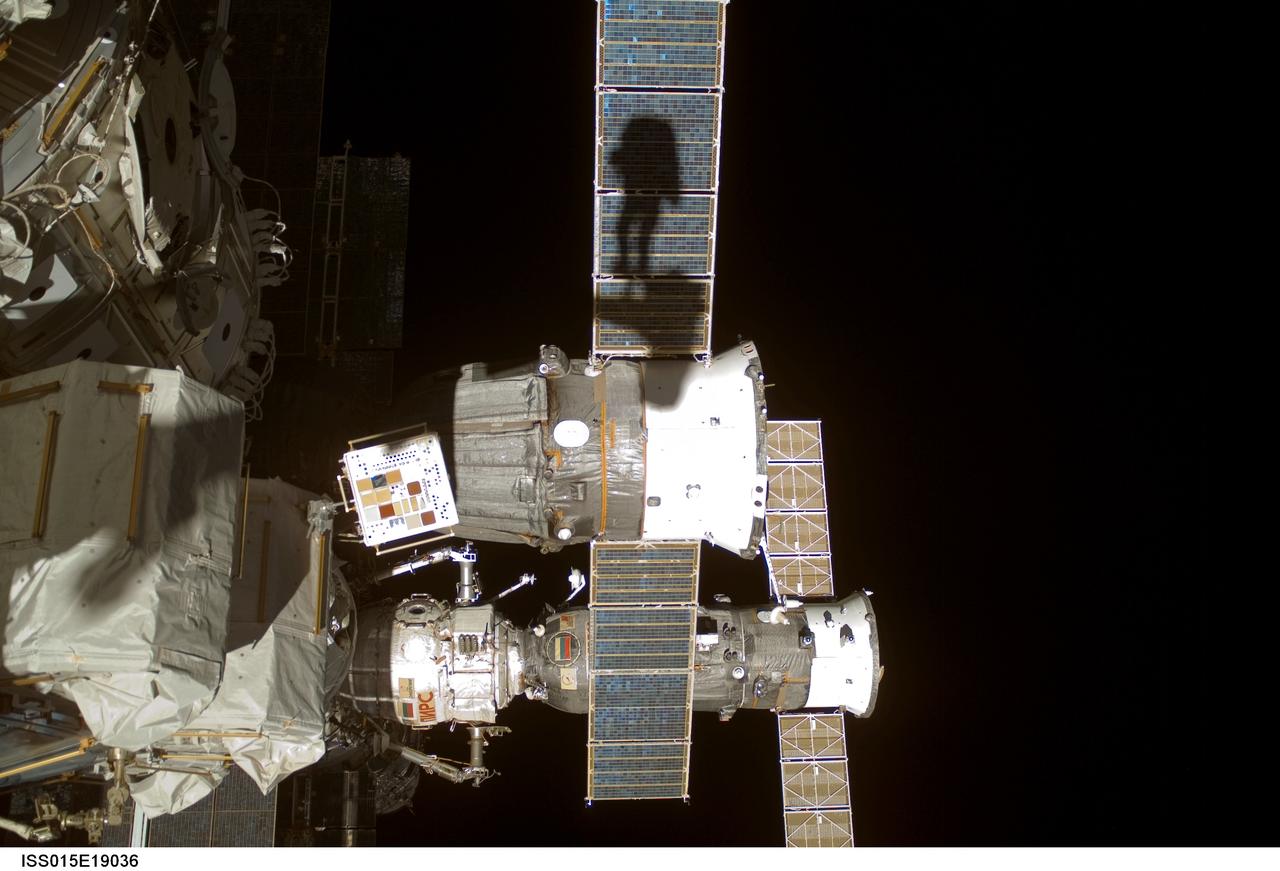
ISS015-E-19036 (23 July 2007) --- The shadow of astronaut Clay Anderson, Expedition 15 flight engineer, who is anchored to the Canadarm2 foot restraint, is visible against solar array panels of a Soyuz spacecraft docked to the International Space Station during a session of extravehicular activity (EVA). This image was captured following the jettisoning of an Early Ammonia Servicer (EAS).
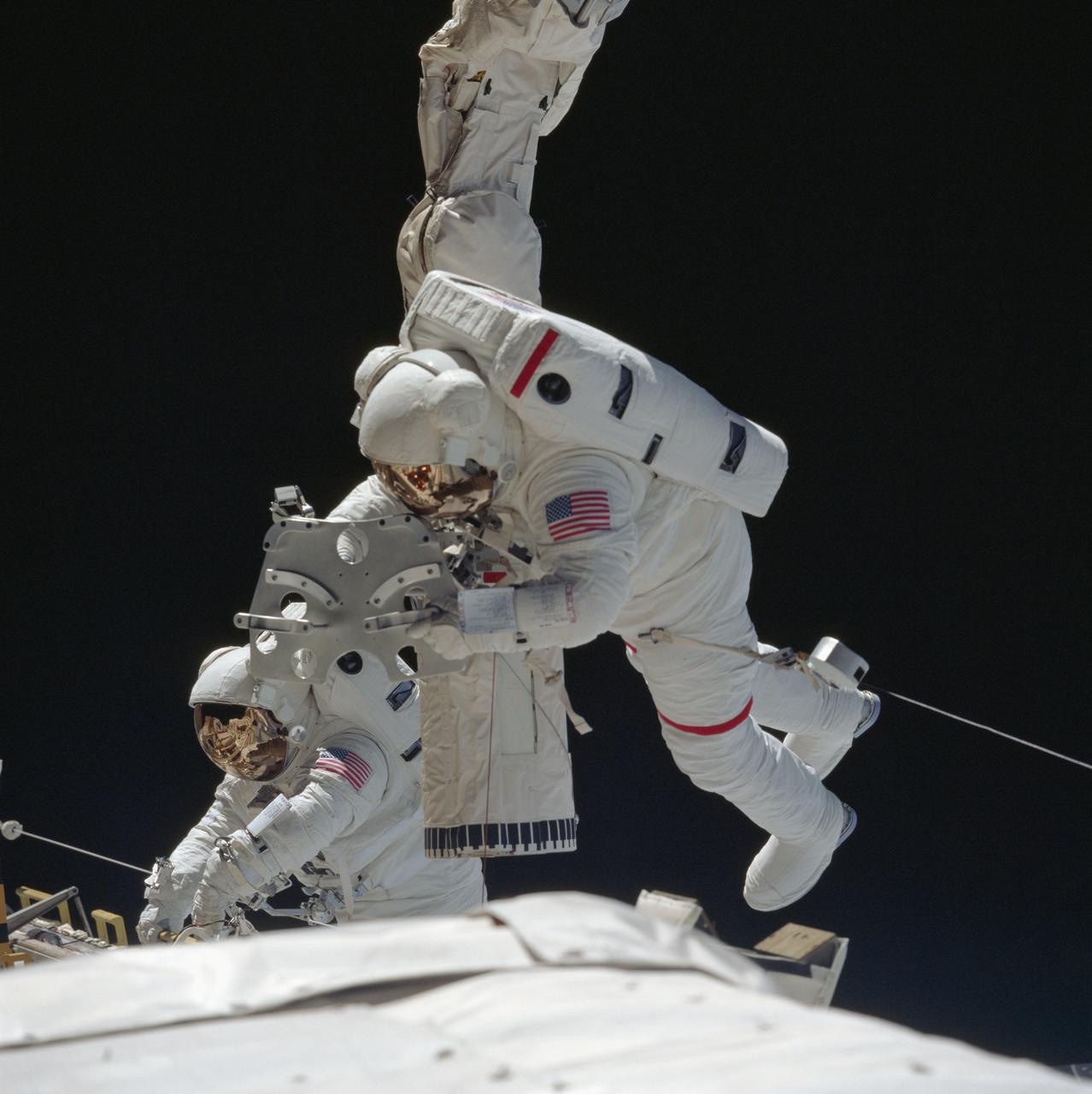
STS057-97-056 (25 June 1993) --- Astronaut G. David Low (foreground) adjusts the mobile foot restraint on the end of the Space Shuttle Endeavour's Remote Manipulator System (RMS) while astronaut Peter J. K. (Jeff) Wisoff busies himself at the stowed European Retrievable Carrier (EURECA) during June 25, 1993, extravehicular activity (EVA).
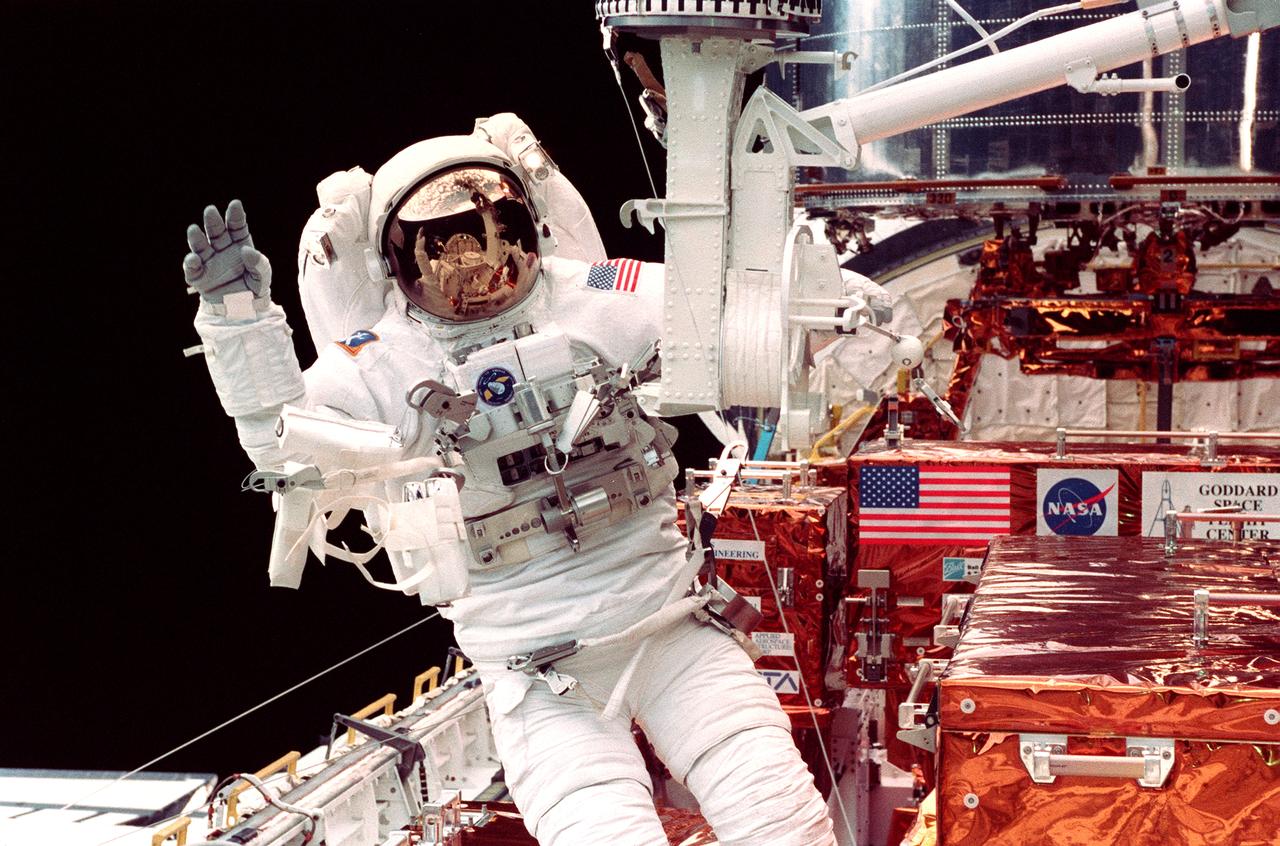
STS082-339-035 (15 Feb. 1997) --- Astronaut Steven L. Smith waves at in-cabin crewmates while working near the foot restraint of the Remote Manipulator System (RMS) during the third day of extravehicular activity (EVA-3) to service the Hubble Space Telescope (HST). Astronaut Mark C. Lee, payload commander who shared walk chores with Smith, is out of frame.
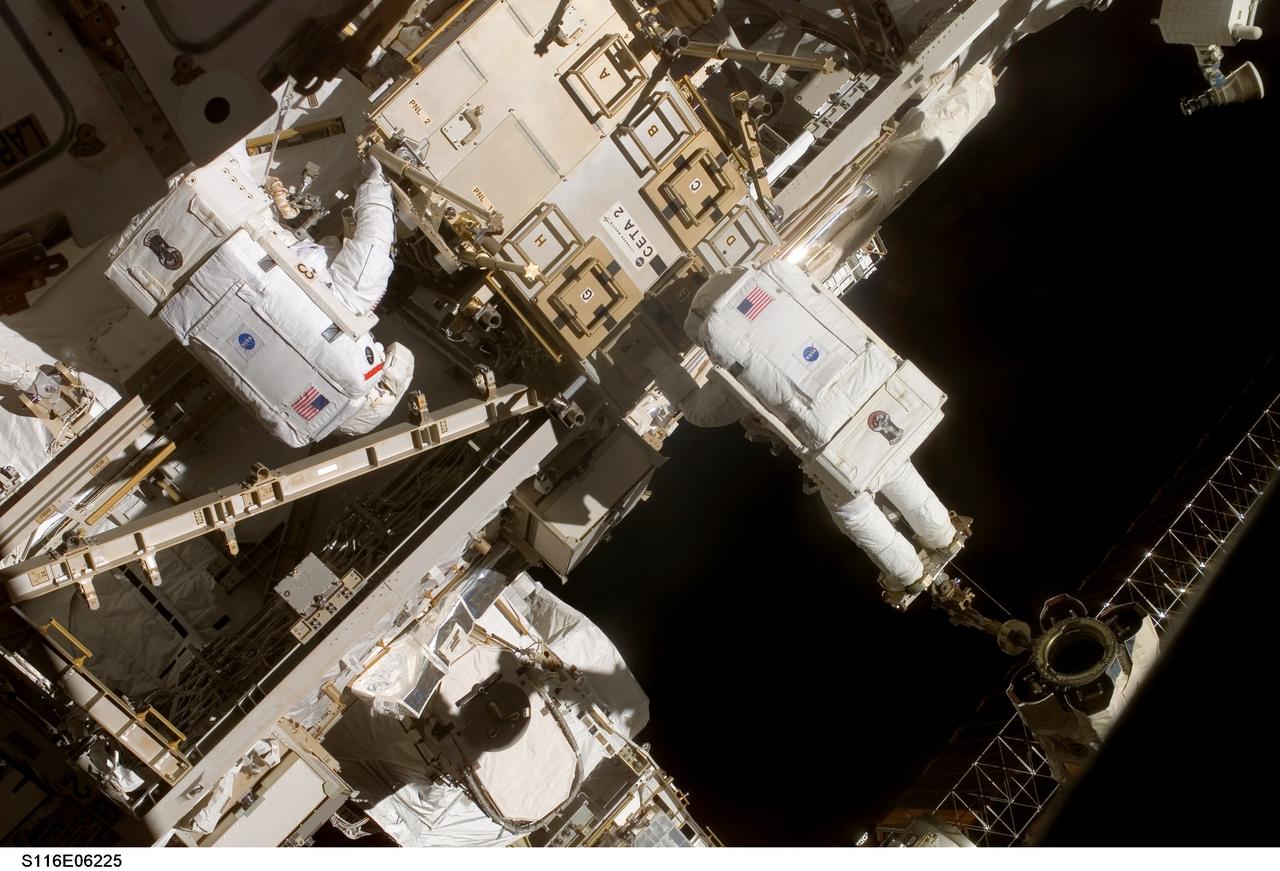
S116-E-06225 (14 Dec. 2006) --- Anchored to the International Space Station's Canadarm2 foot restraint, European Space Agency (ESA) astronaut Christer Fuglesang (right), STS-116 mission specialist, works in tandem with astronaut Robert L. Curbeam, Jr., mission specialist, during the mission's second of three planned sessions of extravehicular activity (EVA) as construction resumes on the station.
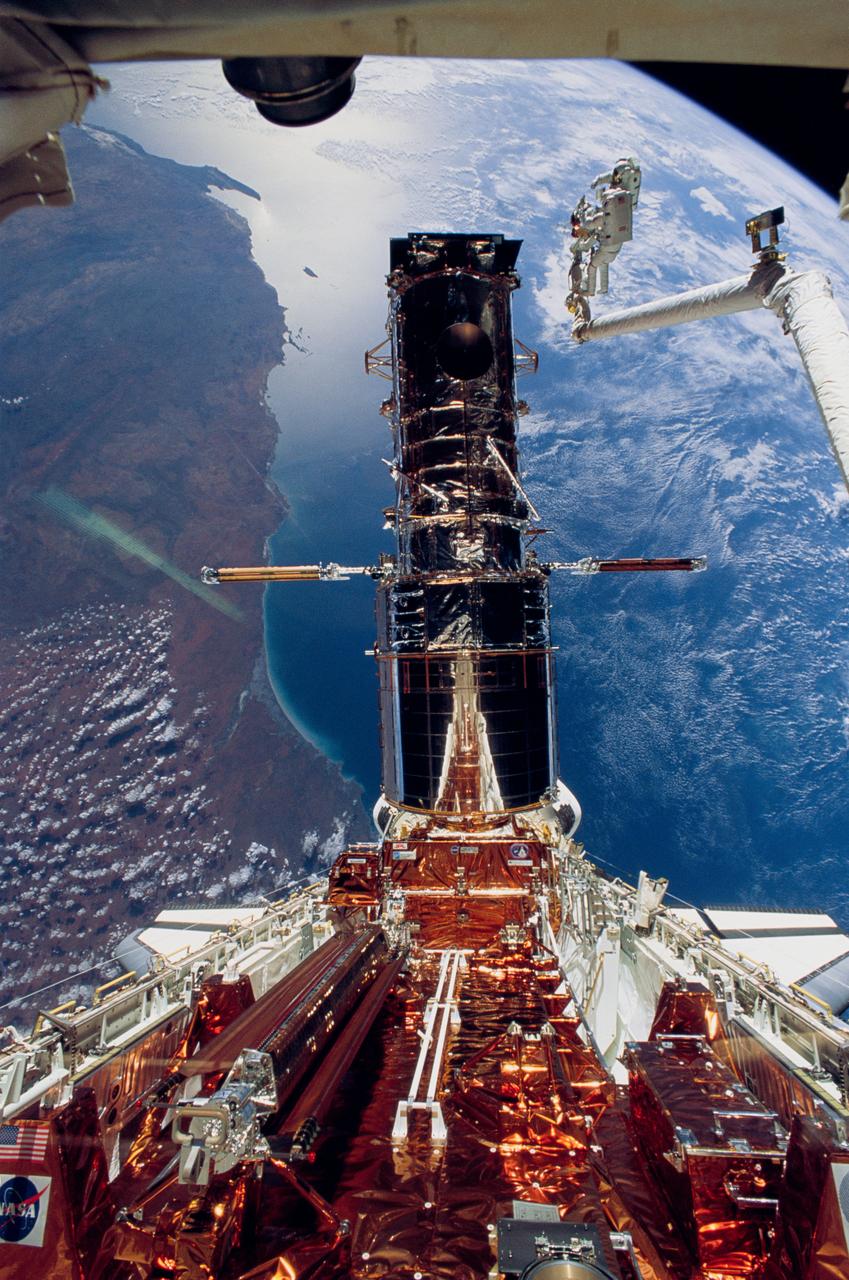
STS061-48-001 (9 Dec 1993) --- Orbiting Earth at an altitude of 356 nautical miles perched atop a foot restraint on the Space Shuttle Endeavour's Remote Manipulator System (RMS) arm, astronauts F. Story Musgrave (top) and Jeffrey A. Hoffman wrap up the final of five Extravehicular Activities (EVA). The west coast of Australia forms the backdrop for the 35mm frame.
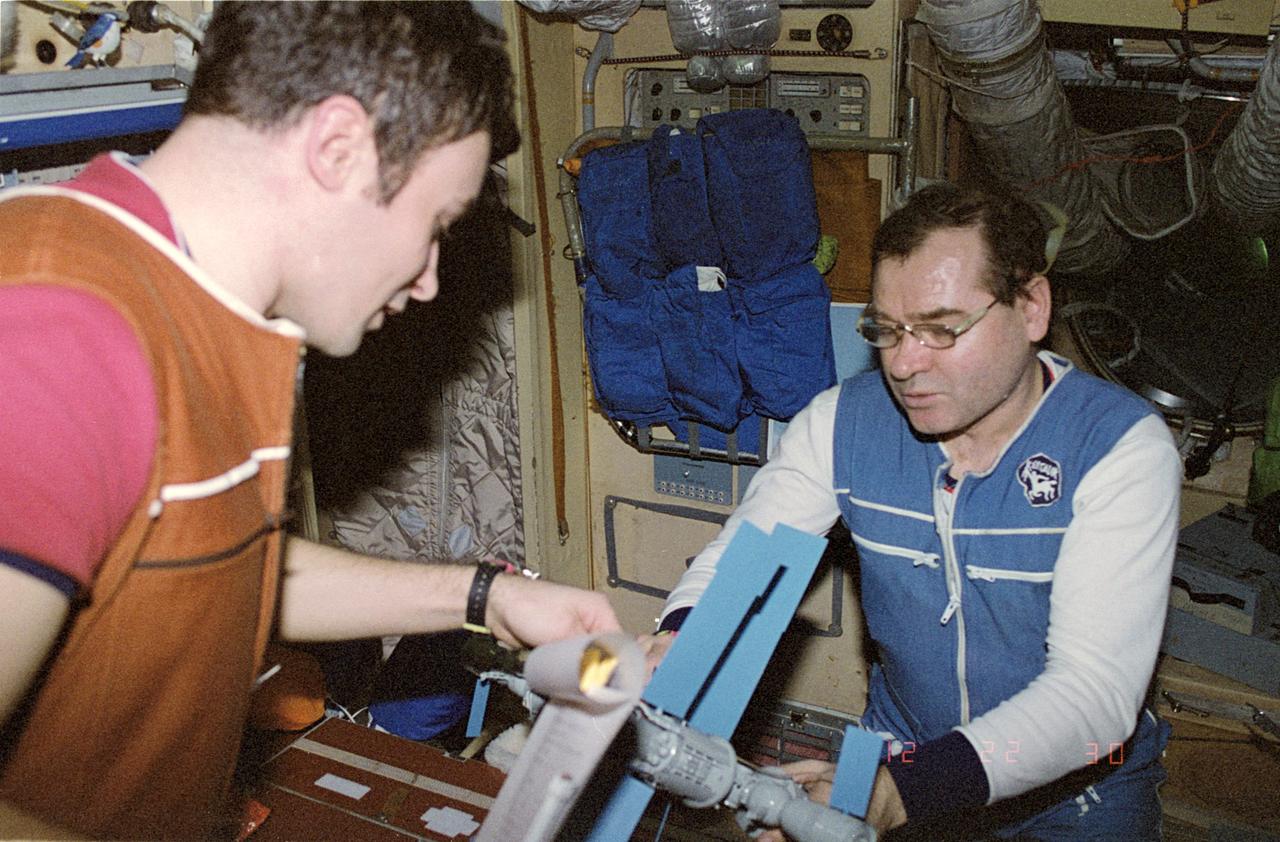
NM18-304-016 (March-July 1995) --- Cosmonauts Vladimir N. Dezhurov (left) and Gennadiy M. Strekalov study a small model of the Mir Space Station prior to one of their five space walks. At a July 18 press coonference in Houston, the two told reporters that the model was helpful in locating strategic points on the various modules, for example, hand rails and foot restraints. Along with astronaut Norman E. Thagard, the two went onto spend 115 days on Mir.
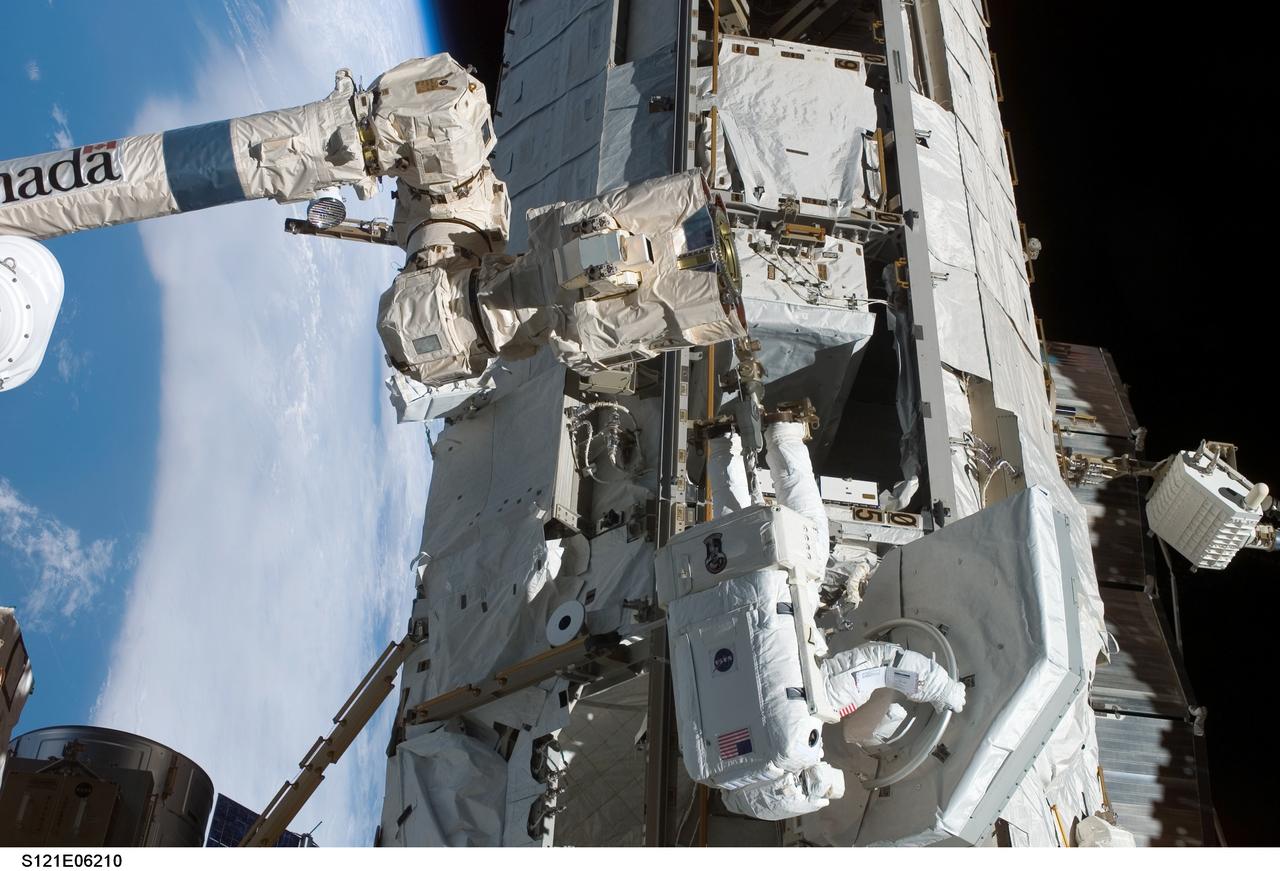
S121-E-06210 (10 July 2006) --- Astronaut Michael E. Fossum, STS-121 mission specialist, removes the trailing umbilical system-reel assembly (TUS-RA) from the S0 truss on the International Space Station during the mission's second session of extravehicular activity (EVA). Fossum is anchored on the mobile foot restraint on the Canadarm2.
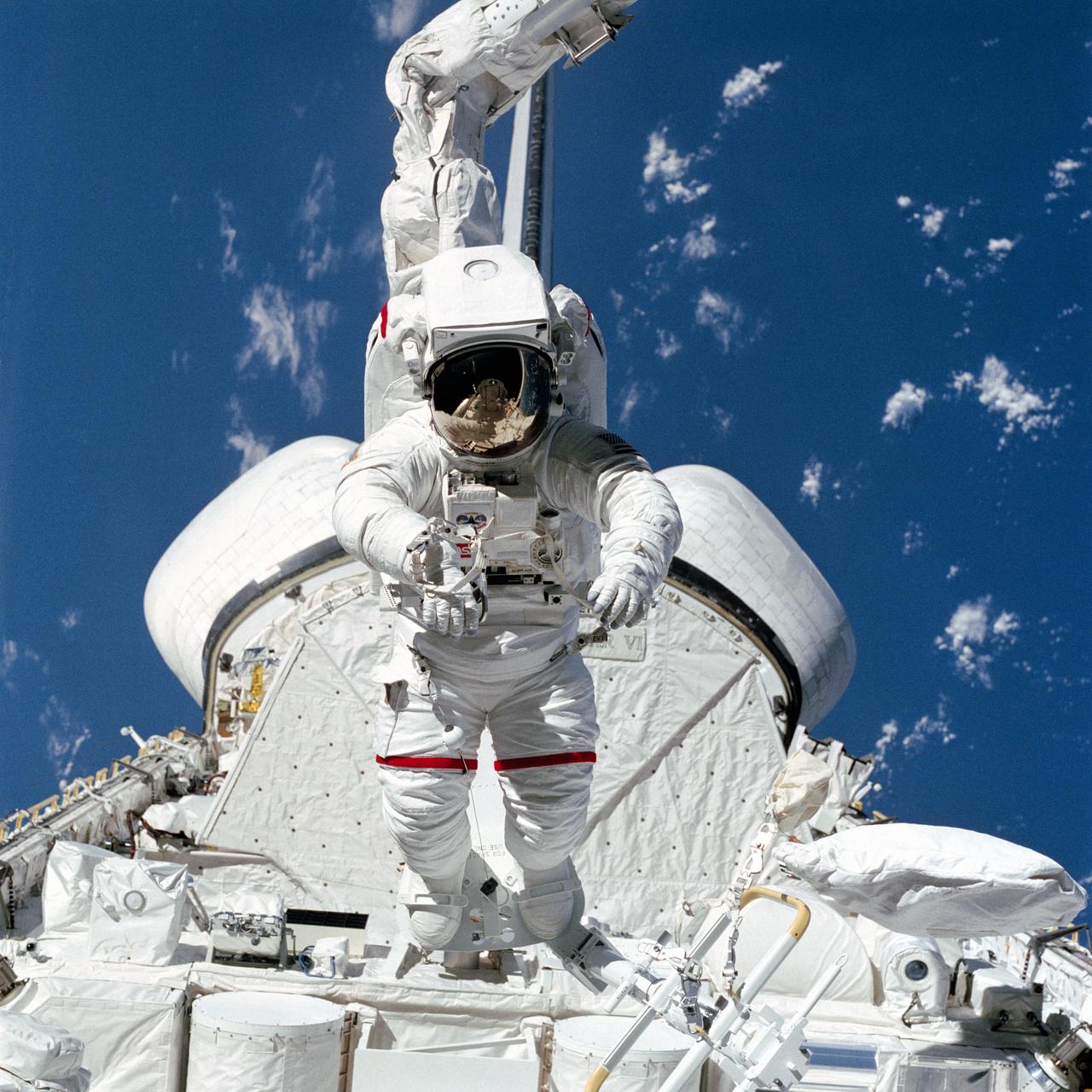
S84-27039 (7 Feb 1984) --- Astronaut Bruce McCandless II, at first glance appears to be walking on cargo in the Space Shuttle Challenger's payload bay. Actually, he is being "flown" around above the stationary cargo. His "flight" is due to the combined configuration of the Mobile Foot Restraint (MFR) and the Remote Manipulator System (RMS). His helmet visor reflects in miniature parts of the payload bay that can't be seen in the larger portion of the photo. A 70mm camera aimed through the aft flight deck windows exposed this frame.
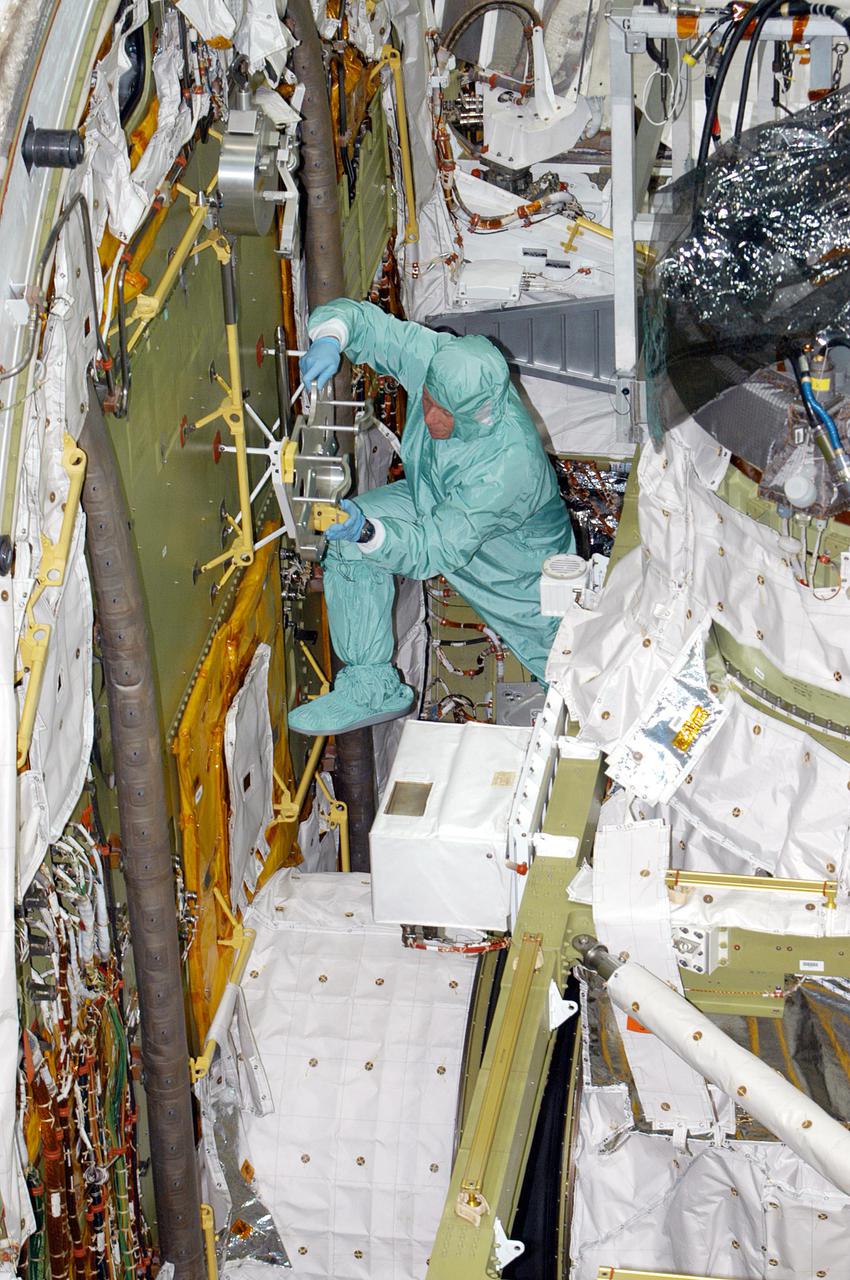
KENNEDY SPACE CENTER, FLA. - During Crew Equipment Interface Test (CEIT) in the Orbiter Processing Facility at NASA’s Kennedy Space Center, STS-121 Mission Specialist Michael E. Fossum familiarizes himself with the Portable Foot Restraint on the forward bulkhead of Atlantis. The Airlock is in the center. During CEIT, the crew has an opportunity to get a hands-on look at the orbiter and equipment they will be working with on their mission. Mission STS-121 is scheduled to launch aboard Space Shuttle Atlantis in July.
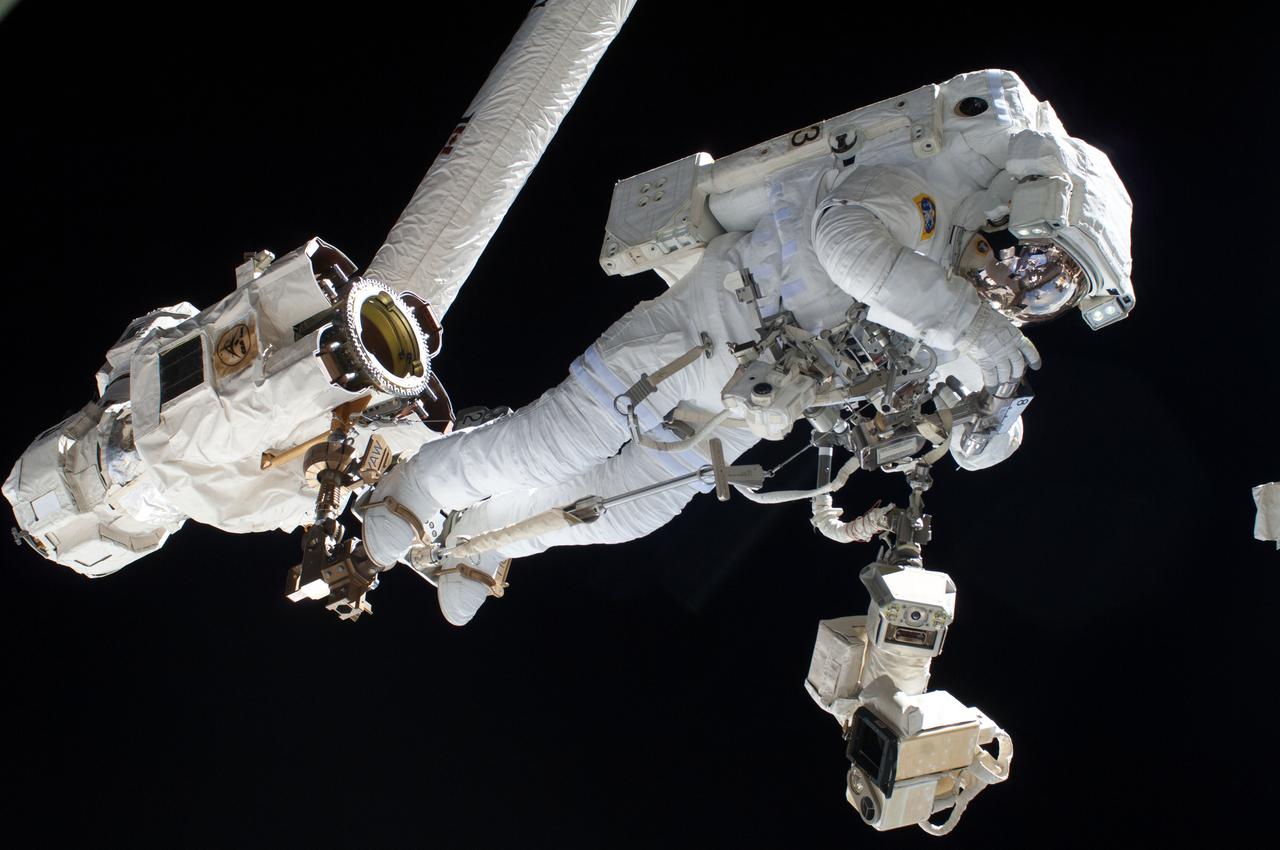
ISS036-E-016630 (9 July 2013) --- Anchored to a Canadarm2 mobile foot restraint, European Space Agency astronaut Luca Parmitano, Expedition 36 flight engineer, participates in a session of extravehicular activity (EVA) as work continues on the International Space Station. During the six-hour, seven-minute spacewalk, Parmitano and NASA astronaut Chris Cassidy (out of frame), flight engineer, prepared the space station for a new Russian module and performed additional installations on the station’s backbone.
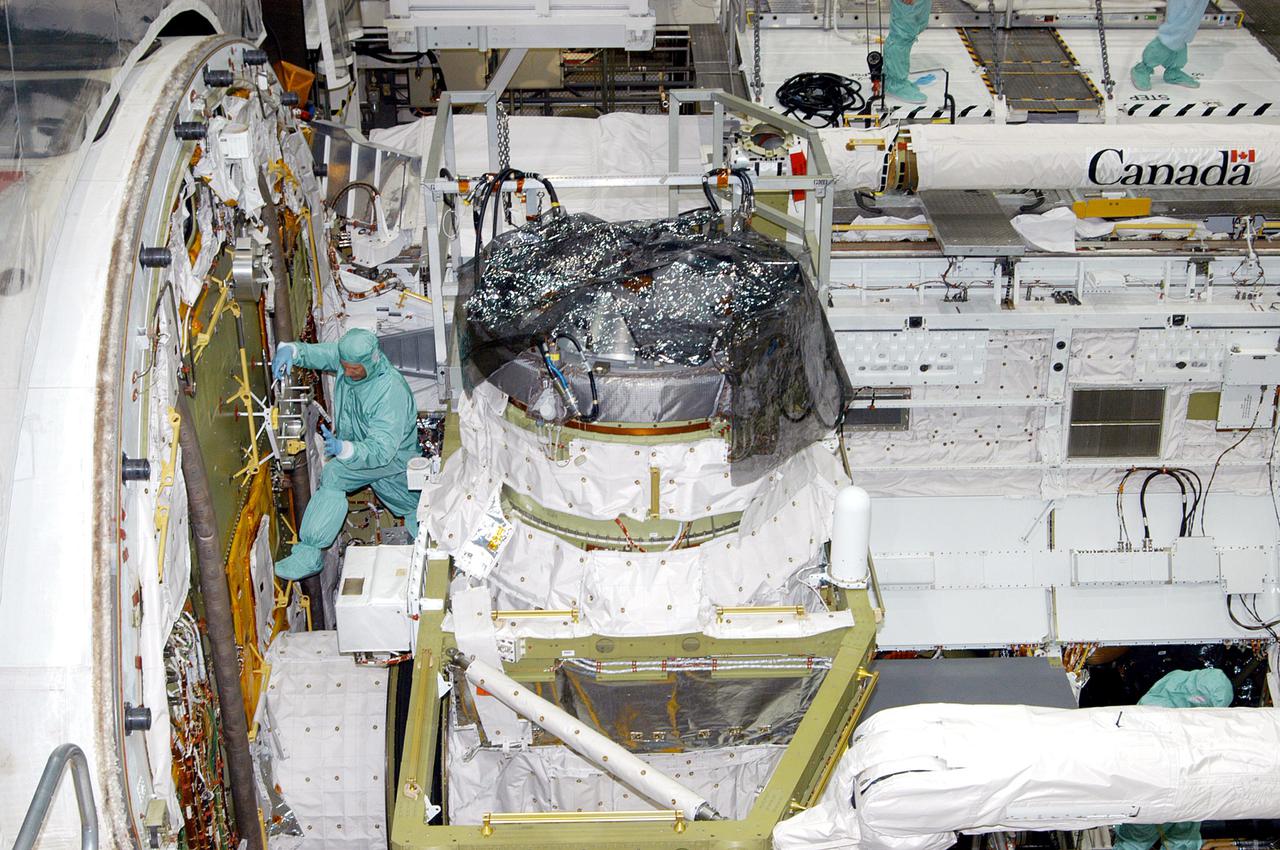
KENNEDY SPACE CENTER, FLA. - During Crew Equipment Interface Test (CEIT) in the Orbiter Processing Facility at NASA’s Kennedy Space Center, STS-121 Mission Specialist Michael E. Fossum familiarizes himself with the Portable Foot Restraint on the forward bulkhead of Atlantis. The Airlock is in the center. During CEIT, the crew has an opportunity to get a hands-on look at the orbiter and equipment they will be working with on their mission. Mission STS-121 is scheduled to launch aboard Space Shuttle Atlantis in July.
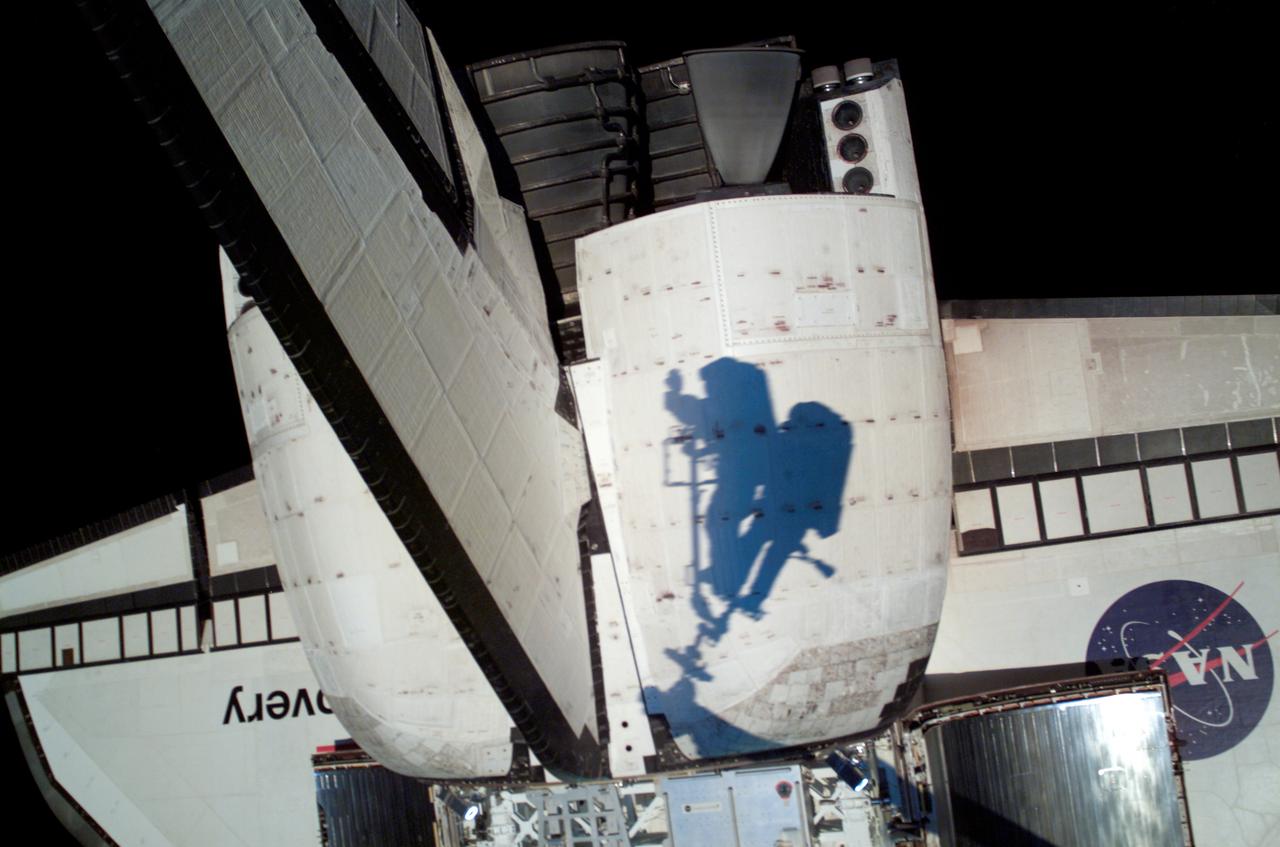
S121-E-06388 (8 July 2006) --- The shadows of astronauts Piers J. Sellers and Michael E. Fossum, two STS-121 mission specialists who are anchored to the Space Shuttle Discovery's Remote Manipulator System/Orbiter Boom Sensor System (RMS/OBSS) foot restraint, are visible against the port pod for the Orbital Maneuvering System on the shuttle. Photo credit: NASA
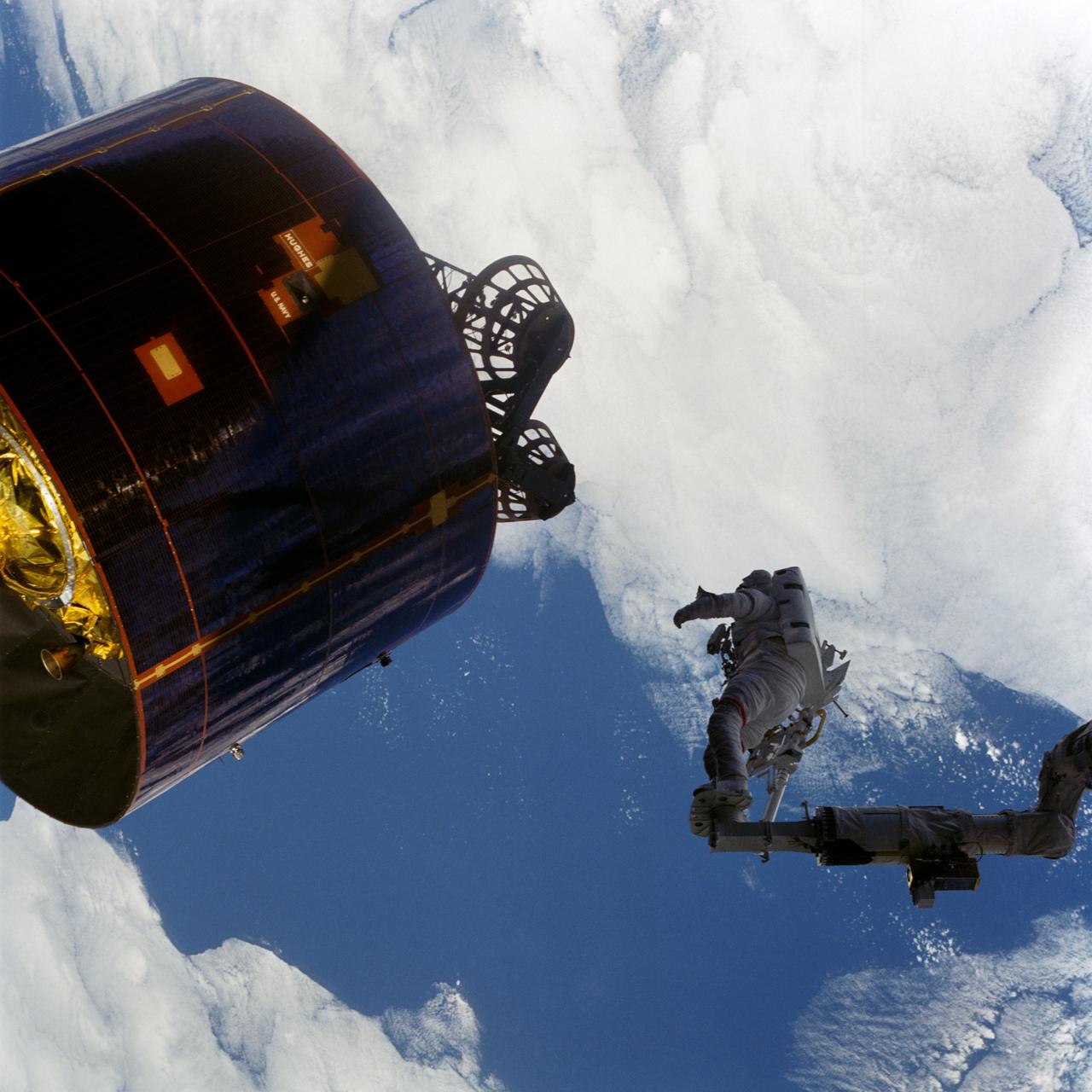
51I-44-012 (1 Sept. 1985) --- Astronaut James D. van Hoften looks on as the Syncom IVC-3 satellite responds to his push against it moments earlier. Dr. van Hoften, mission specialist, is anchored to a foot restraint on the end of the remote manipulator system (RMS) arm of the Earth-orbiting space shuttle Discovery. The 51-I crew members showed this photograph at their Sept. 11 postflight press conference. Photo credit: NASA
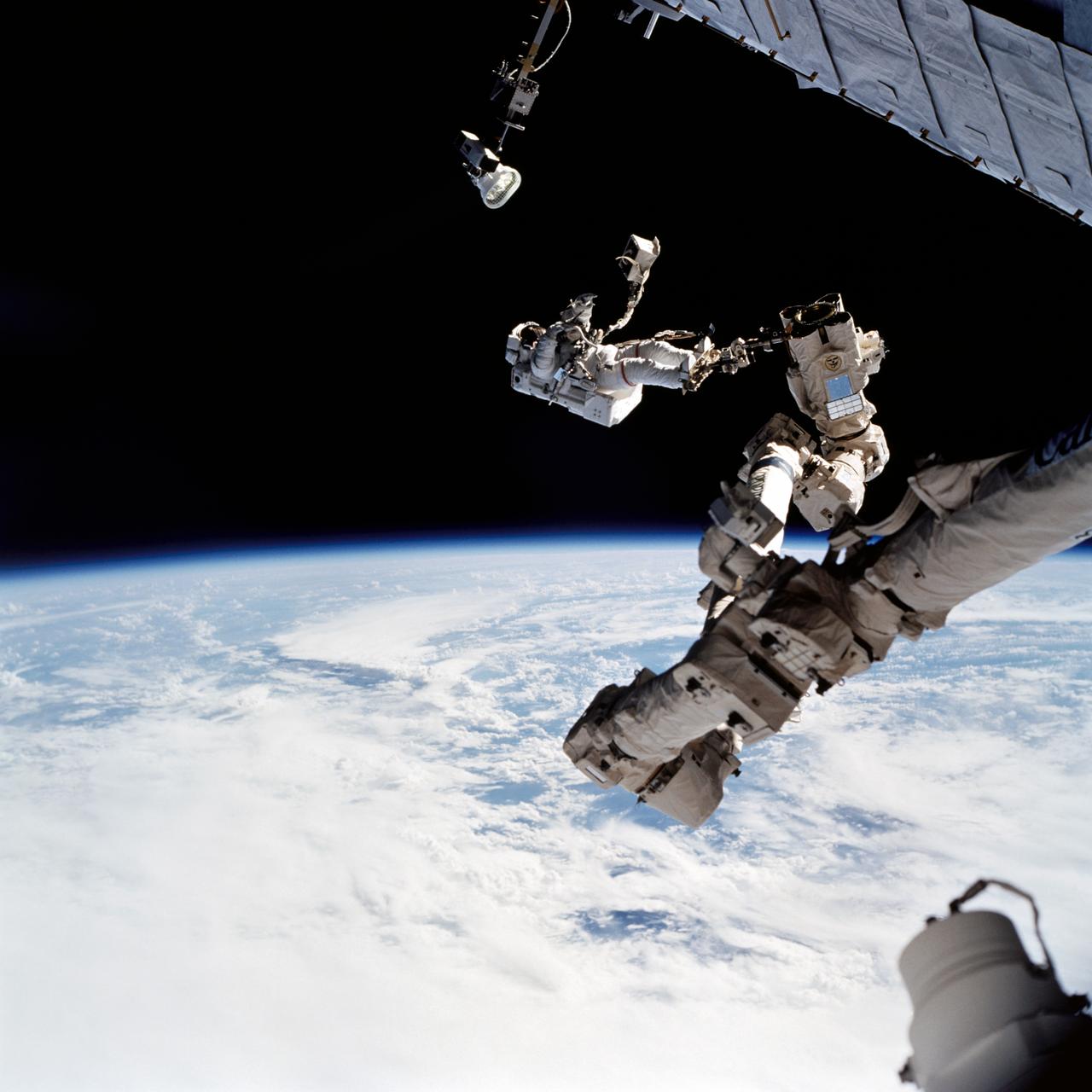
STS112-709-073N (10 October 2002) --- Astronaut David A. Wolf, STS-112 mission specialist, anchored to a foot restraint on the Space Station Remote Manipulator System (SSRMS) or Canadarm2, carries the Starboard One (S1) outboard nadir external camera. The camera was installed on the end of the S1 Truss on the International Space Station (ISS) during the mission’s first scheduled session of extravehicular activity (EVA).