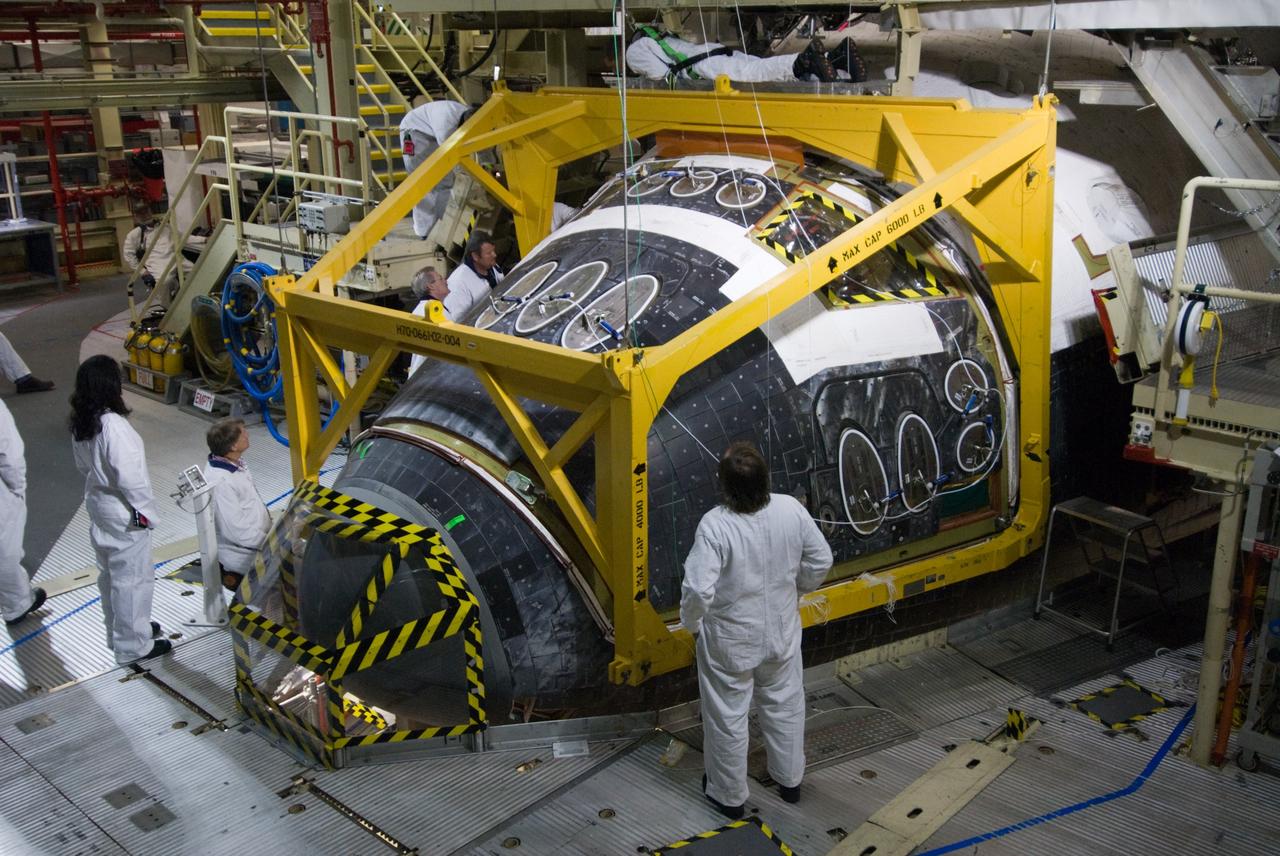
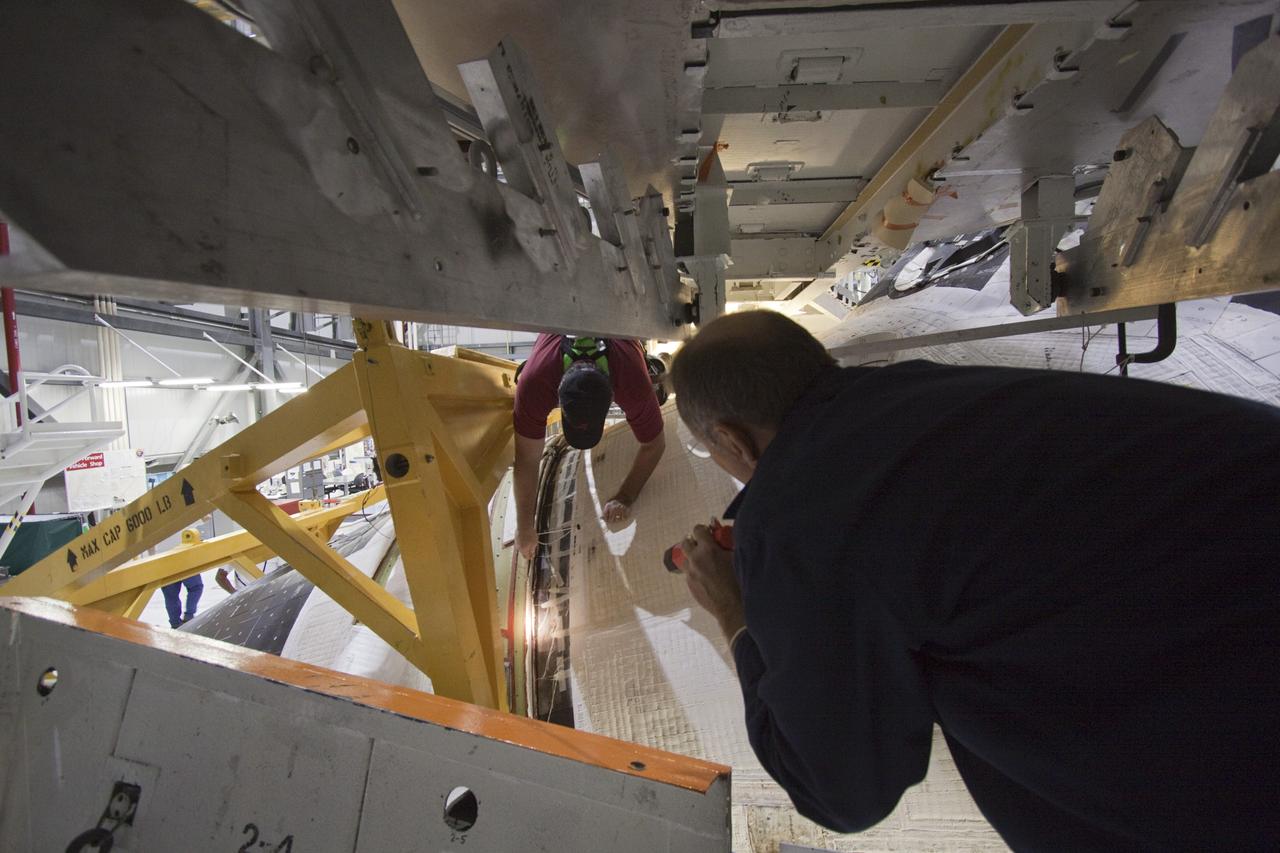
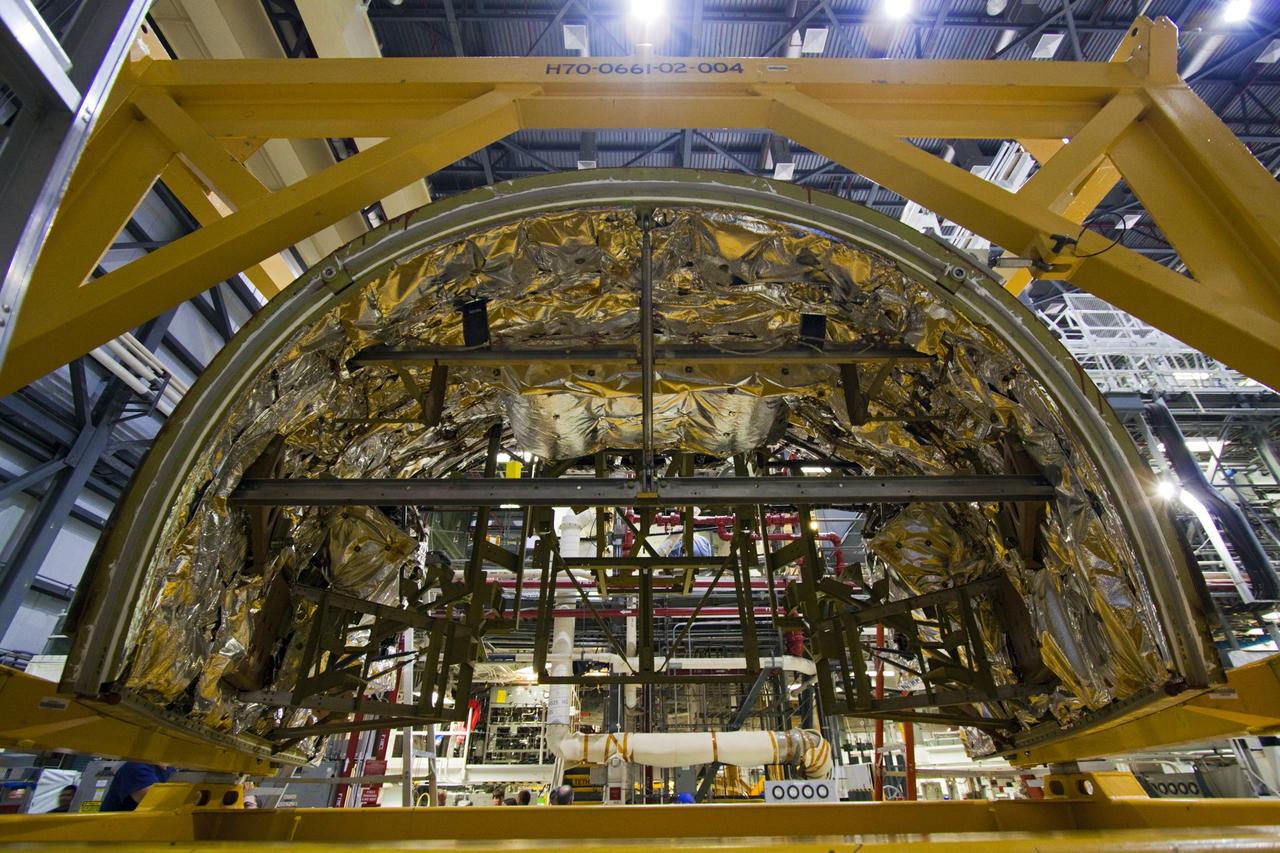
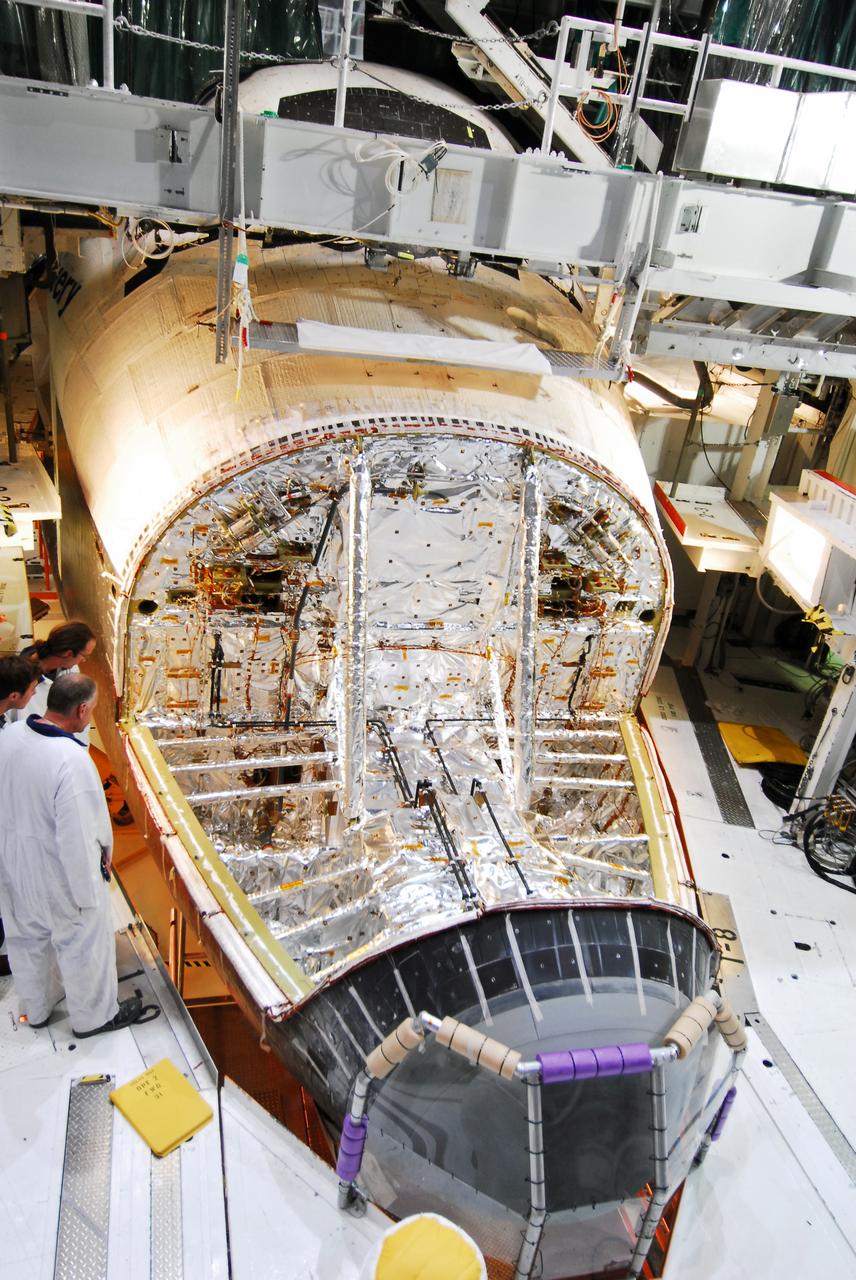
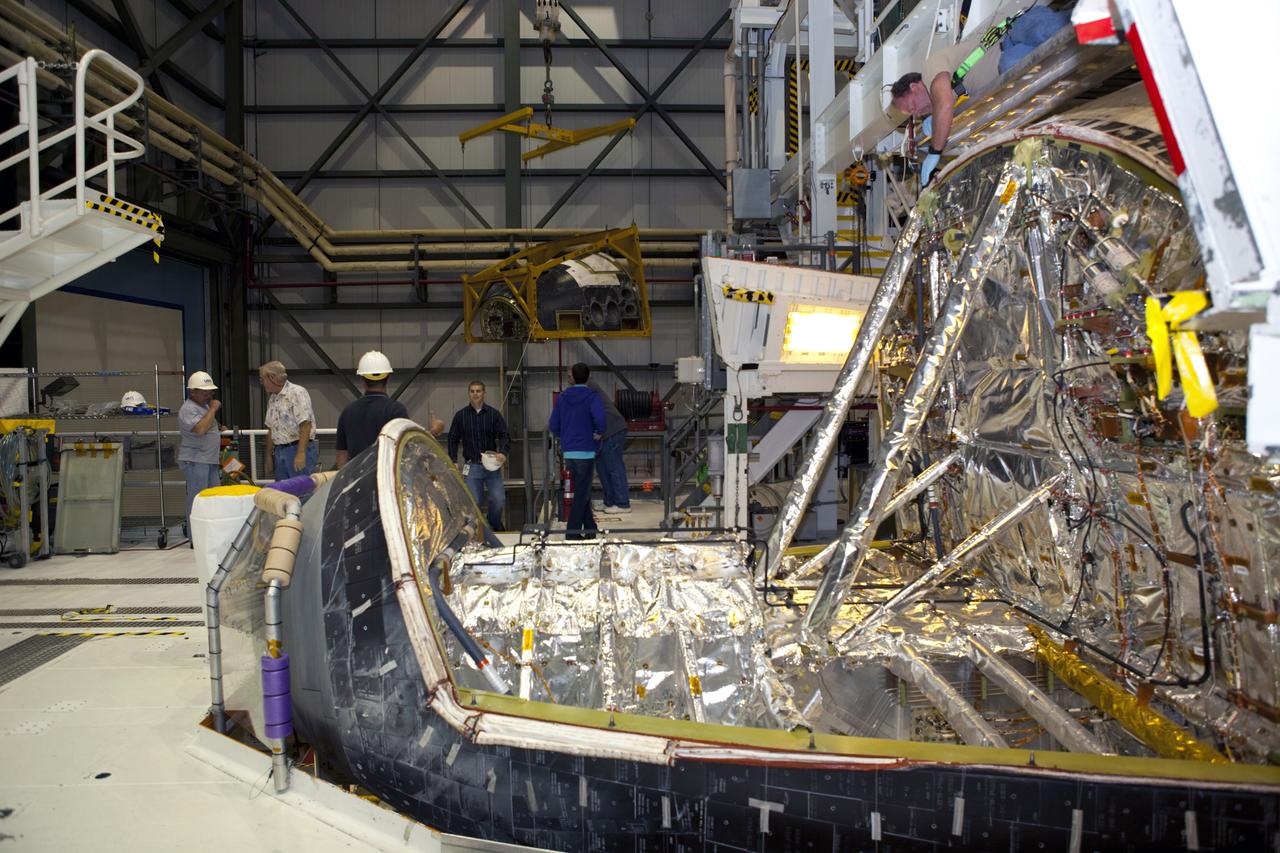
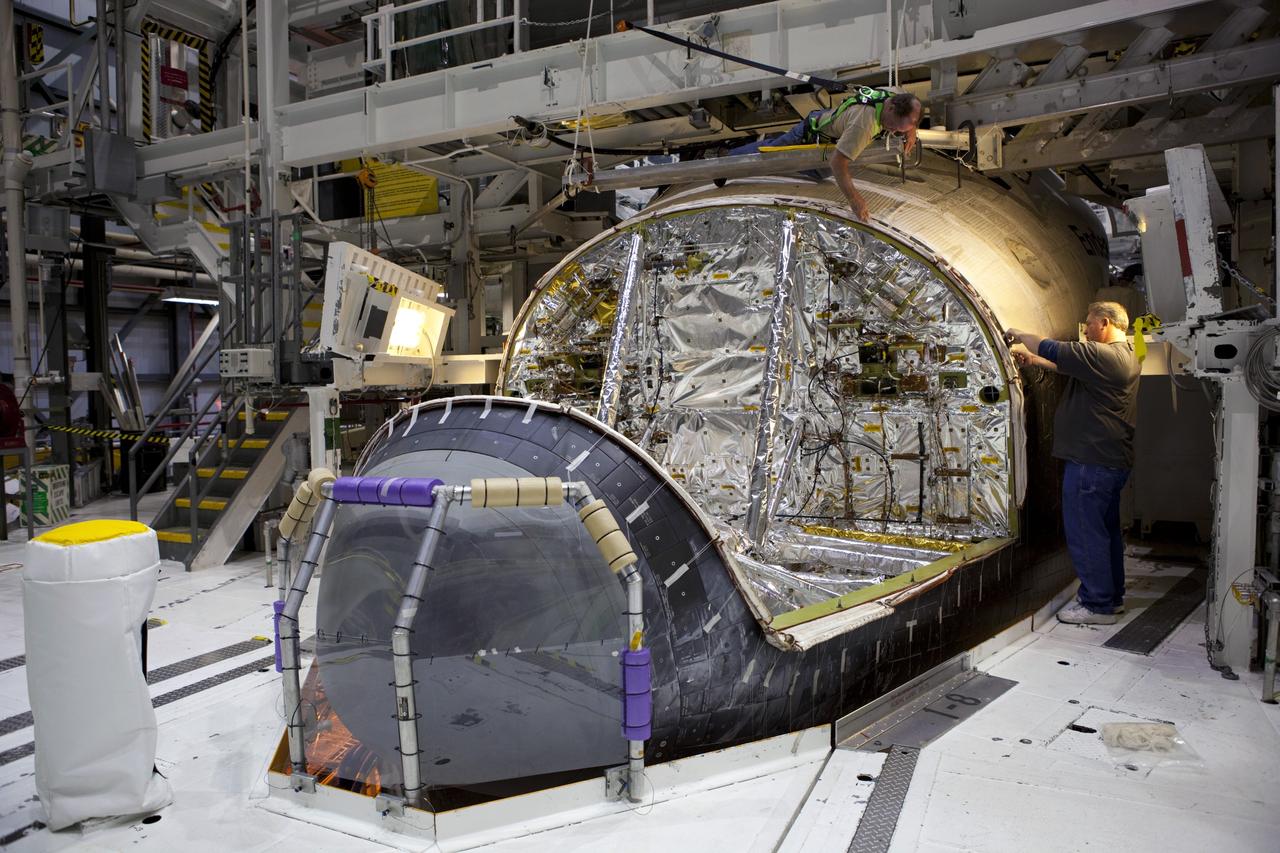
CAPE CANAVERAL, Fla. - In Orbiter Processing Facility Bay 3 at NASA's Kennedy Space Center in Florida, space shuttle Discovery's Forward Reaction Control System, or FRCS, has been returned to its proper place on the shuttle's frame. The FRCS is being reinstalled in the forward fuselage nose area of the shuttle after refurbishment. The FRCS provides the thrust for attitude (rotational) maneuvers (pitch, yaw and roll) and for small velocity changes along the orbiter axis (translation maneuvers). Discovery is being prepared for the STS-131 mission, the 33rd flight to the International Space Station. The seven-member STS-131 crew will deliver a Multi-Purpose Logistics Module filled with resupply stowage platforms and racks to be transferred to locations around the station. Three spacewalks will include work to attach a spare ammonia tank assembly to the station's exterior and return a European experiment from outside the station's Columbus module. Discovery's launch is targeted for March 18, 2010. For information on the STS-131 mission and crew, visit http://www.nasa.gov/mission_pages/shuttle/shuttlemissions/sts131/index.html. Photo credit: NASA/Amanda Diller

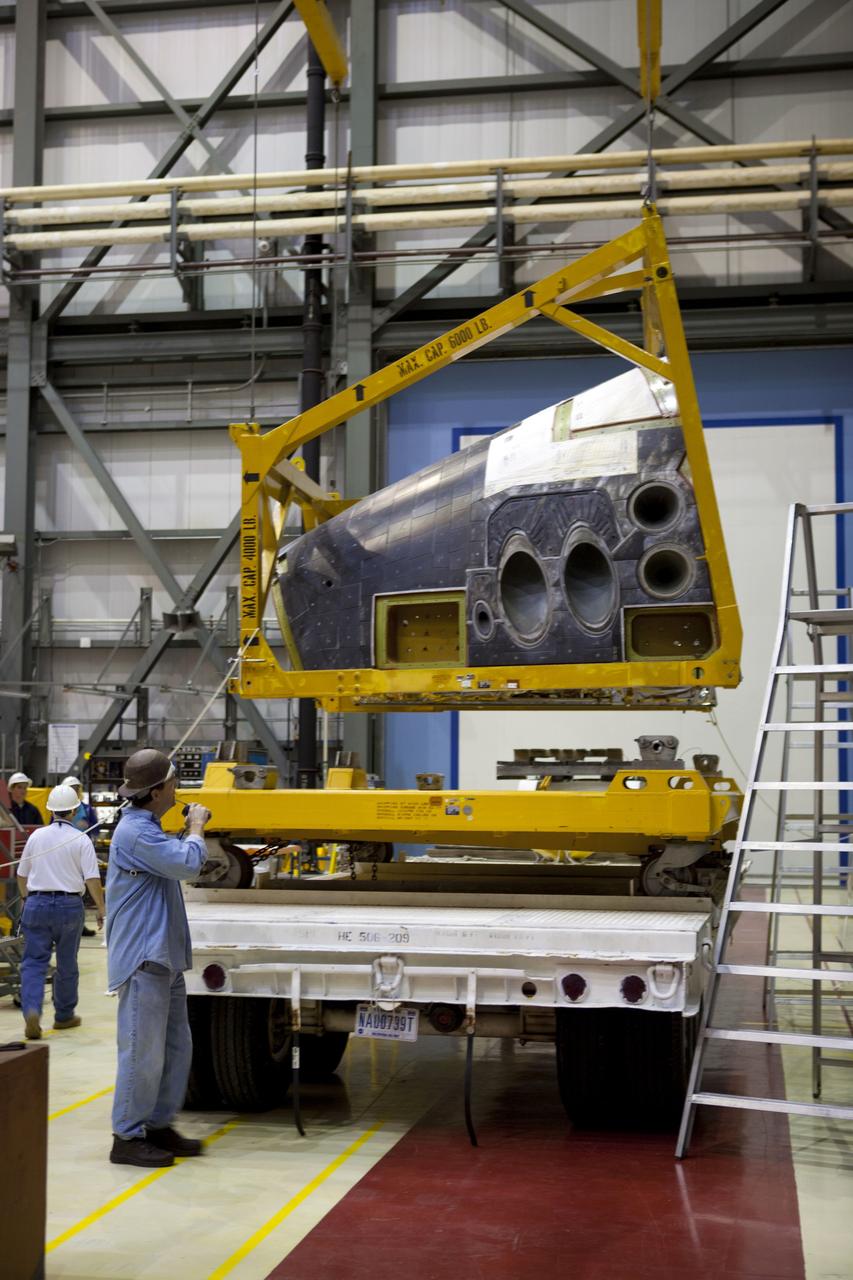
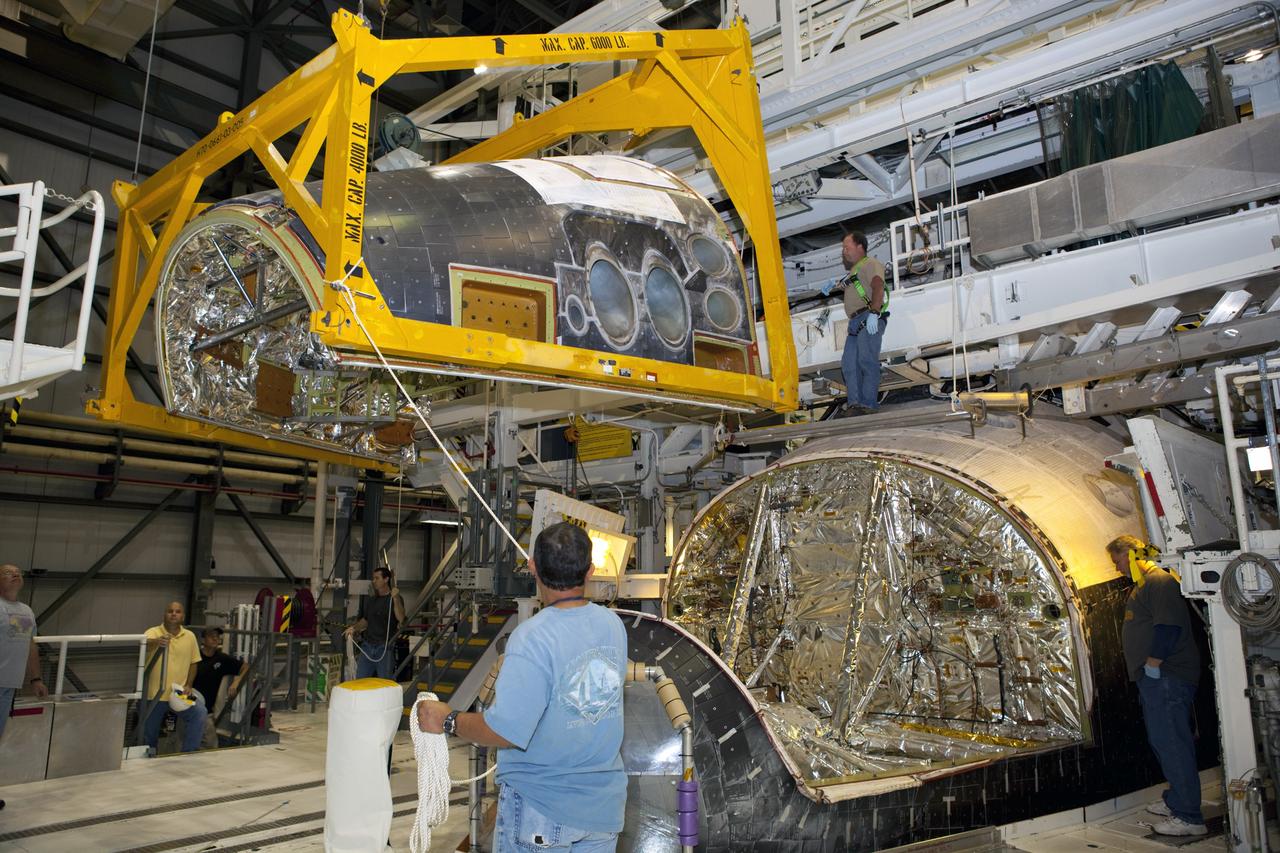
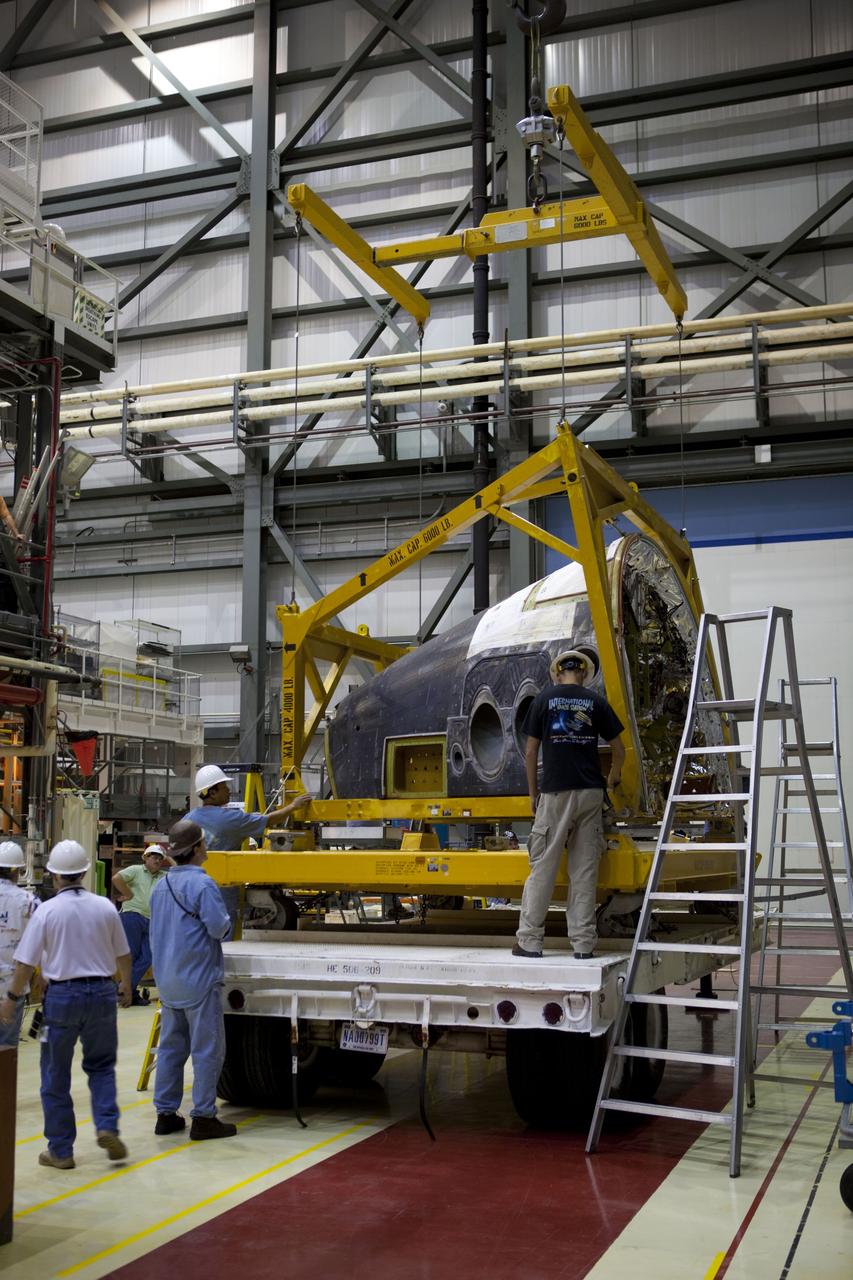
CAPE CANAVERAL, Fla. - In Orbiter Processing Facility Bay 3 at NASA's Kennedy Space Center in Florida, United Space Alliance technicians prepare to lift space shuttle Discovery's Forward Reaction Control System, or FRCS, from its transporter. The FRCS is being reinstalled in the forward fuselage nose area of the shuttle after refurbishment. The FRCS provides the thrust for attitude (rotational) maneuvers (pitch, yaw and roll) and for small velocity changes along the orbiter axis (translation maneuvers). Discovery is being prepared for the STS-131 mission, the 33rd flight to the International Space Station. The seven-member STS-131 crew will deliver a Multi-Purpose Logistics Module filled with resupply stowage platforms and racks to be transferred to locations around the station. Three spacewalks will include work to attach a spare ammonia tank assembly to the station's exterior and return a European experiment from outside the station's Columbus module. Discovery's launch is targeted for March 18, 2010. For information on the STS-131 mission and crew, visit http://www.nasa.gov/mission_pages/shuttle/shuttlemissions/sts131/index.html. Photo credit: NASA/Amanda Diller
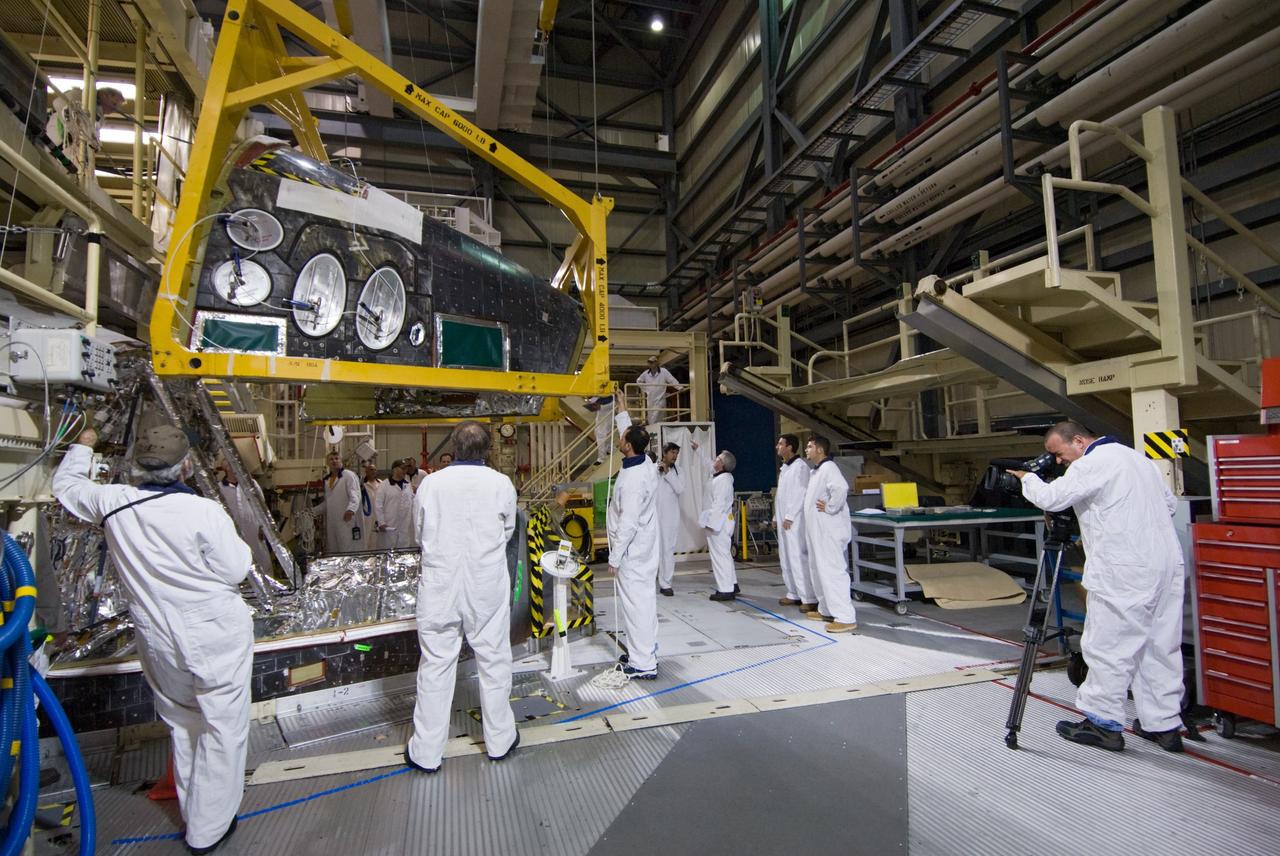
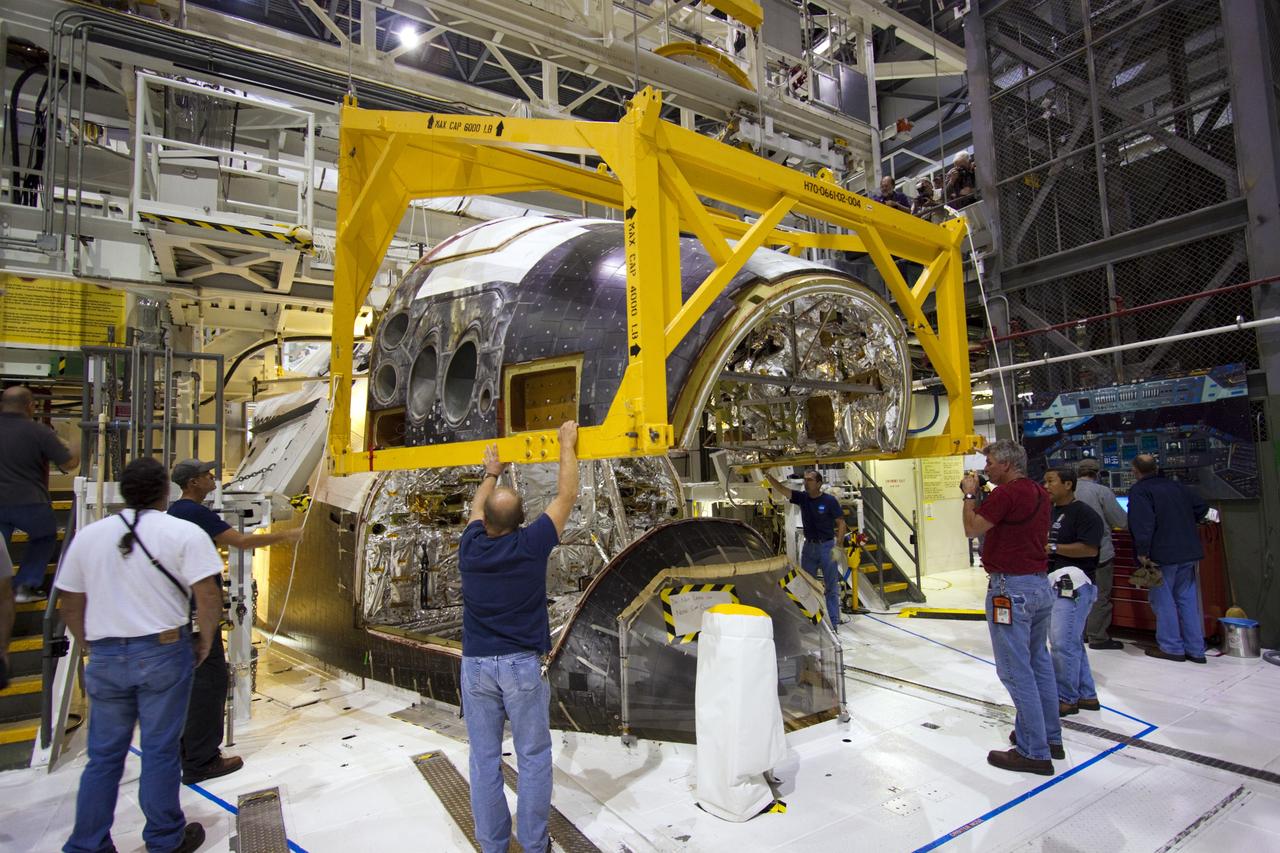
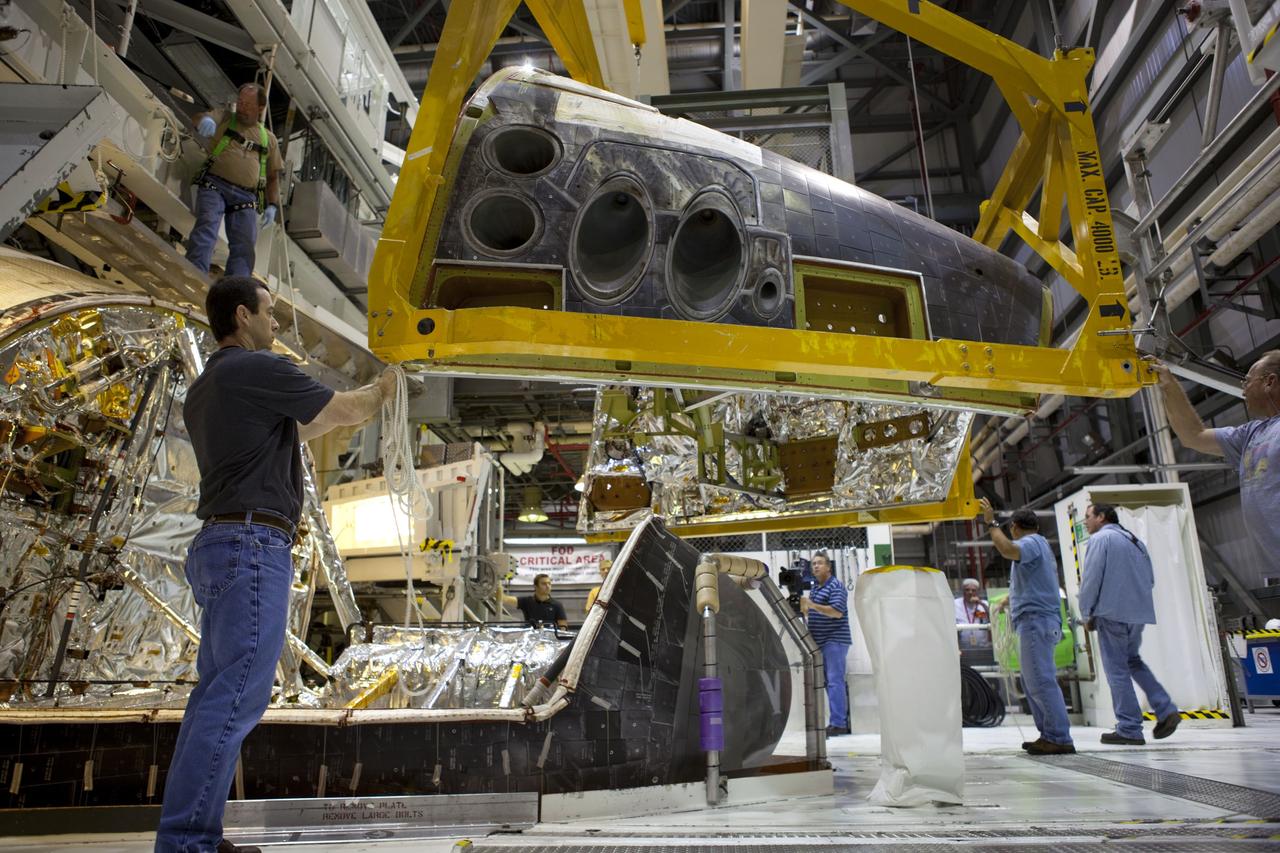
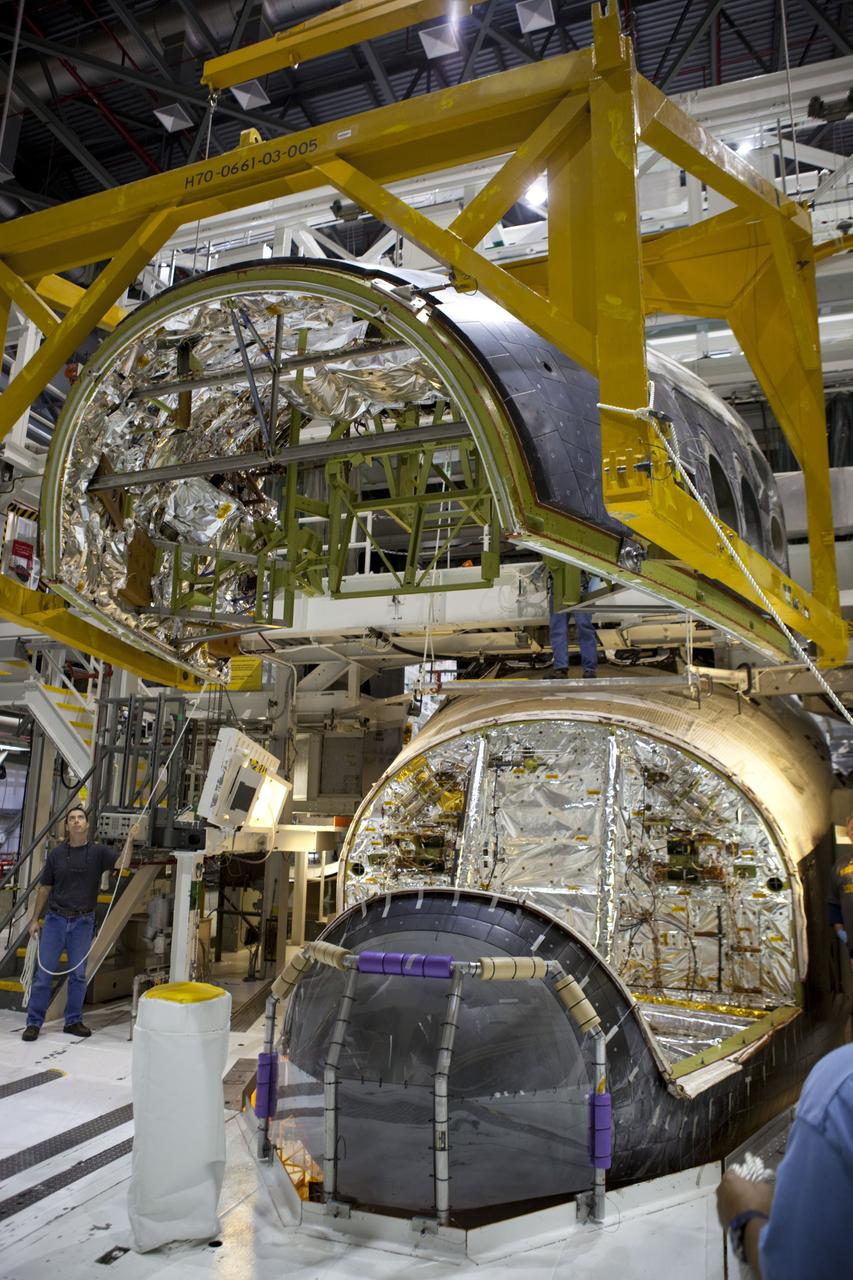
CAPE CANAVERAL, Fla. - In Orbiter Processing Facility Bay 3 at NASA's Kennedy Space Center in Florida, United Space Alliance technicians lower space shuttle Discovery's Forward Reaction Control System, or FRCS, into position over the shuttle's frame. The FRCS is being reinstalled in the forward fuselage nose area of the shuttle after refurbishment. The FRCS provides the thrust for attitude (rotational) maneuvers (pitch, yaw and roll) and for small velocity changes along the orbiter axis (translation maneuvers). Discovery is being prepared for the STS-131 mission, the 33rd flight to the International Space Station. The seven-member STS-131 crew will deliver a Multi-Purpose Logistics Module filled with resupply stowage platforms and racks to be transferred to locations around the station. Three spacewalks will include work to attach a spare ammonia tank assembly to the station's exterior and return a European experiment from outside the station's Columbus module. Discovery's launch is targeted for March 18, 2010. For information on the STS-131 mission and crew, visit http://www.nasa.gov/mission_pages/shuttle/shuttlemissions/sts131/index.html. Photo credit: NASA/Amanda Diller

CAPE CANAVERAL, Fla. - In Orbiter Processing Facility Bay 3 at NASA's Kennedy Space Center in Florida, United Space Alliance technicians move space shuttle Discovery's Forward Reaction Control System, or FRCS, toward it. The FRCS is being reinstalled in the forward fuselage nose area of the shuttle after refurbishment. The FRCS provides the thrust for attitude (rotational) maneuvers (pitch, yaw and roll) and for small velocity changes along the orbiter axis (translation maneuvers). Discovery is being prepared for the STS-131 mission, the 33rd flight to the International Space Station. The seven-member STS-131 crew will deliver a Multi-Purpose Logistics Module filled with resupply stowage platforms and racks to be transferred to locations around the station. Three spacewalks will include work to attach a spare ammonia tank assembly to the station's exterior and return a European experiment from outside the station's Columbus module. Discovery's launch is targeted for March 18, 2010. For information on the STS-131 mission and crew, visit http://www.nasa.gov/mission_pages/shuttle/shuttlemissions/sts131/index.html. Photo credit: NASA/Amanda Diller
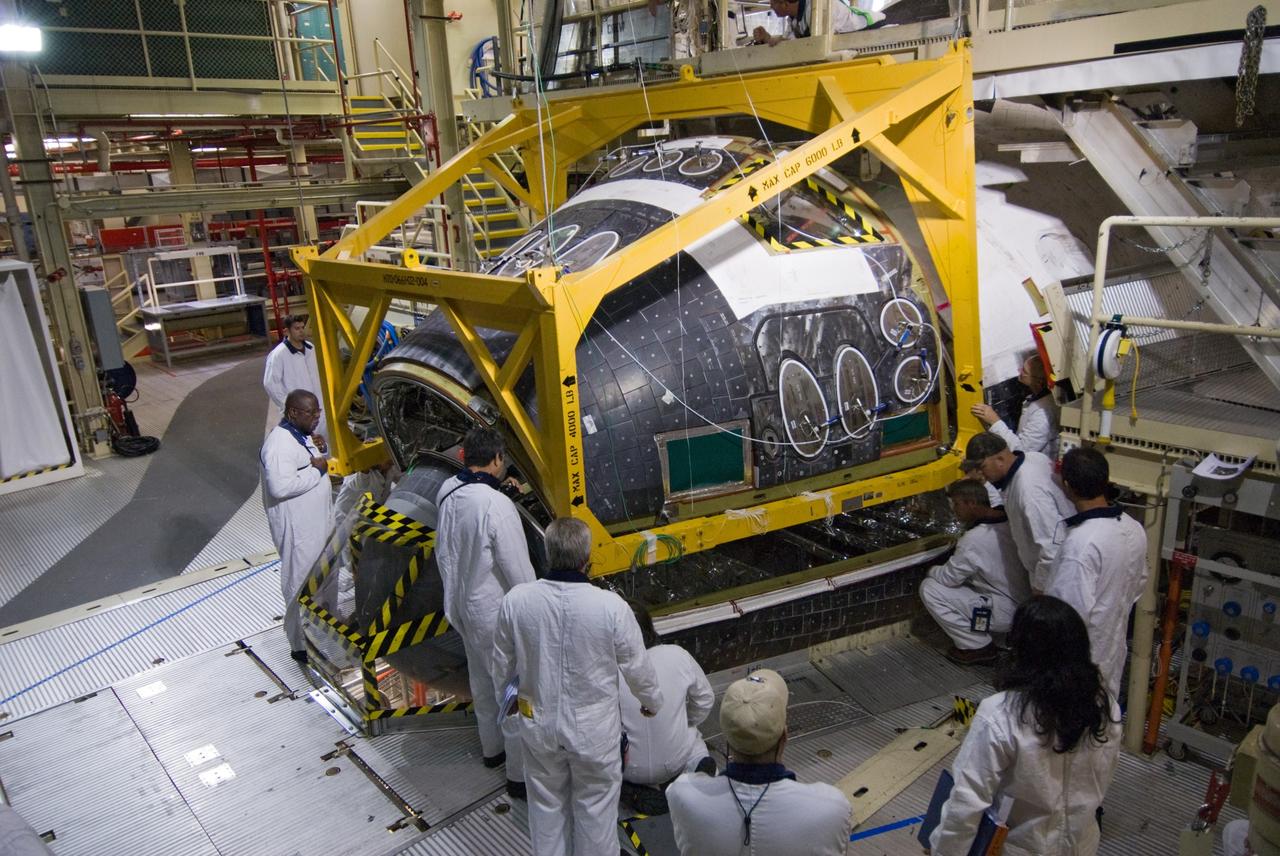
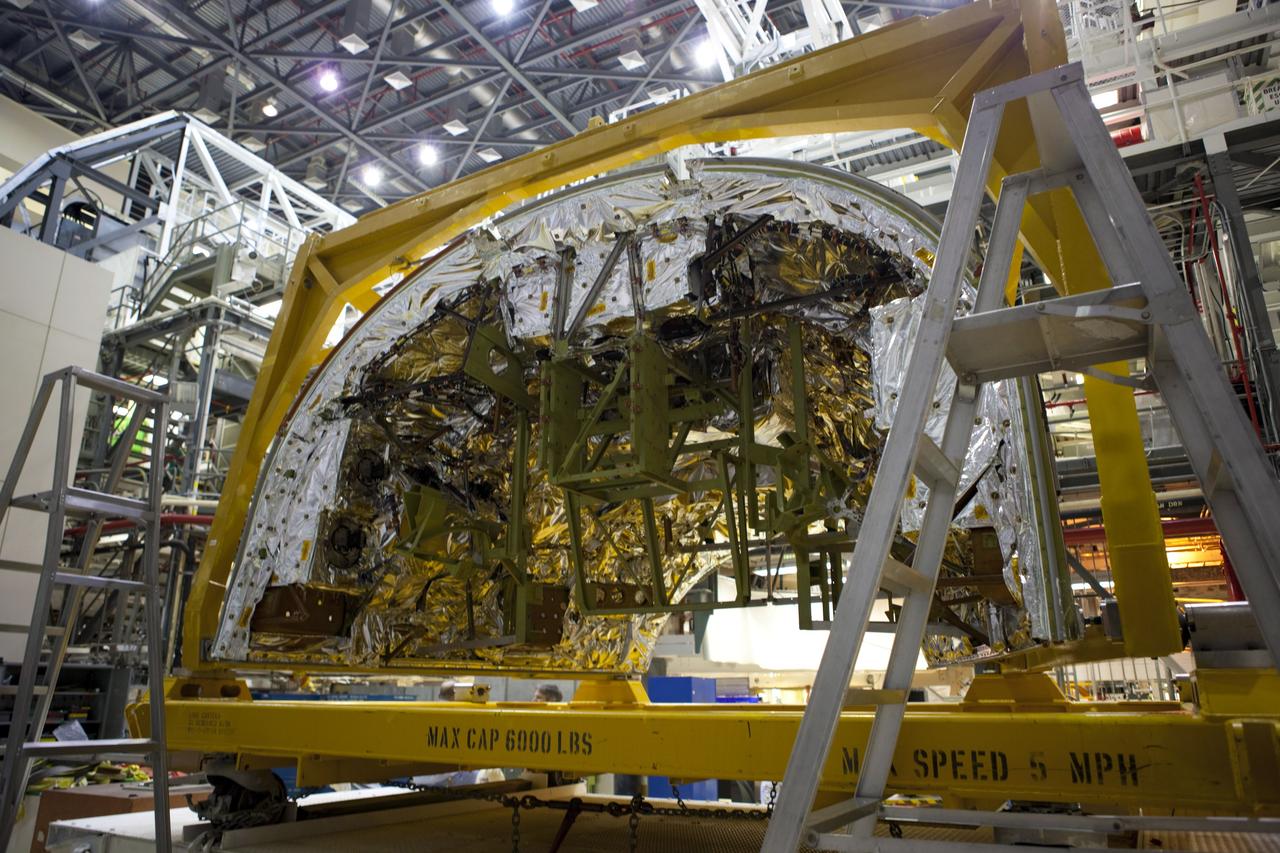
CAPE CANAVERAL, Fla. - In Orbiter Processing Facility Bay 3 at NASA's Kennedy Space Center in Florida, United Space Alliance technicians align space shuttle Discovery's Forward Reaction Control System, or FRCS, into position on the shuttle's frame. The FRCS is being reinstalled in the forward fuselage nose area of the shuttle after refurbishment. The FRCS provides the thrust for attitude (rotational) maneuvers (pitch, yaw and roll) and for small velocity changes along the orbiter axis (translation maneuvers). Discovery is being prepared for the STS-131 mission, the 33rd flight to the International Space Station. The seven-member STS-131 crew will deliver a Multi-Purpose Logistics Module filled with resupply stowage platforms and racks to be transferred to locations around the station. Three spacewalks will include work to attach a spare ammonia tank assembly to the station's exterior and return a European experiment from outside the station's Columbus module. Discovery's launch is targeted for March 18, 2010. For information on the STS-131 mission and crew, visit http://www.nasa.gov/mission_pages/shuttle/shuttlemissions/sts131/index.html. Photo credit: NASA/Amanda Diller

CAPE CANAVERAL, Fla. - In Orbiter Processing Facility Bay 3 at NASA's Kennedy Space Center in Florida, United Space Alliance technicians prepare lift space shuttle Discovery's Forward Reaction Control System, or FRCS, from its transporter. The FRCS is being reinstalled in the forward fuselage nose area of the shuttle after refurbishment. The FRCS provides the thrust for attitude (rotational) maneuvers (pitch, yaw and roll) and for small velocity changes along the orbiter axis (translation maneuvers). Discovery is being prepared for the STS-131 mission, the 33rd flight to the International Space Station. The seven-member STS-131 crew will deliver a Multi-Purpose Logistics Module filled with resupply stowage platforms and racks to be transferred to locations around the station. Three spacewalks will include work to attach a spare ammonia tank assembly to the station's exterior and return a European experiment from outside the station's Columbus module. Discovery's launch is targeted for March 18, 2010. For information on the STS-131 mission and crew, visit http://www.nasa.gov/mission_pages/shuttle/shuttlemissions/sts131/index.html. Photo credit: NASA/Amanda Diller
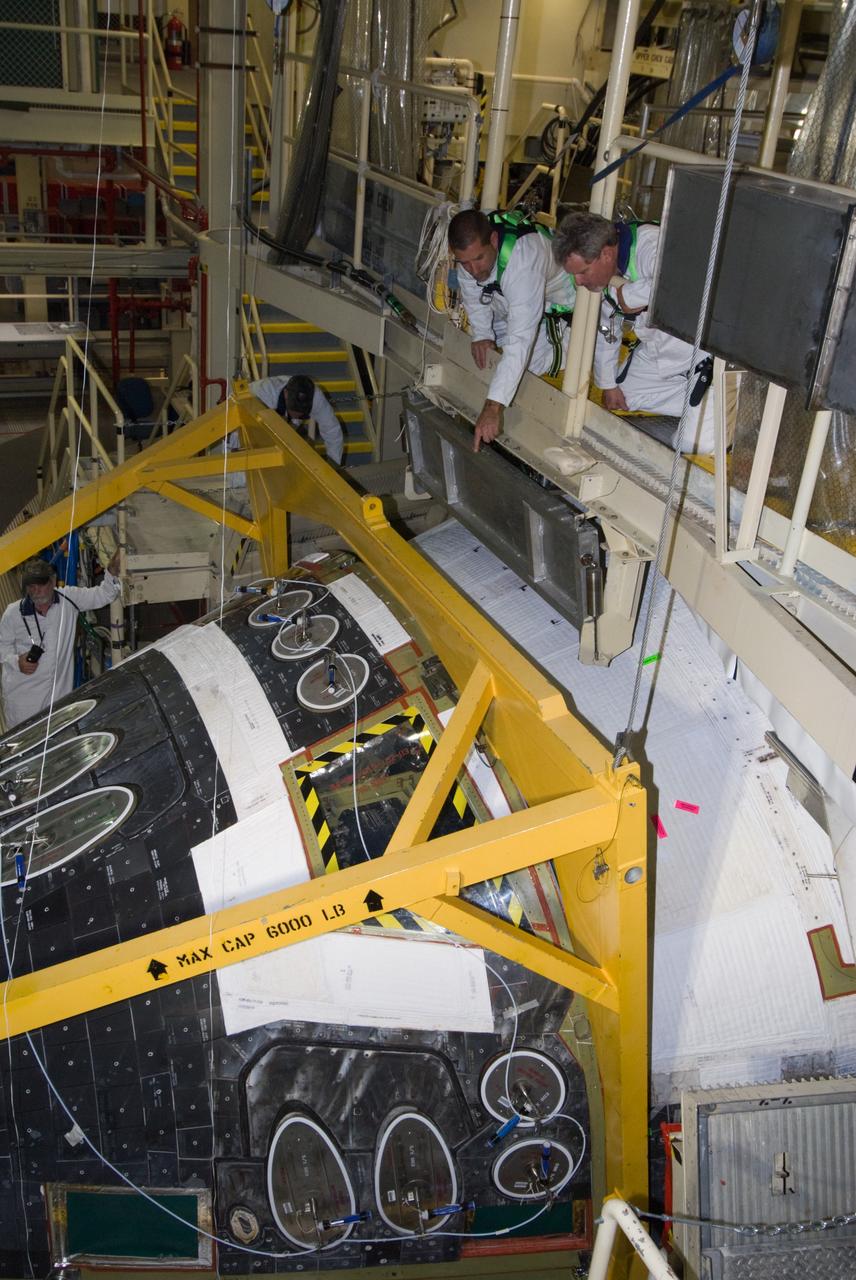
CAPE CANAVERAL, Fla. - In Orbiter Processing Facility Bay 3 at NASA's Kennedy Space Center in Florida, United Space Alliance technicians check the alignment of space shuttle Discovery's Forward Reaction Control System, or FRCS, onto the shuttle's frame. The FRCS is being reinstalled in the forward fuselage nose area of the shuttle after refurbishment. The FRCS provides the thrust for attitude (rotational) maneuvers (pitch, yaw and roll) and for small velocity changes along the orbiter axis (translation maneuvers). Discovery is being prepared for the STS-131 mission, the 33rd flight to the International Space Station. The seven-member STS-131 crew will deliver a Multi-Purpose Logistics Module filled with resupply stowage platforms and racks to be transferred to locations around the station. Three spacewalks will include work to attach a spare ammonia tank assembly to the station's exterior and return a European experiment from outside the station's Columbus module. Discovery's launch is targeted for March 18, 2010. For information on the STS-131 mission and crew, visit http://www.nasa.gov/mission_pages/shuttle/shuttlemissions/sts131/index.html. Photo credit: NASA/Amanda Diller

CAPE CANAVERAL, Fla. - At NASA's Kennedy Space Center in Florida, the Forward Reaction Control System, or FRCS, for space shuttle Discovery arrives at Orbiter Processing Facility Bay 3. Discovery is being prepared for the STS-131 mission, the 33rd flight to the International Space Station. The FRCS provides the thrust for attitude (rotational) maneuvers (pitch, yaw and roll) and for small velocity changes along the orbiter axis (translation maneuvers). The seven-member STS-131 crew will deliver a Multi-Purpose Logistics Module filled with resupply stowage platforms and racks to be transferred to locations around the station. Three spacewalks will include work to attach a spare ammonia tank assembly to the station's exterior and return a European experiment from outside the station's Columbus module. Discovery's launch is targeted for March 18, 2010. For information on the STS-131 mission and crew, visit http://www.nasa.gov/mission_pages/shuttle/shuttlemissions/sts131/index.html. Photo credit: NASA/Jack Pfaller
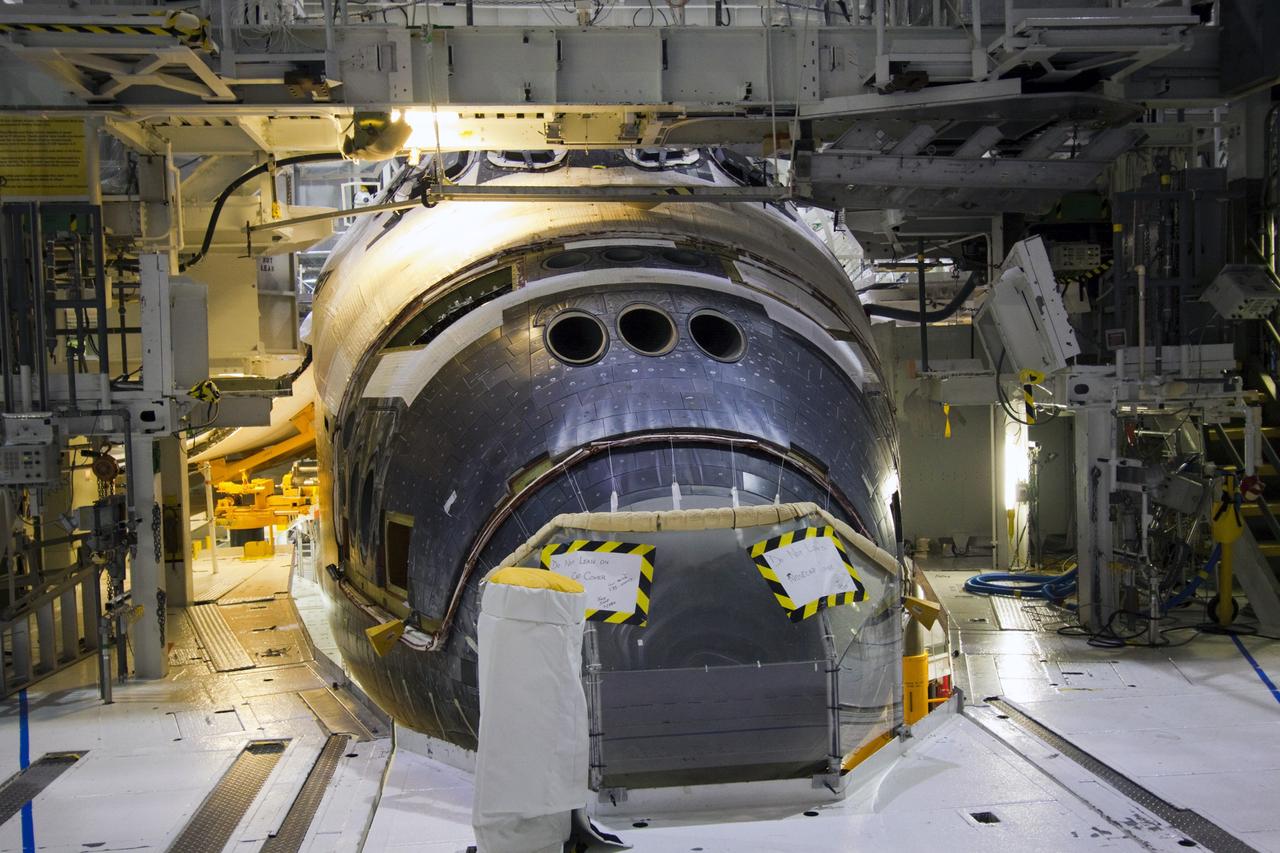
CAPE CANAVERAL, Fla. -- Inside Orbiter Processing Facility-1 at NASA’s Kennedy Space Center in Florida, the forward reaction control system (FRCS) is installed on space shuttle Discovery. The FRCS was returned from White Sands Space Harbor in New Mexico where it underwent a complete deservicing and cleaning. The work is part of the Space Shuttle Program’s transition and retirement processing of shuttle Discovery. Discovery is being prepared for display at Smithsonian’s National Air and Space Museum, Steven F. Udvar-Hazy Center in Chantilly, Va. For more information, visit http://www.nasa.gov/shuttle. Photo credit: NASA/Jim Grossmann
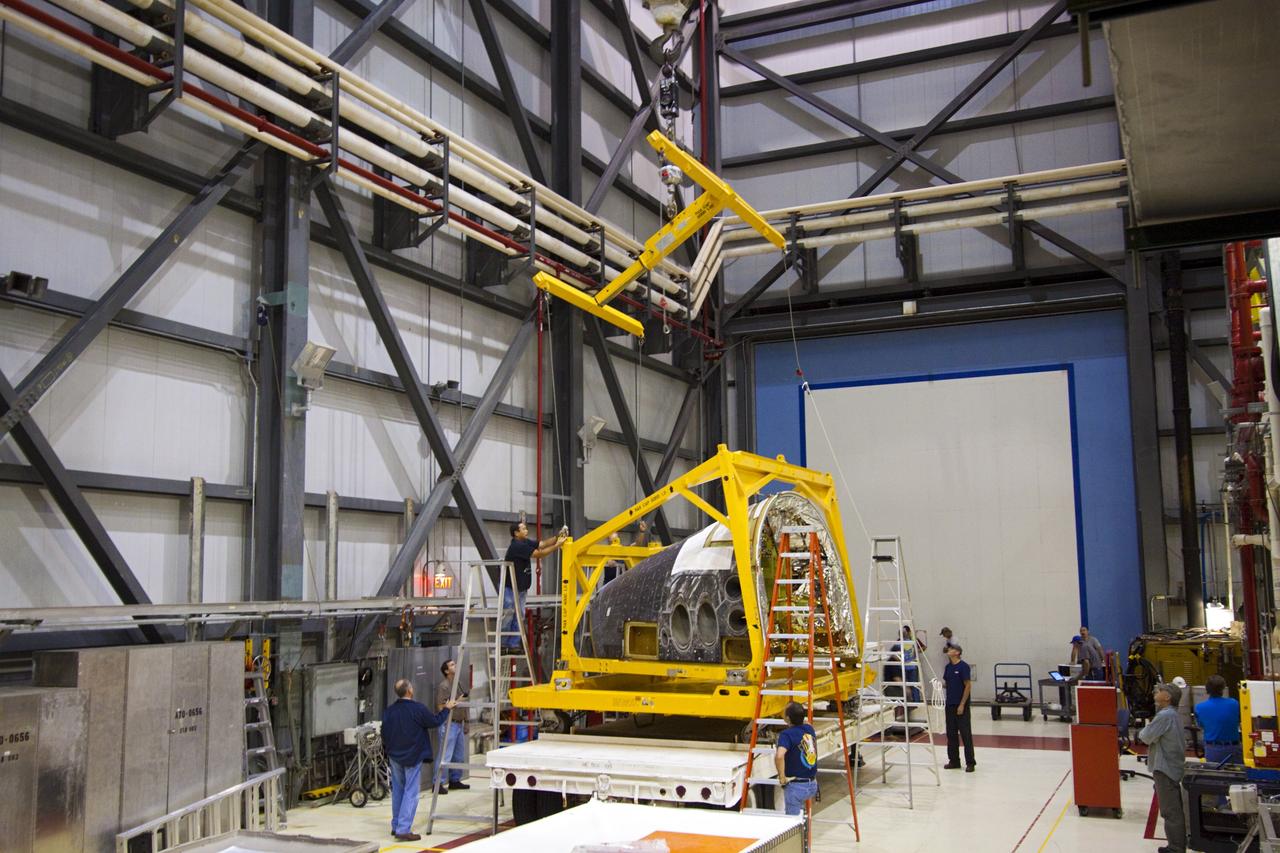
CAPE CANAVERAL, Fla. -- Inside Orbiter Processing Facility-1 at NASA’s Kennedy Space Center in Florida, technicians ready the forward reaction control system (FRCS) for installation on space shuttle Discovery. The FRCS was returned from White Sands Space Harbor in New Mexico where it underwent a complete deservicing and cleaning. The work is part of the Space Shuttle Program’s transition and retirement processing of shuttle Discovery. Discovery is being prepared for display at Smithsonian’s National Air and Space Museum, Steven F. Udvar-Hazy Center in Chantilly, Va. For more information, visit http://www.nasa.gov/shuttle. Photo credit: NASA/Jim Grossmann
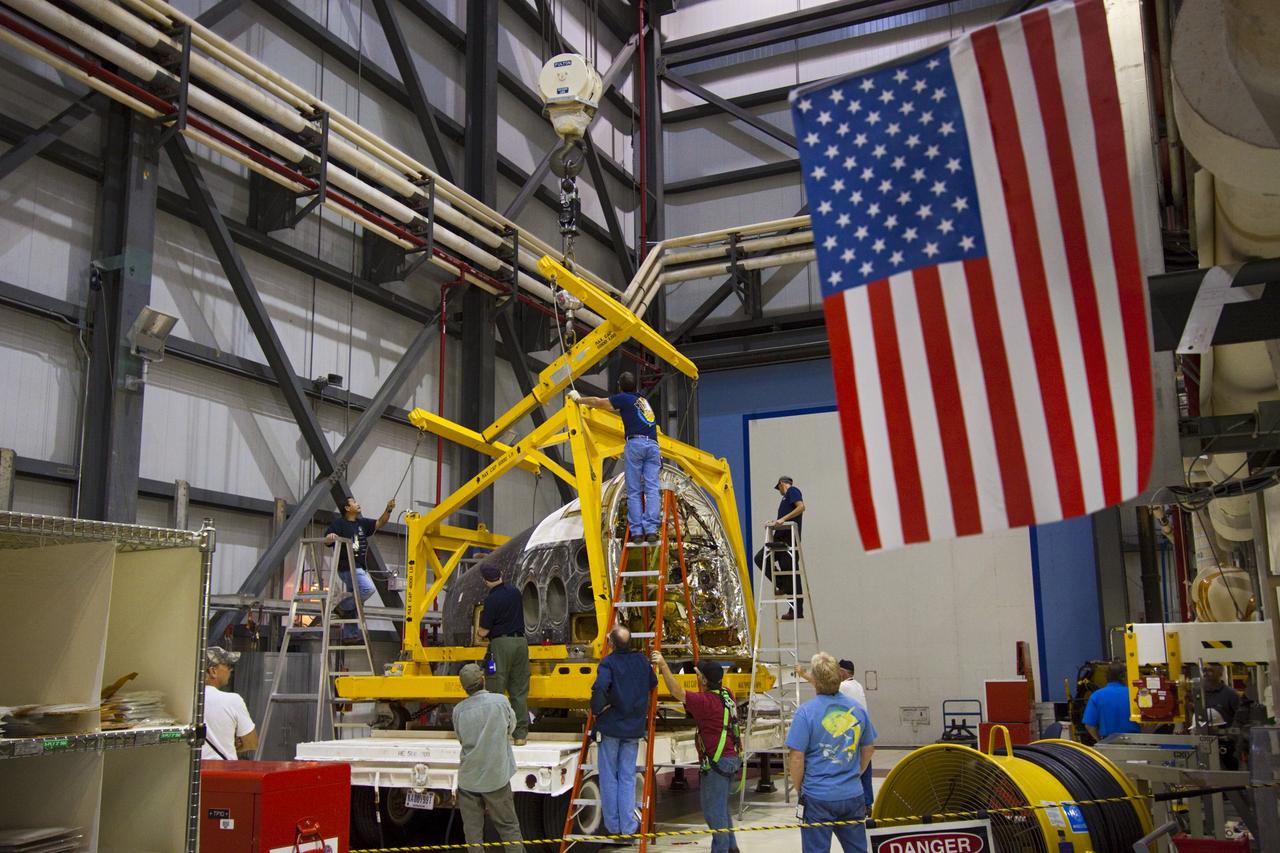
CAPE CANAVERAL, Fla. -- Inside Orbiter Processing Facility-1 at NASA’s Kennedy Space Center in Florida, technicians ready the forward reaction control system (FRCS) for installation on space shuttle Discovery. The FRCS was returned from White Sands Space Harbor in New Mexico where it underwent a complete deservicing and cleaning. The work is part of the Space Shuttle Program’s transition and retirement processing of shuttle Discovery. Discovery is being prepared for display at Smithsonian’s National Air and Space Museum, Steven F. Udvar-Hazy Center in Chantilly, Va. For more information, visit http://www.nasa.gov/shuttle. Photo credit: NASA/Jim Grossmann
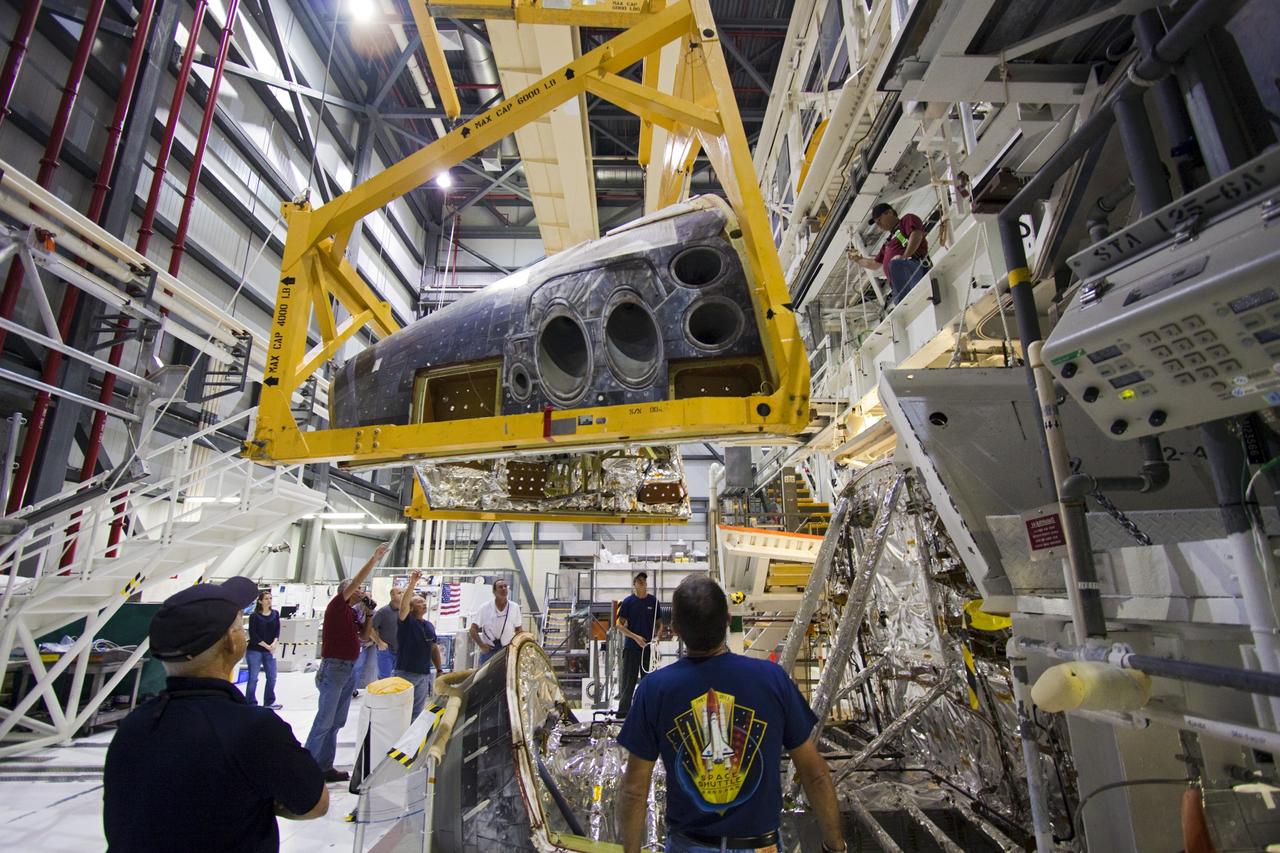
CAPE CANAVERAL, Fla. -- Inside Orbiter Processing Facility-1 at NASA’s Kennedy Space Center in Florida, technicians monitor the progress as a large crane carries the forward reaction control system (FRCS) close for installation on space shuttle Discovery. The FRCS was returned from White Sands Space Harbor in New Mexico where it underwent a complete deservicing and cleaning. The work is part of the Space Shuttle Program’s transition and retirement processing of shuttle Discovery. Discovery is being prepared for display at Smithsonian’s National Air and Space Museum, Steven F. Udvar-Hazy Center in Chantilly, Va. For more information, visit http://www.nasa.gov/shuttle. Photo credit: NASA/Jim Grossmann
CAPE CANAVERAL, Fla. -- Inside Orbiter Processing Facility-1 at NASA’s Kennedy Space Center in Florida, technicians assist with the installation of the forward reaction control system (FRCS) on space shuttle Discovery. The FRCS was returned from White Sands Space Harbor in New Mexico where it underwent a complete deservicing and cleaning. The work is part of the Space Shuttle Program’s transition and retirement processing of shuttle Discovery. Discovery is being prepared for display at Smithsonian’s National Air and Space Museum, Steven F. Udvar-Hazy Center in Chantilly, Va. For more information, visit http://www.nasa.gov/shuttle. Photo credit: NASA/Jim Grossmann
CAPE CANAVERAL, Fla. -- Inside Orbiter Processing Facility-1 at NASA’s Kennedy Space Center in Florida, the forward reaction control system (FRCS) is being moved by crane for installation on space shuttle Discovery. The FRCS was returned from White Sands Space Harbor in New Mexico where it underwent a complete deservicing and cleaning. The work is part of the Space Shuttle Program’s transition and retirement processing of shuttle Discovery. Discovery is being prepared for display at Smithsonian’s National Air and Space Museum, Steven F. Udvar-Hazy Center in Chantilly, Va. For more information, visit http://www.nasa.gov/shuttle. Photo credit: NASA/Jim Grossmann
CAPE CANAVERAL, Fla. -- Inside Orbiter Processing Facility-1 at NASA’s Kennedy Space Center in Florida, technicians monitor the progress as a large crane lowers the forward reaction control system (FRCS) for installation on space shuttle Discovery. The FRCS was returned from White Sands Space Harbor in New Mexico where it underwent a complete deservicing and cleaning. The work is part of the Space Shuttle Program’s transition and retirement processing of shuttle Discovery. Discovery is being prepared for display at Smithsonian’s National Air and Space Museum, Steven F. Udvar-Hazy Center in Chantilly, Va. For more information, visit http://www.nasa.gov/shuttle. Photo credit: NASA/Jim Grossmann

CAPE CANAVERAL, Fla. -- Inside Orbiter Processing Facility-1 at NASA’s Kennedy Space Center in Florida, technicians assist with the installation of the forward reaction control system (FRCS) on space shuttle Discovery. The FRCS was returned from White Sands Space Harbor in New Mexico where it underwent a complete deservicing and cleaning. The work is part of the Space Shuttle Program’s transition and retirement processing of shuttle Discovery. Discovery is being prepared for display at Smithsonian’s National Air and Space Museum, Steven F. Udvar-Hazy Center in Chantilly, Va. For more information, visit http://www.nasa.gov/shuttle. Photo credit: NASA/Jim Grossmann
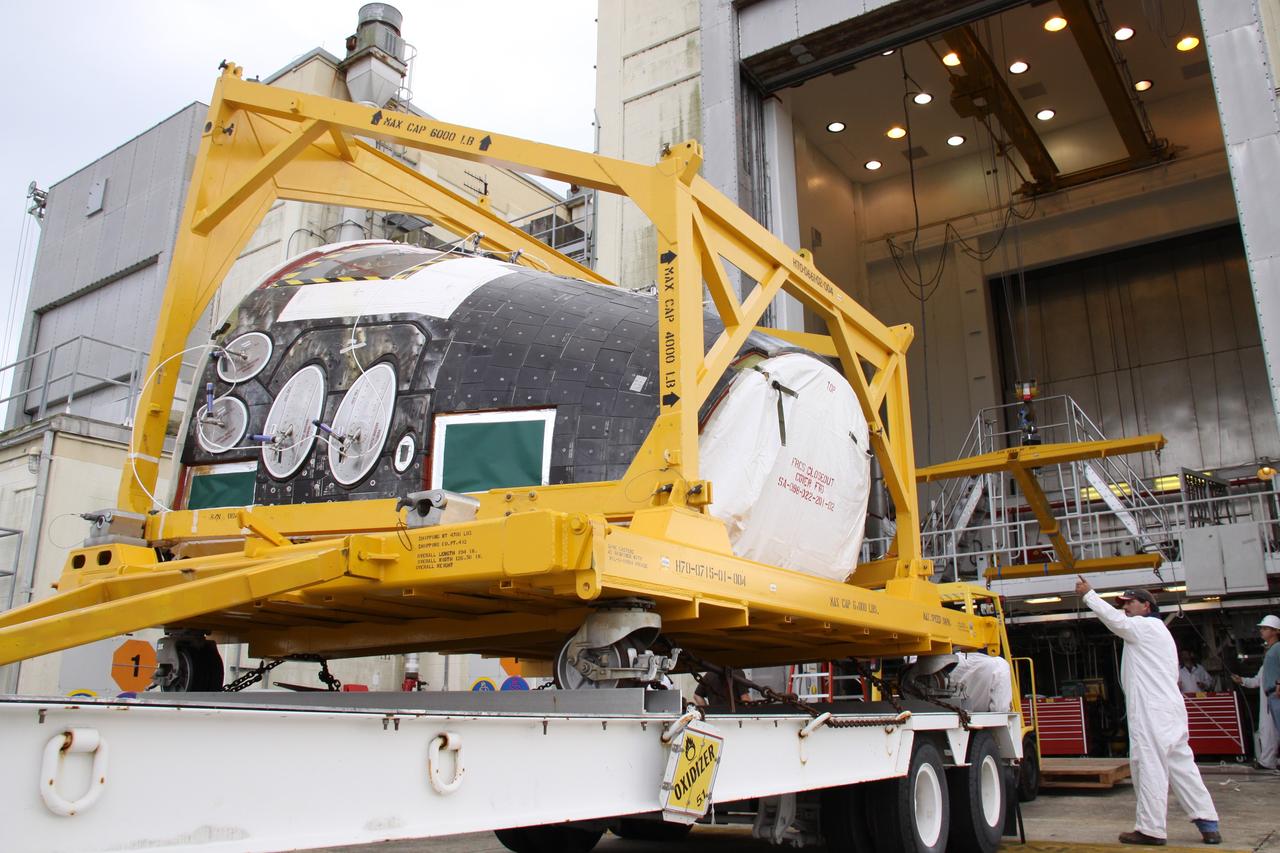
CAPE CANAVERAL, Fla. - At the Hypergolic Maintenance Facility at NASA's Kennedy Space Center in Florida, United Space Alliance workers prepare to transport the Forward Reaction Control System, or FRCS, for space shuttle Discovery to Orbiter Processing Facility Bay 3. Discovery is being prepared for the STS-131 mission, the 33rd flight to the International Space Station. The FRCS provides the thrust for attitude (rotational) maneuvers (pitch, yaw and roll) and for small velocity changes along the orbiter axis (translation maneuvers). The seven-member STS-131 crew will deliver a Multi-Purpose Logistics Module filled with resupply stowage platforms and racks to be transferred to locations around the station. Three spacewalks will include work to attach a spare ammonia tank assembly to the station's exterior and return a European experiment from outside the station's Columbus module. Discovery's launch is targeted for March 18, 2010. For information on the STS-131 mission and crew, visit http://www.nasa.gov/mission_pages/shuttle/shuttlemissions/sts131/index.html. Photo credit: NASA/Troy Cryder

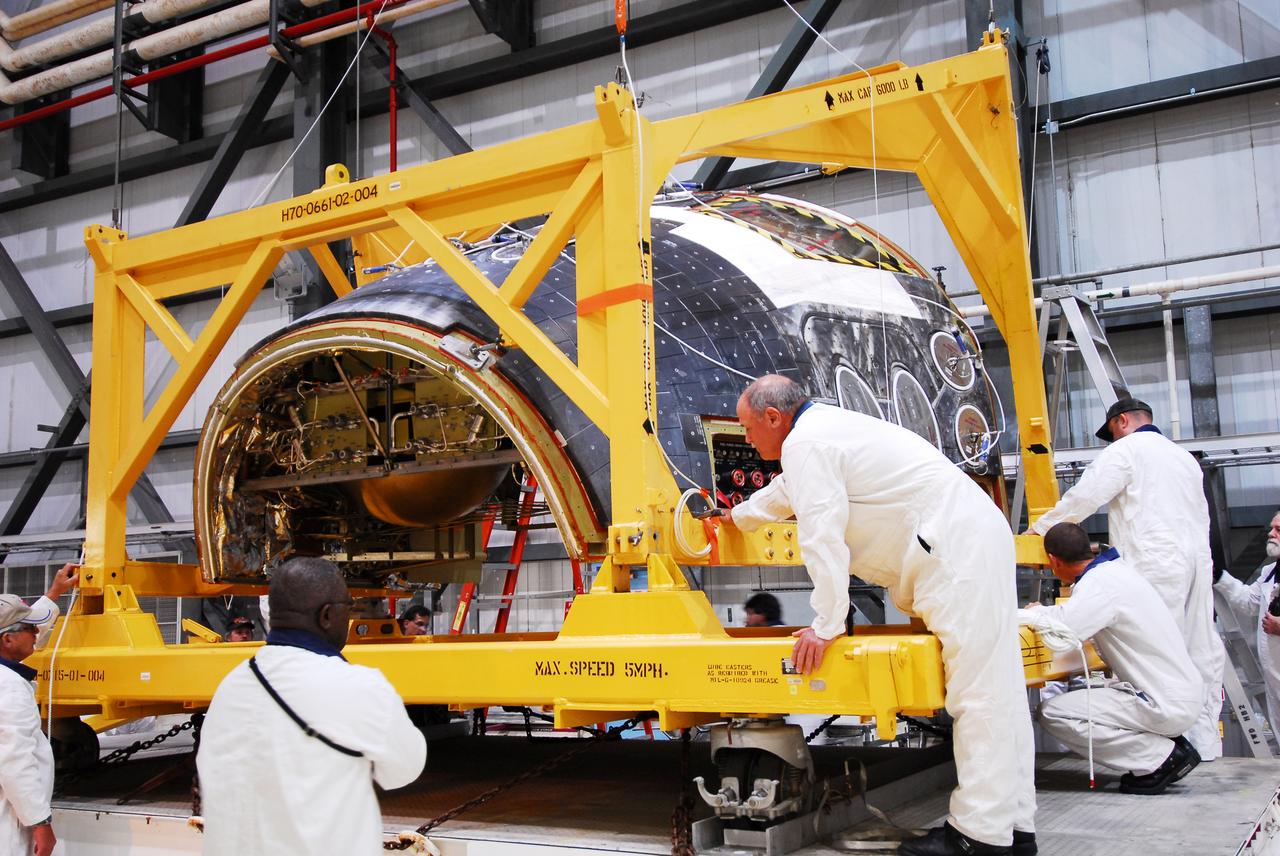
CAPE CANAVERAL, Fla. - In the Hypergolic Maintenance Facility at NASA's Kennedy Space Center in Florida, United Space Alliance workers lower the Forward Reaction Control System, or FRCS, for space shuttle Discovery onto a transporter for its move to Orbiter Processing Facility Bay 3. Discovery is being prepared for the STS-131 mission, the 33rd flight to the International Space Station. The FRCS provides the thrust for attitude (rotational) maneuvers (pitch, yaw and roll) and for small velocity changes along the orbiter axis (translation maneuvers). The seven-member STS-131 crew will deliver a Multi-Purpose Logistics Module filled with resupply stowage platforms and racks to be transferred to locations around the station. Three spacewalks will include work to attach a spare ammonia tank assembly to the station's exterior and return a European experiment from outside the station's Columbus module. Discovery's launch is targeted for March 18, 2010. For information on the STS-131 mission and crew, visit http://www.nasa.gov/mission_pages/shuttle/shuttlemissions/sts131/index.html. Photo credit: NASA/Troy Cryder

CAPE CANAVERAL, Fla. - At the Hypergolic Maintenance Facility at NASA's Kennedy Space Center in Florida, preparations are under way to move the Forward Reaction Control System, or FRCS, for space shuttle Discovery to Orbiter Processing Facility Bay 3. Discovery is being prepared for the STS-131 mission, the 33rd flight to the International Space Station. The FRCS provides the thrust for attitude (rotational) maneuvers (pitch, yaw and roll) and for small velocity changes along the orbiter axis (translation maneuvers). The seven-member STS-131 crew will deliver a Multi-Purpose Logistics Module filled with resupply stowage platforms and racks to be transferred to locations around the station. Three spacewalks will include work to attach a spare ammonia tank assembly to the station's exterior and return a European experiment from outside the station's Columbus module. Discovery's launch is targeted for March 18, 2010. For information on the STS-131 mission and crew, visit http://www.nasa.gov/mission_pages/shuttle/shuttlemissions/sts131/index.html. Photo credit: NASA/Troy Cryder

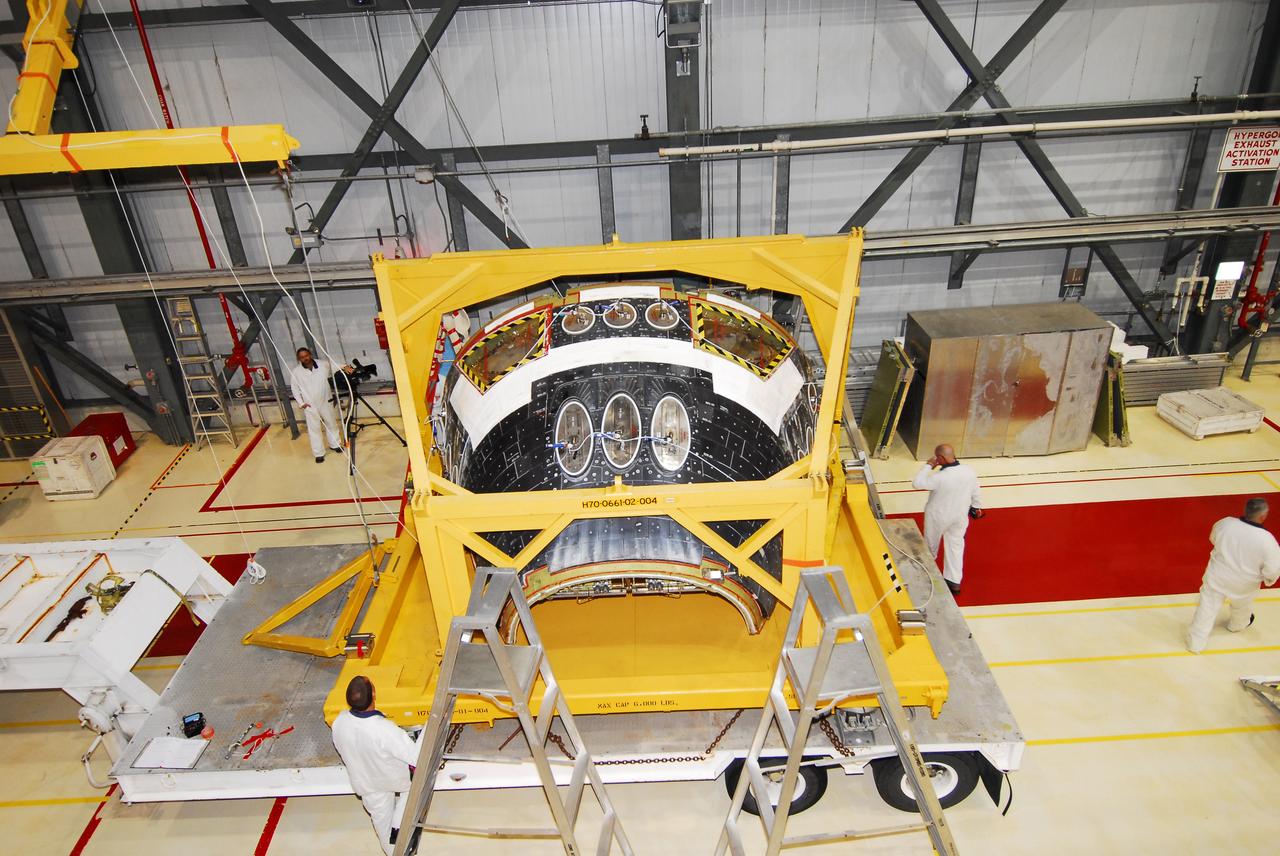
CAPE CANAVERAL, Fla. - At the Hypergolic Maintenance Facility at NASA's Kennedy Space Center in Florida, the Forward Reaction Control System, or FRCS, for space shuttle Discovery is secured on a truck bed and ready for transport to Orbiter Processing Facility Bay 3. Discovery is being prepared for the STS-131 mission, the 33rd flight to the International Space Station. The FRCS provides the thrust for attitude (rotational) maneuvers (pitch, yaw and roll) and for small velocity changes along the orbiter axis (translation maneuvers). The seven-member STS-131 crew will deliver a Multi-Purpose Logistics Module filled with resupply stowage platforms and racks to be transferred to locations around the station. Three spacewalks will include work to attach a spare ammonia tank assembly to the station's exterior and return a European experiment from outside the station's Columbus module. Discovery's launch is targeted for March 18, 2010. For information on the STS-131 mission and crew, visit http://www.nasa.gov/mission_pages/shuttle/shuttlemissions/sts131/index.html. Photo credit: NASA/Troy Cryder

CAPE CANAVERAL, Fla. - In the Hypergolic Maintenance Facility at NASA's Kennedy Space Center in Florida, United Space Alliance workers lift the Forward Reaction Control System, or FRCS, for space shuttle Discovery for its move to Orbiter Processing Facility Bay 3. Discovery is being prepared for the STS-131 mission, the 33rd flight to the International Space Station. The FRCS provides the thrust for attitude (rotational) maneuvers (pitch, yaw and roll) and for small velocity changes along the orbiter axis (translation maneuvers). The seven-member STS-131 crew will deliver a Multi-Purpose Logistics Module filled with resupply stowage platforms and racks to be transferred to locations around the station. Three spacewalks will include work to attach a spare ammonia tank assembly to the station's exterior and return a European experiment from outside the station's Columbus module. Discovery's launch is targeted for March 18, 2010. For information on the STS-131 mission and crew, visit http://www.nasa.gov/mission_pages/shuttle/shuttlemissions/sts131/index.html. Photo credit: NASA/Troy Cryder
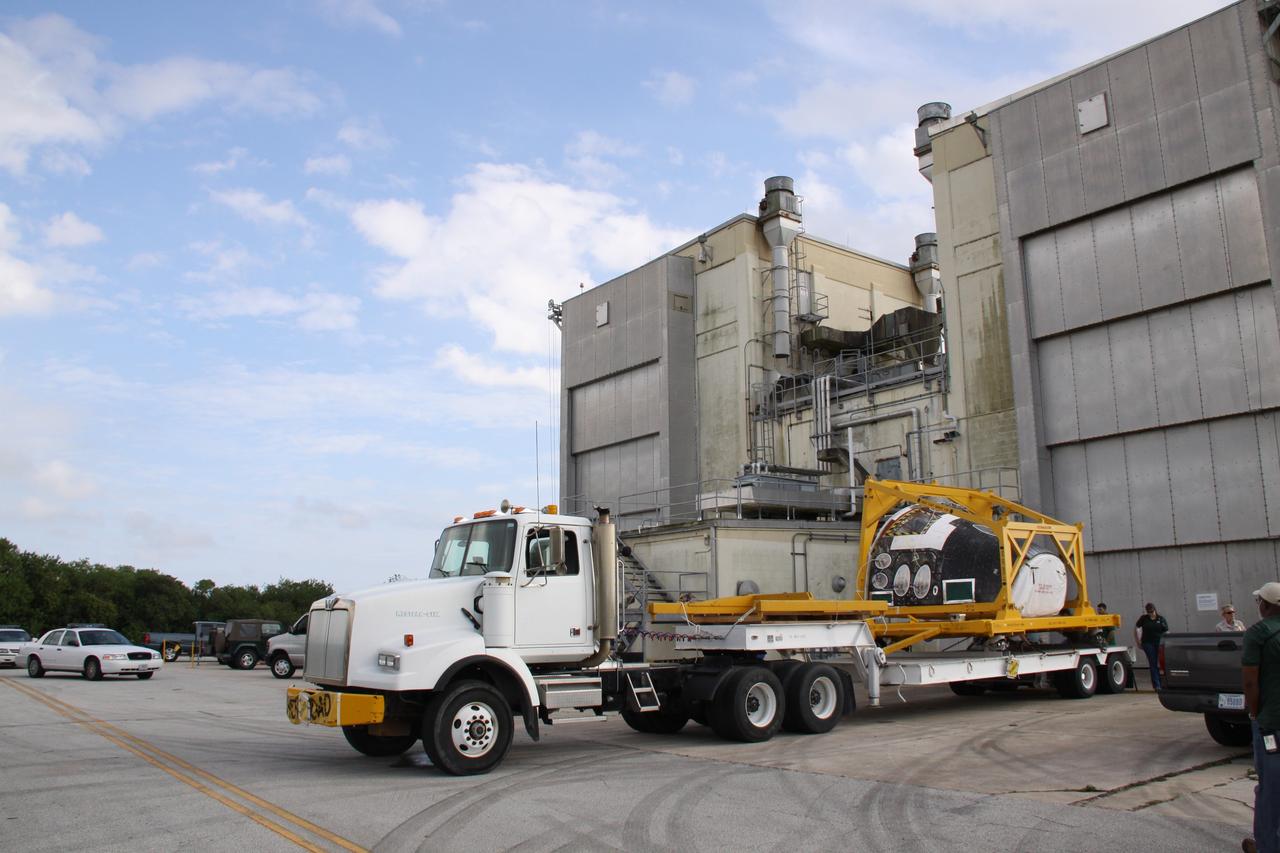
CAPE CANAVERAL, Fla. - At the Hypergolic Maintenance Facility at NASA's Kennedy Space Center in Florida, the Forward Reaction Control System, or FRCS, for space shuttle Discovery is secured on a truck bed and ready for transport to Orbiter Processing Facility Bay 3. Discovery is being prepared for the STS-131 mission, the 33rd flight to the International Space Station. The FRCS provides the thrust for attitude (rotational) maneuvers (pitch, yaw and roll) and for small velocity changes along the orbiter axis (translation maneuvers). The seven-member STS-131 crew will deliver a Multi-Purpose Logistics Module filled with resupply stowage platforms and racks to be transferred to locations around the station. Three spacewalks will include work to attach a spare ammonia tank assembly to the station's exterior and return a European experiment from outside the station's Columbus module. Discovery's launch is targeted for March 18, 2010. For information on the STS-131 mission and crew, visit http://www.nasa.gov/mission_pages/shuttle/shuttlemissions/sts131/index.html. Photo credit: NASA/Troy Cryder
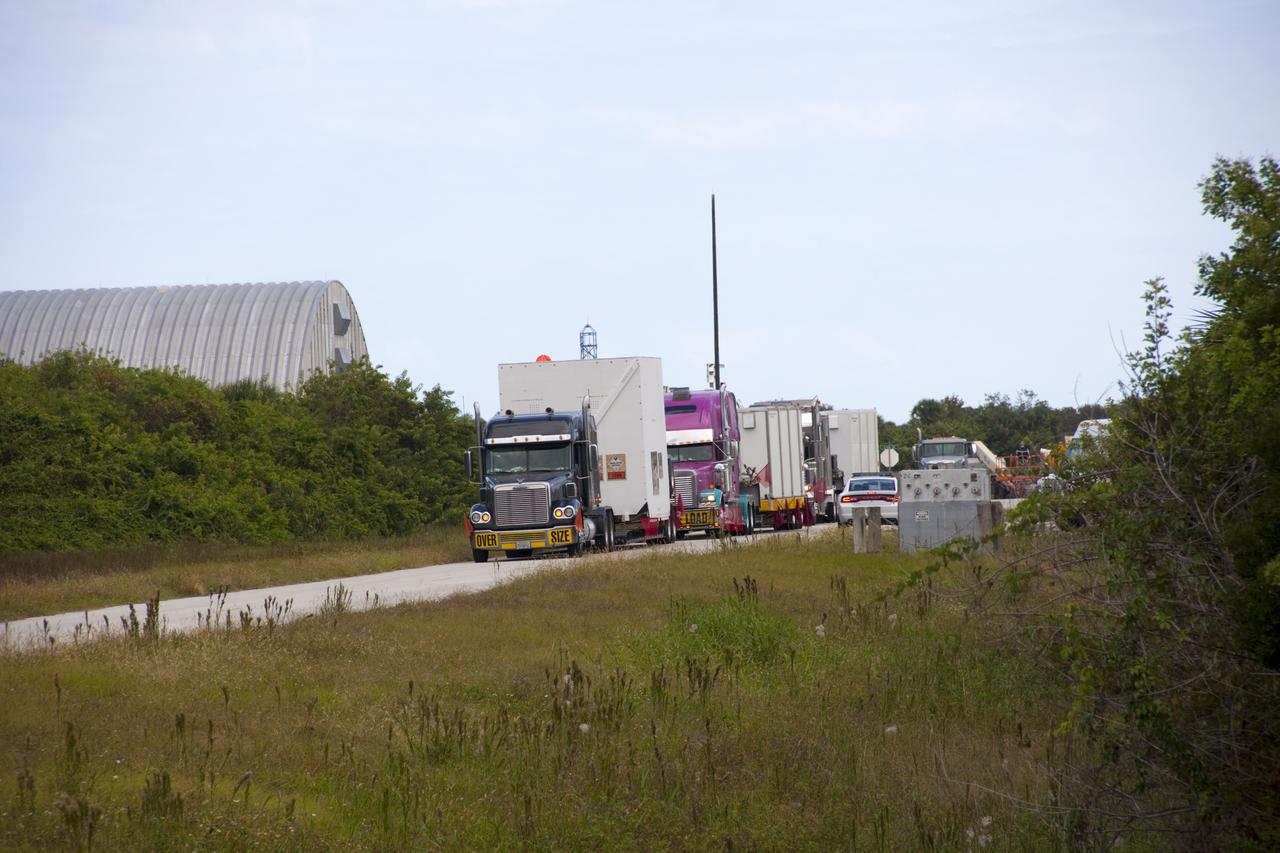
CAPE CANAVERAL, Fla. – Outside the Hazardous Maintenance Facility at NASA's Kennedy Space Center in Florida, space shuttle Endeavour’s left and right orbital maneuvering system (OMS) pods and forward reaction control system (FRCS) are secured in several containers and ready for transport to White Sands Space Harbor in New Mexico. The work is part of the Space Shuttle Program’s transition and retirement processing of shuttle Endeavour. At White Sands the OMS pods and FRCS will undergo a complete deservicing and cleaning and then be returned to Kennedy for reinstallation on Endeavour. Endeavour is being prepared for display at the California Science Center in Los Angeles. Photo credit: NASA/Jim Grossmann
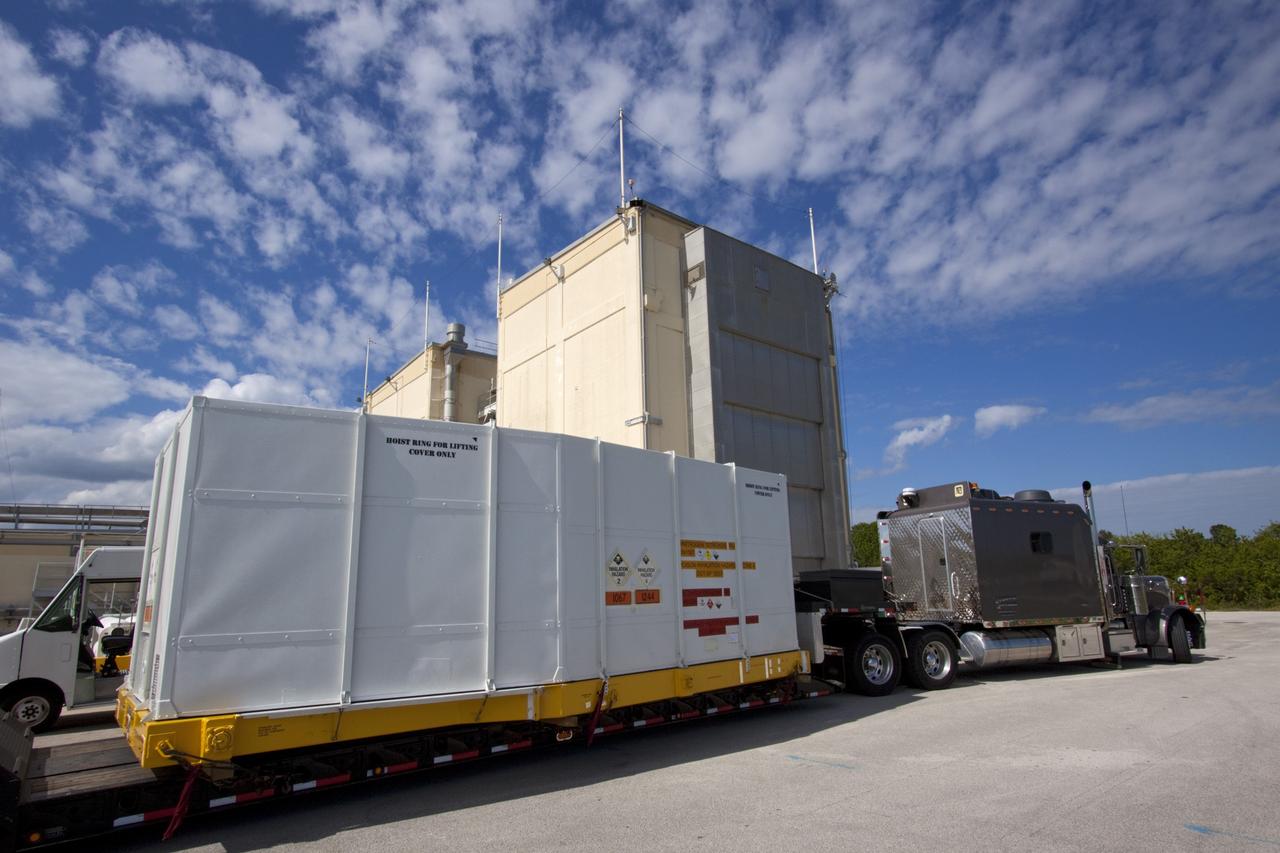
CAPE CANAVERAL, Fla. – Outside the Hazardous Maintenance Facility at NASA's Kennedy Space Center in Florida, space shuttle Endeavour’s left and right orbital maneuvering system (OMS) pods and forward reaction control system (FRCS) are secured in several containers and ready for transport to White Sands Space Harbor in New Mexico. The work is part of the Space Shuttle Program’s transition and retirement processing of shuttle Endeavour. At White Sands the OMS pods and FRCS will undergo a complete deservicing and cleaning and then be returned to Kennedy for reinstallation on Endeavour. Endeavour is being prepared for display at the California Science Center in Los Angeles. Photo credit: NASA/Jim Grossmann
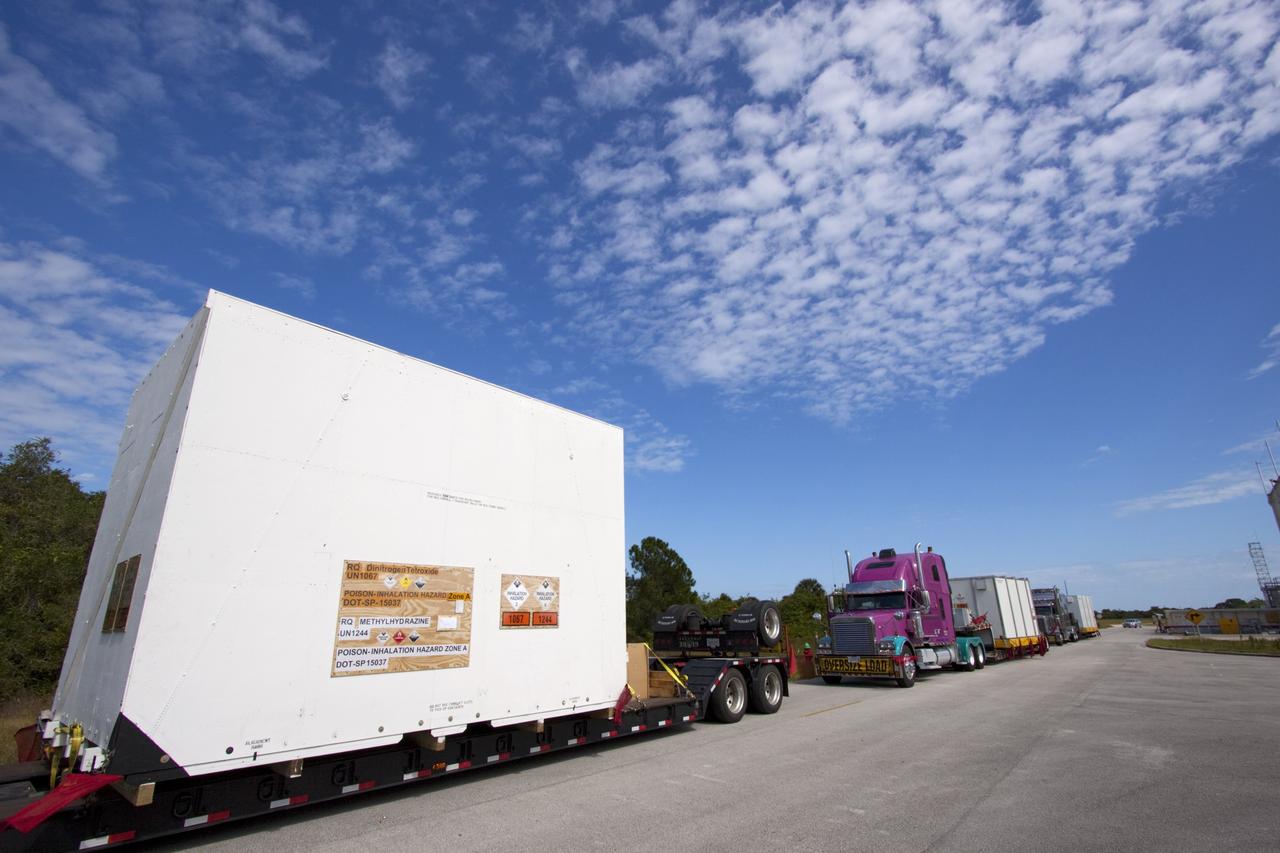
CAPE CANAVERAL, Fla. – Outside the Hazardous Maintenance Facility at NASA's Kennedy Space Center in Florida, space shuttle Endeavour’s left and right orbital maneuvering system (OMS) pods and forward reaction control system (FRCS) are secured in several containers and ready for transport to White Sands Space Harbor in New Mexico. The work is part of the Space Shuttle Program’s transition and retirement processing of shuttle Endeavour. At White Sands the OMS pods and FRCS will undergo a complete deservicing and cleaning and then be returned to Kennedy for reinstallation on Endeavour. Endeavour is being prepared for display at the California Science Center in Los Angeles. Photo credit: NASA/Jim Grossmann
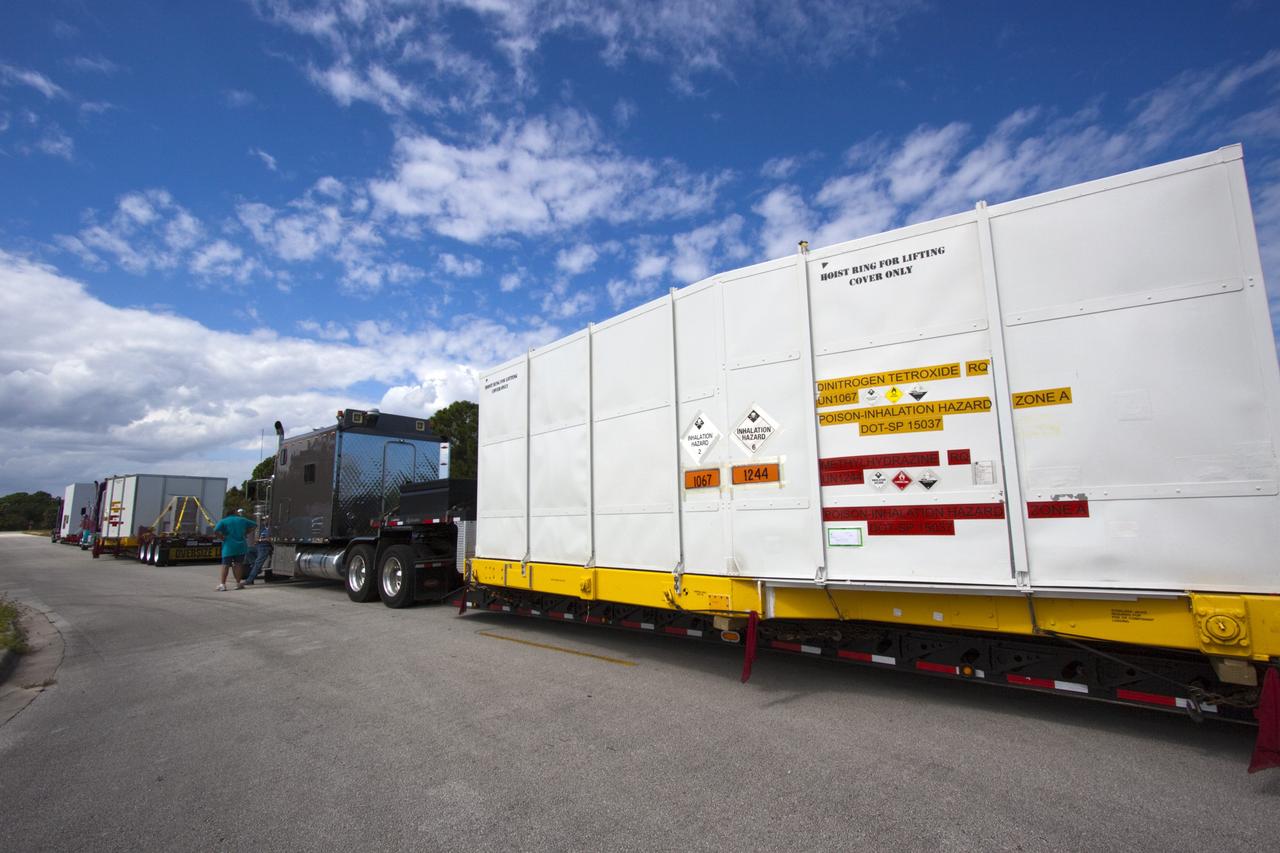
CAPE CANAVERAL, Fla. – Outside the Hazardous Maintenance Facility at NASA's Kennedy Space Center in Florida, space shuttle Endeavour’s left and right orbital maneuvering system (OMS) pods and forward reaction control system (FRCS) are secured in several containers and ready for transport to White Sands Space Harbor in New Mexico. The work is part of the Space Shuttle Program’s transition and retirement processing of shuttle Endeavour. At White Sands the OMS pods and FRCS will undergo a complete deservicing and cleaning and then be returned to Kennedy for reinstallation on Endeavour. Endeavour is being prepared for display at the California Science Center in Los Angeles. Photo credit: NASA/Jim Grossmann
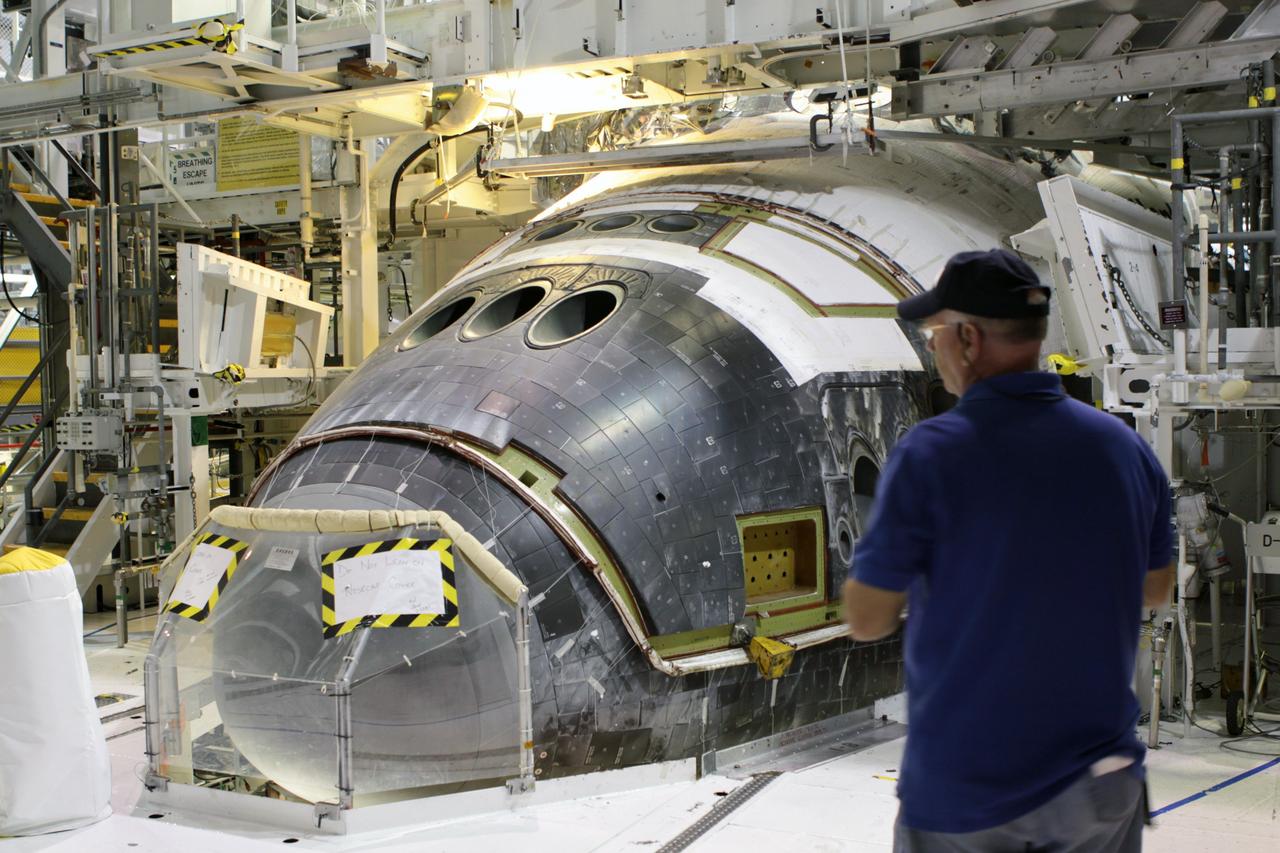
CAPE CANAVERAL, Fla. – In Orbiter Processing Facility-1 at NASA’s Kennedy Space Center in Florida, the forward reaction control system has been reinstalled on space shuttle Atlantis. The system helped the shuttle maneuver while it was in orbit. Atlantis’ FRCS was removed and sent to White Sands Test Facility in New Mexico to be cleaned of its toxic propellants. The work is part of the Space Shuttle Program’s transition and retirement processing of the shuttle fleet. A groundbreaking was held Jan. 18 for Atlantis' future home, a 65,000-square-foot exhibit hall in Shuttle Plaza at the Kennedy Space Center Visitor Complex. Atlantis is scheduled to roll over to the visitor complex in November in preparation for the exhibit’s grand opening in July 2013. For more information, visit http://www.nasa.gov/shuttle. Photo credit: NASA/Jim Grossmann
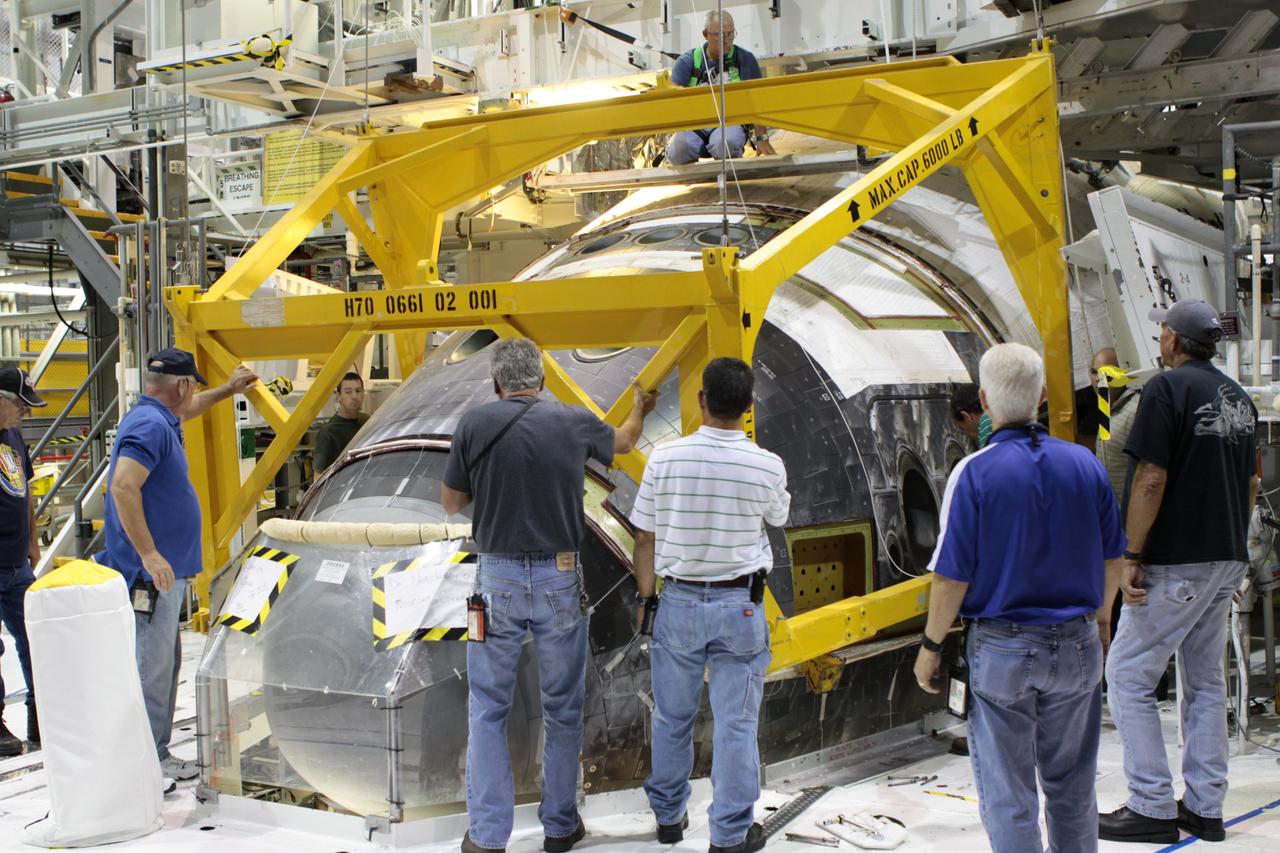
CAPE CANAVERAL, Fla. – In Orbiter Processing Facility-1 at NASA’s Kennedy Space Center in Florida, United Space Alliance technicians remove the lifting device from the forward reaction control system reinstalled on space shuttle Atlantis. The system helped the shuttle maneuver while it was in orbit. Atlantis’ FRCS was removed and sent to White Sands Test Facility in New Mexico to be cleaned of its toxic propellants. The work is part of the Space Shuttle Program’s transition and retirement processing of the shuttle fleet. A groundbreaking was held Jan. 18 for Atlantis' future home, a 65,000-square-foot exhibit hall in Shuttle Plaza at the Kennedy Space Center Visitor Complex. Atlantis is scheduled to roll over to the visitor complex in November in preparation for the exhibit’s grand opening in July 2013. For more information, visit http://www.nasa.gov/shuttle. Photo credit: NASA/Jim Grossmann
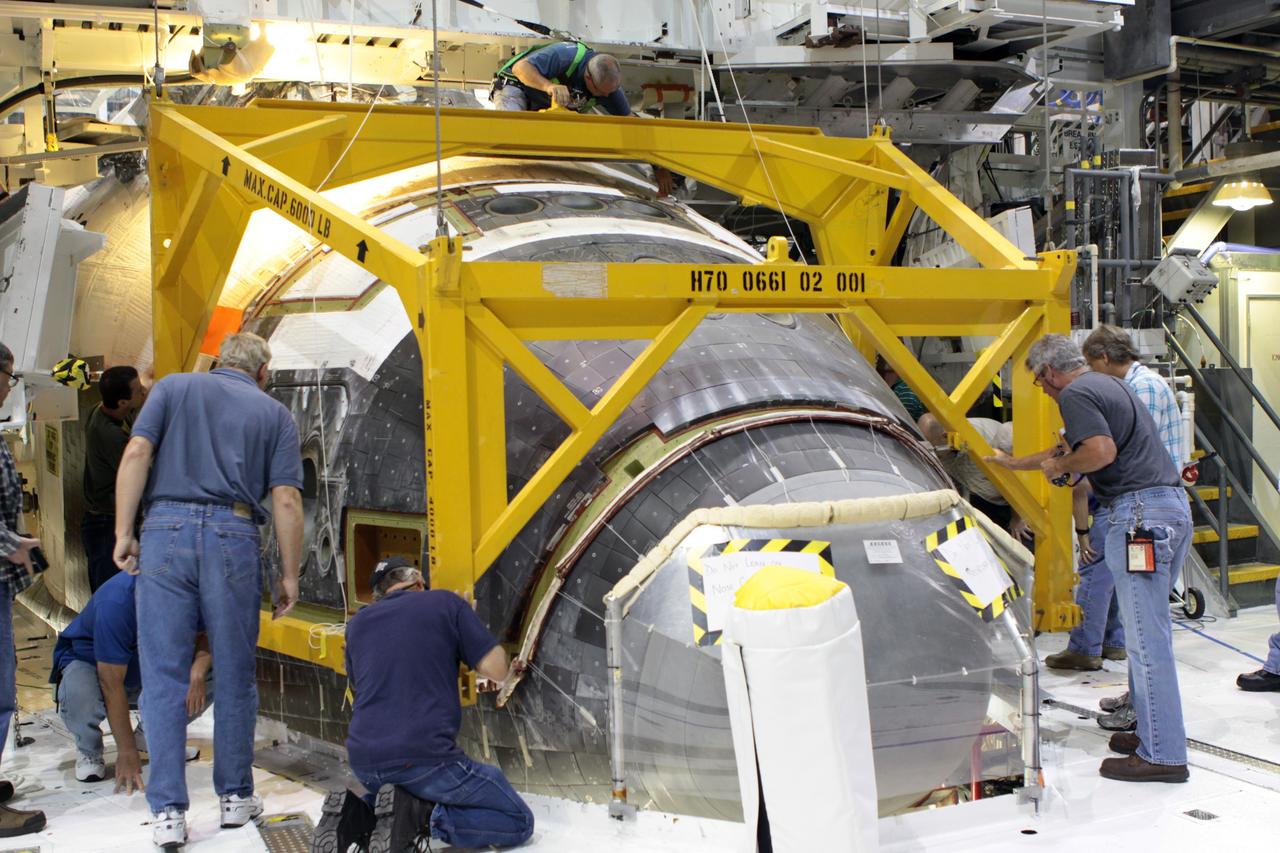
CAPE CANAVERAL, Fla. – In Orbiter Processing Facility-1 at NASA’s Kennedy Space Center in Florida, United Space Alliance technicians secure the forward reaction control system back in place on space shuttle Atlantis. The system helped the shuttle maneuver while it was in orbit. Atlantis’ FRCS was removed and sent to White Sands Test Facility in New Mexico to be cleaned of its toxic propellants. The work is part of the Space Shuttle Program’s transition and retirement processing of the shuttle fleet. A groundbreaking was held Jan. 18 for Atlantis' future home, a 65,000-square-foot exhibit hall in Shuttle Plaza at the Kennedy Space Center Visitor Complex. Atlantis is scheduled to roll over to the visitor complex in November in preparation for the exhibit’s grand opening in July 2013. For more information, visit http://www.nasa.gov/shuttle. Photo credit: NASA/Jim Grossmann
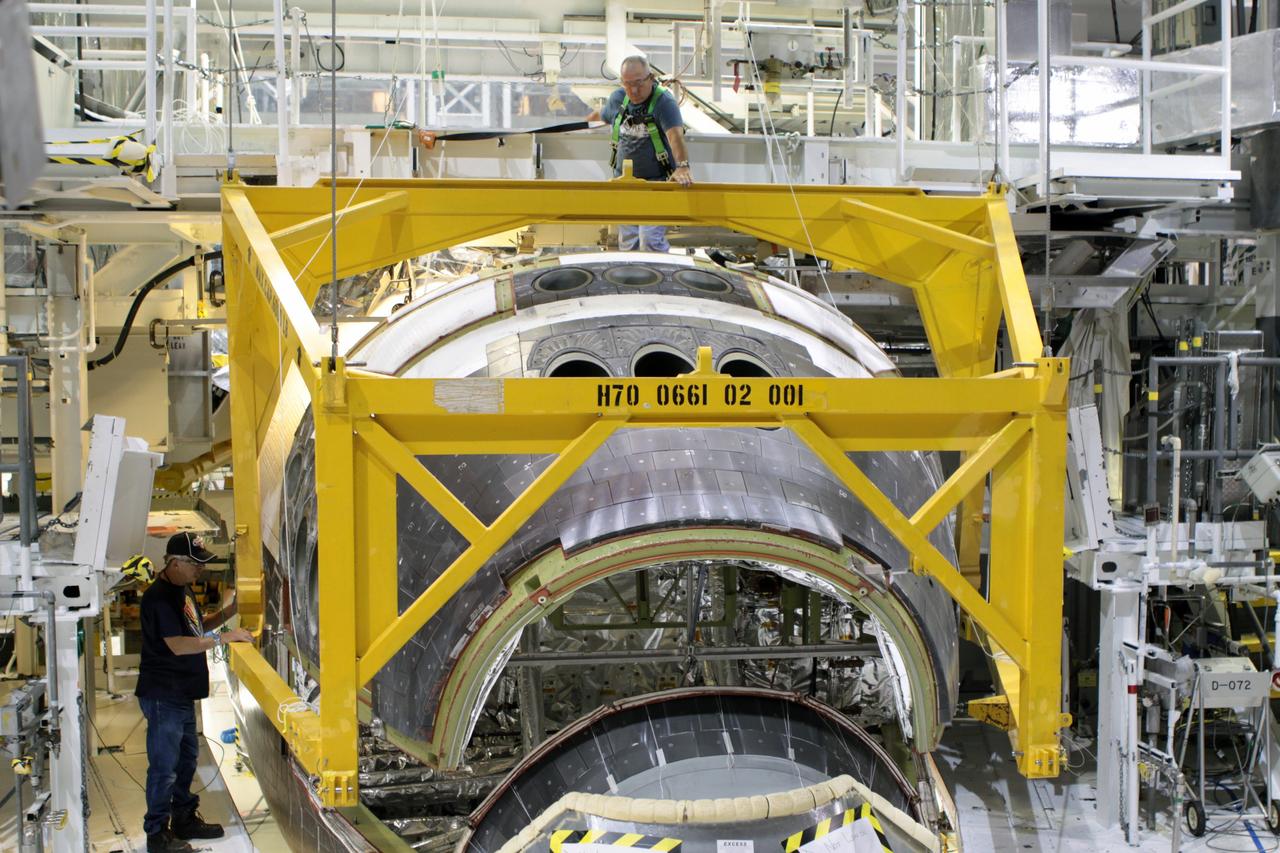
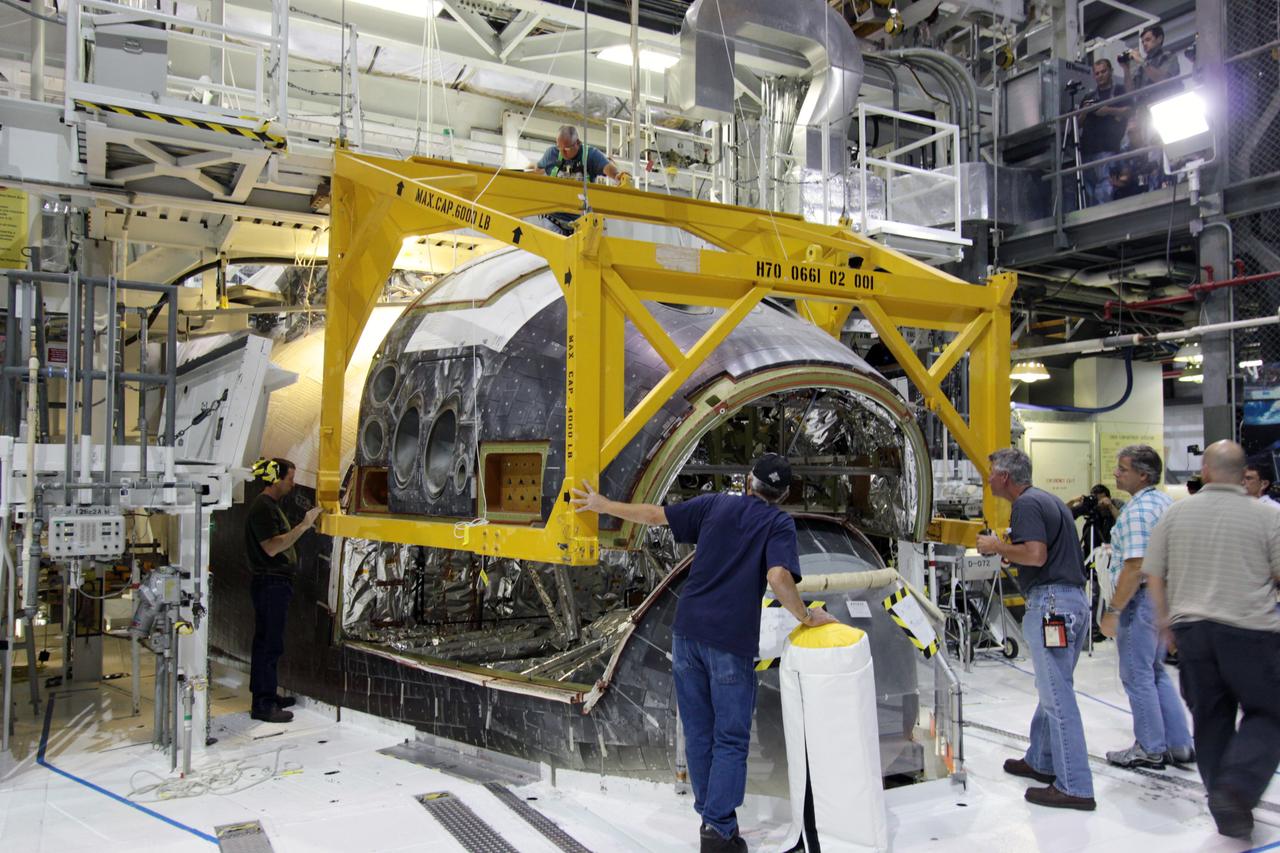
CAPE CANAVERAL, Fla. – In Orbiter Processing Facility-1 at NASA’s Kennedy Space Center in Florida, United Space Alliance technicians monitor the alignment of the forward reaction control system onto space shuttle Atlantis during the system’s reinstallation on the shuttle. The system helped the shuttle maneuver while it was in orbit. Atlantis’ FRCS was removed and sent to White Sands Test Facility in New Mexico to be cleaned of its toxic propellants. The work is part of the Space Shuttle Program’s transition and retirement processing of the shuttle fleet. A groundbreaking was held Jan. 18 for Atlantis' future home, a 65,000-square-foot exhibit hall in Shuttle Plaza at the Kennedy Space Center Visitor Complex. Atlantis is scheduled to roll over to the visitor complex in November in preparation for the exhibit’s grand opening in July 2013. For more information, visit http://www.nasa.gov/shuttle. Photo credit: NASA/Jim Grossmann

CAPE CANAVERAL, Fla. – In Orbiter Processing Facility-1 at NASA’s Kennedy Space Center in Florida, United Space Alliance technicians lower the forward reaction control system toward space shuttle Atlantis during the system’s reinstallation on the shuttle. The system helped the shuttle maneuver while it was in orbit. Atlantis’ FRCS was removed and sent to White Sands Test Facility in New Mexico to be cleaned of its toxic propellants. The work is part of the Space Shuttle Program’s transition and retirement processing of the shuttle fleet. A groundbreaking was held Jan. 18 for Atlantis' future home, a 65,000-square-foot exhibit hall in Shuttle Plaza at the Kennedy Space Center Visitor Complex. Atlantis is scheduled to roll over to the visitor complex in November in preparation for the exhibit’s grand opening in July 2013. For more information, visit http://www.nasa.gov/shuttle. Photo credit: NASA/Jim Grossmann
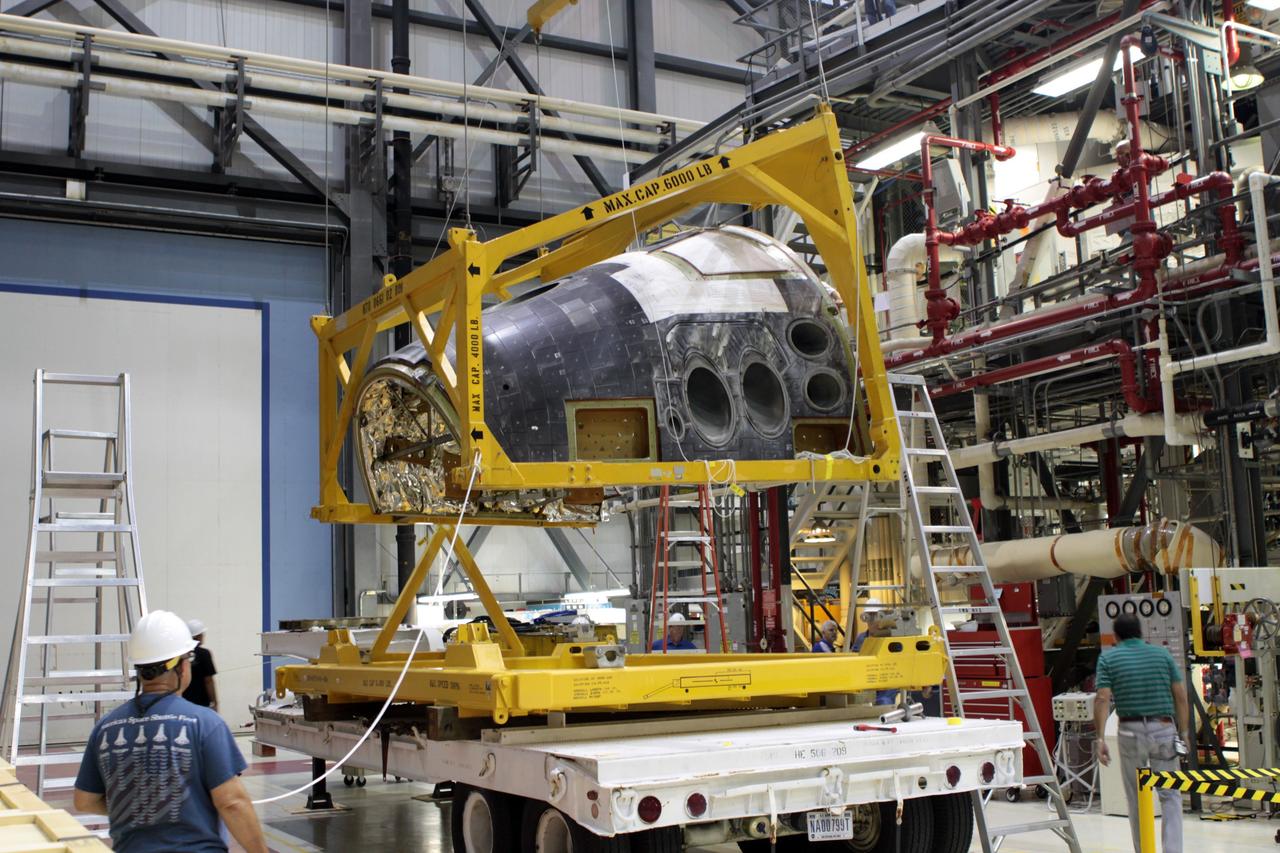
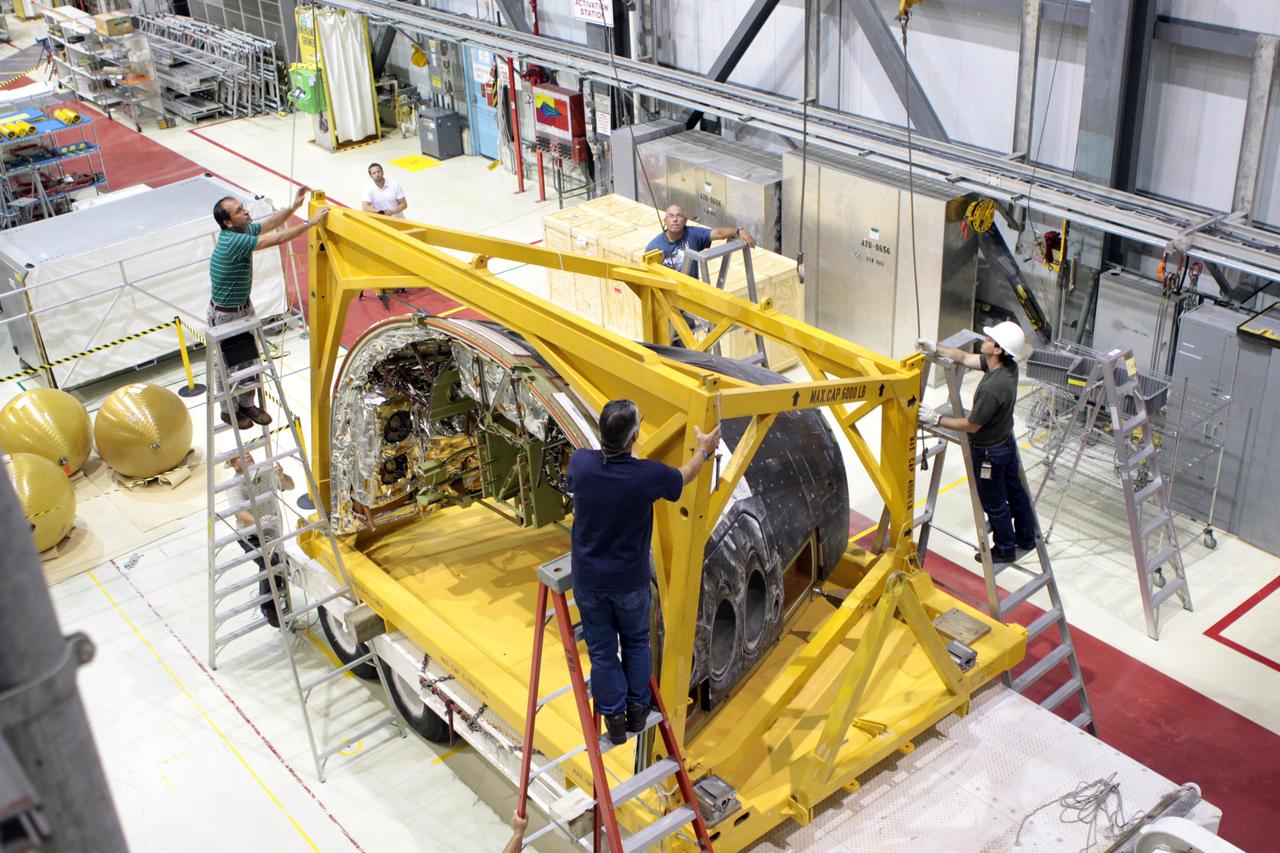
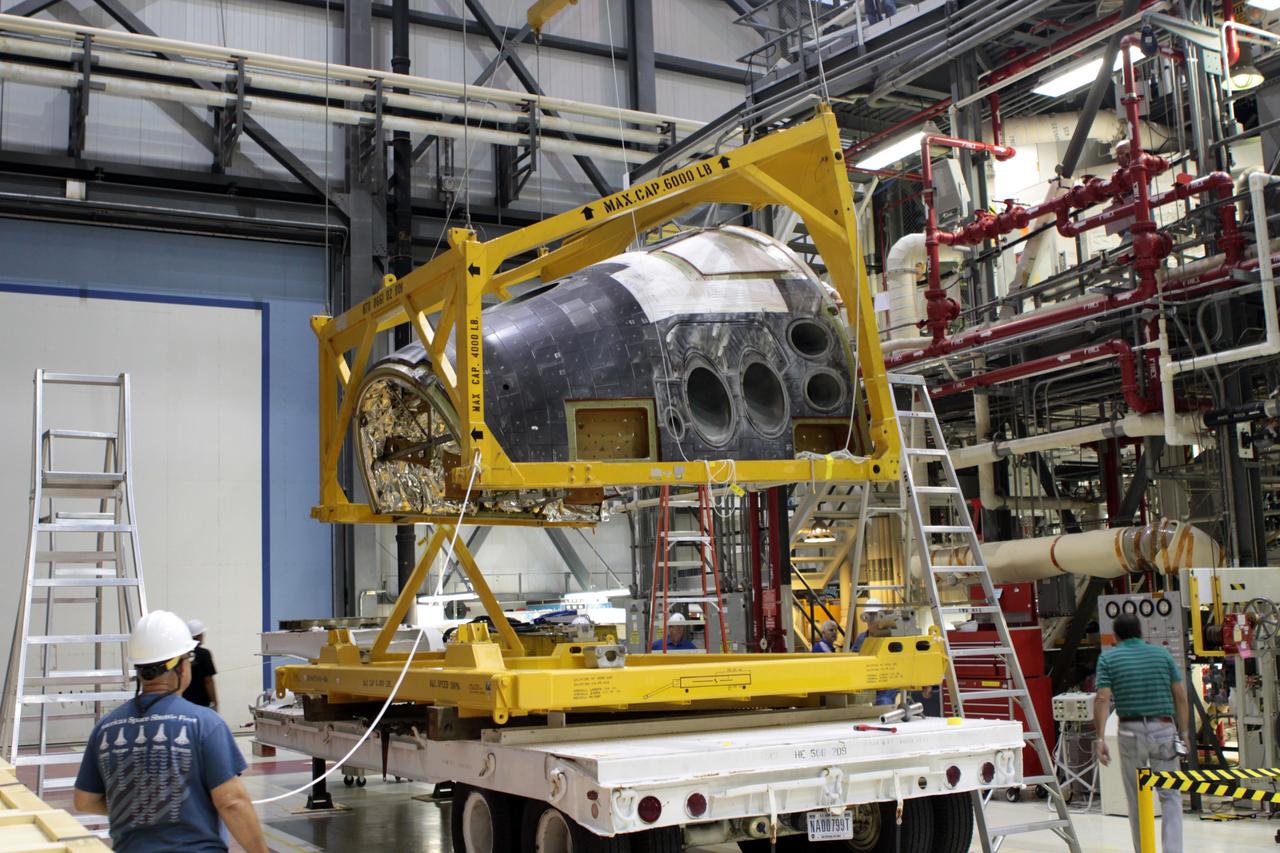
CAPE CANAVERAL, Fla. – In Orbiter Processing Facility-1 at NASA’s Kennedy Space Center in Florida, United Space Alliance technicians lift the forward reaction control system from a transporter during preparations to reinstall it on space shuttle Atlantis. The system helped the shuttle maneuver while it was in orbit. Atlantis’ FRCS was removed and sent to White Sands Test Facility in New Mexico to be cleaned of its toxic propellants. The work is part of the Space Shuttle Program’s transition and retirement processing of the shuttle fleet. A groundbreaking was held Jan. 18 for Atlantis' future home, a 65,000-square-foot exhibit hall in Shuttle Plaza at the Kennedy Space Center Visitor Complex. Atlantis is scheduled to roll over to the visitor complex in November in preparation for the exhibit’s grand opening in July 2013. For more information, visit http://www.nasa.gov/shuttle. Photo credit: NASA/Jim Grossmann
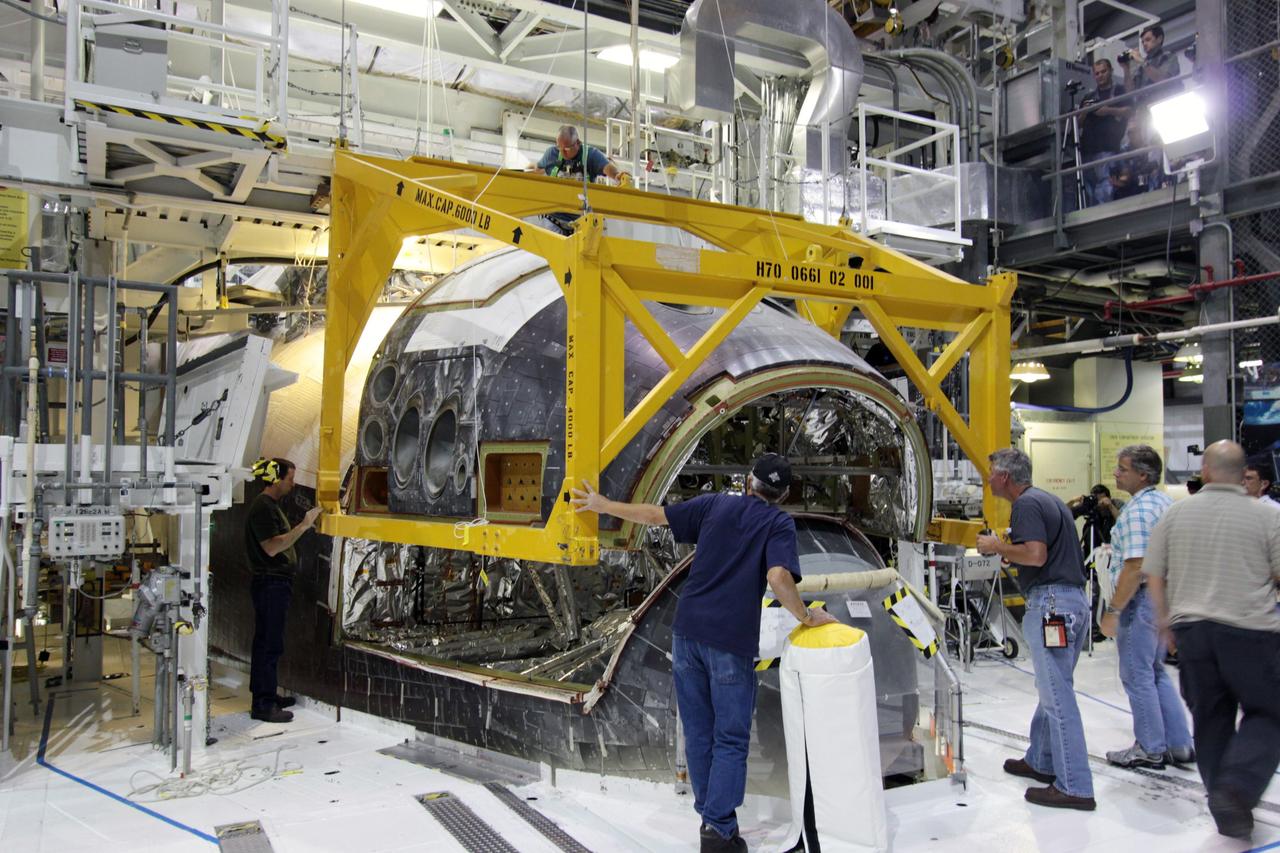
CAPE CANAVERAL, Fla. – In Orbiter Processing Facility-1 at NASA’s Kennedy Space Center in Florida, United Space Alliance technicians align the forward reaction control system onto space shuttle Atlantis during the system’s reinstallation on the shuttle. The system helped the shuttle maneuver while it was in orbit. Atlantis’ FRCS was removed and sent to White Sands Test Facility in New Mexico to be cleaned of its toxic propellants. The work is part of the Space Shuttle Program’s transition and retirement processing of the shuttle fleet. A groundbreaking was held Jan. 18 for Atlantis' future home, a 65,000-square-foot exhibit hall in Shuttle Plaza at the Kennedy Space Center Visitor Complex. Atlantis is scheduled to roll over to the visitor complex in November in preparation for the exhibit’s grand opening in July 2013. For more information, visit http://www.nasa.gov/shuttle. Photo credit: NASA/Jim Grossmann
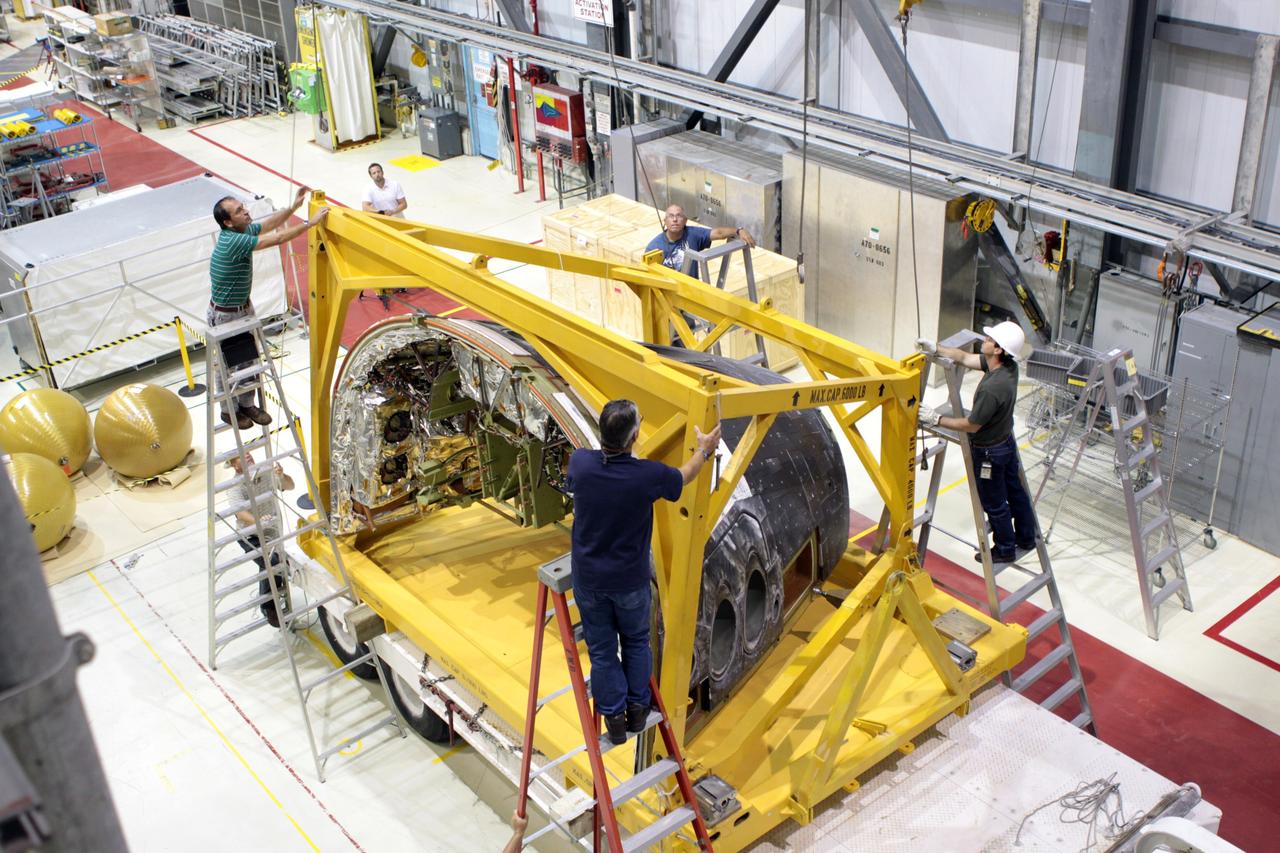
CAPE CANAVERAL, Fla. – In Orbiter Processing Facility-1 at NASA’s Kennedy Space Center in Florida, United Space Alliance technicians prepare to reinstall the forward reaction control system on space shuttle Atlantis. The system helped the shuttle maneuver while it was in orbit. Atlantis’ FRCS was removed and sent to White Sands Test Facility in New Mexico to be cleaned of its toxic propellants. The work is part of the Space Shuttle Program’s transition and retirement processing of the shuttle fleet. A groundbreaking was held Jan. 18 for Atlantis' future home, a 65,000-square-foot exhibit hall in Shuttle Plaza at the Kennedy Space Center Visitor Complex. Atlantis is scheduled to roll over to the visitor complex in November in preparation for the exhibit’s grand opening in July 2013. For more information, visit http://www.nasa.gov/shuttle. Photo credit: NASA/Jim Grossmann
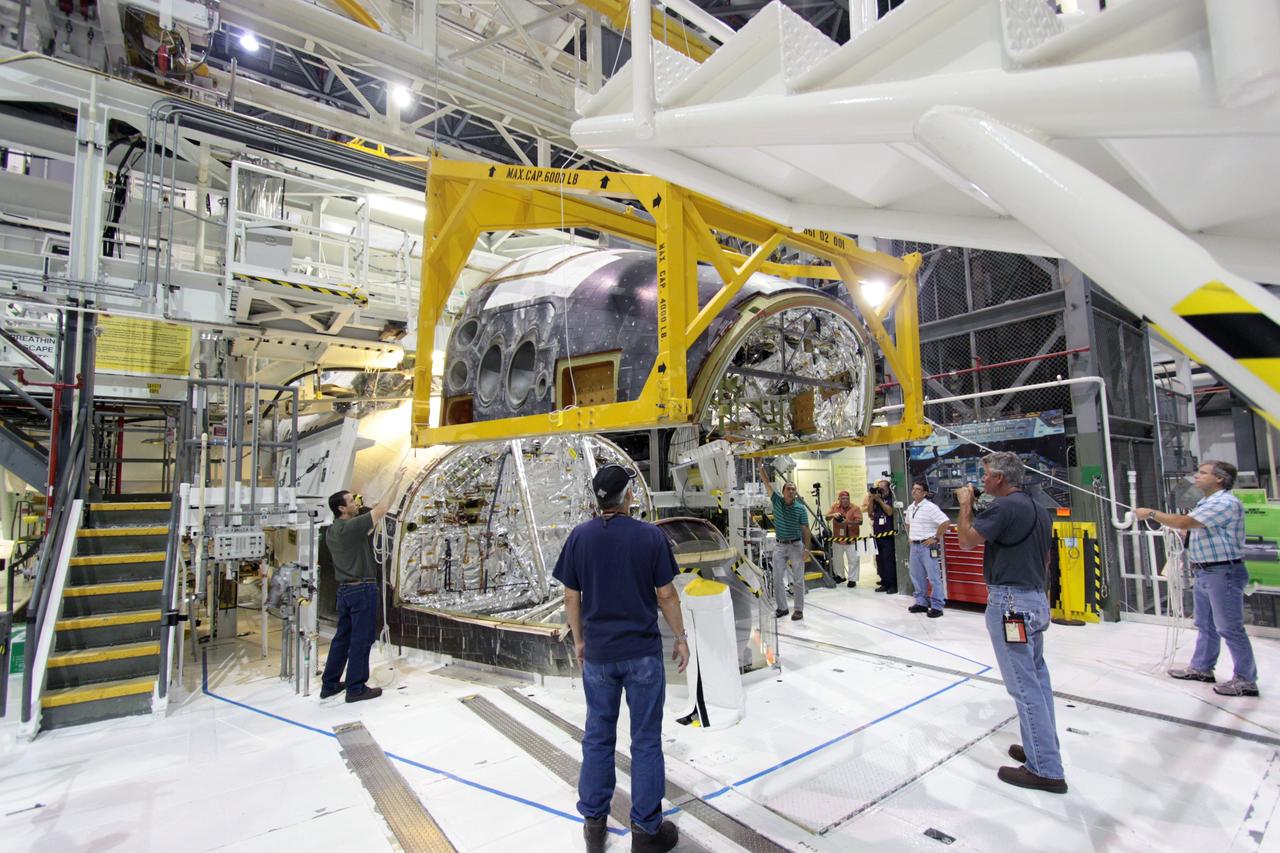
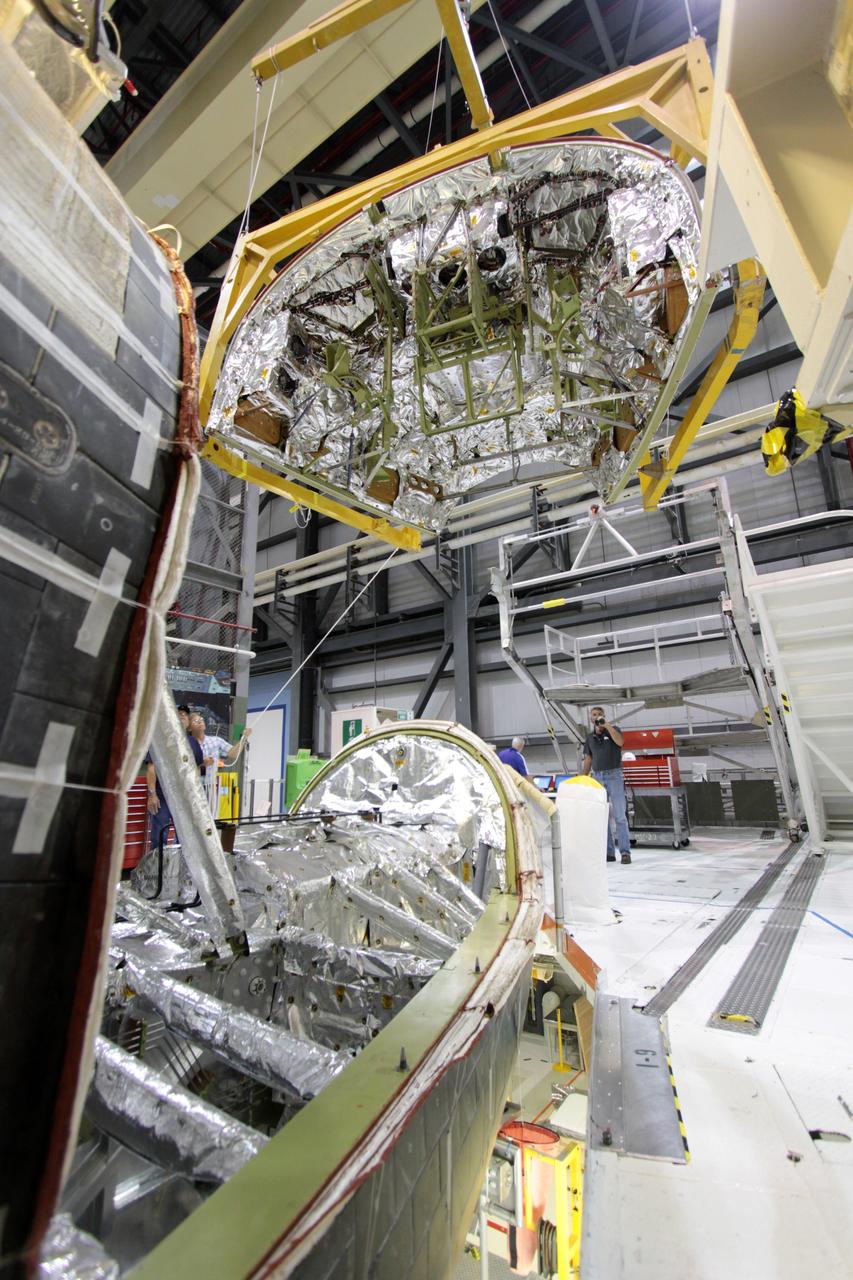
CAPE CANAVERAL, Fla. – In Orbiter Processing Facility-1 at NASA’s Kennedy Space Center in Florida, United Space Alliance technicians position the forward reaction control system over space shuttle Atlantis during the system’s reinstallation on the shuttle. The system helped the shuttle maneuver while it was in orbit. Atlantis’ FRCS was removed and sent to White Sands Test Facility in New Mexico to be cleaned of its toxic propellants. The work is part of the Space Shuttle Program’s transition and retirement processing of the shuttle fleet. A groundbreaking was held Jan. 18 for Atlantis' future home, a 65,000-square-foot exhibit hall in Shuttle Plaza at the Kennedy Space Center Visitor Complex. Atlantis is scheduled to roll over to the visitor complex in November in preparation for the exhibit’s grand opening in July 2013. For more information, visit http://www.nasa.gov/shuttle. Photo credit: NASA/Jim Grossmann

T&R/Atlantis FRCS Installation

T&R/Atlantis FRCS Installation

T&R/Atlantis FRCS Installation
T&R/Atlantis FRCS Installation

T&R/Atlantis FRCS Installation

T&R/Atlantis FRCS Installation
T&R/Atlantis FRCS Installation
T&R/Atlantis FRCS Installation
T&R/Atlantis FRCS Installation

Discovery/T&R FRCS Removal & Lift to Transporter
Discovery/T&R FRCS Removal & Lift to Transporter

Discovery/T&R FRCS Removal & Lift to Transporter
Discovery/T&R FRCS Removal & Lift to Transporter

Discovery/T&R FRCS Removal & Lift to Transporter

Discovery/T&R FRCS Removal & Lift to Transporter

Discovery/T&R FRCS Removal & Lift to Transporter
Discovery/T&R FRCS Removal & Lift to Transporter

Discovery/T&R FRCS Removal & Lift to Transporter
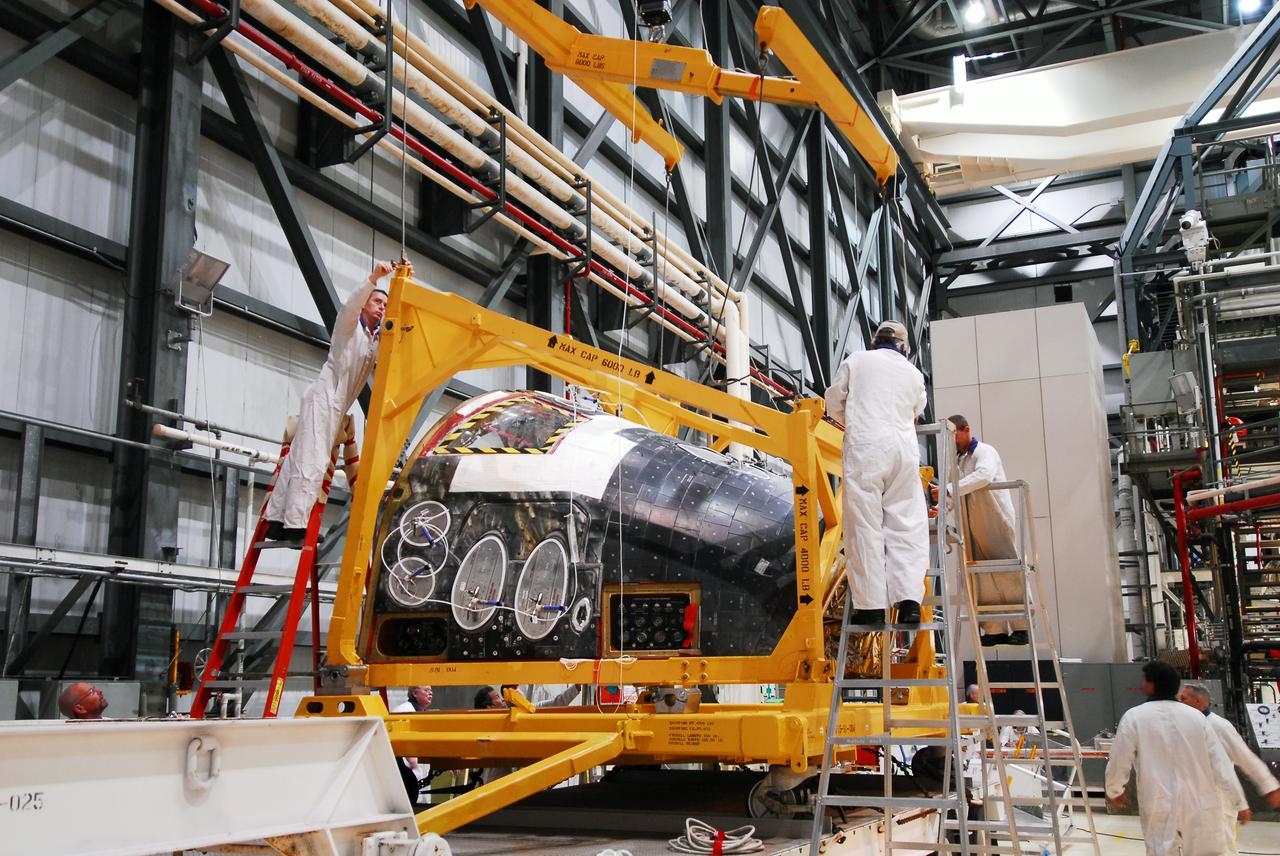
Discovery/T&R FRCS Removal & Lift to Transporter

Discovery/T&R FRCS Removal & Lift to Transporter

Discovery/T&R FRCS Removal & Lift to Transporter

The X-1E research aircraft provides a striking view at the entrance of NASA's Dryden Flight Research Center, Edwards, California. The X-1E, one of the three original X-1 aircraft modified with a raised cockpit canopy and an ejection seat, was flown at the facility between 1953 and 1958 to investigate speeds at twice that of sound, and also to evaluate a thin wing designed for high-speed flight. The Dryden complex was originally established in 1946 as a small high-speed flight station to support the X-1 program. The X-1 was the first aircraft to fly at supersonic speeds. The main administrative building is to the rear of the X-1E and is the center of a research installation that has grown to more than 450 government employees and nearly 400 civilian contractors. Located on the northwest "shore" of Rogers Dry Lake, the Dryden Center was built around the original administrative-hangar building constructed in 1954 at a cost of $3.8 million. Since then many additional support and operational facilities have been built including a number of unique test facilities such as the Thermalstructures Research Facility, Flow Visualization Facility, and the newest addition, the Integrated Test Facility.
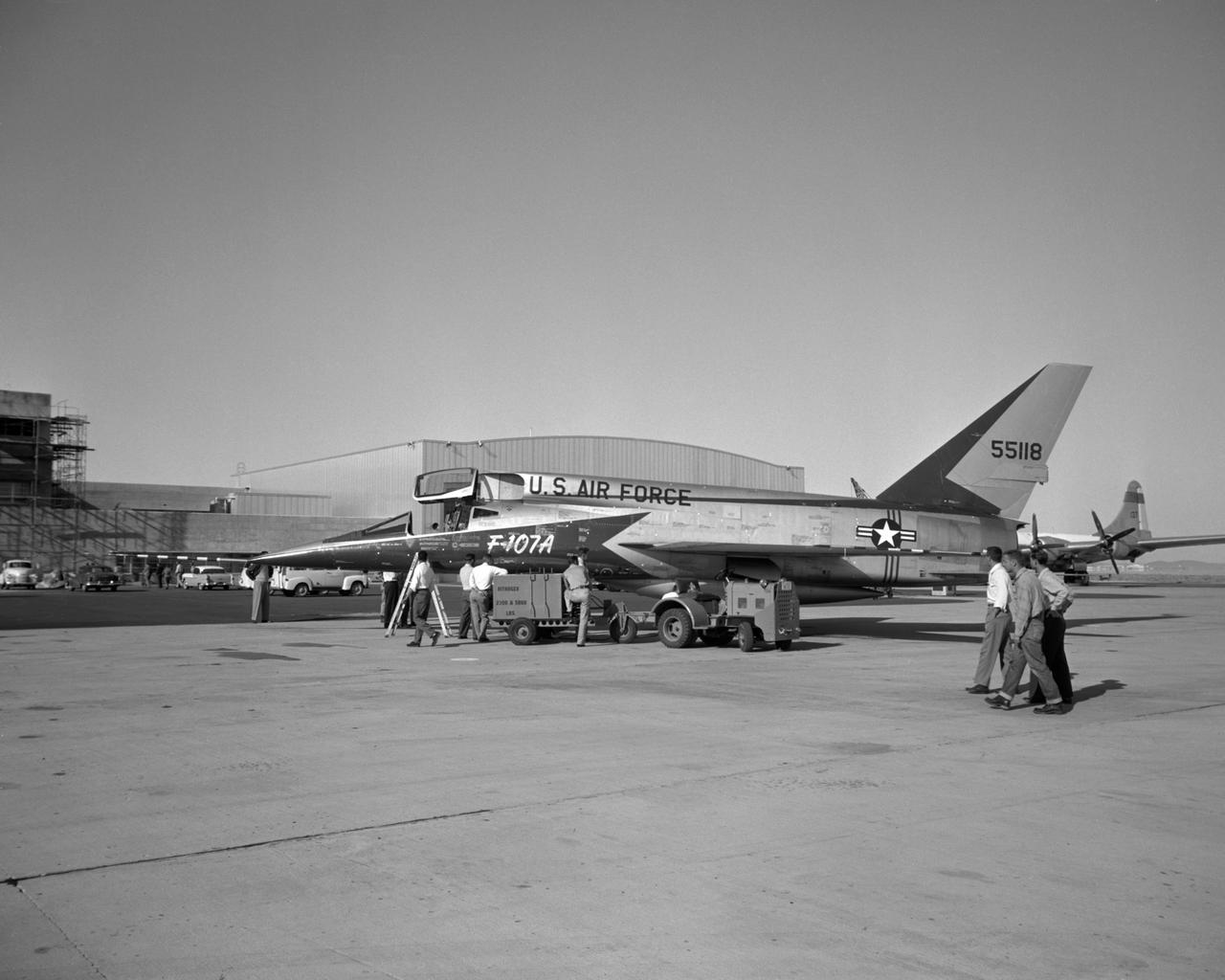
Arrival of first F-107A #118 (later NACA 207) to NASA FRC
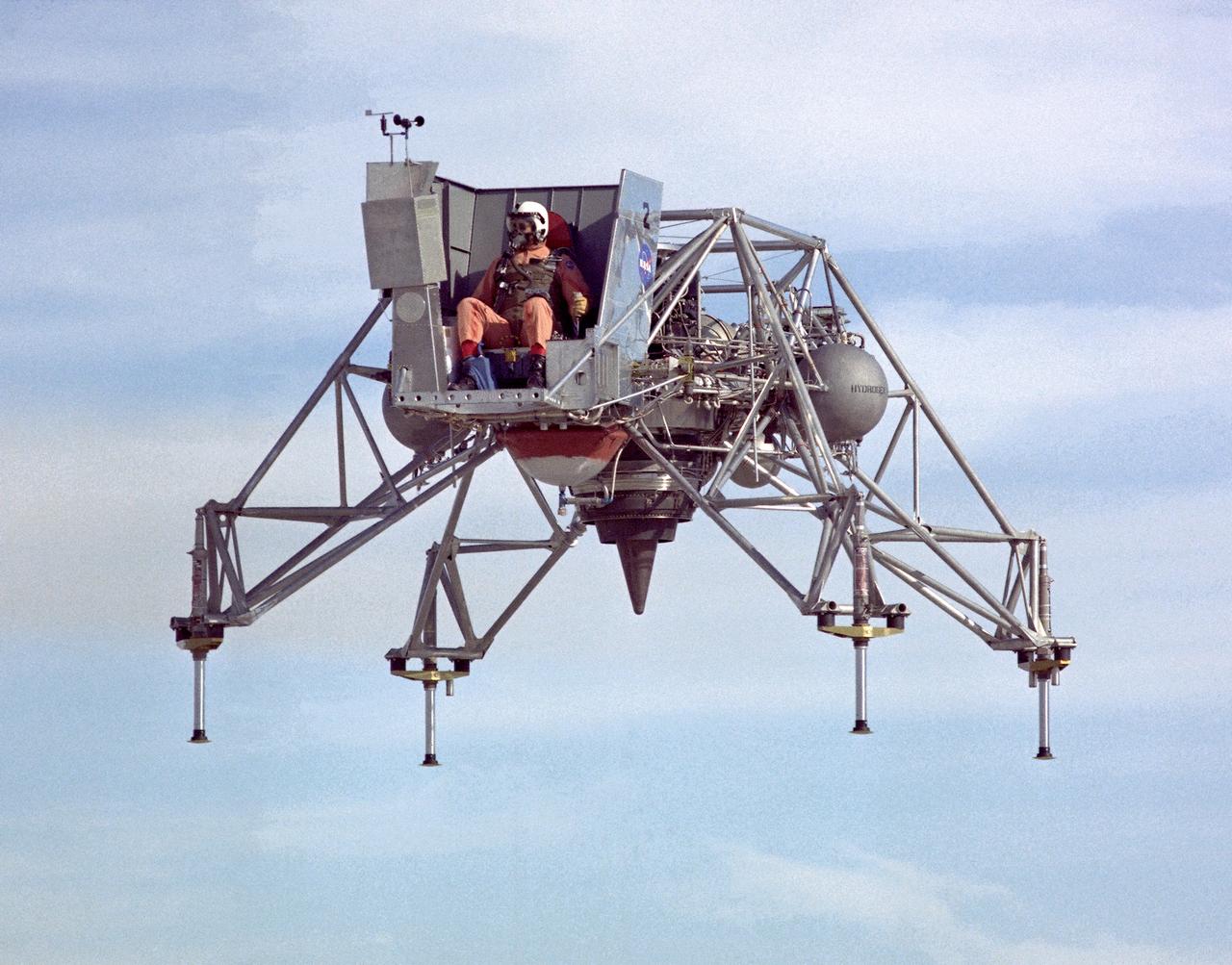
In this 1967 NASA Flight Reserch Center photograph the Lunar Landing Research Vehicle (LLRV) is viewed from the front. This photograph provideds a good view of the pilot’s platform with the restrictive cockpit view like that of he real Lunar Module (LM) When Apollo planning was underway in 1960, NASA was looking for a simulator to profile the descent to the Moon's surface. Three concepts surfaced: an electronic simulator, a tethered device, and the ambitious Dryden contribution, a free-flying vehicle. All three became serious projects, but eventually the NASA Flight Research Center’s (FRC) Lunar Landing Research Vehicle (LLRV) became the most significant one. After conceptual planning and meetings with engineers from Bell Aerosystems Company, Buffalo, N.Y., NASA FRC issued a $3.6 million production contract awarded in 1963, for delivery of the first of two vehicles for flight studies. Built of tubular aluminum alloy like a giant four-legged bedstead, the vehicle was to simulate a lunar landing profile from around 1500 feet to the Moon’s surface. The LLRV had a turbofan engine mounted vertically in a gimbal, with 4200 pounds of thrust. The engine, lifted the vehicle up to the test altitude and was then throttled back to support five-sixths of the vehicle's weight, thus simulating the reduced gravity of the Moon. Two lift rockets with thrust that could be varied from 100 to 500 pounds handled the LLRV's rate of descent and horizontal translations. Sixteen smaller rockets, mounted in pairs, gave the pilot control in pitch, yaw, and roll.. The pilot’s platform extended forward between two legs while an electronics platform, similarly located, extended rearward. The pilot had a zero-zero ejection seat that would then lift him away to safety. The two LLRVs were shipped from Bell to the FRC in April 1964, with program emphasis on vehicle No. 1. The first flight, Oct. 30, 1964, NASA research pilot Joe Walker flew it three times for a total of just under 60 seconds
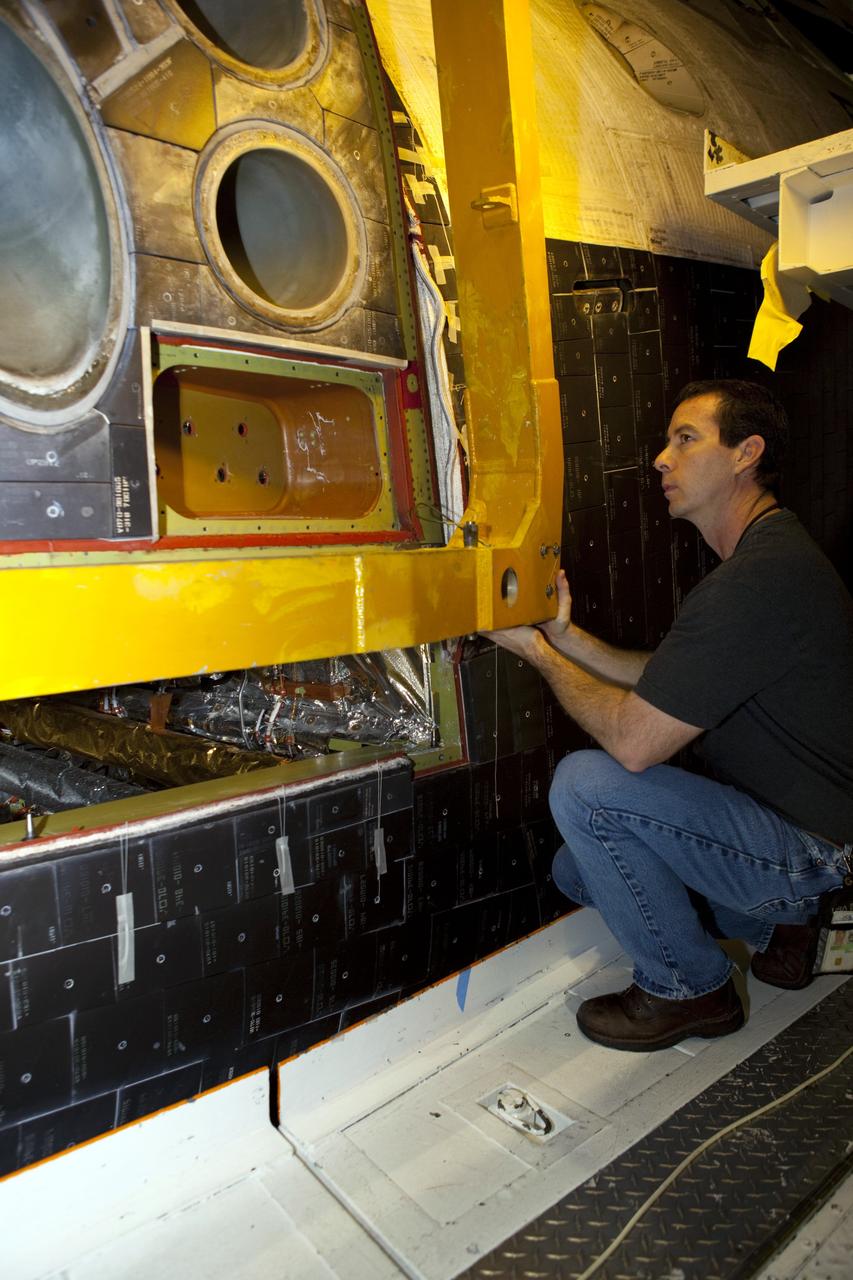
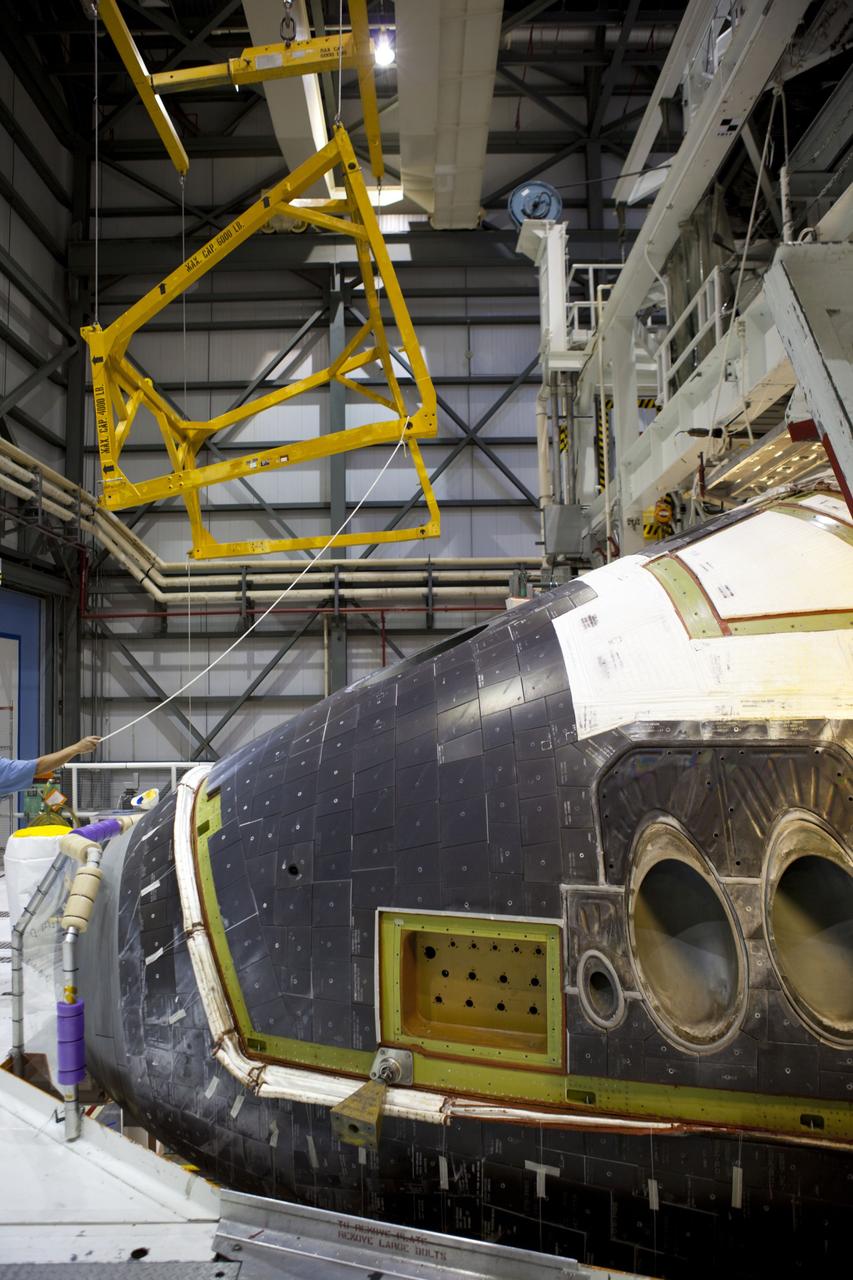
CAPE CANAVERAL, Fla. – In Orbiter Processing Facility-2 at NASA’s Kennedy Space Center in Florida, a technician helps guide a large crane as it lowers the forward reaction control system (FRCS) for installation on space shuttle Endeavour. The work is part of the Space Shuttle Program transition and retirement processing of Endeavour. The FRCS helped maneuver a shuttle while it was in orbit. The FRCS was removed from Endeavour and sent to White Sands Test Facility in N.M. to be cleaned of its toxic propellants. Endeavour is being prepared for display at the California Science Center in Los Angeles. Photo credit: NASA/Dimitri Gerondidakis
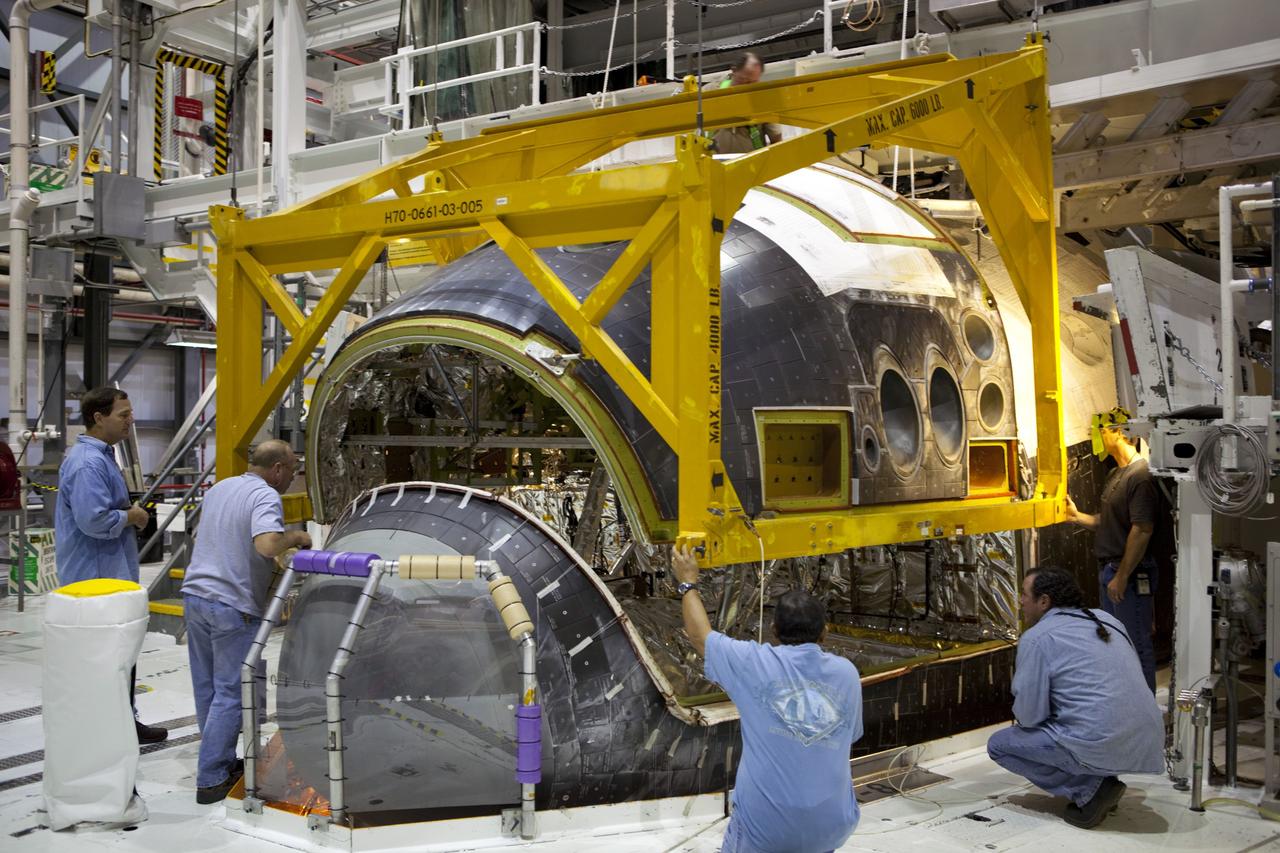
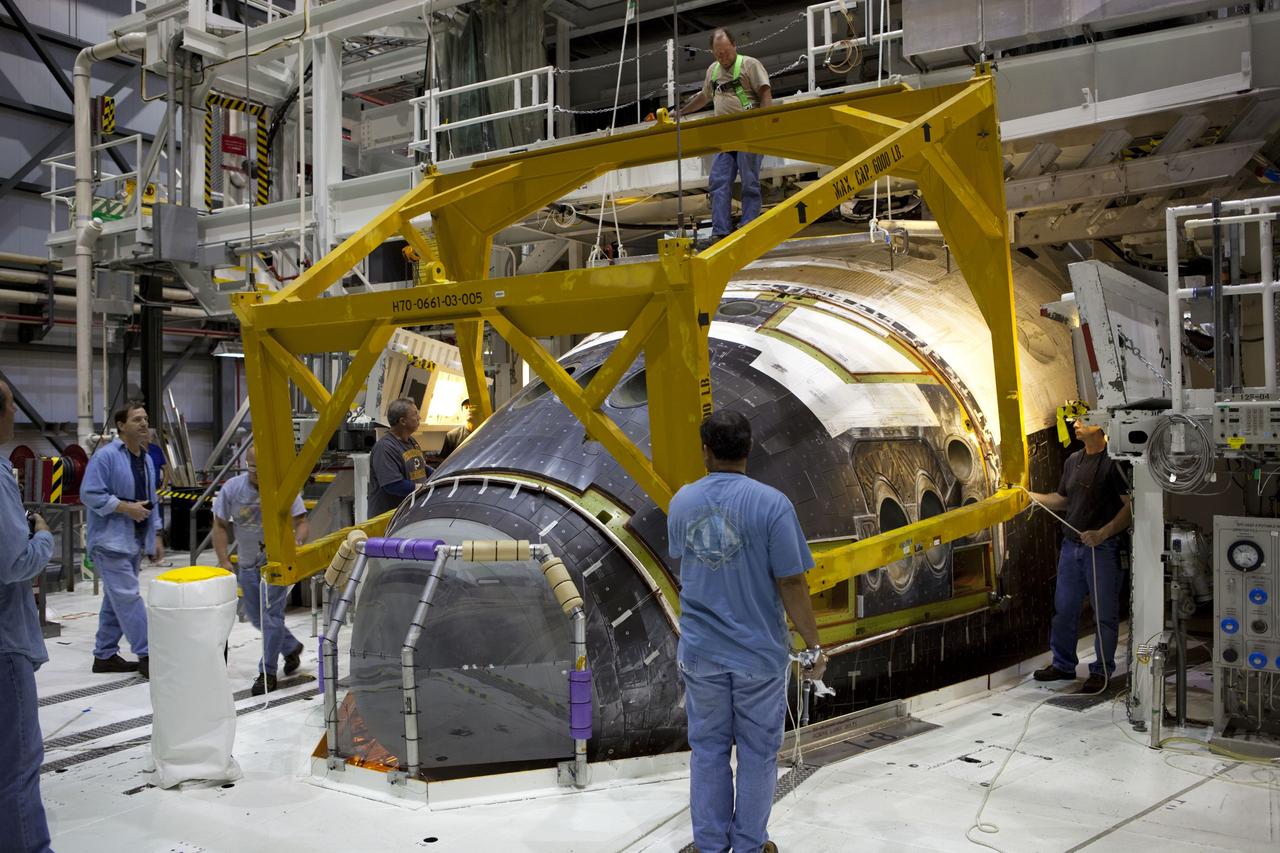
CAPE CANAVERAL, Fla. – In Orbiter Processing Facility-2 at NASA’s Kennedy Space Center in Florida, technicians help guide a large crane as it lowers the forward reaction control system (FRCS) for installation on space shuttle Endeavour. The work is part of the Space Shuttle Program transition and retirement processing of Endeavour. The FRCS helped maneuver a shuttle while it was in orbit. The FRCS was removed from Endeavour and sent to White Sands Test Facility in N.M. to be cleaned of its toxic propellants. Endeavour is being prepared for display at the California Science Center in Los Angeles. Photo credit: NASA/Dimitri Gerondidakis
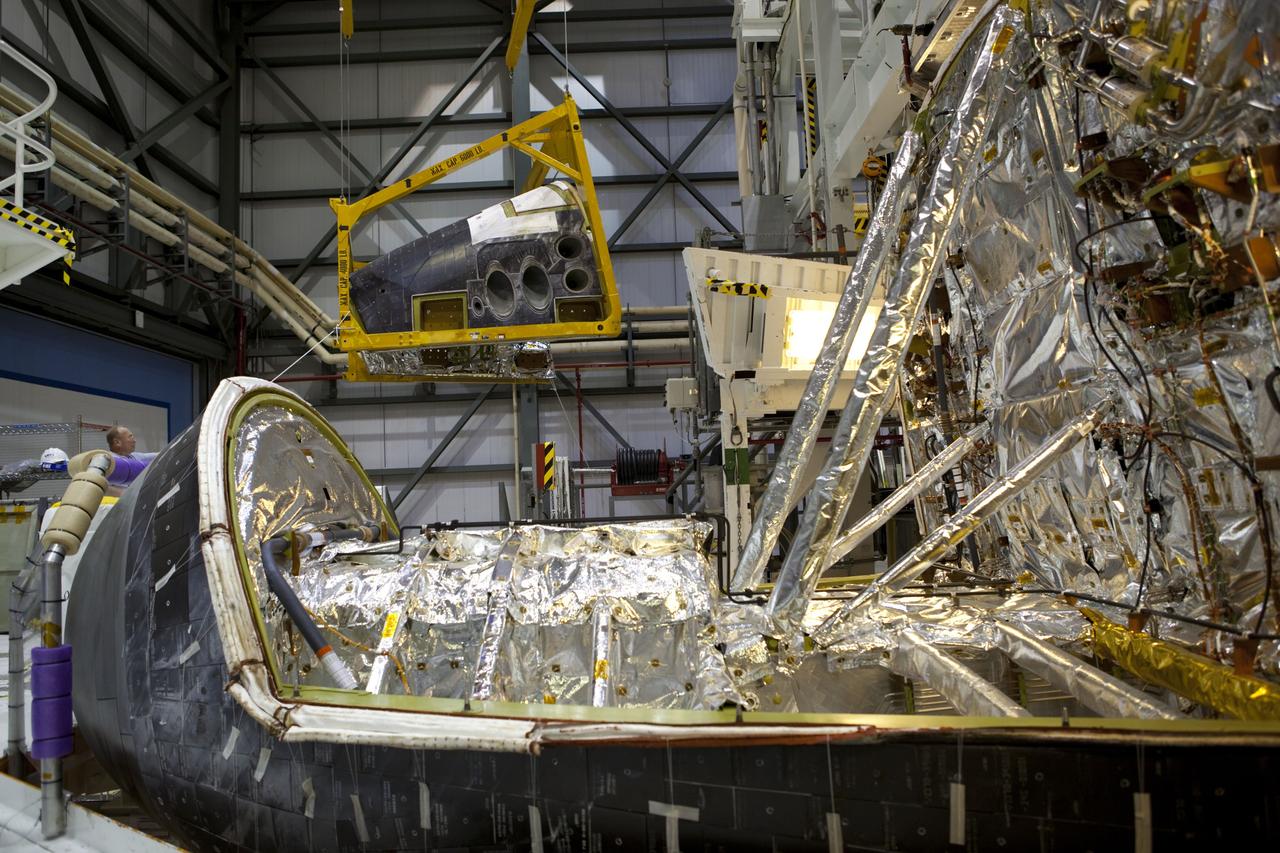
CAPE CANAVERAL, Fla. – In Orbiter Processing Facility-2 at NASA’s Kennedy Space Center in Florida, technicians monitor the progress as a large crane lifts and moves the forward reaction control system (FRCS) for installation on space shuttle Endeavour. The work is part of the Space Shuttle Program transition and retirement processing of Endeavour. The FRCS helped maneuver a shuttle while it was in orbit. The FRCS was removed from Endeavour and sent to White Sands Test Facility in N.M. to be cleaned of its toxic propellants. Endeavour is being prepared for display at the California Science Center in Los Angeles. Photo credit: NASA/Dimitri Gerondidakis
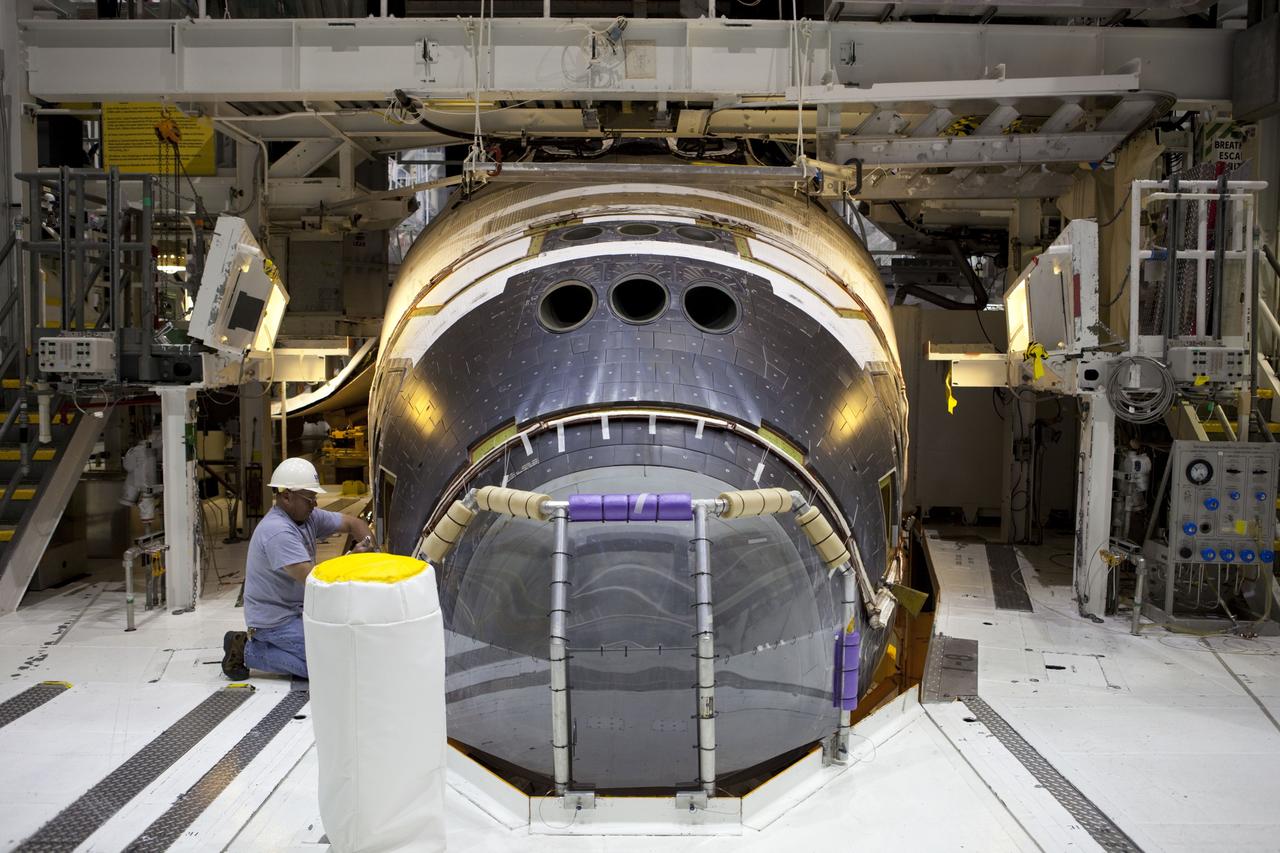
CAPE CANAVERAL, Fla. – In Orbiter Processing Facility-2 at NASA’s Kennedy Space Center in Florida, one of several technicians installs the forward reaction control system (FRCS) on space shuttle Endeavour. The work is part of the Space Shuttle Program transition and retirement processing of Endeavour. The FRCS helped maneuver a shuttle while it was in orbit. The FRCS was removed from Endeavour and sent to White Sands Test Facility in N.M. to be cleaned of its toxic propellants. Endeavour is being prepared for display at the California Science Center in Los Angeles. Photo credit: NASA/Dimitri Gerondidakis
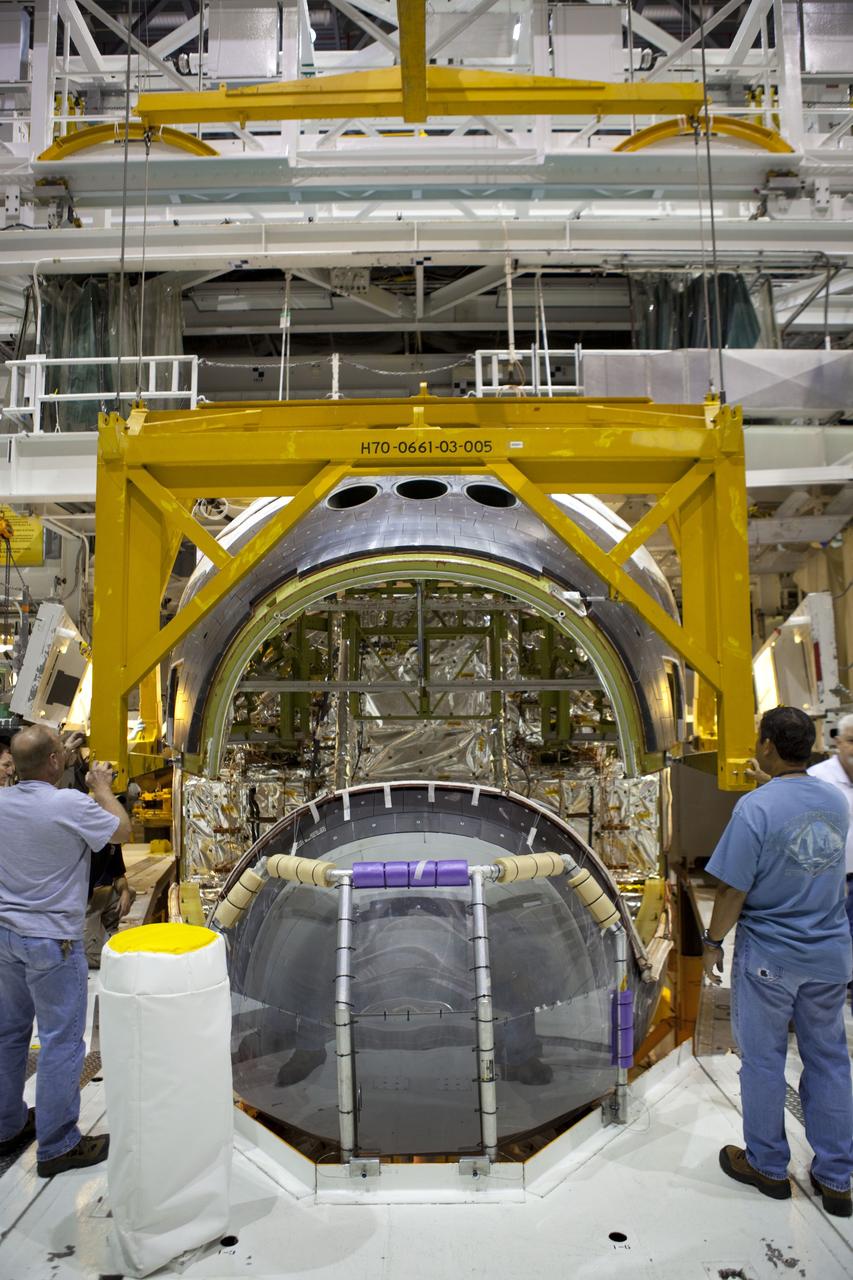
CAPE CANAVERAL, Fla. –In Orbiter Processing Facility-2 at NASA’s Kennedy Space Center in Florida, technicians assist as a large crane lowers the forward reaction control system (FRCS) for installation on space shuttle Endeavour. The work is part of the Space Shuttle Program transition and retirement processing of Endeavour. The FRCS helped maneuver a shuttle while it was in orbit. The FRCS was removed from Endeavour and sent to White Sands Test Facility in N.M. to be cleaned of its toxic propellants. Endeavour is being prepared for display at the California Science Center in Los Angeles. Photo credit: NASA/Dimitri Gerondidakis
CAPE CANAVERAL, Fla. – In Orbiter Processing Facility-2 at NASA’s Kennedy Space Center in Florida, a large crane is lifted away after it was used to lower the forward reaction control system (FRCS) for installation on space shuttle Endeavour. The work is part of the Space Shuttle Program transition and retirement processing of Endeavour. The FRCS helped maneuver a shuttle while it was in orbit. The FRCS was removed from Endeavour and sent to White Sands Test Facility in N.M. to be cleaned of its toxic propellants. Endeavour is being prepared for display at the California Science Center in Los Angeles. Photo credit: NASA/Dimitri Gerondidakis
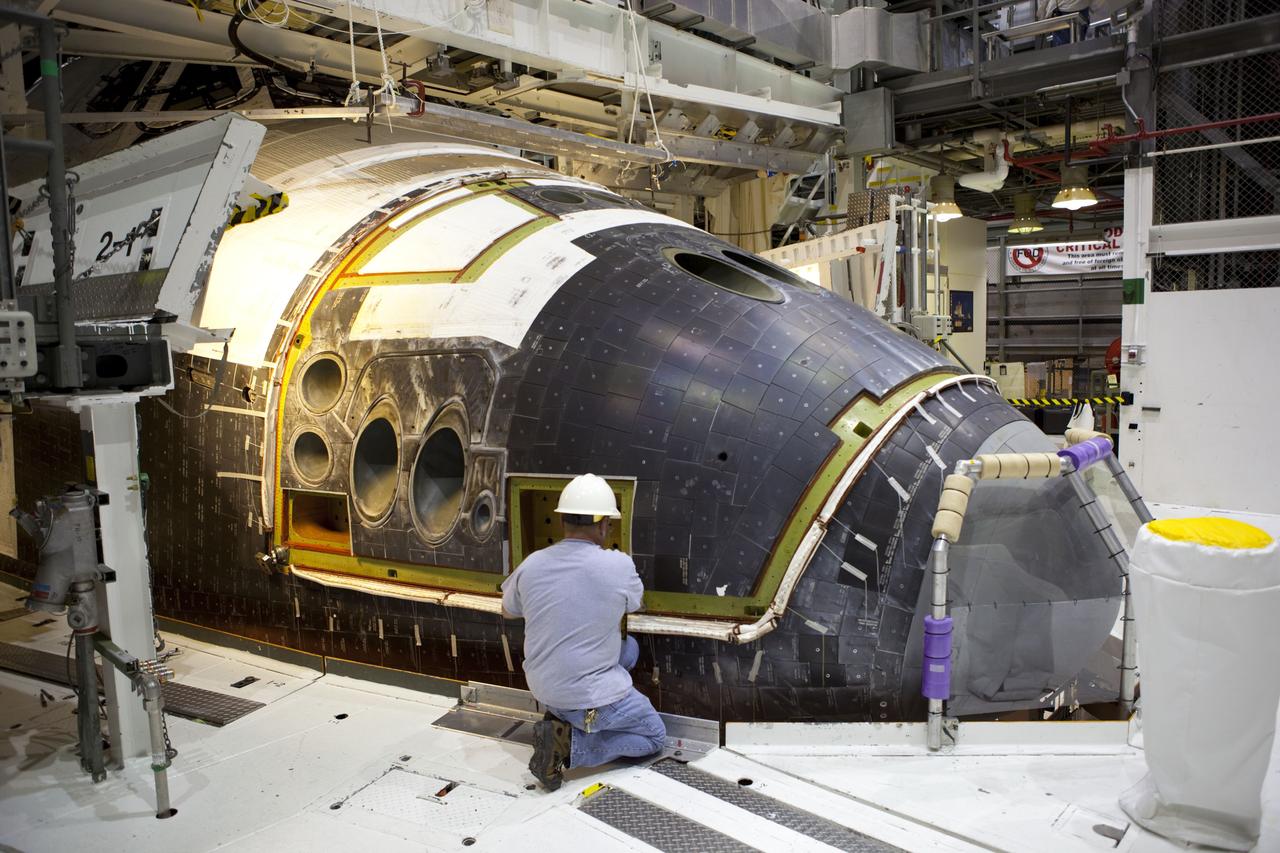
CAPE CANAVERAL, Fla. – In Orbiter Processing Facility-2 at NASA’s Kennedy Space Center in Florida, one of several technicians installs the forward reaction control system (FRCS) on space shuttle Endeavour. The work is part of the Space Shuttle Program transition and retirement processing of Endeavour. The FRCS helped maneuver a shuttle while it was in orbit. The FRCS was removed from Endeavour and sent to White Sands Test Facility in N.M. to be cleaned of its toxic propellants. Endeavour is being prepared for display at the California Science Center in Los Angeles. Photo credit: NASA/Dimitri Gerondidakis
CAPE CANAVERAL, Fla. – In Orbiter Processing Facility-2 at NASA’s Kennedy Space Center in Florida, technicians help lift away the large crane that was used to lower the forward reaction control system (FRCS) for installation on space shuttle Endeavour. The work is part of the Space Shuttle Program transition and retirement processing of Endeavour. The FRCS helped maneuver a shuttle while it was in orbit. The FRCS was removed from Endeavour and sent to White Sands Test Facility in N.M. to be cleaned of its toxic propellants. Endeavour is being prepared for display at the California Science Center in Los Angeles. Photo credit: NASA/Dimitri Gerondidakis
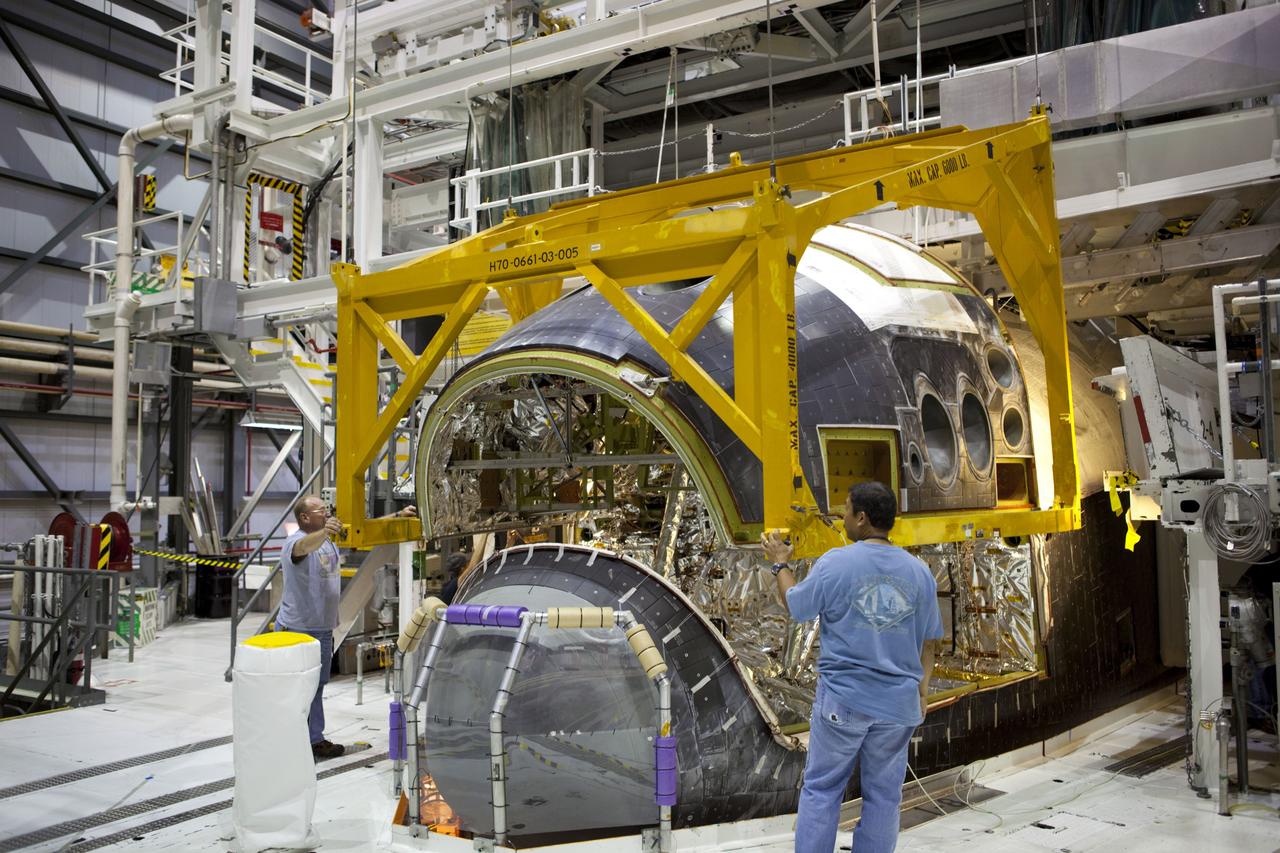
CAPE CANAVERAL, Fla. – In Orbiter Processing Facility-2 at NASA’s Kennedy Space Center in Florida, technicians help guide a large crane as it lowers the forward reaction control system (FRCS) for installation on space shuttle Endeavour. The work is part of the Space Shuttle Program transition and retirement processing of Endeavour. The FRCS helped maneuver a shuttle while it was in orbit. The FRCS was removed from Endeavour and sent to White Sands Test Facility in N.M. to be cleaned of its toxic propellants. Endeavour is being prepared for display at the California Science Center in Los Angeles. Photo credit: NASA/Dimitri Gerondidakis
CAPE CANAVERAL, Fla. – In Orbiter Processing Facility-2 at NASA’s Kennedy Space Center in Florida, technicians monitor the progress as a large crane lifts and moves the forward reaction control system (FRCS) for installation on space shuttle Endeavour. The work is part of the Space Shuttle Program transition and retirement processing of Endeavour. The FRCS helped maneuver a shuttle while it was in orbit. The FRCS was removed from Endeavour and sent to White Sands Test Facility in N.M. to be cleaned of its toxic propellants. Endeavour is being prepared for display at the California Science Center in Los Angeles. Photo credit: NASA/Dimitri Gerondidakis
CAPE CANAVERAL, Fla. – In Orbiter Processing Facility-2 at NASA’s Kennedy Space Center in Florida, a technician monitors the progress as a large crane lifts the forward reaction control system (FRCS) for installation on space shuttle Endeavour. The work is part of the Space Shuttle Program transition and retirement processing of Endeavour. The FRCS helped maneuver a shuttle while it was in orbit. The FRCS was removed from Endeavour and sent to White Sands Test Facility in N.M. to be cleaned of its toxic propellants. Endeavour is being prepared for display at the California Science Center in Los Angeles. Photo credit: NASA/Dimitri Gerondidakis
CAPE CANAVERAL, Fla. – In Orbiter Processing Facility-2 at NASA’s Kennedy Space Center in Florida, technicians assist as a large crane lowers the forward reaction control system (FRCS) for installation on space shuttle Endeavour. The work is part of the Space Shuttle Program transition and retirement processing of Endeavour. The FRCS helped maneuver a shuttle while it was in orbit. The FRCS was removed from Endeavour and sent to White Sands Test Facility in N.M. to be cleaned of its toxic propellants. Endeavour is being prepared for display at the California Science Center in Los Angeles. Photo credit: NASA/Dimitri Gerondidakis
CAPE CANAVERAL, Fla. – In Orbiter Processing Facility-2 at NASA’s Kennedy Space Center in Florida, the forward reaction control system (FRCS) has been prepared to be lifted and installed on space shuttle Endeavour. The work is part of the Space Shuttle Program transition and retirement processing of Endeavour. The FRCS helped maneuver a shuttle while it was in orbit. The FRCS was removed from Endeavour and sent to White Sands Test Facility in N.M. to be cleaned of its toxic propellants. Endeavour is being prepared for display at the California Science Center in Los Angeles. Photo credit: NASA/Dimitri Gerondidakis
CAPE CANAVERAL, Fla. – In Orbiter Processing Facility-2 at NASA’s Kennedy Space Center in Florida, technicians monitor the progress as a large crane lifts and moves the forward reaction control system (FRCS) closer for installation on space shuttle Endeavour. The work is part of the Space Shuttle Program transition and retirement processing of Endeavour. The FRCS helped maneuver a shuttle while it was in orbit. The FRCS was removed from Endeavour and sent to White Sands Test Facility in N.M. to be cleaned of its toxic propellants. Endeavour is being prepared for display at the California Science Center in Los Angeles. Photo credit: NASA/Dimitri Gerondidakis
CAPE CANAVERAL, Fla. – In Orbiter Processing Facility-2 at NASA’s Kennedy Space Center in Florida, technicians prepare space shuttle Endeavour so that the forward reaction control system (FRCS) can be lifted and installed. The work is part of the Space Shuttle Program transition and retirement processing of Endeavour. The FRCS helped maneuver a shuttle while it was in orbit. The FRCS was removed from Endeavour and sent to White Sands Test Facility in N.M. to be cleaned of its toxic propellants. Endeavour is being prepared for display at the California Science Center in Los Angeles. Photo credit: NASA/Dimitri Gerondidakis
CAPE CANAVERAL, Fla. – In Orbiter Processing Facility-2 at NASA’s Kennedy Space Center in Florida, technicians monitor the progress as a large crane lifts and moves the forward reaction control system (FRCS) closer for installation on space shuttle Endeavour. The work is part of the Space Shuttle Program transition and retirement processing of Endeavour. The FRCS helped maneuver a shuttle while it was in orbit. The FRCS was removed from Endeavour and sent to White Sands Test Facility in N.M. to be cleaned of its toxic propellants. Endeavour is being prepared for display at the California Science Center in Los Angeles. Photo credit: NASA/Dimitri Gerondidakis
CAPE CANAVERAL, Fla. – In Orbiter Processing Facility-2 at NASA’s Kennedy Space Center in Florida, technicians prepare to lift the forward reaction control system (FRCS) for installation on space shuttle Endeavour. The work is part of the Space Shuttle Program transition and retirement processing of Endeavour. The FRCS helped maneuver a shuttle while it was in orbit. The FRCS was removed from Endeavour and sent to White Sands Test Facility in N.M. to be cleaned of its toxic propellants. Endeavour is being prepared for display at the California Science Center in Los Angeles. Photo credit: NASA/Dimitri Gerondidakis
CAPE CANAVERAL, Fla. – In Orbiter Processing Facility-2 at NASA’s Kennedy Space Center in Florida, a technician assists as a large crane lowers the forward reaction control system (FRCS) for installation on space shuttle Endeavour. The work is part of the Space Shuttle Program transition and retirement processing of Endeavour. The FRCS helped maneuver a shuttle while it was in orbit. The FRCS was removed from Endeavour and sent to White Sands Test Facility in N.M. to be cleaned of its toxic propellants. Endeavour is being prepared for display at the California Science Center in Los Angeles. Photo credit: NASA/Dimitri Gerondidakis
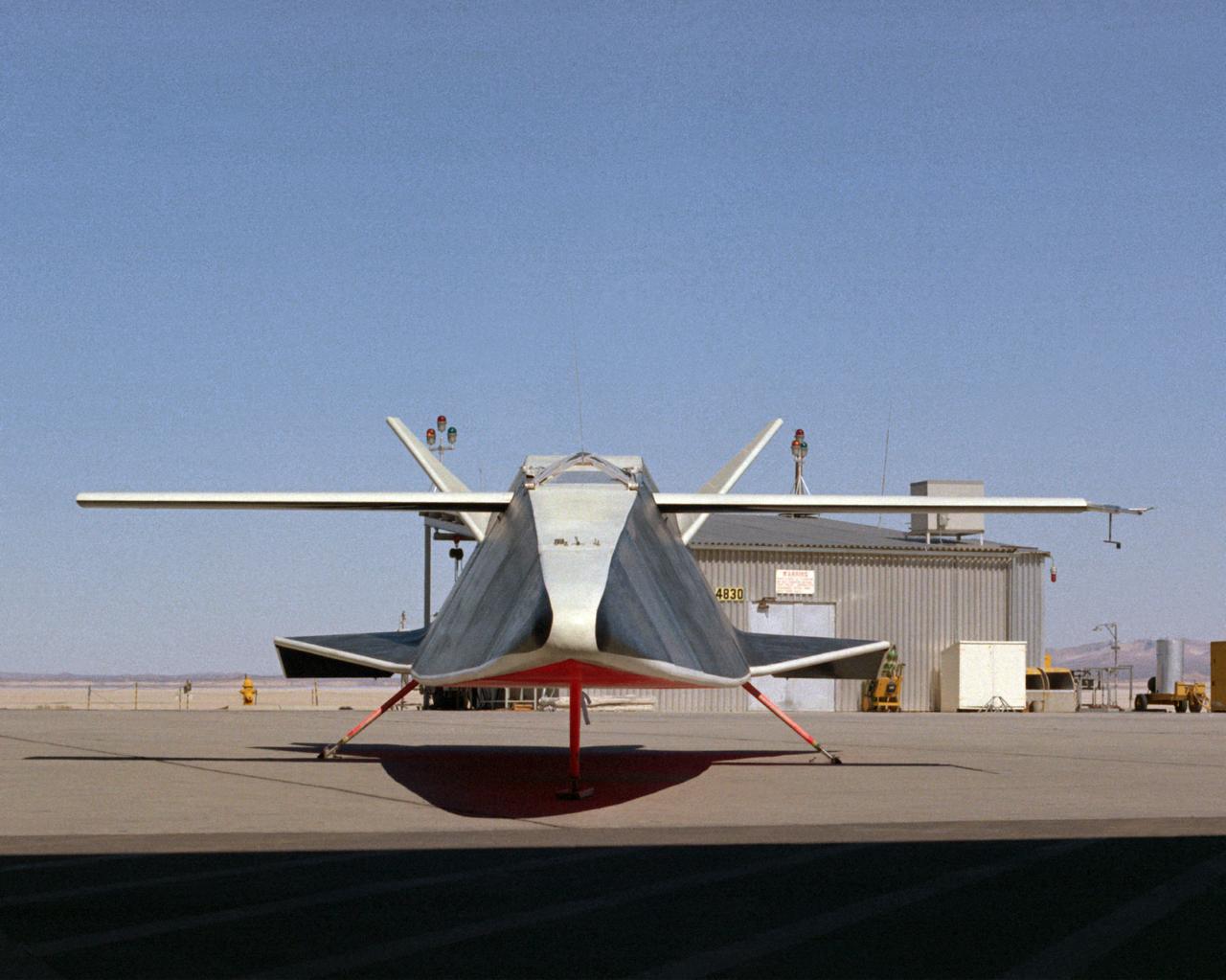
The Hyper III was a low-cost test vehicle for an advanced lifting-body shape. Like the earlier M2-F1, it was a "homebuilt" research aircraft, i.e., built at the Flight Research Center (FRC), later redesignated the Dryden Flight Research Center. It had a steel-tube frame covered with Dacron, a fiberglass nose, sheet aluminum fins, and a wing from an HP-11 sailplane. Construction was by volunteers at the FRC. Although the Hyper III was to be flown remotely in its initial tests, it was fitted with a cockpit for a pilot. On the Hyper III's only flight, it was towed aloft attached to a Navy SH-3 helicopter by a 400-foot cable. NASA research pilot Bruce Peterson flew the SH-3. After he released the Hyper III from the cable, NASA research pilot Milt Thompson flew the vehicle by radio control until the final approach when Dick Fischer took over control using a model-airplane radio-control box. The Hyper III flared, then landed and slid to a stop on Rogers Dry Lakebed.
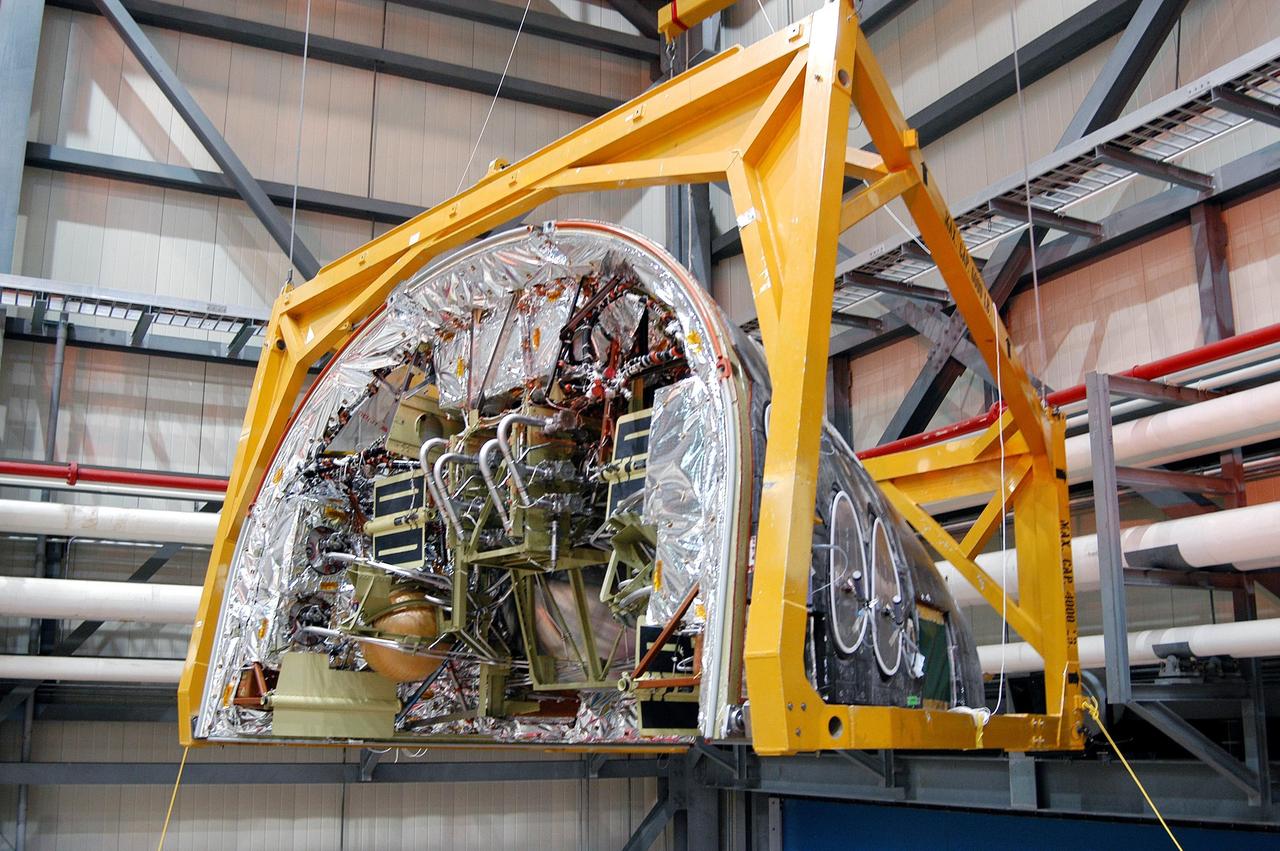
KENNEDY SPACE CENTER, FLA. - In the Orbiter Processing Facility, the Forward Reaction Control System (FRCS) is lifted by an overhead crane for installation in Discovery. Located in the forward fuselage nose area, the FRCS provides the thrust for attitude (rotational) maneuvers (pitch, yaw and roll) and for small velocity changes along the orbiter axis (translation maneuvers). Discovery is designated as the Return to Flight vehicle for mission STS-114, no earlier than March 2005.
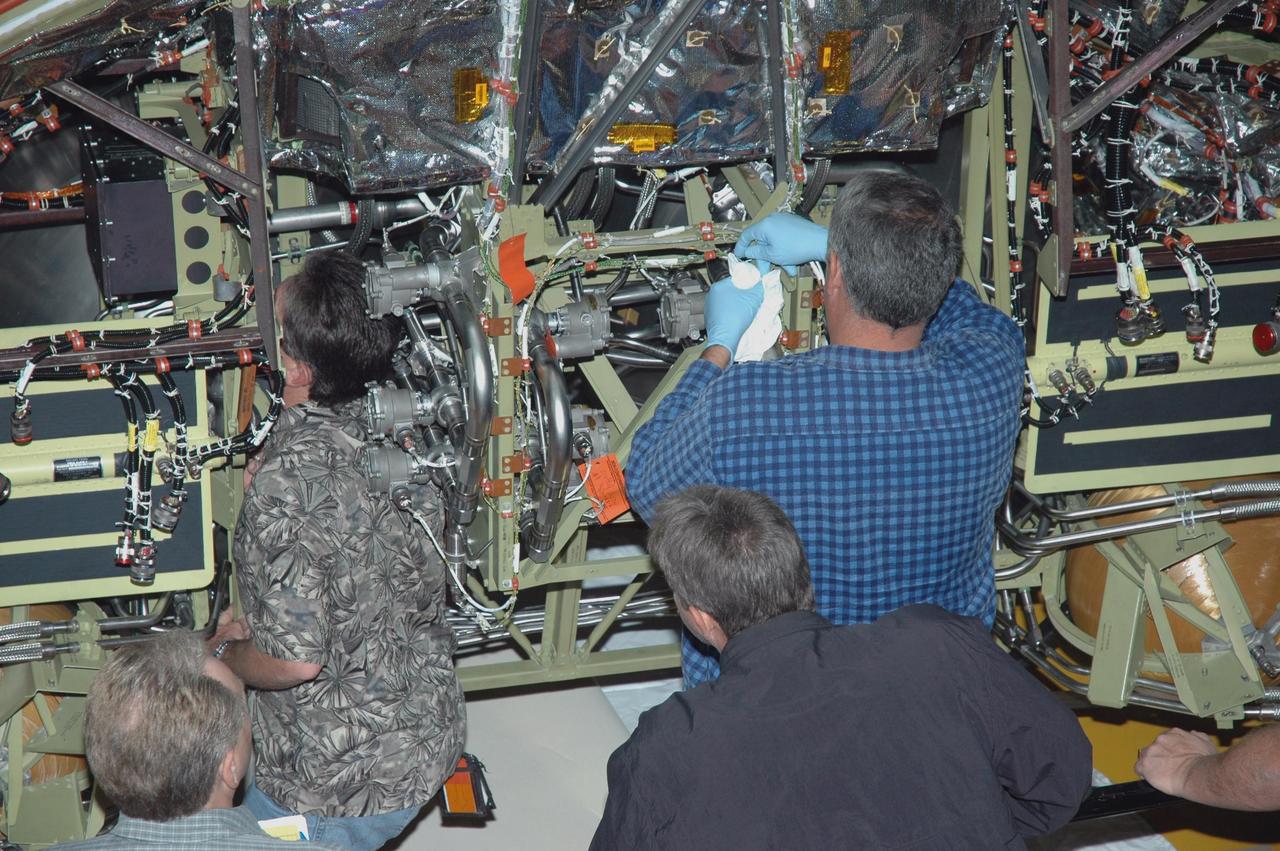
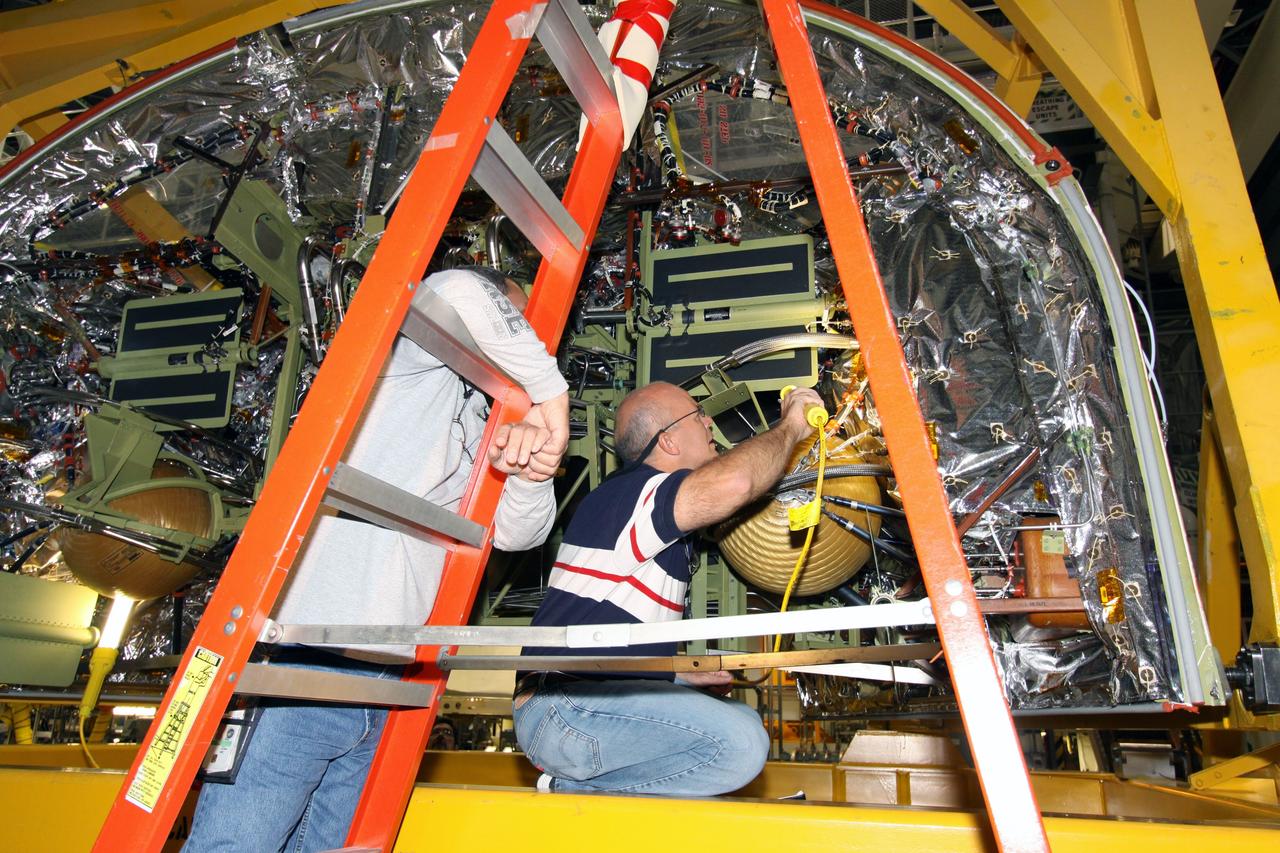
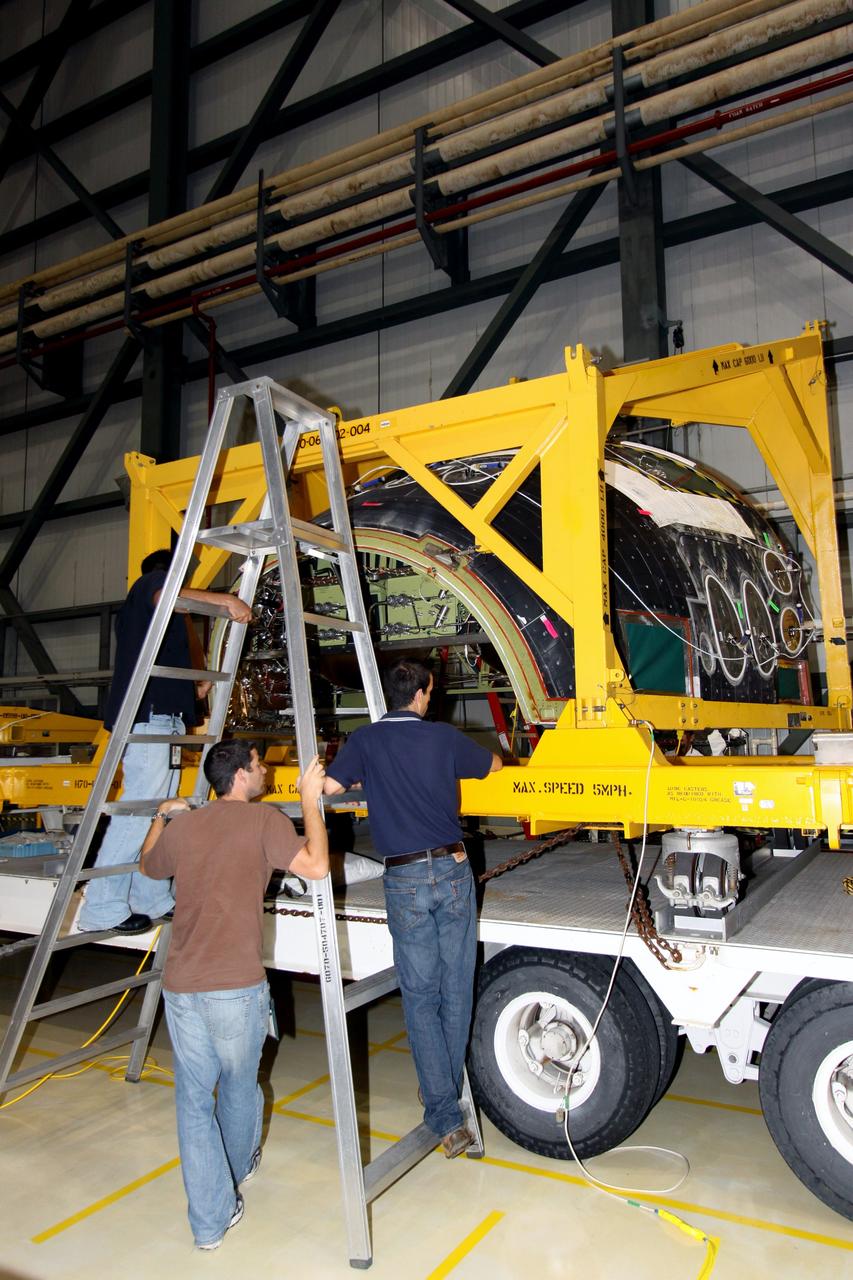
KENNEDY SPACE CENTER, FLA. - In Orbiter Processing Facility Bay 1, technicians work on the Forward Reaction Control System (FRCS) of space shuttle Atlantis as it sits in the transfer aisle prior to installation. The FRCS provides the thrust for attitude (rotational) maneuvers (pitch, yaw and roll) and for small velocity changes along the orbiter axis (translation maneuvers). Processing of Atlantis is under way for mission STS-115, the 19th flight to the International Space Station.
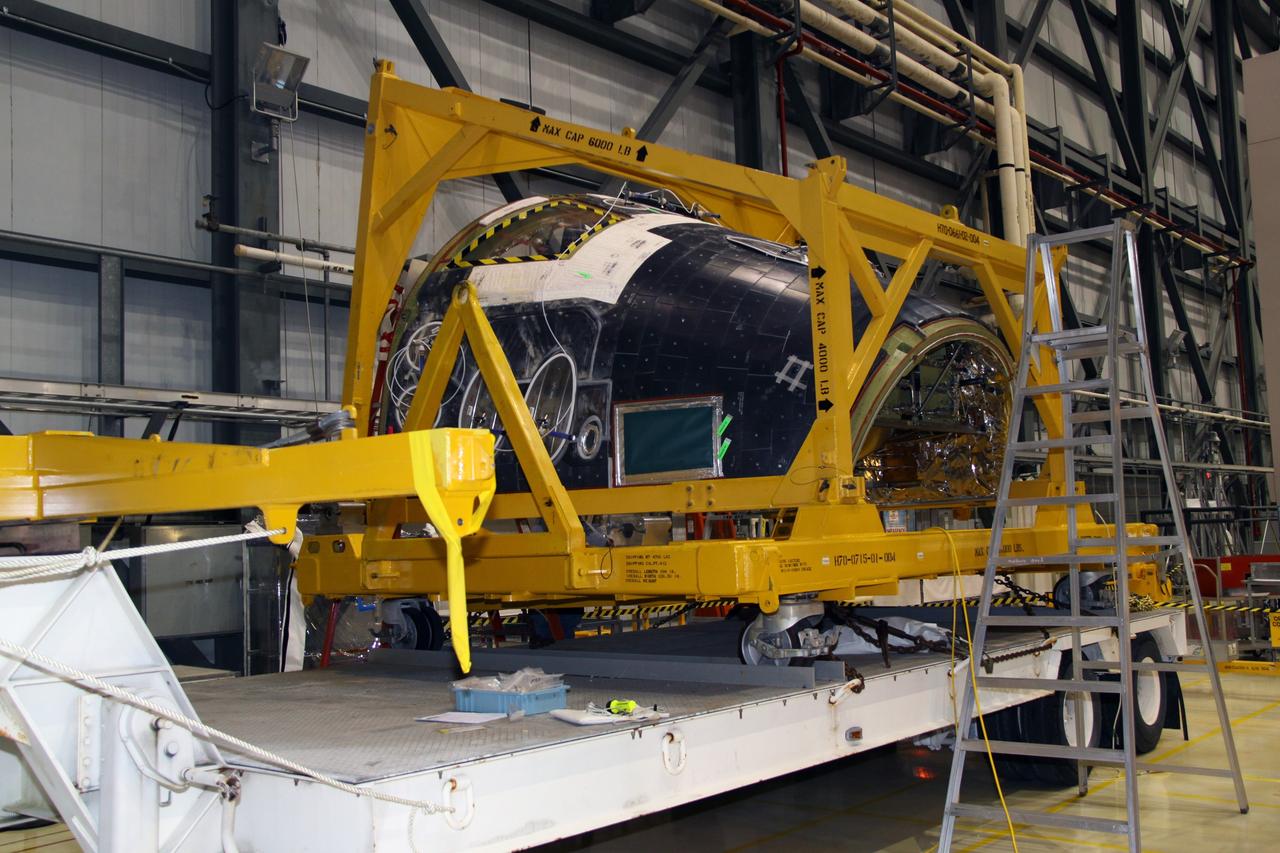
CAPE CANAVERAL, Fla. – The forward reaction control system, or FRCS, will be removed from space shuttle Endeavour's forward fuselage nose area in NASA Kennedy Space Center's Orbiter Processing Facility 2. The FRCS provides the thrust for attitude (rotational) maneuvers (pitch, yaw and roll) and for small velocity changes along the orbiter axis (translation maneuvers). Endeavour is designated as the shuttle for the STS-130 mission, targeted for launch in February 2010. Photo credit: NASA/Jack Pfaller

CAPE CANAVERAL, Fla. – The forward reaction control system, or FRCS, will be removed from space shuttle Endeavour's forward fuselage nose area in NASA Kennedy Space Center's Orbiter Processing Facility 2. The FRCS provides the thrust for attitude (rotational) maneuvers (pitch, yaw and roll) and for small velocity changes along the orbiter axis (translation maneuvers). Endeavour is designated as the shuttle for the STS-130 mission, targeted for launch in February 2010. Photo credit: NASA/Jack Pfaller

KENNEDY SPACE CENTER, FLA. - Workers in the Orbiter Processing Facility watch closely as Discovery’s Forward Reaction Control System (FRCS) is lowered into position in the orbiter’s forward fuselage nose area. The FRCS provides the thrust for attitude (rotational) maneuvers (pitch, yaw and roll) and for small velocity changes along the orbiter axis (translation maneuvers). Discovery is designated as the Return to Flight vehicle for mission STS-114, no earlier than March 2005.
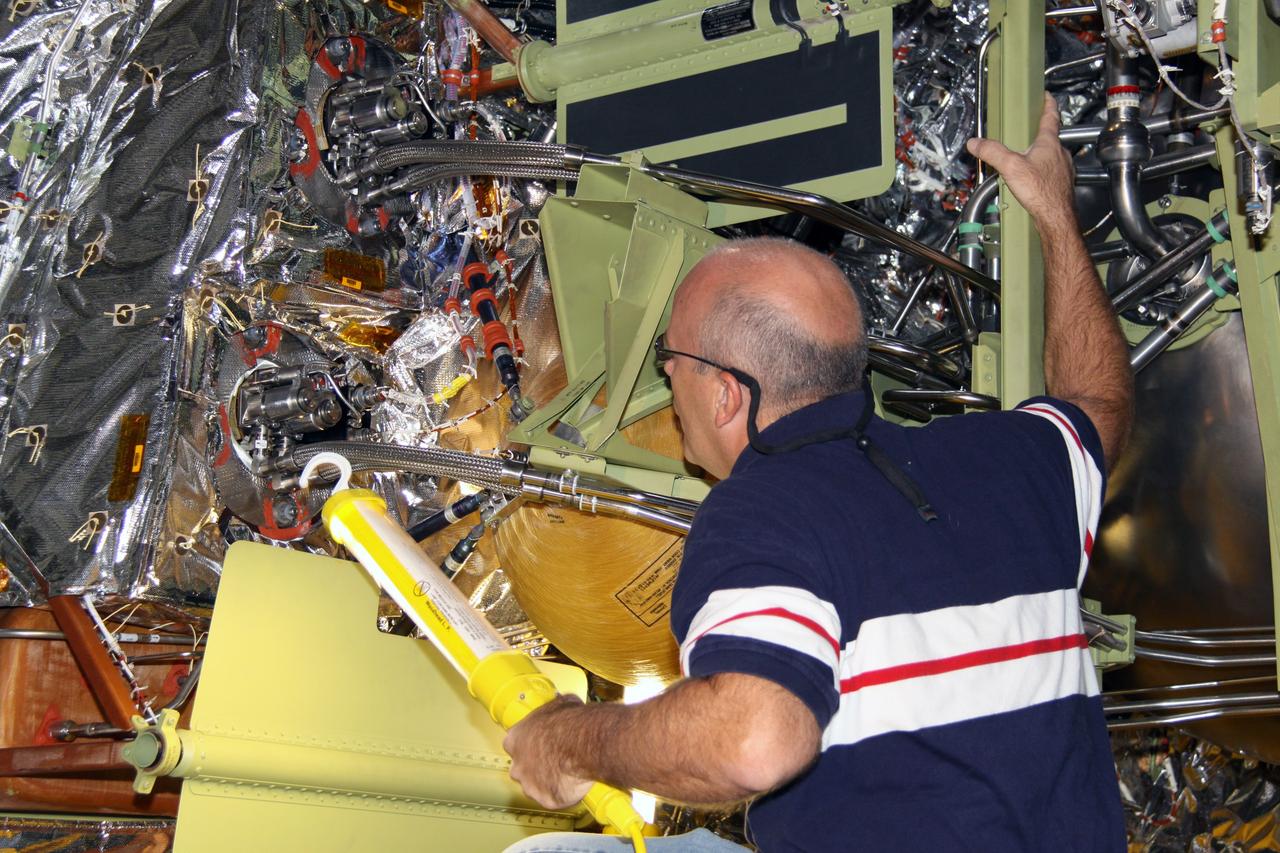
CAPE CANAVERAL, Fla. – In NASA Kennedy Space Center's Orbiter Processing Facility 2, a worker removes the forward reaction control system, or FRCS, from space shuttle Endeavour's forward fuselage nose area. The FRCS provides the thrust for attitude (rotational) maneuvers (pitch, yaw and roll) and for small velocity changes along the orbiter axis (translation maneuvers). Endeavour is designated as the shuttle for the STS-130 mission, targeted for launch in February 2010. Photo credit: NASA/Jack Pfaller
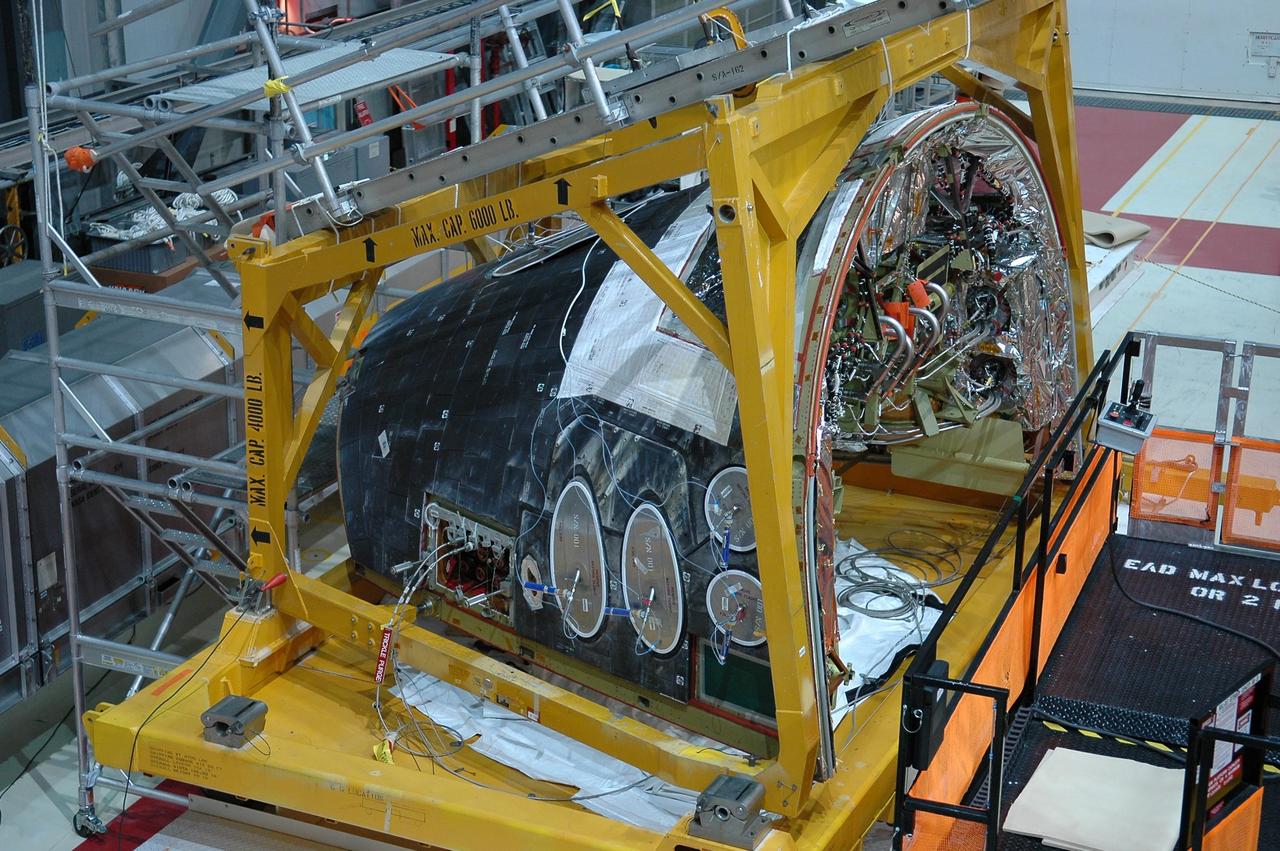
KENNEDY SPACE CENTER, FLA. - The Forward Reaction Control System (FRCS) of space shuttle Atlantis sits in the transfer aisle of Orbiter Processing Facility Bay 1 in anticipation of being installed. The FRCS provides the thrust for attitude (rotational) maneuvers (pitch, yaw and roll) and for small velocity changes along the orbiter axis (translation maneuvers). Processing of Atlantis is under way for mission STS-115, the 19th flight to the International Space Station.
CAPE CANAVERAL, Fla. – In NASA Kennedy Space Center's Orbiter Processing Facility 2, workers begin removing the forward reaction control system, or FRCS, from space shuttle Endeavour's forward fuselage nose area. The FRCS provides the thrust for attitude (rotational) maneuvers (pitch, yaw and roll) and for small velocity changes along the orbiter axis (translation maneuvers). Endeavour is designated as the shuttle for the STS-130 mission, targeted for launch in February 2010. Photo credit: NASA/Jack Pfaller

CAPE CANAVERAL, Fla. – In NASA Kennedy Space Center's Orbiter Processing Facility 2, workers remove the forward reaction control system, or FRCS, from space shuttle Endeavour's forward fuselage nose area. The FRCS provides the thrust for attitude (rotational) maneuvers (pitch, yaw and roll) and for small velocity changes along the orbiter axis (translation maneuvers). Endeavour is designated as the shuttle for the STS-130 mission, targeted for launch in February 2010. Photo credit: NASA/Jack Pfaller

KENNEDY SPACE CENTER, FLA. - The Forward Reaction Control System (FRCS) of space shuttle Atlantis sits in the transfer aisle of Orbiter Processing Facility Bay 1 in anticipation of being installed. The FRCS provides the thrust for attitude (rotational) maneuvers (pitch, yaw and roll) and for small velocity changes along the orbiter axis (translation maneuvers). Processing of Atlantis is under way for mission STS-115, the 19th flight to the International Space Station.
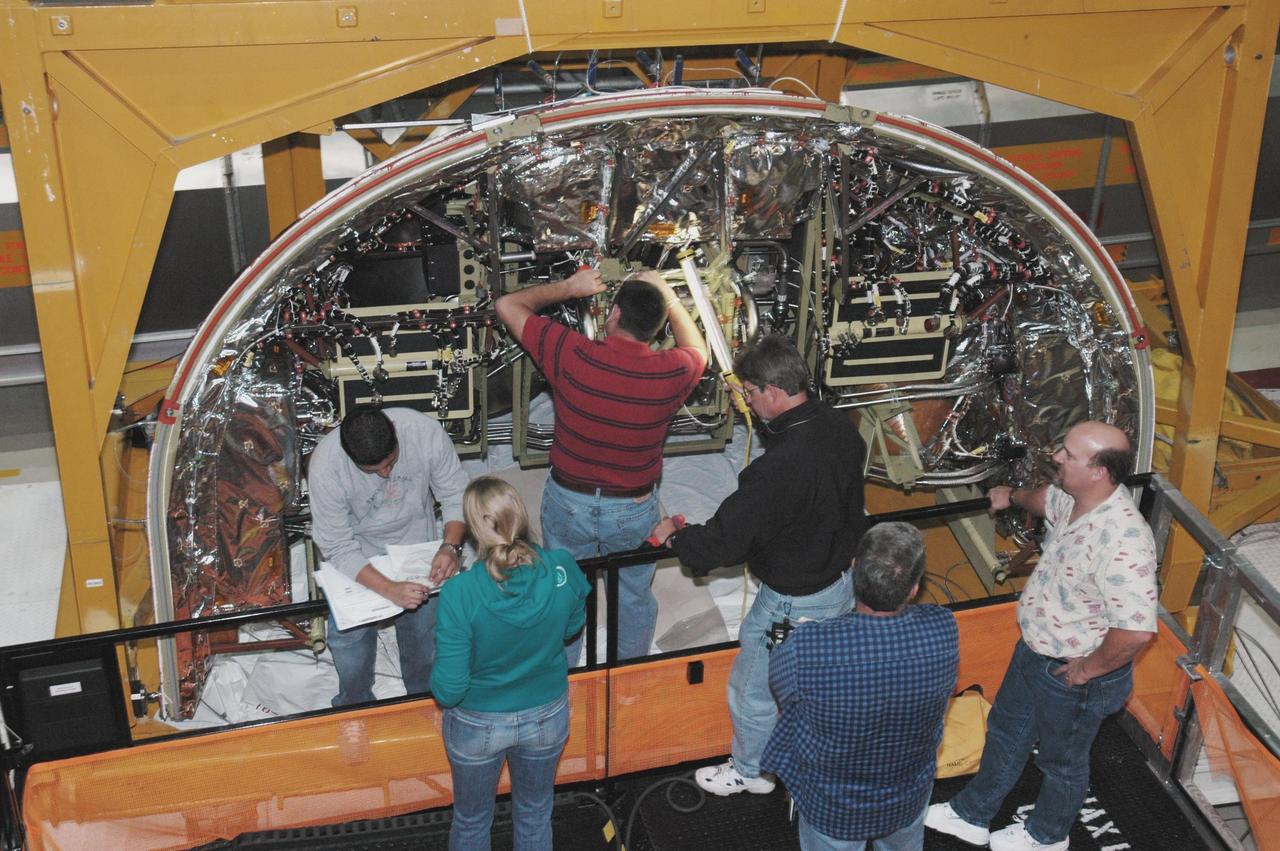
CAPE CANAVERAL, Fla. – In NASA Kennedy Space Center's Orbiter Processing Facility 2, workers prepare to remove the forward reaction control system, or FRCS, from space shuttle Endeavour's forward fuselage nose area. The FRCS provides the thrust for attitude (rotational) maneuvers (pitch, yaw and roll) and for small velocity changes along the orbiter axis (translation maneuvers). Endeavour is designated as the shuttle for the STS-130 mission, targeted for launch in February 2010. Photo credit: NASA/Jack Pfaller
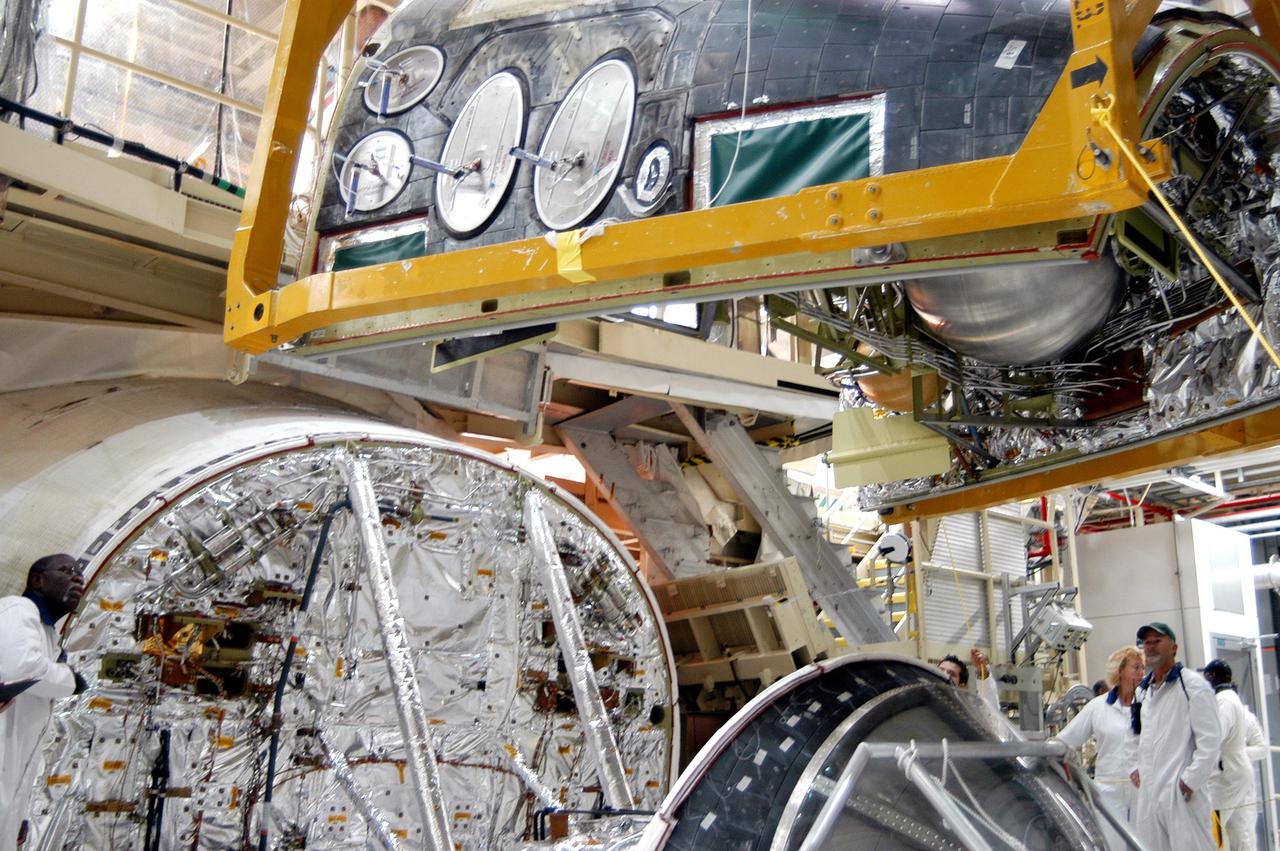
KENNEDY SPACE CENTER, FLA. - In the Orbiter Processing Facility, the Forward Reaction Control System (FRCS) is lowered toward Discovery’s forward fuselage nose area where it will be installed. The FRCS provides the thrust for attitude (rotational) maneuvers (pitch, yaw and roll) and for small velocity changes along the orbiter axis (translation maneuvers). Discovery is designated as the Return to Flight vehicle for mission STS-114, no earlier than March 2005.
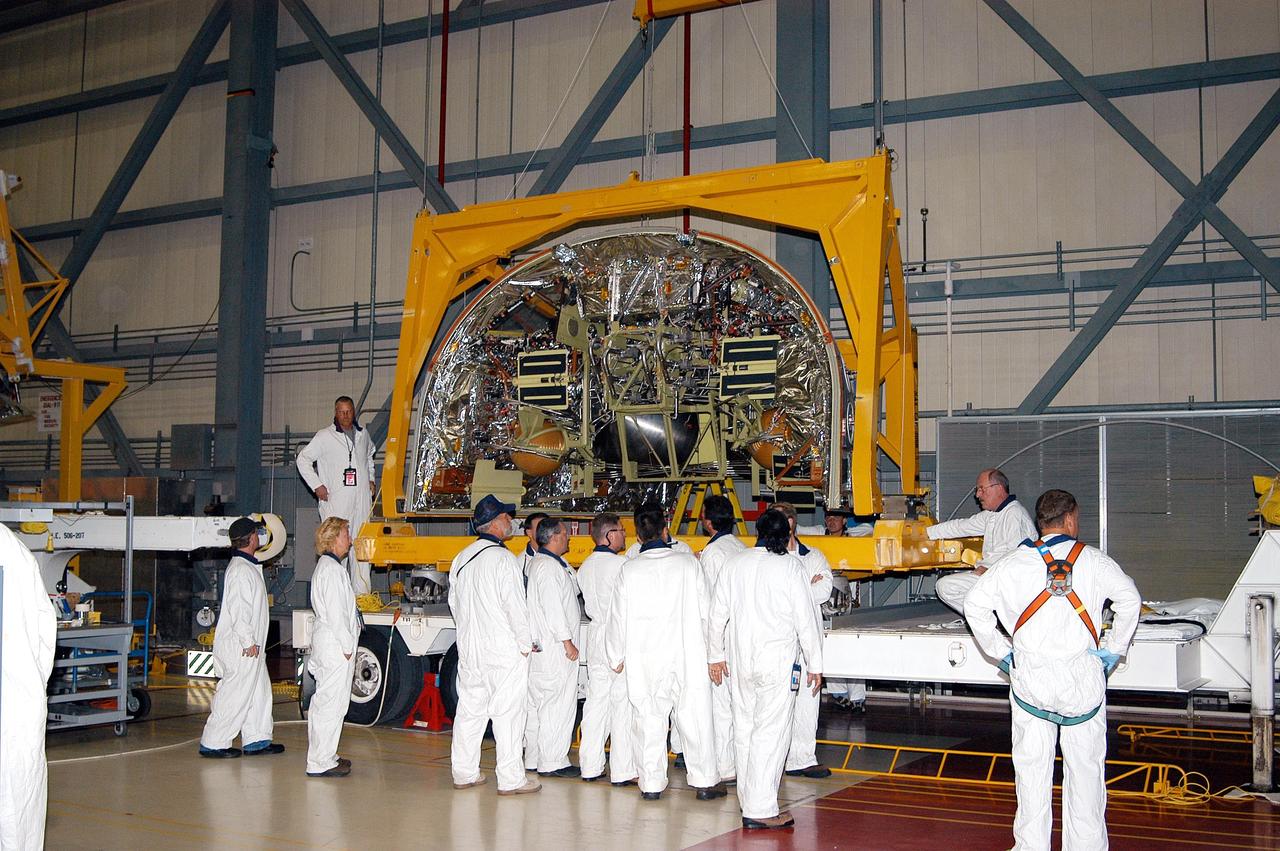
KENNEDY SPACE CENTER, FLA. - Workers in the Orbiter Processing Facility stand by as a crane lifts the Forward Reaction Control System (FRCS) for installation in Discovery. Located in the forward fuselage nose area, the FRCS provides the thrust for attitude (rotational) maneuvers (pitch, yaw and roll) and for small velocity changes along the orbiter axis (translation maneuvers). Discovery is designated as the Return to Flight vehicle for mission STS-114, no earlier than March 2005.
KENNEDY SPACE CENTER, FLA. - In Orbiter Processing Facility Bay 1, technicians work on the Forward Reaction Control System (FRCS) of space shuttle Atlantis as it sits in the transfer aisle prior to installation. The FRCS provides the thrust for attitude (rotational) maneuvers (pitch, yaw and roll) and for small velocity changes along the orbiter axis (translation maneuvers). Processing of Atlantis is under way for mission STS-115, the 19th flight to the International Space Station.

KENNEDY SPACE CENTER, FLA. - The Forward Reaction Control System (FRCS) of space shuttle Atlantis sits in the transfer aisle of Orbiter Processing Facility Bay 1 in anticipation of being installed. The FRCS provides the thrust for attitude (rotational) maneuvers (pitch, yaw and roll) and for small velocity changes along the orbiter axis (translation maneuvers). Processing of Atlantis is under way for mission STS-115, the 19th flight to the International Space Station.
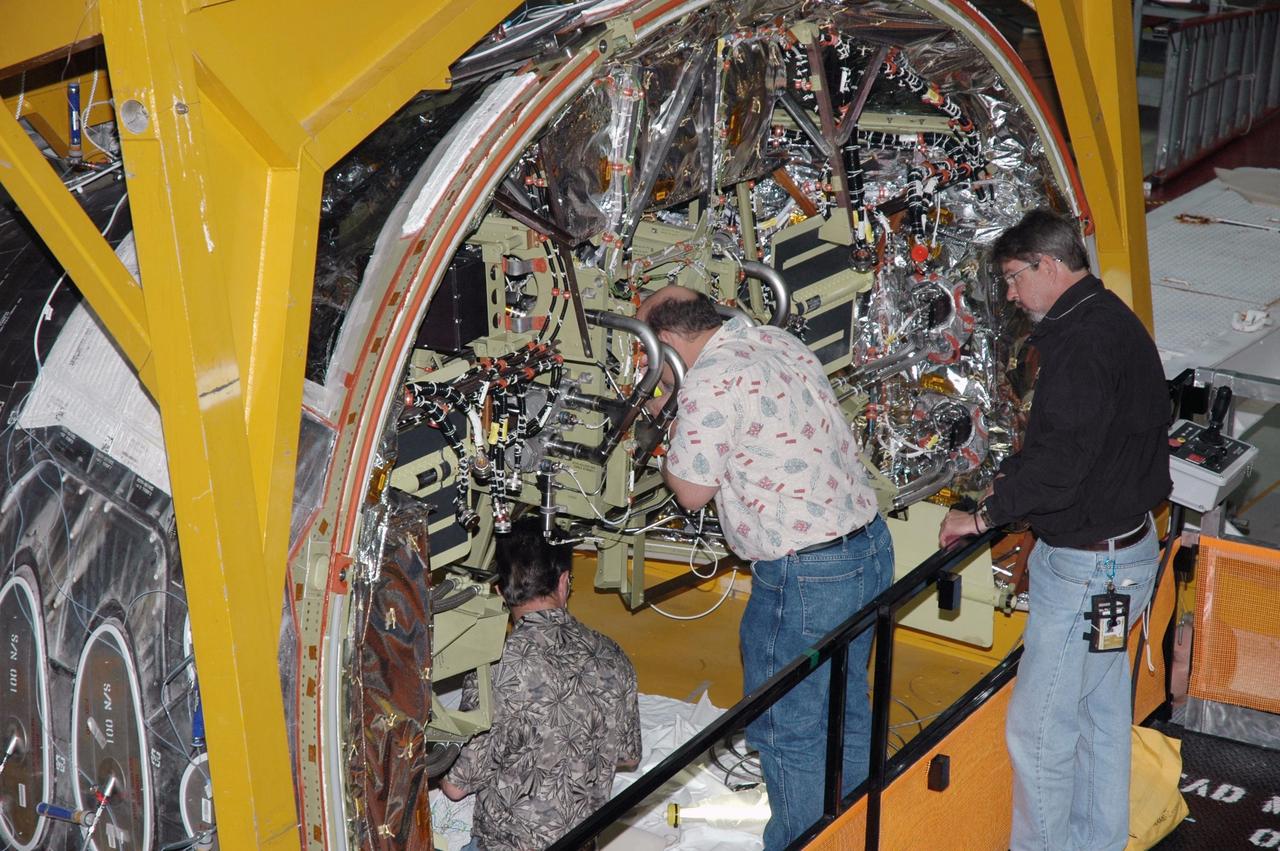
KENNEDY SPACE CENTER, FLA. - In Orbiter Processing Facility Bay 1, technicians work on the Forward Reaction Control System (FRCS) of space shuttle Atlantis as it sits in the transfer aisle prior to installation. The FRCS provides the thrust for attitude (rotational) maneuvers (pitch, yaw and roll) and for small velocity changes along the orbiter axis (translation maneuvers). Processing of Atlantis is under way for mission STS-115, the 19th flight to the International Space Station.
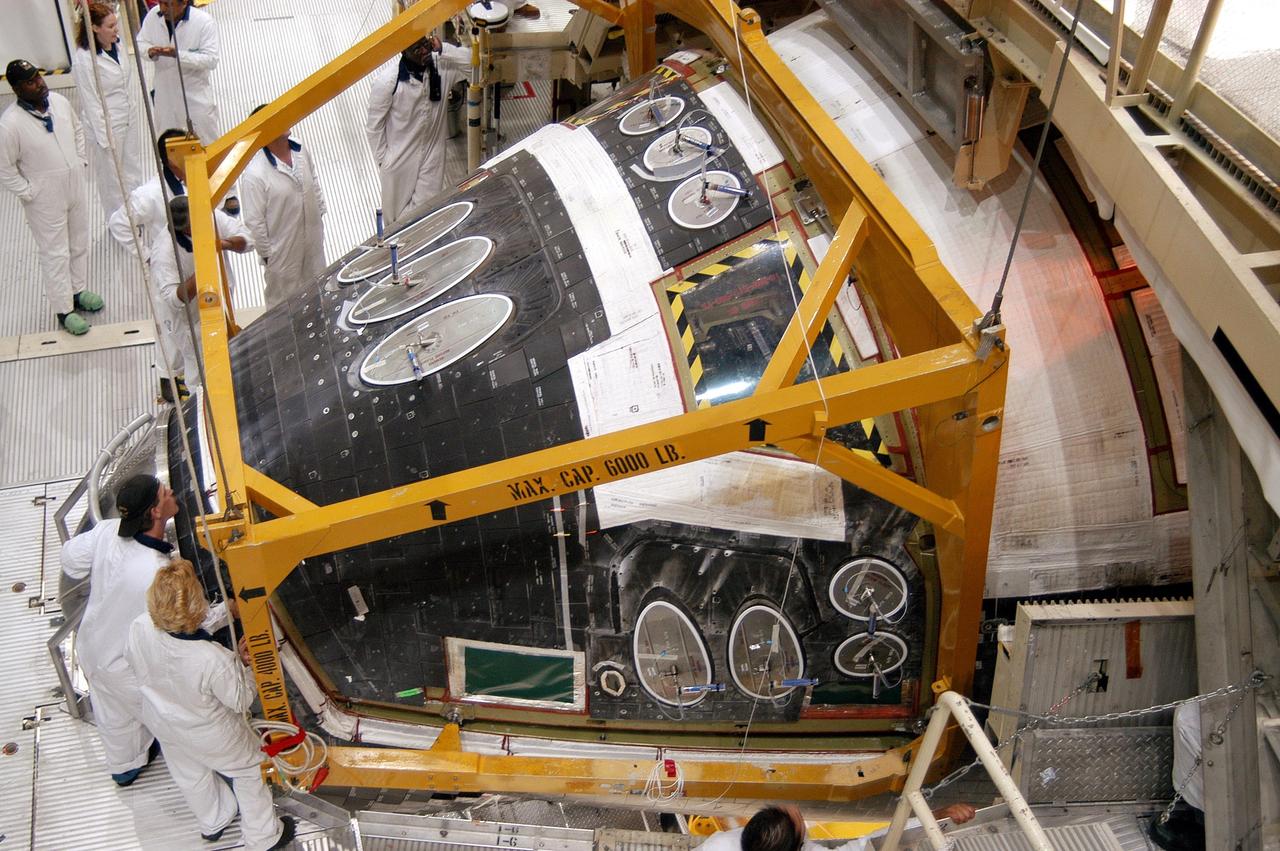
KENNEDY SPACE CENTER, FLA. - Workers in the Orbiter Processing Facility watch closely as Discovery’s Forward Reaction Control System (FRCS) is lowered into position in the orbiter’s forward fuselage nose area. The FRCS provides the thrust for attitude (rotational) maneuvers (pitch, yaw and roll) and for small velocity changes along the orbiter axis (translation maneuvers). Discovery is designated as the Return to Flight vehicle for mission STS-114, no earlier than March 2005.
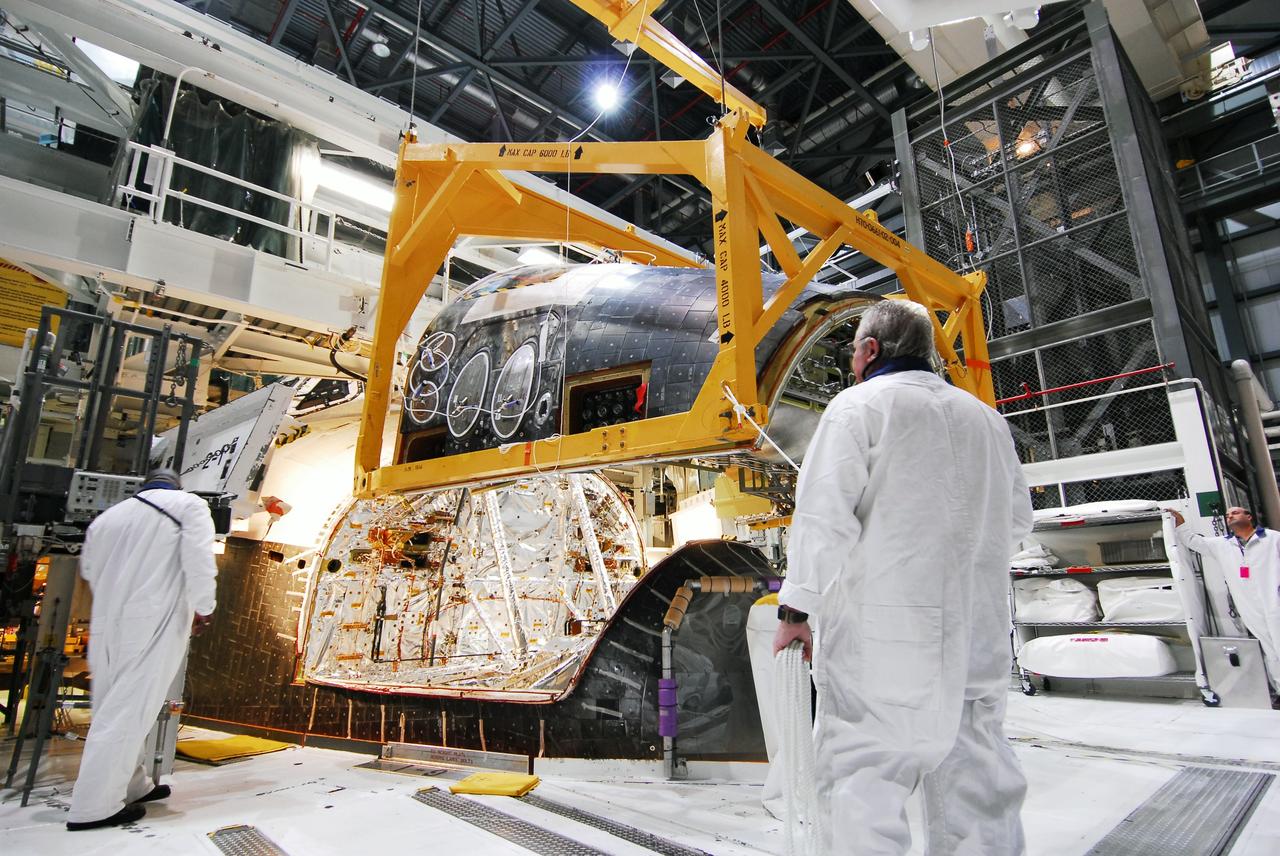
CAPE CANAVERAL, Fla. - Crews in Orbiter Processing Facility-2 at NASA's Kennedy Space Center in Florida remove space shuttle Discovery's forward reaction control system (FRCS), which helped steer the shuttle in orbit. To maneuver, the FRCS used hypergolic fuel and oxidizer, which were purged from Discovery after its final spaceflight, STS-133. Next, the FRCS will be shipped to a maintenance facility at White Sands Space Harbor in New Mexico, where additional inspections will be performed and its components made safe to go on public display. The transition and retirement processing is expected to help rocket designers build next-generation spacecraft and prepare the shuttle for display. Photo credit: NASA/Jim Grossmann
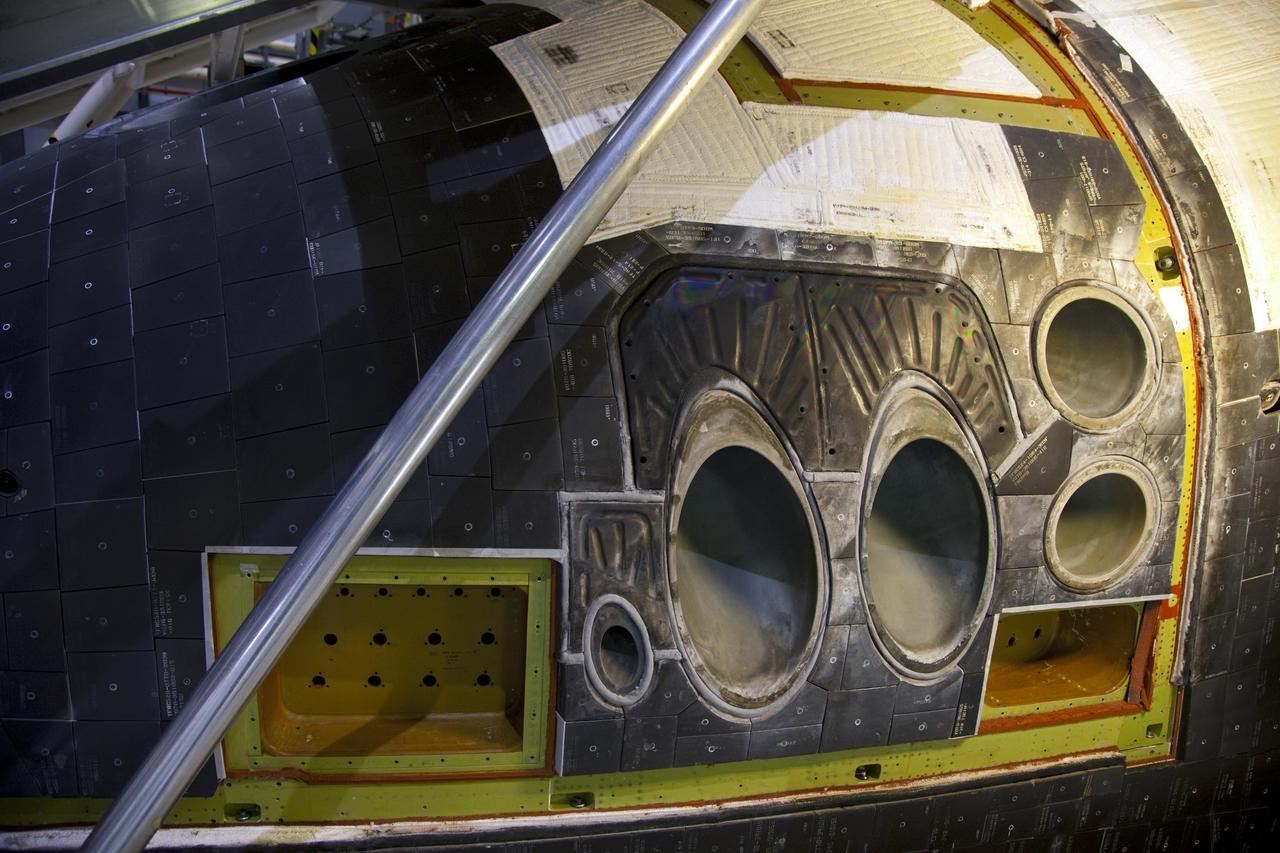
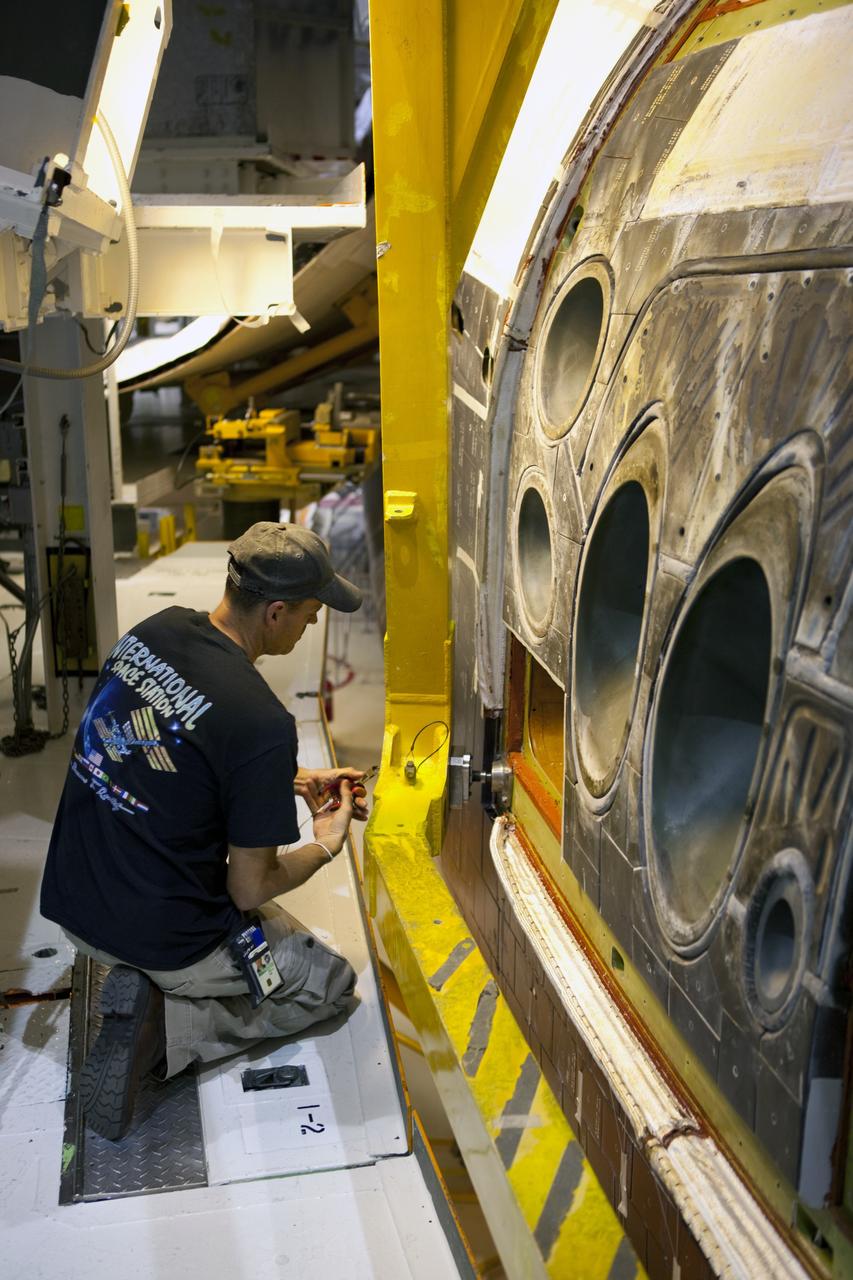
CAPE CANAVERAL, Fla. – In Orbiter Processing Facility-2 at NASA’s Kennedy Space Center in Florida, preparations are under way to begin bonding and sealing the tiles around the access panels to space shuttle Endeavour’s forward reaction control system, or FRCS. The FRCS helped a shuttle maneuver while in orbit. Endeavour’s FRCS was removed and sent to White Sands Test Facility in New Mexico to be cleaned of its toxic propellants and was reinstalled on the shuttle in February. Endeavour is being prepared for public display at the California Science Center in Los Angeles. Over the course of its 19-year career, Endeavour spent 299 days in space during 25 missions. For more information, visit http://www.nasa.gov/shuttle. Photo credit: NASA/Frankie Martin
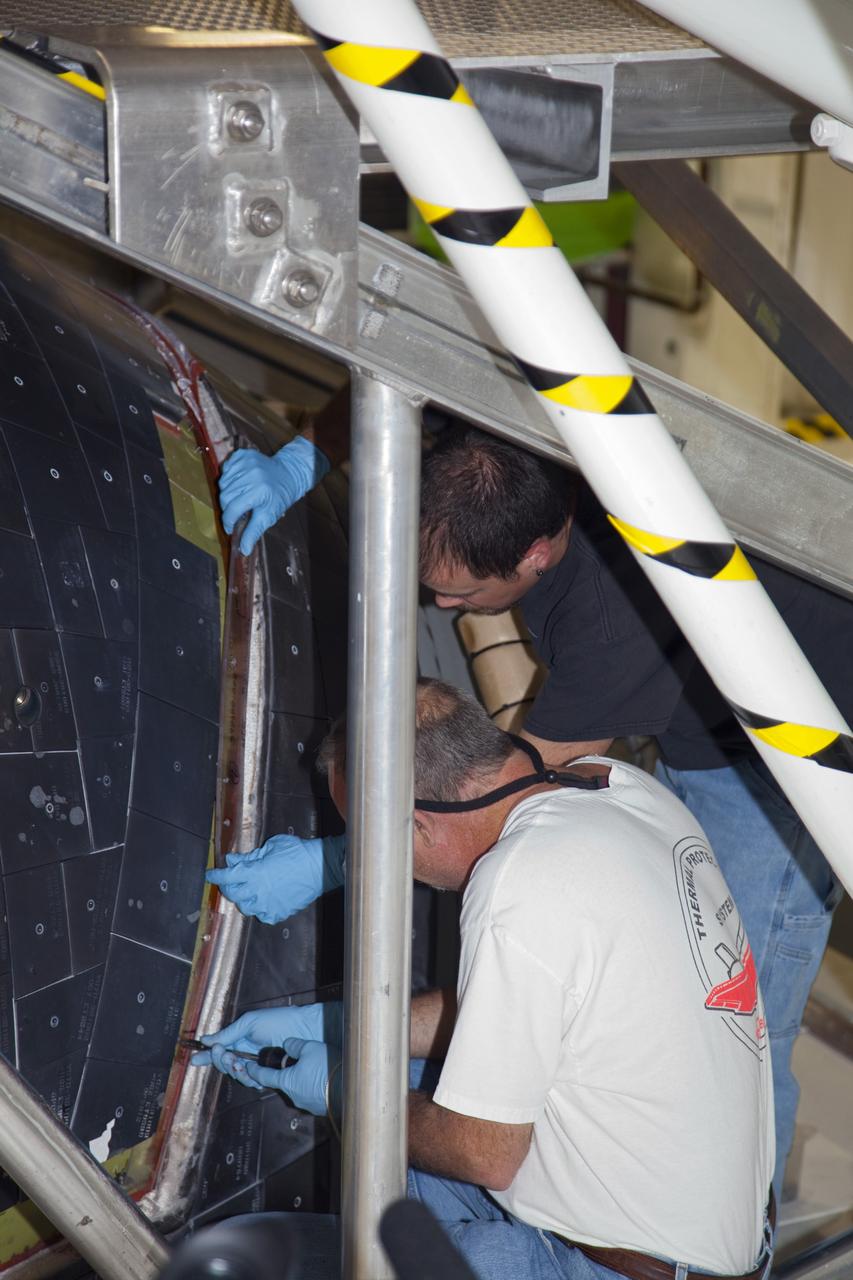
CAPE CANAVERAL, Fla. – In Orbiter Processing Facility-2 at NASA’s Kennedy Space Center in Florida, United Space Alliance technicians begin to bond and seal the tiles around the access panels to space shuttle Endeavour’s forward reaction control system, or FRCS. The FRCS helped a shuttle maneuver while in orbit. Endeavour’s FRCS was removed and sent to White Sands Test Facility in New Mexico to be cleaned of its toxic propellants and was reinstalled on the shuttle in February. Endeavour is being prepared for public display at the California Science Center in Los Angeles. Over the course of its 19-year career, Endeavour spent 299 days in space during 25 missions. For more information, visit http://www.nasa.gov/shuttle. Photo credit: NASA/Frankie Martin
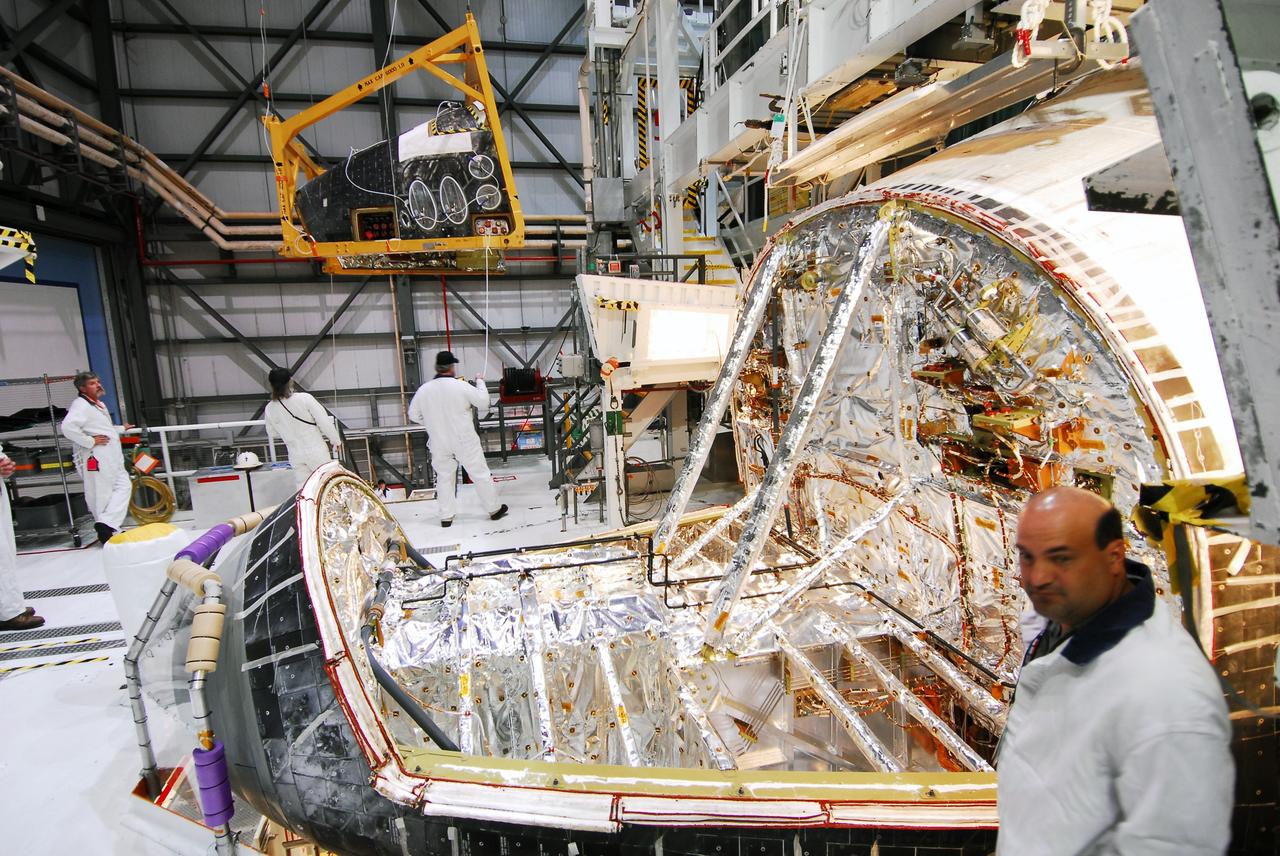
CAPE CANAVERAL, Fla. - Crews in Orbiter Processing Facility-2 at NASA's Kennedy Space Center in Florida remove space shuttle Discovery's forward reaction control system (FRCS), which helped steer the shuttle in orbit. To maneuver, the FRCS used hypergolic fuel and oxidizer, which were purged from Discovery after its final spaceflight, STS-133. Next, the FRCS will be shipped to a maintenance facility at White Sands Space Harbor in New Mexico, where additional inspections will be performed and its components made safe to go on public display. The transition and retirement processing is expected to help rocket designers build next-generation spacecraft and prepare the shuttle for display. Photo credit: NASA/Jim Grossmann
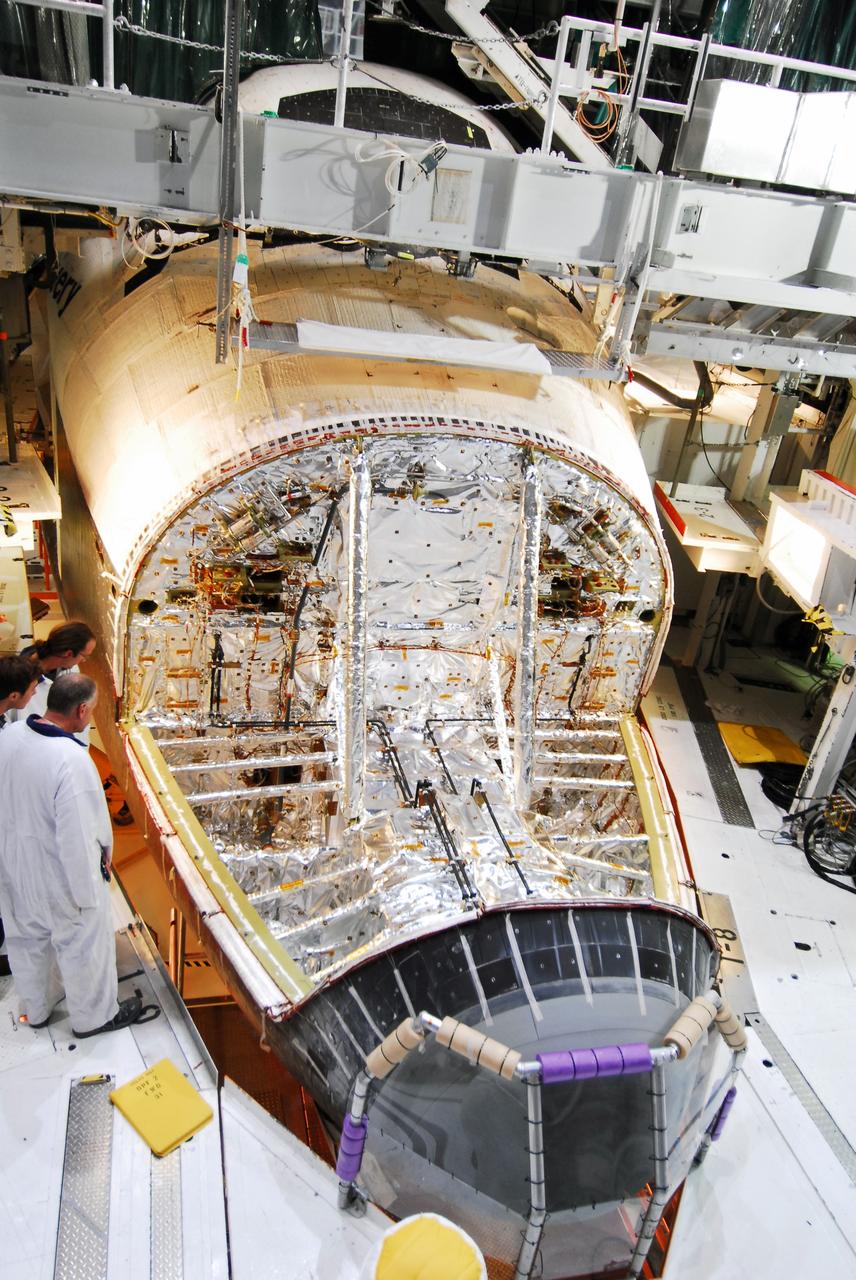
CAPE CANAVERAL, Fla. - Space shuttle Discovery's forward reaction control system (FRCS), which helped steer the shuttle in orbit, is removed in Orbiter Processing Facility-2 at NASA's Kennedy Space Center in Florida. To maneuver, the FRCS used hypergolic fuel and oxidizer, which were purged from Discovery after its final spaceflight, STS-133. Next, the FRCS will be shipped to a maintenance facility at White Sands Space Harbor in New Mexico, where additional inspections will be performed and its components made safe to go on public display. The transition and retirement processing is expected to help rocket designers build next-generation spacecraft and prepare the shuttle for display. Photo credit: NASA/Jim Grossmann