
CAPE CANAVERAL, Fla. - At NASA's Kennedy Space Center in Florida, the Forward Reaction Control System, or FRCS, for space shuttle Discovery arrives at Orbiter Processing Facility Bay 3. Discovery is being prepared for the STS-131 mission, the 33rd flight to the International Space Station. The FRCS provides the thrust for attitude (rotational) maneuvers (pitch, yaw and roll) and for small velocity changes along the orbiter axis (translation maneuvers). The seven-member STS-131 crew will deliver a Multi-Purpose Logistics Module filled with resupply stowage platforms and racks to be transferred to locations around the station. Three spacewalks will include work to attach a spare ammonia tank assembly to the station's exterior and return a European experiment from outside the station's Columbus module. Discovery's launch is targeted for March 18, 2010. For information on the STS-131 mission and crew, visit http://www.nasa.gov/mission_pages/shuttle/shuttlemissions/sts131/index.html. Photo credit: NASA/Jack Pfaller
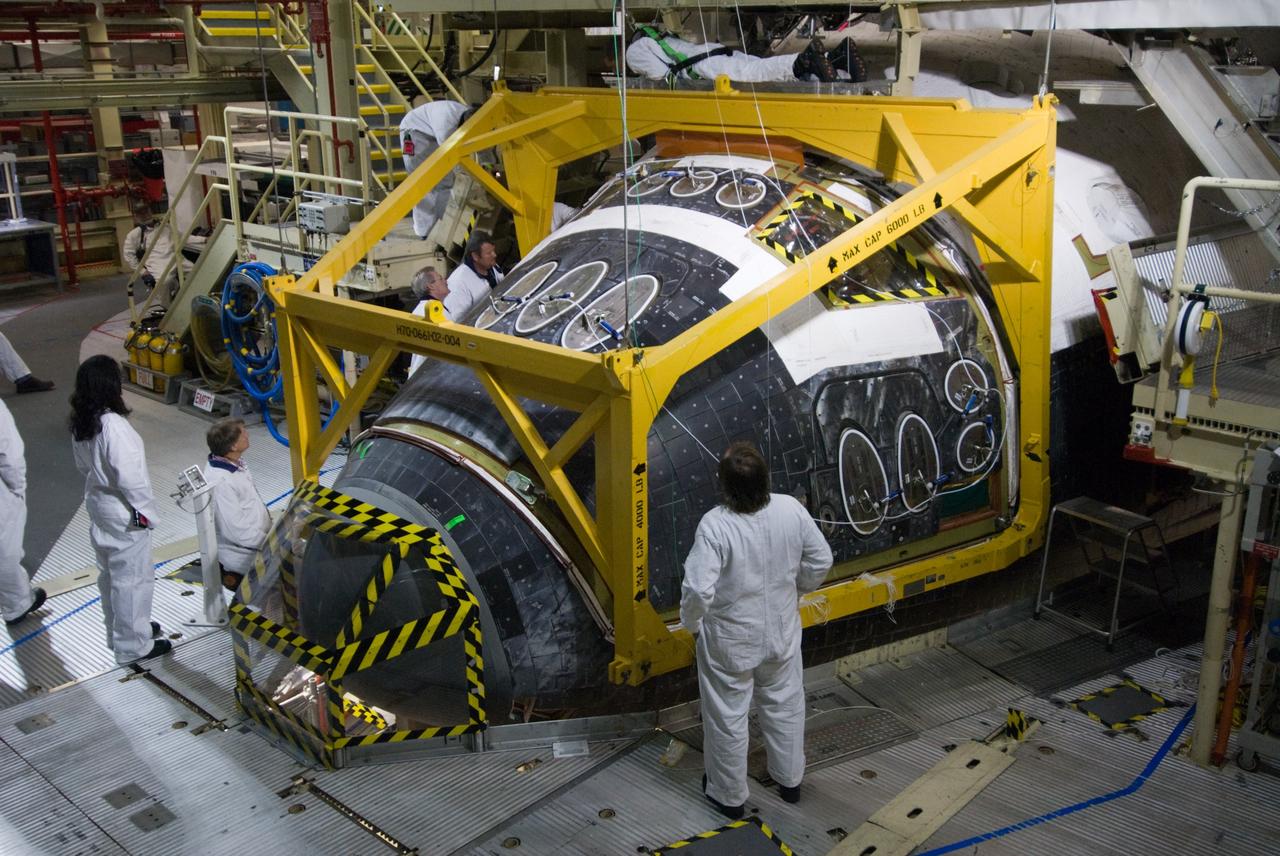
CAPE CANAVERAL, Fla. - In Orbiter Processing Facility Bay 3 at NASA's Kennedy Space Center in Florida, space shuttle Discovery's Forward Reaction Control System, or FRCS, has been returned to its proper place on the shuttle's frame. The FRCS is being reinstalled in the forward fuselage nose area of the shuttle after refurbishment. The FRCS provides the thrust for attitude (rotational) maneuvers (pitch, yaw and roll) and for small velocity changes along the orbiter axis (translation maneuvers). Discovery is being prepared for the STS-131 mission, the 33rd flight to the International Space Station. The seven-member STS-131 crew will deliver a Multi-Purpose Logistics Module filled with resupply stowage platforms and racks to be transferred to locations around the station. Three spacewalks will include work to attach a spare ammonia tank assembly to the station's exterior and return a European experiment from outside the station's Columbus module. Discovery's launch is targeted for March 18, 2010. For information on the STS-131 mission and crew, visit http://www.nasa.gov/mission_pages/shuttle/shuttlemissions/sts131/index.html. Photo credit: NASA/Amanda Diller

CAPE CANAVERAL, Fla. - In Orbiter Processing Facility Bay 3 at NASA's Kennedy Space Center in Florida, United Space Alliance technicians prepare to lift space shuttle Discovery's Forward Reaction Control System, or FRCS, from its transporter. The FRCS is being reinstalled in the forward fuselage nose area of the shuttle after refurbishment. The FRCS provides the thrust for attitude (rotational) maneuvers (pitch, yaw and roll) and for small velocity changes along the orbiter axis (translation maneuvers). Discovery is being prepared for the STS-131 mission, the 33rd flight to the International Space Station. The seven-member STS-131 crew will deliver a Multi-Purpose Logistics Module filled with resupply stowage platforms and racks to be transferred to locations around the station. Three spacewalks will include work to attach a spare ammonia tank assembly to the station's exterior and return a European experiment from outside the station's Columbus module. Discovery's launch is targeted for March 18, 2010. For information on the STS-131 mission and crew, visit http://www.nasa.gov/mission_pages/shuttle/shuttlemissions/sts131/index.html. Photo credit: NASA/Amanda Diller
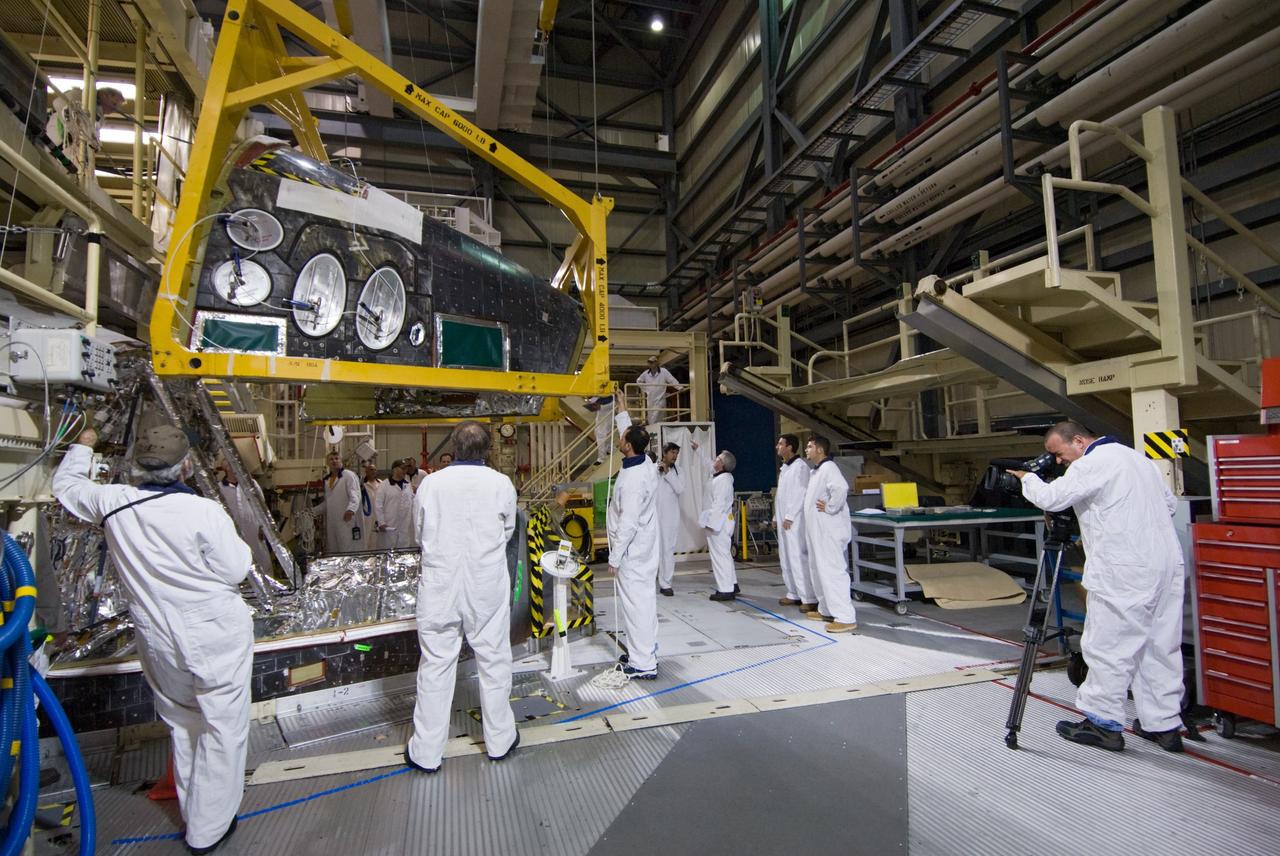
CAPE CANAVERAL, Fla. - In Orbiter Processing Facility Bay 3 at NASA's Kennedy Space Center in Florida, United Space Alliance technicians lower space shuttle Discovery's Forward Reaction Control System, or FRCS, into position over the shuttle's frame. The FRCS is being reinstalled in the forward fuselage nose area of the shuttle after refurbishment. The FRCS provides the thrust for attitude (rotational) maneuvers (pitch, yaw and roll) and for small velocity changes along the orbiter axis (translation maneuvers). Discovery is being prepared for the STS-131 mission, the 33rd flight to the International Space Station. The seven-member STS-131 crew will deliver a Multi-Purpose Logistics Module filled with resupply stowage platforms and racks to be transferred to locations around the station. Three spacewalks will include work to attach a spare ammonia tank assembly to the station's exterior and return a European experiment from outside the station's Columbus module. Discovery's launch is targeted for March 18, 2010. For information on the STS-131 mission and crew, visit http://www.nasa.gov/mission_pages/shuttle/shuttlemissions/sts131/index.html. Photo credit: NASA/Amanda Diller

CAPE CANAVERAL, Fla. - In Orbiter Processing Facility Bay 3 at NASA's Kennedy Space Center in Florida, United Space Alliance technicians move space shuttle Discovery's Forward Reaction Control System, or FRCS, toward it. The FRCS is being reinstalled in the forward fuselage nose area of the shuttle after refurbishment. The FRCS provides the thrust for attitude (rotational) maneuvers (pitch, yaw and roll) and for small velocity changes along the orbiter axis (translation maneuvers). Discovery is being prepared for the STS-131 mission, the 33rd flight to the International Space Station. The seven-member STS-131 crew will deliver a Multi-Purpose Logistics Module filled with resupply stowage platforms and racks to be transferred to locations around the station. Three spacewalks will include work to attach a spare ammonia tank assembly to the station's exterior and return a European experiment from outside the station's Columbus module. Discovery's launch is targeted for March 18, 2010. For information on the STS-131 mission and crew, visit http://www.nasa.gov/mission_pages/shuttle/shuttlemissions/sts131/index.html. Photo credit: NASA/Amanda Diller
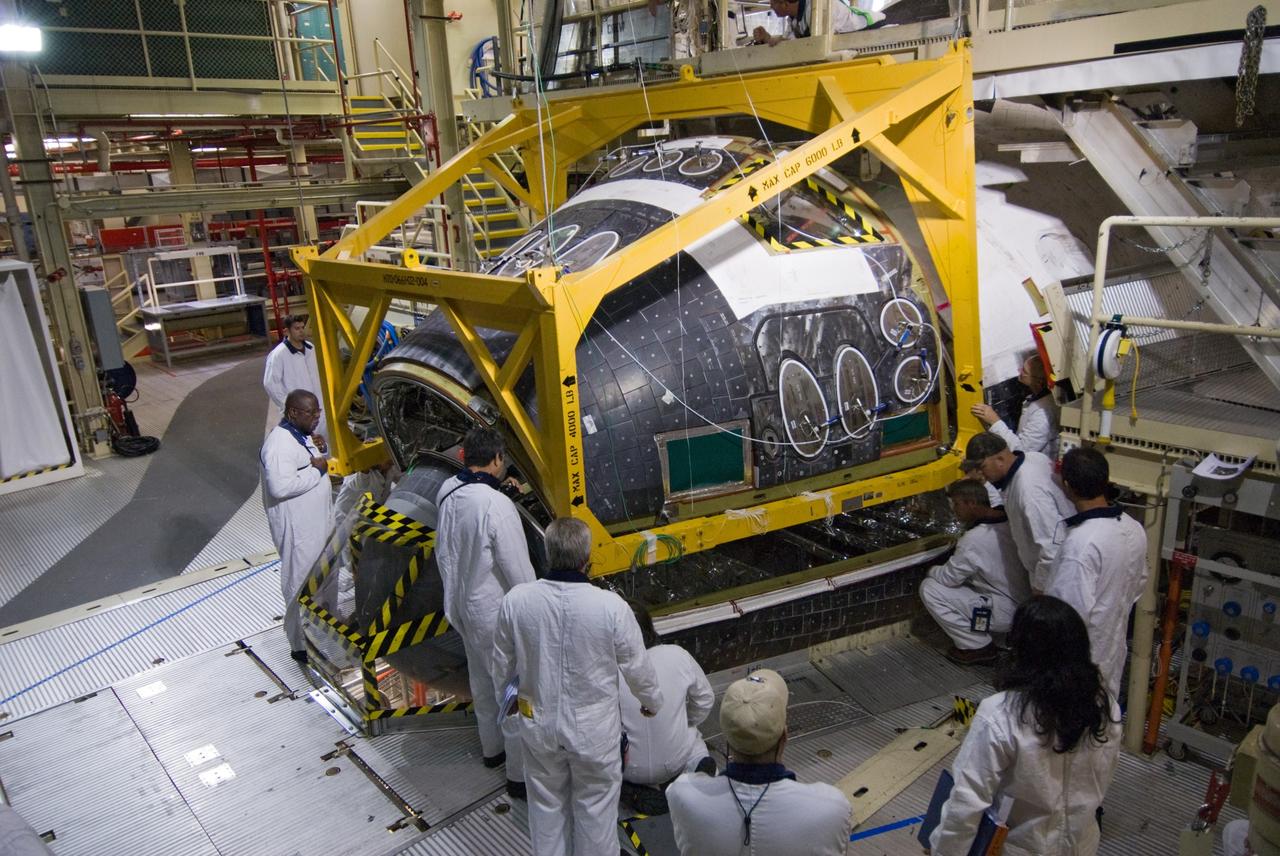
CAPE CANAVERAL, Fla. - In Orbiter Processing Facility Bay 3 at NASA's Kennedy Space Center in Florida, United Space Alliance technicians align space shuttle Discovery's Forward Reaction Control System, or FRCS, into position on the shuttle's frame. The FRCS is being reinstalled in the forward fuselage nose area of the shuttle after refurbishment. The FRCS provides the thrust for attitude (rotational) maneuvers (pitch, yaw and roll) and for small velocity changes along the orbiter axis (translation maneuvers). Discovery is being prepared for the STS-131 mission, the 33rd flight to the International Space Station. The seven-member STS-131 crew will deliver a Multi-Purpose Logistics Module filled with resupply stowage platforms and racks to be transferred to locations around the station. Three spacewalks will include work to attach a spare ammonia tank assembly to the station's exterior and return a European experiment from outside the station's Columbus module. Discovery's launch is targeted for March 18, 2010. For information on the STS-131 mission and crew, visit http://www.nasa.gov/mission_pages/shuttle/shuttlemissions/sts131/index.html. Photo credit: NASA/Amanda Diller

CAPE CANAVERAL, Fla. - In Orbiter Processing Facility Bay 3 at NASA's Kennedy Space Center in Florida, United Space Alliance technicians prepare lift space shuttle Discovery's Forward Reaction Control System, or FRCS, from its transporter. The FRCS is being reinstalled in the forward fuselage nose area of the shuttle after refurbishment. The FRCS provides the thrust for attitude (rotational) maneuvers (pitch, yaw and roll) and for small velocity changes along the orbiter axis (translation maneuvers). Discovery is being prepared for the STS-131 mission, the 33rd flight to the International Space Station. The seven-member STS-131 crew will deliver a Multi-Purpose Logistics Module filled with resupply stowage platforms and racks to be transferred to locations around the station. Three spacewalks will include work to attach a spare ammonia tank assembly to the station's exterior and return a European experiment from outside the station's Columbus module. Discovery's launch is targeted for March 18, 2010. For information on the STS-131 mission and crew, visit http://www.nasa.gov/mission_pages/shuttle/shuttlemissions/sts131/index.html. Photo credit: NASA/Amanda Diller
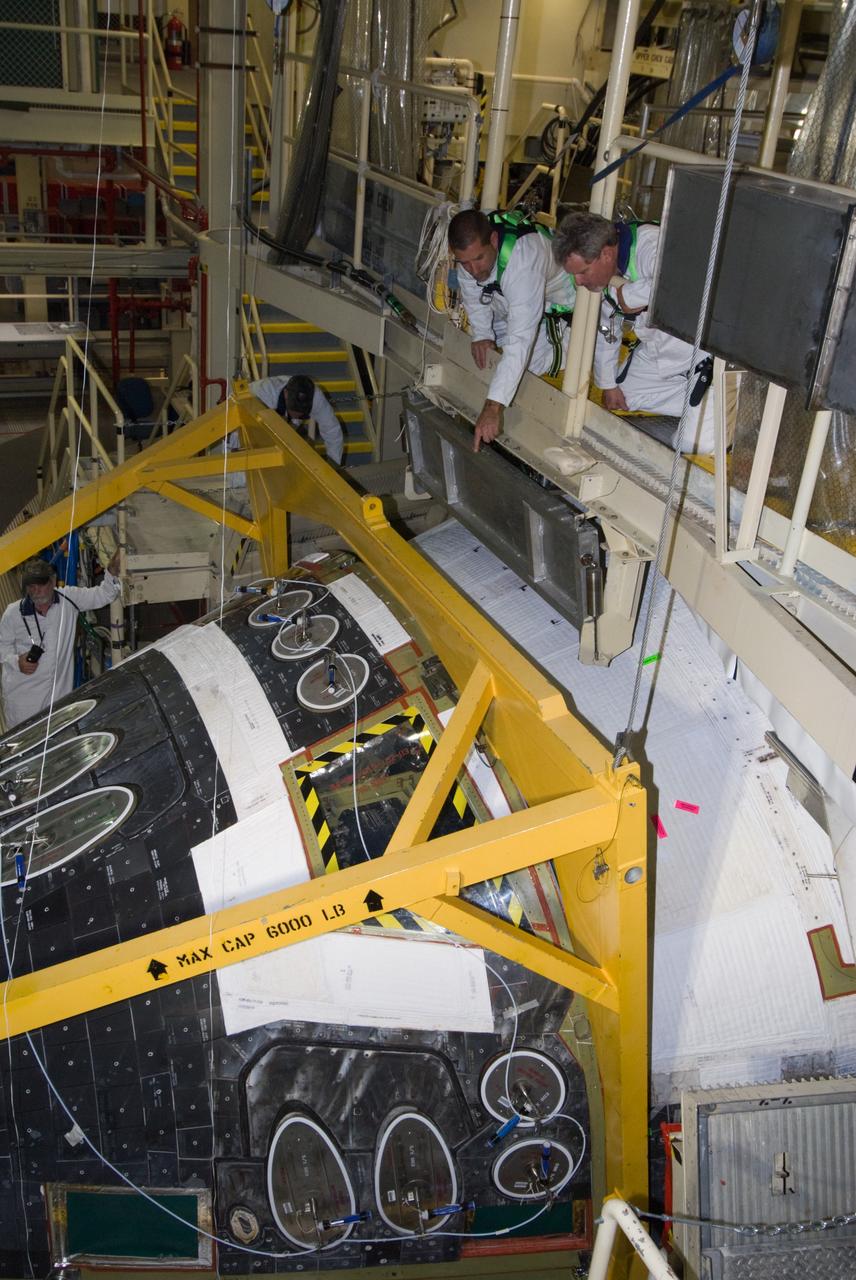
CAPE CANAVERAL, Fla. - In Orbiter Processing Facility Bay 3 at NASA's Kennedy Space Center in Florida, United Space Alliance technicians check the alignment of space shuttle Discovery's Forward Reaction Control System, or FRCS, onto the shuttle's frame. The FRCS is being reinstalled in the forward fuselage nose area of the shuttle after refurbishment. The FRCS provides the thrust for attitude (rotational) maneuvers (pitch, yaw and roll) and for small velocity changes along the orbiter axis (translation maneuvers). Discovery is being prepared for the STS-131 mission, the 33rd flight to the International Space Station. The seven-member STS-131 crew will deliver a Multi-Purpose Logistics Module filled with resupply stowage platforms and racks to be transferred to locations around the station. Three spacewalks will include work to attach a spare ammonia tank assembly to the station's exterior and return a European experiment from outside the station's Columbus module. Discovery's launch is targeted for March 18, 2010. For information on the STS-131 mission and crew, visit http://www.nasa.gov/mission_pages/shuttle/shuttlemissions/sts131/index.html. Photo credit: NASA/Amanda Diller