A Fruitful Journey
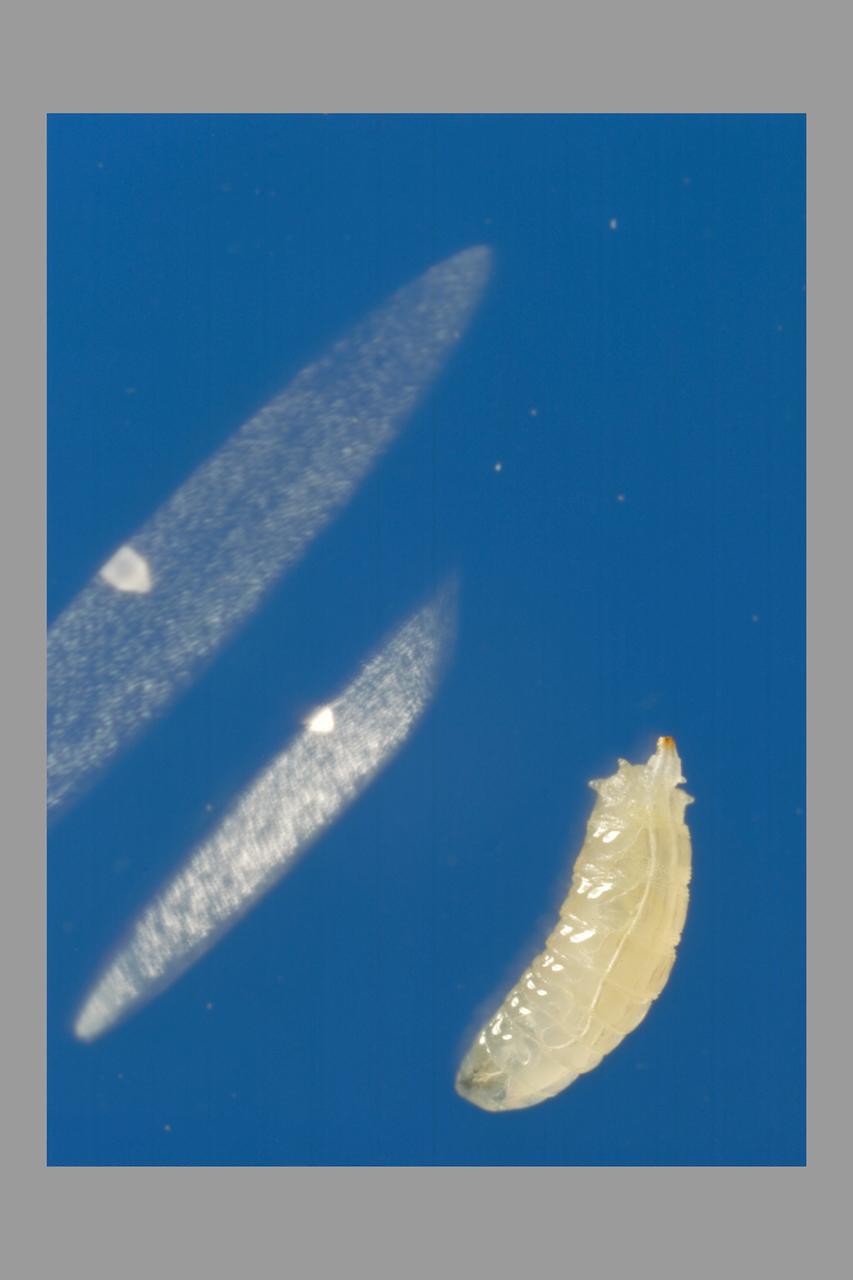
Life cycle of a Fruit Fly: larvae
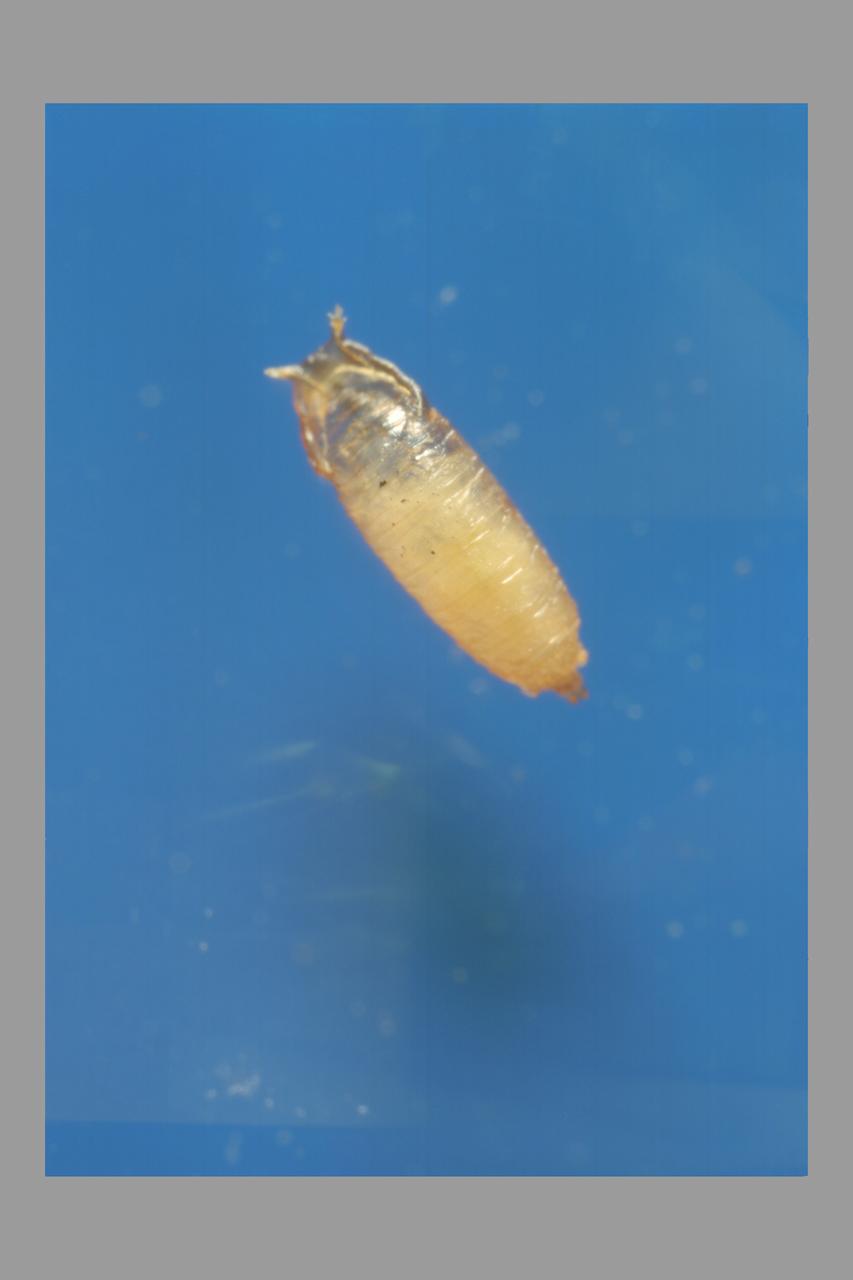
Life Cycle of a Fruit Fly: pupae
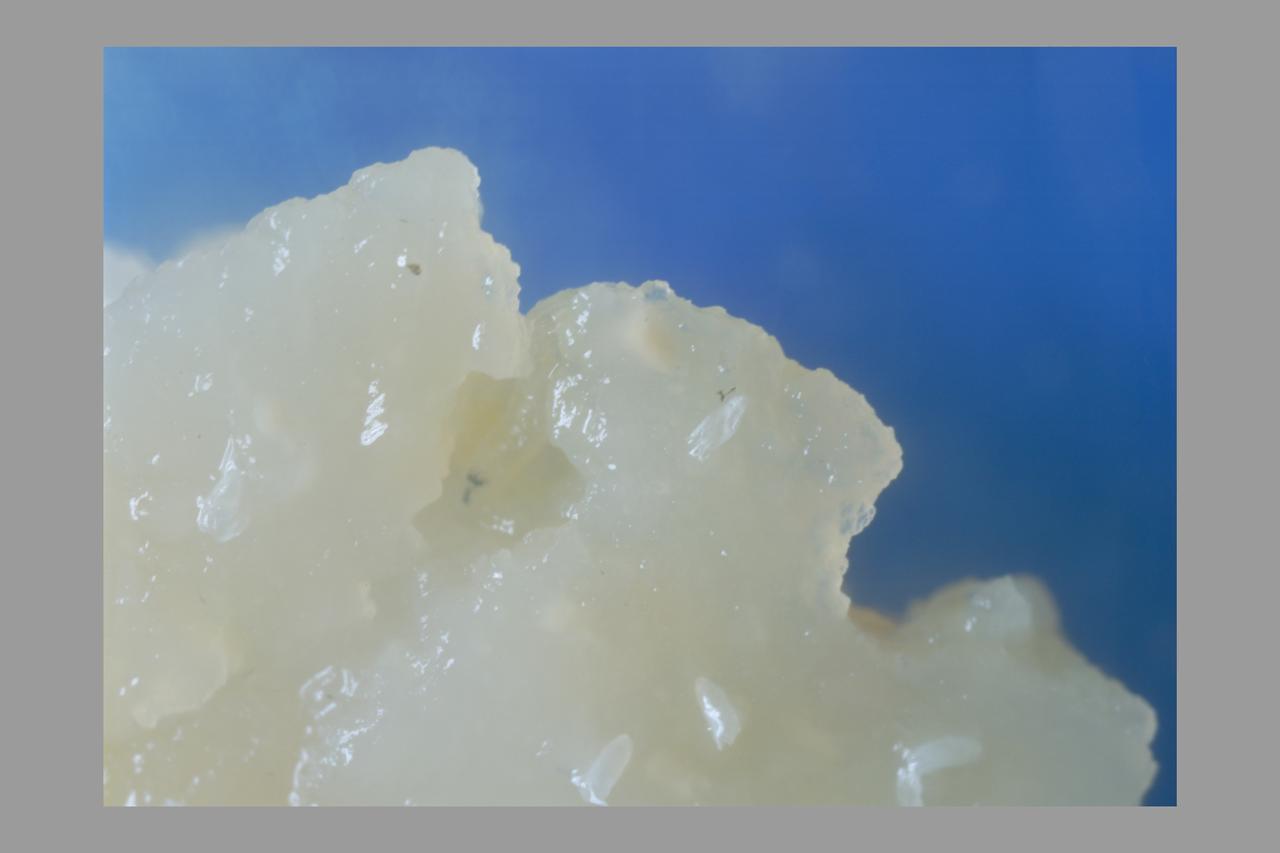
Life Cycle of a Fruit Fly: egges in agar
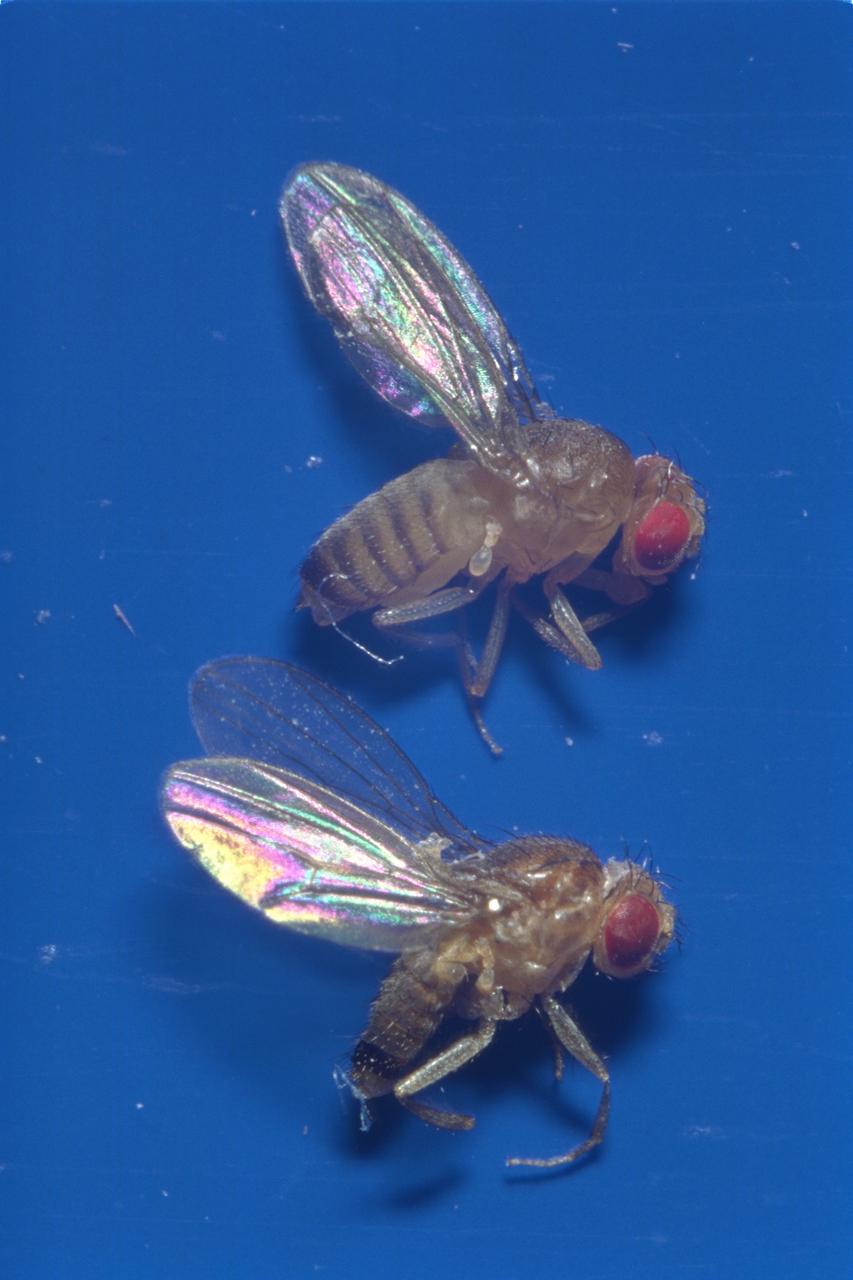
Life Cycle of a Fruit Fly: adult - male and female
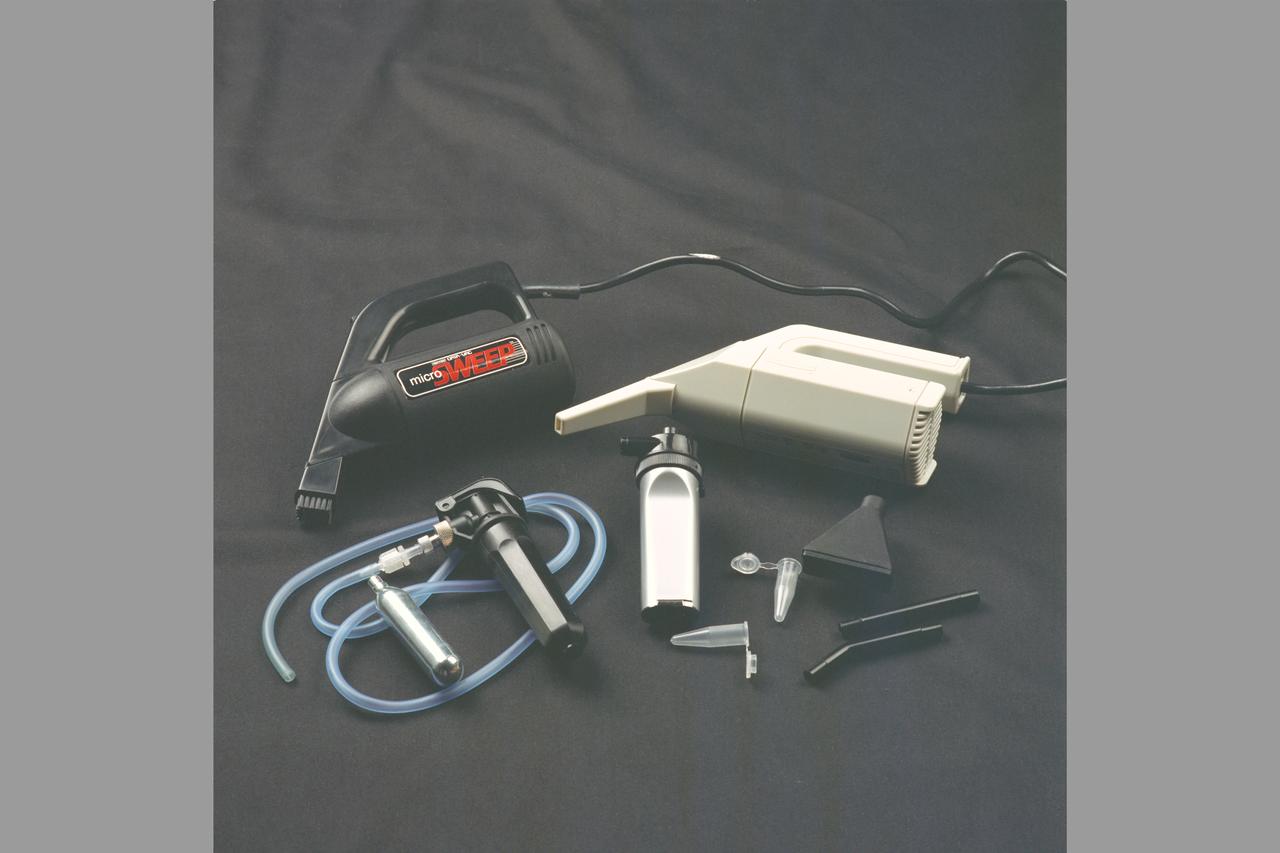
LIFE CYCLE OF A FRUIT FLY: VACUUM EQUIPMENT
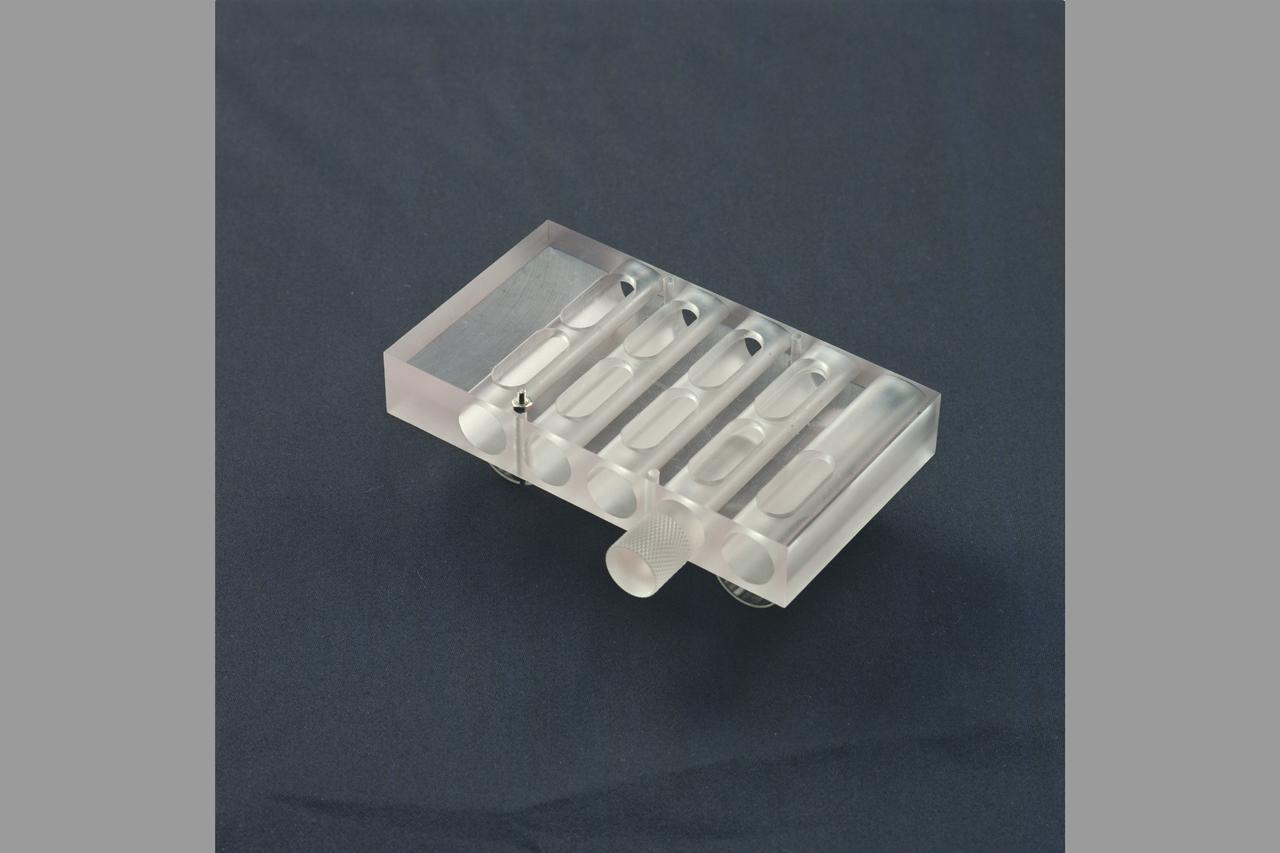
Life Cycle of a Fruit Fly study: insect larvae separation contrainers
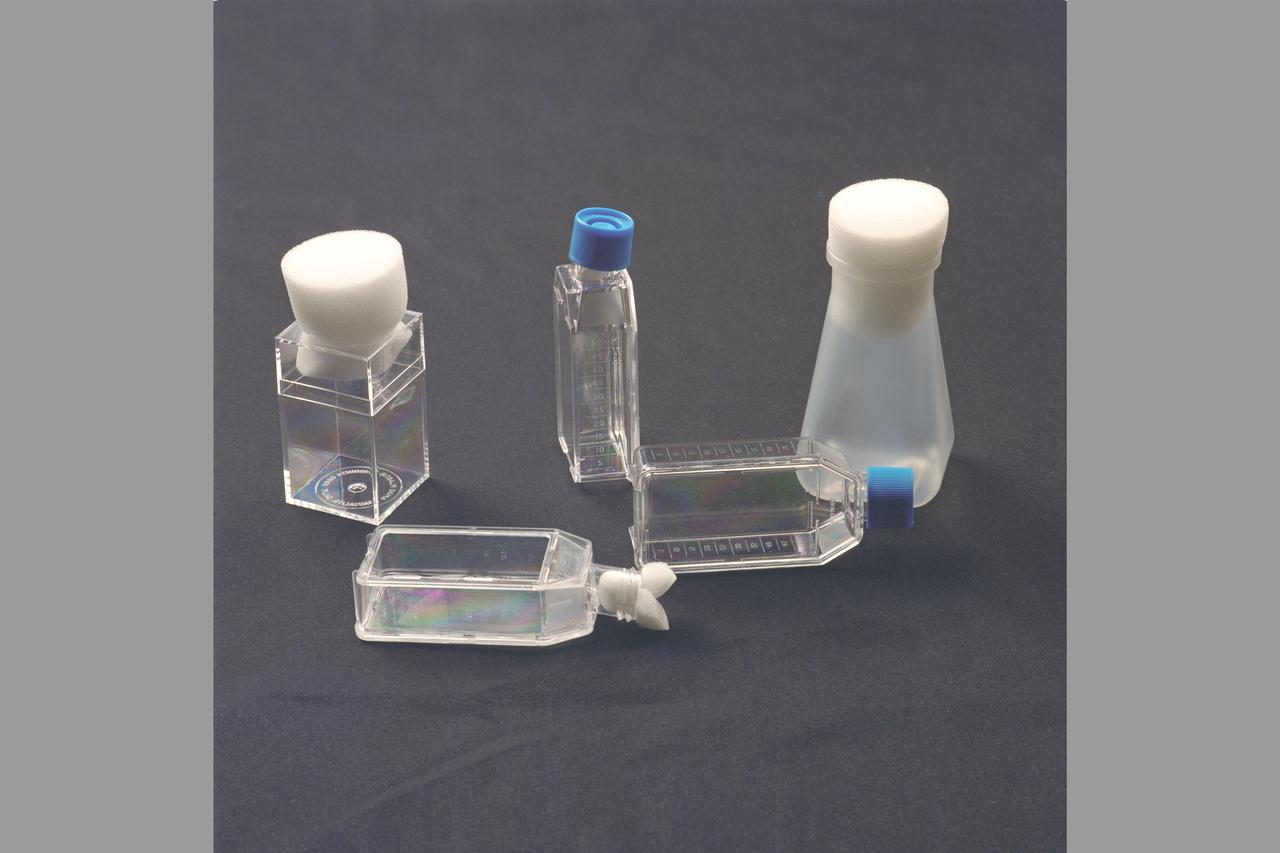
Life Cycle of a Fruit Fly study: insect larvae separation contrainers
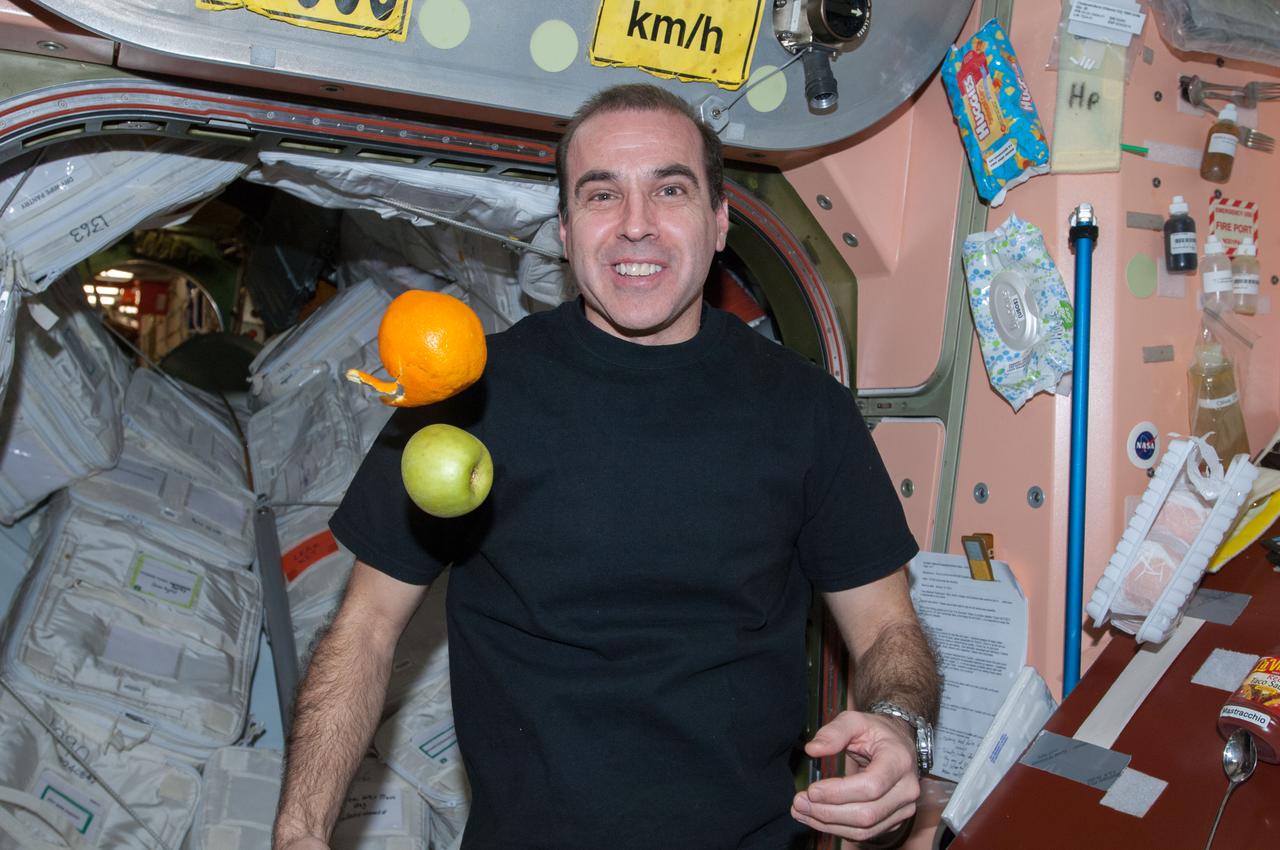
ISS038-E-043011 (6 Feb. 2014) --- NASA astronaut Rick Mastracchio, Expedition 38 flight engineer, is pictured near fresh fruit floating freely in the Unity node of the International Space Station. The fruit was brought to the station on the ISS Progress 54 cargo spacecraft, which docked Feb. 5, 2014.
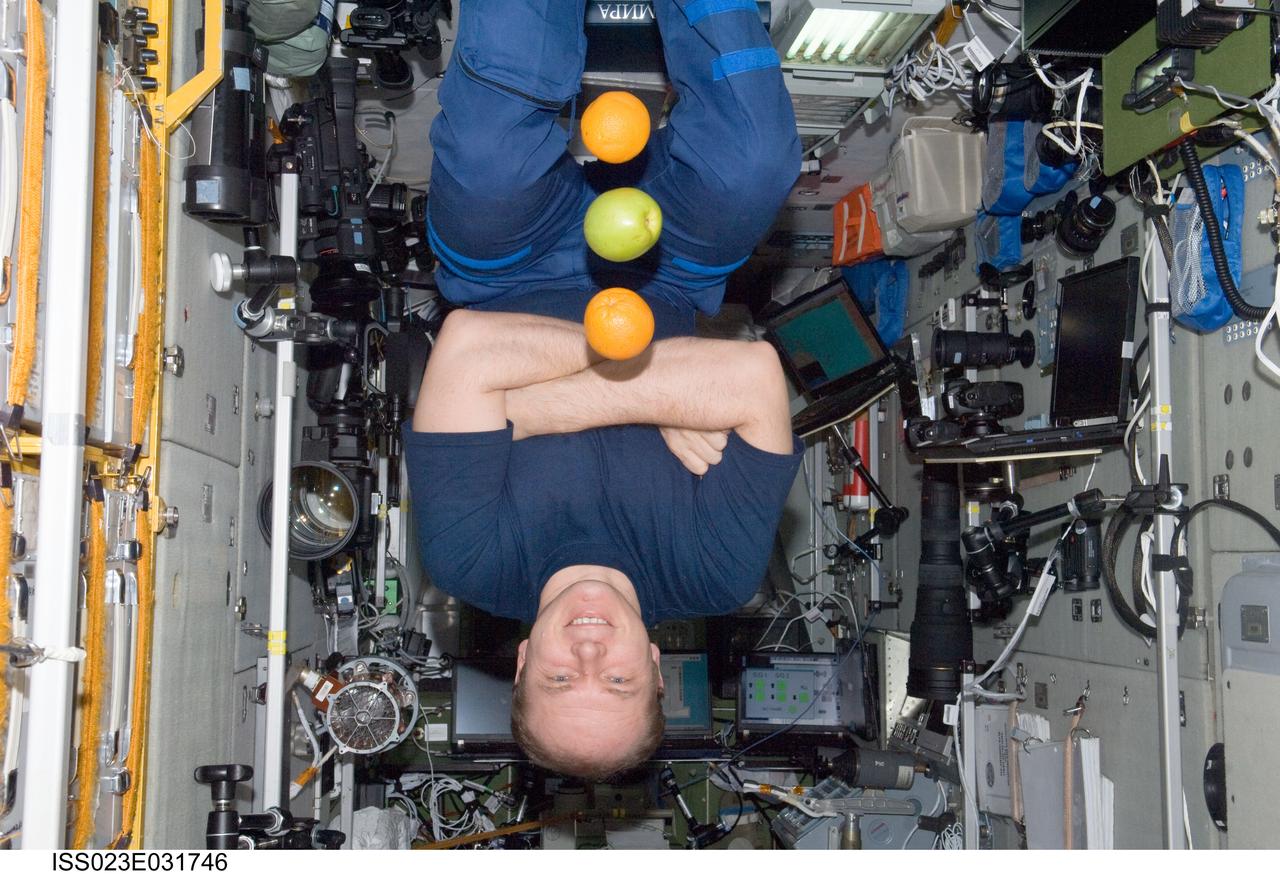
ISS023-E-031746 (1 May 2010) --- Russian cosmonaut Oleg Kotov, Expedition 23 commander, is pictured near fresh fruit floating freely in the Zvezda Service Module of the International Space Station.
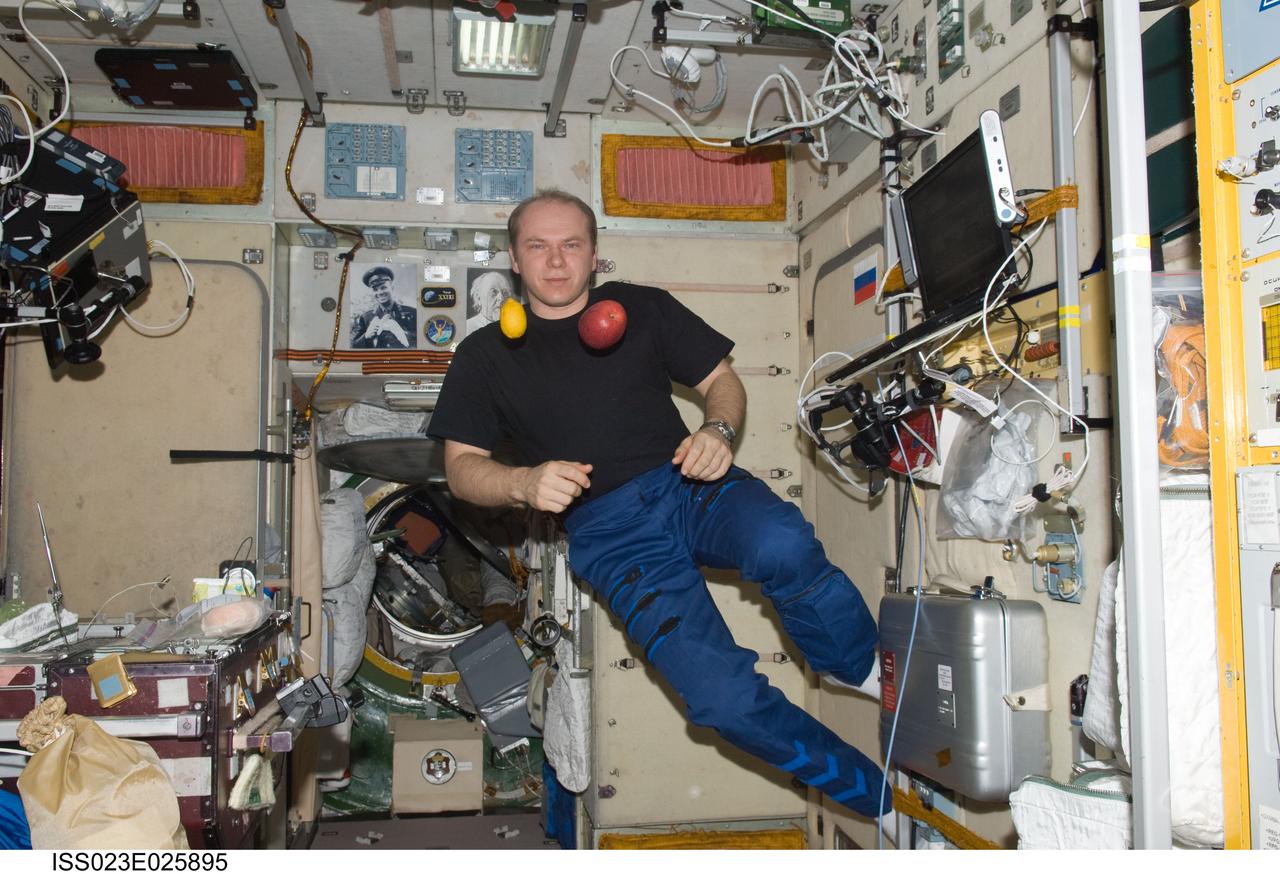
ISS023-E-025895 (18 April 2010) --- Russian cosmonaut Oleg Kotov, Expedition 23 commander, is pictured near fresh fruit floating freely in the Zvezda Service Module of the International Space Station.
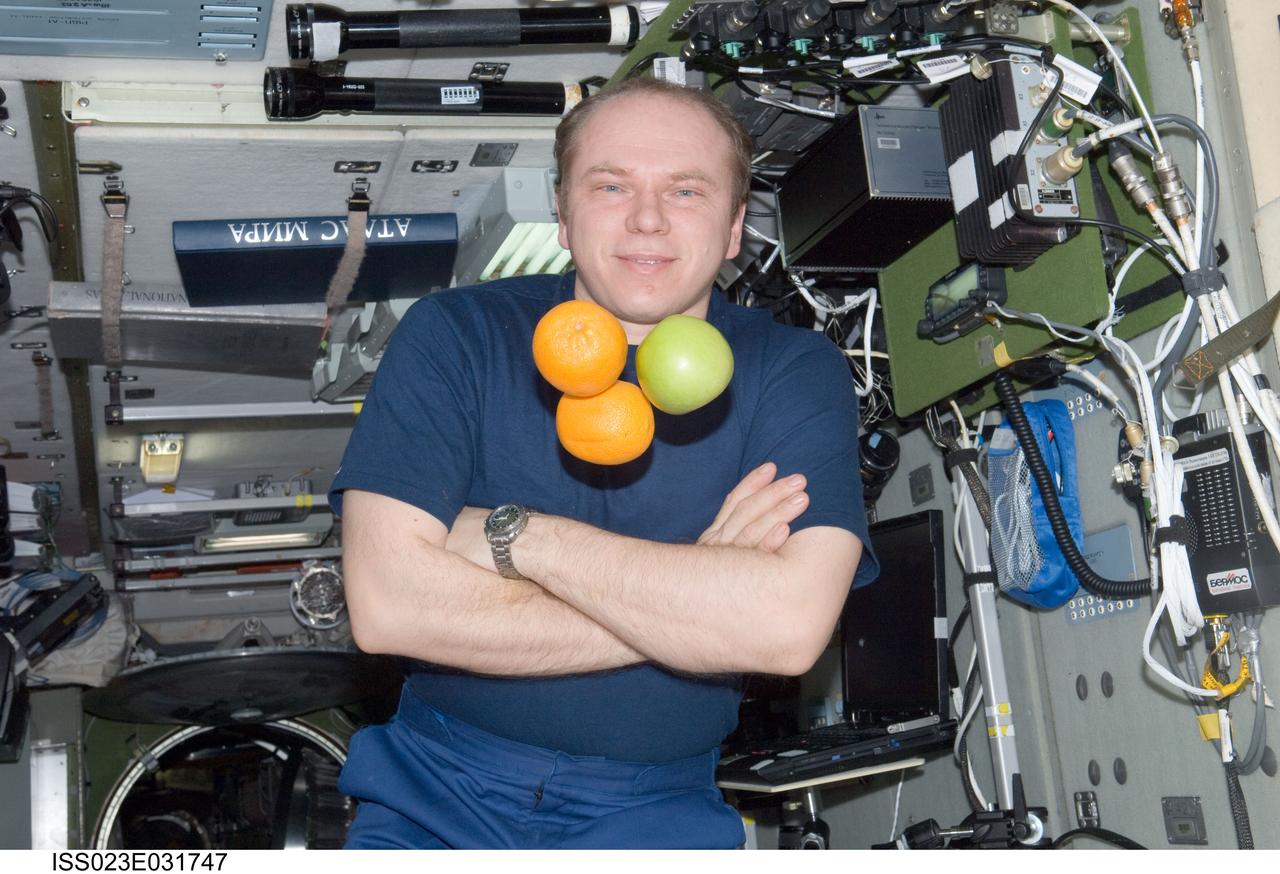
ISS023-E-031747 (1 May 2010) --- Russian cosmonaut Oleg Kotov, Expedition 23 commander, is pictured near fresh fruit floating freely in the Zvezda Service Module of the International Space Station.
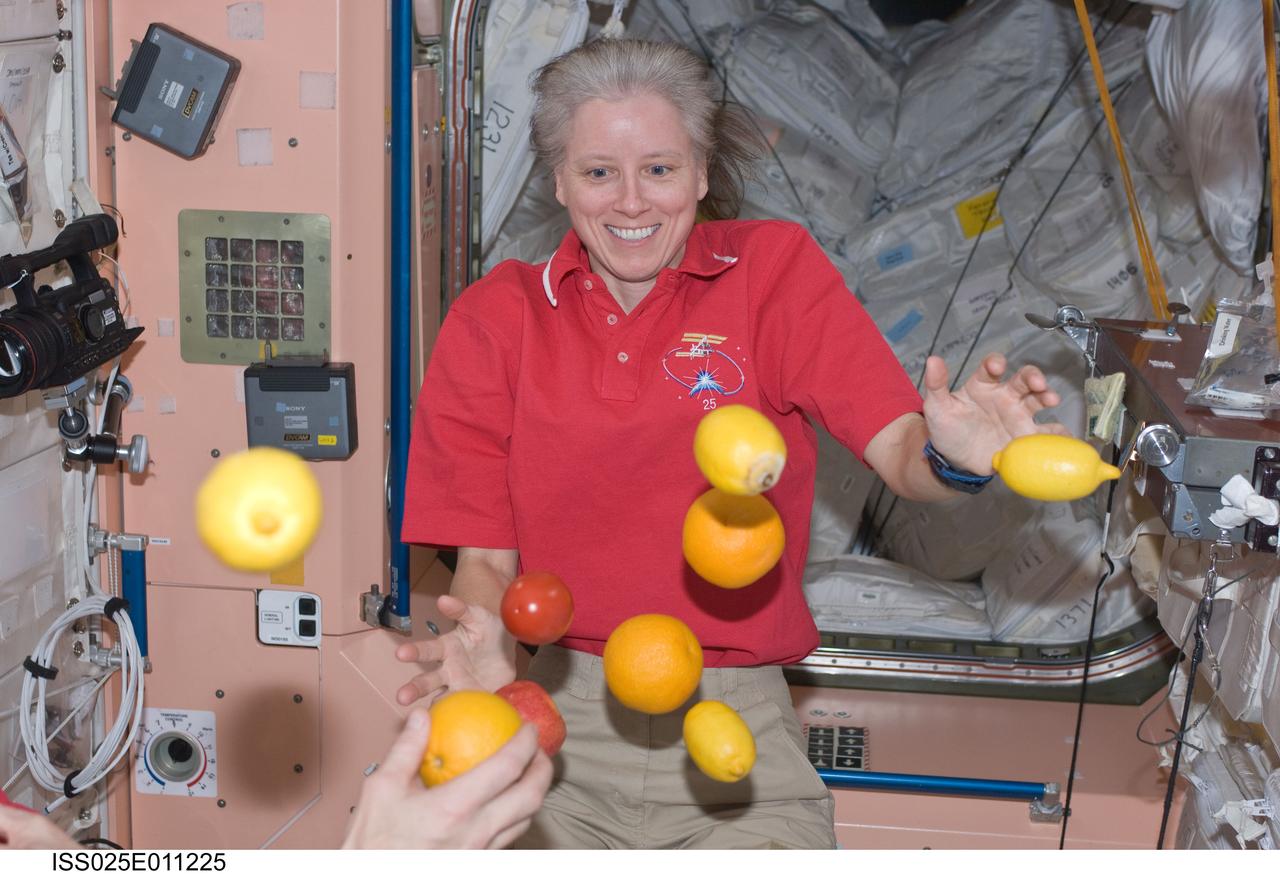
ISS025-E-011225 (3 Nov. 2010) --- NASA astronaut Shannon Walker, Expedition 25 flight engineer, is pictured near fresh fruit floating freely in the Unity node of the International Space Station.
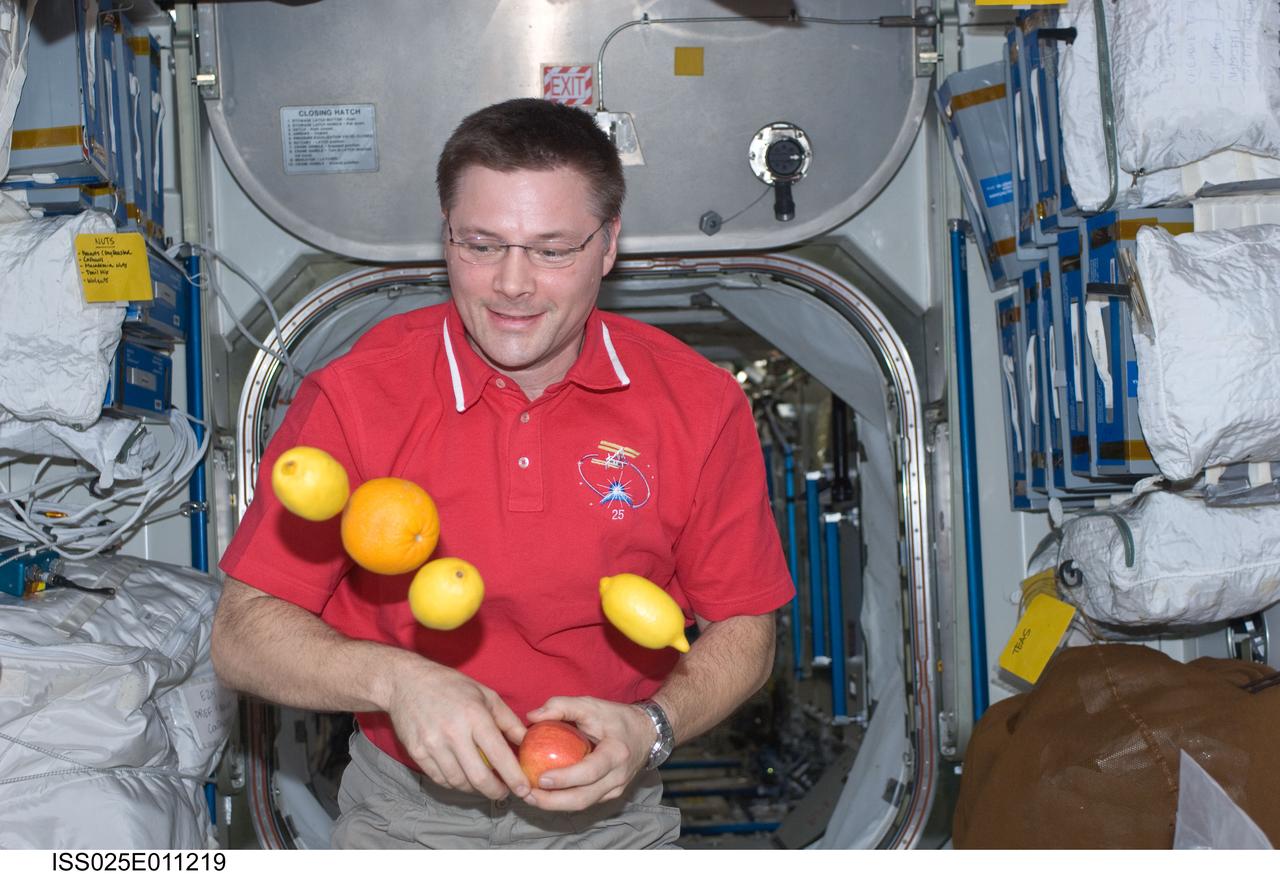
ISS025-E-011219 (3 Nov. 2010) --- NASA astronaut Doug Wheelock, Expedition 25 commander, is pictured near fresh fruit floating freely in the Unity node of the International Space Station.
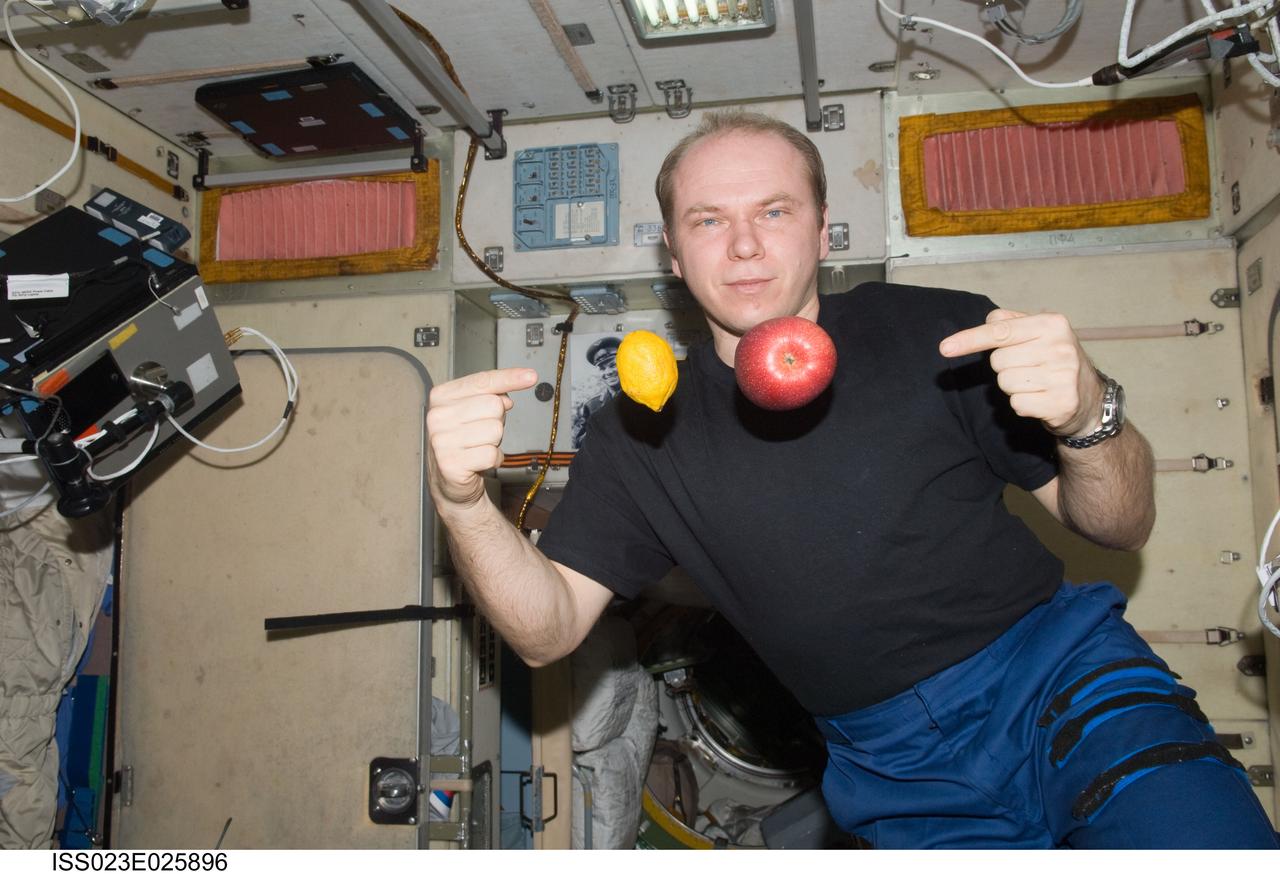
ISS023-E-025896 (18 April 2010) --- Russian cosmonaut Oleg Kotov, Expedition 23 commander, is pictured near fresh fruit floating freely in the Zvezda Service Module of the International Space Station.
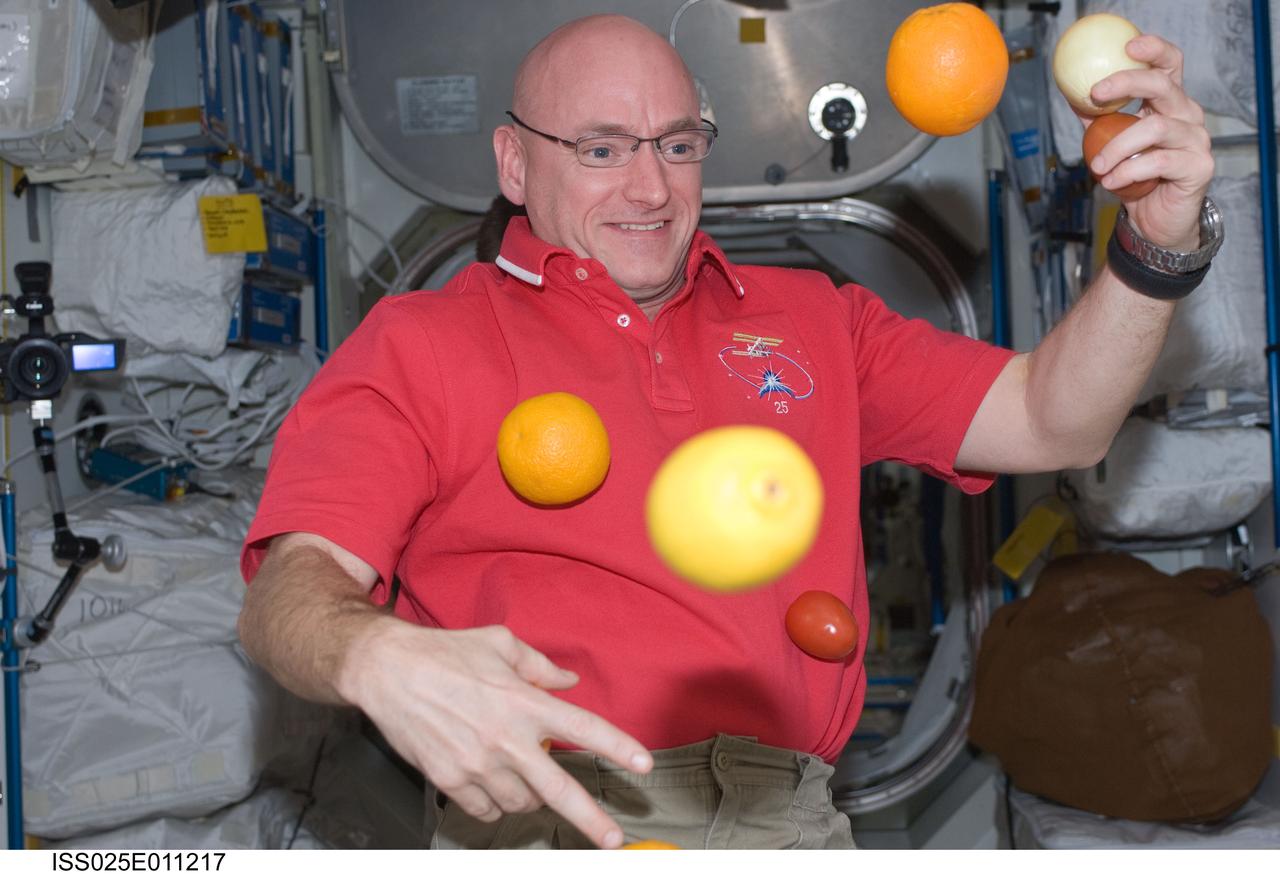
ISS025-E-011217 (3 Nov. 2010) --- NASA astronaut Scott Kelly, Expedition 25 flight engineer, is pictured near fresh fruit floating freely in the Unity node of the International Space Station.
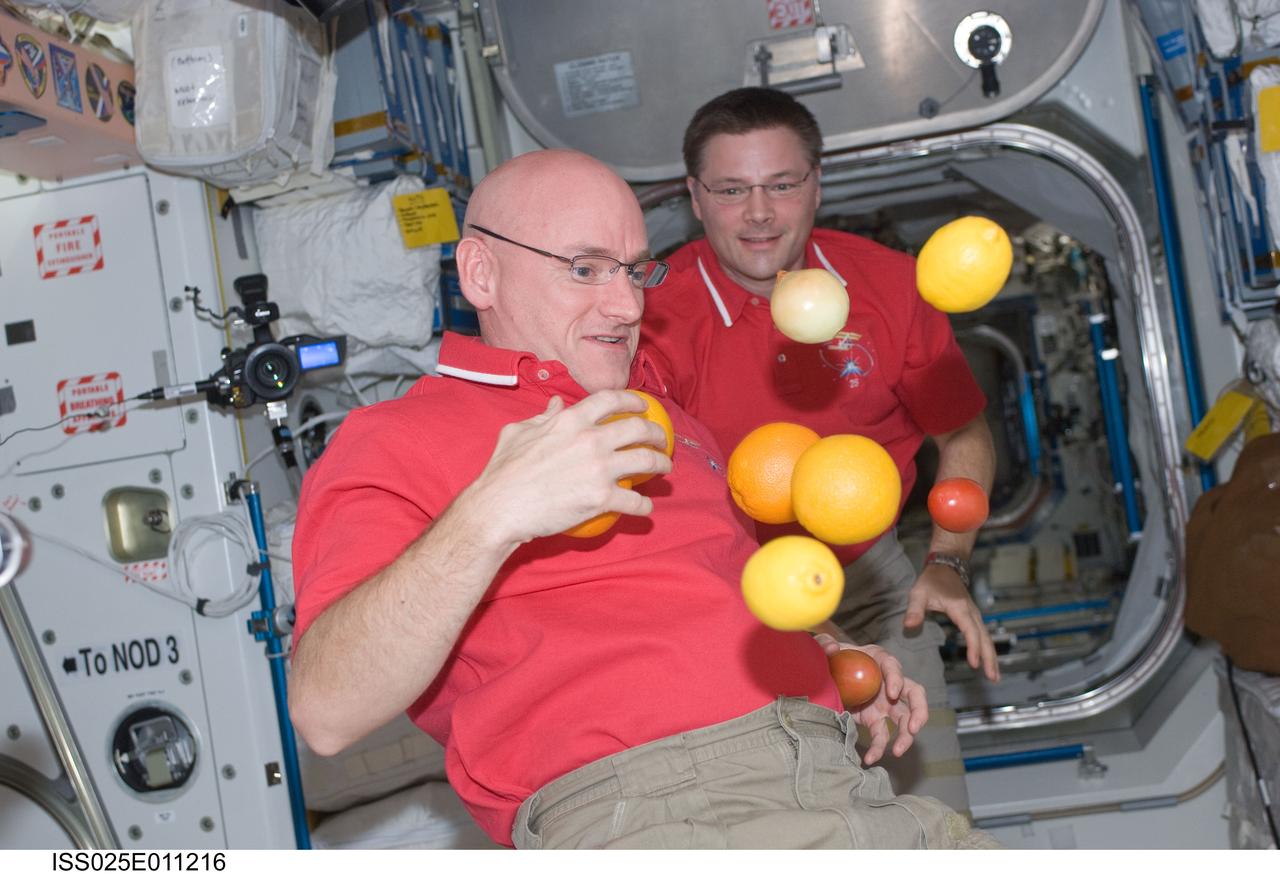
ISS025-E-011216 (3 Nov. 2010) --- NASA astronauts Doug Wheelock (background), Expedition 25 commander; and Scott Kelly, flight engineer, are pictured near fresh fruit floating freely in the Unity node of the International Space Station.
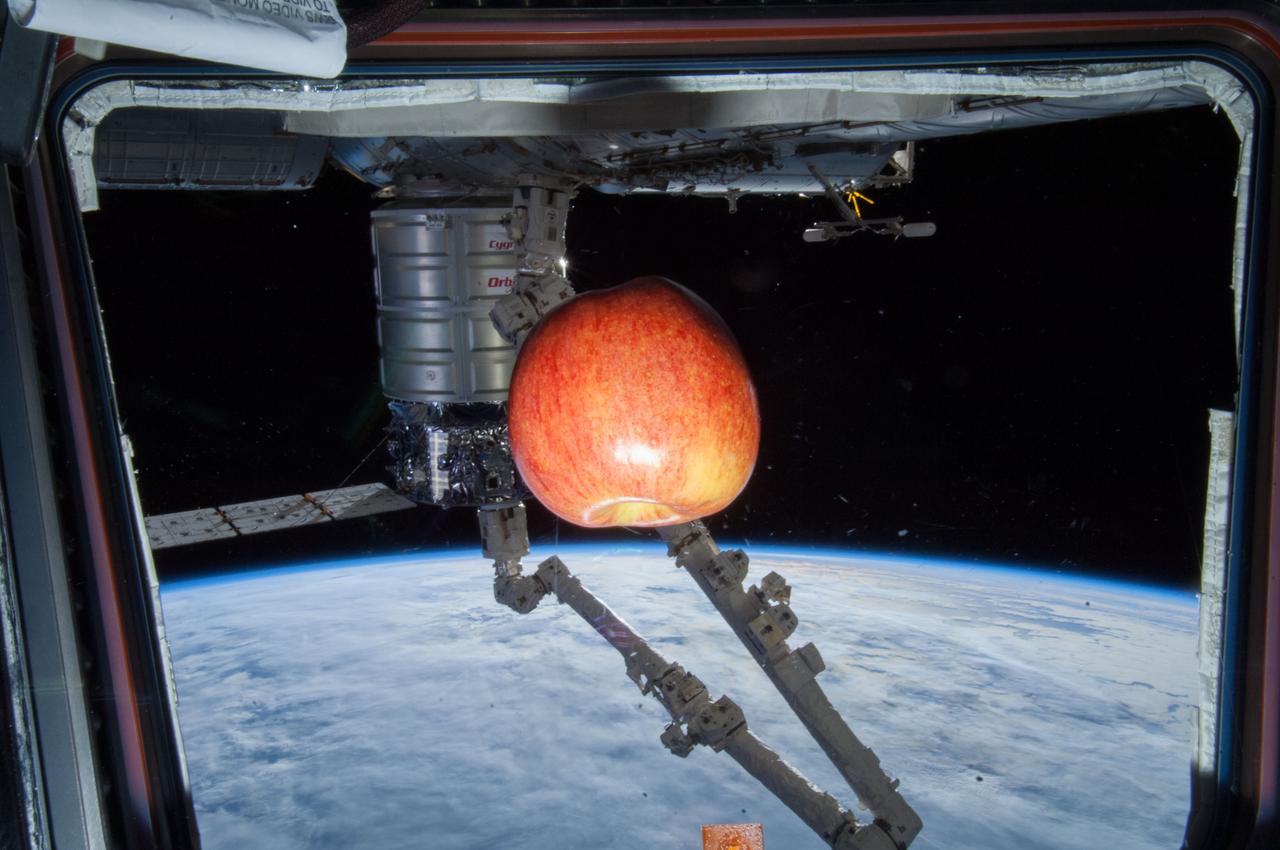
ISS038-E-029073 (12 Jan. 2014) --- A fresh apple floating freely near a window in the Cupola of the International Space Station is featured in this image photographed by an Expedition 38 crew member. Attached to the Harmony node, the Orbital Sciences Corp. Cygnus commercial cargo craft, which brought the fresh fruit, is visible at center.
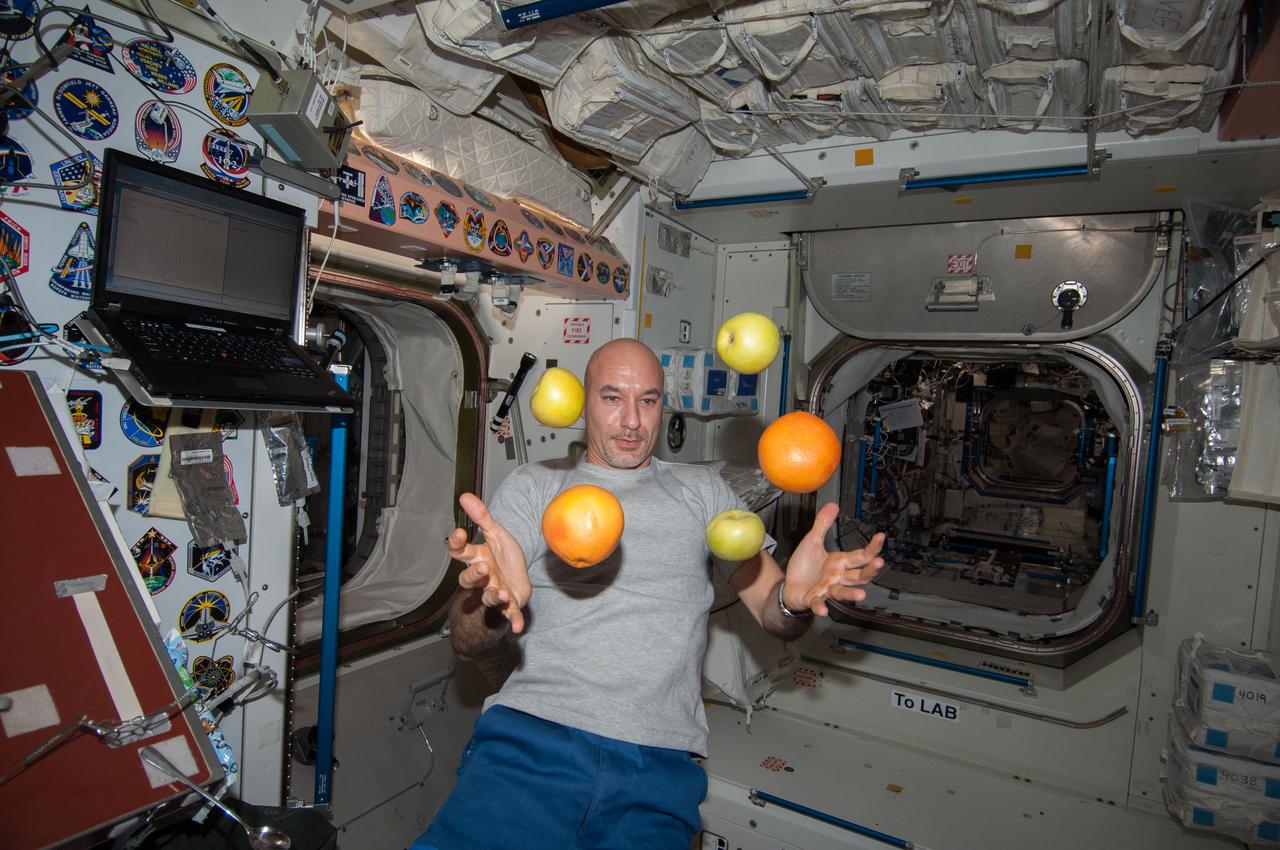
ISS036-E-025504 (28 July 2013) --- European Space Agency astronaut Luca Parmitano, Expedition 36 flight engineer, is pictured near fresh fruit floating freely in the Unity node of the International Space Station.
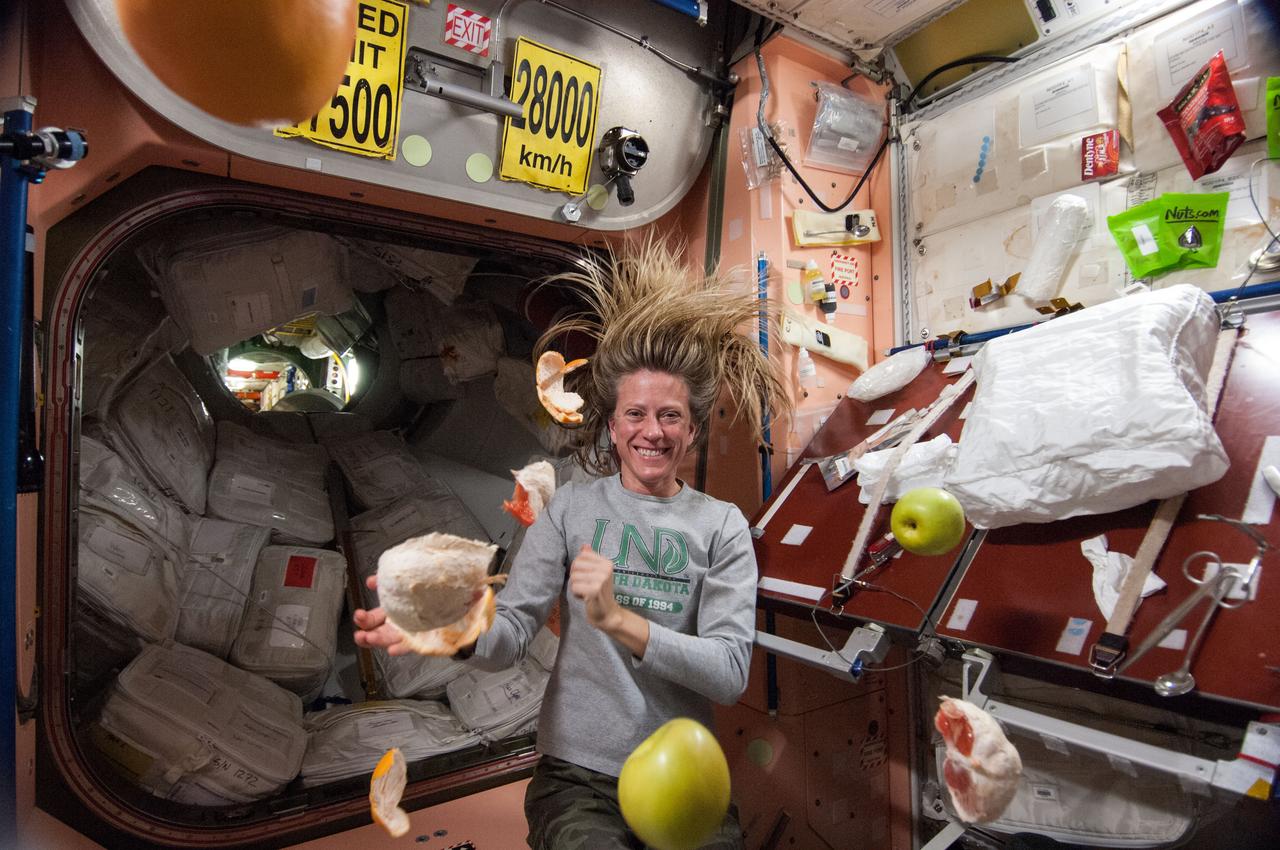
ISS036-E-025543 (28 July 2013) --- NASA astronaut Karen Nyberg, Expedition 36 flight engineer, is pictured near fresh fruit floating freely in the Unity node of the International Space Station.
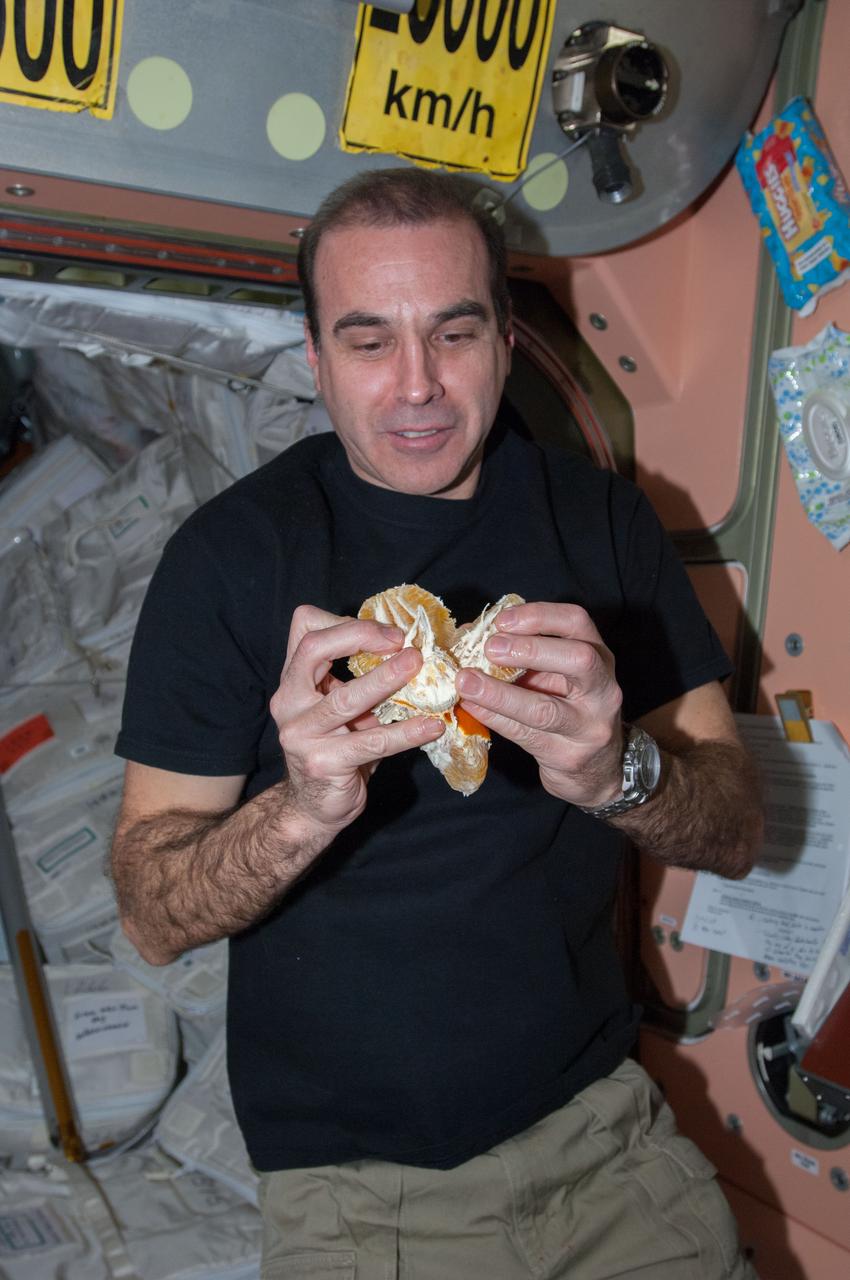
ISS038-E-043027 (6 Feb. 2014) --- NASA astronaut Rick Mastracchio, Expedition 38 flight engineer, prepares to eat a fresh orange in the Unity node of the International Space Station. The fruit was brought to the station on the ISS Progress 54 cargo spacecraft, which docked Feb. 5, 2014.
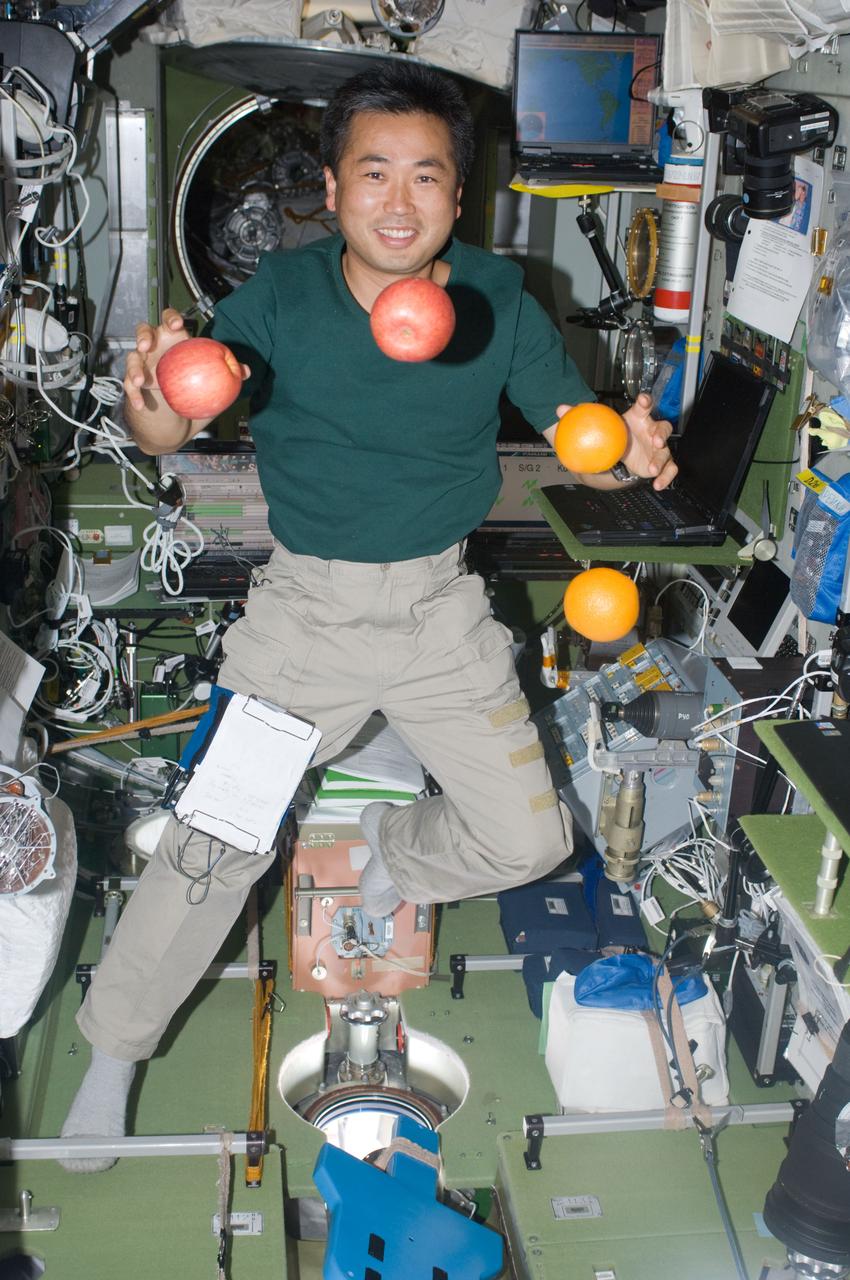
ISS018-E-043634 (29 March 2009) --- Japan Aerospace Exploration Agency (JAXA) astronaut Koichi Wakata, Expedition 18 flight engineer, is pictured near fresh fruit floating freely in the Zvezda Service Module of the International Space Station.
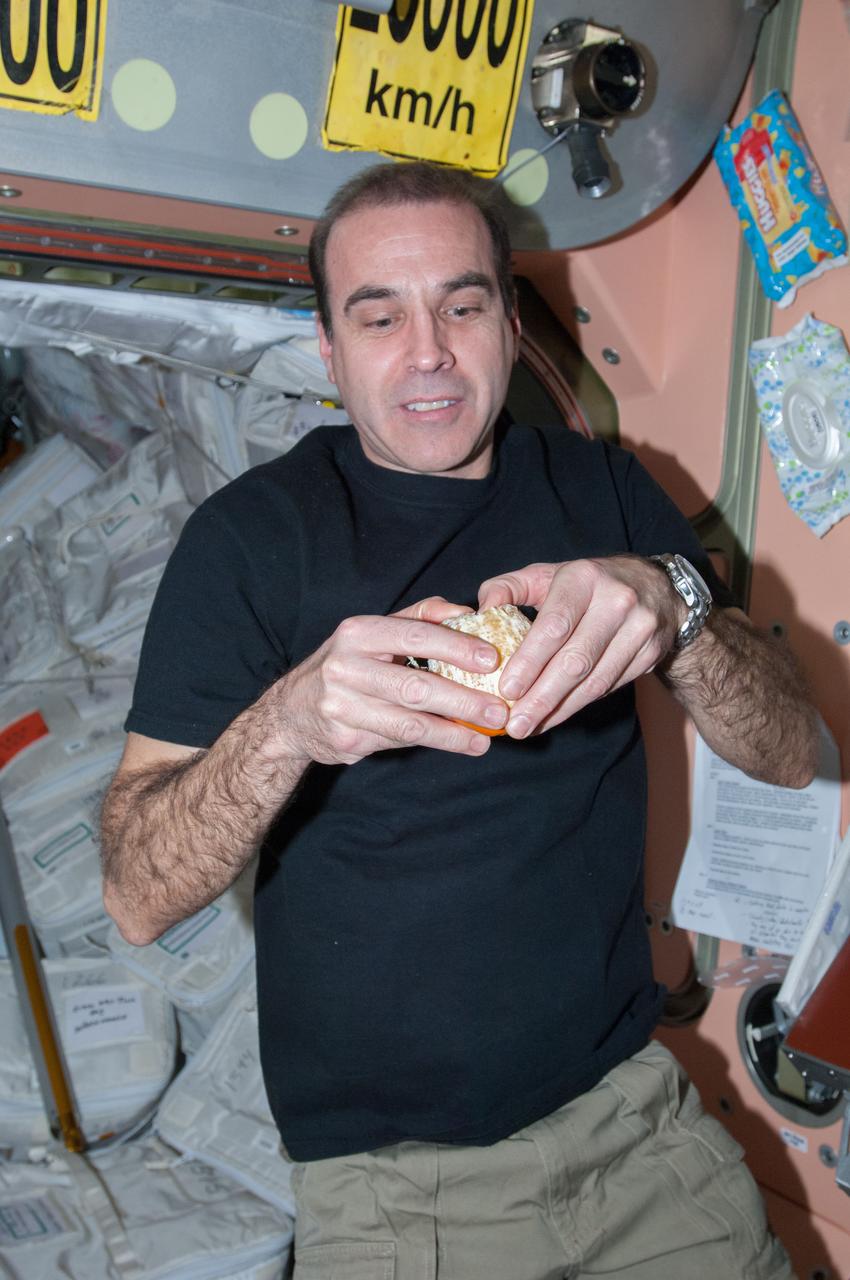
ISS038-E-043015 (6 Feb. 2014) --- NASA astronaut Rick Mastracchio, Expedition 38 flight engineer, prepares to eat a fresh orange in the Unity node of the International Space Station. The fruit was brought to the station on the ISS Progress 54 cargo spacecraft, which docked Feb. 5, 2014.
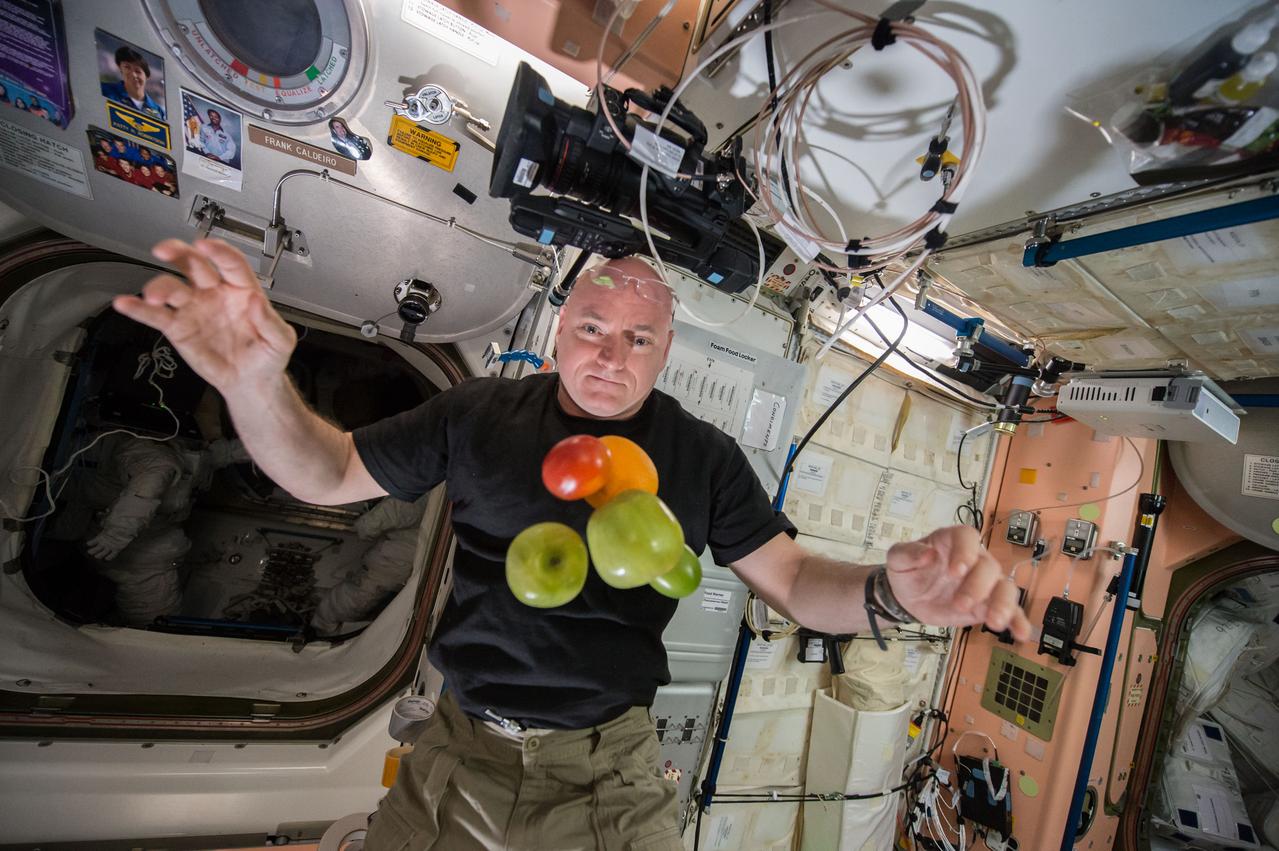
ISS044E007995 (07/05/2015) ---NASA astronaut Scott Kelly in the Unity (Node 1) module enjoying some fresh fruit and vegetables brought up to the International Space Station by the recent Russian Progress 60 spacecraft.
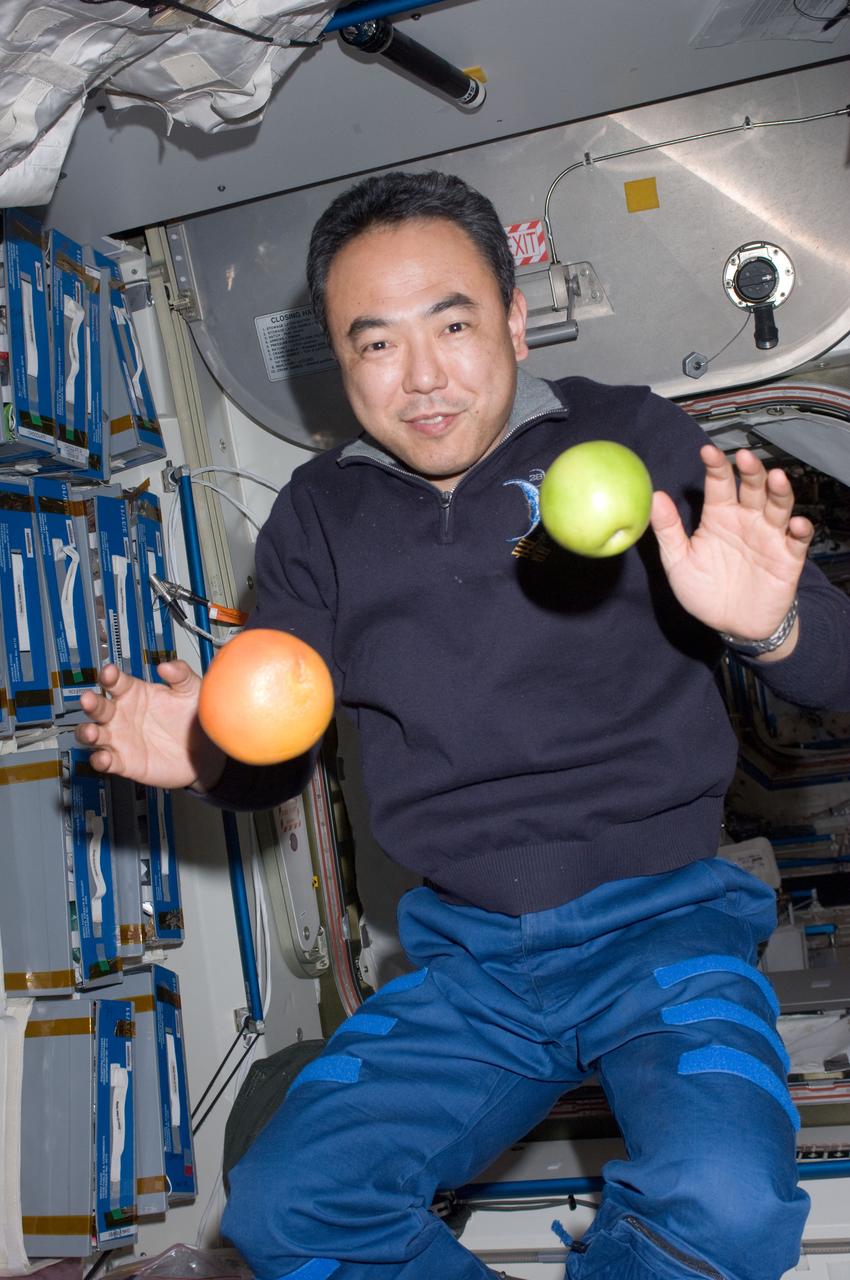
ISS028-E-012570 (1 July 2011) --- Japan Aerospace Exploration Agency astronaut Satoshi Furukawa, Expedition 28 flight engineer, is pictured near fresh fruit floating freely in the Unity node of the International Space Station.

ISS039-E-008095 (1 April 2014) --- Expedition 39 Commander Koichi Wakata, representing the Japan Aerospace Exploration Agency (JAXA), seems very elated that three new members of the crew have brought up food and supplies, especially fresh fruit, as depicted in this photo -- among the first sets of imagery documented with all six Expedition 39 crew members onboard the International Space Station. Wakata is in the orbiting outpost's Cupola module.
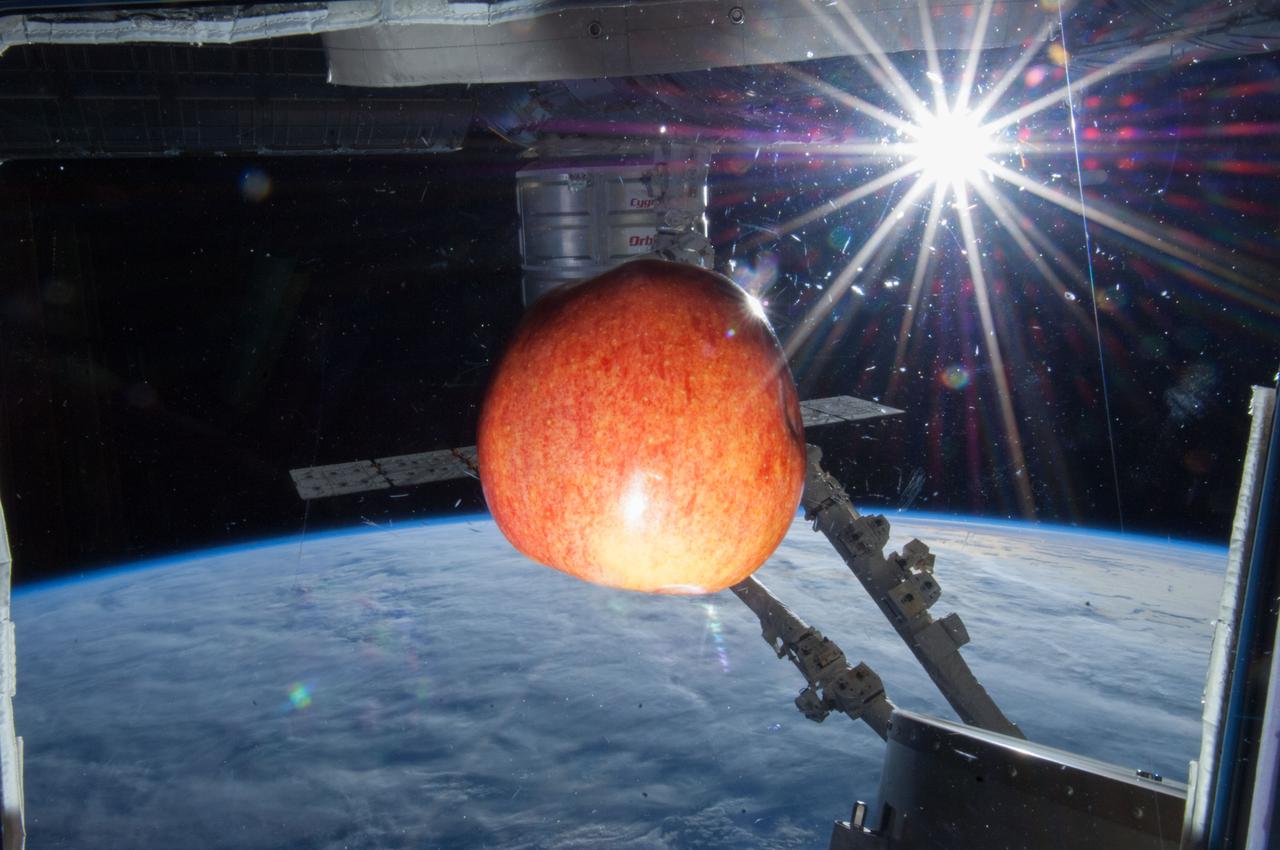
ISS038-E-029068 (12 Jan. 2014) --- A fresh apple floating freely near a window in the Cupola of the International Space Station is featured in this image photographed by an Expedition 38 crew member. Attached to the Harmony node, the Orbital Sciences Corp. Cygnus commercial cargo craft, which brought the fresh fruit, is visible at center. The bright sun, Earth's horizon and the blackness of space provide the backdrop for the scene.
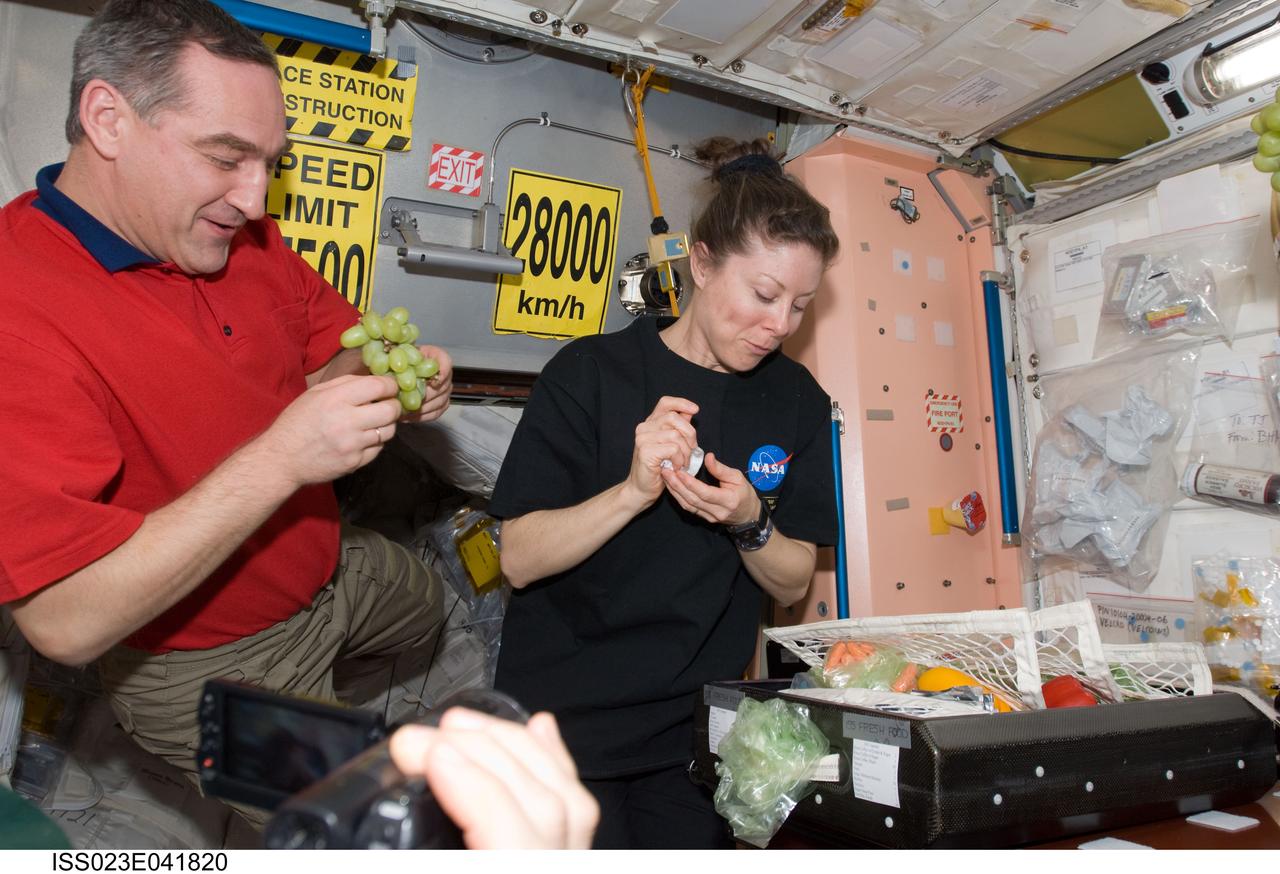
ISS023-E-041820 (16 May 2010) --- Russian cosmonaut Alexander Skvortsov and NASA astronaut Tracy Caldwell Dyson, both Expedition 23 flight engineers, enjoy fresh fruit and vegetables in the Unity node of the International Space Station while space shuttle Atlantis (STS-132) remains docked with the station.
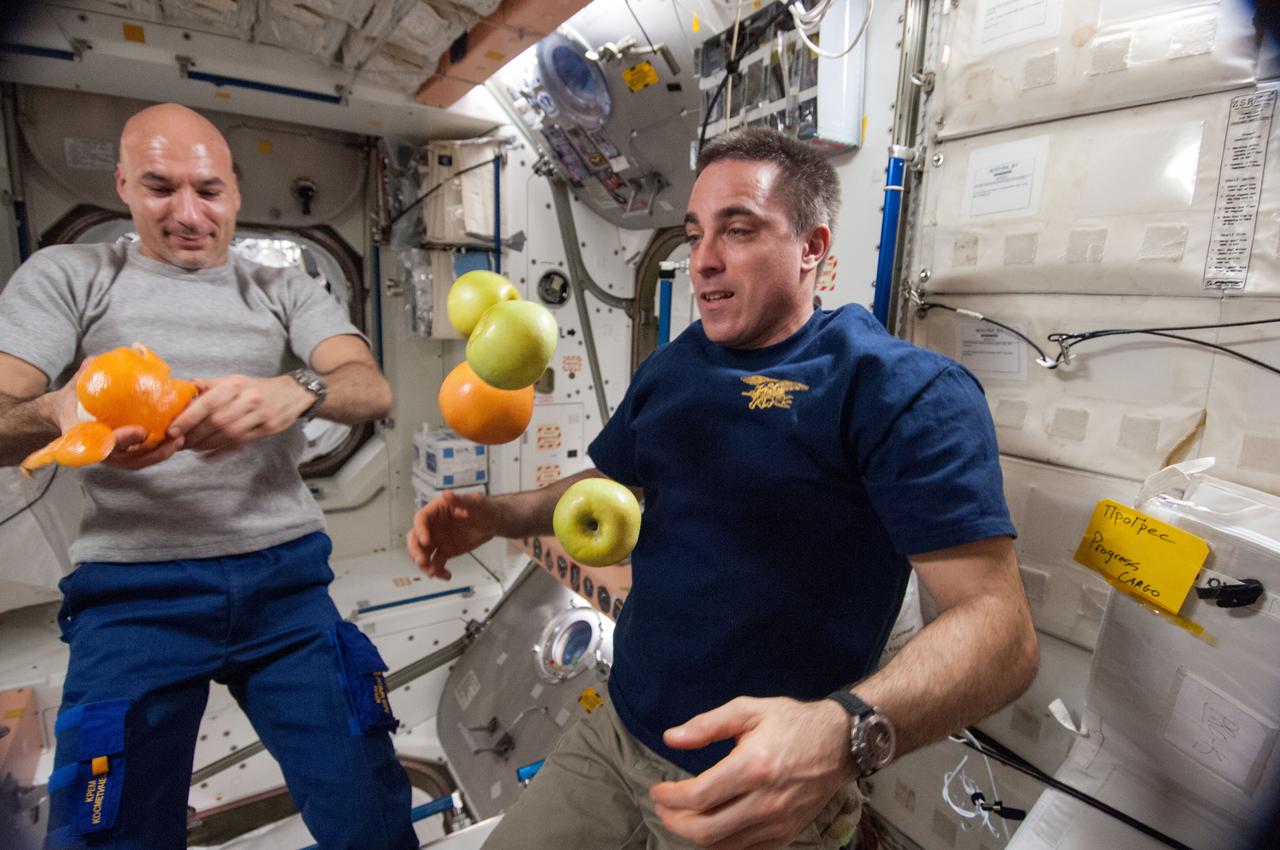
ISS036-E-025528 (28 July 2013) --- European Space Agency astronaut Luca Parmitano (left) and NASA astronaut Chris Cassidy, both Expedition 36 flight engineers, are pictured near fresh fruit floating freely in the Unity node of the International Space Station.
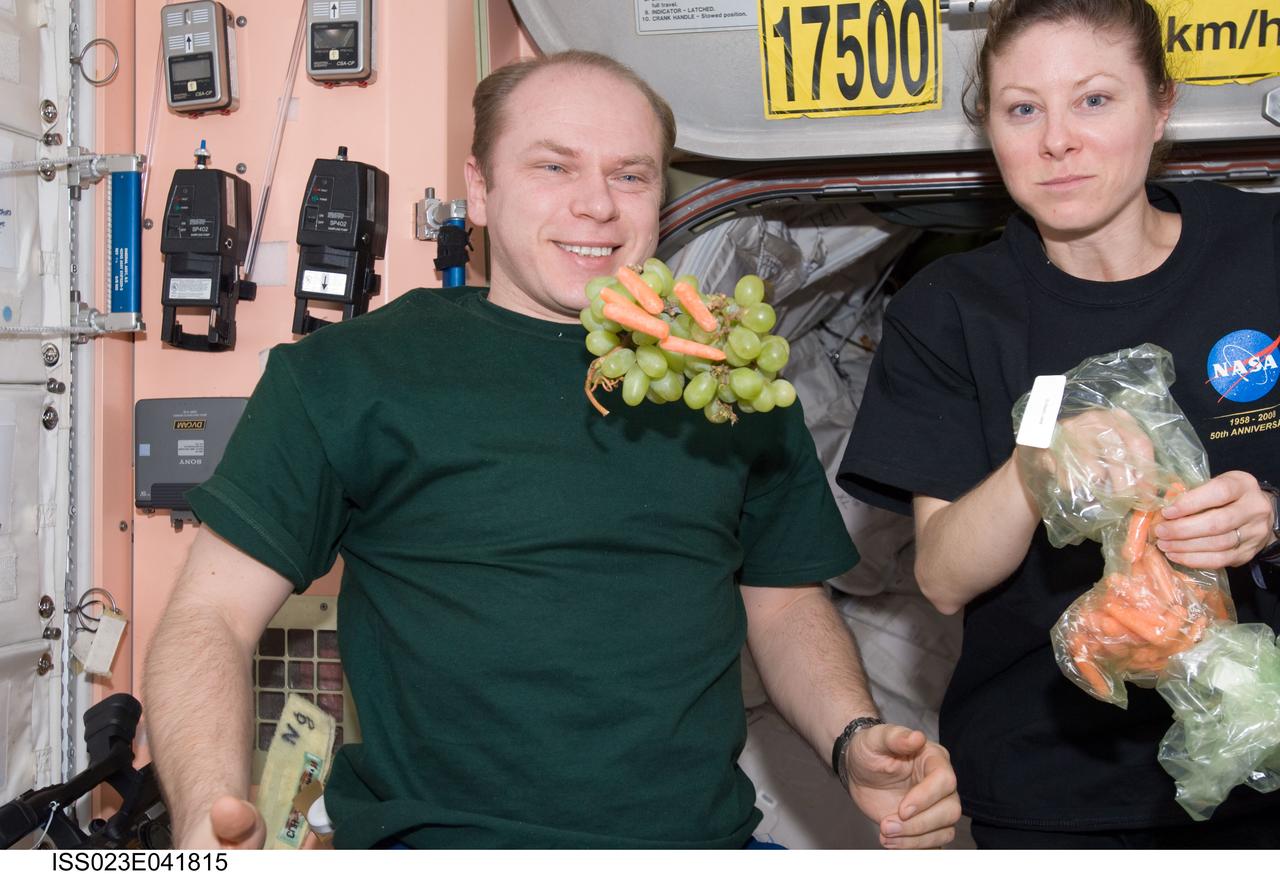
ISS023-E-041815 (16 May 2010) --- Russian cosmonaut Oleg Kotov, Expedition 23 commander; and NASA astronaut Tracy Caldwell Dyson, flight engineer, are pictured near fresh fruit and vegetables floating freely in the Unity node of the International Space Station while space shuttle Atlantis (STS-132) remains docked with the station.
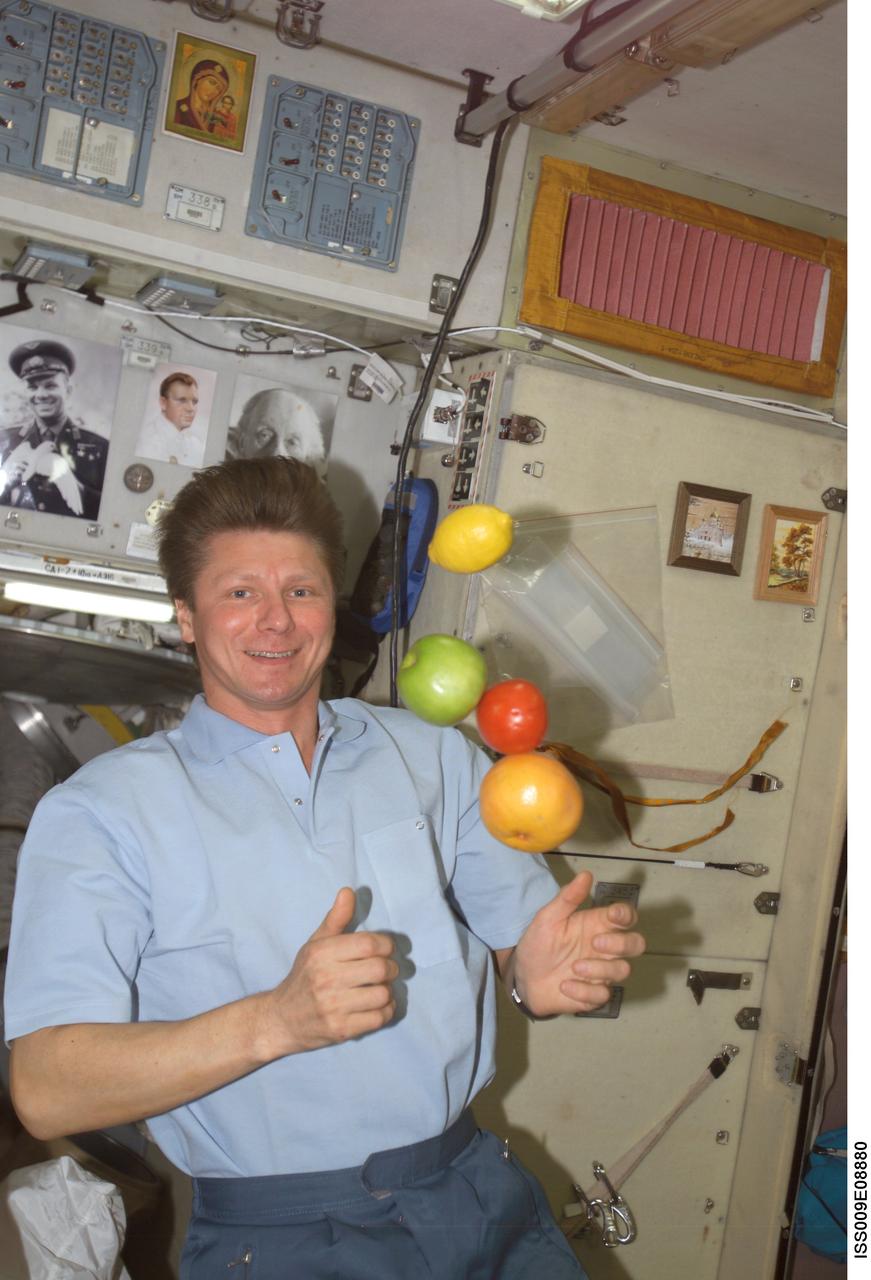
ISS009-E-08880 (27 May 2004) --- Cosmonaut Gennady I. Padalka, Expedition 9 commander representing Russia’s Federal Space Agency, is pictured near fresh fruit floating freely in the Zvezda Service Module of the International Space Station (ISS).
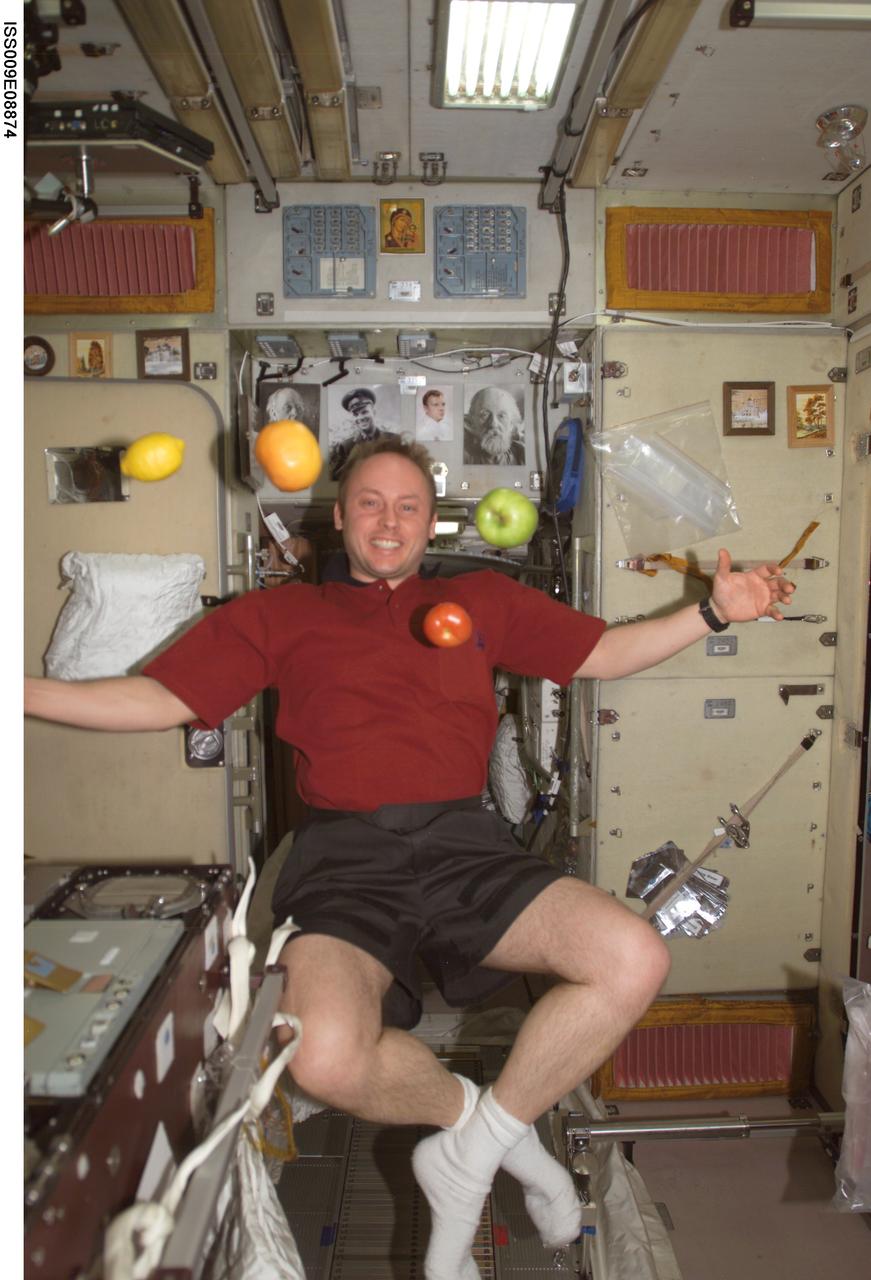
ISS009-E-08874 (27 May 2004) --- Astronaut Edward M. (Mike) Fincke, Expedition 9 NASA ISS science officer and flight engineer, is pictured near fresh fruit floating freely in the Zvezda Service Module of the International Space Station (ISS).
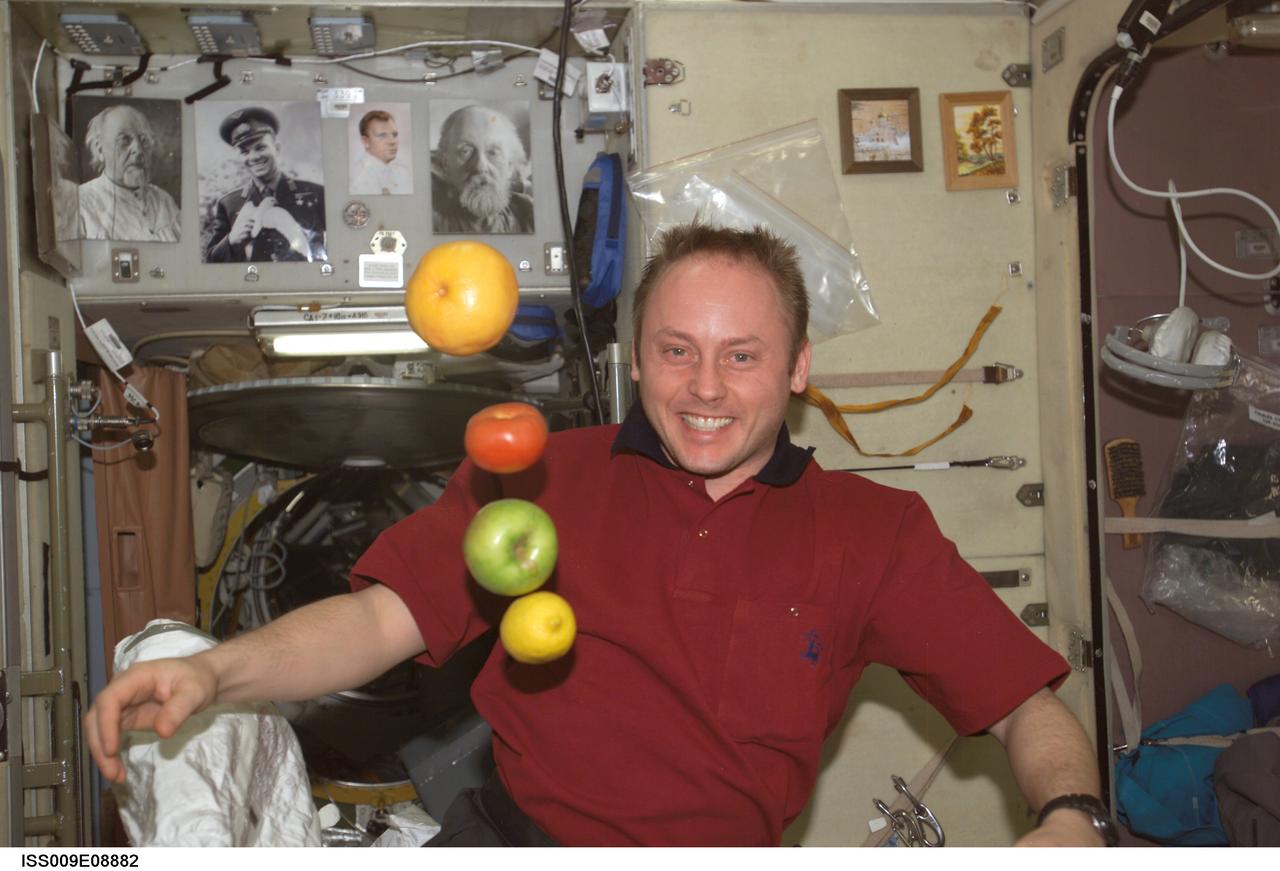
ISS009-E-08882 (27 May 2004) --- Astronaut Edward M. (Mike) Fincke, Expedition 9 NASA ISS science officer and flight engineer, is pictured near fresh fruit floating freely in the Zvezda Service Module of the International Space Station (ISS).
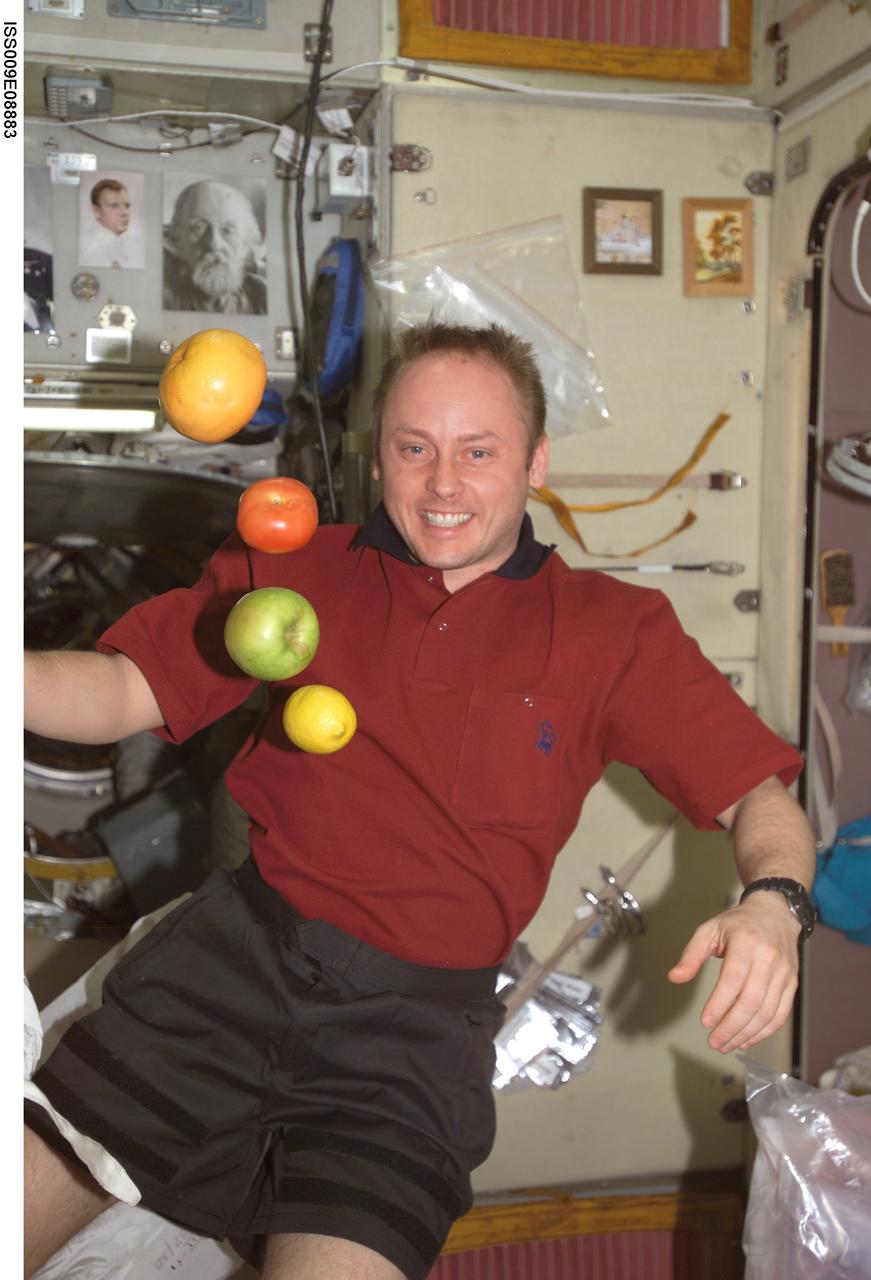
ISS009-E-08883 (27 May 2004) --- Astronaut Edward M. (Mike) Fincke, Expedition 9 NASA ISS science officer and flight engineer, is pictured near fresh fruit floating freely in the Zvezda Service Module of the International Space Station (ISS).

ISS008-E-22241 (22 April 2004) --- Astronaut C. Michael Foale, Expedition 8 commander and NASA ISS science officer, “juggles” fresh fruit in the Destiny laboratory of the International Space Station (ISS). The weightless environment of space proves to be an ideal location for some tasks not so easily accomplished in Earth’s gravity.
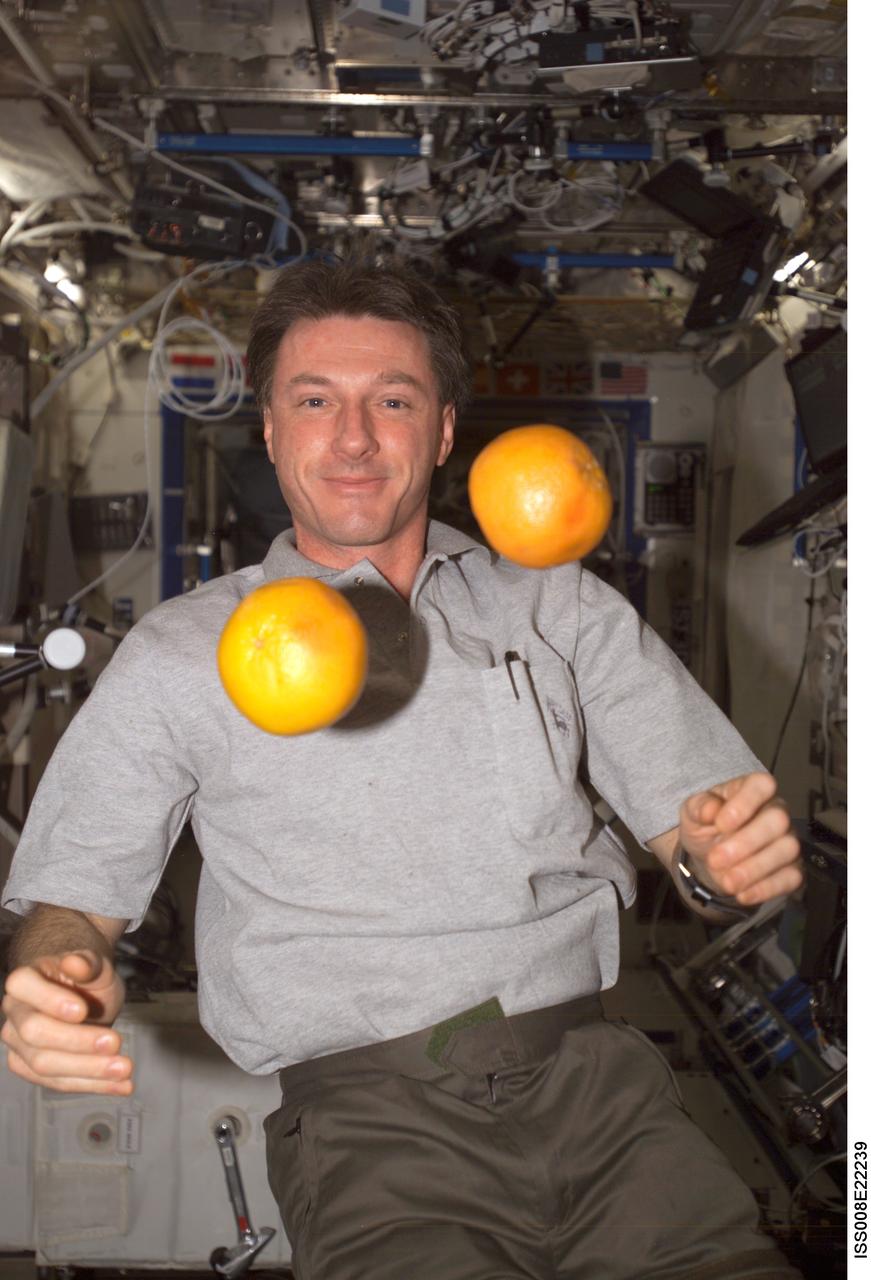
ISS008-E-22239 (22 April 2004) --- Astronaut C. Michael Foale, Expedition 8 commander and NASA ISS science officer, “juggles” fresh fruit in the Destiny laboratory of the International Space Station (ISS). The weightless environment of space proves to be an ideal location for some tasks not so easily accomplished in Earth’s gravity.
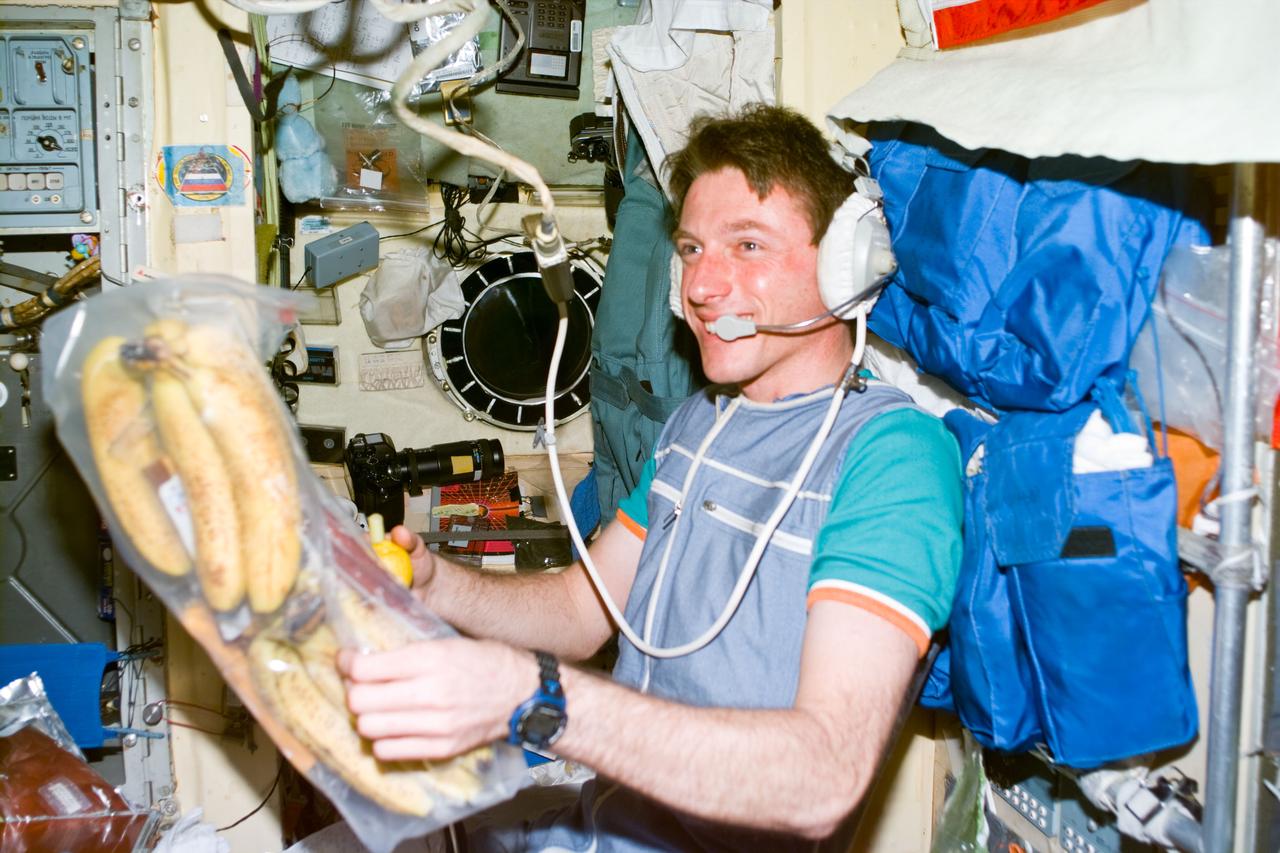
S86-E-5299 (27 Sept. 1997) --- Astronaut C. Michael Foale, cosmonaut guest researcher, shows his pleasure over a package of fresh fruit brought aboard Russia?s Mir Space Station by the STS-86 crew aboard the space shuttle Atlantis. This photograph captures Foale in his last hours as a cosmonaut guest researcher aboard Mir. Astronaut David A. Wolf, mission specialist, will replace Foale onboard the Mir, as cosmonaut guest researcher. This photograph was taken with the Electronic Still Camera (ESC) at 23:11:26 GMT on Sept. 27, 1997. Photo credit: NASA
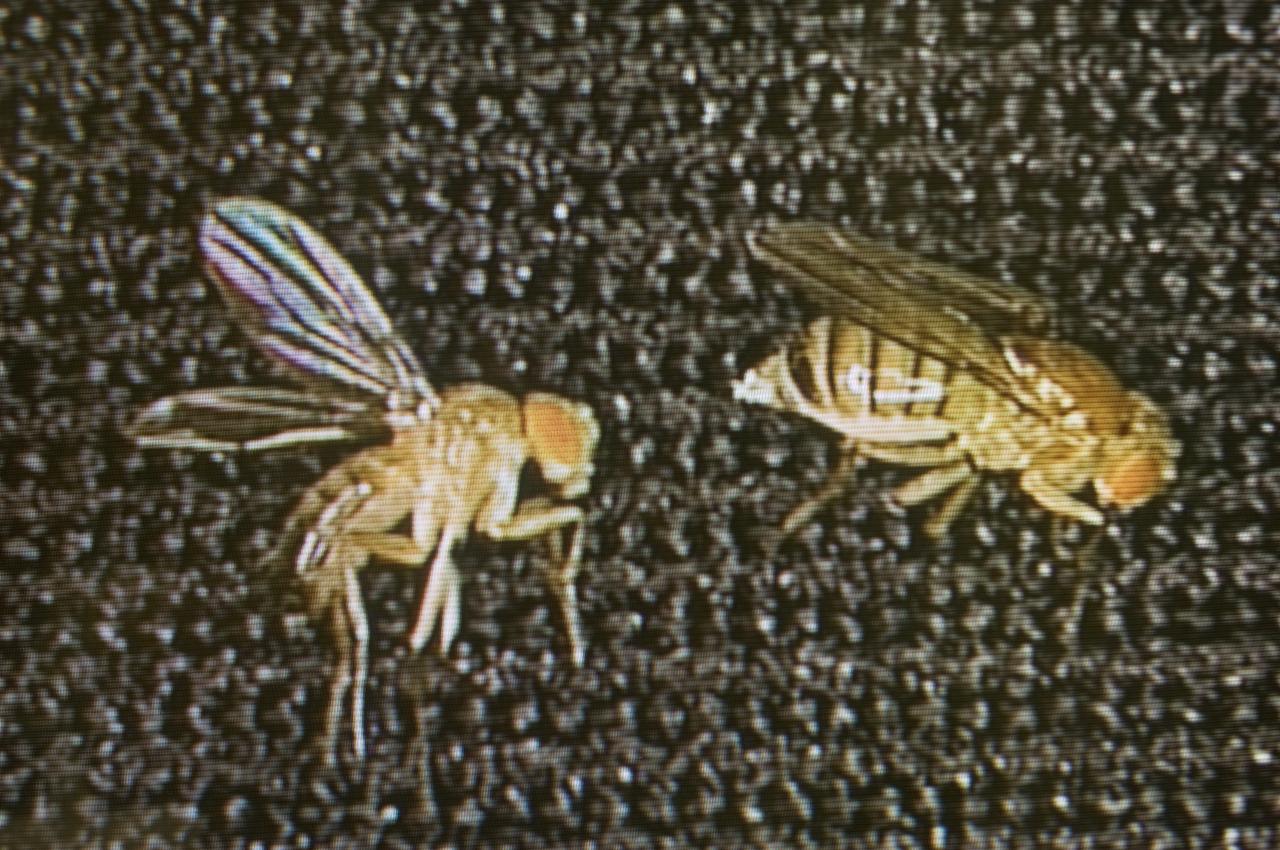
Space shuttle STS-121 FIT (Fly Immunity and Tumors) payload. Using Drosophila (fruit fly) to complete the experiments. Male and female Drosophila (fruit fly).
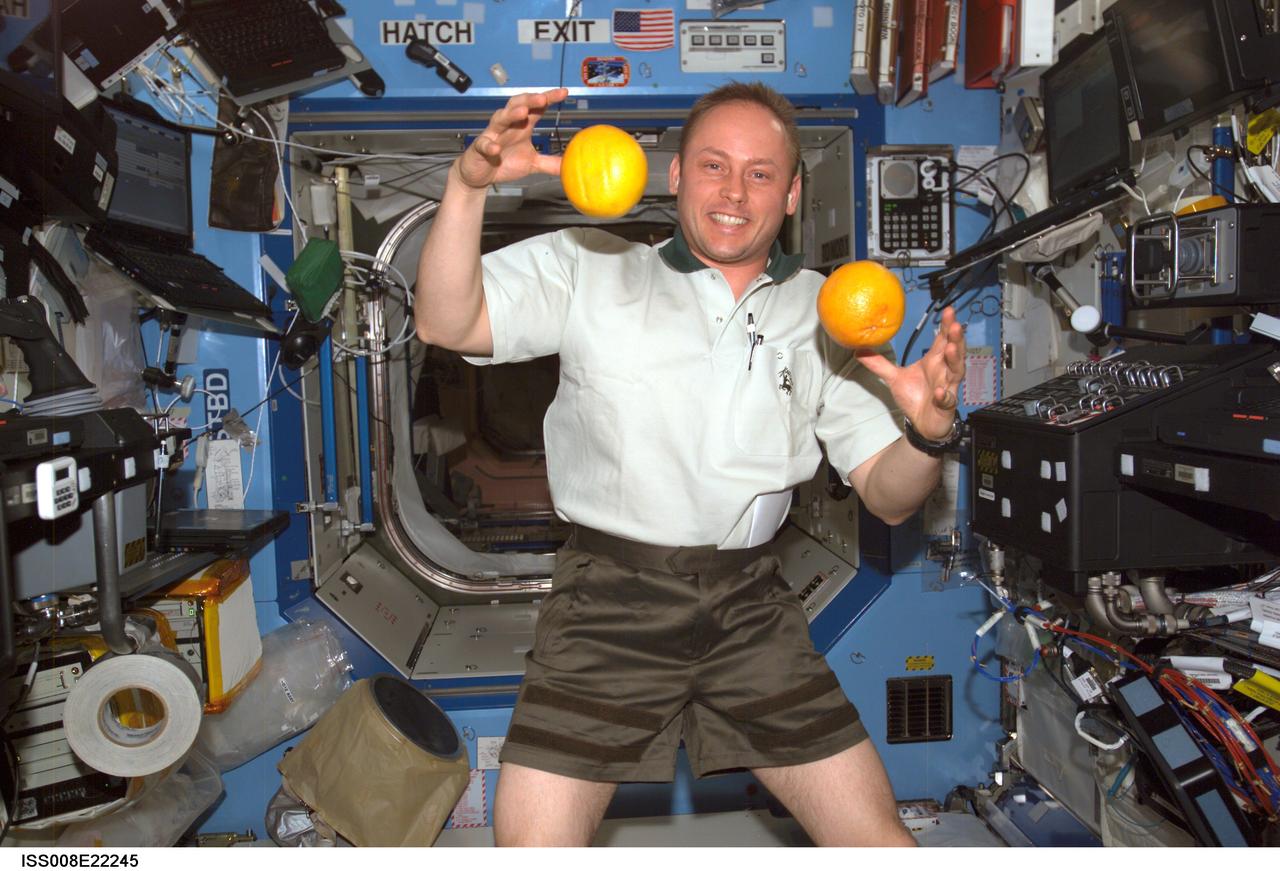
ISS008-E-22245 (22 April 2004) --- Astronaut Edward M. (Mike) Fincke, Expedition 9 NASA ISS science officer and flight engineer, “juggles” fresh fruit in the Destiny laboratory of the International Space Station (ISS). The weightless environment of space proves to be an ideal location for some tasks not so easily accomplished in Earth’s gravity.
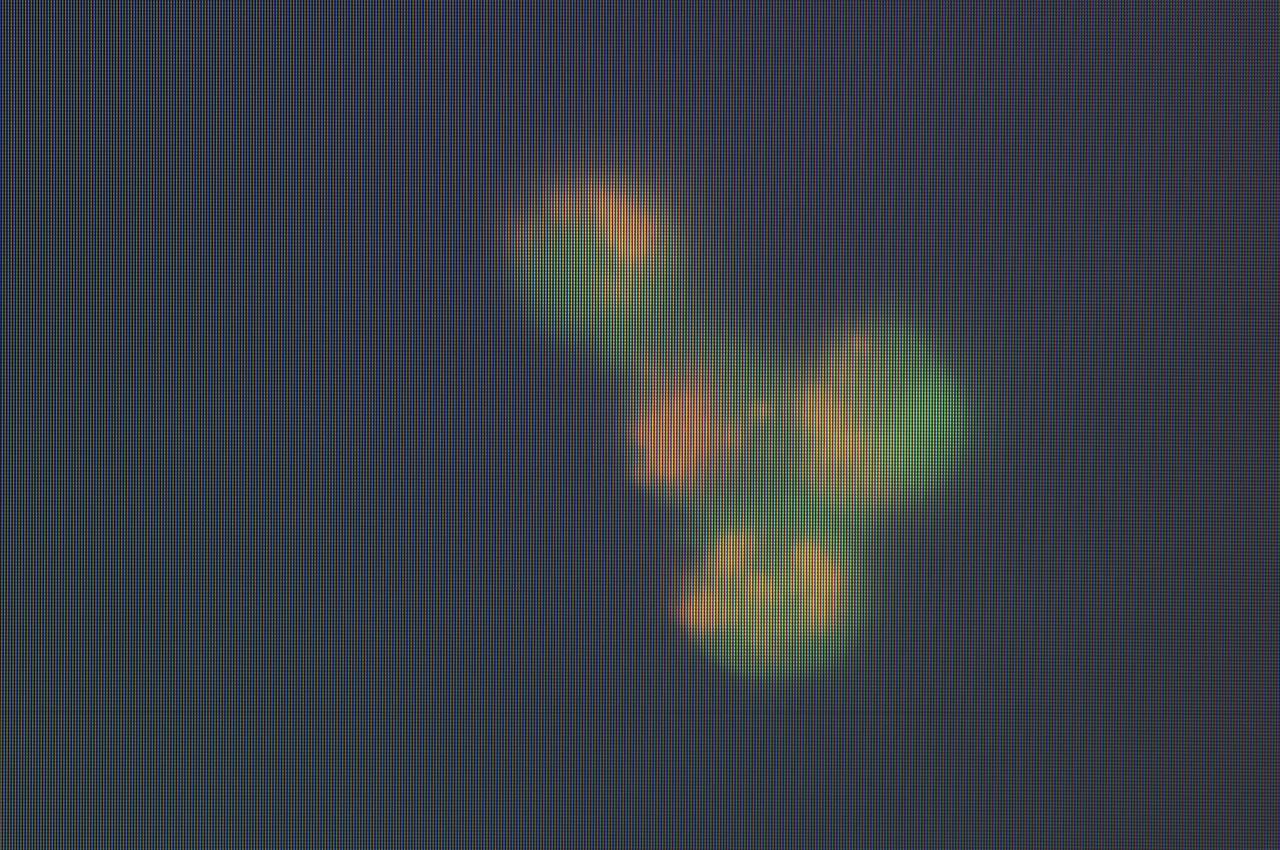
Space shuttle STS-121 FIT (Fly Immunity and Tumors) payload. Using Drosophila (fruit fly) to complete the experiments. Computer screen showing green fluorescent protein used to visualize blood cells in Drosophila (fruit fly).
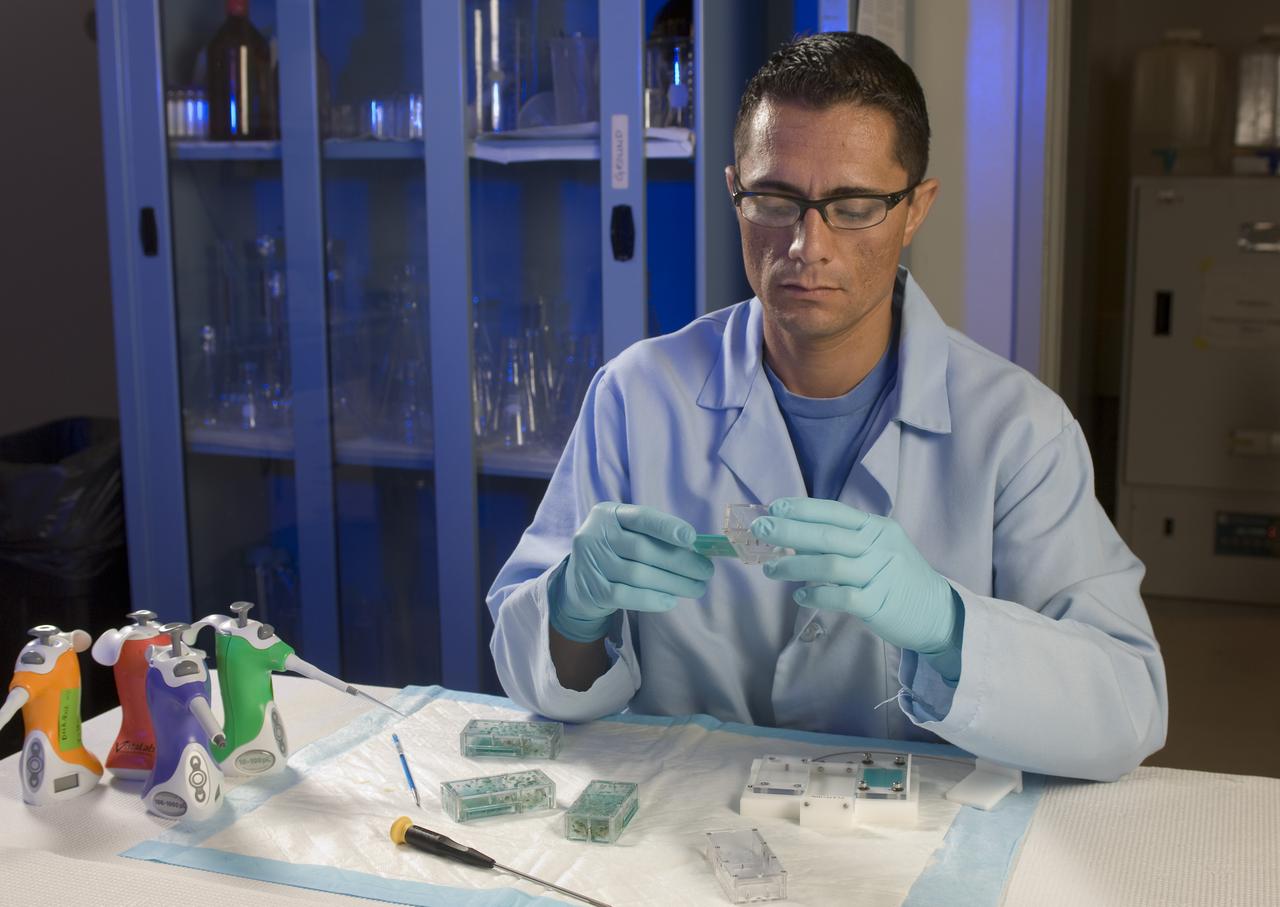
Space shuttle STS-121 FIT (Fly Immunity and Tumors) payload. Using Drosophila (fruit fly) to complete the experiments. Max Sanchezviewing Drosophila (fruit fly) inside insect containers used during flight.

Space shuttle STS-121 FIT (Fly Immunity and Tumors) payload. Using Drosophila (fruit fly) to complete the experiments. Matt Lera prepares food for culturing Drosphila (fruit fly) colony during fight
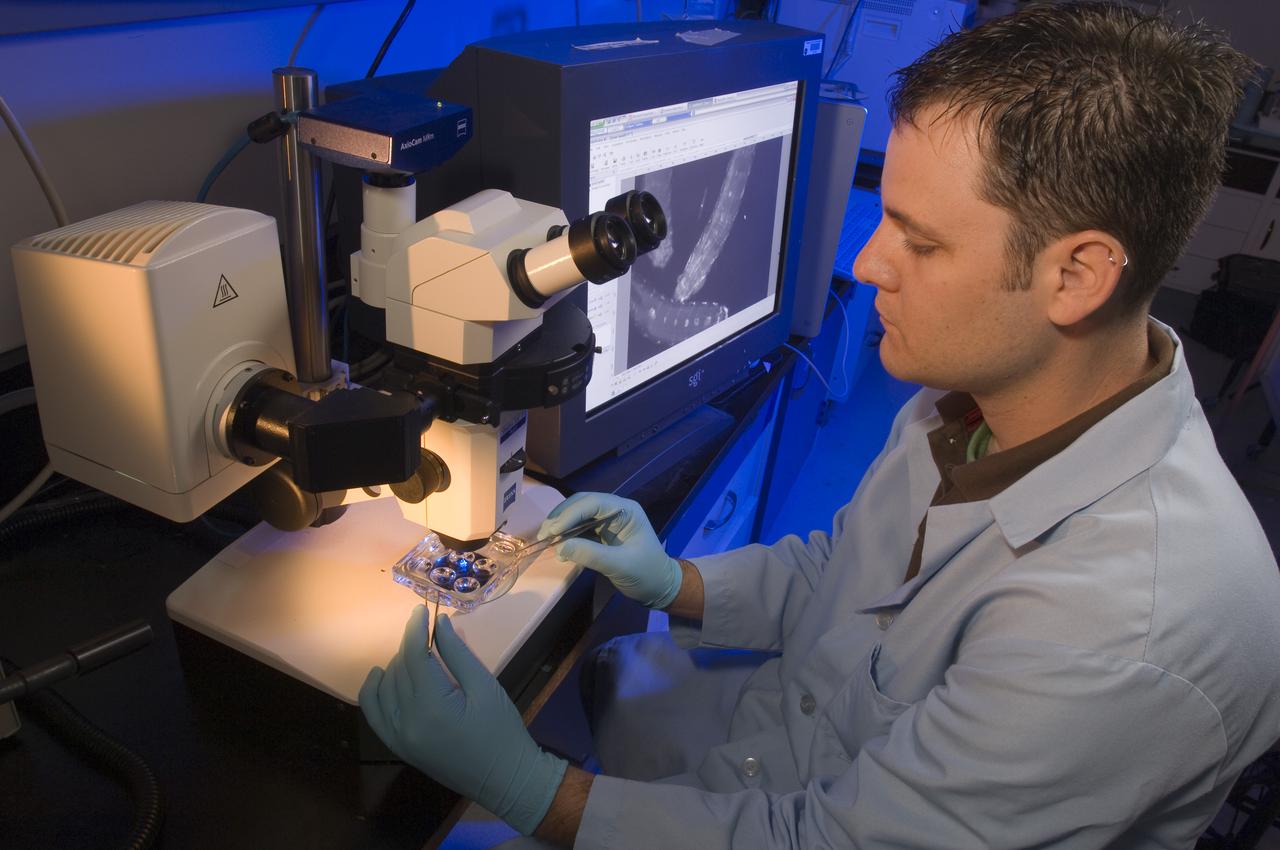
Space shuttle STS-121 FIT (Fly Immunity and Tumors) payload. Using Drosophila (fruit fly) to complete the experiments. Matt Lera doing sample preparation for post light analysis of Drosophila melanogaster (fruit fly) larva
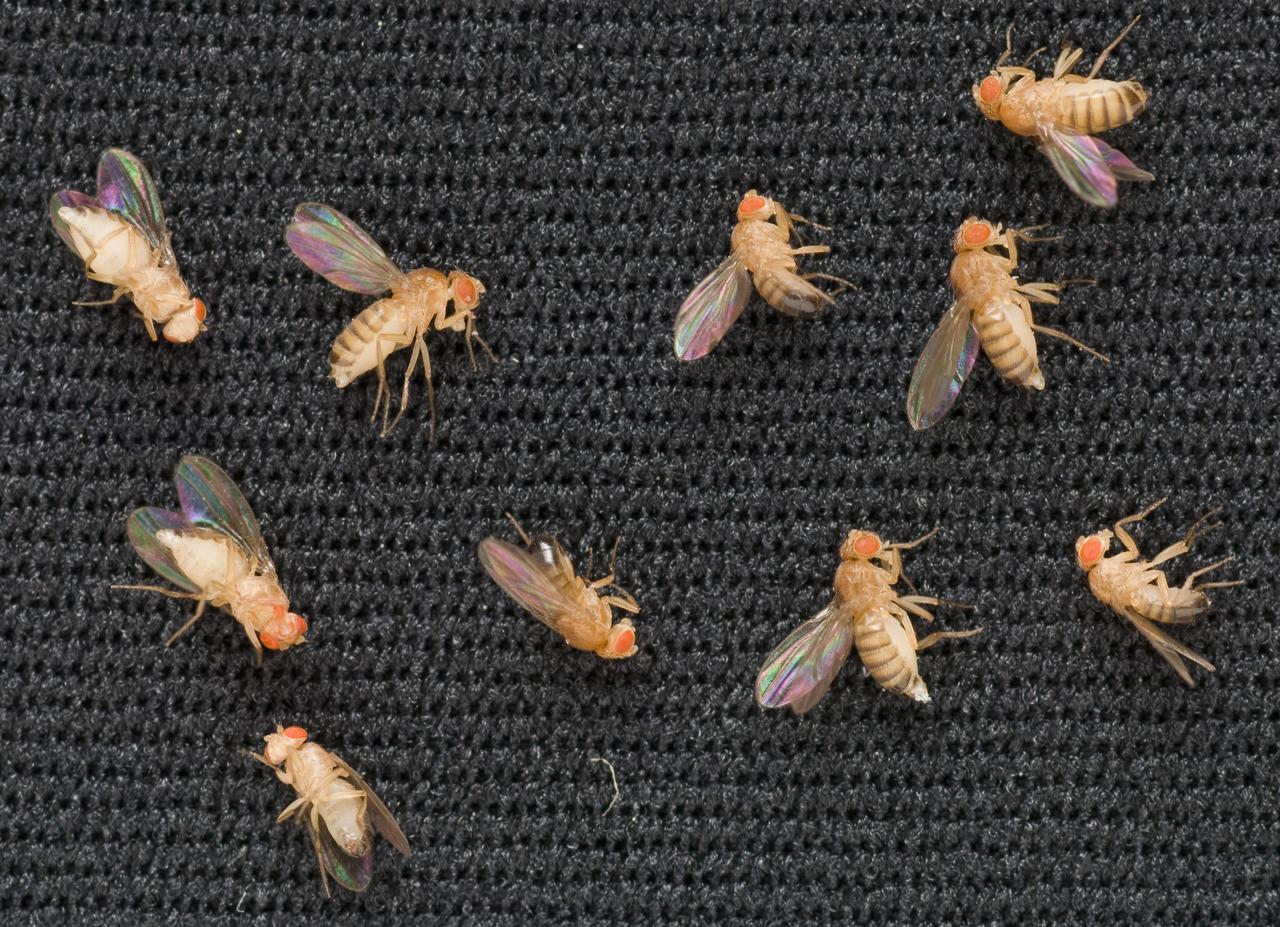
Space shuttle STS-121 FIT (Fly Immunity and Tumors) payload. Using Drosophila (fruit fly) to complete the experiments. wide view of Drosophila melanogaster (fruit fly).

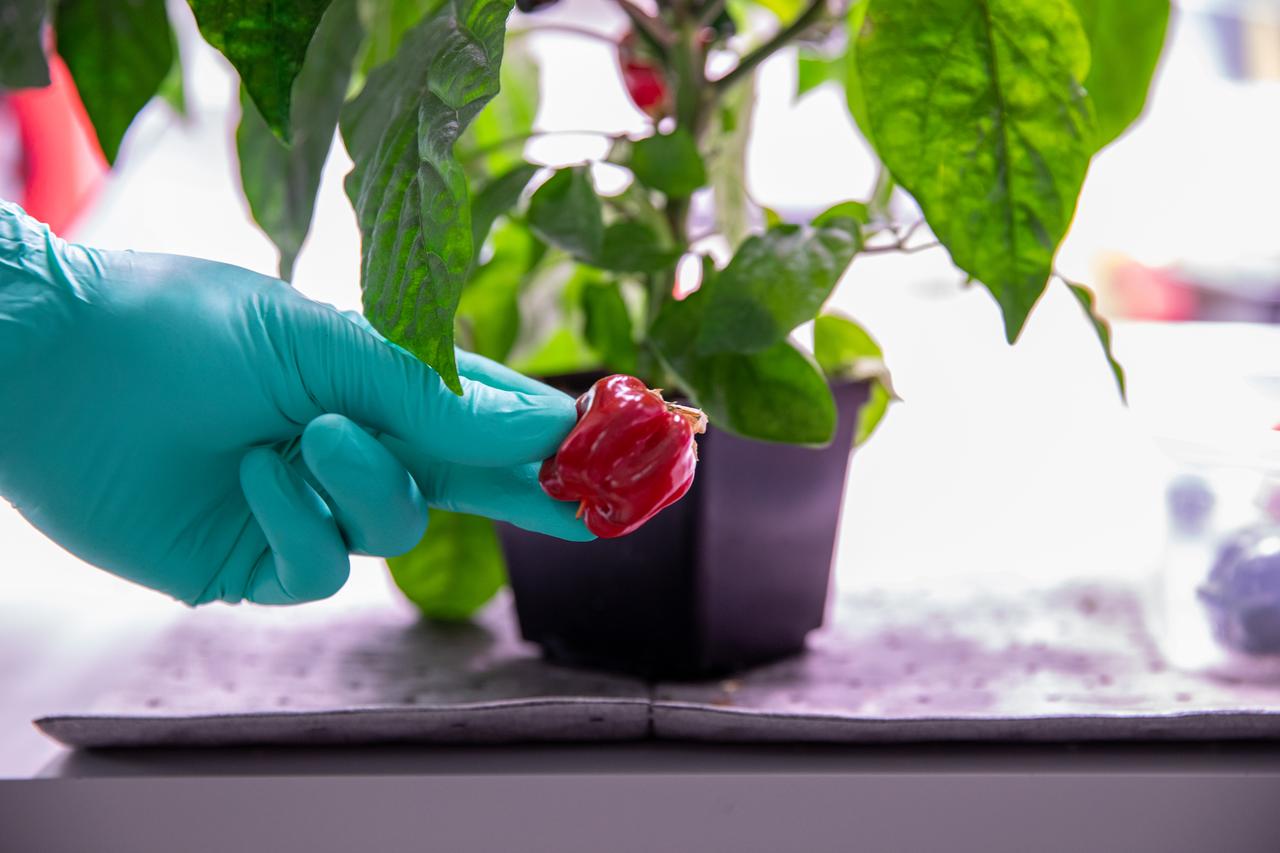
Chile pepper plants growing in the Advanced Plant Habitat (APH) aboard the International Space Station recently bore fruit. The peppers developed from flowers that bloomed over the past few weeks. Studies of fruit development in microgravity are limited, but overcoming the challenges of growing fruit in microgravity is important to NASA for long-duration missions during which crew members will need good sources of Vitamin C to supplement their diets.

Chile pepper plants growing in the Advanced Plant Habitat (APH) aboard the International Space Station recently bore fruit. The peppers developed from flowers that bloomed over the past few weeks. Studies of fruit development in microgravity are limited, but overcoming the challenges of growing fruit in microgravity is important to NASA for long-duration missions during which crew members will need good sources of Vitamin C to supplement their diets.

Chile pepper plants growing in the Advanced Plant Habitat (APH) aboard the International Space Station recently bore fruit. The peppers developed from flowers that bloomed over the past few weeks. Studies of fruit development in microgravity are limited, but overcoming the challenges of growing fruit in microgravity is important to NASA for long-duration missions during which crew members will need good sources of Vitamin C to supplement their diets.

Space shuttle STS-121 FIT (Fly Immunity and Tumors) payload. Using Drosophila (fruit fly) to complete the experiments. Here we have sample preparation for post flight analysis of Drosophila (fruit fly) larva with Oana Marcu and Laura Higgins
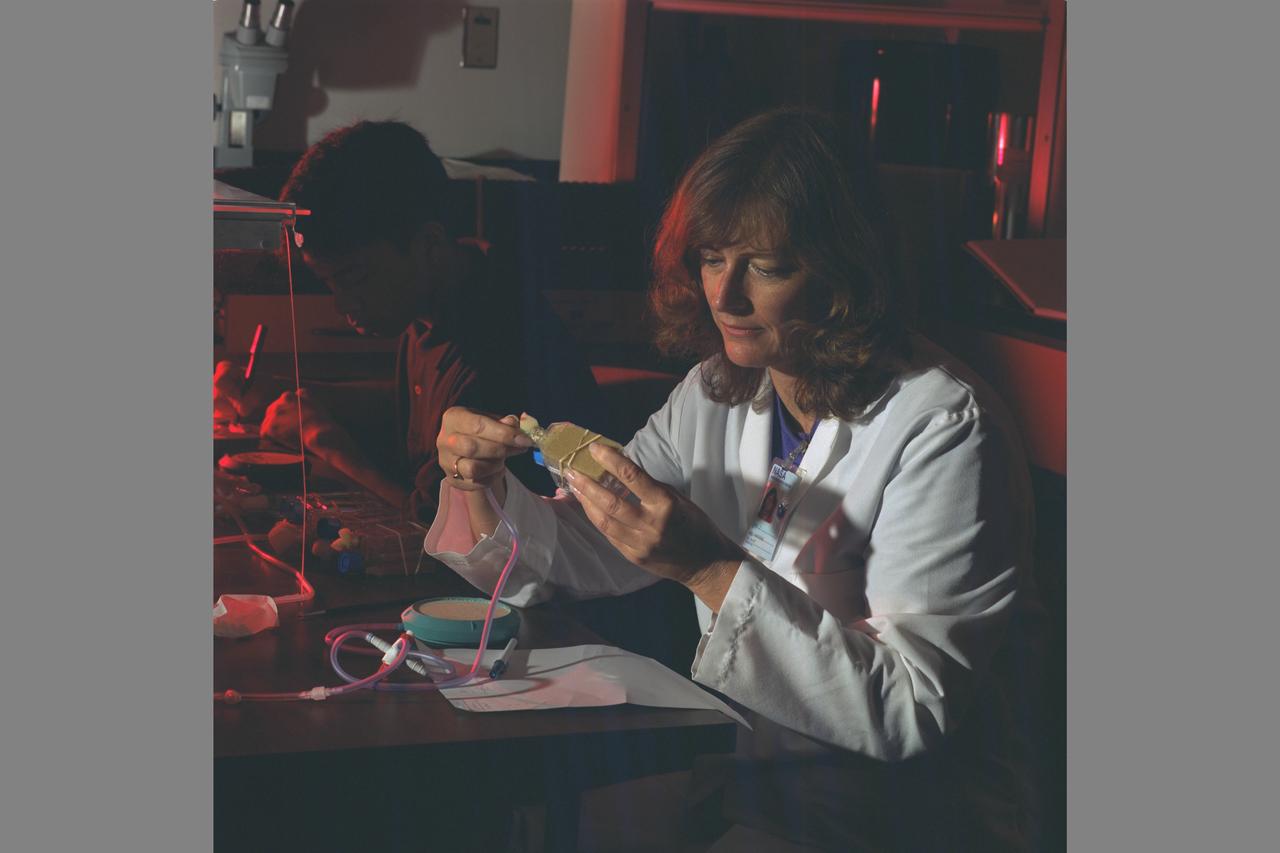
Insect larvae separation containers (fruit fly; egg, pupae and adults male/female) with Judy Jones using vacuum
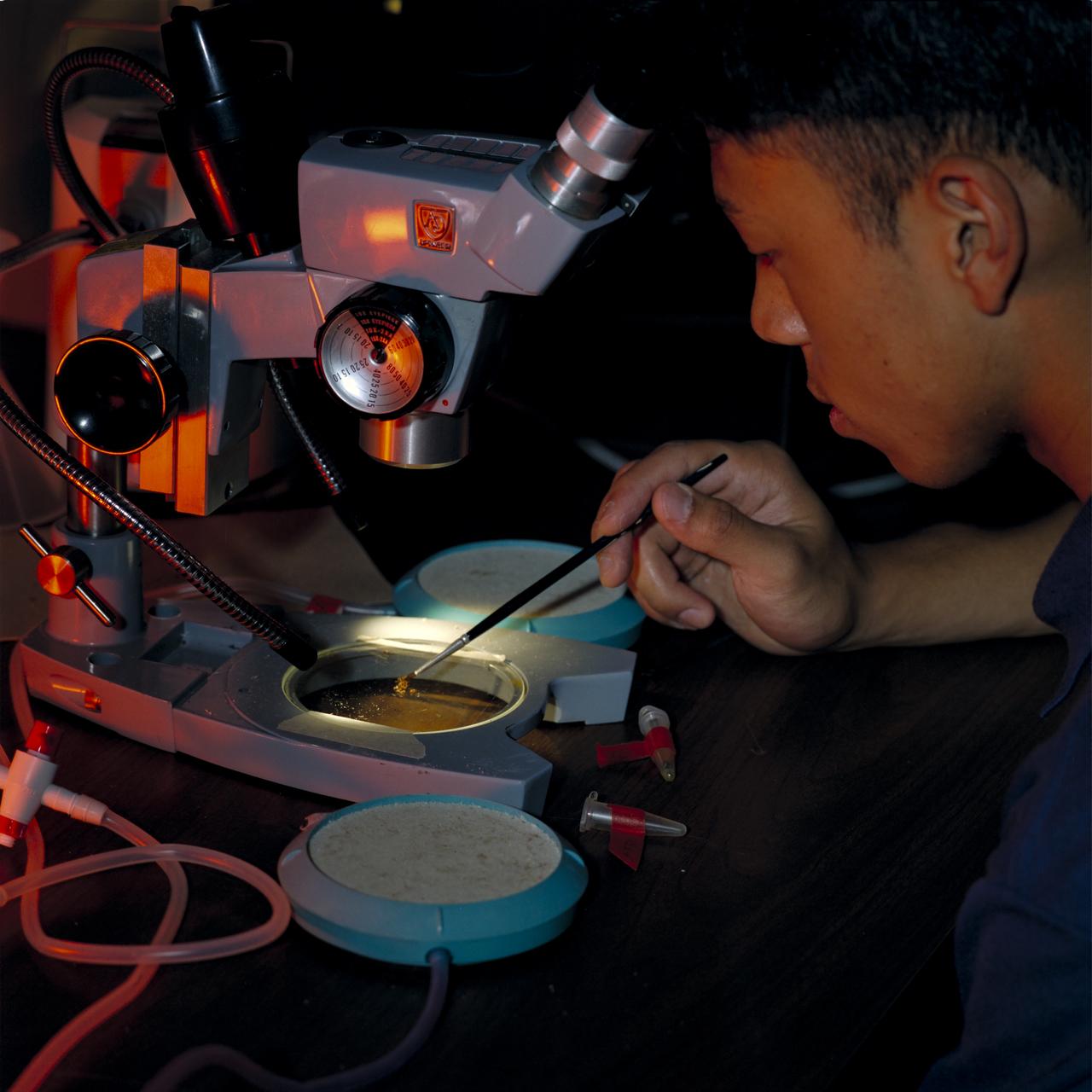
Insect larvae separation containers (fruit fly; egg, pupae and adults male/female) with Jason Cardema
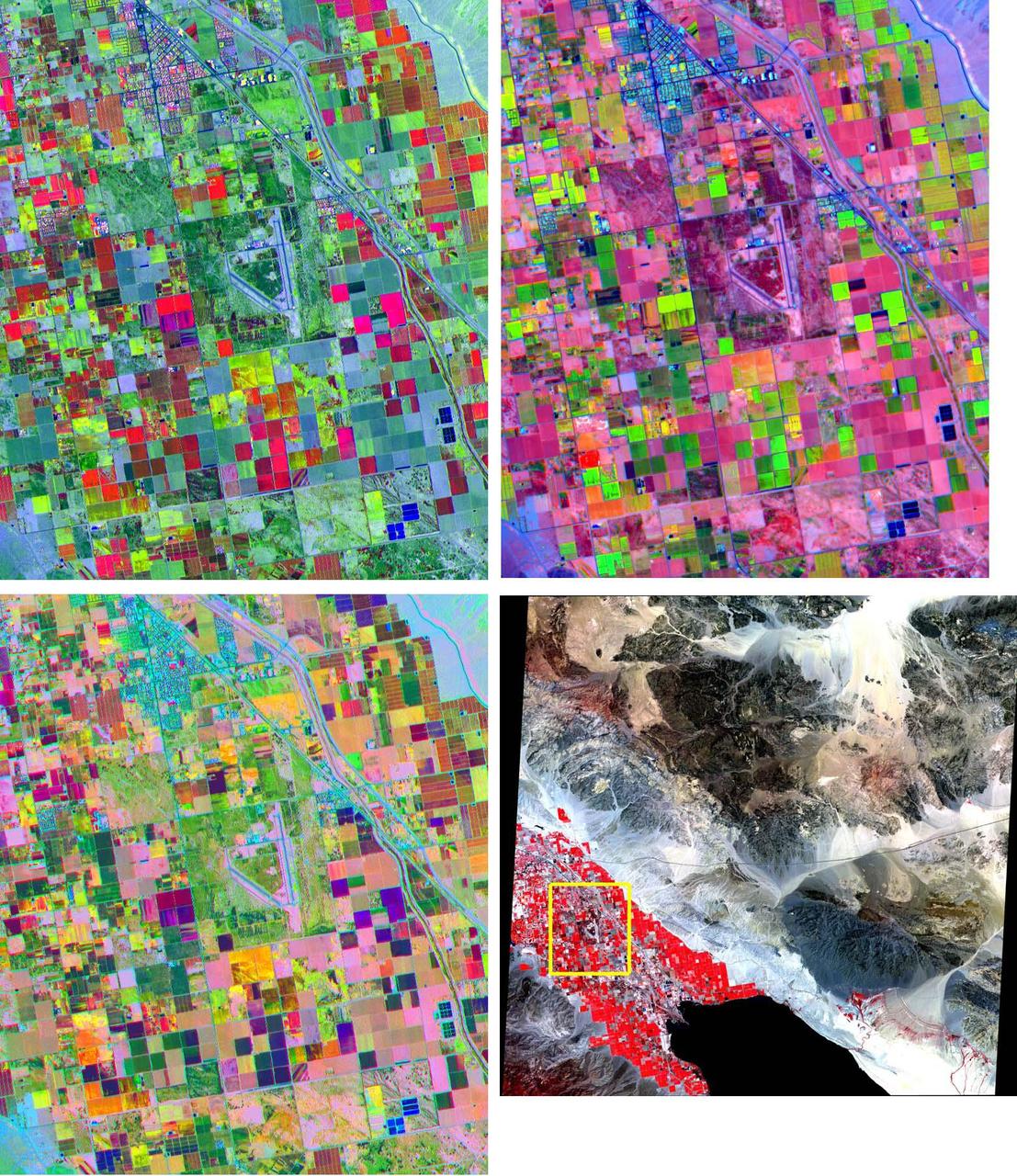
These band composites, acquired on June 4, 2000, cover a 11 by 13.5 km sub-scene in the Coachella Valley, CA. The area is shown by the yellow box on the full scene in the LOWER RIGHT corner, northwest of the Salton Sea. This is a major agricultural region of California, growing fruit and produce throughout the year. Different combinations of ASTER bands help identify the different crop types. UPPER LEFT: bands 3, 2, 1 as red, green, and blue (RGB); UPPER RIGHT: bands 4, 2, 1 as RGB; LOWER LEFT: bands 4, 3, 2 as RGB. The image is centered at 33.6 degrees north latitude, 116.1 degrees west longitude. http://photojournal.jpl.nasa.gov/catalog/PIA11161

ISS015-E-08735 (19 May 2007) --- Cosmonaut Fyodor N. Yurchikhin, Expedition 15 commander representing Russia's Federal Space Agency, is pictured near "fresh" fruit floating freely in the Zvezda Service Module of the International Space Station. The fruit was part of a recent delivery of food and supplies sent up via a Progress resupply craft.
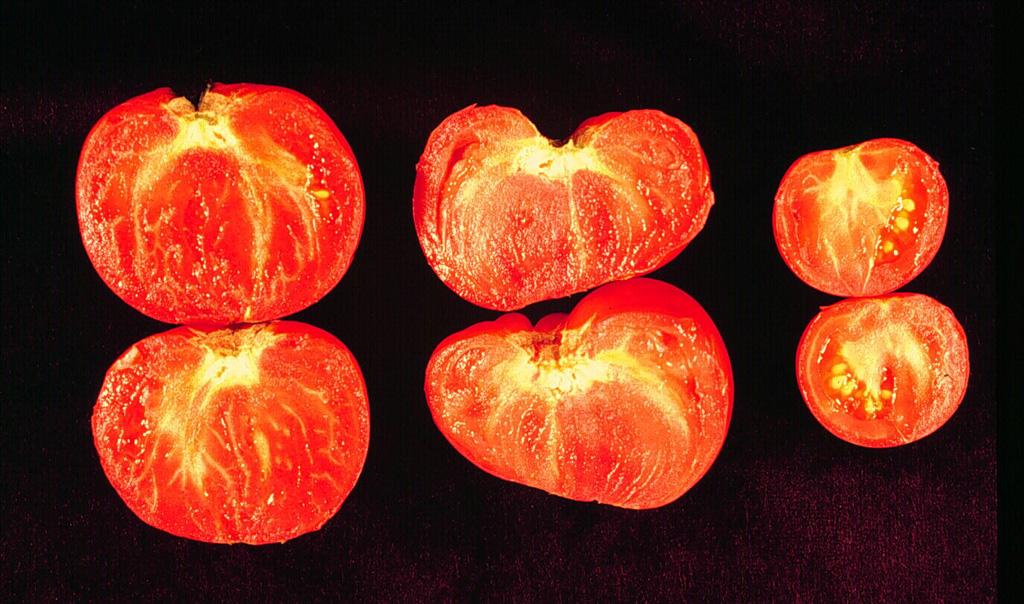
BioServe researcher Dr. Yi Li first flew plant experiments on board STS-63. Li discovered that exposure to microgravity increased a particular hormone concentration in plants. Since that time, Li has been able to manipulate this phenomenon and grow fruits, such as tomatoes, that overproduce the hormone, and these plants bear larger seedless fruit in the absence of pollination.
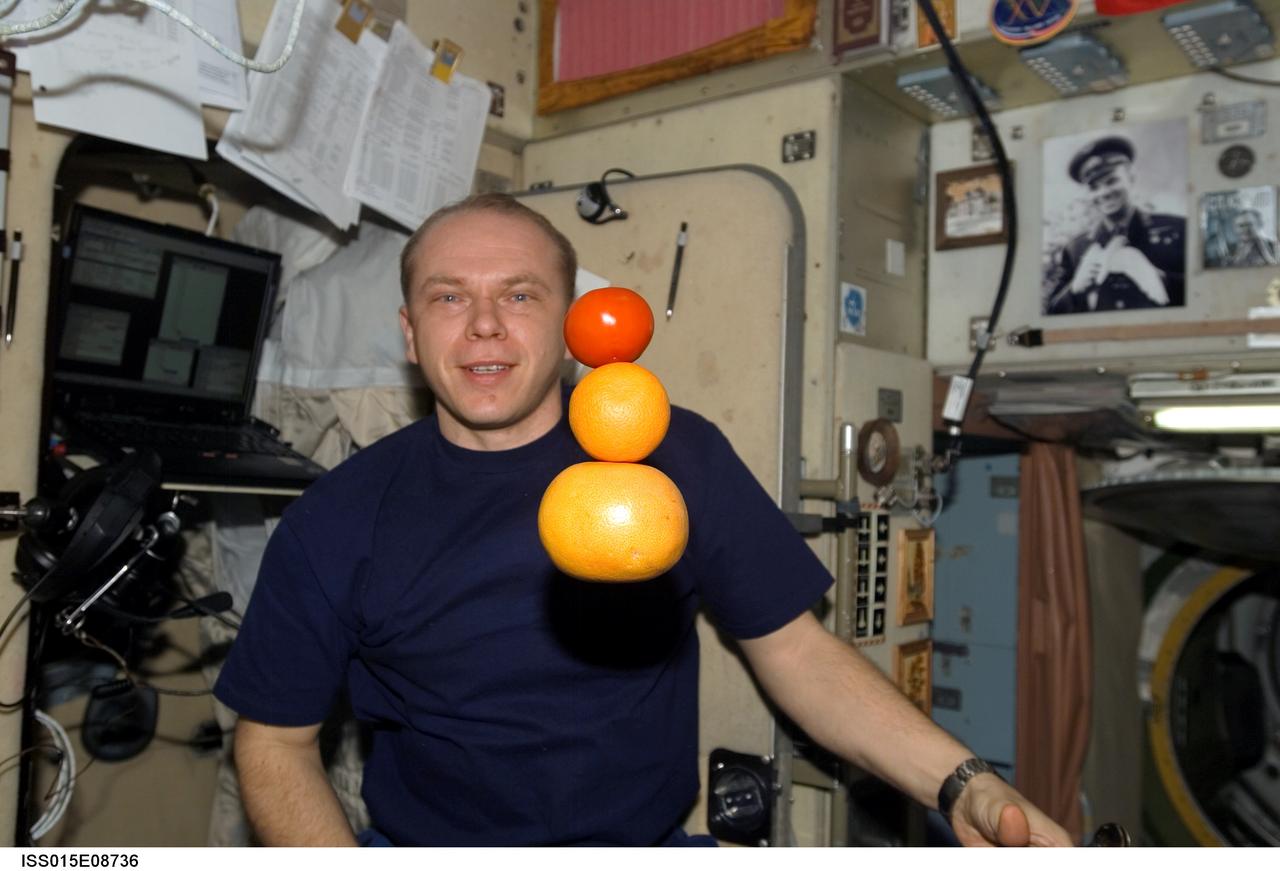
ISS015-E-08736 (19 May 2007) --- Cosmonaut Oleg V. Kotov, Expedition 15 flight engineer representing Russia's Federal Space Agency, is pictured near "fresh" fruit floating freely in the Zvezda Service Module of the International Space Station. The fruit was part of a recent delivery of food and supplies sent up via a Progress resupply craft.
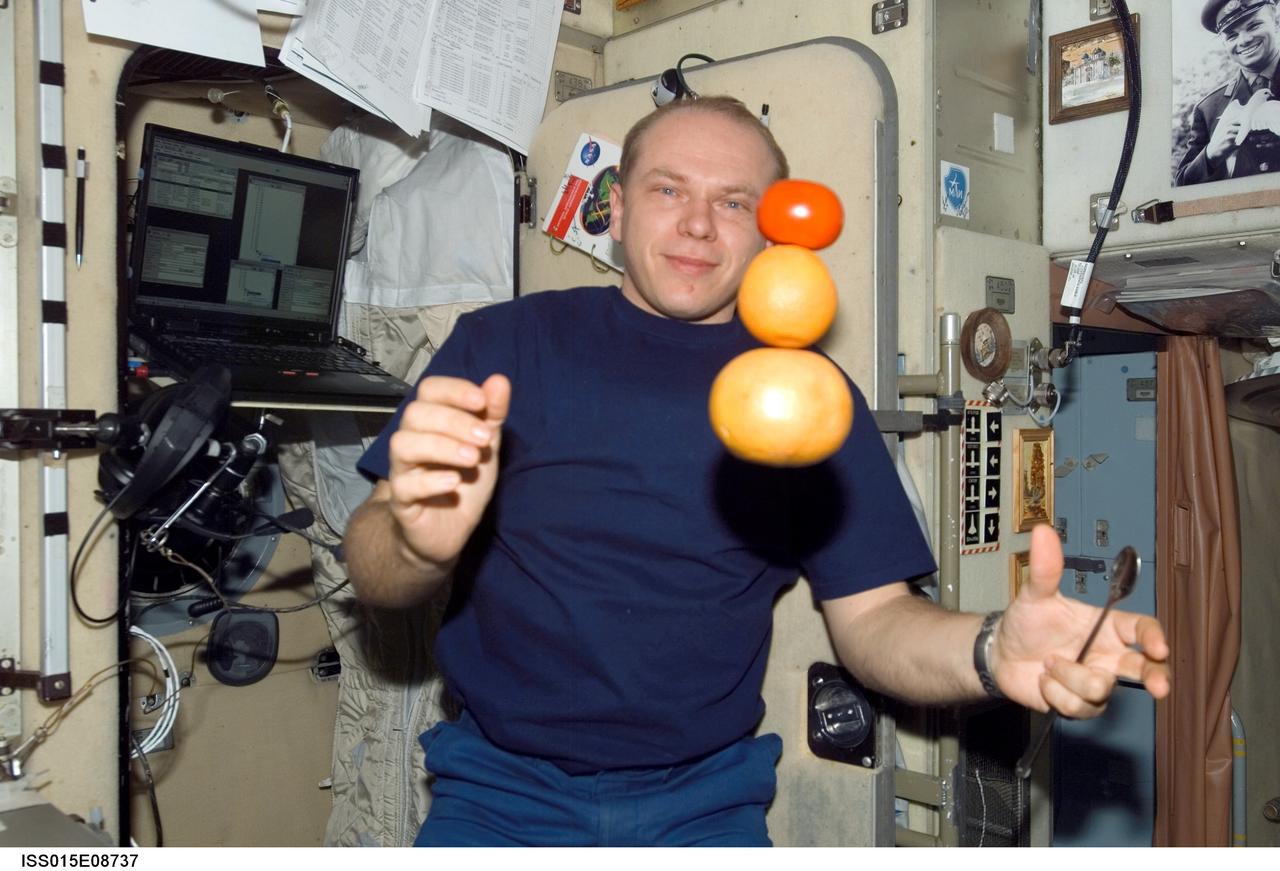
ISS015-E-08737 (19 May 2007) --- Cosmonaut Oleg V. Kotov, Expedition 15 flight engineer representing Russia's Federal Space Agency, is pictured near "fresh" fruit floating freely in the Zvezda Service Module of the International Space Station. The fruit was part of a recent delivery of food and supplies sent up via a Progress resupply craft.
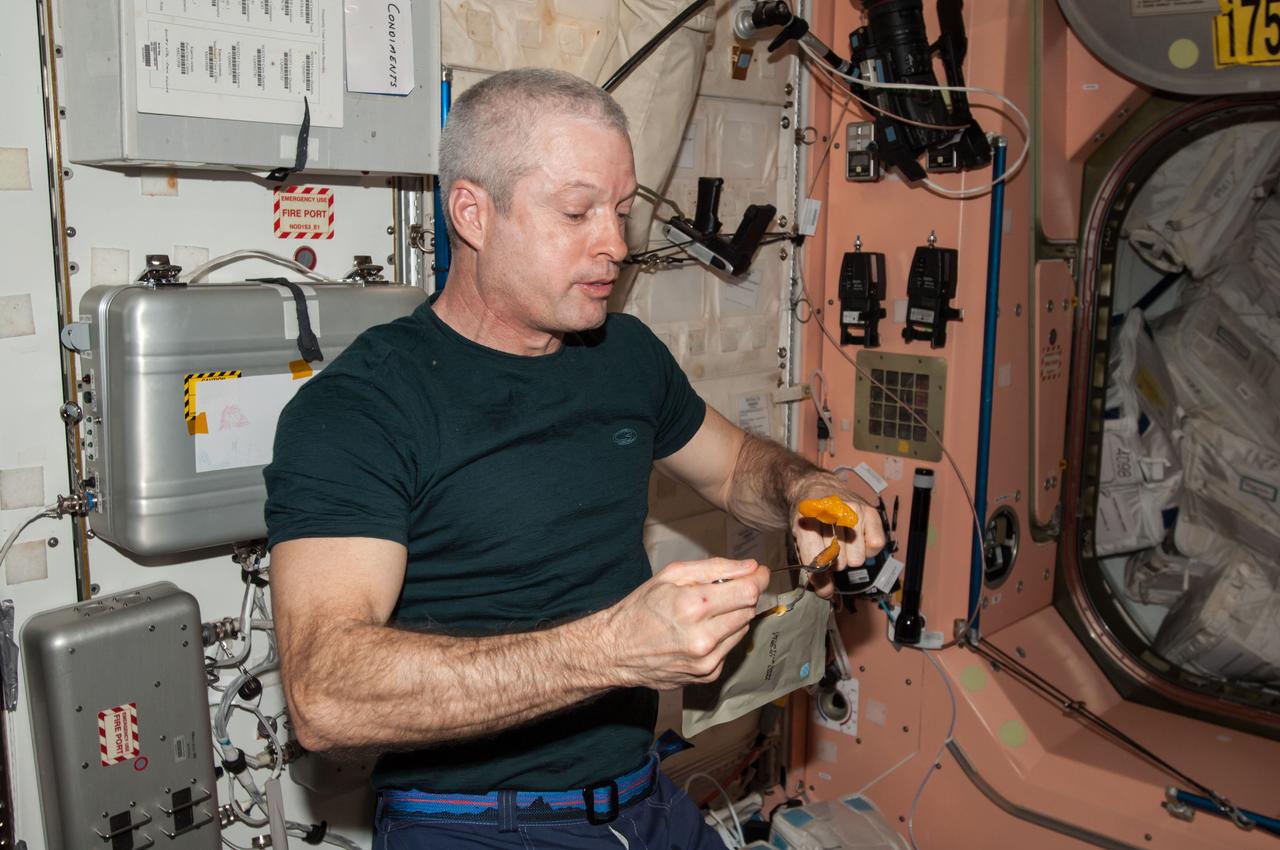
ISS040-E-123640 (7 Sept. 2014) --- NASA astronaut Steve Swanson, Expedition 40 commander, eats a citrus fruit salad in the Unity node of the International Space Station.
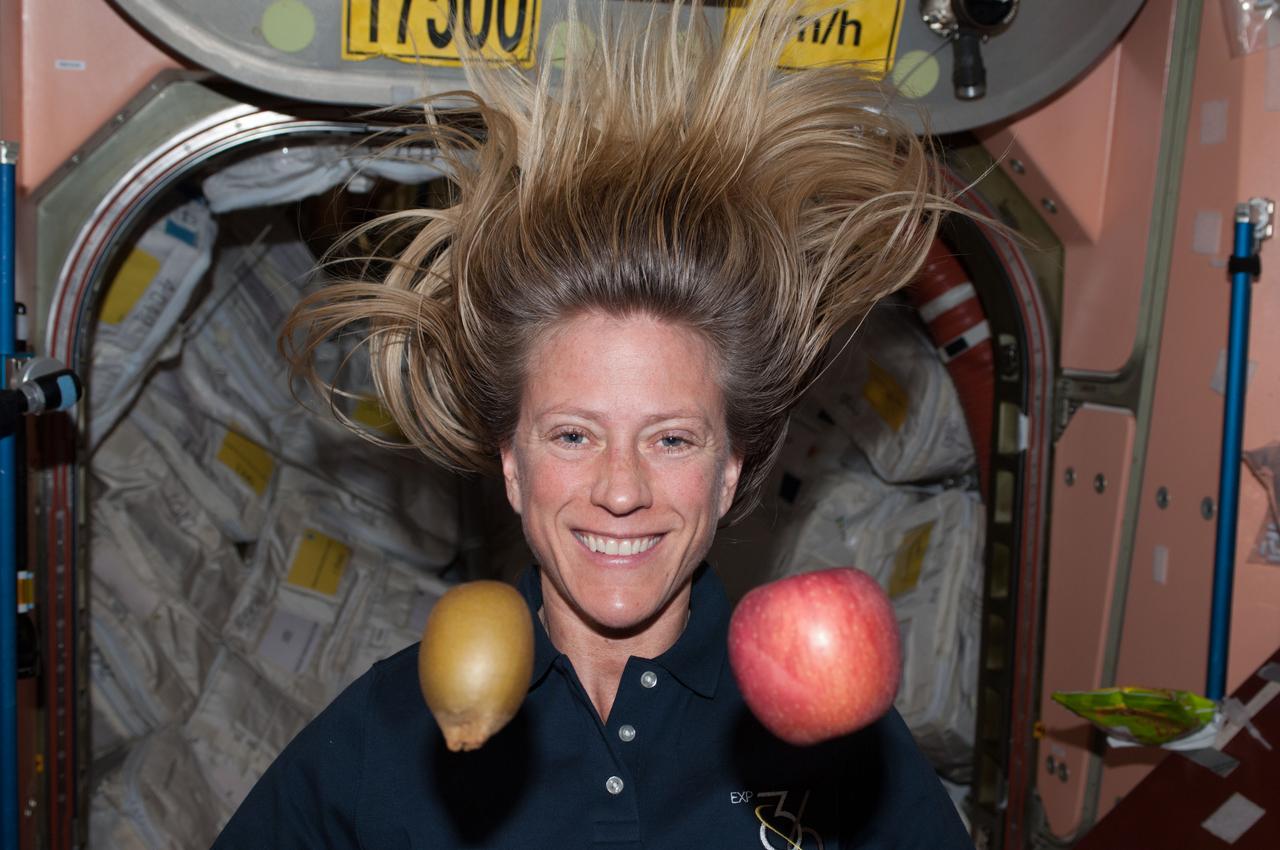
ISS036-E-032518 (13 Aug. 2013) --- NASA astronaut Karen Nyberg, Expedition 36 flight engineer, is pictured near fresh fruit floating freely in the Unity node of the International Space Station.
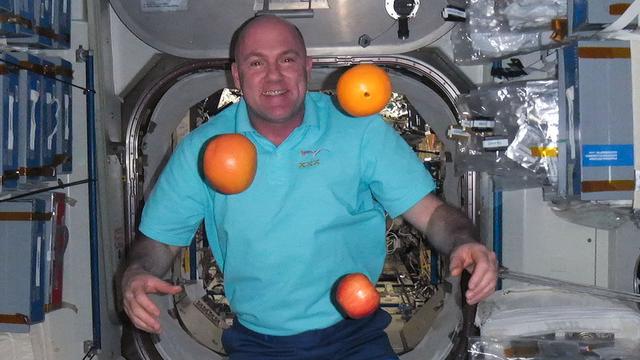
ISS030-E-116840 (2 Feb. 2012) --- European Space Agency astronaut Andre Kuipers, Expedition 30 flight engineer, is pictured near fruit floating freely in the Unity node of the International Space Station.
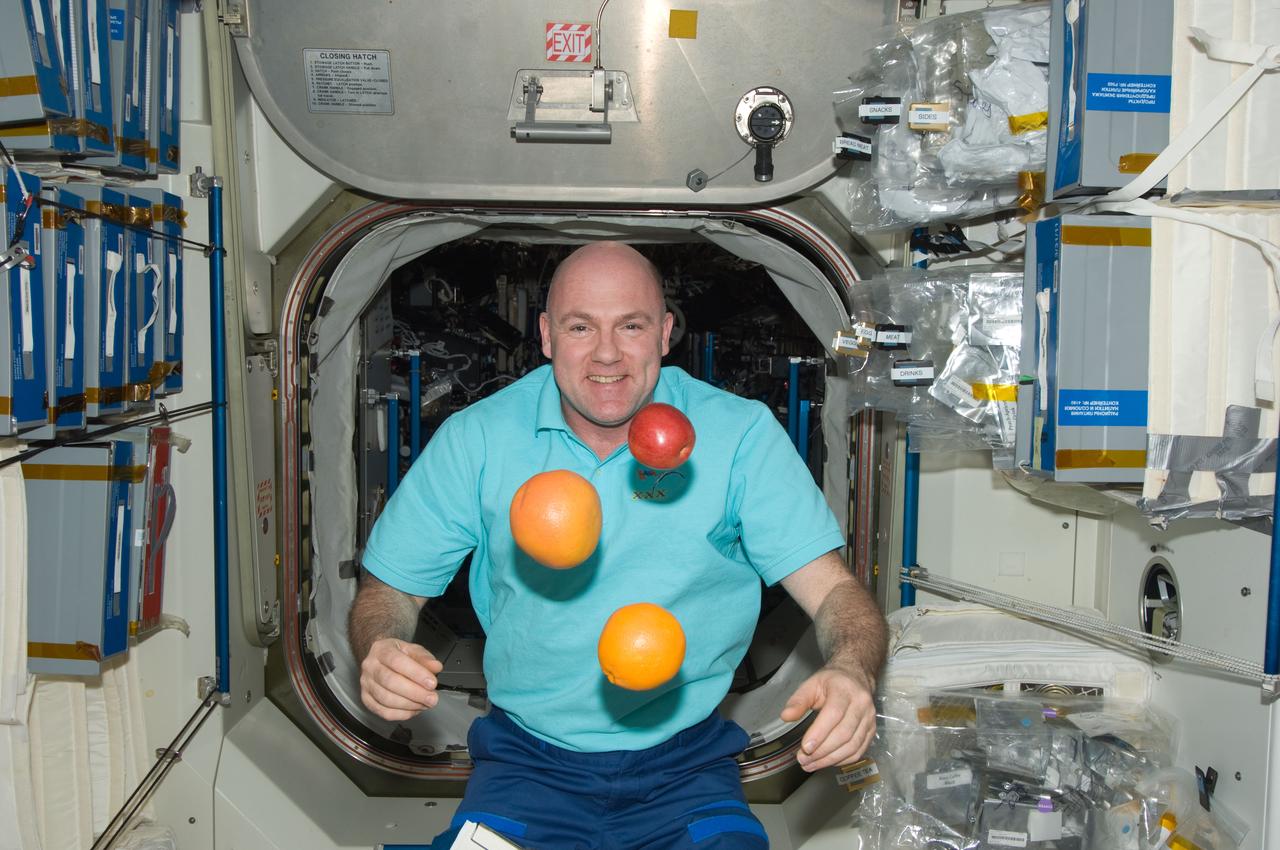
ISS030-E-117506 (3 Feb. 2012) --- European Space Agency astronaut Andre Kuipers, Expedition 30 flight engineer, is pictured near fruit floating freely in the Unity node of the International Space Station.
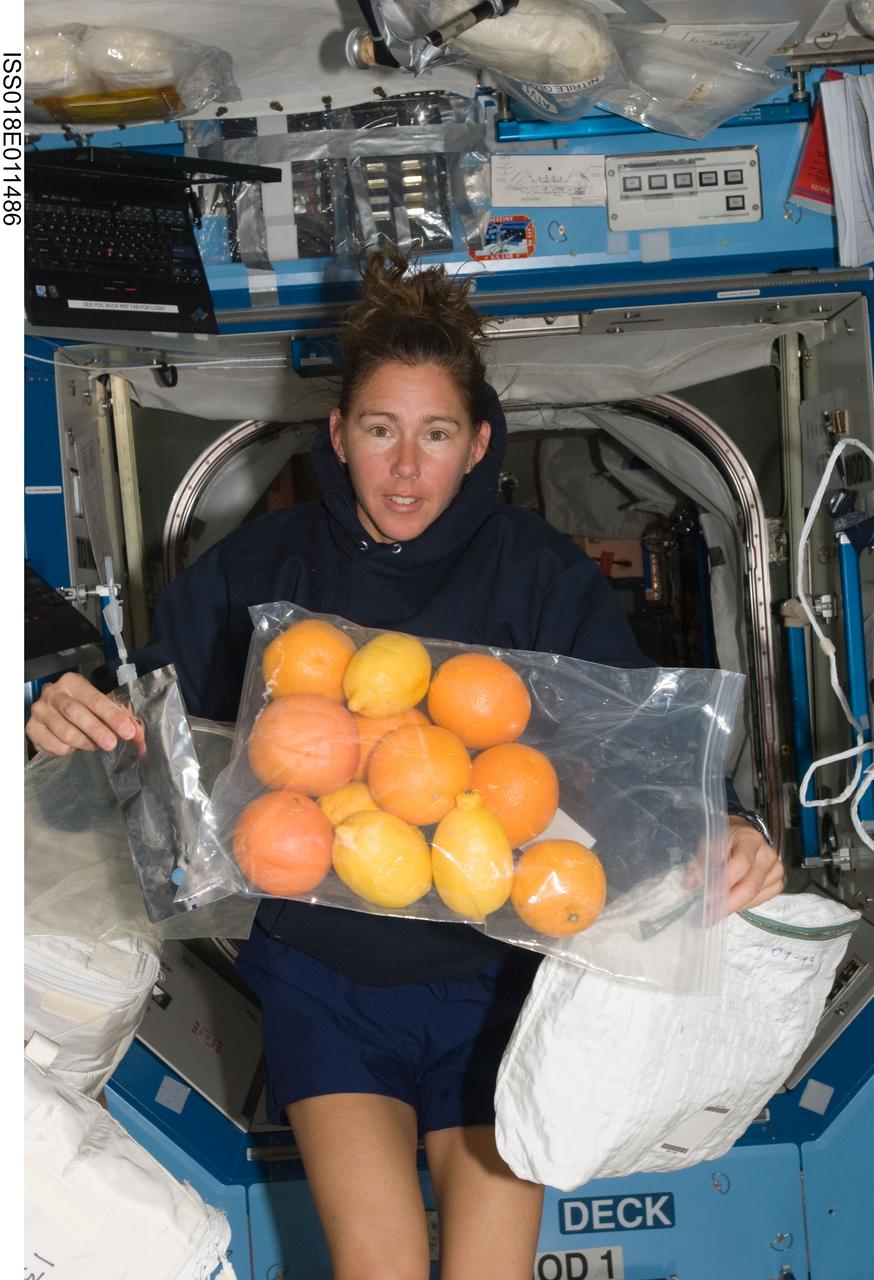
ISS018-E-011486 (1 Dec. 2008) --- Astronaut Sandra Magnus, Expedition 18 flight engineer, is pictured near a bag of fresh fruit floating freely in the Destiny laboratory of the International Space Station.
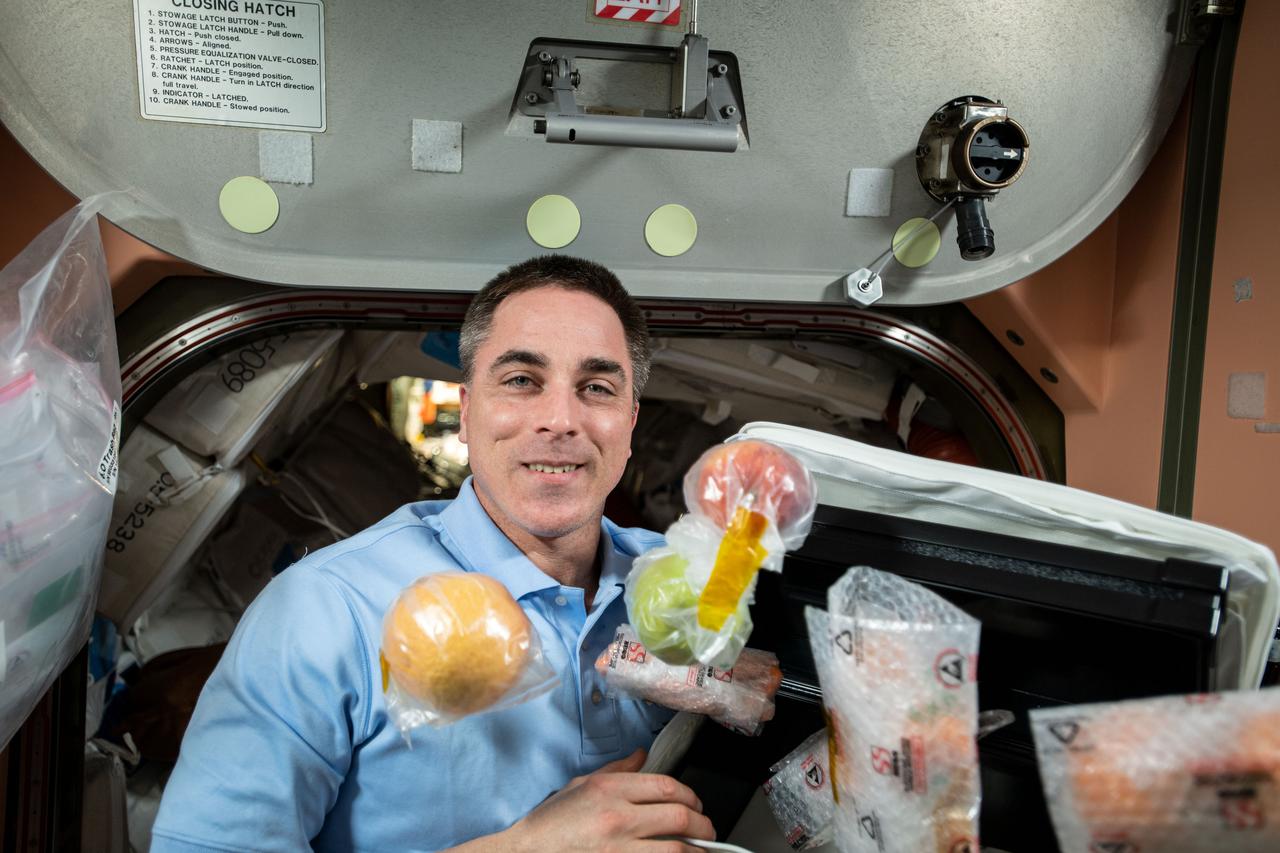
iss063e103926 (Oct. 5, 2020) --- NASA astronaut and Expedition 63 Commander Chris Cassidy unpacks fresh fruit and other food items shipped aboard the Northrop Grumman Cygnus space freighter to the International Space Station.
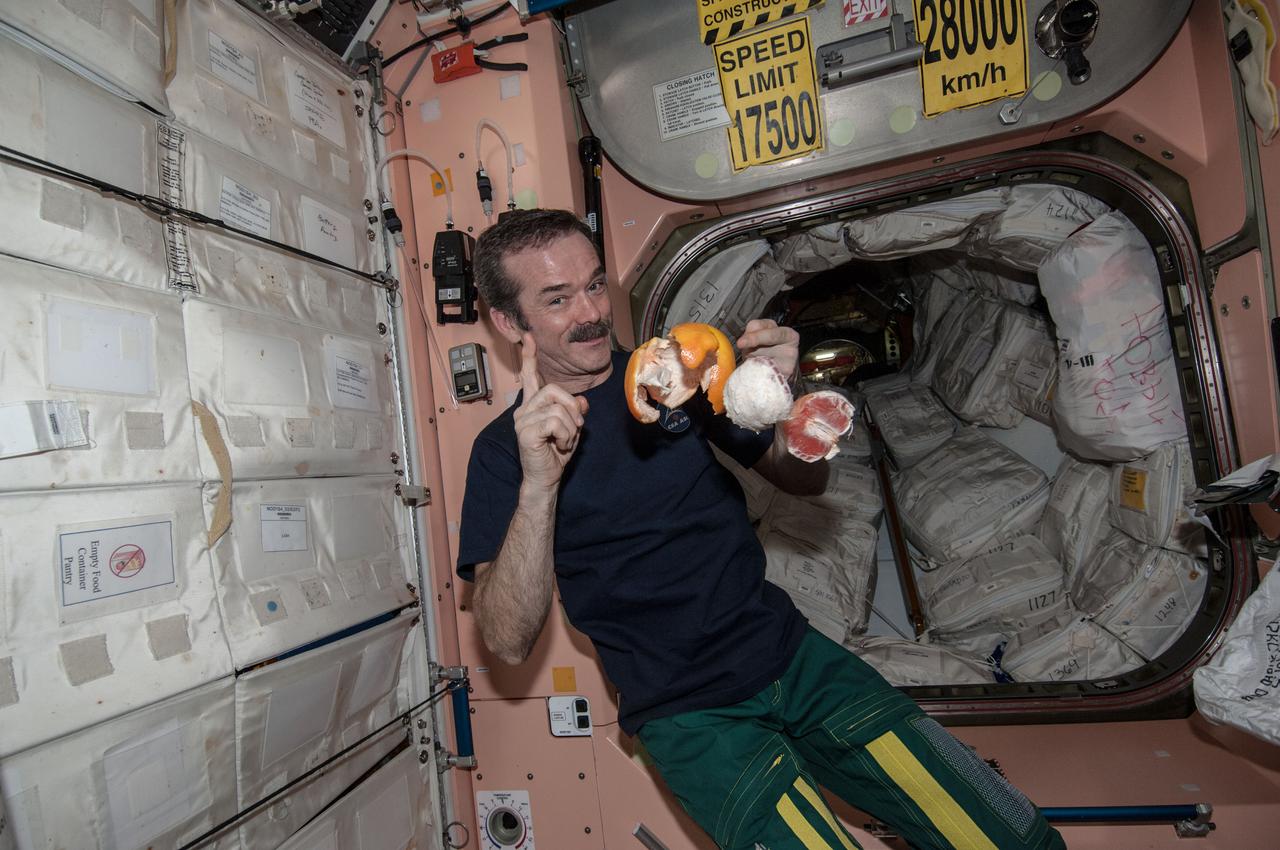
ISS035-E-010435 (30 March 2013) --- In the Unity node of the Earth-orbiting International Space Station, Expedition 35 Commander Chris Hadfield of the Canadian Space Agency enjoys part of the "fruits of labor," so to speak, from a visiting spacecraft for the second time in a month. This particular grapefruit came by way of the Soyuz TMA-08M spacecraft, which arrived on March 29, along with three new Expedition 35 crew members. The SpaceX Dragon-2 unmanned spacecraft delivered a nice assortment of fresh fruit along with more than a half ton of supplies and gear on March 3, when Hadfield was serving as a flight engineer on the Expedition 34 crew.
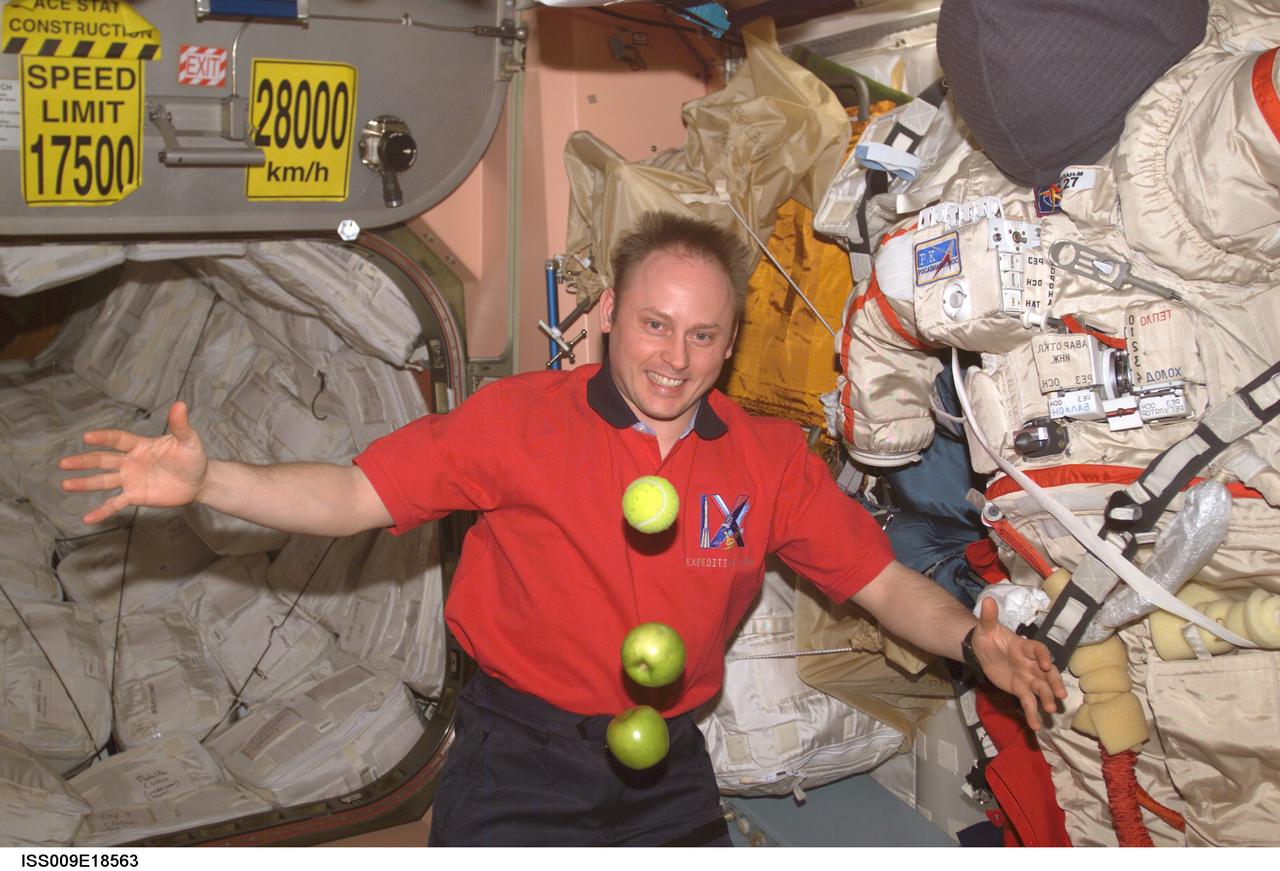
ISS009-E-18563 (15 August 2004) --- Astronaut Edward M. (Mike) Fincke, Expedition 9 NASA ISS science officer and flight engineer, is pictured near fresh fruit floating freely in the Unity node of the International Space Station (ISS).
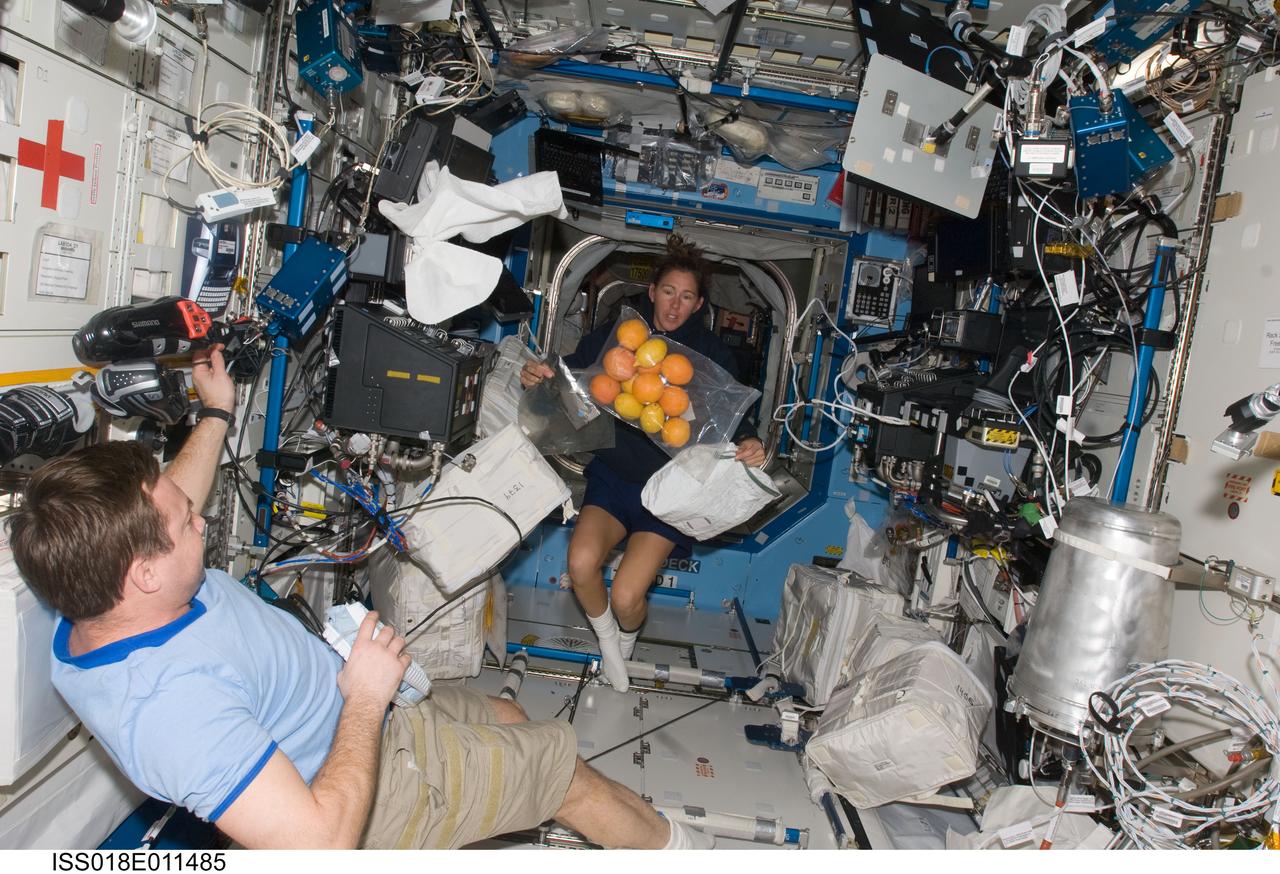
ISS018-E-011485 (1 Dec. 2008) --- Astronaut Sandra Magnus and cosmonaut Yury Lonchakov, both Expedition 18 flight engineers, are pictured in the Destiny laboratory of the International Space Station. A bag of fresh fruit floats freely near Magnus.
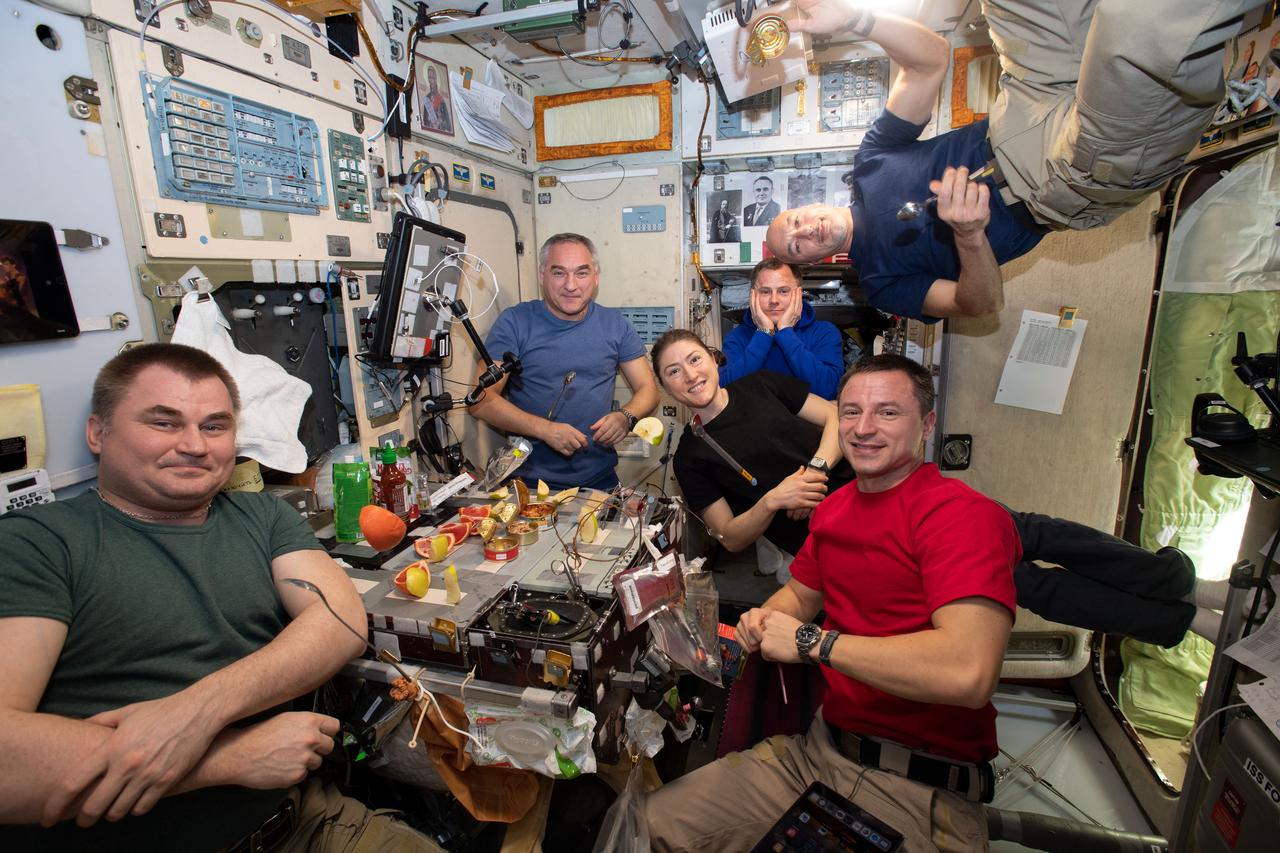
iss060e060255 (Sept. 11, 2019) --- The six-member Expedition 60 crew is gathered together for dinner inside the galley of the Zvezda service module. The space residents dine on a variety of fresh fruit and canned and pre-packaged dishes. Condiments commonly available in kitchen pantries on Earth are also on the station to spice up a crew's space meals.
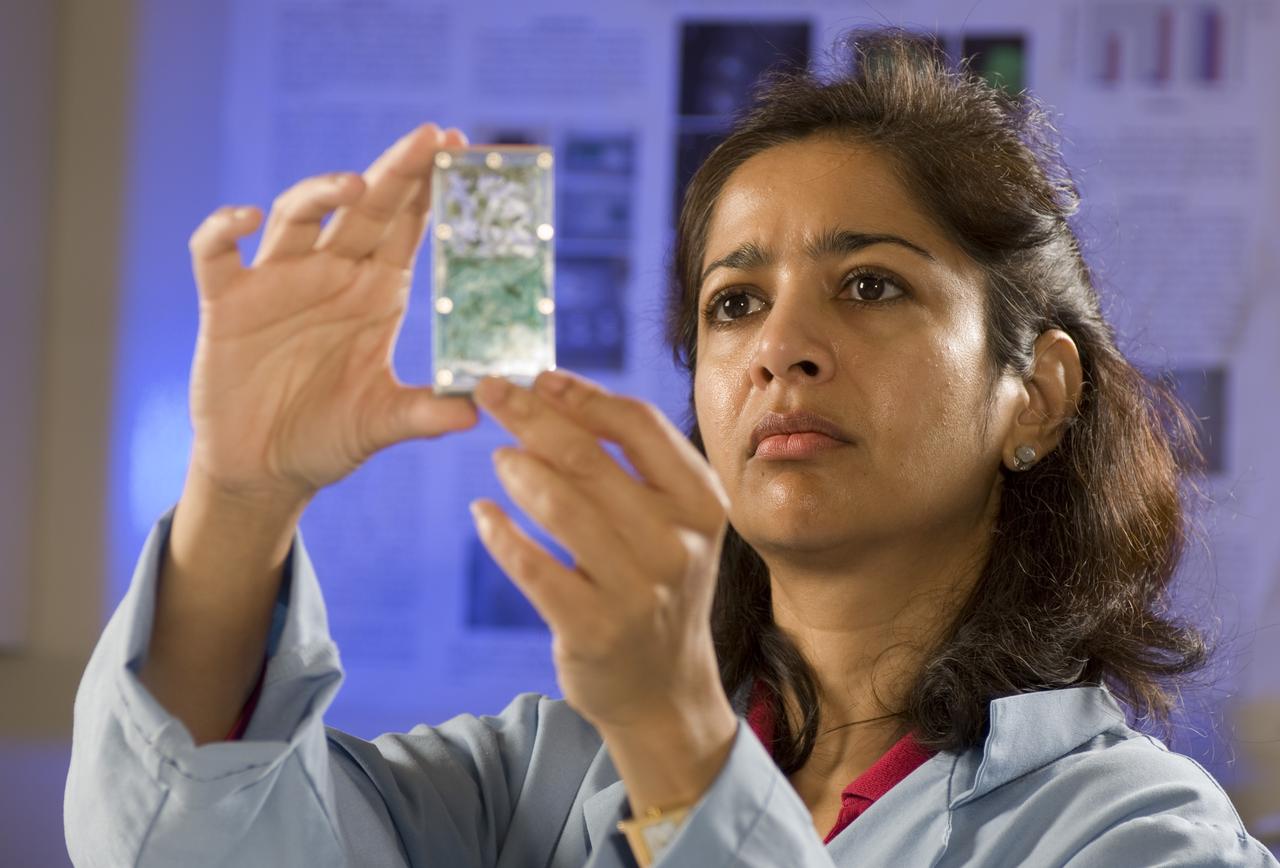
Sharmila Bhattacharya is the principal investigator for the STS-121 space shuttle flight experiment, Fly Immunity and Tumors (FIT). She is shown here viewing Drosophila (fruit fly) inside inscet containers used during flight. Living quarters for insects.
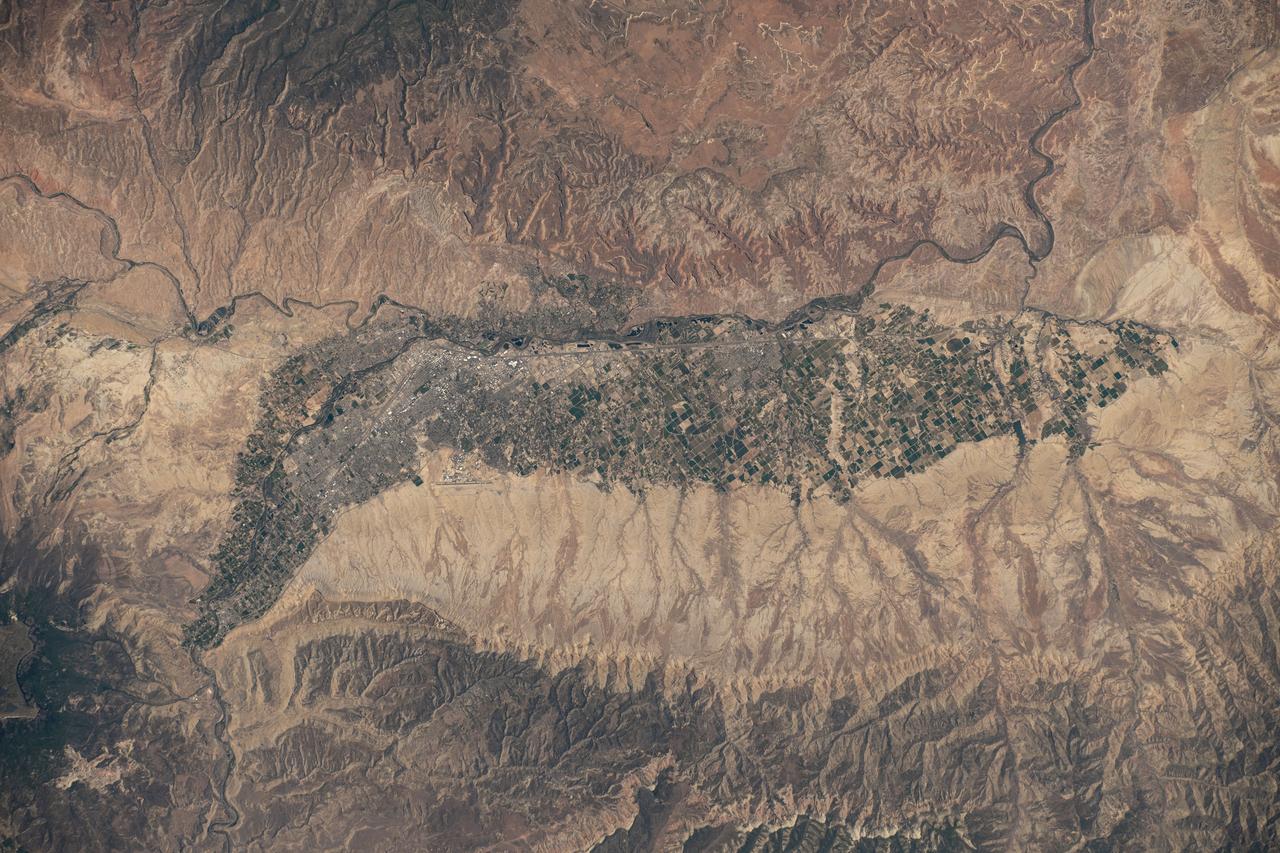
iss073e0429954 (June 21, 2025) --- Colorado's Western Slope region, highlighted by the city of Grand Junction and its surrounding suburbs (at center), is pictured from the International Space Station as it orbited 261 miles above the Centennial State. The municipality's economy is primarily supported by the agribusiness industry, including cattle ranching and fruit cultivation.
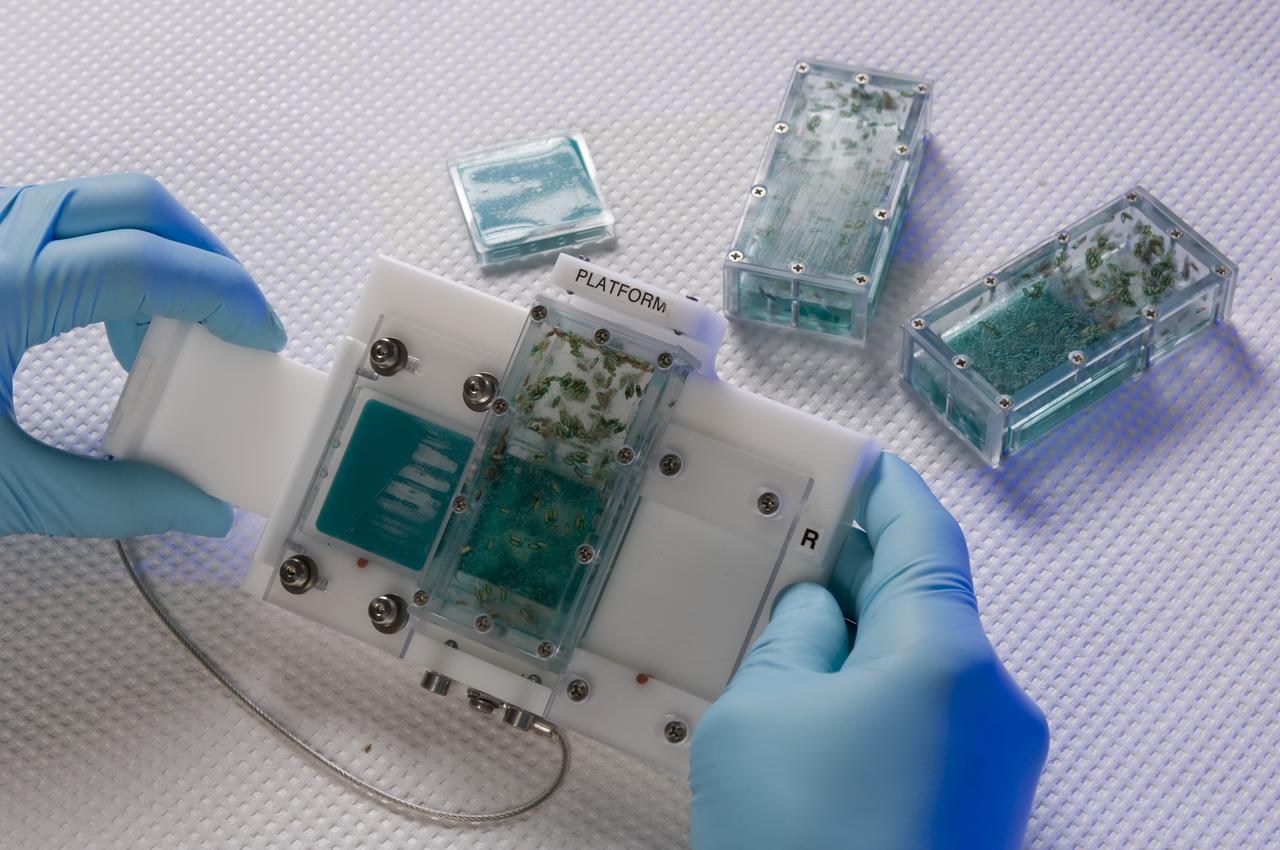
Space shuttle STS-121 FIT (Fly Immunity and Tumors) payload. Using Drosophila (fruit fly) to complete the experiments. Platform used by astronauts to change out old food trays with new food trays in space to facilitate culturing new flies.
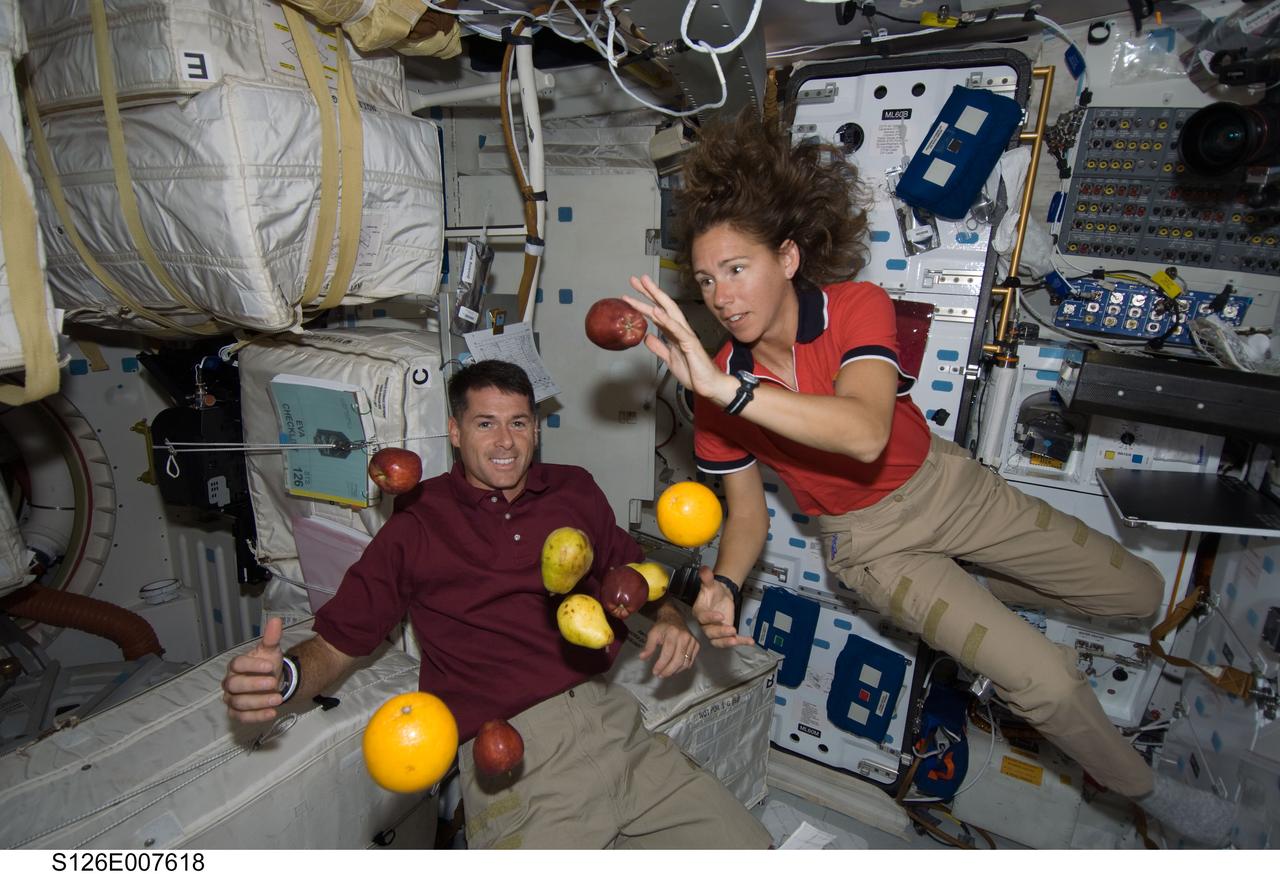
S126-E-007618 (16 Nov. 2008) --- Astronauts Shane Kimbrough and Sandra Magnus, both STS-126 mission specialists, are pictured with fresh fruit floating freely on the middeck of Space Shuttle Endeavour during flight day three activities.
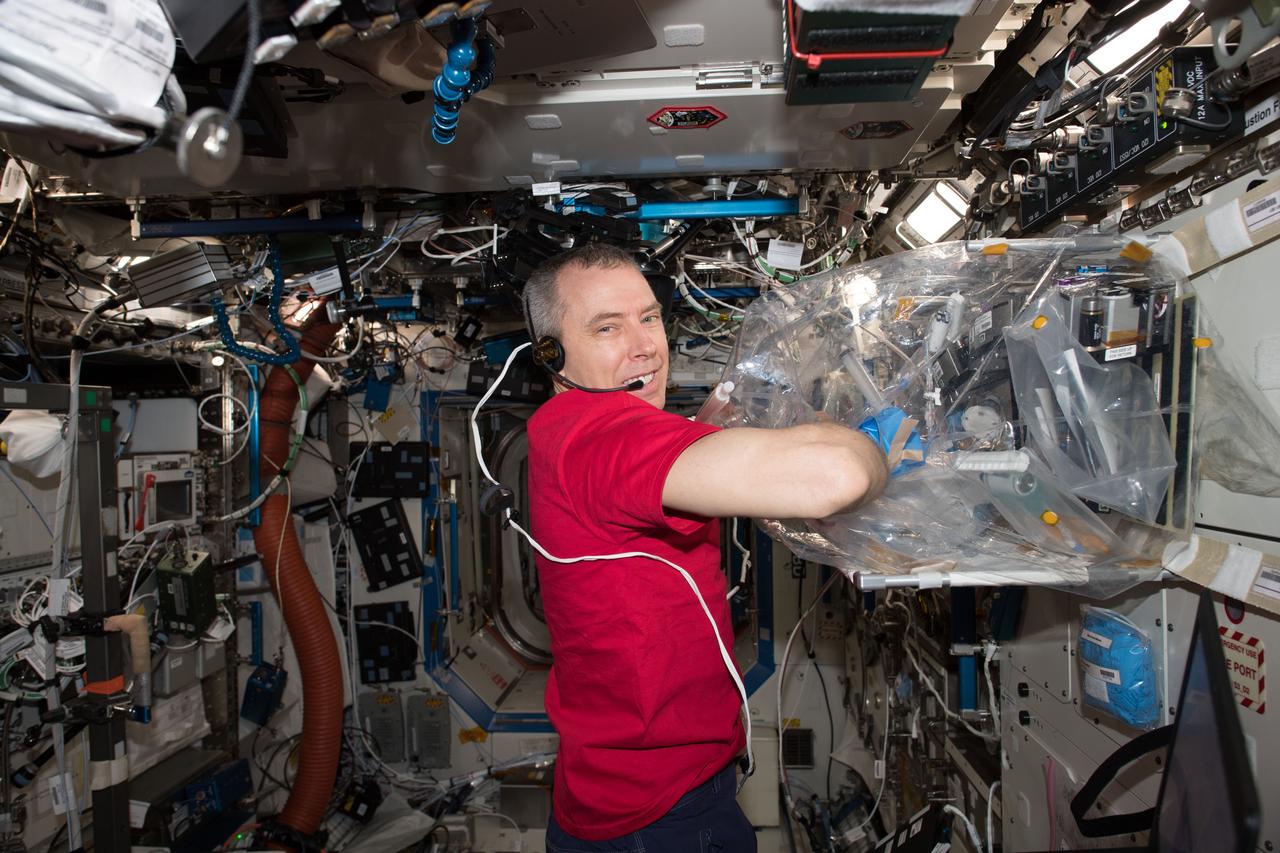
iss055e036790 (April 30, 2018) --- NASA astronaut Drew Feustel conducts science operations inside the Multi-use Variable-g Platform Module which enables research into how small organisms such as fruit flies, flatworms, plants, fish, cells, protein crystals and many others adapt to different types of gravity scenarios.
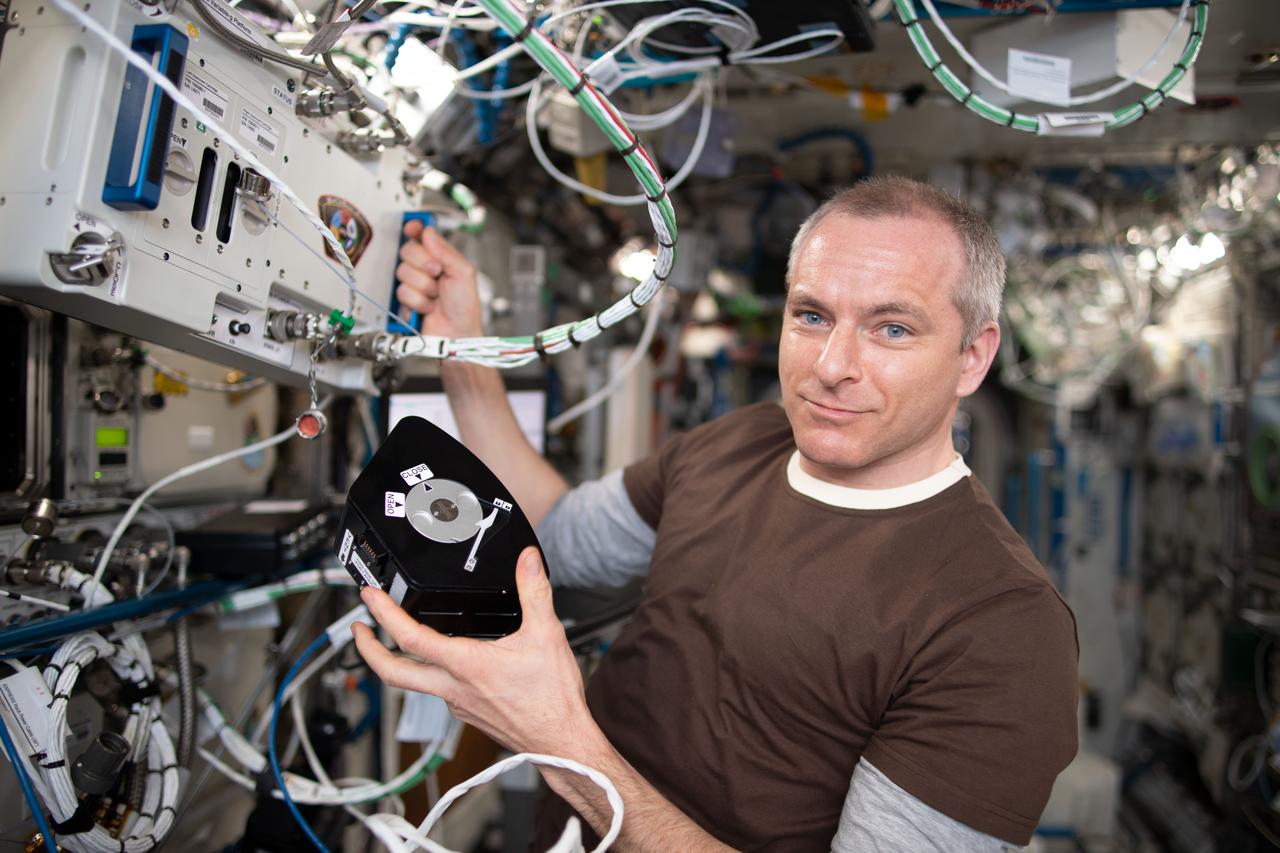
iss059e063924 (May 18, 2019) --- Canadian Space Agency astronaut David Saint-Jacques of Expedition 59 works on the Multi-use Variable-g Platform (MVP) hardware. MVP enables space biology research into a variety of small organisms such as fruit flies, flatworms, plants, fish, cells, protein crystals and many others.
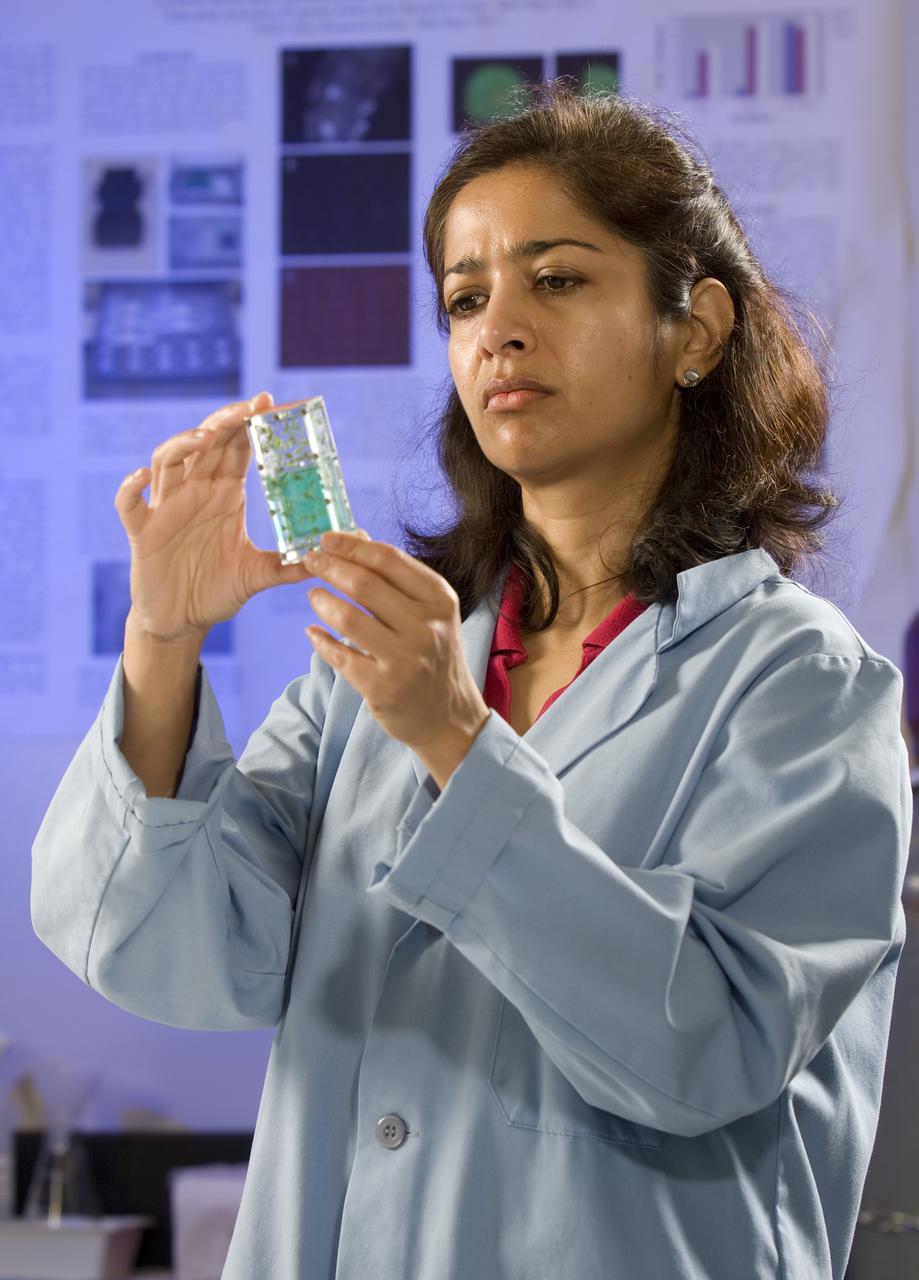
Sharmila Bhattacharya is the principal investigator for the STS-121 space shuttle flight experiment, Fly Immunity and Tumors (FIT). She is shown here viewing Drosophila (fruit fly) inside inscet containers used during flight. Living quarters for insects.
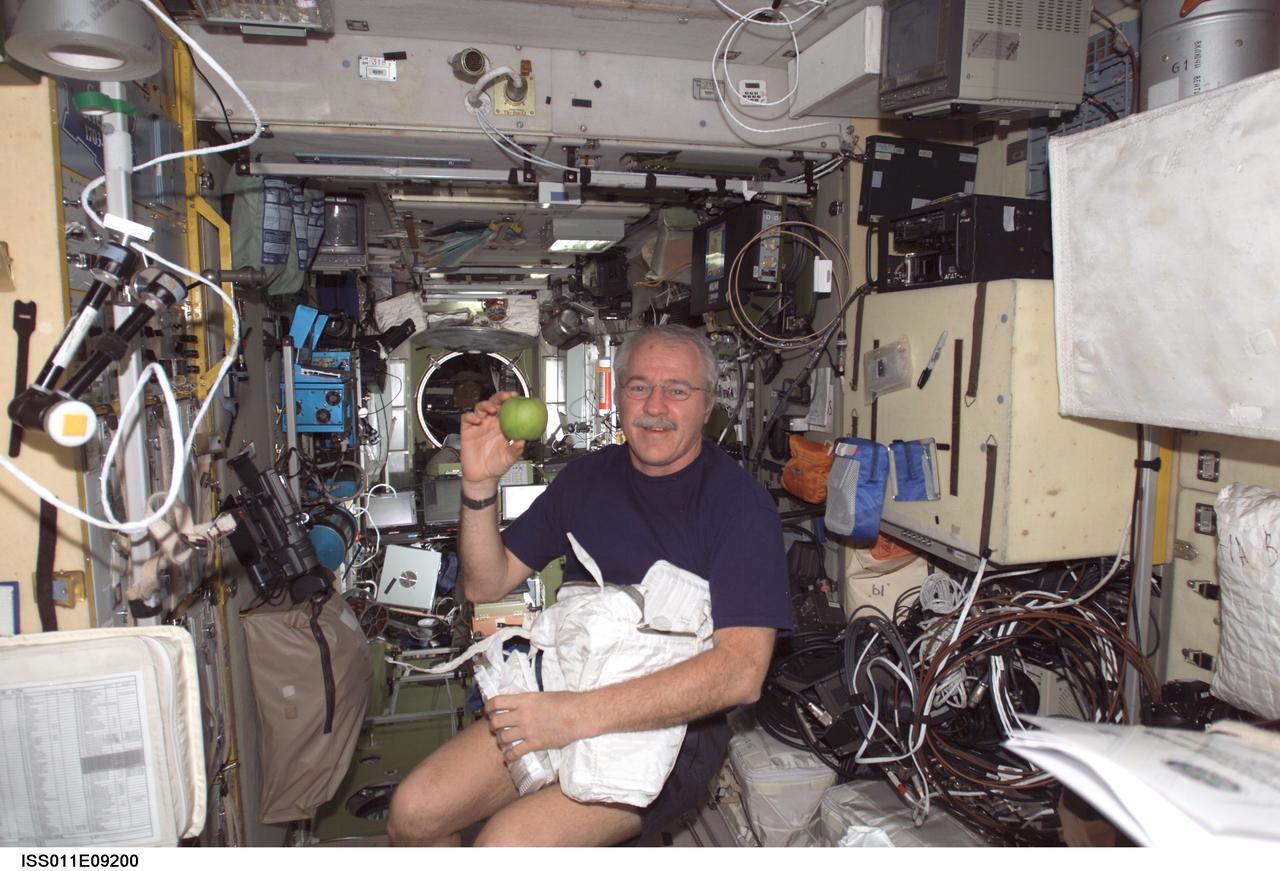
ISS011-E-09200 (19 June 2005) --- Astronaut John L. Phillips, Expedition 11 NASA space station science officer and flight engineer, holds small packages of supplies and fruit in the Zvezda Service Module of the International Space Station, which he un-stowed from the docked Progress 18 supply vehicle.
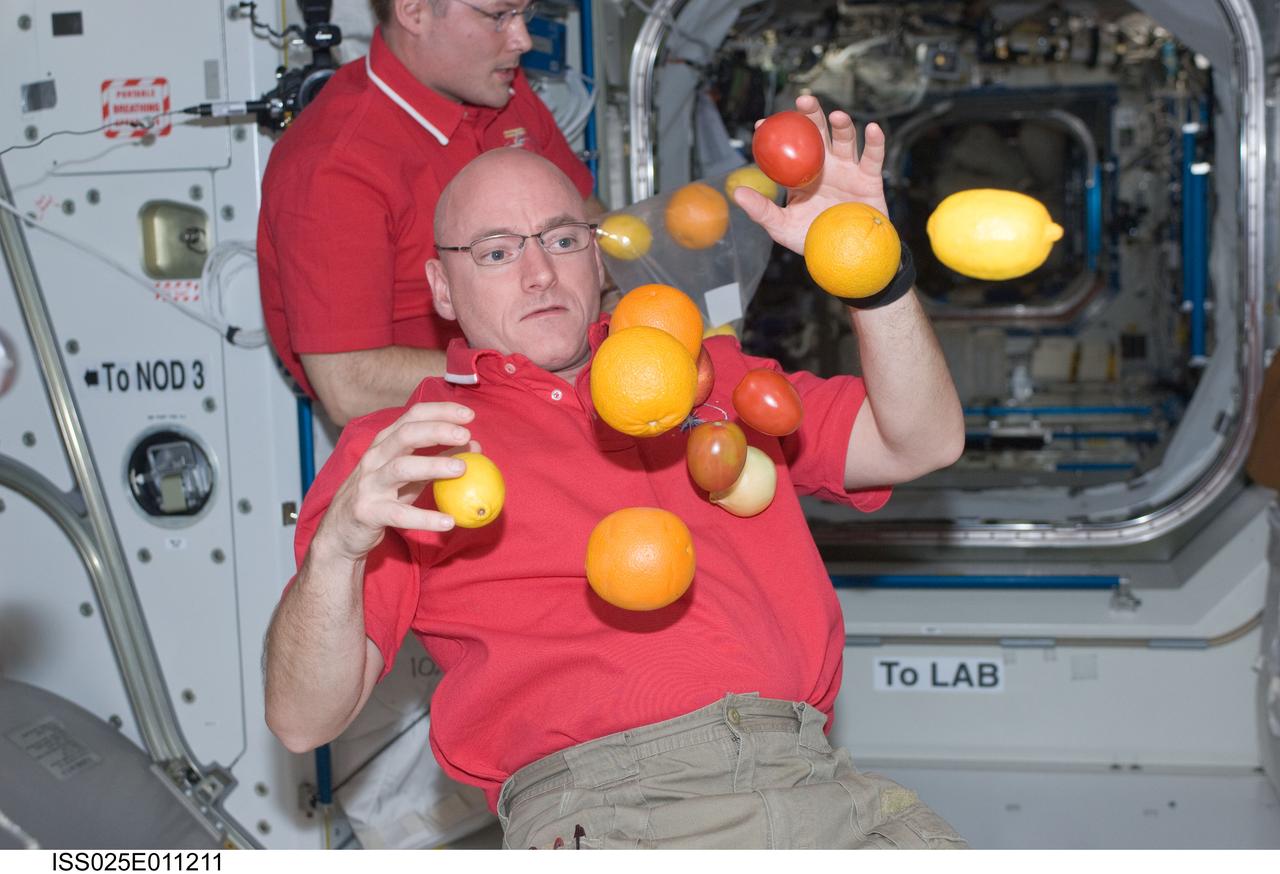
ISS025-E-011211 (3 Nov. 2010) --- NASA astronaut Scott Kelly, Expedition 25 flight engineer, is pictured near fresh fruit floating freely in the Unity node of the International Space Station. NASA astronaut Doug Wheelock, commander, is visible in the background.
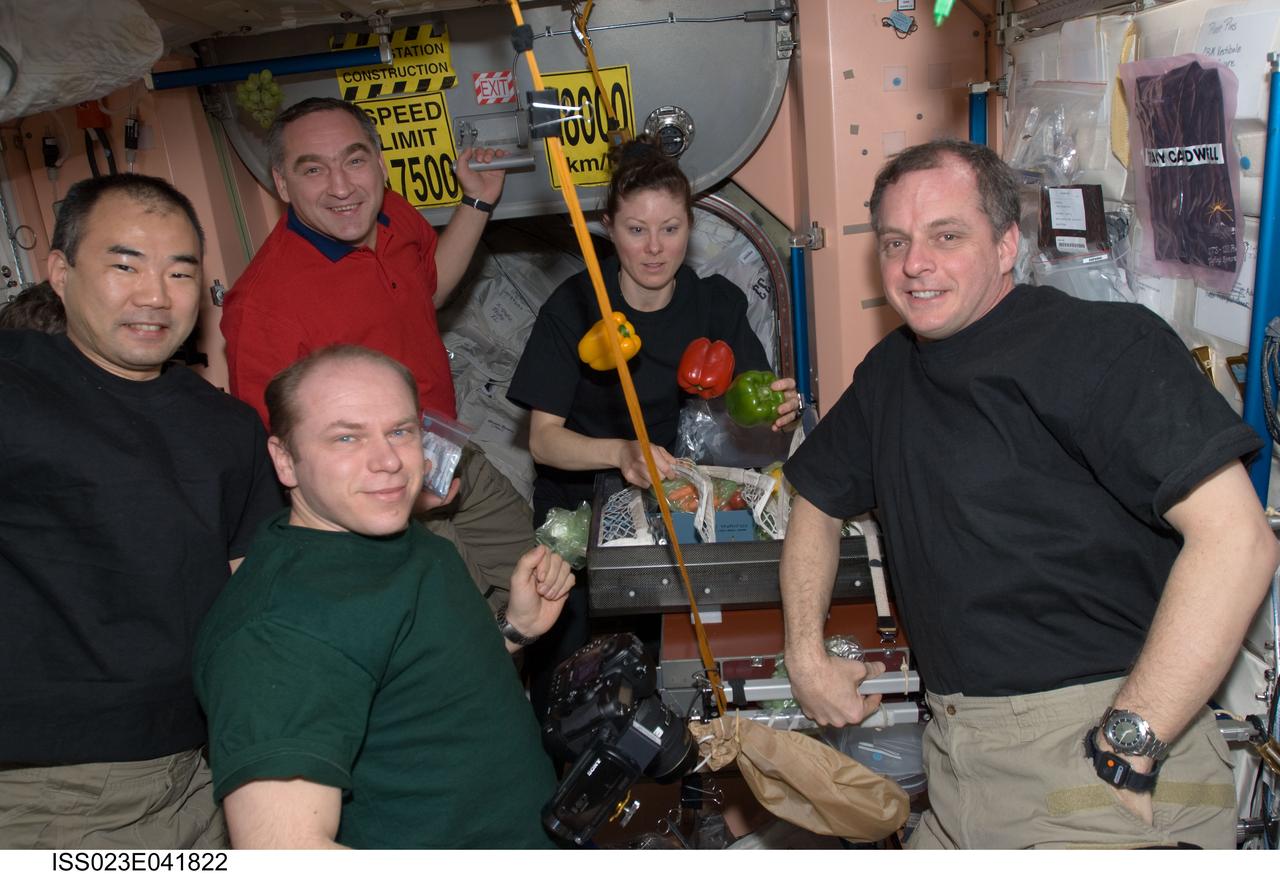
ISS023-E-041822 (16 May 2010) --- Five of the six Expedition 23 crew members are pictured in the Unity node of the International Space Station while space shuttle Atlantis (STS-132) remains docked with the station. Pictured from the left bottom are Russian cosmonaut Oleg Kotov, commander; Japan Aerospace Exploration Agency (JAXA) astronaut Soichi Noguchi, Russian cosmonaut Alexander Skvortsov, NASA astronauts Tracy Caldwell Dyson and T.J. Creamer, all flight engineers.
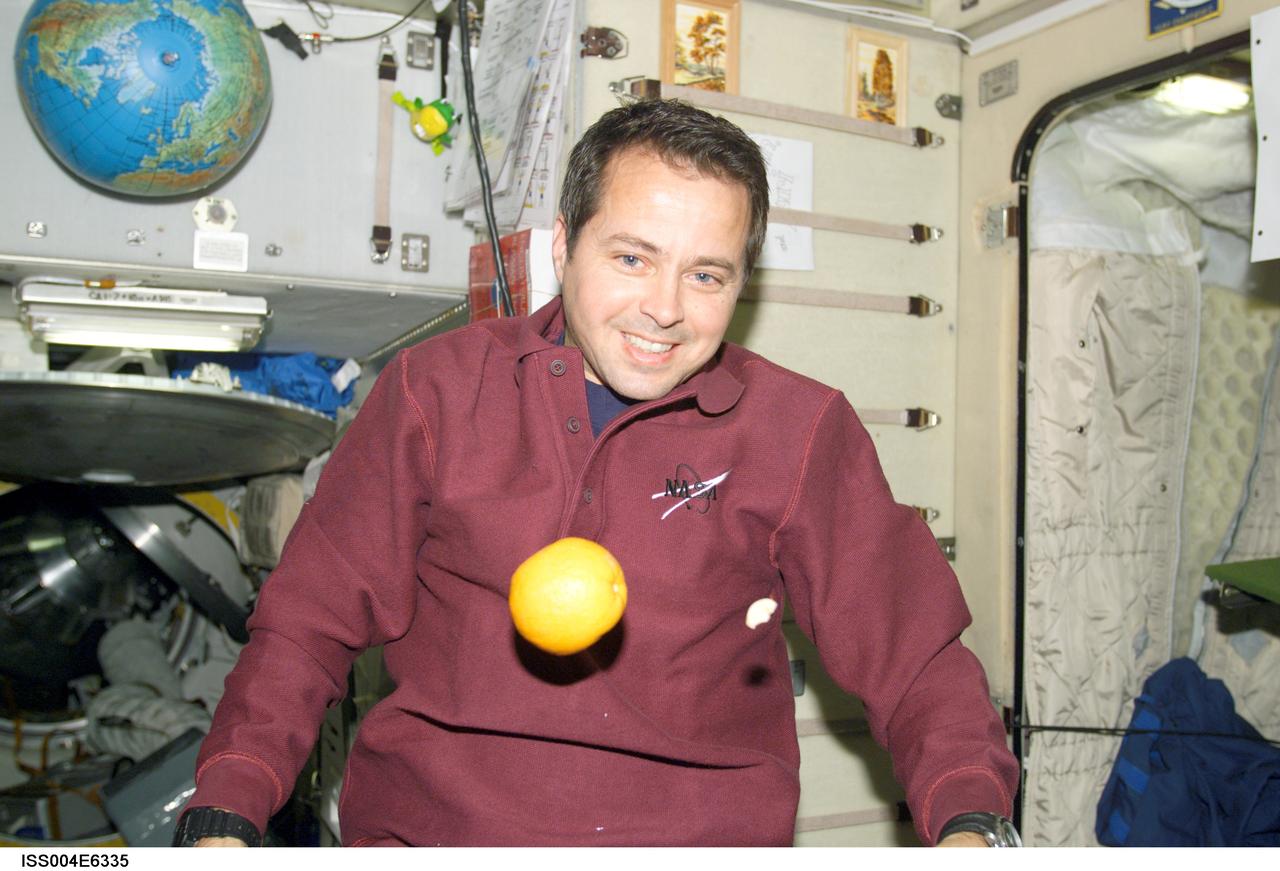
ISS004-E-6335 (January 2002) --- Astronaut Daniel W. Bursch, Expedition Four flight engineer, is photographed in the Zvezda Service Module on the International Space Station (ISS). An orange floats freely in front of Bursch. The image was taken with a digital still camera.
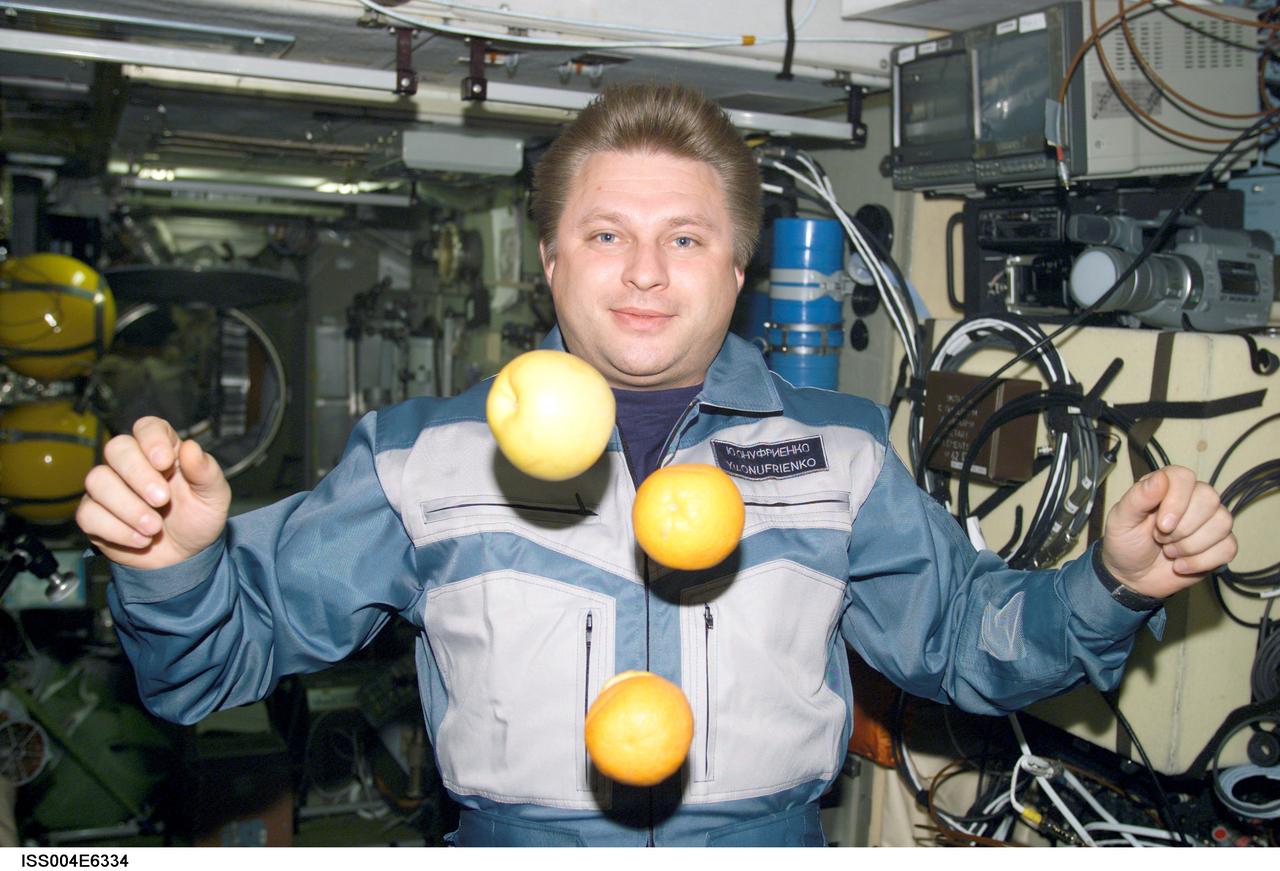
ISS004-E-6334 (January 2002) --- Cosmonaut Yury I. Onufrienko, Expedition Four mission commander representing Rosaviakosmos, is photographed in the Zvezda Service Module on the International Space Station (ISS). Apples and oranges are visible floating freely in front of Onufrienko. The image was taken with a digital still camera.

ISS004-E-6336 (January 2002) --- Astronaut Carl E. Walz, Expedition Four flight engineer, is photographed in the Zvezda Service Module on the International Space Station (ISS). An orange floats freely in front of Walz. The image was taken with a digital still camera.
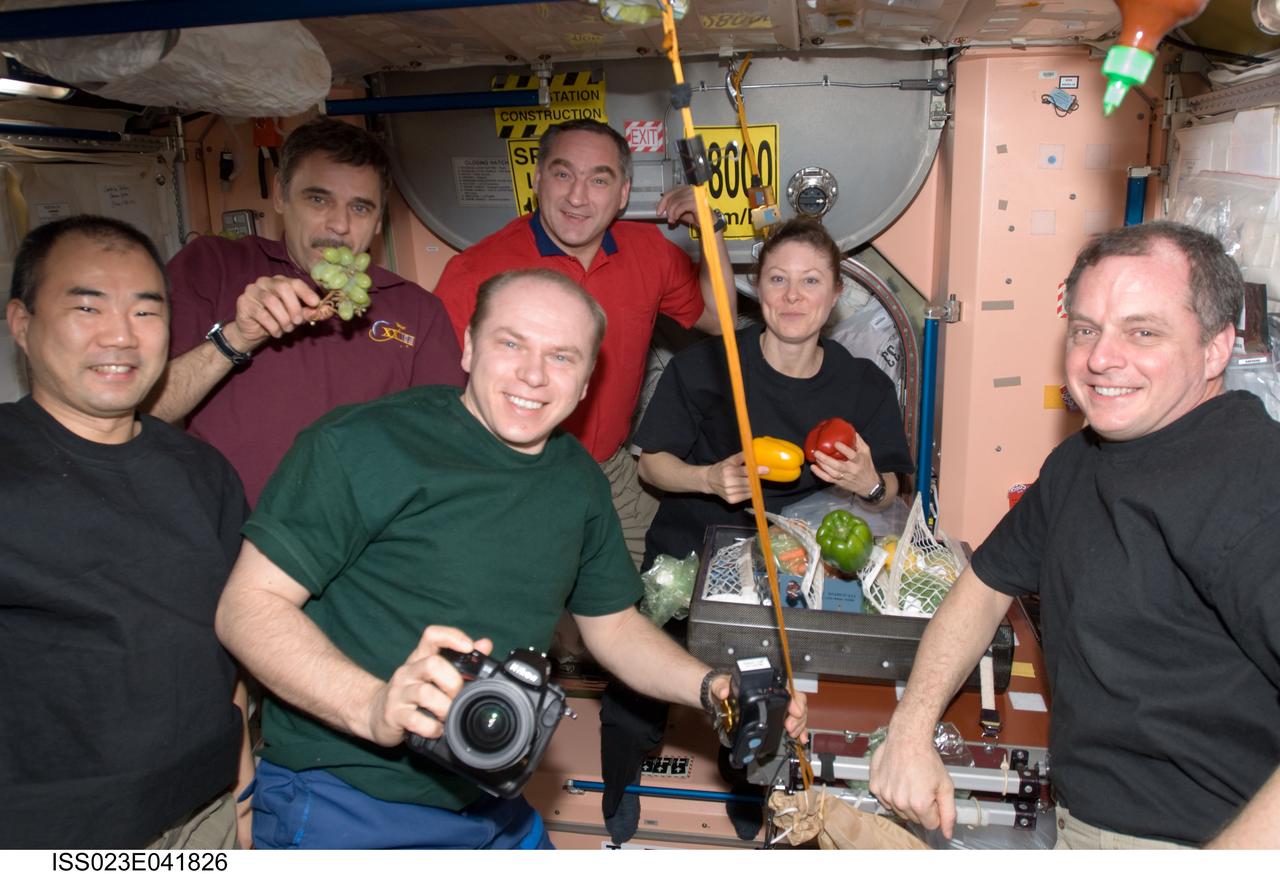
ISS023-E-041826 (16 May 2010) --- The Expedition 23 crew members are pictured in the Unity node of the International Space Station while space shuttle Atlantis (STS-132) remains docked with the station. Pictured clockwise (from the center foreground) are Russian cosmonaut Oleg Kotov, commander; Japan Aerospace Exploration Agency (JAXA) astronaut Soichi Noguchi, Russian cosmonauts Mikhail Kornienko and Alexander Skvortsov; along with NASA astronauts Tracy Caldwell Dyson and T.J. Creamer, all flight engineers.
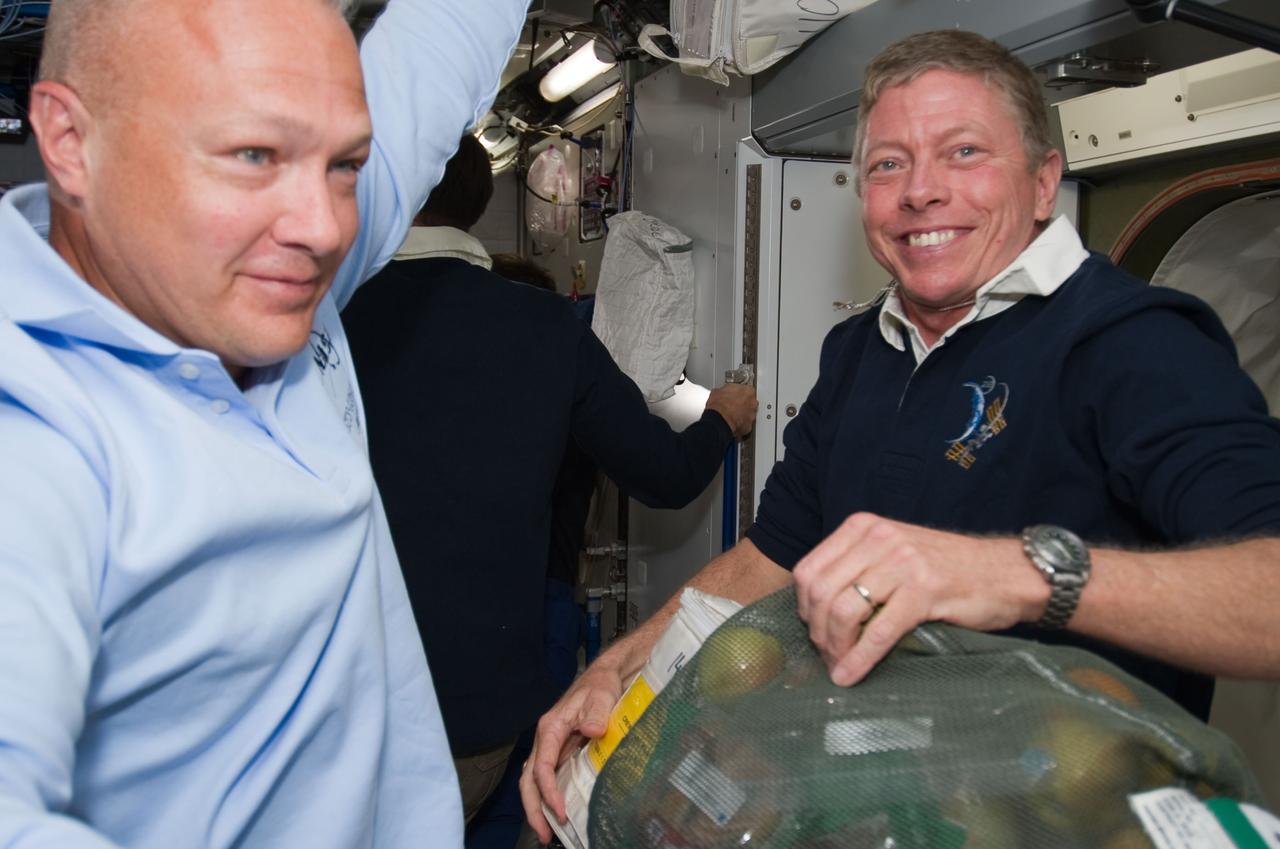
S135-E-007296 (10 July 2011) --- NASA astronauts Doug Hurley (left), STS-135 pilot, and Mike Fossum, Expedition 28 flight engineer, are pictured onboard the International Space Station not long after the docking of the space shuttle Atlantis and the station during the mission’s third day in space. Fossum displays a smile as he holds a bag of fruit and other items which was brought up by the shuttle crew. Photo credit: NASA
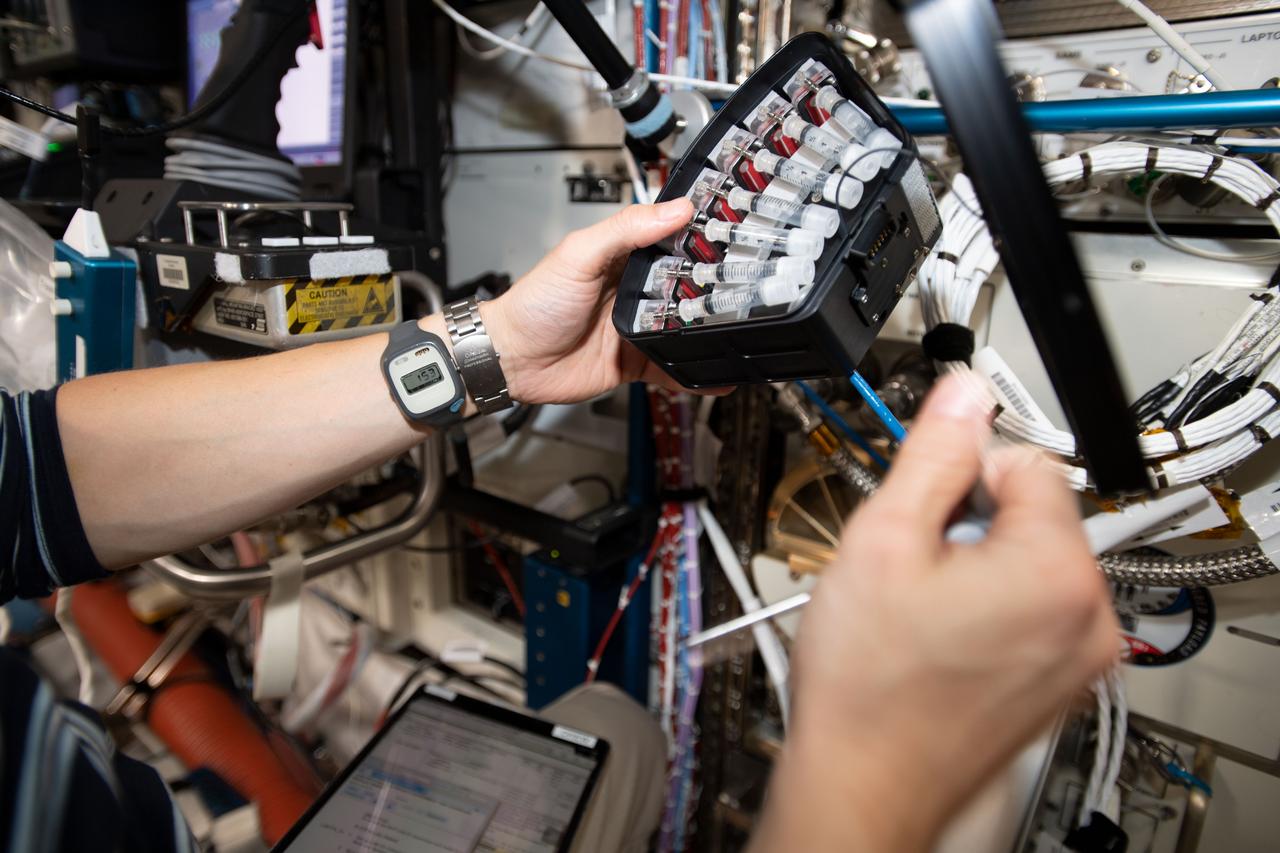
iss060e045091 (8/27/2019_ —- A view of the MVP Experiment Module used in the MVP Cell-02 investigation aboard the International Space Station (ISS). The Multi-use Variable-g Platform (MVP) enables space biology research into a variety of small organisms such as fruit flies, flatworms, plants, fish, cells, protein crystals and many others.

ISS034-E-062076 (3 March 2013) --- The banana in the hands of Canadian astronaut Chris Hadfield serves as a definite tell-tale clue about the recent arrival of the SpaceX Dragon spacecraft to the International Space Station. Fresh fruit, along with other food and supplies, arrived aboard the unmanned spacecraft on March 3. Seen inside Node 1 or Unity, the Expedition 34 flight engineer and assigned Expedition 35 commander didn't take long to "examine" the merchandise. The hatch to the U.S. lab Destiny is in the background.
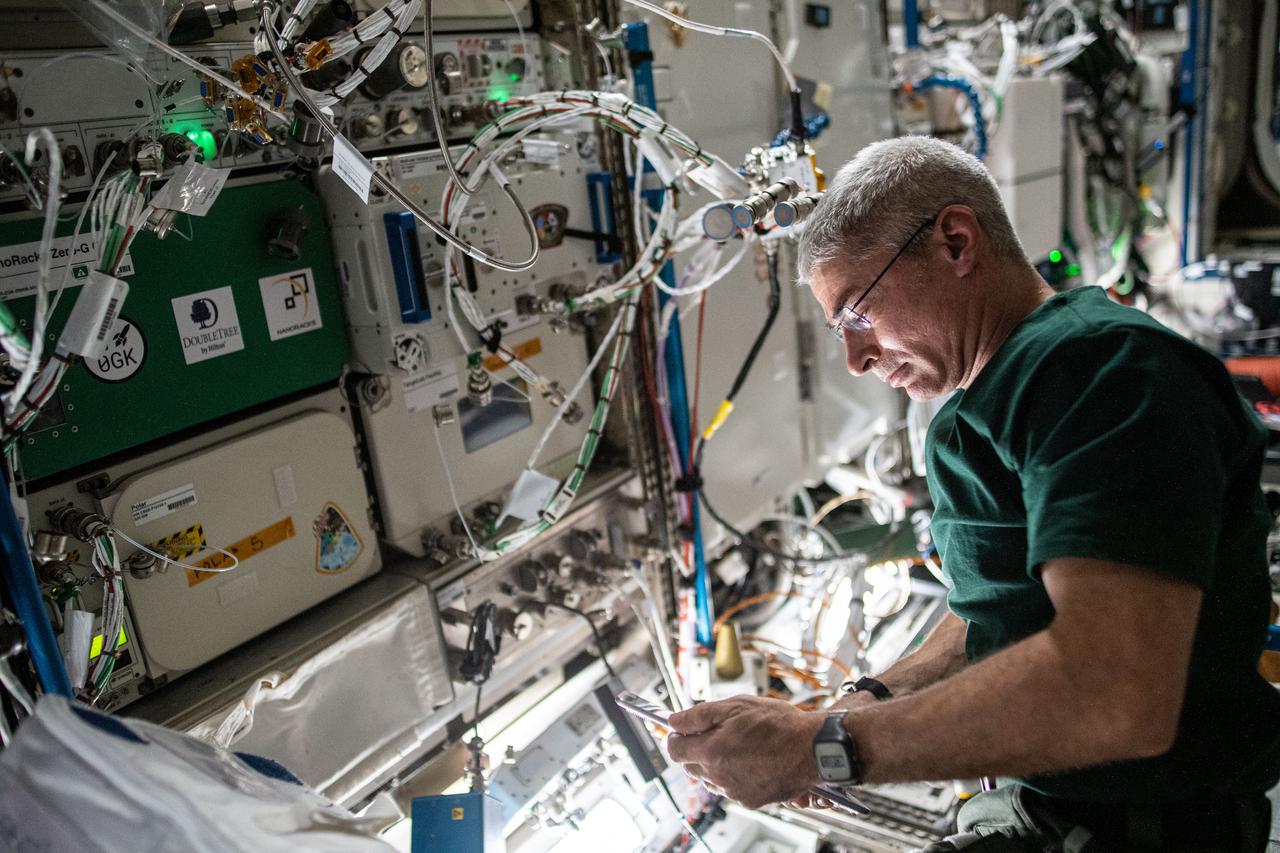
iss065e074888 (May 28, 2021) --- NASA astronaut and Expedition 65 Flight Engineer Mark Vande Hei works to relocate the Multi-use Variable-g Platform (MVP) inside the Kibo laboratory module. The MVP is a space biology research platform that can produce up to 2 g of artificial gravity housing samples such as fruit flies, flatworms, plants, fish, cells, protein crystals and many others.
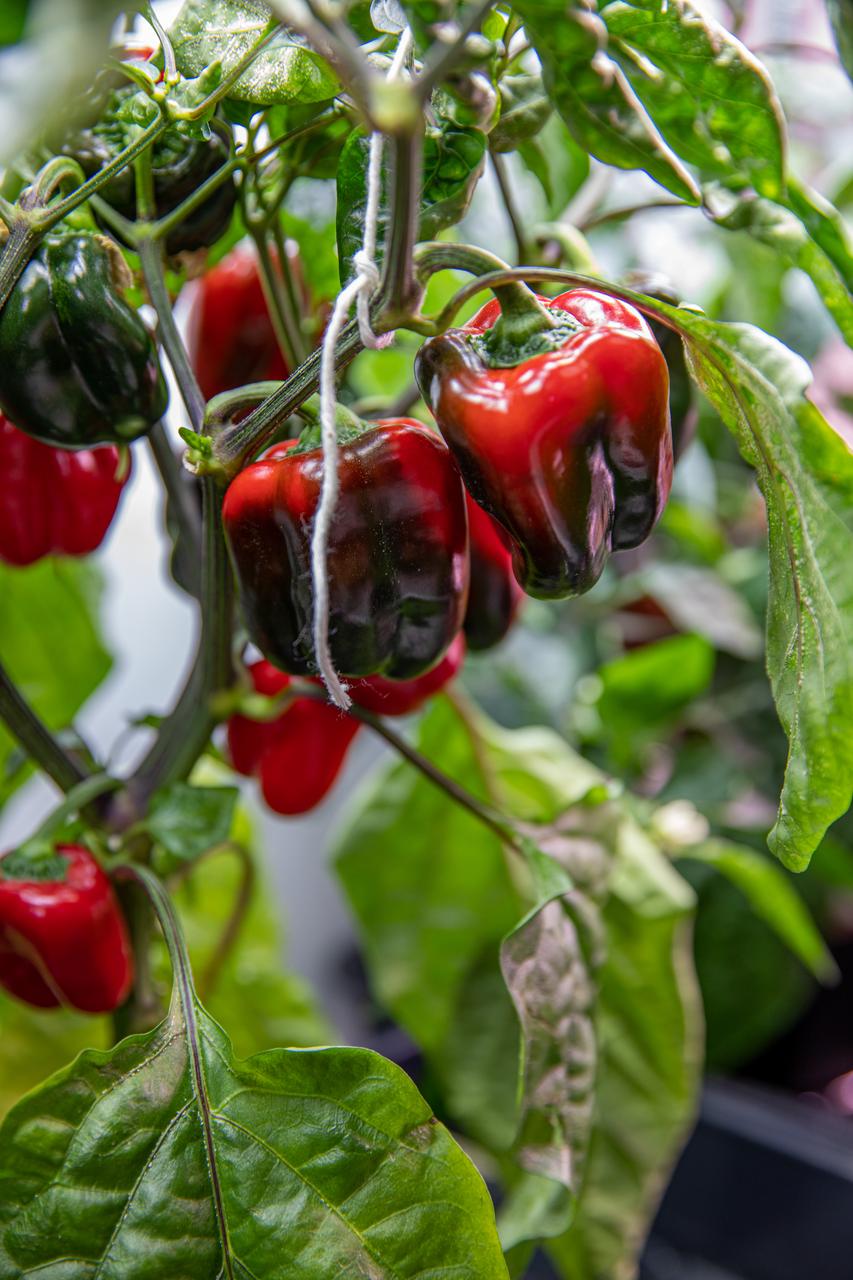
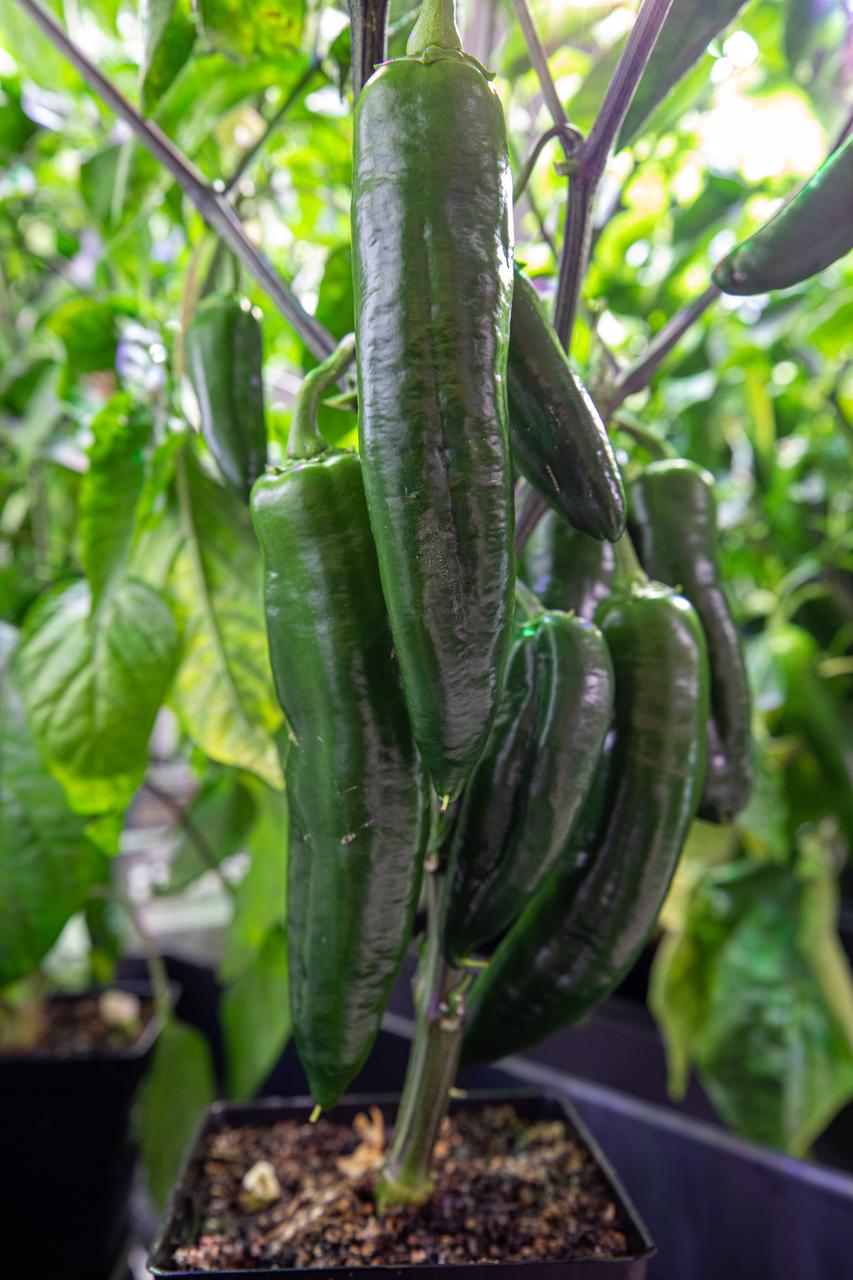
Researchers are growing green peppers inside the Space Station Processing Facility at NASA’s Kennedy Space Center in Florida on Jan. 15, 2020, in preparation for sending them to space. As NASA prepares to send humans beyond low-Earth orbit, the ability for astronauts to grow a variety of fresh fruits and vegetables in space will be critical. Fresh produce will be an essential supplement to the crew’s pre-packaged diet during long-duration space exploration when they are away from Earth for extended periods of time.
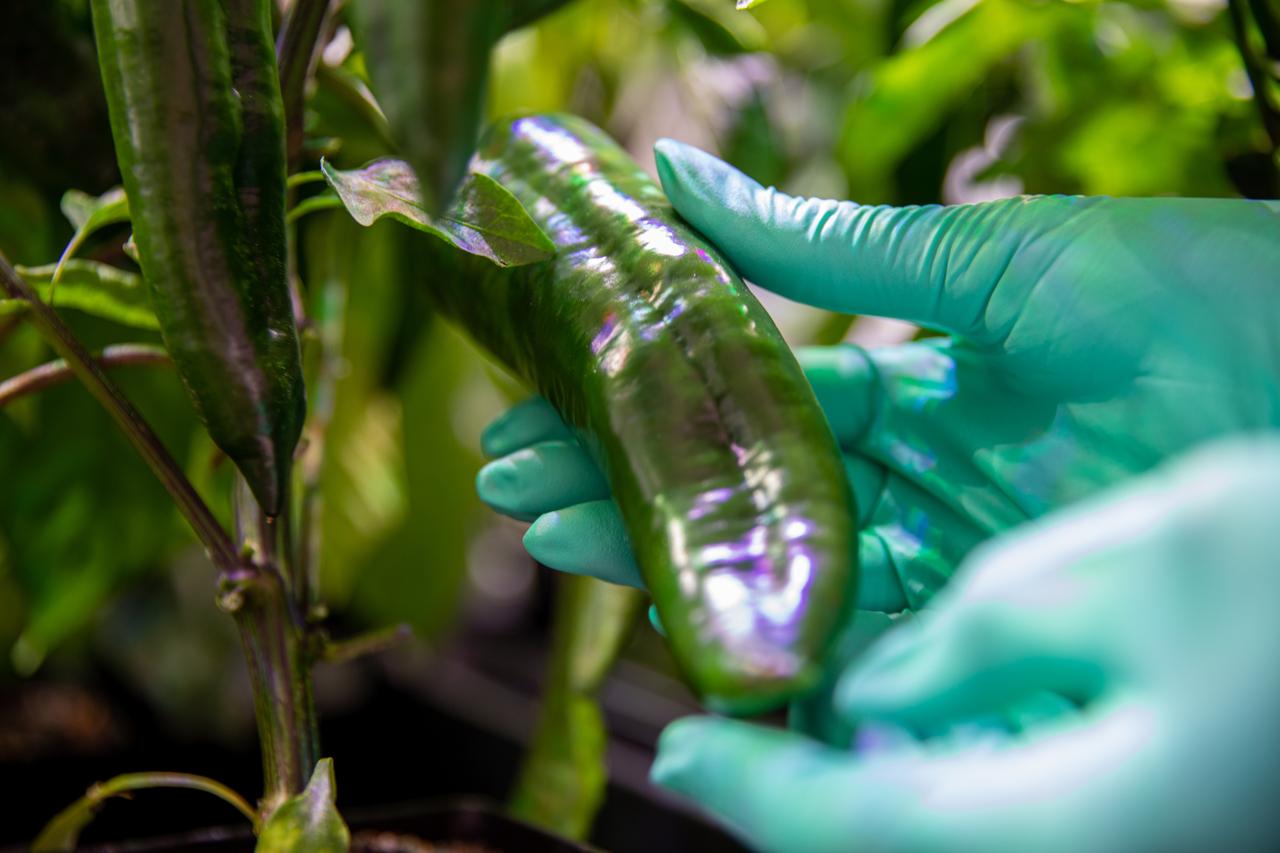
Researchers are growing green peppers inside the Space Station Processing Facility at NASA’s Kennedy Space Center in Florida on Jan. 15, 2020, in preparation for sending them to space. As NASA prepares to send humans beyond low-Earth orbit, the ability for astronauts to grow a variety of fresh fruits and vegetables in space will be critical. Fresh produce will be an essential supplement to the crew’s pre-packaged diet during long-duration space exploration when they are away from Earth for extended periods of time.
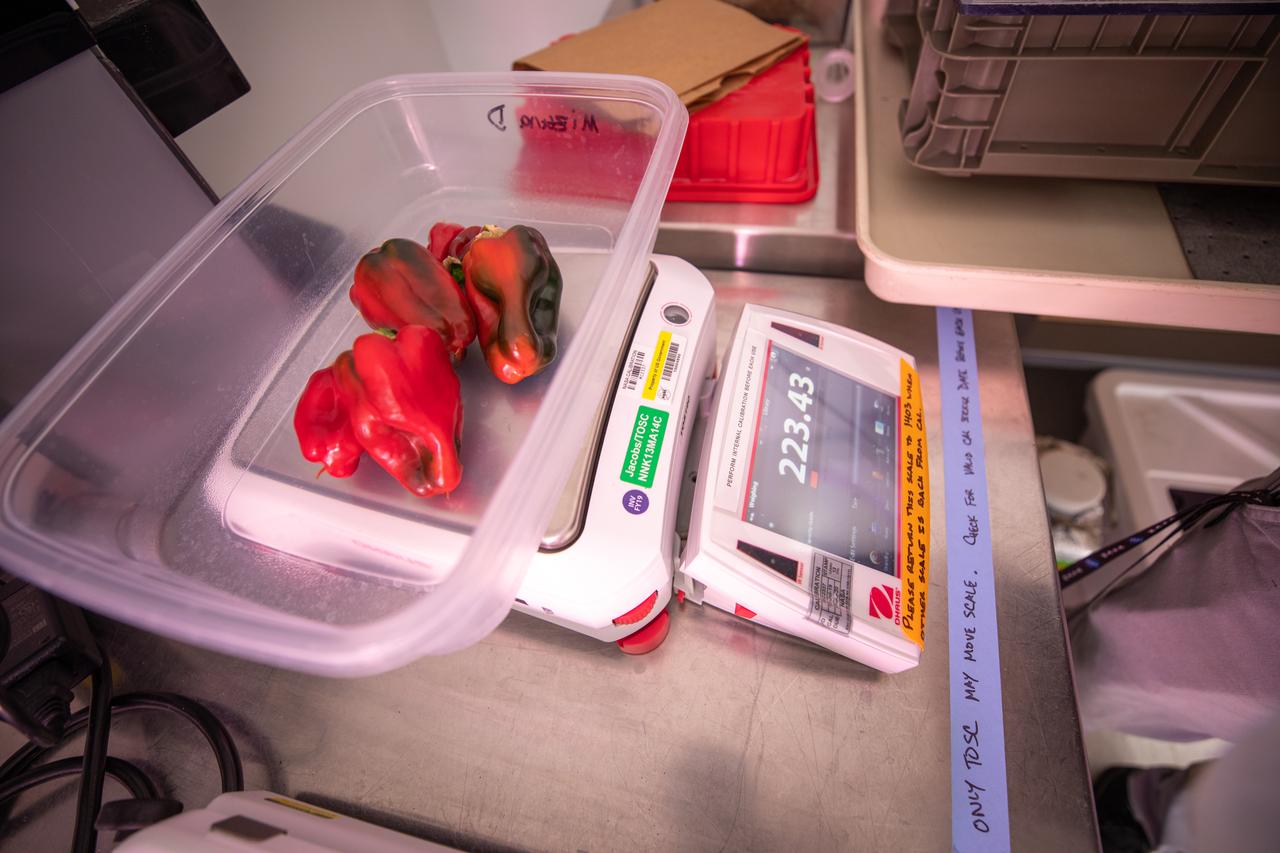
Peppers that were grown and harvested inside the Space Station Processing Facility at NASA’s Kennedy Space Center in Florida are weighed on Jan. 15, 2020, in preparation for sending them to space. As NASA prepares to send humans beyond low-Earth orbit, the ability for astronauts to grow a variety of fresh fruits and vegetables in space will be critical. Fresh produce will be an essential supplement to the crew’s pre-packaged diet during long-duration space exploration when they are away from Earth for extended periods of time.

ISS028-E-016526 (13 July 2011) --- The Expedition 28 crewmembers open a cache of fruit and other food items in the Node 1 or Unity aboard the International Space Station. Standing in the back is Russian cosmonaut Andrey Borisenko, commander. In the middle (left to right) are NASA astronaut Ron Garan and Russian cosmonauts Alexander Samokutyaev and Sergei Volkov, all flight engineers. In the foreground are Japan Aerospace Exploration Agency astronaut Satoshi Furukawa (left) and NASA astronaut Mike Fossum, both flight engineers.
Inside the Space Station Processing Facility at NASA’s Kennedy Space Center in Florida, peppers are harvested on Jan. 15, 2020, for a growth assessment in preparation for sending them to space. As NASA prepares to send humans beyond low-Earth orbit, the ability for astronauts to grow a variety of fresh fruits and vegetables in space will be critical. Fresh produce will be an essential supplement to the crew’s pre-packaged diet during long-duration space exploration when they are away from Earth for extended periods of time.

iss071e040346 (4/23/2024) ---A view aboard the International Space Station (ISS) of the Higher Orbits Multi Experiment Module #5 (HIOR_EDU05) continues a series of student-led experiments aboard the International Space Station. This module includes three experiments: Radiation and Fungus, which tests fungal growth in space; Project Bones, which compares iron levels in fruit flies fed different diets; and Cells in Space, which examines the effect of radiation on cellular respiration in yeast.
Researchers are growing green peppers inside the Space Station Processing Facility at NASA’s Kennedy Space Center in Florida on Jan. 15, 2020, in preparation for sending them to space. As NASA prepares to send humans beyond low-Earth orbit, the ability for astronauts to grow a variety of fresh fruits and vegetables in space will be critical. Fresh produce will be an essential supplement to the crew’s pre-packaged diet during long-duration space exploration when they are away from Earth for extended periods of time.
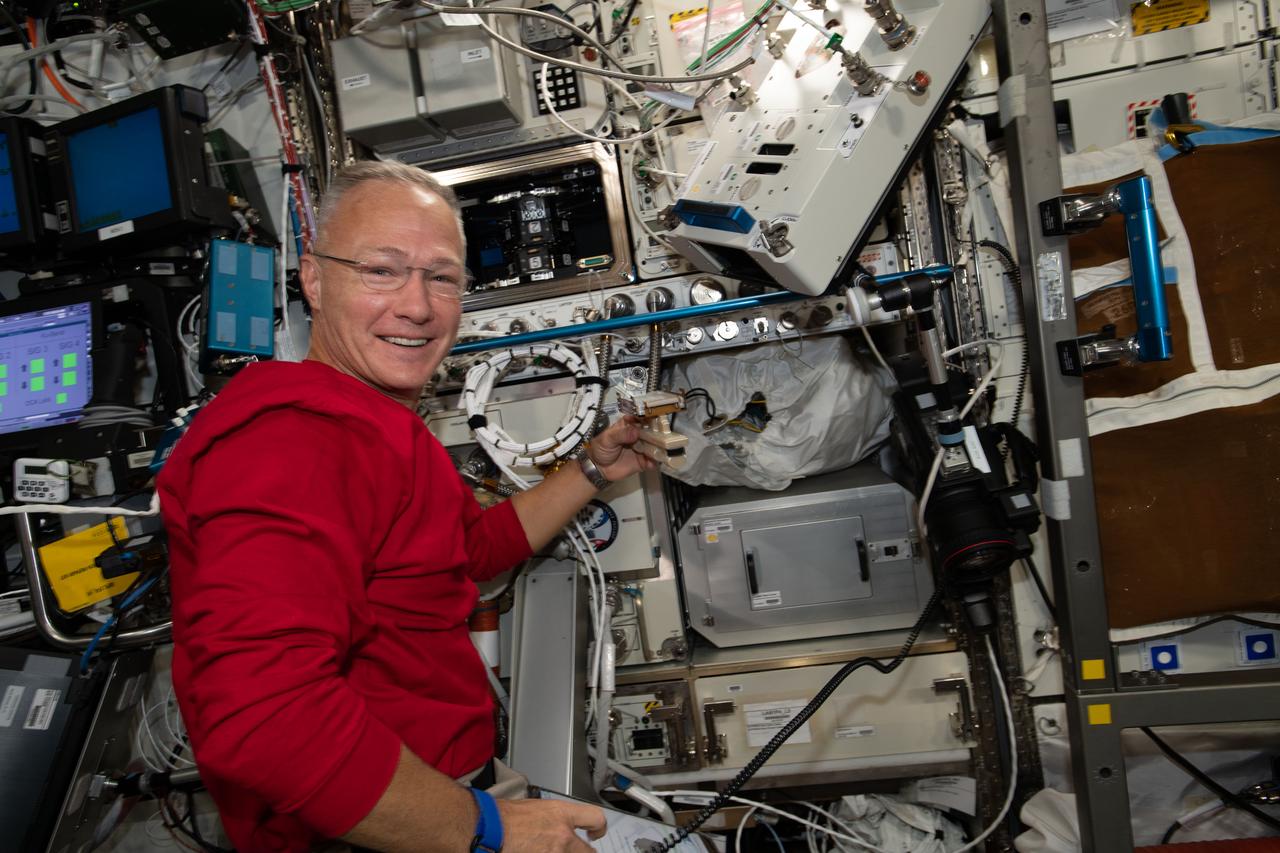
iss063e033724 (June 28, 2020) --- NASA astronaut and Expedition 63 Flight Engineer Doug Hurley works on science hardware inside the International Space Station's U.S. Destiny laboratory. The Multi-use Variable-g Platform is a research facility that can produce up to 2 g of artificial gravity for biological studies of fruit flies, flatworms, plants, fish, cells, protein crystals and many others.
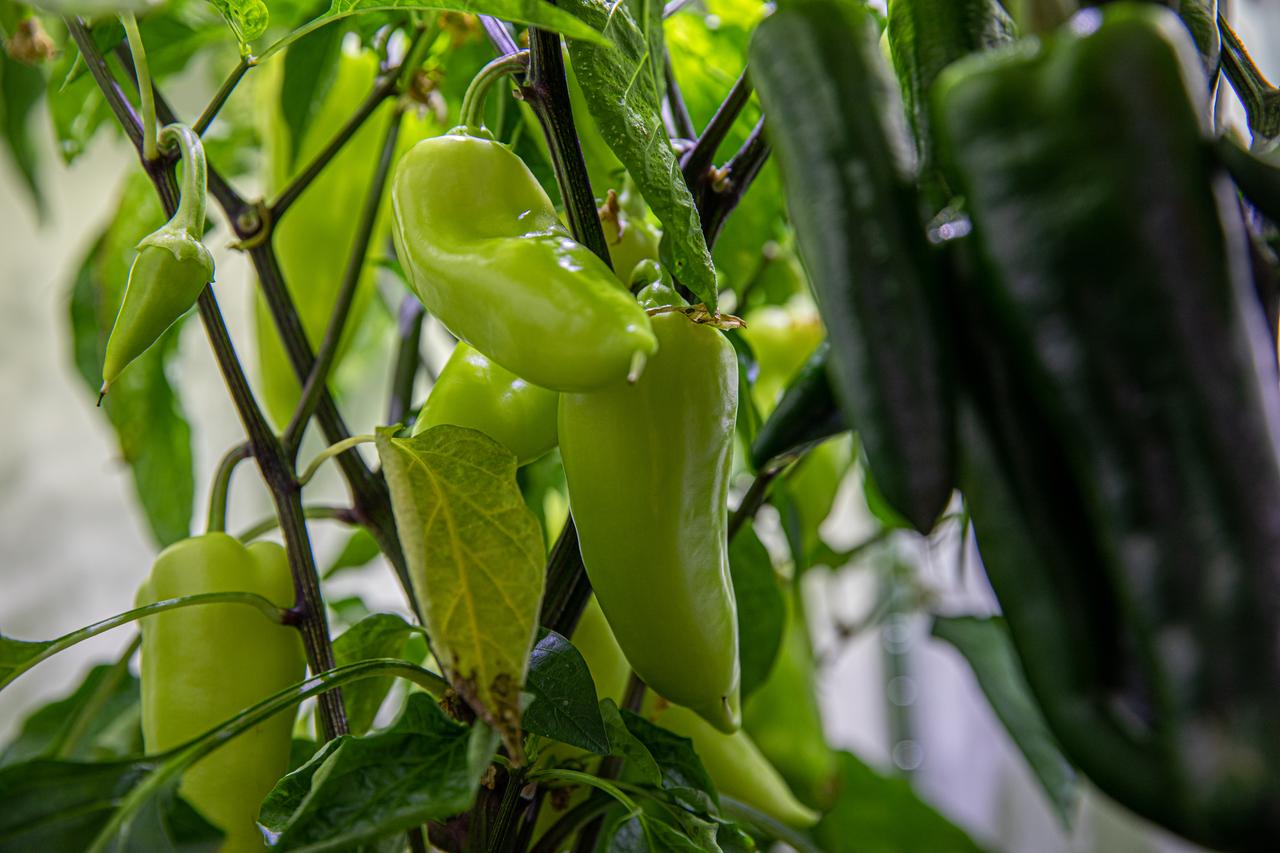
Researchers are growing green peppers inside the Space Station Processing Facility at NASA’s Kennedy Space Center in Florida on Jan. 15, 2020, in preparation for sending them to space. As NASA prepares to send humans beyond low-Earth orbit, the ability for astronauts to grow a variety of fresh fruits and vegetables in space will be critical. Fresh produce will be an essential supplement to the crew’s pre-packaged diet during long-duration space exploration when they are away from Earth for extended periods of time.
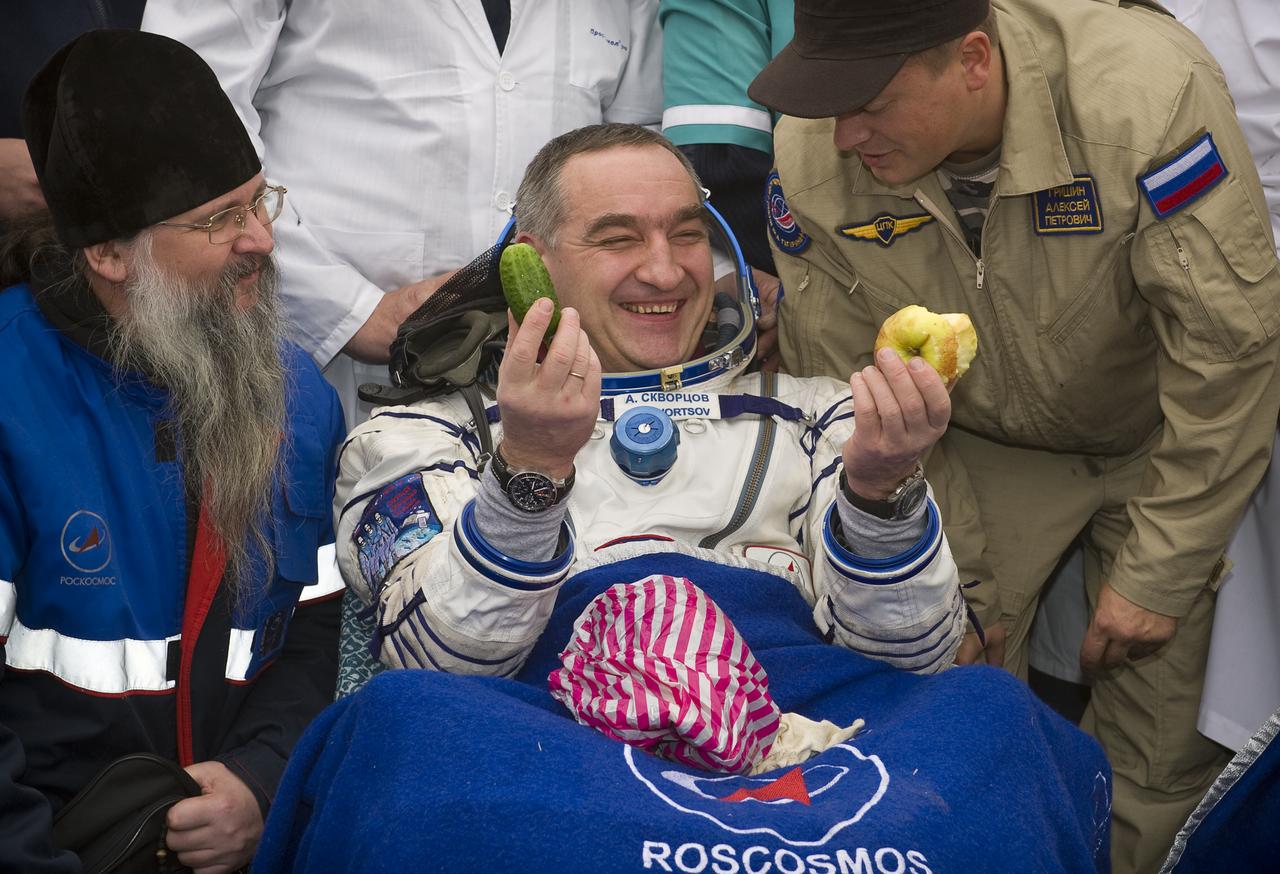
Expedition 24 Commander Alexander Skvortsov laughs after being given fresh fruit and vegetables shortly after landing in the Soyuz TMA-18 spacecraft with fellow crew members Tracy Caldwell Dyson and Mikhail Kornienko near the town of Arkalyk, Kazakhstan on Saturday, Sept. 25, 2010. Russian Cosmonauts Skvortsov and Kornienko and NASA Astronaut Caldwell Dyson, are returning from six months onboard the International Space Station where they served as members of the Expedition 23 and 24 crews. Photo Credit: (NASA/Bill Ingalls)
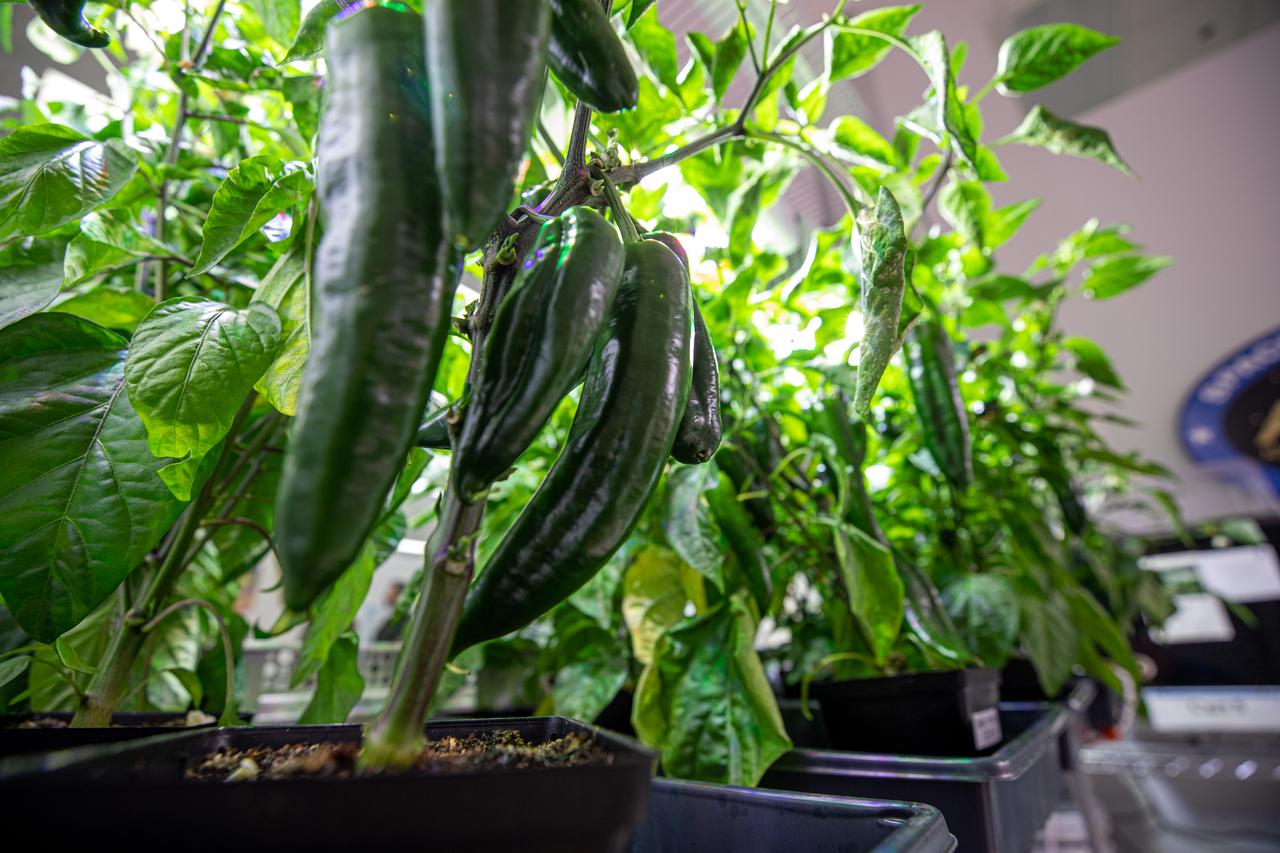
Researchers are growing green peppers inside the Space Station Processing Facility at NASA’s Kennedy Space Center in Florida on Jan. 15, 2020, in preparation for sending them to space. As NASA prepares to send humans beyond low-Earth orbit, the ability for astronauts to grow a variety of fresh fruits and vegetables in space will be critical. Fresh produce will be an essential supplement to the crew’s pre-packaged diet during long-duration space exploration when they are away from Earth for extended periods of time.
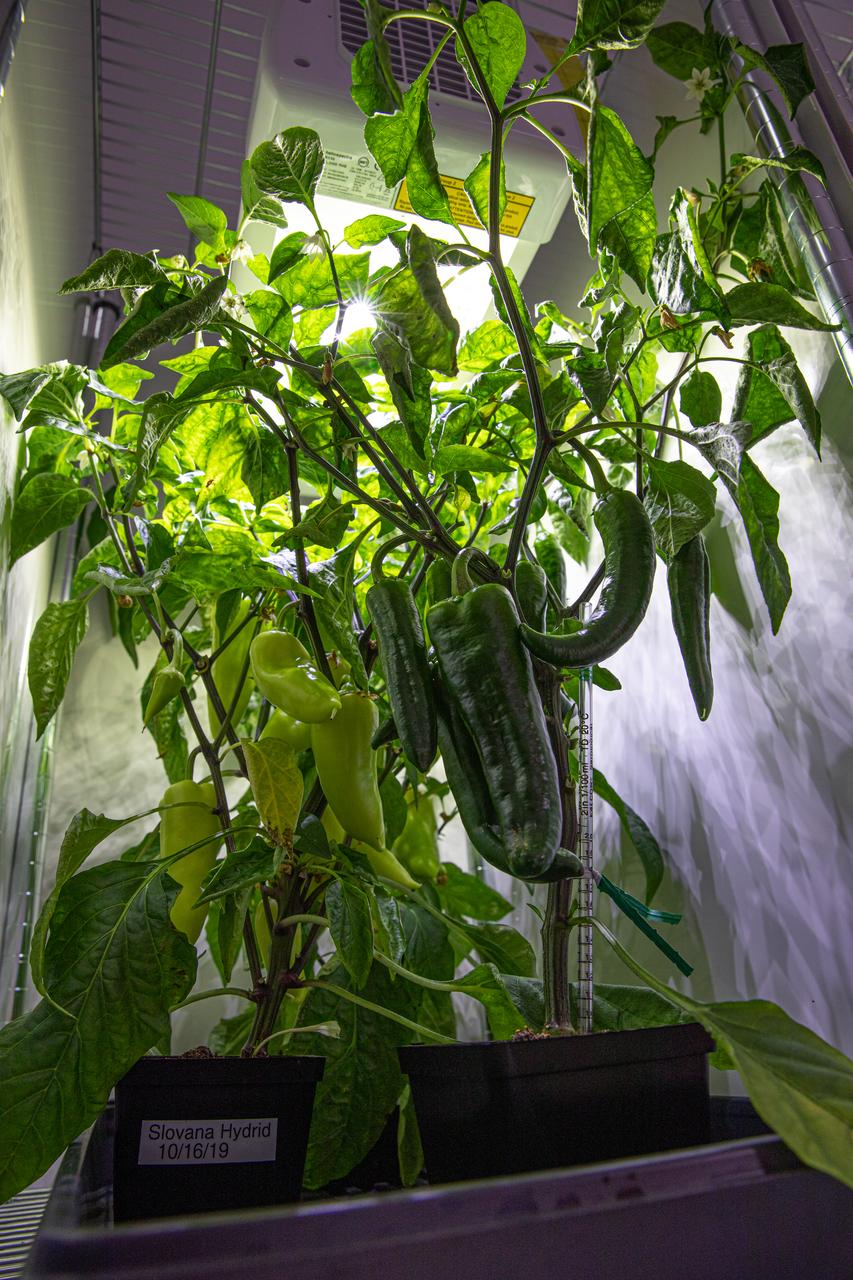
Researchers are growing green peppers inside the Space Station Processing Facility at NASA’s Kennedy Space Center in Florida on Jan. 15, 2020, in preparation for sending them to space. As NASA prepares to send humans beyond low-Earth orbit, the ability for astronauts to grow a variety of fresh fruits and vegetables in space will be critical. Fresh produce will be an essential supplement to the crew’s pre-packaged diet during long-duration space exploration when they are away from Earth for extended periods of time.
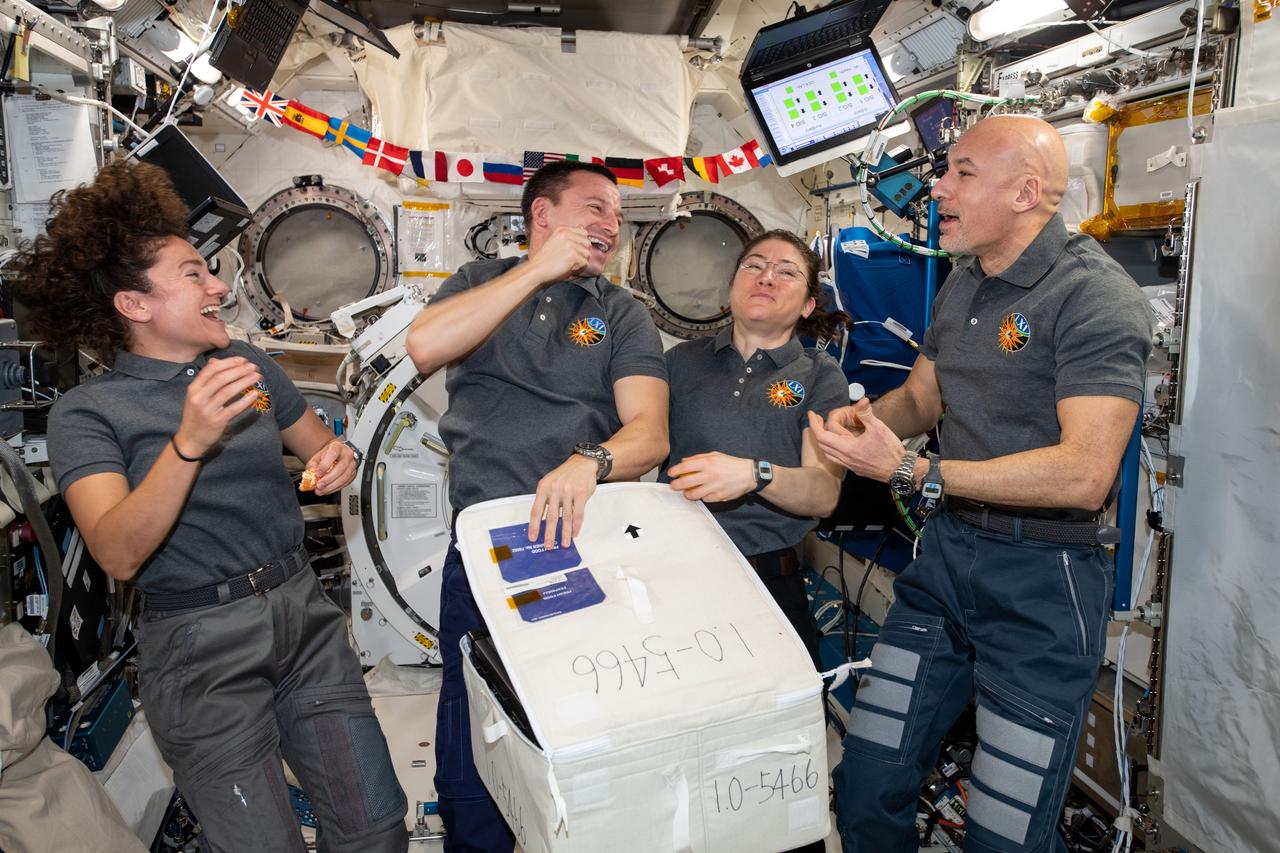
iss061e003995 (Oct. 7, 2019) --- Four Expedition 61 crewmembers open a stowage case packed with fresh fruit and other goodies delivered aboard Japan's HTV-8 cargo craft. From left are, NASA Flight Engineers Jessica Meir, Andrew Morgan and Christina Koch with Commander Luca Parmitano of ESA (European Space Agency).
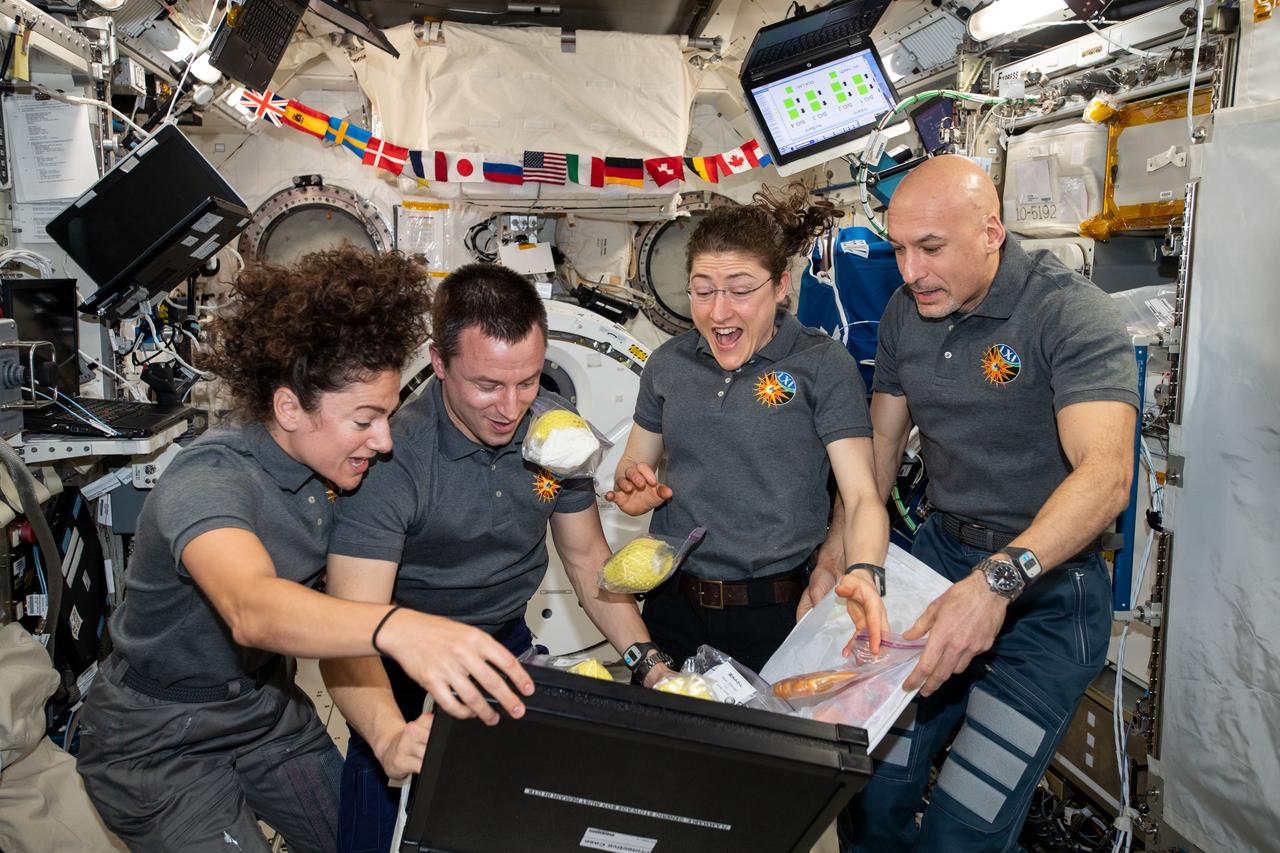
iss061e004031 (Oct. 7, 2019) --- Four Expedition 61 crewmembers unpack fresh fruit and other goodies from a stowage bag delivered aboard Japan's HTV-8 cargo craft. From left are, NASA Flight Engineers Jessica Meir, Andrew Morgan and Christina Koch with Commander Luca Parmitano of ESA (European Space Agency).
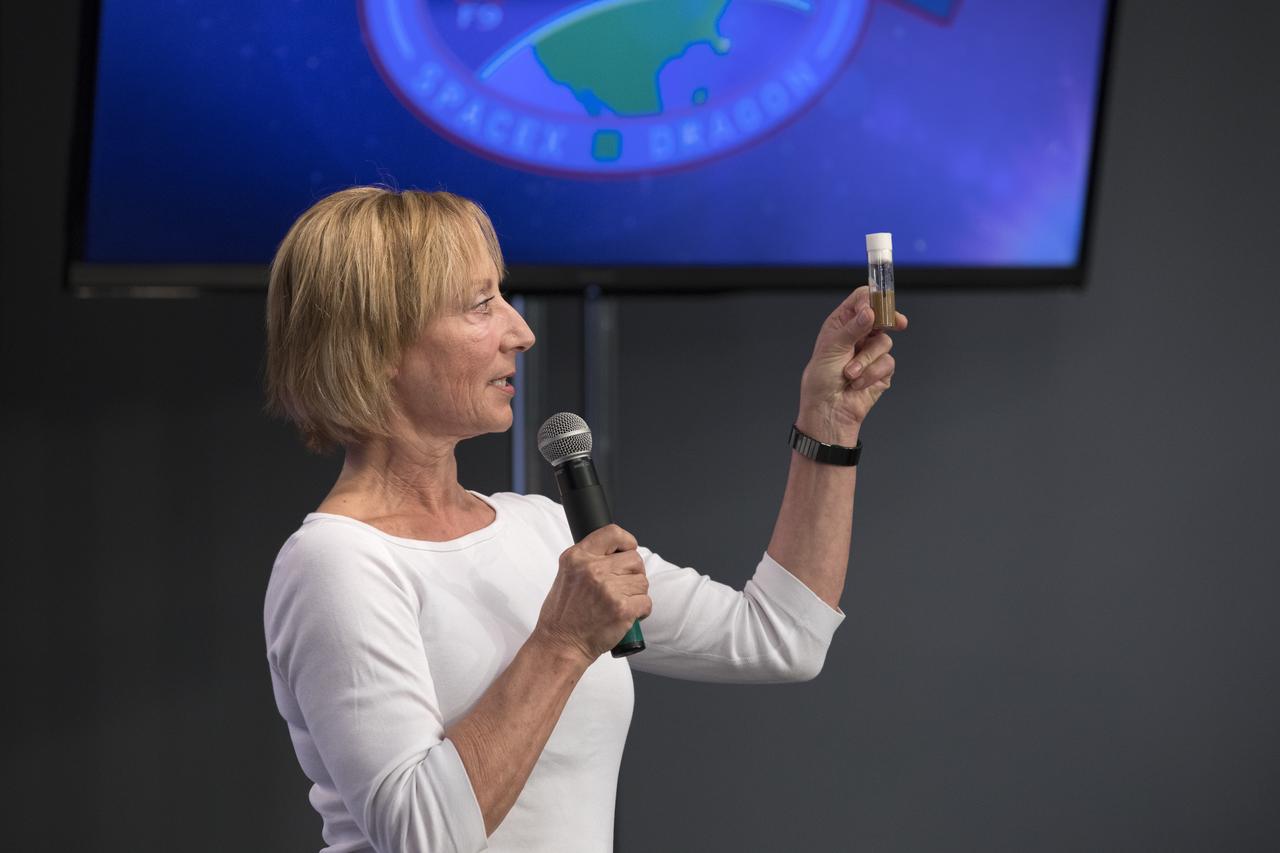
Dr. Karen Ocorr, co-investigator for the Fruit Fly Lab-02, speaks to members of social media in the Kennedy Space Center’s Press Site auditorium. The briefing focused on experiments and instruments to be delivered to the International Space Station on SpaceX CRS-11. A Dragon spacecraft is scheduled to be launched from Kennedy’s Launch Complex 39A on June 1 atop a SpaceX Falcon 9 rocket on the company's 11th Commercial Resupply Services mission to the space station.
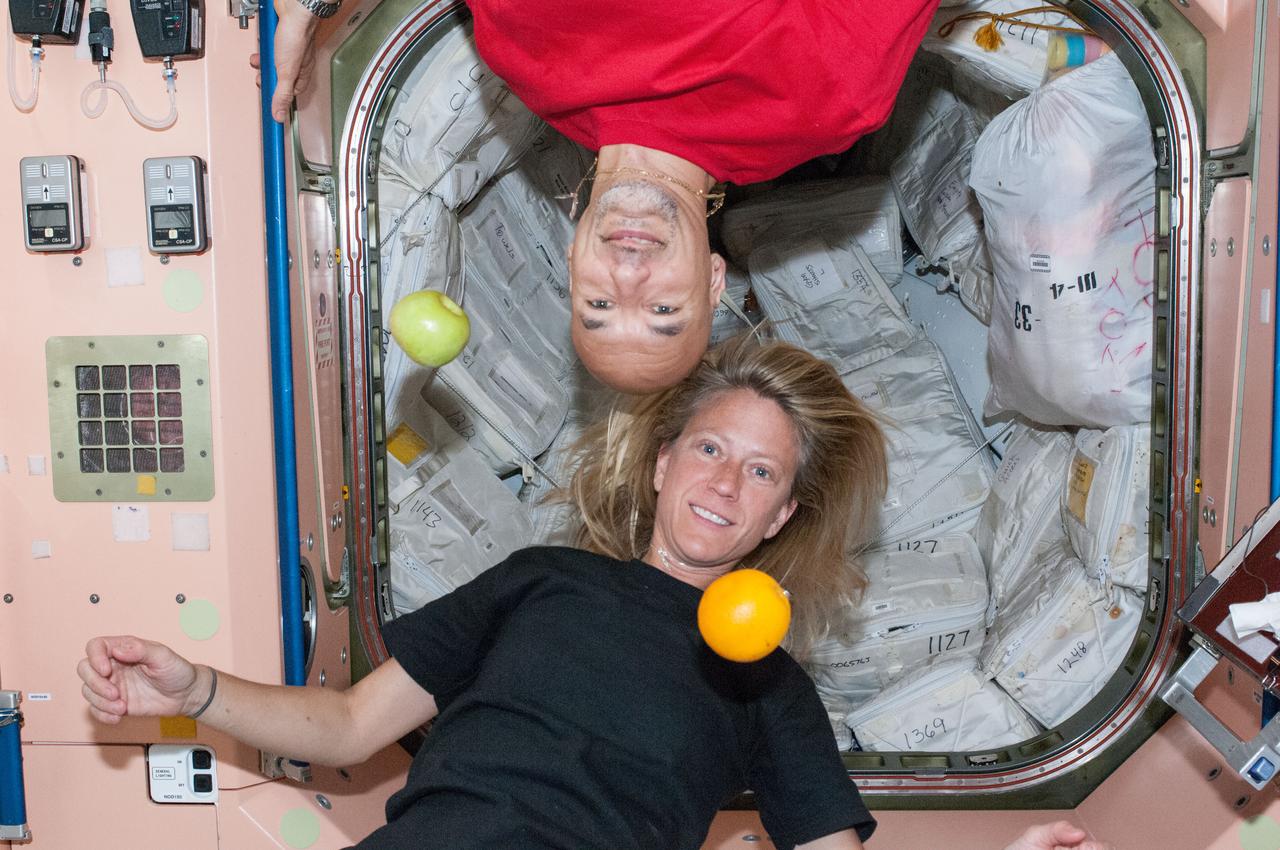
ISS036-E-005534 (31 May 2013) --- When off-duty time comes for crew members aboard the Earth-orbiting International Space Station, astronauts often like to take advantage of the micro-gravity to do things that they can't do on Earth, such as hang upside down or suspend fruit in air. Here, Flight Engineers Karen Nyberg of NASA and Luca Parmitano of the European Space Agency find a spot in the Unity node to their liking for a brief recess.
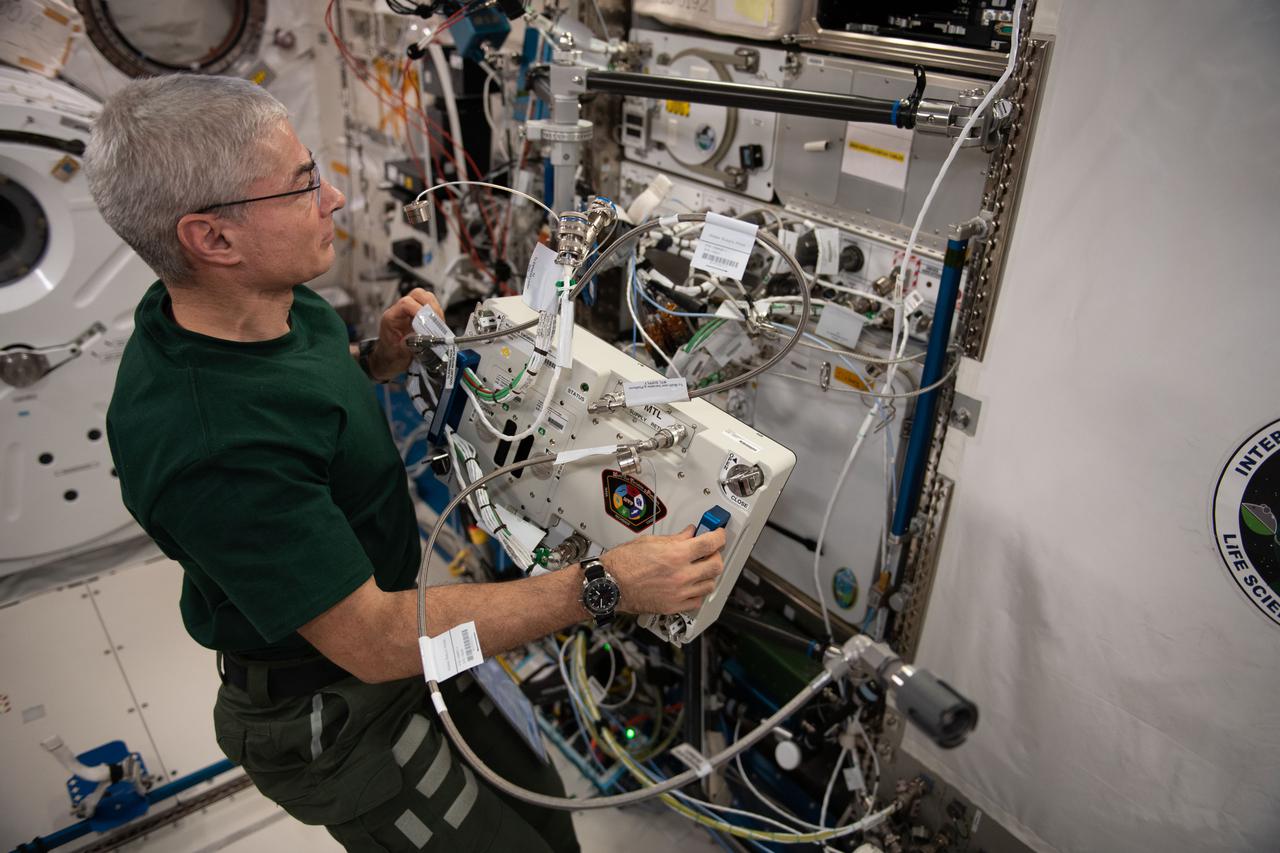
iss065e081498 (May 28, 2021) --- NASA astronaut and Expedition 65 Flight Engineer Mark Vande Hei works to relocate the Multi-use Variable-g Platform (MVP) inside the Kibo laboratory module. The MVP is a space biology research platform that can produce up to 2 g of artificial gravity housing samples such as fruit flies, flatworms, plants, fish, cells, protein crystals and many others.