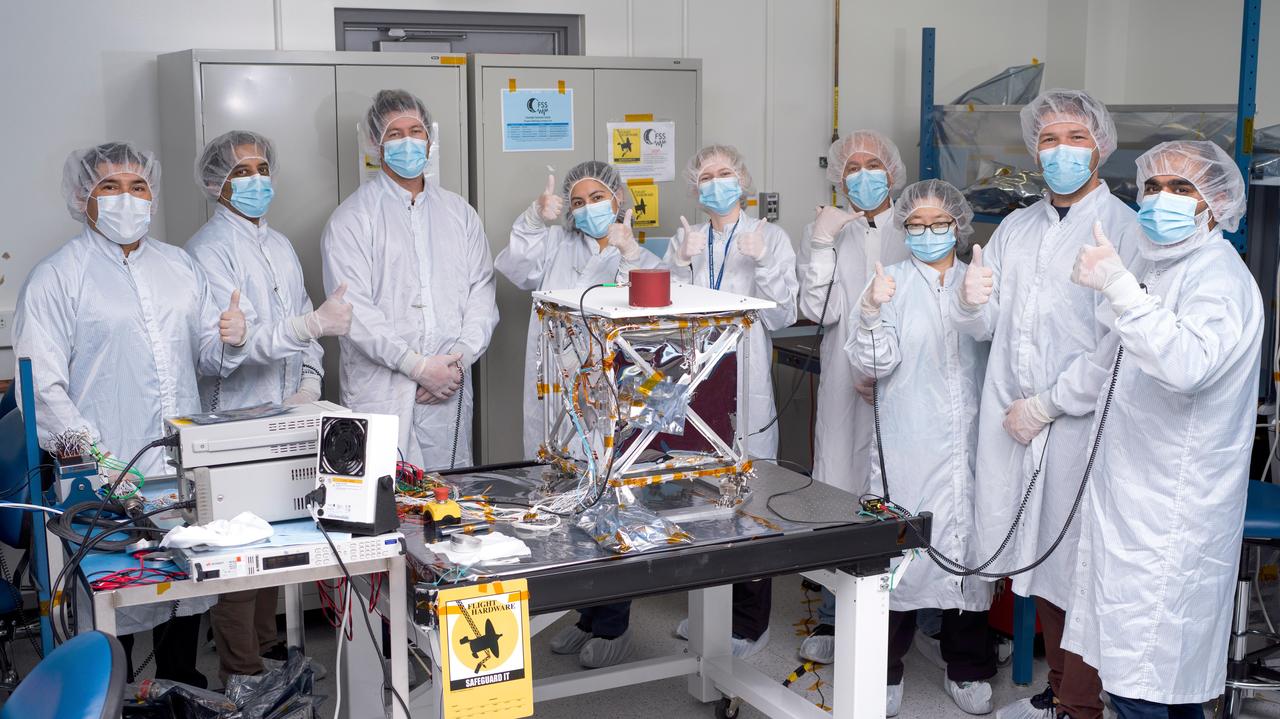
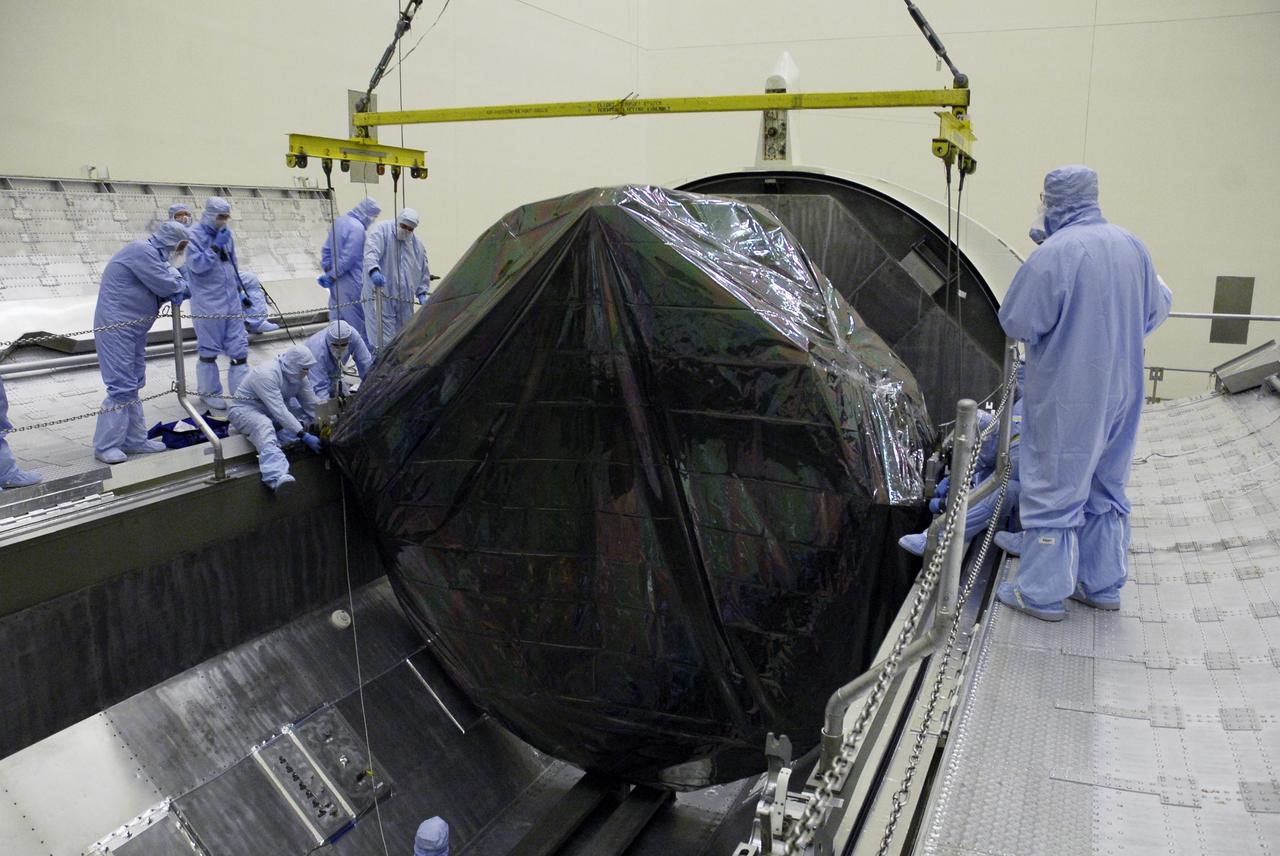
In a clean room at NASA's Jet Propulsion Laboratory in Southern California in March 2024, engineers and technicians pose with the agency's Farside Seismic Suite while the payload is readied for testing. The suite contains two instruments that will gather NASA's first seismic data from the Moon in nearly 50 years and take the first-ever seismic measurements from the Moon's far side. FSS will operate continuously for at least 4½ months, working through the long, cold lunar nights. The two seismometers are packaged together with a large battery, a computer, and electronics inside a cube structure that's surrounded by several layers of insulation (the shiny material at center) and suspended within a protective outer cube, which is, in turn, covered with an insulating blanket. In this photo, the blanket has not yet been attached. Members of the FSS integration team pictured are (from left) Salvador Ramirez, Asad Aboobaker, Nik Schwarz, Joanna Farias, Clara MacFarland, Frank Barone, Hsin-Yi Hao, Nicholas Roy-Steier, and Vik Singh. https://photojournal.jpl.nasa.gov/catalog/PIA26342
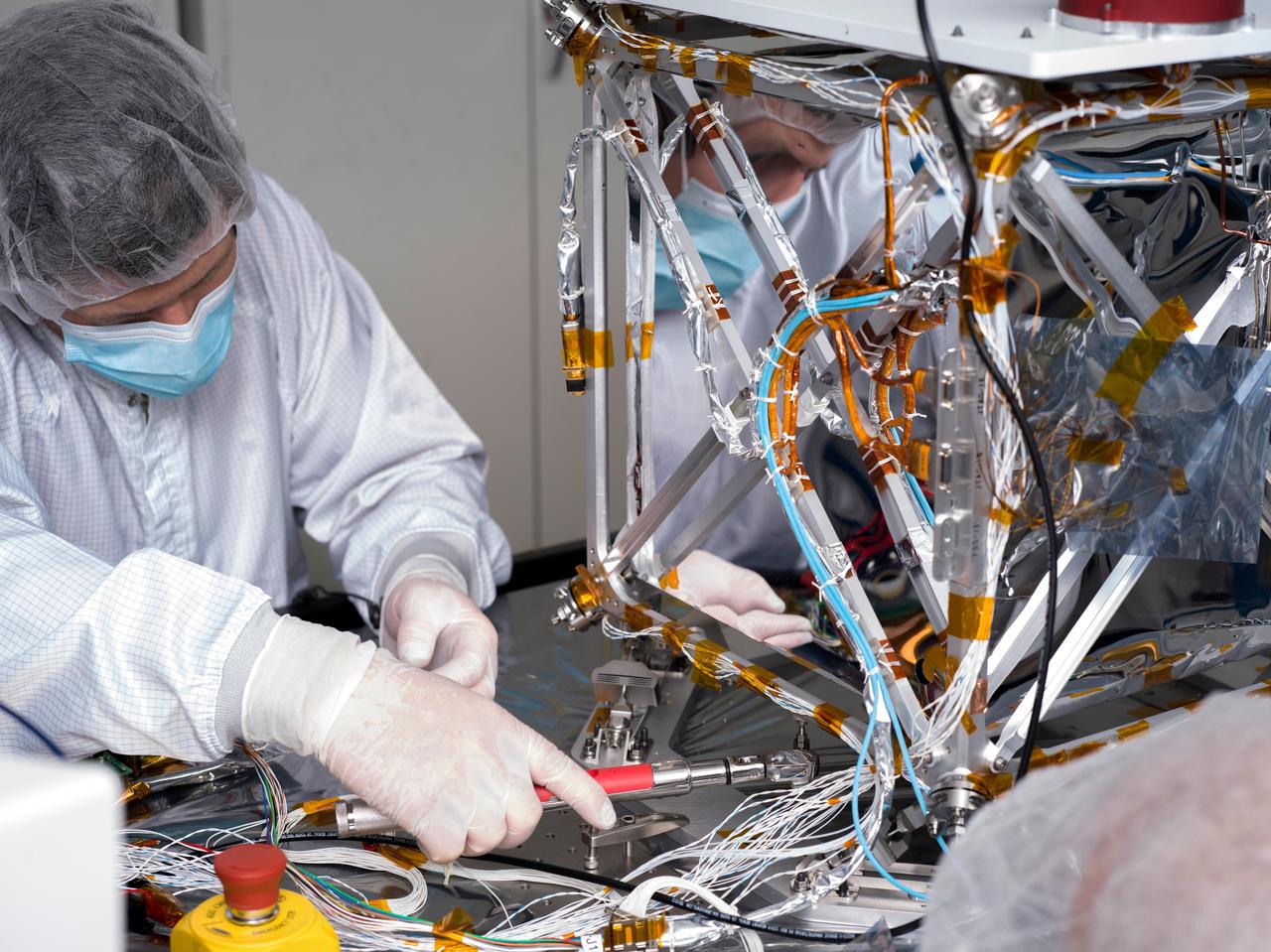
In a clean room at NASA's Jet Propulsion Laboratory in Southern California in March 2024, technician Nik Schwarz prepares the agency's Farside Seismic Suite (FSS) for testing. The cube-shaped payload contains two instruments that will gather NASA's first seismic data from the Moon in nearly 50 years and take the first-ever seismic measurements from the Moon's far side. FSS will operate continuously for at least 4½ months, working through the long, cold lunar nights. The two seismometers are packaged together with a large battery, a computer, and electronics inside a cube structure that's surrounded by several layers of insulation (the shiny, reflective material seen here) and suspended within an outer protective cube, which is in turn covered with a shiny insulating blanket. A technician is here attaching a stiffening brace to the bottom of the FSS outer cube structure. https://photojournal.jpl.nasa.gov/catalog/PIA26341
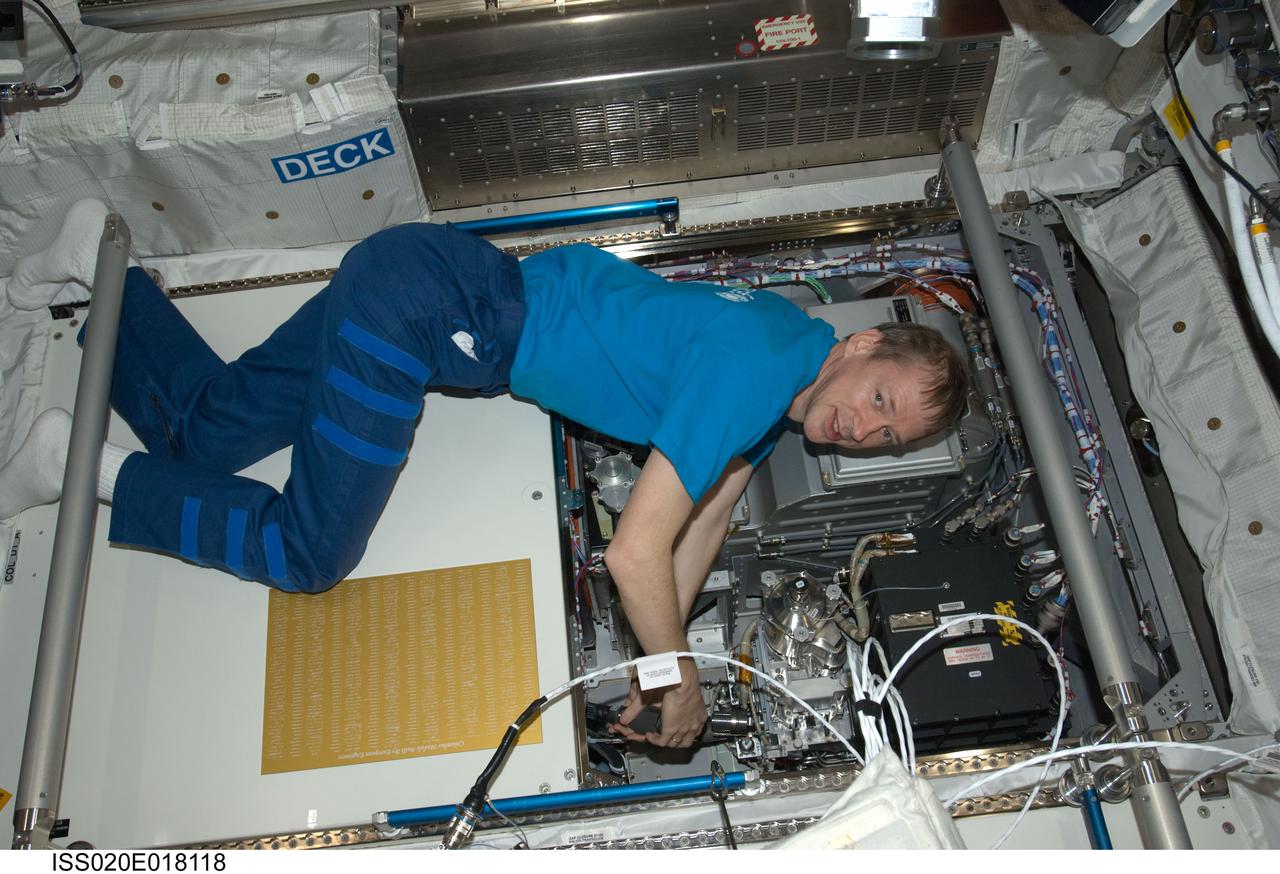
ISS020-E-018118 (8 July 2009) --- European Space Agency astronaut Frank De Winne, Expedition 20 flight engineer, works with the Fluid Servicing System (FSS) in the Columbus laboratory of the International Space Station.
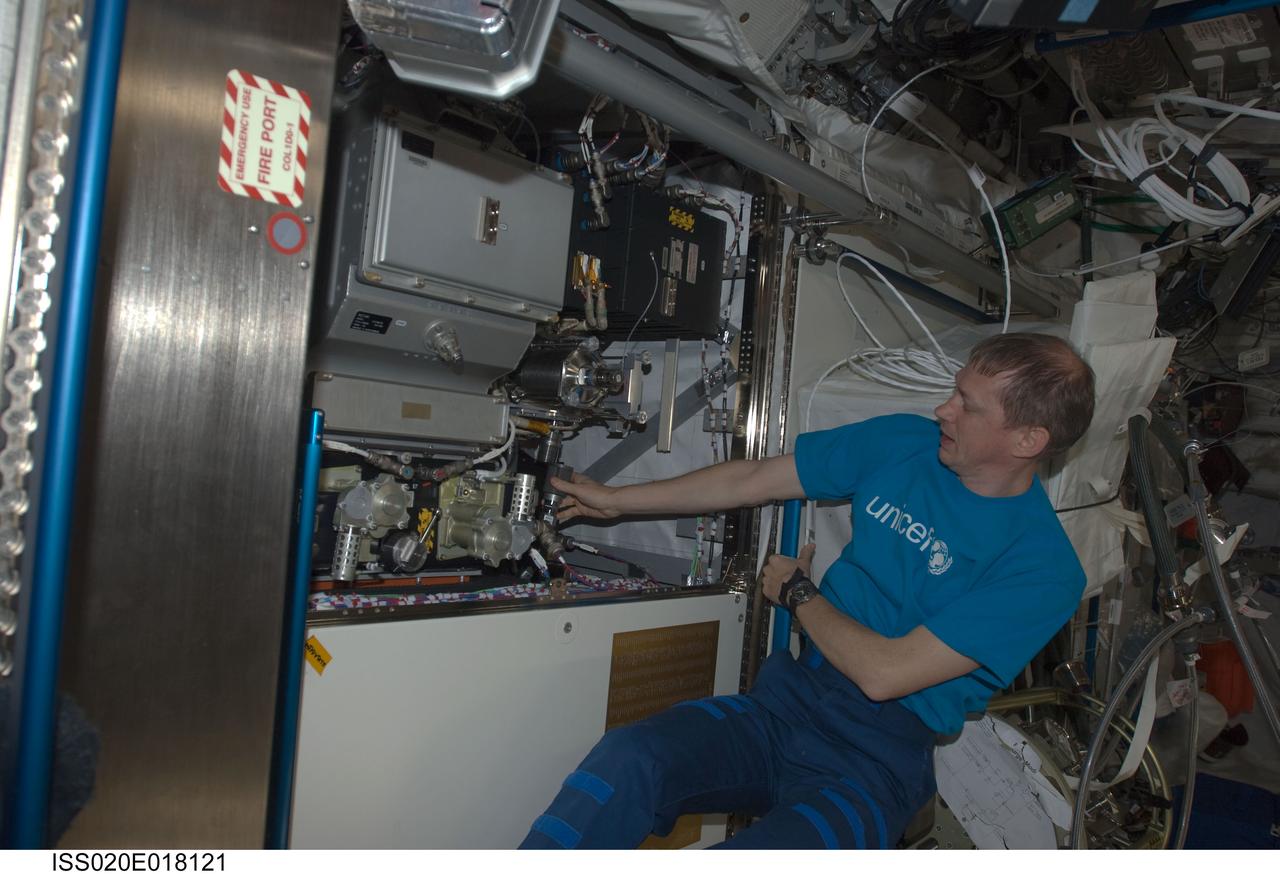
ISS020-E-018121 (8 July 2009) --- European Space Agency astronaut Frank De Winne, Expedition 20 flight engineer, works with the Fluid Servicing System (FSS) in the Columbus laboratory of the International Space Station.
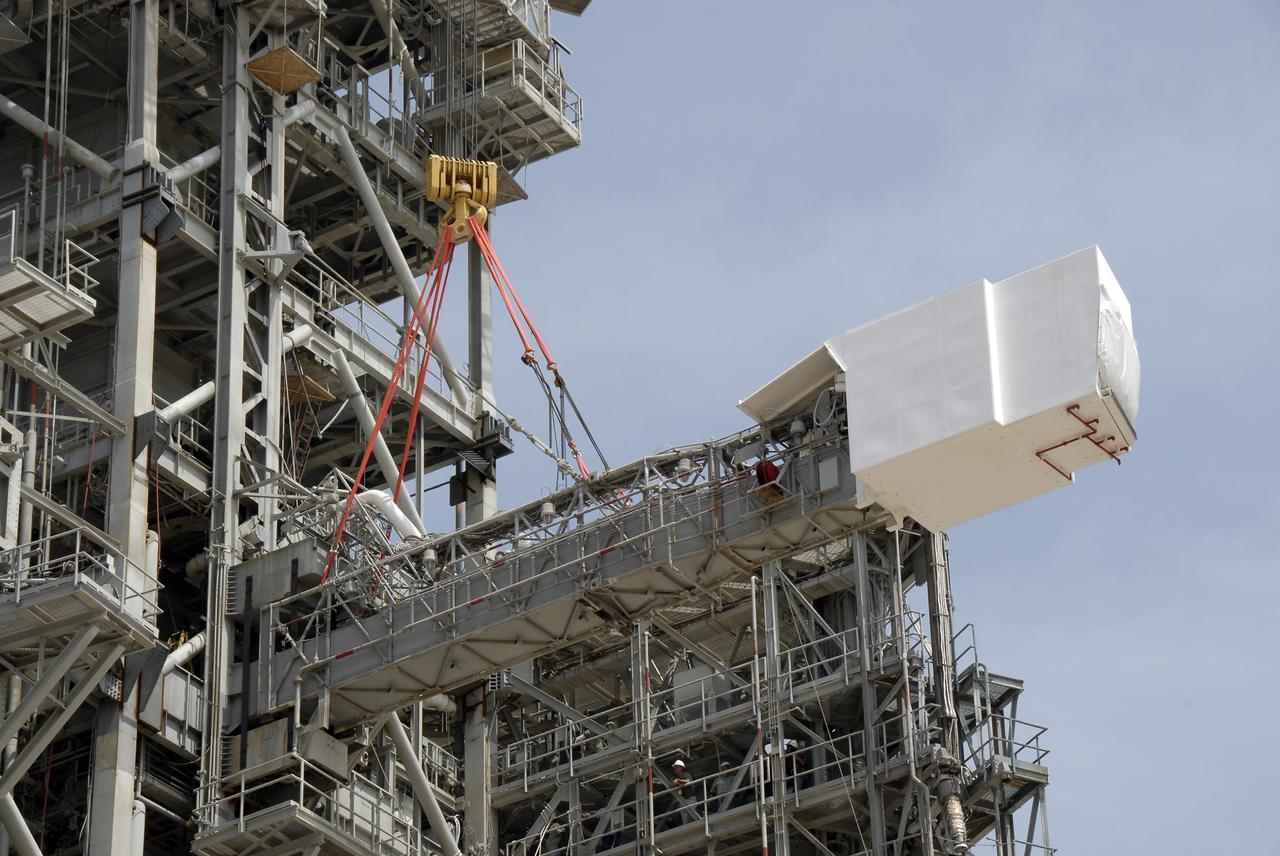
CAPE CANAVERAL, Fla. – The slings from a large crane are in place on the orbiter access arm, which ends in the White Room, that is part of the fixed service structure, or FSS, on Launch Pad 39B at NASA's Kennedy Space Center in Florida. The White Room provided entry into space shuttles that were on the pad. The arm is being removed from the FSS for the pad's conversion as launch site for the Constellation Program's Ares I-X. The launch of the Ares I-X flight test is targeted for August 2009. Photo credit: NASA/Kim Shiflett
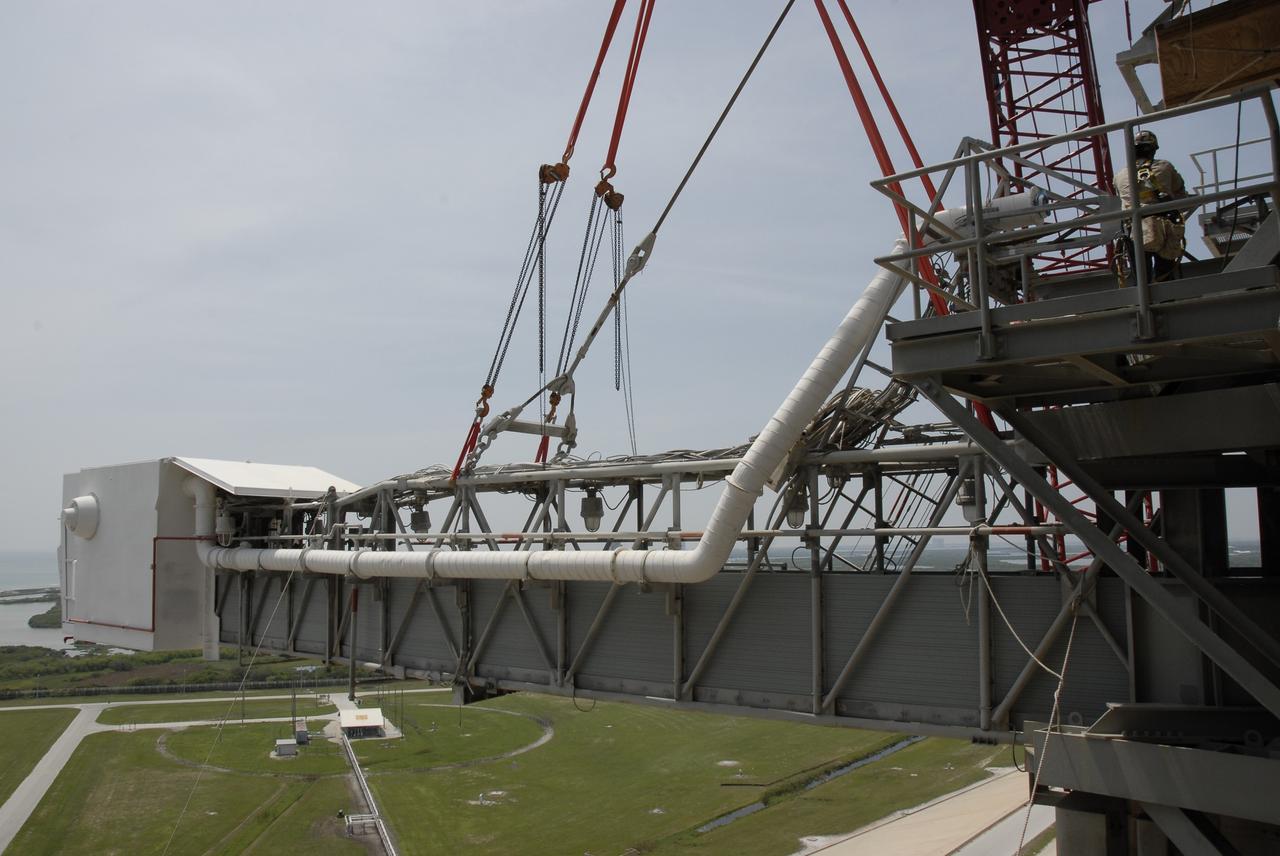
CAPE CANAVERAL, Fla. – The slings from a large crane are in place on the orbiter access arm, which ends in the White Room, that is part of the fixed service structure, or FSS, on Launch Pad 39B at NASA's Kennedy Space Center in Florida. The White Room provided entry into space shuttles that were on the pad. The arm is being removed from the FSS for the pad's conversion as launch site for the Constellation Program's Ares I-X. The launch of the Ares I-X flight test is targeted for August 2009. Photo credit: NASA/Kim Shiflett

CAPE CANAVERAL, Fla. – In the Payload Hazardous Servicing Facility at NASA's Kennedy Space Center, equipment is stacked for the flight support system (FSS) access scaffolding that will be used to prepare the Hubble Space Telescope, or HST, carriers for the STS-125 servicing mission 4. The FSS will berth, secure and furnish power to Hubble and also contains the soft capture mechanism to be attached to the telescope. Upon completion of STS-125, the Hubble will provide even deeper and more detailed views of the Universe. The STS-125 mission will be the final space shuttle mission to the Hubble Space Telescope. Photo credit: NASA/Jack Pfaller
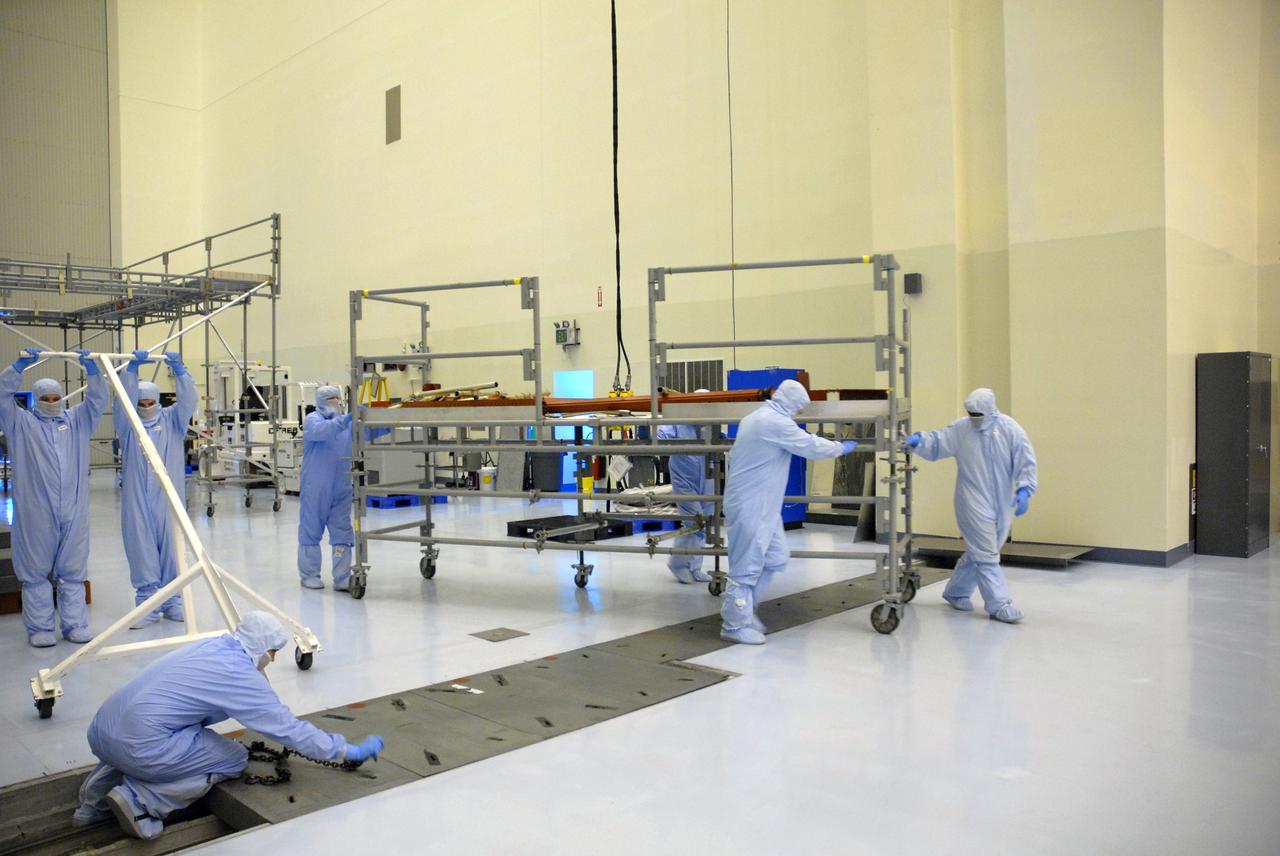
CAPE CANAVERAL, Fla. – In the Payload Hazardous Servicing Facility at NASA's Kennedy Space Center, workers move a piece of flight support system (FSS) access scaffolding. The scaffolding will be used to prepare the Hubble Space Telescope, or HST, carriers for the STS-125 servicing mission 4. The FSS will berth, secure and furnish power to Hubble and also contains the soft capture mechanism to be attached to the telescope. Upon completion of STS-125, the Hubble will provide even deeper and more detailed views of the Universe. The STS-125 mission will be the final space shuttle mission to the Hubble Space Telescope. Photo credit: NASA/Jack Pfaller
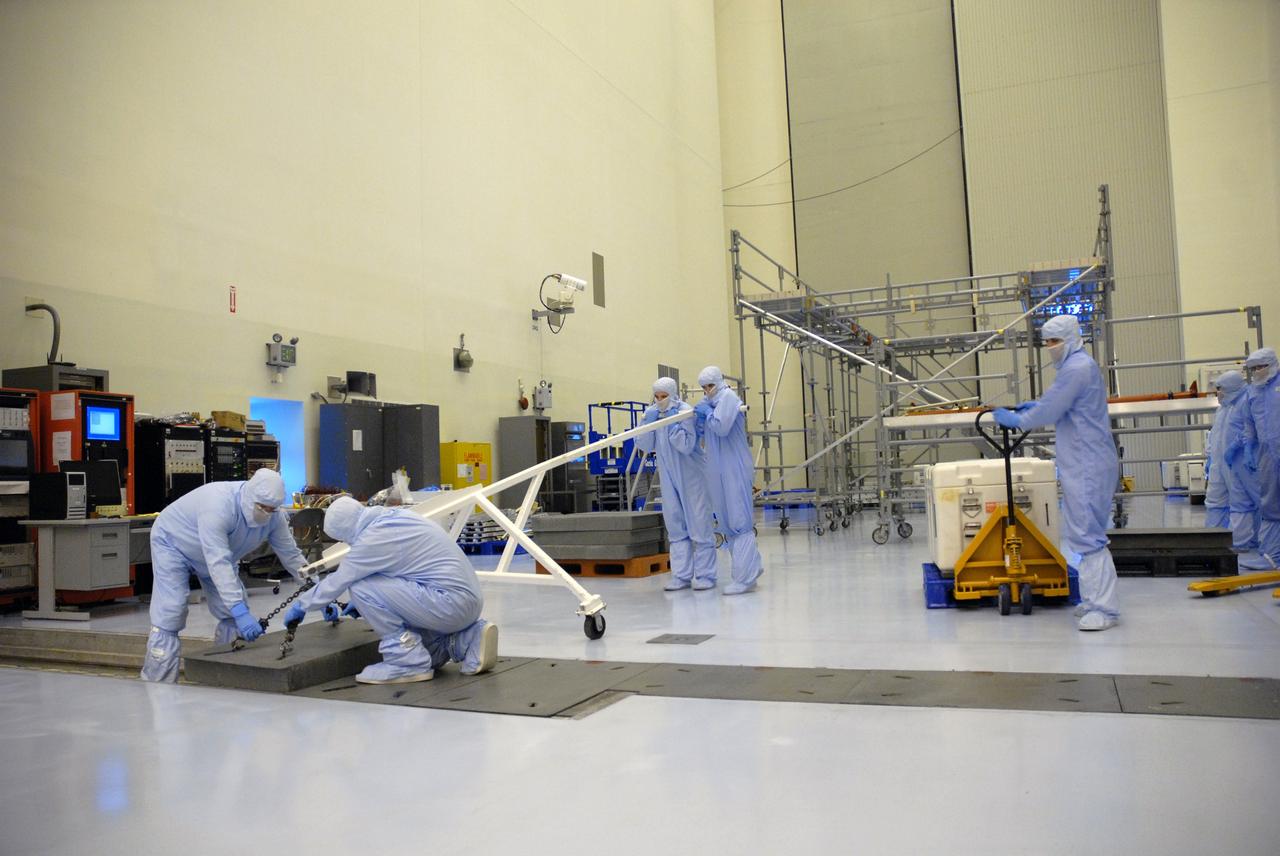
CAPE CANAVERAL, Fla. – In the Payload Hazardous Servicing Facility at NASA's Kennedy Space Center, workers prepare the floor in order to move flight support system (FSS) access scaffolding. The scaffolding will be used to prepare the Hubble Space Telescope, or HST, carriers for the STS-125 servicing mission 4. The FSS will berth, secure and furnish power to Hubble and also contains the soft capture mechanism to be attached to the telescope. Upon completion of STS-125, the Hubble will provide even deeper and more detailed views of the Universe. The STS-125 mission will be the final space shuttle mission to the Hubble Space Telescope. Photo credit: NASA/Jack Pfaller
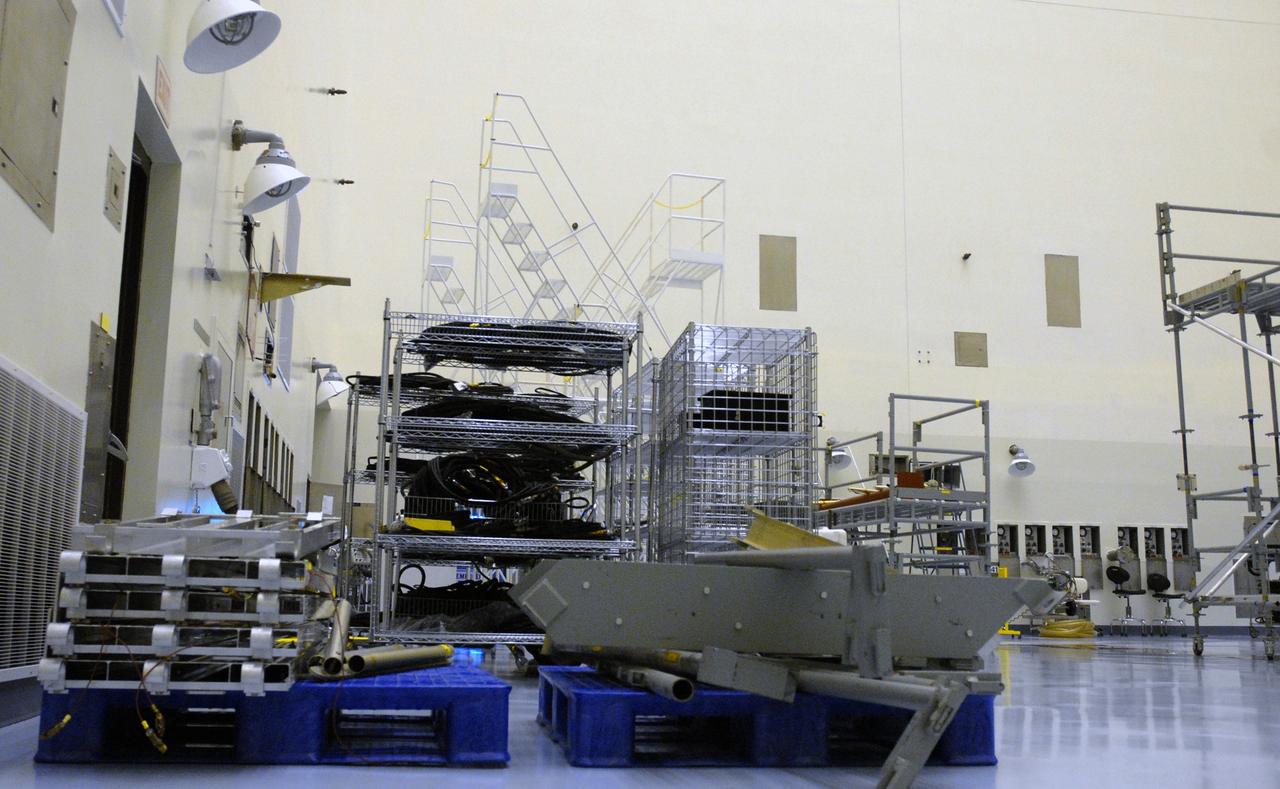
CAPE CANAVERAL, Fla. – In the Payload Hazardous Servicing Facility at NASA's Kennedy Space Center, equipment is stacked for the flight support system (FSS) access scaffolding that will be used to prepare the Hubble Space Telescope, or HST, carriers for the STS-125 servicing mission 4. The FSS will berth, secure and furnish power to Hubble and also contains the soft capture mechanism to be attached to the telescope. Upon completion of STS-125, the Hubble will provide even deeper and more detailed views of the Universe. The STS-125 mission will be the final space shuttle mission to the Hubble Space Telescope. Photo credit: NASA/Jack Pfaller
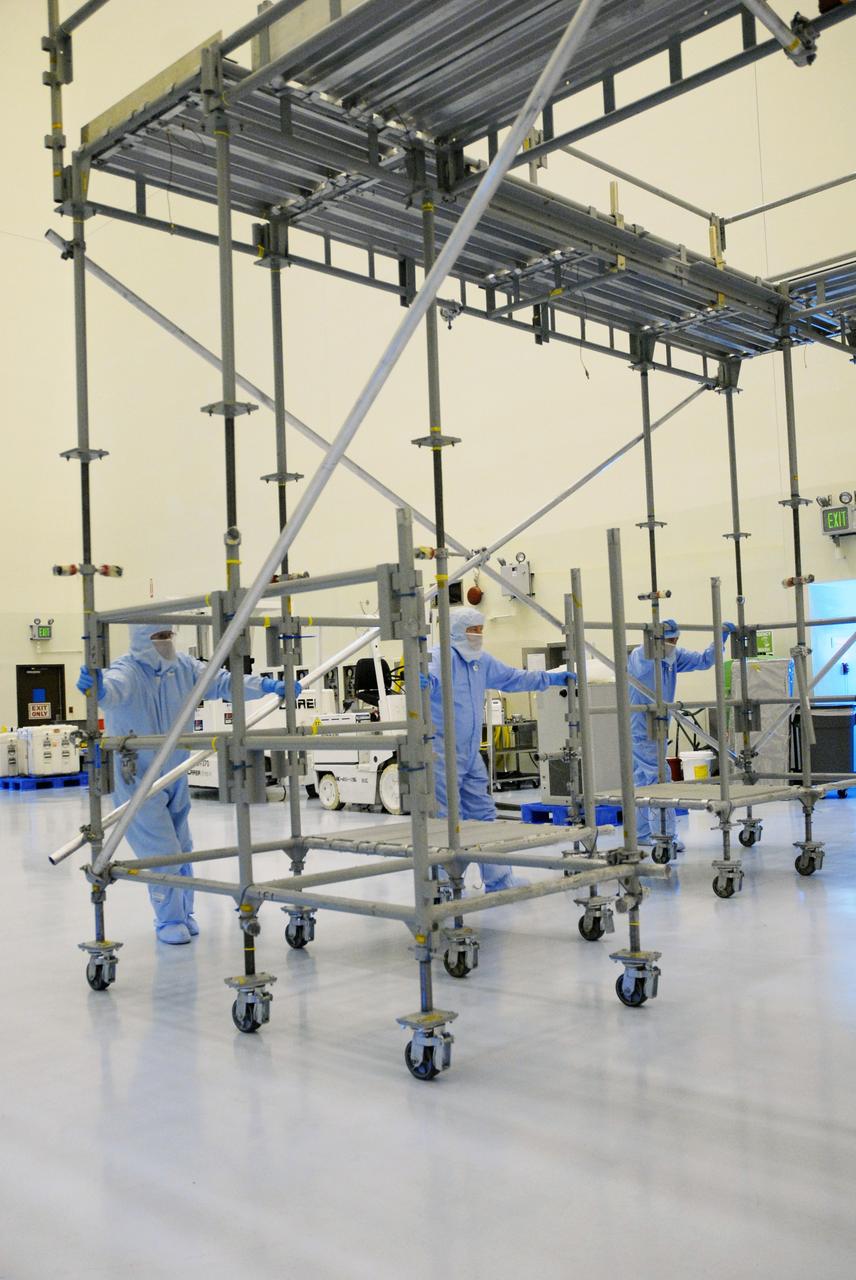
CAPE CANAVERAL, Fla. – In the Payload Hazardous Servicing Facility at NASA's Kennedy Space Center, workers move flight support system (FSS) access scaffolding that will be used to prepare the Hubble Space Telescope, or HST, carriers for the STS-125 servicing mission 4. The FSS will berth, secure and furnish power to Hubble and also contains the soft capture mechanism to be attached to the telescope. Upon completion of STS-125, the Hubble will provide even deeper and more detailed views of the Universe. The STS-125 mission will be the final space shuttle mission to the Hubble Space Telescope. Photo credit: NASA/Jack Pfaller
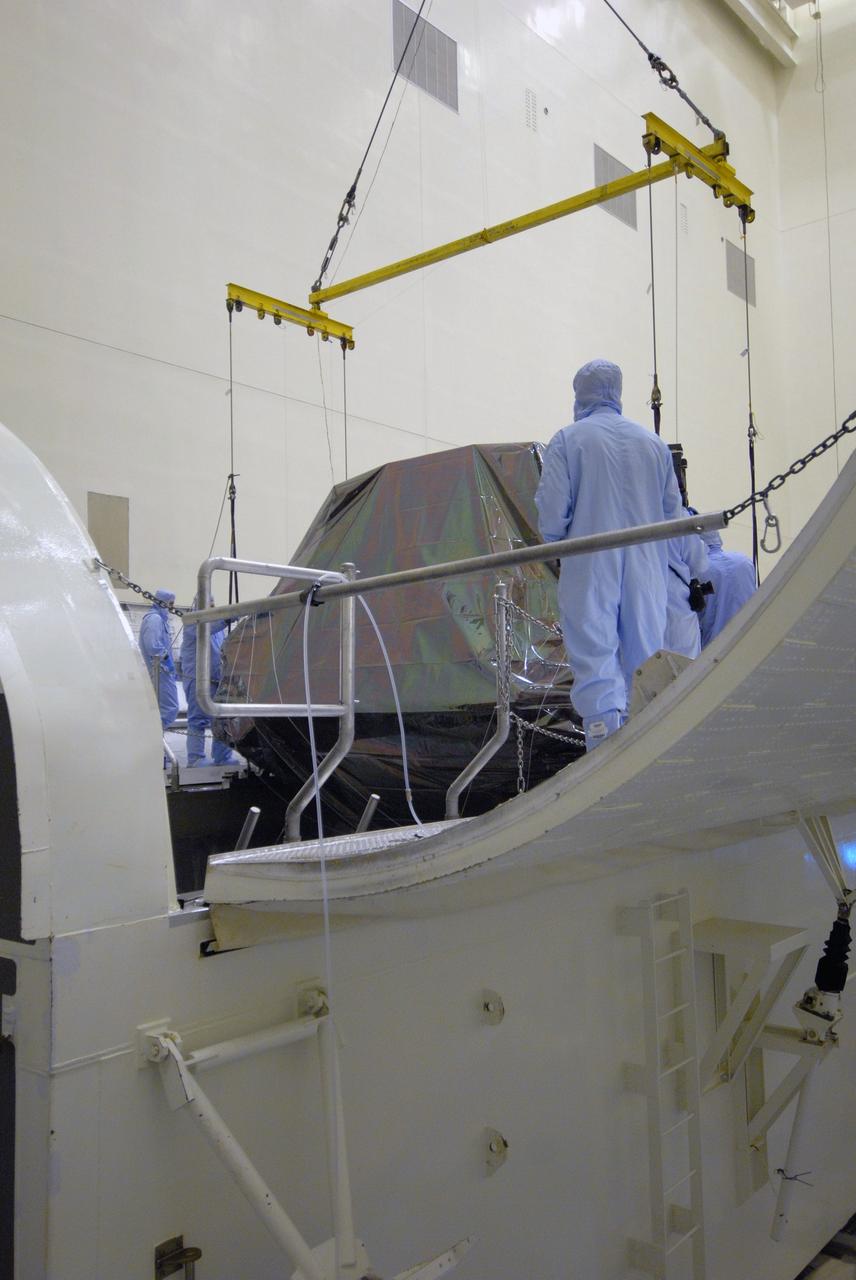
CAPE CANAVERAL, Fla. – In the Payload Hazardous Servicing Facility at NASA's Kennedy Space Center in Florida, an overhead crane lowers the Flight Support System, or FSS, carrier with the Soft Capture Mechanism into the payload canister. The canister will deliver the FSS and other carriers to Launch Pad 39A for installation in space shuttle Atlantis' payload bay. Atlantis' 11-day STS-125 mission to service NASA's Hubble Space Telescope is targeted for launch May 12. It will include five spacewalks in which astronauts will refurbish and upgrade the telescope with state-of-the-art science instruments. As a result, Hubble's capabilities will be expanded and its operational lifespan extended through at least 2014. Photo credit: NASA/Jack Pfaller
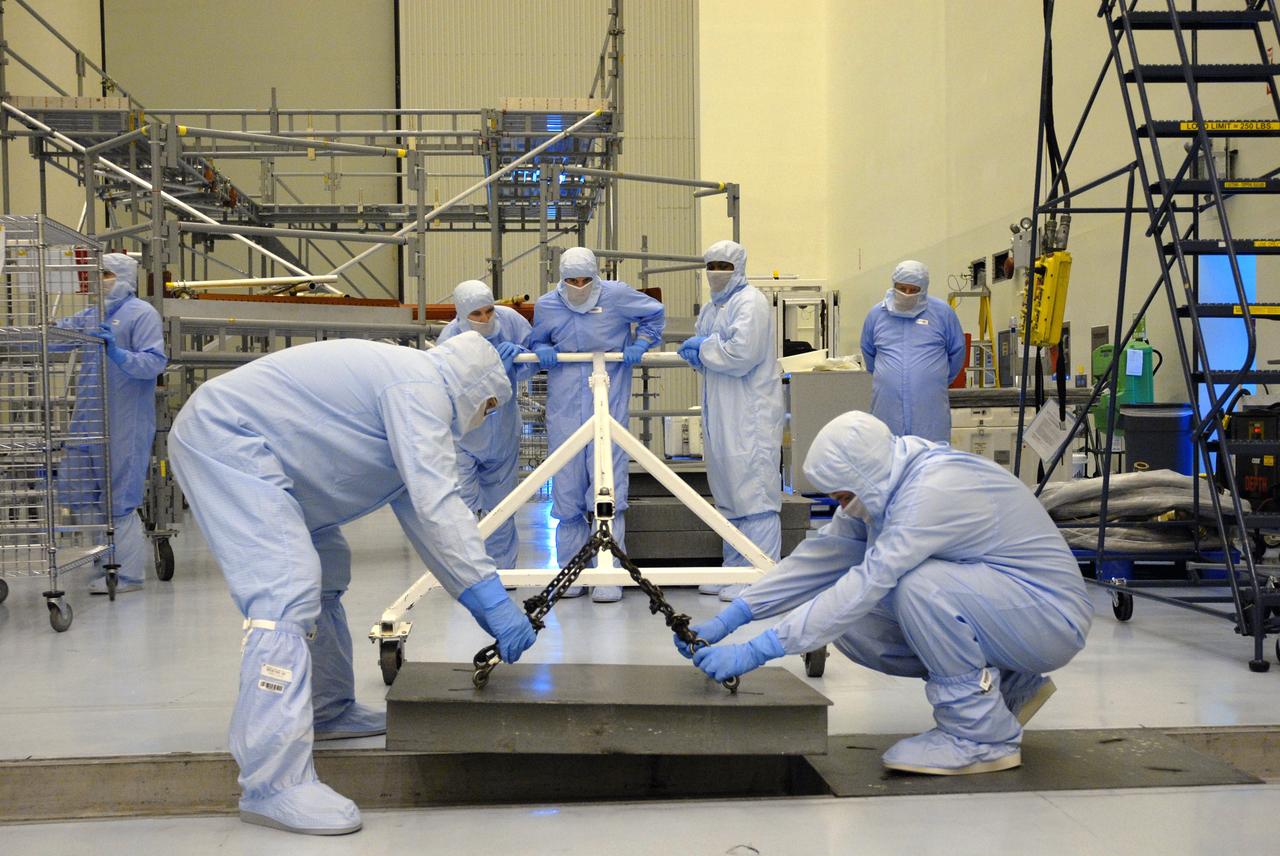
CAPE CANAVERAL, Fla. – In the Payload Hazardous Servicing Facility at NASA's Kennedy Space Center, workers prepare the floor in order to move flight support system (FSS) access scaffolding. The scaffolding will be used to prepare the Hubble Space Telescope, or HST, carriers for the STS-125 servicing mission 4. The FSS will berth, secure and furnish power to Hubble and also contains the soft capture mechanism to be attached to the telescope. Upon completion of STS-125, the Hubble will provide even deeper and more detailed views of the Universe. The STS-125 mission will be the final space shuttle mission to the Hubble Space Telescope. Photo credit: NASA/Jack Pfaller
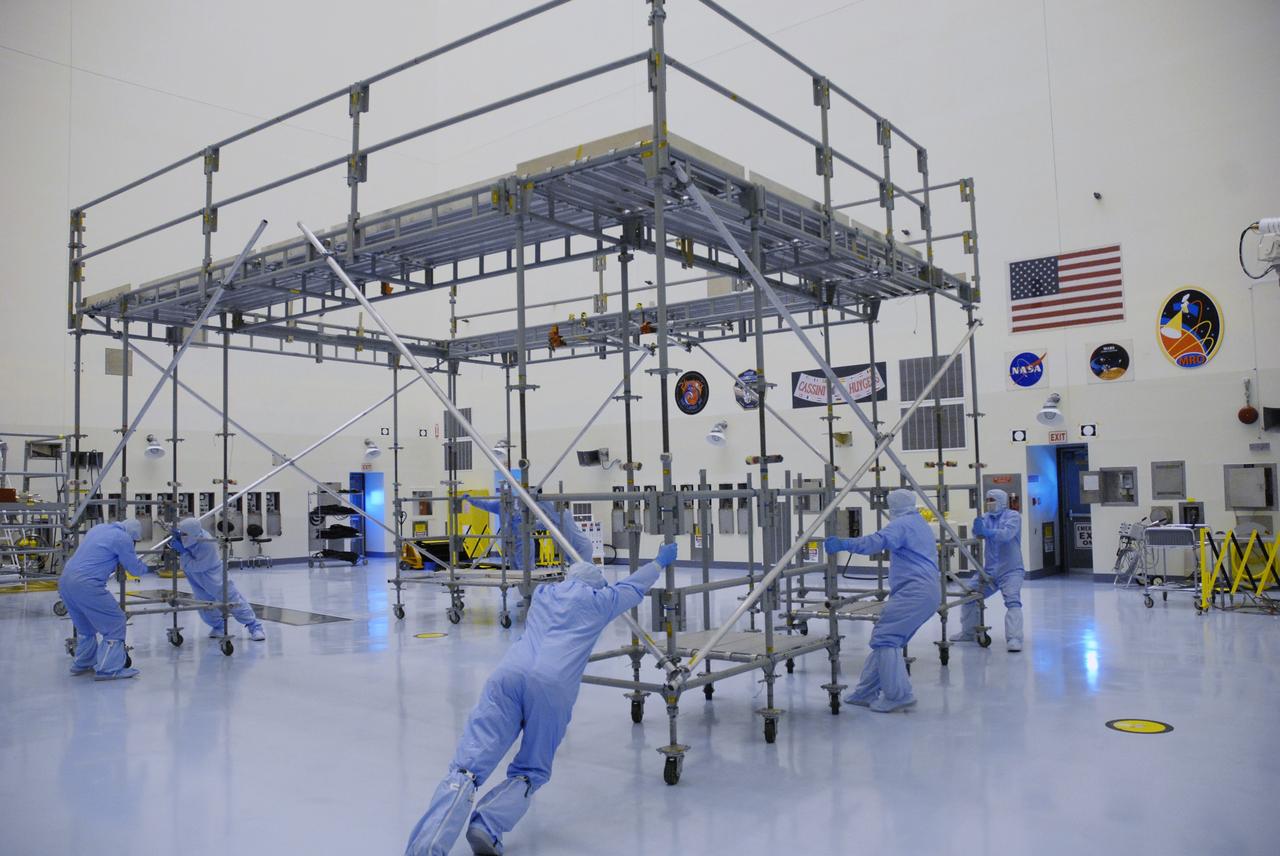
CAPE CANAVERAL, Fla. – In the Payload Hazardous Servicing Facility at NASA's Kennedy Space Center, workers move flight support system (FSS) access scaffolding that will be used to prepare the Hubble Space Telescope, or HST, carriers for the STS-125 servicing mission 4. The FSS will berth, secure and furnish power to Hubble and also contains the soft capture mechanism to be attached to the telescope. Upon completion of STS-125, the Hubble will provide even deeper and more detailed views of the Universe. The STS-125 mission will be the final space shuttle mission to the Hubble Space Telescope. Photo credit: NASA/Jack Pfaller
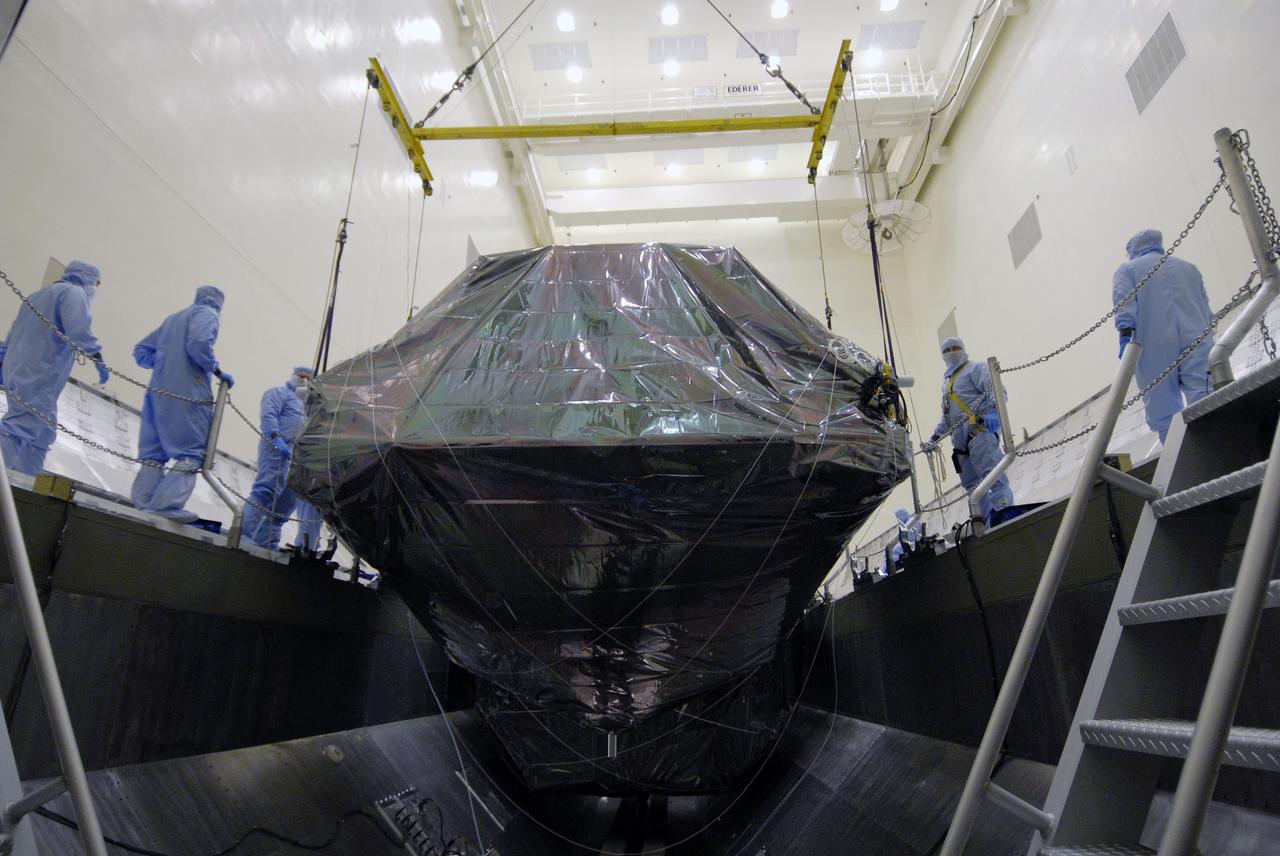
CAPE CANAVERAL, Fla. – In the Payload Hazardous Servicing Facility at NASA's Kennedy Space Center in Florida, an overhead crane lowers the Flight Support System, or FSS, carrier with the Soft Capture Mechanism into the payload canister. The canister will deliver the FSS and other carriers to Launch Pad 39A for installation in space shuttle Atlantis' payload bay. Atlantis' 11-day STS-125 mission to service NASA's Hubble Space Telescope is targeted for launch May 12. It will include five spacewalks in which astronauts will refurbish and upgrade the telescope with state-of-the-art science instruments. As a result, Hubble's capabilities will be expanded and its operational lifespan extended through at least 2014. Photo credit: NASA/Jack Pfaller
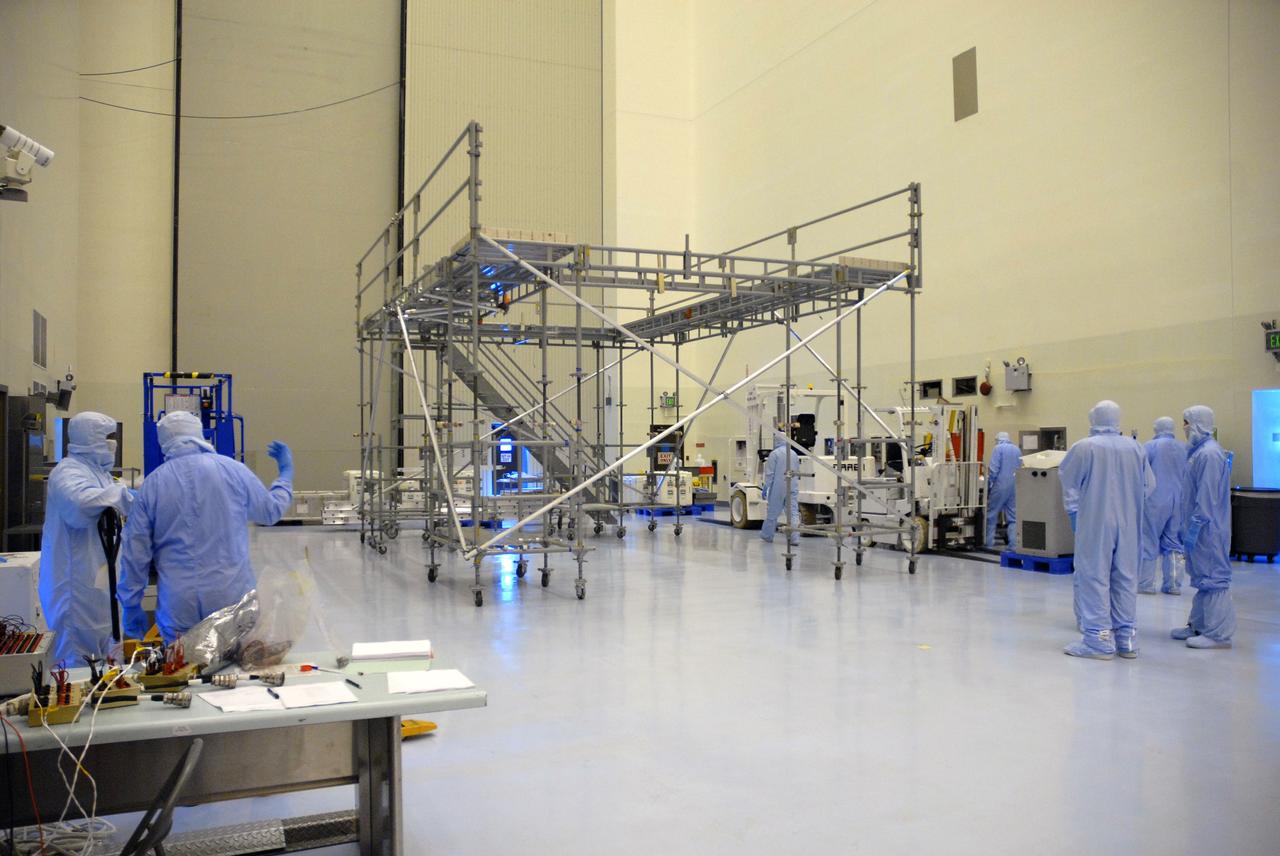
CAPE CANAVERAL, Fla. – In the Payload Hazardous Servicing Facility at NASA's Kennedy Space Center, workers are constructing flight support system (FSS) access scaffolding that will be used to prepare the Hubble Space Telescope, or HST, carriers for the STS-125 servicing mission 4. The FSS will berth, secure and furnish power to Hubble and also contains the soft capture mechanism to be attached to the telescope. Upon completion of STS-125, the Hubble will provide even deeper and more detailed views of the Universe. The STS-125 mission will be the final space shuttle mission to the Hubble Space Telescope. Photo credit: NASA/Jack Pfaller
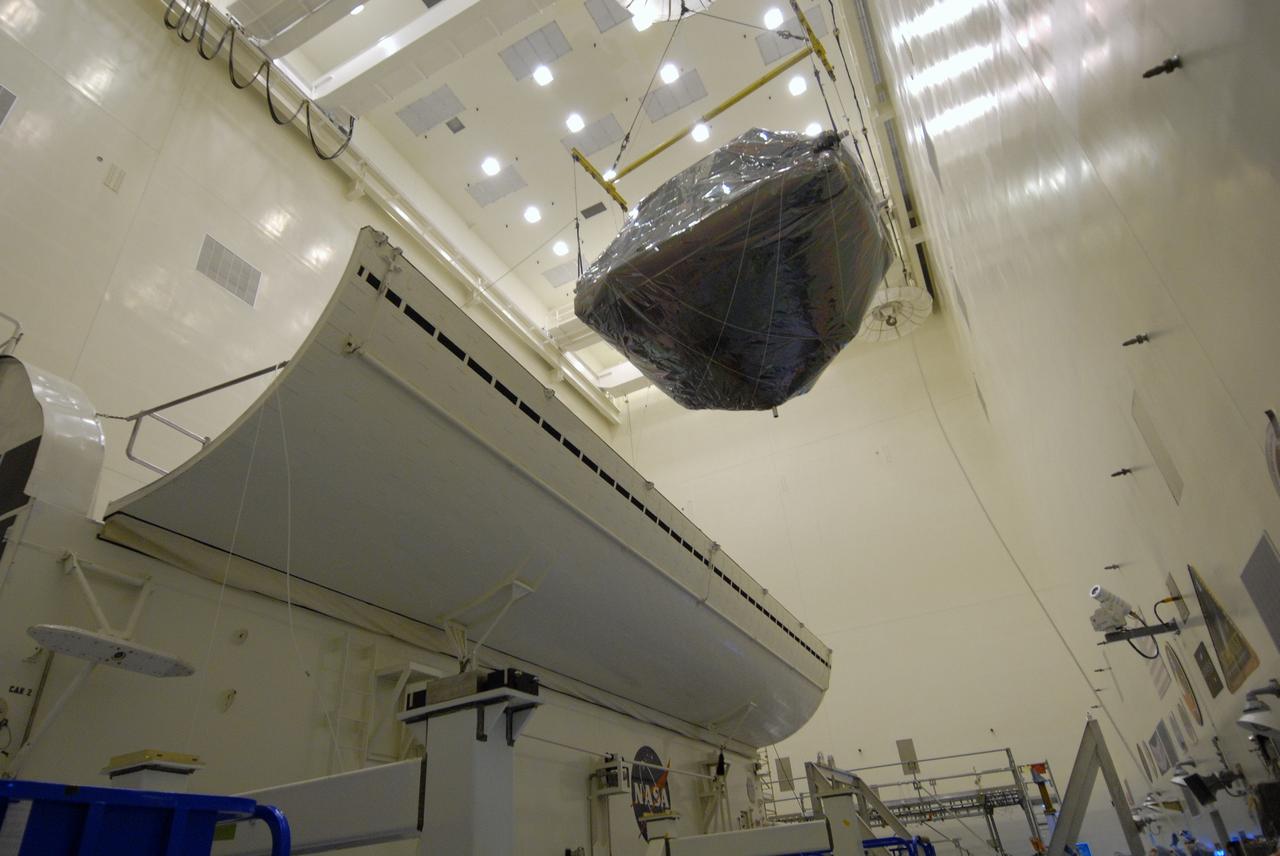
CAPE CANAVERAL, Fla. – In the Payload Hazardous Servicing Facility at NASA's Kennedy Space Center in Florida, an overhead crane moves the Flight Support System, or FSS, carrier with the Soft Capture Mechanism toward the payload canister. The canister will deliver the FSS and other carriers to Launch Pad 39A for installation in space shuttle Atlantis' payload bay. Atlantis' 11-day STS-125 mission to service NASA's Hubble Space Telescope is targeted for launch May 12. It will include five spacewalks in which astronauts will refurbish and upgrade the telescope with state-of-the-art science instruments. As a result, Hubble's capabilities will be expanded and its operational lifespan extended through at least 2014. Photo credit: NASA/Jack Pfaller
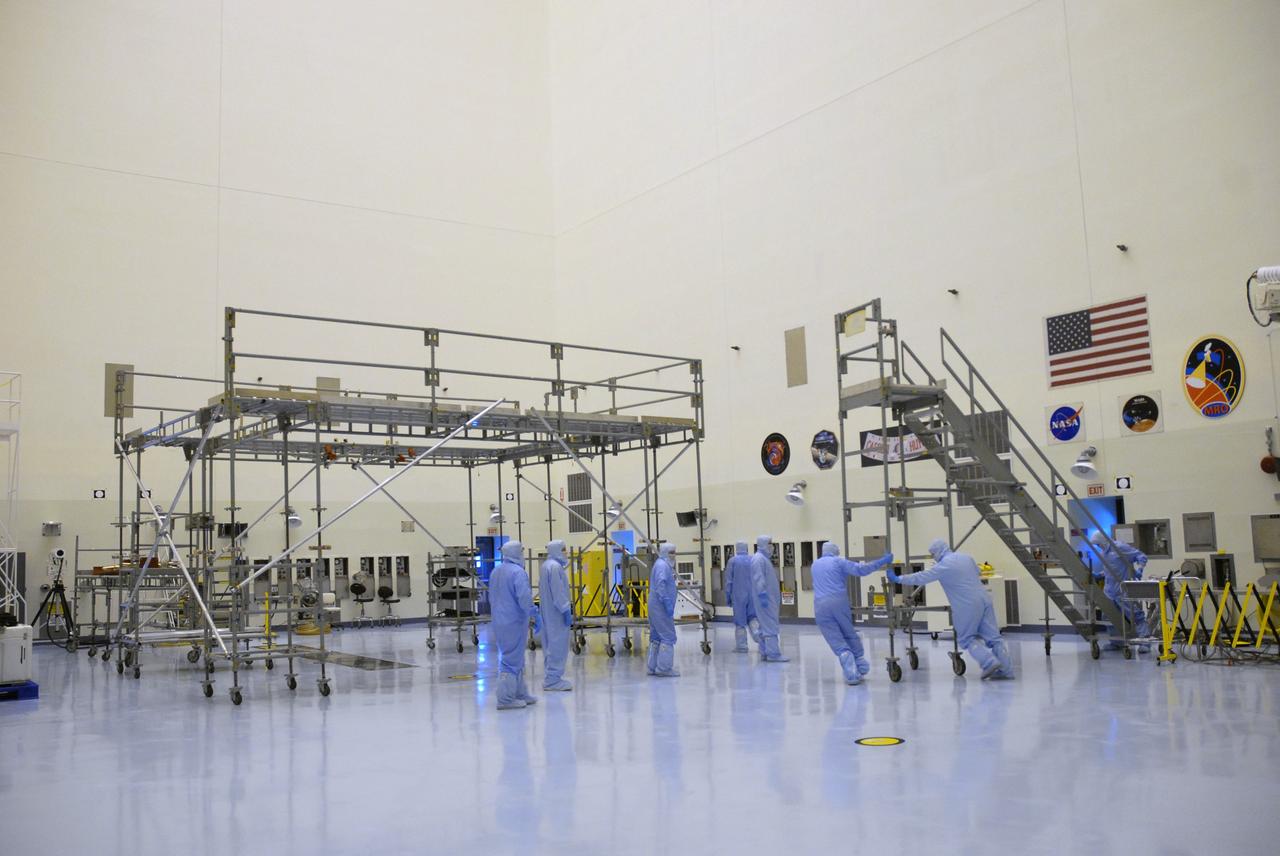
CAPE CANAVERAL, Fla. – In the Payload Hazardous Servicing Facility at NASA's Kennedy Space Center, workers move flight support system (FSS) access scaffolding that will be used to prepare the Hubble Space Telescope, or HST, carriers for the STS-125 servicing mission 4. The FSS will berth, secure and furnish power to Hubble and also contains the soft capture mechanism to be attached to the telescope. Upon completion of STS-125, the Hubble will provide even deeper and more detailed views of the Universe. The STS-125 mission will be the final space shuttle mission to the Hubble Space Telescope. Photo credit: NASA/Jack Pfaller
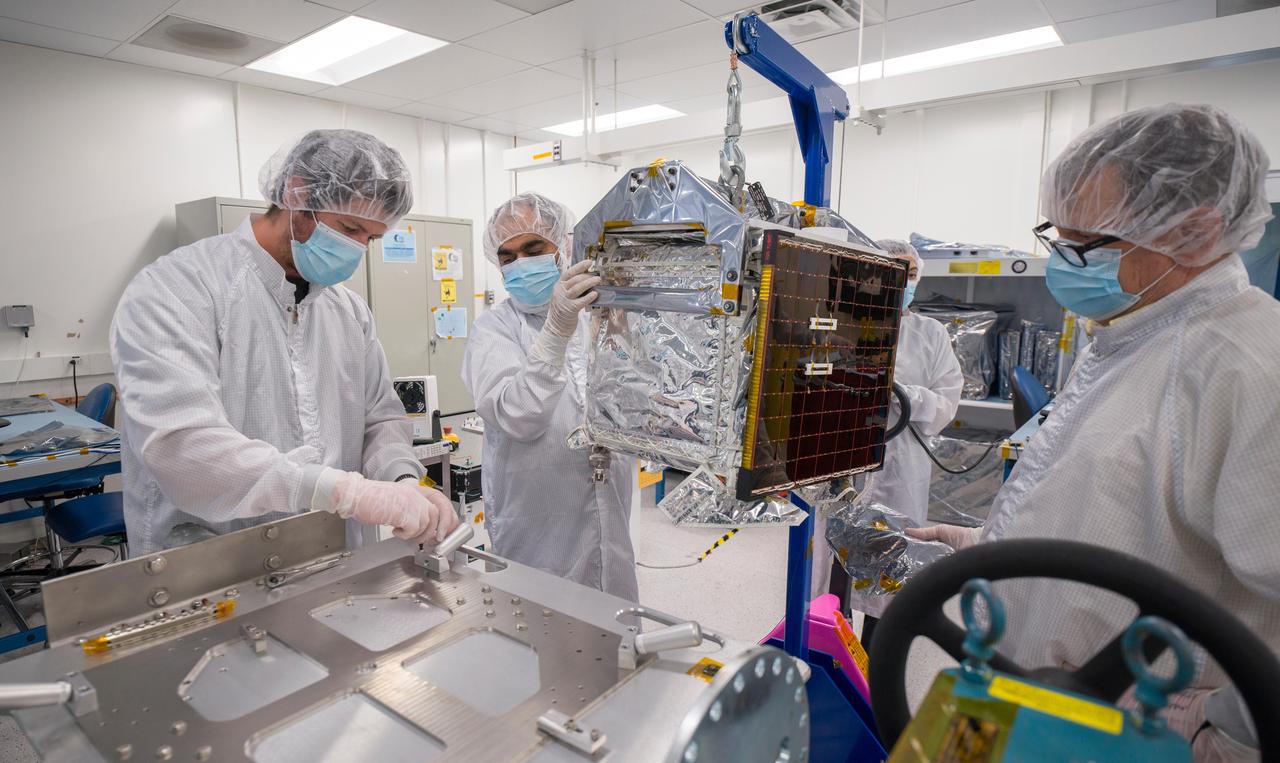
In a clean room at NASA's Jet Propulsion Laboratory in Southern California in March 2024, engineers and technicians prepare the agency's Farside Seismic Suite (FSS) for testing. The cube-shaped payload contains two instruments that will gather NASA's first seismic data from the Moon in nearly 50 years and take the first-ever seismic measurements from the Moon's far side. FSS will operate continuously for at least 4½ months, working through the long, cold lunar nights. Here, engineers move FSS onto a fixture that will allow them to tilt the payload, simulating the pull of lunar gravity in the direction at which one of the instrument's two seismometers is sensitive to motion. (The Moon's gravity is about one-sixth of Earth's.) Called an ambient tilt test, this activity allows engineers to check the seismometers' performance. The two seismometers are packaged together with a large battery, a computer, and electronics inside a cube structure that's surrounded by several layers of insulation and suspended within an outer protective cube, which is in turn covered with a shiny insulating blanket. The suite's single solar panel can be seen right of center. Surrounding the instrument are (from left): Nik Schwarz, Vik Singh, Joanna Farias, and Bert Turney. https://photojournal.jpl.nasa.gov/catalog/PIA26298
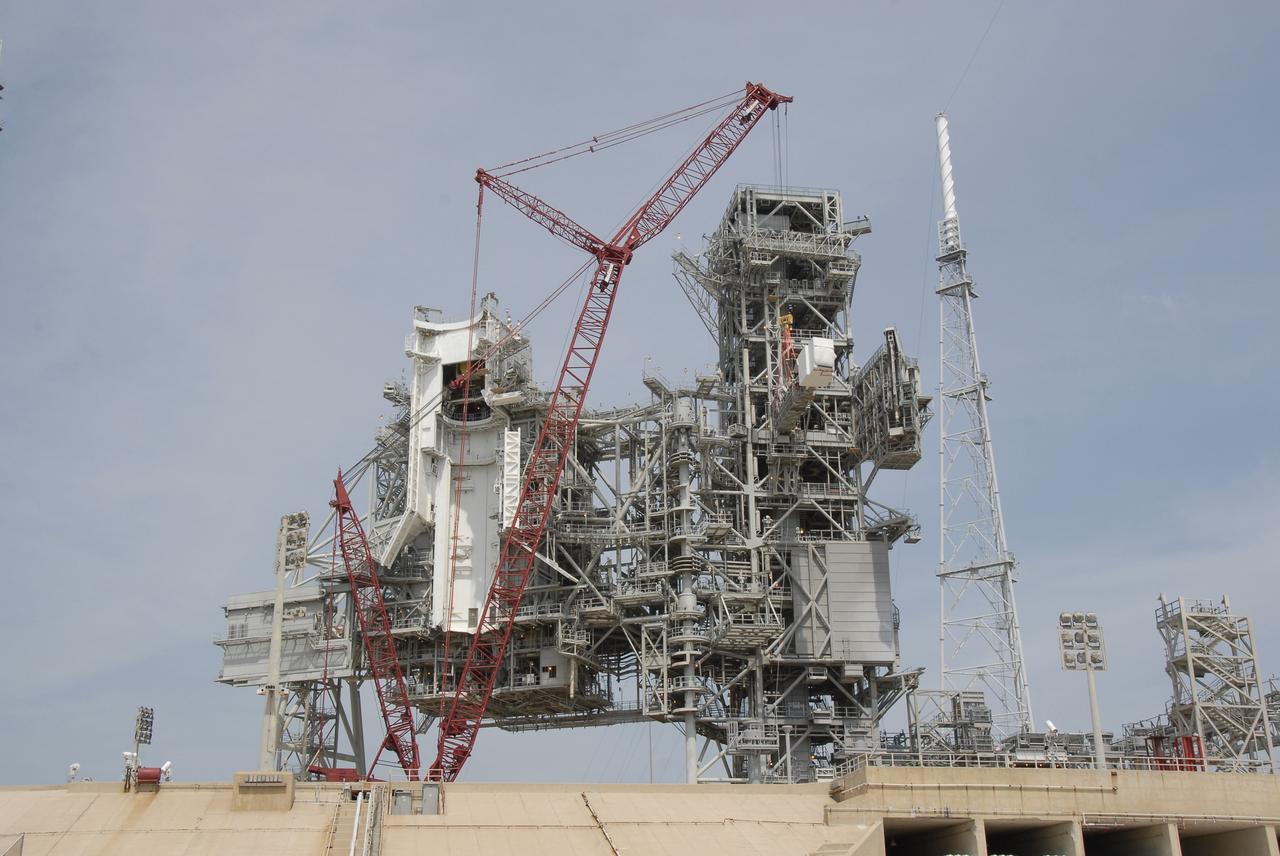
CAPE CANAVERAL, Fla. – The slings from a large crane are being attached to the orbiter access arm, which ends in the White Room, that is part of the fixed service structure, or FSS, on Launch Pad 39B at NASA's Kennedy Space Center in Florida. The White Room provided entry into space shuttles that were on the pad. The arm is being removed from the FSS for the pad's conversion as launch site for the Constellation Program's Ares I-X. The launch of the Ares I-X flight test is targeted for August 2009. Photo credit: NASA/Kim Shiflett
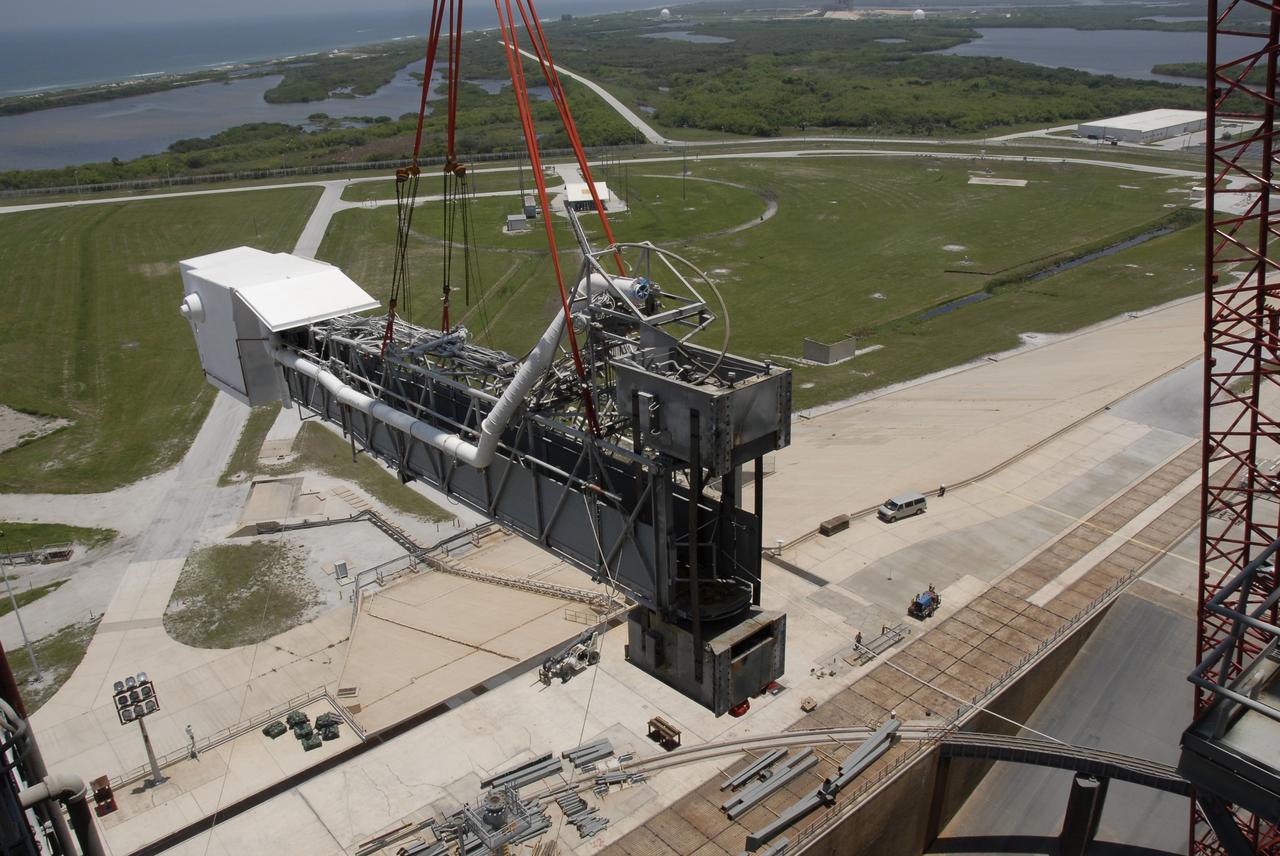
CAPE CANAVERAL, Fla. – The slings from a large crane swing the detached orbiter access arm, which ends in the White Room, away from the fixed service structure, or FSS, on Launch Pad 39B at NASA's Kennedy Space Center in Florida. The White Room provided entry into space shuttles that were on the pad. The arm is being removed from the FSS for the pad's conversion as launch site for the Constellation Program's Ares I-X. The launch of the Ares I-X flight test is targeted for August 2009. Photo credit: NASA/Kim Shiflett
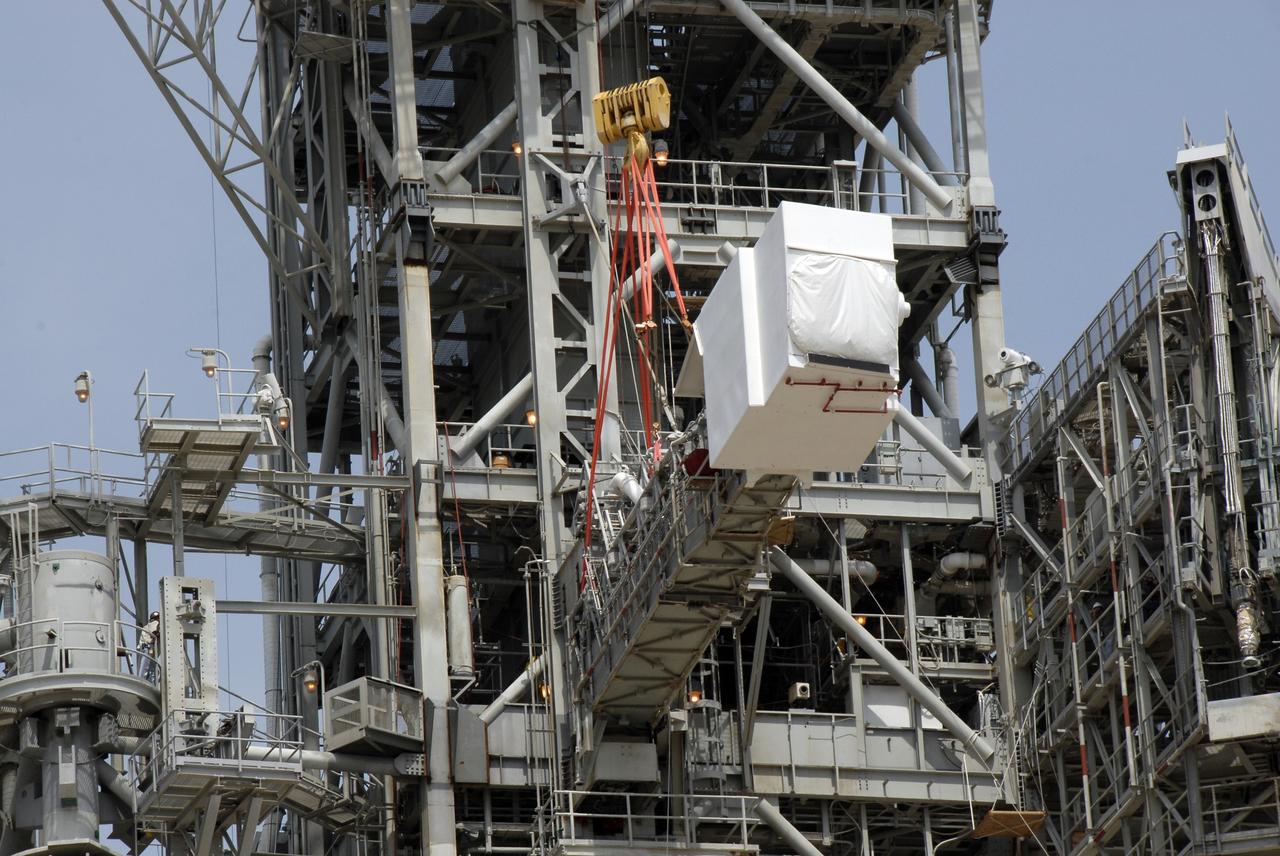
CAPE CANAVERAL, Fla. – The slings from a large crane are being attached to the orbiter access arm, which ends in the White Room, that is part of the fixed service structure, or FSS, on Launch Pad 39B at NASA's Kennedy Space Center in Florida. The White Room provided entry into space shuttles that were on the pad. The arm is being removed from the FSS for the pad's conversion as launch site for the Constellation Program's Ares I-X. The launch of the Ares I-X flight test is targeted for August 2009. Photo credit: NASA/Kim Shiflett
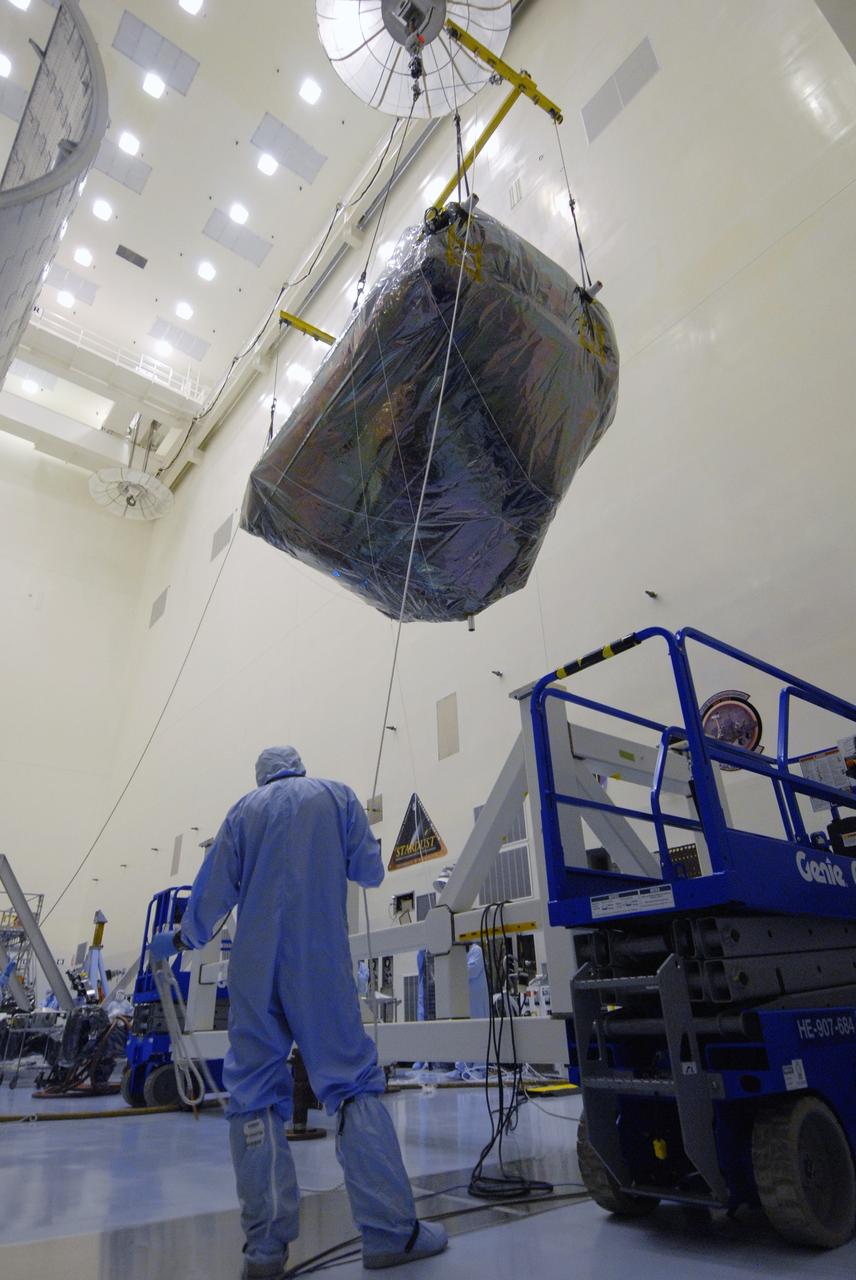
CAPE CANAVERAL, Fla. – In the Payload Hazardous Servicing Facility at NASA's Kennedy Space Center in Florida, an overhead crane is used to lift the Flight Support System, or FSS, carrier with the Soft Capture Mechanism from the workstand. The FSS will be placed in the payload canister and delivered with other carriers to Launch Pad 39A for installation in space shuttle Atlantis' payload bay. Atlantis' 11-day STS-125 mission to service NASA's Hubble Space Telescope is targeted for launch May 12. It will include five spacewalks in which astronauts will refurbish and upgrade the telescope with state-of-the-art science instruments. As a result, Hubble's capabilities will be expanded and its operational lifespan extended through at least 2014. Photo credit: NASA/Jack Pfaller
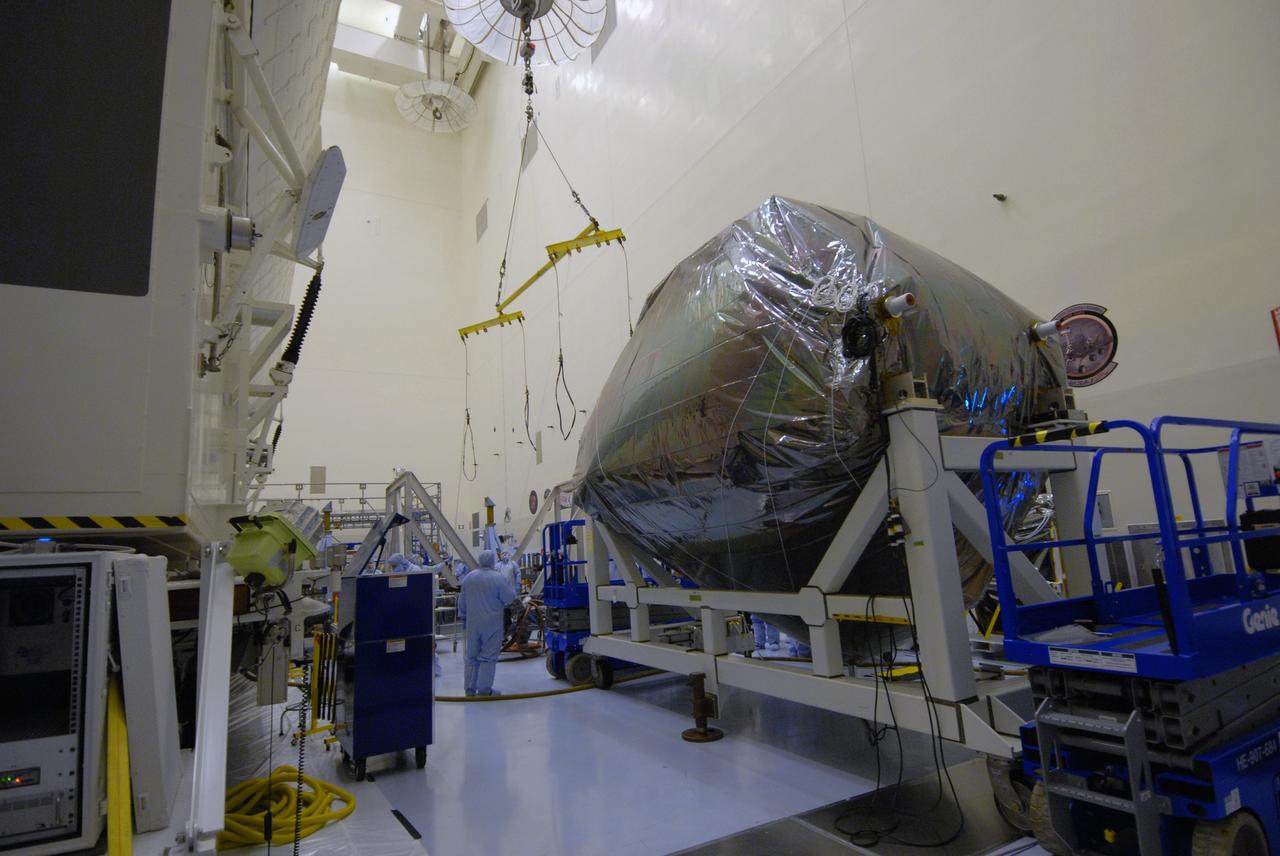
CAPE CANAVERAL, Fla. – In the Payload Hazardous Servicing Facility at NASA's Kennedy Space Center in Florida, the Flight Support System, or FSS, carrier with the Soft Capture Mechanism is waiting to be lifted from the workstand and placed in the payload canister. The canister will deliver the FSS and other carriers to Launch Pad 39A for installation in space shuttle Atlantis' payload bay. Atlantis' 11-day STS-125 mission to service NASA's Hubble Space Telescope is targeted for launch May 12. It will include five spacewalks in which astronauts will refurbish and upgrade the telescope with state-of-the-art science instruments. As a result, Hubble's capabilities will be expanded and its operational lifespan extended through at least 2014. Photo credit: NASA/Jack Pfaller
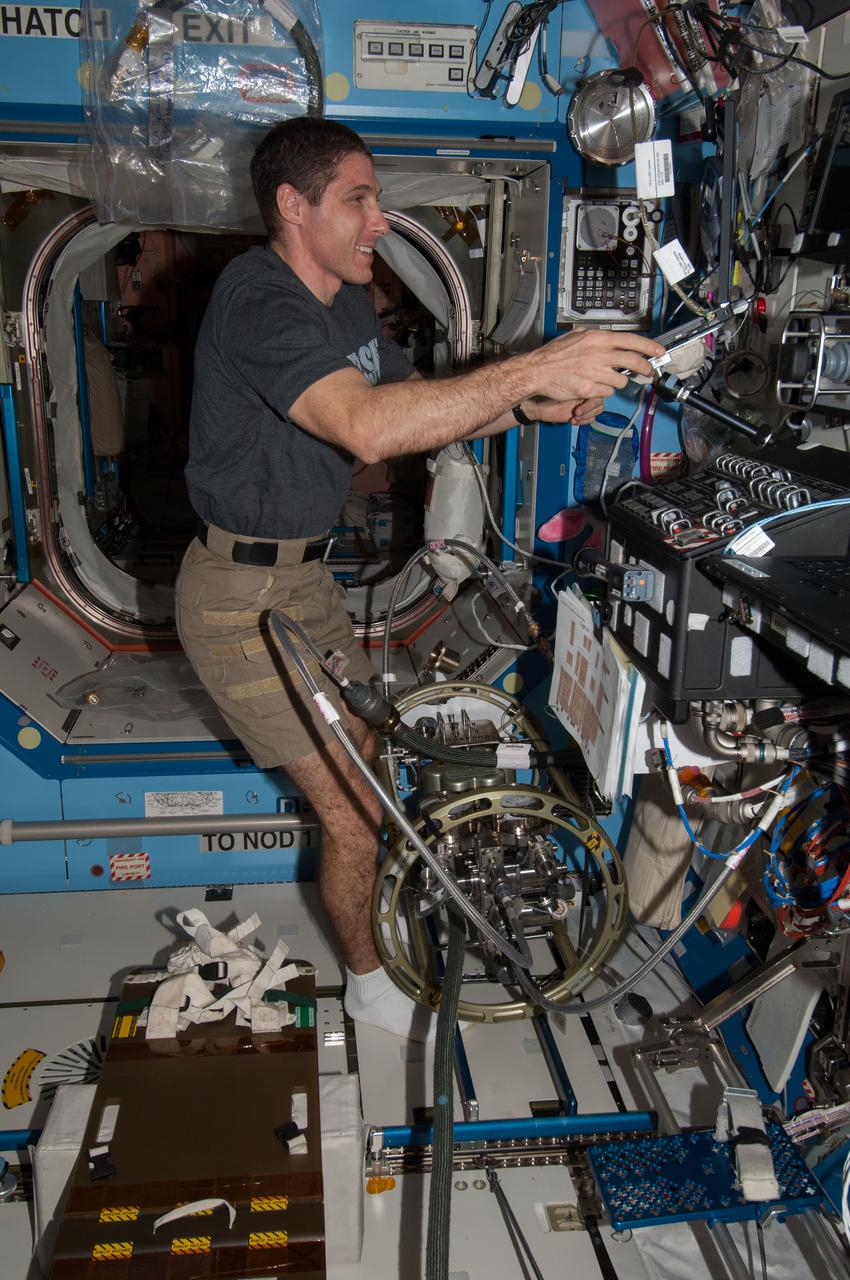
ISS038-E-040111 (31 Jan. 2014) --- NASA astronaut Mike Hopkins, Expedition 38 flight engineer, uses the Fluid Servicing System (FSS) to refill Internal Thermal Control System (ITCS) loops with fresh coolant in the Destiny laboratory of the International Space Station.
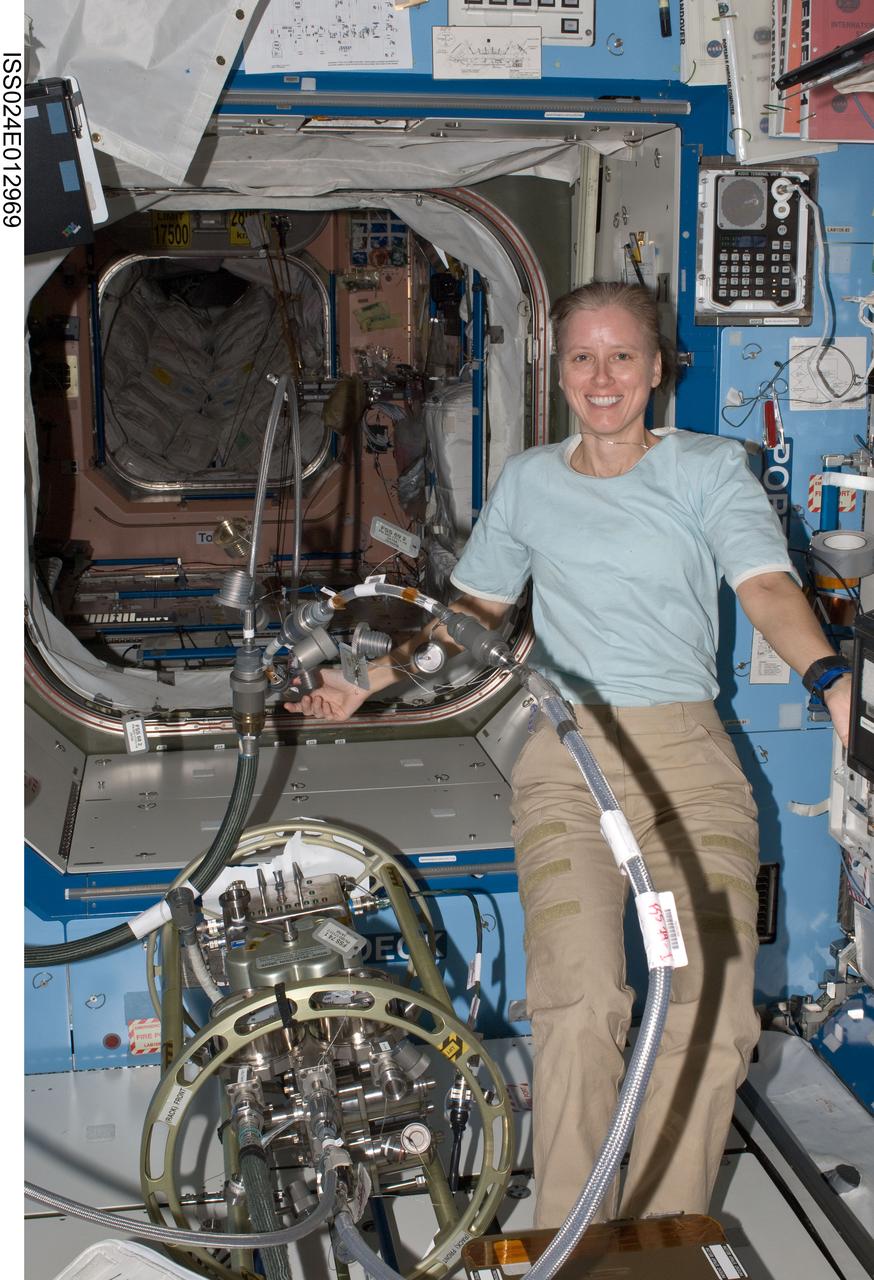
ISS024-E-012969 (31 Aug. 2010) --- NASA astronaut Shannon Walker, Expedition 24 flight engineer, works with the Fluid Servicing System (FSS) in the Destiny laboratory of the International Space Station.
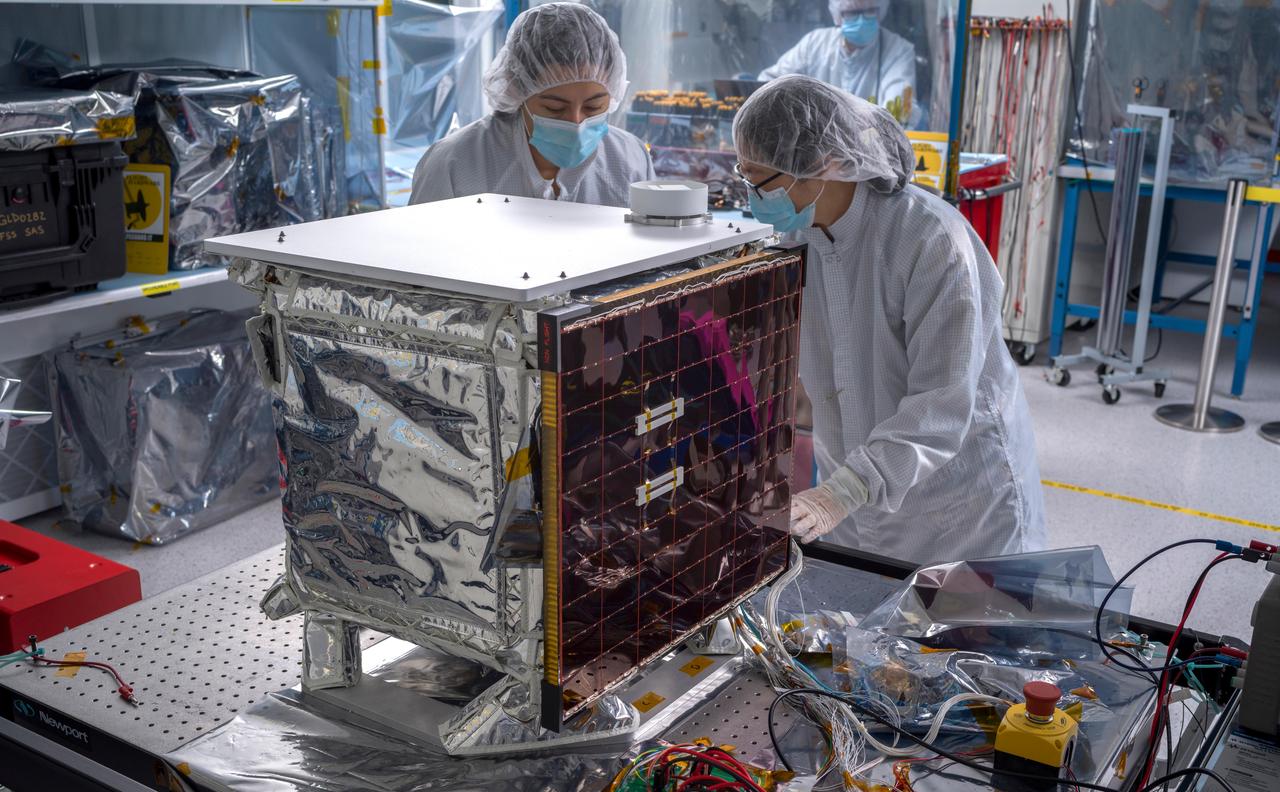
In a clean room at NASA's Jet Propulsion Laboratory in Southern California in March 2024, engineers and technicians work to prepare the agency's Farside Seismic Suite (FSS) for environmental testing to simulate conditions it will encounter in space. Along with being placed in a vacuum chamber and subjected to extreme temperatures, the instrument suite will undergo severe shaking that mimics the rocket's motion during launch. The cube-shaped payload contains two instruments that will gather NASA's first seismic data from the Moon in nearly 50 years and take the first-ever seismic measurements from the Moon's far side. FSS will operate continuously for at least 4½ months, working through the long, cold lunar nights. The two seismometers are packaged together with a large battery, a computer, and electronics inside a cube structure that's surrounded by several layers of insulation and suspended within an outer protective cube, which is in turn covered with a shiny insulating blanket. The suite's single solar panel can be seen at center. On top is a white radiator that will allow the suite to shed heat generated by its electronics during the hot lunar daytime hours. The puck-like object atop the radiator is the suite's antenna, for communicating with two small relay satellites that will orbit the Moon and send data to Earth. Pictured (from left): Joanna Farias, and Bert Turney, and Hsin-Yi Hao. https://photojournal.jpl.nasa.gov/catalog/PIA26299
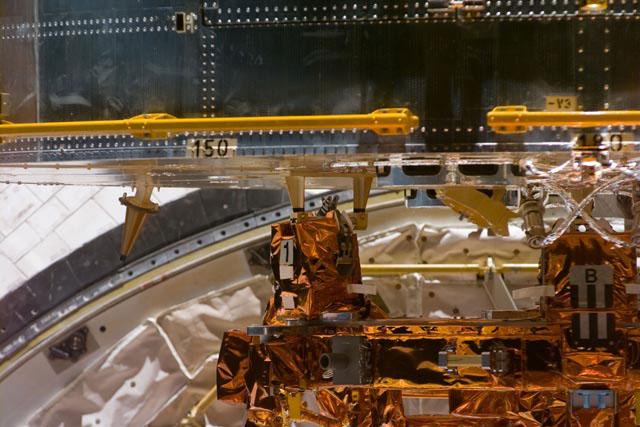
S103-E-5170 (21 December 1999) --- This closeup electronic still camera's view shows the lower portion of the Hubble Space Telescope (HST) as the giant observatory is berthed in Discovery's cargo bay. The gold-shielded apparatus at the bottom of the frame is the flight support system (FSS), a turntable device similar to a "Lazy Susan" because of its ability to rotate and tilt to assist the upcoming servicing tasks. The image was recorded at 19:49:22 GMT, Dec. 21, 1999 but was not able to be downlinked by the astronauts until late on the following day.
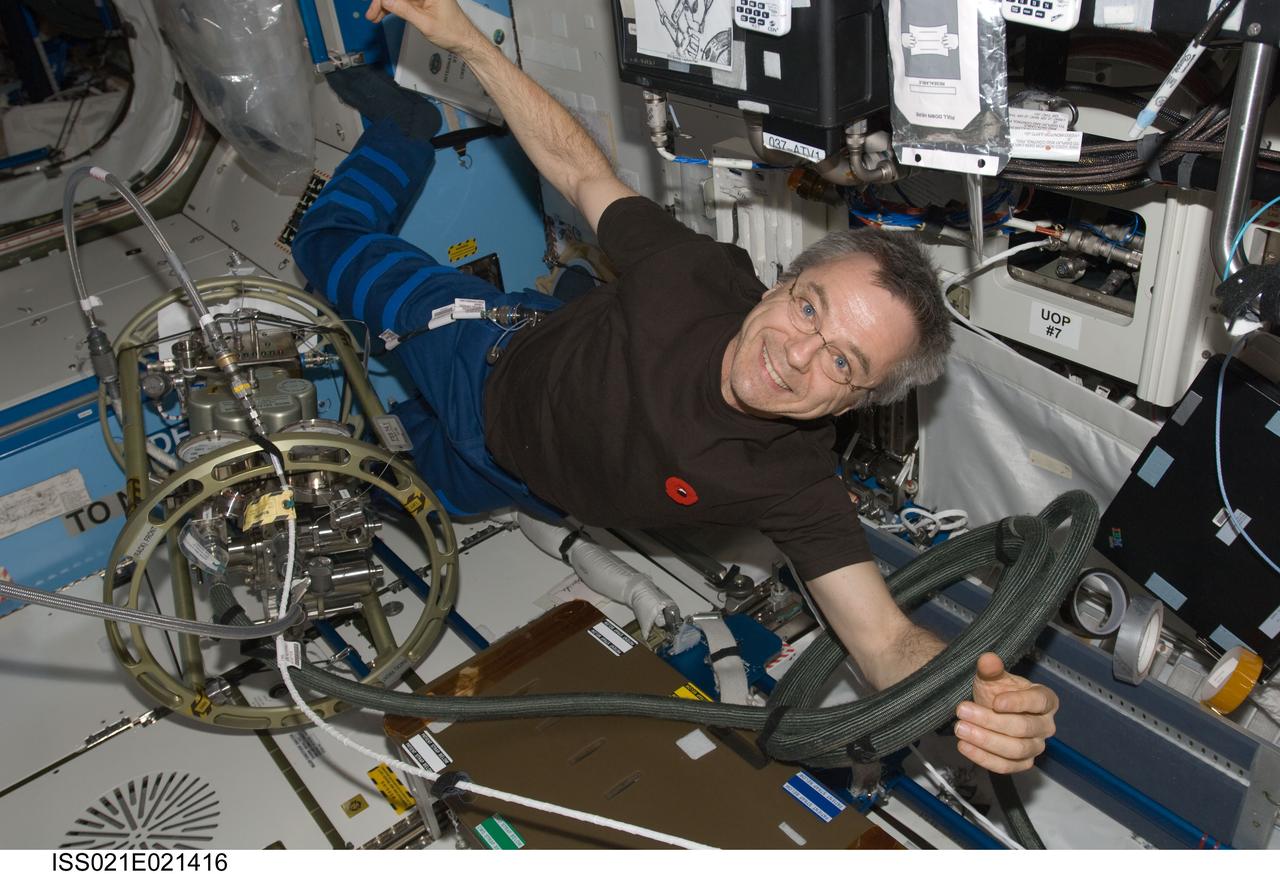
ISS021-E-021416 (5 Nov. 2009) --- Canadian Space Agency astronaut Robert Thirsk, Expedition 21 flight engineer, uses the Fluid Servicing System (FSS) to refill Internal Thermal Control System (ITCS) loops with fresh coolant in the Destiny laboratory of the International Space Station.
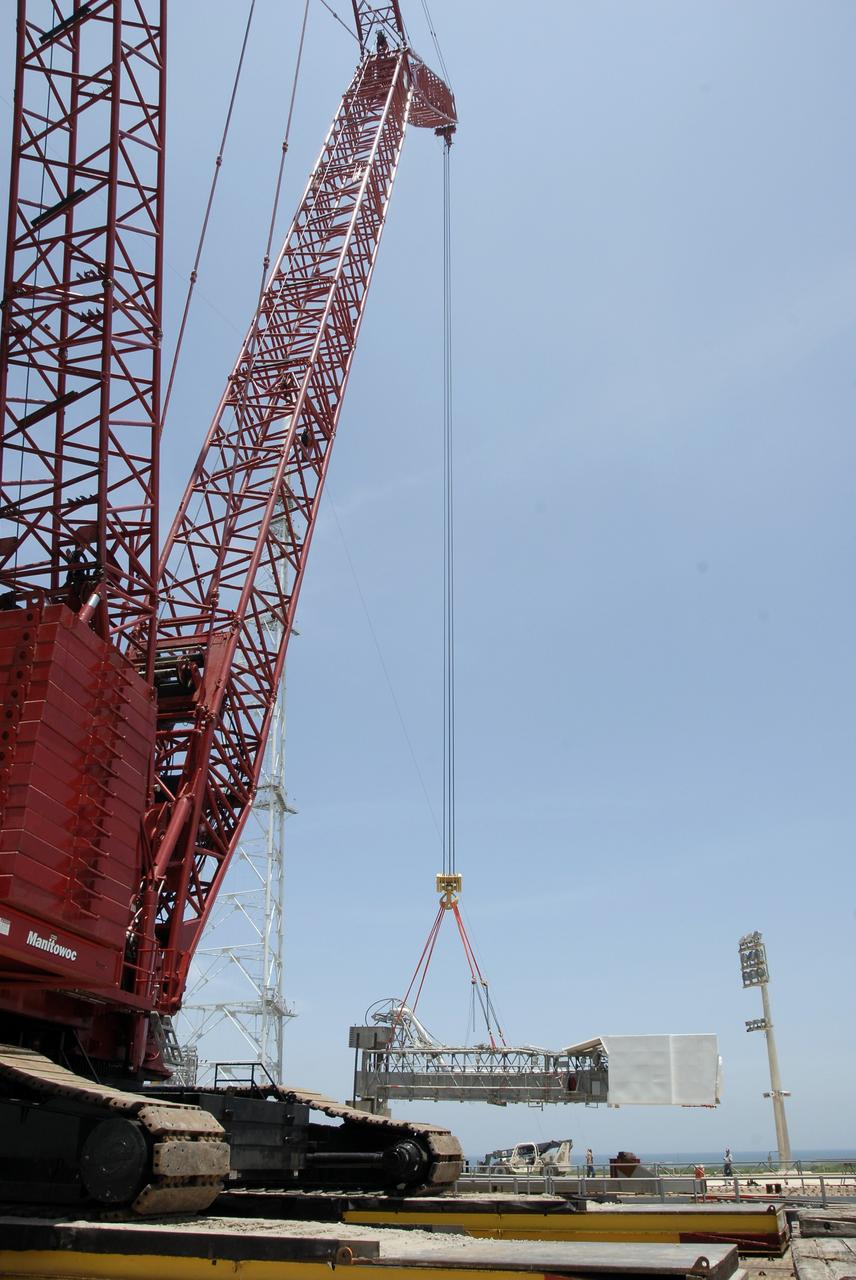
CAPE CANAVERAL, Fla. – On Launch Pad 39B at NASA's Kennedy Space Center in Florida, the crane lowers the orbiter access arm, which ends in the White Room, toward the ground. The arm is being removed from the FSS for the pad's conversion as launch site for the Constellation Program's Ares I-X. The launch of the Ares I-X flight test is targeted for August 2009. Photo credit: NASA/Kim Shiflett
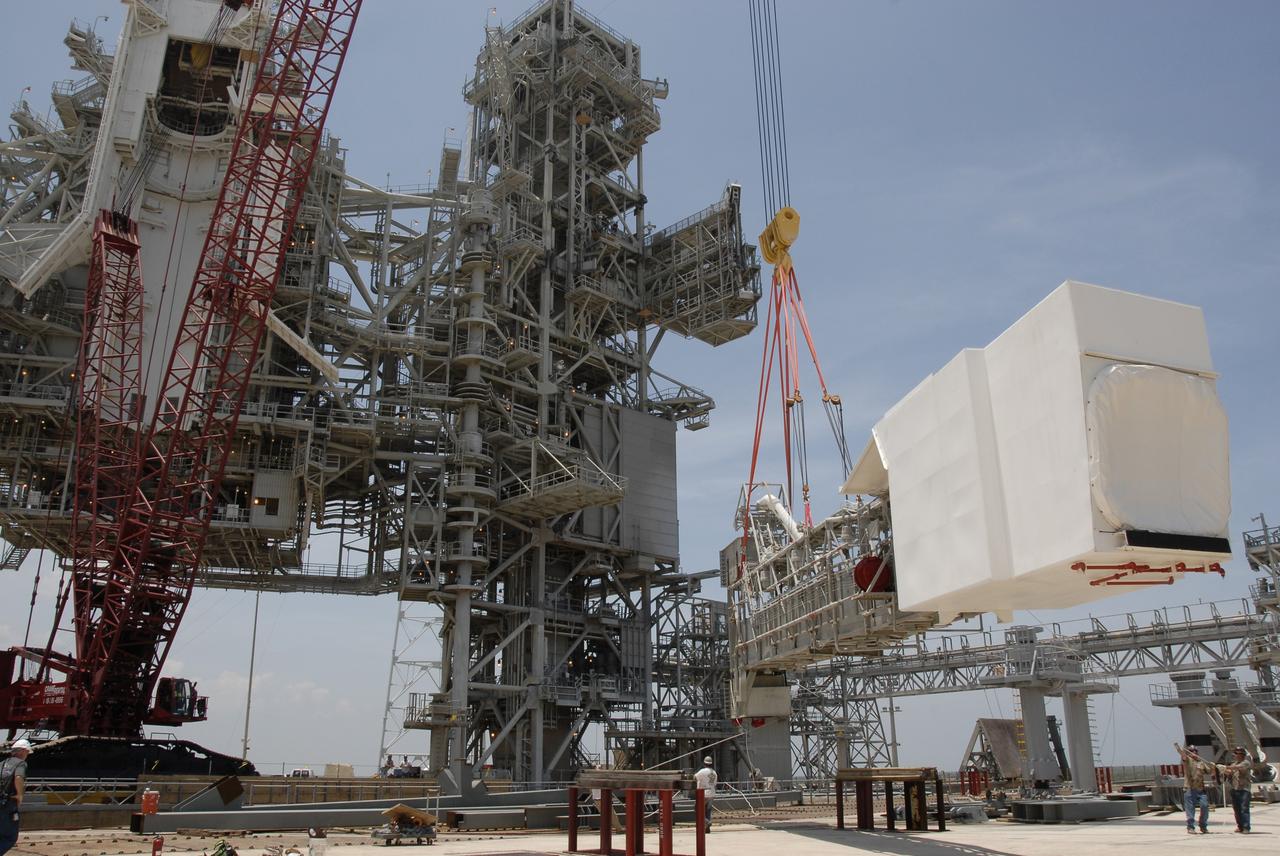
CAPE CANAVERAL, Fla. – On Launch Pad 39B at NASA's Kennedy Space Center in Florida, the crane lowers the orbiter access arm, which ends in the White Room, toward the ground. The arm is being removed from the FSS for the pad's conversion as launch site for the Constellation Program's Ares I-X. The launch of the Ares I-X flight test is targeted for August 2009. Photo credit: NASA/Kim Shiflett
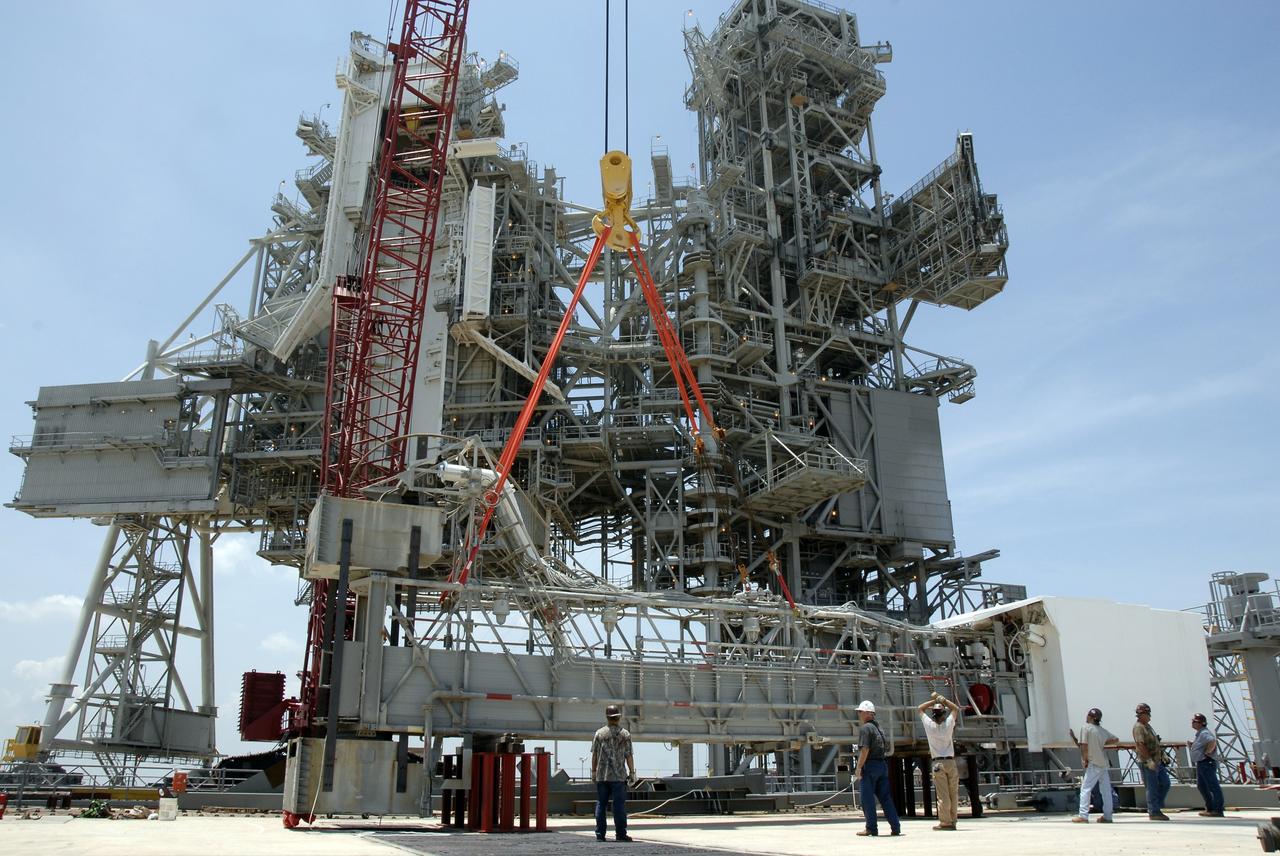
CAPE CANAVERAL, Fla. – On Launch Pad 39B at NASA's Kennedy Space Center in Florida, the crane lowers the orbiter access arm, which ends in the White Room, toward the ground. The arm is being removed from the FSS for the pad's conversion as launch site for the Constellation Program's Ares I-X. The launch of the Ares I-X flight test is targeted for August 2009. Photo credit: NASA/Kim Shiflett
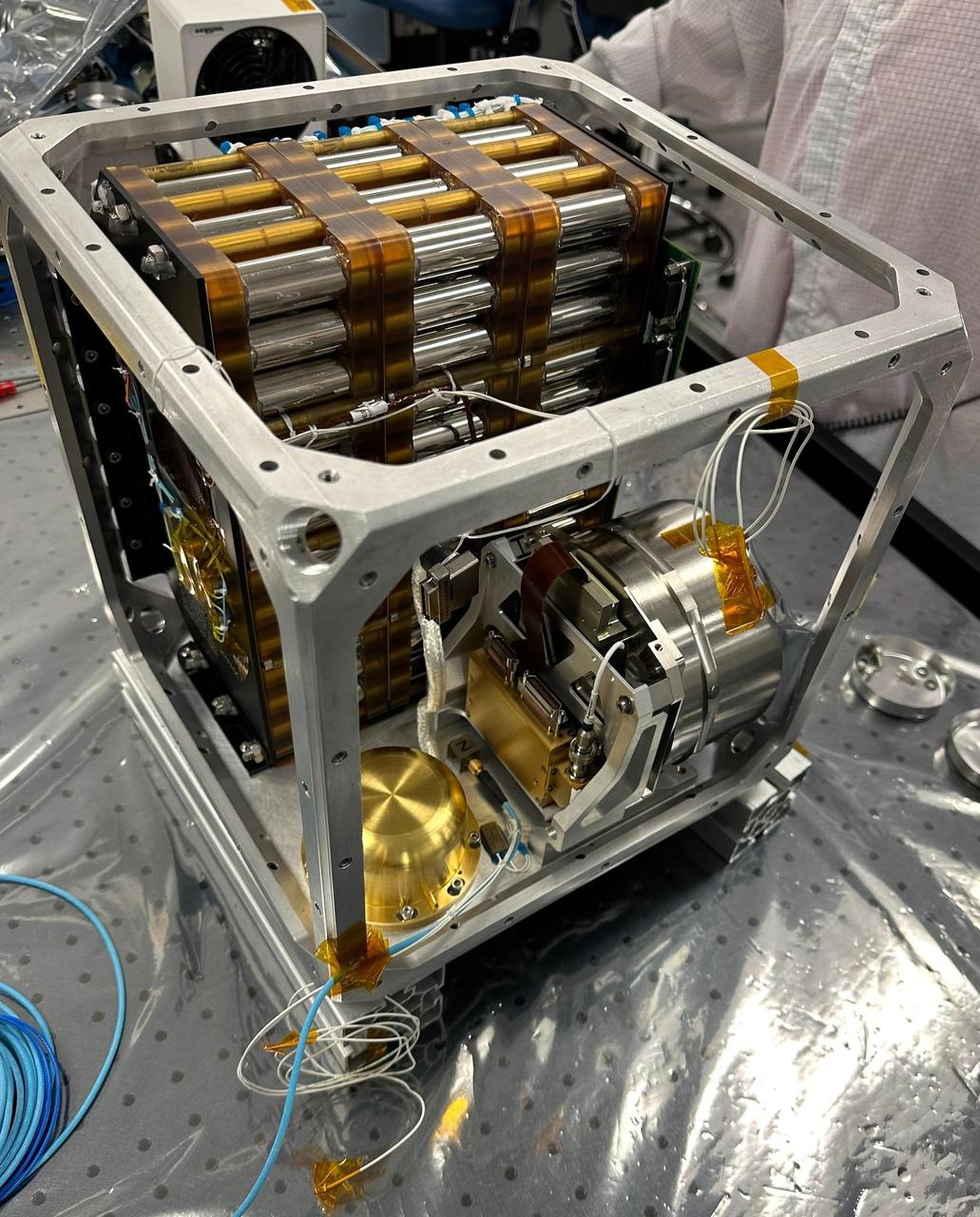
NASA's Farside Seismic Suite (FSS) is assembled in a clean room at the agency's Jet Propulsion Laboratory in Southern California in November 2023. Two sensitive seismometers packaged in the suite's cube-within-a-cube structure will gather NASA's first seismic data from the Moon in nearly 50 years and take the first-ever seismic measurements from the Moon's far side. FSS will operate continuously for at least 4½ months, working through the long, cold lunar nights. Seen here is the inner cube structure, with the suite's large battery at rear. The gold, puck-shaped device at left is the Short Period sensor, or SP, which measures motion in three directions using sensors etched into a trio of square silicon chips, each about 1 inch (25 millimeters) wide. At right, within the silver cylindrical enclosure, is the Very Broadband seismometer, or VBB, the most sensitive seismometer ever built for use in space exploration. It can detect ground motions smaller than the size of a single hydrogen atom, measuring up-and-down movement using a pendulum held in place by a spring. Constructed as a backup instrument (a "flight spare") for NASA's InSight Mars lander by the French space agency, CNES (Centre National d'Études Spatiales), the VBB was slightly modified and packaged in a new enclosure for lunar use. The suite's computer and electronics are packed alongside the battery and seismometers. After being encased in insulation, this inner cube was suspended within a protective outer cube, which was in turn covered with a shiny insulating blanket. https://photojournal.jpl.nasa.gov/catalog/PIA26300
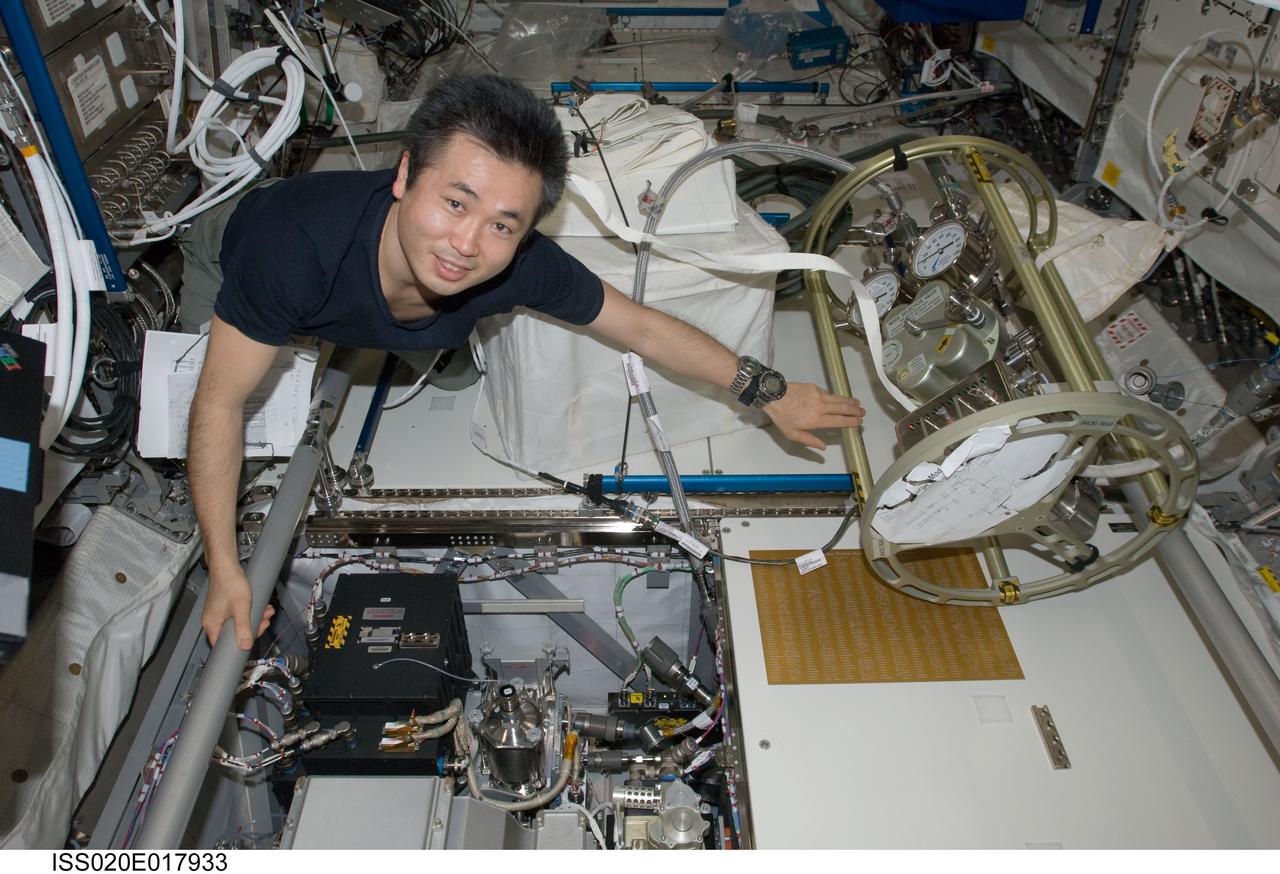
ISS020-E-017933 (8 July 2009) --- Japan Aerospace Exploration Agency (JAXA) astronaut Koichi Wakata, Expedition 20 flight engineer, works with the Fluid Servicing System (FSS) and the Fluid Control Pump Assembly (FCPA) in the Columbus laboratory of the International Space Station.
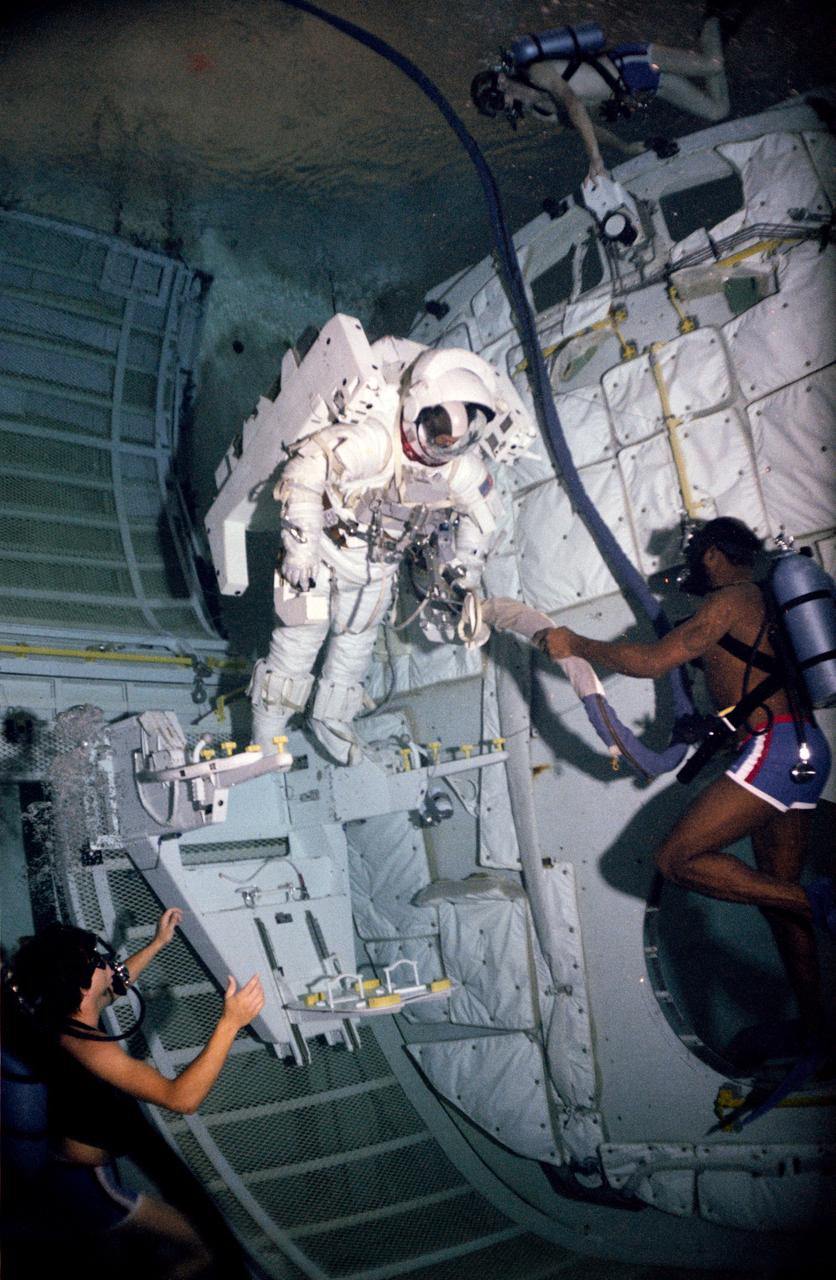
Astronaut Bruce McCandless during an underwater test of the Manned Maneuvering Unit (MMU) Flight Support Station (FSS) donning and doffing in the Bldg 29 Weightless Environment Training Facility (WETF). View is of McCandless wearing the extravehicular mobility unit (EMU), stepping into the MMU.
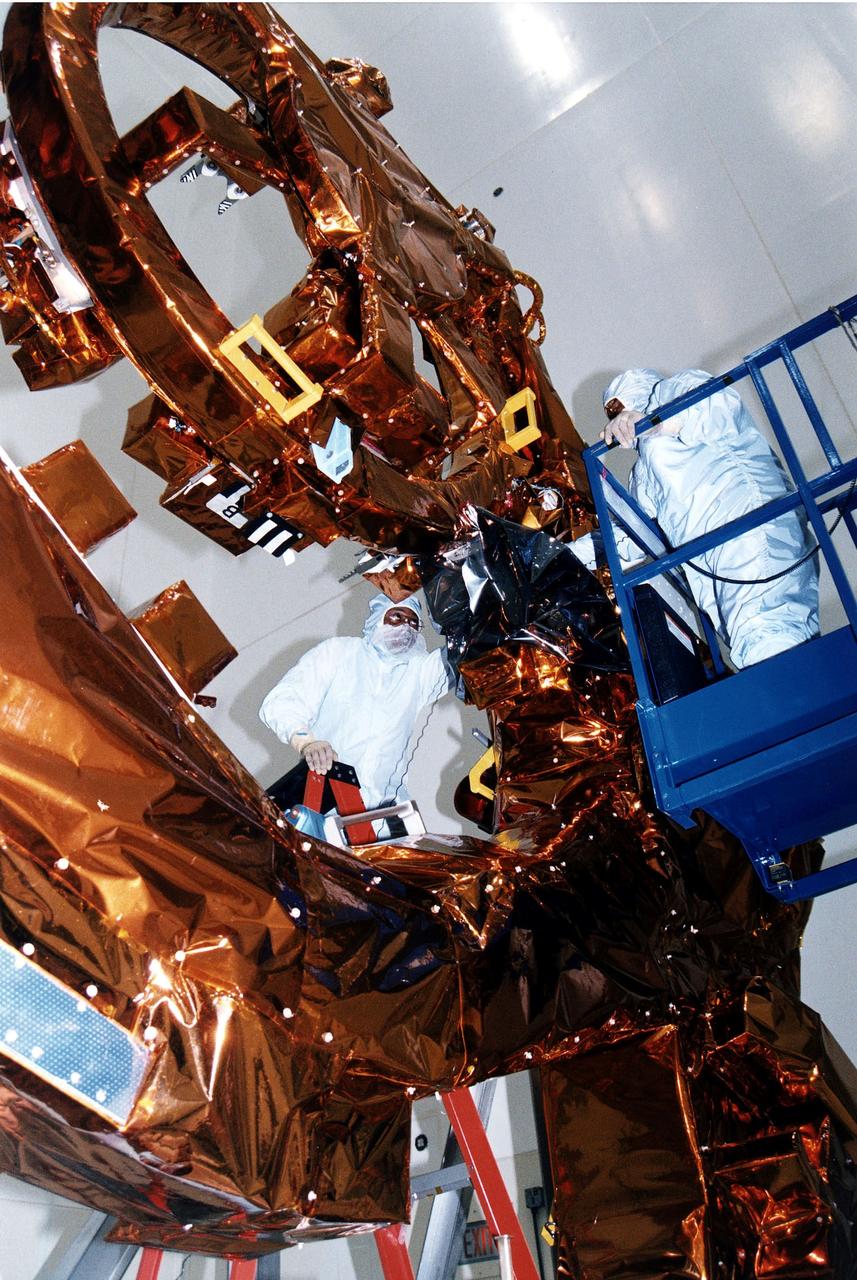
KENNEDY SPACE CENTER, FLA. - Workers in KSC's Vertical Processing Facility make final adjustments to the Flight Support System (FSS) for STS-82, the second Hubble Space Telescope servicing mission. The FSS is reusable flight hardware that provides the mechanical, structural and electrical interfaces between HST, the space support equipment and the orbiter for payload retrieval and on-orbit servicing. Liftoff aboard Discovery is targeted Feb. 11 with a crew of seven.
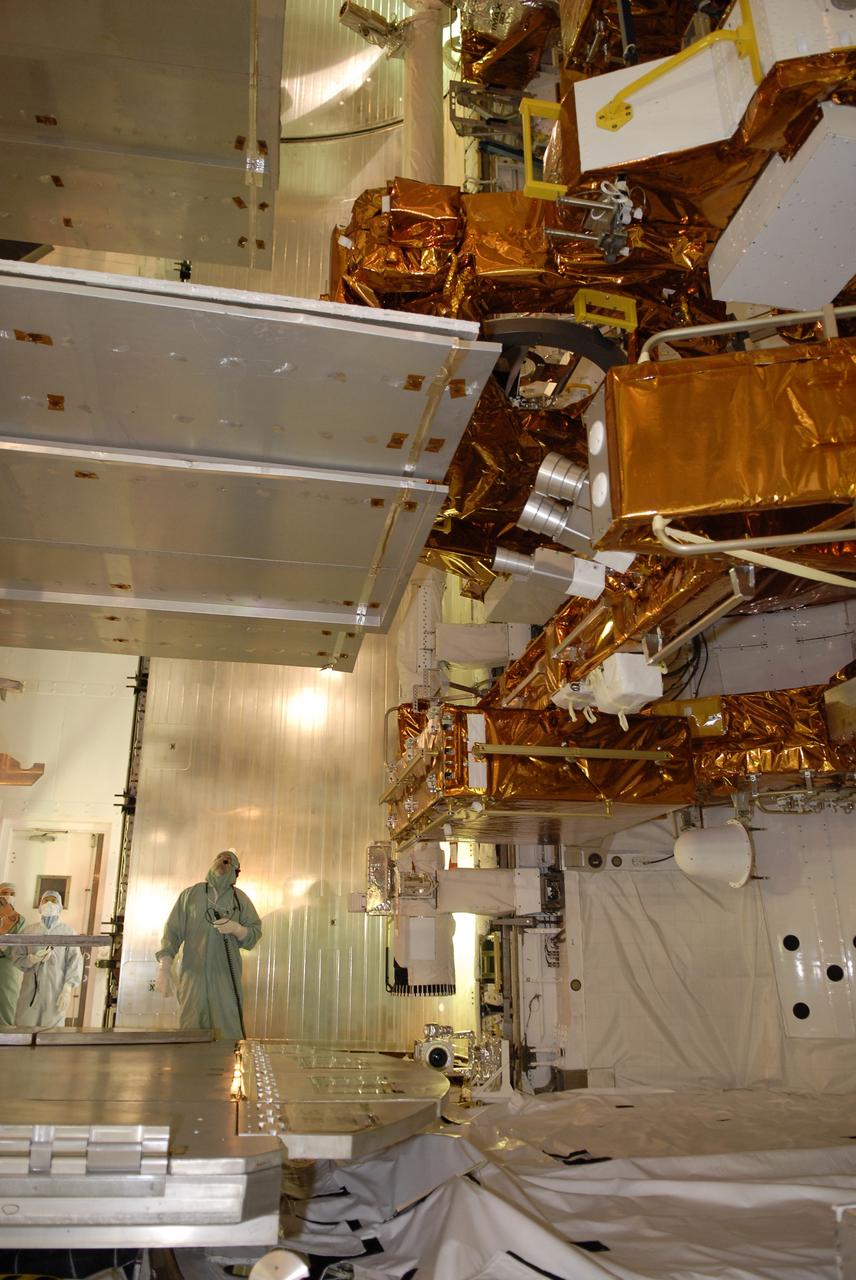
CAPE CANAVERAL, Fla. – On Launch Pad 39A at NASA's Kennedy Space Center in Florida, the payload ground-handling mechanism, known as the PGHM, is retracted after installing the payloads in space shuttle Atlantis' payload bay, at right, for the STS-125 mission. The payload includes the Flight Support System, or FSS, carrier with the Soft Capture Mechanism; the Multi-Use Lightweight Equipment, or MULE, carrier with the Science Instrument Command and Data Handling Unit, or SIC&DH; the Orbital Replacement Unit Carrier, or ORUC, with the Cosmic Origins Spectrograph, or COS, and an IMAX 3D camera. Atlantis' crew will service NASA's Hubble Space Telescope for the fifth and final time. The flight will include five spacewalks during which astronauts will refurbish and upgrade the telescope with state-of-the-art science instruments. As a result, Hubble's capabilities will be expanded and its operational lifespan extended through at least 2014. Photo credit: NASA/Kim Shiflett
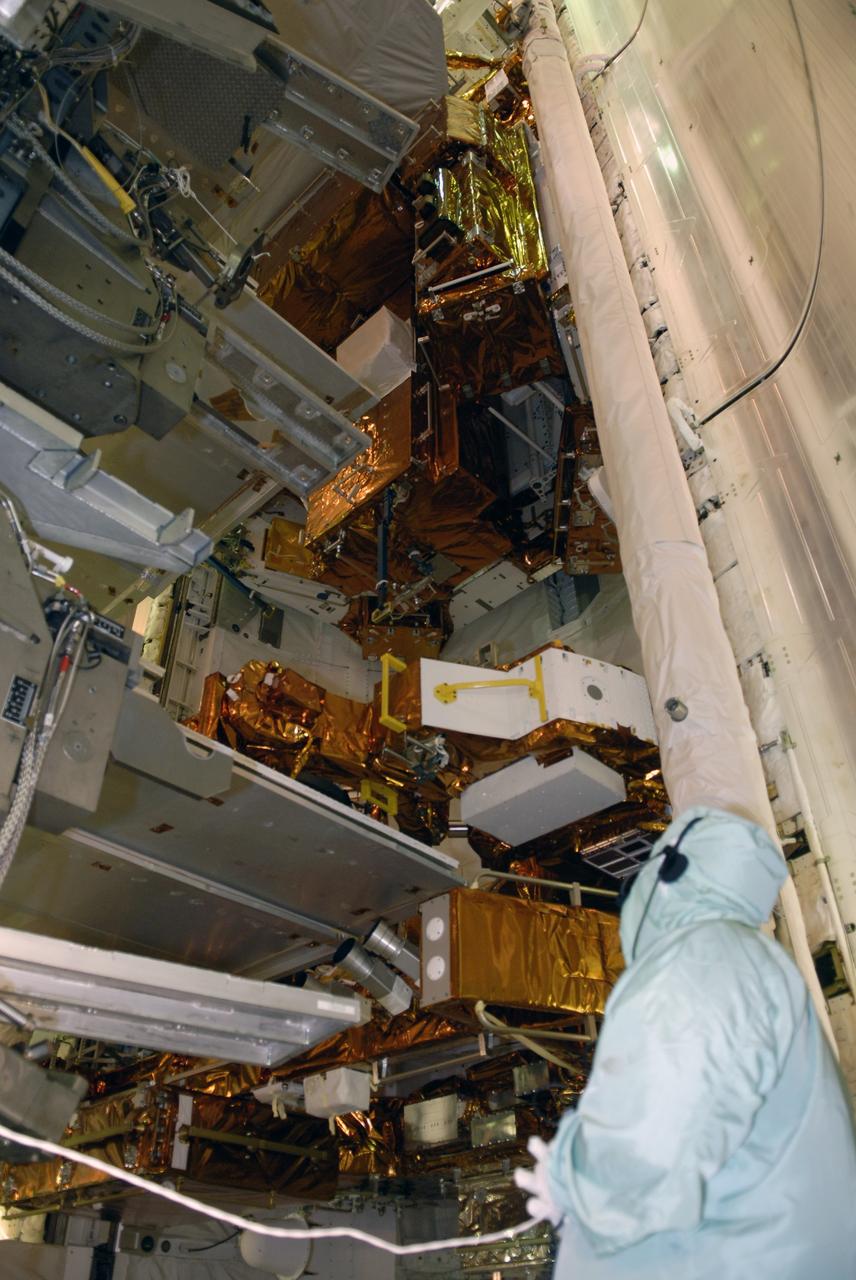
CAPE CANAVERAL, Fla. – On Launch Pad 39A at NASA's Kennedy Space Center in Florida, the payload ground-handling mechanism, known as the PGHM, is retracted after installing the payloads in space shuttle Atlantis' payload bay for the STS-125 mission. Seen here are the service platforms of the PGHM. The payload includes the Flight Support System, or FSS, carrier with the Soft Capture Mechanism; the Multi-Use Lightweight Equipment, or MULE, carrier with the Science Instrument Command and Data Handling Unit, or SIC&DH; the Orbital Replacement Unit Carrier, or ORUC, with the Cosmic Origins Spectrograph, or COS, and an IMAX 3D camera. Atlantis' crew will service NASA's Hubble Space Telescope for the fifth and final time. The flight will include five spacewalks during which astronauts will refurbish and upgrade the telescope with state-of-the-art science instruments. As a result, Hubble's capabilities will be expanded and its operational lifespan extended through at least 2014. Photo credit: NASA/Kim Shiflett
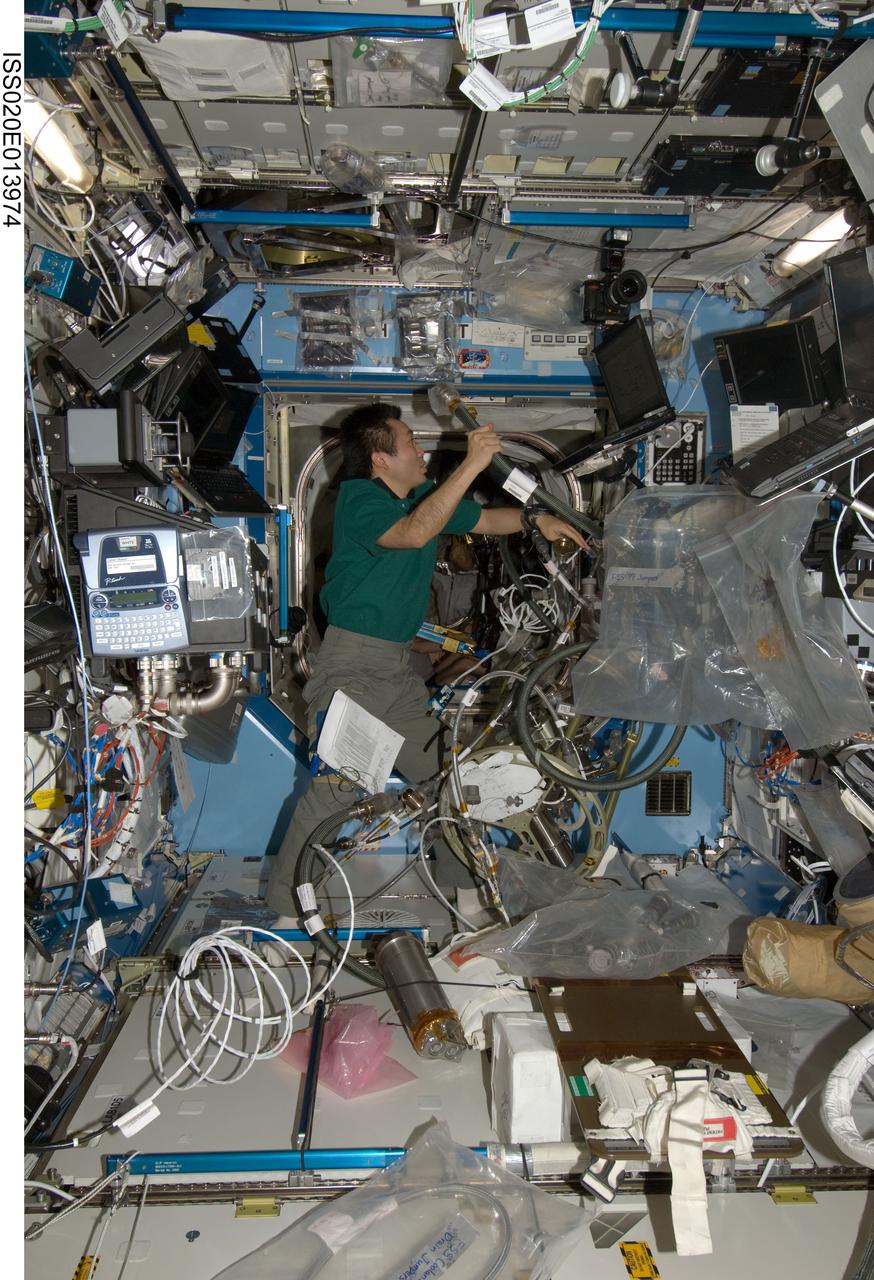
ISS020-E-013974 (23 June 2009) --- Japan Aerospace Exploration Agency (JAXA) astronaut Koichi Wakata, Expedition 20 flight engineer, works with the Fluid Control Pump Assembly (FCPA), which is a part of the Internal Thermal Control System (ITCS) in the Destiny laboratory on the International Space Station.
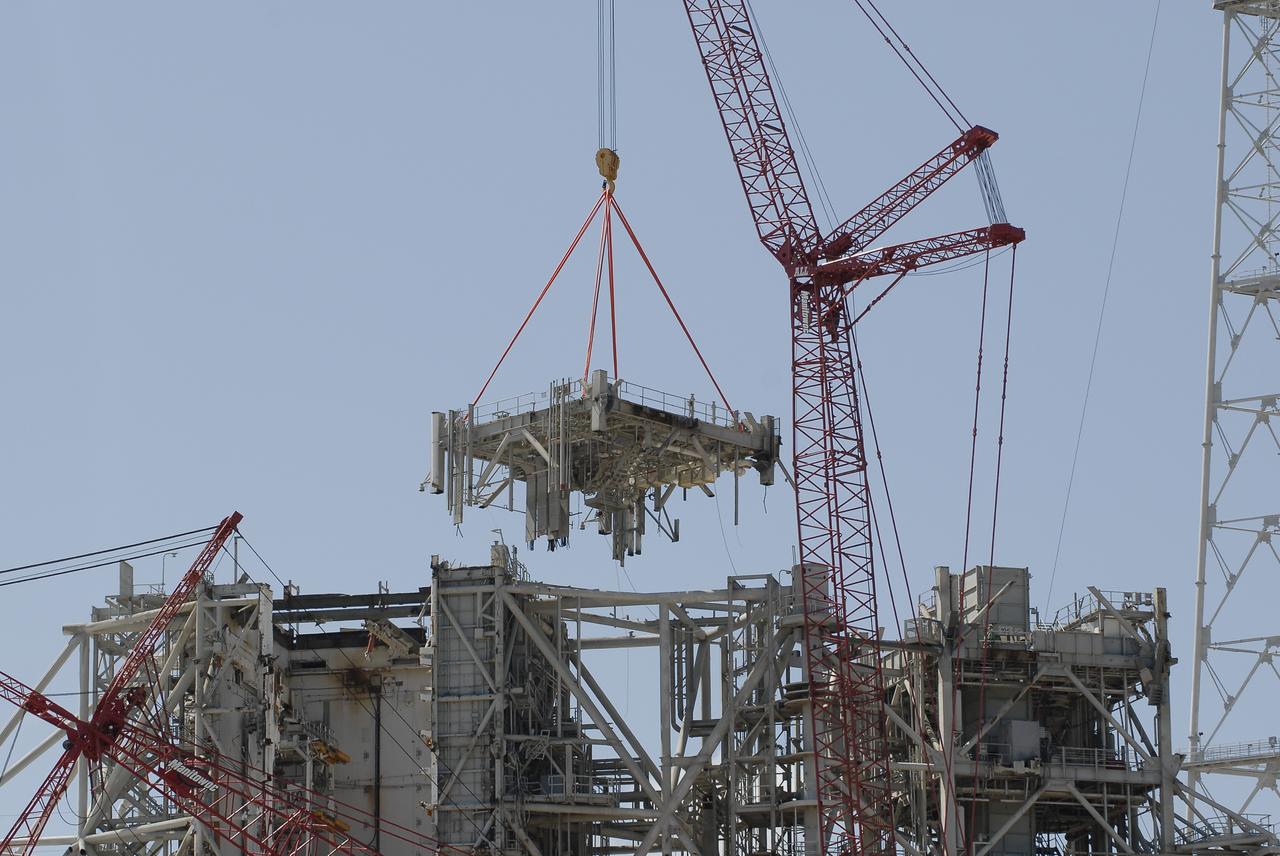
Pad 39B FSS Being Demolished
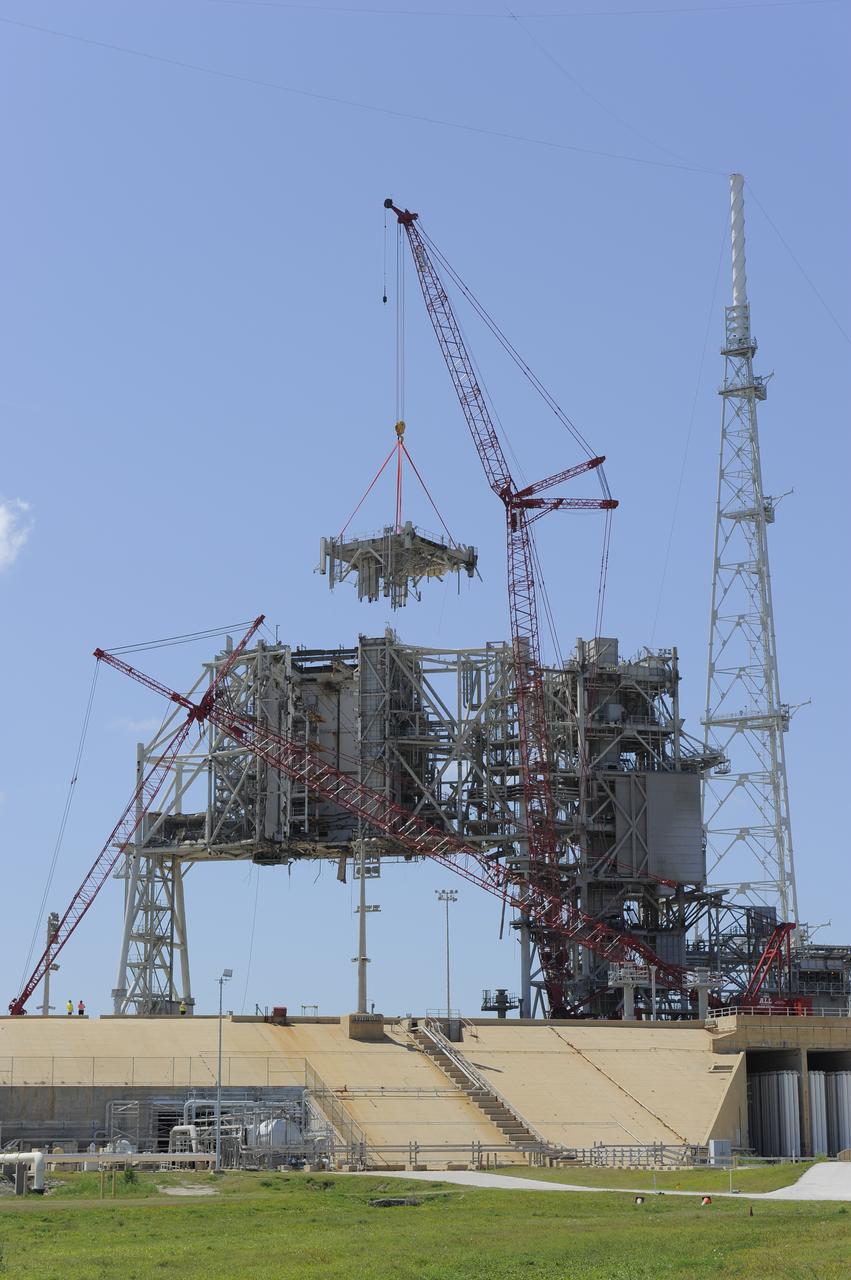
Pad 39B FSS Being Demolished
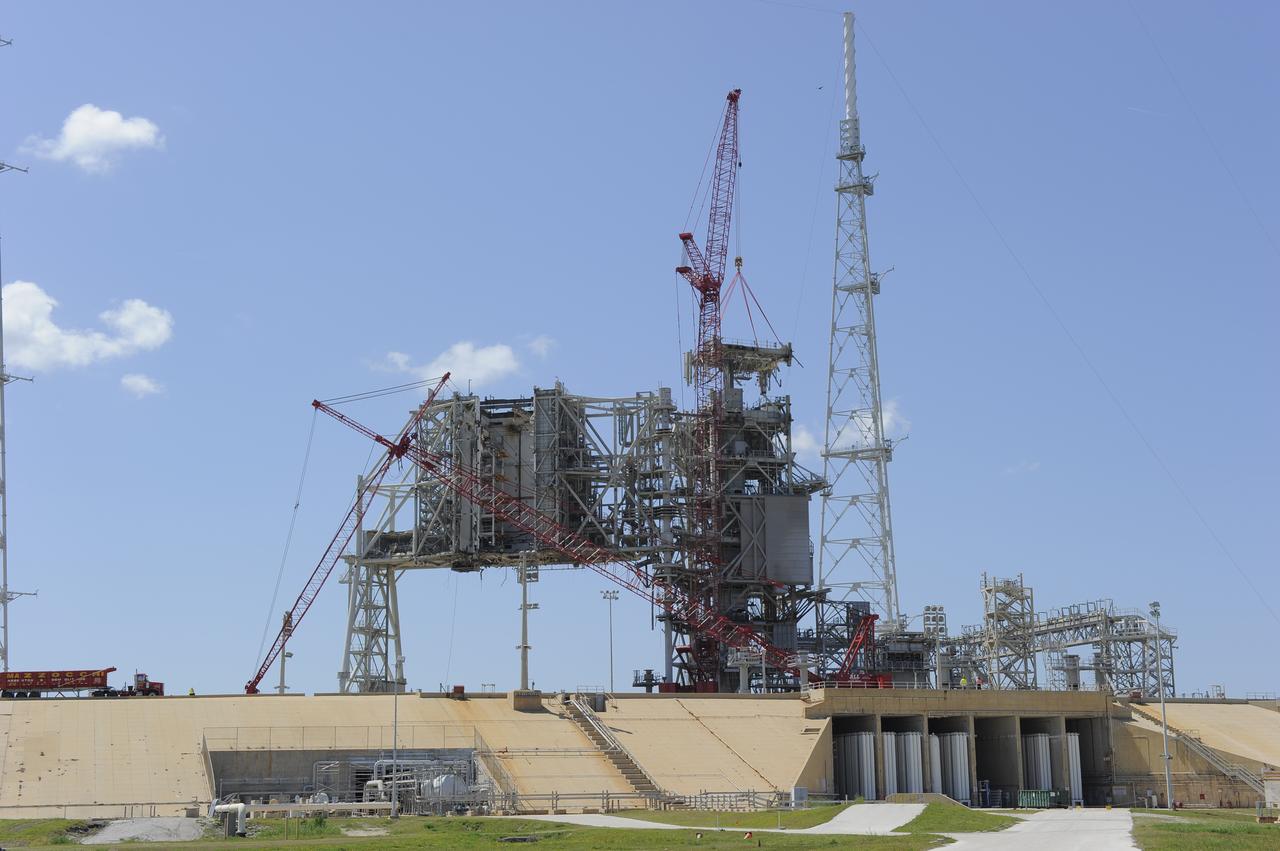
Pad 39B FSS Being Demolished
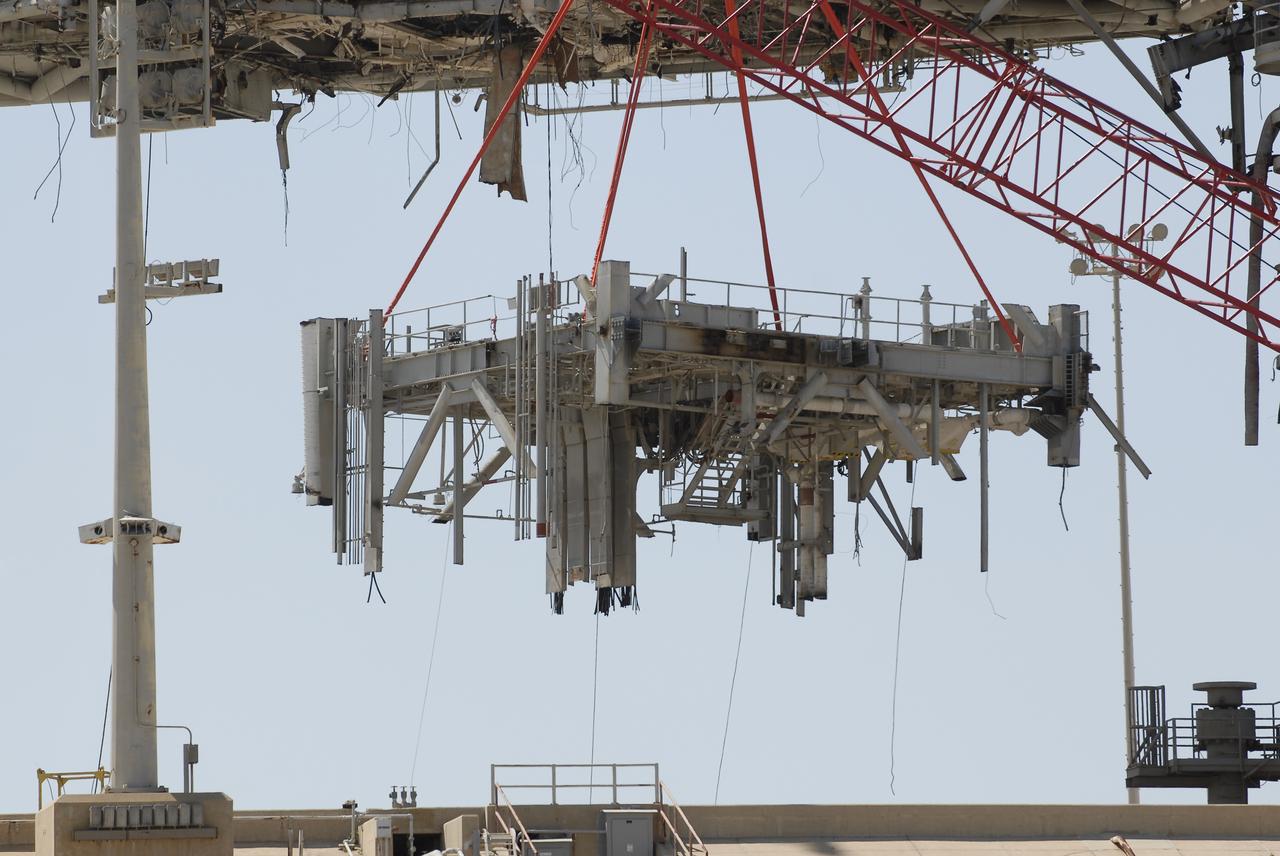
Pad 39B FSS Being Demolished
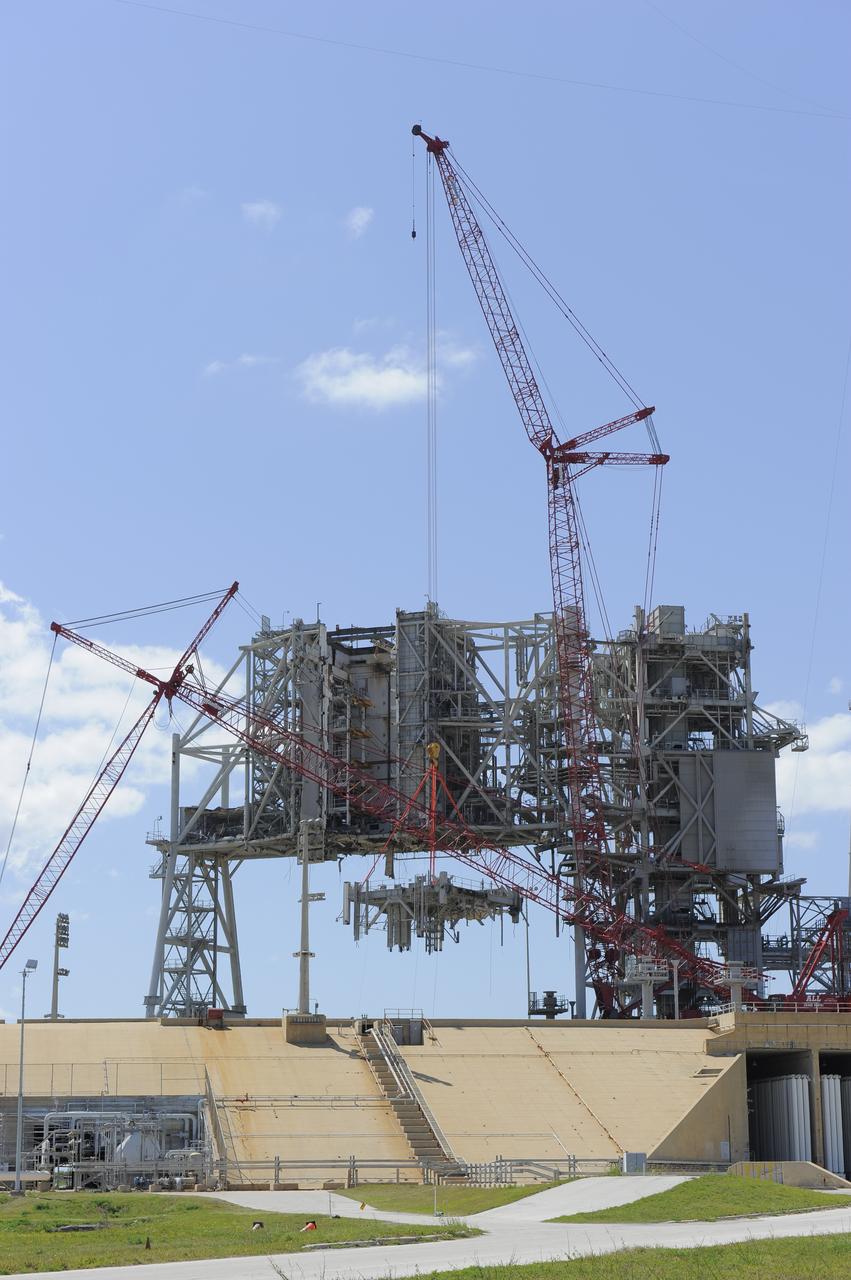
Pad 39B FSS Being Demolished
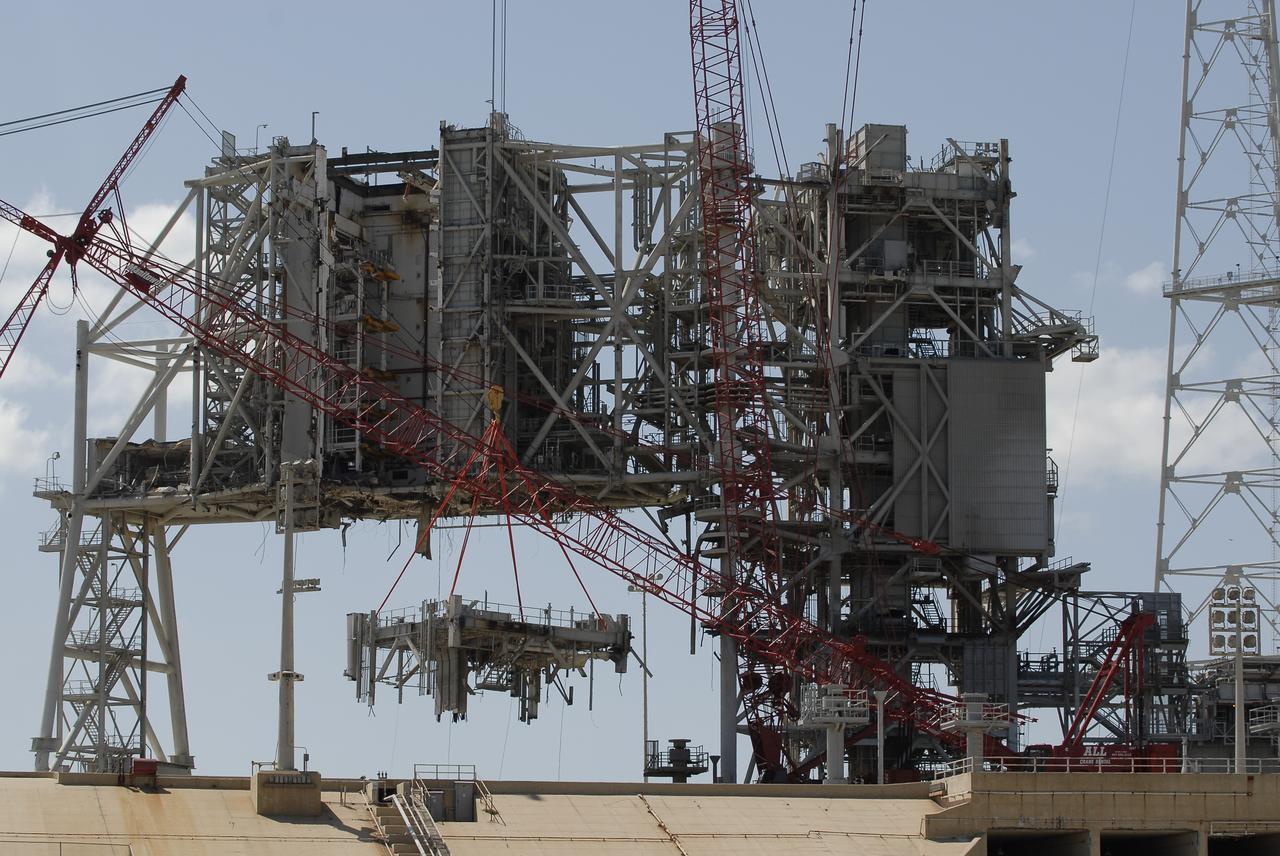
Pad 39B FSS Being Demolished
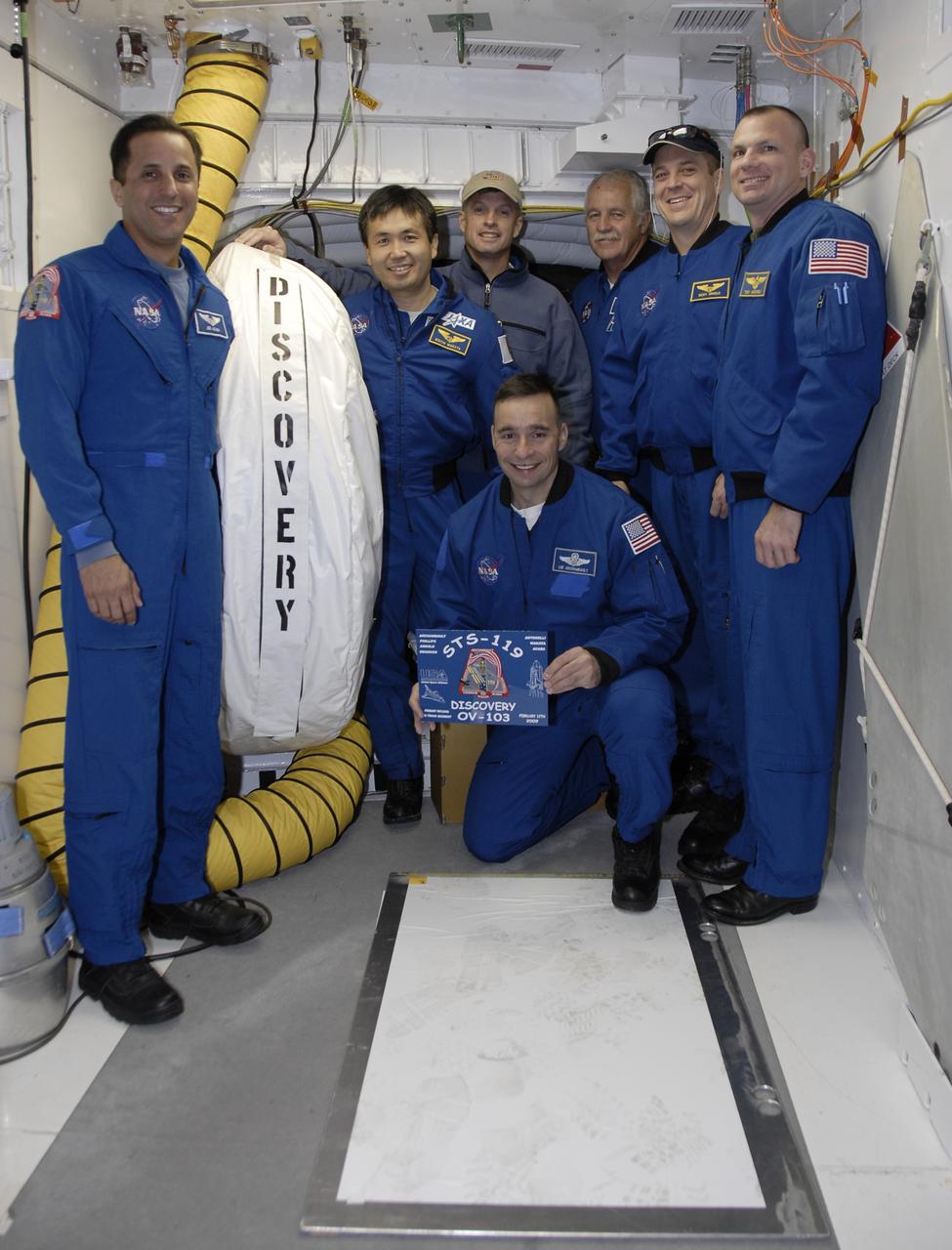
CAPE CANAVERAL, Fla. – The STS-119 crew members gather in front of the hatch into space shuttle Discovery to place the mission plaque. Standing from left are Mission Specialists Joseph Acaba, Koichi Wakata, Steve Swanson, John Phillips and Richard Arnold and Pilot Tony Antonelli. Kneeling in front is Commander Lee Archambault. The astronauts are at Kennedy to prepare for launch as part of the Terminal Countdown Demonstration Test activities. The TCDT includes equipment familiarization and a simulated launch countdown. The crew of space shuttle Discovery is targeted to launch on the STS-119 mission Feb. 12. During Discovery's 14-day mission, the crew will install the S6 truss segment and solar arrays to the starboard side of the International Space Station, completing the station's truss, or backbone. Photo credit: NASA/Kim Shiflett
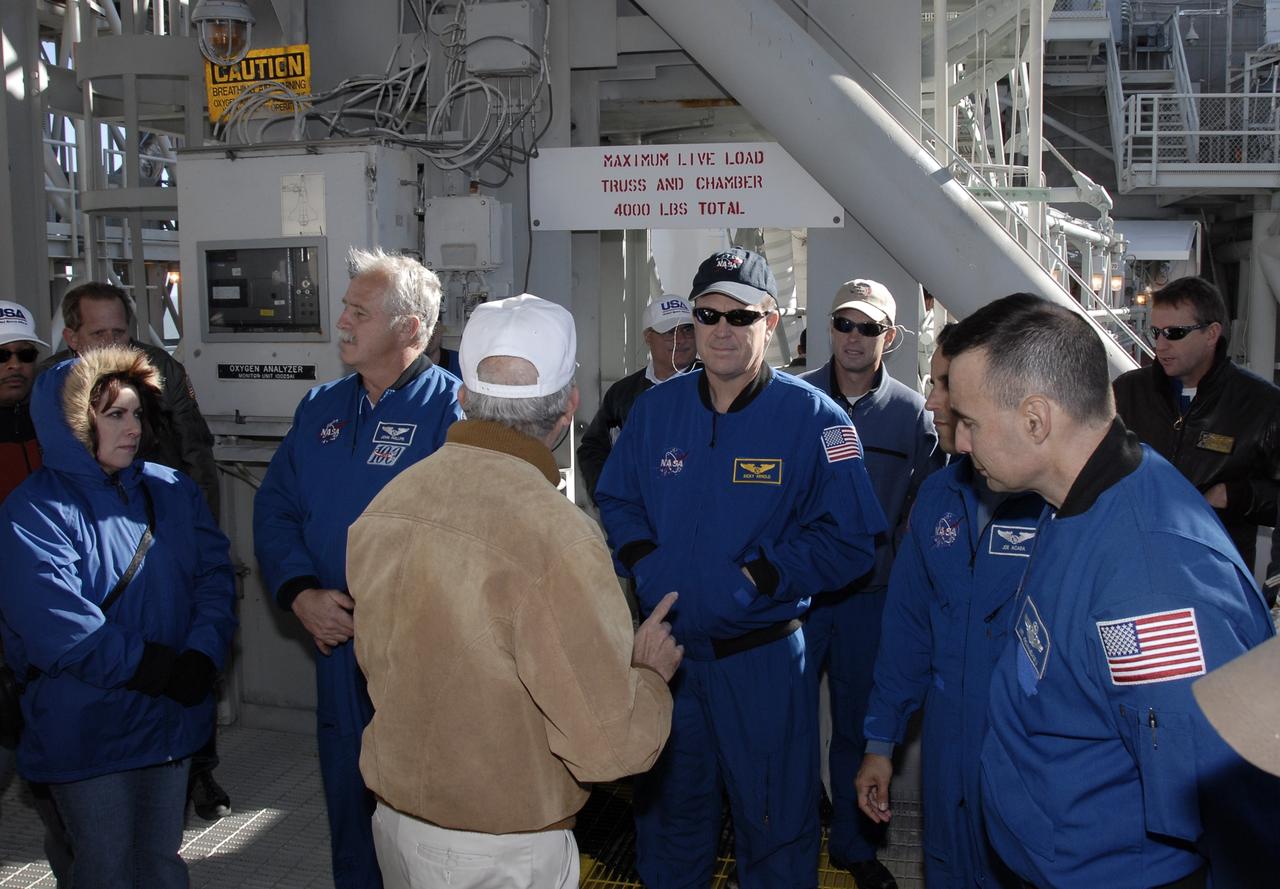
CAPE CANAVERAL, Fla. – The STS-119 crew members gather on the fixed service structure on Launch Pad 39A at NASA's Kennedy Space Center in Florida to listen to the trainer about emergency egress procedures. Left of center is Mission Specialist John Phillips; on the right are Mission Specialists Richard Arnold, Steve Swanson and Joseph Acaba and Commander Lee Archambault. The astronauts are at Kennedy to prepare for launch as part of the Terminal Countdown Demonstration Test activities. The TCDT includes equipment familiarization and a simulated launch countdown. The crew of space shuttle Discovery is targeted to launch on the STS-119 mission Feb. 12. During Discovery's 14-day mission, the crew will install the S6 truss segment and solar arrays to the starboard side of the International Space Station, completing the station's truss, or backbone. Photo credit: NASA/Kim Shiflett
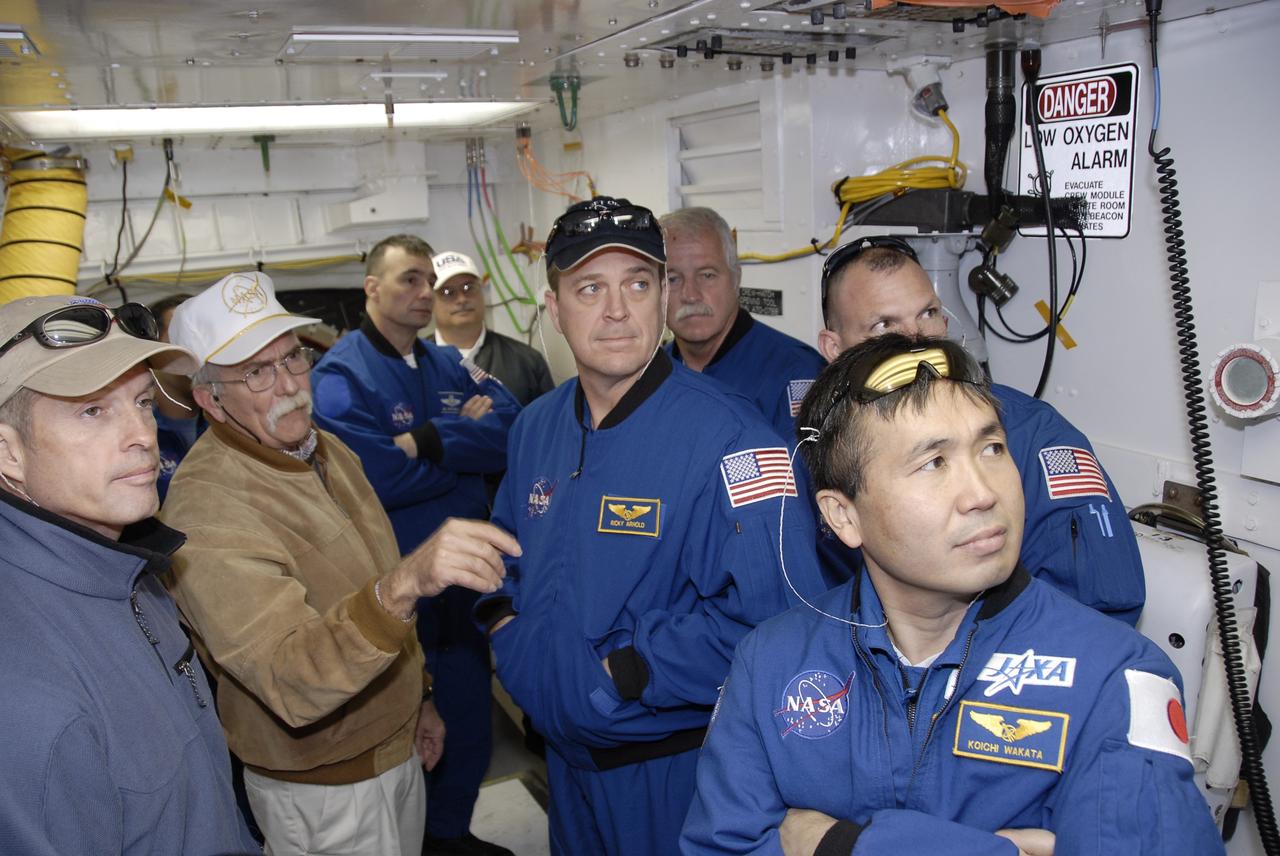
CAPE CANAVERAL, Fla. – The STS-119 crew members gather on the fixed service structure on Launch Pad 39A at NASA's Kennedy Space Center in Florida to start their emergency egress training. At left is Mission Specialist Steve Swanson; in the background is Commander Lee Archambault; on the right (from center) are Mission Specialists Richard Arnold and John Phillips, Pilot Tony Antonelli and Mission Specialist Koichi Wakata. The astronauts are at Kennedy to prepare for launch as part of the Terminal Countdown Demonstration Test activities. The TCDT includes equipment familiarization and a simulated launch countdown. The crew of space shuttle Discovery is targeted to launch on the STS-119 mission Feb. 12. During Discovery's 14-day mission, the crew will install the S6 truss segment and solar arrays to the starboard side of the International Space Station, completing the station's truss, or backbone. Photo credit: NASA/Kim Shiflett
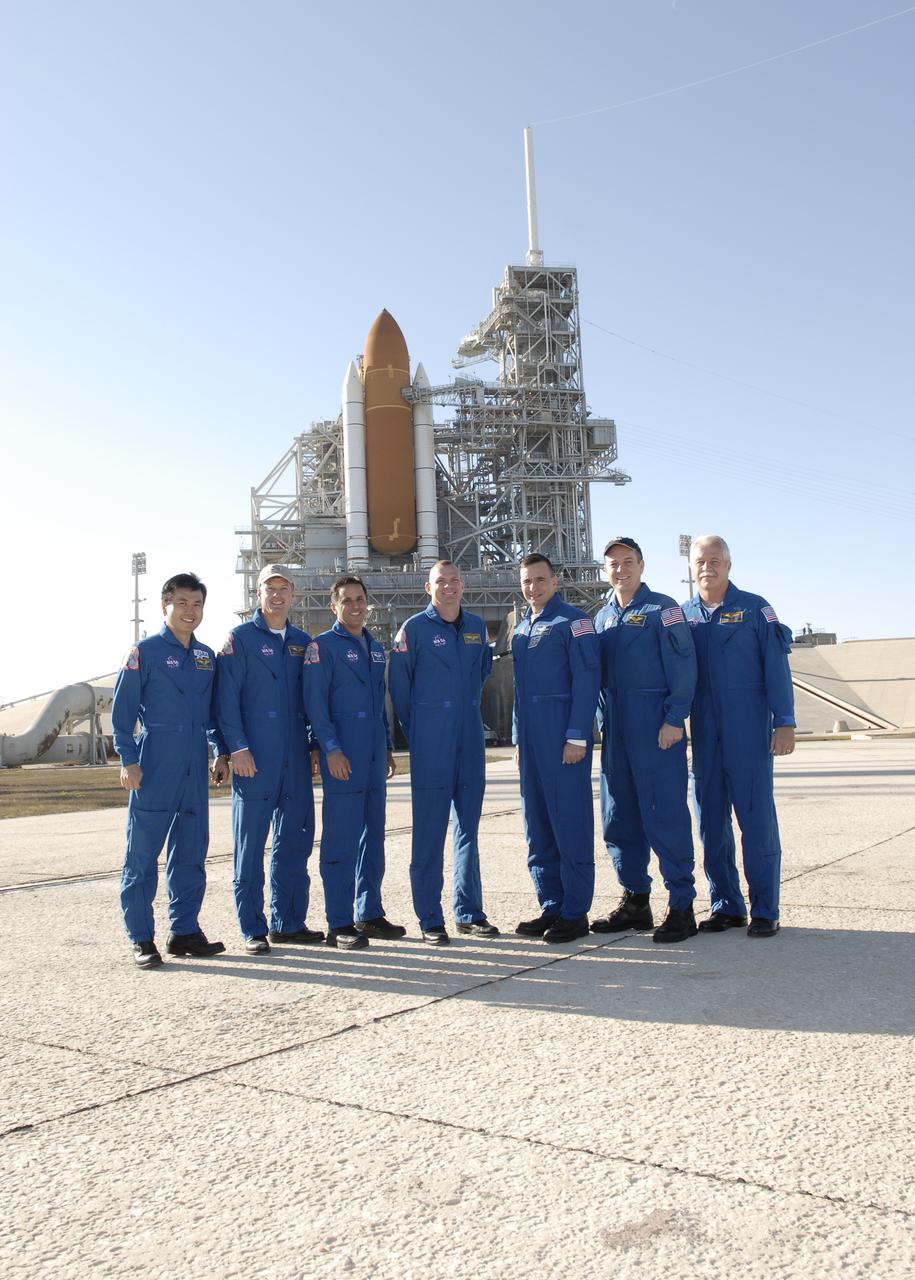
CAPE CANAVERAL, Fla. – The STS-119 crew members gather on Launch Pad 39A at NASA's Kennedy Space Center in Florida before beginning their emergency egress training. From left are Mission Specialists Koichi Wakata, Steve Swanson and Joseph Acaba, Pilot Tony Antonelli, Commander Lee Archambault and Mission Specialists Richard Arnold and John Phillips. The astronauts are at Kennedy to prepare for launch as part of the Terminal Countdown Demonstration Test activities. The TCDT includes equipment familiarization and a simulated launch countdown. The crew of space shuttle Discovery is targeted to launch on the STS-119 mission Feb. 12. During Discovery's 14-day mission, the crew will install the S6 truss segment and solar arrays to the starboard side of the International Space Station, completing the station's truss, or backbone. Photo credit: NASA_Kim Shiflett
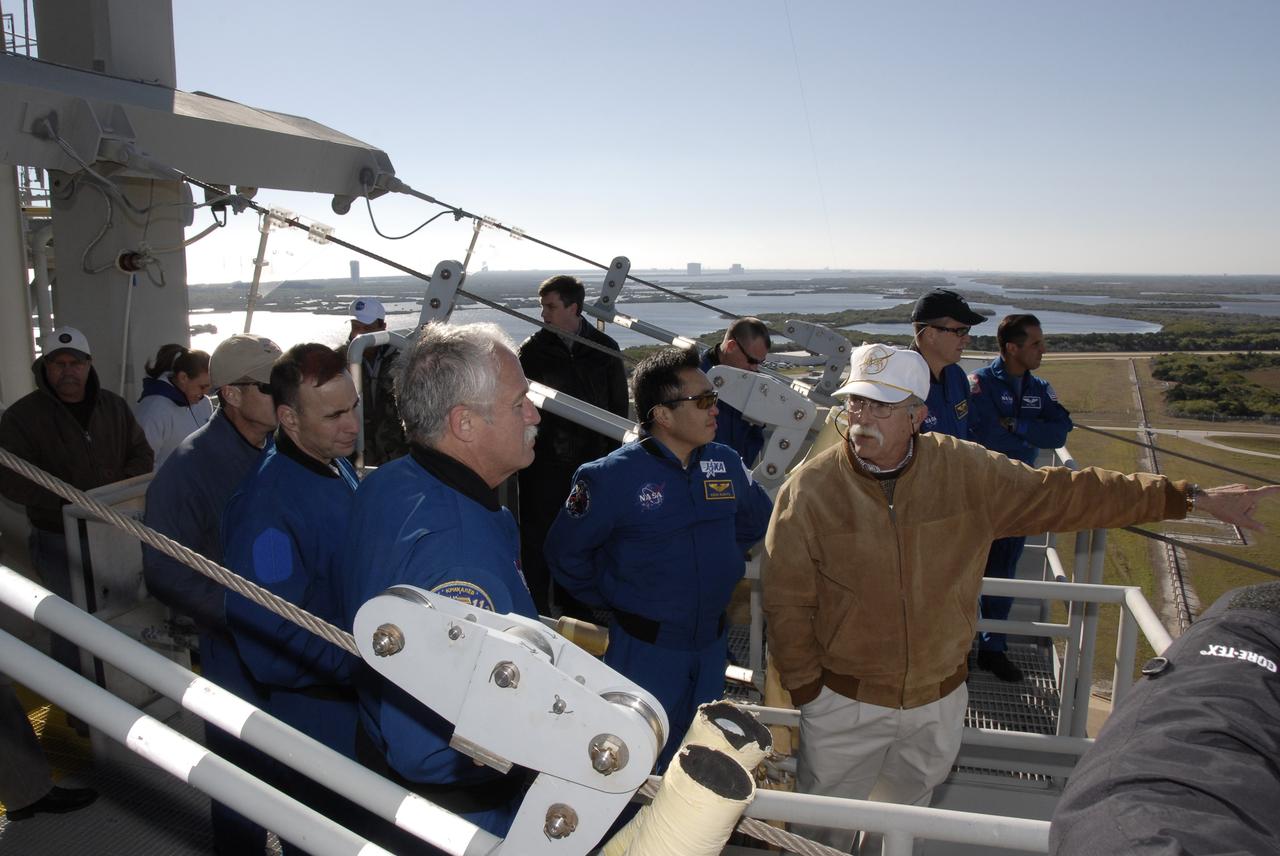
CAPE CANAVERAL, Fla. – On the fixed service structure on Launch Pad 39A at NASA's Kennedy Space Center in Florida, STS-119 crew members learn about slidewire basket procedures as part of emergency egress training. From left are Mission Specialist Steve Swanson, Commander Lee Archambault, Mission Specialists John Phillips, Koichi Wakata, and (behind the trainer) Richard Arnold and Joseph Acaba. The astronauts are at Kennedy to prepare for launch as part of the Terminal Countdown Demonstration Test activities. The TCDT includes equipment familiarization and a simulated launch countdown. The crew of space shuttle Discovery is targeted to launch on the STS-119 mission Feb. 12. During Discovery's 14-day mission, the crew will install the S6 truss segment and solar arrays to the starboard side of the International Space Station, completing the station's truss, or backbone. Photo credit: NASA/Kim Shiflett

CAPE CANAVERAL, Fla. – On the fixed service structure on Launch Pad 39A at NASA's Kennedy Space Center in Florida, STS-119 Mission Specialist Richard Arnold leans toward the lever in the slidewire basket, part of the emergency egress equipment. At right, Commander Lee Archambault watches. The astronauts are at Kennedy to prepare for launch as part of the Terminal Countdown Demonstration Test activities. The TCDT includes equipment familiarization and a simulated launch countdown. The crew of space shuttle Discovery is targeted to launch on the STS-119 mission Feb. 12. During Discovery's 14-day mission, the crew will install the S6 truss segment and solar arrays to the starboard side of the International Space Station, completing the station's truss, or backbone. Photo credit: NASA/Kim Shiflett
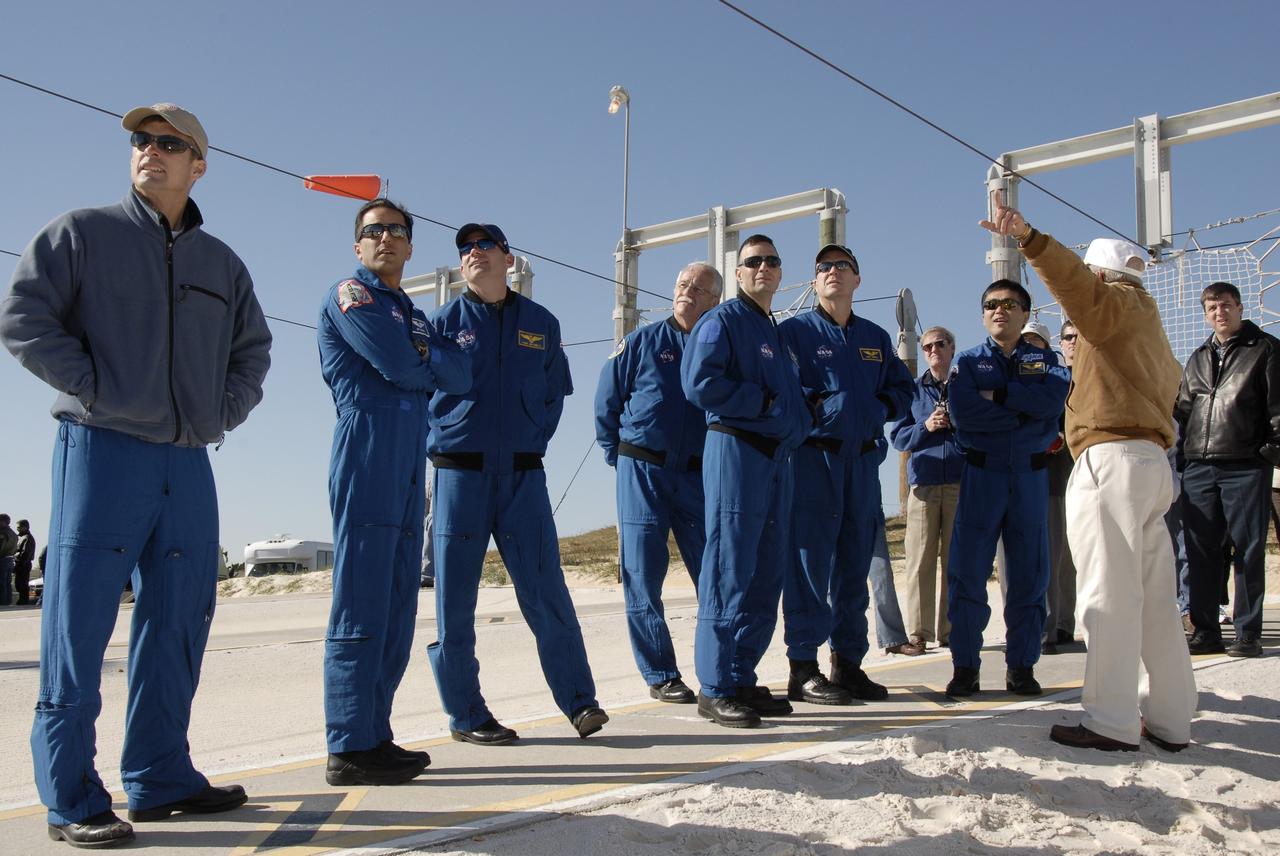
CAPE CANAVERAL, Fla. – On Launch Pad 39A at NASA's Kennedy Space Center in Florida, STS-119 crew members listen to instructions about using the slidewire baskets for emergency egress from the fixed service structure. From left are Mission Specialists Steve Swanson and Joseph Acaba, Pilot Tony Antonelli, Mission specialist John Phillips, Commander Lee Archambault and Mission Specialists Richard Arnold and Koichi Wakata. The astronauts are at Kennedy to prepare for launch as part of the Terminal Countdown Demonstration Test activities. The TCDT includes equipment familiarization and a simulated launch countdown. The crew of space shuttle Discovery is targeted to launch on the STS-119 mission Feb. 12. During Discovery's 14-day mission, the crew will install the S6 truss segment and solar arrays to the starboard side of the International Space Station, completing the station's truss, or backbone. Photo credit: NASA/Kim Shiflett
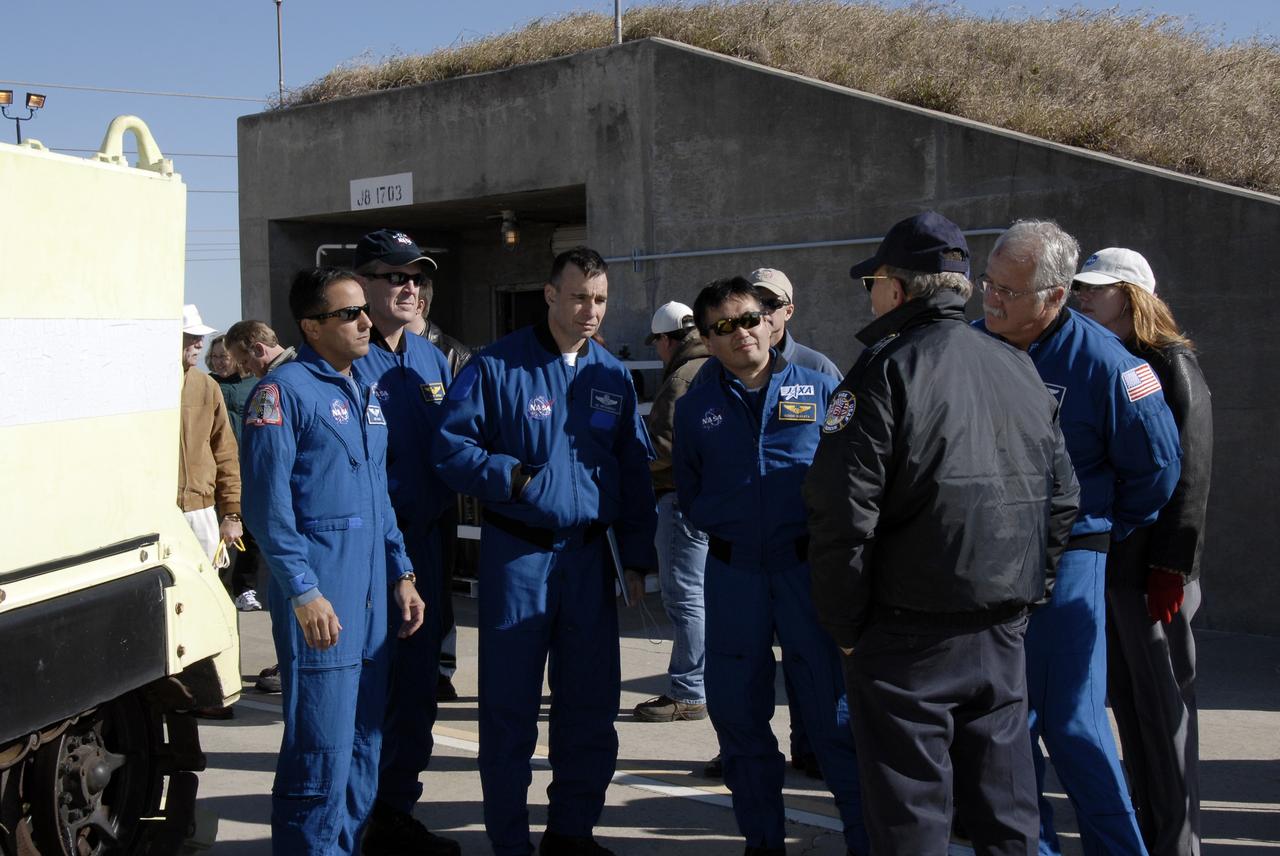
CAPE CANAVERAL, Fla. – On Launch Pad 39A at NASA's Kennedy Space Center in Florida, STS-119 crew members gather in front of the bunker to continue emergency egress training. From left are Mission Specialists Joseph Acaba and Richard Arnold, Pilot Tony Antonelli, and Mission Specialists Koichi Wakata, Steve Swanson (behind Wakata) and John Phillips (at right). The astronauts are at Kennedy to prepare for launch as part of the Terminal Countdown Demonstration Test activities. The TCDT includes equipment familiarization and a simulated launch countdown. The crew of space shuttle Discovery is targeted to launch on the STS-119 mission Feb. 12. During Discovery's 14-day mission, the crew will install the S6 truss segment and solar arrays to the starboard side of the International Space Station, completing the station's truss, or backbone. Photo credit: NASA/Kim Shiflett
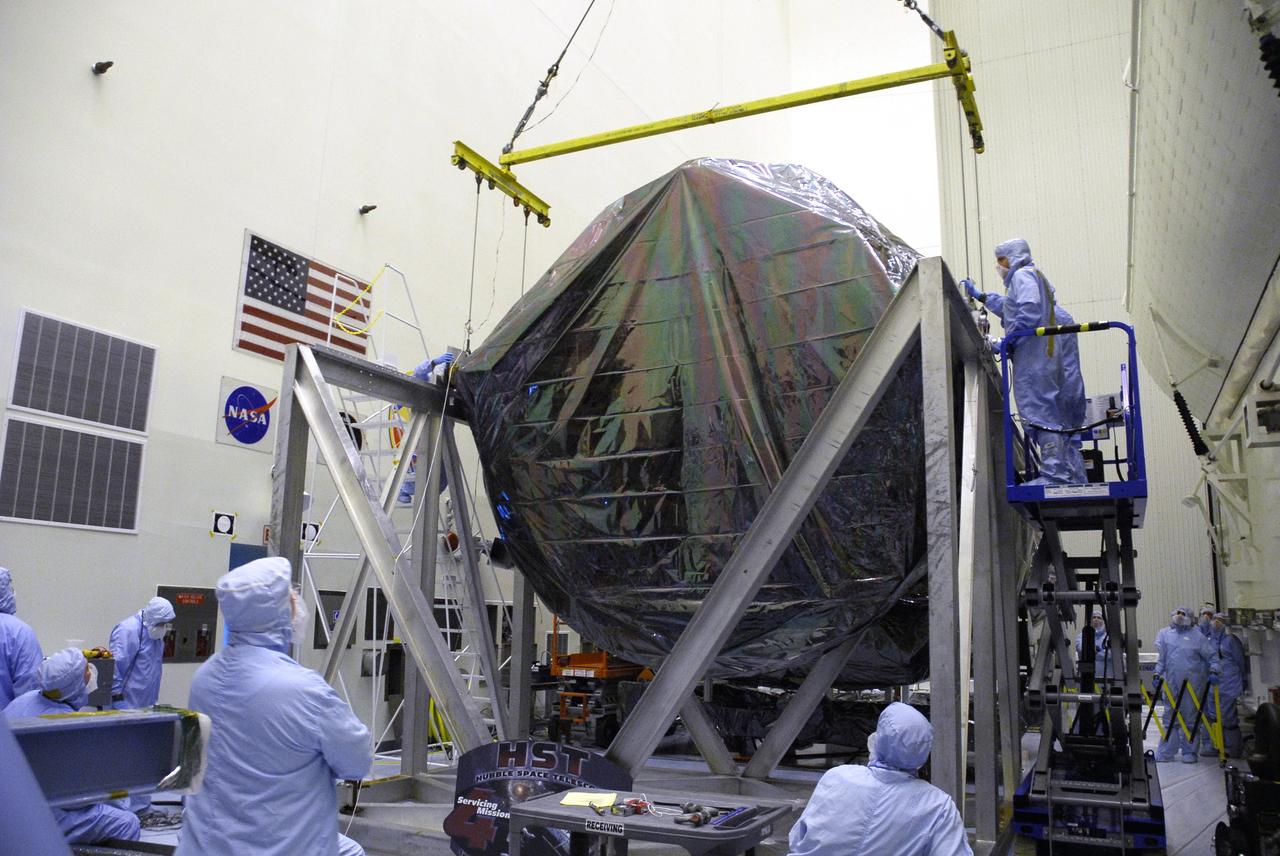
CAPE CANAVERAL, Fla. - In the Payload Hazardous Servicing Facility at NASA’s Kennedy Space Center, an overhead crane lifts the Flight Support System carrier with the Soft Capture Mechanism under protective cover. The carrier is one of four associated with the STS-125 mission to service the Hubble Space Telescope. It will be installed in the payload canister for transfer to Launch Pad 39A. At the pad, all the carriers will be loaded into space shuttle Atlantis’ payload bay. Launch of Atlantis is targeted for Oct. 10. Photo credit: NASA/Cory Huston
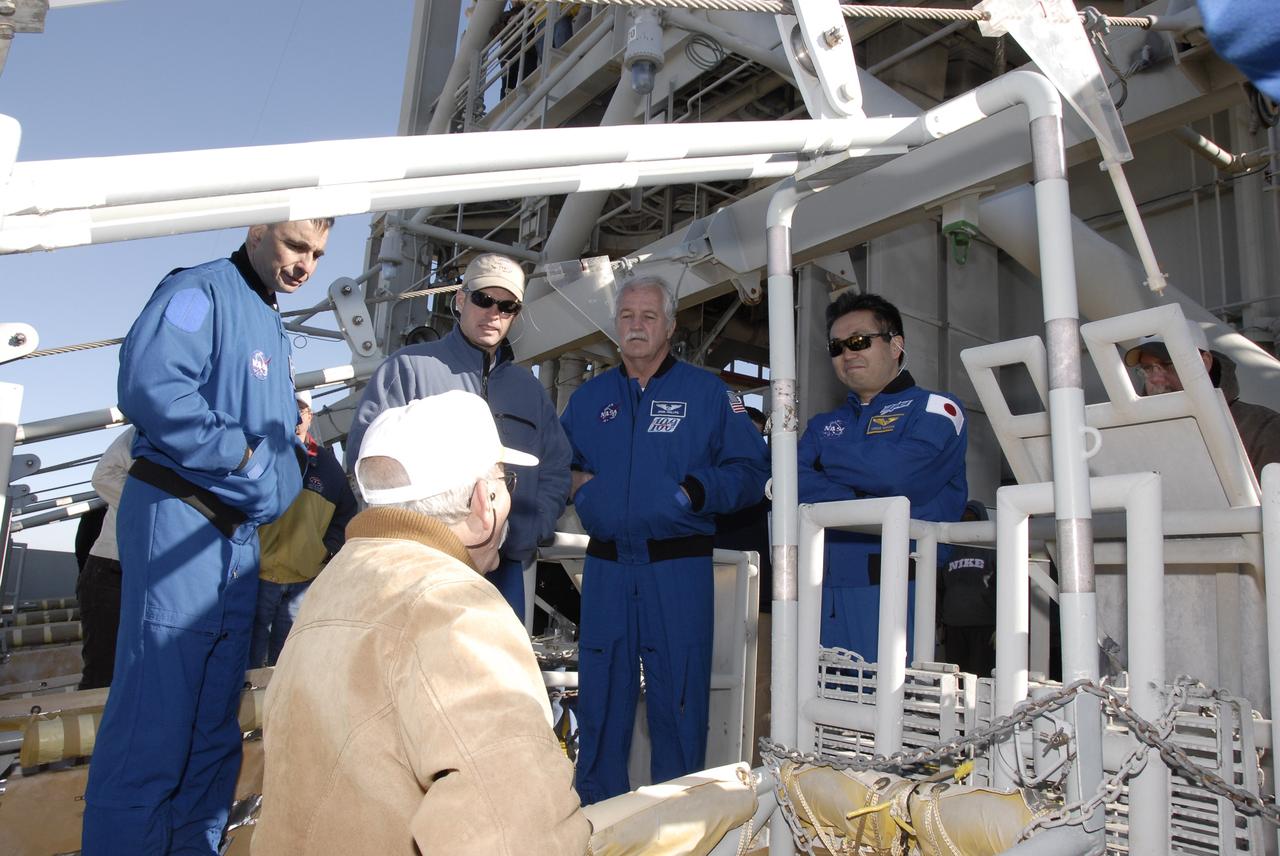
CAPE CANAVERAL, Fla. – On the fixed service structure on Launch Pad 39A at NASA's Kennedy Space Center in Florida, STS-119 crew members listen to a trainer about emergency egress procedures from the slidewire basket area. From left are Commander Lee Archambault and Mission Specialists Steve Swanson, John Phillips and Koichi Wakata. The astronauts are at Kennedy to prepare for launch as part of the Terminal Countdown Demonstration Test activities. The TCDT includes equipment familiarization and a simulated launch countdown. The crew of space shuttle Discovery is targeted to launch on the STS-119 mission Feb. 12. During Discovery's 14-day mission, the crew will install the S6 truss segment and solar arrays to the starboard side of the International Space Station, completing the station's truss, or backbone. Photo credit: NASA/Kim Shiflett
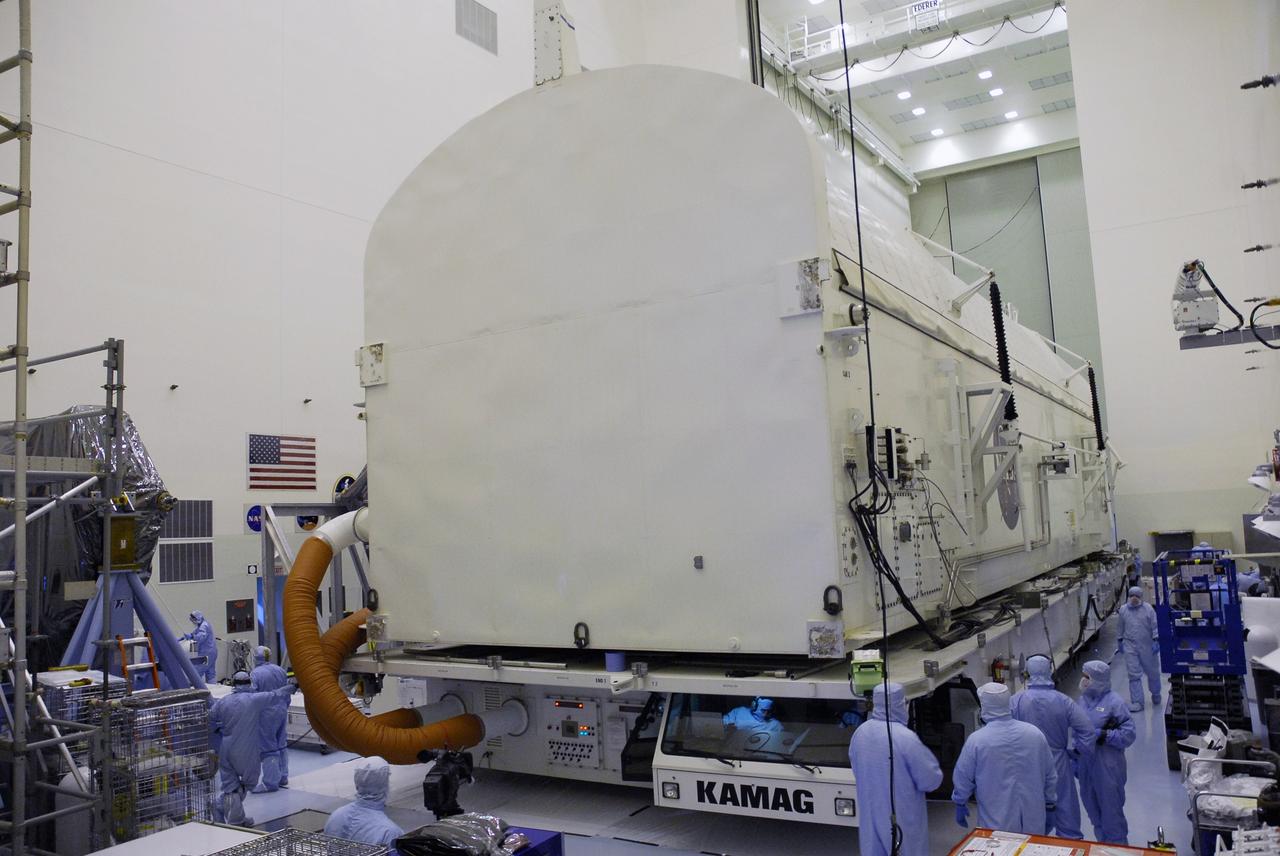
CAPE CANAVERAL, Fla. - The payload canister backs into the Payload Hazardous Servicing Facility at NASA’s Kennedy Space Center. The equipment and carriers associated with the STS-125 mission to service the Hubble Space Telescope will be installed in the canister for transfer to Launch Pad 39A. The canister contains an environmental control system, signified by the red umbilical lines at left. At the pad, the carriers will be loaded into space shuttle Atlantis’ payload bay. Launch of Atlantis is targeted for Oct. 10. Photo credit: NASA/Cory Huston

CAPE CANAVERAL, Fla. – On the fixed service structure on Launch Pad 39A at NASA's Kennedy Space Center in Florida, STS-119 crew members learn about slidewire basket procedures as part of emergency egress training. At left are Commander Lee Archambault and Mission Specialists Steve Swanson and John Phillips. At right, from foreground, are Mission Specialists Richard Arnold and Joseph Acaba, and Pilot Tony Antonelli. The astronauts are at Kennedy to prepare for launch as part of the Terminal Countdown Demonstration Test activities. The TCDT includes equipment familiarization and a simulated launch countdown. The crew of space shuttle Discovery is targeted to launch on the STS-119 mission Feb. 12. During Discovery's 14-day mission, the crew will install the S6 truss segment and solar arrays to the starboard side of the International Space Station, completing the station's truss, or backbone. Photo credit: NASA/Kim Shiflett
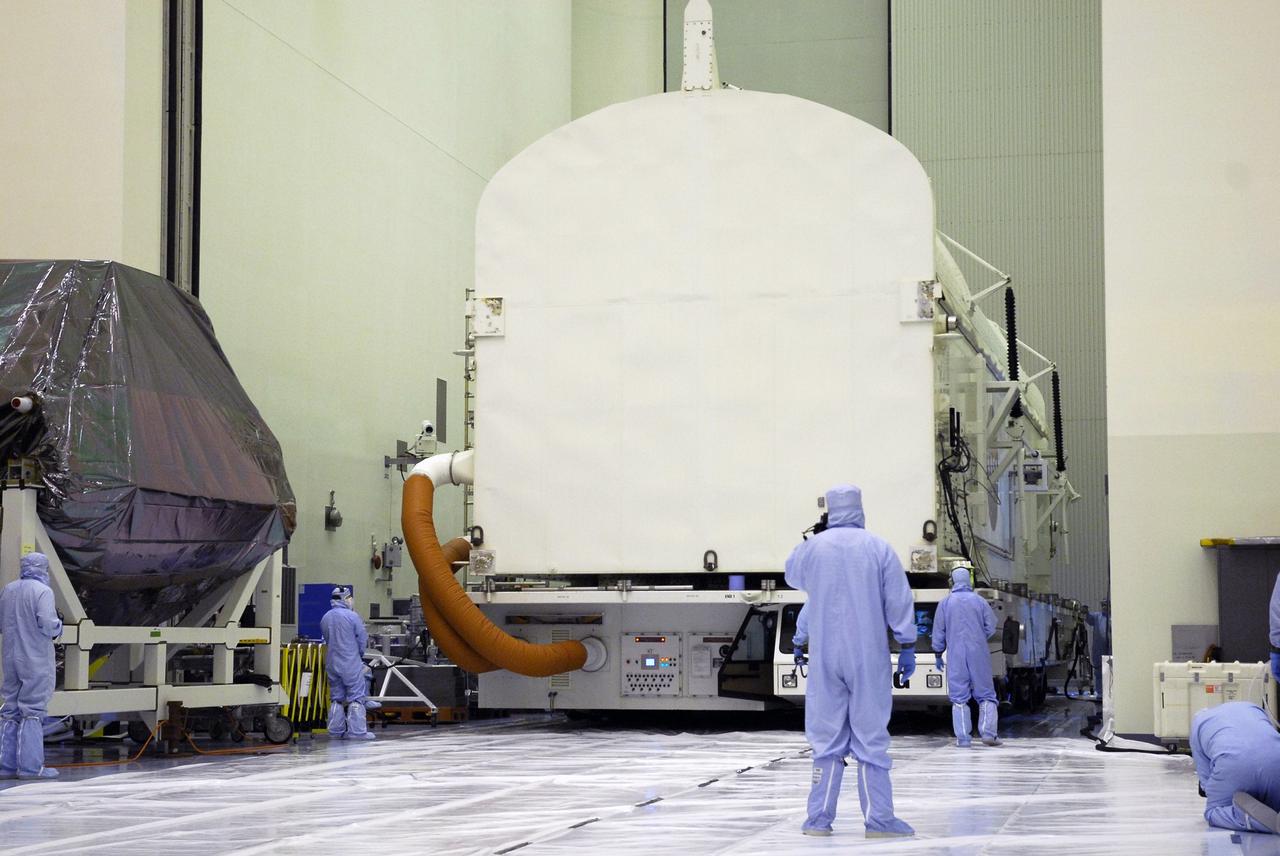
CAPE CANAVERAL, Fla. - The payload canister backs into the Payload Hazardous Servicing Facility at NASA’s Kennedy Space Center. The equipment and carriers associated with the STS-125 mission to service the Hubble Space Telescope will be installed in the canister for transfer to Launch Pad 39A. The canister contains an environmental con¬trol system, signified by the red umbilical lines at left. At the pad, the carriers will be loaded into space shuttle Atlantis’ payload bay. Launch of Atlantis is targeted for Oct. 10. Photo credit: NASA/Cory Huston
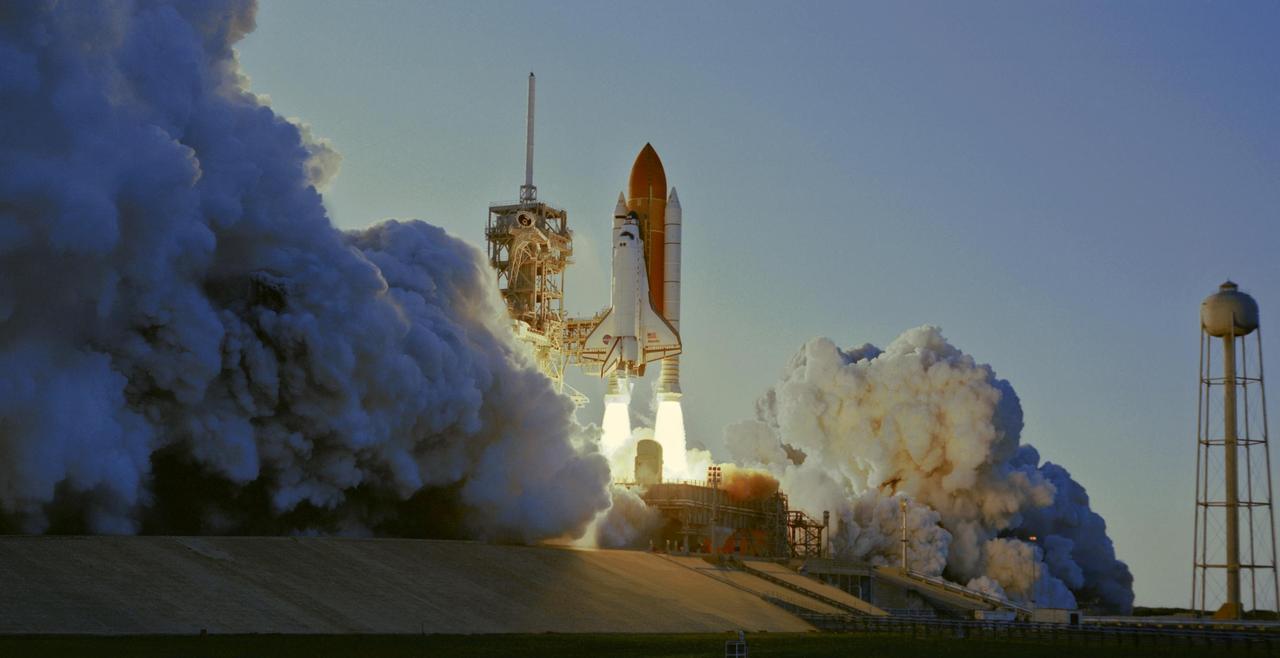
KENNEDY SPACE CENTER, FLA. -- Smoke and steam billow across Launch Pad 39A as Space Shuttle Atlantis, trailing columns of fire from the solid rocket boosters, hurtles into the sky on mission STS-117 to the International Space Station. At left is the fixed service structure with the 80-foot-tall lightning mast on top. At right is the 290-foot-high water tower that supplies the water for sound suppression. Liftoff was on-time at 7:38:04 p.m. EDT. The shuttle is delivering a new segment to the starboard side of the International Space Station's backbone, known as the truss. Three spacewalks are planned to install the S3/S4 truss segment, deploy a set of solar arrays and prepare them for operation. STS-117 is the 118th space shuttle flight, the 21st flight to the station, the 28th flight for Atlantis and the first of four flights planned for 2007. Photo credit: NASA/Tony Gray & Don Kight
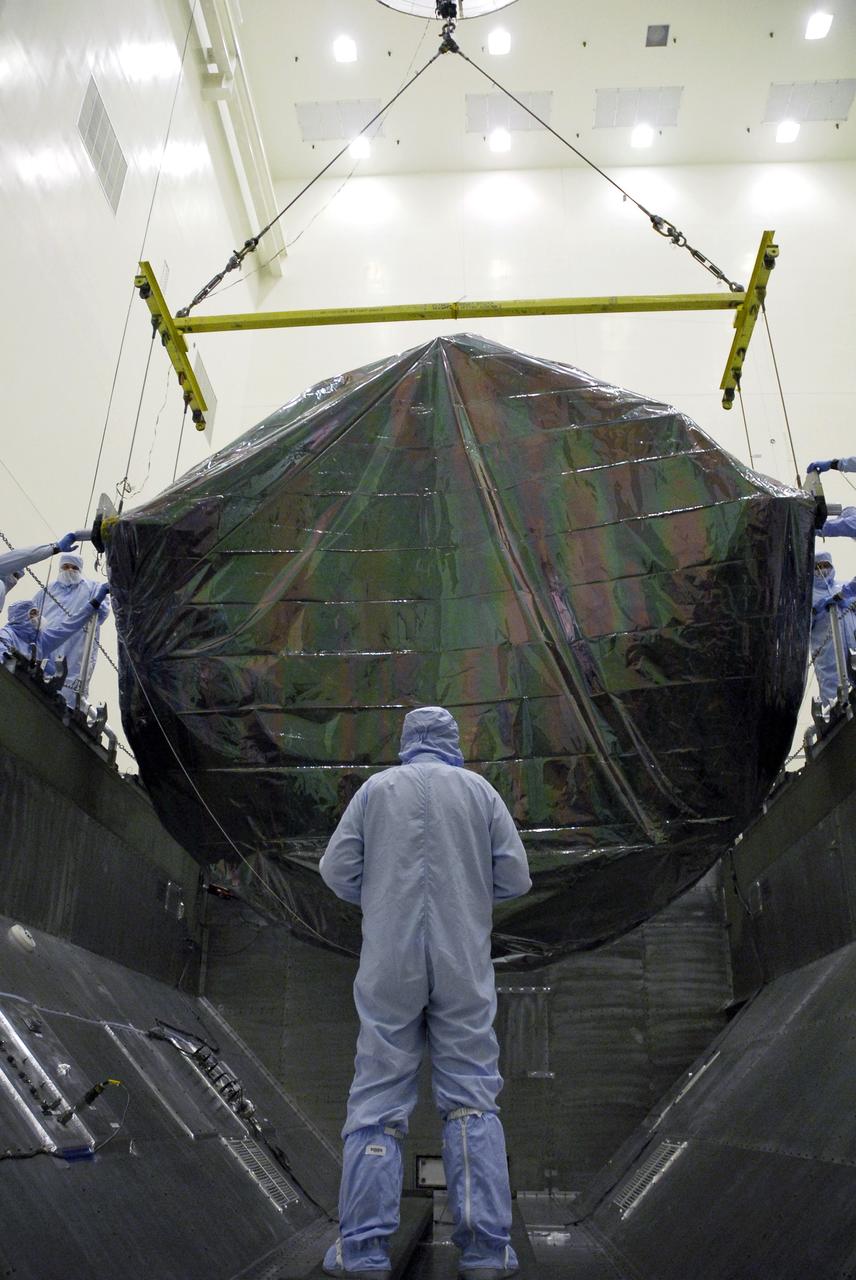
CAPE CANAVERAL, Fla. - In the Payload Hazardous Servicing Facility at NASA’s Kennedy Space Center, workers monitor the movement of the Flight Support System carrier with the Soft Capture Mechanism as it is lowered into the payload canister. The carrier is associated with the STS-125 mission to service the Hubble Space Telescope. The canister will transfer the carrier to Launch Pad 39A. The carrier is one of four associated with the STS-125 mission to service the Hubble Space Telescope. At the pad, all the carriers will be loaded into space shuttle Atlantis’ payload bay. Launch of Atlantis is targeted for Oct. 10. Photo credit: NASA/Cory Huston
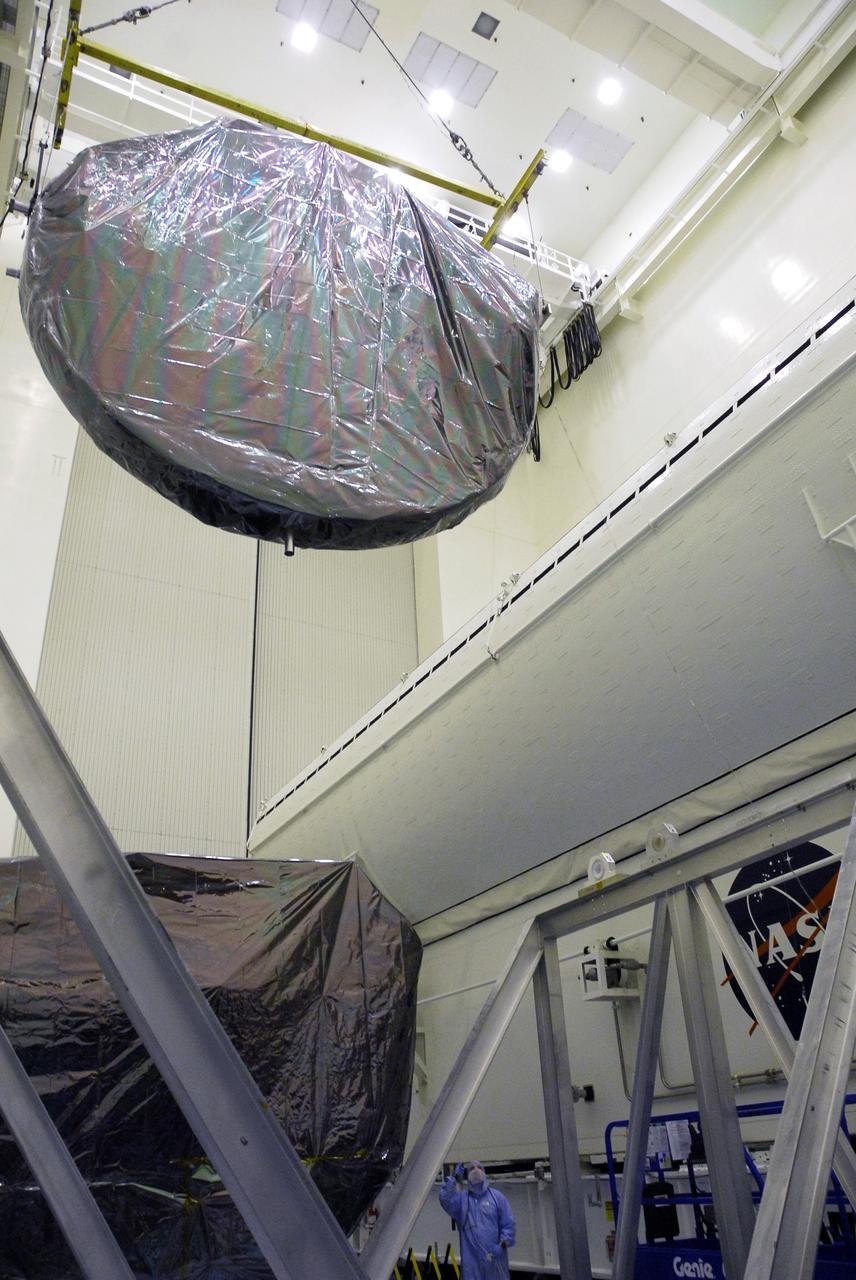
CAPE CANAVERAL, Fla. - In the Payload Hazardous Servicing Facility at NASA’s Kennedy Space Center, an overhead crane moves the Flight Support System carrier with the Soft Capture Mechanism toward the payload canister for transfer to Launch Pad 39A. The carrier is one of four associated with the STS-125 mission to service the Hubble Space Telescope. At the pad, all the carriers will be loaded into space shuttle Atlantis’ payload bay. Launch of Atlantis is targeted for Oct. 10. Photo credit: NASA/Cory Huston
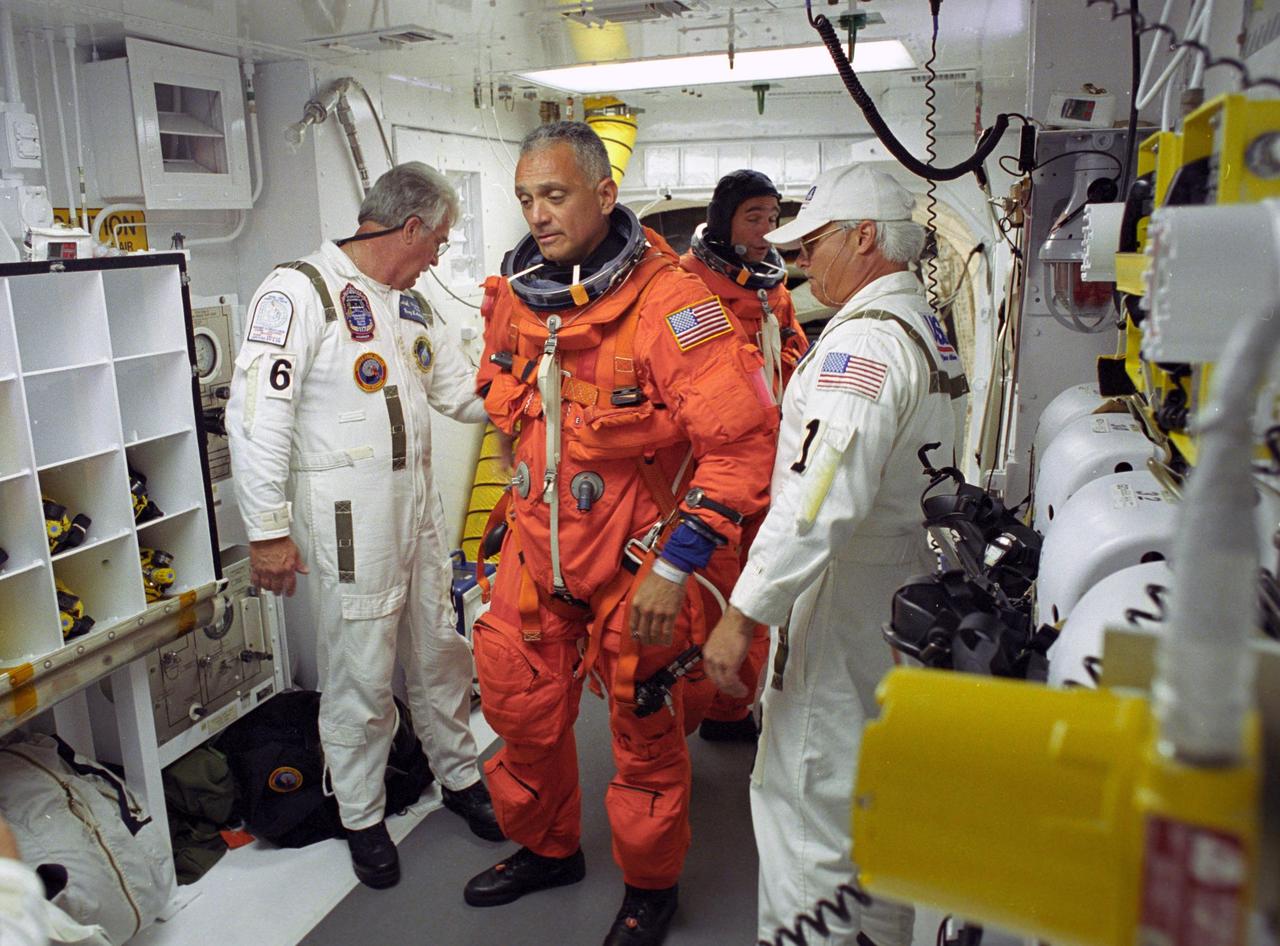
KENNEDY SPACE CENTER, FLA. -- In the White Room on Launch Pad 39A, STS-117 Mission Specialist John "Danny" Olivas is helped by the closeout crew to secure his launch suit before climbing into Space Shuttle Atlantis. Behind Olivas is Pilot Lee Archambault. The mission to the International Space Station is scheduled to launch at 7:38 p.m. EDT. Members of the closeout crew help the astronauts don a parachute pack, strap them into the space shuttle's crew module and take care of any other last-minute needs that arise. The White Room is at the end of the orbiter access arm that extends from the fixed service structure and provides entry into the orbiter. The shuttle is delivering a new segment to the starboard side of the space station's backbone, known as the truss. Three spacewalks are planned to install the S3/S4 truss segment, deploy a set of solar arrays and prepare them for operation. STS-117 is the 118th space shuttle flight, the 21st flight to the station, the 28th flight for Atlantis and the first of four flights planned for 2007. Photo credit: NASA/Tony Gray & Don Kight
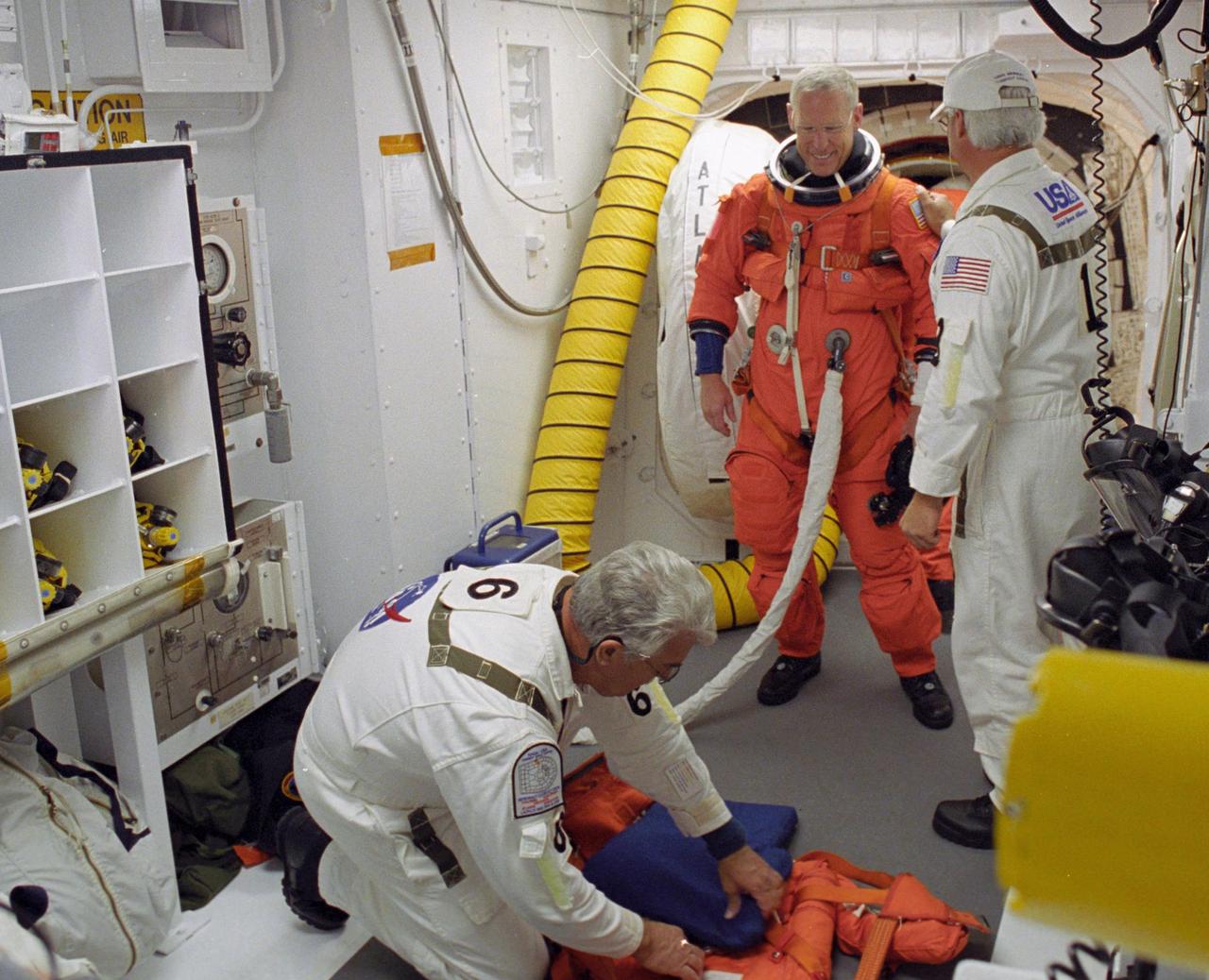
KENNEDY SPACE CENTER, FLA. -- In the White Room on Launch Pad 39A, members of the closeout crew help STS-117Mission Specialist Patrick Forrester secure his equipment before climbing into Space Shuttle Atlantis. The mission to the International Space Station is scheduled to launch at 7:38 p.m. EDT. Members of the closeout crew help the astronauts don a parachute pack, strap them into the space shuttle's crew module and take care of any other last-minute needs that arise. The White Room is at the end of the orbiter access arm that extends from the fixed service structure and provides entry into the orbiter. The shuttle is delivering a new segment to the starboard side of the space station's backbone, known as the truss. Three spacewalks are planned to install the S3/S4 truss segment, deploy a set of solar arrays and prepare them for operation. STS-117 is the 118th space shuttle flight, the 21st flight to the station, the 28th flight for Atlantis and the first of four flights planned for 2007. Photo credit: NASA/Tony Gray & Don Kight
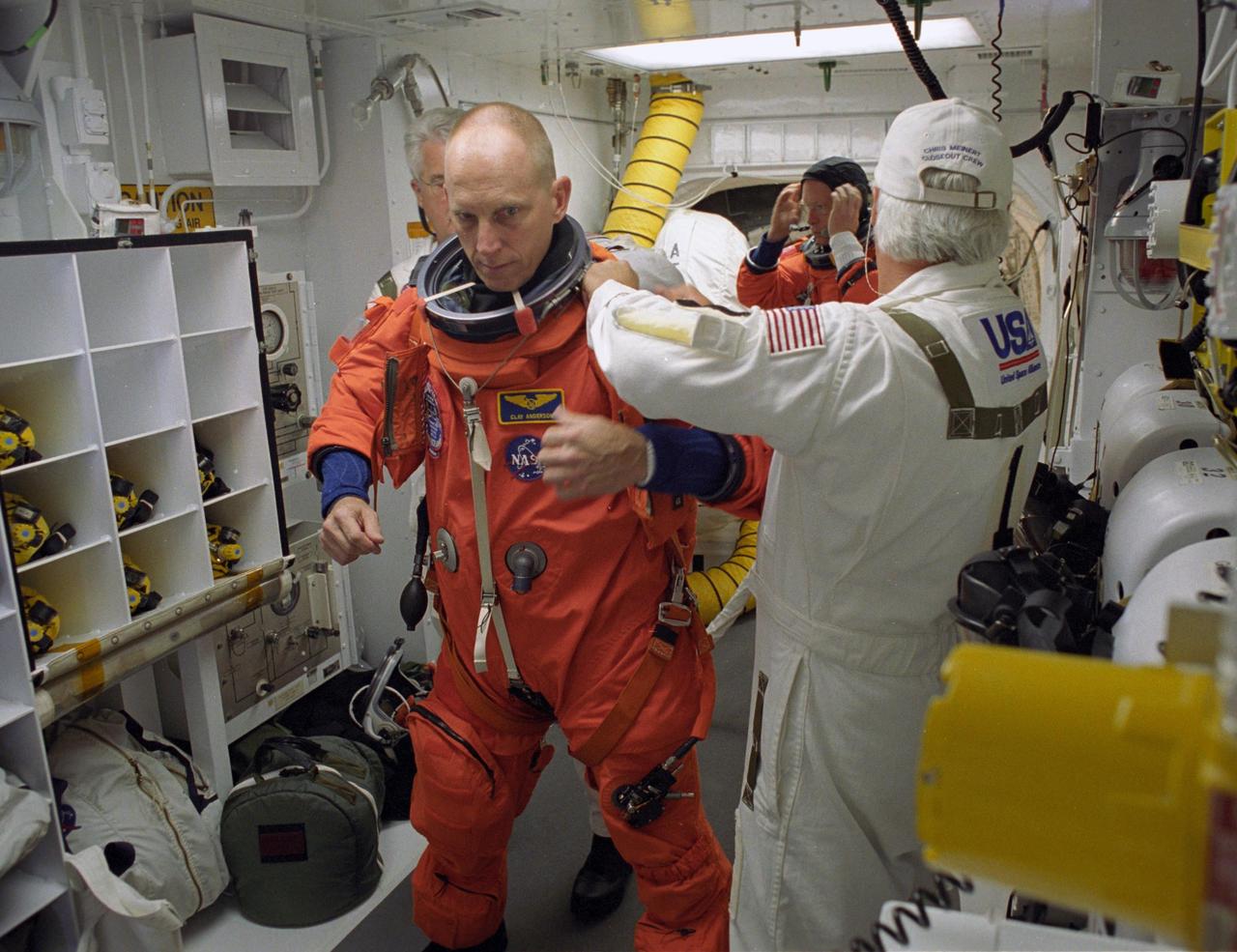
KENNEDY SPACE CENTER, FLA. -- In the White Room on Launch Pad 39A, astronaut Clayton Anderson is helped by the closeout crew to secure his launch suit before climbing into Space Shuttle Atlantis. Anderson is flying to the International Space Station with the STS-117 crew to join the Expedition 15 crew on the space station. Flight Engineer Suni Williams will return to Earth in his place. The mission to the space station is scheduled to launch at 7:38 p.m. EDT. Members of the closeout crew help the astronauts don a parachute pack, strap them into the space shuttle's crew module and take care of any other last-minute needs that arise. The White Room is at the end of the orbiter access arm that extends from the fixed service structure and provides entry into the orbiter. The shuttle is delivering a new segment to the starboard side of the space station's backbone, known as the truss. Three spacewalks are planned to install the S3/S4 truss segment, deploy a set of solar arrays and prepare them for operation. STS-117 is the 118th space shuttle flight, the 21st flight to the station, the 28th flight for Atlantis and the first of four flights planned for 2007. Photo credit: NASA/Tony Gray & Don Kight
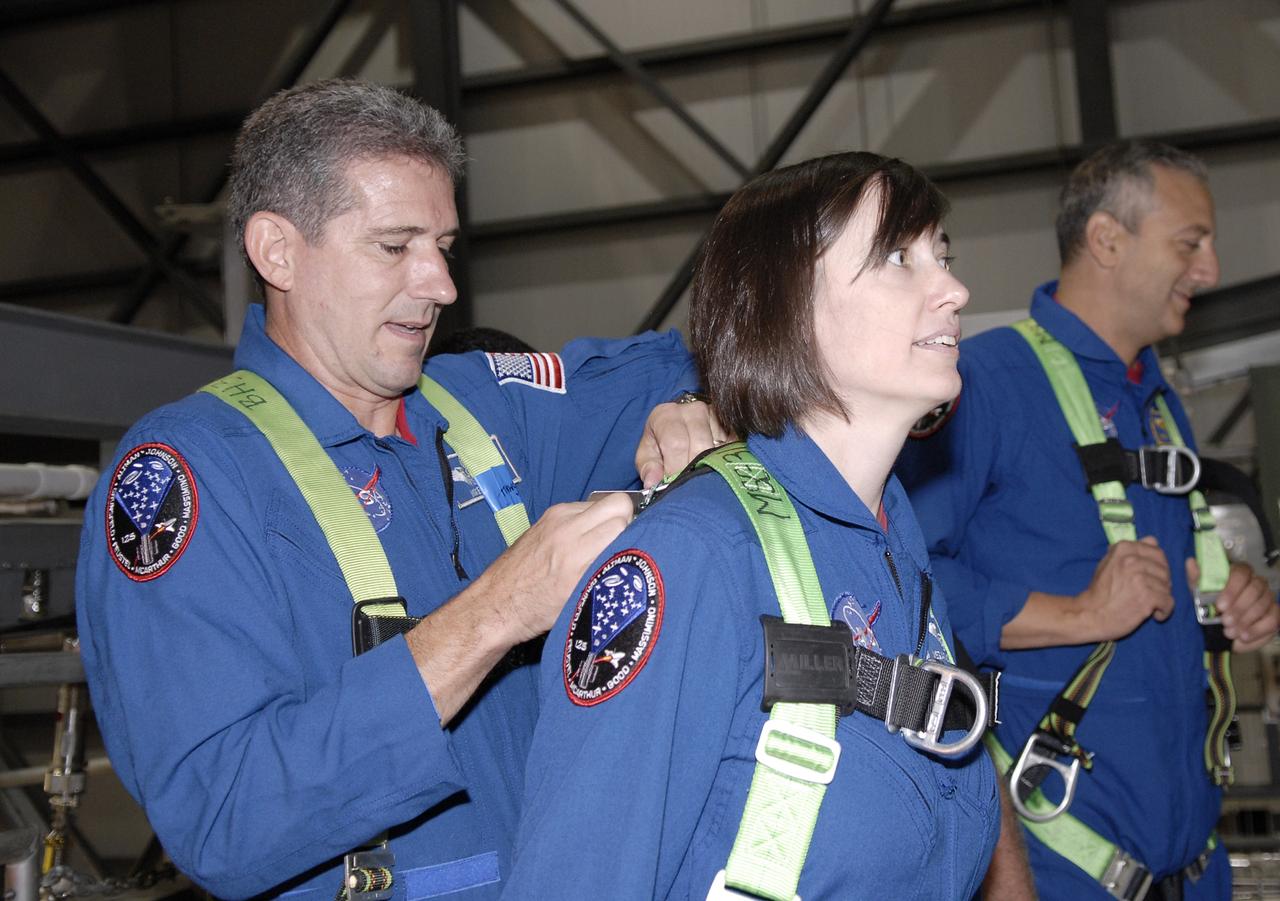
CAPE CANAVERAL, Fla. – In the Orbiter Processing Facility at NASA's Kennedy Space Center, STS-125 Mission Specialist Michael Good helps Mission Specialist Megan McArthur put on a safety harness to look inside space shuttle Atlantis' payload bay. Mission Specialist Mike Massimino also is shown. Crew members are at Kennedy for a crew equipment interface test, which provides hands-on experience with hardware and equipment for their mission. Atlantis is targeted to launch on the STS-125 Hubble Servicing Mission 4 on Oct. 8. Photo credit: NASA/Kim Shiflett
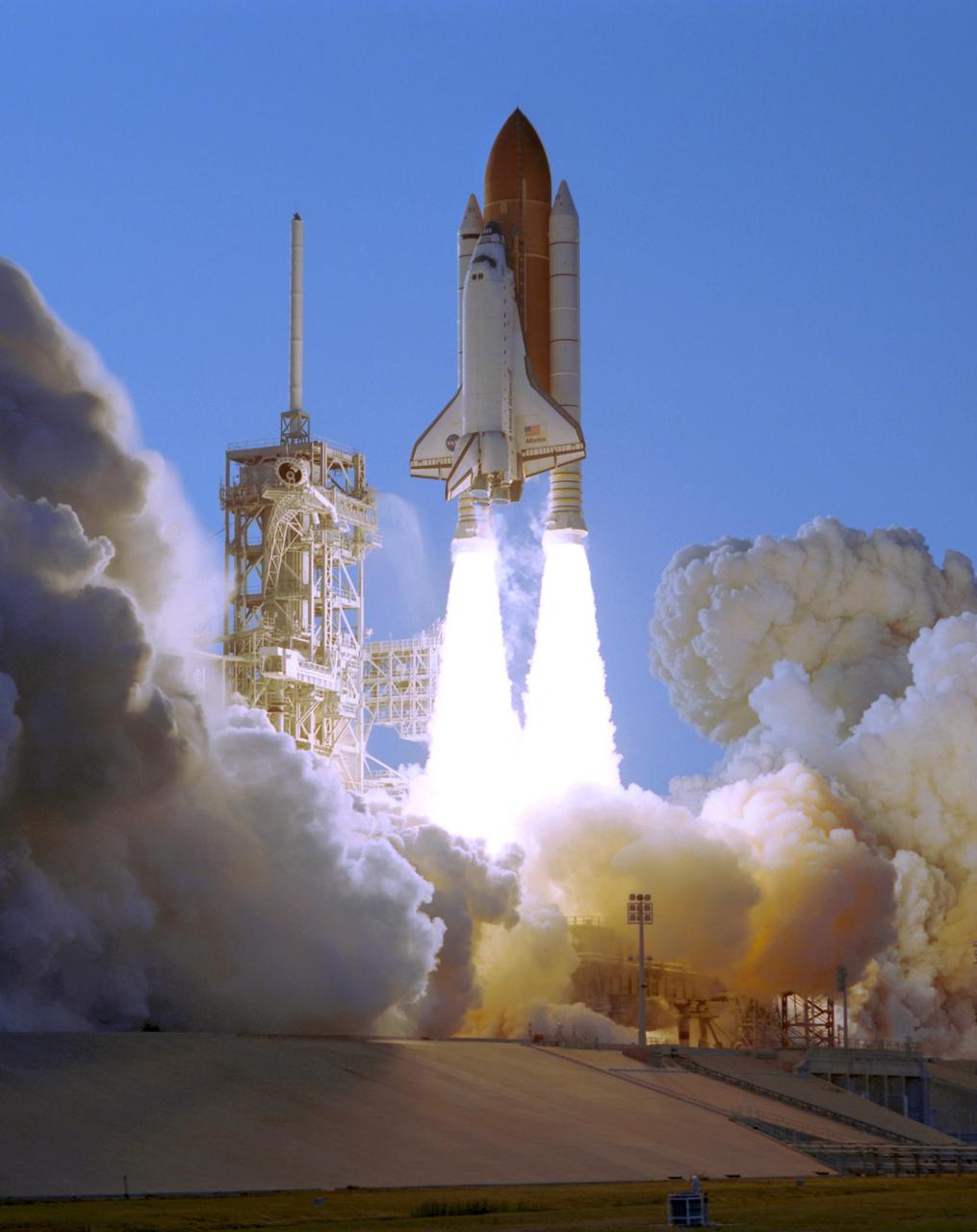
KENNEDY SPACE CENTER, FLA. -- Smoke and steam billow across Launch Pad 39A as Space Shuttle Atlantis, trailing columns of fire from the solid rocket boosters, hurtles into the sky on mission STS-117 to the International Space Station. At left is the fixed service structure with the 80-foot-tall lightning mast on top. Liftoff was on-time at 7:38:04 p.m. EDT. The shuttle is delivering a new segment to the starboard side of the International Space Station's backbone, known as the truss. Three spacewalks are planned to install the S3/S4 truss segment, deploy a set of solar arrays and prepare them for operation. STS-117 is the 118th space shuttle flight, the 21st flight to the station, the 28th flight for Atlantis and the first of four flights planned for 2007. Photo Credit: NASA/Tony Gray & Don Kight
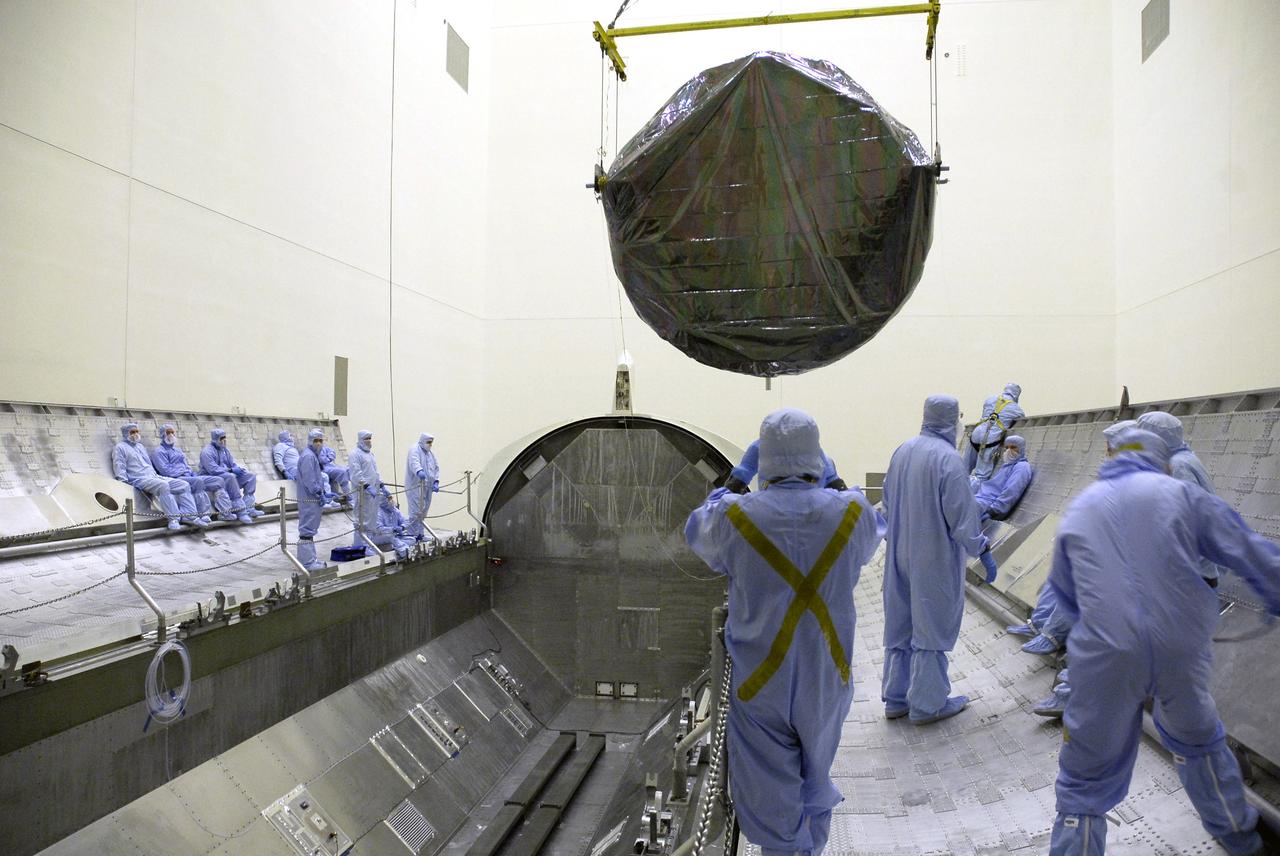
CAPE CANAVERAL, Fla. - In the Payload Hazardous Servicing Facility at NASA’s Kennedy Space Center, workers observe the movement of the crane holding the Flight Support System carrier with the Soft Capture Mechanism. It will be installed in the payload canister for transfer to Launch Pad 39A. The carrier is one of four associated with the STS-125 mission to service the Hubble Space Telescope. At the pad, all the carriers will be loaded into space shuttle Atlantis’ payload bay. Launch of Atlantis is targeted for Oct. 10. Photo credit: NASA/Cory Huston
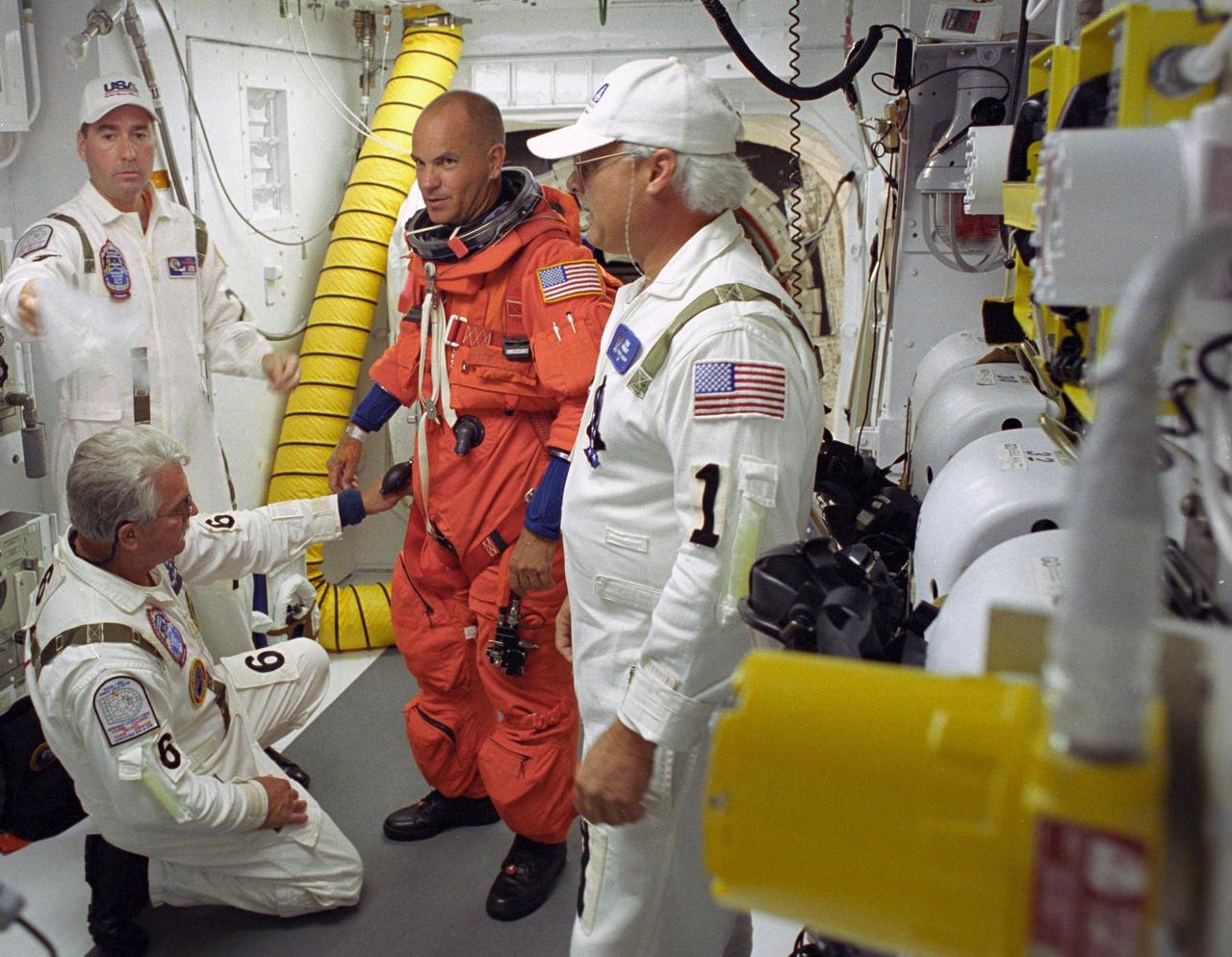
KENNEDY SPACE CENTER, FLA. -- STS-117 Commander Frederick Sturckow is helped by the closeout crew in the White Room on Launch Pad 39A to secure his launch suit before climbing into Space Shuttle Atlantis. The mission to the International Space Station is scheduled to launch at 7:38 p.m. EDT. Members of the Closeout Crew help the astronauts don a parachute pack, strap them into the space shuttle's crew module and take care of any other last-minute needs that arise. The White Room is at the end of the orbiter access arm that extends from the fixed service structure and provides entry into the orbiter. The shuttle is delivering a new segment to the starboard side of the space station's backbone, known as the truss. Three spacewalks are planned to install the S3/S4 truss segment, deploy a set of solar arrays and prepare them for operation. STS-117 is the 118th space shuttle flight, the 21st flight to the station, the 28th flight for Atlantis and the first of four flights planned for 2007. Photo credit: NASA/Tony Gray & Don Kight
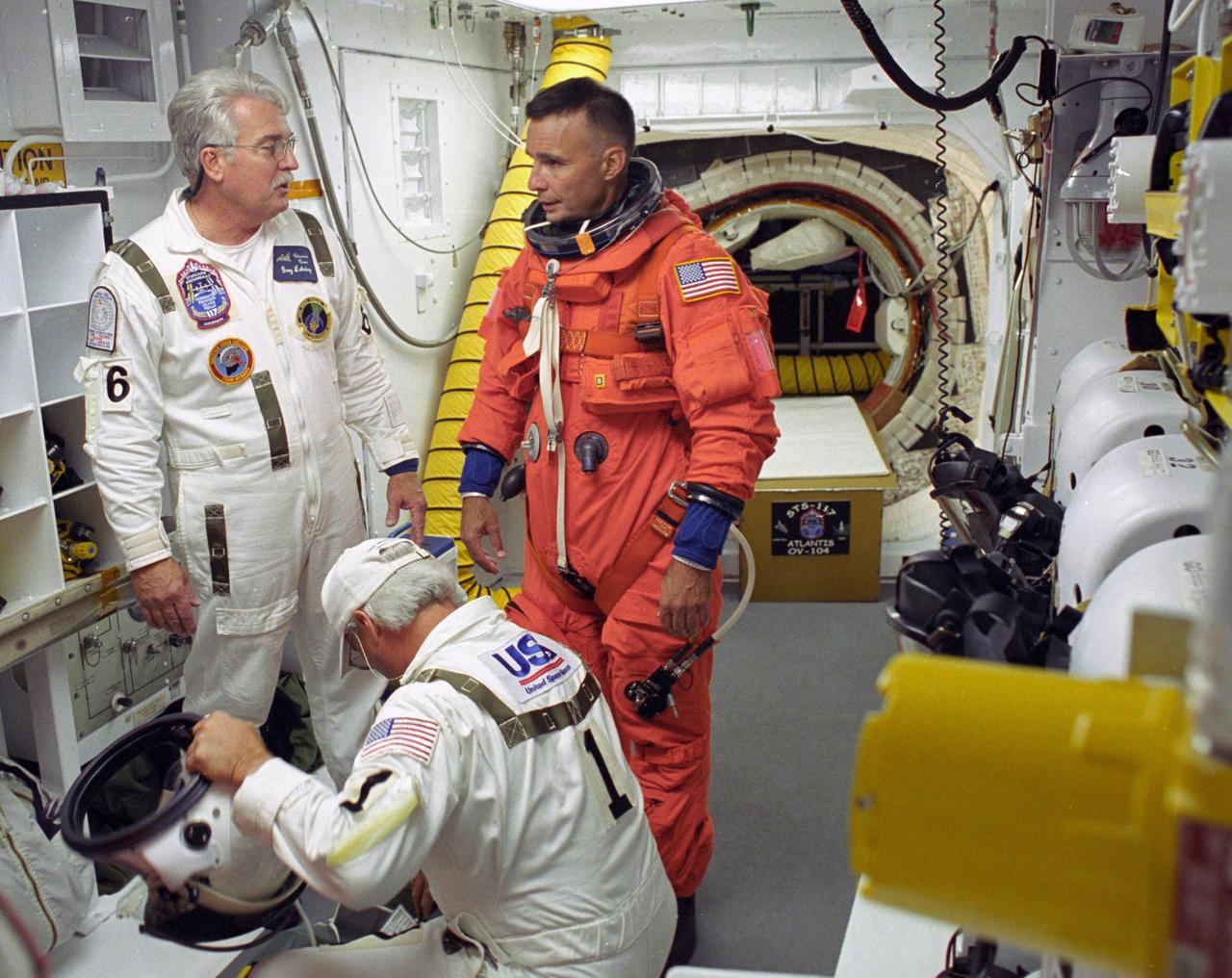
KENNEDY SPACE CENTER, FLA. -- STS-117 Pilot Lee Archambault is helped by the closeout crew in the White Room to secure his launch suit before climbing into Space Shuttle Atlantis. The mission to the International Space Station is scheduled to launch at 7:38 p.m. EDT. Members of the closeout crew help the astronauts don a parachute pack, strap them into the space shuttle's crew module and take care of any other last-minute needs that arise. The White Room is at the end of the orbiter access arm that extends from the fixed service structure and provides entry into the orbiter. The shuttle is delivering a new segment to the starboard side of the space station's backbone, known as the truss. Three spacewalks are planned to install the S3/S4 truss segment, deploy a set of solar arrays and prepare them for operation. STS-117 is the 118th space shuttle flight, the 21st flight to the station, the 28th flight for Atlantis and the first of four flights planned for 2007. Photo credit: NASA/Tony Gray & Don Kight
CAPE CANAVERAL, Fla. - In the Payload Hazardous Servicing Facility at NASA’s Kennedy Space Center, workers begin securing the Flight Support System carrier with the Soft Capture Mechanism in the payload canister. The canister will transfer the carrier to Launch Pad 39A. The carrier is one of four associated with the STS-125 mission to service the Hubble Space Telescope. At the pad, all the carriers will be loaded into space shuttle Atlantis’ payload bay. Launch of Atlantis is targeted for Oct. 10. Photo credit: NASA/Cory Huston
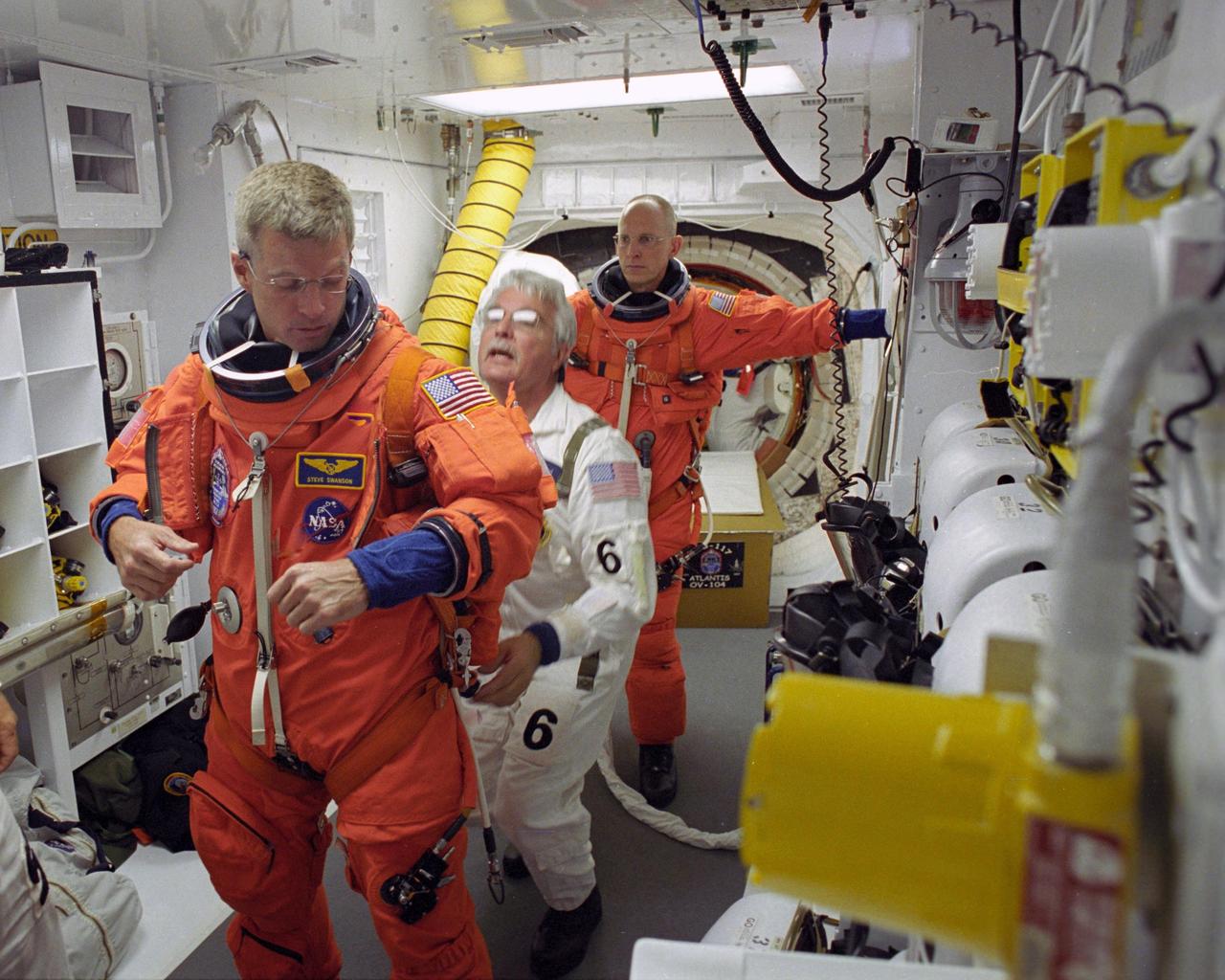
KENNEDY SPACE CENTER, FLA. -- In the White Room on Launch Pad 39A, STS-117 Mission Specialist Steven Swanson is helped by the closeout crew to secure his launch suit before climbing into Space Shuttle Atlantis. Behind Swanson is astronaut Clayton Anderson, waiting his turn. Anderson is joining the Expedition 15 crew on the International Space Station; Flight Engineer Suni Williams will return to Earth in his place. The mission to the space station is scheduled to launch at 7:38 p.m. EDT. Members of the closeout crew help the astronauts don a parachute pack, strap them into the space shuttle's crew module and take care of any other last-minute needs that arise. The White Room is at the end of the orbiter access arm that extends from the fixed service structure and provides entry into the orbiter. The shuttle is delivering a new segment to the starboard side of the space station's backbone, known as the truss. Three spacewalks are planned to install the S3/S4 truss segment, deploy a set of solar arrays and prepare them for operation. STS-117 is the 118th space shuttle flight, the 21st flight to the station, the 28th flight for Atlantis and the first of four flights planned for 2007. Photo credit: NASA/Tony Gray & Don Kight
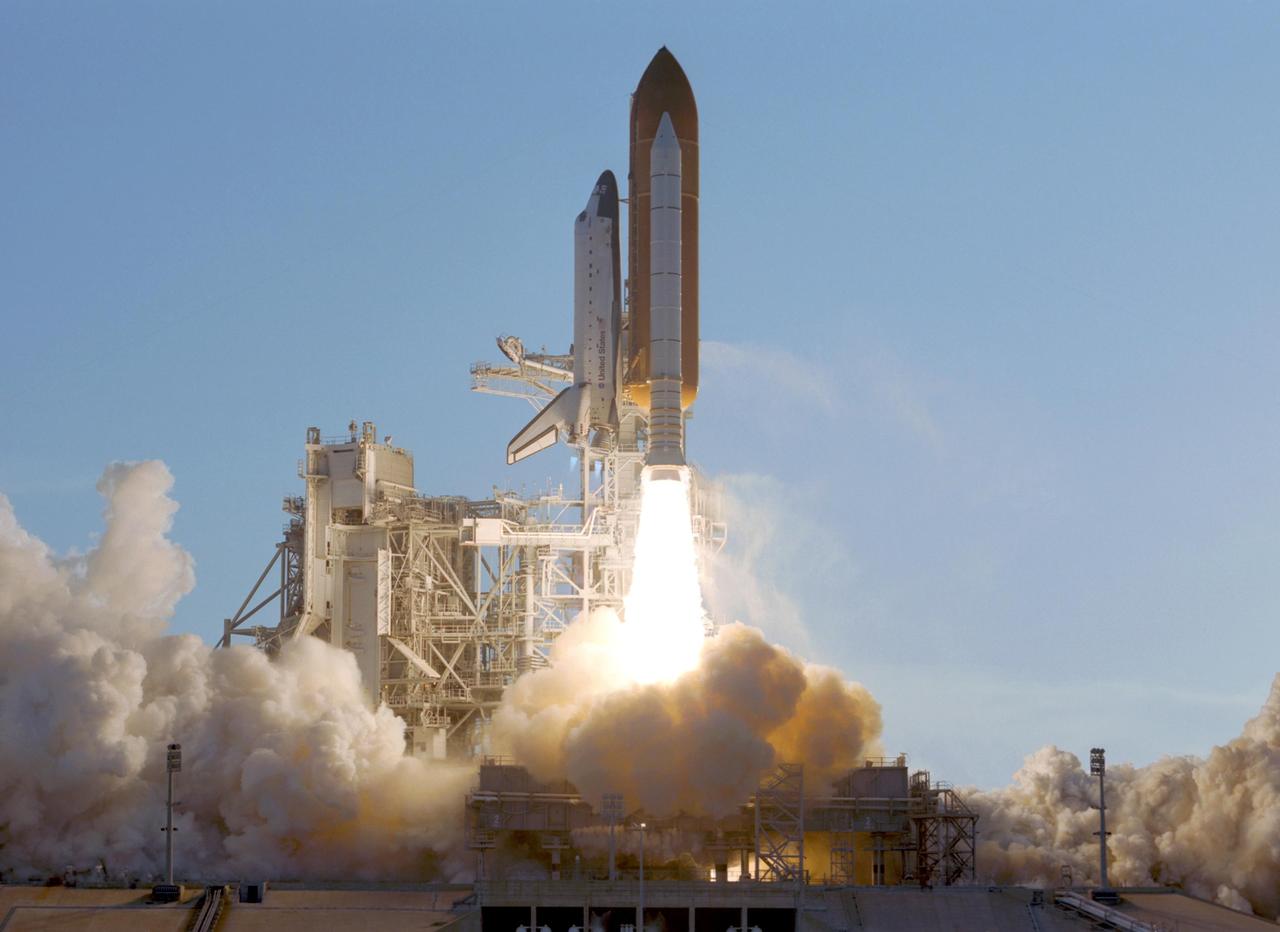
KENNEDY SPACE CENTER, FLA. -- With solid rocket boosters firing, Space Shuttle Atlantis leaps toward the heavens in a near-perfect launch on mission STS-117 to the International Space Station. The clouds of smoke and steam roll across Launch Pad 39A and surround the rotating service structure at left. Liftoff was on-time at 7:38:04 p.m. EDT. The shuttle is delivering a new segment to the starboard side of the International Space Station's backbone, known as the truss. Three spacewalks are planned to install the S3/S4 truss segment, deploy a set of solar arrays and prepare them for operation. STS-117 is the 118th space shuttle flight, the 21st flight to the station, the 28th flight for Atlantis and the first of four flights planned for 2007. Photo credit: NASA/Jerry Cannon & Mike Kerley
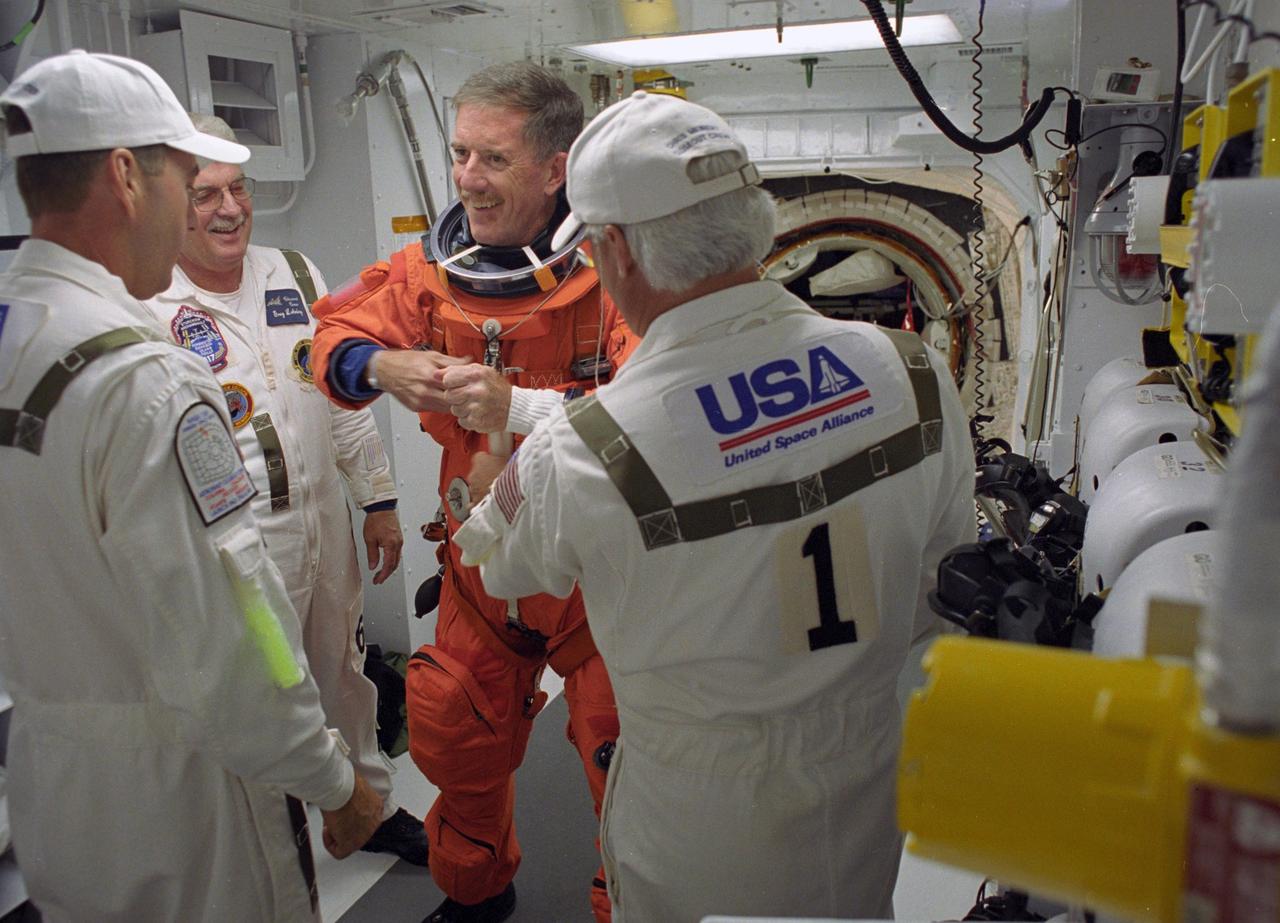
KENNEDY SPACE CENTER, FLA. -- In the White Room on Launch Pad 39A, members of the closeout crew help STS-117 Mission Specialist James Reilly secure his launch suit before climbing into Space Shuttle Atlantis. The mission to the International Space Station is scheduled to launch at 7:38 p.m. EDT. Members of the closeout crew help the astronauts don a parachute pack, strap them into the space shuttle's crew module and take care of any other last-minute needs that arise. The White Room is at the end of the orbiter access arm that extends from the fixed service structure and provides entry into the orbiter. The shuttle is delivering a new segment to the starboard side of the space station's backbone, known as the truss. Three spacewalks are planned to install the S3/S4 truss segment, deploy a set of solar arrays and prepare them for operation. STS-117 is the 118th space shuttle flight, the 21st flight to the station, the 28th flight for Atlantis and the first of four flights planned for 2007. Photo credit: NASA/Tony Gray & Don Kight
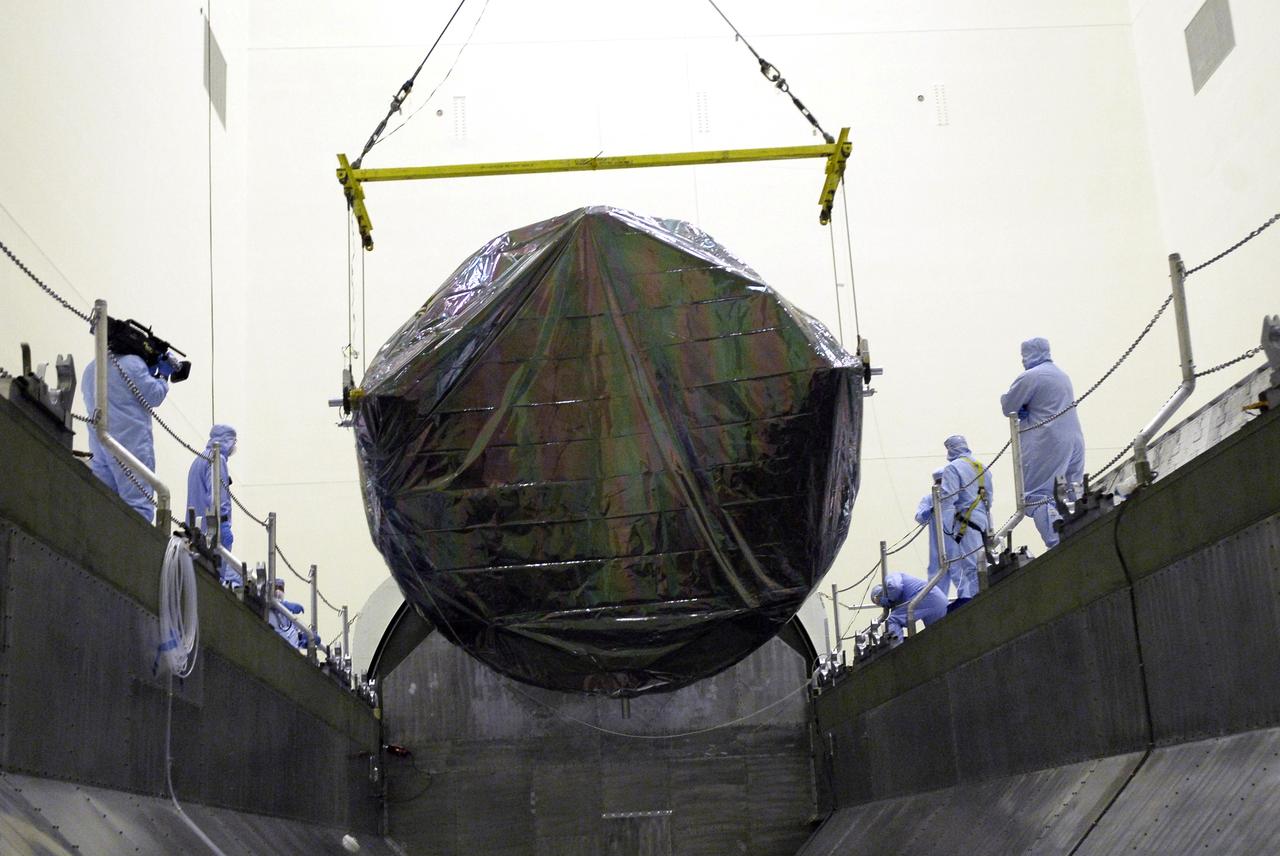
CAPE CANAVERAL, Fla. - In the Payload Hazardous Servicing Facility at NASA’s Kennedy Space Center, the overhead crane lowers the Flight Support System carrier with the Soft Capture Mechanism into the payload canister. The canister will transfer the carrier to Launch Pad 39A. The carrier is one of four associated with the STS-125 mission to service the Hubble Space Telescope. At the pad, all the carriers will be loaded into space shuttle Atlantis’ payload bay. Launch of Atlantis is targeted for Oct. 10. Photo credit: NASA/Cory Huston

CAPE CANAVERAL, Fla. - In the Payload Hazardous Servicing Facility at NASA’s Kennedy Space Center, an overhead crane lifts the Flight Support System carrier with the Soft Capture Mechanism under protective cover. The carrier is one of four associated with the STS-125 mission to service the Hubble Space Telescope. It will be installed in the payload canister for transfer to Launch Pad 39A. At the pad, all the carriers will be loaded into space shuttle Atlantis’ payload bay. Launch of Atlantis is targeted for Oct. 10. Photo credit: NASA/Cory Huston

CAPE CANAVERAL, Fla. – In the Orbiter Processing Facility at NASA's Kennedy Space Center, members of the STS-125 crew get a close look at space shuttle Atlantis' underside. From left, in their blue uniforms, are Mission Specialist Mike Massimino, Pilot Gregory C. Johnson, Mission Specialists Megan McArthur, John Grunsfeld, Andrew Feustel and Commander Scott Altman. Crew members are at Kennedy for a crew equipment interface test, which provides hands-on experience with hardware and equipment for their mission. Atlantis is targeted to launch on the STS-125 Hubble Servicing Mission 4 on Oct. 8. Photo credit: NASA/Kim Shiflett
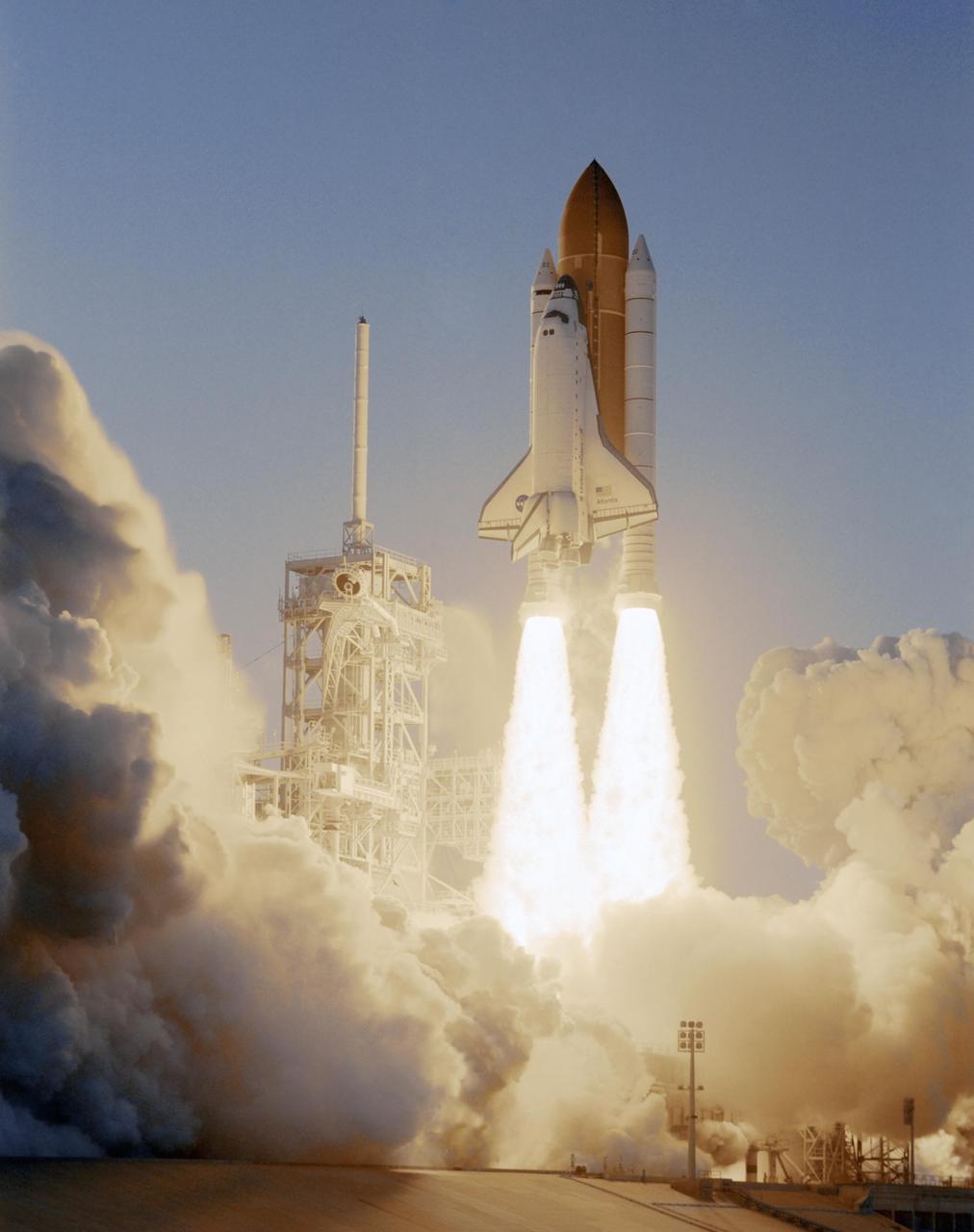
KENNEDY SPACE CENTER, FLA. -- Smoke and steam billow across Launch Pad 39A as Space Shuttle Atlantis, trailing columns of fire from the solid rocket boosters, hurtles into the sky on mission STS-117 to the International Space Station. At left is the fixed service structure with the 80-foot-tall lightning mast on top. Liftoff was on-time at 7:38:04 p.m. EDT. The shuttle is delivering a new segment to the starboard side of the International Space Station's backbone, known as the truss. Three spacewalks are planned to install the S3/S4 truss segment, deploy a set of solar arrays and prepare them for operation. STS-117 is the 118th space shuttle flight, the 21st flight to the station, the 28th flight for Atlantis and the first of four flights planned for 2007. Photo credit: NASA/Tony Gray & Don Kight

CAPE CANAVERAL, Fla. - In the Payload Hazardous Servicing Facility at NASA’s Kennedy Space Center, engineers control the movement of the overhead crane lifting the Flight Support System carrier with the Soft Capture Mechanism. It will be installed in the payload canister for transfer to Launch Pad 39A. The carrier is one of four associated with the STS-125 mission to service the Hubble Space Telescope. At the pad, all the carriers will be loaded into space shuttle Atlantis’ payload bay. Launch of Atlantis is targeted for Oct. 10. Photo credit: NASA/Cory Huston
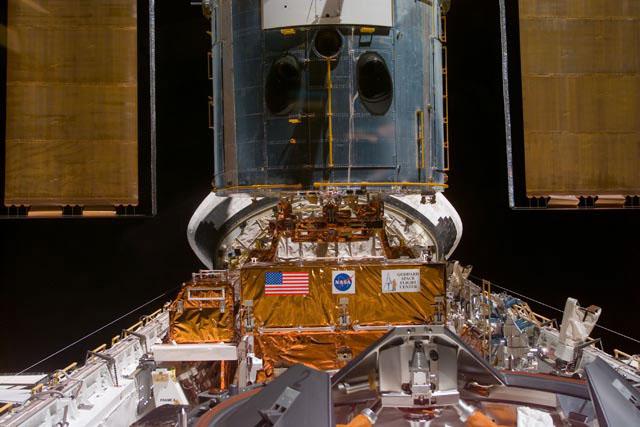
S103-E-5169 (21 December 1999) --- This electronic still camera's view and others in this series showing the Hubble Space Telescope (HST) berthed in Discovery's bay were recorded during capture and downlinked at the completion of the mission's first space walk on the following day by the busy STS-103 astronauts. The image was recorded at 19:49:22 GMT, Dec. 21, 1999.
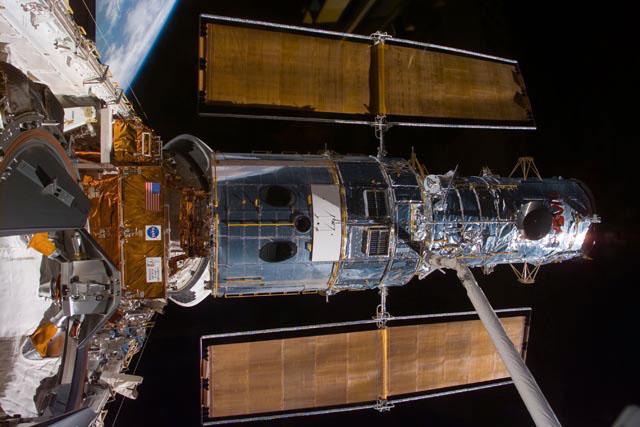
S103-E-5162 (21 December 1999) --- This electronic still camera's view and others in this series showing the Hubble Space Telescope (HST)being berthed in Discovery's bay were recorded during and soon after capture; and they were downlinked at the completion of the mission's first space walk on the following day by the busy STS-103 astronauts. The image was recorded at 19:47:22 GMT, Dec. 21, 1999.
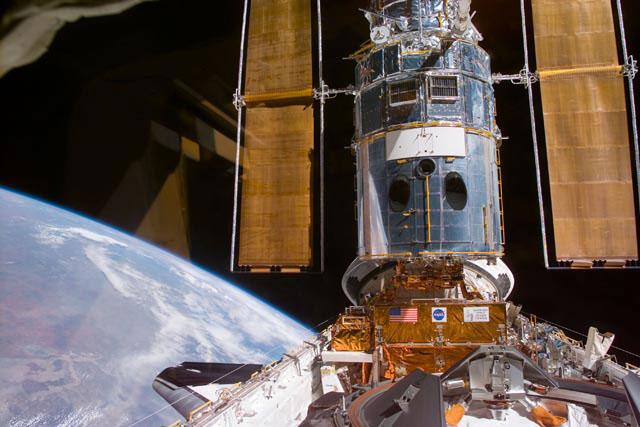
S103-E-5159 (21 December 1999) --- This electronic still camera's view and others in this series showing the Hubble Space Telescope (HST) being berthed in Discovery's bay were recorded during and soon after capture; and they were downlinked at the completion of the mission's first space walk on the following day by the busy STS-103 astronauts. The image was recorded at 19:47:02 GMT, Dec. 21, 1999.
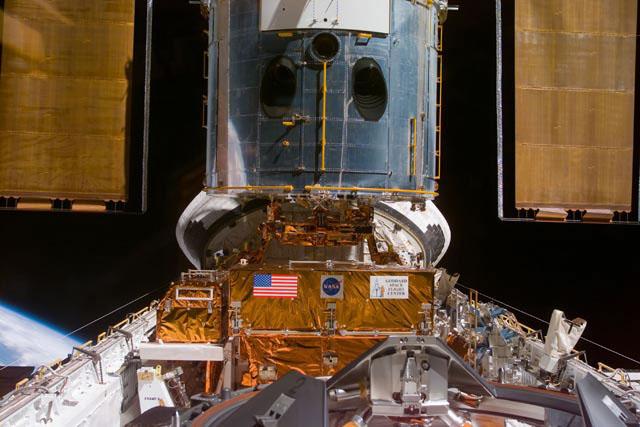
S103-E-5165 (21 December 1999) --- This electronic still camera's view and others in this series showing the Hubble Space Telescope (HST) berthed in Discovery's bay were recorded soon after capture and downlinked at the completion of the mission's first space walk on the following day by the busy STS-103 astronauts. The image was recorded at 19:47:57 GMT, Dec. 21, 1999.
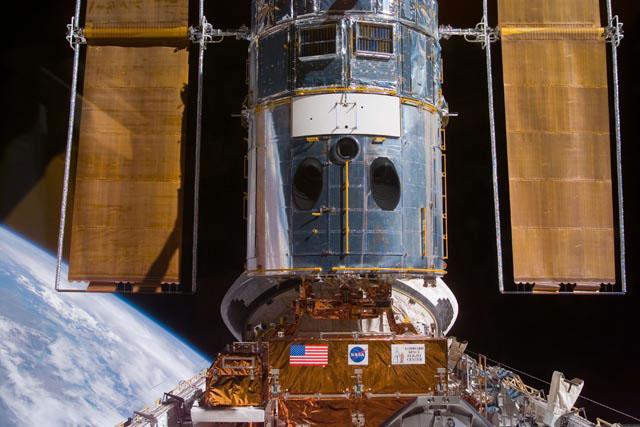
S103-E-5156 (21 December 1999) --- This electronic still camera's view and others in this series showing the Hubble Space Telescope (HST) being berthed in Discovery's bay were recorded during and soon after capture; and they were downlinked at the completion of the mission's first space walk on the following day by the busy STS-103 astronauts. The image was recorded at 19:46:15 GMT, Dec. 21, 1999.
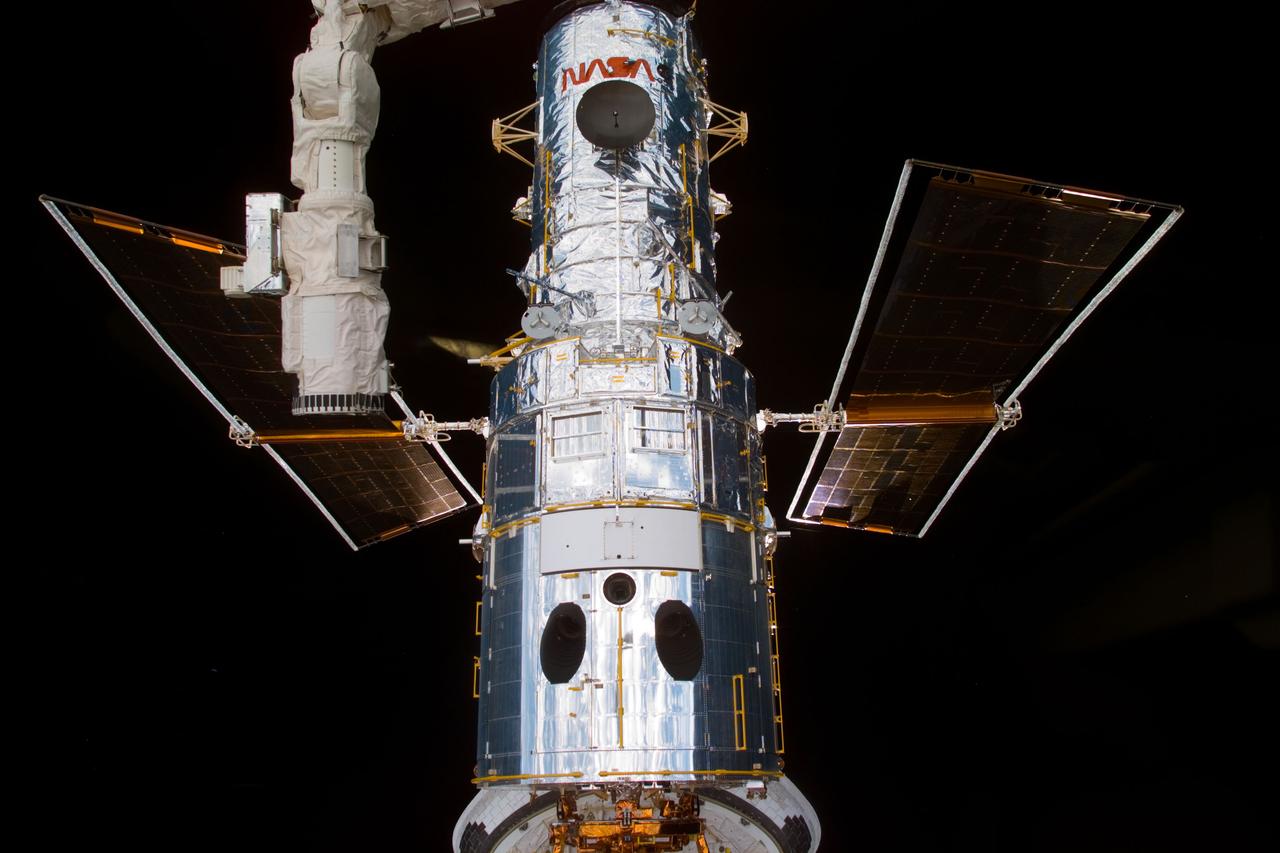
S82-E-5175 (13 Feb. 1997) --- Hubble Space Telescope (HST) after capture berthed on Flight Support system (FSS) in Space Shuttle Discovery's payload bay. This view was taken with an Electronic Still Camera (ESC).
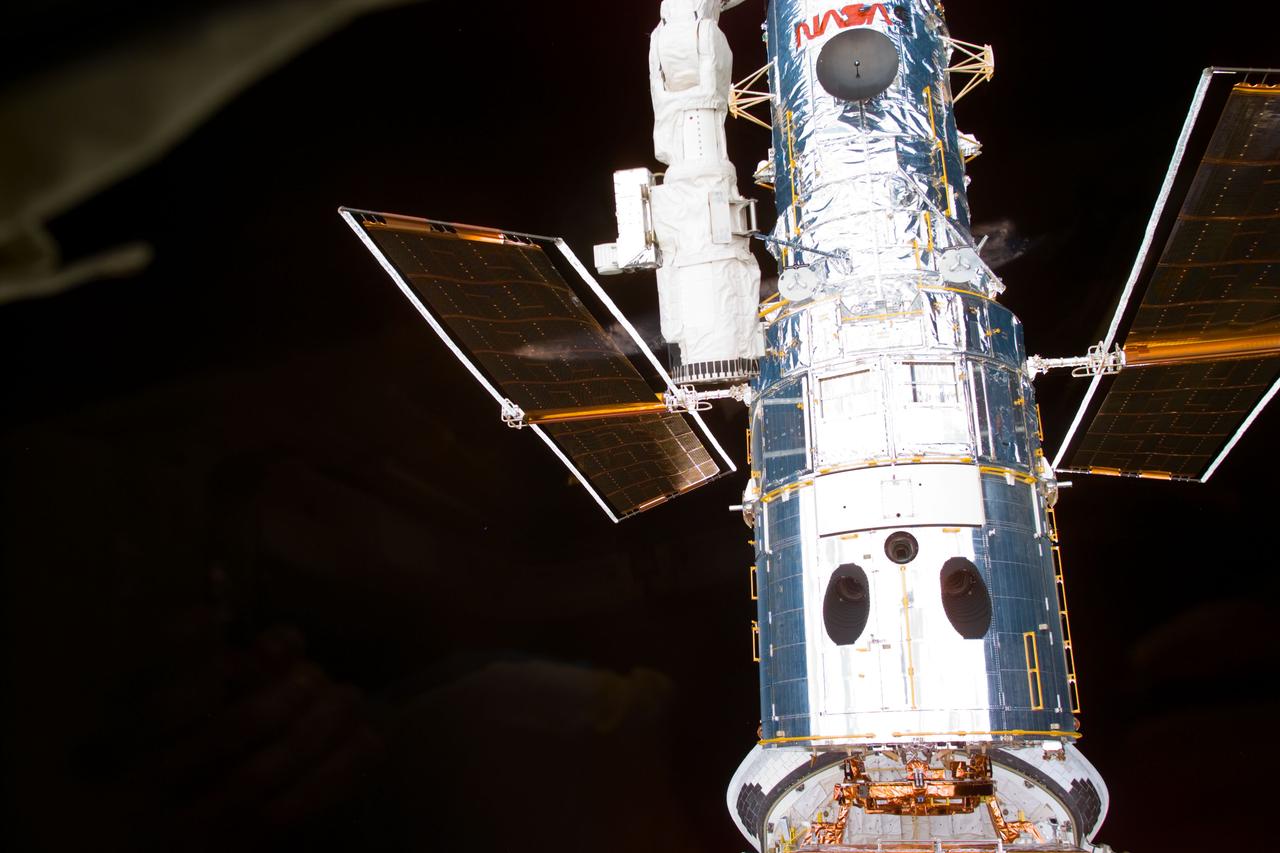
S82-E-5171 (13 Feb. 1997) --- Hubble Space Telescope (HST) after capture berthed on Flight Support system (FSS) in Space Shuttle Discovery's payload bay. This view was taken with an Electronic Still Camera (ESC).
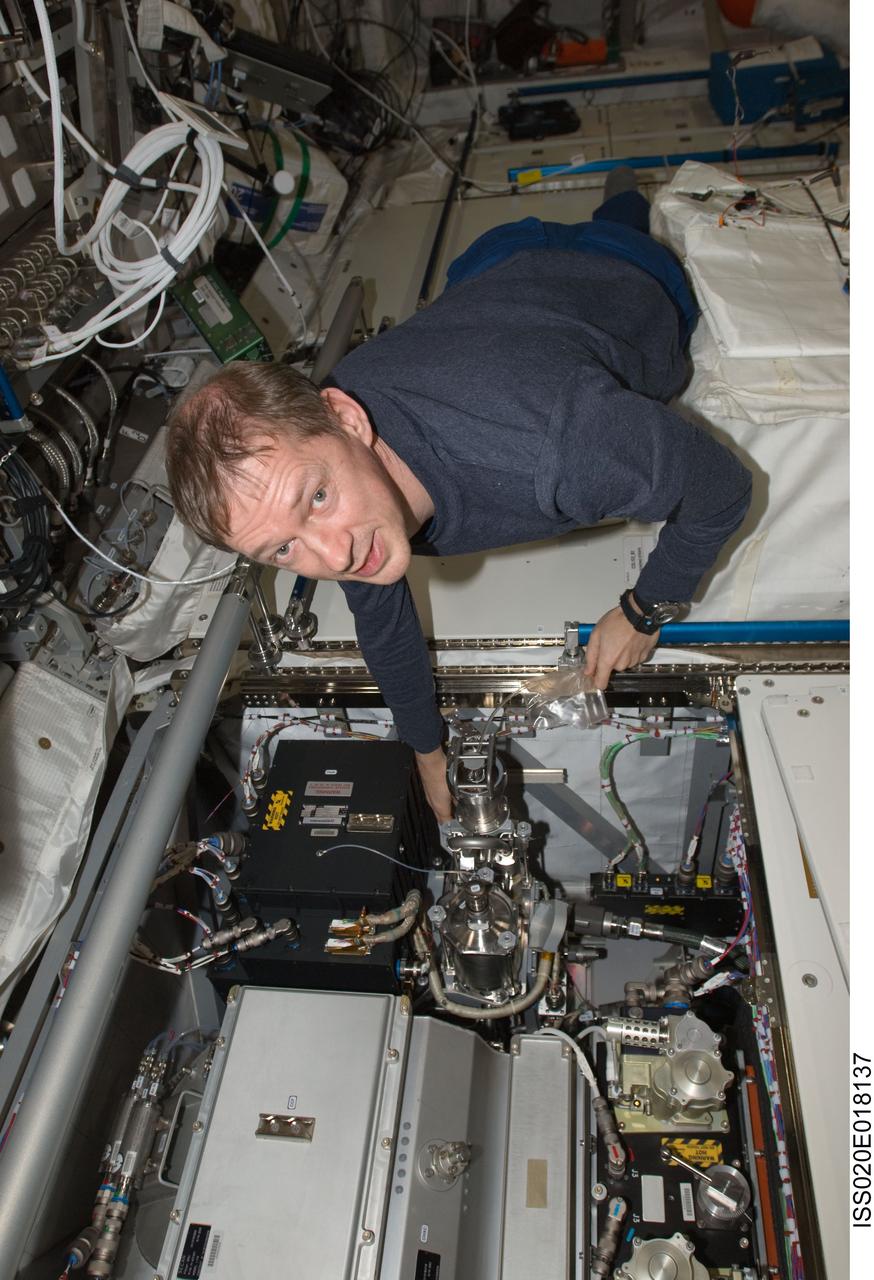
ISS020-E-018137 (9 July 2009) --- European Space Agency astronaut Frank De Winne, Expedition 20 flight engineer, works with the Fluid Servicing System (FSS) in the Columbus laboratory of the International Space Station.
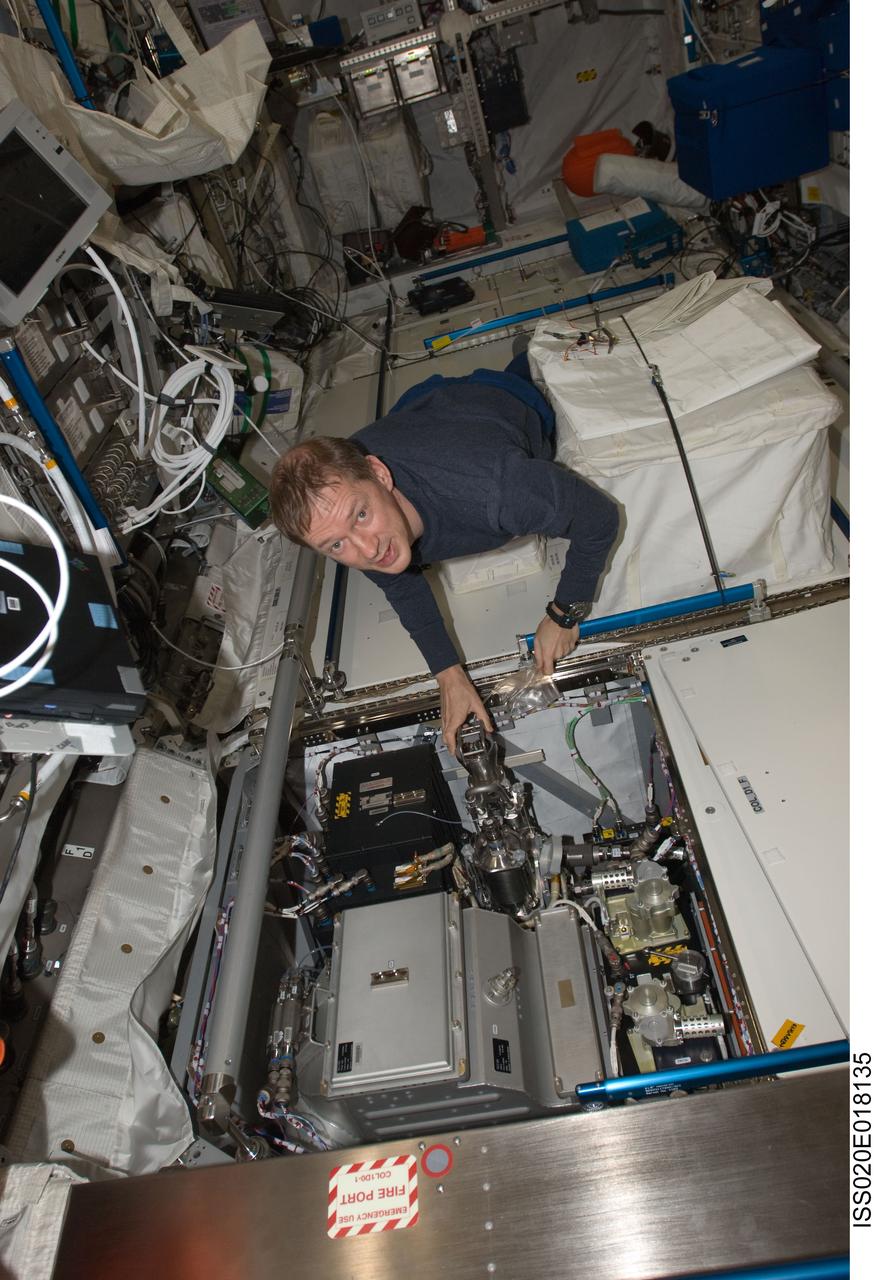
ISS020-E-018135 (9 July 2009) --- European Space Agency astronaut Frank De Winne, Expedition 20 flight engineer, works with the Fluid Servicing System (FSS) in the Columbus laboratory of the International Space Station.

CAPE CANAVERAL, Fla. – Kennedy Space Center in Florida, the orbiter access arm, with the White Room on the end, is placed on a trailer. The arm was removed from the fixed service structure for the pad's conversion as launch site for the Constellation Program's Ares I-X. The launch of the Ares I-X flight test is targeted for August 2009. Photo credit: NASA/Kim Shiflett
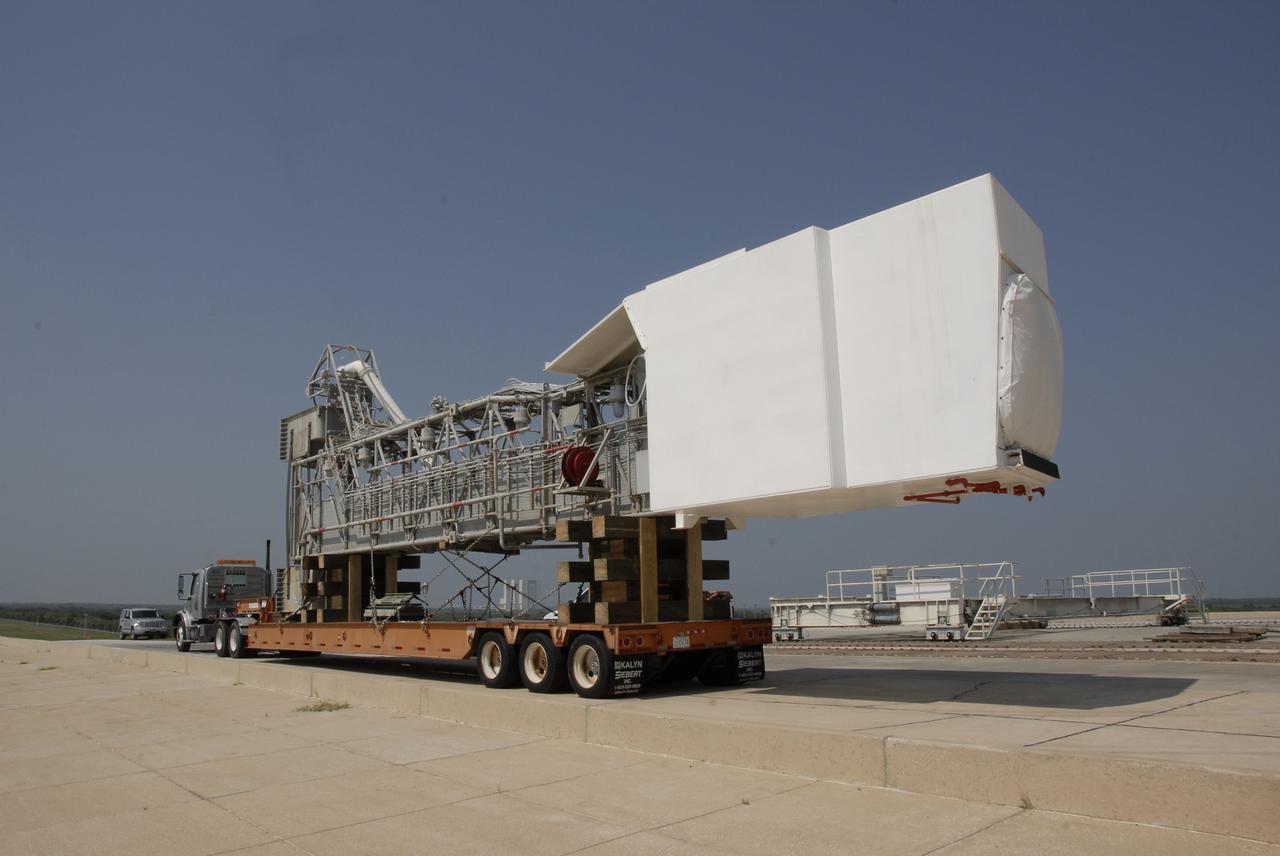
CAPE CANAVERAL, Fla. – The orbiter access arm, with the White Room on the end, leaves Launch Pad 39B on a trailer at NASA's Kennedy Space Center in Florida. The arm was removed from the fixed service structure for the pad's conversion as launch site for the Constellation Program's Ares I-X. The launch of the Ares I-X flight test is targeted for August 2009. Photo credit: NASA/Kim Shiflett
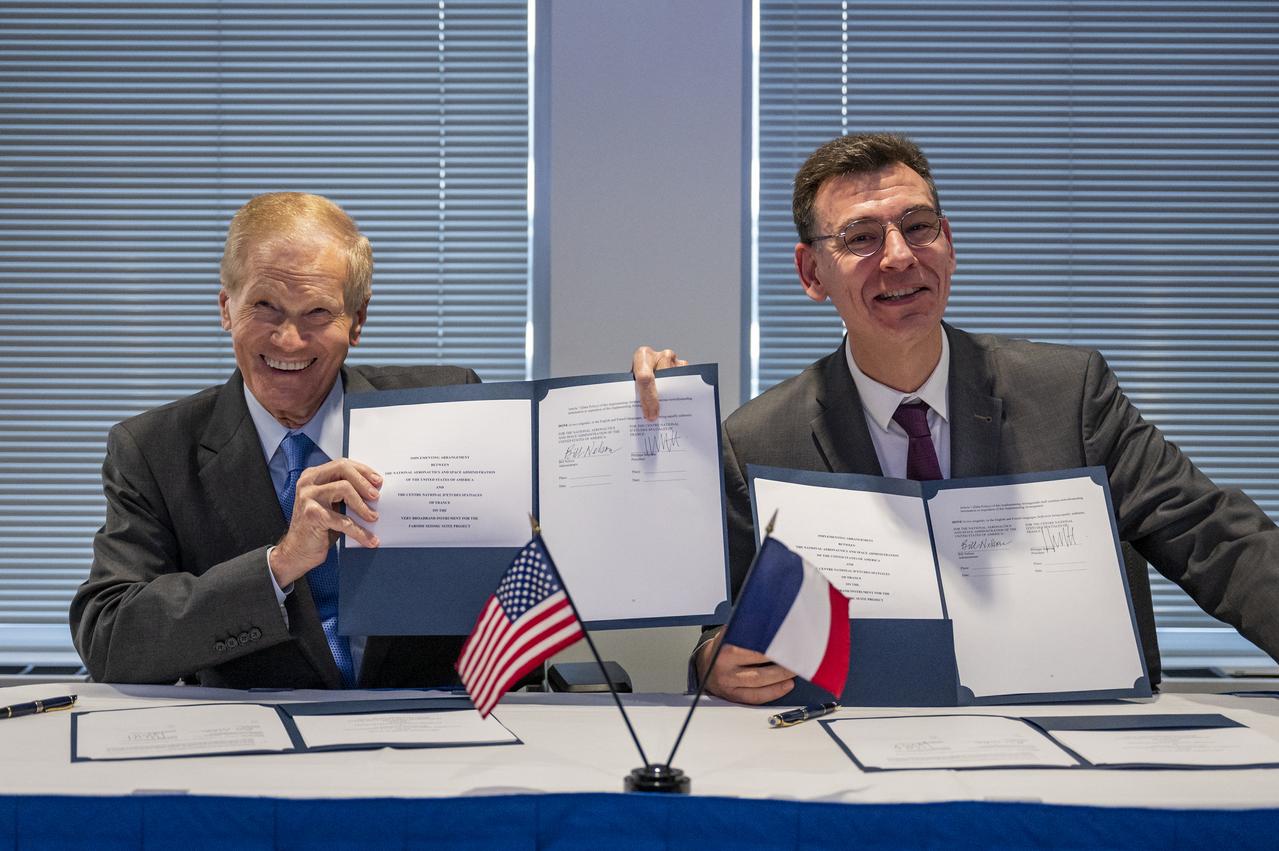
NASA Administrator Bill Nelson and President of the Centre National d’Etudes Spatiales (CNES) Dr. Philippe Baptiste sign an agreement for the Farside Seismic Suite (FSS), Wednesday, Nov. 30, 2022 at the Mary W. Jackson NASA Headquarters building in Washington. The FSS will return the first lunar seismic data from the far side of the Moon. CNES is contributing one of the seismometers to this payload, which will be delivered via NASA’s Commercial Lunar Payloads Services (CLPS) initiative, based on heritage capabilities from the Mars InSight mission. Photo Credit: (NASA/Keegan Barber)

NASA Administrator Bill Nelson and President of the Centre National d’Etudes Spatiales (CNES) Dr. Philippe Baptiste sign an agreement for the Farside Seismic Suite (FSS), Wednesday, Nov. 30, 2022 at the Mary W. Jackson NASA Headquarters building in Washington. The FSS will return the first lunar seismic data from the far side of the Moon. CNES is contributing one of the seismometers to this payload, which will be delivered via NASA’s Commercial Lunar Payloads Services (CLPS) initiative, based on heritage capabilities from the Mars InSight mission. Photo Credit: (NASA/Keegan Barber)
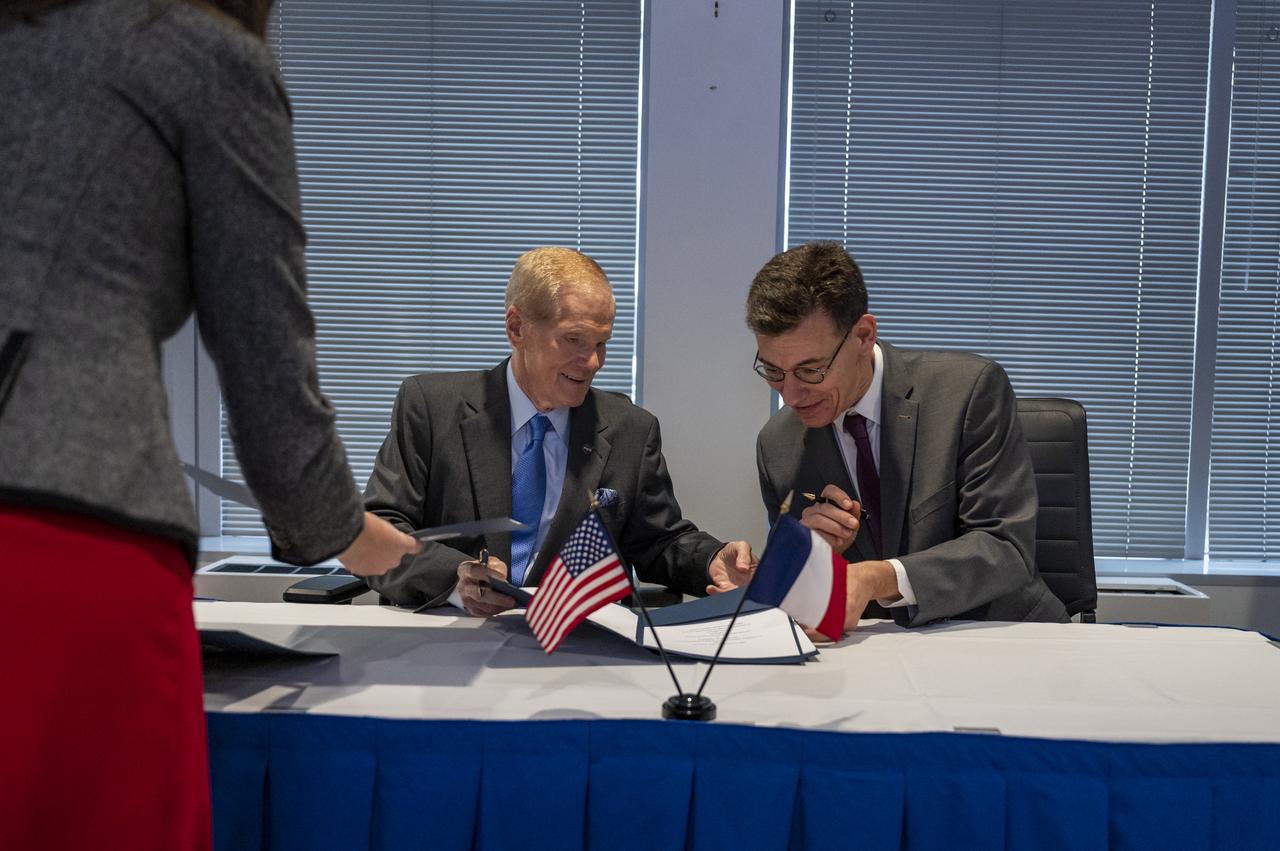
NASA Administrator Bill Nelson and President of the Centre National d’Etudes Spatiales (CNES) Dr. Philippe Baptiste sign an agreement for the Farside Seismic Suite (FSS), Wednesday, Nov. 30, 2022 at the Mary W. Jackson NASA Headquarters building in Washington. The FSS will return the first lunar seismic data from the far side of the Moon. CNES is contributing one of the seismometers to this payload, which will be delivered via NASA’s Commercial Lunar Payloads Services (CLPS) initiative, based on heritage capabilities from the Mars InSight mission. Photo Credit: (NASA/Keegan Barber)
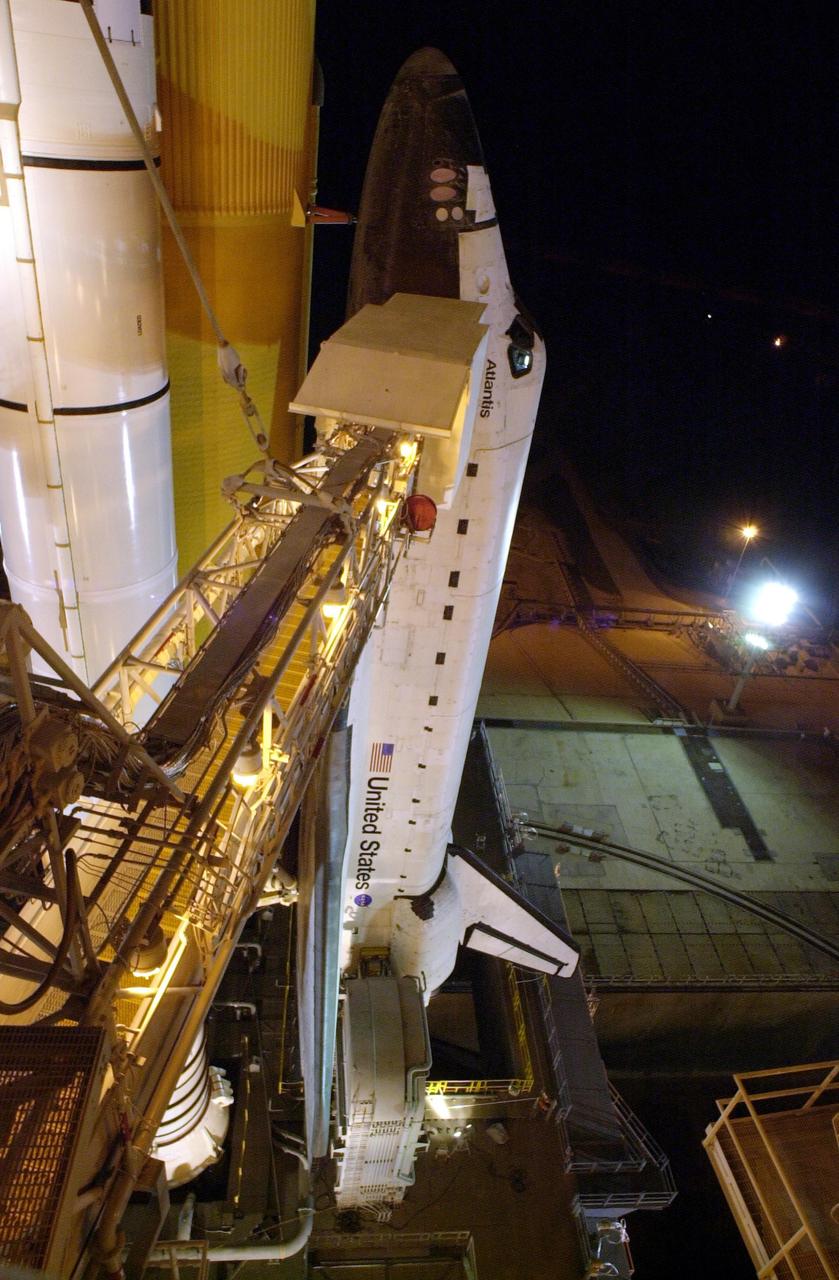
KENNEDY SPACE CENTER, FLA. -- With the Rotating Service Structure rolled back, Space Shuttle Atlantis stands ready for launch on mission STS-110. The Orbiter Access Arm extends from the Fixed Service Structure (FSS) to the crew compartment hatch, through which the STS-110 crew will enter Atlantis. The RSS provides protected access to the orbiter for changeout and servicing of payloads at the pad. The structure has access platforms at five levels to provide access to the payload bay. The FSS provides access to the orbiter and the RSS. . Mission STS-110 is scheduled to launch April 4 on its 11-day mission to the International Space Station
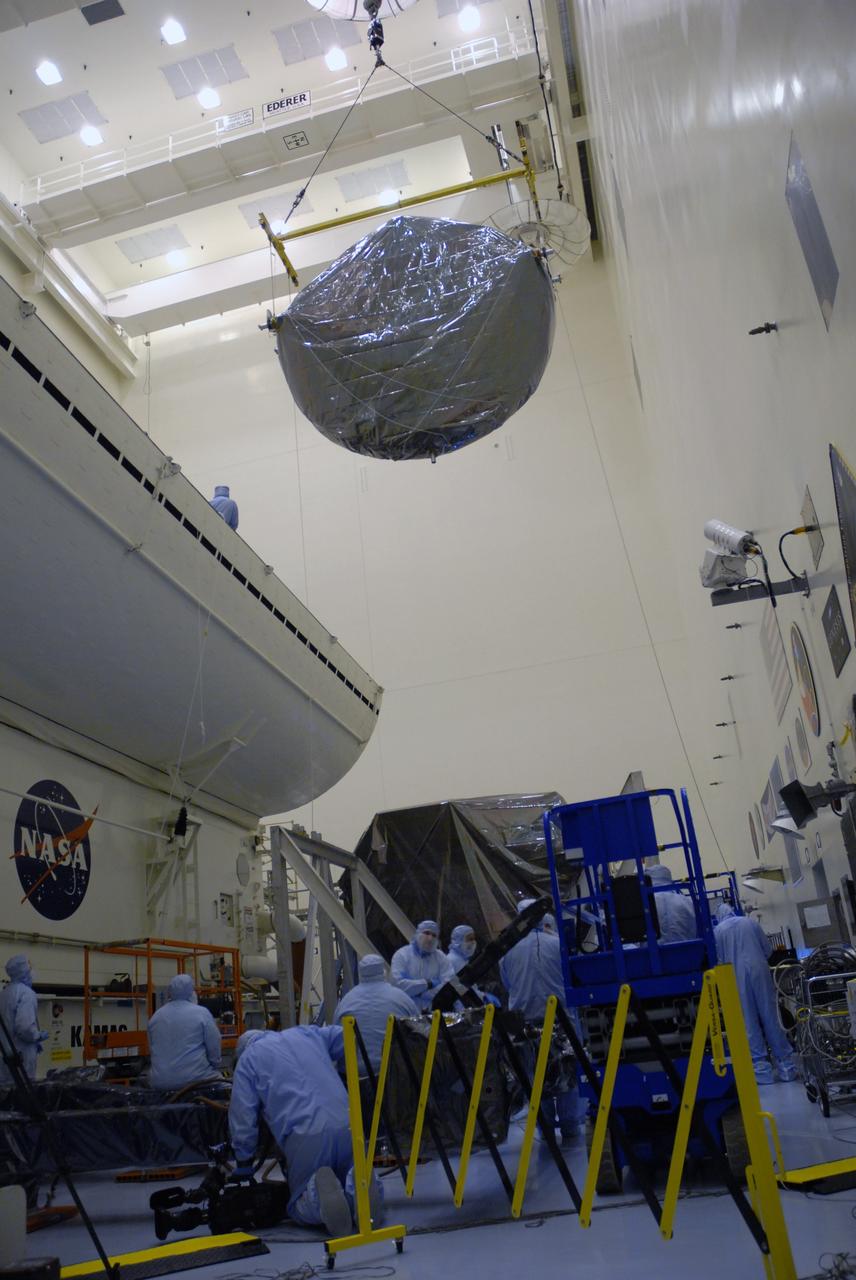
CAPE CANAVERAL, Fla. – In the Payload Hazardous Servicing Facility at NASA's Kennedy Space Center in Florida, the Flight Support System, or FSS, carrier with the Soft Capture Mechanism is moved toward the payload canister. The canister will deliver the FSS and other carriers to Launch Pad 39A for installation in space shuttle Atlantis' payload bay. Atlantis' 11-day flight to service NASA's Hubble Space Telescope is targeted for launch May 12. The mission will include five spacewalks in which astronauts will refurbish and upgrade the telescope with state-of-the-art science instruments. As a result, Hubble's capabilities will be expanded and its operational lifespan extended through at least 2014. Photo credit: NASA/Tim Jacobs
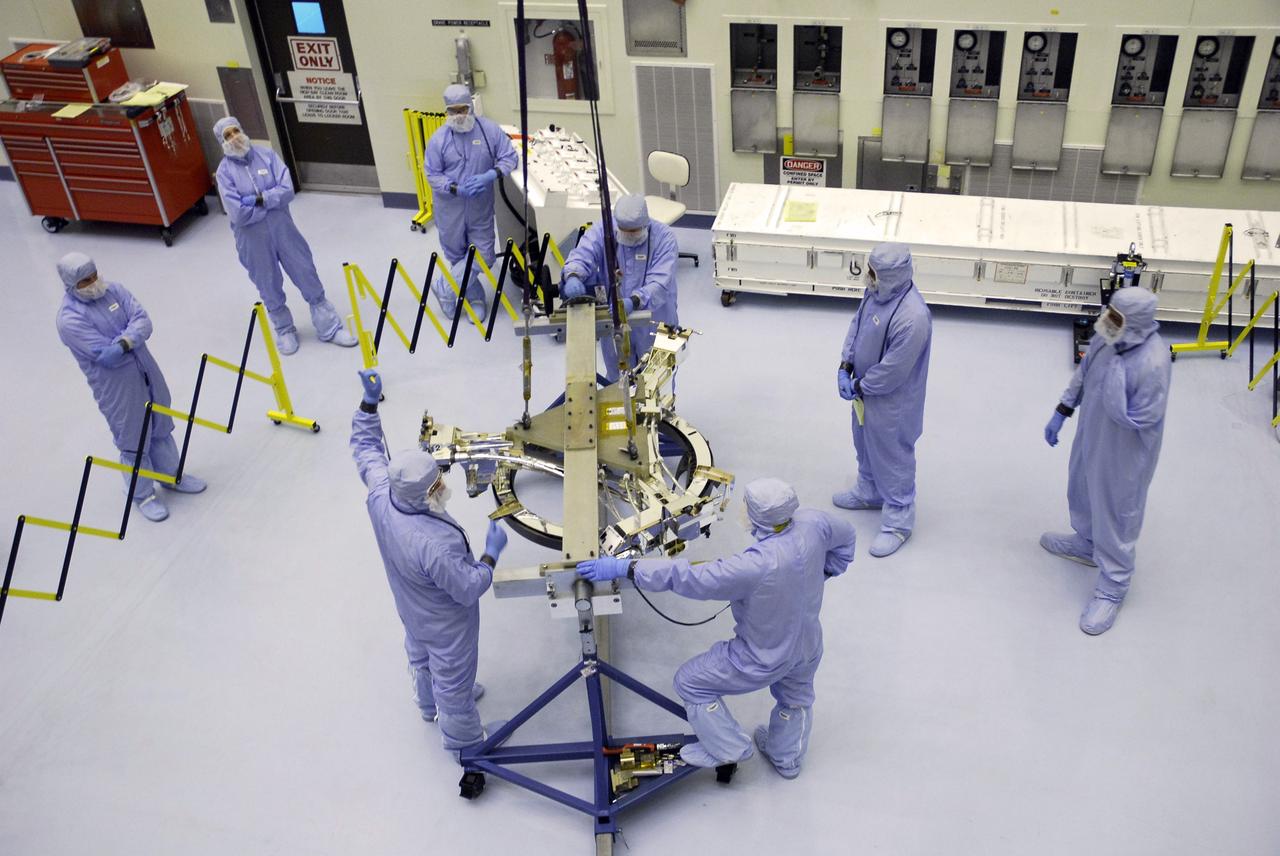
CAPE CANAVERAL, Fla. – In the Payload Hazardous Servicing Facility at NASA's Kennedy Space Center, a technician signals to begin lifting the Soft Capture Mechanism (SCM), part of the Soft Capture and Rendezvous System, or SCRS. The SCM will be transferred to the stand holding the Flight Support System, or FSS, carrier where the SCM will be mated to the FSS. The SCRS will enable the future rendezvous, capture and safe disposal of NASA's Hubble Space Telescope by either a crewed or robotic mission. The ring-like device attaches to Hubble’s aft bulkhead. The SCRS greatly increases the current shuttle capture interfaces on Hubble, therefore significantly reducing the rendezvous and capture design complexities associated with the disposal mission. The FSS will join the Multi-Use Lightweight Equipment, or MULE, carrier, the Super Lightweight Interchangeable Carrier and the Orbital Replacement Unit Carrier as payload on space shuttle Atlantis's STS-125 mission. The payload is scheduled to go to Launch Pad 39A in mid-September to be installed into Atlantis' payload bay. Atlantis is targeted to launch Oct. 8 at 1:34 a.m. EDT. Photo credit: NASA/Troy Cryder
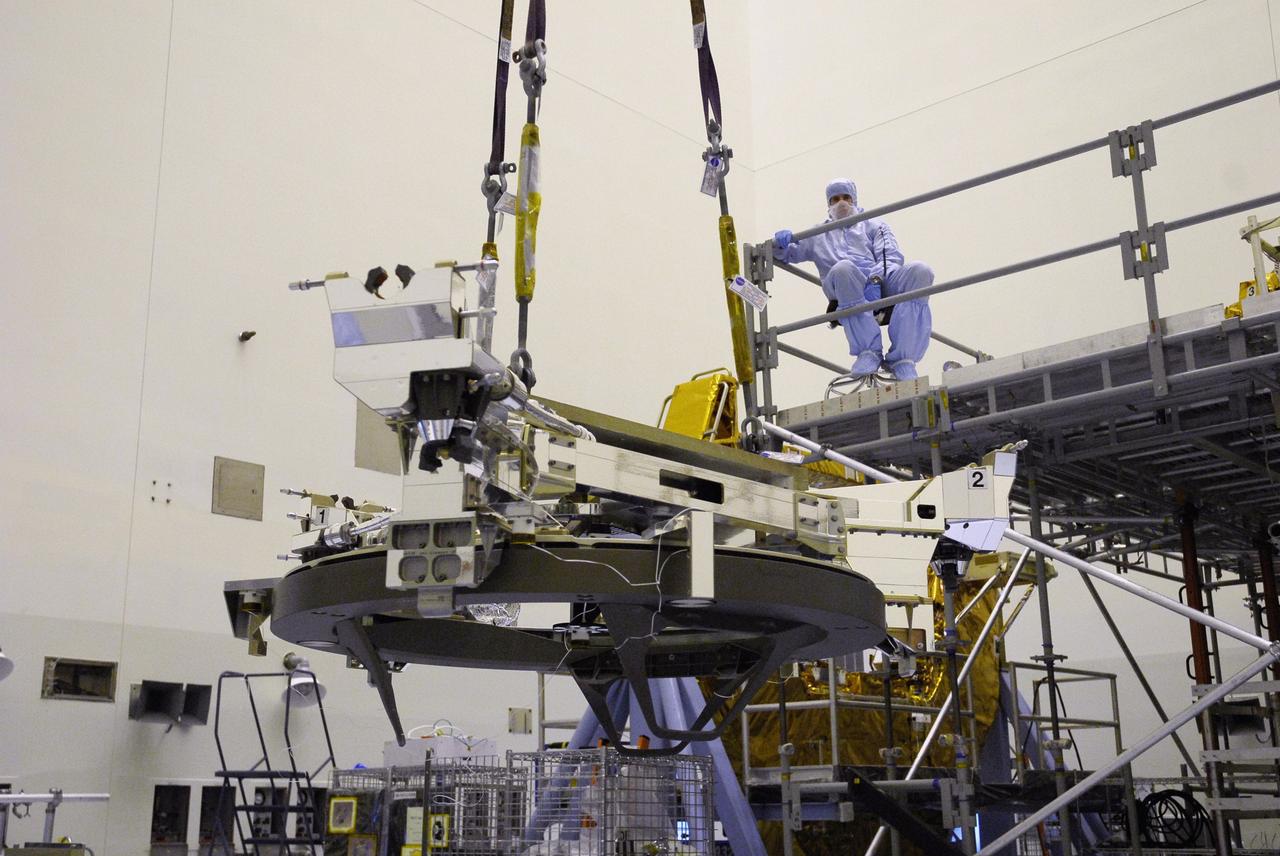
CAPE CANAVERAL, Fla. – In the Payload Hazardous Servicing Facility at NASA's Kennedy Space Center, the Soft Capture Mechanism (SCM), part of the Soft Capture and Rendezvous System, or SCRS, moves above the floor toward the stand holding the Flight Support System, or FSS, carrier where the SCM will be mated to the FSS. The SCRS will enable the future rendezvous, capture and safe disposal of NASA's Hubble Space Telescope by either a crewed or robotic mission. The ring-like device attaches to Hubble’s aft bulkhead. The SCRS greatly increases the current shuttle capture interfaces on Hubble, therefore significantly reducing the rendezvous and capture design complexities associated with the disposal mission. The FSS will join the Multi-Use Lightweight Equipment, or MULE, carrier, the Super Lightweight Interchangeable Carrier and the Orbital Replacement Unit Carrier as payload on space shuttle Atlantis's STS-125 mission. The payload is scheduled to go to Launch Pad 39A in mid-September to be installed into Atlantis' payload bay. Atlantis is targeted to launch Oct. 8 at 1:34 a.m. EDT. Photo credit: NASA/Troy Cryder
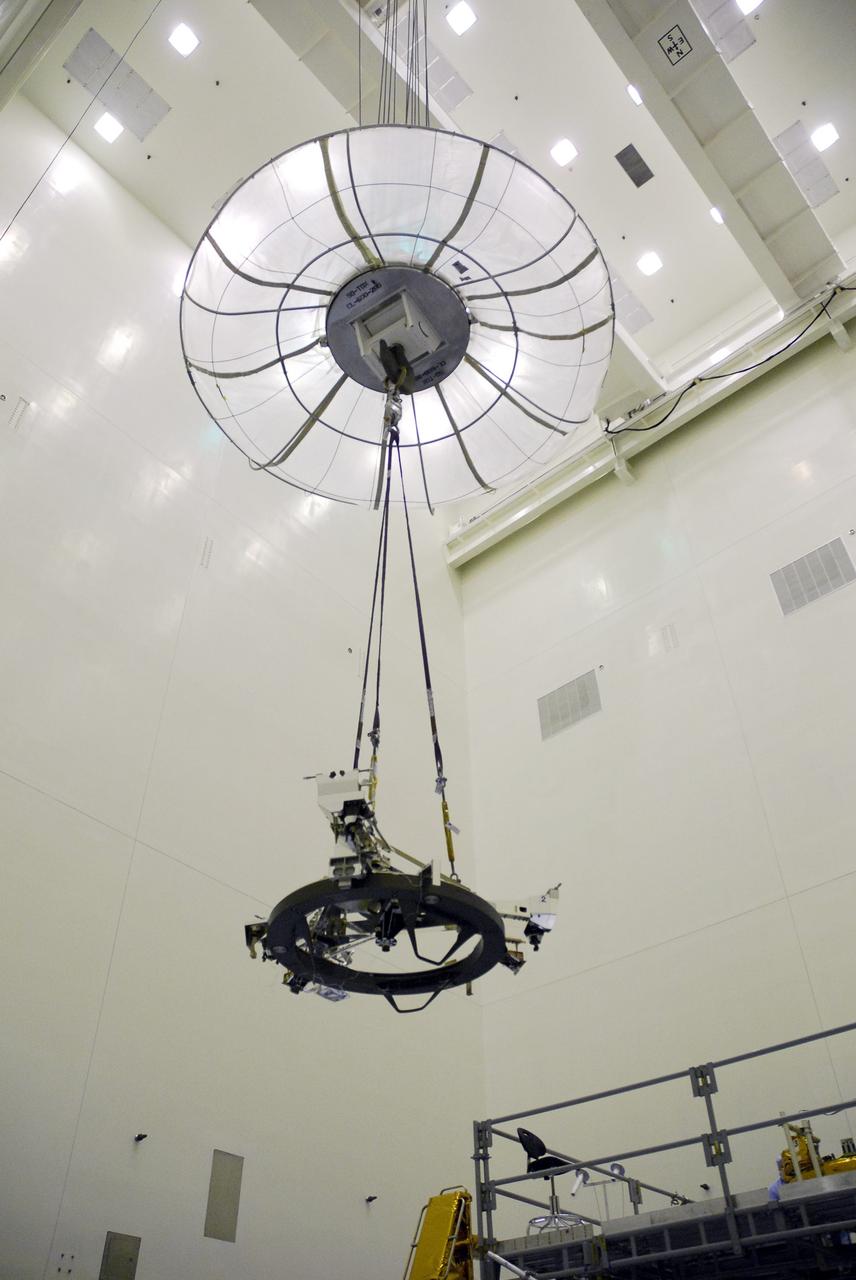
CAPE CANAVERAL, Fla. – In the Payload Hazardous Servicing Facility at NASA's Kennedy Space Center, the Soft Capture Mechanism (SCM), part of the Soft Capture and Rendezvous System, or SCRS, moves above the floor via an overhead crane toward the stand holding the Flight Support System, or FSS,carrier where the SCM will be mated to the FSS. The SCRS will enable the future rendezvous, capture and safe disposal of NASA's Hubble Space Telescope by either a crewed or robotic mission. The ring-like device attaches to Hubble’s aft bulkhead. The SCRS greatly increases the current shuttle capture interfaces on Hubble, therefore significantly reducing the rendezvous and capture design complexities associated with the disposal mission. The FSS will join the Multi-Use Lightweight Equipment, or MULE, carrier, the Super Lightweight Interchangeable Carrier and the Orbital Replacement Unit Carrier as payload on space shuttle Atlantis's STS-125 mission. The payload is scheduled to go to Launch Pad 39A in mid-September to be installed into Atlantis' payload bay. Atlantis is targeted to launch Oct. 8 at 1:34 a.m. EDT. Photo credit: NASA/Troy Cryder
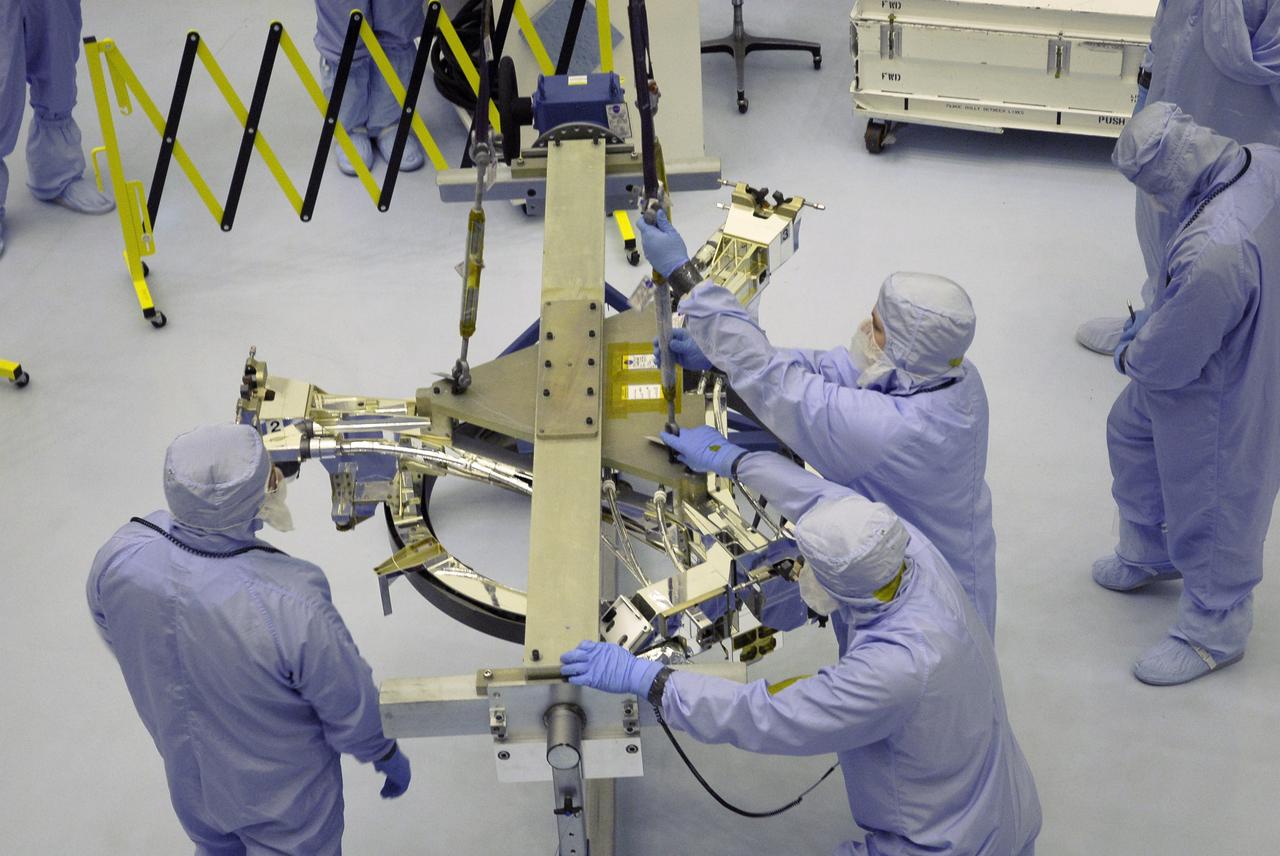
CAPE CANAVERAL, Fla. – In the Payload Hazardous Servicing Facility at NASA's Kennedy Space Center, technicians attach a crane to the Soft Capture Mechanism (SCM), part of the Soft Capture and Rendezvous System, or SCRS. The SCM will be lifted and transferred to the stand holding the Flight Support System, or FSS, carrier, where the SCM will be mated to the FSS. The SCRS will enable the future rendezvous, capture and safe disposal of NASA's Hubble Space Telescope by either a crewed or robotic mission. The ring-like device attaches to Hubble’s aft bulkhead. The SCRS greatly increases the current shuttle capture interfaces on Hubble, therefore significantly reducing the rendezvous and capture design complexities associated with the disposal mission. The FSS will join the Multi-Use Lightweight Equipment, or MULE, carrier, the Super Lightweight Interchangeable Carrier and the Orbital Replacement Unit Carrier as payload on space shuttle Atlantis's STS-125 mission. The payload is scheduled to go to Launch Pad 39A in mid-September to be installed into Atlantis' payload bay. Atlantis is targeted to launch Oct. 8 at 1:34 a.m. EDT. Photo credit: NASA/Troy Cryder
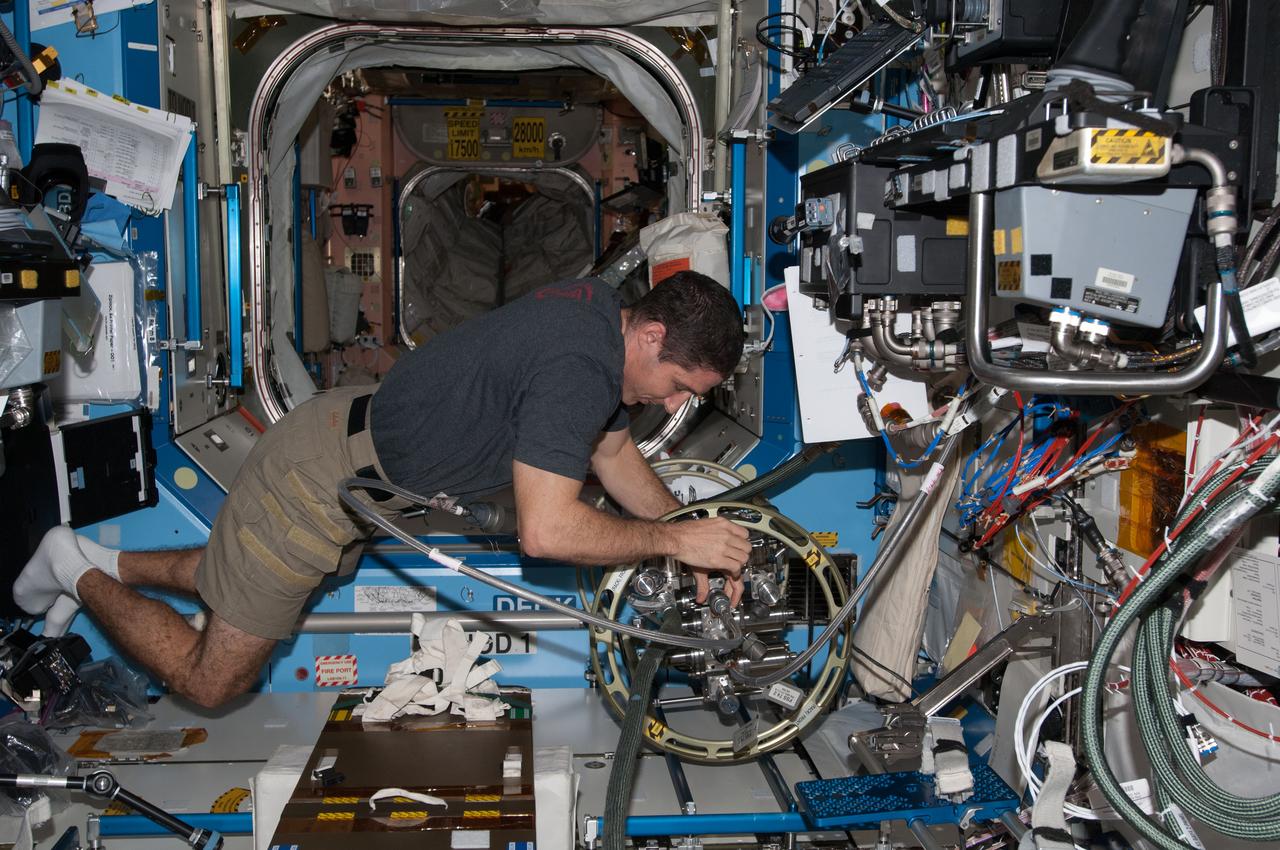
ISS038-E-040140 (31 Jan. 2014) --- NASA astronaut Mike Hopkins, Expedition 38 flight engineer, uses the Fluid Servicing System (FSS) to refill Internal Thermal Control System (ITCS) loops with fresh coolant in the Destiny laboratory of the International Space Station.
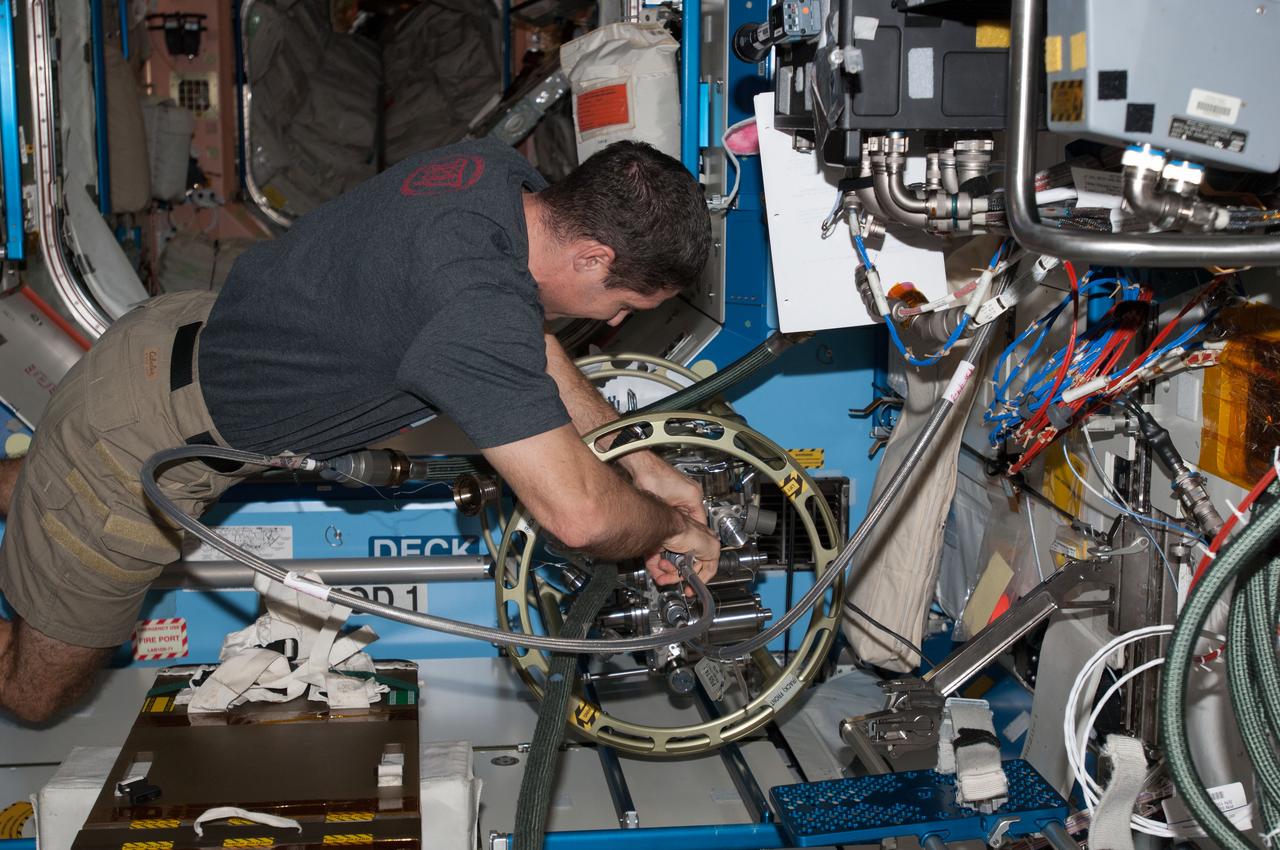
ISS038-E-040139 (31 Jan. 2014) --- NASA astronaut Mike Hopkins, Expedition 38 flight engineer, uses the Fluid Servicing System (FSS) to refill Internal Thermal Control System (ITCS) loops with fresh coolant in the Destiny laboratory of the International Space Station.