
S78-35304 (21 Sept 1978) --- Astronaut John M. Fabian

STS007-06-0314 (18-24 June 1983) --- Astronaut John M. Fabian, STS-7 mission specialist, sleeps in a zip-up blue sleep restraint device in the locker area of the Earth-orbiting space shuttle Challenger's middeck. The frame was exposed with a 35mm camera. Photo credit: NASA

STS007-26-1439 (18-24 June 1983) --- Astronaut John M. Fabian, STS-7 mission specialist, is captured with a 35mm camera at his sleep station in the middeck of the Earth-orbiting space shuttle Challenger. This scene was selected by the five-member astronaut crew for showing at its July 1, 1983 Post Flight Press Conference (PFPC) at the Johnson Space Center's (JSC) main auditorium. Photo credit: NASA

S83-32823 (26 May 1983) --- Astronauts Sally K. Ride and John M. Fabian, attired in clean suits, participate in a STS-7 crew mission test in the Kennedy Space Center's vertical processing facility (VPF). They are two of three STS-7 mission specialists preparing for the June mission. Photo credit: NASA

The crew assigned to the STS-51G mission included (kneeling front left to right) Daniel C. Brandenstein, commander; and John O. Creighton, pilot. Standing, left to right, are mission specialists Shannon W. Lucid, Steven R. Nagel, and John M. Fabian; and payload specialists Sultan Salman Al-Saud, and Patrick Baudrey. Launched aboard the Space Shuttle Discovery on June 17, 1985 at 7:33:00 am (EDT), the STS-51G mission’s primary payloads were three communications satellites: MORELOS-A for Mexico; ARABSAT-A , for Arab Satellite communications; and TELSTAR-3D, for ATT.
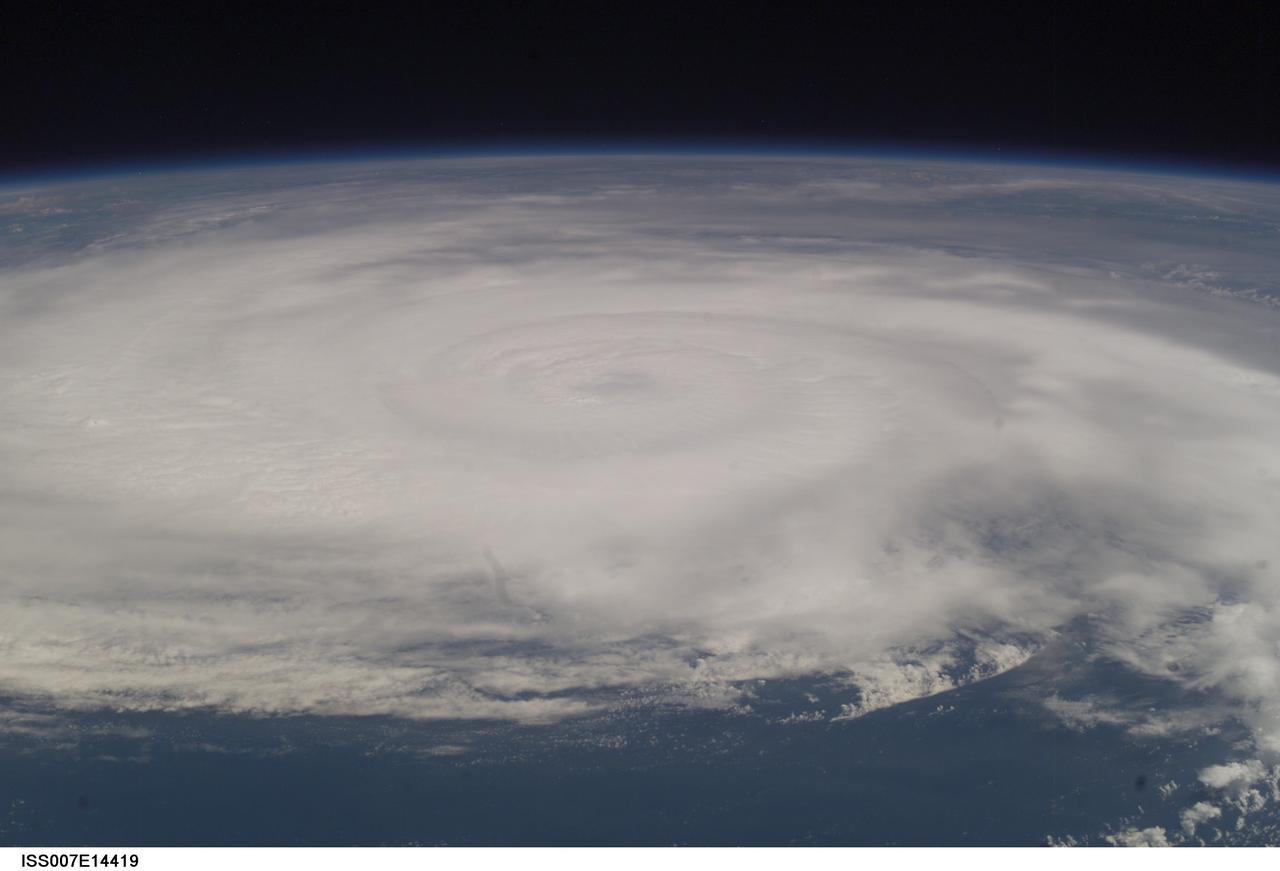
ISS007-E-14419 (4 September 2003) --- This view featuring Hurricane Fabian was taken by one of the Expedition 7 crewmembers onboard the International Space Station (ISS) while it was in orbit over Hispaniola. At the time this photo was taken, Fabian had maximum sustained winds of 120 mph and was moving to the north-northwest at 12 mph.

STS007-15-671 / S83-35767 (21 June 1983) --- Among the "firsts" on the mission is this unprecedented scene of a crew of five astronauts aboard the Space Shuttle Challenger in space. A pre-set 35mm camera exposed the frame. Left to right on the flight deck are Norman E. Thagard, mission specialist; Robert L. Crippen, commander; Frederick H. Hauck, pilot; Sally K. Ride, mission specialist; and John M. Fabian, mission specialist. Crippen the crew commander, is making his second Space Shuttle trip; pilot Hauck and mission specialist Dr. Ride, Dr. Thagard and Fabian are members of the 1978 class of astronaut candidates (ASCAN).

S83-32571 (23 May 1983) --- Four-fifths of the STS-7 crew take a break from simulations in the Johnson Space Center?s Mission Simulation and Training Facility and pose for NASA photographer. Standing on the steps leading into the motion-based Shuttle Mission Simulator (SMS) are (left to right) astronauts Robert L. Crippen, John M. Fabian, Frederick H. Hauck and Sally K. Ride. Crippen is crew commander; Hauck, pilot; and Fabian and Ride are mission specialists, along with Norman E. Thagard (not involved in this phase of training and not pictured). Photo credit: NASA
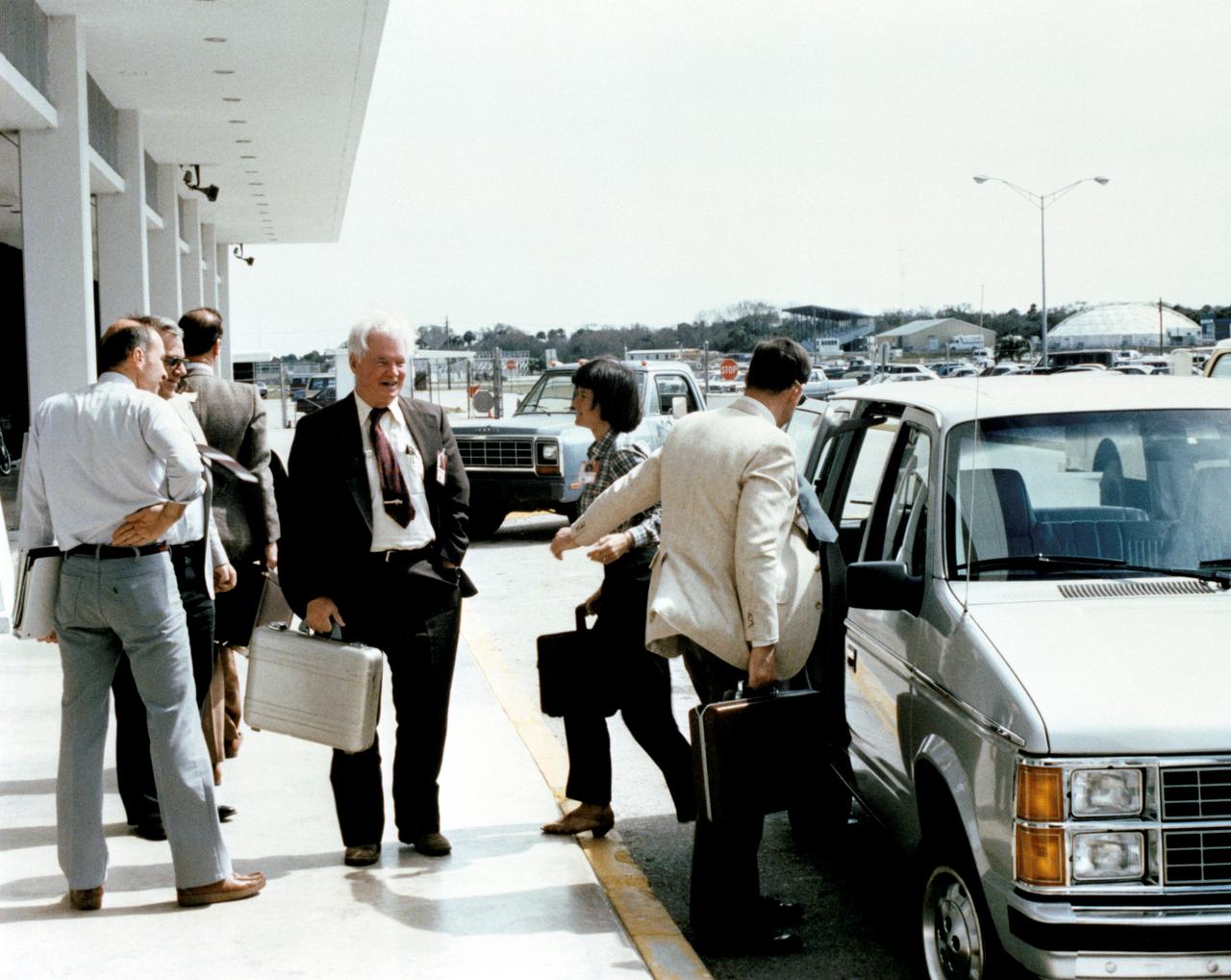
51L-10166 (4 March 1986) --- Members of the Presidential Commission on the space shuttle Challenger accident arrive at the Launch Control Center at Kennedy Space Center (KSC). Commission members present are Robert Hotz (center) and Dr. Sally Ride. Others pictured are John Chase, staff assistant to the Commission (far right) and from left to right: Bob Sieck, Director of Shuttle operations; Jack Martin and John Fabian.

51G-21-011 (17-24 June 1985) --- Group portrait on flight deck of all seven STS-51G crew members. Left to right (front) are John O. Creighton, Shannon W. Lucid, Daniel C. Brandenstein; and (back row) are Sultan Salman Abdelazize Al-Saud, Steven R. Nagel, John M. Fabian and Patrick Baudry. Photo credit: NASA

S83-29016 (4 March 1983) --- These five astronauts represent the Space Transportation System's (STS) first five-member crew. They will be aboard the Space Shuttle Challenger for the mission, scheduled for June of this year. Astronaut Robert L. Crippen (center, first row) is crew commander. Other crew members are astronauts Frederick H. Hauck, right, pilot; and Sally K. Ride, John M. Fabian and Norman E. Thagard, mission specialists. Seven stars and the Challenger provide the backdrop for the crew's portrait.

51G-S-117 (17 June 1985) --- 51-G crewmembers depart the Kennedy Space Center's operations and checkout building on their way to the launch pad for the launch of the Discovery. Leading the seven are Daniel C. Brandenstein, commander; and John O. Creighton, pilot. Following are Payload specialist Sultan Salman Abdelazize Al-Saud; John M. Fabian, mission specialist; Patrick Baudry, payload specialist; Shannon Lucid and Steven R. Nagel, mission specialists.
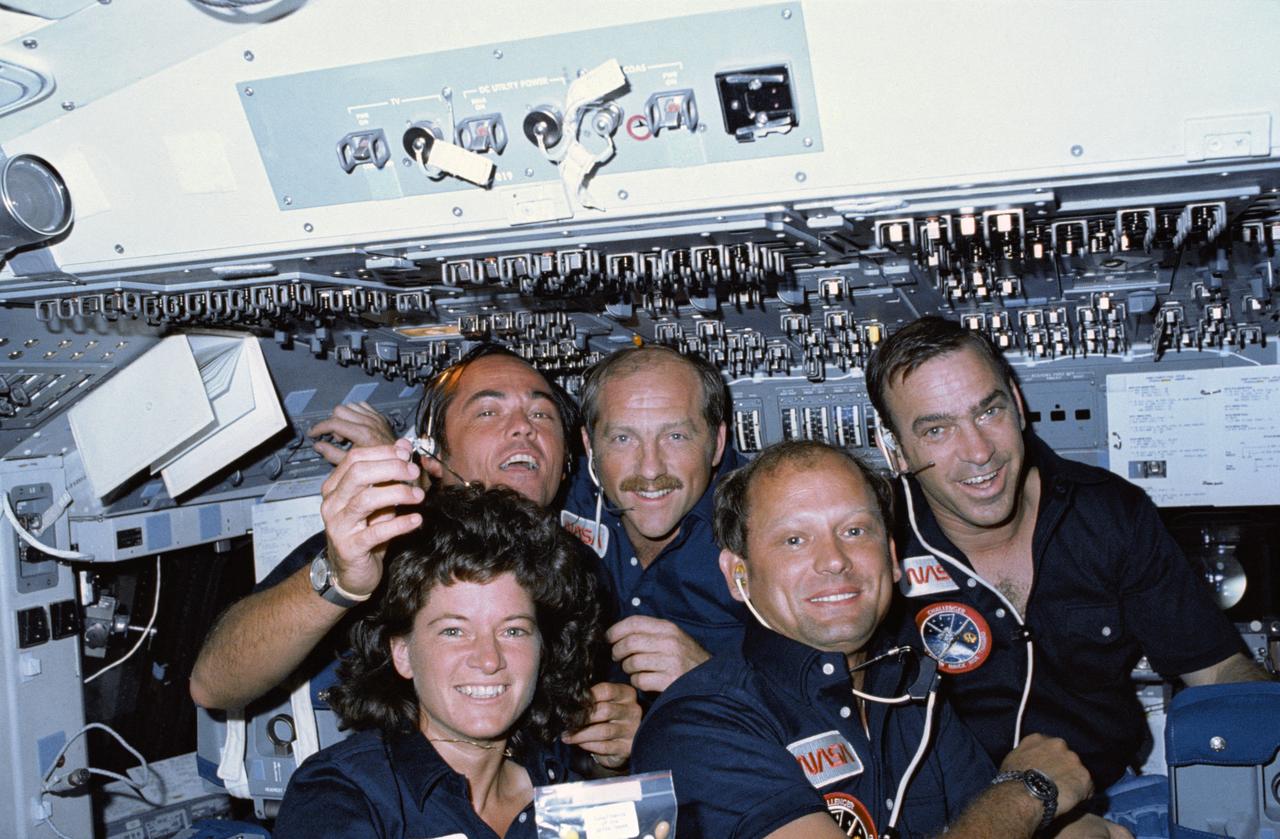
S83-35774 / STS007-30-1574 (21 June 1983) --- The five "passengers" onboard the Earth-orbiting Space Shuttle Challenger display some jelly beans discovered among their food supplies during their six-day mission. The label on the candy reads, "Compliments of the White House." In the rear are (left to right) astronauts Robert L. Crippen, crew commander, Frederick H. Hauck, pilot; and John M. Fabian, mission specialist. In front are Drs. Sally K. Ride and Norman E. Thagard, mission specialists. The scene was exposed by a pre-set 35mm camera.
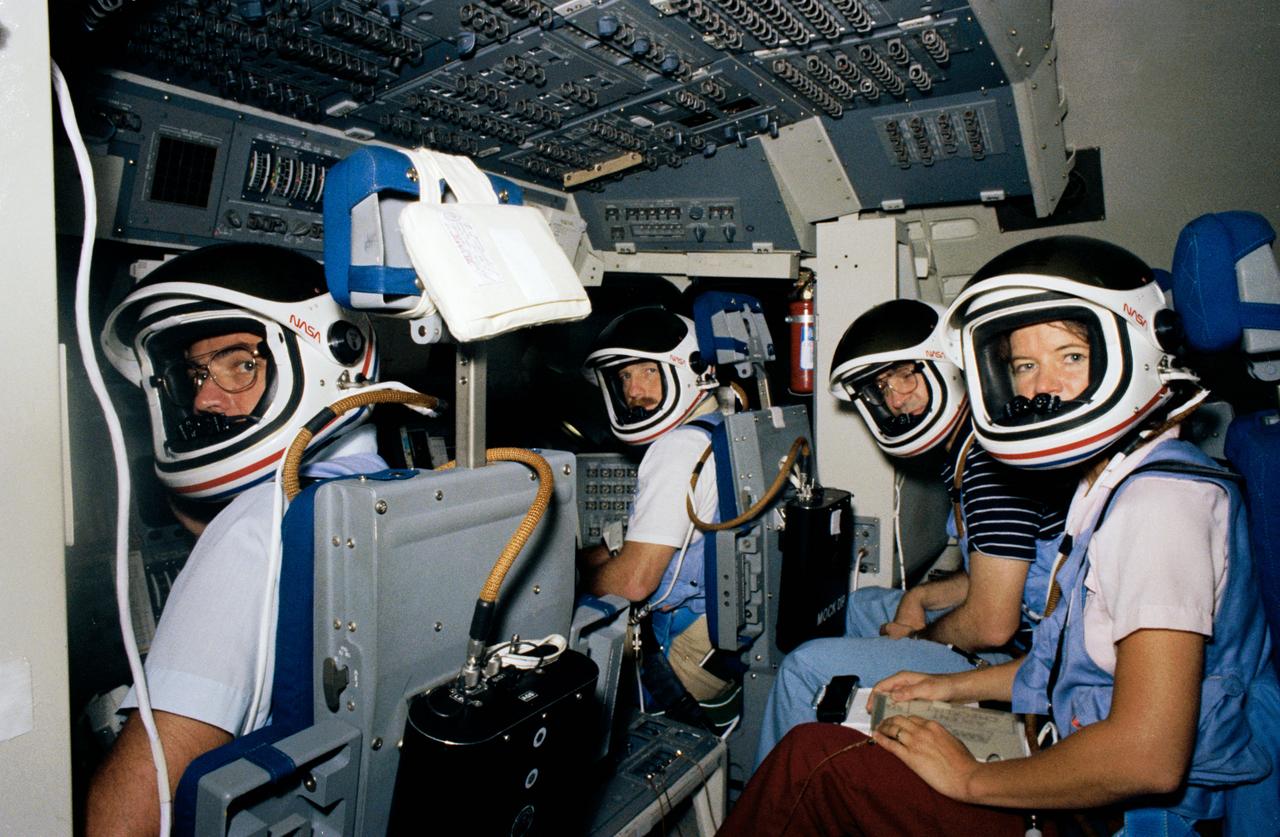
S83-32569 (23 May 1983) --- A preview of NASA?s next spaceflight is provided by this scene in the Johnson Space Center?s Shuttle mission simulator (SMS) with four-fifths of the crew in the same stations they will be in for launch and landing phases of the Challenger?s second space mission. They are (left-right) Astronauts Robert L. Crippen, crew commander; Frederick H. Hauck, pilot; John M. Fabian and Dr. Sally K. Ride, mission specialists. Dr. Norman E. Thagard, a third mission specialist, is to be seated in the mid-deck area below the flight deck for launch and landing phases. Launch is now scheduled for June 18.
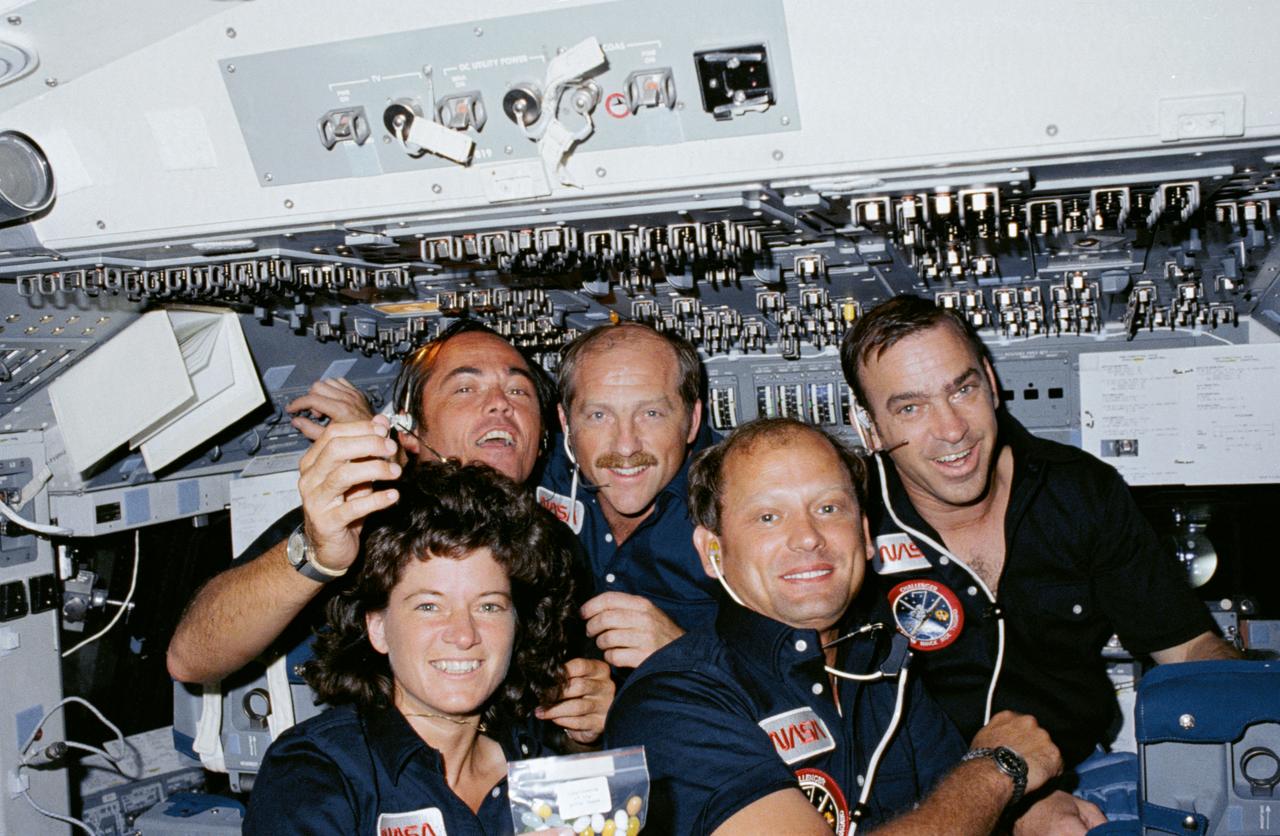
STS007-30-1574 / S83-35774 (21 June 1983) --- The five "passengers" onboard the Earth-orbiting Space Shuttle Challenger display some jelly beans discovered among their food supplies during their six-day mission. The label on the candy reads, "Compliments of the White House." In the rear are (left to right) astronauts Robert L. Crippen, crew commander, Frederick H. Hauck, pilot; and John M. Fabian, mission specialist. In front are Drs. Sally K. Ride and Norman E. Thagard, mission specialists. The scene was exposed by a pre-set 35mm camera.
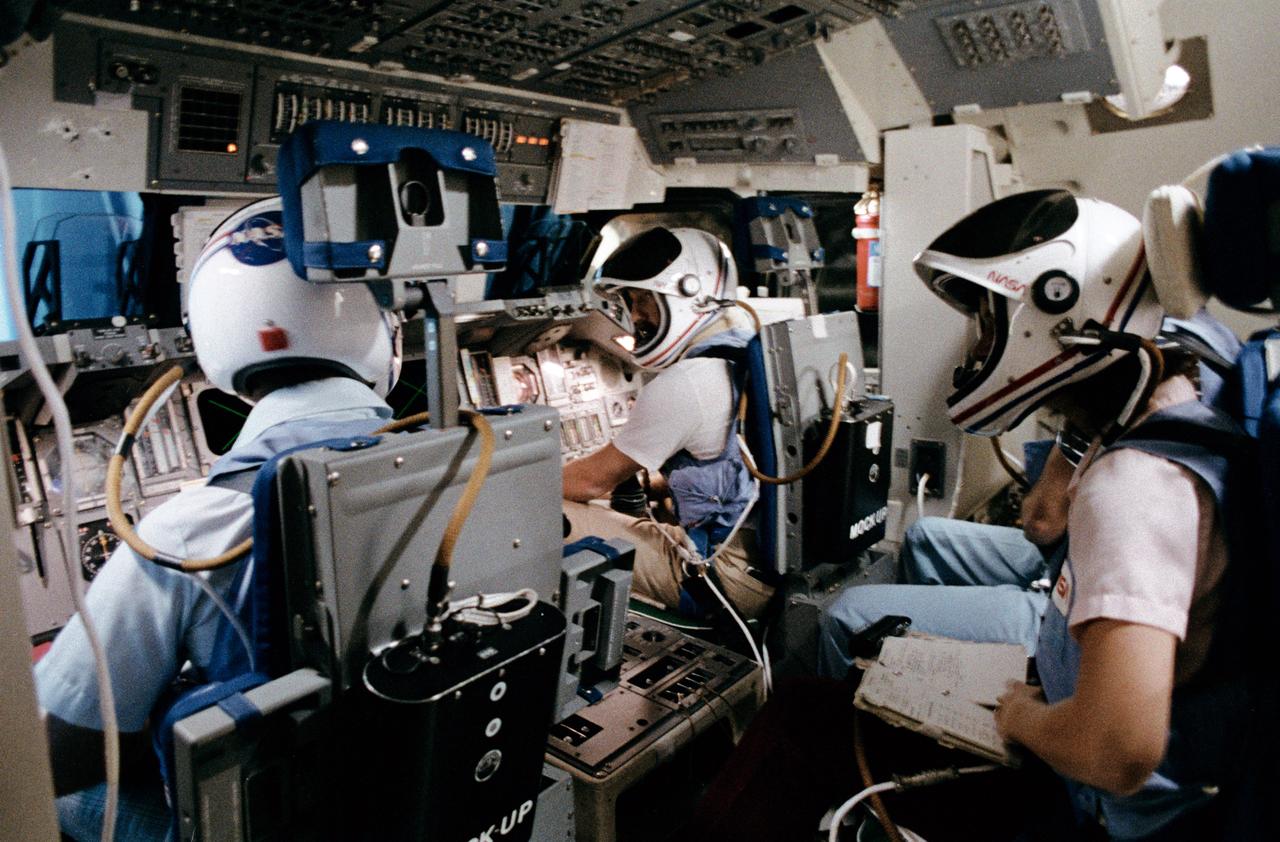
S83-32723 (23 May 1983) --- This scene in the Shuttle Mission Simulator (SMS) previews next month?s STS-7 flight in the space shuttle Challenger. Taken during a simulation session, the photo illustrates the seating arrangement for launch and landing phases of the Challenger?s second spaceflight and its first with five crew members. Pictured, left to right, are astronauts Robert L. Crippen, commander; Frederick H. Hauck, pilot; Sally K. Ride and John M. Fabian (almost totally obscured), mission specialists. Dr. Norman E. Thagard, a third mission specialist, will be seated in the middeck for launch and landing phases. Photo credit: NASA/Otis Imboden/National Geographic Society.

STS007-08-396 (18-24 June 1983) --- Astronaut Robert L. Crippen, STS-7 commander, used a 35mm camera to expose this frame of the four representatives of the "thirty five new guys" onboard the Earth-orbiting Space Shuttle Challenger. The TFNG (notice Frederick H. Hauck's T-shirt at left) pays tribute to the 1978 astronaut candidate (ASCAN) class of NASA astronauts. Others in the photograph are Astronauts Norman E. Thagard, Sally K. Ride and John M. Fabian. Hauck is the crew's pilot and the other three are mission specialist. The crew members are in the process of preparing a snack of meal. The tall experiment in the background is the Continuous Flow Electrophoresis System (CFES).
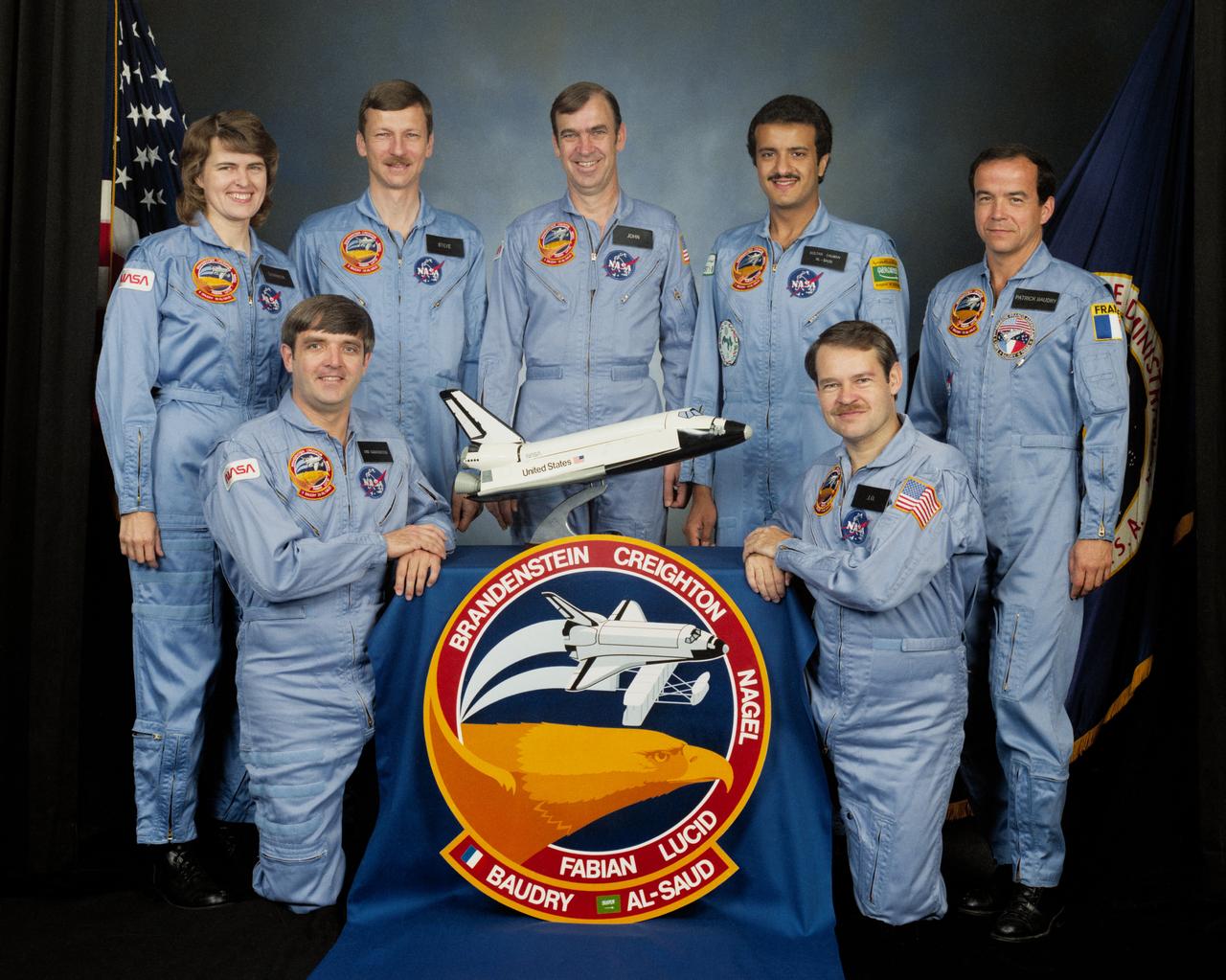
S85-32877 (20 May 1985) --- Seven 51-G crew members take a break from training and other preparations for their June flight aboard the Discovery to pose for a group photograph. Kneeling in front are astronauts Daniel C. Brandenstein (left) and John O. Creighton, commander and pilot, respectively. Astronauts Shannon W. Lucid, Steven R. Nagel and John M. Fabian, mission specialists (l.-r.) join Payload Specialists Sultan Salman Abdelazize Al-Saud (second right) and Patrick Baudry on the back row. Photo credit: NASA
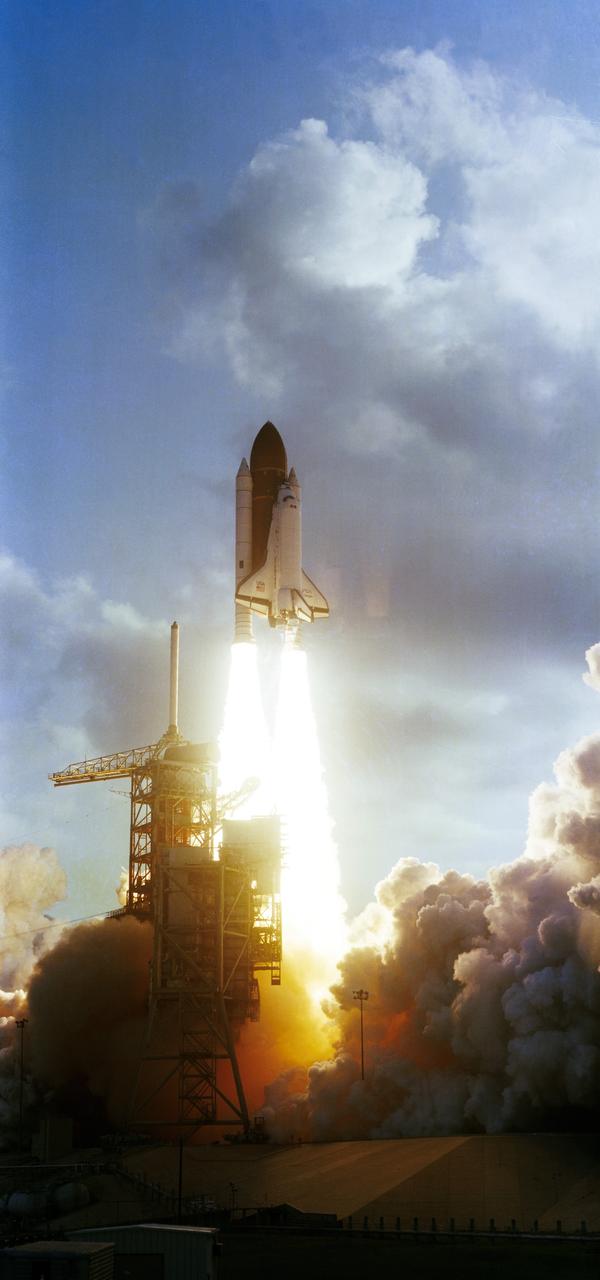
S83-35702 (18 June 1983) --- The seventh launch of the NASA Space Transportation System and the second lift-off of the space shuttle Challenger occurred at 7:33 a.m. (EDT) today from the Pad 39A launch site, at the Kennedy Space Center (KSC). The six-day mission will be highlighted by the first direct landing from space by an orbiter to the Shuttle Landing Facility (SLF). The crew consists of astronauts Robert Crippen, commander, the first two-time space shuttle astronaut; Frederick H. Hauck, pilot; and three mission specialists -- Sally K. Ride, John M. Fabian and Norman E. Thagard. During the mission the crew will deploy the Indonesian PALAPA-B and the Canadian ANIK-C communications satellites. They will also use the Remote Manipulator System (RMS) arm to deploy and retrieve a platform for space experiments called the Shuttle Pallet Satellite (SPAS), and serve as a spaceborne laboratory for OSTA-2, a scientific payload. Getaway Special canisters and materials processing experiments will fill out the complement of payloads on the mission. Photo credit: NASA
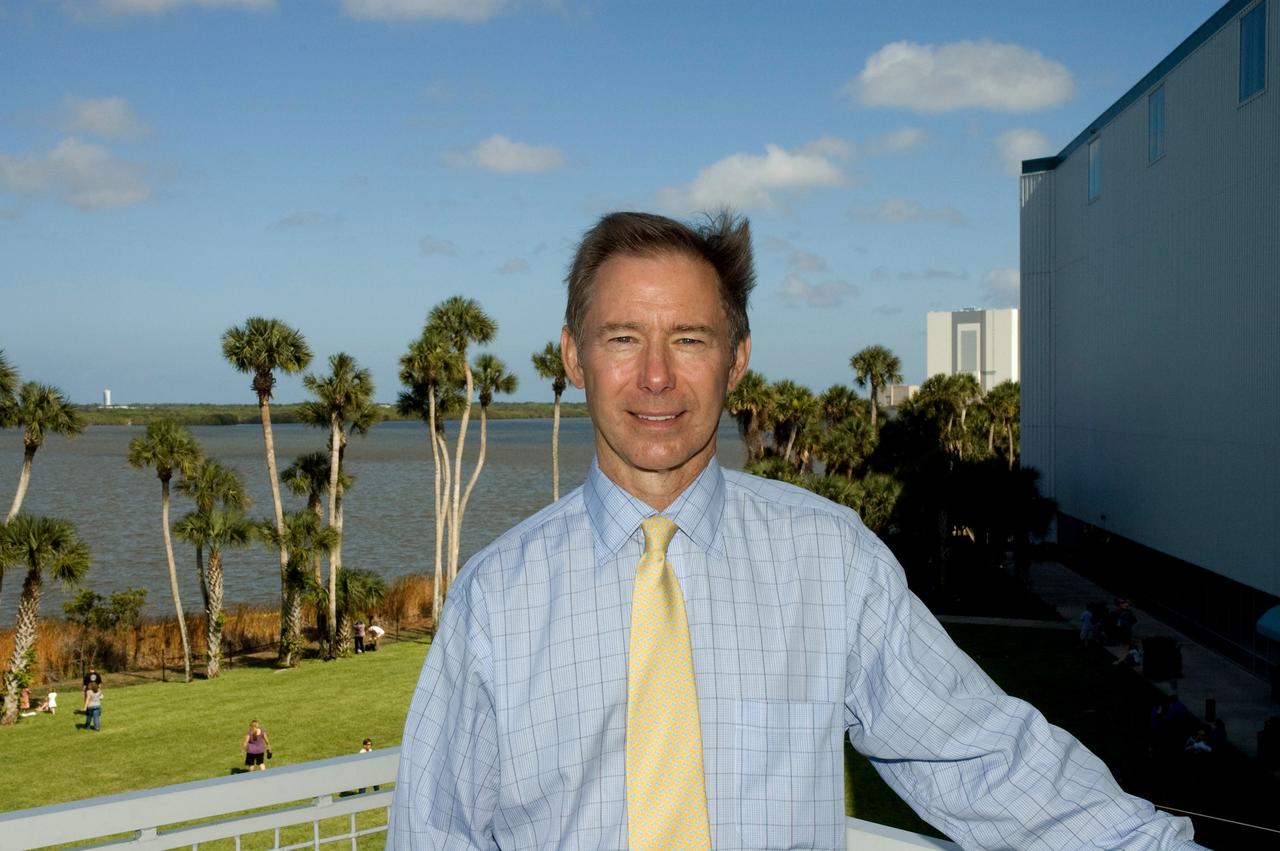
CAPE CANAVERAL, Fla. -- Brewster Shaw is a former astronaut from the first graduating class of astronauts after the Apollo program. He and others from the class were guests at NASA's Kennedy Space Center for the launch of space shuttle Discovery on its STS-124 mission. Shaw is Vice President and General Manager, Space Exploration, for Integrated Defense Systems, The Boeing Company. In 1978 a new group of 35 astronauts was selected after nine years without new astronauts. The pilots were Daniel Brandenstein, Michael Coats, Richard Covey, John Creighton, Robert Gibson, Frederick D. Gregory, Frederick Hauck, Jon McBride, Francis "Dick" Scobee, Brewster Shaw, Loren Shriver, David Walker and Donald Williams. The mission specialists were Guion Bluford, James Buchli, John Fabian, Anna Fisher, Dale Gardner, S. David Griggs, Terry Hart, Steven Hawley, Jeffrey Hoffman, Shannon Lucid, Ronald McNair, Richard Mullane, Steven Nagel, George Nelson, Ellison Onizuka, Judith Resnik, Sally Ride, Rhea Seddon, Robert Stewart, Kathryn D. Sullivan, Norman Thagard and James van Hoften. Since then, a new group has been selected roughly every two years. Photo credit: NASA/Jim Grossmann

CAPE CANAVERAL, Fla. -- A group from the first graduating class of astronauts after the Apollo program gathers at the Banana River viewing site at NASA's Kennedy Space Center before the launch of space shuttle Discovery on its STS-124 mission. In 1978 a new group of 35 astronauts was selected after nine years without new astronauts. The pilots were Daniel Brandenstein, Michael Coats, Richard Covey, John Creighton, Robert Gibson, Frederick D. Gregory, Frederick Hauck, Jon McBride, Francis "Dick" Scobee, Brewster Shaw, Loren Shriver, David Walker and Donald Williams. The mission specialists were Guion Bluford, James Buchli, John Fabian, Anna Fisher, Dale Gardner, S. David Griggs, Terry Hart, Steven Hawley, Jeffrey Hoffman, Shannon Lucid, Ronald McNair, Richard Mullane, Steven Nagel, George Nelson, Ellison Onizuka, Judith Resnik, Sally Ride, Rhea Seddon, Robert Stewart, Kathryn D. Sullivan, Norman Thagard and James van Hoften. Since then, a new group has been selected roughly every two years. Photo credit: NASA/Jim Grossmann

S78-26481 (January 1978) --- This is a montage of the individual portraits of the 35-member 1978 class of astronaut candidates. From left to right are Guion S. Bluford, Daniel C. Brandenstein, James F. Buchli, Michael L. Coats, Richard O. Covey, John O. Creighton, John M. Fabian, Anna L. Fisher, Dale A. Gardner, Robert L. Gibson, Frederick D. Gregory, S. David Griggs, Terry J. Hart, Frederick H. (Rick) Hauck, Steven A. Hawley, Jeffrey A. Hoffman, Shannon W. Lucid, Jon A. McBride, Ronald E. McNair, Richard M. (Mike) Mullane, Steven R. Nagel, George D. Nelson, Ellison S. Onizuka, Judith A. Resnik, Sally K. Ride, Francis R. (Dick) Scobee, Rhea Seddon, Brewster H. Shaw Jr., Loren J. Shriver, Robert L. Stewart, Kathryn D. Sullivan, Norman E. Thagard, James D. Van Hoften, David M. Walker and Donald E. Williams. Photo credit: NASA or National Aeronautics and Space Administration

This most distant x-ray cluster of galaxies yet has been found by astronomers using Chandra X-ray Observatory (CXO). Approximately 10 billion light-years from Earth, the cluster 3C294 is 40 percent farther than the next most distant x-ray galaxy cluster. The existence of such a faraway cluster is important for understanding how the universe evolved. CXO's image reveals an hourglass-shaped region of x-ray emissions centered on the previously known central radio source (seen in this image as the blue central object) that extends outward for 60,000 light- years. The vast clouds of hot gas that surround such galaxies in clusters are thought to be heated by collapse toward the center of the cluster. Until CXO, x-ray telescopes have not had the needed sensitivity to identify such distant clusters of galaxies. Galaxy clusters are the largest gravitationally bound structures in the universe. The intensity of the x-rays in this CXO image of 3C294 is shown as red for low energy x-rays, green for intermediate, and blue for the most energetic x-rays. (Photo credit: NASA/loA/A. Fabian et al)
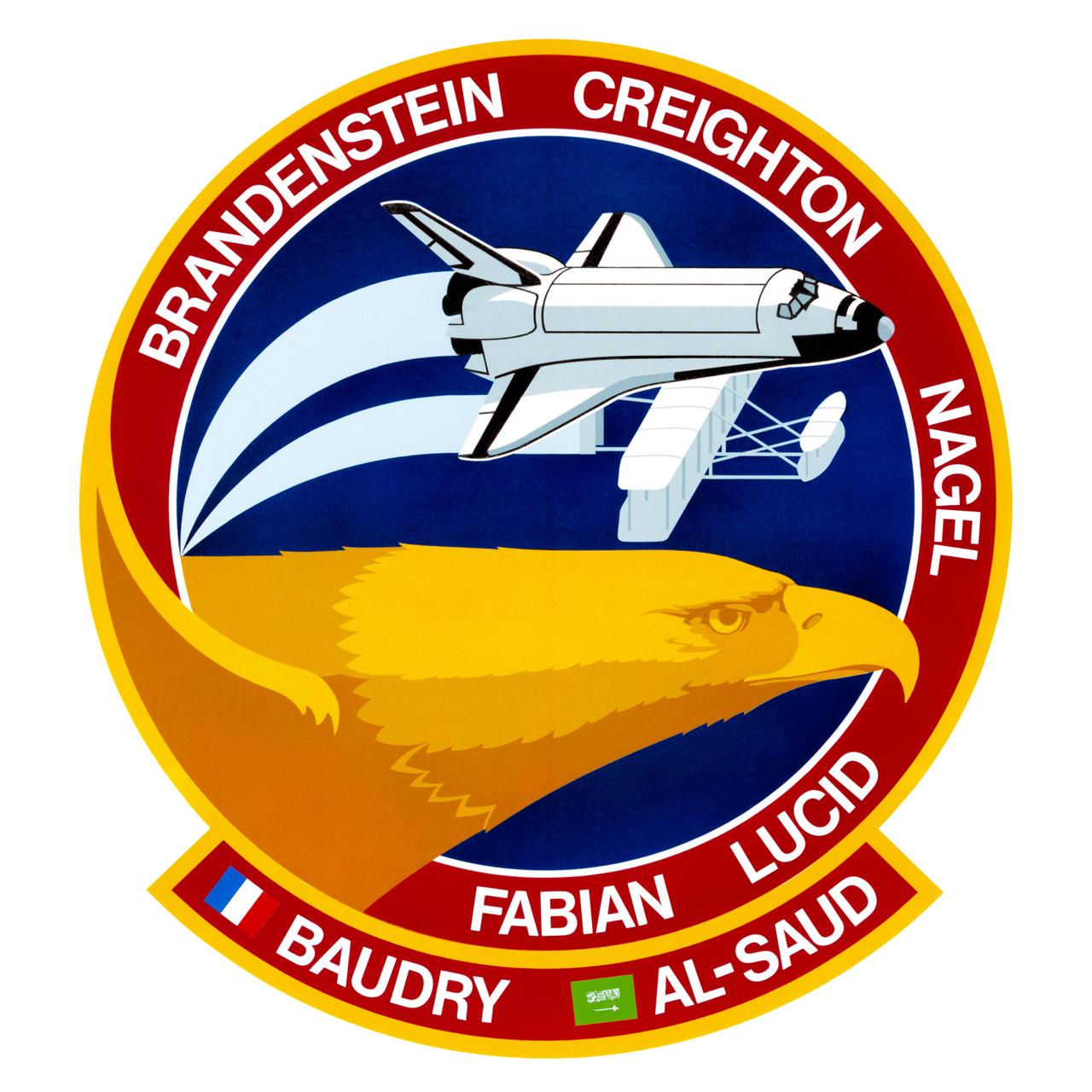
S85-31266 (May 1985) --- The STS-51G insignia illustrates the advances in aviation technology in the United States within a relatively short span of the twentieth century. The surnames of the crew members for the Discovery's mission appear near the center edge of the circular design. They are astronauts Daniel C. Brandenstein, mission commander; John O. Creighton, pilot; John M. Fabian, Steven R. Nagel and Shannon W. Lucid, mission specialists; Sultan Salman Abdelazize Al-Saud and Patrick Baudry, payload specialists. Al-Saud is flying as part of the reimbursable agreement with the Arab Satellite Communications Organization covering the launch of the Arabsat 1B communications satellite and Baudry represents France's Centre National d'Etudes Spatiales. The NASA insignia design for space shuttle flights is reserved for use by the astronauts and for other official use as the NASA Administrator may authorize. Public availability has been approved only in the forms of illustrations by the various news media. When and if there is any change in this policy, which is not anticipated, the change will be publicly announced. Photo credit: NASA
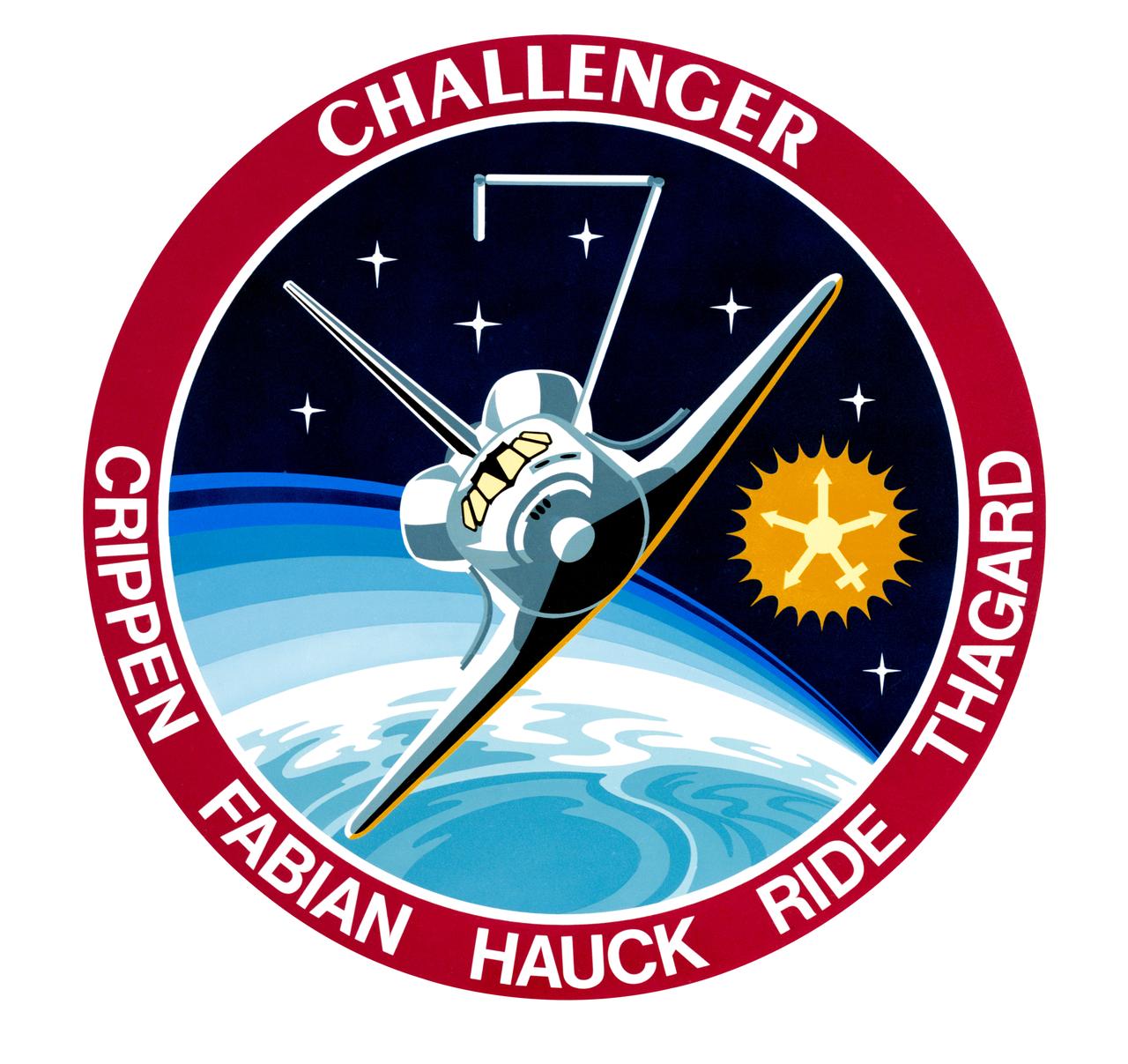
S83-28355 (March 1983) --- The space shuttle Challenger, making its second flight into space on STS-7, is featured in the art for the insignia for that NASA flight. The remote manipulator arm is positioned such that, the number 7 is formed. Likewise, seven stars are visible against the black sky. Within the sun?s center are representations for the five crew members, including, for the first time in NASA?s space program, a woman ? Dr. Sally K. Ride, mission specialist. The crew member?s surnames are listed along the outside edge of the sphere. They are astronauts Robert L. Crippen, commander; Frederick H. Hauck, pilot; John M. Fabian, Sally K. Ride and Norman E. Thagard, mission specialists. The flight is scheduled for the first week of June 1983. The NASA insignia design for space shuttle flights is reserved for use by the astronauts and for other official use as the NASA Administrator may authorize. Public availability has been approved only in the forms of illustrations by the various news media. When and if there is any change in this policy, which is not anticipated, the change will be publicly announced. Photo credit: NASA
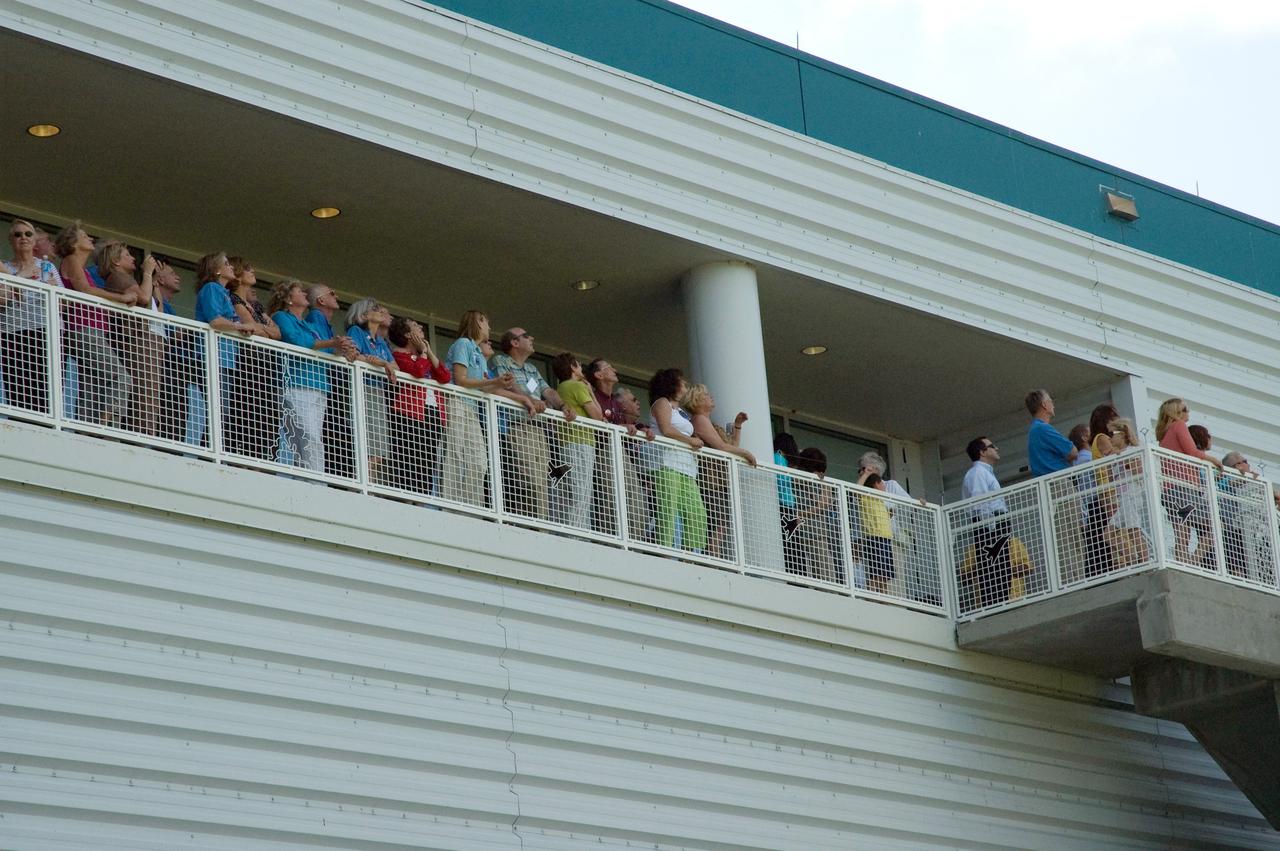
CAPE CANAVERAL, Fla. -- All eyes look skyward as space shuttle Discovery launches on its STS-124 mission. The group gathered here at the Banana River viewing site at NASA's Kennedy Space Center are members of the first graduating class of astronauts after the Apollo program. In 1978 a new group of 35 astronauts was selected after nine years without new astronauts. The pilots were Daniel Brandenstein, Michael Coats, Richard Covey, John Creighton, Robert Gibson, Frederick D. Gregory, Frederick Hauck, Jon McBride, Francis "Dick" Scobee, Brewster Shaw, Loren Shriver, David Walker and Donald Williams. The mission specialists were Guion Bluford, James Buchli, John Fabian, Anna Fisher, Dale Gardner, S. David Griggs, Terry Hart, Steven Hawley, Jeffrey Hoffman, Shannon Lucid, Ronald McNair, Richard Mullane, Steven Nagel, George Nelson, Ellison Onizuka, Judith Resnik, Sally Ride, Rhea Seddon, Robert Stewart, Kathryn D. Sullivan, Norman Thagard and James van Hoften. Since then, a new group has been selected roughly every two years. Photo credit: NASA/Jim Grossmann
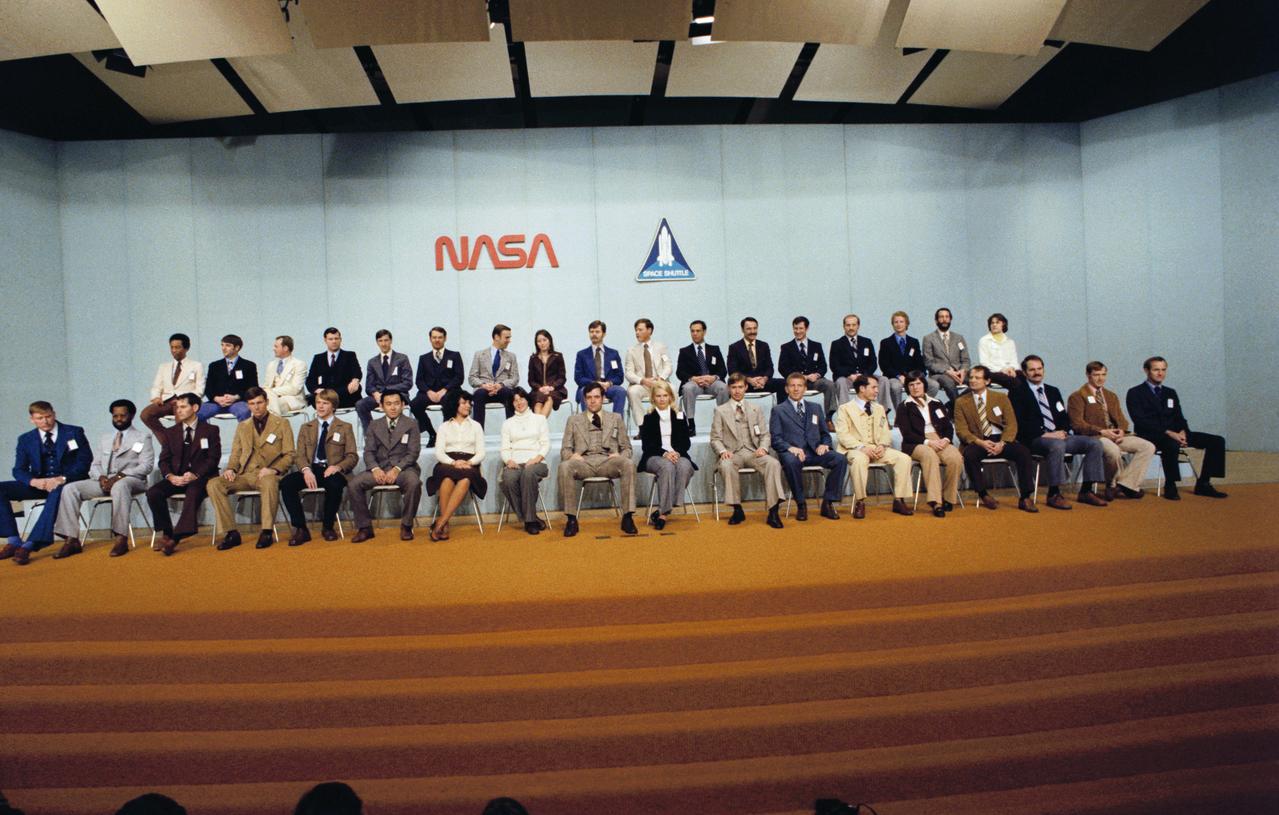
S78-26569 (31 Jan. 1978) --- The 35 new astronaut candidates, presented Jan. 31, 1978, in the Building 2 auditorium at NASA's Johnson Space Center, pose for photographers. They are arranged in alphabetical order with top left as beginning point and bottom right as stopping point. They are Guion S. Bluford, Daniel C. Brandenstein, James F. Buchli, Michael L. Coats, Richard O. Covey, John O. Creighton, John M. Fabian, Anna L. Fisher, Dale A. Gardner, Robert L. Gibson, Frederick D. Gregory, S. David Griggs, Terry J. Hart, Frederick H. (Rick) Hauck, Steven A. Hawley, Jeffrey A. Hoffman, Shannon W. Lucid, Jon A. McBride, Ronald E. McNair, Richard M. (Mike) Mullane, Steven R. Nagel, George D. Nelson, Ellison S. Onizuka, Judith A. Resnik, Sally K. Ride, Francis R. (Dick) Scobee, Rhea Seddon, Brewster H. Shaw Jr., Loren J. Shriver, Robert L. Stewart, Kathryn D. Sullivan, Norman E. Thagard, James D. van Hoften, David M. Walker and Donald E. Williams. Photo credit: NASA or National Aeronautics and Space Administration