
Facing the Sun
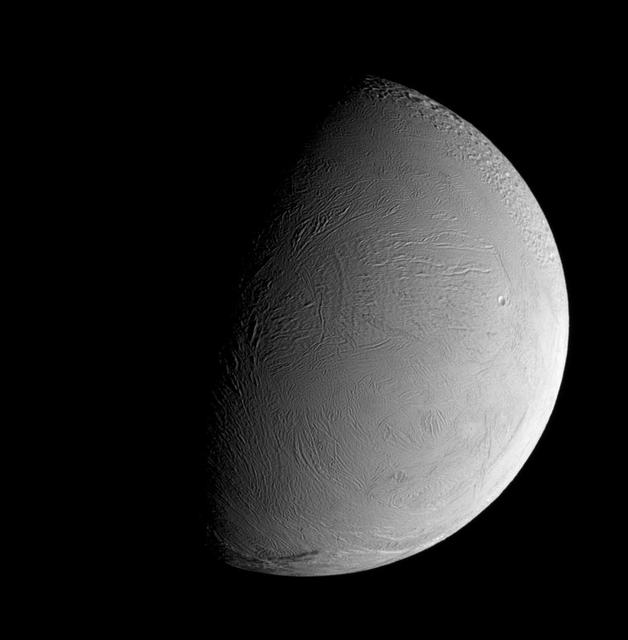
A Fresh Face
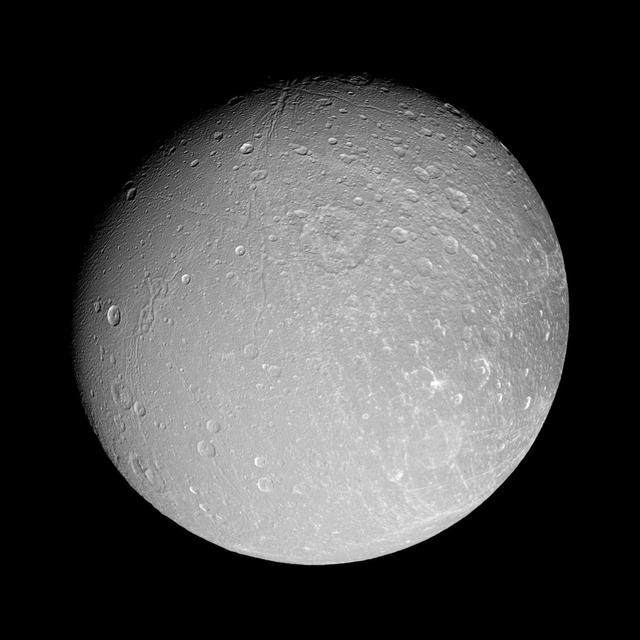
Facing Dione
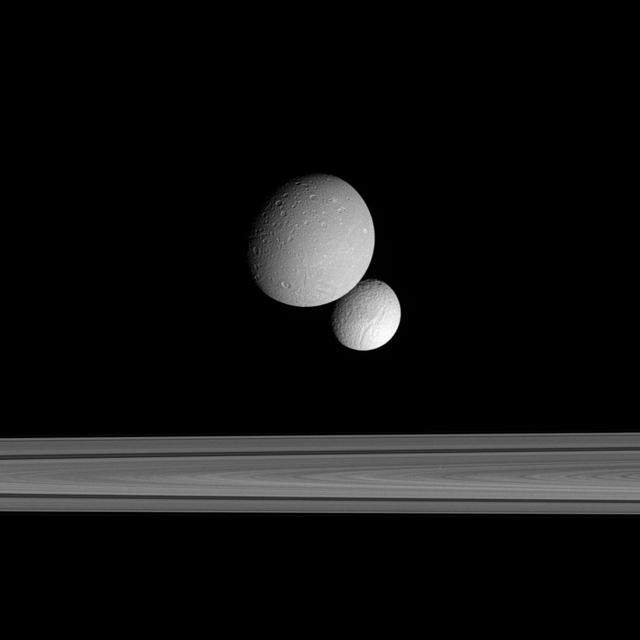
The Face-off
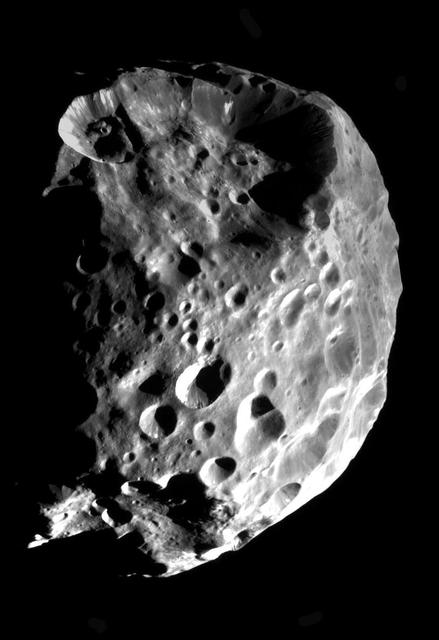
The Face of Phoebe
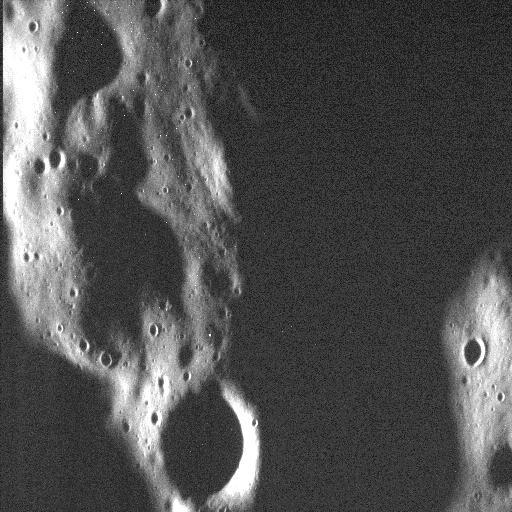
A Face in the Dark...?

Hyperion Face
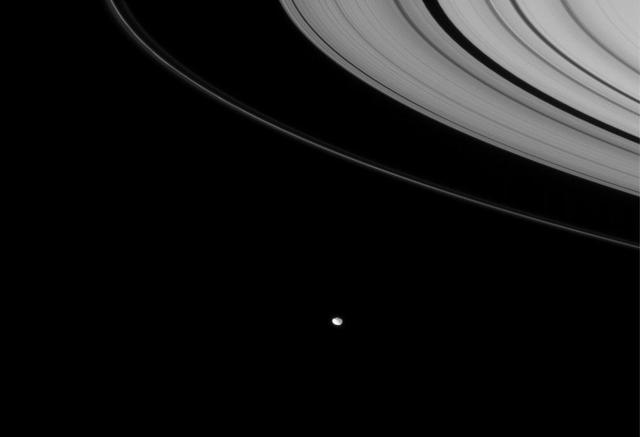
Facing Janus
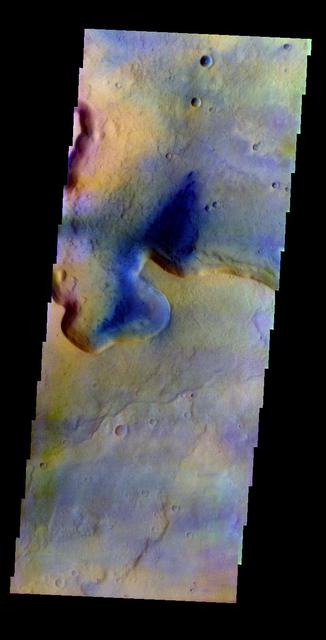
Cliff Face

The Unlit Face
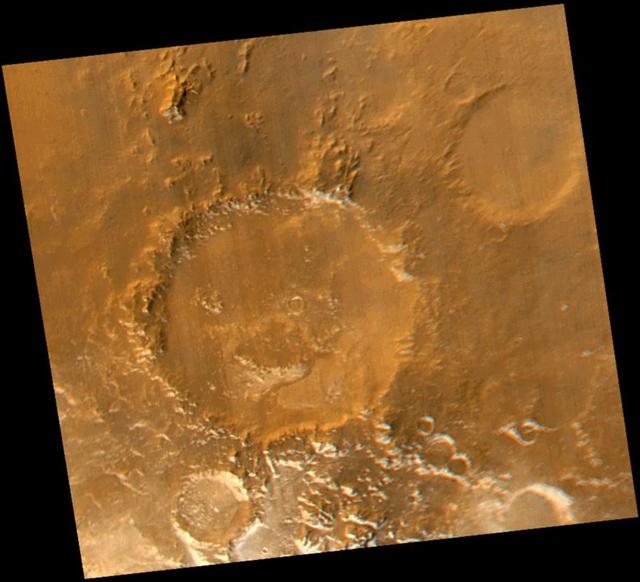
Smile! Spring has sprung in the martian southern hemisphere. With it comes the annual retreat of the winter polar frost cap. This view of "Happy Face Crater"--officially named "Galle Crater"--shows patches of white water ice frost in and around the crater's south-facing slopes. Slopes that face south will retain frost longer than north-facing slopes because they do not receive as much sunlight in early spring. This picture is a composite of images taken by the Mars Global Surveyor Mars Orbiter Camera (MOC) red and blue wide angle cameras. The wide angle cameras were designed to monitor the changing weather, frost, and wind patterns on Mars. Galle Crater is located on the east rim of the Argyre Basin and is about 215 kilometers (134 miles) across. In this picture, illumination is from the upper left and north is up. http://photojournal.jpl.nasa.gov/catalog/PIA02325
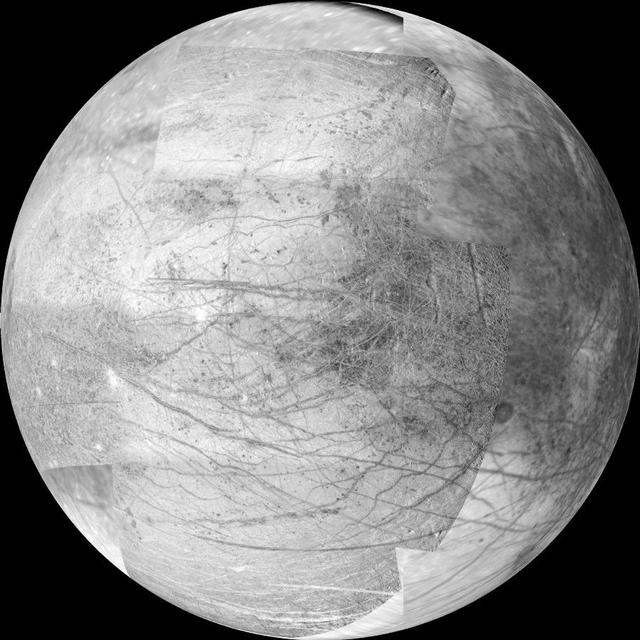
Europa Jupiter-Facing Hemisphere
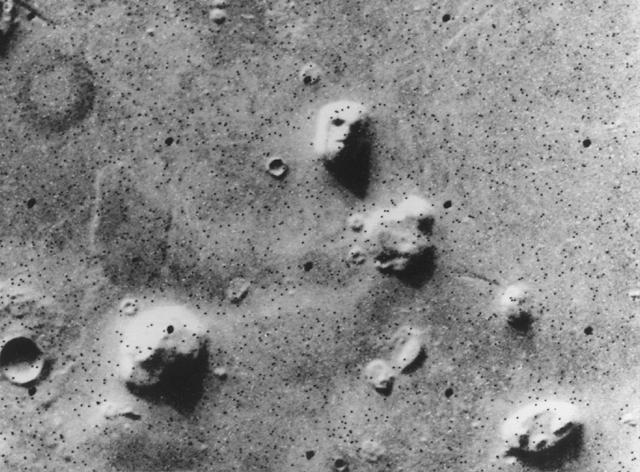
Geologic Face on Mars Formation

Many Faces of the C Ring
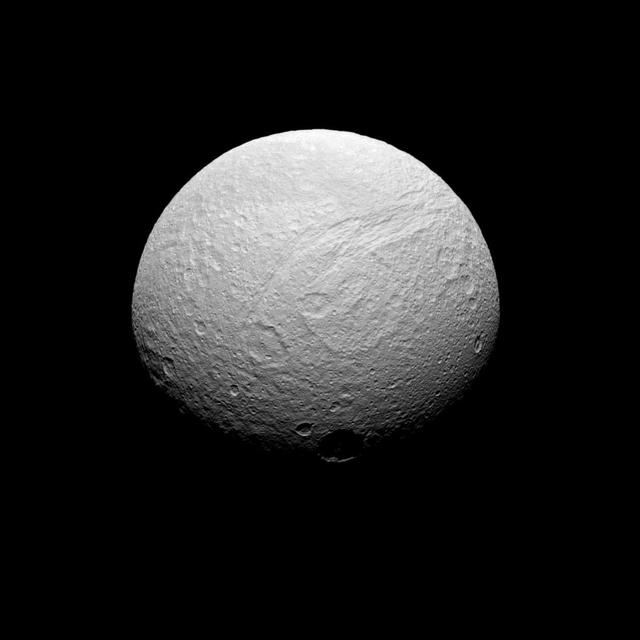
Southern Face of Tethys
Two-Faced Janus
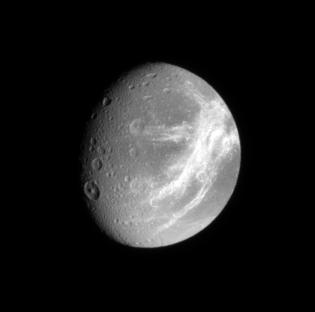
Dione Fractured Face
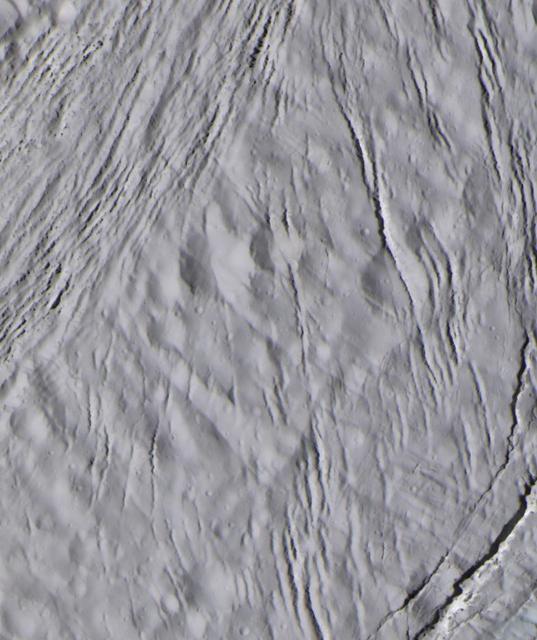
Cracked Face of Enceladus
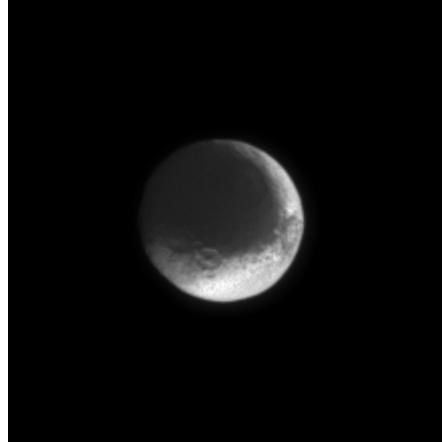
Saturn Two-Face Moon

The Many Faces of Eros

The Two Faces of Janus
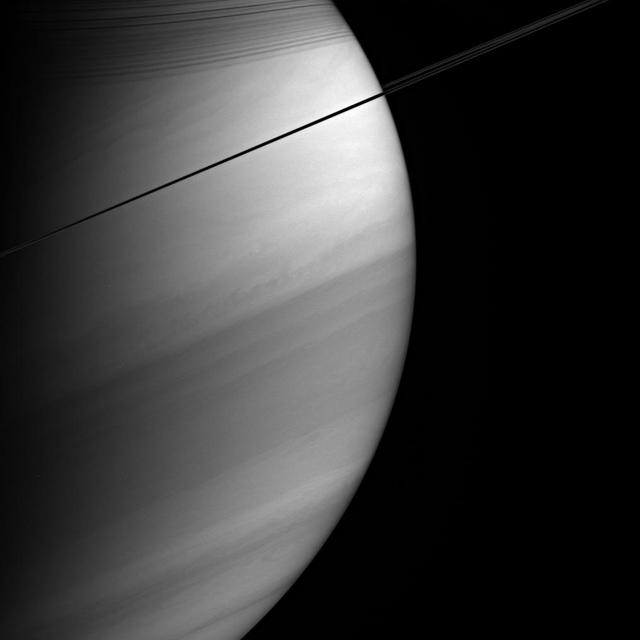
Southern Face of Saturn
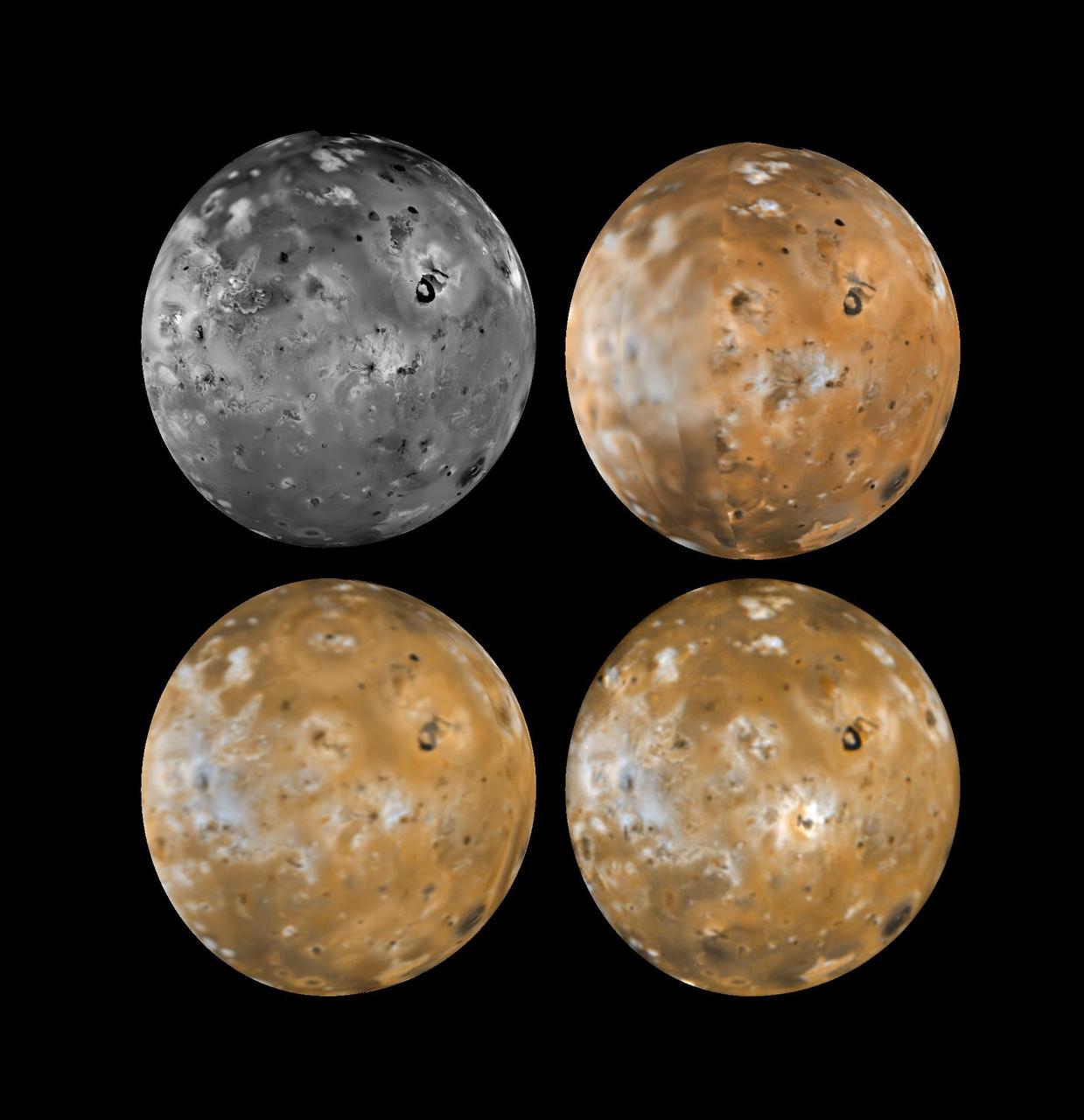
Resurfacing of the Jupiter-facing hemisphere of Io
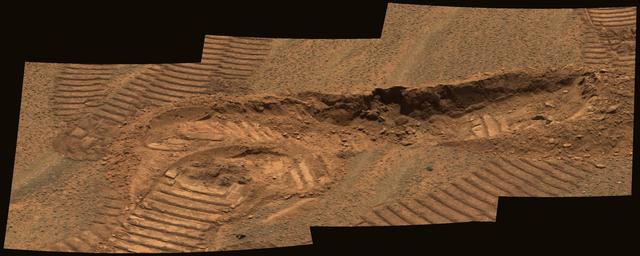
Trench Reveals Two Faces of Soils
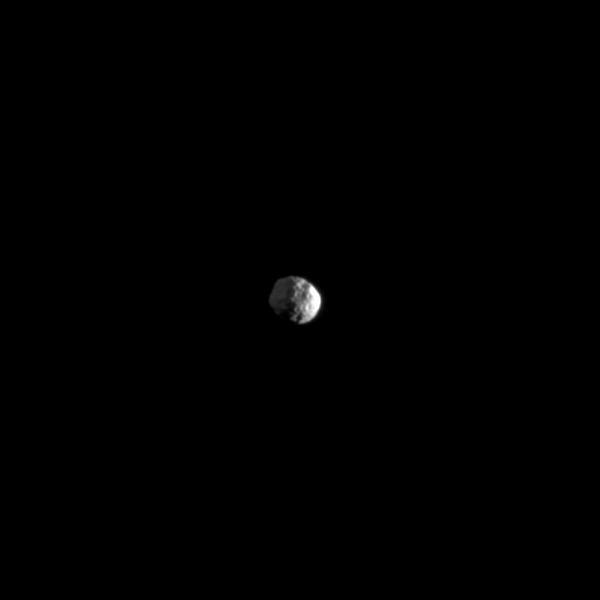
Two Lights on Two-faced Janus
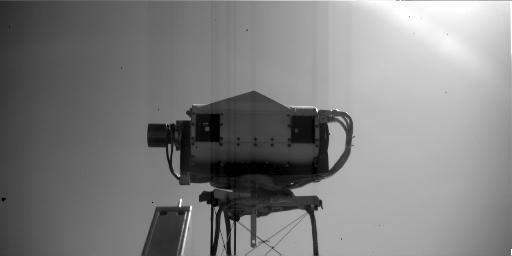
Surface Stereo Imager on Mars, Face-On
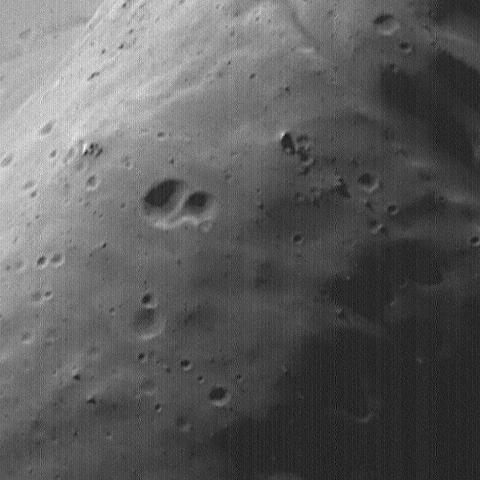
High-Resolution MOC Image of Phobos Face
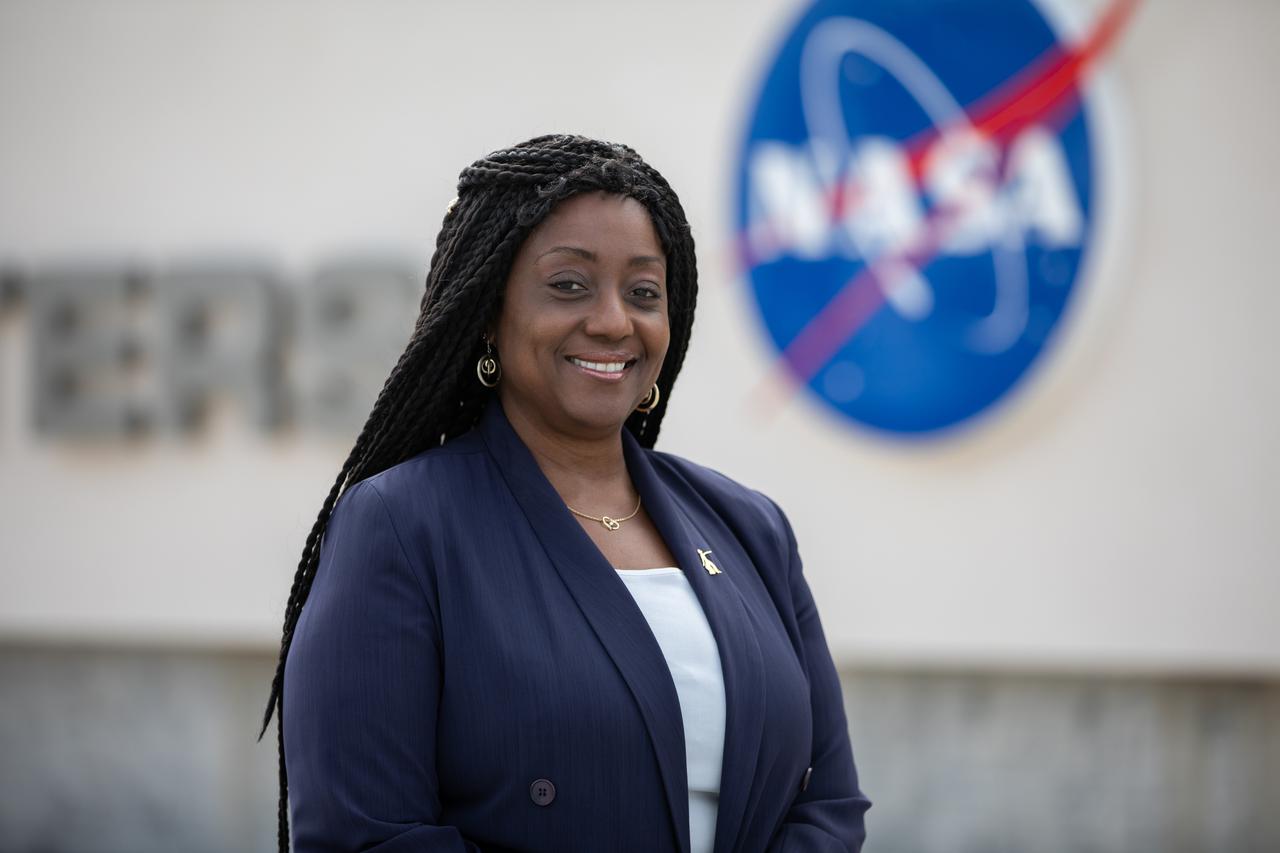
"I’ve worked in many different roles and what drives my passion is learning things that I don’t know. It is a part of my thirst for knowledge and knowing how things work. The harder the problem for me the better. When I first joined NASA as a full time employee, my supervisor would give me an assignment, and I would get it done quickly and come back to his desk and ask, ‘What do you have for me now?’ At one point, after about two months of working for him, he looked at me and kind of sighed. I said, ‘Okay, okay. If you don’t have anything for me right now, is it okay if I see if any of the other supervisors in the building need any help with anything?’ He agreed, and so I approached the other supervisors. "Now, here’s the interesting thing. I was a young Black female in an engineering role that was pretty much dominated by white males at the time, so it was not a norm for there to be females in the building – much less black females. I came to understand later that there was some skepticism on their part that I could do design engineering. I didn’t know that some of them, not all of them, were throwing things at me to show me I wasn’t qualified. But I would tackle their problems the same way I do anything else: if I don’t know it, I’ll go find it. I’ll research. I’ll dig. I’ll look for people that might have some experience that I don’t have and ask them. So, every hard problem that they threw at me, I solved. Eventually, my supervisor told me he didn't know what he was getting into when he agreed to let me go to the other supervisors because now, they were coming to him with their hardest problems, asking, 'Hey, can Barbara help with this?' So, I started to broaden my experience base right away." — Barbara Brown, Director of Exploration Research and Technology Programs, Kennedy Space Center Interviewer: NASA / Tahira Allen
![“On my Twitter page it says: rocket scientist, football coach. “There have been schools where I have coached and kids would ask, ‘you’re an engineer, coach?’ and they seemed so shocked that I'm an engineer. It’s funny! I have two kids on my team this year who are seniors, and they’re going to major in engineering in college. I'm sure there are others that would say, ‘Wow, if Coach Johnson can do it, so can I.’ I’ve brought guys out [to Kennedy Space Center] during Bring Your Child to Work Day. The kids are always wondering, when is a launch? I'm sure they’re all paying more attention to it because I'm around. “[My job also] sparked a conversation with fellow coaches. The American Football Coaches Association did a profile on me last year about how NASA has helped me become a better football coach. For one, the foundations of flight control — those values of being competent at your job, having confidence, being vigilant — translate directly to the football field and then vice versa [when] dealing with adversity. In football, you can be down, you can play hurt, and you learn to fight through adversity. Sometimes, fighting through engineering problems can be tough to solve, but you learn how to persevere, and you find a solution to the problem you’re working on. “As far as similarities, in football, you have a lot of people from different backgrounds and different abilities, and you have to get together to achieve a goal. That’s no different from what we do around here.” — Yusef Johnson, Flight Design Engineer, Kennedy Space Center](https://images-assets.nasa.gov/image/KSC-20210209-PH-KLS01_0045/KSC-20210209-PH-KLS01_0045~medium.jpg)
“On my Twitter page it says: rocket scientist, football coach. “There have been schools where I have coached and kids would ask, ‘you’re an engineer, coach?’ and they seemed so shocked that I'm an engineer. It’s funny! I have two kids on my team this year who are seniors, and they’re going to major in engineering in college. I'm sure there are others that would say, ‘Wow, if Coach Johnson can do it, so can I.’ I’ve brought guys out [to Kennedy Space Center] during Bring Your Child to Work Day. The kids are always wondering, when is a launch? I'm sure they’re all paying more attention to it because I'm around. “[My job also] sparked a conversation with fellow coaches. The American Football Coaches Association did a profile on me last year about how NASA has helped me become a better football coach. For one, the foundations of flight control — those values of being competent at your job, having confidence, being vigilant — translate directly to the football field and then vice versa [when] dealing with adversity. In football, you can be down, you can play hurt, and you learn to fight through adversity. Sometimes, fighting through engineering problems can be tough to solve, but you learn how to persevere, and you find a solution to the problem you’re working on. “As far as similarities, in football, you have a lot of people from different backgrounds and different abilities, and you have to get together to achieve a goal. That’s no different from what we do around here.” — Yusef Johnson, Flight Design Engineer, Kennedy Space Center
![“When I was a kid, I had a Lego set of one of the twin rovers, Spirit and Opportunity. It was like a Lego rover that could fold up the same way that the actual rover did. It’s crazy because I had that when I was like ten — and now, some of my current coworkers actually worked on that launch. So when I walked into my launch director’s office a couple of years ago, I saw that same Lego set sitting next to the people at Jet Propulsion Laboratory who actually built the rover. “Just being able to see it and touch it [as a kid] helps you impart your own imagination onto it. It’s really exciting. I wasn’t an action figure type of kid — but when I had stuff that seemed real, I really enjoyed putting it together. The project of putting it together was the thing that made my parents think that I was going to be a good engineer. Having it in front of you makes it real. So when you see it on TV, it’s like: ‘I know what that is. I know how that instrument works.’ There’s a connection there.” — Phillip Hargrove, Aerospace Engineer, Kennedy Space Center Interviewer: NASA / Thalia Patrinos](https://images-assets.nasa.gov/image/KSC-20210209-PH-KLS02_0030/KSC-20210209-PH-KLS02_0030~medium.jpg)
“When I was a kid, I had a Lego set of one of the twin rovers, Spirit and Opportunity. It was like a Lego rover that could fold up the same way that the actual rover did. It’s crazy because I had that when I was like ten — and now, some of my current coworkers actually worked on that launch. So when I walked into my launch director’s office a couple of years ago, I saw that same Lego set sitting next to the people at Jet Propulsion Laboratory who actually built the rover. “Just being able to see it and touch it [as a kid] helps you impart your own imagination onto it. It’s really exciting. I wasn’t an action figure type of kid — but when I had stuff that seemed real, I really enjoyed putting it together. The project of putting it together was the thing that made my parents think that I was going to be a good engineer. Having it in front of you makes it real. So when you see it on TV, it’s like: ‘I know what that is. I know how that instrument works.’ There’s a connection there.” — Phillip Hargrove, Aerospace Engineer, Kennedy Space Center Interviewer: NASA / Thalia Patrinos

“The day after the Columbia tragedy I knew exactly what I wanted to do with my life. I go to my physics class and tell a friend, ‘I want to go work for NASA.’ My physics teacher walks by and overhears the conversation. She starts the class and says ‘I want to go around the classroom and hear about what everybody wants to do with their life.’ She gets to me. I was super excited. ‘I’m going to work for NASA, I’m going to be an engineer, I’m going to make sure everybody flies safe.’ And she bursts out laughing. And everyone else starts laughing. I’m like, ‘what is the joke?’ And she says to me, ‘If you ever get the opportunity to work for NASA, you make sure you come take me out to lunch.’ And that ended up being the joke of the day at my entire high school. “I think we have a very long way to go. I think that there are not enough educational resources. There are not enough pipeline opportunities. I come from a single-parent family. We weren’t rich. We lived in a New Jersey suburb in a very small town where the idea of a girl going to NASA — it just seemed impossible. I think that we have long way to go to reach out to some of those smaller, under-serving communities where individuals may not have the resources. Where teachers can’t even motivate kids to do something big because they don’t even believe it themselves. I do believe there are strides happening — but I don’t think we’re there yet.” — Brittani Sims, Flight Systems Engineer, Kennedy Space Center Interviewer: NASA / Thalia Patrinos
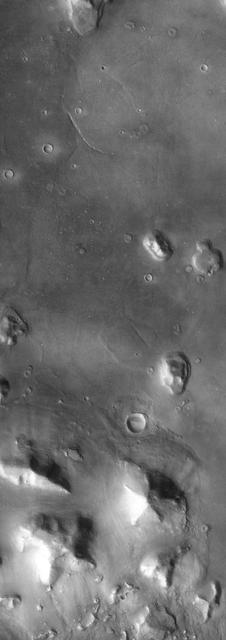
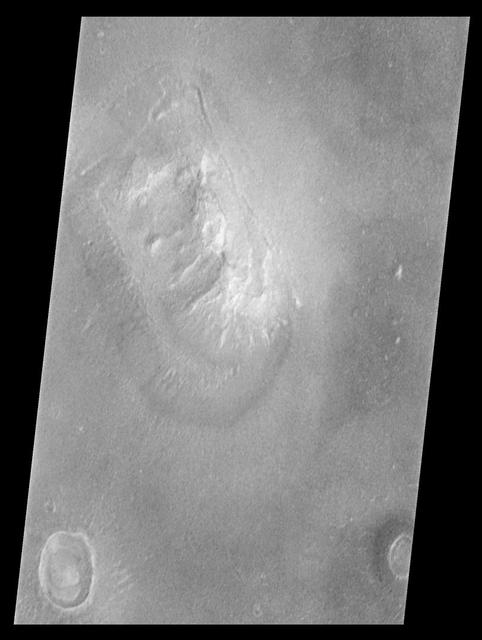
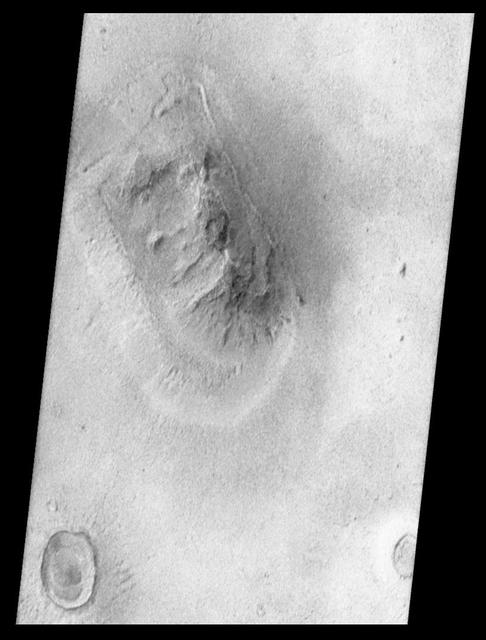
The so-called Face on Mars can be seen slightly above center and to the right in this NASA Mars Odyssey image. This 3-km long knob was first imaged by NASA Viking spacecraft in the 1970 and to some resembled a face carved into the rocks of Mars.
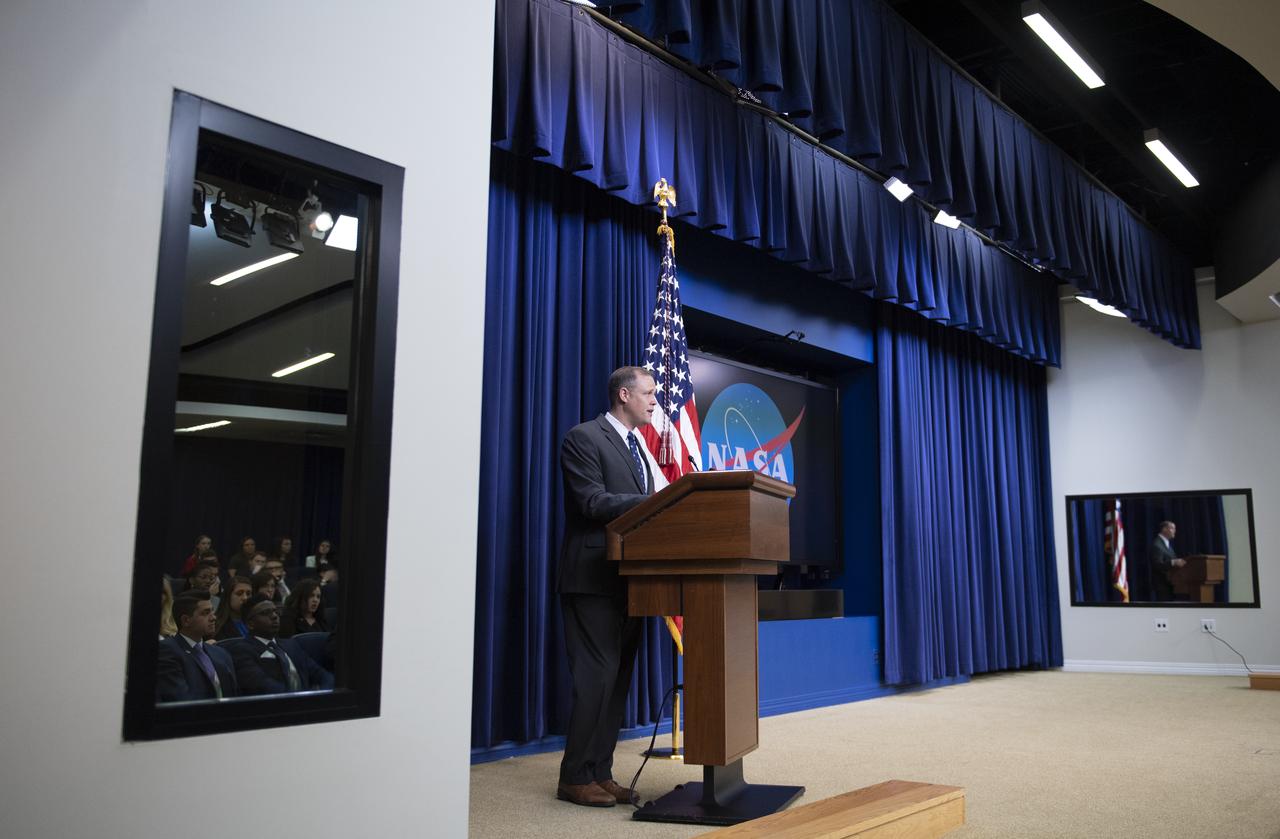
NASA Administrator Jim Bridenstine speaks at the "Face to Face with Our Future: A Day with Young Leaders" event, Wednesday, June 27, 2018 at the Eisenhower Executive Office Building in Washington, DC. Photo Credit: (NASA/Joel Kowsky)
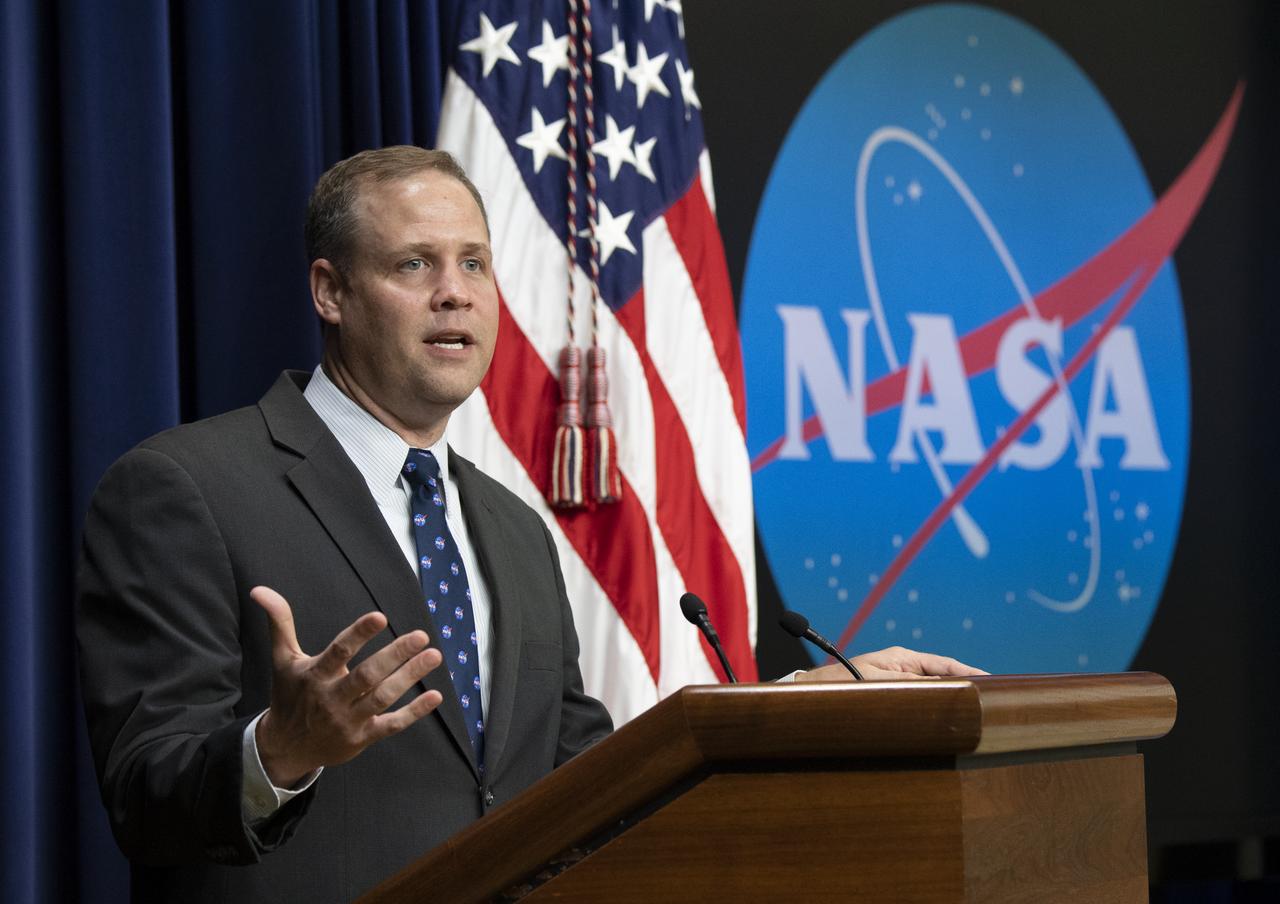
NASA Administrator Jim Bridenstine speaks at the "Face to Face with Our Future: A Day with Young Leaders" event, Wednesday, June 27, 2018 at the Eisenhower Executive Office Building in Washington, DC. Photo Credit: (NASA/Joel Kowsky)
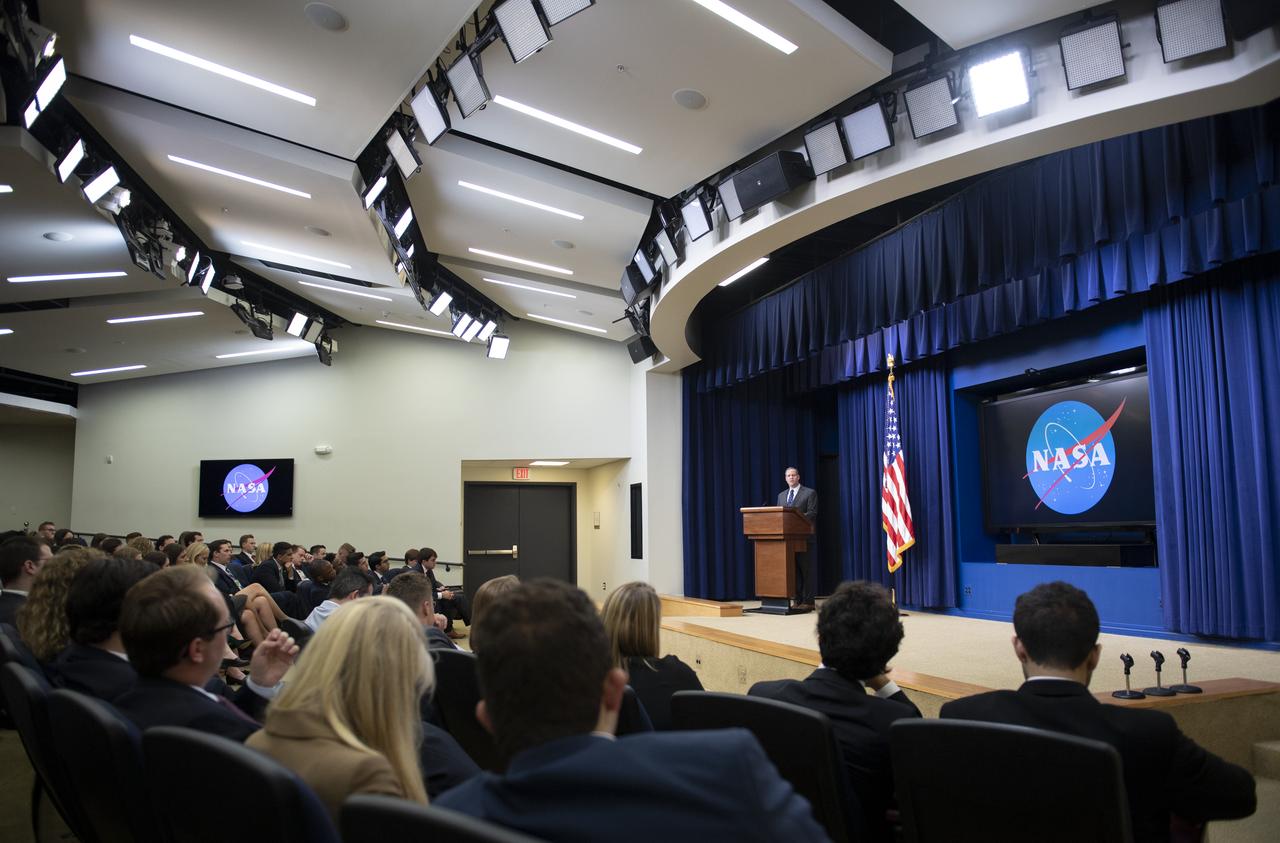
NASA Administrator Jim Bridenstine speaks at the "Face to Face with Our Future: A Day with Young Leaders" event, Wednesday, June 27, 2018 at the Eisenhower Executive Office Building in Washington, DC. Photo Credit: (NASA/Joel Kowsky)
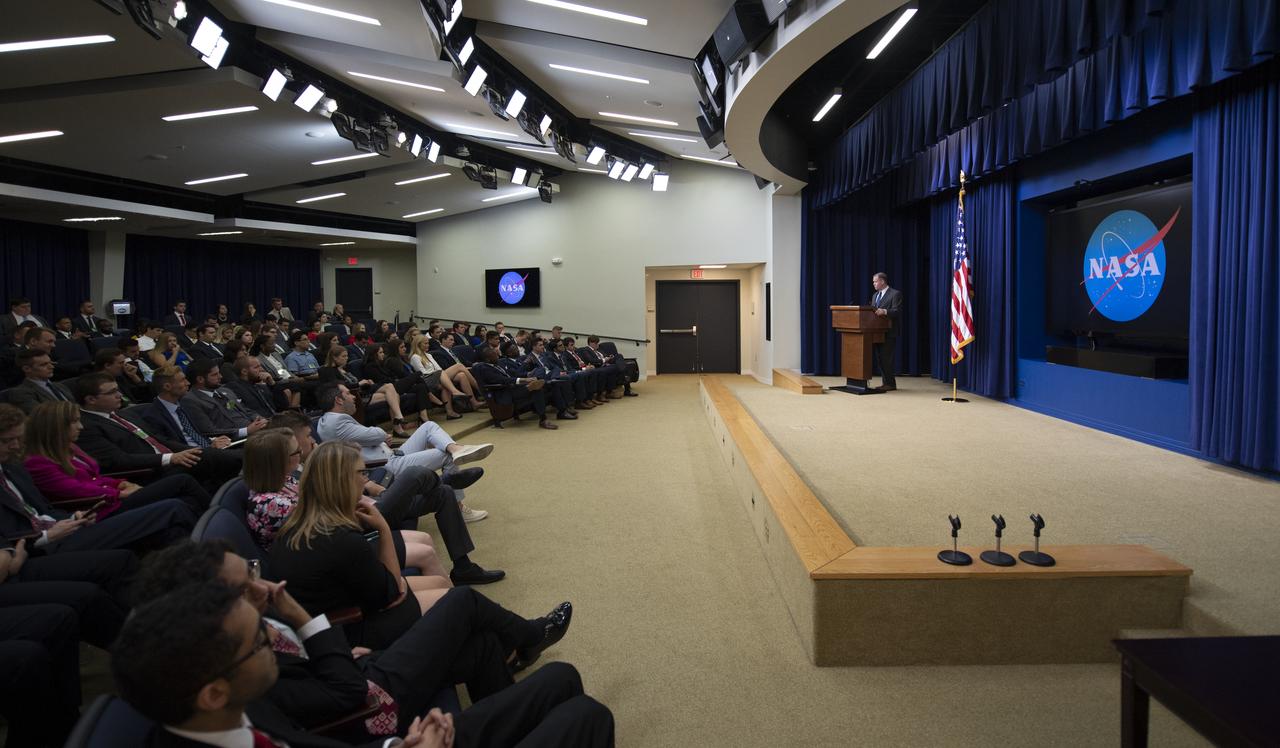
NASA Administrator Jim Bridenstine speaks at the "Face to Face with Our Future: A Day with Young Leaders" event, Wednesday, June 27, 2018 at the Eisenhower Executive Office Building in Washington, DC. Photo Credit: (NASA/Joel Kowsky)
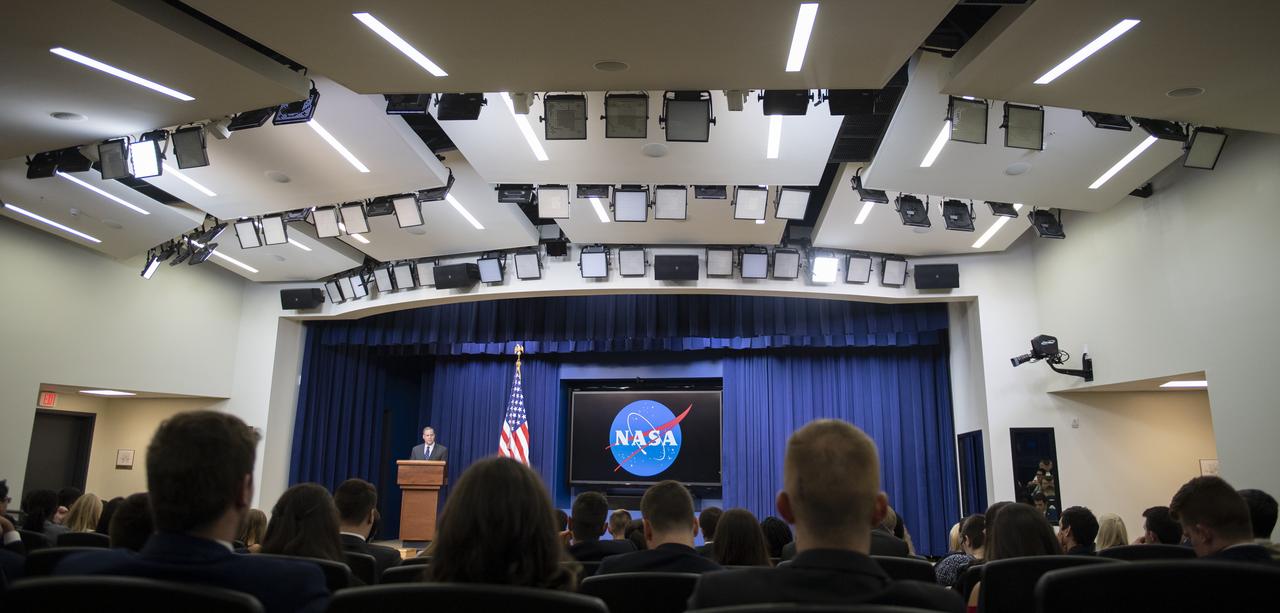
NASA Administrator Jim Bridenstine speaks at the "Face to Face with Our Future: A Day with Young Leaders" event, Wednesday, June 27, 2018 at the Eisenhower Executive Office Building in Washington, DC. Photo Credit: (NASA/Joel Kowsky)
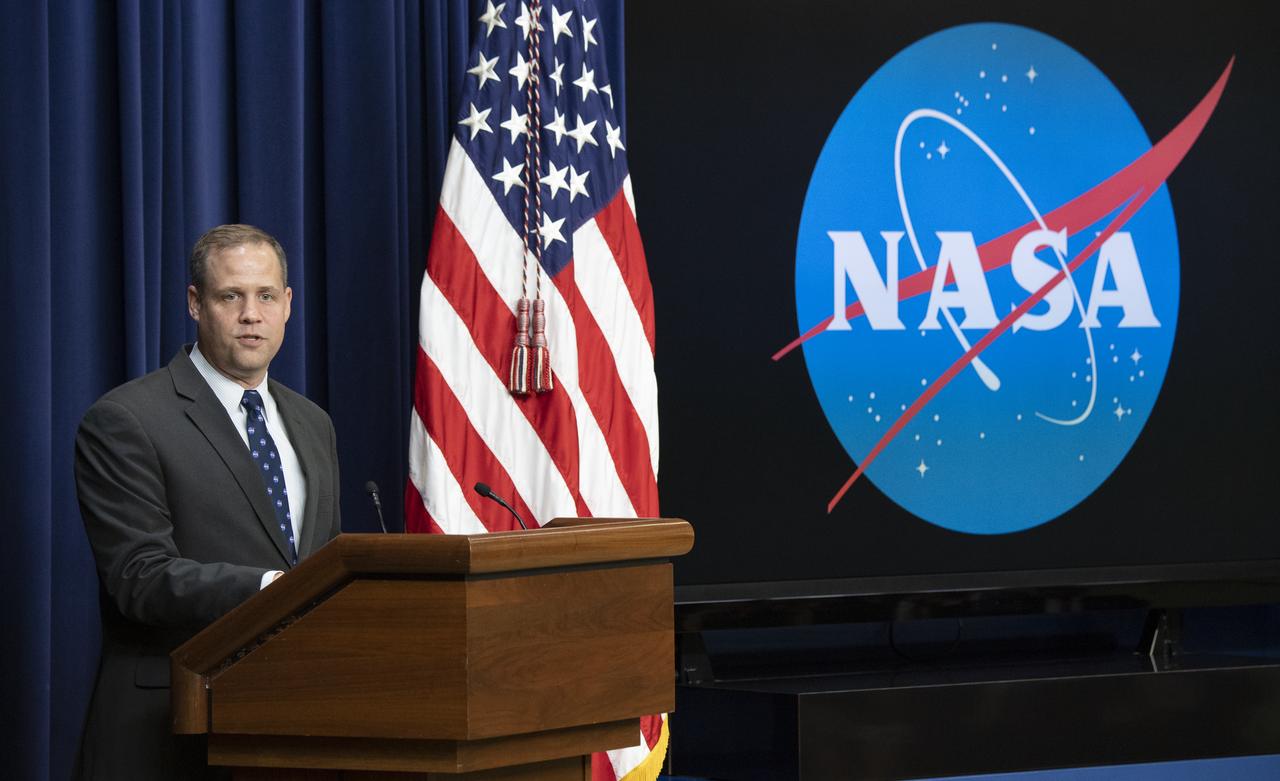
NASA Administrator Jim Bridenstine speaks at the "Face to Face with Our Future: A Day with Young Leaders" event, Wednesday, June 27, 2018 at the Eisenhower Executive Office Building in Washington, DC. Photo Credit: (NASA/Joel Kowsky)

NASA Administrator Jim Bridenstine speaks at the "Face to Face with Our Future: A Day with Young Leaders" event, Wednesday, June 27, 2018 at the Eisenhower Executive Office Building in Washington, DC. Photo Credit: (NASA/Joel Kowsky)
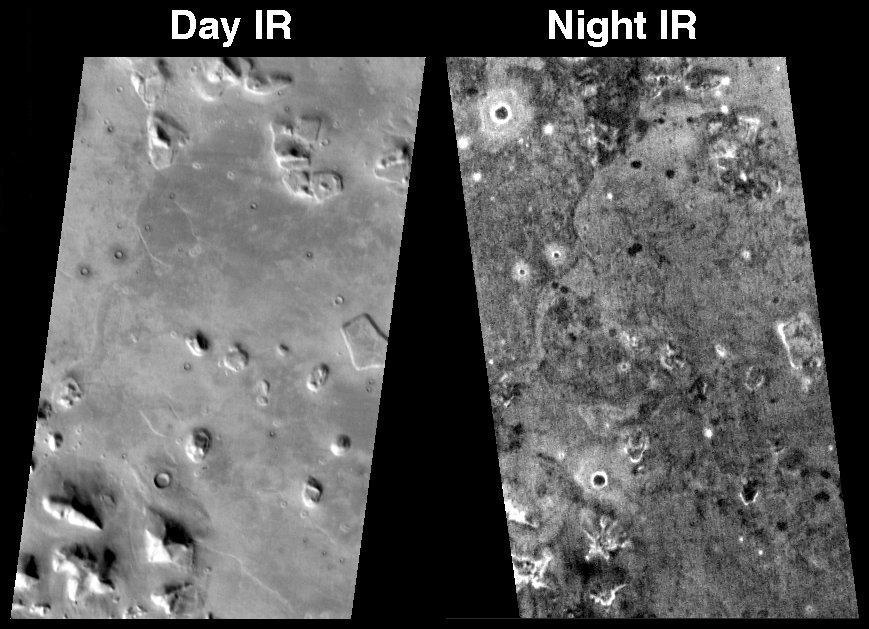
This pair of infrared images from NASA Mars Odyssey spacecraft shows the so-called face on Mars landform viewed during both the day and night.
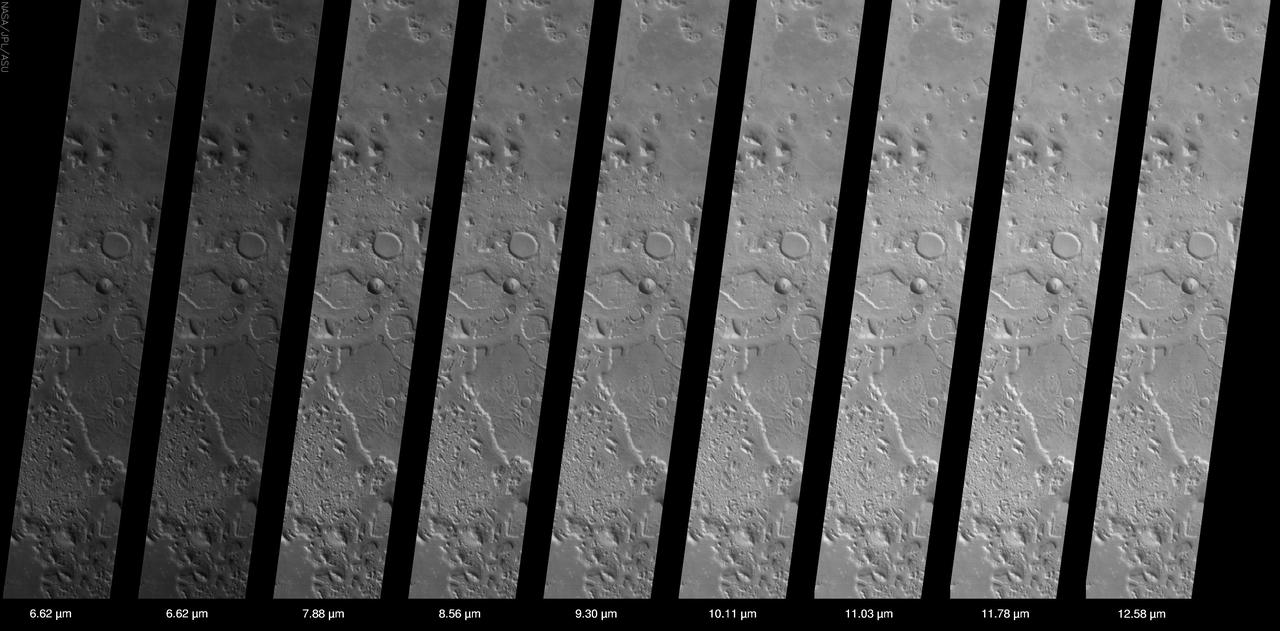
This set of images from NASA Mars Odyssey spacecraft shows the so-called face on Mars landform located in the northern plains of Mars.
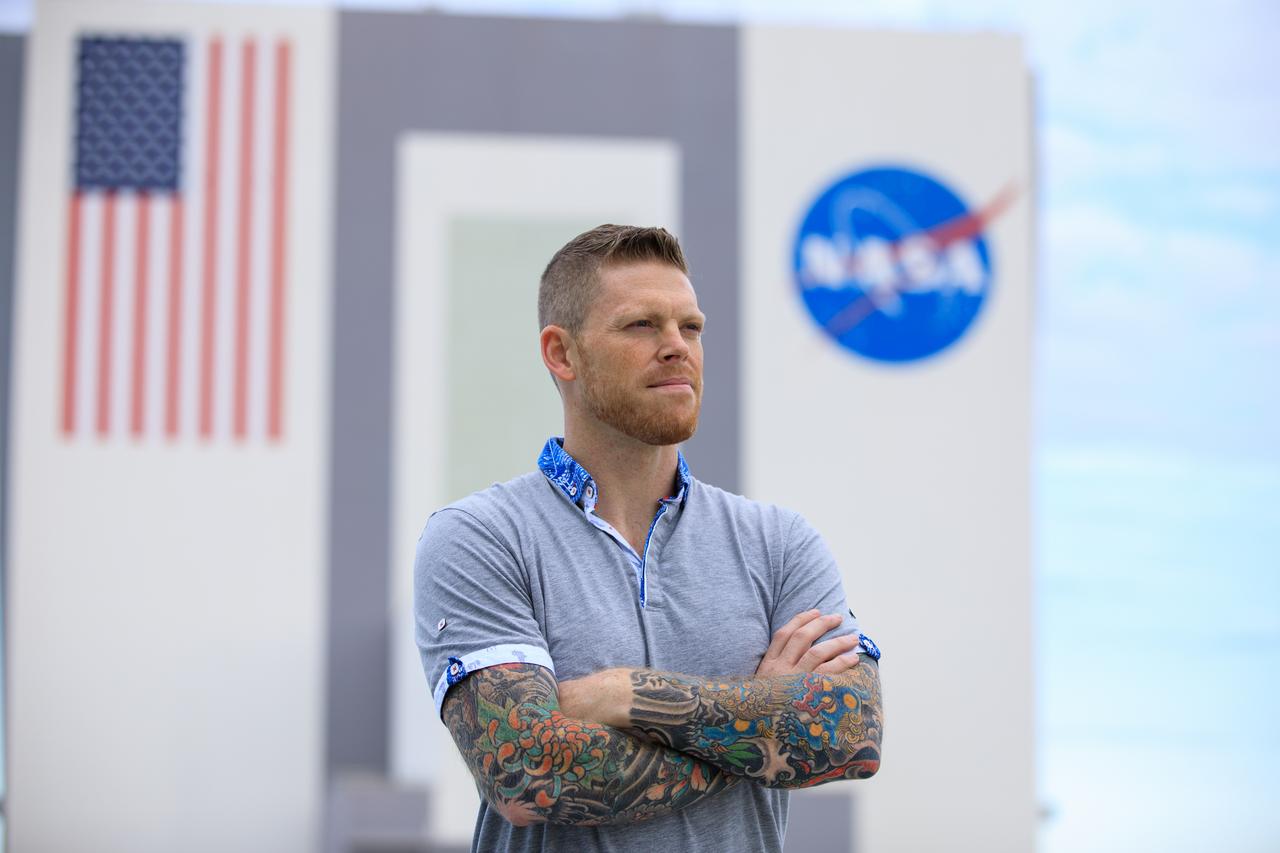
Portrait of Ronnie Adams in front of Kennedy’s Vehicle Assembly Building for Native American History month.

NASA image release January 13, 2011 <b><a href="http://www.flickr.com/photos/gsfc/5352962836">These images</a></b> by NASA's Hubble Space Telescope show off two dramatically different face-on views of the spiral galaxy M51, dubbed the Whirlpool Galaxy. <b>The image above,</b> taken in visible light, highlights the attributes of a typical spiral galaxy, including graceful, curving arms, pink star-forming regions, and brilliant blue strands of star clusters. <b><a href="http://www.flickr.com/photos/gsfc/5352344517">In the image here,</a></b> most of the starlight has been removed, revealing the Whirlpool's skeletal dust structure, as seen in near-infrared light. This new image is the sharpest view of the dense dust in M51. The narrow lanes of dust revealed by Hubble reflect the galaxy's moniker, the Whirlpool Galaxy, as if they were swirling toward the galaxy's core. To map the galaxy's dust structure, researchers collected the galaxy's starlight by combining images taken in visible and near-infrared light. The visible-light image captured only some of the light; the rest was obscured by dust. The near-infrared view, however, revealed more starlight because near-infrared light penetrates dust. The researchers then subtracted the total amount of starlight from both images to see the galaxy's dust structure. The red color in the near-infrared image traces the dust, which is punctuated by hundreds of tiny clumps of stars, each about 65 light-years wide. These stars have never been seen before. The star clusters cannot be seen in visible light because dense dust enshrouds them. The image reveals details as small as 35 light-years across. Astronomers expected to see large dust clouds, ranging from about 100 light-years to more than 300 light-years wide. Instead, most of the dust is tied up in smooth and diffuse dust lanes. An encounter with another galaxy may have prevented giant clouds from forming. Probing a galaxy's dust structure serves as an important diagnostic tool for astronomers, providing invaluable information on how the gas and dust collapse to form stars. Although Hubble is providing incisive views of the internal structure of galaxies such as M51, the planned James Webb Space Telescope (JWST) is expected to produce even crisper images. Researchers constructed the image by combining visible-light exposures from Jan. 18 to 22, 2005, with the Advanced Camera for Surveys (ACS), and near-infrared light pictures taken in December 2005 with the Near Infrared Camera and Multi-Object Spectrometer (NICMOS). Credit: NASA, ESA, S. Beckwith (STScI), and the Hubble Heritage Team (STScI/AURA) The Hubble Space Telescope is a project of international cooperation between NASA and the European Space Agency. NASA's Goddard Space Flight Center manages the telescope. The Space Telescope Science Institute (STScI) conducts Hubble science operations. STScI is operated for NASA by the Association of Universities for Research in Astronomy, Inc., in Washington, D.C. <b><a href="http://www.nasa.gov/centers/goddard/home/index.html" rel="nofollow">NASA Goddard Space Flight Center</a></b> enables NASA’s mission through four scientific endeavors: Earth Science, Heliophysics, Solar System Exploration, and Astrophysics. Goddard plays a leading role in NASA’s accomplishments by contributing compelling scientific knowledge to advance the Agency’s mission. <b>Follow us on <a href="http://twitter.com/NASA_GoddardPix" rel="nofollow">Twitter</a></b> <b>Join us on <a href="http://www.facebook.com/pages/Greenbelt-MD/NASA-Goddard/395013845897?ref=tsd" rel="nofollow">Facebook</a></b>
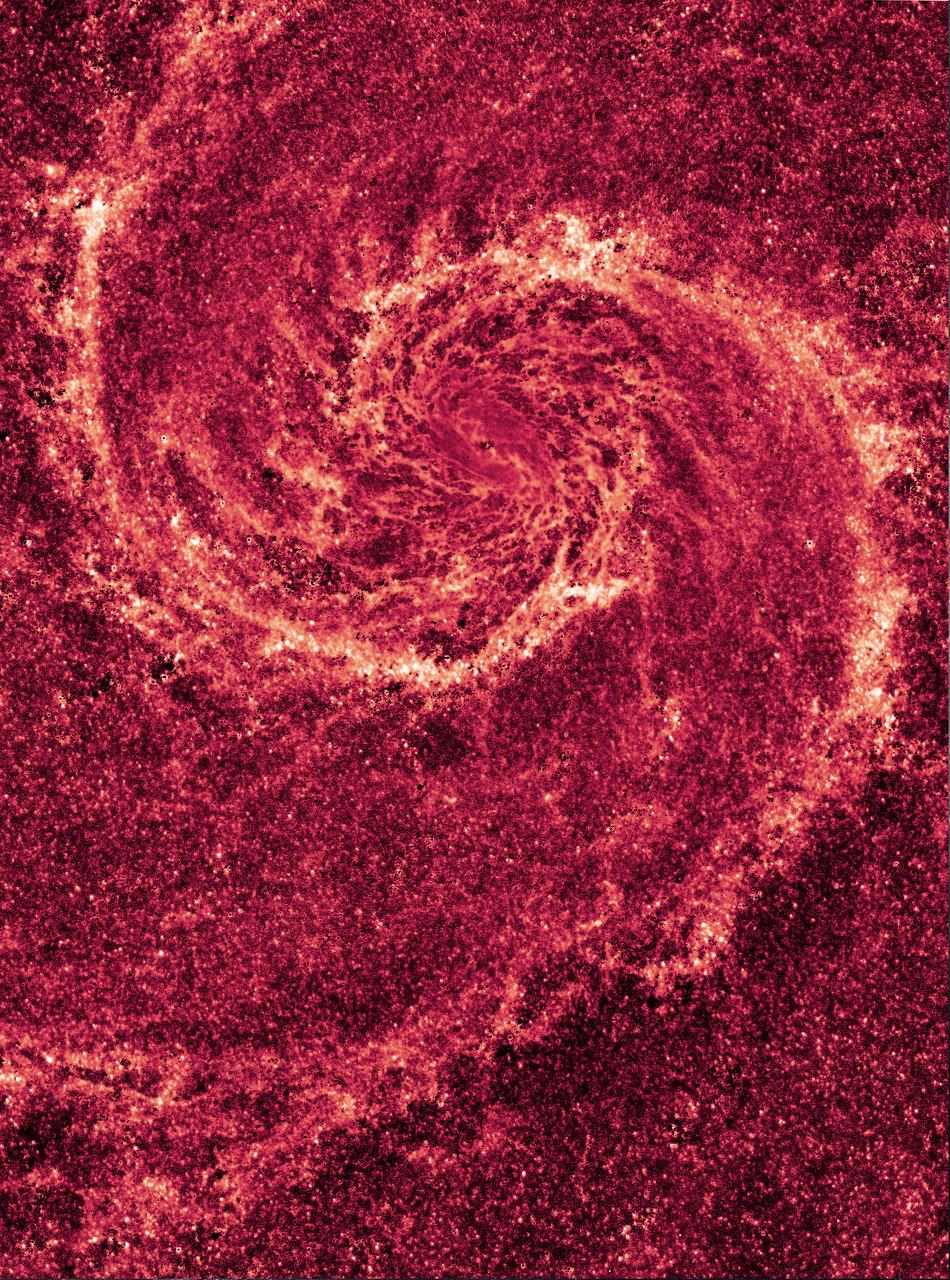
NASA image release January 13, 2011 <b><a href="http://www.flickr.com/photos/gsfc/5352962836">These images</a></b> by NASA's Hubble Space Telescope show off two dramatically different face-on views of the spiral galaxy M51, dubbed the Whirlpool Galaxy. <b><a href="http://www.flickr.com/photos/gsfc/5352955200/">The image here,</a></b> taken in visible light, highlights the attributes of a typical spiral galaxy, including graceful, curving arms, pink star-forming regions, and brilliant blue strands of star clusters. <b>In the image above,</b> most of the starlight has been removed, revealing the Whirlpool's skeletal dust structure, as seen in near-infrared light. This new image is the sharpest view of the dense dust in M51. The narrow lanes of dust revealed by Hubble reflect the galaxy's moniker, the Whirlpool Galaxy, as if they were swirling toward the galaxy's core. To map the galaxy's dust structure, researchers collected the galaxy's starlight by combining images taken in visible and near-infrared light. The visible-light image captured only some of the light; the rest was obscured by dust. The near-infrared view, however, revealed more starlight because near-infrared light penetrates dust. The researchers then subtracted the total amount of starlight from both images to see the galaxy's dust structure. The red color in the near-infrared image traces the dust, which is punctuated by hundreds of tiny clumps of stars, each about 65 light-years wide. These stars have never been seen before. The star clusters cannot be seen in visible light because dense dust enshrouds them. The image reveals details as small as 35 light-years across. Astronomers expected to see large dust clouds, ranging from about 100 light-years to more than 300 light-years wide. Instead, most of the dust is tied up in smooth and diffuse dust lanes. An encounter with another galaxy may have prevented giant clouds from forming. Probing a galaxy's dust structure serves as an important diagnostic tool for astronomers, providing invaluable information on how the gas and dust collapse to form stars. Although Hubble is providing incisive views of the internal structure of galaxies such as M51, the planned James Webb Space Telescope (JWST) is expected to produce even crisper images. Researchers constructed the image by combining visible-light exposures from Jan. 18 to 22, 2005, with the Advanced Camera for Surveys (ACS), and near-infrared light pictures taken in December 2005 with the Near Infrared Camera and Multi-Object Spectrometer (NICMOS). The Hubble Space Telescope is a project of international cooperation between NASA and the European Space Agency. NASA's Goddard Space Flight Center manages the telescope. The Space Telescope Science Institute (STScI) conducts Hubble science operations. STScI is operated for NASA by the Association of Universities for Research in Astronomy, Inc., in Washington, D.C. <b><a href="http://www.nasa.gov/centers/goddard/home/index.html" rel="nofollow">NASA Goddard Space Flight Center</a></b> enables NASA’s mission through four scientific endeavors: Earth Science, Heliophysics, Solar System Exploration, and Astrophysics. Goddard plays a leading role in NASA’s accomplishments by contributing compelling scientific knowledge to advance the Agency’s mission. <b>Follow us on <a href="http://twitter.com/NASA_GoddardPix" rel="nofollow">Twitter</a></b> <b>Join us on <a href="http://www.facebook.com/pages/Greenbelt-MD/NASA-Goddard/395013845897?ref=tsd" rel="nofollow">Facebook</a></b> Credit: NASA, ESA, M. Regan and B. Whitmore (STScI), and R. Chandar (University of Toledo)
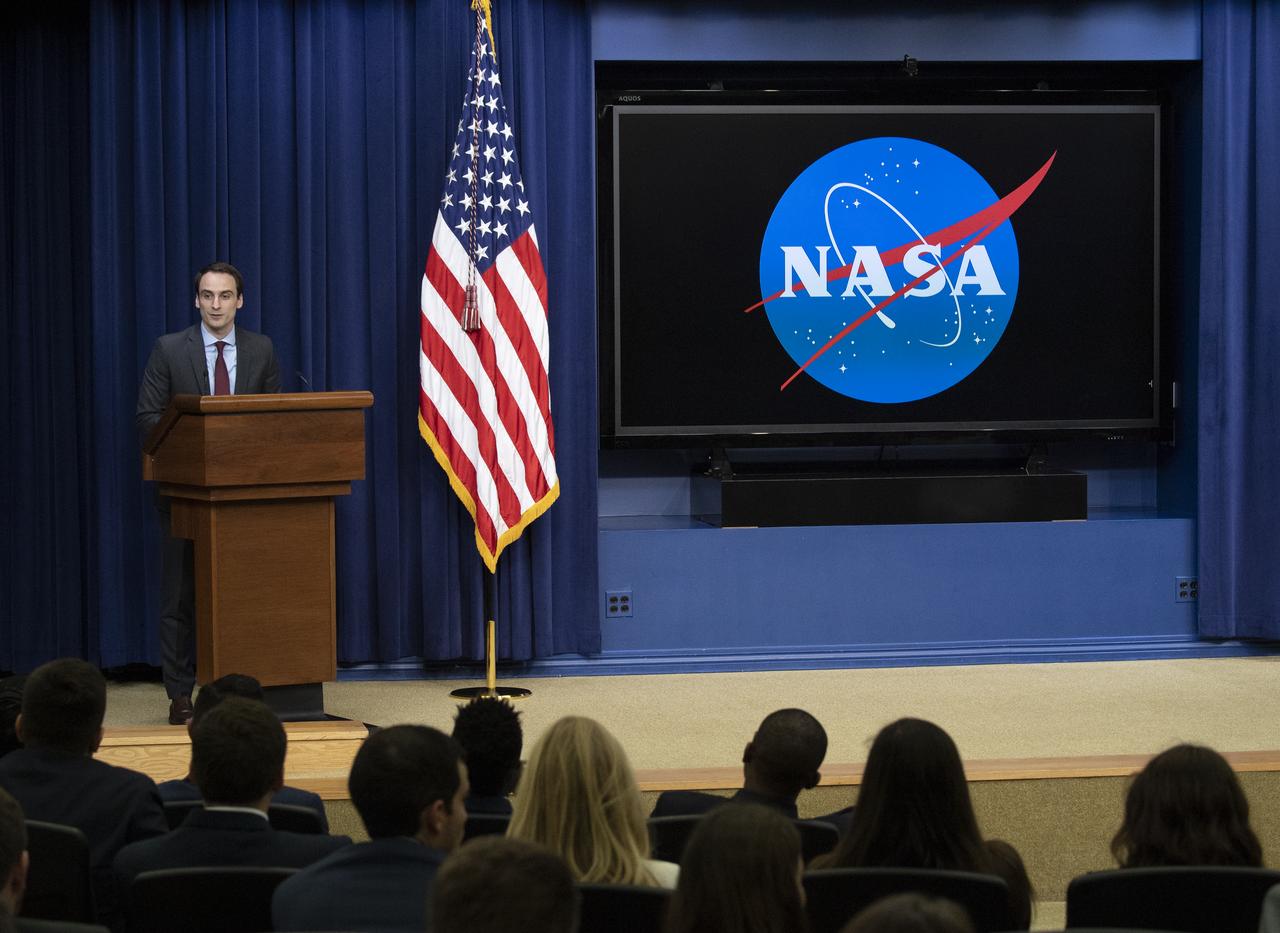
Deputy Chief Technology Officer of the United States Michael Kratsios introduces NASA Administrator Jim Bridenstine at the "Face to Face with Our Future: A Day with Young Leaders" event, Wednesday, June 27, 2018 at the Eisenhower Executive Office Building in Washington, DC. Photo Credit: (NASA/Joel Kowsky)
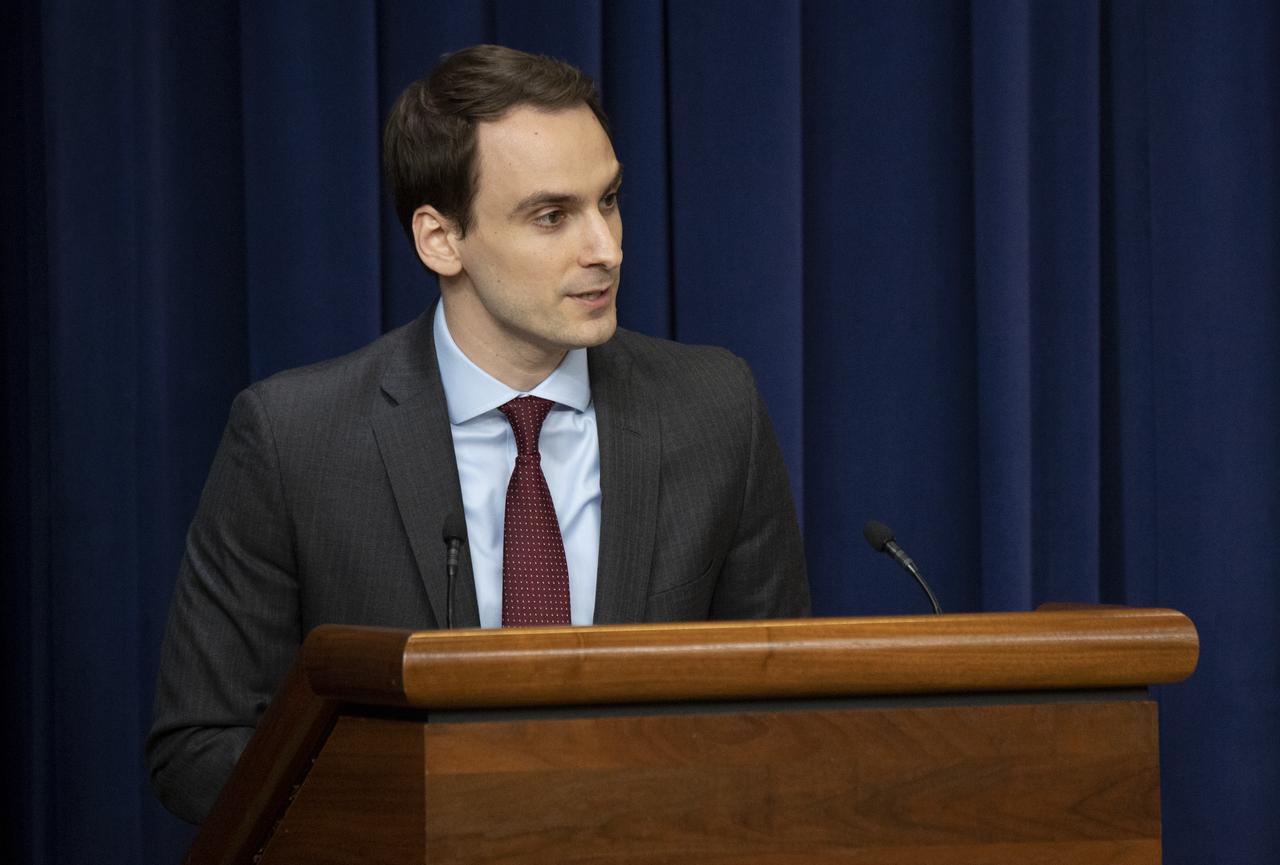
Deputy Chief Technology Officer of the United States Michael Kratsios introduces NASA Administrator Jim Bridenstine at the "Face to Face with Our Future: A Day with Young Leaders" event, Wednesday, June 27, 2018 at the Eisenhower Executive Office Building in Washington, DC. Photo Credit: (NASA/Joel Kowsky)
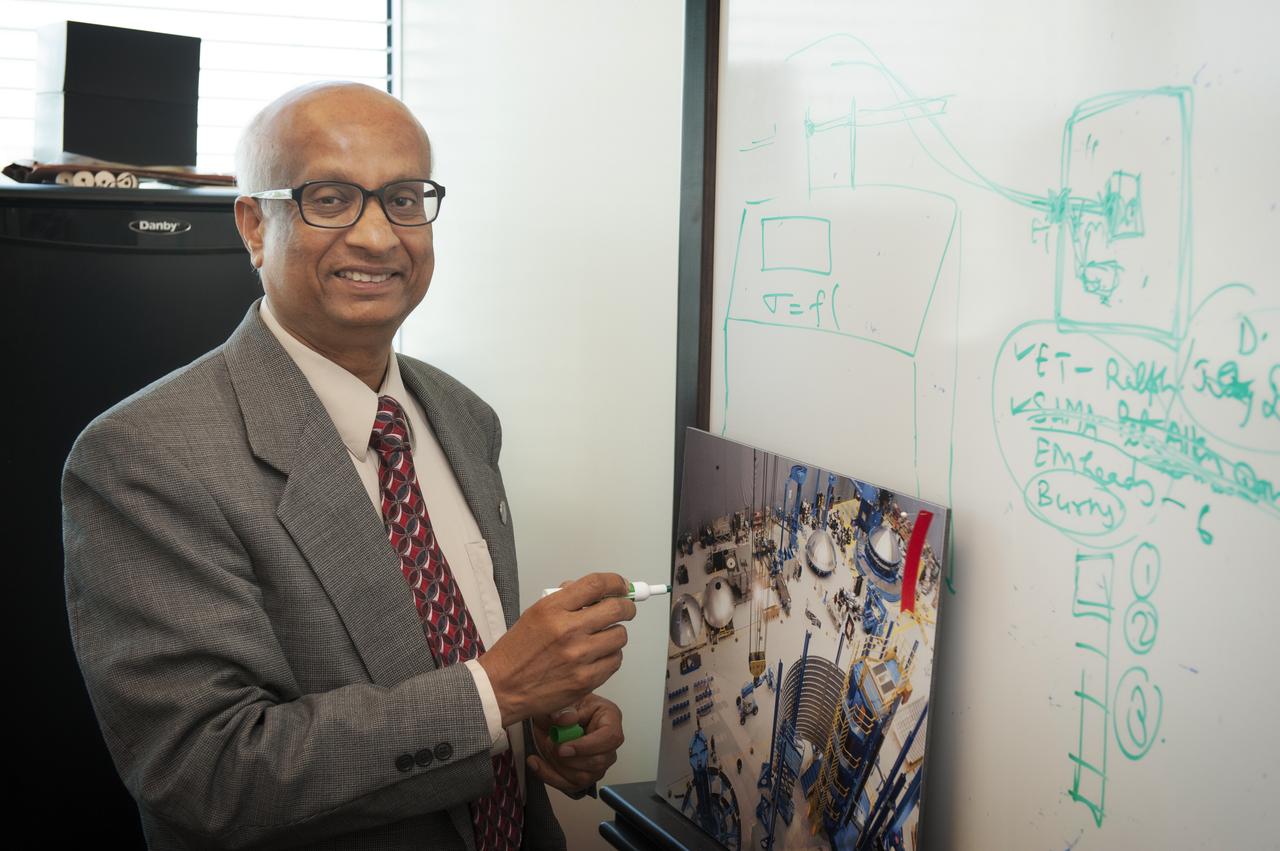
DR. SURENDRA SINGHAL—MAY 2012 “FACE OF MISSION SUCCESS” FOR THE MARSHALL Star.
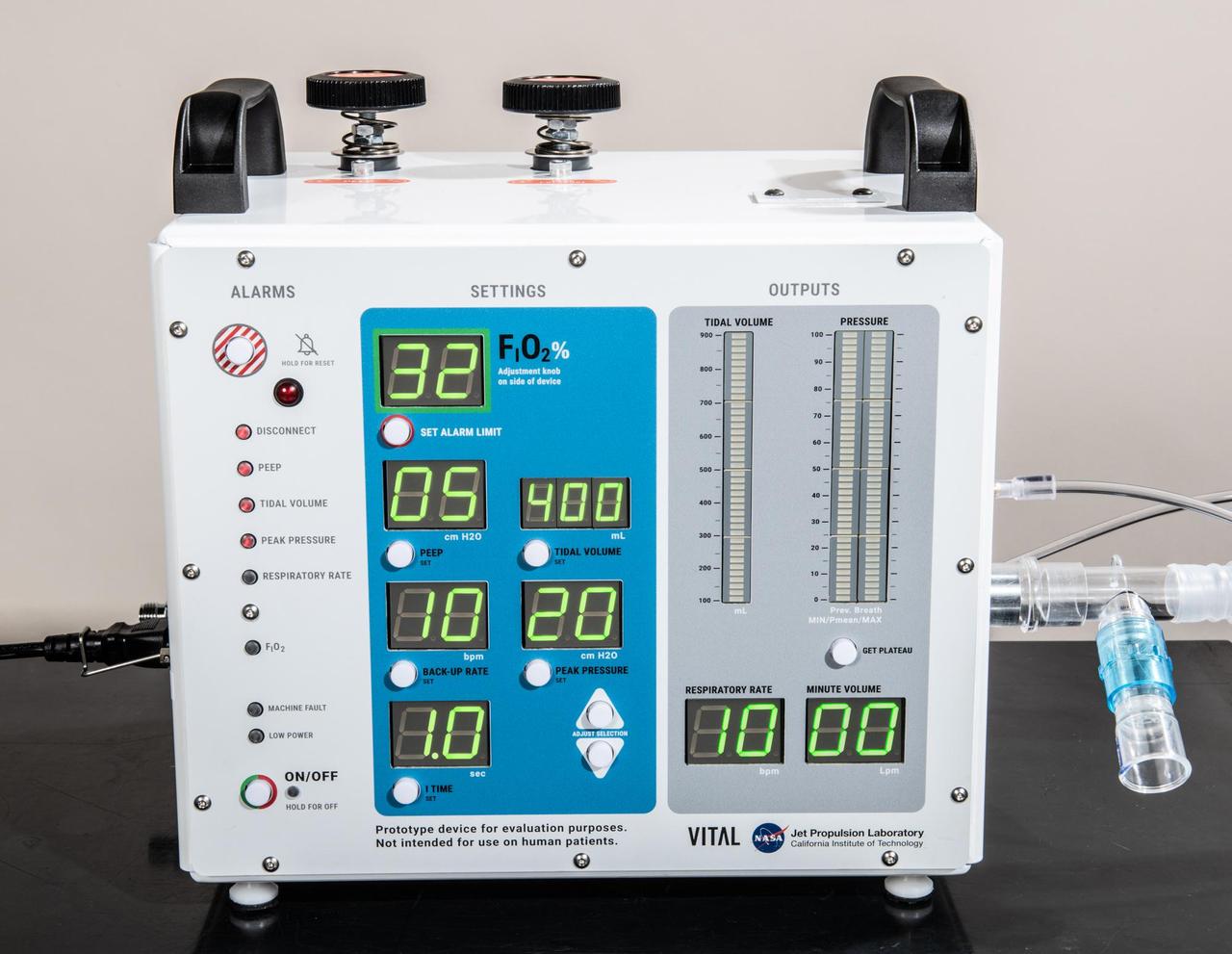
A front-facing portrait of VITAL (Ventilator Intervention Technology Accessible Locally), a ventilator designed and built by NASA's Jet Propulsion Laboratory in Southern California. https://photojournal.jpl.nasa.gov/catalog/PIA23775
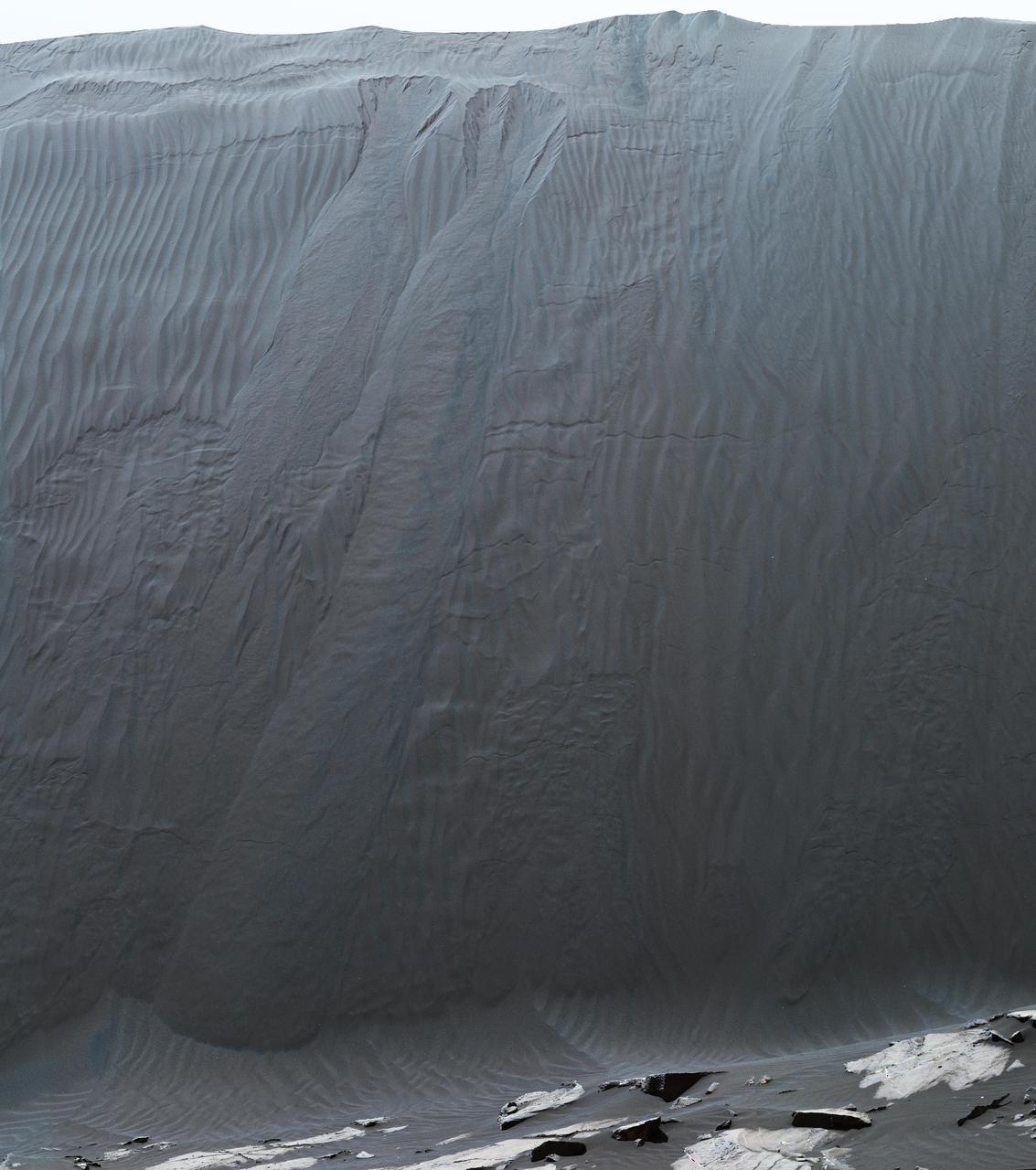
This view combines multiple images from the telephoto-lens camera of the Mast Camera (Mastcam) on NASA's Curiosity Mars rover to reveal fine details of the downwind face of "Namib Dune." The site is part of the dark-sand "Bagnold Dunes" field along the northwestern flank of Mount Sharp. Images taken from orbit have shown that dunes in the Bagnold field move as much as about 3 feet (1 meter) per Earth year. Sand on this face of Namib Dune has cascaded down a slope of about 26 to 28 degrees. The top of the face is about 13 to 17 feet (4 to 5 meters) above the rocky ground at its base. http://photojournal.jpl.nasa.gov/catalog/PIA20283
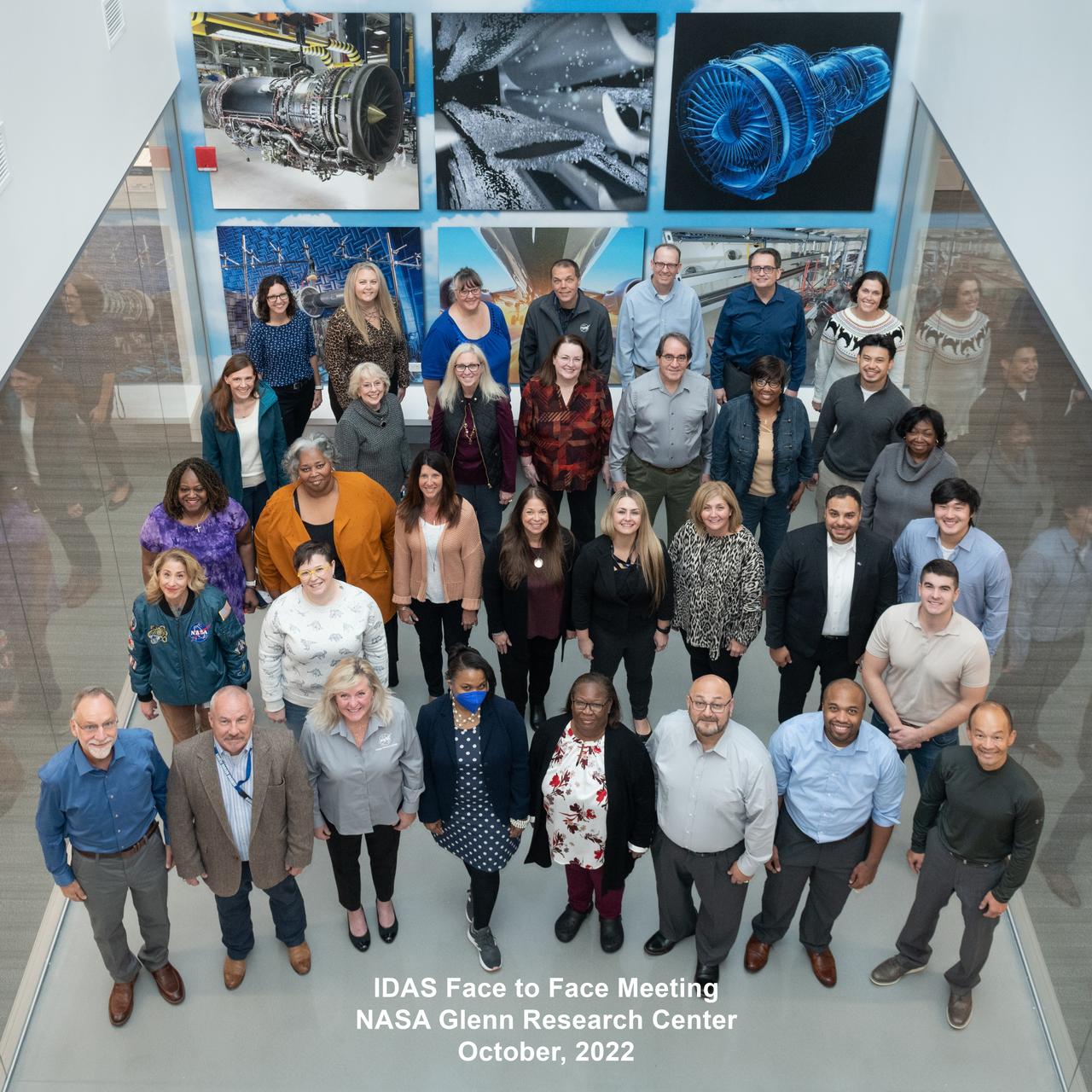
Information, Data, & Analytics Services, IDAS Face to Face Meeting
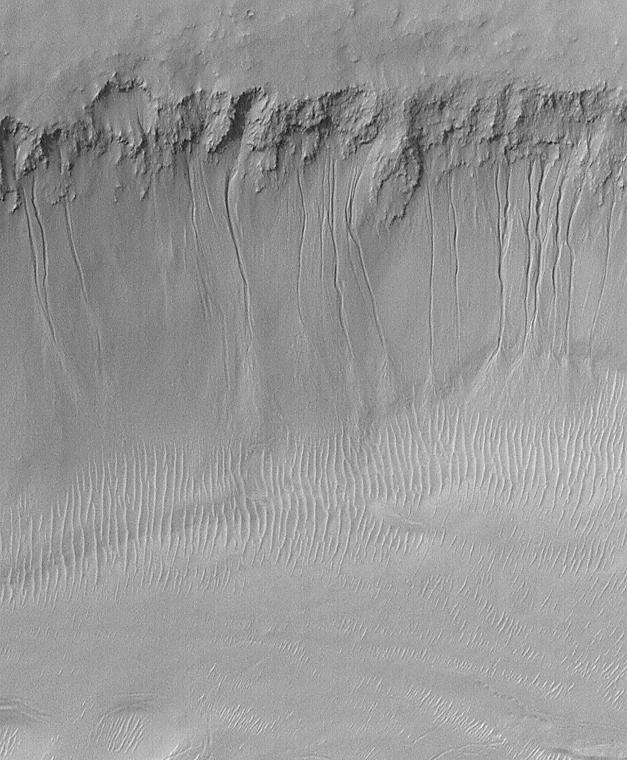
Evidence for Recent Liquid Water on Mars: South-facing Walls of Nirgal Vallis
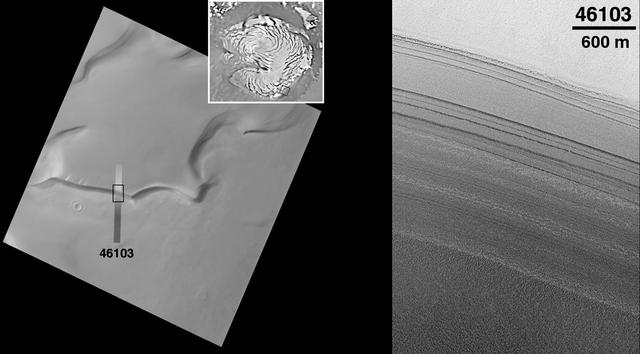
Detailed View of Cliff-face in the North Polar Layered Deposits

Highest-Resolution View of Face
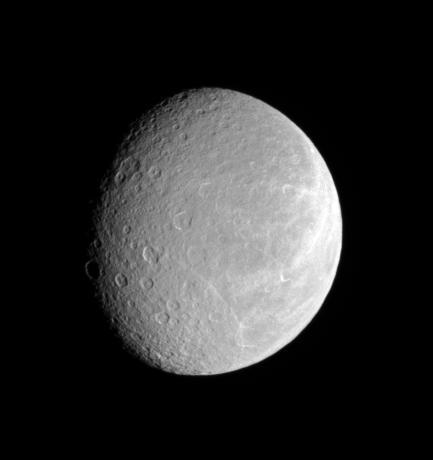
After nearly three years at Saturn, the Cassini spacecraft continues to observe the planet retinue of icy moons. Rhea cratered face attests to its great age, while its bright wisps hint at tectonic activity in the past
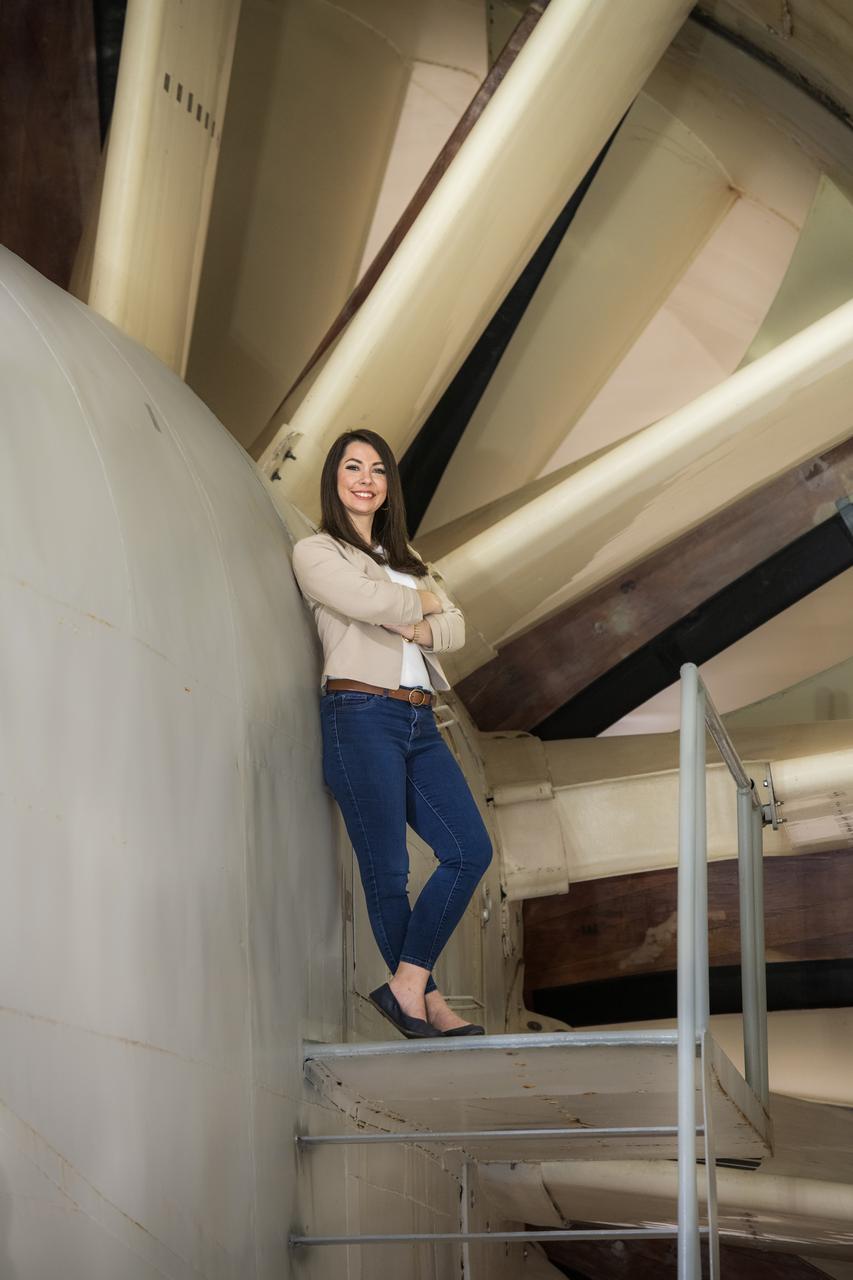
Emily Timko, featured in a Faces of NASA article, poses in the IRT (Icing Research Tunnel) where she works as a “cloud engineer”. She is a Mechanical Test Engineer and works to create unique water spray conditions that simulate icing clouds in the natural aircraft flight environment. Shown in the photo is a portion of the fan drive motor and fan blades that together drive the air through the wind tunnel.

Emily Timko, featured in a Faces of NASA article, poses in the IRT (Icing Research Tunnel) where she works as a “cloud engineer”. She is a Mechanical Test Engineer and works to create unique water spray conditions that simulate icing clouds in the natural aircraft flight environment. Shown in the photo is a portion of the fan drive motor and fan blades that together drive the air through the wind tunnel.
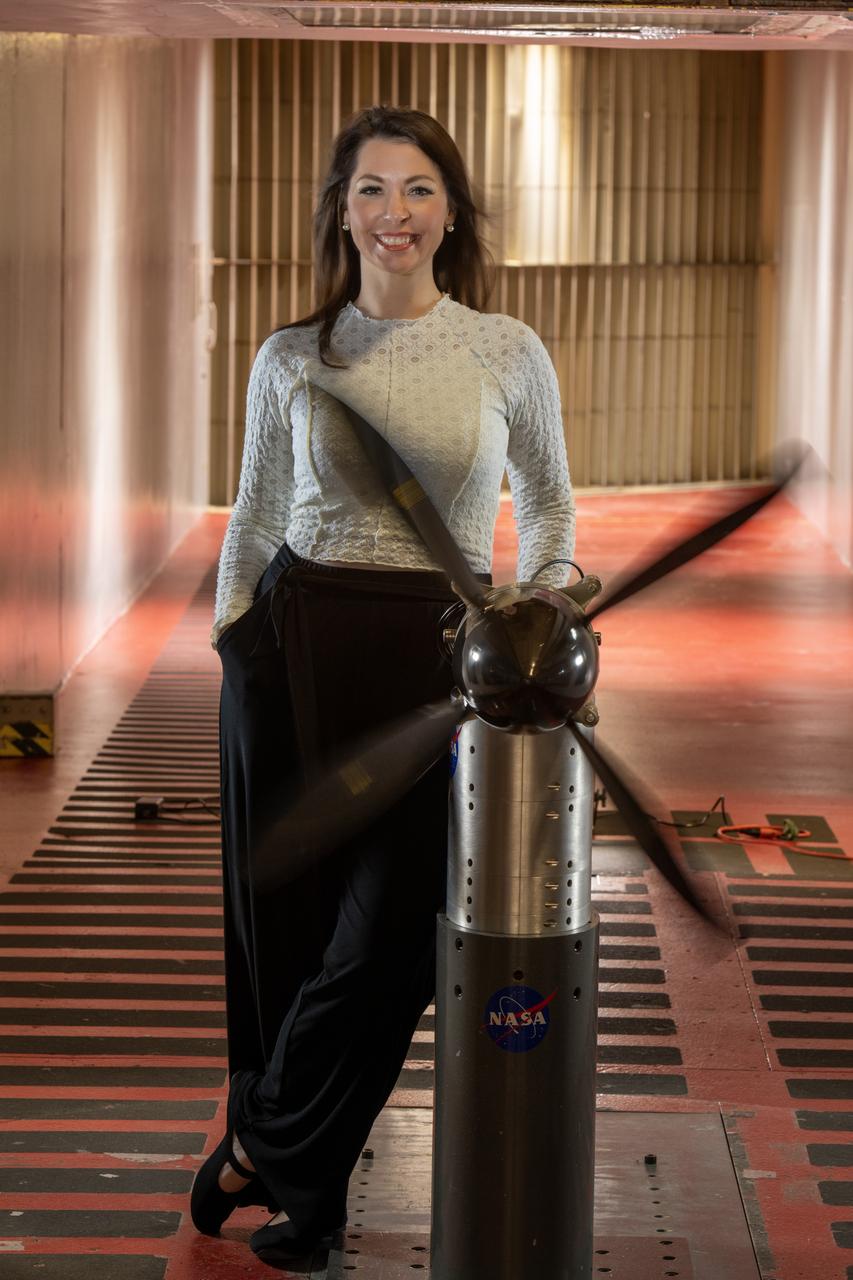
Emily Timko, featured in a Faces of NASA article, poses in the IRT (Icing Research Tunnel) where she works as a “cloud engineer”. She is a Mechanical Test Engineer and works to create unique water spray conditions that simulate icing clouds in the natural aircraft flight environment. Shown in the photo is a test article of a rotating propeller configuration that the IRT researchers are investigating ice accretion with.

Polar bears already face shorter ice seasons - limiting prime hunting and breeding opportunities. Nineteen separate polar bear subpopulations live throughout the Arctic, spending their winters and springs roaming on sea ice and hunting. The bears have evolved mainly to eat seals, which provide necessary fats and nutrients in the harsh Arctic environment. Polar bears can't outswim their prey, so instead they perch on the ice as a platform and ambush seals at breathing holes or break through the ice to access their dens. The total number of ice-covered days declined at the rate of seven to 19 days per decade between 1979 and 2014. The decline was even greater in the Barents Sea and the Arctic basin. Sea ice concentration during the summer months — an important measure because summertime is when some subpopulations are forced to fast on land — also declined in all regions, by 1 percent to 9 percent per decade. Read more: <a href="http://go.nasa.gov/2cIZSSc" rel="nofollow">go.nasa.gov/2cIZSSc</a> Photo credit: Mario Hoppmann
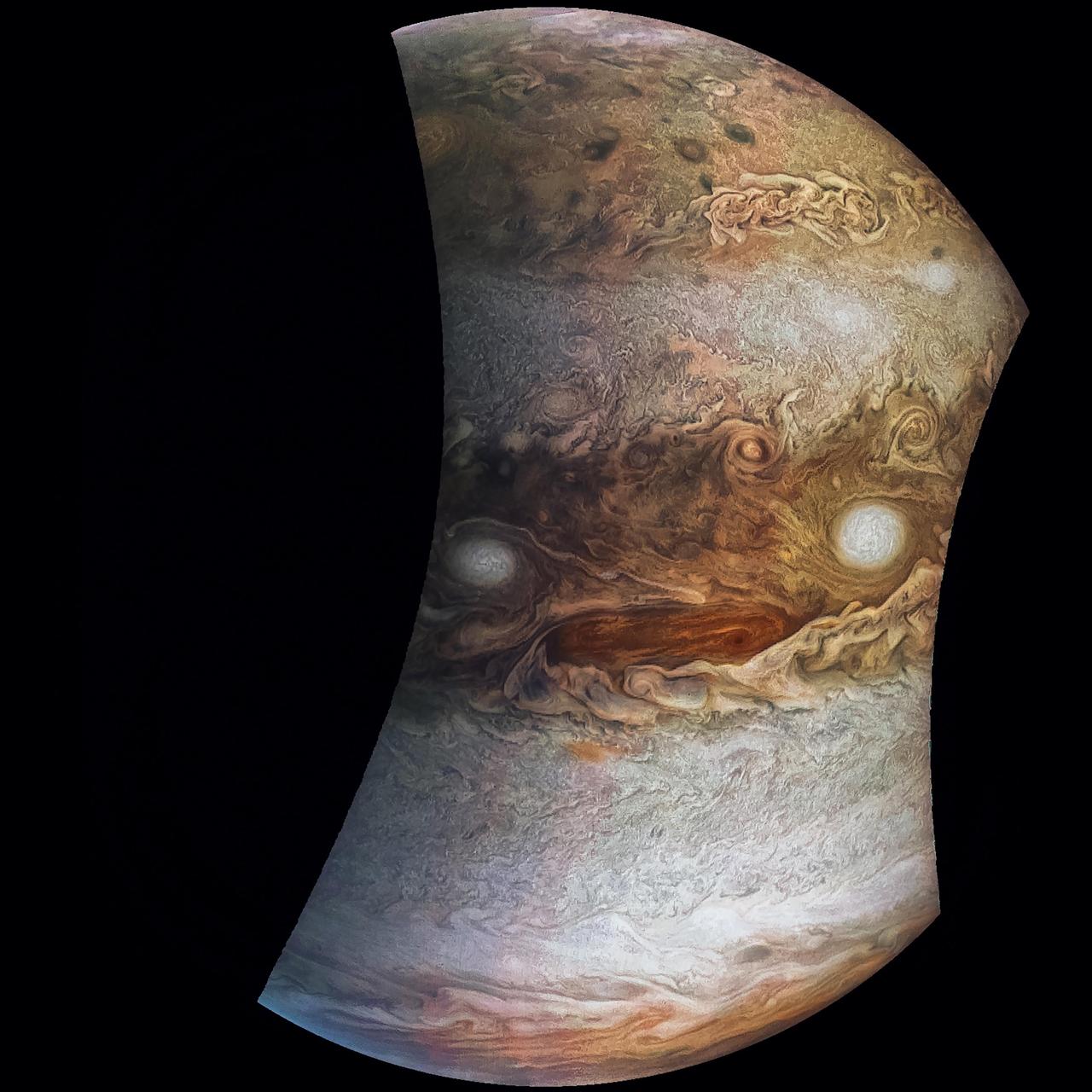
JunoCam images aren't just for art and science -- sometimes they are processed to bring a chuckle. This image, processed by citizen scientist Jason Major, is titled "Jovey McJupiterface." By rotating the image 180 degrees and orienting it from south up, two white oval storms turn into eyeballs, and the "face" of Jupiter is revealed. The original image was acquired by JunoCam on NASA's Juno spacecraft on May 19, 2017 at 11:20 a.m. PT (2: 20 p.m. ET) from an altitude of 12,075 miles (19,433 kilometers). https://photojournal.jpl.nasa.gov/catalog/PIA21394 . - Enhanced image by Jason Major based on images provided courtesy of NASA/JPL-Caltech/SwRI/MSSS
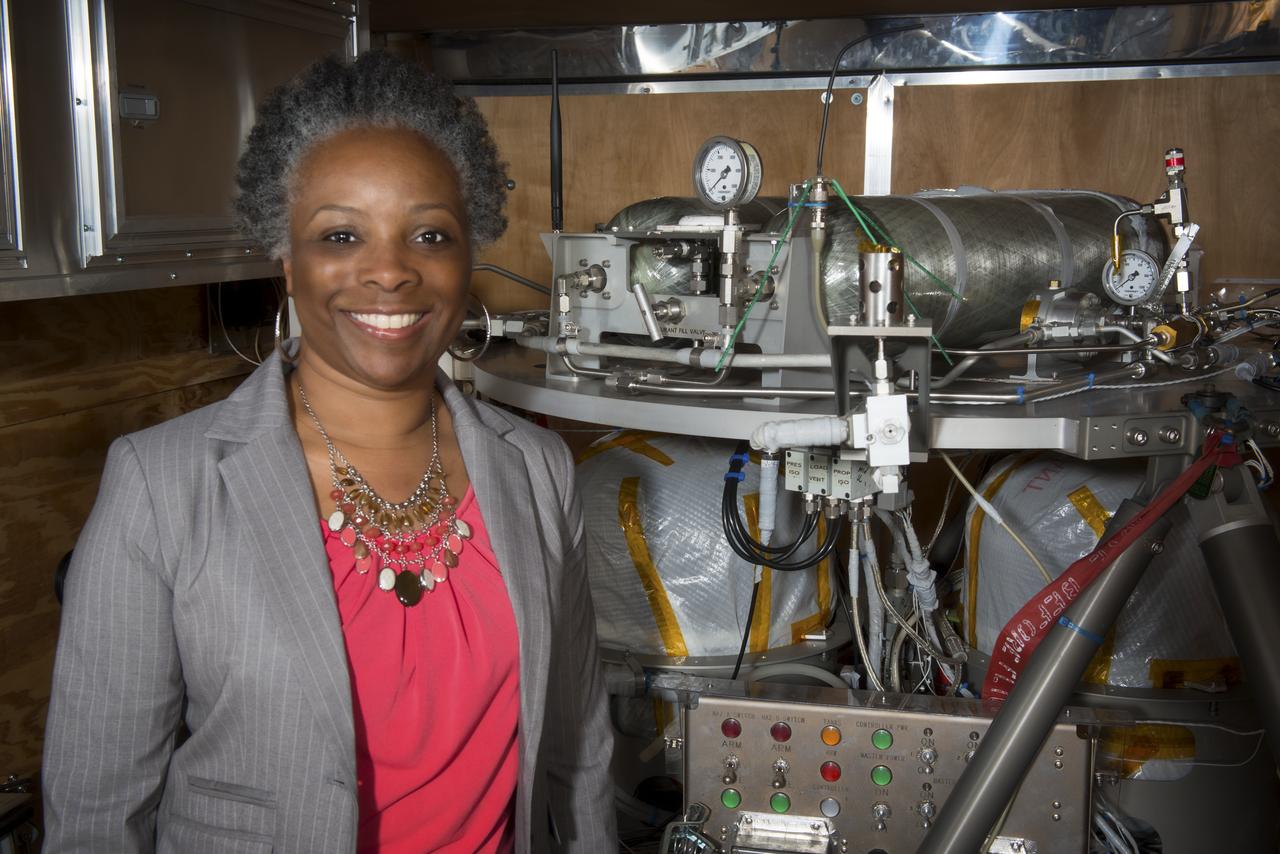
SORITA WHERRY PHOTOGRAPHED WITH THE MIGHTY EAGLE LANDER FOR THE MARSHALL STAR’S “FACE OF MISSION SUCCESS”.
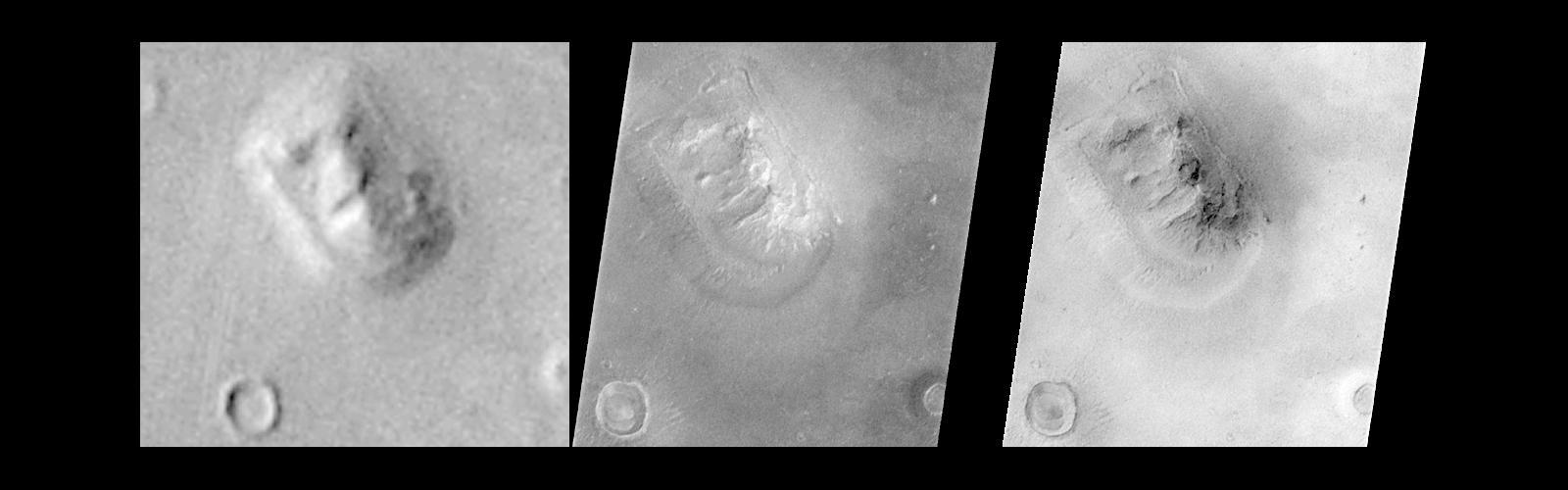
Mars Orbiter Camera Views the Face
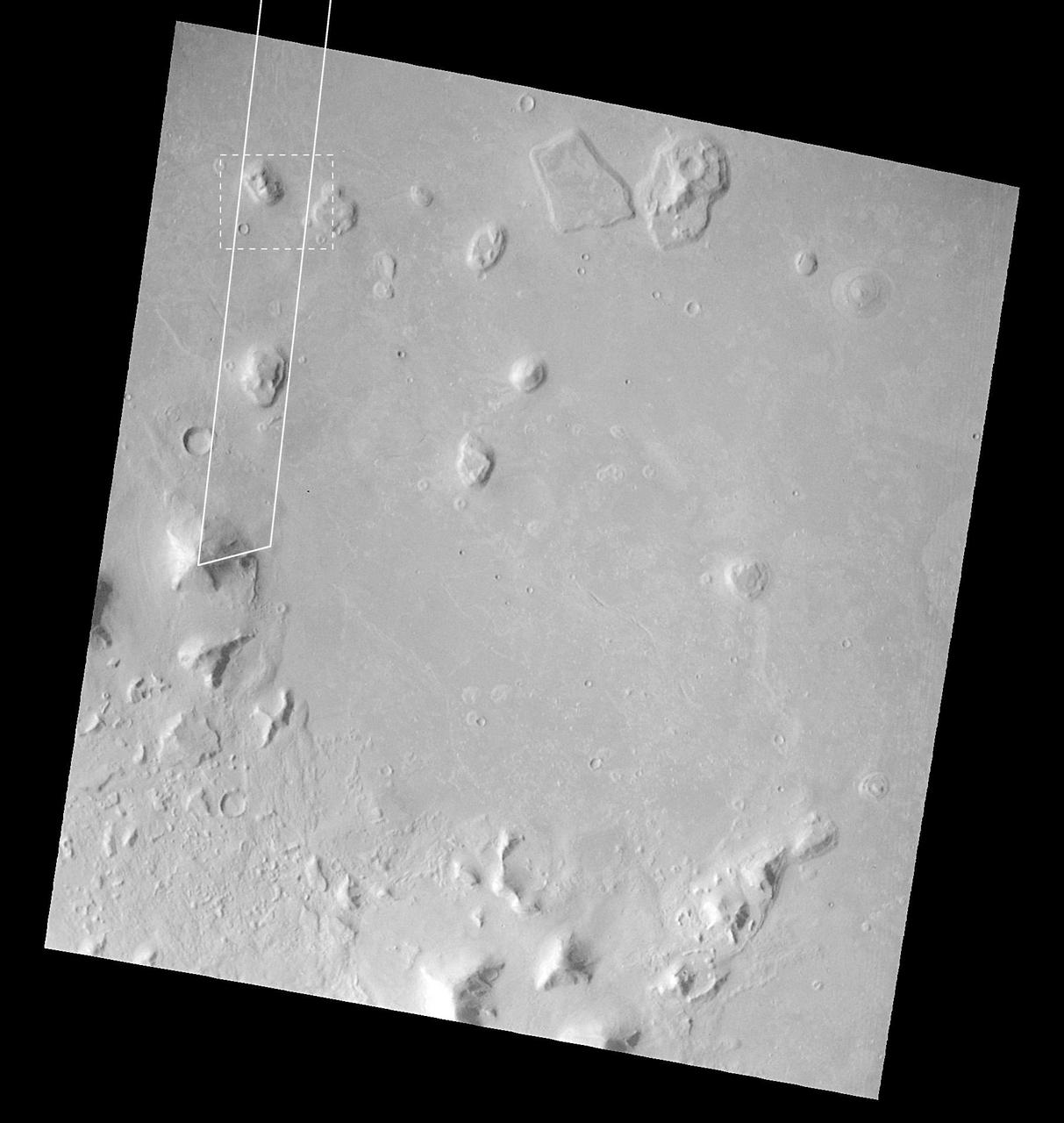
Mars Orbiter Camera Views the Face
Mars Orbiter Camera Views the Face
Mars Orbiter Camera Views the Face
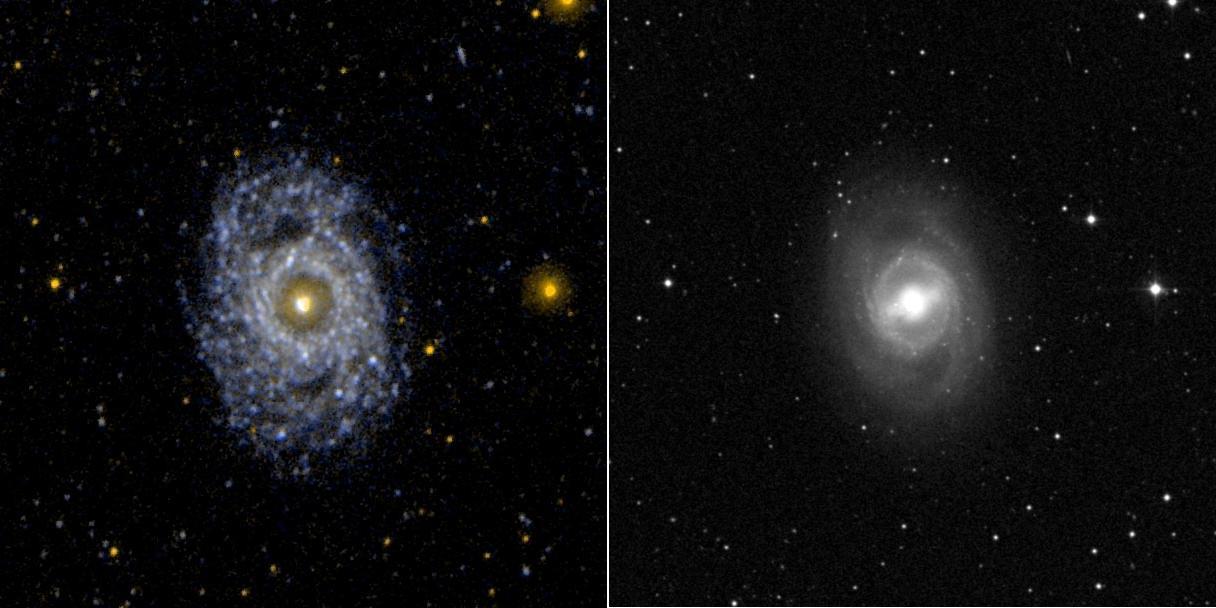
This ultraviolet image from NASA Galaxy Evolution Explorer left and visual image right of the face on barred and ringed spiral galaxy NGC 3351 M95.
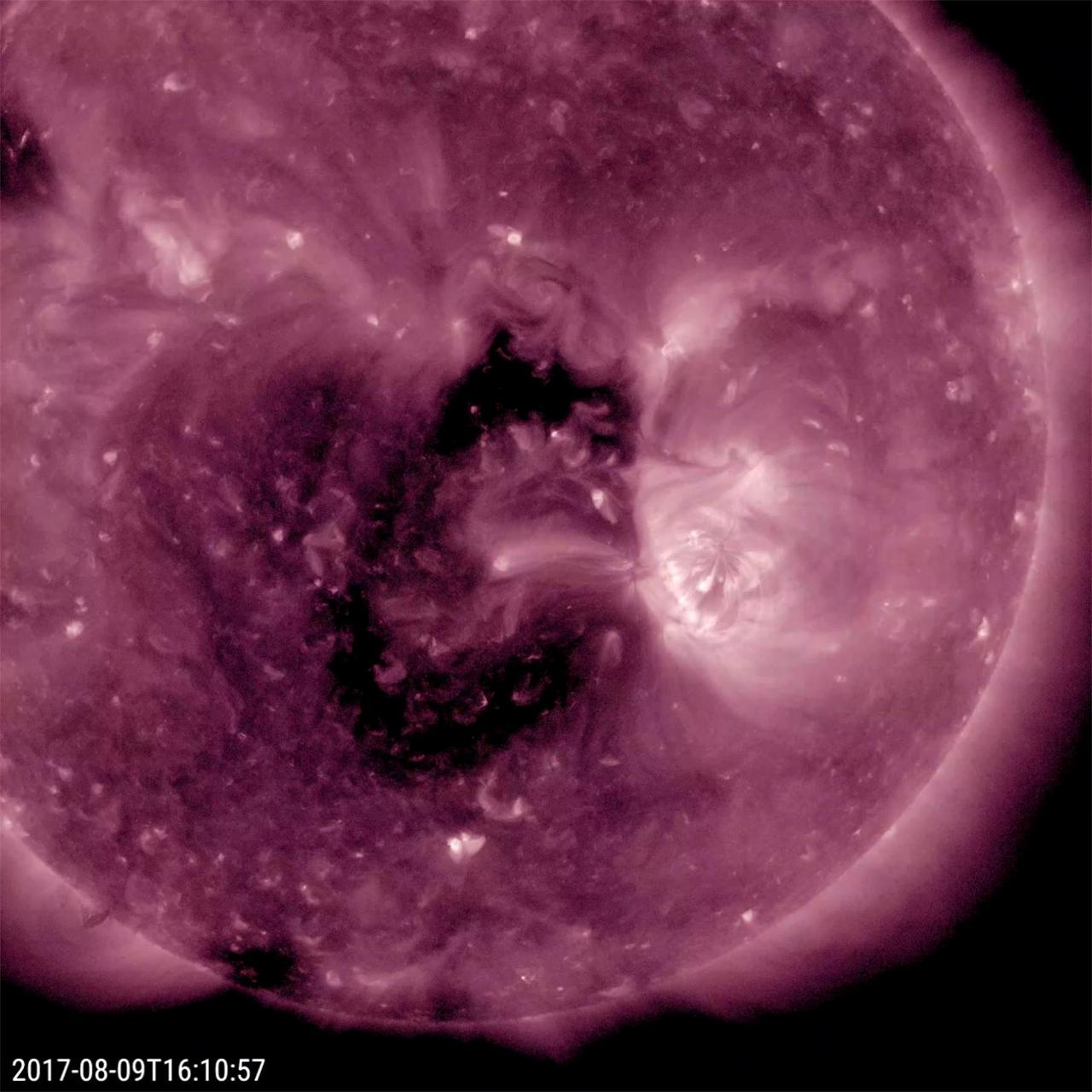
A substantial coronal hole rotated into a position where it is facing Earth (Aug. 9-11, 2017). Coronal holes are areas of open magnetic field that spew out charged particles as solar wind that spreads into space. If that solar wind interacts with our own magnetosphere it can generate aurora. In this view of the sun in extreme ultraviolet light, the coronal hole appears as the dark stretch near the center of the sun. It was the most distinctive feature on the sun over the past week. Movies are available at https://photojournal.jpl.nasa.gov/catalog/PIA21874

An extensive equatorial coronal hole has rotated so that it is now facing Earth (May 2-4, 2018). The dark coronal hole extends about halfway across the solar disk. It was observed in a wavelength of extreme ultraviolet light. This magnetically open area is streaming solar wind (i.e., a stream of charged particles released from the sun) into space. When Earth enters a solar wind stream and the stream interacts with our magnetosphere, we often experience nice displays of aurora. https://photojournal.jpl.nasa.gov/catalog/PIA00577
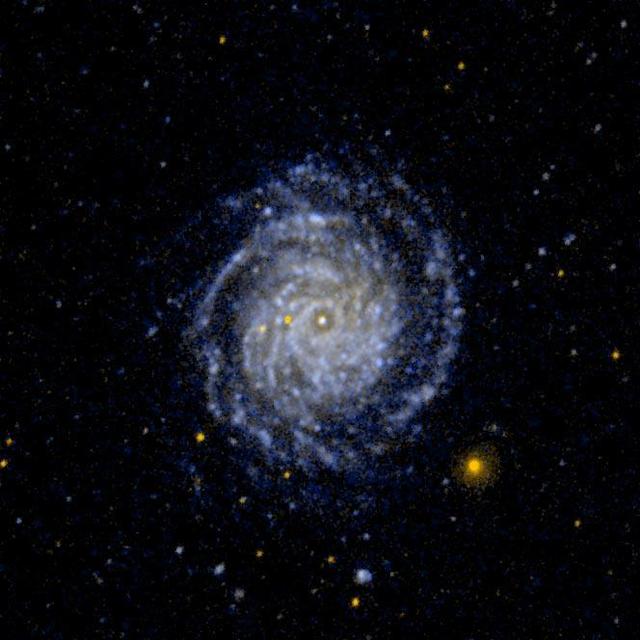
This ultraviolet image from NASA Galaxy Evolution Explorer is of the large face on spiral galaxy NGC 3344. The inner spiral arms are wrapped so tightly that they are difficult to distinguish. http://photojournal.jpl.nasa.gov/catalog/PIA07904
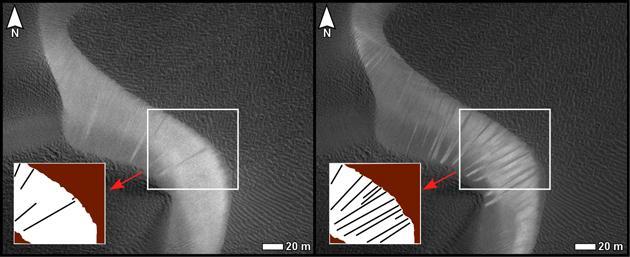
Before and after images from NASA Mars Reconnaissance Orbiter illustrate occurrence of new streaks on the slip face of a dark sand dune in the Nili Patera region of Mars.
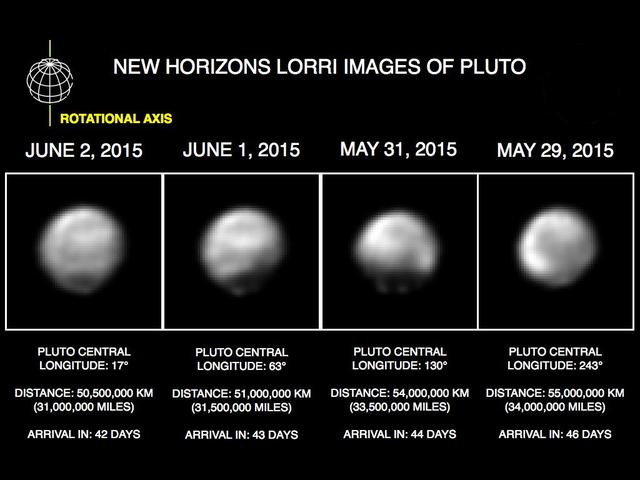
These images, taken by NASA's New Horizons' Long Range Reconnaissance Imager (LORRI), show four different "faces" of Pluto as it rotates about its axis with a period of 6.4 days. All the images have been rotated to align Pluto's rotational axis with the vertical direction (up-down) on the figure, as depicted schematically in the upper left. From left to right, the images were taken when Pluto's central longitude was 17, 63, 130, and 243 degrees, respectively. The date of each image, the distance of the New Horizons spacecraft from Pluto, and the number of days until Pluto closest approach are all indicated in the figure.These images show dramatic variations in Pluto's surface features as it rotates. When a very large, dark region near Pluto's equator appears near the limb, it gives Pluto a distinctly, but false, non-spherical appearance. Pluto is known to be almost perfectly spherical from previous data. These images are displayed at four times the native LORRI image size, and have been processed using a method called deconvolution, which sharpens the original images to enhance features on Pluto. Deconvolution can occasionally introduce "false" details, so the finest details in these pictures will need to be confirmed by images taken from closer range in the next few weeks. All of the images are displayed using the same brightness scale. http://photojournal.jpl.nasa.gov/catalog/PIA19686

The larger of the two moons of Mars, Phobos, passes in front of the Sun face in this image from NASA Mars Exploration Rover Opportunity. A movie is available at the Photojournal.
!["The public perception of NASA has a lot to do with our technological successes and the discoveries that we've made, but none of that is possible without the people. "In the six or so years that I've worked at NASA, I've learned a lot of incredible stories — not just of the struggles that different spacecraft encounter on their journeys throughout the universe. There are so many problems that need to be solved and fixes that need to be made, but there are also so many stories of teams that had to work together to accomplish their goals. And a lot of times, these teams are working after hours, on weekends, working late nights and early mornings. These are people who have other problems in their lives that they have to solve, and they're still showing up and making magic happen. "This is why [Aubrey Gemignani] and I started Faces of NASA: We wanted to make that connection. It's not just rockets, astronauts, and telescopes. Hundreds of thousands of people come together to make these missions possible, and that's the part that's really interesting for me. "I like to hold a mirror to other people, and in every Faces of NASA interview, I try to hold a mirror up to what the person has accomplished to get them to be proud of it. For many of those people, it's the first time they have to self-reflect. "That's what's really nice about [the Faces of NASA project]. Everyone who works here is just living day-to-day, so when they have an opportunity to stop for a moment and look back on how far they've come... it's the best feeling for both of us. They're like, 'Wow, I've never really stopped to think about how much I've accomplished or how far I've come.' And I get to share that moment with them. That's my favorite part of Faces of NASA." NASA Communications Strategist, Thalia Patrinos, poses for a portrait, Thursday, July 11, 2024, in Washington. Photo Credit: (NASA/Aubrey Gemignani)](https://images-assets.nasa.gov/image/NHQ202407110011/NHQ202407110011~medium.jpg)
"The public perception of NASA has a lot to do with our technological successes and the discoveries that we've made, but none of that is possible without the people. "In the six or so years that I've worked at NASA, I've learned a lot of incredible stories — not just of the struggles that different spacecraft encounter on their journeys throughout the universe. There are so many problems that need to be solved and fixes that need to be made, but there are also so many stories of teams that had to work together to accomplish their goals. And a lot of times, these teams are working after hours, on weekends, working late nights and early mornings. These are people who have other problems in their lives that they have to solve, and they're still showing up and making magic happen. "This is why [Aubrey Gemignani] and I started Faces of NASA: We wanted to make that connection. It's not just rockets, astronauts, and telescopes. Hundreds of thousands of people come together to make these missions possible, and that's the part that's really interesting for me. "I like to hold a mirror to other people, and in every Faces of NASA interview, I try to hold a mirror up to what the person has accomplished to get them to be proud of it. For many of those people, it's the first time they have to self-reflect. "That's what's really nice about [the Faces of NASA project]. Everyone who works here is just living day-to-day, so when they have an opportunity to stop for a moment and look back on how far they've come... it's the best feeling for both of us. They're like, 'Wow, I've never really stopped to think about how much I've accomplished or how far I've come.' And I get to share that moment with them. That's my favorite part of Faces of NASA." NASA Communications Strategist, Thalia Patrinos, poses for a portrait, Thursday, July 11, 2024, in Washington. Photo Credit: (NASA/Aubrey Gemignani)
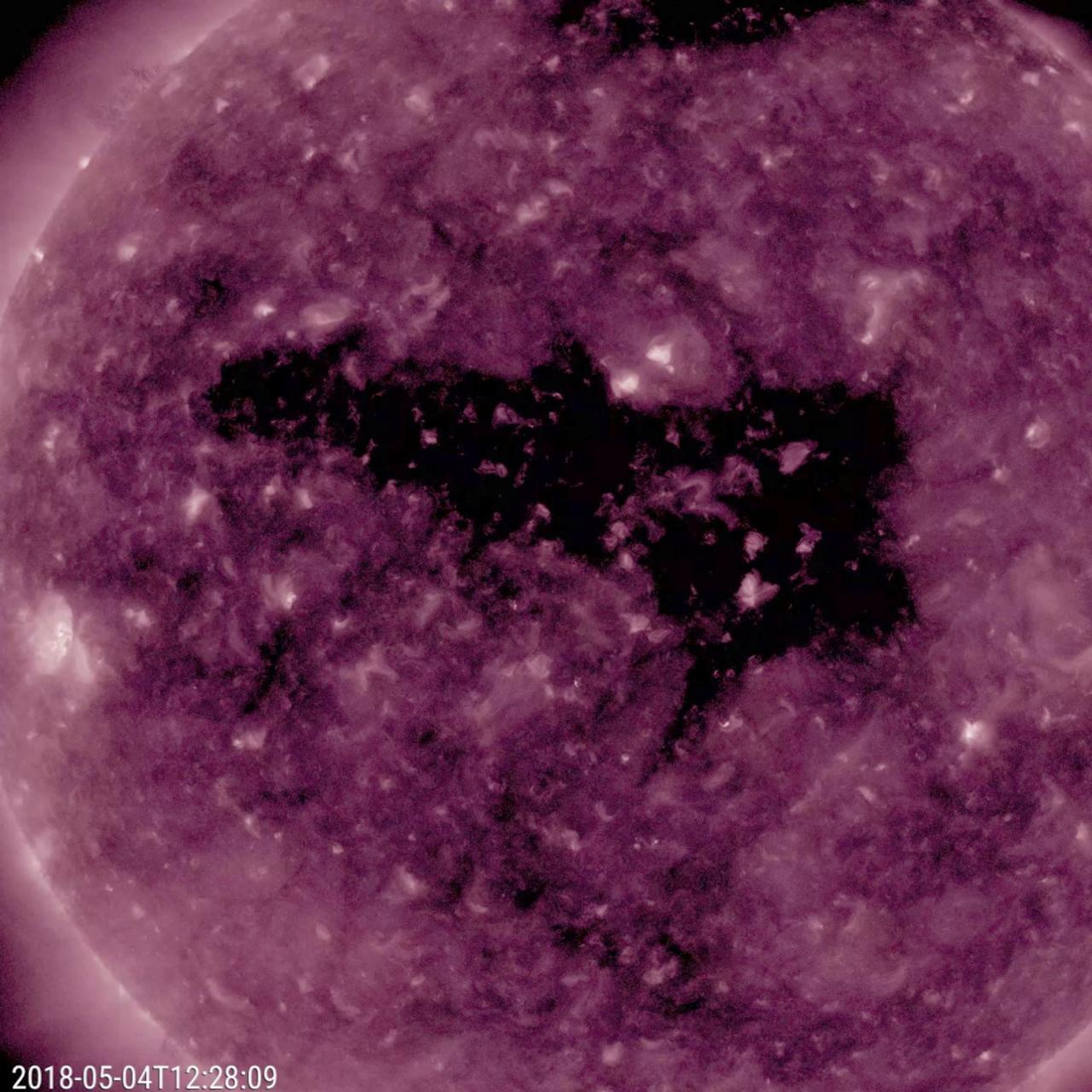
An extensive equatorial coronal hole has rotated so that it is now facing Earth (May 2-4, 2018). The dark coronal hole extends about halfway across the solar disk. It was observed in a wavelength of extreme ultraviolet light. This magnetically open area is streaming solar wind (i.e., a stream of charged particles released from the sun) into space. When Earth enters a solar wind stream and the stream interacts with our magnetosphere, we often experience nice displays of aurora. Videos are available at https://photojournal.jpl.nasa.gov/catalog/PIA00624
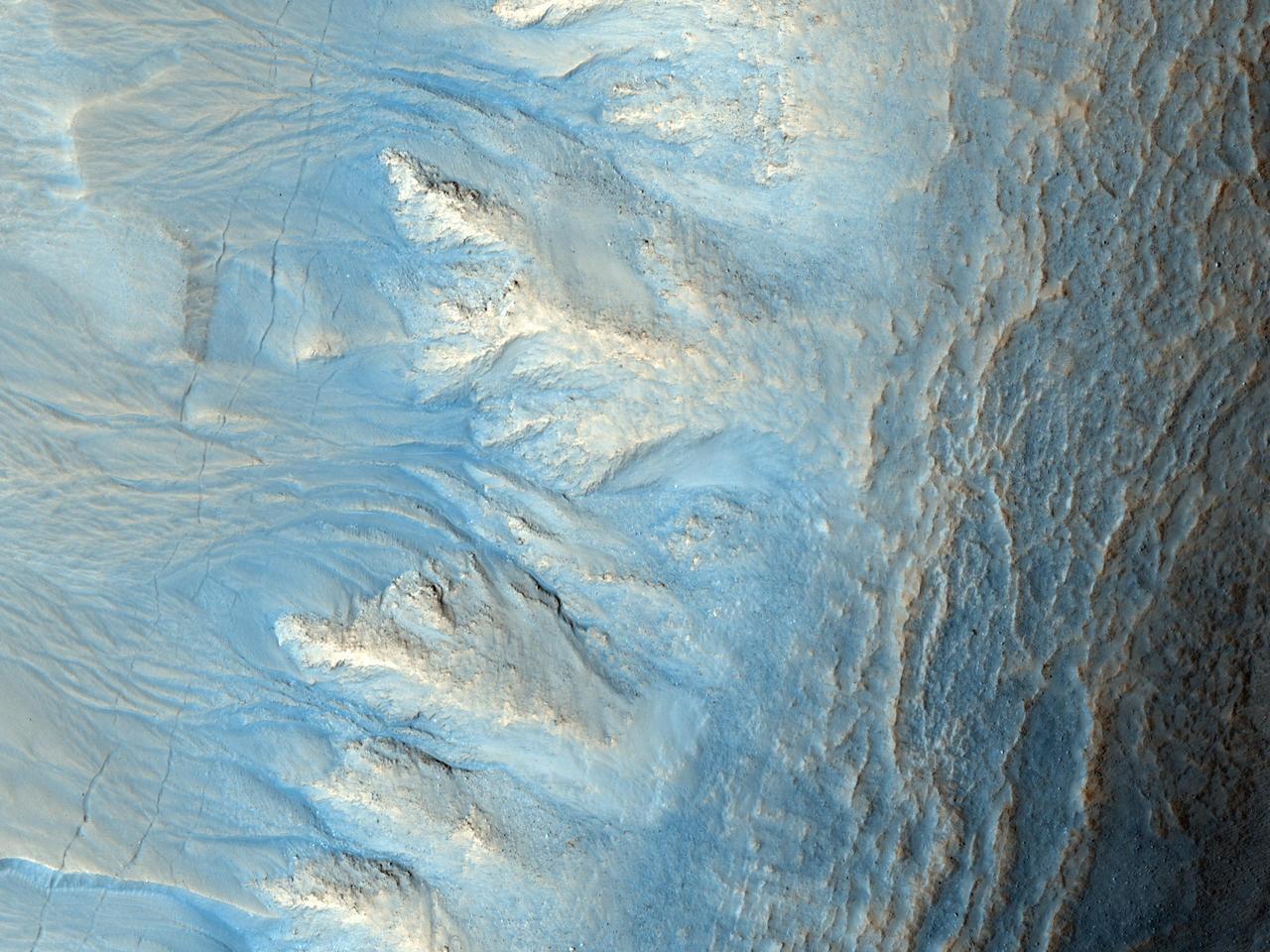
This image from NASA Mars Reconnaissance Orbiter shows the west-facing side of an impact crater in the mid-latitudes of Mars northern hemisphere. This crater has gullies along its walls that are composed of alcoves, channels and debris aprons.
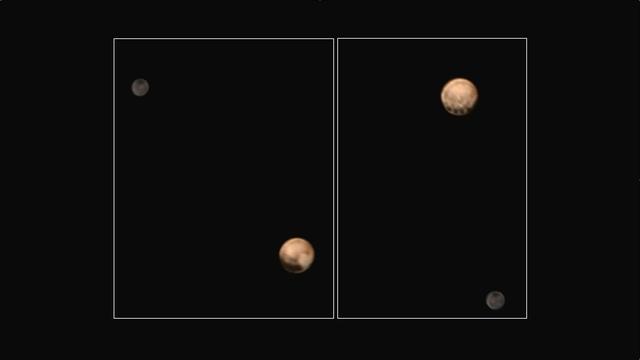
This pair of approximately true color images of Pluto and its big moon Charon, taken by NASA's New Horizons spacecraft, highlight the dramatically different appearance of different sides of the dwarf planet, and reveal never-before-seen details on Pluto's varied surface. The views were made by combining high-resolution black-and-white images from the Long Range Reconnaissance Imager (LORRI) with color information from the lower-resolution color camera that is part of the Ralph instrument. The left-hand image shows the side of Pluto that always faces away from Charon -- this is the side that will be seen at highest resolution by New Horizons when it makes its close approach to Pluto on July 14th. This hemisphere is dominated by a very dark region that extends along the equator and is redder than its surroundings, alongside a strikingly bright, paler-colored region which straddles the equator on the right-hand side of the disk. The opposite hemisphere, the side that faces Charon, is seen in the right-hand image. The most dramatic feature on this side of Pluto is a row of dark dots arranged along the equator. The origin of all these features is still mysterious, but may be revealed in the much more detailed images that will be obtained as the spacecraft continues its approach to Pluto. In both images, Charon shows a darker and grayer color than Pluto, and a conspicuous dark polar region. The left-hand image was obtained at 5:37 UT on June 25th 2015, at a distance from Pluto of 22.9 million kilometers (14.3 million miles) and has a central longitude of 152 degrees. The right-hand image was obtained at 23:15 UT on June 27th 2015, at a distance from Pluto of 19.7 million kilometers (12.2 million miles) with a central longitude of 358 degrees. Insets show the orientation of Pluto in each image -- the solid lines mark the equator and the prime meridian, which is defined to be the longitude that always faces Charon. The smallest visible features are about 200 km (120 miles) across. http://photojournal.jpl.nasa.gov/catalog/PIA19693
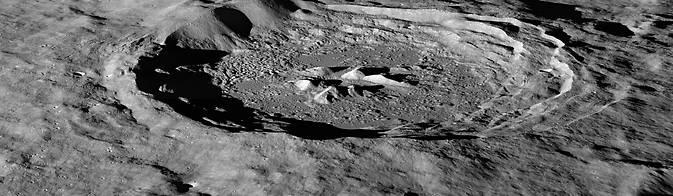
Space travel is difficult and expensive – it would cost thousands of dollars to launch a bottle of water to the moon. The recent discovery of hydrogen-bearing molecules, possibly including water, on the moon has explorers excited because these deposits could be mined if they are sufficiently abundant, sparing the considerable expense of bringing water from Earth. Lunar water could be used for drinking or its components – hydrogen and oxygen – could be used to manufacture important products on the surface that future visitors to the moon will need, like rocket fuel and breathable air. Recent observations by NASA's Lunar Reconnaissance Orbiter (LRO) spacecraft indicate these deposits may be slightly more abundant on crater slopes in the southern hemisphere that face the lunar South Pole. "There’s an average of about 23 parts-per-million-by-weight (ppmw) more hydrogen on Pole-Facing Slopes (PFS) than on Equator-Facing Slopes (EFS)," said Timothy McClanahan of NASA's Goddard Space Flight Center in Greenbelt, Maryland. This is the first time a widespread geochemical difference in hydrogen abundance between PFS and EFS on the moon has been detected. It is equal to a one-percent difference in the neutron signal detected by LRO's Lunar Exploration Neutron Detector (LEND) instrument. McClanahan is lead author of a paper about this research published online October 19 in the journal Icarus. Read more: <a href="http://1.usa.gov/1uaa8s2" rel="nofollow">1.usa.gov/1uaa8s2</a> Photo caption: LRO image of the moon's Hayn Crater, located just northeast of Mare Humboldtianum, dramatically illuminated by the low Sun casting long shadows across the crater floor. Image Credit: NASA/GSFC/Arizona State University <b><a href="http://www.nasa.gov/audience/formedia/features/MP_Photo_Guidelines.html" rel="nofollow">NASA image use policy.</a></b> <b><a href="http://www.nasa.gov/centers/goddard/home/index.html" rel="nofollow">NASA Goddard Space Flight Center</a></b> enables NASA’s mission through four scientific endeavors: Earth Science, Heliophysics, Solar System Exploration, and Astrophysics. Goddard plays a leading role in NASA’s accomplishments by contributing compelling scientific knowledge to advance the Agency’s mission. <b>Follow us on <a href="http://twitter.com/NASAGoddardPix" rel="nofollow">Twitter</a></b> <b>Like us on <a href="http://www.facebook.com/pages/Greenbelt-MD/NASA-Goddard/395013845897?ref=tsd" rel="nofollow">Facebook</a></b> <b>Find us on <a href="http://instagram.com/nasagoddard?vm=grid" rel="nofollow">Instagram</a></b>

This image from NASA Mars Reconnaissance Orbiter shows frosted gullies on a south-facing slope within a crater. At this time of year only south-facing slopes retain the frost, while the north-facing slopes have melted.
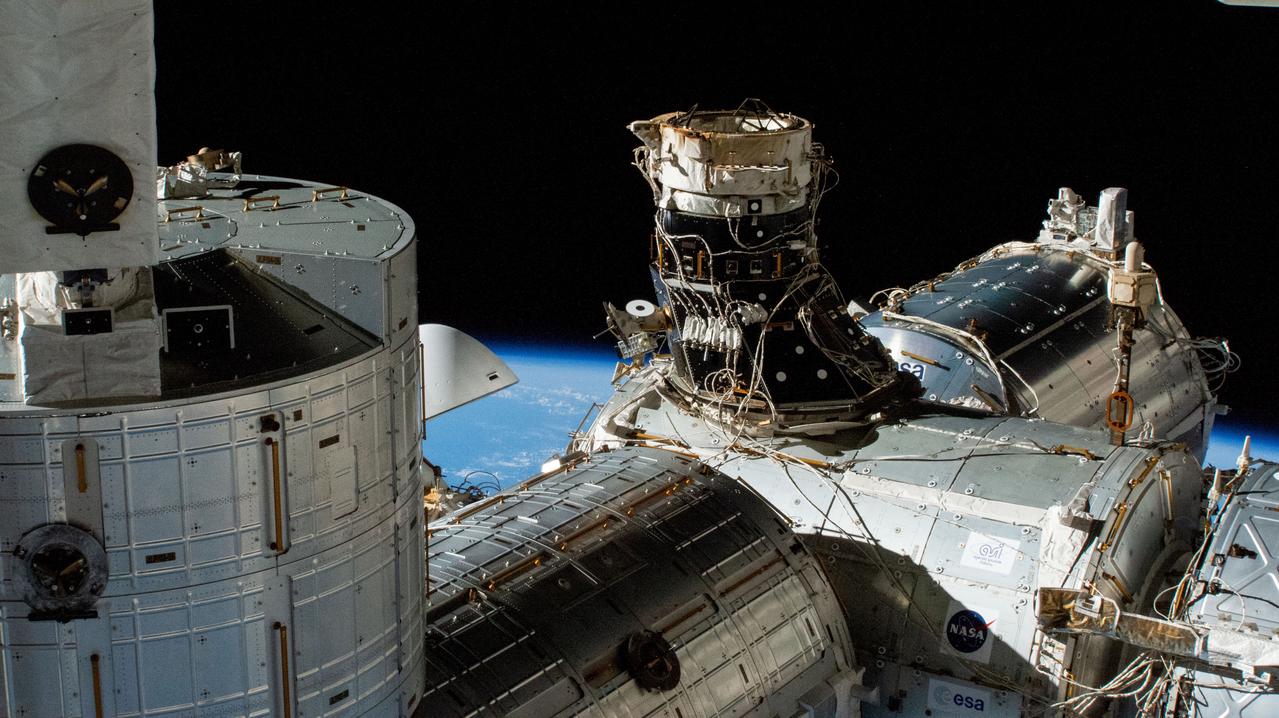
iss072e143839 (Nov. 3, 2024) --- The unoccupied space-facing port on the International Space Station's Harmony module is pictured several hours before the SpaceX Dragon Freedom spacecraft would relocate there after undocking from Harmony's forward port.
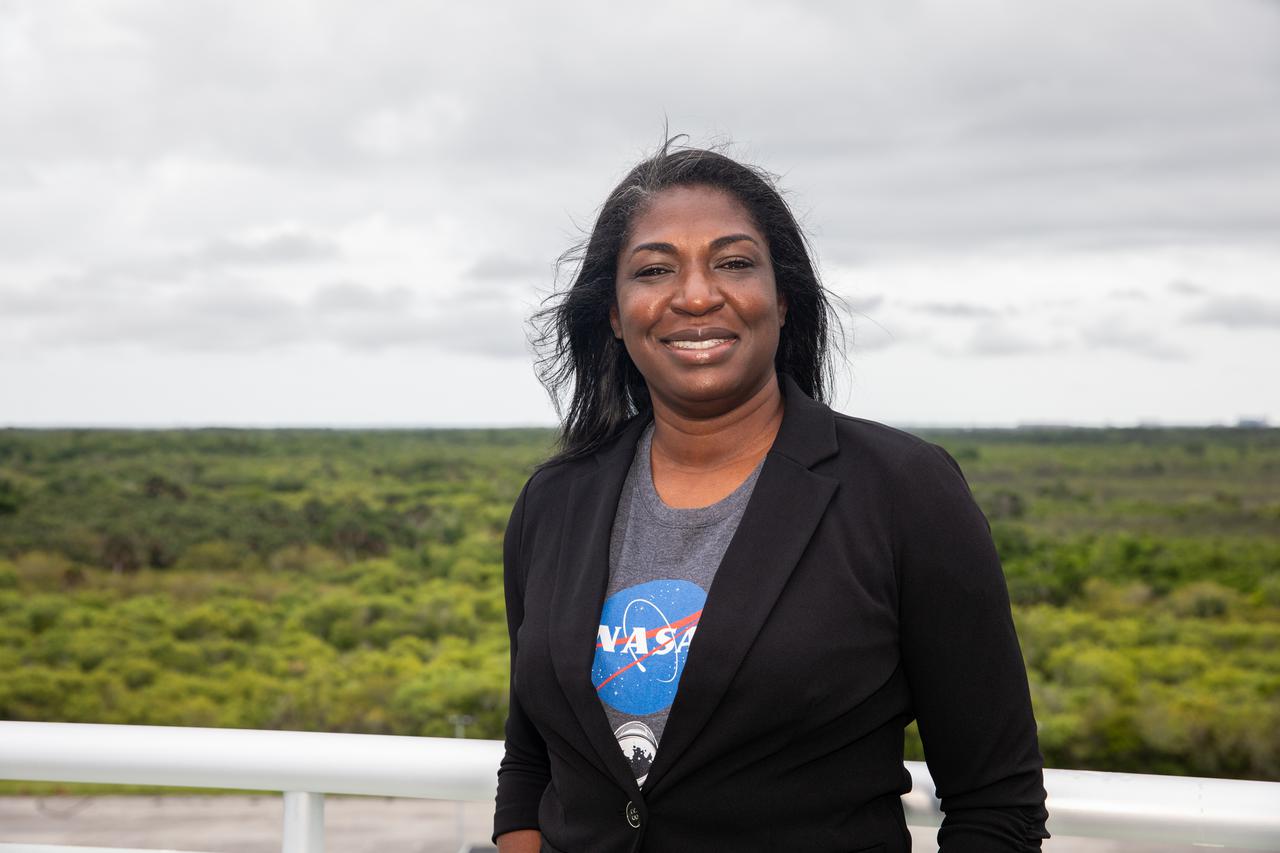
Lashanda Battle is a sustainability lead at NASA’s Kennedy Space Center. In this role, she supports NASA’s and Kennedy’s mission by promoting a better way of living at the Florida spaceport, as well as in the surrounding communities. Through different outreach opportunities, she raises awareness about sustainability initiatives and environmental stewardship.
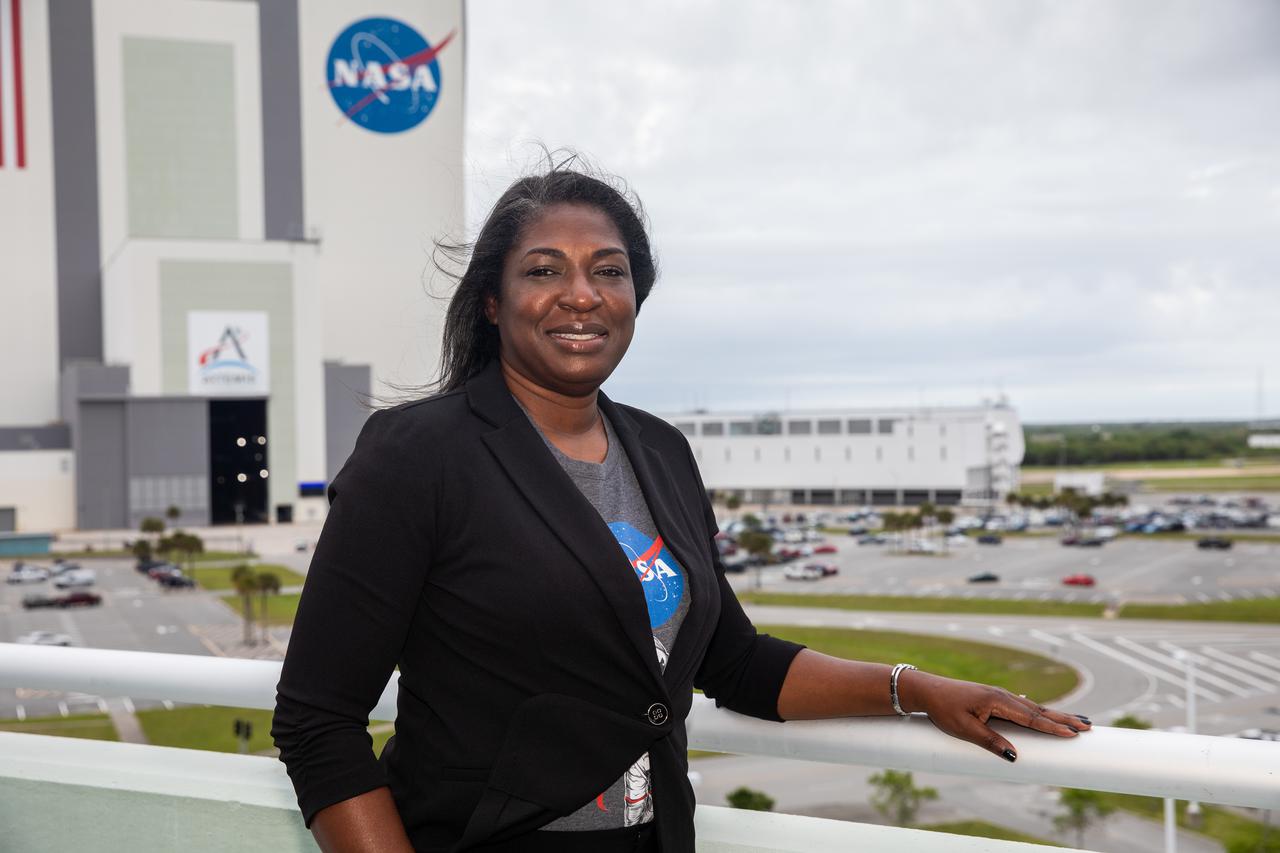
Lashanda Battle is a sustainability lead at NASA’s Kennedy Space Center. In this role, she supports NASA’s and Kennedy’s mission by promoting a better way of living at the Florida spaceport, as well as in the surrounding communities. Through different outreach opportunities, she raises awareness about sustainability initiatives and environmental stewardship.

"People aren’t always recognized for who they are at work. “So giving a person time to actually talk about themselves, and be proud of what they do, and talk about how hard it might be to maintain their career with everything else going on — makes them feel valued and appreciated. And highlighting them in that way on the Faces of NASA page, makes that pride permanent. “I think I’m always seeking out projects that help people feel seen. And maybe that’s why I got so into photography initially. I struggle with that myself — feeling seen. And so to help other people feel seen is definitely an interest of mine that I keep coming back to." Aubrey Gemignani, Photo Archivist/Photographer, Mori Associates, in NASA’s Office of Communications, poses for a portrait, Thursday, March 16, 2023, in Washington, DC. Photo Credit: (NASA/Joel Kowsky)
This animation shows images of the far side of the moon, illuminated by the sun, as it crosses between the DISCOVR spacecraft's Earth Polychromatic Imaging Camera (EPIC) camera and telescope, and the Earth - one million miles away. Credits: NASA/NOAA A NASA camera aboard the Deep Space Climate Observatory (DSCOVR) satellite captured a unique view of the moon as it moved in front of the sunlit side of Earth last month. The series of test images shows the fully illuminated “dark side” of the moon that is never visible from Earth. The images were captured by NASA’s Earth Polychromatic Imaging Camera (EPIC), a four megapixel CCD camera and telescope on the DSCOVR satellite orbiting 1 million miles from Earth. From its position between the sun and Earth, DSCOVR conducts its primary mission of real-time solar wind monitoring for the National Oceanic and Atmospheric Administration (NOAA). Read more: <a href="http://www.nasa.gov/feature/goddard/from-a-million-miles-away-nasa-camera-shows-moon-crossing-face-of-earth" rel="nofollow">www.nasa.gov/feature/goddard/from-a-million-miles-away-na...</a> <b><a href="http://www.nasa.gov/audience/formedia/features/MP_Photo_Guidelines.html" rel="nofollow">NASA image use policy.</a></b> <b><a href="http://www.nasa.gov/centers/goddard/home/index.html" rel="nofollow">NASA Goddard Space Flight Center</a></b> enables NASA’s mission through four scientific endeavors: Earth Science, Heliophysics, Solar System Exploration, and Astrophysics. Goddard plays a leading role in NASA’s accomplishments by contributing compelling scientific knowledge to advance the Agency’s mission. <b>Follow us on <a href="http://twitter.com/NASAGoddardPix" rel="nofollow">Twitter</a></b> <b>Like us on <a href="http://www.facebook.com/pages/Greenbelt-MD/NASA-Goddard/395013845897?ref=tsd" rel="nofollow">Facebook</a></b> <b>Find us on <a href="http://instagrid.me/nasagoddard/?vm=grid" rel="nofollow">Instagram</a></b>
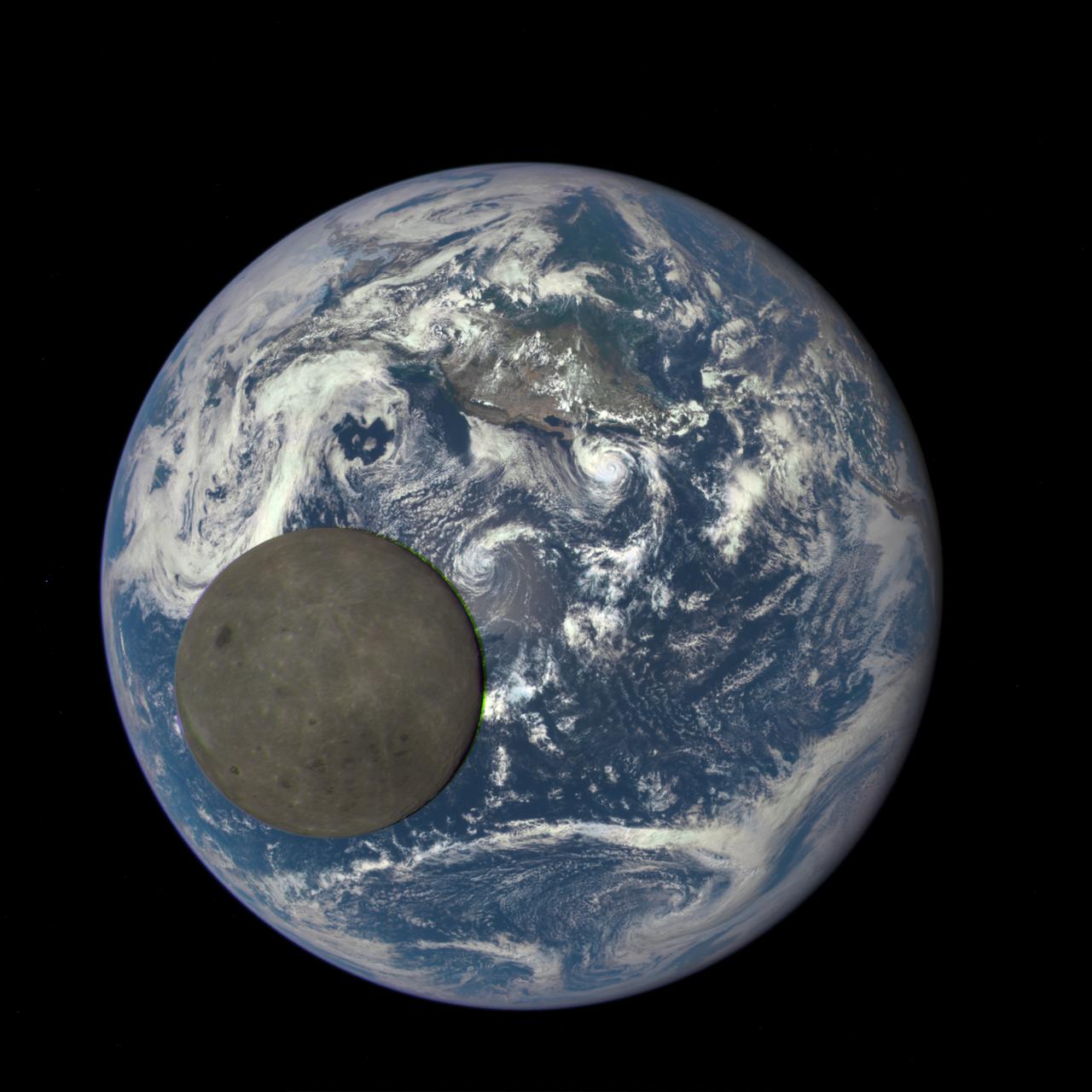
This animation still image shows the far side of the moon, illuminated by the sun, as it crosses between the DISCOVR spacecraft's Earth Polychromatic Imaging Camera (EPIC) camera and telescope, and the Earth - one million miles away. Credits: NASA/NOAA A NASA camera aboard the Deep Space Climate Observatory (DSCOVR) satellite captured a unique view of the moon as it moved in front of the sunlit side of Earth last month. The series of test images shows the fully illuminated “dark side” of the moon that is never visible from Earth. The images were captured by NASA’s Earth Polychromatic Imaging Camera (EPIC), a four megapixel CCD camera and telescope on the DSCOVR satellite orbiting 1 million miles from Earth. From its position between the sun and Earth, DSCOVR conducts its primary mission of real-time solar wind monitoring for the National Oceanic and Atmospheric Administration (NOAA). Read more: <a href="http://www.nasa.gov/feature/goddard/from-a-million-miles-away-nasa-camera-shows-moon-crossing-face-of-earth" rel="nofollow">www.nasa.gov/feature/goddard/from-a-million-miles-away-na...</a> <b><a href="http://www.nasa.gov/audience/formedia/features/MP_Photo_Guidelines.html" rel="nofollow">NASA image use policy.</a></b> <b><a href="http://www.nasa.gov/centers/goddard/home/index.html" rel="nofollow">NASA Goddard Space Flight Center</a></b> enables NASA’s mission through four scientific endeavors: Earth Science, Heliophysics, Solar System Exploration, and Astrophysics. Goddard plays a leading role in NASA’s accomplishments by contributing compelling scientific knowledge to advance the Agency’s mission. <b>Follow us on <a href="http://twitter.com/NASAGoddardPix" rel="nofollow">Twitter</a></b> <b>Like us on <a href="http://www.facebook.com/pages/Greenbelt-MD/NASA-Goddard/395013845897?ref=tsd" rel="nofollow">Facebook</a></b> <b>Find us on <a href="http://instagrid.me/nasagoddard/?vm=grid" rel="nofollow">Instagram</a></b>
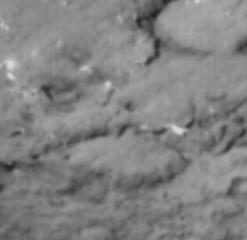
This image shows comet Tempel 1 sixty seconds before it ran over NASA Deep Impact probe at 10:52 p.m. Pacific time, July 3 1:52 a.m. Eastern time, July 4., 2005.
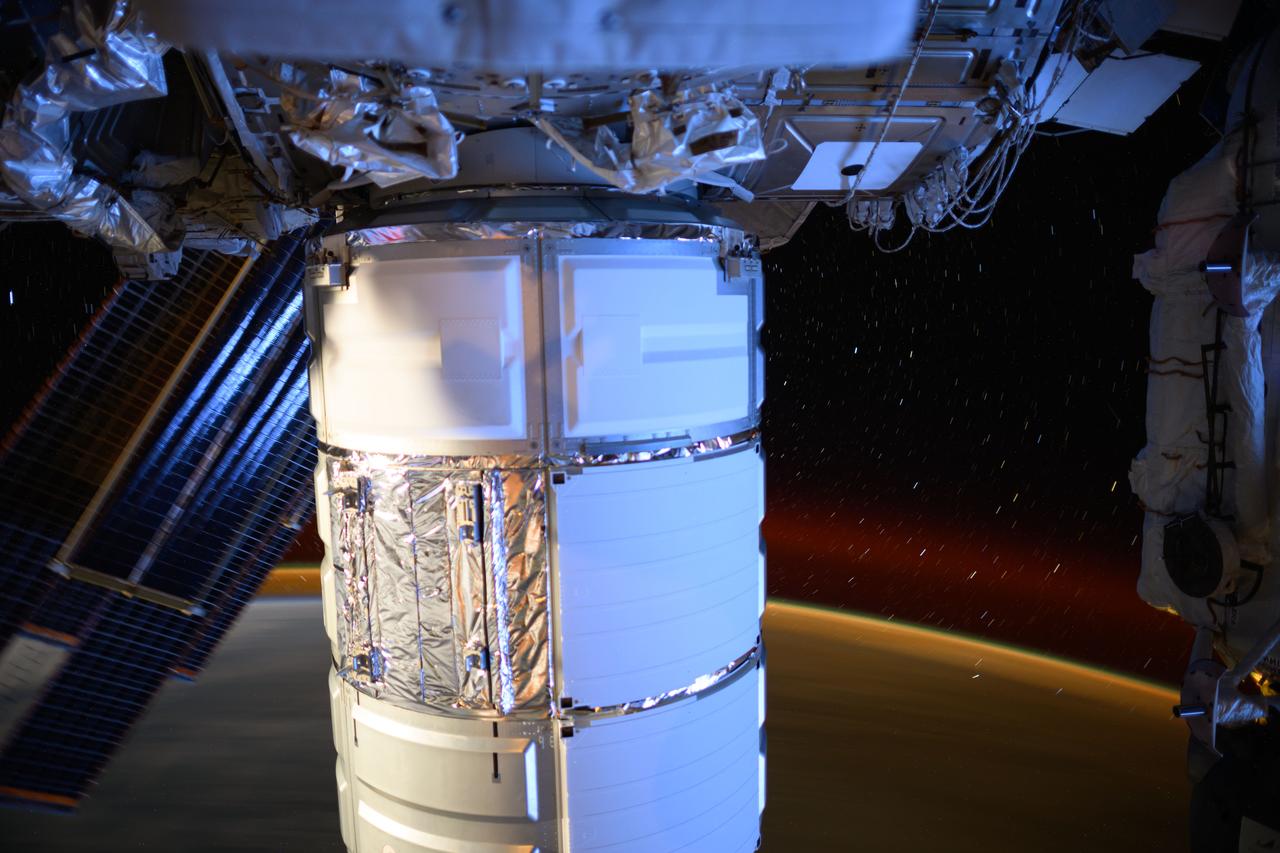
iss072e515922 (Jan. 16, 2025) --- Northrop Grumman's Cygnus space freighter is pictured berthed to the International Space Station's Earth-facing port on the Unity module. This long-duration photograph also highlights Earth's atmospheric glow and star trails as the orbital outpost soared 262 miles above the North Atlantic Ocean.
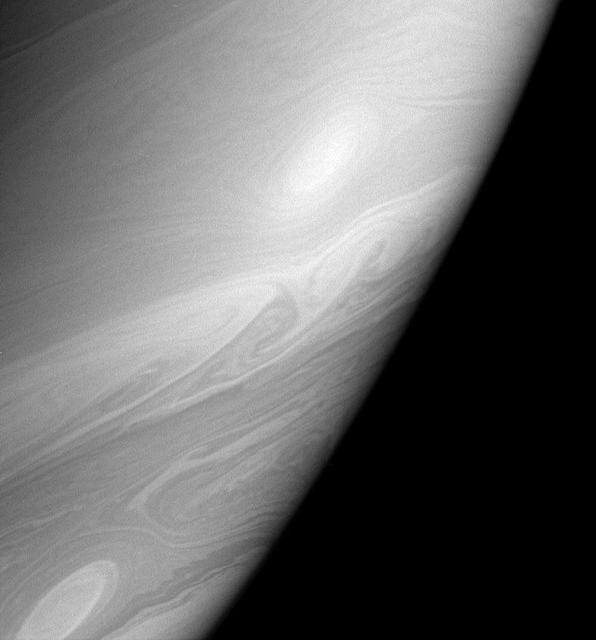
Streamers, swirls and vortices roll across the dynamic face of Saturn
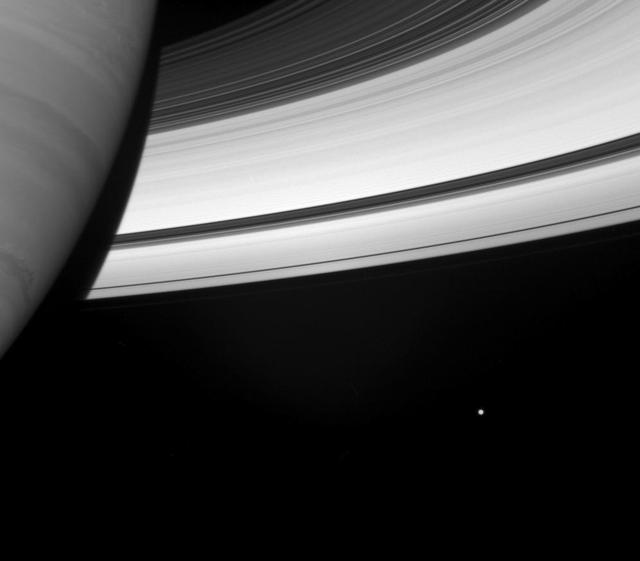
Beside the swirling face of Saturn floats a small, icy attendant
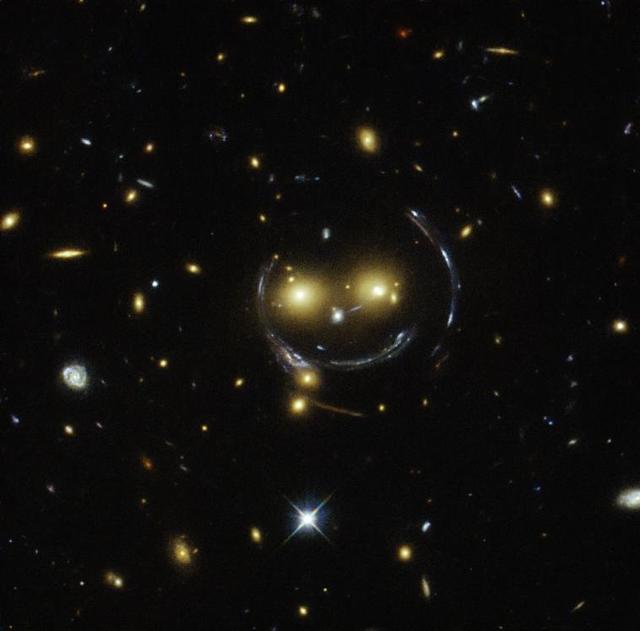
This image from the NASA/ESA Hubble Space Telescope shows a galaxy cluster, SDSS J1038+4849, that appears to have two eyes and a nose as part of a happy face. The face is the result of gravitational lensing.

“When I first joined Twitter in 2009, one of the first accounts I followed was NASA. I knew they were doing NASA ‘Tweetups’ (now called Socials) where members of the public could apply, go behind the scenes of a NASA facility and potentially attend a launch. “I was selected for the STS-135 Tweetup — the final launch of the Space Shuttle, July 2011. The Tweetup gave me access that I never in my life thought I’d be able to experience. Being inside the Vehicle Assembly Building, where Saturn rockets were assembled, where the Space Shuttle was stacked and now where the SLS is going to be stacked… that for me, was incredible. “We got to Kennedy for the launch on July 7. There were severe thunderstorms and lightning all around. The weather was not looking good for the next day. “The next morning, we get to the press site, and the weather continues to look like it’s going to prevent the launch. There was a 30% chance. I didn’t think it was going to happen. “And then, there was a break in the clouds. And at 11:28 am, the Shuttle launches. It was such a physical, emotional experience. I remember feeling the sound waves. I was just so excited, so thrilled, so overcome by seeing all these people put in so many hours on something that was bigger than themselves, working toward making this mission a success. And that was the culmination of it: 5 million pounds of thrust lifting this vehicle 250 miles off the planet. “I thought, ‘wow, Atlantis took off with just a 30% chance.’ So, I try to take that with me whenever I face a challenging situation. And that’s kind of why I was teetering on not applying for my first NASA internship in 2013. But I thought to myself, ‘well, that vehicle took off in not-so-ideal conditions. Things aren’t impossible.’ That’s what led me to pursue this career at NASA.” Portrait, Andres Almeida, Thursday, September 19, 2019 at NASA Headquarters in Washington. Photo Credit: (NASA/Aubrey Gemignani)

“When I first joined Twitter in 2009, one of the first accounts I followed was NASA. I knew they were doing NASA ‘Tweetups’ (now called Socials) where members of the public could apply, go behind the scenes of a NASA facility and potentially attend a launch. “I was selected for the STS-135 Tweetup — the final launch of the Space Shuttle, July 2011. The Tweetup gave me access that I never in my life thought I’d be able to experience. Being inside the Vehicle Assembly Building, where Saturn rockets were assembled, where the Space Shuttle was stacked and now where the SLS is going to be stacked… that for me, was incredible. “We got to Kennedy for the launch on July 7. There were severe thunderstorms and lightning all around. The weather was not looking good for the next day. “The next morning, we get to the press site, and the weather continues to look like it’s going to prevent the launch. There was a 30% chance. I didn’t think it was going to happen. “And then, there was a break in the clouds. And at 11:28 am, the Shuttle launches. It was such a physical, emotional experience. I remember feeling the sound waves. I was just so excited, so thrilled, so overcome by seeing all these people put in so many hours on something that was bigger than themselves, working toward making this mission a success. And that was the culmination of it: 5 million pounds of thrust lifting this vehicle 250 miles off the planet. “I thought, ‘wow, Atlantis took off with just a 30% chance.’ So, I try to take that with me whenever I face a challenging situation. And that’s kind of why I was teetering on not applying for my first NASA internship in 2013. But I thought to myself, ‘well, that vehicle took off in not-so-ideal conditions. Things aren’t impossible.’ That’s what led me to pursue this career at NASA.” Portrait, Andres Almeida, Thursday, September 19, 2019 at NASA Headquarters in Washington. Photo Credit: (NASA/Aubrey Gemignani)
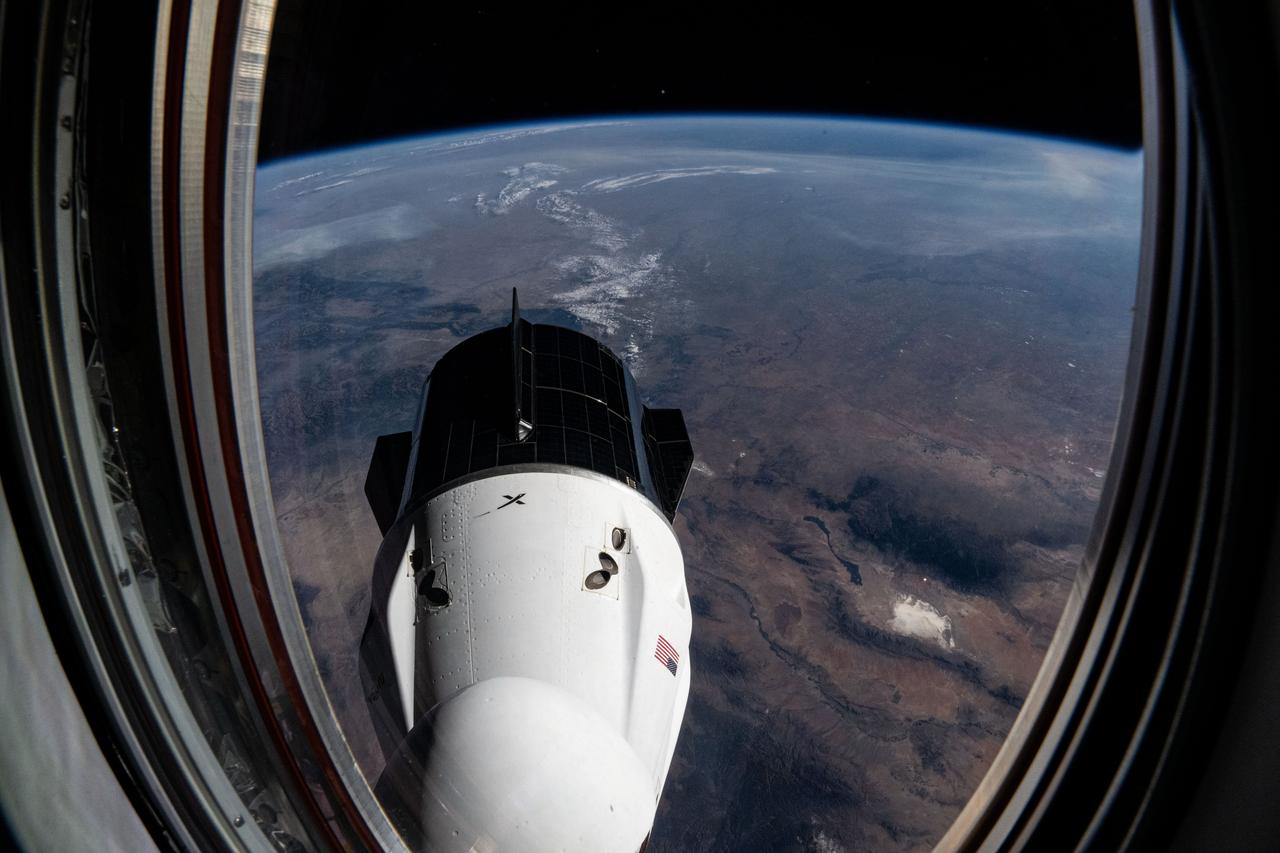
iss072e031300 (Oct. 7, 2024) -- The SpaceX Dragon Freedom spacecraft, docked to the forward-facing port of the International Space Station's Harmony module, was photographed as the orbiting lab soared 258 miles above the state of Colorado.
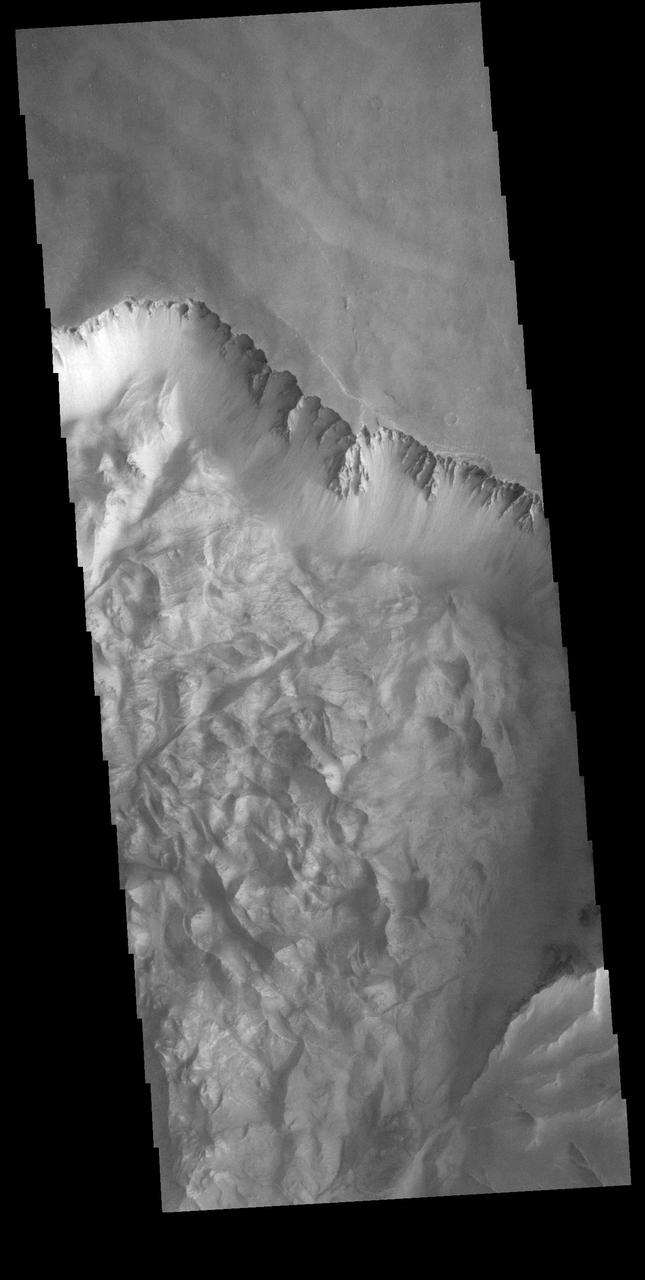
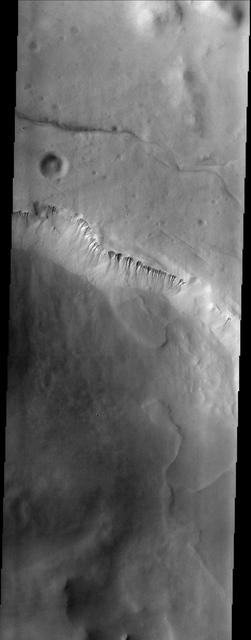
Today's VIS image shows part of the northern cliff face of Melas Chasma and the large landslide deposits at the base of the cliff face. The landslide deposits are called Ophir Labes. The descriptor term labes means landslide. Orbit Number: 74275 Latitude: -9.66666 Longitude: 290.547 Instrument: VIS Captured: 2018-09-12 01:22 https://photojournal.jpl.nasa.gov/catalog/PIA22797
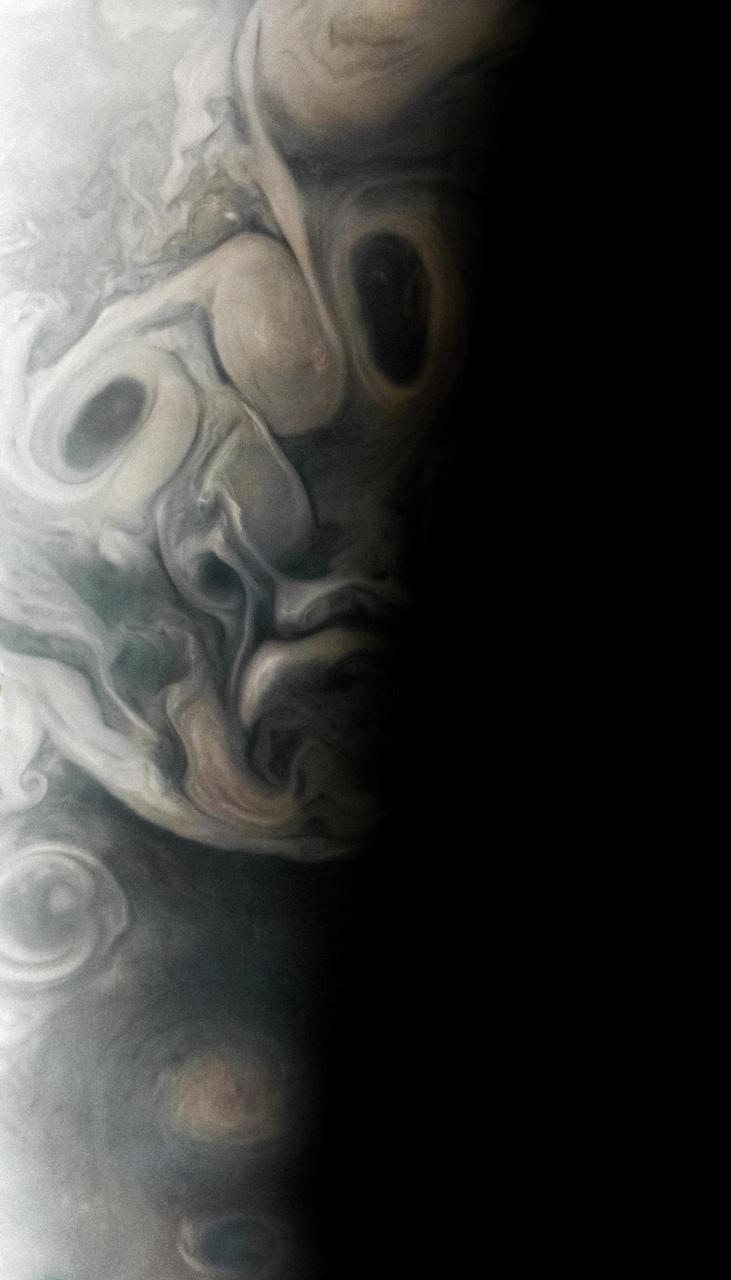
On Sept. 7, 2023, during its 54th close flyby of Jupiter, NASA's Juno mission captured this view of an area in the giant planet's far northern regions called Jet N7. The image shows turbulent clouds and storms along Jupiter's terminator, the dividing line between the day and night sides of the planet. The low angle of sunlight highlights the complex topography of features in this region, which scientists have studied to better understand the processes playing out in Jupiter's atmosphere. As often occurs in views from Juno, Jupiter's clouds in this picture lend themselves to pareidolia, the effect that causes observers to perceive faces or other patterns in largely random patterns. Citizen scientist Vladimir Tarasov made this image using raw data from the JunoCam instrument. At the time the raw image was taken, the Juno spacecraft was about 4,800 miles (about 7,700 kilometers) above Jupiter's cloud tops, at a latitude of about 69 degrees north. https://photojournal.jpl.nasa.gov/catalog/PIA25727
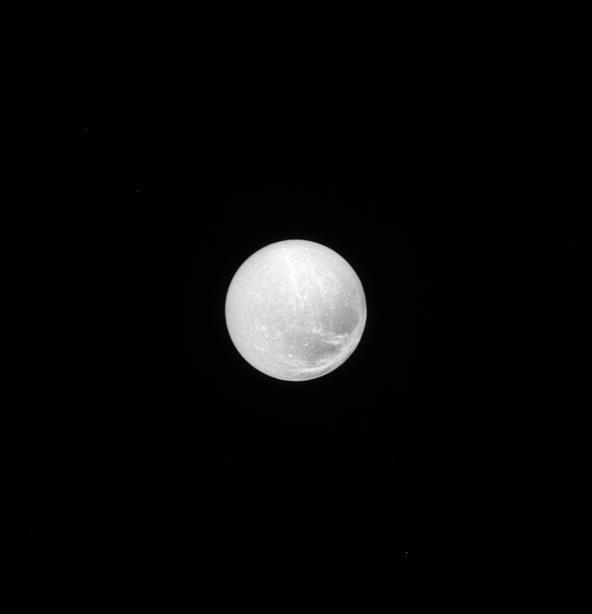
As seen by NASA Cassini spacecraft, the surface of Dione is covered in craters, reminding us of the impacts that have shaped all of the worlds of our solar system; the surface also bears linear features that suggest geological activity in the past.

NASA Hubble Space Telescope snapped these images of the asteroid Vesta in preparation for the Dawn spacecraft visit in 2011. The images show the difference in brightness and color on the asteroid surface.
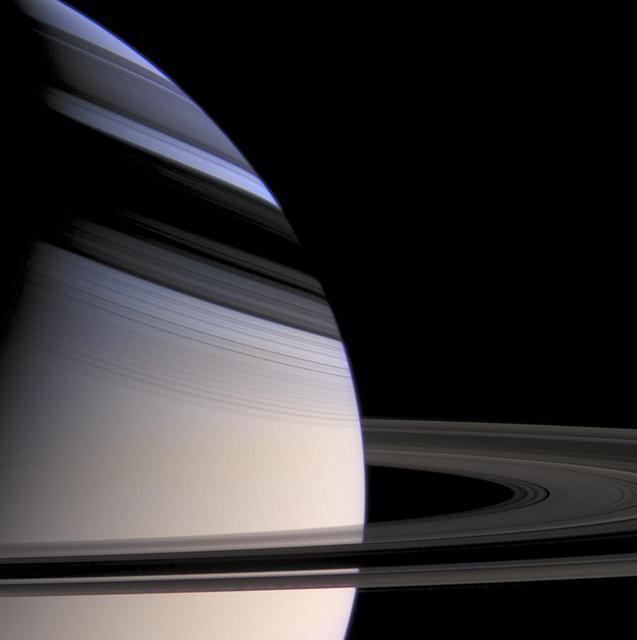
Few sights in the solar system are more strikingly beautiful than softly hued Saturn embraced by the shadows of its stately rings.
Bright lines creep across the face of Dione. The lines are systems of geologically fresh-looking canyons with bright, icy walls

This MOC image shows a flow or landslide feature on a hillslope facing north toward top/upper right that is buried on both ends
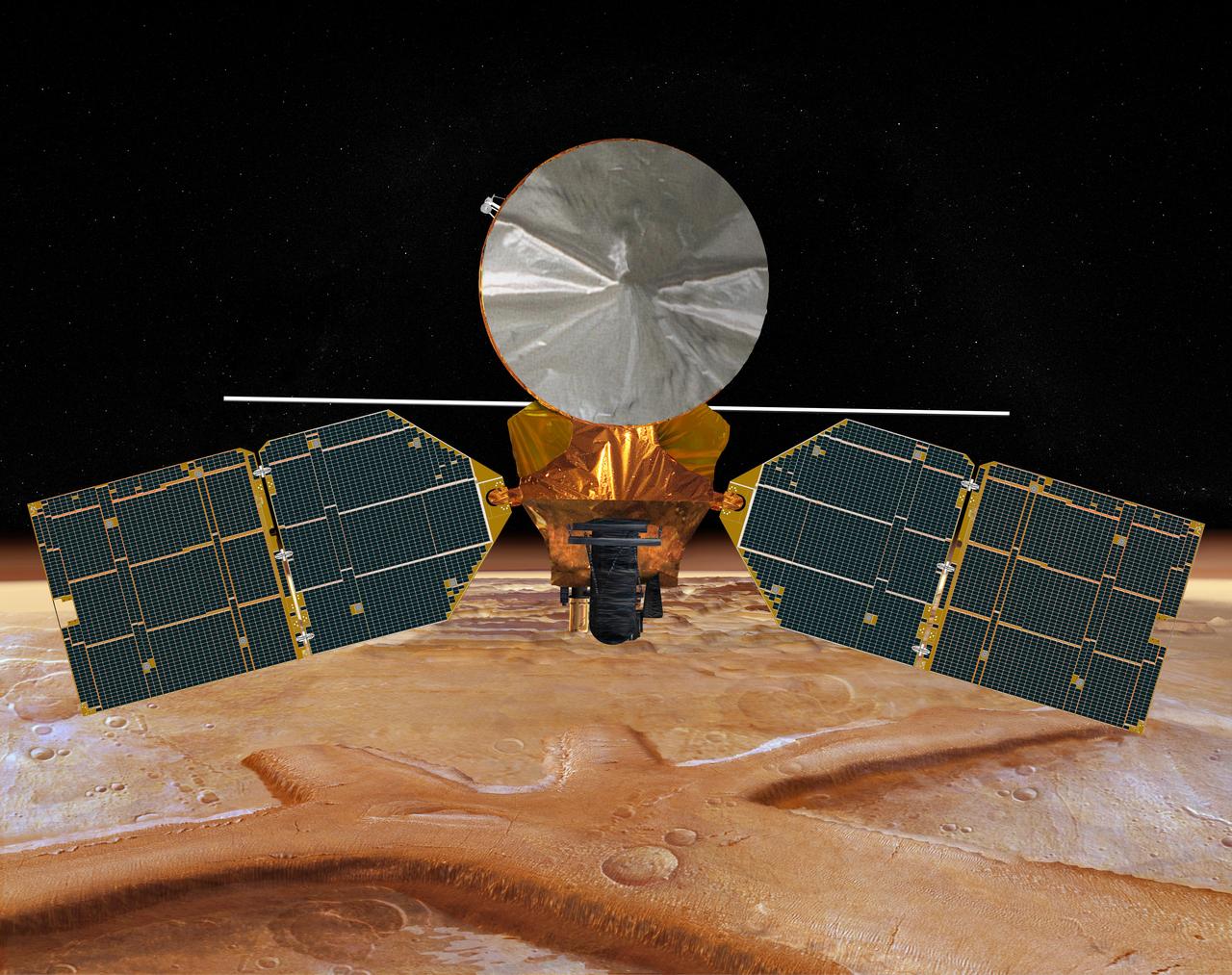
This artist concept of NASA Mars Reconnaissance Orbiter features the spacecraft main bus facing down, toward the red planet.
NASA 2001 Mars Odyssey spacecraft captured these gullies located on a cliff-face within Lyell Crater.