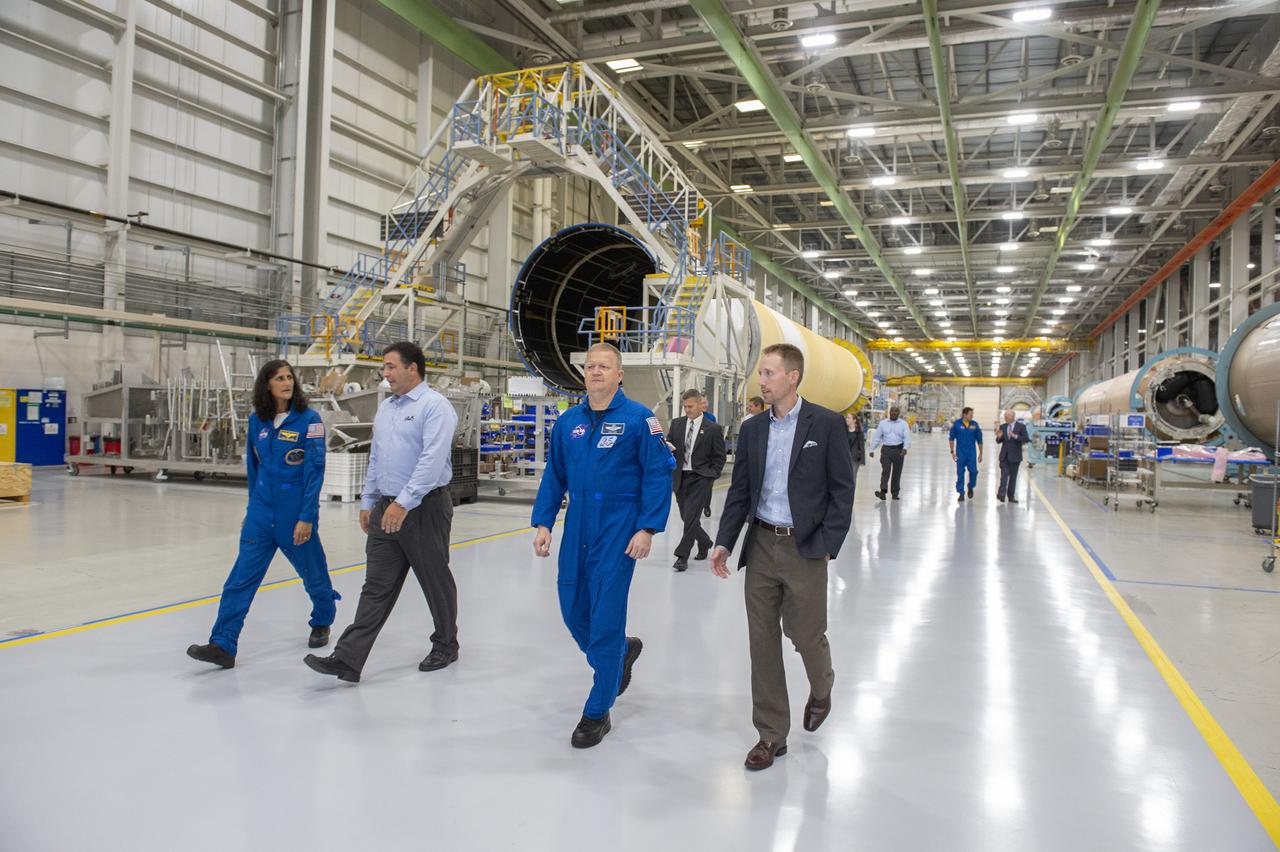
Commercial Crew astronauts toured the United Launch Alliance factory in Decatur, Alabama, on July 17, 2018. They viewed hardware to be used for upcoming commercial crew missions. At far left is Suni Williams, second from right is Eric Boe. Behind them, at right, is Josh Cassada.
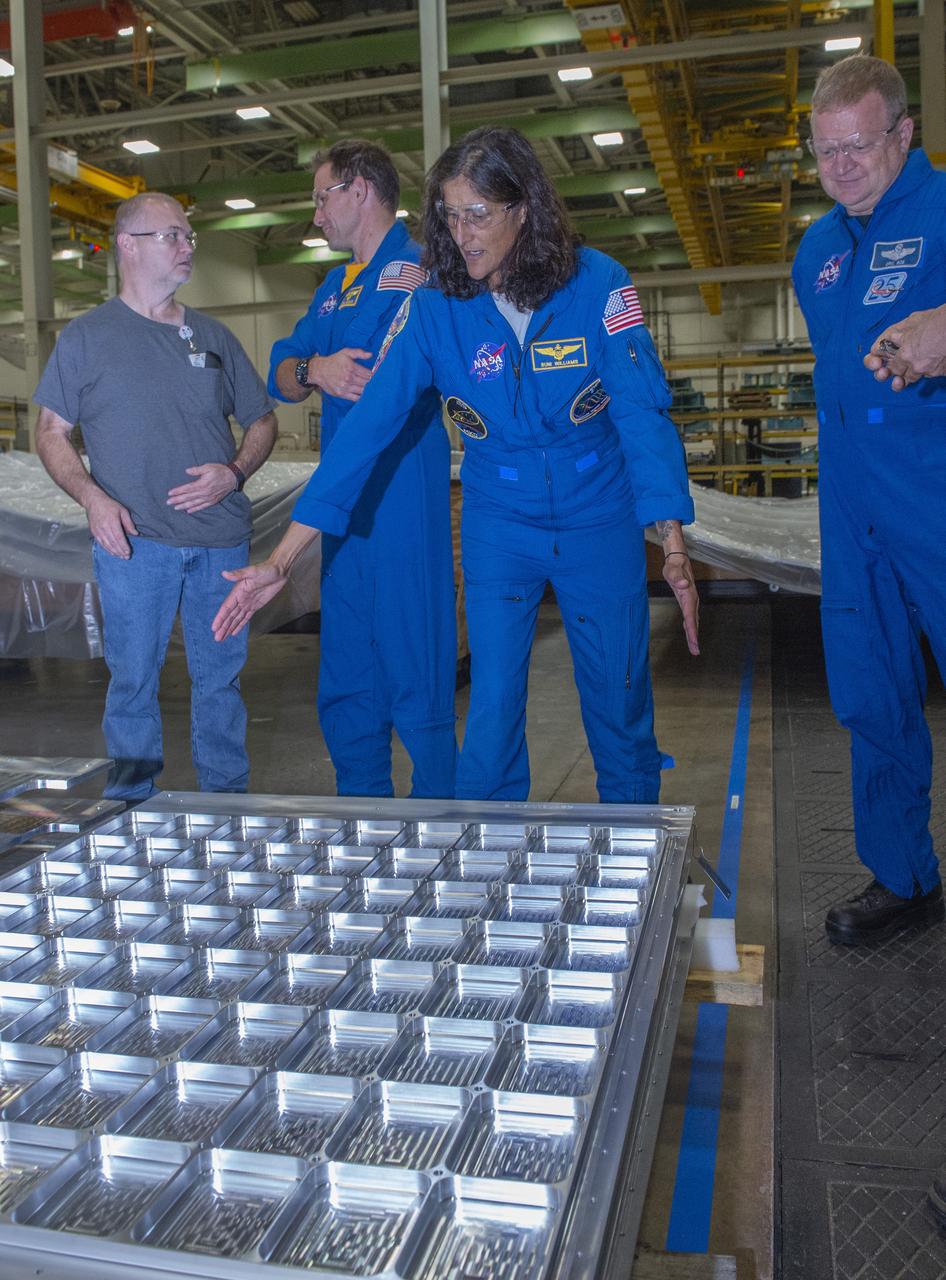
Commercial Crew astronauts toured the United Launch Alliance factory in Decatur, Alabama, on July 17, 2018. Viewing hardware to be used for upcoming commercial crew missions are, second from left, Josh Cassada, Suni Williams and Eric Boe.
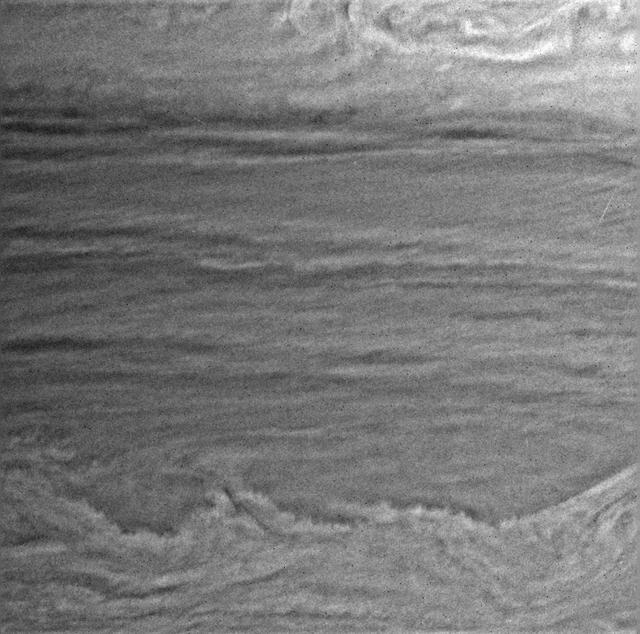
Storm Factory?

Astronomers using NASA Spitzer Space Telescope have spotted a dust factory 30 million light-years away in the spiral galaxy M74. The factory is located at the scene of a massive star explosive death, or supernova.

The star-forming nebula W51 is one of the largest "star factories" in the Milky Way galaxy. Interstellar dust blocks the visible light emitted by the region, but it is revealed by NASA's Spitzer Space Telescope, which captures infrared light that can penetrate dust clouds. https://photojournal.jpl.nasa.gov/catalog/PIA23865
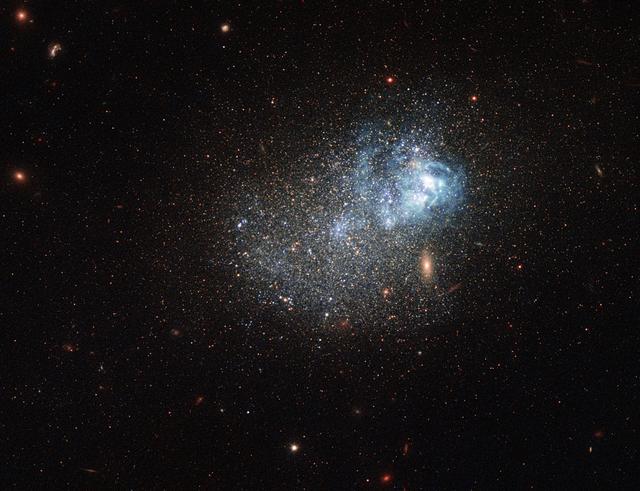
This sprinkle of cosmic glitter is a blue compact dwarf galaxy known as Markarian 209. Galaxies of this type are blue-hued, compact in size, gas-rich, and low in heavy elements. They are often used by astronomers to study star formation, as their conditions are similar to those thought to exist in the early Universe. Markarian 209 in particular has been studied extensively. It is filled with diffuse gas and peppered with star-forming regions towards its core. This image captures it undergoing a particularly dramatic burst of star formation, visible as the lighter blue cloudy region towards the top right of the galaxy. This clump is filled with very young and hot newborn stars. This galaxy was initially thought to be a young galaxy undergoing its very first episode of star formation, but later research showed that Markarian 209 is actually very old, with an almost continuous history of forming new stars. It is thought to have never had a dormant period — a period during which no stars were formed — lasting longer than 100 million years. The dominant population of stars in Markarian 209 is still quite young, in stellar terms, with ages of under 3 million years. For comparison, the sun is some 4.6 billion years old, and is roughly halfway through its expected lifespan. The observations used to make this image were taken using Hubble’s Wide Field Camera 3 and Advanced Camera for Surveys, and span the ultraviolet, visible, and infrared parts of the spectrum. A scattering of other bright galaxies can be seen across the frame, including the bright golden oval that could, due to a trick of perspective, be mistaken as part of Markarian 209 but is in fact a background galaxy. Credit: ESA/Hubble & NASA Acknowledgement: Nick Rose <b><a href="http://www.nasa.gov/audience/formedia/features/MP_Photo_Guidelines.html" rel="nofollow">NASA image use policy.</a></b> <b><a href="http://www.nasa.gov/centers/goddard/home/index.html" rel="nofollow">NASA Goddard Space Flight Center</a></b> enables NASA’s mission through four scientific endeavors: Earth Science, Heliophysics, Solar System Exploration, and Astrophysics. Goddard plays a leading role in NASA’s accomplishments by contributing compelling scientific knowledge to advance the Agency’s mission. <b>Follow us on <a href="http://twitter.com/NASAGoddardPix" rel="nofollow">Twitter</a></b> <b>Like us on <a href="http://www.facebook.com/pages/Greenbelt-MD/NASA-Goddard/395013845897?ref=tsd" rel="nofollow">Facebook</a></b> <b>Find us on <a href="http://instagram.com/nasagoddard?vm=grid" rel="nofollow">Instagram</a></b>
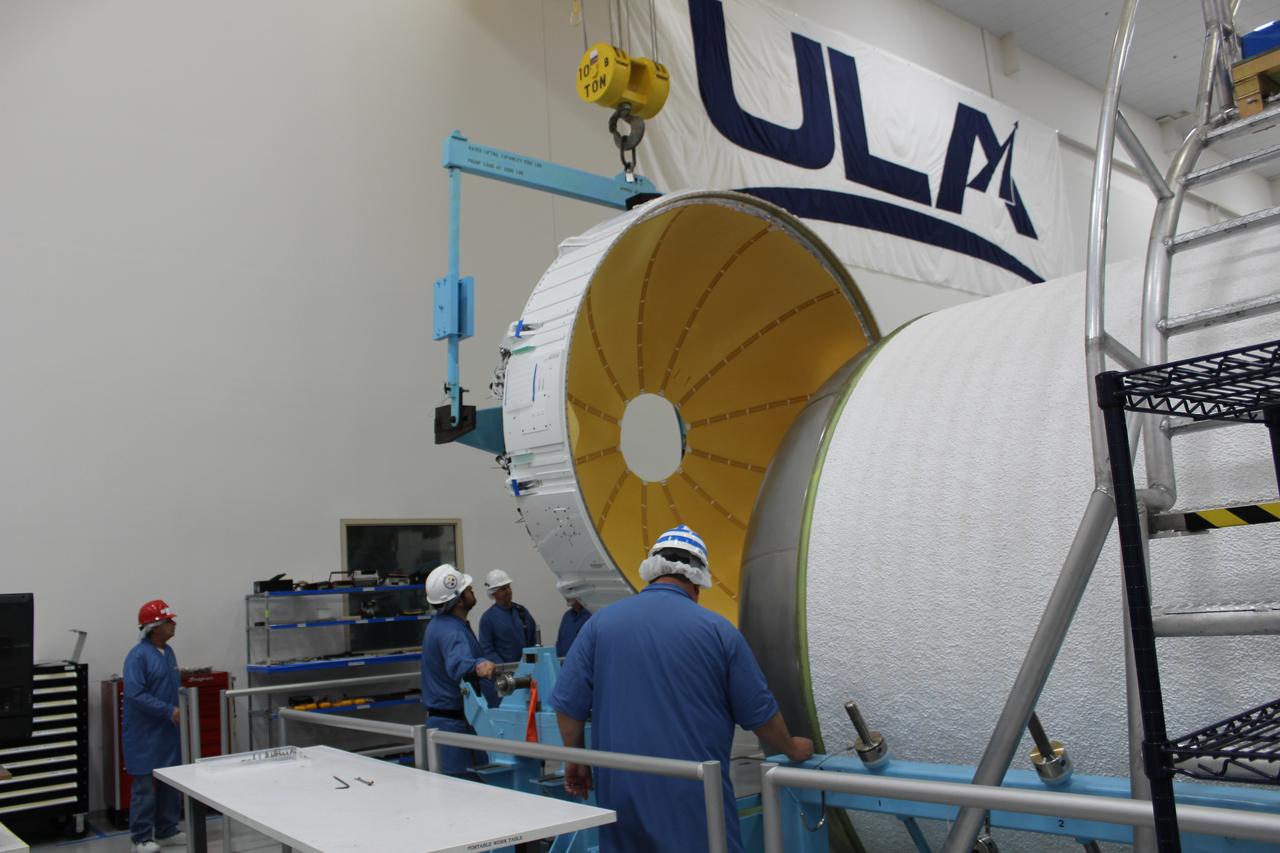
Workers assemble a United Launch Alliance (ULA) Atlas V dual engine Centaur upper stage in ULA’s factory in Decatur, Alabama on March 29, 2019. The dual engine upper stage is being prepared for the first crew rotation mission of Boeing’s CST-100 Starliner to the International Space Station. Starliner and the Atlas V rockets that will launch the spacecraft, are key elements of NASA’s Commercial Crew Program to restore the capability to send astronauts to the space station from U.S. soil.
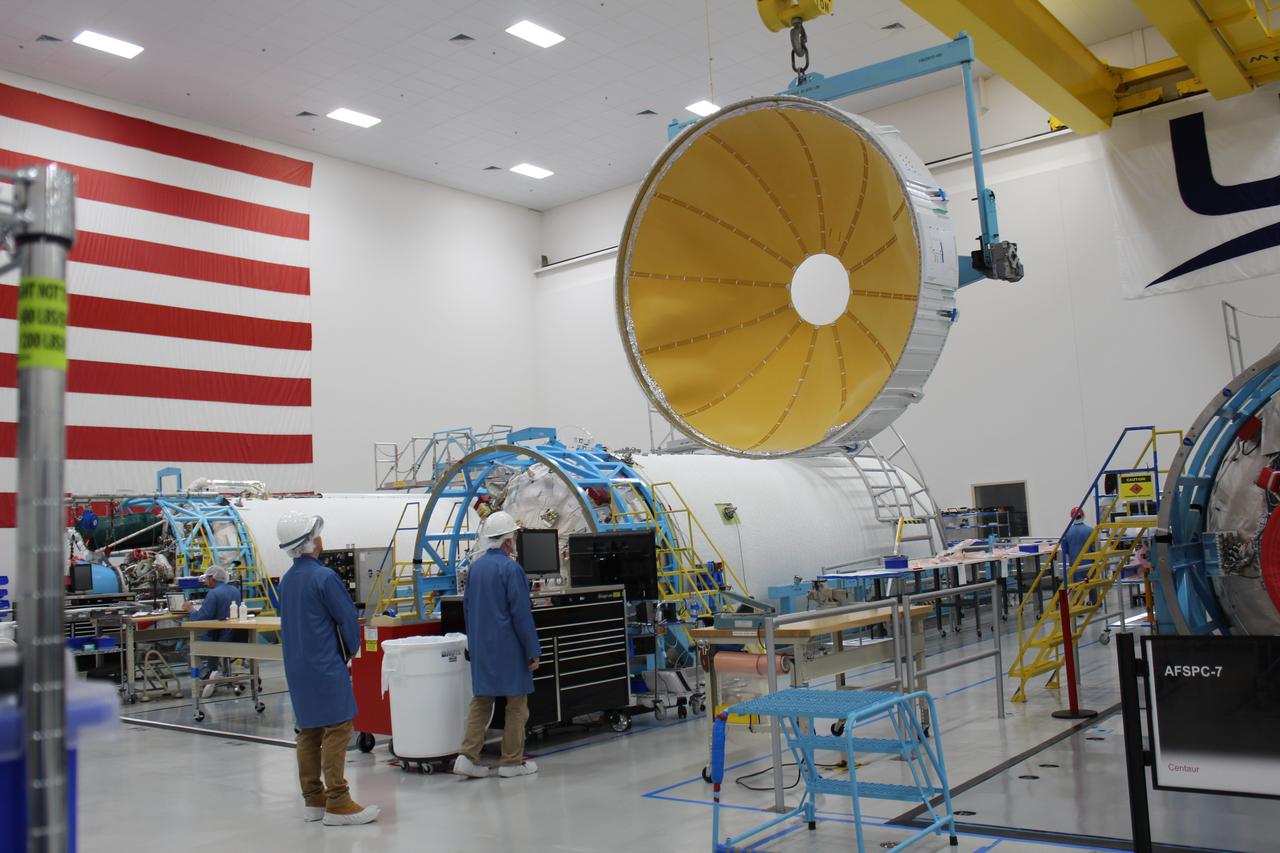
Workers assemble a United Launch Alliance (ULA) Atlas V dual engine Centaur upper stage in ULA’s factory in Decatur, Alabama on March 29, 2019. The dual engine upper stage is being prepared for the first crew rotation mission of Boeing’s CST-100 Starliner to the International Space Station. Starliner and the Atlas V rockets that will launch the spacecraft, are key elements of NASA’s Commercial Crew Program to restore the capability to send astronauts to the space station from U.S. soil.
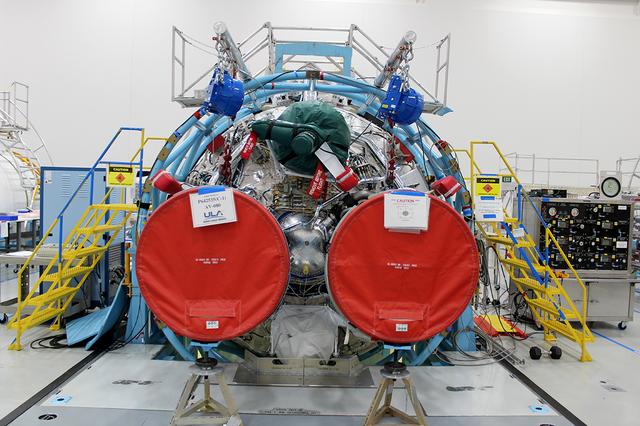
The United Launch Alliance (ULA) Orbital Flight Test dual engine Centaur stage of the Atlas V rocket is in the final stage of production and checkout on May 22, 2018, at ULA's factory in Decatur, Alabama. Boeing's CST-100 Starliner will launch on its first uncrewed flight test on the ULA Atlas V rocket. The Starliner is being developed and manufactured in partnership with NASA's Commercial Crew Program to return human spaceflight capabilities to the U.S.
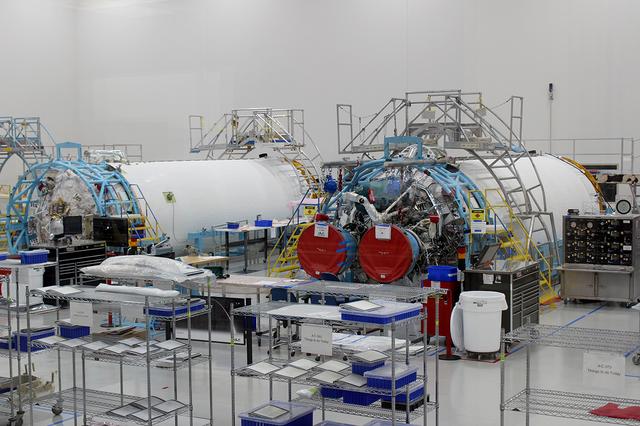
The United Launch Alliance (ULA) Crew Flight Test dual engine, at left, and the Orbital Flight test dual engine, at right, for the Centaur stage of the Atlas V rocket are in production on June 11, 2018, at ULA's factory in Decatur, Alabama. Boeing's CST-100 Starliner will launch on its first uncrewed flight test on the ULA Atlas V rocket. The Starliner is being developed and manufactured in partnership with NASA's Commercial Crew Program to return human spaceflight capabilities to the U.S.
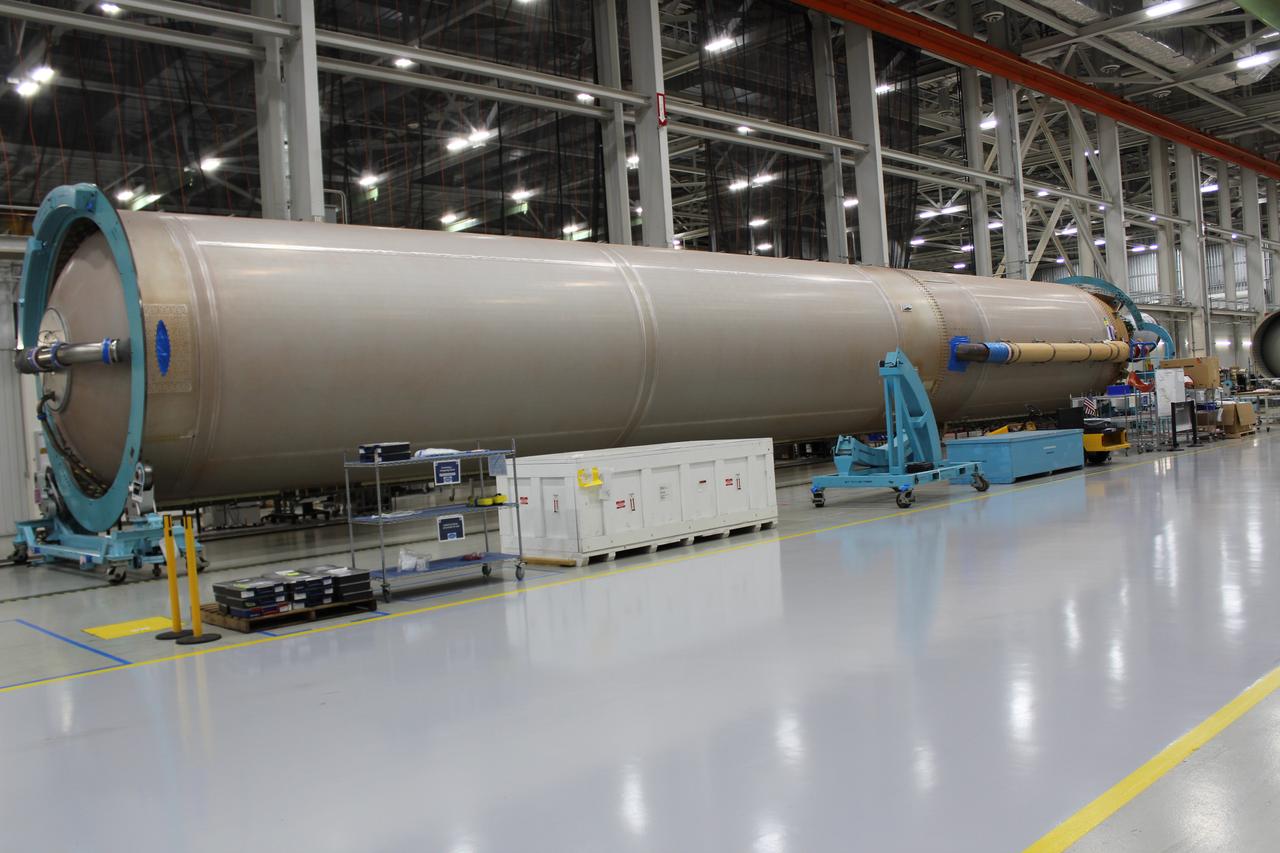
The United Launch Alliance (ULA) Atlas V first stage booster for the Crew Flight Test of Boeing’s CST-100 Starliner is in production in ULA's factory in Decatur, Alabama on March 1, 2019. Soon the booster will be assembled with the dual engine Centaur upper stage. They will be shipped aboard the company’s Mariner cargo ship to NASA’s Kennedy Space Center in Florida. Starliner and the Atlas V rockets that will launch the spacecraft, are key to restoring the nation’s capability to send astronauts to the space station from U.S. soil with NASA’s Commercial Crew Program. NASA astronauts Mike Fincke and Nicole Mann, and Boeing astronaut Chris Ferguson will launch to the space station aboard the Starliner for the Crew Flight Test.
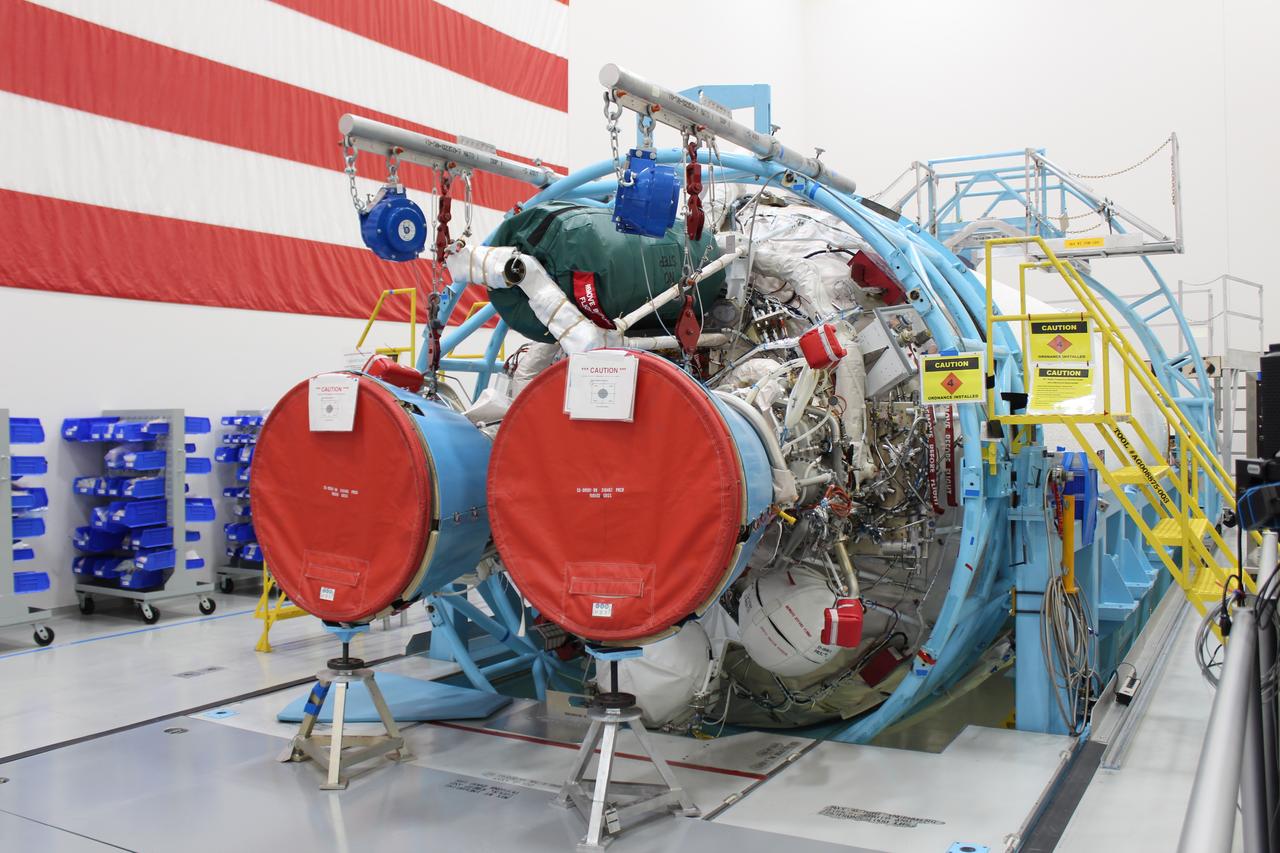
A United Launch Alliance (ULA) Atlas V dual engine Centaur upper stage is in ULA’s factory in Decatur, Alabama on March 29, 2019. The dual engine upper stage is being prepared for Boeing’s CST-100 Starliner Crew Flight Test. Soon the upper stage will be assembled with the first stage booster and shipped aboard the company’s Mariner cargo ship to NASA’s Kennedy Space Center in Florida. Starliner and the Atlas V rockets that will launch the spacecraft, are key elements of NASA’s Commercial Crew Program to restore the capability to send astronauts to the International Space Station from U.S. soil.
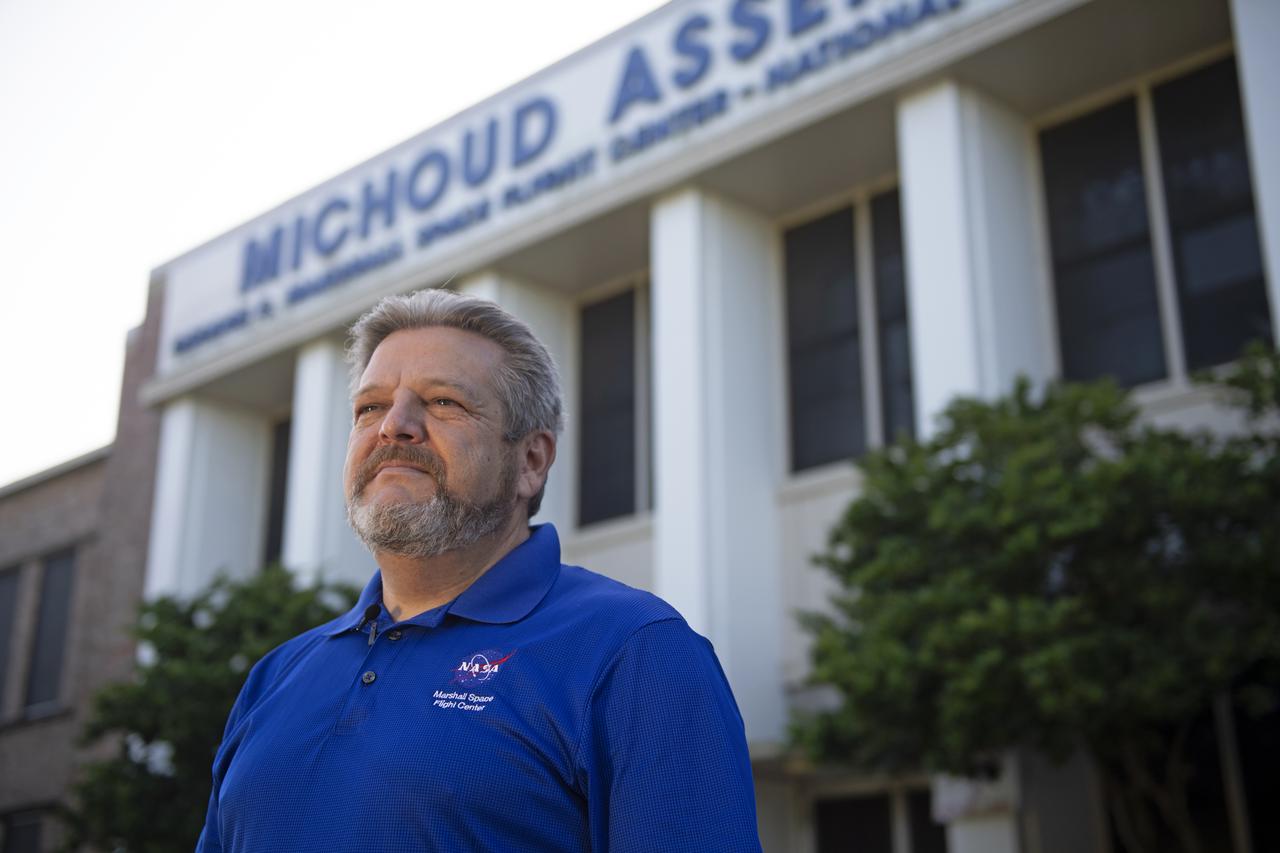
MAF Director Robert Champion stands in front of the Michoud Assembly Facility in New Orleans, Louisiana – America’s Rocket Factory.
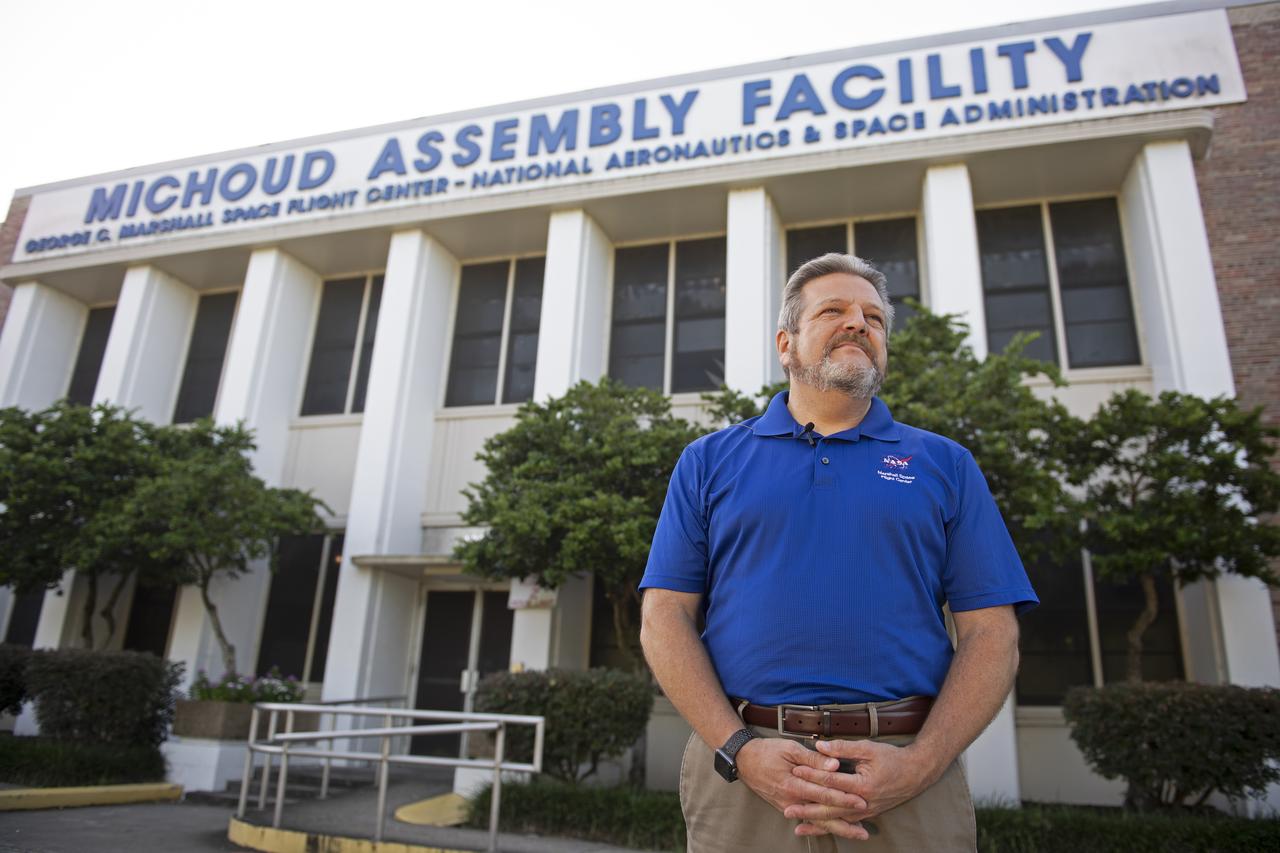
MAF Director Robert Champion stands in front of the Michoud Assembly Facility – America’s Rocket Factory.

MAF Director Robert Champion stands in front of the Michoud Assembly Facility in New Orleans, Louisiana – America’s Rocket Factory.
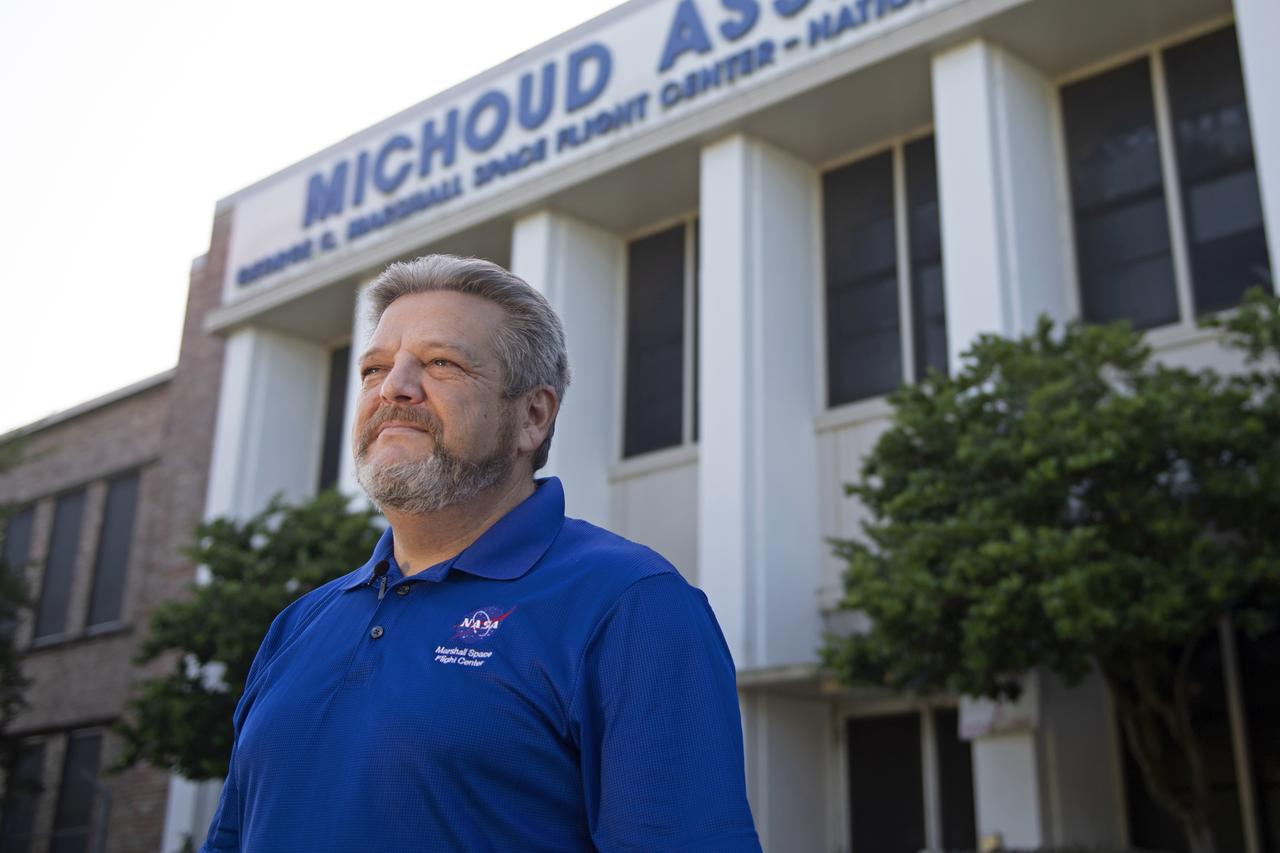
MAF Director Robert Champion stands in front of the Michoud Assembly Facility in New Orleans, Louisiana – America’s Rocket Factory.
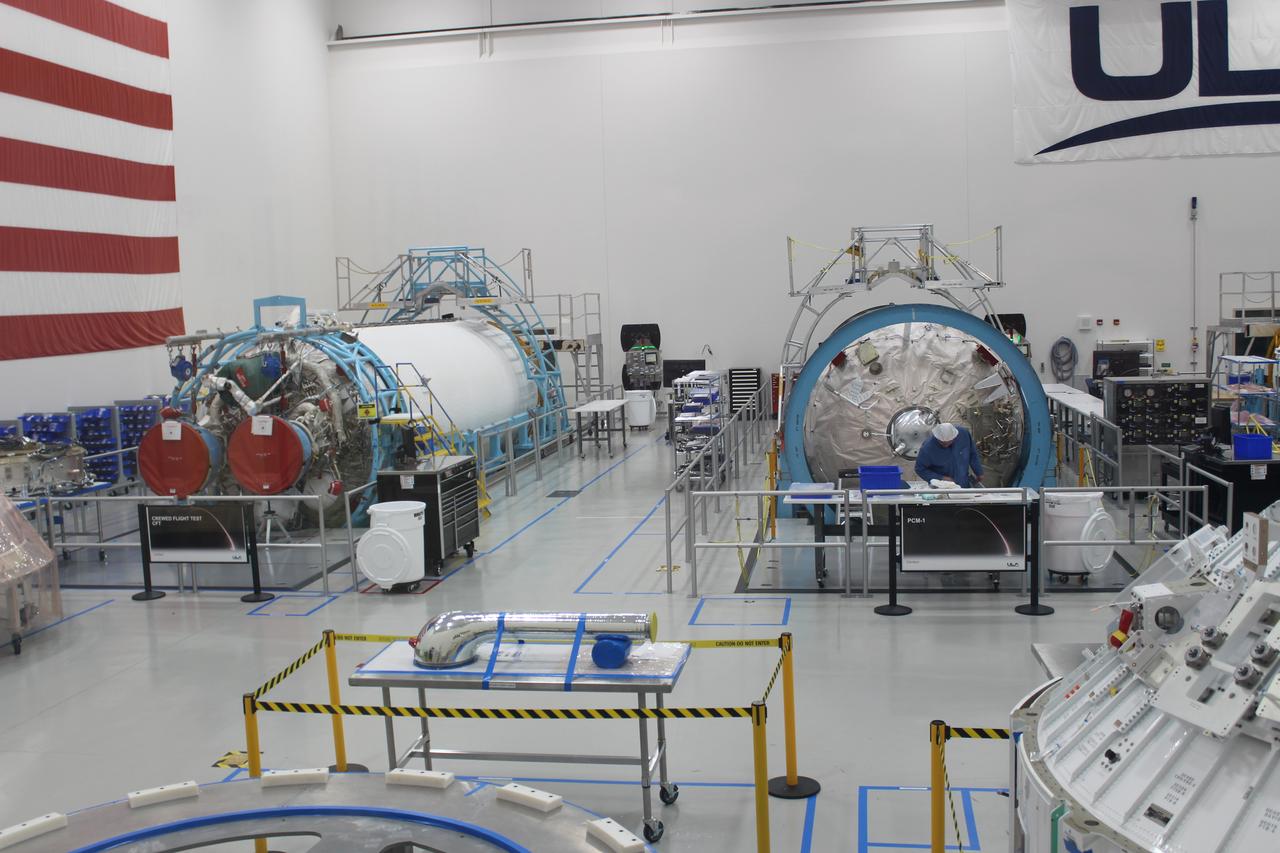
Two United Launch Alliance (ULA) Atlas V dual engine Centaur upper stages are in production in ULA's factory in Decatur, Alabama on March 1, 2019. One is for Boeing’s Crew Flight Test on the CST-100 Starliner, and the other will be used for the first crew rotation mission on the Starliner. One of the Centaur upper stages will be assembled to the first stage booster. They will be shipped aboard the company’s Mariner cargo ship to NASA’s Kennedy Space Center in Florida. Starliner and the Atlas V rockets that will launch the spacecraft, are key to restoring the nation’s capability to send astronauts to the space station from U.S. soil with NASA’s Commercial Crew Program. NASA astronauts Mike Fincke and Nicole Mann, and Boeing astronaut Chris Ferguson will launch to the space station aboard the Starliner for the Crew Flight Test.

When Boeing decided to build the 747, they had to build a factory large enough to construct several at the same time. They started building the factory in 1967, in Everett, Washington, 35 km north of Seattle. The main building covers 39 hectares (98 acres), and encloses 13.3 million cubic meters (472 million cubic feet). This is the largest building in the world. The image was acquired September 15, 2017, covers an area of 10.8 by 11.3 kilometers, and is located at 47.9 degrees north, 122.3 degrees west. https://photojournal.jpl.nasa.gov/catalog/PIA23000
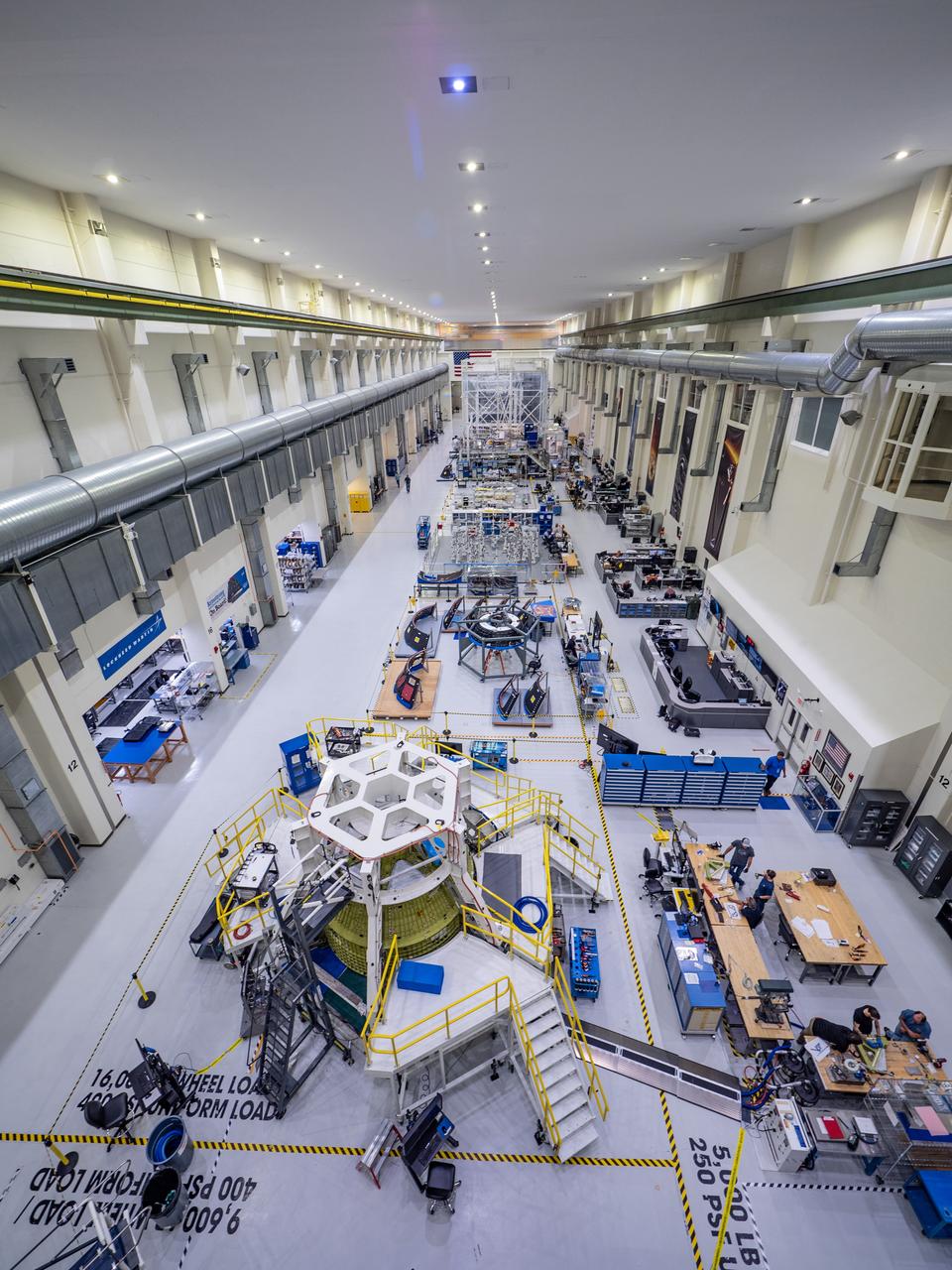
Orion assembly line at the Operations and Checkout Building at Kennedy Space Center where Lockheed Martin technicians are working to assemble the Orion spacecraft for Artemis I and II on Nov. 15, 2018.
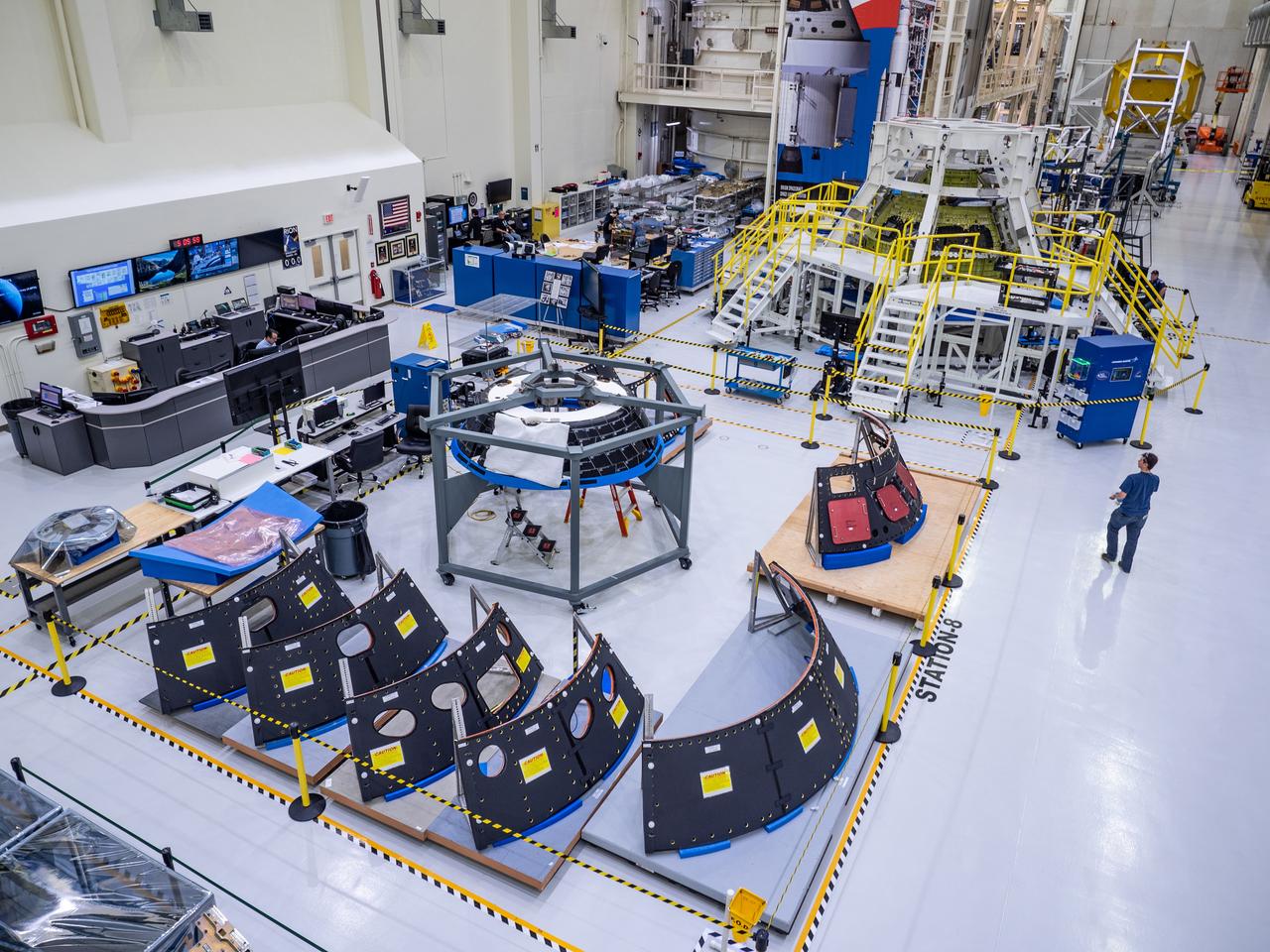
Orion assembly line at the Operations and Checkout Building at Kennedy Space Center where Lockheed Martin technicians are working to assemble the Orion spacecraft for Artemis I and II on Nov. 14, 2018.
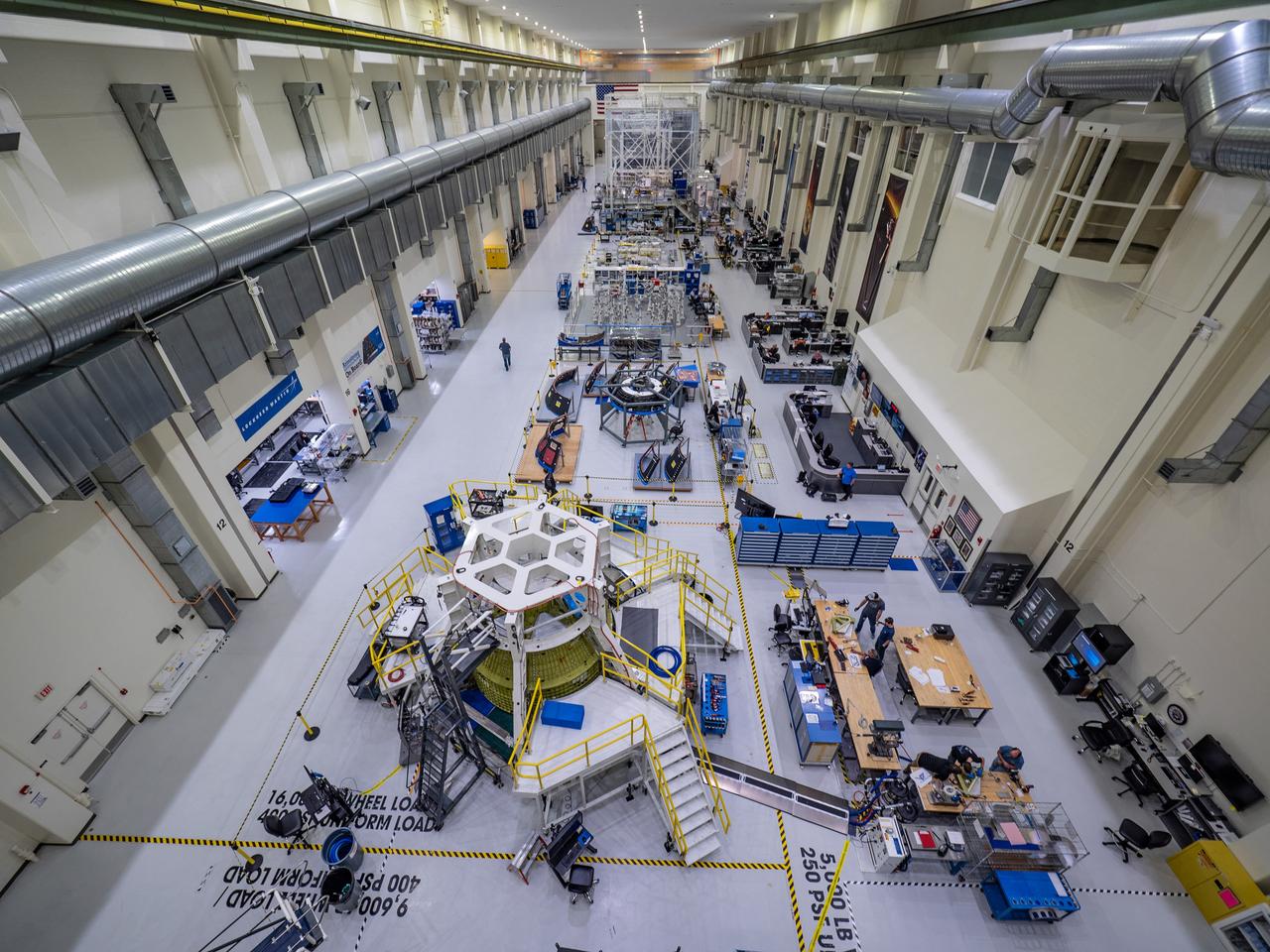
Orion assembly line at the Operations and Checkout Building at Kennedy Space Center where Lockheed Martin technicians are working to assemble the Orion spacecraft for Artemis I and II on Nov. 15, 2018.
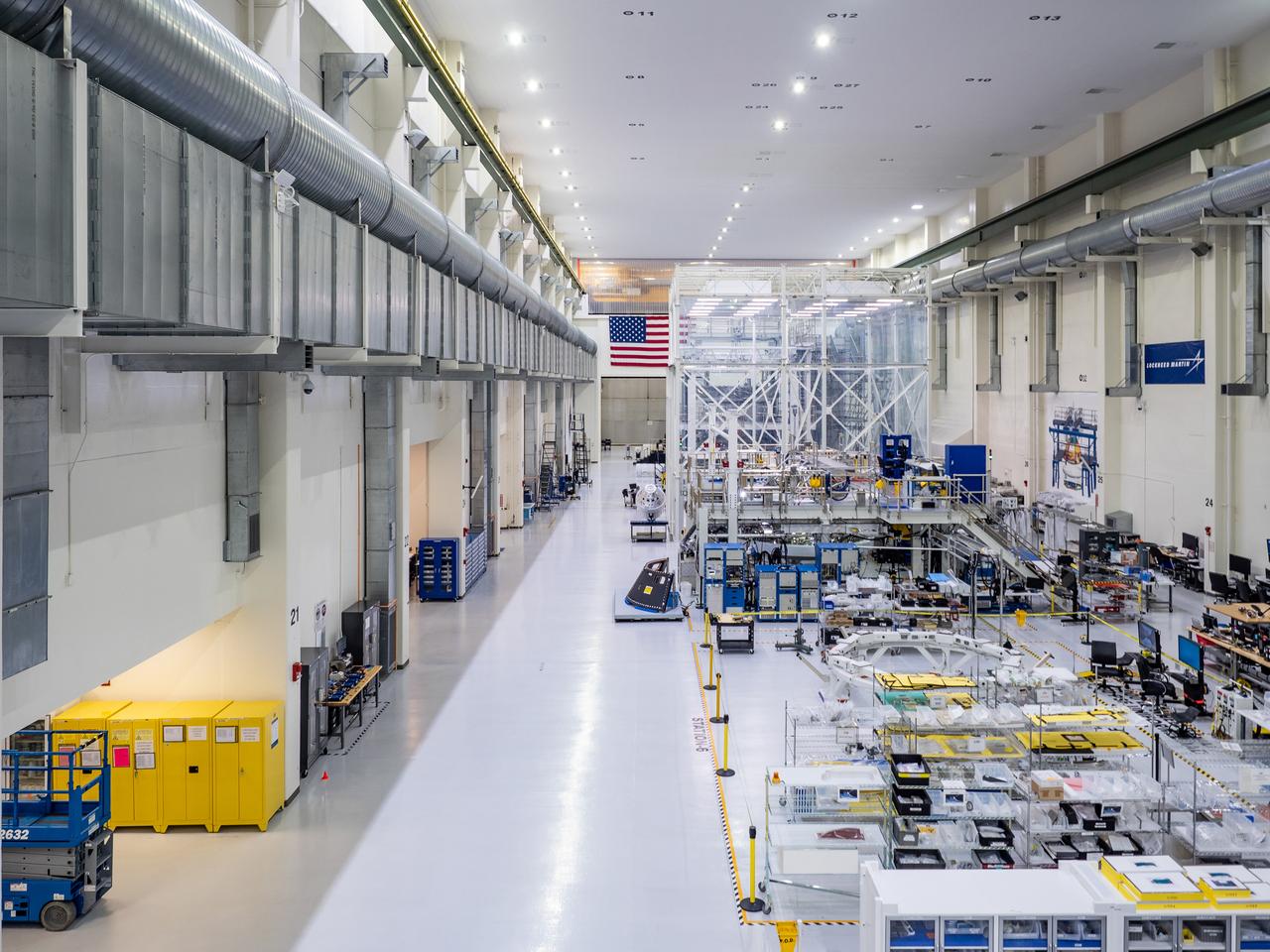
Orion assembly line at the Operations and Checkout Building at Kennedy Space Center where Lockheed Martin technicians are working to assemble the Orion spacecraft for Artemis I and II on Nov. 14, 2018.
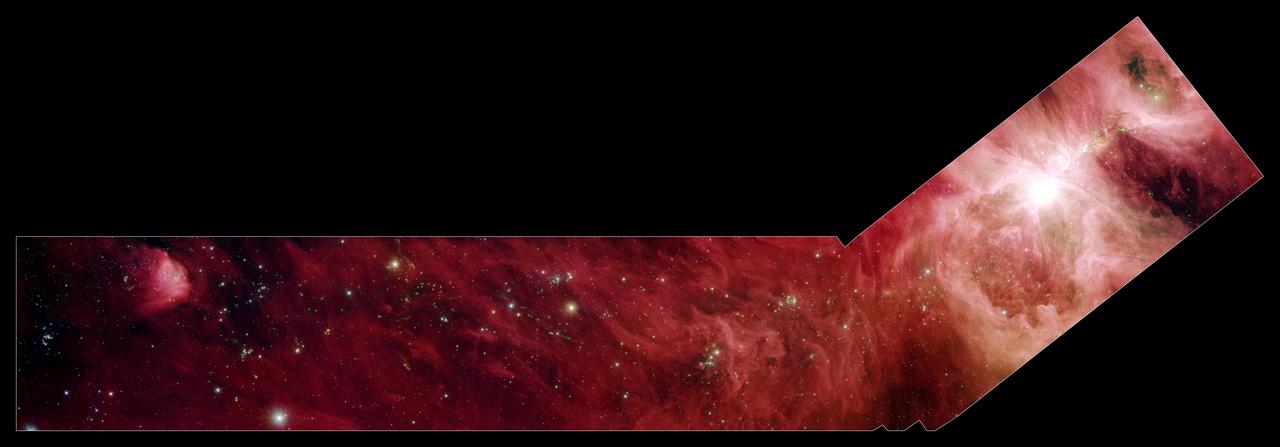
This image composite shows a part of the Orion constellation surveyed by NASA Spitzer Space Telescope. The shape of the main image was designed by astronomers to roughly follow the shape of Orion cloud A, an enormous star-making factory.
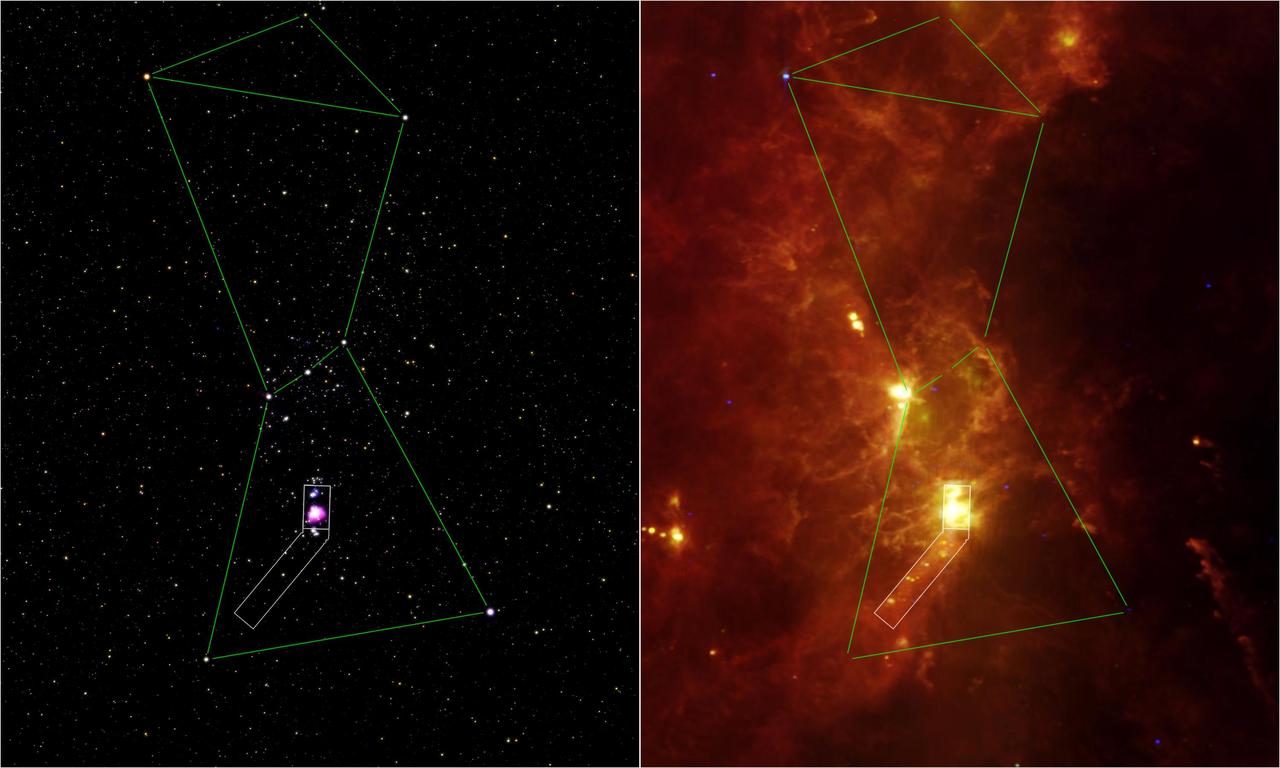
This image composite outlines the region near Orion sword that was surveyed by NASA Spitzer Space Telescope white box. The Orion nebula, our closest massive star-making factory, is the brightest spot near the hunter sword.
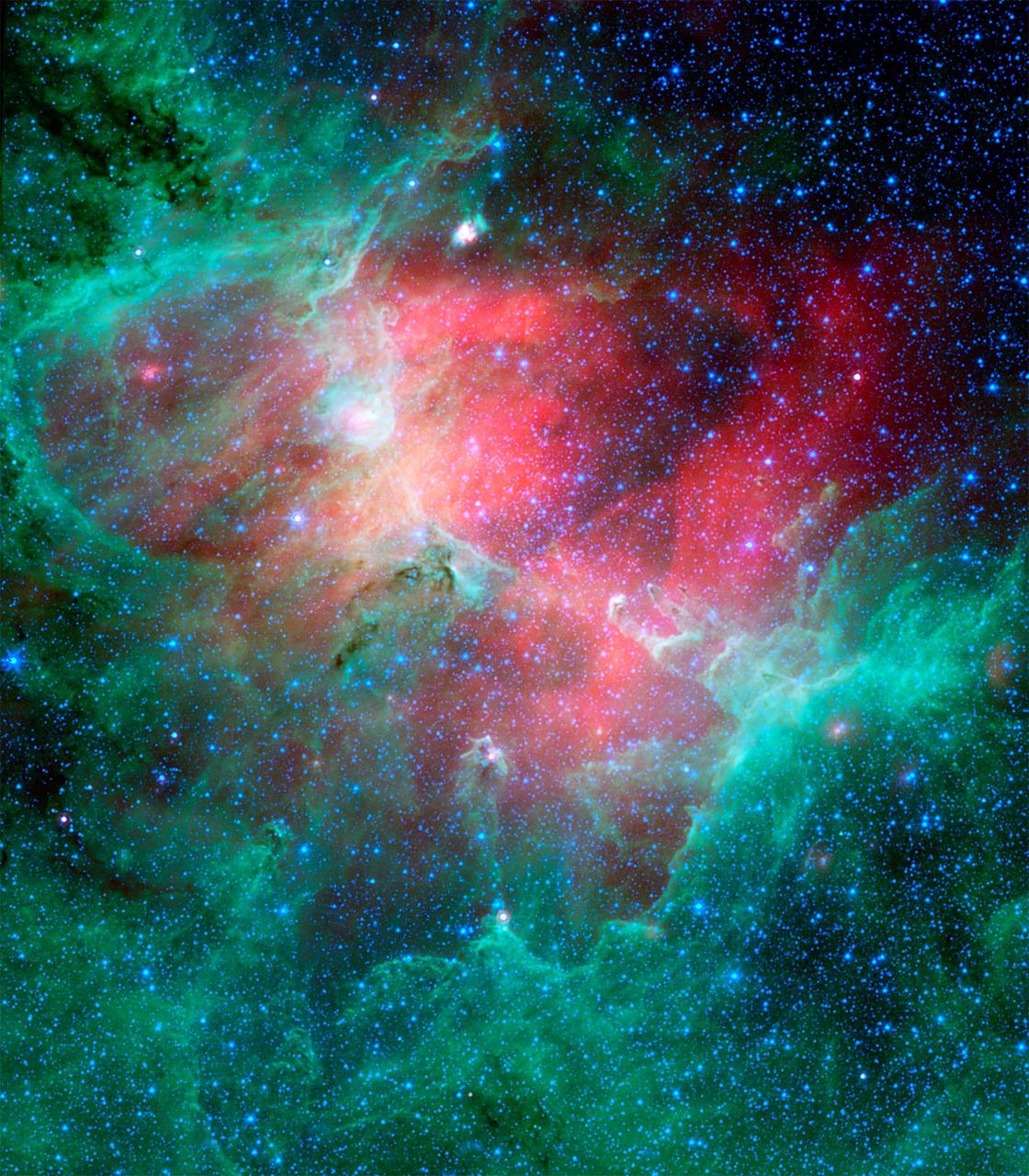
This majestic view taken by NASA Spitzer Space Telescope tells an untold story of life and death in the Eagle nebula, an industrious star-making factory located 7,000 light-years away in the Serpens constellation.
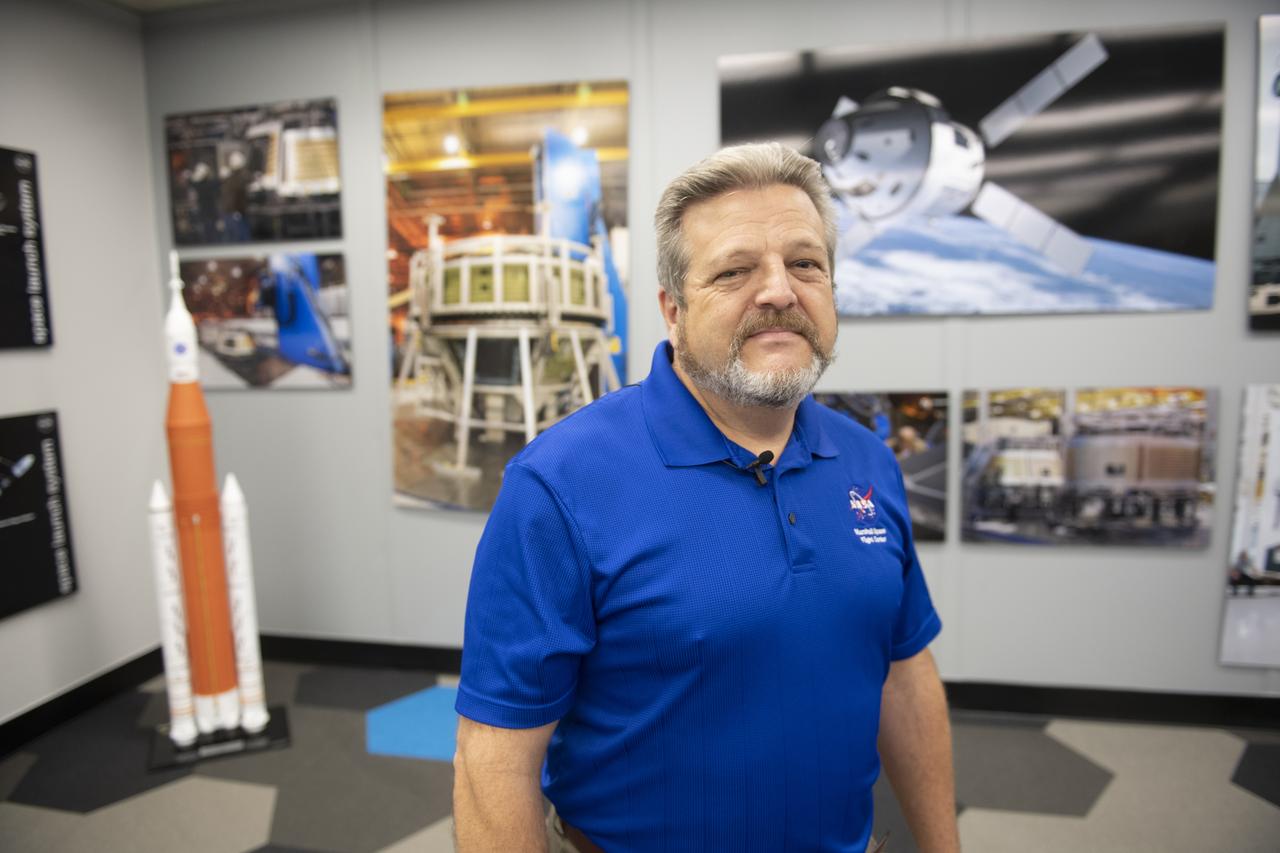
MAF Director Robert Champion stands within the Michoud Assembly Facility model room to showcase the Artemis program, Space Launch System (SLS) hardware, and facility resources of America’s Rocket Factory.
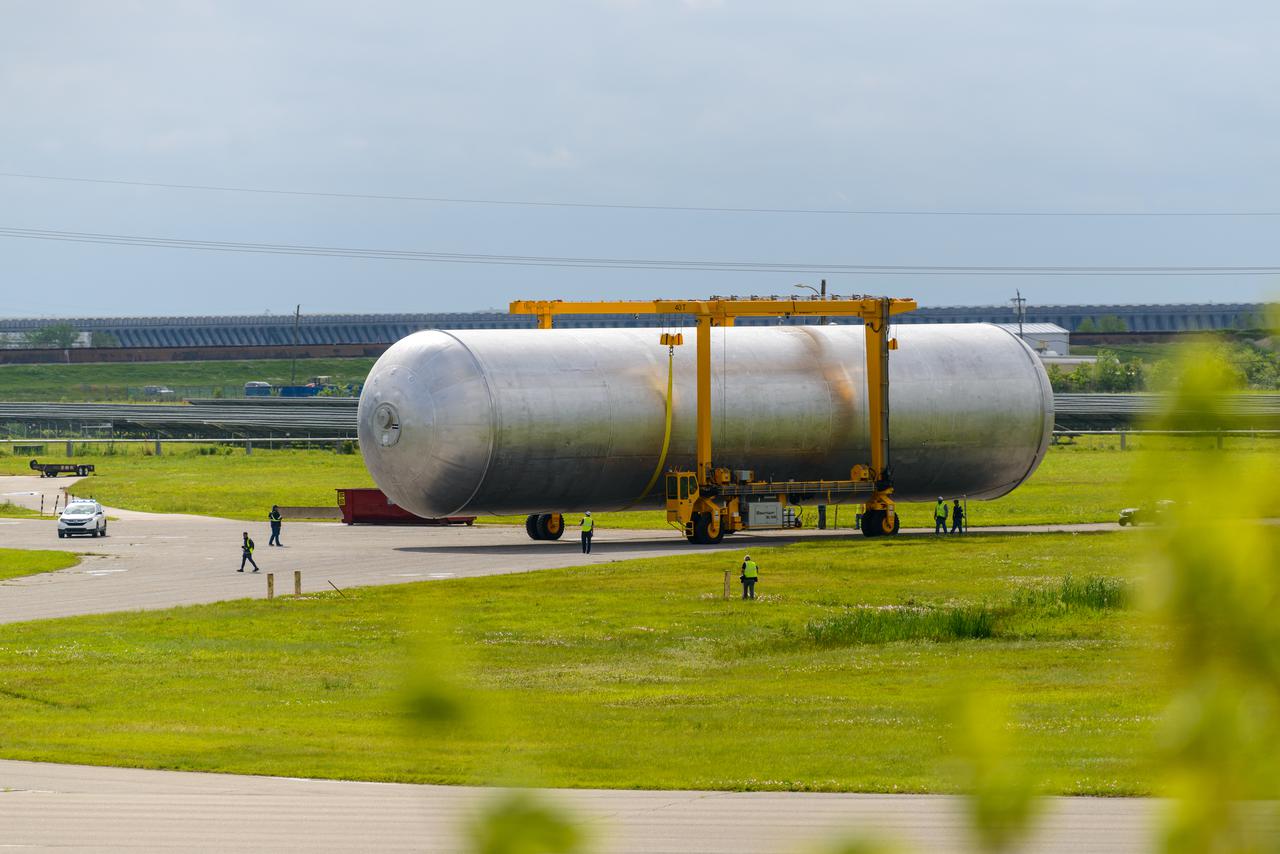
The core stage liquid hydrogen tank for the Artemis III mission completed proof testing, and technicians returned it to the main factory building at NASA’s Michoud Assembly Facility in New Orleans where it will undergo more outfitting. As part of proof testing, technicians apply a simple soap solution and check for leaks by observing any bubble formation on the welds. The technician removed the bubble solution with distilled water and then dried the area of application to prevent corrosion. To build the Space Launch System (SLS) rocket’s 130-foot core stage liquid hydrogen tank, engineers use robotic tools to weld five-barrel segments. This process results in a tank with around 1,900 feet, or more than six football fields, of welds that must be tested by hand. After the leak tests, the core stage lead, Boeing, pressurized the SLS tank to further ensure there were no leaks. After it passed proof testing, technicians moved the Artemis III liquid hydrogen tank to Michoud’s main factory. Soon, the technicians will prime and apply a foam-based thermal protection system that protects the tank during launch. Later, the tank will be joined with other parts of the core stage to form the entire 212-foot rocket stage with its four RS-25 engines that produce 2 million pounds of thrust to help launch the rocket. Artemis III will land the first astronauts on the lunar surface. Photographed on Monday, April 18, 2022.
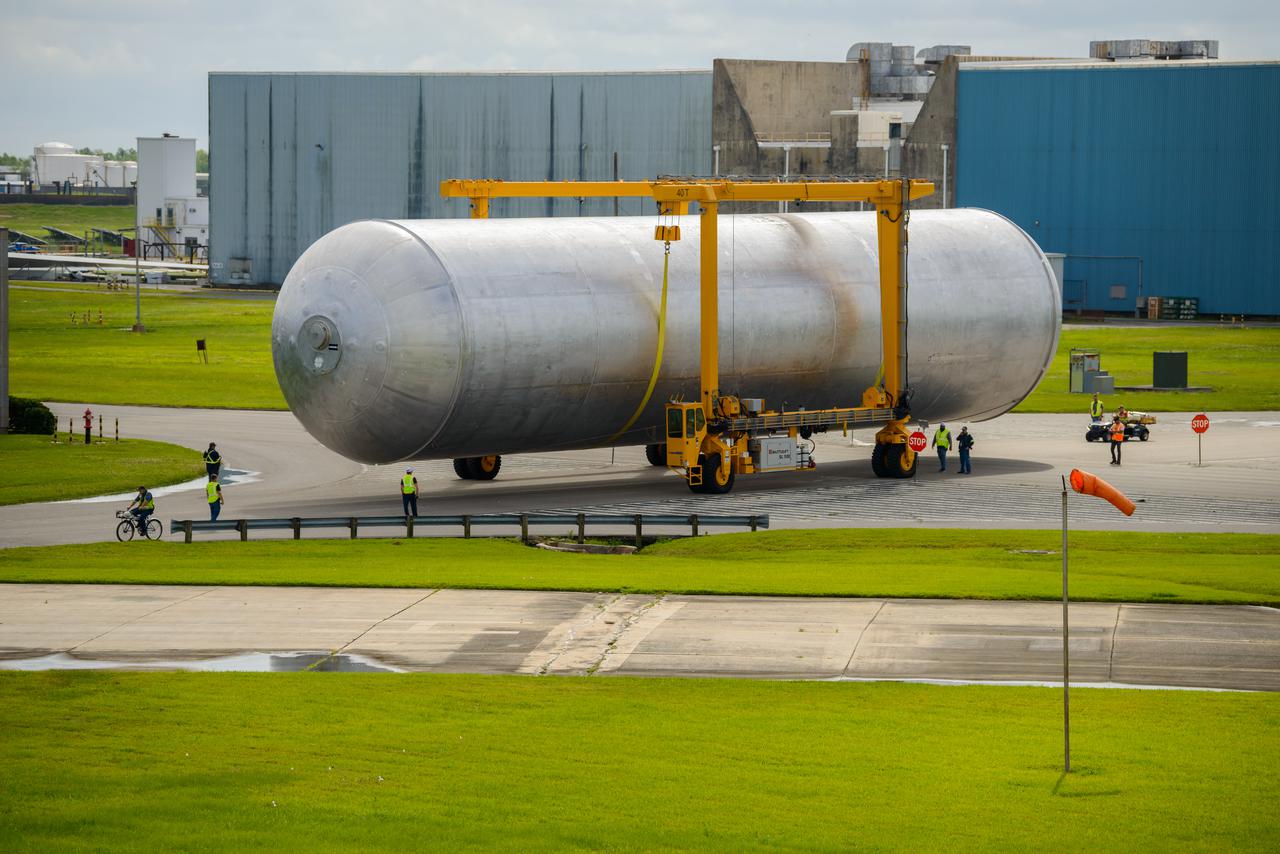
The core stage liquid hydrogen tank for the Artemis III mission completed proof testing, and technicians returned it to the main factory building at NASA’s Michoud Assembly Facility in New Orleans where it will undergo more outfitting. As part of proof testing, technicians apply a simple soap solution and check for leaks by observing any bubble formation on the welds. The technician removed the bubble solution with distilled water and then dried the area of application to prevent corrosion. To build the Space Launch System (SLS) rocket’s 130-foot core stage liquid hydrogen tank, engineers use robotic tools to weld five-barrel segments. This process results in a tank with around 1,900 feet, or more than six football fields, of welds that must be tested by hand. After the leak tests, the core stage lead, Boeing, pressurized the SLS tank to further ensure there were no leaks. After it passed proof testing, technicians moved the Artemis III liquid hydrogen tank to Michoud’s main factory. Soon, the technicians will prime and apply a foam-based thermal protection system that protects the tank during launch. Later, the tank will be joined with other parts of the core stage to form the entire 212-foot rocket stage with its four RS-25 engines that produce 2 million pounds of thrust to help launch the rocket. Artemis III will land the first astronauts on the lunar surface. Photographed on Monday, April 18, 2022.
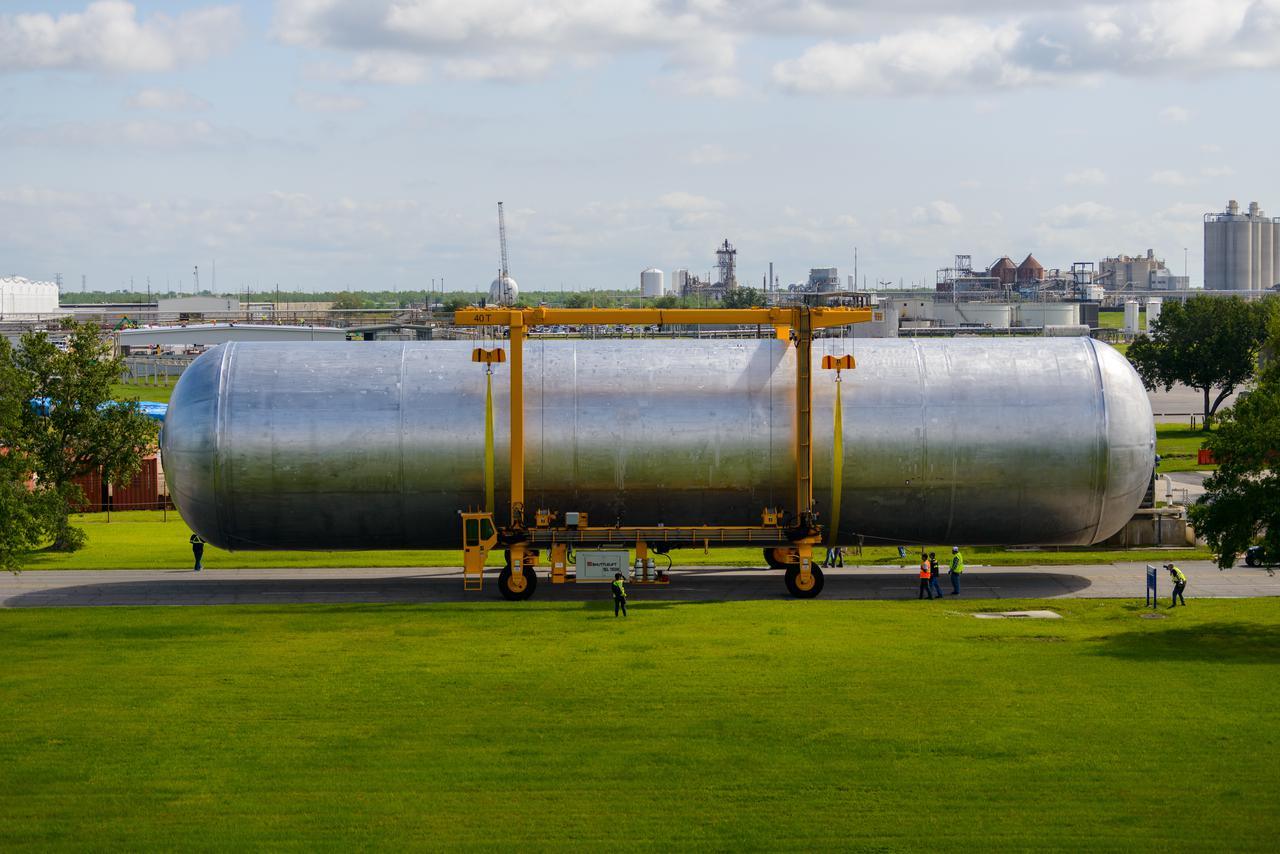
The core stage liquid hydrogen tank for the Artemis III mission completed proof testing, and technicians returned it to the main factory building at NASA’s Michoud Assembly Facility in New Orleans where it will undergo more outfitting. As part of proof testing, technicians apply a simple soap solution and check for leaks by observing any bubble formation on the welds. The technician removed the bubble solution with distilled water and then dried the area of application to prevent corrosion. To build the Space Launch System (SLS) rocket’s 130-foot core stage liquid hydrogen tank, engineers use robotic tools to weld five-barrel segments. This process results in a tank with around 1,900 feet, or more than six football fields, of welds that must be tested by hand. After the leak tests, the core stage lead, Boeing, pressurized the SLS tank to further ensure there were no leaks. After it passed proof testing, technicians moved the Artemis III liquid hydrogen tank to Michoud’s main factory. Soon, the technicians will prime and apply a foam-based thermal protection system that protects the tank during launch. Later, the tank will be joined with other parts of the core stage to form the entire 212-foot rocket stage with its four RS-25 engines that produce 2 million pounds of thrust to help launch the rocket. Artemis III will land the first astronauts on the lunar surface. Photographed on Monday, April 18, 2022.
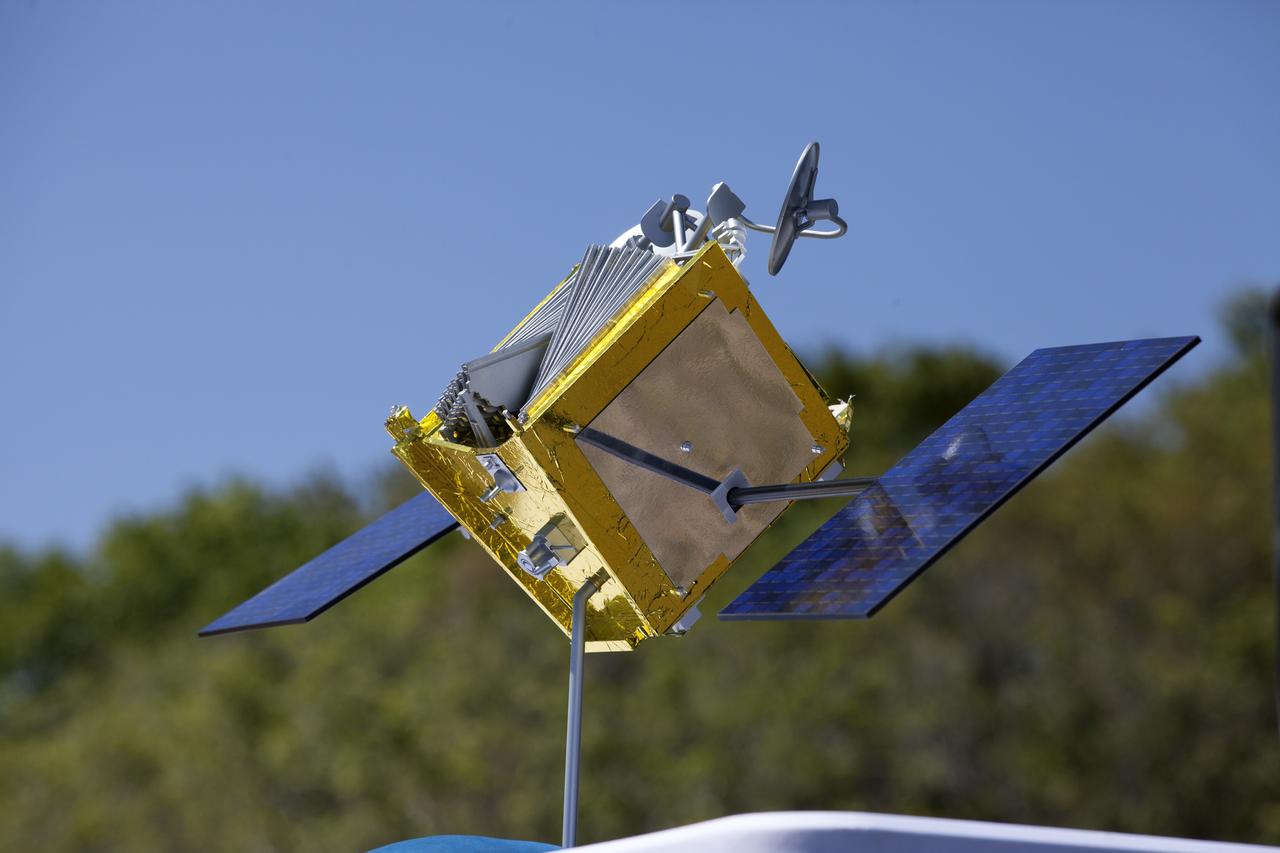
A model of a OneWeb satellite like those the company will build to will connect all areas of the world to the Internet wirelessly. The company plans to launch 2,000 of the satellites as part of its constellation. The satellites will be built at a new factory at Exploration Park at NASA's Kennedy Space Center. The company held a groundbreaking ceremony for the factory. Photo credit: NASA/Kim Shiflett
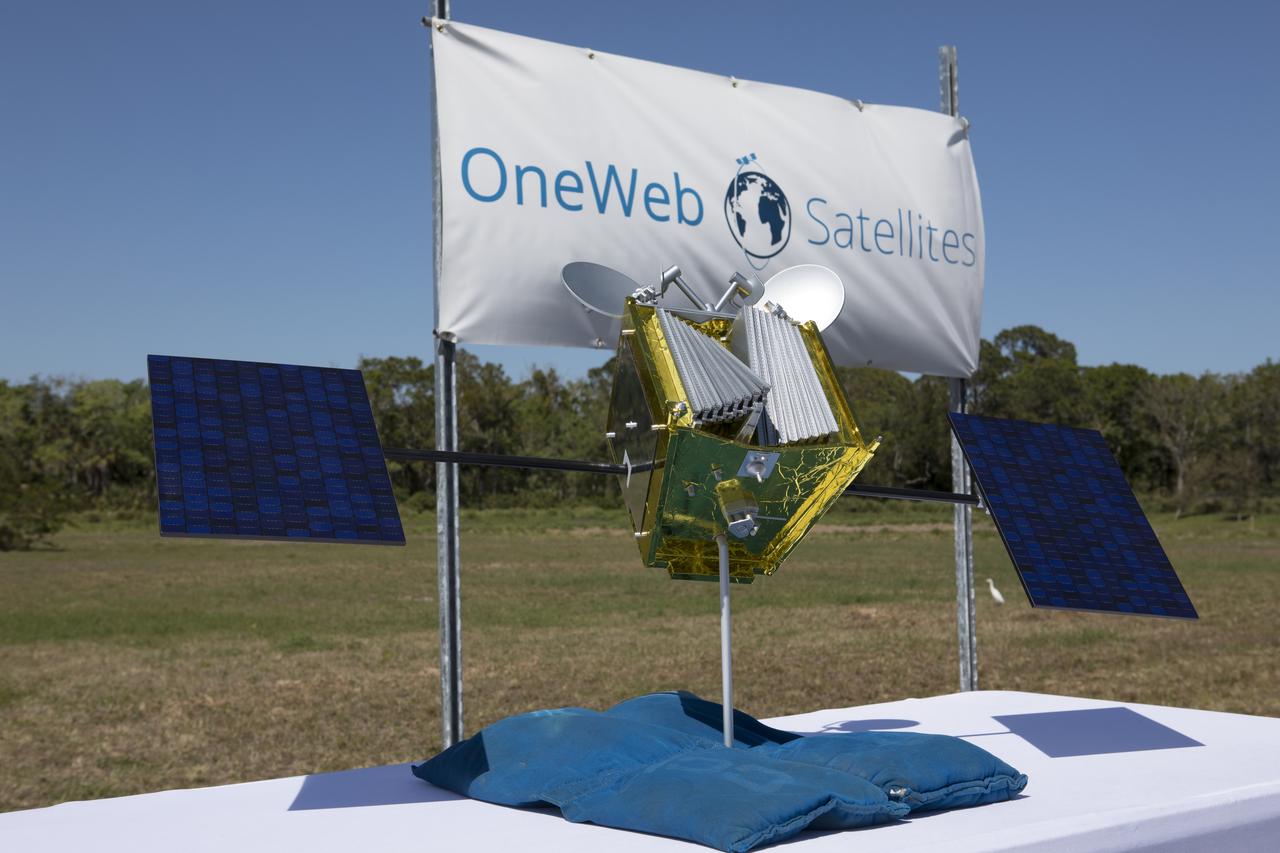
A model of a OneWeb satellite like those the company will build to will connect all areas of the world to the Internet wirelessly. The company plans to launch 2,000 of the satellites as part of its constellation. The satellites will be built at a new factory at Exploration Park at NASA's Kennedy Space Center. The company held a groundbreaking ceremony for the factory. Photo credit: NASA/Kim Shiflett

In this infrared view from the Herschel Observatory, a European Space Agency mission, blue shows the warmest dust, and red, the coolest. The choppy clouds of gas and dust are just starting to condense into new stars.
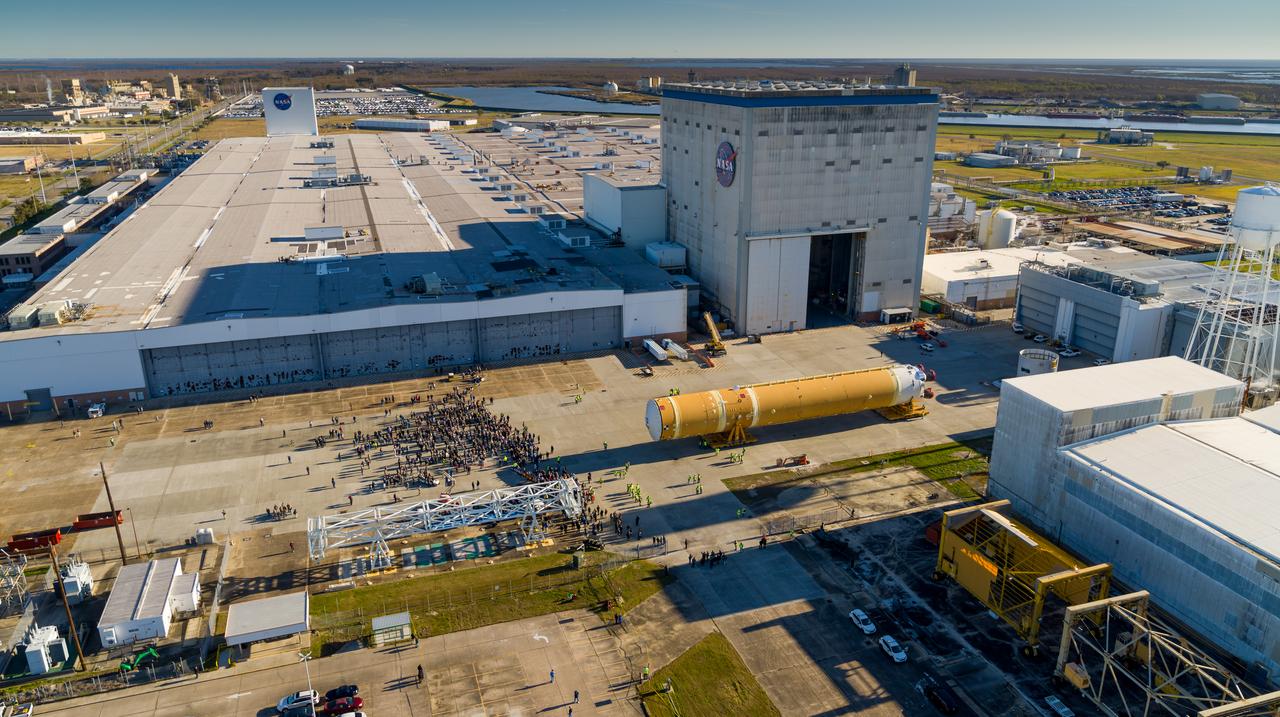
These images/video show how teams rolled out, or moved, the completed core stage for NASA’s Space Launch System rocket from NASA’s Michoud Assembly Facility in New Orleans. Crews moved the flight hardware for the first Artemis mission to NASA’s Pegasus barge on Jan. 8 in preparation for the core stage Green Run test series at NASA’s Stennis Space Center near Bay St. Louis, Mississippi. Pegasus, which was modified to ferry SLS rocket hardware, will transport the core stage from Michoud to Stennis for the comprehensive core stage Green Run test series. Once at Stennis, the Artemis rocket stage will be loaded into the B-2 Test Stand for the core stage Green Run test series. The comprehensive test campaign will progressively bring the entire core stage, including its avionics and engines, to life for the first time to verify the stage is fit for flight ahead of the launch of Artemis I. Assembly and integration of the core stage and its four RS-25 engines has been a collaborative, multistep process for NASA and its partners Boeing, the core stage lead contractor, and Aerojet Rocketdyne, the RS-25 engines lead contractor. Together with four RS-25 engines, the rocket’s massive 212-foot-tall core stage — the largest stage NASA has ever built — and its twin solid rocket boosters will produce 8.8 million pounds of thrust to send NASA’s Orion spacecraft, astronauts and supplies beyond Earth’s orbit to the Moon and, ultimately, Mars. Offering more payload mass, volume capability and energy to speed missions through space, the SLS rocket, along with NASA’s Gateway in lunar orbit and Orion, is part of NASA’s backbone for deep space exploration and the Artemis lunar program.
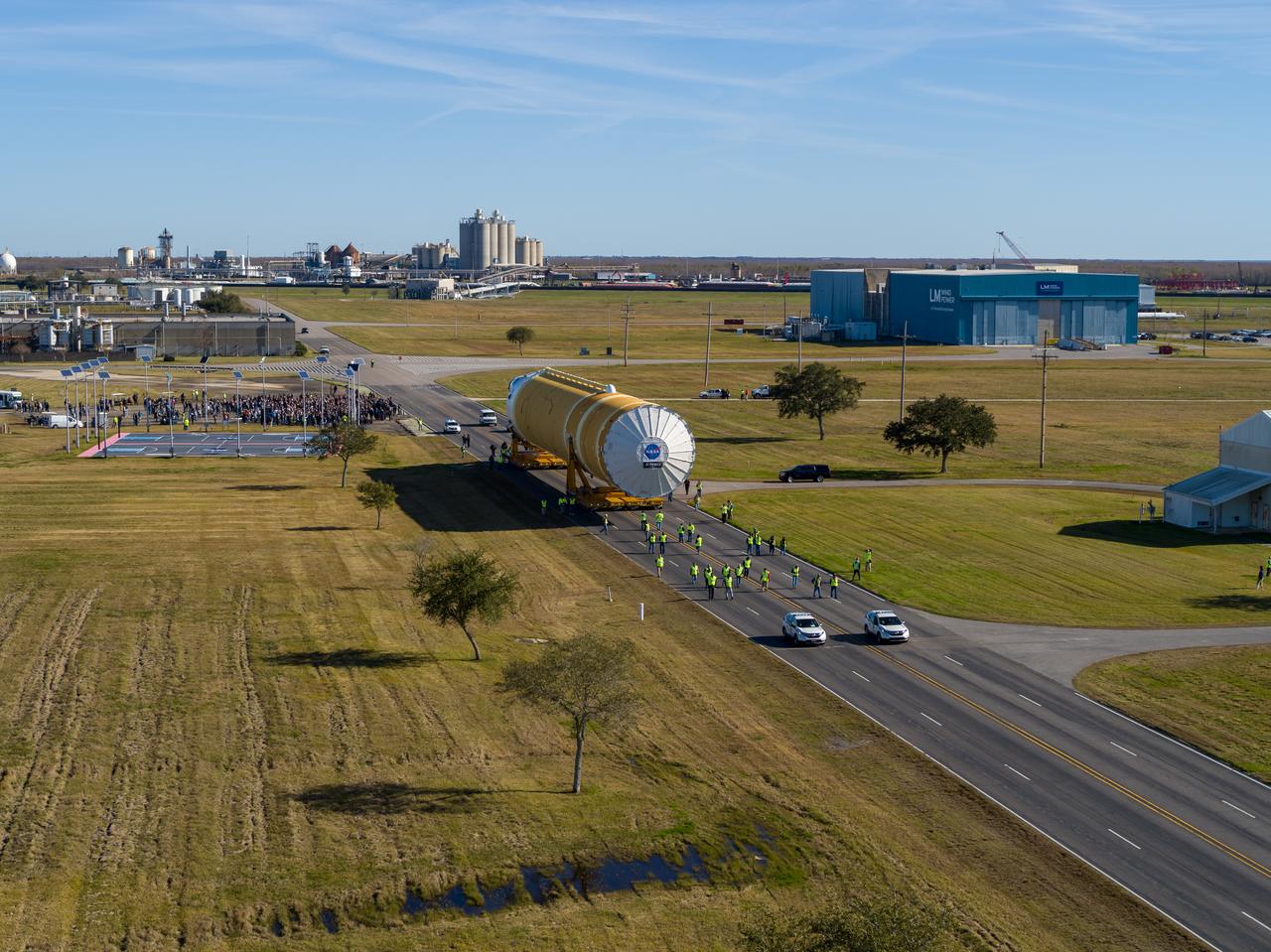
These images/video show how teams rolled out, or moved, the completed core stage for NASA’s Space Launch System rocket from NASA’s Michoud Assembly Facility in New Orleans. Crews moved the flight hardware for the first Artemis mission to NASA’s Pegasus barge on Jan. 8 in preparation for the core stage Green Run test series at NASA’s Stennis Space Center near Bay St. Louis, Mississippi. Pegasus, which was modified to ferry SLS rocket hardware, will transport the core stage from Michoud to Stennis for the comprehensive core stage Green Run test series. Once at Stennis, the Artemis rocket stage will be loaded into the B-2 Test Stand for the core stage Green Run test series. The comprehensive test campaign will progressively bring the entire core stage, including its avionics and engines, to life for the first time to verify the stage is fit for flight ahead of the launch of Artemis I. Assembly and integration of the core stage and its four RS-25 engines has been a collaborative, multistep process for NASA and its partners Boeing, the core stage lead contractor, and Aerojet Rocketdyne, the RS-25 engines lead contractor. Together with four RS-25 engines, the rocket’s massive 212-foot-tall core stage — the largest stage NASA has ever built — and its twin solid rocket boosters will produce 8.8 million pounds of thrust to send NASA’s Orion spacecraft, astronauts and supplies beyond Earth’s orbit to the Moon and, ultimately, Mars. Offering more payload mass, volume capability and energy to speed missions through space, the SLS rocket, along with NASA’s Gateway in lunar orbit and Orion, is part of NASA’s backbone for deep space exploration and the Artemis lunar program.

These images/video show how teams rolled out, or moved, the completed core stage for NASA’s Space Launch System rocket from NASA’s Michoud Assembly Facility in New Orleans. Crews moved the flight hardware for the first Artemis mission to NASA’s Pegasus barge on Jan. 8 in preparation for the core stage Green Run test series at NASA’s Stennis Space Center near Bay St. Louis, Mississippi. Pegasus, which was modified to ferry SLS rocket hardware, will transport the core stage from Michoud to Stennis for the comprehensive core stage Green Run test series. Once at Stennis, the Artemis rocket stage will be loaded into the B-2 Test Stand for the core stage Green Run test series. The comprehensive test campaign will progressively bring the entire core stage, including its avionics and engines, to life for the first time to verify the stage is fit for flight ahead of the launch of Artemis I. Assembly and integration of the core stage and its four RS-25 engines has been a collaborative, multistep process for NASA and its partners Boeing, the core stage lead contractor, and Aerojet Rocketdyne, the RS-25 engines lead contractor. Together with four RS-25 engines, the rocket’s massive 212-foot-tall core stage — the largest stage NASA has ever built — and its twin solid rocket boosters will produce 8.8 million pounds of thrust to send NASA’s Orion spacecraft, astronauts and supplies beyond Earth’s orbit to the Moon and, ultimately, Mars. Offering more payload mass, volume capability and energy to speed missions through space, the SLS rocket, along with NASA’s Gateway in lunar orbit and Orion, is part of NASA’s backbone for deep space exploration and the Artemis lunar program.
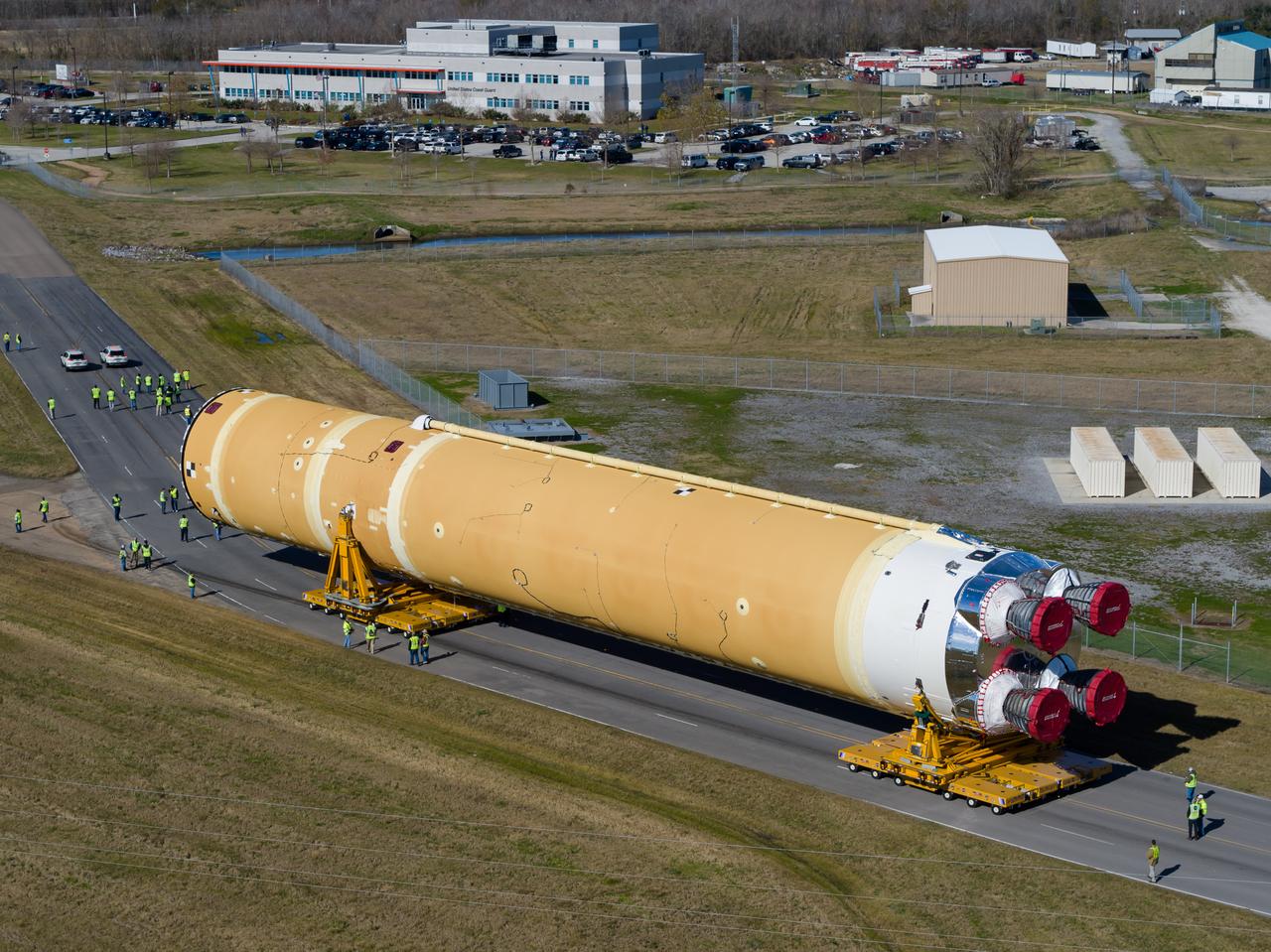
These images/video show how teams rolled out, or moved, the completed core stage for NASA’s Space Launch System rocket from NASA’s Michoud Assembly Facility in New Orleans. Crews moved the flight hardware for the first Artemis mission to NASA’s Pegasus barge on Jan. 8 in preparation for the core stage Green Run test series at NASA’s Stennis Space Center near Bay St. Louis, Mississippi. Pegasus, which was modified to ferry SLS rocket hardware, will transport the core stage from Michoud to Stennis for the comprehensive core stage Green Run test series. Once at Stennis, the Artemis rocket stage will be loaded into the B-2 Test Stand for the core stage Green Run test series. The comprehensive test campaign will progressively bring the entire core stage, including its avionics and engines, to life for the first time to verify the stage is fit for flight ahead of the launch of Artemis I. Assembly and integration of the core stage and its four RS-25 engines has been a collaborative, multistep process for NASA and its partners Boeing, the core stage lead contractor, and Aerojet Rocketdyne, the RS-25 engines lead contractor. Together with four RS-25 engines, the rocket’s massive 212-foot-tall core stage — the largest stage NASA has ever built — and its twin solid rocket boosters will produce 8.8 million pounds of thrust to send NASA’s Orion spacecraft, astronauts and supplies beyond Earth’s orbit to the Moon and, ultimately, Mars. Offering more payload mass, volume capability and energy to speed missions through space, the SLS rocket, along with NASA’s Gateway in lunar orbit and Orion, is part of NASA’s backbone for deep space exploration and the Artemis lunar program.
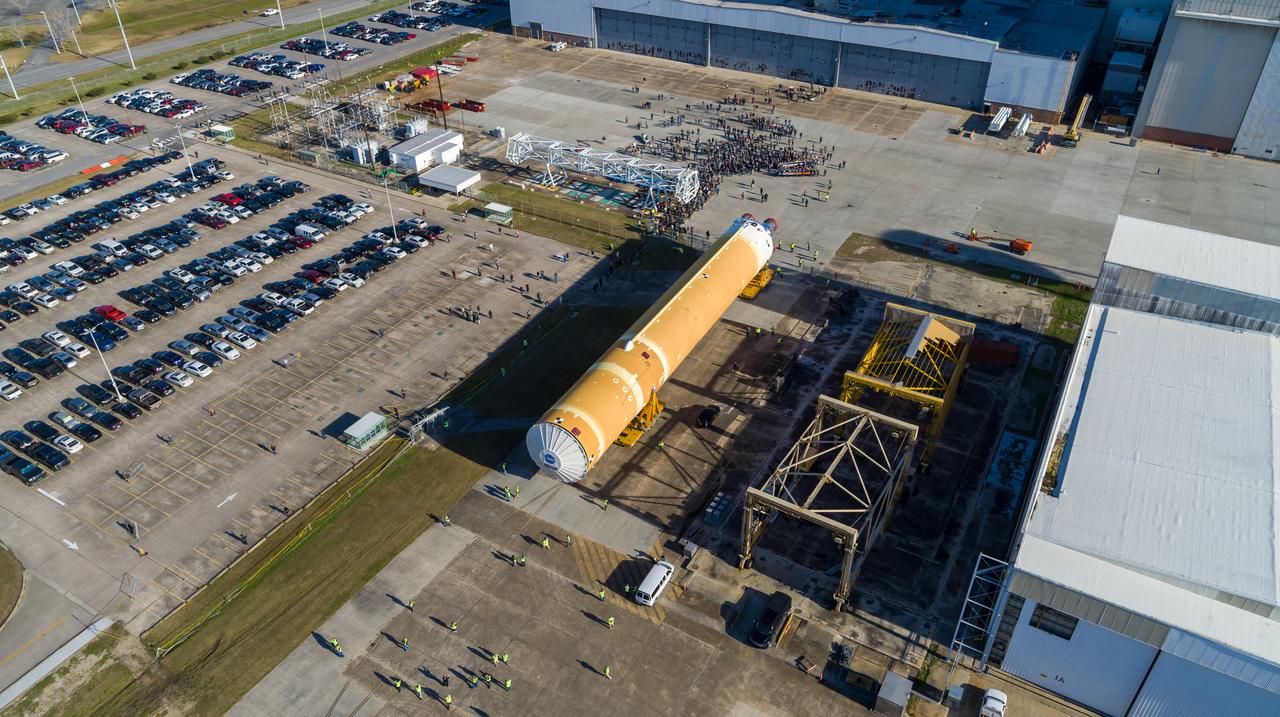
These images/video show how teams rolled out, or moved, the completed core stage for NASA’s Space Launch System rocket from NASA’s Michoud Assembly Facility in New Orleans. Crews moved the flight hardware for the first Artemis mission to NASA’s Pegasus barge on Jan. 8 in preparation for the core stage Green Run test series at NASA’s Stennis Space Center near Bay St. Louis, Mississippi. Pegasus, which was modified to ferry SLS rocket hardware, will transport the core stage from Michoud to Stennis for the comprehensive core stage Green Run test series. Once at Stennis, the Artemis rocket stage will be loaded into the B-2 Test Stand for the core stage Green Run test series. The comprehensive test campaign will progressively bring the entire core stage, including its avionics and engines, to life for the first time to verify the stage is fit for flight ahead of the launch of Artemis I. Assembly and integration of the core stage and its four RS-25 engines has been a collaborative, multistep process for NASA and its partners Boeing, the core stage lead contractor, and Aerojet Rocketdyne, the RS-25 engines lead contractor. Together with four RS-25 engines, the rocket’s massive 212-foot-tall core stage — the largest stage NASA has ever built — and its twin solid rocket boosters will produce 8.8 million pounds of thrust to send NASA’s Orion spacecraft, astronauts and supplies beyond Earth’s orbit to the Moon and, ultimately, Mars. Offering more payload mass, volume capability and energy to speed missions through space, the SLS rocket, along with NASA’s Gateway in lunar orbit and Orion, is part of NASA’s backbone for deep space exploration and the Artemis lunar program.
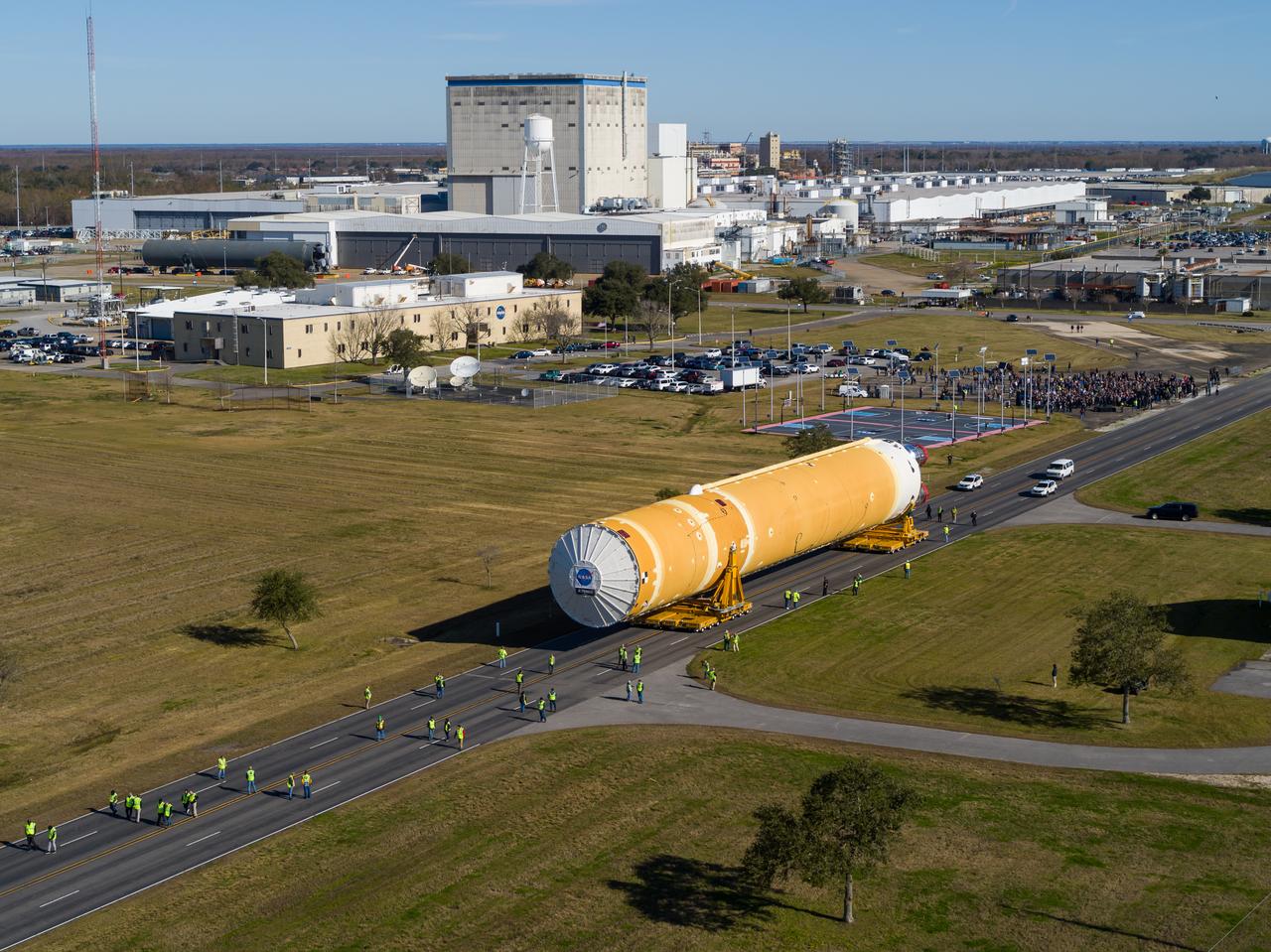
These images/video show how teams rolled out, or moved, the completed core stage for NASA’s Space Launch System rocket from NASA’s Michoud Assembly Facility in New Orleans. Crews moved the flight hardware for the first Artemis mission to NASA’s Pegasus barge on Jan. 8 in preparation for the core stage Green Run test series at NASA’s Stennis Space Center near Bay St. Louis, Mississippi. Pegasus, which was modified to ferry SLS rocket hardware, will transport the core stage from Michoud to Stennis for the comprehensive core stage Green Run test series. Once at Stennis, the Artemis rocket stage will be loaded into the B-2 Test Stand for the core stage Green Run test series. The comprehensive test campaign will progressively bring the entire core stage, including its avionics and engines, to life for the first time to verify the stage is fit for flight ahead of the launch of Artemis I. Assembly and integration of the core stage and its four RS-25 engines has been a collaborative, multistep process for NASA and its partners Boeing, the core stage lead contractor, and Aerojet Rocketdyne, the RS-25 engines lead contractor. Together with four RS-25 engines, the rocket’s massive 212-foot-tall core stage — the largest stage NASA has ever built — and its twin solid rocket boosters will produce 8.8 million pounds of thrust to send NASA’s Orion spacecraft, astronauts and supplies beyond Earth’s orbit to the Moon and, ultimately, Mars. Offering more payload mass, volume capability and energy to speed missions through space, the SLS rocket, along with NASA’s Gateway in lunar orbit and Orion, is part of NASA’s backbone for deep space exploration and the Artemis lunar program.
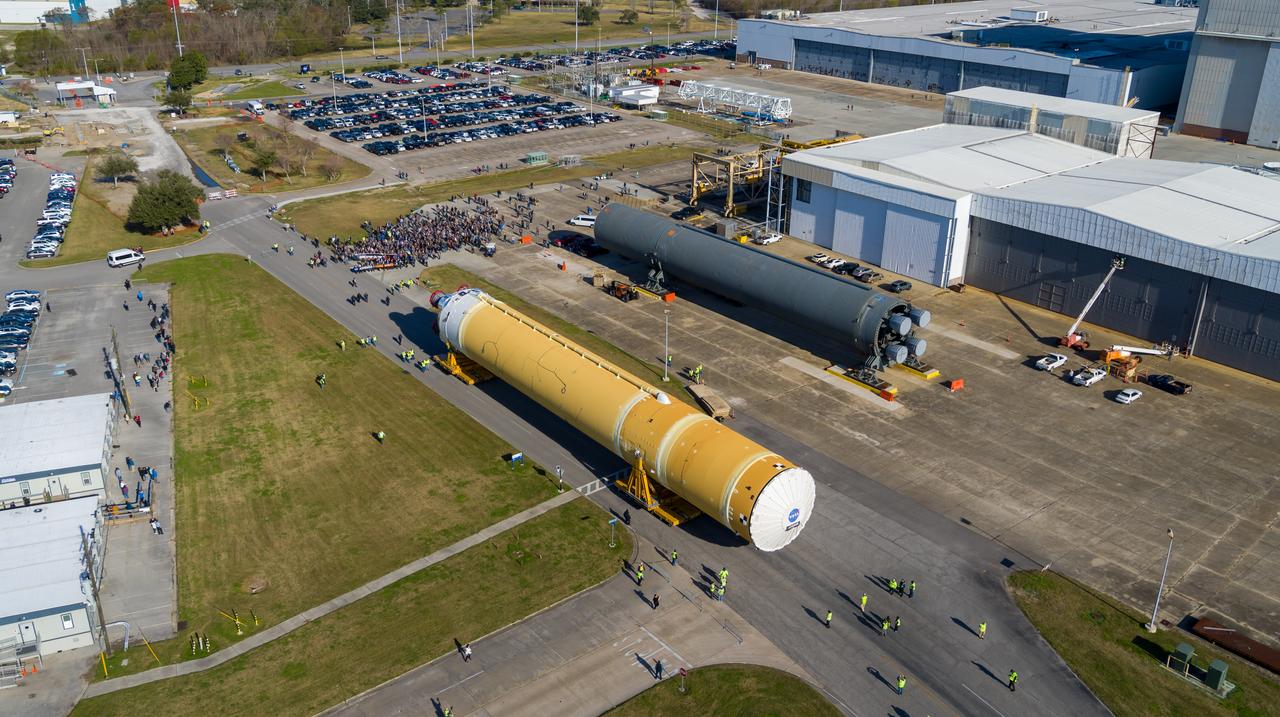
These images/video show how teams rolled out, or moved, the completed core stage for NASA’s Space Launch System rocket from NASA’s Michoud Assembly Facility in New Orleans. Crews moved the flight hardware for the first Artemis mission to NASA’s Pegasus barge on Jan. 8 in preparation for the core stage Green Run test series at NASA’s Stennis Space Center near Bay St. Louis, Mississippi. Pegasus, which was modified to ferry SLS rocket hardware, will transport the core stage from Michoud to Stennis for the comprehensive core stage Green Run test series. Once at Stennis, the Artemis rocket stage will be loaded into the B-2 Test Stand for the core stage Green Run test series. The comprehensive test campaign will progressively bring the entire core stage, including its avionics and engines, to life for the first time to verify the stage is fit for flight ahead of the launch of Artemis I. Assembly and integration of the core stage and its four RS-25 engines has been a collaborative, multistep process for NASA and its partners Boeing, the core stage lead contractor, and Aerojet Rocketdyne, the RS-25 engines lead contractor. Together with four RS-25 engines, the rocket’s massive 212-foot-tall core stage — the largest stage NASA has ever built — and its twin solid rocket boosters will produce 8.8 million pounds of thrust to send NASA’s Orion spacecraft, astronauts and supplies beyond Earth’s orbit to the Moon and, ultimately, Mars. Offering more payload mass, volume capability and energy to speed missions through space, the SLS rocket, along with NASA’s Gateway in lunar orbit and Orion, is part of NASA’s backbone for deep space exploration and the Artemis lunar program.
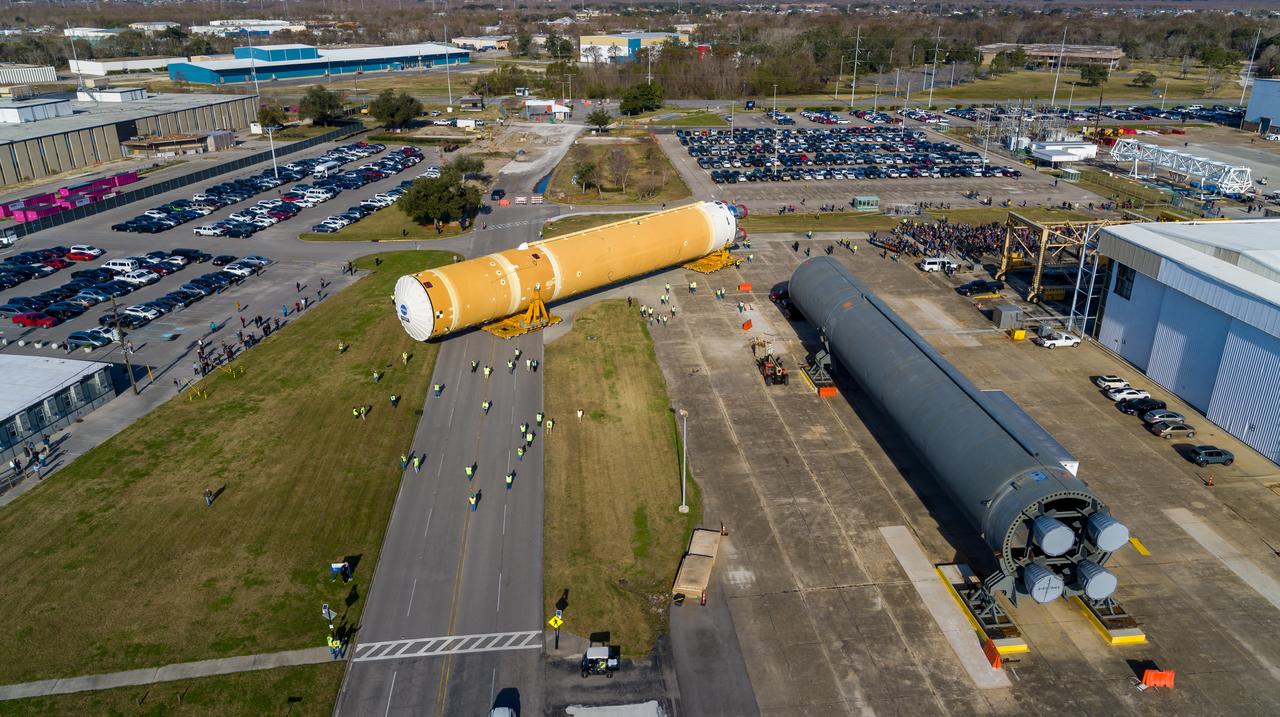
These images/video show how teams rolled out, or moved, the completed core stage for NASA’s Space Launch System rocket from NASA’s Michoud Assembly Facility in New Orleans. Crews moved the flight hardware for the first Artemis mission to NASA’s Pegasus barge on Jan. 8 in preparation for the core stage Green Run test series at NASA’s Stennis Space Center near Bay St. Louis, Mississippi. Pegasus, which was modified to ferry SLS rocket hardware, will transport the core stage from Michoud to Stennis for the comprehensive core stage Green Run test series. Once at Stennis, the Artemis rocket stage will be loaded into the B-2 Test Stand for the core stage Green Run test series. The comprehensive test campaign will progressively bring the entire core stage, including its avionics and engines, to life for the first time to verify the stage is fit for flight ahead of the launch of Artemis I. Assembly and integration of the core stage and its four RS-25 engines has been a collaborative, multistep process for NASA and its partners Boeing, the core stage lead contractor, and Aerojet Rocketdyne, the RS-25 engines lead contractor. Together with four RS-25 engines, the rocket’s massive 212-foot-tall core stage — the largest stage NASA has ever built — and its twin solid rocket boosters will produce 8.8 million pounds of thrust to send NASA’s Orion spacecraft, astronauts and supplies beyond Earth’s orbit to the Moon and, ultimately, Mars. Offering more payload mass, volume capability and energy to speed missions through space, the SLS rocket, along with NASA’s Gateway in lunar orbit and Orion, is part of NASA’s backbone for deep space exploration and the Artemis lunar program.
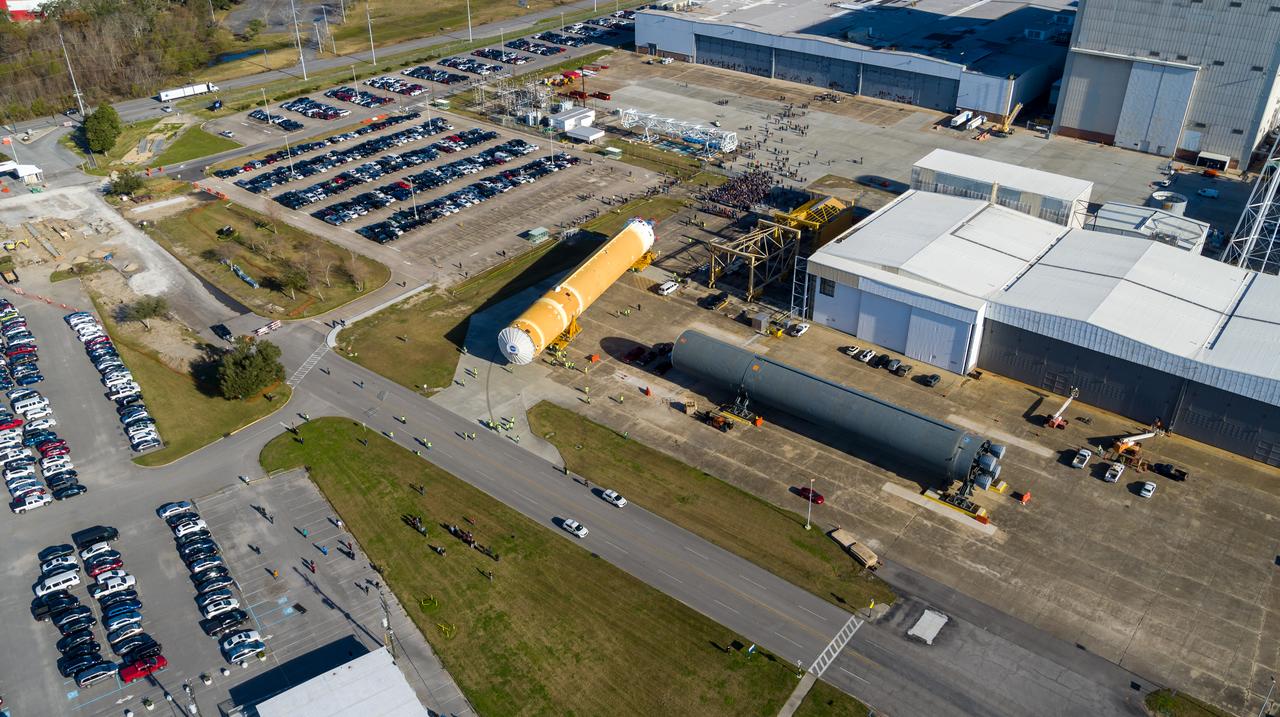
These images/video show how teams rolled out, or moved, the completed core stage for NASA’s Space Launch System rocket from NASA’s Michoud Assembly Facility in New Orleans. Crews moved the flight hardware for the first Artemis mission to NASA’s Pegasus barge on Jan. 8 in preparation for the core stage Green Run test series at NASA’s Stennis Space Center near Bay St. Louis, Mississippi. Pegasus, which was modified to ferry SLS rocket hardware, will transport the core stage from Michoud to Stennis for the comprehensive core stage Green Run test series. Once at Stennis, the Artemis rocket stage will be loaded into the B-2 Test Stand for the core stage Green Run test series. The comprehensive test campaign will progressively bring the entire core stage, including its avionics and engines, to life for the first time to verify the stage is fit for flight ahead of the launch of Artemis I. Assembly and integration of the core stage and its four RS-25 engines has been a collaborative, multistep process for NASA and its partners Boeing, the core stage lead contractor, and Aerojet Rocketdyne, the RS-25 engines lead contractor. Together with four RS-25 engines, the rocket’s massive 212-foot-tall core stage — the largest stage NASA has ever built — and its twin solid rocket boosters will produce 8.8 million pounds of thrust to send NASA’s Orion spacecraft, astronauts and supplies beyond Earth’s orbit to the Moon and, ultimately, Mars. Offering more payload mass, volume capability and energy to speed missions through space, the SLS rocket, along with NASA’s Gateway in lunar orbit and Orion, is part of NASA’s backbone for deep space exploration and the Artemis lunar program.
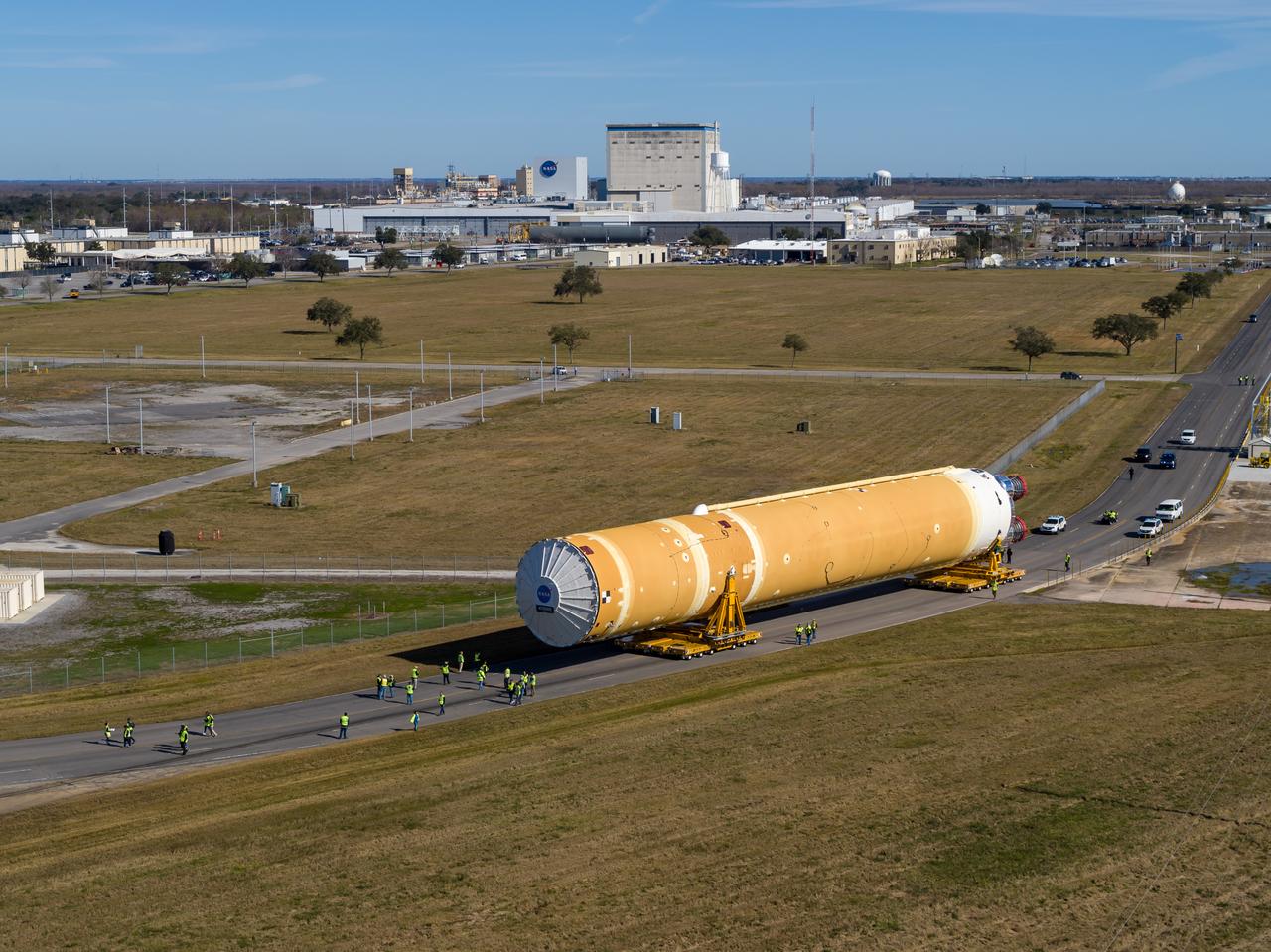
These images/video show how teams rolled out, or moved, the completed core stage for NASA’s Space Launch System rocket from NASA’s Michoud Assembly Facility in New Orleans. Crews moved the flight hardware for the first Artemis mission to NASA’s Pegasus barge on Jan. 8 in preparation for the core stage Green Run test series at NASA’s Stennis Space Center near Bay St. Louis, Mississippi. Pegasus, which was modified to ferry SLS rocket hardware, will transport the core stage from Michoud to Stennis for the comprehensive core stage Green Run test series. Once at Stennis, the Artemis rocket stage will be loaded into the B-2 Test Stand for the core stage Green Run test series. The comprehensive test campaign will progressively bring the entire core stage, including its avionics and engines, to life for the first time to verify the stage is fit for flight ahead of the launch of Artemis I. Assembly and integration of the core stage and its four RS-25 engines has been a collaborative, multistep process for NASA and its partners Boeing, the core stage lead contractor, and Aerojet Rocketdyne, the RS-25 engines lead contractor. Together with four RS-25 engines, the rocket’s massive 212-foot-tall core stage — the largest stage NASA has ever built — and its twin solid rocket boosters will produce 8.8 million pounds of thrust to send NASA’s Orion spacecraft, astronauts and supplies beyond Earth’s orbit to the Moon and, ultimately, Mars. Offering more payload mass, volume capability and energy to speed missions through space, the SLS rocket, along with NASA’s Gateway in lunar orbit and Orion, is part of NASA’s backbone for deep space exploration and the Artemis lunar program.
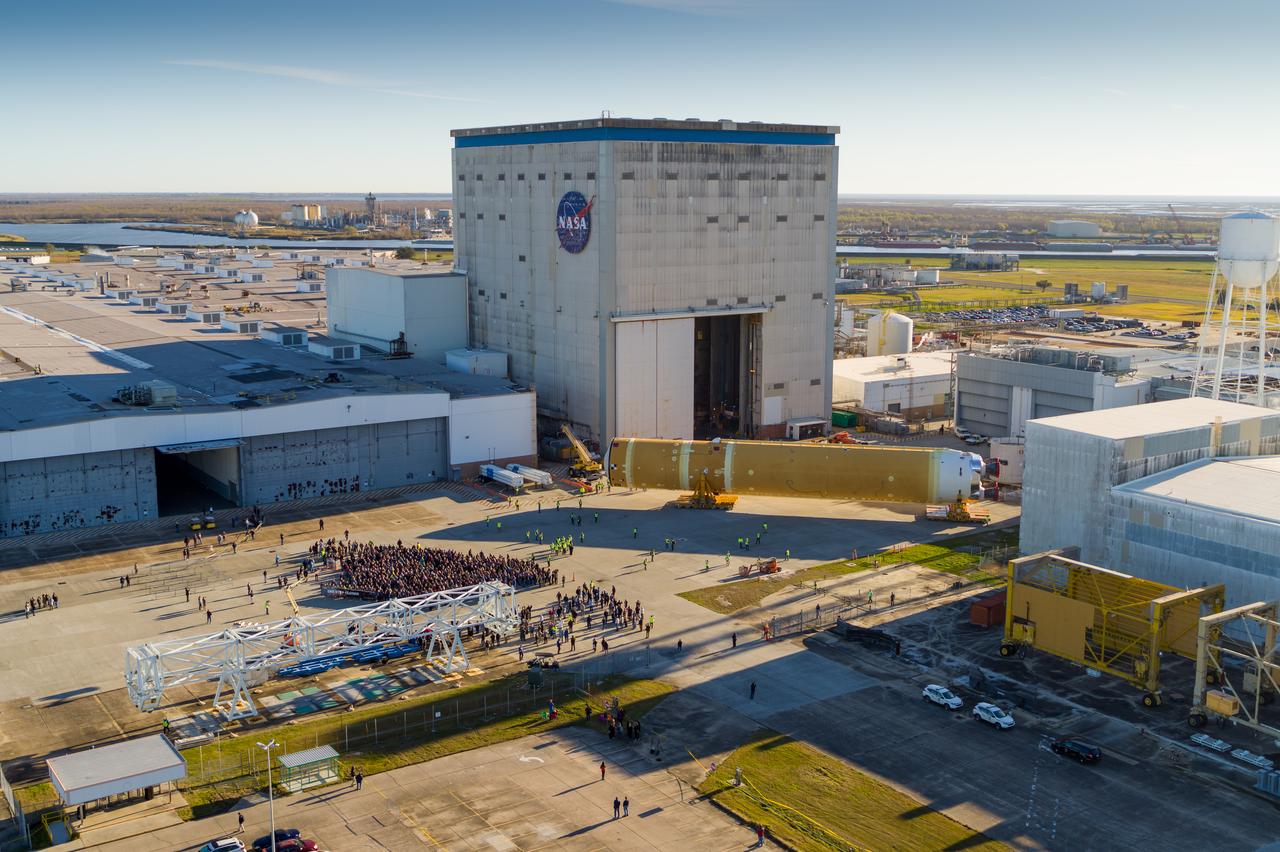
These images/video show how teams rolled out, or moved, the completed core stage for NASA’s Space Launch System rocket from NASA’s Michoud Assembly Facility in New Orleans. Crews moved the flight hardware for the first Artemis mission to NASA’s Pegasus barge on Jan. 8 in preparation for the core stage Green Run test series at NASA’s Stennis Space Center near Bay St. Louis, Mississippi. Pegasus, which was modified to ferry SLS rocket hardware, will transport the core stage from Michoud to Stennis for the comprehensive core stage Green Run test series. Once at Stennis, the Artemis rocket stage will be loaded into the B-2 Test Stand for the core stage Green Run test series. The comprehensive test campaign will progressively bring the entire core stage, including its avionics and engines, to life for the first time to verify the stage is fit for flight ahead of the launch of Artemis I. Assembly and integration of the core stage and its four RS-25 engines has been a collaborative, multistep process for NASA and its partners Boeing, the core stage lead contractor, and Aerojet Rocketdyne, the RS-25 engines lead contractor. Together with four RS-25 engines, the rocket’s massive 212-foot-tall core stage — the largest stage NASA has ever built — and its twin solid rocket boosters will produce 8.8 million pounds of thrust to send NASA’s Orion spacecraft, astronauts and supplies beyond Earth’s orbit to the Moon and, ultimately, Mars. Offering more payload mass, volume capability and energy to speed missions through space, the SLS rocket, along with NASA’s Gateway in lunar orbit and Orion, is part of NASA’s backbone for deep space exploration and the Artemis lunar program.
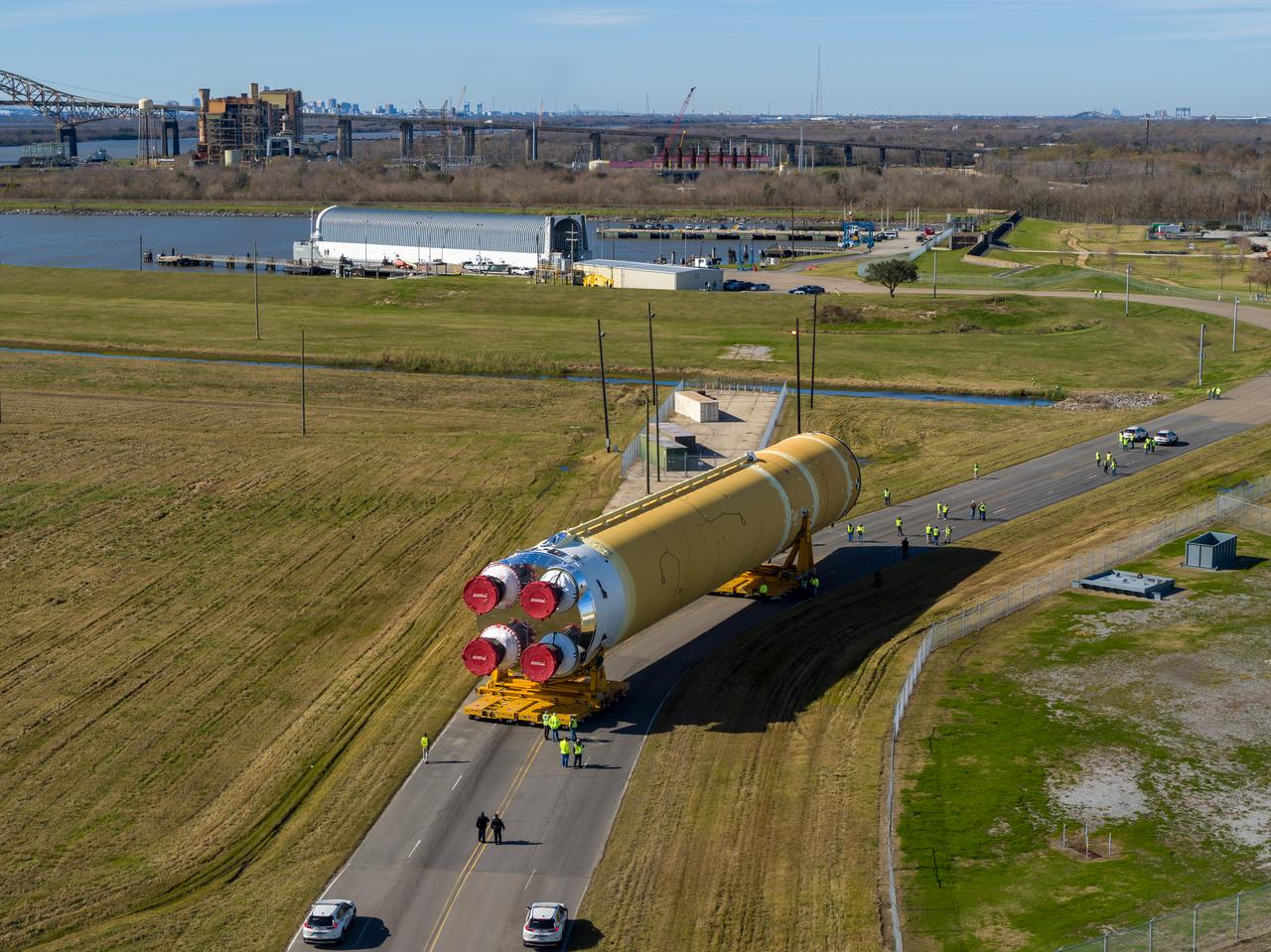
These images/video show how teams rolled out, or moved, the completed core stage for NASA’s Space Launch System rocket from NASA’s Michoud Assembly Facility in New Orleans. Crews moved the flight hardware for the first Artemis mission to NASA’s Pegasus barge on Jan. 8 in preparation for the core stage Green Run test series at NASA’s Stennis Space Center near Bay St. Louis, Mississippi. Pegasus, which was modified to ferry SLS rocket hardware, will transport the core stage from Michoud to Stennis for the comprehensive core stage Green Run test series. Once at Stennis, the Artemis rocket stage will be loaded into the B-2 Test Stand for the core stage Green Run test series. The comprehensive test campaign will progressively bring the entire core stage, including its avionics and engines, to life for the first time to verify the stage is fit for flight ahead of the launch of Artemis I. Assembly and integration of the core stage and its four RS-25 engines has been a collaborative, multistep process for NASA and its partners Boeing, the core stage lead contractor, and Aerojet Rocketdyne, the RS-25 engines lead contractor. Together with four RS-25 engines, the rocket’s massive 212-foot-tall core stage — the largest stage NASA has ever built — and its twin solid rocket boosters will produce 8.8 million pounds of thrust to send NASA’s Orion spacecraft, astronauts and supplies beyond Earth’s orbit to the Moon and, ultimately, Mars. Offering more payload mass, volume capability and energy to speed missions through space, the SLS rocket, along with NASA’s Gateway in lunar orbit and Orion, is part of NASA’s backbone for deep space exploration and the Artemis lunar program.
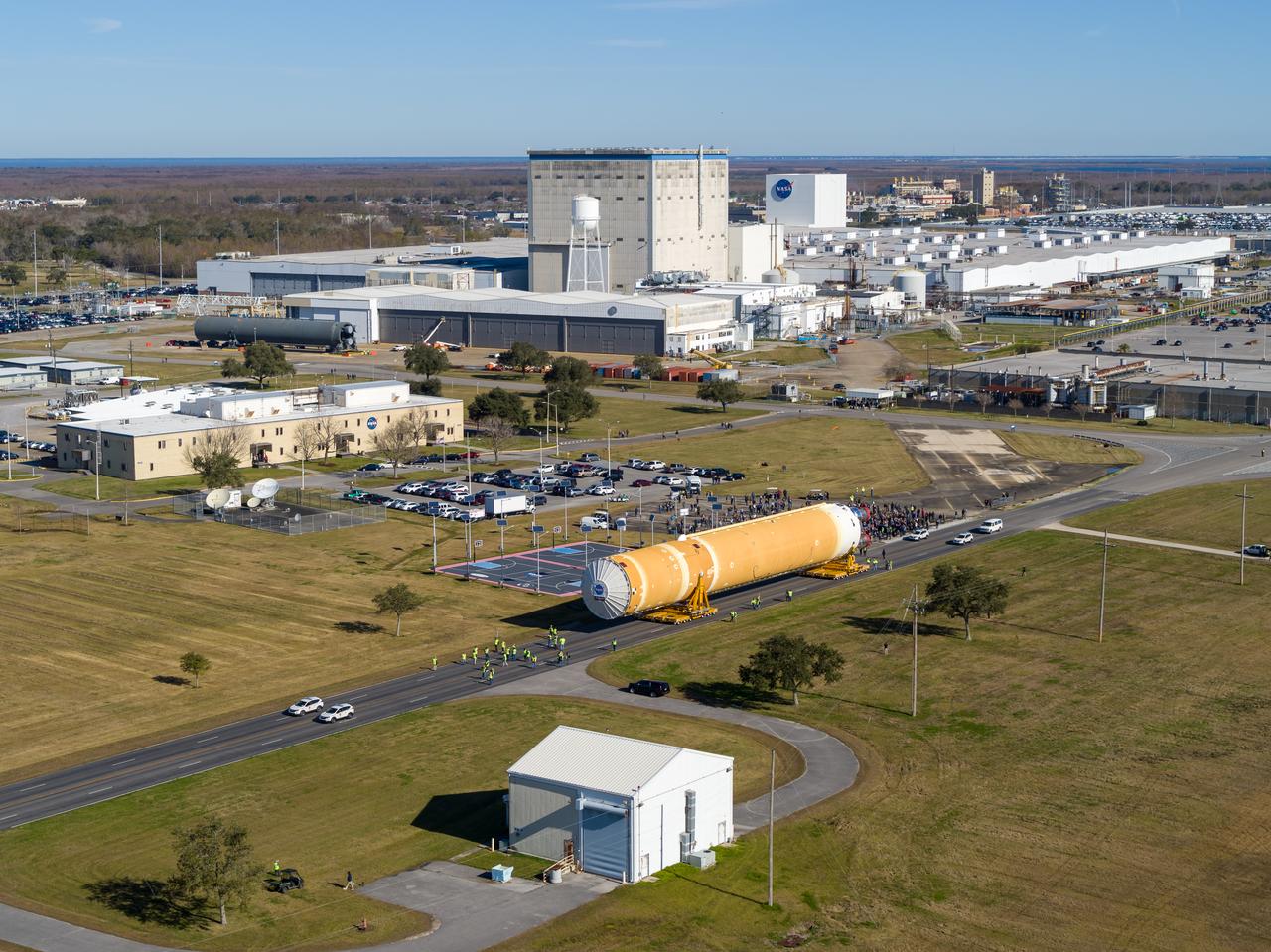
These images/video show how teams rolled out, or moved, the completed core stage for NASA’s Space Launch System rocket from NASA’s Michoud Assembly Facility in New Orleans. Crews moved the flight hardware for the first Artemis mission to NASA’s Pegasus barge on Jan. 8 in preparation for the core stage Green Run test series at NASA’s Stennis Space Center near Bay St. Louis, Mississippi. Pegasus, which was modified to ferry SLS rocket hardware, will transport the core stage from Michoud to Stennis for the comprehensive core stage Green Run test series. Once at Stennis, the Artemis rocket stage will be loaded into the B-2 Test Stand for the core stage Green Run test series. The comprehensive test campaign will progressively bring the entire core stage, including its avionics and engines, to life for the first time to verify the stage is fit for flight ahead of the launch of Artemis I. Assembly and integration of the core stage and its four RS-25 engines has been a collaborative, multistep process for NASA and its partners Boeing, the core stage lead contractor, and Aerojet Rocketdyne, the RS-25 engines lead contractor. Together with four RS-25 engines, the rocket’s massive 212-foot-tall core stage — the largest stage NASA has ever built — and its twin solid rocket boosters will produce 8.8 million pounds of thrust to send NASA’s Orion spacecraft, astronauts and supplies beyond Earth’s orbit to the Moon and, ultimately, Mars. Offering more payload mass, volume capability and energy to speed missions through space, the SLS rocket, along with NASA’s Gateway in lunar orbit and Orion, is part of NASA’s backbone for deep space exploration and the Artemis lunar program.
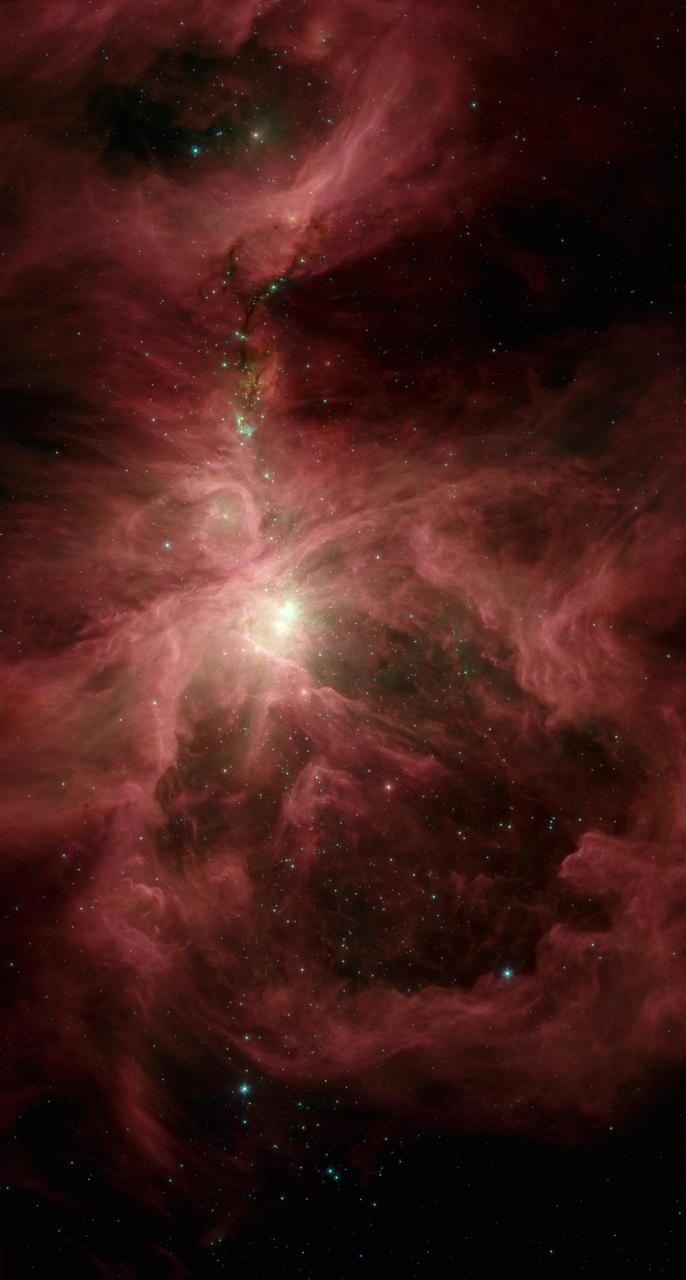
This image from NASA Spitzer Space Telescope shows the Orion nebula, our closest massive star-making factory, 1,450 light-years from Earth. The nebula is close enough to appear to the naked eye as a fuzzy star in the sword of the constellation.

The core stage liquid hydrogen tank for the Artemis III mission completed proof testing, and technicians returned it to the main factory building at NASA’s Michoud Assembly Facility in New Orleans where it will undergo more outfitting. As part of proof testing, technicians apply a simple soap solution and check for leaks by observing any bubble formation on the welds. The technician removed the bubble solution with distilled water and then dried the area of application to prevent corrosion. To build the Space Launch System (SLS) rocket’s 130-foot core stage liquid hydrogen tank, engineers use robotic tools to weld five-barrel segments. This process results in a tank with around 1,900 feet, or more than six football fields, of welds that must be tested by hand. After the leak tests, the core stage lead, Boeing, pressurized the SLS tank to further ensure there were no leaks. After it passed proof testing, technicians moved the Artemis III liquid hydrogen tank to Michoud’s main factory. Soon, the technicians will prime and apply a foam-based thermal protection system that protects the tank during launch. Later, the tank will be joined with other parts of the core stage to form the entire 212-foot rocket stage with its four RS-25 engines that produce 2 million pounds of thrust to help launch the rocket. Artemis III will land the first astronauts on the lunar surface. Photographed on Monday, April 18, 2022.
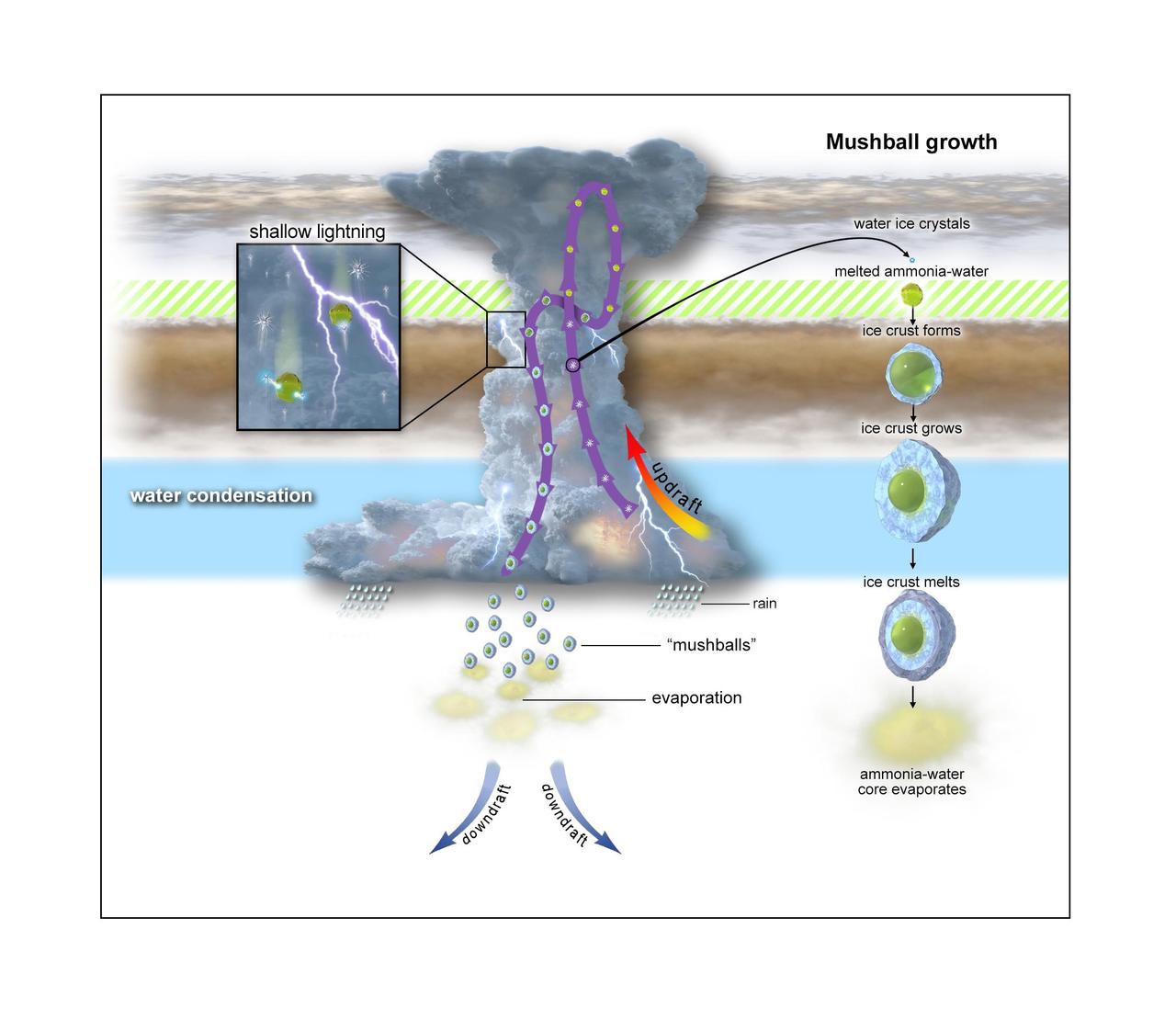
This graphic depicts the evolutionary process of "shallow lightning" and ammonia-water hailstones called "mushballs." An anvil-shaped thunderstorm cloud originates about 40 miles (65 kilometers) below Jupiter's visible cloud deck. Powered by water-based moist convection, the cloud generates strong updrafts that move liquid water and water ice particles upward. About 12 miles (19 kilometers) up, temperatures are so low that all of the water particles turn to ice. Still climbing, the ice particles cross a region located about 14 miles (23 kilometers) below the upper clouds, where temperatures are between minus 121 degrees Fahrenheit (minus 85 degrees Celsius) and minus 150 degrees Fahrenheit (minus 100 degrees Celsius), (depicted as green-hashed layer). At that point, ammonia vapor in the atmosphere acts like an antifreeze, melting the water-ice crystals, transforming them into ammonia-water liquid droplets which then grow and gather a solid icy shell to become mushballs. Once big enough, these slushy hailstones fall down, transporting both ammonia and water into Jupiter's deep atmosphere where the mushballs eventually evaporate. https://photojournal.jpl.nasa.gov/catalog/PIA24042

During its closest flyby of Saturn's moon Titan on April 16, the Cassini spacecraft came within 1,025 kilometers (637 miles) of the moon's surface and found that the outer layer of the thick, hazy atmosphere is brimming with complex hydrocarbons. This figure shows a mass spectrum of Titan's ionosphere near 1,200 kilometers (746 miles) above its surface. The mass range covered goes from hydrogen at 1 atomic mass unit per elementary charge (Dalton) to 99 Daltons. This mass range includes compounds with 1, 2, 3, 4, 5, 6, and 7 carbons as the base structure (as indicated in the figure label). The identified compounds include multiple carbon molecules and carbon-nitrogen bearing species as well. http://photojournal.jpl.nasa.gov/catalog/PIA07865
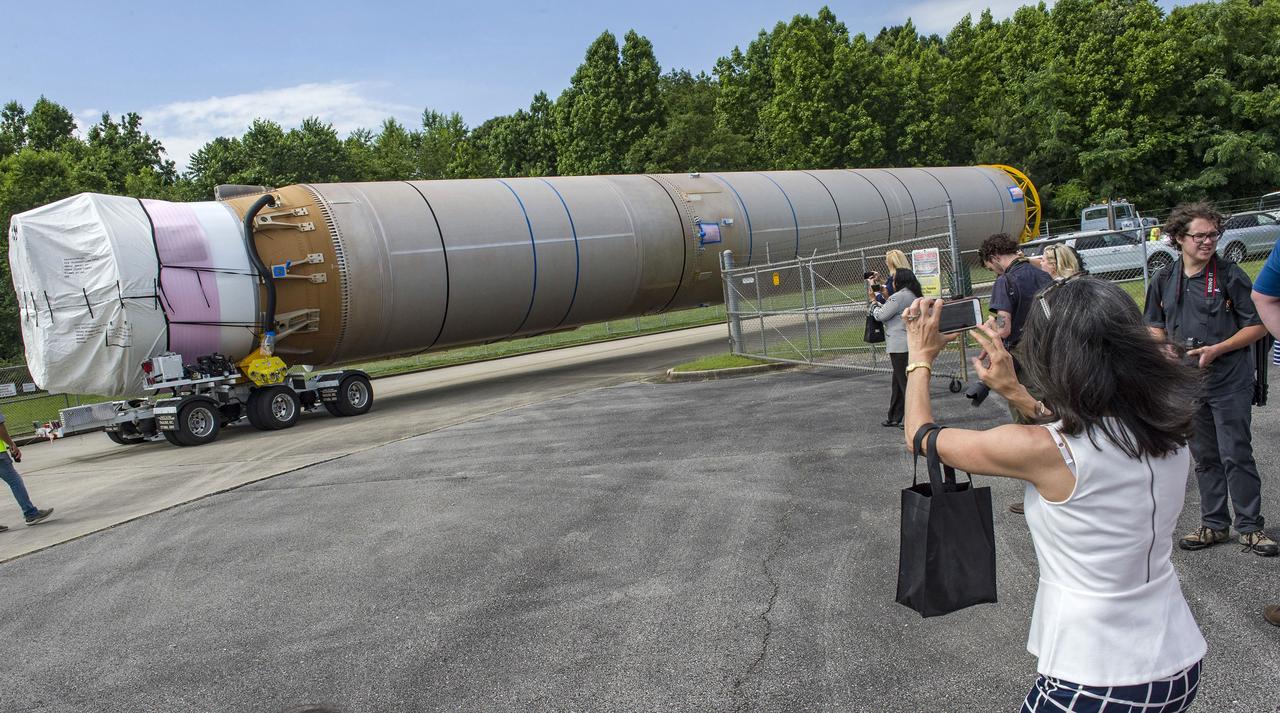
The United Launch Alliance Atlas V rocket that will launch Boeing’s CST-100 Starliner on the Crew Flight Test (CFT) mission to the International Space Station for NASA’s Commercial Crew Program emerged from the factory on May 24, 2019, rolling into a giant cargo ship for transport to Cape Canaveral.
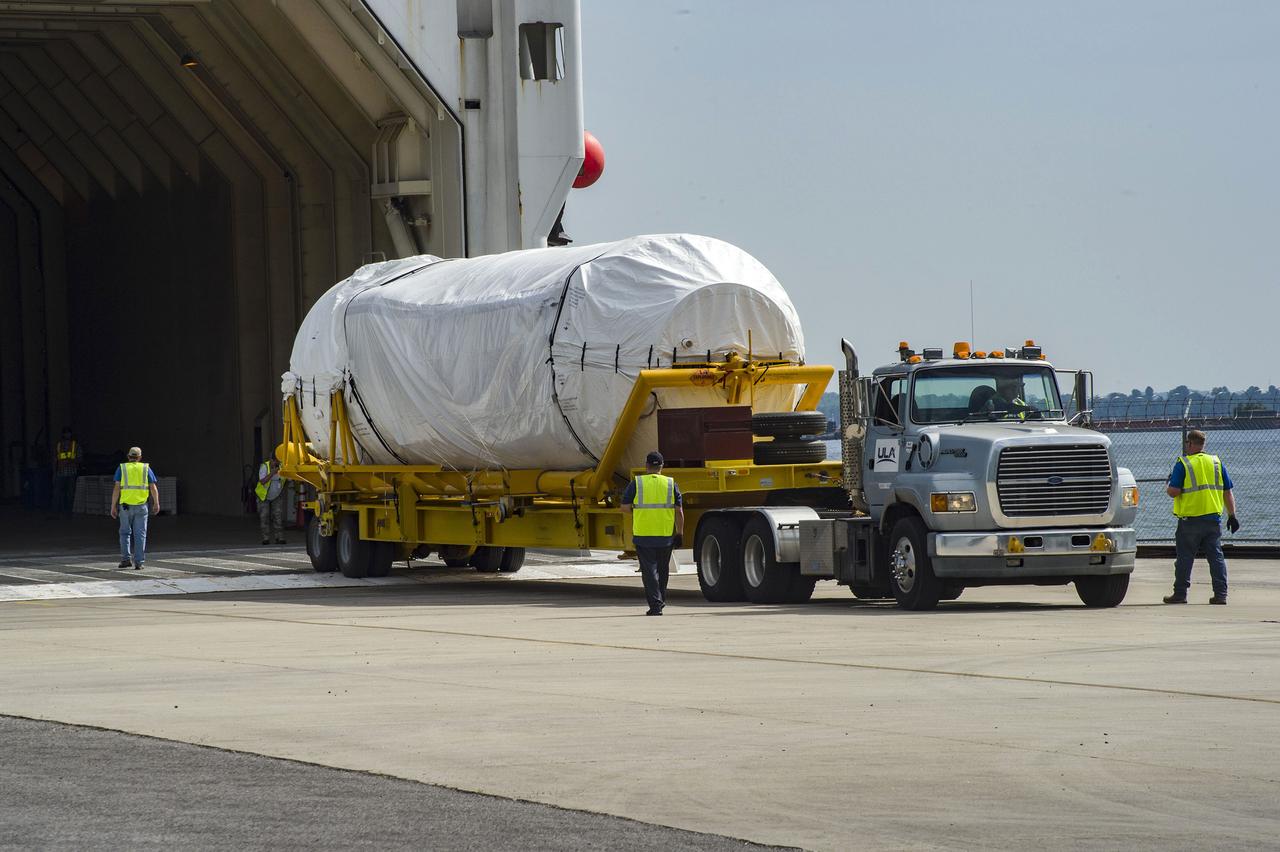
The United Launch Alliance Atlas V rocket that will launch Boeing’s CST-100 Starliner on the Crew Flight Test (CFT) mission to the International Space Station for NASA’s Commercial Crew Program emerged from the factory on May 24, 2019, rolling into a giant cargo ship for transport to Cape Canaveral.

Brian Holz, CEO of OneWeb Satellites, speaks during the groundbreaking ceremony at Kennedy's Exploration Park for OneWeb. The company, in partnership with Airbus, is building a 150,000-square-foot factory to manufacture satellites that will connect all areas of the world to the Internet wirelessly. Photo credit: NASA/Kim Shiflett
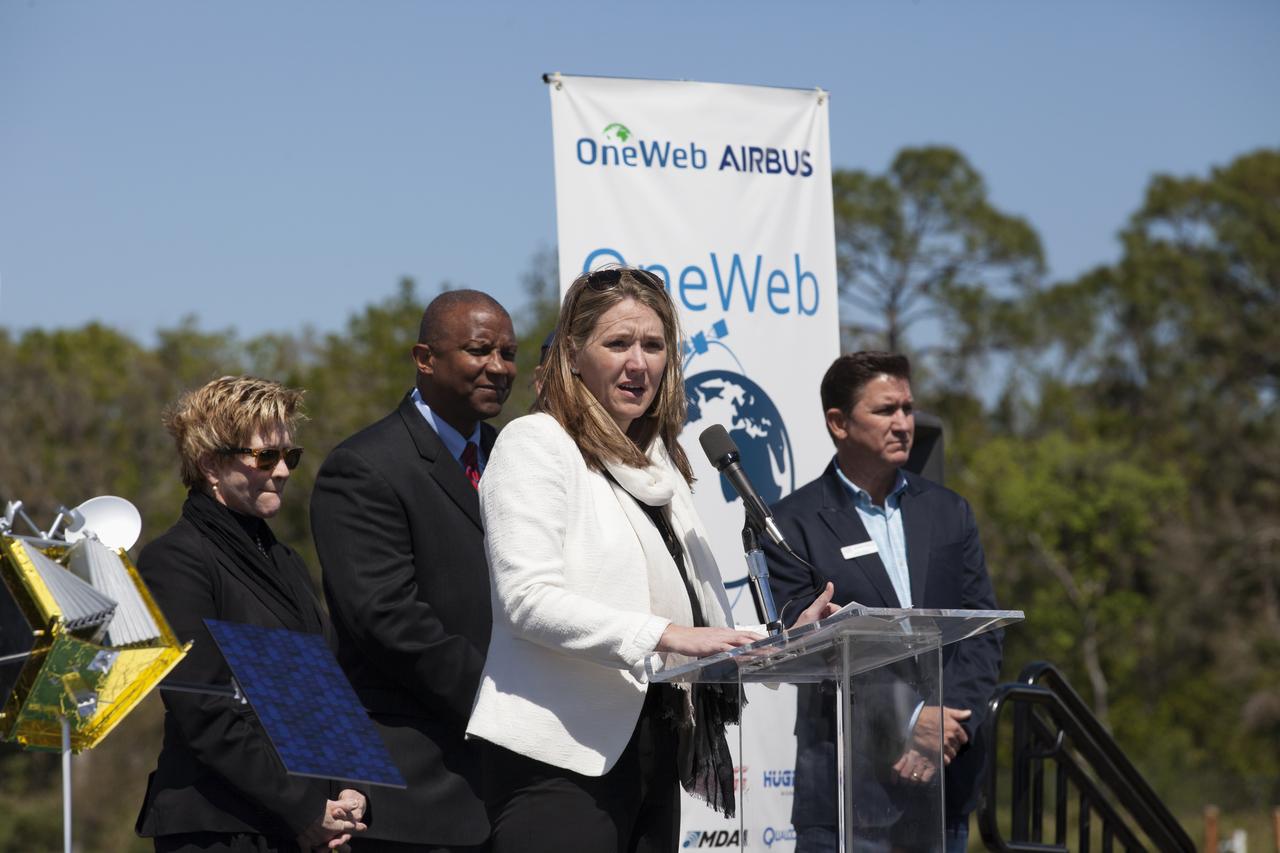
Cissy Procter, executive director of the Florida Department of Economic Activity, speaks during the groundbreaking ceremony at Kennedy's Exploration Park for OneWeb. The company, in partnership with Airbus, is building a 150,000-square-foot factory to manufacture satellites that will connect all areas of the world to the Internet wirelessly. Photo credit: NASA/Kim Shiflett
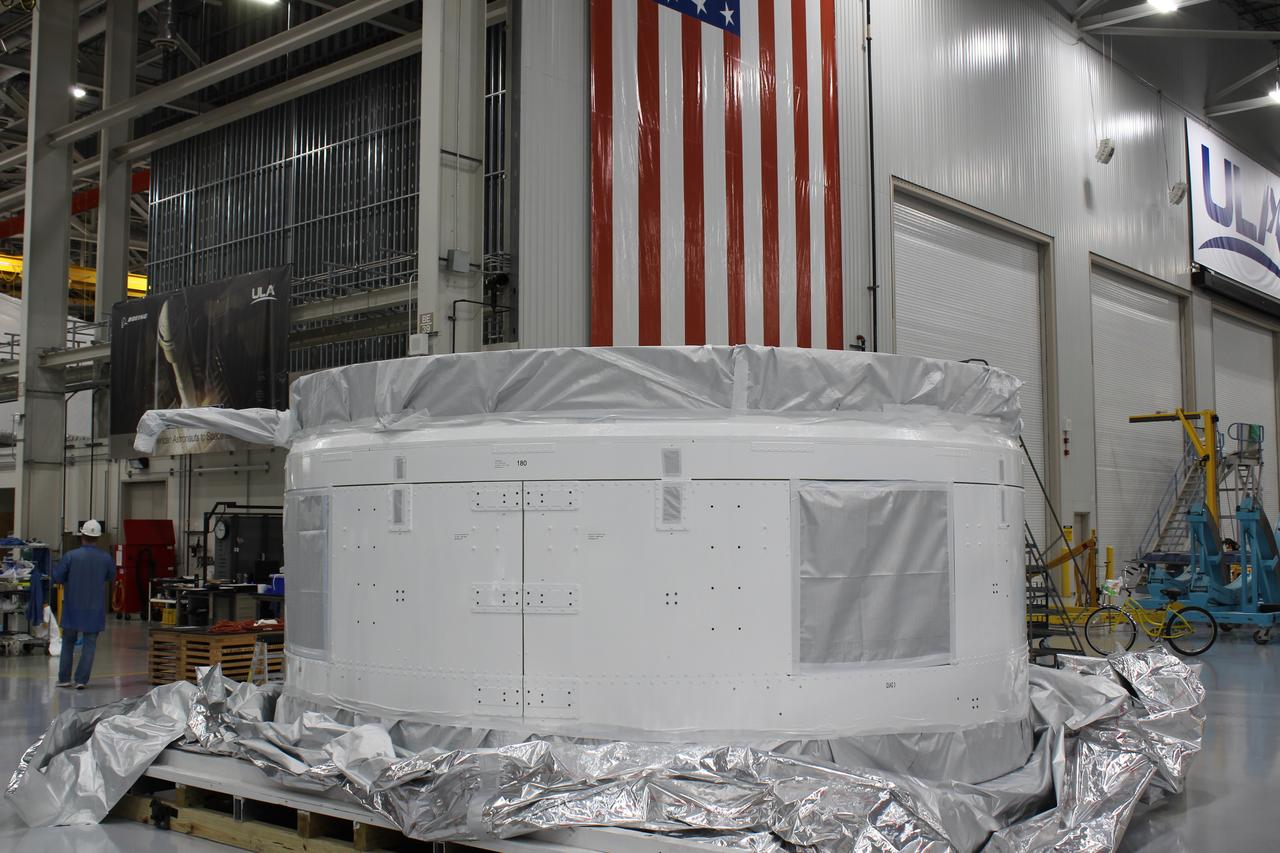
The Launch Vehicle Adapter (LVA) that will attach Boeing’s first Starliner spacecraft to the Atlas V launch vehicle is ready for transport from United Launch Alliance's manufacturing factory in Decatur, Alabama to Cape Canaveral Air Force Station in Florida.
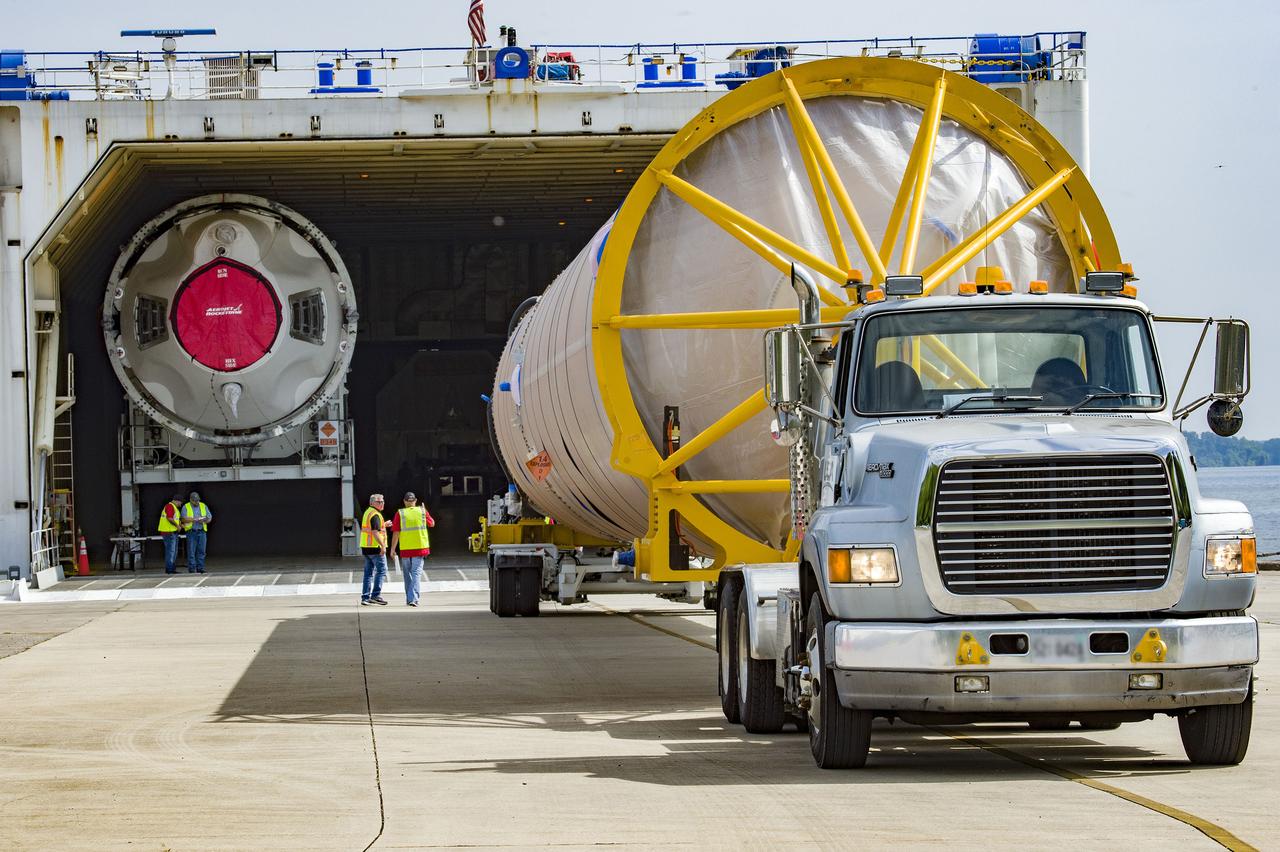
The United Launch Alliance Atlas V rocket that will launch Boeing’s CST-100 Starliner on the Crew Flight Test (CFT) mission to the International Space Station for NASA’s Commercial Crew Program emerged from the factory on May 24, 2019, rolling into a giant cargo ship for transport to Cape Canaveral.
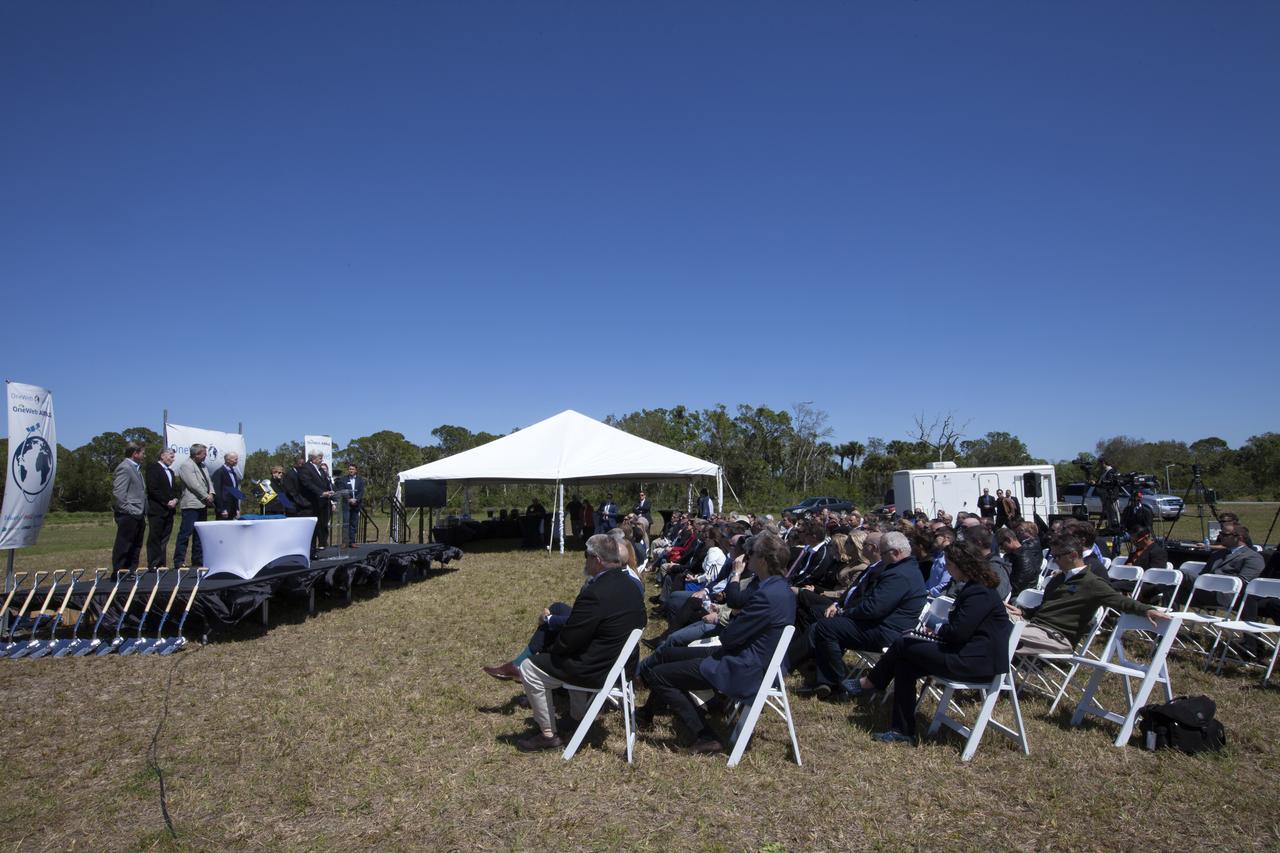
Jim Kuzma, COO of Space Florida, speaks during the groundbreaking ceremony at Kennedy's Exploration Park for OneWeb. The company, in partnership with Airbus, is building a 150,000-square-foot factory to manufacture satellites that will connect all areas of the world to the Internet wirelessly. Photo credit: NASA/Kim Shiflett
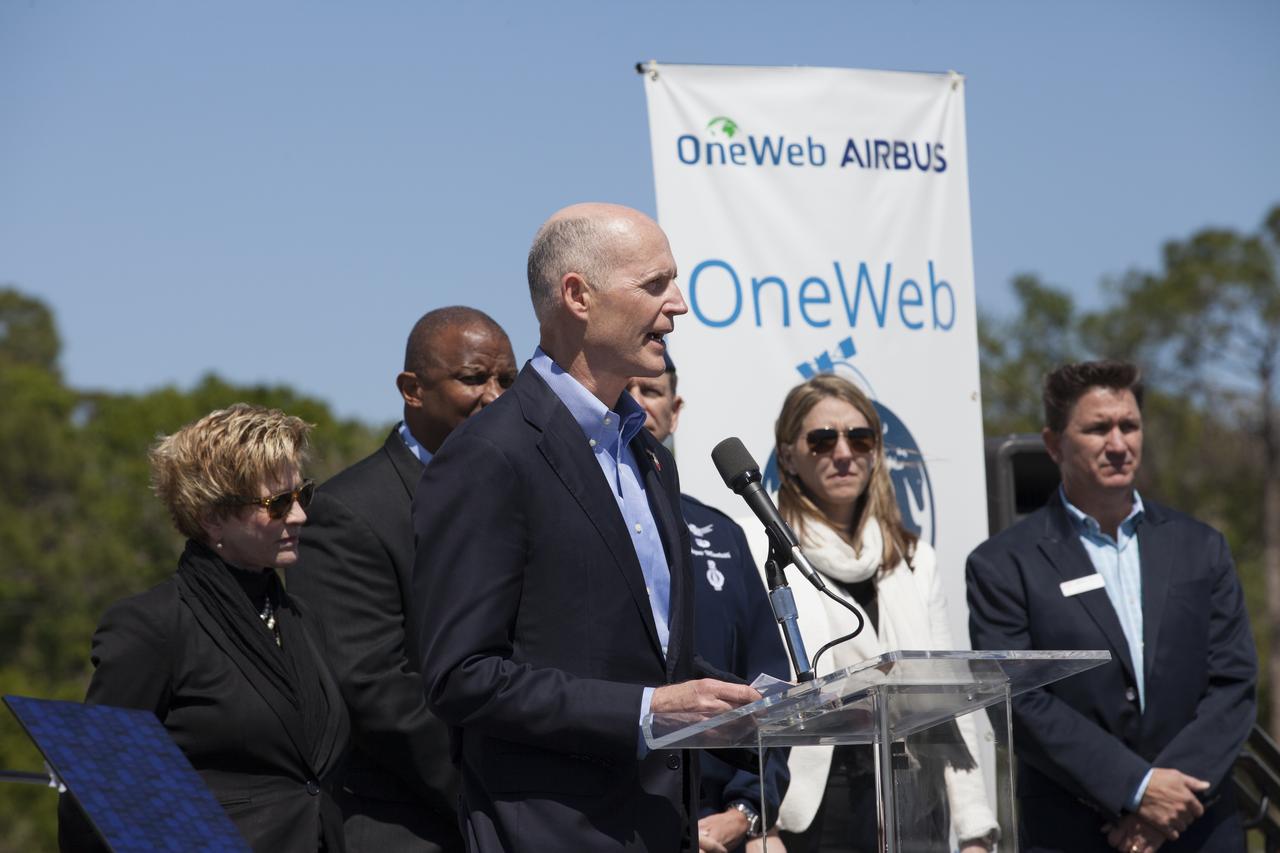
Florida Governor Rick Scott speaks during the groundbreaking ceremony at Kennedy's Exploration Park for OneWeb. The company, in partnership with Airbus, is building a 150,000-square-foot factory to manufacture satellites that will connect all areas of the world to the Internet wirelessly. Photo credit: NASA/Kim Shiflett
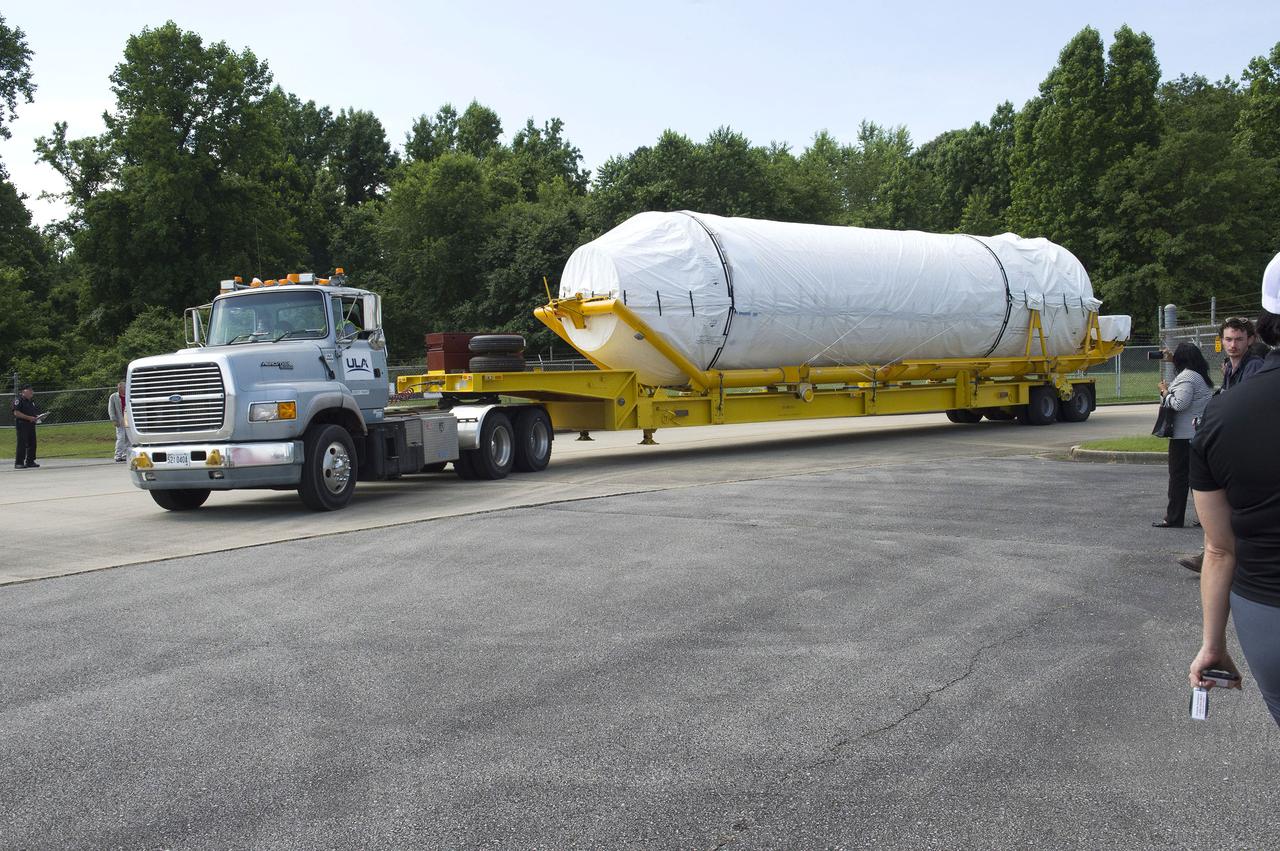
The United Launch Alliance Atlas V rocket that will launch Boeing’s CST-100 Starliner on the Crew Flight Test (CFT) mission to the International Space Station for NASA’s Commercial Crew Program emerged from the factory on May 24, 2019, rolling into a giant cargo ship for transport to Cape Canaveral.
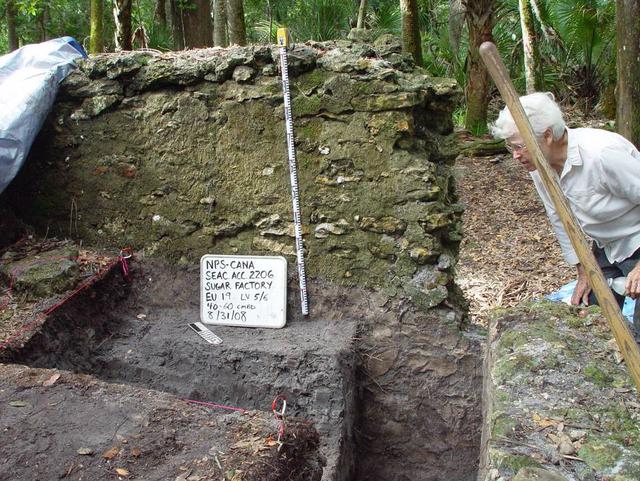
Preservationist Dot Moore views the ruins of Elliot Plantation sugar factory during an excavation in 2008 on NASA’s Kennedy Space Center. The sugar factory structure, or sugar train, was built from fieldstone and is where sugar cane juice would be boiled during processing in graduated copper kettles until the liquid reduced into a thick syrup. The ruins of Elliot Plantation date from the 1760s and represent the largest, earliest, and southernmost British period sugar plantation in the U.S., as well as one of the most intact and best examples of a completely preserved enslaved landscape. In interagency cooperation between the National Park Service, the U.S. Fish and Wildlife Service, and NASA, and with the assistance of volunteers from the Indian River Anthropological Society, and historic preservation offices of Brevard and Volusia counties, approximately 200 shovel tests and 20 excavation units were completed in three areas of the plantation complex from 2008 to 2009.
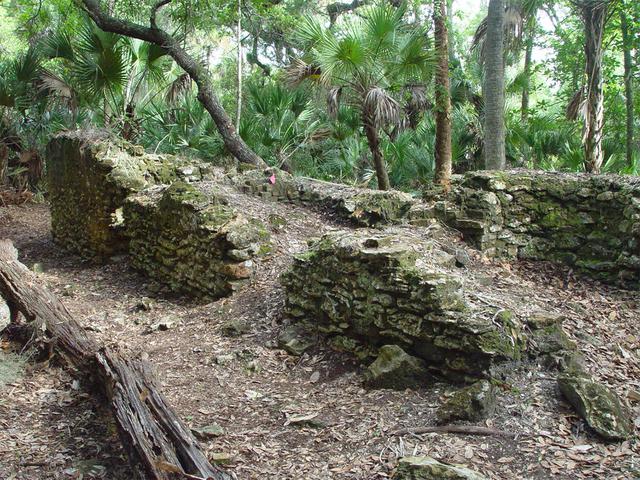
Archeological ruins of the Elliot Plantation sugar factory are revealed through the oak hammock on NASA’s Kennedy Space Center in Florida in 2008. The sugar factory structure, or sugar train, was built from fieldstone and is where sugar cane juice would be boiled during processing in graduated copper kettles until the liquid reduced into a thick syrup. The ruins of Elliot Plantation date from the 1760s and represent the largest, earliest, and southernmost British period sugar plantation in the U.S., as well as one of the most intact and best examples of a completely preserved enslaved landscape. In interagency cooperation between the National Park Service, the U.S. Fish and Wildlife Service, and NASA, and with the assistance of volunteers from the Indian River Anthropological Society, and historic preservation offices of Brevard and Volusia counties, approximately 200 shovel tests and 20 excavation units were completed in three areas of the plantation complex from 2008 to 2009.
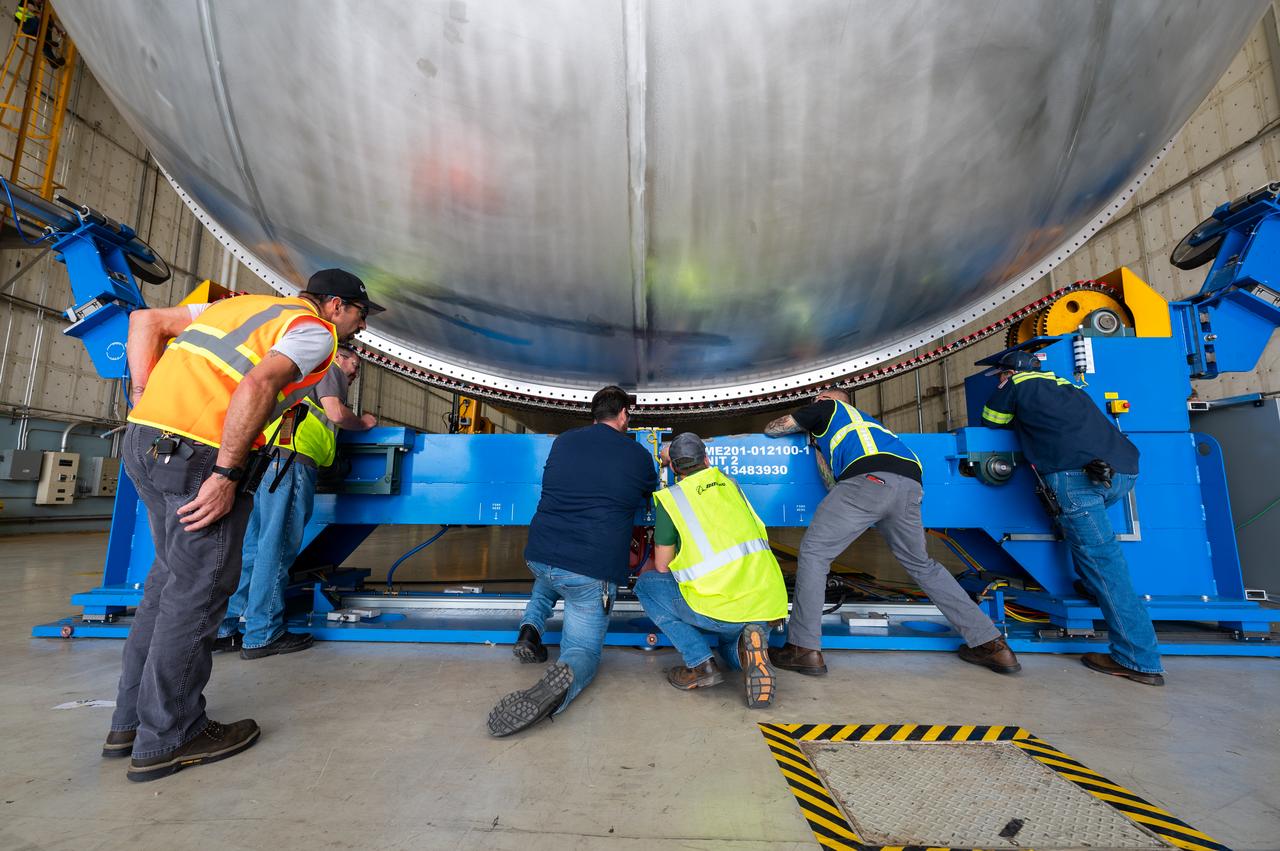
The core stage liquid hydrogen tank for the Artemis III mission completed proof testing, and technicians returned it to the main factory building at NASA’s Michoud Assembly Facility in New Orleans where it will undergo more outfitting. As part of proof testing, technicians apply a simple soap solution and check for leaks by observing any bubble formation on the welds. The technician removed the bubble solution with distilled water and then dried the area of application to prevent corrosion. To build the Space Launch System (SLS) rocket’s 130-foot core stage liquid hydrogen tank, engineers use robotic tools to weld five-barrel segments. This process results in a tank with around 1,900 feet, or more than six football fields, of welds that must be tested by hand. After the leak tests, the core stage lead, Boeing, pressurized the SLS tank to further ensure there were no leaks. After it passed proof testing, technicians moved the Artemis III liquid hydrogen tank to Michoud’s main factory. Soon, the technicians will prime and apply a foam-based thermal protection system that protects the tank during launch. Later, the tank will be joined with other parts of the core stage to form the entire 212-foot rocket stage with its four RS-25 engines that produce 2 million pounds of thrust to help launch the rocket. Artemis III will land the first astronauts on the lunar surface.
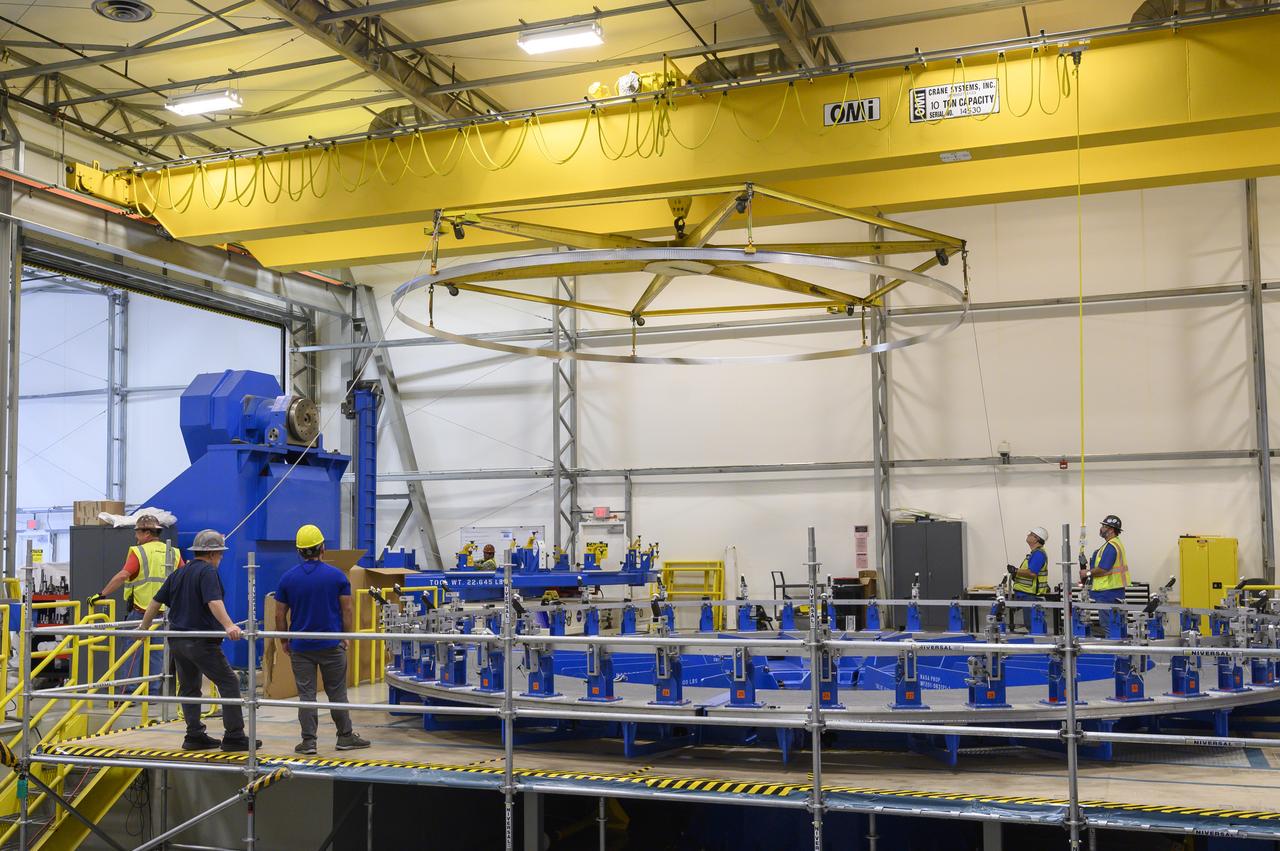
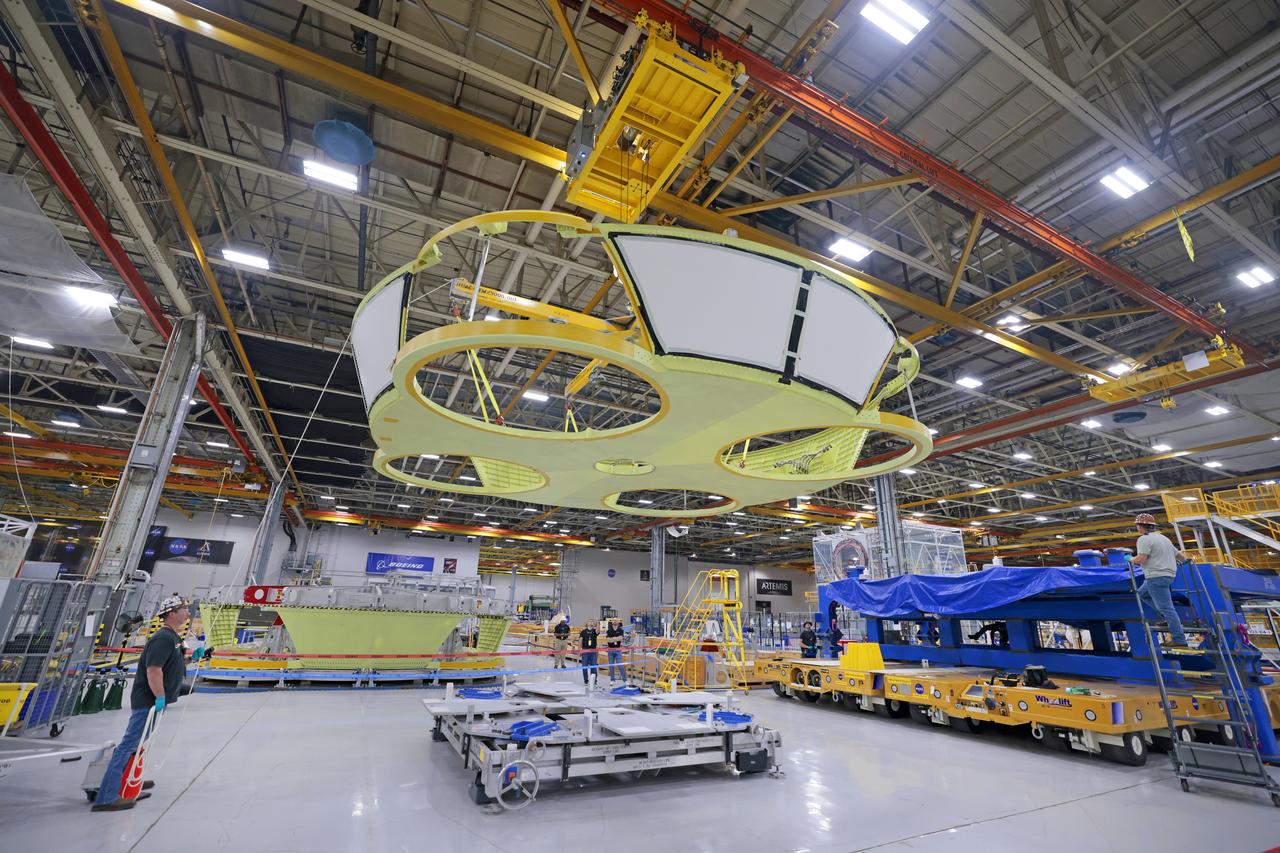
Technicians at NASA’s Michoud Assembly Facility in New Orleans lift a ring for the Exploration Upper Stage (EUS) of the SLS (Space Launch System) rocket to move it to another location in the 43-acre factory for further inspection and production. Flight hardware of the SLS EUS, a more powerful in-space propulsion stage beginning with Artemis IV, is in early production at Michoud. The rings make up the barrel sections for the flight hardware. The Exploration Upper Stage will be used on the second configuration of the SLS rocket, known as Block 1B, and will provide in-space propulsion to send astronauts in NASA’s Orion spacecraft and heavy cargo on a precise trajectory to the Moon. EUS will replace the interim cryogenic propulsion stage for the Block 1 configuration of SLS. It has larger propellant tanks and four RL10 engines, enabling SLS to launch 40% more cargo to the Moon along with crew. NASA and Boeing, the SLS lead contractor for the core stage and EUS, are currently manufacturing stages for Artemis II, III, IV, and V at the factory. NASA is working to land the first woman and first person of color on the Moon under Artemis. SLS is part of NASA’s backbone for deep space exploration, along with Orion and the Gateway in orbit around the Moon. SLS is the only rocket that can send Orion, astronauts, and supplies to the Moon in a single mission.
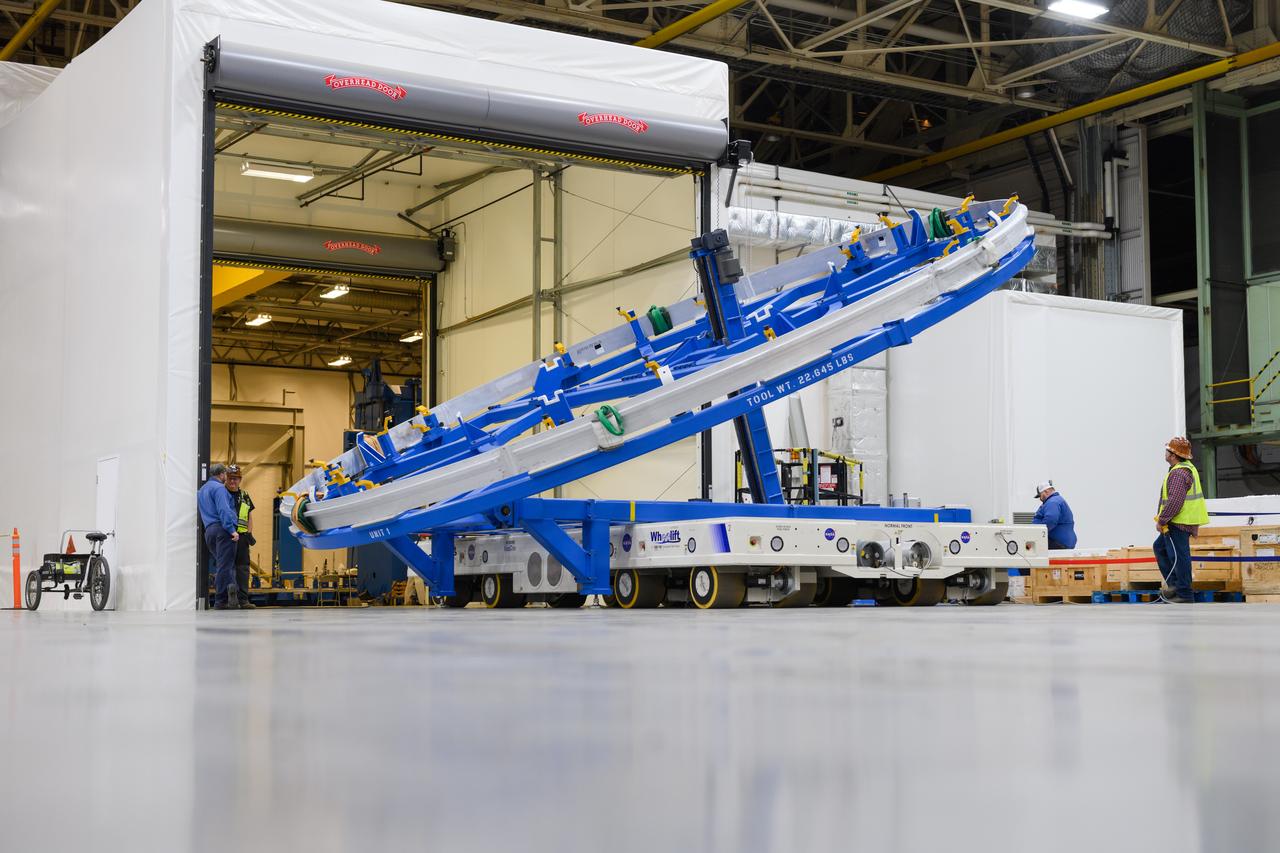
Technicians at NASA’s Michoud Assembly Facility in New Orleans lift a ring for the Exploration Upper Stage (EUS) of the SLS (Space Launch System) rocket to move it to another location in the 43-acre factory for further inspection and production. Flight hardware of the SLS EUS, a more powerful in-space propulsion stage beginning with Artemis IV, is in early production at Michoud. The rings make up the barrel sections for the flight hardware. The Exploration Upper Stage will be used on the second configuration of the SLS rocket, known as Block 1B, and will provide in-space propulsion to send astronauts in NASA’s Orion spacecraft and heavy cargo on a precise trajectory to the Moon. EUS will replace the interim cryogenic propulsion stage for the Block 1 configuration of SLS. It has larger propellant tanks and four RL10 engines, enabling SLS to launch 40% more cargo to the Moon along with crew. NASA and Boeing, the SLS lead contractor for the core stage and EUS, are currently manufacturing stages for Artemis II, III, IV, and V at the factory. NASA is working to land the first woman and first person of color on the Moon under Artemis. SLS is part of NASA’s backbone for deep space exploration, along with Orion and the Gateway in orbit around the Moon. SLS is the only rocket that can send Orion, astronauts, and supplies to the Moon in a single mission.
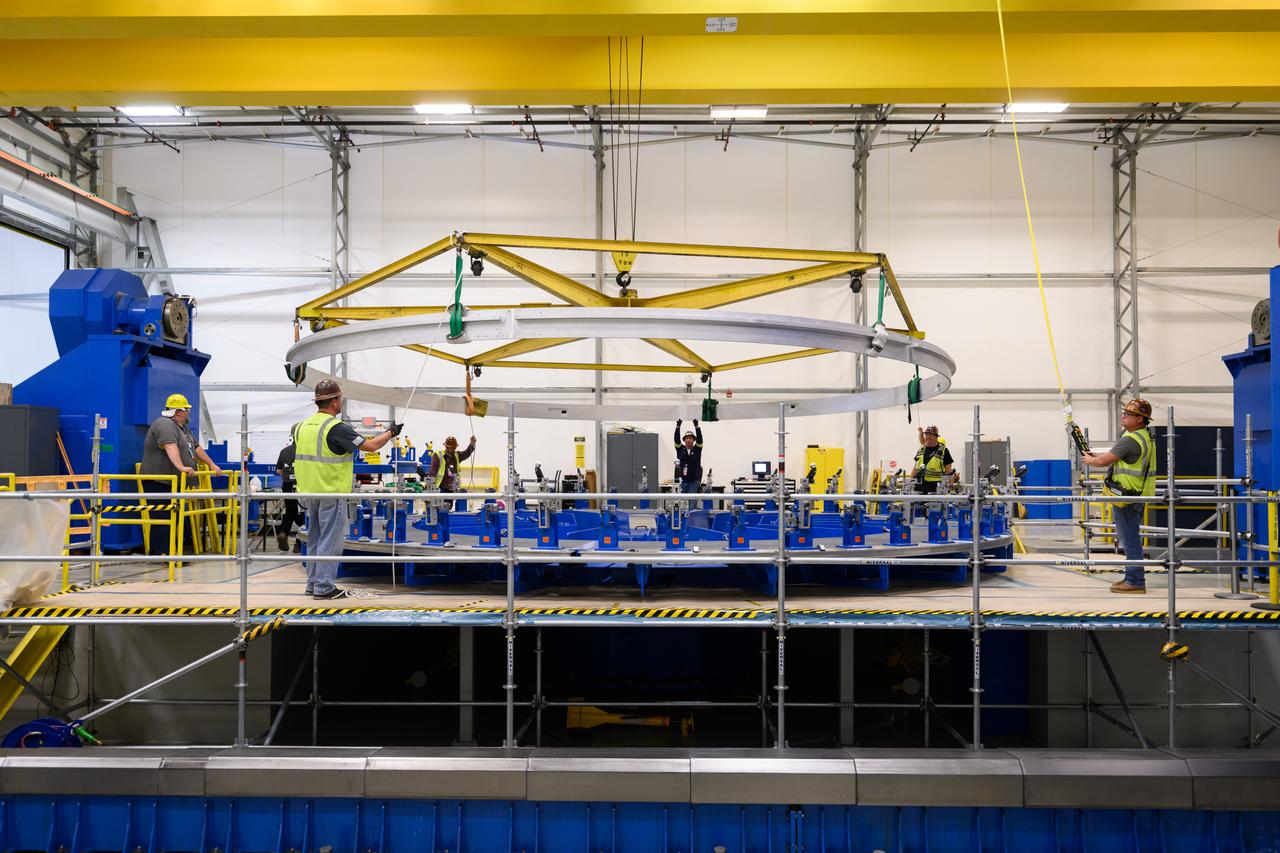
Technicians at NASA’s Michoud Assembly Facility in New Orleans lift a ring for the Exploration Upper Stage (EUS) of the SLS (Space Launch System) rocket to move it to another location in the 43-acre factory for further inspection and production. Flight hardware of the SLS EUS, a more powerful in-space propulsion stage beginning with Artemis IV, is in early production at Michoud. The rings make up the barrel sections for the flight hardware. The Exploration Upper Stage will be used on the second configuration of the SLS rocket, known as Block 1B, and will provide in-space propulsion to send astronauts in NASA’s Orion spacecraft and heavy cargo on a precise trajectory to the Moon. EUS will replace the interim cryogenic propulsion stage for the Block 1 configuration of SLS. It has larger propellant tanks and four RL10 engines, enabling SLS to launch 40% more cargo to the Moon along with crew. NASA and Boeing, the SLS lead contractor for the core stage and EUS, are currently manufacturing stages for Artemis II, III, IV, and V at the factory. NASA is working to land the first woman and first person of color on the Moon under Artemis. SLS is part of NASA’s backbone for deep space exploration, along with Orion and the Gateway in orbit around the Moon. SLS is the only rocket that can send Orion, astronauts, and supplies to the Moon in a single mission.
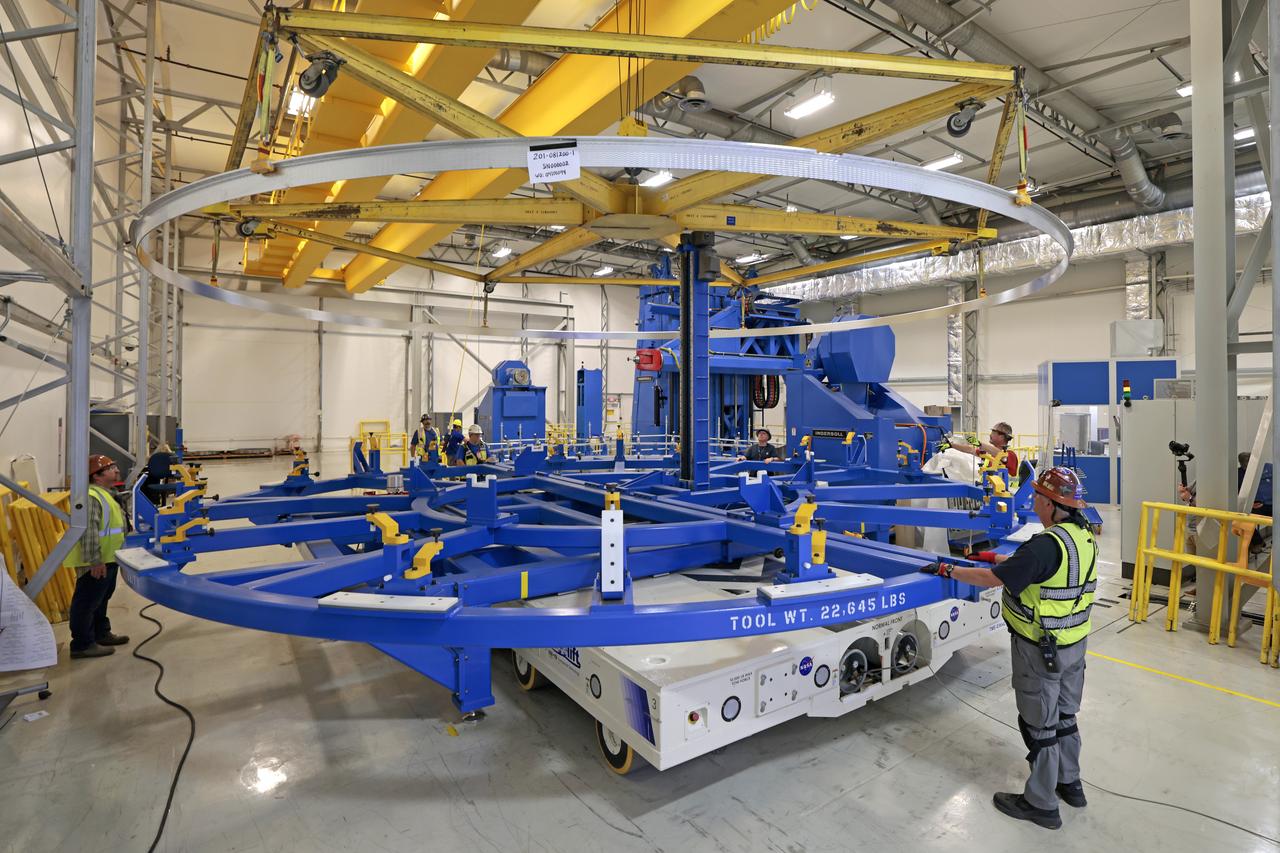
Technicians at NASA’s Michoud Assembly Facility in New Orleans lift a ring for the Exploration Upper Stage (EUS) of the SLS (Space Launch System) rocket to move it to another location in the 43-acre factory for further inspection and production. Flight hardware of the SLS EUS, a more powerful in-space propulsion stage beginning with Artemis IV, is in early production at Michoud. The rings make up the barrel sections for the flight hardware. The Exploration Upper Stage will be used on the second configuration of the SLS rocket, known as Block 1B, and will provide in-space propulsion to send astronauts in NASA’s Orion spacecraft and heavy cargo on a precise trajectory to the Moon. EUS will replace the interim cryogenic propulsion stage for the Block 1 configuration of SLS. It has larger propellant tanks and four RL10 engines, enabling SLS to launch 40% more cargo to the Moon along with crew. NASA and Boeing, the SLS lead contractor for the core stage and EUS, are currently manufacturing stages for Artemis II, III, IV, and V at the factory. NASA is working to land the first woman and first person of color on the Moon under Artemis. SLS is part of NASA’s backbone for deep space exploration, along with Orion and the Gateway in orbit around the Moon. SLS is the only rocket that can send Orion, astronauts, and supplies to the Moon in a single mission.
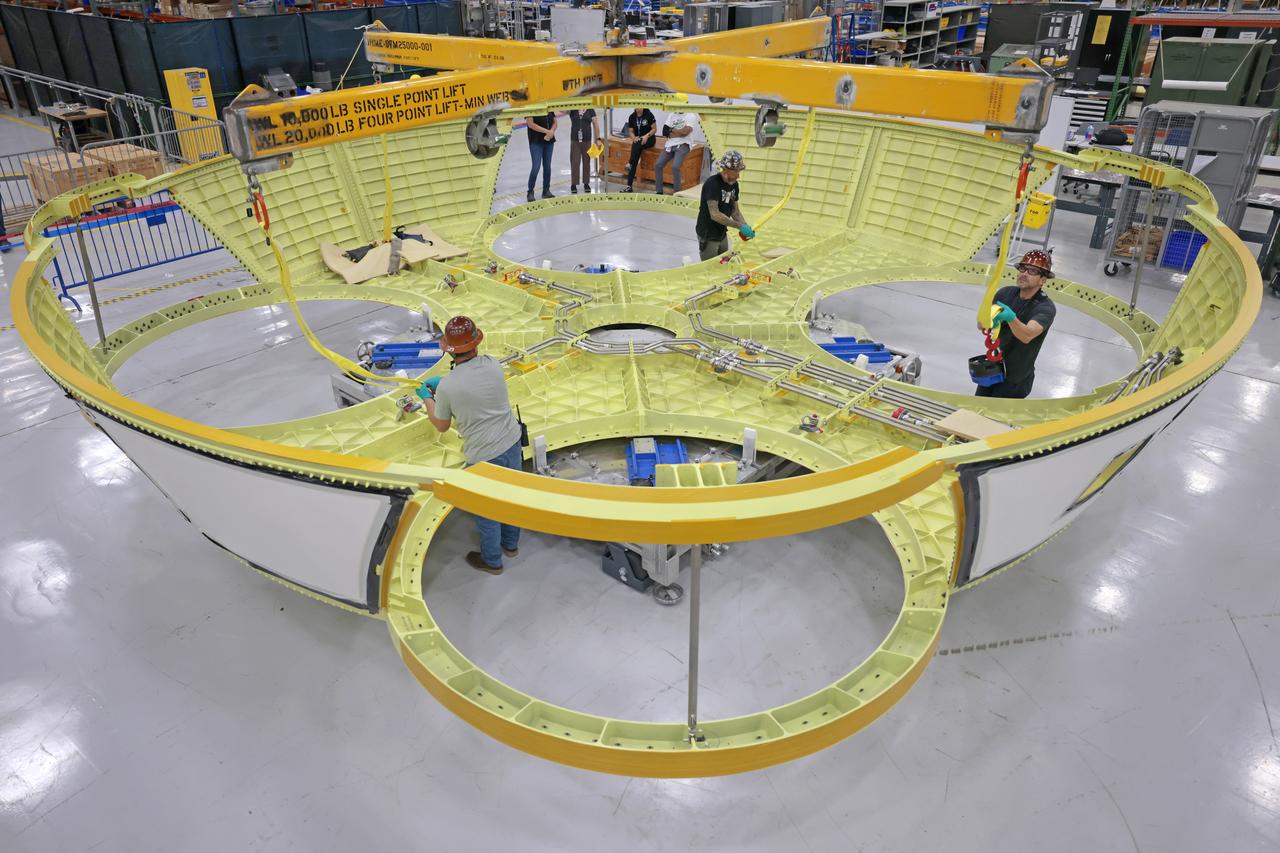
These photos show teams at NASA’s Michoud Assembly Facility in New Orleans preparing, moving, and loading the engine section boat-tail of NASA’s SLS (Space Launch System) rocket for the Artemis III mission for transportation to NASA’s Kennedy Space Center in Florida via the agency’s Pegasus barge. Inside the factory on Aug. 14 prior to the move, technicians covered the spaceflight hardware with a tarp to help protect it on its journey aboard NASA’s Pegasus barge. Crews then rolled out the hardware on Aug. 27 from the factory floor to the barge. Once in Florida, the boat-tail will be integrated with the engine section -- also manufactured at Michoud -- inside Kennedy’s Space Station Processing Facility. The engine section arrived at NASA Kennedy in Dec. 2022. Located at the bottom of the engine section, the aerodynamic boat-tail fairing channels airflow and protects the stage’s four RS-25 engines from extreme temperatures during launch. The engine section is one of five major elements that make up the 212-foot-tall rocket stage. The core stage, along with its four RS-25 engines, produce two million pounds of thrust to help launch NASA’s Orion spacecraft, astronauts, and supplies beyond Earth’s orbit and to the lunar surface for Artemis. Image credit: NASA/Michael DeMocker
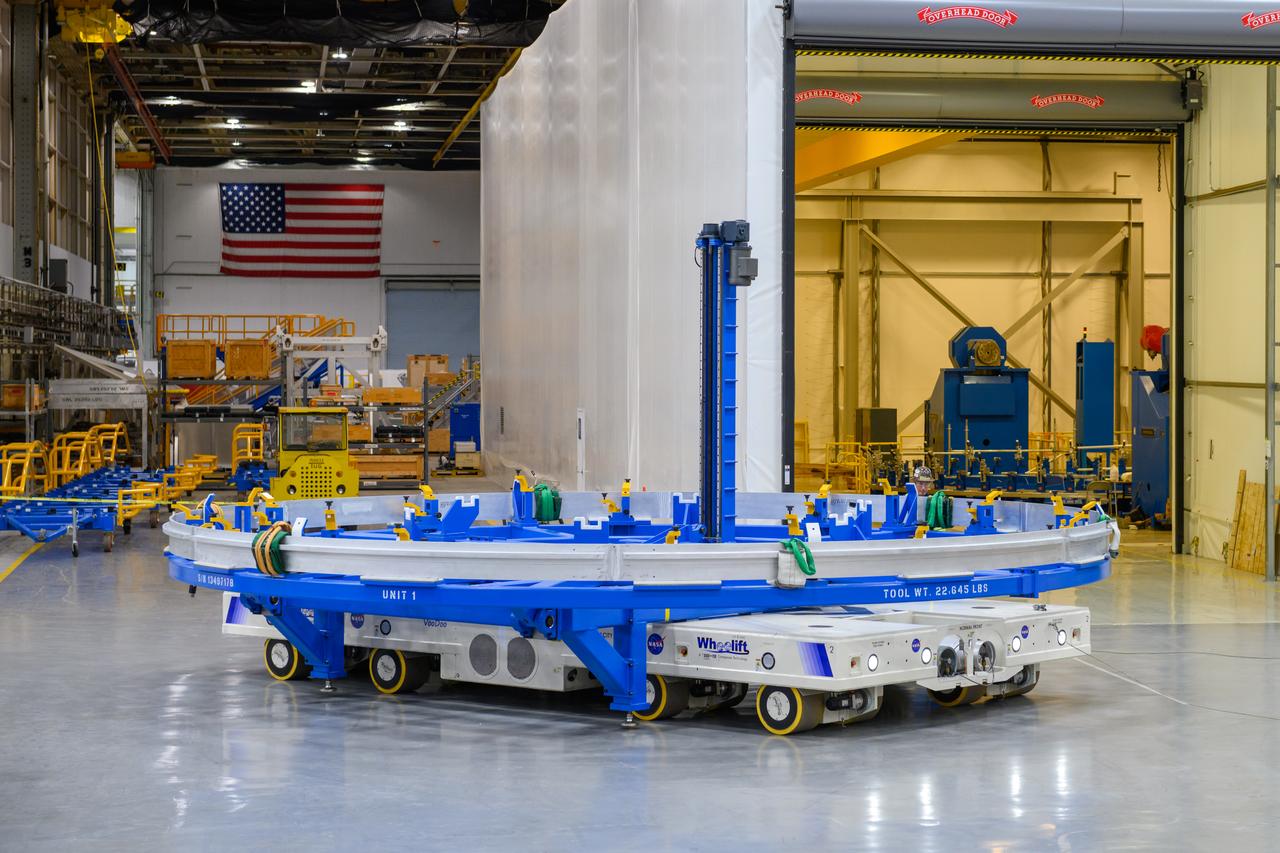
These photos show teams at NASA’s Michoud Assembly Facility in New Orleans preparing, moving, and loading the engine section boat-tail of NASA’s SLS (Space Launch System) rocket for the Artemis III mission for transportation to NASA’s Kennedy Space Center in Florida via the agency’s Pegasus barge. Inside the factory on Aug. 14 prior to the move, technicians covered the spaceflight hardware with a tarp to help protect it on its journey aboard NASA’s Pegasus barge. Crews then rolled out the hardware on Aug. 27 from the factory floor to the barge. Once in Florida, the boat-tail will be integrated with the engine section -- also manufactured at Michoud -- inside Kennedy’s Space Station Processing Facility. The engine section arrived at NASA Kennedy in Dec. 2022. Located at the bottom of the engine section, the aerodynamic boat-tail fairing channels airflow and protects the stage’s four RS-25 engines from extreme temperatures during launch. The engine section is one of five major elements that make up the 212-foot-tall rocket stage. The core stage, along with its four RS-25 engines, produce two million pounds of thrust to help launch NASA’s Orion spacecraft, astronauts, and supplies beyond Earth’s orbit and to the lunar surface for Artemis. Image credit: NASA/Michael DeMocker
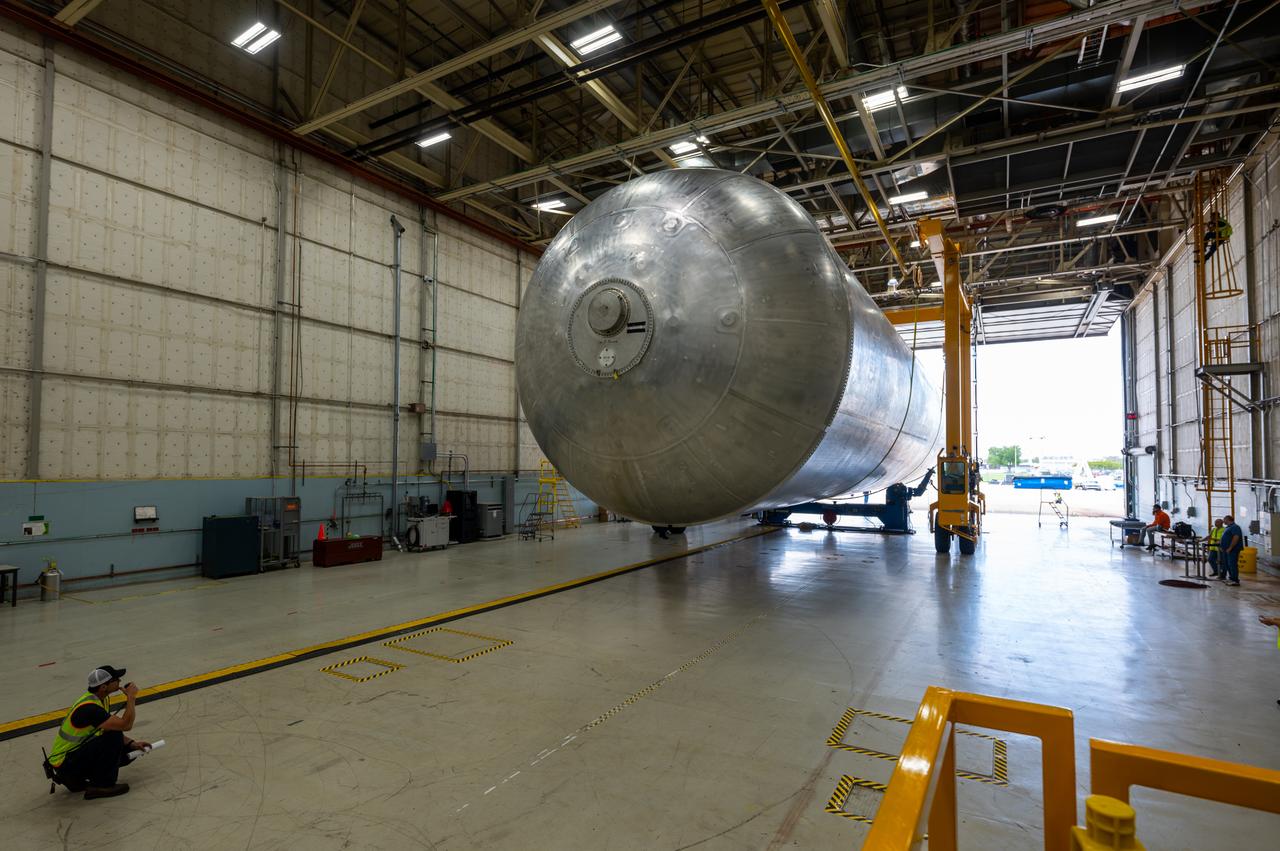
The core stage liquid hydrogen tank for the Artemis III mission completed proof testing, and technicians returned it to the main factory building at NASA’s Michoud Assembly Facility in New Orleans where it will undergo more outfitting. As part of proof testing, technicians apply a simple soap solution and check for leaks by observing any bubble formation on the welds. The technician removed the bubble solution with distilled water and then dried the area of application to prevent corrosion. To build the Space Launch System (SLS) rocket’s 130-foot core stage liquid hydrogen tank, engineers use robotic tools to weld five-barrel segments. This process results in a tank with around 1,900 feet, or more than six football fields, of welds that must be tested by hand. After the leak tests, the core stage lead, Boeing, pressurized the SLS tank to further ensure there were no leaks. After it passed proof testing, technicians moved the Artemis III liquid hydrogen tank to Michoud’s main factory. Soon, the technicians will prime and apply a foam-based thermal protection system that protects the tank during launch. Later, the tank will be joined with other parts of the core stage to form the entire 212-foot rocket stage with its four RS-25 engines that produce 2 million pounds of thrust to help launch the rocket. Artemis III will land the first astronauts on the lunar surface.
Technicians at NASA’s Michoud Assembly Facility in New Orleans lift a ring for the Exploration Upper Stage (EUS) of the SLS (Space Launch System) rocket to move it to another location in the 43-acre factory for further inspection and production. Flight hardware of the SLS EUS, a more powerful in-space propulsion stage beginning with Artemis IV, is in early production at Michoud. The rings make up the barrel sections for the flight hardware. The Exploration Upper Stage will be used on the second configuration of the SLS rocket, known as Block 1B, and will provide in-space propulsion to send astronauts in NASA’s Orion spacecraft and heavy cargo on a precise trajectory to the Moon. EUS will replace the interim cryogenic propulsion stage for the Block 1 configuration of SLS. It has larger propellant tanks and four RL10 engines, enabling SLS to launch 40% more cargo to the Moon along with crew. NASA and Boeing, the SLS lead contractor for the core stage and EUS, are currently manufacturing stages for Artemis II, III, IV, and V at the factory. NASA is working to land the first woman and first person of color on the Moon under Artemis. SLS is part of NASA’s backbone for deep space exploration, along with Orion and the Gateway in orbit around the Moon. SLS is the only rocket that can send Orion, astronauts, and supplies to the Moon in a single mission.
These photos show teams at NASA’s Michoud Assembly Facility in New Orleans preparing, moving, and loading the engine section boat-tail of NASA’s SLS (Space Launch System) rocket for the Artemis III mission for transportation to NASA’s Kennedy Space Center in Florida via the agency’s Pegasus barge. Inside the factory on Aug. 14 prior to the move, technicians covered the spaceflight hardware with a tarp to help protect it on its journey aboard NASA’s Pegasus barge. Crews then rolled out the hardware on Aug. 27 from the factory floor to the barge. Once in Florida, the boat-tail will be integrated with the engine section -- also manufactured at Michoud -- inside Kennedy’s Space Station Processing Facility. The engine section arrived at NASA Kennedy in Dec. 2022. Located at the bottom of the engine section, the aerodynamic boat-tail fairing channels airflow and protects the stage’s four RS-25 engines from extreme temperatures during launch. The engine section is one of five major elements that make up the 212-foot-tall rocket stage. The core stage, along with its four RS-25 engines, produce two million pounds of thrust to help launch NASA’s Orion spacecraft, astronauts, and supplies beyond Earth’s orbit and to the lunar surface for Artemis. Image credit: NASA/Michael DeMocker
These photos show teams at NASA’s Michoud Assembly Facility in New Orleans preparing, moving, and loading the engine section boat-tail of NASA’s SLS (Space Launch System) rocket for the Artemis III mission for transportation to NASA’s Kennedy Space Center in Florida via the agency’s Pegasus barge. Inside the factory on Aug. 14 prior to the move, technicians covered the spaceflight hardware with a tarp to help protect it on its journey aboard NASA’s Pegasus barge. Crews then rolled out the hardware on Aug. 27 from the factory floor to the barge. Once in Florida, the boat-tail will be integrated with the engine section -- also manufactured at Michoud -- inside Kennedy’s Space Station Processing Facility. The engine section arrived at NASA Kennedy in Dec. 2022. Located at the bottom of the engine section, the aerodynamic boat-tail fairing channels airflow and protects the stage’s four RS-25 engines from extreme temperatures during launch. The engine section is one of five major elements that make up the 212-foot-tall rocket stage. The core stage, along with its four RS-25 engines, produce two million pounds of thrust to help launch NASA’s Orion spacecraft, astronauts, and supplies beyond Earth’s orbit and to the lunar surface for Artemis. Image credit: NASA/Michael DeMocker
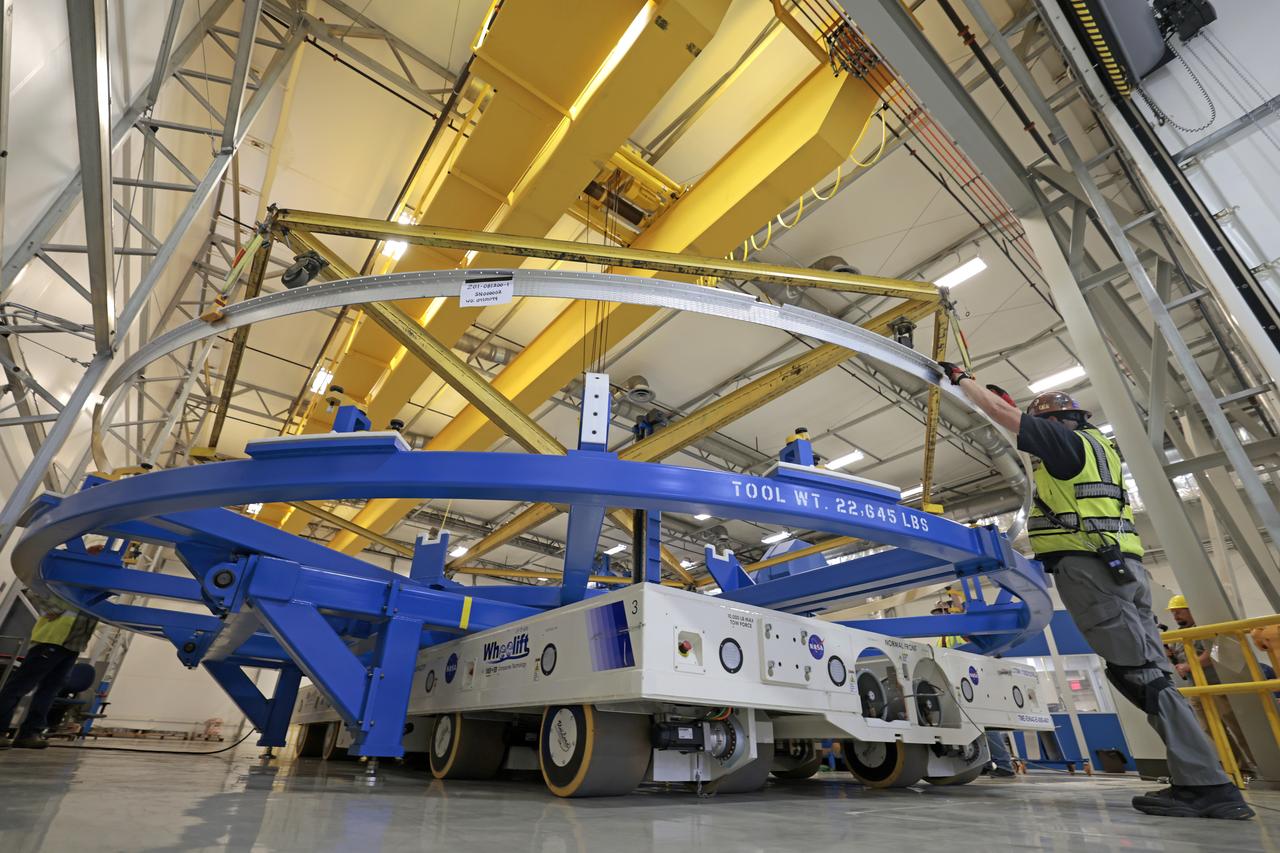
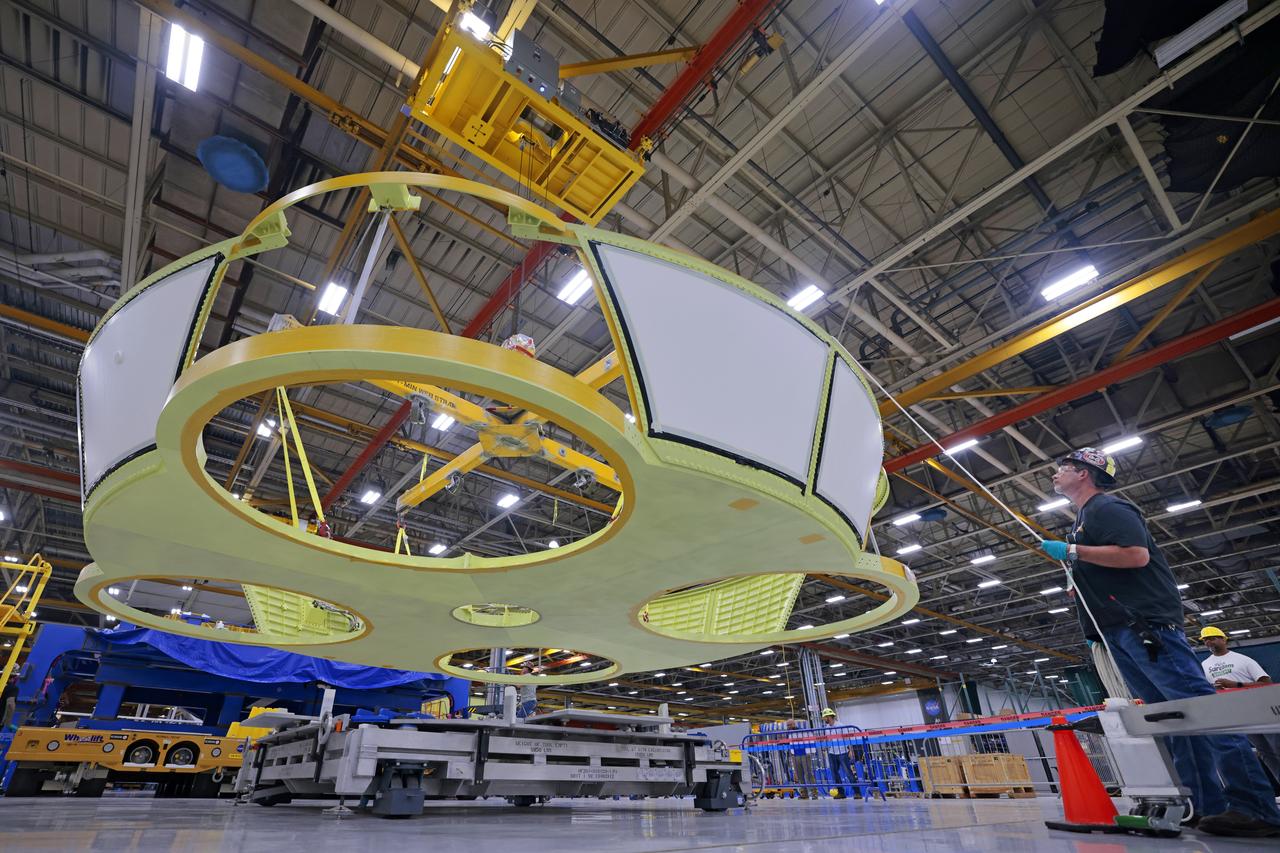
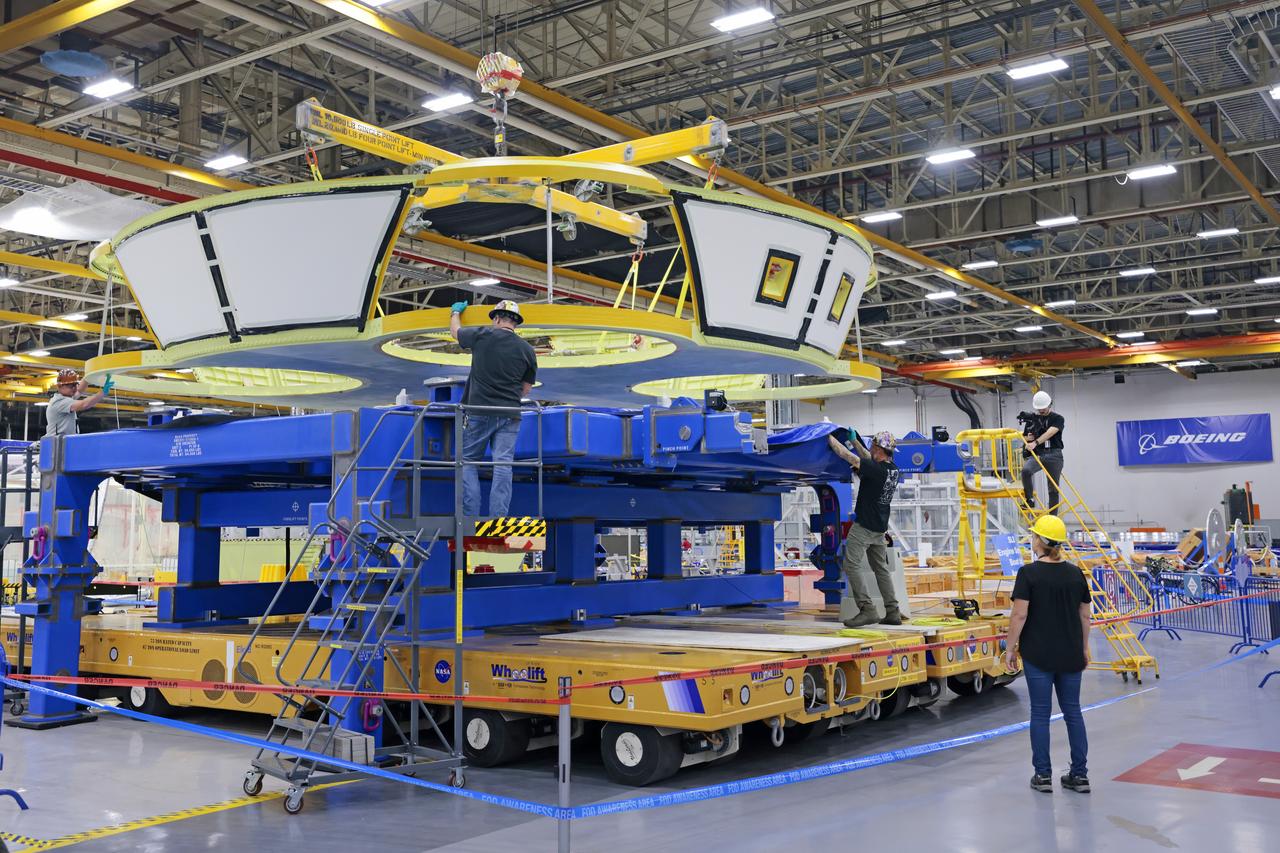
Technicians at NASA’s Michoud Assembly Facility in New Orleans lift a ring for the Exploration Upper Stage (EUS) of the SLS (Space Launch System) rocket to move it to another location in the 43-acre factory for further inspection and production. Flight hardware of the SLS EUS, a more powerful in-space propulsion stage beginning with Artemis IV, is in early production at Michoud. The rings make up the barrel sections for the flight hardware. The Exploration Upper Stage will be used on the second configuration of the SLS rocket, known as Block 1B, and will provide in-space propulsion to send astronauts in NASA’s Orion spacecraft and heavy cargo on a precise trajectory to the Moon. EUS will replace the interim cryogenic propulsion stage for the Block 1 configuration of SLS. It has larger propellant tanks and four RL10 engines, enabling SLS to launch 40% more cargo to the Moon along with crew. NASA and Boeing, the SLS lead contractor for the core stage and EUS, are currently manufacturing stages for Artemis II, III, IV, and V at the factory. NASA is working to land the first woman and first person of color on the Moon under Artemis. SLS is part of NASA’s backbone for deep space exploration, along with Orion and the Gateway in orbit around the Moon. SLS is the only rocket that can send Orion, astronauts, and supplies to the Moon in a single mission.
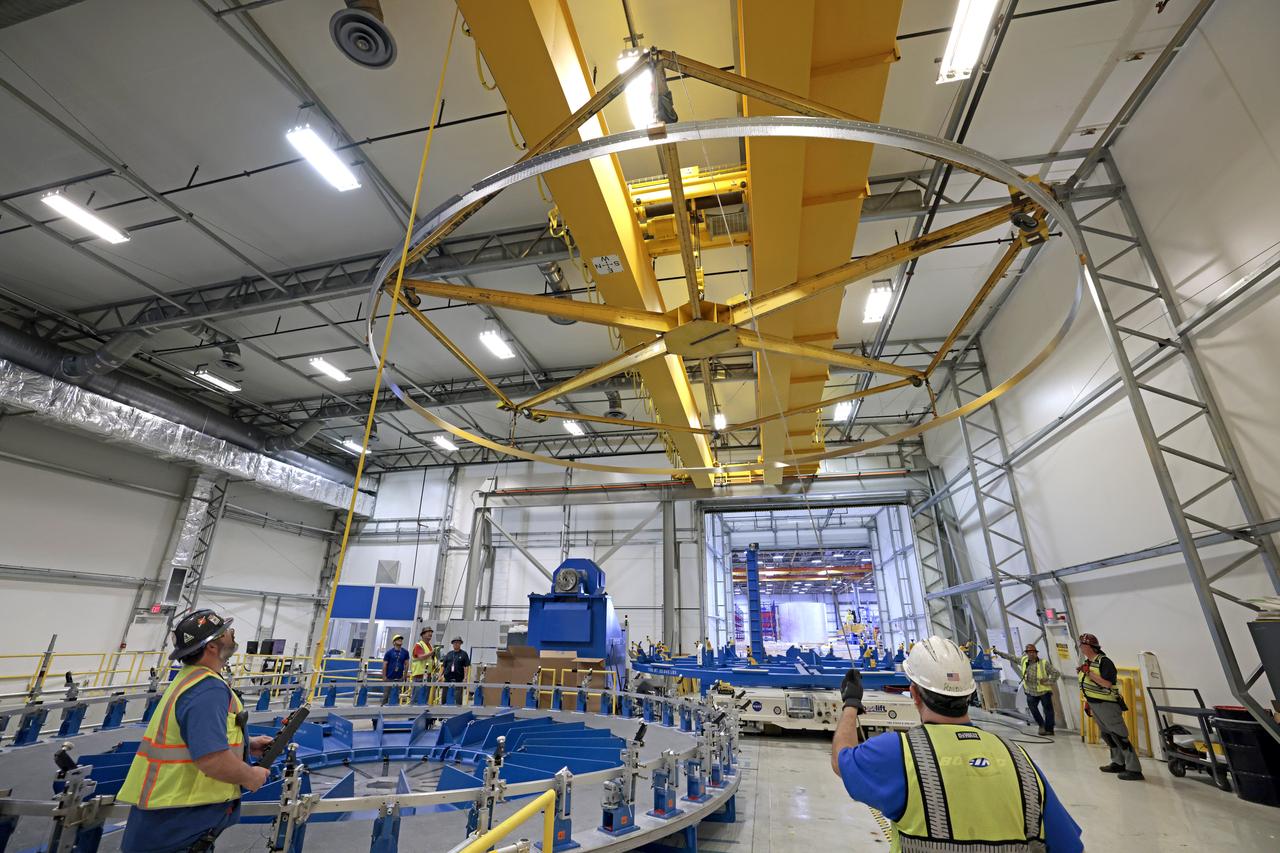
Technicians at NASA’s Michoud Assembly Facility in New Orleans lift a ring for the Exploration Upper Stage (EUS) of the SLS (Space Launch System) rocket to move it to another location in the 43-acre factory for further inspection and production. Flight hardware of the SLS EUS, a more powerful in-space propulsion stage beginning with Artemis IV, is in early production at Michoud. The rings make up the barrel sections for the flight hardware. The Exploration Upper Stage will be used on the second configuration of the SLS rocket, known as Block 1B, and will provide in-space propulsion to send astronauts in NASA’s Orion spacecraft and heavy cargo on a precise trajectory to the Moon. EUS will replace the interim cryogenic propulsion stage for the Block 1 configuration of SLS. It has larger propellant tanks and four RL10 engines, enabling SLS to launch 40% more cargo to the Moon along with crew. NASA and Boeing, the SLS lead contractor for the core stage and EUS, are currently manufacturing stages for Artemis II, III, IV, and V at the factory. NASA is working to land the first woman and first person of color on the Moon under Artemis. SLS is part of NASA’s backbone for deep space exploration, along with Orion and the Gateway in orbit around the Moon. SLS is the only rocket that can send Orion, astronauts, and supplies to the Moon in a single mission.
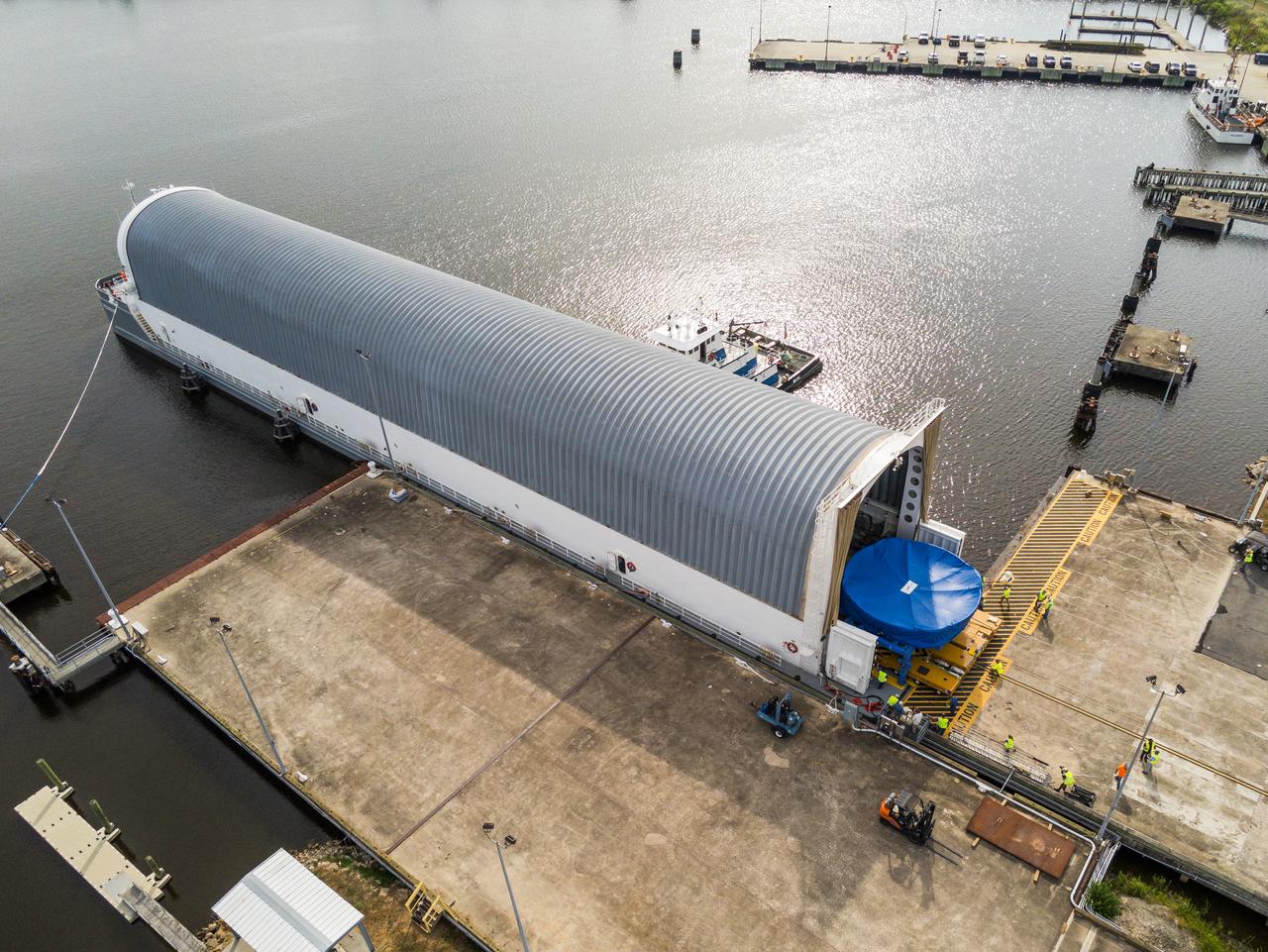
These photos and videos show teams at NASA’s Michoud Assembly Facility in New Orleans preparing, moving, and loading the engine section boat-tail of NASA’s SLS (Space Launch System) rocket for the Artemis III mission for transportation to NASA’s Kennedy Space Center in Florida via the agency’s Pegasus barge. Inside the factory on Aug. 14 prior to the move, technicians covered the spaceflight hardware with a tarp to help protect it on its journey aboard NASA’s Pegasus barge. Crews then rolled out the hardware on Aug. 27 from the factory floor to the barge. Once in Florida, the boat-tail will be integrated with the engine section -- also manufactured at Michoud -- inside Kennedy’s Space Station Processing Facility. The engine section arrived at NASA Kennedy in Dec. 2022. Located at the bottom of the engine section, the aerodynamic boat-tail fairing channels airflow and protects the stage’s four RS-25 engines from extreme temperatures during launch. The engine section is one of five major elements that make up the 212-foot-tall rocket stage. The core stage, along with its four RS-25 engines, produce two million pounds of thrust to help launch NASA’s Orion spacecraft, astronauts, and supplies beyond Earth’s orbit and to the lunar surface for Artemis.
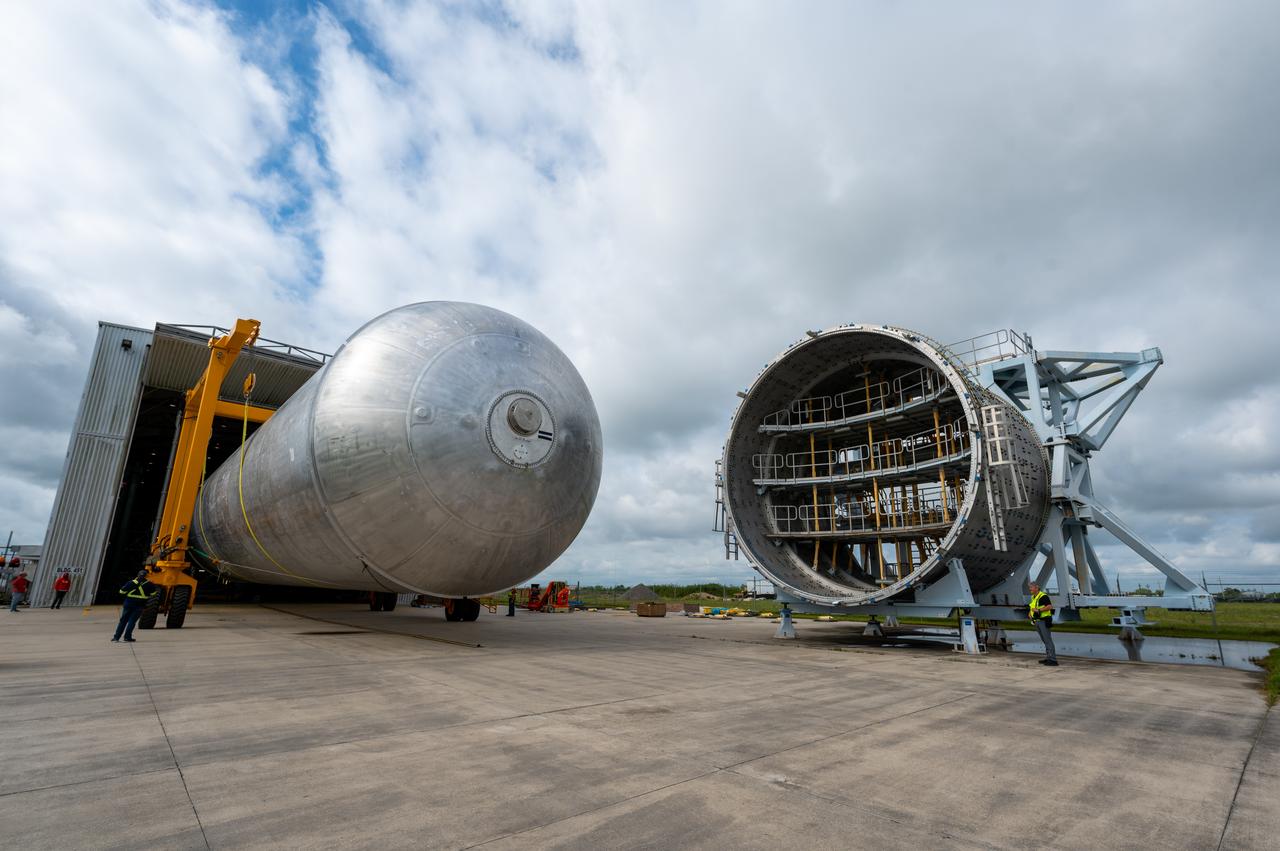
The core stage liquid hydrogen tank for the Artemis III mission completed proof testing, and technicians returned it to the main factory building at NASA’s Michoud Assembly Facility in New Orleans where it will undergo more outfitting. As part of proof testing, technicians apply a simple soap solution and check for leaks by observing any bubble formation on the welds. The technician removed the bubble solution with distilled water and then dried the area of application to prevent corrosion. To build the Space Launch System (SLS) rocket’s 130-foot core stage liquid hydrogen tank, engineers use robotic tools to weld five-barrel segments. This process results in a tank with around 1,900 feet, or more than six football fields, of welds that must be tested by hand. After the leak tests, the core stage lead, Boeing, pressurized the SLS tank to further ensure there were no leaks. After it passed proof testing, technicians moved the Artemis III liquid hydrogen tank to Michoud’s main factory. Soon, the technicians will prime and apply a foam-based thermal protection system that protects the tank during launch. Later, the tank will be joined with other parts of the core stage to form the entire 212-foot rocket stage with its four RS-25 engines that produce 2 million pounds of thrust to help launch the rocket. Artemis III will land the first astronauts on the lunar surface.
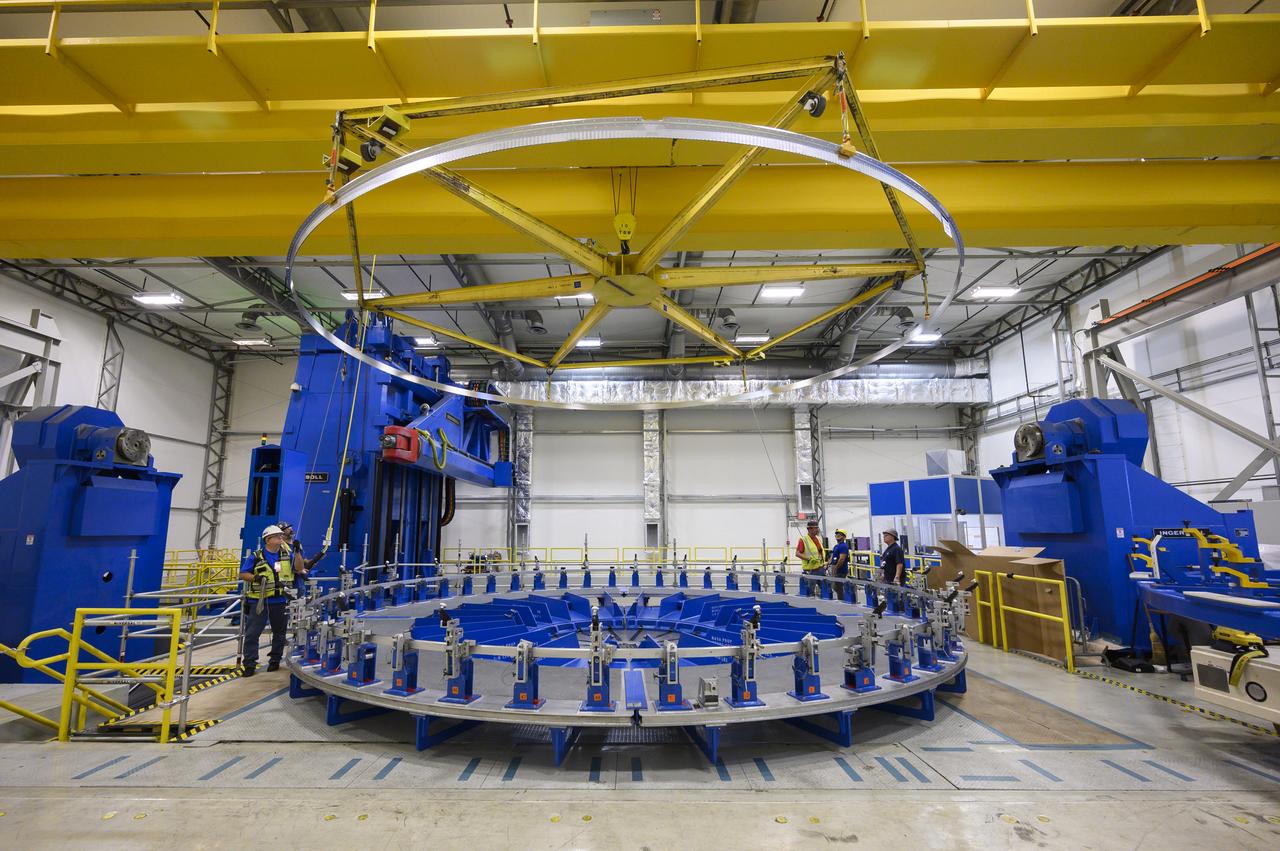
Technicians at NASA’s Michoud Assembly Facility in New Orleans lift a ring for the Exploration Upper Stage (EUS) of the SLS (Space Launch System) rocket to move it to another location in the 43-acre factory for further inspection and production. Flight hardware of the SLS EUS, a more powerful in-space propulsion stage beginning with Artemis IV, is in early production at Michoud. The rings make up the barrel sections for the flight hardware. The Exploration Upper Stage will be used on the second configuration of the SLS rocket, known as Block 1B, and will provide in-space propulsion to send astronauts in NASA’s Orion spacecraft and heavy cargo on a precise trajectory to the Moon. EUS will replace the interim cryogenic propulsion stage for the Block 1 configuration of SLS. It has larger propellant tanks and four RL10 engines, enabling SLS to launch 40% more cargo to the Moon along with crew. NASA and Boeing, the SLS lead contractor for the core stage and EUS, are currently manufacturing stages for Artemis II, III, IV, and V at the factory. NASA is working to land the first woman and first person of color on the Moon under Artemis. SLS is part of NASA’s backbone for deep space exploration, along with Orion and the Gateway in orbit around the Moon. SLS is the only rocket that can send Orion, astronauts, and supplies to the Moon in a single mission.
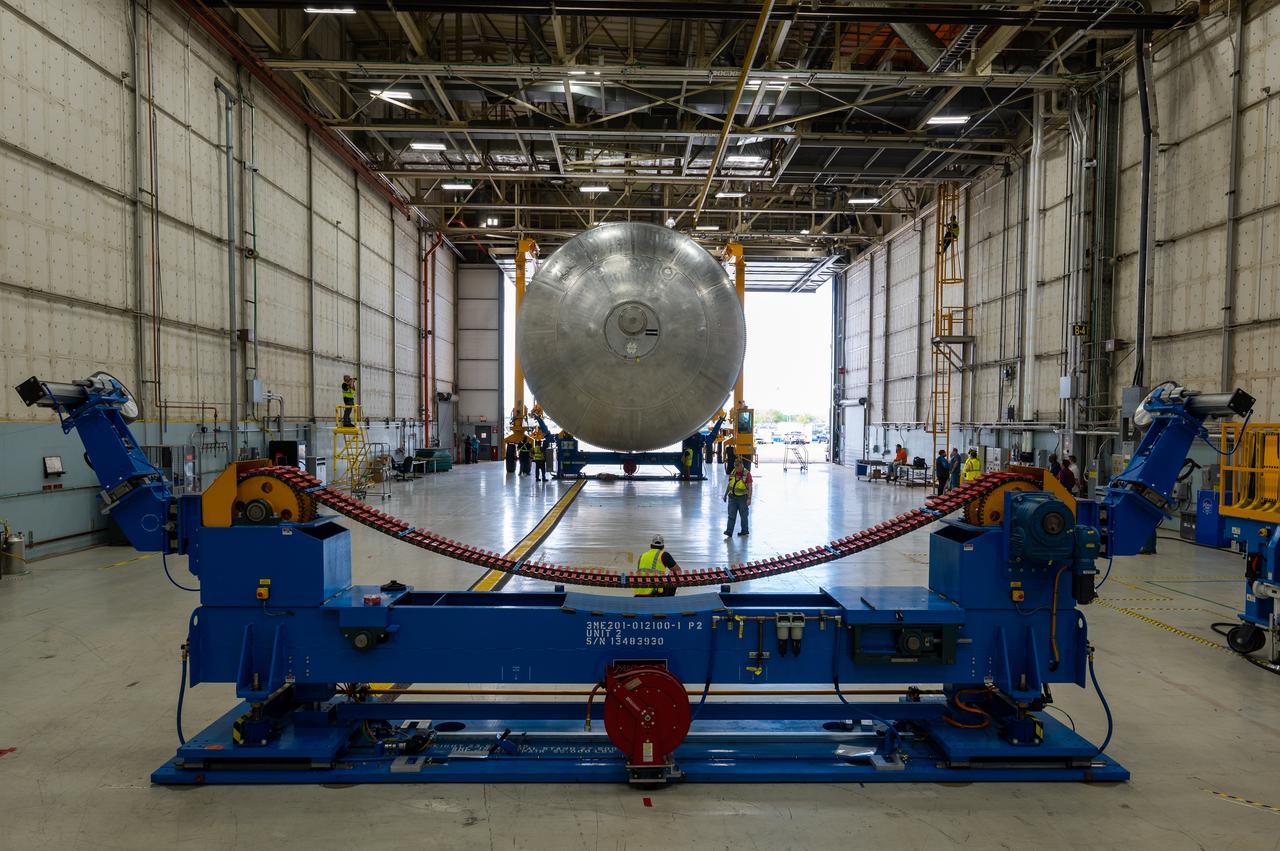
The core stage liquid hydrogen tank for the Artemis III mission completed proof testing, and technicians returned it to the main factory building at NASA’s Michoud Assembly Facility in New Orleans where it will undergo more outfitting. As part of proof testing, technicians apply a simple soap solution and check for leaks by observing any bubble formation on the welds. The technician removed the bubble solution with distilled water and then dried the area of application to prevent corrosion. To build the Space Launch System (SLS) rocket’s 130-foot core stage liquid hydrogen tank, engineers use robotic tools to weld five-barrel segments. This process results in a tank with around 1,900 feet, or more than six football fields, of welds that must be tested by hand. After the leak tests, the core stage lead, Boeing, pressurized the SLS tank to further ensure there were no leaks. After it passed proof testing, technicians moved the Artemis III liquid hydrogen tank to Michoud’s main factory. Soon, the technicians will prime and apply a foam-based thermal protection system that protects the tank during launch. Later, the tank will be joined with other parts of the core stage to form the entire 212-foot rocket stage with its four RS-25 engines that produce 2 million pounds of thrust to help launch the rocket. Artemis III will land the first astronauts on the lunar surface.
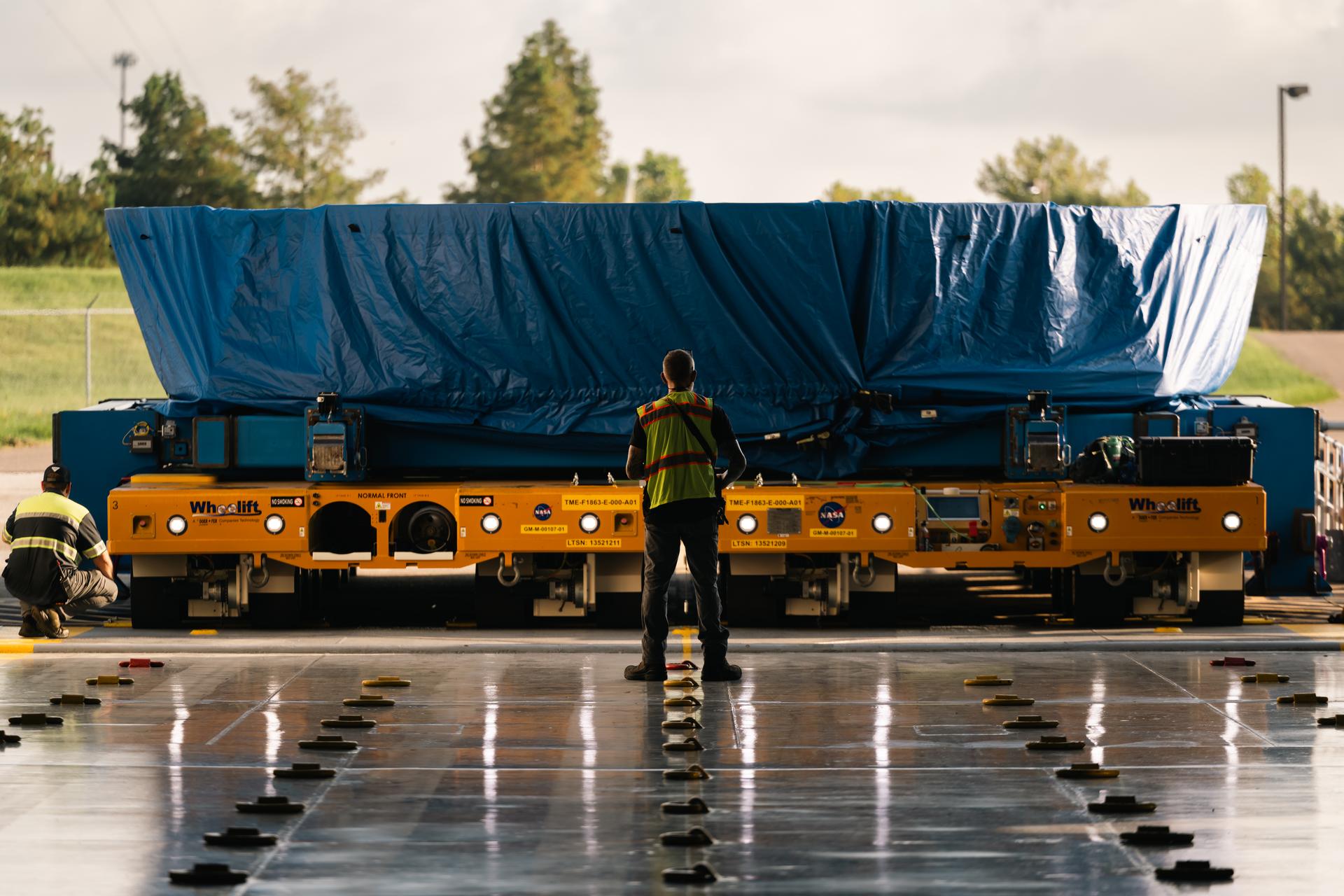
The Artemis IV core stage’s boat tail section is lifted and moved from its production area at NASA’s Michoud Assembly Facility in New Orleans on Aug. 24, 2026. The boat tail refers to the aerodynamic portion positioned directly above the exposed RS-25 engine nozzles, which comprise the lower portions of the core stage’s engine section. The boat tail critically shields the rocket’s lowermost hardware, including the engines’ upper components, plumbing, and critical control systems, protecting them from the extreme heat, vibrations, and pressures during launch. The completed hardware is lifted via the factory’s overhead crane system and secured onto two self-propelled modular transporters—NASA’s mobile heavy transport platforms,—for a short, low-speed drive across the facility, from the factory to the Pegasus barge. From New Orleans, the hardware travels to Kennedy Space Center for future engine section integration, and eventual stacking following the Artemis III mission. Through the Artemis campaign, NASA will send astronauts to explore the Moon for scientific discovery, economic benefits, and to build the foundation for the first crewed missions to Mars—for the benefit of all.
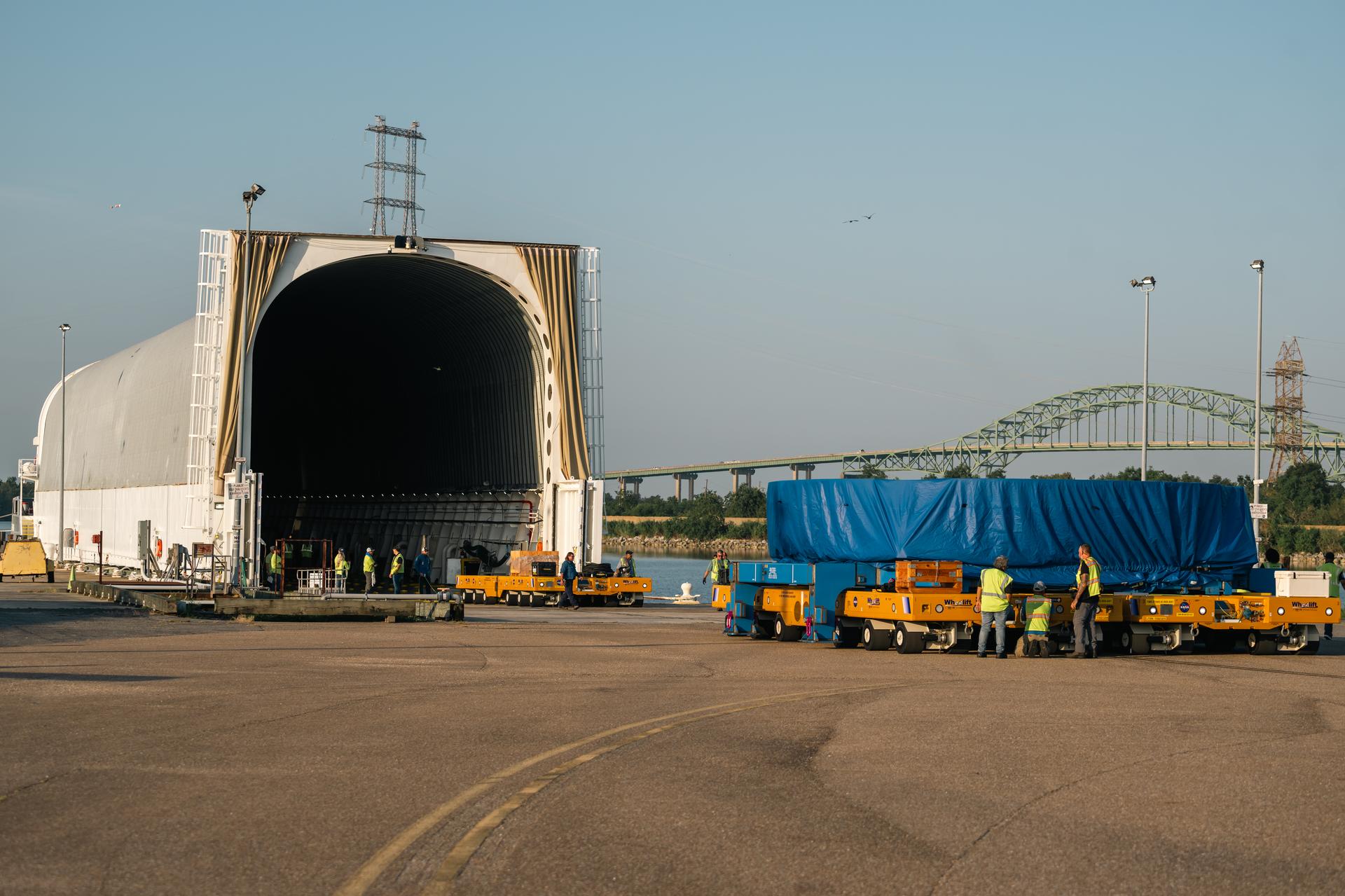
The Artemis IV core stage’s boat tail section is lifted and moved from its production area at NASA’s Michoud Assembly Facility in New Orleans on Aug. 24, 2026. The boat tail refers to the aerodynamic portion positioned directly above the exposed RS-25 engine nozzles, which comprise the lower portions of the core stage’s engine section. The boat tail critically shields the rocket’s lowermost hardware, including the engines’ upper components, plumbing, and critical control systems, protecting them from the extreme heat, vibrations, and pressures during launch. The completed hardware is lifted via the factory’s overhead crane system and secured onto two self-propelled modular transporters—NASA’s mobile heavy transport platforms,—for a short, low-speed drive across the facility, from the factory to the Pegasus barge. From New Orleans, the hardware travels to Kennedy Space Center for future engine section integration, and eventual stacking following the Artemis III mission. Through the Artemis campaign, NASA will send astronauts to explore the Moon for scientific discovery, economic benefits, and to build the foundation for the first crewed missions to Mars—for the benefit of all.

Move crews at NASA’s Michoud Assembly Facility in New Orleans move the 130-foot-tall liquid hydrogen tank out of the vertical assembly building and into a production area inside the 43-acre rocket factory on March 6, 2026. The tank, which will be used on the core stage of NASA’s SLS (Space Launch System) rocket for its Artemis IV mission, will soon undergo a series of non-destructive evaluation tests to ensure the tank is ready for the next step in the production process. The propellant tank is one of five major elements that make up the 212-foot-tall rocket stage. The core stage, along with its four RS-25 engines, produce more than two million pounds of thrust to help launch NASA’s Orion spacecraft, astronauts, and supplies beyond Earth’s orbit and to the lunar surface for Artemis. Image credit: NASA/Michael DeMocker

Move crews at NASA’s Michoud Assembly Facility in New Orleans move the 130-foot-tall liquid hydrogen tank out of the vertical assembly building and into a production area inside the 43-acre rocket factory on March 6, 2026. The tank, which will be used on the core stage of NASA’s SLS (Space Launch System) rocket for its Artemis IV mission, will soon undergo a series of non-destructive evaluation tests to ensure the tank is ready for the next step in the production process. The propellant tank is one of five major elements that make up the 212-foot-tall rocket stage. The core stage, along with its four RS-25 engines, produce more than two million pounds of thrust to help launch NASA’s Orion spacecraft, astronauts, and supplies beyond Earth’s orbit and to the lunar surface for Artemis. Image credit: NASA/Michael DeMocker

Move crews at NASA’s Michoud Assembly Facility in New Orleans move the 130-foot-tall liquid hydrogen tank out of the vertical assembly building and into a production area inside the 43-acre rocket factory on March 6, 2026. The tank, which will be used on the core stage of NASA’s SLS (Space Launch System) rocket for its Artemis IV mission, will soon undergo a series of non-destructive evaluation tests to ensure the tank is ready for the next step in the production process. The propellant tank is one of five major elements that make up the 212-foot-tall rocket stage. The core stage, along with its four RS-25 engines, produce more than two million pounds of thrust to help launch NASA’s Orion spacecraft, astronauts, and supplies beyond Earth’s orbit and to the lunar surface for Artemis. Image credit: NASA/Michael DeMocker

Move crews at NASA’s Michoud Assembly Facility in New Orleans move the 130-foot-tall liquid hydrogen tank out of the vertical assembly building and into a production area inside the 43-acre rocket factory on March 6, 2026. The tank, which will be used on the core stage of NASA’s SLS (Space Launch System) rocket for its Artemis IV mission, will soon undergo a series of non-destructive evaluation tests to ensure the tank is ready for the next step in the production process. The propellant tank is one of five major elements that make up the 212-foot-tall rocket stage. The core stage, along with its four RS-25 engines, produce more than two million pounds of thrust to help launch NASA’s Orion spacecraft, astronauts, and supplies beyond Earth’s orbit and to the lunar surface for Artemis. Image credit: NASA/Michael DeMocker

Move crews at NASA’s Michoud Assembly Facility in New Orleans move the 130-foot-tall liquid hydrogen tank out of the vertical assembly building and into a production area inside the 43-acre rocket factory on March 6, 2026. The tank, which will be used on the core stage of NASA’s SLS (Space Launch System) rocket for its Artemis IV mission, will soon undergo a series of non-destructive evaluation tests to ensure the tank is ready for the next step in the production process. The propellant tank is one of five major elements that make up the 212-foot-tall rocket stage. The core stage, along with its four RS-25 engines, produce more than two million pounds of thrust to help launch NASA’s Orion spacecraft, astronauts, and supplies beyond Earth’s orbit and to the lunar surface for Artemis. Image credit: NASA/Michael DeMocker

Move crews at NASA’s Michoud Assembly Facility in New Orleans move the 130-foot-tall liquid hydrogen tank out of the vertical assembly building and into a production area inside the 43-acre rocket factory on March 6, 2026. The tank, which will be used on the core stage of NASA’s SLS (Space Launch System) rocket for its Artemis IV mission, will soon undergo a series of non-destructive evaluation tests to ensure the tank is ready for the next step in the production process. The propellant tank is one of five major elements that make up the 212-foot-tall rocket stage. The core stage, along with its four RS-25 engines, produce more than two million pounds of thrust to help launch NASA’s Orion spacecraft, astronauts, and supplies beyond Earth’s orbit and to the lunar surface for Artemis. Image credit: NASA/Michael DeMocker

Move crews at NASA’s Michoud Assembly Facility in New Orleans move the 130-foot-tall liquid hydrogen tank out of the vertical assembly building and into a production area inside the 43-acre rocket factory on March 6, 2026. The tank, which will be used on the core stage of NASA’s SLS (Space Launch System) rocket for its Artemis IV mission, will soon undergo a series of non-destructive evaluation tests to ensure the tank is ready for the next step in the production process. The propellant tank is one of five major elements that make up the 212-foot-tall rocket stage. The core stage, along with its four RS-25 engines, produce more than two million pounds of thrust to help launch NASA’s Orion spacecraft, astronauts, and supplies beyond Earth’s orbit and to the lunar surface for Artemis. Image credit: NASA/Michael DeMocker
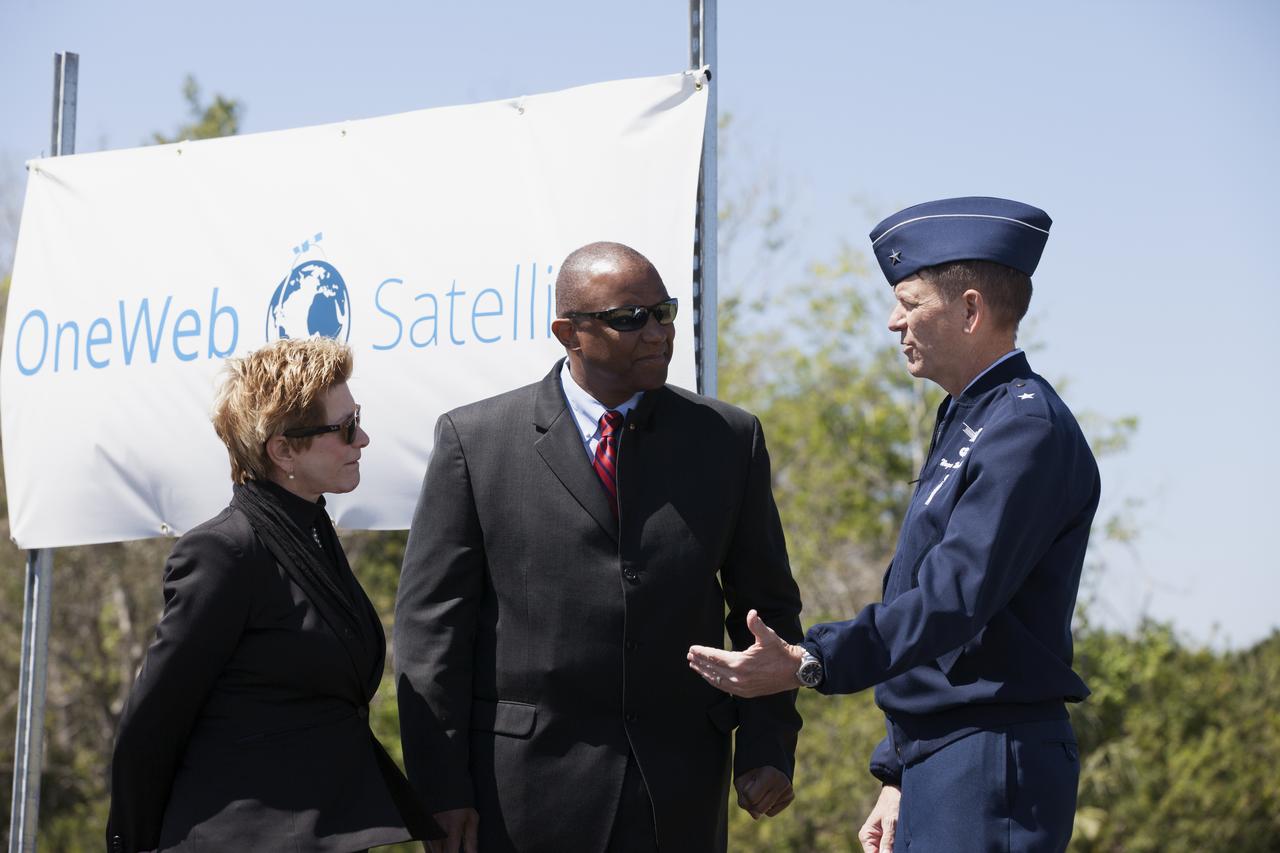
Lynda Weatherman, president and CEO of the Economic Development Council of the Space Coast, talks with Kelvin Manning, associate director of NASA's Kennedy Space Center, and Gen. Wayne Monteith, commander of the 45th Space Wing of the U.S. Air Force, prior to a groundbreaking ceremony at Kennedy's Exploration Park for OneWeb. The company, in partnership with Airbus, is building a 150,000-square-foot factory to manufacture satellites that will connect all areas of the world to the Internet wirelessly. Photo credit: NASA/Kim Shiflett
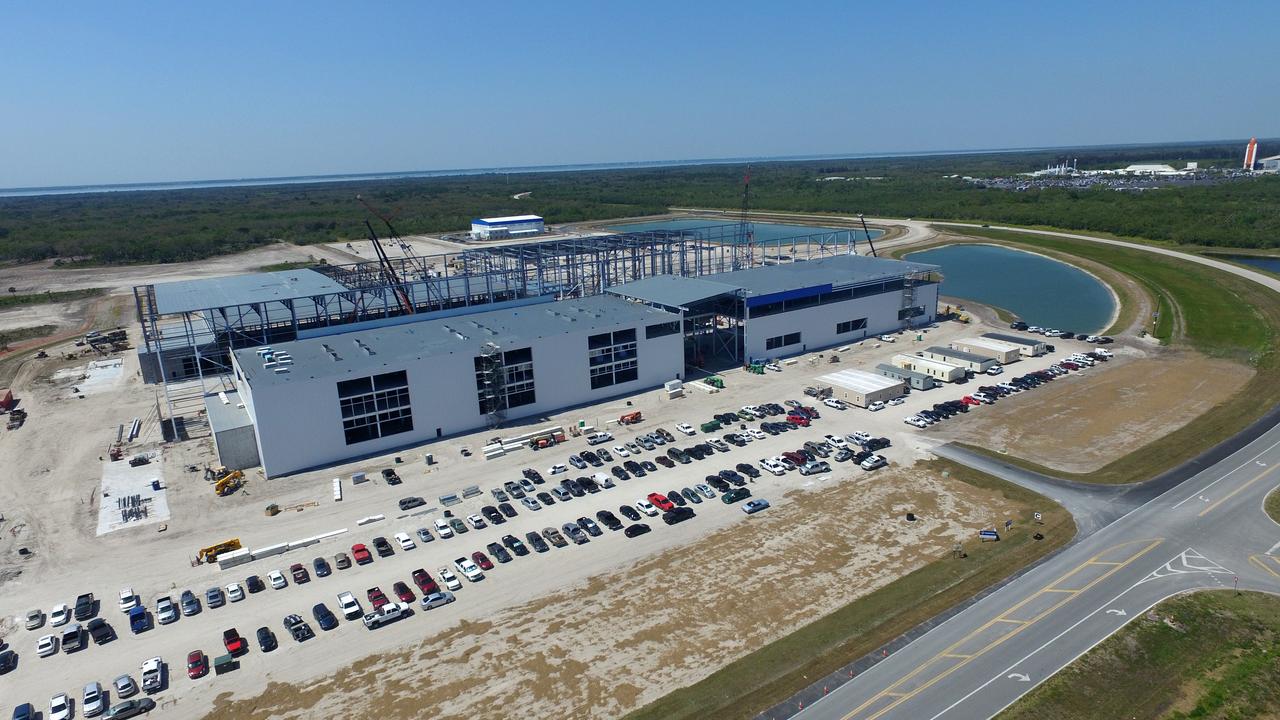
Construction is progressing on Blue Origin's 750,000-square-foot facility being built at Exploration Park on NASA Kennedy Space Center property in Florida. Blue Origin will use the factory to manufacture its two-stage super-heavy-lift New Glenn launch vehicle and launch the vehicles from Space Launch Complex 46 at Cape Canaveral Air Force Station.
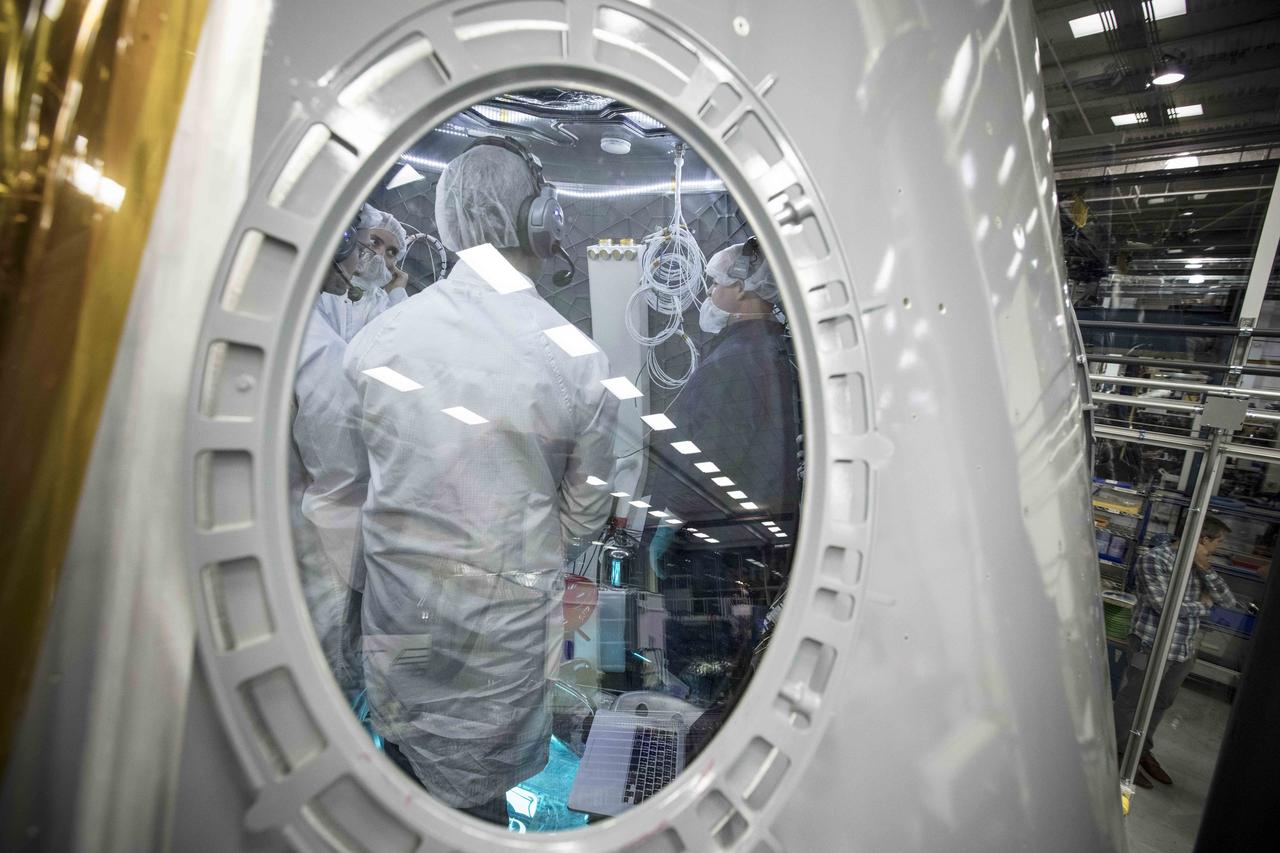
Engineers work inside the ECLSS module at SpaceX’s headquarters and factory in Hawthorne, California. The module is the same size as the company’s Crew Dragon spacecraft and is built to test the Environmental Control and Life Support System, or ECLSS, that is being built for missions aboard the Crew Dragon including those by astronauts flying to the International Space Station on flights for NASA’s Commercial Crew Program. Photo credit: SpaceX
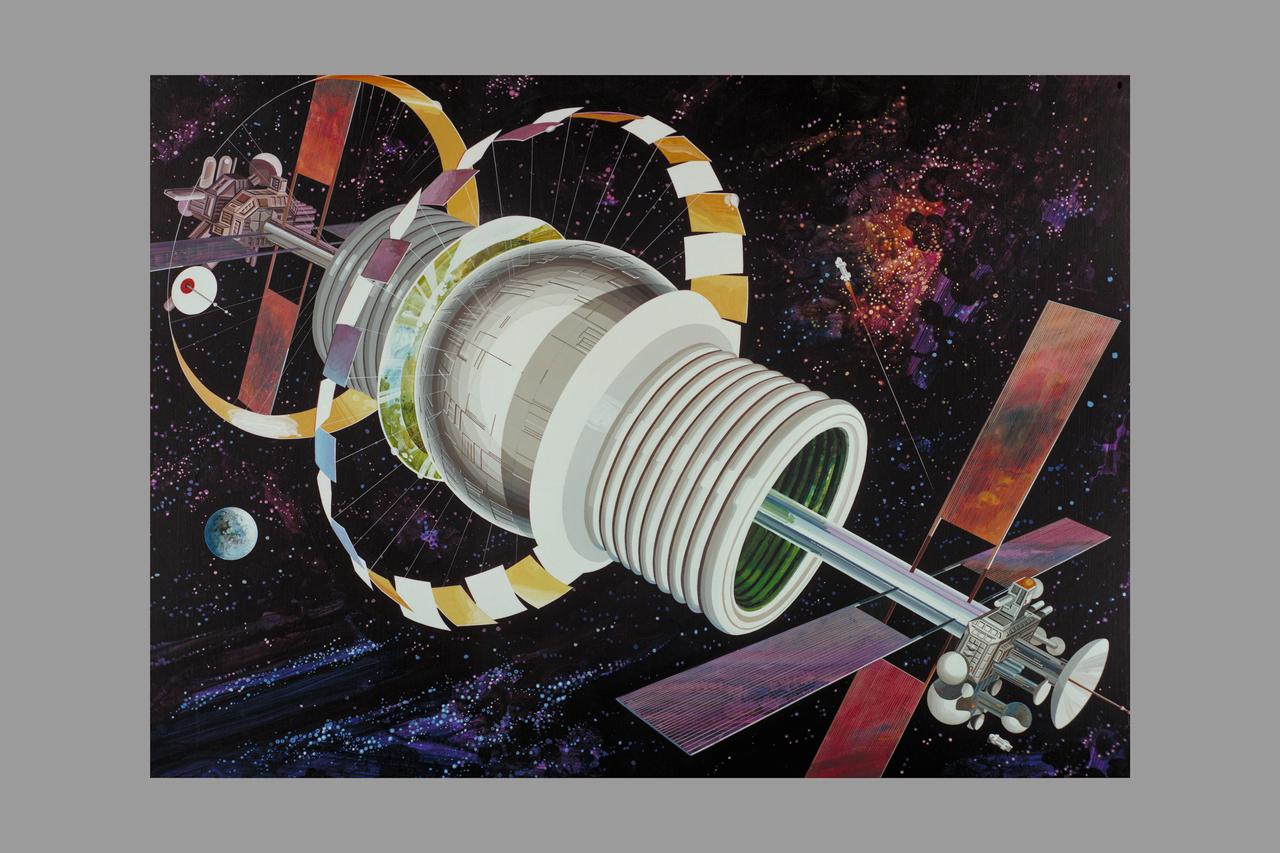
Artist: Rick Guidice Space Colonization - Bernal Sphere - The residential area is in the central sphere. Farming regions are in the 'tires.' Mirrors reflect sunlight into the habitat and farms. The large flat panels radiate away extra heat into space, and panels of solar cells provide electricity. Factories and docks for spaceships are at either end of the long central tube. (NOTE: art printed in Book 'Space Colony - Frontier of the 21st Century by Franklyn M. Branley)

Astronaut Bob Behnken emerges from the hatch of a SpaceX Crew Dragon spacecraft in manufacturing at SpaceX's headquarters and factory in Hawthorne, California. Behnken is one of four NASA astronauts selected to train with Boeing and SpaceX ahead of flight tests for NASA's Commercial Crew Program. Along with Behnken, Eric Boe, Doug Hurley and Suni Williams are working with the companies on their independent spacecraft and launch vehicles being developed to take astronauts to the International Space Station. Photo credit: SpaceX

The ECLSS module inside SpaceX’s headquarters and factory in Hawthorne, California. The module is the same size as the company’s Crew Dragon spacecraft and is built to test the Environmental Control and Life Support System, or ECLSS, that is being built for missions aboard the Crew Dragon including those by astronauts flying to the International Space Station on flights for NASA’s Commercial Crew Program. Photo credit: SpaceX
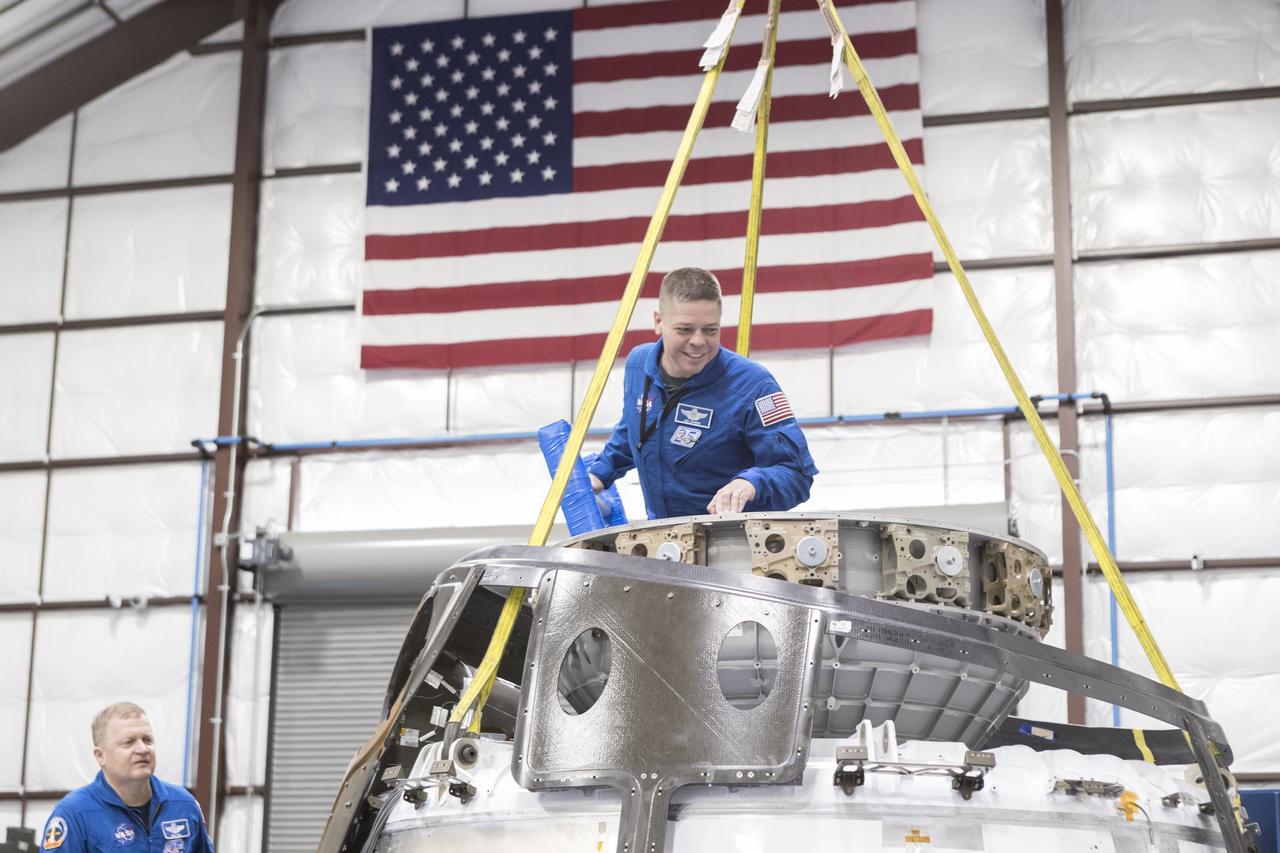
Astronaut Bob Behnken emerges from the top hatch of a SpaceX Crew Dragon spacecraft in manufacturing at SpaceX's headquarters and factory in Hawthorne, California, as astronaut Eri Boe looks on. Behnken and Boe are two of four NASA astronauts selected to train with Boeing and SpaceX ahead of flight tests for NASA's Commercial Crew Program. Along with Behnken and Boe, Doug Hurley and Suni Williams are working with the companies on their independent spacecraft and launch vehicles being developed to take astronauts to the International Space Station. Photo credit: SpaceX
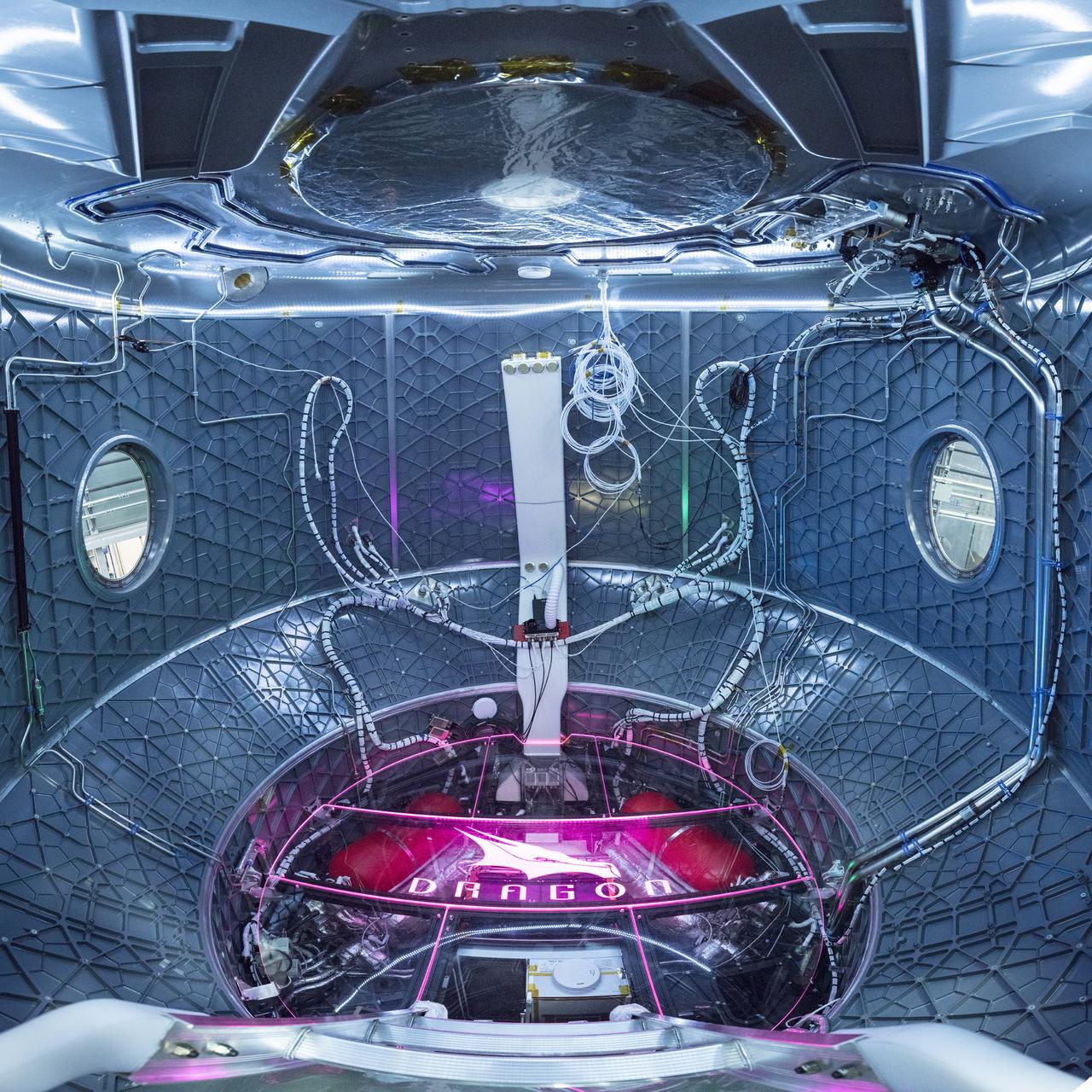
The interior of the ECLSS module inside SpaceX’s headquarters and factory in Hawthorne, California. The module is the same size as the company’s Crew Dragon spacecraft and is built to test the Environmental Control and Life Support System, or ECLSS, that is being built for missions aboard the Crew Dragon including those by astronauts flying to the International Space Station on flights for NASA’s Commercial Crew Program. Photo credit: SpaceX
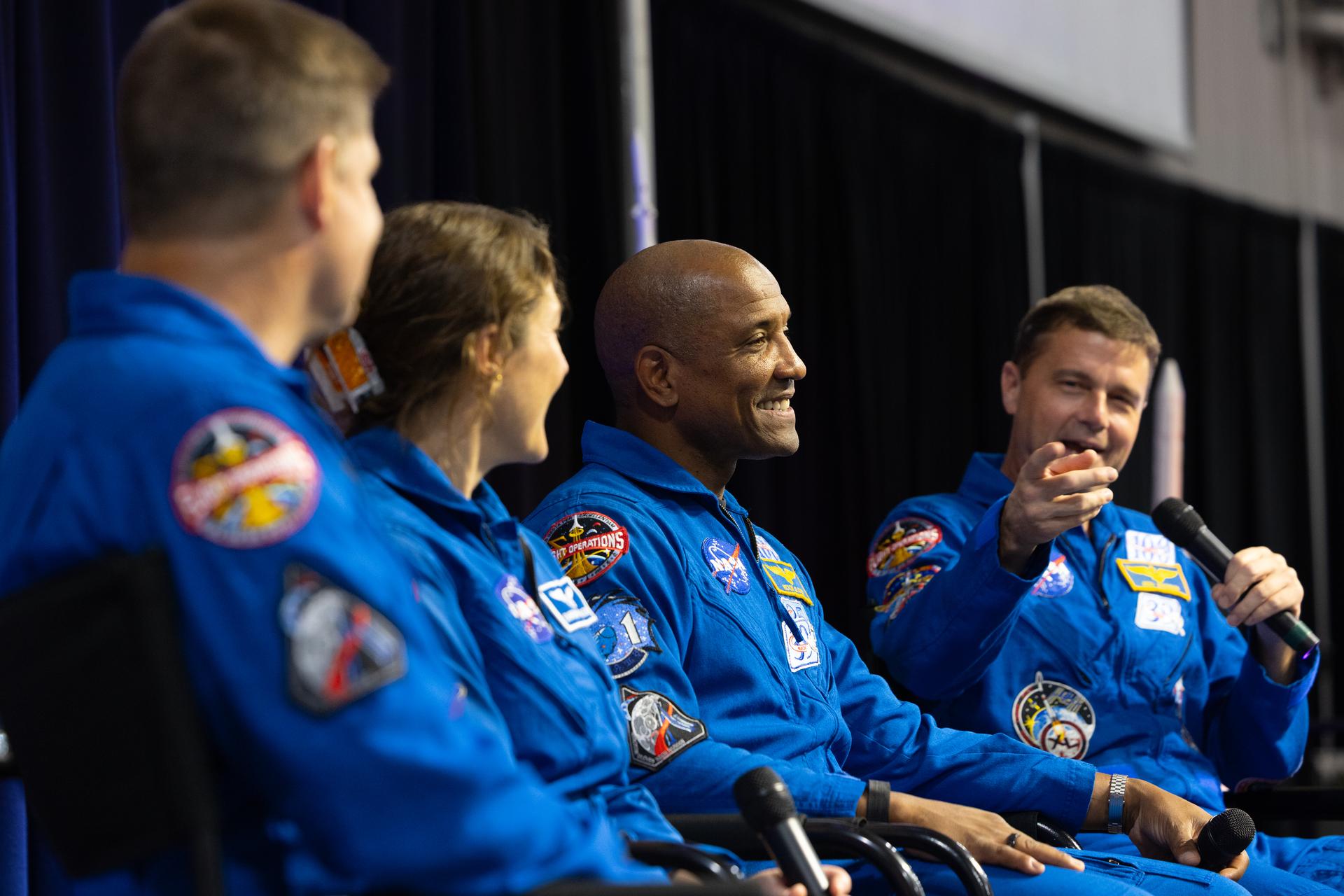
The crew of NASA's Artemis II mission visited NASA’s Michoud Assembly Facility on Sept. 3, 2026, marking their first return to the New Orleans factory since their historic test flight in April. The astronauts met with the workforce to share their gratitude for the facility's structural and manufacturing contributions to the mission's success. During an employee all-hands event, the crew reflected on their journey around the Moon, thanked Michoud team members for their contributions to the mission, and answered questions from the workforce. Artemis II was the first crewed mission of NASA’s Artemis campaign. Wiseman, Glover, Koch, and Hansen completed the approximately 10-day mission around the Moon in April 2026.
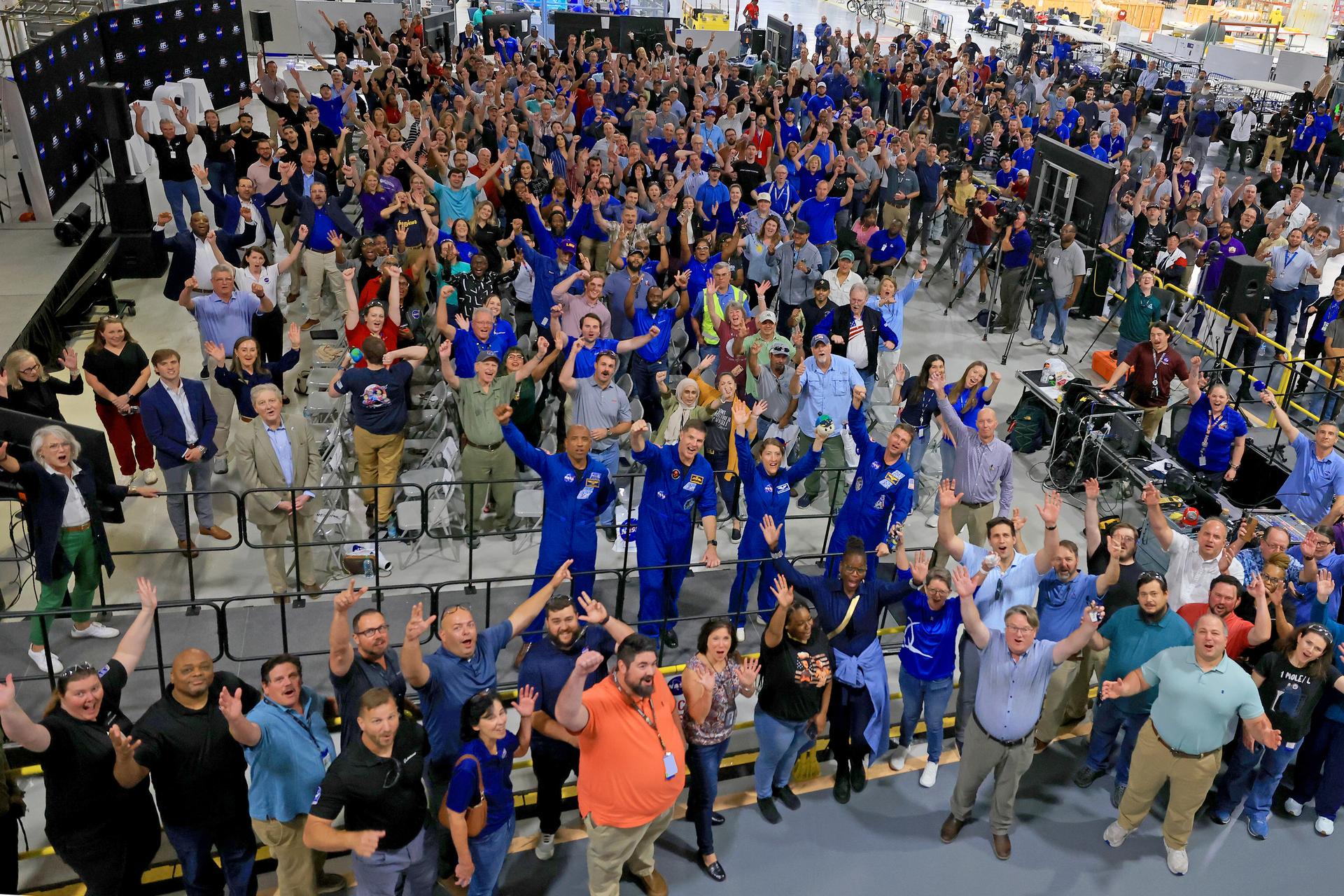
The crew of NASA's Artemis II mission visited NASA’s Michoud Assembly Facility on Sept. 3, 2026, marking their first return to the New Orleans factory since their historic test flight in April. The astronauts met with the workforce to share their gratitude for the facility's structural and manufacturing contributions to the mission's success. During an employee all-hands event, the crew reflected on their journey around the Moon, thanked Michoud team members for their contributions to the mission, and answered questions from the workforce. Artemis II was the first crewed mission of NASA’s Artemis campaign. Wiseman, Glover, Koch, and Hansen completed the approximately 10-day mission around the Moon in April 2026. Image credit: NASA/Michael DeMocker
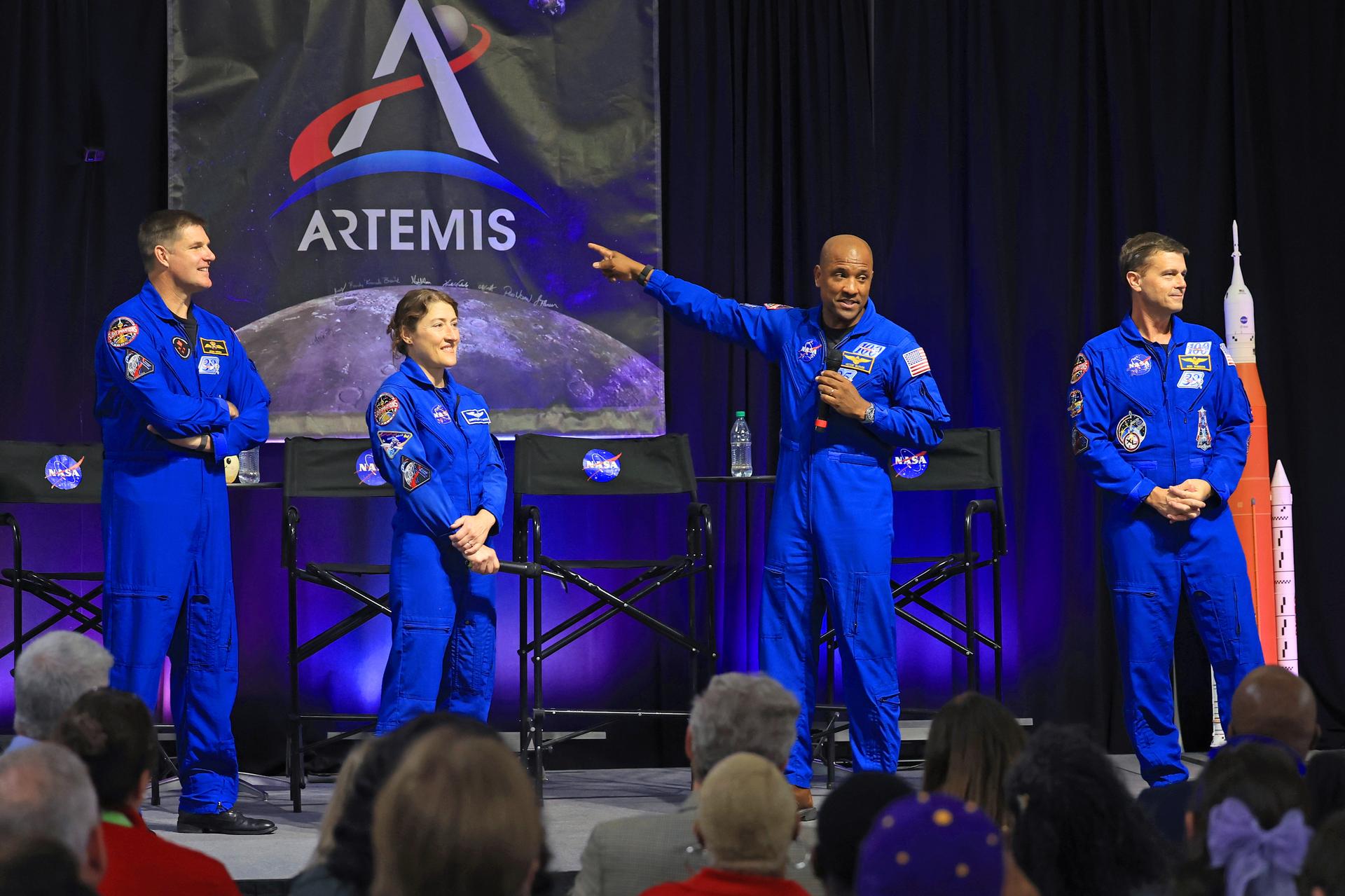
The crew of NASA's Artemis II mission visited NASA’s Michoud Assembly Facility on Sept. 3, 2026, marking their first return to the New Orleans factory since their historic test flight in April. The astronauts met with the workforce to share their gratitude for the facility's structural and manufacturing contributions to the mission's success. During an employee all-hands event, the crew reflected on their journey around the Moon, thanked Michoud team members for their contributions to the mission, and answered questions from the workforce. Artemis II was the first crewed mission of NASA’s Artemis campaign. Wiseman, Glover, Koch, and Hansen completed the approximately 10-day mission around the Moon in April 2026. Image credit: NASA/Michael DeMocker
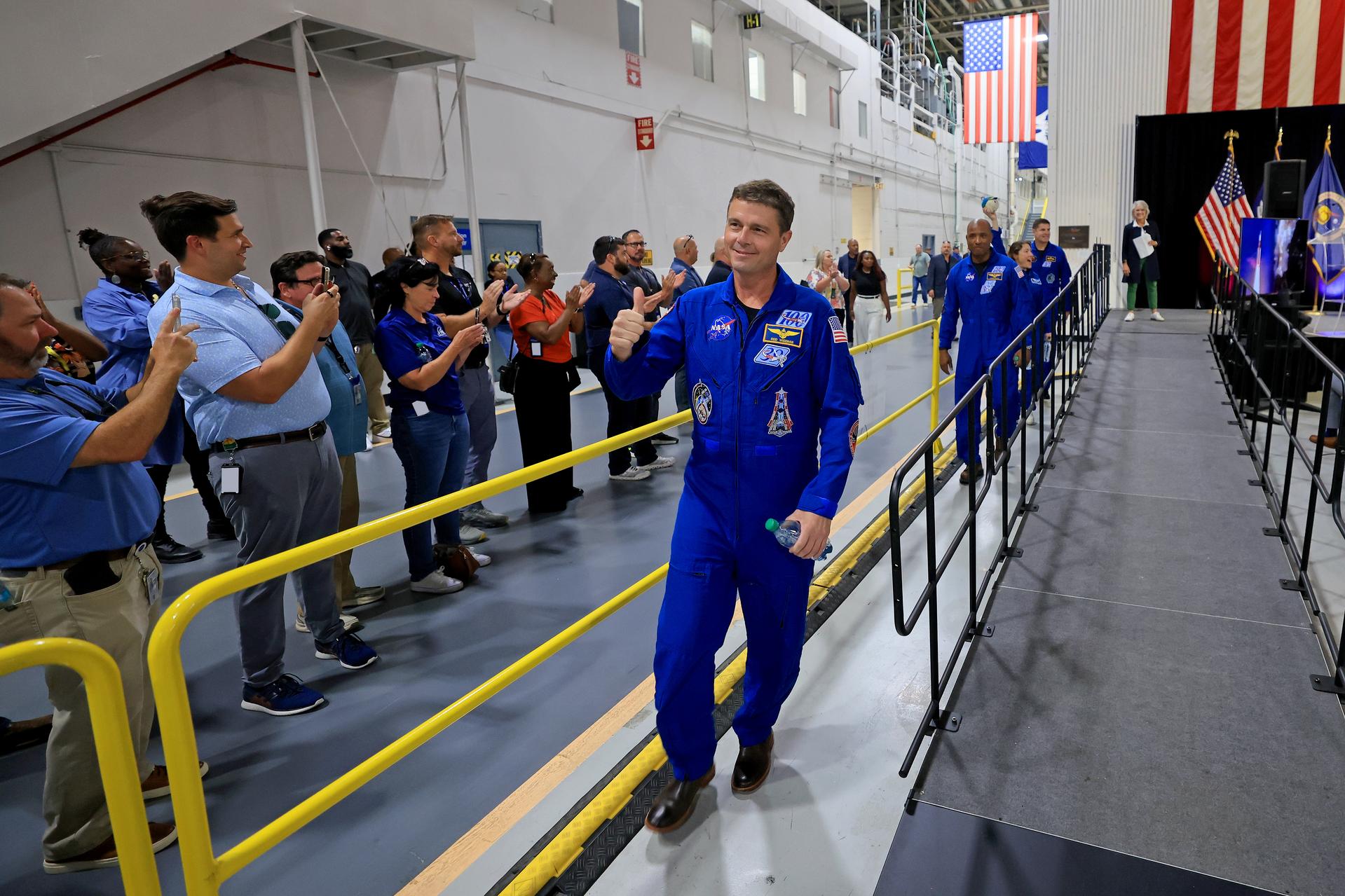
The crew of NASA's Artemis II mission visited NASA’s Michoud Assembly Facility on Sept. 3, 2026, marking their first return to the New Orleans factory since their historic test flight in April. The astronauts met with the workforce to share their gratitude for the facility's structural and manufacturing contributions to the mission's success. During an employee all-hands event, the crew reflected on their journey around the Moon, thanked Michoud team members for their contributions to the mission, and answered questions from the workforce. Artemis II was the first crewed mission of NASA’s Artemis campaign. Wiseman, Glover, Koch, and Hansen completed the approximately 10-day mission around the Moon in April 2026. Image credit: NASA/Michael DeMocker
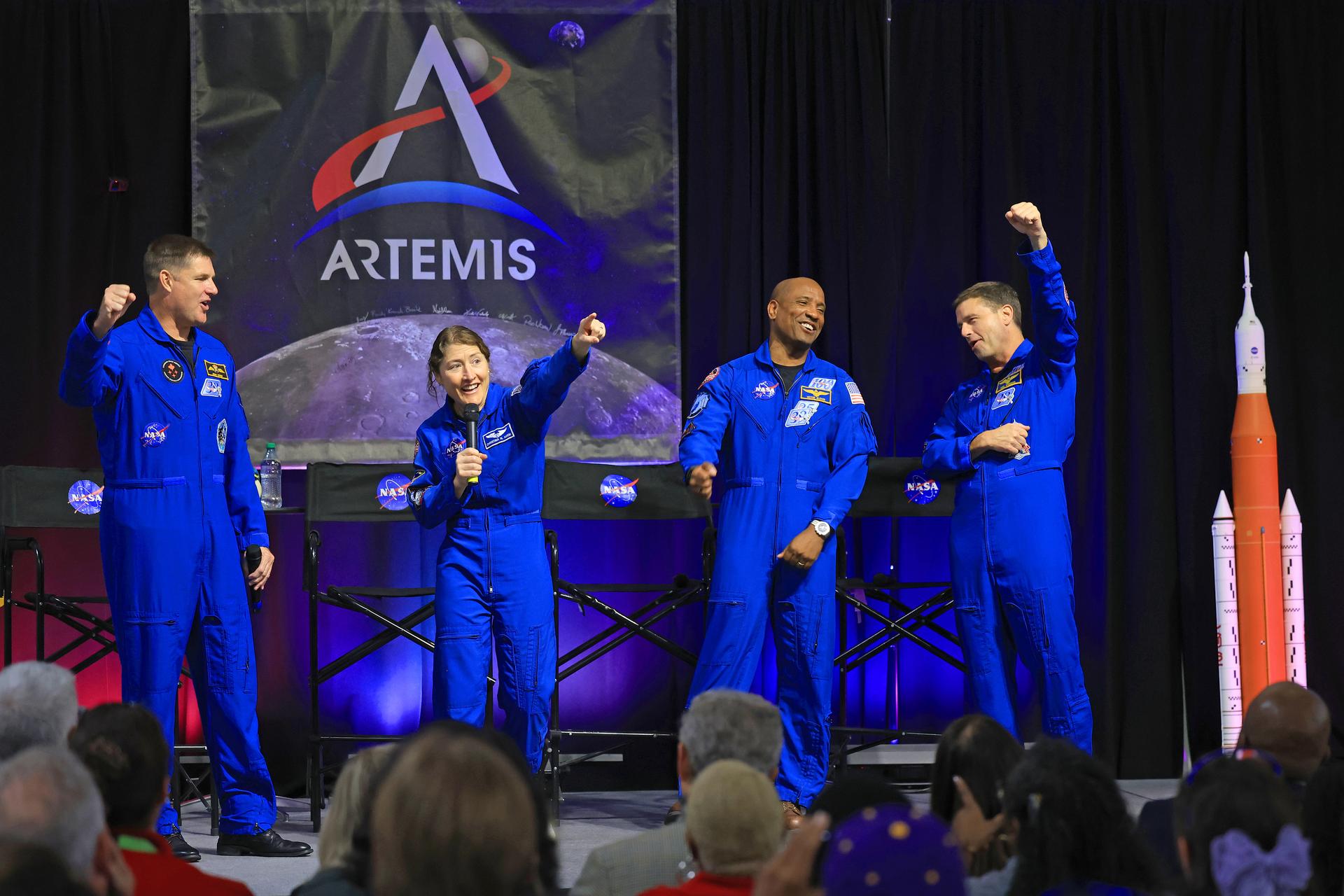
The crew of NASA's Artemis II mission visited NASA’s Michoud Assembly Facility on Sept. 3, 2026, marking their first return to the New Orleans factory since their historic test flight in April. The astronauts met with the workforce to share their gratitude for the facility's structural and manufacturing contributions to the mission's success. During an employee all-hands event, the crew reflected on their journey around the Moon, thanked Michoud team members for their contributions to the mission, and answered questions from the workforce. Artemis II was the first crewed mission of NASA’s Artemis campaign. Wiseman, Glover, Koch, and Hansen completed the approximately 10-day mission around the Moon in April 2026. Image credit: NASA/Michael DeMocker
The crew of NASA's Artemis II mission visited NASA’s Michoud Assembly Facility on Sept. 3, 2026, marking their first return to the New Orleans factory since their historic test flight in April. The astronauts met with the workforce to share their gratitude for the facility's structural and manufacturing contributions to the mission's success. During an employee all-hands event, the crew reflected on their journey around the Moon, thanked Michoud team members for their contributions to the mission, and answered questions from the workforce. Artemis II was the first crewed mission of NASA’s Artemis campaign. Wiseman, Glover, Koch, and Hansen completed the approximately 10-day mission around the Moon in April 2026. Image credit: NASA/Michael DeMocker