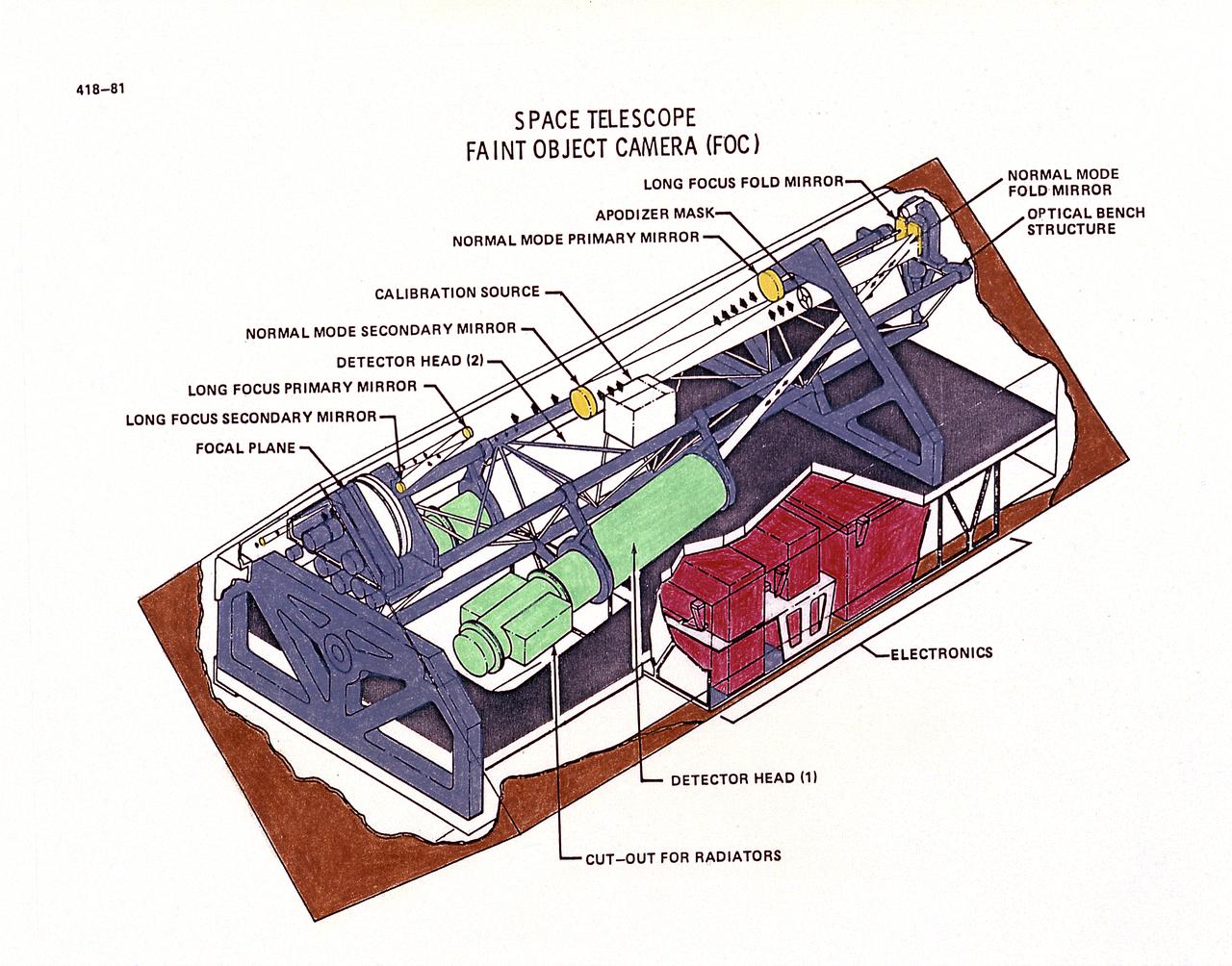
This drawing illustrates Hubble Space Telescope's (HST's), Faint Object Camera (FOC). The FOC reflects light down one of two optical pathways. The light enters a detector after passing through filters or through devices that can block out light from bright objects. Light from bright objects is blocked out to enable the FOC to see background images. The detector intensifies the image, then records it much like a television camera. For faint objects, images can be built up over long exposure times. The total image is translated into digital data, transmitted to Earth, and then reconstructed. The purpose of the HST, the most complex and sensitive optical telescope ever made, is to study the cosmos from a low-Earth orbit. By placing the telescope in space, astronomers are able to collect data that is free of the Earth's atmosphere. The HST detects objects 25 times fainter than the dimmest objects seen from Earth and provides astronomers with an observable universe 250 times larger than visible from ground-based telescopes, perhaps as far away as 14 billion light-years. The HST views galaxies, stars, planets, comets, possibly other solar systems, and even unusual phenomena such as quasars, with 10 times the clarity of ground-based telescopes. The HST was deployed from the Space Shuttle Discovery (STS-31 mission) into Earth orbit in April 1990. The Marshall Space Flight Center had responsibility for design, development, and construction of the HST. The Perkin-Elmer Corporation, in Danbury, Cornecticut, developed the optical system and guidance sensors.
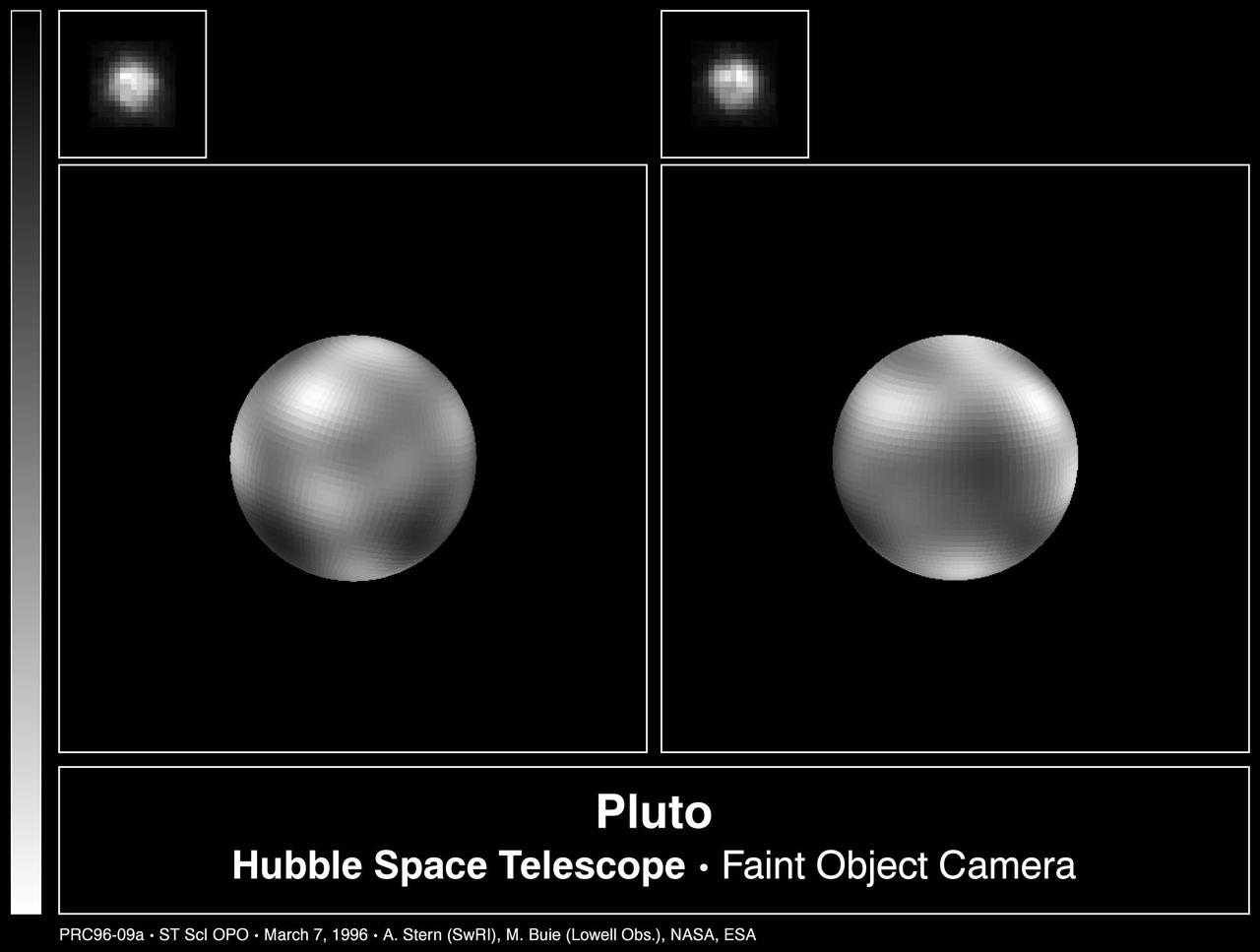
The never-before-seen surface of the distant planet Pluto is resolved in these NASA Hubble Space Telescope pictures, taken with the European Space Agency Faint Object Camera FOC aboard Hubble.

This is the clearest view yet of the distant planet Pluto and its moon, Charon, as revealed by NASA Hubble Space Telescope. The image was taken by the European Space Agency Faint Object Camera on February 21, 1994.
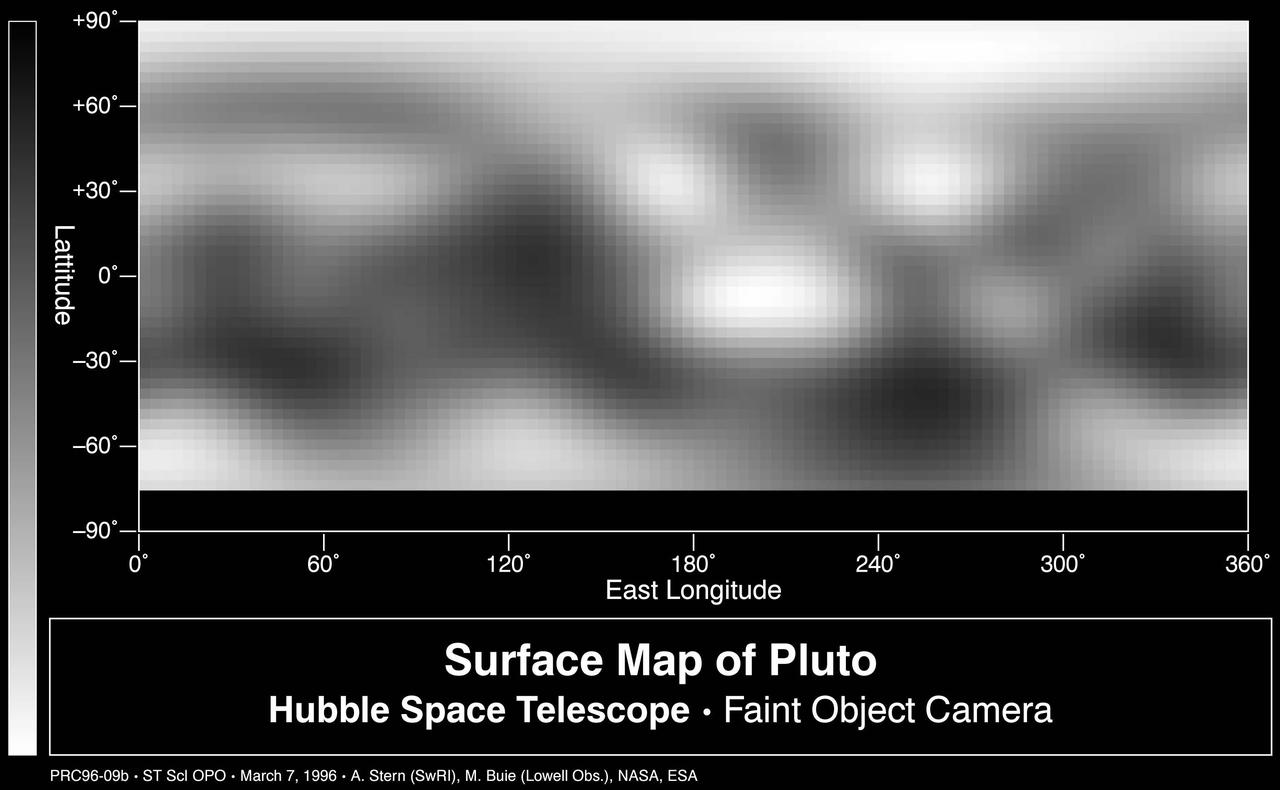
This image-based surface map of Pluto was assembled by computer image processing software from four separate images of Pluto disk taken with the European Space Agency Faint Object Camera aboard NASA Hubble Space Telescope.
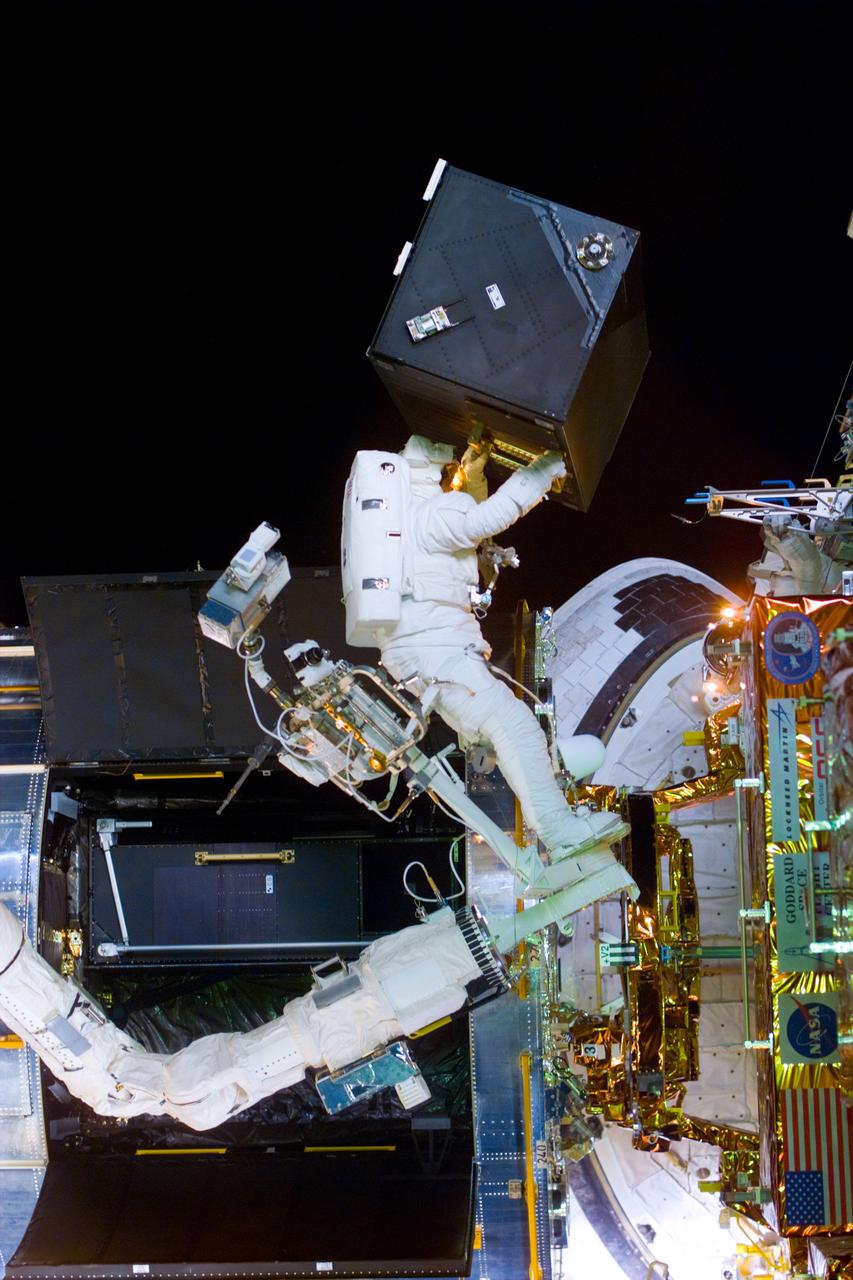
S82-E-5317 (14 Feb. 1997) --- Astronaut Steven L. Smith, STS-82 mission specialist, on arm with Faint Object Spectrograph (FOS) after removal from Hubble Space Telescope (HST). This view was taken with an Electronic Still Camera (ESC).
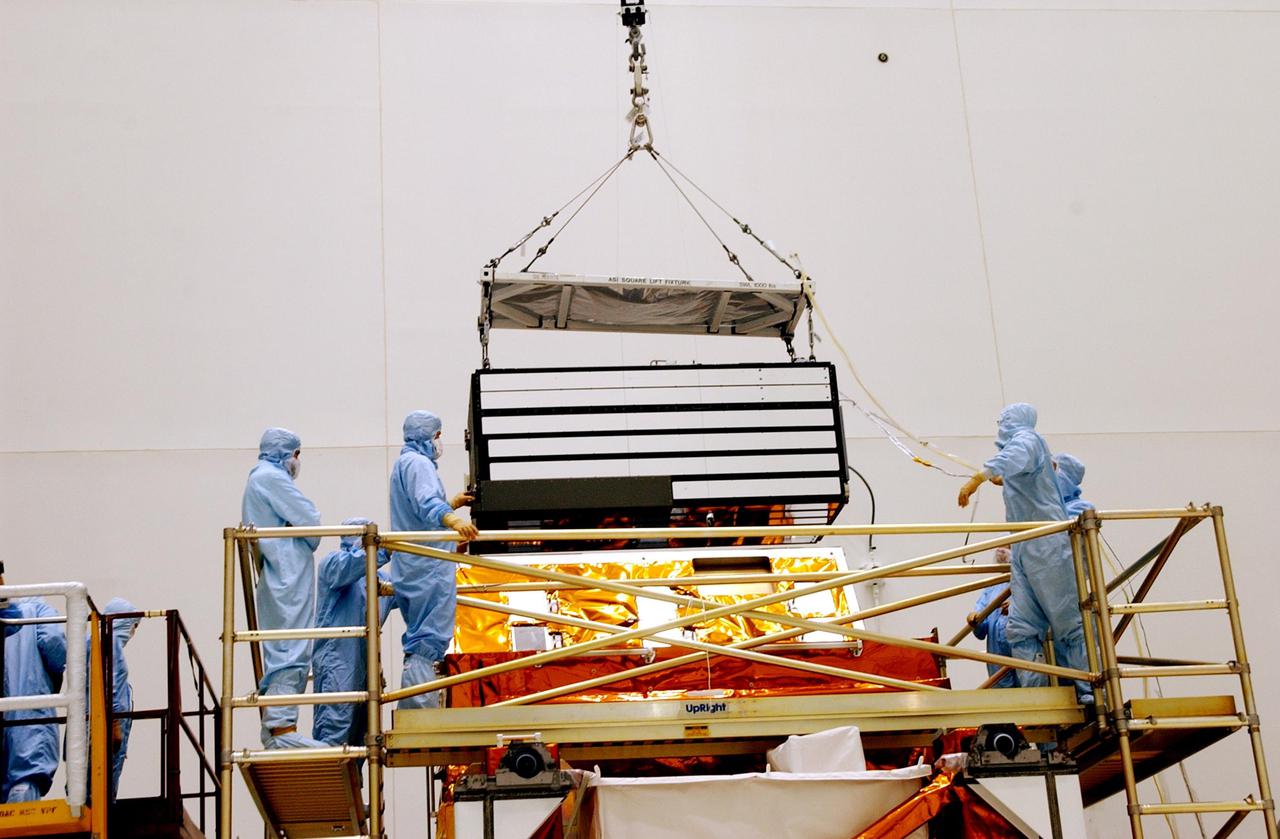
KENNEDY SPACE CENTER, FLA. -- In the Vertical Processing Facility, workers watch while an overhead crane lowers the Advanced Camera for Surveys (ACS) toward the Axial Science Instrument Protective Enclosure (ASIPE). The ACS is part of the payload on the Hubble Space Telescope Servicing Mission, STS-109. The goal of the mission is to service the HST, replacing Solar Array 2 with Solar Array 3, replacing the Power Control Unit, removing the Faint Object Camera and installing the ACS, installing the Near Infrared Camera and Multi-Object Spectrometer (NICMOS) Cooling System, and installing New Outer Blanket Layer insulation. Mission STS-109 is scheduled for launch no earlier than Feb. 21, 2002
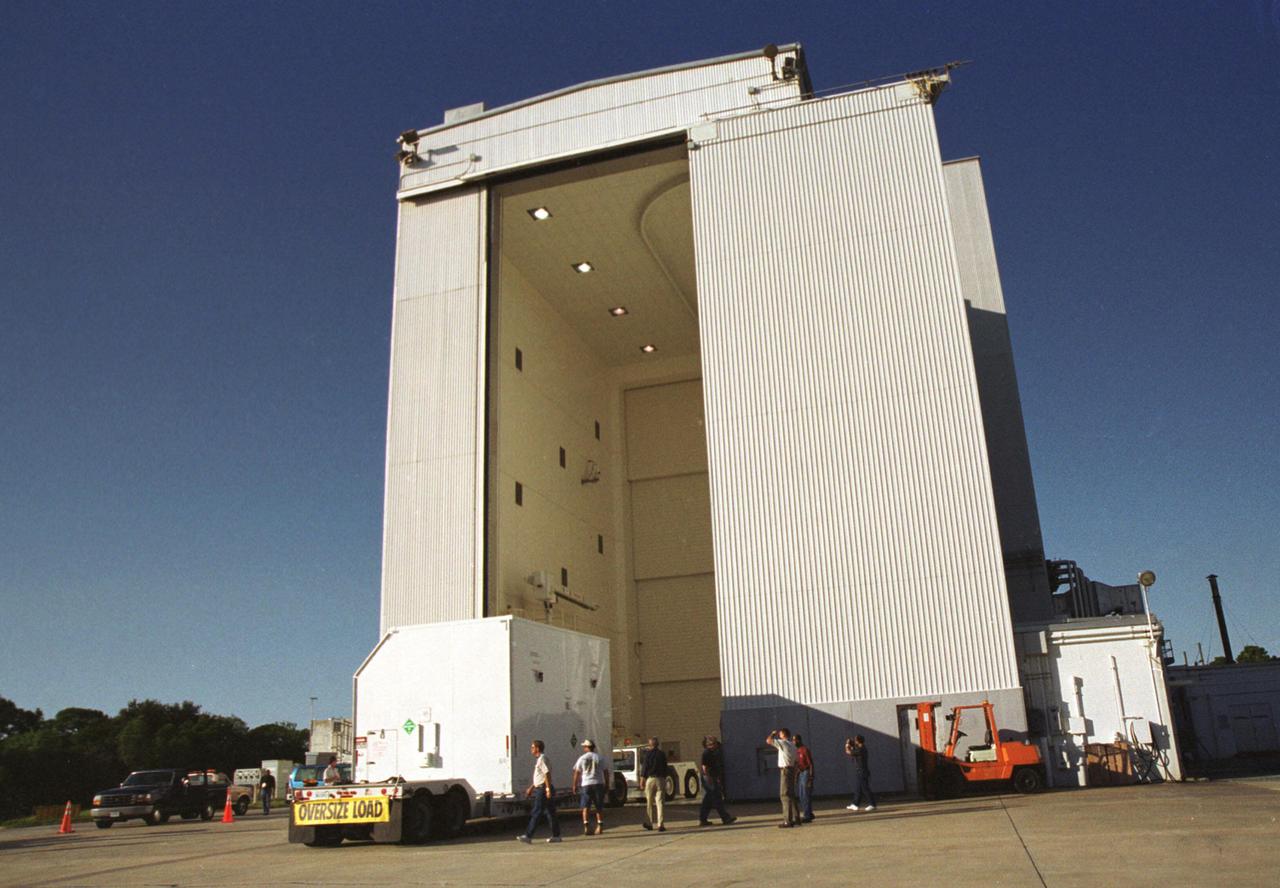
KENNEDY SPACE CENTER, Fla. -- The truck delivering part of the equipment to be used on mission STS-109 moves into the Vertical Processing Facility at KSC. The mission is to service the Hubble Space Telescope, replacing Solar Array 2 with Solar Array 3, replacing the Power Control Unit, removing the Faint Object Camera and installing the Advanced Camera for Surveys, installing the Near Infrared Camera and Multi-Object Spectrometer (NICMOS) Cooling System, and installing New Outer Blanket Layer insulation on bays 5 through 8. Mission STS-109 is scheduled for launch Feb. 14, 2002.
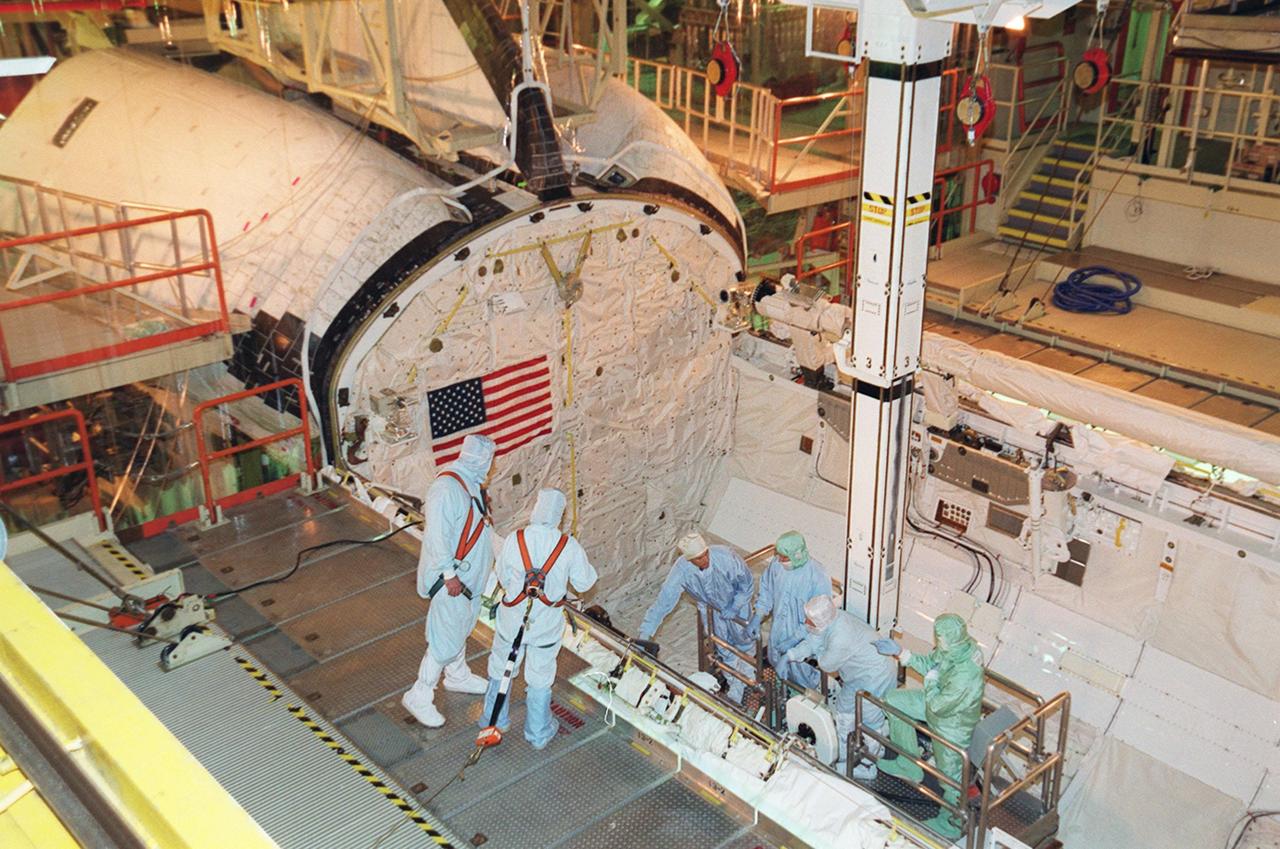
KENNEDY SPACE CENTER, Fla. - Members of the STS-109 crew are lowered into the payload bay of orbiter Columbia to check out some of the equipment. The crew is at KSC to take part in Crew Equipment Interface Test activities that include familiarization with the orbiter and equipment. The goal of the mission is to service the HST, replacing Solar Array 2 with Solar Array 3, replacing the Power Control Unit, removing the Faint Object Camera and installing the Advanced Camera for Surveys, installing the Near Infrared Camera and Multi-Object Spectrometer (NICMOS) Cooling System, and installing New Outer Blanket Layer insulation on bays 5 through 8. Mission STS-109 is scheduled for launch Feb. 14, 2002
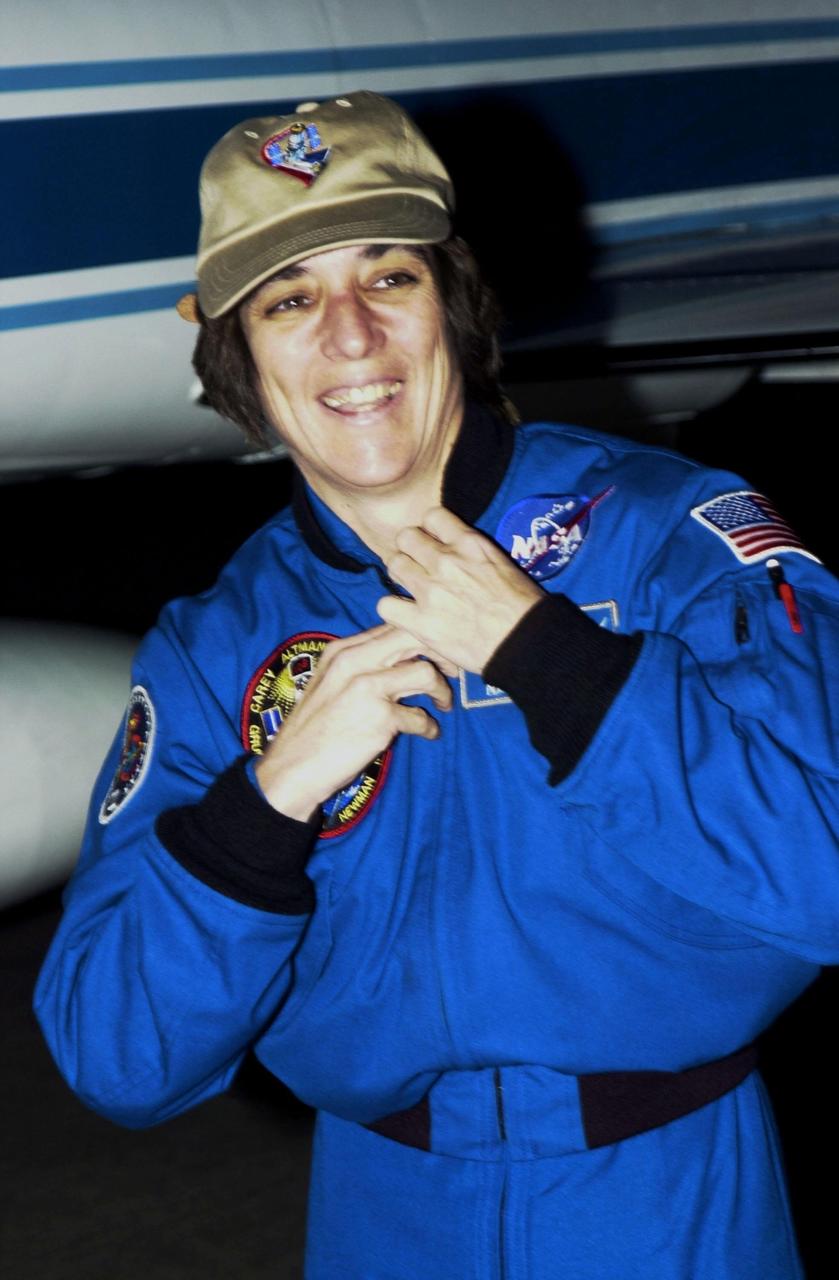
KENNEDY SPACE CENTER, Fla. - STS-109 Mission Specialist Nancy Currie arrives at KSC aboard a T-38 jet aircraft to begin launch preparations. This is Currie's fourth Shuttle flight. The goal of the 11-day mission is repair and maintenance on the Hubble Space Telescope. Five spacewalks are planned to replace Solar Array 2 with Solar Array 3, replace the Power Control Unit, remove the Faint Object Camera and install the Advanced Camera for Surveys (ACS), install the Near Infrared Camera and Multi-Object Spectrometer (NICMOS) Cooling System, and install New Outer Blanket Layer insulation. Launch is scheduled for Feb. 28 at 6:48 a.m. EST
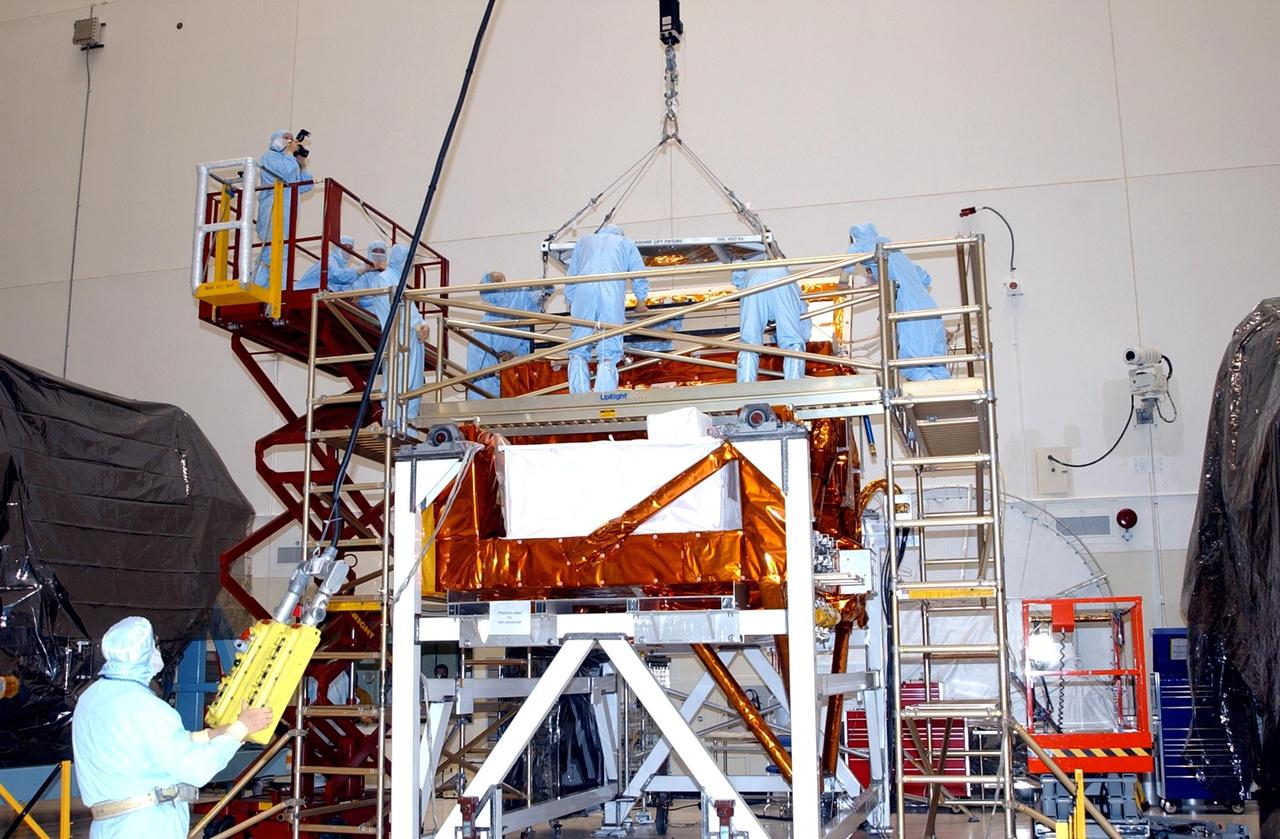
KENNEDY SPACE CENTER, FLA. -- In the Vertical Processing Facility, workers watch while an overhead crane lowers the Advanced Camera for Surveys (ACS) into the Axial Science Instrument Protective Enclosure (ASIPE). The ACS is part of the payload on the Hubble Space Telescope Servicing Mission, STS-109. The goal of the mission is to service the HST, replacing Solar Array 2 with Solar Array 3, replacing the Power Control Unit, removing the Faint Object Camera and installing the ACS, installing the Near Infrared Camera and Multi-Object Spectrometer (NICMOS) Cooling System, and installing New Outer Blanket Layer insulation. Mission STS-109 is scheduled for launch no earlier than Feb. 21, 2002
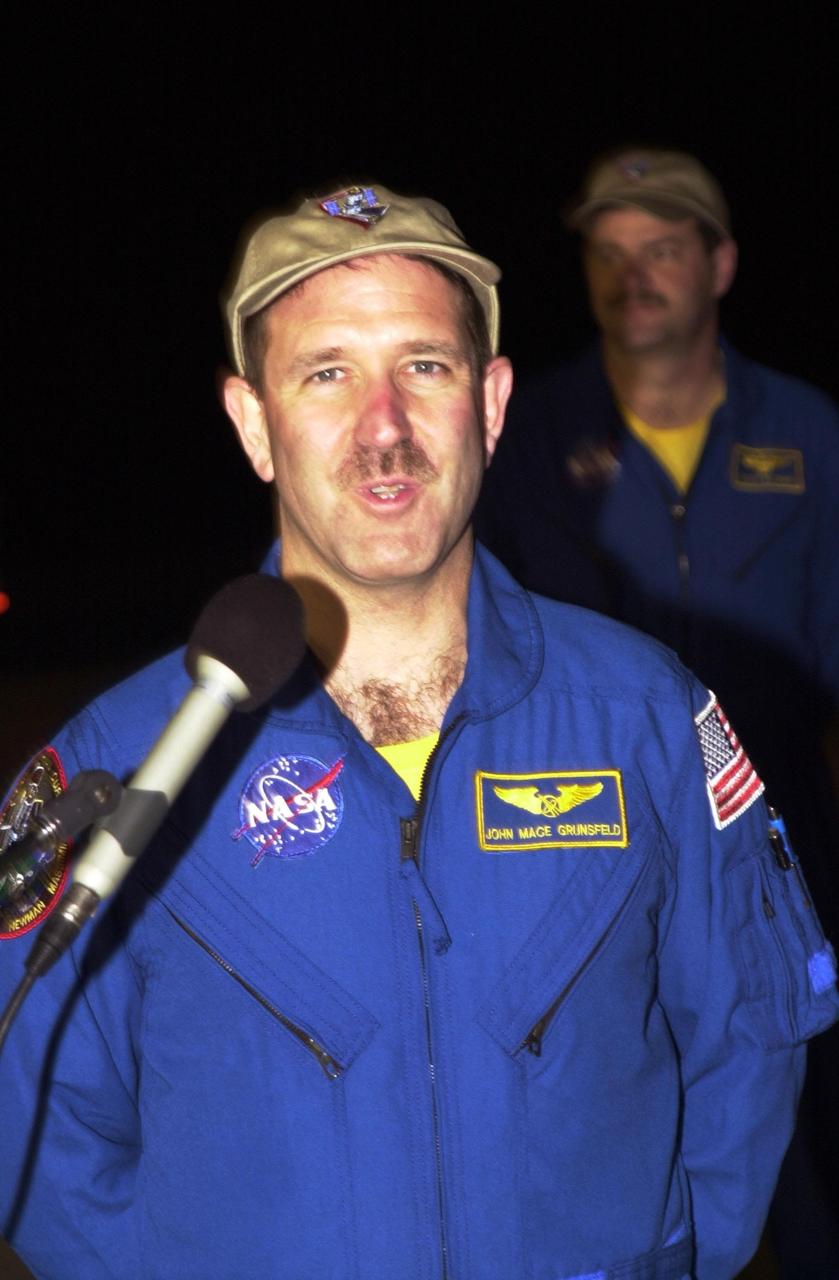
KENNEDY SPACE CENTER, Fla. - STS-109 Payload Commander John Grunsfeld arrives at KSC aboard a T-38 jet aircraft to begin launch preparations. This is Grunsfeld's fourth Shuttle flight. The goal of the 11-day mission is repair and maintenance on the Hubble Space Telescope. Five spacewalks are planned to replace Solar Array 2 with Solar Array 3, replace the Power Control Unit, remove the Faint Object Camera and install the Advanced Camera for Surveys (ACS), install the Near Infrared Camera and Multi-Object Spectrometer (NICMOS) Cooling System, and install New Outer Blanket Layer insulation. Launch is scheduled for Feb. 28 at 6:48 a.m. EST
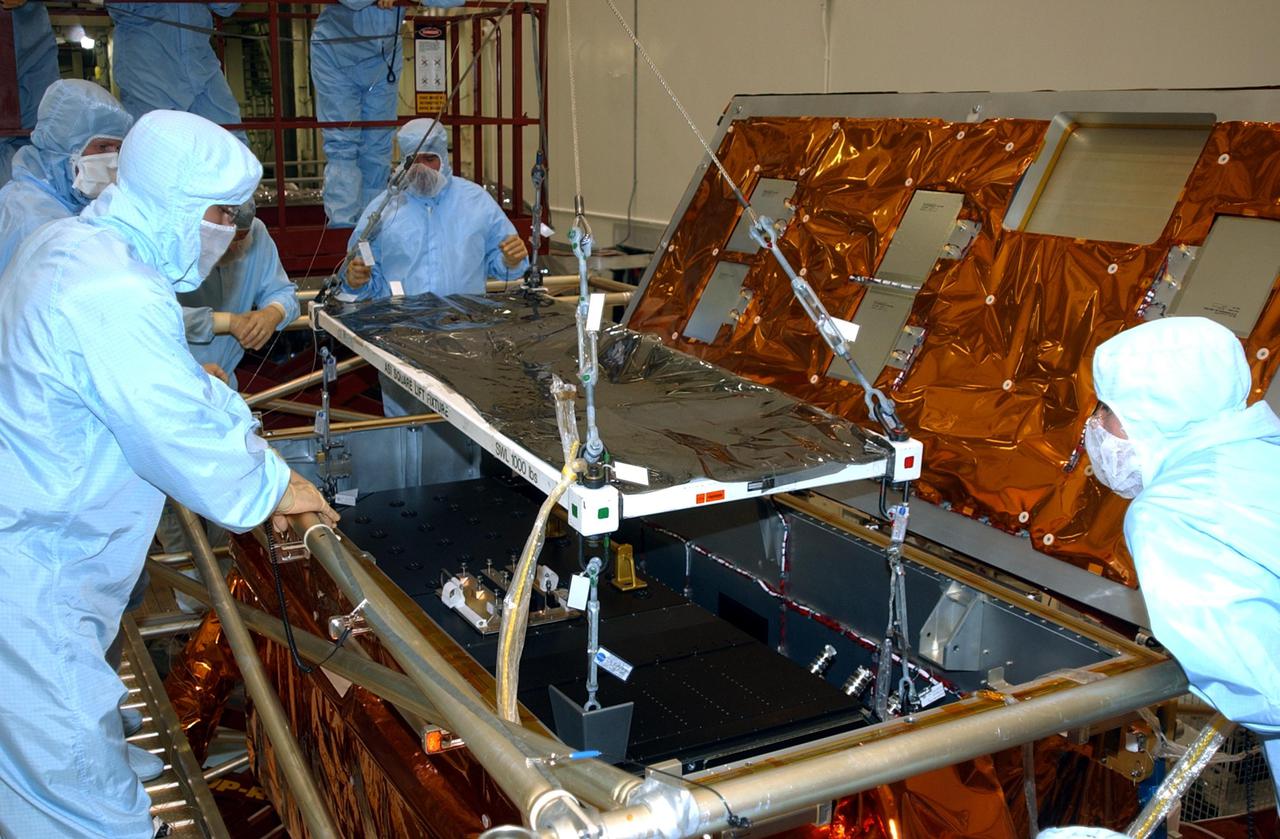
KENNEDY SPACE CENTER, FLA. -- In the Vertical Processing Facility, workers watch while the Advanced Camera for Surveys (ACS) is lowered into the Axial Science Instrument Protective Enclosure (ASIPE). The ACS is part of the payload on the Hubble Space Telescope Servicing Mission, STS-109. The goal of the mission is to service the HST, replacing Solar Array 2 with Solar Array 3, replacing the Power Control Unit, removing the Faint Object Camera and installing the ACS, installing the Near Infrared Camera and Multi-Object Spectrometer (NICMOS) Cooling System, and installing New Outer Blanket Layer insulation. Mission STS-109 is scheduled for launch no earlier than Feb. 21, 2002
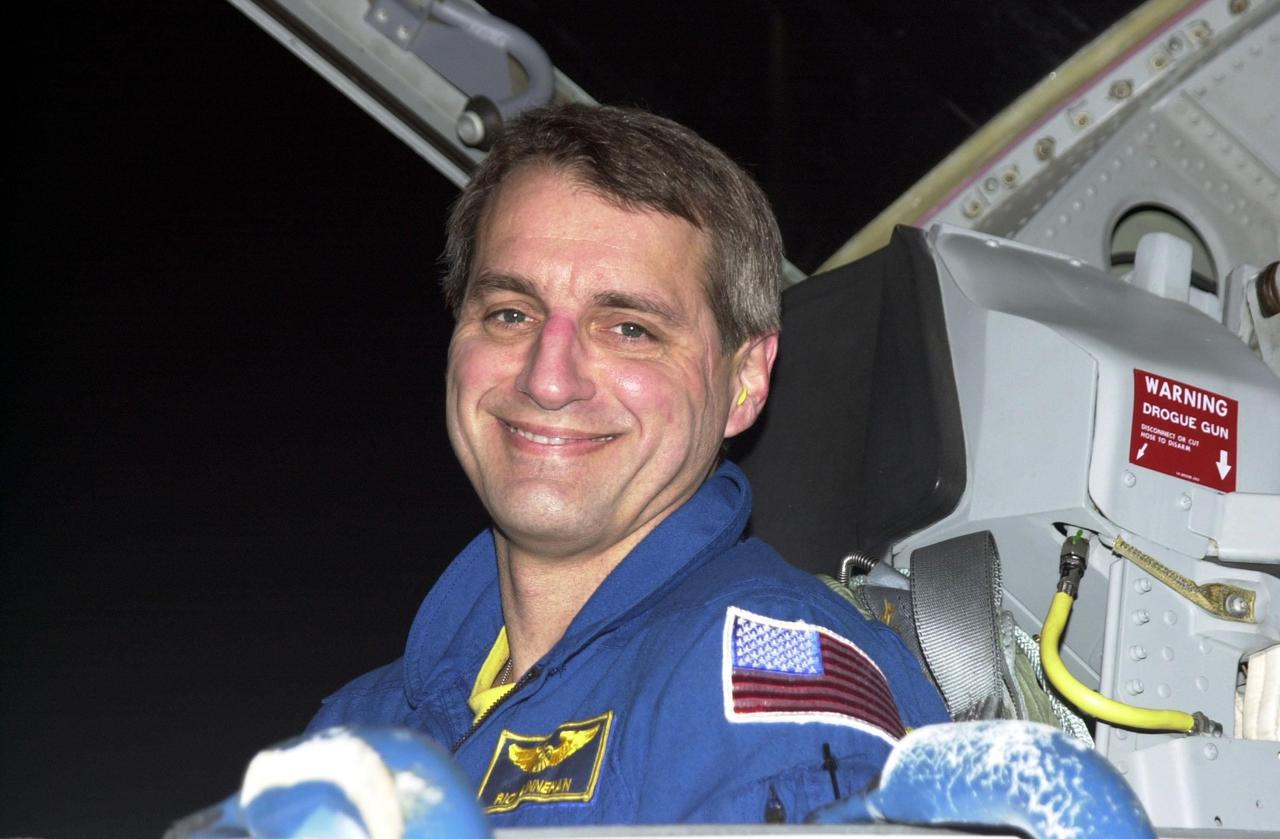
KENNEDY SPACE CENTER, FLA. - STS-109 Mission Specialist Richard Linnehan arrives at KSC aboard a T-38 jet aircraft to begin launch preparations. This is Linnehan's third Shuttle flight. The goal of the 11-day mission is repair and maintenance on the Hubble Space Telescope. Five spacewalks are planned to replace Solar Array 2 with Solar Array 3, replace the Power Control Unit, remove the Faint Object Camera and install the Advanced Camera for Surveys (ACS), install the Near Infrared Camera and Multi-Object Spectrometer (NICMOS) Cooling System, and install New Outer Blanket Layer insulation. Launch is scheduled for Feb. 28 at 6:48 a.m. EST
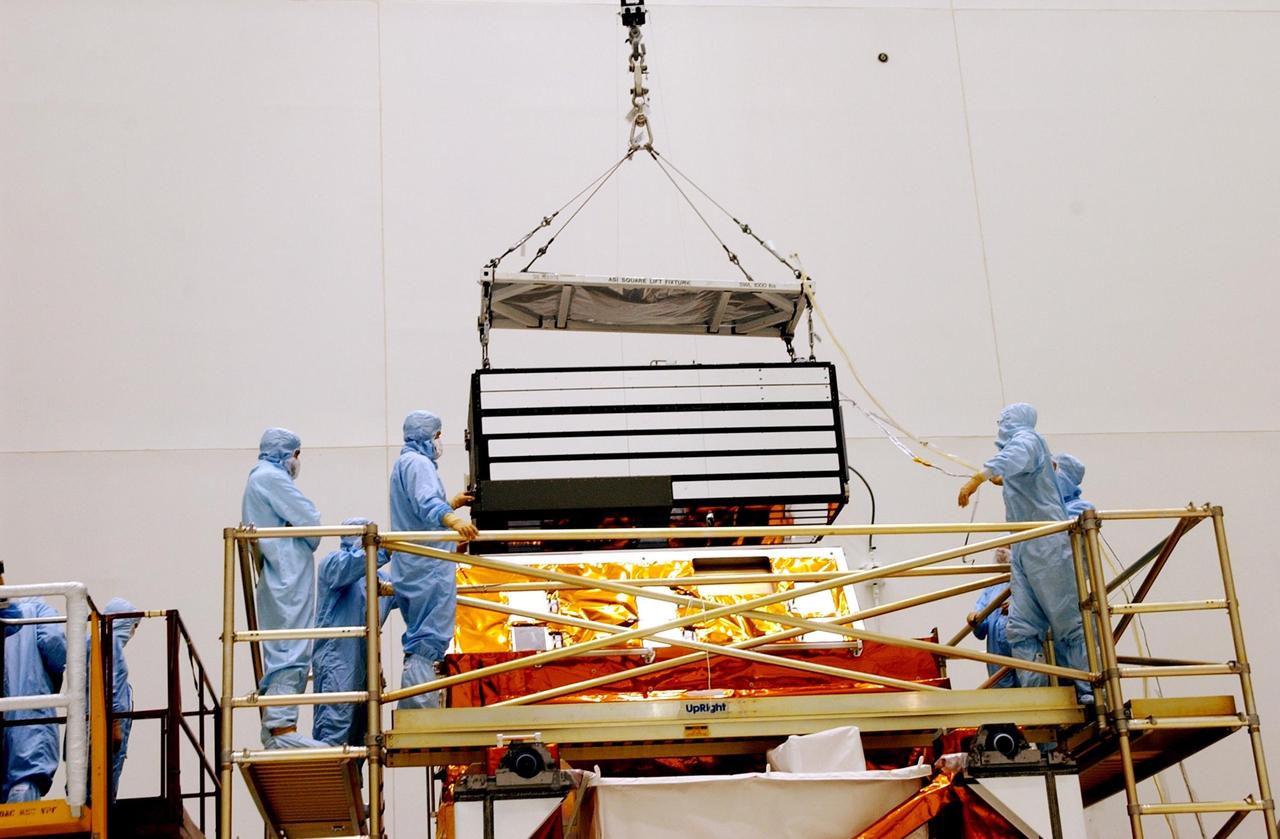
KENNEDY SPACE CENTER, FLA. -- In the Vertical Processing Facility, workers watch while an overhead crane lowers the Advanced Camera for Surveys (ACS) toward the Axial Science Instrument Protective Enclosure (ASIPE). The ACS is part of the payload on the Hubble Space Telescope Servicing Mission, STS-109. The goal of the mission is to service the HST, replacing Solar Array 2 with Solar Array 3, replacing the Power Control Unit, removing the Faint Object Camera and installing the ACS, installing the Near Infrared Camera and Multi-Object Spectrometer (NICMOS) Cooling System, and installing New Outer Blanket Layer insulation. Mission STS-109 is scheduled for launch no earlier than Feb. 21, 2002
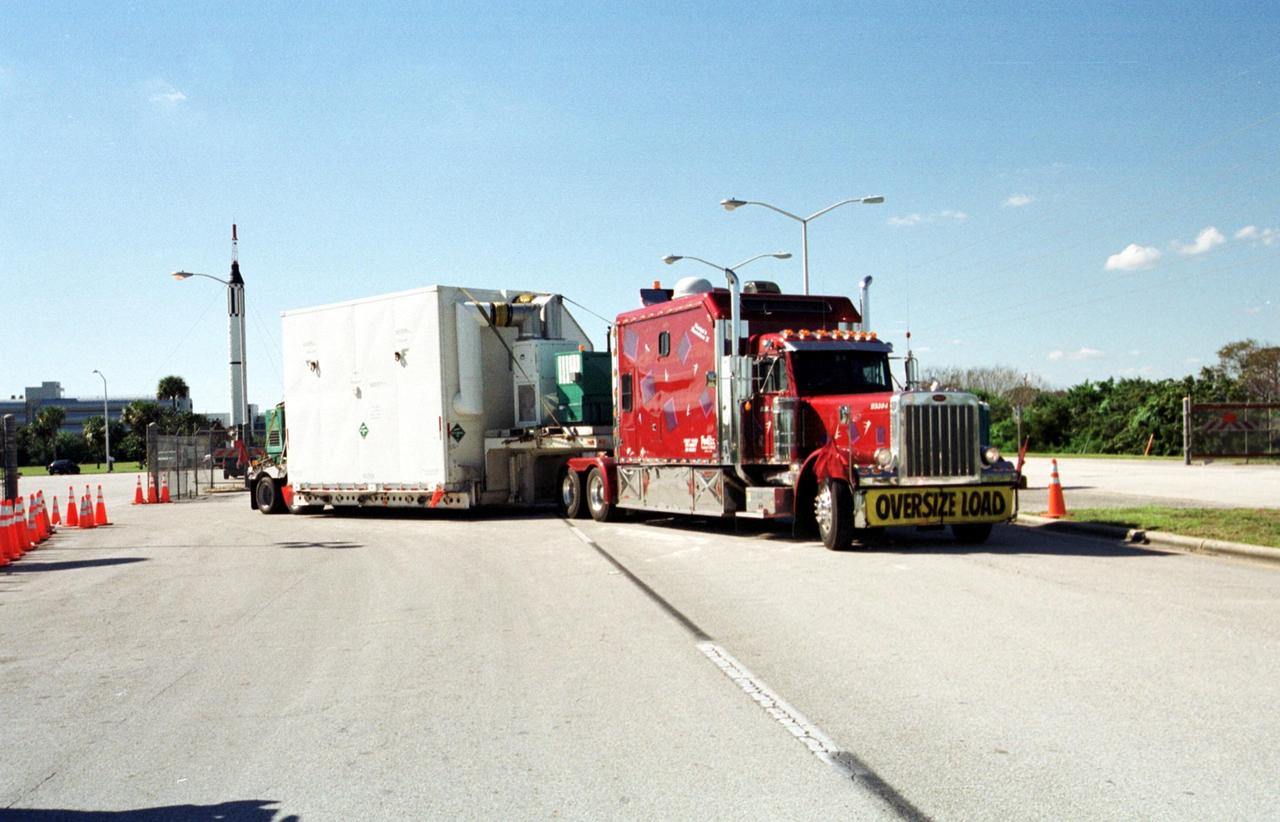
KENNEDY SPACE CENTER, Fla. -- A large truck arrives at the gate to KSC, delivering part of the equipment to be used on mission STS-109, the Hubble Servicing mission. The primary tasks of the mission are to replace Solar Array 2 with Solar Array 3, replace the Power Control Unit, remove the Faint Object Camera and install the Advanced Camera for Surveys, install the Near Infrared Camera and Multi-Object Spectrometer (NICMOS) Cooling System, and install New Outer Blanket Layer insulation on bays 5 through 8. Mission STS-109 is scheduled for launch Feb. 14, 2002

KENNEDY SPACE CENTER, Fla. -- In the Vertical Processing Facility, part of the equipment to be used on mission STS-109 sits on a workstand after removal of the protective cover. The mission is to service the Hubble Space Telescope, replacing Solar Array 2 with Solar Array 3, replacing the Power Control Unit, removing the Faint Object Camera and installing the Advanced Camera for Surveys, installing the Near Infrared Camera and Multi-Object Spectrometer (NICMOS) Cooling System, and installing New Outer Blanket Layer insulation on bays 5 through 8. Mission STS-109 is scheduled for launch Feb. 14, 2002

KENNEDY SPACE CENTER, Fla. -- In the Vertical Processing Facility, part of the equipment to be used on mission STS-109 is revealed after removal of the protective cover. The mission is to service the Hubble Space Telescope, replacing Solar Array 2 with Solar Array 3, replacing the Power Control Unit, removing the Faint Object Camera and installing the Advanced Camera for Surveys, installing the Near Infrared Camera and Multi-Object Spectrometer (NICMOS) Cooling System, and installing New Outer Blanket Layer insulation on bays 5 through 8. Mission STS-109 is scheduled for launch Feb. 14, 2002
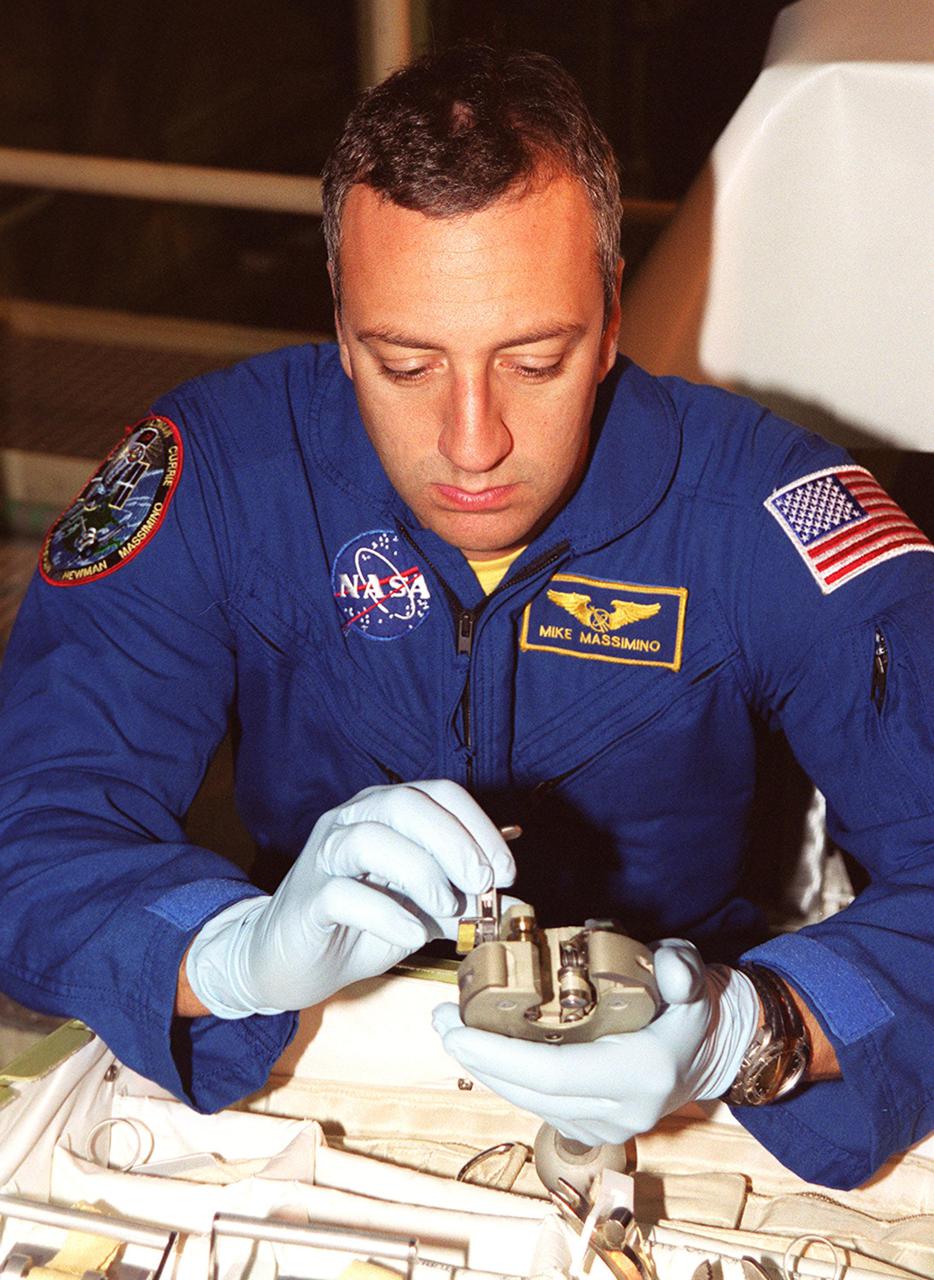
KENNEDY SPACE CENTER, Fla. -- STS-109 Mission Specialist Michael Massimino practices on equipment that will be used on the mission. The crew is at KSC to take part in Crew Equipment Interface Test activities that include familiarization with the orbiter and equipment. The goal of the mission is to service the HST, replacing Solar Array 2 with Solar Array 3, replacing the Power Control Unit, removing the Faint Object Camera and installing the Advanced Camera for Surveys, installing the Near Infrared Camera and Multi-Object Spectrometer (NICMOS) Cooling System, and installing New Outer Blanket Layer insulation on bays 5 through 8. Mission STS-109 is scheduled for launch Feb. 14, 2002
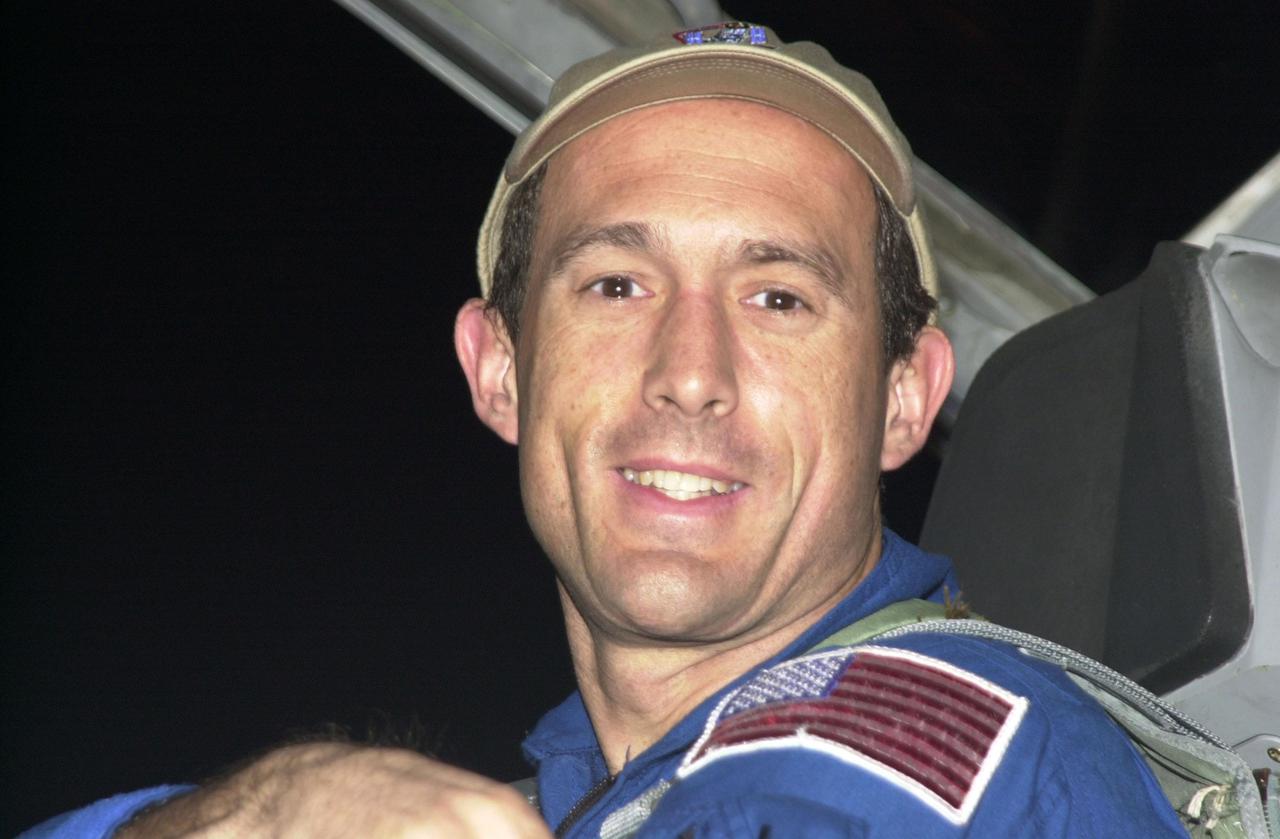
KENNEDY SPACE CENTER, Fla. - STS-109 Mission Specialist James Newman arrives at KSC aboard a T-38 jet aircraft to begin launch preparations. This is Newman's fourth Shuttle flight. The goal of the 11-day mission is repair and maintenance on the Hubble Space Telescope. Five spacewalks are planned to replace Solar Array 2 with Solar Array 3, replace the Power Control Unit, remove the Faint Object Camera and install the Advanced Camera for Surveys (ACS), install the Near Infrared Camera and Multi-Object Spectrometer (NICMOS) Cooling System, and install New Outer Blanket Layer insulation. Launch is scheduled for Feb. 28 at 6:48 a.m. EST
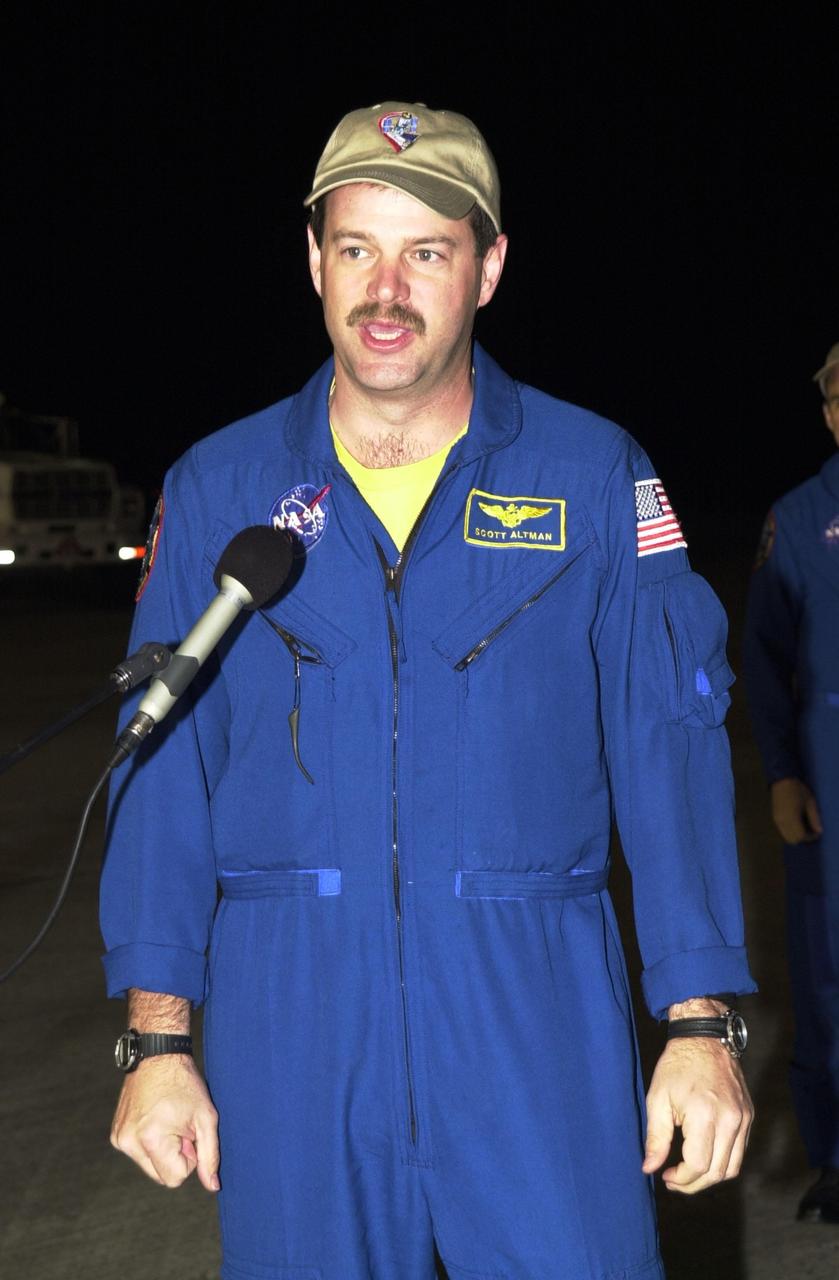
KENNEDY SPACE CENTER, Fla. - STS-109 Shuttle Commander Scott Altman arrives at KSC aboard a T-38 jet aircraft to begin launch preparations. This is Altman's third Shuttle flight. The goal of the 11-day mission is repair and maintenance on the Hubble Space Telescope. Five spacewalks are planned to replace Solar Array 2 with Solar Array 3, replace the Power Control Unit, remove the Faint Object Camera and install the Advanced Camera for Surveys (ACS), install the Near Infrared Camera and Multi-Object Spectrometer (NICMOS) Cooling System, and install New Outer Blanket Layer insulation. Launch is scheduled for Feb. 28 at 6:48 a.m. EST
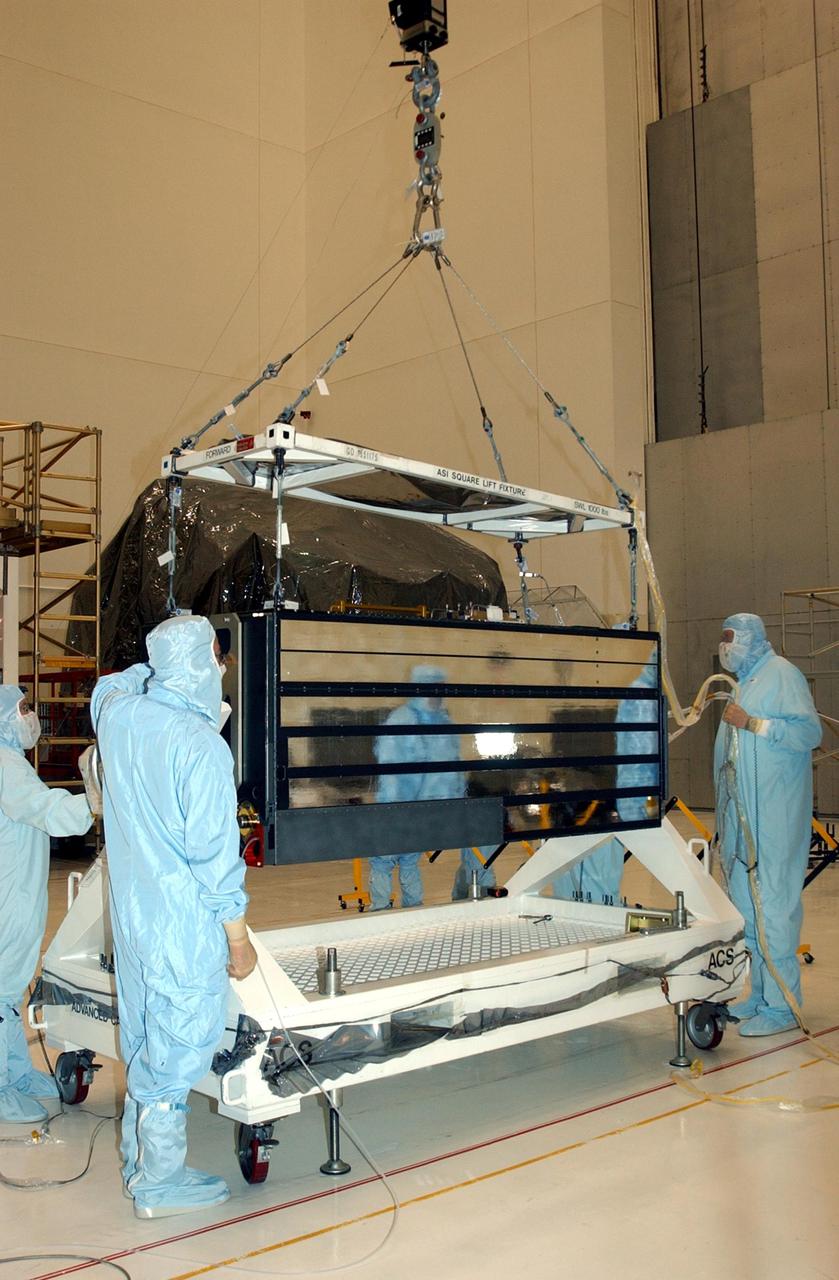
KENNEDY SPACE CENTER, FLA. -- In the Vertical Processing Facility, workers watch while an overhead crane lifts the Advanced Camera for Surveys (ACS) off the stand. The ACS is part of the payload on the Hubble Space Telescope Servicing Mission, STS-109. The goal of the mission is to service the HST, replacing Solar Array 2 with Solar Array 3, replacing the Power Control Unit, removing the Faint Object Camera and installing the ACS, installing the Near Infrared Camera and Multi-Object Spectrometer (NICMOS) Cooling System, and installing New Outer Blanket Layer insulation. Mission STS-109 is scheduled for launch no earlier than Feb. 21, 2002

KENNEDY SPACE CENTER, FLA. -- In the Vertical Processing Facility, workers watch while an overhead crane lowers the Advanced Camera for Surveys (ACS) into the Axial Science Instrument Protective Enclosure (ASIPE). The ACS is part of the payload on the Hubble Space Telescope Servicing Mission, STS-109. The goal of the mission is to service the HST, replacing Solar Array 2 with Solar Array 3, replacing the Power Control Unit, removing the Faint Object Camera and installing the ACS, installing the Near Infrared Camera and Multi-Object Spectrometer (NICMOS) Cooling System, and installing New Outer Blanket Layer insulation. Mission STS-109 is scheduled for launch no earlier than Feb. 21, 2002
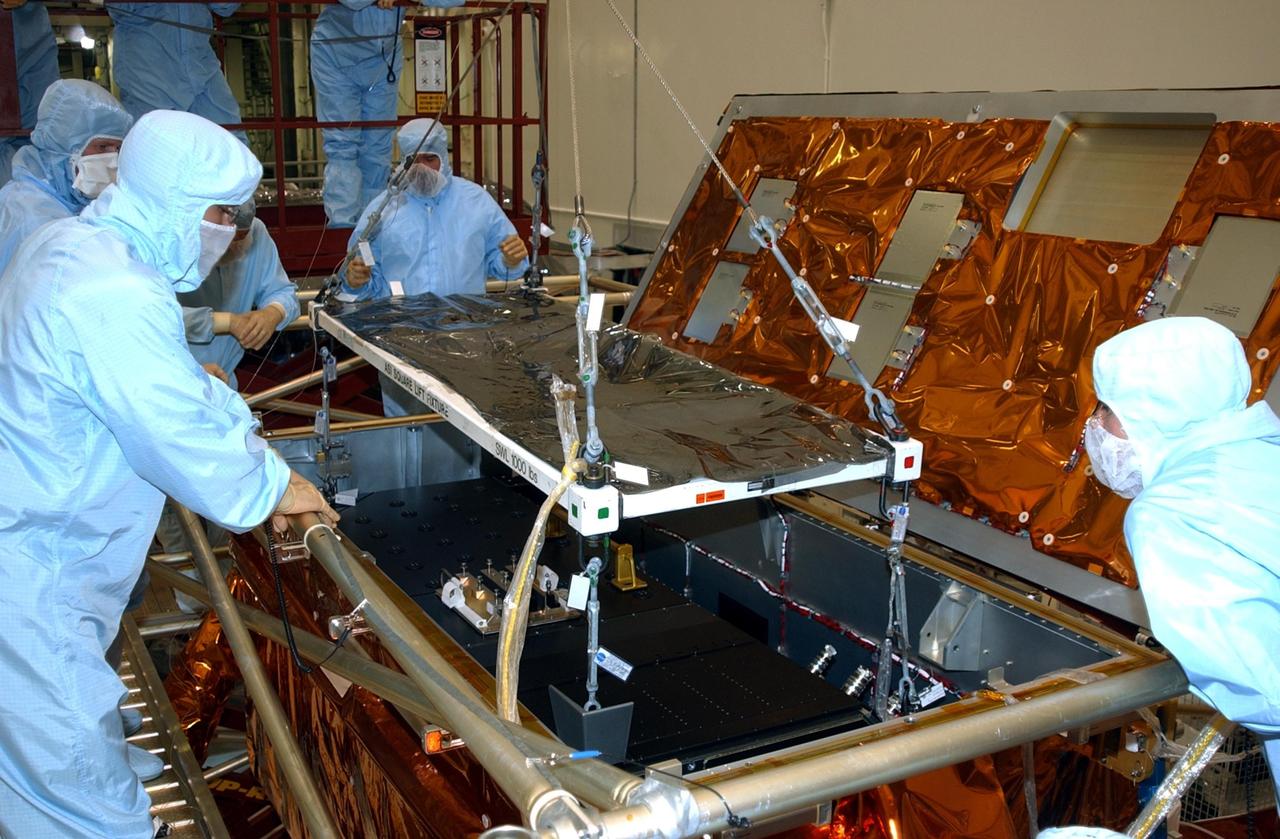
KENNEDY SPACE CENTER, FLA. -- In the Vertical Processing Facility, workers watch while the Advanced Camera for Surveys (ACS) is lowered into the Axial Science Instrument Protective Enclosure (ASIPE). The ACS is part of the payload on the Hubble Space Telescope Servicing Mission, STS-109. The goal of the mission is to service the HST, replacing Solar Array 2 with Solar Array 3, replacing the Power Control Unit, removing the Faint Object Camera and installing the ACS, installing the Near Infrared Camera and Multi-Object Spectrometer (NICMOS) Cooling System, and installing New Outer Blanket Layer insulation. Mission STS-109 is scheduled for launch no earlier than Feb. 21, 2002
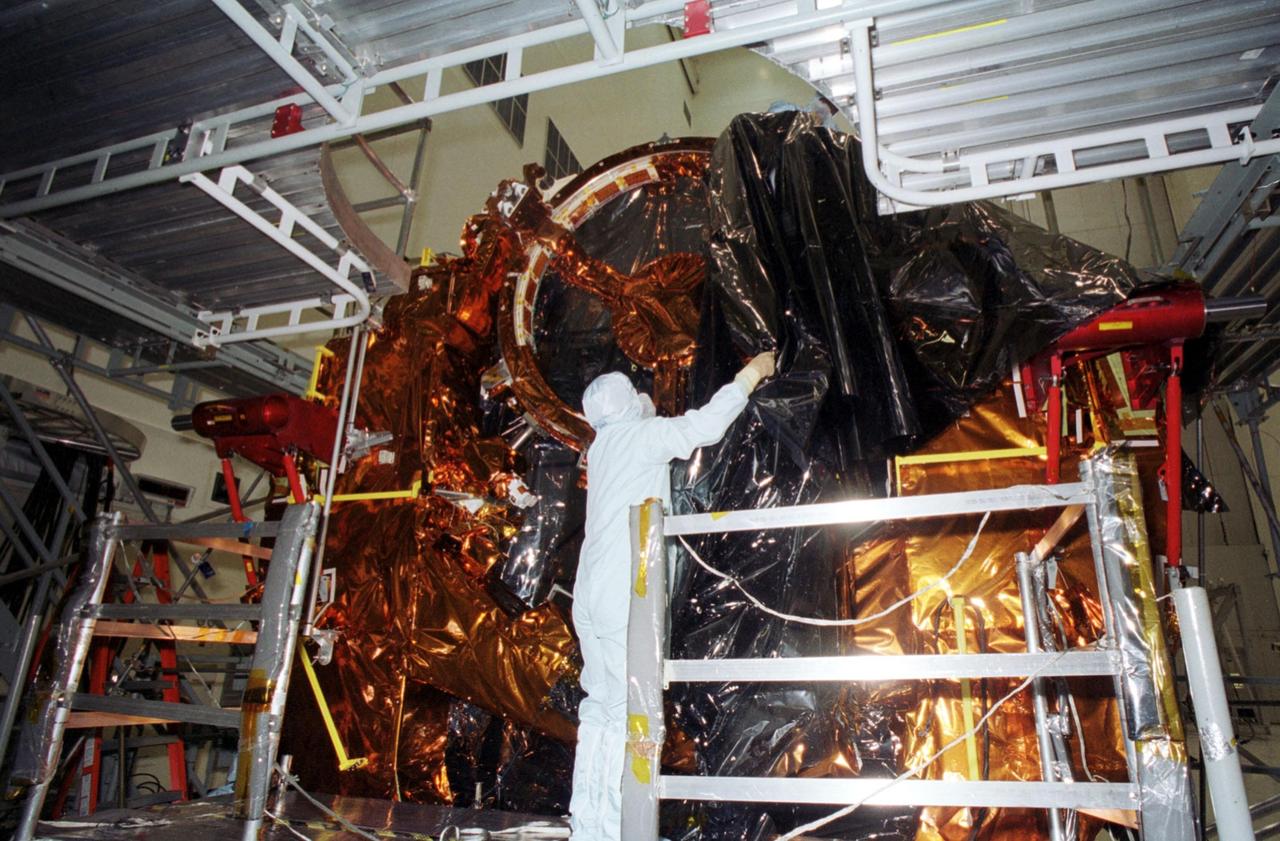
KENNEDY SPACE CENTER, Fla. -- In the Vertical Processing Facility a worker removes the protective covering from the equipment to be used on mission STS-109. The mission is to service the Hubble Space Telescope, replacing Solar Array 2 with Solar Array 3, replacing the Power Control Unit, removing the Faint Object Camera and installing the Advanced Camera for Surveys, installing the Near Infrared Camera and Multi-Object Spectrometer (NICMOS) Cooling System, and installing New Outer Blanket Layer insulation on bays 5 through 8. Mission STS-109 is scheduled for launch Feb. 14, 2002
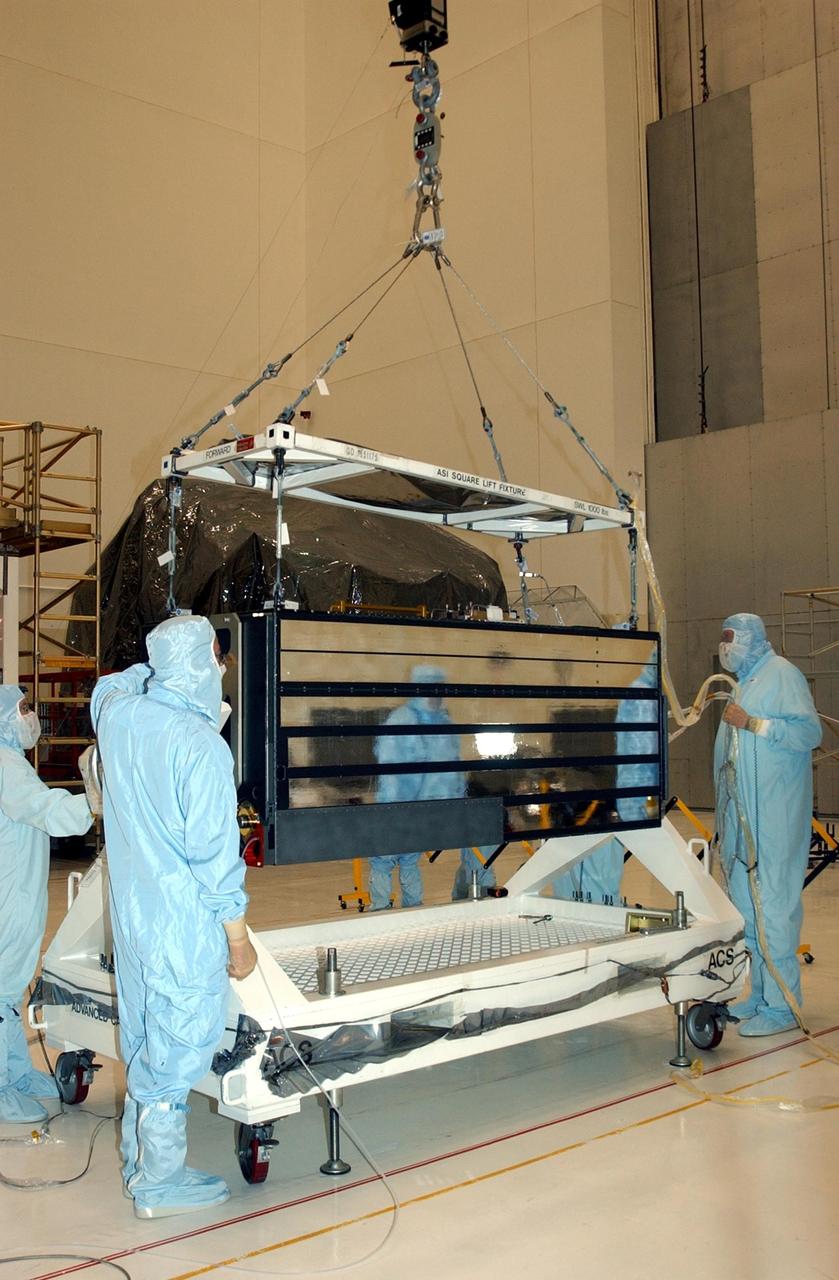
KENNEDY SPACE CENTER, FLA. -- In the Vertical Processing Facility, workers watch while an overhead crane lifts the Advanced Camera for Surveys (ACS) off the stand. The ACS is part of the payload on the Hubble Space Telescope Servicing Mission, STS-109. The goal of the mission is to service the HST, replacing Solar Array 2 with Solar Array 3, replacing the Power Control Unit, removing the Faint Object Camera and installing the ACS, installing the Near Infrared Camera and Multi-Object Spectrometer (NICMOS) Cooling System, and installing New Outer Blanket Layer insulation. Mission STS-109 is scheduled for launch no earlier than Feb. 21, 2002
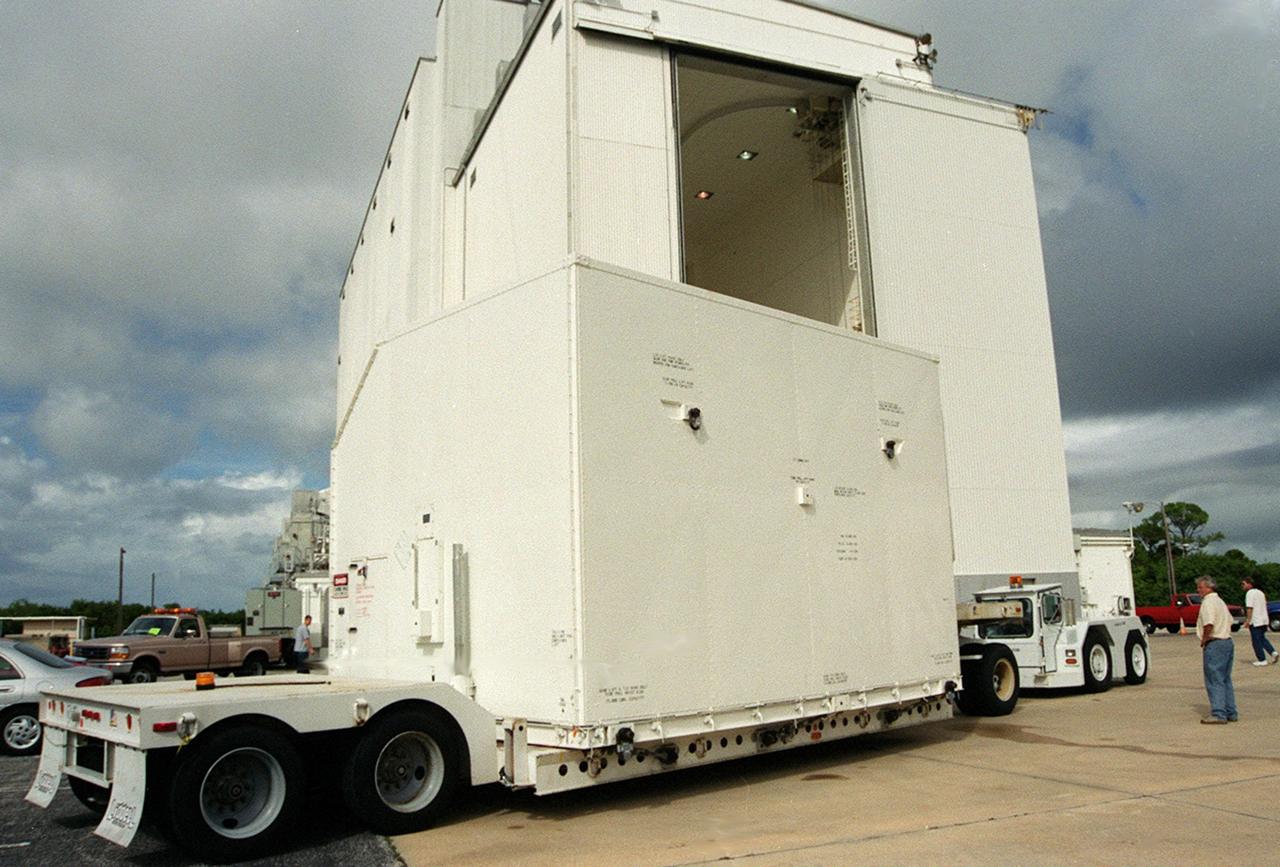
KENNEDY SPACE CENTER, Fla. -- Part of the equipment to be used on mission STS-109, servicing the Hubble Space Telescope, arrives at a facility at KSC. The primary servicing tasks of the mission are to replace Solar Array 2 with Solar Array 3, replace the Power Control Unit, remove the Faint Object Camera and install the Advanced Camera for Surveys, install the Near Infrared Camera and Multi-Object Spectrometer (NICMOS) Cooling System, and install New Outer Blanket Insulation on bays 5 through 8. Mission STS-109 is scheduled for launch in mid-February 2002
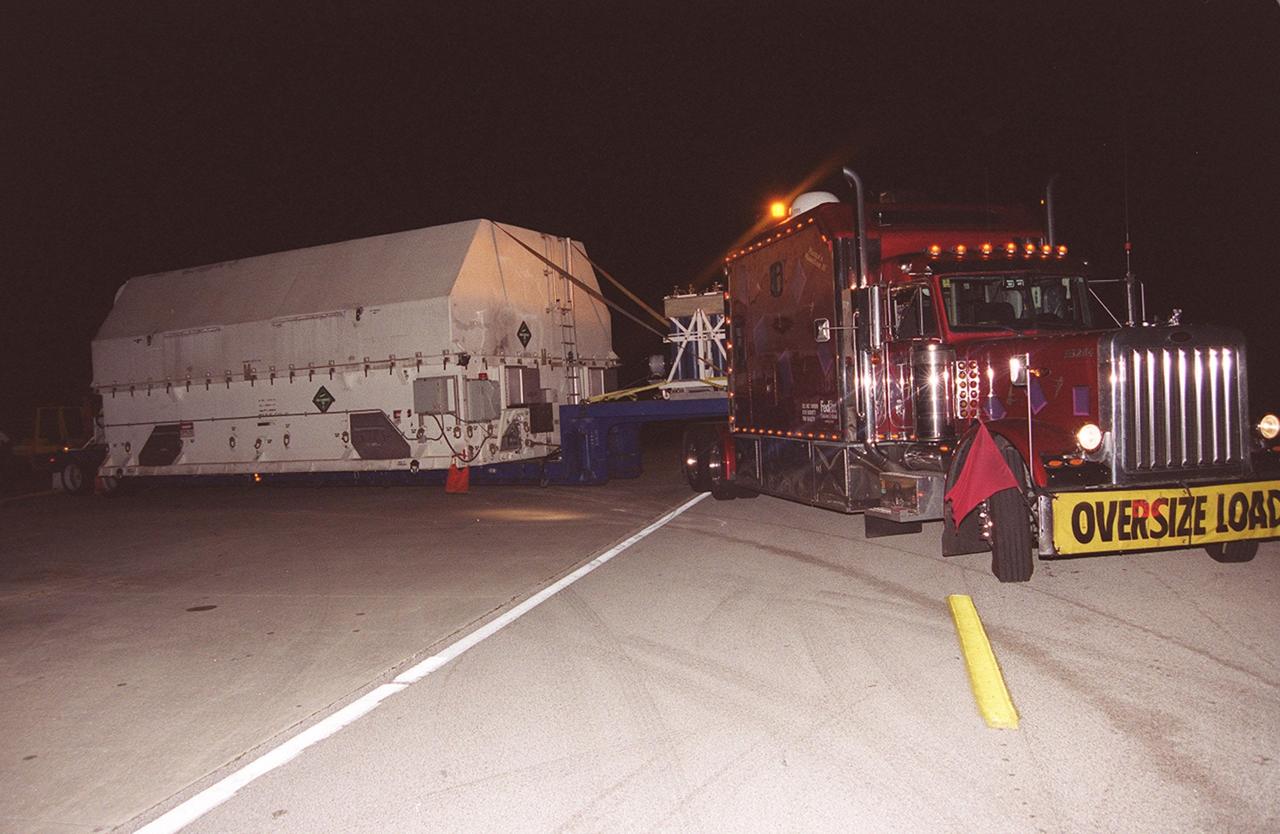
KENNEDY SPACE CENTER, Fla. -- A large truck delivers part of the equipment to be used on mission STS-109, servicing the Hubble Space Telescope, to KSC. The primary servicing tasks of the mission are to replace Solar Array 2 with Solar Array 3, replace the Power Control Unit, remove the Faint Object Camera and install the Advanced Camera for Surveys, install the NICMOS Cooling System, and install New Outer Blanket Insulation on bays 5 through 8. Mission STS-109 is scheduled for launch in mid-February 2002
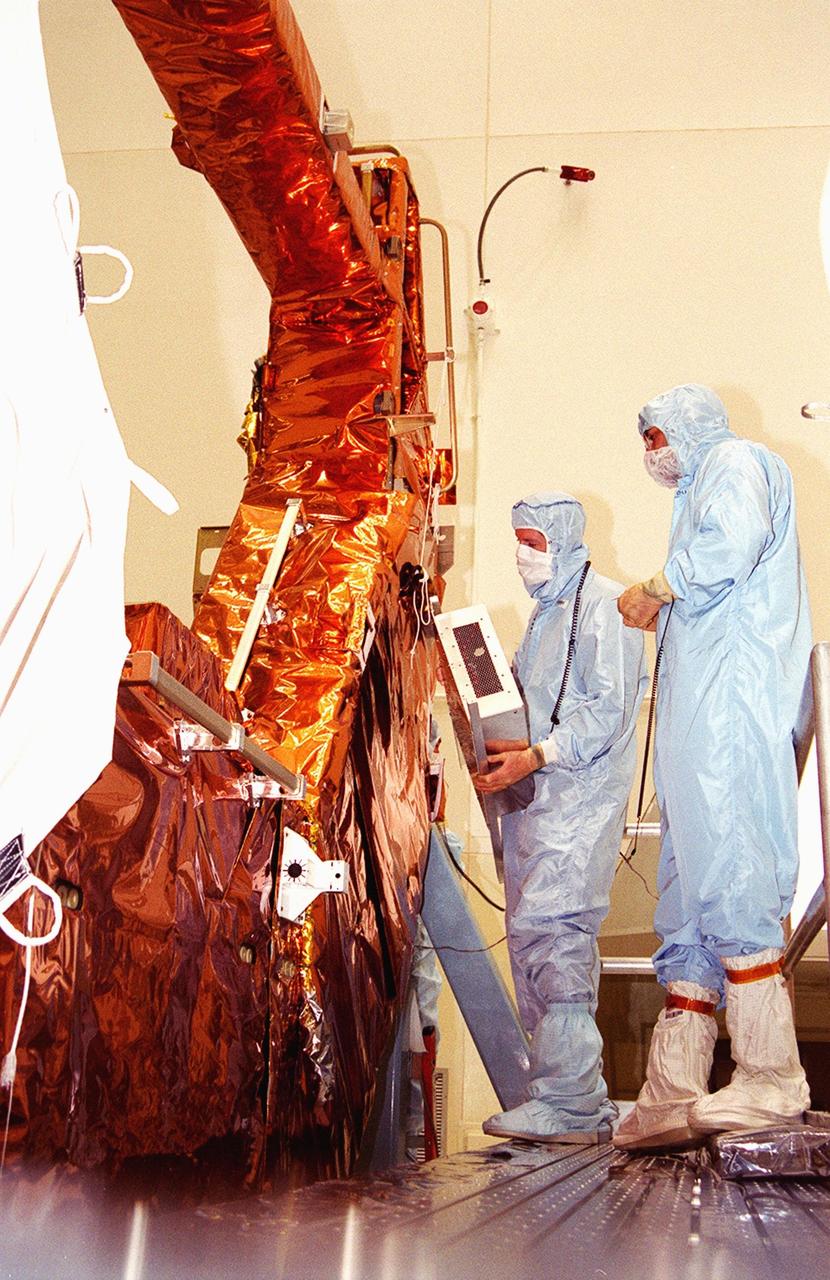
KENNEDY SPACE CENTER, Fla. - Workers in the Vertical Processing Facility check over part of the payload for the Hubble Servicing Mission, STS-109. The primary servicing tasks of the mission are to replace Solar Array 2 with Solar Array 3, replace the Power Control Unit, remove the Faint Object Camera and install the Advanced Camera for Surveys, install the NICMOS Cooling System, and install New Outer Blanket Insulation on bays 5 through 8. Mission STS-109 is scheduled for launch in mid-February 2002
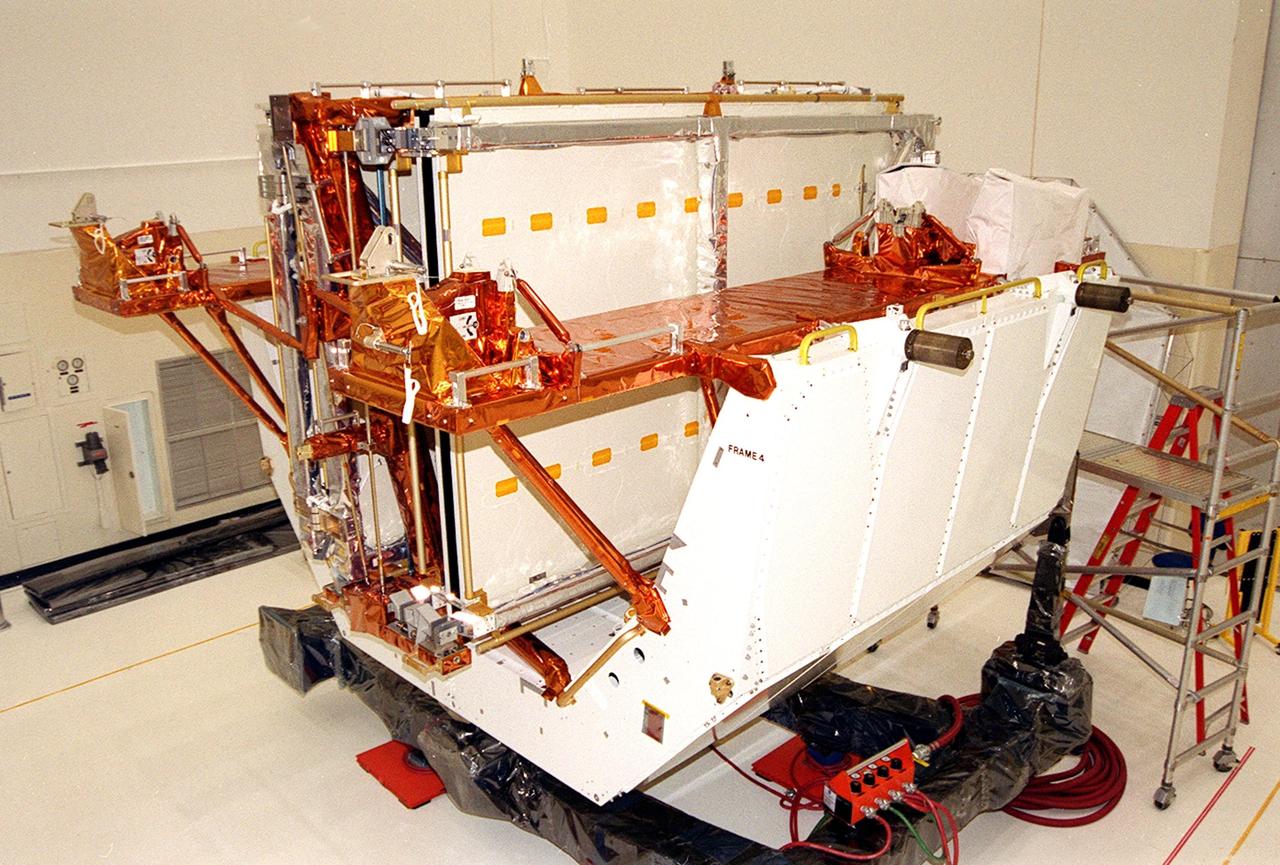
KENNEDY SPACE CENTER, Fla. -- Solar arrays part of the payload for the Hubble Servicing Mission, STS-109, await processing in the Vertical Processing Facility. The primary servicing tasks of the mission are to replace Solar Array 2 with Solar Array 3, replace the Power Control Unit, remove the Faint Object Camera and install the Advanced Camera for Surveys, install the NICMOS Cooling System, and install New Outer Blanket Insulation on bays 5 through 8. Mission STS-109 is scheduled for launch in mid-February 2002
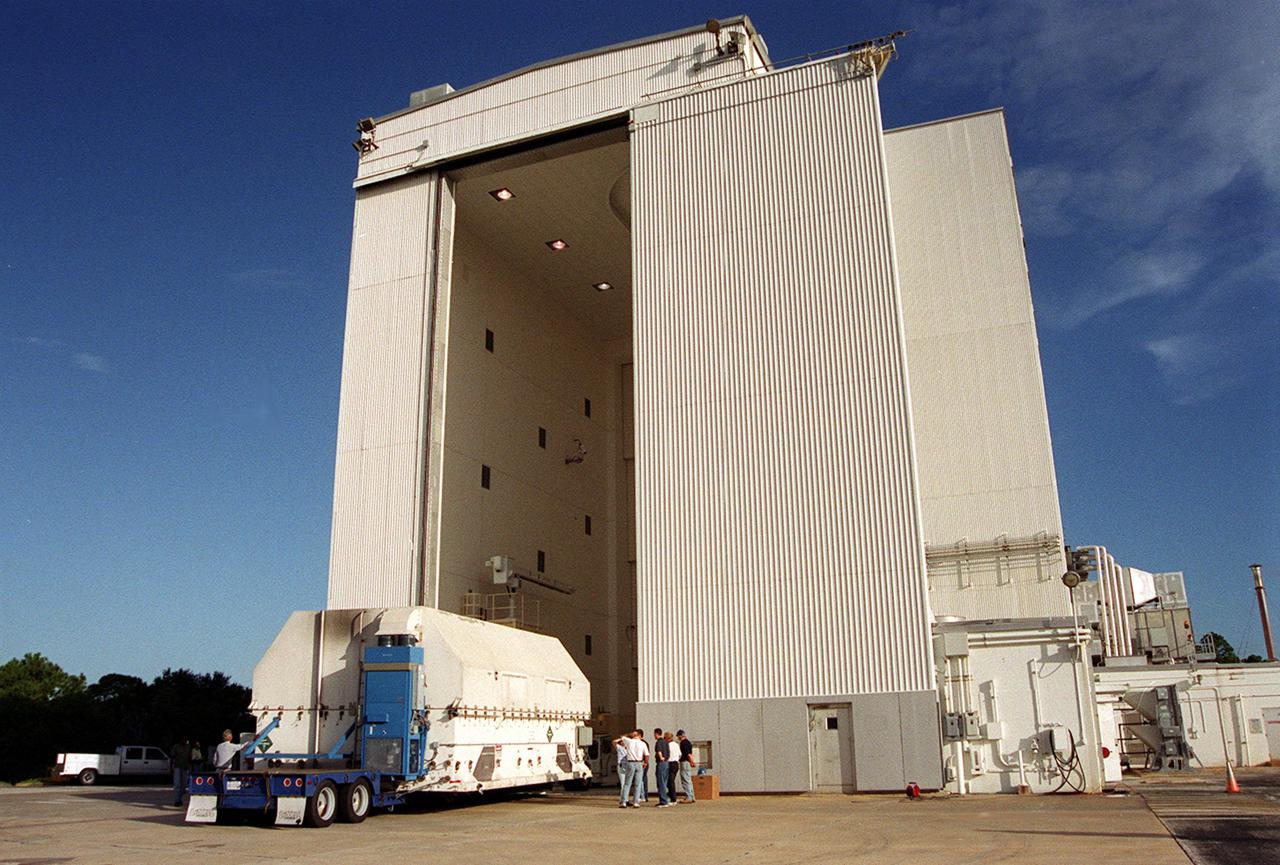
KENNEDY SPACE CENTER, Fla. -- Part of the equipment to be used on mission STS-109, servicing the Hubble Space Telescope, is moved into a facility at KSC. The primary servicing tasks of the mission are to replace Solar Array 2 with Solar Array 3, replace the Power Control Unit, remove the Faint Object Camera and install the Advanced Camera for Surveys, install the NICMOS Cooling System, and install New Outer Blanket Insulation on bays 5 through 8. Mission STS-109 is scheduled for launch in mid-February 2002
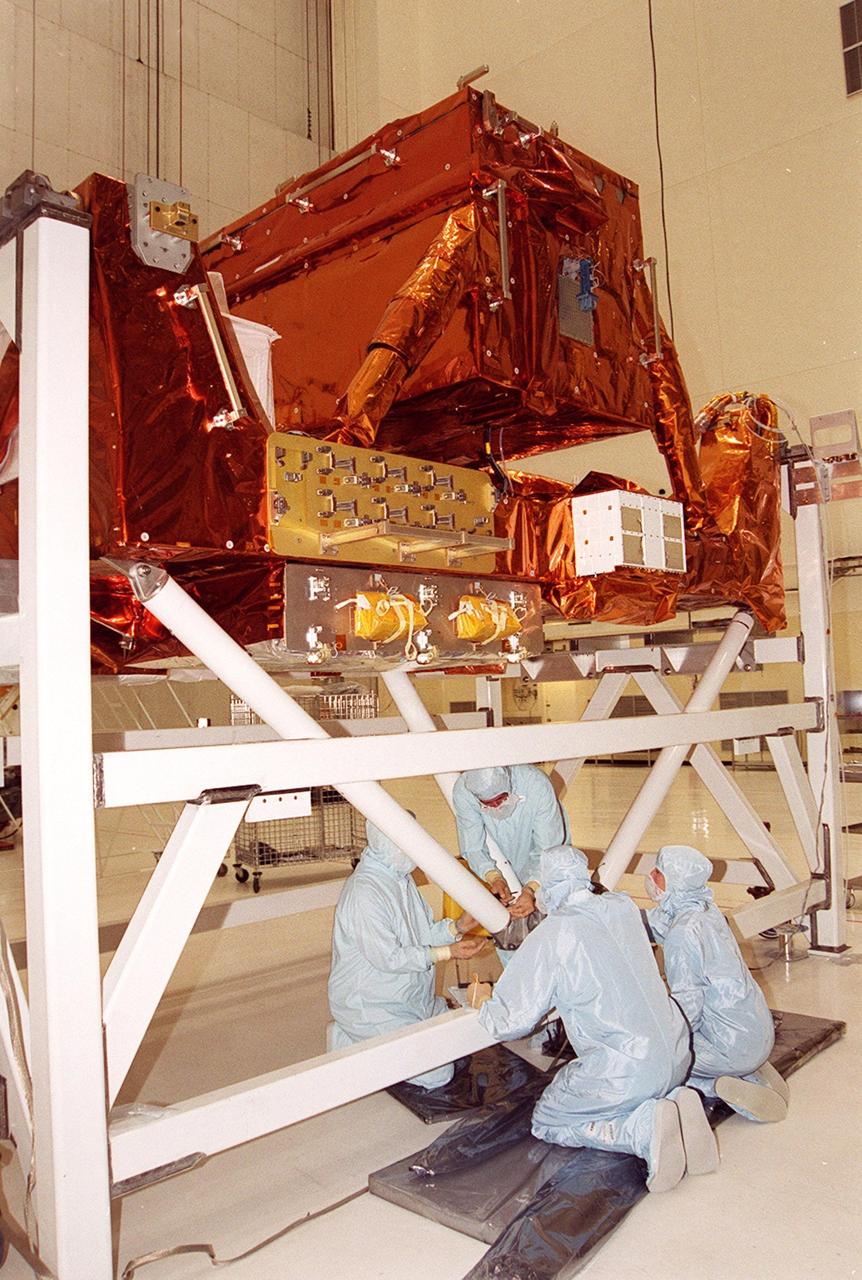
KENNEDY SPACE CENTER, Fla. - Workers begin preparations for testing part of the payload (behind them) for the Hubble Servicing Mission, STS-109. The primary servicing tasks of the mission are to replace Solar Array 2 with Solar Array 3, replace the Power Control Unit, remove the Faint Object Camera and install the Advanced Camera for Surveys, install the NICMOS Cooling System, and install New Outer Blanket Insulation on bays 5 through 8. Mission STS-109 is scheduled for launch in mid-February 2002
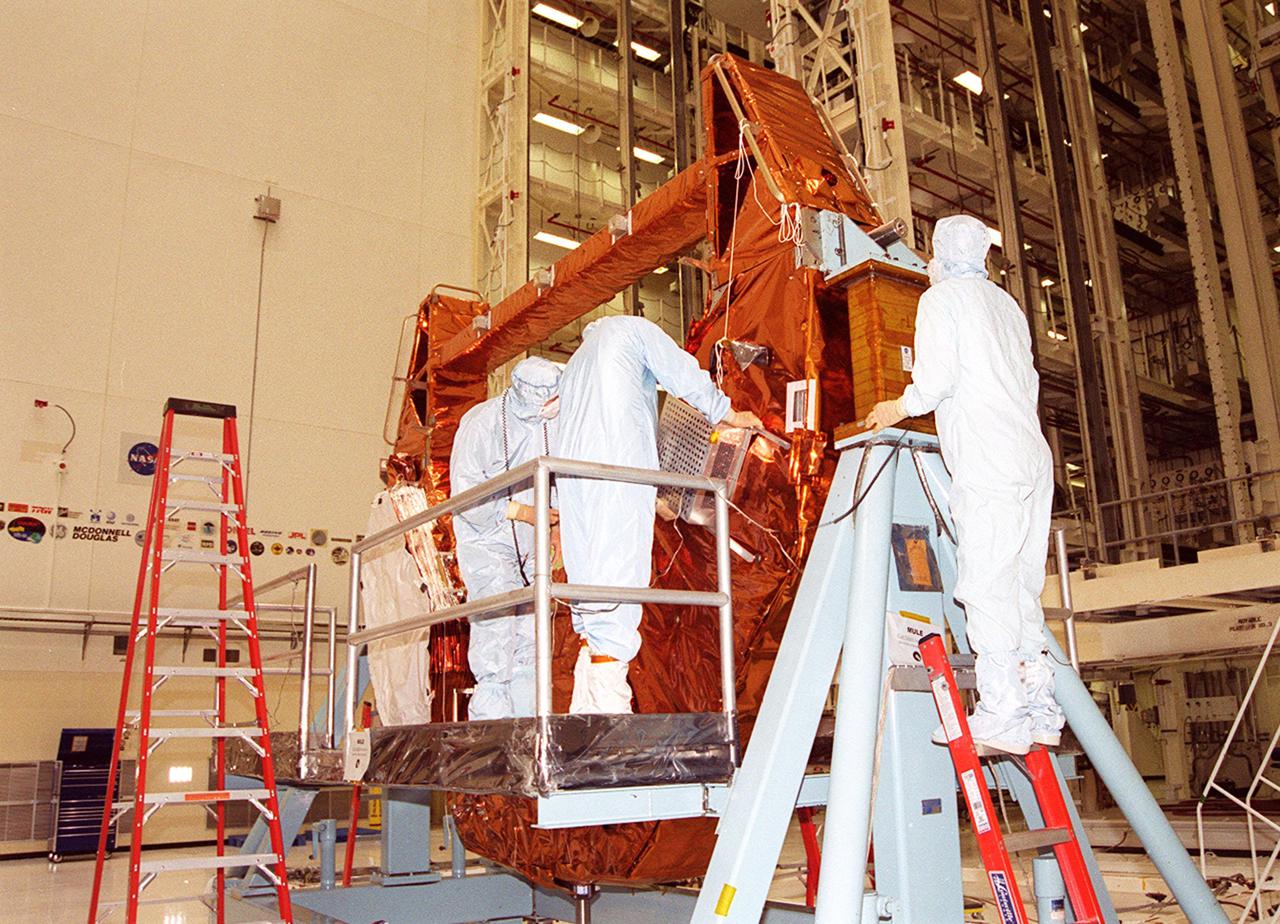
KENNEDY SPACE CENTER, Fla. - Workers in the Vertical Processing Facility check out equipment that is part of the payload for the Hubble Servicing Mission, STS-109. The primary servicing tasks of the mission are to replace Solar Array 2 with Solar Array 3, replace the Power Control Unit, remove the Faint Object Camera and install the Advanced Camera for Surveys, install the NICMOS Cooling System, and install New Outer Blanket Insulation on bays 5 through 8. Mission STS-109 is scheduled for launch in mid-February 2002
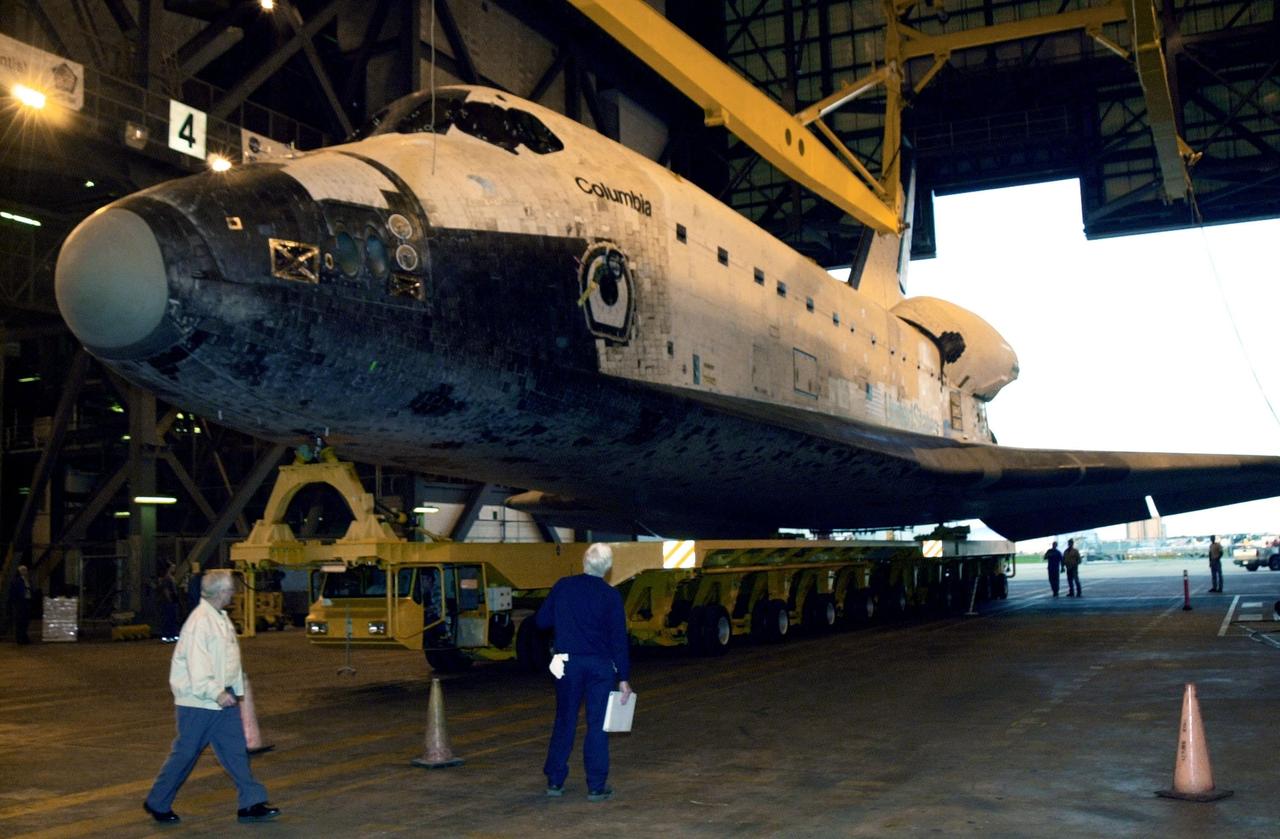
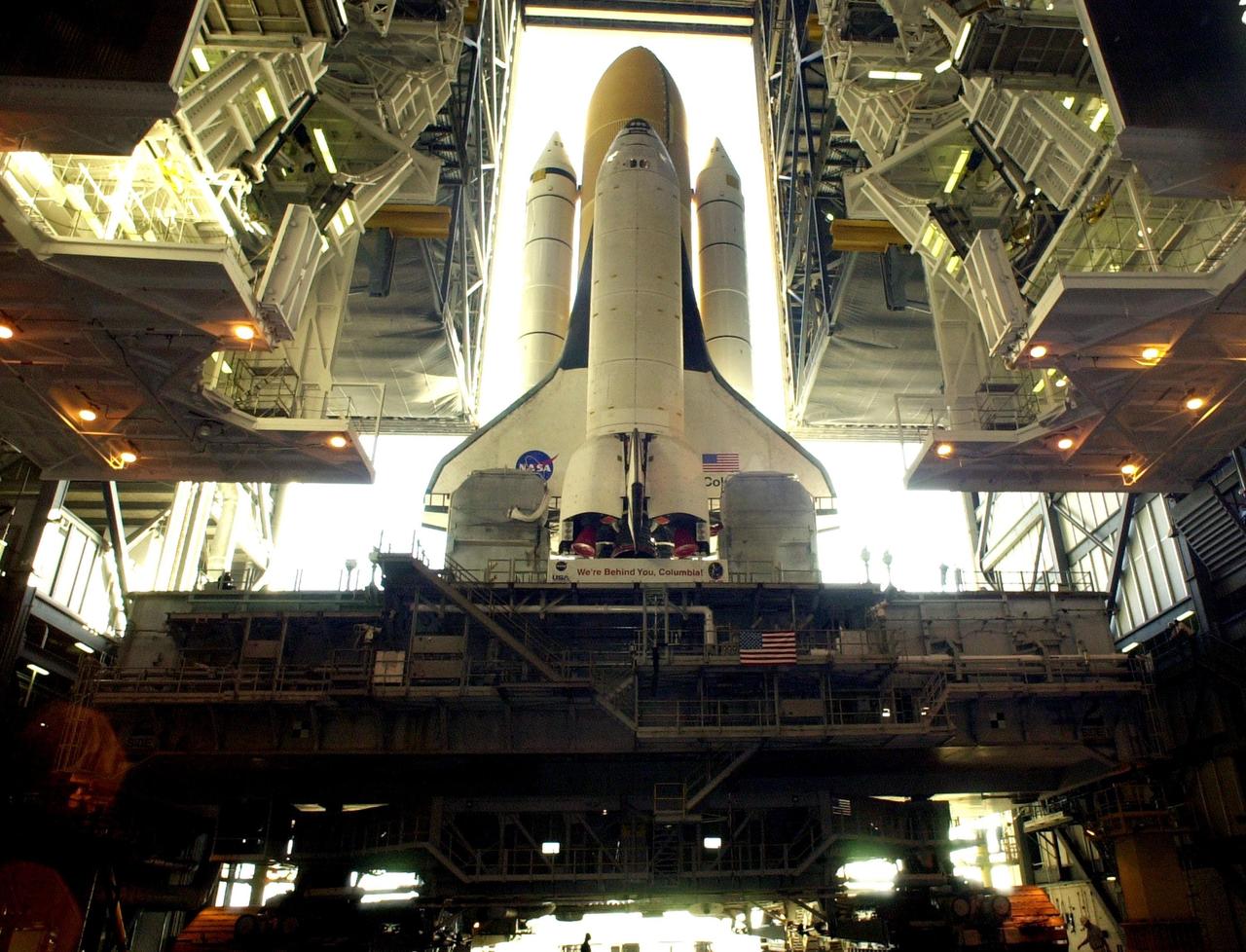
KENNEDY SPACE CENTER, FLA. -- In the Vehicle Assembly Building, overhead cranes are lowered toward the orbiter Columbia. The cranes will lift the orbiter to a vertical position for stacking with the external tank and solid rocket boosters. Columbia is scheduled to be launched Feb. 28 on mission STS-109, a Hubble Servicing Mission. The goal of the mission is to service the HST, replacing Solar Array 2 with Solar Array 3, replacing the Power Control Unit, removing the Faint Object Camera and installing the ACS, installing the Near Infrared Camera and Multi-Object Spectrometer (NICMOS) Cooling System, and installing New Outer Blanket Layer insulation
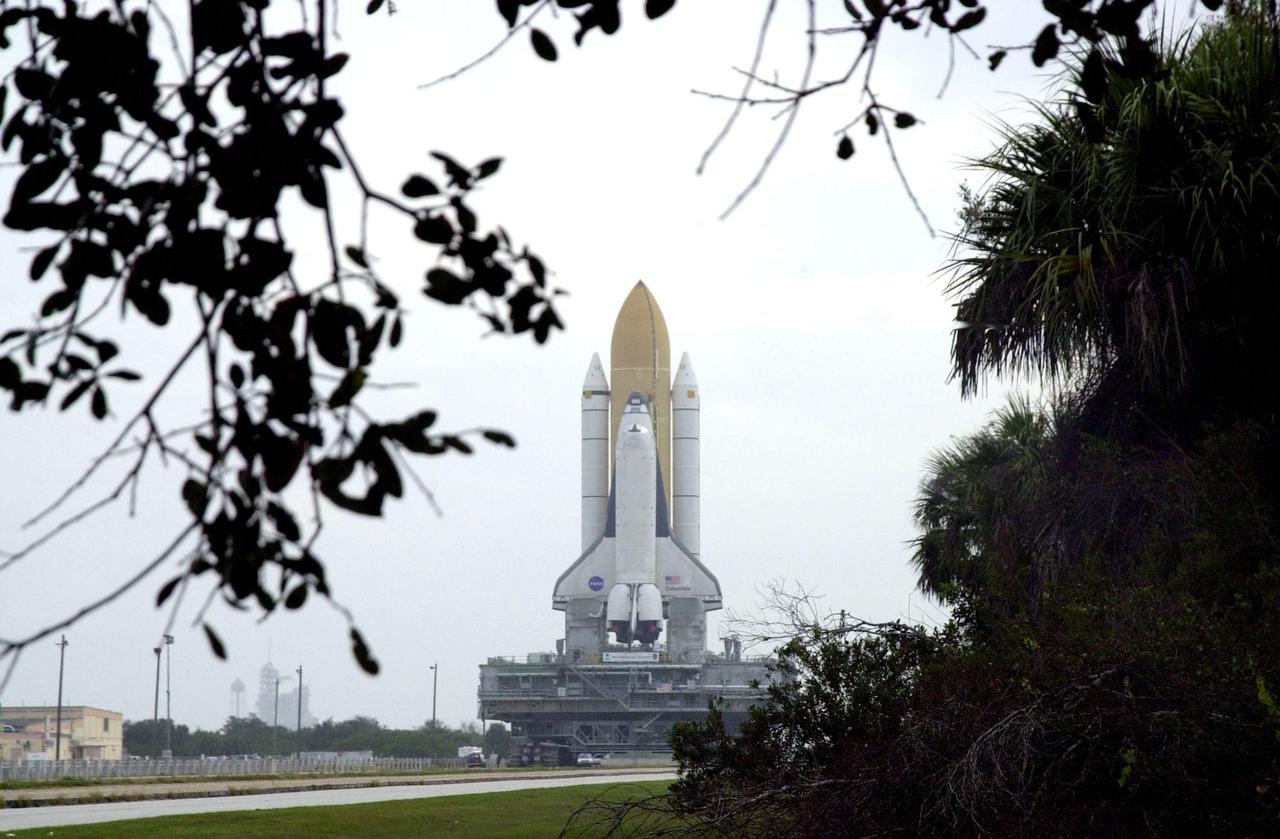
KENNEDY SPACE CENTER, FLA. -- Framed by trees and palmetto scrub, Space Shuttle Columbia is viewed atop its Mobile Launcher Platform as it rolls out to Launch Pad 39A. Underneath is the crawler-transporter, which carries the multi-ton vehicles to the launch pad. Columbia is scheduled to be launched Feb. 28 on mission STS-109, a Hubble Servicing Mission. The goal of the mission is to replace Solar Array 2 with Solar Array 3, replace the Power Control Unit, remove the Faint Object Camera and install the ACS, install the Near Infrared Camera and Multi-Object Spectrometer (NICMOS) Cooling System, and install New Outer Blanket Layer insulation
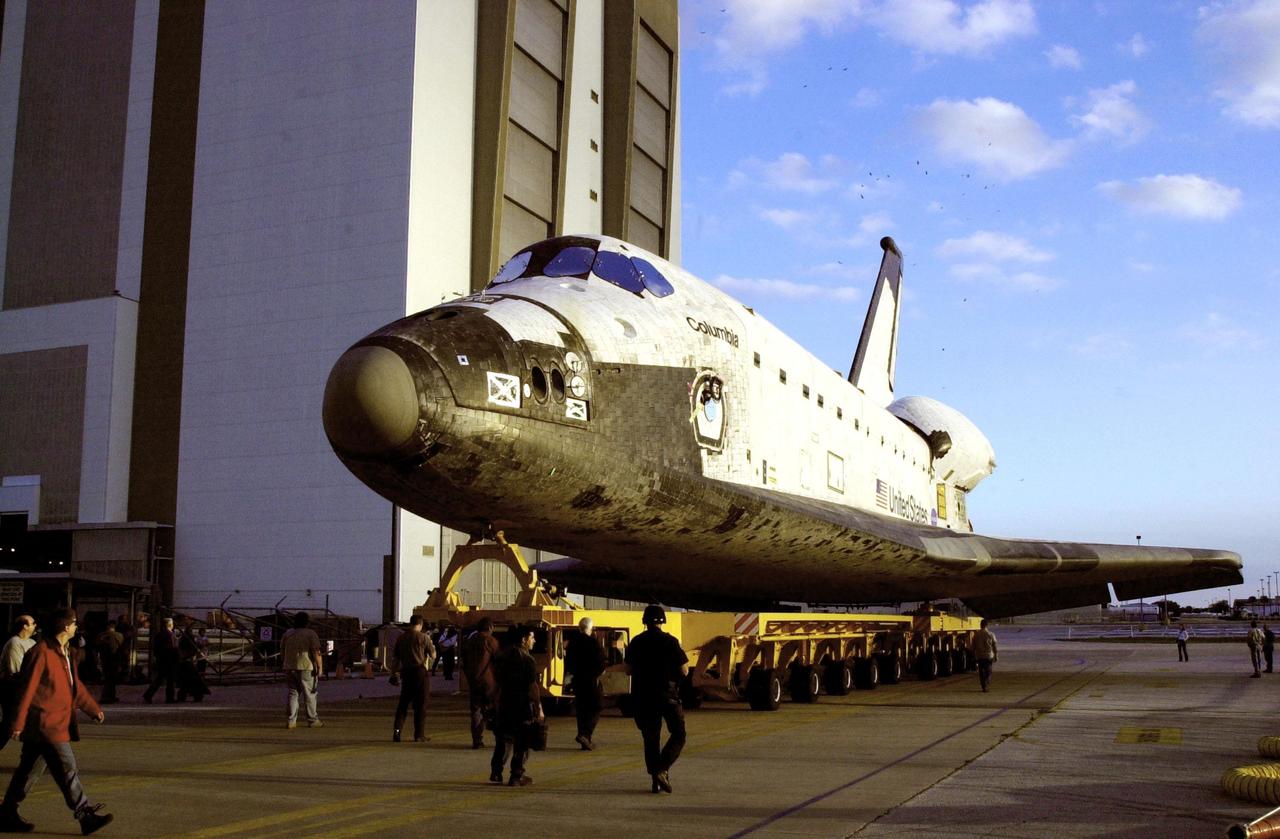
KENNEDY SPACE CENTER, FLA. -- After leaving the Orbiter Processing Facility, orbiter Columbia rolls toward the Vehicle Assembly Building where it will be mated with the external tank-solid rocket booster stack. Columbia is scheduled to be launched Feb. 28 on mission STS-109, a Hubble Servicing Mission. The goal of the mission is to service the HST, replacing Solar Array 2 with Solar Array 3, replacing the Power Control Unit, removing the Faint Object Camera and installing the ACS, installing the Near Infrared Camera and Multi-Object Spectrometer (NICMOS) Cooling System, and installing New Outer Blanket Layer insulation
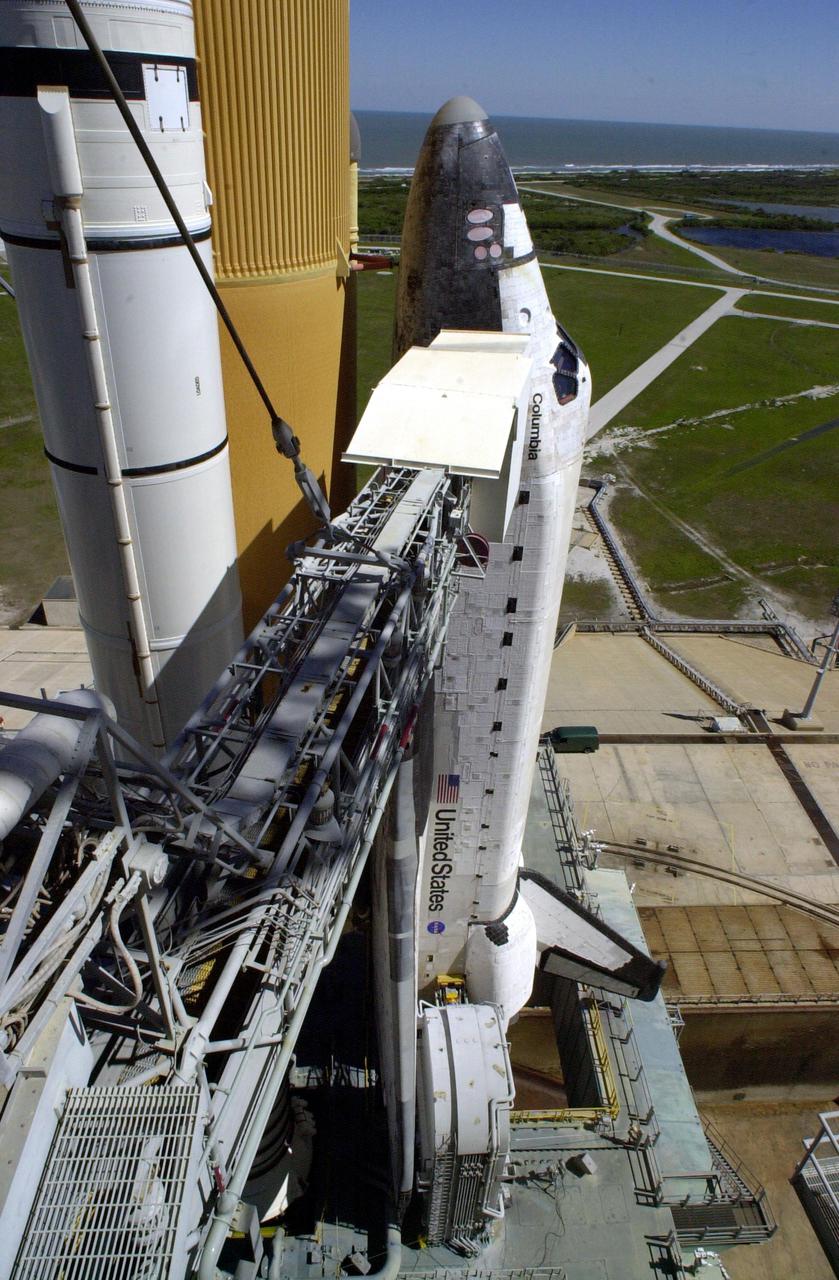
KENNEDY SPACE CENTER, FLA. -- The Rotating Service Structure is rolled back from Space Shuttle Columbia in preparation for launch Feb. 28, 2002, at 6:48 a.m. EST (11:48 GMT) on mission STS-109. In the photo is seen the Orbiter Access Arm stretched to Columbia's cockpit. A Hubble Servicing Mission, the goal is to replace Solar Array 2 with Solar Array 3, replace the Power Control Unit, remove the Faint Object Camera and install the ACS, install the Near Infrared Camera and Multi-Object Spectrometer (NICMOS) Cooling System, and install New Outer Blanket Layer insulation.
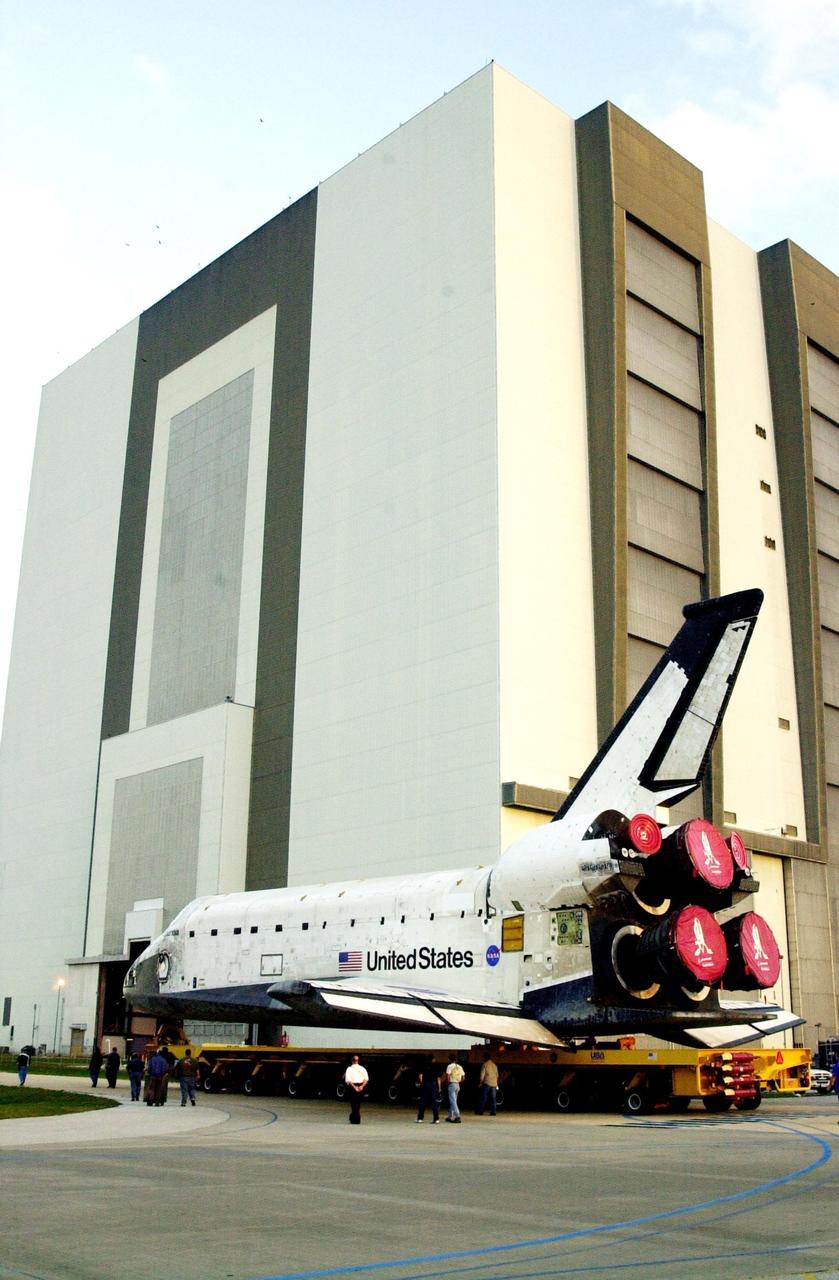
KENNEDY SPACE CENTER, FLA. -- After leaving the Orbiter Processing Facility, orbiter Columbia rolls toward the Vehicle Assembly Building where it will be mated with the external tank-solid rocket booster stack. Columbia is scheduled to be launched Feb. 28 on mission STS-109, a Hubble Servicing Mission. The goal of the mission is to service the HST, replacing Solar Array 2 with Solar Array 3, replacing the Power Control Unit, removing the Faint Object Camera and installing the ACS, installing the Near Infrared Camera and Multi-Object Spectrometer (NICMOS) Cooling System, and installing New Outer Blanket Layer insulation
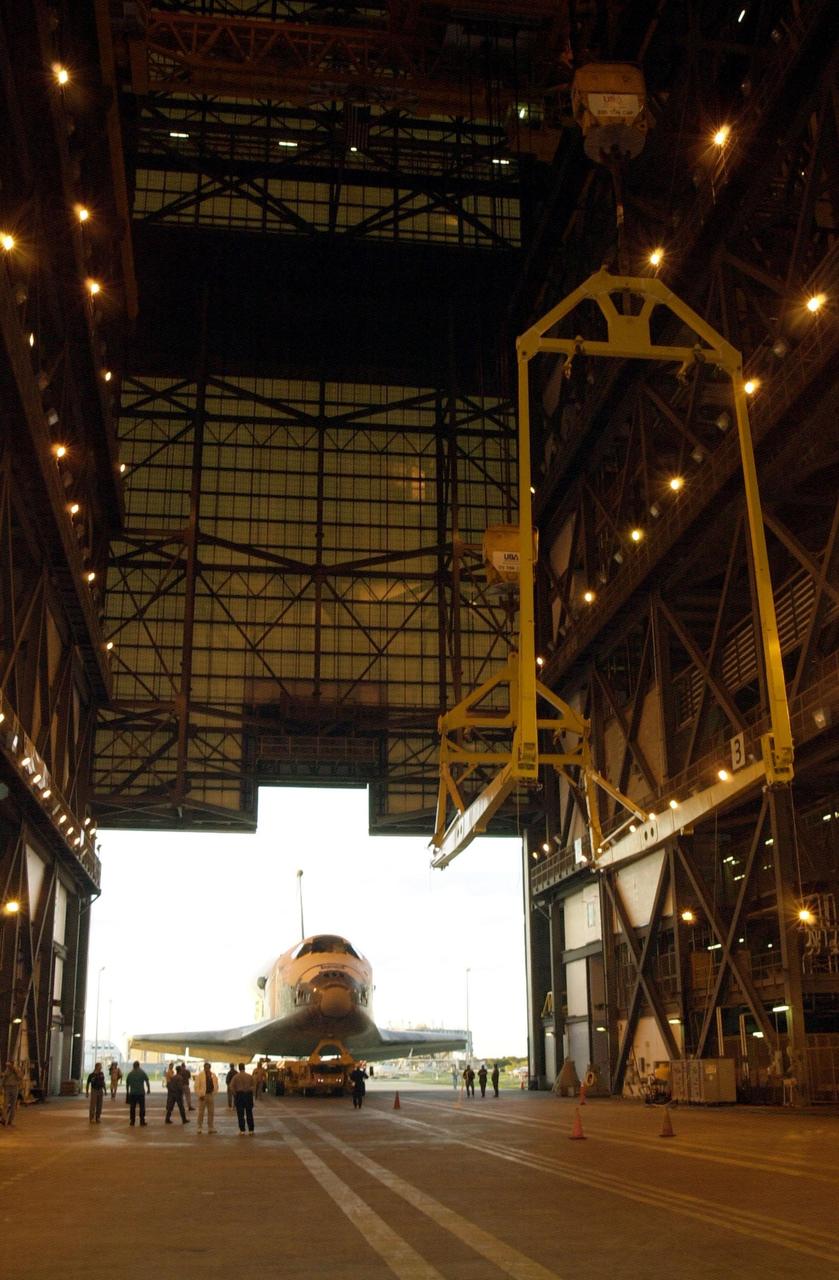
KENNEDY SPACE CENTER, FLA. -- The orbiter Columbia rolls into the transfer aisle of the Vehicle Assembly Building where it will be mated with the external tank-solid rocket booster stack. Columbia is scheduled to be launched Feb. 28 on mission STS-109, a Hubble Servicing Mission. The goal of the mission is to service the HST, replacing Solar Array 2 with Solar Array 3, replacing the Power Control Unit, removing the Faint Object Camera and installing the ACS, installing the Near Infrared Camera and Multi-Object Spectrometer (NICMOS) Cooling System, and installing New Outer Blanket Layer insulation
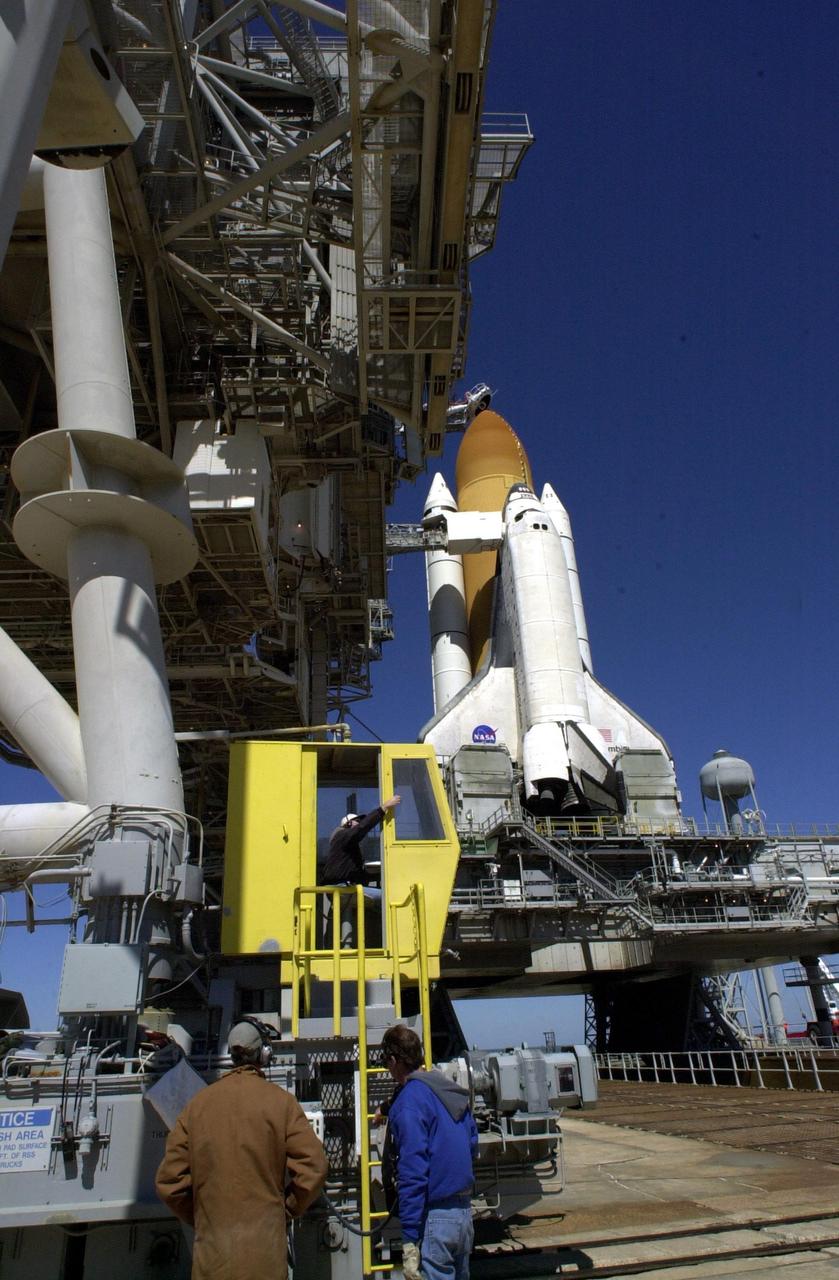
KENNEDY SPACE CENTER, FLA. - The Rotating Service Structure is rolled back from Space Shuttle Columbia in preparation for launch Feb. 28, 2002, at 6:48 a.m. EST (11:48 GMT) on mission STS-109. A Hubble Servicing Mission, the goal is to replace Solar Array 2 with Solar Array 3, replace the Power Control Unit, remove the Faint Object Camera and install the ACS, install the Near Infrared Camera and Multi-Object Spectrometer (NICMOS) Cooling System, and install New Outer Blanket Layer insulation.
KENNEDY SPACE CENTER, FLA. -- Rollout of Space Shuttle Columbia from the Vehicle Assembly Building begins in the early light of morning. Columbia sits on top of the Mobile Launcher Platform. Underneath is the crawler-transporter, which carries the multi-ton vehicles to the launch pad. Columbia is scheduled to be launched Feb. 28 on mission STS-109, a Hubble Servicing Mission. The goal of the mission is to replace Solar Array 2 with Solar Array 3, replace the Power Control Unit, remove the Faint Object Camera and install the ACS, install the Near Infrared Camera and Multi-Object Spectrometer (NICMOS) Cooling System, and install New Outer Blanket Layer insulation
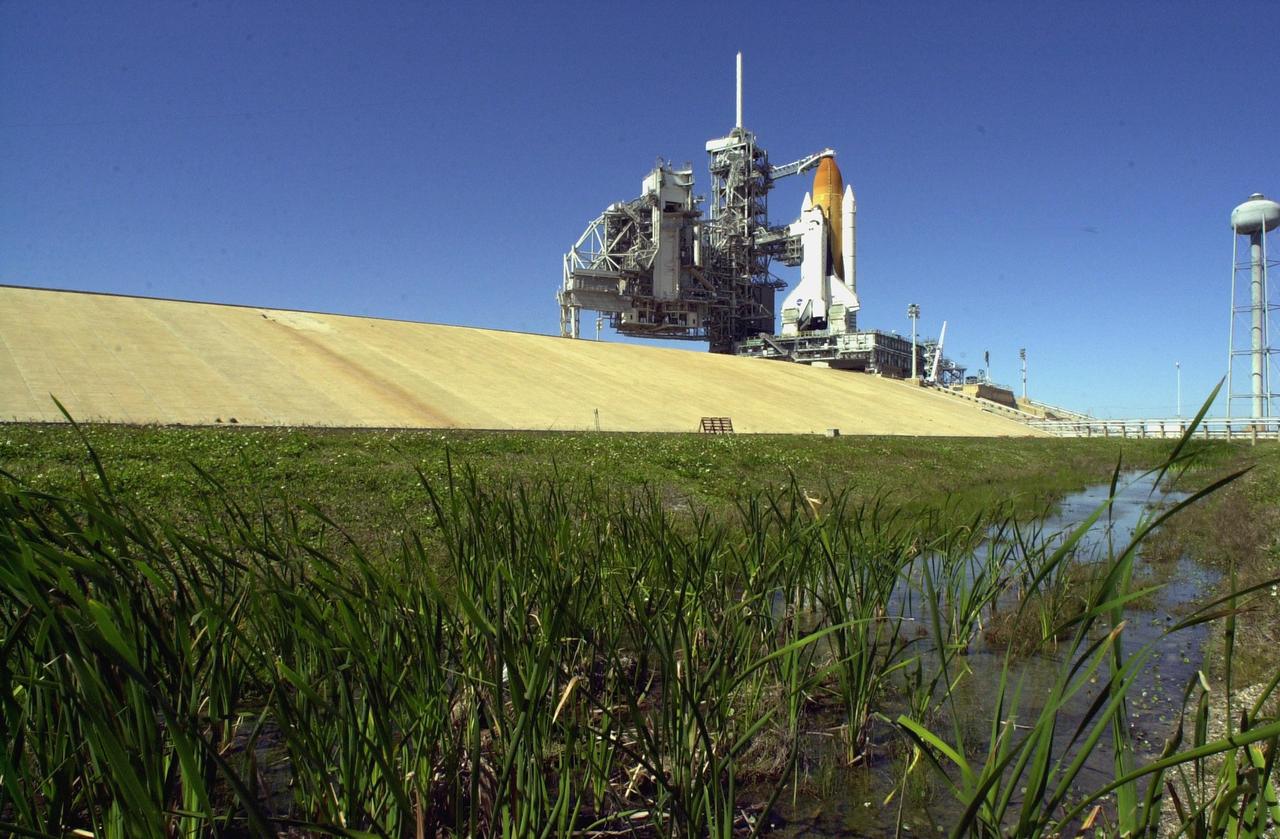
KENNEDY SPACE CENTER, FLA. -- The Rotating Service Structure is rolled back from Space Shuttle Columbia in preparation for launch Feb. 28, 2002, at 6:48 a.m. EST (11:48 GMT) on mission STS-109. In the photo is seen the Orbiter Access Arm stretched to Columbia's cockpit. A Hubble Servicing Mission, the goal of STS-109 is to replace Solar Array 2 with Solar Array 3, replace the Power Control Unit, remove the Faint Object Camera and install the ACS, install the Near Infrared Camera and Multi-Object Spectrometer (NICMOS) Cooling System, and install New Outer Blanket Layer insulation.
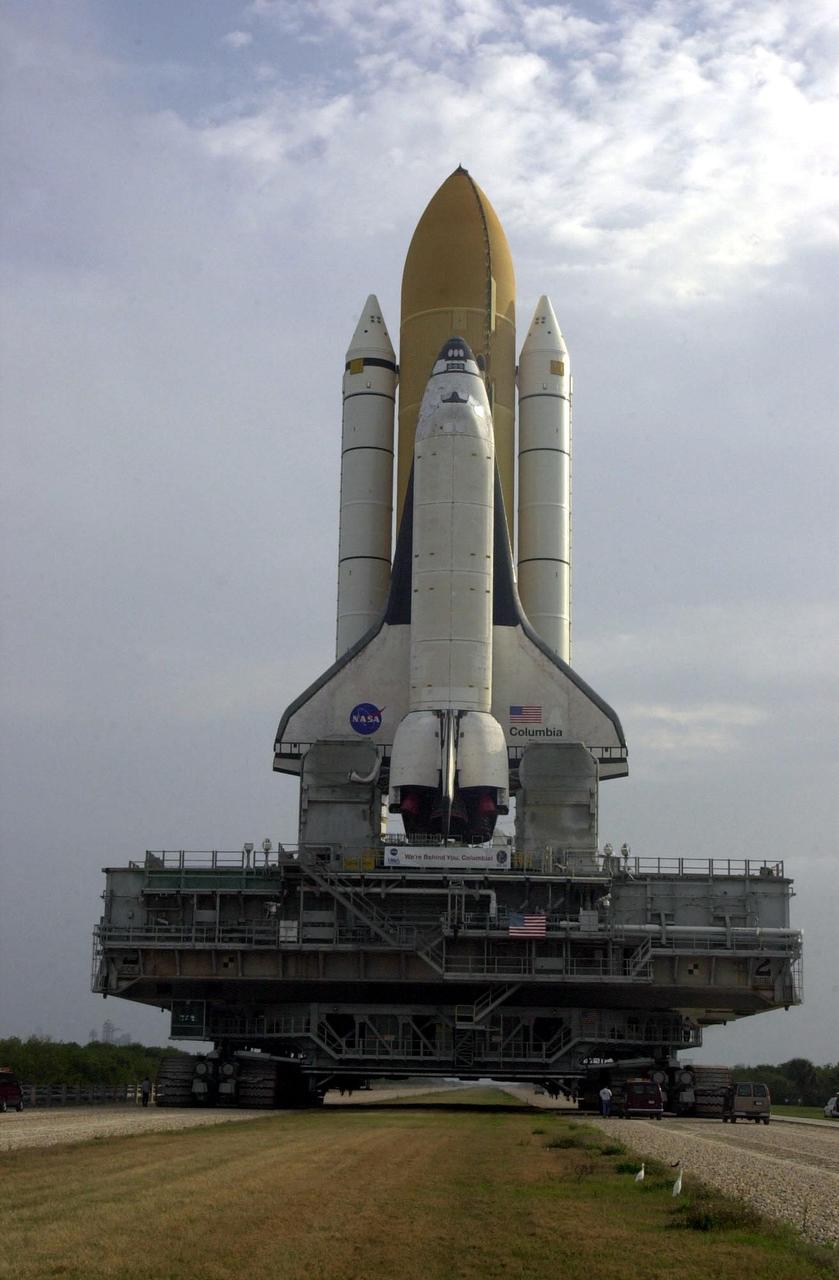
KENNEDY SPACE CENTER, FLA. -- A grey sky silhouettes Space Shuttle Columbia, atop its Mobile Launcher Platform, as it rolls out to Launch Pad 39A. Underneath is the crawler-transporter, which carries the multi-ton vehicles to the pad. In the grass behind the towering structures are two white herons. Columbia is scheduled to be launched Feb. 28 on mission STS-109, a Hubble Servicing Mission. The goal of the mission is to replace Solar Array 2 with Solar Array 3, replace the Power Control Unit, remove the Faint Object Camera and install the ACS, install the Near Infrared Camera and Multi-Object Spectrometer (NICMOS) Cooling System, and install New Outer Blanket Layer insulation
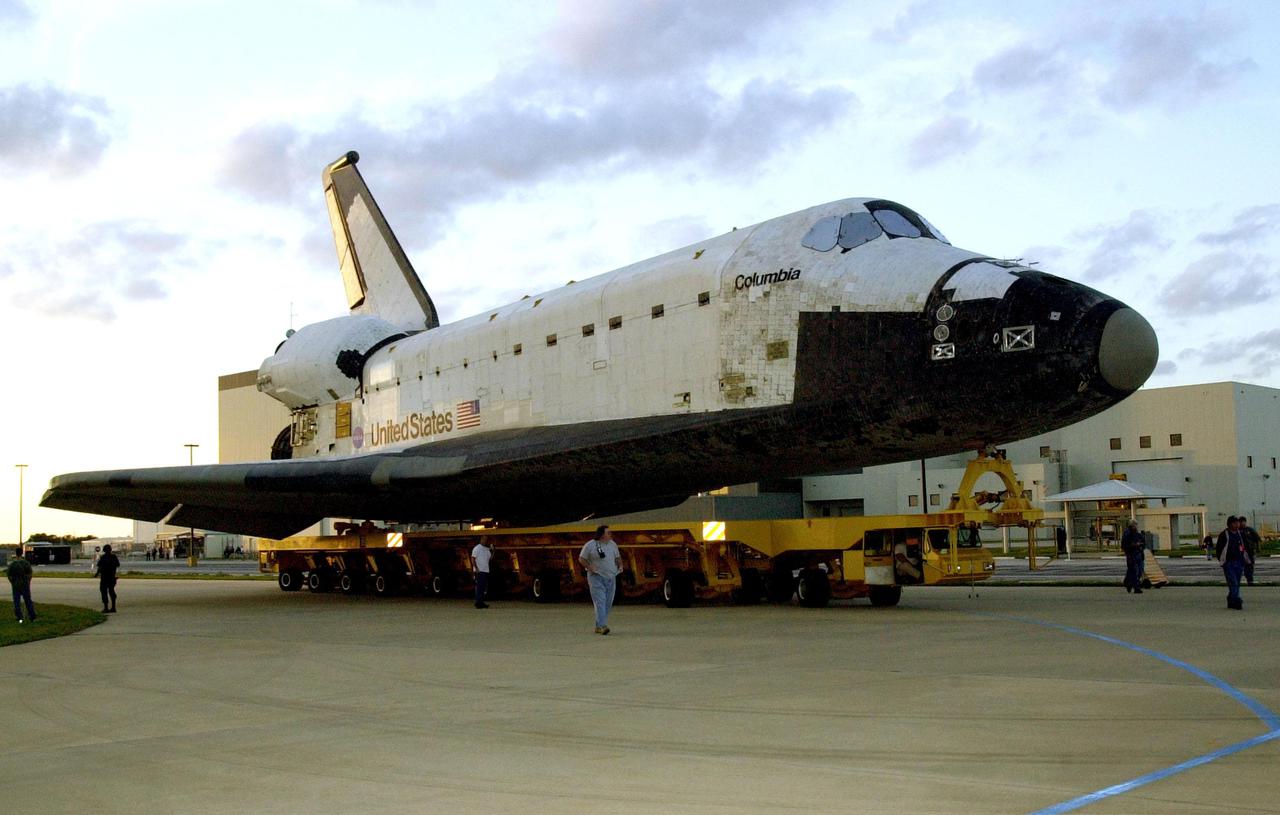
KENNEDY SPACE CENTER, FLA. -- The orbiter Columbia, atop a transporter, rolls away from the Orbiter Processing Facility on its way to the Vehicle Assembly Building. There it will be mated with the external tank-solid rocket booster stack. Columbia is scheduled to be launched Feb. 28 on mission STS-109, a Hubble Servicing Mission. The goal of the mission is to service the HST, replacing Solar Array 2 with Solar Array 3, replacing the Power Control Unit, removing the Faint Object Camera and installing the ACS, installing the Near Infrared Camera and Multi-Object Spectrometer (NICMOS) Cooling System, and installing New Outer Blanket Layer insulation
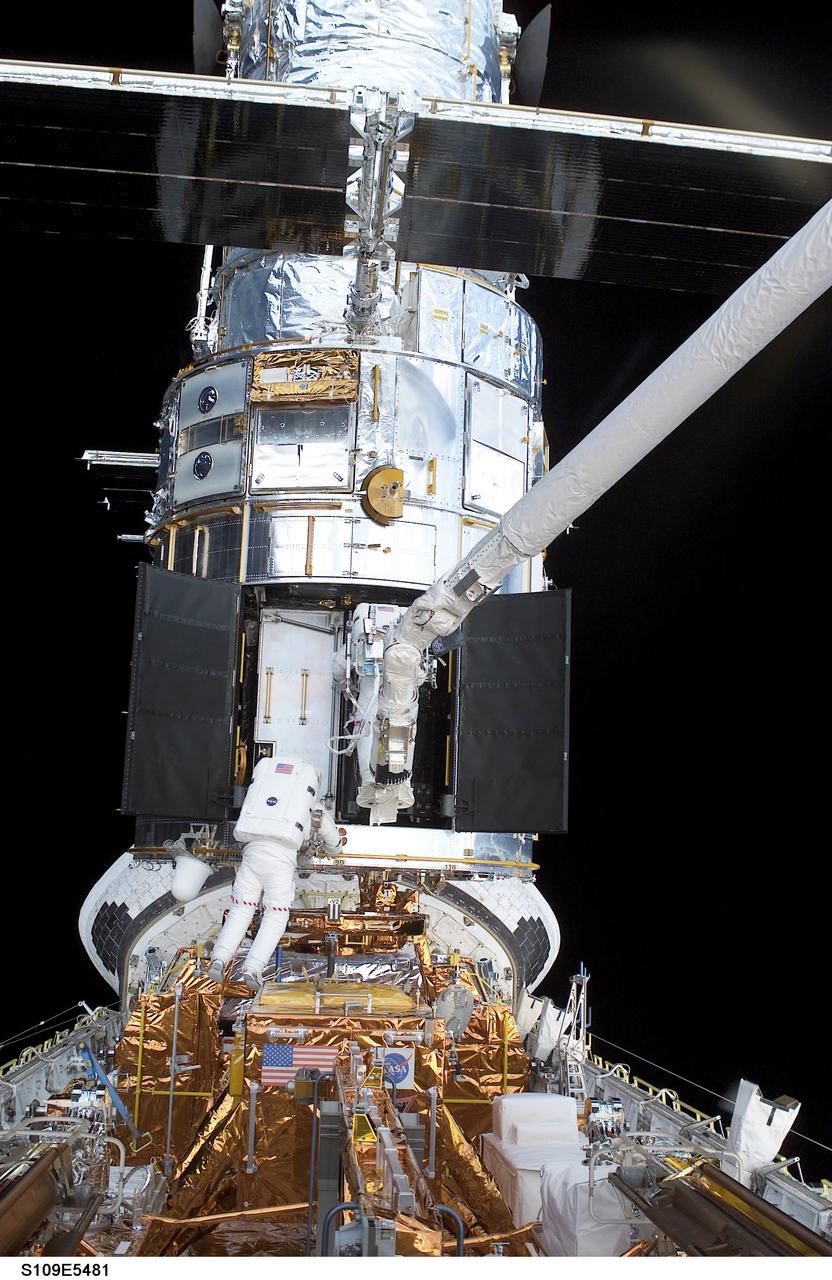
STS109-E-5481 (7 March 2002) --- Two of Columbia's four spacewalkers--astronauts James H. Newman and Michael J. Massimino--participate in the first science instrument upgrade of the fourth Hubble Space Telescope (HST) servicing mission during the flight's fourth day of extravehicular activity (EVA). The two, with Newman on Columbia's remote manipulator system (RMS) robotic arm, removed the Faint Object Camera to make room for the new Advanced Camera for Surveys (ACS). This image was recorded with a digital still camera by one of the duo's crewmates on the aft flight deck.
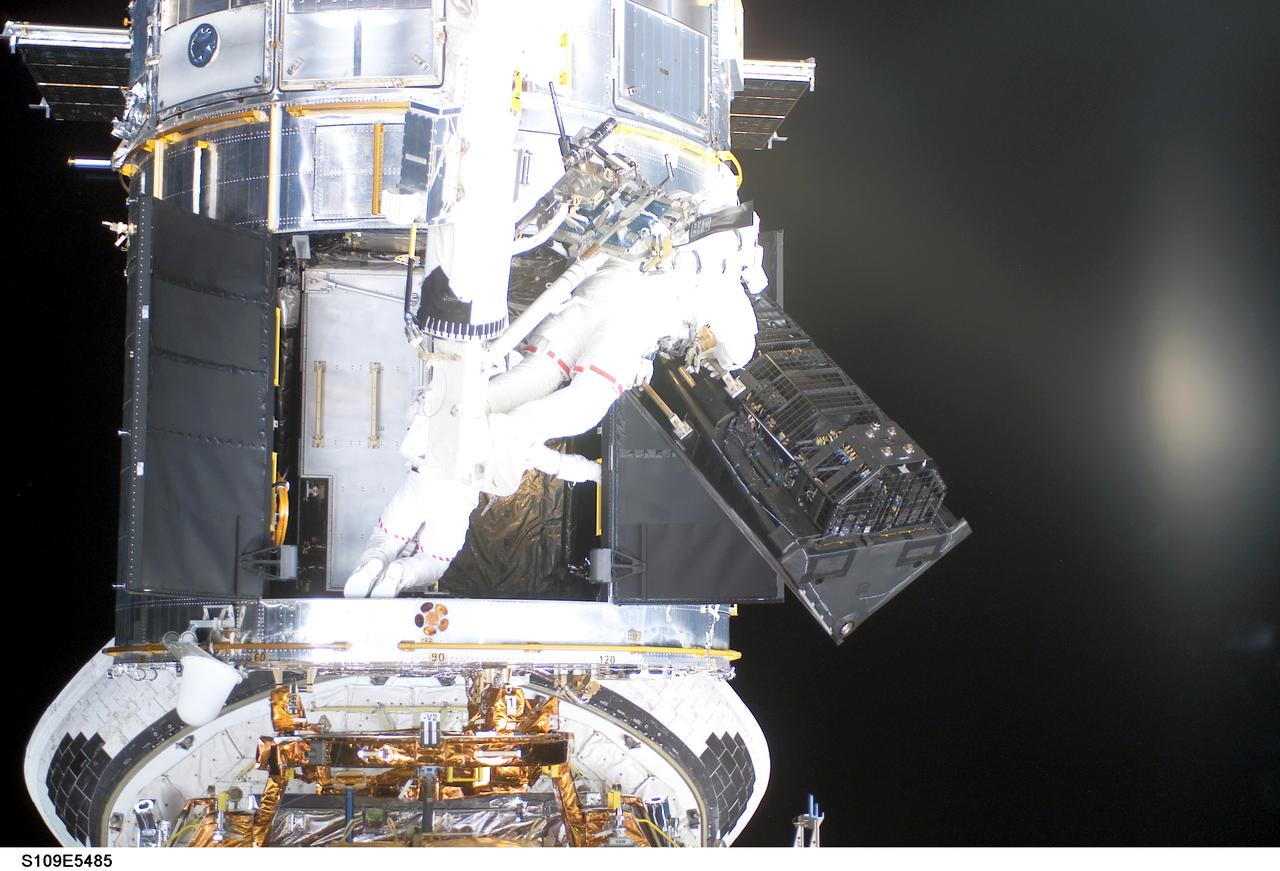
STS109-E-5485 (7 March 2002) --- Two of Columbia's four spacewalkers--astronauts James H. Newman and Michael J. Massimino--participate in the first science instrument upgrade of the fourth Hubble Space Telescope (HST) servicing mission during the flight's fourth day of extravehicular activity (EVA). The two, with Newman on Columbia's remote manipulator system (RMS) robotic arm, remove the Faint Object Camera to make room for the new Advanced Camera for Surveys (ACS). This image was recorded with a digital still camera by one of the duo's crewmates on the aft flight deck.
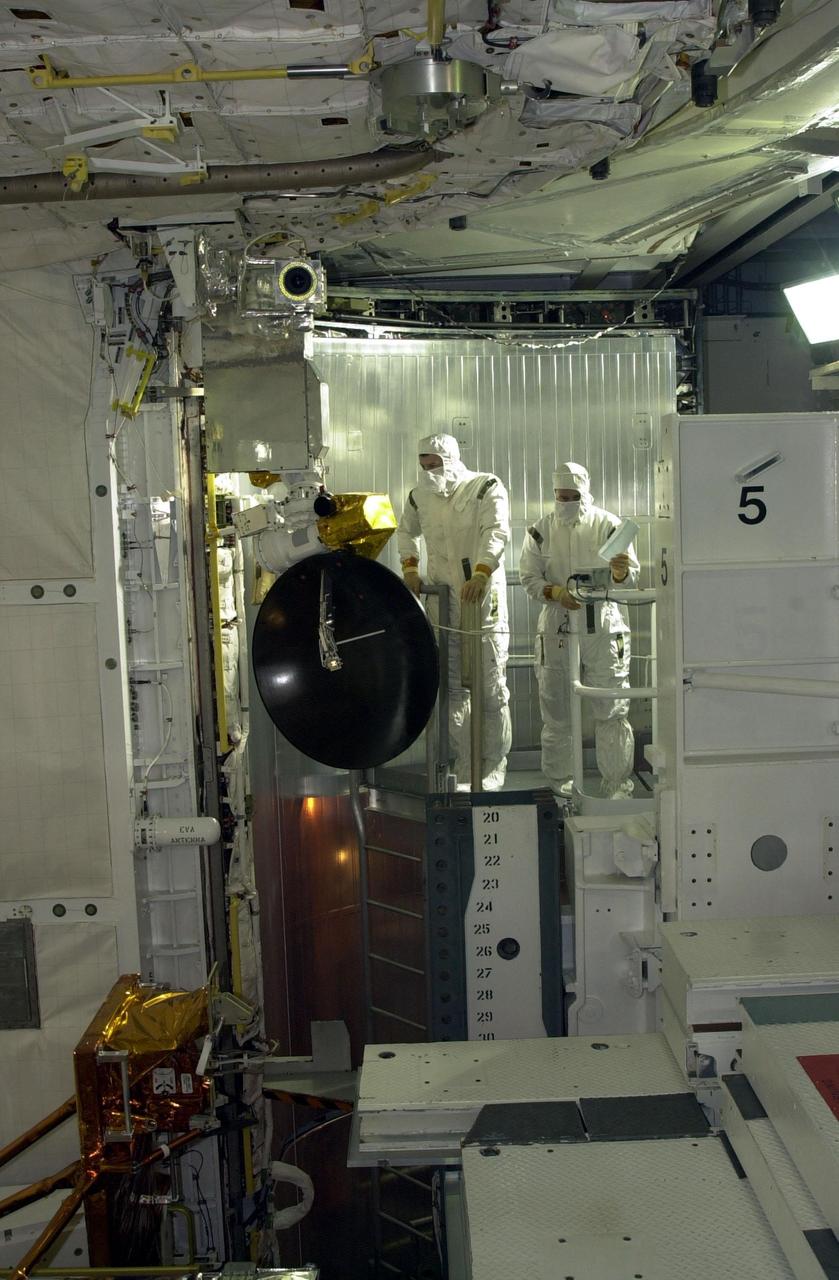
KENNEDY SPACE CENTER, Fla. - On Launch Pad 39A, members of the STS-109 crew perform a final inspection of the Hubble payload they will deploy on orbit during five spacewalks. The crew comprises Commander Scott Altman, Pilot Duane Carey, Payload Commander John Grunsfeld, and Mission Specialists Nancy Currie, James Newman, Richrd Linnehan and Michael Massimino. The goal of the mission is to replace Solar Array 2 with Solar Array 3, replace the Power Control Unit, remove the Faint Object Camera and install the Advanced Camera for Surveys (ACS), install the Near Infrared Camera and Multi-Object Spectrometer (NICMOS) Cooling System, and install New Outer Blanket Layer insulation. Launch of Shuttle Columbia on mission STS-109 is scheduled for Feb. 28 at 6:48 a.m. EST
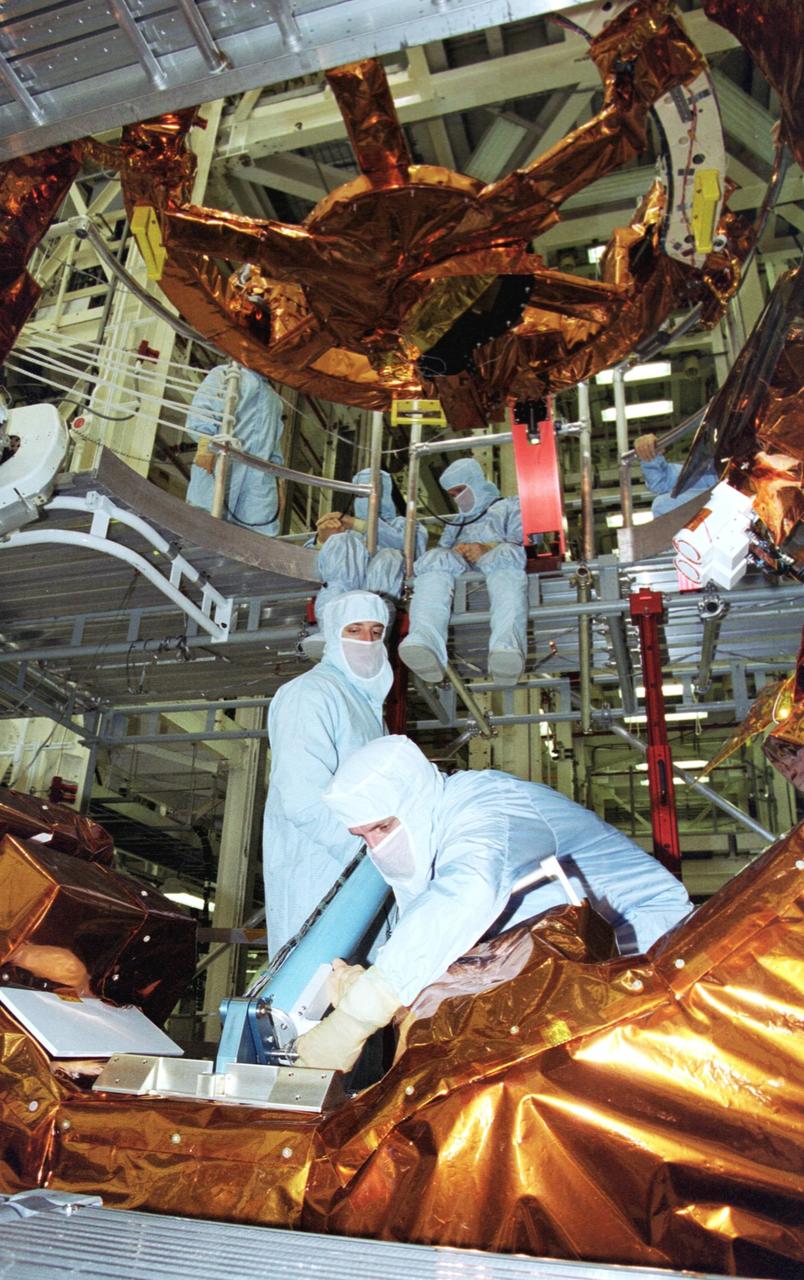
KENNEDY SPACE CENTER, Fla. - In the Vertical Processing Facility, members of the STS-109 crew practice using some of the equipment for their Hubble Space Telescope (HST) Servicing mission. Seen in the foreground are Mission Specialists Michael Massimino (standing) and Richard Linnehan (bending over). The rest of the crew members are Commander Scott Altman, Pilot Duane Carey, Payload Commander John Grunsfeld and Mission Specialists Nancy Currie and James Newman. The goal of the mission is to service the HST, replacing Solar Array 2 with Solar Array 3, replacing the Power Control Unit, removing the Faint Object Camera and installing the Advanced Camera for Surveys, installing the Near Infrared Camera and Multi-Object Spectrometer (NICMOS) Cooling System, and installing New Outer Blanket Layer insulation on bays 5 through 8. Mission STS-109 is scheduled for launch Feb. 14, 2002
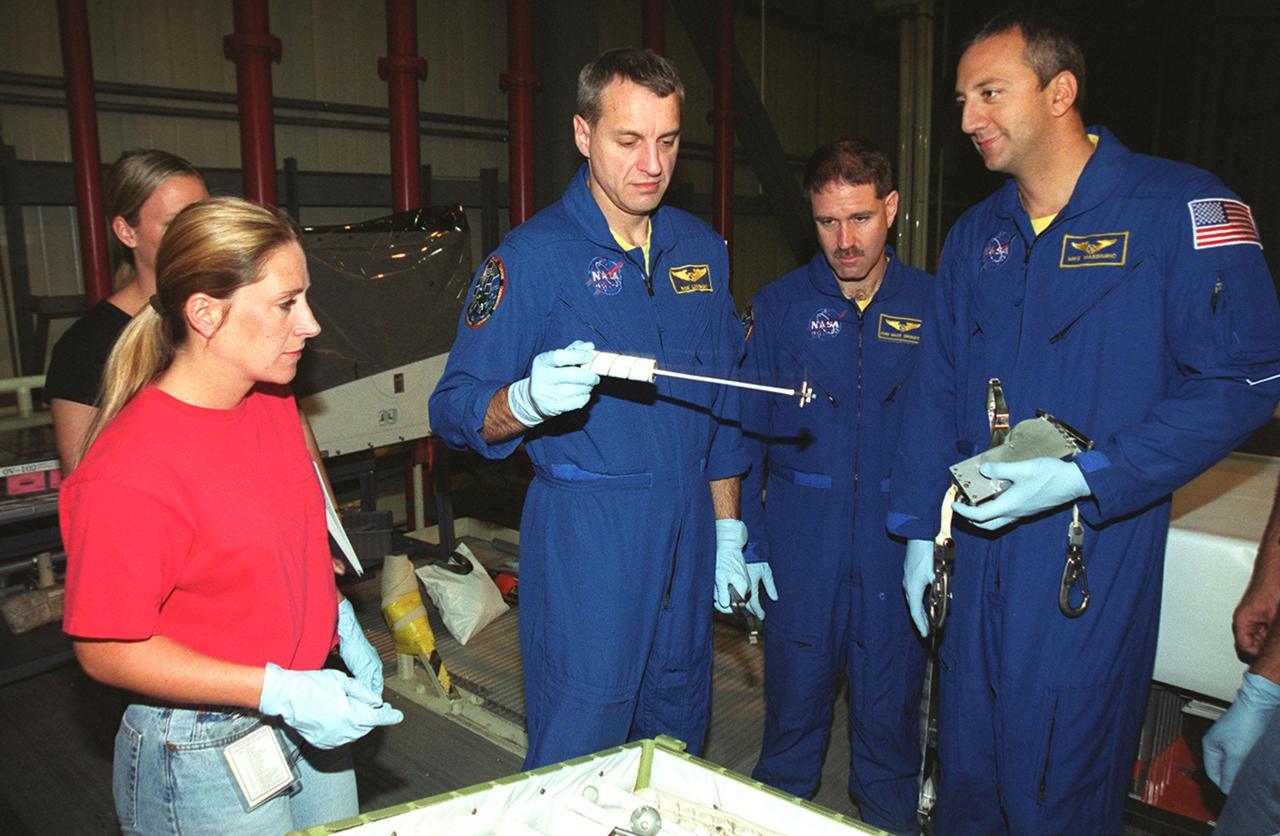
KENNEDY SPACE CENTER, Fla. - In the company of two technicians (left), STS-109 crew members look over equipment related to their mission. Holding the equipment is Mission Specialist Richard Linnehan (left); at center is Payload Commander John Grunsfeld; at right is Mission Specialist Michael Massimino. STS-109, the Hubble Space Telescope (HST) Servicing mission, is Massimino's first Shuttle flight. The crew is at KSC to take part in Crew Equipment Interface Test activities that include familiarization with the orbiter and equipment. The goal of the mission is to service the HST, replacing Solar Array 2 with Solar Array 3, replacing the Power Control Unit, removing the Faint Object Camera and installing the Advanced Camera for Surveys, installing the Near Infrared Camera and Multi-Object Spectrometer (NICMOS) Cooling System, and installing New Outer Blanket Layer insulation on bays 5 through 8. Mission STS-109 is scheduled for launch Feb. 14, 2002
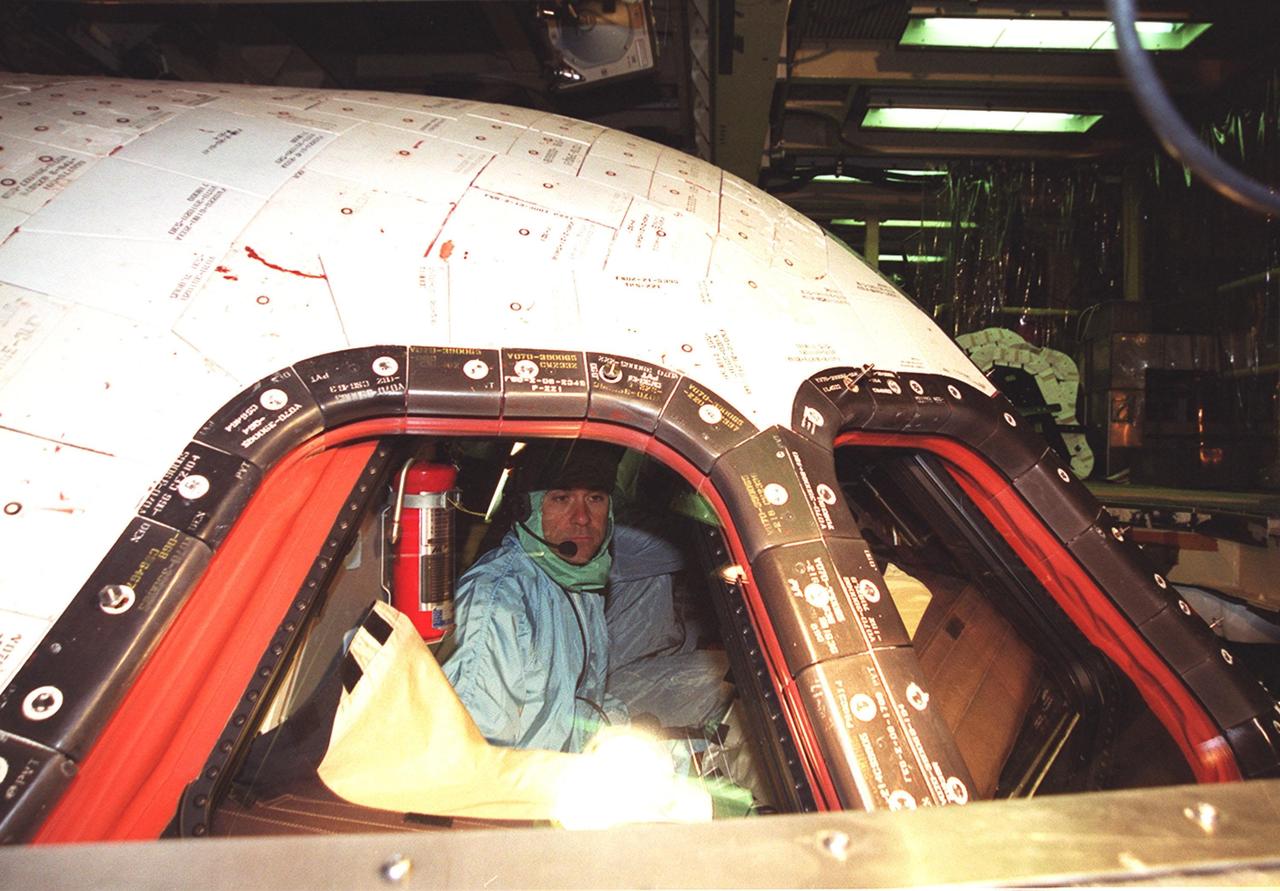
KENNEDY SPACE CENTER, Fla. - STS-109 Pilot Duane Carey checks the windshield and windows from inside Columbia. This is Carey's first Shuttle flight. He and the crew are at KSC to take part in Crew Equipment Interface Test activities that include familiarization with the orbiter and equipment. STS-109 is the Hubble Space Telescope (HST) Servicing mission. The crew also comprises Commander Scott Altman, Payload Commander John Grunsfeld and Mission Specialists Nancy Currie, James Newman, Richard Linnehan and Michael Massimino. The goal of the mission is to service the HST, replacing Solar Array 2 with Solar Array 3, replacing the Power Control Unit, removing the Faint Object Camera and installing the Advanced Camera for Surveys, installing the Near Infrared Camera and Multi-Object Spectrometer (NICMOS) Cooling System, and installing New Outer Blanket Layer insulation on bays 5 through 8. Mission STS-109 is scheduled for launch Feb. 14, 2002
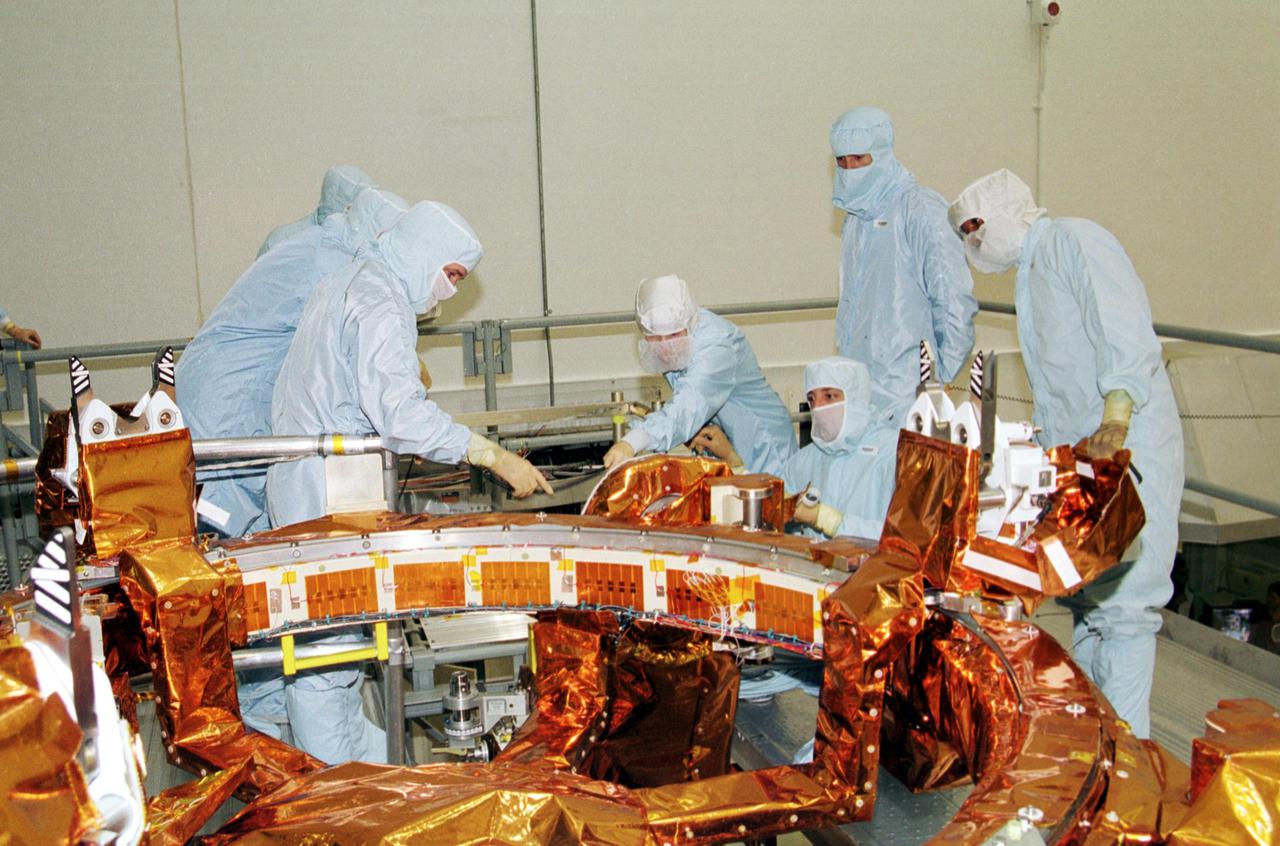
KENNEDY SPACE CENTER, Fla. - Inside the Vertical Processing Facility, the STS-109 crew checks out part of the equipment for their Hubble Space Telescope (HST) Servicing mission. The crew comprises Commander Scott altman, Pilot Duane Carey, Payload Commander John Grunsfeld and Mission Specialists Nancy Currie, James Newman, Richard Linnehan and Michael Massimino. The goal of the mission is to service the HST, replacing Solar Array 2 with Solar Array 3, replacing the Power Control Unit, removing the Faint Object Camera and installing the Advanced Camera for Surveys, installing the Near Infrared Camera and Multi-Object Spectrometer (NICMOS) Cooling System, and installing New Outer Blanket Layer insulation on bays 5 through 8. Mission STS-109 is scheduled for launch Feb. 14, 2002
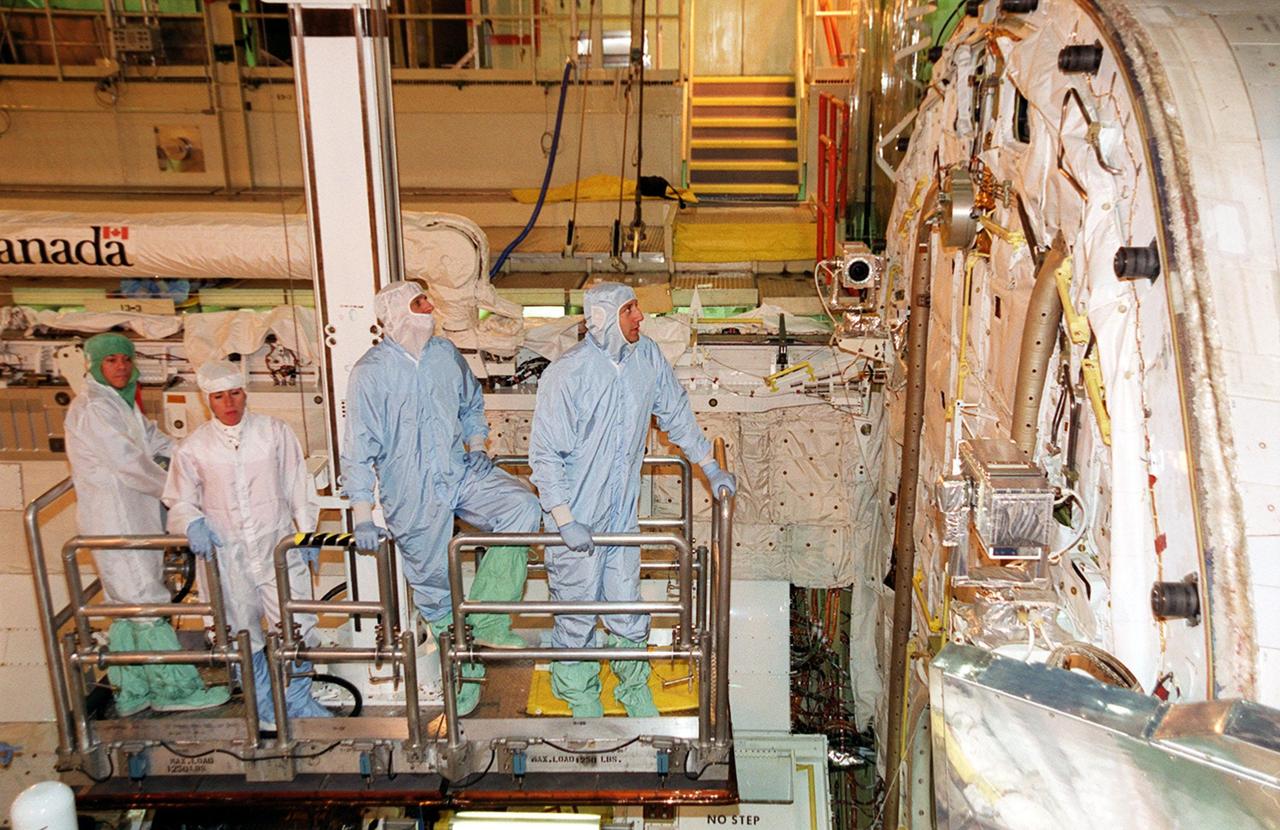
KENNEDY SPACE CENTER, Fla. - Members of the STS-109 crew look over the interior of orbiter Columbia's payload bay. At right is Mission Specialist Michael Massimino; next to him is Commander Scott Altman. The crew is at KSC to take part in Crew Equipment Interface Test activities that include familiarization with the orbiter and equipment. The goal of the mission is to service the HST, replacing Solar Array 2 with Solar Array 3, replacing the Power Control Unit, removing the Faint Object Camera and installing the Advanced Camera for Surveys, installing the Near Infrared Camera and Multi-Object Spectrometer (NICMOS) Cooling System, and installing New Outer Blanket Layer insulation on bays 5 through 8. Mission STS-109 is scheduled for launch Feb. 14, 2002
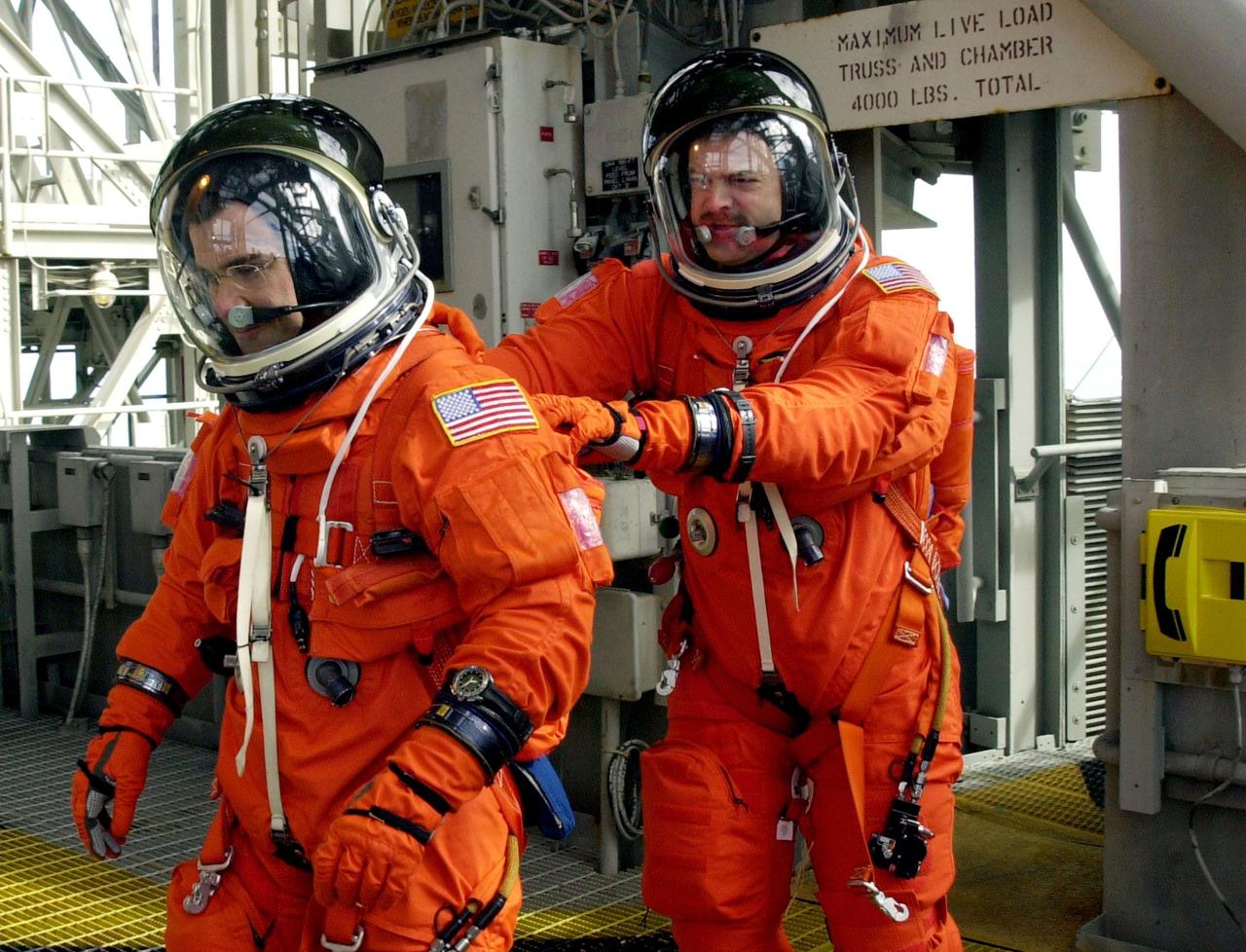
KENNEDY SPACE CENTER, FLA. -- As part of Terminal Countdown Demonstration Test activities, the STS-109 crew practices emergency exit from the Shuttle. Leading the way to the slidewire basket on the 195-foot level is Pilot Duane Carey, followed by Commander Scott Altman. The TCDT also includes a simulated launch countdown. STS-109 is a Hubble Space Telescope Servicing Mission, with goals to replace Solar Array 2 with Solar Array 3, replace the Power Control Unit, remove the Faint Object Camera and install the Advanced Camera for Surveys (ACS), install the Near Infrared Camera and Multi-Object Spectrometer (NICMOS) Cooling System, and install New Outer Blanket Layer insulation. The 11-day mission will require five spacewalks to perform the tasks. Launch of STS-109 aboard Space Shuttle Columbia is scheduled for Feb. 28, 2002
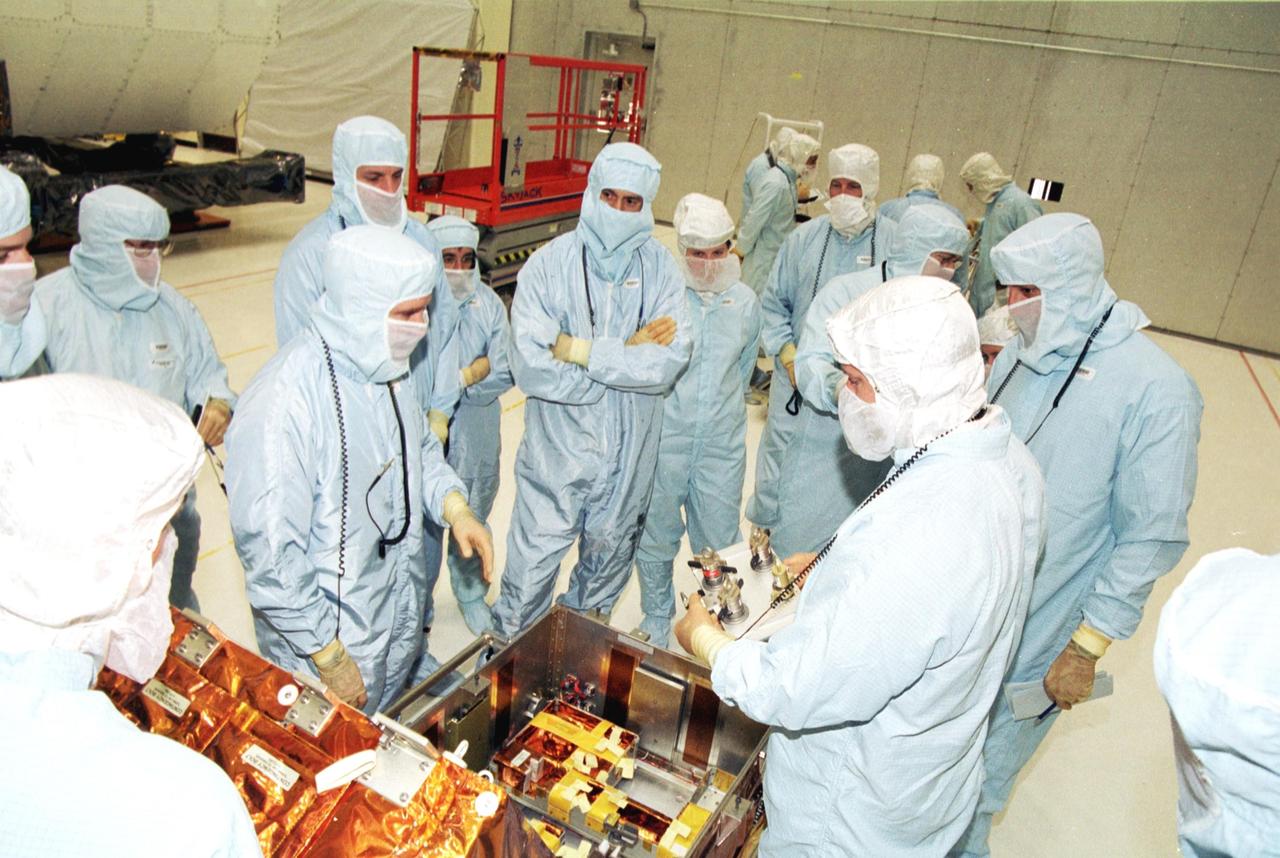
KENNEDY SPACE CENTER, Fla. - The STS-109 crew is in the Vertical Processing Facility to look over equipment for their Hubble Space Telescope (HST) Servicing mission. The crew comprises Commander Scott Altman, Pilot Duane Carey, Payload Commander John Grunsfeld and Mission Specialists Nancy Currie, James Newman, Richard Linnehan and Michael Massimino. The goal of the mission is to service the HST, replacing Solar Array 2 with Solar Array 3, replacing the Power Control Unit, removing the Faint Object Camera and installing the Advanced Camera for Surveys, installing the Near Infrared Camera and Multi-Object Spectrometer (NICMOS) Cooling System, and installing New Outer Blanket Layer insulation on bays 5 through 8. Mission STS-109 is scheduled for launch Feb. 14, 2002
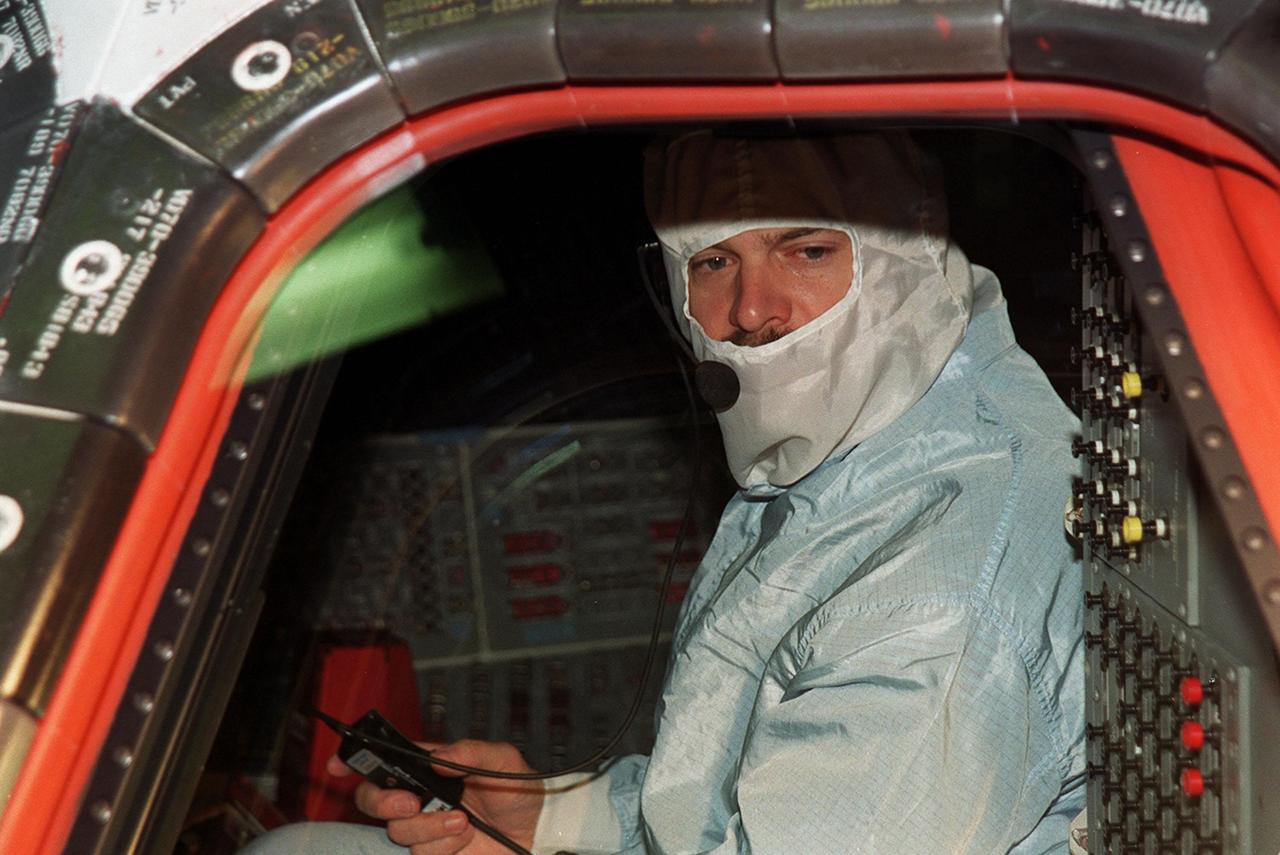
KENNEDY SPACE CENTER, Fla. -- STS-109 Commander Scott Altman checks the windshield and windows from inside Columbia. He and the crew are at KSC to take part in Crew Equipment Interface Test activities that include familiarization with the orbiter and equipment. STS-109 is the Hubble Space Telescope (HST) Servicing mission. The crew also comprises Pilot Duane Carey, Payload Commander John Grunsfeld and Mission Specialists Nancy Currie, James Newman, Richard Linnehan and Michael Massimino. The goal of the mission is to service the HST, replacing Solar Array 2 with Solar Array 3, replacing the Power Control Unit, removing the Faint Object Camera and installing the Advanced Camera for Surveys, installing the Near Infrared Camera and Multi-Object Spectrometer (NICMOS) Cooling System, and installing New Outer Blanket Layer insulation on bays 5 through 8. Mission STS-109 is scheduled for launch Feb. 14, 2002
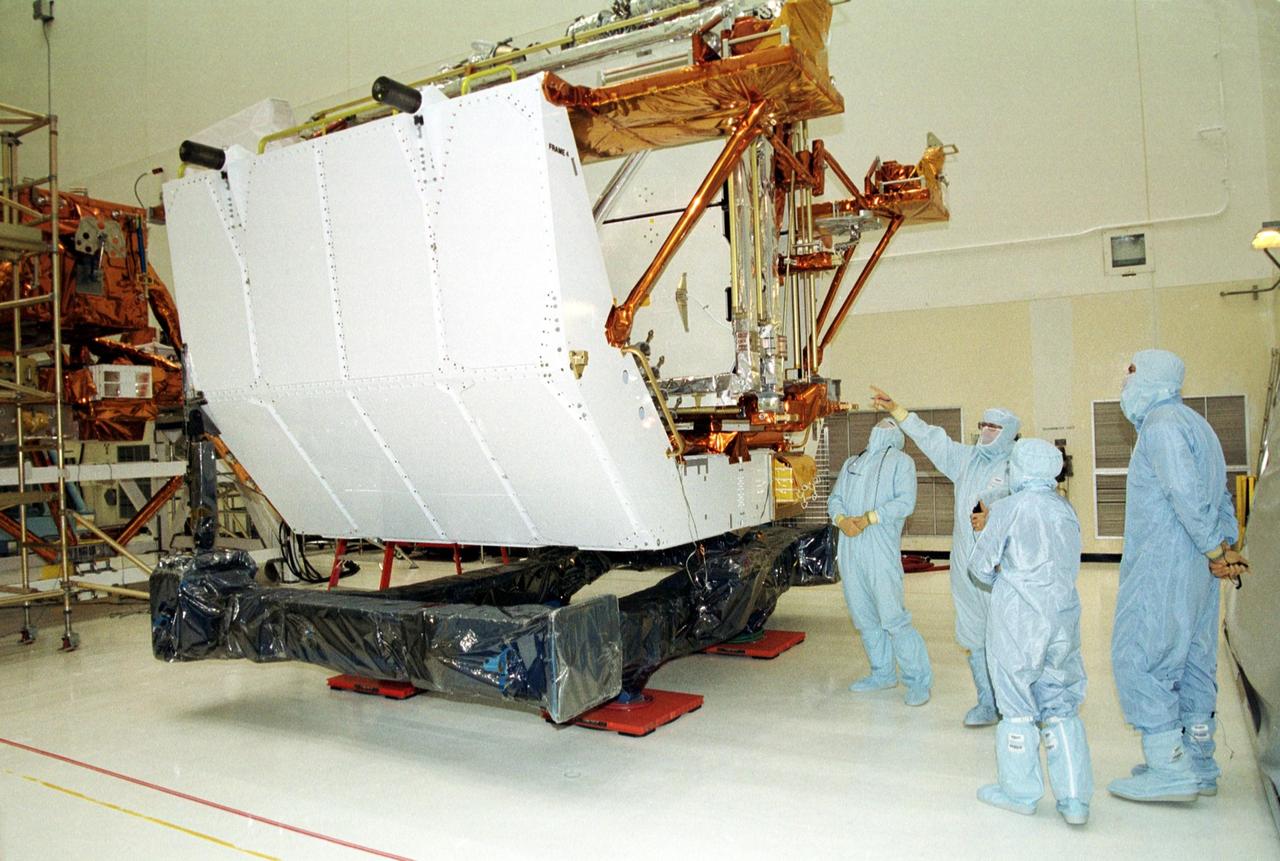
KENNEDY SPACE CENTER, Fla. -- In the Vertical Processing Facility, members of the STS-109 crew look over the Solar Array 3 panels that will be replacing Solar Array 2 panels on the Hubble Space Telescope (HST). Trainers, at left, point to the panels while Mission Specialist Nancy Currie (second from right) and Commander Scott Altman (far right) look on. Other crew members are Pilot Duane Carey, Payload Commander John Grunsfeld and Mission Specialists James Newman, Richard Linnehan and Michael Massimino. The other goals of the mission are replacing the Power Control Unit, removing the Faint Object Camera and installing the Advanced Camera for Surveys, installing the Near Infrared Camera and Multi-Object Spectrometer (NICMOS) Cooling System, and installing New Outer Blanket Layer insulation on bays 5 through 8. Mission STS-109 is scheduled for launch Feb. 14, 2002
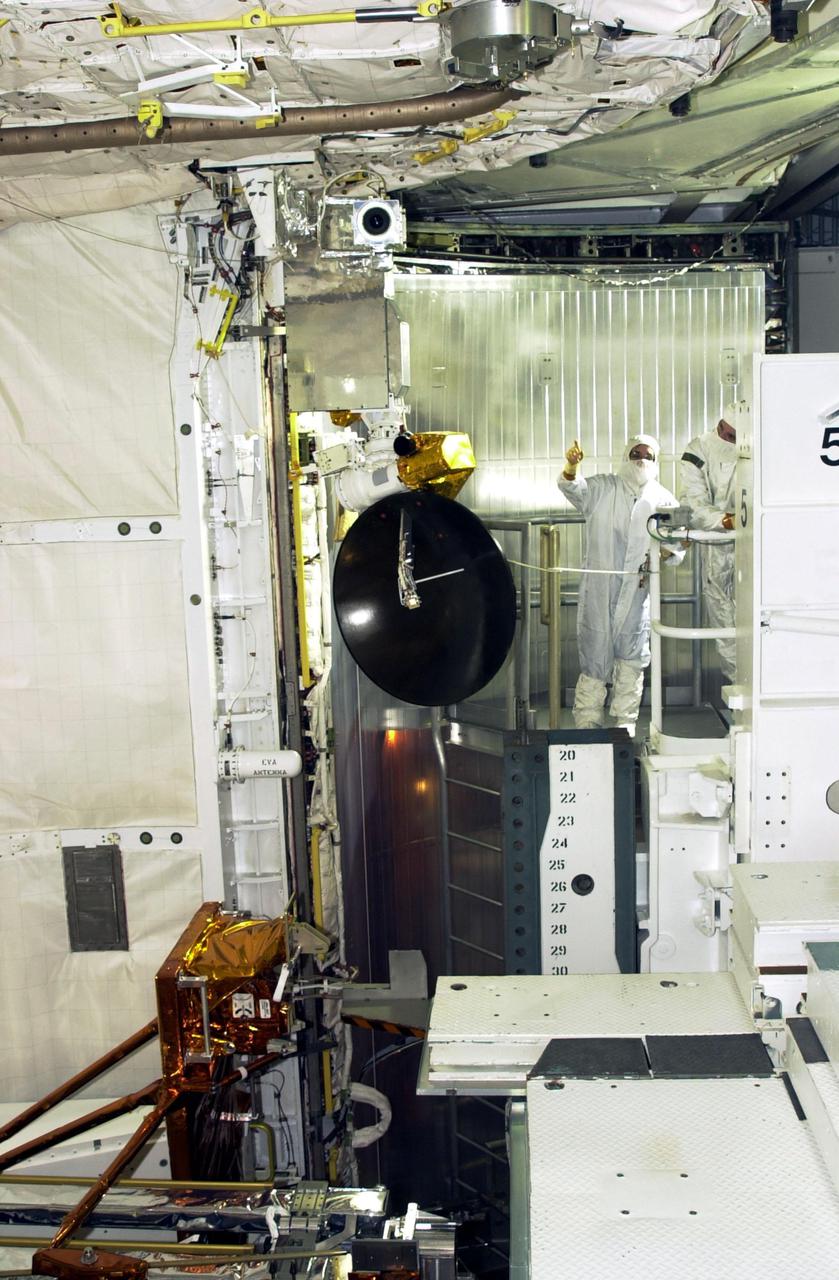
KENNEDY SPACE CENTER, FLA. -- On Launch Pad 39A, members of the STS-109 crew perform a final inspection of the Hubble payload they will deploy on orbit during five spacewalks. Mission Specialist Nancy Currie is seen pointing at a piece of the equipment. Other crew members are Commander Scott Altman, Pilot Duane Carey, Payload Commander John Grunsfeld, and Mission Specialists James Newman, Richrd Linnehan and Michael Massimino. The goal of the mission is to replace Solar Array 2 with Solar Array 3, replace the Power Control Unit, remove the Faint Object Camera and install the Advanced Camera for Surveys (ACS), install the Near Infrared Camera and Multi-Object Spectrometer (NICMOS) Cooling System, and install New Outer Blanket Layer insulation. Launch of Shuttle Columbia on mission STS-109 is scheduled for Feb. 28 at 6:48 a.m. EST
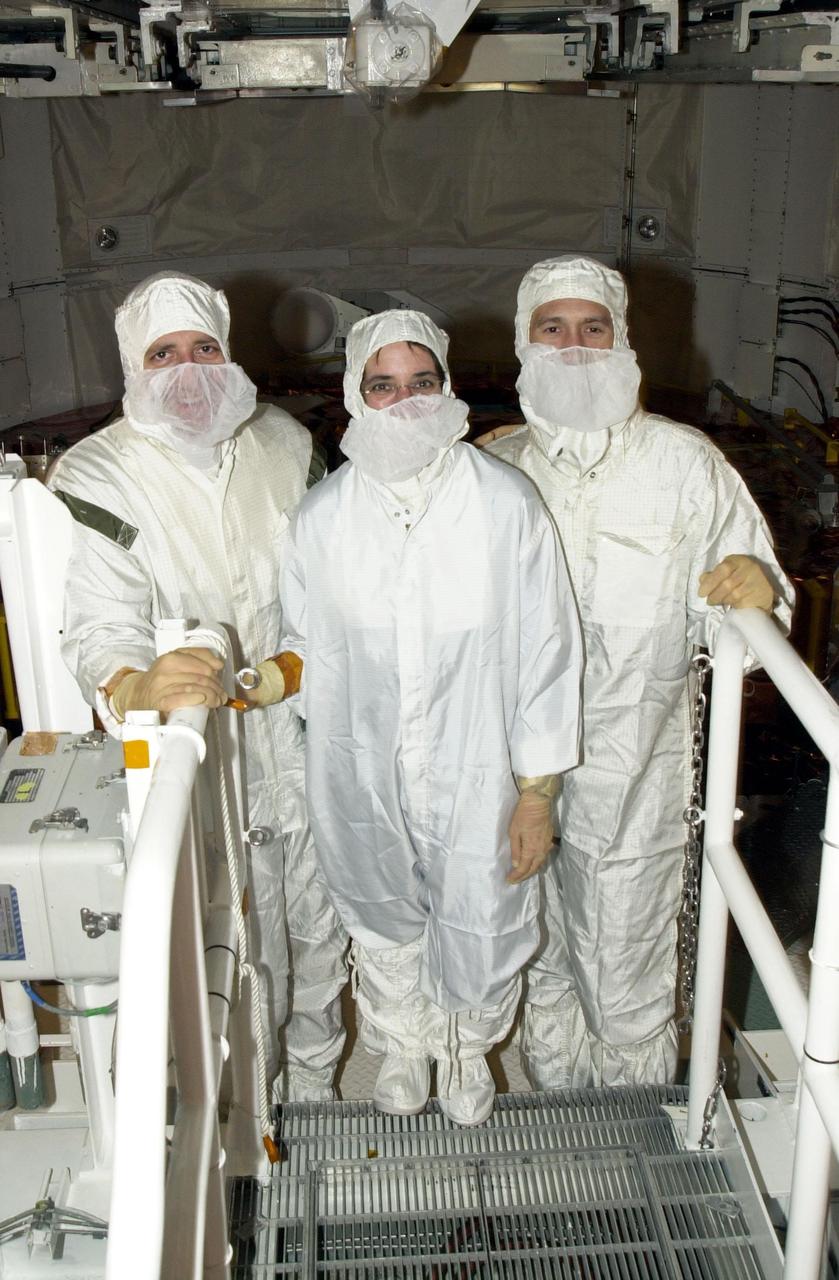
KENNEDY SPACE CENTER, Fla. - On Launch Pad 39A, members of the STS-109 crew pause during their final inspection of the Hubble payload they will deploy on orbit during five spacewalks. Seen here (left to right) are Mission Specialists Michael Massimino, Nancy Currie and James Newman. The crew also comprises Commander Scott Altman, Pilot Duane Carey, Payload Commander John Grunsfeld, and Mission Specialist Richard Linnehan. The goal of the mission is to replace Solar Array 2 with Solar Array 3, replace the Power Control Unit, remove the Faint Object Camera and install the Advanced Camera for Surveys (ACS), install the Near Infrared Camera and Multi-Object Spectrometer (NICMOS) Cooling System, and install New Outer Blanket Layer insulation. Launch of Shuttle Columbia on mission STS-109 is scheduled for Feb. 28 at 6:48 a.m. EST
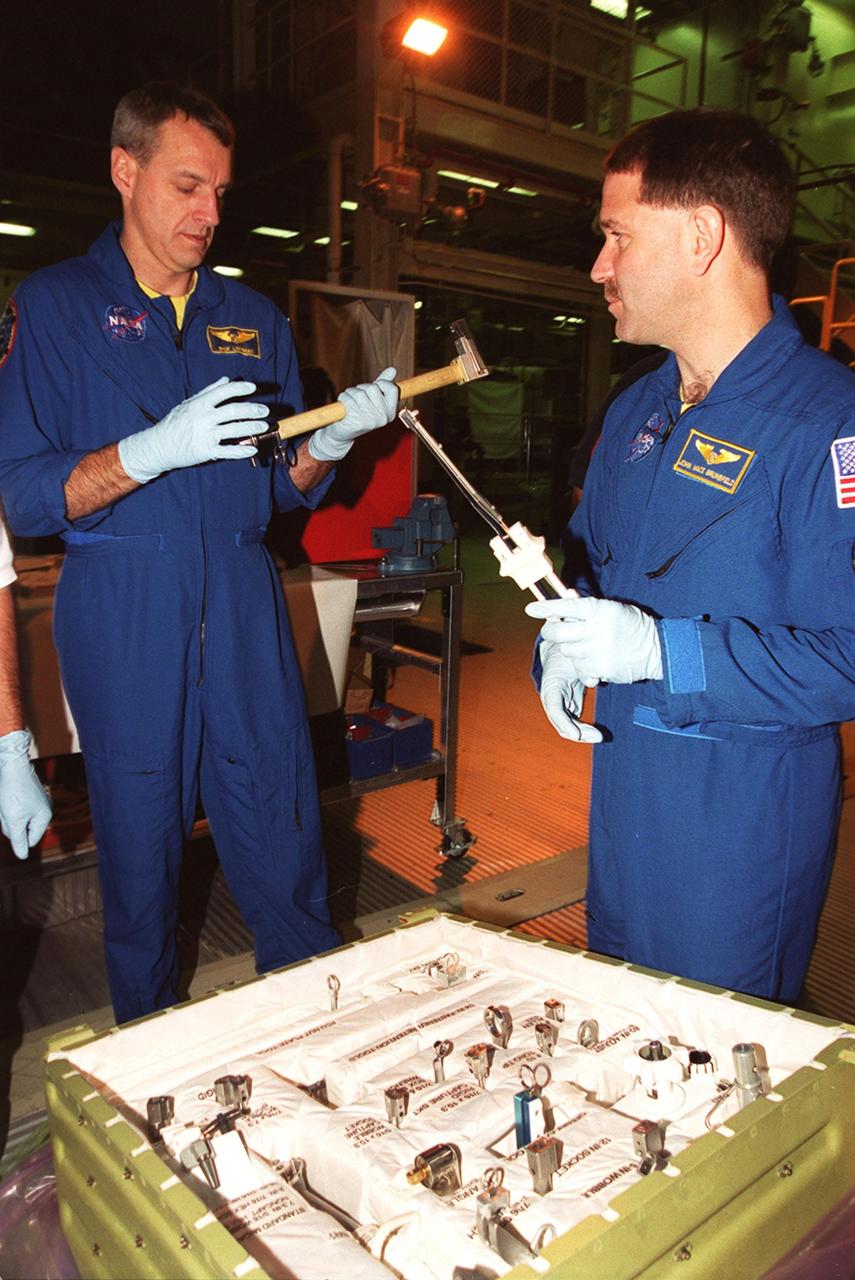
KENNEDY SPACE CENTER, Fla. - STS-109 Mission Specialist Richard Lennehan (left) and Payload Commander John Grunsfeld get a feel for tools and equipment that will be used on the mission. The crew is at KSC to take part in Crew Equipment Interface Test activities that include familiarization with the orbiter and equipment. The goal of the mission is to service the HST, replacing Solar Array 2 with Solar Array 3, replacing the Power Control Unit, removing the Faint Object Camera and installing the Advanced Camera for Surveys, installing the Near Infrared Camera and Multi-Object Spectrometer (NICMOS) Cooling System, and installing New Outer Blanket Layer insulation on bays 5 through 8. Mission STS-109 is scheduled for launch Feb. 14, 2002
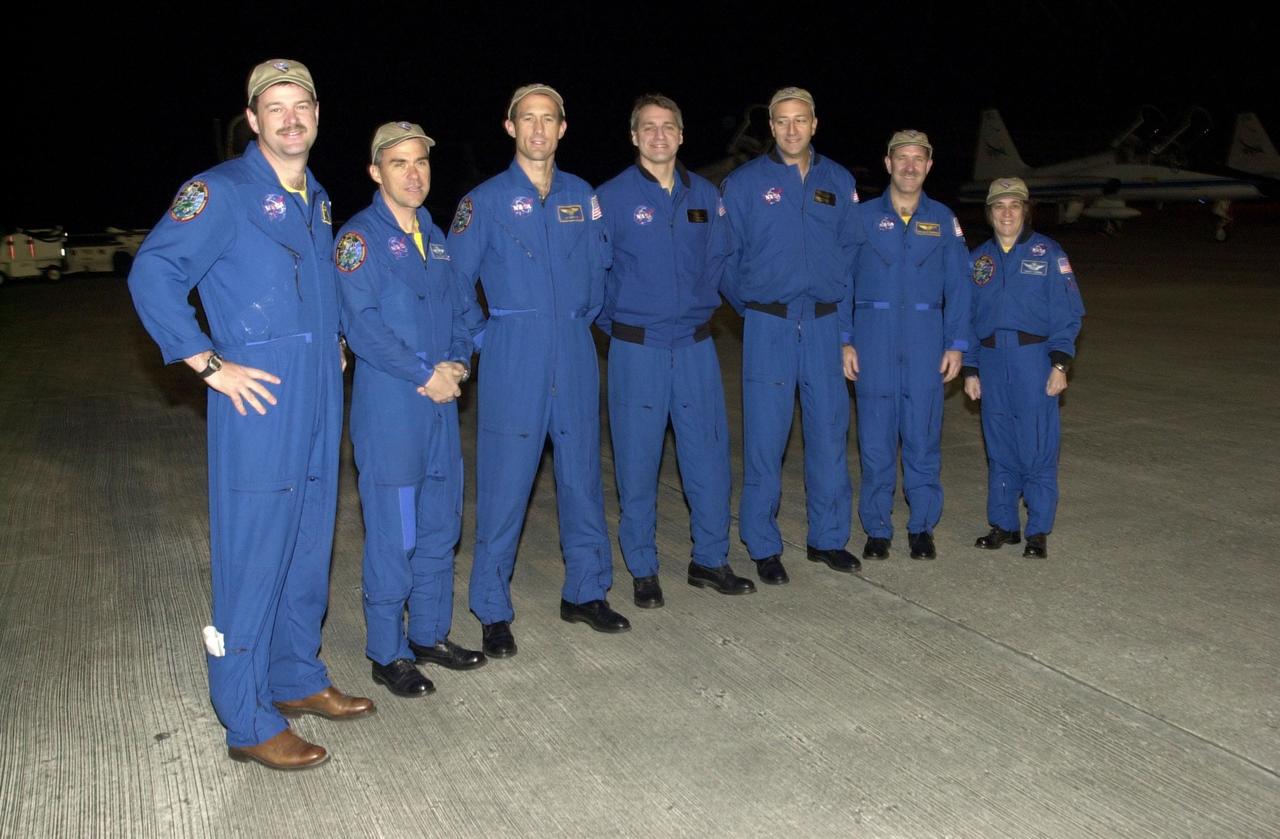
KENNEDY SPACE CENTER, Fla. - The STS-109 crew stops for a photograph after arriving at KSC aboard a T-38 jet aircraft to begin launch preparations. Standing left to right are Commander Scott Altman, Pilot Duane Carey, and Mission Specialists James Newman, Richard Linnehan and Michael Massimino, Payload Commander John Grunsfeld, and Mission Specialist Nancy Currie. The goal of the 11-day mission is repair and maintenance on the Hubble Space Telescope. Five spacewalks are planned to replace Solar Array 2 with Solar Array 3, replace the Power Control Unit, remove the Faint Object Camera and install the Advanced Camera for Surveys (ACS), install the Near Infrared Camera and Multi-Object Spectrometer (NICMOS) Cooling System, and install New Outer Blanket Layer insulation. Launch is scheduled for Feb. 28 at 6:48 a.m. EST
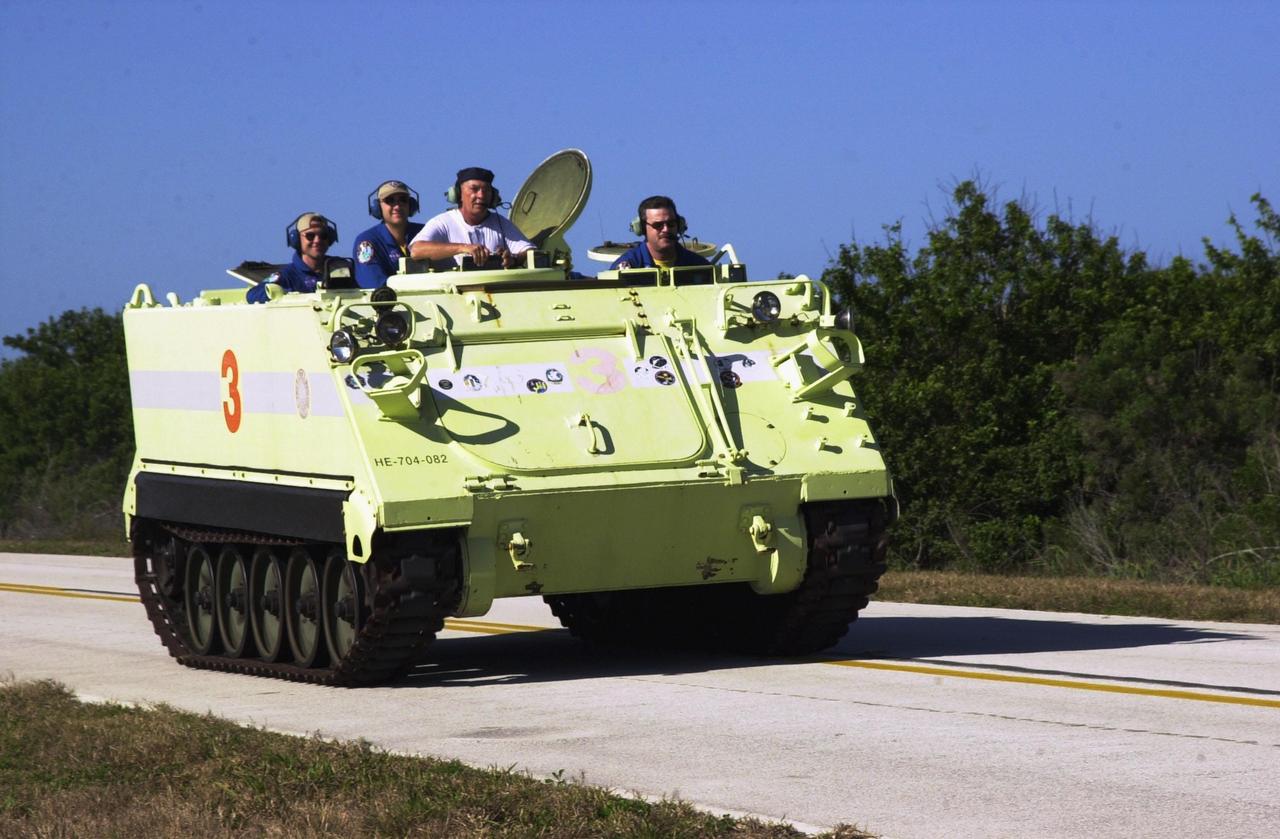
KENNEDY SPACE CENTER, FLA. - STS-109 Commander Scott Altman drives the M-113 armored personnel carrier during emergency egress training at the launch pad. He and other crew members are taking part in Terminal Countdown Demonstration Test activities, which also include a simulated launch countdown. STS-109 is a Hubble Space Telescope Servicing Mission, with goals to replace Solar Array 2 with Solar Array 3, replace the Power Control Unit, remove the Faint Object Camera and install the Advanced Camera for Surveys (ACS), install the Near Infrared Camera and Multi-Object Spectrometer (NICMOS) Cooling System, and install New Outer Blanket Layer insulation. The 11-day mission will require grasping the satellite with a robotic arm in order for the crew to perform the tasks during five spacewalks. Launch of STS-109 aboard Space Shuttle Columbia is scheduled for Feb. 28, 2002
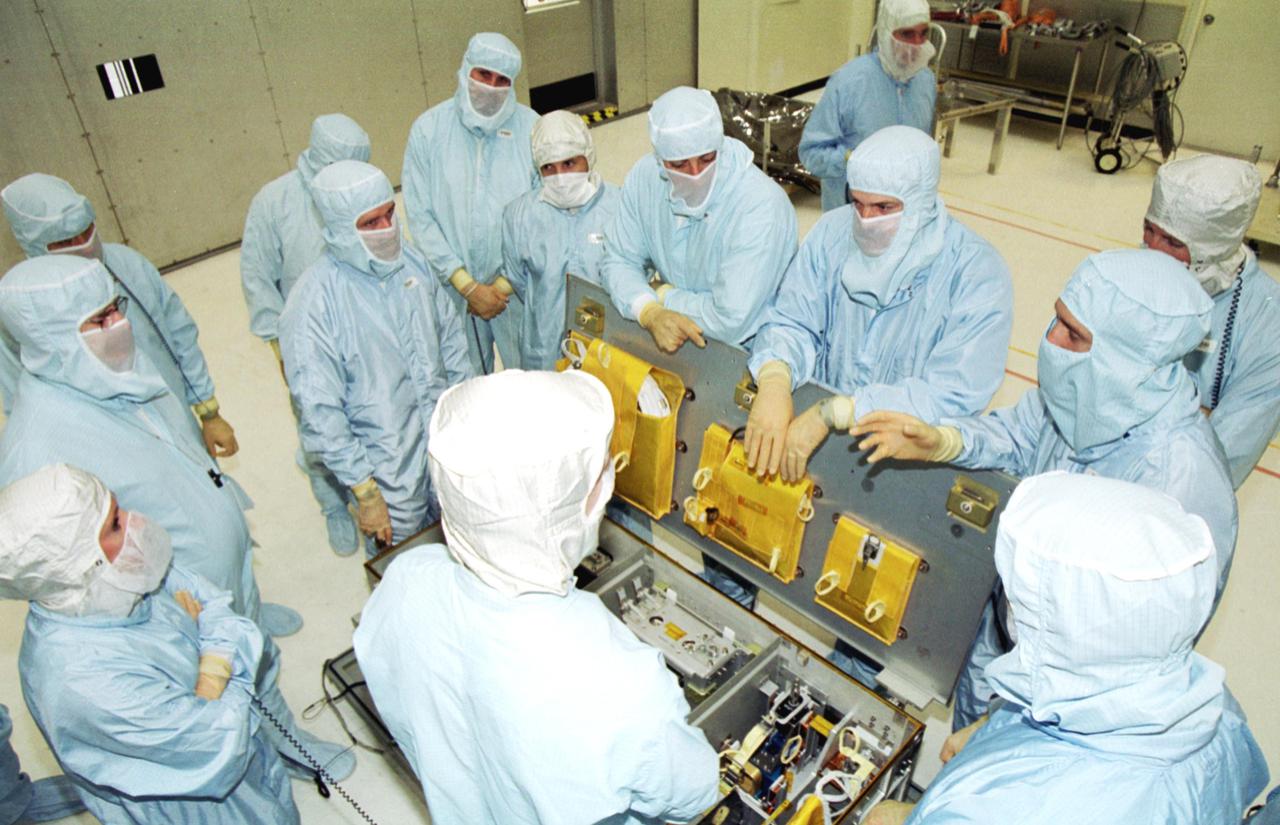
KENNEDY SPACE CENTER, Fla. - In the Vertical Processing Facility, members of the STS-109 crew listen to instructions about using some of the equipment for their Hubble Space Telescope (HST) Servicing mission. At left are three trainers. The crew, whose faces can be seen, are (left to right) Payload Commander John Grunsfeld, Pilot Duane Carey, Mission Specialists Nancy Currie and Richard Linnehan, Commander Scott Altman, and Mission Specialists James Newman and Michael Massimino (behind Newman). The goal of the mission is to service the HST, replacing Solar Array 2 with Solar Array 3, replacing the Power Control Unit, removing the Faint Object Camera and installing the Advanced Camera for Surveys, installing the Near Infrared Camera and Multi-Object Spectrometer (NICMOS) Cooling System, and installing New Outer Blanket Layer insulation on bays 5 through 8. Mission STS-109 is scheduled for launch Feb. 14, 2002
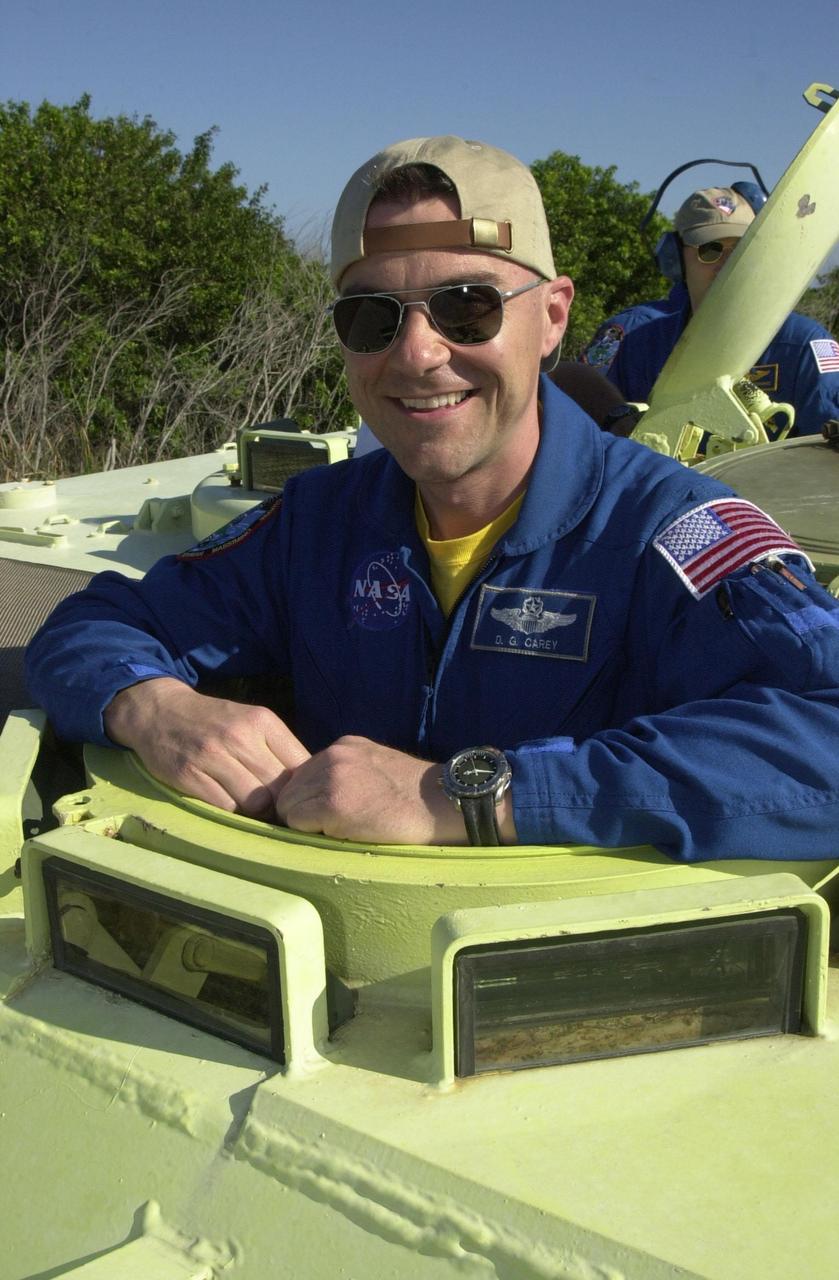
KENNEDY SPACE CENTER, FLA. - STS-109 Pilot Duane Carey is ready to practice driving the M-113 armored personnel carrier, part of emergency egress training at the launch pad. He and other crew members are taking part in Terminal Countdown Demonstration Test activities, which also include a simulated launch countdown. STS-109 is a Hubble Space Telescope Servicing Mission, with goals to replace Solar Array 2 with Solar Array 3, replace the Power Control Unit, remove the Faint Object Camera and install the Advanced Camera for Surveys (ACS), install the Near Infrared Camera and Multi-Object Spectrometer (NICMOS) Cooling System, and install New Outer Blanket Layer insulation. The 11-day mission will require grasping the satellite with a robotic arm in order for the crew to perform the tasks during five spacewalks. Launch of STS-109 aboard Space Shuttle Columbia is scheduled for Feb. 28, 2002
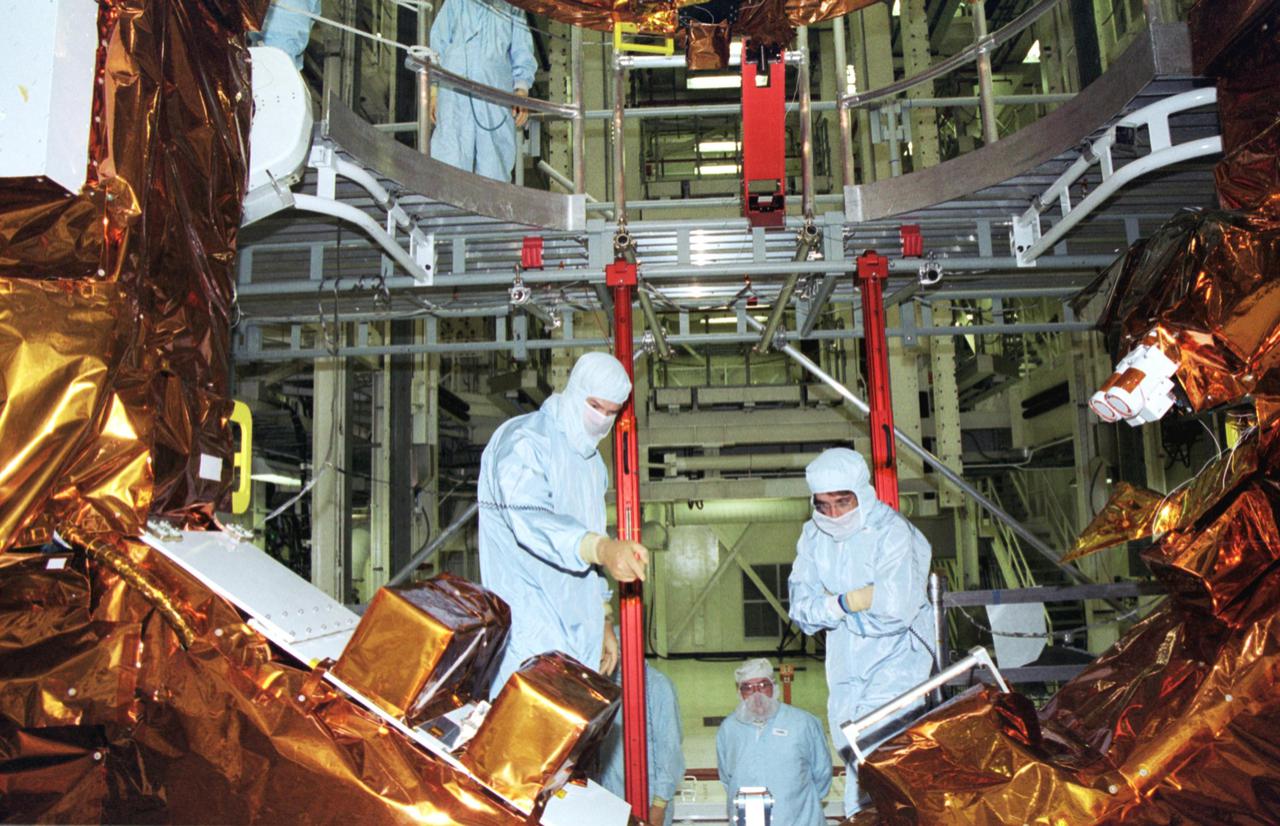
KENNEDY SPACE CENTER, Fla. -- Inside the Vertical Processing Facility, members of the STS-109 crew looks over equipment for their Hubble Space Telescope (HST) Servicing mission. Seen in the foreground are Commander Scott Altman and Mission Specialist Nancy Currie. Other crew members are Pilot Duane Carey, Payload Commander John Grunsfeld and Mission Specialists James Newman, Richard Linnehan and Michael Massimino. The goal of the mission is to service the HST, replacing Solar Array 2 with Solar Array 3, replacing the Power Control Unit, removing the Faint Object Camera and installing the Advanced Camera for Surveys, installing the Near Infrared Camera and Multi-Object Spectrometer (NICMOS) Cooling System, and installing New Outer Blanket Layer insulation on bays 5 through 8. Mission STS-109 is scheduled for launch Feb. 14, 2002
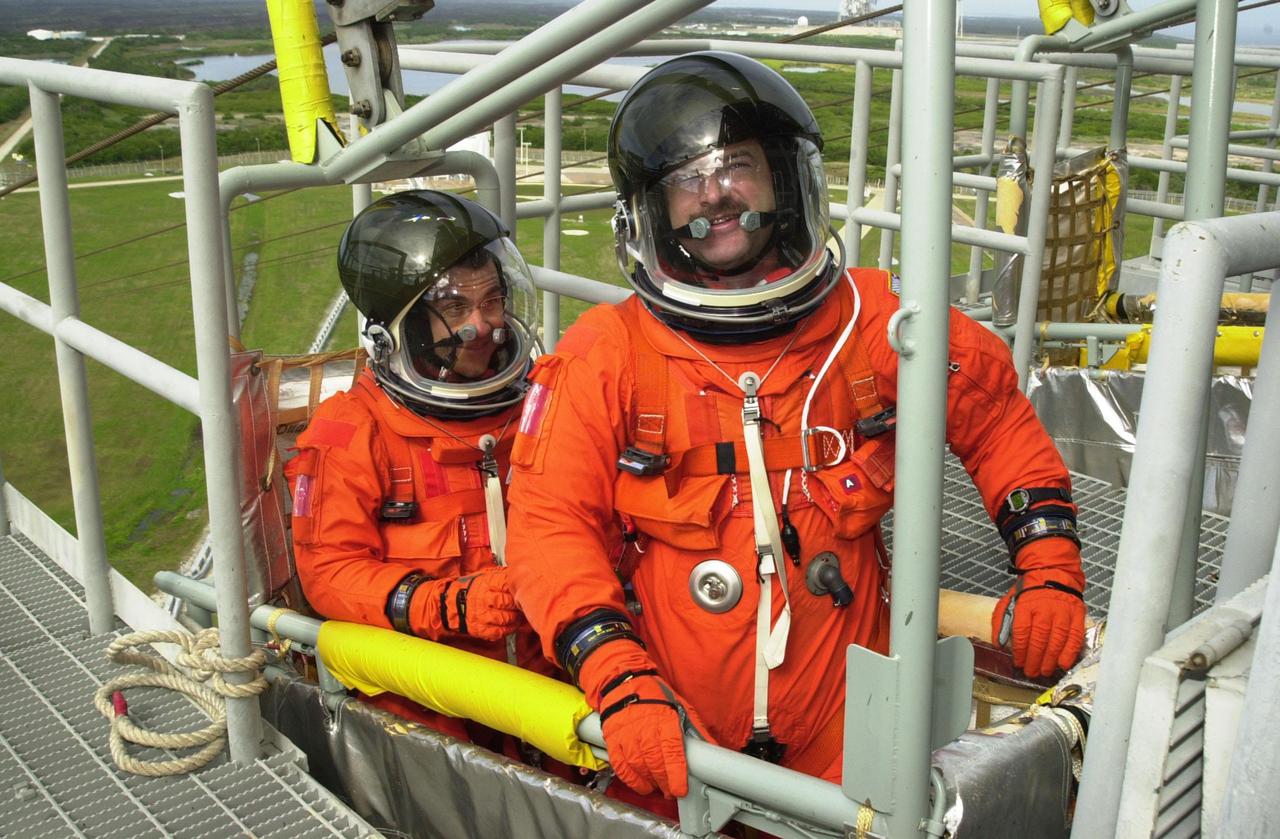
KENNEDY SPACE CENTER, FLA. -- As part of Terminal Countdown Demonstration Test activities, the STS-109 crew practices emergency exit from the Shuttle. Seated in the slidewire basket at the 195-foot level of the Fixed Service Structure are Pilot Duane Carey (left) and Commander Scott Altman (right). The TCDT also includes a simulated launch countdown. STS-109 is a Hubble Space Telescope Servicing Mission, with goals to replace Solar Array 2 with Solar Array 3, replace the Power Control Unit, remove the Faint Object Camera and install the Advanced Camera for Surveys (ACS), install the Near Infrared Camera and Multi-Object Spectrometer (NICMOS) Cooling System, and install New Outer Blanket Layer insulation. The 11-day mission will require five spacewalks to perform the tasks. Launch of STS-109 aboard Space Shuttle Columbia is scheduled for Feb. 28, 2002
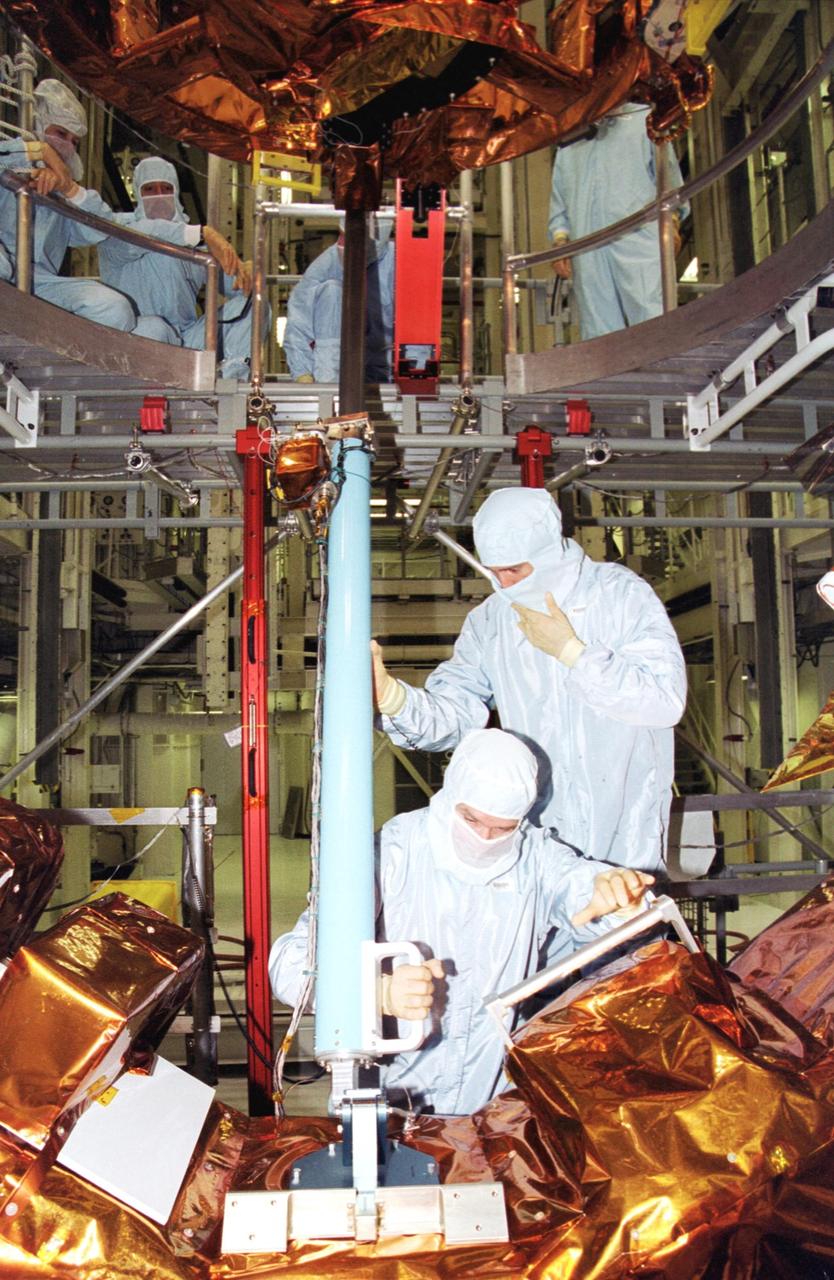
KENNEDY SPACE CENTER, Fla. - In the Vertical Processing Facility, members of the STS-109 crew practice on some of the equipment for their Hubble Space Telescope (HST) Servicing mission. Seen in the foreground are (left) Payload Commander John Grunsfeld and (right) Mission Specialist James Newman. The rest of the crew are Commander Scott Altman, Pilot Duane Carey, and Mission Specialists Nancy Currie, Richard Linnehan and Michael Massimino. The goal of the mission is to service the HST, replacing Solar Array 2 with Solar Array 3, replacing the Power Control Unit, removing the Faint Object Camera and installing the Advanced Camera for Surveys, installing the Near Infrared Camera and Multi-Object Spectrometer (NICMOS) Cooling System, and installing New Outer Blanket Layer insulation on bays 5 through 8. Mission STS-109 is scheduled for launch Feb. 14, 2002
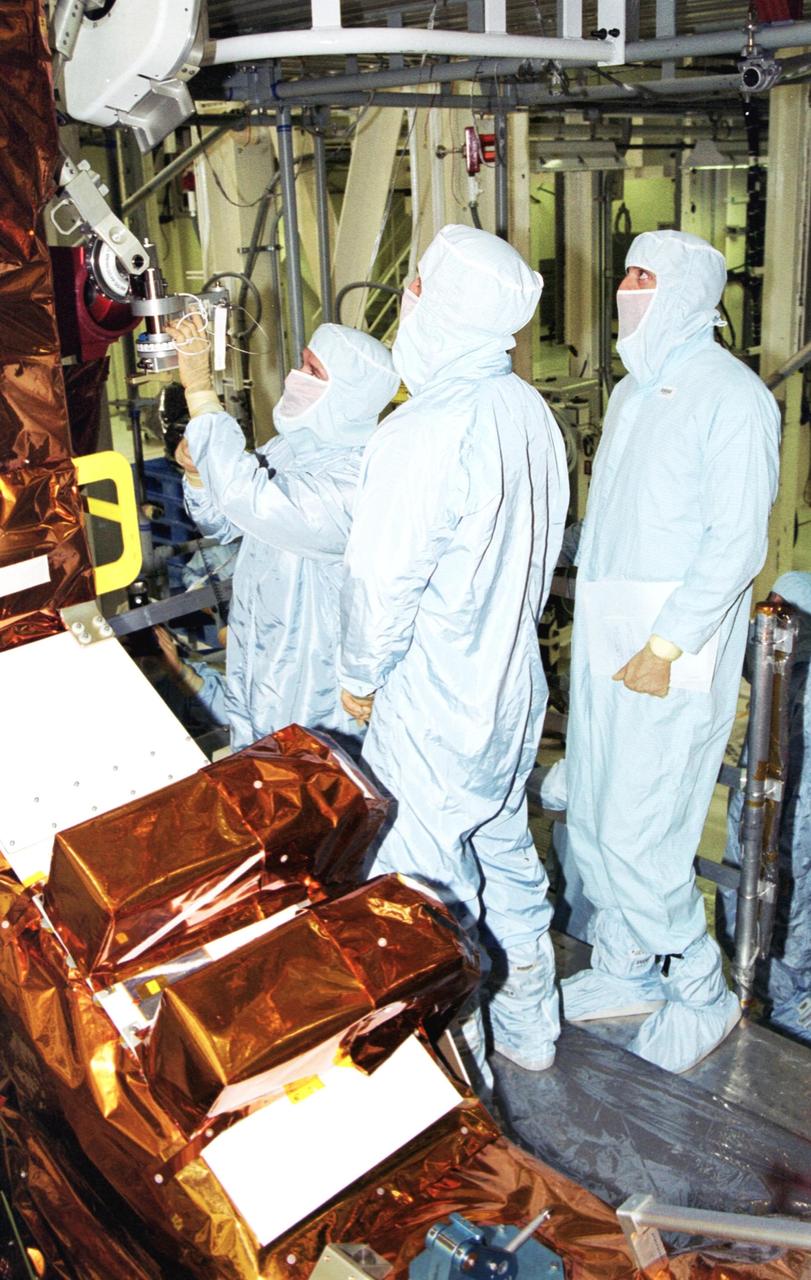
KENNEDY SPACE CENTER, Fla. - In the Vertical Processing Facility, members of the STS-109 crew look over a piece of the equipment for their Hubble Space Telescope (HST) Servicing mission. Seen are Payload Commander John Grunsfeld and Mission Specialists Richard Linnehan and Michael Massimino. Other crew members are Commander Scott Altman, Pilot Duane Carey and Mission Specialists Nancy Currie and James Newman. The goal of the mission is to service the HST, replacing Solar Array 2 with Solar Array 3, replacing the Power Control Unit, removing the Faint Object Camera and installing the Advanced Camera for Surveys, installing the Near Infrared Camera and Multi-Object Spectrometer (NICMOS) Cooling System, and installing New Outer Blanket Layer insulation on bays 5 through 8. Mission STS-109 is scheduled for launch Feb. 14, 2002
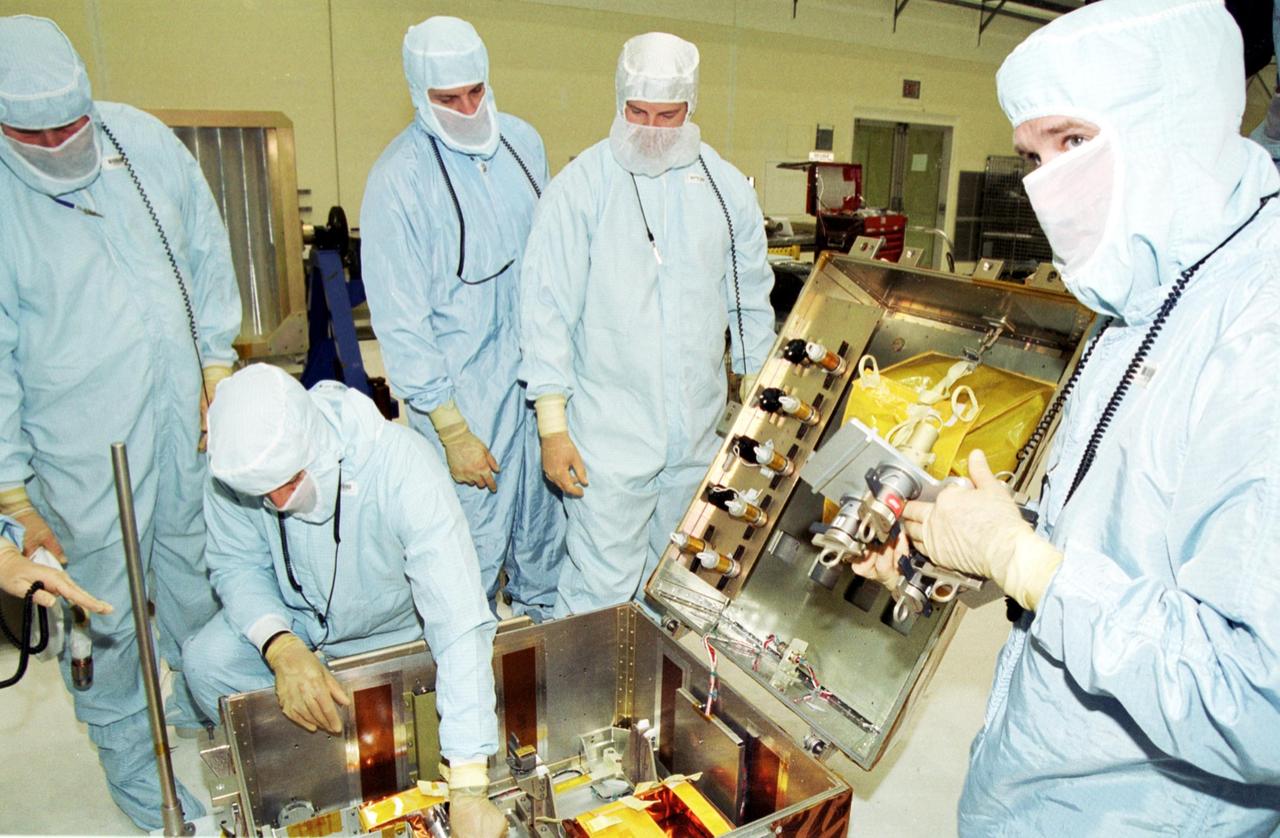
KENNEDY SPACE CENTER, Fla. -- Inside the Vertical Processing Facility, the STS-109 crew looks over equipment for their Hubble Space Telescope (HST) Servicing mission. Seen are (starting second from left), Mission Specialists Michael Massimino and Richard Linnehan, Commander Scott Altman and Payload Commander John Grunsfeld. Other crew members are Pilot Duane Carey and Mission Spcialists Nancy Currie and James Newman. The goal of the mission is to service the HST, replacing Solar Array 2 with Solar Array 3, replacing the Power Control Unit, removing the Faint Object Camera and installing the Advanced Camera for Surveys, installing the Near Infrared Camera and Multi-Object Spectrometer (NICMOS) Cooling System, and installing New Outer Blanket Layer insulation on bays 5 through 8. Mission STS-109 is scheduled for launch Feb. 14, 2002
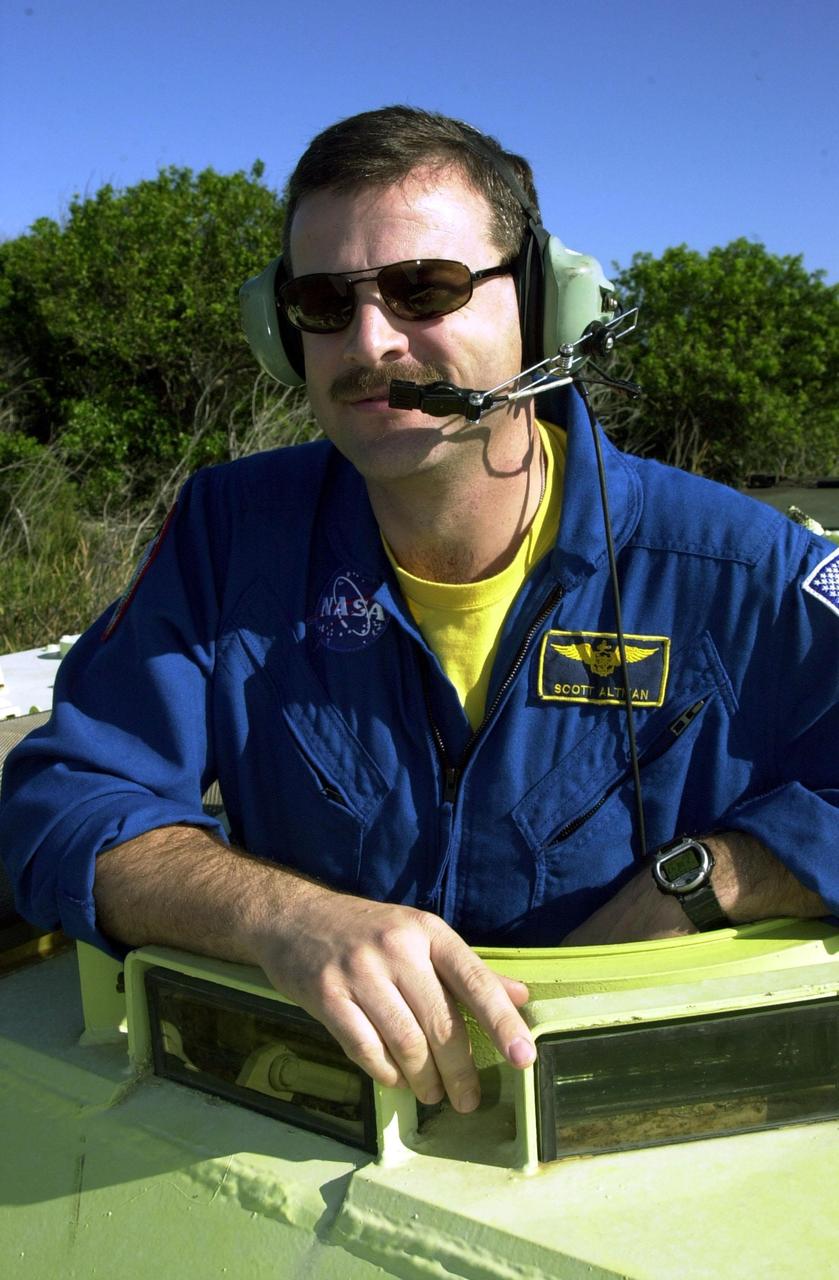
KENNEDY SPACE CENTER, FLA. -- STS-109 Commander Scott Altman is ready to practice driving the M-113 armored personnel carrier, part of emergency egress training at the launch pad. He and other crew members are taking part in Terminal Countdown Demonstration Test activities, which also include a simulated launch countdown. STS-109 is a Hubble Space Telescope Servicing Mission, with goals to replace Solar Array 2 with Solar Array 3, replace the Power Control Unit, remove the Faint Object Camera and install the Advanced Camera for Surveys (ACS), install the Near Infrared Camera and Multi-Object Spectrometer (NICMOS) Cooling System, and install New Outer Blanket Layer insulation. The 11-day mission will require grasping the satellite with a robotic arm in order for the crew to perform the tasks during five spacewalks. Launch of STS-109 aboard Space Shuttle Columbia is scheduled for Feb. 28, 2002
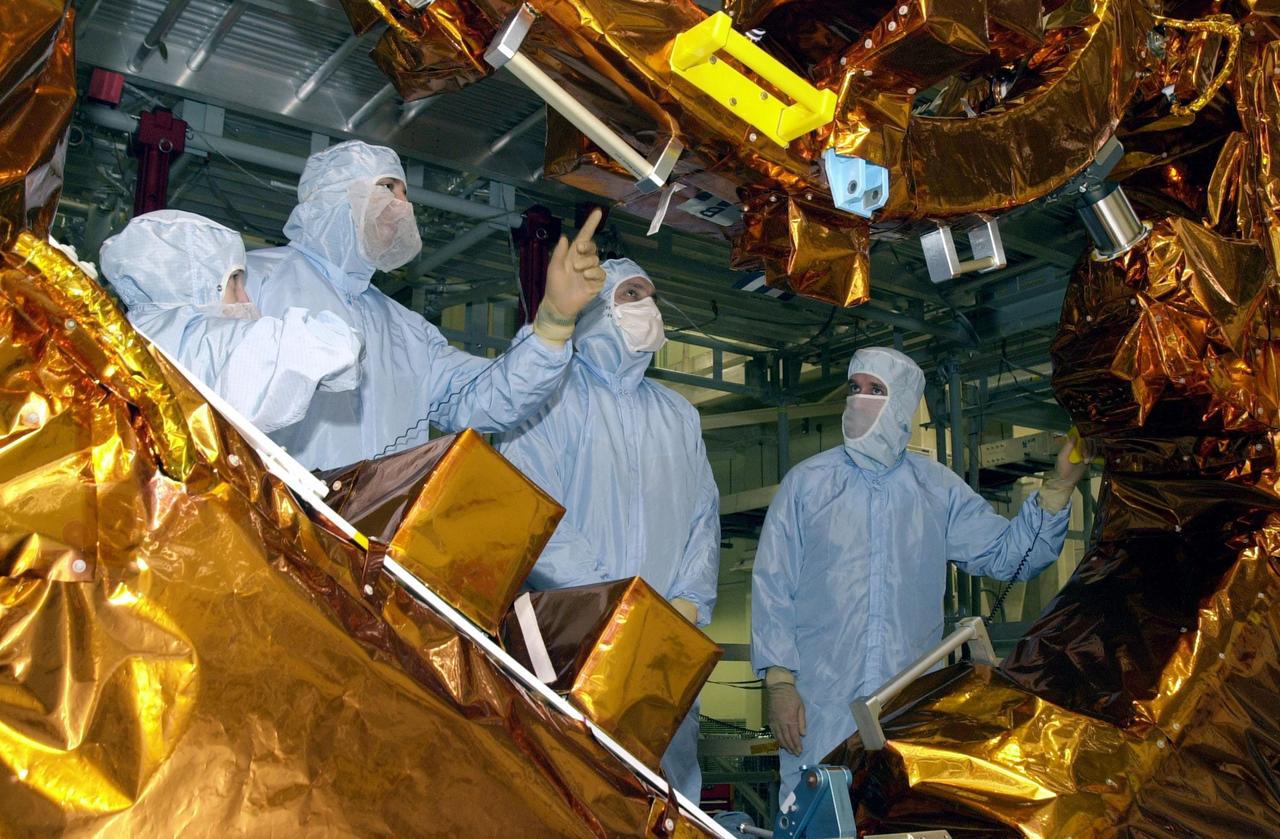
KENNEDY SPACE CENTER, FLA. -- In the Vertical Processing Facility, STS-109 crew members take part in familiarization activities, looking over the payload of repair equipment they will be handling on the mission. From left are Mission Specialists Nancy Curry, Michael Massimino and Richard Linnehan, and Payload Commander John Grunsfeld. The goal of the mission is to service the Hubble Space Telescope, replacing Solar Array 2 with Solar Array 3, replacing the Power Control Unit, removing the Faint Object Camera and installing the Advanced Camera System, installing the Near Infrared Camera and Multi-Object Spectrometer (NICMOS) Cooling System, and installing New Outer Blanket Layer insulation. Launch of Columbia on mission STS-109 is scheduled Feb. 28, 2002

KENNEDY SPACE CENTER, FLA. - STS-109 Mission Specialist Nancy Currie is ready to practice driving the M-113 armored personnel carrier, part of emergency egress training at the launch pad. Crew members are taking part in Terminal Countdown Demonstration Test activities, which also include a simulated launch countdown. STS-109 is a Hubble Space Telescope Servicing Mission, with goals to replace Solar Array 2 with Solar Array 3, replace the Power Control Unit, remove the Faint Object Camera and install the Advanced Camera for Surveys (ACS), install the Near Infrared Camera and Multi-Object Spectrometer (NICMOS) Cooling System, and install New Outer Blanket Layer insulation. The 11-day mission will require grasping the satellite with a robotic arm in order for the crew to perform the tasks during five spacewalks. Launch of STS-109 aboard Space Shuttle Columbia is scheduled for Feb. 28, 2002
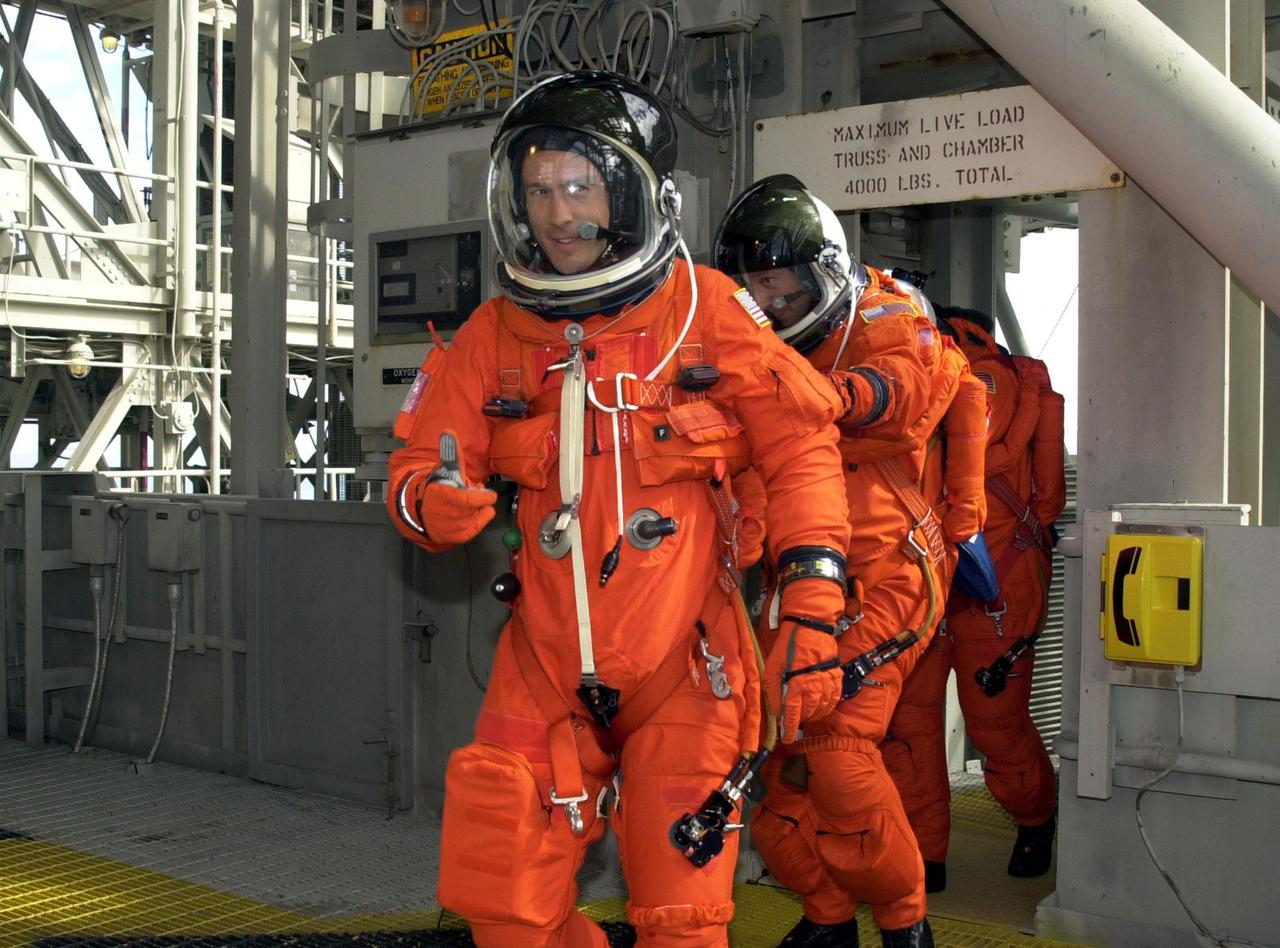
KENNEDY SPACE CENTER, FLA. -- As part of Terminal Countdown Demonstration Test activities, the STS-109 crew practices emergency exit from the Shuttle. Leading the way to the slidewire basket is Mission Specialist James Newman, followed by Michael Massimino and Richard Linnehan. The TCDT also includes a simulated launch countdown. STS-109 is a Hubble Space Telescope Servicing Mission, with goals to replace Solar Array 2 with Solar Array 3, replace the Power Control Unit, remove the Faint Object Camera and install the Advanced Camera for Surveys (ACS), install the Near Infrared Camera and Multi-Object Spectrometer (NICMOS) Cooling System, and install New Outer Blanket Layer insulation. The 11-day mission will require five spacewalks to perform the tasks. Launch of STS-109 aboard Space Shuttle Columbia is scheduled for Feb. 28, 2002
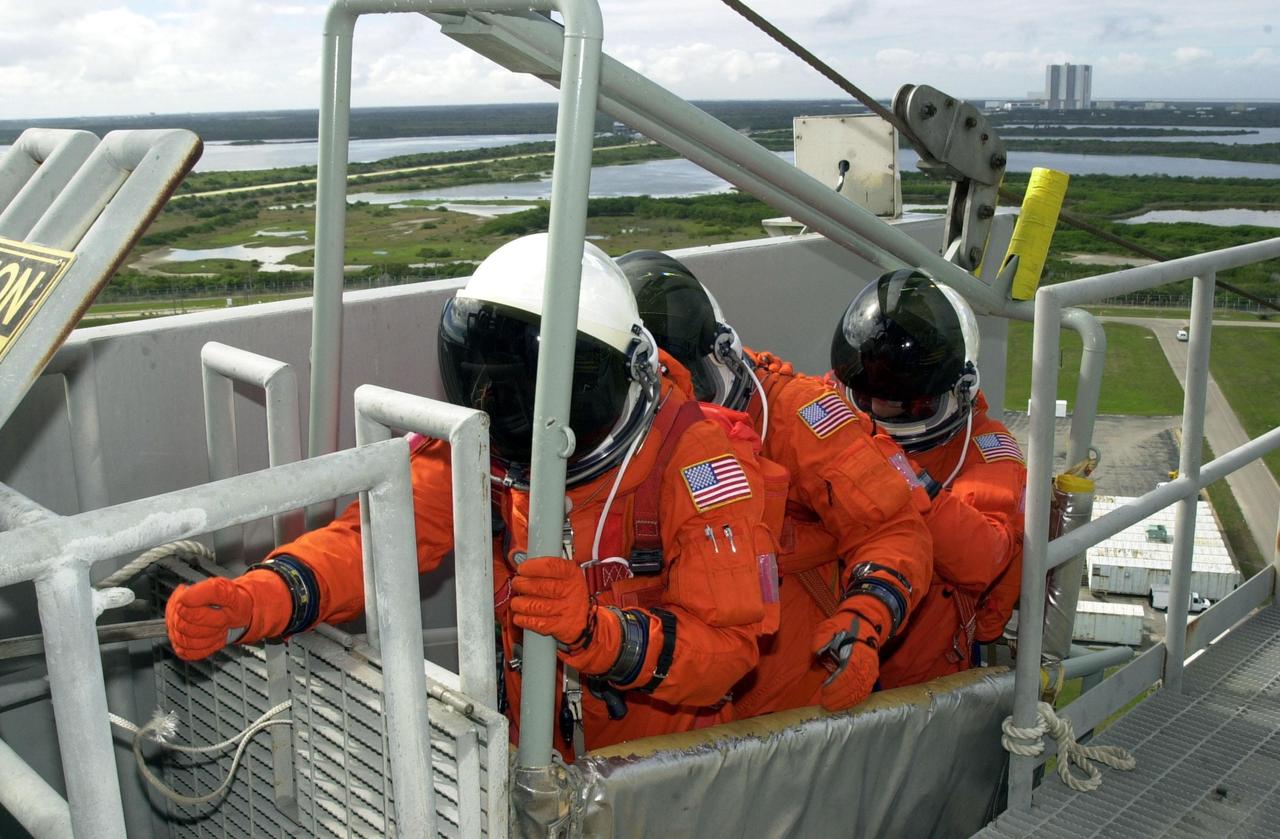
KENNEDY SPACE CENTER, FLA. -- As part of Terminal Countdown Demonstration Test activities, the STS-109 crew practices emergency exit from the Shuttle. Seated in the slidewire basket at the 195-foot level of the Fixed Service Structure are Mission Specialists Richard Linnehan (reaching for the release lever), Michael Massimino and James Newman. The TCDT also includes a simulated launch countdown. STS-109 is a Hubble Space Telescope Servicing Mission, with goals to replace Solar Array 2 with Solar Array 3, replace the Power Control Unit, remove the Faint Object Camera and install the Advanced Camera for Surveys (ACS), install the Near Infrared Camera and Multi-Object Spectrometer (NICMOS) Cooling System, and install New Outer Blanket Layer insulation. The 11-day mission will require five spacewalks to perform the tasks. Launch of STS-109 aboard Space Shuttle Columbia is scheduled for Feb. 28, 2002
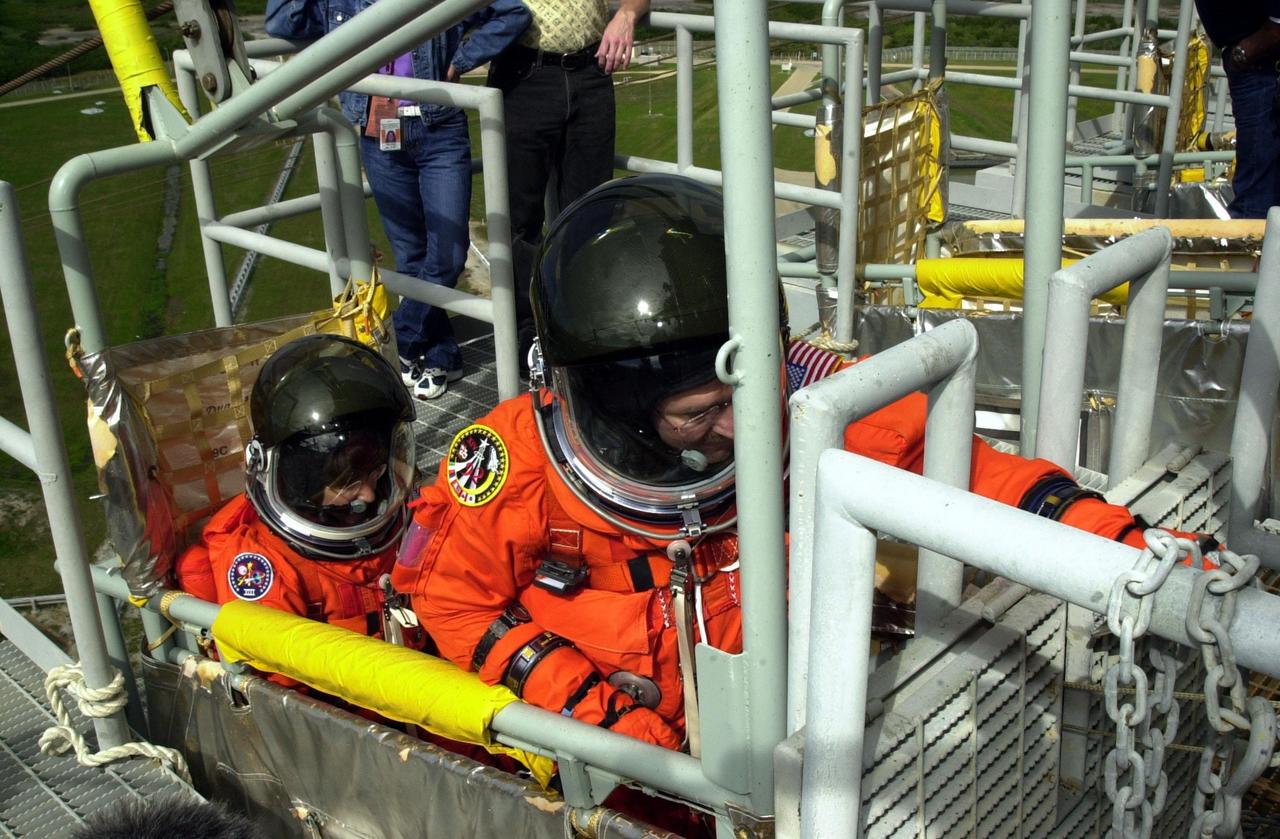
KENNEDY SPACE CENTER, FLA. -- As part of Terminal Countdown Demonstration Test activities, the STS-109 crew practices emergency exit from the Shuttle. Seated in the slidewire basket at the 195-foot level of the Fixed Service Structure are Mission Specialists Nancy Currie (left) and John Grunsfeld (reaching for the release lever). The TCDT also includes a simulated launch countdown. STS-109 is a Hubble Space Telescope Servicing Mission, with goals to replace Solar Array 2 with Solar Array 3, replace the Power Control Unit, remove the Faint Object Camera and install the Advanced Camera for Surveys (ACS), install the Near Infrared Camera and Multi-Object Spectrometer (NICMOS) Cooling System, and install New Outer Blanket Layer insulation. The 11-day mission will require five spacewalks to perform the tasks. Launch of STS-109 aboard Space Shuttle Columbia is scheduled for Feb. 28, 2002
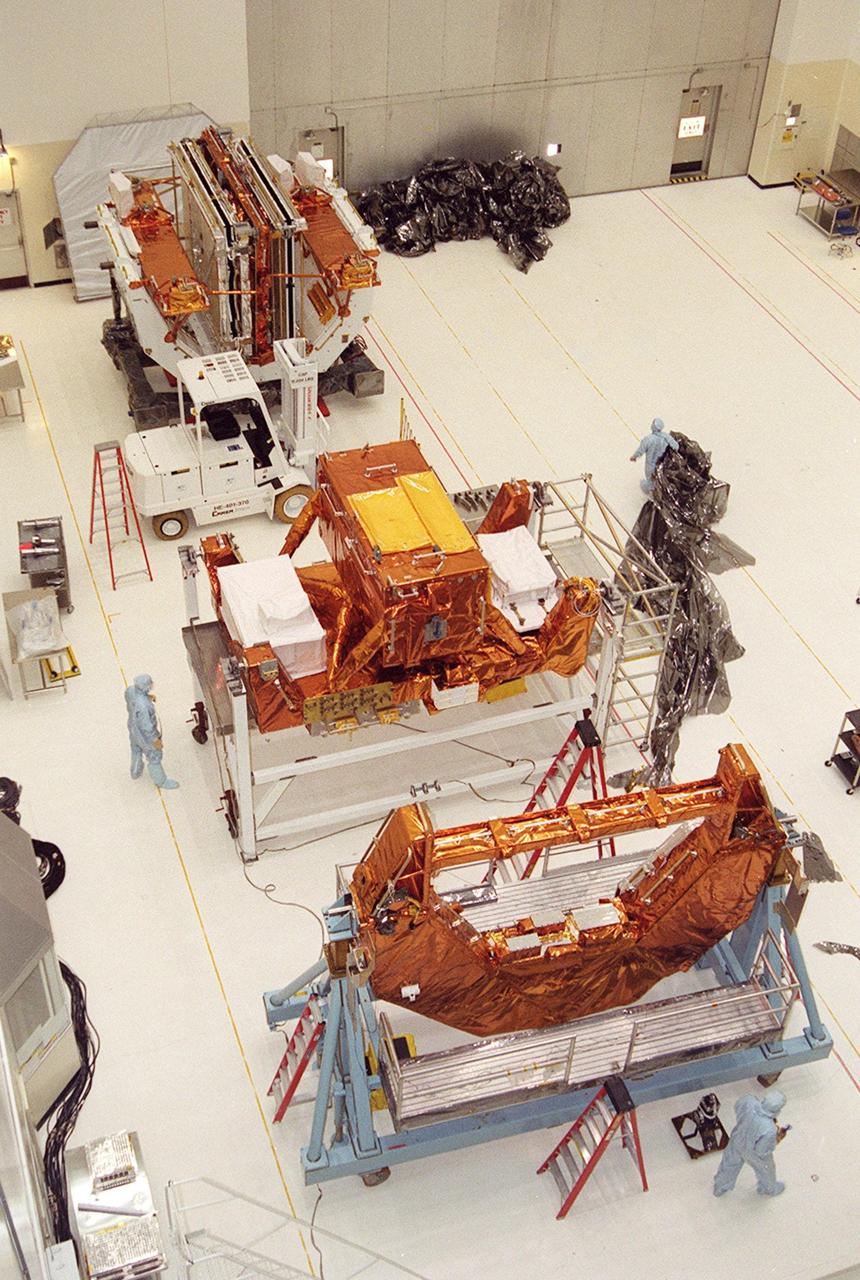
KENNEDY SPACE CENTER, Fla. -- In the Vertical Processing Facility, various components of the payload on mission STS-109 rest on workstands after being unwrapped. The purpose of the STS-109 mission is servicing the Hubble Space Telescope. The primary servicing tasks of the mission are to replace Solar Array 2 with Solar Array 3, replace the Power Control Unit, remove the Faint Object Camera and install the Advanced Camera for Surveys, install the NICMOS Cooling System, and install New Outer Blanket Insulation on bays 5 through 8. Mission STS-109 is scheduled for launch in mid-February 2002
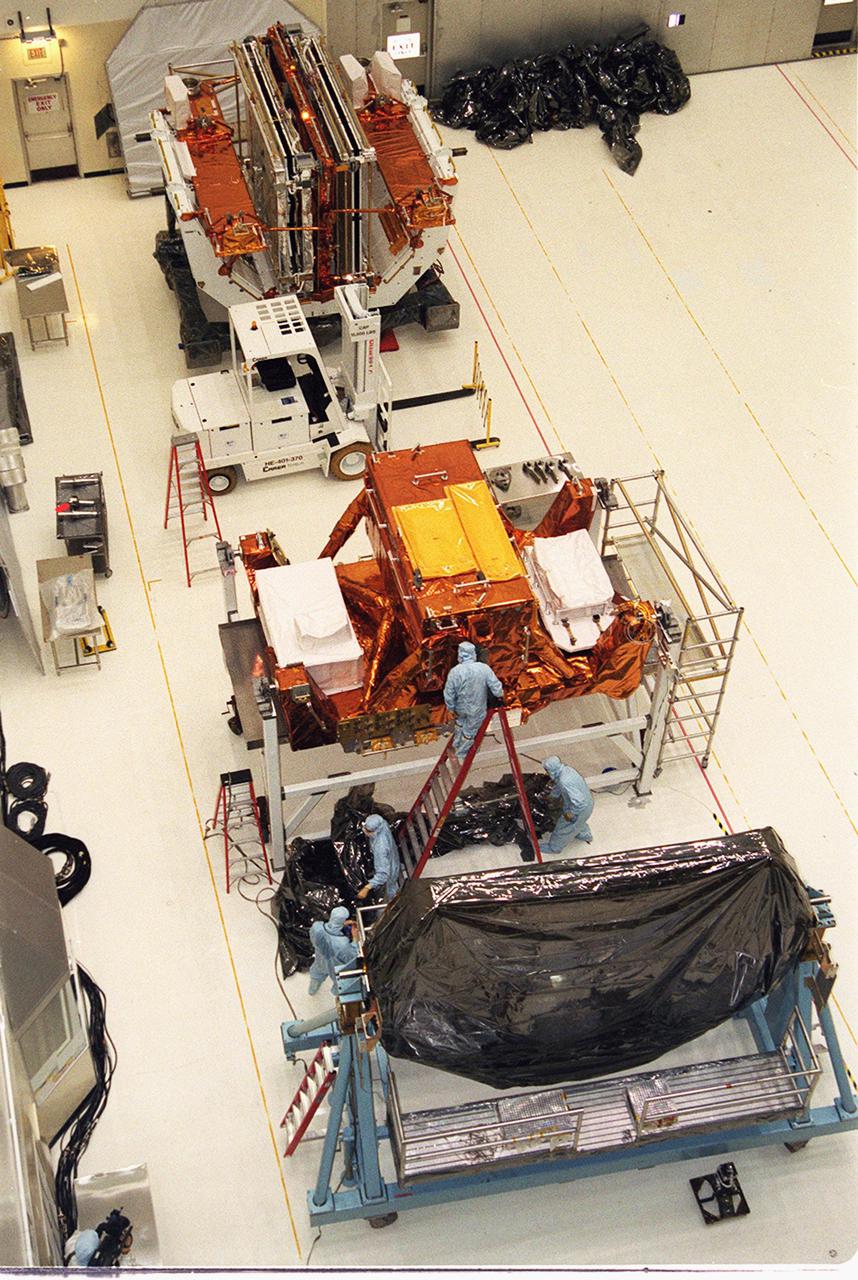
KENNEDY SPACE CENTER, Fla. -- In the Vertical Processing Facility, two components of the STS-109 payload are revealed while a third is being unwrapped. The purpose of the STS-109 mission is servicing the Hubble Space Telescope. The primary servicing tasks of the mission are to replace Solar Array 2 with Solar Array 3, replace the Power Control Unit, remove the Faint Object Camera and install the Advanced Camera for Surveys, install the NICMOS Cooling System, and install New Outer Blanket Insulation on bays 5 through 8. Mission STS-109 is scheduled for launch in mid-February 2002
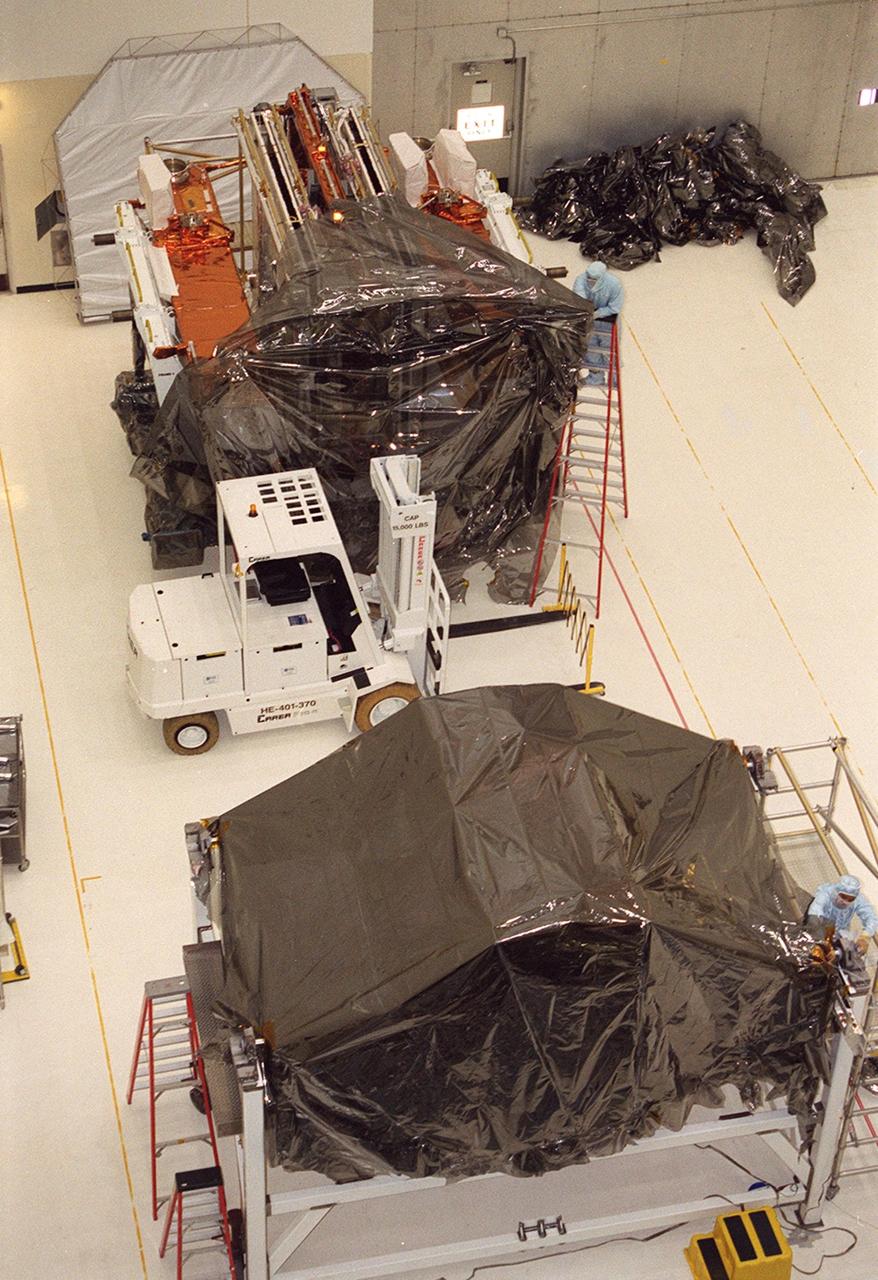
KENNEDY SPACE CENTER, Fla. -- In the Vertical Processing Facility, workers remove the wrapping from several components of the STS-109 payload. The purpose of the mission is servicing the Hubble Space Telescope. The primary servicing tasks of the mission are to replace Solar Array 2 with Solar Array 3, replace the Power Control Unit, remove the Faint Object Camera and install the Advanced Camera for Surveys, install the NICMOS Cooling System, and install New Outer Blanket Insulation on bays 5 through 8. Mission STS-109 is scheduled for launch in mid-February 2002
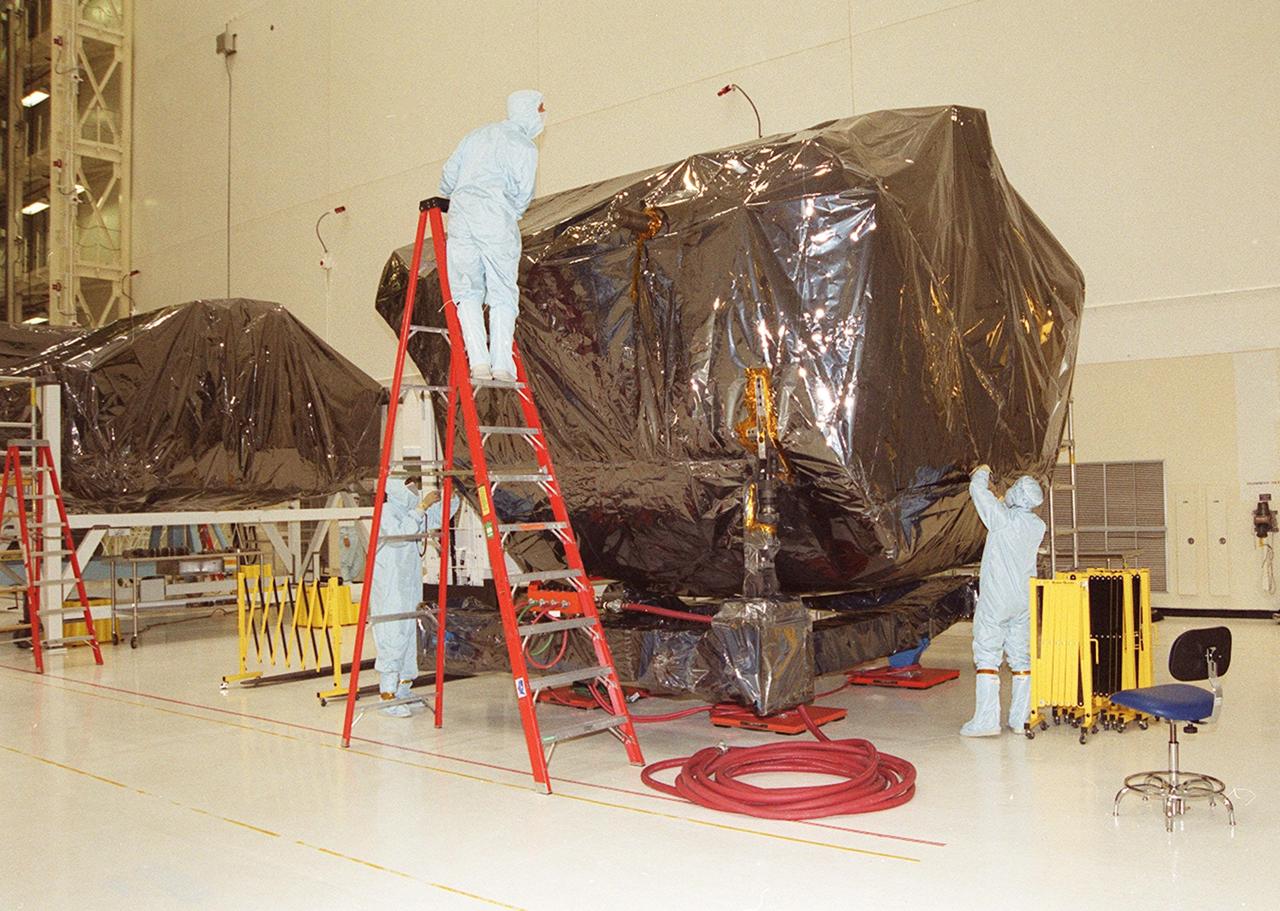
KENNEDY SPACE CENTER, Fla. -- Workers in the Vertical Processing Facility begin to unwrap the payload that recently arrived for STS-109, whose mission is servicing the Hubble Space Telescope. The primary servicing tasks of the mission are to replace Solar Array 2 with Solar Array 3, replace the Power Control Unit, remove the Faint Object Camera and install the Advanced Camera for Surveys, install the NICMOS Cooling System, and install New Outer Blanket Insulation on bays 5 through 8. Mission STS-109 is scheduled for launch in mid-February 2002
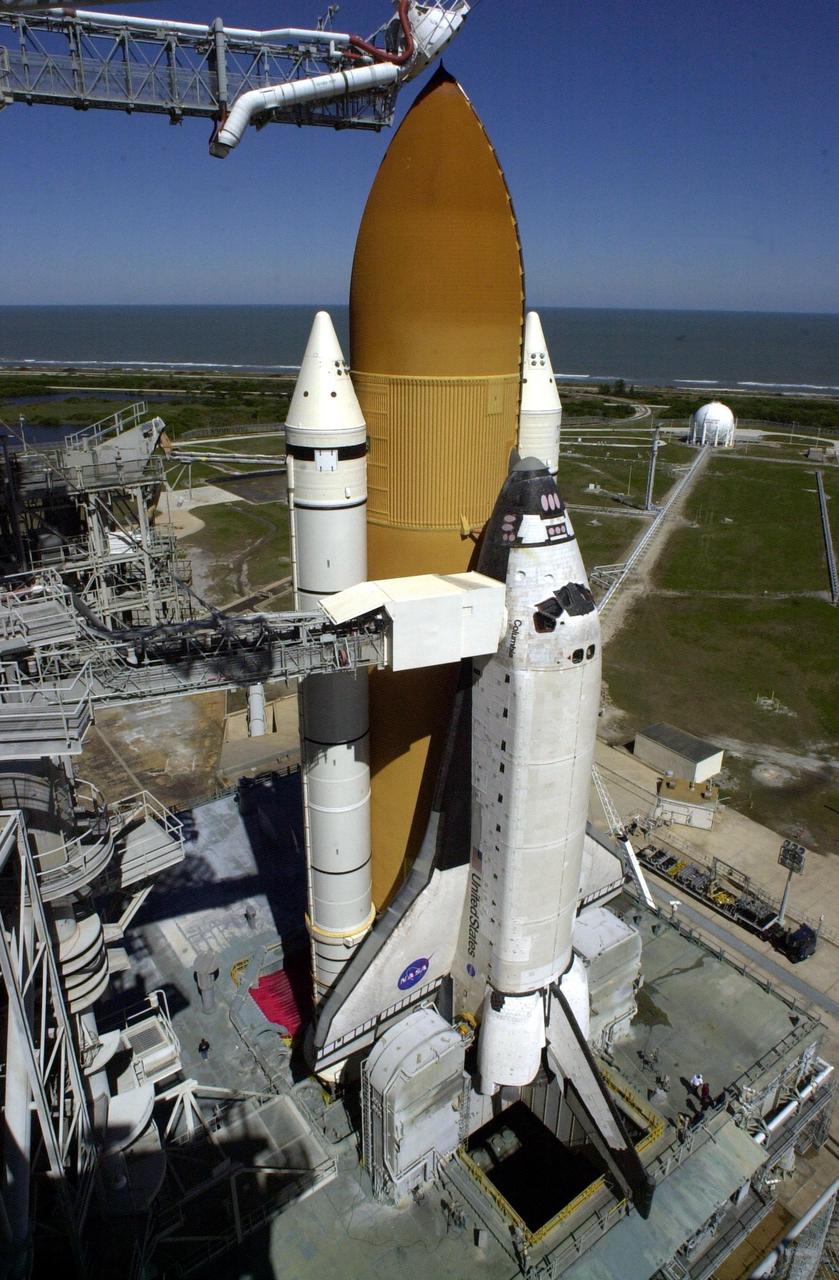
KENNEDY SPACE CENTER, FLA. - After rollback of the Rotating Service Structure, Space Shuttle Columbia is revealed waiting for launch Feb. 28, 2002, at 6:48 a.m. EST (11:48 GMT) on mission STS-109. In the photo is seen the Orbiter Access Arm stretched to Columbia's cockpit, plus the "beanie cap" above the external tank. The cap is a vent hood allowing release of gaseous oxygen. A Hubble Servicing Mission, the goal is to replace Solar Array 2 with Solar Array 3, replace the Power Control Unit, remove the Faint Object Camera and install the ACS, install the Near Infrared Camera and Multi-Object Spectrometer (NICMOS) Cooling System, and install New Outer Blanket Layer insulation.
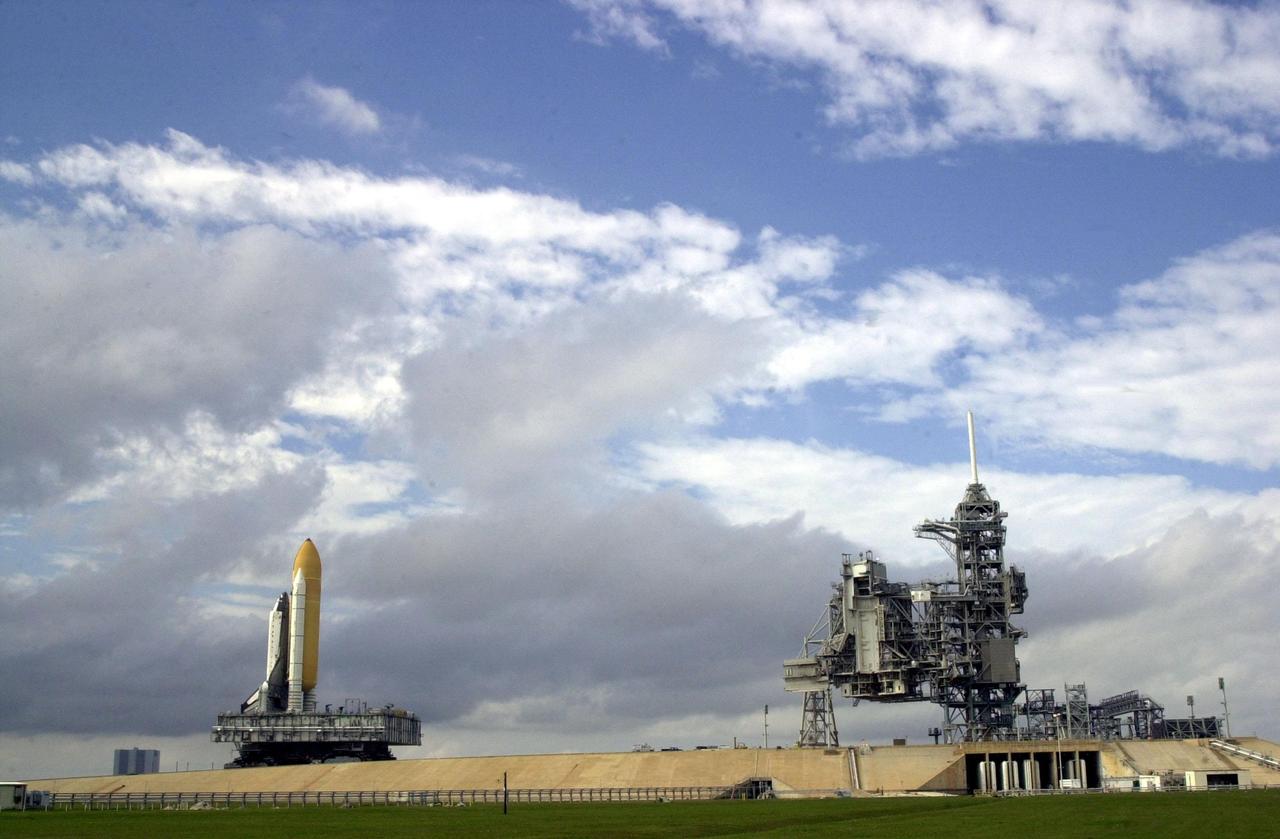
KENNEDY SPACE CENTER, FLA. -- Space Shuttle Columbia, atop its Mobile Launcher Platform, inches its way along the path to Launch Pad 39A. Columbia is scheduled to be launched Feb. 28 on mission STS-109, a Hubble Servicing Mission. The goal of the mission is to replace Solar Array 2 with Solar Array 3, replace the Power Control Unit, remove the Faint Object Camera and install the ACS, install the Near Infrared Camera and Multi-Object Spectrometer (NICMOS) Cooling System, and install New Outer Blanket Layer insulation. The launch will be the first for Columbia after returning from California where it underwent extensive maintenance, inspections and enhancements. More than 100 upgrades make Columbia safer and more reliable than ever before
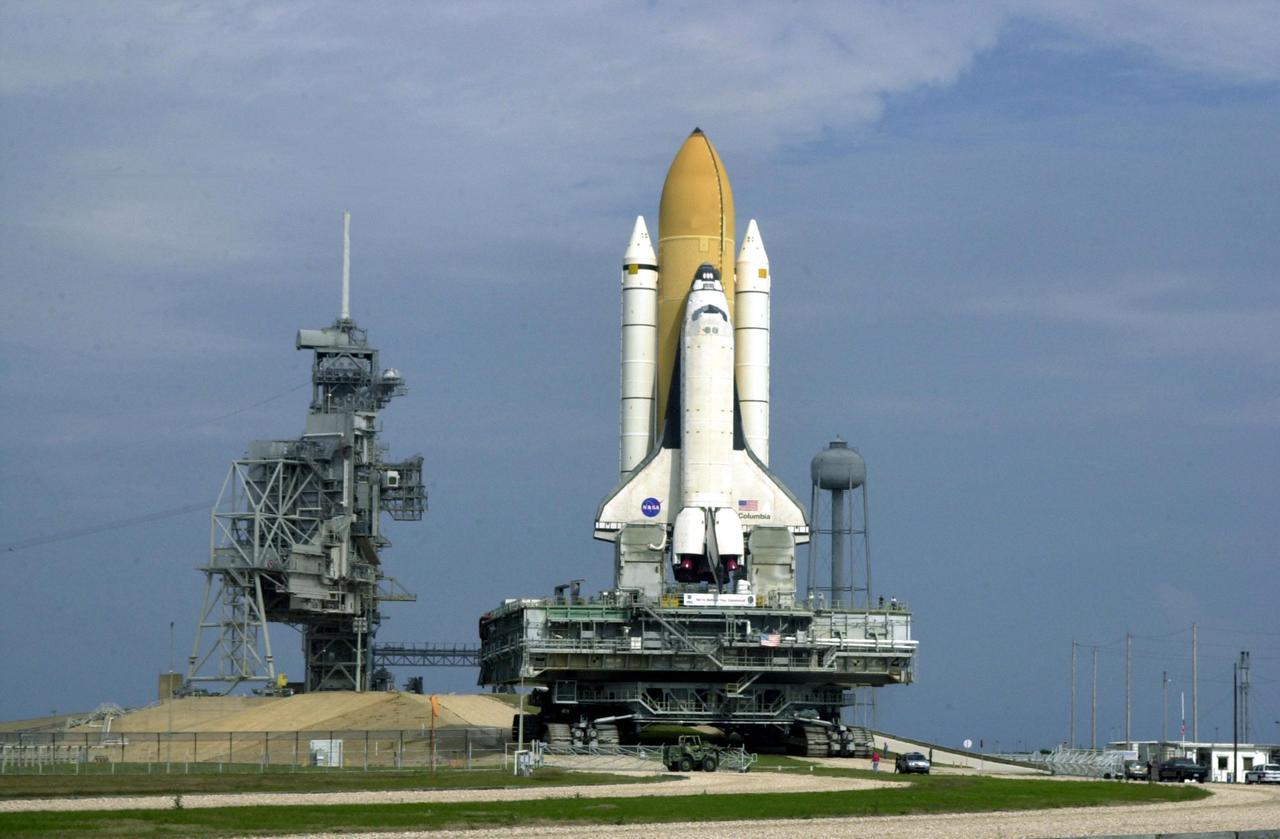
KENNEDY SPACE CENTER, FLA. -- Space Shuttle Columbia, atop its Mobile Launcher Platform, begins the ascent up the incline to Launch Pad 39A. Columbia is scheduled to be launched Feb. 28 on mission STS-109, a Hubble Servicing Mission. The goal of the mission is to replace Solar Array 2 with Solar Array 3, replace the Power Control Unit, remove the Faint Object Camera and install the ACS, install the Near Infrared Camera and Multi-Object Spectrometer (NICMOS) Cooling System, and install New Outer Blanket Layer insulation. The launch will be the first for Columbia after returning from California where it underwent extensive maintenance, inspections and enhancements. More than 100 upgrades make Columbia safer and more reliable than ever before
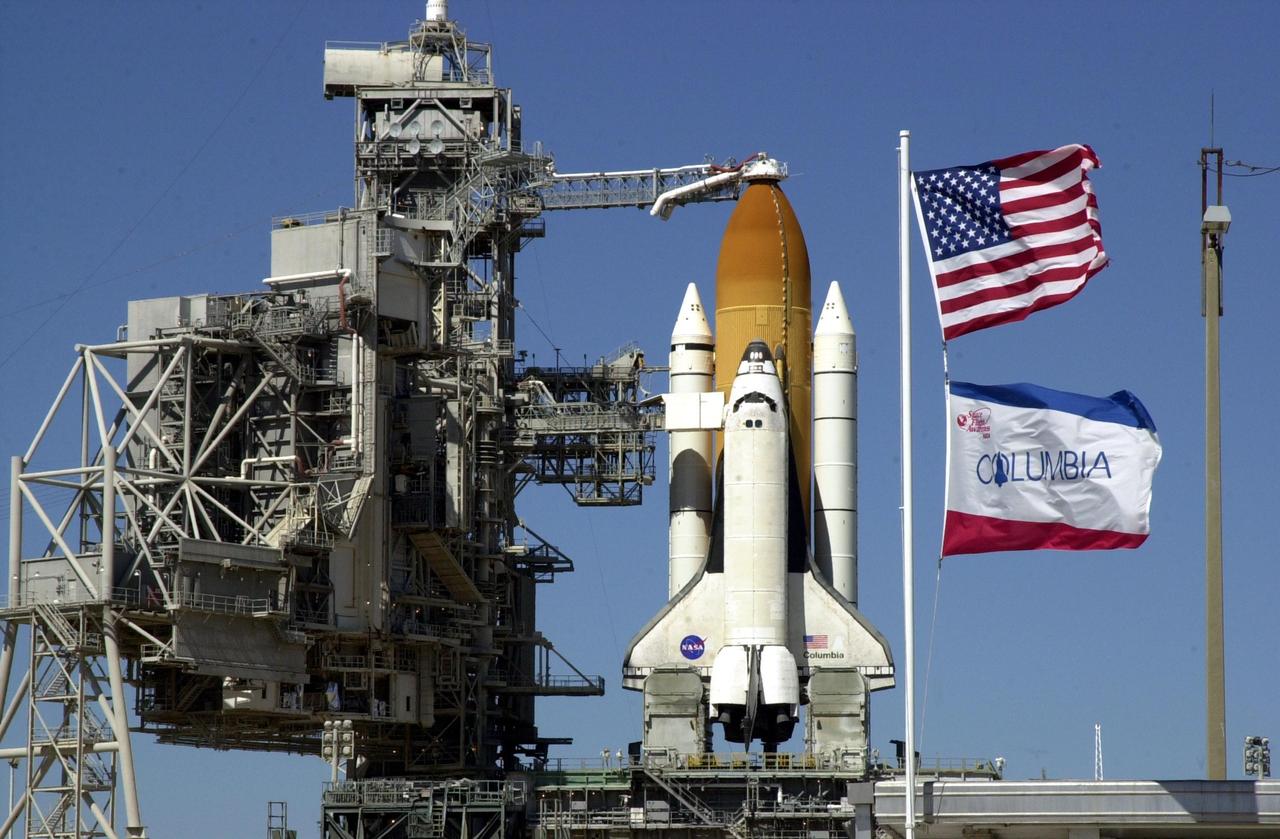
KENNEDY SPACE CENTER, FLA. -- The Rotating Service Structure is rolled back from Space Shuttle Columbia in preparation for launch Feb. 28, 2002, at 6:48 a.m. EST (11:48 GMT) on mission STS-109. Flags of the U.S. and the orbiter (foreground) illustrate the brisk winds blowing at Launch Complex 39A. In the photo is seen the Orbiter Access Arm stretched to Columbia's cockpit. A Hubble Servicing Mission, the goal of STS-109 is to replace Solar Array 2 with Solar Array 3, replace the Power Control Unit, remove the Faint Object Camera and install the ACS, install the Near Infrared Camera and Multi-Object Spectrometer (NICMOS) Cooling System, and install New Outer Blanket Layer insulation.
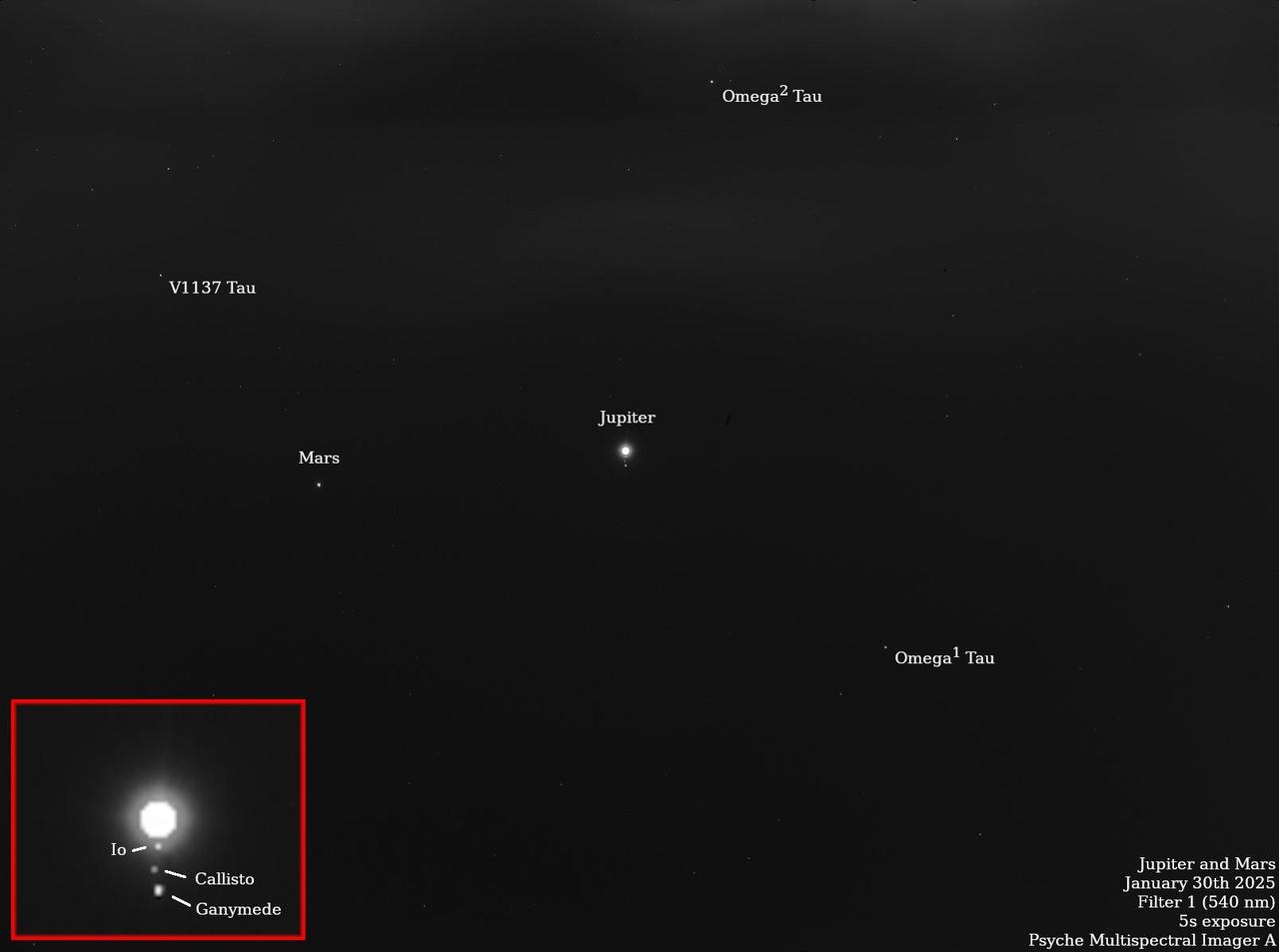
NASA's Psyche spacecraft captured multiple star and planet images in late January 2025 that include notable appearances by Mars, Jupiter, and the Jovian moons Io, Ganymede, Callisto, and Europa. The planned observation by Psyche's imaging instrument was part of a periodic maintenance and calibration test for the twin cameras that make up the imager instrument. Scientists on the imaging team, led by Arizona State University, also took images of the bright stars Vega and Canopus, which have served as standard calibration sources for astronomers for decades. The team is also using the data to assess the effects of minor wiggles or "jitter" in the spacecraft's pointing system as it points the cameras to different places in the sky. The observations of Jupiter and Mars also help the team determine how the cameras respond to solar system objects that shine by reflected sunlight, just like the Psyche asteroid. The starfield pictures shown here are long-exposure (five-second) images captured by each camera. By over-exposing Jupiter to bring out some of the background stars in the Taurus constellation, the imagers were able to capture Jupiter's fainter Galilean moons as well. The image was captured by the Psyche mission's primary camera, Imager-A, on Jan. 30. The image was obtained using the camera's "clear" filter, to provide maximum sensitivity for both bright and faint stars and solar system objects. https://photojournal.jpl.nasa.gov/catalog/PIA26563
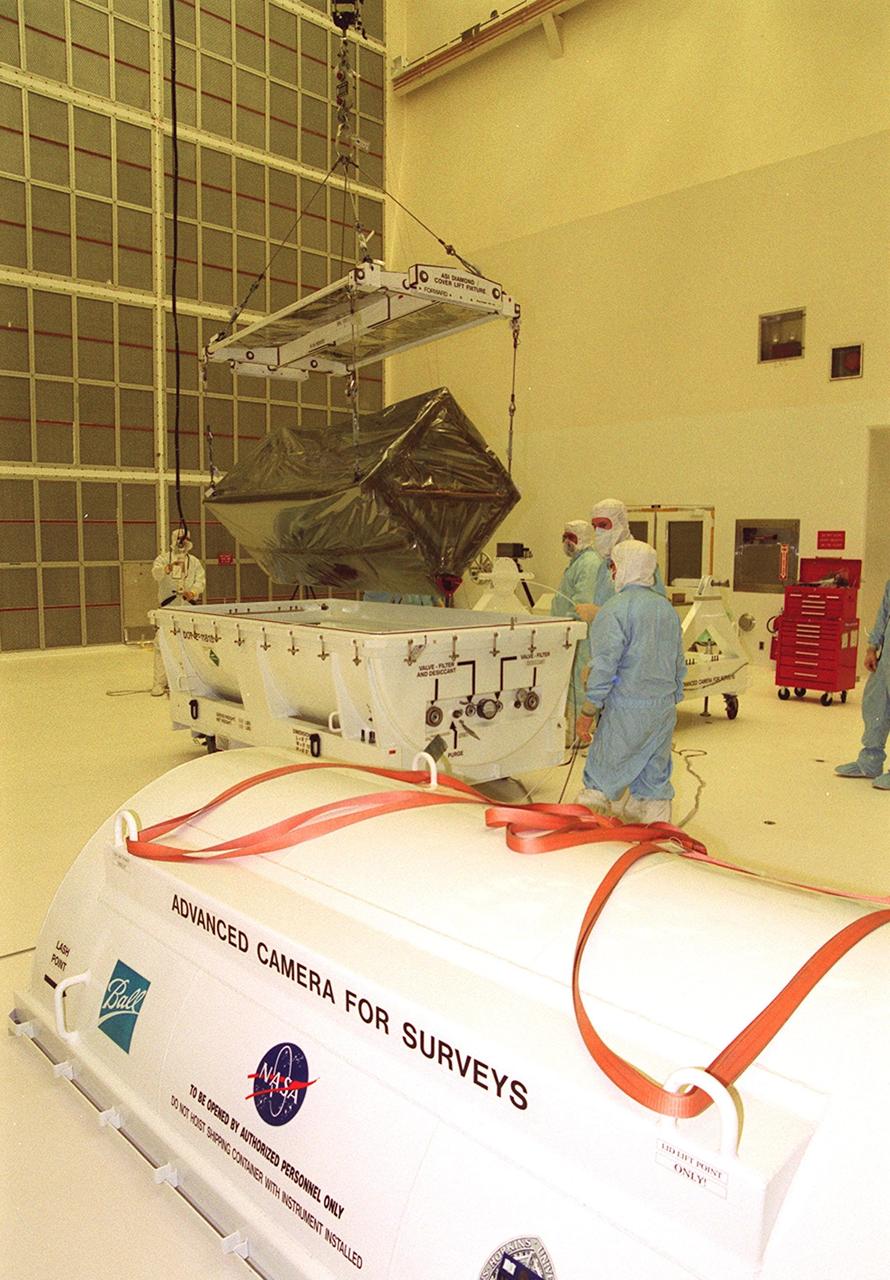
KENNEDY SPACE CENTER, Fla. -- In Hangar A&E, workers watch as an overhead crane lifts the Advanced Camera for Surveys out of its transportation container. Part of the payload on the Hubble Space Telescope Servicing Mission, STS-109, the ACS will increase the discovery efficiency of the HST by a factor of ten. It consists of three electronic cameras and a complement of filters and dispersers that detect light from the ultraviolet to the near infrared (1200 - 10,000 angstroms). The ACS was built through a collaborative effort between Johns Hopkins University, Goddard Space Flight Center, Ball Aerospace Corporation and Space Telescope Science Institute. Tasks for the mission include replacing Solar Array 2 with Solar Array 3, replacing the Power Control Unit, removing the Faint Object Camera and installing the ACS, installing the Near Infrared Camera and Multi-Object Spectrometer (NICMOS) Cooling System, and installing New Outer Blanket Layer insulation on bays 5 through 8. Mission STS-109 is scheduled for launch Feb. 14, 2002

KENNEDY SPACE CENTER, Fla. -- Fully unwrapped, the Advanced Camera for Surveys, which is suspended by an overhead crane, is checked over by workers. Part of the payload on the Hubble Space Telescope Servicing Mission, STS-109, the ACS will increase the discovery efficiency of the HST by a factor of ten. It consists of three electronic cameras and a complement of filters and dispersers that detect light from the ultraviolet to the near infrared (1200 - 10,000 angstroms). The ACS was built through a collaborative effort between Johns Hopkins University, Goddard Space Flight Center, Ball Aerospace Corporation and Space Telescope Science Institute. Tasks for the mission include replacing Solar Array 2 with Solar Array 3, replacing the Power Control Unit, removing the Faint Object Camera and installing the ACS, installing the Near Infrared Camera and Multi-Object Spectrometer (NICMOS) Cooling System, and installing New Outer Blanket Layer insulation on bays 5 through 8. Mission STS-109 is scheduled for launch Feb. 14, 2002
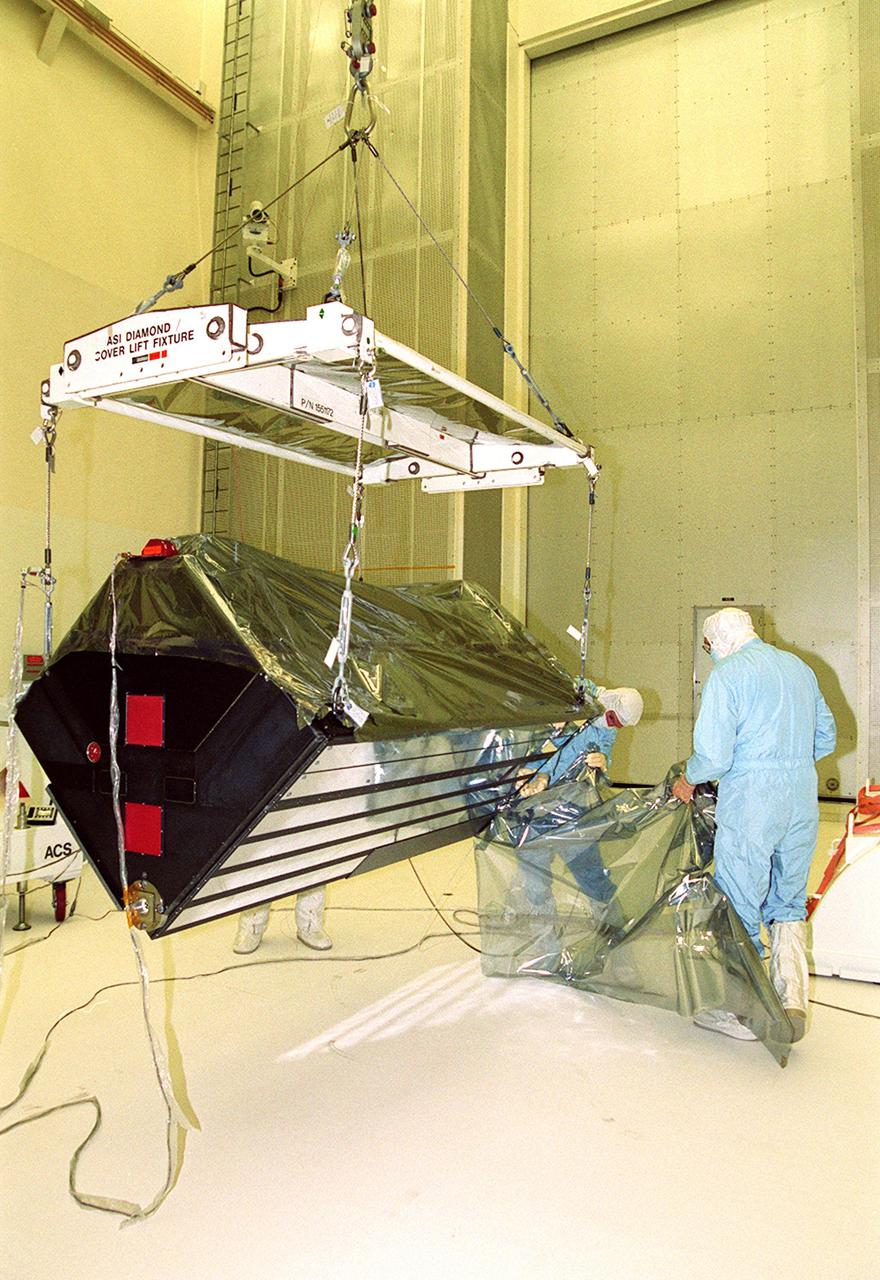
KENNEDY SPACE CENTER, Fla. -- Workers in Hangar AandE remove the wrapping from around the Advanced Camera for Surveys, which is suspended by an overhead crane. Part of the payload on the Hubble Space Telescope Servicing Mission, STS-109, the ACS will increase the discovery efficiency of the HST by a factor of ten. It consists of three electronic cameras and a complement of filters and dispersers that detect light from the ultraviolet to the near infrared (1200 - 10,000 angstroms). The ACS was built through a collaborative effort between Johns Hopkins University, Goddard Space Flight Center, Ball Aerospace Corporation and Space Telescope Science Institute. Tasks for the mission include replacing Solar Array 2 with Solar Array 3, replacing the Power Control Unit, removing the Faint Object Camera and installing the ACS, installing the Near Infrared Camera and Multi-Object Spectrometer (NICMOS) Cooling System, and installing New Outer Blanket Layer insulation on bays 5 through 8. Mission STS-109 is scheduled for launch Feb. 14, 2002
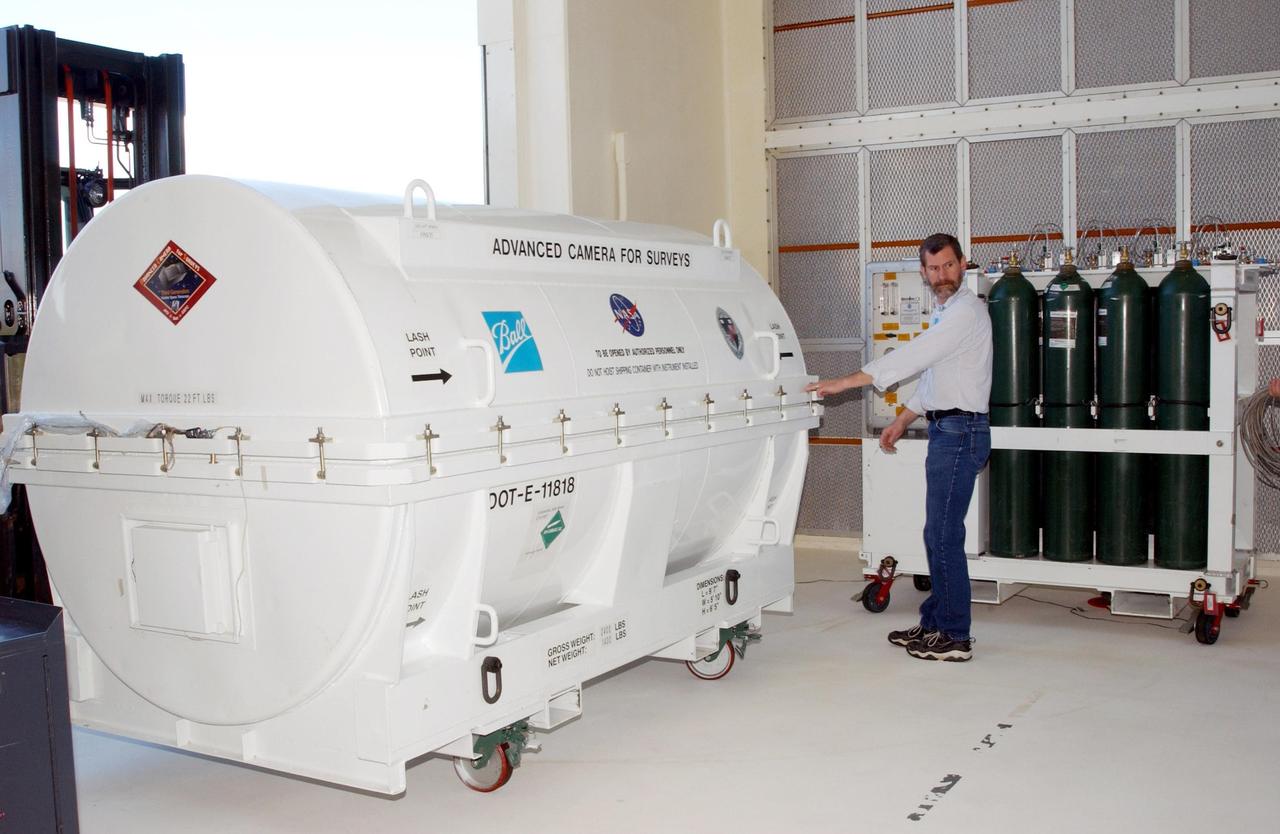
KENNEDY SPACE CENTER, Fla. -- A piece of equipment for Hubble Space Telescope Servicing mission is moved inside Hangar AE, Cape Canaveral. In the canister is the Advanced Camera for Surveys (ACS). The ACS will increase the discovery efficiency of the HST by a factor of ten. It consists of three electronic cameras and a complement of filters and dispersers that detect light from the ultraviolet to the near infrared (1200 - 10,000 angstroms). The ACS was built through a collaborative effort between Johns Hopkins University, Goddard Space Flight Center, Ball Aerospace Corporation and Space Telescope Science Institute. The goal of the mission, STS-109, is to service the HST, replacing Solar Array 2 with Solar Array 3, replacing the Power Control Unit, removing the Faint Object Camera and installing the ACS, installing the Near Infrared Camera and Multi-Object Spectrometer (NICMOS) Cooling System, and installing New Outer Blanket Layer insulation on bays 5 through 8. Mission STS-109 is scheduled for launch Feb. 14, 2002
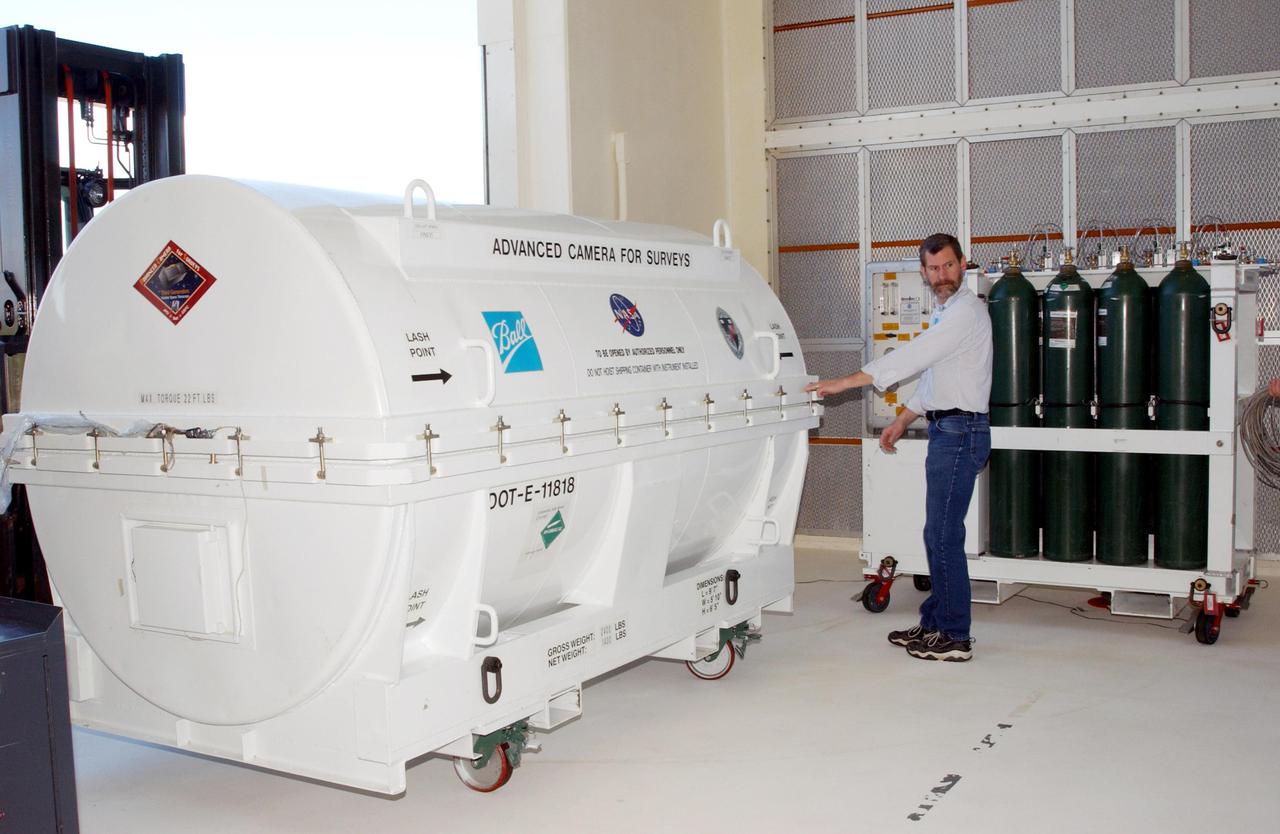
KENNEDY SPACE CENTER, Fla. -- A piece of equipment for Hubble Space Telescope Servicing mission is moved inside Hangar AE, Cape Canaveral. In the canister is the Advanced Camera for Surveys (ACS). The ACS will increase the discovery efficiency of the HST by a factor of ten. It consists of three electronic cameras and a complement of filters and dispersers that detect light from the ultraviolet to the near infrared (1200 - 10,000 angstroms). The ACS was built through a collaborative effort between Johns Hopkins University, Goddard Space Flight Center, Ball Aerospace Corporation and Space Telescope Science Institute. The goal of the mission, STS-109, is to service the HST, replacing Solar Array 2 with Solar Array 3, replacing the Power Control Unit, removing the Faint Object Camera and installing the ACS, installing the Near Infrared Camera and Multi-Object Spectrometer (NICMOS) Cooling System, and installing New Outer Blanket Layer insulation on bays 5 through 8. Mission STS-109 is scheduled for launch Feb. 14, 2002
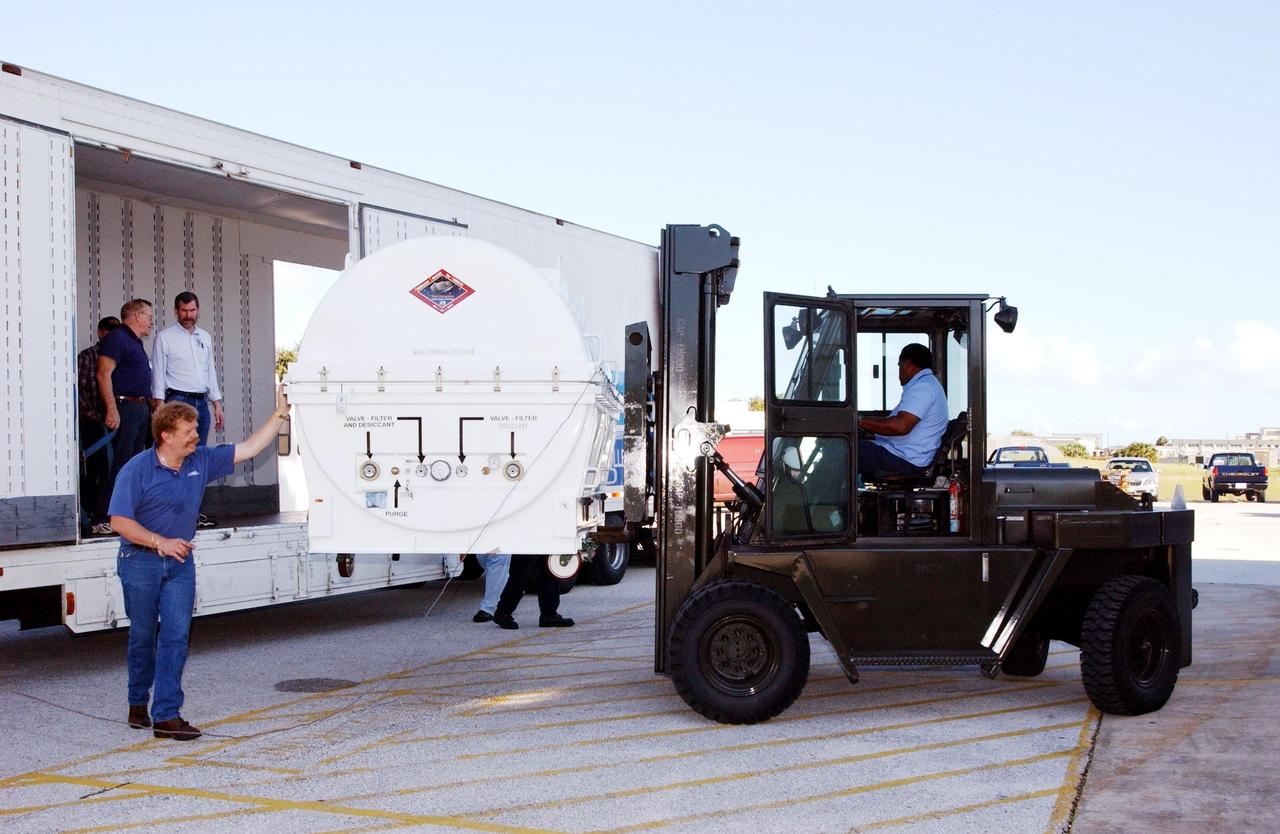
KENNEDY SPACE CENTER, Fla. - A piece of equipment for Hubble Space Telescope Servicing mission arrives at Hangar AE, Cape Canaveral. Inside the canister is the Advanced Camera for Surveys (ACS). The ACS will increase the discovery efficiency of the HST by a factor of ten. It consists of three electronic cameras and a complement of filters and dispersers that detect light from the ultraviolet to the near infrared (1200 - 10,000 angstroms). The ACS was built through a collaborative effort between Johns Hopkins University, Goddard Space Flight Center, Ball Aerospace Corporation and Space Telescope Science Institute. The goal of the mission, STS-109, is to service the HST, replacing Solar Array 2 with Solar Array 3, replacing the Power Control Unit, removing the Faint Object Camera and installing the ACS, installing the Near Infrared Camera and Multi-Object Spectrometer (NICMOS) Cooling System, and installing New Outer Blanket Layer insulation on bays 5 through 8. Mission STS-109 is scheduled for launch Feb. 14, 2002
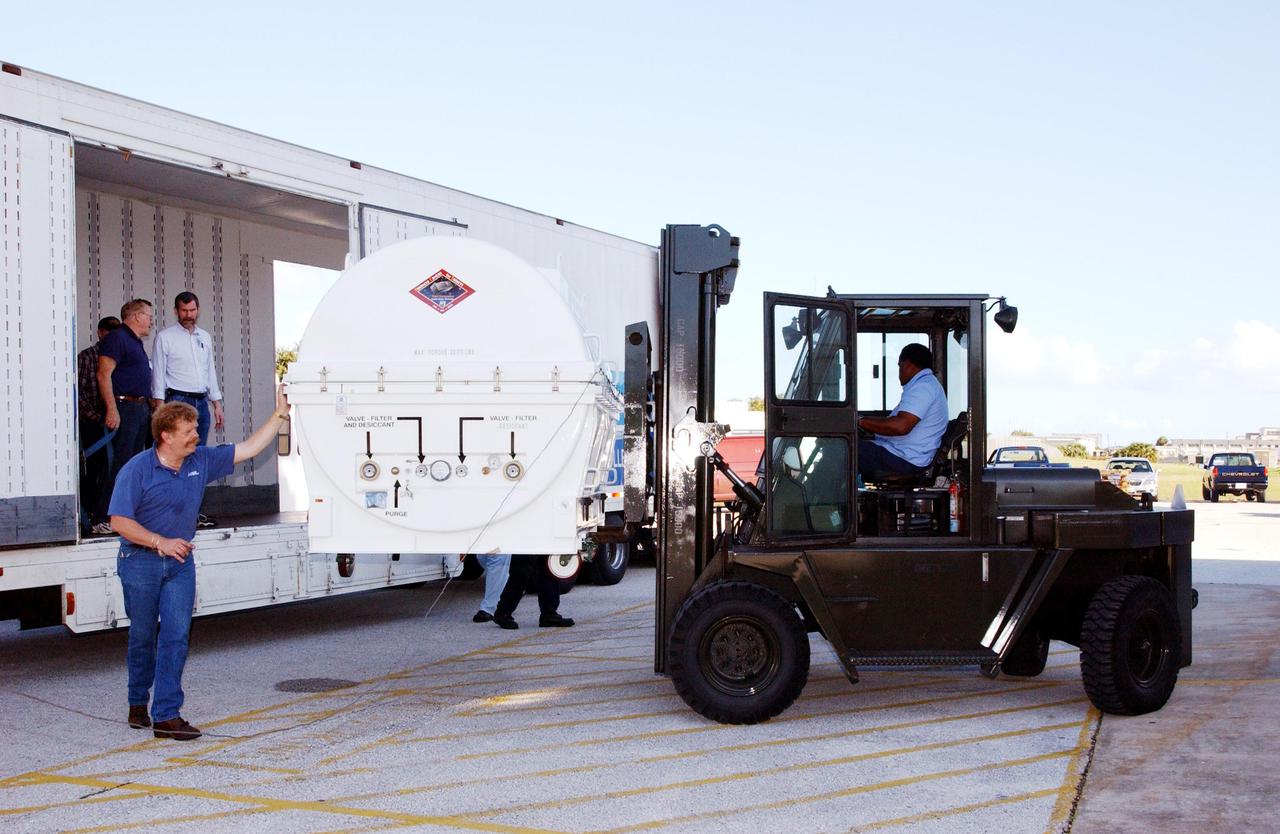
KENNEDY SPACE CENTER, Fla. - A piece of equipment for Hubble Space Telescope Servicing mission arrives at Hangar AE, Cape Canaveral. Inside the canister is the Advanced Camera for Surveys (ACS). The ACS will increase the discovery efficiency of the HST by a factor of ten. It consists of three electronic cameras and a complement of filters and dispersers that detect light from the ultraviolet to the near infrared (1200 - 10,000 angstroms). The ACS was built through a collaborative effort between Johns Hopkins University, Goddard Space Flight Center, Ball Aerospace Corporation and Space Telescope Science Institute. The goal of the mission, STS-109, is to service the HST, replacing Solar Array 2 with Solar Array 3, replacing the Power Control Unit, removing the Faint Object Camera and installing the ACS, installing the Near Infrared Camera and Multi-Object Spectrometer (NICMOS) Cooling System, and installing New Outer Blanket Layer insulation on bays 5 through 8. Mission STS-109 is scheduled for launch Feb. 14, 2002
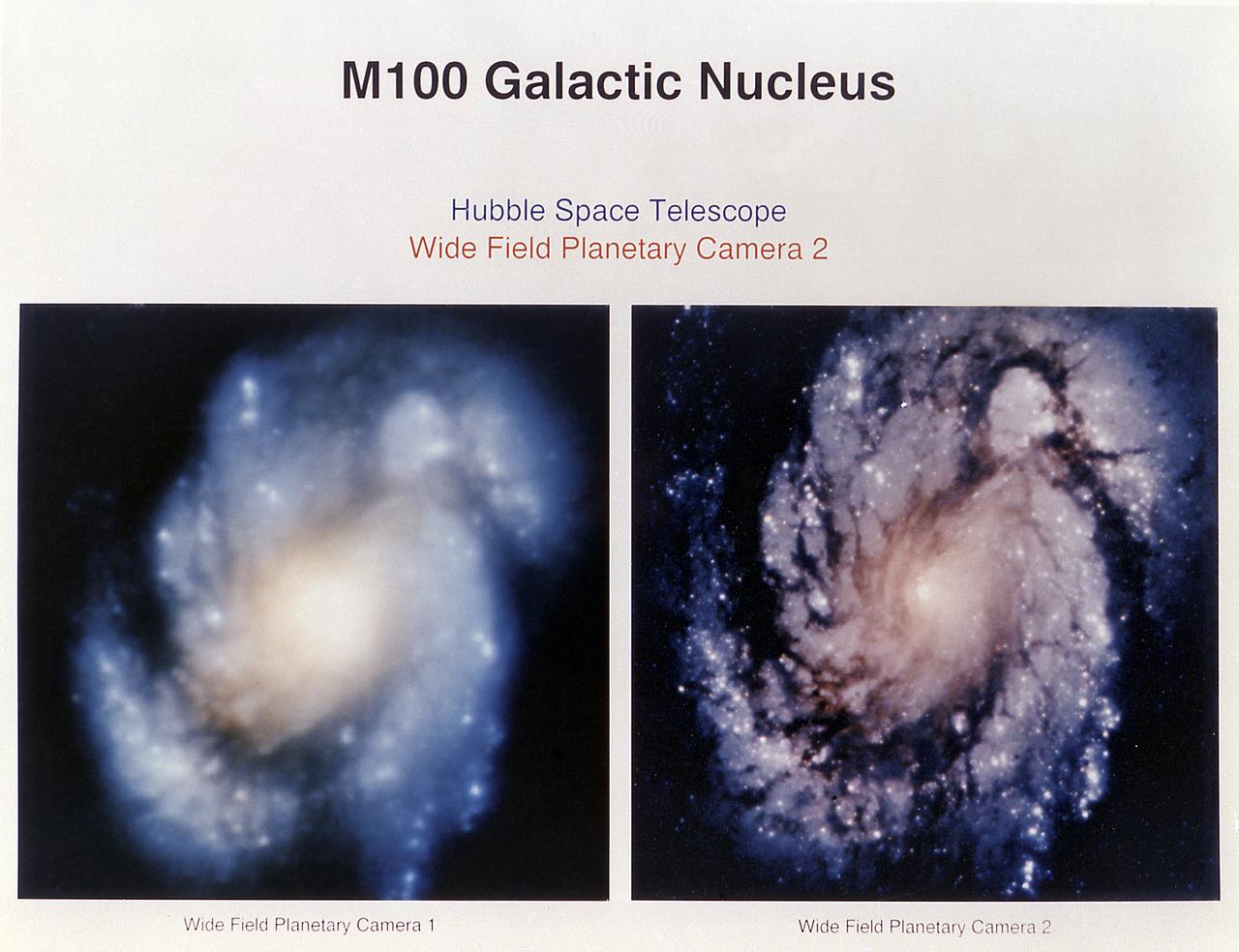
A comparison image of the M100 Galactic Nucleus, taken by the Hubble Space Telescope (HST) Wide Field Planetary Camera-1 (WF/PC1) and Wide Field Planetary Camera-2 (WF/PC2). The HST was placed in a low-Earth orbit by the Space Shuttle Discovery, STS-31 mission, in April 1990. Two months after its deployment in space, scientists detected a 2-micron spherical aberration in the primary mirror of the HST that affected the telescope's ability to focus faint light sources into a precise point. This imperfection was very slight, one-fiftieth of the width of a human hair. During four spacewalks, the STS-61 crew replaced the solar panel with its flexing problems; the WF/PC1 with the WF/PC2, with built-in corrective optics; and the High-Speed Photometer with the Corrective Optics Space Telescope Axial Replacement (COSTAR), to correct the aberration for the remaining instruments. The purpose of the HST, the most complex and sensitive optical telescope ever made, is to study the cosmos from a low-Earth orbit for 15 years or more. The HST provides fine detail imaging, produces ultraviolet images and spectra, and detects very faint objects.
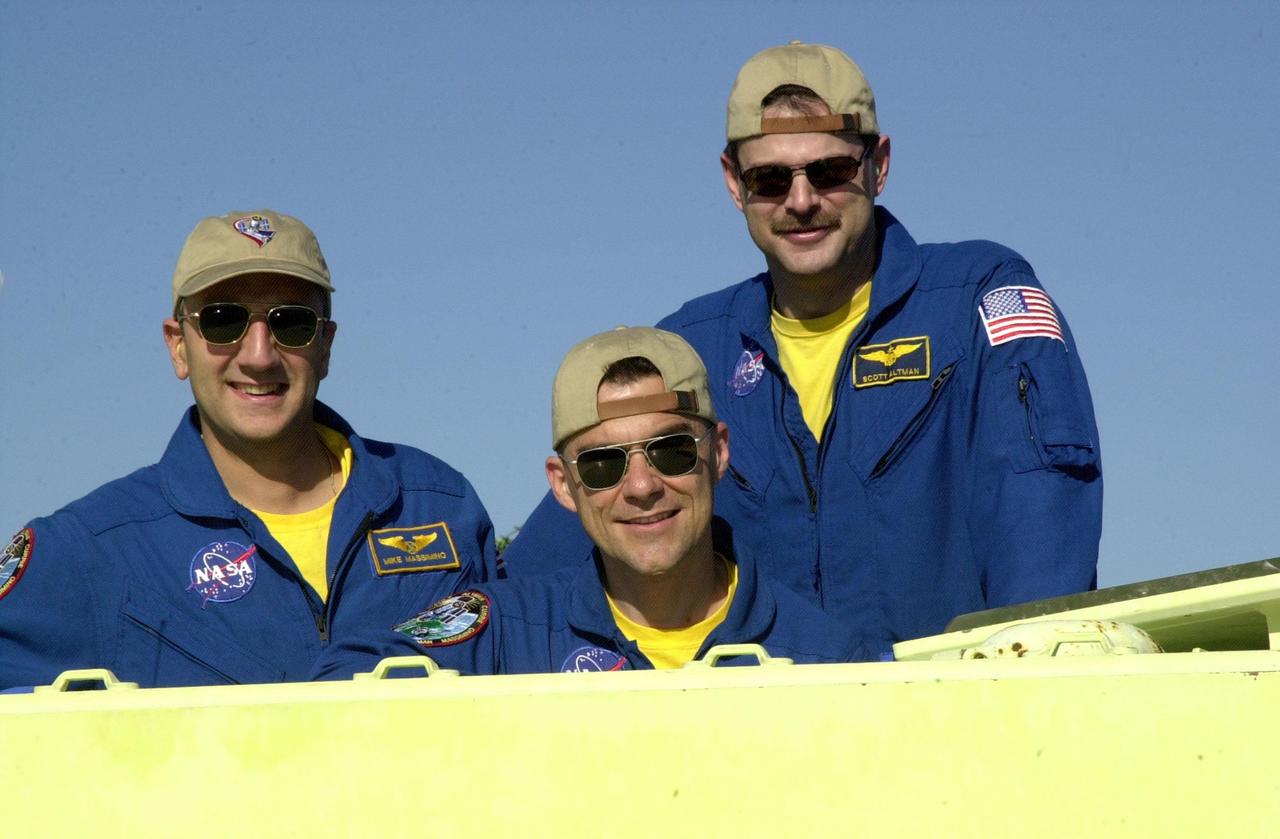
KENNEDY SPACE CENTER, FLA. - During training on an M-113 armored personnel carrier, members of the STS-109 crew pause for this photo. From left are pictured Mission Specialist Michael Massimino, Pilot Duane Carey and Commander Scott Altman. The M-113 is part of emergency egress training at the launch pad. Crew members are taking part in Terminal Countdown Demonstration Test activities, which also include a simulated launch countdown. STS-109 is a Hubble Space Telescope Servicing Mission, with goals to replace Solar Array 2 with Solar Array 3, replace the Power Control Unit, remove the Faint Object Camera and install the Advanced Camera for Surveys (ACS), install the Near Infrared Camera and Multi-Object Spectrometer (NICMOS) Cooling System, and install New Outer Blanket Layer insulation. The 11-day mission will require grasping the satellite with a robotic arm in order for the crew to perform the tasks during five spacewalks. Launch of STS-109 aboard Space Shuttle Columbia is scheduled for Feb. 28, 2002
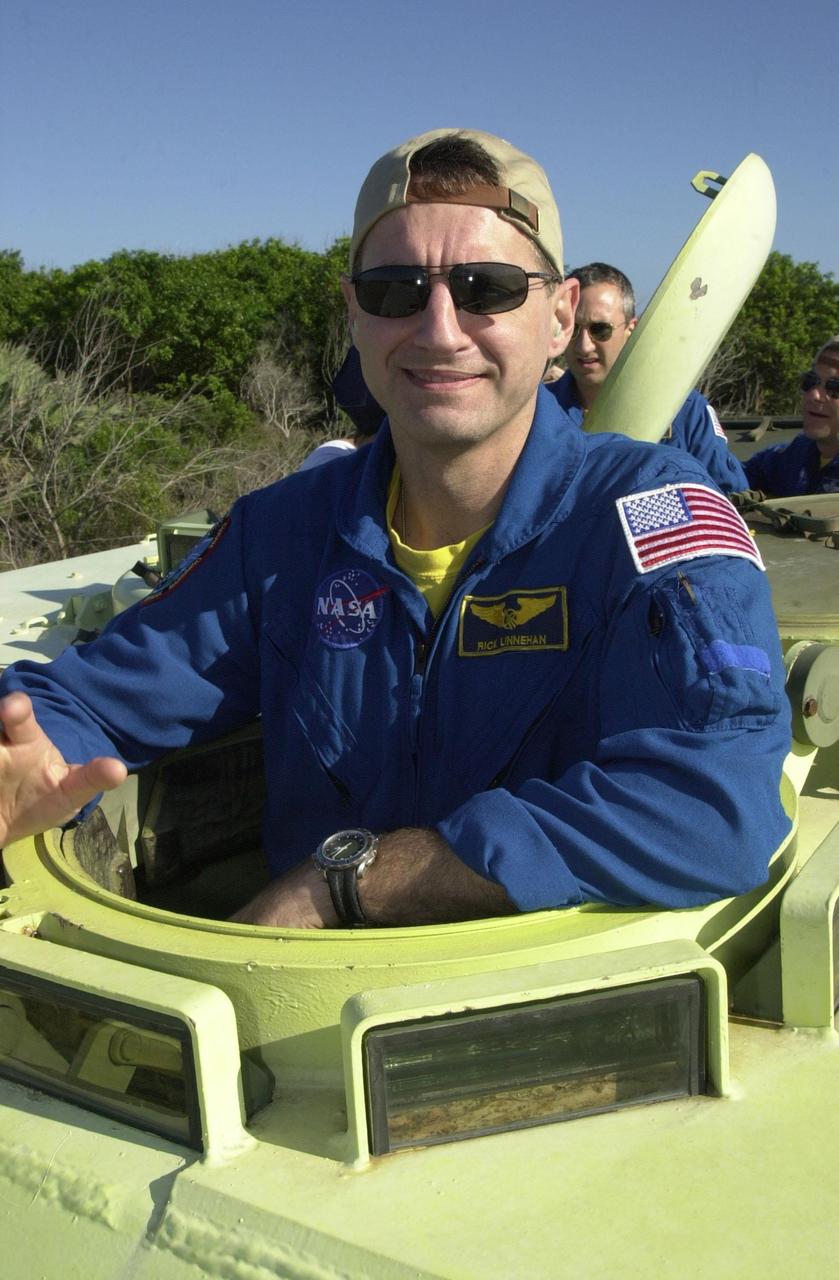
KENNEDY SPACE CENTER, FLA. - STS-109 Mission Specialist Richard Linnehan is ready to practice driving the M-113 armored personnel carrier, part of emergency egress training at the launch pad. Behind him is Mission Specialist Michael Massimino. Crew members are taking part in Terminal Countdown Demonstration Test activities, which also include a simulated launch countdown. STS-109 is a Hubble Space Telescope Servicing Mission, with goals to replace Solar Array 2 with Solar Array 3, replace the Power Control Unit, remove the Faint Object Camera and install the Advanced Camera for Surveys (ACS), install the Near Infrared Camera and Multi-Object Spectrometer (NICMOS) Cooling System, and install New Outer Blanket Layer insulation. The 11-day mission will require grasping the satellite with a robotic arm in order for the crew to perform the tasks during five spacewalks. Launch of STS-109 aboard Space Shuttle Columbia is scheduled for Feb. 28, 2002
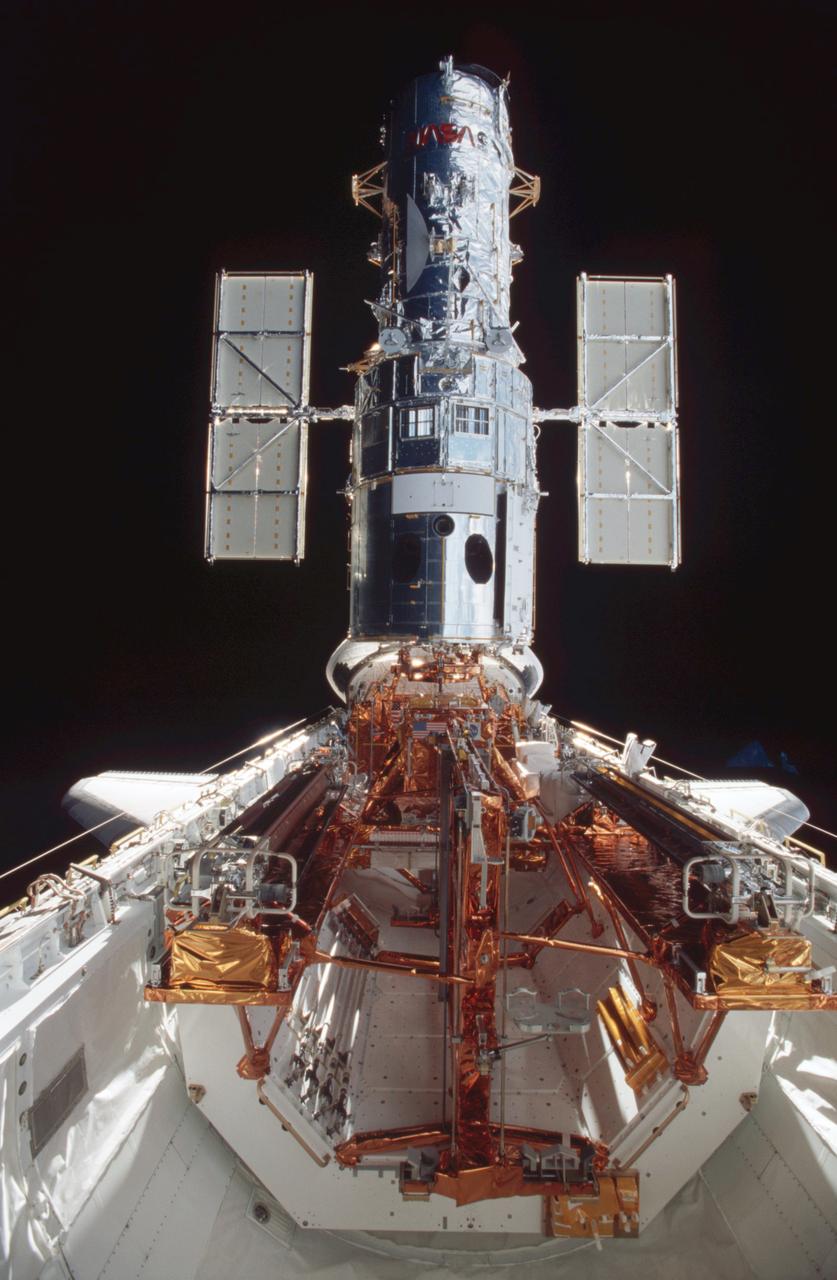
After five days of service and upgrade work on the Hubble Space Telescope (HST), the STS-109 crew photographed the giant telescope in the shuttle's cargo bay. The telescope was captured and secured on a work stand in Columbia's payload bay using Columbia's robotic arm, where 4 of the 7-member crew performed 5 space walks completing system upgrades to the HST. Included in those upgrades were: The replacement of the solar array panels; replacement of the power control unit (PCU); replacement of the Faint Object Camera (FOC) with a new advanced camera for Surveys (ACS); and installation of the experimental cooling system for the Hubble's Near-Infrared Camera and Multi-object Spectrometer (NICMOS), which had been dormant since January 1999 when its original coolant ran out. The Marshall Space Flight Center had the responsibility for the design, development, and construction of the the HST, which is the most complex and sensitive optical telescope ever made, to study the cosmos from a low-Earth orbit. Launched March 1, 2002, the STS-109 HST servicing mission lasted 10 days, 22 hours, and 11 minutes. It was the 108th flight overall in NASA's Space Shuttle Program.
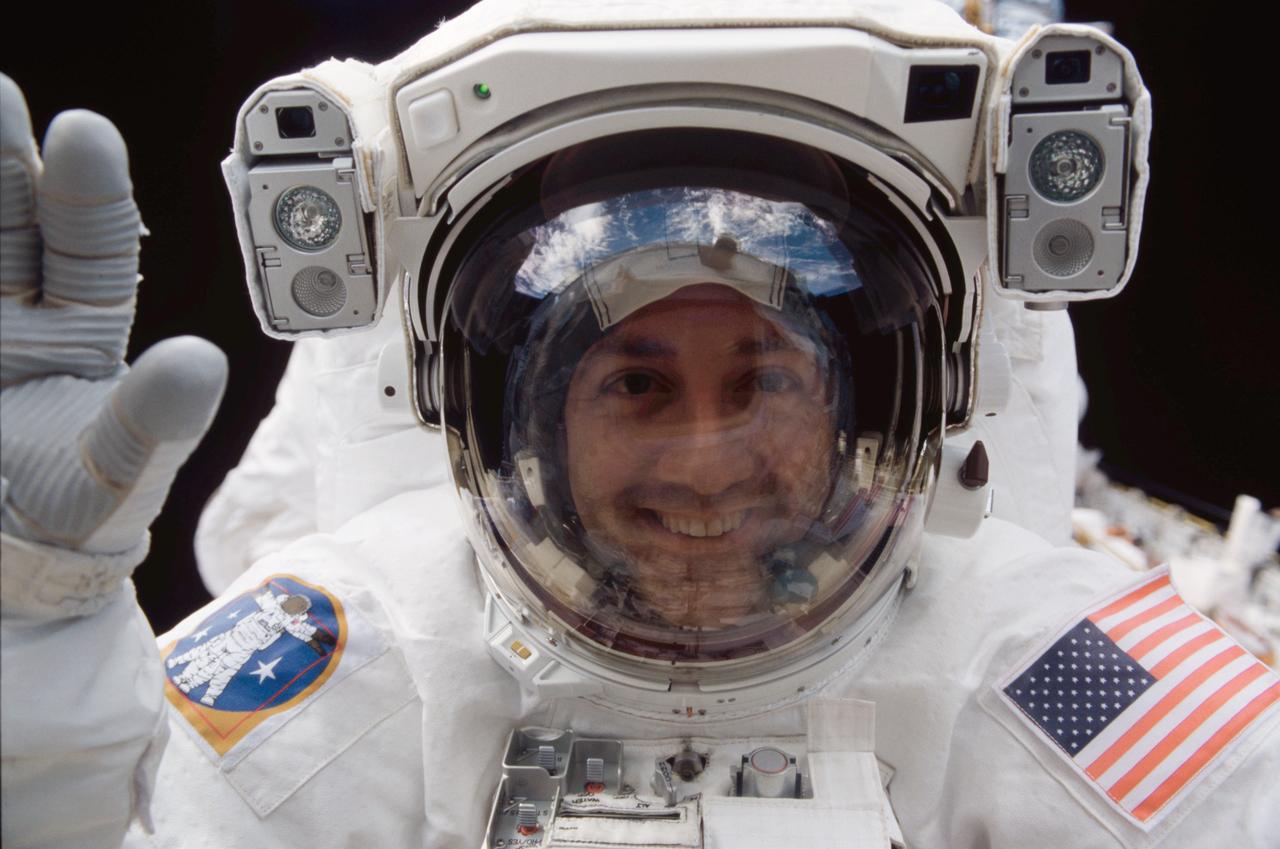
STS-109 Astronauts Michael J. Massimino and James H. Newman were making their second extravehicular activity (EVA) of their mission when astronaut Massimino, mission specialist, peered into Columbia's crew cabin during a brief break from work on the Hubble Space Telescope (HST). The HST is latched down just a few feet behind him in Columbia's cargo bay. The Space Shuttle Columbia STS-109 mission lifted off March 1, 2002 with goals of repairing and upgrading the Hubble Space Telescope (HST). STS-109 upgrades to the HST included: replacement of the solar array panels; replacement of the power control unit (PCU); replacement of the Faint Object Camera (FOC) with a new advanced camera for Surveys (ACS); and installation of the experimental cooling system for the Hubble's Near-Infrared Camera and Multi-object Spectrometer (NICMOS), which had been dormant since January 1999 when its original coolant ran out. The Marshall Space Flight Center in Huntsville, Alabama had the responsibility for the design, development, and construction of the HST, which is the most powerful and sophisticated telescope ever built. Lasting 10 days, 22 hours, and 11 minutes, the STS-109 mission was the 108th flight overall in NASA's Space Shuttle Program.
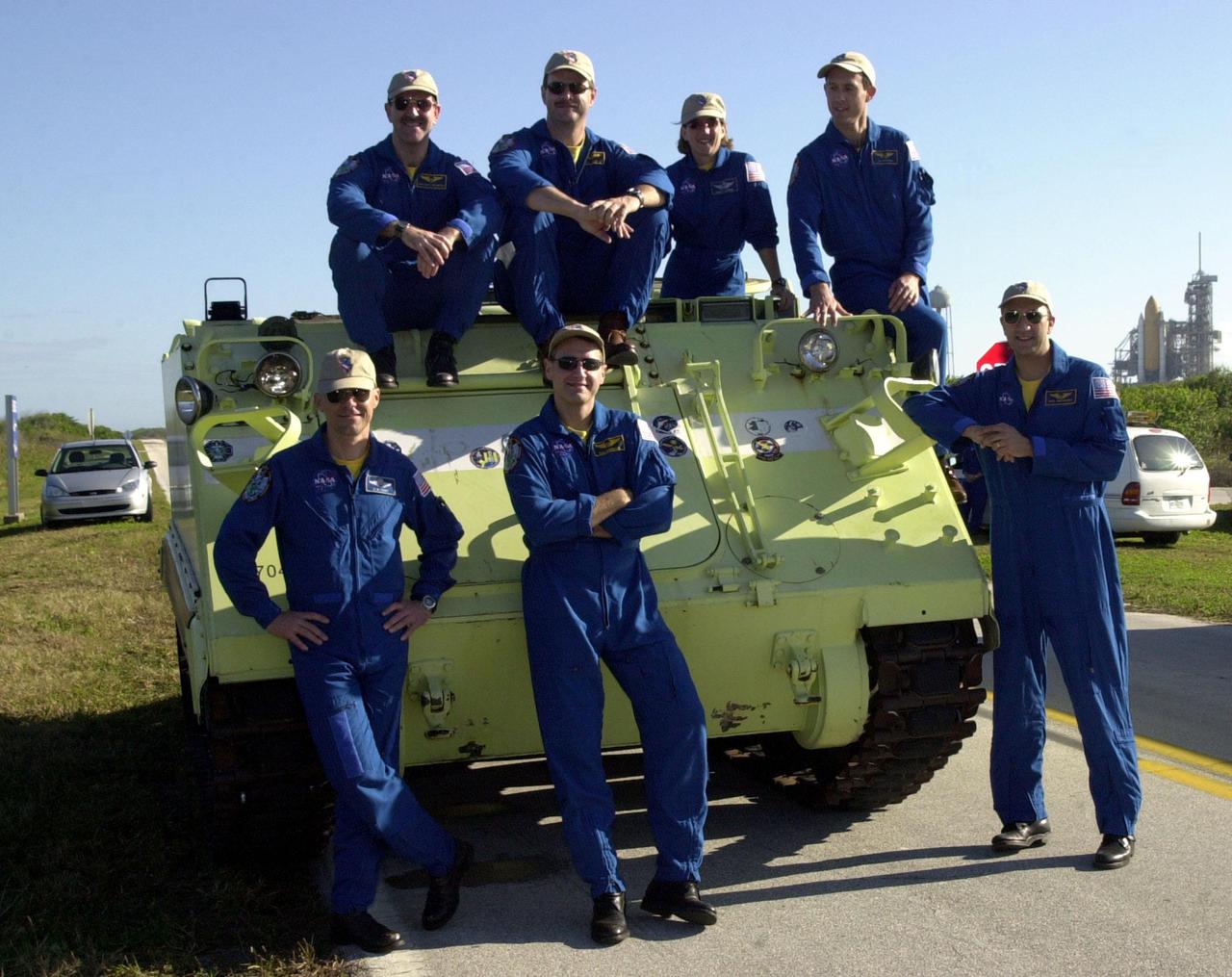
KENNEDY SPACE CENTER, FLA. - After training on the M-113 armored personnel carrier, the STS-109 crew gather for a photo. Seated on top are (left to right) Payload Commander John Grunsfeld, Commander Scott Altman and Mission Specialists Nancie Currie and James Newman; standing below are Pilot Duane Carey and Mission Specialists Richard Linnehan and Michael Massimino. The carrier is part of emergency egress training at the launch pad. The crew is taking part in Terminal Countdown Demonstration Test activities that also include a simulated countdown at the pad. STS-109 is a Hubble Space Telescope Servicing Mission, with goals to replace Solar Array 2 with Solar Array 3, replace the Power Control Unit, remove the Faint Object Camera and install the Advanced Camera for Surveys (ACS), install the Near Infrared Camera and Multi-Object Spectrometer (NICMOS) Cooling System, and install New Outer Blanket Layer insulation. The 11-day mission will require grasping the satellite with a robotic arm in order for the crew to perform the tasks during five spacewalks. Launch of STS-109 aboard Space Shuttle Columbia is scheduled for Feb. 28, 2002
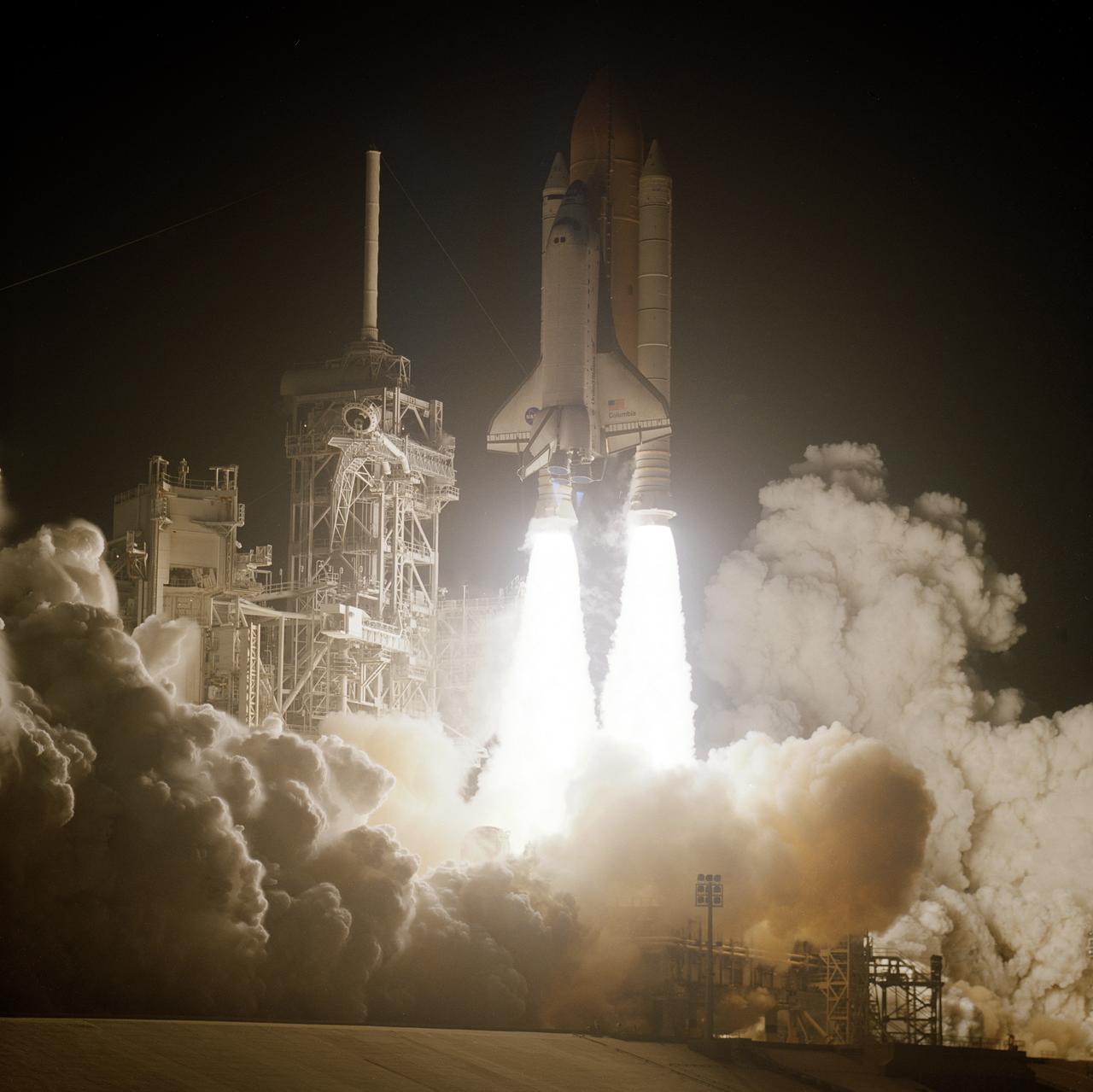
Carrying the STS-109 crew of seven, the Space Shuttle Orbiter Columbia blasted from its launch pad as it began its 27th flight and 108th flight overall in NASA's Space Shuttle Program. Launched March 1, 2002, the goal of the mission was the maintenance and upgrade of the Hubble Space Telescope (HST) which was developed, designed, and constructed by the Marshall Space Flight Center. Captured and secured on a work stand in Columbia's payload bay using Columbia's robotic arm, the HST received the following upgrades: replacement of the solar array panels; replacement of the power control unit (PCU); replacement of the Faint Object Camera (FOC) with a new advanced camera for Surveys (ACS); and installation of the experimental cooling system for the Hubble's Near-Infrared Camera and Multi-object Spectrometer (NICMOS), which had been dormant since January 1999 when it original coolant ran out. Four of the crewmembers performed 5 space walks in the 10 days, 22 hours, and 11 minutes of the the STS-109 mission.
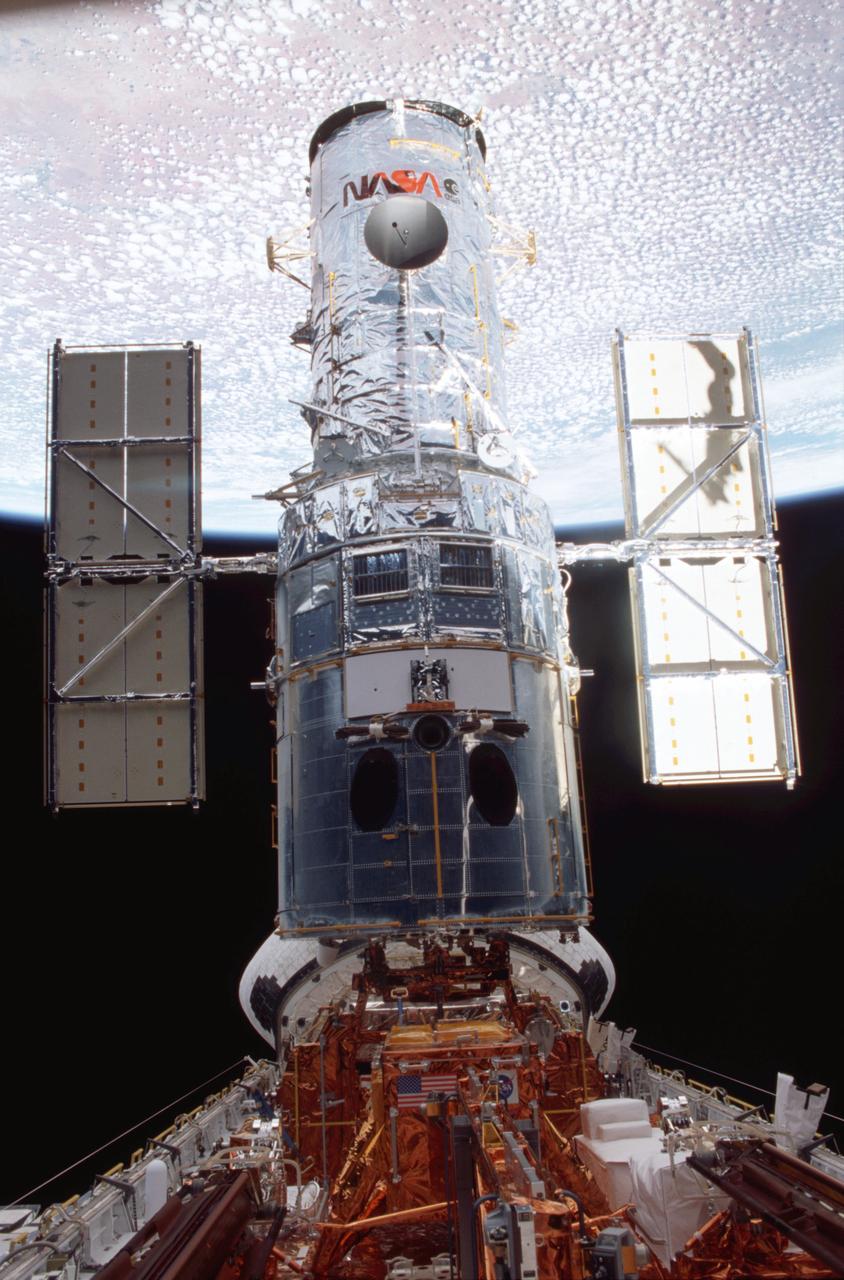
After five days of service and upgrade work on the Hubble Space Telescope (HST), the STS-109 crew photographed the giant telescope in the shuttle's cargo bay. The telescope was captured and secured on a work stand in Columbia's payload bay using Columbia's robotic arm, where 4 of the 7-member crew performed 5 space walks completing system upgrades to the HST. Included in those upgrades were: The replacement of the solar array panels; replacement of the power control unit (PCU); replacement of the Faint Object Camera (FOC) with a new advanced camera for Surveys (ACS); and installation of the experimental cooling system for the Hubble's Near-Infrared Camera and Multi-object Spectrometer (NICMOS), which had been dormant since January 1999 when its original coolant ran out. The Marshall Space Flight Center had the responsibility for the design, development, and construction of the the HST, which is the most complex and sensitive optical telescope ever made, to study the cosmos from a low-Earth orbit. Launched March 1, 2002, the STS-109 HST servicing mission lasted 10 days, 22 hours, and 11 minutes. It was the 108th flight overall in NASA's Space Shuttle Program.
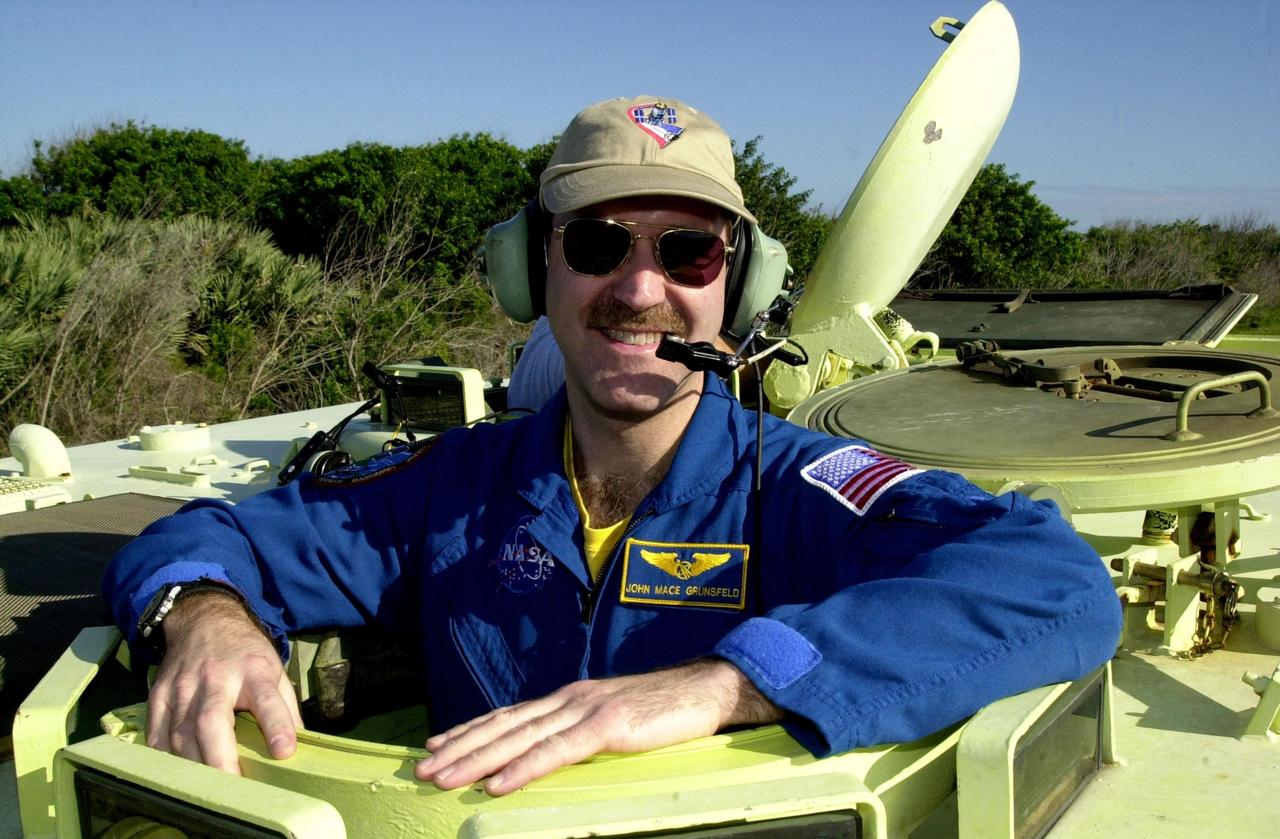
KENNEDY SPACE CENTER, FLA. - STS-109 Payload Commander John Grunsfeld is ready to practice driving the M-113 armored personnel carrier, part of emergency egress training at the launch pad. Behind him is Mission Specialist Michael Massimino. Crew members are taking part in Terminal Countdown Demonstration Test activities, which also include a simulated launch countdown. STS-109 is a Hubble Space Telescope Servicing Mission, with goals to replace Solar Array 2 with Solar Array 3, replace the Power Control Unit, remove the Faint Object Camera and install the Advanced Camera for Surveys (ACS), install the Near Infrared Camera and Multi-Object Spectrometer (NICMOS) Cooling System, and install New Outer Blanket Layer insulation. The 11-day mission will require grasping the satellite with a robotic arm in order for the crew to perform the tasks during five spacewalks. Launch of STS-109 aboard Space Shuttle Columbia is scheduled for Feb. 28, 2002

KENNEDY SPACE CENTER, FLA. - STS-109 Mission Specialist Michael Massimino is ready to practice driving the M-113 armored personnel carrier, part of emergency egress training at the launch pad. Behind him is Commander Scott Altmann. Crew members are taking part in Terminal Countdown Demonstration Test activities, which also include a simulated launch countdown. STS-109 is a Hubble Space Telescope Servicing Mission, with goals to replace Solar Array 2 with Solar Array 3, replace the Power Control Unit, remove the Faint Object Camera and install the Advanced Camera for Surveys (ACS), install the Near Infrared Camera and Multi-Object Spectrometer (NICMOS) Cooling System, and install New Outer Blanket Layer insulation. The 11-day mission will require grasping the satellite with a robotic arm in order for the crew to perform the tasks during five spacewalks. Launch of STS-109 aboard Space Shuttle Columbia is scheduled for Feb. 28, 2002
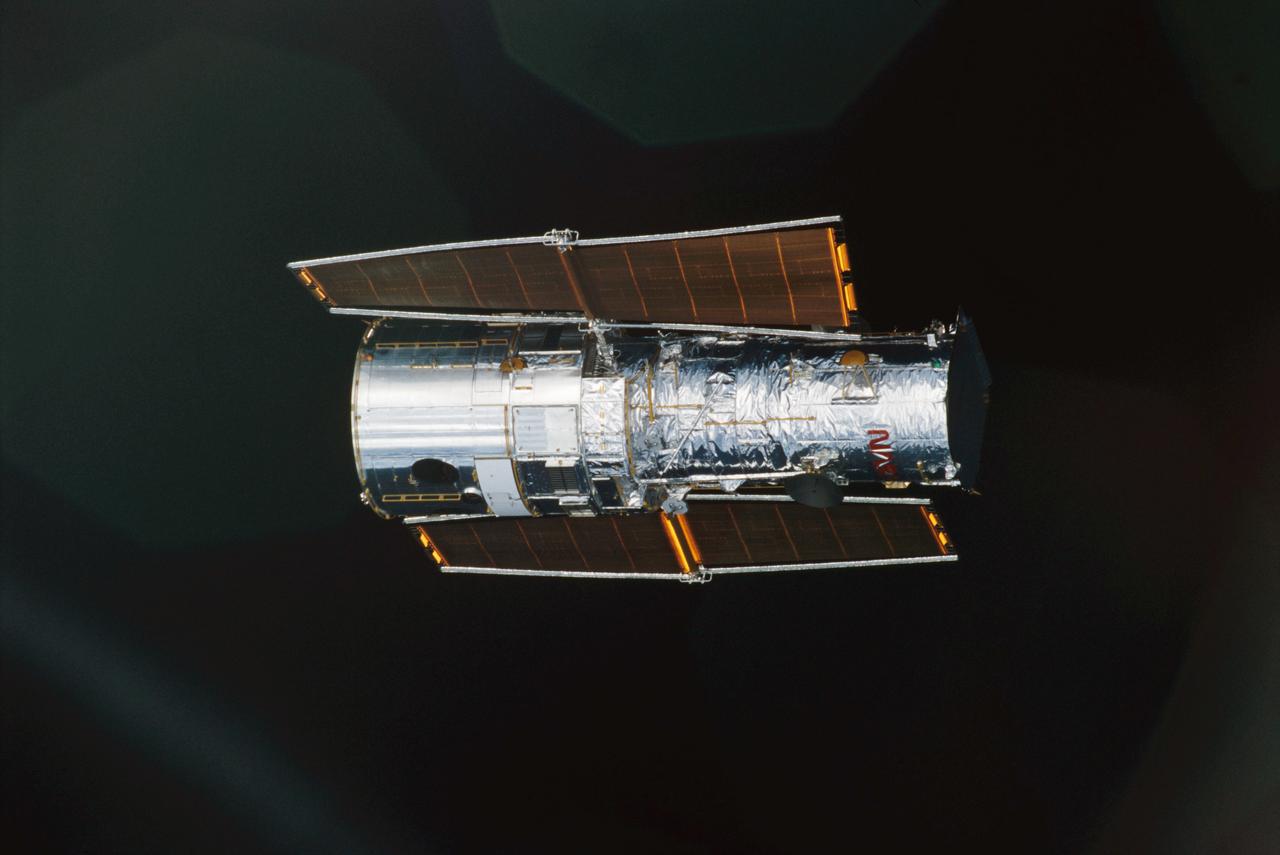
The Hubble Space Telescope (HST), with its normal routine temporarily interrupted, is about to be captured by the Space Shuttle Columbia prior to a week of servicing and upgrading by the STS-109 crew. The telescope was captured by the shuttle's Remote Manipulator System (RMS) robotic arm and secured on a work stand in Columbia's payload bay where 4 of the 7-member crew performed 5 space walks completing system upgrades to the HST. Included in those upgrades were: The replacement of the solar array panels; replacement of the power control unit (PCU); replacement of the Faint Object Camera (FOC) with a new advanced camera for Surveys (ACS); and installation of the experimental cooling system for the Hubble's Near-Infrared Camera and Multi-object Spectrometer (NICMOS), which had been dormant since January 1999 when its original coolant ran out. The Marshall Space Flight Center had the responsibility for the design, development, and construction of the the HST, which is the most complex and sensitive optical telescope ever made, to study the cosmos from a low-Earth orbit. Launched March 1, 2002, the STS-109 HST servicing mission lasted 10 days, 22 hours, and 11 minutes. It was the 108th flight overall in NASA's Space Shuttle Program.