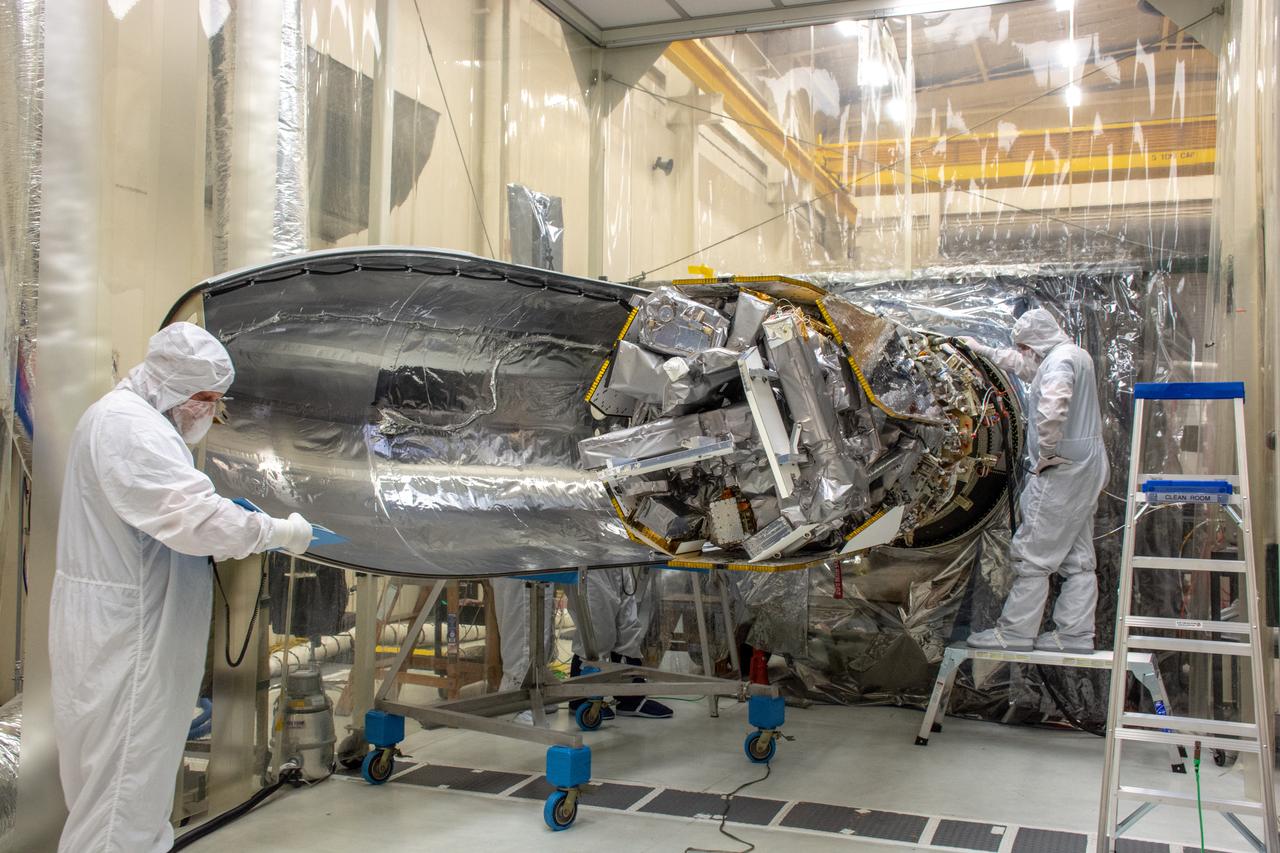
Technicians install the starboard side of the Northrop Grumman Pegasus XL rocket’s payload fairing around NASA's Ionospheric Connection Explorer (ICON) inside Building 1555 at Vandenberg Air Force Base in California on Sept. 17, 2019. ICON launched on the Pegasus XL rocket, attached beneath the company's L-1011 Stargazer aircraft, on Oct. 10, 2019, after takeoff from the Skid Strip at Cape Canaveral Air Force Station in Florida. ICON will study the frontier of space - the dynamic zone high in Earth's atmosphere where terrestrial weather from below meets space weather above. The explorer will help determine the physics of Earth's space environment and pave the way for mitigating its effects on our technology, communications systems and society.
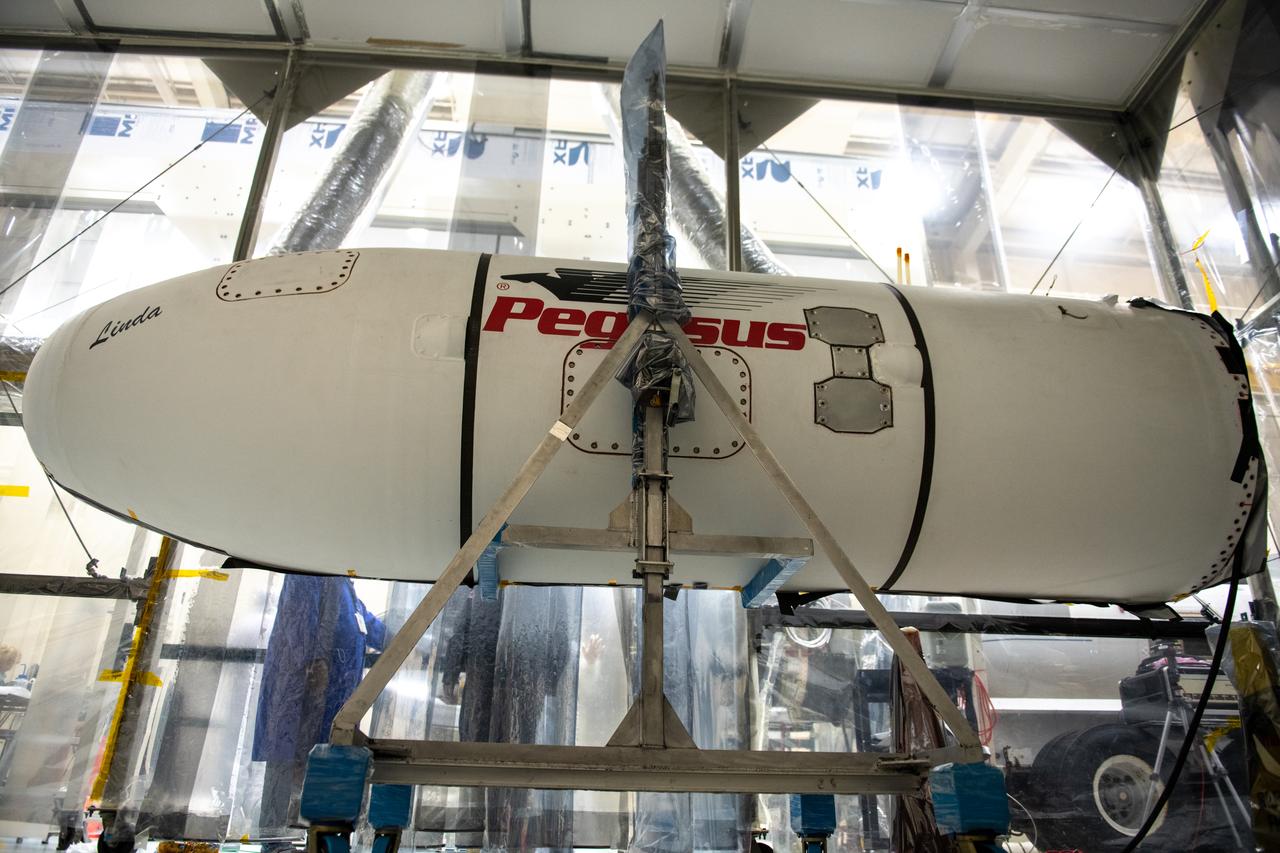
The starboard side of the Northrop Grumman Pegasus XL rocket’s payload fairing is ready for installation around NASA's Ionospheric Connection Explorer (ICON) inside Building 1555 at Vandenberg Air Force Base in California on Sept. 17, 2019. ICON launched on the Pegasus XL rocket, attached beneath the company's L-1011 Stargazer aircraft, on Oct. 10, 2019, after takeoff from the Skid Strip at Cape Canaveral Air Force Station in Florida. ICON will study the frontier of space - the dynamic zone high in Earth's atmosphere where terrestrial weather from below meets space weather above. The explorer will help determine the physics of Earth's space environment and pave the way for mitigating its effects on our technology, communications systems and society.
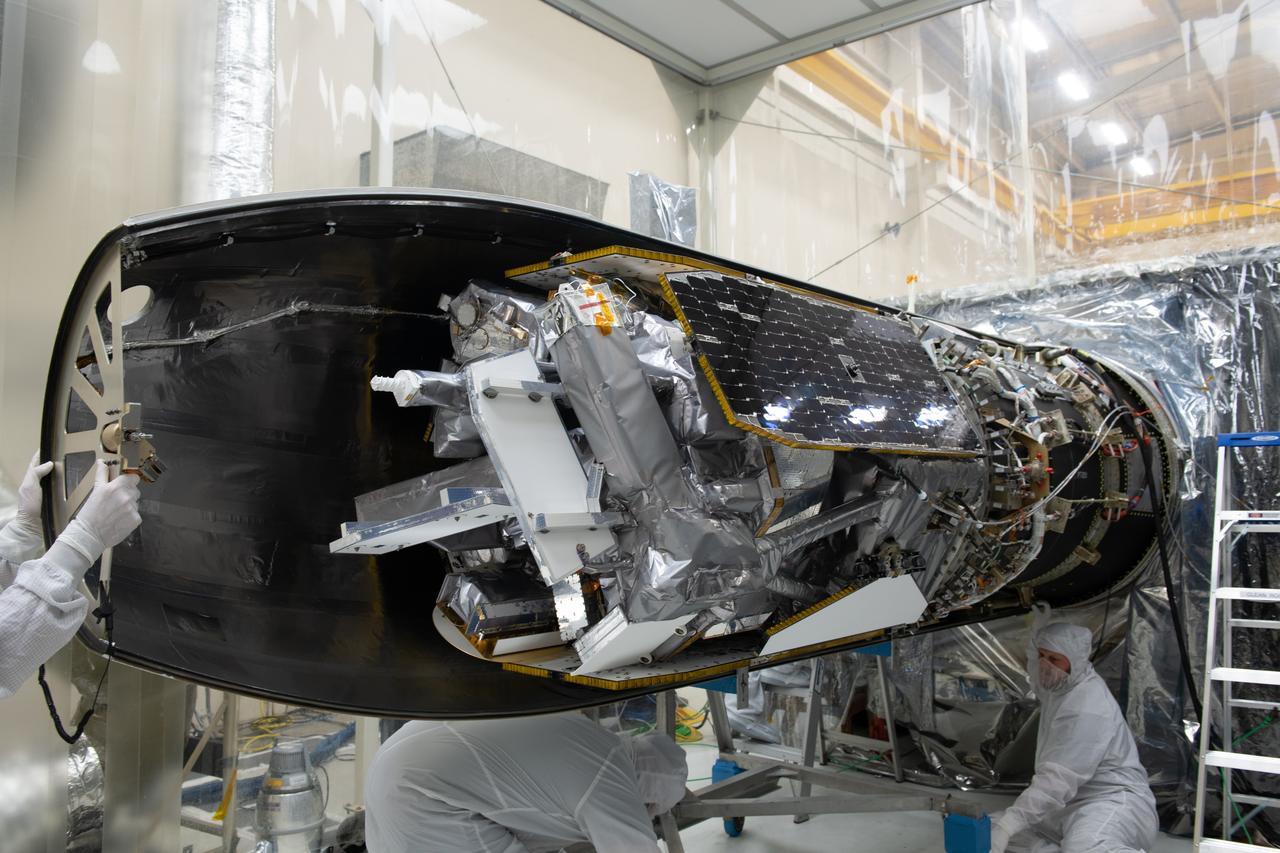
The starboard side of the Northrop Grumman Pegasus XL rocket’s payload fairing has been installed around NASA's Ionospheric Connection Explorer (ICON) inside Building 1555 at Vandenberg Air Force Base in California on Sept. 17, 2019. ICON launched on the Pegasus XL rocket, attached beneath the company's L-1011 Stargazer aircraft, on Oct. 10, 2019, after takeoff from the Skid Strip at Cape Canaveral Air Force Station in Florida. ICON will study the frontier of space - the dynamic zone high in Earth's atmosphere where terrestrial weather from below meets space weather above. The explorer will help determine the physics of Earth's space environment and pave the way for mitigating its effects on our technology, communications systems and society.
Technicians install the starboard side of the Northrop Grumman Pegasus XL rocket’s payload fairing around NASA's Ionospheric Connection Explorer (ICON) inside Building 1555 at Vandenberg Air Force Base in California on Sept. 17, 2019. ICON launched on the Pegasus XL rocket, attached beneath the company's L-1011 Stargazer aircraft, on Oct. 10, 2019, after takeoff from the Skid Strip at Cape Canaveral Air Force Station in Florida. ICON will study the frontier of space - the dynamic zone high in Earth's atmosphere where terrestrial weather from below meets space weather above. The explorer will help determine the physics of Earth's space environment and pave the way for mitigating its effects on our technology, communications systems and society.
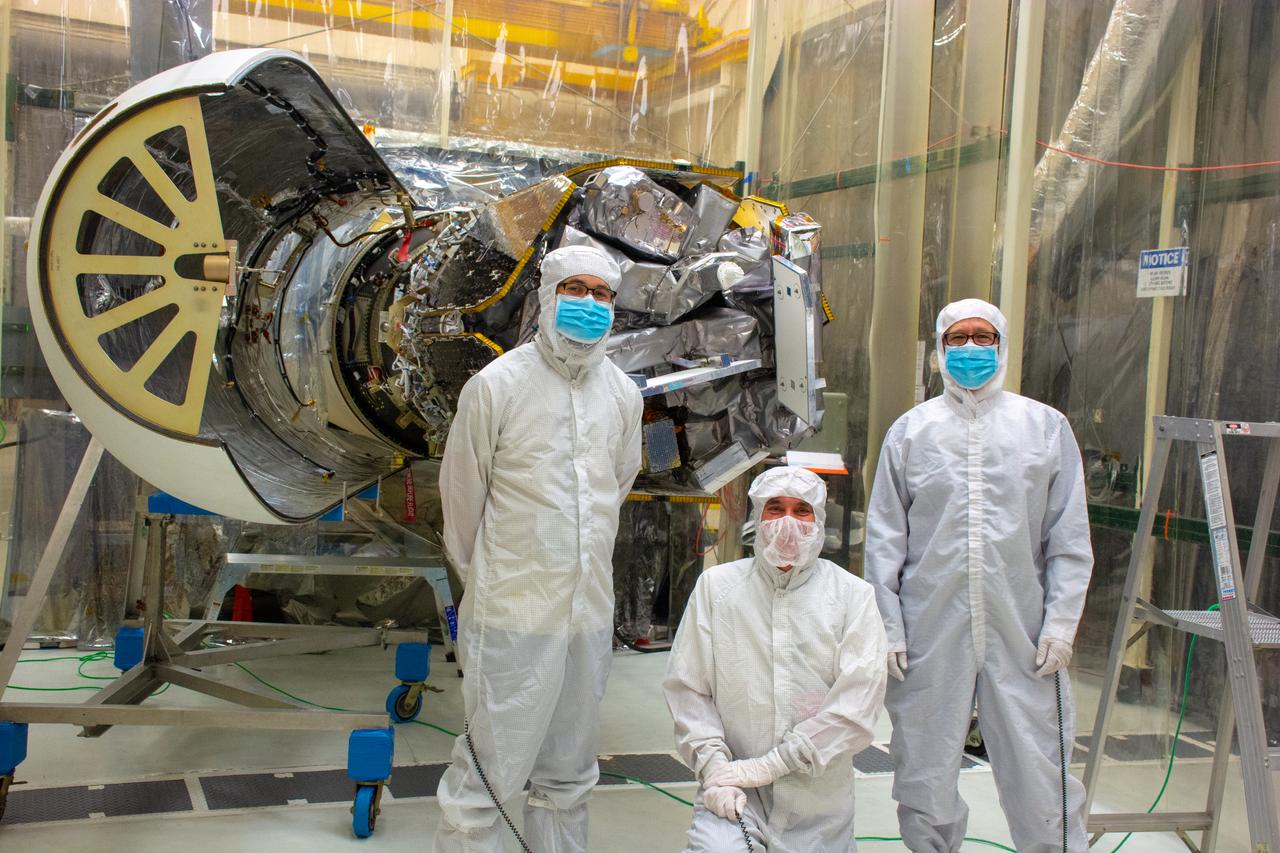
Technicians pose for a photo after the starboard side of the Northrop Grumman Pegasus XL rocket’s payload fairing was installed around NASA's Ionospheric Connection Explorer (ICON) inside Building 1555 at Vandenberg Air Force Base in California on Sept. 17, 2019. ICON launched on the Pegasus XL rocket, attached beneath the company's L-1011 Stargazer aircraft, on Oct. 10, 2019, after takeoff from the Skid Strip at Cape Canaveral Air Force Station in Florida. ICON will study the frontier of space - the dynamic zone high in Earth's atmosphere where terrestrial weather from below meets space weather above. The explorer will help determine the physics of Earth's space environment and pave the way for mitigating its effects on our technology, communications systems and society.
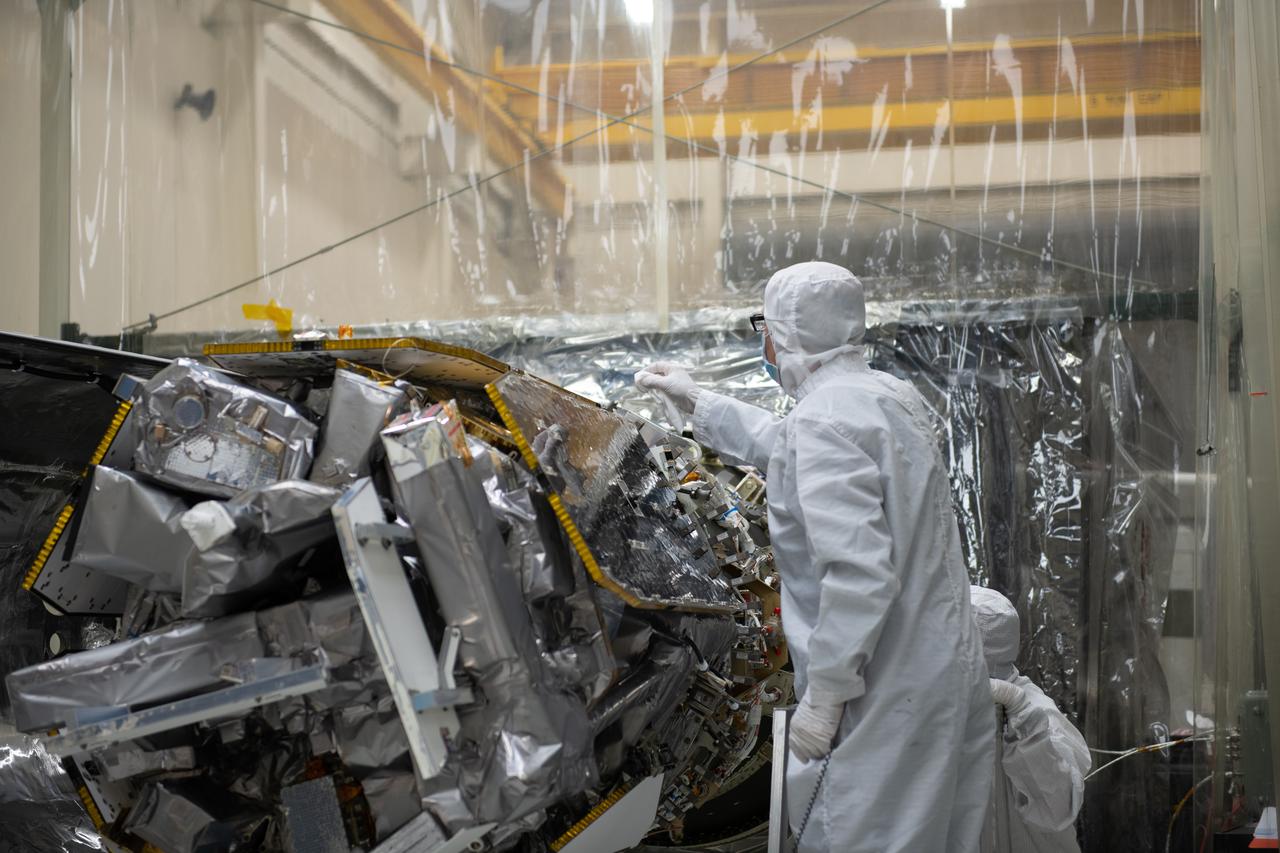
Technicians prepare to install the starboard side of the Northrop Grumman Pegasus XL rocket’s payload fairing around NASA's Ionospheric Connection Explorer (ICON) inside Building 1555 at Vandenberg Air Force Base in California on Sept. 17, 2019. ICON launched on the Pegasus XL rocket, attached beneath the company's L-1011 Stargazer aircraft, on Oct. 10, 2019, after takeoff from the Skid Strip at Cape Canaveral Air Force Station in Florida. ICON will study the frontier of space - the dynamic zone high in Earth's atmosphere where terrestrial weather from below meets space weather above. The explorer will help determine the physics of Earth's space environment and pave the way for mitigating its effects on our technology, communications systems and society.
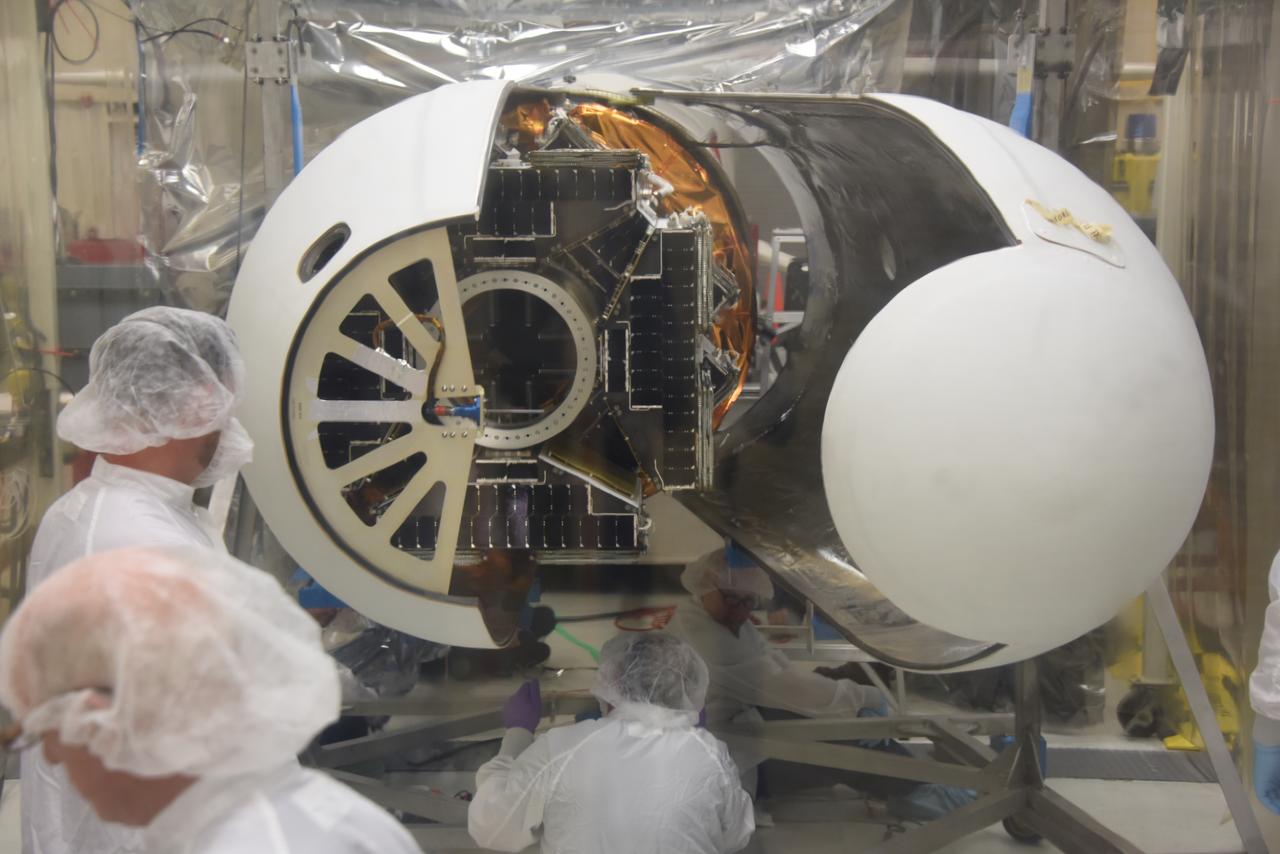
Technicians with Orbital ATK have installed the first half of the Pegasus XL fairing around NASA’s Cyclone Global Navigation Satellite System (CYGNSS) in Building 1555 at Vandenberg Air Force Base in California. The second half of the fairing is being installed. CYGNSS is being prepared at Vandenberg, and then will be transported to NASA’s Kennedy Space Center in Florida aboard the Orbital ATK Pegasus XL rocket which will be attached to the Orbital ATK L-1011 carrier aircraft. CYGNSS will launch on the Pegasus XL rocket from the Skid Strip at Cape Canaveral Air Force Station. CYGNSS will make frequent and accurate measurements of ocean surface winds throughout the life cycle of tropical storms and hurricanes. The data that CYGNSS provides will enable scientists to probe key air-sea interaction processes that take place near the core of storms, which are rapidly changing and play a critical role in the beginning and intensification of hurricanes.
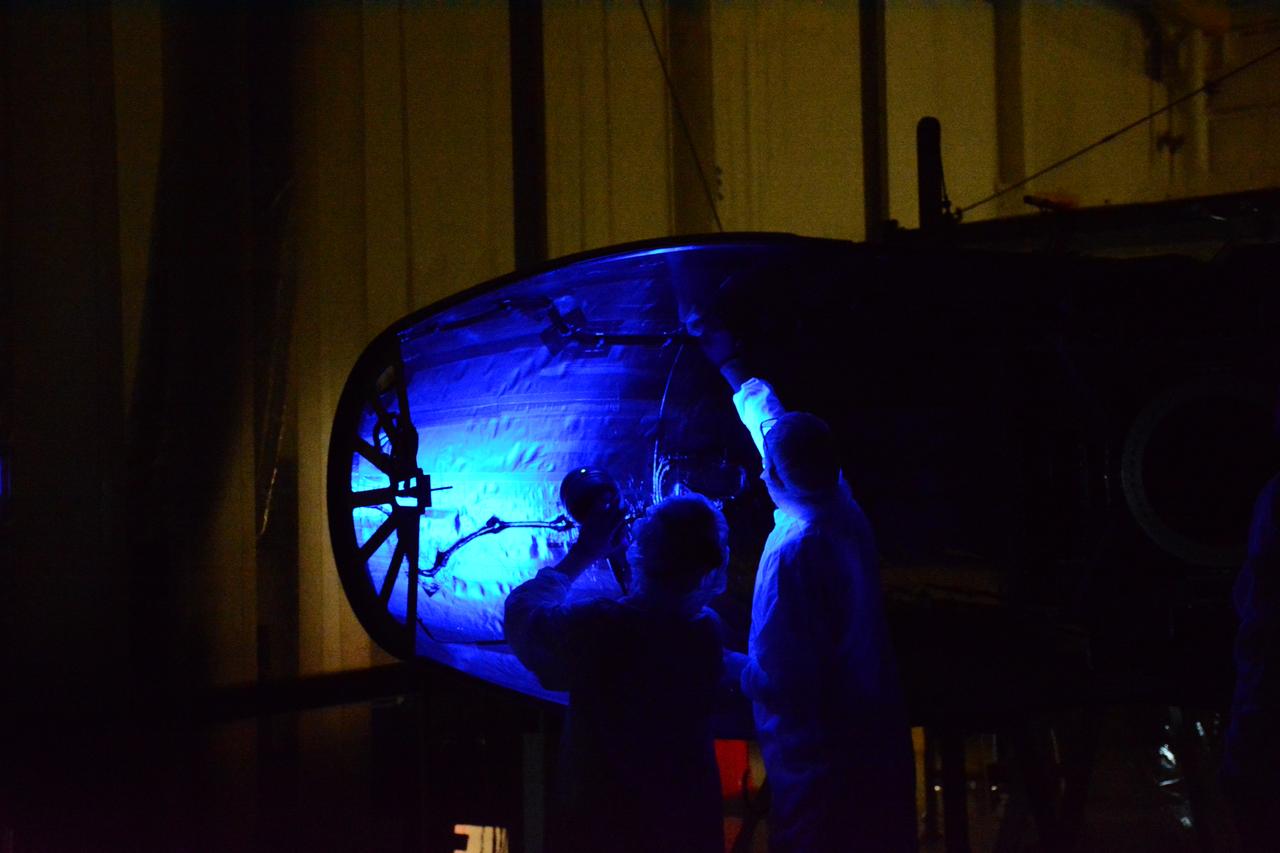
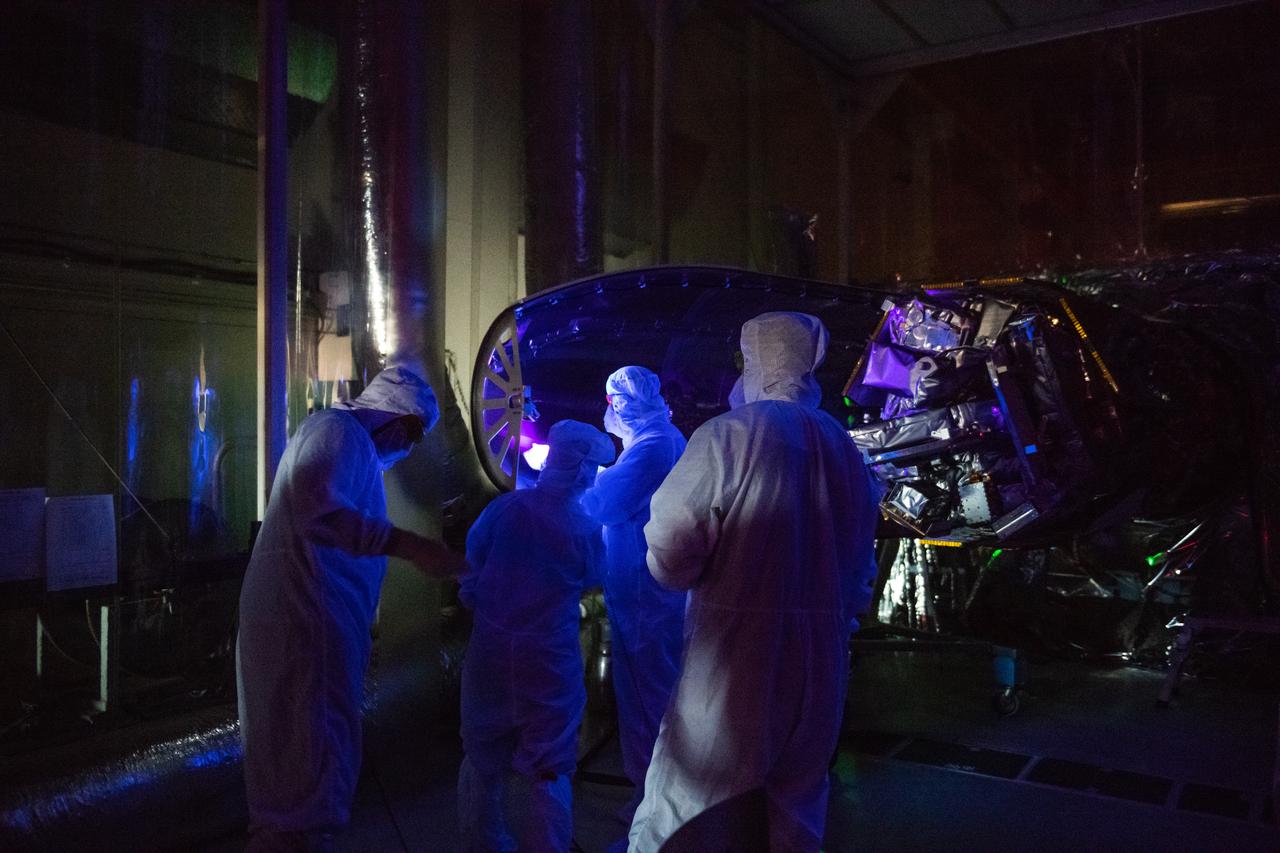
Technicians with Orbital ATK perform a black light test on the Pegasus XL fairing inside Building 1555 at Vandenberg Air Force Base in California. NASA’s Cyclone Global Navigation Satellite System (CYGNSS) is being prepared at Vandenberg, and then will be transported to NASA’s Kennedy Space Center in Florida aboard the Orbital ATK Pegasus XL rocket which will be attached to the Orbital ATK L-1011 Stargazer aircraft. CYGNSS will launch on the Pegasus XL rocket from the Skid Strip at Cape Canaveral Air Force Station. CYGNSS will make frequent and accurate measurements of ocean surface winds throughout the life cycle of tropical storms and hurricanes. The data that CYGNSS provides will enable scientists to probe key air-sea interaction processes that take place near the core of storms, which are rapidly changing and play a critical role in the beginning and intensification of hurricanes.
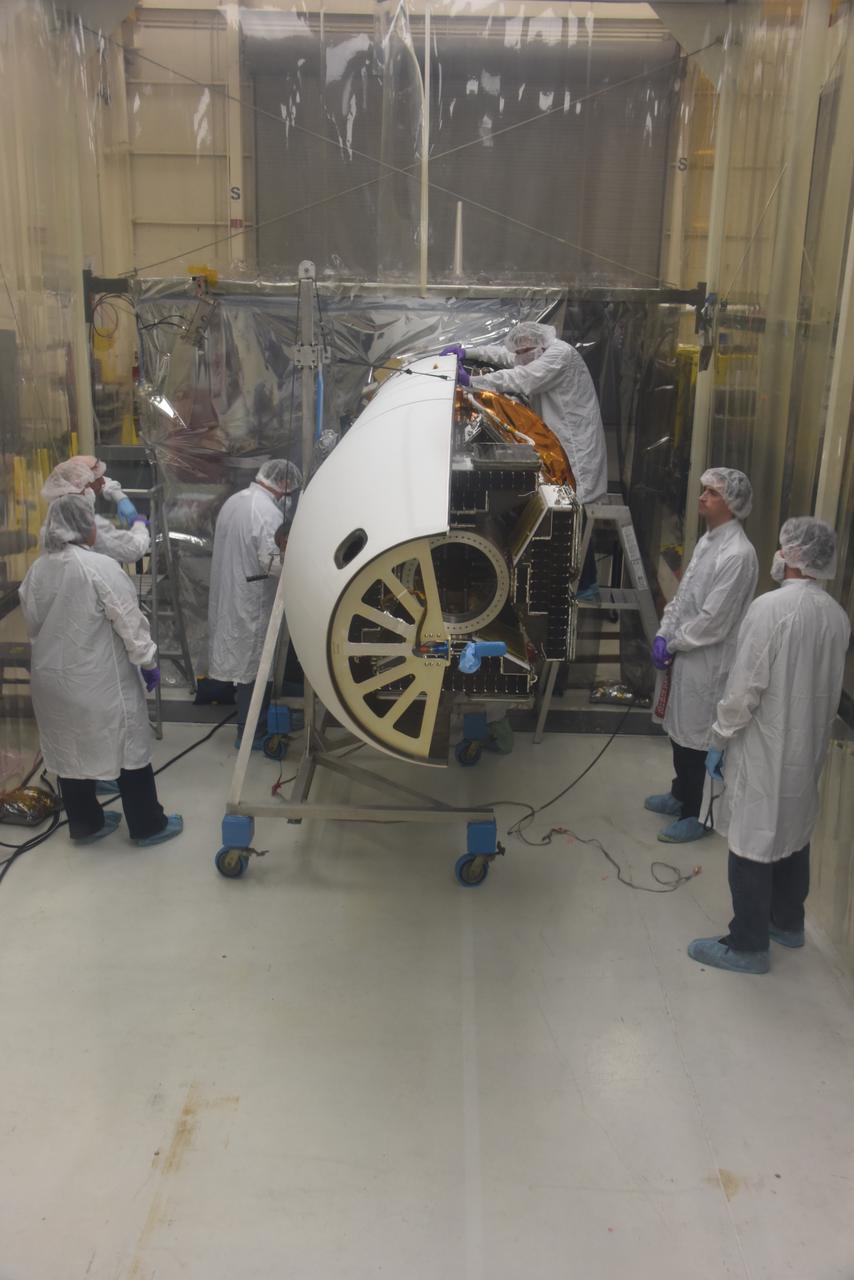
Technicians with Orbital ATK install the first half of the Pegasus XL fairing around NASA’s Cyclone Global Navigation Satellite System (CYGNSS) in Building 1555 at Vandenberg Air Force Base in California. CYGNSS is being prepared at Vandenberg, and then will be transported to NASA’s Kennedy Space Center in Florida aboard the Orbital ATK Pegasus XL rocket which will be attached to the Orbital ATK L-1011 carrier aircraft. CYGNSS will launch on the Pegasus XL rocket from the Skid Strip at Cape Canaveral Air Force Station. CYGNSS will make frequent and accurate measurements of ocean surface winds throughout the life cycle of tropical storms and hurricanes. The data that CYGNSS provides will enable scientists to probe key air-sea interaction processes that take place near the core of storms, which are rapidly changing and play a critical role in the beginning and intensification of hurricanes.
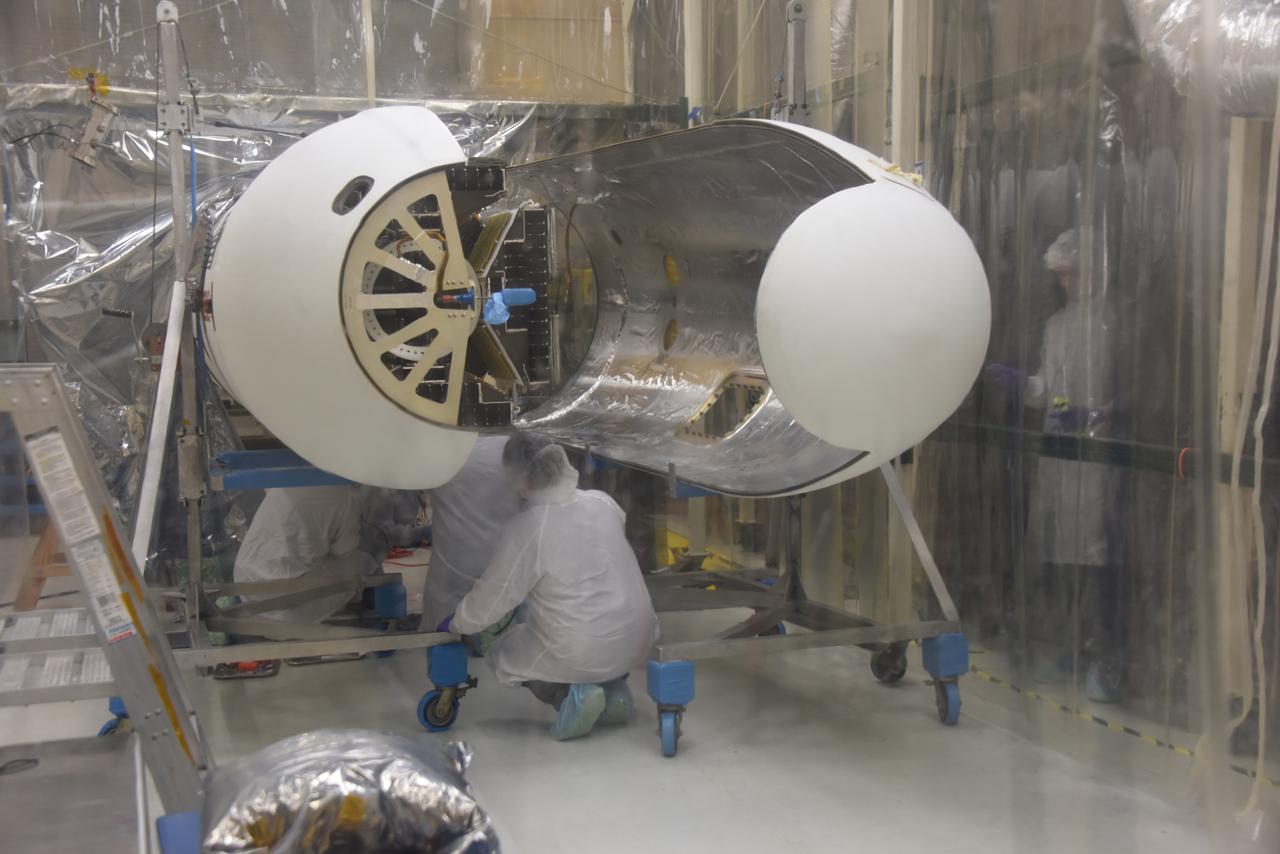
Technicians with Orbital ATK have installed the first half of the Pegasus XL fairing around NASA’s Cyclone Global Navigation Satellite System (CYGNSS) in Building 1555 at Vandenberg Air Force Base in California. Work is underway to install the second half of the fairing. CYGNSS is being prepared at Vandenberg, and then will be transported to NASA’s Kennedy Space Center in Florida aboard the Orbital ATK Pegasus XL rocket which will be attached to the Orbital ATK L-1011 carrier aircraft. CYGNSS will launch on the Pegasus XL rocket from the Skid Strip at Cape Canaveral Air Force Station. CYGNSS will make frequent and accurate measurements of ocean surface winds throughout the life cycle of tropical storms and hurricanes. The data that CYGNSS provides will enable scientists to probe key air-sea interaction processes that take place near the core of storms, which are rapidly changing and play a critical role in the beginning and intensification of hurricanes.
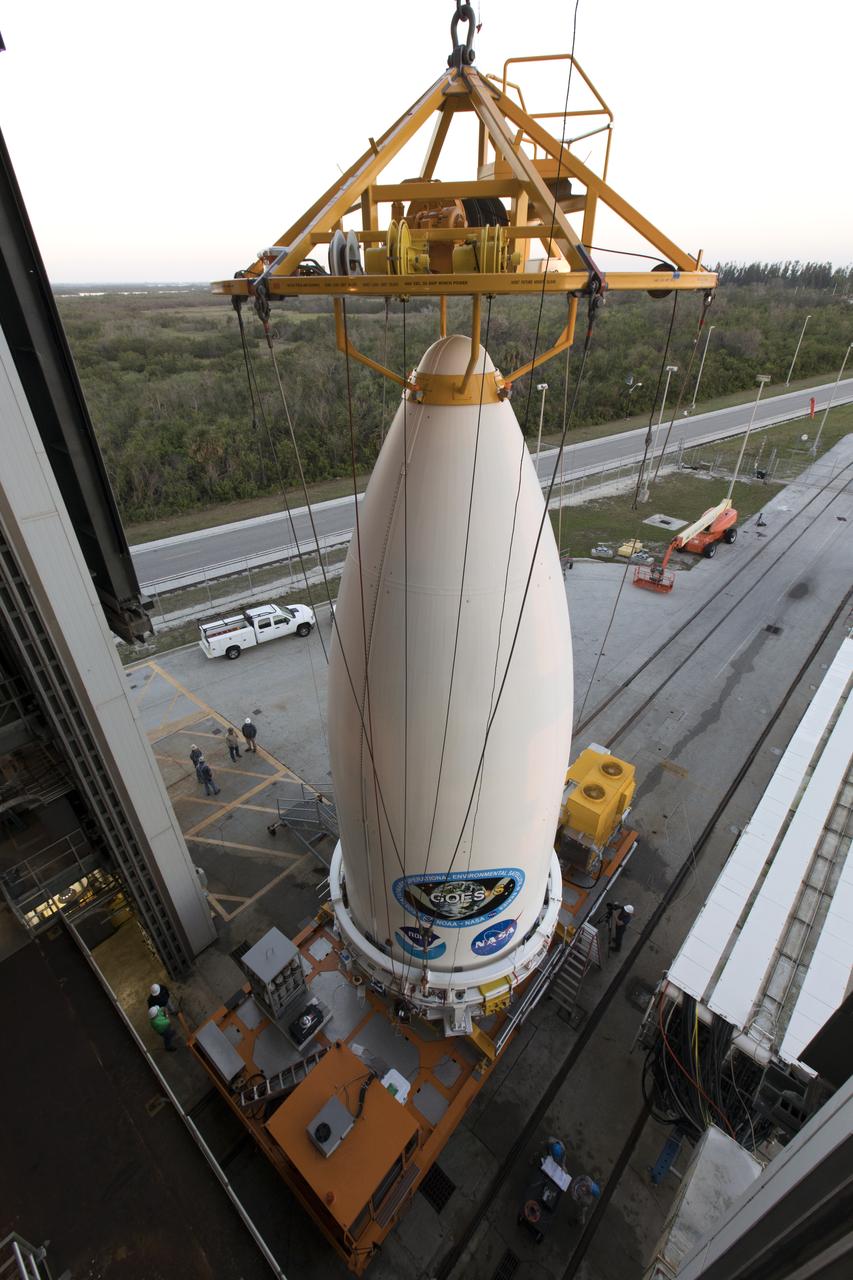
A view from above shows a crane attached to the payload fairing containing NOAA's Geostationary Operational Environmental Satellite-S (GOES-S). The fairing will be lifted and moved into the Vertical Integration Facility at Space Launch Complex 41 at Cape Canaveral Air Force Station in Florida. The fairing will be lifted and mated to the ULA Atlas V rocket. GOES-S is the second in a series of four advanced geostationary weather satellites. The satellite is slated to launch aboard the ULA Atlas V on March 1.
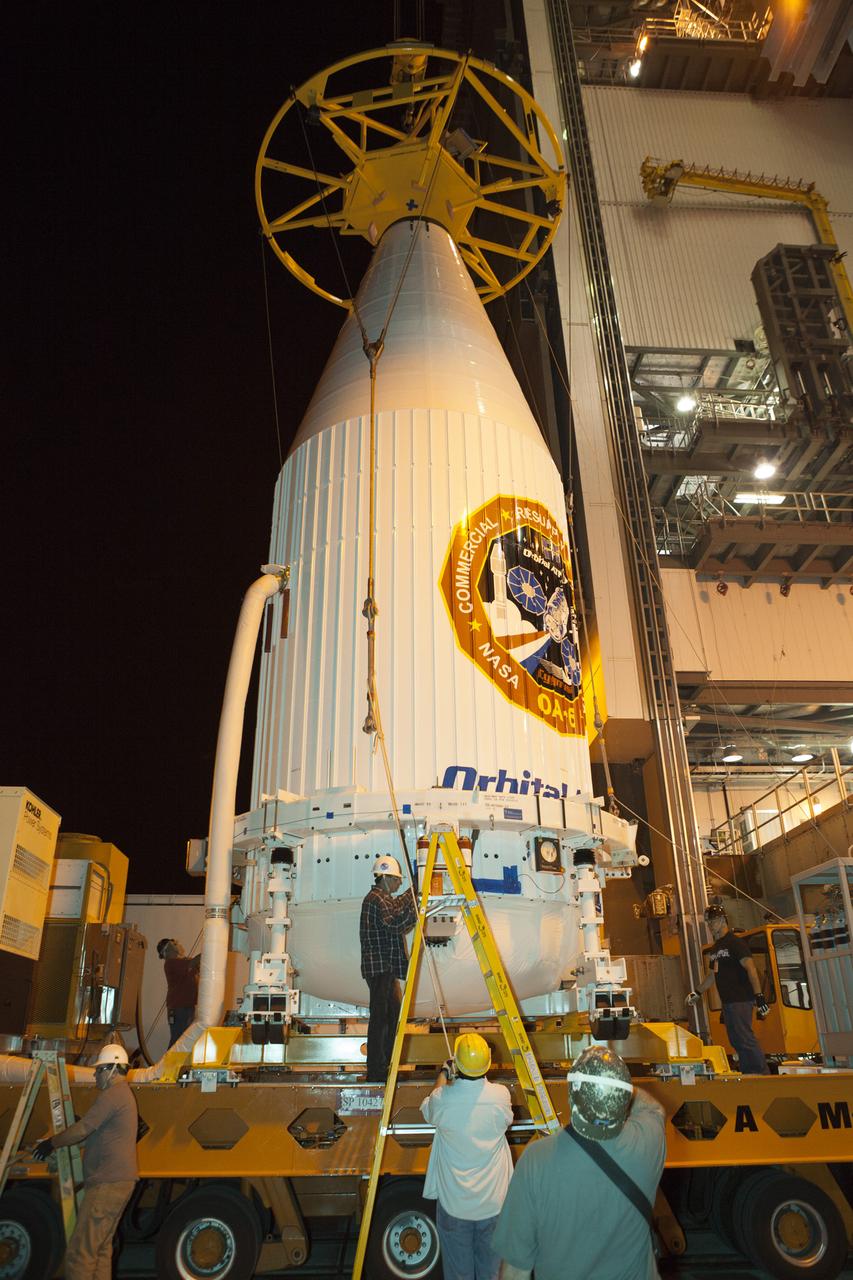
Encapsulated inside its payload fairing, the Cygnus spacecraft for the upcoming Orbital ATK Commercial Resupply Services-6 is prepared for lifting to be mated atop a United Launch Alliance Atlas V rocket.
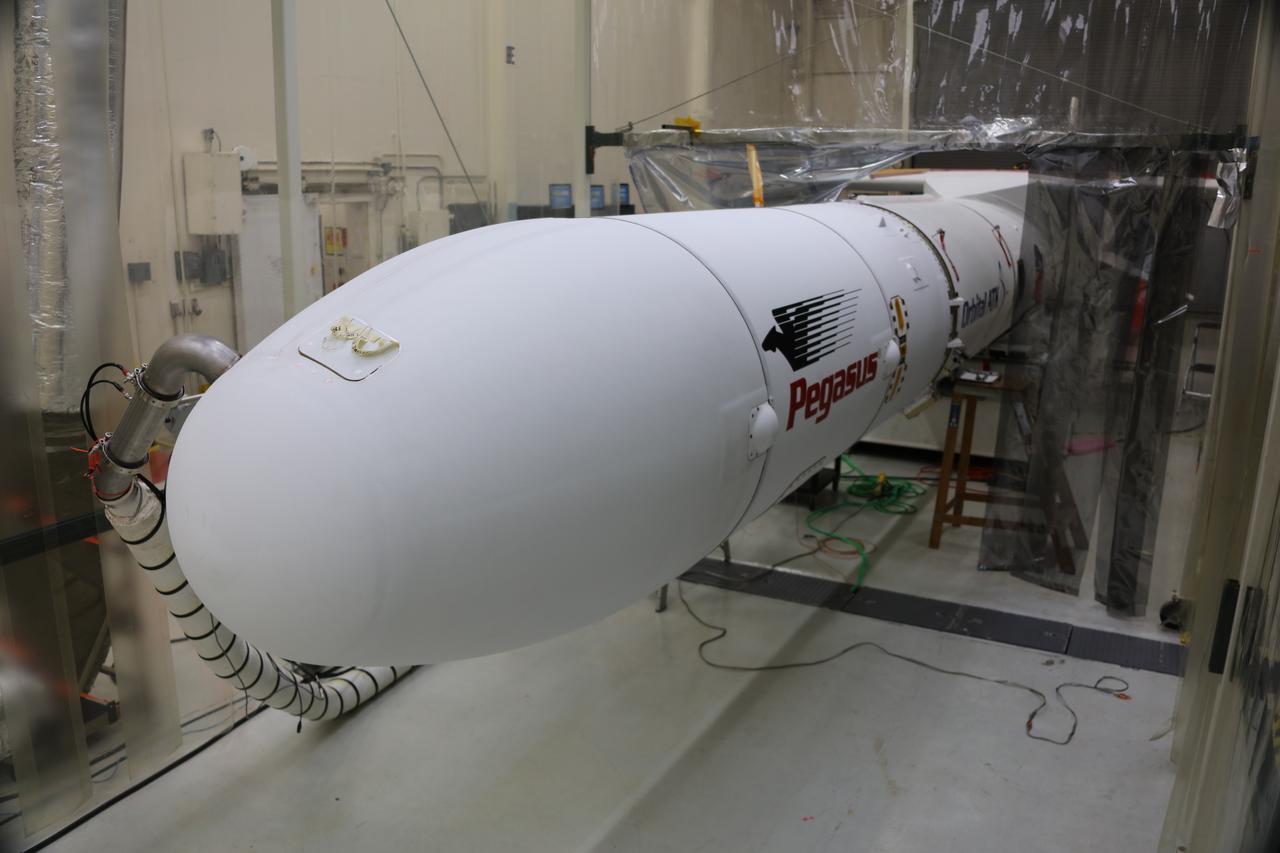
In Building 1555 at Vandenberg Air Force Base in California, an Orbital ATK Pegasus XL rocket is seen after payload fairing installation. On board Pegasus are eight NASA Cyclone Global Navigation Satellite System, or CYGNSS, spacecraft. When preparations are competed at Vandenberg, the L-1011/Pegasus XL combination will be flown to NASA’s Kennedy Space Center in Florida. On Dec. 12, 2016, the carrier aircraft is scheduled to take off from the Skid Strip at Cape Canaveral Air Force Station and CYGNSS will launch on the Pegasus XL rocket with the L-1011 flying off shore. CYGNSS satellites will make frequent and accurate measurements of ocean surface winds throughout the life cycle of tropical storms and hurricanes. The data that CYGNSS provides will help scientists to probe key air-sea interaction processes that take place near the core of storms, which are rapidly changing and play a crucial role in the beginning and intensification of hurricanes.
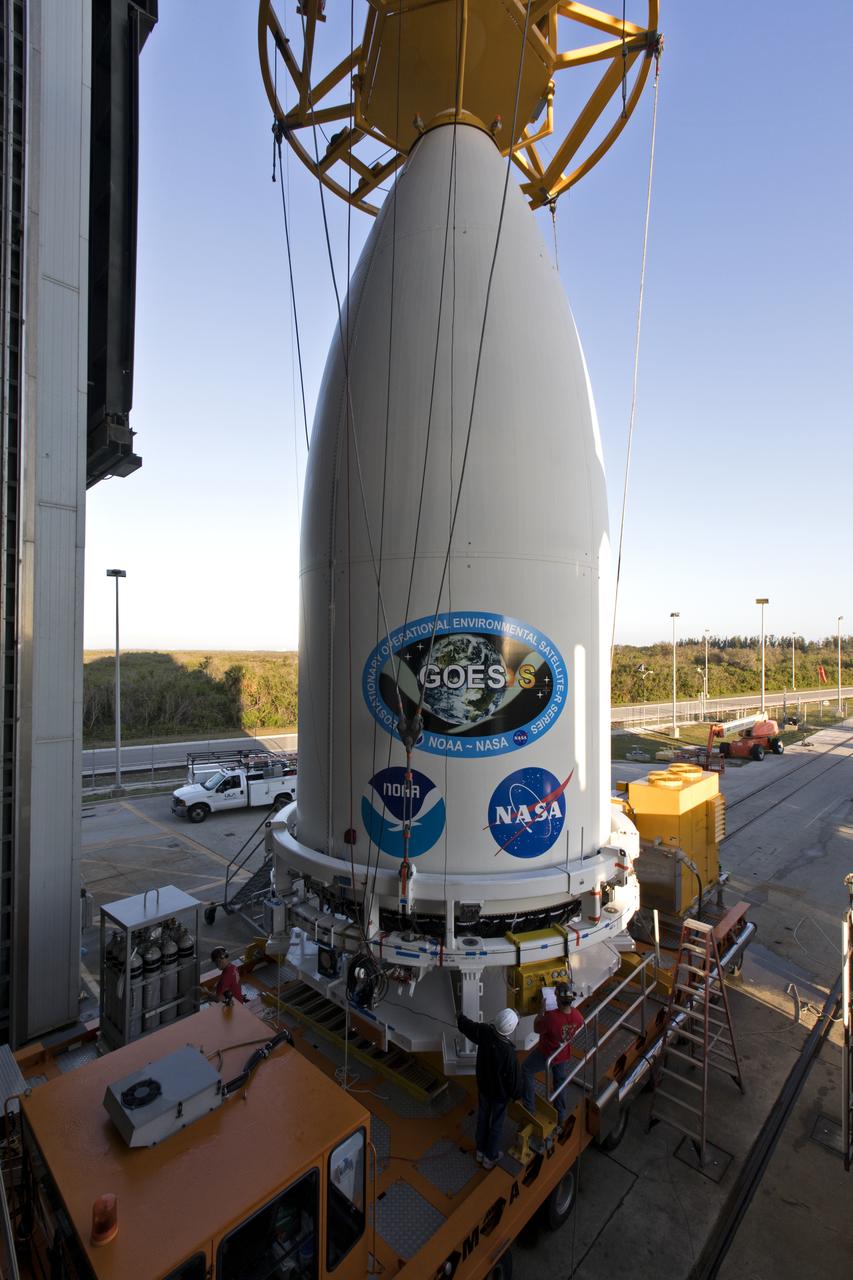
A crane is attached to the payload fairing containing NOAA's Geostationary Operational Environmental Satellite-S (GOES-S) and preparations are underway to lift it up and into the United Launch Alliance (ULA) Horizontal Integration Facility at Space Launch Complex 41 at Cape Canaveral Air Force Station in Florida. The fairing will be mated to the ULA Atlas V rocket. GOES-S is the second in a series of four advanced geostationary weather satellites. The satellite is slated to launch aboard the ULA Atlas V on March 1.
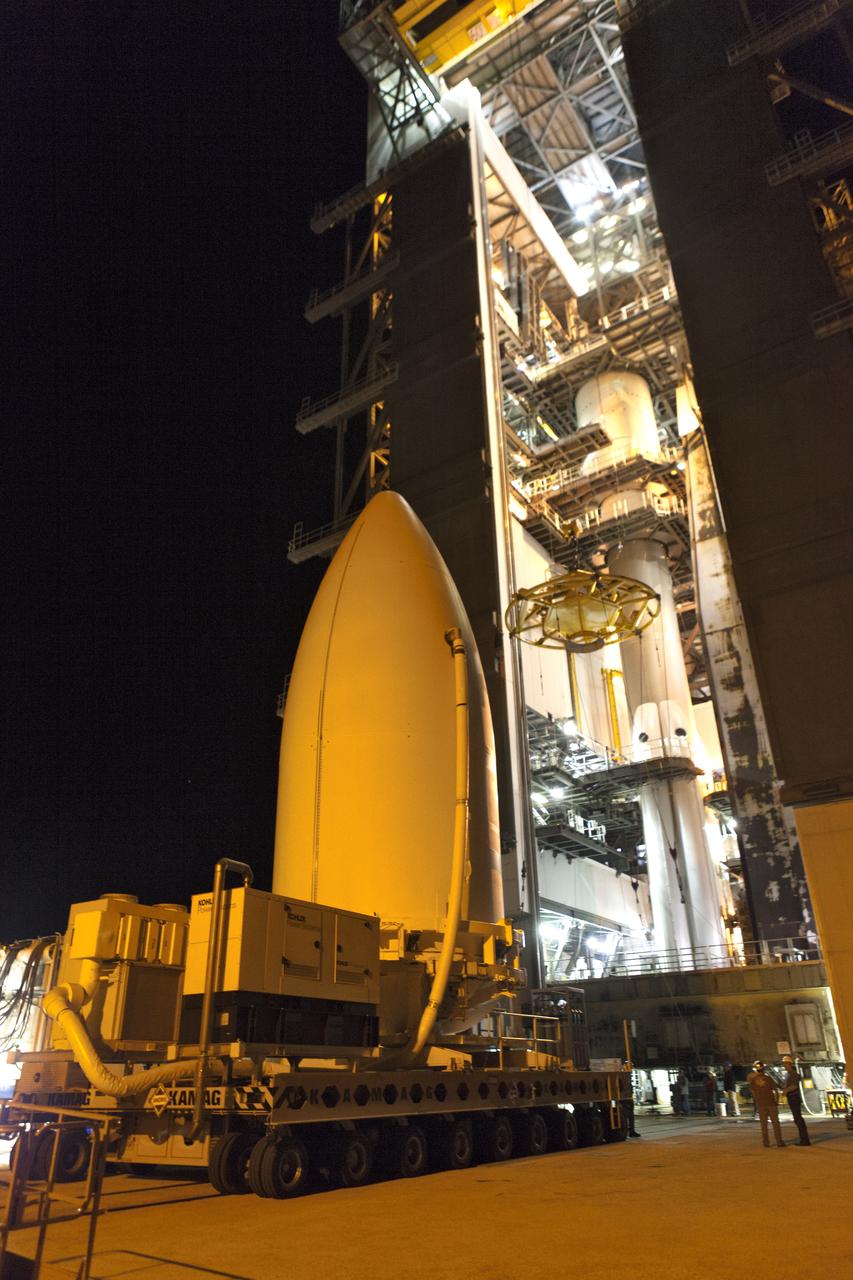
The payload fairing containing NOAA's Geostationary Operational Environmental Satellite-S (GOES-S), secured on a transporter, arrives at the United Launch Alliance (ULA) Vertical Integration Facility at Space Launch Complex 41 at Cape Canaveral Air Force Station in Florida. The payload fairing will be lifted and mated to the ULA Atlas V rocket. GOES-S is the second in a series of four advanced geostationary weather satellites. GOES-S is slated to launch aboard the ULA Atlas V on March 1.
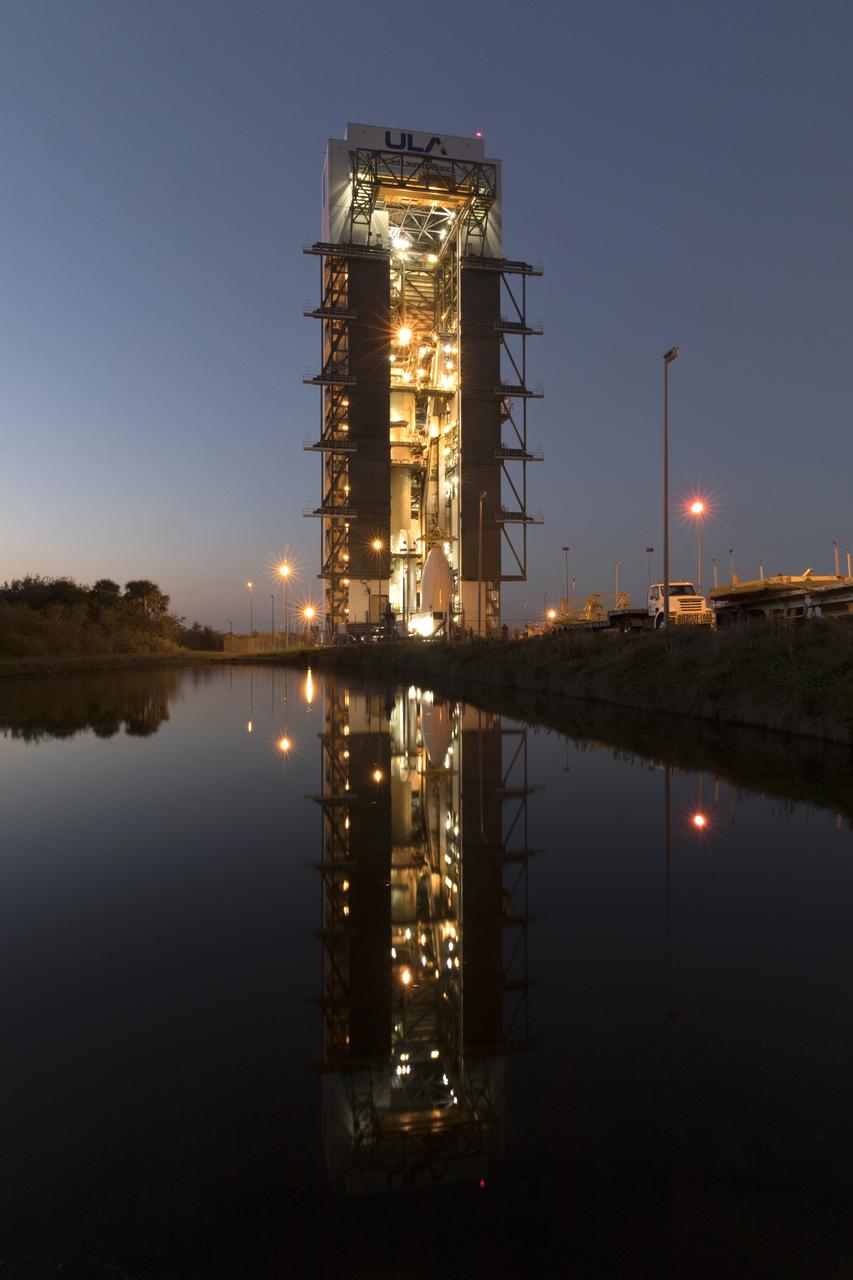
The United Launch Alliance (ULA) Vertical Integration Facility (VIF) is reflected in the water at Space Launch Complex 41 at Cape Canaveral Air Force Station in Florida, as a crane begins to lift the payload fairing containing NOAA's Geostationary Operational Environmental Satellite-S (GOES-S). The fairing will be lifted and mated to the ULA Atlas V rocket. GOES-S is the second in a series of four advanced geostationary weather satellites. The satellite is slated to launch aboard the ULA Atlas V on March 1.
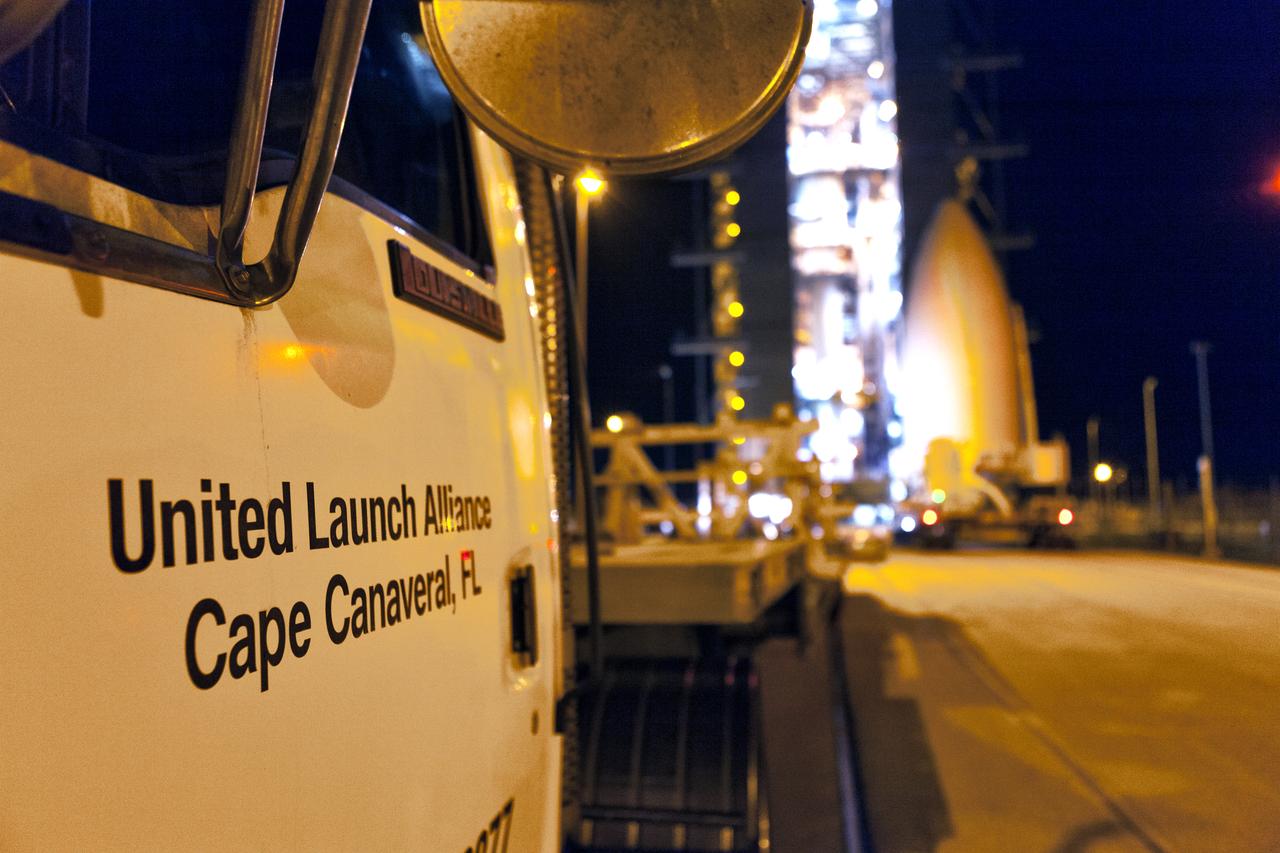
The payload fairing containing NOAA's Geostationary Operational Environmental Satellite-S (GOES-S), secured on a transporter, arrives at the United Launch Alliance (ULA) Vertical Integration Facility at Space Launch Complex 41 at Cape Canaveral Air Force Station in Florida. The payload fairing will be lifted and mated to the ULA Atlas V rocket. GOES-S is the second in a series of four advanced geostationary weather satellites. GOES-S is slated to launch aboard the ULA Atlas V on March 1.
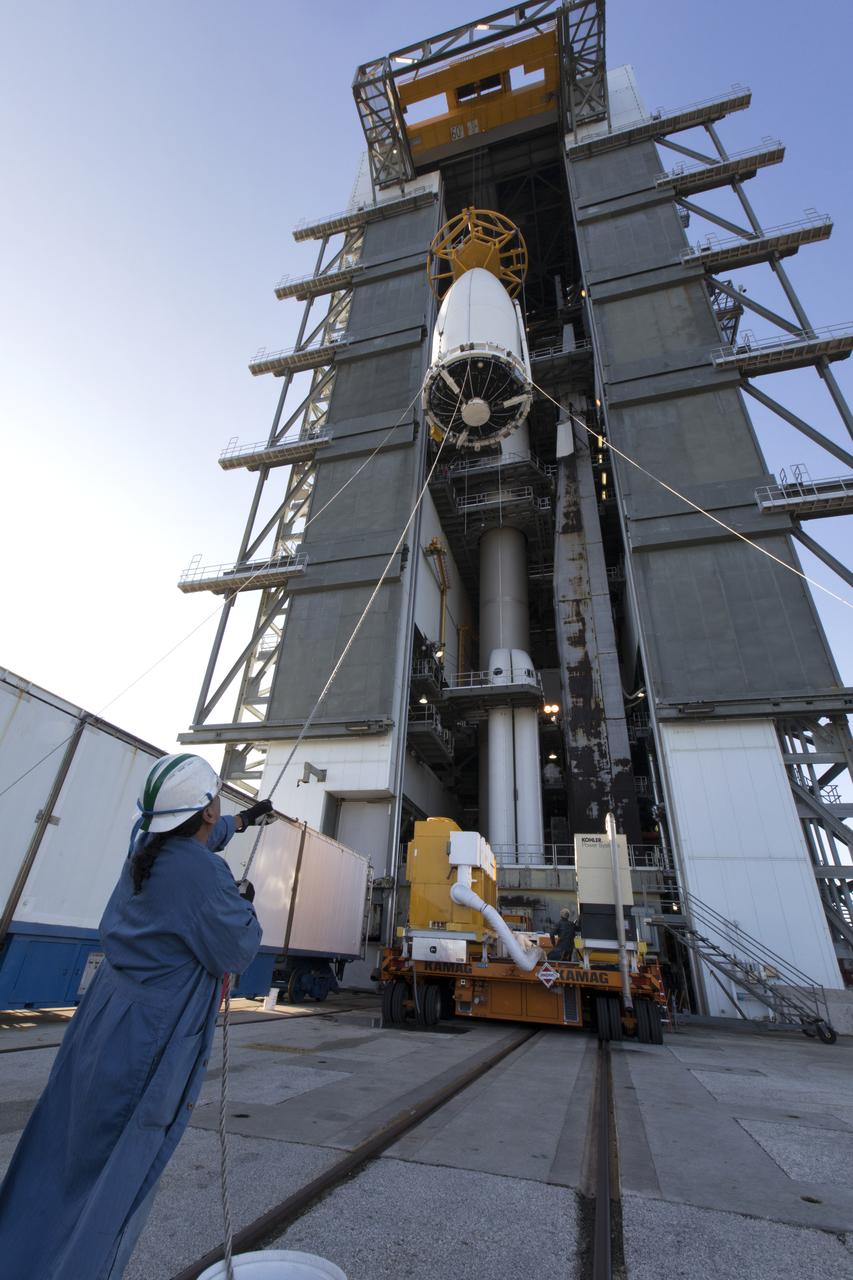
The payload fairing containing NOAA's Geostationary Operational Environmental Satellite-S (GOES-S) is lifted up by crane at the United Launch Alliance (ULA) Vertical Integration Facility at Space Launch Complex 41 at Cape Canaveral Air Force Station in Florida. The fairing will be mated to the ULA Atlas V rocket. GOES-S is the second in a series of four advanced geostationary weather satellites. The satellite is slated to launch aboard the ULA Atlas V on March 1.
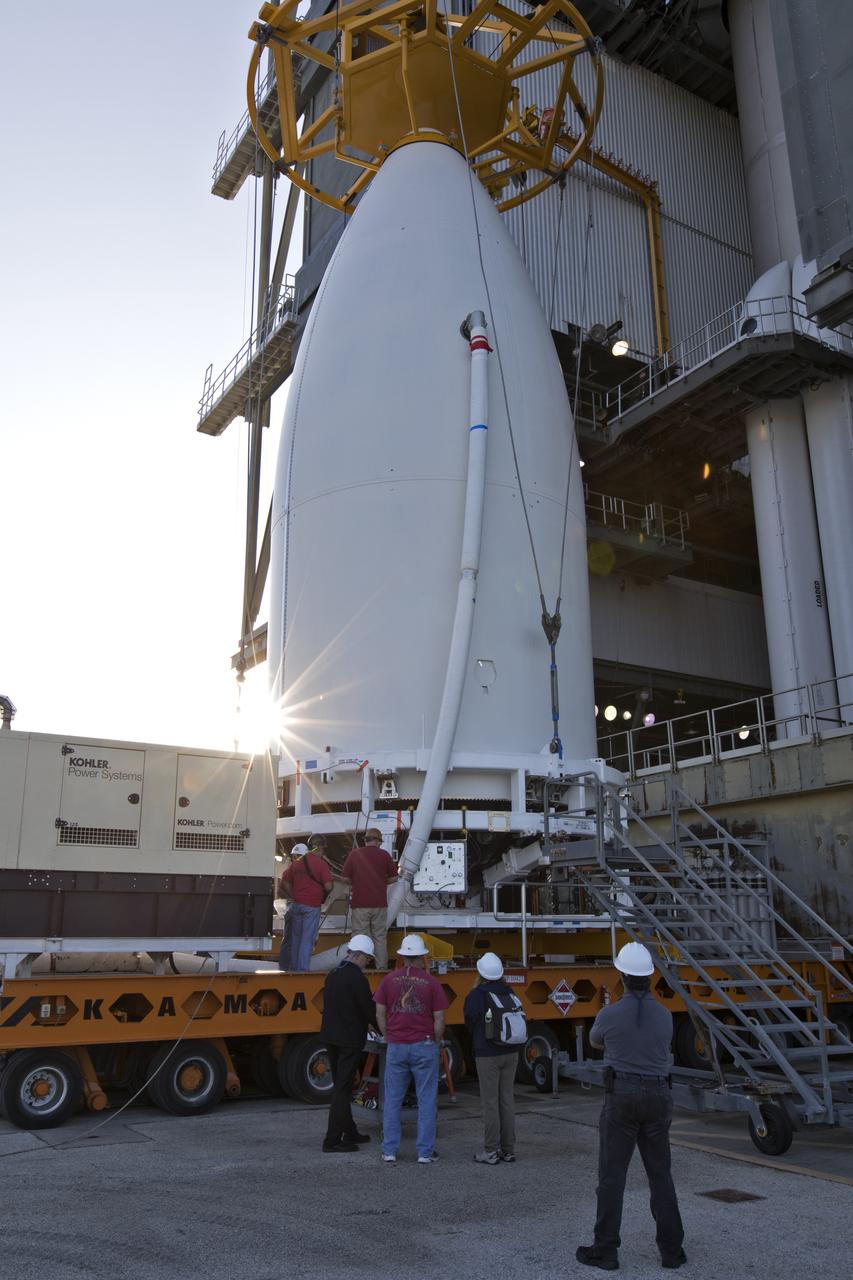
Preparations are underway to lift the payload fairing containing NOAA's Geostationary Operational Environmental Satellite-S (GOES-S) up and into the United Launch Alliance (ULA) Vertical Integration Facility at Space Launch Complex 41 at Cape Canaveral Air Force Station in Florida. The fairing will be mated to the ULA Atlas V rocket. GOES-S is the second in a series of four advanced geostationary weather satellites. The satellite is slated to launch aboard the ULA Atlas V on March 1.
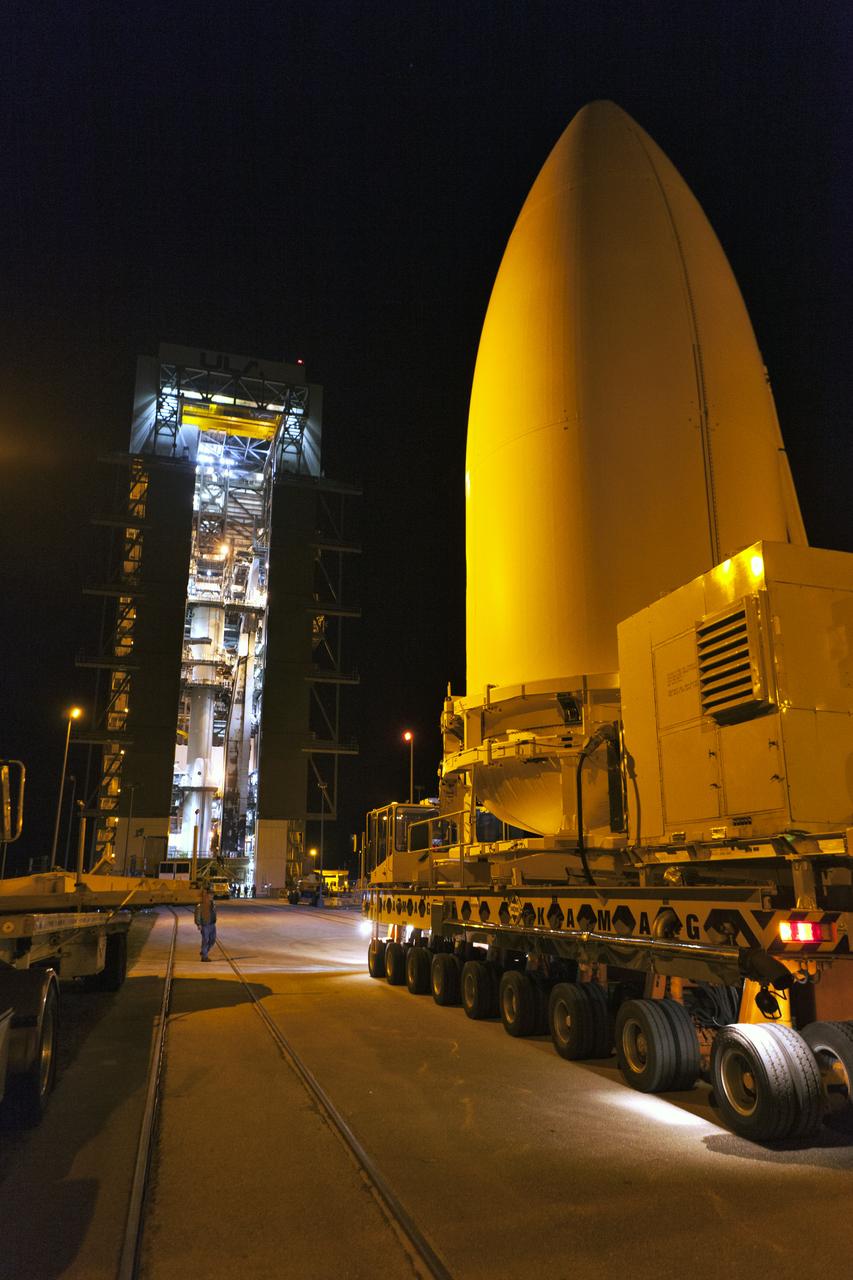
The payload fairing containing NOAA's Geostationary Operational Environmental Satellite-S (GOES-S), secured on a transporter, arrives at the United Launch Alliance (ULA) Vertical Integration Facility at Space Launch Complex 41 at Cape Canaveral Air Force Station in Florida. The payload fairing will be lifted and mated to the ULA Atlas V rocket. GOES-S is the second in a series of four advanced geostationary weather satellites. GOES-S is slated to launch aboard the ULA Atlas V on March 1.
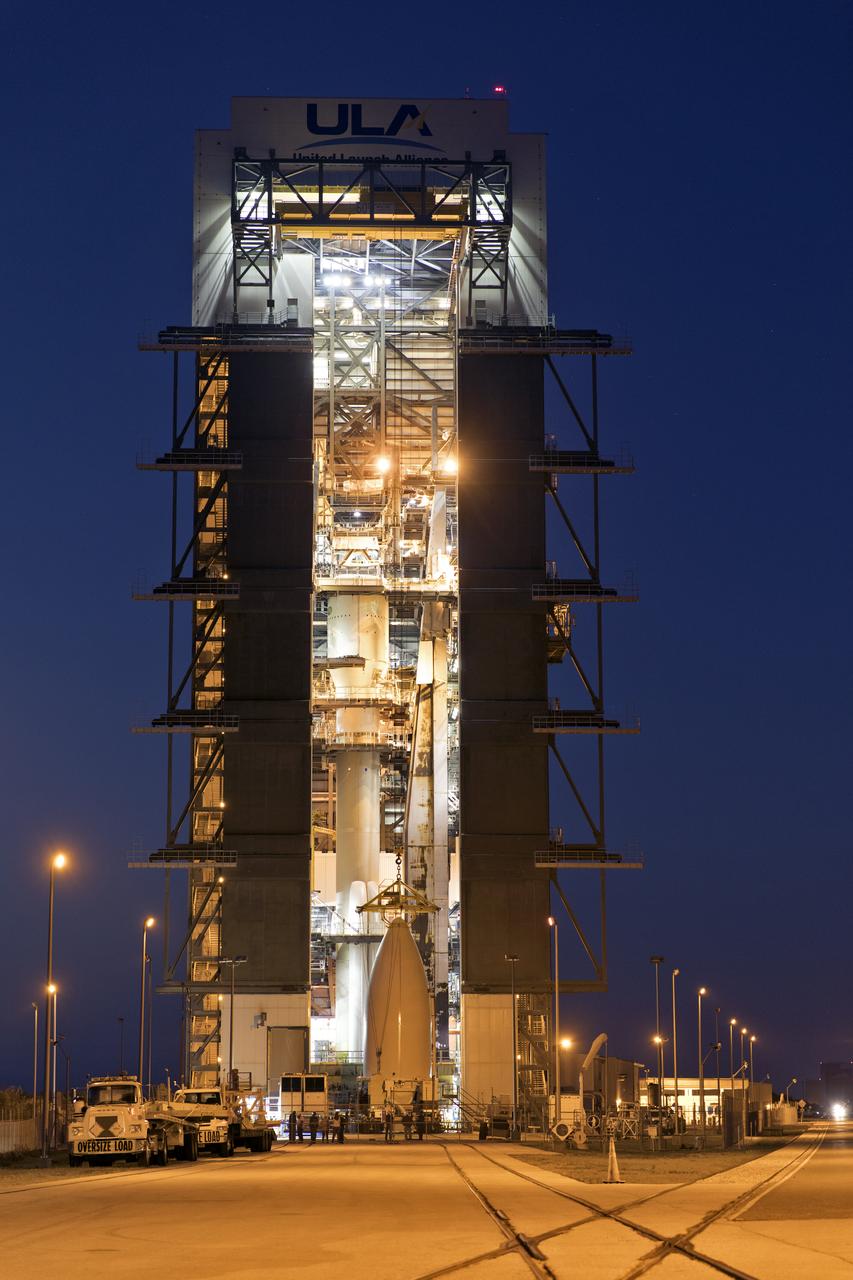
A crane has been attached to the payload fairing containing NOAA's Geostationary Operational Environmental Satellite-S (GOES-S) at the United Launch Alliance (ULA) Vertical Integration Facility at Space Launch Complex 41 at Cape Canaveral Air Force Station in Florida. The fairing will be lifted and mated to the ULA Atlas V rocket. GOES-S is the second in a series of four advanced geostationary weather satellites. The satellite is slated to launch aboard the ULA Atlas V on March 1.
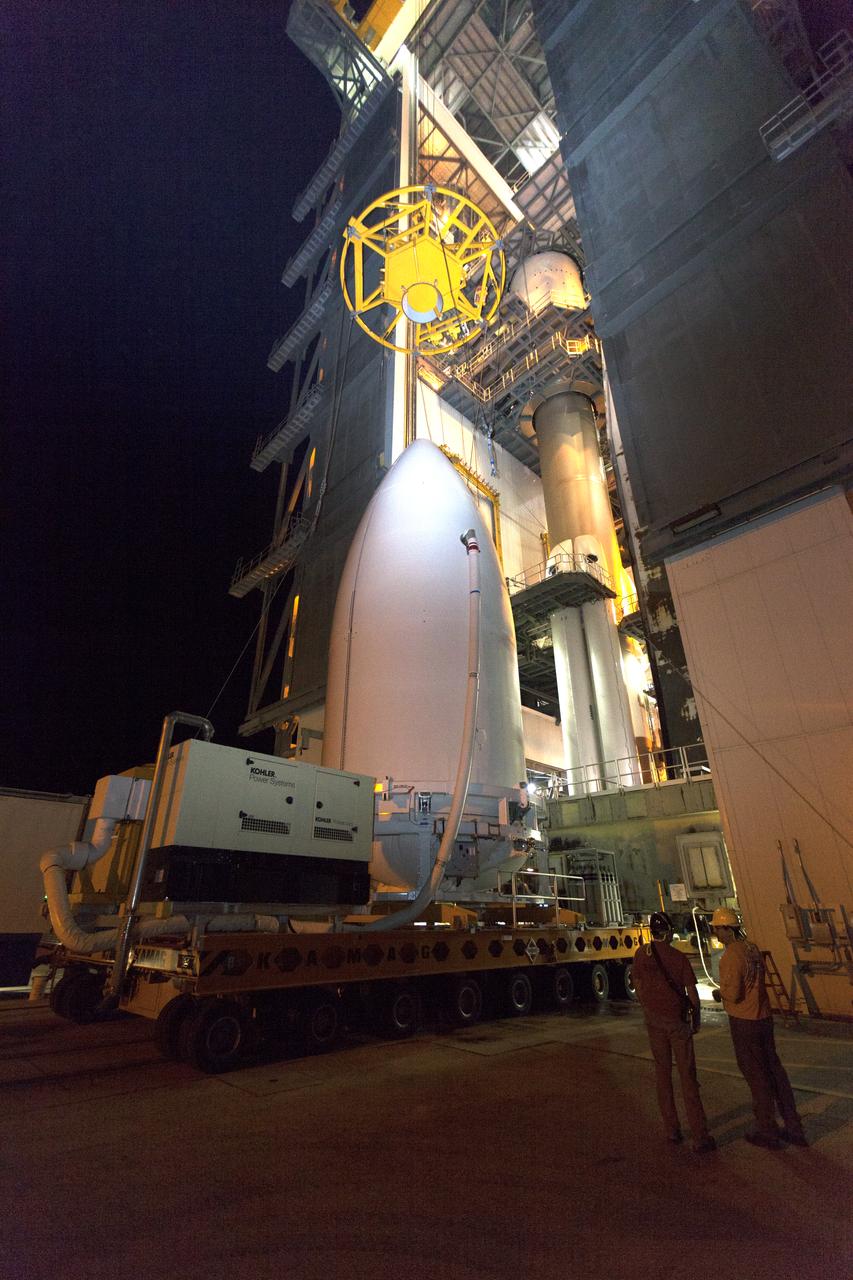
The payload fairing containing NOAA's Geostationary Operational Environmental Satellite-S (GOES-S), secured on a transporter, arrives at the United Launch Alliance (ULA) Vertical Integration Facility at Space Launch Complex 41 at Cape Canaveral Air Force Station in Florida. The payload fairing will be lifted and mated to the ULA Atlas V rocket. GOES-S is the second in a series of four advanced geostationary weather satellites. GOES-S is slated to launch aboard the ULA Atlas V on March 1.
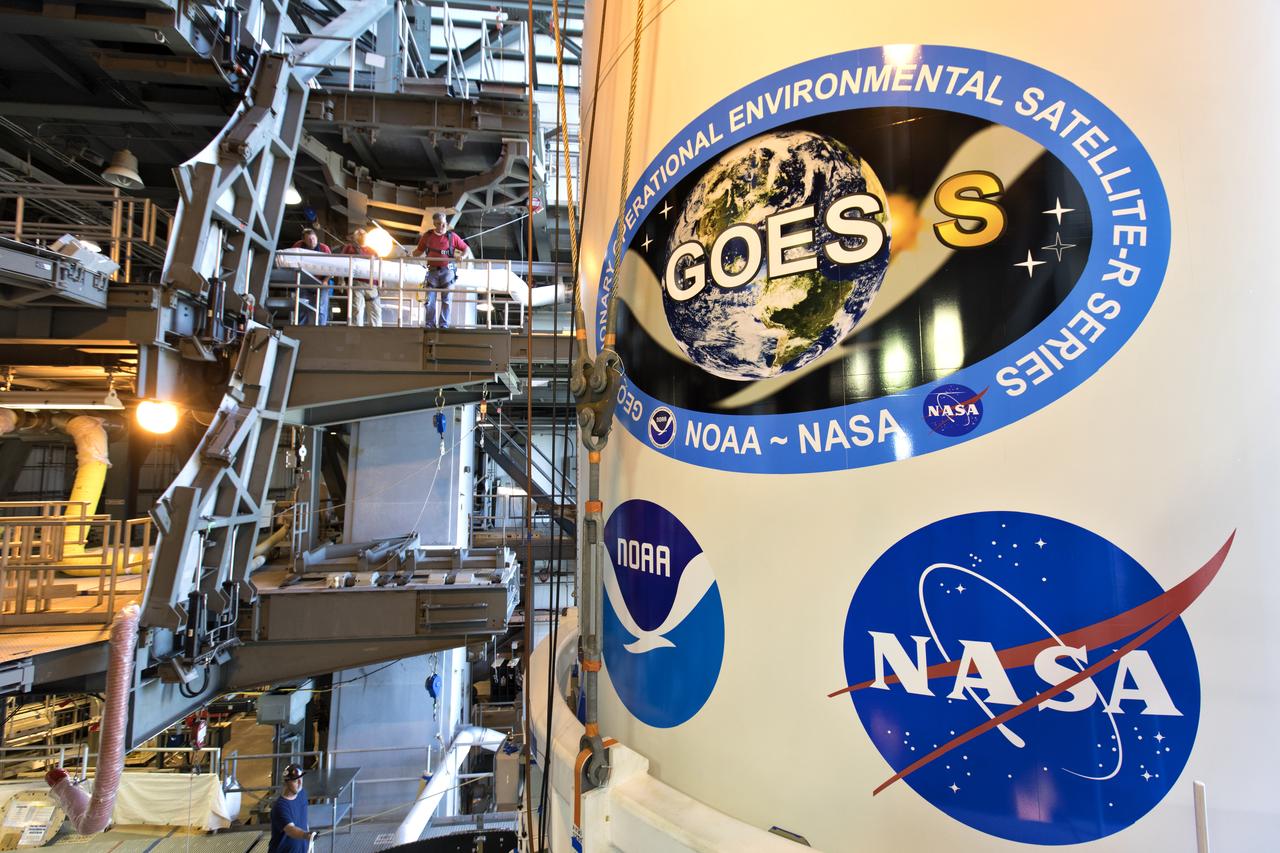
The payload fairing containing NOAA's Geostationary Operational Environmental Satellite-S (GOES-S) was lifted up by crane and moved into the United Launch Alliance (ULA) Vertical Integration Facility at Space Launch Complex 41 at Cape Canaveral Air Force Station in Florida. The fairing will be mated to the ULA Atlas V rocket. GOES-S is the second in a series of four advanced geostationary weather satellites. The satellite is slated to launch aboard the ULA Atlas V on March 1.
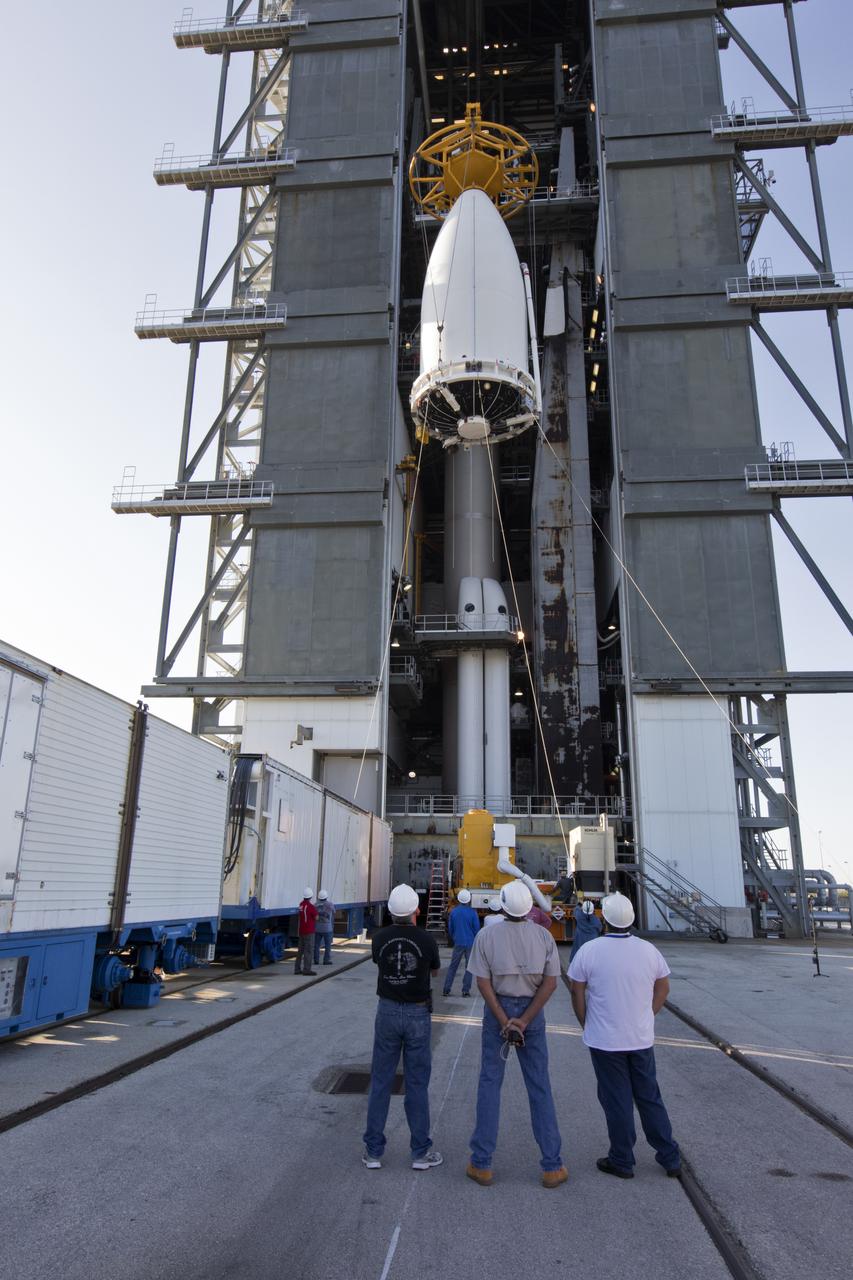
The payload fairing containing NOAA's Geostationary Operational Environmental Satellite-S (GOES-S) is lifted up by crane at the United Launch Alliance (ULA) Vertical Integration Facility at Space Launch Complex 41 at Cape Canaveral Air Force Station in Florida. The fairing will be mated to the ULA Atlas V rocket. GOES-S is the second in a series of four advanced geostationary weather satellites. The satellite is slated to launch aboard the ULA Atlas V on March 1.
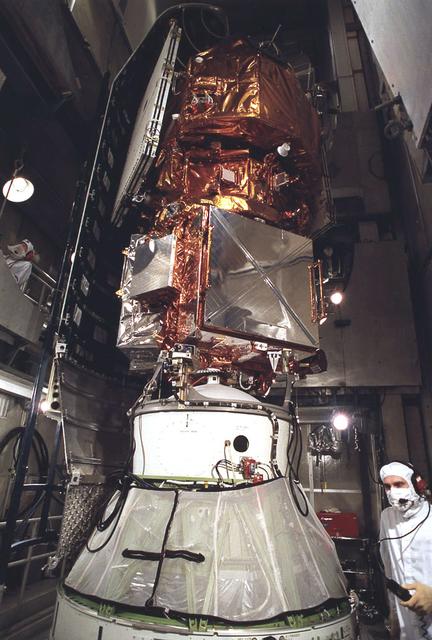
At Launch Complex 17 Pad A, Kennedy Space Center (KSC) workers are installing the payload fairing around the Extreme Ultraviolet Explorer (EUVE) mated to a Delta II rocket. The EUVE spacecraft is designed to study the extreme ultraviolet portion of the spectrum.

KENNEDY SPACE CENTER, FLA. -- Workers in the Multi-Payload Processing Facility prepare to install the port fairing on the Galaxy Evolution Explorer (GALEX). The spacecraft is already mated to the Pegasus launch vehicle. After encapsulation, the GALEX/Pegasus will be transported to Cape Canaveral Air Force Station and mated to the L-1011 about four days before launch. A new launch date has not been determined.

KENNEDY SPACE CENTER, FLA. -- The port fairing closes in on the Galaxy Evolution Explorer (GALEX). The spacecraft is already mated to the Pegasus launch vehicle. After encapsulation, the GALEX/Pegasus will be transported to Cape Canaveral Air Force Station and mated to the L-1011 about four days before launch. A new launch date has not been determined.
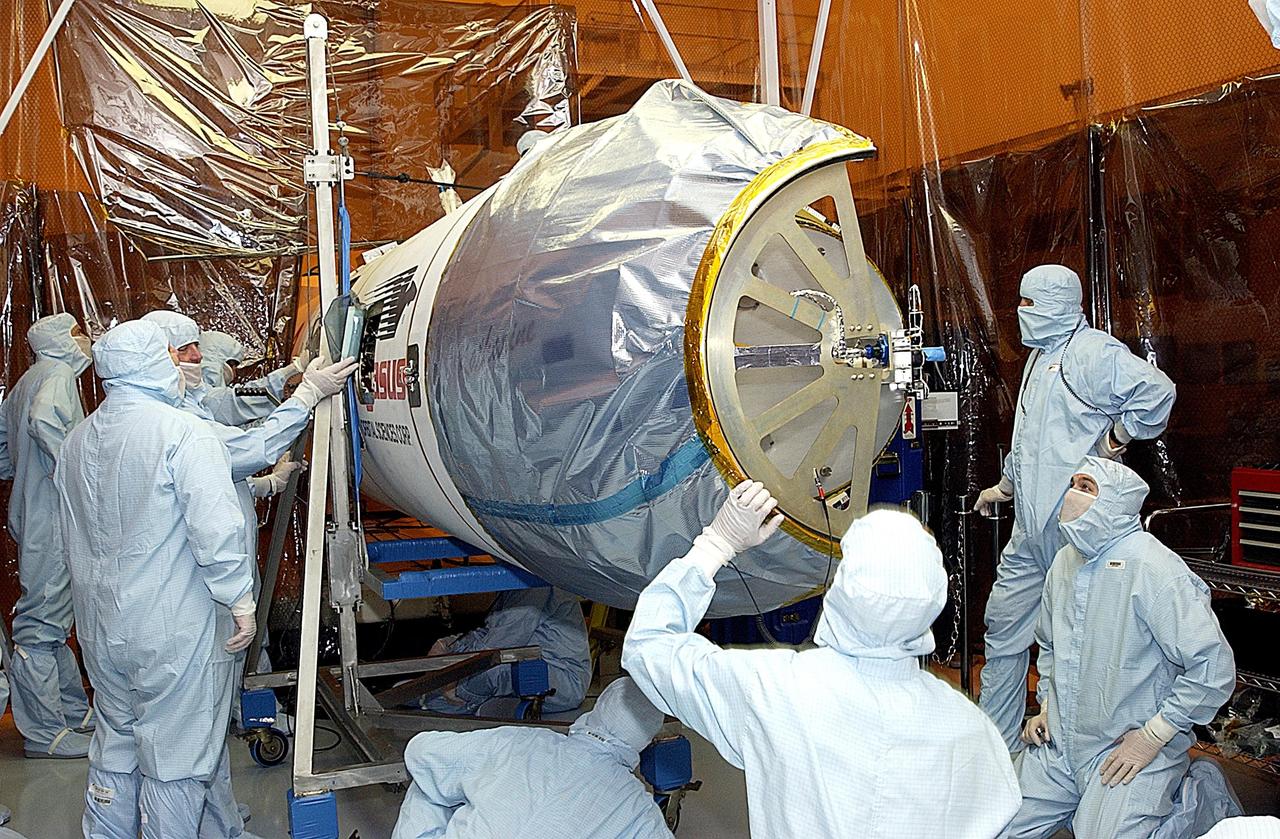
KENNEDY SPACE CENTER, FLA. -- The first part of the fairing encloses the Galaxy Evolution Explorer (GALEX). The spacecraft is already mated to the Pegasus launch vehicle. After encapsulation, the GALEX/Pegasus will be transported to Cape Canaveral Air Force Station and mated to the L-1011 about four days before launch. A new launch date has not been determined.
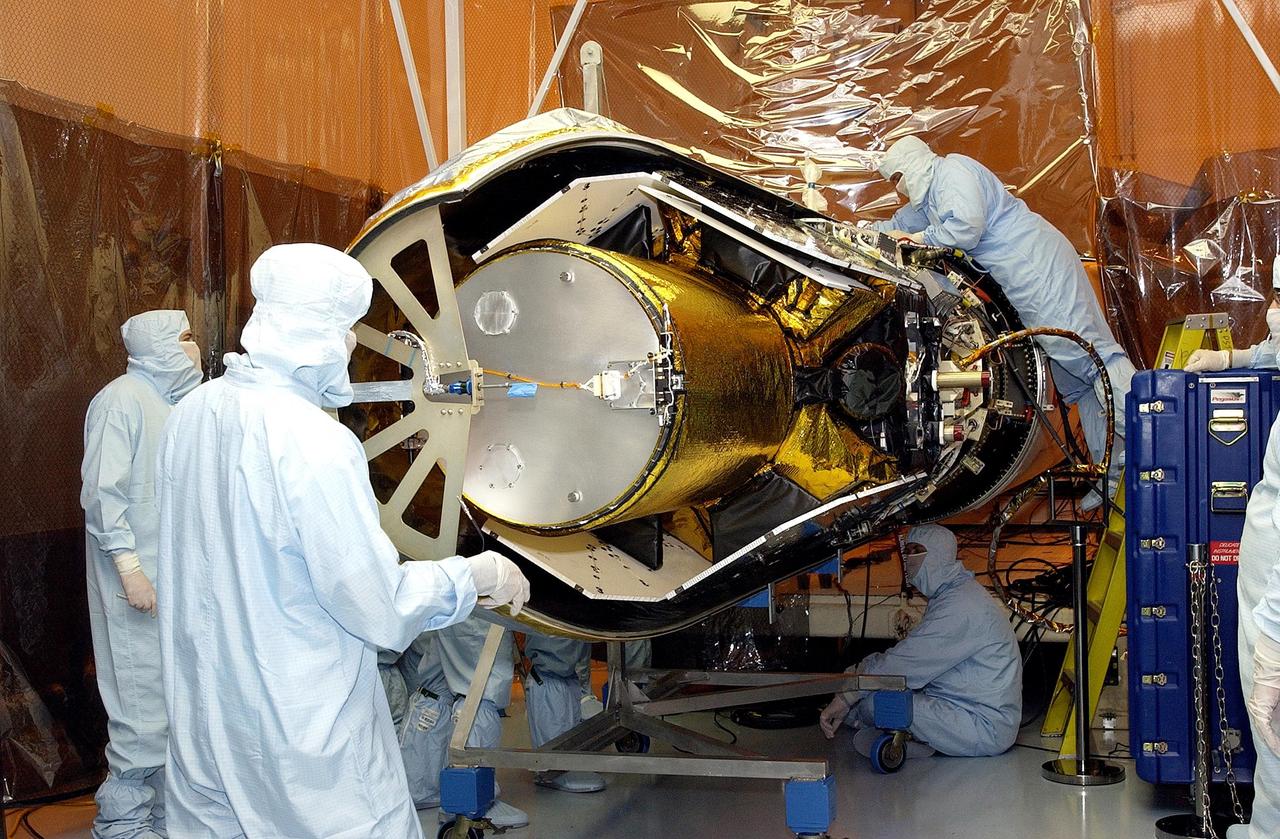
KENNEDY SPACE CENTER, FLA. -- A worker leans over the fairing covering half of the Galaxy Evolution Explorer (GALEX) to make adjustments. The spacecraft is already mated to the Pegasus launch vehicle. After encapsulation, the GALEX/Pegasus will be transported to Cape Canaveral Air Force Station and mated to the L-1011 about four days before launch. A new launch date has not been determined.
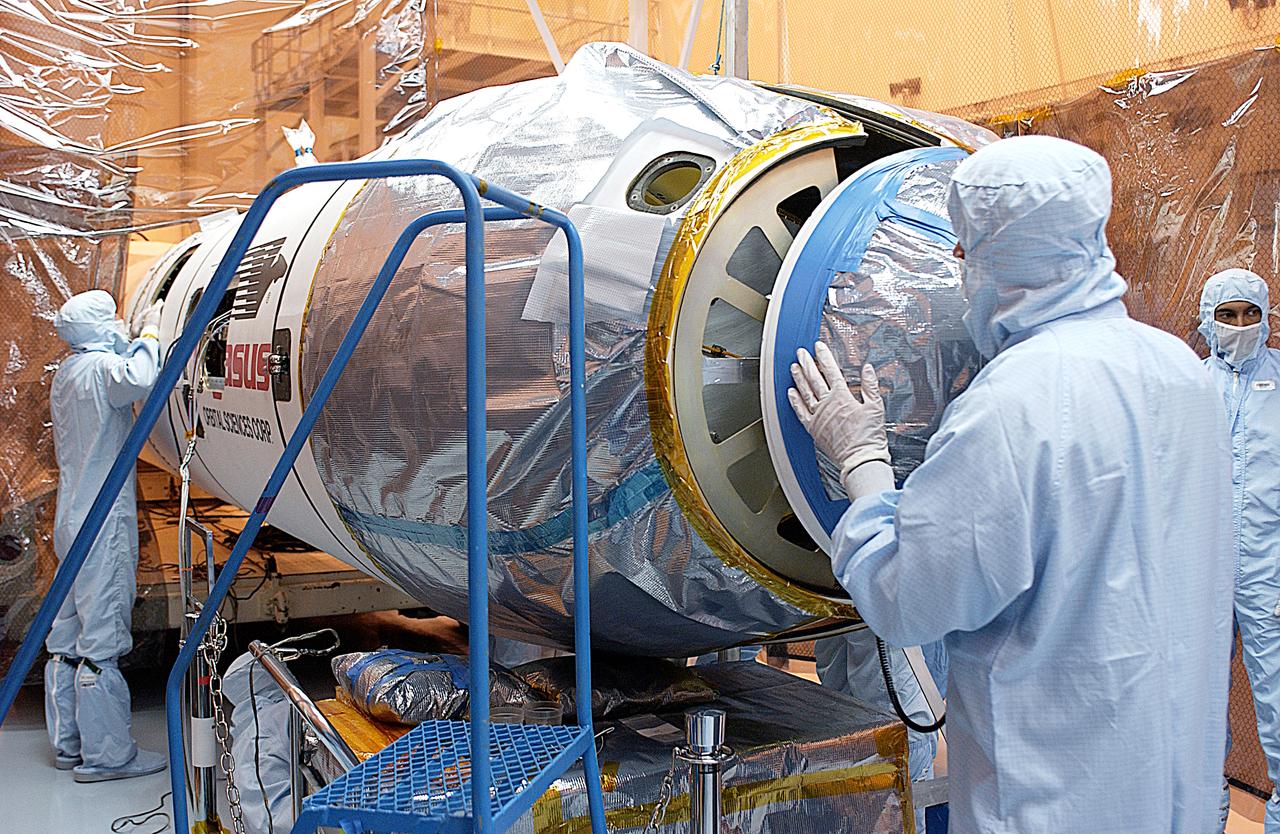
Workers in the Multi-Payload Processing Facility prepare to close the port fairing around the Galaxy Evolution Explorer (GALEX). The spacecraft is already mated to the Pegasus launch vehicle. After encapsulation, the GALEX/Pegasus will be transported to Cape Canaveral Air Force Station and mated to the L-1011 about four days before launch. A new launch date has not been determined.
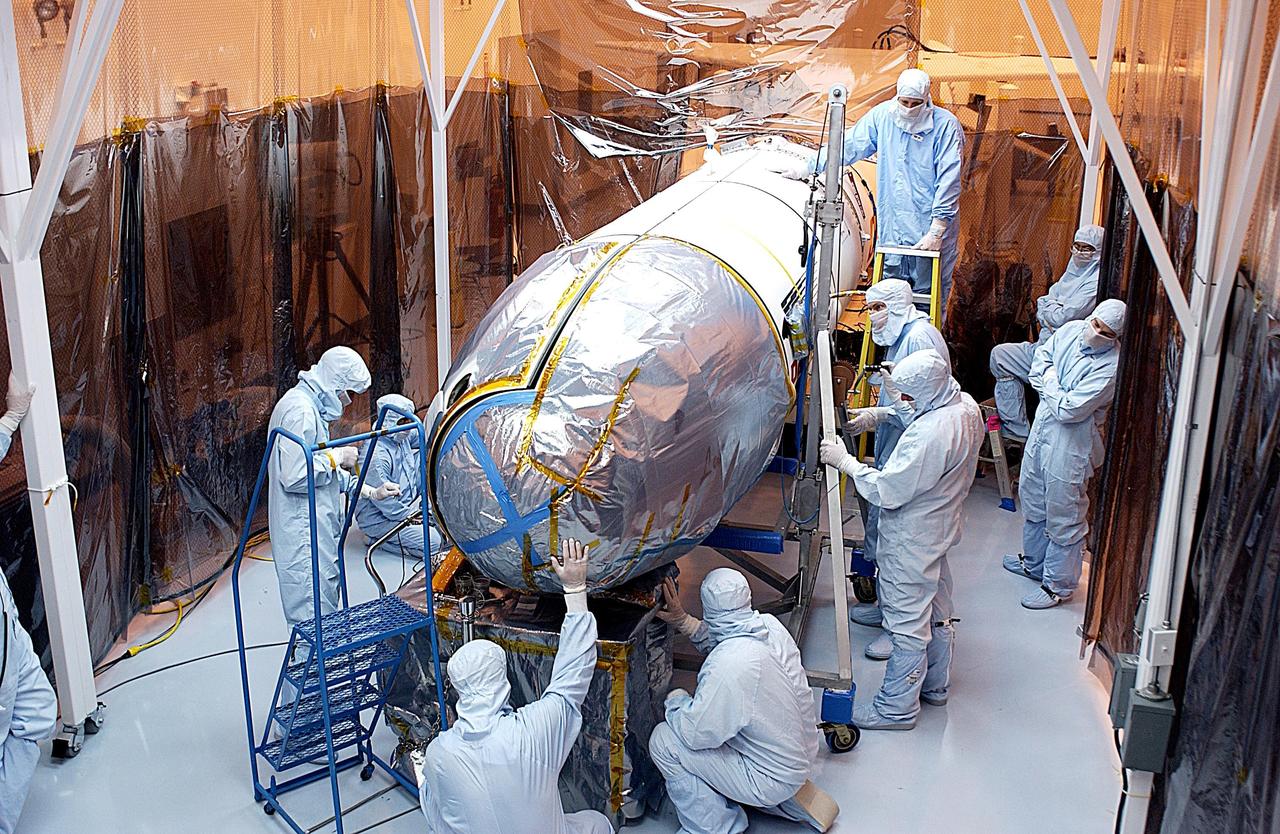
KENNEDY SPACE CENTER, FLA. -- Workers in the Multi-Payload Processing Facility close the fairing around the Galaxy Evolution Explorer (GALEX). The spacecraft is already mated to the Pegasus launch vehicle. After encapsulation, the GALEX/Pegasus will be transported to Cape Canaveral Air Force Station and mated to the L-1011 about four days before launch. A new launch date has not been determined.
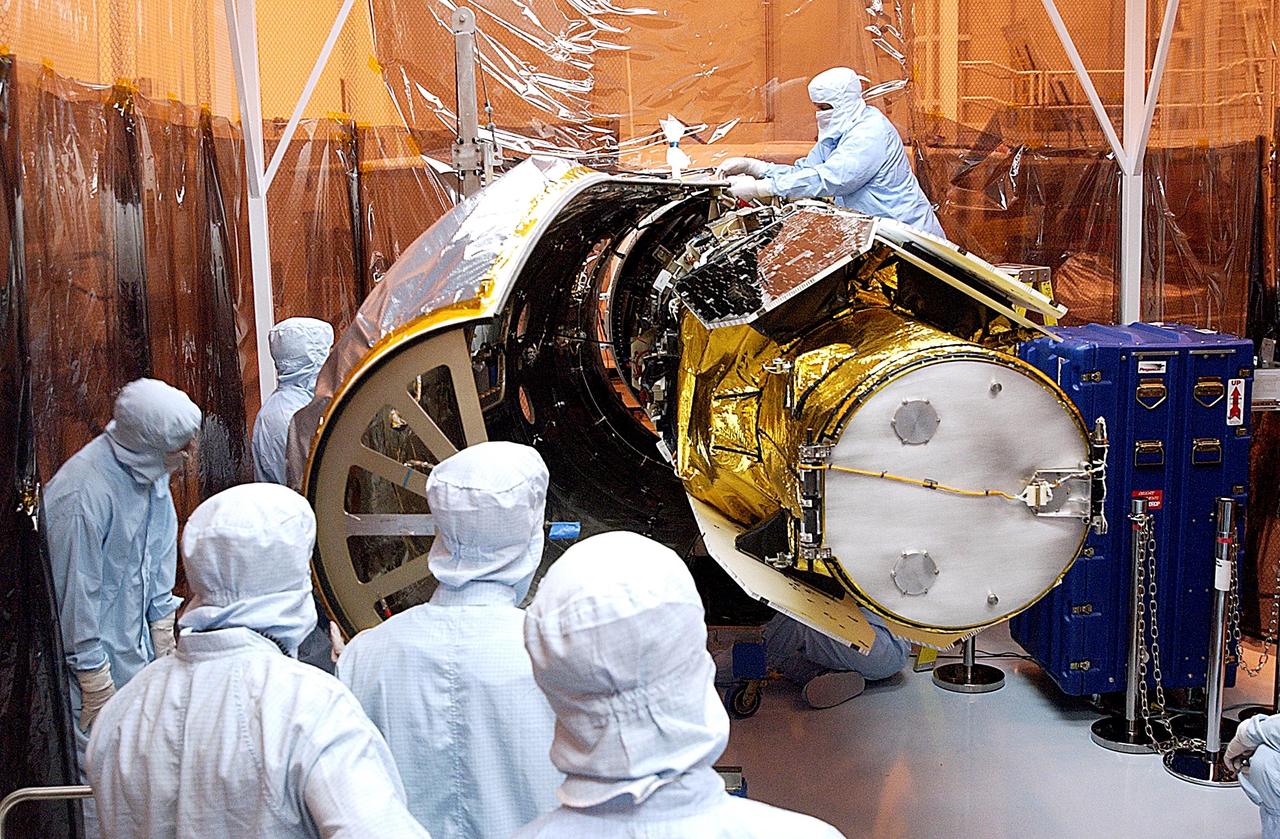
KENNEDY SPACE CENTER, FLA. -- Workers watch as the first part of the fairing closes in on the Galaxy Evolution Explorer (GALEX) for encapsulation. The spacecraft is already mated to the Pegasus launch vehicle. After encapsulation, the GALEX/Pegasus will be transported to Cape Canaveral Air Force Station and mated to the L-1011 about four days before launch. A new launch date has not been determined. .
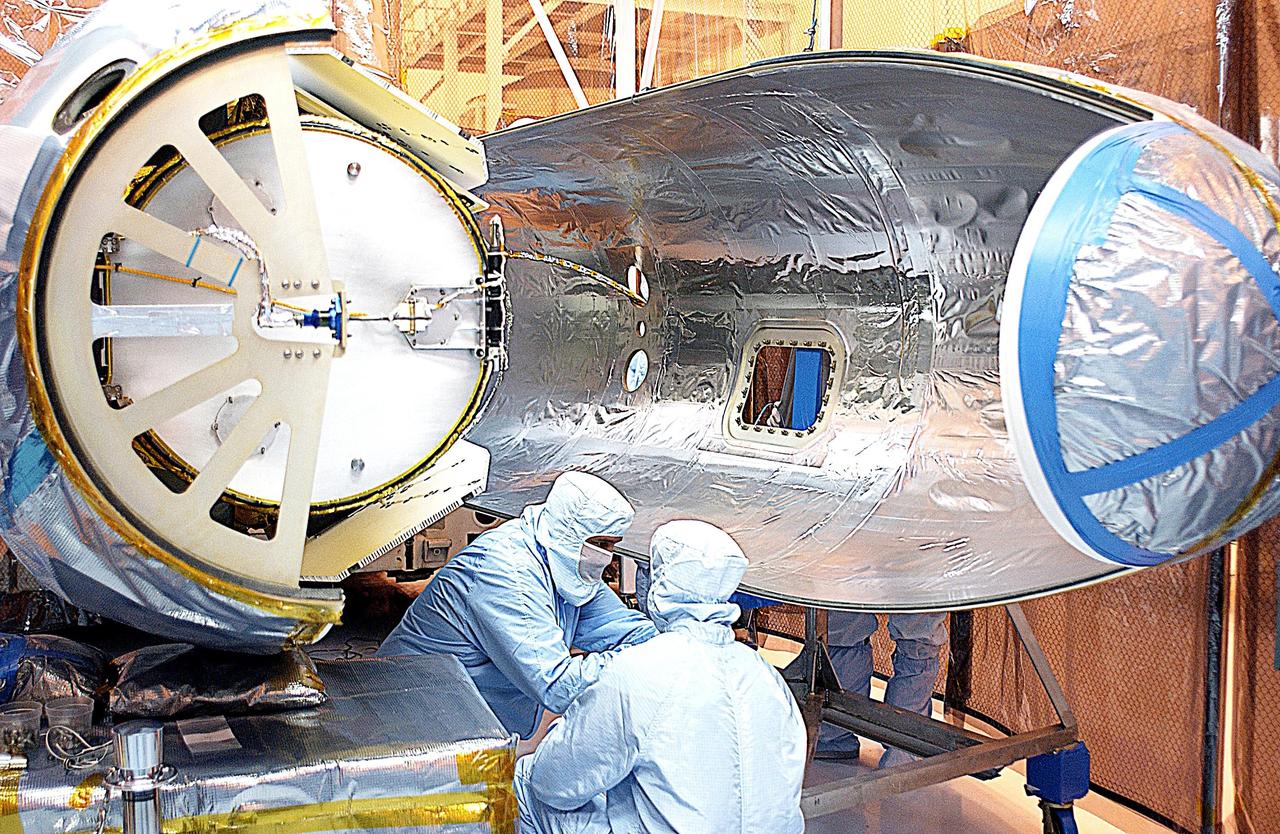
KENNEDY SPACE CENTER, FLA. - Workers in the Multi-Payload Processing Facility prepare to install the port fairing on the Galaxy Evolution Explorer (GALEX). The spacecraft is already mated to the Pegasus launch vehicle. After encapsulation, the GALEX/Pegasus will be transported to Cape Canaveral Air Force Station and mated to the L-1011 about four days before launch. A new launch date has not been determined.
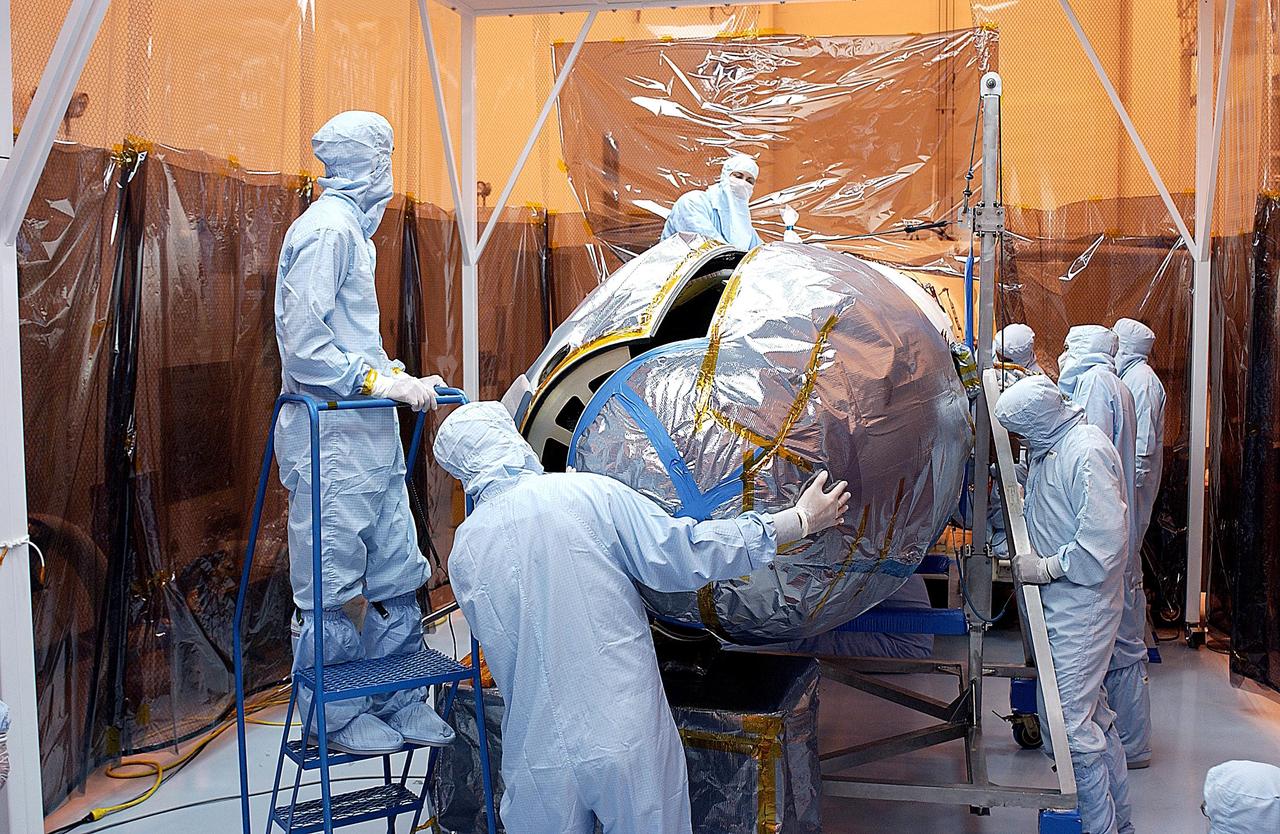
KENNEDY SPACE CENTER, FLA. -- Workers in the Multi-Payload Processing Facility maneuver the port fairing into place around the Galaxy Evolution Explorer (GALEX). The spacecraft is already mated to the Pegasus launch vehicle. After encapsulation, the GALEX/Pegasus will be transported to Cape Canaveral Air Force Station and mated to the L-1011 about four days before launch. A new launch date has not been determined.
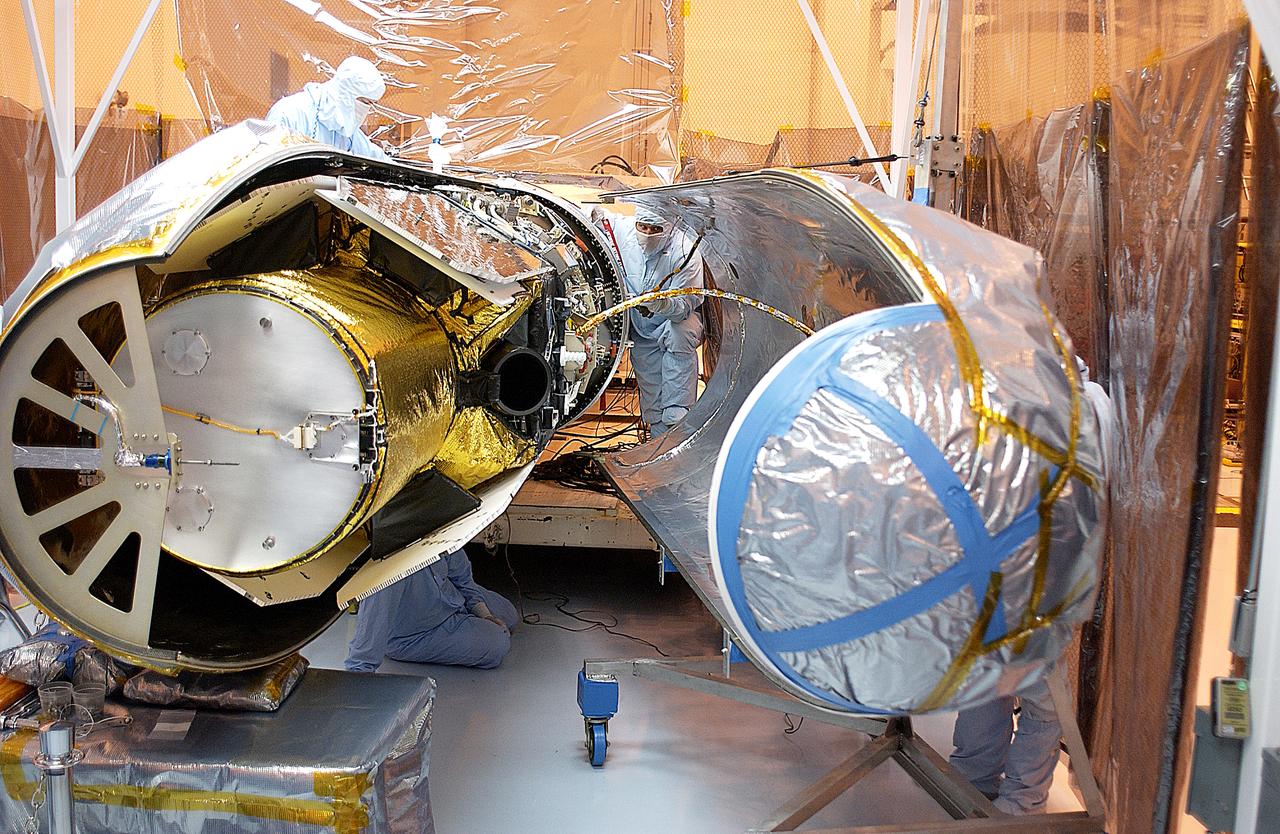
Workers in the Multi-Payload Processing Facility prepare to close the port fairing around the Galaxy Evolution Explorer (GALEX). The spacecraft is already mated to the Pegasus launch vehicle. After encapsulation, the GALEX/Pegasus will be transported to Cape Canaveral Air Force Station and mated to the L-1011 about four days before launch. A new launch date has not been determined.
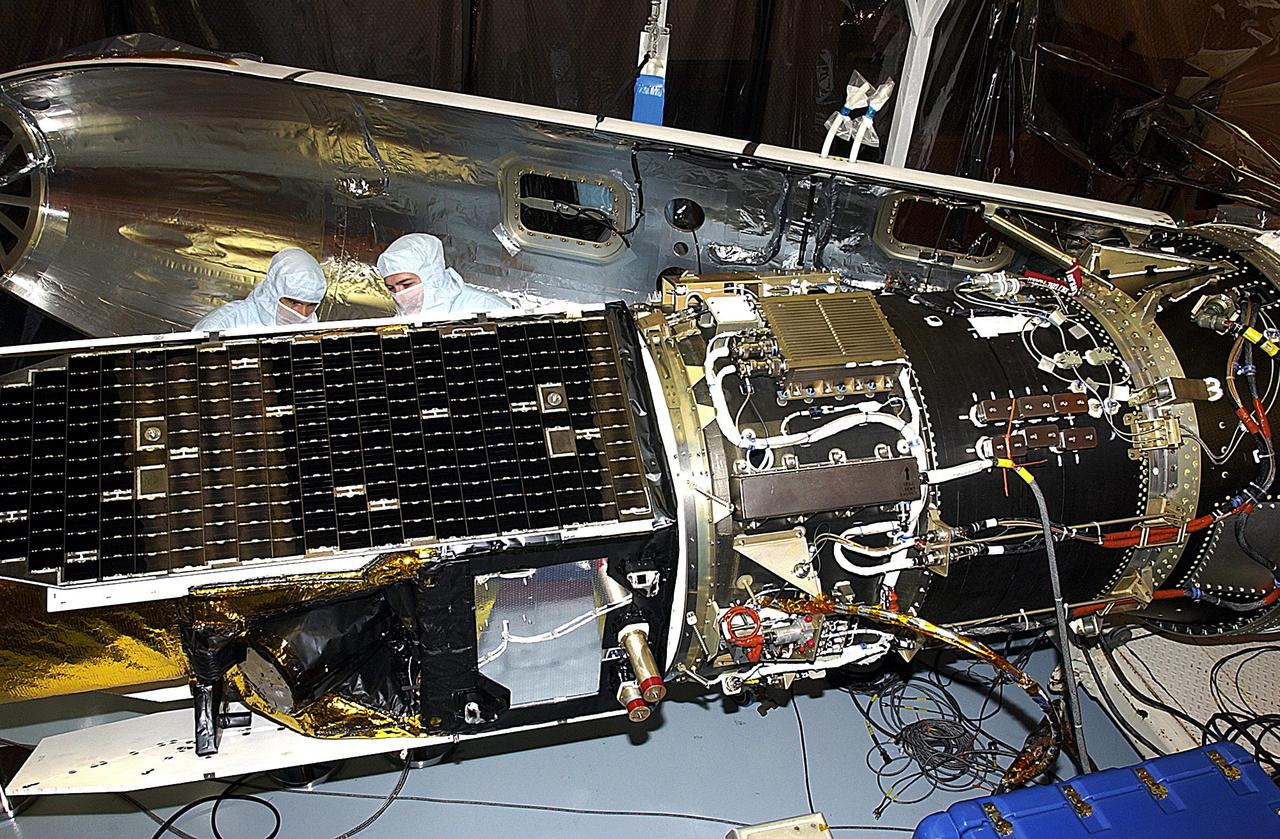
KENNEDY SPACE CENTER, FLA. -- Workers in the Multi-Payload Processing Facility prepare the Galaxy Evolution Explorer (GALEX) for encapsulation. The first part of the fairing is in the background. The spacecraft is already mated to the Pegasus launch vehicle. After encapsulation, the GALEX/Pegasus will be transported to Cape Canaveral Air Force Station and mated to the L-1011 about four days before launch. A new launch date has not been determined.

KENNEDY SPACE CENTER, FLA. -- Workers in the Multi-Payload Processing Facility maneuver the port fairing into place around the Galaxy Evolution Explorer (GALEX). The spacecraft is already mated to the Pegasus launch vehicle. After encapsulation, the GALEX/Pegasus will be transported to Cape Canaveral Air Force Station and mated to the L-1011 about four days before launch. A new launch date has not been determined.
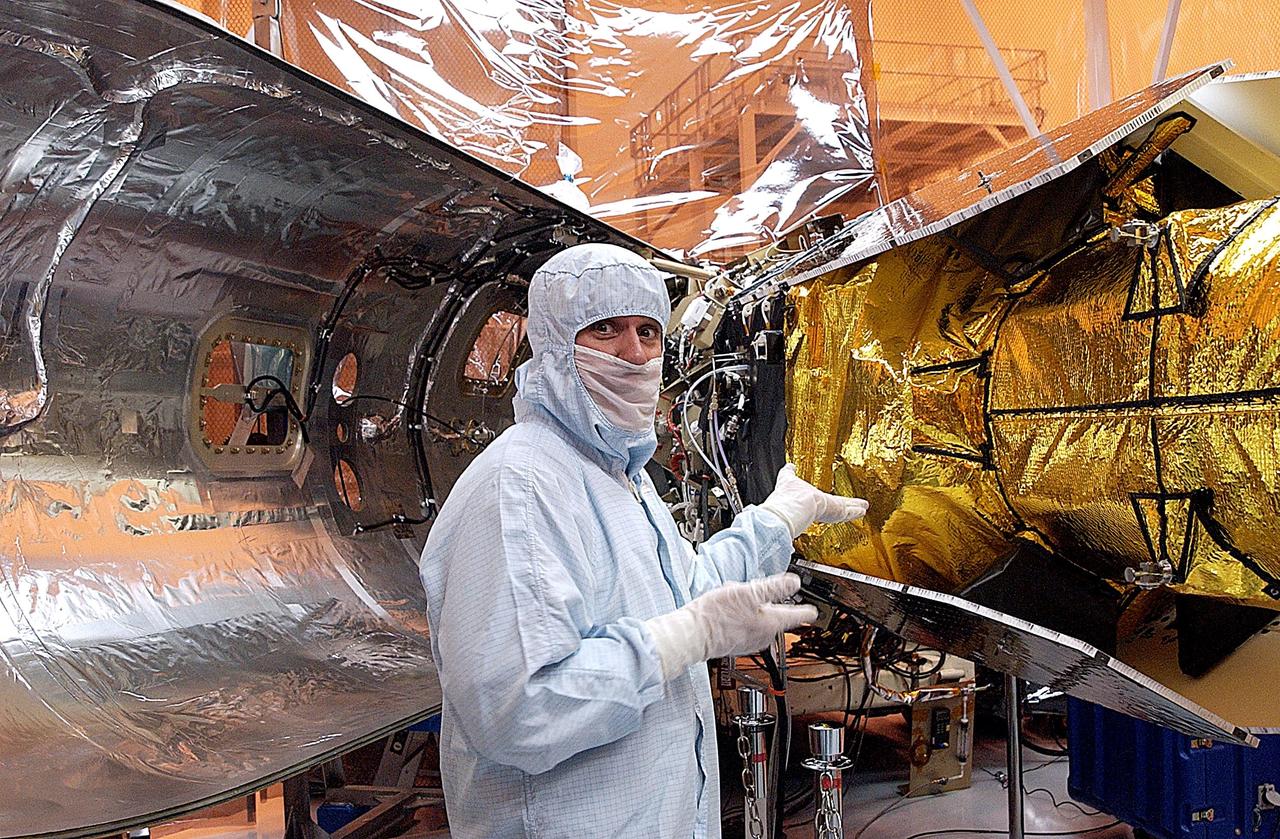
KENNEDY SPACE CENTER, FLA. -- A worker in the Multi-Payload Processing Facility gestures toward the Galaxy Evolution Explorer (GALEX) being prepared for encapsulation. The first part of the fairing is behind him. The spacecraft is already mated to the Pegasus launch vehicle. After encapsulation, the GALEX/Pegasus will be transported to Cape Canaveral Air Force Station and mated to the L-1011 about four days before launch. A new launch date has not been determined.
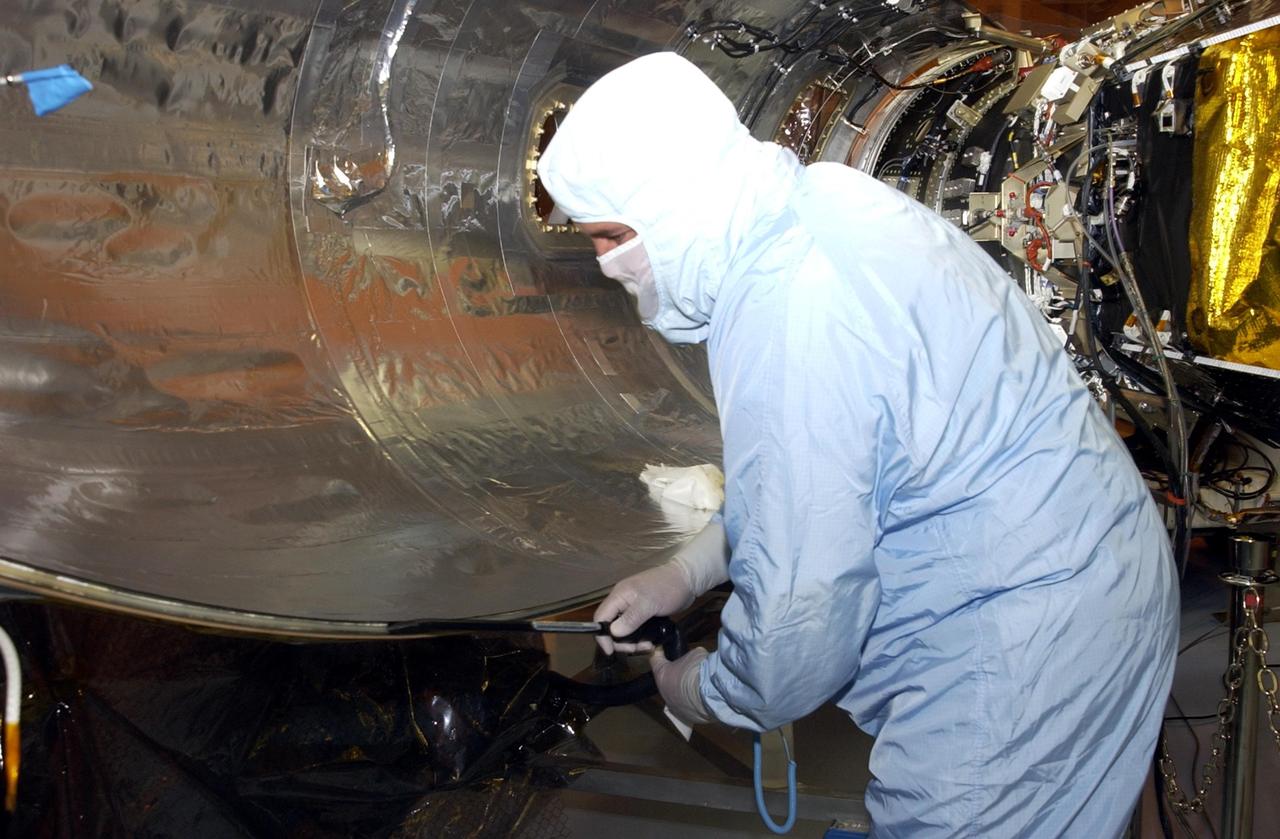
KENNEDY SPACE CENTER, FLA. -- Workers in the Multi-Payload Processing Facility prepare one part of the fairing for encapsulation of the Galaxy Evolution Explorer (GALEX). The spacecraft is already mated to the Pegasus launch vehicle. After encapsulation, the GALEX/Pegasus will be transported to Cape Canaveral Air Force Station and mated to the L-1011 about four days before launch. A new launch date has not been determined.
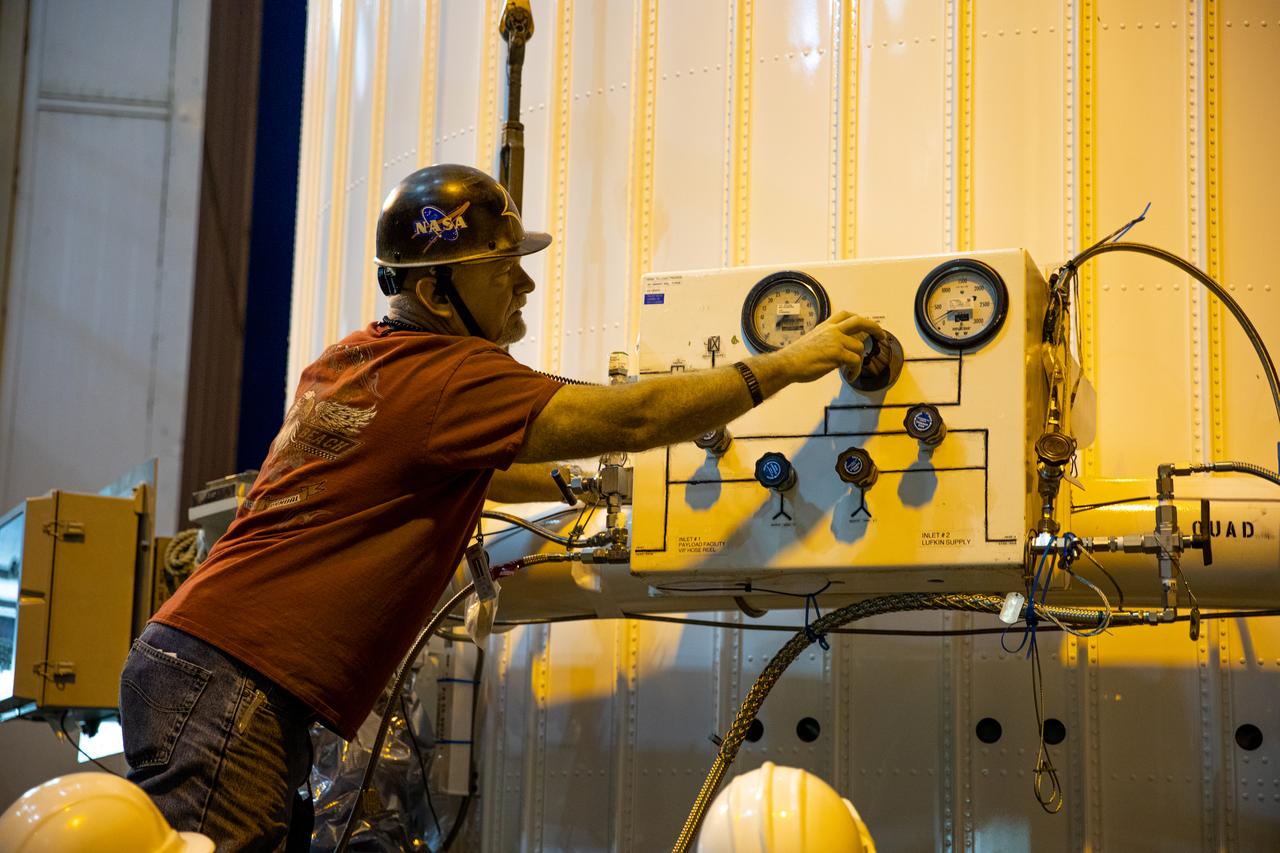
A worker prepares for mate operations of the Solar Orbiter spacecraft, contained inside the payload fairing, to the Atlas V rocket inside the Vertical Integration Facility at Space Launch Complex 41 on Cape Canaveral Air Force Station in Florida on Jan. 31, 2020. The payload fairing will be mated to the Atlas V rocket. Solar Orbiter is an international cooperative mission between ESA (European Space Agency) and NASA. The mission aims to study the Sun, its outer atmosphere and solar wind. The spacecraft will provide the first images of the Sun’s poles. NASA’s Launch Services Program based at Kennedy is managing the launch. The spacecraft has been developed by Airbus Defence and Space. Solar Orbiter will launch in February 2020 aboard the Atlas V rocket.
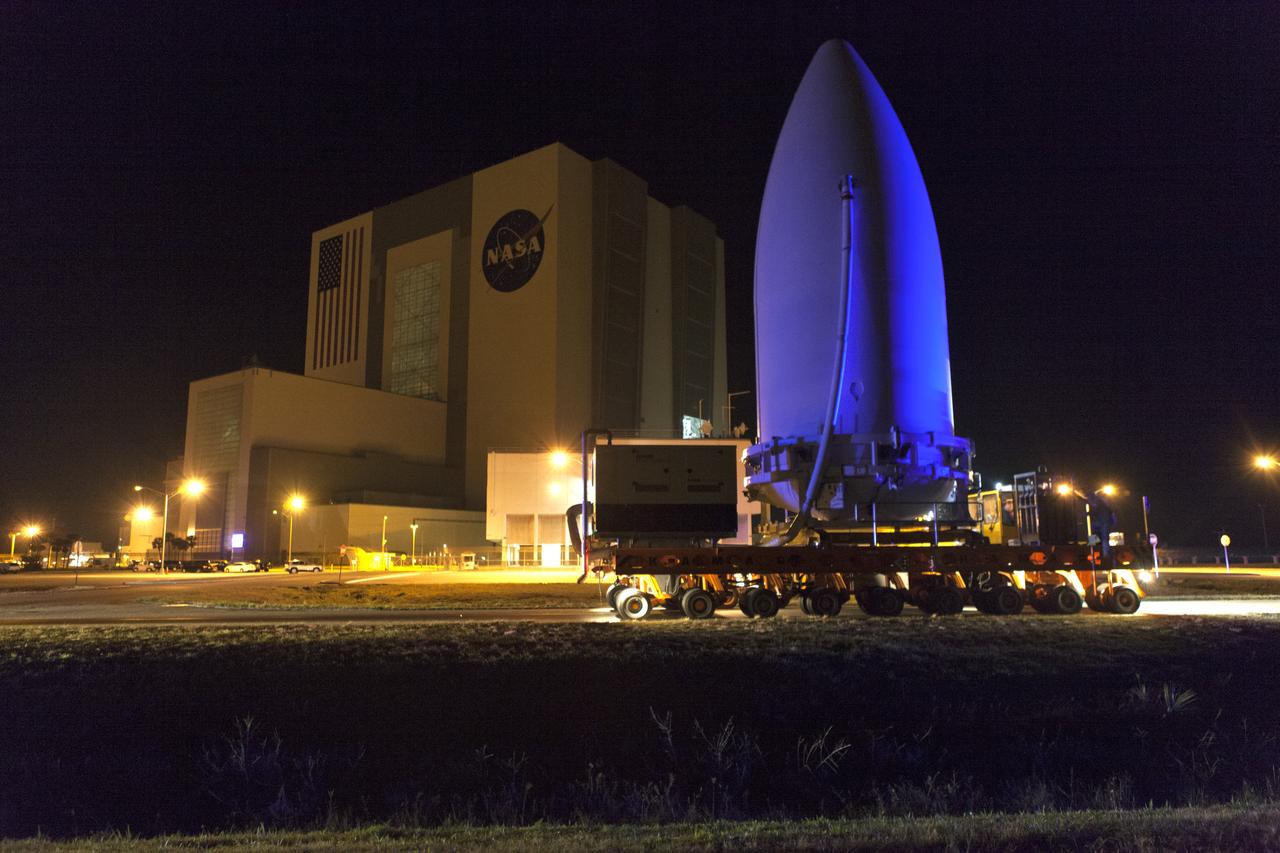
The payload fairing containing NOAA's Geostationary Operational Environmental Satellite-S (GOES-S), secured on a transporter, passes by the Vehicle Assembly Building at NASA's Kennedy Space Center in Florida, on its way to the United Launch Alliance (ULA) Vertical Integration Facility at Space Launch Complex 41 at Cape Canaveral Air Force Station in Florida. The payload fairing will be lifted and mated to the ULA Atlas V rocket. GOES-S is the second in a series of four advanced geostationary weather satellites. GOES-S is slated to launch aboard the ULA Atlas V on March 1.
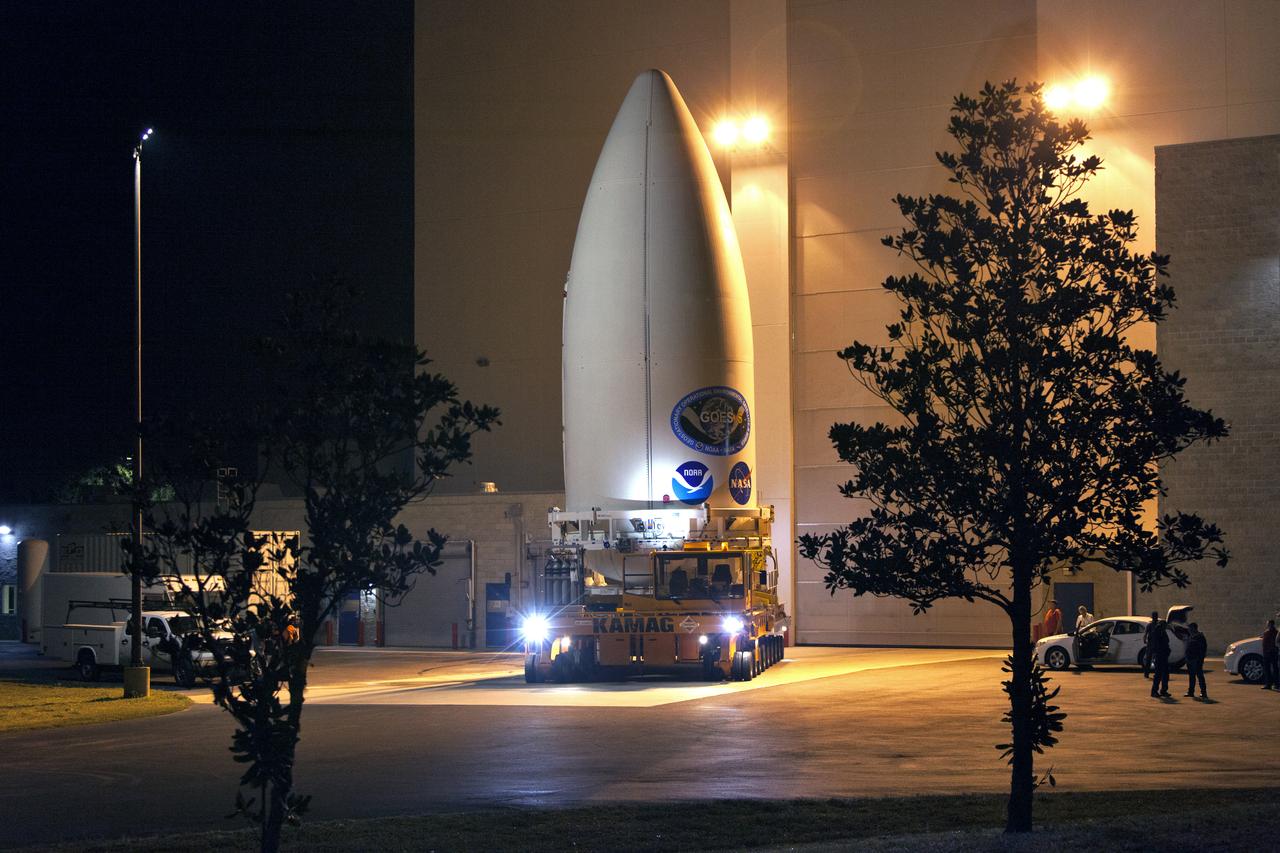
The payload fairing containing NOAA's Geostationary Operational Environmental Satellite-S (GOES-S), secured on a transporter, departs the Astrotech Space Operations facility in Titusville, Florida. GOES-S will be transported to the United Launch Alliance (ULA) Vertical Integration Facility at Space Launch Complex 41 at Cape Canaveral Air Force Station in Florida. The payload fairing will be lifted and mated to the ULA Atlas V rocket. GOES-S is the second in a series of four advanced geostationary weather satellites. GOES-S is slated to launch aboard the ULA Atlas V on March 1.
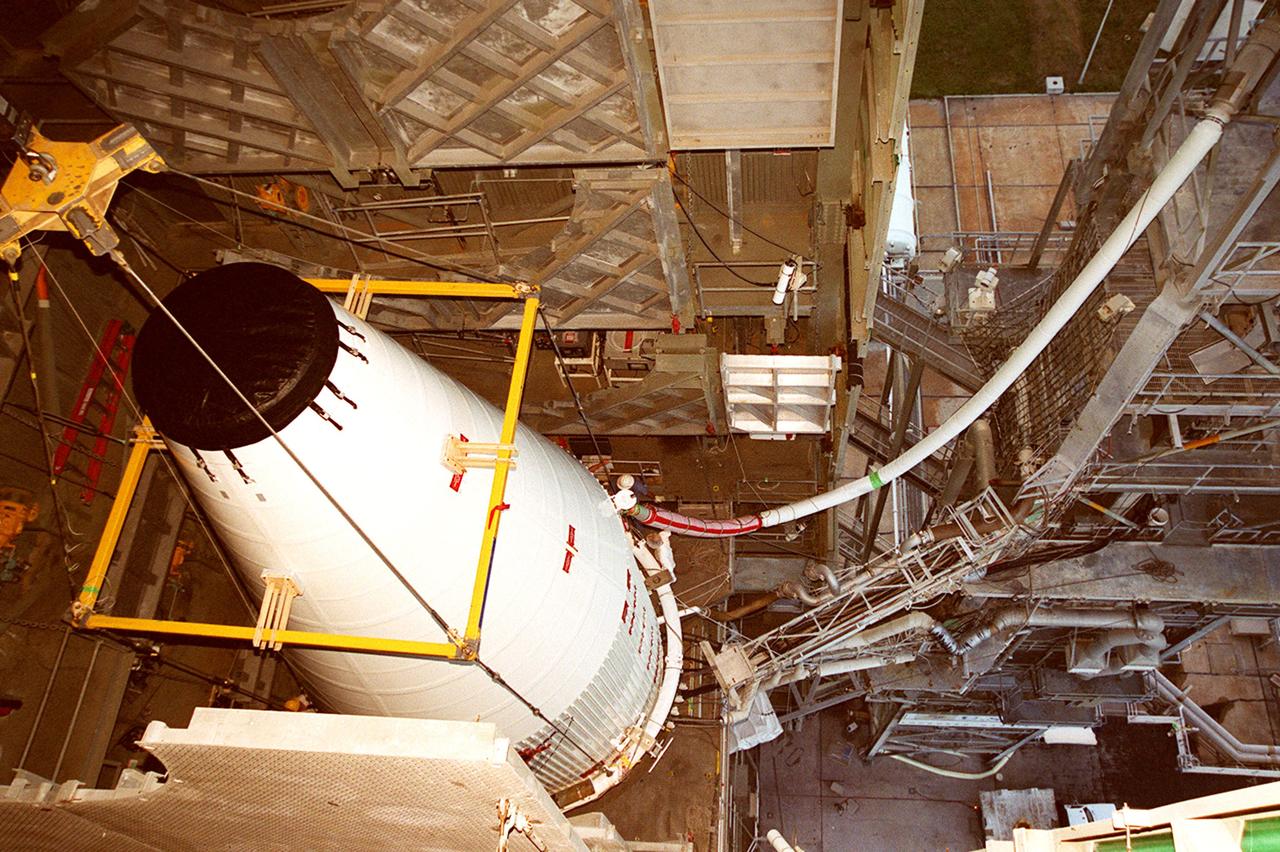
KENNEDY SPACE CENTER, FLA. -- In a view taken near the top of the launch tower at Launch Pad 36A, Cape Canaveral Air Force Station, the nose fairing with the Tracking and Data Relay Satellite (TDRS-H) inside is hoisted up the tower by the overhead crane (left). The fairing will be mated with the Atlas IIA/Centaur rocket, which is already stacked, for launch on June 29. The satellite will augment the TDRS system's existing S- and Ku-band frequencies by adding Ka-band capability. TDRS will serve as the sole means of continuous, high-data-rate communications with the Space Shuttle, with the International Space Station upon its completion, and with dozens of unmanned scientific satellites in low-earth orbit.
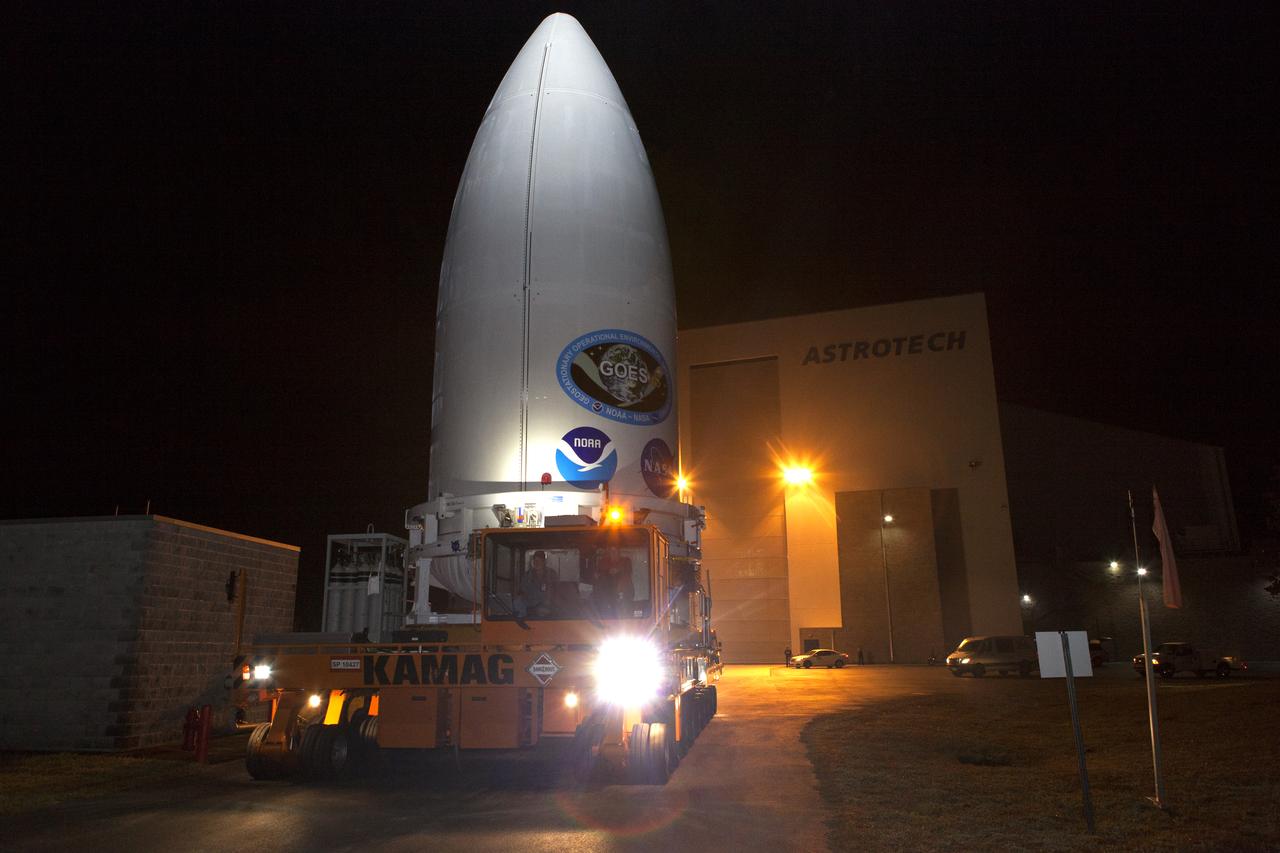
The payload fairing containing NOAA's Geostationary Operational Environmental Satellite-S (GOES-S), secured on a transporter, departs the Astrotech Space Operations facility in Titusville, Florida. GOES-S will be transported to the United Launch Alliance (ULA) Vertical Integration Facility at Space Launch Complex 41 at Cape Canaveral Air Force Station in Florida. The payload fairing will be lifted and mated to the ULA Atlas V rocket. GOES-S is the second in a series of four advanced geostationary weather satellites. GOES-S is slated to launch aboard the ULA Atlas V on March 1.
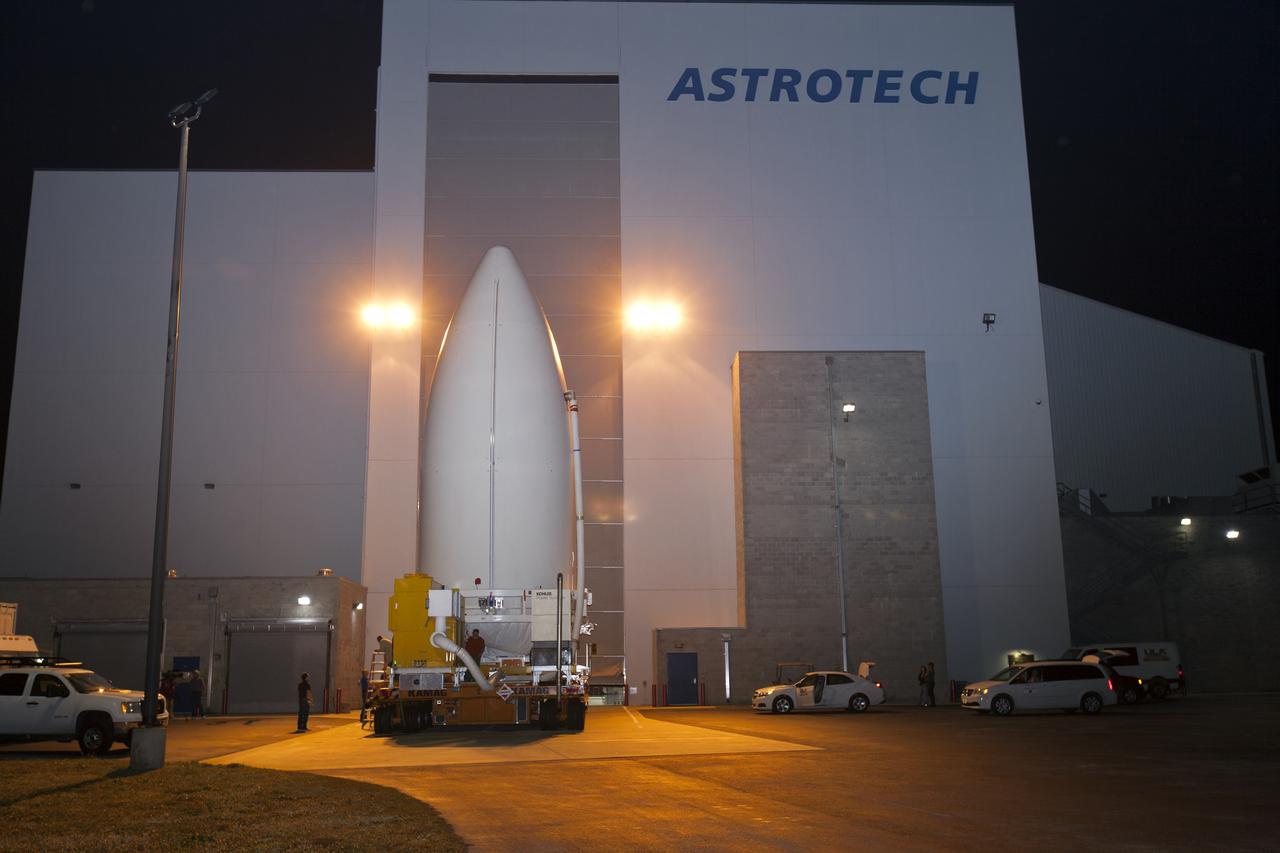
Secured on a transporter, the payload fairing containing NOAA's Geostationary Operational Environmental Satellite-S (GOES-S) departs the Astrotech Space Operations facility in Titusville, Florida. GOES-S will be transported to the United Launch Alliance (ULA) Vertical Integration Facility at Space Launch Complex 41 at Cape Canaveral Air Force Station in Florida. The payload fairing will be lifted and mated to the ULA Atlas V rocket. GOES-S is the second in a series of four advanced geostationary weather satellites. GOES-S is slated to launch aboard the ULA Atlas V on March 1.
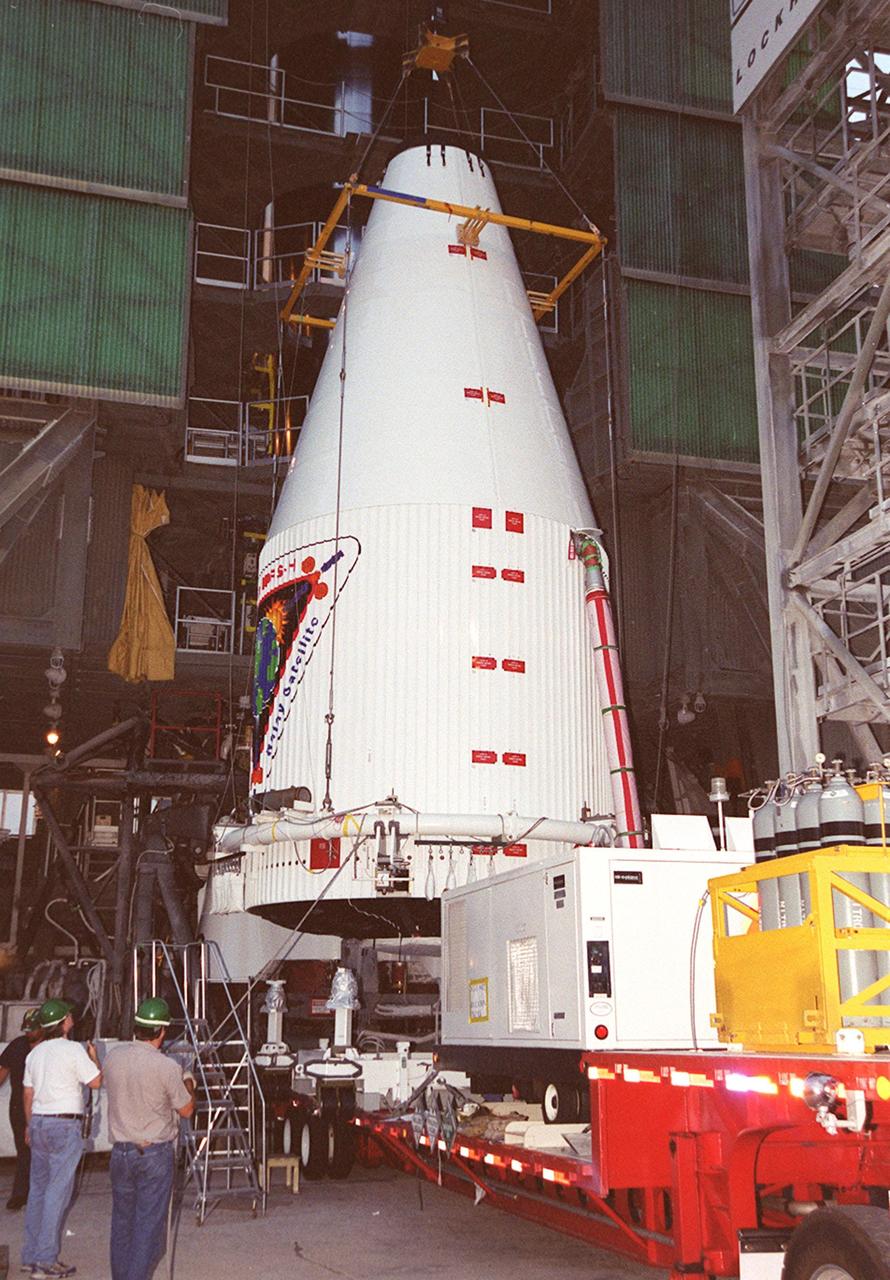
At Launch Pad 36A, Cape Canaveral Air Force Station, workers (at left) oversee the lifting of the nose fairing covering the Tracking and Data Relay Satellite (TDRS-H). Once at the top, the fairing will be mated with the Atlas IIA/Centaur rocket, which is already stacked, for launch on June 29. The satellite will augment the TDRS system’s existing Sand Ku-band frequencies by adding Ka-band capability. TDRS will serve as the sole means of continuous, high-data-rate communication with the Space Shuttle, with the International Space Station upon its completion, and with dozens of unmanned scientific satellites in low earth orbit
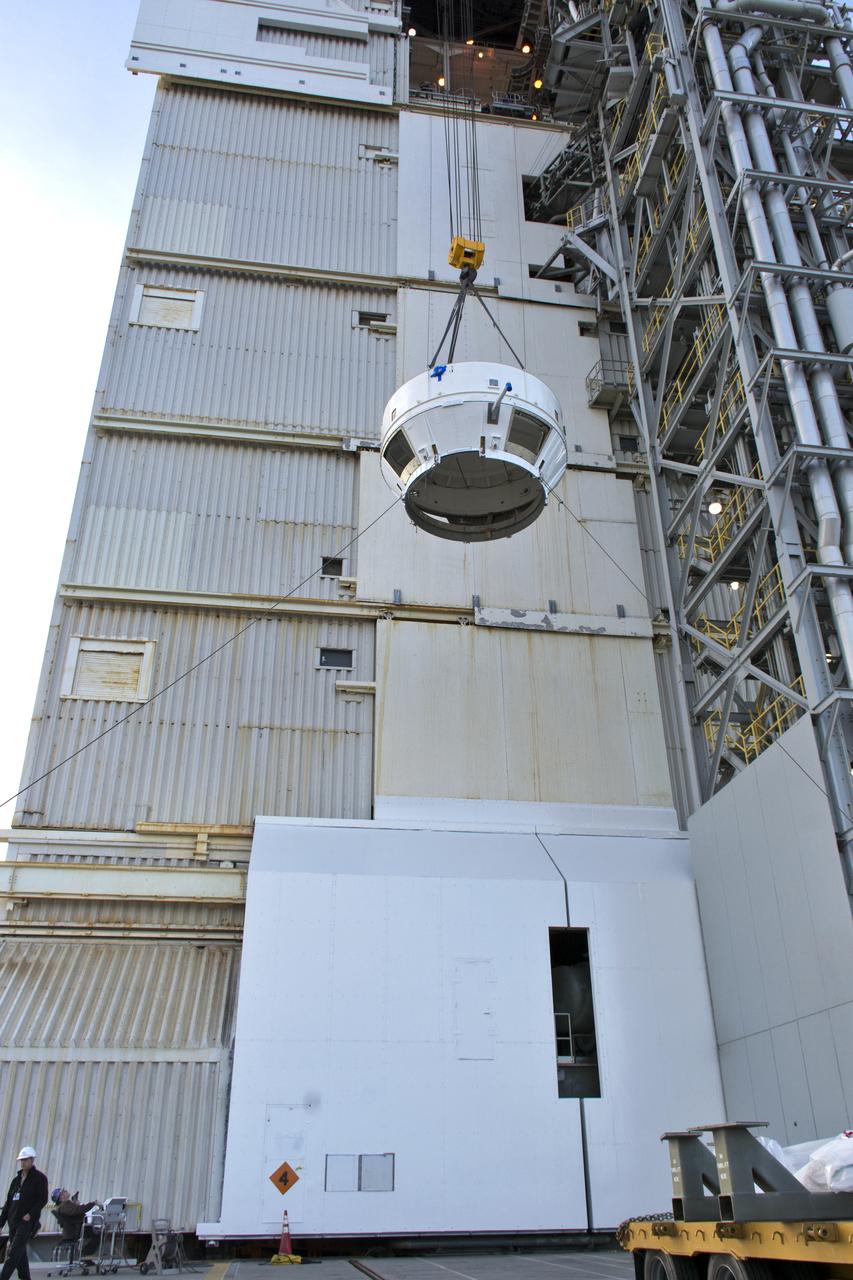
At Space Launch Complex 3 at Vandenberg Air Force Base in California, a boattail fairing is lifted by a crane for mating atop a United Launch Alliance (ULA) Centaur upper stage. The boattail is an adaptor providing an interface between the Centaur and the payload fairing encapsulating NASA's Interior Exploration using Seismic Investigations, Geodesy and Heat Transport, or InSight, spacecraft. A ULA Atlas V rocket is scheduled to liftoff on May 5, 2018, launching InSight the first mission to explore the deep interior of Mars. It will investigate processes that shaped the rocky planets of the inner solar system including Earth.
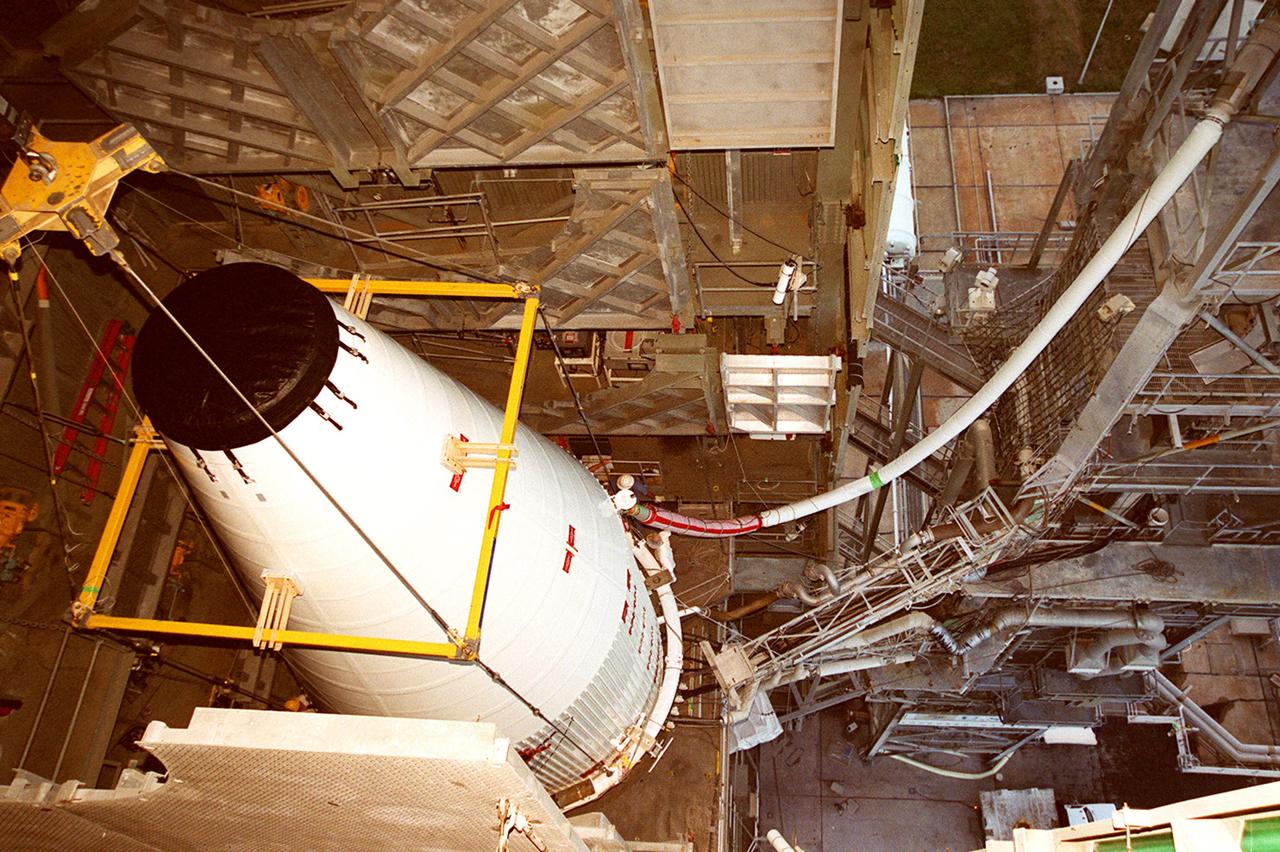
KENNEDY SPACE CENTER, FLA. -- In a view taken near the top of the launch tower at Launch Pad 36A, Cape Canaveral Air Force Station, the nose fairing with the Tracking and Data Relay Satellite (TDRS-H) inside is hoisted up the tower by the overhead crane (left). The fairing will be mated with the Atlas IIA/Centaur rocket, which is already stacked, for launch on June 29. The satellite will augment the TDRS system's existing S- and Ku-band frequencies by adding Ka-band capability. TDRS will serve as the sole means of continuous, high-data-rate communications with the Space Shuttle, with the International Space Station upon its completion, and with dozens of unmanned scientific satellites in low-earth orbit.
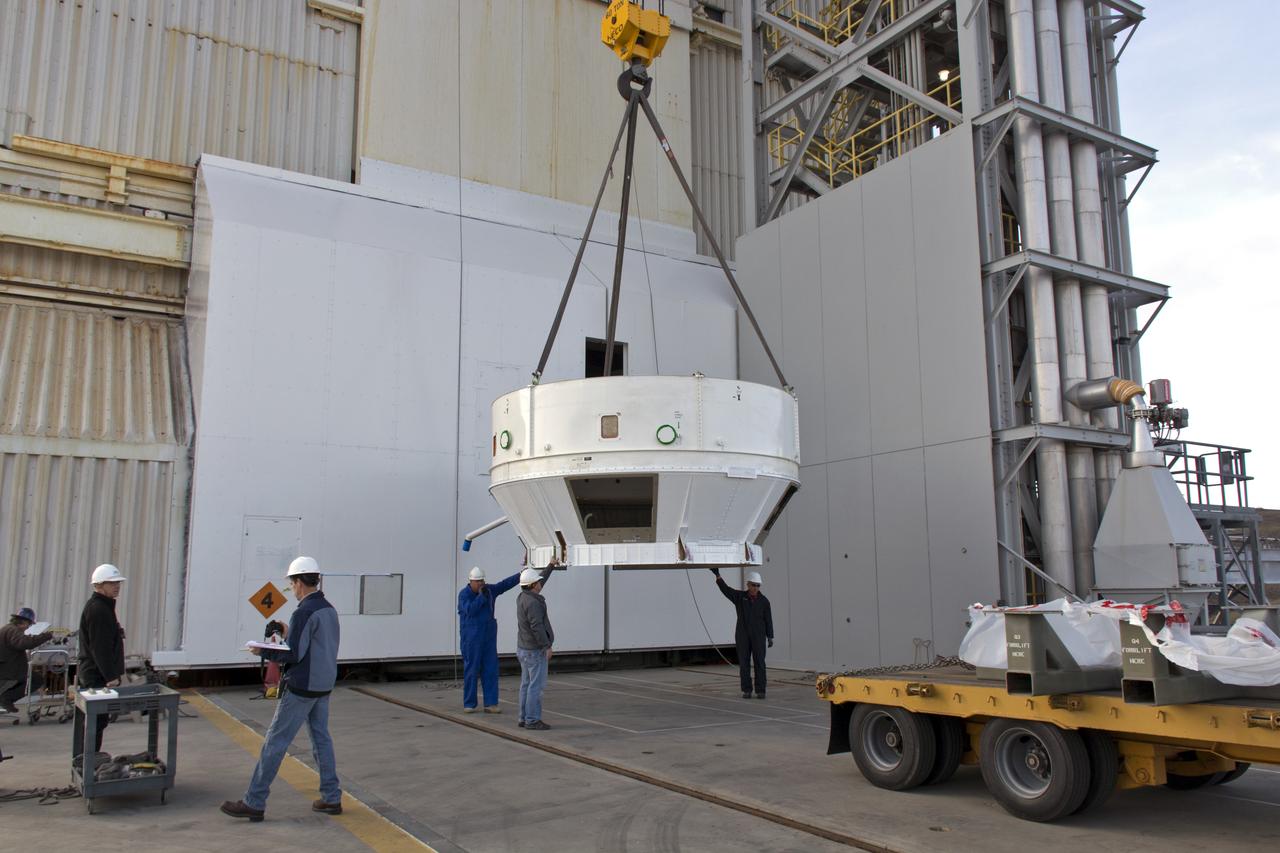
At Space Launch Complex 3 at Vandenberg Air Force Base in California, a boattail fairing is lifted by a crane for mating atop a United Launch Alliance (ULA) Centaur upper stage. The boattail is an adaptor providing an interface between the Centaur and the payload fairing encapsulating NASA's Interior Exploration using Seismic Investigations, Geodesy and Heat Transport, or InSight, spacecraft. A ULA Atlas V rocket is scheduled to liftoff on May 5, 2018, launching InSight the first mission to explore the deep interior of Mars. It will investigate processes that shaped the rocky planets of the inner solar system including Earth.
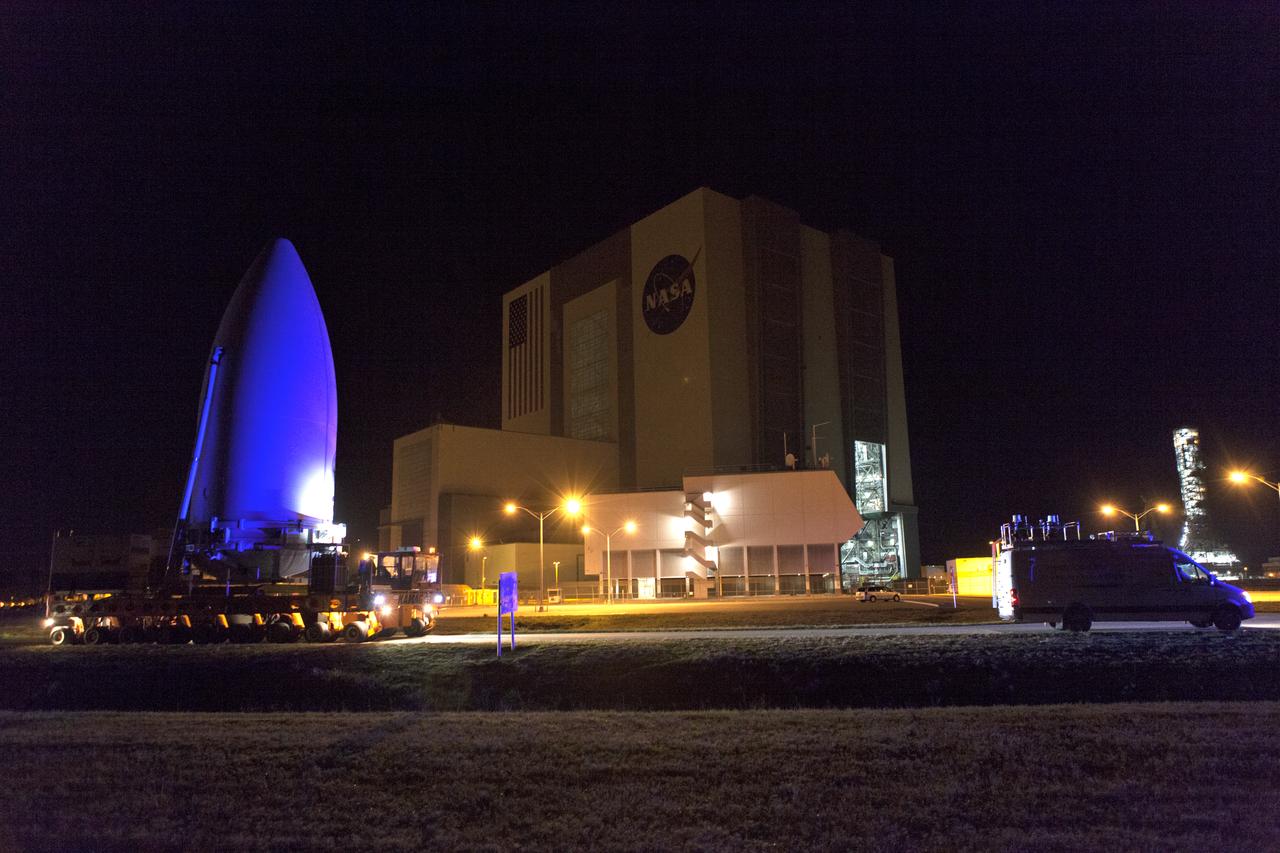
The payload fairing containing NOAA's Geostationary Operational Environmental Satellite-S (GOES-S), secured on a transporter, passes by the Vehicle Assembly Building at NASA's Kennedy Space Center in Florida, on its way to the United Launch Alliance (ULA) Vertical Integration Facility at Space Launch Complex 41 at Cape Canaveral Air Force Station in Florida. The payload fairing will be lifted and mated to the ULA Atlas V rocket. GOES-S is the second in a series of four advanced geostationary weather satellites. GOES-S is slated to launch aboard the ULA Atlas V on March 1.
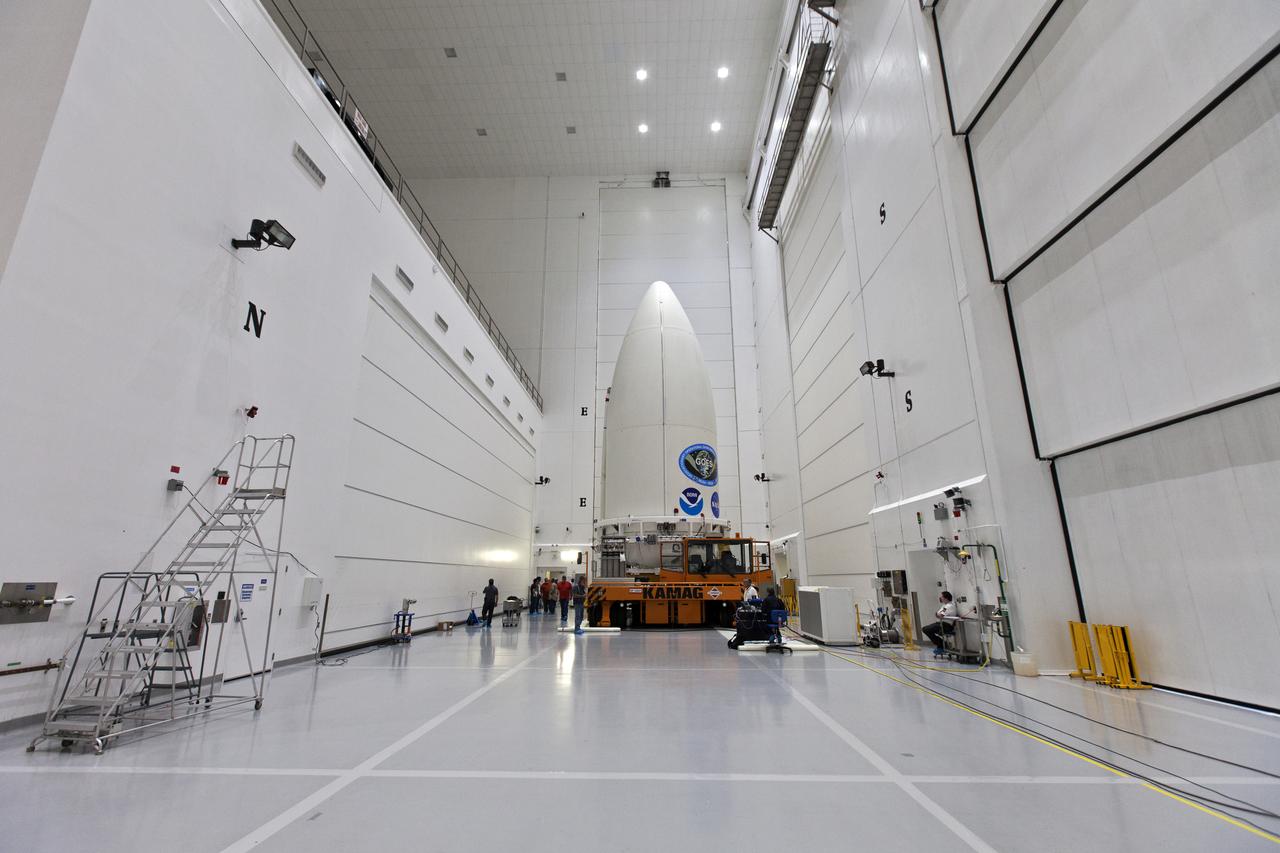
NOAA's Geostationary Operational Environmental Satellite-S (GOES-S) is secured in its payload fairing inside the high bay at Astrotech Space Operations facility in Titusville, Florida. GOES-S will be transported to the United Launch Alliance (ULA) Vertical Integration Facility at Space Launch Complex 41 at Cape Canaveral Air Force Station in Florida. The payload fairing will be lifted and mated to the ULA Atlas V rocket. GOES-S is the second in a series of four advanced geostationary weather satellites. GOES-S is slated to launch aboard the ULA Atlas V on March 1.
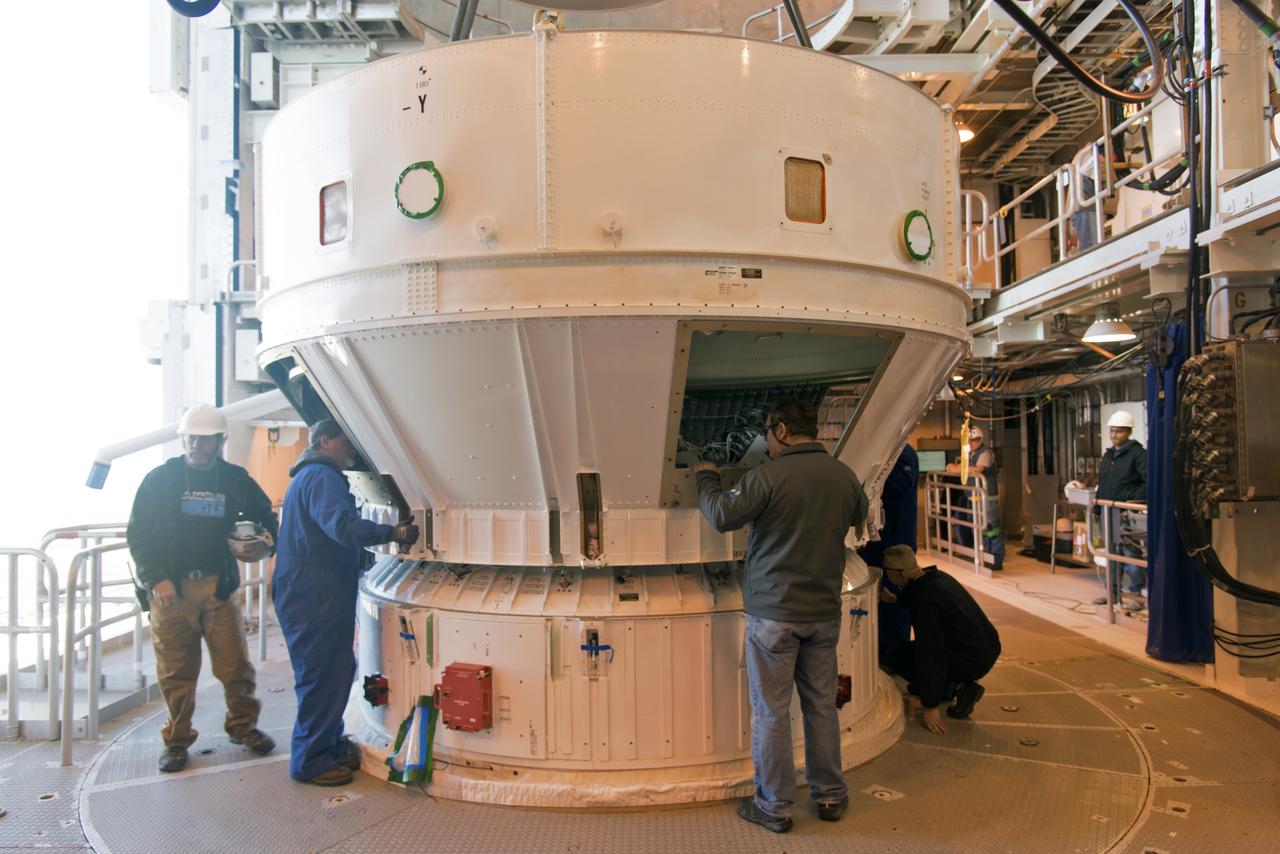
At Space Launch Complex 3 at Vandenberg Air Force Base in California, a boattail fairing is mated atop a United Launch Alliance (ULA) Centaur upper stage. The boattail is an adaptor providing an interface between the Centaur and the payload fairing encapsulating NASA's Interior Exploration using Seismic Investigations, Geodesy and Heat Transport, or InSight, spacecraft. A ULA Atlas V rocket is scheduled to liftoff on May 5, 2018, launching InSight the first mission to explore the deep interior of Mars. It will investigate processes that shaped the rocky planets of the inner solar system including Earth.
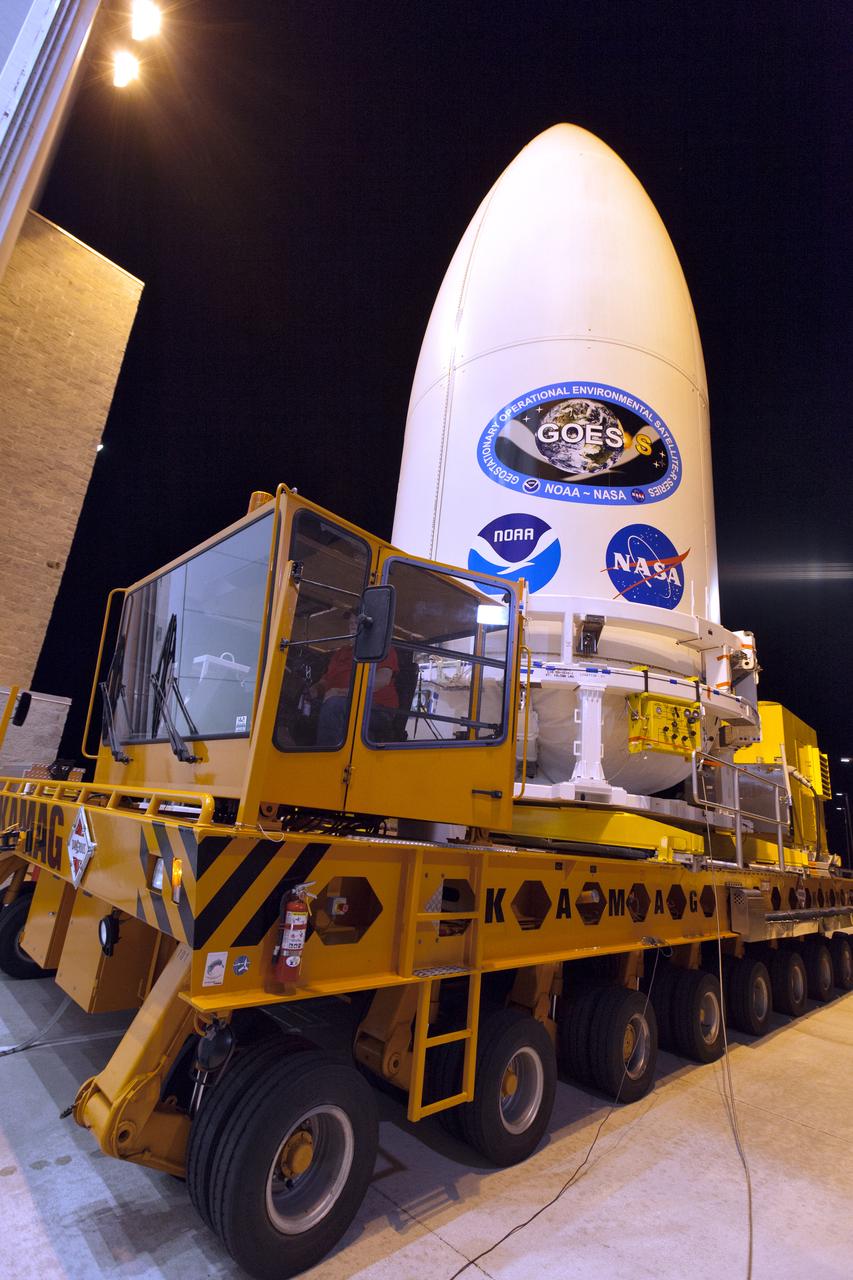
The payload fairing containing NOAA's Geostationary Operational Environmental Satellite-S (GOES-S) is secured on a transporter and moved out of the Astrotech Space Operations facility in Titusville, Florida. GOES-S will be transported to the United Launch Alliance (ULA) Vertical Integration Facility at Space Launch Complex 41 at Cape Canaveral Air Force Station in Florida. The payload fairing will be lifted and mated to the ULA Atlas V rocket. GOES-S is the second in a series of four advanced geostationary weather satellites. GOES-S is slated to launch aboard the ULA Atlas V on March 1.
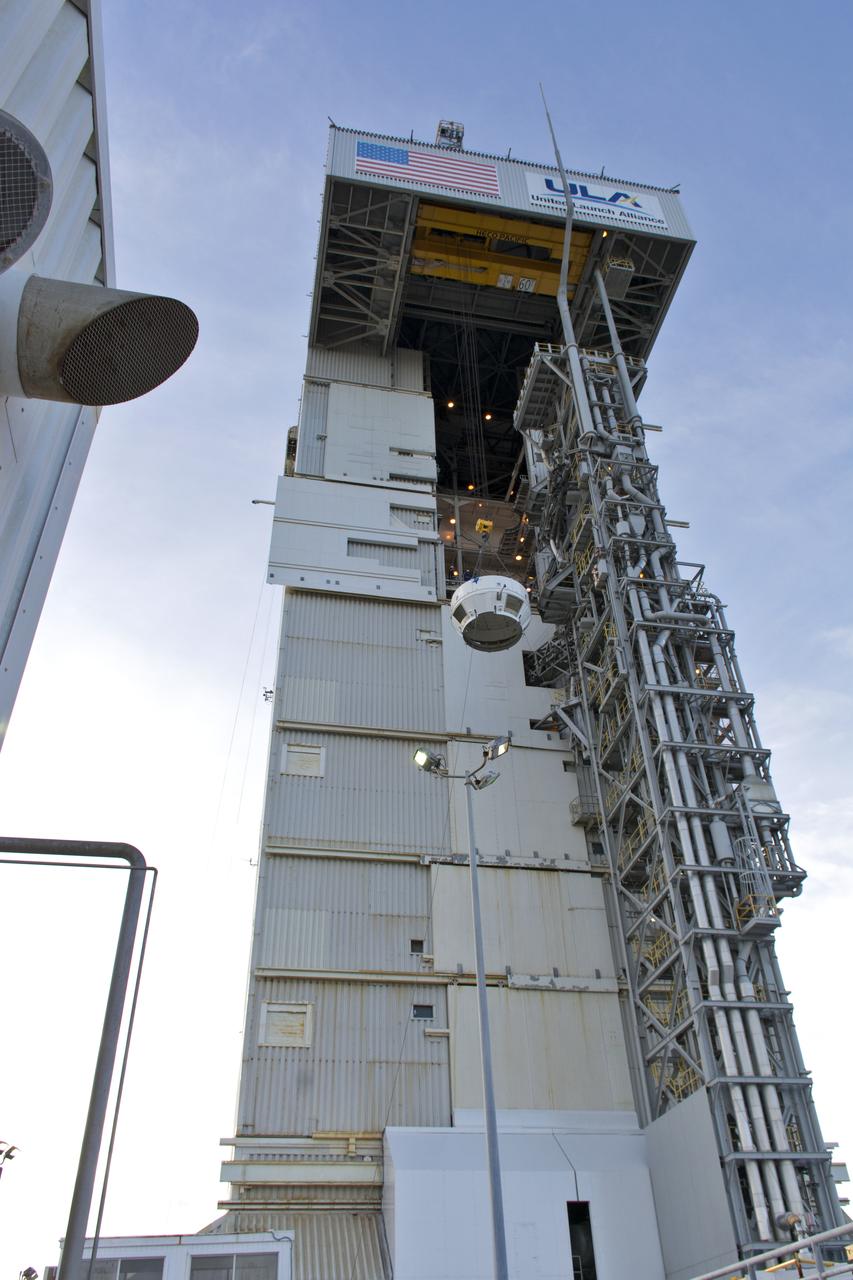
At Space Launch Complex 3 at Vandenberg Air Force Base in California, a boattail fairing is lifted by a crane for mating atop a United Launch Alliance (ULA) Centaur upper stage. The boattail is an adaptor providing an interface between the Centaur and the payload fairing encapsulating NASA's Interior Exploration using Seismic Investigations, Geodesy and Heat Transport, or InSight, spacecraft. A ULA Atlas V rocket is scheduled to liftoff on May 5, 2018, launching InSight the first mission to explore the deep interior of Mars. It will investigate processes that shaped the rocky planets of the inner solar system including Earth.
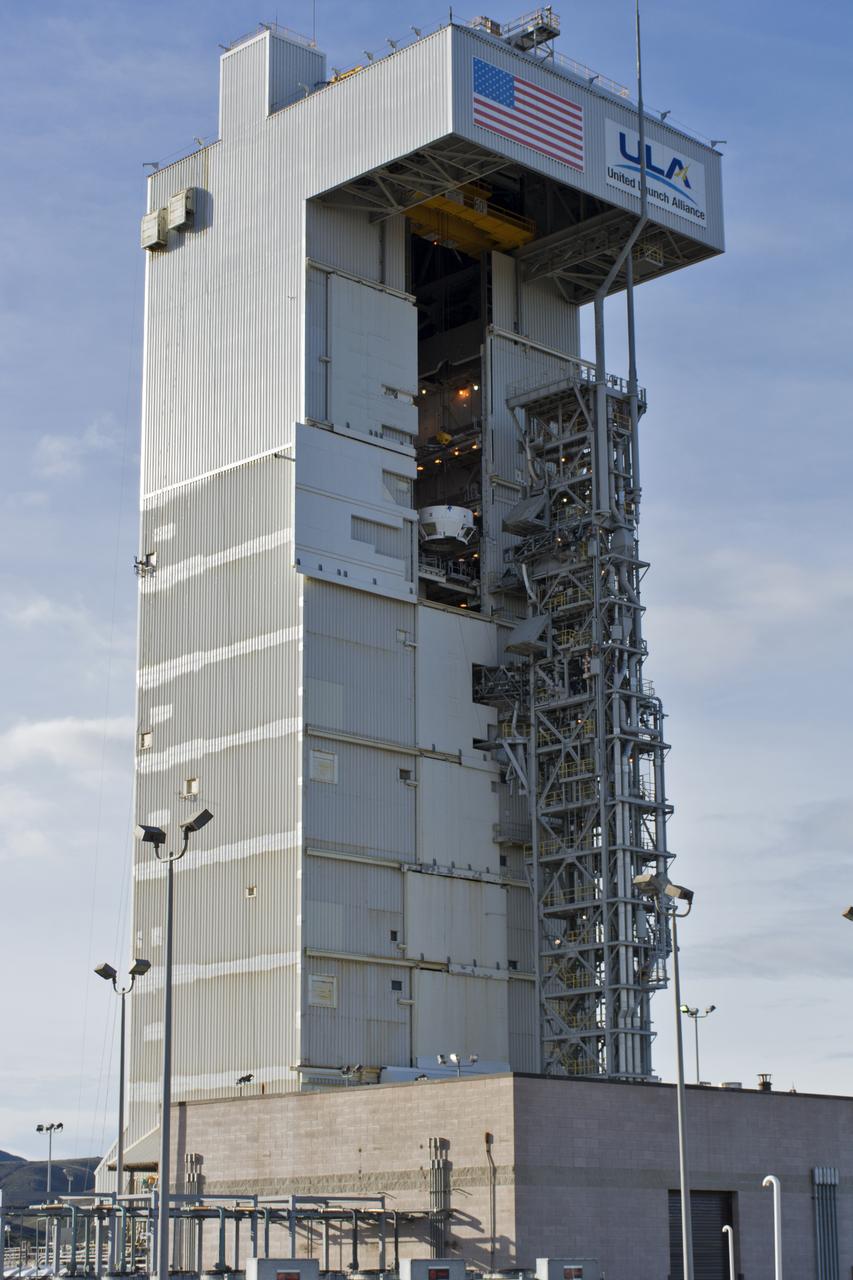
At Space Launch Complex 3 at Vandenberg Air Force Base in California, a boattail fairing is lifted by a crane for mating atop a United Launch Alliance (ULA) Centaur upper stage. The boattail is an adaptor providing an interface between the Centaur and the payload fairing encapsulating NASA's Interior Exploration using Seismic Investigations, Geodesy and Heat Transport, or InSight, spacecraft. A ULA Atlas V rocket is scheduled to liftoff on May 5, 2018, launching InSight the first mission to explore the deep interior of Mars. It will investigate processes that shaped the rocky planets of the inner solar system including Earth.
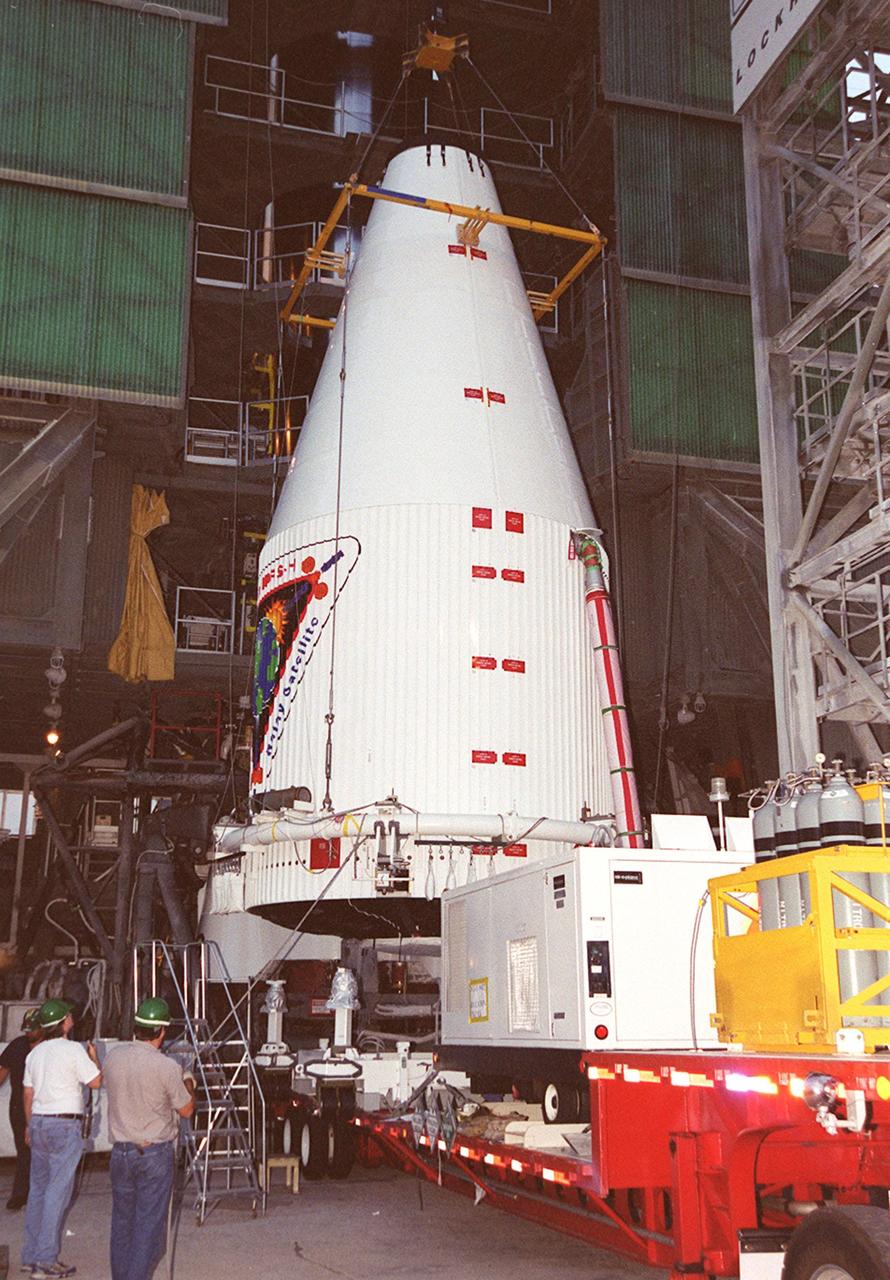
At Launch Pad 36A, Cape Canaveral Air Force Station, workers (at left) oversee the lifting of the nose fairing covering the Tracking and Data Relay Satellite (TDRS-H). Once at the top, the fairing will be mated with the Atlas IIA/Centaur rocket, which is already stacked, for launch on June 29. The satellite will augment the TDRS system’s existing Sand Ku-band frequencies by adding Ka-band capability. TDRS will serve as the sole means of continuous, high-data-rate communication with the Space Shuttle, with the International Space Station upon its completion, and with dozens of unmanned scientific satellites in low earth orbit
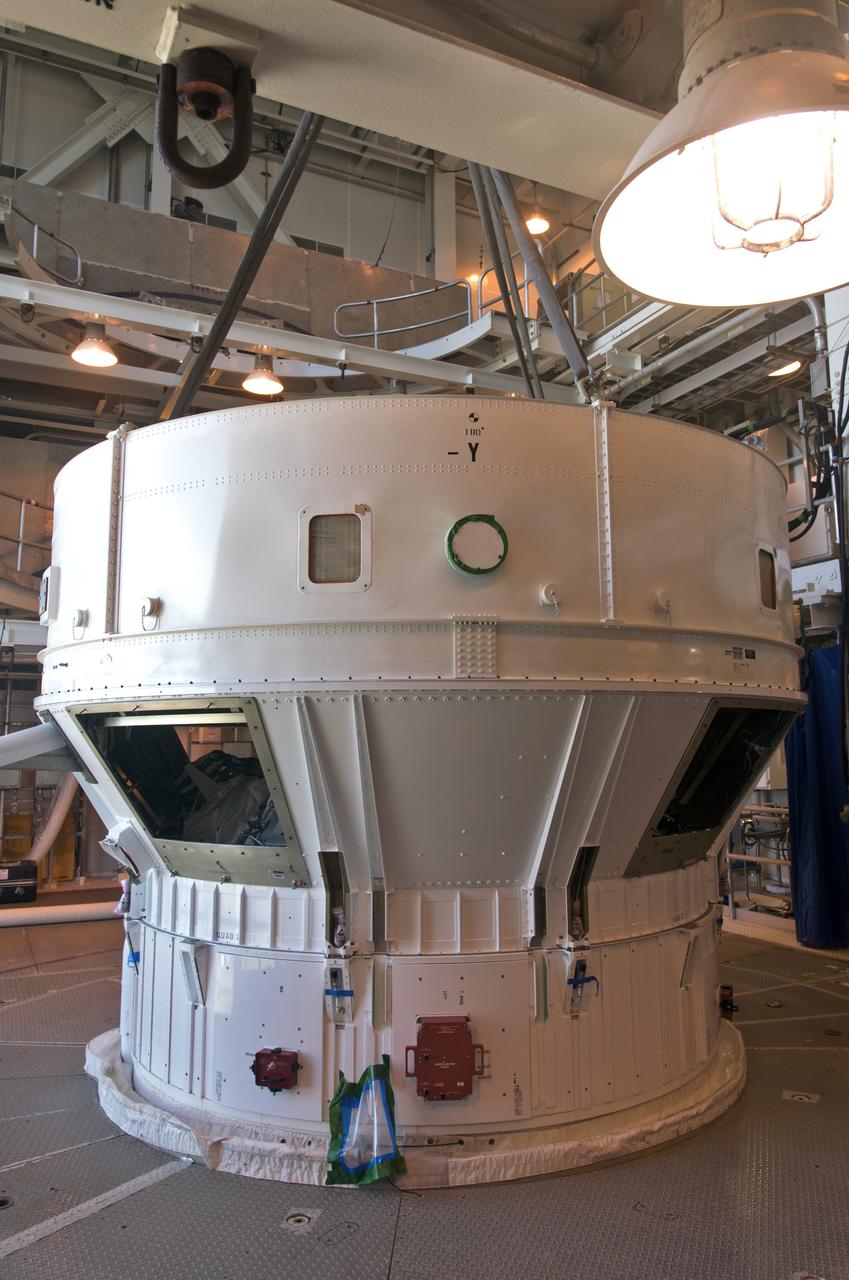
At Space Launch Complex 3 at Vandenberg Air Force Base in California, a boattail fairing has been mated atop a United Launch Alliance (ULA) Centaur upper stage. The boattail is an adaptor providing an interface between the Centaur and the payload fairing encapsulating NASA's Interior Exploration using Seismic Investigations, Geodesy and Heat Transport, or InSight, spacecraft. A ULA Atlas V rocket is scheduled to liftoff on May 5, 2018, launching InSight the first mission to explore the deep interior of Mars. It will investigate processes that shaped the rocky planets of the inner solar system including Earth.
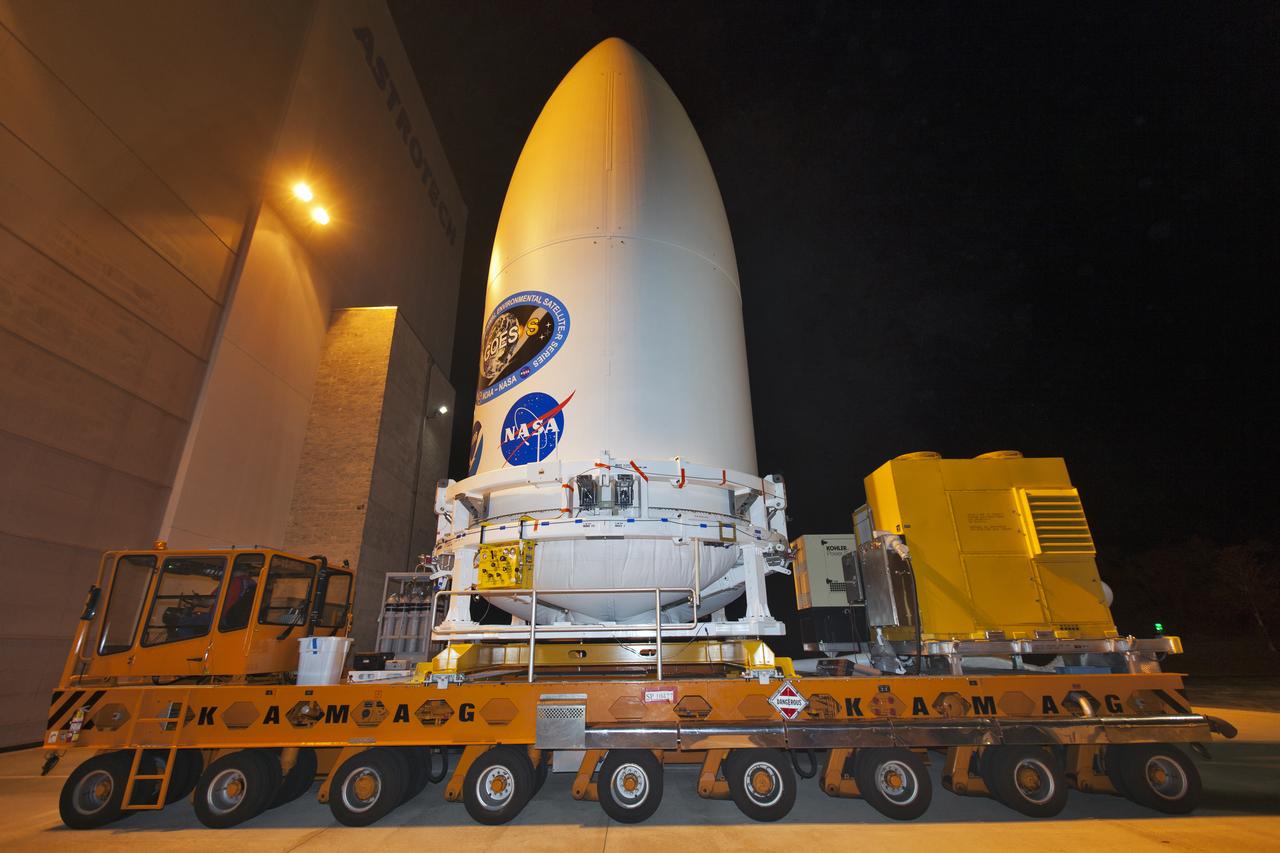
Secured on a transporter, the payload fairing containing NOAA's Geostationary Operational Environmental Satellite-S (GOES-S) departs the Astrotech Space Operations facility in Titusville, Florida. GOES-S will be transported to the United Launch Alliance (ULA) Vertical Integration Facility at Space Launch Complex 41 at Cape Canaveral Air Force Station in Florida. The payload fairing will be lifted and mated to the ULA Atlas V rocket. GOES-S is the second in a series of four advanced geostationary weather satellites. GOES-S is slated to launch aboard the ULA Atlas V on March 1.
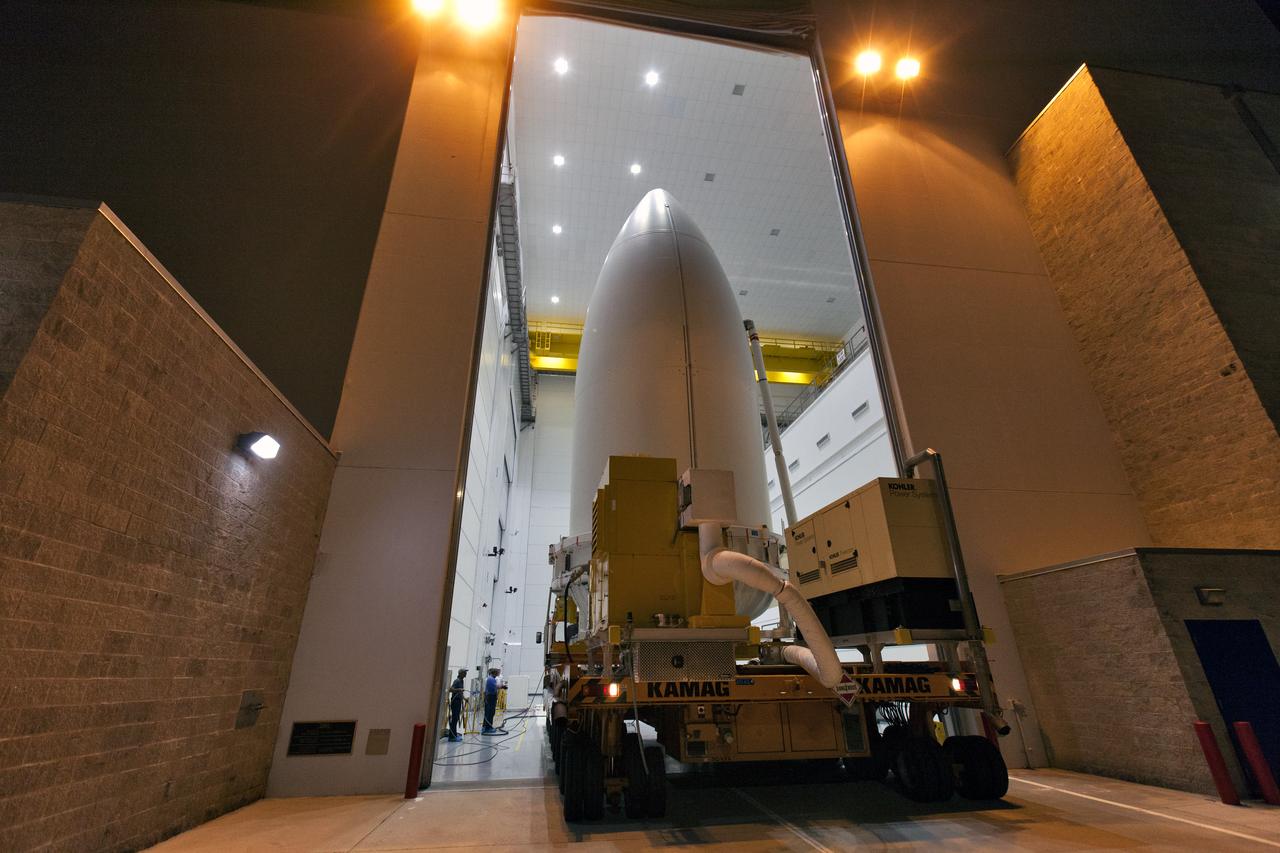
The payload fairing containing NOAA's Geostationary Operational Environmental Satellite-S (GOES-S) is secured on a transporter and moved out of the Astrotech Space Operations facility in Titusville, Florida. GOES-S will be transported to the United Launch Alliance (ULA) Vertical Integration Facility at Space Launch Complex 41 at Cape Canaveral Air Force Station in Florida. The payload fairing will be lifted and mated to the ULA Atlas V rocket. GOES-S is the second in a series of four advanced geostationary weather satellites. GOES-S is slated to launch aboard the ULA Atlas V on March 1.
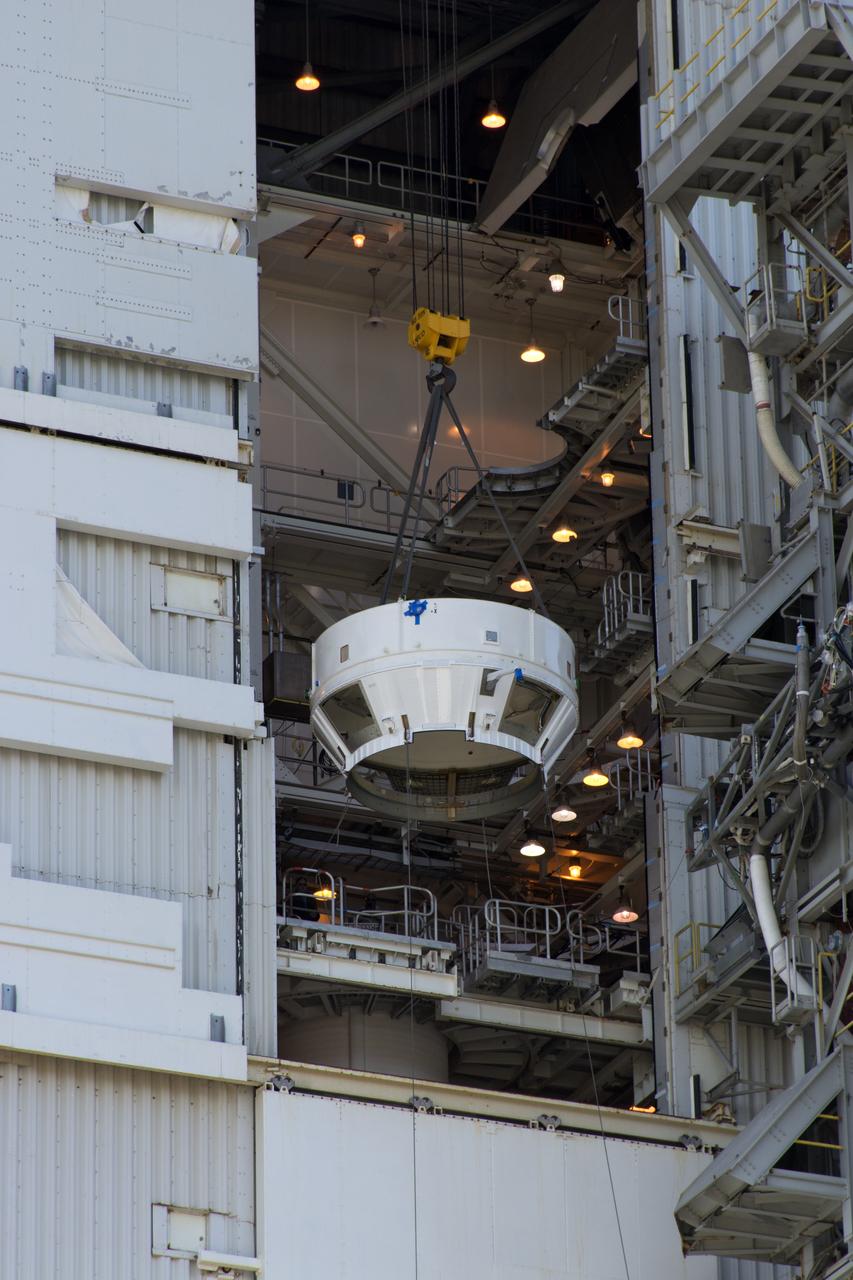
At Space Launch Complex 3 at Vandenberg Air Force Base in California, a boattail fairing is lifted by a crane for mating atop a United Launch Alliance (ULA) Centaur upper stage. The boattail is an adaptor providing an interface between the Centaur and the payload fairing encapsulating NASA's Interior Exploration using Seismic Investigations, Geodesy and Heat Transport, or InSight, spacecraft. A ULA Atlas V rocket is scheduled to liftoff on May 5, 2018, launching InSight the first mission to explore the deep interior of Mars. It will investigate processes that shaped the rocky planets of the inner solar system including Earth.
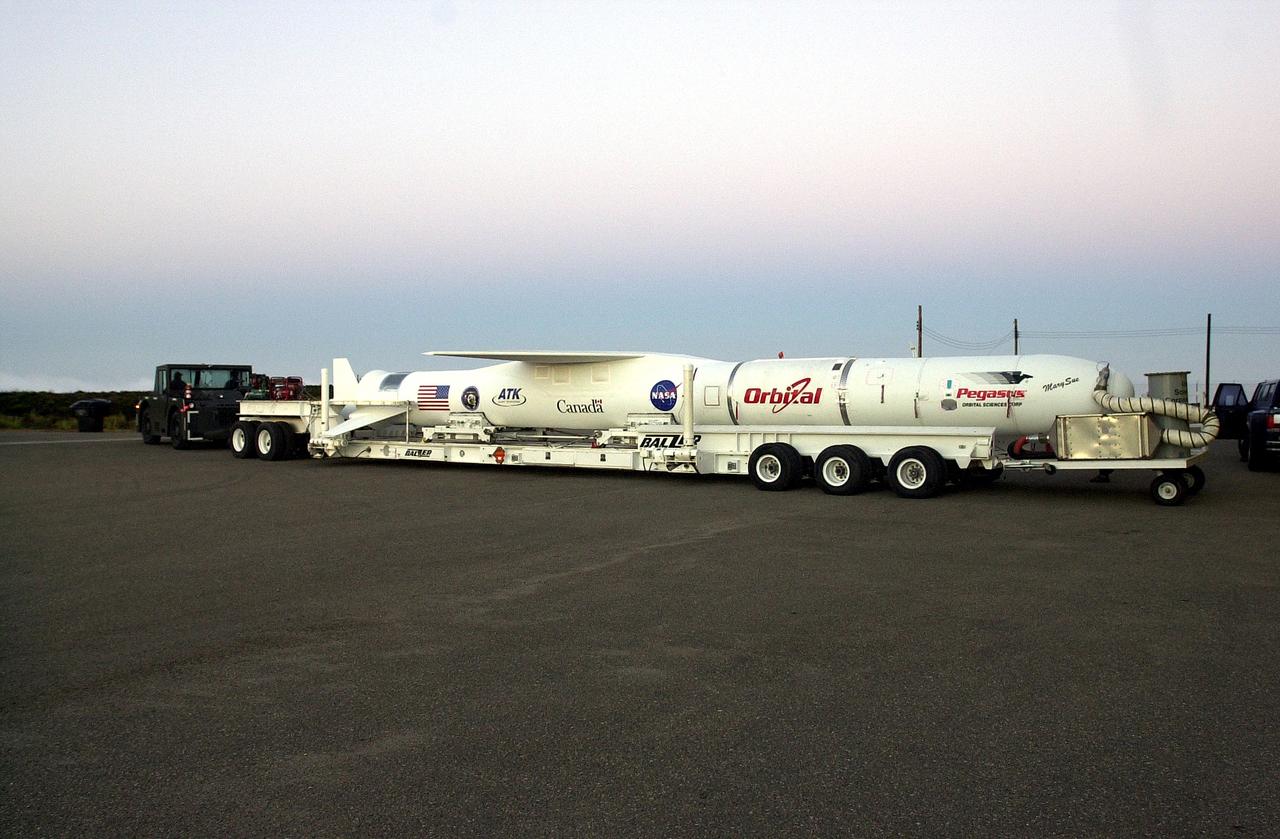
VANDENBERG AIR FORCE BASE, CALIF. - The SciSat-1 payload, with fairing installed and attached to its Pegasus launch vehicle, begins rollout to the hot pad and mating to the L-1011 carrier aircraft. The SciSat-1 weighs approximately 330 pounds and after launch will be placed in a 400-mile-high polar orbit to investigate processes that control the distribution of ozone in the upper atmosphere. The data from the satellite will provide Canadian and international scientists with improved measurements relating to global ozone processes and help policymakers assess existing environmental policy and develop protective measures for improving the health of our atmosphere, preventing further ozone depletion. The mission is designed to last two years.
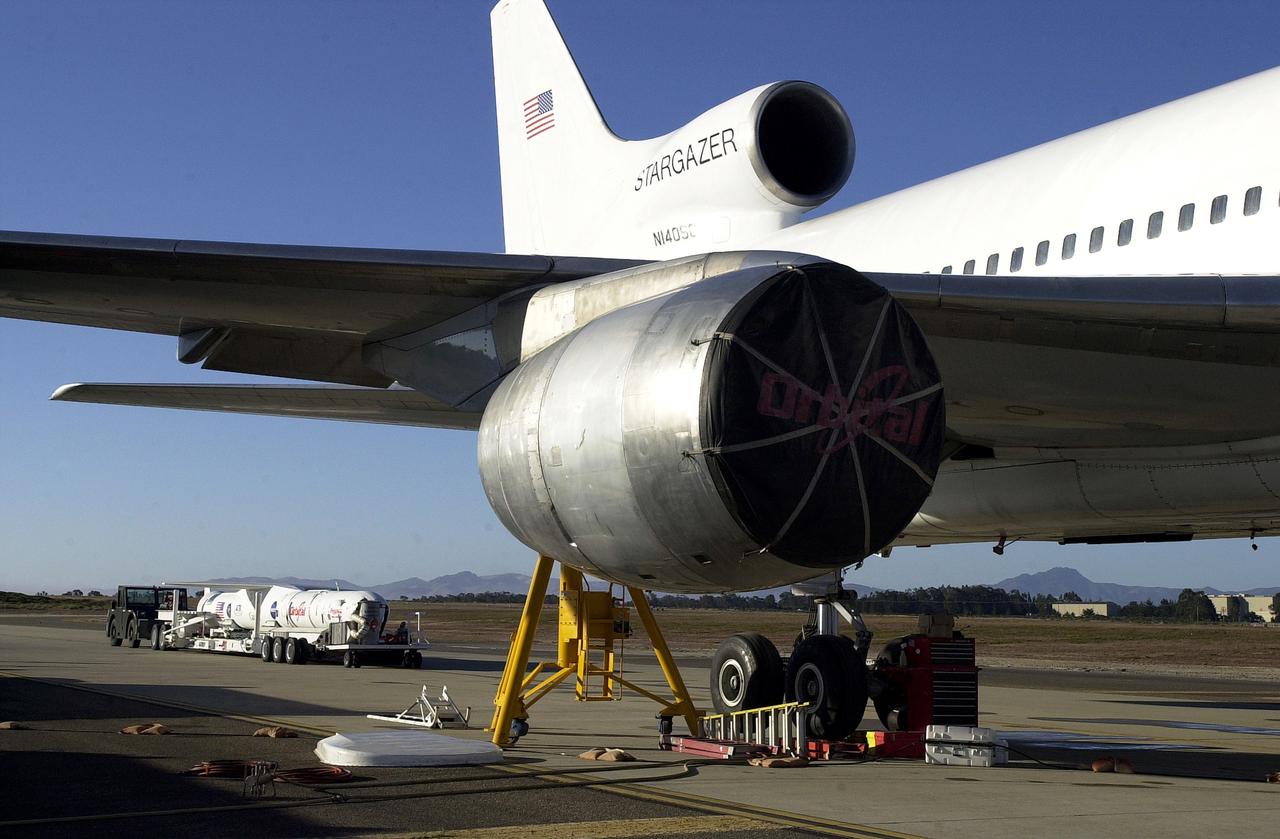
VANDENBERG AIR FORCE BASE, CALIF. - The SciSat-1 payload, with fairing installed and attached to its Pegasus launch vehicle, arrives at the pad for mating to the L-1011 carrier aircraft. The SciSat-1 weighs approximately 330 pounds and after launch will be placed in a 400-mile-high polar orbit to investigate processes that control the distribution of ozone in the upper atmosphere. The data from the satellite will provide Canadian and international scientists with improved measurements relating to global ozone processes and help policymakers assess existing environmental policy and develop protective measures for improving the health of our atmosphere, preventing further ozone depletion. The mission is designed to last two years.
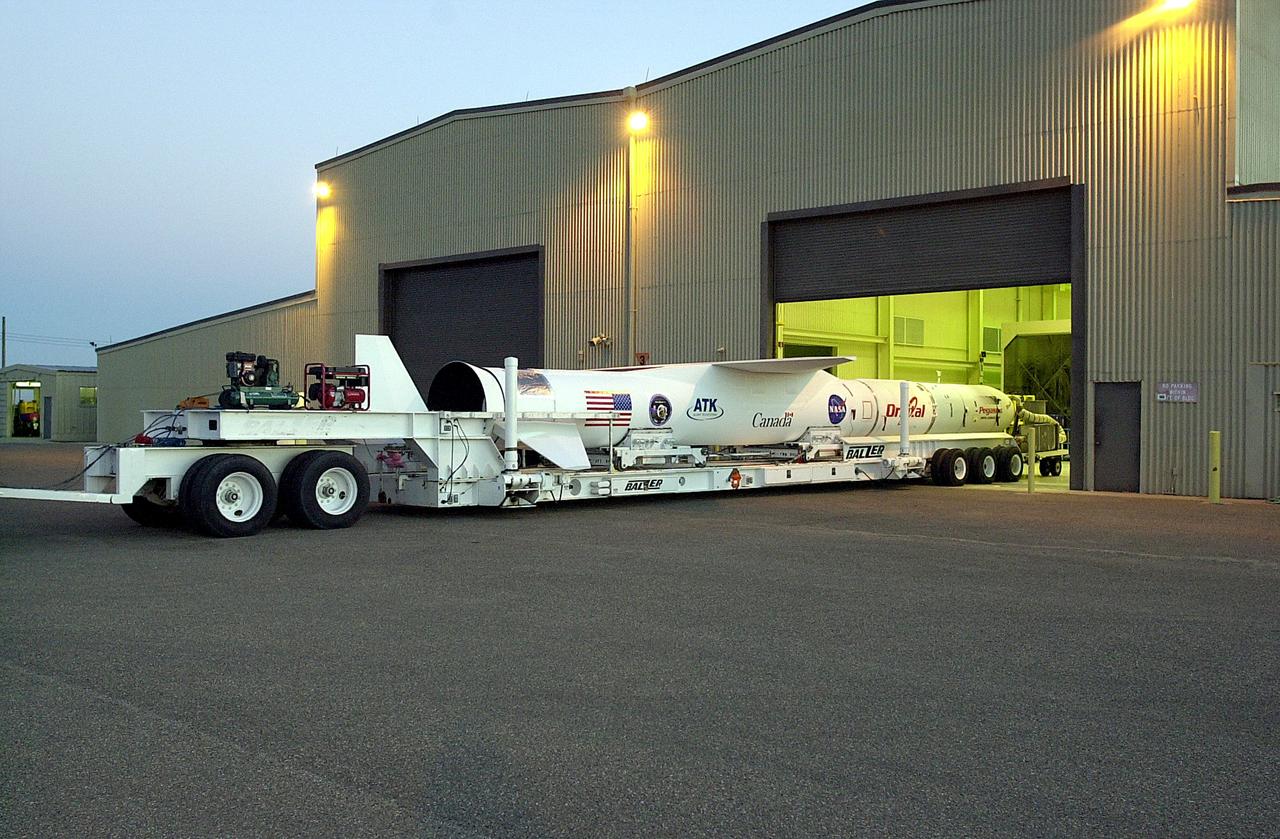
VANDENBERG AIR FORCE BASE, CALIF. - The SciSat-1 payload, with fairing installed and attached to its Pegasus launch vehicle, begins rollout to the hot pad and mating to the L-1011 carrier aircraft. The SciSat-1 weighs approximately 330 pounds and after launch will be placed in a 400-mile-high polar orbit to investigate processes that control the distribution of ozone in the upper atmosphere. The data from the satellite will provide Canadian and international scientists with improved measurements relating to global ozone processes and help policymakers assess existing environmental policy and develop protective measures for improving the health of our atmosphere, preventing further ozone depletion. The mission is designed to last two years.
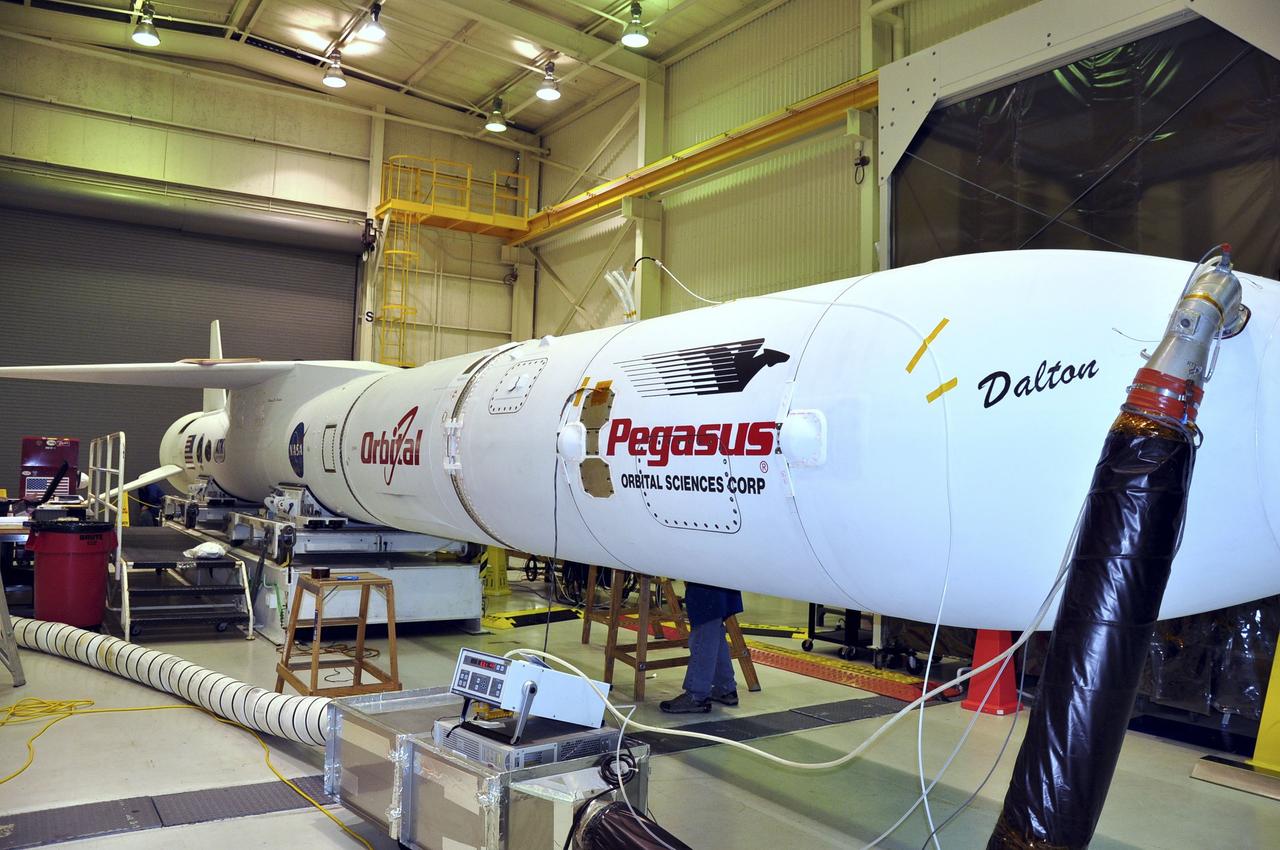
VANDENBERG AIR FORCE BASE, Calif. – Inside the Orbital Sciences processing facility at Vandenberg Air Force Base in California, NASA's Nuclear Spectroscopic Telescope Array, or NuSTAR, awaits rollout for mating to the L-1011 Orbital carrier aircraft. Previously, the spacecraft was mated with its Pegasus XL rocket and enclosed in the Pegasus payload fairing. Cool, dry air is being pumped into the fairing through a purge line to maintain the proper environment for the spacecraft in the confined space. The fairing will protect the spacecraft from the heat and aerodynamic pressure generated during the rocket’s ascent to orbit. After processing of the rocket and spacecraft are complete, they will be flown on Orbital's L-1011 carrier aircraft from Vandenberg to the Ronald Reagan Ballistic Missile Defense Test Site on the Pacific Ocean’s Kwajalein Atoll for launch in March. The high-energy x-ray telescope will conduct a census of black holes, map radioactive material in young supernovae remnants, and study the origins of cosmic rays and the extreme physics around collapsed stars. For more information, visit http://www.nasa.gov/nustar. Photo credit: NASA/Randy Beaudoin, VAFB
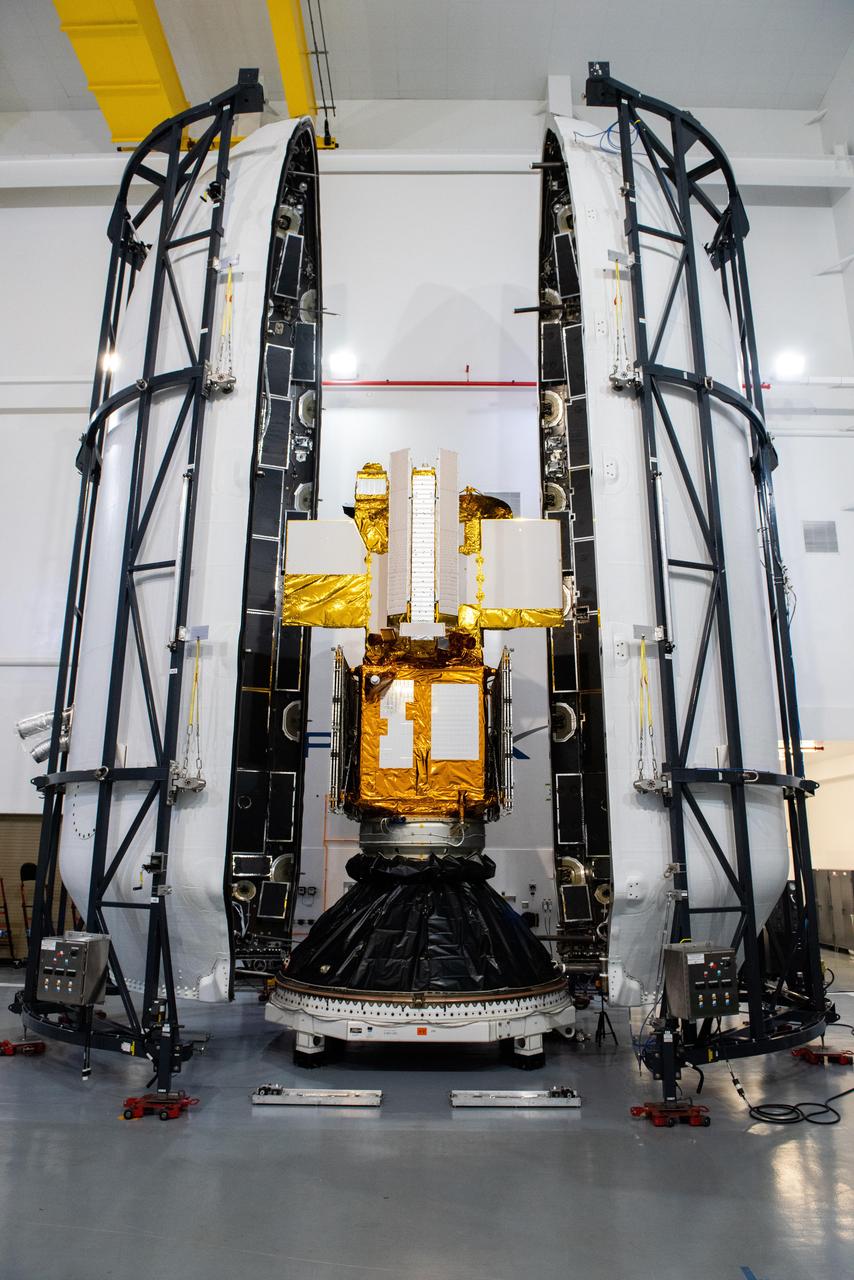
Technicians encapsulated the SWOT satellite, or the Surface Water and Ocean Topography mission, in its payload fairing on Dec. 8, 2022, in preparation for launch. At the SpaceX processing facility at Vandenberg Space Force Base in California, technicians completed the operation and will soon mate the fairing to the top of a Falcon 9 rocket. The fairing protects the satellite from aerodynamic pressure and heating during ascent. After the rocket escapes Earth's atmosphere, the fairing separates into two halves, which are jettisoned back to Earth. Once in orbit, SWOT will measure the height of water in freshwater bodies and the ocean on more than 90% of Earth's surface. This information will provide insights into how the ocean influences climate change; how a warming world affects lakes, rivers, and reservoirs; and how communities can better prepare for disasters, such as floods. SWOT is a collaborative effort by NASA and France's Centre National d'Études Spatiales (CNES) with contributions from the Canadian Space Agency (CSA) and UK Space Agency. Launch is targeted for Dec. 15, 2022, at 3:46 a.m. PST from Space Launch Complex 4E at Vandenberg Space Force Base. https://photojournal.jpl.nasa.gov/catalog/PIA25627
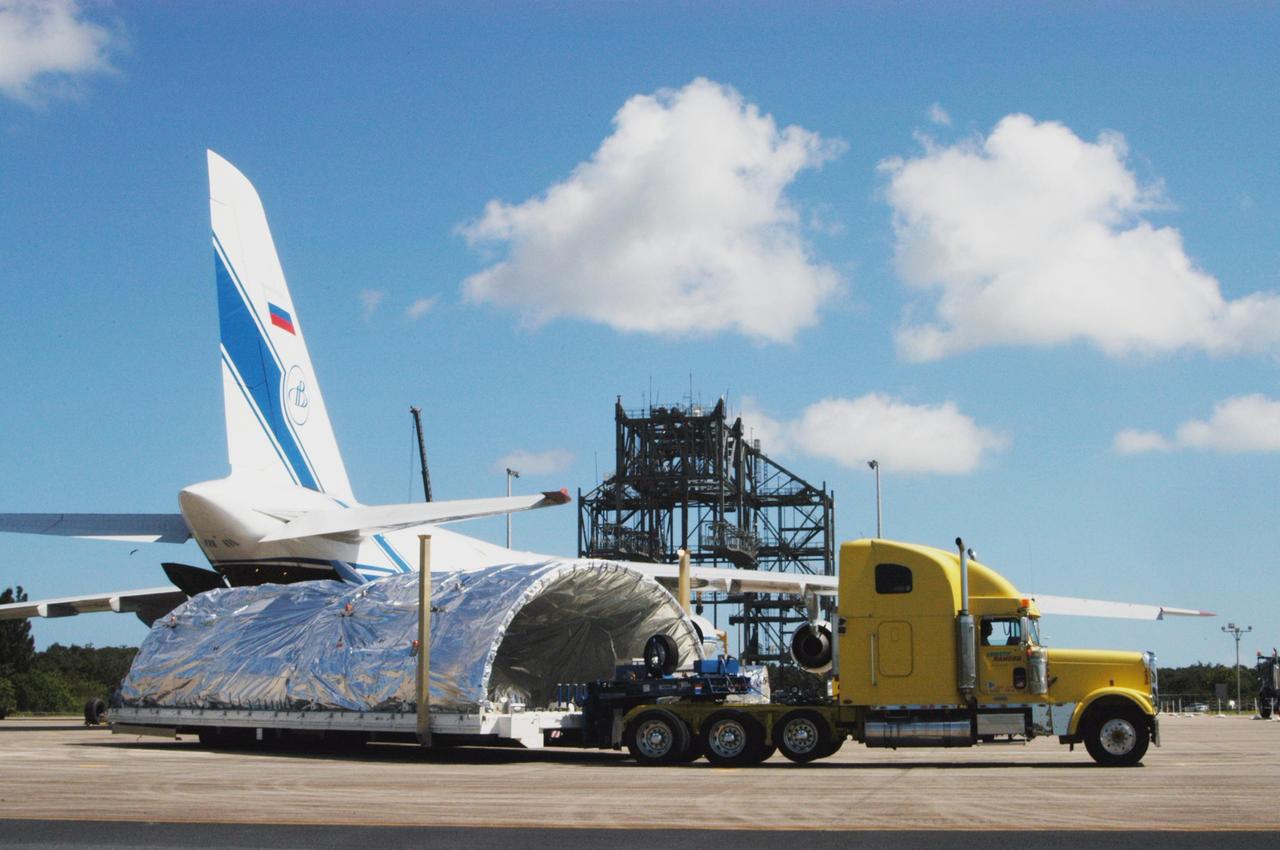
KENNEDY SPACE CENTER, FLA. - On the Shuttle Landing Facility at NASA Kennedy Space Center, one of the Atlas V fairing halves for the New Horizons spacecraft is moved away from the Russian cargo plane that delivered it. Behind the truck is the mate/demate device at the landing facility. The fairing halves will be transported to Astrotech Space Operations in Titusville. The fairing later will be placed around the New Horizons spacecraft in the Payload Hazardous Service Facility. A fairing protects a spacecraft during launch and flight through the atmosphere. Once in space, it is jettisoned. The Lockheed Martin Atlas V is the launch vehicle for the New Horizons spacecraft, which is designed to make the first reconnaissance of Pluto and Charon - a "double planet" and the last planet in our solar system to be visited by spacecraft. The mission will then visit one or more objects in the Kuiper Belt region beyond Neptune. New Horizons is scheduled to launch in January 2006, swing past Jupiter for a gravity boost and scientific studies in February or March 2007, and reach Pluto and its moon, Charon, in July 2015.
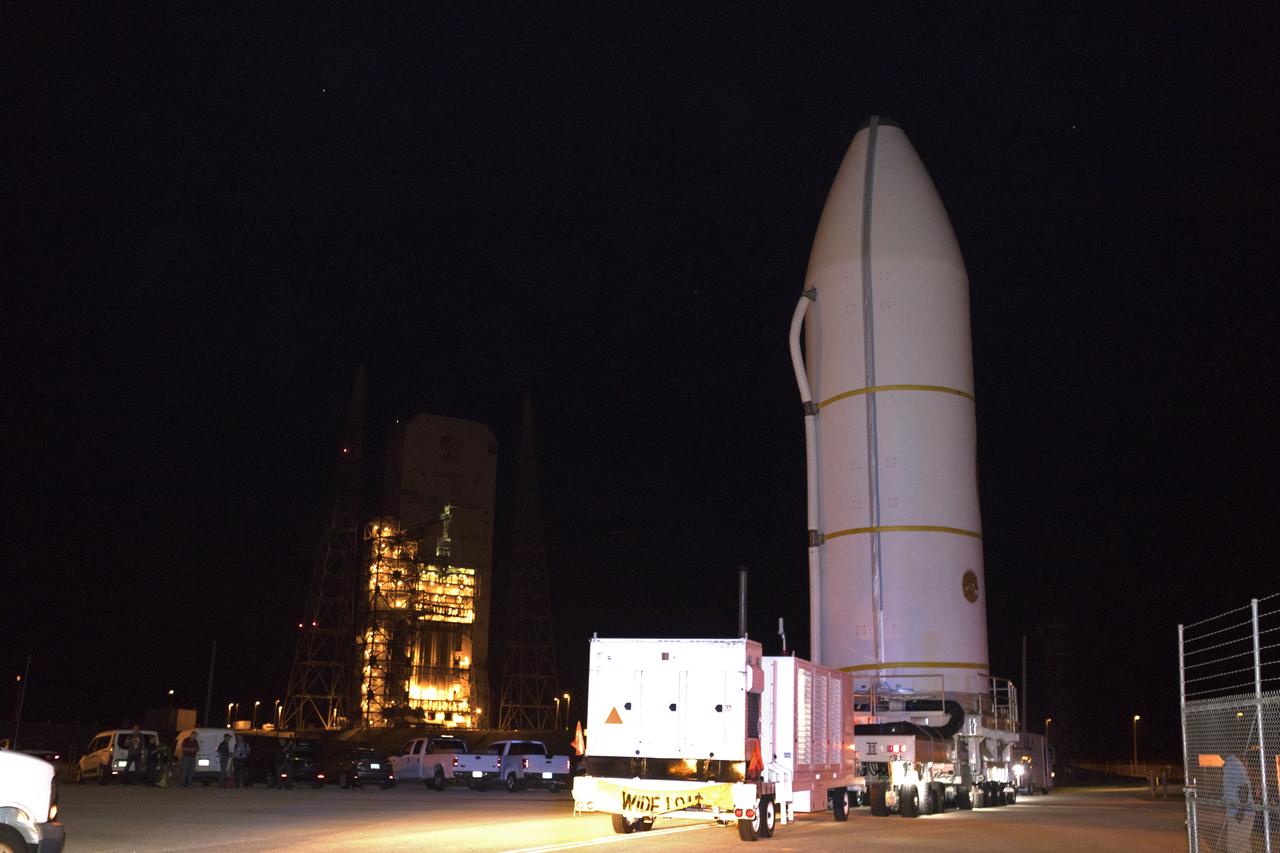
On Monday, July 30, 2018 NASA's Parker Solar Probe, encapsulated in its payload fairing, arrives at Space Launch Complex 37 at Cape Canaveral Air Force Station where it will be mated atop a United Launch Alliance Delta IV Heavy rocket. The mission will perform the closest-ever observations of a star when it travels through the Sun's atmosphere, called the corona. The probe will rely on measurements and imaging to revolutionize our understanding of the corona and the Sun-Earth connection.
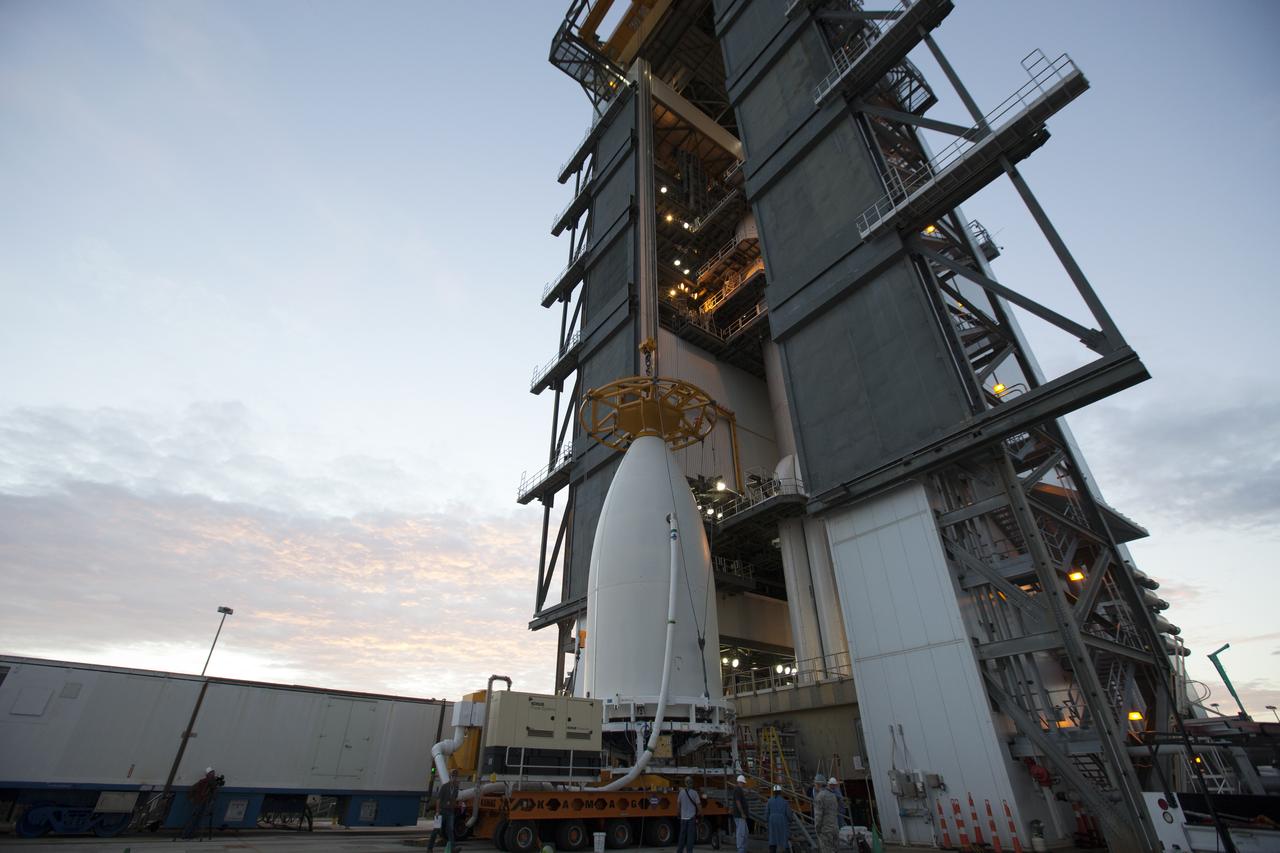
Preparations are underway to lift NOAA's Geostationary Operational Environmental Satellite (GOES-R), enclosed in its payload fairing at the Vertical Integration Facility at Space Launch Complex 41 at Cape Canaveral Air Force Station in Florida. GOES-R will be mated to the United Launch Alliance Atlas V Centaur upper stage in preparation for launch in November. GOES-R is the first satellite in a series of next-generation NOAA GOES Satellites.
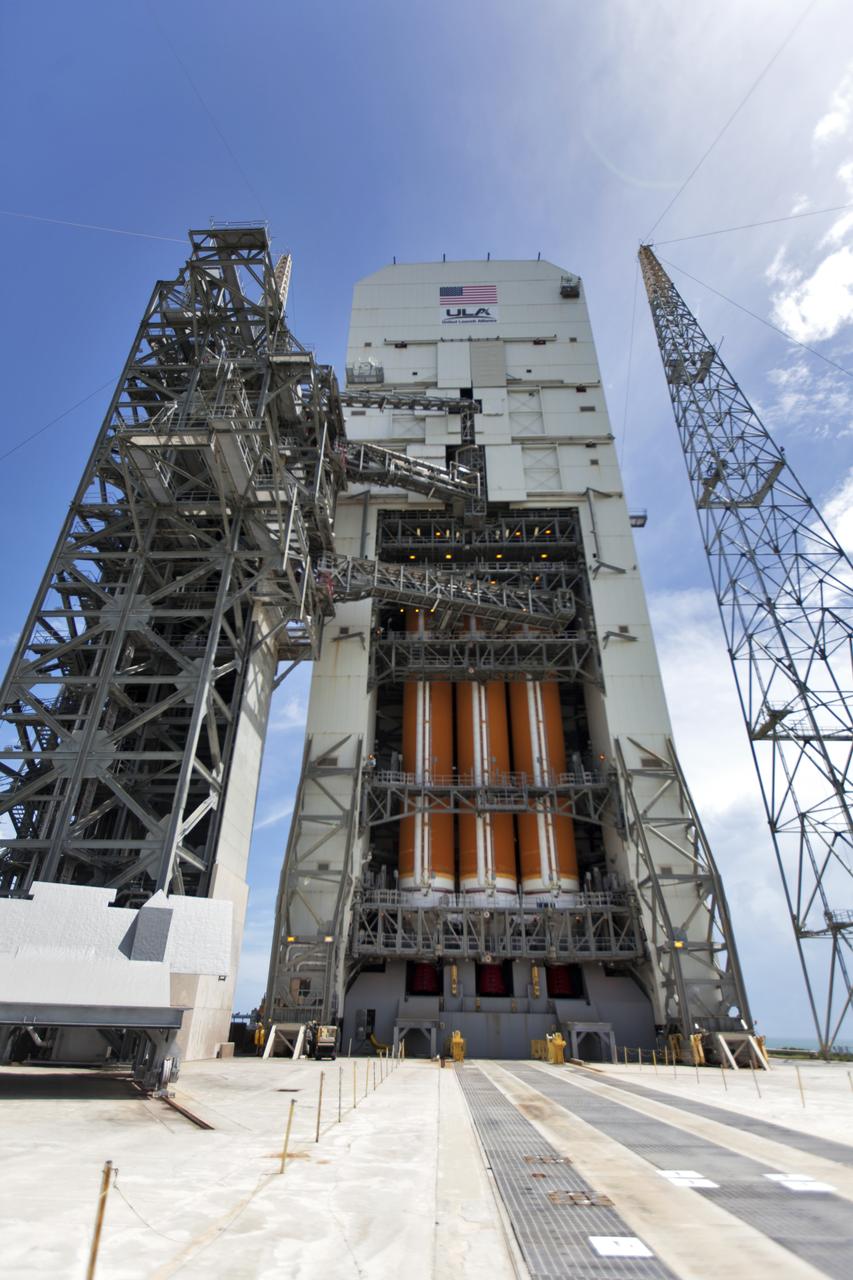
Encapsulated in its payload fairing, NASA's Parker Solar Probe has been mated to a United Launch Alliance Delta IV Heavy rocket at Cape Canaveral Air Force Station's Space Launch Complex 37 on Tuesday, July 31, 2018. The Parker Solar Probe is being prepared for a mission to perform the closest-ever observations of a star when it travels through the Sun's atmosphere, called the corona. The probe will rely on measurements and imaging to revolutionize our understanding of the corona and the Sun-Earth connection.
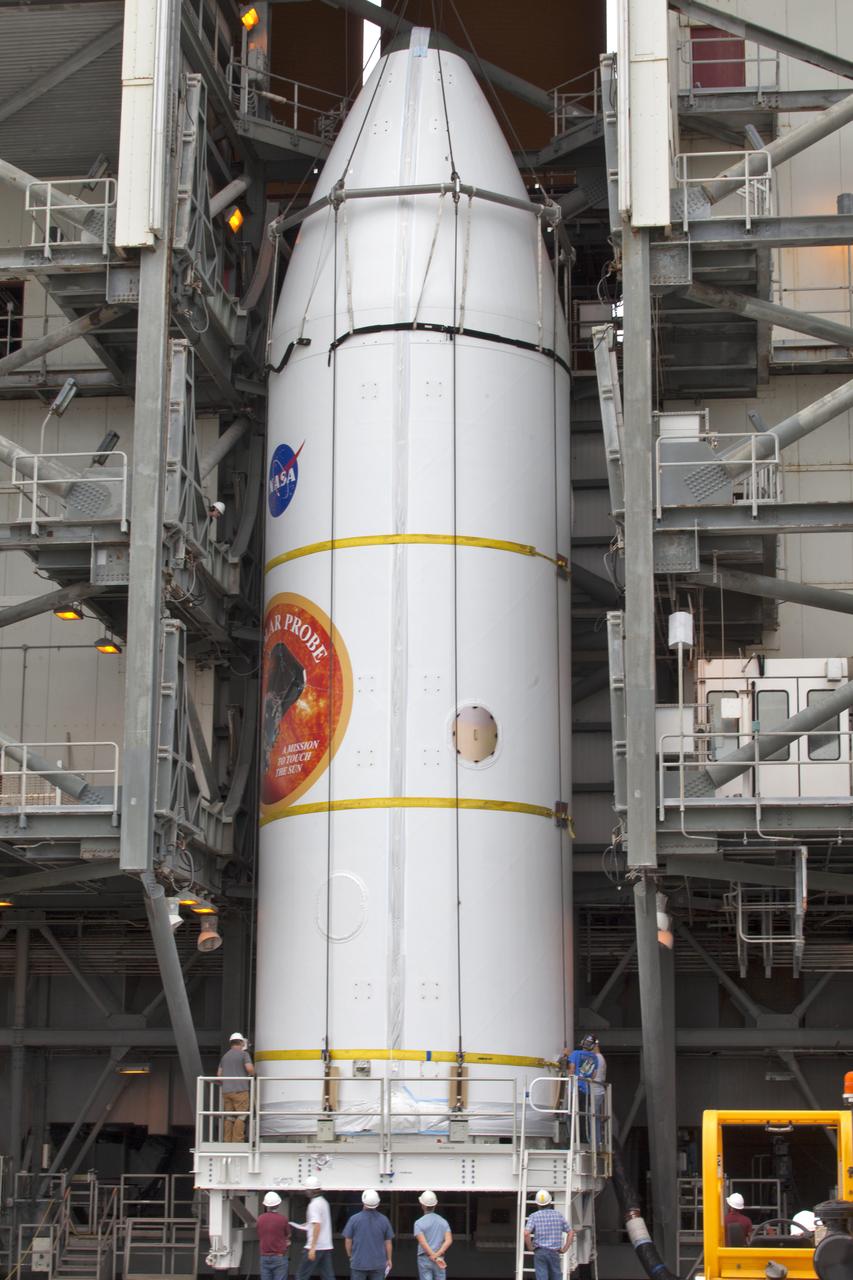
Encapsulated in its payload fairing, NASA's Parker Solar Probe is prepared to be lifted for mating to a United Launch Alliance Delta IV Heavy rocket at Cape Canaveral Air Force Station's Space Launch Complex 37 on Tuesday, July 31, 2018. The Parker Solar Probe is being prepared for a mission to perform the closest-ever observations of a star when it travels through the Sun's atmosphere, called the corona. The probe will rely on measurements and imaging to revolutionize our understanding of the corona and the Sun-Earth connection.
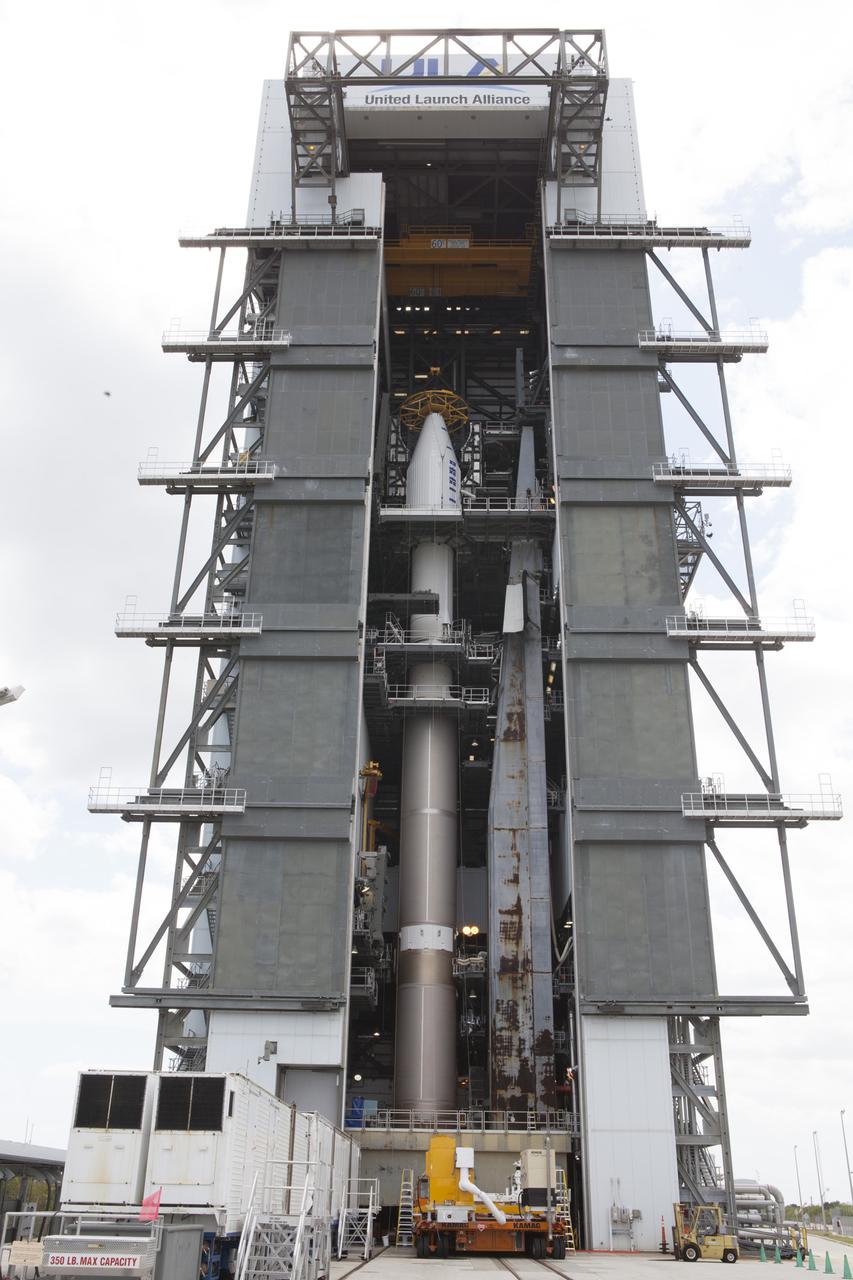
Encapsulated inside its payload fairing, the Cygnus spacecraft for the upcoming Orbital ATK Commercial Resupply Services-6 has been mated atop a United Launch Alliance Atlas V rocket in the Vertical Integration Facility at Launch Complex-41 at Cape Canaveral Air Force Station. The Cygnus is scheduled to lift off atop a United Launch Alliance Atlas V rocket on March 22 to deliver hardware and supplies to the International Space Station.

Encapsulated inside its payload fairing, the Cygnus spacecraft for the upcoming Orbital ATK Commercial Resupply Services-6 is prepared for lifting to be mated atop a United Launch Alliance Atlas V rocket in the Vertical Integration Facility at Launch Complex-41 at Cape Canaveral Air Force Station. The Cygnus is scheduled to lift off atop a United Launch Alliance Atlas V rocket on March 22 to deliver hardware and supplies to the International Space Station.
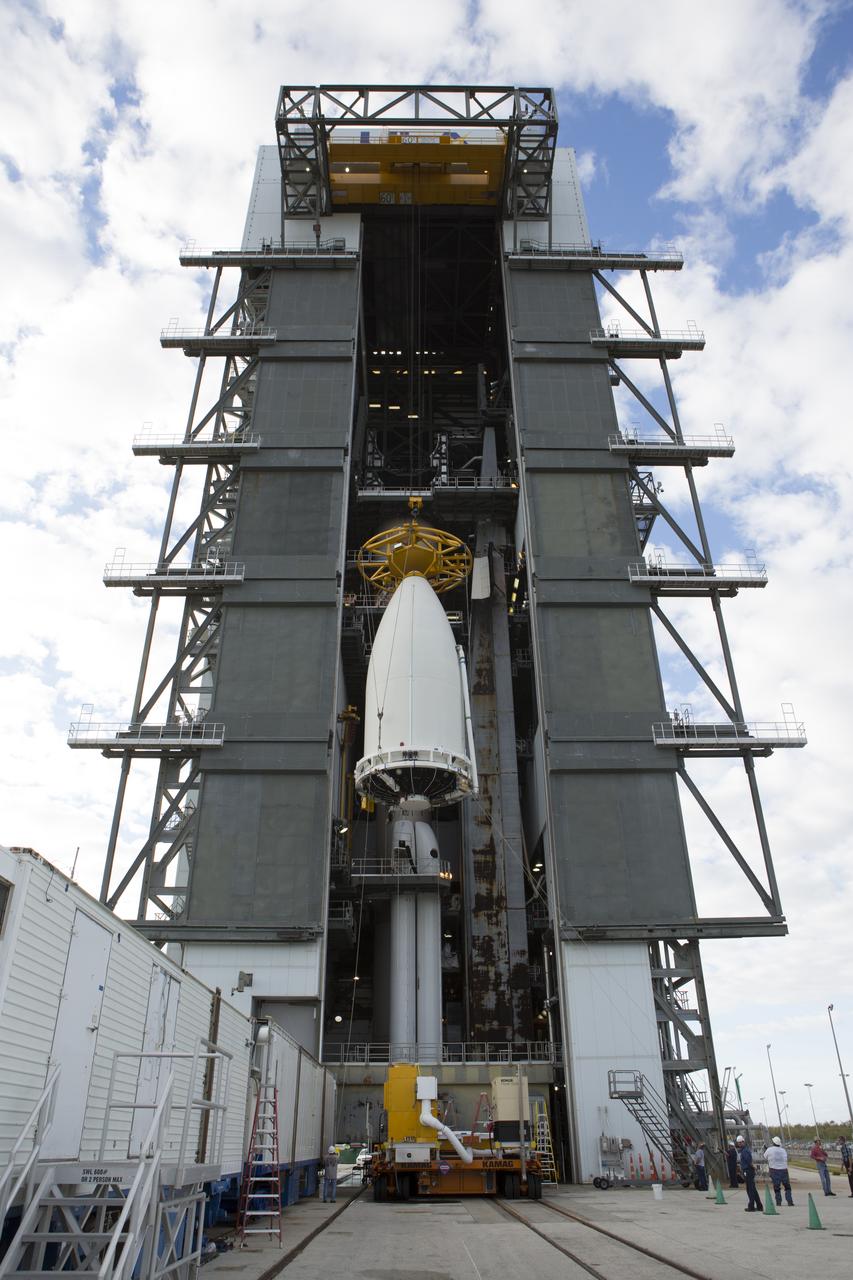
A crane is used to lift the payload fairing containing NOAA's Geostationary Operational Environmental Satellite (GOES-R) at the Vertical Integration Facility at Space Launch Complex 41 at Cape Canaveral Air Force Station in Florida. GOES-R will be mated to the United Launch Alliance Atlas V Centaur upper stage in preparation for launch in November. GOES-R is the first satellite in a series of next-generation NOAA GOES Satellites.
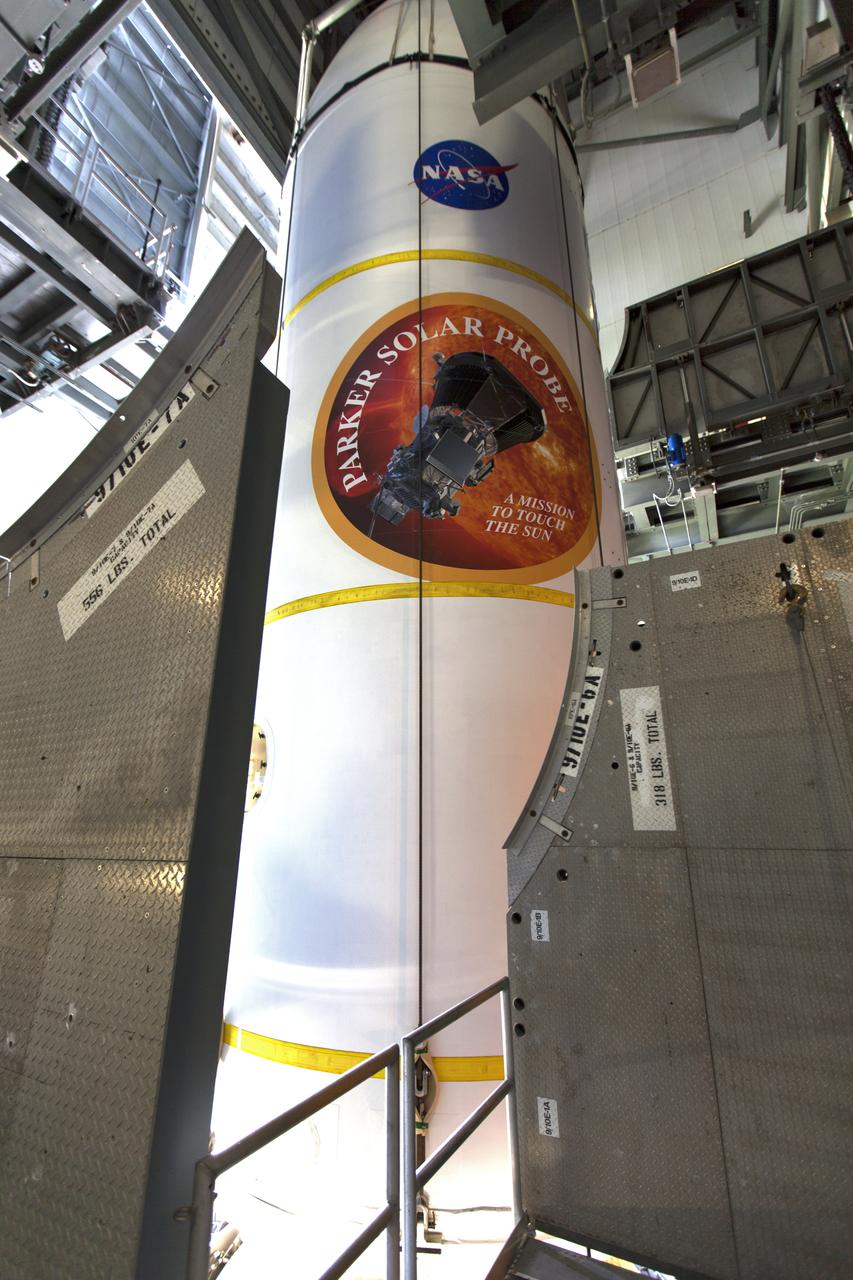
Encapsulated in its payload fairing, NASA's Parker Solar Probe is lifted by a crane for mating to a United Launch Alliance Delta IV Heavy rocket at Cape Canaveral Air Force Station's Space Launch Complex 37 on Tuesday, July 31, 2018. The Parker Solar Probe is being prepared for a mission to perform the closest-ever observations of a star when it travels through the Sun's atmosphere, called the corona. The probe will rely on measurements and imaging to revolutionize our understanding of the corona and the Sun-Earth connection.
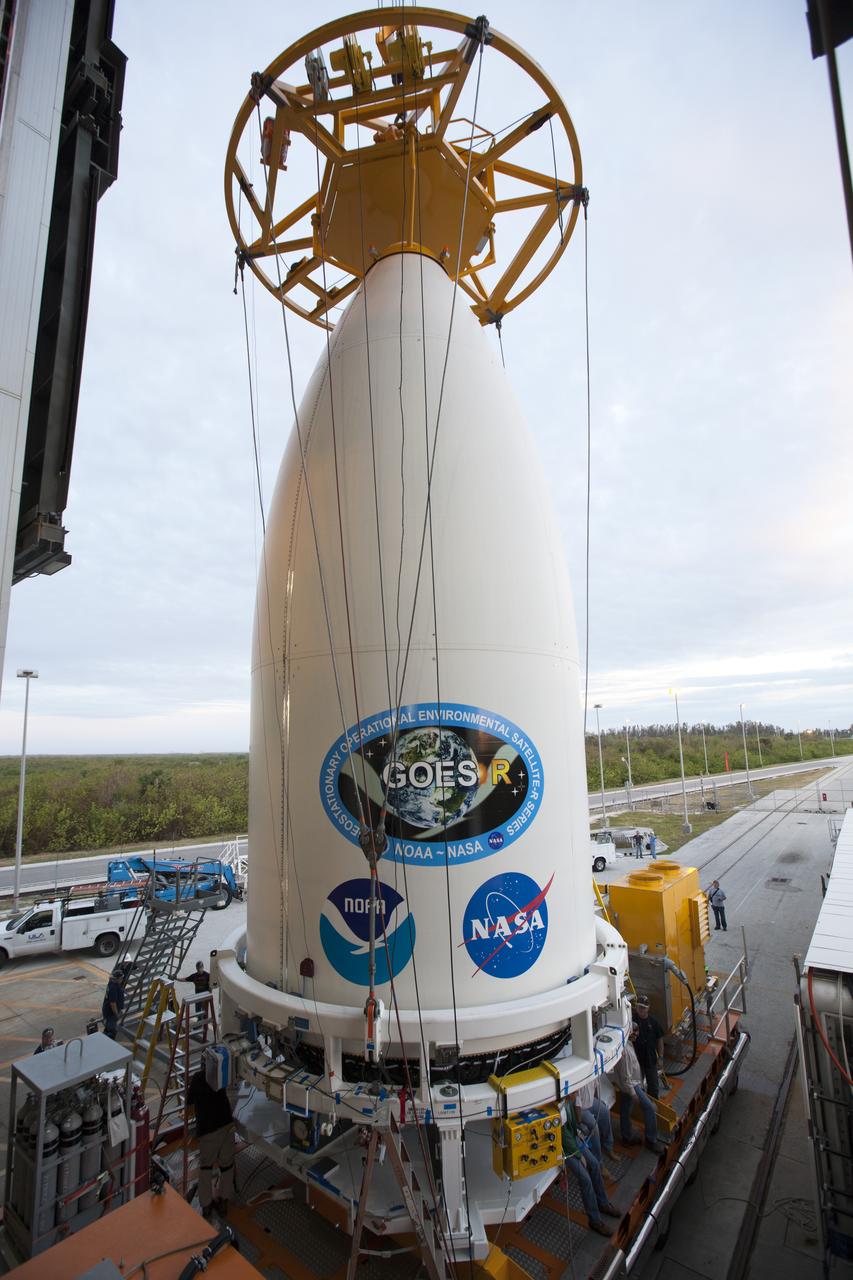
A crane has been attached to the payload fairing containing NOAA's Geostationary Operational Environmental Satellite (GOES-R) at the Vertical Integration Facility at Space Launch Complex 41 at Cape Canaveral Air Force Station in Florida. GOES-R will be mated to the United Launch Alliance Atlas V Centaur upper stage in preparation for launch in November. GOES-R is the first satellite in a series of next-generation NOAA GOES Satellites.
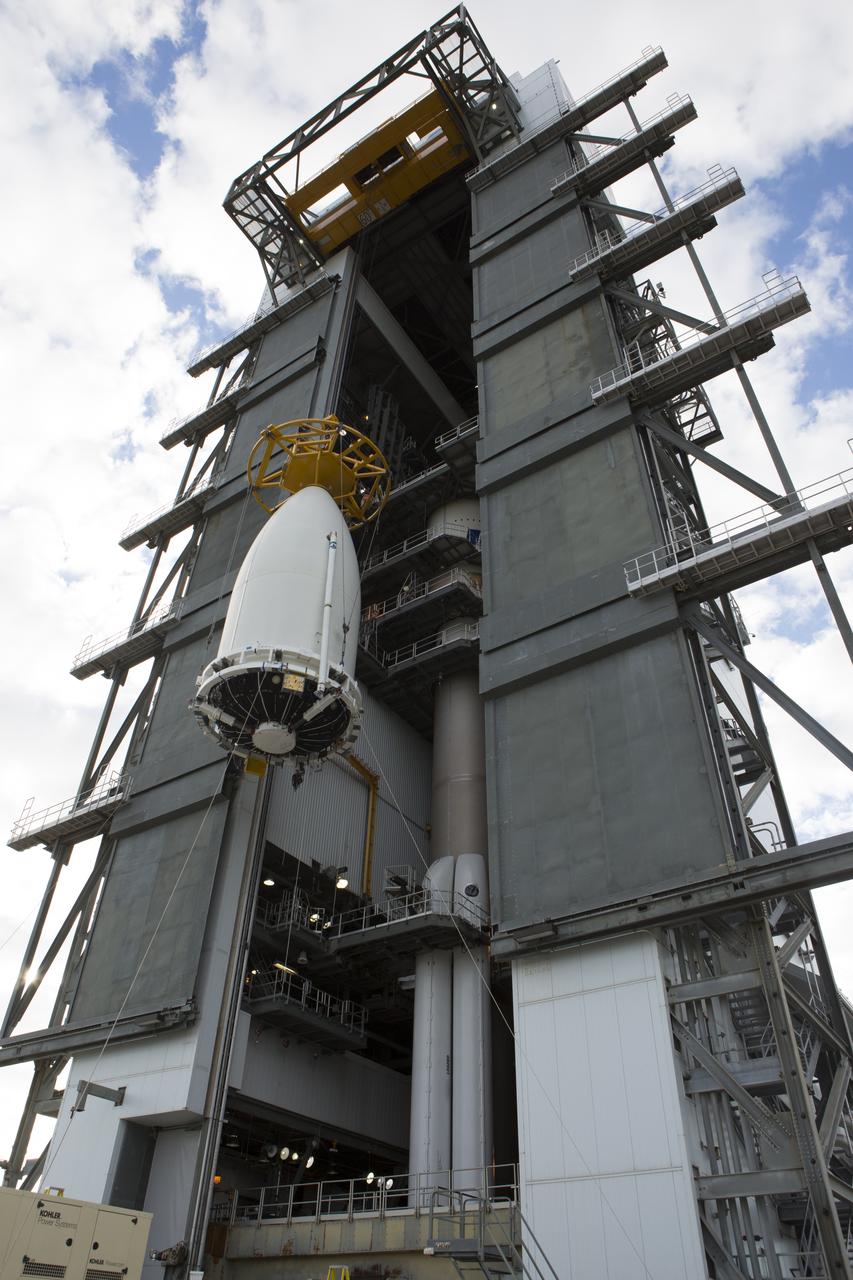
A crane is used to lift the payload fairing containing NOAA's Geostationary Operational Environmental Satellite (GOES-R) at the Vertical Integration Facility at Space Launch Complex 41 at Cape Canaveral Air Force Station in Florida. GOES-R will be mated to the United Launch Alliance Atlas V Centaur upper stage in preparation for launch in November. GOES-R is the first satellite in a series of next-generation NOAA GOES Satellites.
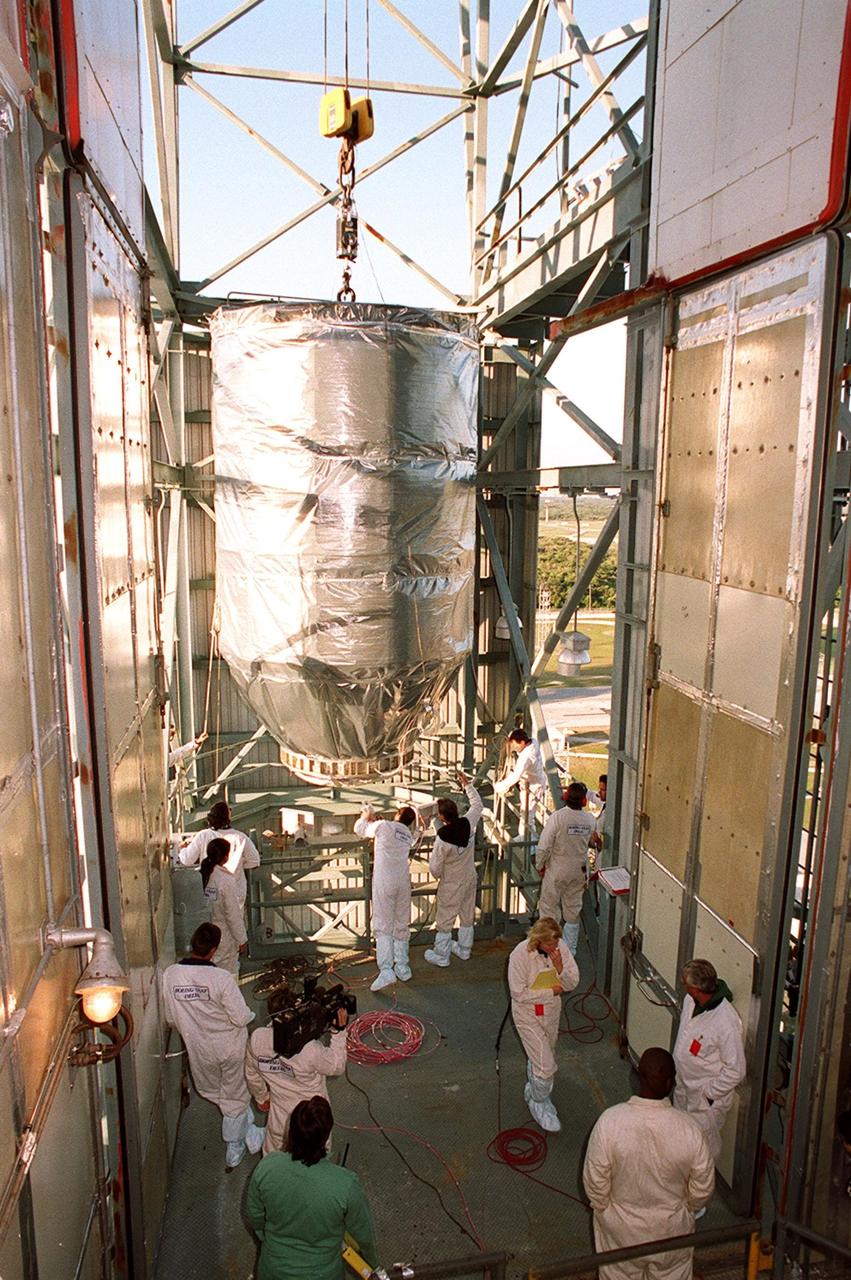
Workers on Launch Pad 17-A, Cape Canaveral Air Force Station, get ready to move the Mars Odyssey spacecraft into the clean room at the top of the gantry. There it will be mated encased by the fairing of the Delta II rocket already in place. The spacecraft will map the Martian surface in search of geological features that could indicate the presence of water, now or in the past, and may contribute significantly toward understanding what will be necessary for a more sophisticated exploration of Mars. Launch is scheduled for 11:02 a.m. EDT April 7
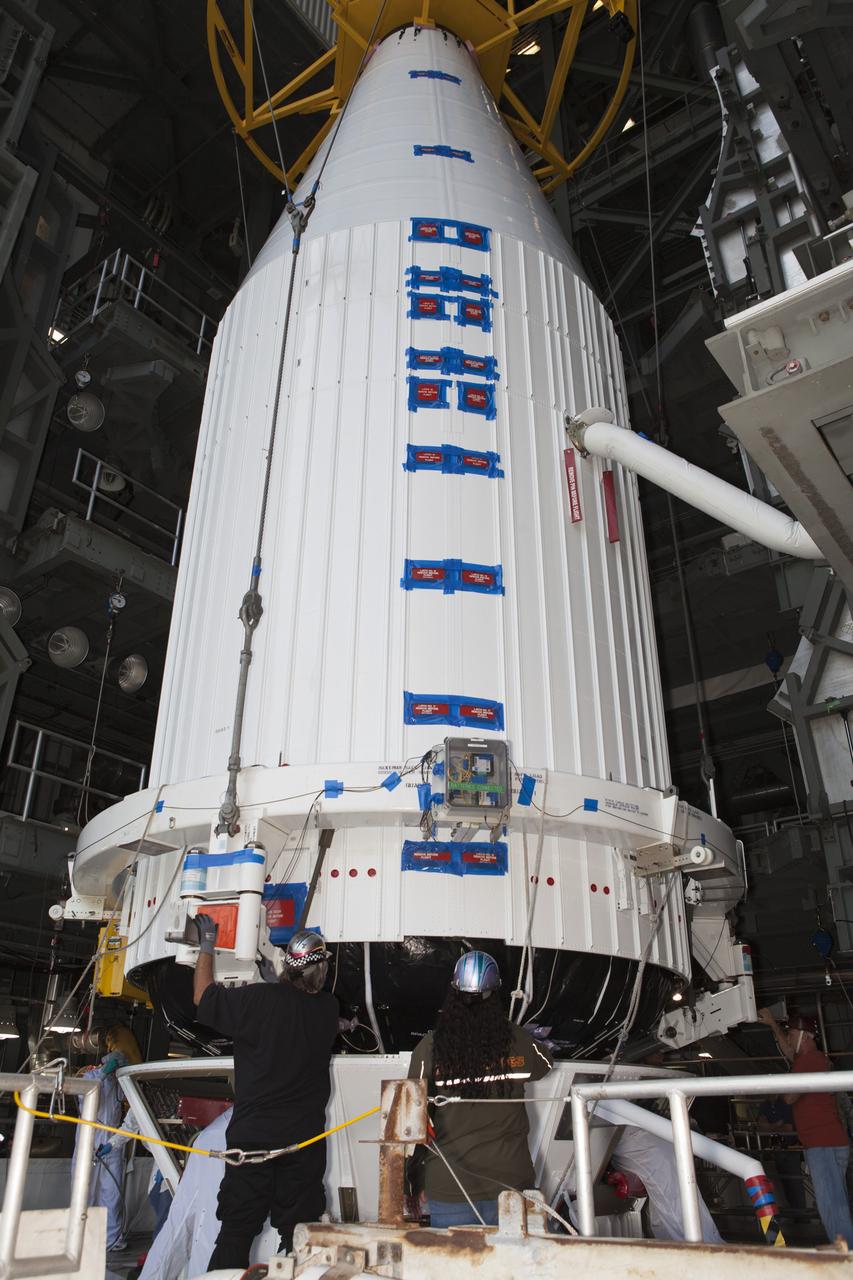
Encapsulated inside its payload fairing, the Cygnus spacecraft for the upcoming Orbital ATK Commercial Resupply Services-6 is positioned for mating atop a United Launch Alliance Atlas V rocket in the Vertical Integration Facility at Launch Complex-41 at Cape Canaveral Air Force Station. The Cygnus is scheduled to lift off atop a United Launch Alliance Atlas V rocket on March 22 to deliver hardware and supplies to the International Space Station.
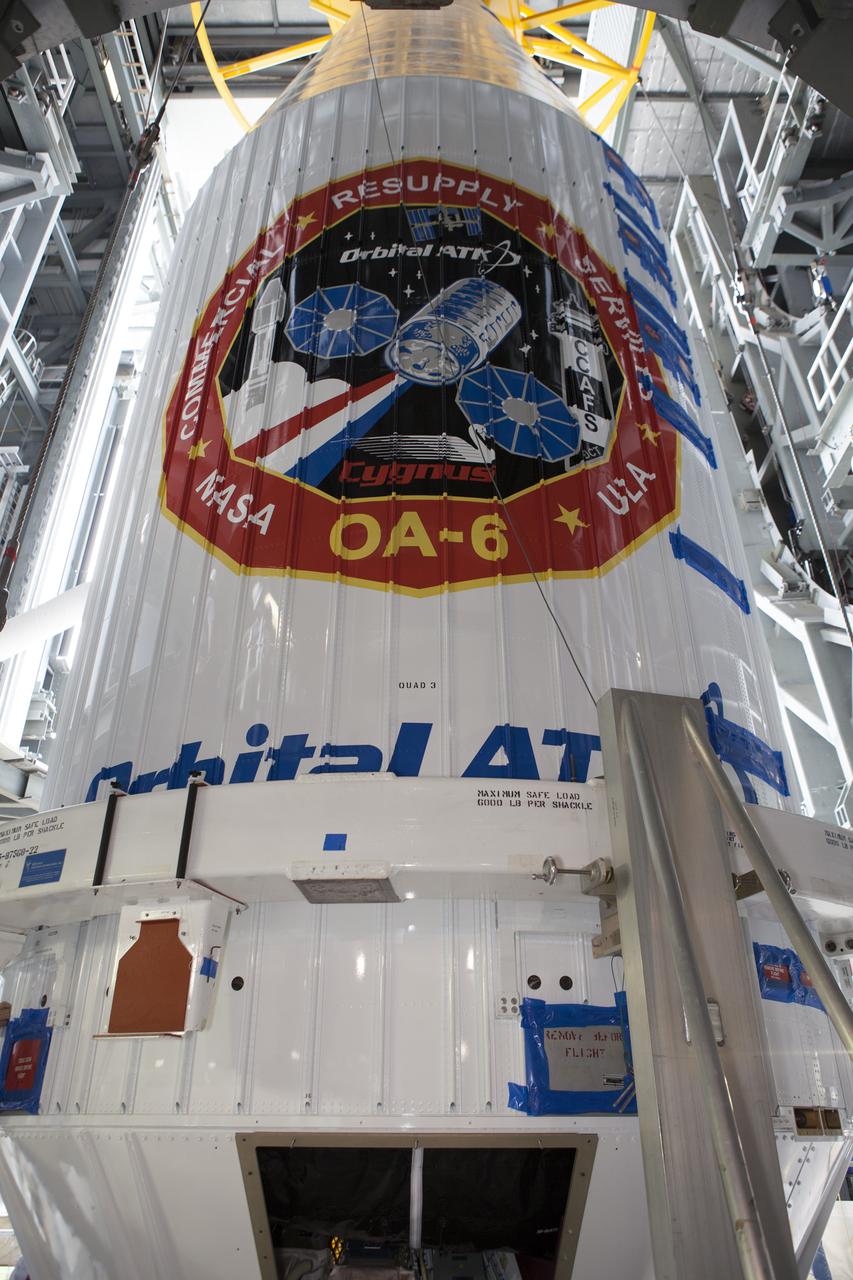
Encapsulated inside its payload fairing, the Cygnus spacecraft for the upcoming Orbital ATK Commercial Resupply Services-6 is mated atop a United Launch Alliance Atlas V rocket in the Vertical Integration Facility at Launch Complex-41 at Cape Canaveral Air Force Station. The Cygnus is scheduled to lift off atop a United Launch Alliance Atlas V rocket on March 22 to deliver hardware and supplies to the International Space Station.
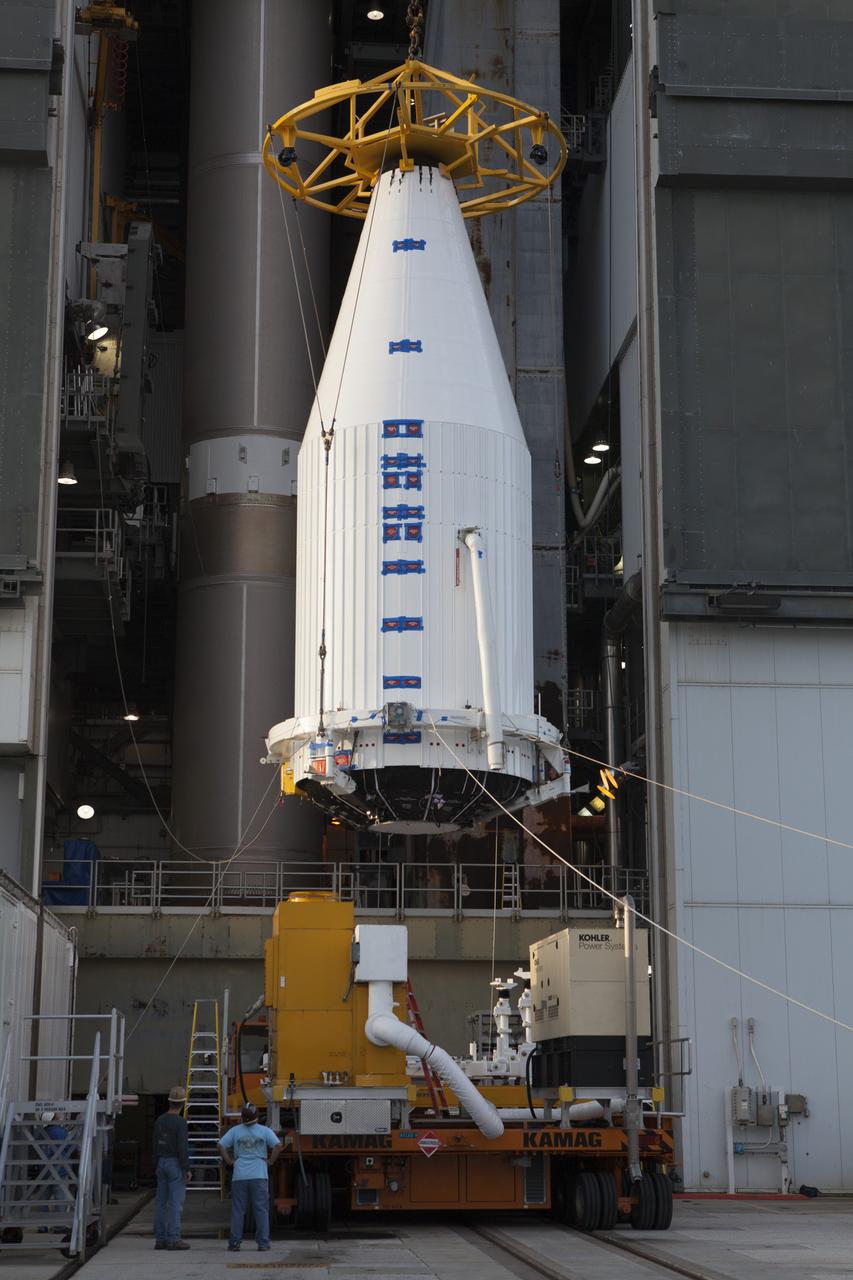
Encapsulated inside its payload fairing, the Cygnus spacecraft for the upcoming Orbital ATK Commercial Resupply Services-6 is lifted to be mated atop a United Launch Alliance Atlas V rocket in the Vertical Integration Facility at Launch Complex-41 at Cape Canaveral Air Force Station. The Cygnus is scheduled to lift off atop a United Launch Alliance Atlas V rocket on March 22 to deliver hardware and supplies to the International Space Station.
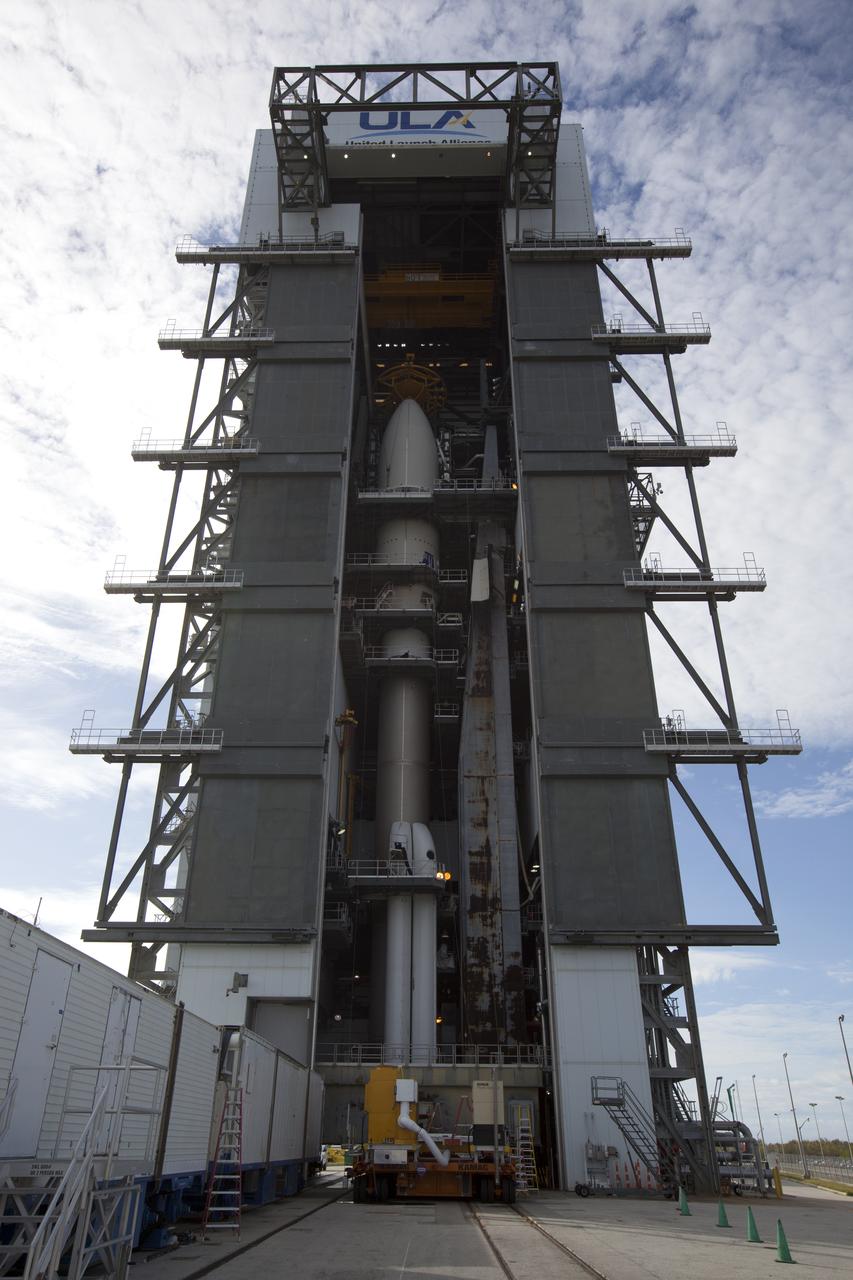
Enclosed in its payload fairing, NOAA's Geostationary Operational Environmental Satellite (GOES-R) is mated to the United Launch Alliance Atlas V Centaur upper stage in the Vertical Integration Facility at Space Launch Complex 41 at Cape Canaveral Air Force Station in Florida. The satellite will launch aboard the Atlas V rocket in November. GOES-R is the first satellite in a series of next-generation NOAA GOES Satellites.
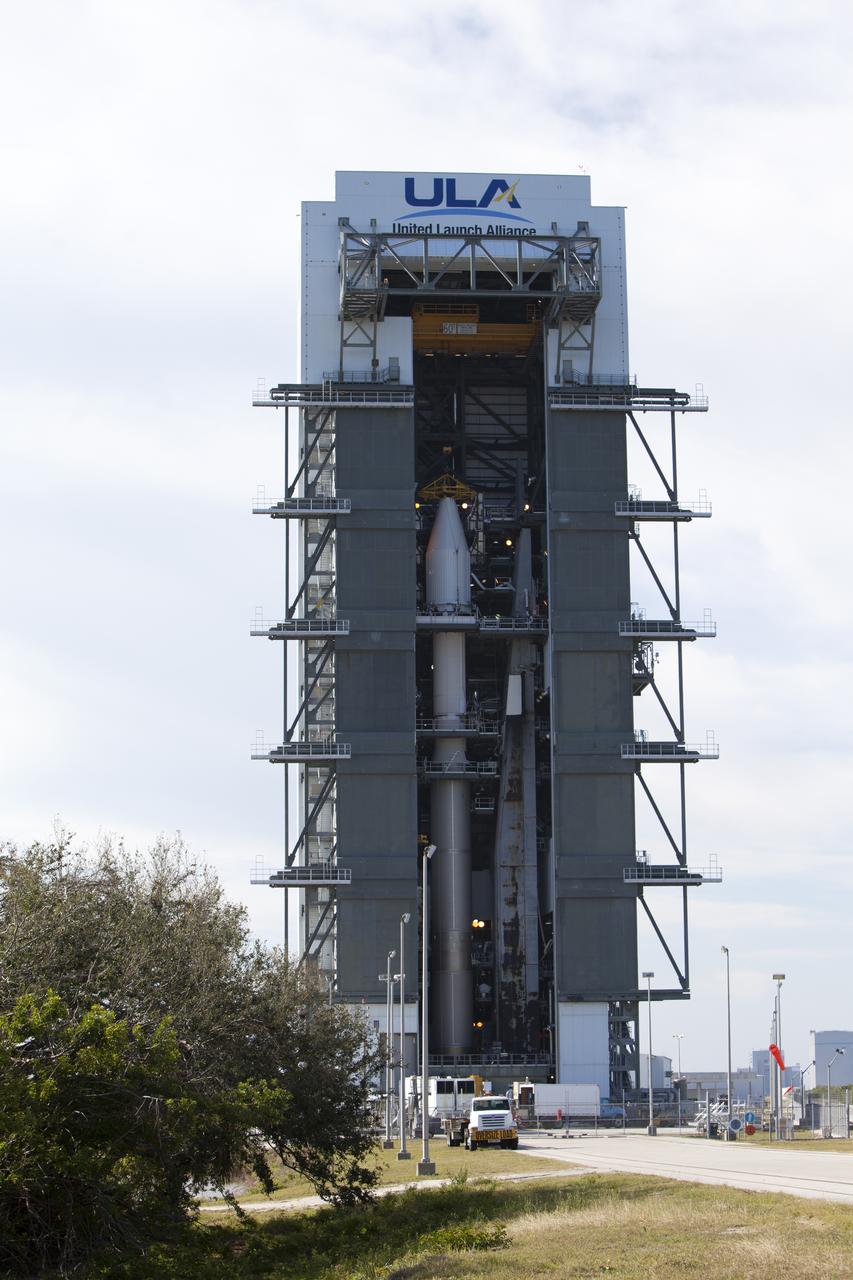
The payload fairing containing the Orbital ATK Cygnus pressurized cargo module is mated to the Centaur upper stage, or second stage, of the United Launch Alliance (ULA) rocket in the Vertical Integration Facility at Space Launch Complex 41 at Cape Canaveral Air Force Station in Florida. The Orbital ATK CRS-7 commercial resupply services mission to the International Space Station is scheduled to launch atop the Atlas V from pad 41. Cygnus will deliver 7,600 pounds of supplies, equipment and scientific research materials to the space station.
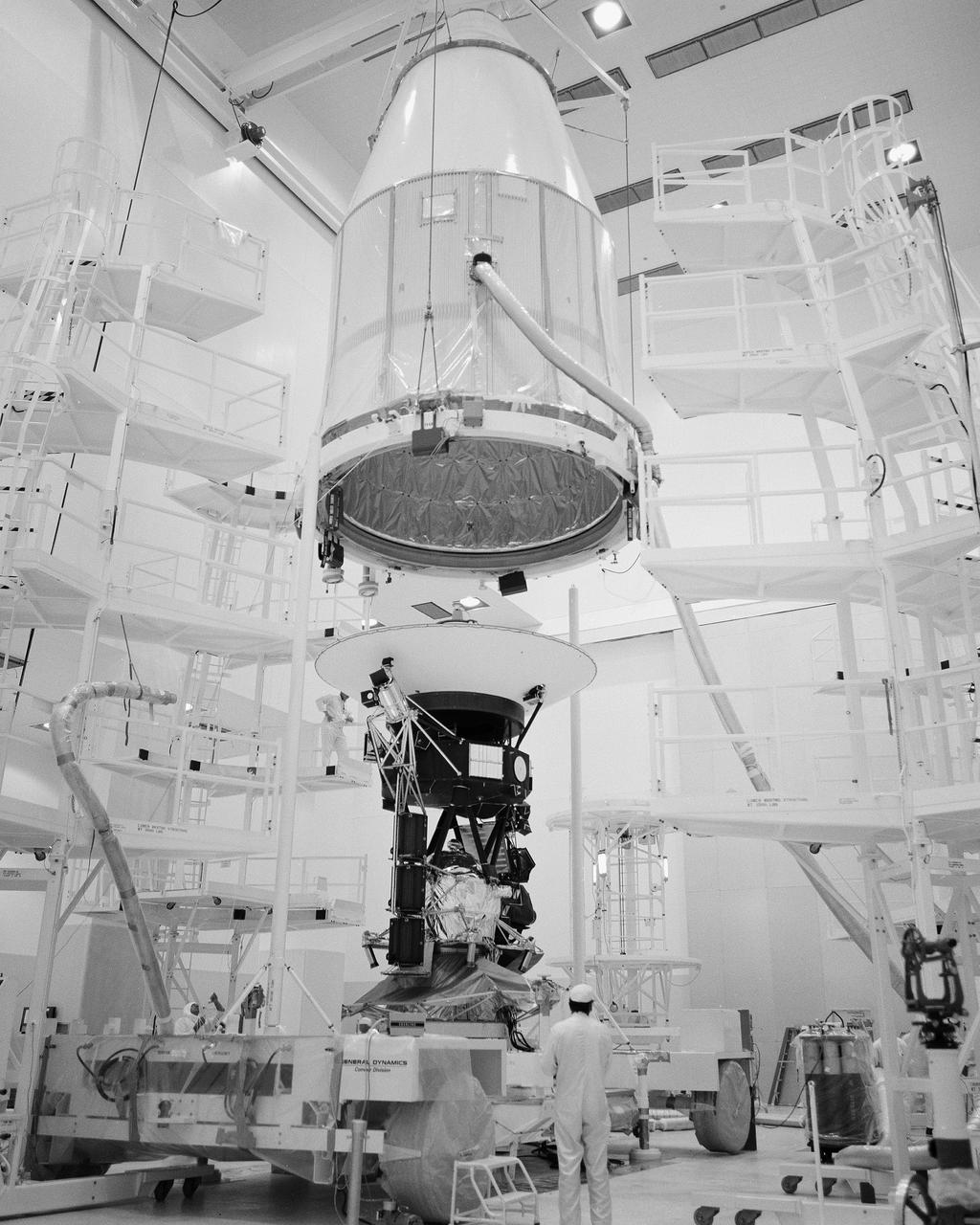
CAPE CANAVERAL, Fla. -- At the Spacecraft Assembly and Encapsulation Facility-1 at the Kennedy Space Center in Florida, the Voyager spacecraft for the first of two missions to be launched toward the outer planets was encapsulated within the payload fairing which will protect it during launch. The 1,800 pound spacecraft is to be mated with Titan_Centaur 7 at Launch Complex 41 and sent on a mission to Jupiter and Saturn no earlier than Aug. 20, 1977. Photo Credit: NASA
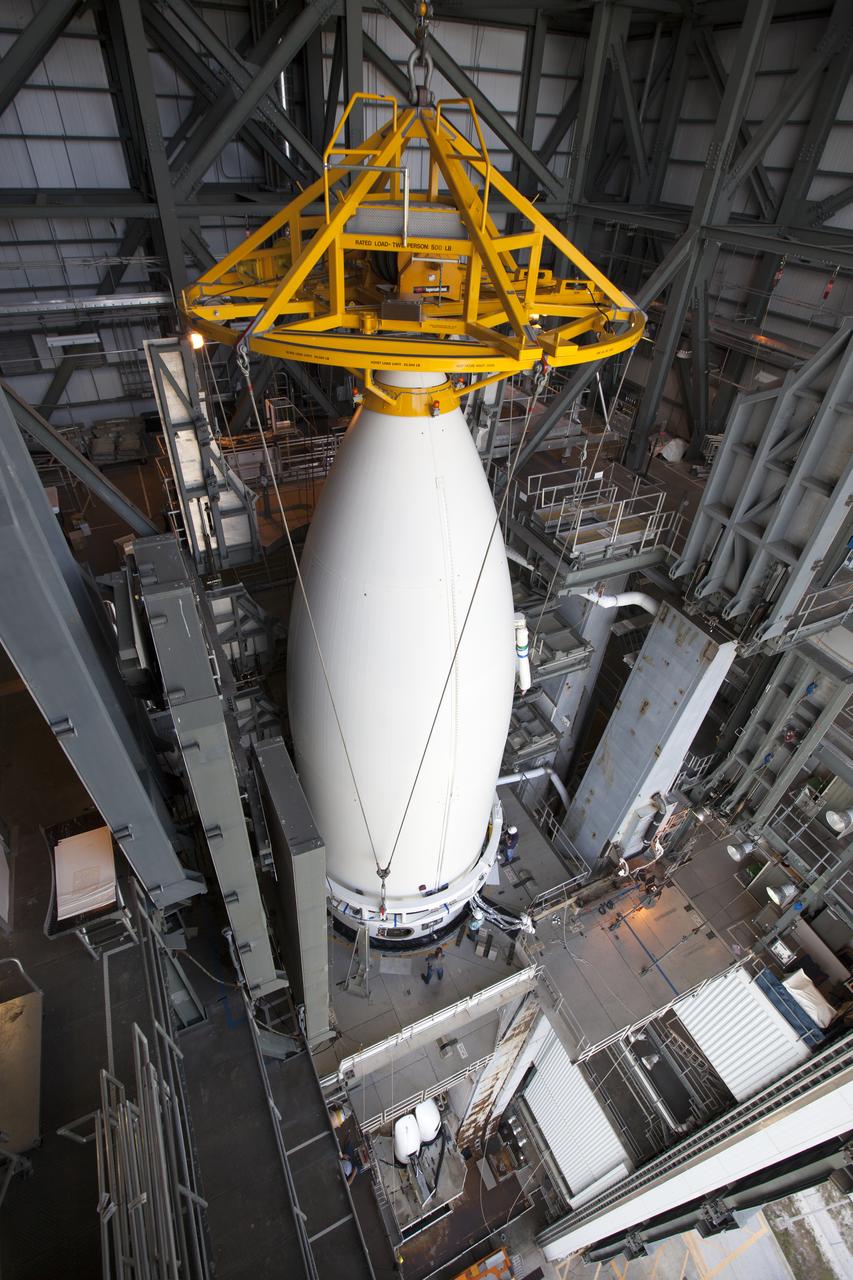
Enclosed in its payload fairing, NOAA's Geostationary Operational Environmental Satellite (GOES-R) is lifted into the Vertical Integration Facility at Space Launch Complex 41 at Cape Canaveral Air Force Station in Florida. GOES-R will be mated to the United Launch Alliance Atlas V Centaur upper stage in preparation for launch aboard the rocket in November. GOES-R is the first satellite in a series of next-generation NOAA GOES Satellites.
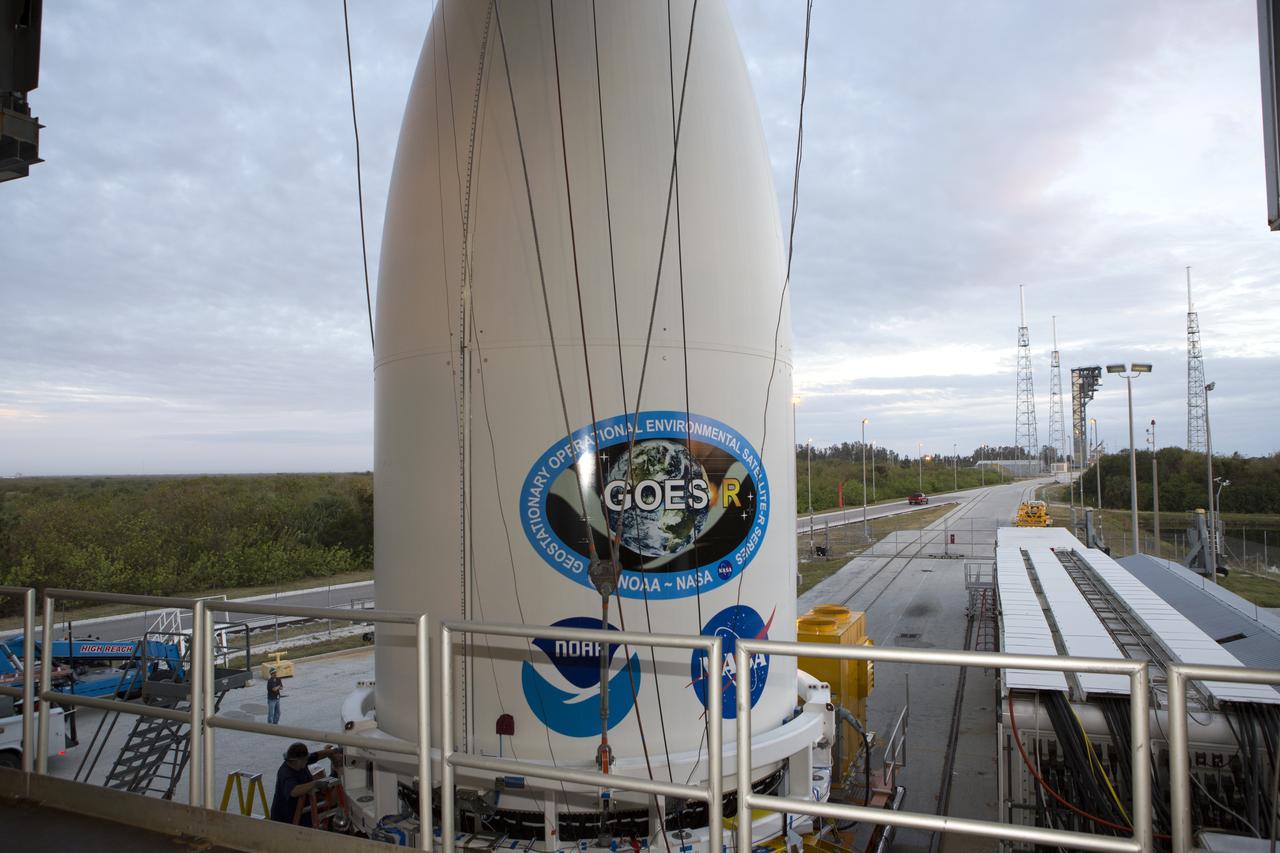
Preparations are underway to lift NOAA's Geostationary Operational Environmental Satellite (GOES-R), enclosed in its payload fairing at the Vertical Integration Facility at Space Launch Complex 41 at Cape Canaveral Air Force Station in Florida. GOES-R will be mated to the United Launch Alliance Atlas V Centaur upper stage in preparation for launch in November. GOES-R is the first satellite in a series of next-generation NOAA GOES Satellites.
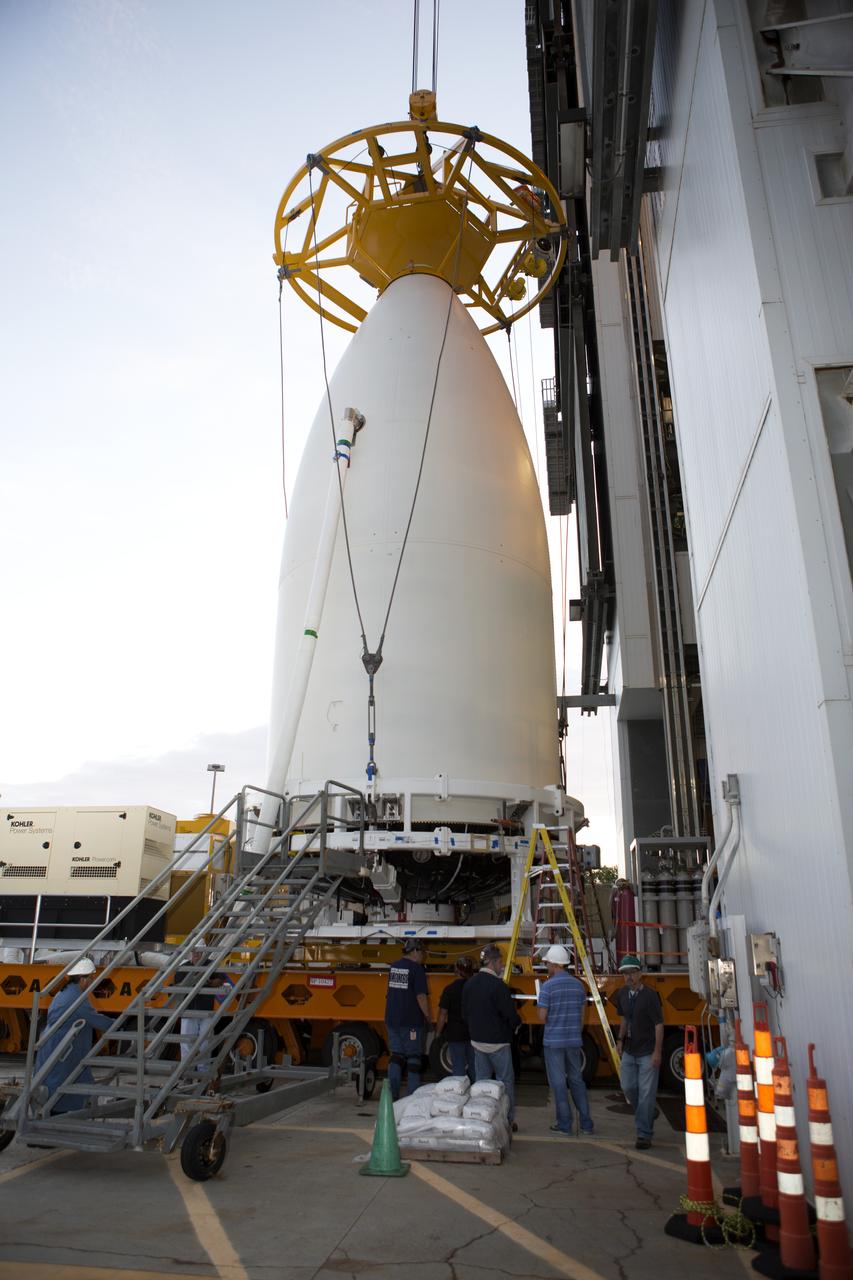
Preparations are underway to lift NOAA's Geostationary Operational Environmental Satellite (GOES-R), enclosed in its payload fairing at the Vertical Integration Facility at Space Launch Complex 41 at Cape Canaveral Air Force Station in Florida. GOES-R will be mated to the United Launch Alliance Atlas V Centaur upper stage in preparation for launch in November. GOES-R is the first satellite in a series of next-generation NOAA GOES Satellites.
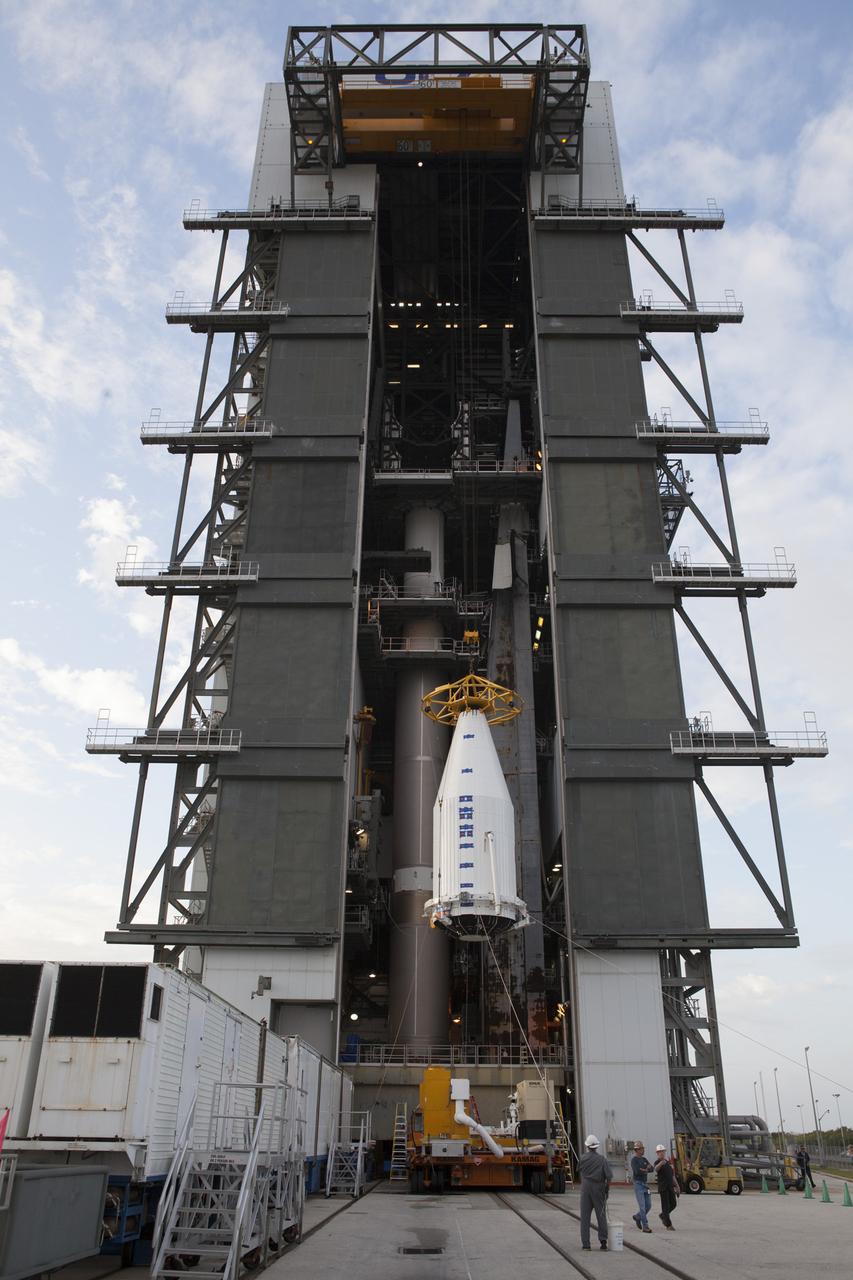
Encapsulated inside its payload fairing, the Cygnus spacecraft for the upcoming Orbital ATK Commercial Resupply Services-6 is lifted to be mated atop a United Launch Alliance Atlas V rocket in the Vertical Integration Facility at Launch Complex-41 at Cape Canaveral Air Force Station. The Cygnus is scheduled to lift off atop a United Launch Alliance Atlas V rocket on March 22 to deliver hardware and supplies to the International Space Station.
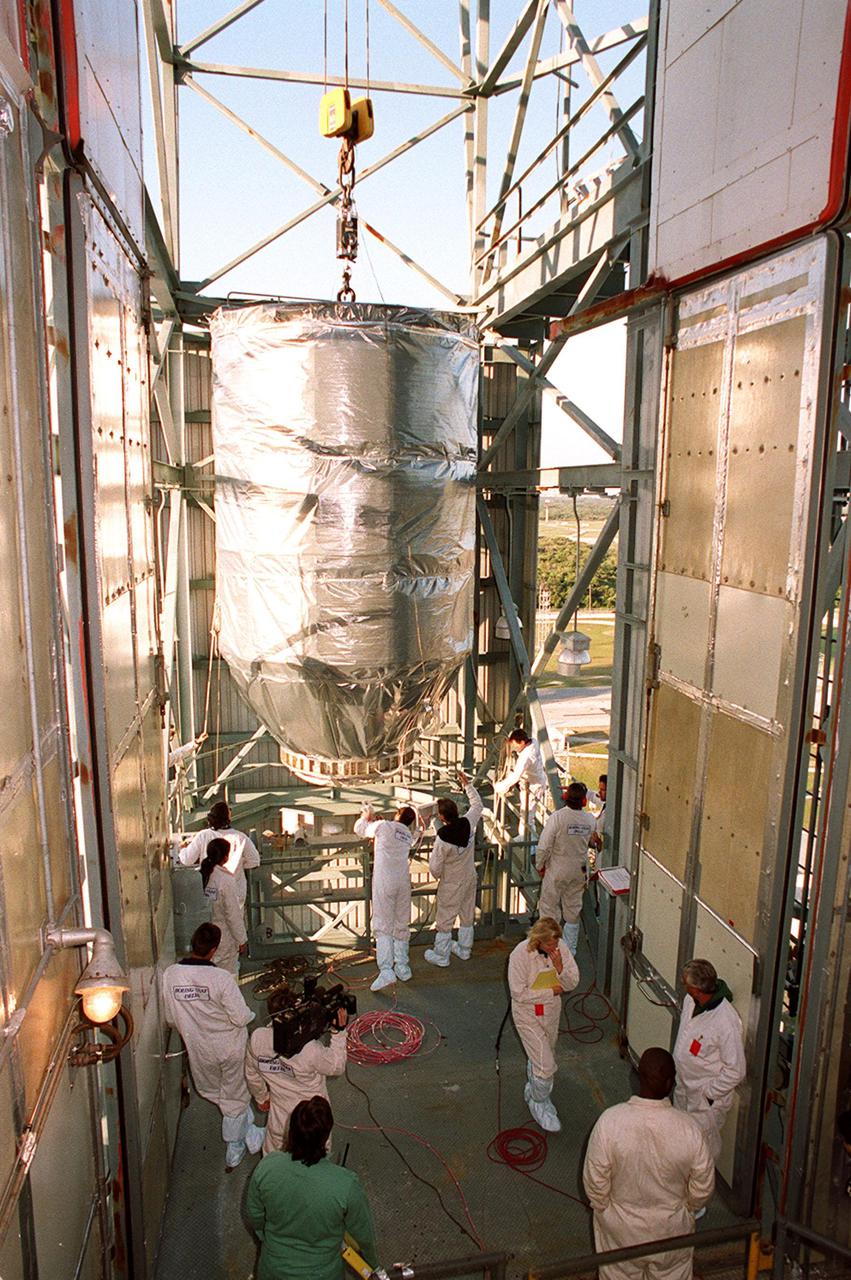
Workers on Launch Pad 17-A, Cape Canaveral Air Force Station, get ready to move the Mars Odyssey spacecraft into the clean room at the top of the gantry. There it will be mated encased by the fairing of the Delta II rocket already in place. The spacecraft will map the Martian surface in search of geological features that could indicate the presence of water, now or in the past, and may contribute significantly toward understanding what will be necessary for a more sophisticated exploration of Mars. Launch is scheduled for 11:02 a.m. EDT April 7
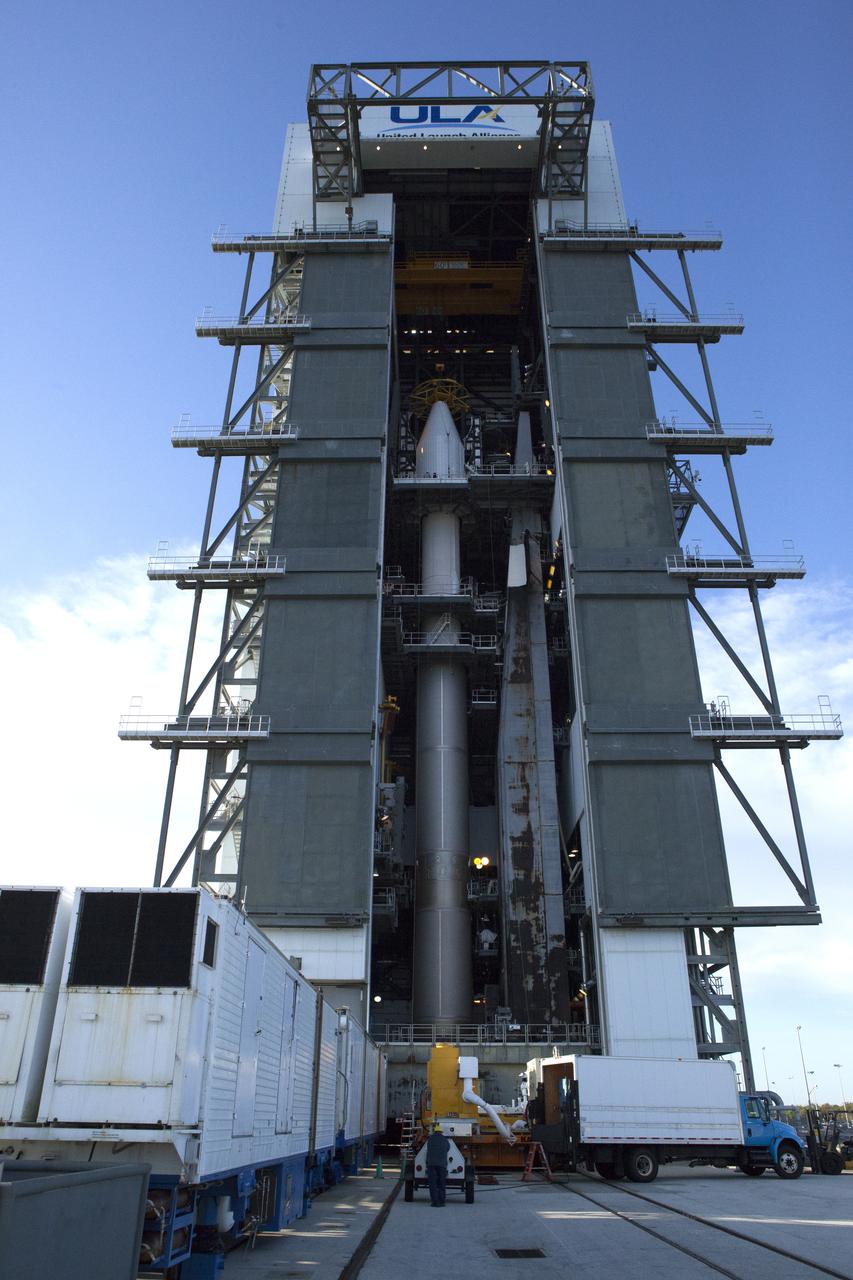
The payload fairing containing the Orbital ATK Cygnus pressurized cargo module is mated to the Centaur upper stage, or second stage, of the United Launch Alliance (ULA) rocket in the Vertical Integration Facility at Space Launch Complex 41 at Cape Canaveral Air Force Station in Florida. The Orbital ATK CRS-7 commercial resupply services mission to the International Space Station is scheduled to launch atop the Atlas V from pad 41. Cygnus will deliver 7,600 pounds of supplies, equipment and scientific research materials to the space station.
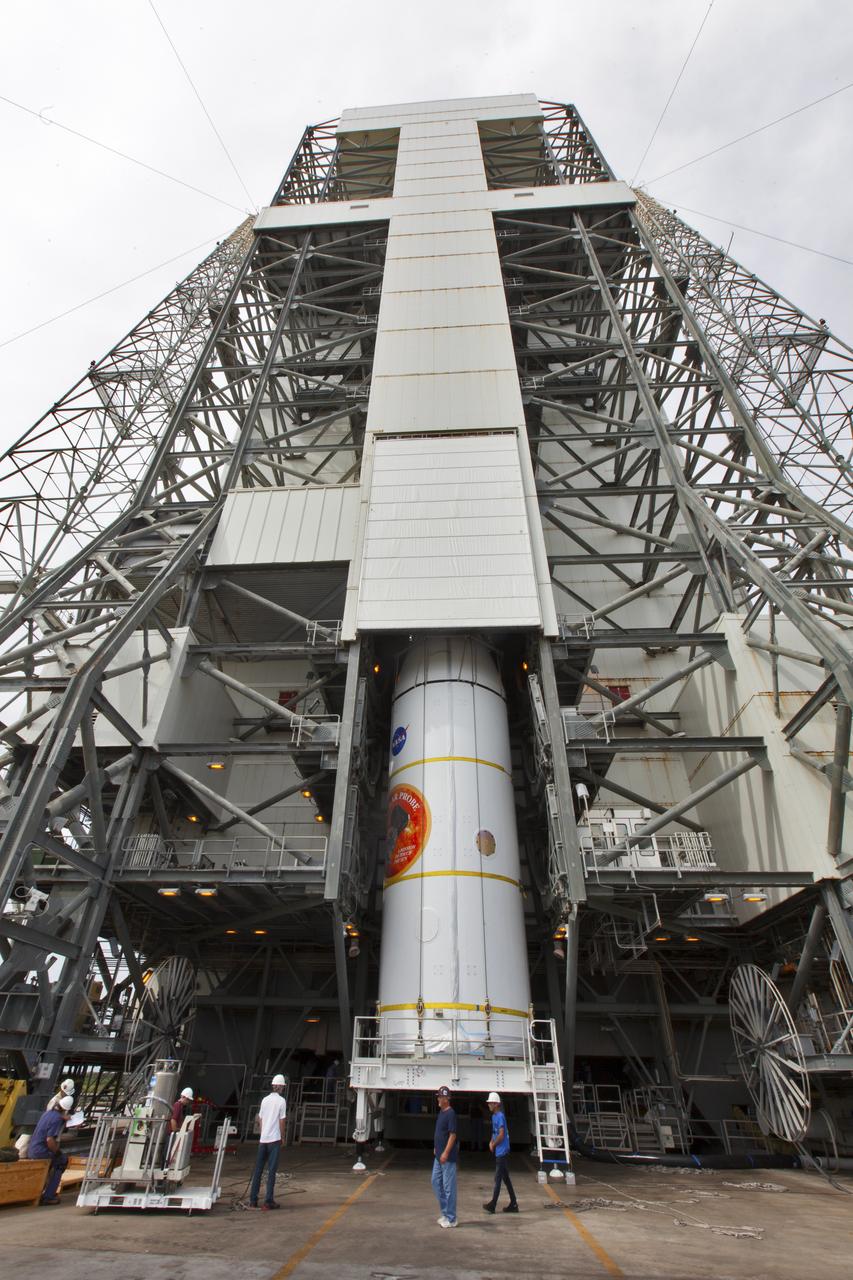
Encapsulated in its payload fairing, NASA's Parker Solar Probe is prepared to be lifted for mating to a United Launch Alliance Delta IV Heavy rocket at Cape Canaveral Air Force Station's Space Launch Complex 37 on Tuesday, July 31, 2018. The Parker Solar Probe is being prepared for a mission to perform the closest-ever observations of a star when it travels through the Sun's atmosphere, called the corona. The probe will rely on measurements and imaging to revolutionize our understanding of the corona and the Sun-Earth connection.
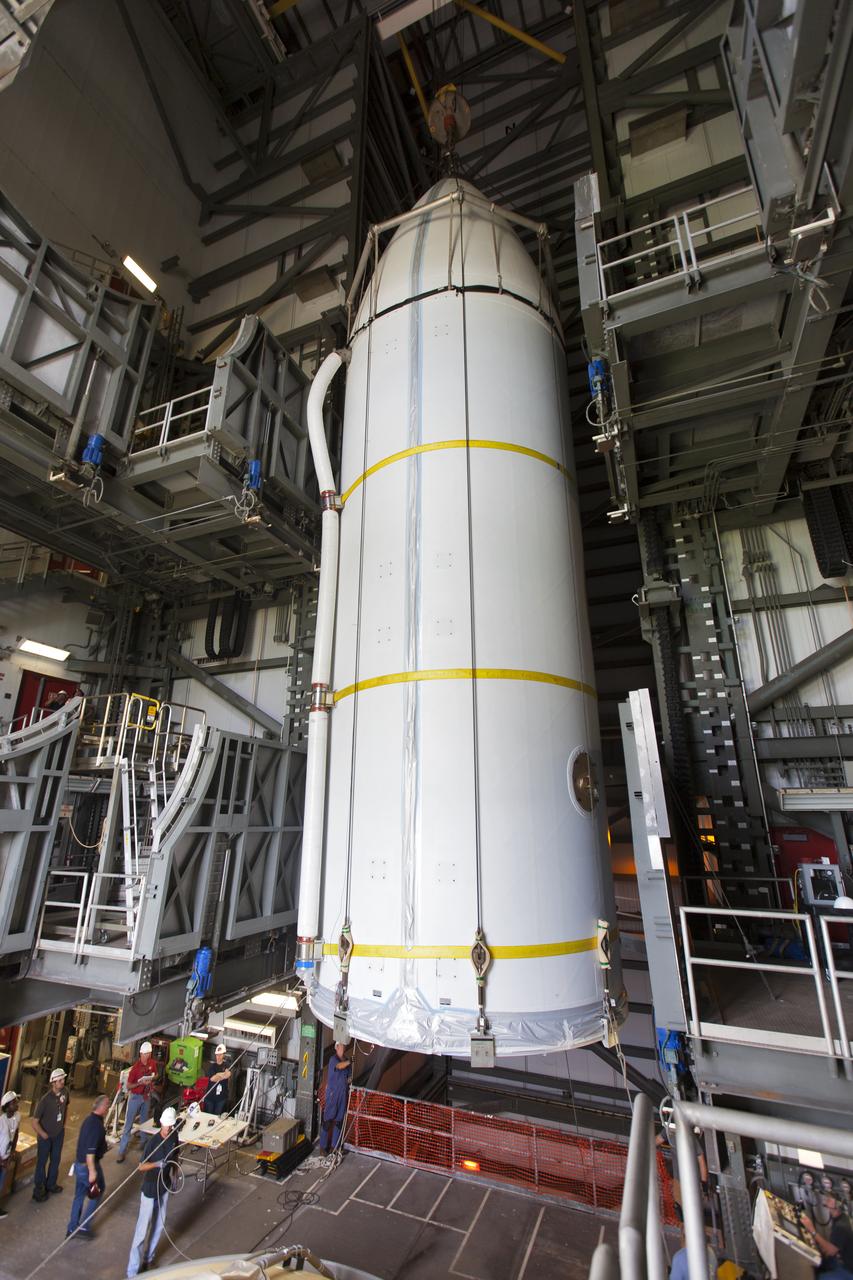
Encapsulated in its payload fairing, NASA's Parker Solar Probe is lifted by a crane for mating to a United Launch Alliance Delta IV Heavy rocket at Cape Canaveral Air Force Station's Space Launch Complex 37 on Tuesday, July 31, 2018. The Parker Solar Probe is being prepared for a mission to perform the closest-ever observations of a star when it travels through the Sun's atmosphere, called the corona. The probe will rely on measurements and imaging to revolutionize our understanding of the corona and the Sun-Earth connection.
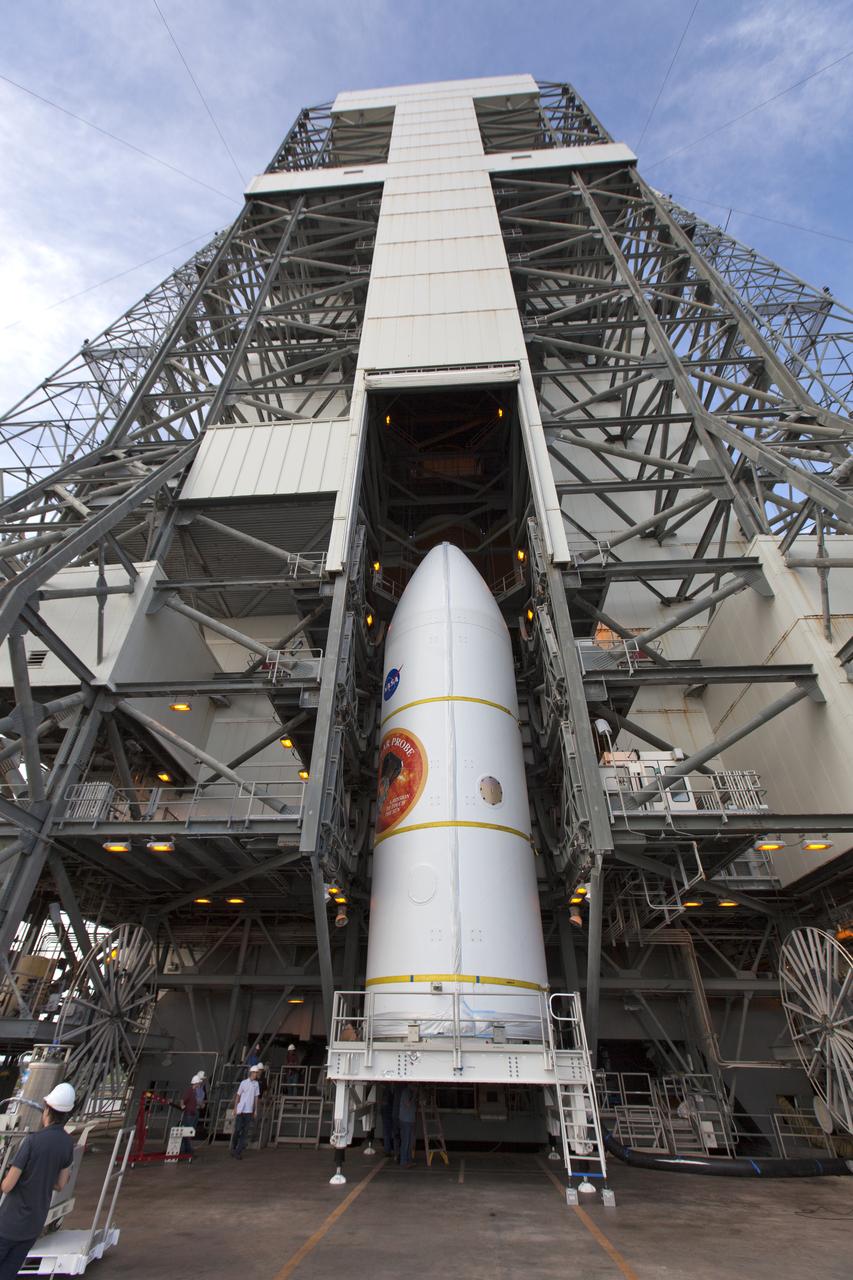
Encapsulated in its payload fairing, NASA's Parker Solar Probe is prepared to be lifted for mating to a United Launch Alliance Delta IV Heavy rocket at Cape Canaveral Air Force Station's Space Launch Complex 37 on Tuesday, July 31, 2018. The Parker Solar Probe is being prepared for a mission to perform the closest-ever observations of a star when it travels through the Sun's atmosphere, called the corona. The probe will rely on measurements and imaging to revolutionize our understanding of the corona and the Sun-Earth connection.
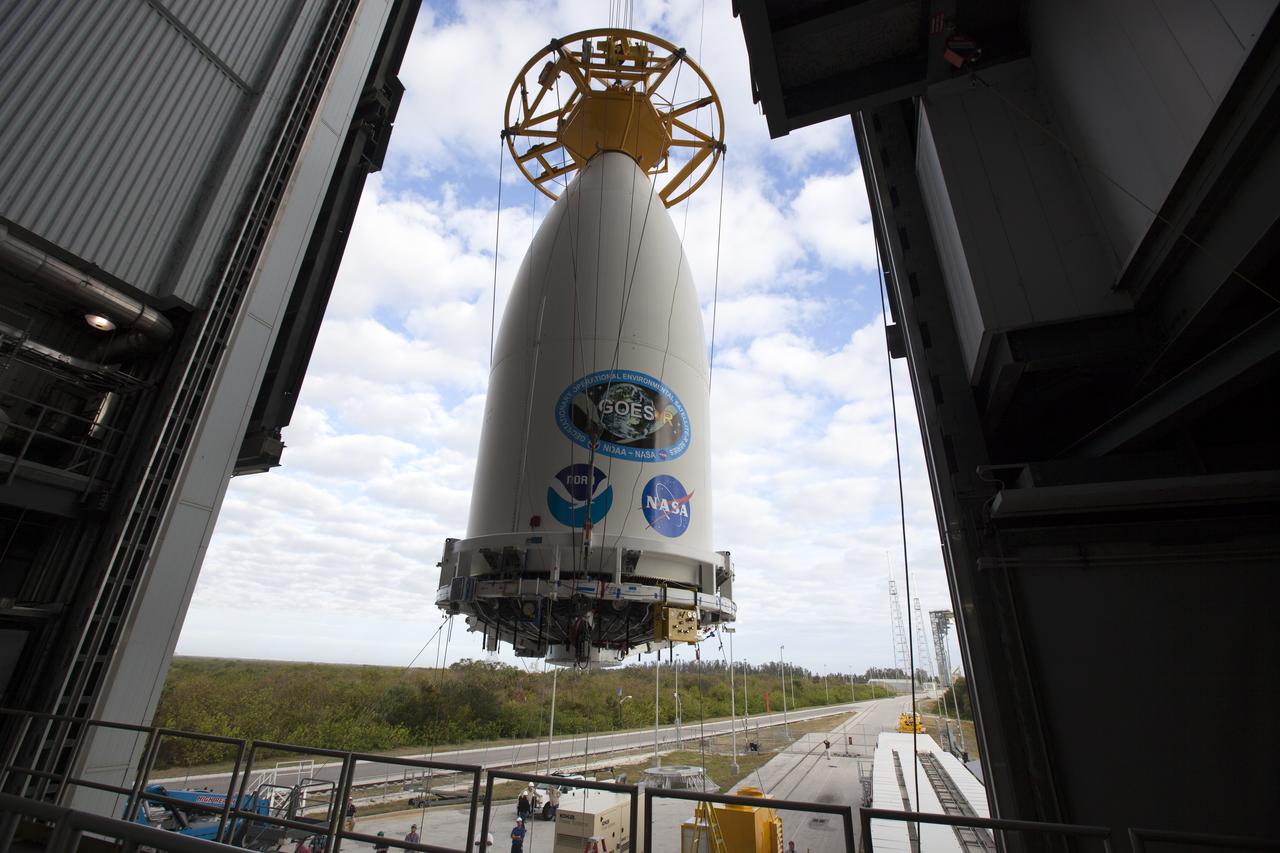
A view from high up inside the Vertical Integration Facility at Space Launch Complex 41 at Cape Canaveral Air Force Station in Florida. A crane lifts the payload fairing containing NOAA's Geostationary Operational Environmental Satellite (GOES-R) for mating to the United Launch Alliance Atlas V Centaur upper stage. The satellite will launch aboard the Atlas V rocket in November. GOES-R is the first satellite in a series of next-generation NOAA GOES Satellites.
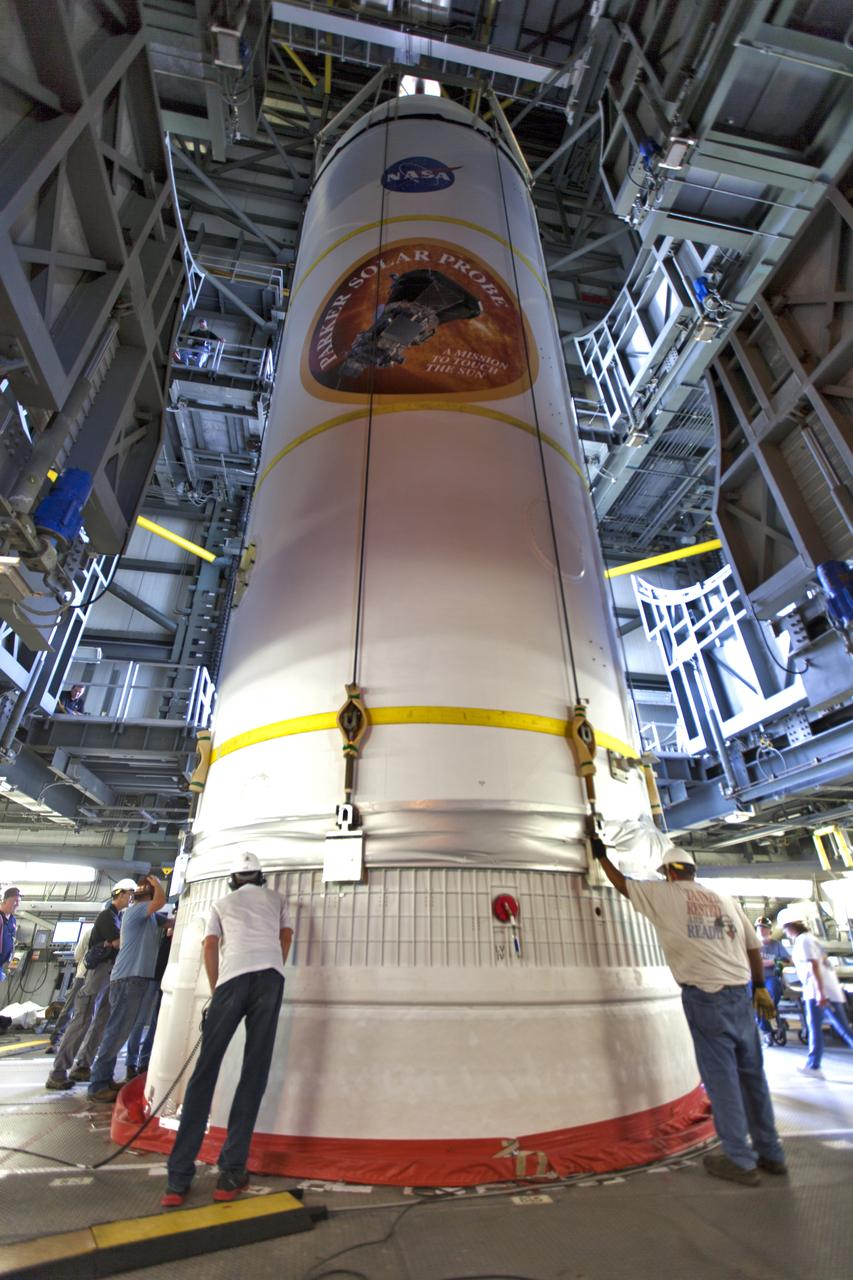
Encapsulated in its payload fairing, NASA's Parker Solar Probe is mated to a United Launch Alliance Delta IV Heavy rocket at Cape Canaveral Air Force Station's Space Launch Complex 37 on Tuesday, July 31, 2018. The Parker Solar Probe is being prepared for a mission to perform the closest-ever observations of a star when it travels through the Sun's atmosphere, called the corona. The probe will rely on measurements and imaging to revolutionize our understanding of the corona and the Sun-Earth connection.

Encapsulated in its payload fairing, NASA's Parker Solar Probe is prepared to be lifted for mating to a United Launch Alliance Delta IV Heavy rocket at Cape Canaveral Air Force Station's Space Launch Complex 37 on Tuesday, July 31, 2018. The Parker Solar Probe is being prepared for a mission to perform the closest-ever observations of a star when it travels through the Sun's atmosphere, called the corona. The probe will rely on measurements and imaging to revolutionize our understanding of the corona and the Sun-Earth connection.
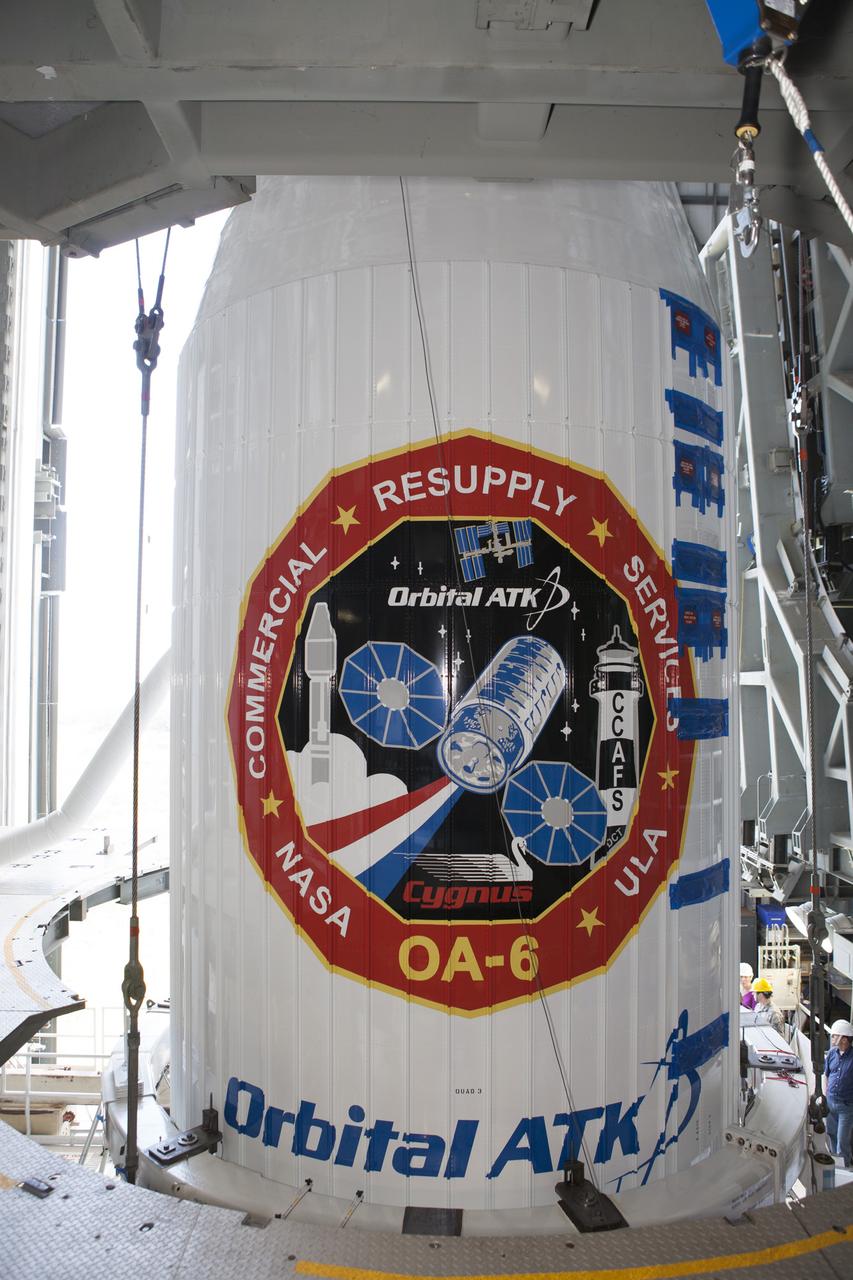
Encapsulated inside its payload fairing, the Cygnus spacecraft for the upcoming Orbital ATK Commercial Resupply Services-6 is mated atop a United Launch Alliance Atlas V rocket in the Vertical Integration Facility at Launch Complex-41 at Cape Canaveral Air Force Station. The Cygnus is scheduled to lift off atop a United Launch Alliance Atlas V rocket on March 22 to deliver hardware and supplies to the International Space Station.
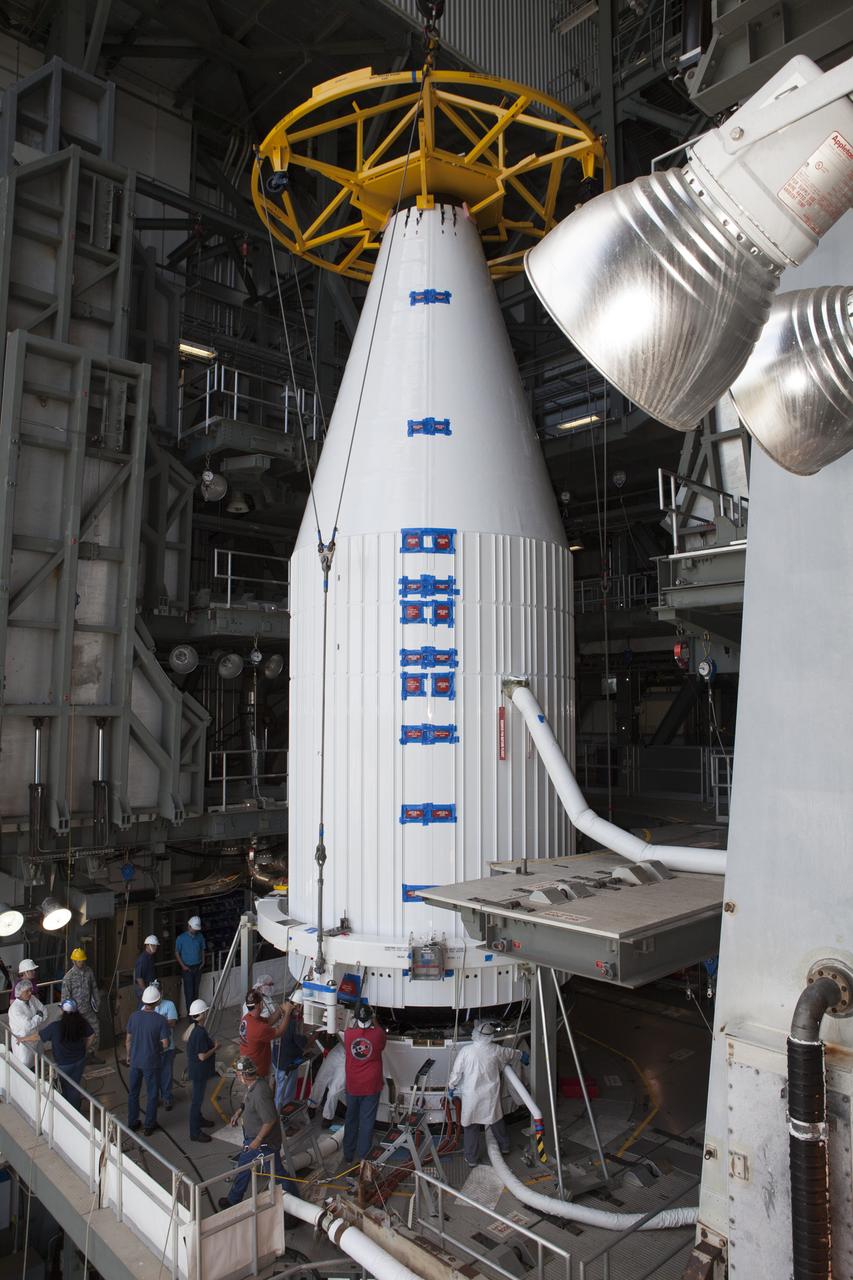
Encapsulated inside its payload fairing, the Cygnus spacecraft for the upcoming Orbital ATK Commercial Resupply Services-6 is mated atop a United Launch Alliance Atlas V rocket in the Vertical Integration Facility at Launch Complex-41 at Cape Canaveral Air Force Station. The Cygnus is scheduled to lift off atop a United Launch Alliance Atlas V rocket on March 22 to deliver hardware and supplies to the International Space Station.
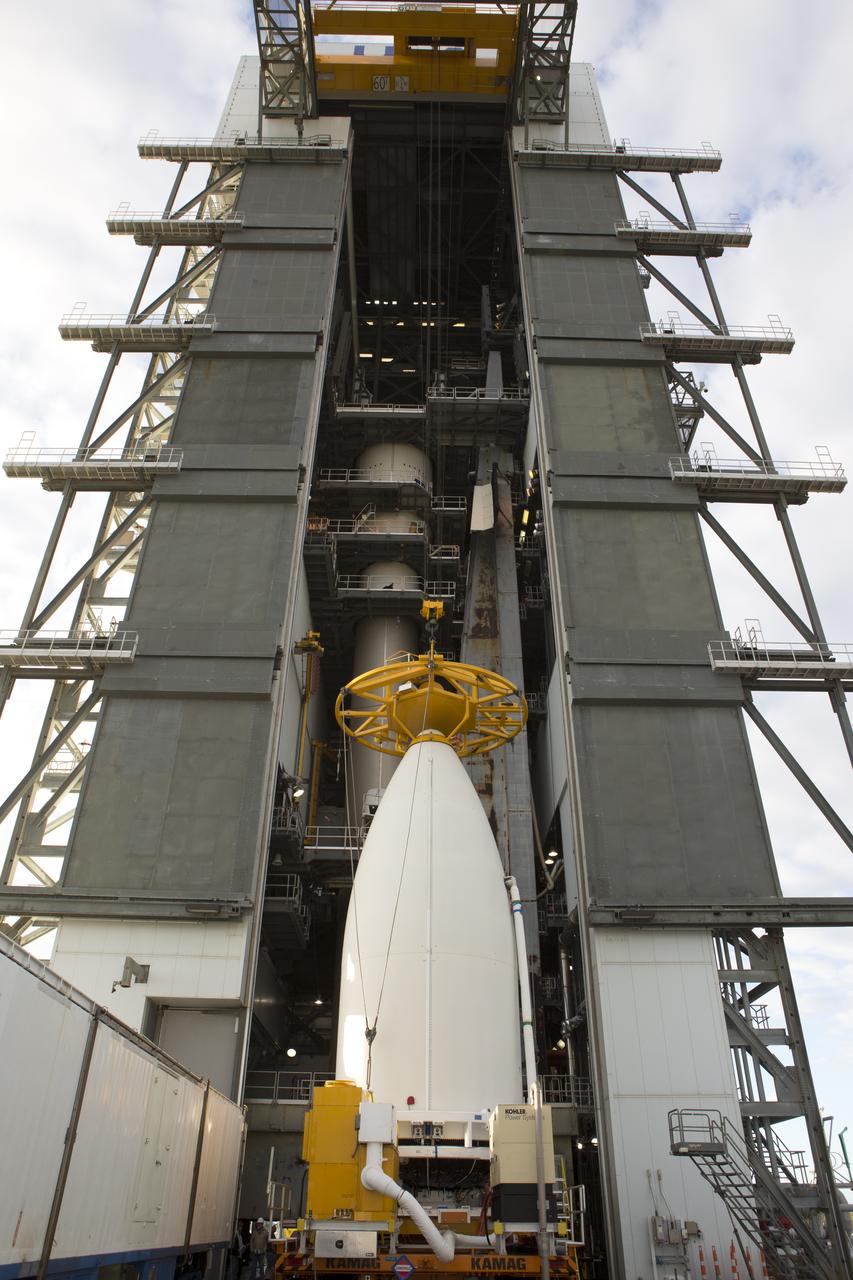
A crane begins to lift the payload fairing containing NOAA's Geostationary Operational Environmental Satellite (GOES-R) at the Vertical Integration Facility at Space Launch Complex 41 at Cape Canaveral Air Force Station in Florida. GOES-R will be mated to the United Launch Alliance Atlas V Centaur upper stage in preparation for launch in November. GOES-R is the first satellite in a series of next-generation NOAA GOES Satellites.
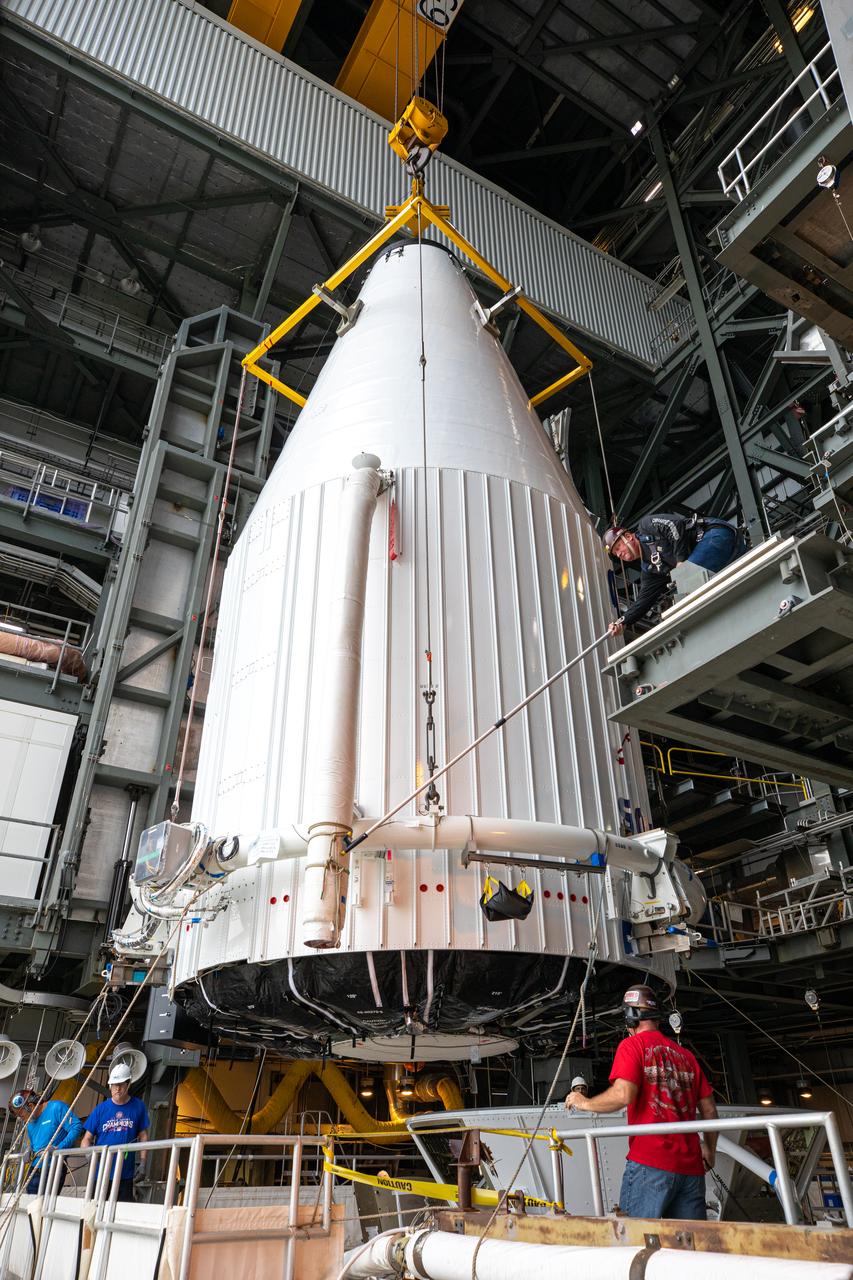
The United Launch Alliance Atlas V payload fairing, containing the Solar Orbiter spacecraft, is moved into the Vertical Integration Facility at Space Launch Complex 41 on Cape Canaveral Air Force Station in Florida on Jan. 31, 2020. The payload fairing will be lowered and mated to the Atlas V rocket. Solar Orbiter is an international cooperative mission between ESA (European Space Agency) and NASA. The mission aims to study the Sun, its outer atmosphere and solar wind. The spacecraft will provide the first images of the Sun’s poles. NASA’s Launch Services Program based at Kennedy is managing the launch. The spacecraft has been developed by Airbus Defence and Space. Solar Orbiter will launch in February 2020 aboard the Atlas V rocket.
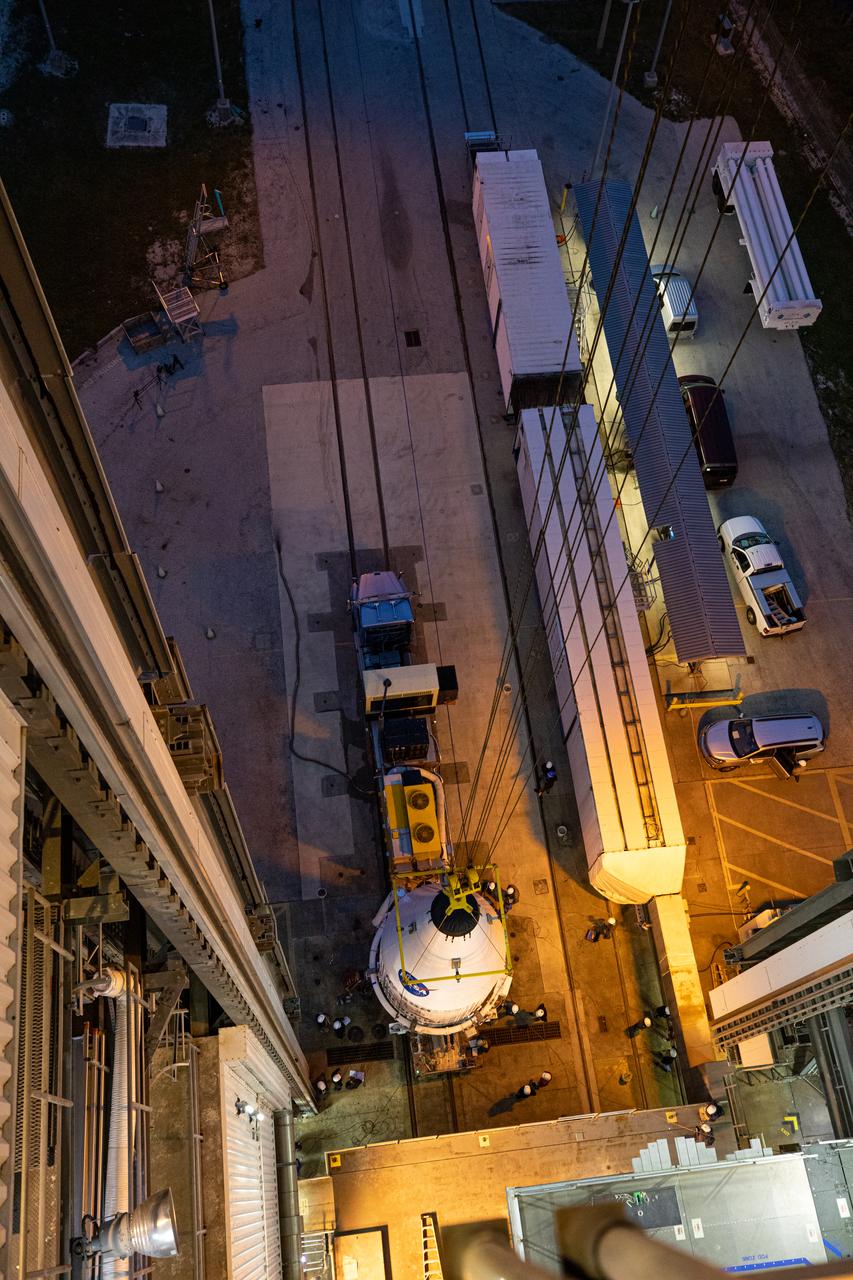
In this view from above, the United Launch Alliance Atlas V payload fairing, containing the Solar Orbiter spacecraft, is hoisted up by crane at the Vertical Integration Facility at Space Launch Complex 41 on Cape Canaveral Air Force Station in Florida on Jan. 31, 2020. The payload fairing will be mated to the Atlas V rocket. Solar Orbiter is an international cooperative mission between ESA (European Space Agency) and NASA. The mission aims to study the Sun, its outer atmosphere and solar wind. The spacecraft will provide the first images of the Sun’s poles. NASA’s Launch Services Program based at Kennedy is managing the launch. The spacecraft has been developed by Airbus Defence and Space. Solar Orbiter will launch in February 2020 aboard the Atlas V rocket.