
Farley Davis and Edward Ahmad explain map of MSFC to Fall Job Shadowing Student Deshon Washington, a student at Alabama A&M University.

Perseverance project scientist, Caltech, Pasadena, California, Ken Farley, gives remarks during a NASA Perseverance rover mission post-landing update, Thursday, Feb. 18, 2021, at NASA's Jet Propulsion Laboratory in Pasadena, California. A key objective for Perseverance’s mission on Mars is astrobiology, including the search for signs of ancient microbial life. The rover will characterize the planet’s geology and past climate, pave the way for human exploration of the Red Planet, and be the first mission to collect and cache Martian rock and regolith. Photo Credit: (NASA/Bill Ingalls)

Perseverance project scientist, Caltech, Pasadena, California, Ken Farley gives remarks during a NASA Perseverance rover mission landing update, Wednesday, Feb. 17, 2021, at NASA's Jet Propulsion Laboratory in Pasadena, California. The Perseverance Mars rover is due to land on Mars Thursday, Feb. 18, 2021. A key objective for Perseverance’s mission on Mars is astrobiology, including the search for signs of ancient microbial life. The rover will characterize the planet’s geology and past climate, pave the way for human exploration of the Red Planet, and be the first mission to collect and cache Martian rock and regolith. Photo Credit: (NASA/Bill Ingalls)

Perseverance project scientist, Caltech, Pasadena, California, Ken Farley, right, gives remarks during a NASA Perseverance rover mission post-landing update as Perseverance entry, descent, and landing phase lead Allen Chen looks on, Thursday, Feb. 18, 2021, at NASA's Jet Propulsion Laboratory in Pasadena, California. A key objective for Perseverance’s mission on Mars is astrobiology, including the search for signs of ancient microbial life. The rover will characterize the planet’s geology and past climate, pave the way for human exploration of the Red Planet, and be the first mission to collect and cache Martian rock and regolith. Photo Credit: (NASA/Bill Ingalls)

Perseverance project scientist, Caltech, Pasadena, California, Ken Farley, on screen, gives remarks during a NASA Perseverance rover mission landing update, Wednesday, Feb. 17, 2021, at NASA's Jet Propulsion Laboratory in Pasadena, California. The Perseverance Mars rover is due to land on Mars Thursday, Feb. 18, 2021. A key objective for Perseverance’s mission on Mars is astrobiology, including the search for signs of ancient microbial life. The rover will characterize the planet’s geology and past climate, pave the way for human exploration of the Red Planet, and be the first mission to collect and cache Martian rock and regolith. Photo Credit: (NASA/Bill Ingalls)

Pictured from the left, in the Saturn I mockup, are: William Brooksbank, Marshall Space Flight Center (MSFC) Propulsion and Vehicle Engineering Laboratory; Dr. Thomas O. Paine, Deputy Administrator of the National Aeronautics and Space Administration (NASA); Dr. Wernher von Braun, MSFC director; Colonel Clare F. Farley, executive officer of the Office of the Administrator; and Charles J. Donlan, newly appointed deputy associate administrator for Manned Space Flight, technical. The party examined an ordinary man’s shoe (held by Paine) outfitted for use in the Saturn I Workshop. The shoe had a unique fastener built into the sole to allow an astronaut to move about the workshop floor and to remain in one position if he desired. Dr. Paine and his party indulged in a two-day tour at the Marshall Space Flight Center getting acquainted with Marshall personnel and programs. It was Paine’s first visit to the center since assuming the NASA post on February 1, 1968.

Ken Farley, project scientist, California Institute of Technology, participates in a Mars 2020 Mission Engineering and Science Briefing at NASA’s Kennedy Space Center in Florida on July 27, 2020. The Mars Perseverance rover is scheduled to launch July 30, on a United Launch Alliance Atlas V 541 rocket from Space Launch Complex 41 at nearby Cape Canaveral Air Force Station. The rover is part of NASA’s Mars Exploration Program, a long-term effort of robotic exploration of the Red Planet. The rover will search for habitable conditions in the ancient past and signs of past microbial life on Mars. The Launch Services Program at Kennedy is responsible for launch management.

A Mars 2020 Mission Engineering and Science Briefing is held at NASA’s Kennedy Space Center in Florida on July 27, 2020. Participating in the briefing from left, are Moderator DC Agle, NASA’s Jet Propulsion Laboratory; Lori Glaze, Planetary Science Division director, NASA Headquarters; and Ken Farley, project scientist, California Institute of Technology. The Mars Perseverance rover is scheduled to launch July 30, on a United Launch Alliance Atlas V 541 rocket from Space Launch Complex 41 at nearby Cape Canaveral Air Force Station. The rover is part of NASA’s Mars Exploration Program, a long-term effort of robotic exploration of the Red Planet. The rover will search for habitable conditions in the ancient past and signs of past microbial life on Mars. The Launch Services Program at Kennedy is responsible for launch management.
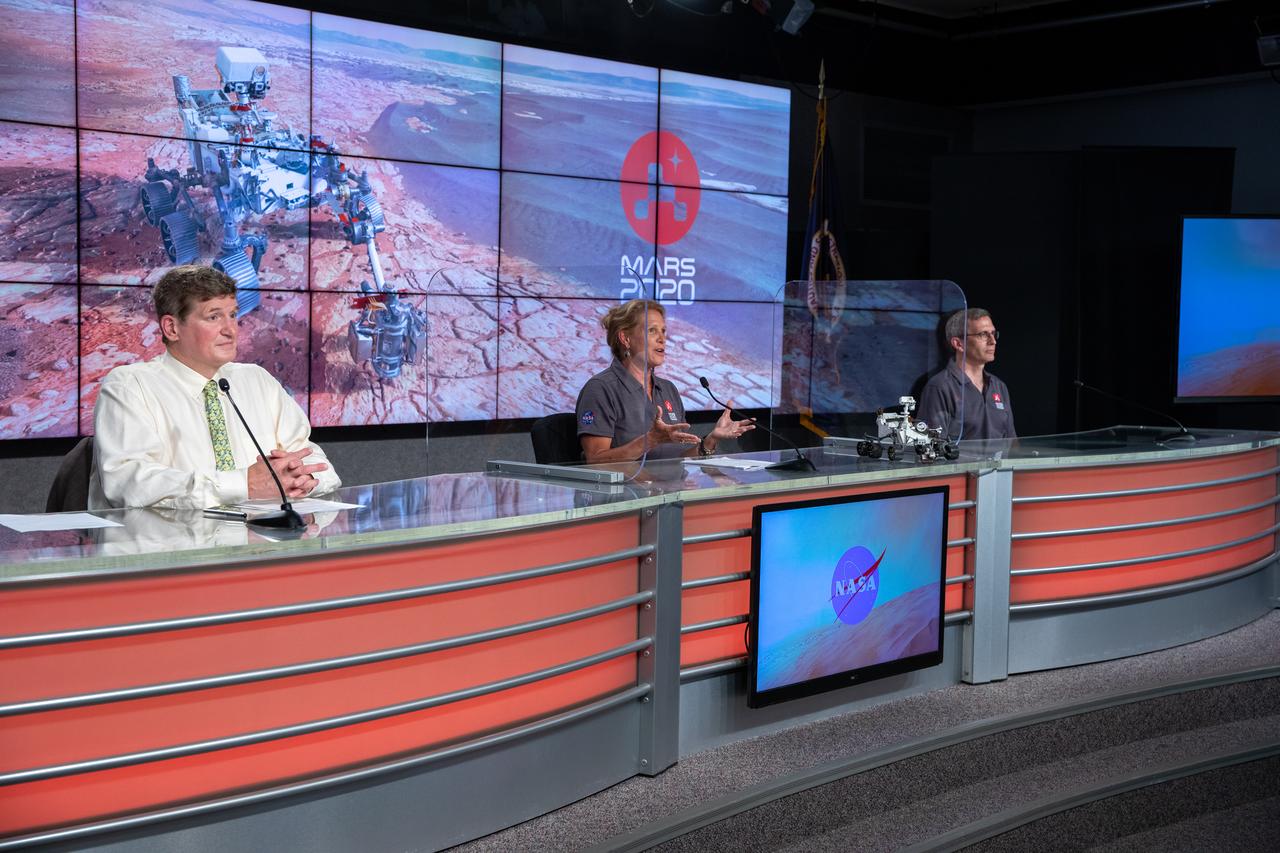
A Mars 2020 Mission Engineering and Science Briefing is held at NASA’s Kennedy Space Center in Florida on July 27, 2020. Participating in the briefing from left, are Moderator DC Agle, NASA’s Jet Propulsion Laboratory; Lori Glaze, Planetary Science Division director, NASA Headquarters; and Ken Farley, project scientist, California Institute of Technology. The Mars Perseverance rover is scheduled to launch July 30, on a United Launch Alliance Atlas V 541 rocket from Space Launch Complex 41 at nearby Cape Canaveral Air Force Station. The rover is part of NASA’s Mars Exploration Program, a long-term effort of robotic exploration of the Red Planet. The rover will search for habitable conditions in the ancient past and signs of past microbial life on Mars. The Launch Services Program at Kennedy is responsible for launch management.
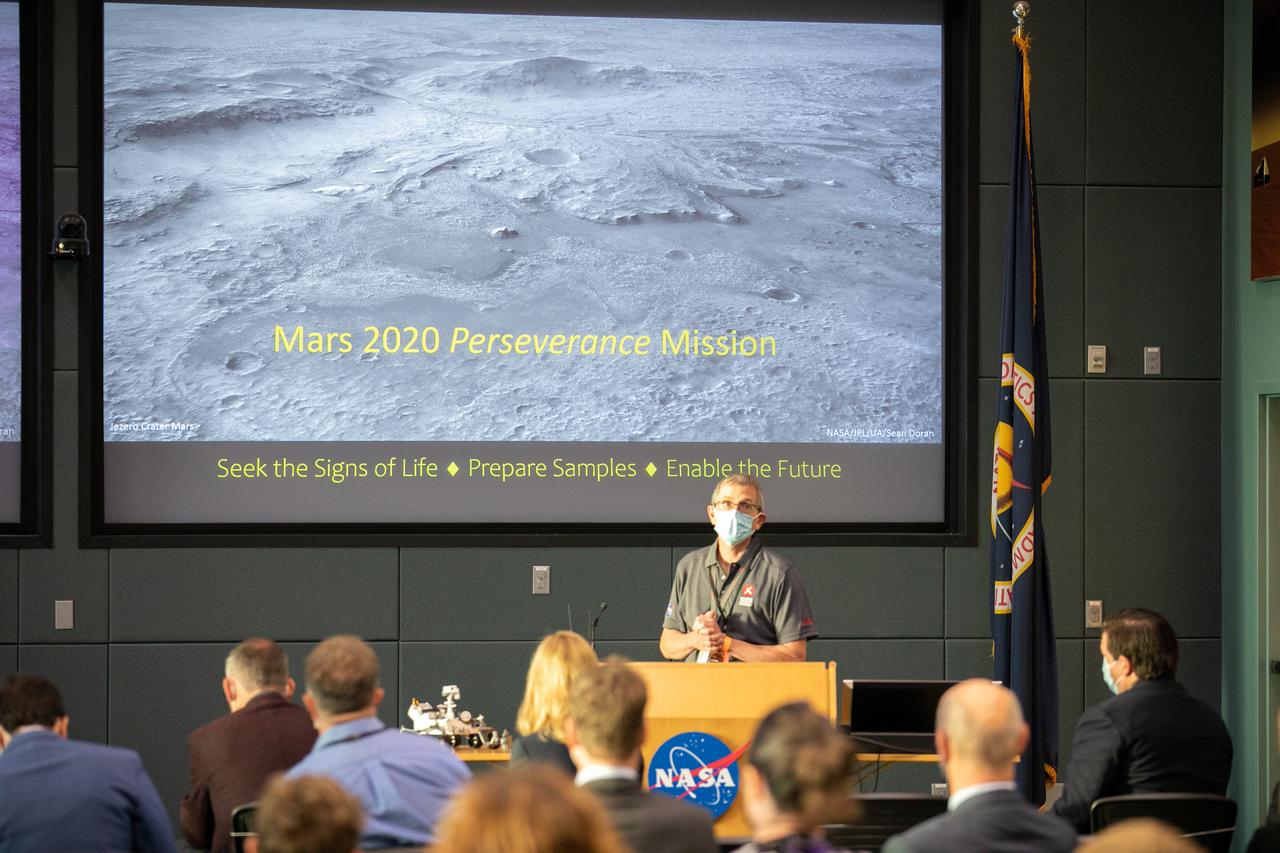
Dr. Kenneth Farley, a project scientist with Caltech, gave a science overview at the Mars 2020 VIP briefing at the Operations and Support Building II at NASA’s Kennedy Space Center in Florida on July 30, 2020, before launch of the Mars Perseverance rover and Ingenuity helicopter on a United Launch Alliance Atlas V 541 rocket from Space Launch Complex 41 at nearby Cape Canaveral Air Force Station. Liftoff occurred at 7:50 a.m. The rover is part of NASA’s Mars Exploration Program, a long-term effort of robotic exploration of the Red Planet. The rover will search for habitable conditions in the ancient past and signs of past microbial life on Mars. The Launch Services Program at Kennedy is responsible for launch management.

Perseverance deputy project manager, JPL, Jennifer Trosper, right monitor, gives remarks during a NASA Perseverance rover mission post-landing update, Thursday, Feb. 18, 2021, at NASA's Jet Propulsion Laboratory in Pasadena, California. A key objective for Perseverance’s mission on Mars is astrobiology, including the search for signs of ancient microbial life. The rover will characterize the planet’s geology and past climate, pave the way for human exploration of the Red Planet, and be the first mission to collect and cache Martian rock and regolith. Photo Credit: (NASA/Bill Ingalls)

Director of NASA's Science Mission Directorate’s Planetary Science Division, Lori Glaze, gives remarks during a NASA Perseverance rover mission landing update, Wednesday, Feb. 17, 2021, at NASA's Jet Propulsion Laboratory in Pasadena, California. The Perseverance Mars rover is due to land on Mars Thursday, Feb. 18, 2021. A key objective for Perseverance’s mission on Mars is astrobiology, including the search for signs of ancient microbial life. The rover will characterize the planet’s geology and past climate, pave the way for human exploration of the Red Planet, and be the first mission to collect and cache Martian rock and regolith. Photo Credit: (NASA/Bill Ingalls)

Perseverance deputy project manager, JPL, Jennifer Trosper, right monitor, gives remarks during a NASA Perseverance rover mission post-landing update, Thursday, Feb. 18, 2021, at NASA's Jet Propulsion Laboratory in Pasadena, California. A key objective for Perseverance’s mission on Mars is astrobiology, including the search for signs of ancient microbial life. The rover will characterize the planet’s geology and past climate, pave the way for human exploration of the Red Planet, and be the first mission to collect and cache Martian rock and regolith. Photo Credit: (NASA/Bill Ingalls)

Perseverance Mars rover mission managers and scientist are seen during a NASA Perseverance rover mission landing update, Wednesday, Feb. 17, 2021, at NASA's Jet Propulsion Laboratory in Pasadena, California. The Perseverance Mars rover is due to land on Mars Thursday, Feb. 18, 2021. A key objective for Perseverance’s mission on Mars is astrobiology, including the search for signs of ancient microbial life. The rover will characterize the planet’s geology and past climate, pave the way for human exploration of the Red Planet, and be the first mission to collect and cache Martian rock and regolith. Photo Credit: (NASA/Bill Ingalls)

NASA Perseverance rover mission management and scientist celebrate a successful landing on Mars at the start of a post-landing update, Thursday, Feb. 18, 2021, at NASA's Jet Propulsion Laboratory in Pasadena, California. A key objective for Perseverance’s mission on Mars is astrobiology, including the search for signs of ancient microbial life. The rover will characterize the planet’s geology and past climate, pave the way for human exploration of the Red Planet, and be the first mission to collect and cache Martian rock and regolith. Photo Credit: (NASA/Bill Ingalls)